
WORKSHOP 6: ROADMAP TO 100 G CO 2
|
|
|
- Eustace Andrews
- 9 years ago
- Views:
Transcription
1 WORKSHOP 6: ROADMAP TO 100 G CO 2 /KM WELL-TO-WHEEL PANELISTS: Neville JACKSON, Ricardo, Chief Technology and Innovation offi cer Andre DOUAUD, Automobile & Energy consulting Joël FOUCARD, Michelin Jean-Jacques CARRE, GKN driveline Electric/Hybrid development, Director of Advanced Engineering, control products, vehicle integration GKN Automotive & GKN plc Kristen de la ROSA, Argonne National Laboratory (US), Dir of Adv Veh Tech Competition (US Argonne Nat Lab) Jean DELSEY, INRETS Research Director Petr DOLEJSI, ACEA (European Automobile Manufacturers Association), Director Mobility and Sustainable Transport Paul EVERITT, SMMT, Chief Executive Society of Motor Manufacturers and Traders Michel FORISSIER, Valeo, Marketing, Research and Development Director for Valeo Powertrain Systems Hans-Georg FRISCHKORN, VDA, Vice-President Peter GEBHARD, Audi, Head of Vehicle Physics, AUDI AG Philip GOTT, IHS, Managing Director IHS Automotive Gautam KALGHATGI, ARAMCO, Senior Scientist Nicolas LEBIGOT, CCFA, Manager Environmental and Technical Affairs Nicholas LEE, PSA Group London Offi ce Director Karl-Heinz ZIEROCK, BMU (German Federal Ministry of Environment, Nature protection and nuclear safety) 47 Michelin Challenge Bibendum - Berlin 2011 WORKSHOPS

2 The brief for this workshop was to define the macro scenarios which would help to reach an average of 100 g CO 2 /km well-to-wheel for new vehicles, in the best economic and technical conditions. This could include the combination and optimization of the ICE/gasoline system, hybridization, resorting to electric motorization and the introduction of non-fossil fuels such as biofuels, natural gas or other low carbon alternatives. More specifically, how close are car makers to meeting 2012 target in Europe (130 g CO 2 /km tank-to-wheel)?, how will they achieve the next target of 95 g CO 2 /km (tank-to-wheel) by 2020?, how and when can we achieve 60 g CO 2 /km (tankto-wheel)? The workshop addressed this brief via some structured sessions that explored: The view from the regulators and policymakers The view from the automotive industry Future consumer requirements and vehicle characteristics The potential for future technologies Outlook and key messages REGULATION & POLICY Many governments view both the reduction of greenhouse gas emissions and energy security as high priority policies. Some have even targeted carbon emissions reduction in legally binding legislation. From a regulatory perspective, it is clear that there is increasing pressure in all major markets to address CO 2 emissions. This has generally been specified as fleet average tailpipe CO 2 emissions or fuel economy based on new vehicle sales and on a tank-to-wheel basis. A summary of these regulatory pressures is shown below: WORKSHOPS Michelin Challenge Bibendum - Berlin

3 The target for Europe is second only to Japan in terms of fleet average emissions. One of the key issues that emerge from this type of analysis is that there are a range of different processes and drive cycles to quantify fuel consumption and CO 2 emissions. This can drive the need for different approaches or different technologies dependent on specific regulations. There is clear recognition that more needs to be done to ensure that drive cycle fuel economy is more closely aligned to real world consumer experiences. A more consistent global approach with common processes and standards would enable economies of scale and enable more competitive low carbon products to be introduced to market. There are also concerns that changes of government with different views and priorities leads to instability and makes long term forward planning very difficult. Specific examples include the differing priorities for energy security against lower carbon emissions, the trade off between vehicle weight reduction and safety and the need to define measures that address well-to-wheel rather than tank-to-wheel carbon emissions sooner rather than later. Future transport energy is a critical area of government policy as it directly relates to carbon reduction strategies. It is important that governments work towards integrated energy policies. This is specifically relevant to the delivery of increased vehicle electrification, where energy for transport is provided by the electricity grid. Both federal and local governments see electrification of transport as a major focus area and are providing public funding for a range of measures including vehicle subsidies, targeted R&D, charging infrastructure and other non fiscal incentives to encourage purchase and preferential use of battery electric and plug-in hybrid vehicles. to improve safety and improvements in vehicle function and performance. The automotive industry represents 10.2% of EU manufacturing employment including 3.5 million direct and 9.1 million indirect jobs. The automotive industry in Europe produces the largest private sector investment in R&D at 26 billion/year and generates 427 billion of tax revenues. To ensure that the European automotive industry remains internationally competitive, it is important that regulation remains in balance globally with competing nations and produces products that consumers want to purchase. The automotive industry is very supportive of public/ private partnerships between industry and government to help achieve this balance. There is also a need to develop integrated industrial and government policies that balance regulation with fiscal incentives, consumer information and education, public support for R&D and public sector procurement. Whilst the industry also sees electrification as an important contribution to future reductions in carbon emissions, this is seen as only one measure or technology critical to future carbon reduction targets. The general consensus from the automotive community is that there will need to be a breakthrough on battery technology, particularly cost per unit energy stored, to enable battery electric and plug-in hybrid vehicles to progress from a niche market supported by subsidies to a competitive unsubsidized mass market product. This is thought to be possible but is likely to take some time and during this period, it is important to address a range of other technologies that will be critical in reaching targets in the 2020 to 2030 timeframe. AUTOMOTIVE INDUSTRY VIEW Whilst it is clear that the automotive industry is committed to the need for sustainable and lower carbon transport, it is also very much focused on the need to ensure that the rate at which carbon emissions are reduced is balanced with industrial capability and economics. Substantial reductions in fleet average fuel consumption have been delivered by the automotive industry with a 22% reduction in fleet average CO 2 since 1995 despite increases in vehicle weight 49 Michelin Challenge Bibendum - Berlin 2011 WORKSHOPS

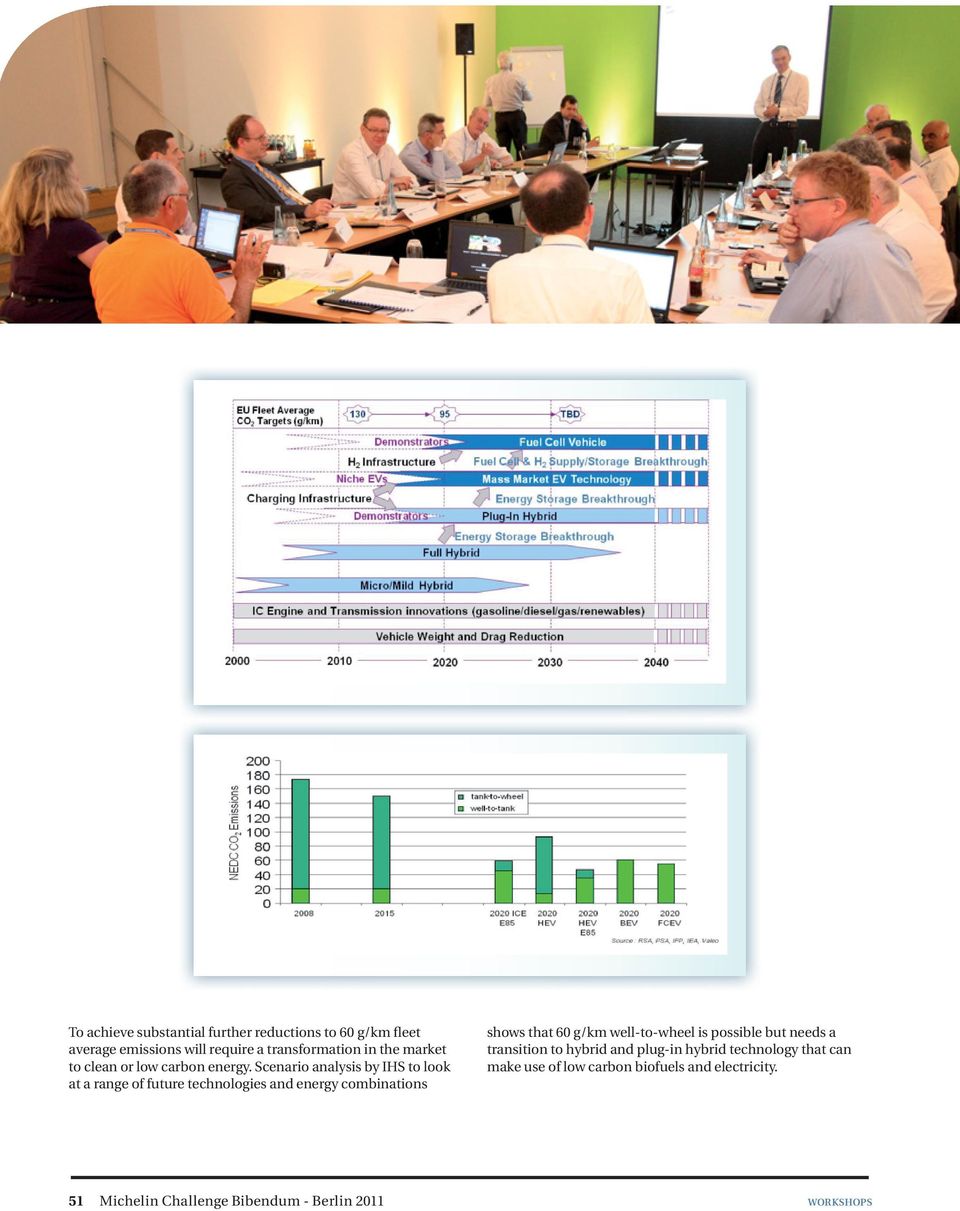
4 Source: McKinsey study for the BMU FUTURE VEHICLE CHARACTERISTICS Whilst there are likely to be differences in product mix and specific technologies, there is general consensus within the automotive community on the probable introduction and timing of new passenger car technologies to reduce carbon emissions. An example from the UK is shown below. This shows that innovations in IC based powertrains will be vital in supporting the transition to hybrid, plug-in hybrid and battery electric vehicles. Reductions in vehicle weight and drag reduction are also necessary. In the longer term, there may be potential to introduce fuel cell based vehicles if challenges in on-board hydrogen storage and supply can be overcome. It is also clear that the investment required to bring these technologies to market in the timeframe required to meet new regulations is probably more than the automotive community can afford on its own. It is therefore important that future technologies introduced to the mass market utilize as much existing manufacturing assets and infrastructure as possible. It is also important that future vehicles meet the requirements and aspirations of consumers. Increasing urbanization, an ageing population, car sharing and changes in consumer mobility preferences such as car sharing will all be key factors that will influence future vehicle characteristics. There is also a clear preference from industry that future fuel efficiency or CO 2 regulations are technology neutral and are based on good science and analysis. An example would be the need to move towards well-to-wheel CO 2 emissions to include fuel or energy conversions in the supply chain. In future, a move towards life cycle CO 2 emissions including materials preparation, manufacture, in service use and disposal/ recycling should allow better long term decisions to be made. WORKSHOPS Michelin Challenge Bibendum - Berlin

5 To achieve substantial further reductions to 60 g/km fleet average emissions will require a transformation in the market to clean or low carbon energy. Scenario analysis by IHS to look at a range of future technologies and energy combinations shows that 60 g/km well-to-wheel is possible but needs a transition to hybrid and plug-in hybrid technology that can make use of low carbon biofuels and electricity. 51 Michelin Challenge Bibendum - Berlin 2011 WORKSHOPS
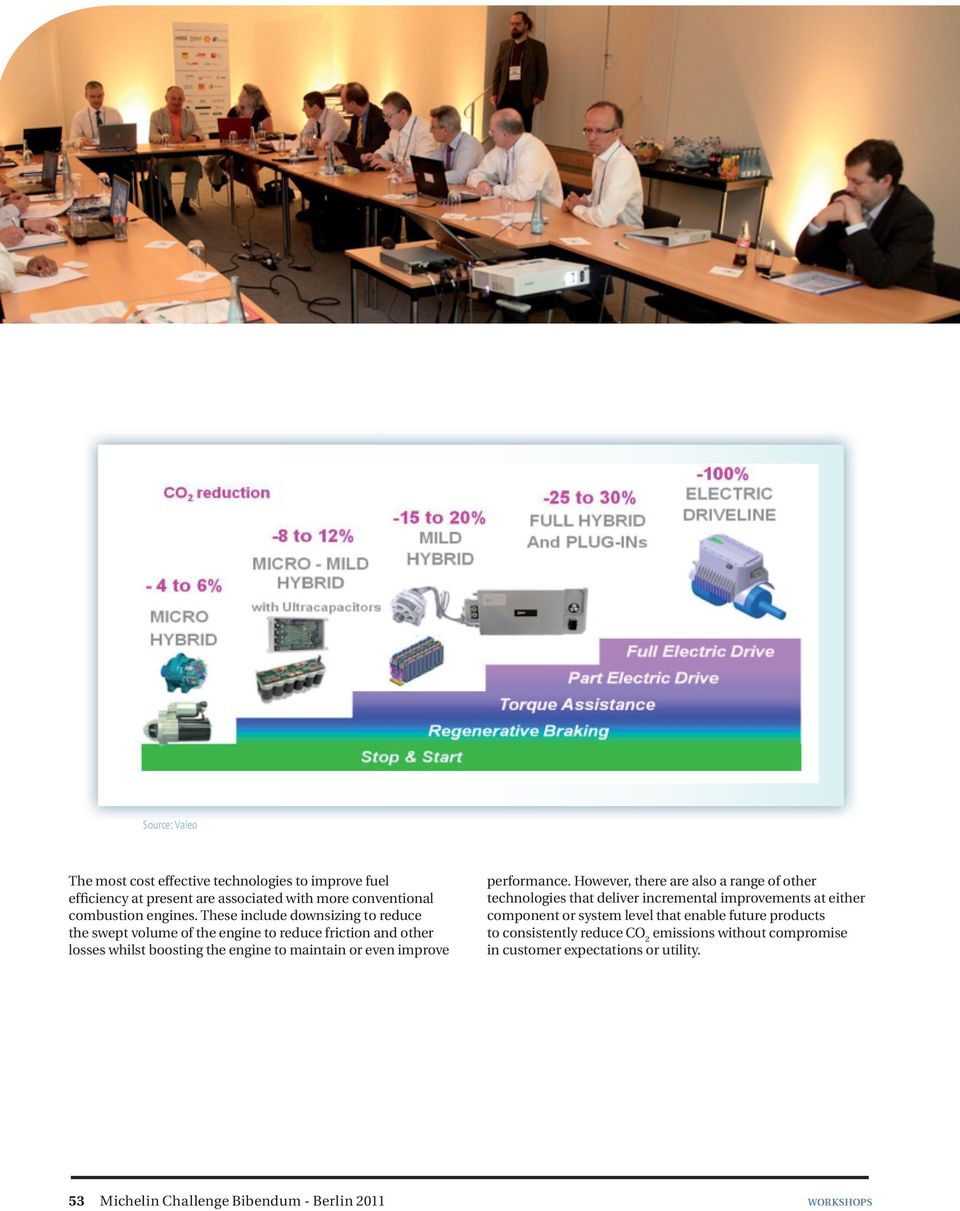
6 FUTURE TECHNOLOGIES & BENEFITS The demand for new fuel efficiency and/or low carbon technologies has been a major driver for the automotive technology suppliers. A broad range of new technologies are now available that were only ideas only a few years ago. These range from weight saving and low loss technologies in driveline and new lightweight designs and materials for vehicle components through to more efficient and less costly electric motors and power electronics to drive them. The challenge for the technology suppliers is to reduce the cost of these technologies to a level where they are attractive to the vehicle manufacturers and ultimately, consumers. Many of the electrification technologies are still too expensive to be considered as mainstream technologies without fiscal incentives. However, electrification of the powertrain has an evolutionary path ranging from micro hybrid or regenerative charging systems coupled to efficient combustion engines to full electric drivelines. Progress is being made to reduce costs but this is probably the limiting factor for market penetration. WORKSHOPS Michelin Challenge Bibendum - Berlin

7 Source: Valeo The most cost effective technologies to improve fuel efficiency at present are associated with more conventional combustion engines. These include downsizing to reduce the swept volume of the engine to reduce friction and other losses whilst boosting the engine to maintain or even improve performance. However, there are also a range of other technologies that deliver incremental improvements at either component or system level that enable future products to consistently reduce CO 2 emissions without compromise in customer expectations or utility. 53 Michelin Challenge Bibendum - Berlin 2011 WORKSHOPS
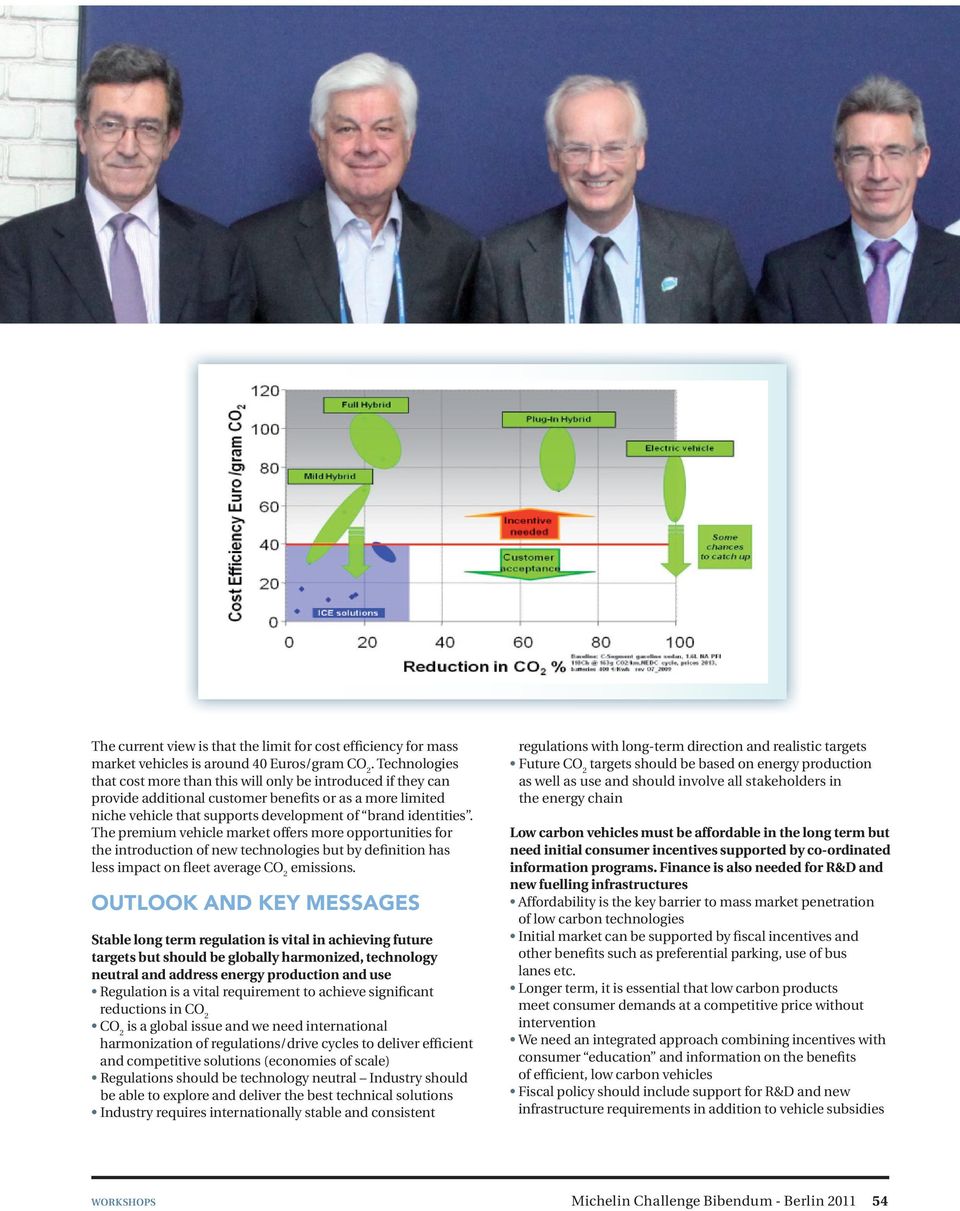
8 The current view is that the limit for cost efficiency for mass market vehicles is around 40 Euros/gram CO 2. Technologies that cost more than this will only be introduced if they can provide additional customer benefits or as a more limited niche vehicle that supports development of brand identities. The premium vehicle market offers more opportunities for the introduction of new technologies but by definition has less impact on fleet average CO 2 emissions. OUTLOOK AND KEY MESSAGES Stable long term regulation is vital in achieving future targets but should be globally harmonized, technology neutral and address energy production and use Regulation is a vital requirement to achieve significant reductions in CO 2 CO 2 is a global issue and we need international harmonization of regulations/drive cycles to deliver efficient and competitive solutions (economies of scale) Regulations should be technology neutral Industry should be able to explore and deliver the best technical solutions Industry requires internationally stable and consistent regulations with long-term direction and realistic targets Future CO 2 targets should be based on energy production as well as use and should involve all stakeholders in the energy chain Low carbon vehicles must be affordable in the long term but need initial consumer incentives supported by co-ordinated information programs. Finance is also needed for R&D and new fuelling infrastructures Affordability is the key barrier to mass market penetration of low carbon technologies Initial market can be supported by fiscal incentives and other benefits such as preferential parking, use of bus lanes etc. Longer term, it is essential that low carbon products meet consumer demands at a competitive price without intervention We need an integrated approach combining incentives with consumer education and information on the benefits of efficient, low carbon vehicles Fiscal policy should include support for R&D and new infrastructure requirements in addition to vehicle subsidies WORKSHOPS Michelin Challenge Bibendum - Berlin
9 Improvements in vehicle efficiency and some degree of electrification will be required to achieve 100 g/km well-to-wheel. This will also require low carbon electricity and some use of biofuels. Energy security may drive different technologies in some markets The target of 100 g/km CO 2 well-to-wheel will require incremental improvements in vehicle efficiency addressing combustion engine improvements and fuel reformulation, weight reduction, aerodynamic performance and rolling resistance The expert group believes that the 100 g/km target for new vehicles will not be met without some degree of electrification Grid connected vehicles will require low carbon electricity It is possible that we will also require low carbon gaseous and liquid fuels such as biofuels to meet future targets The conflict between low carbon energy and energy security could lead to variations in vehicle technologies dependent on Government policies. 55 Michelin Challenge Bibendum - Berlin 2011 WORKSHOPS

10 TOTAL GROUP - A TECHNOLOGICAL PARTNER OF CHALLENGE BIBENDUM 2011 Number one in the international oil and gas business, Total Group also plays a key role in the chemicals industry. At Challenge Bibendum 2011 in Berlin, Total brought to bear the various facets of its commitment to mobility issues. At the Exhibition Center hosting Challenge Bibendum 2011 in Berlin, the chemicals operation of Total Group presented its latest car-related innovations. In fact, issues of lightweight construction and respect for the environment are gaining importance across the automotive sector and remain a key focus of Total Group s chemicals subsidiaries such as Atotech, Bostik, Hutchinson and Total Petrochemicals. TOTAL EXCELLIUM - the name for the range of new generation fuels used by the vehicles participating in the eleventh Challenge Bibendum. Energy efficiency and CO 2 emissions were also measured. «Challenge Bibendum has become an important platform in the field of sustainable development and future mobility. That s another reason for us to demonstrate that traditional fuels will continue to play a key role in tomorrow s mobility», said Hans- Christian Gützkow, director of TOTAL Germany. Attending from Paris, Jean-François Minster, Director of Research at Total, addressed a public debate at the event s Strategic Day. Subject of workshop: «Energy and Transport». Minster described the multiple prospective activities of the Group in this field, ranging from innovations in lubricants and fuels to more energy efficient lightweight materials for vehicles and alternative energy sources such as hydrogen for propulsion and traction systems. Total operates two hydrogen stations in Berlin and is due to open another two. In this context, Total will produce wind-powered «green» hydrogen at «the service station of the future» for the future Berlin-Schönefeld airport as part of a pilot project run with a partner company. This ecological hydrogen will subsequently be available to customers coming to fill up» their fuel cell vehicles at dedicated charging stations in Berlin. Total not only participated in the exhibition and expert debates; it also put up an entire mobile service station alongside the Challenge Bibendum 2011 test track in front of the historic hangar of Berlin Tempelhof airport. The vehicles taking part in the rallies were thus refuelled with diesel or TOTAL EXCELLIUM petrol. TOTAL EXCELLIUM is the name for a range of fuels combining several advantages: better engine protection, lower consumption and a reduction in polluting emissions. Not to mention their highly developed engine cleaning properties that help to keep engine parts clean and reduce clogging. Dedicated additives help reduce friction between sensitive parts, thereby enhancing engine efficiency. This results in a decrease in fuel consumption and polluting emissions. For further information on the TOTAL EXCELLIUM range of fuels, please look up WORKSHOPS Michelin Challenge Bibendum - Berlin

Impact of the climate change discussion on the
 Investor Visit, Credit Suisse, Ingolstadt, 19 May 2009 Impact of the climate change discussion on the Dr. Guido Haak Central Functions/Processes, Product Management, AUDI AG Facts regarding CO 2 and the
Progressive Performance Audi on the way to the leading premium brand
 Progressive Performance Audi on the way to the leading premium brand Axel Strotbek, Member of the Board of Management for Finance and Organization, AUDI AG Deutsche Bank Field Trip, June 3,2013 World car
Germany. Type: Large Market; Large Share. Original Equipment Rank. Aftermarket Rank
 Germany Type: Large Market; Large Share Germany ranks number 4 on ITA s list of top U.S. auto parts export markets. After several years of declining auto sales, Western Europe has slowly begun to show
Fleet CO2 and Efficient Mobility
 Fleet CO2 and Efficient Mobility CONTENTS An evolving policy landscape Vehicle selection, technology and alternative fuels Driver behaviour and eco-driving training Efficient maintenance arval.co.uk An
Investigation into the Scope for the Transport Sector to Switch to Electric Vehicles and Plugin Hybrid Vehicles. October 2008
 Investigation into the Scope for the Transport Sector to Switch to Electric and Plugin Hybrid October 2008 Department for Business Enterprise and Regulatory Reform: Department for Transport Investigation
shecco input to EC public hearing on a European strategy on clean and energy efficient vehicles
 shecco input to EC public hearing on a European strategy on clean and energy efficient vehicles 11 march 2010 market research b2b platforms public affairs events management Brussels, 11 March 2010 In 1886,
Reducing CO2 emissions from cars and vans. Backgrounder
 Reducing CO2 emissions from cars and vans Backgrounder May 2015 SUMMARY a. The automobile industry in Europe has invested heavily in innovations designed to bring down significantly the CO2 emissions from
Integrated electronics for enhanced performance, energy efficiency and reduced emissions
 Integrated electronics for enhanced performance, energy efficiency and reduced emissions A SHARED DRIVE Hyperdrive Innovation develops powertrain systems for electric, hybrid and conventionally powered
Transport Sector in India
 Transport Sector in India Carbon Emissions: Technology Mitigation Options through 2030 Ankur Chaudhary Indian Institute of Technology Delhi GHG emissions from the Transport Worldwide: Sector 23% of all
Our New MIT Report: On the Road towards 2050. John B. Heywood Sloan Automotive Laboratory, M.I.T.
 Our New MIT Report: On the Road towards 2050 John B. Heywood Sloan Automotive Laboratory, M.I.T. Presentation at 11 th Concawe Symposium Brussels, February 24, 2015 Issued a Series of Reports On the Road
ICCT mission and activities
 Global Best Practices in Fuel Efficiency Policies Anup Bandivadekar CSE Workshop on Transport and Climate 24-25 July 2013, New Delhi ICCT mission and activities The mission of ICCT is to dramatically improve
Michael Bitter, Robert Bosch GmbH
 Perspective on CO 2 - Penetration in CV-Market Michael Bitter, Robert Bosch GmbH 1 CO 2 Emission [g/km] Perspective on CO 2 - Penetration in CV-Market Development of average CO 2 -emission in Europe Heavy
How Clean is Your Car Brand?
 How Clean is Your Car Brand? The car industry's commitment to the EU to reduce CO 2 emissions: a brand-by-brand progress report October 2006 How Clean is Your Car Brand? The car industry's commitment to
Cleantech in China The road to increasing electric vehicle adoption
 www.pwc.com/cleantech Cleantech in China The road to increasing electric vehicle adoption March 2013 China has held the title of world s largest auto market since 2009, when it surpassed the U.S. with
Reducing CO2 Emissions from New Cars: A Study of Major Car Manufacturers' Progress in 2006. November 2007
 Reducing CO2 Emissions from New Cars: A Study of Major Car Manufacturers' Progress in 2006 November 2007 1 Reducing CO2 Emissions from New Cars: A Study of Major Car Manufacturers' Progress in 2006 November
Transformation of the powertrain and implication for business strategy. Dr. Bernd Hense, Daimler AG
 Transformation of the powertrain and implication for business strategy 1 The Global Challenge Limited Resources Creeping Mobility Law / Legislation 100 $/barrel 80 60 40 E.g.: Oil Price? 11/09: $78 Megacities
Fuel Cell Electric Buses Potential for Sustainable Public Transport in Europe
 Fuel Cell Electric Buses Potential for Sustainable Public Transport in Europe An initiative by the Fuel Cells and Hydrogen Joint Undertaking Bert De Colvenaer, Executive Director Riga, 13 May 2015 Shifting
The Potential for Battery Electric Vehicles in New Zealand
 The Potential for Battery Electric Vehicles in New Zealand Dr Mike Duke 1, Timothy Anderson 2 1,2 Department of Engineering, The University of Waikato Keywords: Battery electric vehicles, New Zealand Abstract
and fuel consumption from new cars: Assessing the near-term technology potential in the EU
 www.theicct.org Briefing January 2013 Reducing CO 2 and fuel consumption from new cars: Assessing the near-term technology potential in the EU 1. Effect of the EU-CO 2 regulation The average CO 2 emissions
Drive Towards Zero, Volvo Cars Manufacturing Engineering, Luc Semeese Issue date: 2010-04-20, Security Class: Propriety Page 1
 Page 1 Volvo Cars Electrification Strategy DRIVe Towards Zero Brussels April 20th 2010 Luc Semeese Director - Volvo Cars Manufacturing Engineering Page 2 Company philosophy : DRIVe towards Zero! Zero accidents
The economic impact of low-carbon vehicles in the Netherlands
 The economic impact of low-carbon vehicles in the Netherlands Final report for the Dutch Ministry for Infrastructure and the Environment September 2014 Cambridge Econometrics Covent Garden Cambridge CB1
THE TECHNOLOGY TO REACH 60 MPG BY 2025
 THE TECHNOLOGY TO REACH 60 MPG BY 2025 Putting Fuel-Saving Technology to Work to Save Oil and Cut Pollution Increasing the fuel efficiency of new cars and trucks is a critical step towards cutting America
(1) INTRODUCTION AND METHODOLOGY OF THE SURVEY
 October 31st, 2011 COMPANY CAR POLICIES TO REDUCE CO 2 -EMISSIONS: A SURVEY AMONGST SELECTED WEC MEMBER COMPANIES Composed by Kristina Modée and Frank Werner, World Environment Center (WEC) Structure of
Global Trends in Passenger Vehicle Fuel Economy Standards
 Global Trends in Passenger Vehicle Fuel Economy Standards Drew Kodjak, Executive Director GFEI Fuel Economy Symposium Ministry of Foreign Affairs & International Development 27 rue de la Convention, Paris
POLICY ACTIONS INVESTING IN INNOVATION
 The BC Energy Plan ALTERNATIVE ENERGY Government will work with other agencies to maximize opportunities to develop, deploy and export British Columbia clean and alternative energy technologies. POLICY
How vehicle fuel economy improvements can save $2 trillion and help fund a long-term transition to plug-in vehicles Working Paper 9
 How vehicle fuel economy improvements can save $2 trillion and help fund a long-term transition to plug-in vehicles Working Paper 9 UNEP How vehicle fuel economy improvements can save $2 trillion and help
ESG/SRI Conference November 19, 2015, Société Générale, Paris
 Sustainability Management & Environmental Protection @ Daimler Dr. Udo Hartmann I Senior Manager Group Environmental Protection Sustainability Management Environmental Program CO 2 -Strategy & Processes
Electric Mobility in Europe. Dr. Gereon Meyer VDI/VDE Innovation + Technik GmbH Berlin, Germany [email protected]
 Electric Mobility in Europe Dr. Gereon Meyer VDI/VDE Innovation + Technik GmbH Berlin, Germany [email protected] EV and PHEV in Europe EV 2014 PHEV Country Motorbikes Passenger Vehicles Trucks
Advanced ADEPT 48V affordable hybrid on path to meet future ultra-low vehicle emissions
 29 June 2016 Advanced ADEPT 48V affordable hybrid on path to meet future ultra-low vehicle emissions Ricardo-led ADEPT programme aims to demonstrate technology capable of providing near full-hybrid equivalent
A Government Perspective
 A Government Perspective Anna West Head of Consumer Incentives OLEV [email protected] 18 February 2014 ACFO EV Seminar 1. What is OLEV? Department for Energy & Climate Change Office for Low Emission
Key Solutions CO₂ assessment
 GE Capital Key Solutions CO₂ assessment CO₂ emissions from company car fleets across Europe s major markets between 2008 and 2010 www.gecapital.eu/fleet Contents Introduction and key findings Reduction
WORKSHOP 1: WHAT IS THE BUSINESS CASE FOR ELECTRIC-DRIVE VEHICLES?
 WORKSHOP 1: WHAT IS THE BUSINESS CASE FOR ELECTRIC-DRIVE VEHICLES? PANELISTS: Lew FULTON, IEA/ETP/SPT, Senior transport energy specialist Tong ZHANG, Shanghai-Tongji University/FCV, Director of New Energy
ATTACHMENT 4A. Life-Cycle Analysis of Automobile Technologies
 ATTACHMENT 4A Life-Cycle Analysis of Automobile Technologies Assessments of new automobile technologies that have the potential to function with higher fuel economies and lower emissions of greenhouse
The Volkswagen Hybrid Strategy
 The Volkswagen Hybrid Strategy - Hybrid Tour with MainFirst Bank 28 th March 2006 Dr. Tobias Böhm Volkswagen AG Sustainability Based Aspects in Mobility Energy Greenhouse Gases CO 2 Exhaust Emissions CO,NOx,HC,PM
How To Make A Car From A Car
 Powerplaza EV Technology & Global EV Mainstream Analysis Global Business Development / General Manager, Powerplaza Co., Ltd. Soo-Hyun Kwon Powerplaza EV Technology POWER PLAZA CO., LTD. Think Green Technology,
Overview of Fuel Cell Programs in IPHE Countries. Dr. Stian Nygaard
 Overview of Fuel Cell Programs in IPHE Countries Dr. Stian Nygaard 1 IPHE Overview Partnership of 17 countries plus the EC Forum for international collaboration on RD&D, policy, and education IPHE members
H- 3: Composition of the road motor vehicle fleet by fuel type. 2) Relevance for environmental policy... 2
 H- 3: Composition of the road motor vehicle fleet by fuel type 1) General description... 2 1.1) Brief definition... 2 1.2) Units of measurement... 2 1.3) Context...2 2) Relevance for environmental policy...
K. G. Duleep President, H-D Systems Presented at the Michelin Bibendum Berlin, May 2011
 K. G. Duleep President, H-D Systems Presented at the Michelin Bibendum Berlin, May 2011 Light-duty vehicles have received a lot of attention in the last 10 years and GHG reduction cost is understood. Only
Effective Fuel Management. How to minimise fuel spend - both now, and in the future. WHITE PAPER
 Effective Fuel Management How to minimise fuel spend - both now, and in the future. WHITE PAPER Table of contents 2. Executive summary 3. Establishing a fuel policy 3. Choosing the right cars for your
Policy options to reduce passenger cars CO2 emissions after 2020
 Policy options to reduce passenger cars CO2 emissions after 2020 H.P.J. de Wilde P. Kroon February 2013 ECN-E--13-005 Acknowledgement This report has been commissioned by the Netherlands Ministry of Infrastructure
SMART CITIES AND MOBILITY
 SMART CITIES AND MOBILITY Franco Anzioso Centro Ricerche FIAT SMART CITY:A POSSIBLE DEFINITION Smart Cities can be identified (and ranked) along six main axes or dimensions. These axes are: smart economy;
Multi-year Expert Meeting on Transport, Trade Logistics and Trade Facilitation
 Multi-year Expert Meeting on Transport, Trade Logistics and Trade Facilitation Sustainable Freight Transport Systems: Opportunities for Developing Countries 14-16 October 2015 EGYPT'S POLICIES FOR SUSTAINABLE
How To Make An Electric Bus In Europe
 CIVITAS DYN@MO Summer University 2014 Implementing city and citizen friendly electric vehicles ebus. the smart way Electric buses in Europe: status quo Dr. Wolfgang Backhaus Palma, 14 May 2014 Outline
Philippines Developing Automotive Fuel Economy Policy Regulatory Policies Economic Instruments Labeling References
 Philippines Developing Automotive Fuel Economy Policy Regulatory Policies Economic Instruments Labeling References 1.2 Background Motorization rates (in terms of vehicle ownership per 1000 people) in ASEAN
How To Tax Company Cars In The Uk
 Taxation of Company Cars Workshop An evaluation of the UK s shift to CO 2 based Company Car Taxation Stephen Potter Professor of Transport Strategy and member of the UK Green Fiscal Commission Context
09-10-2012: ecomobiel, Rotterdam. Huub Dubbelman, Manager Corporate Communications, Mercedes-Benz Nederland BV
 Waterstof, Is hydrogen de betere the olie fuel of the future? 09-10-2012: ecomobiel, Rotterdam Huub Dubbelman, Manager Corporate Communications, Mercedes-Benz Nederland BV NWBA H2 & Fuel Is waterstof Cell
Automotive Powertrain Technologies through 2016 and 2025
 Automotive Powertrain Technologies through 2016 and 2025 University of Michigan Transportation Research Institute Conference. Marketing New Powertrain Technologies: Strategies in Transition February 15,
SYNTHETIC FUELS: Driving Towards Sustainable Mobility A PUBLICATION BY ASFE ALLIANCE FOR SYNTHETIC FUELS IN EUROPE
 SYNTHETIC FUELS: Driving Towards Sustainable Mobility A PUBLICATION BY ASFE ALLIANCE FOR SYNTHETIC FUELS IN EUROPE Introduction DaimlerChrysler s product portfolio ranges from small cars to sports cars
TOWARDS HYDROGEN ENERGY ECONOMY IN INDIA
 TOWARDS HYDROGEN ENERGY ECONOMY IN INDIA by Dr. S.K. Chopra Senior Advisor Ministry of Non-Conventional Energy Sources, Govt. of India UNU Conference on Hydrogen Fuel Cells and Alternatives in the Transport
Electric Automobility Revolution or Evolution?
 Electric Automobility Revolution or Evolution? Dr Paul Nieuwenhuis Centre for Automotive Industry Research & Electric Vehicle Centre of Excellence, Cardiff University Evs are older than either petrol or
How To Develop A More Sustainable Transport System In Europe
 Madrid/ Brussels 20th May 2011 NGVA Europe Position Paper: Minimum infrastructure needs for Methane (NG/biomethane) refuelling across Europe NGVA Europe In response to the Expert Group Meeting on Future
4. The role of fleets and fleet managers
 4. The role of fleets and fleet managers 79% 5% 44% To grow by 50% by 2010 over 1998 Role of Fleets - Changing operating environment: national, local government incentives, disincentives - Economies of
Consulting Consulting. Impact of government subsidies for electric vehicles on used market values
 Impact of government subsidies for electric vehicles on used market values 1 Introduction To encourage the take up of zero emission vehicles (ZEVs) and ultra-low emission vehicles (ULEVs), many governments
Argonne s vehicle systems research Future
 Argonne s vehicle systems research Future Driving the Accelerating the adoption of New Technologies At Argonne National Laboratory s Center for Transportation Research, our goal is to accelerate the development
Synopsis of Phase 1 Results. February 2013
 Synopsis of Phase 1 Results February 213 Introduction FUEL CELL ELECTRIC VEHICLES (FCEVs) provide the potential to decarbonise road transport, create new economic opportunities, diversify national energy
Key Solutions CO2 Assessment
 GE Capital Key Solutions CO2 Assessment CO2 emissions from company cars across Europe s major markets between 2008 and 2012 GE imagination at work Contents Introduction and key findings 4 European overview
REGULATIONS. 5.6.2009 EN Official Journal of the European Union L 140/1
 5.6.2009 EN Official Journal of the European Union L 140/1 I (Acts adopted under the EC Treaty/Euratom Treaty whose publication is obligatory) REGULATIONS REGULATION (EC) No 443/2009 OF THE EUROPEAN PARLIAMENT
Greenhouse gas abatement potential in Israel
 Greenhouse gas abatement potential in Israel Israel s GHG abatement cost curve Translated executive summary, November 2009 1 Executive Summary Background At the December 2009 UNFCCC Conference in Copenhagen,
Focus on the Future UM Automotive Research Conferences WELCOME! Bruce M. Belzowski Assistant Research Scientist
 Powertrain Strategies for the 21 st Century: Looking Beyond 2016 Focus on the Future UM Research Conferences WELCOME! Bruce M. Belzowski Assistant Research Scientist University of Michigan Transportation
LONG-TERM OUTLOOK FOR GAS TO 2 35
 LONG-TERM OUTLOOK FOR GAS TO 2 35 Eurogas is the association representing the European gas wholesale, retail and distribution sectors. Founded in 1990, its members are some 50 companies and associations
16. Aachener Kolloquium Fahrzeug- und Motorentechnik 2007 1
 16. Aachener Kolloquium Fahrzeug- und Motorentechnik 2007 1 Notwendige Fortschritte in der Antriebsstrangentwicklung zur nachhaltigen Mobilität mit Hybridtechnologie Powertrain Approach for Sustainable
The European Renewable Energy Directive and international Trade. Laurent Javaudin Delegation of the European Commission to the U.S.
 The European Renewable Energy Directive and international Trade Laurent Javaudin Delegation of the European Commission to the U.S. The European Union 27 Member States 490 million people 2 Outline The Present:
4. The role of fleets and fleet managers Role of REC?
 4. The role of fleets and fleet managers Role of REC? 79% 5% 44% To grow by 50% by 2010 over 1998 Role of Fleets - Changing operating environment: national, local government incentives, disincentives -
ELECTRIC VEHICLE INVEST IN SPAIN Investment opportunities in Spain January 2012
 ELECTRIC VEHICLE INVEST IN SPAIN Investment opportunities in Spain January 2012 INDEX I. II. III. IV. V. VI. VII. INTRODUCTION BUSINESS IDENTIFICATION BUSINESS ANALYSIS OPPORTUNITIES AND PROGRESSION FORECASTS
2 nd National Workshop on Global Fuel Economy Initiative (GFEI) in Mauritius. Ministry of Environment and Sustainable Development 27 th November 2014
 2 nd National Workshop on Global Fuel Economy Initiative (GFEI) in Mauritius Ministry of Environment and Sustainable Development 27 th November 2014 1 Global Fuel Economy Initiative Background Estimated
Case Study of Transport Sector. The Delhi Metro. - S A VERMA Additional General Manager
 Case Study of Transport Sector The Delhi Metro - S A VERMA Additional General Manager 15th CLIMATE TECHNOLOGY INITIATIVE (CTI) WORKSHOP MARKET MECHANISMS FOR CLIMATE ACTION AT THE URBAN LEVEL Berlin, Germany,
Helping you make the right choices.
 White Paper Helping you make the right choices. Advice and guidance on fuel strategy. In these tough economic times, cost control has risen to the top of the agenda for companies of all sizes, across all
GREEN FLEET STRATEGY AND PURE ELECTRIC VEHICLE FEASIBILITY PROGRAM
 COMMITTEE OF THE WHOLE OCTOBER 25, 2011 GREEN FLEET STRATEGY AND PURE ELECTRIC VEHICLE FEASIBILITY PROGRAM Recommendation The Manager of Environmental Sustainability and the Commissioner of Community Services,
The Hart report: The Economics of aeuropean Hydrogen Infrastructure for Automotive
 MEDIA BACKGROUNDER The Hart report: The Economics of aeuropean Hydrogen Infrastructure for Automotive Introduction In 24, Linde commissioned David Hart, of e4tech, Switzerland to assess the costs of a
Introduction. Why Focus on Heavy Trucks?
 Introduction Heavy-duty long-haul trucks are critical to the movement of the Nation s freight. These vehicles, which currently consume about 10 percent of the Nation s oil, are characterized by high fuel
Does it have a future in manufacturing?
 Sustainability Does it have a future in manufacturing? Steve Hope GM Environmental Affairs and Corporate Citizenship Toyota Motor Europe July 2015 What does sustainability mean to Manufacturing Industry?
Future Fuels for Commercial Vehicles. Rolf Willkrans Director Environmental Affairs Volvo Group Headquarters Göteborg, Sweden
 Rolf Willkrans Director Environmental Affairs Volvo Group Headquarters Göteborg, Sweden Business Areas Mack Trucks Renault Trucks Volvo Trucks Buses Construction Equipment Volvo Penta Volvo Aero Financial
Overview of vehicle taxation schemes (including incentives for electric vehicles), 2014. Content: 1. National vehicle taxation schemes Overview...
 Overview of vehicle taxation schemes (including incentives for electric vehicles), 2014 Content: 1. National vehicle taxation schemes Overview... 2 2. National vehicle taxation schemes Description... 4
Future Technology for Hybrid and Pure Electric Cars 2015-2025
 Future Technology for Hybrid and Pure Electric Cars 2015-2025 How all components and structure will change completely Dr Peter Harrop, Franco Gonzalez and Raghu Das IDTechEx www.idtechex.com Contents Page
How To Develop Hydrogen Fuel Cells
 EXECUTIVE SUMMARY 7 Executive Summary Innovation in energy technology has widespread implications for OECD economies. Although the energy sector accounts for a small share of GDP, the pervasive use of
2015 BUDGET REPORT. arval.co.uk
 2015 BUDGET REPORT arval.co.uk Contents Company Car Tax Company Car Benefit-In- Kind Bandings Roads Crossings Vehicle Tax Vehicle Excise Duty Fuel Benefit Charge Van Benefit Charge Autonomous Car Funding
Self-Driving Vehicles in an Urban Context Press briefing
 Self-Driving Vehicles in an Urban Context Press briefing 24 November 2015 This survey on self-driving vehicles was prepared with the support of The Boston Consulting Group Project dedicated to shaping
Clean Up Your Fleet. Introducing a practical approach to cleaner, more efficient fleet operation
 Clean Up Your Fleet Introducing a practical approach to cleaner, more efficient fleet operation The value of clean fleet management Reduce air pollution from your fleet Reduce greenhouse gas emissions
New Fuel Economy and Environment Labels for a New Generation of Vehicles
 New Fuel Economy and Environment Labels for a New Generation of Vehicles Why New Label Designs? The U.S. Department of Transportation joined with EPA today in unveiling new fuel economy and environment
Canadian Automotive Fuel Economy Policy Regulatory Policies Economic Instruments Labeling References
 Canadian Automotive Fuel Economy Policy Regulatory Policies Economic Instruments Labeling References 1.1Background Vehicles in Canada are required to comply with emission standards for a defined full useful
Description. Understanding consumer attitudes and future trends in the UK motoring industry. Richard Barton Group Managing Director
 Automotive Main Title Trends 2015 Changing Lanes Description Understanding consumer attitudes and future trends in the UK motoring industry Richard Barton Group Managing Director Contents Executive summary
Prepared by the Commission on Environment & Energy
 Policy statement Energy efficiency: a world business perspective Prepared by the Commission on Environment & Energy Key messages Energy efficiency is a fundamental element in progress towards a sustainable
Influences on the Low Carbon Car Market from 2020 2030. Final Report. for. Low Carbon Vehicle. Partnership. July 2011. Project Name Document Name
 Project Name Document Name Influences on the Low Carbon Car Market from 2020 2030 Final Report for Low Carbon Vehicle Partnership July 2011 Element Energy Limited 20 Station Road Cambridge CB1 2JD Tel:
Green Fleet Policy PURPOSE
 PURPOSE The purpose of this policy is to document the process for purchasing and managing the City s diverse vehicle fleet, which include both vehicles and heavy equipment, in a manner that minimizes greenhouse