
Consultants Estimating Manual
|
|
|
- Hilary Long
- 9 years ago
- Views:
Transcription
1 Consultants Estimating Manual Commonwealth of Massachusetts Division of Capita l As se t Ma na gem e nt Issue Date February 2006

2 Consultants Estimating Manual Table of Contents Introduction Estimating Overview Types of Estimates Preliminary Estimates Square Foot Estimates and Cubic Foot Estimates Measured Estimates Final Estimates Unit Price Estimating Schedule of Rates Building Design/Construct Phases Estimate Types Estimating Formats Estimate Type and Accuracy Historical Databases Forms/References BNI R.S. Means Engineering News Review (ENR) Developing an Estimate Estimate Components TPC Components Construction Costs Non-construction Costs ( Soft or Budget Costs) Planning the Work Quantities Unit Pricing Bid Schedule Construction Schedule Estimate Notes Project Narrative Filed Sub-Bid Work Estimating Contingencies Overhead Profit CEM_Feb06.doc i

3 Estimating Manual Draft 2 OPDC 3 Space Estimates Database Space Measures Building Floor Area Measurements The Standard ASTM E DCAM Space Model for Administrative Building Summing the Tabular Model Space Cost Analysis Sample Sheet Phase Cost Estimates Cost Estimate Submissions Study Cost Estimate Preliminary Study Cost Planning Estimator Final Study Cost Estimate Deliverables Estimate Date and Shelf-Life Space Measurement Estimator Participation MEP Estimates and Allowances Schematic Design Cost Estimate Preliminary Schematic Cost Planning Estimator Deliverables Cost Estimate Inclusions Estimate Date and Shelf-Life Space Measurement Estimator Processes Design Development Cost Estimate Estimator Deliverables Cost Estimate Inclusions Estimate Date and Shelf-Life Space Measurement Cost Estimator Participation Construction Document Cost Estimate Estimator Deliverables Cost Estimates Inclusions Estimate Date and Shelf-Life Space Measurement Cost Estimator Participation Inclusions/Exclusions Basis for Pricing Additional Items and Allowances Included General Conditions and Markups Contingency Allowances Inclusions Specific Inclusions and Exclusions Items not included in a typical estimate are: Items that May Affect Typical Estimates Job Overhead Activities (Structuring Estimates Insert) Escalation Escalation Provisions and Calculations Escalation Indices Industry Trends and Projected Escalation Rates Explaining the Escalation Contingency Estimate Shelf Life DCAM Escalation Index Table CEM_Feb06.doc ii

4 Estimating Manual Draft 2 OPDC 7 Special Estimates RFPs Peer Review Change Orders ADA/MAAB Work Electronic Formats DCAM Uniformat II Elemental Entry General Conditions Space Measurement Appendix Reference Documents List Appendix A1 Checklist for UNIFORMAT II Estimates Appendix A2 Checklist for General Conditions Appendix A3 Checklist for Submissions Appendix A4 Sample Uniformat Structured Narrative (for Preliminary Design) Appendix A5 DCAM Estimate Summary Sheet Appendix B CSI Division Numbers and Titles Appendix C CSI Detailed Divisions Appendix D ASTM STANDARD E1557 UNIFORMAT II Appendix E Building Floor Area Measurements Appendix F Bibliography Appendix G Acronyms Appendix H Glossary Index CEM_Feb06.doc iii

5 Cost Estimating Manual OPDC Introduction The Division of Capital Asset Management s (DCAM) Office of Planning, Design and Construction (OPDC) is responsible for the cost throughout all phases of state building projects, from project initiation and Study to final Design and Construction. Architectural and engineering firms that prepare building studies, and develop final design and construction documents, will submit Cost Estimates and participate in cost control activities for each phase. Rigorous Cost Management is essential throughout each project s planning, design, and construction phase. This Consultants Estimating Manual contains forms and guidelines based on industry standards to enable consistency for DCAM Designers and Consultants in the Cost Management of OPDC projects. Once an initial budget has been established, DCAM will constantly monitor the project budget by employing a series of increasingly precise cost estimating techniques, matching the development of the project design through each phase. Submission formats and processes represent industry standard practices as they apply to DCAM projects. The reference section includes a list of acronyms, a glossary and all relevant formats. An index is located at the end of the document, and hyperlinks have been provided throughout the electronic version. Intended to be a Living Document, this manual will undergo periodic updates as procedures change. Naturally, comments from DCAM Consultants are always welcome. CEM_Feb06.doc 1

6 1 1.1 Types of Estimates Preliminary Estimates Estimating Overview Preliminary Estimates are employed in the early planning phases of a proposed project to match client needs, assessed programmatic requirements, and budget constraints in order to establish project scope and quality expectations. Estimate comparisons at this stage are utilized in evaluating the feasibility of strategic alternatives being considered to satisfy current and projected space requirements (e.g., new construction versus renovation, or lease space). Initial estimates may be by Program Unit (e.g., hospital bed) or equivalent order of magnitude accuracy Square Foot Estimates and Cubic Foot Estimates DCAM has developed models for buildings using elemental SF (Square Foot) rates and actively uses this method to balance program needs, specification levels, and budget/time constraints in both Study and Schematic Design phases. Based on historical data, SF Estimates and CF (Cubic Foot) Estimates are methods commonly used to develop preliminary budgets. They are effective in preparing more accurate estimates as the design is developed enough to allow for measurement and calculation of floor areas and volumes of the proposed spaces. Several historical databases support this method of estimating, and provide regularly updated unit costs ($/SF and $/CF). Many large estimating firms and professional organizations maintain their own databases, including DCAM. Estimates made using this method need to allow for adjustments and additions for regional cost indices, local labor market rates, and interpolation between cost tables. Further adjustments may be made to account for other unique aspects of the design, such as special site conditions or design features being planned. In addition, when developed in UNIFORMAT II, the estimate can provide overall SF or CF costs for major elements, along with build-out costs of different space types. This structure allows for relative ease in determining the impact that changes will have on the program. 2
7 1.1.3 Measured Estimates Measured Estimates are developed after proceeding with the preferred solution during the latter part of the Study Phase. These estimates maintain accountability for initial budget projections, and are used as a means of evaluating competing alternative construction assemblies, systems and materials. These estimates may be used in project Workshops, at decision points, and as part of the formal submissions to DCAM at the conclusion of each phase. As the design progresses, the estimating contingency can be reduced Final Estimates At the completion of Design Development and during Construction Documentation, a complete pre-bid estimate can be prepared using Unit Price Estimates as described below. The estimate is organized in the same format required of bidders, usually the CSI MasterFormat, including separate estimates and bids for Filed Sub-Bids under MGL 149. This estimate allows for a comparison of the final estimate with the bids received and may aid in any contract negotiations. The estimating contingency should be reduced to zero. In addition, a final UNIFORMAT II format document is prepared from the same detailed information to provide continuity and comparison with previous phase estimates. Data are also used to update the DCAM cost database, providing elemental rates to be used in planning subsequent projects Unit Price Estimating The entire project is divided into small discrete work items, and a unit price is established for each item. The unit price is then multiplied by the required quantity to find the cost for the work item. All costs are summed to obtain the total Estimated Construction Cost. For example, the cost to erect a masonry wall can be accurately determined by finding the number of bricks required and estimating all costs related to delivering, storing, staging, cutting, installing, and cleaning the brick, along with related units of accessories, such as, reinforcing ties, weep-holes, flashings, etc. Unit Pricing Estimating within the CSI MasterFormat is the most accurate means of ascertaining costs based on materials and labor content Schedule of Rates A project may contain significant quantities of repetitive elements, without the exact amounts being defined. In this instance DCAM may issue the Bid documents as a partial or complete Schedule of Rates contract. A list of items and projected quantities is provided, leaving the bidder the opportunity to provide a rate for each item. The Schedule of Rates submitted by the successful bidder is used as the basis for the final contract measure of each item. Estimators are required to submit estimated rates for items defined within a Schedule of Rates contract. The rates may be built up from system components if necessary to accommodate a nonstandard format. Items listed in a Schedule of Rates may be contract specific and not follow standard CSF or Uniformat structure. 3

8 Cost Estimating Manual OPDC 1.2 Building Design/Construct Phases Estimate Types The phases used by DCAM are: Estimate or Cost Category: Capital Budgeting 1. Program Unit/Order of Magnitude Study 2. SF/CF & Cost Modeling Schematic Design 3. Uniformat Elemental 1,2 Design Development 4. Uniformat Elemental 2,33 and CSI Masterformat Construction Drawings & Bid Documentation 5. Uniformat 3 and CSI Masterformat Procurement 6. CSI Bids and Proposals Construction 7. Schedule of Rates After Practical Completion: Additional Cost Categories: Project Close Out and Settlements 8. Variations & Settlements Life Cycle Maintenance Period 9. Life Cycle Costs 1.3 Estimating Formats The two most commonly used Unit Price formats are CSI MasterFormat 2004, which provides a 31-division master list of numbers and titles for arranging products and activities; and ASTM UNIFORMAT II, which hierarchically groups building elements into 12 systems based levels. MasterFormat is widely used within the design and construction industry, and is the usual format for construction specifications and most private-sector project-based cost estimating activity. Government and other large institutions also utilize UNIFORMAT II for building systems research and building economics analysis, in addition to cost estimating. 1.4 Estimate Type and Accuracy Estimate Category Budget Study SD DD CD Bid Const Close Order of Magnitude (Functional Unit Measure) SF and CF Rates Elemental Rates Level 1 Elemental Rates Level 2 Elemental Rates Level 3 CSI Item List and Rates Schedule of Rates Final Account 4

9 1.5 Historical Databases There are several historical databases available that provide current values for estimating costs of the various units of project work. The databases are compiled from records of actual project costs, and are published in the form of books, CDs and computer-based extranets. 1.6 Forms/References BNI R.S. Means BNI is a popular publisher of cost estimating guides in the U.S. This is the most used and quoted source, with 25 different guides and unit prices for over 20,000 building components. This publisher also offers books on Unit Rate estimates and detailed application to project assessment Engineering News Record (ENR) Engineering News Review magazine publishes monthly updates to major materials and labor costs, plus an historical index with regional modifiers. 5

10 Cost Estimating Manual OPDC 2 Developing an Estimate 2.1 Estimate Components Back-up detailed estimating data may be in any format. As long as the items or work are properly grouped by level 3 account numbers, estimating detail work-ups below level 3 need not be identified by UNIFORMAT account numbers. To ensure that all components of an estimate are allowed for, the following points need to be considered. Regardless of format or type, every estimate can be rolled up to provide Total Project Cost (TPC). Standard contracts consider only ECC (Estimated Construction Cost) with additional soft costs added separately as margins or actual estimated amounts. Projects delivered using an RFP, Design-Build, or CM At Risk, have some or all of the soft costs built into the estimate, mingling ECC and soft cost components. Cost Estimators are required to ensure that all project estimate components and contingency markups are included or specifically noted as being allowed for by others. To ensure that all cost components making up the ECC and TCP are allowed for, DCAM recommends estimates be prepared by specialist cost estimating or consulting firms. 2.2 TPC Components Construction Costs Elemental: Sections A through G plus General Conditions CSI: Sections 1 through 49 plus General Conditions Insurances, Escalation, Contractors, Overhead and Profit 6
11 Cost Estimating Manual OPDC Non-construction Costs ( Soft or Budget Costs) Feasibility Study with supporting studies and reports Design Fees and Specialist Consultants Site acquisition Permits, Certifications and legal fees Community allowances, utility or other relocations Project administration and overhead (which may include CM fees) FFE (furniture, fixtures and equipment) Commissioning, relocation and startup costs Financing and insurance costs through to startup Development fees Planning the Work Quantities It is important to thoroughly understand the project scope of work and the biddability and constructability aspects of the project being estimated. The Cost Estimator must thoroughly review drawings, specifications and other references to formulate a construction sequence and duration. A site visit for all Consultants is recommended to relate the physical characteristics of the project to the available design parameters and details. Developing a construction sequence as soon as possible is necessary for creating a formalized sequence, to be used throughout the entire cost estimating process as a checklist of construction requirements. The Cost Estimator is responsible for the accuracy of quantity take-offs from drawings and specifications prepared by the Architect or other Consultants. The quantity take-off is an important part of the estimate and should be based on all available design data. All quantities should be shown in standard units of measure. The detail in which the quantities are prepared for each task is dependent on the Development Phase of the design. Quantity calculations and unit buildups beyond design detail may be necessary to determine a reasonable price to complete the overall scope of work for the Cost Estimate. Project notes may be added to explain the basis for the quantity calculations, or allowances that have been determined by cost estimating judgment and will be updated as the design progresses. 7

12 2.2.5 Unit Pricing Bid Schedule As a general rule, approximately 80 percent of the direct costs of a project are represented by only 20 percent of the estimated work items. Therefore the greatest estimating efforts are concentrated on these elements. The unit rates for each of these items are carefully analyzed and developed as the summation of all direct and indirect costs that will likely be incurred by an experienced and wellequipped Contractor. When cost data is based on previously completed projects, the Cost Estimator must use judgment to adjust for project conditions to include overhead and price level data adjustments for inflation. For small and easily identified work noted in the drawings and included in the estimate, lump sum bid items may be used. The cost of the lump sum item should be based on cost data related to the item s total direct and indirect costs. The bid schedule is part of the procurement package and is included with the solicitation for bids. The estimate must show the unit prices, quantities, extension of unit prices, lump sum items, and costs consistent with the schedule provided with the Bid Documents Construction Schedule The Designer and Consultant Team will prepare a construction schedule to support the estimate that is consistent with the plans and specifications for completion of the work. It may be in the form of a GANTT chart or a PERT diagram, but it must identify the sequence and duration of the tasks upon which the Cost Estimate is developed Estimate Notes Notes are any explanations necessary to support the development of cost for individual items in the Cost Estimate. This descriptive information covers areas such as manufacturers quotes, overtime requirements, and material availability. These should be entered as notes to the appropriate detail level of the Cost Estimate Project Narrative The narrative defines the parameters upon which the Cost Estimate has been prepared to support the project scope and schedule. It describes the project requirements that must be performed in sufficient detail to give a clear understanding of the scope of work including length, width, height, and slope of primary features the following: special problems that will be encountered in performing the work; site conditions affecting the work, and the reasons for unusually high or low allowances. Project Narratives are expected to follow the Uniformat II code structure through each Design Phase estimate. Initially, very broad level narratives are provided, increasing in detail as the design is developed. A partial sample of an early stage Uniformat structured Narrative is shown in Appendix A4. At Construction Documentation and Design Development, the Project Narrative is replaced by the specification that is typically structured in detailed CSI format. 8

13 Cost Estimating Manual OPDC Filed Sub-Bid Work MGL 149 requires that specific trades be performed by filed sub-bids be procured by DCAM independently from the General Contractor bid. The list of trades determined by MGL 149 is shown in Appendix C. For a detailed cross-reference of the work to be included against the CSI item classification, see the DCAM Standard Specification document. Where a CSI bid is required at Design Development or Construction Document Phase, the work to be performed under filed sub-bids shall be identified separately in the estimate. The successful low bid amount for each filed sub-bid Contractor is included as a direct lump sum cost to the General Contractor. This amount includes the Subcontractor s costs for direct labor, materials and supplies, equipment, second tier subcontracts, and charges for overhead and profit. The General Contractor is deemed to add his margins for General Conditions, Overhead and Profit, and any other loadings to the filed sub-bid contract amounts. The Cost Estimator may utilize quotes for the expected filed sub-bid work in preparing the estimate or to verify the reasonableness of independently estimated subcontract work. Subcontractor quotes will be treated as proprietary information and should only be revealed to those who have a need to know Estimating Contingencies To develop appropriate contingency allowances, the Estimator must identify the uncertainty associated with an item of work or task, forecast the risk/cost relationship, and assign a value to this task that will limit the cost risk to an acceptable degree of confidence. Consideration must be given to the details available at each stage of planning, design, or construction for which a Cost Estimate is being prepared. The following estimating contingency loadings represent an initial guide for the ECC at each phase. The Cost Estimator and Designers must assess the appropriate percentages for each project. Project Phase Restoration New Construction Study Phase 20% 15% Schematic Design Phase 15% 10% Design Development Phase 10% 5% Construction Documents Phase 0% 0% 9

14 Cost Estimating Manual OPDC The table provides a guide for estimating contingency development and is not intended to restrict or limit contingencies to these values. If the overall estimating contingency value developed through a detailed analysis as described above exceeds these guidelines, the Designer and DCAM Project Manager should consider further investigation of existing conditions and sufficient development of the design to reduce the uncertainty level Overhead Overhead costs are those costs that cannot be attributed to a single task of construction work. Costs that can be applied to a particular item or work should be considered a direct cost to that item and not be included in overhead costs. The overhead costs are customarily divided into two categories: General Conditions, including all Job Overhead, General Site Costs and Field Office Overhead. When estimating items costed over the entire duration of construction, the Cost Estimator should utilize the job schedule. OH&P (Home Office Overhead), covering Overhead, Administrative costs, and Profit. OH&P expenses are those incurred by the Contractor in the overall management of business. The Cost Estimator must be sure that costs are not duplicated between the two categories. Specific considerations must be evaluated for each project. The Cost Estimator must use considerable care and judgment in estimating overhead costs. For the source of pricing, the Cost Estimator must rely on judgment, historical data, and current labor market conditions to establish overhead costs. The application of a previously determined overhead rate may be used for early design stages, but it is not an accurate or reliable method of forecasting costs. Overhead will vary from project to project and may even vary from month to month within any given project. Job overhead items for the General Contractor should be estimated in detail for all activities at Construction Documents Phase. Detailing of overhead costs for subcontract work is recommended when the impact of these costs is significant Profit Profit is shown as a percentage loading and provides the Contractor with an incentive to perform the work as efficiently as possible. The Cost Estimator must use previous historical data to provide a suitable industry profit loading, modified by an in-depth understanding of marketing conditions likely to impact the current project. 10
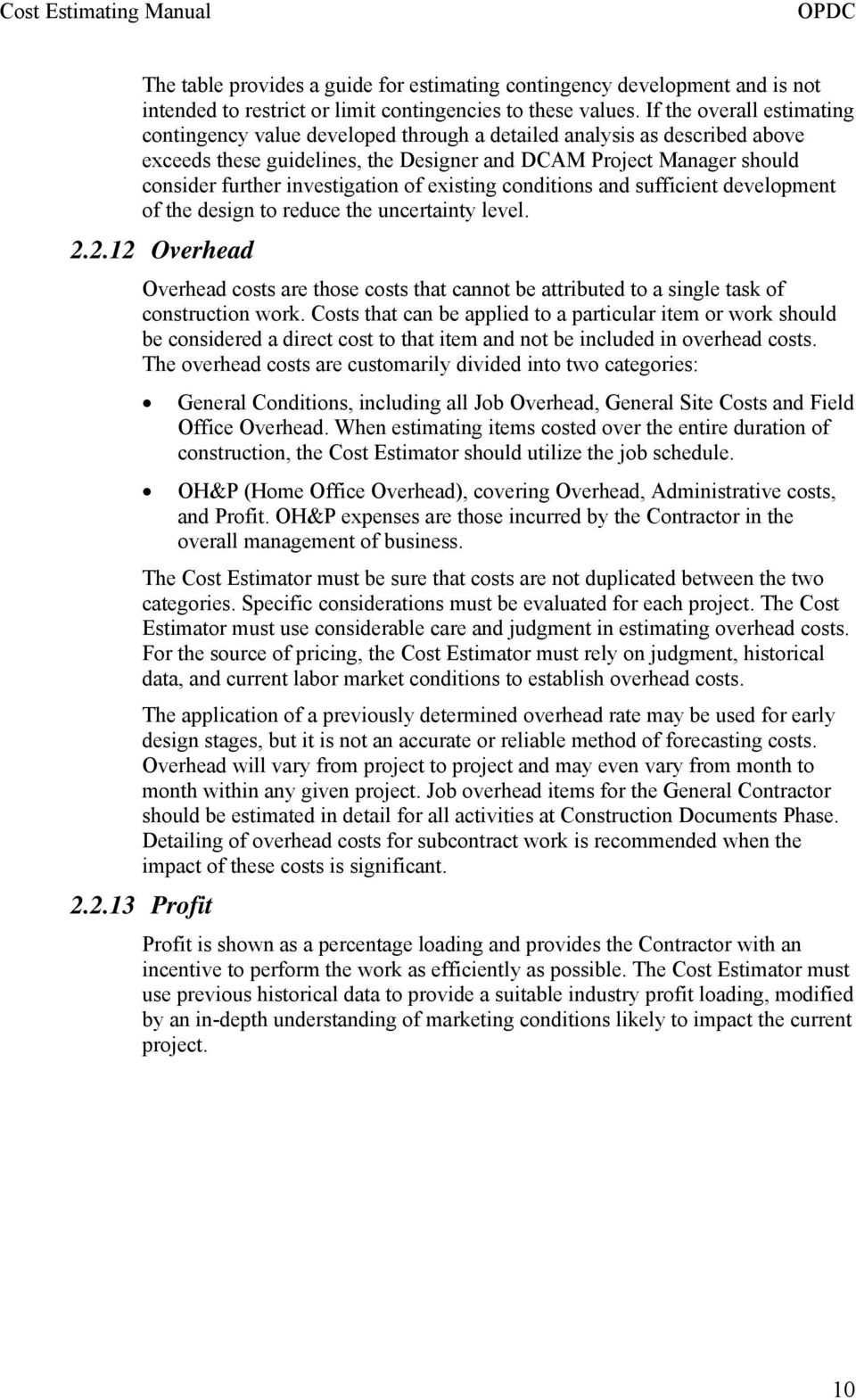
15 3 Space Estimates 3.1 Database Space Measures The Designer will provide the Estimator with a space analysis listing the program areas provided for in the concept design, the support areas, and the gross areas. The Designer should strive for high space efficiency that may result in a building with less gross area than the estimated maximum gross area provided by DCAM as the basis for the project. DCAM will use the space and program areas at each phase as a basis for assessing and cost modeling the building to ensure program and cost budgets are met. During each phase, the Estimator is expected to provide cost information support for the Designer. Space Measures/ Phase Functional Unit Measure (Accommodation) Program Area Measures Program Area Factors Building Area Factors Budget Study SD DD CD Bid Const Program Area Detailed Measures Building Area Detailed Measures Building Performance Measures 11
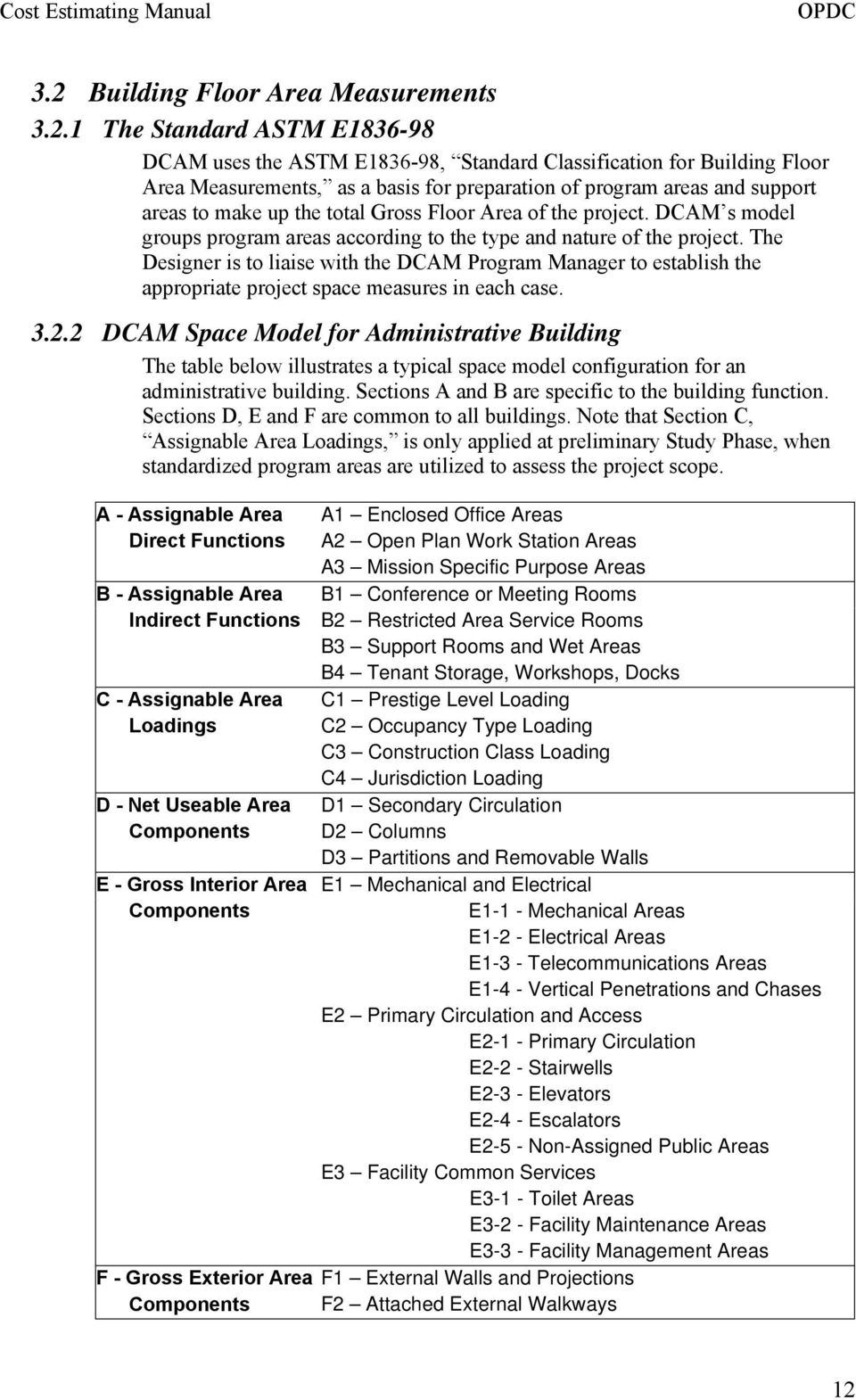
16 3.2 Building Floor Area Measurements The Standard ASTM E DCAM uses the ASTM E , Standard Classification for Building Floor Area Measurements, as a basis for preparation of program areas and support areas to make up the total Gross Floor Area of the project. DCAM s model groups program areas according to the type and nature of the project. The Designer is to liaise with the DCAM Program Manager to establish the appropriate project space measures in each case DCAM Space Model for Administrative Building The table below illustrates a typical space model configuration for an administrative building. Sections A and B are specific to the building function. Sections D, E and F are common to all buildings. Note that Section C, Assignable Area Loadings, is only applied at preliminary Study Phase, when standardized program areas are utilized to assess the project scope. A - Assignable Area A1 Enclosed Office Areas Direct Functions A2 Open Plan Work Station Areas A3 Mission Specific Purpose Areas B - Assignable Area B1 Conference or Meeting Rooms Indirect Functions B2 Restricted Area Service Rooms B3 Support Rooms and Wet Areas B4 Tenant Storage, Workshops, Docks C - Assignable Area C1 Prestige Level Loading Loadings C2 Occupancy Type Loading C3 Construction Class Loading C4 Jurisdiction Loading D - Net Useable Area D1 Secondary Circulation Components D2 Columns D3 Partitions and Removable Walls E - Gross Interior Area E1 Mechanical and Electrical Components E1-1 - Mechanical Areas E1-2 - Electrical Areas E1-3 - Telecommunications Areas E1-4 - Vertical Penetrations and Chases E2 Primary Circulation and Access E2-1 - Primary Circulation E2-2 - Stairwells E2-3 - Elevators E2-4 - Escalators E2-5 - Non-Assigned Public Areas E3 Facility Common Services E3-1 - Toilet Areas E3-2 - Facility Maintenance Areas E3-3 - Facility Management Areas F - Gross Exterior Area F1 External Walls and Projections Components F2 Attached External Walkways 12
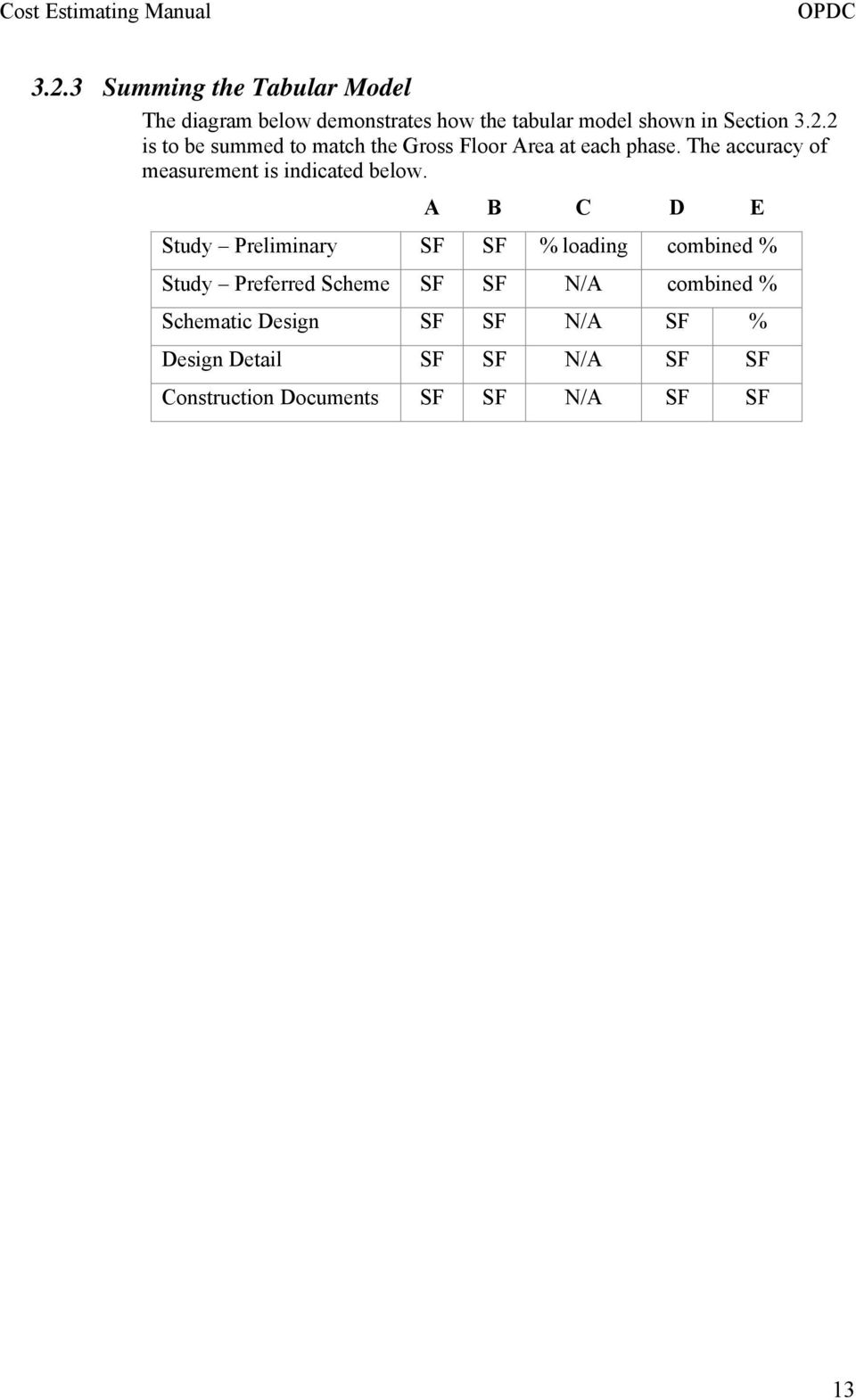
17 3.2.3 Summing the Tabular Model The diagram below demonstrates how the tabular model shown in Section is to be summed to match the Gross Floor Area at each phase. The accuracy of measurement is indicated below. A B C D E Study Preliminary SF SF % loading combined % Study Preferred Scheme SF SF N/A combined % Schematic Design SF SF N/A SF % Design Detail SF SF N/A SF SF Construction Documents SF SF N/A SF SF 13
18 3.3 Space Cost Analysis Sample Sheet Below is a spreadsheet model for an academic building with program adjustment and automatic cost revision calculation. In this example, detailed program areas shown in shaded cells can be adjusted by the user. Total building GFA and project cost are updated and displayed. ACADEMIC BUILDING PROGRAM SF TOTALS Total GFA 46,878 REVISED PROGRAM $12,554,738 PROGRAM AREAS Instructional/Studios Course A ,011 Course B Course C Course D Lecture/Presentation Course E Graduate Undergraduate 1,202 1,000 1, ,137 3,199 Workshops/Laboratories Course A Course B Course C Course D-1 Course D-2 Course D-3 Course E 812 1,001 1,057 1,156 1, Faculty & Staff Space Studios ,346 Offices 475 Storage Course A Course B Course D-1 Course D-2 Lecture/Presentation General Entry Lobby/stair ,766 SERVICE AREAS S/F SUBTOTAL MEP basement Basement Fixed Services Common Toilets Stairs & Lobbies Elevators Fixed Facilities Kitchen/Lounge Lounge/wash areas Corridors Main Entries Exit Stairs Walls & Columns 6% Internal@ 3% , , , ,637 1,605 14

19 Cost Estimating Manual OPDC 4 Phase Cost Estimates 4.1 Cost Estimate Submissions During each phase, DCAM may require one or more estimate types to be formally submitted. In order to ensure the Project remains within budget at each Phase, the Designer and his team are expected to participate in Cost Modeling and Value Engineering activities as part of their Contract. Itemized deliverables and activities for each Phase are listed in this section. Most phases have more than one format for submission. Designers and their Consultants, therefore, must plan their estimates to use the appropriate types and formats for each submission. 4.2 Study Cost Estimate Preliminary Study Cost Planning During the first half of the Study Phase, the Designer may consider various possible schemes. Higher-level estimates (see Sections and 1.1.2) may be required to support initial cost planning and comparisons. Designers may use historical square foot rates for these early estimates in accordance with the guidelines below. Generalized total rates from comparable projects should not be used to support a specific scheme without adjustments as outlined herein General Square Foot Rates Each scheme presented as a plan or footprint with a defined envelope (number of floors) is to be supported by an expanded square foot rate estimate as shown in Section Estimated square foot rates are to be supported by a comparison of rates from similar projects completed in the last five years. Specific square foot rates are expected for the major mechanical services as shown in Section and validated by both the MEP Consultant and the Cost Estimator. 15

20 Modifications to Standard Rates per Square Foot Consideration should be given to the following building form factors weighed against comparable projects used to build the square foot rate: External wall ratio and complexity to square foot area Size scale (larger or smaller) than rates for comparable facilities Structural outline, foundations and proposed systems against buildings Configuration limitations in the design that may lead to an increase in standard mechanical cost allowances (A full discussion of modification to square foot rates can be found in: Square Foot & Assemblies Estimating Methods, Third Edition, by RS Means.) Lump Sum Allowances Lump sum allowances are expected for site-specific items that are not included in the standardized overall construction rate. A typical list is below: Site works, including general preparation, landscaping, profile restoration, required services Cost allowance for site slope or access that will increase the standard SF rates Parking area costs calculated at per-space costs, plus allowance for access control Roadway modifications required by local authorities Demolition of existing buildings and site cleaning for construction Wetland provisions or restitution costs Allowance for compliance with Massachusetts Historical Society requirements Diversion of services around the proposed building footprint Allowance for rectification of ADA or MAAB noncompliance items, in which the project scope does not specifically cover this work Provision of additional services to the new buildings, including work done by utility companies Legal or acquisition cost premium for the chosen site Need for temporary accommodation, additional time, etc., for the chosen site 16

21 Uniformat Level 1 Breakdown for Preliminary SF Estimates Total Program Area 30,000 GFA Raw Rate/ Est. Cost % of One-Line SF ECC Specification or 1.60 Multiplier 48,000 $266 Comments A Substructure 48,000 $20.00 $960,000 8% Part basement level and standard footings B C Shell Interiors 48,000 48,000 $65.00 $35.00 $3,120,000 $1,680,000 26% 14% Steel frame with masonry cladding Metal/GWB partitions, standard finish D D10 D20 D30 D40 D50 E F G G10 G20 G30 G40 Services (not included below) 48,00 0 4% 2% Electrical 48,000 $22.00 $1,056,000 9% Fittings & Fixed Equipment 48,00 0 Special Construction & 48,00 Demolition 0 Building Site Work 48,00 ( not included below) 0 $2.00 $96,000 1% Conveying 48,000 $2.00 $96,000 1% Plumbing 48,000 $10.00 $480,000 HVAC 48,000 $40.00 $1,920,000 16% Fire Protection 48,000 $4.00 $192,000 $3.00 $144,000 1% $2.00 $96,000 1% $0.00 $0 0% Site Preparation $50,000 0% Removal of carpark Site Improvements $100,000 Mechanical Utilities $200,000 Electrical Utilities $100,000 1% 2% 1% Includes communication & security One elevator with three stops Standard quality systems Above average ventilation requirements Full building system Standard quality systems Custom casework throughout Existing 10,000 SF building Landscaping allowance Relocation of major services lines Relocation of distribution feeders Z General Conditions and Markups $1,543,500 15% Standard Subtotal ECC Before Contingencies $11,833,500 Contingencies Estimating Contingency $1,183,350 10% Standard for this level estimate Phasing and Temporary Work $650,843 5% Phased occupancy allowance Escalation Contingency $1,093,415 8% Midpoint construction end '06 Total ECC with contingencies $14,761,108 Total Rate/SF with contingencies $308 17
22 Cost Estimating Manual OPDC Estimator Final Study Cost Estimate Deliverables The Cost Estimate shall be developed using the Uniformat II Elemental Classification to as much detail as the preliminary drawings and specifications permit. Designers and Estimators are referred to ASTM Document E (NISTIR 6389) for a detailed description of Uniformat II elements and components. The Cost Estimate shall include: Cost Estimates for all work of the design scheme to elements at Level 3 of Uniformat II Classification, Sections A through G inclusive. The total for each element shall be built up from individual cost items as prepared by the Estimator. Each cost item shall be self sufficient in description and quantities; no direct reference to the drawings should be used to understand the pricing applied. Any detailed unit rate or custom item cost build-up shall be provided as backup. Cost Estimates for General Conditions of Contract, Contractor s Overhead and Profit, Insurances, Bonds and all other items included in the Bid Documentation Package. Estimating Contingency and Escalation Contingency per Section Gross Floor Areas and Net Floor Areas for the design scheme measured in accordance with DCAM s ASTM pro forma. Unit Rates for Cost Elements derived from the itemized estimate for the GFA and NFA values. Unit User Cost as designated by the DCAM Project Manager Estimate Date and Shelf-Life The Estimate shall be current at the date of Document Submission, and include amounts (based on percentage adjustment) for Estimating Contingency and Escalation per Section Space Measurement At the conclusion of the Study Phase, all program and non-program building areas are to be accurately measured and summed correctly to the building GFA. For support and non-program areas, grossing factors or percentages may be defined if the design is not sufficiently developed to allow proper area measurement. Specific building performance measures may also be required as directed by the DCAM Project Manager. Where the final Study submission includes a Preferred Solution of a specific building footprint and envelope, use of a single grossing factor based on program area is not sufficient. The non-program areas defined by DCAM must be estimated separately using percentages or direct area measurements. For a list of typical DCAM elements derived from ASTM , see Section 3, Space Estimates. The Designer will liaise with the DCAM Program manager to establish the grouping of program areas that make up the total project program. Use of grossing factors or percentages for any of the specified ASTM elements is not acceptable. 18
23 Specific building performance measures may also be required as directed by the DCAM Project Manager. For ASTM elements and sample DCAM input sheets, see Section 8.3, Space Measurement Estimator Participation The Estimator will be involved in the preparation of Preliminary Estimates per Section and Final Study Cost Estimates per Section During the Study Phase, the Cost Estimator in the Study Consultant s team is expected to participate in at least the following activities: Activity Attendance at the B Conference Kick Off Preliminary high-cost planning comparable data, order of magnitude estimates, existing conditions survey and scope development. Attendance at Progress and Global Workshops to advise on cost matters for each proposed scheme until the preferred scheme is selected. Assisting the Designer to develop the preferred scheme layout and specification 5 Submittal Preparation 6 Certification Package Cost Estimator Participation Understand user agency quality needs, the site and existing building conditions; scope of the project; and provide concept level cost information during the conference. Develop and support cost modeling for Designer to allow high-level comparisons between alternative building footprints, story structure, layouts, site locations and major construction systems. Provide cost modeling as above to allow cost comparison between alternative schemes, and to provide costing for requirements established during workshops. Provide cost measurement for all the building elements and components of the Preferred Scheme. This includes consideration of site related costs, life-cycle alternative costs, and any other external factors affecting total project cost. Substantiate any earlier cost assumptions. Formally prepare in Uniformat II format the estimate breakdown in detail for the preferred scheme, as specified for both printed and electronic submittals. Revise and update the Estimate in the presentation format needed for the Certification Package. 19
24 4.2.6 MEP Estimates and Allowances Specific square foot rates or lump sum allowances are expected for major mechanical services as shown: Mechanical and Electrical Services Uniformat II Level 3 Pricing Measure D10 Conveying D1010 Elevators and Lifts LS as applicable D1020 Escalators LS as applicable D1030 Other Conveying systems LS as applicable D20 Plumbing D2010 Plumbing Fixtures LS or include with D2020 SF rate D2020 Domestic Water Distribution SF rate D2030 Sanitary Waste SF rate or include with D2020 SF rate D2040 Rain Water Drainage SF rate or LS D2090 Other Plumbing Systems LS as applicable D30 HVAC D3010 Energy Supply and Generating LS or included in D3030 Systems D3040-D3050 D3040 Distribution Systems, Terminal D3050 and Package Units SF rate D3060 Controls, Instrumentation and Included in D3040 D3070 Systems Testing D3050 SF rate D3090 Other HVAC systems LS allowance for venting or other D40 Fire Protection D50 Electrical D5010 D4010 Sprinklers SF rate D4020 Standpipes LS or include with D4010 SF rate D4030 Fire Protection Specialties and D4090 other Fire Protection Systems LS as applicable Electrical Service and Distribution SF rate D5020 Lighting and Branch Wiring SF rate D5030 Communications & Security SF rate D5040 Other Electrical Systems LS as applicable 20
25 Cost Estimating Manual OPDC 4.3 Schematic Design Cost Estimate Preliminary Schematic Cost Planning For some projects the Designer may need to develop further alternative designs beyond the preferred solution accepted for Study Certification. An evaluation and selection process is again used to choose the most suitable design option. For Design options developed in this manner during the Schematic Phase, highlevel estimates are prepared in the same framework as for the Study Phase. Often during the Schematic Phase, budget issues subsequent to the original Study particularly due to the escalation impact cause the need for a scheme redesign. The Designer has to redesign to stay within a specific nominated budget. Close attention must be paid to providing timely and comparable data to support cost modeling. For directives on the content and level of detail for estimates and the participation expected from the Cost Estimators, see Section Estimator Deliverables The Cost Estimate shall be developed using the Uniformat II Elemental Classification to as much detail as the schematic drawings and specifications permit. Designers and Estimators are referred to ASTM Document E (NISTIR 6389) for a detailed description of Uniformat II elements and components Cost Estimate Inclusions The following components and sections shall e included in the Cost Estimate submission: Estimates for all building work of the design scheme to at least Level 2 of Uniformat II Classification, Sections A through G inclusive, complete with a single line outline specification description for each item. The detailed unit rate or item cost buildup shall be provided as backup in each case Estimates for General Conditions of Contract, Contractor s Overhead and Profit, Insurances, Bonds and all other items included in the Bid Documentation Package GFA and NFA measurements for the design scheme measured in accordance with DCAM s ASTM pro forma Unit Rates for Cost Elements shall be derived for the GFA and NFA values Unit User Cost as designated by the DCAM Project Manager Reconciliation with the Gross Floor Area and Net Floor Areas determined at the Study Phase, including explanation of significant variances Reconciliation with the Uniformat II Cost Estimate done at Study Phase, including explanation of any significant variances, including Unit User Cost 21
26 Cost Estimating Manual OPDC Estimate Date and Shelf-Life The Estimate shall be current at the date of Document Submission, and include amounts (based on percentage adjustment) for Estimating Contingency and Escalation Contingency per Section 5.1. For updating estimates for submission after specific time periods, see Section 6.2, Estimate Shelf Life for DCAM requirements Space Measurement At the conclusion of this phase, all program and non-program building areas are to be accurately measured and summed to match the building GFA. The Designer will liaise with the DCAM Project Manager to establish the grouping of program areas that make up the total project program. For support and non-program areas, if the design is not sufficiently developed to allow actual area measurement, grossing factors may be defined and allocated to functions. For a list of typical DCAM elements derived from ASTM , see Section 3, Space Estimates. Specific building performance measures may also be required as directed by the DCAM Project Manager Estimator Processes Activity Design Iterations following Study Review and the Global Workshop Attendance at regular Progress Workshop meetings to advise on cost matters for each proposed scheme, until the Preferred scheme is selected Assisting the Designer develop the Design layout and specifications Submittal Preparation at 60% completion and at final submission Cost Estimator Participation Develop and support Cost Modeling for the Designer to allow cost comparisons between alternative building footprints, story structure, layouts, site locations and major construction systems. Provide Cost Support for the Designer as above to allow cost comparison between alternative detail schemes and costing for requirements established from Workshops. Develop Cost Measurement for all building elements and components of the Design. This includes consideration of site related costs, life cycle alternative costs, and any other external factors affecting total project cost. Substantiate any earlier cost assumptions at this time. Document in Uniformat II format, the estimate breakdown in detail as specified in both printed and electronic submittals. Integrate costs from other specialist Consultants. Provide appropriate contingencies. 22
27 Cost Estimating Manual OPDC 4.4 Design Development Cost Estimate Estimator Deliverables The Cost Estimate shall be developed using the Uniformat II Elemental Classification to Level 3 as the drawings and specifications are developed. Designers and Estimators are referred to ASTM Document E (NISTIR 6389) for a detailed description of Uniformat II elements and components Cost Estimate Inclusions Cost Estimates for all work of the design scheme to Level 3 of Uniformat II Classification, Sections A through G inclusive, complete with a single line outline specification description for each item. The detailed unit rate or item cost buildup, shall be provided as backup in each case The same estimate shall also be prepared in are CSI MasterFormat 2004 format, with particular attention to the estimates for each of the Trade Bid packages under MGL 149 Cost Estimates for General Conditions of Contract, Contractor s Overhead and Profit, Insurances, Bonds and all other items included in the Bid Documentation Package GFAs and NFAs for the design scheme measured in accordance with DCAM s ASTM pro forma Unit Rates for Cost Elements shall be derived for the GFA and NFA values Unit User Cost as designated by the DCAM Project Manager Reconciliation with the Uniformat II Cost Estimate done at Schematic Phase, including an explanation of any significant variances Estimate Date and Shelf-Life The Estimate shall be current at the date of Document Submission, and include amounts (based on percentage adjustment) for Estimating Contingency and Escalation Contingency per Section 5.1. For DCAM requirements on updating estimates for submission after specific time periods, see Section 6.2, Estimate Shelf Life Space Measurement At the conclusion of this phase, all program and non-program building areas are to be accurately measured and correctly summed to match the building GFA. Use of grossing factors or percentage loadings for any of the specified ASTM elements is not acceptable. For the list of typical DCAM elements derived from ASTM E , see Section 3, Space Estimates. Specific building performance measures may also be required as directed by the DCAM Project Manager. 23
28 4.4.5 Cost Estimator Participation During the entire Design Development Phase, cost verification and, if necessary, Value Engineering will be required to ensure that the design as developed remain within the Project Budget. The Cost Estimator in the Designer s team is expected to participate in at least the following activities: Activity Attendance at regular Design Workshop meetings to advise on 1 cost matters for each element or section of work Attendance at Design Workshop 2 meetings to advise on cost matters for LEED and Life Cycle costs 3 4 Assisting the Designer achieve the required cost budget within design and specification requirements, including scheduling needs Estimate Review in accordance with Appendix 3A and Final Submittal Preparation Cost Estimator Participation Provide cost data and advice to the Designer and other Consultants for an accurate indication of the cost of each designed element and major specification item. Provide cost data and advice related to Life Cycle cost analysis, LEED evaluation, and specialist costs. Provide Value Engineering of specific elements within the total estimate budget for construction and all specialist Consultants, and the impact of the detailed construction work schedule on the total cost picture. Formally document in Uniformat II and CSI MasterFormat 2004 the complete estimate breakdown in detail as specified for both printed and electronic submittals. Integrate costs from other specialist Consultants. Provide allowances where appropriate, including Escalation in accordance with Section 6. 24
29 Cost Estimating Manual OPDC 4.5 Construction Document Cost Estimate Estimator Deliverables As the final drawings and specifications are developed the Cost Estimate shall use the Uniformat II Elemental Classification to Level 3 and provide it for review at 60% completion of Construction Documents. Designers and Estimators are referred to ASTM Document E (NISTIR 6389) for a detailed description of Uniformat II elements and components. A second and final Cost Estimate shall be prepared at 100% Drawing Complete as part of the final Bid Document submission. This estimate shall be in both Uniformat II Elemental Classification, and in CSI Masterformat, cross referenced to the Uniformat II. Both estimates shall be of the same total and percentage allowances for OH&P, and any further allowances for escalation or other contingencies. For final submission the estimator shall complete Summary Estimate DCAM Form Appendix K of the C11 Bid Package, which includes the filed sub-bids breakdown sheet. For the format of Appendix K, see Appendix A Cost Estimates Inclusions Cost Estimates for all work of the design scheme to Level 3 of Uniformat II Classification, Sections A through G inclusive, complete with a single line outline specification description for each item. The detailed unit rate or item cost buildup shall be provided as backup in each case. Cost Estimates for General Conditions of Contract, Contractor s Overhead and Profit, Insurances, Bonds and all other items included in the Bid Documentation Package. The same estimated costs and sum totaled structured in CSI MasterFormat 2004, including the value of work of each of the filed sub-bid trades listed under MGL 149. GFA and NFA measurement for the design scheme, in accordance with DCAM s ASTM pro forma. Unit Rates shall be derived for the GFA and NFA values for both Uniformat II and Masterformat CSI formats. Reconciliation with the Gross Floor Area and Net Floor Areas determined at the Design Development Phase, including explanation of significant variances. Reconciliation with the Uniformat II Cost Estimate done at Design Development Phase, including explanation of any significant variances Estimate Date and Shelf-Life The Final Estimate shall be current at the date of Document Submission, and include amounts (based on percentage adjustment) for Escalation Contingency per Section
30 For updating estimates for submission after specific time periods, see Section 6.2, Estimate Shelf Life for DCAM requirements Space Measurement At the conclusion of this phase, all program and non-program areas are to be accurately measured and summed correctly to match the building GFA. Any differences with areas derived at Design Development Phase are to be reconciled. For the list of typical DCAM elements derived from ASTM E , see Section 3, Space Estimates Cost Estimator Participation During the entire Construction Documentation Phase, cost verification and if necessary Value Engineering will be required to ensure that the design as developed remain within the Project Budget. The Cost Estimator in the Designer s team is expected to participate in at least the following activities: Activity Attendance at regular Design Workshop meetings to advise on 1 cost matters for each element or section of work Attendance at Design Workshop 2 meetings to advise on cost matters for LEED and Life Cycle costs 3 4 Assisting the Designer achieve the required cost budget within design and specification requirements, including scheduling needs Estimate Review in accordance with Appendix 3A and Final Submittal Preparation 5 Bid Reconciliation Cost Estimator Participation Cost data and advice to the Designer and other Consultants to provide an accurate indication of the cost of each designed element and major specification item. Cost data and advice related to Life Cycle cost analysis, LEED evaluation, and specialist costs Value Engineering of specific elements within the total estimate budget for construction and all specialist Consultants, and the impact of the detailed construction work schedule on the total cost picture. Formally document in CSI MasterFormat 2004 the complete estimate breakdown in detail for both printed and electronic submittals. Integrate all costs from other specialist Consultants and external works to be included in the contract. The final estimate is to be prepared also in Uniformat II format as previously detailed. Provide Cost Estimate support to the Designer as required by DCAM in his evaluation of the Bid. 26
31 Cost Estimating Manual OPDC 5 Inclusions/Exclusions 5.1 Basis for Pricing Each estimate should reflect the fair construction value for the construction of the project and should not be a prediction of low bid. DCAM s target for the estimate is the second to lowest bid if three or more bids are received. The following must be considered: Pricing assumes a procurement process with competitive bidding for every portion of the construction work, and assumes a minimum of three bids, including each filed sub-bidder. The basis of procurement should be noted. This may be competitive bidding under MGL Ch. 149, or using CM/GMP procurement. Any general markups or allowances for the procurement type should be identified. Subcontractor s markups should be included in each line item unit price. Markups cover the cost of field overhead, home office overhead and Subcontractor s profit. General Contractor s general conditions cost may be calculated on a monthly basis or a percentage at early design phases. The basis for this cost should be noted. General Contractor s overhead and fees should be based on a percentage of the total direct (trade) costs plus general conditions. The Contractor s permits, bond and insurances may be included or noted separately. Unless identified specifically, the cost of such items as shift premiums, and allowances for temporary occupancy permits, police details or street/sidewalk permits are deemed to be included in item rates. The Estimating Contingency should be identified (a percentage to cover cost increases that will occur during design elaboration or unforeseen design issues). As the design develops, the estimating contingency is to be reduced, and is eliminated at the final Construction Document estimate. Construction Contingencies should be excluded in the estimate Additional Items and Allowances Detailed estimates are expected for site-specific items that are not included in the standardized overall construction rate. A typical list is below: CEM_Feb06.doc 27
32 Cost Estimating Manual OPDC Site works including general preparation, landscaping, profile restoration, required services Cost allowance for site slope or access which will add extra to standard SF rates Parking area costs calculated at per-space costs, plus allowance for access control Roadway modifications required by local authorities Demolition of existing buildings and site cleaning for construction Wetland provisions or restitution costs Allowance for compliance with Massachusetts Historical Society requirements or time impact Diversion of services around the proposed footprint Provision of additional services to the new buildings, including work done by utility companies. Legal or acquisition cost premium for the chosen site Need for temporary accommodation, additional time, etc. for the chosen site Included General Conditions and Markups Percentage based or calculated allowances are expected for the General Contractor s additions to the work items described in the Uniformat II system. These are to be taken in accordance with normal industry standards and added to the subtotal of all work described with Uniformat II items, shown on a line by line increment as follows: General Conditions of the Contract Fees and Permits General Contractor s Overhead and Profit A subtotal is expected at this stage to give the current value of the project s ECC Contingency Allowances Inclusions Percentage based or calculated allowances are expected on a line-by-line basis as below, to provide the total ECC estimated to the mid-point of the projected construction period. Estimating Contingency An allowance is a percentage of the total ECC for the detailed development of the design to CD level, including all details and specifications not complete at the time of estimate. This contingency specifically excludes changes due to design scope changes. Page 28
33 Cost Estimating Manual OPDC Phasing and Temporary Work An allowance is a percentage or calculated additional cost for the execution of the project in particulars outside of a standard, fully available site to the Contractor. This will include additional costs for split phases, provision of temporary works outside those reasonably expected to build the works, provision of services to relocate and return the building users, provision of temporary accommodation for the users, and the provision of additional supervision or security to work in an occupied environment. Escalation Contingency An allowance is a compounded percentage to bring all estimated costs to the projected mid-point of the construction project. The percentage used is expected to be derived from current industry publications and recent estimates, and does not rely on extrapolation of previously published annual figures. The projected project design and construction time must be estimated for this purpose. The total project ECC is to be summed to include these line items. 5.2 Specific Inclusions and Exclusions Items Not Included in a Typical Estimate Land acquisition, feasibility, and financing costs All professional fees and insurance Site or existing conditions surveys investigations costs, including determining subsoil conditions Items identified in the design as Not In Contract (NIC) Owner supplied and/or installed items (e.g., draperies, furniture and equipment) Tel/data, security and AV networks, equipment or software (unless identified otherwise) Rock Excavation; special foundations (unless indicated by design engineers) Hazardous materials investigations and abatement Utility company back charges, including work required off-site Work to City streets and sidewalks (except as noted in this estimate) Construction or occupancy phasing or off hours work (except as noted in this estimate) Owners Construction Contingency for scope changes Items that May Affect Typical Estimates Modifications to the scope of work subsequent to the preparation of this estimate Unforeseen subsurface conditions Special requirements for site access, off-hour work or phasing activities Page 29
34 Cost Estimating Manual OPDC Restrictive technical specifications, excessive contract or non-competitive bid conditions Sole source specifications for materials or products Bid approvals delayed beyond the anticipated project schedule Job Overhead Activities (Structuring Estimates Insert) Job overhead costs are those costs at the project site that occur specifically as a result of a particular project. Some examples of job overhead costs are: 1. Job supervision and office personnel 2. Engineering and shop drawings 3. Site security 4. Temporary facilities, project office 5. Temporary utilities 6. Preparatory work and laboratory testing 7. Transportation vehicles 8. Supplies and maintenance facilities 9. Temporary protections and OSHA requirements 10. Telephone and communications 11. Permits and licenses 12. Insurance (project coverage) 13. Schedules & reports 14. Quality control 15. Cleanup 16. Taxes 17. Equipment costs not chargeable to a specific task Page 30
35 6 Escalation 6.1 Escalation Provisions and Calculations Escalation Indices Estimators are expected to be familiar with the major industry escalation indices, such as the following: R.S. Means BSI Engineering News Review Industry Trends and Projected Escalation Rates Estimators are expected to be current with industry trends and projected escalation rates. They may use data from both publications and their own expertise and experience to derive an appropriate escalation contingency percentage to reach midpoint of project construction Explaining the Escalation Contingency A brief explanation of the derivation of the escalation contingency is expected. Short-term or abnormal market pressures should be noted. 6.2 Estimate Shelf Life Due to current levels of market volatility, DCAM will require that all submitted Estimates will need to be reviewed as follows, when the date of submission is not concurrent with the date of estimate preparation: Project ECC Under $5M $5M or over Under 3 months Apply Escalation percentage Apply Escalation percentage (if any) (if any) 3 6 months Apply Escalation percentage Apply Escalation percentage Over 6 months Apply Escalation percentage Rate review of all items Over 12 months Rate and Peer Review of Independent Estimate and whole estimate reconciliation with original Page 31
36 6.3 DCAM Escalation Index Table DCAM has developed a provisional level table with averaged escalation factors as a starting point for initial estimates and analysis of earlier benchmark projects. This table is provided for this purpose, and Estimators are expected to provide and justify future projections for their submitted estimates. (The escalation table below was effective as of June 2005, and is used solely as an example. Estimators will need to verify current rates for each new project.) % Change Year Page 32
37 7 Special Estimates 7.1 RFPs Reserved 7.2 Peer Review Reserved 7.3 Change Orders Reserved 7.4 ADA/MAAB Work Reserved Page 33
38 Cost Estimating Manual OPDC DCAM Uniformat II Elemental Entry Electronic Formats ELEMENTAL COST ITEM ENTRY Project Number: Level 1 total $0 Project Phase: Level 2 total $0 Estimator Initials: Level 3 total $0 Estimating Contract Id: Database Entry $0 Estimate Date: INSTRUCTIONS TO ESTIMATOR 1. This spreadsheet is to enter elemental cost information for DCAM projects using Uniformat II structure and standard elements. 2. Cost data may be entered at Levels 1, 2 or 3 according to Project Phase and Estimating Contract requirements. 3. Cost data at any level may be entered as a lump sum per element or entered as a elemental quantity and unit rate. Entry of (quantity x rate) takes precedence over a lump sum entry. Zero out quantity or rate to enter a lump sum. 4. Cost data entry may be made at any level. However, entry at a lower level will always take precedence over entry at the next higher level. Therefore, relevant lower level elements must be cleared of values to input higher level data. 5. Each hierarchy and sub-hierarchy of elements is independent, so that data entry may be made at different elemental levels for different elemental groups. It is the Estimator's responsibility to ensure that the total of all elemental costs at each level matches through the whole project when the estimate is complete. The spreadsheet will automatically add each element hierarchy upwards to level 1. To balance the totals at each level, an unassigned element group is provided as group U which is to be used to balance the totals at each level. This is necessary if not all elemental groups have costs detailed down to level 3. A fully broken down cost table to level through for all groups will not need to use U values. Page 34
39 Cost Estimating Manual OPDC 6. Each estimating contract will specify the level of estimate accuracy required and if qty x rate is required. 7. A field is provided for each element for comments or specifications, to be used for non-standard rates or costs. 8. Data may only be entered into yellow-framed fields, on the sheets for Level 1, Level 2 and Level 3, also this front sheet. 9. Not every element will be necessary for each project leave unused elements blank and do not try to delete them. 10. Do not alter the formatting, row or column count, or add or delete columns in this spreadsheet. 11. Project number will be provided by DCAM as an integer number for the Cost Database. Leave blank if not assigned. 12. Data entry must be done using or loading the yellow cells only of the worksheet Entry_all_levels. The worksheet Database will show the totals that are formatted to load directly into DCAM s database. 13. Entry of line items making up each Uniformat Level 3 element is not required. Page 35
40 Cost Estimating Manual OPDC 8.2 General Conditions GENERAL CONDITIONS COST ITEM ENTRY Project Number: Level 0 total $0 Project Phase: Level 1 total $0 Estimator Initials: Level 1 total $0 Estimating Contract Id: Estimate Date: Database Entry $0 INSTRUCTIONS TO ESTIMATOR 1. This spreadsheet is to enter General Conditions cost information for DCAM projects using standard codes. 2. General data may be entered at Level 1 or 2 according to Project Phase and Estimating Contract requirements. 3. General cost data may be entered at Level 0 as one lump sum, at Level 1 as major divisions, or Level 2 as detailed. 4. General cost item entry at a lower level will always take precedence over entry at the next higher level. Therefore, hierarchical lower level items must be set to 0 to allow input of higher-level data. 5. Each hierarchy and sub-hierarchy of items is independent, so that data entry may be made at a different level for different groups. The Estimator is responsible for ensuring that the total of all general costs at each level matches through the whole project when the estimate is complete. The spreadsheet will automatically add each hierarchy upwards to level 0. To balance the totals at each level, an unassigned item group is provided as 90, to be used to balance the totals at each level. This is necessary as not all item groups have costs detailed down to level 2 for each estimate. When the spreadsheet is correct, all values above in blue cells will be the same. 6. Each estimating contract will specify the level of estimate accuracy required for each phase. 7. A field is provided for each general item for explanatory comments (not available for this version). 8. Data may only be entered into yellow-framed fields, on the Master or Display sheet, and also identification information onto this Summary sheet. 9. Not every item will be necessary for each project - leave unused items blank and do not try to delete them. 10. Do not alter the formatting, row or column count, or add or delete columns in this spreadsheet. Resizing columns for convenience is acceptable. 11. Project number will be provided by DCAM as an integer number for the Cost Database. If not available, leave blank. 14. Data entry must be done using or loading the yellow cells only of the worksheet Display or Master. The worksheet Database will show the totals, which are formatted to load directly into DCAM s database. 15. Entry of detail of unit buildup for each DCAM entry item is not required. Page 36
41 Cost Estimating Manual OPDC 8.3 Space Measurement 1. The template provides for entry of program areas, one sheet for each phase. 2. At Program and Design Development, non-program areas can be entered as percentages (using grossing factors) to cumulatively add to the total GFA. 3. At Design Development, it is expected that all building areas will be dimensioned and the entire space can be added as individual areas to sum to the GFA. 4. Data entry must be done using or loading the yellow cells only of the worksheet Program, Schematic or DesignDevt. The worksheet Summary and Graphics_3 will show and display the totals. 5. (reserved) Page 37
42 Page 38
43 Cost Estimating Manual OPDC 9 Appendix Reference Documents List A B C D E F A1 A5 UNIFORMAT II Estimates General Conditions Submissions To be inserted DCAM Estimate Summary Sheet NIST Uniformat II, Level-3 Element CSI Division Numbers and Titles CSI Detailed Divisions ASTM STANDARD E1557 UNIFORMAT II ASTM Measurement of Buildings Appendix 39
44 Appendix A1 Checklist for UNIFORMAT II Estimates CHECKLIST FOR PREPARING AN ESTIMATE Project/Location: Date: A. SUBSTRUCTURE A10 Foundations A1010 Standard Foundations Reinforced Concrete Masonry Other Soil Conditions Bearing cap. Frost Depth Grade Wall Type: Concrete Masonry A1020 Special Foundations Unusual Subsurface Conditions Piling: Concrete Steel Caissons Mat Other Depth of Piling: ft A1030 Slab on Grade Structural Non-Structural Thickness in A20 Basement Construction A2010 Basement Excavation Water Problems Depth ft A2020 Basement Walls Reinforced Concrete Brick Other Waterproofing Damp proofing B. SHELL B10 Superstructure B1010 Floor Construction B1020 Roof Construction Type: Cast-in-place Pre-Cast Concrete Steel Composite Wood Other Load Bearing Walls Other Fireproofing: Columns Beams Other Stairs: Metal Concrete Special Liveload: Floor lbs/sf Roof lbs/sf Typical Bay Size Other Appendix 40
45 B20 Exterior Enclosure B2010 Exterior Walls Brick Concrete Block Cast-in-place Concrete Pre-Cast Concrete Stone Metal Panels Wood Siding Other B2020 Exterior Windows Windows Curtain Wall: Type Frames: Aluminum Wood Plastic Steel Glazing: Sheet Float/plate Solar Other Single Double Clear Reflective B2030 Exterior Doors Wood Metal Glass Special Entrance Single (%) Vestibule (%) Revolving (%) Overhead (%) B30 Roofing B3010 Roof Coverings Built-up Fluid Applied Elastic Sheet Composite Shingles Sheet Metal Other Color: Light Dark B3020 Roof Openings Skylights Access Hatches B3090 Other Roofing Type: FIat Pitched Insulation: Rigid Lightweight Thickness "U" Factor Other Appendix 41
46 C. INTERIORS C10 Interior Construction C1010 Partitions Masonry (%) Stud (%) Glazed (%) Demountable (%) Folding/sliding (%) Other Toilet Partitions: Type C1020 Interior Doors Door Frames: Wood Metal Doors: Wood (%) Metal (%) Glass (%) Other (%) C1030 Fittings Hardware: Brass Chrome Other Washroom Accessories: Type Other C20 Stairs C2010 Stair Construction C2020 Stair Finishes C30 Interior Finishes C3010 Wall Finishes Walls: Plaster (%) Drywall (%) Tile (%) Paint (%) Wall Covering (%) Spec. Ctgs. (%) Other (%) C3020 Floor Finishes Floors: Resilient (%) Carpet (%) Tile & Terr.(%) Concrete Finish (%) Wood (%) Raised Fir(%) Other (%) C3030 Ceiling Finishes Ceilings: Suspended (%) Applied (%) Unfininished (%) Plaster (%) Drywall (%) Integrated (%) Acoustical: Unrated (%) Rated (%) Other Appendix 42
47 D. SERVICES D10 Conveying D 1010 Elevators & Lifts Elevators: Type No. Speed/Cap LO/ea. Type No. Speed/Cap LO/ea. Elevators: No. Width Cap Lifts: Type No. Other D1020 Escalators & MovingWalks D1090 Other Conveying Systems D20 Plumbing D2010 Plumbing Fixtures Fixtures: Standard: No. Special No. D2020 Domestic Water Distribution Domestic Hot Water Heaters: Type Capacity D2030 Sanitary Waste D2040 Rain Water Drainage Roof Drains: Drains per roof sf Interior Exterior D2090 Other Plumbing Systems Drinking Fountains No. D30 HVAC D3010 Energy Supply Energy Recovery Controls No. of Zones D3020 Heat Generating Systems Heating Capacity mbh Type D3030 Cooling Generating Systems Ventilation Req's cfm Air Conditioning (%) Cooling Capacity tons Type Cooling Tower: Type Location D3040 Distribution Systems Air Distribution cfm Type D3050 Terminal & Package Systems D3060 Controls & Instrumentation D3070 Systems Testing & Balancing D3090 Other HVAC Systems & Equipment Equipment Load w/sf People Load Appendix 43
48 Cost Estimating Manual OPDC D40 Fire Protection D4010 Sprinklers Hazard Type: Light (%) Ordinary (%) Type Extra (%) D4020 Standpipes Extinguishers Special D4030 Fire Protection Services D4090 Other Fire Protection Systems Water Storage: Capacity gals Location D50 Electrical D5010 Electrical Service and Distribution KVA Demand Primary Voltage Connected watts/sf amps Transformers: Utility Owners Voltage: Main distribution V Secondary Distribution Bus duct Motor Control Center D5020 Lighting & Branch Wiring Under floor duct Raised Floor Raceway Undercarpet Intensity (in fc) Watts/sf for Lighting Receptacles HVAC Elevators Spare Connected Motor hp Type: Fluorescent Incandescent HPS Metal Halide Mercury Vapor Other D5030 Communications & Security PA/Sound TV Telephone Lighting Security D5040 Specials Mechanical Systems Special Piping: Type Special Systems: Dust & Fume Collection Other: Type/Quantity D5090 Other Electrical Systems Electric Heating Fire alarm Clock Appendix 44
49 E. EQUIPMENT & FURNITURE E10 Equipment E1010 Commercial Equipment E1020 Institutional Equipment E20 Furnishings E2010 Fixed Furnishings Loading Dock: Equipment Other E2020 Movable Furnishings Artwork: Type E2090 Other Furnishings Window Treatment: Type/size Seating: Type F. SPECIAL CONSTRUCTION & DEMOLITION F10 Special Construction F1010 Special Structures F1020 Integrated Construction F1030 Special Construction Systems Vaults: Type/Size: Other F1040 Special Facilities F1050 Special Controls and Administration F20 Selective Building Demolition F2010 Building Elements Demolition F2020 Hazardous Components Abatement G BUILDING SITE G1010 Site Preparation G1010 Site Clearing Borrow (quantity) Dispose (quantity) G1020 Site Demolition Demolition Amount Clearing Amount G1030 Site Earthwork Retaining Walls (length) ) Paved/Plaza Area (size) G1040 Hazardous Waste Remediation G20 Site Improvements G2010 Roadways Roads: Size/Type Fences: Length Appendix 45
50 G2020 Parking Lots Parking Lots: Size/Type No. Cars G2030 Pedestrian Paving G2040 Site Development G2050 Landscaping Landscaping: Seeding Area Ground Cover: Area Trees: Number Planters: Number Other G30 Site Mechanical Utilities G3010 Water Supply Water: Size/Length Irrigation: Size/Type G3020 Sanitary Sewer Sanitary Sewer: Size/Type Process & acid waste system: Size/Type Combined Drainage & Sewer System: Size/Length G3030 Storm Sewer Storm drainage: Size/Type G3040 Heating Distribution Heating System: Size/Type G3050 Cooling Distribution G3060 Fuel Distribution Natural Gas: Size/length Other Gas System G3090 Other Site Mechanical Utilities G40 Site Electrical Utilities G4010 Electrical Distribution Overhead Power: Size/Type Underground Power: Size/type G4020 Site Lighting Exterior Lighting: Type/Area G4030 Site Communications & Security Snow melting system: Size/Type G4090 Other Site Electrical Utilities Snow melting system: Size/Type G90 Other Site Construction G1090 Service and Pedestrian Tunnels G9090 Other Site Systems & Equipment Appendix 46
51 Cost Estimating Manual OPDC Appendix A2 Checklist for General Conditions General Item 00 Level 0 Description Entire General Items summed 01 1 Bonds payable Bonds payable 02 1 Fees payable Fees payable 03 1 Allowances City/Town Remediation Value Engineering Upgrades Base Building Signage Tenant Signage Furniture Dedicated Circuits (UPS, etc.) Security System Telecommunications Other 04 1 Coordination (Proj Mgt) Project Managers Expeditor EEO Coordinator Construction Executives General Superintendent Superintendent Assistant Superintendent MEP Coordinator Clerical Safety Officer Miscellaneous Laborer Accountant Legal Payroll Taxes, Benefits, Ins Pre-construction Services Mobilization/Demobilization Other Coordination 05 1 Cutting and Patching General Cutting and Patching 06 1 Scheduling Schedule of Values CPM Scheduling Progress Reports Appendix 47
52 General Level Description Item Estimating Other Scheduling 07 1 Submittals Shop Dwgs, Prod. Data, Samples Printing and Mailing Service Other Submittals 08 1 Construction Photos Ground Level Photographs Aerial Photographs Other Photographs 09 1 Quality Control Field Engineering Engineering Supplies Other Engineering 10 1 Field Inspection, Testing Certified Testing Services LSP Other Testing 11 1 Temporary Facilities, Utl Temporary Electric Winter Conditions, Temp. Heat Temporary Telephone Temporary Water Temporary Toilets Temporary Sewer Protection and Safety Rubbish Chute Dumpsters Temporary Enclosures Stairs, Ladders, Ramps etc Temporary Fence and Barricades Snow Removal Water Control Project Identification Staging Field Offices GC Office Equipment GC Field Office DCAM Office Equipment DCAM Vehicles and Parking Emergencies Dust Mitigation Noise Control Appendix 48
53 General Level Description Item Pollution Control Cleaning During Construction Security Guard Service Police Services Electric Company Backcharge Gas Company Backcharge Other Temporary Services 12 1 Material, Products, Equipment Material, Products Equipment 13 1 Project Closeout Final Cleaning Glass Record & As-Built Drawings Operations & Mainten. Manuals Instructions Requirements & Submittals Guarantees & Warranties Other Project Closeout Legal Handover Procedures Appendix 49
54 Appendix A3 Checklist for Submissions 1. Validate rates to be current immediately before any submission date. 2. Ensure filed sub-bid work is accurately identified and separable for bid comparison. 3. Review all lump sum allowances provided in the Estimate and ensure that any work that has been subsequently designed in detail has been priced out in detail. 4. For CSI estimates, all Subcontractor margins are included with their particular trade. 5. Complete review of the final specification to ensure consistency with the Estimate. 6. Complete review of the exact scope of works as specified for the Bid. 7. Validate that the size of the final design (GFA) is consistent with the Estimate. 8. Validate that the Construction Period is consistent with the Estimate. 9. Validate the Escalation Rate to be applied with DCAM prior to final submission. Appendix 50
55 Cost Estimating Manual OPDC Appendix A4 Sample Uniformat Structured Narrative (for Preliminary Design) A10 Foundations A1010 Standard Foundations Standard continuous perimeter foundation Isolated interior footings for columns A1030 Slab on Grade 6 slab on grade, with gravel base, rigid insulation, barrier B10 Superstructure B1010 Floor construction Metal deck on steel bar joists B1020 Roof Construction Metal deck on bar joists B20 Exterior Enclosure B2010 Exterior Walls Brick veneer on galvanized metal stud backup wall systems, 20% of wall area to be 1 insulated curtain walling B2020 Exterior windows Aluminum double glazed windows other than curtain walling area B2030 Exterior doors Entry doors: Narrow stile aluminum glass doors Other doors: Hollow metal in welded steel frames B30 Roofing B3010 Roof coverings Modified bitumen on flat roofing B3020 Roof openings Smoke hatch where required, access hatch with ship s ladder C10 Interior Construction C1010 Partitions Skim coat on blueboard on metal studs; CMU to core only C1020 Interior doors Typical 3 x7 solid core wood, clear finish, in welded steel frames C1030 C20 Fittings Stairs C2010 Stair construction Steel pan on channel stringers C2020 Stair finishes Sealed concrete C30 Interior Finishes Appendix 51
56 C3010 Wall finishes Offices, conference areas: Painted skim coat on blueboard, vinyl base Toilet rooms: full height ceramic tile on wet walls, painted GWB elsewhere. C3020 Floor finishes Offices, conference areas: Carpet Toilet rooms: Ceramic Tile Kitchens and labs: VCT C3030 Ceiling finishes Suspended acoustical tile in small rooms and offices, exposed structure in open office areas D10 Conveying Two stop fully accessible passenger elevator D20 Plumbing Copper distribution system, gas HWS, cast iron sanitary waste D30 HVAC Fully distributed VAV system; 150 ton water-cooled rooftop chiller; gas fired water boiler; 48000CFM air handling unit D40 Fire Protection Standard sprinkler system throughout, one 4 standpipe. D50 Electrical Service, board panel and feeder, 2000 amps. Standard office lighting and power distribution. Fire detection system and control center. Conduit for telco and data systems. E10 Equipment Kitchen stove and wash equipment; gym equipment in 400 sqft training room E20 Furnishings Custom display cabinets, 50 in total length; vertical venetian blinds to all external windows. G10 Site Preparation Site area 1 acre to be stripped and reduced to levels. Existing single story timber dwelling approximately 4000 SF to be demolished. G20 Site Improvements Car parking for 100 cars, unsecured, lined and lighted. Trees, shrubs, lawn and hydraulic watering system. Rainwater underground dispersion tank to suit area. Two roadway entry ramps G30 G40 Site Mechanical Services Site Electrical Services Storm sewer 24 connection, sanitary sewer 10 connection, water supply 4 connection, gas connection, all at street area. Diversion of sanitary sewer and provision of manholes. Electrical underground conduit and cabling, with manhole. Duct bank for teleco cabling. Exterior lighting to car park. Z10 General Conditions No site access restrictions or normal working hours restrictions. No existing tenant requirements. Site security at standard level. Appendix 52
57 Appendix A5 DCAM Estimate Summary Sheet APPENDIX K DCAM ESTIMATE SUMMARY SHEET MASS. STATE PROJECT NO. CONTRACT NO. TITLE AND LOCATION OF PROJECT DESIGNER ESTIMATOR DATE SUBMITTED CONSTRUCTION DURATION ANTICIPATED BID DATE BASE BID ALTERNATES SITE COST $ 2. BUILDING COST $ 3. ESTIMATED BID COST (INCLUDE OVERHEAD AND PROFIT) $ 4. ITEM 1 WORK OF GENERAL CONTRACTOR $ 5. ITEM 2 WORK OF FILED SUB-BIDS -- TOTALED $ 6. GROSS SQ. FT. AREA OF BUILDING $ 7. GROSS SQ. FT. COST OF BUILDING $ 8. NET SQ. FT. AREA OF BUILDING $ 9. ET TO GROSS SQ. FOOTAGE % 10. UNIT USER COST (PUPIL, BED) $ 11. GENERAL CONTRACTOR'S OVERHEAD AND PROFIT $ [Note to Designer: If alternates are used, line numbers 3,4,5 & 11 shall be filled in for each alternate.] Appendix 53
58 Cost Estimating Manual OPDC APPENDIX K (continued) FIELD SUB-BIDS BY SECTION BASE BID ALTERNATES , MASONRY $ MISC. & ORN. IRON $ WPFG., DAMP. & CAULKING $ ROOFING & FLASHING $ METAL WINDOWS $ GLASS & GLAZING $ LATHING & PLASTERING $ TILE $ TERRAZZO $ ACOUSTICAL TILE $ MARBLE $ RESILIENT FLOORS $ PAINTING $ ELEVATORS $ FIRE PROTECTION $ PLUMBING $ HVAC $ ELECTRICAL WORK $ TOTAL OF ITEM 2 WORK $ $ $ $ BREAK-OUT OF SUB-SUB-BIDS PLUMBING: INSULATION $ (OTHER) $ HVAC: TEMPERATURE CONTROLS $ SHEET METAL $ INSULATION $ BALANCING $ ELECTRICAL: -- SYSTEM $ (OTHER) $ Appendix 54
59 Appendix B NIST Uniformat II, Level-3 Element (Inclusions & Exclusions) The following lists show what items are included and excluded at Level 3 in the 1997 version of the ASTM Standard Classification for Building Elements and Related Sitework. Note that the listings of inclusions and exclusions are not intended to be an exhaustive listing. Rather, they provide a general outline of what to expect in each element consistent with the selection criteria outlined in section 2.2. Exclusions are listed to help users find items quickly. For example, a user might place exterior load bearing walls under B2010 Exterior Walls or B1010 Floor Construction. UNIFORMAT II puts them under B2010 Exterior Walls based on technical judgment and current practice. Putting under B1010 Floor Construction a cross-reference to B2010 Exterior Walls directs the person who looks first under Floor Construction to the appropriate element, Exterior Walls. Description of Building Elements General Specific Inclusions Exclusions A 1010 wall & column foundations Standard foundation walls up to level of Foundations top of slab on grade A 10 Foundations A 1020 Special Foundations A 1030 Slab on Grade general excavation to reduce levels (see section G 1030, Site Earthwork) excavation for basements (see section pile caps A 2010, Basement Excavation) backfill & compaction basement walls (see section A 2020, footings & bases Basement Walls) perimeter insulation under-slab drainage and insulation perimeter drainage (see section A 1030, Slab on Grade) anchor plates dewatering piling caissons underpinning pile caps (see section A 1010, Standard Foundations) rock excavation (unless associated dewatering with Special Foundations) (see raft foundations section A 1010, Standard Foundations & section A 2010, Basement Excavation) grade beams any other special foundation conditions standard structural inclined slabs on grade trenches pits bases under-slab drainage under-slab insulation applied floor finishes (see section C 3020, Floor Finishes) hardeners & sealers to the slab (see section C 3020, Floor Finishes) Appendix 55
60 General Specific Inclusions Exclusions A 20 A 2010 additional excavation required general grading to reduce levels over Basement Basement for construction of basement site (see section G 1030, Site Construction Excavation backfill & compaction Earthwork) excavation support system B 10 Superstructure A 2020 Basement Walls B 1010 Floor Construction B 1020 Roof Construction basement wall construction moisture protection floor structural frame interior structural walls roof structural frame structural interior walls supporting roof roof decks, slabs & sheathing canopies other roof construction B 20 B 2010 Includes Excludes Enclosure Exterior exterior wall construction with Walls facing walls above grade that enclose basements (see section B 2010, Exterior Walls) perimeter drainage (see section A 1010, Standard Foundations) exterior load bearing walls (see section B 2010, Exterior Walls) floor slabs & decks inclined & stepped floors expansion & contraction joints balcony construction suspended ramps exterior stairs and fire escapes other floor construction (e.g., catwalks, space frames, etc.) applied & suspended ceiling & floor finishes (see section C 3020, Floor Finishes & section C 3030, Ceiling Finishes) stair construction (see section C 2010, Stair Construction) balcony walls & railings (see section B 2010, Exterior Walls) roof coverings (see section B 3010, Roof Coverings) skylights & roof openings (see section B 3020 Openings) stair construction (see section C 2010, Stair Construction) applied finishes to interior faces of exterior walls (see section C 3010, materials, exterior applied Wall Finishes) finishes, columns and beams in exterior walls back-up construction, framing, (see section B 10, Superstructure) wallboard, Venetian blinds (see section E 20, parapets, insulation & vapor Furnishings) retarders, other interior sun control devices (see sheathing, wallboard section E 20, Furnishings) exterior load-bearing wall roof eaves and eaves soffits (see construction section B 3010, Roof Coverings) exterior louvers & screens glazed curtain walls (see section B exterior sun control devices 2020, Windows) balcony walls & railings exterior soffits Appendix 56
61 General Specific Inclusions Exclusions B 2020 windows Exterior storefronts Windows curtain walls B 30 Roofing C 10 Interior Construction B 2030 Exterior Doors B 3010 Roof Coverings exterior painting of windows wall opening elements such as lintels, sills, flashings, etc. personnel doors revolving doors overhead doors other doors (e.g., hanger doors, blast-resistant doors, etc.) roofing membranes traffic coatings waterproof membranes below paving expansion joints vapor retarder roof & deck insulation window treatments (see section E 20, Furnishings) roof openings (see section B 3020, Roof Openings) roof drains (see section D 2040, Rain Water Drainage) parapets (see section B 2010, Exterior Walls) roof fill flashings & trim gutters & downspouts eaves & eaves soffits B 3020 skylights powered & ducted ventilators (see Roof area glazing section D 3040, Distribution Systems) Openings roof hatches gravity roof ventilators smoke vents C 1010 Partitions Includes C 1020 Interior Doors fixed partitions demountable partitions retractable & movable partitions operable partitions interior balustrades & screens interior window & storefronts Though not in standard, C1010 includes field constructed toilet partitions standard swinging doors glazed doors sliding & folding doors fire doors other doors door frames door hardware door opening elements door painting & staining hatches & access doors stair balustrades (see section C 2010, Stair Construction) interior load bearing & shear walls (see section B 10, Superstructure) applied wall finishes (see section C 3010, Wall Finishes) Fabricated toilet partitions ( see section C1030, Fittings) vault doors (see section E 10, Equipment) operable partitions (see section C 1010, Partitions) Appendix 57
62 General Specific Inclusions Exclusions C 1030 chalk & tack boards equipment (see section E 10, Fittings identifying devices Equipment) lockers furniture (see section E 20, toilet & bath accessories Furnishings) storage shelving special construction (see section F handrails & ornamental metals 10, Special Construction) fabricated toilet partitions fire extinguishers (see section D fabricated compartments and 4030, Fire Protection Specialties) cubicles manufactured case work (see section closet specialties E 20, Furnishings) C 20 Stairs C 2010 Stair Includes Excludes Construction stair treads, risers and landings steps in structural slabs (see section B handrails and balustrades 1010, Floor Construction) C 2020 Stair finishes to treads, risers, Finishes landings & soffits finishes to handrails & balustrades C 30 Interior Finishes C 3010 Wall Finishes D 10 Conveying C 3020 Floor Finishes concrete wall finishes wall plastering wallboard tile & terrazzo painting wall-coverings acoustic wall treatment other coatings & finishings floor toppings and traffic membranes hardeners & sealers wallboard integral to interior walls & partitions (see section C 1010, Partitions, B2010, Exterior walls) stair finishes (see section C 2020, Stair Finishes) tile, terrazzo, wood & resilient flooring carpeting masonry & stone flooring other flooring (e.g., conductive, armored) painting & staining access pedestal flooring C 3030 exposed concrete finishes finishes to stair soffits (see section Ceiling Finishes D 1010 Elevators and Lifts plaster ceiling finishes C2020, Stair Finishes) wallboard ceiling finishes finishes to exterior soffits (see section acoustic ceiling tiles & panels B 2010, Exterior Walls) painting & staining metal strip ceilings other ceilings all suspended systems elevator pits (see section A 1030, Slab on Grade) passenger elevators freight elevators people lifts wheel chair lifts Appendix 58
63 General Specific Inclusions Exclusions D 1020 escalators Escalators moving walks and Moving Walks D 1090 Other hoist & cranes Conveying conveyors Systems dumbwaiters pneumatic tube systems linen, trash & mail chutes turntables operable scaffolding transportation systems (for example baggage handling and aircraft loading systems) D 20 D 2010 Includes Excludes Plumbing Plumbing Fixtures D 30 HVAC D 3010 Energy Supply water closets urinals lavatories sinks showers bathtubs drinking fountains bidets domestic hot water heaters (see section D 2020, Domestic Water) hose bibbs (see section D 2020, Domestic Water) other equipment (see section D 2090, Other Plumbing Systems) D 2020 pipes & fittings plumbing fixtures (see section D Domestic valves, hydrants & hose bibbs 2010, Plumbing Fixtures) Water water heaters Distribution domestic water supply equipment insulation D 2030 waste pipe & fittings Sanitary vent pipe & fittings Waste floor drains sanitary waste equipment insulation D 2040 Rain pipe & fittings gutters & downspouts (see section Water roof drains B3010, Roof Coverings) Drainage insulation D 2090 Other other piping systems Plumbing gas distribution Systems acid waste systems pool equipment fountain piping systems & devices oil, gas, & coal supply steam, hot & chilled water supply solar energy supply & Distribution) wind energy supply electrical energy supply systems (see section D 5090, Other Electrical Systems, and section D 5010, Service Appendix 59
64 General Specific Inclusions Exclusions D 3020 Heat Generating Systems D 3030 Cooling Generating Systems D 3040 Distribution Systems D 3050 Terminal and Package Units boilers, including electric piping and fittings adjacent to boilers primary pumps auxiliary equipment equipment & piping insulation chillers cooling towers & evaporative coolers condensing units piping & fittings primary pumps direct expansion systems equipment & piping insulation supply & return air systems, including air -handling units with coils (electric included) filters, ductwork, & associated devices such as VAV boxes, duct heaters, induction units & grilles ventilation & exhaust systems steam, hot water, glycol & chilled water distribution associated terminal devices including convectors fan-coil units, & induction units, but not water & steam unit heaters heat recovery equipment auxiliary equipment such as secondary pumps heat exchangers, sound attenuation, & vibration isolation piping, duct, & equipment insulation electric baseboard electric or fossil fuel fired unit heaters, unit ventilators, & radiant heaters window or through-the-wall air conditioners, with or without heating of any type electric space unit heaters & baseboard, fuel-fired unit heaters, furnaces (see section D 3050, Terminal & Package Units) controls & instrumentation (see section D 3060, Controls & Instrumentation) secondary chilled water pumps (see section D 3040, Distribution Systems) distribution piping (see section D 3040, Distribution Systems) controls & instrumentation (see section D 3060, Controls & Instrumentation) electric, gas, or oil fired unit heaters (see Ssection D 3050, Terminal & Package Units) furnaces (gas or oil) (see section D 3050, Terminal & Package Units) floor, ceiling, & rooftop package units (see section D 3050, Terminal & Package Units) controls & instrumentation (see section D 3060, Controls & Instrumentation) piping & accessories (see section D 3040, Distribution Systems) hydronic or steam convectors, fancoil units (see section D 3040, Distribution Systems) cooling towers, remote air-cooled condensers, evaporative coolers (see section D3030, Cooling Generation Systems) Appendix 60
65 General Specific Inclusions Exclusions D 3050 Terminal and reverse-cycle, water- or aircooled, air-handling units with only hydronic heating or steam coils (see section D Package Units terminal heat pumps 3040, Distribution Systems) wall sleeves where required air-handling units with chilled water electric or fossil fuel fired air- or direct expansion cooling coils (see handling units or furnaces section D 3040, Distribution Systems) self-contained, air- or water- cooled, floor, ceiling, & rooftop air conditioners, & heat pumps ductwork and accessories, including flue stacks factory-integrated controls D 40 Fire Protection D 3060 Controls and Instrumentation heating generating systems cooling generating systems heating/cooling air handling units exhaust & ventilating systems terminal devices energy monitoring & control building automation systems D 3070 Includes Systems piping systems testing & Testing and balancing Balancing air systems testing & balancing D3090 Other HVAC special cooling systems and devices Systems and Equipment D 4010 Sprinklers special humidity control dust and fume collectors air curtains air purifiers paint spray booth ventilation systems general construction items associated with mechanical systems water supply equipment piping valves & fittings sprinkler heads & release devices D 4020 water supply equipment Standpipes piping valves & fittings cabinets & hoses D 4030 Fire fire extinguishers Protection fire extinguisher cabinets Specialties D 4090 Other carbon dioxide systems Fire clean agent systems Protection foam generating systems Systems dry chemical systems exhaust hood systems factory-installed controls, when an integral part of terminal & package units (see section D 3050, Terminal & Package Units) Appendix 61
66 General Specific Inclusions Exclusions D 5010 Electrical Service and Distribution D 50 Electrical E 10 Equipment D 5020 Lighting and Branch Wiring primary transformers secondary transformers main switchboard interior distribution transformers branch circuit panels enclosed circuit breakers motor control centers conduit and wiring to circuit panels branch wiring & devices for lighting fixtures lighting fixtures branch wiring for devices & equipment connections outdoor transformers (see section G 4010, Electrical Distribution) emergency power (see section D 5090, Other Electrical Systems) branch wiring (see section D 5020, Lighting & Branch Wiring) under-floor raceways (see section D 5090, Other Electrical Systems) exterior site lighting (see section G 4020, Site Lighting) devices exterior building lighting D 5030 Communicati fire alarm systems other electrical systems (see section D 5090, Other Electrical Systems) ons and call systems Security telephone systems local area networks public address & music systems intercommunication systems & paging clock & program systems television systems security systems D 5090 Other emergency generators electric baseboard (see section D Electrical UPS 3050, Terminal & Package Units) Systems emergency lighting systems electric coils & duct heaters (see power factor correction section D 3040, Distribution Systems) lightning & grounding building automation & energy protection systems monitoring systems (see section D raceway systems 3060, Controls & Instrumentation) power generation systems communications & security systems (see section D 5030, Communications & Security) E 1010 security and vault equipment Commercial teller and service equipment Equipment registration equipment checkroom equipment mercantile equipment commercial laundry and dry cleaning equipment vending equipment office equipment Appendix 62
67 General Specific Inclusions Exclusions E 1020 ecclesiastical equipment Institutional library equipment Equipment theater and stage equipment instrumental equipment audio-visual equipment detention equipment laboratory equipment medical equipment mortuary equipment E 1030 vehicular service equipment Vehicular parking control equipment Equipment loading dock equipment E 1090 Other Equipment maintenance equipment solid waste handling equipment food service equipment residential equipment unit kitchens darkroom equipment athletic, recreational, and therapeutic equipment planetarium equipment observatory equipment agricultural equipment E 20 E 2010 Fixed fixed artwork Furnishings Furnishings fixed casework window treatment fixed floor grilles and mats fixed multiple seating fixed interior landscaping E 2020 Includes Movable movable artwork Furnishings furniture and accessories movable rugs and mats movable multiple seating movable interior landscaping F 10 Special F 1010 Special air-supported structures Construction Structures pre-engineered structures other special structures Appendix 63
68 Cost Estimating Manual OPDC Appendix B CSI Division Numbers and Titles (Copyright The Construction Specifications Institute and Construction Specifications Canada, 2004.) CSI Division Numbers and Titles Procurement and Contracting Requirements Group Division 00 Procurement and Contracting Requirements General Requirements Subgroup Division 01 General Requirements Division 02 Existing Conditions Division 03 Concrete Division 04 Masonry Division 05 Metals Division 06 Wood, Plastics & Composites Division 07 Thermal & Moisture Protection Division 08 Openings Division 09 Finishes Division 10 Specialties Division 11 Equipment Division 12 Furnishings Division 13 Special Construction Division 14 Conveying Equipment Division 15 Reserved Division 16 Reserved Division 17 Reserved Division 18 Reserved Division 19 Reserved Facility Services Subgroup Division 20 Reserved Division 21 Fire Suppression Division 22 Plumbing Division 23 Heating, Ventilating & Air Conditioning Division 24 Reserved Division 25 Integrated Automation Division 26 Electrical Division 27 Communications Division 28 Electronic Safety & Security Division 29 Reserved Site and Infrastructure Subgroup Division 30 Reserved Division 31 Earthwork Division 32 Exterior Improvements Division 33 Utilities Division 34 Transportation Division 35 Waterway & Marine Construction Division 36 Reserved Division 37 Reserved Division 38 Reserved Division 39 Reserved Process Equipment Subgroup Division 40 Process Integration Division 41 Material Processing & Handling Equipment Division 42 Process Heating, Cooling & Drying Equipment Division 43 Process Gas & Liquid Handling, Purification & Storage Equipment Division 44 Pollution Control Equipment Division 45 Industry Specific Manufacturing Equipment Division 46 Reserved Division 47 Reserved Division 48 Electrical Power Generation Division 49 Reserved Appendix 64
69 Cost Estimating Manual OPDC Appendix C CSI Detailed Divisions CSI MasterFormat 2004 Structure 1. Groups, Subgroups, and Division the highest levels of organization: Quantity of divisions increased from 16 to 34 active divisions (plus 16 reserved for expansion). For continuity, Divisions 03 through 14 (building construction work) remain basically the same. New divisions allow more flexibility for specifying civil, process, and other engineering work. 2. Section Numbers and Titles: Numbers generally have three pairs of numbers (6 digits, each pair defining a level of specificity. An optional fourth pair of numbers (Level 4) is used for when greater specificity is required. Additional numbers and letters can be added (Level 5) for user-assigned numbers. Spaces between pairs are optional and should be made with word processing hard space function. Titles are work results when practical: Painting not Paints, Lighting not Luminaries. Scope (Old Terms) Levels MF 1995 MF 2004 Division Level Broad Scope Level Medium Scope Level Narrow Scope (If Needed) Level User Defined (If Needed Level 5 Not Used ABC 3. Unassigned Numbers: Unassigned numbers can be user defined. Divisions should not be used. Appendix 65
70 CSI Detailed Divisions DIVISION OF CAPITAL ASSET MANAGEMENT THE COMMONWEALTH OF MASSACHUSETTS STANDARD SPECIFICATIONS Designers and Cost Estimators are referred to the above DCAM publication for a comprehensive listing of the classification of work according to CSI MasterFormat These detailed estimates are only required at the end of Design Development and during Construction Documents phases. Particular attention should be paid to the breakup of the Estimate for each Filed Sub Bid under MGL 149. Clauses for this breakup are identified in this index with an * where applicable. Some clauses are included with others for the purpose of MGL 149 and these are noted. The exact scope for work in each clause is described in detail in each section of the DCAM manual. The Estimator must also take account of the General Provisions specification (Summary Section ) for any project specific or unusual conditions and requirements which may influence the estimate. DETAILED CSI BREAKDOWN SECTIONS FOR SPECIFICATION AND ESTIMATE DIVISION 01 - GENERAL REQUIREMENTS Section Section Section Section Section Section Section Section Section Section Section Section Section Section Section Summary Unit Prices Alternates Project Management, Coordination and Commissioning Construction Progress Documentation Submittal Procedures Quality Requirements References Testing Agency Services Temporary Facilities and Controls Temporary Pest Control Product Requirements Construction Waste Management and Disposal Contract Closeout Sustainable Design Requirements DIVISION 02 - EXISTING CONDITIONS Section Section Subsurface Investigation Demolition Appendix 66
71 DIVISION 03 - CONCRETE Section Cast-In-Place Concrete DIVISION 04 - MASONRY Section * Section Section Masonry Work Unit Masonry (part of FSB) Exterior Stone Cladding DIVISION 05 - METALS Section * Section Section Section Section Section Section Miscellaneous and Ornamental Iron Structural Steel Framing Steel Joist Framing Steel Decking Cold-Formed Metal Framing Metal Fabrications (part of FSB) Metal Stairs (part of FSB) DIVISION 06 - WOOD, PLASTICS AND COMPOSITES Section Section Section Rough Carpentry Sheathing Interior Architectural Woodwork DIVISION 07 - THERMAL AND MOISTURE PROTECTION Section * Section * Section Section Section Section Section Section Section Section Section Section Section Section Section Section Section Section Section Section Waterproofing, Damp-proofing and Caulking Roofing and Flashing Bituminous Damp-proofing (part of FSB) Self-Adhering Sheet Waterproofing (part of FSB) Hot Fluid-Applied Rubberized Asphalt Waterproofing (part of FSB) Polymer Modified Cement Waterproofing (part of FSB) Crystalline Waterproofing (part of FSB) Thermal Insulation Modified Bituminous Sheet Air Barriers (part of FSB) Metal Wall Panels SBS Modified Bituminous Membrane Roofing (part of FSB) EPDM Roofing (part of FSB) Thermoplastic Membrane Roofing (part of FSB) Sheet Metal Flashing and Trim (part of FSB) Roof Accessories Applied Fireproofing Penetration Firestopping Fire-Resistive Joint Systems Joint Sealants (part of FSB) Expansion Control Appendix 67
72 DIVISION 08 - OPENINGS Section * Section * Section Section Section Section Section Section Section Section Section Section Section Section Section Metal Windows Glass and Glazing Hollow Metal Doors and Frames Flush Wood Doors Overhead Coiling Doors Overhead Coiling Grilles Sectional Doors Aluminum-Framed Entrances and Storefronts Glazed Aluminum Curtain Walls Aluminum Windows (part of FSB) Wood Windows Metal-Framed Skylights Door Hardware Glazing (part of FSB) Louvers and Vents DIVISION 09 - FINISHES Section * Section * Section * Section * Section * Section * Section * Section Section Section Section Section Section Section Section Section Section Section Lathing and Plastering Tile Acoustical Tile Marble Resilient Floors Terrazzo Painting Gypsum Board Assemblies Gypsum Board Shaft Wall Assemblies Portland Cement Plastering (part of FSB) Tiling (part of FSB) Acoustical Panel Ceilings (part of FSB) Stone Flooring Resilient Tile Flooring (part of FSB) Terrazzo Flooring (part of FSB) Sheet Carpeting Marble Facing (part of FSB) Painting and Coating (part of FSB) DIVISION 10 - SPECIALTIES Section Section Section Section Section Section Section Section Visual Display Surfaces Signage Toilet Compartments Wire Mesh Partitions Operable Partitions Toilet Accessories Fire-Protection Specialties Metal Lockers Appendix 68
73 DIVISION 11 - EQUIPMENT Section Section Section Appliances Foodservice Equipment Projection Screens DIVISION 12 - FURNISHINGS Section Section Horizontal Louver Blinds Entrance Floor Mats and Frames DIVISION 14 - CONVEYING EQUIPMENT Section * Section Section Elevators Hydraulic Elevators (part of FSB) Wheelchair Lifts (part of FSB) DIVISION 21 - FIRE SUPPRESSION Section * Fire Protection DIVISION 22 - PLUMBING Section * Plumbing DIVISION 23 - HEATING VENTILATING AND AIR CONDITIONING Section * Heating, Ventilating and Air-Conditioning DIVISION 26 - ELECTRICAL Section * Electrical Work DIVISION 31 - EARTHWORK Section Section Section Site Clearing Earth Moving Erosion and Sedimentation Controls Appendix 69
74 Cost Estimating Manual OPDC Appendix D ASTM STANDARD E1557 UNIFORMAT II ASTM E1557, UNIFORMAT II, defines a standard classification for building elements and related sitework. The classification was the direct responsibility of Subcommittee E on Building Economics. DCAM Elemental Estimates are to be submitted in accordance with the structure below, except that the whole of the Major Group Elements are to be summed before margins and allowances are added in accordance with instructions in this document. DCAM does not require Sitework Elements to be separated. ASTM UNIFORMAT II Standard Classification for Building Elements E Level 1 Major Group Elements Level 2 Group Elements Level 3 Elements A. SUBSTRUCTURE A10 Foundations A1010 Standard Foundations A1020 Special Foundations A1030 Slab on Grade A20 Basement Construction A2010 Basement Excavation A2020 Basement Walls B. SHELL B10 Superstructure B1010 Floor Construction B1020 Roof Construction B20 Exterior Enclosure * B2010 Exterior Walls B2020 Exterior Windows B30 Roofing C. INTERIORS C10 Interior Construction C20 Stairs * C30 Interior Finishes B2030 Exterior Doors B3010 Roof Coverings B3020 Roof Openings C1010 Partitions C1020 Interior Doors C1030 Fittings * C2010 Stair Construction C2020 Stair Finishes C3010 Wall Finishes C3020 Floor Finishes C3030 Ceiling Finishes D. SERVICES D10 Conveying * D1010 Elevators & Lifts * D1020 Escalators & Moving Walks D1090 Other Conveying Systems * D20 Plumbing D2010 Plumbing Fixtures D2020 Domestic Water Distribution D2030 Sanitary Waste D2040 Rain Water Drainage D2090 Other Plumbing Systems * Appendix 70
75 ASTM UNIFORMAT II Standard Classification for Building Related Sitework E Level 1 Level 2 Level 3 Major Group Group Elements Elements Elements G. BUILDING G10 Site Preparation G1010 Site Clearing SITEWORK G1020 Site Demolition and Relocations G1030 Site Earthwork G1040 Hazardous Waste Remediation G20 Site Improvements G2010 Roadways G2020 Parking Lots G2030 Pedestrian Paving G2040 Site Development G2050 Landscaping G30 Site Mechanical Utilities * G3010 Water Supply * G3020 Sanitary Sewer G3030 Storm Sewer G3040 Heating Distribution G3050 Cooling Distribution G3060 Fuel Distribution G3090 Other Site Mechanical Utilities * G40 Site Electrical G4010 Electrical Distribution Utilities G4020 Site Lighting * G4030 Site Communications & Security * G4090 Other Site Electrical Utilities * G90 Other Site G9010 Service and Pedestrian Tunnels* Construction * G9090 Other Site Systems * Appendix 71
76 Level 1 Level 2 Level 3 Major Group Group Elements Elements Elements D30 HVAC * Changes to previous E Standard E. EQUIPMENT & FURNISHINGS F. SPECIAL CONSTRUCTION & DEMOLITION D3010 Energy Supply D3020 Heat Generating Systems D3030 Cooling Generating Systems D3040 Distribution Systems D3050 Terminal & Package Units D3060 Controls and Instrumentation D3070 Systems Testing & Balancing * D3090 Other HVAC Systems & Equipment * D40 Fire Protection D4010 Sprinklers * D4020 Standpipes * D4030 Fire Protection Specialties D4090 Other Fire Protection Systems * D50 Electrical E10 Equipment E20 Furnishings F10 Special Construction F20 Selective Building Demolition D5010 Electrical Service & Distribution D5020 Lighting & Branch Wiring D5030 Communication & Security * D5090 Other Electrical Systems * E1010 Commercial Equipment E1020 Institutional Equipment E1030 Vehicular Equipment E1090 Other Equipment * E2010 Fixed Furnishings E2020 Movable Furnishings F1010 Special Structures F1020 Integrated Construction F1030 Special Construction Systems F1040 Special Facilities F1050 Special Controls and Instrumentation F2010 Building Elements Demolition F2020 Hazardous Components Abatement Appendix 72
77 Cost Estimating Manual OPDC Appendix E Building Floor Area Measurements Appendix 73
78 Cost Estimating Manual OPDC Appendix F Bibliography ASTM Standard E1557 UNIFORMAT II ASTM Measurement of Buildings BNI CSI Master Format GSA DCAM Designers Procedures Manual DCAM Project Management Manual DCAM Standard Specifications NIST Uniformat II, Level-3 Element R.S. Means Appendix 74
79 Cost Estimating Manual OPDC Appendix G Acronyms ADA AMP ANF APSA/PSAA CAMIS CF CCR CM DCAF DCAM DPS DSB ECC FFE FPE GFA GMP HEFA IPC ISA LEED MAAB MADEP MBE MEPA Americans with Disabilities Act Affirmative Market Program (Executive Office for) Administration and Finance Account information Capital Asset Management Information System Cubic Foot Clarification Change Request Construction Manager DCAM Commissioner Approval Form Division of Capital Asset Management Department of Public Safety Designer Selection Board Estimated Construction Cost Furniture, Fixtures and Equipment Facility Performance Evaluations Gross Floor Area Guaranteed Maximum Price Health and Education Finance Authority (Federal Government) Information Processing Center Interagency Service Agreement Leadership in Energy and Environmental Design program. Massachusetts Architectural Access Board Massachusetts Department of Environmental Protection Minority Business Enterprise The Massachusetts Environmental Policy Act Appendix 75
80 MGL MOU MSA NFA NOI OFA OFM OGC OH&P OPDC OSD Massachusetts General Law Memorandum of Understanding Master Services Agreement Net Floor Area Notice of Intent Office of Finance and Administration Office of Facilities Maintenance Office of the General Counsel Home Office Overhead Office of Planning, Design and Construction Operational Services Division P-3 Primavera Version 3 Scheduling Software PCO PMAS PMT PNF PV QRS RE RFI RFP RFQ RFR ROF SF SRC Potential Change Order Project Management and Accounting System Procurement Management Team Project Notification Form Payment Voucher form Quick Response Survey Resident Engineer Request for Information Request for Proposal Request for Qualifications Request for Response Reservation of Funds Square Foot State Records Center Appendix 76
81 TPC WBE Total Project Cost Women s Business Enterprise Appendix 77
82 Cost Estimating Manual OPDC Appendix H Glossary 801 CMR 21 Regulations for procuring a good or service. Appropriations As-Built Drawings CAMIS Capital Spending Plan CF Estimate Change Orders Client Agencies Commissioning Construction Manager Commissioning Agent Comm-Pass Compliance Office in OGC Construction Control Affidavits Construction Phase DCAF Funds made available through acts of the state legislature, which stipulate the use of funds. Drawings of the project based on information provided by the Contractor. The database for: building and component conditions; systems and equipment; the cost and priority for repairing deficiencies; performing preventative maintenance tasks; and site and location information. The plan, submitted by DCAM and approved by ANF, that lists projects and their associated spending projections. Construction Estimate expressed as a cost rate in $ per CF of floor area of the building. These are issued to initiate changes to the project during construction. The agencies for which DCAM provides projects and services. These include agencies in the Executive Branch, Higher Education, the Judiciary and counties. The process of ensuring that the project s design intent has been met at the conclusion of Construction. Construction Industry Contractor, or consulting firm, engaged by DCAM to manage projects using CM at Risk procurement as defined in MGL 193. The person who works with the Designer to establish the standards a project must meet and to develop testing procedures that will measure whether the standards are achieved. The state s electronic procurement system. The office charged with ensuring that Contract provisions relative to MBE/WBE participation, minority workforce and prevailing wages are met. Certification that the state construction project followed the Designer s documents and the Massachusetts State Building code. Formal stages for bidding, contract award, construction and project completion as defined in DCAM s Designers Procedures Manual. The DCAM Commissioner Approval Form describes a project, estimates costs associated with each major phase, identifies the funding source and forecasts project spending by fiscal year. It also indicates the Fixed Asset Appendix 78
83 Cost Estimating Manual OPDC ID number. Design Fees Design Phase Direct Payments Estimated Construction Cost Emergency Waiver Estimated Construction Cost Facility Performance Evaluations Filed Sub-Bids Fixed Asset Database Forms Library General Contractor Global Workshops Horizontal Construction/ Chapt. 30 Projects House Doctors The fees payable to the Designer under contract for preparation of the scheme through all Design Phases, for providing Specialist Subconsultant services, and management during the Construction Phase. Formal stages of design work through the project life-cycle as defined in DCAM s Designers Procedures Manual. Filed sub-bidders, approved MBEs/WBEs or entities previously approved by DCAM for the specific project can request direct payments; they are processed through OGC. The estimated cost of all work described in the Construction Documents that is included in the Bid Package and contract. Sets aside certain provisions of the public procurement laws to allow for expedited procurement to correct situations that pose an imminent threat to the health and safety of people or property. It is authorized by OGC. The estimated cost to construct a project. Does not include related project development costs. Conducted within several years after occupancy, these may result in guidelines for building types, revisions to standard specifications, changes to project management procedures, and considerations for planning and design. Subcontractor work to be performed by filed sub-bidders when the cost in any 17 statutorily defined categories of work is estimated to exceed $20,000. Tracks improvements to state assets to allow for accurate reporting by the State Comptroller OPDC project documents are located in one of two central repositories in PMAS or on OPDC s dedicated electronic directory. These forms should be used as the basis for project-generated correspondence. Performs work on both new construction and building repair projects. These ensure DCAM staff members and, as requested, other parties with specific subject-matter expertise have an opportunity to comment on the project during the Design Phase. Covers such construction as site work or roadways, very similar to other DCAM-administered projects without requiring designer selection through the DSB, filed sub-bids or Contractor certification. Engineering/architectural firms hired by DCAM to assist in support of ongoing new construction/major renovation projects or in smaller repair or renovation projects. Appendix 79
84 Cost Estimating Manual OPDC IPC, Information Processing Centers Kickoff Meeting LEED Lessons Learned Database Liquidated Damages Massets Master Oversight Form Monthly Oversight Form Monthly Progress Workshops MSA, Master Services Agreement Notice to Proceed OFA OH&P OPDC Manager Owner- Contractor Agreement Partnering Meeting Plan Holders List PMAS Central receiving areas in OPDC for boxes for mail, distribution (including copying), travel reimbursements, vacation requests and other general needs. This meeting helps to establish points of contact, set expectations and review the project requirements. The US Green Buildings Council s Leadership in Energy and Environmental Design program. Established by DCAM, it is an internal communication system, including a database, for disseminating knowledge/experiences. Damages incurred as a result of delays in completing the work. A Geographic Information System that contains information on all land and buildings in a mapping program. A form completed at the beginning and end of the transferred projects by Client Agencies to provide summary project information to OPDC. Forms provided during the implementation of the transferred projects that Client Agencies use to report project progress. Provides for timely decisions on Design Phase items, ensures that project goals are met, and keeps the project on schedule. This is developed between a number of environmental consulting and geotechnical engineering firms and DCAM. OPDC Environmental staff provides and administer these contracts. Official written notice to Contractors from DCAM authorizing work to begin as of the date specified therein. Office of Finance and Administration Home Office Overhead covers Overhead, Administrative costs, and Profit. The Program Manager or Project Manager that is the lead on a project at a particular point in the job. Boilerplate component of Construction Contracts. Construction Phase kick-off meeting at which all parties meet to agree on project goals and objectives. A list of individuals that request and receive bid packages, including plans and specifications; it is maintained in the Bid Room. DCAM s Project Management and Accounting System. A web-based database used by DCAM and the Designer to store and access all project Appendix 80
85 Cost Estimating Manual OPDC related information. PNF Preliminary Estimate Program Manager Project Manager Project Number Project Oversight Checklist Project Team Punch List PV Quick Response Surveys Record Drawings RE, Resident Engineer Retainage ROF (Reservation of Funds) A Project Notification Form submitted to the Massachusetts Historical Commission. Also known as Budget Estimates, these are prepared prior to any conceptual design or site selection. The basis for measurement and pricing is the client s requirements and previous historical cost information. The Lead in the Study Phase of projects. After the Design Contract has been executed, the lead of the project may be transferred to a Project Manager with architectural, engineering or construction experience. However, it is not unusual for the Program Manager to become the Project Manager. The Project Lead after the Design Contract has been executed. An intelligent number that denotes the Client Agency, the current fiscal year, a sequential assignment, the contract type and project phase. A list provided to Client Agencies to which project control and supervision is delegated. It identifies major procurement elements and activities. The Deputy Director completes the Checklist during or immediately following a site visit to check on the status of the project. A Project Team is comprised of Program Managers, Project Engineers, Energy Team staff, Project Managers and Deputy Directors; a Resident Engineer is part of the Project Team during the Construction Phase. A list of items still outstanding when a project is 99% complete. A state-issued Payment Voucher Form on which all Consultants, Contractors or Suppliers must submit payment requests. These are intended to capture feedback about building performance so that necessary adjustments can be made within the warranty period for systems and materials. Drawings prepared by the Designer upon completion of a Construction project, based on As-Built Drawings provided by the General Contractor. The RE is DCAM s on-site project representative during Construction. Percentage of project construction cost that is held by DCAM until the project is completed. Form to secure approval to fund non-contractor services associated with a project. (Changes to Contractor services are authorized via Change Orders.) Appendix 81
86 Cost Estimating Manual OPDC Schedule of Values SF Estimate Study Certification Study Certification Checklist Substantial Completion Sustainable Design Checklist Total Project Cost Transfer Project/Delegation Use/Occupancy Certificate Serves as the basis for monthly payment requests Construction Estimate expressed as a cost rate in $ per SF of floor area of the building. Certification validates the Study as corresponding to the current needs of the agency and its long-term capital facilities development plan. The certificate identifies the funding source for the project. This goes to the Client Agency that is seeking delegation of the Study Phase of a project to ensure the Study contains the necessary information for certification. The point in a project when less than one (1) percent of the contract value, including Change Orders, remains to be finished and all work associated with health, welfare and building function is complete. Indicates the measures considered and included in the Study and in the Design. The ECC plus all soft costs, management costs, and other service costs making up the total cost of a project to DCAM. The process by which the DCAM Commissioner may delegate control and supervision of building projects up to $1 million to Client Agencies for implementation. Certifies the project or portions of the project are determined safe to occupy per the building code. Appendix 82
87 Index ASTM 5, 15, 22, 23, 27, 28, 30, 32, 33, 48, 65, 80, 82, 85 Change Order 87 Construction Contingencies 35 Construction Costs 7 Construction Documentation 3, 11, 33 Cost Management 1 Cost Modeling 4, 19, 28 CSI MasterFormat 3, 5, 30, 31, 32, 33, 75, 76 Cubic Foot Estimates 2 CF 2, 3, 4, 5, 86, 89 Design Development 3, 4, 11, 12, 30, 31, 32, 33, 46, 76 Design Workshop 31, 33 Electronic Formats 42 escalation 27, 32, 39, 40 Escalation Contingency 22, 28, 30, 33, 37, 39 Escalation Index Table 40 Estimate Shelf Life 28, 30, 33, 39 Estimated Construction Cost 3, 7, 86, 90 Estimating Contingencies 12 Estimating Contingency 22, 28, 30, 35, 37 Estimator Participation 23, 28, 31, 33 FFE 9, 86 Filed Sub-Bid 12 Final Estimates 3 for General Conditions 12, 22, 27, 30, 32, 57 General Conditions 7, 8, 13, 21, 36, 45, 48, 62 Life Cycle Costs 4 Massachusetts General Law 149 3, 12, 30, 32, 35, 76 Measured Estimates 3 Non-construction Costs 9 Overhead and Profit 8, 12, 22, 27, 30, 32, 36 Phasing 22, 37 Preliminary Estimates 2, 23 Quantity 9, 53, 75 Reservation of Funds 87 Schedule of Rates 4, 5 Schematic Design 2, 4, 12, 16, 27 soft costs 7, 93 Square Foot Estimates 2 SF 2, 3, 4, 5, 16, 18, 20, 21, 22, 25, 36, 62, 87, 93 Square Foot Rates 19 Standard Rates See Square Foot Rates Study Phase 3, 12, 15, 19, 23, 27, 28, 92, 93 Study 1, 2, 3, 4, 5, 9, 12, 14, 15, 16, 19, 22, 23, 27, 28, 92, 93 Total Project Cost 7, 88, 93 UNIFORMAT II Uniformat 4, 10, 21, 22, 24, 25, 27, 28, 29, 30, 31, 32, 33, 36, 42, 43, 48, 61, 65, 85 UNIFORMAT 3, 5, 7, 48, 49, 65, 80, 82, 85 UNIFORMAT II 3, 5 Unit Price Estimates 3 Value Engineering 19, 31, 33, 57 Workshops 3, 15, 18, 24, 28, 90, 91 Appendix 83
Schematic Design: Quality Management Phase Checklist Project Phase Checklist Series
 Best Practices : Project Phase Series Contributed by Micheal J. Lough, AIA, Principal, Integral Consulting The AIA collects and disseminates Best Practices as a service to AIA members without endorsement
SUCF PROJECT COST REPORTING GUIDE
 SUCF PROJECT COST REPORTING GUIDE State University Construction Fund 353 Broadway / ALBANY, NY 12246 SUCF 900 / 11 Table of Contents Page A. Preface 1 B. Area Takeoff Methodology 1. General 2 2. Net Assignable
Design Development Quality Management Phase Checklist Project Phase Checklist Series
 Best Practices Design Checklist Project Phase Checklist Series Contributed by Micheal J. Lough, AIA, Principal, Integral Consulting The AIA collects and disseminates Best Practices as a service to AIA
APPENDIX E GUIDELINES FOR PREPARING CAPITAL PROJECT COST ESTIMATES
 APPENDIX E GUIDELINES FOR PREPARING CAPITAL PROJECT COST ESTIMATES The capital project cost estimate is a tool to assist agencies and institutions in creating a project construction budget. It can also
All substantial design decisions and budget confirmation shall be resolved for the College to approve the Design Development Submittal.
 2.02 DESIGN DEVELOPMENT PHASE GENERAL The Architect shall prepare the Design Development Documents from the approved Schematic Design. The Design Development Documents shall consist of drawings and other
Estimate Memorandum/ Basis of Estimate
 Estimate Memorandum/ Basis of Estimate To: From: Mary Ann Lasch, FASLA Eric Link, CCT Date: March 14, 2012 Subject: Tiger Grant Pedestrian Walkway and Parking Garage- Conceptual, Rough Order of Magnitude
Exhibit C: Scope of Work and Schedule of Deliverables
 Exhibit C: Scope of Work and Schedule of Deliverables Project Scope of Work Phases: A City Hall Envelope Renovations B City Hall Skylight Replacement C City Hall Chiller Replacement D City Hall Annex Plaza
Repair and Remodeling Estimating Methods. 4th Edition. RSMeans
 Brochure More information from http://www.researchandmarkets.com/reports/2214808/ Repair and Remodeling Estimating Methods. 4th Edition. RSMeans Description: This estimating guide for repair and remodeling
CHAPTER 4 TYPES OF COST ESTIMATES
 CHAPTER 4 TYPES OF COST ESTIMATES 1. INTRODUCTION All projects, both construction and environmental restoration, require cost estimates to plan and budget the project efficiently. Numerous estimates are
Detailed Cost Estimating
 Detailed Cost Estimating Michael D. Dell Isola, PE, CVS Excerpt from The Architect s Handbook of Professional Practice, Update 2003 Detailed cost estimating is the process of predicting the cost of a facility
Revised Work Scope Dated April 23 rd, 2015
 Revised Work Scope Dated April 23 rd, 2015 2.4 SCOPE OF SERVICES The following combines the Scope of Services included in RFQ No. 671 dated March 12, 2015 and the Invitation to Interview letter dated March
CONSTRUCTION CONTRACT TERMINOLOGY
 PAGE 1 ALLOWANCE - in bidding, an amount budgeted for an item for which no exact dollar amount if available; a contingency for unforeseen costs; the classification of connected parts or members according
ISSUE BRIEF. Understanding the Hospital Planning, Design, and Construction Process. Introduction. Background. Phase 1: Project Definition and Planning
 Understanding the Hospital Planning, Design, and Construction Process Introduction California s acute care hospitals are an essential health care resource that serve a wide range of patients during times
PROJECT COST ESTIMATES & FEASIBILITIES
 PROJECT COST ESTIMATES & FEASIBILITIES Project Cost and budget management Project success elements Scope meet the scope defined for the project Budget It is within established budget Programme It is designed
REQUEST FOR PROPOSALS (RFP) - Construction Management Services. Germantown School District Office
 REQUEST FOR PROPOSALS (RFP) - Construction Management Services From: Germantown School District Project: Germantown School District Addition & Renovations to Rockfield Elementary School N132 W18473 Rockfield
CHAPTER 2 QUANTITY TAKE-OFF
 CHAPTER 2 QUANTITY TAKEOFF The quantity takeoff is an important part of the cost estimate. It must be as accurate as possible and should be based on all available engineering and design data. Use of appropriate
2012 BIM Guidelines and Standards (Rev. 00) University at Albany
 A. Building Information Modeling (BIM) Guidelines: The Office of AECM will require the submission of BIM modeling files as part of an electronic file submission to the AECM project manager as requested
Table of Contents. I Introduction 2. II Definitions & Area Calculation 2. III Room Numbering 7. IV Appendix A 9
 Table of Contents I Introduction 2 II Definitions & Area Calculation 2 III Room Numbering 7 IV Appendix A 9 I. Introduction A. Purposes The purposes of this document are to: B. Benefits 1. Clarify and
Facility Summary. Facility Condition Summary. Seattle School District David T. Denny International Infrastructure. Facility Components
 Infrastructure Facility Condition Summary Weighted Avg Condition Score Facility Components Systems Surveyor/ Date Done Comments G Sitework.9 Site Improvements Parking Pedestrian Paving Site Development
Appendix P-0a: Suggested Implementation for All Performance Management Guidelines
 Appendix P-0a: Suggested Implementation for All Performance Management Guidelines This document is intended to offer some guidance on the issues to consider throughout the planning, design, construction
ELECTRICAL CONTRACTORS THE UNIVERSITY OF TENNESSEE KNOXVILLE, TENNESSEE SECTION 16050 PAGE 1
 KNOXVILLE, TENNESSEE SECTION 16050 PAGE 1 PART 1 - GENERAL 1.01 RELATED DOCUMENTS: SECTION 16050 A. Drawings and general provisions of Contract, including General and Supplementary Conditions and Division-1
NECESSITY OF SCHOOL CONSTRUCTION STAGE III DESIGN REVIEWS
 NECESSITY OF SCHOOL CONSTRUCTION STAGE III DESIGN REVIEWS Rhode Island Department of Education School Building Authority 255 Westminster Street, Providence, RI 02909 Telephone (401)222-4600 Website: www.ride.ri.gov
REQUEST FOR PROPOSAL FOR PROFESSIONAL SERVICES (PS-0748-A) Appendix 1 Project Information. PS-0748-A Page 1 5/4/2016 Appendix 1
 REQUEST FOR PROPOSAL FOR PROFESSIONAL SERVICES (PS-0748-A) Project Information PS-0748-A Page 1 5/4/2016 Table of Contents Project Budget Worksheet Program Plan Project Location (Site Plan) Scope of Services
REQUEST FOR PROPOSAL FOR CONSTRUCTION MANAGEMENT SERVICES. Part I: Proposal Information
 REQUEST FOR PROPOSAL FOR CONSTRUCTION MANAGEMENT SERVICES Part I: Proposal Information A. General Information The Berwick Area School District is soliciting proposals for construction management services
How to Estimate the Cost of Interior Building Finishes from Schematic Drawings. CPE Candidate No. 0714108. December 2014
 How to Estimate the Cost of Interior Building Finishes from Schematic Drawings CPE Candidate No. 0714108 December 2014 1 How to Estimate the Cost of Interior Building Finishes from Schematic Drawings Table
Request for Qualifications. Owner s Project Manager. Design and Construction of a New School Facility. K~8 Charter School
 Request for Qualifications Owner s Project Manager Design and Construction of a New School Facility K~8 Charter School 26 Madeira Avenue New Bedford, MA 02746 REQUEST FOR QUALIFICATIONS (RFQ) Issued: 4/16/2014
Construction Management Standards of Practice
 Construction Management Standards of Practice 2010 Edition Advancing Professional Construction/ Program Management Worldwide. 7926 Jones Branch Drive, Suite 800 McLean, VA 22102-3303 USA 703.356.2622 703.356.6388
Code Requirements for Existing Buildings
 Code Requirements for Existing Buildings Kevin S. Hastings, P.E., LEED AP R. W. Sullivan, Inc. 529 Main St., Suite 203 Charlestown, MA (617) 523-8227 www.rwsullivan.com R.W. Sullivan Engineering (RWS)
NUMBER 107-011-100 EFFECTIVE DATE. July 23, 2003
 STATEWIDE POLICY NUMBER 107-011-100 EFFECTIVE DATE SUPERSEDES Policy 125-6-100 July 23, 2003 PAGE NUMBER Division Enterprise Asset Management July 23, 2003 Pages 1 of 9 REFERENCE ORS 276.004 and other
Sub-Bid Contractor Update Statement. Tab A - Invitation for Bids. Tab B - Instructions to Bidders
 INTRODUCTORY INFORMATION TABLE OF CONTENTS 00 0101 PROJECT TITLE PAGE PROCUREMENT REQUIREMENTS (PROJECT MANUAL) Tab A - Invitation for Bids Tab B - Instructions to Bidders Tab C Bid Form for General Bids
HOW TO ESTIMATE THE COST OF A COMMERCIAL FIRE ALARM SYSTEM
 HOW TO ESTIMATE THE COST OF A COMMERCIAL FIRE ALARM SYSTEM By Robert Tranford DATE WRITTEN: MAY 25, 2004 The author is Robert Tranford. He obtained an Electrical Masters in 1981. He then founded and served
Robert P. Charette Harold E. Marshall
 NISTIR 6389 U.S. DEPARTMENT OF COMMERCE Technology Administration National Institute of Standards and Technology UNIFORMAT II Elemental Classification for Building Specifications, Cost Estimating, and
School Construction Projects
 The process of educating young people seems to be continually developing. New insights regarding how students most effectively receive retain and gain understanding of information and principles affect
Project Controls Policy Manual
 Massachusetts Bay Transportation Authority Design & Construction Department Project Controls Policy Manual Rev.09.01.2011 Table of Contents Page No. I. PREFACE...iii II. ESTIMATING... 1 III. PROJECT SCHEDULE....
#506 New Multi-Family Buildings & Additions Plan Intake Submittal Checklist
 #506 New Multi-Family Buildings & Additions Plan Intake Submittal Checklist Case #: Date: Project Name: Site Address: Application Submittal Building permit applications and plans can be submitted to the
The Integrated Design Process
 The Integrated Design Process The Integrated Design Process (IDP) has been developed on the basis of experience gained from a small Canadian demonstration program for high-performance buildings, the C2000
Request for Proposal East Tower Nursing Unit and Infrastructure Upgrade Grossmont Hospital
 Request for Proposal East Tower Nursing Unit and Infrastructure Upgrade Grossmont Hospital June 21, 2007 The Grossmont Healthcare District (GHD) will accept proposals for Architectural and Engineering
Olilo's AEC Design Services. SrinSoft Inc, Partners of
 Olilo's AEC Design Services SrinSoft Inc, Partners of Olilo provides design services that include design and analysis, cost estimation, 3D modeling, 2D drafting, conversion from 2D to 2D, quantity take-off,
2.4 Hardcopy submittals shall be provided at adequate size so that all notes are readable.
 DESIGN EQUIEMENTS POJECT DELIVEABLES CHECKLISTS GENEAL INFOMATION 1.1 The following is a checklist to be used as a guide for the required deliverables for the Schematic Design phase. 1.2 Schematic Design
PROJECT PROCUREMENT MANAGEMENT
 12 PROJECT PROCUREMENT MANAGEMENT Project Procurement Management includes the processes required to acquire goods and services from outside the performing organization. For simplicity, goods and services,
Request for Qualifications 2015-162
 Kitsap County Human Services Department Request for Qualifications 2015-162 Architectural and Project Management Services - Kitsap County Work Release Facility Remodel Response Deadline: November 17, 2015
KIEWIT CM/GC Enabling/Utilities
 South Terminal Redevelopment Program KIEWIT CM/GC Enabling/Utilities Contract Value $50 million M/WBE Goal 20 percent Contact John Todd, LEED AP Project Manager 303.930.9046 [email protected] General
How to Estimate the Cost of a Clean Room and Data Center Equipment Electrical Work. Section 2 Types of Methods of Measurements page 4
 How to Estimate the Cost of a Clean Room and Data Center Equipment Electrical Work Table of Contents Section 1 Introduction page 3 Section 2 Types of Methods of Measurements page 4 Section 3 Project Specific
Sample Company SECTION 019113 GENERAL COMMISSIONING REQUIREMENTS PART 1 GENERAL 1.1 SUMMARY AND CONTRACT RESPONSIBILITIES
 SECTION 019113 GENERAL COMMISSIONING REQUIREMENTS PART 1 GENERAL 1.1 SUMMARY AND CONTRACT RESPONSIBILITIES A. The Owner will contract separately and directly for the majority of the commissioning work
Project Scope Statement Example
 Appendix B Project Scope Statement Example PROJECT OVERVIEW This project is being undertaken to establish a new residence for Mr. and Mrs. John Smith. The new residence will be a free-standing, single-family
NORTHERN ARIZONA UNIVERSITY EXHIBIT A SCOPE OF SERVICES FOR DESIGN PROFESSIONAL TO STANDARD FROM AGREEMENT BETWEEN OWNER AND DESIGN PROFESSIONAL
 NORTHERN ARIZONA UNIVERSITY EXHIBIT A SCOPE OF SERVICES FOR DESIGN PROFESSIONAL TO STANDARD FROM AGREEMENT BETWEEN OWNER AND DESIGN PROFESSIONAL (CM@Risk Edition) June 1, 2015 Edition Exhibit A Scope of
CSTM 102 Spring 2013. Construction Documents to Contract Documents
 CSTM 102 Spring 2013 Construction Documents to Contract Documents The Construction Industry THE PROJECT TEAM A Project and a Client A Designer Constructors THE GAME PLAN Risk Management Scope of Work The
T170 Interior Design Technology MTCU Code 61833 Program Learning Outcomes
 T170 Interior Design Technology MTCU Code 61833 Program Learning Outcomes Synopsis of the Vocational Learning Outcomes The graduate has reliably demonstrated the ability to 1. analyze a client's needs
CAPITAL PROJECT COSTS!!! UNIVERSITY OF CALIFORNIA SANTA CRUZ
 INTRODUCTION All Capital Project Budgets have 2 basic components: Construction Fees, Project Management, and Administration This presentation looks at COST DRIVERS that impact these 2 components and COST
Cost Estimating Guide
 NOT MEASUREMENT SENSITIVE DOE G 413.3-21 5-9-2011 Cost Estimating Guide [This Guide describes suggested non-mandatory approaches for meeting requirements. Guides are not requirements documents and are
MICHIGAN STATE HOUSING DEVELOPMENT AUTHORITY LOW INCOME HOUSING TAX CREDIT PROGRAM COST CERTIFICATION GUIDELINES TABLE OF CONTENTS
 MICHIGAN STATE HOUSING DEVELOPMENT AUTHORITY LOW INCOME HOUSING TAX CREDIT PROGRAM COST CERTIFICATION GUIDELINES TABLE OF CONTENTS 1. Cost Certification Guidelines PAGE I General 1 II Identity of Interest
GUIDELINES FOR AUGUST 1995
 GUIDELINES FOR ELECTRICAL ENGINEERING SERVICES AUGUST 1995 PUBLISHED BY: PROFESSIONAL ENGINEERS AND GEOSCIENTISTS OF NEWFOUNDLAND & LABRADOR (PEGNL) P.O. Box 21207, St. John's, NL A1A 5B2 Telephone: (709)
REQUEST FOR PROPOSALS CONSTRUCTION MANAGEMENT SERVICES. PASSENGER SCREENING CHECKPOINT CONSOLIDATION PROJECT PROJECT No.
 REQUEST FOR PROPOSALS CONSTRUCTION MANAGEMENT SERVICES PASSENGER SCREENING CHECKPOINT CONSOLIDATION PROJECT PROJECT No. FY15-805-67 Manchester-Boston Regional Airport is soliciting Proposals from qualified
PROJECT MANAGEMENT METHODOLOGY SECTION 3 -- PLANNING PHASE
 PROJECT MANAGEMENT METHODOLOGY SECTION 3 -- PLANNING PHASE Table of Contents Introduction...3-1 Overview...3-1 The Process and the Project Plan...3-1 Project Objectives and Scope...3-1 Work Breakdown Structure...3-1
SECTION 01320 - CONSTRUCTION PROGRESS DOCUMENTATION PART 1 - GENERAL 1.1 RELATED DOCUMENTS
 SECTION 01320 - CONSTRUCTION PROGRESS DOCUMENTATION PART 1 - GENERAL 1.1 RELATED DOCUMENTS A. Drawings and general provisions of the Contract, including General and Supplementary Conditions and other Division
OBJECTIVE To establish procedures for administration of construction manager agreements, including negotiation, contracting and payments.
 OP-B-11-D2 ADMINISTRATION OF CONSTRUCTION MANAGER AGREEMENTS SPECIFIC AUTHORITY Sections 240.209(3)(p), 1001.74, 1013.46, F. S. OBJECTIVE To establish procedures for administration of construction manager
Project Management Guidebook
 METHOD 12 3 empowering managers to succeed Project Management Guidebook ISBN 0-473-10445-8 A bout this e-book This e-book was created by Method123 (see www.method123.com) to help provide you with a simple
Volume II- Project Development Processes
 Volume II- Project Development Processes This section outlines the procedures that are expected of capital projects at The University of Chicago. These requirements supplement the planning procedures required
TOWN OF MILFORD REQUEST FOR QUALIFICATIONS DESIGNER SERVICES FOR LIBRARY ROOF REPLACEMENT
 TOWN OF MILFORD REQUEST FOR QUALIFICATIONS DESIGNER SERVICES FOR LIBRARY ROOF REPLACEMENT The Milford Board of Library Trustees, as the Awarding Authority, invites the submission of qualifications by responsible
THE PROJECT MANAGEMENT KNOWLEDGE AREAS
 THE PROJECT MANAGEMENT KNOWLEDGE AREAS 4. Project Integration Management 5. Project Scope Management 6. Project Time Management 7. Project Cost Management 8. Project Quality Management 9. Project Human
June 7, 2010 Page 1 of 5
 Page 1 of 5 Functional Programming [Prepared by Justin Saly, MRAIC; Edited by Alberta Association of Architects] The following information is supplemental to the information provided in section 2.3.4 in
REQUEST FOR PROPOSAL
 REQUEST FOR PROPOSAL RFP ISSUE DATE: September 26 th, 2001 TITLE: RFP NUMBER: San José State University Website Redesign F-WR00001181-AL PURCHASING OFFICE CONTACT: DEPARTMENT OFFICIAL: Alex Lebedeff, Mary
While RS Means is a useful estimating tool, it must be used as intended, coupled with regional knowledge.
 Judicial Branch Capital Construction Program White Paper Courthouse Construction Costs The purpose of this White Paper is to summarize the independent reviews of seven different estimating firms responding
Construction of A hospital Building
 Construction of A hospital Building Project Plan for Project Management Course-TNE065 (Version 1.0) Submitted by: Imran Kaleem Siddiqui-imrsi301 Mohammad Sajid--------muhsa777 Rajesh Kumar------------rajku619
300 Scheduling and Budgeting
 Jefferson Science Associates, LLC 300 Scheduling and Budgeting Project Control System Manual Revision 7-16 - 300 Scheduling and Budgeting This chapter of the JSA Project Control System Manual describes
EXHIBIT A SCOPE OF SERVICES CONSTRUCTION MANAGEMENT TEAM POSITIONS AND REQUIREMENTS
 EXHIBIT A SCOPE OF SERVICES CONSTRUCTION MANAGEMENT TEAM POSITIONS AND REQUIREMENTS 1.0 SCOPE OF SERVICES 1.1 General Information LAUSD requires construction management services to manage and expedite
Applies to: All Employees within the Facilities Management Department (FMD)
 Building Area Measurement Guidelines Applies to: All Employees within the Facilities Management Department (FMD) GUIDELINES: Issued: December 17, 2013 Author: FMD Physical Planning Team PURPOSE: To establish
SPECIFICATIONS - DETAILED PROVISIONS Section 01310 - Project Control Schedule C O N T E N T S
 SPECIFICATIONS - DETAILED PROVISIONS Section 01310 - Project Control Schedule C O N T E N T S PART 1 - SCHEDULE REQUIREMENTS PROGRESS SCHEDULE... 1 PART 2 - SUBMITTAL PROCEDURES... 2 PART 3 - DEFINITIONS...
PROJECT COST MANAGEMENT
 7 PROJECT COST MANAGEMENT Project Cost Management includes the processes required to ensure that the project is completed within the approved budget. Figure 7 1 provides an overview of the following major
SUPPLEMENTAL TERMS AND CONDITIONS TO STATE FORM SC-5.1TC ARCHITECT/ENGINEER AGREEMENT TERMS AND CONDITIONS DESIGN/BID/BUILD
 ATTACHMENT 2 UNIVERSITY OF COLORADO BOULDER SUPPLEMENTAL TERMS AND CONDITIONS TO STATE FORM SC-5.1TC ARCHITECT/ENGINEER AGREEMENT TERMS AND CONDITIONS DESIGN/BID/BUILD Table of Contents, Exhibits Delete
Document Comparison. AIA Documents A134 2009 and A131CMc 2003
 Document Comparison AIA Documents A134 2009 and A131CMc 2003 AIA Document A134 2009 is in the right-hand column. Corresponding sections of AIA Document A131 CMc 2003 are in the left-hand column. Sections
T34 - PUBLIC WORK IN MASSACHUSETTS, UNDERSTANDING CHAPTER 149 AND CHAPTER 149A
 T34 - PUBLIC WORK IN MASSACHUSETTS, UNDERSTANDING CHAPTER 149 AND CHAPTER 149A PANELISTS: Deborah Anderson, Esq. Office of the Attorney General Laura Wernick, FAIA, REFP, LEED AP HMFH Architects, Inc.
DIVISION 00 - PROCUREMENT AND CONTRACTING REQUIREMENTS
 DIVISION 00 - PROCUREMENT AND CONTRACTING REQUIREMENTS NOTICE TO BIDDERS BID FORM INSTRUCTIONS TO BIDDERS CONTRACTOR S BID FOR PUBLIC WORK - FORM 96 MINORITY AND WOMEN S BUSINESS ENTERPRISE PARTICIPATION
REQUEST FOR PROPOSAL GUARANTEED ENERGY SAVINGS CONTRACT. Dallas School District 2000 Conyngham Avenue Dallas, PA 18612. Addendum 2
 REQUEST FOR PROPOSAL GUARANTEED ENERGY SAVINGS CONTRACT Dallas School District 2000 Conyngham Avenue Dallas, PA 18612 Addendum 2 Introduction The Dallas School District is requesting Proposals for Energy
Spec. Standard: 11/27/06 01310-1 Revision: 11/27/06
 SECTION 01310 CONSTRUCTION SCHEDULES PART 1 - GENERAL 1.01 SCOPE: A. Construction Progress Schedule: The CONTRACTOR shall submit a detailed work progress schedule showing all work in a graphic format suitable
Project Management Manual for Design and Construction Projects. (Revised August 2010)
 Project Management Manual for Design and Construction Projects (Revised August 2010) Table of Contents 1. Overview...5 1.1 Introduction... 6 1.2 Design and Construction Process... 7 1.3 Project Delegation
City of La Vernia 102 E. Chihuahua Street, La Vernia, Texas 78121 Phone: (830)779-4541 Fax: (830) 253-1198 cityoflavernia@lavernia-tx.
 [email protected] Commercial New/Remodel Building Requirements This document is not meant to modify any Federal or State laws or City Ordinances. It is intended to be informative and to be
Design and Build of Passenger Terminal Building North Extension At Macau International Airport (RFQ-198) Section 6 Bill of Quantities
 At Macau International Airport (RFQ-198) Section 6 Bill of Quantities Bill Nr. 1 Preliminaries Bill Nr. 1 PRELIMINARIES NOTES : (1) The work shall be done during day time and night time according to CAM/ADA
What Every Commercial Broker Should Know About Construction & Design
 What Every Commercial Broker Should Know About Construction & Design John R. Forbes, AIA and Development Design Team Legal Owner-Tenant Real Estate Architect Structural Engineer Mechanical Engineer (Air
OFFICE OF PERSONNEL MANAGEMENT ATLANTA OVERSIGHT DIVISION ATLANTA, GEORGIA
 OFFICE OF PERSONNEL MANAGEMENT ATLANTA OVERSIGHT DIVISION ATLANTA, GEORGIA CLASSIFICATION APPEAL DECISION Under section 5112(b) of title 5, United States Code Appellant: [the appellant] Position: Engineering
MODEL SCHEDULING SPECIFICATION
 MODEL SCHEDULING SPECIFICATION Introduction (Not part of the specification) Before implementation, we recommend that your contract and this provision be reviewed and modified to ensure compatibility with
PENNSYLVANIA HOUSING FINANCE AGENCY (2015 UNDERWRITING APPLICATION) Tab 34 Physical/Capital Needs Assessment & Energy Audit
 Tab 34 Physical/Capital Needs Assessment & Energy Audit All Preservation developments must submit both of the following: A. Physical/Capital Needs Assessment A Physical/Capital Needs Assessment must be
17,280 square feet Overview:
 CENTRAL OFFICE Located at 167 Boston Post Road, East Lyme, Connecticut, the Central Office was built in 1916 as the original Flanders Elementary School and remains connected to the current school. The
UNIFIED FACILITIES CRITERIA (UFC) HANDBOOK: CONSTRUCTION COST ESTIMATING
 UNIFIED FACILITIES CRITERIA (UFC) HANDBOOK: CONSTRUCTION COST ESTIMATING APPROVED FOR PUBLIC RELEASE; DISTRIBUTION UNLIMITED UNIFIED FACILITIES CRITERIA (UFC) HANDBOOK: CONSTRUCTION COST ESTIMATING Any
Quick Guide to Cost and Price Analysis for HUD Grantees and Funding Recipients
 Quick Guide to Cost and Price Analysis for HUD Grantees and Funding Recipients Who is this guide for? This guide is for all HUD grantees and funding recipients that contract for services and/or supplies
Building Condition Assessment Report
 C2 - Nurses Resident (aka Administration) Building Condition Assessment Report Asset Address Address Construction Year Size (Gross Floor Area) Asset Type Floors Above Ground Inspection Date C2 - Nurses
Phased Building Information Management (BIM) and Modeling Implementation Plan. David J. Gutierrez, AIA September, 2014
 Phased Building Information Management (BIM) and Modeling Implementation Plan David J. Gutierrez, AIA September, 2014 1 Current State: Design and construction data is not shared, maintained, or updated
HOME INSURANCE ASSESSMENT
 m pl e HOME INSURANCE ASSESSMENT Sa Street Address, Suburb File. 0000 Date. December 2014 Street Address, Suburb Page 1 of 8 File. 0000 Date. December 2014 Client Name Street Address Suburb HOME INSURANCE
01 32 00 CONSTRUCTION PROGRESS DOCUMENTATION (SCHEDULING)
 01 32 00 CONSTRUCTION PROGRESS DOCUMENTATION (SCHEDULING) PART 1 - GENERAL 1.1 RELATED DOCUMENTS A. Drawings and general provisions of the Contract, including General and Supplementary Conditions and other
GSA Public Buildings Service P-120. project estimating requirements. for the public buildings service
 GSA Public Buildings Service P-120 project estimating requirements for the public buildings service P-120 project estimating requirements for the public buildings service U.S. General Services Administration
AGREEMENT FOR PROFESSIONAL DESIGN SERVICES
 AGREEMENT FOR PROFESSIONAL DESIGN SERVICES This Professional Design Services (this "Agreement"), made as of 20 by and between the University of Cincinnati (the "University") by the Division of Administration
RESIDENTIAL COURSE OF CONSTRUCTION QUESTIONNAIRE
 RESIDENTIAL COURSE OF CONSTRUCTION QUESTIONNAIRE Residential Course of Construction policies, also known as Builder s Risk, are designed to cover the property owner for potential loss while the property