
Total Quality Management
|
|
|
- Annis Hamilton
- 10 years ago
- Views:
Transcription
1 5 CHAPTER Total Quality Management Before studying this chapter you should know or, if necessary, review 1. Trends in total quality management (TQM), Chapter 1, page 2. Quality as a competitive priority, Chapter 2, page LEARNING OBJECTIVES After studying this chapter you should be able to 1 Explain the meaning of total quality management (TQM). 2 Identify costs of quality. 3 Describe the evolution of TQM. 4 Identify key leaders in the field of quality and their contributions. 5 Identify features of the TQM philosophy. 6 Describe tools for identifying and solving quality problems. 7 Describe quality awards and quality certifications. CHAPTER OUTLINE Defining Quality 138 Links to Practice: General Electric Company; Motorola, Inc. 140 Cost of Quality 140 The Evolution of Total Quality Management (TQM) 142 The Philosophy of TQM 147 Links to Practice: The Walt Disney Company 150 Links to Practice: The Kroger Company; Meijer Stores Limited Partnership 153 Quality Awards and Standards 159 Why TQM Efforts Fail 162 OM Across the Organization 162 Inside OM 163 Case: Gold Coast Advertising (GCA) 166 Case: Delta Plastics, Inc

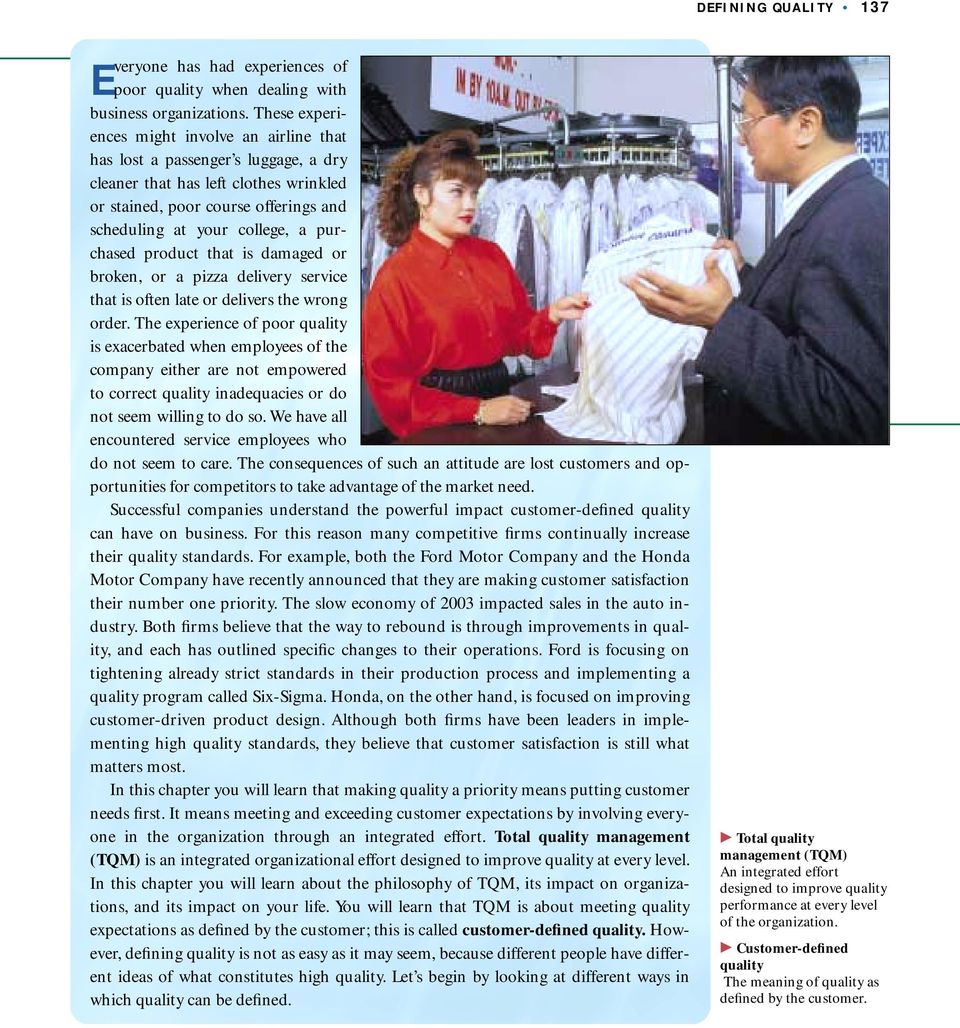
2 DEFINING QUALITY 137 Everyone has had experiences of poor quality when dealing with business organizations. These experiences might involve an airline that has lost a passenger s luggage, a dry cleaner that has left clothes wrinkled or stained, poor course offerings and scheduling at your college, a purchased product that is damaged or broken, or a pizza delivery service that is often late or delivers the wrong order. The experience of poor quality is exacerbated when employees of the company either are not empowered to correct quality inadequacies or do not seem willing to do so. We have all encountered service employees who do not seem to care. The consequences of such an attitude are lost customers and opportunities for competitors to take advantage of the market need. Successful companies understand the powerful impact customer-defined quality can have on business. For this reason many competitive firms continually increase their quality standards. For example, both the Ford Motor Company and the Honda Motor Company have recently announced that they are making customer satisfaction their number one priority. The slow economy of 2003 impacted sales in the auto industry. Both firms believe that the way to rebound is through improvements in quality, and each has outlined specific changes to their operations. Ford is focusing on tightening already strict standards in their production process and implementing a quality program called Six-Sigma. Honda, on the other hand, is focused on improving customer-driven product design. Although both firms have been leaders in implementing high quality standards, they believe that customer satisfaction is still what matters most. In this chapter you will learn that making quality a priority means putting customer needs first. It means meeting and exceeding customer expectations by involving everyone in the organization through an integrated effort. Total quality management (TQM) is an integrated organizational effort designed to improve quality at every level. In this chapter you will learn about the philosophy of TQM, its impact on organizations, and its impact on your life. You will learn that TQM is about meeting quality expectations as defined by the customer; this is called customer-defined quality. However, defining quality is not as easy as it may seem, because different people have different ideas of what constitutes high quality. Let s begin by looking at different ways in which quality can be defined. Total quality management (TQM) An integrated effort designed to improve quality performance at every level of the organization. Customer-defined quality The meaning of quality as defined by the customer.
3 138 CHAPTER 5 TOTAL QUALITY MANAGEMENT DEFINING QUALITY The definition of quality depends on the role of the people defining it. Most consumers have a difficult time defining quality, but they know it when they see it. For example, although you probably have an opinion as to which manufacturer of athletic shoes provides the highest quality, it would probably be difficult for you to define your quality standard in precise terms. Also, your friends may have different opinions regarding which athletic shoes are of highest quality. The difficulty in defining quality exists regardless of product, and this is true for both manufacturing and service organizations. Think about how difficult it may be to define quality for products such as airline services, child day-care facilities, college classes, or even OM textbooks. Further complicating the issue is that the meaning of quality has changed over time. Today, there is no single universal definition of quality. Some people view quality as performance to standards. Others view it as meeting the customer s needs or satisfying the customer. Let s look at some of the more common definitions of quality. Conformance to specifications How well a product or service meets the targets and tolerances determined by its designers. Fitness for use A definition of quality that evaluates how well the product performs for its intended use. Value for price paid Quality defined in terms of product or service usefulness for the price paid. Support services Quality defined in terms of the support provided after the product or service is purchased. Conformance to specifications measures how well the product or service meets the targets and tolerances determined by its designers. For example, the dimensions of a machine part may be specified by its design engineers as 3.05 inches. This would mean that the target dimension is 3 inches but the dimensions can vary between 2.95 and 3.05 inches. Similarly, the wait for hotel room service may be specified as 20 minutes, but there may be an acceptable delay of an additional 10 minutes. Also, consider the amount of light delivered by a 60 watt light bulb. If the bulb delivers 50 watts it does not conform to specifications. As these examples illustrate, conformance to specification is directly measurable, though it may not be directly related to the consumer s idea of quality. Fitness for use focuses on how well the product performs its intended function or use. For example, a Mercedes Benz and a Jeep Cherokee both meet a fitness for use definition if one considers transportation as the intended function. However, if the definition becomes more specific and assumes that the intended use is for transportation on mountain roads and carrying fishing gear, the Jeep Cherokee has a greater fitness for use. You can also see that fitness for use is a user-based definition in that it is intended to meet the needs of a specific user group. Value for price paid is a definition of quality that consumers often use for product or service usefulness. This is the only definition that combines economics with consumer criteria; it assumes that the definition of quality is price sensitive. For example, suppose that you wish to sign up for a personal finance seminar and discover that the same class is being taught at two different colleges at significantly different tuition rates. If you take the less expensive seminar, you will feel that you have received greater value for the price. Support services provided are often how the quality of a product or service is judged. Quality does not apply only to the product or service itself; it also applies to the people, processes, and organizational environment associated with it. For example, the quality of a university is judged not only by the quality of staff and course offerings, but also by the efficiency and accuracy of processing paperwork.

4 DEFINING QUALITY 139 Psychological criteria is a subjective definition that focuses on the judgmental evaluation of what constitutes product or service quality. Different factors contribute to the evaluation, such as the atmosphere of the environment or the perceived prestige of the product. For example, a hospital patient may receive average health care, but a very friendly staff may leave the impression of high quality. Similarly, we commonly associate certain products with excellence because of their reputation; Rolex watches and Mercedes-Benz automobiles are examples. Psychological criteria A way of defining quality that focuses on judgmental evaluations of what constitutes product or service excellence. Differences Between Manufacturing and Service Organizations Defining quality in manufacturing organizations is often different from that of services. Manufacturing organizations produce a tangible product that can be seen, touched, and directly measured. Examples include cars, CD players, clothes, computers, and food items. Therefore, quality definitions in manufacturing usually focus on tangible product features. The most common quality definition in manufacturing is conformance, which is the degree to which a product characteristic meets preset standards. Other common definitions of quality in manufacturing include performance such as acceleration of a vehicle; reliability that the product will function as expected without failure; features the extras that are included beyond the basic characteristics; durability expected operational life of the product; and serviceability how readily a product can be repaired. The relative importance of these definitions is based on the preferences of each individual customer. It is easy to see how different customers can have different definitions in mind when they speak of high product quality. In contrast to manufacturing, service organizations produce a product that is intangible. Usually, the complete product cannot be seen or touched. Rather, it is experienced. Examples include delivery of health care, experience of staying at a vacation resort, and learning at a university. The intangible nature of the product makes defining quality difficult. Also, since a service is experienced, perceptions can be highly subjective. In addition to tangible factors, quality of services is often defined by perceptual factors. These include responsiveness to customer needs, courtesy and friendliness of staff, promptness in resolving complaints, and atmosphere. Other definitions of quality in services include time the amount of time a customer has to wait for the service; and consistency the degree to which the service is the same each time. For these reasons, defining quality in services can be especially challenging. Dimensions of quality for manufacturing versus service organizations are shown in Table 5-1. Manufacturing Organizations Conformance to specifications Performance Reliability Features Durability Serviceability Service Organizations Tangible factors Consistency Responsiveness to customer needs Courtesy/friendliness Timeliness/promptness Atmosphere TABLE 5-1 Dimensions of Quality for Manufacturing Versus Service Organizations
5 140 CHAPTER 5 TOTAL QUALITY MANAGEMENT LINKS TO PRACTICE General Electric Company Motorola, Inc. Today s customers demand and expect high quality. Companies that do not make quality a priority risk long-run survival. World-class organizations such as General Electric and Motorola attribute their success to having one of the best quality management programs in the world. These companies were some of the first to implement a quality program called, Six- Sigma, where the level of defects is reduced to approximately 3.4 parts per million. To achieve this, everyone in the company is trained in quality. For example, individuals highly trained in quality improvement principles and techniques receive a designation called Black Belt. The full-time job of Black Belts is to identify and solve quality problems. In fact, Motorola was one of the first companies to win the prestigious Malcolm Baldrige National Quality Award in 1988, due to its high focus on quality. Both GE and Motorola have had a primary goal to achieve total customer satisfaction. To this end, the efforts of these organizations have included eliminating almost all defects from products, processes, and transactions. Both companies consider quality to be the critical factor that has resulted in significant increases in sales and market share, as well as cost savings in the range of millions of dollars. COST OF QUALITY Prevention costs Costs incurred in the process of preventing poor quality from occurring. Appraisal costs Costs incurred in the process of uncovering defects. Internal failure costs Costs associated with discovering poor product quality before the product reaches the customer. The reason quality has gained such prominence is that organizations have gained an understanding of the high cost of poor quality. Quality affects all aspects of the organization and has dramatic cost implications. The most obvious consequence occurs when poor quality creates dissatisfied customers and eventually leads to loss of business. However, quality has many other costs, which can be divided into two categories. The first category consists of costs necessary for achieving high quality, which are called quality control costs. These are of two types: prevention costs and appraisal costs. The second category consists of the cost consequences of poor quality, which are called quality failure costs. These include external failure costs and internal failure costs. These costs of quality are shown in Figure 5-1. The first two costs are incurred in the hope of preventing the second two. Prevention costs are all costs incurred in the process of preventing poor quality from occurring. They include quality planning costs, such as the costs of developing and implementing a quality plan. Also included are the costs of product and process design, from collecting customer information to designing processes that achieve conformance to specifications. Employee training in quality measurement is included as part of this cost, as well as the costs of maintaining records of information and data related to quality. Appraisal costs are incurred in the process of uncovering defects. They include the cost of quality inspections, product testing, and performing audits to make sure that quality standards are being met. Also included in this category are the costs of worker time spent measuring quality and the cost of equipment used for quality appraisal. Internal failure costs are associated with discovering poor product quality before the product reaches the customer site. One type of internal failure cost is rework, which is the cost of correcting the defective item. Sometimes the item is so defective that it cannot be corrected and must be thrown away. This is called scrap, and its costs include
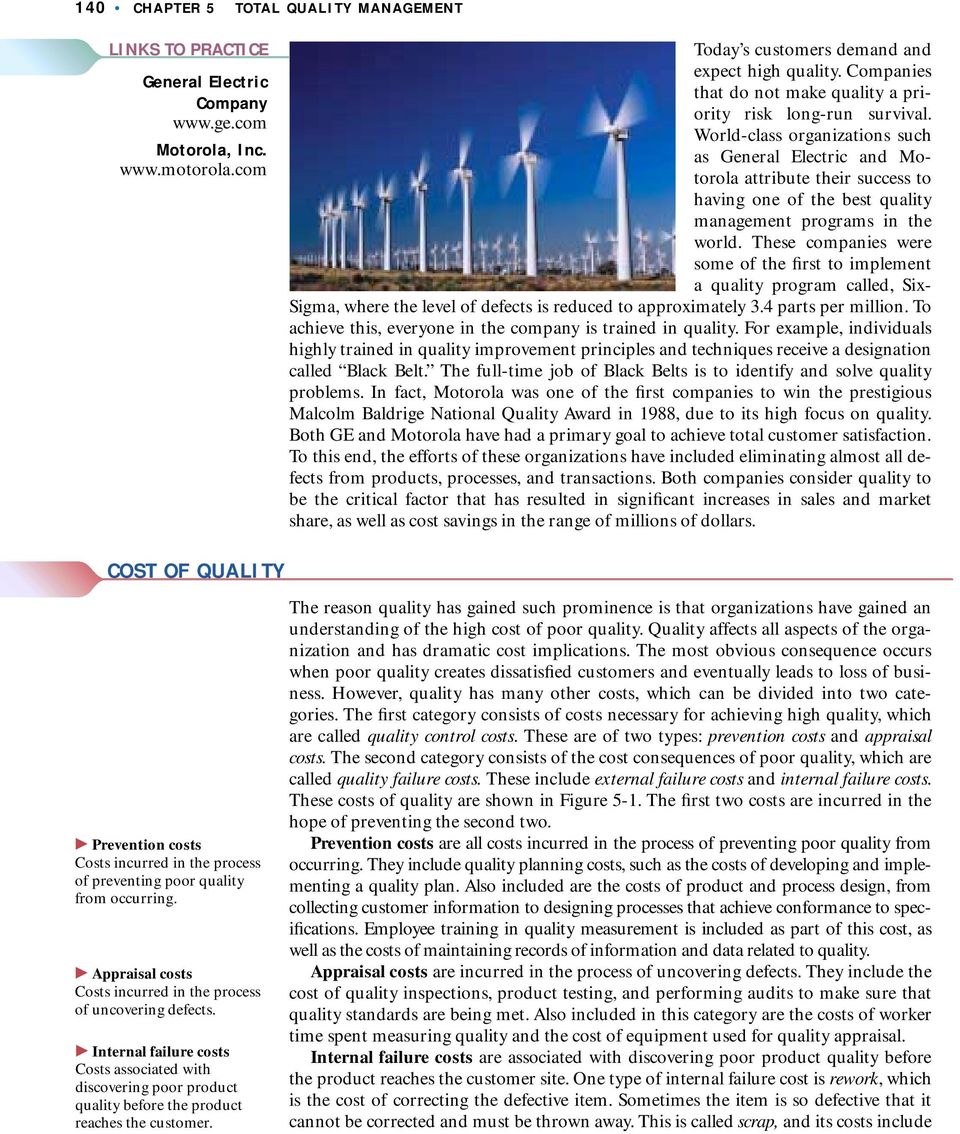
6 COST OF QUALITY 141 Prevention costs. Appraisal costs. Internal failure costs. External failure costs. Costs of preparing and implementing a quality plan. Costs of testing, evaluating, and inspecting quality. Costs of scrap, rework, and material losses. Costs of failure at customer site, including returns, repairs, and recalls. FIGURE 5-1 Costs of quality all the material, labor, and machine cost spent in producing the defective product. Other types of internal failure costs include the cost of machine downtime due to failures in the process and the costs of discounting defective items for salvage value. External failure costs are associated with quality problems that occur at the customer site. These costs can be particularly damaging because customer faith and loyalty can be difficult to regain. They include everything from customer complaints, product returns, and repairs, to warranty claims, recalls, and even litigation costs resulting from product liability issues. A final component of this cost is lost sales and lost customers. For example, manufacturers of lunch meats and hot dogs whose products have been recalled due to bacterial contamination have had to struggle to regain consumer confidence. Other examples include auto manufacturers whose products have been recalled due to major malfunctions such as problematic braking systems and airlines that have experienced a crash with many fatalities. External failure can sometimes put a company out of business almost overnight. Companies that consider quality important invest heavily in prevention and appraisal costs in order to prevent internal and external failure costs. The earlier defects are found, the less costly they are to correct. For example, detecting and correcting defects during product design and product production is considerably less expensive than when the defects are found at the customer site. This is shown in Figure 5-2. External failure costs Costs associated with quality problems that occur at the customer site. FIGURE 5-2 Cost of defects Cost of Defect Product Design Product Production Location of Defect Customer Site

7 142 CHAPTER 5 TOTAL QUALITY MANAGEMENT External failure costs tend to be particularly high for service organizations. The reason is that with a service the customer spends much time in the service delivery system, and there are fewer opportunities to correct defects than there are in manufacturing. Examples of external failure in services include an airline that has overbooked flights, long delays in airline service, and lost luggage. THE EVOLUTION OF TOTAL QUALITY MANAGEMENT (TQM) Marketing, Finance, Accounting The concept of quality has existed for many years, though its meaning has changed and evolved over time. In the early twentieth century, quality management meant inspecting products to ensure that they met specifications. In the 1940s, during World War II, quality became more statistical in nature. Statistical sampling techniques were used to evaluate quality, and quality control charts were used to monitor the production process. In the 1960s, with the help of so-called quality gurus, the concept took on a broader meaning. Quality began to be viewed as something that encompassed the entire organization, not only the production process. Since all functions were responsible for product quality and all shared the costs of poor quality, quality was seen as a concept that affected the entire organization. The meaning of quality for businesses changed dramatically in the late 1970s. Before then quality was still viewed as something that needed to be inspected and corrected. However, in the 1970s and 1980s many U.S. industries lost market share to foreign competition. In the auto industry, manufacturers such as Toyota and Honda became major players. In the consumer goods market, companies such as Toshiba and Sony led the way. These foreign competitors were producing lower-priced products with considerably higher quality. To survive, companies had to make major changes in their quality programs. Many hired consultants and instituted quality training programs for their employees. A new concept of quality was emerging. One result is that quality began to have a strategic meaning. Today, successful companies understand that quality provides a competitive advantage. They put the customer first and define quality as meeting or exceeding customer expectations. Since the 1970s, competition based on quality has grown in importance and has generated tremendous interest, concern, and enthusiasm. Companies in every line of business are focusing on improving quality in order to be more competitive. In many industries quality excellence has become a standard for doing business. Companies that do not meet this standard simply will not survive. As you will see later in the chapter, the importance of quality is demonstrated by national quality awards and quality certifications that are coveted by businesses. The term used for today s new concept of quality is total quality management or TQM. Figure 5-3 presents a timeline of the old and new concepts of quality. You can see that the old concept is reactive, designed to correct quality problems after they occur. The new concept is proactive, designed to build quality into the product and process design. Next, we look at the individuals who have shaped our understanding of quality. Quality Gurus To fully understand the TQM movement, we need to look at the philosophies of notable individuals who have shaped the evolution of TQM. Their philosophies and teachings have contributed to our knowledge and understanding of quality today. Their individual contributions are summarized in Table 5-2.

8 THE EVOLUTION OF TOTAL QUALITY MANAGEMENT (TQM) 143 TIME: Early 1900s 1940s 1960s 1980s and Beyond FOCUS: Inspection Statistical sampling Organizational quality focus Customer driven quality FIGURE 5-3 Timeline showing the differences between old and new concepts of quality Old Concept of Quality: Inspect for quality after production. New Concept of Quality: Build quality into the process. Identify and correct causes of quality problems. Walter A. Shewhart Walter A. Shewhart was a statistician at Bell Labs during the 1920s and 1930s. Shewhart studied randomness and recognized that variability existed in all manufacturing processes. He developed quality control charts that are used to identify whether the variability in the process is random or due to an assignable cause, such as poor workers or miscalibrated machinery. He stressed that eliminating variability improves quality. His work created the foundation for today s statistical process control, and he is often referred to as the grandfather of quality control. W. Edwards Deming W. Edwards Deming is often referred to as the father of quality control. He was a statistics professor at New York University in the 1940s. After World War II he assisted many Japanese companies in improving quality. The Japanese regarded him so highly that in 1951 they established the Deming Prize, an annual award given to firms that demonstrate outstanding quality. It was almost 30 years later that American businesses began adopting Deming s philosophy. A number of elements of Deming s philosophy depart from traditional notions of quality. The first is the role management should play in a company s quality Quality Guru Main Contribution TABLE 5-2 Walter A. Shewhart Contributed to understanding of process variability. Developed concept of statistical control charts. W. Edwards Deming Stressed management s responsibility for quality. Developed 14 Points to guide companies in quality improvement. Joseph M. Juran Defined quality as fitness for use. Developed concept of cost of quality. Armand V. Feigenbaum Introduced concept of total quality control. Philip B. Crosby Coined phrase quality is free. Introduced concept of zero defects. Kaoru Ishikawa Developed cause-and-effect diagrams. Identified concept of internal customer. Genichi Taguchi Focused on product design quality. Developed Taguchi loss function. Quality Gurus and Their Contributions

9 144 CHAPTER 5 TOTAL QUALITY MANAGEMENT improvement effort. Historically, poor quality was blamed on workers on their lack of productivity, laziness, or carelessness. However, Deming pointed out that only 15 percent of quality problems are actually due to worker error. The remaining 85 percent are caused by processes and systems, including poor management. Deming said that it is up to management to correct system problems and create an environment that promotes quality and enables workers to achieve their full potential. He believed that managers should drive out any fear employees have of identifying quality problems, and that numerical quotas should be eliminated. Proper methods should be taught, and detecting and eliminating poor quality should be everyone s responsibility. Deming outlined his philosophy on quality in his famous 14 Points. These points are principles that help guide companies in achieving quality improvement. The principles are founded on the idea that upper management must develop a commitment to quality and provide a system to support this commitment that involves all employees and suppliers. Deming stressed that quality improvements cannot happen without organizational change that comes from upper management. Joseph M. Juran After W. Edwards Deming, Dr. Joseph Juran is considered to have had the greatest impact on quality management. Juran originally worked in the quality program at Western Electric. He became better known in 1951, after the publication of his book Quality Control Handbook. In 1954 he went to Japan to work with manufacturers and teach classes on quality. Though his philosophy is similar to Deming s, there are some differences. Whereas Deming stressed the need for an organizational transformation, Juran believes that implementing quality initiatives should not require such a dramatic change and that quality management should be embedded in the organization. One of Juran s significant contributions is his focus on the definition of quality and the cost of quality. Juran is credited with defining quality as fitness for use rather than simply conformance to specifications. As we have learned in this chapter, defining quality as fitness for use takes into account customer intentions for use of the product, instead of only focusing on technical specifications. Juran is also credited with developing the concept of cost of quality, which allows us to measure quality in dollar terms rather than on the basis of subjective evaluations. Juran is well known for originating the idea of the quality trilogy: quality planning, quality control, and quality improvement. The first part of the trilogy, quality planning, is necessary so that companies identify their customers, product requirements, and overriding business goals. Processes should be set up to ensure that the quality standards can be met. The second part of the trilogy, quality control, stresses the regular use of statistical control methods to ensure that quality standards are met and to identify variations from the standards. The third part of the quality trilogy is quality improvement. According to Juran, quality improvements should be continuous as well as breakthrough. Together with Deming, Juran stressed that to implement continuous improvement workers need to have training in proper methods on a regular basis. Armand V. Feigenbaum Another quality leader is Armand V. Feigenbaum, who introduced the concept of total quality control. In his 1961 book Total Quality Control, he outlined his quality principles in 40 steps. Feigenbaum took a total system approach to quality. He promoted the idea of a work environment where quality devel-

10 THE EVOLUTION OF TOTAL QUALITY MANAGEMENT (TQM) 145 opments are integrated throughout the entire organization, where management and employees have a total commitment to improve quality, and people learn from each other s successes. This philosophy was adapted by the Japanese and termed company-wide quality control. Phillip B. Crosby Philip B. Crosby is another recognized guru in the area of TQM. He worked in the area of quality for many years, first at Martin Marietta and then, in the 1970s, as the vice president for quality at ITT. He developed the phrase Do it right the first time and the notion of zero defects, arguing that no amount of defects should be considered acceptable. He scorned the idea that a small number of defects is a normal part of the operating process because systems and workers are imperfect. Instead, he stressed the idea of prevention. To promote his concepts, Crosby wrote a book titled Quality Is Free, which was published in He became famous for coining the phrase quality is free and for pointing out the many costs of quality, which include not only the costs of wasted labor, equipment time, scrap, rework, and lost sales, but also organizational costs that are hard to quantify. Crosby stressed that efforts to improve quality more than pay for themselves because these costs are prevented. Therefore, quality is free. Like Deming and Juran, Crosby stressed the role of management in the quality improvement effort and the use of statistical control tools in measuring and monitoring quality. Kaoru Ishikawa Kaoru Ishikawa is best known for the development of quality tools called cause-and-effect diagrams, also called fishbone or Ishikawa diagrams. These diagrams are used for quality problem solving, and we will look at them in detail later in the chapter. He was the first quality guru to emphasize the importance of the internal customer, the next person in the production process. He was also one of the first to stress the importance of total company quality control, rather than just focusing on products and services. Dr. Ishikawa believed that everyone in the company needed to be united with a shared vision and a common goal. He stressed that quality initiatives should be pursued at every level of the organization and that all employees should be involved. Dr. Ishikawa was a proponent of implementation of quality circles, which are small teams of employees that volunteer to solve quality problems. Genichi Taguchi Dr. Genichi Taguchi is a Japanese quality expert known for his work in the area of product design. He estimates that as much as 80 percent of all defective items are caused by poor product design. Taguchi stresses that companies should focus their quality efforts on the design stage, as it is much cheaper and easier to make changes during the product design stage than later during the production process. Taguchi is known for applying a concept called design of experiment to product design. This method is an engineering approach that is based on developing robust design, a design that results in products that can perform over a wide range of conditions. Taguchi s philosophy is based on the idea that it is easier to design a product that can perform over a wide range of environmental conditions than it is to control the environmental conditions. Taguchi has also had a large impact on today s view of the costs of quality. He pointed out that the traditional view of costs of conformance to specifications is Robust design A design that results in a product that can perform over a wide range of conditions.
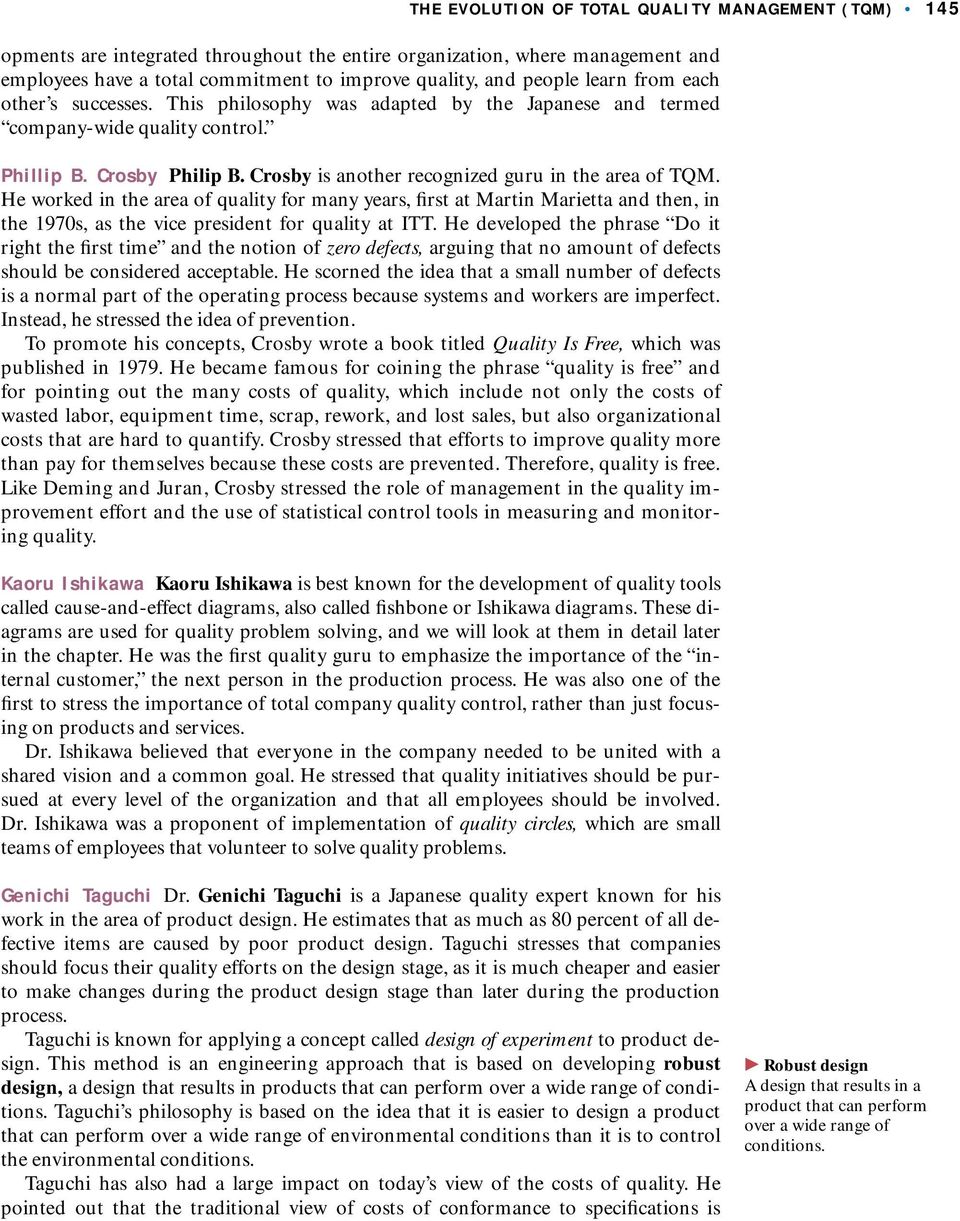
11 146 CHAPTER 5 TOTAL QUALITY MANAGEMENT FIGURE 5-4 Cost Traditional view of the cost of nonconformance Loss No Loss Loss Target 5.00 tolerances Taguchi loss function Costs of quality increase as a quadratic function as conformance values move away from the target. incorrect, and proposed a different way to look at these costs. Let s briefly look at Dr. Taguchi s view of quality costs. Recall that conformance to specification specifies a target value for the product with specified tolerances, say According to the traditional view of conformance to specifications, losses in terms of cost occur if the product dimensions fall outside of the specified limits. This is shown in Figure 5-4. However, Dr. Taguchi noted that from the customer s view there is little difference whether a product falls just outside or just inside the control limits. He pointed out that there is a much greater difference in the quality of the product between making the target and being near the control limit. He also stated that the smaller the variation around the target, the better the quality. Based on this he proposed the following: as conformance values move away from the target, loss increases as a quadratic function. This is called the Taguchi loss function and is shown in Figure 5-5. According to the function, smaller differences from the target result in smaller costs: the larger the differences, the larger the cost. The Taguchi loss function has had a significant impact in changing the view of quality cost. FIGURE 5-5 Taguchi view of the cost of nonconformance the Taguchi loss function Loss Loss Target 5.00 tolerances

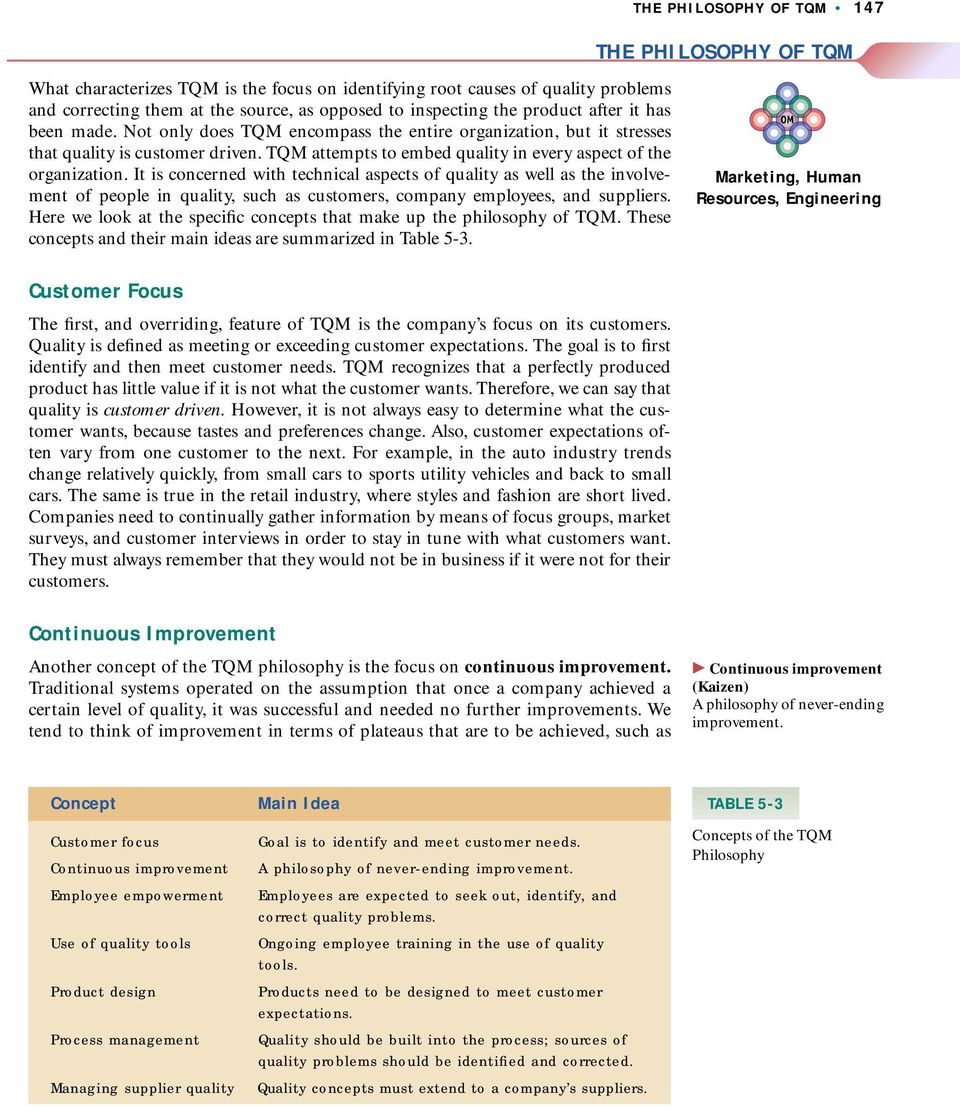
12 THE PHILOSOPHY OF TQM 147 THE PHILOSOPHY OF TQM What characterizes TQM is the focus on identifying root causes of quality problems and correcting them at the source, as opposed to inspecting the product after it has been made. Not only does TQM encompass the entire organization, but it stresses that quality is customer driven. TQM attempts to embed quality in every aspect of the organization. It is concerned with technical aspects of quality as well as the involvement of people in quality, such as customers, company employees, and suppliers. Here we look at the specific concepts that make up the philosophy of TQM. These concepts and their main ideas are summarized in Table 5-3. Marketing, Human Resources, Engineering Customer Focus The first, and overriding, feature of TQM is the company s focus on its customers. Quality is defined as meeting or exceeding customer expectations. The goal is to first identify and then meet customer needs. TQM recognizes that a perfectly produced product has little value if it is not what the customer wants. Therefore, we can say that quality is customer driven. However, it is not always easy to determine what the customer wants, because tastes and preferences change. Also, customer expectations often vary from one customer to the next. For example, in the auto industry trends change relatively quickly, from small cars to sports utility vehicles and back to small cars. The same is true in the retail industry, where styles and fashion are short lived. Companies need to continually gather information by means of focus groups, market surveys, and customer interviews in order to stay in tune with what customers want. They must always remember that they would not be in business if it were not for their customers. Continuous Improvement Another concept of the TQM philosophy is the focus on continuous improvement. Traditional systems operated on the assumption that once a company achieved a certain level of quality, it was successful and needed no further improvements. We tend to think of improvement in terms of plateaus that are to be achieved, such as Continuous improvement (Kaizen) A philosophy of never-ending improvement. Concept Customer focus Continuous improvement Employee empowerment Use of quality tools Product design Process management Managing supplier quality Main Idea Goal is to identify and meet customer needs. A philosophy of never-ending improvement. Employees are expected to seek out, identify, and correct quality problems. Ongoing employee training in the use of quality tools. Products need to be designed to meet customer expectations. Quality should be built into the process; sources of quality problems should be identified and corrected. Quality concepts must extend to a company s suppliers. TABLE 5-3 Concepts of the TQM Philosophy
13 148 CHAPTER 5 TOTAL QUALITY MANAGEMENT passing a certification test or reducing the number of defects to a certain level. Traditionally, change for American managers involves large magnitudes, such as major organizational restructuring. The Japanese, on the other hand, believe that the best and most lasting changes come from gradual improvements. To use an analogy, they believe that it is better to take frequent small doses of medicine than to take one large dose. Continuous improvement, called kaizen by the Japanese, requires that the company continually strive to be better through learning and problem solving. Because we can never achieve perfection, we must always evaluate our performance and take measures to improve it. Now let s look at two approaches that can help companies with continuous improvement: the plan do study act (PDSA) cycle and benchmarking. Plan do study act (PDSA) cycle A diagram that describes the activities that need to be performed to incorporate continuous improvement into the operation. The Plan Do Study Act Cycle The plan do study act (PDSA) cycle describes the activities a company needs to perform in order to incorporate continuous improvement in its operation. This cycle, shown in Figure 5-6 is also referred to as the Shewhart cycle or the Deming wheel. The circular nature of this cycle shows that continuous improvement is a never-ending process. Let s look at the specific steps in the cycle. Plan The first step in the PDSA cycle is to plan. Managers must evaluate the current process and make plans based on any problems they find. They need to document all current procedures, collect data, and identify problems. This information should then be studied and used to develop a plan for improvement as well as specific measures to evaluate performance. Do The next step in the cycle is implementing the plan (do). During the implementation process managers should document all changes made and collect data for evaluation. Study The third step is to study the data collected in the previous phase. The data are evaluated to see whether the plan is achieving the goals established in the plan phase. Act The last phase of the cycle is to act on the basis of the results of the first three phases. The best way to accomplish this is to communicate the results to other members in the company and then implement the new procedure if it has been successful. Note that this is a cycle; the next step is to plan again. After we have acted, we need to continue evaluating the process, planning, and repeating the cycle again. FIGURE 5-6 The plan do study act cycle Plan Act Do Study

14 THE PHILOSOPHY OF TQM 149 Benchmarking Another way companies implement continuous improvement is by studying business practices of companies considered best in class. This is called benchmarking. The ability to learn and study how others do things is an important part of continuous improvement. The benchmark company does not have to be in the same business, as long as it excels at something that the company doing the study wishes to emulate. For example, many companies have used Lands End to benchmark catalog distribution and order filling, because Lands End is considered a leader in this area. Similarly, many companies have used American Express to benchmark conflict resolution. Benchmarking Studying the business practices of other companies for purposes of comparison. Employee Empowerment Part of the TQM philosophy is to empower all employees to seek out quality problems and correct them. With the old concept of quality, employees were afraid to identify problems for fear that they would be reprimanded. Often poor quality was passed on to someone else, in order to make it someone else s problem. The new concept of quality, TQM, provides incentives for employees to identify quality problems. Employees are rewarded for uncovering quality problems, not punished. In TQM, the role of employees is very different from what it was in traditional systems. Workers are empowered to make decisions relative to quality in the production process. They are considered a vital element of the effort to achieve high quality. Their contributions are highly valued, and their suggestions are implemented. In order to perform this function, employees are given continual and extensive training in quality measurement tools. To further stress the role of employees in quality, TQM differentiates between external and internal customers. External customers are those that purchase the company s goods and services. Internal customers are employees of the organization who receive goods or services from others in the company. For example, the packaging department of an organization is an internal customer of the assembly department. Just as a defective item would not be passed to an external customer, a defective item should not be passed to an internal customer. Team Approach TQM stresses that quality is an organizational effort. To facilitate the solving of quality problems, it places great emphasis on teamwork. The use of teams is based on the old adage that two heads are better than one. Using techniques such as brainstorming, discussion, and quality control tools, teams work regularly to correct problems. The contributions of teams are considered vital to the success of the company. For this reason, companies set aside time in the workday for team meetings. Teams vary in their degree of structure and formality, and different types of teams solve different types of problems. One of the most common types of teams is the quality circle, a team of volunteer production employees and their supervisors whose purpose is to solve quality problems. The circle is usually composed of eight to ten members, and decisions are made through group consensus. The teams usually meet weekly during work hours in a place designated for this purpose. They follow a preset process for analyzing and solving quality problems. Open discussion is promoted, and criticism is not allowed. Although the functioning of quality circles is friendly and casual, it is serious business. Quality circles are not mere gab sessions. Rather, they do important work for the company and have been very successful in many firms. Management Quality circle A team of volunteer production employees and their supervisors who meet regularly to solve quality problems.
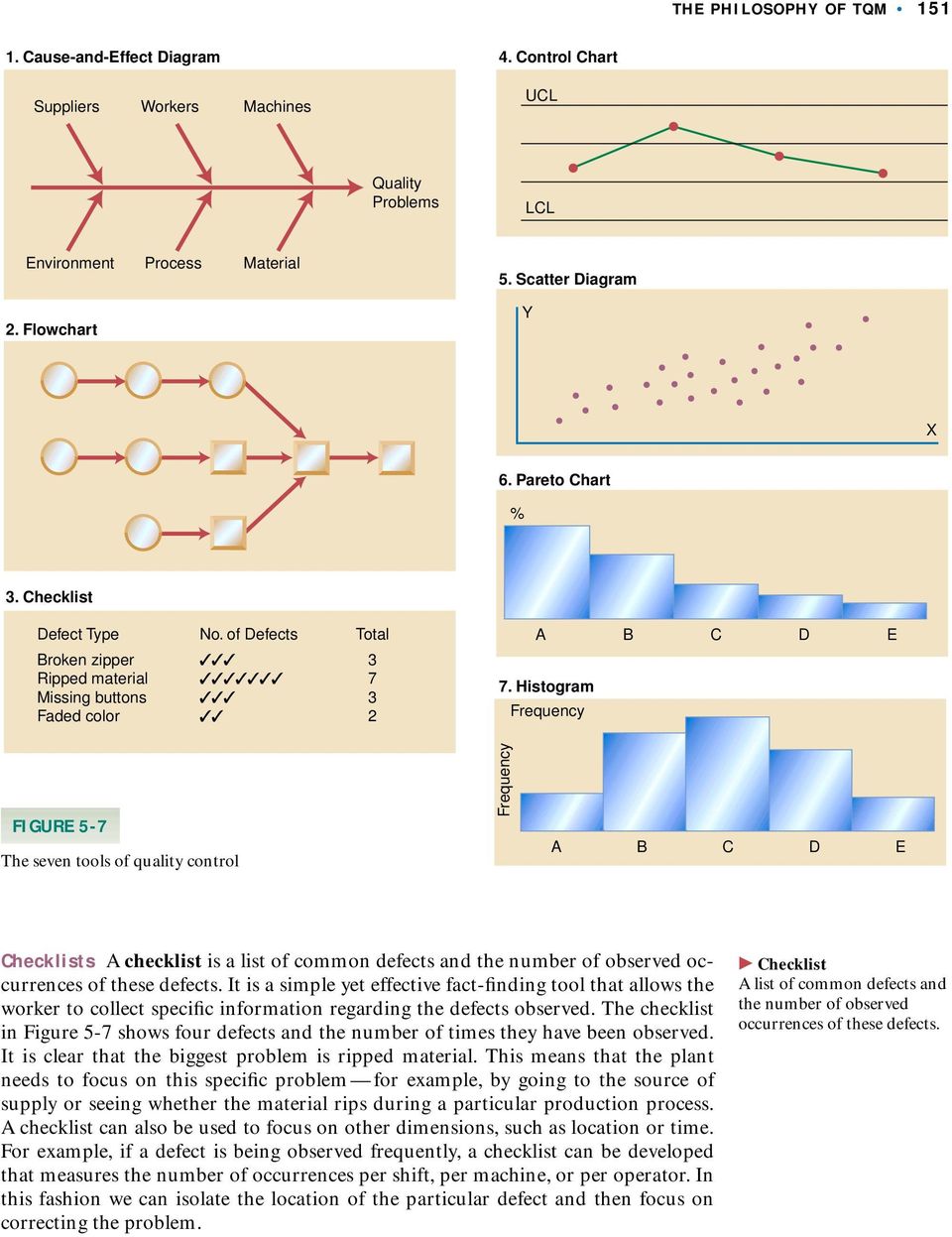
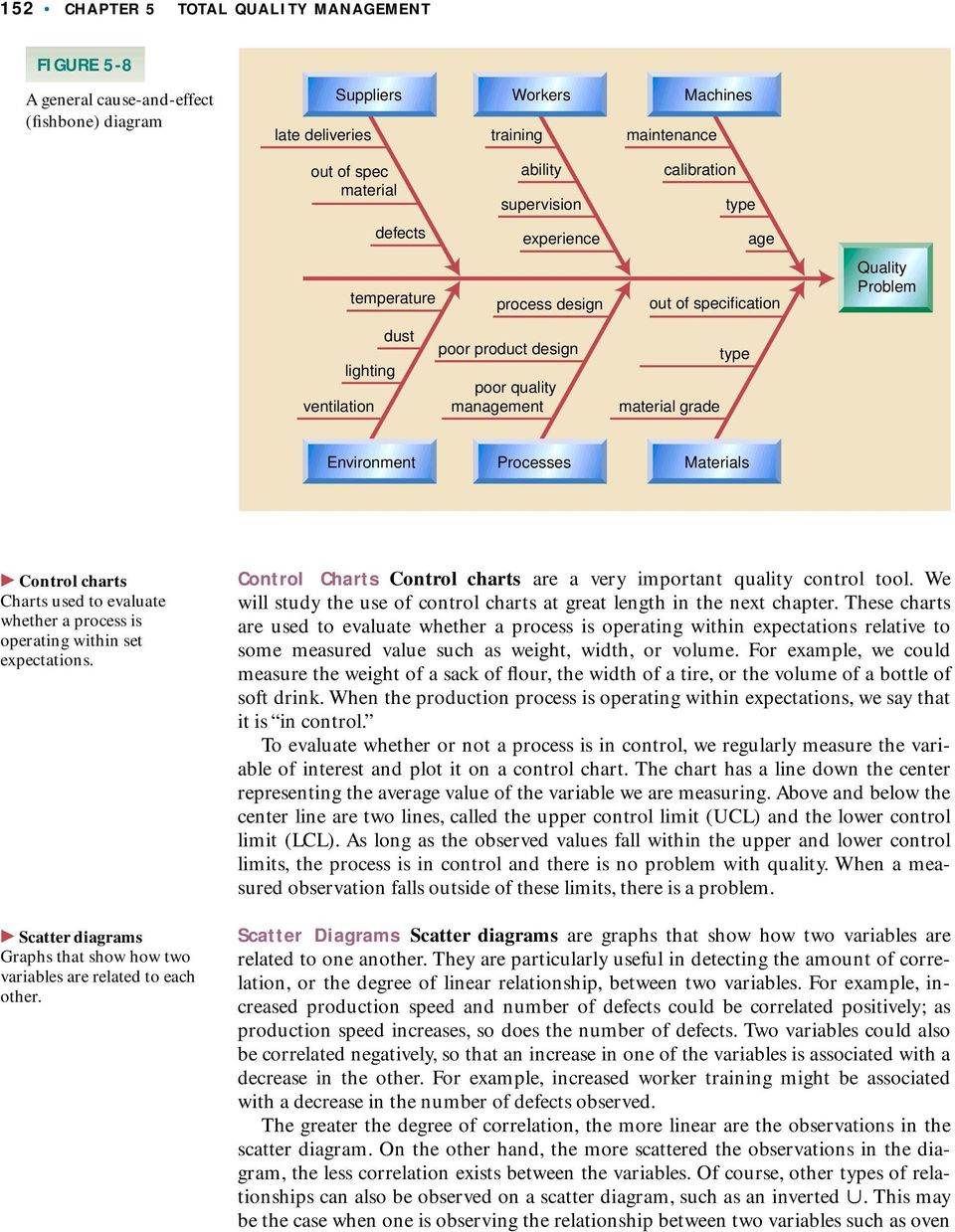
15 150 CHAPTER 5 TOTAL QUALITY MANAGEMENT LINKS TO PRACTICE The Walt Disney Company Cause-and-effect diagram A chart that identifies potential causes of particular quality problems. Flowchart A schematic of the sequence of steps involved in an operation or process. The importance of exceptional quality is demonstrated by The Walt Disney Company in operating its theme parks. The focus of the parks is customer satisfaction. This is accomplished through meticulous attention to every detail, with particular focus on the role of employees in service delivery. Employees are viewed as the most important organizational resource and great care is taken in employee hiring and training. All employees are called cast members, regardless of whether they are janitors or performers. Employees are extensively trained in customer service, communication, and quality awareness. Continual monitoring of quality is considered important, and employees meet regularly in teams to evaluate their effectiveness. All employees are shown how the quality of their individual jobs contributes to the success of the park. Use of Quality Tools You can see that TQM places a great deal of responsibility on all workers. If employees are to identify and correct quality problems, they need proper training. They need to understand how to assess quality by using a variety of quality control tools, how to interpret findings, and how to correct problems. In this section we look at seven different quality tools. These are often called the seven tools of quality control and are shown in Figure 5-7. They are easy to understand, yet extremely useful in identifying and analyzing quality problems. Sometimes workers use only one tool at a time, but often a combination of tools is most helpful. Cause-and-Effect Diagrams Cause-and-effect diagrams are charts that identify potential causes for particular quality problems. They are often called fishbone diagrams because they look like the bones of a fish. A general cause-and-effect diagram is shown in Figure 5-8. The head of the fish is the quality problem, such as damaged zippers on a garment or broken valves on a tire. The diagram is drawn so that the spine of the fish connects the head to the possible cause of the problem. These causes could be related to the machines, workers, measurement, suppliers, materials, and many other aspects of the production process. Each of these possible causes can then have smaller bones that address specific issues that relate to each cause. For example, a problem with machines could be due to a need for adjustment, old equipment, or tooling problems. Similarly, a problem with workers could be related to lack of training, poor supervision, or fatigue. Cause-and-effect diagrams are problem-solving tools commonly used by quality control teams. Specific causes of problems can be explored through brainstorming. The development of a cause-and-effect diagram requires the team to think through all the possible causes of poor quality. Flowcharts A flowchart is a schematic diagram of the sequence of steps involved in an operation or process. It provides a visual tool that is easy to use and understand. By seeing the steps involved in an operation or process, everyone develops a clear picture of how the operation works and where problems could arise.

16 THE PHILOSOPHY OF TQM Cause-and-Effect Diagram 4. Control Chart Suppliers Workers Machines UCL Quality Problems LCL Environment Process Material 5. Scatter Diagram 2. Flowchart Y 6. Pareto Chart % 3. Checklist Defect Type Broken zipper Ripped material Missing buttons Faded color No. of Defects Total A B C D E 7. Histogram Frequency FIGURE 5-7 The seven tools of quality control Frequency A B C D E Checklists A checklist is a list of common defects and the number of observed occurrences of these defects. It is a simple yet effective fact-finding tool that allows the worker to collect specific information regarding the defects observed. The checklist in Figure 5-7 shows four defects and the number of times they have been observed. It is clear that the biggest problem is ripped material. This means that the plant needs to focus on this specific problem for example, by going to the source of supply or seeing whether the material rips during a particular production process. A checklist can also be used to focus on other dimensions, such as location or time. For example, if a defect is being observed frequently, a checklist can be developed that measures the number of occurrences per shift, per machine, or per operator. In this fashion we can isolate the location of the particular defect and then focus on correcting the problem. Checklist A list of common defects and the number of observed occurrences of these defects.
17 152 CHAPTER 5 TOTAL QUALITY MANAGEMENT FIGURE 5-8 A general cause-and-effect (fishbone) diagram Suppliers late deliveries Workers training maintenance Machines out of spec material ability supervision calibration type defects experience age temperature process design out of specification Quality Problem lighting ventilation dust poor product design poor quality management type material grade Environment Processes Materials Control charts Charts used to evaluate whether a process is operating within set expectations. Scatter diagrams Graphs that show how two variables are related to each other. Control Charts Control charts are a very important quality control tool. We will study the use of control charts at great length in the next chapter. These charts are used to evaluate whether a process is operating within expectations relative to some measured value such as weight, width, or volume. For example, we could measure the weight of a sack of flour, the width of a tire, or the volume of a bottle of soft drink. When the production process is operating within expectations, we say that it is in control. To evaluate whether or not a process is in control, we regularly measure the variable of interest and plot it on a control chart. The chart has a line down the center representing the average value of the variable we are measuring. Above and below the center line are two lines, called the upper control limit (UCL) and the lower control limit (LCL). As long as the observed values fall within the upper and lower control limits, the process is in control and there is no problem with quality. When a measured observation falls outside of these limits, there is a problem. Scatter Diagrams Scatter diagrams are graphs that show how two variables are related to one another. They are particularly useful in detecting the amount of correlation, or the degree of linear relationship, between two variables. For example, increased production speed and number of defects could be correlated positively; as production speed increases, so does the number of defects. Two variables could also be correlated negatively, so that an increase in one of the variables is associated with a decrease in the other. For example, increased worker training might be associated with a decrease in the number of defects observed. The greater the degree of correlation, the more linear are the observations in the scatter diagram. On the other hand, the more scattered the observations in the diagram, the less correlation exists between the variables. Of course, other types of relationships can also be observed on a scatter diagram, such as an inverted. This may be the case when one is observing the relationship between two variables such as oven
18 temperature and number of defects, since temperatures below and above the ideal could lead to defects. THE PHILOSOPHY OF TQM 153 Pareto Analysis Pareto analysis is a technique used to identify quality problems based on their degree of importance. The logic behind Pareto analysis is that only a few quality problems are important, whereas many others are not critical. The technique was named after Vilfredo Pareto, a nineteenth-century Italian economist who determined that only a small percentage of people controlled most of the wealth. This concept has often been called the rule and has been extended to many areas. In quality management the logic behind Pareto s principle is that most quality problems are a result of only a few causes. The trick is to identify these causes. One way to use Pareto analysis is to develop a chart that ranks the causes of poor quality in decreasing order based on the percentage of defects each has caused. For example, a tally can be made of the number of defects that result from different causes, such as operator error, defective parts, or inaccurate machine calibrations. Percentages of defects can be computed from the tally and placed in a chart like those shown in Figure 5-7. We generally tend to find that a few causes account for most of the defects. Histograms A histogram is a chart that shows the frequency distribution of observed values of a variable. We can see from the plot what type of distribution a particular variable displays, such as whether it has a normal distribution and whether the distribution is symmetrical. Pareto analysis A technique used to identify quality problems based on their degree of importance. Histogram A chart that shows the frequency distribution of observed values of a variable. In the food service industry the use of quality control tools is important in identifying quality problems. Grocery store chains, such as Kroger and Meijer, must record and monitor the quality of incoming produce, such as tomatoes and lettuce. Quality tools can be used to evaluate the acceptability of product quality and to monitor product quality from individual suppliers. They can also be used to evaluate causes of quality problems, such as long transit time or poor refrigeration. Similarly, restaurants use quality control tools to evaluate and monitor the quality of delivered goods, such as meats, produce, or baked goods. Product Design Quality Function Deployment A critical aspect of building quality into a product is to ensure that the product design meets customer expectations. This typically is not as easy as it seems. Customers often speak in everyday language. For example, a product can be described as attractive, strong, or safe. However, these terms can have very different meaning to different customers. What one person considers to be strong, another may not. To produce a product that customers want, we need to translate customers everyday language into specific technical requirements. However, this can often be difficult. A useful tool for translating the voice of the customer into specific technical requirements is quality function deployment (QFD). Quality function deployment is also useful in enhancing communication between different functions, such as marketing, operations, and engineering. LINKS TO PRACTICE The Kroger Company Meijer Stores Limited Partnership Quality function deployment (QFD) A tool used to translate the preferences of the customer into specific technical requirements.
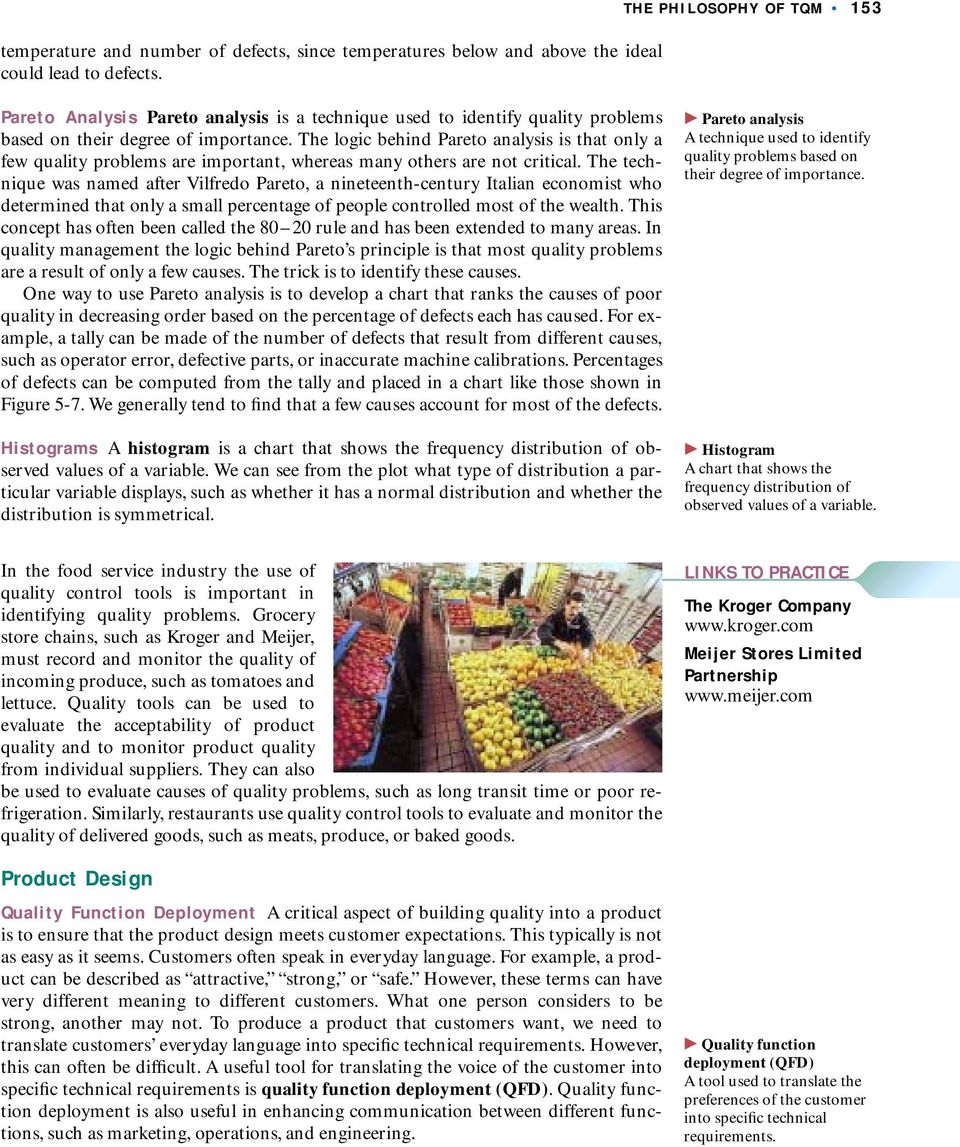
19 154 CHAPTER 5 TOTAL QUALITY MANAGEMENT Marketing QFD enables us to view the relationships among the variables involved in the design of a product, such as technical versus customer requirements. This can help us analyze the big picture for example, by running tests to see how changes in certain technical requirements of the product affect customer requirements. An example is an automobile manufacturer evaluating how changes in materials affect customer safety requirements. This type of analysis can be very beneficial in developing a product design that meets customer needs, yet does not create unnecessary technical requirements for production. QFD begins by identifying important customer requirements, which typically come from the marketing department. These requirements are numerically scored based on their importance, and scores are translated into specific product characteristics. Evaluations are then made of how the product compares with its main competitors relative to the identified characteristics. Finally, specific goals are set to address the identified problems. The resulting matrix looks like a picture of a house and is often called the house of quality. Next we will consider the example of manufacturing a backpack to show how we would use QFD. We will start with a relationship matrix that ties customer requirements to product characteristics, shown in Figure 5-9. Customer Requirements Remember that our goal is to make a product that the customer wants. Therefore, the first thing we need to do is survey our customers to find out specifically what they would be looking for in a product in this case, a backpack for students. To find out precisely what features students FIGURE 5-9 Relationship matrix Customer Requirements Relative Importance No. of Zippers & Compartments Product Characteristics Weight of Backpack Strength of Backpack Grade of Dye Color Cost of Materials Relationship Strong Positive Positive Negative Strong Negative Competitive Evaluation Durable 25 B A US Lightweight 20 A US/B Roomy 25 US/A B Looks Nice 20 US B A Low Cost 10 US B A TOTAL 100 US = Our Backpack A = Competitor A B = Competitor B

20 would like in a backpack, the marketing department might send representatives to talk to students on campus, conduct telephone interviews, and maybe conduct focus groups. Let s say that students have identified five desirable features: the backpack should be durable, lightweight and roomy, look nice, and not cost very much. These are shown in Figure The importance customers attach to each of these requirements is also determined and shown in the figure. This part of the figure looks like the chimney of the house. You can see that durability and roominess are given the greatest importance. Competitive Evaluation On the far right of our relationship matrix is an evaluation of how our product compares to those of competitors. In this example there are two competitors, A and B. The evaluation scale is from one to five the higher the rating, the better. The important thing here is to identify which customer requirements we should pursue and how we fare relative to our competitors. For example, you can see that our product excels in durability relative to competitors, yet it does not look as nice. This means that in designing our product, we could gain a competitive advantage by focusing our design efforts on a more appealing product. Product Characteristics Specific product characteristics are on top of the relationship matrix. These are technical measures. In our example these include the number of zippers and compartments, the weight of the backpack, strength of the backpack, grade of the dye color, and the cost of materials. The Relationship Matrix The strength of the relationship between customer requirements and product characteristics is shown in the relationship matrix. For example, you can see that the number of zippers and compartments is negatively related to the weight of the backpack. A negative relationship means that as we increase the desirability of one variable we decrease the desirability of the other. At the same time, roominess is positively related to the number of zippers and compartments, as is appearance. A positive relationship means that an increase in desirability of one variable is related to an increase in the desirability of another. This type of information is very important in coordinating the product design. The Trade-off Matrix You can see how the relationship matrix is beginning to look like a house. The complete house of quality is shown in Figure The next step in our building process is to put the roof on the house. This is done through a trade-off matrix, which shows how each product characteristic is related to the others and thus allows us to see what tradeoffs we need to make. For example, the number of zippers is negatively related to the weight of the backpack. Setting Targets The last step in constructing the house of quality is to evaluate competitors products relative to the specific product characteristics and to set targets for our own product. The bottom row of the house is the output of quality function deployment. These are specific, measurable product characteristics that have been formulated from general customer requirements. The house of quality has been found to be very useful. You can see how it translates everyday terms like lightweight, roominess, and nice looking, into specific product characteristics that can be used in manufacturing the product. Note also how the house of quality can help in the communication between marketing, operations, and design engineering. THE PHILOSOPHY OF TQM 155
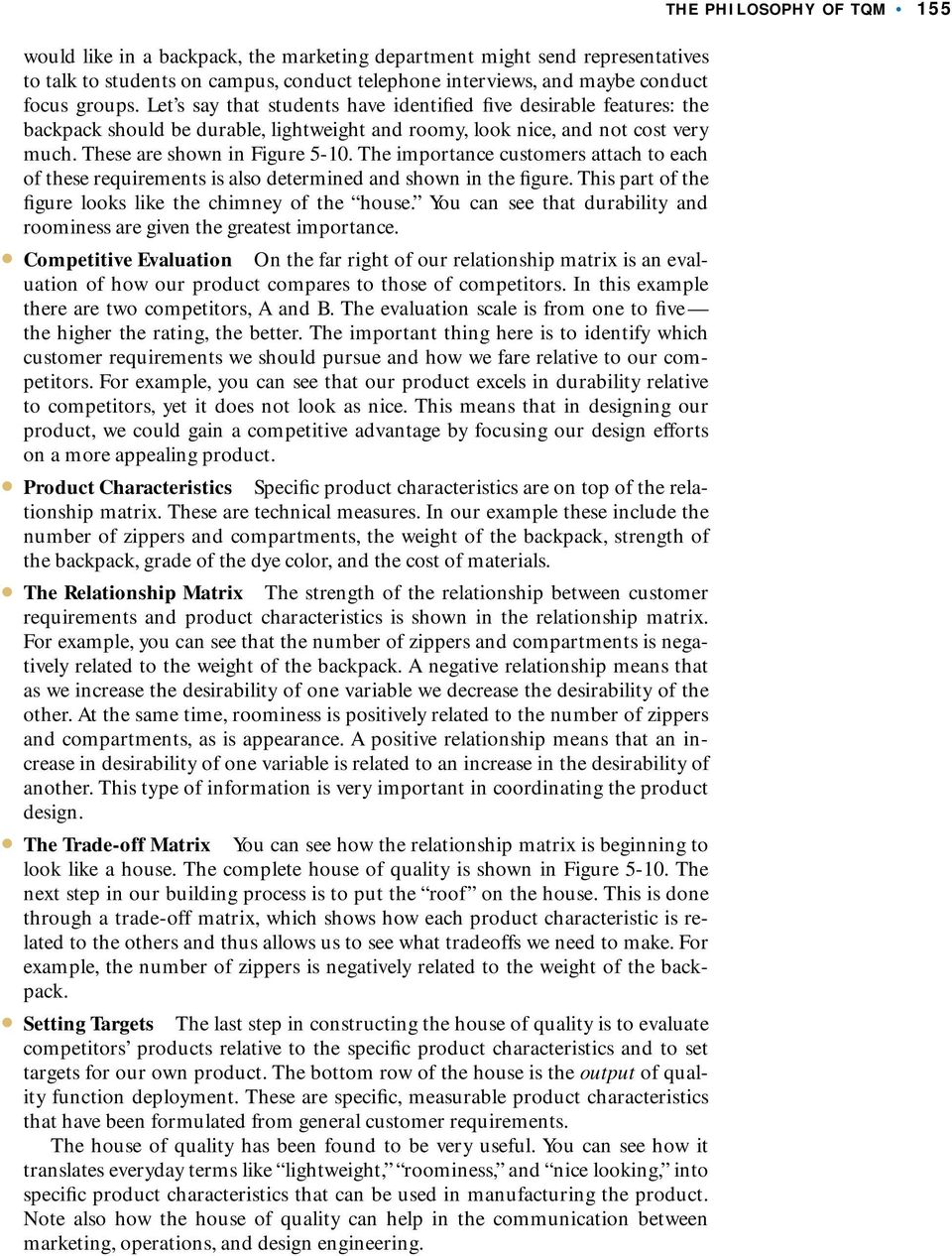
21 156 CHAPTER 5 TOTAL QUALITY MANAGEMENT FIGURE 5-10 House of quality Customer Requirements Relative Importance No. of Zippers & Compartments Product Characteristics Weight of Backpack Strength of Backpack Grade of Dye Color Cost of Materials Relationship Strong Positive Positive Negative Strong Negative Competitive Evaluation Durable 25 B A US Lightweight 20 A US/B Roomy 25 US/A B Looks Nice 20 US B A Low Cost 10 US B A TOTAL 100 Competitive Evaluation A B lbs..8 lbs. 14 lbs. 10 lbs. Grade B Grade A $8 $10 OUR TARGETS 4.5 lbs. 16 lbs. Grade A $8 US = Our Backpack A = Competitor A B = Competitor B Reliability The probability that a product, service, or part will perform as intended. Reliability An important dimension of product design is that the product functions as expected. This is called reliability. Reliability is the probability that a product, service, or part will perform as intended for a specified period of time under normal conditions. We are all familiar with product reliability in the form of product warranties. We also know that no product is guaranteed with 100 percent certainty to function properly. However, companies know that a high reliability is an important part of customer-oriented quality and try to build this into their product design. Reliability is a probability, a likelihood, or a chance. For example, a product with a 90 percent reliability has a 90 percent chance of functioning as intended. Another way to look at it is that the probability that the product will fail is , or 10 percent. This also means that 1 out of 10 products will not function as expected. The reliability of a product is a direct function of the reliability of its component parts. If all the parts in a product must work for the product to function, then the
22 reliability of the system is computed as the product of the reliabilities of the individual components: R s (R 1 ) (R 2 ) (R 3 )...(R n ) where R s reliability of the product or system. R 1... n reliability of components 1 through n THE PHILOSOPHY OF TQM 157 Assume that a product has two parts, both of which must work for the product to function. Part 1 has a reliability of 80 percent and part 2 has a reliability of 90 percent. Compute the reliability of the product. Part 1 Part EAMPLE 5.1 Computing Product Reliability Solution: The reliability of the product is R (0.80)(0.90) 0.72 Notice in the previous example that the reliability of the system is lower than that of individual components. The reason is that all the components in a series, as in the example, must function for the product to work. If only one component doesn t work, the entire product doesn t work. The more components a product has, the lower its reliability. For example, a system with five components in series, each with a reliability of.90, has a reliability of only (.90)(.90)(.90)(.90)(.90) (.90) The failure of certain products can be very critical. One way to increase product reliability is to build redundancy into the product design in the form of backup parts. Consider the blackout during the summer of 2003, when most of the northeastern part of the United States was out of power for days. Critical facilities, such as hospitals, immediately switched to backup power generators that are available when the main systems fail. Consider other critical systems, such as the navigation system of an aircraft, systems that operate nuclear power plants, the space shuttle, or even the braking system of your car. What gives these systems such high reliability is the redundancy that is built into the product design and serves to increase reliability. Redundancy is built into the system by placing components in parallel, so that when one component fails the other component takes over. In this case, the reliability of the system is computed by adding the reliability of the first component to the reliability of the second (backup) component, multiplied by the probability of needing the backup. The equation is as follows: R s Reliability of 1 Component st Reliability of 2 Component nd Probability of needing 2 Component nd Notice that if the reliability of the 1 st component is.90, the probability of needing a second component is equal to the first component failing, which is (1.90).10. Now let s look at an example.
23 158 CHAPTER 5 TOTAL QUALITY MANAGEMENT EAMPLE 5.2 Computing Product Reliability with Redundancy Two power generators provide electricity to a facility s main and backup generator. The main generator has a reliability of 0.95 and the backup a reliability of What is the reliability of the system? Solution: The system can be represented in the following way Original 0.95 Backup 0.90 The reliability of the system is: R s 0.95 [(0.90) (1 0.95)] Quality at the source The belief that it is best to uncover the source of quality problems and eliminate it. Process Management According to TQM a quality product comes from a quality process. This means that quality should be built into the process. Quality at the source is the belief that it is far better to uncover the source of quality problems and correct it than to discard defective items after production. If the source of the problem is not corrected, the problem will continue. For example, if you are baking cookies you might find that some of the cookies are burned. Simply throwing away the burned cookies will not correct the problem. You will continue to have burned cookies and will lose money when you throw them away. It will be far more effective to see where the problem is and correct it. For example, the temperature setting may be too high; the pan may be curved, placing some cookies closer to the heating element; or the oven may not be distributing heat evenly. Quality at the source exemplifies the difference between the old and new concepts of quality. The old concept focused on inspecting goods after they were produced or after a particular stage of production. If an inspection revealed defects, the defective products were either discarded or sent back for reworking. All this cost the company money, and these costs were passed on to the customer. The new concept of quality focuses on identifying quality problems at the source and correcting them. In Chapter 6 we will learn how to monitor process quality using quality tools, such as control charts. Managing Supplier Quality TQM extends the concept of quality to a company s suppliers. Traditionally, companies tended to have numerous suppliers that engaged in competitive price bidding. When materials arrived, an inspection was performed to check their quality. TQM views this practice as contributing to poor quality and wasted time and cost. The philosophy of TQM extends the concept of quality to suppliers and ensures that they engage in the same quality practices. If suppliers meet preset quality standards, materials do not have to be inspected upon arrival. Today, many companies have a representative residing at their supplier s location, thereby involving the supplier in every stage from product design to final production.
24 QUALITY AWARDS AND STANDARDS 159 Before You Go On Today s concept of quality, called total quality management (TQM), focuses on building quality into the process as opposed to simply inspecting for poor quality after production. TQM is customer driven and encompasses the entire company. Before you go on, you should know the four categories of quality costs. These are prevention and appraisal costs, which are costs that are incurred to prevent poor quality, and internal and external failure costs, which are costs that the company hopes to prevent. You should understand the evolution of TQM and the notable individuals who have shaped our knowledge of quality. Last, you should know the seven concepts of the TQM philosophy: customer focus, continuous improvement, employee empowerment, use of quality tools, product design, process management, and managing supplier quality. QUALITY AWARDS AND STANDARDS The Malcolm Baldrige National Quality Award (MBNQA) The Malcolm Baldrige National Quality Award was established in 1987, when Congress passed the Malcolm Baldrige National Quality Improvement Act. The award is named after the former Secretary of Commerce, Malcolm Baldrige, and is intended to reward and stimulate quality initiatives. It is designed to recognize companies that establish and demonstrate high quality standards. The award is given to no more than two companies in each of three categories: manufacturing, service, and small business. Past winners include Motorola Corporation, erox, FedEx, 3M, IBM, and the Ritz-Carlton. To compete for the Baldrige Award, companies must submit a lengthy application, which is followed by an initial screening. Companies that pass this screening move to the next step, in which they undergo a rigorous evaluation process conducted by certified Baldrige examiners. The examiners conduct site visits and examine numerous company documents. They base their evaluation on seven categories, which are shown in Figure Let s look at each category in more detail. The first category is leadership. Examiners consider commitment by top management, their effort to create an organizational climate devoted to quality, and their active involvement in promoting quality. They also consider the firm s orientation toward meeting customer needs and desires, as well as those of the community and society as a whole. Malcolm Baldrige National Quality Award An award given annually to companies that demonstrate quality excellence and establish best-practice standards in industry. Categories 1 Leadership 2 Strategic Planning 3 Customer and Market Focus 4 Information and Analysis 5 Human Resource Focus 6 Process Management 7 Business Results Points FIGURE 5-11 Malcolm Baldrige National Quality Award criteria TOTAL POINTS 1000 The Ritz-Carlton is one of the past winners of the Malcolm Baldrige National Quality Award.
25 160 CHAPTER 5 TOTAL QUALITY MANAGEMENT Human Resources, Management Deming Prize A Japanese award given to companies to recognize efforts in quality improvement. ISO 9000 A set of international quality standards and a certification demonstrating that companies have met all the standards specified. The second category is strategic planning. The examiners look for a strategic plan that has high quality goals and specific methods for implementation. The next category, customer and market focus, addresses how the company collects market and customer information. Successful companies should use a variety of tools toward this end, such as market surveys and focus groups. The company then needs to demonstrate how it acts on this information. The fourth category is information and analysis. Examiners evaluate how the company obtains data and how it acts on the information. The company needs to demonstrate how the information is shared within the company as well as with other parties, such as suppliers and customers. The fifth and sixth categories deal with management of human resources and management of processes, respectively. These two categories together address the issues of people and process. Human resource focus addresses issues of employee involvement. This entails continuous improvement programs, employee training, and functioning of teams. Employee involvement is considered a critical element of quality. Similarly, process management involves documentation of processes, use of tools for quality improvement such as statistical process control, and the degree of process integration within the organization. The last Baldrige category receives the highest points and deals with business results. Numerous measures of performance are considered, from percentage of defective items to financial and marketing measures. Companies need to demonstrate progressive improvement in these measures over time, not only a one-time improvement. The Baldrige criteria have evolved from simple award criteria to a general framework for quality evaluation. Many companies use these criteria to evaluate their own performance and set quality targets even if they are not planning to formally compete for the award. The Deming Prize The Deming Prize is a Japanese award given to companies to recognize their efforts in quality improvement. The award is named after W. Edwards Deming, who visited Japan after World War II upon the request of Japanese industrial leaders and engineers. While there, he gave a series of lectures on quality. The Japanese considered him such an important quality guru that they named the quality award after him. The award has been given by the Union of Japanese Scientists and Engineers (JUSE) since Competition for the Deming Prize was opened to foreign companies in In 1989 Florida Power & Light was the first U.S. company to receive the award. ISO 9000 Standards Increases in international trade during the 1980s created a need for the development of universal standards of quality. Universal standards were seen as necessary in order for companies to be able to objectively document their quality practices around the world. Then in 1987 the International Organization for Standardization (ISO) published its first set of standards for quality management called ISO The International Organization for Standardization (ISO) is an international organization whose purpose is to establish agreement on international quality standards. It currently has members from 91 countries, including the United States. To develop and promote international quality standards, ISO 9000 has been created. ISO 9000 consists of a set of standards and a certification process for companies. By receiving ISO 9000 certification, companies demonstrate that they have met the standards specified by the ISO. The standards are applicable to all types of companies and have gained global
26 QUALITY AWARDS AND STANDARDS 161 acceptance. In many industries ISO certification has become a requirement for doing business. Also, ISO 9000 standards have been adopted by the European Community as a standard for companies doing business in Europe. In December 2000 the first major changes to ISO 9000 were made, introducing the following three new standards: ISO 9000:2000 Quality Management Systems Fundamentals and Standards: Provides the terminology and definitions used in the standards. It is the starting point for understanding the system of standards. ISO 9001:2000 Quality Management Systems Requirements: This is the standard used for the certification of a firm s quality management system. It is used to demonstrate the conformity of quality management systems to meet customer requirements. ISO 9004:2000 Quality Management Systems Guidelines for Performance: Provides guidelines for establishing a quality management system. It focuses not only on meeting customer requirements but also on improving performance. These three standards are the most widely used and apply to the majority of companies. However, ten more published standards and guidelines exist as part of the ISO 9000 family of standards. To receive ISO certification, a company must provide extensive documentation of its quality processes. This includes methods used to monitor quality, methods and frequency of worker training, job descriptions, inspection programs, and statistical process-control tools used. High-quality documentation of all processes is critical. The company is then audited by an ISO 9000 registrar who visits the facility to make sure the company has a well-documented quality management system and that the process meets the standards. If the registrar finds that all is in order, certification is received. Once a company is certified, it is registered in an ISO directory that lists certified companies. The entire process can take 18 to 24 months and can cost anywhere from $10,000 to $30,000. Companies have to be recertified by ISO every three years. One of the shortcomings of ISO certification is that it focuses only on the process used and conformance to specifications. In contrast to the Baldrige criteria, ISO certification does not address questions about the product itself and whether it meets customer and market requirements. Today there are over 40,000 companies that are ISO certified. In fact, certification has become a requirement for conducting business in many industries. ISO Standards The need for standardization of quality created an impetus for the development of other standards. In 1996 the International Standards Organization introduced standards for evaluating a company s environmental responsibility. These standards, termed ISO 14000, focus on three major areas: Management systems standards measure systems development and integration of environmental responsibility into the overall business. Operations standards include the measurement of consumption of natural resources and energy. Environmental systems standards measure emissions, effluents, and other waste systems. With greater interest in green manufacturing and more awareness of environmental concerns, ISO may become an important set of standards for promoting environmental responsibility. ISO A set of international standards and a certification focusing on a company s environmental responsibility. Management
27 162 CHAPTER 5 TOTAL QUALITY MANAGEMENT WHY TQM EFFORTS FAIL In this chapter we have discussed the meaning of TQM and the great benefits that can be attained through its implementation. Yet there are still many companies that attempt a variety of quality improvement efforts and find that they have not achieved any or most of the expected outcomes. The most important factor in the success or failure of TQM efforts is the genuineness of the organization s commitment. Often companies look at TQM as another business change that must be implemented due to market pressure without really changing the values of their organization. Recall that TQM is a complete philosophy that has to be embraced with true belief, not mere lip service. Looking at TQM as a short-term financial investment is a sure recipe for failure. Another mistake is the view that the responsibility for quality and elimination of waste lies with employees other than top management. It is a let the workers do it mentality. A third common mistake is over- or under-reliance on statistical process control (SPC) methods. SPC is not a substitute for continuous improvement, teamwork, and a change in the organization s belief system. However, SPC is a necessary tool for identifying quality problems. Some common causes for TQM failure are Lack of a genuine quality culture Lack of top management support and commitment Over- and under-reliance on statistical process control (SPC) methods Companies that have attained the benefits of TQM have created a quality culture. These companies have developed processes for identifying customer-defined quality. In addition, they have a systematic method for listening to their customers, collecting and analyzing data pertaining to customer problems, and making changes based on customer feedback. You can see that in these companies there is a systematic process for prioritizing the customer needs that encompass the entire organization. OM ACROSS THE ORGANIZATION As we have seen, total quality management has impacts on every aspect of the organization. Every person and every function is responsible for quality and is affected by poor quality. For example, recall that Motorola implemented its six-sigma concept not only in the production process but also in the accounting, finance, and administrative areas. Similarly, ISO 9000 standards do not apply only to the production process; they apply equally to all departments of the company. A company cannot achieve high quality if its accounting is inaccurate or the marketing department is not working closely with customers. TQM requires the close cooperation of different functions in order to be successful. In this section we look at the involvement of these other functions in TQM. Marketing plays a critical role in the TQM process by providing key inputs that make TQM a success. Recall that the goal of TQM is to satisfy customer needs by producing the exact product that customers want. Marketing s role is to understand the changing needs and wants of customers by working closely with them. This requires a solid identification of target markets and an understanding of whom the product is intended for. Sometimes apparently small differences in product features can result in large differences in customer appeal. Marketing needs to accurately pass customer information along to operations, and operations needs to include marketing in any planned product changes. Finance is another major participant in the TQM process because of the great cost consequences of poor quality. General definitions of quality need to be translated into specific dollar terms. This serves as a baseline for monitoring the financial impact of quality efforts and can be a great motivator. Recall the four costs of quality discussed earlier. The first two costs, prevention
28 WHY TQM EFFORTS FAIL 163 and appraisal, are preventive costs; they are intended to prevent internal and external failure costs. Not investing enough in preventive costs can result in failure costs, which can hurt the company. On the other hand, investing too much in preventive costs may not yield added benefits. Financial analysis of these costs is critical. You can see that finance plays a large role in evaluating and monitoring the financial impact of managing the quality process. This includes costs related to preventing and eliminating defects, training employees, reviewing new products, and all other quality efforts. Accounting is important in the TQM process because of the need for exact costing. TQM efforts cannot be accurately monitored and their financial contribution assessed if the company does not have accurate costing methods. Engineering efforts are critical in TQM because of the need to properly translate customer requirements into specific engineering terms. Recall the process we followed in developing quality function deployment (QFD). It was not easy to translate a customer requirement such as a good looking backpack into specific terms such as materials, weight, color grade, size, and number of zippers. We depend on engineering to use general customer requirements in developing technical specifications, identifying specific parts and materials needed, and identifying equipment that should be used. Purchasing is another important part of the TQM process. Whereas marketing is busy identifying what the customers want and engineering is busy translating that information into technical specifications, purchasing is responsible for acquiring the materials needed to make the product. Purchasing must locate sources of supply, ensure that the parts and materials needed are of sufficiently high quality, and negotiate a purchase price that meets the company s budget as identified by finance. Human resources is critical to the effort to hire employees with the skills necessary to work in a TQM environment. That environment includes a high degree of teamwork, cooperation, dedication, and customer commitment. Human resources is also faced with challenges relating to reward and incentive systems. Rewards and incentives are different in TQM from those found in traditional environments that focus on rewarding individuals rather than teams. Information systems (IS) is highly important in TQM because of the increased need for information accessible to teams throughout the organization. IS should work closely with a company s TQM development program in order to understand exactly the type of information system best suited for the firm, including the form of the data, the summary statistics available, and the frequency of updating. INSIDE OM Implementing total quality management requires broad and sweeping changes throughout a company. It also affects all other decisions within operations management. The decision to implement total quality management concepts throughout the company is strategic in nature. It sets the direction for the firm and the level of commitment. For example, some companies may choose to directly compete on quality, whereas others may just want to be as good as the competition. It is operations strategy that then dictates how all other areas of operations management will support this commitment. The decision to implement TQM affects areas such as product design, which needs to incorporate customer-defined quality. Processes are then redesigned in order to produce products with higher quality standards. Job design is affected, as workers need to be trained in quality tools and become responsible for rooting out quality problems. Also, supply chain management is affected as our commitment to quality translates into partnering with suppliers. As you can see, virtually every aspect of the operations function must change to support the commitment toward total quality management.
29 164 CHAPTER 5 TOTAL QUALITY MANAGEMENT Chapter Highlights Total quality management (TQM) is different from the old concept of quality because its focus is on serving customers, identifying the causes of quality problems, and building quality into the production process. There are four categories of quality costs. The first two are prevention and appraisal costs, which are incurred by a company in attempting to improve quality. The last two costs are internal and external failure costs, which are the costs of quality failures that the company wishes to prevent. The seven most notable individuals who shaped today s concept of quality are: Walter A. Shewhart, W. Edwards Deming, Joseph M. Juran, Armand V. Feigenbaum, Philip B. Crosby, Kaoru Ishikawa, and Genichi Taguchi Seven features of TQM combine to create the TQM philosophy: customer focus, continuous improvement, employee empowerment, use of quality tools, product design, process management, and managing supplier quality. Quality function deployment (QFD) is a tool used to translate customer needs into specific engineering requirements. Seven problem-solving tools are used in managing quality. Often called the seven tools of quality control, they are cause-and-effect diagrams, flowcharts, checklists, scatter diagrams, Pareto analysis, control charts, and histograms. Reliability is the probability that the product will function as expected. The reliability of a product is computed as the product of the reliabilities of the individual components. The Malcolm Baldrige Award is given to companies to recognize excellence in quality management. Companies are evaluated in seven areas, including quality leadership and performance results. These criteria have become a standard for many companies that seek to improve quality. ISO 9000 is a certification based on a set of quality standards established by the International Organization for Standardization. Its goal is to ensure that quality is built into production processes. ISO W. Edwards Deming Philip B. Crosby Joseph Juran 9000 focuses mainly on quality of conformance. Key Terms total quality management (TQM) 137 customer-defined quality 137 conformance to specifications 138 fitness for use 138 value for price paid 138 support services 138 psychological criteria 139 prevention costs 140 appraisal costs 140 internal failure costs 141 external failure costs 141 Walter A. Shewhart 143 W. Edwards Deming 143 Joseph M. Juran 144 Armand V. Feigenbaum 144 Philip B. Crosby 145 Kaoru Ishikawa 145 Genichi Taguchi 145 robust design 145 Taguchi loss function 146 continuous improvement (kaizen) 147 plan do study act (PDSA) cycle 148 benchmarking 149 quality circle 149 cause-and-effect diagram 150 flowchart 150 checklist 151 control charts 152 scatter diagrams 152 Pareto analysis 153 histogram 153 quality function deployment (QFD) 153 reliability 156 quality at the source 158 Malcolm Baldrige National Quality Award 159 Deming Prize 160 ISO ISO Formula Review 1. Reliability of parts in series: R s (R 1 )(R 2 )... (R n ) R s 2. Reliability of parts with redundancy (in parallel): Reliability of 1 component Reliability st of 2 component Probability nd of needing 2 component nd
30 DISCUSSION QUESTIONS 165 Solved Problems Problem 1 An office security system at Delco, Inc. has two component parts, both of which must work for the system to function. Part 1 has a reliability of 80%, part 2 has a reliability of 98%, and part 3 a reliability of 80%. Compute the reliability of the system. Solution 1 Part 1.80 The reliability of the system is Part 2.90 R (0.80)(0.98) Problem 2 Delco, Inc., from Problem 1, is not happy with the reliability of its security system and has decided to improve it. The company will add a backup component to part 1 of its security system. The backup component will also have a reliability of.80. What is the reliability of the improved security system? Solution 2 The system for Delco, Inc. now looks like this: This system can then be reduced to the following two components: Part (1.80) 0.96 The reliability of the improved system is: Part 2.98 Part 1.80 Part 2.98 R s Discussion Questions 1. Define quality for the following products: a university, an exercise facility, spaghetti sauce, and toothpaste. Compare your definitions with those of others in your class. 2. Describe the TQM philosophy and identify its major characteristics. 3. Explain how TQM is different from the traditional notions of quality. Also, explain the differences between traditional organizations and those that have implemented TQM. 4. Find three local companies that you believe exhibit high quality. Next, find three national or international companies that are recognized for their quality achievements. 5. Describe the four dimensions of quality. Which do you think is most important? 6. Describe each of the four costs of quality: prevention, appraisal, internal failure, and external failure. Next, describe how each type of cost would change (increase, decrease, or remain the same) if we designed a higher quality product that was easier to manufacture. 7. Think again about the four costs of quality. Describe how each would change if we hired more inspectors without changing any other aspects of quality. 8. Explain the meaning of the plan do act study cycle. Why is it described as a cycle? 9. Describe the use of quality function deployment (QFD). Can you find examples in which the voice of the customer was not translated properly into technical requirements? 10. Describe the seven tools of quality control. Are some more important than others? Would you use these tools separately or together? Give some examples of tools that could be used together. 11. What is the Malcolm Baldrige National Quality Award? Why is this award important, and what companies have received it in the past?
31 166 CHAPTER 5 TOTAL QUALITY MANAGEMENT 12. What are ISO 9000 standards? Who were they set by and why? Can you describe other certifications based on the ISO 9000 certification? 13. Who are the seven gurus of quality? Name at least one contribution made by at least three of them. Problems 1. A CD player has 5 components that all must function for the player to work. The average reliability of each component is What is the reliability of the CD player? 2. A jet engine has 10 components in series. The average reliability of each component is What is the reliability of the engine? 3. An office copier has 4 main components in a series with the following reliabilities: 0.89, 0.95, 0.90, and Determine the reliability of the copier. 4. An engine system consists of 3 main components in a series, all having the same reliability. Determine the level of reliability required for each of the components if the engine is to have a reliability of A bank loan processing system has 3 components with individual reliabilities as shown: R.90 R.89 R.95 What is the reliability of the bank loan processing system? 6. What would be the reliability of the bank system above if each of the 3 components had a backup with a reliability of 0.80? How would the total reliability be different? 7. An LCD projector in an office has a main light bulb with a reliability of.90 and backup bulb, the reliability of which is.80. The system looks as follows: What is the reliability of the system? 8. A University Web server has 5 main components each with the same reliability. All 5 components must work for the server to function as intended. If the University wants to have a 95 percent reliability what must be the reliability of each of each of the components? 9. BioTech Research Center is working to develop a new vaccine for the West Nile Virus. The project is so important that the firm has created 3 teams of experts working on the project from different perspectives. Team 1 has a 90 percent chance of success, team 2 an 85 percent chance of success, and team 3 a 70 percent chance. What is the probability that BioTech will develop the vaccine? 10. The following system of components has been proposed for a new product. Determine the reliability of the system. R 0.85 R 0.90 R 0.90 R 0.85 R 0.90 R 0.95 CASE: Gold Coast Advertising (GCA) George Stein sat in his large office overlooking Chicago s Michigan Avenue. As CEO of Gold Coast Advertising he seemed to always be confronted with one problem or another. Today was no exception. George had just come out of a long meeting with Jim Gerard, head of the Board for the small advertising agency. Jim was concerned about a growing problem with lowered sales expectations and a decreasing customer base. Jim warned George that something had to be done quickly or Jim would have to go to the Board for action. George acknowledged that sales were down but attributed this to general economic conditions. He assured Jim that the problems would be addressed immediately. As George pondered his next course of action, he admitted to himself that the customer base of GCA was slowly decreasing. The agency did not quite understand the reason for this decrease. Many regular customers were not coming back and the rate of new customers seemed to be slowly declining. GCA s competitors seemed to be doing well. George did not understand the problem.
32 PROBLEMS 167 What Do Customers Want? GCA was a Chicago-based advertising agency that developed campaigns and promotions for small- and medium-sized firms. Their expertise was in the retail area, but they worked with a wide range of firms from the food service industry to the medical field. GCA competed on price and speed of product development. Advertising in the retail area was competitive and price had always been important. Also, since retail fashions change rapidly, speed in advertising development was thought to be critical. George reminded himself that price and speed had always been what customers wanted. Now he felt confused that he really didn t know his customers. This was just another crisis that would pass, he told himself. But he needed to deal with it immediately. Case Questions 1. What is wrong with how Gold Coast Advertising measures its quality? Explain why Gold Coast should ask its customers about how they define quality. 2. Offer suggestions to George Stein on ways of identifying quality dimensions GCA s customers consider important. 3. Develop a short questionnaire to be filled out by GCA s customers that evaluates how customers define quality. CASE: Delta Plastics, Inc. (Case A) Company Background Delta Plastics, Inc. specialized in the design and manufacture of plastic containers, primarily for kitchen and household use. Their products were sold through merchandise retailers and were recognized for high quality. Delta also had an active R&D group that was continuously working to develop new plastic materials and new product designs. Delta was a recognized industry leader and was aggressively looking to increase brand recognition and market share. Delta s R&D group had recently developed a new plastic material that tolerates rapid changes in temperature, from heating to deep cooling. This material could be used to make containers for kitchen use that could immediately be moved from the oven to the refrigerator. Unlike glass containers with this capability, the plastic containers would not break or chip. Delta s marketing group was eager to promote sales of containers made with the new material. Marketing believed the new material could revolutionize the industry, so they pushed for rapid production. They argued that the sooner the new products were available to customers, the sooner the company could corner the market. The Decision The decision whether to initiate production or continue with material testing was made during a heated meeting on April 28. Isabelle Harrison, Director of R&D, stated that more product testing was needed in order to fine-tune the characteristics of the new material. Although there was no question regarding product safety, they wanted to refine the material to make sure that no unexpected defects occurred during production. Jose De Costa, Director of Manufacturing, supported their position stating that the new material may be susceptible to cracking. However, George Chadwick, Director of Marketing, countered that millions of dollars had already been spent on design and testing. He argued that production needed to be as rapid as possible before a competitor came out with a similar design. At one point George looked at Isabelle and asked: Are you certain that the product is safe? She replied that it was. Then he said, conducting more testing is unnecessary. The final decision came from Jonathan Fine, Delta s CEO. He agreed with George. If product safety is guaranteed, small problems in production should not be a big deal. Let s initiate production as soon as possible. The Problem On June 15, exactly one month after production began, Jose De Costa sat at his desk looking at the latest production quality report. The report showed weekly defects for products made with the new material (dubbed by marketing as super plastic ) versus the standard material. Jose knew he needed to conduct a better analysis of the data to see whether there were indeed differences in defects between the two materials. Jose was nervous. Even if there were differences in quality, he was not sure what actions to take. Quality Report I Standard Material Week 1 Week 2 Defect Type M T W Th F M T W Th F 1. Uneven edges Cracks Scratches Air bubbles Thickness variation
33 168 CHAPTER 5 TOTAL QUALITY MANAGEMENT Week 3 Week 4 Defect Type M T W Th F M T W Th F 1. Uneven edges Cracks Scratches Air bubbles Thickness variation II Super Plastic (New Material) Week 1 Week 2 Defect Type M T W Th F M T W Th F 1. Uneven edges Cracks Scratches Air bubbles Thickness variation Week 3 Week 4 Defect Type M T W Th F M T W Th F 1. Uneven edges Cracks Scratches Air bubbles Thickness variation Case Questions 1. Identify the different costs of quality described in the case. Explain the trade-offs that Delta made in their decision between the costs of quality. Was George Chadwick correct that conducting more tests was unnecessary? 2. Use one of the quality tools described in the chapter to analyze the defects in the case. How do the quality dimensions differ between the two materials? Are there more defects associated with the super plastic versus the standard material? 3. Given your findings, what should Jose do? Interactive Learning Enhance and test your knowledge of Chapter 5. Visit our dynamic Web site, for cases, Web links, and additional information. 1. Company Tour Harsco Corporation Steinway & Sons Artesyn Communication Products 2. Additional Web Resources American Society for Quality Control, National Institute of Standards and Technology (NIST) quality program Baldrige Award, 3. Internet Challenge Snyder Bakeries
34 BIBLIOGRAPHY 169 You have recently taken a position with Snyder Bakeries, a producer of a variety of different types of baked goods that are packaged and sold directly to grocery chains. Snyder Bakeries has been in business since It is a small company with 95 employees, earning roughly $2.5 million annually. Competition in the baked goods market has been increasing steadily, and Snyder Bakeries is being forced to look at its operations. In addition, turnover and dissatisfaction among Snyder employees have been high. Mr. Lowell Snyder, President of Snyder Bakeries, is looking to you for help in redesigning the company s quality program. He would like you to focus on helping Snyder Bakeries develop a team approach among its employees as part of implementing principles of total quality management. To help Mr. Snyder, use the Internet as a source of information. Perform an Internet search to identify at least two companies that Snyder Bakeries can use as a benchmark for developing a team approach among employees. Explain how each of these competitors uses teams, how the teams are developed, how incentives are provided, and how employees are motivated. A1so identify the benefits these companies have gained from using the team approach. Finally, outline a plan for Mr. Snyder based on the information you have gathered. college/reid Virtual Company: Valley Memorial Hospital Assignment: Total Quality Management For this assignment, you ll be working with Jane Starr of Valley Memorial Hospital s Risk Management department. You know the assignment has something to do with quality, but you re wondering how quality applies to health care. At the hospital, you find Jane Starr s office. She greets you and says, Let me tell you a bit about what you ll be doing for us. We ve been working on quality measures for several years, and now we have to focus on quality even more. The Joint Commission for Accreditation of Health Care Organizations is currently looking hard at quality when they visit hospitals and decide whether to accredit them. We need your help in bringing ideas together on how to measure quality in a service organization. To complete this assignment, go to to get more details to answer the following questions: 1. Why is quality important in health care? 2. Why is it important to get patients assessments of health care quality? Do you think patients have the expertise to judge the quality of their care? 3. How can VMH measure quality? Are there external ways in addition to patient surveys? What about internal ways? To access the Web site: Go to Click Student Companion Site Click Virtual Company Click Kaizen Consulting, Inc. Click Consulting Assignments Click Total Quality Management Bibliography Crosby, Philip B. Quality Is Free. New York: New American Library, Crosby, Philip. Quality Without Tears: The Art of Hassle-Free Management. New York: McGraw-Hill, Deming, W. Edwards. Out of Crisis. Cambridge, Mass.: MIT Center for Advanced Engineering Study, Evans, James R., and William M. Lindsay. The Management and Control of Quality. 4th ed. Cincinnati: South-Western, Garvin, David A. Competing on the Eight Dimensions of Quality, Harvard Business Review, Nov. Dec., 1987, Garvin, David A. Managing Quality. New York: Free Press, 1988.
35 170 CHAPTER 5 TOTAL QUALITY MANAGEMENT Goetsch, David L., and Stanley Davis. Implementing Total Quality. Upper Saddle River, N.J.: Prentice-Hall, Hall, Robert. Attaining Manufacturing Excellence. Burr Ridge, Ill.: Dow-Jones Irwin, Juran, Joseph M. The Quality Trilogy, Quality Progress 10, no. 8(1986), Juran, Joseph M. Quality Control Handbook. 4th ed. New York: McGraw-Hill, Juran, Joseph M. Juran on Planning for Quality. New York: Free Press, Kitazawa, S., and Sarkis, J. The Relationship Between ISO and Continuous Source Reduction Programs, International Journal of Operations and Production Management, 20, no. 2, 2000, Medori, D., and D. Steeple, A Framework for Auditing and Enhancing Performance Measurement Systems, International Journal of Operations and Production Management, 20, no. 5, 2000, Rosenberg, Jarrett. Five Myths about Customer Satisfaction, Quality Progress 29, 12(December 1996), Zimmerman, R. E., L. Steinmann, and V. Schueler. Designing Customer Surveys that Work, Quality Progress (October 1996),
Total Quality Management TQM Dr.-Ing. George Power. The Evolution of Quality Management
 Total Management TQM Dr.-Ing. George Power The Evolution of Management The Evolution of Management Assurance Total Control Companywide Control Mass Inspection Control (Acceptance Sampling) 2 Evolution
The Philosophy of TQM An Overview
 The Philosophy of TQM An Overview TQM = Customer-Driven Quality Management References for Lecture: Background Reference Material on Web: The Philosophy of TQM by Pat Customer Quality Measures Customers
Chapter 3 02/18/1437. Foundations of Quality Management. Deming (1900-1993) Leaders in the Quality Revolution
 Chapter 3 Foundations of Quality Management Evans & Lindsay (2014) MANAGING FOR QUALITY AND PERFORMANCE EXCELLENCE, 8e 1 Leaders in the Quality Revolution W. Edwards Deming Joseph M. Juran Philip B. Crosby
Topic 12 Total Quality Management. From Control to Management. Deming s Fourteen Points for TQM
 Topic 12 Total Quality Management From Control to Management 1 Inspection Error detection of finished goods Rectification Reading guide: Chapter 20 (Slack et al, 2004) and MGT326 Slides/Handout 1 2 Quality
Introduction to Statistical Quality Control, 5 th edition. Douglas C. Montgomery Arizona State University
 Introduction to Statistical Quality Control, 5 th edition Douglas C. Montgomery Arizona State University 3 Learning Objectives 4 1-1 Definitions and Meaning of Quality 1-1.1 The Eight Dimensions of Quality
*Quality. Management. Module 5
 *Quality Management Module 5 * After WW2 Mid-1960 s USA: Huge domestic market, high capacity Price for competitive advantage Oversupply. Europe, Japan: Can t match US productivity & economies of scale
The Original Quality Gurus
 The Original Gurus What is a quality guru? A guru, by definition, is a good person, a wise person and a teacher. A quality guru should be all of these, plus have a concept and approach quality within business
Total Quality Management and Cost of Quality
 Total Quality Management and Cost of Quality Evsevios Hadjicostas The International Quality movement Operator Quality Control Foreman (Supervisor) Quality Control Full-time Inspectors Statistical Quality
Project Quality Management. Project Management for IT
 Project Quality Management 1 Learning Objectives Understand the importance of project quality management for information technology products and services Define project quality management and understand
Keywords: management, total quality management, automotive industry
 Romanian Economic and Business Review Vol. 5, No. 4 187 PRINCIPLES OF TQM IN AUTOMOTIVE INDUSTRY Nicoleta Isac Abstract TQM refers to a management process and set of disciplines that are coordinated to
Managing Quality SCM 352. 2011 Pearson Education, Inc. publishing as Prentice Hall
 6 Managing Quality SCM 352 Outline Global Company Profile: Arnold Palmer Hospital Quality and Strategy Defining Quality Malcolm Baldrige National Quality Award Cost of Quality International Quality Standards
Chapter 8: Project Quality Management
 CIS 486 Managing Information Systems Projects Fall 2003 (Chapter 8), PhD [email protected] California State University, LA Computer and Information System Department Chapter 8: Project Quality Management
MULTIMEDIA COLLEGE JALAN GURNEY KIRI 54100 KUALA LUMPUR
 STUDENT IDENTIFICATION NO MULTIMEDIA COLLEGE JALAN GURNEY KIRI 54100 KUALA LUMPUR FIFTH SEMESTER FINAL EXAMINATION, 2014/2015 SESSION MGT2063 TOTAL QUALITY MANAGEMENT DMGA-E-F-3/12, DMGW-E-F-3/12, DMGQ-E-F-3/12
QUALITY GURUS (part 1) Manuel Rincón, M.Sc. September 24th, 2004
 (part 1) Manuel Rincón, M.Sc. September 24th, 2004 Lecture Outline I. Introduction to Quality Experts II. Quality Philosophies Americans PHILIP CROSBY EDWARD DEMING ARMOND FEIGENBAUN JOSEPH JURAN Japanese
QUALITY MANAGEMENT PHILOSOPHIES:
 Chapter - 2 QUALITY MANAGEMENT PHILOSOPHIES: Introduction: Dr. Shyamal Gomes When we are trying to understand TQM movement fully, we must look the philosophical concepts of the masters who have shaped
Continuous Improvement Philosophies
 Inputs Transformation Process Throughput Managing Operations: A Focus on Excellence Cox, Blackstone, and Schleier, 2003 Chapter 3 The Total Quality Management Philosophy: Managing Operations For Quality
TOPIC 8 QUALITY OBJECTIVE. Quality
 TOPIC 8 QUALITY Q Copyright Houghton Mifflin Company. All rights reserved. 8-1 OBJECTIVE What is Quality & Its Importance Total Quality Management (TQM) Dimensions of Quality Element of TQM TQM vs. Traditional
Improving Service Level Performance - Phoenix Process Quality Management
 Improving Service Level Performance - Phoenix Process Quality Management If you re traveling on a Boeing or Airbus, drive a BMW, Mercedes, Citroen or Peugeot, banked with Deutsche Bank, used an NCR ATM,
IMPLEMENTING TOTAL QUALITY MANAGEMENT APPROACH IN GARMENTS INDUSTRY
 IMPLEMENTING TOTAL QUALITY MANAGEMENT APPROACH IN GARMENTS INDUSTRY Md. Syduzzaman Lecturer, Dept. of Textile Management and Business Studies, Bangladesh University of Textiles, Bangladesh Md. Mahbubor
Process Quality. BIZ2121-04 Production & Operations Management. Sung Joo Bae, Assistant Professor. Yonsei University School of Business
 BIZ2121-04 Production & Operations Management Process Quality Sung Joo Bae, Assistant Professor Yonsei University School of Business Disclaimer: Many slides in this presentation file are from the copyrighted
Lean Six Sigma Training The DMAIC Story. Unit 6: Glossary Page 6-1
 Unit 6: Glossary Page 6-1 Glossary of Terms Unit 6: Glossary Page 6-2 Action Plan A technique that documents everything that must be done to ensure effective implementation of a countermeasure or improvement
TOTAL QUALITY MANAGEMENT
 VALLIAMAMI ENGINEERING COLLEGE DEPARTMENT OF MANAGEMENT STUDIES BA7104 TOTAL QUALITY MANAGEMENT UNIT I PART-A 1. Define Total Quality Management. Define manufacturing based view of quality. 2. What are
Quality Management and International Standards
 Quality Management and International Standards Content Quality and Strategy Defining Quality Total Quality Management Tools of TQM The Role of Inspection TQM in Services 2 Quality and Strategy Managing
QUIZ MODULE 1: BASIC CONCEPTS IN QUALITY AND TQM
 QUIZ MODULE 1: BASIC CONCEPTS IN QUALITY AND TQM These questions cover Sessions 1, 2, 5, 6, 7. The correct answer is shown in bold A fundamental attribute of TQM is Drawing control charts Having team meetings
Quality Concepts. 1.1 Introduction. 1.2 Quality and Reliability Defined
 1 Quality Concepts 1.1 Introduction Quality is perceived differently by different people. Yet, everyone understands what is meant by quality. In a manufactured product, the customer as a user recognizes
Quality Process in Engineering ISO 9000 and Beyond. Presented by: Roxanne L. Pillar, P.E. October 2014
 Quality Process in Engineering ISO 9000 and Beyond Presented by: Roxanne L. Pillar, P.E. October 2014 Good morning Introductions: Quality Management Systems (QMS) What are they? Where do they come from?
Total Quality Management
 Total Quality Management 1 Introduction Total Made up of the whole(or) Complete. Quality Degree of Excellence a product or service provides to the customer in present and future. Management Act, art, or
MG1352 TOTAL QUALITY MANAGENMENT UNIT I INTRODUCTION PART-A
 MG1352 TOTAL QUALITY MANAGENMENT UNIT I INTRODUCTION 1. Define Quality. 2. What are the dimensions of quality? 3. Why quality planning is needed? 4. What are the essential steps of quality planning? 5.
Quality Tools, The Basic Seven
 Quality Tools, The Basic Seven This topic actually contains an assortment of tools, some developed by quality engineers, and some adapted from other applications. They provide the means for making quality
PROJECT QUALITY MANAGEMENT
 8 PROJECT QUALITY MANAGEMENT Project Quality Management includes the processes required to ensure that the project will satisfy the needs for which it was undertaken. It includes all activities of the
Center for Effective Organizations
 Center for Effective Organizations TOTAL QUALITY MANAGEMENT AND EMPLOYEE INVOLVEMENT: SIMILARITIES, DIFFERENCES, AND FUTURE DIRECTIONS CEO PUBLICATION G 92-16 (219) EDWARD E. LAWLER III University of Southern
The Importance of Project Quality Management. What Is Project Quality? The International Organization for Standardization (ISO)
 Chapter 8 Project Quality Management November 17, 2008 2 The Importance of Project Quality Management Many people joke about the poor quality of IT products People seem to accept systems being down occasionally
pm4dev, 2008 management for development series Project Quality Management PROJECT MANAGEMENT FOR DEVELOPMENT ORGANIZATIONS
 pm4dev, 2008 management for development series Project Quality Management PROJECT MANAGEMENT FOR DEVELOPMENT ORGANIZATIONS PROJECT MANAGEMENT FOR DEVELOPMENT ORGANIZATIONS A methodology to manage development
Total Quality Management Implementation in Cosmetic SME
 Total Quality Management Implementation in Cosmetic SME Puntaree Watcharavittayakul Fukuoka Institute of Technology, Japan Abstract: This study is about how to implement TQM (Total Quality Management)
Choosing Which Process Improvement Methodology to Implement
 Choosing Which Process Improvement Methodology to Implement Mark Gershon Temple University A variety of methodologies are available for process improvement. These include Six Sigma, Lean Management, Lean
INTERNATIONAL JOURNAL OF RESEARCH IN AERONAUTICAL AND MECHANICAL ENGINEERING. Quality Gurus: Philosophy and Teachings
 ISSN (ONLINE): 2321-3051 INTERNATIONAL JOURNAL OF RESEARCH IN AERONAUTICAL AND MECHANICAL ENGINEERING Abstract Quality Gurus: Philosophy and Teachings Mr.Rajan.M.Aole 1, Prof. Vinod S. Gorantiwar 2 Rajiv
CHAPTER 6 GOODS AND SERVICE DESIGN
 OM CHAPTER 6 GOODS AND SERVICE DESIGN DAVID A. COLLIER AND JAMES R. EVANS 1 Chapter 6 Learning Outcomes l e a r n i n g o u t c o m e s LO1 LO2 LO3 LO4 LO5 LO6 LO7 LO8 Describe the steps involved in designing
TPM at the heart of Lean - March 2005 Art Smalley
 TPM at the heart of Lean - March 2005 Art Smalley Total Productive Maintenance (TPM) has been a very important tool for equipment intensive manufacturing sectors. It is a key means for increasing machine
Hoshin Kanri Workshop
 Hoshin Kanri Workshop By Pete Babich Inc., 2004-2006. All rights reserved. Revision: 003, 6/15/2006 No part of this document may be reproduced, stored in a retrieval system, or transmitted in any form
Class Objectives. Total Quality Management. TQM Definitions. TQM Definitions. TQM Definitions. TQM Definitions. Basic concepts on TQM
 Class Objectives Total Quality Management FScN 4131 Food Quality Basic concepts on TQM Compare TQM philosophies Describe the TQM process Total: Everyone should be involved Quality: customers should be
Quality Management. Systems OPRE 6364 1
 Quality Management Systems OPRE 6364 1 Topics to cover: Elements of TQM ISO 9000 family of standards (then and now) QS 9000 The Baldrige and Deming Awards Quality Management in Service Industries OPRE
Unit 6: Quality Management (PMBOK Guide, Chapter 8)
 (PMBOK Guide, Chapter 8) Historically, quality management questions have been difficult for some exam takers for two major reasons: 1) over-reliance on their previous training and personal experience (rather
1 Variation control in the context of software engineering involves controlling variation in the
 1 Variation control in the context of software engineering involves controlling variation in the A) process applied B) resources expended C) product quality attributes D) all of the above 2 There is no
Study of Productivity Improvement Using Lean Six Sigma Methodology
 International Review of Applied Engineering Research. ISSN 2248-9967 Volume 4, Number 1 (2014), pp. 33-38 Research India Publications http://www.ripublication.com/iraer.htm Study of Productivity Improvement
The Total Quality Approach to Quality Management: Achieving Organizational Excellence
 The Total Quality Approach to Quality Management: Achieving Organizational Excellence Alessandro Anzalone, Ph.D. Hillsborough Community College, Brandon Campus 1. What is Quality? 2. The Total Quality
Data Quality Assurance
 CHAPTER 4 Data Quality Assurance The previous chapters define accurate data. They talk about the importance of data and in particular the importance of accurate data. They describe how complex the topic
Common Tools for Displaying and Communicating Data for Process Improvement
 Common Tools for Displaying and Communicating Data for Process Improvement Packet includes: Tool Use Page # Box and Whisker Plot Check Sheet Control Chart Histogram Pareto Diagram Run Chart Scatter Plot
How To Become A Tqm Professional
 VS-1087 Certified TQM Professional Certification Code VS-1087 Vskills certification for TQM Professional assesses the candidate as per the company s need for planning, implementing and maintaining quality
Defining Total Quality Management
 The following material has recently been used to great success with management and leadership teams. If you d like to learn more, please review our Programs and contact us at www.leadershiptransformationgroup.com
Measurement of Construction Processes for Continuous Improvement
 Measurement of Construction Processes for Continuous Improvement 0 Measurement of Construction Processes for Continuous Improvement Revised Final Report Submitted to Mr. Michael Ashworth Planning Consultant
Introducing the. Tools for. Continuous Improvement
 Introducing the Tools for Continuous Improvement The Concept In today s highly competitive business environment it has become a truism that only the fittest survive. Organisations invest in many different
Chapter 2 Concept of Total Quality Management 4
 Chapter 2 Concept of Total Quality Management 4 2.1 Introduction This chapter focuses on the identification of the concept of TQM on the basis of the literature review. Section 2.2 presents the concept
Body of Knowledge for Six Sigma Green Belt
 Body of Knowledge for Six Sigma Green Belt What to Prepare For: The following is the Six Sigma Green Belt Certification Body of Knowledge that the exam will cover. We strongly encourage you to study and
TQM Questions and Answers from Yogeesha H.C.AP/Mech, NCET 1. Define Quality 04 marks
 1. Define Quality 04 marks Quality is an attribute of a product or service that fulfills or exceeds the human expectations. These expectations are based on the intended use and selling / service price.
Total Quality Management
 Total Quality Management Backgrounds &Concepts Anont Wonggasem Department of Industrial Engineering Faculty of Engineering Kasetsart University Agenda Quality Definition The Quality Evolution Managing
- White Paper - The Deming Guide to Quality. Point One Create Constancy of Purpose for Improvement of Product and Service
 - White Paper - The Deming Guide to Quality By Christophe Barriere-Varju BvW Global Dr. Deming does not consider it as sufficient merely to solve problems, big or small. He seeks a major transformation
Quality Perspective: Managing Software Development Projects
 Economy Informatics, vol. 11, no. 1/2011 99 Quality Perspective: Managing Software Development Projects Felician ALECU Academy of Economic Studies, Bucharest, Romania [email protected] In order to better achieve
Chapter 3 Total Quality Management
 Chapter 3 Total Quality Management Total Customer Satisfaction at Motorola Motorola began in the late 1920s as a small manufacturer of car radios (hence the name Motorola). It has grown to a corporation
Continuous Improvement From Incremental Changes to Monumental Leaps
 Continuous Improvement From Incremental Changes to Monumental Leaps L Y N N M C K E E P r e s e n t a t i o n a t t h e C a l g a r y S o f t w a r e Q u a l i t y D i s c u s s i o n G r o u p S e p t
Lecture 1: Introduction to Software Quality Assurance
 Lecture 1: Introduction to Software Quality Assurance Software Quality Assurance (INSE 6260/4-UU) Winter 2009 Thanks to Rachida Dssouli for some slides Course Outline Software Quality Overview Software
CHAPTER 5 COMPETITIVE ADVANTAGE AND STRATEGIC MANAGEMENT FOR PERFORMANCE EXCELLENCE
 CHAPTER 5 COMPETITIVE ADVANTAGE AND STRATEGIC MANAGEMENT FOR PERFORMANCE EXCELLENCE TRUE/FALSE QUESTIONS 1. Core competence process by which the members of an organization envision its future and develop
Quality A Cornerstone for Success By: Cheryl Keck President and COO Datrose, Rochester NY
 Quality A Cornerstone for Success By: Cheryl Keck President and COO Datrose, Rochester NY Success for outsourcing providers depends on winning and keeping customers. The end goal is to not only meet but
Achieving Basic Stability By Art Smalley
 Achieving Basic Stability By Art Smalley Introduction Lean production has dramatically lifted the competitiveness of many manufacturing companies and the value they deliver to customers. What s more, encouraging
Certified Quality Improvement Associate
 Certified Quality Improvement Associate Quality excellence to enhance your career and boost your organization s bottom line asq.org/certification The Global Voice of Quality TM Certification from ASQ is
Chapter 1 Modern Quality Management and Improvement. Statistical Quality Control (D. C. Montgomery)
 Chapter 1 Modern Quality Management and Improvement 許 湘 伶 Statistical Quality Control (D. C. Montgomery) Quality Control I 工 業 革 命 工 廠 量 產 市 場 競 爭 提 升 : 產 品 工 作 及 服 務 之 品 質 科 技 發 展 企 業 利 潤 品 質 Quality
Ensuring Reliability in Lean New Product Development. John J. Paschkewitz, P.E., CRE
 Ensuring Reliability in Lean New Product Development John J. Paschkewitz, P.E., CRE Overview Introduction and Definitions Part 1: Lean Product Development Lean vs. Traditional Product Development Key Elements
Quality control: Meaning, process control, SQC control charts, single, double and sequential sampling, Introduction to TQM.
 Unit 4 Notes By Neha Chhabra Quality control: Meaning, process control, SQC control charts, single, double and sequential sampling, Introduction to TQM. QUALITY CONTROL DEFINITION OF QUALITY: The meaning
Developing a TQM Quality Management Method Model
 Developing a TQM Quality Management Method Model Zhihai Zhang 1 Faculty of Management and Organization University of Groningen P.O.Box 800, 9700 AV Groningen The Netherlands Tel: 00-31-50-3633914 Fax:
Deming s 14 Points for the Transformation of Management
 Deming s 14 Points for the Transformation of Management It is not necessary to change. Survival is not mandatory W. Edwards Deming 2008 E: info @ marval.co.uk Profile W.Edwards Deming was a world famous
Developing a Formidable Business / Continuous Improvement Methodology in Africa. By: Frederick O Popoola
 Developing a Formidable Business / Continuous Improvement Methodology in Africa By: Frederick O Popoola INTRODUCTION The Challenge: How do Organizations survive in a competitive environment? Need to change
What Is Six Sigma? Introduction to 6σ. By : Melanie Brochu
 What Is Six Sigma? Introduction to 6σ By : Melanie Brochu September 2015 Who I am My name is; Melanie Brochu Education; Wood transformation engineer (since 2001) Certification; Certified SixSigma Black
INDIAN INSTITUTE OF MATERIALS MANAGEMENT. Post Graduate Diploma in Materials Management Paper 18.E Total Quality Management PART - A
 INDIAN INSTITUTE OF MATERIALS MANAGEMENT Post Graduate Diploma in Materials Management Paper 18.E Total Quality Management June 2012 Date: 16.06.2012 Max. Marks 100 Time: 2.00 to 5.00 p.m Duration 3 hours
The Body of Quality Knowledge
 Introduction According to Dr. Juran every profession needs a body of knowledge as one of the foundations that defines the profession and provides the basis for regulation of the profession. The Body of
Basic Management Principles. Author: Jack E. Fincham, PhD, RPh Dean & Professor University of Kansas School of Pharmacy
 Basic Management Principles Author: Jack E. Fincham, PhD, RPh Dean & Professor University of Kansas School of Pharmacy Learning Objectives Understand basic management principles applying to individuals,
Understanding the New Dynamics of Delivering Quality HR Services
 Understanding the New Dynamics of Delivering Quality HR Services When it comes to HR service delivery, there are many aspects of quality that can impact an organization s employee satisfaction, engagement,
g We bring good things to life What Is Six Sigma? The Roadmap to Customer Impact
 g We bring good things to life What Is Six Sigma? The Roadmap to Customer Impact Making Customers Feel Six Sigma Quality Globalization and instant access to information, products and services have changed
White Paper How-to-Guide: Empowering Agents to Excellence in Every Day Moments
 White Paper How-to-Guide: Empowering Agents to Excellence in Every Day Moments A Continuous Improvement Process for Sustainable Customer Satisfaction February 2014 EXCELLENCE IN CUSTOMER EXPERIENCE EVERY
Data Quality Governance: Proactive Data Quality Management Starting at Source
 Data Quality Governance: Proactive Data Quality Management Starting at Source By Paul Woodlock, Clavis Technologies About the Author: Paul Woodlock is a business process and management expert with nearly
OPERATIONAL EXCELLENCE A KEY TO WORLD- CLASS BUSINESS PERFORMANCE
 OPERATIONAL EXCELLENCE A KEY TO WORLD- CLASS BUSINESS PERFORMANCE NĂFTĂNĂILĂ Ion Academy of Economic Studies, Bucharest, Romania RADU Cătălina Academy of Economic Studies, Bucharest, Romania CIOANĂ Georgiana
Quality Systems Frameworks. SE 350 Software Process & Product Quality 1
 Quality Systems Frameworks 1 What is a Quality System? An organization uses quality systems to control and improve the effectiveness of the processes used to deliver a quality product or service A Quality
Advanced Product Quality Planning APQP
 ASQ Portland Section September 9 th PDX Section 607 Meeting Advanced Product Quality Planning APQP http://www.ramquniverse.com Roderick A. Munro, Ph.D. ASQ Fellow - CQE, CQA, CMQ/OE; Fellow CQI CQP; IRCA
Unit 6: INTRODUCTION TO QUALITY ASSURANCE and TOTAL QUALITY MANAGEMENT (key-words: pre-fabrication, site assembly, integrated systems)
 1 Unit 6: INTRODUCTION TO QUALITY ASSURANCE and TOTAL QUALITY MANAGEMENT (key-words: pre-fabrication, site assembly, integrated systems) INTRODUCTION TO QUALITY ASSURANCE and TOTAL QUALITY MANAGEMENT QUALITY
Performance Management
 Performance Management www.eiilmuniversity.ac.in Subject: PERFORMANCE MANAGEMENT Credits: 4 SYLLABUS Concept of project quality Definitions of Quality and Grade, Features, Development of Quality as a Competitive
Using the Cost of Poor Quality to Drive Process Improvement
 Using the Cost of Poor Quality to Drive Process Improvement March, 2006 Presented by: Dan Olivier, Certified Software Solutions, Inc. ([email protected]) Javad Seyedzadeh, Bayer Healthcare
Statistical Quality Control
 Statistical Quality Control CHAPTER 6 Before studying this chapter you should know or, if necessary, review 1. Quality as a competitive priority, Chapter 2, page 00. 2. Total quality management (TQM) concepts,
Assessing the Cost of Poor Quality
 Assessing the Cost of Poor Quality Convincing OEMs to invest in preventive actions may be as simple as showing them the numbers. The key is to understand the costs associated with a poor quality system.
Quality Data Analysis and Statistical Process Control (SPC) for AMG Engineering and Inc.
 Quality Data Analysis and Statistical Process Control (SPC) for AMG Engineering and Inc. Olugbenga O. Akinbiola Industrial, Information and Manufacturing Engineering Morgan State University Baltimore Abstract
EVOLUTION OF QUALITY CONCEPTS Here we detail how the definition of quality did evolve over time.
 TOTAL QUALITY MANAGEMENT Quality is a relative term. It is generally used with reference to the end use of the product. The quality is defined as the fitness for use or purpose at the most economical level.
Purchasing Success for the Service Sector: Using Lean & Six Sigma.
 Purchasing Success for the Service Sector: Using Lean & Six Sigma. Gurpreet Singh Khurana, MBA, C.P.M., Lean Six Sigma Green Belt Process Improvement Director, AmeriHealth Mercy Family of Companies [email protected]
I. INTRODUCTION A. There are two aspects to an effective operating system: 1. Design 2. Control.
 Operations Control Chapter 8 CHAPTER OUTLINE I. INTRODUCTION A. There are two aspects to an effective operating system: 1. Design 2. Control. B. Effective operations control is attained by applying the
BARRIERS AND BENEFITS OF TOTAL QUALITY MANAGEMENT IN THE CONSTRUCTION INDUSTRY: EVIDENCE FROM TURKISH CONTRACTORS
 7 th Research/Expert Conference with International Participations QUALITY 2011, Neum, B&H, June 01 04, 2011 BARRIERS AND BENEFITS OF TOTAL QUALITY MANAGEMENT IN THE CONSTRUCTION INDUSTRY: EVIDENCE FROM
Overview. Elementary Quality Tools
 Overview 1. Planned procedure 2. Brainstorming 3. Cause-and-Effect Diagram (Ishikawa) 4. Checklist 5. Flow Chart 6. Data Collection 7. Tally List 8. Data Evaluation 9. Original Value Sequence 10. Histogram
Total Quality Management
 Total Quality Management William M. Norton MIS 462 - Systems Design, Implementation and Project Management October 25, 2005 Norton 2 TABLE OF CONTENTS INTRODUCTION... 3 DEFINING QUALITY... 3 Nine Dimensions
Unit-5 Quality Management Standards
 Unit-5 Quality Management Standards 1 THE ISO 9000 FAMILY ISO 9000: 2005 Identifies the fundamentals and vocabulary for Quality Management Systems (QMS) ISO 9001:2008 Specifies requirements for a QMS where
Introduction to STATISTICAL PROCESS CONTROL TECHNIQUES
 Introduction to STATISTICAL PROCESS CONTROL TECHNIQUES Preface 1 Quality Control Today 1 New Demands On Systems Require Action 1 Socratic SPC -- Overview Q&A 2 Steps Involved In Using Statistical Process
Total Quality Management. Chapter 6. Leadership and Strategic planning For TQM. Chapter6 1
 Total Quality Management Chapter 6 Leadership and Strategic planning For TQM Chapter6 1 Leadership and Strategic planning For TQM Managers all over the world recognize the essential role that effective
REVIEW OF TOTAL QUALITY MANAGEMENT CONCEPT
 JURNAL TEKNIK INDUSTRI VOL. 1, NO. 1, DESEMBER 1999: 12-17 REVIEW OF TOTAL QUALITY MANAGEMENT CONCEPT Daniel Indarto Prajogo Lecturer of Industrial Engineering Department Petra Christian University ABSTRACT
Enhancing Student Understanding of Control Charts Using a Dice Activity
 Enhancing Student Understanding of Control Charts Using a Dice Activity by Martin P. Jones, Ph.D. [email protected] Department of Industrial Management Missouri State University Rita S. Hawkins,
Supporting Lean Maintenance
 Supporting Lean Maintenance Combining Best Practices with Technology for Superior Results TECHNOLOGY MANAGEMENT SOLUTIONS 2010 An Industry White Paper from Technology Management Solutions Supporting Lean