
Cash Flow and Financial Planning
|
|
|
- Brian Lyons
- 9 years ago
- Views:
Transcription
1 86 Chapter 3 Cash Flow and Financial Planning LG1 LG2 LG3 LG4 LG5 LG6 LEARNING GOALS Understand the effect of depreciation on the firm s cash flows, the depreciable value of an asset, its depreciable life, and tax depreciation methods. Discuss the firm s statement of cash flows, operating cash flow, and free cash flow. Understand the financial planning process, including long-term (strategic) financial plans and short-term (operating) financial plans. Discuss the cash-planning process and the preparation, evaluation, and use of the cash budget. Explain the simplified procedures used to prepare and evaluate the pro forma income statement and the pro forma balance sheet. Cite the weaknesses of the simplified approaches to pro forma financial statement preparation and the common uses of pro forma statements. Across the Disciplines Why This Chapter Matters To You Accounting: You need to understand how depreciation is used for both tax and financial reporting purposes; how to develop the statement of cash flows; the primacy of cash flows, rather than accruals, in financial decision making; and how pro forma financial statements are used within the firm. Information systems: You need to understand the data that must be kept to record depreciation for tax and financial reporting; the information needs for strategic and operating plans; and what data are needed as inputs for cash-planning and profit-planning modules. Management: You need to understand the difference between strategic and operating plans, and the role of each; the importance of focusing on the firm s cash flows; and how use of pro forma statements can head off trouble for the firm. Marketing: You need to understand the central role that marketing plays in formulating the firm s long-term, strategic plans, and the importance of the sales forecast as the key input for both cash planning and profit planning. Operations: You need to understand how depreciation affects the value of the firm s plant assets; how the results of operations are captured in the statement of cash flows; that operations are monitored primarily in the firm s short-term financial plans; and the distinction between fixed and variable operating costs.

2 CHAPTER 3 Cash Flow and Financial Planning 87 Cash flow is the primary focus of financial management. The goal is twofold: to meet the firm s financial obligations and to generate positive cash flow for its owners. Financial planning focuses on the firm s cash and profits both of which are key elements of continued financial success, and even survival. This chapter outlines how the firm analyzes its cash flows, including the effect of depreciation, and the use of cash budgets and pro forma statements as tools of financial planning. LG1 LG2 Analyzing the Firm s Cash Flow Cash flow, the lifeblood of the firm, is the primary focus of the financial manager both in managing day-to-day finances and in planning and making strategic decisions aimed at creation of shareholder value. An important factor affecting a firm s cash flow is depreciation (and any other noncash charges). From an accounting perspective, a firm s cash flows can be summarized in the statement of cash flows, which was described in Chapter 2. From a strict financial perspective, firms often focus on both operating cash flow, which is used in managerial decision making, and free cash flow, which is closely watched by participants in the capital market. We begin our analysis of cash flow by considering the key aspects of depreciation, which is closely related to the firm s cash flow. depreciation The systematic charging of a portion of the costs of fixed assets against annual revenues over time. modified accelerated cost recovery system (MACRS) System used to determine the depreciation of assets for tax purposes. Depreciation Business firms are permitted for tax and financial reporting purposes to charge a portion of the costs of fixed assets systematically against annual revenues. This allocation of historical cost over time is called depreciation. For tax purposes, the depreciation of business assets is regulated by the Internal Revenue Code. Because the objectives of financial reporting are sometimes different from those of tax legislation, firms often use different depreciation methods for financial reporting than those required for tax purposes. Tax laws are used to accomplish economic goals such as providing incentives for business investment in certain types of assets, whereas the objectives of financial reporting are of course quite different. Keeping two different sets of records for these two different purposes is legal. Depreciation for tax purposes is determined by using the modified accelerated cost recovery system (MACRS); a variety of depreciation methods are available for financial reporting purposes. Before we discuss the methods of depreciating an asset, you must understand the depreciable value of an asset and the depreciable life of an asset. Depreciable Value of an Asset Under the basic MACRS procedures, the depreciable value of an asset (the amount to be depreciated) is its full cost, including outlays for installation. 1 No adjustment is required for expected salvage value. 1. Land values are not depreciable. Therefore, to determine the depreciable value of real estate, the value of the land is subtracted from the cost of real estate. In other words, only buildings and other improvements are depreciable.
3 88 PART 1 Introduction to Managerial Finance EXAMPLE Baker Corporation acquired a new machine at a cost of $38,000, with installation costs of $2,000. Regardless of its expected salvage value, the depreciable value of the machine is $40,000: $38,000 cost $2,000 installation cost. Depreciable Life of an Asset depreciable life Time period over which an asset is depreciated. recovery period The appropriate depreciable life of a particular asset as determined by MACRS. The time period over which an asset is depreciated its depreciable life can significantly affect the pattern of cash flows. The shorter the depreciable life, the more quickly the cash flow created by the depreciation write-off will be received. Given the financial manager s preference for faster receipt of cash flows, a shorter depreciable life is preferred to a longer one. However, the firm must abide by certain Internal Revenue Service (IRS) requirements for determining depreciable life. These MACRS standards, which apply to both new and used assets, require the taxpayer to use as an asset s depreciable life the appropriate MACRS recovery period. 2 There are six MACRS recovery periods 3, 5, 7, 10, 15, and 20 years excluding real estate. It is customary to refer to the property classes, in accordance with their recovery periods, as 3-, 5-, 7-, 10-, 15-, and 20-year property. The first four property classes those routinely used by business are defined in Table 3.1. Depreciation Methods For financial reporting purposes, a variety of depreciation methods (straight-line, double-declining balance, and sum-of-the-years -digits 3 ) can be used. For tax purposes, using MACRS recovery periods, assets in the first four property classes are depreciated by the double-declining balance (200 percent) method, using the halfyear convention and switching to straight-line when advantageous. Although tables of depreciation percentages are not provided by law, the approximate percentages (rounded to the nearest whole percent) written off each year for the first four property classes are shown in Table 3.2. Rather than using the percentages in the table, the firm can either use straight-line depreciation over the asset s recovery period with the half-year convention or use the alternative depreciation system. For purposes of this text, we will use the MACRS depreciation percentages, because they generally provide for the fastest write-off and therefore the best cash flow effects for the profitable firm. TABLE 3.1 First Four Property Classes Under MACRS Property class (recovery period) Definition 3 years Research equipment and certain special tools. 5 years Computers, typewriters, copiers, duplicating equipment, cars, lightduty trucks, qualified technological equipment, and similar assets. 7 years Office furniture, fixtures, most manufacturing equipment, railroad track, and single-purpose agricultural and horticultural structures. 10 years Equipment used in petroleum refining or in the manufacture of tobacco products and certain food products. 2. An exception occurs in the case of assets depreciated under the alternative depreciation system. For convenience, in this text we ignore the depreciation of assets under this system. 3. For a review of these depreciation methods as well as other aspects of financial reporting, see any recently published financial accounting text.

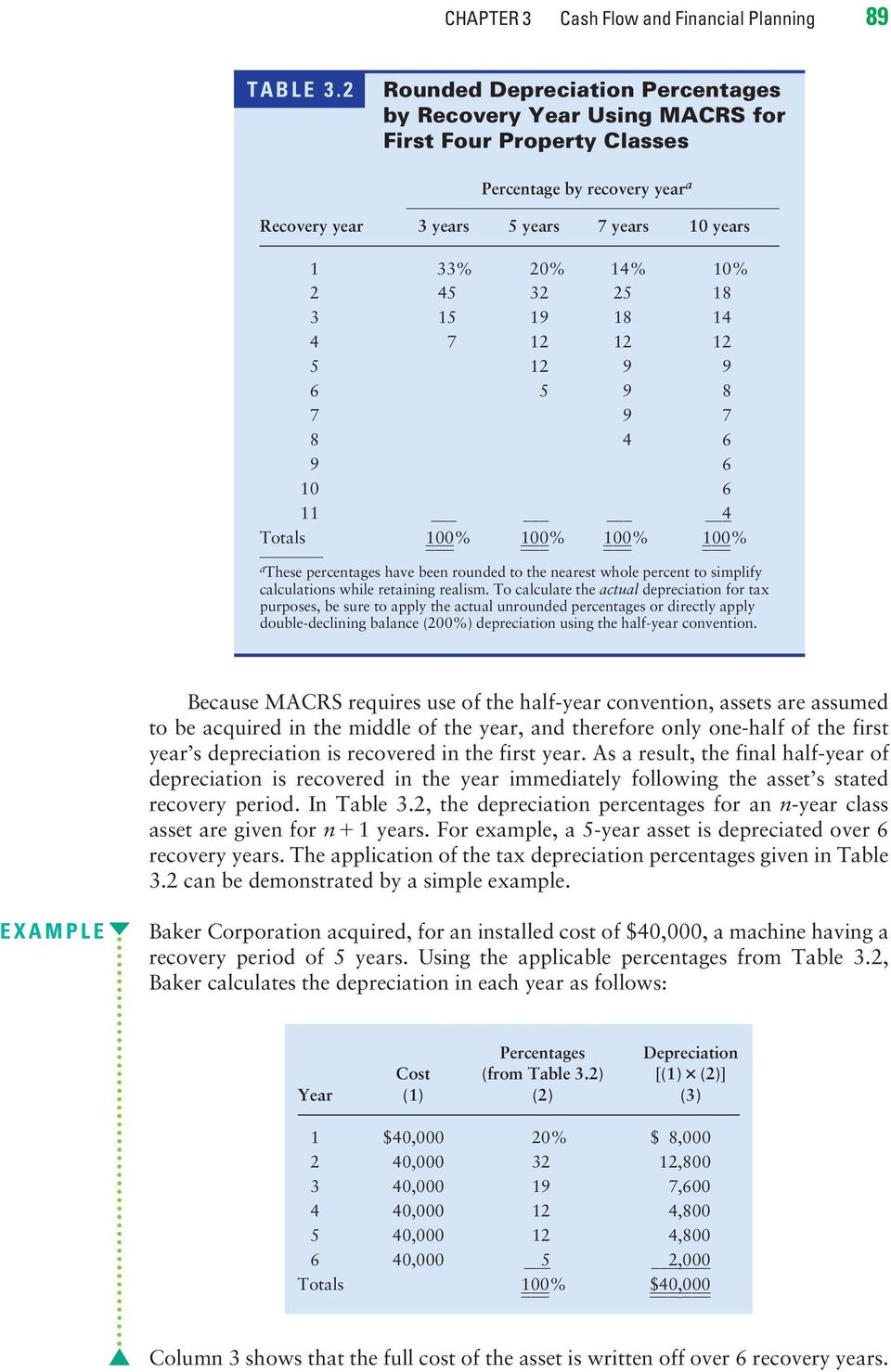
4 CHAPTER 3 Cash Flow and Financial Planning 89 TABLE 3.2 Rounded Depreciation Percentages by Recovery Year Using MACRS for First Four Property Classes Percentage by recovery year a Recovery year 3 years 5 years 7 years 10 years 1 33% 20% 14% 10% Totals 1 % 1 % 1 % 1 % a These percentages have been rounded to the nearest whole percent to simplify calculations while retaining realism. To calculate the actual depreciation for tax purposes, be sure to apply the actual unrounded percentages or directly apply double-declining balance (200%) depreciation using the half-year convention. Because MACRS requires use of the half-year convention, assets are assumed to be acquired in the middle of the year, and therefore only one-half of the first year s depreciation is recovered in the first year. As a result, the final half-year of depreciation is recovered in the year immediately following the asset s stated recovery period. In Table 3.2, the depreciation percentages for an n-year class asset are given for n 1 years. For example, a 5-year asset is depreciated over 6 recovery years. The application of the tax depreciation percentages given in Table 3.2 can be demonstrated by a simple example. EXAMPLE Baker Corporation acquired, for an installed cost of $40,000, a machine having a recovery period of 5 years. Using the applicable percentages from Table 3.2, Baker calculates the depreciation in each year as follows: Percentages Depreciation Cost (from Table 3.2) [(1) (2)] Year (1) (2) (3) 1 $40,000 20% $ 8, , , , , , , , , , , Totals 1 % $ 4, Column 3 shows that the full cost of the asset is written off over 6 recovery years.
5 90 PART 1 Introduction to Managerial Finance Because financial managers focus primarily on cash flows, only tax depreciation methods will be utilized throughout this textbook. Developing the Statement of Cash Flows The statement of cash flows, introduced in Chapter 2, summarizes the firm s cash flow over a given period of time. Before discussing the statement and its interpretation, we will review the cash flow through the firm and the classification of inflows and outflows of cash. operating flows Cash flows directly related to sale and production of the firm s products and services. investment flows Cash flows associated with purchase and sale of both fixed assets and business interests. financing flows Cash flows that result from debt and equity financing transactions; includes incurrence and repayment of debt, cash inflow from the sale of stock, and cash outflows to pay cash dividends or repurchase stock. noncash charge An expense deducted on the income statement but does not involve the actual outlay of cash during the period; includes depreciation, amortization, and depletion. The Firm s Cash Flows Figure 3.1 illustrates the firm s cash flows. Note that marketable securities are considered the same as cash because of their highly liquid nature. Both cash and marketable securities represent a reservoir of liquidity that is increased by cash inflows and decreased by cash outflows. Also note that the firm s cash flows can be divided into (1) operating flows, (2) investment flows, and (3) financing flows. The operating flows are cash inflows and outflows directly related to sale and production of the firm s products and services. Investment flows are cash flows associated with purchase and sale of both fixed assets and business interests. Clearly, purchase transactions would result in cash outflows, whereas sales transactions would generate cash inflows. The financing flows result from debt and equity financing transactions. Incurring (or repaying) either short-term or longterm debt would result in a corresponding cash inflow (or outflow). Similarly, the sale of stock would result in a cash inflow; the payment of cash dividends or repurchase of stock would result in a financing outflow. In combination, the firm s operating, investment, and financing cash flows during a given period affect the firm s cash and marketable securities balances. Classifying Inflows and Outflows of Cash The statement of cash flows in effect summarizes the inflows and outflows of cash during a given period. Table 3.3 (on page 92) classifies the basic inflows (sources) and outflows (uses) of cash. For example, if a firm s accounts payable increased by $1,000 during the year, the change would be an inflow of cash. If the firm s inventory increased by $2,500, the change would be an outflow of cash. A few additional points can be made with respect to the classification scheme in Table 3.3: 1. A decrease in an asset, such as the firm s cash balance, is an inflow of cash, because cash that has been tied up in the asset is released and can be used for some other purpose, such as repaying a loan. On the other hand, an increase in the firm s cash balance is an outflow of cash, because additional cash is being tied up in the firm s cash balance. 2. Depreciation (like amortization and depletion) is a noncash charge an expense that is deducted on the income statement but does not involve the actual outlay of cash during the period. Because it shields the firm from taxes by lowering taxable income, the noncash charge is considered a cash inflow. From a strict accounting perspective, adding depreciation back to the firm s net profits after taxes gives cash flow from operations: Cash flow from operations Net profits after taxes Depreciation and other noncash charges (3.1)

6 CHAPTER 3 Cash Flow and Financial Planning 91 FIGURE 3.1 Cash Flows The firm s cash flows (1) Operating Flows (2) Investment Flows Labor Accrued Wages Payment of Accruals Raw Materials Accounts Payable Payment of Credit Purchases Purchase Sale Fixed Assets Depreciation Work in Process Overhead Expenses Business Interests Finished Goods Purchase Sale Operating (incl. Depreciation) and Interest Expense Cash and Marketable Securities (3) Financing Flows Taxes Payment Refund Borrowing Repayment Debt (Short-Term and Long-Term) Sales Cash Sales Sale of Stock Repurchase of Stock Payment of Cash Dividends Equity Accounts Receivable Collection of Credit Sales Note that a firm can have a net loss (negative net profits after taxes) and still have positive cash flow from operations when depreciation (and other noncash charges) during the period are greater than the net loss. In the statement of cash flows, net profits after taxes (or net losses) and depreciation (and other noncash charges) are therefore treated as separate entries. 3. Because depreciation is treated as a separate cash inflow, only gross rather than net changes in fixed assets appear on the statement of cash flows. This treatment avoids the potential double counting of depreciation. 4. Direct entries of changes in retained earnings are not included on the statement of cash flows. Instead, entries for items that affect retained earnings appear as net profits or losses after taxes and dividends paid.

7 92 PART 1 Introduction to Managerial Finance TABLE 3.3 The Inflows and Outflows of Cash Inflows (sources) Decrease in any asset Increase in any liability Net profits after taxes Depreciation and other noncash charges Sale of stock Outflows (uses) Increase in any asset Decrease in any liability Net loss Dividends paid Repurchase or retirement of stock Preparing the Statement of Cash Flows The statement of cash flows for a given period is developed using the income statement for the period, along with the beginning- and end-of-period balance sheets. The income statement for the year ended December 31, 2003, and the December 31 balance sheets for 2002 and 2003 for Baker Corporation are given in Tables 3.4 and 3.5, respectively. The statement of cash flows for the year TABLE 3.4 Baker Corporation Income Statement ($000) for the Year Ended December 31, 2003 Sales revenue $1,700 Less: Cost of goods sold 1, Gross profits $ 7 Less: Operating expenses Selling expense $ 70 General and administrative expense 120 Lease expense a 40 Depreciation expense 1 Total operating expense 3 3 Earnings before interest and taxes (EBIT) $ 370 Less: Interest expense 7 Net profits before taxes $ 300 Less: Taxes (rate 40%) 1 2 Net profits after taxes $ 180 Less: Preferred stock dividends 1 Earnings available for common stockholders $ 1 7 Earnings per share (EPS) b $1.70 a Lease expense is shown here as a separate item rather than included as interest expense as specified by the FASB for financial-reporting purposes. The approach used here is consistent with tax-reporting rather than financial-reporting procedures. b Calculated by dividing the earnings available for common stockholders by the number of shares of common stock outstanding ($170, ,000 shares $1.70 per share).

8 CHAPTER 3 Cash Flow and Financial Planning 93 TABLE 3.5 Baker Corporation Balance Sheets ($000) December 31 Assets Current assets Cash $ 400 $ 300 Marketable securities Accounts receivable Inventories 6 9 Total current assets $ 2, 00 $ 1, 90 Gross fixed assets (at cost) Land and buildings $1,200 $1,050 Machinery and equipment Furniture and fixtures Vehicles Other (includes certain leases) 5 5 Total gross fixed assets (at cost) $2,500 $2,200 Less: Accumulated depreciation 1, 3 1, 2 Net fixed assets $ 1, 2 $ 1, Total assets $ 3, 2 $ 2, 9 Liabilities and Stockholders Equity Current liabilities Accounts payable $ 700 $ 500 Notes payable Accruals 1 2 Total current liabilities $1,400 $1,400 Long-term debt $ 6 $ 4 Total liabilities $ 2, 00 $ 1, 80 Stockholders equity Preferred stock $ 100 $ 100 Common stock $1.20 par, 100,000 shares outstanding in 2003 and Paid-in capital in excess of par on common stock Retained earnings 6 5 Total stockholders equity $ 1, 20 $ 1, 10 Total liabilities and stockholders equity $ 3, 2 $ 2, 9 ended December 31, 2003, for Baker Corporation is presented in Table 3.6. Note that all cash inflows as well as net profits after taxes and depreciation are treated as positive values. All cash outflows, any losses, and dividends paid are treated as negative values. The items in each category operating, investment, and financing are totaled, and the three totals are added to get the Net
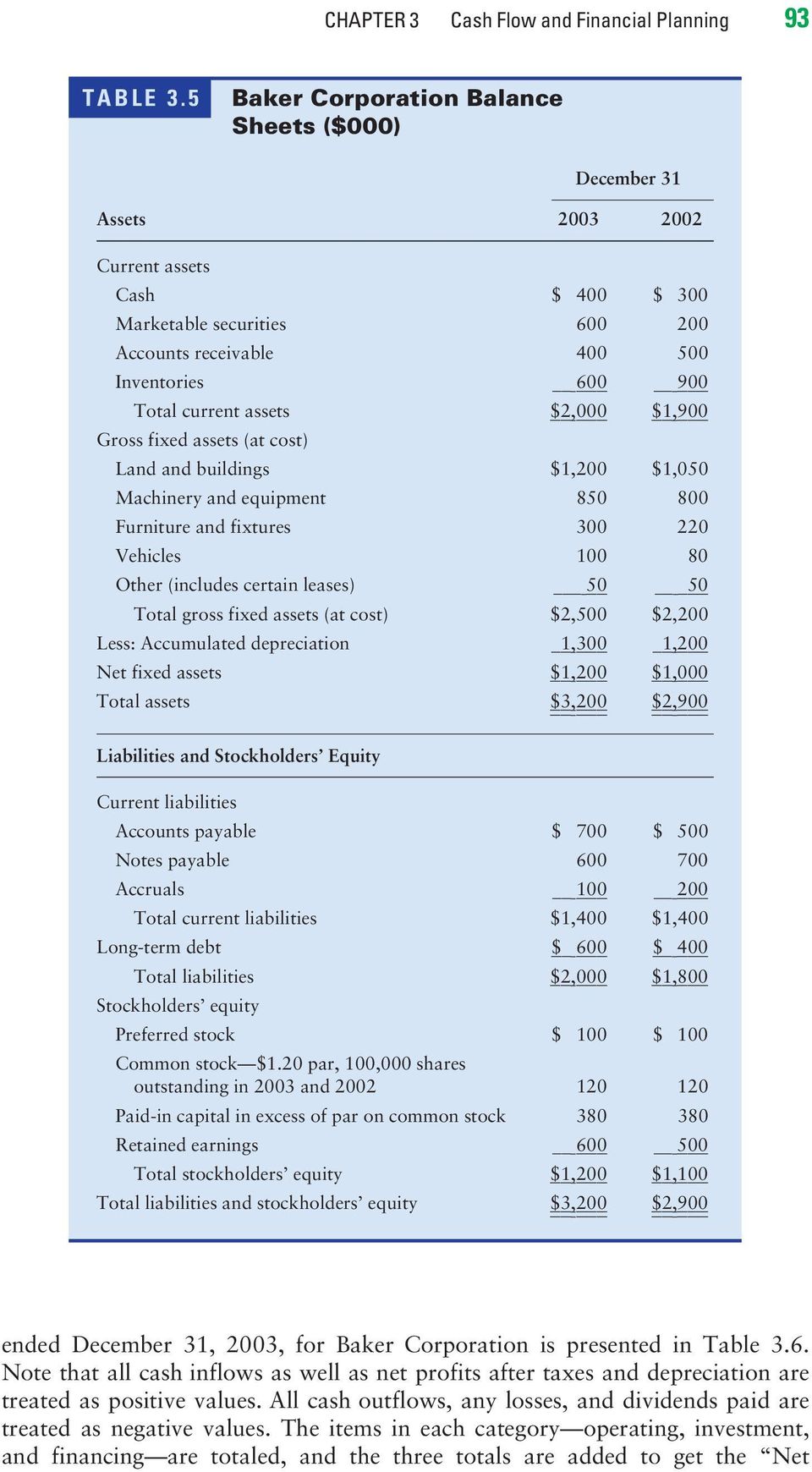
9 94 PART 1 Introduction to Managerial Finance TABLE 3.6 Baker Corporation Statement of Cash Flows ($000) for the Year Ended December 31, 2003 Cash Flow from Operating Activities Net profits after taxes $180 Depreciation 100 Decrease in accounts receivable 100 Decrease in inventories 300 Increase in accounts payable 200 Decrease in accruals ( 100) a Cash provided by operating activities $780 Cash Flow from Investment Activities Increase in gross fixed assets ($300) Changes in business interests Cash provided by investment activities ( 300) Cash Flow from Financing Activities Decrease in notes payable ($100) Increase in long-term debts 200 Changes in stockholders equity b 0 Dividends paid ( 8 ) Cash provided by financing activities 2 Net increase in cash and marketable securities $ 5 a As is customary, parentheses are used to denote a negative number, which in this case is a cash outflow. b Retained earnings are excluded here, because their change is actually reflected in the combination of the Net profits after taxes and Dividends paid entries. increase (decrease) in cash and marketable securities for the period. As a check, this value should reconcile with the actual change in cash and marketable securities for the year, which is obtained from the beginning- and endof-period balance sheets. Interpreting the Statement The statement of cash flows allows the financial manager and other interested parties to analyze the firm s cash flow. The manager should pay special attention both to the major categories of cash flow and to the individual items of cash inflow and outflow, to assess whether any developments have occurred that are contrary to the company s financial policies. In addition, the statement can be used to evaluate progress toward projected goals or to isolate inefficiencies. For example, increases in accounts receivable or inventories resulting in major cash outflows may signal credit or inventory problems, respectively. The financial manager also can prepare a statement of cash flows developed from projected financial statements. This approach can be used to determine whether planned actions are desirable in view of the resulting cash flows. An understanding of the basic financial principles presented throughout this text is absolutely essential to the effective interpretation of the statement of cash flows.

10 CHAPTER 3 Cash Flow and Financial Planning 95 operating cash flow (OCF) The cash flow a firm generates from its normal operations; calculated as EBIT taxes depreciation. EXAMPLE Operating Cash Flow A firm s operating cash flow (OCF) is the cash flow it generates from its normal operations producing and selling its output of goods or services. A variety of definitions of OCF can be found in the financial literature. We ve already been introduced to the simple accounting definition of cash flow from operations in Equation 3.1. Here we refine this definition to estimate cash flows more accurately. Unlike the earlier definition, we exclude interest and taxes in order to focus on the true cash flow resulting from operations without regard to financing costs and taxes. Operating cash flow (OCF) is defined in Equation 3.2. OCF EBIT Taxes Depreciation (3.2) Substituting the values for Baker Corporation from its income statement (Table 3.4) into Equation 3.2, we get OCF $370 $120 $100 $350 Baker Corporation during 2003 generated $350,000 of cash flow from producing and selling its output. Because Baker s operating cash flow is positive, we can conclude that the firm s operations are generating positive cash flows. Comparing Equations 3.1 and 3.2, we can see that the key difference between the accounting and finance definitions of operating cash flow is that the finance definition excludes interest as an operating flow, whereas the accounting definition in effect includes it as an operating flow. In the unlikely case that a firm had no interest expense, the accounting (Equation 3.1) and finance (Equation 3.2) definitions of operating cash flow would be the same. free cash flow (FCF) The amount of cash flow available to investors (creditors and owners) after the firm has met all operating needs and paid for investments in net fixed assets and net current assets. EXAMPLE Free Cash Flow The firm s free cash flow (FCF) represents the amount of cash flow available to investors the providers of debt (creditors) and equity (owners) after the firm has met all operating needs and paid for investments in net fixed assets and net current assets. It is called free not because it is without cost but because it is available to investors. It represents the summation of the net amount of cash flow available to creditors and owners during the period. Free cash flow can be defined by Equation 3.3. FCF OCF Net fixed asset investment (NFAI) Net current asset investment (NCAI) (3.3) The net fixed asset investment (NFAI) can be calculated as shown in Equation 3.4. NFAI Change in net fixed assets Depreciation (3.4) Using the Baker Corporation s balance sheets in Table 3.5, we see that its change in net fixed assets between 2002 and 2003 was $200 ($1,200 in 2003 $1,000 in 2002). Substituting this value and the $100 of depreciation for 2003 into Equation 3.4, we get Baker s net fixed asset investment (NFAI) for 2003: NFAI $200 $100 $300 Baker Corporation therefore invested a net $300,000 in fixed assets during This amount would, of course, represent a net cash outflow to acquire fixed assets during 2003.

11 96 PART 1 Introduction to Managerial Finance Looking at Equation 3.4, we can see that if the depreciation during a year is less than the decrease during that year in net fixed assets, the NFAI would be negative. A negative NFAI represents a net cash inflow attributable to the fact that the firm sold more assets than it acquired during the year. The final variable in the FCF equation, net current asset investment (NCAI), represents the net investment made by the firm in its current (operating) assets. Net refers to the difference between current assets and spontaneous current liabilities, which typically include accounts payable and accruals. (Because they are a negotiated source of short-term financing, notes payable are not included in the NCAI calculation. Instead, they serve as a creditor claim on the firm s free cash flow.) Equation 3.5 shows the NCAI calculation. NCAI Change in current assets Change in spontaneous current liabilities (Accounts payable Accruals) (3.5) EXAMPLE Looking at the Baker Corporation s balance sheets for 2002 and 2003 in Table 3.5, we see that the change in current assets between 2002 and 2003 is $100 ($2,000 in 2003 $1,900 in 2002). The difference between Baker s accounts payable plus accruals of $800 in 2003 ($700 in accounts payable $100 in accruals) and of $700 in 2002 ($500 in accounts payable $200 in accruals) is $100 ($800 in 2003 $700 in 2002). Substituting into Equation 3.5 the change in current assets and the change in the sum of accounts payable plus accruals for Baker Corporation, we get its 2003 NCAI: NCAI $100 $100 $0 This means that during 2003 Baker Corporation made no investment ($0) in its current assets net of spontaneous current liabilities. Now we can substitute Baker Corporation s 2003 operating cash flow (OCF) of $350, its net fixed asset investment (NFAI) of $300, and its net current asset investment (NCAI) of $0 into Equation 3.3 to find its free cash flow (FCF): FCF $350 $300 $$50 We can see that during 2003 Baker generated $50,000 of free cash flow, which it can use to pay its investors creditors (payment of interest) and owners (payment of dividends). Thus, the firm generated adequate cash flow to cover all of its operating costs and investments and had free cash flow available to pay investors. Further analysis of free cash flow is beyond the scope of this initial introduction to cash flow. Clearly, cash flow is the lifeblood of the firm. We next consider various aspects of financial planning for cash flow and profit. Review Questions 3 1 Briefly describe the first four modified accelerated cost recovery system (MACRS) property classes and recovery periods. Explain how the depreciation percentages are determined by using the MACRS recovery periods. 3 2 Describe the overall cash flow through the firm in terms of operating flows, investments flows, and financing flows.

12 CHAPTER 3 Cash Flow and Financial Planning Explain why a decrease in cash is classified as a cash inflow (source) and why an increase in cash is classified as a cash outflow (use) in preparing the statement of cash flows. 3 4 Why is depreciation (as well as amortization and depletion) considered a noncash charge? How do accountants estimate cash flow from operations? 3 5 Describe the general format of the statement of cash flows. How are cash inflows differentiated from cash outflows on this statement? 3 6 From a strict financial perspective, define and differentiate between a firm s operating cash flow (OCF) and its free cash flow (FCF). LG3 financial planning process Planning that begins with longterm, or strategic, financial plans that in turn guide the formulation of short-term, or operating, plans and budgets. The Financial Planning Process Financial planning is an important aspect of the firm s operations because it provides road maps for guiding, coordinating, and controlling the firm s actions to achieve its objectives. Two key aspects of the financial planning process are cash planning and profit planning. Cash planning involves preparation of the firm s cash budget. Profit planning involves preparation of pro forma statements. Both the cash budget and the pro forma statements are useful for internal financial planning; they also are routinely required by existing and prospective lenders. The financial planning process begins with long-term, or strategic, financial plans. These in turn guide the formulation of short-term, or operating, plans and budgets. Generally, the short-term plans and budgets implement the firm s longterm strategic objectives. Although the remainder of this chapter places primary emphasis on short-term financial plans and budgets, a few preliminary comments on long-term financial plans are in order. long-term (strategic) financial plans Lay out a company s planned financial actions and the anticipated impact of those actions over periods ranging from 2 to 10 years. short-term (operating) financial plans Specify short-term financial actions and the anticipated impact of those actions. Long-Term (Strategic) Financial Plans Long-term (strategic) financial plans lay out a company s planned financial actions and the anticipated impact of those actions over periods ranging from 2 to 10 years. Five-year strategic plans, which are revised as significant new information becomes available, are common. Generally, firms that are subject to high degrees of operating uncertainty, relatively short production cycles, or both, tend to use shorter planning horizons. Long-term financial plans are part of an integrated strategy that, along with production and marketing plans, guides the firm toward strategic goals. Those long-term plans consider proposed outlays for fixed assets, research and development activities, marketing and product development actions, capital structure, and major sources of financing. Also included would be termination of existing projects, product lines, or lines of business; repayment or retirement of outstanding debts; and any planned acquisitions. Such plans tend to be supported by a series of annual budgets and profit plans. Short-Term (Operating) Financial Plans Short-term (operating) financial plans specify short-term financial actions and the anticipated impact of those actions. These plans most often cover a 1- to 2-year period. Key inputs include the sales forecast and various forms of operating and

13 98 PART 1 Introduction to Managerial Finance FIGURE 3.2 Short-Term Financial Planning The short-term (operating) financial planning process Sales Forecast Information Needed Output for Analysis Production Plans Long-Term Financing Plan Pro Forma Income Statement Cash Budget Fixed Asset Outlay Plan Current- Period Balance Sheet Pro Forma Balance Sheet financial data. Key outputs include a number of operating budgets, the cash budget, and pro forma financial statements. The entire short-term financial planning process is outlined in Figure 3.2. Short-term financial planning begins with the sales forecast. From it, production plans are developed that take into account lead (preparation) times and include estimates of the required raw materials. Using the production plans, the firm can estimate direct labor requirements, factory overhead outlays, and operating expenses. Once these estimates have been made, the firm s pro forma income statement and cash budget can be prepared. With the basic inputs (pro forma income statement, cash budget, fixed asset outlay plan, long-term financing plan, and current-period balance sheet), the pro forma balance sheet can finally be developed. Throughout the remainder of this chapter, we will concentrate on the key outputs of the short-term financial planning process: the cash budget, the pro forma income statement, and the pro forma balance sheet. Review Questions 3 7 What is the financial planning process? Contrast long-term (strategic) financial plans and short-term (operating) financial plans.

14 CHAPTER 3 Cash Flow and Financial Planning Which three statements result as part of the short-term (operating) financial planning process? LG4 cash budget (cash forecast) A statement of the firm s planned inflows and outflows of cash that is used to estimate its short-term cash requirements. Cash Planning: Cash Budgets The cash budget, or cash forecast, is a statement of the firm s planned inflows and outflows of cash. It is used by the firm to estimate its short-term cash requirements, with particular attention to planning for surplus cash and for cash shortages. Typically, the cash budget is designed to cover a 1-year period, divided into smaller time intervals. The number and type of intervals depend on the nature of the business. The more seasonal and uncertain a firm s cash flows, the greater the number of intervals. Because many firms are confronted with a seasonal cash flow pattern, the cash budget is quite often presented on a monthly basis. Firms with stable patterns of cash flow may use quarterly or annual time intervals. sales forecast The prediction of the firm s sales over a given period, based on external and/or internal data; used as the key input to the short-term financial planning process. external forecast A sales forecast based on the relationships observed between the firm s sales and certain key external economic indicators. internal forecast A sales forecast based on a buildup, or consensus, of sales forecasts through the firm s own sales channels. The Sales Forecast The key input to the short-term financial planning process is the firm s sales forecast. This prediction of the firm s sales over a given period is ordinarily prepared by the marketing department. On the basis of the sales forecast, the financial manager estimates the monthly cash flows that will result from projected sales receipts and from outlays related to production, inventory, and sales. The manager also determines the level of fixed assets required and the amount of financing, if any, needed to support the forecast level of sales and production. In practice, obtaining good data is the most difficult aspect of forecasting. The sales forecast may be based on an analysis of external data, internal data, or a combination of the two. An external forecast is based on the relationships observed between the firm s sales and certain key external economic indicators such as the gross domestic product (GDP), new housing starts, consumer confidence, and disposable personal income. Forecasts containing these indicators are readily available. Because the firm s sales are often closely related to some aspect of overall national economic activity, a forecast of economic activity should provide insight into future sales. Internal forecasts are based on a buildup, or consensus, of sales forecasts through the firm s own sales channels. Typically, the firm s salespeople in the field are asked to estimate how many units of each type of product they expect to sell in the coming year. These forecasts are collected and totaled by the sales manager, who may adjust the figures using knowledge of specific markets or of the salesperson s forecasting ability. Finally, adjustments may be made for additional internal factors, such as production capabilities. Firms generally use a combination of external and internal forecast data to make the final sales forecast. The internal data provide insight into sales expectations, and the external data provide a means of adjusting these expectations to

15 100 PART 1 Introduction to Managerial Finance FOCUS ON PRACTICE Given the importance of cash to sound financial management, it is surprising how many companies ignore the cash-forecasting process. Three reasons come up most often: Cash forecasts are always wrong, they re hard to do, and managers don t see the benefits of these forecasts unless the company is already in a cash crunch. In addition, each company has its own methodology for cash forecasting. If the firm s cash inflows and outflows don t form a pattern that managers can graph, it s tough to develop successful forecasts. Yet the reasons to forecast cash are equally compelling: Cash forecasts provide for reliable liquidity, enable a company to minimize borrowing costs or maximize investment income, and help financial executives manage currency exposures more accurately. In times of tight credit, lenders Cash Forecasts Needed, Rain or Shine expect borrowers to monitor cash carefully and will favor a company that prepares good cash forecasts. When cash needs and the forecasted cash position don t match, financial managers can plan for borrowed funds to close the gap. New York City based men s apparel manufacturer Salant Corp. closely integrates its financial plans and forecasts. Our biggest challenge is to keep the cash forecast and the projected profit and loss in sync with the balance sheet and vice versa, says William R. Bennett, vice president and treasurer. We learned that the hard way and developed our own spreadsheet-based model. Although complicated to build, the model is easy for managers to use. Salant is a capital-intensive operation, so its liquidity is linked to its assets. Bennett uses the In Practice forecast of inventory and receivables as the forecast for borrowing capacity required to meet its operating needs. Like Salant, many companies are using technology to demystify cash forecasts. Software can apply statistical techniques, graph historical data, or build models based on each customer s payment patterns. It can also tap corporate databases for the firm s purchases and associated payment information and order shipments to customers and the associated payment terms. These data increase forecast accuracy. Sources: Adapted from Richard H. Gamble, Cash Forecast: Cloudy But Clearing, Business Finance (May 2001), downloaded from Profile: Salant Corp., Yahoo! Finance, yahoo.com, downloaded November 19, take into account general economic factors. The nature of the firm s product also often affects the mix and types of forecasting methods used. Preparing the Cash Budget The general format of the cash budget is presented in Table 3.7. We will discuss each of its components individually. cash receipts All of a firm s inflows of cash in a given financial period. EXAMPLE Cash Receipts Cash receipts include all of a firm s inflows of cash in a given financial period. The most common components of cash receipts are cash sales, collections of accounts receivable, and other cash receipts. Coulson Industries, a defense contractor, is developing a cash budget for October, November, and December. Coulson s sales in August and September were $100,000 and $200,000, respectively. Sales of $400,000, $300,000, and $200,000 have been forecast for October, November, and December, respec-

16 CHAPTER 3 Cash Flow and Financial Planning 101 TABLE 3.7 The General Format of the Cash Budget Jan. Feb.... Nov. Dec. Cash receipts $XXX $XXG $XXM $XXT Less: Cash disbursements X X A X X H... X X N X X U Net cash flow $XXB $XXI $XXO $XXV Add: Beginning cash X X C X X D XXJ X X P X X Q Ending cash $XXD $XXJ $XXQ $XXW Less: Minimum cash balance X X E X X K... X X R X X Y Required total financing $XXL $XXS Excess cash balance $XXF $XXZ tively. Historically, 20% of the firm s sales have been for cash, 50% have generated accounts receivable collected after 1 month, and the remaining 30% have generated accounts receivable collected after 2 months. Bad-debt expenses (uncollectible accounts) have been negligible. 4 In December, the firm will receive a $30,000 dividend from stock in a subsidiary. The schedule of expected cash receipts for the company is presented in Table 3.8. It contains the following items: Forecast sales This initial entry is merely informational. It is provided as an aid in calculating other sales-related items. Cash sales The cash sales shown for each month represent 20% of the total sales forecast for that month. Collections of A/R These entries represent the collection of accounts receivable (A/R) resulting from sales in earlier months. Lagged 1 month These figures represent sales made in the preceding month that generated accounts receivable collected in the current month. Because 50% of the current month s sales are collected 1 month later, the collections of A/R with a 1-month lag shown for September represent 50% of the sales in August, collections for October represent 50% of September sales, and so on. Lagged 2 months These figures represent sales made 2 months earlier that generated accounts receivable collected in the current month. Because 30% of sales are collected 2 months later, the collections with a 2-month lag shown for October represent 30% of the sales in August, and so on. Other cash receipts These are cash receipts expected from sources other than sales. Interest received, dividends received, proceeds from the sale of equipment, stock and bond sale proceeds, and lease receipts may show up 4. Normally, it would be expected that the collection percentages would total slightly less than 100%, because some of the accounts receivable would be uncollectible. In this example, the sum of the collection percentages is 100% (20% 50% 30%), which reflects the fact that all sales are assumed to be collected.

17 102 PART 1 Introduction to Managerial Finance TABLE 3.8 A Schedule of Projected Cash Receipts for Coulson Industries ($000) Aug. Sept. Oct. Nov. Dec. Forecast sales $100 $200 $400 $300 $200 Cash sales (0.20) $20 $40 $ 80 $ 60 $ 40 Collections of A/R: Lagged 1 month (0.50) Lagged 2 months (0.30) Other cash receipts 3 Total cash receipts $ 2 1 $ 3 2 $ 3 4 here. For Coulson Industries, the only other cash receipt is the $30,000 dividend due in December. Total cash receipts This figure represents the total of all the cash receipts listed for each month. For Coulson Industries, we are concerned only with October, November, and December, as shown in Table 3.8. cash disbursements All outlays of cash by the firm during a given financial period. Cash Disbursements Cash disbursements include all outlays of cash by the firm during a given financial period. The most common cash disbursements are Cash purchases Payments of accounts payable Rent (and lease) payments Wages and salaries Tax payments Fixed-asset outlays Interest payments Cash dividend payments Principal payments (loans) Repurchases or retirements of stock It is important to recognize that depreciation and other noncash charges are NOT included in the cash budget, because they merely represent a scheduled write-off of an earlier cash outflow. The impact of depreciation, as we noted earlier, is reflected in the reduced cash outflow for tax payments. EXAMPLE Coulson Industries has gathered the following data needed for the preparation of a cash disbursements schedule for October, November, and December. Purchases The firm s purchases represent 70% of sales. Of this amount, 10% is paid in cash, 70% is paid in the month immediately following the month of purchase, and the remaining 20% is paid 2 months following the month of purchase. 5 Rent payments Rent of $5,000 will be paid each month. 5. Unlike the collection percentages for sales, the total of the payment percentages should equal 100%, because it is expected that the firm will pay off all of its accounts payable.

18 CHAPTER 3 Cash Flow and Financial Planning 103 Wages and salaries Fixed salary cost for the year is $96,000, or $8,000 per month. In addition, wages are estimated as 10% of monthly sales. Tax payments Taxes of $25,000 must be paid in December. Fixed-asset outlays New machinery costing $130,000 will be purchased and paid for in November. Interest payments An interest payment of $10,000 is due in December. Cash dividend payments Principal payments (loans) Cash dividends of $20,000 will be paid in October. A $20,000 principal payment is due in December. Repurchases or retirements of stock No repurchase or retirement of stock is expected between October and December. The firm s cash disbursements schedule, using the preceding data, is shown in Table 3.9. Some items in the table are explained in greater detail below. Purchases This entry is merely informational. The figures represent 70% of the forecast sales for each month. They have been included to facilitate calculation of the cash purchases and related payments. Cash purchases The cash purchases for each month represent 10% of the month s purchases. Payments of A/P These entries represent the payment of accounts payable (A/P) resulting from purchases in earlier months. TABLE 3.9 A Schedule of Projected Cash Disbursements for Coulson Industries ($000) Aug. Sept. Oct. Nov. Dec. Purchases (0.70 sales) $70 $140 $280 $210 $140 Cash purchases (0.10) $7 $14 $ 28 $ 21 $ 14 Payments of A/P: Lagged 1 month (0.70) Lagged 2 months (0.20) Rent payments Wages and salaries Tax payments 25 Fixed-asset outlays 130 Interest payments 10 Cash dividend payments 20 Principal payments 2 Total cash disbursements $ $ $ 3 5

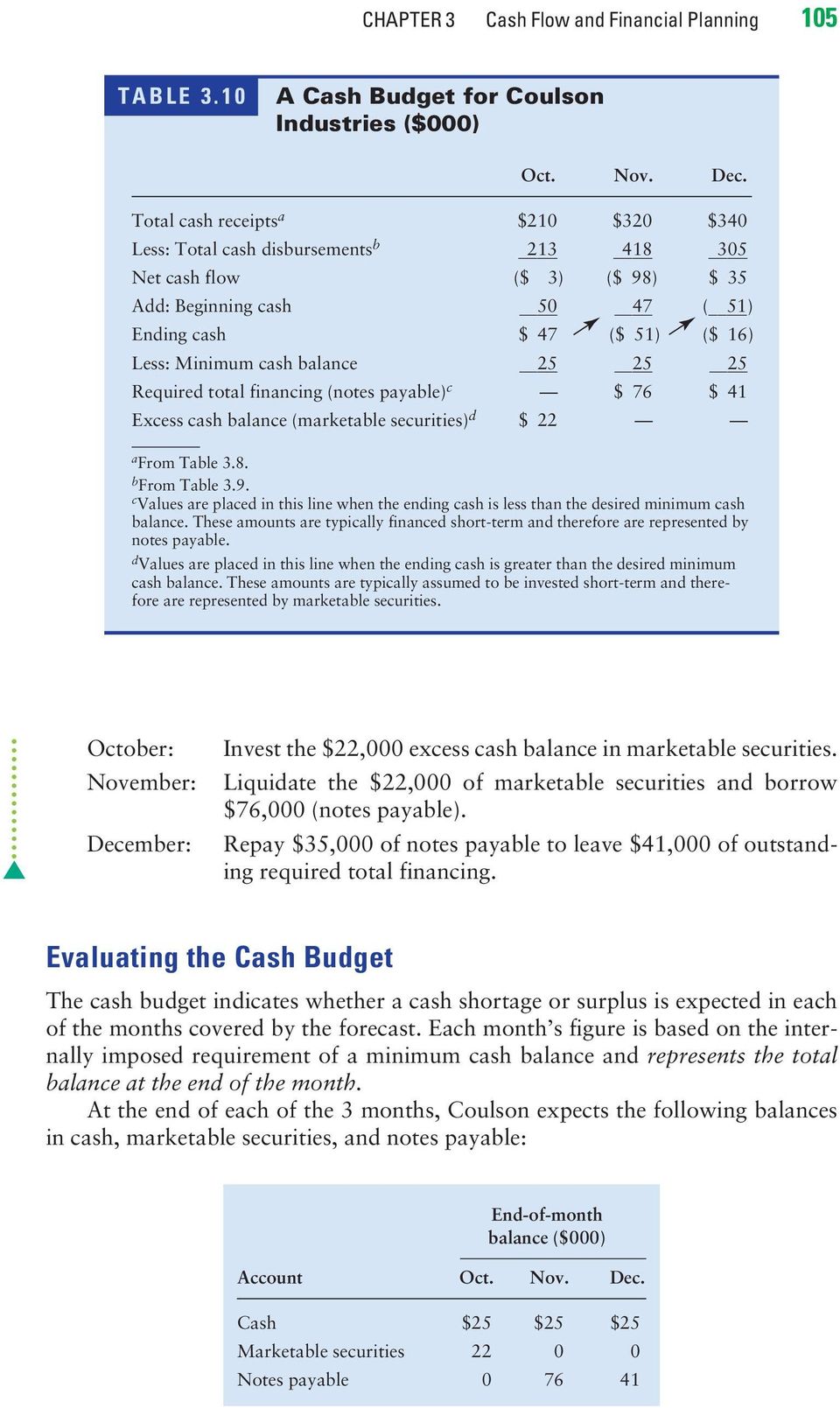
19 104 PART 1 Introduction to Managerial Finance Lagged 1 month These figures represent purchases made in the preceding month that are paid for in the current month. Because 70% of the firm s purchases are paid for 1 month later, the payments with a 1-month lag shown for September represent 70% of the August purchases, payments for October represent 70% of September purchases, and so on. net cash flow The mathematical difference between the firm s cash receipts and its cash disbursements in each period. ending cash The sum of the firm s beginning cash and its net cash flow for the period. required total financing Amount of funds needed by the firm if the ending cash for the period is less than the desired minimum cash balance; typically represented by notes payable. excess cash balance The (excess) amount available for investment by the firm if the period s ending cash is greater than the desired minimum cash balance; assumed to be invested in marketable securities. EXAMPLE Lagged 2 months These figures represent purchases made 2 months earlier that are paid for in the current month. Because 20% of the firm s purchases are paid for 2 months later, the payments with a 2-month lag for October represent 20% of the August purchases, and so on. Wages and salaries These amounts were obtained by adding $8,000 to 10% of the sales in each month. The $8,000 represents the salary component; the rest represents wages. The remaining items on the cash disbursements schedule are self-explanatory. Net Cash Flow, Ending Cash, Financing, and Excess Cash Look back at the general-format cash budget in Table 3.7. We have inputs for the first two entries, and we now continue calculating the firm s cash needs. The firm s net cash flow is found by subtracting the cash disbursements from cash receipts in each period. Then we add beginning cash to the firm s net cash flow to determine the ending cash for each period. Finally, we subtract the desired minimum cash balance from ending cash to find the required total financing or the excess cash balance. If the ending cash is less than the minimum cash balance, financing is required. Such financing is typically viewed as short-term and is therefore represented by notes payable. If the ending cash is greater than the minimum cash balance, excess cash exists. Any excess cash is assumed to be invested in a liquid, short-term, interest-paying vehicle that is, in marketable securities. Table 3.10 presents Coulson Industries cash budget, based on the data already developed. At the end of September, Coulson s cash balance was $50,000, and its notes payable and marketable securities equaled $0. The company wishes to maintain, as a reserve for unexpected needs, a minimum cash balance of $25,000. For Coulson Industries to maintain its required $25,000 ending cash balance, it will need total borrowing of $76,000 in November and $41,000 in December. In October the firm will have an excess cash balance of $22,000, which can be held in an interest-earning marketable security. The required total financing figures in the cash budget refer to how much will be owed at the end of the month; they do not represent the monthly changes in borrowing. The monthly changes in borrowing and in excess cash can be found by further analyzing the cash budget. In October the $50,000 beginning cash, which becomes $47,000 after the $3,000 net cash outflow, results in a $22,000 excess cash balance once the $25,000 minimum cash is deducted. In November the $76,000 of required total financing resulted from the $98,000 net cash outflow less the $22,000 of excess cash from October. The $41,000 of required total financing in December resulted from reducing November s $76,000 of required total financing by the $35,000 of net cash inflow during December. Summarizing, the financial activities for each month would be as follows:

20 CHAPTER 3 Cash Flow and Financial Planning 105 TABLE 3.10 A Cash Budget for Coulson Industries ($000) Oct. Nov. Dec. Total cash receipts a $210 $320 $340 Less: Total cash disbursements b Net cash flow ($ 3) ($ 98) $ 35 Add: Beginning cash ( 51) Ending cash $ 47 ($ 51) ($ 16) Less: Minimum cash balance Required total financing (notes payable) c $ 76 $ 41 Excess cash balance (marketable securities) d $22 a From Table 3.8. b From Table 3.9. c Values are placed in this line when the ending cash is less than the desired minimum cash balance. These amounts are typically financed short-term and therefore are represented by notes payable. d Values are placed in this line when the ending cash is greater than the desired minimum cash balance. These amounts are typically assumed to be invested short-term and therefore are represented by marketable securities. October: November: December: Invest the $22,000 excess cash balance in marketable securities. Liquidate the $22,000 of marketable securities and borrow $76,000 (notes payable). Repay $35,000 of notes payable to leave $41,000 of outstanding required total financing. Evaluating the Cash Budget The cash budget indicates whether a cash shortage or surplus is expected in each of the months covered by the forecast. Each month s figure is based on the internally imposed requirement of a minimum cash balance and represents the total balance at the end of the month. At the end of each of the 3 months, Coulson expects the following balances in cash, marketable securities, and notes payable: End-of-month balance ($000) Account Oct. Nov. Dec. Cash $25 $25 $25 Marketable securities Notes payable
21 106 PART 1 Introduction to Managerial Finance Note that the firm is assumed first to liquidate its marketable securities to meet deficits and then to borrow with notes payable if additional financing is needed. As a result, it will not have marketable securities and notes payable on its books at the same time. Because it may be necessary to borrow up to $76,000 for the 3-month period, the financial manager should be certain that some arrangement is made to ensure the availability of these funds. Coping with Uncertainty in the Cash Budget Aside from careful estimation of cash budget inputs, there are two ways of coping with the uncertainty of the cash budget. 6 One is to prepare several cash budgets based on pessimistic, most likely, and optimistic forecasts. From this range of cash flows, the financial manager can determine the amount of financing necessary to cover the most adverse situation. The use of several cash budgets, based on differing assumptions, also should give the financial manager a sense of the riskiness of various alternatives. This sensitivity analysis, or what if approach, is often used to analyze cash flows under a variety of circumstances. Computers and electronic spreadsheets simplify the process of performing sensitivity analysis. EXAMPLE Table 3.11 presents the summary of Coulson Industries cash budget prepared for each month of concern using pessimistic, most likely, and optimistic estimates of total cash receipts and disbursements. The most likely estimate is based on the expected outcomes presented earlier. TABLE 3.11 A Sensitivity Analysis of Coulson Industries Cash Budget ($000) October November December Pessi- Most Opti- Pessi- Most Opti- Pessi- Most Optimistic likely mistic mistic likely mistic mistic likely mistic Total cash receipts $160 $210 $285 $210 $320 $ 410 $275 $340 $422 Less: Total cash disbursements Net cash flow ($ 40) ($ 3) $ 37 ($170) ($ 98) ($ 57) ($ 5) $ 35 $102 Add: Beginning cash ( 1 6 ) ( 5 1 ) 3 Ending cash $ 10 $ 47 $ 87 ($160) ($ 51) $ 30 ($165) ($ 16) $132 Less: Minimum cash balance Required total financing $ 15 $185 $ 76 $190 $ 41 Excess cash balance $ 22 $ 62 $ 5 $ The term uncertainty is used here to refer to the variability of the cash flow outcomes that may actually occur.
22 CHAPTER 3 Cash Flow and Financial Planning 107 During October, Coulson will, at worst, need a maximum of $15,000 of financing and, at best, will have a $62,000 excess cash balance. During November, its financing requirement will be between $0 and $185,000, or it could experience an excess cash balance of $5,000. The December projections show maximum borrowing of $190,000 with a possible excess cash balance of $107,000. By considering the extreme values in the pessimistic and optimistic outcomes, Coulson Industries should be better able to plan its cash requirements. For the 3-month period, the peak borrowing requirement under the worst circumstances would be $190,000, which happens to be considerably greater than the most likely estimate of $76,000 for this period. A second and much more sophisticated way of coping with uncertainty in the cash budget is simulation (discussed in Chapter 9). By simulating the occurrence of sales and other uncertain events, the firm can develop a probability distribution of its ending cash flows for each month. The financial decision maker can then use the probability distribution to determine the amount of financing needed to protect the firm adequately against a cash shortage. Review Questions 3 9 What is the purpose of the cash budget? What role does the sales forecast play in its preparation? 3 10 Briefly describe the basic format of the cash budget How can the two bottom lines of the cash budget be used to determine the firm s short-term borrowing and investment requirements? 3 12 What is the cause of uncertainty in the cash budget, and what two techniques can be used to cope with this uncertainty? LG5 pro forma statements Projected, or forecast, income statements and balance sheets. Profit Planning: Pro Forma Statements Whereas cash planning focuses on forecasting cash flows, profit planning relies on accrual concepts to project the firm s profit and overall financial position. Shareholders, creditors, and the firm s management pay close attention to the pro forma statements, which are projected, or forecast, income statements and balance sheets. The basic steps in the short-term financial planning process were shown in the flow diagram of Figure 3.2. Various approaches for estimating the pro forma statements are based on the belief that the financial relationships reflected in the firm s past financial statements will not change in the coming period. The commonly used simplified approaches are presented in subsequent discussions. Two inputs are required for preparing pro forma statements: (1) financial statements for the preceding year and (2) the sales forecast for the coming year. A variety of assumptions must also be made. The company that we will use to illustrate the simplified approaches to pro forma preparation is Vectra Manufacturing, which manufactures and sells one product. It has two basic product models X and Y which are produced by the same process but require different amounts of raw material and labor.
23 108 PART 1 Introduction to Managerial Finance TABLE 3.12 Vectra Manufacturing s Income Statement for the Year Ended December 31, 2003 Sales revenue Model X (1,000 units at $20/unit) $20,000 Model Y (2,000 units at $40/unit) 8, Total sales $100,000 Less: Cost of goods sold Labor $28,500 Material A 8,000 Material B 5,500 Overhead 3 8, Total cost of goods sold 8, Gross profits $ 20,000 Less: Operating expenses 1, Operating profits $ 10,000 Less: Interest expense 1, Net profits before taxes $ 9,000 Less: Taxes (0.15 $9,000) 1, 3 5 Net profits after taxes $ 7,650 Less: Common stock dividends 4, To retained earnings $ 3, 6 5 Preceding Year s Financial Statements The income statement for the firm s 2003 operations is given in Table It indicates that Vectra had sales of $100,000, total cost of goods sold of $80,000, net profits before taxes of $9,000, and net profits after taxes of $7,650. The firm paid $4,000 in cash dividends, leaving $3,650 to be transferred to retained earnings. The firm s balance sheet for 2003 is given in Table TABLE 3.13 Assets Vectra Manufacturing s Balance Sheet, December 31, 2003 Liabilities and Stockholders Equity Cash $ 6,000 Accounts payable $ 7,000 Marketable securities 4,000 Taxes payable 300 Accounts receivable 13,000 Notes payable 8,300 Inventories 1 6, Other current liabilities 3, 4 Total current assets $39,000 Total current liabilities $19,000 Net fixed assets $ 5 1, Long-term debt $18,000 Total assets $ 9, Stockholders equity Common stock $30,000 Retained earnings $ 2 3, Total liabilities and stockholders equity $ 9,
24 CHAPTER 3 Cash Flow and Financial Planning 109 TABLE Sales Forecast for Vectra Manufacturing Unit sales Model X 1,500 Model Y 1,950 Dollar sales Model X ($25/unit) $ 37,500 Model Y ($50/unit) 9 7, 5 Total $ 1 3 5, Sales Forecast Just as for the cash budget, the key input for pro forma statements is the sales forecast. Vectra Manufacturing s sales forecast for the coming year, based on both external and internal data, is presented in Table The unit sale prices of the products reflect an increase from $20 to $25 for model X and from $40 to $50 for model Y. These increases are necessary to cover anticipated increases in costs. Review Question 3 13 What is the purpose of pro forma statements? What inputs are required for preparing them using the simplified approaches? LG5 percent-of-sales method A simple method for developing the pro forma income statement; it forecasts sales and then expresses the various income statement items as percentages of projected sales. Preparing the Pro Forma Income Statement A simple method for developing a pro forma income statement is the percent-ofsales method. It forecasts sales and then expresses the various income statement items as percentages of projected sales. The percentages used are likely to be the percentages of sales for those items in the previous year. By using dollar values taken from Vectra s 2003 income statement (Table 3.12), we find that these percentages are Cost of goods sold Sales Operating expenses Sales Interest expense Sales $80,000 $100,000 $10,000 $100,000 $1,000 $100, % 10.0% 1.0% Applying these percentages to the firm s forecast sales of $135,000 (developed in Table 3.14), we get the 2004 pro forma income statement shown in Table We have assumed that Vectra will pay $4,000 in common stock dividends, so the
25 110 PART 1 Introduction to Managerial Finance TABLE 3.15 A Pro Forma Income Statement, Using the Percent-of-Sales Method, for Vectra Manufacturing for the Year Ended December 31, 2004 Sales revenue $135,000 Less: Cost of goods sold (0.80) 1 8, Gross profits $ 27,000 Less: Operating expenses (0.10) 1 3, 5 Operating profits $ 13,500 Less: Interest expense (0.01) 1, 3 5 Net profits before taxes $ 12,150 Less: Taxes (0.15 $12,150) 1, Net profits after taxes $ 10,327 Less: Common stock dividends 4, To retained earnings $ 6, expected contribution to retained earnings is $6,327. This represents a considerable increase over $3,650 in the preceding year (see Table 3.12). Considering Types of Costs and Expenses The technique that is used to prepare the pro forma income statement in Table 3.15 assumes that all the firm s costs and expenses are variable. That is, we assumed that for a given percentage increase in sales, the same percentage increase in cost of goods sold, operating expenses, and interest expense would result. For example, as Vectra s sales increased by 35 percent (from $100,000 in 2003 to $135,000 projected for 2004), we assumed that its costs of goods sold also increased by 35 percent (from $80,000 in 2003 to $108,000 in 2004). On the basis of this assumption, the firm s net profits before taxes also increased by 35 percent (from $9,000 in 2003 to $12,150 projected for 2004). This approach implies that the firm will not receive the benefits that result from fixed costs when sales are increasing. 7 Clearly, though, if the firm has fixed costs, these costs do not change when sales increase; the result is increased profits. But by remaining unchanged when sales decline, these costs tend to lower profits. Therefore, the use of past cost and expense ratios generally tends to understate profits when sales are increasing. (Likewise, it tends to overstate profits when sales are decreasing.) The best way to adjust for the presence of fixed 7. The potential returns as well as risks resulting from use of fixed (operating and financial) costs to create leverage are discussed in Chapter 11. The key point to recognize here is that when the firm s revenue is increasing, fixed costs can magnify returns.
26 CHAPTER 3 Cash Flow and Financial Planning 111 costs when preparing a pro forma income statement is to break the firm s historical costs and expenses into fixed and variable components. EXAMPLE Vectra Manufacturing s 2003 actual and 2004 pro forma income statements, broken into fixed and variable cost and expense components, follow: Vectra Manufacturing Income Statements Actual Pro forma Sales revenue $100,000 $135,000 Less: Cost of good sold Fixed cost 40,000 40,000 Variable cost (0.4 sales) 4, 5 4, Gross profits $ 20,000 $ 41,000 Less: Operating expenses Fixed expense 5,000 5,000 Variable expense (0.05 sales) 5, 6, 7 5 Operating profits $ 10,000 $ 29,250 Less: Interest expense (all fixed) 1, 1, Net profits before taxes $ 9,000 $ 28,250 Less: Taxes (0.15 net profits before taxes) 1, 3 5 4, Net profits after taxes $ 7, $ 2 4, 1 2 Breaking Vectra s costs and expenses into fixed and variable components provides a more accurate projection of its pro forma profit. By assuming that all costs are variable (as shown in Table 3.15), we find that projected net profits before taxes would continue to equal 9 percent of sales (in 2003, $9,000 net profits before taxes $100,000 sales). Therefore, the 2004 net profits before taxes would have been $12,150 (0.09 $135,000 projected sales) instead of the $28,250 obtained by using the firm s fixed-cost variable-cost breakdown. Clearly, when using a simplified approach to prepare a pro forma income statement, we should break down costs and expenses into fixed and variable components. Review Questions 3 14 How is the percent-of-sales method used to prepare pro forma income statements? 3 15 Why does the presence of fixed costs cause the percent-of-sales method of pro forma income statement preparation to fail? What is a better method?
27 112 PART 1 Introduction to Managerial Finance LG5 judgmental approach A simplified approach for preparing the pro forma balance sheet under which the values of certain balance sheet accounts are estimated and the firm s external financing is used as a balancing, or plug, figure. external financing required ( plug figure) Under the judgmental approach for developing a pro forma balance sheet, the amount of external financing needed to bring the statement into balance. Preparing the Pro Forma Balance Sheet A number of simplified approaches are available for preparing the pro forma balance sheet. Probably the best and most popular is the judgmental approach, 8 under which the values of certain balance sheet accounts are estimated and the firm s external financing is used as a balancing, or plug, figure. To apply the judgmental approach to prepare Vectra Manufacturing s 2004 pro forma balance sheet, a number of assumptions must be made about levels of various balance sheet accounts: 1. A minimum cash balance of $6,000 is desired. 2. Marketable securities are assumed to remain unchanged from their current level of $4, Accounts receivable on average represent 45 days of sales. Because Vectra s annual sales are projected to be $135,000, accounts receivable should average $16,875 (1/8 $135,000). (Forty-five days expressed fractionally is oneeighth of a year: 45/36 1/8.) 4. The ending inventory should remain at a level of about $16,000, of which 25 percent (approximately $4,000) should be raw materials and the remaining 75 percent (approximately $12,000) should consist of finished goods. 5. A new machine costing $20,000 will be purchased. Total depreciation for the year is $8,000. Adding the $20,000 acquisition to the existing net fixed assets of $51,000 and subtracting the depreciation of $8,000 yield net fixed assets of $63, Purchases are expected to represent approximately 30% of annual sales, which in this case is approximately $40,500 (0.3 $135,000). The firm estimates that it can take 72 days on average to satisfy its accounts payable. Thus accounts payable should equal one-fifth (72 days 360 days) of the firm s purchases, or $8,100 (1/5 $40,500). 7. Taxes payable are expected to equal one-fourth of the current year s tax liability, which equals $455 (one-fourth of the tax liability of $1,823 shown in the pro forma income statement in Table 3.15). 8. Notes payable are assumed to remain unchanged from their current level of $8, No change in other current liabilities is expected. They remain at the level of the previous year: $3, The firm s long-term debt and its common stock are expected to remain unchanged at $18,000 and $30,000, respectively; no issues, retirements, or repurchases of bonds or stocks are planned. 11. Retained earnings will increase from the beginning level of $23,000 (from the balance sheet dated December 31, 2003, in Table 3.13) to $29,327. The increase of $6,327 represents the amount of retained earnings calculated in the year-end 2004 pro forma income statement in Table A 2004 pro forma balance sheet for Vectra Manufacturing based on these assumptions is presented in Table A plug figure called the external fi- 8. The judgmental approach represents an improved version of the often discussed percent-of-sales approach to pro forma balance sheet preparation. Because the judgmental approach requires only slightly more information and should yield better estimates than the somewhat naive percent-of-sales approach, it is presented here.
28 CHAPTER 3 Cash Flow and Financial Planning 113 TABLE 3.16 Assets A Pro Forma Balance Sheet, Using the Judgmental Approach, for Vectra Manufacturing (December 31, 2004) Liabilities and Stockholders Equity Cash $ 6,000 Accounts payable $ 8,100 Marketable securities 4,000 Taxes payable 455 Accounts receivable 16,875 Notes payable 8,300 Inventories Other current liabilities 3, 4 Raw materials $ 4,000 Total current liabilities $ 20,255 Finished goods 1 2, Long-term debt $ 18,000 Total inventory 1 6, Stockholders equity Total current assets $ 42,875 Common stock $ 30,000 Net fixed assets $ 6 3, Retained earnings $ 2 9, Total assets $ 1 5, Total $ 97,582 External financing required a $ 8, Total liabilities and stockholders equity $ 1 5, a The amount of external financing needed to force the firm s balance sheet to balance. Because of the nature of the judgmental approach, the balance sheet is not expected to balance without some type of adjustment. nancing required of $8,293 is needed to bring the statement into balance. This means that the firm will have to obtain about $8,293 of additional external financing to support the increased sales level of $135,000 for A positive value for external financing required, like that shown in Table 3.16, means that to support the forecast level of operation, the firm must raise funds externally using debt and/or equity financing or by reducing dividends. Once the form of financing is determined, the pro forma balance sheet is modified to replace external financing required with the planned increases in the debt and/or equity accounts. A negative value for external financing required indicates that the firm s forecast financing is in excess of its needs. In this case, funds are available for use in repaying debt, repurchasing stock, or increasing dividends. Once the specific actions are determined, external financing required is replaced in the pro forma balance sheet with the planned reductions in the debt and/or equity accounts. Obviously, besides being used to prepare the pro forma balance sheet, the judgmental approach is also frequently used specifically to estimate the firm s financing requirements. Review Questions 3 16 Describe the judgmental approach for simplified preparation of the pro forma balance sheet What is the significance of the plug figure, external financing required? Differentiate between strategies associated with positive and with negative values for external financing required.
29 114 PART 1 Introduction to Managerial Finance LG6 Evaluation of Pro Forma Statements It is difficult to forecast the many variables involved in preparing pro forma statements. As a result, investors, lenders, and managers frequently use the techniques presented in this chapter to make rough estimates of pro forma financial statements. However, it is important to recognize the basic weaknesses of these simplified approaches. The weaknesses lie in two assumptions: (1) that the firm s past financial condition is an accurate indicator of its future, and (2) that certain variables (such as cash, accounts receivable, and inventories) can be forced to take on certain desired values. These assumptions cannot be justified solely on the basis of their ability to simplify the calculations involved. Despite their weaknesses, the simplified approaches to pro forma statement preparation are likely to remain popular because of their relative simplicity. Eventually, the use of computers to streamline financial planning will become the norm. However pro forma statements are prepared, analysts must understand how to use them to make financial decisions. Both financial managers and lenders can use pro forma statements to analyze the firm s inflows and outflows of cash, as well as its liquidity, activity, debt, profitability, and market value. Various ratios can be calculated from the pro forma income statement and balance sheet to evaluate performance. Cash inflows and outflows can be evaluated by preparing a pro forma statement of cash flows. After analyzing the pro forma statements, the financial manager can take steps to adjust planned operations to achieve shortterm financial goals. For example, if projected profits on the pro forma income statement are too low, a variety of pricing and/or cost-cutting actions might be initiated. If the projected level of accounts receivable on the pro forma balance sheet is too high, changes in credit or collection policy may be called for. Pro forma statements are therefore of great importance in solidifying the firm s financial plans for the coming year. Review Questions 3 18 What are the two key weaknesses of the simplified approaches to preparing pro forma statements? 3 19 What is the financial manager s objective in evaluating pro forma statements? S UMMARY FOCUS ON VALUE Cash flow, the lifeblood of the firm, is a key determinant of the value of the firm. The financial manager must plan and manage create, allocate, conserve, and monitor the firm s cash flow. The goal is to ensure the firm s solvency by meeting financial obligations
30 CHAPTER 3 Cash Flow and Financial Planning 115 in a timely manner and to generate positive cash flow for the firm s owners. Both the magnitude and the risk of the cash flows generated on behalf of the owners determine the firm s value. In order to carry out the responsibility to create value for owners, the financial manager uses tools such as cash budgets and pro forma financial statements as part of the process of generating positive cash flow. Good financial plans should result in large free cash flows that fully satisfy creditor claims and produce positive cash flows on behalf of owners. Clearly, the financial manager must use deliberate and careful planning and management of the firm s cash flows in order to achieve the firm s goal of maximizing share price. REVIEW OF LEARNING GOALS Understand the effect of depreciation on the LG1 firm s cash flows, the depreciable value of an asset, its depreciable life, and tax depreciation methods. Depreciation is an important factor affecting a firm s cash flow. The depreciable value of an asset and its depreciable life are determined by using the modified accelerated cost recovery system (MACRS) standards in the federal tax code. MACRS groups assets (excluding real estate) into six property classes based on length of recovery period 3, 5, 7, 10, 15, and 20 years and can be applied over the appropriate period by using a schedule of yearly depreciation percentages for each period. Discuss the firm s statement of cash flows, LG2 operating cash flow, and free cash flow. The statement of cash flows is divided into operating, investment, and financing flows. It reconciles changes in the firm s cash flows with changes in cash and marketable securities for the period. Interpreting the statement of cash flows requires an understanding of basic financial principles and involves both the major categories of cash flow and the individual items of cash inflow and outflow. From a strict financial point of view, a firm s operating cash flows, the cash flow it generates from normal operations, is defined to exclude interest and taxes; the simpler accounting view does not make these exclusions. Of greater importance is a firm s free cash flow, which is the amount of cash flow available to investors the providers of debt (creditors) and equity (owners). LG3 Understand the financial planning process, including long-term (strategic) financial plans and short-term (operating) financial plans. The two key aspects of the financial planning process are cash planning and profit planning. Cash planning involves the cash budget or cash forecast. Profit planning relies on the pro forma income statement and balance sheet. Long-term (strategic) financial plans act as a guide for preparing short-term (operating) financial plans. Long-term plans tend to cover periods ranging from 2 to 10 years and are updated periodically. Short-term plans most often cover a 1- to 2-year period. Discuss the cash-planning process and the LG4 preparation, evaluation, and use of the cash budget. The cash planning process uses the cash budget, based on a sales forecast, to estimate shortterm cash surpluses and shortages. The cash budget is typically prepared for a 1-year period divided into months. It nets cash receipts and disbursements for each period to calculate net cash flow. Ending cash is estimated by adding beginning cash to the net cash flow. By subtracting the desired minimum cash balance from the ending cash, the financial manager can determine required total financing (typically borrowing with notes payable) or the excess cash balance (typically investing in marketable securities). To cope with uncertainty in the cash budget, sensitivity analysis or simulation can be used. Explain the simplified procedures used to prepare and evaluate the pro forma income state- LG5 ment and the pro forma balance sheet. A pro forma income statement can be developed by calculating past percentage relationships between certain cost and expense items and the firm s sales and then
31 116 PART 1 Introduction to Managerial Finance applying these percentages to forecasts. Because this approach implies that all costs and expenses are variable, it tends to understate profits when sales are increasing and to overstate profits when sales are decreasing. This problem can be avoided by breaking down costs and expenses into fixed and variable components. In this case, the fixed components remain unchanged from the most recent year, and the variable costs and expenses are forecast on a percent-of-sales basis. Under the judgmental approach, the values of certain balance sheet accounts are estimated and others are calculated, frequently on the basis of their relationship to sales. The firm s external financing is used as a balancing, or plug, figure. A positive value for external financing required means that the firm must raise funds externally or reduce dividends; a negative value indicates that funds are available for use in repaying debt, repurchasing stock, or increasing dividends. Cite the weaknesses of the simplified approaches to pro forma financial statement LG6 preparation and the common uses of pro forma statements. Simplified approaches for preparing pro forma statements, although popular, can be criticized for assuming that the firm s past financial condition is an accurate indicator of the future and that certain variables can be forced to take on certain desired values. Pro forma statements are commonly used to forecast and analyze the firm s level of profitability and overall financial performance so that adjustments can be made to planned operations in order to achieve short-term financial goals. SELF-TEST PROBLEMS (Solutions in Appendix B) LG1 LG2 ST 3 1 Depreciation and cash flow A firm expects to have earnings before interest and taxes (EBIT) of $160,000 in each of the next 6 years. It pays annual interest of $1,500. The firm is considering the purchase of an asset that costs $140,000, requires $10,000 in installation cost, and has a recovery period of 5 years. It will be the firm s only asset, and the asset s depreciation is already reflected in its EBIT estimates. a. Calculate the annual depreciation for the asset purchase using the MACRS depreciation percentages in Table 3.2 on page 89. b Calculate the annual operating cash flows for each of the 6 years, using both the accounting and the finance definitions of operating cash flow. Assume that the firm is subject to a 40% ordinary tax rate. c. Say the firm s net fixed assets, current assets, accounts payable, and accruals had the following values at the start and end of the final year (year 6). Calculate the firm s free cash flow (FCF) for that year. Year 6 Year 6 Account Start End Net fixed assets $ 7,500 $ 0 Current assets 90, ,000 Accounts payable 40,000 45,000 Accruals 8,000 7,000 d. Compare and discuss the significance of each value calculated in parts b and c.
32 CHAPTER 3 Cash Flow and Financial Planning 117 LG4 LG5 ST 3 2 Cash budget and pro forma balance sheet inputs Jane McDonald, a financial analyst for Carroll Company, has prepared the following sales and cash disbursement estimates for the period February June of the current year. Cash Month Sales disbursements February $500 $400 March April May June LG5 Ms. McDonald notes that historically, 30% of sales have been for cash. Of credit sales, 70% are collected 1 month after the sale, and the remaining 30% are collected 2 months after the sale. The firm wishes to maintain a minimum ending balance in its cash account of $25. Balances above this amount would be invested in short-term government securities (marketable securities), whereas any deficits would be financed through short-term bank borrowing (notes payable). The beginning cash balance at April 1 is $115. a. Prepare a cash budget for April, May, and June. b. How much financing, if any, at a maximum would Carroll Company require to meet its obligations during this 3-month period? c. A pro forma balance sheet dated at the end of June is to be prepared from the information presented. Give the size of each of the following: cash, notes payable, marketable securities, and accounts receivable. ST 3 3 Pro forma income statement Euro Designs, Inc., expects sales during 2004 to rise from the 2003 level of $3.5 million to $3.9 million. Because of a scheduled large loan payment, the interest expense in 2004 is expected to drop to $325,000. The firm plans to increase its cash dividend payments during 2004 to $320,000. The company s year-end 2003 income statement follows. Euro Designs, Inc. Income Statement for the Year Ended December 31, 2003 Sales revenue $3,500,000 Less: Cost of goods sold 1, 9 2 5, Gross profits $1,575,000 Less: Operating expenses 4 2, Operating profits $1,155,000 Less: Interest expense 4, Net profits before taxes $ 755,000 Less: Taxes (rate 40%) 3 2, Net profits after taxes $ 453,000 Less: Cash dividends 2 5, To retained earnings $ 2 3,
33 118 PART 1 Introduction to Managerial Finance PROBLEMS a. Use the percent-of-sales method to prepare a 2004 pro forma income statement for Euro Designs, Inc. b. Explain why the statement may underestimate the company s actual 2004 pro forma income. LG1 LG1 LG2 LG2 3 1 Depreciation On March 20, 2003, Norton Systems acquired two new assets. Asset A was research equipment costing $17,000 and having a 3-year recovery period. Asset B was duplicating equipment having an installed cost of $45,000 and a 5-year recovery period. Using the MACRS depreciation percentages in Table 3.2 on page 89, prepare a depreciation schedule for each of these assets. 3 2 Accounting cash flow A firm had earnings after taxes of $50,000 in Depreciation charges were $28,000, and a $2,000 charge for amortization of a bond discount was incurred. What was the firm s accounting cash flow from operations (see Equation 3.1) during 2003? 3 3 Depreciation and accounting cash flow A firm in the third year of depreciating its only asset, which originally cost $180,000 and has a 5-year MACRS recovery period, has gathered the following data relative to the current year s operations. Accruals $ 15,000 Current assets 120,000 Interest expense 15,000 Sales revenue 400,000 Inventory 70,000 Total costs before depreciation, interest, and taxes 290,000 Tax rate on ordinary income 40% a. Use the relevant data to determine the accounting cash flow from operations (see Equation 3.1) for the current year. b. Explain the impact that depreciation, as well as any other noncash charges, has on a firm s cash flows. LG2 3 4 Classifying inflows and outflows of cash Classify each of the following items as an inflow (I) or an outflow (O) of cash, or as neither (N). Item Change ($) Item Change ($) Cash 100 Accounts receivable 700 Accounts payable 1,000 Net profits 600 Notes payable 500 Depreciation 100 Long-term debt 2,000 Repurchase of stock 600 Inventory 200 Cash dividends 800 Fixed assets 400 Sale of stock 1,000
34 CHAPTER 3 Cash Flow and Financial Planning 119 LG2 3 5 Finding operating and free cash flows Given the balance sheets and selected data from the income statement of Keith Corporation that follow: a. Calculate the firm s accounting cash flow from operations for the year ended December 31, 2003, using Equation 3.1. b. Calculate the firm s operating cash flow (OCF) for the year ended December 31, 2003, using Equation 3.2. c. Calculate the firm s free cash flow (FCF) for the year ended December 31, 2003, using Equation 3.3. d. Interpret, compare, and contrast your cash flow estimates in parts a, b, and c. Keith Corporation Balance Sheets December 31 Assets Cash $ 1,500 $ 1,000 Marketable securities 1,800 1,200 Accounts receivable 2,000 1,800 Inventories Total current assets 2, 9 $ 8, 20 2, 8 $ 6, 80 Gross fixed assets $29,500 $28,100 Less: Accumulated depreciation Net fixed assets 1 4, 7 $ 14, , 1 $ 15, 00 Total assets $ 2 3, $ 2 1, 8 Liabilities and Stockholders Equity Accounts payable $ 1,600 $ 1,500 Notes payable 2,800 2,200 Accruals Total current liabilities 2 $ 4, 60 3 $ 4, 00 Long-term debt $ 5, 00 $ 5, 00 Common stock $10,000 $10,000 Retained earnings Total stockholders equity 3, 4 $ 13, 40 2, 8 $ 12, 80 Total liabilities and stockholders equity $ 2 3, $ 2 1, 8 Income Statement Data (2003) Depreciation expense $ 1,600 Earnings before interest and taxes (EBIT) 2,700 Taxes 933 Net profits after taxes 1,400 LG4 3 6 Cash receipts A firm has actual sales of $65,000 in April and $60,000 in May. It expects sales of $70,000 in June and $100,000 in July and in August. Assuming that sales are the only source of cash inflows and that half of them are for cash and the remainder are collected evenly over the following 2 months, what are the firm s expected cash receipts for June, July, and August?
35 120 PART 1 Introduction to Managerial Finance LG4 LG4 3 7 Cash budget Basic Grenoble Enterprises had sales of $50,000 in March and $60,000 in April. Forecast sales for May, June, and July are $70,000, $80,000, and $100,000, respectively. The firm has a cash balance of $5,000 on May 1 and wishes to maintain a minimum cash balance of $5,000. Given the following data, prepare and interpret a cash budget for the months of May, June, and July. (1) The firm makes 20% of sales for cash, 60% are collected in the next month, and the remaining 20% are collected in the second month following sale. (2) The firm receives other income of $2,000 per month. (3) The firm s actual or expected purchases, all made for cash, are $50,000, $70,000, and $80,000 for the months of May through July, respectively. (4) Rent is $3,000 per month. (5) Wages and salaries are 10% of the previous month s sales. (6) Cash dividends of $3,000 will be paid in June. (7) Payment of principal and interest of $4,000 is due in June. (8) A cash purchase of equipment costing $6,000 is scheduled in July. (9) Taxes of $6,000 are due in June. 3 8 Cash budget Advanced The actual sales and purchases for Xenocore, Inc., for September and October 2003, along with its forecast sales and purchases for the period November 2003 through April 2004, follow. Year Month Sales Purchases 2003 September $210,000 $120, October 250, , November 170, , December 160, , January 140,000 80, February 180, , March 200, , April 250,000 90,000 The firm makes 20% of all sales for cash and collects on 40% of its sales in each of the 2 months following the sale. Other cash inflows are expected to be $12,000 in September and April, $15,000 in January and March, and $27,000 in February. The firm pays cash for 10% of its purchases. It pays for 50% of its purchases in the following month and for 40% of its purchases 2 months later. Wages and salaries amount to 20% of the preceding month s sales. Rent of $20,000 per month must be paid. Interest payments of $10,000 are due in January and April. A principal payment of $30,000 is also due in April. The firm expects to pay cash dividends of $20,000 in January and April. Taxes of $80,000 are due in April. The firm also intends to make a $25,000 cash purchase of fixed assets in December. a. Assuming that the firm has a cash balance of $22,000 at the beginning of November, determine the end-of-month cash balances for each month, November through April.
36 CHAPTER 3 Cash Flow and Financial Planning 121 LG4 b. Assuming that the firm wishes to maintain a $15,000 minimum cash balance, determine the required total financing or excess cash balance for each month, November through April. c. If the firm were requesting a line of credit to cover needed financing for the period November to April, how large would this line have to be? Explain your answer. 3 9 Cash flow concepts The following represent financial transactions that Johnsfield & Co. will be undertaking in the next planning period. For each transaction, check the statement or statements that will be affected immediately. Statement Pro forma income Pro forma balance Transaction Cash budget statement sheet Cash sale Credit sale Accounts receivable are collected Asset with 5-year life is purchased Depreciation is taken Amortization of goodwill is taken Sale of common stock Retirement of outstanding bonds Fire insurance premium is paid for the next 3 years LG Multiple cash budgets Sensitivity analysis Brownstein, Inc., expects sales of $100,000 during each of the next 3 months. It will make monthly purchases of $60,000 during this time. Wages and salaries are $10,000 per month plus 5% of sales. Brownstein expects to make a tax payment of $20,000 in the next month and a $15,000 purchase of fixed assets in the second month and to receive $8,000 in cash from the sale of an asset in the third month. All sales and purchases are for cash. Beginning cash and the minimum cash balance are assumed to be zero. a. Construct a cash budget for the next 3 months. b. Brownstein is unsure of the sales levels, but all other figures are certain. If the most pessimistic sales figure is $80,000 per month and the most optimistic is $120,000 per month, what are the monthly minimum and maximum ending cash balances that the firm can expect for each of the 1-month periods? c. Briefly discuss how the financial manager can use the data in parts a and b to plan for financing needs.
37 122 PART 1 Introduction to Managerial Finance LG Pro forma income statement The marketing department of Metroline Manufacturing estimates that its sales in 2004 will be $1.5 million. Interest expense is expected to remain unchanged at $35,000, and the firm plans to pay $70,000 in cash dividends during Metroline Manufacturing s income statement for the year ended December 31, 2003, is given below, along with a breakdown of the firm s cost of goods sold and operating expenses into their fixed and variable components. Metroline Manufacturing Income Statement for the Year Ended December 31, 2003 Sales revenue $1,400,000 Less: Cost of goods sold 9 1, Gross profits $ 490,000 Less: Operating expenses 1 2, Operating profits $ 370,000 Less: Interest expense 3 5, Net profits before taxes $ 335,000 Less: Taxes (rate 40%) 1 3 4, Net profits after taxes $ 201,000 Less: Cash dividends 6 6, To retained earnings $ 1 3 5, Metroline Manufacturing Breakdown of Costs and Expenses into Fixed and Variable Components for the Year Ended December 31, 2003 Cost of goods sold Fixed cost $210,000 Variable cost 7, Total cost $ 9 1, Operating expenses Fixed expenses $ 36,000 Variable expenses Total expenses 8 4, $ 1 2, a. Use the percent-of-sales method to prepare a pro forma income statement for the year ended December 31, b. Use fixed and variable cost data to develop a pro forma income statement for the year ended December 31, c. Compare and contrast the statements developed in parts a and b. Which statement probably provides the better estimate of 2004 income? Explain why.
38 CHAPTER 3 Cash Flow and Financial Planning 123 LG Pro forma balance sheet Basic Leonard Industries wishes to prepare a pro forma balance sheet for December 31, The firm expects 2004 sales to total $3,000,000. The following information has been gathered. (1) A minimum cash balance of $50,000 is desired. (2) Marketable securities are expected to remain unchanged. (3) Accounts receivable represent 10% of sales. (4) Inventories represent 12% of sales. (5) A new machine costing $90,000 will be acquired during Total depreciation for the year will be $32,000. (6) Accounts payable represent 14% of sales. (7) Accruals, other current liabilities, long-term debt, and common stock are expected to remain unchanged. (8) The firm s net profit margin is 4%, and it expects to pay out $70,000 in cash dividends during (9) The December 31, 2003, balance sheet follows. Leonard Industries Balance Sheet December 31, 2003 Assets Liabilities and Stockholders Equity Cash $ 45,000 Accounts payable $ 395,000 Marketable securities 15,000 Accruals 60,000 Accounts receivable 255,000 Other current liabilities 3, Inventories 3 4, 0 Total current liabilities $ 485,000 Total current assets $ 655,000 Long-term debt $ 350,000 Net fixed assets $ 600, 00 Common stock $ 200,000 Total assets $ 1, 2 5 5, 0 Retained earnings Total liabilities and $ 2 2, stockholders equity $ 1, 2 5 5, a. Use the judgmental approach to prepare a pro forma balance sheet dated December 31, 2004, for Leonard Industries. b. How much, if any, additional financing will Leonard Industries require in 2004? Discuss. c. Could Leonard Industries adjust its planned 2004 dividend to avoid the situation described in part b? Explain how. LG Pro forma balance sheet Peabody & Peabody has 2003 sales of $10 million. It wishes to analyze expected performance and financing needs for years ahead. Given the following information, respond to parts a and b. (1) The percents of sales for items that vary directly with sales are as follows: Accounts receivable, 12% Inventory, 18% Accounts payable, 14% Net profit margin, 3%
39 124 PART 1 Introduction to Managerial Finance (2) Marketable securities and other current liabilities are expected to remain unchanged. (3) A minimum cash balance of $480,000 is desired. (4) A new machine costing $650,000 will be acquired in 2004, and equipment costing $850,000 will be purchased in Total depreciation in 2004 is forecast as $290,000, and in 2005 $390,000 of depreciation will be taken. (5) Accruals are expected to rise to $500,000 by the end of (6) No sale or retirement of long-term debt is expected. (7) No sale or repurchase of common stock is expected. (8) The dividend payout of 50% of net profits is expected to continue. (9) Sales are expected to be $11 million in 2004 and $12 million in (10) The December 31, 2003, balance sheet follows. Peabody & Peabody Balance Sheet December 31, 2003 ($000) Assets Liabilities and Stockholders Equity Cash $ 400 Accounts payable $1,400 Marketable securities 200 Accruals 400 Accounts receivable 1,200 Other current liabilities 8 Inventories 1, 8 0 Total current liabilities $1,880 Total current assets $3,600 Long-term debt $2,000 Net fixed assets $ 4, 00 Common equity $ 3, 72 Total assets $ 7, 6 0 Total liabilities and stockholders equity $ 7, 6 a. Prepare a pro forma balance sheet dated December 31, b. Discuss the financing changes suggested by the statement prepared in part a. LG Integrative Pro forma statements Red Queen Restaurants wishes to prepare financial plans. Use the financial statements (on page 125) and the other information provided in what follows to prepare the financial plans. The following financial data are also available: (1) The firm has estimated that its sales for 2004 will be $900,000. (2) The firm expects to pay $35,000 in cash dividends in (3) The firm wishes to maintain a minimum cash balance of $30,000. (4) Accounts receivable represent approximately 18% of annual sales. (5) The firm s ending inventory will change directly with changes in sales in 2004.
40 CHAPTER 3 Cash Flow and Financial Planning 125 (6) A new machine costing $42,000 will be purchased in Total depreciation for 2004 will be $17,000. (7) Accounts payable will change directly in response to changes in sales in (8) Taxes payable will equal one-fourth of the tax liability on the pro forma income statement. (9) Marketable securities, other current liabilities, long-term debt, and common stock will remain unchanged. Red Queen Restaurants Income Statement for the Year Ended December 31, 2003 Sales revenue $800,000 Less: Cost of goods sold 6, Gross profits $200,000 Less: Operating expenses 1, Net profits before taxes $100,000 Less: Taxes (rate 40%) 4, Net profits after taxes $ 60,000 Less: Cash dividends 2, To retained earnings $ 4, Red Queen Restaurants Balance Sheet December 31, 2003 Assets Liabilities and Stockholders Equity Cash $ 32,000 Accounts payable $100,000 Marketable securities 18,000 Taxes payable 20,000 Accounts receivable 150,000 Other current liabilities 5, Inventories 1, 0 Total current liabilities $125,000 Total current assets $300,000 Long-term debt $200,000 Net fixed assets $ 350, 00 Common stock $150,000 Total assets $ 6 5, 0 Retained earnings Total liabilities and $ 175, 00 stockholders equity $ 6 5, a. Prepare a pro forma income statement for the year ended December 31, 2004, using the percent-of-sales method. b. Prepare a pro forma balance sheet dated December 31, 2004, using the judgmental approach. c. Analyze these statements, and discuss the resulting external financing required.
41 126 PART 1 Introduction to Managerial Finance CHAPTER 3 CASE Preparing Martin Manufacturing s 2004 Pro Forma Financial Statements To improve its competitive position, Martin Manufacturing is planning to implement a major equipment modernization program. Included will be replacement and modernization of key manufacturing equipment at a cost of $400,000 in The planned program is expected to lower the variable cost per unit of finished product. Terri Spiro, an experienced budget analyst, has been charged with preparing a forecast of the firm s 2004 financial position, assuming replacement and modernization of manufacturing equipment. She plans to use the 2003 financial statements presented on pages 83 and 84, along with the key projected financial data summarized in the following table. Martin Manufacturing Company Key Projected Financial Data (2004) Data item Value Sales revenue $6,500,000 Minimum cash balance $25,000 Inventory turnover (times) 7.0 Average collection period 50 days Fixed-asset purchases $400,000 Total dividend payments (preferred and common) $20,000 Depreciation expense $185,000 Interest expense $97,000 Accounts payable increase 20% Accruals and long-term debt Unchanged Notes payable, preferred and common stock Unchanged Required a. Use the historical and projected financial data provided to prepare a pro forma income statement for the year ended December 31, (Hint: Use the percent-of-sales method to estimate all values except depreciation expense and interest expense, which have been estimated by management and included in the table.) b. Use the projected financial data along with relevant data from the pro forma income statement prepared in part a to prepare the pro forma balance sheet at December 31, (Hint: Use the judgmental approach.) c. Will Martin Manufacturing Company need to obtain external financing to fund the proposed equipment modernization program? Explain.
42 CHAPTER 3 Cash Flow and Financial Planning 127 WEB EXERCISE WWW Go to the Best Depreciation Calculator at the Fixed Asset Info. site, www. fixedassetinfo.com/defaultcalc.asp. Use this calculator to determine the straight-line, declining balance (using 200%), and MACRS depreciation schedules for the following items, using half-year averaging (the half-year convention). Item Date placed in service Cost Office furnishings 2/15/2002 $22,500 Laboratory equipment 5/27/2001 $14,375 Fleet vehicles 9/5/2000 $45,863 Make a chart comparing the depreciation amounts that these three methods yield for the years 2002 to Discuss the implications of these differences. Remember to check the book s Web site at for additional resources, including additional Web exercises.
Module 2: Preparing for Capital Venture Financing Financial Forecasting Methods TABLE OF CONTENTS
 Module 2: Preparing for Capital Venture Financing Financial Forecasting Methods Module 2: Preparing for Capital Venture Financing Financial Forecasting Methods 1.0 FINANCIAL FORECASTING METHODS 1.01 Introduction
Working Capital Management
 Working Capital Management Gitman and Hennessey, Chapter 14 Spring 2004 14.1 Net Working Capital Fundamentals In 2002, current assets accounted for 31.7% of non-financial Canadian corporations total assets.
Working Capital Management
 Working Capital Management Gitman and Hennessey, Chapter 14 Spring 2004 14.1 Net Working Capital Fundamentals In 2002, current assets accounted for 31.7% of non-financial Canadian corporations total assets.
CH 23 STATEMENT OF CASH FLOWS SELF-STUDY QUESTIONS
 C H 2 3, P a g e 1 CH 23 STATEMENT OF CASH FLOWS SELF-STUDY QUESTIONS (note from Dr. N: I have deleted questions for you to omit, but did not renumber the remaining questions) 1. The primary purpose of
Reporting and Analyzing Cash Flows QUESTIONS
 Chapter 12 Reporting and Analyzing Cash Flows QUESTIONS 1. The purpose of the cash flow statement is to report all major cash receipts (inflows) and cash payments (outflows) during a period. It helps users
In this chapter, we build on the basic knowledge of how businesses
 03-Seidman.qxd 5/15/04 11:52 AM Page 41 3 An Introduction to Business Financial Statements In this chapter, we build on the basic knowledge of how businesses are financed by looking at how firms organize
Chpater-4: Solutions to Problems
 Chpater-4: Solutions to Problems P4-1. Depreciation LG 1; Basic Year Depreciation Schedule Percentages Cost(1) from Table 4.2 (2) Depreciation [(1) (2)] (3) Asset A 1 $17,000 33% $ 5,610 2 $17,000 45 7,650
Financial Statement and Cash Flow Analysis
 Chapter 2 Financial Statement and Cash Flow Analysis Answers to Concept Review Questions 1. What role do the FASB and SEC play with regard to GAAP? The FASB is a nongovernmental, professional standards
Chapter 21 The Statement of Cash Flows Revisited
 Chapter 21 The Statement of Cash Flows Revisited AACSB assurance of learning standards in accounting and business education require documentation of outcomes assessment. Although schools, departments,
CASH FLOW STATEMENT (AND FINANCIAL STATEMENT)
 CASH FLOW STATEMENT (AND FINANCIAL STATEMENT) - At the most fundamental level, firms do two different things: (i) They generate cash (ii) They spend it. Cash is generated by selling a product, an asset
STATEMENT OF CASH FLOWS AND WORKING CAPITAL ANALYSIS
 C H A P T E R 1 0 STATEMENT OF CASH FLOWS AND WORKING CAPITAL ANALYSIS I N T R O D U C T I O N Historically, profit-oriented businesses have used the accrual basis of accounting in which the income statement,
Statement of Cash Flows
 THE CONTENT AND VALUE OF THE STATEMENT OF CASH FLOWS The cash flow statement reconciles beginning and ending cash by presenting the cash receipts and cash disbursements of an enterprise for an accounting
Understanding Financial Statements. For Your Business
 Understanding Financial Statements For Your Business Disclaimer The information provided is for informational purposes only, does not constitute legal advice or create an attorney-client relationship,
Guide to Financial Statements Study Guide
 Guide to Financial Statements Study Guide Overview (Topic 1) Three major financial statements: The Income Statement The Balance Sheet The Cash Flow Statement Objectives: Explain the underlying equation
UNDERSTANDING WHERE YOU STAND. A Simple Guide to Your Company s Financial Statements
 UNDERSTANDING WHERE YOU STAND A Simple Guide to Your Company s Financial Statements Contents INTRODUCTION One statement cannot diagnose your company s financial health. Put several statements together
Cash is King. cash flow is less likely to be affected
 Reading 27: Understanding Cash Flow Statements Relevance of Cash Flow The primary purpose of the statement of cash flows (SCF) is to provide: Info about a firm s cash receipts & cash payments during an
Chapter 6 Statement of Cash Flows
 Chapter 6 Statement of Cash Flows The Statement of Cash Flows describes the cash inflows and outflows for the firm based upon three categories of activities. Operating Activities: Generally include transactions
1. A set of procedures for controlling cash payments by preparing and approving vouchers before payments are made is known as a voucher system.
 Accounting II True/False Indicate whether the sentence or statement is true or false. 1. A set of procedures for controlling cash payments by preparing and approving vouchers before payments are made is
CHAPTER 23. Statement of Cash Flows 1, 2, 7, 8, 12 3, 4, 5, 6, 16, 17, 19 9, 20 4, 5, 9, 10, 11 10, 13, 15, 16. 7. Worksheet adjustments.
 CHAPTER 23 Statement of Cash Flows ASSIGNMENT CLASSIFICATION TABLE (BY TOPIC) Topics Questions Brief Exercises Exercises Problems Concepts for Analysis 1. Format, objectives purpose, and source of statement.
ACC 255 FINAL EXAM REVIEW PACKET (NEW MATERIAL)
 Page 1 ACC 255 FINAL EXAM REVIEW PACKET (NEW MATERIAL) Complete these sample exam problems/objective questions and check your answers with the solutions at the end of the review file and identify where
Chapter 12 Forecasting and Short- Term Financial Planning
 Chapter 12 Forecasting and Short- Term Financial Planning LEARNING OBJECTIVES 1. Understand the sources and uses of cash in building a cash budget. 2. Explain how companies use sales forecasts to predict
COMPONENTS OF THE STATEMENT OF CASH FLOWS
 ILLUSTRATION 24-1 OPERATING, INVESTING, AND FINANCING ACTIVITIES COMPONENTS OF THE STATEMENT OF CASH FLOWS CASH FLOWS FROM OPERATING ACTIVITIES + Sales and Service Revenue Received Cost of Sales Paid Selling
The Basic Framework of Budgeting
 Master Budgeting 1 The Basic Framework of Budgeting A budget is a detailed quantitative plan for acquiring and using financial and other resources over a specified forthcoming time period. 1. The act of
Statement of Cash Flow
 Management Accounting 337 Statement of Cash Flow Cash is obviously an important asset to all, both individually and in business. A shortage or lack of cash may mean an inability to purchase needed inventory
Understanding A Firm s Financial Statements
 CHAPTER OUTLINE Spotlight: J&S Construction Company (http://www.jsconstruction.com) 1 The Lemonade Kids Financial statement (accounting statements) reports of a firm s financial performance and resources,
Understanding Cash Flow Statements
 Understanding Cash Flow Statements 2014 Level I Financial Reporting and Analysis IFT Notes for the CFA exam Contents 1. Introduction... 3 2. Components and Format of the Cash Flow Statement... 3 3. The
CHAE Review. Capital Leases & Forms of Business
 CHAE Review Financial Statements, Capital Leases & Forms of Business This is a complete review of the two volume text book, Certified Hospitality Accountant Executive Study Guide, as published by The Educational
The Statement of Cash Flows
 CHAPTER The Statement of Cash Flows OBJECTIVES After careful study of this chapter, you will be able to: 1. Define operating, investing, and financing activities. 2. Know the categories of inflows and
how to prepare a cash flow statement
 business builder 4 how to prepare a cash flow statement zions business resource center zions business resource center 2 how to prepare a cash flow statement A cash flow statement is important to your business
Financial Statements
 Financial Statements The financial information forms the basis of financial planning, analysis & decision making for an organization or an individual. Financial information is needed to predict, compare
Accounting Self Study Guide for Staff of Micro Finance Institutions
 Accounting Self Study Guide for Staff of Micro Finance Institutions LESSON 2 The Balance Sheet OBJECTIVES The purpose of this lesson is to introduce the Balance Sheet and explain its components: Assets,
Financial Reporting & Analysis Chapter 17 Solutions Statement of Cash Flows Exercises
 Financial Reporting & Analysis Chapter 17 Solutions Statement of Cash Flows Exercises Exercises E17-1. Determining cash flows from operations Using the indirect method, cash flow from operations is computed
Ipx!up!hfu!uif Dsfeju!zpv!Eftfswf
 Ipx!up!hfu!uif Dsfeju!zpv!Eftfswf Credit is the lifeblood of South Louisiana business, especially for the smaller firm. It helps the small business owner get started, obtain equipment, build inventory,
How to Prepare a Cash Flow Forecast
 The Orangeville & Area Small Business Enterprise Centre (SBEC) 87 Broadway, Orangeville ON L9W 1K1 519-941-0440 Ext. 2286 or 2291 [email protected] www.orangevillebusiness.ca Supported by its Partners:
Statement of Cash Flows: Reporting and Analysis
 Statement of Cash Flows: Reporting and Analysis Statement of Cash Flows: Reporting and Analysis Copyright 2014 by DELTACPE LLC All rights reserved. No part of this course may be reproduced in any form
Preparing Agricultural Financial Statements
 Preparing Agricultural Financial Statements Thoroughly understanding your business financial performance is critical for success in today s increasingly competitive agricultural environment. Accurate records
Comprehensive Business Budgeting
 Management Accounting 137 Comprehensive Business Budgeting Goals and Objectives Profit planning, commonly called master budgeting or comprehensive business budgeting, is one of the more important techniques
Accounts Payable are the total amounts your business owes its suppliers for goods and services purchased.
 Accounts Payable are the total amounts your business owes its suppliers for goods and services purchased. Accounts Receivable are the total amounts customers owe your business for goods or services sold
Financial Statements for Manufacturing Businesses
 Management Accounting 31 Financial Statements for Manufacturing Businesses Importance of Financial Statements Accounting plays a critical role in decision-making. Accounting provides the financial framework
Preparing a Successful Financial Plan
 Topic 9 Preparing a Successful Financial Plan LEARNING OUTCOMES By the end of this topic, you should be able to: 1. Describe the overview of accounting methods; 2. Prepare the three major financial statements
FINANCIAL MANAGEMENT
 100 Arbor Drive, Suite 108 Christiansburg, VA 24073 Voice: 540-381-9333 FAX: 540-381-8319 www.becpas.com Providing Professional Business Advisory & Consulting Services Douglas L. Johnston, II [email protected]
Chapter Financial Forecasting
 Chapter Financial Forecasting PPT 4-2 Chapter 4 - Outline What is Financial Forecasting? 3 Financial Statements for Forecasting Constructing Pro Forma Statements Basis for Sales Projections Steps in a
Midterm Fall 2012 Solution
 Midterm Fall 2012 Solution Instructions: 1) Answers for the multiple-choice questions must be recorded on the UW answer card. All other questions must be answered in the space provided on the examination
CASH FLOW STATEMENT. MODULE - 6A Analysis of Financial Statements. Cash Flow Statement. Notes
 MODULE - 6A Cash Flow Statement 30 CASH FLOW STATEMENT In the previous lesson, you have learnt various types of analysis of financial statements and its tools such as comparative statements, common size
Analyzing the Statement of Cash Flows
 Analyzing the Statement of Cash Flows Operating Activities NACM Upstate New York Credit Conference 2015 By Ron Sereika, CCE,CEW NACM 1 Objectives of this Educational Session u Show how the statement of
9. Short-Term Liquidity Analysis. Operating Cash Conversion Cycle
 9. Short-Term Liquidity Analysis. Operating Cash Conversion Cycle 9.1 Current Assets and 9.1.1 Cash A firm should maintain as little cash as possible, because cash is a nonproductive asset. It earns no
6. Financial Planning. Break-even. Operating and Financial Leverage.
 6. Financial Planning. Break-even. Operating and Financial Leverage. Financial planning primarily involves anticipating the impact of operating, investment and financial decisions on the firm s future
ACCOUNTING COMPETENCY EXAM SAMPLE EXAM. 2. The financial statement or statements that pertain to a stated period of time is (are) the:
 ACCOUNTING COMPETENCY EXAM SAMPLE EXAM 1. The accounting process does not include: a. interpreting d. observing b. reporting e. classifying c. purchasing 2. The financial statement or statements that pertain
> DO IT! Chapter 13. Classification of Cash Flows. Cash from Operating Activities D-1. Solution. Action Plan
 Chapter 13 > DO IT! Classification of Cash Flows Identify the three types of activities used to report all cash inflows and outflows. Report as operating activities the cash effects of transactions that
Cash Flow Statement. Introduction. Introd. Contd. Chapter 4
 Cash Flow Statement Chapter 4 Introduction Management and other interested external parties have always recognized the need for a cash flow statement but it was never required until the FASB (Financial
Construction Economics & Finance. Module 6. Lecture-1
 Construction Economics & Finance Module 6 Lecture-1 Financial management: Financial management involves planning, allocation and control of financial resources of a company. Financial management is essential
CASH FLOW STATEMENT. On the statement, cash flows are segregated based on source:
 CASH FLOW STATEMENT On the statement, cash flows are segregated based on source: Operating activities: involve the cash effects of transactions that enter into the determination of net income. Investing
GVEP Workshop Finance 101
 GVEP Workshop Finance 101 Nairobi, January 2013 Agenda Introducing business finance Understanding financial statements Understanding cash flow LUNCH Reading and interpreting financial statements Evaluating
RAPID REVIEW Chapter Content
 RAPID REVIEW BASIC ACCOUNTING EQUATION (Chapter 2) INVENTORY (Chapters 5 and 6) Basic Equation Assets Owner s Equity Expanded Owner s Owner s Assets Equation = Liabilities Capital Drawing Revenues Debit
Management Accounting and Decision-Making
 Management Accounting 15 Management Accounting and Decision-Making Management accounting writers tend to present management accounting as a loosely connected set of decision making tools. Although the
LEBANESE ASSOCIATION OF CERTIFIED PUBLIC ACCOUNTANTS MANAGERIAL ACCOUNTING
 LEBANESE ASSOCIATION OF CERTIFIED PUBLIC ACCOUNTANTS MANAGERIAL ACCOUNTING JULY 2015 MULTIPLE CHOICE QUESTIONS (37.5%) Choose the correct answer 1. All of the following statements concerning standard costs
Chapter 2 Financial Statement and Cash Flow Analysis
 Chapter 2 Financial Statement and Cash Flow Analysis MULTIPLE CHOICE 1. Which of the following items can be found on an income statement? a. Accounts receivable b. Long-term debt c. Sales d. Inventory
Planning your cash flow
 Planning your cash flow Business Coach series Preparing the cash flow forecast Keeping on track Business Coach series The cash flow process The situation Money goes out earlier and faster than it comes
Learning Objectives: Quick answer key: Question # Multiple Choice True/False. 14.1 Describe the important of accounting and financial information.
 0 Learning Objectives: 14.1 Describe the important of accounting and financial information. 14.2 Differentiate between managerial and financial accounting. 14.3 Identify the six steps of the accounting
THE STATEMENT OF CASH FLOWS
 THE STATEMENT OF CASH FLOWS Associate Professor PhD Cernusca Lucian University Aurel Vlaicu of Arad, [email protected] Professor PhD Mates Dorel, West University of Timisoara Abstract: In today
A Simple Model. Introduction to Financial Statements
 Introduction to Financial Statements NOTES TO ACCOMPANY VIDEOS These notes are intended to supplement the videos on ASimpleModel.com. They are not to be used as stand alone study aids, and are not written
This is How Are Operating Budgets Created?, chapter 9 from the book Accounting for Managers (index.html) (v. 1.0).
 This is How Are Operating Budgets Created?, chapter 9 from the book Accounting for Managers (index.html) (v. 1.0). This book is licensed under a Creative Commons by-nc-sa 3.0 (http://creativecommons.org/licenses/by-nc-sa/
Sri Lanka Accounting Standard-LKAS 7. Statement of Cash Flows
 Sri Lanka Accounting Standard-LKAS 7 Statement of Cash Flows CONTENTS SRI LANKA ACCOUNTING STANDARD-LKAS 7 STATEMENT OF CASH FLOWS paragraphs OBJECTIVE SCOPE 1 3 BENEFITS OF CASH FLOW INFORMATION 4 5 DEFINITIONS
Quiz Questions for Chapter 9
 Quiz Questions for Chapter 9 1. A truck was purchased for $25,000. It has a six-year life and a $4,000 salvage value. Using straight-line depreciation, what is the asset s carrying value (book value) after
SOLUTIONS. Learning Goal 30
 S1 Learning Goal 30 Multiple Choice 1. c A corporation wants to reissue treasury stock at a higher price than it paid. In this way, a greater amount of capital can be obtained than was returned to the
2-8. Identify whether each of the following items increases or decreases cash flow:
 Problems 2-8. Identify whether each of the following items increases or decreases cash flow: Increase in accounts receivable Increase in notes payable Depreciation expense Increase in investments Decrease
ACCOUNTING 105 CONCEPTS REVIEW
 ACCOUNTING 105 CONCEPTS REVIEW A note from the tutors: This handout is designed to help you review important information as you study for your cumulative final exam. While it does cover many important
Chapter 002 Financial Statements, Taxes and Cash Flow
 Multiple Choice Questions 1. The financial statement summarizing the value of a firm's equity on a particular date is the: a. income statement. B. balance sheet. c. statement of cash flows. d. cash flow
CHAPTER 2 FINANCIAL STATEMENTS AND CASH FLOW
 CHAPTER 2 FINANCIAL STATEMENTS AND CASH FLOW Solutions to Questions and Problems NOTE: All end-of-chapter problems were solved using a spreadsheet. Many problems require multiple steps. Due to space and
INTERNATIONAL ACCOUNTING STANDARDS. CIE Guidance for teachers of. 7110 Principles of Accounts and. 0452 Accounting
 www.xtremepapers.com INTERNATIONAL ACCOUNTING STANDARDS CIE Guidance for teachers of 7110 Principles of Accounts and 0452 Accounting 1 CONTENTS Introduction...3 Use of this document... 3 Users of financial
10-1. Auditing Business Process. Objectives Understand the Auditing of the Enteties Business. Process
 10-1 Auditing Business Process Auditing Business Process Objectives Understand the Auditing of the Enteties Business Process Identify the types of transactions in different Business Process Asses Control
CHAPTER 4. FINANCIAL STATEMENTS
 CHAPTER 4. FINANCIAL STATEMENTS Accounting standards require statements that show the financial position, earnings, cash flows, and investment (distribution) by (to) owners. These measurements are reported,
Indian Accounting Standard (Ind AS) 7 Statement of Cash Flows
 Contents Indian Accounting Standard (Ind AS) 7 Statement of Cash Flows Paragraphs OBJECTIVE SCOPE 1 3 BENEFITS OF CASH FLOW INFORMATION 4 5 DEFINITIONS 6 9 Cash and cash equivalents 7 9 PRESENTATION OF
CHAPTER 2 ACCOUNTING STATEMENTS, TAXES, AND CASH FLOW
 CHAPTER 2 ACCOUNTING STATEMENTS, TAXES, AND CASH FLOW Answers to Concepts Review and Critical Thinking Questions 1. True. Every asset can be converted to cash at some price. However, when we are referring
EXERCISES. The cash from operating activities detail is provided as follows for class discussion:
 EXERCISES Ex. 14 1 There were net additions, such as depreciation and amortization of intangible assets of $389 million, to the net loss reported on the income statement to convert the net loss from the
Financial Statements Tutorial
 Financial Statement Review: Financial Statements Tutorial There are four major financial statements used to communicate information to external users (creditors, investors, suppliers, etc.) - 1. Balance
INSTRUCTIONS FOR COMPLETING INSURANCE COMPANY FINANCIAL STATEMENTS
 INSTRUCTIONS FOR COMPLETING INSURANCE COMPANY "DRAFT VERSION FOR FIRST REVIEW ONLY" Submitted to: Minstry of Finance and Economy Head of Insurance Department Republic of Armenia Submitted by: BearingPoint
2012 Southwest IDEAS Investor Conference
 2012 Southwest IDEAS Investor Conference November 14, 2012 This presentation contains statements which constitute forward-looking statements, within the meaning of the Private Securities Litigation Reform
Managing The Firm s Assets
 CHAPTER OUTLINE Spotlight: The United Companies (http://www.uniteddc.com) 1 The Working-Capital Cycle Describe the working-capital cycle of a small business. Working-capital management Define working capital
Chapter-3 Solutions to Problems
 Chapter-3 Solutions to Problems P3-1. P3-2. Reviewing basic financial statements LG 1; Basic Income statement: In this one-year summary of the firm s operations, Technica, Inc. showed a net profit for
The BASICS of FINANCIAL STATEMENTS For Agricultural Producers
 The BASICS of FINANCIAL STATEMENTS For Agricultural Producers Authors: James McGrann Francisco Abelló Doug Richardson Christy Waggoner Department of Agricultural Economics Texas Cooperative Extension Texas
This week its Accounting and Beyond
 This week its Accounting and Beyond Monday Morning Session Introduction/Accounting Cycle Afternoon Session Tuesday The Balance Sheet Wednesday The Income Statement The Cash Flow Statement Thursday Tools
Statement of Cash Flows. Study Objectives
 Statement of Cash Flows Study Objectives Indicate the primary purpose of the statement of cash flows. Distinguish among operating, investing, and financing activities. Explain the impact of the product
7 Management of Working Capital
 7 Management of Working Capital BASIC CONCEPTS AND FORMULAE 1. Working Capital Management Working Capital Management involves managing the balance between firm s shortterm assets and its short-term liabilities.
Accounting Norms and Principles January 7, 2003
 1 Accounting Norms and Principles January 7, 2003 The purpose of an accounting system is to provide credit union management with complete and accurate financial information that can be used to operate
Chapters 3 and 13 Financial Statement and Cash Flow Analysis
 Chapters 3 and 13 Financial Statement and Cash Flow Analysis Balance Sheet Assets Cash Inventory Accounts Receivable Property Plant Equipment Total Assets Liabilities and Shareholder s Equity Accounts
Chapter- 3B Statement of Changes in Financial Position and Working Capital (Fund
 Chapter- 3B Statement of Changes in Financial Position and Working Capital (Fund BSNL, India For Internal Circulation Only 1 Statement of Changes in Financial Position and Working Capital (Fund) I. Statement
NEPAL ACCOUNTING STANDARDS ON CASH FLOW STATEMENTS
 NAS 03 NEPAL ACCOUNTING STANDARDS ON CASH FLOW STATEMENTS CONTENTS Paragraphs OBJECTIVE SCOPE 1-3 BENEFITS OF CASH FLOWS INFORMATION 4-5 DEFINITIONS 6-9 Cash and cash equivalents 7-9 PRESENTATION OF A
Statement of Cash Flows
 PREPARING THE STATEMENT OF CASH FLOWS: THE INDIRECT METHOD OF REPORTING CASH FLOWS FROM OPERATING ACTIVITIES The work sheet method described in the text book is not the recommended approach. We will provide
Dealing With Your Banker &
 Dealing With Your Banker & Other Lenders Your financing The success or failure of your business will depend on whether or not you have enough capital to: buy the equipment and inventory you need; pay overhead
CHAPTER 2 REVIEW OF THE ACCOUNTING PROCESS. Lecture Outline
 CHAPTER 2 REVIEW OF THE ACCOUNTING PROCESS Overview Chapter 1 explained that the primary means of conveying financial information to investors, creditors, and other external users is through financial
Chapter 14. 1 Copyright 2012 Pearson Education, Inc. Publishing as Prentice Hall.
 Chapter 14 1 Identify the purposes of the statement of cash flows Distinguish among operating, investing, and financing cash flows Prepare the statement of cash flows by the indirect method Identify noncash
Plan and Track Your Finances
 Plan and Track Your Finances 9.1 Financing Your Business 9.2 Pro Forma Financial Statements 9.3 Recordkeeping for Businesses Lesson 9.1 Financing Your Business Goals Estimate your startup costs and personal
Statement of Cash Flows
 HOSP 2110 (Management Acct) Learning Centre Statement of Cash Flows The Statement of Cash Flows (or cash flow statement) is one of the main financial statements used by investors. It shows the cash generated
CHAPTER 9. Ratio Analysis
 CHAPTER 9 Ratio Analysis Introduction The analysis of the financial statements and interpretations of financial results of a particular period of operations with the help of 'ratio' is termed as "ratio