
PART 70 PERMIT TO OPERATE
|
|
|
- Angelina McKinney
- 9 years ago
- Views:
Transcription
1 G Missouri Department of Natural Resources ~ ~ ~ Air Pollution Control Program PART 70 PERMIT TO OPERATE Under the authority of RSMo 643 and the Federal Clean Air Act the applicant is authorized to operate the air contaminant source(s) described below, in accordance with the laws, rules, and cond~tions set forth here in. Operating Permit Number: Expiration Date: Installation ID: Project Number: OP A July 27, Installation Name and Address Hallmark Cards, Inc. P.O. Box Kansas City, MO Jackson County Parent Company's Name and Address Hallmark Cards, Inc. P.O. Box Kansas City, MO Installation Description: Hallmark Cards, Inc. headquarters operations are located in Kansas City, Missouri. Emission sources include electroplating operations, printing operations, boilers, emergency generators and a gasoline storage tank. The facility is a potential major source ofhazardous air pollutants and sulfur oxides. MAY Effective Date r or Designee #nsllrhnent ofnatural Resource

2 Hallmark Cards, Inc. Part 70 Operating Permit 2 Table of Contents I. INSTALLATION DESCRIPTION AND EQUIPMENT LISTING...5 INSTALLATION DESCRIPTION...5 EMISSION UNITS WITH LIMITATIONS...5 EMISSION UNITS WITHOUT LIMITATIONS...6 DOCUMENTS INCORPORATED BY REFERENCE...7 II. PLANT WIDE EMISSION LIMITATIONS...8 PERMIT CONDITION PW CSR Construction Permits Required... 8 Construction Permit Kansas City Air Quality Program #869, Issued March 15, III. EMISSION UNIT SPECIFIC EMISSION LIMITATIONS...10 EU0130, EU0140, AND EU0150 BUILDING A BOILERS...10 PERMIT CONDITION EU , EU , and EU CSR Maximum Allowable Emissions of Particulate Matter From Fuel Burning Equipment Used for Indirect Heating KCMO Chapter 8 Section 5(b) Emission of Particulate Matter (Fuel Burning Equipment Used For Indirect Heating) PERMIT CONDITION EU , EU , and EU CSR Restriction of Emission of Sulfur Compounds KCMO Chapter 8 Section 6(a) Restriction of Emission of Sulfur Compounds (Indirect Heating Sources) PERMIT CONDITION EU , EU , and EU CSR Restriction of Emission of Visible Air Contaminants KCMO Chapter 8 Section 5(d) Emission of Particulate Matter (Visible Air Contaminants) EU0160, EU0170, EU0180 AND EU0190 BUILDING B BOILERS...12 PERMIT CONDITION EU , EU , EU0180, and EU CSR Maximum Allowable Emissions of Particulate Matter From Fuel Burning Equipment Used for Indirect Heating KCMO Chapter 8 Section 5(b) Emission of Particulate Matter (Fuel Burning Equipment Used For Indirect Heating) PERMIT CONDITION EU , EU , EU0180, and EU CSR Restriction of Emission of Sulfur Compounds KCMO Chapter 8 Section 6(a) Restriction of Emission of Sulfur Compounds (Indirect Heating Sources) PERMIT CONDITION EU , EU , EU0180, and EU CSR Restriction of Emission of Visible Air Contaminants KCMO Chapter 8 Section 5(d) Emission of Particulate Matter (Visible Air Contaminants) EU0200 AND EU0210 BUILDING D BOILERS...15 PERMIT CONDITION EU and EU CSR Maximum Allowable Emissions of Particulate Matter From Fuel Burning Equipment Used for Indirect Heating KCMO Chapter 8 Section 5(b) Emission of Particulate Matter (Fuel Burning Equipment Used For Indirect Heating) PERMIT CONDITION EU and EU CSR Restriction of Emission of Sulfur Compounds KCMO Chapter 8 Section 6(a) Restriction of Emission of Sulfur Compounds (Indirect Heating Sources) PERMIT CONDITION EU and EU CSR Restriction of Emission of Visible Air Contaminants KCMO Chapter 8 Section 5(d) Emission of Particulate Matter (Visible Air Contaminants) EU0220 LITHOGRAPHIC PRINTING...17 PERMIT CONDITION EU CSR Control of Emissions From Lithographic Printing Installations KCMO Chapter 8 Section 8(k) Emission Of Volatile Organic Compounds (Control Of Emissions From Lithographic Printing Facilities) EU0330 CHROME PLATING OPERATIONS...18 PERMIT CONDITION EU CSR Maximum Achievable Control Technology Regulations... 18
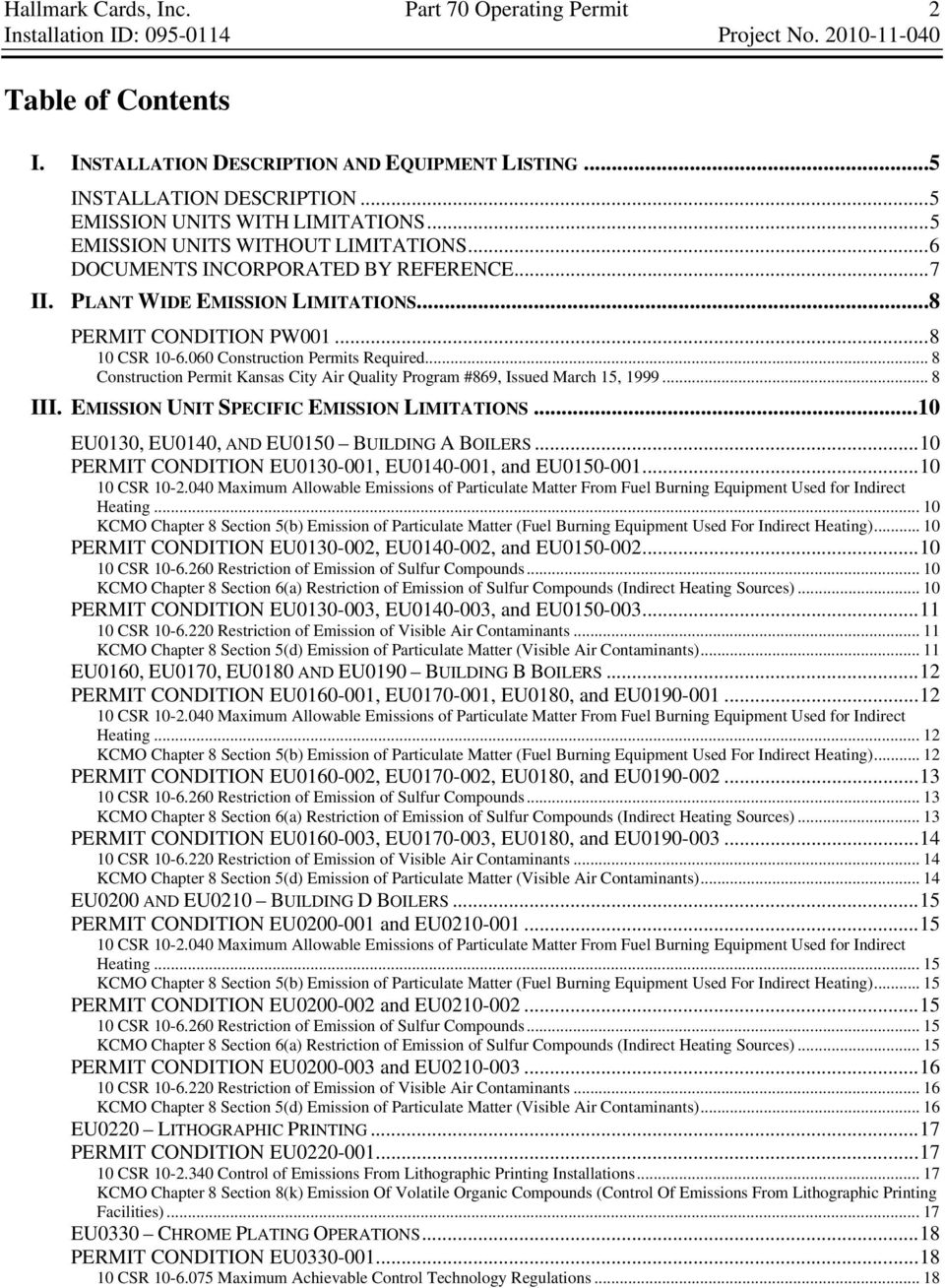
3 Hallmark Cards, Inc. Part 70 Operating Permit 3 40 CFR 63 Subpart N National Emission Standards for Chromium Emissions from Hard and Decorative Chromium Electroplating and Chromium Anodizing Tanks EU0340 GASOLINE STORAGE TANK...22 PERMIT CONDITION EU CSR Control of Gasoline Reid Vapor Pressure PERMIT CONDITION EU CSR Control of Petroleum Liquid Storage, Loading and Transfer KCMO Chapter 8 Section 8(d)(3) Restriction of emission of VOC from petroleum liquid transfer operations EU0360, EU0370, EU0380, EU0400 AND EU0410 EMERGENCY GENERATORS...25 PERMIT CONDITION EU , EU , EU , EU and EU CSR Restriction of Emission of Sulfur Compounds KCMO Chapter 8 Section 6(b) Restriction of Emission of Sulfur Compounds (Industrial Processes) PERMIT CONDITION EU , EU , EU , EU and EU CSR Restriction of Emission of Visible Air Contaminants KCMO Chapter 8 Section 5(d) Emission of Particulate Matter (Visible Air Contaminants) PERMIT CONDITION EU , EU , EU , EU and EU CSR Construction Permits Required Construction Permit KC AQP #985, Issued May 21, Construction Permit KC AQP #1152, Issued April 26, PERMIT CONDITION EU , EU , EU , EU and EU CSR Maximum Achievable Control Technology Regulations CFR Part 63, Subpart ZZZZ National Emission Standard for Hazardous Air Pollutants for Stationary Reciprocating Internal Combustion Engines EU0420 LARGE FORMAT INK JET PRINTERS...30 PERMIT CONDITION EU CSR Construction Permits Required Construction Permit Kansas City Air Quality Program #1194, Issued May 28, 2008, and modified September 21, EU0440 MISCELLANEOUS INDIRECT HEATING SOURCES...31 PERMIT CONDITION EU CSR Maximum Allowable Emissions of Particulate Matter From Fuel Burning Equipment Used for Indirect Heating KCMO Chapter 8 Section 5(b) Emission of Particulate Matter (Fuel Burning Equipment Used For Indirect Heating) EU0450 STEEL RULE WOOD CUTTING LASER...32 PERMIT CONDITION EU CSR Control of Emission of Particulate Matter From Industrial Processes KCMO Chapter 8 Section 5(a) Emission of Particulate Matter (Industrial Processes) EU0460 MODEL SHOP SPRAY BOOTH...32 PERMIT CONDITION EU CSR Control of Emission of Particulate Matter From Industrial Processes KCMO Chapter 8 Section 5(a) Emission of Particulate Matter (Industrial Processes) IV. CORE PERMIT REQUIREMENTS...34 V. GENERAL PERMIT REQUIREMENTS...43 VI. ATTACHMENTS...49 ATTACHMENT A...50 Fugitive Emissions Observation Log ATTACHMENT B...51 Record of Visible Observations Performed ATTACHMENT C...52 Opacity Emission Observations (Method 9) ATTACHMENT D...53 Maintenance and Repair Log ATTACHMENT E...54 Plantwide VOC Emissions Log ATTACHMENT F...55
4 Hallmark Cards, Inc. Part 70 Operating Permit 4 Emergency Generator Log of Hours of Operation and Fuel Usage ATTACHMENT G...56 Large Format Printers List and VOC Emissions Log ATTACHMENT H...57 Emission of Particulate Matter from Fuel Burning Equipment Used for Indirect Heating Installation-Wide Compliance Documentation ATTACHMENT I...59 Emission of Sulfur Dioxide Installation-Wide Compliance Documentation Facility is a major source of HAP... 5

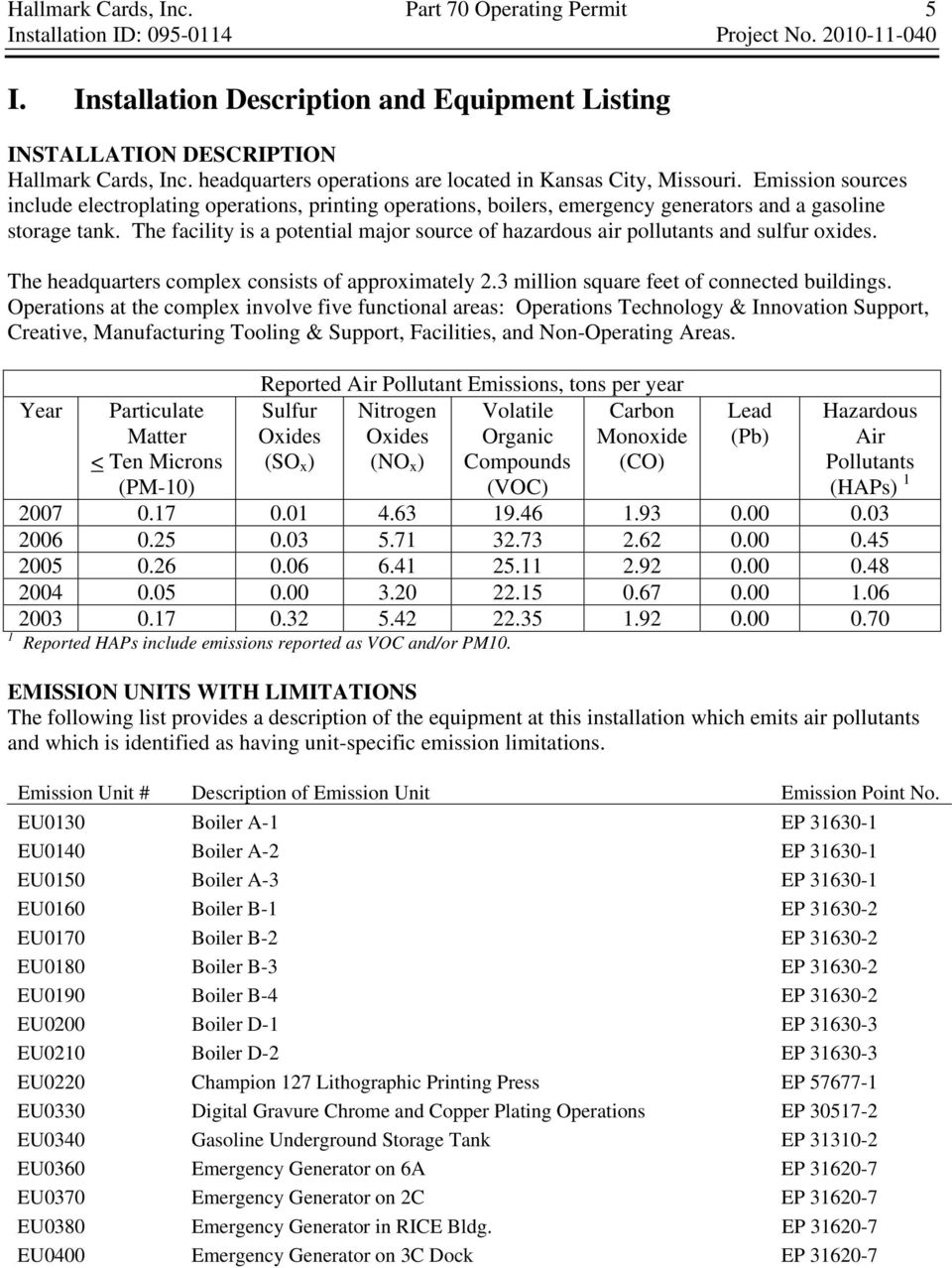
5 Hallmark Cards, Inc. Part 70 Operating Permit 5 I. Installation Description and Equipment Listing INSTALLATION DESCRIPTION Hallmark Cards, Inc. headquarters operations are located in Kansas City, Missouri. Emission sources include electroplating operations, printing operations, boilers, emergency generators and a gasoline storage tank. The facility is a potential major source of hazardous air pollutants and sulfur oxides. The headquarters complex consists of approximately 2.3 million square feet of connected buildings. Operations at the complex involve five functional areas: Operations Technology & Innovation Support, Creative, Manufacturing Tooling & Support, Facilities, and Non-Operating Areas. Year Particulate Matter < Ten Microns (PM-10) Reported Air Pollutant Emissions, tons per year Sulfur Nitrogen Volatile Carbon Oxides Oxides Organic Monoxide (SO x ) (NO x ) Compounds (CO) Lead (Pb) Hazardous Air Pollutants (HAPs) 1 (VOC) Reported HAPs include emissions reported as VOC and/or PM10. EMISSION UNITS WITH LIMITATIONS The following list provides a description of the equipment at this installation which emits air pollutants and which is identified as having unit-specific emission limitations. Emission Unit # Description of Emission Unit Emission Point No. EU0130 Boiler A-1 EP EU0140 Boiler A-2 EP EU0150 Boiler A-3 EP EU0160 Boiler B-1 EP EU0170 Boiler B-2 EP EU0180 Boiler B-3 EP EU0190 Boiler B-4 EP EU0200 Boiler D-1 EP EU0210 Boiler D-2 EP EU0220 Champion 127 Lithographic Printing Press EP EU0330 Digital Gravure Chrome and Copper Plating Operations EP EU0340 Gasoline Underground Storage Tank EP EU0360 Emergency Generator on 6A EP EU0370 Emergency Generator on 2C EP EU0380 Emergency Generator in RICE Bldg. EP EU0400 Emergency Generator on 3C Dock EP
6 Hallmark Cards, Inc. Part 70 Operating Permit 6 Emission Unit # Description of Emission Unit Emission Point No. EU0410 Emergency Generator on 4D Boiler Room EP EU0420 Large Format Inkjet Printers EP 59221C EU0440 Trane Heaters (2) (0.80 MMBtu/hr total) Not assigned EU0450 Steel Rule Wood Cutting Laser EP EU0460 Model Shop Spray Booth EP EMISSION UNITS WITHOUT LIMITATIONS The following list provides a description of the equipment which does not have unit specific limitations at the time of permit issuance. Emission Unit # Description of Emission Unit Emission Point No. EU0700 Fugitive Emissions from Artistic Engraving, Molding, & Cleaning operations EP EU0705 Fugitive Emissions from Specialty Machining operations EP EU0710 Fugitive Emissions from Rubber Casting and Cleaning operations EP EU0715 Fugitive Emissions from Press Molding and Cleaning operations EP EU0720 Fugitive Emissions from Chemical Milling operations EP EU0725 Fugitive Emissions from Photopolymer Platemaking operations EP EU0730 Fugitive Emissions from Digital Gravure Processing and Proofing operations EP EU0735 Fugitive Emissions from Gravure Wastewater Treatment operations EP EU0740 Fugitive Emissions from Process Control Photoprocessing operations EP G6-1 EU0745 Fugitive Emissions from Technical Support and Maintenance operations EP EU0750 Fugitive Emissions from Equipment Maintenance operations EP EU0755 Fugitive Emissions from Design & Commercial Photography operations EP EU0760 Fugitive Emissions from Screen Printing operations EP EU0765 Fugitive Emissions from Model Shop Prototype Production operations EP EU0770 Fugitive Emissions from Paper Cutting Units (Laser) operations EP EU0775 Fugitive Emissions from Film Processing in the Service Center operations EP G6-1 EU0780 Fugitive Emissions from Art Material Library Supplies operations EP EU0785 Emissions from Small Spray Paint Booths operations EP EU0790 Fugitive Emissions from Chemistry Labs operations EP 59400A-1 EU0795 Stack Emissions from Electrostatic Powder Spray Booth operations in Chemistry Labs EP 59400A-2 EU0800 Emissions from Tooling Curing Oven operations EP EU0805 Fugitive Emissions from Small (< 26 inch sheet fed or 18 inch web) Lithographic Printing operations EP EU0810 Fugitive Emissions from Sand Blast Area operations EP 59416A-1 EU0815 Fugitive Emissions from Welding operations EP EU0820 Emissions from Spray Paint Booth operations EP 59416E-2 EU0825 Fugitive Emissions from Photoprocessor and Digital Camera in Reprographics Dept. operations EP

7 Hallmark Cards, Inc. Part 70 Operating Permit 7 DOCUMENTS INCORPORATED BY REFERENCE These documents have been incorporated by reference into this permit. 1) Construction Permit Kansas City Air Quality Program #869, Issued March 15, ) Construction Permit Kansas City Air Quality Program #892, Issued July 16, ) Construction Permit Kansas City Air Quality Program #985, Issued May 21, ) Construction Permit Kansas City Air Quality Program #1039, Issued November 24, ) Construction Permit Kansas City Air Quality Program #1043, Issued December 12, ) Construction Permit Kansas City Air Quality Program #1049, Issued March 23, ) Construction Permit Kansas City Air Quality Program #1080, Issued September 27, ) Construction Permit Kansas City Air Quality Program #1110, Issued June 29, ) Construction Permit Kansas City Air Quality Program #1152, Issued April 26, ) Construction Permit Kansas City Air Quality Program #1154, Issued June 26, ) Construction Permit Kansas City Air Quality Program #1194, Issued May 28, 2008

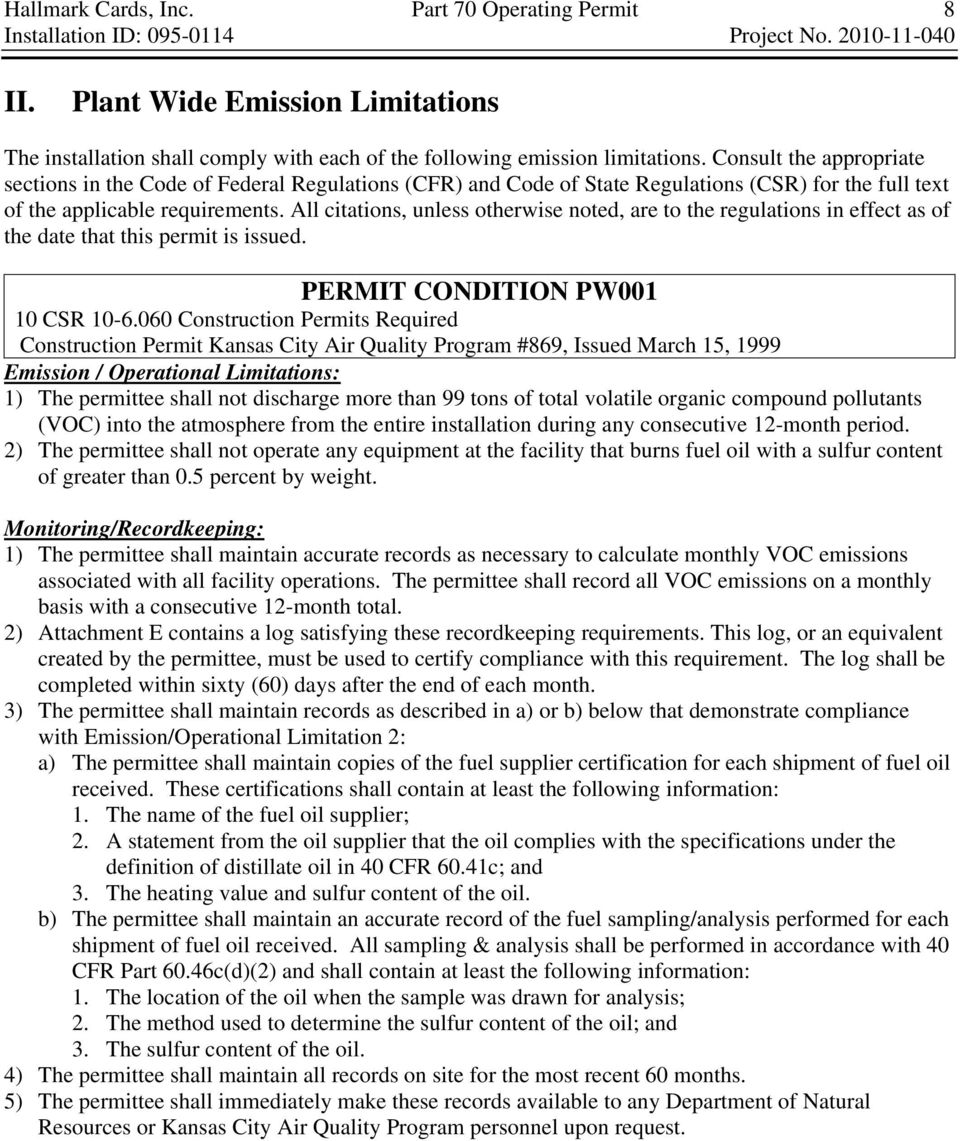
8 Hallmark Cards, Inc. Part 70 Operating Permit 8 II. Plant Wide Emission Limitations The installation shall comply with each of the following emission limitations. Consult the appropriate sections in the Code of Federal Regulations (CFR) and Code of State Regulations (CSR) for the full text of the applicable requirements. All citations, unless otherwise noted, are to the regulations in effect as of the date that this permit is issued. PERMIT CONDITION PW CSR Construction Permits Required Construction Permit Kansas City Air Quality Program #869, Issued March 15, 1999 Emission / Operational Limitations: 1) The permittee shall not discharge more than 99 tons of total volatile organic compound pollutants (VOC) into the atmosphere from the entire installation during any consecutive 12-month period. 2) The permittee shall not operate any equipment at the facility that burns fuel oil with a sulfur content of greater than 0.5 percent by weight. Monitoring/Recordkeeping: 1) The permittee shall maintain accurate records as necessary to calculate monthly VOC emissions associated with all facility operations. The permittee shall record all VOC emissions on a monthly basis with a consecutive 12-month total. 2) Attachment E contains a log satisfying these recordkeeping requirements. This log, or an equivalent created by the permittee, must be used to certify compliance with this requirement. The log shall be completed within sixty (60) days after the end of each month. 3) The permittee shall maintain records as described in a) or b) below that demonstrate compliance with Emission/Operational Limitation 2: a) The permittee shall maintain copies of the fuel supplier certification for each shipment of fuel oil received. These certifications shall contain at least the following information: 1. The name of the fuel oil supplier; 2. A statement from the oil supplier that the oil complies with the specifications under the definition of distillate oil in 40 CFR 60.41c; and 3. The heating value and sulfur content of the oil. b) The permittee shall maintain an accurate record of the fuel sampling/analysis performed for each shipment of fuel oil received. All sampling & analysis shall be performed in accordance with 40 CFR Part 60.46c(d)(2) and shall contain at least the following information: 1. The location of the oil when the sample was drawn for analysis; 2. The method used to determine the sulfur content of the oil; and 3. The sulfur content of the oil. 4) The permittee shall maintain all records on site for the most recent 60 months. 5) The permittee shall immediately make these records available to any Department of Natural Resources or Kansas City Air Quality Program personnel upon request.
9 Hallmark Cards, Inc. Part 70 Operating Permit 9 Reporting: 1) The permittee shall report to the Air Pollution Control Program s Enforcement Section, P.O. Box 176, Jefferson City, MO 65102, and to the Kansas City Air Quality Program, 2400 Troost Avenue, Suite 3000, Kansas City, MO 64108, no later than ten days following the completion of the VOC log entry if the consecutive 12-month total records show that the source exceeded the limitation of less than 99 tons per year of VOC emissions. 2) The permittee shall report to the Air Pollution Control Program s Enforcement Section, P.O. Box 176, Jefferson City, MO and to the Kansas City Air Quality Program, 2400 Troost Avenue, Suite 3000, Kansas City, MO 64108, no later than ten days following the receipt of the fuel sampling data which indicates that the source used fuel oil that exceeds 0.5 percent sulfur content by weight.

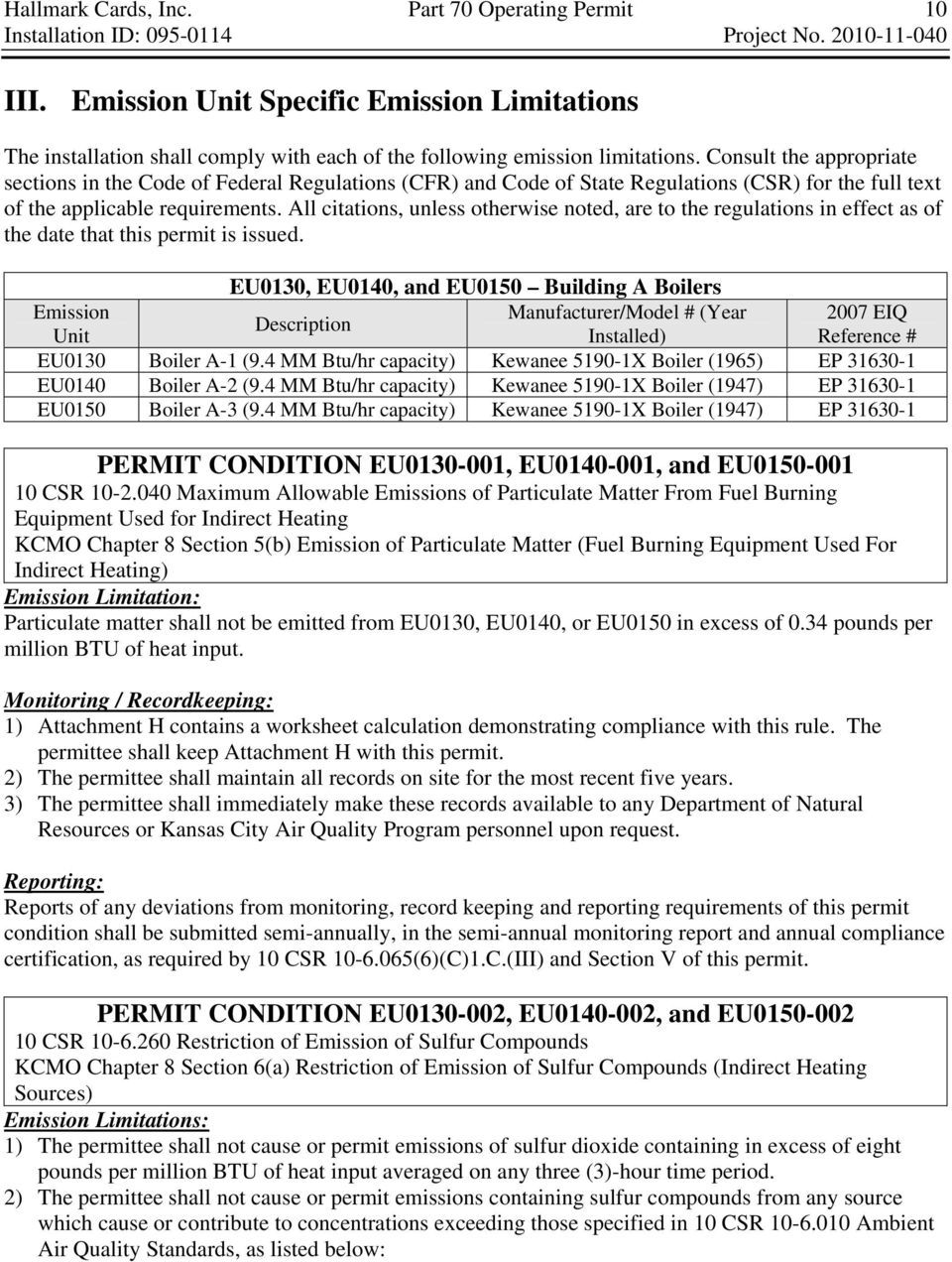
10 Hallmark Cards, Inc. Part 70 Operating Permit 10 III. Emission Unit Specific Emission Limitations The installation shall comply with each of the following emission limitations. Consult the appropriate sections in the Code of Federal Regulations (CFR) and Code of State Regulations (CSR) for the full text of the applicable requirements. All citations, unless otherwise noted, are to the regulations in effect as of the date that this permit is issued. EU0130, EU0140, and EU0150 Building A Boilers Emission Manufacturer/Model # (Year 2007 EIQ Description Unit Installed) Reference # EU0130 Boiler A-1 (9.4 MM Btu/hr capacity) Kewanee X Boiler (1965) EP EU0140 Boiler A-2 (9.4 MM Btu/hr capacity) Kewanee X Boiler (1947) EP EU0150 Boiler A-3 (9.4 MM Btu/hr capacity) Kewanee X Boiler (1947) EP PERMIT CONDITION EU , EU , and EU CSR Maximum Allowable Emissions of Particulate Matter From Fuel Burning Equipment Used for Indirect Heating KCMO Chapter 8 Section 5(b) Emission of Particulate Matter (Fuel Burning Equipment Used For Indirect Heating) Emission Limitation: Particulate matter shall not be emitted from EU0130, EU0140, or EU0150 in excess of 0.34 pounds per million BTU of heat input. Monitoring / Recordkeeping: 1) Attachment H contains a worksheet calculation demonstrating compliance with this rule. The permittee shall keep Attachment H with this permit. 2) The permittee shall maintain all records on site for the most recent five years. 3) The permittee shall immediately make these records available to any Department of Natural Resources or Kansas City Air Quality Program personnel upon request. Reporting: Reports of any deviations from monitoring, record keeping and reporting requirements of this permit condition shall be submitted semi-annually, in the semi-annual monitoring report and annual compliance certification, as required by 10 CSR (6)(C)1.C.(III) and Section V of this permit. PERMIT CONDITION EU , EU , and EU CSR Restriction of Emission of Sulfur Compounds KCMO Chapter 8 Section 6(a) Restriction of Emission of Sulfur Compounds (Indirect Heating Sources) Emission Limitations: 1) The permittee shall not cause or permit emissions of sulfur dioxide containing in excess of eight pounds per million BTU of heat input averaged on any three (3)-hour time period. 2) The permittee shall not cause or permit emissions containing sulfur compounds from any source which cause or contribute to concentrations exceeding those specified in 10 CSR Ambient Air Quality Standards, as listed below:
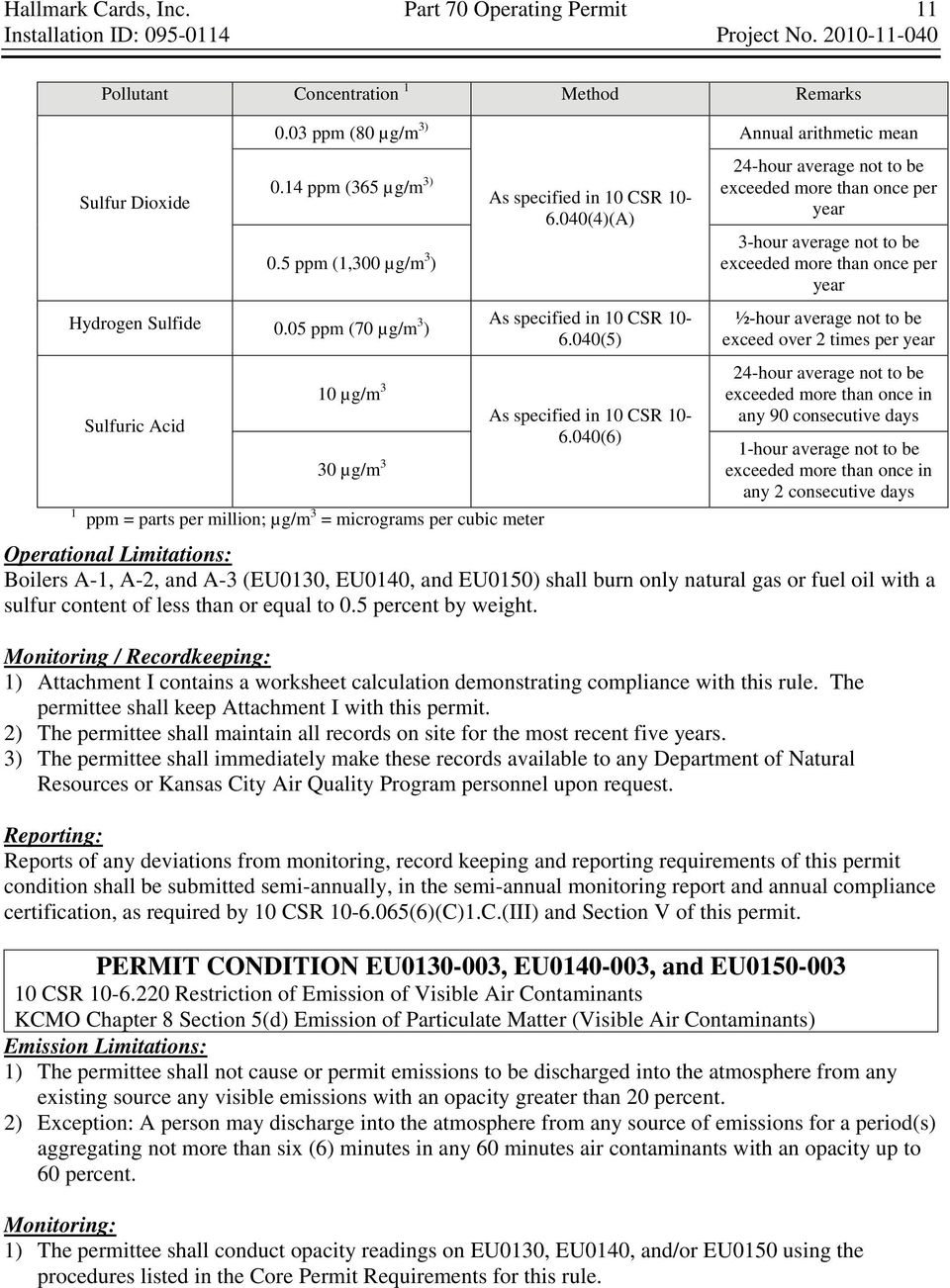
11 Hallmark Cards, Inc. Part 70 Operating Permit 11 Pollutant Concentration 1 Method Remarks Sulfur Dioxide Hydrogen Sulfide 0.05 ppm (70 µg/m 3 ) Sulfuric Acid 0.03 ppm (80 µg/m 3) Annual arithmetic mean 24-hour average not to be 0.14 ppm (365 µg/m 3) exceeded more than once per As specified in 10 CSR 10- year 6.040(4)(A) 3-hour average not to be 0.5 ppm (1,300 µg/m 3 ) exceeded more than once per year 1 ppm = parts per million; µg/m 3 = micrograms per cubic meter As specified in 10 CSR (5) ½-hour average not to be exceed over 2 times per year 24-hour average not to be 10 µg/m 3 exceeded more than once in As specified in 10 CSR 10- any 90 consecutive days 6.040(6) 1-hour average not to be 30 µg/m 3 exceeded more than once in any 2 consecutive days Operational Limitations: Boilers A-1, A-2, and A-3 (EU0130, EU0140, and EU0150) shall burn only natural gas or fuel oil with a sulfur content of less than or equal to 0.5 percent by weight. Monitoring / Recordkeeping: 1) Attachment I contains a worksheet calculation demonstrating compliance with this rule. The permittee shall keep Attachment I with this permit. 2) The permittee shall maintain all records on site for the most recent five years. 3) The permittee shall immediately make these records available to any Department of Natural Resources or Kansas City Air Quality Program personnel upon request. Reporting: Reports of any deviations from monitoring, record keeping and reporting requirements of this permit condition shall be submitted semi-annually, in the semi-annual monitoring report and annual compliance certification, as required by 10 CSR (6)(C)1.C.(III) and Section V of this permit. PERMIT CONDITION EU , EU , and EU CSR Restriction of Emission of Visible Air Contaminants KCMO Chapter 8 Section 5(d) Emission of Particulate Matter (Visible Air Contaminants) Emission Limitations: 1) The permittee shall not cause or permit emissions to be discharged into the atmosphere from any existing source any visible emissions with an opacity greater than 20 percent. 2) Exception: A person may discharge into the atmosphere from any source of emissions for a period(s) aggregating not more than six (6) minutes in any 60 minutes air contaminants with an opacity up to 60 percent. Monitoring: 1) The permittee shall conduct opacity readings on EU0130, EU0140, and/or EU0150 using the procedures listed in the Core Permit Requirements for this rule.
12 Hallmark Cards, Inc. Part 70 Operating Permit 12 2) The permittee shall maintain the monitoring schedule listed in the Core Permit Requirements for conducting these observations. 3) The monitoring requirements of this condition do not apply when the units are only burning natural gas. Recordkeeping: 1) The permittee shall maintain records of all opacity observations as described in the Core Permit Requirements for this rule using Attachments B and C, or equivalent forms created by the permittee. 2) The permittee shall maintain records of any equipment malfunctions as described in the Core Permit Requirements for this rule using Attachment D or an equivalent form created by the permittee. 3) The permittee shall maintain all records on site for the most recent five years. 4) The permittee shall immediately make these records available to any Department of Natural Resources or Kansas City Air Quality Program personnel upon request. Reporting: 1) The permittee shall report to the Air Pollution Control Program s Enforcement Section, P.O. Box 176, Jefferson City, MO and to the Kansas City Air Quality Program, 2400 Troost Avenue, Suite 3000, Kansas City, MO 64108, no later than ten days after the permittee determines, using the Method 9 test, that the emission unit(s) exceeded the opacity limit. 2) Reports of any deviations from monitoring, record keeping and reporting requirements of this permit condition shall be submitted semi-annually, in the semi-annual monitoring report and annual compliance certification, as required by 10 CSR (6)(C)1.C.(III) and Section V of this permit. Emission Unit EU0160 EU0170 EU0180 EU0190 EU0160, EU0170, EU0180 and EU0190 Building B Boilers Description Manufacturer/Model # (Year 2007 EIQ Installed) Reference # Boiler B-1 (13.67 MM Btu/hr capacity) Kewanee KR88-8 Boiler (1954) EP Boiler B-2 (13.67 MM Btu/hr capacity) Kewanee KR88-8 Boiler (1954) EP Boiler B-3 (13.67 MM Btu/hr capacity) Kewanee KR88-8 Boiler (1954) EP Boiler B-4 (3.28 MM Btu/hr capacity) Kewanee K580-5 Boiler (1954) EP PERMIT CONDITION EU , EU , EU0180, and EU CSR Maximum Allowable Emissions of Particulate Matter From Fuel Burning Equipment Used for Indirect Heating KCMO Chapter 8 Section 5(b) Emission of Particulate Matter (Fuel Burning Equipment Used For Indirect Heating) Emission Limitation: Particulate matter shall not be emitted from EU0160, EU0170, EU0180, or EU0190 in excess of 0.34 pounds per million BTU of heat input.

13 Hallmark Cards, Inc. Part 70 Operating Permit 13 Monitoring / Recordkeeping: 1) Attachment H contains a worksheet calculation demonstrating compliance with this rule. The permittee shall keep Attachment H with this permit. 2) The permittee shall maintain all records on site for the most recent five years. 3) The permittee shall immediately make these records available to any Department of Natural Resources or Kansas City Air Quality Program personnel upon request. Reporting: Reports of any deviations from monitoring, record keeping and reporting requirements of this permit condition shall be submitted semi-annually, in the semi-annual monitoring report and annual compliance certification, as required by 10 CSR (6)(C)1.C.(III) and Section V of this permit. PERMIT CONDITION EU , EU , EU0180, and EU CSR Restriction of Emission of Sulfur Compounds KCMO Chapter 8 Section 6(a) Restriction of Emission of Sulfur Compounds (Indirect Heating Sources) Emission Limitations: 1) The permittee shall not cause or permit emissions of sulfur dioxide containing in excess of eight pounds per million BTU of heat input averaged on any three (3)-hour time period. 2) The permittee shall not cause or permit emissions containing sulfur compounds from any source which cause or contribute to concentrations exceeding those specified in 10 CSR Ambient Air Quality Standards, as listed below: Pollutant Concentration 1 Method Remarks Sulfur Dioxide Hydrogen Sulfide 0.05 ppm (70 µg/m 3 ) 0.03 ppm (80 µg/m 3) Annual arithmetic mean 24-hour average not to be 0.14 ppm (365 µg/m 3) exceeded more than once per As specified in 10 CSR 10- year 6.040(4)(A) 3-hour average not to be 0.5 ppm (1,300 µg/m 3 ) exceeded more than once per year As specified in 10 CSR (5) ½-hour average not to be exceed over 2 times per year 24-hour average not to be 10 µg/m 3 exceeded more than once in As specified in 10 CSR 10- any 90 consecutive days Sulfuric Acid 6.040(6) 1-hour average not to be 30 µg/m 3 exceeded more than once in any 2 consecutive days 1 ppm = parts per million; µg/m 3 = micrograms per cubic meter Operational Limitations: Boilers B-1, B-2, B-3 and B-4 (EU0160, EU0170, EU0180, or EU0190) shall burn only natural gas or fuel oil with a sulfur content of less than or equal to 0.5 percent by weight.

14 Hallmark Cards, Inc. Part 70 Operating Permit 14 Monitoring / Recordkeeping: 1) Attachment I contains a worksheet calculation demonstrating compliance with this rule. The permittee shall keep Attachment I with this permit. 2) The permittee shall maintain all records on site for the most recent five years. 3) The permittee shall immediately make these records available to any Department of Natural Resources or Kansas City Air Quality Program personnel upon request. Reporting: Reports of any deviations from monitoring, record keeping and reporting requirements of this permit condition shall be submitted semi-annually, in the semi-annual monitoring report and annual compliance certification, as required by 10 CSR (6)(C)1.C.(III) and Section V of this permit. PERMIT CONDITION EU , EU , EU0180, and EU CSR Restriction of Emission of Visible Air Contaminants KCMO Chapter 8 Section 5(d) Emission of Particulate Matter (Visible Air Contaminants) Emission Limitations: 1) The permittee shall not cause or permit emissions to be discharged into the atmosphere from any existing source any visible emissions with an opacity greater than 20 percent. 2) Exception: A person may discharge into the atmosphere from any source of emissions for a period(s) aggregating not more than six (6) minutes in any 60 minutes air contaminants with an opacity up to 60 percent. Monitoring: 1) The permittee shall conduct opacity readings on EU0160, EU0170, EU0180, and/or EU0190 using the procedures listed in the Core Permit Requirements for this rule. 2) The permittee shall maintain the monitoring schedule listed in the Core Permit Requirements for conducting these observations. 3) The monitoring requirements of this condition do not apply when the units are only burning natural gas. Recordkeeping: 1) The permittee shall maintain records of all opacity observations as described in the Core Permit Requirements for this rule using Attachments B and C, or equivalent forms created by the permittee. 2) The permittee shall maintain records of any equipment malfunctions as described in the Core Permit Requirements for this rule using Attachment D or an equivalent form created by the permittee. 3) The permittee shall maintain all records on site for the most recent five years. 4) The permittee shall immediately make these records available to any Department of Natural Resources or Kansas City Air Quality Program personnel upon request. Reporting: 1) The permittee shall report to the Air Pollution Control Program s Enforcement Section, P.O. Box 176, Jefferson City, MO 65102, and to the Kansas City Air Quality Program, 2400 Troost Avenue, Suite 3000, Kansas City, MO 64108, no later than ten days after the permittee determines, using the Method 9 test, that the emission unit(s) exceeded the opacity limit. 2) Reports of any deviations from monitoring, record keeping and reporting requirements of this permit condition shall be submitted semi-annually, in the semi-annual monitoring report and annual

15 Hallmark Cards, Inc. Part 70 Operating Permit 15 compliance certification, as required by 10 CSR (6)(C)1.C.(III) and Section V of this permit. Emission Unit EU0200 EU0210 EU0200 and EU0210 Building D Boilers Description Manufacturer/Model # (Year 2007 EIQ Installed) Reference # Boiler D-1 ( MM Btu/hr capacity) Kewanee KR Boiler (1965) EP Boiler D-2 ( MM Btu/hr capacity) Kewanee KR Boiler (1965) EP PERMIT CONDITION EU and EU CSR Maximum Allowable Emissions of Particulate Matter From Fuel Burning Equipment Used for Indirect Heating KCMO Chapter 8 Section 5(b) Emission of Particulate Matter (Fuel Burning Equipment Used For Indirect Heating) Emission Limitation: Particulate matter shall not be emitted from EU0200 or EU0210 in excess of 0.34 pounds per million BTU of heat input. Monitoring / Recordkeeping: 1) Attachment H contains a worksheet calculation demonstrating compliance with this rule. The permittee shall keep Attachment H with this permit. 2) The permittee shall maintain all records on site for the most recent five years. 3) The permittee shall immediately make these records available to any Department of Natural Resources or Kansas City Air Quality Program personnel upon request. Reporting: Reports of any deviations from monitoring, record keeping and reporting requirements of this permit condition shall be submitted semi-annually, in the semi-annual monitoring report and annual compliance certification, as required by 10 CSR (6)(C)1.C.(III) and Section V of this permit. PERMIT CONDITION EU and EU CSR Restriction of Emission of Sulfur Compounds KCMO Chapter 8 Section 6(a) Restriction of Emission of Sulfur Compounds (Indirect Heating Sources) Emission Limitations: 1) The permittee shall not cause or permit emissions of sulfur dioxide containing in excess of eight pounds per million BTU of heat input averaged on any three (3)-hour time period. 2) The permittee shall not cause or permit emissions containing sulfur compounds from any source which cause or contribute to concentrations exceeding those specified in 10 CSR Ambient Air Quality Standards, as listed below: Pollutant Concentration 1 Method Remarks Sulfur Dioxide 0.03 ppm (80 µg/m 3) As specified in 10 CSR 10- Annual arithmetic mean

16 Hallmark Cards, Inc. Part 70 Operating Permit (4)(A) 24-hour average not to be 0.14 ppm (365 µg/m 3) exceeded more than once per year 0.5 ppm (1,300 µg/m 3 ) Hydrogen Sulfide 0.05 ppm (70 µg/m 3 ) Sulfuric Acid 1 ppm = parts per million; µg/m 3 = micrograms per cubic meter As specified in 10 CSR (5) 3-hour average not to be exceeded more than once per year ½-hour average not to be exceed over 2 times per year 24-hour average not to be 10 µg/m 3 exceeded more than once in As specified in 10 CSR 10- any 90 consecutive days 6.040(6) 1-hour average not to be 30 µg/m 3 exceeded more than once in any 2 consecutive days Operational Limitations: Boilers D-1 and D-2 (EU0200 or EU0210) shall burn only natural gas or fuel oil with a sulfur content of less than or equal to 0.5 percent by weight. Monitoring / Recordkeeping: 1) Attachment I contains a worksheet calculation demonstrating compliance with this rule. The permittee shall keep Attachment I with this permit. 2) The permittee shall maintain all records on site for the most recent five years. 3) The permittee shall immediately make these records available to any Department of Natural Resources or Kansas City Air Quality Program personnel upon request. Reporting: Reports of any deviations from monitoring, record keeping and reporting requirements of this permit condition shall be submitted semi-annually, in the semi-annual monitoring report and annual compliance certification, as required by 10 CSR (6)(C)1.C.(III) and Section V of this permit. PERMIT CONDITION EU and EU CSR Restriction of Emission of Visible Air Contaminants KCMO Chapter 8 Section 5(d) Emission of Particulate Matter (Visible Air Contaminants) Emission Limitations: 1) The permittee shall not cause or permit emissions to be discharged into the atmosphere from any existing source any visible emissions with an opacity greater than 20 percent. 2) Exception: A person may discharge into the atmosphere from any source of emissions for a period(s) aggregating not more than six (6) minutes in any 60 minutes air contaminants with an opacity up to 60 percent. Monitoring: 1) The permittee shall conduct opacity readings on EU0200 and/or EU0210 using the procedures listed in the Core Permit Requirements for this rule. 2) The permittee shall maintain the monitoring schedule listed in the Core Permit Requirements for conducting these observations.

17 Hallmark Cards, Inc. Part 70 Operating Permit 17 3) The monitoring requirements of this condition do not apply when the units are only burning natural gas. Recordkeeping: 1) The permittee shall maintain records of all opacity observations as described in the Core Permit Requirements for this rule using Attachments B and C, or equivalent forms created by the permittee. 2) The permittee shall maintain records of any equipment malfunctions as described in the Core Permit Requirements for this rule using Attachment D or an equivalent form created by the permittee. 3) The permittee shall maintain all records on site for the most recent five years. 4) The permittee shall immediately make these records available to any Department of Natural Resources or Kansas City Air Quality Program personnel upon request. Reporting: 1) The permittee shall report to the Air Pollution Control Program s Enforcement Section, P.O. Box 176, Jefferson City, MO 65102, and to the Kansas City Air Quality Program, 2400 Troost Avenue, Suite 3000, Kansas City, MO 64108, no later than ten days after the permittee determines, using the Method 9 test, that the emission unit(s) exceeded the opacity limit. 2) Reports of any deviations from monitoring, record keeping and reporting requirements of this permit condition shall be submitted semi-annually, in the semi-annual monitoring report and annual compliance certification, as required by 10 CSR (6)(C)1.C.(III) and Section V of this permit. EU0220 Lithographic Printing Emission Manufacturer/Model # (Year 2007 EIQ Description Unit Installed) Reference # EU0220 Champion 127 Lithographic Printing Press Champion 127 Press (1988) EP PERMIT CONDITION EU CSR Control of Emissions From Lithographic Printing Installations KCMO Chapter 8 Section 8(k) Emission Of Volatile Organic Compounds (Control Of Emissions From Lithographic Printing Facilities) Emission / Operational Limitations: 1) The permittee shall not use a fountain solution in EU0220 that contains more than ten percent (10%) by weight of alcohol. 2) The permittee shall refrigerate any alcohol-based fountain solution to a temperature of fifty-five degrees Fahrenheit (55 F) or less. 3) The permittee shall cover all alcohol-based fountain solution mixing tanks. 4) The permittee shall keep all clean-up solvents and cleaning cloths in tightly covered tanks or containers during transport and storage. Monitoring / Recordkeeping: 1) The permittee shall maintain records as required sufficient to determine continuous compliance with this regulation. 2) The permittee shall maintain the following records for each lithographic printing press: a) Quantity of alcohol added to the fountain solution of each regulated press in pounds each month; b) Percent of alcohol in fountain solution by weight as monitored on a once per shift basis; c) Results of any testing conducted on an emission unit at a regulated installation; d) Maintenance records of any air pollution control equipment; and

18 Hallmark Cards, Inc. Part 70 Operating Permit 18 e) The temperature of alcohol-based fountain solution as recorded on a once per shift basis. 3) The permittee shall maintain the following records for the printing inks, solvents, and coatings used by the lithographic printing presses at the installation: a) Properties of heatset inks as applied (determined by the manufacturer's formulation data), density of inks in pounds per gallon, and total VOC content in weight percent; b) Quantity of heatset inks as applied to substrate in pounds on a monthly basis; c) Quantity of cleanup solvents used on a monthly basis; and d) Quantity of coatings used on a monthly basis and percent VOC in coating by weight on a formulation basis. 4) The permittee shall maintain all records on site for the most recent five years. 5) The permittee shall immediately make these records available to any Department of Natural Resources or Kansas City Air Quality Program personnel upon request. Reporting: 1) The permittee shall report to the Air Pollution Control Program s Enforcement Section, P.O. Box 176, Jefferson City, MO 65102, and to the Kansas City Air Quality Program, 2400 Troost Avenue, Suite 3000, Kansas City, MO 64108, no later than ten days after the permittee determines that any exceedance of the permit conditions has occurred. 2) Reports of any deviations from monitoring, record keeping and reporting requirements of this permit condition shall be submitted semi-annually, in the semi-annual monitoring report and annual compliance certification, as required by 10 CSR (6)(C)1.C.(III) and Section V of this permit. Emission Unit EU0330 Chrome Plating Operations Manufacturer /Model # Control Equipment Description (Year Installed) (Model#) 2007 EIQ Reference # EU0330 Digital Gravure chrome and copper plating equipment Daetwyler (1995) Composite Mesh Pad Control Equipment (CD-1) (Mapco, Inc. / Enforcer III) EP PERMIT CONDITION EU CSR Maximum Achievable Control Technology Regulations 40 CFR 63 Subpart N National Emission Standards for Chromium Emissions from Hard and Decorative Chromium Electroplating and Chromium Anodizing Tanks Emission Limitations: 1) The permittee shall control emissions to the atmosphere from the hard chromium plating tanks by not allowing the concentration of total chromium in the exhaust gas stream discharged to the atmosphere to exceed 0.03 mg/dscm ( gr/dscf). 2) The emission limitations in this section apply during tank operation and during periods of startup and shutdown. The emission limitations do not apply during periods of malfunction, but the work practice standards that address operation and maintenance and that are required by (f) must be followed during malfunctions. Equipment / Operational Requirements: 40 CFR (f) (Operation and Maintenance Practices):

19 Hallmark Cards, Inc. Part 70 Operating Permit 19 1) The permittee shall operate and maintain EU0330, including associated air pollution control devices and monitoring equipment, in a manner consistent with good air pollution control practices at all times, including periods of startup, shutdown, and malfunction. 2) The permittee shall correct malfunctions as soon as practicable after their occurrence. 3) The permittee shall prepare an operation and maintenance plan which includes the following elements: a) The plan shall specify the operation and maintenance criteria for the affected source, the add-on air pollution control device (if such a device is used to comply with the emission limits), and the process and control system monitoring equipment, and shall include a standardized checklist to document the operation and maintenance of this equipment; b) For sources using an add-on control device or monitoring equipment to comply with this subpart, the plan shall incorporate the operation and maintenance practices for that device or monitoring equipment, as identified in Table 1 to , if the specific equipment used is identified in Table 1 to ; c) If the specific equipment used is not identified in Table 1 to , the plan shall incorporate proposed operation and maintenance practices. These proposed operation and maintenance practices shall be submitted for approval as part of the submittal required under (d); d) The plan shall specify procedures to be followed to ensure that equipment or process malfunctions due to poor maintenance or other preventable conditions do not occur; and e) The plan shall include a systematic procedure for identifying malfunctions of process equipment, add-on air pollution control devices, and process and control system monitoring equipment and for implementing corrective actions to address such malfunctions. 4) The permittee may use applicable standard operating procedure (SOP) manuals, Occupational Safety and Health Administration (OSHA) plans, or other existing plans, provided the alternative plans meet the requirements of this section. 5) If the operation and maintenance plan fails to address or inadequately addresses an event that meets the characteristics of a malfunction at the time the plan is initially developed, the permittee shall revise the operation and maintenance plan within 45 days after such an event occurs. The revised plan shall include procedures for operating and maintaining the process equipment, add-on air pollution control device, or monitoring equipment during similar malfunction events, and a program for corrective action for such events. Monitoring Requirements: 40 CFR (c)(1) Monitoring to demonstrate continuous compliance): 1) The permittee shall conduct monitoring according to the type of air pollution control technique that is used to comply with the emission limitation. 2) During the initial performance test, the permittee who is complying with the emission limitations in through the use of a composite mesh-pad system shall determine the outlet chromium concentration using the test methods and procedures in (c), and shall establish as a sitespecific operating parameter the pressure drop across the system, setting the value that corresponds to compliance with the applicable emission limitation, using the procedures in (d)(5). The permittee may conduct multiple performance tests to establish a range of compliant pressure drop values, or may set as the compliant value the average pressure drop measured over the three test runs of one performance test and accept ±2 inches of water column from this value as the compliant range. 3) On and after the date on which the initial performance test is required to be completed under 63.7, the permittee shall monitor and record the pressure drop across the composite mesh-pad system once
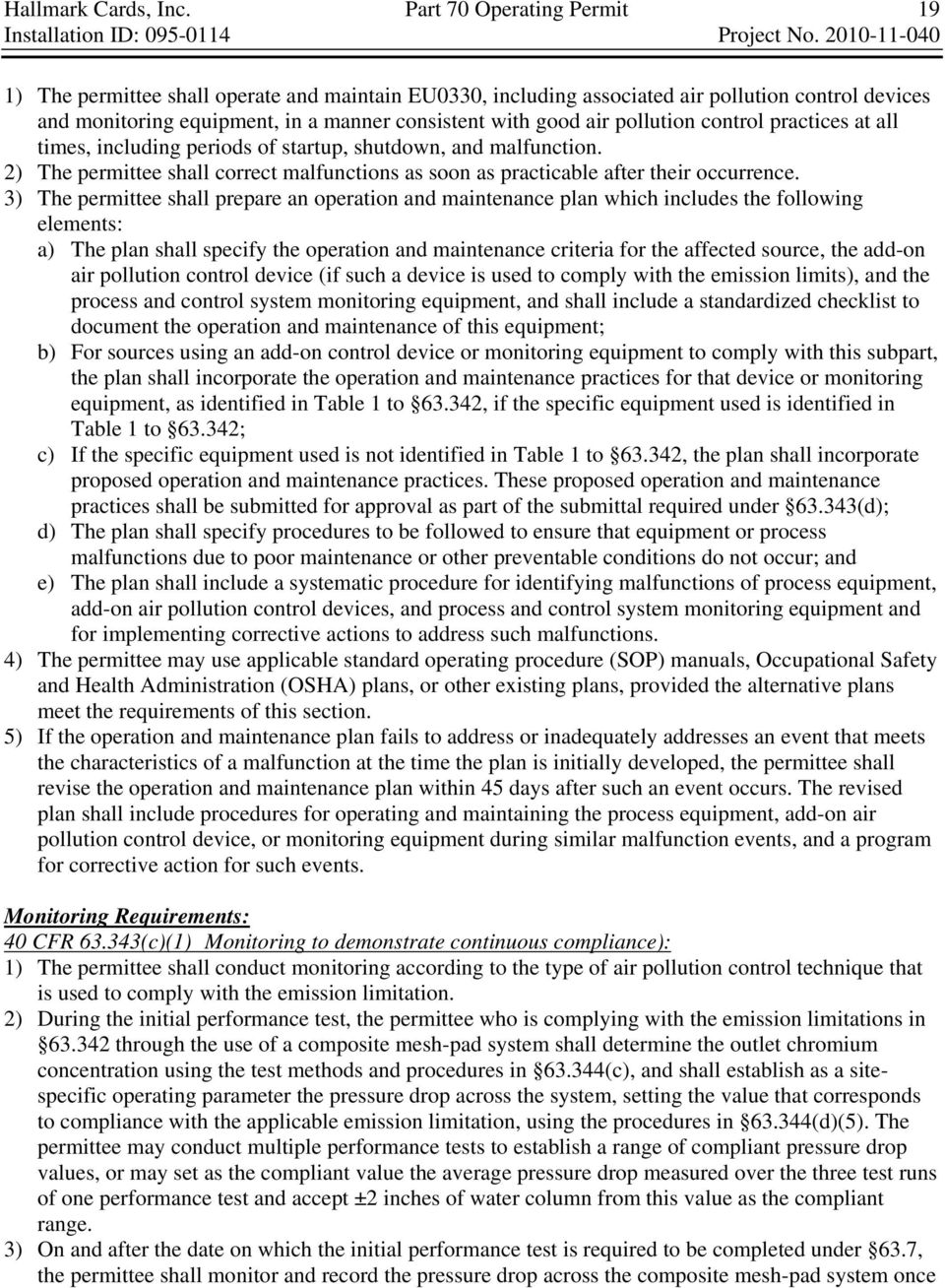
20 Hallmark Cards, Inc. Part 70 Operating Permit 20 each day that any affected source is operating. To be in compliance with the standards, the composite mesh-pad system shall be operated within ±2 inches of water column of the pressure drop value established during the initial performance test, or shall be operated within the range of compliant values for pressure drop established during multiple performance tests. 4) The permittee may repeat the performance test and establish as a new site-specific operating parameter the pressure drop across the composite mesh-pad system according to the requirements in Paragraphs (c)(1)(i) or (ii) of this section. To establish a new site-specific operating parameter for pressure drop, the permittee shall satisfy the following requirements: a) Determine the outlet chromium concentration using the test methods and procedures in (c); b) Establish the site-specific operating parameter value using the procedures (d)(5); c) Satisfy the recordkeeping requirements in (b)(6) through (8); and d) Satisfy the reporting requirements in (d) and (f). 5) The requirement to operate a composite mesh-pad system within the range of pressure drop values established under Paragraphs (c)(1)(i) through (iii) of this section does not apply during automatic washdown cycles of the composite mesh-pad system. 40 CFR (Performance test requirements and test methods): 6) Each owner or operator subject to the provisions of this subpart and required by (b) to conduct an initial performance test shall use the test methods identified in this section to demonstrate compliance with the standards in ) Performance tests shall be conducted using the test methods and procedures in this section and Performance test results shall be documented in complete test reports that contain the information required by Paragraphs (a)(1) through (a)(9) of this section. The test plan to be followed shall be made available to the Administrator prior to the testing, if requested. 8) For each performance test conducted, the permittee shall establish site-specific operating parameters following the procedures in 40 CFR (d). Recordkeeping Requirements: 40 CFR (f)(3)(v) (Operation and maintenance plan): 1) The permittee shall keep the written operation and maintenance plan on record after it is developed for the life of the affected source or until the source is no longer subject to the provisions of this subpart. In addition, if the operation and maintenance plan is revised, the permittee shall keep previous (i.e., superseded) versions of the operation and maintenance plan on record for a period of 5 years after each revision to the plan 40 CFR (b)(1)-(12) and (15)-(16) (Recordkeeping Requirements): 2) The permittee shall maintain the following records for EU0330: a) Inspection records for the add-on air pollution control device, if such a device is used, and monitoring equipment, to document that the inspection and maintenance required by the work practice standards of (f) and Table 1 of have taken place. The record can take the form of a checklist and should identify the device inspected, the date of inspection, a brief description of the working condition of the device during the inspection, and any actions taken to correct deficiencies found during the inspection. b) Records of all maintenance performed on the affected source, the add-on air pollution control device, and monitoring equipment; c) Records of the occurrence, duration, and cause (if known) of each malfunction of process, addon air pollution control, and monitoring equipment;

21 Hallmark Cards, Inc. Part 70 Operating Permit 21 d) Records of actions taken during periods of malfunction when such actions are inconsistent with the operation and maintenance plan; e) Attachment D contains a log satisfying these recordkeeping requirements. This log, or an equivalent created by the permittee, may be used to certify compliance with this requirement. f) Other records, which may take the form of checklists, necessary to demonstrate consistency with the provisions of the operation and maintenance plan required by (f)(3); g) Test reports documenting results of all performance tests; h) All measurements as may be necessary to determine the conditions of performance tests, including measurements necessary to determine compliance with the special compliance procedures of (e); i) Records of monitoring data required by (c) that are used to demonstrate compliance with the standard including the date and time the data are collected; j) The specific identification (i.e., the date and time of commencement and completion) of each period of excess emissions, as indicated by monitoring data, that occurs during malfunction of the process, add-on air pollution control, or monitoring equipment; k) The total process operating time of the affected source during the reporting period; l) Records of the actual cumulative rectifier capacity of hard chromium electroplating tanks at a facility expended during each month of the reporting period, and the total capacity expended to date for a reporting period, if the owner or operator is using the actual cumulative rectifier capacity to determine facility size in accordance with (c)(2); m) Any information demonstrating whether a source is meeting the requirements for a waiver of recordkeeping or reporting requirements, if the source has been granted a waiver under 63.10(f); and n) All documentation supporting the notifications and reports required by 63.9, 63.10, and General 3) The permittee shall maintain all records on site for the most recent five years unless a longer period is specified above. 4) The permittee shall immediately make all records available to any Department of Natural Resources or Kansas City Air Quality Program personnel upon request Reporting Requirements: 1) Except as described in Paragraph [2)], below, the permittee shall report to the Air Pollution Control Program s Enforcement Section, P.O. Box 176, Jefferson City, MO 65102, and to the Kansas City Air Quality Program, 2400 Troost Avenue, Suite 3000, Kansas City, MO 64108, no later than ten days after the permittee determines that any exceedance of the permit conditions has occurred. 2) In accordance with 40 CFR (f)(3)(iv), if actions taken by the permittee during periods of malfunction are inconsistent with the procedures specified in the operation and maintenance plan: a) The permittee shall record the actions taken for that event and shall report the actions taken to the Air Pollution Control Program and to the Kansas City Air Quality Program via telephone within two working days of commencing actions inconsistent with the plan. b) The permittee shall submit a letter to the Air Pollution Control Program and to the Kansas City Air Quality Program within seven working days after the end of the event, (unless the permittee makes alternative reporting arrangements, in advance, with the either agency). 3) Reports of any deviations from monitoring, record keeping and reporting requirements of this permit condition shall be submitted semi-annually, in the semi-annual excess emissions and continuous monitoring report and annual compliance certification, as required by 10 CSR 10-
22 Hallmark Cards, Inc. Part 70 Operating Permit (6)(C)1.C.(III) and Section V of this permit. More frequent reporting may be determined to be required if: a) The Air Pollution Control Program or the Kansas City Air Quality Program determines on a case-by-case basis that more frequent reporting is necessary to accurately assess the compliance status of the source; or b) The monitoring data collected by the permittee show that the emission limit has been exceeded, in which case quarterly reports shall be submitted. Once the permittee reports an exceedance, ongoing compliance status reports shall be submitted quarterly until a request to reduce reporting frequency under Paragraph (g)(2) of 40 CFR is approved. 4) In accordance with 40 CFR (d), the permittee shall notify the Air Pollution Control Program and the Kansas City Air Quality Program in writing of their intention to conduct a performance test at least 60 calendar days before the test is scheduled to begin to allow either Agency to have an observer present during the test. Observation of the performance test by either Agency is optional. 5) In accordance with 40 CFR (f), the permittee shall report the results of any performance test to the Air Pollution Control Program and the Kansas City Air Quality Program. Reports of performance test results shall be submitted no later than 90 days following the completion of the performance test, and shall be submitted as part of the notification of compliance status required by Paragraph [3)], above. Emission Unit EU0340 EU0340 Gasoline Storage Tank Description Manufacturer/Model # (Year Installed) 10,000-gallon Underground Gasoline Owens-Corning DWT-3 Type II, Storage Tank (1994) 2007 EIQ Reference # EP & EP PERMIT CONDITION EU CSR Control of Gasoline Reid Vapor Pressure Emission Limitations: 1) The permittee shall not sell, dispense, supply, offer for sale, offer for supply, transport or exchange in trade for use gasoline intended for final use that has a Reid Vapor Pressure (RVP) of greater than 7.0 pounds per square inch (psi) during the time period from June 1 through September 15 of each year. 2) Gasoline blends having at least nine percent (9%) but not more than ten percent (10%) ethyl alcohol by volume of the blended mixture shall have an RVP limit of 8.0 pound per square inch (psi) during the time period from June 1 through September 15 of each year. Monitoring / Recordkeeping: 1) The permittee shall maintain records of any RVP testing and test results for gasoline stored during the compliance period of June 1 through September 15 of each year. 2) The permittee shall maintain records of the bill of lading, invoice, loading ticket, delivery ticket, and other documents accompanying a shipment of gasoline during the compliance period of June 1 through September 15 of each year. 3) Each bill of lading, invoice, loading ticket, delivery ticket, and other document that accompanies a shipment of gasoline (which includes gasoline blended with ethyl alcohol) shall contain a legible and conspicuous statement that the RVP of the gasoline does not exceed seven and zero-tenths (7.0) psi, in accordance with this rule for conventional gasoline, or that the RVP does not exceed eight and zero-tenths (8.0) psi for nine to ten percent (9%-10%) ethyl alcohol blends.
23 Hallmark Cards, Inc. Part 70 Operating Permit 23 4) The permittee shall maintain all records on site for the most recent 5 years. 5) The permittee shall immediately make these records available to any Department of Natural Resources or Kansas City Air Quality Program personnel upon request. Reporting: 1) The permittee shall report to the Air Pollution Control Program s Enforcement Section, P.O. Box 176, Jefferson City, MO 65102, and to the Kansas City Air Quality Program, 2400 Troost Avenue, Suite 3000, Kansas City, MO 64108, no later than ten days after the permittee determines that any exceedance of the permit conditions has occurred. 2) Reports of any deviations from monitoring, record keeping and reporting requirements of this permit condition shall be submitted semi-annually, in the semi-annual monitoring report and annual compliance certification, as required by 10 CSR (6)(C)1.C.(III) and Section V of this permit. PERMIT CONDITION EU CSR Control of Petroleum Liquid Storage, Loading and Transfer KCMO Chapter 8 Section 8(d)(3) Restriction of emission of VOC from petroleum liquid transfer operations Emission / Operational Limitations: 1) The permittee shall not shall cause or permit the transfer of gasoline from a delivery vessel into a gasoline storage tank with a capacity greater than two hundred fifty (250) gallons unless: a) The storage tank is equipped with a submerged fill pipe extending unrestricted to within six inches (6") of the bottom of the tank, and not touching the bottom of the tank, or the storage tank is equipped with a system that allows a bottom fill condition; b) All storage tank caps and fittings are vapor-tight when gasoline transfer is not taking place; and c) Each storage tank is vented via a conduit that is: 1. At least two inches (2") inside diameter; 2. At least twelve feet (12') in height above grade; and 3. Equipped with a pressure/vacuum valve that is CARB certified and MO/PETP approved at three inches water column pressure/eight inches water column vacuum (3" wcp/8" wcv). When the owner or operator provides documentation that the system is CARB certified for a different valve and will not function properly with a 3" wcp/8" wcv valve, the valve shall be MO/PETP approved. All pressure/vacuum valves shall be bench tested prior to installation. Initial fueling facilities shall have MO/PETP approved pressure/vacuum valves. 2) Stationary storage tanks with a capacity greater than two thousand (2,000) gallons shall also be equipped with a Stage I vapor recovery system in addition to the requirements of Paragraph [1)], above and the delivery vessels to these tanks shall be in compliance with Subsection (3)(D). a) The vapor recovery system shall collect no less than ninety percent (90%) by volume of the vapors displaced from the stationary storage tank during gasoline transfer and shall return the vapors via a vapor-tight return line to the delivery vessel. After the effective date of this rule, all coaxial systems shall be equipped with poppeted fittings. b) A delivery vessel shall be refilled only at installations complying with the provisions of Subsection (3)(B) of this rule. c) This subsection shall not be construed to prohibit safety valves or other devices required by governmental regulations. 3) The permittee shall not shall cause or permit the transfer of gasoline from a delivery vessel into a storage tank with a capacity greater than two thousand (2,000) gallons unless:
24 Hallmark Cards, Inc. Part 70 Operating Permit 24 a) The owner or operator employs one (1) vapor line per product line during the transfer. The staff director may approve other delivery systems upon submittal to the Department of test data demonstrating compliance with Subparagraph (3)(C)2.A. of this rule; b) The vapor hose(s) employed is no less than three inches (3") inside diameter; and c) The product hose(s) employed is no more than four inches (4") inside diameter. Monitoring / Recordkeeping: 1) The permittee shall keep records documenting the vessel owners and number of delivery vessels unloaded. 2) The permittee shall retain on-site copies of the loading ticket, manifest or delivery receipt for each grade of product received, subject to examination by the staff director upon request. If a delivery receipt is retained rather than a manifest or loading ticket, the delivery ticket shall bear the following information: a) Vendor name, b) Date of delivery, c) Quantity of each grade, d) Point of origin, and e) The manifest or loading ticket number. 3) The owner or operator of a vapor recovery system subject to this rule shall: a) Operate the vapor recovery system and the gasoline loading equipment in a manner that prevents: 1. Gauge pressure from exceeding four thousand five hundred (4,500) pascals (eighteen inches (18") of H2O) in the delivery vessel; 2. A reading equal to or greater than one hundred percent (100%) of the lower explosive limit (LEL, measured as propane) at two and one-half (2.5) centimeters from all points on the perimeter of a potential leak source when measured by the method referenced in 10 CSR (14)(E) during loading or transfer operations; and 3. Visible liquid leaks during loading or transfer operation; b) Repair and retest within fifteen (15) days, a vapor recovery system that exceeds the limits in Subsection (3)(E) of this rule; and c) Maintain written records of inspection reports, enforcement documents, gasoline deliveries, routine and unscheduled maintenance and repairs and all results of tests conducted. 4) A static leak decay test of the Stage I vapor recovery system shall be required once every five (5) years to demonstrate system vapor tightness. In addition, a bench test of each pressure/vacuum valve shall be required once every two (2) years to demonstrate component vapor tightness. 5) Additional testing may also be required by the Department of Natural Resources or Kansas City Air Quality Program in order to determine proper functioning of vapor recovery equipment. 6) The permittee shall maintain all records on site for the most recent five years. 7) The permittee shall immediately make these records available to any Department of Natural Resources or Kansas City Air Quality Program personnel upon request. Reporting: 1) The permittee shall report to the Air Pollution Control Program s Enforcement Section, P.O. Box 176, Jefferson City, MO 65102, and to the Kansas City Air Quality Program,
25 Hallmark Cards, Inc. Part 70 Operating Permit Troost Avenue, Suite 3000, Kansas City, MO 64108, no later than ten days after the permittee determines that any exceedance of the permit conditions has occurred. 2) Reports of any deviations from monitoring, record keeping and reporting requirements of this permit condition shall be submitted semi-annually, in the semi-annual monitoring report and annual compliance certification, as required by 10 CSR (6)(C)1.C.(III) and Section V of this permit. Emission Unit EU0360 EU0370 EU0380 EU0400 EU0410 EU0360, EU0370, EU0380, EU0400 and EU0410 Emergency Generators Description Manufacturer/Model # 2007 EIQ (Year Installed) Reference # Emergency Generator on 6A (1.20 MMBtu/hr - Diesel fired) Kohler/John Deere (1992) EP Emergency Generator on 2C (0.30 MMBtu/hr - Diesel fired) Onan (1987) EP Emergency Generator in RICE Building (1.10 MMBtu/hr - Diesel fired) Cummins (1984) EP Emergency Generator on 3C Dock (7.92 MMBtu/hr - Diesel fired) Cummins (2002) EP Emergency Generator in 4D Boiler Room (1.644 MM Btu/hr - Diesel fired) Kohler/John Deere (2006) EP PERMIT CONDITION EU , EU , EU , EU and EU CSR Restriction of Emission of Sulfur Compounds KCMO Chapter 8 Section 6(b) Restriction of Emission of Sulfur Compounds (Industrial Processes) Emission Limitations: 1) The permittee shall not shall not cause or permit emissions containing more than five hundred parts per million by volume (500 ppmv) of sulfur dioxide to be discharged into the atmosphere from any new source. 2) The concentration of sulfuric acid or sulfur trioxide or any combination of those gases in the exhaust gases shall not exceed thirty-five milligrams (35 mg) per cubic meter, averaged on any consecutive three (3)-hour time period. 3) The permittee shall not cause or permit the emission of sulfur dioxide from their premises in such manner and amounts that the concentration and frequencies exceed those shown below beyond the premises on which the source is located: Concentration Averaging Time Maximum Allowable Frequency 0.25 ppm by volume or more (650 µg/m 3 ) 1 hour Once in any 4 days at any sampling site 0.07 ppm by volume or more (180 µg/m 3 ) 24 hours Once in any 90 days at any sampling site 4) The permittee shall not cause or permit emissions containing sulfur compounds from any source which cause or contribute to concentrations exceeding those specified in 10 CSR Ambient Air Quality Standards, as listed below: Pollutant Concentration 1 Method Remarks Sulfur Dioxide 0.03 ppm (80 µg/m 3 ) As specified in 10 CSR 10- Annual arithmetic mean
26 Hallmark Cards, Inc. Part 70 Operating Permit ppm (365 µg/m 3 ) 0.5 ppm (1,300 µg/m 3 ) Hydrogen Sulfide 0.05 ppm (70 µg/m 3 ) Sulfuric Acid 1 ppm = parts per million; µg/m 3 = micrograms per cubic meter 6.040(4)(A) As specified in 10 CSR (5) 24-hour average not to be exceeded more than once per year 3-hour average not to be exceeded more than once per year ½-hour average not to be exceed over 2 times per year 24-hour average not to be 10 µg/m 3 exceeded more than once in As specified in 10 CSR 10- any 90 consecutive days 6.040(6) 1-hour average not to be 30 µg/m 3 exceeded more than once in any 2 consecutive days Operational Limitations: Emergency Generators (EU0360, EU0370, EU0380, EU0400 and EU0410) shall burn only fuel oil with a sulfur content of less than or equal to 0.5 percent by weight. Monitoring / Recordkeeping: 1) Attachment I contains a worksheet calculation demonstrating compliance with this rule. The permittee shall keep Attachment I with this permit. 2) These records shall be made available immediately for inspection to any Department of Natural Resources or Kansas City Air Quality Program personnel upon request. 3) All records shall be maintained for five years. Reporting: Reports of any deviations from monitoring, record keeping and reporting requirements of this permit condition shall be submitted semi-annually, in the semi-annual monitoring report and annual compliance certification, as required by 10 CSR (6)(C)1.C.(III) and Section V of this permit. PERMIT CONDITION EU , EU , EU , EU and EU CSR Restriction of Emission of Visible Air Contaminants KCMO Chapter 8 Section 5(d) Emission of Particulate Matter (Visible Air Contaminants) Emission Limitations: 1) The permittee shall not cause or permit emissions to be discharged into the atmosphere from any existing source any visible emissions with an opacity greater than 20 percent. 2) Exception: A person may discharge into the atmosphere from any source of emissions for a period(s) aggregating not more than six (6) minutes in any 60 minutes air contaminants with an opacity up to 60 percent. Monitoring: 1) The permittee shall conduct opacity readings on EU0360, EU0370, EU0380, EU0400, and/or EU0410 using the procedures listed in the Core Permit Requirements for this rule.
27 Hallmark Cards, Inc. Part 70 Operating Permit 27 2) The permittee shall maintain the monitoring schedule listed in the Core Permit Requirements for conducting these observations. Recordkeeping: 1) The permittee shall maintain records of all opacity observations as described in the Core Permit Requirements for this rule using Attachments B and C, or equivalent forms created by the permittee. 2) The permittee shall maintain records of any equipment malfunctions as described in the Core Permit Requirements for this rule using Attachment D or an equivalent form created by the permittee. 3) The permittee shall maintain all records on site for the most recent five years. 4) The permittee shall immediately make these records available to any Department of Natural Resources or Kansas City Air Quality Program personnel upon request. Reporting: 1) The permittee shall report to the Air Pollution Control Program s Enforcement Section, P.O. Box 176, Jefferson City, MO 65102, and to the Kansas City Air Quality Program, 2400 Troost Avenue, Suite 3000, Kansas City, MO 64108, no later than ten days after the permittee determines, using the Method 9 test, that the emission unit(s) exceeded the opacity limit. 2) Reports of any deviations from monitoring, record keeping and reporting requirements of this permit condition shall be submitted semi-annually, in the semi-annual monitoring report and annual compliance certification, as required by 10 CSR (6)(C)1.C.(III) and Section V of this permit. PERMIT CONDITION EU , EU , EU , EU and EU CSR Construction Permits Required Construction Permit KC AQP #985, Issued May 21, 2002 Construction Permit KC AQP #1152, Issued April 26, 2006 Emission / Operational Limitations: 1) The permittee shall operate the emergency generators EU0360, EU0370, EU0380, EU0400 and EU0410 only during emergency situations and for short periods of time to perform maintenance and operational readiness testing. 2) Operation of EU0360, EU0370, EU0380, EU0400 and EU0410 shall not exceed 500 hours per year per generator. Monitoring / Recordkeeping: 1) EU0410 shall be equipped with a non-resettable hour meter. 2) The permittee shall maintain an accurate record of the hours of operation and the fuel usage for EU0360, EU0370, EU0380, EU0400 and EU0410 using the log shown in Attachment F or an equivalent created by the permittee 3) The permittee shall maintain all records on site for the most recent five years. 4) The permittee shall immediately make these records available to any Department of Natural Resources or Kansas City Air Quality Program personnel upon request. Reporting: 1) The permittee shall submit a report signed by a responsible official to the Kansas City Air Quality Program, 2400 Troost Avenue, Suite 3000, Kansas City, MO 64108, by April 1 of each year that covers the previous year and includes the following information:
28 Hallmark Cards, Inc. Part 70 Operating Permit 28 a) For all generators equipped with a non-resettable hour meter the meter reading from January 1 of the preceding year; the meter reading from December 31 of the preceding year; and the hours of operation for the year (the difference between the initial and final readings); b) For any generators not equipped with a non-resettable hour meter accurate information necessary to determine total hours of operation for the year; and c) The fuel usage for each generator. 2) Reports of any deviations from monitoring, record keeping and reporting requirements of this permit condition shall be submitted semi-annually, in the semi-annual monitoring report and annual compliance certification, as required by 10 CSR (6)(C)1.C.(III) and Section V of this permit. PERMIT CONDITION EU , EU , EU , EU and EU CSR Maximum Achievable Control Technology Regulations 40 CFR Part 63, Subpart ZZZZ National Emission Standard for Hazardous Air Pollutants for Stationary Reciprocating Internal Combustion Engines Emission / Operational Limitations: 1) The permittee must meet the following operating/inspection requirements for units EU0360, EU0370, & EU0380 (except during periods of engine startup): [ ] a) Change the engine oil and oil filter every 500 hours of operation or annually, whichever comes first; i) Sources have the option to utilize an oil analysis program as described in (i) in order to extend the specified oil change requirement of this subpart. b) Inspect the air cleaner every 1,000 hours of operation or annually, whichever comes first; c) Inspect all hoses and belts every 500 hours of operation or annually, whichever comes first, and replace as necessary. d) Minimize the engine's time spent at idle and minimize the engine's startup time at startup to a period needed for appropriate and safe loading of the engine, not to exceed 30 minutes, after which time the non-startup emission limitations apply i) If an emergency engine is operating during an emergency and it is not possible to shut down the engine in order to perform the work practice requirements on the schedule required in Table 2c of this subpart, or if performing the work practice on the required schedule would otherwise pose an unacceptable risk under federal, state, or local law, the work practice can be delayed until the emergency is over or the unacceptable risk under federal, state, or local law has abated. The work practice should be performed as soon as practicable after the emergency has ended or the unacceptable risk under federal, state, or local law has abated. Sources must report any failure to perform the work practice on the schedule required and the federal, state or local law under which the risk was deemed unacceptable. ii) Sources can petition the Administrator pursuant to the requirements of 40 CFR 63.6(g) for alternative work practices. 2) The permittee must operate EU0360, EU0370, EU0380, EU0410 according to the following requirements: [ (f)(1), (f)(1)(i) through (iii)] a) There is no time limit on the use of emergency stationary RICE in emergency situations. b) You may operate your emergency stationary RICE for the purpose of maintenance checks and readiness testing, provided that the tests are recommended by federal, state or local government, the manufacturer, the vendor, or the insurance company associated with the engine. Maintenance checks and readiness testing of such units is limited to 100 hours per year. The owner or operator
29 Hallmark Cards, Inc. Part 70 Operating Permit 29 may petition the Administrator for approval of additional hours to be used for maintenance checks and readiness testing, but a petition is not required if the owner or operator maintains records indicating that federal, state, or local standards require maintenance and testing of emergency RICE beyond 100 hours per year. c) You may operate your emergency stationary RICE up to 50 hours per year in non-emergency situations, but those 50 hours are counted towards the 100 hours per year provided for maintenance and testing. The 50 hours per year for non-emergency situations cannot be used for peak shaving or to generate income for a facility to supply power to an electric grid or otherwise supply power as part of a financial arrangement with another entity; except that owners and operators may operate the emergency engine for a maximum of 15 hours per year as part of a demand response program if the regional transmission organization or equivalent balancing authority and transmission operator has determined there are emergency conditions that could lead to a potential electrical blackout, such as unusually low frequency, equipment overload, capacity or energy deficiency, or unacceptable voltage level. The engine may not be operated for more than 30 minutes prior to the time when the emergency condition is expected to occur, and the engine operation must be terminated immediately after the facility is notified that the emergency condition is no longer imminent. The 15 hours per year of demand response operation are counted as part of the 50 hours of operation per year provided for non-emergency situations. The supply of emergency power to another entity or entities pursuant to financial arrangement is not limited by this condition, as long as the power provided by the financial arrangement is limited to emergency power. d) Any operation other than emergency operation, maintenance and testing, and operation in nonemergency situations for 50 hours per year is prohibited. If you do not operate the engine according to the previous requirements, the engine will not be considered an emergency engine under 40 CFR 63 Subpart ZZZZ and will need to meet all requirements for non-emergency engines. 3) The permittee must operate EU0400 according to the following conditions: [ (f)(2), (f)(2)(i) through (iii)] a) There is no time limit on the use of emergency stationary RICE in emergency situations. b) You may operate your emergency stationary RICE for the purpose of maintenance checks and readiness testing, provided that the tests are recommended by the manufacturer, the vendor, or the insurance company associated with the engine. Required testing of such units should be minimized, but there is no time limit on the use of emergency stationary RICE in emergency situations and for routine testing and maintenance. c) You may operate your emergency stationary RICE for an additional 50 hours per year in nonemergency situations. The 50 hours per year for non-emergency situations cannot be used for peak shaving or to generate income for a facility to supply power to an electric grid or otherwise supply power as part of a financial arrangement with another entity. d) If you do not operate the engine according to these requirements, the engine will not be considered an emergency engine under 40 CFR 63 Subpart ZZZZ and will need to meet all requirements for non-emergency engines. Recordkeeping: 1) The permittee must keep the following records for this engine: [ (a)] a) Records of the occurrence and duration of each malfunction of process equipment or any air pollution control and monitoring equipment and actions taken during periods of malfunction to
30 Hallmark Cards, Inc. Part 70 Operating Permit 30 minimize emissions including corrective actions to restore malfunctioning process and air pollution control and monitoring equipment to its normal or usual manner of operation. [ (a)(2) and (a)(5)] b) Records of all required maintenance performed on the air pollution control and monitoring equipment. [ (a)(4)] c) Records that the engine was operated and maintained according to the manufacturer's emissionrelated operation and maintenance instructions or that a maintenance plan has been developed to provide for the maintenance and operation of the engine in a manner consistent with good air pollution control practice for minimizing emissions. [ (e)] d) Records of the hours of operation for the engine as measured by the non-resettable hour meter. The installation shall also maintain a recordkeeping form indicating out of the total hours measured by the meter: [ (f)] i) How many hours were spent in emergency use and a brief description of the emergency situation. ii) How many hours were spent in non-emergency operation. e) These records must be made available for inspection upon request by Missouri Department of Natural Resources personnel. [ (a)] f) All records shall be maintained for five (5) years. [ (b)] g) Records shall be kept readily accessible in hard copy or electronic form. [ (c)] Reporting: 1) The permittee shall report to the Air Pollution Control Program s Enforcement Section, P.O. Box 176, Jefferson City, MO 65102, no later than ten (10) days after any exceedance of any of the terms imposed by this regulation, or any malfunction which could possibly cause an exceedance of this regulation. 2) The permittee shall report any deviations from the operational limitations, recordkeeping and reporting requirements of this permit condition in the semi-annual monitoring report and compliance certification required by Section V of this permit. These reports shall also include the number, duration, and a brief description for each type of malfunction which occurred during the reporting period. The report must also include a description of actions taken by an owner or operator during a malfunction of an affected source to minimize emissions, including actions taken to correct a malfunction. If there are no deviations from any operating limitations that apply, a statement that there were no deviations from the operating limitations during the reporting period must be included. EU0420 Large Format Ink Jet Printers Emission Manufacturer/Model # (Year 2008 EIQ Description Unit Installed) Reference # EU0420 Large Format Ink Jet Printers Various EP 59221C PERMIT CONDITION EU CSR Construction Permits Required Construction Permit Kansas City Air Quality Program #1194, Issued May 28, 2008, and modified September 21, 2010 Emission / Operational Limitations: 1) The permittee shall not emit more than six tons of volatile organic compounds from all large format ink jet printers during any consecutive 12-month period.
31 Hallmark Cards, Inc. Part 70 Operating Permit 31 2) The permittee may install up to 140 large format inkjet printers under the terms of this permit. All printers shall be installed before September 21, Monitoring, Recordkeeping: 1) The permittee shall maintain accurate records as necessary to calculate monthly VOC emissions associated with the large format ink jet printers. The permittee shall record all VOC emissions on a monthly basis with a consecutive 12-month total. 2) Attachment G contains a log satisfying these recordkeeping requirements. This log, or an equivalent created by the permittee, must be used to certify compliance with this requirement. 3) The permittee shall maintain a list of all printers installed under the terms of the permits using the table in Attachment G or an equivalent created by the permittee. 4) The permittee shall maintain all records on site for the most recent five years. 5) The permittee shall immediately make these records available to any Department of Natural Resources or Kansas City Air Quality Program personnel upon request. Reporting: 1) The permittee shall report to the Air Pollution Control Program s Enforcement Section, P.O. Box 176, Jefferson City, MO 65102, and to the Kansas City Air Quality Program, 2400 Troost Avenue, Suite 3000, Kansas City, MO 64108, no later than ten days following the end of the month, if the consecutive 12-month total records show that the source exceeded the limitations of less than six tons per year of VOC emissions 2) Reports of any deviations from monitoring, record keeping and reporting requirements of this permit condition shall be submitted semi-annually, in the semi-annual monitoring report and annual compliance certification, as required by 10 CSR (6)(C)1.C.(III) and Section V of this permit. 3) The permittee shall submit a semi-annual emission report for all the large format inkjet printers to the Kansas City Air Quality Program, 2400 Troost Avenue, Suite 3000, Kansas City, MO Emission Unit EU0440 EU0440 Miscellaneous Indirect Heating Sources Description Manufacturer/Model # (Year Installed) Trane Heaters (2 x 0.4 MM Btu/hr Trane / YCD480A4HR1B3LE1 capacity each) (2005) 2007 EIQ Reference # N/A PERMIT CONDITION EU CSR Maximum Allowable Emissions of Particulate Matter From Fuel Burning Equipment Used for Indirect Heating KCMO Chapter 8 Section 5(b) Emission of Particulate Matter (Fuel Burning Equipment Used For Indirect Heating) Emission Limitation: Particulate matter shall not be emitted from any new EU0440 indirect heating source in excess of 0.20 pounds per million BTU of heat input. Operational Limitations: EU0440 indirect heating sources shall burn only natural gas or fuel oil with a sulfur content of less than or equal to 0.5 percent by weight.
32 Hallmark Cards, Inc. Part 70 Operating Permit 32 Monitoring / Recordkeeping: 1) Attachment H contains a worksheet calculation demonstrating compliance with this rule. The permittee shall keep Attachment H with this permit. 2) The permittee shall maintain all records on site for the most recent five years. 3) The permittee shall immediately make these records available to any Department of Natural Resources or Kansas City Air Quality Program personnel upon request. Reporting: Reports of any deviations from monitoring, record keeping and reporting requirements of this permit condition shall be submitted semi-annually, in the semi-annual monitoring report and annual compliance certification, as required by 10 CSR (6)(C)1.C.(III) and Section V of this permit. Emission Unit EU0450 EU0450 Steel Rule Wood Cutting Laser Description Manufacturer/Model # (Year Installed) Steel Rule Wood Cutting Laser Laser Cut, Inc. / 5L2200/9602L825 (1995) 2008 EIQ Reference # EP PERMIT CONDITION EU CSR Control of Emission of Particulate Matter From Industrial Processes KCMO Chapter 8 Section 5(a) Emission of Particulate Matter (Industrial Processes) Emission Limitations: 1) Particulate matter shall not be emitted from EU0450 in excess of 0.13 lbs/hr. This emission rate was calculated using the following equation: E = 4.10(P) 0.67 Where: E = rate of emission in pounds per hour and P = process weight rate in tons per hour. 2) The concentration of particulate matter in the exhaust gases shall not exceed 0.30 gr/scf. Monitoring: The permittee shall maintain and operate the Steel Rule Wood Cutting Laser and associated air treatment equipment according to manufacturer s specifications. Recordkeeping: 1) The permittee shall maintain records of any equipment malfunctions that result in an increase in visible emissions and/or particulate matter. 2) The permittee shall log all inspections and maintenance performed on the air treatment equipment. 3) Attachment D contains a log satisfying these recordkeeping requirements. This log, or an equivalent created by the permittee, must be used to certify compliance with this requirement. 4) The permittee shall maintain on the premises of the installation a copy of the Statement of Basis demonstrating compliance with this rule. 5) The permittee shall maintain all records on site for the most recent five years. 6) The permittee shall immediately make these records available to any Department of Natural Resources or Kansas City Air Quality Program personnel upon request. EU0460 Model Shop Spray Booth
33 Hallmark Cards, Inc. Part 70 Operating Permit 33 Emission Unit Description Manufacturer/Model # (Year Installed) 2008 EIQ Reference # EU0460 Model Shop Spray Booth DeVilbiss (1986) EP PERMIT CONDITION EU CSR Control of Emission of Particulate Matter From Industrial Processes KCMO Chapter 8 Section 5(a) Emission of Particulate Matter (Industrial Processes) Emission Limitations: 1) Particulate matter shall not be emitted from EU0460 in excess of 0.02 lbs/hr. This emission rate was calculated using the following equation: E = 4.10(P) 0.67 Where: E = rate of emission in pounds per hour and P = process weight rate in tons per hour. 2) The concentration of particulate matter in the exhaust gases shall not exceed 0.30 gr/scf. Monitoring: The permittee shall maintain the spray booth and replace the spray booth filters according to manufacturer s guidelines. Recordkeeping: 1) The permittee shall maintain records of any equipment malfunctions that result in an increase in visible emissions and/or particulate matter. 2) The permittee shall log all maintenance performed on the spray booth, including the filter replacements and filter inspections. 3) Attachment D contains a log satisfying these recordkeeping requirements. This log, or an equivalent created by the permittee, must be used to certify compliance with this requirement. 4) The permittee shall maintain on the premises of the installation a copy of the Statement of Basis demonstrating compliance with this rule. 5) The permittee shall maintain all records on site for the most recent five years. 6) The permittee shall immediately make these records available to any Department of Natural Resources or Kansas City Air Quality Program personnel upon request..
34 Hallmark Cards, Inc. Part 70 Operating Permit 34 IV. Core Permit Requirements The installation shall comply with each of the following requirements. Consult the appropriate sections in the Code of Federal Regulations (CFR) and Code of State Regulations (CSR) for the full text of the applicable requirements. All citations, unless otherwise noted, are to the regulations in effect as of the date that this permit is issued. 10 CSR Open Burning Restrictions / KCMO Chapter 8 Section 8-4 Open Burning 1) The permittee shall not conduct, cause, permit or allow the disposal of tires, petroleum-based products, asbestos containing materials, and trade waste by open burning, except as allowed below. Nothing in this rule may be construed as to allow open burning which causes or constitutes a public health hazard, nuisance, a hazard to vehicular or air traffic, nor which violates any other rule or statute. 2) Refer to the regulation for a complete list of allowances. The following is a listing of exceptions to the allowances: a) Burning of household or domestic refuse. Burning of household or domestic refuse is limited to open burning on a residential premises having not more than four (4) dwelling units, provided that the refuse originates on the same premises, with the following additional restrictions: 1. Kansas City metropolitan area. The open burning of household refuse must take place in an area zoned for agricultural purposes and outside that portion of the metropolitan area surrounded by the corporate limits of Kansas City and every contiguous municipality; 2. Springfield-Greene County area. The open burning of household refuse must take place outside the corporate limits of Springfield and only within areas zoned A-1, Agricultural District; 3. St. Joseph area. The open burning of household refuse must take place within an area zoned for agricultural purposes and outside that portion of the metropolitan area surrounded by the corporate limits of St. Joseph; and 4. St. Louis metropolitan area. The open burning of household refuse is prohibited. b) Land clearing of vegetative debris, provided all burning occurs - 1. Outside of any incorporated area or municipality and outside of the Kansas City metropolitan area, Springfield-Greene County area, and the St. Louis metropolitan area; 2. At least two hundred (200) yards from the nearest occupied structure; and 3. Land clearing of vegetative debris that does not meet the conditions of Subparagraphs d)(1) and d)(2) of this rule may be open burned provided an open burning permit is obtained as found in Paragraph 3) below; c) Yard waste, with the following additional restrictions: 1. Kansas City metropolitan area. The open burning of trees, tree leaves, brush or any other type of vegetation shall require an open burning permit; 2. Springfield-Greene County area. The City of Springfield requires an open burning permit for the open burning of trees, brush or any other type of vegetation. The City of Springfield prohibits the open burning of tree leaves; 3. St. Joseph area. Within the corporate limits of St. Joseph, the open burning of trees, tree leaves, brush or any other type of vegetation grown on a residential property is allowed during the following calendar periods and time-of-day restrictions: i. A three (3)-week period within the period commencing the first day of March through April 30 and continuing for twenty-one (21) consecutive calendar days;
35 Hallmark Cards, Inc. Part 70 Operating Permit 35 ii. A three (3)-week period within the period commencing the first day of October through November 30 and continuing for twenty-one (21) consecutive calendar days; iii. The burning shall take place only between the daytime hours of 10:00 a.m. and 3:30 p.m.; and iv. In each instance, the twenty-one (21)-day burning period shall be determined by the Director of Public Health and Welfare of the City of St. Joseph for the region in which the City of St. Joseph is located provided, however, the burning period first shall receive the approval of the Department Director; and 4. St. Louis metropolitan area. The open burning of trees, tree leaves, brush or any other type of vegetation is limited to the period beginning September 16 and ending April 14 of each calendar year and limited to a total base area not to exceed sixteen (16) square feet. Any open burning shall be conducted only between the hours of 10:00 a.m. and 4:00 p.m. and is limited to areas outside of incorporated municipalities. d) Fire training exercises. Fires set for the purposes of training fire fighters and industrial employees in fire fighting methods provided that - 1. The training is conducted in accordance with National Fire Protection Association standards, NFPA 1403, Standard on Live Fire Training Evolutions (2002 Edition), for fire fighters and NFPA 600, Standard on Industrial Fire Brigades (2005 Edition), for industrial employees. The provisions of NFPA 1403 and 600 shall apply and are hereby incorporated by reference in this rule, as published by the National Fire Protection Association, 11 Tracy Drive, Avon, MA This rule does not incorporate any subsequent amendments or additions. These exercises include, but are not limited to, liquefied gas propane fueled simulators, flashover simulators and stationary live burn towers; and 2. Acquired structures to be used for training exercises are subject to the requirements of 10 CSR , Subsection (3)(M), National Emission Standard for Asbestos. These requirements include, but are not limited to, inspection of and notification to the Director. All petroleum-based products are to be removed from any acquired structure that is to be burned as part of a training exercise; 3) Certain types of materials may be open burned provided an open burning permit is obtained from the Director. The permit will specify the conditions and provisions of all open burning. The permit may be revoked if Hallmark Cards, Inc. fails to comply with the conditions or any provisions of the permit. 4) Hallmark Cards, Inc. may be issued an annually renewable open burning permit for open burning provided that an air curtain destructor or incinerator is utilized and only tree trunks, tree limbs, vegetation or untreated wood waste are burned. Open burning shall occur at least two hundred (200) yards from the nearest occupied structure unless the owner or operator of the occupied structure provides a written waiver of this requirement. Any waiver shall accompany the open burning permit application. The permit may be revoked if Hallmark Cards, Inc. fails to comply with the provisions or any condition of the permit. 5) In a nonattainment area, as defined in 10 CSR , Paragraph (2)(N)5., the Director shall not issue a permit under this section unless the owner or operator can demonstrate to the satisfaction of the Director that the emissions from the open burning of the specified material would be less than the emissions from any other waste management or disposal method. 6) Reporting and Record Keeping. New Source Performance Standard (NSPS) 40 CFR Part 60 Subpart CCCC establishes certain requirements for air curtain destructors or incinerators that burn wood trade waste. These requirements are established in 40 CFR The provisions of 40 CFR Part 60 Subpart CCCC promulgated as of September 22, 2005, shall apply and are hereby
36 Hallmark Cards, Inc. Part 70 Operating Permit 36 incorporated by reference in this rule, as published by the U.S. Government Printing Office, 732 N Capitol Street NW, Washington, DC To comply with NSPS 40 CFR , sources must conduct an annual Method 9 test. A copy of the annual Method 9 test results shall be submitted to the Director. 7) Test Methods. The visible emissions from air pollution sources shall be evaluated as specified by 40 CFR Part 60, Appendix A Test Methods, Method 9 Visual Determination of the Opacity of Emissions from Stationary Sources. The provisions of 40 CFR Part 60, Appendix A, Method 9 promulgated as of December 23, 1971, is incorporated by reference in this rule, as published by the U.S. Government Printing Office, 732 N Capitol Street NW, Washington, DC CSR Start-up, Shutdown and Malfunction Conditions / KCMO Chapter 8 Section 8-15 Start-up, Shutdown, and Malfunction Condition 1) In the event of a malfunction, which results in excess emissions that exceed one hour, the permittee shall submit to the Director within two business days, in writing, the following information: a) Name and location of installation; b) Name and telephone number of person responsible for the installation; c) Name of the person who first discovered the malfunction and precise time and date that the malfunction was discovered. d) Identity of the equipment causing the excess emissions; e) Time and duration of the period of excess emissions; f) Cause of the excess emissions; g) Air pollutants involved; h) Best estimate of the magnitude of the excess emissions expressed in the units of the applicable requirement and the operating data and calculations used in estimating the magnitude; i) Measures taken to mitigate the extent and duration of the excess emissions; and j) Measures taken to remedy the situation that caused the excess emissions and the measures taken or planned to prevent the recurrence of these situations. 2) The permittee shall submit the Paragraph 1 information list to the Director in writing at least ten days prior to any maintenance, start-up or shutdown, which is expected to cause an excessive release of emissions that exceed one hour. If notice of the event cannot be given ten days prior to the planned occurrence, it shall be given as soon as practicable prior to the release. If an unplanned excess release of emissions exceeding one hour occurs during maintenance, start-up or shutdown, the Director shall be notified verbally as soon as practical during normal working hours and no later than the close of business of the following working day. A written notice shall follow within ten working days. 3) Upon receipt of a notice of excess emissions issued by an agency holding a certificate of authority under Section , RSMo, the permittee may provide information showing that the excess emissions were the consequence of a malfunction, start-up or shutdown. The information, at a minimum, should be the Paragraph 1 list and shall be submitted not later than 15 days after receipt of the notice of excess emissions. Based upon information submitted by the permittee or any other pertinent information available, the Director or the commission shall make a determination whether the excess emissions constitute a malfunction, start-up or shutdown and whether the nature, extent and duration of the excess emissions warrant enforcement action under Section or , RSMo or KCMO Chapter 8, Section ) Nothing in this rule shall be construed to limit the authority of the Director or commission to take appropriate action, under Sections , and , RSMo to enforce the provisions of the Air Conservation Law and the corresponding rule.
37 Hallmark Cards, Inc. Part 70 Operating Permit 37 5) Compliance with this rule does not automatically absolve the permittee of liability for the excess emissions reported. 10 CSR Construction Permits Required / KCMO Chapter 8 Section 8-10 Review of New Sources and Modifications; Permit For Construction or Major Modification The permittee shall not commence construction, modification, or major modification of any installation subject to this rule, begin operation after that construction, modification, or major modification, or begin operation of any installation which has been shut down longer than five years without first obtaining a permit from the permitting authority. 10 CSR Operating Permits The permittee shall file a complete application for renewal of this operating permit at least six months before the date of permit expiration. In no event shall this time be greater than eighteen months. [10 CSR (6)(B)1.A(V)] The permittee shall retain the most current operating permit issued to this installation on-site. [10 CSR (6)(C)1.C(II)] The permittee shall immediately make such permit available to any Missouri Department of Natural Resources or Kansas City Air Quality Program personnel upon request. [10 CSR (6)(C)3.B] 10 CSR Emission Standards for Hazardous Air Pollutants and 40 CFR Part 61 Subpart M National Emission Standard for Asbestos / KCMO Chapter 8 Section 8-9 Restriction of Emission of Hazardous Air Pollutants 1) The permittee shall follow the procedures and requirements of 40 CFR Part 61, Subpart M for any activities occurring at this installation which would be subject to provisions for 40 CFR Part 61, Subpart M, National Emission Standard for Asbestos. 2) The permittee shall conduct monitoring to demonstrate compliance with registration, certification, notification, and Abatement Procedures and Practices standards as specified in 40 CFR Part 61, Subpart M. 10 CSR Submission of Emission Data, Emission Fees and Process Information 1) The permittee shall complete and submit an Emission Inventory Questionnaire (EIQ) in accordance with the requirements outlined in this rule. 2) The permittee may be required by the director to file additional reports. 3) Public Availability of Emission Data and Process Information. Any information obtained pursuant to the rule(s) of the Missouri Air Conservation Commission that would not be entitled to confidential treatment under 10 CSR shall be made available to any member of the public upon request. 4) The permittee shall submit a full paper EIQ to the Air Pollution Control Program by no later than April 1 st after the end of each reporting year. The permittee may instead submit a full electronic EIQ via MoEIS by no later than May 1 st after the end of each reporting year. 5) Emission fees are due by no later than June 1 st after the end of each reporting year. The fees shall be payable to the Missouri Department of Natural Resources. 6) The reporting period shall end on December 31 of each calendar year. Each report shall contain the required information for each emission unit for the twelve (12)-month period immediately preceding the end of the reporting period. 7) The permittee shall collect, record and maintain the information necessary to complete the required forms during each year of operation of the installation.
38 Hallmark Cards, Inc. Part 70 Operating Permit CSR Controlling Emissions During Episodes of High Air Pollution Potential / KCMO Chapter 8 Section Rules For Controlling Emissions During Periods of High Air Pollution Potential This rule specifies the conditions that establish an air pollution alert (yellow/orange/red/purple), or emergency (maroon) and the associated procedures and emission reduction objectives for dealing with each. The permittee shall submit an appropriate emergency plan if required by the Director. 10 CSR Circumvention The permittee shall not cause or permit the installation or use of any device or any other means which, without resulting in reduction in the total amount of air contaminant emitted, conceals or dilutes an emission or air contaminant which violates a rule of the Missouri Air Conservation Commission. 10 CSR Restriction of Particulate Matter to the Ambient Air Beyond the Premises of Origin / KCMO Chapter 8 Section 8-5(e) Emission of Particulate Matter (Preventing Fugitive Particulate Matter From Becoming Airborne) Emission Limitation: 1) The permittee shall not cause or allow to occur any handling, transporting or storing of any material; construction, repair, cleaning or demolition of a building or its appurtenances; construction or use of a road, driveway or open area; or operation of a commercial or industrial installation without applying reasonable measures as may be required to prevent, or in a manner which allows or may allow, fugitive particulate matter emissions to go beyond the premises of origin in quantities that the particulate matter may be found on surfaces beyond the property line of origin or that the size of the fugitive particulate matter found beyond the premises where it originates exceeds 40 microns. The nature or origin of the particulate matter shall be determined to a reasonable degree of certainty by a technique proven to be accurate and approved by the Director. 2) The permittee shall not cause nor allow to occur any fugitive particulate matter emissions to remain visible in the ambient air beyond the property line of origin. 3) Should it be determined that noncompliance has occurred, the Director may require reasonable control measures as may be necessary. These measures may include, but are not limited to, the following: a) Revision of procedures involving construction, repair, cleaning and demolition of buildings and their appurtenances that produce particulate matter emissions; b) Paving or frequent cleaning of roads, driveways and parking lots; c) Application of dust-free surfaces; d) Application of water; and e) Planting and maintenance of vegetative ground cover. Monitoring: The permittee shall conduct inspections of its facilities sufficient to determine compliance with this regulation. If the permittee discovers a violation, the permittee shall undertake corrective action to eliminate the violation. Recordkeeping: The permittee shall document all readings on Attachment A, or its equivalent, noting the following: 1) Whether air emissions (except water vapor) remain visible in the ambient air beyond the property line of origin. 2) Whether the visible emissions were normal for the installation.
39 Hallmark Cards, Inc. Part 70 Operating Permit 39 3) Whether equipment malfunctions contributed to an exceedance. 4) Any violations and any corrective actions undertaken to correct the violation. 10 CSR Measurement of Emissions of Air Contaminants 1) The Director may require any person responsible for the source of emission of air contaminants to make or have made tests to determine the quantity or nature, or both, of emission of air contaminants from the source. The Director may specify testing methods to be used in accordance with good professional practice. The Director may observe the testing. All tests shall be performed by qualified personnel. 2) The Director may conduct tests of emissions of air contaminants from any source. Upon request of the Director, the person responsible for the source to be tested shall provide necessary ports in stacks or ducts and other safe and proper sampling and testing facilities, exclusive of instruments and sensing devices as may be necessary for proper determination of the emission of air contaminants. 3) The Director shall be given a copy of the test results in writing and signed by the person responsible for the tests. 10 CSR Restriction of Emission of Odors / KCMO Chapter 8 Section 8-7 Restriction of Emission of Odors This requirement is not federally enforceable. No person may cause, permit or allow the emission of odorous matter in concentrations and frequencies or for durations that odor can be perceived when one volume of odorous air is diluted with seven volumes of odor-free air for two separate trials not less than 15 minutes apart within the period of one hour. No person may cause, permit or allow the emission of odorous matter in such concentrations and frequencies or for such durations that such odor can be perceived at the point of complaint in a residential area when one volume of odorous air is diluted with two volumes of odor free air for two separate trials not less than 15 minutes apart within the period of one hour. 10 CSR Restriction of Emission of Visible Air Contaminants / KCMO Chapter 8 Section 5(d) Emission of Particulate Matter (Visible Air Contaminants) Emission Limitation: No owner or other person shall cause or permit to be discharged into the atmosphere from any source any visible emissions in excess of the limits specified by this rule. This permit will contain the opacity limits identified (10, 20 or 40 percent) for the specific emission units. Monitoring: 1) The permittee shall conduct opacity readings on each emission unit using the procedures contained in U.S. EPA Test Method 22. The permittee is only required to take readings when the emission unit is operating and when the weather conditions allow. If the permittee observes no visible or other significant emissions using these procedures, then no further observations are required. For emission units with visible emissions perceived or believed to exceed the applicable opacity standard, the source representative would then conduct a Method 9 observation. 2) The permittee must maintain the following monitoring schedule: a) The permittee shall conduct weekly observations for a minimum of eight (8) consecutive weeks after permit issuance. b) Should the permittee observe no violations of this regulation during this period then-
40 Hallmark Cards, Inc. Part 70 Operating Permit 40 i) The permittee may observe once every two (2) weeks for a period of eight (8) weeks. ii) If a violation is noted, monitoring reverts to weekly. iii) Should no violation of this regulation be observed during this period then- (1) The permittee may observe once per month. (2) If a violation is noted, monitoring reverts to weekly. 3) If the source reverts to weekly monitoring at any time, monitoring frequency will progress in an identical manner from the initial monitoring frequency. Recordkeeping: The permittee shall maintain records of all observation results using Attachment B (or its equivalent), noting: 1) Whether any air emissions (except for water vapor) were visible from the emission units; 2) All emission units from which visible emissions occurred; 3) Whether the visible emissions were normal for the process; 4) The permittee shall maintain records of any equipment malfunctions, which may contribute to visible emissions; and, 5) The permittee shall maintain records of all U.S. EPA Method 9 opacity tests performed. 10 CSR Asbestos Abatement Projects Certification, Accreditation, and Business Exemption Requirements / KCMO Chapter 8 Section 8-9 Restriction of Emission of Hazardous Air Pollutants The permittee shall conduct all asbestos abatement projects within the procedures established for certification and accreditation by 10 CSR This rule requires individuals who work in asbestos abatement projects to be certified by the Missouri Department of Natural Resources Air Pollution Control Program. This rule requires training providers who offer training for asbestos abatement occupations to be accredited by the Missouri Department of Natural Resources Air Pollution Control Program. This rule requires persons who hold exemption status from certain requirements of this rule to allow the Department to monitor training provided to employees. Each individual who works in asbestos abatement projects must first obtain certification for the appropriate occupation from the Department. Each person who offers training for asbestos abatement occupations must first obtain accreditation from the Department. Certain business entities that meet the requirements for state-approved exemption status must allow the Department to monitor training classes provided to employees who perform asbestos abatement. Title VI 40 CFR Part 82 Protection of Stratospheric Ozone 1) The permittee shall comply with the standards for labeling of products using ozone-depleting substances pursuant to 40 CFR Part 82, Subpart E: a) All containers in which a Class I or Class II substance is stored or transported, all products containing a Class I substance, and all products directly manufactured with a Class I substance must bear the required warning statement if it is being introduced into interstate commerce pursuant to b) The placement of the required warning statement must comply with the requirements pursuant to c) The form of the label bearing the required warning statement must comply with the requirements pursuant to d) No person may modify, remove, or interfere with the required warning statement except as described in
41 Hallmark Cards, Inc. Part 70 Operating Permit 41 2) The permittee shall comply with the standards for recycling and emissions reduction pursuant to 40 CFR Part 82, Subpart F, except as provided for motor vehicle air conditioners (MVACs) in Subpart B: a) Persons opening appliances for maintenance, service, repair, or disposal must comply with the required practices pursuant to b) Equipment used during the maintenance, service, repair, or disposal of appliances must comply with the standards for recycling and recovery equipment pursuant to c) Persons performing maintenance, service, repair, or disposal of appliances must be certified by an approved technician certification program pursuant to d) Persons disposing of small appliances, MVACs, and MVAC-like appliances must comply with record keeping requirements pursuant to ("MVAC-like" appliance as defined at ). e) Persons owning commercial or industrial process refrigeration equipment must comply with the leak repair requirements pursuant to f) Owners/operators of appliances normally containing 50 or more pounds of refrigerant must keep records of refrigerant purchased and added to such appliances pursuant to ) If the permittee manufactures, transforms, imports, or exports a Class I or Class II substance, the permittee is subject to all the requirements as specified in 40 CFR Part 82, Subpart A, Production and Consumption Controls. 4) If the permittee performs a service on motor (fleet) vehicles when this service involves ozonedepleting substance refrigerant (or regulated substitute substance) in the motor vehicle air conditioner (MVAC), the permittee is subject to all the applicable requirements as specified in 40 CFR Part 82, Subpart B, Servicing of Motor Vehicle Air conditioners. The term "motor vehicle" as used in Subpart B does not include a vehicle in which final assembly of the vehicle has not been completed. The term "MVAC" as used in Subpart B does not include the air-tight sealed refrigeration system used as refrigerated cargo, or system used on passenger buses using HCFC-22 refrigerant. 5) The permittee shall be allowed to switch from any ozone-depleting substance to any alternative that is listed in the Significant New Alternatives Program (SNAP) promulgated pursuant to 40 CFR Part 82, Subpart G, Significant New Alternatives Policy Program. Federal Only - 40 CFR Part CSR Compliance Monitoring Usage 1) The permittee is not prohibited from using the following in addition to any specified compliance methods for the purpose of submission of compliance certificates: a) Monitoring methods outlined in 40 CFR Part 64; b) Monitoring method(s) approved for the permittee pursuant to 10 CSR , Operating Permits, and incorporated into an operating permit; and c) Any other monitoring methods approved by the Director. 2) Any credible evidence may be used for the purpose of establishing whether a permittee has violated or is in violation of any such plan or other applicable requirement. Information from the use of the following methods is presumptively credible evidence of whether a violation has occurred by a permittee: a) Monitoring methods outlined in 40 CFR Part 64; b) A monitoring method approved for the permittee pursuant to 10 CSR , Operating Permits, and incorporated into an operating permit; and c) Compliance test methods specified in the rule cited as the authority for the emission limitations.
42 Hallmark Cards, Inc. Part 70 Operating Permit 42 3) The following testing, monitoring or information gathering methods are presumptively credible testing, monitoring, or information gathering methods: a) Applicable monitoring or testing methods, cited in: i) 10 CSR , Sampling Methods for Air Pollution Sources ; ii) 10 CSR , Reference Methods ; iii) 10 CSR , New Source Performance Standards ; iv) 10 CSR , Emission Standards for Hazardous Air Pollutants ; or b) Other testing, monitoring, or information gathering methods, if approved by the Director, that produce information comparable to that produced by any method listed above.
43 Hallmark Cards, Inc. Part 70 Operating Permit 43 V. General Permit Requirements The installation shall comply with each of the following requirements. Consult the appropriate sections in the Code of Federal Regulations (CFR) and Code of State Regulations (CSR) for the full text of the applicable requirements. All citations, unless otherwise noted, are to the regulations in effect as of the date that this permit is issued, 10 CSR (6)(C)1.B Permit Duration This permit is issued for a term of five years, commencing on the date of issuance. This permit will expire at the end of this period unless renewed. 10 CSR (6)(C)1.C General Record Keeping and Reporting Requirements 1) Record Keeping a) All required monitoring data and support information shall be retained for a period of at least five years from the date of the monitoring sample, measurement, report or application. b) Copies of all current operating and construction permits issued to this installation shall be kept on-site for as long as the permits are in effect. Copies of these permits shall be made immediately available to any Missouri Department of Natural Resources or Kansas City Air Quality Program personnel upon request. 2) Reporting a) All reports shall be submitted to the Air Pollution Control Program s Enforcement Section, P. O. Box 176, Jefferson City, MO 65102, and to the Kansas City Air Quality Program, 2400 Troost Avenue, Suite 3000, Kansas City, MO b) The permittee shall submit a report of all required monitoring by: i) October 1st for monitoring which covers the January through June time period, and ii) April 1st for monitoring which covers the July through December time period. iii) Exception. Monitoring requirements which require reporting more frequently than semiannually shall report no later than 30 days after the end of the calendar quarter in which the measurements were taken. c) Each report shall identify any deviations from emission limitations, monitoring, record keeping, reporting, or any other requirements of the permit, this includes deviations or Part 64 exceedances. d) Submit supplemental reports as required or as needed. Supplemental reports are required no later than ten days after any exceedance of any applicable rule, regulation or other restriction. All reports of deviations shall identify the cause or probable cause of the deviations and any corrective actions or preventative measures taken. i) Notice of any deviation resulting from an emergency (or upset) condition as defined in Paragraph (6)(C)7.A of 10 CSR (Emergency Provisions) shall be submitted to the permitting authority either verbally or in writing within two working days after the date on which the emission limitation is exceeded due to the emergency, if the permittee wishes to assert an affirmative defense. The affirmative defense of emergency shall be demonstrated through properly signed, contemporaneous operating logs, or other relevant evidence that indicate an emergency occurred and the permittee can identify the cause(s) of the emergency. The permitted installation must show that it was operated properly at the time and that during the period of the emergency the permittee took all reasonable steps to minimize levels of emissions that exceeded the emission standards or requirements in the permit. The notice
44 Hallmark Cards, Inc. Part 70 Operating Permit 44 must contain a description of the emergency, the steps taken to mitigate emissions, and the corrective actions taken. ii) Any deviation that poses an imminent and substantial danger to public health, safety or the environment shall be reported as soon as practicable. iii) Any other deviations identified in the permit as requiring more frequent reporting than the permittee's semi-annual report shall be reported on the schedule specified in this permit, and no later than ten days after any exceedance of any applicable rule, regulation, or other restriction. e) Every report submitted shall be certified by the responsible official, except that, if a report of a deviation must be submitted within ten days after the deviation, the report may be submitted without a certification if the report is resubmitted with an appropriate certification within ten days after that, together with any corrected or supplemental information required concerning the deviation. f) The permittee may request confidential treatment of information submitted in any report of deviation. 10 CSR (6)(C)1.D Risk Management Plan Under Section 112(r) The permittee shall comply with the requirements of 40 CFR Part 68, Accidental Release Prevention Requirements. If the permittee has more than a threshold quantity of a regulated substance in process, as determined by 40 CFR Section , the permittee shall submit a Risk Management Plan in accordance with 40 CFR Part 68 no later than the latest of the following dates: 1) June 21, 1999; 2) Three years after the date on which a regulated substance is first listed under 40 CFR Section ; or 3) The date on which a regulated substance is first present above a threshold quantity in a process. 10 CSR (6)(C)1.F Severability Clause In the event of a successful challenge to any part of this permit, all uncontested permit conditions shall continue to be in force. All terms and conditions of this permit remain in effect pending any administrative or judicial challenge to any portion of the permit. If any provision of this permit is invalidated, the permittee shall comply with all other provisions of the permit. 10 CSR (6)(C)1.G General Requirements 1) The permittee must comply with all of the terms and conditions of this permit. Any noncompliance with a permit condition constitutes a violation and is grounds for enforcement action, permit termination, permit revocation and re-issuance, permit modification or denial of a permit renewal application. 2) The permittee may not use as a defense in an enforcement action that it would have been necessary for the permittee to halt or reduce the permitted activity in order to maintain compliance with the conditions of the permit 3) The permit may be modified, revoked, reopened, reissued or terminated for cause. Except as provided for minor permit modifications, the filing of an application or request for a permit modification, revocation and reissuance, or termination, or the filing of a notification of planned changes or anticipated noncompliance, does not stay any permit condition. 4) This permit does not convey any property rights of any sort, nor grant any exclusive privilege. 5) The permittee shall furnish to the Air Pollution Control Program or to the Kansas City Air Quality Program, upon receipt of a written request and within a reasonable time, any information that the Air
45 Hallmark Cards, Inc. Part 70 Operating Permit 45 Pollution Control Program or the Kansas City Air Quality Program reasonably may require to determine whether cause exists for modifying, reopening, reissuing or revoking the permit or to determine compliance with the permit. Upon request, the permittee also shall furnish to the Air Pollution Control Program or to the Kansas City Air Quality Program copies of records required to be kept by the permittee. The permittee may make a claim of confidentiality for any information or records submitted pursuant to 10 CSR (6)(C)1. 10 CSR (6)(C)1.H Incentive Programs Not Requiring Permit Revisions No permit revision will be required for any installation changes made under any approved economic incentive, marketable permit, emissions trading, or other similar programs or processes provided for in this permit. 10 CSR (6)(C)1.I Reasonably Anticipated Operating Scenarios The nine (9) boilers listed in the operating permit are capable of buring both natural gas and #2 fuel oil. The installation will primarily burn natural gas but may burn #2 fuel oil as a supplemental fuel source if necessary. 10 CSR (6)(C)3 Compliance Requirements 1) Any document (including reports) required to be submitted under this permit shall contain a certification signed by the responsible official. 2) Upon presentation of credentials and other documents as may be required by law, the permittee shall allow authorized officials of the Missouri Department of Natural Resources, or their authorized agents, to perform the following (subject to the installation s right to seek confidential treatment of information submitted to, or obtained by, the Air Pollution Control Program): a) Enter upon the premises where a permitted installation is located or an emissions-related activity is conducted, or where records must be kept under the conditions of this permit; b) Have access to and copy, at reasonable times, any records that must be kept under the conditions of this permit; c) Inspect, at reasonable times and using reasonable safety practices, any facilities, equipment (including monitoring and air pollution control equipment), practices, or operations regulated or required under this permit; and d) As authorized by the Missouri Air Conservation Law, Chapter 643, RSMo or the Act, sample or monitor, at reasonable times, substances or parameters for the purpose of assuring compliance with the terms of this permit, and all applicable requirements as outlined in this permit. 3) All progress reports required under an applicable schedule of compliance shall be submitted semiannually (or more frequently if specified in the applicable requirement). These progress reports shall contain the following: a) Dates for achieving the activities, milestones or compliance required in the schedule of compliance, and dates when these activities, milestones or compliance were achieved, and b) An explanation of why any dates in the schedule of compliance were not or will not be met, and any preventative or corrective measures adopted. 4) The permittee shall submit an annual certification that it is in compliance with all of the federally enforceable terms and conditions contained in this permit, including emissions limitations, standards, or work practices. These certifications shall be submitted annually by April 1st, unless the applicable requirement specifies more frequent submission. These certifications shall be submitted to EPA Region VII, 901 North 5th Street, Kansas City, KS 66101, as well as the Air Pollution Control Program s Enforcement Section, P.O. Box 176, Jefferson City, MO 65102, and to the Kansas City
46 Hallmark Cards, Inc. Part 70 Operating Permit 46 Air Quality Program, 2400 Troost Avenue, Suite 3000, Kansas City, MO All deviations and Part 64 exceedances and excursions must be included in the compliance certifications. The compliance certification shall include the following: a) The identification of each term or condition of the permit that is the basis of the certification; b) The current compliance status, as shown by monitoring data and other information reasonably available to the installation; c) Whether compliance was continuous or intermittent; d) The method(s) used for determining the compliance status of the installation, both currently and over the reporting period; and e) Such other facts as the Air Pollution Control Program or the Kansas City Air Quality Program will require in order to determine the compliance status of this installation. 10 CSR (6)(C)6 Permit Shield 1) Compliance with the conditions of this permit shall be deemed compliance with all applicable requirements as of the date that this permit is issued, provided that: a) The application requirements are included and specifically identified in this permit, or b) The permitting authority, in acting on the permit revision or permit application, determines in writing that other requirements, as specifically identified in the permit, are not applicable to the installation, and this permit expressly includes that determination or a concise summary of it. 2) Be aware that there are exceptions to this permit protection. The permit shield does not affect the following: a) The provisions of Section 303 of the Act or Section , RSMo concerning emergency orders, b) Liability for any violation of an applicable requirement which occurred prior to, or was existing at, the time of permit issuance, c) The applicable requirements of the acid rain program, d) The authority of the Environmental Protection Agency and the Air Pollution Control Program of the Missouri Department of Natural Resources or the Kansas City Air Quality Program to obtain information, or e) Any other permit or extra-permit provisions, terms or conditions expressly excluded from the permit shield provisions. 10 CSR (6)(C)7 Emergency Provisions 1) An emergency or upset as defined in 10 CSR (6)(C)7.A shall constitute an affirmative defense to an enforcement action brought for noncompliance with technology-based emissions limitations. To establish an emergency- or upset-based defense, the permittee must demonstrate, through properly signed, contemporaneous operating logs or other relevant evidence, the following: a) That an emergency or upset occurred and that the permittee can identify the source of the emergency or upset, b) That the installation was being operated properly, c) That the permittee took all reasonable steps to minimize emissions that exceeded technologybased emissions limitations or requirements in this permit, and d) That the permittee submitted notice of the emergency to the Air Pollution Control Program and to the Kansas City Air Quality Program within two working days of the time when emission limitations were exceeded due to the emergency. This notice must contain a description of the emergency, any steps taken to mitigate emissions, and any corrective actions taken.
47 Hallmark Cards, Inc. Part 70 Operating Permit 47 2) Be aware that an emergency or upset shall not include noncompliance caused by improperly designed equipment, lack of preventative maintenance, careless or improper operation, or operator error. 10 CSR (6)(C)8 Operational Flexibility An installation that has been issued a Part 70 operating permit is not required to apply for or obtain a permit revision in order to make any of the changes to the permitted installation described below if the changes are not Title I modifications, the changes do not cause emissions to exceed emissions allowable under the permit, and the changes do not result in the emission of any air contaminant not previously emitted. The permittee shall notify the Air Pollution Control Program s Enforcement Section, P.O. Box 176, Jefferson City, MO 65102, and the Kansas City Air Quality Program, 2400 Troost Avenue, Suite 3000, Kansas City, MO 64108, as well as EPA Region VII, 901 North 5th Street, Kansas City, KS 66101, at least seven days in advance of these changes, except as allowed for emergency or upset conditions. Emissions allowable under the permit means a federally enforceable permit term or condition determined at issuance to be required by an applicable requirement that establishes an emissions limit (including a work practice standard) or a federally enforceable emissions cap that the source has assumed to avoid an applicable requirement to which the source would otherwise be subject. 1) Section 502(b)(10) changes. Changes that, under Section502(b)(10) of the Act, contravene an express permit term may be made without a permit revision, except for changes that would violate applicable requirements of the Act or contravene federally enforceable monitoring (including test methods), record keeping, reporting or compliance requirements of the permit. a) Before making a change under this provision, the permittee shall provide advance written notice to the Air Pollution Control Program s Enforcement Section, P.O. Box 176, Jefferson City, MO 65102, and the Kansas City Air Quality Program, 2400 Troost Avenue, Suite 3000, Kansas City, MO 64108, as well as EPA Region VII, 901 North 5th Street, Kansas City, KS 66101, describing the changes to be made, the date on which the change will occur, and any changes in emission and any permit terms and conditions that are affected. The permittee shall maintain a copy of the notice with the permit, and the Air Pollution Control Program or the Kansas City Air Quality Program shall place a copy with the permit in the public file. Written notice shall be provided to the EPA, the Air Pollution Control Program and the Kansas City Air Quality Program as above at least seven days before the change is to be made. If less than seven days notice is provided because of a need to respond more quickly to these unanticipated conditions, the permittee shall provide notice to the EPA, the Air Pollution Control Program and the Kansas City Air Quality Program as soon as possible after learning of the need to make the change. b) The permit shield shall not apply to these changes. 10 CSR (6)(C)9 Off-Permit Changes 1) Except as noted below, the permittee may make any change in its permitted operations, activities or emissions that is not addressed in, constrained by or prohibited by this permit without obtaining a permit revision. Insignificant activities listed in the application, but not otherwise addressed in or prohibited by this permit, shall not be considered to be constrained by this permit for purposes of the off-permit provisions of this section. Off-permit changes shall be subject to the following requirements and restrictions:
48 Hallmark Cards, Inc. Part 70 Operating Permit 48 a) The change must meet all applicable requirements of the Act and may not violate any existing permit term or condition; the permittee may not change a permitted installation without a permit revision if this change is subject to any requirements under Title IV of the Act or is a Title I modification; b) The permittee must provide written notice of the change to the Air Pollution Control Program s Enforcement Section, P.O. Box 176, Jefferson City, MO 65102, and the Kansas City Air Quality Program, 2400 Troost Avenue, Suite 3000, Kansas City, MO 64108, as well as EPA Region VII, 901 North 5th Street, Kansas City, KS 66101, no later than the next annual emissions report. This notice shall not be required for changes that are insignificant activities under 10 CSR (6)(B)3. This written notice shall describe each change, including the date, any change in emissions, pollutants emitted and any applicable requirement that would apply as a result of the change. c) The permittee shall keep a record describing all changes made at the installation that result in emissions of a regulated air pollutant subject to an applicable requirement and the emissions resulting from these changes; and d) The permit shield shall not apply to these changes. 10 CSR (2)(R)12 Responsible Official The application utilized in the preparation of this permit was signed by Margaret Keating, Group VP Operations. On October 8, 2010, the Air Pollution Control Program was informed that Mary E. Brown, VP Product Solutions, is now the responsible official. If this person terminates employment, or is reassigned different duties such that a different person becomes the responsible person to represent and bind the installation in environmental permitting affairs, the owner or operator of this air contaminant source shall notify the Director of the Air Pollution Control Program of the change. Said notification shall be in writing and shall be submitted within 30 days of the change. The notification shall include the name and title of the new person assigned by the source owner or operator to represent and bind the installation in environmental permitting affairs. All representations, agreement to terms and conditions and covenants made by the former responsible person that were used in the establishment of limiting permit conditions on this permit will continue to be binding on the installation until such time that a revision to this permit is obtained that would change said representations, agreements and covenants. 10 CSR (6)(E)6 Reopening-Permit for Cause This permit may be reopened for cause if: 1) The Missouri Department of Natural Resources (MDNR) receives notice from the Environmental Protection Agency (EPA) that a petition for disapproval of a permit pursuant to 40 CFR 70.8(d) has been granted, provided that the reopening may be stayed pending judicial review of that determination, 2) The Missouri Department of Natural Resources or EPA determines that the permit contains a material mistake or that inaccurate statements were made which resulted in establishing the emissions limitation standards or other terms of the permit, 3) Additional applicable requirements under the Act become applicable to the installation; however, reopening on this ground is not required if : a) The permit has a remaining term of less than three years; b) The effective date of the requirement is later than the date on which the permit is due to expire; or c) The additional applicable requirements are implemented in a general permit that is applicable to the installation and the installation receives authorization for coverage under that general permit,
49 Hallmark Cards, Inc. Part 70 Operating Permit 49 4) The installation is an affected source under the acid rain program and additional requirements (including excess emissions requirements), become applicable to that source, provided that, upon approval by EPA, excess emissions offset plans shall be deemed to be incorporated into the permit; or the Missouri Department of Natural Resources or EPA determines that the permit must be reopened and revised to assure compliance with applicable requirements 10 CSR (6)(E)1.C Statement of Basis This permit is accompanied by a statement setting forth the legal and factual basis for the permit conditions (including references to applicable statutory or regulatory provisions). This Statement of Basis, while referenced by the permit, is not an actual part of the permit. VI. Attachments Attachments follow.
50 Hallmark Cards, Inc. Part 70 Operating Permit 50 Fugitive Emissions Observation Log ATTACHMENT A This record keeping sheet or something similar may be used to show compliance with Core Permit Requirements for 10 CSR and KCMO Chapter 8 Section 8-5(e). Date Time Visible Emissions 1 Abnormal Emissions Beyond Boundary? < Normal Normal > Normal Cause 3 Corrective Action No Yes 2 Initial 1 Visible emissions, excluding water vapor 2 Fugitive emissions beyond the facility boundary are a violation of the rule. If this has occurred, also enter the cause and corrective action. 3 Include whether or not an equipment malfunction contributed to the exceedance. DUPLICATE THIS FORM AS NEEDED
51 Hallmark Cards, Inc. Part 70 Operating Permit 51 ATTACHMENT B Record of Visible Observations Performed This record keeping sheet or something similar may be used to show compliance with Core Permit Requirements for 10 CSR and KCMO Chapter 8 Section 8-5(d). Date Time Emission Unit # / Equipment Name Visible Emissions 1 Test < Method 2 Normal Normal > Normal Cause 3 Abnormal Emissions Corrective Action Initial 1 Visible emissions, excluding water vapor 2 Test method should be either Method 22 or Method 9. If more than one test is run, enter each on a separate line. 3 Include whether or not an equipment malfunction contributed to the exceedance. DUPLICATE THIS FORM AS NEEDED
52 Hallmark Cards, Inc. Part 70 Operating Permit 52 ATTACHMENT C Opacity Emission Observations (Method 9) This record keeping sheet or something similar may be used to satisfy the recordkeeping requirements of Core Permit Requirements for 10 CSR and KCMO Chapter 8 Section 8-5(d). Company Observer Location Observer Certification Date Date Type Installation Time Point of Emission Control Device Hour Min Seconds Steam Plume (check if applicable) Attached Detached Comments Set Number SUMMARY OF AVERAGE OPACITY Time Opacity Start End Sum Average Readings ranged from to % opacity. The source was in compliance at the time evaluation was made: Yes No (Signature of Observer) DUPLICATE THIS FORM AS NEEDED
53 Hallmark Cards, Inc. Part 70 Operating Permit 53 Maintenance and Repair Log ATTACHMENT D This record keeping sheet or something similar may be used to satisfy the recordkeeping requirements of 10 CSR and 40 CFR (b). Date / Time Emission Unit # / Equipment Name Description of Activity Scheduled / Malfunction Emergency? Malfunction Impact Duration Cause Action Initials DUPLICATE THIS FORM AS NEEDED
54 Hallmark Cards, Inc. Part 70 Operating Permit 54 Plantwide VOC Emissions Log ATTACHMENT E This record keeping sheet or something similar may be used to show compliance with PW001 and KC AQP Construction Permit #869. Month / Year Monthly VOC Purchase Total (tons) a Monthly VOC Content of Waste Generated (tons) b Monthly Net VOC Emissions (tons) 12-Month Rolling Total Net VOC Emissions (tons) a Total facility VOC purchases for the month indicated b Total facility VOC amount in the hazardous and non-hazardous waste generated during the month indicated DUPLICATE THIS FORM AS NEEDED
55 Hallmark Cards, Inc. Part 70 Operating Permit 55 ATTACHMENT F Emergency Generator Log of Hours of Operation and Fuel Usage This record keeping sheet or something similar may be used to show compliance with Permit Conditions EU , EU , EU , EU and EU and KC AQP Construction Permit #1152. For Period January 1, through December 31, Generator EU / Name EU0360 / Emergency Generator on 6A EU0370 / Emergency Generator on 2C EU0380 / Emergency Generator in RICE Building EU0400 / Emergency Generator on 3C Dock EU0410 / Emergency Generator in 4D Boiler Room January 1 Meter Reading (Hours) December 31 Meter Reading (Hours) Total Annual Hours of Operation Total Annual Fuel Usage (gallons) Full Year Totals All Generators
56 Hallmark Cards, Inc. Part 70 Operating Permit 56 ATTACHMENT G Large Format Printers List and VOC Emissions Log This record keeping sheet or something similar may be used to show compliance with Permit Condition EU (1)and (2) and KC AQP Construction Permit #1194. Month / Year Printer Manufacturer/Model Printer Serial Number Year Installed Total VOC Emissions (tons) Monthly Total: 12-Month Rolling Total: Monthly Total: 12-Month Rolling Total: Monthly Total: 12-Month Rolling Total: Monthly Total: 12-Month Rolling Total: DUPLICATE THIS FORM AS NEEDED
57 Hallmark Cards, Inc. Part 70 Operating Permit 57 ATTACHMENT H Emission of Particulate Matter from Fuel Burning Equipment Used for Indirect Heating Installation-Wide Compliance Documentation Hallmark Cards, Inc. has the potential to emit particulate matter less than ten microns (PM 10 ) from nine indirect heating sources subject to 10 CSR There are also 15 indirect heating sources with individual heating capacities less than 1.5 MMBtu/hr that are also subject to the rule. The following discussion calculates the allowable emission rate for these sources and documents that these sources will be in compliance since their potential to emit will remain below the regulatory allowable emission rate. A. Emission Limitations Table F-1 lists the indirect heating sources located at the facility. These sources are subject to 10 CSR If the source was installed after February 15, 1979, it is considered to be a new indirect heating source; otherwise it is considered to be an existing source. The regulations affecting these sources were reviewed as follows: Table H-1: Total Heat Input for All Indirect Heating Sources Emission Source Date Installed Regulatory Applicability Maximum Capacity (MMBtu/hr) Kewanee Boiler A CSR [Existing Source] Kewanee Boiler A CSR [Existing Source] Kewanee Boiler A CSR [Existing Source] Kewanee Boiler B CSR [Existing Source] Kewanee Boiler B CSR [Existing Source] Kewanee Boiler B CSR [Existing Source] Kewanee Boiler B CSR [Existing Source] Kewanee Boiler D CSR [Existing Source] Kewanee Boiler D CSR [Existing Source] Trane Heaters (2) CSR [New Source] 0.80 Total Installation Heat Input Existing Sources (Q): Total Installation Heat Input Existing + New Sources (Q): ) For existing indirect heating sources with a heating capacity between 10 MMBtu/hr and 5,000 MMBtu/hr, the emission limitation is calculated to be 0.34 lbs / MMBtu/hr input, using the following equation: E = 1.09(Q) Where E = the maximum allowable particulate emission rate in pounds per million Btu of heat input and Q = the installation heat input for all existing sources in millions of Btu/hr. E = 1.09(92.834) = 0.34 lbs/mmbtu All of the existing boilers are subject to this limit. 2) For new indirect heating sources with a heating capacity between 10 MMBtu/hr and 1,000 MMBtu/hr, the emission limitation is calculated to be 0.20 lbs / MMBtu/hr input, using the following equation: E = 0.80(Q) Where E = the maximum allowable particulate emission rate in pounds per million Btu of heat input and Q = the installation heat input for all new and existing sources in millions of Btu/hr. E = 0.80(93.634) = 0.20 lbs/mmbtu
58 Hallmark Cards, Inc. Part 70 Operating Permit 58 The two Trane Heaters are currently subject to this limit. Any existing source which is altered, repaired, or rebuilt at a cost of 30% of more of its replacement cost, exclusive of routine maintenance, would be considered to be a new source and subject to the reduced limit. B. Compliance with Emission Limitations 1) Assumptions: a) The heating value of #2 fuel oil is 140 MMBtu/1000 gallons. [AP42, Chapter 1.3] b) The average heating value of natural gas is 1,020 BTU/scf. [AP42, Chapter 1.4] c) The emission factor for sources burning #2 fuel oil is 2 lbs/1000gal. [AP42, Table 1.3-1] d) The emission factor for sources burning natural gas is 7.6 lbs/mmscf. [AP42, Table 1.4-1] 2) Potential PM 10 Emission Factors: Potential PM 10 emissions factors for each source were calculated using the following formulas: #2 fuel oil, Potential PM 10 EF (lbs/mmbtu) = [Max Capacity MMBtu] x [ 1000 gal ] x [Emission Factor, lbs] = Hr 140 MMBtu 1000 gal Natural Gas, Potential PM 10 EF (lbs/mmbtu) = [Max Capacity MMBtu] x [ MMcf ] x [Emission Factor, lbs] = Hr 1020 MMBtu MMcf Table H-2: Review of Emission Factors for Each Indirect Heating Source Emission Source Fuel Used Maximum Capacity (MMBTU/hr) Emission Limit from 10CSR (lbs/mmbtu) Emission Factor (lbs/mmbtu) EU0130: Kewanee Boiler A-1 #2 fuel oil EU0140: Kewanee Boiler A-2 #2 fuel oil EU0150: Kewanee Boiler A-3 #2 fuel oil EU0160: Kewanee Boiler B-1 #2 fuel oil EU0170: Kewanee Boiler B-2 #2 fuel oil EU0180: Kewanee Boiler B-3 #2 fuel oil EU0190: Kewanee Boiler B-4 #2 fuel oil EU0200: Kewanee Boiler D-1 #2 fuel oil EU0210: Kewanee Boiler D-2 #2 fuel oil EU0130: Kewanee Boiler A-1 Natural Gas EU0140: Kewanee Boiler A-2 Natural Gas EU0150: Kewanee Boiler A-3 Natural Gas EU0160: Kewanee Boiler B-1 Natural Gas EU0170: Kewanee Boiler B-2 Natural Gas EU0180: Kewanee Boiler B-3 Natural Gas EU0190: Kewanee Boiler B-4 Natural Gas EU0200: Kewanee Boiler D-1 Natural Gas EU0210: Kewanee Boiler D-2 Natural Gas EU0440: Trane Heaters Natural Gas ) Summary and Conclusions: All emission sources will always be in compliance with the applicable emission limits since their calculated emission factor(s), based on potential fuels used, are less than the regulatory limit.
59 Hallmark Cards, Inc. Part 70 Operating Permit 59 ATTACHMENT I Emission of Sulfur Dioxide Installation-Wide Compliance Documentation Hallmark Cards, Inc. has the potential to emit sulfur compounds from nine indirect heating sources and five emergency generators subject to 10 CSR The following discussion calculates the allowable emission rate for these sources and documents that each source will be in compliance with the rule since their potential to emit will remain below the regulatory allowable emission rate. A. Indirect Heating Sources According to 10 CSR (3)(C), the indirect heating sources at the installation, except those that use exclusively pipeline grade natural gas, may not emit more than 8 pounds of sulfur dioxide per million BTUs actual heat input averaged on any consecutive three-hour time period. 1) Assumptions: a) The heating value of #2 fuel oil is 140 MMBtu/1000 gallons. [AP42, Chapter 1.3] b) The average heating value of natural gas is 1,020 BTU/scf. [AP42, Chapter 1.4] c) The emission factor for boilers burning #2 fuel oil is 142S for SO 2 + 2S for SO 3, lbs/1000gal, where S = the weight percent of sulfur, or 0.5 maximum. The calculated emission factor is 72 lbs/1000 gal fuel oil burned. [AP42, Table 1.3-1] d) The emission factor for boilers burning natural gas is 0.6 for SO 2. [AP42, Table 1.4-2] 2) Potential SO 2 Emission Factors: Potential SO 2 emissions factors for each source were calculated using the following formulas: #2 fuel oil, Potential SO 2 EF (lbs/mmbtu) = [Max Capacity MMBtu] x [ 1000 gal ] x [Emission Factor, lbs] = Hr 140 MMBtu 1000 gal Table I-1: Review of Emission Factors for Each Indirect Heating Source Emission Source Fuel Used Maximum Capacity (MMBTU/hr) Emission Limit from 10CSR (3)(C) Emission Factor (lbs/mmbtu) EU0130: Kewanee Boiler A-1 #2 fuel oil lbs/mmbtu EU0140: Kewanee Boiler A-2 #2 fuel oil lbs/mmbtu EU0150: Kewanee Boiler A-3 #2 fuel oil lbs/mmbtu EU0160: Kewanee Boiler B-1 #2 fuel oil lbs/mmbtu EU0170: Kewanee Boiler B-2 #2 fuel oil lbs/mmbtu EU0180: Kewanee Boiler B-3 #2 fuel oil lbs/mmbtu EU0190: Kewanee Boiler B-4 #2 fuel oil lbs/mmbtu EU0200: Kewanee Boiler D-1 #2 fuel oil lbs/mmbtu EU0210: Kewanee Boiler D-2 #2 fuel oil lbs/mmbtu ) Summary and Conclusions: All sources will always be in compliance with the emission limit of 8 lbs/mmbtu since the calculated emission factors, based on potential fuels used, are less than the regulatory limit. B. Emergency Generators The emergency generators at the installation are all classified as new sources since each was installed after September 25, According to 10 CSR 6.260(3)(A), each emergency generator, except generators that use
60 Hallmark Cards, Inc. Part 70 Operating Permit 60 exclusively pipeline grade natural gas, may not emit exhaust gas containing greater than 500 ppmv of sulfur dioxide averaged on any consecutive three-hour period. 1) Assumptions: a) #2 fuel oil is approximately 12.5% hydrogen, 87.2% carbon, 0.02% nitrogen, and a maximum of 0.5% sulfur. b) The generators will burn #2 fuel oil in a stoichiometric reaction with air. 2) Potential SO 2 Concentration: The potential SO 2 concentration in the stack exhaust for each generator was calculated by calculating the amount of air necessary to react stoichiometrically with #2 fuel oil as follows: #2 fuel oil + Air [O 2 /N 2 ] CO 2 + H 2 O + SO 2 + N 2 The percent of SO 2 in the total exhaust was calculated to be 340 moles SO 2 / 1,000,000 moles exhaust by volume. 3) Summary and Conclusions: All sources will always be in compliance with the emission limit of 500 ppmv since the calculated one hour emission concentration is less than the regulatory limit.
61 Hallmark Cards, Inc. Part 70 Operating Permit SB - 1 STATEMENT OF BASIS Permit Reference Documents These documents were relied upon in the preparation of the operating permit. Because they are not incorporated by reference, they are not an official part of the operating permit. 1) Part 70 Operating Permit Application, received December 26, 2006; 2) 2007 Emissions Inventory Questionnaire, received May 19, 2008; and 3) U.S. EPA document AP-42, Compilation of Air Pollutant Emission Factors; Volume I, Stationary Point and Area Sources, Fifth Edition. Applicable Requirements Included in the Operating Permit but Not in the Application or Previous Operating Permits In the operating permit application, the installation indicated they were not subject to the following regulation(s). However, in the review of the application, the agency has determined that the installation is subject to the following regulation(s) for the reasons stated. 10 CSR , Control of Emissions From Lithographic Printing Installations This rule was determined to be applicable to the installation because VOC emissions from the lithographic printers were calculated to be greater than 100 tons per year from offset lithographic printing presses after December 9, This rule was included in the previous permit and since not all of the lithographic printers have been removed, the rule remains applicable to the remaining printer. 10 CSR , Control of Petroleum Liquid Storage, Loading and Transfer This rule was determined to be applicable to the gasoline transfer operations into the 10,000-gallon gasoline storage tank. The previous permit indicated in the Statement of Basis that the rule was not applicable because the gasoline storage tank at the facility was less than 40,000 gallons in capacity. However, the gasoline transfer requirements are applicable to tanks greater than 250 gallons in capacity, so the rule was determined to be applicable to the installation. 10 CSR , Open Burning Restrictions The permit application included 10 CSR , Open Burning Restrictions. This was a Core Permit requirement in the rules applicable to facilities located in the Kansas City Metropolitan Area when the permit application was submitted. However, 10 CSR rule replaced all regional rules effective January 30, 2008, and was included as a Core Permit Requirement in place of the previous rule. Other Air Regulations Determined Not to Apply to the Operating Permit The Air Pollution Control Program (APCP) has determined the following requirements to not be applicable to this installation at this time for the reasons stated. 10 CSR , Alternate Emission Limits This rule is not applicable because the installation is in an ozone attainment area. 10 CSR , Control of NO x Emissions from Electric Generating Units and NonElectric
62 Hallmark Cards, Inc. Part 70 Operating Permit SB - 2 Generating Boilers This rule was determined to be not applicable to the installation because no emission units produce electricity for sale regardless of maximum design heat input and all non-electric generating boilers have a maximum design heat input of less than 250 MMBtu/hr. 10 CSR , Control of NO x Emissions from Large Stationary Internal Combustion Engines This rule was determined to be not applicable to the installation because: 1) The installation is located in Jackson county which is not one of the thirty-seven counties subject to the rule. 2) The rule would not be applicable to the five emergency generators (EU0360, EU0370, EU0380, EU0400, and EU0410) because each has a generating capacity less than the 1,300 hp baseline. 3) All emergency generators are classified as emergency standby engines and would be exempt from the rule. 4) No other sources were determined to be subject to this rule. 40 CFR Part 63 Subpart DDDDD, National Emission Standards for Hazardous Air Pollutants for Industrial, Commercial, and Institutional Boilers and Process Heaters This rule was included in the permit application. However, since the rule was vacated at the time that the permit was prepared, it has not been included in the operating permit. Construction Permit Revisions The following revisions were made to construction permits for this installation: 1) Construction Permit Kansas City Air Quality Program #892, issued July 16, 1999: The permit condition which required a performance test to be completed within 60 days after construction is complete was not included in this operating permit since the performance test has been completed. 2) Construction Permit Kansas City Air Quality Program #1152, issued April 26, 2006: This permit authorized the installation of EU0410, the Emergency Generator in the 4D Boiler Room. The permit conditions allowing the generators to be used only for emergency situations or to perform maintenance or readiness testing and requiring tracking of the hours of operation and fuel usage on an annual basis were interpreted to be applicable to all five emergency generators currently at the installation. The following construction permits were not included in this permit because the equipment permitted has been removed from the installation: 1) Construction Permit Kansas City Air Quality Program #896, Issued October 26, 1999 (Unit was never installed). 2) Construction Permit Kansas City Air Quality Program #902, Issued November 16, 1999 (Equipment has been removed). 3) Construction Permit Kansas City Air Quality Program #905, Issued January 27, 2000 (2 units were removed; the remaining units were never installed). 4) Construction Permit Kansas City Air Quality Program #907, Issued January 27, 2000 (Equipment has been removed). 5) Construction Permit Kansas City Air Quality Program #934, Issued November 7, 2000 (Equipment has been removed).
63 Hallmark Cards, Inc. Part 70 Operating Permit SB - 3 6) Construction Permit Kansas City Air Quality Program #939, Issued November 7, 2000 (Equipment has been removed). 7) Construction Permit Kansas City Air Quality Program #954, Issued October 22, 2001 (Equipment has been removed). New Source Performance Standards (NSPS) Applicability 40 CFR Part 60, Subpart Dc, Standards of Performance for Small Industrial-Commercial-Institutional Steam Generating Units This rule was checked as applicable on the permit application. It was determined that this rule is not applicable to the installation for the following reasons: 1) The EU0130, EU0140, EU0150, EU0160, EU0170, EU0180, EU0190, EU0200, and EU0210 Boilers were each constructed before June 9, 1989 and have not been reconstructed or modified since that date. These boilers also have a maximum design heat input capacity of less than 25 MMBtu/hr. 2) No other sources were determined to be subject to this rule. 40 CFR Part 60, Subpart D, Standards of Performance for Fossil-Fuel-Fired Steam Generators for Which Construction is Commenced After August 17, 1971 This rule was determined to be not applicable to the installation because: 1) The EU0130, EU0140, EU0150, EU0160, EU0170, EU0180, EU0190, EU0200, and EU0210 Boilers were each constructed before August 17, 1971, and have not been reconstructed or modified since that date. Each boiler also has a maximum design heat input capacity of less than 25 MMBtu/hr. 2) No other sources were determined to be subject to this rule. 40 CFR Part 60, Subpart Da, Standards of Performance for Electric Utility Steam Generating Units for Which Construction is Commenced After September 18, 1978 This rule was determined to be not applicable to the installation because: 1) The EU0130, EU0140, EU0150, EU0160, EU0170, EU0180, EU0190, EU0200, and EU0210 Boilers were each constructed before September 18, 1978 and have not been reconstructed or modified since that date. Each boiler also has a maximum design heat input capacity of less than 250 MMBtu/hr. 2) No other sources were determined to be subject to this rule. 40 CFR Part 60, Subpart Db, Standards of Performance for Industrial-Commercial-Institutional Steam Generating Units This rule was determined to be not applicable to the installation because: 1) The EU0130, EU0140, EU0150, EU0160, EU0170, EU0180, EU0190, EU0200, and EU0210 Boilers were each constructed before June 19, 1984 and have not been reconstructed or modified since that date. Each boiler also has a maximum design heat input capacity of less than 100 MMBtu/hr. 2) No other sources were determined to be subject to this rule.
64 Hallmark Cards, Inc. Part 70 Operating Permit SB CFR Part 60, Subpart Kb, Standards of Performance for Volatile Organic Liquid Storage Vessels (Including Petroleum Liquid Storage Vessels) for Which Construction, Reconstruction, or Modification Commenced After July 23, 1984 This rule was determined not to be applicable to the installation. One underground storage tank is used to store unleaded gasoline, EU0340 [10,000-gallon underground storage tank]. This tank was constructed in 1994 but has a storage capacity of less than 40,000 gallons. The rule is applicable only to storage vessels that have a storage capacity greater than 40,000 gallons. 40 CFR Part 60 Subpart IIII, Standards of Performance for Stationary Compression Ignition Internal Combustion Engines This rule was determined to be not applicable to the installation because the five emergency generators, EU0360, EU0370, EU0380, EU0400, and EU0410: 1) Are not fire pump engines, 2) Were manufactured prior to April 1, 2006, and 3) Were not modified or reconstructed after July 11, No other sources were determined to be subject to this rule. Maximum Achievable Control Technology (MACT) Applicability 40 CFR Part 63 Subpart N, National Emission Standards for Chromium Emissions from Hard and Decorative Chromium Electroplating and Chromium Anodizing Tanks This rule was determined to be applicable to the digital gravure chrome and copper plating equipment, EU CFR Part 63, Subpart KK, National Emission Standards for the Printing and Publishing Industry This rule was determined not to be applicable to the installation because it does not operate publication rotogravure, product and packaging rotogravure, or wide-web flexographic printing presses covered by the rule. 40 CFR Part 63 Subpart ZZZZ, National Emissions Standards for Hazardous Air Pollutants for Stationary Reciprocating Internal Combustion Engines This rule was determined to be applicable to the five emergency generators EU0360, EU0370, EU0380, EU0400, and EU0410. The requirements on these units are listed in PERMIT CONDITION EU , EU , EU , EU and EU and summarized in the table below:
65 Hallmark Cards, Inc. Part 70 Operating Permit SB - 5 Emission Unit EU0360 EU0370 Manufacturer/Model # (Year Installed) Emergency Generator on 6A (1.20 MMBtu/hr - Diesel fired) Emergency Generator on 2C (0.30 MMBtu/hr - Diesel fired) Emergency Generator in RICE EU0380 Building (1.10 MMBtu/hr - Diesel fired) Emergency Generator on 3C EU0400 Dock (7.92 MMBtu/hr - Diesel fired) Emergency Generator in 4D EU0410 Boiler Room (1.644 MM Btu/hr - Diesel fired) 1 Facility is a major source of HAP 1 MACT ZZZZ Requirement Requirements Status Citation Existing Emergency Notification (a)(5) Stationary RICE Operating (f) rating <500 HP Extra OM&M Existing Emergency Notification (a)(5) Stationary RICE Operating (f) rating <500 HP Extra OM&M Existing Emergency Notification (a)(5) Stationary RICE Operating (f) rating <500 HP Extra OM&M Existing Emergency Notification (a)(5) Stationary RICE Operating (f)(2) rating >500 HP Extra OM&M (c) New Emergency Notification (f) Stationary RICE Operating (f) rating >500 HP Extra OM&M (c) 40 CFR Part 63 Subpart DDDDD, National Emission Standards for Hazardous Air Pollutants for Industrial, Commercial, and Institutional Boilers and Process Heaters This rule was checked as applicable on the permit application. The boilers at the installation would be subject to this rule since they are located at a major source of hazardous air pollutants. However, the rule was vacated at the time the permit was drafted so there are no requirements included in this permit. 40 CFR Part 63 Subpart CCCCCC, National Emission Standards for Hazardous Air Pollutants for Source Category: Gasoline Dispensing Facilities This rule was determined not to be applicable to the 10,000-gallon underground storage tank at the installation (EU0340) since this facility is not an area source of HAP. 40 CFR Part 63 Subpart WWWWWW, National Emission Standards for Hazardous Air Pollutants: Area Source Standards for Plating and Polishing Operations This rule was determined not to be applicable to the electroplating and electroforming operations at the installation. The nickel plating operations have discontinued and been removed from this facility. National Emission Standards for Hazardous Air Pollutants (NESHAP) Applicability None Compliance Assurance Monitoring (CAM) Applicability 40 CFR Part 64, Compliance Assurance Monitoring (CAM) The CAM rule applies to each pollutant specific emission unit that: Is subject to an emission limitation or standard, and Uses a control device to achieve compliance, and Has pre-control emissions that exceed or are equivalent to the major source threshold. 40 CFR Part 64 is not applicable because none of the pollutant-specific emission units uses a control device to achieve compliance with a relevant standard.
66 Hallmark Cards, Inc. Part 70 Operating Permit SB - 6 Other Regulatory Determinations 10 CSR , Maximum Allowable Emissions of Particulate Matter From Fuel Burning Equipment Used for Indirect Heating Applicability of this rule was added to EU0440, the two natural gas burning heaters at the installation with an aggregate heating capacity of 0.8 MMBtu/hr. 10 CSR Restriction of Particulate Matter to the Ambient Air Beyond the Premises of Origin KCMO Chapter 8 Section 8-5(e) Emission of Particulate Matter (Preventing Fugitive Particulate Matter From Becoming Airborne) This rule prohibits fugitive particulate matter emissions that go beyond the facility premises in amounts that result in particulate matter deposits on offsite surfaces or that exceed 40 microns in size. This rule is part of the Core Permit Requirements and includes standard monitoring and recordkeeping requirements. While the rule is applicable to the installation, there are currently no operations, equipment, or roadways that emit fugitive particulate matter at levels that could result in noncompliance with this rule. Therefore, the facility would not need to perform weekly, bi-weekly, or monthly emission inspections or observations on a routine basis to ensure compliance with the rule. The facility should continue to manage non-standard or new operations so as to maintain compliance with the rule, including inspections and monitoring during the duration of the non-standard or new operation as needed. 10 CSR , Restriction of Emission of Visible Air Contaminants KCMO Chapter 8 Section 5(d), Emission of Particulate Matter (Visible Air Contaminants) This rule specifies the maximum allowable opacity of visible air contaminant emissions, unless specifically exempt or regulated by 10 CSR ) This rule was determined to be applicable to the nine boilers operated by the installation, EU0130, EU0140, EU0150, EU0160, EU0170, EU0180, EU0190, EU0200, and EU0210. As demonstrated by the following table, the anticipated PM emission rates from natural gas combustion are all less than 0.1 lb/hr and would not cause an exceedance of the visible emission standard for new sources (20% observed opacity, or 60% opacity for a period longer than six minutes in one hour). For this reason, monitoring is not required when the units are only using natural gas as fuel. Unit Fuel MHDR (MMBtu/hr) Emission Factor (lb/mmbtu) Emission Rate (lb/hr) EU0130: Kewanee Boiler A-1 Natural Gas EU0140: Kewanee Boiler A-2 Natural Gas EU0150: Kewanee Boiler A-3 Natural Gas EU0160: Kewanee Boiler B-1 Natural Gas EU0170: Kewanee Boiler B-2 Natural Gas EU0180: Kewanee Boiler B-3 Natural Gas EU0190: Kewanee Boiler B-4 Natural Gas EU0200: Kewanee Boiler D-1 Natural Gas EU0210: Kewanee Boiler D-2 Natural Gas EU0440: Trane Heaters Natural Gas Emission Factor Source AP-42, Table 1.4-1
67 Hallmark Cards, Inc. Part 70 Operating Permit SB - 7 2) This rule was determined not to be applicable to the Steel Rule Wood Cut Laser, EU0450, because the potential to emit visible particulate matter is negligable. 3) This rule was determined to be applicable to the Model Shop Spray Booth, EU0460, because it has the potential to emit particulate matter. Since this unit is small and is not a production spray booth, and as shown in the following table: Emission Unit EU0460, Model Shop Spray Booth MHDR % (tons/hr) 1 Solids Transfer % Control Device, Efficiency Uncontrolled PM Emission Rate (lbs/hr) 2 Controlled PM Emission Rate (lbs/hr) % 50% Filter, 85% Maximum design capacity was calculated using gallons per hour * 8.34 lbs/gallon average coating density divided by 2000 lbs/ton. 2 Uncontrolled Emissions = (Maximum Design Capacity, tons/hr) x (2000 lbs/ton) x (% Solids) x (1 Transfer %). The controlled PM emission rate is so small that an exceedance of the opacity standard is highly unlikely. Hallmark maintains that they have never observed any opacity emissions from the paint booth exhaust stack and are unlikely to see any in the future. This rule was also determined to be applicable to the five emergency generators, EU0360, EU0370, EU0380, EU0400, and EU0410. Although 10 CSR (1)(A) exempts stationary internal combustion engines operated in the Kansas City metropolitan area, KCMO Chapter 8 Section 5(d) does not include this exemption. Therefore, this rule was applied to these units as permit conditions EU , EU , EU , EU , and EU ) Standard monitoring and recordkeeping requirements for this rule are now listed in the Core Permit Requirements. The emission unit specific requirements reference the Core Permit Requirements for each affected unit. The following additional information is presented to clarify these requirements: a) At a minimum, the observer performing a Method 22 test should be trained and knowledgeable about the effects on visibility of emissions caused by background contrast, ambient lighting, observer position relative to lighting, wind and the presence of uncombined water. b) The observer performing a Method 9 test must be a qualified observer in accordance with Appendix A of 40 CFR Part 60 for Test Method 9. c) On each observation date, if no visible or other significant emissions are observed from an emission unit using the Test Method 22 procedures, then no further observations would be required for the emission unit on that observation date. d) On each observation date, if the visible emissions that are observed from an emission unit are perceived or believed to exceed the applicable opacity standard using the Test Method 22 procedures, the permittee must perform an opacity observation using the Test Method 9 procedures for the emission unit on that observation date. e) Visible emissions observations for the emission unit would be performed again as described in c) and d) according to the applicable monthly, bi-weekly, or weekly schedule. f) If the observer determines that the emission unit exceeded the opacity limit, the monitoring schedule reverts to weekly for eight consecutive weeks for that emission unit. g) The monitoring schedule for an emission unit may be reduced from weekly to bi-weekly, or from bi-weekly to monthly when eight consecutive monitoring periods show no exceedance of the opacity limit.
68 Hallmark Cards, Inc. Part 70 Operating Permit SB CSR , Restriction of Emission of Particulate Matter from Industrial Processes KCMO Chapter 8 Section 5(a) Emission of Particulate Matter (Industrial Processes) These rules restrict the emission of particulate matter from an industrial process based on the maximum design capacity of that process. 10 CSR exempts emission units that at maximum design capacity have a potential to emit less than one-half (0.5) pounds per hour of particulate matter. KCMO Chapter 8 Section 5(a) does not have this exemption. 1) Calculation of the allowable emission rate for EU0450, the Steel Rule Wood Cut Laser, is presented in Table 1. Compliance with these rules is demonstrated at all times. Emission Unit EU0450, Steel Rule Wood Cut Laser Maximum Design Capacity (tons/hr) Emission Factor (lbs/ton) Table 1 Control Device, Efficiency Uncontrolled PM Emission Rate (lbs/hr) Controlled PM Emission Rate (lbs/hr) Allowable PM Emission Rate (lbs/hr) Waterspray, 99% Allowable emissions were calculated using E = 4.10P 0.67 where E = rate of emission in lb/hr and P = process weight rate in tons/hr since the maximum design capacity is 60,000 lb/hr or less. 2) Calculation of the allowable emission rate for EU0460, the Model Shop Spray Booth, is presented in Table 2. Compliance with these rules is demonstrated, contingent upon proper operation of the paint spray booth filters. Emission Unit EU0460, Model Shop Spray Booth Maximum Design Capacity (tons/hr) 1 % Solids Transfer % Table 2 Control Device, Efficiency Uncontrolled PM Emission Rate (lbs/hr) 2 Controlled PM Emission Rate (lbs/hr) Allowable PM Emission Rate (lbs/hr) % 50% Filter, 85% Maximum design capacity was calculated using gallons per hour * 8.34 lbs/gallon average coating density divided by 2000 lbs/ton. 2 Uncontrolled Emissions = (Maximum Design Capacity, tons/hr) x (2000 lbs/ton) x (% Solids) x (1 Transfer %). 3 Allowable emissions were calculated using E = 4.10P 0.67 where E = rate of emission in lb/hr and P = process weight rate in tons/hr since the maximum design capacity is 60,000 lb/hr or less. Emission Units Without Limitations The operations listed on the Emission Units Without Limitations were determined not to have emission unit specific limits. However, emissions from these operations are counted toward overall facility total VOC and other pollutant emissions as applicable. Emission Units Which Have Been Removed The following permit conditions were listed in the previous operating permit but are not included in this operating permit because the emission units have been removed: 1) Emission units EU0010-EU0120, Parts Washers: Permit Condition 001 for all units. 2) Emission units EU0230, EU0240, EU0250, EU0260, EU0270, EU0280, EU0290, EU0300, EU0310, EU0320 Lithographic Printing Presses: Permit Condition 001 for all units, , and ) Emission unit EU0350 Screenmaking Equipment: Permit condition EU
69 Hallmark Cards, Inc. Part 70 Operating Permit SB - 9 Other Regulations Not Cited in the Operating Permit or the Above Statement of Basis Any regulation which is not specifically listed in either the Operating Permit or in the above Statement of Basis does not appear, based on this review, to be an applicable requirement for this installation for one or more of the following reasons: 1. The specific pollutant regulated by that rule is not emitted by the installation; 2. The installation is not in the source category regulated by that rule; 3. The installation is not in the county or specific area that is regulated under the authority of that rule; 4. The installation does not contain the type of emission unit which is regulated by that rule; 5. The rule is only for administrative purposes. Should a later determination conclude that the installation is subject to one or more of the regulations cited in this Statement of Basis or other regulations which were not cited, the installation shall determine and demonstrate, to the Air Pollution Control Program's satisfaction, the installation's compliance with that regulation(s). If the installation is not in compliance with a regulation which was not previously cited, the installation shall submit to the Air Pollution Control Program a schedule for achieving compliance for that regulation(s). Reviewed by: Don Murphy Environmental Engineer
70 CERTIFIED MAIL: RETURN RECEIPT REQUESTED Ms. Mary Beth Brown Hallmark Cards, Inc. P.O. Box Kansas City, MO Re: Hallmark Cards, Inc., Permit Number: OP A Dear Ms. Brown: Enclosed with this letter is your amended Part 70 operating permit OP A, which replaces the previously issued operating permit OP The previously issued operating permit contained obsolete language from a construction permit that had been recently modified. Please review this document carefully. Operation of your installation in accordance with the rules and regulations cited in this document is necessary for continued compliance. It is very important that you read and understand the requirements contained in your permit. You may appeal this permit to the Administrative Hearing Commission (AHC), P.O. Box 1557, Jefferson City, MO 65102, as provided in RSMo and If you choose to appeal, you must file a petition with the AHC within thirty days after the date this decision was mailed or the date it was delivered, whichever date was earlier. If any such petition is sent by registered mail or certified mail, it will be deemed filed on the date it is mailed. If it is sent by any method other than registered mail or certified mail, it will be deemed filed on the date it is received by the AHC. If you have any questions or need additional information regarding this permit, please do not hesitate to contact Don Murphy at the Department s Air Pollution Control Program, P.O. Box 176, Jefferson City, MO 65102, or by telephone at (573) Thank you for your time and attention to this matter. Sincerely, AIR POLLUTION CONTROL PROGRAM Michael J. Stansfield, P.E. Operating Permit Unit Chief MJS:dmk Enclosures c: Northeast Regional Office PAMS File:
!Rl DEPARTMENT OF NATURAL RESOURCES
 STATE OF MiSSOURB!Rl DEPARTMENT OF NATURAL RESOURCES MISSOURI AIR CONSERVATION COMMISSION PERMIT TO CONSTRUCT Under the authority of RSMo 643 and the Federal Clean Air Act the applicant is authorized to
STATE OF MISSOURI, DEPARTMENT OF NATURAL RESOURCES MISSOURI AIR CONSERVATION COMMISSION PERMIT TO CONSTRUCT
 --.--~.-------------------------------- STATE OF MISSOURI, DEPARTMENT OF NATURAL RESOURCES MISSOURI AIR CONSERVATION COMMISSION PERMIT TO CONSTRUCT Under the authority of RSMo 643 and the Federal Clean
State of New Jersey. General Permit. For. Boilers and Heaters [Individually Less Than 10 MMBTU/HR]
![State of New Jersey. General Permit. For. Boilers and Heaters [Individually Less Than 10 MMBTU/HR]](/thumbs/27/10979761.jpg "State of New Jersey. General Permit. For. Boilers and Heaters [Individually Less Than 10 MMBTU/HR]") State of New Jersey Department of Environmental Protection Air Quality Permitting General Permit For This General Permit allows for the construction, installation, reconstruction and operation of single
State of New Jersey Department of Environmental Protection Air Quality Permitting General Permit For This General Permit allows for the construction, installation, reconstruction and operation of single
Statement of Basis SCA Tissue North America, LLC. 701-0055
 Statement of Basis SCA Tissue North America, LLC. 701-0055 On December 26, 2012, the Department received SCA Tissue North America, LLC renewal Title V application. SCA is considered a major source for
Potential to Emit A Guide for Small Businesses
 1EPA United States Office of Air Quality EPA-456/B-98-003 Environmental Protection Planning and Standards October 1998 Agency Research Triangle Park, NC Potential to Emit A Guide for Small Businesses EPA-456/B-98-003
STATE OF MISSOURI ~1;] DEPARTMENT OF NATURAL RESOURCES MISSOURI AIR CONSERVATION COMMISSION PERMIT TO CONSTRUCT
![STATE OF MISSOURI ~1;] DEPARTMENT OF NATURAL RESOURCES MISSOURI AIR CONSERVATION COMMISSION PERMIT TO CONSTRUCT](/thumbs/39/18329599.jpg "STATE OF MISSOURI ~1;] DEPARTMENT OF NATURAL RESOURCES MISSOURI AIR CONSERVATION COMMISSION PERMIT TO CONSTRUCT") STATE OF MISSOURI ~1;] DEPARTMENT OF NATURAL RESOURCES MISSOURI AIR CONSERVATION COMMISSION PERMIT TO CONSTRUCT Under the authority of RSMo 643 and the Federal Clean Air Act the applicant is authorized
STATE OF MISSOURI ~1;] DEPARTMENT OF NATURAL RESOURCES MISSOURI AIR CONSERVATION COMMISSION PERMIT TO CONSTRUCT Under the authority of RSMo 643 and the Federal Clean Air Act the applicant is authorized
Michigan Dry Cleaning Environmental Compliance Workbook
 Michigan Dry Cleaning Environmental Compliance Workbook Michigan Department of Environmental Quality Environmental Science and Services Division Clean Air Assistance Program Jennifer M. Granholm, Governor
STATE OF CONNECTICUT DEPARTMENT OF ENVIRONMENTAL PROTECTION BUREAU OF AIR MANAGEMENT
 Page 1 of 7 STATE OF CONNECTICUT DEPARTMENT OF ENVIRONMENTAL PROTECTION NEW SOURCE REVIEW PERMIT TO CONSTRUCT AND OPERATE A STATIONARY SOURCE Issued pursuant to Title 22a of the Connecticut General Statutes
AIR EMISSION PERMIT NO. 13100005-003 IS ISSUED TO MULTEK FLEXIBLE CIRCUITS INC
 AIR EMISSION PERMIT NO. 13100005-003 IS ISSUED TO MULTEK FLEXIBLE CIRCUITS INC Multek Flexible Circuits Inc.-Sheldahl Road East and West Buildings 1150 Sheldahl Road and 805 North Highway 3 Northfield,
CONSTRUCTION PERMIT OFFICE OF AIR MANAGEMENT. Lone Star Industries, Inc. 3301 South County Road 150 West Greencastle, Indiana 46135
 CONSTRUCTION PERMIT OFFICE OF AIR MANAGEMENT Lone Star Industries, Inc. 3301 South County Road 150 West 46135 (herein known as the Permittee) is hereby authorized to construct the facilities listed in
TECHNICAL SUPPORT DOCUMENT FOR. AIR EMISSION GENERAL PERMIT: PART 70 LOW-EMITTING FACILITY GENERAL PERMIT April 30, 2015
 TECHNICAL SUPPORT DOCUMENT FOR AIR EMISSION GENERAL PERMIT: PART 70 LOW-EMITTING FACILITY GENERAL PERMIT April 30, 2015 aq-12-01aa 4/30/15 Table of Contents 1.0 INTRODUCTION...1 2.0 PERMITTING APPROACH...3
Air Quality PERMIT TO CONSTRUCT
 Air Quality PERMIT TO CONSTRUCT Permittee Chobani Idaho, Inc. Permit Number P-2012.0003 Project ID 60981 Facility ID 083-00138 Facility Location Permit Authority 3450 Kimberly Road East Twin Falls, ID
1 March 2013. Al Dussinger Embrace Home Loans 25 Enterprise Center Middletown, RI 02842. Dear Mr. Dussinger,
 1 March 2013 Al Dussinger Embrace Home Loans 25 Enterprise Center Middletown, RI 02842 Dear Mr. Dussinger, The Department of Environmental Management, Office of Air Resources has reviewed and approved
West Virginia Department of Environmental Protection Division of Air Quality. Fact Sheet
 West Virginia Department of Environmental Protection Division of Air Quality Fact Sheet For Final Renewal Permitting Action Under 45CSR30 and Title V of the Clean Air Act Permit Number: R30-10700001-2009
Tips from the Help Desk
 Tips from the Help Desk Questions & Answers from the Source Registration (SR) Help Desk for some common problems and unusual situations Contents CTRL+Click the questions below to go to the answers. Tips
Addition of general construction conditions applicable to the portable emergency turbine because they were omitted from the original Part 70 Permit.
 Ms. Heather N. Frosch Midwestern Gas Transmission P.O. Box 2511 Houston, Texas 77252-2511 Re: 153-11686 First Significant Permit Modification to Part 70 No.: T153-5975-00006 Dear Ms. Frosch: Midwestern
Gary Lyman Amcast Automotive - Gas City Plant 6231 East 500 South Marion, IN 46953
 Gary Lyman Amcast Automotive - Gas City Plant 6231 East 500 South Marion, IN 46953 Re: 053-16100-00046 First Administrative Amendment to FESOP 053-12972-00046 Dear Mr. Lyman: Amcast Automotive - Gas City
STATE OF MISSOURI I~I@I DEPARTMENT OF NATURAL RESOURCES MISSOURI AIR CONSERVATION COMMISSION PERMIT TO CONSTRUCT
 STATE OF MISSOURI I~I@I DEPARTMENT OF NATURAL RESOURCES MISSOURI AIR CONSERVATION COMMISSION PERMIT TO CONSTRUCT Under the authority of RSMo 643 and the Federal Clean Air Act the applicant is authorized
Subpart I Delaware. 40 CFR Ch. I (7 1 98 Edition) (10) Amendments to Section V (Surveillance)
 52.420 Subpart I Delaware 52.420 Identification of plan. (a) Title of plan: State of Delaware Implementation Plans for Attainment and Maintenance of National Ambient Air Quality Standards. (b) The plan
INDEX 9-7-100 GENERAL
 REGULATION 9 INORGANIC GASEOUS POLLUTANTS RULE 7 NITROGEN OXIDES AND CARBON MONOXIDE FROM INDUSTRIAL, INSTITUTIONAL AND COMMERCIAL BOILERS, STEAM GENERATORS AND PROCESS HEATERS INDEX 9-7-100 GENERAL 9-7-101
TITLE V PERMIT TO OPERATE
 ~Missouri Department of Natural Resources ~Air Pollution Control Program Exhibit MSD 84L9 TITLE V PERMIT TO OPERATE Under the authority ofrsmo 643 and the Federal Clean Air Act the applicant is authorized
Oil and Gas Air Quality Regulations and Permitting
 Oil and Gas Air Quality Regulations and Permitting Adam Berig Olsson Associates Colorado Springs Oil and Gas Committee Presentation February 2012 Who Regulates Air Quality? United States Environmental
Site Identification No.: 197809AAO Application No.: 15030051
 Project Summary for a Construction Permit Application from Midwest Generation for a Natural Gas Conversion Project for the Joliet Electric Generating Station Joliet, Illinois Site Identification No.: 197809AAO
Example a. Annual Certification & Compliance Report a For Sources Reporting Visible Emissions Information b
 Annual Certification & Compliance Report a For Sources Reporting Visible Emissions Information b National Emission Standards for Hazardous Air Pollutants: Area Source Standards for Nine Metal Fabrication
RULE 1132. FURTHER CONTROL OF VOC EMISSIONS FROM HIGH- EMITTING SPRAY BOOTH FACILITIES
 (Adopted January 19, 2001)(Amended March 5, 2004)(Amended May 7, 2004) (Amended May 5, 2006) RULE 1132. FURTHER CONTROL OF VOC EMISSIONS FROM HIGH- EMITTING SPRAY BOOTH FACILITIES (a) (b) Purpose and Applicability
Air Permitting in Colorado. Martha Hyder Wind River Environmental Group LLC September 2013
 Air Permitting in Colorado Martha Hyder Wind River Environmental Group LLC September 2013 Overview O Background (pollutants) O Federal permitting regulations O Colorado permitting regulations O Colorado
Rule 1146.2 - EMISSIONS OF OXIDES OF NITROGEN FROM LARGE WATER HEATERS AND SMALL BOILERS
 Rule 1146.2 - EMISSIONS OF OXIDES OF NITROGEN FROM LARGE WATER HEATERS AND SMALL BOILERS (a) Purpose and Applicability The purpose of this rule is to reduce NOx emissions from natural gas-fired large (commercial)
Wolverine Clean Energy Venture
 Prepared for: Wolverine Power Supply Cooperative Cadillac, Michigan Supplement to CAA Section 112(g) MACT Auxiliary Boiler Amended Application No. 317-07 Wolverine Clean Energy Venture Rogers City, MI
RULE 1102. DRY CLEANERS USING SOLVENT OTHER THAN PERCHLOROETHYLENE
 (Adopted January 6, 1978)(Amended August 3, 1979)(Amended July 11, 1980) (Amended August 3, 1990)(Amended December 7, 1990) (Amended November 17, 2000) RULE 1102. DRY CLEANERS USING SOLVENT OTHER THAN
NSPS Subpart OOOO: Applicability and Compliance Basics
 NSPS Subpart OOOO: Applicability and Compliance Basics Kentucky Oil & Gas Association 2013 Western Kentucky Meeting September 12, 2013 Roy Rakiewicz All4 Inc. Rob Flynn Environmental Standards, Inc. www.all4inc.com
GUIDELINES FOR SOURCE TESTING
 GUIDELINES FOR SOURCE TESTING Created August 12, 2011 Revised October 03, 2013 Source Testing Guidelines Rev. 2 TABLE OF CONTENTS 1.0 INTRODUCTION...6 1.1 Purpose...6 1.2 Application...6 1.3 Revisions...6
COMMONWEALTH OF MASSACHUSETTS DEPARTMENT OF ENVIRONMENTAL PROTECTION 310 CMR 7.00 AIR POLLUTION CONTROL REGULATIONS
 COMMONWEALTH OF MASSACHUSETTS DEPARTMENT OF ENVIRONMENTAL PROTECTION 310 CMR 7.00 AIR POLLUTION CONTROL REGULATIONS 310 CMR 7.00 APPENDIX B U EMISSION BANKING, TRADING AND AVERAGING 310 CMR 7.00: Appendix
STATE OF MISSOURI DEPARTMENT OF NATURAL RESOURCES MISSOURI AIR CONSERVATION COMMISSION PERMIT TO CONSTRUCT
 STATE OF MISSOURI DEPARTMENT OF NATURAL RESOURCES MISSOURI AIR CONSERVATION COMMISSION PERMIT TO CONSTRUCT Under the authority of RSMo 643 and the Federal Clean Air Act the applicant is authorized to construct
Control Device Requirements Charts For Oil and Gas Handling and Production Facilities
 Device Charts For Oil and Gas Handling and Production Facilities Purpose/Scope: The purpose of this document is to provide standardized guidance for use by the regulated community and air permit reviewers,
NOTIFICATION OF PERFORMANCE TESTING FOR GASOLINE DISPENSING FACILITIES (GDFs) NESHAP 40 CFR, Part 63, Subpart CCCCCC (Sections 63.11110 63.
 MICHIGAN DEPARTMENT OF ENVIRONMENTAL QUALITY (DEQ), OFFICE OF ENVIRONMENTAL ASSISTANCE NOTIFICATION OF PERFORMANCE TESTING FOR GASOLINE DISPENSING FACILITIES (GDFs) NESHAP 40 CFR, Part 63, Subpart CCCCCC
Air Quality in San Diego 2013 Annual Report
 Air Pollution Control Board Greg Cox District 1 Dianne Jacob District 2 Dave Roberts District 3 Ron Roberts District 4 Bill Horn District 5 Air Quality in San Diego 2013 Annual Report Protecting and improving
State of the Art (SOTA) Manual for Boilers and Process Heaters
 State of the Art (SOTA) Manual for Boilers and Process Heaters Original Date: July 1997 Revision Date: February 22, 2004 State of New Jersey Department of Environmental Protection Air Quality Permitting
Subpart XX Standards of Performance. Terminals. Environmental Protection Agency 60.501
 lpowell on DSK54DXVN1OFR with $$_JOB Environmental Protection Agency 60.501 a State under section 111(c) of the Act, approves reporting requirements or an alternative means of compliance surveillance adopted
GUIDELINE FOR THE INSTALLATION AND OPERATION OF CONTINUOUS EMISSION MONITORING SYSTEMS (CEMS) AND THEIR USE FOR REPORTING UNDER THE PROVISIONS OF
 GUIDELINE FOR THE INSTALLATION AND OPERATION OF CONTINUOUS EMISSION MONITORING SYSTEMS (CEMS) AND THEIR USE FOR REPORTING UNDER THE PROVISIONS OF REGULATION O.Reg. 127/01 Ontario Ministry of the Environment
ADEQ MINOR SOURCE AIR PERMIT
 ADEQ MINOR SOURCE AIR PERMIT Permit #: IS ISSUED TO: Farr Company 3501 Airport Rd. Jonesboro, AR 72401 Craighead County CSN: THIS PERMIT IS YOUR AUTHORITY TO CONSTRUCT, MODIFY, OPERATE, AND/OR MAINTAIN
Notice of Construction Application for Landfill Gas to Pipeline Gas Treatment Facility
 Notice of Construction Application for Landfill Gas to Pipeline Gas Treatment Facility Prepared for Bio-Energy, LLC Submitted to: Puget Sound Clean Air Agency March 2008 Prepared by G:\FILES\JFILES\CH2M
Texas Commission on Environmental Quality Page 1 Chapter 117 - Control of Air Pollution from Nitrogen Compounds
 Texas Commission on Environmental Quality Page 1 SUBCHAPTER G: GENERAL MONITORING AND TESTING REQUIREMENTS DIVISION 1: COMPLIANCE STACK TESTING AND REPORT REQUIREMENTS 117.8000, 117.8010 Effective June
Industry Description and Practices. Waste Characteristics
 Pollution Prevention and Abatement Handbook WORLD BANK GROUP Effective July 1998 Industry Description and Practices The petroleum industry is organized into four broad sectors: exploration and production
INDUSTRIAL BOILER MACT FACTSHEET
 INDUSTRIAL BOILER MACT FACTSHEET The National Emission Standards for Hazardous Air Pollutants (NESHAP) for Industrial/Commercial/Institutional Boilers and Process Heaters (40 CFR Part 63, Subpart DDDDD),
FAC 7.1: Generators. EPA Impacts on Emergency Gensets for 2015 Installations
 FAC 7.1: Generators EPA Impacts on Emergency Gensets for 2015 Installations Speaker: Bob Stelzer, CTO Safety Power Inc [email protected] Speaker: Randy Sadler, SME, Safety Power Inc. [email protected]
Instructions: VOC/HAP Emissions Calculation Spreadsheet
 The is intended as guidance only and may be impacted by changes in legislation, rules, and regulations adopted after the date of publication. The Michigan Department of Environmental Quality (DEQ) does
EPA Requirements for Diesel Standby Engines In Data Centers. Bob Stelzer / CTO / Safety Power Inc. For 7x24 Fall 2014 Conference. 1.
 EPA Requirements for Diesel Standby Engines In Data Centers Bob Stelzer / CTO / Safety Power Inc For 7x24 Fall 2014 Conference 1.0 Introduction In order to get the Air Emissions Permit for facilities that
Description of Thermal Oxidizers
 Description of Thermal Oxidizers NESTEC, Inc. is a full service equipment supplier specializing in solutions for plant emission problems. The benefit in working with NESTEC, Inc. is we bring 25+ years
ENVIRONMENTAL STANDARDS FOR PETROLEUM OIL REFINERIES EMISSIONS. Standards for emissions from furnaces, boilers and Power Plant
 ENVIRONMENTAL STANDARDS FOR PETROLEUM OIL REFINERIES EMISSIONS Standards for emissions from furnaces, boilers and Power Plant S. Parameter Limiting concentration in mg/nm 3, unless stated Existing refineries
Environmental Protection Department March 2010
 CONTENTS Introduction Air Quality Objectives (sections 7 and 8) Legal Notices for Controlling Air Pollution Emissions (sections 10, 30 and 79) Control of Emission from Specified Processes (sections 12
PENNSYLVANIA DEPARTMENT OF ENVIRONMENTAL PROTECTION
 Page 1 of 9 PENNSYLVANIA DEPARTMENT OF ENVIRONMENTAL PROTECTION COMPLIANCE DEMONSTRATION INSTRUCTIONS FOR THE CATEGORY NO. 38 AIR QUALITY PERMIT EXEMPTION CRITERIA The Category No. 38 exemption criteria
Fuel Burning Equipment. Maximum Firing Rate (gal/hr)
 A-806-71-B-A ) Amendment #1 After review of the air emissions license amendment application, staff investigation reports and other documents in the applicant s file in the Bureau of Air Quality, pursuant
ADEQ OPERATING AIR PERMIT
 ADEQ OPERATING AIR PERMIT Pursuant to the Regulations of the Arkansas Operating Air Permit Program, Regulation #26: Permit #: 263-AOP-R4 IS ISSUED TO: Renewal #1 Entergy Arkansas, Inc. - White Bluff 1100
BP Texas City Refinery
 BP Texas City Refinery ENVIRONMENTAL STATEMENT FOR YEAR 2010 (Review of Y2009 Performance) Introduction Recognizing the complex nature of petroleum refining operations and to ensure that we meet our stated
Flammable Liquids 29 CFR 1910.106
 Flammable Liquids 29 CFR 1910.106 OSHA s Directorate of Training and Education These materials were developed by OSHA s Directorate of Training and Education and are intended to assist employers, workers,
Iron and Steel Manufacturing
 Pollution Prevention and Abatement Handbook WORLD BANK GROUP Effective July 1998 Iron and Steel Manufacturing Industry Description and Practices Steel is manufactured by the chemical reduction of iron
SMALL ENTITY COMPLIANCE GUIDE FOR MAJOR SOURCE BOILERS AND PROCESS HEATERS
 SMALL ENTITY COMPLIANCE GUIDE F MAJ SOURCE BOILERS AND PROCESS HEATERS National Emission Standards for Hazardous Air Pollutants for Major Sources: Industrial, Commercial, and Institutional Boilers and
GENERAL AIR QUALITY OPERATING PERMIT FOR PERCHLOROETHYLENE DRY CLEANERS APPLICATION PACKAGE
 PIMA COUNTY DEPARTMENT OF ENVIRONMENTAL QUALITY Air Program 33 N. Stone Avenue, Suite 700, Tucson, Arizona 85701 Phone: (520) 243-7400 GENERAL AIR QUALITY OPERATING PERMIT FOR PERCHLOROETHYLENE DRY CLEANERS
POTENTIAL TO EMIT SUMMARY FIBERIGHT, LLC HAMPDEN, MAINE
 POTENTIAL TO EMIT SUMMARY FIBERIGHT, LLC HAMPDEN, MAINE s (Ton/Year) Thermal Flare Oxidizer Boiler#1 Boiler #2 Scrubber #1 Scrubber #2 Total Carbon Monoxide (CO) 6.91 2.90 43.59 24.90 78.3 Oxides of Nitrogen
Module 5: Objectives And Targets
 Module 5: Objectives And Targets Guidance...5-2 Figure 5-1: Considerations for Developing Objectives and Targets...5-3 Tools...5-5 Tool 5-1: Objectives and Targets Worksheet...5-5 Tool 5-2: Sample Procedure
THE BASICS Q: What is VOC? Q: What are flashing losses/voc emissions from hydrocarbon storage tanks? - 1 -
 Calculation of Flashing Losses/VOC Emissions from Hydrocarbon Storage Tanks THE BASICS Q: What is VOC? A: VOC is an acronym that stands for Volatile Organic Compounds. VOC are components of hydrocarbon
Chapter 3 The fuel effect: What is being burned matters
 Chapter 3 The fuel effect: What is being burned matters There are three types of fuel used in residential and commercial boilers for heating: Residual fuel oil Distillate fuel oil Natural gas In general,
(2) The Compliance Determination Requirements in Section D of this permit; (3) The Compliance Monitoring Requirements in Section D of this permit;
 Mr. Alan Brittingham Arvin Exhaust, OEM, Technical Center Route 450 South Walesboro, IN 47201 Re: AT 005-11038-00080 First Administrative Amendment to Part 70 005-7482-00080 Dear Mr. Brittingham: Arvin
Class II General Permit G35-C Registration to (Construct, Modify, etc.)
 West Virginia Department of Environmental Protection Division of Air Quality Earl Ray Tomblin Governor Randy C. Huffman Cabinet Secretary Class II General Permit G35-C Registration to (Construct, Modify,
PRE-PERMIT CONSTRUCTION APPROVAL GUIDANCE DOCUMENT
 PRE-PERMIT CONSTRUCTION APPROVAL GUIDANCE DOCUMENT State of Idaho Department of Environmental Quality Updated May 2012 OVERVIEW Questions regarding the 15-Day Pre-Permit Construction Approval process may
FLORIDA HAZARDOUS WASTE MANAGEMENT REGULATIONS THAT DIFFER FROM FEDERAL REQUIREMENTS
 FLORIDA HAZARDOUS WASTE MANAGEMENT REGULATIONS THAT DIFFER FROM FEDERAL REQUIREMENTS Chapter 1: Introduction General Notes Lead Agency: Florida Department of Environmental Protection (DEP) Division of
Phoenix Process Engineering, Inc. Project Experience Helping Clients Achieve MACT Compliance
 Phoenix Process Engineering, Inc. Project Experience Helping Clients Achieve MACT Compliance The Boiler MACT, 40 CFR 63, Subpart DDDDD, was vacated in 2007 by the U.S Court of Appeals and the 2004 rule
SUBCHAPTER 2D - AIR POLLUTION CONTROL REQUIREMENTS SECTION 2D.0100 - DEFINITIONS AND REFERENCES
 2D1-1 SUBCHAPTER 2D - AIR POLLUTION CONTROL REQUIREMENTS SECTION 2D.0100 - DEFINITIONS AND REFERENCES.0101 DEFINITIONS The definition of any word or phrase used in Regulations of this Subchapter is the
INTRODUCTION. Fact Sheet: Air Pollution Emission Control Devices for Stationary Sources
 Fact Sheet: Air Pollution Emission Control Devices for Stationary Sources INTRODUCTION Stationary sources of air pollution emissions, such as power plants, steel mills, smelters, cement plants, refineries,
STATE OF WASHINGTON DEPARTMENT OF ECOLOGY
 STATE OF WASHINGTON DEPARTMENT OF ECOLOGY IN THE MATTER OF APPROVING A NEW) AIR CONTAMINANT SOURCE FOR ) Draft Preliminary Determination YAHOO! INC. ) YAHOO! DATA CENTER ) TO: Mozan Totani, Development
(Adopted May 6, 1977)(Amended June 2, 1978) (Amended April 4, 1980)(Amended July 9, 1982) (Amended September 8, 1995)(Amended June 13, 1997)
 (Adopted May 6, 1977)(Amended June 2, 1978) (Amended April 4, 1980)(Amended July 9, 1982) (Amended September 8, 1995)(Amended June 13, 1997) RULE 701. AIR POLLUTION EMERGENCY CONTINGENCY ACTIONS (a) Applicability