
Accountancy National Diploma (ND)
|
|
|
- Ezra Hood
- 9 years ago
- Views:
Transcription
1 ED/STV/2004/PI/2 Accountancy National Diploma (ND) Curriculum and Course Specifications NATIONAL BOARD FOR TECHNICAL EDUCATION Federal Republic of Nigeria UNESCO Nigeria Project 2004

2 Accountancy - National Diploma (ND) Curriculum and Course Specifications February 2004 NATIONAL BOARD FOR TECHNICAL EDUCATION Produced by the National Board for Technical Education (NBTE) Plot B, Bida Road, P.M.B. 2239, Kaduna Nigeria.
3 TABLE OF CONTENTS GENERAL INFORMATION... 2 CURRICULUM TABLE... 6 SEMESTER Course: Technical English I... 8 Course: Elements of Banking I Course: Business Mathematics I Course: Principles of Law I Course: Principles of Management I Course: Principles of Economics I Course: Principles of Accounts I Course: Information Communications Technology I SEMESTER Course: Technical English II Course: Introduction to Entrepreneurship Course: Business and Mathematics II Course: Element of Banking II Course: Business Law Course: Principle of Management II Course: Principles of Economics II Course: Principles of Accounts II Course: Information Communications Technology II SEMESTER Course: Taxation I Course: Business Research Methods Course: Business Statistics I Course: Auditing I Course: Cost Accounting I Course: Financial Accounting I Course: Practice of Entrepreneurship Course: Company Law SEMESTER Course: Business Statistics II Course: Business Finance I Course: Auditing II Course: Cost Accounting II Course: Taxation II Course: Financial Accounting II Course: Public Sector Accounting Course: Project BOOK LIST FOR ND AND HND ACCOUNTANCY

4 GENERAL INFORMATION ND programmes should contribute adequately to the production of good quality and dedicate businessmanpower for commerce, industry, private and public enterprise. The Goal and the Objectives of the ND Accountancy Programme The goal of the National Diploma in Accountancy is to produce a technician level manpower who can effectively perform a range of functions in the field of Accountancy. The objectives of the ND Accountancy are to: (i) demonstrate a basic knowledge of financial operations of different types of business. (ii) assist in the collection and integration of basic financial data for use in investment decisions. (iii) prepare final accounts of business. (iv) assist in the preparation of short and long term budget plans; (v) collect and collate relevant financial information to aid superior officers and management in making financial decisions. (vi) interpret some basic ratio, statistical and financial data. (vii) carry out a preliminary survey and feasibility studies. (viii) understand the principles of financial accounting and their application to business situations. ENTRY REQUIREMENTS NATIONAL DIPLOMA Applicants with the following qualifications may be considered for admission into the National Diploma programme by direct entry: (i) G.C.E. Ordinary level or its equivalent (Teachers Grade II, W.A.S.C., S.S.C.E.) with four credit passes in English Language, Mathematics and any other two subjects from the following: Economics, Business Methods, Principles of Accounts, Literature in English, Commerce, History, Statistics, geography, Government Agric Science/Biology obtained at not more than two sittings, or (ii) Four credit passes in relevant subjects as stated in (i) above obtained at the final examination of an NBTE recognized Preliminary ND Programme offered by the polytechnics and similar post-secondary technical institutions. CURRICULUM STRUCTURE The structure of the curriculum of all ND programmes consists of four main components. These are: 2

5 (i) General Education Courses (ii) Foundation Courses (iii) Professional Courses (iv) Supervised Industrial Work Experience Scheme (SIWES) The curriculum of each programme is structured into four semesters of classroom/workshop/laboratory activities within the institution and three (3) to four (4) months Supervised Industrial Work Experience Scheme (SIWES) in the relevant industries. Each semester of institutional based activities shall be for seventeen (17) weeks duration distributed as follows: 15 weeks of teaching including practicals, tests, quizzes etc; and 2 weeks shared for registration and examinations. ACCREDITATION AND CONDITIONS FOR THE AWARD OF ND Each programme offered shall be accredited by the NBTE before the diplomates can be awarded the National Diploma. Details about the process of accrediting a programme for the award of the ND or HND are obtainable from the Executive Secretary, National Board for Technical Education, Plot B, Bida Road, P.M.B. 2239, Kaduna, Nigeria. Tel Institutions offering accredited programmes will award the National Diploma to candidates who have successfully completed the programme s course work, after passing the prescribed examinations, diploma project and the Supervised Industrial Work Experience. Such candidates should have completed a minimum of between 72 and 80 semester credit units depending on the programme. Diploma Certificates shall be classified as follows: Distinction - GPA of 3.50 and above Upper Credit - GPA of Lower Credit - GPA of Pass (P) - GPA of Fail - GPA of below 2.00 GRADING SYSTEM 75 and Above AA to 74 A to 69 AB to 64 B to 59 BC to 54 C to 49 CD to 44 D to 39 F Continuous Assessment 30% Examination 70% 100% Transcript(s) showing all the courses taken and grades obtained by the students shall be issued together with the certificate(s). Note to teachers teaching the Programmes: The new curriculum is drawn in unit courses. This is in keeping with the provisions of the National Policy on Education which stress the need to introduce the semester credit units which will enable a student who so wishes to transfer the units already completed in an institution whose programme are accredited to an institution of similar standard. 3

6 In designing the units, the principles of the module system by product have been adopted, thus, making each of the professional modules, when completed, to provide the students with technician operative skills, which can be used for employment purposes. As the success of the credit unit system depends on the articulation of programmes between the institutions and industry, the curriculum contents have been written in behavioural objectives, so that it can be quite clear to all, the expected behaviours of the students who have successfully completed some or all of the courses of the programme. Note that there is a slight departure in the presentation of the performance based curriculum which required that the conditions under which the performance are expected to be carried out and the criteria for the acceptable levels of performance are stated. It is deliberate attempt to further involve the staff of the department teaching the programme to write their own curriculum stating the conditions existing in their institution under which the performance can take place and to follow that with the criteria for determining an acceptable level of performance. The department s submission on the final curriculum may, however, be vetted by the Academic Board of the institution. It is our aim to continue to see to it that a solid internal evaluation system exists in each institution. This is to say that a system for ensuring a minimum standard and quality of education in the programmes offered throughout the polytechnic system The teaching of the theory and practical work should, as much as possible, be integrated. Practical exercises, especially those in professional courses and laboratory work should not be taught in isolation from the theory. For each course, there should be a balance of theory to practice in the ratio of 50:50 or 60:40 or the reverse. GUIDELINES ON SIWES PROGRAMME For the smooth operation of the SIWES the following guidelines shall apply. Responsibility for Placement of Students. (a) Institutions offering the ND programme shall arrange to place the students in industry. By April 30 of each year, six copies of the master list showing where each student has been placed shall be submitted to the Executive Secretary, NBTE who shall, authenticate the list and forward same to the Industrial Training Fund, Jos. (b) The Placement Officer should discuss and agree with industry on the following: (i) A task inventory of what the student should be expected to experience during the period of attachment. It may be wise to adopt the one already approved for each field. (ii) The industry based supervisor of the students during the period, likewise the institution based supervisor should set and agree on the criteria for the evaluation of the students on-the-job performance. (iii) The evaluation of the student during the period. It should be noted that the final grading of the student during the period of attachment should be weighted more on the evaluation by his industry-based supervisor. Evaluation of Students during the SIWES In the evaluation of the student, cognisance should be taken of the following items: (a) Punctuality (b) Attendance (c) General Attitude to Work (d) Respect for authority. 4

7 (e) Interest in the field/technical area. (f) technical competence as a potential technician in his field. GRADING OF SIWES To ensure uniformity of grading scales, the institution should ensure that the uniform grading of students work which has been agreed to by all polytechnics is adopted. The Institution Based Supervisor The Institution based supervisor should initial the logbook during each visit. This will enable him to check and determine to what extent the objectives of the scheme are being met and to assist students having any problems regarding the specific assignments given to them by their industry-based supervisor. Frequency of visit Institution should ensure that students placed on attachment are visited within one month of their placement. Other visit shall be arranged so that: (1) there is another visit six weeks after the first visit; and (2) a final visit in the last month of the attachment. SIWES as a Component of the Curriculum The completion of SIWES is important in the final determination of whether the student is successful in the programme or not. Failure in the SIWES is an indication that the student had not shown sufficient interest in the field or has no potential to become a skilled technician in his field. The SIWES should be graded on a fail or pass basis. Where a student had satisfied all other requirements but failed SIWES, he may only be allowed to repeat another four months SIWES at his own expense. National Board for Technical Education, Kaduna. February

8 CURRICULUM TABLE ND PROGRAMME IN ACCOUNTANCY 1 ST SEMESTER COURSE CODE COURSE TITLE T P CU CH OTM Technical English BFN 111 Elements of Banking GNS 111 Citizenship Education BAM 112 Business Mathematics BAM 113 Principles of Law BAM 211 Principles of Management BFN 112 Principles of Economics ACC 111 Principles of Accounts BNF 116 Information Communications Technology TOTAL ND SEMESTER COURSE CODE COURSE TITLE T P CU CH GNS 121 Citizenship Education OTM Technical English BAM 126 Introduction to Entrepreneurship BAM 122 Business Mathematics BFN 121 Elements of Banking BAM 214 Business Law BAM 221 Principles of Management BFN 122 Principles of Economics ACC 121 Principles of Accounts BNF 126 Information Communications Technology TOTAL RD SEMESTER COURSE CODE COURSE TITLE T P CU CH ACC 214 Taxation BFN 213 Business Research Methods BAM 212 Business Statistics ACC 213 Auditing ACC 212 Cost Accounting ACC 211 Financial Accounting BAM 216 Practice of Entrepreneurship BAM 424 Company Law TOTAL
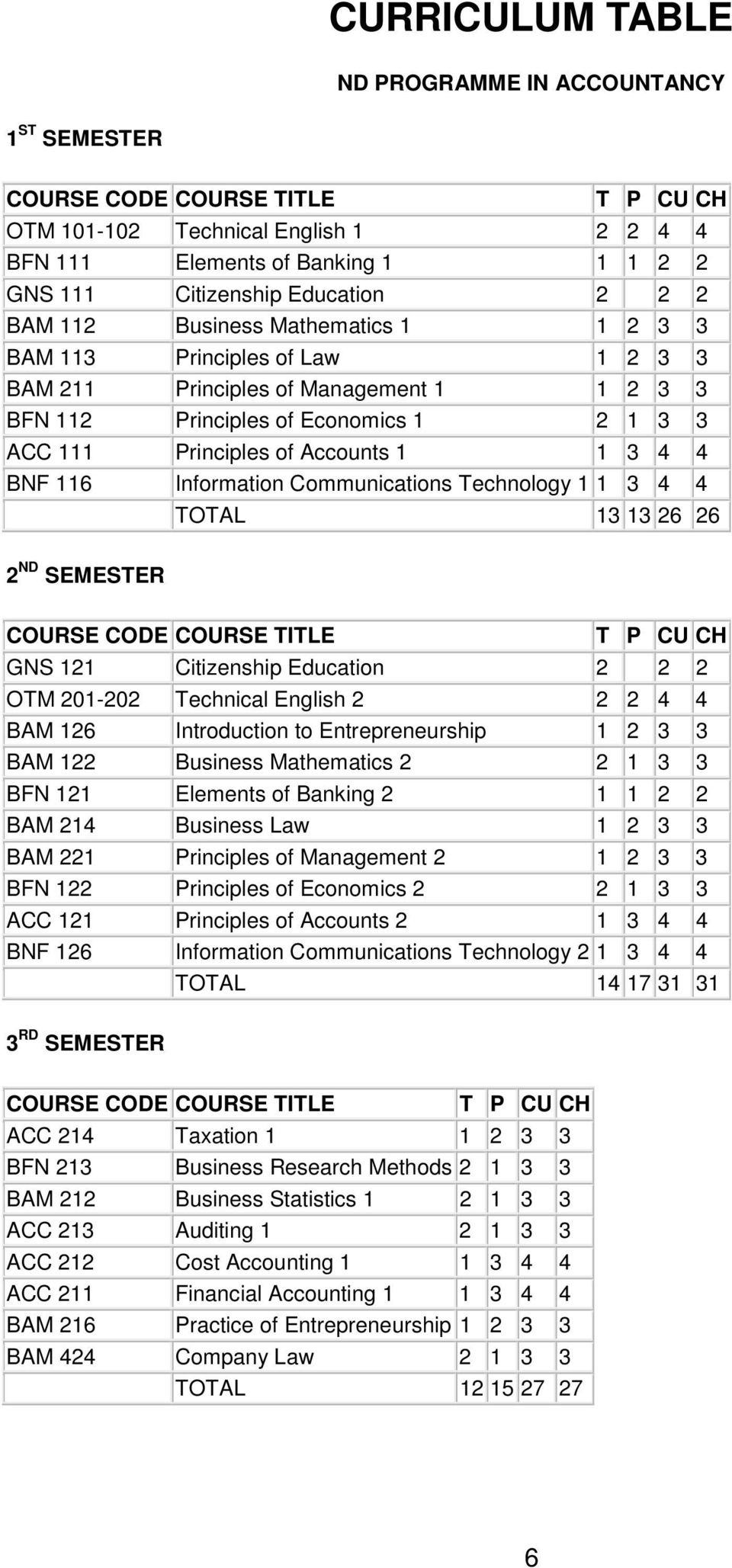
9 4 TH SEMESTER COURSE CODE COURSE TITLE T P CU CH BAM 222 Business Statistics BFN 211 Business Finance ACC 223 Auditing ACC 222 Cost Accounting ACC 224 Taxation ACC 221 Financial Accounting ACC 225 Public Sector Accounting ACC 229 Project TOTAL

10 SEMESTER 1 PROGRAMME: ND Office Technology and Management Course: Technical English I Course: Technical English I Code: OTM 112 (GNS ) Credit Hours: 4 hours Semester: 1 Pre-requisite O/L Credit in English Theoretical: Practical: 2 hours/week - 50% 2 hours/week - 50% Course main Aim/Goal: This course is designed to enable the student acquire the necessary language and communication skills which will enable him/her to use the English Language in a business environment and to know the techniques of correspondence. General Objectives: 1.0 Develop appropriate study skills in English Language. 2.0 Know the nature of language and the basic rules of grammar. 3.0 Appreciate literary works in English. 4.0 Understand the concept of communication. 5.0 Know how to make oral and written presentations. 6.0 Know the rules of comprehension and interpretation. 8
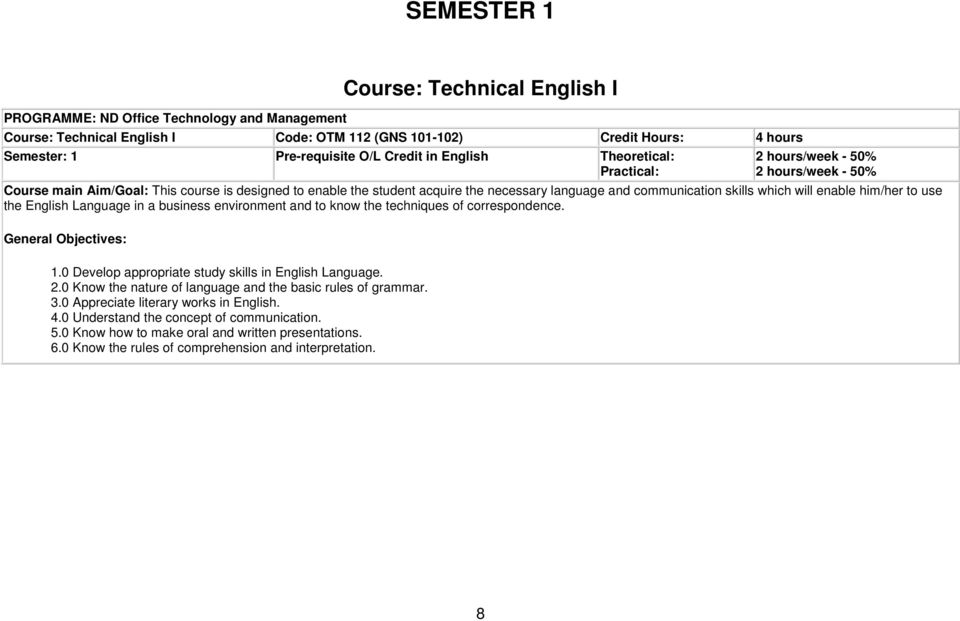
11 Week Specific Learning Teacher s Activities Resources Specific Learning General Objective 1.0: Develop appropriate study skills using English Language. 1.1 Understand the principles of good note taking and making techniques in English. 1.2 Understand method of note taking/making English. 1.3 Identify sources of library information. 1.4 Identify information in the sources listed in Identify good reading habits in English. Explain the necessity for acquiring good note-making/making techniques in English. Show methods of note-taking/making in English. Expose students to sources of library information in English. Discuss with students how to locate the sources listed in 1.3. Discuss the principles of good reading habits. - Flip charts - Felt pen - Textbooks - Workbooks - Close-circuit TV Model notes Library Dictionary, reference books, etc As in 1.3 Class handouts General Objective 2.0: Know the nature of language and the basic rules of grammar. 2.1 List the characteristics of language. 2.2 Appreciate the four language skills - speaking listening, writing, & reading. 2.3 Understand the functions of language. 2.4 List the uses of English Language in Nigeria. Explain the concept of language Textbooks Textbooks Demonstrate good notetaking skill in English. List methods of notetaking/making in English. Classify sources of library information. Locate information in the coerces listed in 1.3. Discuss the four language skills. Handouts Role playing in the four language skills. Teacher s Activities Provide assignments on note taking. Provide sources of information on notetaking/making. Refer students to sources of library information. Guide students in locating the sources listed in Apply good reading habits Set tasks and supervise activities Explain the functions of language. As in 2.2 above. Discuss the functions in groups. Explain the uses of English Language in Nigeria eg as the language of Research, government, business, etc. Resource persons from government, business, research, etc Role playing as researchers, government officials, business, etc. Supervise the students activities. Resources - Flip charts - Felt pen - Textbooks - Workbooks - Library - Internet Sections of Library -Internet As in Newspapers - Textbooks - Magazine - Selected Novels Audio tapes Radio Video recorder Cd-rom As in 2.2 above. As in 2.2 above. Evaluate students activities. 9
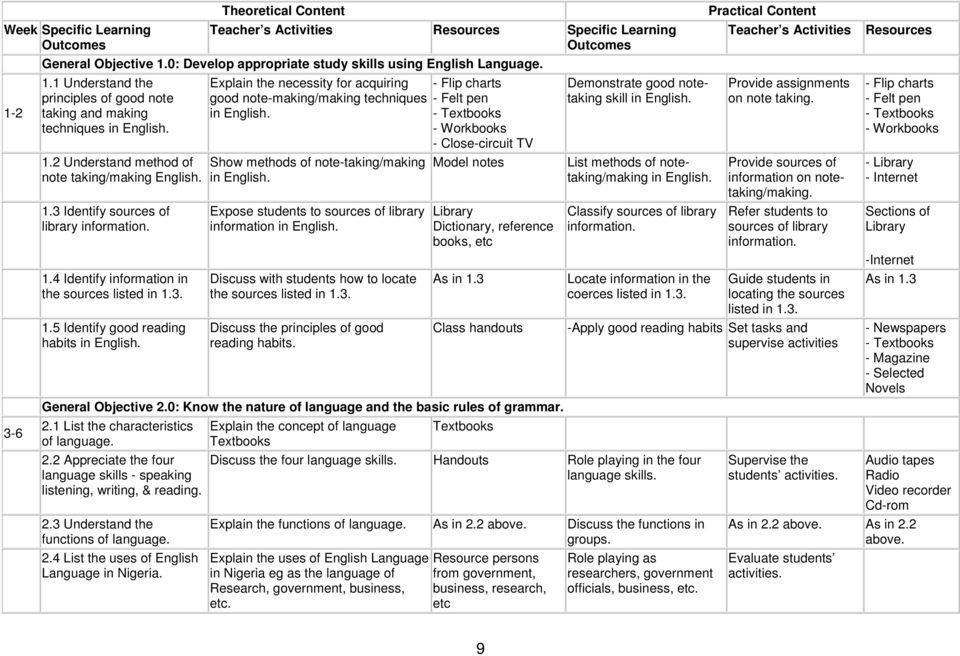
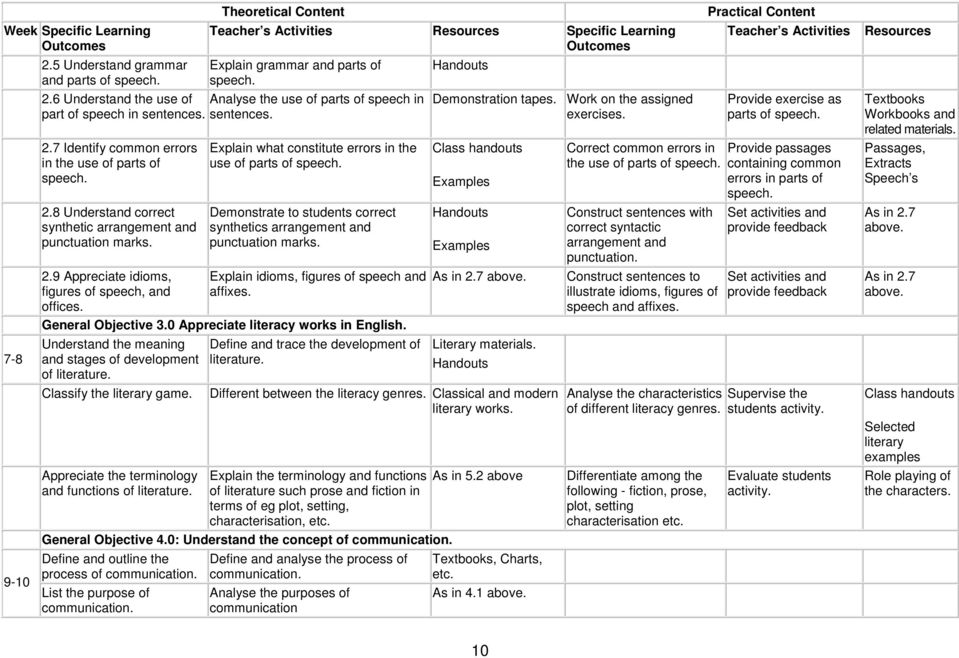
12 Week Specific Learning Understand grammar and parts of speech. Teacher s Activities Resources Specific Learning Explain grammar and parts of speech. 2.6 Understand the use of Analyse the use of parts of speech in part of speech in sentences. sentences. 2.7 Identify common errors in the use of parts of speech. 2.8 Understand correct synthetic arrangement and punctuation marks. 2.9 Appreciate idioms, figures of speech, and offices. Explain what constitute errors in the use of parts of speech. Demonstrate to students correct synthetics arrangement and punctuation marks. Explain idioms, figures of speech and affixes. General Objective 3.0 Appreciate literacy works in English. Understand the meaning and stages of development of literature. Classify the literary game. Appreciate the terminology and functions of literature. Define and trace the development of literature. Handouts Demonstration tapes. Work on the assigned exercises. Class handouts Examples Handouts Examples As in 2.7 above. Literary materials. Handouts Different between the literacy genres. Classical and modern literary works. Explain the terminology and functions of literature such prose and fiction in terms of eg plot, setting, characterisation, etc. General Objective 4.0: Understand the concept of communication. Define and outline the process of communication. List the purpose of communication. Define and analyse the process of communication. Analyse the purposes of communication As in 5.2 above Textbooks, Charts, etc. As in 4.1 above. Correct common errors in the use of parts of speech. Construct sentences with correct syntactic arrangement and punctuation. Construct sentences to illustrate idioms, figures of speech and affixes. Analyse the characteristics of different literacy genres. Differentiate among the following - fiction, prose, plot, setting characterisation etc. Teacher s Activities Provide exercise as parts of speech. Provide passages containing common errors in parts of speech. Set activities and provide feedback Set activities and provide feedback Supervise the students activity. Evaluate students activity. Resources Textbooks Workbooks and related materials. Passages, Extracts Speech s As in 2.7 above. As in 2.7 above. Class handouts Selected literary examples Role playing of the characters. 10
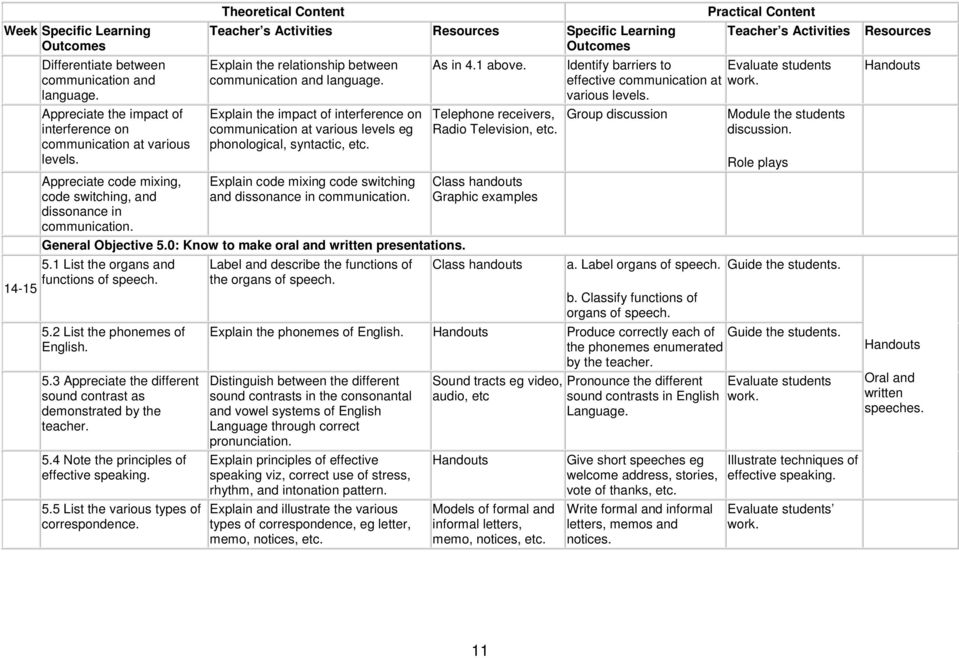
13 Week Specific Learning Differentiate between communication and language. Appreciate the impact of interference on communication at various levels. Appreciate code mixing, code switching, and dissonance in communication. Teacher s Activities Resources Specific Learning Explain the relationship between communication and language. Explain the impact of interference on communication at various levels eg phonological, syntactic, etc. Explain code mixing code switching and dissonance in communication. General Objective 5.0: Know to make oral and written presentations. 5.1 List the organs and functions of speech. 5.2 List the phonemes of English. 5.3 Appreciate the different sound contrast as demonstrated by the teacher. 5.4 Note the principles of effective speaking. 5.5 List the various types of correspondence. Label and describe the functions of the organs of speech. As in 4.1 above. Telephone receivers, Radio Television, etc. Class handouts Graphic examples Class handouts Identify barriers to effective communication at various levels. Group discussion a. Label organs of speech. b. Classify functions of organs of speech. Teacher s Activities Evaluate students work. Module the students discussion. Role plays Guide the students. Explain the phonemes of English. Handouts Produce correctly each of Guide the students. the phonemes enumerated by the teacher. Distinguish between the different sound contrasts in the consonantal and vowel systems of English Language through correct pronunciation. Explain principles of effective speaking viz, correct use of stress, rhythm, and intonation pattern. Explain and illustrate the various types of correspondence, eg letter, memo, notices, etc. Sound tracts eg video, audio, etc Handouts Models of formal and informal letters, memo, notices, etc. Pronounce the different sound contrasts in English Language. Give short speeches eg welcome address, stories, vote of thanks, etc. Write formal and informal letters, memos and notices. Evaluate students work. Illustrate techniques of effective speaking. Evaluate students work. Resources Handouts Handouts Oral and written speeches. 11
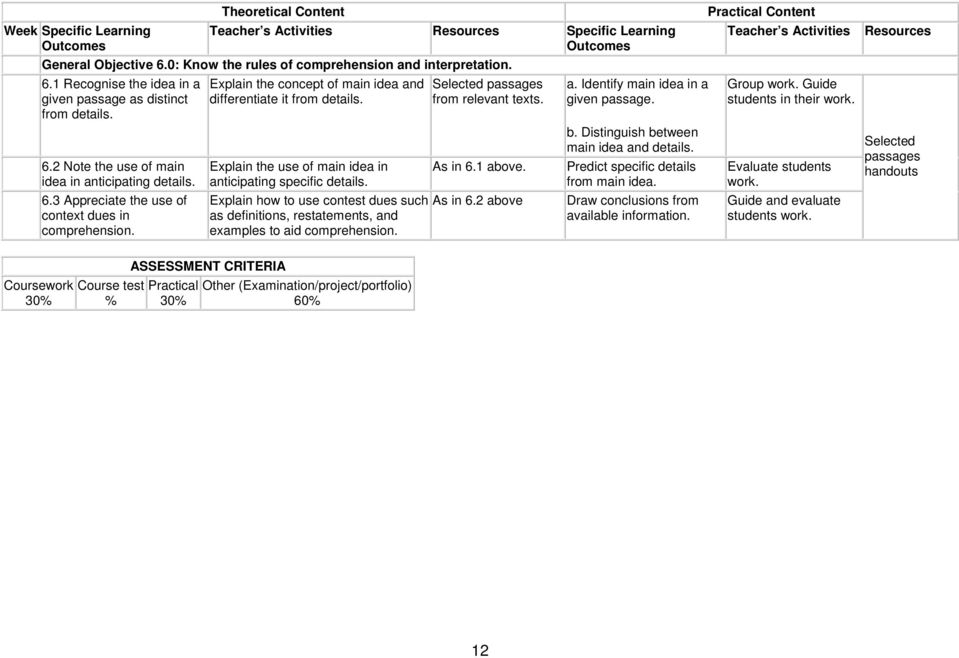
14 Week Specific Learning Teacher s Activities Resources Specific Learning General Objective 6.0: Know the rules of comprehension and interpretation. 6.1 Recognise the idea in a given passage as distinct from details. 6.2 Note the use of main idea in anticipating details. 6.3 Appreciate the use of context dues in comprehension. Explain the concept of main idea and differentiate it from details. Explain the use of main idea in anticipating specific details. Explain how to use contest dues such as definitions, restatements, and examples to aid comprehension. Selected passages from relevant texts. As in 6.1 above. As in 6.2 above a. Identify main idea in a given passage. b. Distinguish between main idea and details. Predict specific details from main idea. Draw conclusions from available information. Teacher s Activities Group work. Guide students in their work. Evaluate students work. Guide and evaluate students work. Resources Selected passages handouts Coursework 30% Course test % ASSESSMENT CRITERIA Practical 30% Other (Examination/project/portfolio) 60% 12
15 PROGRAMME: NATIONAL DIPLOMA IN BANKING AND FINANCE Course: Elements of Banking I Course: Elements of Banking 1 Code: BFN 111 Credit Hours: 30 hours Semester: 1 Pre-requisite: Theoretical: Practical: 1 hours/week - 50% 1 hours/week - 50% Goal: To enable the students understand the basic concepts of money and credit and the practical aspects of Banking transactions. The students should be able to understand the evolution, structure of different types of Banking Institution and their roles in the working of the Nigerian financial systems. GENERAL OBJECTIVES: On completion of this module the students should be able to: 1.0 Understand the concepts of Money. 2.0 Know the evolution and the structure of the banking Institutions. 3.0 Understand Commercial banking, lending/borrowing principles. 4.0 Understand Bank services and methods of payments through banking systems. 5.0 Understand the roles of non-bank intermediaries. 13

16 Week Specific Learning Teacher s Activities Resources Specific Learning 1-3 General Objective 1: Understand the concepts of Money 1.1 Explain the basic concepts of money - its origin. 1.2 Describe how banks create money. 1.3 Differentiate between the different types of money. 1.4 Explain the factors that influence the demand for and supply of money. Lead the students to identifying the simple meanings of money. The history of money from ancient civilization to date be traced. Illustrate to the students the process of money creation by banks. A quiz can be assigned after the lecture. Identify types of money, discuss the types and differentiate them, with examples. Textbooks; journals, magazines and periodicals. Textbooks, journals, magazines and transparency. Able to explain the concept of money and the different forms of money. Able to explain factors influencing the supply and demand of money. Teacher s Activities Guide the students to complete a group research exercise using the internet. They should research the origins and development of monetary systems and comment on their development and the situation to-day. Resources Assignment brief. Internet Word processor Provide the concepts of demand and supply of money and identify the factors that influences them. General Objectives: 2.0 Know the evolution and the structure of the banking institutions Explain the evolution and structure of different types of Banking Institutions - Central Bank, Commercial Banks, Development banks and non Banking/Finance Institutions. 2.2 Explain sources of funds, functions and the management of the Banks named in 2.1 above. Provide a historical account of the Apex bank, Commercial Banks, Development Banks and non Bank/Finance institutions from Colonial to post Colonial periods. Illustrate with a chart the structure of those Banks. Textbooks, magazines, journals and periodicals. Transparency, charts, textbooks, magazines, journals and periodicals. Ability to understand and appreciate the difference between the role of private sector banks and the role of central banks. Individual assignments comparing and contrasting the roles of central and private sector banks Assignment brief Internet Word processor Outline and discuss the 14

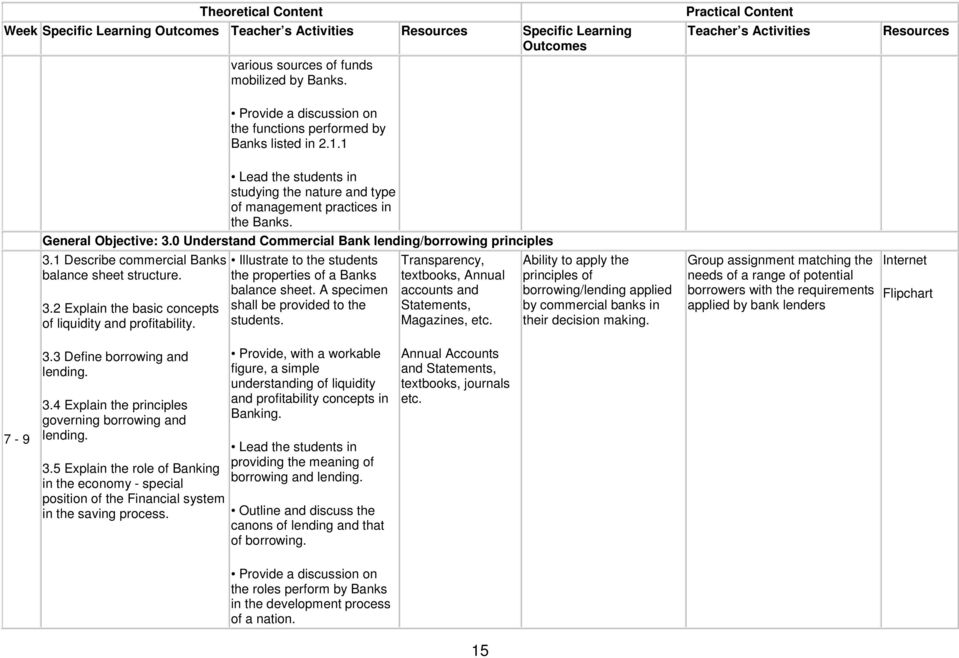
17 Week Specific Learning Teacher s Activities Resources Specific Learning various sources of funds mobilized by Banks. Teacher s Activities Resources Provide a discussion on the functions performed by Banks listed in Lead the students in studying the nature and type of management practices in the Banks. General Objective: 3.0 Understand Commercial Bank lending/borrowing principles 3.1 Describe commercial Banks balance sheet structure. 3.2 Explain the basic concepts of liquidity and profitability. Illustrate to the students the properties of a Banks balance sheet. A specimen shall be provided to the students. Transparency, textbooks, Annual accounts and Statements, Magazines, etc. Ability to apply the principles of borrowing/lending applied by commercial banks in their decision making. Group assignment matching the needs of a range of potential borrowers with the requirements applied by bank lenders Internet Flipchart Define borrowing and lending. 3.4 Explain the principles governing borrowing and lending. 3.5 Explain the role of Banking in the economy - special position of the Financial system in the saving process. Provide, with a workable figure, a simple understanding of liquidity and profitability concepts in Banking. Lead the students in providing the meaning of borrowing and lending. Outline and discuss the canons of lending and that of borrowing. Annual Accounts and Statements, textbooks, journals etc. Provide a discussion on the roles perform by Banks in the development process of a nation. 15
18 Week Specific Learning Teacher s Activities Resources Specific Learning General Objectives.: 4.0 Understand Bank services and methods of payments through banking systems. 4.1 Describe the various services offered by the Banks. 4.2 Explain the methods of payments through the Banking system. 4.3 Describe the Banks clearing system. 4.4 Explain the role of Banking as catalysts in development Lead the students in identifying the products offered by banks for customer services, and a discussion on each be made. Outline and provide a discussion with a specimen where possible the methods of payment via the Banking System. Textbooks, journals, magazines and Newspapers. Textbooks, Transparency, Magazines and journals. Ability to explain the services offered to customers by banks concerning payment methods. Teacher s Activities Group exercise involving an investigation into methods of making payments through banks. Feedback as a group to the class. Resources Internet Exercise brief Flipchart/ powerpoint. Illustrate how Banks clearing system operates to the students. The recent development in the clearing system shall be discussed too Provide a detail discussion on the instrumentality of Banks in triggering development to nations. General Objectives. 5.0 Understand the roles of non-bank intermediaries 5.1 Explain what non-bank intermediaries are and their contributions to the economy as a whole. 5.2 Discuss the importance of the institutions by funds mobilization and contributions to the economy as a whole. Lead the discussion of what non-bank Intermediaries are and how they contribute in the mobilization of financial resources for development. Provide an outline of the Sources of funds and the process in channeling these Textbooks, magazines, journals and Newspapers. A full understanding of the importance of non-bank intermediaries to the Nigerian economy. Guide students to research the role of non-bank intermediaries and their importance to the Nigerian economy. Students to complete short class test Internet Class short test. (multiple choice) 16

19 Week Specific Learning Teacher s Activities Resources Specific Learning 5.1 Distinguish between nonbank financial intermediaries and Banks. funds by the non-banks into the financial system and the economy at large. Teacher s Activities Resources Provide the students with a clear distinction of non-bank financial institutions and Banks with examples. Coursework % Course test 20% ASSESSMENT CRITERIA Practical 30% Other (Examination/project/portfolio) 50% 17

20 PROGRAMME: ND BUS ADMIN AND MANAGEMENT Course: Business Mathematics I Course: BUSINESS MATHEMATICS Code: BAM 112 Credit Hours: 3 hours Semester: ONE Pre-requisite: Theoretical: Practical: Course main Aim/Goal 2 hours/week - 67 % 1 hours/week - 33 % The course is designed to enable the student apply the quantitative knowledge of business mathematics in solving simple business problems. General Objectives: 1. Understand the concepts of simple and compound interest, annuity, present value and discount 2. Understand investment appraisal, the necessary test and their application to business 3. Evaluate indices 4. Understand the concepts of equations and inequalities and their applications in solving business problems. 5. Understand vector algebra and its application to business 6. Comprehend the basic idea of matrix and its application to business 7. Understand the construction and interpretation of graphs and their application. 18

21 Week Specific Learning 1-2 Teacher s Activities Resources Specific Learning Teacher s Activities General Objective 1: Understand the concepts of simple and compound interest, annuity, present value and discount 1.1 Define simple and compound interest. 1.2 Compute annuity and compound interest. 1.3 Compute the value of land, equipment, etc or money according to present value concept. 1.4 Compute the monetary worth of things with discount concept. Explain sequence and series Explain simple and compound interest Solve problem involving 1.1 above. Explain annuity, PV, and network. Solve problem involving above. Textbooks Calculators Annuity Tables Log books Compute annuity and compound interest. Compute the value of land, equipment, etc or money according to present value concept. Compute the monetary worth of things with discount concept. Guidance on the calculation of simple and compound interest. Solve business problems - retail scenarios - using simple and compound interest. Advice on the concept of net present value - simple calculations. Resources Questions and problems based on business situations Apply the above concept to problems in business. General Objective 2: Understand investment appraisal, the necessary test and their application to business 2.1 Define the discounting techniques. 2.2 State discounting techniques using the cash flow method. 2.3 Perform the necessary test in the choice of the techniques.. Explain the concept of discount and cash flow techniques. Solve problems involving the above. Conduct test Textbooks Calculators Annuity Tables Log books State discounting techniques using the cash flow method. Perform the necessary test in the choice of the techniques.. Apply concepts to problems in Business Guidance on cash flow and discounted cash flow calculations Solve business problems - retail scenarios - using simple and compound interest. Questions and problems based on business situations 2.4 Apply above concepts to problems in Business 19
22 Week Specific Learning General Objective 3: Evaluate Indices 3.1 Define indices 3.2 Simplify the product and quotient of indices. 3.3 Simplify the value of an index raised to an exponent. Teacher s Activities Resources Specific Learning Explain indices; logarithms & their laws. Solve problems involving the above. Textbooks Calculators Log books Simplify the product and quotient of indices. Simplify the value of an index raised to an exponent. Teacher s Activities Solve business problems using indices. Advice and guidance on the use of indices and logarithms Resources Questions and problems based on business situations Define logarithms. 3.5 Explain the laws of logarithms 3.6 Define change of base Apply the above concepts to problems of business management. General Objective 4: Understand the concepts of equations and inequalities and their applications in solving business problems. 4.1 Explain the concept of equation, i.e. A=B, where A and B are expressions. 4.2 List different types of equation: Linear, quadratic, cubic, etc. 4.3 Enumerate examples of simultaneous equations: Linear, quadratic etc 4.4 Solve simultaneous equations using algebraic i. Explain mathematics equations. ii. Explain types of equation. iii. Solve problems involving equations using mathematical and graphical equations. iv. Give assignment. i. Explain mathematics equations. ii. Explain types of equation. iii. Solve problems involving equations using mathematical and graphical equations. iv. Give assignment. Solve simultaneous equations using algebraic and graphical methods. Factorize a given equation. Solve a given equation by Factorization. Solve given equations by completing the square Advice on the application of simultaneous linear equations. Solve business problems using indices. Apply the principles of factorization. Solve equations relevant to business situations. Questions and problems based on business situations 20
23 Week Specific Learning Teacher s Activities Resources Specific Learning Teacher s Activities Resources and graphical methods. 4.5 Explain factorization. 4.6 Factorize a given equation. Solve a given equation by Factorization. 4.7 Solve given equations by completing the square 4.8 Explain the use of formula in solving quadratic equations Solve equations involving inequalities. General Objective 5: Understand vector algebra and its application to business. 5.1 Define a vector. 5.2 List example of vector. 5.3 Illustrate the addition, subtraction and multiplication of vector. Explain vector and its law. Solve problem involving vector Textbooks Graph papers Illustrate the addition, Apply the concepts of vector subtraction and algebra to Business Advice multiplication of vector. on the application of vectors Explain the distribution law to business situations.. of Vector. Questions and problems based on business situations 5.4 Explain the distribution law of Vector. 5.5 Apply the concepts of vector algebra to business. 21
24 Week Specific Learning Teacher s Activities Resources Specific Learning General Objective 6: Comprehend the basic idea of matrix and its application to business 6.1 Define matrix 6.2 Identify matrix 6.3 State the properties of matrix 6.4 Perform simple operations of addition, subtraction and multiplication with matrix. Explain the concept of matrix and its properties. Solve simple matrix problems. Solve matrix by linear equations Solve business problems using matrix. Textbooks Perform simple operations of addition, subtraction and multiplication with matrix. Determine the determinant of matrix including positives, negative and zero determinants Teacher s Activities Advice on the application of matrices to business situations. Apply the concepts of matrices to business situations Resources Questions and problems based on business situations Determine the determinant of matrix including positives, negative and zero determinants. 6.6 Explain the rank of a matrix. 6.7 Determine the inverse of a matrix. (i) Conduct test 6.8 Determine the transpose and adjoin of a matrix. 6.9 Solve linear equations by the methods of Game s Rule, (ii) Gausian Method, (iii) on verse of matrix Apply the rank of a matrix to input/output analysis. 22
25 Week Specific Learning Teacher s Activities Resources Specific Learning General Objective 7: Understanding the construction and interpretation of graphs and their applications 7.1 Solve two simultaneous linear equations using graphical method. 7.2 Solve two simultaneous equations: Linear and quadratic using graphical approach. 7.3 Solve two simultaneous equations: quadratic and quadratic using graphic approach. 7.4 Identify the slope and intercept of a given quadratic by graphical approach. Solve simultaneous equation using graphical methods Guide students to plot simple graphs and their applications to management of business. Textbooks Graph papers Mathematical set Solve two simultaneous linear equations using graphical method Solve two simultaneous equations: quadratic and quadratic using graphic approach. Plot straight line graphically given a set of co-ordinates and points or the slope and intercept. Teacher s Activities Advice on the application of simultaneous linear equations using graphs to business situations. Apply the concepts of quadratic equations to business situations using graphs Plot straight line graphs. Sketch the graphs of simple functions. Resources Questions and problems based on business situations 7.5 Plot straight line graphically given a set of coordinates and points or the slope and intercept. 7.6 Sketch the graphs of simple functions. 7.7 Apply the above concepts to management of business. Coursework 50% Course test 25% ASSESSMENT CRITERIA Practical 25% Other (Examination/project/portfolio) % Competency: On completing the course, the student should be able to understand/estimate/define/etc. 23
26 PROGRAMME: ND BUSINESS ADMIN. Course: Principles of Law I Course: PRINCIPLES OF LAW I Code: BAM 113 Credit Hours: 3 hours 2 Semester: ONE Pre-requisite: Theoretical: Practical: Course main Aim/Goal 1 hours/week - 33 % 2 hours/week - 67 % This course is designed to introduce the student to the general principles of Nigerian law as it affects business. General Objectives: 1. Know the composition of the Legal System in Nigeria 2. Know the rudiments of the Nigerian Constitutional Law concepts and the separation of powers in the constitution 3. Know the nature and sources of Nigerian Law 4. Know the law of the Person and of Association 5. Know the Law of Administration of Estates and Trusts 6. Understand the law of Property 7. Understand the rudiments of the Law of Contract. 8. Understand the Law of Tort in business. 24
27 Week 1-2 Specific Learning Teacher s Activities Resources Specific Learning General Objective 1: Know the composition of the Legal System in Nigeria 1.1 Define law. 1.2 Explain why law is an important aspect in the existence of a society. 1.3 Identify the types and hierarchy of courts. 1.4 Identify the existence of tribunals and arbitration (body, group and panel) 1.5 Explain the jurisdiction of various courts, tribunal and arbitration body. Explain the concept of Law and its importance. Explain types and nature of courts, tribunals and arbitration. Explain the hierarchy of personnel in the legal profession Explain NBA and other organizations in the legal profession. Textbooks Journals Know the Nigerian Legal system and its structures. Teacher s Activities Show students with diagrams. The Nigerian legal system and its structures. Resources Visit to a Nigerian Court Websites on tribunals and arbitration. 1.6 Explain the various personnel and their positions in the hierarchy of courts Explain the organization of the legal profession in Nigeria. General Objective 2: Know the rudiments of constitutional law and the separation of powers in the constitution. 2.1 Explain Constitutional Law concepts, state, nationality, citizenship, domicile, supremacy of the constitution and the rule of law. 2.2 Explain the various organs of the state. 2.3 Explain the meaning of Define constitution Identify the major organisation of government as specified in the constitution Explain the nature of abuse of powers and Textbooks Constitutions Journals/ Publications Know the Nigerian Constitution with emphasis on the provisions relating to separation of powers. Textbooks Cite relevant cares Constitutions and situations of Journals/Publications above of powers and Show students the Nigerian Constitution and its components. Discuss relevant cases with students. Organise a debate to discuss the constitutional arrangements. Guidance on the possible Nigerian Constitution. Law Reports etc. Groupwork to consider different aspects of abuse of power and the legal remedies. Civil remedies and redress. 25
28 Week Specific Learning Teacher s Activities Resources Specific Learning separation of powers. 2.4 State which powers are executive, legislative, and judicial? 2.5 Explain the various positions and functions of holders of the powers in Explain the possible abuse of powers conferred on the executive legislature, and the judiciary. their remedies. Explain the nature of the rule of law. Give assignment rule of law. State which powers are executive, legislative, and judicial? Explain the various positions and functions of holders of the powers Explain the possible abuse of powers. Teacher s Activities abuses of power using relevant case law. Consider the legal remedies. Preparation for the assignment - using groups discussions Each group to apply the relevant aspects of the constitution. Resources Explain the possible remedies for such abuses. 2.8 Explain the nature of fundamental human rights and the rules of natural justice. 2.9 Explain how the breaches in 2.8 are redressed. General Objective 3: Know the nature and sources of law. Explain the nature of Nigerian Law. Explain the sources of Nigerian law i.e. received English law (common law and equity, status of general Explain the nature and sources of Nigerian Law Explain criminal and Civil Law and state their importance Textbooks Explain the possible remedies for such abuses. Explain the nature of fundamental human rights - rules of natural justice. Explain how the breaches in 2.8 are redressed. Explain the sources of precedent) Local Legislation and customary law. Distinguish between criminal and civil law Guidance on questions and legal terminology with crosswords, puzzles and question and answer. Case law to show the 26
29 Week Specific Learning Teacher s Activities Resources Specific Learning application, and judicial precedent) Local Legislation and customary law. and the importance of such distinction. Teacher s Activities differences between civil and criminal law Resources 7-8 Distinguish between criminal and civil law and state the importance of such distinction. General Objective 4: Know the law of persons and law of Association: 4.1 Recognize the distinction between natural person and artificial person. 4.2 Explain the legal personality of unborn persons, dead persons, infants and married women. Explain types and 4.3 Recognize the law of nature of corporations domicile of infants and married and distinguish them woman. from unincorporated associations 4.4 Explain the capacity of an insane person, infants, and Conduct test married women, to enter into legal relations. 4.5 Distinguish between a corporation sole and a corporation and aggregate corporation. 4.6 Identify unincorporated associations - partnership, trade unions and local Explain Law of Person and Law of Association. Explain legal capacity of insane, intents, married women etc Textbooks Websites Recognize the law of domicile of infants and married woman. Explain the capacity of an insane person, infants, and married women, to enter into legal relations. Distinguish between a corporation sole and a corporation and aggregate corporation. Explain the capacity of corporations to enter into legal relations. Guidance on relevant cases and relevant legislation. Consider questions on legal capacity. Allow students to research age groups and the legal status of partnerships - agencies - trade associations. Working in Pairs Use of relevant websites 27
30 Week Specific Learning Teacher s Activities Resources Specific Learning customary family group. Teacher s Activities Resources 4.7 Explain the capacity of corporations to enter into legal relations. General Objective 5: Know the Law of Administration of Estates and Trusts. 5.1 Distinguish between estates (will) and instate (without successions) 5.2 Explain the grant of probate and letters of Administration and Estates. Explain estate and instate. Explain the nature of trusts, kinds and their creation. Textbooks Websites Know the relevant cases as it relates to the administration of Estates and Trusts. Cite cases as it relates the administration of Estates and Trusts. Copies of wills, trust documents and letters of administration. Talk by a qualified lawyer 9 Explain rights of 5.3 Explain the Nature of beneficiaries and the trusts, kinds and their creation. duties of trustees. 5.4 Explain the rights of beneficiaries. Explain the duties of trustees. General Objective 6: Understand the law of property 6.1 Explain the nature of property. 6.2 Explain the law of ownership and possession. Explain the nature and Law of Property. Explain mortgage, pledge, lien, etc. Textbooks Know the relevant cases as it relates to the law of property, mortgages, pledges, lien etc. Cite relevant as it relates to the law of property, mortgages, pledges, lien etc Distinguish between real and personal property. 6.4 Distinguish between mortgage, pledge, lien, etc. 28
31 Week Specific Learning Teacher s Activities Resources Specific Learning 6.5 Identify legal and equitable interests. General Objective 7: Understand the Rudiments of the Law of Contract 7.1 Explain what contract is. 7.2 Explain the nature and forms of contracts. 7.3 Explain the essentials of a valid contract. 7.4 Explain terms of contracts - conditions, warranties 7.5 Explain the vitiating elements in contracts. 7.6 Explain discharge, frustration and breach of contracts. Explain the nature and Law of Contract Cite relevant cases Textbooks Law reports Teacher s Activities Know the relevant Guidance on relevant cases as cases as they relate to they related to the law of the law of contract. contract. Business Scenarios for students to apply case law and principles of law Resources Use of relevant websites Explain the remedies for breach of contracts. General Objective 8: Understand the Law of Tort. 8.1 Explain the nature of torts and the basis for liability. 8.2 Explain the general defences to liability in torts. 8.3 Explain vicarious liability - master and servants. 8.4 Identify specific torts - Explain the nature and Law of Tort. Explain torts arising from business relationship. Cite relevant cases. Conduct test. Textbooks Law reports Explain vicarious liability - master and servants. Identify specific torts - Occupier s liability, trespass, negligence, nuisance, defamation, and conversion. Explain torts arising Guidance on relevant cases as they related to the law of tort Problem solving assignment based on Grabb, Suit and Runn a firm of solicitors advising business clients about possible legal liability - passing off, negligence, defamation, conversion etc. Use of relevant websites 29
32 Week Specific Learning Teacher s Activities Resources Specific Learning Occupier s liability, trespass, negligence, nuisance, defamation, and conversion. from business competition - Teacher s Activities Resources 8.5 Explain torts arising from business competition - malicious falsehood, passing off, and interference with an existing contract. Coursework 50% Course test 25% ASSESSMENT CRITERIA Practical 25% Other (Examination/project/portfolio) % Competency: On completing the course, the student should be able to understand/estimate/define/etc. 30
33 PROGRAMME: ND BUSINESS ADMIN AND MANAGEMENT Course: Principles of Management I Course: PRINCIPLES OF MANAGEMENT I Code: BAM 211 Credit Hours: 3 hours Semester: ONE Pre-requisite: Theoretical: Practical: Course main Aim/Goal 1 hours/week - 33% 2 hours/week - 67% To enable the student acquire background knowledge of the historical evolution of management thought and to introduce them to basic managerial principles and techniques. General Objectives: 1. Know the nature and scope of management 2. Know the historical background of management 3. Understand the responsibilities of a manager 4. Understand the management function of Planning 5. Understand the management function of organizing 6. Understand the management function of co-ordinating 7. Understand the management function of controlling. 31
34 Week Specific Learning Teacher s Activities Resources Specific Learning Teacher s Activities Resources 1-2 General Objective 1: Know the nature and scope of management 1.1 Define Management. 1.2 Explain the nature and scope of Management 1.3 Explain objectives of Management. 1.4 Explain the functions of Management. Explain the nature, scope and objectives of management. Explain the functions of management with examples 1) Textbooks 2) Management Journals Learn from a functional organization how objectives are formulated. Apply the functions of management to a known organization. Guide the student to source formulation of objectives and functions of management from the internet. Internet Relevant websites General Objective 2: Know the historical background of Management Explain the evolution of Management thought including contributions made by Frederick Taylor, Henri Fayol etc. Explain the contributions Babb-age, Taylor etc to the development of management Textbooks Relate the theories of management to the success story of an existing organization. Show through the internet or management film the application of management thought to real life situation. Internet Relevant websites 2.5 Know Explain the various schools of Management thought. General Objective 3: Understand the responsibilities of a manager Explain who a manager is 3.2 Explain the roles and responsibilities of a manager Explain who a manager is, his roles and responsibilities 1) Textbooks 2) Journals Explain whom a manager is, his qualities and the varying nature of his job. Invite a practical Manager to educate the student on his roles and responsibilities in his organization. Internet Relevant websites 3) Publications General Objective 4: Understand the management function of planning Define Planning. 4.2 Explain the need for Planning. 4.3 Explain types of plan. 4.4 Explain the planning process. 4.5 Identify tools of management planning. Explain planning, its types, process and the need for planning. Explain with examples tools of management planning. Conduct Test. 1) Textbooks 2) Journals 3)Publications Explain from a functional organization how planning has led to its success noting the effect of the different types of planning. Guide the student to learn the Internet application of planning process Relevant through the internet. websites Use a relevant caes study on a media/retail project 32
35 Week Specific Learning Teacher s Activities Resources Specific Learning Teacher s Activities Resources General Objective 5: Understand the Management Function of Organizing Define organizing. 5.2 Explain the need for organizing. 5.3 Explain the process of organizing. 5.4 Define a basic organizational structure. Explain organizing as a function Explain its process and the need for organizing. Explain organization as a basic structure using diagram 1) Textbooks 2) Journals 3) Publica Use practical illustrations to explain organizing, its functions and process Demonstrate using diagrams the various organizational structures. Use simple case histories to draw relevant organisation charts Internet Relevant websites General Objective 6: Understand the Management function of Co-ordinating 6.1 Explain the nature of coordination. 6.2 Explain the need for coordination. 6.3 Identify the major areas of co-ordination namely: Human Explain co-ordination, its nature, process and the need for it. Explain how to co-ordinate human, material, financial 1) Textbooks 2) Journals 3) Publications - Management Explain how to co-ordinate using net-working and its benefits. Invite a co-ordinator of an existing programme to lecture the students. Internet Relevant websites General Objective 7: Understand the management of Control 7.1 Define the concept of control in Management. 7.2 Explain the need for control. 7.3 Identify the elements of control. 7.4 Identify major control techniques. 7.5 Explain the limitations of the control function. Explain the concept of control, its technique, elements and its needs in the organization. Explain its limitation. Show students relevant management films. Conduct test. 1) Textbooks 2) Journals 3)Publications 4)Management films Practicalise to the students how to control an organization using the major control techniques with their limitations Show management films relating to control Show how to use computers in control exercises. Use a relevant case study and spreadsheet Internet Relevant websites Coursework 50% Course test 25% ASSESSMENT CRITERIA Practical 25% Other (Examination/project/portfolio) % Competency: On completing the course, the student should be able to understand/estimate/define/e. 33
36 PROGRAMME: NATIONAL DIPLOMA IN ACCOUNTANCY Course: Principles of Economics I Course: Principles of Economics 1 Code: BFN 112 Credit Hours: 45 hours Semester: 1 Pre-requisite: Theoretical: Practical: Goal: To provide students with basic principles and general nature of economics. GENERAL OBJECTIVES: 2 hours/week - 67% 1 hours/week - 33% On completion of this module the students should be able to: 1.0 Understand Economics as a Social Science concerned with human behaviour in the context of business management. 2.0 Know price theory. 3.0 Understand production theory and market situations. 4.0 Understand distribution theory and factor pricing. 5.0 Know Industrial Organisations. 6.0 Know population and trade Unionism. 34
37 Week 1-2 Specific Learning Teacher s Activities Resources Specific Learning Teacher s Activities General Objective 1: Understand Economics as a Social Science concerned with human behaviour in the context of business management. 1.1 Define economics. 1.2 Explain the scope of economics 1.3 Explain the method of study economics and their limitations. 1.4 Rationalizes the studying of economics. 1.5 Distinguish between micro and macro economics. 1.6 Discuss the three main problems of every economics society - what, how and for whom. 1.7 Apply the production, possibility frontier as a tool. 1.8 Define a mixed economy 1.9 State how the free enterprises economy solves the basic economic problems and the Characteristics of a perfectly competitive market Explain how a mixed economy behaves in the nations economics Discuss the economics role of Government in a mixed economy. Explain the meaning of Economics. Explain in clear terms the coverage area of economics in human endeavour. Explain the distinction between the tools used for the study of economics and those used to study natural sciences. State the importance of economics in human endeavour Explain the study of economics as it relates to units component of the society and as it relates to sum total of all the components of the society. Explain the unique economic problems of socialist, commit and free enterprise societies as they relate to production, distribution and consumption. Explain capacity utilization of resources in countries and societies. Explain economics characterized by combination of two societies i.e. socialism and free enterprise. Text books and diagram/graphs A basic understanding of a mixed economy and the ways in which people benefit from it. Guide students to complete an individual short assignment researching the major components of the Nigerian economy. Resources Internet Assignment brief. Word processor 35
38 Week Specific Learning Teacher s Activities Resources Specific Learning 1.12 Identify other characteristics of a modern economy, viz. use of capital, division of labour and use of money. Explain the free interplay of demand and supply curves to determine, price, and allocation of resources in free enterprise Also, explain in clear termo the characteristics of perfectly competitive market. Text books and diagram Teacher s Activities Resources 3-4 Explain the use of control and regulation by government as well as deregulation in allocation of resources or the case may be and as the need arises. Explain the important roles of government in determination of some parameters in a mixed economy. Explain characters of modern economics especially the distinction between trade by barter and specialization. General Objectives. 2.0 Know price theory Define demand in economic. 2.2 Identify the levels of demand - individual and market. 2.3 Explain the determinants of demand. 2.4 Distinguish between a change in demand and a Explain the meaning of demand. Explain individual demand curve and market demand curve. Explain factors influencing demand. Explain the difference between change in demand and change in Text books. Diagrams. Ability to explain the key Group discussion/seminar factors influencing supply illustrating the theme, supply and demand. and demand factors influencing the Nigerian economy. Resource materials. Seminar brief. 36
39 Week Specific Learning Teacher s Activities Resources Specific Learning change in the quality demanded. 2.5 Calculate and interpret the Coefficients of elasticity of demand in terms of price of the commodity, income and cross elasticity. 2.6 Define supply and identify the levels of supply. 2.7 Discuss the determinants of supply. 2.8 Explains the movements associated with supply. 2.9 Compute and interpret the coefficients of elasticity of supply. quantity demanded. Generate figure to explain the calculation of price, income and cross elasticities and interpret. Explain the meaning of supply and difference between individual and market supply. Explain factors influencing supply. Explain, movement along the same supply curve and shifts in supply curves. Explain the interception of demand and supply curves to determine equilibrium price in the market. Teacher s Activities Resources 2.10 Define the equilibrium in the market Analyze the effects of shifts in supply and demand. General Objective: 3.0 Understand production theory and market situations. 3.1 Define production and Explain production theory and identify the types of production. clearly identify, labour and capital intensive production. 3.2 Explain the different types of output or product. Explain different types of product i.e. from tangible product to service and from ordinary to Text book. Ability to explain the principles of production theory. Individual assignment researching the relationship between cost and profitability, describing the effects of different types of economic costa Interent Assignment brief. 37
40 Week Specific Learning Teacher s Activities Resources Specific Learning 3.3 Define costs of production. technical product. Teacher s Activities Resources 3.4 Identify the sources of such costs. Explain different types of costs of production Distinguish among the periods of decision making and attendant costs along categorizes on the monetary short run, long run and very long run cost. 3.6 Describe, demonstrate and diagrammatically represents the various short run costs. 3.7 Explain the relationship among these various short run costs. 3.8 Explain the relevance of some of the costs in 3.7 above for the economic decision of the firm. 3.9 Discuss the long run cost behaviour of a firm and shows its relation with the short run costs Explain the characteristic of the perfectly competitive market Illustrate diagrammatically the demand curve facing a perfectly competitive firm and Explain inclear terms fixed costs and variable costs. Explain the following with the aid of diagram. Short run fixed cost, variable cost average, variable cost marginal costs. Explain how the various short run costs relate to one another. Explain how firms could be guided in their economic decision using the relationship of the various short run costs. Explain the long run cost behaviour and use same to explain transformation in the market as it differs from the short run. Explain the features of perfectly competitive market. Explain the nature of demand curve facing a perfectly competitively market and its 38
41 Week Specific Learning Teacher s Activities Resources Specific Learning state the implication(s) 3.12 Explain the short equilibrium or maximum profit position of a firm under perfect competition Explain the distinguishing features of a pure monopoly market type Explain the nature of the revenue and demand facing a monopolist Discuss the factors that can confer a monopoly power State and explain advantages and disadvantages of monopoly market. economic implication on the firm. Explain profit maximization of a firm in the short run. Explain the characteristics of a pure monopoly. Explain the nature of the revenue and demand facing a monopoly. Explain different types of monopoly and how the power are derived. Explain the advantages and disadvantages of monopoly. Explain price discrimination and factor influencing it. Teacher s Activities Resources 3.17 Describe the applications of price discrimination by a monopolist Define monopolistic competition Explain the similarities between this market type and either the pure monopoly or the perfect competition Define duopoly and Explain monopolistic competition. Explain the similarities between pure monopoly and perfect competition. Explain the meaning of duopoly and oligopoly. Explain other types of market e.g. Monopsony etc. 39
42 Week Specific Learning Teacher s Activities Resources Specific Learning oligopoly. Teacher s Activities Resources 3.21 Explain some of other models of these market types Discuss the means of providing barriers to entry into these markets. General Objective: 4.0 Understand distribution theory and factor pricing Identify the various prices attached to the different factors of production. 4.2 Distinguish between size and functional distribution of income. 4.3 Explain the relationship between factor price and factor income. Explain the meaning of Rent, wage, capital and profit, Explain functional distribution of income. Explain how factor price is different from factor income. Explain what constitutes factors of production. Text book. Ability to understand the relationship between factor income and factor price and their influencing factors. Group seminar/discussion debating and providing solutions to questions involving distribution theory and factor pricing. Seminar brief. Resource materials. 4.4 Explain of factors of production. 4.5 State and explain ways of determining the prices of the various factors of production. 4.6 Distinguish between economic rent and transfer payments. Explain the factors influencing determination of prices of factors of production. Explain the difference between economic rent and transfer payments. 40
43 Week 14 Specific Learning Teacher s Activities Resources Specific Learning General Objectives. 5.0 Know Industrial Organizations. 5.1 Define a business organization and an industry. 5.2 Identify the different structure of the modern forms of business organization. 5.3 Discuss the objectives of a business organization and the location of such enterprises. 5.4 Analyze the methods of financing modern business organization. 5.5 Distinguish between an assets, private and public ownership of industries. Explain what are meant by a business organization and an industry. Explain different forms of business organizations. Explain the objectives of different forms of business organization and where the enterprises are located Explain different types of sources of Finance for business organization. Explain the difference between private and public corporation. Text book Journal. Students to have a good appreciation of the role and characteristics of industrial organizations within the Nigerian economy. Teacher s Activities Group assignment researching 4 of the largest industrial organizations in Nigeria. Commenting upon their activities and importance to the Nigerian economy. Resources Internet Assignment brief. Word processors. 5.6 Explain the sense in the control of monopolies. Explain why monopolies are controlled Discuss the issue of Explain mergers and acquisition mergers and restrictions of industrial activities. General Objective: 6.0 Know population and trade Unionism 6.1 Define the key expressions concerning the two terms in 5.7 above. 6.2 Illustrate diagrammatically, the trends of the population of selected countries and the Explain mergers, acquisition and restrictions. Explain population pyramid of selected countries of the world. Explain working population of a Text book Journal. Students to have an understanding of the role played by trade unions in a mature and developing economy. Individual assignment comparing and contrasting the roles of trade unions in developing and mature economies. Internet. Assignment brief. 41
44 Week Specific Learning Teacher s Activities Resources Specific Learning world over the years. country Teacher s Activities Resources 6.3 Identify the sources of labour in the population of a society. 6.4 State reason (s) for the formation of trade unions. Explain the roles and functions of trade unions. Explain the impact of trade union in any selected country. 6.5 Analyze critically the performances of trade unions. Coursework 25% Course test % ASSESSMENT CRITERIA Practical 25% Other (Examination/project/portfolio) 50% 42
45 PROGRAMME: NATIONAL DIPLOMA IN ACCOUNTANCY Course: Principles of Accounts I Course: PRINCIPLES OF ACCOUNTS I Code: ACC 111 Credit Hours: 60 hours 4.0 Semester: FIRST SEMESTER Pre-requisite: Theoretical: Practical: 1 hours/week - 25 % 3 hours/week - 75 % Goal: This course is designed to expose the students to the principles of accounting and the application of same to different types of transactions. GENERAL OBJECTIVES: On completion of this module the students should be able to: 1.0 Know history, principles, role and conventions of accounting. 2.0 Understand principles of double entry. 3.0 Know capital and revenue items. 4.0 Know books of original entry. 5.0 Know the uses of ledger. 6.0 Know trial balance. 7.0 Know how errors are identified. 8.0 Know the uses of journal. 9.0 Understand bank reconciliation statements Know depreciation Understand accruals and prepayment Know final accounts. 43
46 Week 1-2 Specific Learning Teacher s Activities Resources Specific Learning General Objective 1: Know history, principles, role and conventions of accounting. 1.1 State the history of accounting and the conventions. 1.2 Explain the principles involved in accounting. 1.3 Explain the role of accounting activity in the operation of an enterprise. 1.4 State the significance of accounting activities in the operation of a business. (i) Give brief definition of accounting. (ii) Explain the concepts and conventions of Accounting. (iii) Discuss the relationship of accounting activities in the operation of a business. Overhead projector 1. Demonstrate their knowledge of the history, principles, role and convention of accounting. Teacher s Activities Organise students into role model group relating accounting activities to business activities. Resources Flipcharts Overhead projector 3 4 (iv) State the importance of accounting activities to an enterprise. General Objective 2: Know capital and revenue items. 2.1 Define capital and revenue items. 2.2 Classify capital and revenue items. 2.3 Explain the accounting treatment with respect to capital and revenue items in a transaction. (i) Explain capital and revenue items. (ii) Discuss the treatment of capital and revenue items in the books of accounts. General Objective 3: Understand principles of double entry. 3.1 Explain the principles of double entry. 3.2 Make correct entries in the ledger as it affects the debit and (i) Explain the principles of double entry. (ii) Illustrate posting of Overhead projector Overhead projector Worked examples Classify items into revenue or capital expenditure. Differentiate capital expenditure from revenue expenditure. 44 Direct students to list Flip charts revenue and capital items Overhead projector. that may be used in a medium size business e.g. a road transport company. 1. Demonstrate their 1.Guide students in posting understanding of principles of transactions into various double entry. accounts. 2. Post various business 2. Organise Flipchart Overhead projector Transparencies.
47 Week 5-6 Specific Learning Teacher s Activities Resources Specific Learning credit aspects of a transaction. transactions into accounts in the ledger. General Objective 4: Know books of original entry. 4.1 Define books of original entry. 4.2 Name and explain the books of original (e.g. cash book, sales day book, purchases day book, return inwards and outwards books, journal, petty cash book and the imprest system). (i) Define source documents. (ii) Explain the books of original entry and how transactions are recorded in them. Overhead projector transactions into accounts in the ledger. 1. Record transactions into book of original entry. 2. Post into the accounts in the ledger. 3. Balance the accounts in the ledger. Teacher s Activities students to make classroom presentations in groups e.g. one group sales, one group purchases. Illustrate with sample transactions entries from books of original entry to the ledger using a computer spreadsheet Explain the effect of such entries on the trial balance. Resources Overhead projector Transparences. Preprinted source documents. Computer spreadsheet application 4.3 Explain the uses of the various books. 4. Extract trial balance. 4.4 Make accounting entries in the various books. General Objective 5: Know the use of ledger Define a ledger. 5.2 Explain the uses of the ledger and its importance. 5.3 Post properly to accounts in a ledger and carry down periodic balances. (i) State the various types of ledger. (ii) Explain the uses and importance of ledger and how to post to the accounts in the ledger Overhead projector Ability to carry out simple postings into and out of the ledgers Give interactive quizzes to test the understanding of the topic. Kalamazoo Interactive Quizes downloaded from Internet. 5.4 Explain the end use of ledger balance. (iii) Illustrate how to balance accounts to form a trial balance. 45
48 Week 8 9 Specific Learning Teacher s Activities Resources Specific Learning General Objective 6: Know trial balance. 6.1 Define a trial balance. 6.2 State the need for a trial balance and its use. 6.3 Explain how a trial balance is extracted. (i) Explain the uses of and how to extract a trial balance. (ii) Illustrate with examples how to extract a trial balance. 6.4 Extract through practice the trial balance of a transaction, at the end of a period. General Objective 7: Know how errors are identified. 7.1 Explain how errors may be identified. 7.2 Categorize the common occurrence of accounting errors. 7.3 Identify errors in accounting. 7.4 Correct such errors that are identified in an account by use of journal entries. (i) Explain how errors can be identified and corrected. (ii) State effect of errors on the financial statements. Overhead projector Worked examples Able to extract a trial balance. 1. Identify sources of accounting errors. 2. Correct errors using journal. Teacher s Activities Directing students to extract trial balance using a spreadsheet Show the uses of the Journals. Students directed to work in groups to work on exercise to correct a trial balance. Resources Computer spreadsheet application T-accounts downloaded from Internet trial balance competed on spreadsheet. General Objective 8: Know the uses of journal. 8.1 Define Journal. 8.2 Explain the use and the importance of journal vouchers. (i) Explain and demonstrate the use and importance of the journal. Overhead projector Worked examples Able to post journal entries in books of account Students directed to work in groups to present on the practical uses of the journal in a small/medium sized company flipchart Explain the use of a journal in relation to transactions which do not involve cash payments or cash receipts. 8.4 Make various journal entries. 46
49 Week Specific Learning Teacher s Activities Resources Specific Learning General Objective 9: Understand bank reconciliation statements. 9.1 Define a bank reconciliation statement. 9.2 Explain the need for a reconciliation. 9.3 Carry out a bank reconciliation, of a given cash account and bank account. General Objective 10: Know depreciation Define depreciation Explain the necessity for periodic depreciation Determine the depreciation of assets of a business for a relevant period Trace depreciation entries in accounting to its final stage. (i) Explain what bank reconciliation is and why it is necessary to prepare it. (ii) Illustrate the preparation of bank reconciliation statements. (i) Define depreciation and explain the various methods used. (ii) Calculate depreciation using straight line method and reducing balance method. (iii) Show how depreciation should appear in the books of accounts. General Objective 11: Understand accrual and prepayment Define accruals and prepayments Explain the accounting treatment of accruals and prepayments. (i) Define accruals, prepayments and explain their accounting treatment. Overhead projector Worked examples Overhead projector Worked examples Overhead projector Worked examples 1. Carryout a bank reconciliation of a given cash and bank account. Compute depreciation using straight line and reducing balance method either manually or with the aid of computer. Teacher s Activities Direct the students to carry out a bank reconciliation exercise and graphically produce the statement. Students directed to compute hard asset depreciation using a case study. 1. Ascertain accurate and Demonstrate the calculation prepayments using examples of accurate and such as rent electricity, prepayments using various insurance etc. examples. 2. Calculate accruals and prepayments. Resources Sample blank bank statements. Pro-form a in computer. Computer packages. Projector Transparencies. Spreadsheets Spreadsheet. 47
50 Week 15 Specific Learning Teacher s Activities Resources Specific Learning General Objective 12: Know final accounts Explain the meaning of final accounts Describe the stages in the preparation of final accounts Extract a single final account of a sole trader (Trading Profit and Loss Account and the Balance Sheet). (i) Explain the meaning of final accounts. (ii) Illustrate the preparation of final accounts. Overhead projector Worked examples 1. Prepare adjustments to reflect the corrected errors, depreciation, accrual and prepayments in the final accounts of a sole trader. 2. Prepare Trading and Profit and loss account and balance sheet. Teacher s Activities Direct students to prepare an ETB using a case study. Direct students to prepare P-L and balance sheet from ETB produced above. Resources ETB produced using computer spreadsheet. Final accounts produced on spreadsheet. Coursework 25% Course test % ASSESSMENT CRITERIA Practical 25% Other (Examination/project/portfolio) 50% 48
51 PROGRAMME: ND Office Technology and Management Course: Information Communications Technology I Course: ICT I Code: BFN 116 Credit Unit: 4 hours Semester: 1 Pre-requisite: Theoretical: Practical: 1 hours/week - 3 hours/week - Aim/Goal: This module is designed to enable students to understand the impact of information and communication technologies in the workplace, to identify the computer main components, to work efficiently on any windows environment using word processing packages and to apply key health and safety principles in the office. General Objectives: 1. Introduce students to modern Information and Communication Technologies (ICT) 2. Identify the various operating systems available 3. Apply health and safety principles when operating computers at work 4. Identify and effectively operate an office computer package (MS Word processing application) 49
52 Week 1 Specific Learning Teacher s Activities Resources Specific Learning Teacher s Activities Resources General Objective 1: Introduce students to Information and Communication Technologies * Explore the impact ICT in modern working environment * List and show the computer s main components/functions. Show graphically and briefly the computer s evolution and computer industry Show a computer and promote discussions comparing it with other technologies. Discuss the use of Computer to the other equipment and items that assists man to perform tasks faster. Handouts Pictures, examples posters, transparencies diagrams of old equipments and new equipments. Promote discussions to discuss the impact of Computers on everyday living. 2 Show computer main components. Pictures Diagrams Devices General Objective 2: Identify the various operating systems available Explain the main principles of computer operating systems Produce a list of key principles Chalkboard, or whiteboard, magic board, OHP, dataporjector, etc. Identify how to access a computer system through Windows operating system. Show how to use: - Program manager Handouts PC (max. 4 PCs for each student) Open/close a window Operating system running - Load application software - Button bars, scroll bars and 50
53 Week Specific Learning Teacher s Activities Resources Specific Learning Teacher s Activities Resources menu bars - Exploring main menu contents - Minimising and closing windows 5 6 General Objective 3: Apply health and safety principles when operating computers at work Describe the need for working safely in an office Explain the principles of good housekeeping techniques in the office Relate the implications of safety to the office Identify potential hazards Propose a plan to apply in a general organisation for safety within the organisation Define the procedures for maintaining security of electronic Discuss the importance of a safe workplace. Discuss the importance of good safe design Show a sample plan Discuss procedures to be followed to maintain security Explain the value of an audit trail (care of hardware, software an data), produce samples of audit trails. Explain local health Overhead transparencies, pictures, diagrams. Sample plan(s) Handouts and readings Examples of audit trail forms Forms/brochures Handouts Pictures Books Write a plan for safety to apply in a specified organisation. Write a short report on the plan for accidents in a specified organisation. Show practical examples on how to arrange a workstation to avoid fatigue/injuries Show ideal workstation arrangement to avoid injuries and fatigue when working with computers. Demonstrate the importance of right posture and exercises to avoid injure/relieve pain Organise students in teams and set task to be complete using the windows operating systems. Visit a large organisation to observe their security and safety system. Write a short report on the observations Group students and set tasks to re-arrange computer workstations taking into account various environmental factors (make sure they encounter opened widows, noisy airconditions or not on, low chairs, etc ) Organise students in groups to study and sort case-studies Show students examples of wrong sitting and typing Plans, forms, contacts with local organisation/ business Contacts with local organisation to arrange visits 3 computer workstations (including printers, scanners, adjustable chairs, etc.) Room with windows, curtains, lights, adjustable chairs, mobile computers, etc. (to be able to rearrange them in ideal positions). 51
54 Week Specific Learning equipment and information Define the procedures for maintaining resources Define the procedures for maintaining personal safety Describe and outline the national & local health and safety regulations Establish the need for working in a healthy workstation, relate the implications of health when working with computers Identify environmental factors affecting health when working with computers. Establish safe office practices to avoid injuries and fatigue when working with computers. Define key computer related illnesses, their 52 Teacher s Activities Resources Specific Learning Teacher s Activities Resources and safety regulations Discuss the importance of a healthy workplace. Discuss environmental factors affecting health when working with computers: temperature, noise and illumination Discuss the importance of an adequate computer work layout. Show sample ideal layouts. Explain the value of good posture. Explain key principles of posture and techniques to avoid injuries and fatigue when working with computers. Explain the various injuries that affect people working in a wrong computer Books Handouts Pictures Posters postures. Students role plays Role plays Games identifying potential illnesses Demonstrate how to do key exercises to relieve pain/avoid injuries Computer work station Different types of keyboards, mice, chairs, Monitors Pictures, posters, diagrams, handouts, footrests
55 Week 7-8 Specific Learning symptoms and exercises to relieve/avoid pain, disconform and fatigue. Teacher s Activities Resources Specific Learning Teacher s Activities Resources environment. Describe the various symptoms. Illustrate key exercises to avoid injuries and fatigue when working with computers General Objective 4: Identify and effectively operate an office computer package (MS Word processing application) Define the use of word processing computer application (Microsoft Word for Windows) for learning typing techniques (keyboarding). Load (open) Microsoft Office with the students and explain the various packages that make up MS Office Introduce the English alphabetic keys in a computer keyword. MS Word for Windows hand-outs support material. Keyboarding Support material in English Load (open) Microsoft Word explain its environment and basic functions. show how to open a new document in word, using manual controls, icons and menus. Teach key techniques in placing hands and striking keys using Microsoft Word for Windows. Define the concept of software package: Microsoft Office for Windows: Show students how to open a new document in word, using manual controls, icons and menus. Teach the proper technique in placing hand and striking keys using Microsoft Word for Windows. Load (open) Microsoft Office with the students and explain the various packages that make up MS Office. * 1 PC per student * Keyboarding Support material in English * MS Word for Windows hand-out support material. * 2 floppy disks x student * 1 PC per student * Keyboarding Support material in English Word Processor - Number and data software - Visual aid software - Image presentation Load (open) Microsoft Word with the students and explain its environment and basic functions. Explain in detail how to open a new document in word, using manual controls, icons and menus. * MS Word for Windows hand-out support material. * 2 floppy disks x student 53
56 Week Specific Learning Teacher s Activities Resources Specific Learning Teacher s Activities Resources software Define the use of word processing computer application (Microsoft Word for Windows) for learning typing techniques (keyboarding). - Identify and use of word processing correctly - Loading Microsoft word - Importance of good typing technique and speed - Understand why starting with Keyboarding in English Introduce the English alphabetic keys in a computer keyword. Teach the proper technique in placing hand and striking keys using Microsoft Word for Windows. Practice on home, figure, and symbol keys. Practice using paragraphs, linespacing, fonts, size and colours in a word document, checking that typing techniques are applied. Undo function. Saving and closing the application. Student practice on creating word documents applying correct keyboarding techniques. Check on students speed development when typing. Show command of appropriate use of MS Word: - Menu bars - Creating a file and a folder - Use an input device to enter and edit text accurately - Manipulating information (open, copying, saving and deleting files. - Printing document using the Practice the production of table putting data, specifying how many columns and rows are required. Move the table. Change borders and shades. Undo function. Saving the work and closing the application. Explain a table printing function. Prepare weekly home-works to 54
57 Week Specific Learning Teacher s Activities Resources Specific Learning Teacher s Activities Resources default printer setting Use typing techniques in computer keyboards in English (1), with Microsoft word. - Correct position of hand on the keyboard - Striking keys correctly - Develop of speed using 10 fingers. assure students practice the English keyboarding and main typing techniques. Every week select some student from the group to test their speed improvement when applying correct English typing techniques. Do not spend more than 10 minutes on the quiz or test. Use of MS word main features in keyboarding: - Change and arrange paragraphs and heading using typing techniques. - Word-wrap and using enter. - Undo and copy - paste functions - Apply and adjust paragraphs, heading, spaces, fonts, size and colours in a word 55
58 Week Specific Learning Teacher s Activities Resources Specific Learning Teacher s Activities Resources document. - Save document and close applications Use of tables in MS word - Know how to produce a table - Align, delete and merge columns and rows - Altering table format, fonts, borders and shadings - Saving work and closing application Coursework % 25 Course test % 25 ASSESSMENT CRITERIA Practical % 50 Other (Examination/project/portfolio) % 56
59 SEMESTER 2 PROGRAMME: ND Office Technology and Management Course: Technical English II Course: Technical English II Code: OTM 217 (GNS ) Credit Hours: Semester: 3 Pre-requisite Technical English I Theoretical: Practical: 4 hours 2 hours/week - 50% 2 hours/week - 50% Course main Aim/Goal: This course is designed to consolidate the student s competence in use of English Technical in business. At the end of this course the student should understand the key rules and techniques of English in a business environment. General Objectives: 1.0 Review the rules of grammar. 2.0 Know how to write good essay, reports, and articles. 3.0 Comprehend the difference between denotative and connotative use of words. 4.0 Understand the techniques of comprehension and summary writing. 5.0 Understand registers. 6.0 Understand the principles of correspondence. 57
60 Week Specific Learning Teacher s Activities Resources Specific Learning General Objective 1.0: Develop appropriate study skills using English Language. 1.1 Revise the concepts of phrase and clause. 1.2 Revisit the definition of the sentence. Define the terms phrase in and Clause and explain their various types. Define the sentence and remind the various types. Passages from relevant source books As in 1.1 General Objective 2.0: Know how to write good essays, reports, and articles. 2.1 List the different types of essay and identify the features of each type. List and explain the different types, and features of each type of essay. Model essays, literature, etc Handouts Identify structural and functional phrases and clauses. Identify structural and functional sentences. a. Generate relevant information on a given topic. b. Draw up a good outline. c. Write a good essay on a given topic. Teacher s Activities Guide students in the identification. Guide the students in the process. Assign topics and evaluate students work. Resources Phrases and clauses from relevant source books. Sentences from source books. Handouts Understand a report; its types, uses and characteristics. 2.3 Appreciate the techniques for writing articles. Define a report and list types. Enumerate uses and characteristics of a good report. Explain techniques for writing articles. Model of good reports. Model essays and articles. Handouts General Objective 3.0 Comprehend the difference between denotative and connotative use of words. 3.1 Understand the term denotation Understand the term connotative. Explain the term denotation. Groups of synonyms from source books. Write a report. Evaluate the report. Handouts Write good articles for publication. a. Identify words used denotatively. b. Use words denotatively. Explain the term connotation. As in 3.1 above. a. Identify words used connotatively. Evaluate and analyze published essays.. Compare denotative and connotative usage in group of synonyms eg woman, lady, female, client, customer, patient, fear, terror, dread, etc. Guide students and evaluate their work. Newspapers Journals Magazines Groups of synonyms from source books. Handouts b. Use words connotatively. 58
61 Week Specific Learning Teacher s Activities Resources Specific Learning General Objective 4.0: Understand the techniques of comprehension and summary writing. 4.1 Give contextual explanations to statement from a text Understand summary writing types and steps in writing them. 4.3 Identify colloquialism, slangs and jargons. Explain the techniques answering questions on comprehension at a higher level of difficulty. Explain and illustrate summary writing, types, and steps in writing them. Explain and illustrate colloquialisms, slangs and jargons. General Objective 5.0: Understand registers. 5.1 Understand registers. Explain registers and factors influencing them viz field, mode, tenor. Comprehension passages. Passages from source books. Passages from relevant sources. Passages from source books. Answer questions on comprehension passages at a higher level of difficulty. Write, within a specified length, a good summary of a given passage. State appropriate use of jargons. a. Identify items of register in a given passage. Teacher s Activities Guide and grade students work. Guide and evaluate students work. Guide students. Guide and evaluate students work. Resources Textbooks, workbooks. General Objective 6.0: Understand the principles of correspondence. 6.1 Recognise the different types of business letters Apply suitable language for business letters. Describe and illustrate the different types of business letters eg applications enquiry, invitation, complaints, and their replies. Explain suitable language for specific types of business letter. Model business letters. b. List items of register in a given passage. Handouts Write business letters. Guide and grade students work. Handouts Example of generic business letters Coursework % 30 Course test % ASSESSMENT CRITERIA Practical % 30 Other (Examination/project/portfolio) 40% 59
62 PROGRAMME: ND Office Technology and Management Course: Introduction to Entrepreneurship Course: INTRODUCTION TO ENTREPRENEURSHIP Code: BAM 126 Credit Hours: hours 3 Semester: 2 Pre-requisite: Theoretical: Practical: Course main Aim/Goal 1 hours/week - 33 % 2 hours/week - 67 % This course is designed to create general entrepreneurship awareness in the student with a view to inculcating in him the spirit of self-reliance. General Objectives: 1. Understand the basic concept of entrepreneurship 2. Understand the roles of entrepreneurship in personal and national growth and development 3. Know how to set business goals 4. Know how to identify business opportunities 5. Know how to draw single business plans. 60
63 Week Specific Learning Teacher s Activities Resources Specific Learning General Objective 1:. Understand the basic concept of Entrepreneurship 1.1 Explain the terms: i) Entrepreneurship ii) Entrepreneur iii) Enterprise iv) Self Employment v) Wage Employment i. Explain the terms related to entrepreneurship. ii. Compare wage employment and self employment with entrepreneurship. Textbooks Teacher s Activities Resources 1.2 Compare: iii. Identify opportunities for self employment 1-4 i) Wage Employment and Entrepreneurship ii) Self Employment and Entrepreneurship iv. Explain the role of entrepreneurship in wealth creation. v. Give assignment 1.3 Identify the facilities and opportunities available for self employment. 1.4 Identify successful entrepreneurs in Nigeria vi. Organize a visit to an entrepreneur s organization. 5-7 Evaluate the role of entrepreneurship in wealth creation. General Objective 2: Understand the roles of entrepreneurship in personal and national growth and development 2.1 Explain how entrepreneurship leads to the creation of: i) Self confidence ii) Self Expression iii) Wage Employment for others i. Explain the role of entrepreneurship to national development. ii. Explain resources and constraints of entrepreneurship. iii. Explain the spirit of Textbooks Explain the role of computer and information technology in entrepreneurship Explain with the aid of a computer and application packages:- Internet, website Create: Spreadsheet Invoice Computer and accessories Lotus 123 Dbase Internet facility 61
64 Week Specific Learning Teacher s Activities Resources Specific Learning iv) Self Employment Achievement Motivation Test (AMT). Teacher s Activities Resources Purchase order etc. 2.2 Identify resources and constraints of entrepreneurship. 2.3 Explain how entrepreneurship leads to import substitution and utilization of local resources. iv. Invite a successful entrepreneur to give a talk to the students 2.4 Explain how entrepreneurship leads to equitable distribution of industries. 2.5 Explain the spirit of Achievement Motivation Test (A.M.T.) General Objective 3: Know how to set business goals 1 Evaluate strengths, weaknesses opportunities and threat (SWOT Analysis). i. Explain SWOT analysis and relate it to the organization visited. Textbooks Explain the Entrepreneurship Demonstrate, using appropriate application package: Computer and accessories 3.2 Explain the personal characteristics of an entrepreneur. ii. Explain characteristics of an entrepreneur. Business planning Lotus 123 package Explain the Entrepreneurial Tasks: i) Leadership ii) Decision-making iii) Business Planning iv) Time Management iii. Explain the entrepreneurial tasks. iv. Conduct Test Time Management etc. Text Book Self Management 62
65 Week Specific Learning Teacher s Activities Resources Specific Learning General Objective 4 Know how to identify business opportunities 1 Define business opportunity. 4.2 Identify the process of product/service selection. 4.3 State the process of exploring opportunities i. Explain business opportunities and process of exploring them. ii. Explain the process of product/service selection General Objective 5: Know how to draw simple business plans 5.1 Define the concept of business plan. 5.2 Explain the process of preparing preliminary project proposal. 5.3 Explain the process of preparing a detailed) business plan. i. Explain the concept of business plan and project proposal. ii. Guide students in preparing a modest business plan. Textbooks Explain the process of exploring opportunities Textbooks Explain the process of preparing preliminary project proposal. Explain the process of preparing a detailed business plan. Teacher s Activities Resources Demonstrate using appropriate application package. Product selection product tracking order tracking Guide students in preparing preliminary project. Demonstrate, using appropriate packages. Computer and accessories Dbase Lotus 123 Text Book Computer complete with accessories and: Lotus 123 Dbase Internet connection Conduct a modest business plan on a selected venture (The written business plan should be assessed as part of the continuous assessment). iii. Give assignment. Conduct a modest business plan on a selected venture Sales forecasting Business plan Time sheet analysis Employee tracking Loan Amortization etc. Explore internet for: Company profile Product catalogue Product information URL Management Text book Coursework % Course test 50% ASSESSMENT CRITERIA Practical % Other (Examination/project/portfolio) 50% 63
66 PROGRAMME: HND IN BUSINESS ADMINISTRATION AND MANAGEMENT Course: Business and Mathematics II Course: Business and Mathematics 2 Code: BAM 122 Credit Hours: 3 units 3 hours Semester: 2 Pre-requisite: Theoretical: Practical: Course main Aim/Goal 2 hours/week - 67% 1 hours/week - 33% The course is designed to provide the student with an in depth knowledge of Business Mathematics. General Objectives: 1. Comprehend the basic concepts of differential calculus and their applications. 2. Understand the methods of integration. 3. Comprehend sets permutation, combination and their application in counting. 4. Understand binomial expansion and application in counting. 5. Understand the basic idea of probability and its application in business. 6. Understand linear programming, transportation models and their application to business 64
67 Week Specific Learning Teacher s Activities Resources Specific Learning Teacher s Activities Resources General Objective 1: Comprehend the Basic Concepts of Differential Calculus and Their application in Business 1.1 Define the limiting value of a function. 1.2 Apply the limiting value of the slope of tangent line. 1.3 Define the continuity of a function. 1.4 Define differentiation as an incremental notation of function. Explain limiting value of a function. Solve problems involving differential calculus. Sketch the maximum and minimum points of functions of 2 nd degree. Give assignment. Textbooks Graph paper The limiting value function. Derive the general formulation for derivative. Solve problems using differential calculus. Sketch the maximum and minimum points of functions of 2 nd degree. Guide students on problem solving. Questions and applications of the key rules. Internet and Relevant Websites. Internet and Relevant Websites Differentiate a function from first principles. 1.6 State the formula for differentiation of a function, of products and quotient functions. 1.7 Differentiate simple algebraic, trigonometric, logarithmic, exponential, hyperbolic, parametric, inverse and implicit functions. State the conditions for the maximum points and minimum simple multivariate function of three independent variables. Apply the above in concepts to: Marginal concepts Finding optimum cost, and Solving cost and profit problems in finance management. Give assignment. Apply derivatives to marginal concepts (maximum and minimum). Solving cost and profit problems in finance management. 1.8 Obtain second derivative of a function. 1.9 Explain the condition for turning point of a function Distinguish between maximum values of a function of 2 nd degree. 65
68 Week Specific Learning Teacher s Activities Resources Specific Learning Teacher s Activities Resources 1.11 Sketch the maximum and minimum points of function of 2 nd degree State the conditions for the maximum points and minimum simple multivariate function of three independent variables Apply the above in (1.12) concepts to: (i) Marginal concepts (ii) Finding optimum cost, and General Objective 2: Understand the Methods of integration (definite and indefinite integration) Define integration 2.2. List the Methods of Integration 2.3. Solve Problems using methods of integration both definite and indefinite integrals Solve Problems using methods of integration both definite and indefinite integrals Textbooks Solve Problems using methods of integration both definite and indefinite integrals Guide students to solve problems using definite and indefinite integrals. Students to answer problems Internet and Relevant Websites. General Objective 3: Understand sets, permutation, combination and their application in accounting Define the basic idea of set theory 3.2. Define subsets, universal, permutation, disjoint and nondisjoint sets 3.3. State the laws of set 3.4. Use Venn diagrams to Apply sets in counting Solve problems of permutation and combination. Apply permutation and combination in counting to business related problems Textbooks Solve Problems using methods of integration both definite and indefinite integrals Apply permutation and combination in counting to business related problems Refer to relevant business scenarios to apply permutation Guide students to solve problems using definite and indefinite integrals. Students to answer problems.explain examples of permutation and combination Conduct a test Internet and Relevant Websites. 66
69 Week Specific Learning Teacher s Activities Resources Specific Learning Teacher s Activities Resources illustrate operations of set. and combination problems Apply sets in counting 3.6. Define permutation and combination. The application of these methods in accounting 3.7. List examples of permutation and combination 3.8. Solve problems of permutation and combination Apply permutation and combination in counting 3.10 Use counting techniques in statistics. General Objective 4. Understand Binomial Expansion and its Application to Business Explain the meaning of binomial theorem 4.2. Define pascal triangle 4.3.Use binomial theorem in expanding (x+2y) 8 etc Find terms involving the power of X in the expansion (x+2y) 8 etc. Use binomial theorem in expanding (x+2y) 8 etc. Find terms involving the power of X in the expansion (x+2y)8 etc. Apply the above concepts to business. Textbooks Solve problems using methods of binomial expansion. And applying the concepts of binomial expansion to business related problems. Guide students to solve problems using binomial expansion and its application to business. Students to answer problems Internet and Relevant Websites Apply the above concepts to business. 67
70 Week Specific Learning Teacher s Activities Resources Specific Learning Teacher s Activities Resources General Objective 5: Understand the Basic Idea of Probability and its Application in Business 5.1. Explain the concept of probability 5.2. Compute the probability of success or failure of an event State Bayes theorem Compute the probability of success or failure of an event. Apply the concept of probability to business situations. Textbooks Probability Tables Solve problems using the concept of probability. Consider business related problems. Refer to websites and case studies involving probability Guide students to solve problems using Bayes theorem and the concept of probability. Working in pairs to solve problems. To research relevant websites Apply the above concepts to business situations. General Objective 6 Understand the Key Elements of Management Mathematics as Applied in Linear Programming and Network Analysis Explain linear programming 6.2. Solve management problems with linear equations 6.3. Identify the different methods used to resolve linear programming problems Use graphical methods to resolve linear programming problems 6.5. Use the simplex method to resolve a linear programming problems Identify the advantages in graphical and simplex methods. Solve management problems with linear equations Use graphical methods to resolve linear programming problems Use the simplex method to resolve a linear programming problems. Textbooks Graph Paper Solve management problems with linear equations Use graphical methods to resolve linear programming problems Use the simplex method to resolve a linear programming problems. Guide students to solve problems using linear programming Students to refer to business related case studies and to simple management problems Forecasting and sales figures etc. To research relevant websites. Conduct Test Internet and Relevant Websites Internet and Relevant Websites 6.7. Explain a general transportation model. 68
71 Coursework 50% Course test 25% ASSESSMENT CRITERIA Practical 25% Other (Examination/project/portfolio) % Competency: On completing the course, the student should be able to understand/estimate/define/etc. 69
72 PROGRAMME: NATIONAL DIPLOMA IN ACCOUNTANCY Course: ELEMENT OF BANKING II Code:: BFN 121 Semester: TWO Goal: Course: Element of Banking II Credit Hours: 2 hours Pre-requisite: BFN 111 Theoretical: Practical: 1 hours/week - 50% 1 hours/week - 50% To enable the students understand the basic functions and structures of Banking institutions GENERAL OBJECTIVES: On completion of this course, the student should be able to: 1. Understand the concept of money 2. Evolution and structure of Banking Institutions 3. Understand Commercial Bank lending/borrowing principles 4. Know bank services and methods of payments 70
73 Week Specific Learning Teacher s Activities Resources Specific Learning Teacher s Activities Resources General Objective 1: 0 Understand the concept of money 1.1 Define a Central Bank 1.2 Explain its structure in Nigeria 1.3 Explain its functions and management i. A legal and professional definition of Central Bank shall be provided for the student. ii. Illustrate with a chart the structure of the Apex Bank in Nigeria. iii. Outline and provide a discussion on the functions and management of the Bank in 1.2 Overhead projector. Chart. Case study General Objective 2:0 Evolution and structure of Banking Institutions 2.1 Define a policy 2.2 Define a monetary and fiscal policy 2.3 Explain the tools of monetary policies 2.4 Explain the role of monetary and fiscal policies i. Provide a concept of policy, and a discussion on the process of making a policy. ii. Provide a simple meaning of monetary and fiscal policies. iii. Outline the instruments of monetary and fiscal policies and lead the students in the discussions. iv. Provide a detailed discussion on the importance and effectiveness of monetary and fiscal policies in managing an economy. Overhead projector. Chart. Case study 1.1 Explain the origin and concept of To brief students on how to money. Differentiate the various forms of visit the museum for money and understand the process of sampling old forms of money creation by banks, identify the money. Collect data from factors affecting demand for and supply of CBN publications to be money. completed 3 weeks. 1.1Discuss the origin, evolution and structure of the different types of Banking institutions and non bank financial institution. 1.2 Classify the banking institutions. Define functions and management of banks CBN Publications Internet CIBN Journals. Group students and each Charts, Journals, group assigned to study Internet, Banking and write a word processed Legislations report on class of bank (3weeks) Word processor 71
74 Week 8-11 Specific Learning Teacher s Activities Resources Specific Learning Teacher s Activities Resources General Objective: 3.0 Understand Commercial Bank lending/borrowing principles 3.1 Describe the structure of a commercial banks. 3.2 Describe the structure of Merchant Banks. 3.3 Describe the structure of Development Banks 3.4 State and explain the functions, management and sources of funds of a bank. i. With aid of a chart provided provide a discussion on the structure of a commercial banks. A specimen can be introduced to the students ii. With aid of a chart provide a discussion on the structure of marchant Bnaks. A specimen can be introduced to the students. iii. With aid of a chart provide a discussion on the structutre of a development banks. A specimen can be introduced to the students. Overhead projector. Chart. Case study 1.1 Discuss the structure of commercial banks balance sheet and explain clearly profitability and liquidity concepts in bank management Analyse the principles governing borrowing and lending in bank. Explain the role of banks in financial intermediation To introduce students to group work and give them exercise to complete (3 weeks) Word processed short report produced for the above. Case study financial statement commercial bank balance sheets. Charts. Word processor iv. Outline and lead the students in discussing the functions and sources of funds of bamks in and 3.3 General Objective: 4.0 Know bank services and methods of payments 4.1 State and explain the role, functions, structure and management of the following: IMF, ADB, etc. 4.2 Explain their sources of funds i. Provide a discussion on the Overhead roles play by International projector. Banks/Financial Institutions to the developed and developing Chart. nations. ii. Outline a discussion of the functions of the International Banks/Financial Institutions. iii. With aid of a chart provide Case study. 1.1 Explain the various financial and nonfinancial services offered by banks to customers. 1.2 Illustrate the methods of payments through the banking system. 1.3 Describe the bank clearing system and identify the role of banks in accelerating economic development. 72 Group work. Case study and assignments to be completed in (3 weeks). Word processed short report produced for the above. Computers Text books Journals Word processor
75 Week Specific Learning Teacher s Activities Resources Specific Learning Teacher s Activities Resources a discussion on the structure of World Bank, IMF and ADB iv. The nature of management practice by international Banks/Financial shall be provided to the students. v. An outline of the sources of funds by Banks in shall be provided and discussed. Coursework 25% Course test % ASSESSMENT CRITERIA Practical 25% Other (Examination/project/portfolio) 50% 73
76 PROGRAMME: ND BUSINESS ADMIN AND MANAGEMENT Course: Business Law Course: BUSINESS LAW Code: BAM 214 Credit Hours: 3 hours Year III Semester: I Pre-requisite: Theoretical: Practical: Course main Aim/Goal 1 hours/week - % 2 hours/week - % This course is designed to enable the student understand the legal framework within which business is conducted. General Objectives: 1. Understand the law of contract, sale of goods, etc. 2. Understand the law as it relates to supply of labour, goods and services 3. Know the Law of Agency 4. Know the Law of Partnership 5. Know the Law of Insurance 6. Understand Negotiable instruments 7. Know the Law of Hire Purchase 8. Understand the Law of Common Carriage. 74
77 Week 1 Specific Learning Teacher s Activities Resources Specific Learning General Objective 1: Understand the law of contract, sale goods, etc. 1.1 Define Law of Contract. 1.2 Explain existence of Contractual relations. 1.3 Explain conditions for a valid contract. 1.4 Explain law relating to sale of good. Explain the nature of contract and the conditions for a valid contract. Explain the law relating to sale of goods. Cite relevant cases. Textbooks. Law reports. Know relevant cases as they relate to law of contract. Know relevant cases as they relate to sale of goods Act. Teacher s Activities Cite relevant cases as they relate to law of contract. Cite relevant cases as they relate to Sale of Goods Act. Apply SGA law to consumer problems Resources Sale of goods Act Law Reports Text books Internet and Relevant Websites Explain the Sale of Goods Act Explain the principle of transfer of property and risk. General Objective 2: Understand law as it relates to supply of labour, goods and services 2.1 Describe a valid contract for sale of goods and/or supply of goods and services. 2.2 Explain the principles of vicarious liability as it applies to employees and employers. 2.3 Recognize the consequence to the employer when other place orders for supply of goods. Explain and supply good valid contract for sale and services. Explain the principles of vicarious liability consequence arising and the there from. Cite relevant cases. Textbooks. Law books. Know relevant cases as they relate to sale of goods and/or supply of goods and services Frame a Business entity and position it as a manufacturing firm. Cite relevant cases as they relate to supply of goods and services. Prepare a relevant case study using the above firm in the violation of requirements in supply of goods and services. Case studies Law Report Text books Law journals. Internet and Relevant Websites Guide students to identify the implications, consequences and remedies. 75
78 Week 5 6 Specific Learning Teacher s Activities Resources Specific Learning General Objective 3: Know the Law of Agency 3.1 Define Agency 3.2 Explain the nature of Agency 3.3 Explain types of Agents 3.4 State duties and responsibilities of an Agent. 3.5 Explain disclosed and undisclosed principals and the legal consequences. 3.6 Identify factors leading to termination of Agency. Explain the law of agency, its nature, types of agents, duties and responsibilities.. Explain disclosed and undisclosed principals and the legal consequences. Explain factors leading to termination of agency. Explain the rights of principal and third party after termination. Textbooks. Law reports Know relevant cases as they relate to: Law of Agency Nature of Agency Types of Agents. Teacher s Activities Cite relevant cases as they relate to law of Agency. Frame a Business entity and position it as an Agent. Prepare relevant case study using the organization in violation of clauses in the law of Agency. Guide students to identify factors leading to termination of Agency, other implication, consequences and remedies. Resources Case Studies Law Report Text Books Law journals. Internet and Relevant Websites 3.7 Explain the rights of principal and third party after termination of Agency. Cite relevant cases. Give assignment.. General Objective 4: Know Law of Partnership Define Partnership 4.2 Classify partnership 4.3 Explain formation of partnership. 4.4 Explain the rights and duties of partners 4.5 Explain the legal position and consequences arising from action of partners with third parties. Explain the law of partnerships, nature and classification. Explain the rights and duties of partners. Explain the legal position and consequence arising from action of partners with third party. Explain the factors leading t di l ti f Textbooks. Know relevant cases as they relate to: Partnership Rights & Duties of Partners Assets & liabilities of a partner upon dissolution. Cite relevant cases as they relate to:- Partnership, Rights & Duties of Partners. Assets & liabilities of a partner upon dissolution. Legal position and consequences arising from the action of a partner with third party. Case studies Text books Law Reports Journals. 76
79 Week Specific Learning Teacher s Activities Resources Specific Learning 4.6 Identify factors leading to dissolution of partnerships. Teacher s Activities Resources Explain the handling of partnership assets and liabilities upon dissolution. General Objective 5: Know the Law of Insurance Define Insurance 5.2 Define the concept of insurable interest 5.3 Explain the concepts of (i) indemnity (ii) subrogation 5.4 Explain the doctrine of uberrimae fidei. 5.5 Identify various types of insurance policies and their legal applications. Explain the law and concept of insurance. Explain the doctrine of uberrimae fidei. Explain the types of insurance policies and their legal applications. Explain re-insurance. Textbooks. Know relevant cases as Journals/Publications. they relate to: Insurable interest. Indemnity Subrogation Reinsurance. Cite relevant cases as they relate to default, indemnity, etc in insurance. Guide students to identify the implication, consequences and remedies using relevant case studies. Apply insurance law to business problems Case Studies Law Reports Text Books Law Journals Internet and Relevant Websites. 5.6 Explain re-insurance General Objective 6: Understand Negotiable Instruments Define Negotiable Instruments 6.2 Identify various types of Negotiable Instruments and note 6.3 State the use and functions of Negotiable instruments in business transactions. Explain the nature and types of Negotiable Instruments and notes. Explain the uses and functions of Negotiable Instruments in business transactions. Textbooks. Publications Know types of negotiable instruments, and their function in business transactions. Guide students to identify the various types of negotiable instruments and their functions in business transactions. Guide students to identify rights of interested parties, consequences of default Case Studies Law Reports Text Books Law Journal. 6.4 Mention parties to Negotiable Explain the parties to Negotiable Instruments and the rights of third Internet and Relevant Websites 77
80 Week Specific Learning Teacher s Activities Resources Specific Learning instruments parties. Teacher s Activities Resources 6.5 Explain the rights of interested third parties General Objective 7: Know the Law of Hire Purchase Explain the nature of hire purchase transaction. 7.2 Distinguish hire purchase from other forms of secured credit - mortgage, credit sale, conditional sale, pledge and lien, loan and asset leasing. 7.3 Explain the obligations of owner and hirer under hirepurchase transactions. Explain the nature and Law of Hire purchase. Explain the difference between Hire purchase and other forms of secured credit. Explain the legal obligations to Hire purchase transactions. 1) Textbooks. 2) Law reports. Know the relevant cases as they relate to: Hire purchase Mortgage Credit Sale Lien Pledge etc. Know relevant cases as they relate to Hire purchase Act. Cite relevant cases as they relate to Hire Purchase. Guide students to identify the legal rights of hirer using relevant case studies. Apply hire purchase law to consumer problems. Law Report Case Studies Text Books Law Journals. Internet and Relevant Websites Explain the legal rights of hirer and owner against the third party. Explain the hire purchase legislation in Nigeria. 7.5 Explain the legislation regulating hire purchase in Nigeria - Hire Purchase Act 1965 and subsequent amendments. Cite relevant cases. Conduct Test. General Objective 8: Understand Law of Common Carriage Define common carriage Explain the law as it relates to carrier, breaches in carriage and remedies. Explain the nature and law of common carriage. Explain breaches in carriage and remedies. Textbooks. Law reports. Know the relevant cases as they relate to:- Carrier Breaches in carriage. Remedies. Cite relevant cases as they relate to common carrier, breaches in carriage and remedies. Law Report Case Studies Text Books Law Journals. Cite relevant cases. 78
81 Coursework 50% Course test 25% ASSESSMENT CRITERIA Practical 25% Other (Examination/project/portfolio) % Competency: On completing the course, the student should be able to understand/estimate/define/etc. 79
82 PROGRAMME: ND BUSINESS ADMIN AND MANAGEMENT Course: Principle of Management II Course: PRINCIPLE OF MANAGEMENT II Code: BAM 221 Credit Hours: 3 hours 2 Semester: Fourth Pre-requisite: Theoretical: Practical: Course main Aim/Goal 1 hours/week - 33% 2 hours/week - 67% This course is designed to expose the student to basic practices such as management organisational structure, delegation, leadership, motivation and communication with special emphasis on business in Nigerian. General Objectives: 1. Understand the principles of personnel management 2. Know structures of organisation 3. Understand the concept of delegation 4. Understand the concept of leadership 5. Understand the management functions of motivation 6. Understand the importance of effective communication in an organisation. 80
83 Week 1-2 Specific Learning Teacher s Activities Resources Specific Learning General Objective 1: Understand the Principles of Personnel Management 1.1 Explain the basic function of Human resources Management 1.2 Identify manpower needs in an organization. 1.3 List recruitment procedures in an organization. 1.4 Explain the need for training and development in an organization. Explain the basic function of human resource management such as manpower needs, recruitment, staff discipline training and development, compensation, etc. Textbooks Journals publications Recruitment procedures in an organization. Explain the need for training and development in an organization. Describe the basic methods of compensation to workers. Explain the process of staff discipline. Teacher s Activities Guidance on the use of a relevant case study examining issues relating to recruitment, training and development. Students to work in groups to examine training needs and related appraisal priorities etc. Resources Internet and relevant business and management websites 1.5 Describe the basic methods of compensation to workers. 1.6 Explain the process of staff discipline. General Objective 2: Know structures of organizations Define organization. 2.2 Distinguish between formal and informal organizations. 2.3 Explain different types of organizational structure, using diagrams. Explain organization and differentiate between formal and informal organizations. Draw different types of organizational structures including those of your dept, schools etc. Explain the structures drawn. textbooks Journals Publications of management PolySchool. Organogram Explain different types of organization structure using diagram. Explain organizational structure of the department, school, the polytechnic and other line organizations. Using diagram films, and school. Organogram to explain organizational structure. Text books, Journals, Organogram. Internet and relevant business and management websites 2.4 Explain organizational structure of the Explain span of control and 81
84 Week Specific Learning department, school, the polytechnic and other line organizations, using diagrams. Teacher s Activities Resources Specific Learning unity of command. Give assignment Teacher s Activities Resources 2.5 Explain span of control and unity of command General Objective 3: Understand the concept of delegation Define delegation. 3.2 Explain the need for delegation 3.3 Explain elements in delegation such as authority, responsibility and accountability. Explain delegation, its importance, Uses and limitation Explain its elements such as authority, responsibility and accountability. conduct test. Textbooks Publications Journals Refer to examples of small business with case studies to identify the delegation of responsibility in an organization. Guidance on the use of small business case studies to examine delegation Internet and relevant business and management websites Explain the limitation of delegation General Objective 4: Understand the concept of leadership. 4.1 Define leadership 4.2 Identify leadership styles. 4.3 Explain issues and problems of leadership in organizations in Nigeria. Explain leadership and types of leadership styles and their problems in Nigerian organizations Textbooks Journals Publications General Objective 5: Understand the management functions of motivation 5.1 Define motivation, explaining its functions Explain major i. Explain motivation and motivational theories. ii. Explain the functions and 1) Textbooks 2) Journals Define leadership Define leadership styles. Explain issues and problems of leadership in organization in Nigeria. Refer to management problems in order to identify some motivational factors and their effects on Nigerian workers. Management films Role modelling Text books Journals. Explain major motivational theories. Students to work in pairs to Internet and relevant business and management websites Internet and relevant business and management websites 82
85 Week Specific Learning motivational theories. 5.3 Evaluate motivational tools and their effectiveness. Teacher s Activities Resources Specific Learning 7 iv. Give assignment 5.4 Explain issues (problems and prospects) in motivating the Nigerian worker General Objective 6: Understand the importance of effective communication in an organization 6.1 Define communication. 6.2 Explain the process and method of communication. 6.3 Identify characteristics of effective communication in an organization. 6.4 Explain different systems of communication in organizations. tools used for motivation. iii. Explain its problems and prospects. Explain communication, its process, characteristics, and methods. Explain different systems of communication and the implications of defective system. Conduct test. Teacher s Activities 3) Publications evaluate motivational tools and their effectiveness. Textbooks Journals Student can be guided through role play and problem solving method on the effective ways of communication in an organisation. Guidance on role play activities to consider different communication problems in a business. For example: Delayering Reorganisations Introducing New Technology Resources Internet and relevant business and management websites 6.5 Examine the implications of defective communication in organizations. New work patterns Coursework 50% Course test 25% ASSESSMENT CRITERIA Practical 25% Other (Examination/project/portfolio) % Competency: On completing the course, the student should be able to understand/estimate/define/etc. 83
86 PROGRAMME: NATIONAL DIPLOMA IN ACCOUNTANCY Course: Principles of Economics II Course: PRINCIPLES OF ECONOMICS II Code: BFN 122 Credit Hours: 45 hours Semester: 2 Pre-requisite: BFN 112 Theoretical: Practical: 2 hours/week - 67% 1 hours/week - 33 % Goal: The course is designed to introduces student to the principle economics and expose them to the functioning of a mixed economy and other economic systems. GENERAL OBJECTIVES: On completion of this course the student should be able to: 1.0 Understand money as a medium of exchange 2.0 Understand the Banking System and financial Institutions 3.0 Know the Central bank and monetary policy 4.0 Understand NATIONAL INCOME 5.0 Understand savings, consumption and investment in determining the size of the GNP 6.0 Understand the determination of simple multiplier 6.0 Understand income determination 7.0 Understand international trade and the theory of comparative advantage 8.0 Understand balance of payment 9.0 Understand problems of economic growth and development Understand problems of economic growth and development 84
87 85 Week Specific Learning Teacher s Activities Resources Specific Learning Teacher s Activities Resources General Objective 1.0: Understand money as a medium of exchange 1.1 Define money 1.2 Compare exchange by barter and use of money 1.3 Trace the historical stages of money 1.4 Describe the composition of money supply 1.5 Explain both the crude and sophisticated quantity theories of money 1.6 Explain the concept money and the motives for liquidity preference. i. Define money Overhead projector ii. Explain the advantages money has over exchange by barter iii. Enumerate motives of holding money iv. Explain quantity theory of money. General Objective 2.0: Understand the Banking System and financial Institutions 2.1 Identify the component parts of the modern banking system 2.2 Explain the development of the modern banking system 2.3 Enumerate the functions of the different banks 2.4 Illustrate the concept of required legal reserve 2.5 Explain the processes involved in money creation by i. Define Bank ii. Explain functions of banks; - Commercial bank - Central bank - Development bank Overhead projector Explain clearly what is money illustrating with a barter economy. Elaborate and emphasize the composition of money supply. Explain the theories and the motives for holding money Trace the evolution of banking and explain the functions of banks and illustrate their money creation activities. Explain a country s reserve system stock exchange operation NEXIM and capital market structure. Discuss principles of investment and port-folio management Demonstrate the advantages of a monetised economy in relation to a barter economy. Trace the evolution of money and exchange system. Divide the students into two groups each group to write an assignment on barter and non-bartter economy. Word processed group assignment produced for the above. Brief the students on activities of stock exchange let students explain how money is exchanged for good and services. Arrange a visit by students to the trading floor of the stock exchange. Samples of money Charts and diagrams Word processor Samples of money Computers, diagrams and charts.
88 Week Specific Learning Teacher s Activities Resources Specific Learning Teacher s Activities Resources the banking system using invented or real figures. 2.6 State and explain the constraints in the process of money or deposit expansion. iii. Explain creation of money iv. State the differences and role of BOI, NEXIM, NACRDB in Nigerian economy 2.7 Enumerate and distinguishes among such financial institutions as Insurance companies, BOI, Stock Exchange, NEXIM, NACRDB v. Explain the roles of stock exchange in capital market. 2.8 Assess the sources of capital for these financial institutions. 2.9 Analyse the principles of investment 2.10 Explain how the stock exchange influences the capital market. General Objective 3.0: Know the Central bank and monetary policy 3.1 Define monetary policy 3.2 Differentiate between expansionary and contractionary money policies including specific reference to when they are applied. 3.3 Discuss the views of the different schools of thought as regards the impact of money on i. Explain monetary policy. ii. Illustrate expansionary and contractionary monetary policy iii. Explain the theories on the impact of money by different school of thought. Overhead projector Explain what is monetary policy and its goals. Emphasize the important of monetary policy in attaining macro-economic stability. Discuss the various monetary policy tools and their application under specific monetary objectives. Analyze the Nigeria situation in relation to the different schools of Brief students on the essence of macroeconomic stability. Divide students into groups to present seminar papers on monetary policy, tools, theories etc. using the internet as an information source. Illustration, Charts, Diagrams and computer models. Internet Word processor 86
89 Week Specific Learning Teacher s Activities Resources Specific Learning Teacher s Activities Resources the major macro economic variables - prices, employment, output etc. thought on monetary tools Assess the Nigerian situation in the light of the ideas of the various schools of thought. General Objective 4.0: Understand NATIONAL INCOME 4.1 Define such concepts as GNP, GDP, NNP, NI, and such other terms derivable from the national wealth. 4.2 Explain the method of computing the GNP 4.3 Identify the problems encountered in GNP calculation and their solutions 4.4 State and explain items to be included in or excluded from the GNP figures i. Explain GDP, GNP, NMP, NI, with figurative illustrations Overhead projector Charts Explain clearly the concept of GNP, GDP, NNP and NL in relation to National Income. Illustrate the methods of computing GNP and identify the problems in its calculation. Discuss all the factors that affect the GNP components. Demonstrate and illustrate the components of GNP. Call students to name some of the components. Let them write a word processed assignment and present to the class on the meaning of GNP, GDP, NNP and NL Computer, Diagrams Of National Income components and GDP Word processor 4.5 Calculate the value of any of the components in 4.1 using hypothetical or actual figures. General Objective 5.0: Understand saving consumption and investment in determining the size of the GNP Define each of the terms as used in economic and explain the motives behind them. 5.2 State and explain the determinations of these i. Explain the terms GNP & GDP. ii. Explain MPC and MPS and state their differences. Overhead projector Explain economic variables and their determinants. Explain the role of savings investment variables. Illustrate the relationship between Brief the students, the terms saving, Investments and consumption. Present and Discuss case studies on savings Illustrative Charts and diagrams Computers 87
90 Week Specific Learning Teacher s Activities Resources Specific Learning Teacher s Activities Resources variables. 5.3 Distinguish among the propensities to save and consume and illustrate them with figures. 5.4 Demonstrate the consumption and savings equations. 5.5 Explain the relationship between MPC and MPS. savings, investments and and investment consumption. Discuss the prosperity to save and consume Charts and Diagrams Internet Calculate the GNP for the past two years and run comparative analysis. General Objective 6.0: Understand the determination of simple multiplier 6.1 Define equilibrium in the context of National Income 6.2 Explain methods of obtaining equilibrium level of income in a two section model - S-1; 45 line procedure. 6.3 Extend the same ideas to a 3 sector model viz, C.I.G. 6.4 Give the economic verbal explanation of the expansionary behaviour of any component of aggregate expenditure. 6.5 Derive the different types of simple multiplier viz, I. Explain equilibrium in National income. ii. Explain National Income equilibrium model using Individual, firm and government sectors. Overhead projector Explain equilibrium National Income. Explain in detail the Components of aggregate expenditure. Illustrate the various types of multiplier and their application to complete equilibrium level of income or establish new equilibrium level of income. Group discussion Group word processed assignments To be submitted within 2 weeks for evaluation by the teacher. Computers Textbooks Models Word processor 88
91 Week Specific Learning Teacher s Activities Resources Specific Learning Teacher s Activities Resources expenditure tax (tax autonomous or endogenous); Balanced budget. 6.6 Apply the various multiples to either calculate the equilibrium, level of income or establish the new equilibrium level of income. General Objective 7.0: Understand income determination Explain the impact of thrift on both the CC and SS schedules on income level 7.2 State and resolved the paradox of thrift 7.3 Illustrate the deflationary and inflationary gaps 7.4 State the dangers of inflation and deflation i. Explain paradox of thrift. ii. Define Inflation and deflation and the dangers associated. Overhead projector Explain thrift and its impact on consumption and savings. Discuss the paradox of thrift and its resolution Illustrate the deflationary an d inflatory gaps. Explain the dangers of inflations inflation and deflation and show how fiscal policy measures can be used to contain them. Group Assignments and discussion to be submitted in one week Graphs Computers Internet Describe how fiscal policy measures can be employed to contain inflation or deflation. General Objective 8.0: Understand international trade and the theory of comparative advantage 8.1 Differentiate between international and domestic trade 8.2 Locate the base of such a trade in international division of labour 8.3 Analyse the principles of i. Explain the concepts of trade ii. Explain international trade and the associated theories. Iii. Explain benefits and barriers of International trade. Overhead projector Explain clearly the difference between domestic trade and international. Discuss the theory of comparative advantage and division of labour. Elaborate on the various risks associated with International trade and exchange. Divide the students into study groups. One group case study of the theory of comparative advantage. Another group to present assignments on currency Charts diagrams computers and Video. Word processor 89
92 Week Specific Learning Teacher s Activities Resources Specific Learning Teacher s Activities Resources comparative advantages or comparative cost rather than absolute advantage, upon which international trade finally operates. 8.4 Discuss the constraints on international trade fluctuations 8.5 Explain the cost and benefits of such a transaction from Nigeria s point of view. General Objective 9.0: Understand balance of payment 9.1 Define balance of payments 9.2 Discuss the components of balance of payments and the possible steps the B.O.P. can take 9.3 Explain the manipulations of the Foreign Exchange rates. i. Explain Balance of Overhead payment (BOP) and Terms of projector Trade (TOT) ii. Explain the roles of IMF, IBRD, GAAT, ECOWAS. Identify the components of balance of payments and analyze the measures for correcting an adverse balance of payments. Explain the instruments for valuing foreign exchanges and illustrate the manipulations of foreign exchange rate. Group assignment Group discussion Text books Internet Journals Word processor Trace the historical events about the key instruments for valuing foreign exchange - gold, dollar, sterling. Explain the role economic institutions (IMF, ECOWAS, IBRD, GATT etc in the national economy. 9.5 Analyse the measures for correcting an adverse balance of payments. 9.6 State and explain the roles of such economic institutions like IMF, ECOWAS, IBRD, GAAT and others in the 90
93 Week Specific Learning Teacher s Activities Resources Specific Learning Teacher s Activities Resources national economy. General Objective 10.0: Understand problems of economic growth 10.1 Differentiates between economic growth and development especially within the context of a developing nations like Nigeria i. Explain Economic growth and economic development. ii. Explain the importance of growth and development. Overhead projector Explain economic growth and development in Nigeria and other developing nations, and distinguish between economic development and growth. Group assignment Group discussion Class Seminar Textbook Journals Internet 10.2 Discuss the factors that are instrumental to the achievement of these goals. iii. Illustrate development plans. Identify the goals of economic development and factor that enhance their achievement Analyse some of the theories associated with growth and development 10.4 Explain the various attempts by Nigeria to grow and develop and state the results. Explain the various measures adopted by Nigeria to grow and develop and state suggestions for rapid economic growth and development Enumerate with alternative suggestions for overcoming the obstacles facing Nigeria in the process of growth and development. Coursework 25% Course test % ASSESSMENT CRITERIA Practical 25% Other (Examination/project/portfolio) 50% 91
94 PROGRAMME: NATIONAL DIPLOMA IN ACCOUNTANCY Course: Principles of Accounts II Course: PRINCIPLES OF ACCOUNTS II Code: ACC 121 Credit Hours: 60 hours 4.0 Semester: SECOND SEMESTER Pre-requisite: ACC 111 Theoretical: Practical: 1 hours/week - 25% 3 hours/week - 75% Goal: This course is designed to enable the student understand the application of accounting principles to specific business transactions. GENERAL OBJECTIVES: On completion of this module the students should be able to: 1.0 Understand Control Accounts. 2.0 Know the different methods for the collection of data for Final Accounts from incomplete records. 3.0 Understand manufacturing accounts. 4.0 Understand the accounts of non-trading organization. 5.0 Understand Partnership Accounts. 6.0 Understand the preparation of simple Company s Final Accounts. 92
95 Week Specific Learning Teacher s Activities Resources Specific Learning General Objective 1: Understand Control Accounts. 1.1 Define Control Accounts. 1.2 Explain the need and uses of control accounts in a business enterprise. (i) Explain Debtors and Creditors control/accounts. (ii) Prepare Control Accounts and state their uses. Overhead projector Worked examples 1. Demonstrate the need for control account in business enterprises. 2. Prepare final accounts of enterprise from incomplete records. Teacher s Activities State the uses of control account. Students to carry out preparation of final account from incomplete records manual or electronically using a case study exercise. General Objective 2: Know the different methods for the collection of data for Final Accounts from incomplete records. 2.1 Explain the term incomplete records as distinct from complete records. 2.2 State and explain the different methods of collecting date for the preparation of final accounts from incomplete records. 2.3 Prepare the final account of an enterprises from incomplete records. (i) Describe incomplete records. (ii) Differentiate single Entry bookkeeping from incomplete records. (iii) Explain causes of incomplete records. (iv) Prepare final accounts from incomplete records. Overhead projector Worked examples 1. Demonstrate the need for control account in business enterprises. 2. Prepare final accounts of enterprise from incomplete records State the uses of control account. Students to carry out preparation of final account from incomplete records manually or electronically using a case study exercise. Resources Accounting packages. Spreadsheets. Accounting packages. Spreadsheets. 6-7 General Objective 3: Understand manufacturing accounts. 3.1 Distinguish between (i) Explain manufacturing manufacturing account and trading account and its components. account. 3.2 Explain the details that will appear in such account. 3.3 Prepare a manufacturing account format. 3.4 Prepare simple account of manufacturers, valuation of stock and work in progress of such organizations. (ii) Illustrate with examples the preparation of final accounts of a manufacturing enterprise. Overhead projector Worked examples 1. Determine prime cost overhead. 2. Produce a format for a manufacturing account. Display graphically preparation of final accounts of a manufacturing enterprise manually or electronically. Spreadsheets Accounting packages. Flipchart. Case study exercise. 93
96 Week Specific Learning Teacher s Activities Resources Specific Learning General Objective 4: Understand the accounts of non-trading organizations. 4.1 Explain a receipts and payments account. 4.2 Prepare a simple receipts and payments account. 4.3 Differentiate Income and expenditure account from a receipts and payments accounts. (i) Explain Receipt and Payment Accounts. (ii) Prepare the final accounts of a non-trading organization. (iii) Compare the final accounts of non trading organization with that of a sole proprietor. Overhead projector Worked examples 1. Prepare the accounts of mosques, churches and clubs. Teacher s Activities Direct students to prepare, using a computer spreadsheet, the accounts of non-profit making organizations using a case study exercise. Resources Accounting packages. Spreadsheets. Flipcharts Prepare an income and expenditure account from a receipts and payment accounts. 4.5 Distinguish between the records of a sole proprietor and that of non-trading organization. 4.6 Prepare the accounts of nontrading organization. General Objective 5: Understand Partnership Accounts Explain the relationship that can appropriately be described as a partnership. 5.2 Explain the nature of partnership agreement. 5.3 Interpret the law relating to the partnership business. (i) Explain the law relating to partnership, its formation and accounting procedures. (ii) Illustrate the preparation of partner s profit and loss appropriation account, current accounts, capital accounts and balance sheet. Overhead projector Worked examples 1. Prepare partnership final accounts reflecting partners salaries interest on capital drawings and share of profit. Direct and observe the students preparing final accounts of a partnership using a case study example. Spreadsheets Accounting packages. 5.4 Determine each partner s share in the relationship through the preparation of partnership 94
97 Week Specific Learning Teacher s Activities Resources Specific Learning profit and loss appropriation accounts at the end of each financial year. Teacher s Activities Resources 5.5 Compute and make correct ledger entries relating to the interest due to the partners on their drawings. 5.6 Explain why interest should be allowed either on the partner s capital or drawing balances Explain the differences in approach between accounting for a partnership where the partners capitals are fixed and where they are not. General Objective 6: Understand the preparation of simple company s final accounts. 6.1 Prepare appropriation account of a Limited Liability company. 6.2 Distinguish the appropriation account of a Limited Liability Company from that of a partnership. 6.3 Prepare a simple Balance Sheet of a Limited Liability Company. (i) Explain the preparation of the appropriation account and Balance Sheet of a Limited Liability Company. (ii) Prepare the appropriation account and Balance Sheet of a Limited Liability Company. 1. Prepare the final accounts of companies. Direct and observe the students preparing the final accounts of Limited Liability Companies. Spreadsheets Accounting packages. Flipcharts. Sample companies audited accounts. Coursework 25% Course test % ASSESSMENT CRITERIA Practical 25% Other (Examination/project/portfolio) 50% 95
98 PROGRAMME: ND Accountancy Course: Information Communications Technology II Course: ICT II Code: BFN 126 Credit Unit: 60 hours Semester: 2 Pre-requisite: ICT I Theoretical: Practical: 1 hours/week - 25% 3 hours/week - 75% Aim/Goal: This module is designed to enable students to understand how to work with numbers, data and visual aids presentations using a computer efficiently. General Objectives: 1. Introduce students and effectively operate a spreadsheet software (MS Excell application) 2. Know how to work visual aids presentations using a computer 3. Understand the use and impact of basic computer-based communication technologies in a working environment 96
99 Week 1-6 Specific Learning Teacher s Activities Resources Specific Learning Teacher s Activities General Objective 1: Introduce students and effectively operate a spreadsheet software (MS Excel application) Define what is a spreadsheet and the use of a spreadsheet correctly Explain the importance of using spreadsheets in an office Hands-out Graphic & charts Explain when to use spreadsheets Opening a spreadsheet using MS Excel Explain a spreadsheet structure and how to plan a spreadsheet Placing numerical table titles, and use of columns and rows. How to move from cell to cell and meanings of clear and delete in MS Excel. How to change a spreadsheet look. Enter, edit and manipulate data Explain the use of calculations using spreadsheets Create and Explain the need of applying spreadsheets in commerce and business. How this sort of software allow manipulating and presenting data in a numbers and graphical forms. Show how to load (open) and main functions of Microsoft Excel. Explain how and where place numerical table titles, what will go in each of the rows and columns, how any result will worked out, and how to change the spreadsheet looks (eg. number fonts) Show how to insert and amend text and numerical data into the spreadsheet and how to move from one cell to another. Explain how to correct mistakes and the difference between clear and delete. Show how to calculate results from a spreadsheets, using data. Explain how and where to enter a formula and how to modify it. Student practice producing a basic spreadsheet including formulas. Explain with a practical example, how to print spreadsheets documents, with formulae showing in full, and with data showing in full. Demonstrate how to save and close a spreadsheet software application. Resources 2 printers available per computer lab. * MS Excel for Windows hand-out support material 2 printers available per computer lab * Keyboarding Support material in English 97
100 Week Specific Learning Teacher s Activities Resources Specific Learning arithmetical formulae and use common functions Know how to replicate formulae (fill) Use common numerical formatting and alignments How any calculation result will worked out, and do recalculations Teacher s Activities Check on student s typing technique and speed improvements when typing numbers and symbols. Practice with real data. Explain the importance of charts and graphs presentations. Show what programs ca be used to produce charts and graphs. Explain how to produce a simple chart and graph using Microsoft Excel function: how to enter data and editing data; change the appearance of a chart or graph, and print the chart or graph to an appropriate standard of presentation. Resources Link live data from one spreadsheet to another Use spreadsheets to solve problems and project results Manage and print spreadsheets documents Use of typing techniques to speed when typing numbers: Typing numbers using correct 98
101 Week Specific Learning Teacher s Activities Resources Specific Learning Teacher s Activities Resources techniques in touching a key Apply typing techniques when typing symbols Show the benefits of using pie charts, line graphs and bar/column charts: Importance of chart and graphs in document presentations Use of MS Excel for creating chart and graphics Select/enter heading and axes titles Formatting axis and labels Set numerical parameters and format data use legend when appropriate Enter, edit and 99
102 Week Specific Learning Teacher s Activities Resources Specific Learning Teacher s Activities Resources change data Design and modify appearance of chart and graphs 7-12 Save and print charts and graphs General Objective 2: Know how to work visual aids presentations using a computer Emphasise the impact of visual presentations in an office: Using interactive boards Overhead projector Slide projector Video Electronic presentation (MS Power Point) Explain how to prepare and use visual aids: Understand when a visual aid is required Preparation Explain the impact of visual presentations Computer Lab in the audience. Show some examples Whiteboards, using different resources such as: interactive boards, interactive board, overhead projector, overhead projectors, slide projector, video, and computerbased electronic presentations (MS Power electronic slide projectors, video, Point for windows). presentation software (MS Power Point) Explain how to select an appropriate visual aid in presentations, and how to make an appropriate impact on the audience. Explain and student practice of the preparation process (equipment availability, room, information to be delivered and type of audience addressed). Advantages and disadvantages of each one. Explain the importance and main applications of presentation computer applications such as MS Power Point for Windows. Explain the impact of computer based visual presentations in the audience. Show some examples. Explain the differences between slides 2 printers available per computer lab 100
103 Week Specific Learning Teacher s Activities Resources Specific Learning Teacher s Activities Resources process and dynamic power point presentations. Making an appropriate impact to the audience Technical requirements Load the software and show its main functions: templates available, creating new templates, how to type and change letter appearances (sizes, fonts, colours) and presentation behaviours (fading in/out, animation and sound). Advantages and disadvantages of each visual aid Need of visual computer presentation aid. How to use MS Power Point main windows Check on student s typing technique and speed improvements. Explain how to add clip-arts, pictures and graphs in a power point presentation. Show how to organise and run a presentation. Practice with students with some examples. Show and practice in how to save and close a presentation. Creating OHP slides Set up a slide layout Maximum words per slide Select font and background Enter text and learn how to add clip-arts, 101
104 Week Specific Learning Teacher s Activities Resources Specific Learning Teacher s Activities Resources pictures and bullets Slides shows in a computer Use of techniques such as fadingin/out, animation and sound Use of speaker notes and thumbnails Saving and printing work General Objective 3: Understand the use and impact of basic computer-based communication technologies in a working environment Define the Explain the key online Hand-outs importance of online communications communications in available in competitive Statistic tables on a modern office business: Internet and Online communication s facilities. availability in Developing and developed countries (emphasis in African countries) Define what is an online electronic communication aid and resources: Online and offline computer communications Use of Electronic mail ( ) Identify and use an browsing software Create an Explain the meaning of online and offline information technologies. Explain and show what is an , how it works and why use . Show how to create your own address (using a public service provider such as Yahoo, AltaVista or Hotmail). The importance of the username and the password. Meaning of the address. Finding people s addresses. Using the electronic address book facility. Show how to compose (write) messages. Check on student s typing 1-2 Computers per students Access to the Internet Microsoft Outlook application MS Outlook application hand-outs 102
105 Week Specific Learning Teacher s Activities Resources Specific Learning Teacher s Activities Resources address Value of username and passwords Compose, reply and send s netiquettes Access attached file, and attach file to and message Coursework % 25 Course test % 25 ASSESSMENT CRITERIA Practical % 50 Other (Examination/project/portfolio) % 103
106 SEMESTER 3 PROGRAMME: NATIONAL DIPLOMA IN ACCOUNTANCY Course: Taxation I Course: TAXATION I Code: ACC 214 Credit Hours: 45 hours 3.0 Semester: THIRD SEMESTER Pre-requisite: Theoretical: Practical: 1 hours/week - 33% 2 hours/week - 67% Goal: This course is designed to expose students to the principles and practice of the Nigerian Tax System. GENERAL OBJECTIVES: On completion of this module the students should be able to: 1.0 Understand the general principles of taxation. 2.0 Know the administrative machinery and Income tax regulations in Nigeria. 3.0 Understand the Determination of Residence. 4.0 Know the Personal reliefs and allowances. 5.0 Know the sources of Income and those exempted from tax. 6.0 Know allowable and disallowable deductions and how to compute adjust income. 7.0 Know basis of Assessment. 8.0 Know commencement and cessation provisions. 9.0 Know the effects of change in accounting dates Understand Relief for losses. 104
107 Week 1 Specific Learning Teacher s Activities Resources Specific Learning Teacher s Activities Resources General Objective 1: Understand the general principles of taxation. 1.1 State the basic principles of taxation. 1.2 Explain the nature of taxation. 1.3 State the purpose of taxation. 1.4 Describe the canons on which tax law is based. (i) Explain the general principle of taxation and state the purposes. (ii) Explain special terms relating to personal income Tax. Overhead Projector 1. Demonstrate their understanding of the canons and principles of Taxation. Ask the students to write the general principles of Taxation. CITN Publications FIRS/SIRS Circulars. 1.5 Define the relevant terminologies in relation to personal income tax. General Objective 2: Know the administrative machinery and Income tax regulations in Nigeria State the administrative structure of the Nigeria income tax system. 2.2 State the procedure for the Nigerian personal income tax assessment. 2.3 State the persons who are the subject of Nigerian income tax laws. (i) Explain and draw the structure of Nigerian tax system. (ii) Explain Joint Tax Board and State Internal Revenue Service. (iii) Highlight the group of taxable and non taxable individuals. Overhead Projector 1. Demonstrate their understanding of the administrative structure of the Nigeria tax system. 2. Prepare a schedule of taxable and non-taxable incomes. Lead the students to list the income subject to Nigeria tax. List the composition of the Joint tax Board and State Board of Internal Revenue. Ask the students to state the role of relevant professional bodies in the development of taxation in Nigeria. PITA Charts. Circulars. Word processor 2.4 State the persons who may be exempled from Nigerian income tax laws. All above produced using a word processed short report 2.5 Explain the role of 105
108 Week Specific Learning professional. Teacher s Activities Resources Specific Learning Teacher s Activities Resources 2.6 Explain tax administration in Nigeria. 2.7 Explain the role of CITN in the development of taxation in Nigeria. General Objective 3: Understand the Determination of Residence Explain the meaning of residence. 3.2 Define residence as it relates to earned income, unearned income, Nigerian employment and Nigerian pension. 3.3 Explain principal place of residence of individual with two or more places of residence. (i) Explain the importance of residence in personal income tax. (ii) Explain the determination of residence of an Individual tax payer. Overhead Projector 1. Determine place of residence for tax purposes. Lead the students in determining place of residence. Review in groups some decided cases of appeal regarding place of residence. Tax cases. 3.4 Highlight objection and appeal regarding place of residence. General Objective 4: Know the Personal reliefs and allowances State the reliefs and allowances available to an individual tax payer. 4.2 State the reliefs as regulated by the Personal Income Tax Act (i) Explain the various reliefs and allowances available to individuals. (ii) Explain and discuss the conditions attached to such reliefs and allowances. Overhead Projector 1. Classify taxable Income and Income exempted from tax. Ask the students, in groups, to identify sources of Income for tax purposes. Lead the students to distinguish taxable and non-taxable Income. PITA Circulars from SIRS Word processor. 106
109 Week Specific Learning Teacher s Activities Resources Specific Learning Teacher s Activities Resources 4.3 State the conditions for the grant of the reliefs and allowances. General Objective 5: Know the sources of Income and those exempted from tax. 5.1 Explain the various sources of income. 5.2 Identify the sources of income which are taxable. Identify the incomes which are exempted from income tax. (i) Explain the sources of income to an individual tax payer. (ii) Differentiate taxable income from non-taxable income. Overhead Projector Worked examples 1. Differentiate between allowable deductions and disallowable deductions. 2. Compute adjusted Income. General Objective 6: Know allowable and disallowed deductions and how to compute adjusted income. 6.1 Explain the deductions which are be allowed in computing adjusted income. 6.2 Explain the deductions which are not allowed in computing adjusted income. 6.3 Explain how adjusted income is computed. (i) Explain allowable and disallowable expenses. (ii) Compute adjusted income with at least three examples. (iii) Review any relevant cases. Overhead Projector Worked examples Case Studies 1. Demonstrate their understanding of the differences between tax reliefs and allowances as it relates to individuals. Assist the class to identify allowable and disallowable deductions. Illustrate how adjusted income is computed.using a computer spreadsheet Lead the class to list conditions for the grant of reliefs and allowances. Assist the students to compute personal reliefs and allowances available to individuals using current rates. Flipcharts. Transpa-rencies. PITA. Spreadsheet. PITA Charts. Current rates and allowances from Tax authorities. 6.4 Review relevant cases relating to the matters. General Objective 7: Know basis of Assessment Define assessment year, basis period and assessable income. 7.2 Distinguish between preceding year and actual (i) Explain assessment year, basis period and assessable income. (ii) Explain basis of Overhead Projector Worked examples 1. Demonstrate their knowledge of the basis of assessment for processing and actual years of assessment. 2. Recognise income subject to Ask the students to list incomes subject to proceeding year basis of assessment and income subject to actual year of assessment. Flipcharts Transpa-rencies. Sample 107
110 Week Specific Learning year of assessment. 7.3 Explain income that are subject to preceding year basis of assessment. 108 Teacher s Activities Resources Specific Learning Teacher s Activities Resources assessing income tax. (iii) Compute assessable income for continuing trade or business of an individual. 7.4 Explain income that are subject to actual year basis of assessment. General Objective 8: Know commencement and cessation provisions. 8.1 Determine assessable income for a comment of a trade or business of an individual. 8.2 Determine the options available to an individual. 8.3 Determine assessable income on cessation of trade or business of an individual. 8.4 Determine the options available to the relevant tax authority on cessation. (i) Explain the basis of assessment on commencement and cessation of trade of an individual. (ii) Compute assessable income from new trade using commencement rule cessation rule Overhead Projector Worked examples General Objective 9: Know the effects of change in accounting dates. 9.1 Determine assessable income where a trade or business makes up its accounts to a date other than its normal accounting (i) Explain the basis of assessment on a change of accounting date. (ii) Compute assessable Overhead Projector Worked proceeding year and actual year basis of assessment. 1. Demonstrate their understanding of the basis of assessment of income on commencement of trade/business and the options available to the tax payer. 2. Compute the assessable income on penultimate year and year of cessation of trade or business of an individuals. 3. Determine the assessable income where a trade business profession or vocation prepares account other than its normal accounting year. 1. Demonstrate their understanding of the basis of assessment of income on commencement of trade/business and the options Illustrate, using a word processor, how assessable income for continuing trance or business of an individual is computed. exercises. Word processor Illustrate the basic of Flipchart. assessment on commencement, penultimate and cessation of Sample trade, business profession or exercises. vocation. Direct the students to compute the assessable Income where the trade or business makes up its account other than its normal accounting date. Guide the students to identify the options available to the relevant tax authorities. Using spreadsheet calculations/tables where appropriate SIRS Circulars. Spreadsheets Illustrate the basic of assessment on commencement, penultimate and cessation of trade, business profession or Flipchart. Sample exercises.
111 Week 15 Specific Learning date. 9.2 Determine assessable income where a profession or vocation makes up its accounts to a date other than its normal accounting date. 9.3 Explain the options available to the tax authority, in 9.1 & 9.2. above. Teacher s Activities Resources Specific Learning Teacher s Activities Resources income and highlight the options available to the tax authority. General Objective 10: Understand Relief for losses Define the term Loss Relief Explain the conditions for the grant of relief for losses Explain current year loss relief and its conditions Explain carried forward loss relief. (i) Give the definition of loss and loss relief. (ii) Compute for current year loss relief and carried forward loss relief, stating the limitations and exceptions. examples Using spreadsheet calculations /tables where appropriate available to the tax payer. 2. Compute the assessable income on penultimate year and year of cessation of trade or business of an individuals. vocation. Direct the students to compute the assessable Income where the trade or business makes up its account other than its normal accounting date. 3. Determine the assessable income where a trade business Guide the students to identify profession or vocation prepares the options available to the account other than its normal relevant tax authorities. accounting year. Using spreadsheet calculations/tables where appropriate 1. Distinguish between current year loss relief and carry forward loss relief. 2. Identify the time limit for carrying forward losses and exceptions to such time limit. Assist the students to illustrate how carry forward loss relief and current year loss relief are computed. Guide the students to list the conditions for the grant of current year loss relief. Producing for the above a wordprocessed short report SIRS Circulars. Spreadsheets Flipchart. SIRS Circulars. Professional tax Journals. Word processor 10.5 Explain the maximum period for such loss relief Explain the limitation and exception to carry forward of loses. 109
112 Coursework 25% Course test % ASSESSMENT CRITERIA Practical 25% Other (Examination/project/portfolio) 50% 110
113 PROGRAMME: NATIONAL DIPLOMA IN ACCOUNTANCY Course: Business Research Methods Course: BUSINESS RESEARCH METHODS Code: BFN 213 Credit Hours: 3.0 hours Semester: THREE Pre-requisite: Theoretical: Practical: 2 hours/week - 50 % 1 hours/week - 50% Goal: This course is designed to enable the student carry out independent Research project GENERAL OBJECTIVES: On completion of this course the students should be able to: 1.0 Know what research is and how to carry it out. 2.0 Know the methodology applied to research. 3.0 Know the various methods of data collection 4.0 Know the various methods of processing data. 5.0 Understand the presentation of research report 111
114 Week Specific Learning Teacher s Activities Resources Specific Learning Teacher s Activities Resources General Objective 1:0 Know what research is and how to carry it out 1.1 Define the following terms: Research, Scientific method theory, hypotheses. 1.2 Describe various types of research e.g. descriptive, exploratory, casual, experimental and comparative. 1.3 Explain the stages of a research: - formulation of a research problem. - Hypothesis - Justification of the research - Data collection and analysis, Findings. i. Lead the students to understand the significance of research. ii. Emphasize the meaning of research terms e.g. hypothesis etc. iii. Identify the various types of research iv. Elaborate the justification for formulation of research projects. Overhead projector General Objective 2:0 Know the methodology applied to research. 2.1 Define sampling. 2.2 Explain the two major methods of sampling. a) Probability sampling e.g random, systematic stratified and clusters. b) Non-probability sampling e.g accidental, quotas, purposive. i. Lead the students to understand what is sampling. ii. Ask students to mention sampling methods. iii. Discuss the advantages of sampling and sampling population Relevant text books Copies of research publications Understand the following terminologies, Research, scientific method, theory and hypothesis. State and describe various types of research, descriptive, explanatory casual, experimental and comparative. Understand the stages of Research. Understand the use of results of research and the relevance in projection, growth and Development. Understand sampling. Understand major methods of sampling Understand the uses of sampling Explain the advantages of sampling system. Should stimulate students to understand types, uses and importance of research. Explain the ingredients and materials of research and how they are collected. Lead students to understand the justification for formulation of research project. Design a project for students to learn and understand Explain sampling to students. Assist students to generate data from simple and complex students. Lead students to understand the advantages of sampling. Students to investigate statistical functions of spreadsheets Project brief Internet Samples, data Research Publication Spreadsheets 112
115 Week Specific Learning Teacher s Activities Resources Specific Learning Teacher s Activities Resources 2.3 Explain the uses of sampling in their disciplines. 2.4 State the advantages of the various sampling methods. General Objective 3:0 Know the various methods of data collection Define data. 3.2 State types of data: (a) Primary and (b) Secondary data 3.3 Explain the methods of collection of data e.g. observation, questionnaire, interview. 3.4 Describe how to design questionnaires for research in their disciplines. 3.5 Explain how to administer questionnaires and interview i. Illustrate the types of data available in research. ii. Identify the various methods of data collection. iii. Ask students to state how data is collected. iv. Illustrate how to design questionnaires. v. Elaborate essential elements in data collection design. Relevant textbooks Charts and diagrams Statistical tables Sample questionnaires Understand the definition of data. Understand the methods of collection of data Explain the design of questionnaire. Explain how interview are concluded and how questionnaire are administered. Lead students to design questionnaire administer the questionnaire and generate date using a word processing package Charts, Diagrams, Statistical table sample questionnaire. Word processor 3.6 Design sample questionnaires for research in their disciplines 3.7 Administer the questionnaires. General Objective 4:0 Know the various methods of processing data 4.1 Explain organization of data Explain the grouping of data. i. Illustrate how data are collected and organized. ii. Elaborate on the Overhead projector Examples of statistical tables Explain and understand the following: - organizational Explain to students Computer methods of analyzing data. statistical package Provide students with some data for analysis and 113
116 Week Specific Learning Teacher s Activities Resources Specific Learning Teacher s Activities Resources Explain tabulation of data. 4.4 Analyze the data result obtained. 4.5 Present the result of the analysis methods of analyzing data. iii. Lead the students to understand the various methods of presenting data analysis General Objective 5:0 Understand the presentation of research reports 5.1 Explain the general format of a research report, e.g - Preliminaries e.g. preface and forward - Approval page - Title page - Dedication - Acknowledgement - Table of contents - List of illustrations e.g. maps/pictures, - Diagrams, figures and tables - Introduction - Aims and Objectives - Limitations and Delineations - Main text - Conclusions and Recommendations - The Appendix - Glossary - Bibliography/ i. Lead the students to understand the format of a research report. ii. Illustrate the logical sequence of presenting the final research report. iii. Let the students know the require academic methods of presenting a report. iv. Discuss the significance of references and how to apply it v. Discuss final presentation. Relevant textbooks. Sample research project reports. Charts diagrams Sample machines for binding printed jobs. data - data grouping - tabulation of data Analyze and interprete the results of data. Understand the format of research report. Explain all the contents. Describe the details of the sequence of reports interpretation. Introduce statistical tables to students and teach them on how to use them. Ask them to analyse simple data using computer statistical package Lead students to generate research report table. Explain each item of the table to student. Enable the students to understand the interpretation List illustration for students to understand. Report to be word processed and include evidence of using computer statistical package Research Report Computer statistical package Internet 114
117 Week Specific Learning Teacher s Activities Resources Specific Learning Teacher s Activities Resources References 5.2 Explain the use of footnotes references and bibliography 5.3 Outline the use of abbreviations in citation Coursework 50% Course test % ASSESSMENT CRITERIA Practical 50% Other (Examination/project/portfolio) % Competency: On completing the course, the student should be able to understand/estimate/define/etc. 115
118 PROGRAMME: ND BUSINESS ADMIN Course: Business Statistics I Course: BUSINESS STATISTICS I Code: BAM 212 Credit Hours: hours 3 Semester: ONE Pre-requisite: Theoretical: Practical: Course main Aim/Goal 2 hours/week - % 1 hours/week - % This course is designed to introduce the student to the nature and uses of elementary statistical data and techniques. General Objectives: 1. Understand the nature of statistical data and their importance 2. Know the problems of collection of statistical data 3. Understand basic sampling methods. 4. Understand the organisation of statistical data 5. Understand the analysis of statistical data 6. Understand the elementary concepts of probability distributions. 7. Understand the uses of regression and correlation analysis. 116
119 Week Specific Learning Teacher s Activities Resources Specific Learning General Objective 1: Understand the nature of statistical data and their importance 1.1 Explain what is meant by Statistics. 1.2 Explain the uses of statistics. Explain statistical data and its importance. 1.3 Identify the importance of statistical data. General Objective 2: Know the problems of collection of statistical data 2.1 Enumerate the reasons for collection of data. 2.2 Identify sources of data. 2.3 Explain the methods of data collection. 2.4 Design questionnaires Explain statistics and its uses. Explain the sources and methods of data collection. Guide students in designing questionnaire. Explain problems and errors associated with data collection. Textbooks Textbooks Explain the uses of statistics. Identify the importance of statistical data. Design questionnaire for gathering information on simple business variables. Teacher s Activities Guidance on the use and importance of statistics in business. Guide students to prepare a questionnaire. Resources Internet based research - recent statistics Business scenario - use of a services or shopping facility - design a questionnaire 2.5 Identify the problems and types of errors that arise in data collection. General Objective 3: Understand basic sampling methods Define sample and population 3.2 Explain the advantages of sample 3.3 Explain the random table. Distinguish a sample from a population. Explain the advantages and disadvantages of sampling. Textbooks Random Number table. Apply sampling techniques in solving business problem. Guide students in using various sampling techniques. Internet based business problem in Nigeria - statistics and use of sampling Questions 3.4 Explain probability and nonprobability sampling 3.5 Explain simple random Explain types of sampling. iv. Solve problems in sampling 117
120 Week Specific Learning Teacher s Activities Resources Specific Learning sampling. Teacher s Activities Resources 3.6 Explain stratified sampling 3.7 Apply the above sampling methods to simple problems. General Objective 4: Understand the organization of statistical data Construct frequency distribution. (i) Construct pie chart (ii) Construct bar charts. (iii) Construct histogram. Construct a frequency distribution table. Demonstrate how to construct a pie chart, bar charts, histogram and frequency polygon Explain their application and uses. Conduct test. Textbooks Mathematical sets Graph paper Colour pencils Construct frequency distribution table. Construct various charts: pie, bar, histogram, frequency polygon. Guide the students to construct various charts. Textbooks, Mathematical set, Graph paper, Coloured paints. (iv) Construct frequency Polygon. General Objective 5: Understand the analysis of statistical data Explain the measures of location e.g. i) Arithmetic Mean ii) Geometric Mean iii) Mode iv) Median 5.2 Compute the above measures of location. Explain in details: a. measures of central tendency b. measures of location, and Textbooks Calculators Compute business variables involving - measures of central tendency. Measures of dispersion. Guide the students to compute measures of central funding and dispersion. Questions and Answers involving measures of location Textbooks Calculator Questions and Answers for students. Business situations 118
121 Week Specific Learning Teacher s Activities Resources Specific Learning 5.3 Define the measures of: i) Variability ii) Mean Deviation iii) Variance iv) Standard Deviation v) Co-efficient of Variation c. measure of dispersion Solve problems involving the above. Teacher s Activities Resources 5.4 Explain the significance of the measures in 5.3 above. General Objective 6: Understand the elementary concepts of probability distributions. 6.1 Define v) Set vi) Sub-set vii) Union viii) Intersection ix) Complement of set Explain set and its properties. Explain the application of Venn diagrams Explain the concept of probability and its laws. 1) Textbooks. 2) Statistical 3) Tables Compute business variables involving binomial poisson and normal distribution Guide the student to compute business variable using binomial, poisson and normal distribution, Questions and Answers for students. Textbooks, Statistical tables Internet research Explain the application of venn diagrams. 6.3 Explain the basic ideas of: v) Probability vi) Sample space vii) Events Explain binomial, poisson and normal distribution given relevant formulae. Solve problems involving iv above (j) vi. Give Assignment. Business situations 119
122 Week Specific Learning Teacher s Activities Resources Specific Learning 6.4 Define: Teacher s Activities Resources i) Independent events ii) Dependent events iii) Mutually exclusive events. 6.5 Explain the: i) Additional Law ii) Multiplication Law 6.6 Explain the basic ideas of probability distributions Independent events e.g. Binomial, Poisson and normal distributions. 6.7 Solve simple problems using 6.6 above General Objective 7: Understand the uses of regression and correlation analysis 7.1 Explain the meaning of simple linear regression problems. 7.2 Construct scatter diagram Draw i) Regression line by free-hand method. Explain and solve problems in regression analysis. Explain and solve problems in correlation analysis. Differentiate between 1) Textbooks 2) Graph papers Construct scatter diagram. Solve normal equation to get regression equation. Calculate time series by: (i) isolation of trend by Guidance for students in applying regression analysis to business problems. Advice on the relationship between regression and correlation Questions and Answers for students. Business situations 120
123 Week Specific Learning Teacher s Activities Resources Specific Learning ii) Obtain regression equation for the regression line in 7.3 (i) above Regression and correlation. Construct a scatter diagram and identify properties therein many average. Least square method. Teacher s Activities Resources 7.4 Explain method of least square regression. Conduct test. 7.5 Solve normal equations to get regression equation. 7.6 Predict dependent variable of regression equations. 7.7 Explain the idea of correlation analysis. 7.8 Explain the relationship between regression and correlation. 7.9 Explain the properties of correlation co-efficient Explain the limitation of regression analysis Calculate time series by: i) Isolation of trend by moving averages ii) Least square method. 121
124 Coursework 50% Course test 25% ASSESSMENT CRITERIA Practical 25% Other (Examination/project/portfolio) % Competency: On completing the course, the student should be able to understand/estimate/define/etc. 122
125 PROGRAMME: NATIONAL DIPLOMA IN ACCOUNTANCY Course: Auditing I Course: AUDITING I Code: ACC 213 Credit Hours: 45 hours 3.0 Semester: THIRD SEMESTER Pre-requisite: Theoretical: Practical: Goal: To expose students to the concepts, theories, principles and techniques of Auditing. GENERAL OBJECTIVES: 2 hours/week - 67% 1 hours/week - 33% On completion of this module students should be able to: 1.0 Understand theory and philosophy of auditing. 2.0 Know rights, duties and responsibilities of auditor. 3.0 Understand professional ethics. 4.0 Know the Auditors liabilities. 5.0 Understand the appointment and removal of auditors. 6.0 Know the inter-relationship of the audit functions and the internal control system. 7.0 Know selections of areas of work control, in-depth tests use of graphing and of sampling techniques. 123
126 Week 1-2 Specific Learning Teacher s Activities Resources Specific Learning General Objective 1: Understand theory and philosophy of auditing 1.1 Define auditing. 1.2 Relate the history of auditing and philosophy of auditing. 1.3 Explain the theory and philosophy of auditing. 1.4 Explain the concepts and conventions underlying the practice of auditing. (i) Explain in detail the term auditing. (ii) Explain different types of audit. (iii) Explain the importance of auditing. Overhead projector 1. Demonstrate their understanding of the theory and philosophy of auditing. Teacher s Activities Guide the students to explain Auditing using practical situational examples such as purchase, sales, acquisition of fixed assets etc. Lend the class to review GAAS. Resources Internet Flipcharts. 1.5 Explain the generally accepted auditing standards Distinguish between auditing and accounting. General Objective 2: Know rights, duties and responsibilities of auditor. 2.1 Explain the role of auditors in an enterprises. 2.2 Explain the rights, duties and responsibilities of auditors to a sole trader, a partnership and to a public organization. 2.3 Explain the auditors right to remuneration. 2.4 Explain the significance of the following as they affect an audit, source of auditors power, audit plans, programme engagement letters, standard of field work, and (i) Explain duties and responsibilities of Auditors. (ii) Explain the concept of Independences. (iii) Explain tools of audit. (iv) Explain audit approaches. (v) Explain the advantages and disadvantages of each. Overhead projector 1. Relate auditing to Legal and professional requirements. 2. Explain their knowledge of the rights, duties, responsibilities, liabilities appointment and removal of an auditor. Explain the legal and professional provisions relating to Auditing using the CAMA, professional code of Ethics, statement of Auditing guidelines, etc. Guide the students to produce sample of letter of Engagement. Guide the student to identify audit working paper file. Internet. Flipcharts. Audit working paper file. Letter of Engagement. 124
127 Week Specific Learning Teacher s Activities Resources Specific Learning audit process. Teacher s Activities Resources 2.5 Explain what audit working papers mean and the objects of audit working paper. 2.6 Distinguish between a permanent audit file and a current audit file and state the documents found in each of them. 2.7 Explain auditing approaches and the significance of systems approach in modern auditing. 2.8 Explain what an audit trail means and its indispensability in vouching approach to auditing. 2.9 Explain the methods or approach to audit such as final audit, interim audit, procedural audit continuous audit and Balance Sheet audit Explain the advantages and disadvantages of 2-9 above. General Objective 3: Understand professional ethics Define professional ethics. 3.2 Describe the concept of independence. (i) Explain independence. (ii) Explain the need for Professional Ethics. Overhead projector Able to describe how auditors should behave towards stakeholders. Group working to produce sample guidelines for the information of new employees in word processed format Computer with word processing package. 3.3 Relate such ethics to association with Directors, shareholders and (iii) Explain the responsibilities of 125
128 Week Specific Learning Teacher s Activities Resources Specific Learning clients. Auditors to Directors to shareholders and clients. 3.4 Explain an auditors responsibilities to his profession, colleagues and society. General Objective 4: Know the Auditors liabilities. 4.1 Define liability. 4.2 State the source of liability. 4.3 Explain liability for negligence under common law. 4.4 Explain liability under statute- Civil and Criminal Law. 4.5 Discuss recent developments in third party liability. (i) Explain Auditors liability. (ii) Explain sources of liability under common law, civil or criminal law. (iii) Explain 3 rd party liability and its development. (vi) Explain Auditor s protection against liability. Overhead projector General Objective 5: Understand the appointment and removal of auditors. 5.1 Explain the procedure for the (i) Explain the procedural appointment and removal of auditors for appointment and - legal and other requirements. removal of auditors. 5.2 State the procedures for fixing the remuneration of auditors. (ii) Explain procedure for fixing remunerations Overhead projector Able to describe the liability of auditors in a range of situations Able to describe the process for appointment and removal of auditors Teacher s Activities Direct students to produce a word processed report answering a case study posed scenario question. Direct students to produce a word processed report answering a case study posed scenario question. Resources Computer with word processing package. Case Study. Computer with word processing package. Case Study State the qualifications of an Auditor as distinct from that of accountants. (iii) Explain qualification of Auditor. General Objective 6: Know the inter-relationship of the audit function and the internal control system. 6.1 Define Internal control, internal audit and internal check. (i) Explain internal check, internal audit, internal Overhead projector 126 Understanding of the relationship between audit and internal control 1. Organise class into groups of 6 and lead each group to write internal control questionnaires for major Accounting functions such Word-processor. Flipchart.
129 Week Specific Learning Teacher s Activities Resources Specific Learning 6.2 Explain the significance of an audit assignment. 6.3 Explain the characteristics of internal audit functions and the internal control questionnaires. 6.4 Explain the significance of 6.3 in an audit. control. (ii) Explain in detail the items in Internal Control Questions (ICQ) (iii) Explain sound internal control. Teacher s Activities as purchases, cash, payroll, etc 2. Direct students to investigate the relationship between audit functions and internal control system. 3. Organise feedback in open debate. Resources Explain the significance of strong internal control system. General Objective 7: Know selections of areas of work control, in-depth tests, use of graph, and sampling techniques. 7.3 Define work control, In depth tests graphing and sampling techniques. 7.2 State the significance of (ii) Explain the relevance organizational charts and flow charts of flow charting. in an audit procedure for 7-1 above. 7.3 Explain the testing of the system of internal control, compliance tests, transaction tests and functional tests. (i) Explain work control, indpeth tests, graphs and sampling techniques. (iii) Explain the need for compliance tests transaction test and sample and substantive test. Overhead projector Ability to devise work control test and other sampling techniques. Direct students to produce a testing plan in response to a case study scenario Case Study Word processor (iv) Revise where students have problems. Coursework 25% Course test % ASSESSMENT CRITERIA Practical 25% Other (Examination/project/portfolio) 50% 127
130 PROGRAMME: NATIONAL DIPLOMA IN ACCOUNTANCY Course: Cost Accounting I Course: COST ACCOUNTING I Code: ACC 212 Credit Hours: 60 hours 4.0 Semester: THIRD SEMESTER Pre-requisite: Theoretical: Practical: 1 hours/week - 25% 3 hours/week - 75% Goal: To expose students to the terminology, methods, techniques and basic principles of costing and cost control methods. GENERAL OBJECTIVES: On completion of this module the students should be able to: 1.0 Understand cost accounting, its scope, purpose, and methods. 2.0 Understand nature, elements and classifications of cost. 3.0 Understand cost control. 4.0 Know Cost Centres, costing documents and records. 5.0 Understand the term materials, store keeping, purchasing and inventory control, pricing materials issued and valuation methods. 6.0 Understand labour: factory procedures, recruitment, payroll control and measurement of efficiency. 7.0 Understand the nature and classification of overheads. 128
131 Week 1-2 Specific Learning Teacher s Activities Resources Specific Learning General Objective 1: Understand cost accounting, its scope, purpose, and methods. 1.1 Define the term cost accounting. 1.2 Explain the purposes of cost accounting. 1.3 State the scope and methods applied in costing. General Objective 2: Understand nature, elements and classifications of cost. 2.1 Explain the various types of costs. 2.2 Define elements of costs. 2.3 Explain the nature and classification of costs. (i) Explain cost accounting enumerate it purposes. (ii) Illustrate costing method with worked examples. Overhead projector Worked examples (i) Demonstrate elements of Overhead costs, types of cost, cost projector behaviour and flow with worked examples. Worked examples 1. Demonstrate their understanding of the scope and purposes of cost accounting. 1. Demonstrate the ability to break down a number of product costs into prime costs and overhead costs. 2. Produce cost of products. Teacher s Activities Organise students in group and direct them to identify different products and services to which cost accounting information can be applied. Assist students in separating costs into the various components using a word processed table or spreadsheet. Resources Flip charts. Overhead projector and Transparency. Flip charts. Overhead projector and transparencies. Spread sheet Case study exercise. 2.4 Explain the classification of cost elements Define direct costs and the total aggregation to prime cost. 2.6 Explain the various divisions of indirect costs. 2.7 Relate the various divisions of cost elements to production process. 2.8 Explain cost behaviour and cost flow. 129
132 Week Specific Learning Teacher s Activities General Objective 3: Understand cost control. 3.1 Define Cost control. 3.2 Apply cost control to production. (i) Explain cost control and illustrate its application with worked examples. Resources Specific Learning Overhead projector Worked examples General Objective 4: Know Cost Centres, costing documents and records. 4.1 Define the following, terms: direct cost, indirect cost, variable cost, fixed cost and overhead. 4.2 Explain the importance of 4.1 above to costing process. 4.3 Define cost centres and classify cost into centres. (i) With worked examples, identify elements of cost and establish cost centres and illustrate cost book-keeping. Overhead projector Worked examples 1. Describe how costs can be controlled in the production process. 1. Assist students in establishing cost units and cost centres. 2. Assist students to compute example of cost bookkeeping Teacher s Activities Direct students to investigate with examples the application of cost control to the various stages of production. Direct students to identify cost units and cost centres using a case study. Students to feed back as a group activity and discussion. Resources Overhead projector and transparencies. Internet. Overhead projector and transparencies. Spread sheet Case study exercise Explain how entries are made in costing documents and various records. General Objective 5: Understand the term: materials, store keeping, purchasing and inventory control, pricing materials, issued and valuation methods. 5.1 Define materials input to the production process. 5.2 Describe the purchasing procedures. 5.3 Explain storekeeping procedures. 5.4 Explain control procedures - minimum re- (i) Explain procedure for purchasing, issuing and pricing materials to production. With worked examples. (ii) Show stock levels and stock valuation methods. Overhead projector Worked examples 1. Describe purchasing and store valuation and inventory control. 2. Calculate closing stock. Guide students through stock acquisition procedures, record keeping, control issue and valuation using different examples. Lead students to calculate closing stock using FIFO, LIFO and AVCO producing a spreadsheet presentation. Stores documents such as bin cards, stock cards, purchase requisition etc. Computer software on stores procedure (J.T. MRP etc) or spreadsheet 130
133 Week Specific Learning Teacher s Activities Resources Specific Learning Teacher s Activities Resources order level and maximum stock level. 5.5 Explain stock procedures Explain pricing and valuation procedures under the following methods - FIFO, LIFO, Simple Average Weighted Average. General Objective 6: Understand labour: factory procedures, recruitment, payroll and measurement of efficiency. 6.1 Describe the term labour. 6.2 Describe recruitment procedure. 6.3 Explain the use of labour and control. 6.4 Describe the labour remuneration systems - piece rate, daily rates methods, incentive scheme, overtime calculations. (i) Explain labour and the procedure for computing labour cost with worked examples. (ii) Show how labour cost could be established. (iii) Demonstrate labour recording and overhead analysis highlighting measurement efficiency and idle time. Overhead projector Worked examples 1. Compute remuneration for different categories of labour and prepare the payroll of workers in an organization. Lead students in the preparation of payroll using examples. Assist students in the computation of labour remuneration system. Employees Pay Record Cards/Payroll Sheets. Spread sheet 6.5 Explain payroll procedures. 6.6 Explain the analysis of payroll records and statements. 6.7 Explain the measurement of labour 131
134 Week Specific Learning Teacher s Activities Resources Specific Learning Teacher s Activities Resources efficiency Define idle time and its measurement procedures to production. General Objective 7: Understand the nature and classification of Overheads. 7.1 Define Overhead. 7.2 Explain the nature and classification of Overheads. 7.3 Explain fixed and variable Overheads. (i) Define overheads and with worked examples, classify and allocate overheads, using different allocation methods including apportionment. Overhead projector Worked examples 1. Demonstrate the understanding of nature, classification, allocation and apportionment of overhead. Direct students how to classify, allocate and apportion overheads using examples. Overhead projector and transparencies. Spread sheet Flip charts. 7.4 Describe the various methods of allocations. 7.5 Describe the various methods of apportionment. Coursework 30% Course test % ASSESSMENT CRITERIA Practical 30% Other (Examination/project/portfolio) 40% 132
135 PROGRAMME: NATIONAL DIPLOMA IN ACCOUNTANCY Course: Financial Accounting I Course: FINANCIAL ACCOUNTING I Code: ACC 211 Credit Hours: 60 hours 4.0 Semester: THIRD SEMESTER Pre-requisite: Theoretical: Practical: 1 hours/week - 25% 3 hours/week - 75% Goal: This course is designed to provide the students with the basic knowledge of accounting procedures in partnership and other special accounts. GENERAL OBJECTIVES: On completion of this module the students should be able to: 1.0 Know changes in the constitution of partnerships and the accounting procedures. 2.0 Understand joint ventures accounts. 3.0 Understand Insurance claim s for losses. 4.0 Know Contract Accounts. 5.0 Understand containers Accounts. 6.0 Understand investments account. 7.0 Understand Bills of Exchange. 8.0 Understand Hire Purchase Accounts. 133
136 Week Specific Learning Teacher s Activities Resources Specific Learning Teacher s Activities Resources General Objective 1: Know changes in the constitution of partnerships and the accounting procedures. 1.1 Make correct accounting entries in relation to changes in the constitution of a partnership resulting from either the admission of a new partners of the retirement of an existing partners. 1.2 Identify the reasons that can lead to the dissolution of a partnership including the accounting treatment of the reserves arising from the revaluation of the partnership assets resulting therefrom. (i) Explain changes in the constitution of partnerships and the accounting procedures. (ii) Prepare accounts that are related to dissolution of partnerships. (iii) Show the treatment of good will. Overhead projector Worked examples 1. Explain their knowledge of changes in the constitution of partnership and accounting procedures. Analyse the effect of changes in the conciliation of partnership. Organise the class into groups and lead them to explain the accounting procedure for such changes. Direct them to demonstrate the accounting treatment of good will using a spreadsheet Flip chart. Spreadsheet. Accounting packages Make correct accounting entries with respect to partnership dissolution - realization account, partners capital account and the cash account on dissolution. 1.4 Explain the methods of valuing goodwill and the various circumstances that may give rise to this valuation, including the ledger entries thereto Explain the methods of amalgamating two or more partnerships. General Objective 2: understand joint ventures accounts. 2.1 Explain the principles of Joint ventures in accounting. 2.2 Prepare joint ventures accounts. (i) Explain joint ventures and its relationship with partnership. Overhead projector Worked examples 1. Demonstrate their knowledge Lead the class to produce the Flip chart. and accounting treatment of Joint following accounts: Venture Account, Insurance Claim Spreadsheet. for losses, container accounts, Joint Venture, Insurance Claim for Investment accounts, Bill of losses, container account, 134
137 Week Specific Learning Teacher s Activities Resources Specific Learning Teacher s Activities Resources (ii) Illustrate the preparation of joint ventures accounts. General Objective 3: Understand Insurance claim s for losses. 3.1 Compute Insurance claims in respect of the exact value of stock in trade destroyed by fire, loss of profits (e.g. consequential loss claims) arising from fire or kindred perils. (i) Explain insurance claims due to destruction of stock or loss of profit. (ii) Compute insurance claims. General Objective 4: Know Contract Accounts. 4.1 Explain the different between long-term and short-term contracts. 4.2 State the generally accepted methods, of revenue recognition on long-term contracts. 4.3 Value work-in-progress on uncompleted contract for Balance Sheet purposes. (i) Explain contract account and its preparation. (ii) Prepare contract accounts and show the value of work-inprogress in the balance sheet. General Objective 5: Understand containers Accounts 5.1 Explain the methods of recording containers accounts. (i) Demonstrate the preparation of containers accounts. Overhead projector Worked examples Overhead projector Worked examples Overhead projector Worked examples Exchange and Hire Purchase. 2. Produce the format of each type of the accounts. 1. Demonstrate their knowledge and accounting treatment of Joint Venture Account, Insurance Claim for losses, container accounts, Investment accounts, Bill of Exchange and Hire Purchase. 2. Produce the format of each type of the accounts. 1. Demonstrate their knowledge and accounting treatment of Joint Venture Account, Insurance Claim for losses, container accounts, Investment accounts, Bill of Exchange and Hire Purchase. 2. Produce the format of each type of the accounts. 1. Demonstrate their knowledge and accounting treatment of Joint Venture Account, Insurance Claim for losses, container accounts, Investment accounts, Bill of Exchange and Hire Purchase. Investment account, Bill of Exchange and Hire Purchase. Explain their accounting treatment. Lead the class to produce the following accounts: Joint Venture, Insurance Claim for losses, container account, Investment account, Bill of Exchange and Hire Purchase. Explain their accounting treatment. Produce from a given scenario using a computer spreadsheet a joint venture account Produce from a given scenario using a computer spreadsheet a contrainers account. Explain their accounting treatment. Accounting packages. Case study exercises. Flip chart. Spreadsheet. Accounting packages. Case study exercises. Flip chart. Spreadsheet. Accounting packages. Case study exercises. Flip chart. Spreadsheet. Accounting packages. 2. Produce the format of each type of the accounts. Case study exercises. 135
138 Week Specific Learning Teacher s Activities Resources Specific Learning Teacher s Activities Resources General Objective 6: Understand Investments account Distinguish between quoted and unquoted investments. 6.2 Make correct ledger entries relating to purchase of investments, income from investment and sale of investment. (i) Define investments. (ii) Prepare investment accounts. General Objective 7: Understand Bills of Exchange. 7.1 Define a bill of exchange. 7.1 Explain bills of exchange, IOU and promissory note transactions as they affect an organization. 7.2 Make correct ledger entries of bill of exchange transactions. (i) Explain bills of exchange and make correct ledger entries. General Objective 8: Understand Hire Purchase Accounts. 8.1 Make correct entries in the books of the vendee and vendor. 8.2 Make correct ledger entries in the books of vendee. 8.3 Explain the methods of measuring closing debtors for balance sheet purposes. 8.4 Explain the methods used in the estimation of the provision for unrealized profits. (i) Explain Hire Purchase transactions. (ii) Prepare hire purchase accounts. Overhead projector Worked examples Overhead projector Worked examples Overhead projector Worked examples 1. Demonstrate their knowledge and accounting treatment of Joint Venture Account, Insurance Claim for losses, container accounts, Investment accounts, Bill of Exchange and Hire Purchase. 2. Produce the format of each type of the accounts. 1. Demonstrate their knowledge and accounting treatment of Joint Venture Account, Insurance Claim for losses, container accounts, Investment accounts, Bill of Exchange and Hire Purchase. 2. Produce the format of each type of the accounts. 1. Demonstrate their knowledge and accounting treatment of Joint Venture Account, Insurance Claim for losses, container accounts, Investment accounts, Bill of Exchange and Hire Purchase. 2. Produce the format of each type of the accounts. Produce from a given scenario using a computer spreadsheet an investment account Explain their accounting treatment. Direct students to make entries in the ledger for Bills of Exchange transactions using an accounting package/spreadsheet. Explain their accounting treatment. Lead the class to produce the following accounts: Hire Purchase. Explain their accounting treatment. Flip chart. Spreadsheet. Accounting packages. Case study exercises. Flip chart. Spreadsheet. Accounting packages. Case study exercises. Flip chart. Spreadsheet. Accounting packages. Case study exercises. 136
139 Coursework 30% Course test % ASSESSMENT CRITERIA Practical 30% Other (Examination/project/portfolio) 40% 137
140 PROGRAMME: ND BUSINESS ADMIN AND MANAGEMENT Course: Practice of Entrepreneurship Course: PRACTICE OF ENTREPRENEURSHIP Code: BAM 216 Credit Hours: 3 hours Semester: ONE Pre-requisite: Theoretical: Practical: Course main Aim/Goal 1 hours/week - % 2 hours/week - % This course is designed to equip the student with necessary entrepreneurial skills for self-employment of management. General Objectives: On completion of the course, the student should be able to: 1. Understand the roles of entrepreneurship in the development of the Economy 2. Know the levels of aspiration, perseverance and personal efficacy of an entrepreneur. 3. Understand the various existing industry and support agencies in Nigeria. 4. Know the functions of Management and the roles of a manager in an enterprise. 5. Understand the strategies for consolidation and expansion of business enterprises. 6. Understand the practical aspect of running a business. 138
141 Week Specific Learning Teacher s Activities Resources Specific Learning Teacher s Activities Resources General Objective 1: Understand the roles of entrepreneurship in the development of the Economy 1.1 Explain the philosophy, values, scope, need and characteristics of entrepreneurship. 1.2 Explain the profiles of local entrepreneurs. 1.3 Identify dangers of over reliance on wage/employment. Explain entrepreneurship, its features and profiles of local entrepreneurs. Explain the advantages of selfemployment and the consequence of over reliance on wage employment. Textbooks Explain the profiles of local entrepreneurs. Identify dangers of over reliance on wage/employment. Evaluate the advantages of self employment in an environment 1.4 Evaluate the advantages of self employment in an environment General Objective 2: Know the levels of aspiration perseverance and personal efficacy of an entrepreneur 2.1 Demonstrate high sense of innovation, creativity and independence. 2.2 Explain the process of acquiring high sense of information seeking and ability in operating enterprise. 2.3 Identify various risks and remedies involved in operating an enterprise. 2.4 Evaluate pilot projects considering resource, time, personnel, equipment, money, materials, etc. Explain the aspiration determination and efficiency of an entrepreneur. Guide students to evalua Textbooks Evaluate a project considering its resources; management of time, personnel, equipment and money. Explain contribution to economic development. Explain constraints and problems solving techniques. Guidance on the location and development of local industry and commerce. Identify local entrepreneurs and examples of successful self employment. Establish groups of three or four students to survey and interview entrepreneurs or self employed persons. Guide student to visit a successful enterprise and evaluate its resources; time, personnel, equipment, and financial management, to identify its contribution to the economy, its internal and external constraints on the available problem solving techniques. Guest speakers Internet and relevant websites An enterprise Text books Internet and relevant websites Internet and relevant websites 2.5 Demonstrate leadership and leadership skills by mobilizing 139
142 Week Specific Learning Teacher s Activities Resources Specific Learning Teacher s Activities Resources resources for establishing an enterprise. 2.6 Demonstrate high level problem solving techniques in overcoming internal and external constraints. 2.7 Explain how entrepreneurs can contribute through their productivity to the industrial and economic development of Nigeria Explain the spirit of Achievement Motivation Test (A.M.T.) General Objective 3: Understand the various existing industries and support agencies in Nigeria 3.1 Explain industry/support agencies 3.2 Explain the nature, types of materials used in both manufacturing and service industries. 3.3 Explain the types and sources of plants and machinery used in small scale industries. 3.4 Explain the various information and assistance for vital areas like finance, registration, project selection, training, marketing, research, quality control, raw materials, Explain industry and support agencies. Explain the nature, types and sources of materials, machineries and information inputs used in small scale industry. Guide students to identity business opportunities using SWOT analysis. Lead students to conduct market survey to enable them select the most viable business 1) Textbooks 2) Visitation Explain the types and sources Guide students to visit websites of plants and machinery used to identify types and sources of in small scale industries (SMIs), machinery and plants, materials nature and types of materials inputs for SMIs, information and input and information to marked assistance for finance, market and financial assistance. etc. Explain business opportunities (SWOT Analysis). Conduct a market survey - demand and supply Guide student to identify business opportunities using SWOT analysis. Guide students to conduct market survey to enable them select the most viable business venture. Invite a successful entrepreneur to give a talk. Computer and accessories with Internet Connection Entreopreneur. Text book 140
143 Week Specific Learning Teacher s Activities Resources Specific Learning Teacher s Activities Resources patent information, etc. venture. 3.5 Explain environmental Invite a successful factors associated with Industrial entrepreneur to give a and economic development in talk.. Nigeria. 3.6 Identify business opportunities (SWOT Analysis) 3.7 Conduct a market survey and establish the demand/supply gap Select the most viable venture to establish. General Objective 4: Know the functions of management and the roles of a manager in an enterprise. 4.1 Explain the functions of management and a manager. 4.2 Design an appropriate management structure for an enterprise, as in 3.8 above. 4.3 Explain the communication process in the management of an enterprise. 4.4 Explain the techniques and skills of: i. Planning ii. Organizing iii. Staffing iv. Leading Explain the functions, techniques and skill of management. 2) Draw a Management Specimen structure to suite the of record viable project selected in 3.8 above. Explain the techniques of the functional areas of management. Explain the principles of record keeping, auditing and taxation. Conduct test. 1) Textbooks Explain appropriate organogram for a small scale enterprise. Explain computer net-working and communication process in the management of an enterprise. Explain the technique and skills of Business Planning, Business Positioning staff controlling etc. and then importance to sustainable business venture. Guide student to draw an organogram to suite the selected business venture Demonstrate the techniques and skills of communication process in the management of the selected business venture, using computer net working of not less than 3 computers. Demonstrate, using appropriate application packages, techniques and skills of: Business planning Business positioning Business scheduling Staff & Staff tracking, etc. and explain their importance to sustainable business venture. Black board and Cardboard Minimum of 3 sets of Computers with 141
144 Week Specific Learning Teacher s Activities Resources Specific Learning Teacher s Activities Resources v. Controlling 4.5 Explain the techniques of marketing, production and financial management in an enterprise Explain the principles of record keeping, auditing and taxation. General Objective 5: Understand the strategies for consolidation and expansion of a business enterprise. 5.1 Explain the justification for business diversification and expansion. 5.2 Explain the process of growth, diversification and expansion in an enterprise. 5.3 Evaluate the strategies for consolidation and expansion of business ventures. 5.4 Explain the various types of enterprise - corporations, partnership, co-operatives and sole-proprietorship in Nigeria. 5.5 Explain the characteristics of franchise, license and patent systems of enterprise. 5.6 Explain how Multi-National companies operate. Explain the concept of strategy and its types. Access the strategies for consolidation and expansion of business ventures. Explain the various types of enterprises and their mode of operation. Explain the characteristics of franchise licensing and patent. conduct test. 1) Textbooks Explain the justification for business diversification and expansion. Explain the process of growth, diversification and expansion in an enterprise. Evaluate the strategies for consolidation and expansion of business ventures. Explain the various types of enterprise - corporations, partnership, co-operatives and sole-proprietorship in Nigeria. Guide students on the various types of business enterprise. Use a case study history of the development of a Nigerian business to show the stages of growth, diversification and development. Focus on the brewing industry and the need to diversify. Working in pairs the students must analyse a particular business organisation and suggest possible solutions relating to growth and the influence of multi national organisations. Examine franchises and licence arrangments. Internet and relevant websites Case histories and reference to successful Nigerian businesses. 142
145 Week Specific Learning Teacher s Activities Resources Specific Learning Teacher s Activities Resources General Objective 6: Understand the practical aspects of running a business Identify a suitable industrial firm and undertake a practical attachment for two weeks. 6.4 Prepare a modest report regarding the experience and gains of the industrial attachment. 6.5 Prepare a detailed business plan indicating clearly the background of the project, the marketing analysis and the financial assessment of the proposed enterprise. Organize and prepare students towards 2 week attachment during the first semester holidays. Identify a suitable industry and under take a practical attachment for 4 weeks. Prepare a modest report regarding the experience and gains of industrial attachment. Organise and prepare students towards four (4) week attachment during the 3 rd semester holidays. Guide student to prepare a report on the experience of his industrial attachment using computer and appropriate application packages. * Local Industry * Computer and accessories *Lotus 123 * Dbase * Spreadsheet * Power Point *LCD Projector *Text books * Journals. Coursework 50% Course test 25% ASSESSMENT CRITERIA Practical 25% Other (Examination/project/portfolio) % Competency: On completing the course, the student should be able to understand/estimate/define/etc. 143
146 PROGRAMME: HND BUSINESS ADMIN AND MANAGEMENT Course: Company Law Course: COMPANY LAW Code: BAM 424 Credit Hours: 3 hours Semester: FOUR Pre-requisite: Theoretical: Practical: Course main Aim/Goal 2 hours/week - 67 % 1 hours/week - 33 % This course is designed to provide the student with knowledge of the legal framework of establishing and running corporate organization. General Objectives: 1. Understand the existence of various types of registered organization and their legal distinction 2. Know the evoluting of the Nigerian Company law legislation. 3. Appreciate the creation of the Corporate Affairs Commission by the Companies, and Althr Math Act Understand the legal nature of companies and their formation 5. Know the methods by which companies raise capital 6. Know types of corporate meetings and resolution 7. Understand company accounts, role of auditors and declaration of dividends. 8. Know amargamation, restructuring, winding up and liquidation of a company 9. Understand incorporation of trustees 10. Understand registration of Business name. 144
147 Week Specific Learning Teacher s Activities Resources Specific Learning Teacher s Activities Resources 1 2 General Objective 1: Understand the existence of various types of registered organizations and their legal distinction 1.1 Describe registered business name, companies, incorporated trustees, and public corporation. 1.2 Explain the reasons for the existence of the registered business name, companies, incorporated trustees, and national corporations. 1.3 Explain the relative advantages and disadvantages of a registered organization. i. Differentiate among registered business name, companies, incorporated trustees and public corporations. ii. Explain the importance of the various types of registered organization. iii. Explain the relative advantages and disadvantages of a registered organization. Textbooks CAMD Law journals General Objective 2: Know the evolution of the Nigerian Company Law Legislation 2.1 Trace the evolution of the Company Law Legislations. 2.2 Outline the main features of the Companies Act Outline the main features of the Companies and Allied Matters Act, 1990 and the subsequent amendments. Explain the evolution of the company law legislation, the main features of Companies Act 1968 and CAM Act 1990 with amendments Textbooks CAMA 1990 Law journals Companies Act 1968 Explain the reasons for the existence of the registered business name, companies, incorporated trustees, and national corporations. Explain the relative advantages and disadvantages of a registered organization. Outline the main features of the Companies Act Outline the main features of the Companies and Allied Matters Act, 1990 and the subsequent amendments. Guide students on the advantages and disadvantages of incorporation. Working in pairs students to examine relevant case law - aspects of corporate status and to distinguish between partnerships and companies etc. Advise students about the key aspects of the legislation and about statutory interpretation and codes of practice etc. Debate the need for regulatory bodies and standards in company law. Internet and relevant websites Legal cases Internet and relevant websites Legal cases 3 General Objective 3: Appreciate the creation of the Corporate Affairs Commission by the Companies and Allied Matters Act, Explain the need for the establishment of the Corporate Affairs Commissions. 3.2 Describe the composition of the commission. 3.3 Describe the functions of the Commission under the Companies and Allied Matters Act, Explain the need for the establishment of the Corporate Affairs Commission. ii. Explain the structure and functions of the Commission - Textbooks - CAMA - Article Visit local corporate Affairs Commission (CAC) office and understand its structure and function. Organise visit to local CAC. Internet and relevant websites Legal cases 145
148 Week Specific Learning Teacher s Activities Resources Specific Learning Teacher s Activities Resources General Objective 4: Understand the legal nature of companies and their formation 4.1 Distinguish a private company from a public company and limited liability company from an unlimited liability company. 4.2 Explain Memorandum and Articles of Association. 4.3 Explain the ultra-vires doctrine. Distinguish a private company from a public company and limited liability company from an unlimited liability company. Explain Memorandum and Articles of Association, ultravires doctrine and the procedure for incorporation of companies in Nigeria Textbooks CAMD Articles and Memo of Association Cert of Incorporation Prepare Memorandum and Article of Association for a hypothetical Company Guide students to prepare Memorandum and Articles of Association. Give assignment. Internet and relevant websites Legal cases Explain the requirement and procedure for incorporation of companies. 4.5 Define a promoter 4.6 Explain the functions of a promoter in formation of companies in Nigeria. Explain promoter, its functions, rights obligations and liabilities. Show students necessary Incorporation documents Explain the rights obligations and liabilities of promoters. General Objective 5: Know the methods by which companies raise capital 5.1 Explain share capital and share certificate. 5.2 Explain the classes of share capital and the rights and liabilities of shareholders. 5.3 Explain prospectus and Explain share capital, share certificate, classes of share capital and the rights and liabilities of share holders. ii. Explain prospectus and statement in lieu of prospectus. Textbooks Share certificate Prepare a prospectus and statement in lieu of prospectus for issuance of shares Guide students to prepare prospectus and statement in lieu of prospectus. Internet and relevant websites Legal cases 146
149 Week Specific Learning Teacher s Activities Resources Specific Learning Teacher s Activities Resources 8 statement in lieu of prospectus. 5.4 Explain the procedure for issuance of shares, and debentures. iii. Explain the procedures for issuance of shares and debentures iv. Conduct test. General Objective 6: Understand the procedure of appointment and responsibility of directors and company secretary 6.1 Explain the procedure of appointing directors. 6.2 Explain the legal status and powers of directors. 6.3 Describe the rights and duties of directors. 6.4 Explain the mode of termination of directors. 6.5 List the legal status of a company secretary. Explain appointment of directors, their legal status and powers, rights, duties and mode of termination. ii. Explain the legal status, rights and duties of a company secretary. Textbooks CAMA Article Cert of Incorporation Explain the procedure of appointing directors. Explain the legal status and powers of directors. Describe the rights and duties of directors. Appoint directors for a hypothetical company. Role play exercise to advertise for new directors. Develop appointment criteria. Duties of directors Internet and relevant websites Legal cases 6.6 Describe the rights and duties of a company secretary. General Objective 7: Know corporate meetings and resolutions 7.1 Define company meeting. 7.2 Explain annual general meetings, statutory meetings and extra-ordinary meetings. Explain company meetings, types and procedure. ii. Explain company resolution and types. Textbooks CAMD Article Attend Annual General Meeting of a company. Guide students to use the hypothetical case study for arranging an AGM and EGM. Internet and relevant websites Legal cases Explain the general procedure of company s meetings. Cert of Incorporation 7.4 Explain types of company resolutions. 147
150 Week Specific Learning Teacher s Activities Resources Specific Learning Teacher s Activities Resources General Objective 8: Understand company accounts, role of Auditors and declaration of dividends Explain the legal requirements for accounts. 8.2 Identify the various types of accounts. 8.3 Explain the appointment of the Auditors 8.4 Explain the duties and remuneration of Auditors. 8.5 Describe profit and loss accounts, balance sheet and divisible profit. 8.6 Describe Auditors reports. Explain the legal requirements and various types of accounts. ii. Describe the appointment of Auditors, their duties and remuneration. iii. Explain Auditor s reports and the process of dividend declaration iv. Explain the functions of chairman s statement. Textbooks CAMA Article Publish of Coy Prepare profit and loss Account and Balance sheet for a hypothetical company. Questions and examples to guide students to prepare and interpret company accounts. Internet and relevant websites Legal cases 8.7 Explain the functions of chairman s statement Explain the process of declaration of dividends General Objective 9: Know amalgamation, reconstruction, winding-up and liquidation of companies 9.1 Explain company amalgamations 9.2 Explain company reconstructions. 9.3 Define liquidation. 9.4 Describe liquidation i. Explain company amalgamation and reconstruction. ii. Explain liquidation, its procedures, powers and duties of liquidators and the procedure of winding-up. Textbooks CAMA Articles and Memo of Association Identify and analyse reasons for at least one amalgamation, restructuring, winding up and liquidation that was consummated in the recent past. Guide students to analyse cases of:- amalgamation, restructuring, Winding up; liquidation. Internet and relevant websites Legal cases 148
151 Week Specific Learning Teacher s Activities Resources Specific Learning Teacher s Activities Resources procedures. 9.5 Explain the powers and duties of liquidators. 9.6 Describe the procedure for winding up General Objective 10: Understand Incorporation of Trustees Describe what are incorporated trustees. 1.2 Explain the procedure for incorporation of trustees. 1.3 Explain the effect of incorporation of trustees. 1.4 Describe the structure of management of an incorporated trustee. i. Explain incorporated trustee, procedure for its in corporation and effects of incorporation of trustees.. ii. Explain structure of management of an incorporated trustee and the mode of dissolution of the trustee. iii. Conduct test Textbooks CAMA Articles and Memo of Association Published Accounts of Company Explain the procedure for incorporation of trustees. Explain the effect of incorporation of trustees. Describe the structure of management of an incorporated trustee. Guide students on the procedure for the appointment of trustees. Use a relevant case study Internet and relevant websites Legal cases 1.5 Describe the mode of dissolution of an incorporated trustee Coursework 50% Course test 25% ASSESSMENT CRITERIA Practical 25% Other (Examination/project/portfolio) % Competency: On completing the course, the student should be able to understand/estimate/define/etc. 149
152 SEMESTER 4 PROGRAMME: ND BUS. ADMIN AND MANAGEMENT Course: Business Statistics II Course: BUSINESS STATISTICS II Code: BAM 222 Credit Hours: hours 3 Semester FOURTH Pre-requisite: Theoretical: Practical: Course main Aim/Goal 2 hours/week - % 1 hours/week - % This course is designed to provide the student with the knowledge and use of statistical tools in solving management problems both in business and government. General Objectives: 1. Understand survey planning and designs 2. Understand sampling theory 3. Know inferential statistics 4. Understand Binaries Distribution 5. Understand Point and Interval Estimates 6. Know Mathematics Expectations 7. Understand moments generating functions (GMF) 8. Know the tests of linear regressions 9. Understand Analysis of Variance (ANOVA) 10. Understand measures of welfare 150
153 Week Specific Learning Teacher s Activities Resources Specific Learning Teacher s Activities Resources General Objective 1: Understand survey planning and designs. 1.1 List sources of data. Explain data, its source and principles Textbooks Design a questionnaire to gather data Guide students to design questionnaire. Web based resources on questionnaire design Systematize principles of data. 1.3 Define coding and processing Explain coding and processing of data. Guide students on how to design a questionnaire 1.4 Design questionnaires General Objective 2: Understand sampling theory 2.1 Define sampling theory. Explain sampling theory and methods of sampling Textbooks Solve problems involving small and huge samples. Guide students to solve problems involving samples. Questions on sampling and methods of sampling 2.2 Systematize sampling methods Explain samples 2.3 Solve problems involving samples. Solve problems involving samples Define small samples. 2.5 Define large samples. 2.6 Solve problems involving 2.4 and 2.5 above. 151
154 Week Specific Learning Teacher s Activities Resources Specific Learning Teacher s Activities Resources General Objective 3: Know inferential statistics 3.1 Define univarite distributions. 3.2 Define Binomial distributions. 3.3 Define Poisson distribution. 3.4 Solve problems involving above. 3.5 Define Normal distribution. Explain univariate, binomial and Poisson distribution. Solve problems involving the above. Explain Normal distribution. Guide students on how to use distribution tables Textbooks Distribution tables Define univarite distributions. Define Binomial distributions. Define Poisson distribution. Solve problems involving above. Explain proportion Solve problems involving proportions Guide students on the solving of business problems involving distribution analysis. Advise students on the importance of proportions. Solving problems involving proportions Business Scenario and questions to show the differences between Binomial - Univarite and Poisson Distribution analysis. Questions and answers on proportions as a precursor to the assignment tasks. 3.6 Explain the use of tables Explain hypothesis Define hypothesis. 3.8 Test hypothesis for small samples. 3.9 Test hypothesis for large samples Define univarite distributions Define Binomial distributions. Guide students on how to test hypothesis. Explain proportion Solve problems involving proportions Give assignment 3.12 Define Poisson distribution Solve problems involving above. 152
155 Week Specific Learning Teacher s Activities Resources Specific Learning Teacher s Activities Resources General Objective 4: Understand bivariate distributions 4.1 Define bivariate distributions. 4.2 Solve problems involving bivariate distributions. Explain bivariate distributions. Solve problems involving bivariate distribution. Conduct test. Textbooks General Objective 5: Understand point and interval estimates 5.1 Define point and interval estimates 5.2 Solve problems involving point and interval estimate. Explain estimation theory Solve problems involving estimate Textbooks General Objective 6: Know mathematical expectation 6.1 Define mathematical expectations. 6.5 Solve problems involving mathematics expectations. Explain mathematical expectation Solve problems involving maths expectations Textbooks Solve problems involving bivariate distribution for a business situation Solve business problems involving point and interval estimate. General Objective 7: Understand moments generating functions (GMF) 7.1. Define moments generating functions (GMF). 7.2 Systematize GMF characteristics. 7.3 Solve problems involving GMF. Explain moments generating functions (GMF) Solve problems involving GMF Solve business problem involving mathematical expectations. Solve business problems involving moments generating functions. Guide problems involving bivariate distribution. Guide students solve problems involving point and interval estimates. Guide students solve problems involving mathematical expectations. Guide students to solve problems involving moments generating function. Assignment and questions on distribution. Assignment and questions on distribution. Assignment and questions on distribution. Assignment and questions on functions 153
156 Week Specific Learning Teacher s Activities Resources Specific Learning Teacher s Activities Resources General Objective 8: Know the tests of Linear Regression 8.1 Explain tests of linear regression Explain linear regression. Textbooks Solve problems involving simple and multiple regression. Guide students to solve regression problems. Assignment and questions on linear regression Solve problems involving simple regression. 8.3 Solve problems involving multiple regression. 8.4 Test for the regression. Solve problems involving simple and multiple regression Guide students on how to test for regression General Objective 9: Understand analysis of variance (ANOVA) 9.1 Define analysis of Variance. Explain analysis of variance. Textbooks Statistical tables 9.2 Solve problems Solve problems involving ANOVA (one involving ANOVA way) Conduct test. General Objective 10: Understand measures of welfare 10.1 Define welfare measures Define index numbers Explain welfare measures, index numbers and income distribution. Textbooks Solve problems involving ANOVA Guide students solve problems involving ANOVA Solve problems involving welfare indices Guide students solve problems of welfare indices. Assignment and questions on the analysis of variance Assignment and questions on measuring welfare etc Define income distribution Systematize income indices. Solve problems involving above Solve problems involving welfare indices. 154
157 Coursework 50% Course test 25% ASSESSMENT CRITERIA Practical 25% Other (Examination/project/portfolio) % Competency: On completing the course, the student should be able to understand/estimate/define/etc. 155
158 PROGRAMME: NATIONAL DIPLOMA IN ACCOUNTANCY Course: Business Finance I Course: BUSINESS FINANCE I Code: BFN 211 Credit Hours: 2 hours Semester: 4 Pre-requisite: Theoretical: Practical: 1 hours/week - 50% 1 hours/week - 50% Goal: To expose the student to the concepts and principles of Business Finance and their application to the business world. GENERAL OBJECTIVES: On completion of this course the student should be able to: 1.0 Understand the nature and scope of finance. 2.0 Know sources and Application of Funds 3.0 Understand capital formation 4.0 Know management of financial resources 156
159 Week Specific Learning Teacher s Activities Resources Specific Learning Teacher s Activities Resources General Objective 1: 0. Understand the nature and scope of finance. 1.1 Define the term finance 1.2 Explain its relationship to the various departments of an organization 1.3 Explain the contribution of business finance to the overall growth of an organization. i. Lead the student to understand the meaning of finance. ii. Mention the fund raising and fund allocation functions of the financial manager. iii. Draw a chart to show the major divisions of an organization show how they interrelate with the finance division. iv. Emphasize on the importance of finance in the success of any organization. General Objective 2:0 Know sources and Application of Funds. 2.1 Describe the various types of funds 2.2 Explain the procedure for raising funds 2.3 Explain how the firms are managed with the funds raised. i. State the various types of short-term and long term funds available to a business firm. ii. Describe the instruments used in raising the funds. iii. Discuss the various institutions from which funds can be raised. iv. Describe the various steps which the financial manager should take in raising fund for his firm. v. Discuss the administrative aspect of the allocation of funds for investment and other activities of the firm. Overhead projector Chart Overhead projector Ability to analyze and compare the roles of finance managers in small, medium and large scale businesses. Ability to compare and contract the relationship of finance dept with other dept existing in a business organization. Distinguish and appraise the various sources of short term, medium term and long term finance. Identify the institutions that provide these funds. Identify the processes for raising and in resting these funds by finance manager Brief students on the completion of case study exercise. Group work and feed back to students Introduce students to group assignments and discussions. Brief students on group presentation. (3 weeks) Outcome of case study placed on computers and internet. Internet research Assignment brief. 157
160 Week 8-11 Specific Learning Teacher s Activities Resources Specific Learning Teacher s Activities Resources General Objective 3: 0 Understand capital formation 3.1 Define term capital 3.2 Describe the various types of capitals: Fixed and circulating capital. 3.3 Explain the ways of measuring adequacy of capital i. Lead the students to understand the basic differences between short term and long term capital funds. ii. Show the distinction between long term capital requirement needed to build up the productive base of a business firm and the recurrent capital needed for servicing the productive base. Overhead projector Ability to differentiate between fixed and circulating capital. Identify capital adequacy measuring techniques. Illustrate factors militating against capital formation in the economy. Syndicate discussion and group exercise to be completed with correction and feed back to student (2 weeks) Computers Video clips. Internet research Describe capital formation 3.5 Describe the problems associated with capital formation in the economy. iii. Outline the constraints to the acquisition of long term capital for building up the productive base of Nigerian economy. General Objective 4:0 Know management of financial resources 4.1 Define the term financial resources 4.2 Describe how the various assets of a firm are managed. 4.3 Explain the 5C s of credit 4.4 Describe the types of bank credit 4.5 Explain the significance of bank credits to the growth of a firm. i. Differentiate between financial resources and non financial resources ii. Mention the roles of non- financial managers in the management of the assets of a firm. iii. Emphasize the financial management functions. iv. Analyze bank credit obtainable from commercial banks and those from specialized banks. v. Emphasize the role of credit as the life wire of business and commercial activities. Overhead projector Illustrate the various assets and portfolio measurement techniques in business. Know the significance of credit rating an importance of bank credit to business finance Group discussion students assignment (4 weeks) Seminars Word processor. Internet research. 158
161 Coursework 30% Course test % ASSESSMENT CRITERIA Practical 30% Other (Examination/project/portfolio) 40% 159
162 PROGRAMME: NATIONAL DIPLOMA IN ACCOUNTANCY Course: Auditing II Course: AUDITING II Code: ACC 223 Credit Hours: 45 hours 3.0 Units Semester: FOURTH SEMESTER Pre-requisite: ACC 213 Theoretical: Practical: 2 hours/week - 67% 1 hours/week - 33% Goal: To further develop the students knowledge of concepts, principles, theories and practice of auditing and their ability to perform attest functions. GENERAL OBJECTIVES: On completion of this module the students should be able to: 1.0 Understand Audit reports and opinions. 2.0 Understand Fraud, its prevention and detection. 3.0 Understand manual and computerized auditing. 4.0 Understand the liabilities of an Auditor. 5.0 Understand Internal Audit and its relationship to statutory audit. 6.0 Understand Balance Sheet audits. 7.0 Understand verification and valuation of assets and liabilities. 160
163 Specific Learning Week General Objective 1: Understand Audit reports and opinions. 1.1 Define the terms Audit reports and opinions. 1.2 Classify auditor s reports into unqualified and qualified report. 1.3 Explain the conditions for qualifying reports. 1.4 Explain the term reasonable care and skill as applied to auditor s opinion. 1.5 Apply the knowledge acquired in a given audit assignment to know whether the accounts of an enterprise show a true and fair view of the state of affairs with respect to the profit and loss account and Balance Sheet or the Income and Expenditure account for non-trading organization and the cash flow statements. Teacher s Activities Resources Specific Learning (i) Explain the contents of Audit Reports. (ii) Explain types of Audit Report. (iii) Explain in detail the necessity for qualification of audit report. General Objective 2: Understand Fraud, its prevention and detection. 2.1 Define fraud. 2.2 Explain the frauds that may be discovered. 2.3 State the procedures through which frauds might be detected. 2.4 Explain the procedures by which frauds can be prevented. 2.5 Explain Auditors responsibility with regard to fraud detection. Overhead projector Worked examples (i) Explain fraud, Overhead source of fraud, types projector of frauds. (ii) Explain how to detect fraud. (iii) Explain auditors responsibility in fraud detection. (iv) Explain ways of preventing frauds. (v) Explain consequences of fraud to organization and individuals. Worked examples 1. Demonstrate their understanding of Audit reports. 2. Write audit report. 1. Demonstrate their understanding of Fraud, its detection and prevention. Teacher s Activities Lead the class to write a clean and qualified audit report using a word processor Guide the students to explain the reasons for qualified audit report. Explain fraud. Guide the students to identify, examine and grade the risk level of an organization s financial transactions e.g. a restaurant, supermarket, etc. Lead the class to tabulate the risk level in relation to financial transactions e.g. cash-high risk Debtors-medium risk, e.t.c. producing a word processed short report. Resources IFAC Packages Internet Flipchart Internet Flipchart Wordprocessor. Wordprocessor. Internet Computer Flipchart.. 161
164 Specific Learning Week 6-7 General Objective 3: Understand manual and computerized auditing. 3.1 Explain the audit procedures adopted in the audit of Electronic Data Processing systems. 3.2 Explain the following in EDP audits. (i) Input Devices: (ii) Auxiliary Storage Devices: (iii) Out-put Devices: (main & auxiliary) iv) Software: 3.3 Explain the importance and application of internal control in EDP system. 3.4 Define and state the advantages and disadvantage of the following computer terms - test packs, computer programme, hardware, software, peripherals, configuration etc. 3.5 Explain the security devices in EDP environment. Teacher s Activities Resources Specific Learning (i) Explain the differences between manual and computerized auditing. (ii) Explain audit around computer and through the computer. (iii) Explain the requirements for computer audit and environment of audit. (iv) Explain control system in EDP environment. (v) Explain input, output storage devices with specific examples. Overhead projector 1. Explain their understanding of difference between manual and computerized auditing. 2. Use audit test packs in the audit of EDP environment. Teacher s Activities Lead the class to use audit test packs in an EDP environment. Resources Audit Test Pack. Internet. (vi) Explain the security devices with exemption like Anti Virus. 162
165 Specific Learning Week 8-9 General Objective 4: Understand the liabilities of an Auditor. 4.1 Explain the greater details the liabilities of auditors viz Civil and Criminal cases affecting auditors in recent times. 4.2 Explain in greater details recent cases of liabilities of auditors to third parties. 4.3 Explain the need of reasonable care and skill needed in the performance of an auditing duty. Teacher s Activities Resources Specific Learning (i) Explain recent developments in auditor s liabilities using recent cases. (ii) Explain professional indemnity insurance. Overhead projector Case studies General Objective 5: Understand Internal Audit and its relationship to statutory audit. 5.1 Define conditions relating to internal and statutory audit. 5.2 Distinguish between an internal and external auditor. 5.3 Explain their similarities Discuss the relationship between internal auditing and internal control system. (i) Explain how internal audit help statutory audit. (ii) Show the relationships between internal audit and statutory audit. Overhead projector Worked examples 1. Explain their understanding of auditors liabilities. Teacher s Activities Identify auditor s liabilities using recent cases. Researching cases using the internet. Resources Cases. Internet. Overhead projector. 1. Display their knowledge Show the relationship between Flipchart of relationship between internal and statutory audit. internal audit and statutory Internet. audit. Produce a short word processed report on the above Word processor 5.5 Explain the extent to which the external auditor can rely on the job performed by an internal auditor. General Objective 6: Understand Balance Sheet audit. 6.1 Define balance sheet audit. (i) Explain Balance Sheet Audit. Overhead projector 1. Explain their knowledge of Balance Sheet Audit. Explain Balance Sheet Audit. Internet Explain the procedures adopted in a balance sheet audit. (ii) Distinguish between Interim and final audit. (iii) Audit program. Worked examples 2. Prepare audit working paper Lead the students to prepare audit programmes. Flipchart. Audit Working paper. 163
166 Specific Learning Week Teacher s Activities Resources Specific Learning General Objective 7: Understand verification and valuation of assets and liabilities. 7.1 Define verification and valuation of assets. 7.2 Explain the steps to be the followed in the verification of assets and liabilities such as positive and negative circularizations, observation of items etc. 7.3 Explain the principles adopted in the valuation of assets. (i) Explain verification in audit. (ii) Distinguish between vouching and verification. (iii) Show how to verify assets and liabilities. Overhead projector Worked examples 1. Demonstrate their understanding of verification and valuation of assets and liabilities by circularization, observation, etc. 2. Write bank balance confirmation letter. Teacher s Activities Guide class to verify and value assets and liabilities such as Fixed Assets, Stocks, Receivables etc. Using a word processor produce a bank balance confirmation sample letter Resources Wordprocessor. Internet. JIAC handbooks (iv) Explain the documents required and show samples of them. (v) Explain visits to branches and how to verify assets of branches not visited.. (vi) Explain valuation of Assets and liabilities e.g. Stocks, Fixed Assets. (vii) Explain methods of valuation. Coursework 25% Course test ASSESSMENT CRITERIA Practical 25% Other (Examination/project/portfolio) 50% Competency: On completing the course, the student should be able to understand/estimate/define/etc. 164
167 PROGRAMME: NATIONAL DIPLOMA IN ACCOUNTANCY Course: Cost Accounting II Course: COST ACCOUNTING II Code: ACC 222 Credit Hours: 60 hours 4.0 Units. Semester: FOURTH SEMESTER Pre-requisite: ACC 212 Theoretical: Practical: Goal: To further develop the student s knowledge of principles of cost accounting and costing methods. GENERAL OBJECTIVES: 2 hours/week - 50% 2 hours/week - 50% On completion of this module the students should be able to: 1.0 Understand accounting records in cost ledgers, reports and statements of integrated accounting system. 2.0 Know costing methods and techniques 3.0 Know various types of budgets 4.0 Know budgetary control 165
168 Week 1-4 Specific Learning Teacher s Activities Resources Specific Learning Teacher s Activities General Objective 1: Understand accounting records in cost ledgers, reports and statements of integrated accounting system. 1.1 Explain the procedure for posting in the various cost ledgers. 1.2 Explain how reports and statements are prepared. 1.3 Explain the need for integrated accounting systems. (i) With the aid of examples demonstrate cost ledger accounting. (ii) Show preparation of reports. (iii) Do an integrated accounting records example and reconcile it with financial record Overhead projector Worked examples 1. Post transactions into cost ledgers. 2. Prepare integrated accounts 3. Reconcile cost and financial accounting records. Lead students in the making of entries in cost ledgers and preparation of integrated accounts. Carry out reconciliation of cost and financial accounting records using spreadsheet Resources Overhead Projector and Transparency charts. Spreadsheets Trace the reconciliation of cost and financial accounting records General Objective 2: Know costing methods and techniques. 2.1 Define the various (i) Explain and work Overhead methods and techniques of examples to indicate various projector costing: Job costing, costing methods and process costing, standard techniques. Worked costing, batch costing, examples marginal costing. General Objective 3: Know various types of budget. 3.1 Define the term budget. 3.2 Explain various types of budget: namely Capital, Production, Sales and cash budgets. 3.3 Explain the limiting factors in budget. (i) Explain budget and using worked examples indicate types of budget. Overhead projector Worked examples 1. Determine the cost of a product using job, process, batch, standard and marginal costing. 1. Prepare capital, production, sales and cash budgets. 166 Identify various costing methods and guide students on how to collate product costs using various examples. Answers produced using spreadsheets Show budget format. Guide students in the preparation of budgets using various worked examples. Answers produced using spreadsheet tables Flipboard Overhead Projector and Transparency charts. Spreadsheets. Computer software packages/spreadsheet Overhead projector and transparency.
169 Week Specific Learning Teacher s Activities General Objective 4: Know budget control. 4.1 Describe budgetary control. 4.2 Describe elements of performance evaluation. 4.3 Prepare performance evaluation report. (i) Explain budgeting control. (ii) Explain elements of performance evaluation using standard costing and basic variance analysis. Resources Specific Learning Overhead projector Worked examples 1. Prepare performance evaluation reports and analyse basic variance. Teacher s Activities Direct students to prepare performance reports and variance analysis using examples. Answer to above using spreadsheet table Resources Overhead Projector and transparency. Spreadsheet 4.4 Explain basic variance analysis and its effect on business operations. Coursework 30% Course test % ASSESSMENT CRITERIA Practical 30% Other (Examination/project/portfolio) 40% 167
170 PROGRAMME: NATIONAL DIPLOMA IN ACCOUNTANCY Course: Taxation II Course: TAXATION II Code: ACC 224 Credit Hours: 45 hours 3.0 Units Semester: FOURTH SEMESTER Pre-requisite: ACC 214 Theoretical: Practical: Goal: To expose students to the concepts and principles of Taxation and its application to the business world. GENERAL OBJECTIVES: 1 hours/week - 33% 2 hours/week - 67% 1.0 Know capital allowances initial, annual balancing allowances and balancing charge. 2.0 Know the computation of chargeable and tax liabilities relating to individuals, partnerships, settlements, trusts and estates. 3.0 Understand the basic tax computation of a company. 4.0 Understand withholding tax. 5.0 Know Value Added Tax administration, determination and assessment. 6.0 Know Education Tax Provisions. 7.0 Understand procedures for income tax. 168
171 Week 1-2 Specific Learning Teacher s Activities Resources Specific Learning Teacher s Activities Resources General Objective 1: know capital allowances initial, annual balancing allowances and balancing charge. 1.1 Explain capital allowance. 1.2 Distinguish capital allowance from accounting depreciation. 1.3 Explain initial and annual allowances. 1.4 Compute capital allowances of a tax payer by applying the relevant rates and effecting the relevant provisions of the laws. (i) Explain the concepts of capital allowances. (ii) Explain the characteristics and conditions for granting capital allowances. (iii) Compute capital allowances with examples. Overhead projector Worked examples 1. Identify different types of capital allowances and their respective rates. 2. Know the conditions for granting capital allowances. Guide the students to compute capital allowances using a spreadsheet table Flipboard 1.5 Explain and compute balancing allowances and balancing charges. General Objective 2: Know the computation of chargeable and tax liabilities relating to individuals, partnerships, settlements, trusts and estates. 2.1 Explain changes income taking into consideration maximum capital allowance claimable. (i) Explain changeable income taking into consideration main capital allowance claimable. Overhead projector Worked examples 1. Demonstrate their understanding of the computation of Tax on Income of partnership. Under settlements, trusts and estate. Assist the students to compute tax liabilities of individuals from tarde/business, partnership, estate trust etc. PITA Capital allowance date. Spreadsheet Flipboard Charts Explain and calculate the tax liability of an Individual including PAYE. 2.3 Determine the tax liability of partners in a (ii) Explain tax liabilities of individuals including employee, partner, etc. (iii) Compute tax liabilities of individuals from employment, 2. Know how tax liability under PAYE and Individual are calculated. Direct students to work in groups and present their findings on the computation of individual tax payers under PAYE and self employed. 169
172 Week Specific Learning partnership. 2.4 Explain how to arrive at the tax payable by persons benefiting under settlements. Teacher s Activities Resources Specific Learning Teacher s Activities Resources trade, trusts, executor, etc Determine the tax liability under trusts and estates or as the case may be the executor, trustee or administrator. General Objective 3: Understand the basic tax computation of a company. 3.1 Explain allowable and disallowable expenses under CITA 3.2 Explain adjusted profit. 3.3 Determine assessable profit. 3.4 Determine chargeable profit. 3.5 Compute company income tax on changeable profit. (i) Explain allowable and disallowable expenses. (ii) Explain the procedures in computing assessable profit to chargeable profit. (iii) Compute tax liability of a company. Overhead projector Worked examples 1. Demonstrate their understanding of allowable and disallowable deductions under CITA. 2. Prepare simple adjusted profit, assessable profit and income tax liability of a limited liability company. Assist the students to illustrate the procedures in computing adjusted profit, assessable profit and income tax liability of a company. Guide the class on how to compute Education Tax on assessable profit of a company using a spreadsheet table Textbooks ETA CITA Flipcharts. Spreadsheet 3.6 Compute education tax on assessable. 170
173 Week Specific Learning General Objective 4: Understand withholding Tax. 4.1 Define the term withholding tax. 4.2 Explain the various transactions liable to withholding tax. 4.3 Explain the implications of failure to deduct without remitting it. Teacher s Activities Resources Specific Learning Teacher s Activities Resources (i) Explain the concepts of withholding tax. (ii) Compute withholding tax. (iii) Compute the penalty using given rate for not deductions and non remittance. Overhead projector Worked examples 1. Demonstrate their understanding of withholding tax, various transactions liable to withholding tax and the implications of failure to deduct and remit it by computing withholding tax on dividend, rent, royalty, contract of supply, management fee, technical fee etc. 4.4 Explain the penalty for failure to remit withholding tax. General Objective 5: Know Value Added Tax: administration and determination assessment. 5.1 Define value Added Tax. 5.2 Explain the principles and the characteristics of Value Added Tax. 5.3 State the various goods and services exempted under the value added tax laws and legislations. 5.4 Describe the administration of a value added tax in Nigeria. 5.5 Distinguish between the value added tax (i) Explain VAT and its administration. (ii) Explain VATable goods and services and expenditure. (iii) Explain VATable person. (iv) Compute input VAT and output VAT to determine VAT payable. Overhead projector Worked examples 1. Display their understanding of VAT provisions in Nigeria distinct from some other African Countries, and Europe. Guide the students to Current rates. compute withholding tax on various withholding tax using PITA a spreadsheet table CITA Lead the students to state the procedure of determination assessment and collection of VAT. Organise the class into groups to list Vatable goods and services and those exempted from VAT. Compute VAT remittable to the relevant tax authority. Using a spreadsheet table Circulars. Spreadsheet VAT Act FIRS Ciruclars. Spreadsheet 171
174 Week Specific Learning provision in Nigeria and those other countries in Africa and Europe. Teacher s Activities Resources Specific Learning Teacher s Activities Resources Explain the determination, assessment and collection of value added tax. General Objective 6: Know education tax provisions. 6.1 Describe the (i) Explain education procedures and tax and its administration of Education administration. Tax in Nigeria. 6.2 Explain the determination, assessment and collection of Education Tax. (ii) Computation of education tax on assessable profit of a company. Overhead projector Worked examples General Objective 7: Understand procedures for Income Tax Assessment. 7.1 Explain filing of returns. 7.2 Define valid and invalid assessment. 7.3 Explain notice of assessment. 7.4 Explain tax erasion and avoidance. (i) Explain returns, assessment (including self assessment), tax evasion and avoidance. (ii) Give case study on objection and appeal. Overhead projector Case study 1. Know the procedure for the determination, assessment and collection of Education tax. 1. Demonstrate their understanding of the Income tax assessment, collection and accounting procedures. 2. Describe the objection and appeal procedure. Lead the students in computing Education tax on assessable profit of a company using a spreadsheet table Organise the class into groups to analyse a given case study on objection to assessment and appeal. ETA FIRS Circular. Spreadsheet Decided cases from Body of appeal commissioner, PITA 7.5 Explain tax collection methods. 7.6 Explain the meaning of objection and appeal. 172
175 Coursework 25% Course test % ASSESSMENT CRITERIA Practical 25% Other (Examination/project/portfolio) 50% 173
176 PROGRAMME: NATIONAL DIPLOMA IN ACCOUNTANCY Course: Financial Accounting II Course: FINANCIAL ACCOUNTING II Code: ACC 221 Credit Hours: 60 hours 4.0 Units Semester: FOURTH SEMESTER Pre-requisite: ACC 211 Theoretical: Practical: 1 hours/week - 25% 3 hours/week - 75% Goal: To further develop students knowledge and understanding of the procedures and methods for preparing company financial statements. GENERAL OBJECTIVES: On completion of this course the students should be able to: 1.0 Understand the Accounts and records of limited liability companies. 2.0 Understand Branch Accounts. 3.0 Understand Consignment/goods on sale or return. 4.0 Know royalties accounts. 174
177 Week 1-4 Specific Learning Teacher s Activities Resources Specific Learning General Objective 1: Understand the Accounts and records of limited liability companies. 1.1 Explain the general principles of company law relating specifically to company formation, status, types, distinct from sole trader and partnership. 1.2 Explain the details in a memorandum and articles of association. 1.3 Define the statutory books as required by the Company Act. 1.4 Explain the rights and obligations of shareholders including the limit of their liability on their share holding. 1.5 Make correct journal and ledger entries relating to the issue of the different types of share capital, ordinary or preference shares. 1.6 Explain the circumstances in which a company may issue shares at a premium or a discount, and make correct journal and ledger entries. 1.7 Make correct accounting entries relating to changes in the capital structure of a company including capital reduction, forfeiture surrenders, transfers (i) Explain limited liability companies. (ii) State the requirements of Company s Act. (iii) Show how issue of shares are recorded in the journals and posted to accounts in the ledger. (iv) Illustrate issue and redemption of debentures. (v) Show the preparation of final accounts of Limited Liability Companies in Vertical form. Overhead projector Worked examples 1. Demonstrate their understanding of accounts and records of limited liability companies. 2. Prepare the final accounts of limited liability companies in vertical form. 175 Teacher s Activities Lead the students to investigate the accounts of limited liability companies with respect to the legal provisions. Investigate the effects of Accounting standards on such accounts. Using a spreadsheet or accounting package produce final accounts using case study examples Resources Internet Chart Accounting package/spreadsheet.
178 Week Specific Learning Teacher s Activities Resources Specific Learning and redemption of preference shares. Teacher s Activities Resources 1.8 Explain in relation to debentures the different methods of accounting for their issues, either at a premium or at a discount. 1.9 Explain the methods of redeeming debentures including the sinking fund method Explain the reasons for creating the capital redemption reserve fund in relation to the redemption of preference shares, and the uses to which the fund may be put Identify the ways and methods of appropriating corporate profits and the legal consideration underlying the methods in use Prepare final accounts of Limited Liability Companies Explain the different methods of converting a partnership to Limited Liability Company. 176
179 Week 5-8 Specific Learning Teacher s Activities Resources Specific Learning General Objective 2: Understand Branch Accounts. 2.1 Define Branch Accounts. 2.2 Make correct ledger entries relating to branch transactions and head offices. 2.3 Explain the methods of valuing stock-in-trade transferred from head office to branch or branch to branch. (i) Explain branch accounts and the treatment of the transactions in the ledger of the head office and the branch. Overhead projector 1. Demonstrate their understanding of Branch accounts, consignment/goods on sale or return and royalties accounts. 2. Prepare the format of such accounts. Teacher s Activities Lead the students to prepare Branch accounts, consignment/goods on sale or return and royalties accounts using case study exercise. Resources Flipcharts Spreadsheet Accounting packages. Case study exercise Explain the conversion and principles adopted in dealing with variations in the foreign exchange rates, and the gains or losses arising therefrom. General Objective 3: Understand consignment/goods on sale or return. 3.1 Explain the relationship between the consignor and consignee. 3.2 Make correct account entries of consignment transactions from the point of view of the consignor and the consignee. (i) Discuss consignment/goods on sales or return as it affects the consignor and the consignee. (ii) Prepare ledger accounts of the consignor and the consignee. General Objective 4: Know royalties accounts. 41 Distinguish between the different types of royalties and sub-royalties. 4.2 Make correct ledger entries in respect of minimum rent for any (i) Explain royalties and sub-royalties. (ii) Prepare royalty accounts. Overhead projector Worked examples Overhead projector Worked examples 1. Demonstrate their understanding of Branch accounts, consignment/goods on sale or return and royalties accounts. 2. Prepare the format of such accounts. 1. Demonstrate their understanding of Branch accounts, consignment/goods on sale or return and royalties accounts. 177 Lead the students to prepare Branch accounts, consignment/goods on sale or return and royalties accounts using case study exercise. Lead the students to prepare Branch accounts, consignment/goods on sale or return and royalties accounts using case study exercise. Flipcharts Spreadsheet Accounting packages. Case study exercise. Flipcharts Spreadsheet Accounting packages. Case study exercise.
180 Week Specific Learning Teacher s Activities Resources Specific Learning period exceeding royalty rent. 4.3 Define short workings. 2. Prepare the format of such accounts. Teacher s Activities Resources 4.4 Make correct ledger entries in respect of short working accounts, landlord s account and the calculation of royalties receivable/payable. Coursework 25% Course test % ASSESSMENT CRITERIA Practical 25 % Other (Examination/project/portfolio) 50% 178
181 PROGRAMME: NATIONAL DIPLOMA IN ACCOUNTANCY Course: Public Sector Accounting Course PUBLIC SECTOR ACCOUNTING Code: ACC 225 Credit Hours: 30 hours 2.0 Units Semester: FOURTH SEMESTER Pre-requisite: Theoretical: Practical: 1 hours/week - 50% 1 hours/week - 50% Goal: To enable the student understand the nature and functions of public sector accounting and have a good knowledge of the regulatory framework and procedures at all tiers of government. GENERAL OBJECTIVES: On completion of this module the students should be able to: 1.0 Understand the nature of accounting system in the public sector. 2.0 Know the difference between the private and public sector accounting. 3.0 Understand sources of government revenue and expenditure procedures. 4.0 Understand various budget techniques at all tiers of government. 5.0 Collect and collate information for, and prepare government financial statements. 6.0 Understand government financial control system 179
182 Week Specific Learning Teacher s Activities Resources Specific Learning General Objective 1: Understand the nature of accounting system in the public sector. 1.1 Discuss the history and development of public sector accounting. 1.2 Explain legal basis. 1.3 Explain the nature and objectives of government accounting. (i) Explain public sector accounting. (ii) Discuss legal regulatory framework. Overhead projector 1. Write on the evolution of public sector accounting in Nigeria. General Objective 2: Know the difference between the private and public sector accounting. 2.1 Explain the basic elements of accounting system in the private sector. 2.2 Explain the basic elements of accounting system in the public sector. 2.3 Distinguish between the two system. General Objective 3: Understand sources of government revenue and expenditure procedures. 3.1 Explain sources of revenue of governments, Federal, State and Local government. 3.2 Explain financial recording of government revenue and expenditure. 3.3 Explain Departmental Vote expenditure allocation book. (i) Explain principles and basis of government accounting and financial instruments. (ii) Explain government accounting system with worked examples. (i) Explain sources of government revenue, expenditures warrant, and departmental expenditure allocation book. And relevant documents and books to be kept. (ii) Describe relevant documents and books to be kept. Overhead projector Worked examples Overhead projector 1. Demonstrate their understanding of the basic elements of public and provide sector accounting by listing the differences. 1. Know the sources of government revenue and expenditure procedures for Federal, States and Local Government. 2. Understand the process of recording revenue and expenditure in the Departmental vote expenditure Allocation book. Teacher s Activities Lead the students to discuss the historical development of public sector accounting in Nigeria. Describe the legal and regulatory framework of public sector accounting in Nigeria. Producing a word processed short report Ask the students to produce a word processed listing of the basic elements and distinction between private sector accounting. Ask the students to list various sources of government revenue, expenditures warrant, etc. Display to students relevant documents and books of account to be kept by the Federal, State and Local Governments Resources Financial Regulations Constitution. Financial Instruction. Word processor Financial Regulation. Financial Instructions. Word processor Financial Regulations. Financial Instructions. Circular. Word processor 180
183 Week Specific Learning Teacher s Activities Resources Specific Learning General Objective 4: Understand various budget techniques at all tiers of government. 4.1 Define budgeting system in the public sector. 4.2 Explain types and techniques of budgeting in public sector. 4.3 Describe procedures of both recurrent and capital expenditure and receipts. (i) Explain types and techniques of government budgeting, budget preparation including cash budget s with worked examples Prepare different types of budget in the public sector using various techniques. General Objective 5: Collect and collate information for, and prepare government financial statements. 5.1 Explain transactions and other returns. 5.2 Prepare consolidated revenue fund, statement of assets and liabilities contingency final statement. 5.3 Describe the supporting schedules. General Objective 6: Understand government financial control system. 6.1 Explain appropriations and role of the legislature and executive. 6.2 Describe the documentation of government receipts. 6.3 Explain government investment appraisal and awards of contracts. 6.4 Explain government audits. 6.5 Explain government (i) Explain consolidated revenue fund etc and the schedules with worked examples. (i) Explain the financial control. (ii) Discuss the commissions responsible for the control. Overhead projector Overhead projector 1. Demonstrate their understanding of the consolidated revenue fund statement of assets and liabilities contingency final statements. 1. Write a brief on the role of the legislature and executive in the control of government expenditures, through various committees and commissions. Teacher s Activities Lead the students to identify types and techniques of budgeting in public sector with specific examples on Federal, States and Local Government. Using a spreadsheet, illustrate the process of receipts and recurrent and capital expenditure. Lead the students to describe how consolidated revenue fund and other supporting schedules are prepared and presented. Guide students to workout examples using a spreadsheet Using a word processed short report: Ask the students to describe the documentations of government receipts and expenditure. Guide the students to list the functions of various committees and commissions responsible for control. Resources Financial Regulations. Financial Instructions. Spreadsheet Financial memorandum. Sample consolidated revenue fund. Spreadsheet Constitution. Financial Regulations Financial Instructions. Public Section Auditing Standard.
184 Week Specific Learning Teacher s Activities Resources Specific Learning expenditure control. tools. Teacher s Activities Resources Word processor 6.6 Explain various government committee e.g. FAC, Public Account Committee of the Legislature, Economic and Financial Crime Commission, Revenue Mobilization Allocation and Fiscal Commission. Coursework 30% Course test % ASSESSMENT CRITERIA Practical 30% Other (Examination/project/portfolio) 40% 182
185 Programme: (National Diploma) Course: Project Course: Project Course Code: ACC 229 Total Hours: 6 Year: 2 Semester: 4 Pre-requisite: Theoretical: Practical: 0 hours/week 6 hours/week Goal: This course is designed to enable the student to undertake an individual project and write a report on it. General Objectives: On completion of this course, the diplomate should be able to: 1. Research a chosen topic at ND level from available sources. 2. Collect data on the chosen topic. 3. Produce a report on the chosen topic. 183
186 Week 1 Specific Learning Teacher s activities Resources Specific Learning General Objective 1: Research a chosen topic at ND level from available sources. 1.1 Choose, under guidance, an appropriate topic of interest. Provide guidance in finding suitable topics. Textbooks Lecture Notes Selection of a topic of interest. Teacher s activities Provide guidance in finding suitable topics. Resources Textbooks Lecture Notes Internet Internet 1.2 Research a chosen topic from available sources. Provide guidance in finding suitable sources. Textbooks Demonstrate research ability Provide guidance in finding suitable sources. Textbooks 2 Lecture Notes Lecture Notes Internet Internet 1.2 (continued) Research a chosen topic from available sources. Provide guidance in finding suitable sources. Textbooks Demonstrate research ability Provide guidance in finding suitable sources. Textbooks 3 Lecture Notes Lecture Notes Internet Internet 1.2 (continued) Research a chosen topic from available sources. Provide guidance in finding suitable sources. Textbooks Demonstrate research ability Provide guidance in finding suitable sources. Textbooks 4 Lecture Notes Lecture Notes Internet Internet 184
187 Week 5 Specific Learning Teacher s activities Resources Specific Learning General Objective 2: Collect data on the chosen topic. 2.1 Collect data on the chosen topic from available sources. Provide guidance in collecting data Textbooks Lecture Notes Demonstrate ability to collect data Teacher s activities Provide guidance in collecting data. Resources Textbooks Lecture Notes Internet Internet 2.1 (continued) Collect data on the chosen topic from available sources. Provide guidance in collecting data Textbooks Demonstrate ability to collect data Provide guidance in collecting data. Textbooks 6 Lecture Notes Lecture Notes Internet Internet 2.1 (continued) Collect data on the chosen topic from available sources. Provide guidance in collecting data Textbooks Demonstrate ability to collect data Provide guidance in collecting data. Textbooks 7 Lecture Notes Lecture Notes Internet Internet 2.1 (continued) Collect data on the chosen topic from available sources. Provide guidance in collecting data Textbooks Demonstrate ability to collect data Provide guidance in collecting data. Textbooks 8 Lecture Notes Lecture Notes Internet Internet 185
188 Week 9 Specific Learning Teacher s activities Resources Specific Learning 2.1 (continued) Collect data on the chosen topic from available sources. Provide guidance in collecting data Textbooks Lecture Notes Demonstrate ability to collect data Teacher s activities Provide guidance in collecting data. Resources Textbooks Lecture Notes Internet Internet General Objective 3: Produce a report on the chosen topic. 3.1 Produce a report on the chosen topic. Provide guidance in report writing Textbooks Demonstrate ability in report writing Provide guidance in report writing Textbooks 10 Lecture Notes Lecture Notes Internet Internet 3.1 (continued) Produce a report on the chosen topic. Provide guidance in report writing Textbooks Demonstrate ability in report writing Provide guidance in report writing Textbooks 11 Lecture Notes Lecture Notes Internet Internet 3.1 (continued) Produce a report on the chosen topic. Provide guidance in report writing Textbooks Demonstrate ability in report writing Provide guidance in report writing Textbooks 12 Lecture Notes Lecture Notes Internet Internet 186
189 Week 13 Specific Learning Teacher s activities Resources Specific Learning 3.1 (continued) Produce a report on the chosen topic. Provide guidance in report writing Textbooks Lecture Notes Demonstrate ability in report writing Teacher s activities Provide guidance in report writing Resources Textbooks Lecture Notes Internet Internet 3.1 (continued) Produce a report on the chosen topic. Provide guidance in report writing Textbooks Demonstrate ability in report writing Provide guidance in report writing Textbooks 14 Lecture Notes Lecture Notes Internet Internet 3.1 (continued) Produce a report on the chosen topic. Provide guidance in report writing Textbooks Demonstrate ability in report writing Provide guidance in report writing Textbooks 15 Lecture Notes Lecture Notes Internet Internet Assessment: Give details of assignments to be used: Coursework/Assignments %; Course test %; Practical %; Projects %; Examination % Type of Assessment Purpose and Nature of Assessment Weighting (%) Examination Final Examination (written) to assess knowledge and understanding 0 Test 0 progress tests 0 Practical Report of pages length 100 Total 100 Recommended Textbooks & References: 187
190 BOOK LIST FOR ND AND HND ACCOUNTANCY Title Author Publisher ISBN Business Accounts Cox D Osborne Books Active Accounting Brammer J Osborne Books Management & Cost Accounting Drury, Colin Thomson Learning Business Studies Hall D Causeway Press Advanced Business Fardon, Alcock et al Osborne Books Accounting Wood, Frank Prentice Hall E-business and E-commerce Chaffey, Dave Pearson Higher Education Business Law CIMA Butterworth-Heinemann Company Law for Accountants Thomas, Colin LexisNexis UK Economics BPP BPP Business Education Ltd Strategic Accounting & Marketing CIMA Butterworth-Heinemann Cost Accounting - Principles & Practice Upchurch, Alan Pearson Higher Education Websites
Business Administration and Management National Diploma (ND)
 ED/STV/2004/PI/6 Business Administration and Management National Diploma (ND) Curriculum and Course Specifications NATIONAL BOARD FOR TECHNICAL EDUCATION Federal Republic of Nigeria UNESCO Nigeria Project
NATIONAL BOARD FOR TECHNICAL EDUCATION KADUNA NATIONAL DIPLOMA (ND) BUSINESS ADMINISTRATION & MANAGEMENT CURRICULUM AND COURSE SPECIFICATIONS
 NATIONAL BOARD FOR TECHNICAL EDUCATION KADUNA NATIONAL DIPLOMA (ND) IN BUSINESS ADMINISTRATION & MANAGEMENT CURRICULUM AND COURSE SPECIFICATIONS AUGUST 2004 PLOT `B BIDA ROAD, P.M.B. 2239, KADUNA NIGERIA.
Electrical Engineering Technology National Diploma (ND)
 ED/STV/2001/PI/8 Electrical Engineering Technology National Diploma (ND) Curriculum and Course Specifications NATIONAL BOARD FOR TECHNICAL EDUCATION Federal Republic of Nigeria UNESCO Nigeria Project 2001
Accountancy Higher National Diploma (HND)
 ED/STV/2004/PI/1 Accountancy Higher National Diploma (HND) Curriculum and Course Specifications NATIONAL BOARD FOR TECHNICAL EDUCATION Federal Republic of Nigeria UNESCO Nigeria Project 2004 Accountancy
Business Administration and Management Higher National Diploma (HND)
 ED/STV/2004/PI/5 Business Administration and Management Higher National Diploma (HND) Curriculum and Course Specifications NATIONAL BOARD FOR TECHNICAL EDUCATION Federal Republic of Nigeria UNESCO Nigeria
Banking and Finance Higher National Diploma (HND)
 ED/STV/2004/PI/3 Banking and Finance Higher National Diploma (HND) Curriculum and Course Specifications NATIONAL BOARD FOR TECHNICAL EDUCATION Federal Republic of Nigeria UNESCO Nigeria Project 2004 Banking
Office Technology and Management National Diploma (ND)
 ED/STV/2004/PI/12 Office Technology and Management National Diploma (ND) Curriculum and Course Specifications NATIONAL BOARD FOR TECHNICAL EDUCATION Federal Republic of Nigeria UNESCO Nigeria Project 2004
Quantity Surveying National Diploma (ND)
 ED/STV/2001/PI/22 Quantity Surveying National Diploma (ND) Curriculum and Course Specifications NATIONAL BOARD FOR TECHNICAL EDUCATION Federal Republic of Nigeria UNESCO Nigeria Project 2001 Quantity Surveying
NATIONAL INNOVATION DIPLOMA PARALEGAL STUDIES CURRICULUM AND COURSE SPECIFICATION
 NATIONAL INNOVATION DIPLOMA IN PARALEGAL STUDIES CURRICULUM AND COURSE SPECIFICATION 2007 1 CONTENTS PAGE Page Goal and Objectives 3 Minimum Entry Requirements 4 Programme Duration 4 Curriculum Table 6
NATIONAL BOARD FOR TECHNICAL EDUCATION
 NATIONAL BOARD FOR TECHNICAL EDUCATION NATIONAL DIPLOMA (ND) IN MARKETING CURRICULUM AND COURSE SPECIFICATIONS APRIL 2009 Produced by the National Board for Technical Education (NBTE) Plot B, Bida Road,
Office Technology and Management Higher National Diploma (HND)
 ED/STV/2004/PI/11 Office Technology and Management Higher National Diploma (HND) Curriculum and Course Specifications NATIONAL BOARD FOR TECHNICAL EDUCATION Federal Republic of Nigeria UNESCO Nigeria Project
Civil Engineering Technology National Diploma (ND)
 ED/STV/2001/PI/6 Civil Engineering Technology National Diploma (ND) Curriculum and Course Specifications NATIONAL BOARD FOR TECHNICAL EDUCATION Federal Republic of Nigeria UNESCO Nigeria Project 2001 Civil
HND Business & Accounting. Programme Specification
 HND Business & Accounting Programme Specification Awarding Body: Teaching Institution: Final Award: Programme Title: Mode of Study: Language of Study: UCAS Code: Edexcel (BTEC) South and City College Birmingham
Algebra I Credit Recovery
 Algebra I Credit Recovery COURSE DESCRIPTION: The purpose of this course is to allow the student to gain mastery in working with and evaluating mathematical expressions, equations, graphs, and other topics,
SINGAPORE QP SYLLABUS HANDBOOK FOUNDATION PROGRAMME 2013-2014 SINGAPORE QP SYLLABUS HANDBOOK FOUNDATION PROGRAMME 1
 SINGAPORE QP SYLLABUS HANDBOOK FOUNDATION PROGRAMME 2013-2014 SINGAPORE QP SYLLABUS HANDBOOK FOUNDATION PROGRAMME 1 SINGAPORE QP SYLLABUS HANDBOOK FOUNDATION PROGRAMME 2013-2014 Singapore QP Syllabus Handbook
THE BACHELOR S DEGREE IN SPANISH
 Academic regulations for THE BACHELOR S DEGREE IN SPANISH THE FACULTY OF HUMANITIES THE UNIVERSITY OF AARHUS 2007 1 Framework conditions Heading Title Prepared by Effective date Prescribed points Text
Overview... 2. Accounting for Business (MCD1010)... 3. Introductory Mathematics for Business (MCD1550)... 4. Introductory Economics (MCD1690)...
 Unit Guide Diploma of Business Contents Overview... 2 Accounting for Business (MCD1010)... 3 Introductory Mathematics for Business (MCD1550)... 4 Introductory Economics (MCD1690)... 5 Introduction to Management
Building Technology National Diploma (ND)
 ED/STV/2001/PI/3 Building Technology National Diploma (ND) Curriculum and Course Specifications NATIONAL BOARD FOR TECHNICAL EDUCATION Federal Republic of Nigeria UNESCO Nigeria Project 2001 Building Technology
Computer Science National Diploma (ND)
 ED/STV/2004/PI/14 Computer Science National Diploma (ND) Curriculum and Course Specifications NATIONAL BOARD FOR TECHNICAL EDUCATION Federal Republic of Nigeria UNESCO Nigeria Project 2004 Computer Science
3.1.1 Improve ACT/SAT scores of high school students; 3.1.2 Increase the percentage of high school students going to college;
 SECTION 1. GENERAL TITLE 135 PROCEDURAL RULE West Virginia Council for Community and Technical College SERIES 24 PREPARATION OF STUDENTS FOR COLLEGE 1.1 Scope - This rule sets forth minimum levels of knowledge,
Detailed competency map
 Detailed competency map Additional competency requirements for entry to the Hong Kong Institute of CPAs qualification programme (Professional bridging examination) Fields of competency The items listed
NATIONAL BOARD FOR TECHNICAL EDUCATION NATIONAL DIPLOMA (ND) MECHATRONICS ENGINEERING TECHNOLOGY CURRICULUM AND COURSE SPECIFICATIONS
 NATIONAL BOARD FOR TECHNICAL EDUCATION NATIONAL DIPLOMA (ND) IN MECHATRONICS ENGINEERING TECHNOLOGY CURRICULUM AND COURSE SPECIFICATIONS 2005 PLOT 'B' BIDA ROAD, P.M.B. 2239, KADUNA - NIGERIA 1.0 GENERAL
Diploma of Business Unit Guide 2015
 Unit Guide 2015 OVERVIEW... 2 ACCOUNTING FOR BUSINESS (MCD1010)... 3 INTRODUCTORY MATHEMATICS FOR BUSINESS (MCD1550)... 4 INTRODUCTORY ECONOMICS (MCD1690)... 5 INTRODUCTION TO MANAGEMENT (MCD1020)... 6
1. The Application Process
 Criteria for Approving New Mortgage Associate Education Programs and Mortgage Brokerage Education Programs under The Mortgage Brokerages and Mortgage Administrators Act (the Criteria ) The Saskatchewan
MDI-05 LIABILITY INSURANCE. With reference to Irish law and practice
 MDI-05 LIABILITY INSURANCE With reference to Irish law and practice SYLLABUS 2015 10 LIABILITY INSURANCE On completion of this MDI-05 module, students should be able to: Outline the nature of the civil
How To Understand And Solve Algebraic Equations
 College Algebra Course Text Barnett, Raymond A., Michael R. Ziegler, and Karl E. Byleen. College Algebra, 8th edition, McGraw-Hill, 2008, ISBN: 978-0-07-286738-1 Course Description This course provides
NATIONAL BOARD FOR TECHNICAL EDUCATION KADUNA NATIONAL DIPLOMA (ND) MASS COMMUNICATION CURRICULUM AND COURSE SPECIFICATIONS
 NATIONAL BOARD FOR TECHNICAL EDUCATION KADUNA NATIONAL DIPLOMA (ND) IN MASS COMMUNICATION CURRICULUM AND COURSE SPECIFICATIONS PLOT B BIDA ROAD, P.M.B. 2239, KADUNA - NIGERIA NATIONAL DIPLOMA (ND) IN MASS
How To Learn To Read And Write
 Associate of Applied Science Accounting McLENNAN COMMUNITY COLLEGE 2015-2016 Degree Description This program prepares students for positions in the accounting departments of large and small private businesses
How To Understand The Law Of England
 UNIT 1: All Compulsory The syllabus lists what the Course must cover as a minimum, it is not set out in any order of importance, weight or otherwise. The course must always remain current, relevant and
Indiana State Core Curriculum Standards updated 2009 Algebra I
 Indiana State Core Curriculum Standards updated 2009 Algebra I Strand Description Boardworks High School Algebra presentations Operations With Real Numbers Linear Equations and A1.1 Students simplify and
LAGUARDIA COMMUNITY COLLEGE CITY UNIVERSITY OF NEW YORK DEPARTMENT OF MATHEMATICS, ENGINEERING, AND COMPUTER SCIENCE
 LAGUARDIA COMMUNITY COLLEGE CITY UNIVERSITY OF NEW YORK DEPARTMENT OF MATHEMATICS, ENGINEERING, AND COMPUTER SCIENCE MAT 119 STATISTICS AND ELEMENTARY ALGEBRA 5 Lecture Hours, 2 Lab Hours, 3 Credits Pre-
Alabama Department of Postsecondary Education
 Date Adopted 1998 Dates reviewed 2007, 2011, 2013 Dates revised 2004, 2008, 2011, 2013, 2015 Alabama Department of Postsecondary Education Representing Alabama s Public Two-Year College System Jefferson
Minnesota K-12 Academic Standards in Language Arts Curriculum and Assessment Alignment Form Rewards Intermediate Grades 4-6
 Minnesota K-12 Academic Standards in Language Arts Curriculum and Assessment Alignment Form Rewards Intermediate Grades 4-6 4 I. READING AND LITERATURE A. Word Recognition, Analysis, and Fluency The student
Level 3 Certificate in Business and Industrial Administration
 LCCI International Qualifications Level 3 Certificate in Business and Industrial Administration Syllabus Effective from September 2007 For further information contact us: Tel. +44 (0) 8707 202909 Email.
PROGRAMME SPECIFICATION POSTGRADUATE PROGRAMMES
 PROGRAMME SPECIFICATION POSTGRADUATE PROGRAMMES KEY FACTS Programme name Criminal Litigation Award LLM School The City Law School Department or equivalent Professional Courses Programme code PSCRML Type
BENUE STATE UNIVERSITY, MAKURDI-NIGERIA ADMISSION INTO POSTGRADUATE PROGRAMMES 2016/2017 ACADEMIC SESSION
 BENUE STATE UNIVERSITY, MAKURDI-NIGERIA (Postgraduate School) ADMISSION INTO POSTGRADUATE PROGRAMMES 2016/2017 ACADEMIC SESSION 1. FACULTY OF ARTS a. Department of Languages and Linguistics M.A. Linguistics
Office Technology and Management - Higher National Diploma (HND) SEMESTER: 2
 Office Technology and Management - Higher National Diploma (HND) SEMESTER: 2 Research Methods...2 Nigerian Labour Law...6 Professional Career Development...13 ICT Office Application II...17 Office Administration
ANGELO STATE UNIVERSITY/GLEN ROSE HIGH SCHOOL DUAL CREDIT ALGEBRA II AND COLLEGE ALGEBRA/MATH 1302 2015-2016
 ANGELO STATE UNIVERSITY/GLEN ROSE HIGH SCHOOL DUAL CREDIT ALGEBRA II AND COLLEGE ALGEBRA/MATH 1302 2015-2016 I. INSTRUCTOR MRS. JAMI LOVELADY Office: 504 Tutorial Hours: Mornings Monday through Friday
NATIONAL VOCATIONAL CERTIFICATE (NVC) ENTREPREURSHIP COURSES
 NATIONAL BOARD FOR TECHNICAL EDUCATION, KADUNA NATIONAL VOCATIONAL CERTIFICATE (NVC) ENTREPREURSHIP COURSES CURRICULUM AND COURSE SPECIFICATION AUGUST.2007 PLOT B, BIDA ROAD, PMB 2239, KADUNA-NIGERIA 2
Programme name Mathematical Science with Computer Science Mathematical Science with Computer Science with Placement
 PROGRAMME SPECIFICATION KEY FACTS Programme name Mathematical Science with Computer Science Mathematical Science with Computer Science with Placement Award BSc (Hons) School School of Mathematics, Computer
MATH. ALGEBRA I HONORS 9 th Grade 12003200 ALGEBRA I HONORS
 * Students who scored a Level 3 or above on the Florida Assessment Test Math Florida Standards (FSA-MAFS) are strongly encouraged to make Advanced Placement and/or dual enrollment courses their first choices
NATIONAL BOARD FOR TECHNICAL EDUCATION NATIONAL DIPLOMA (ND) COMPUTER SCIENCE CURRICULUM AND COURSE SPECIFICATIONS. November 2004
 NATIONAL BOARD FOR TECHNICAL EDUCATION NATIONAL DIPLOMA (ND) IN COMPUTER SCIENCE CURRICULUM AND COURSE SPECIFICATIONS November 2004 Produced by the National Board for Technical Education (NBTE) Plot B,
Accounting Bachelor of Business Administration Degree (B.B.A.)
 Berkeley College Overview Academic Programs Admissions and Finances Administration, Faculty, and Staff Contact Us Accounting Bachelor of Business Administration Degree (B.B.A.) Course Requirements MAJOR
Math 131 College Algebra Fall 2015
 Math 131 College Algebra Fall 2015 Instructor's Name: Office Location: Office Hours: Office Phone: E-mail: Course Description This course has a minimal review of algebraic skills followed by a study of
Courses for Grade 11 Students All students are required to select eight (8) courses:
 Courses for Grade 11 Students All students are required to select eight (8) courses: ADVANCED ENGLISH 11 (compulsory or other level) Advanced English 11 is an intensive program of study that offers a challenging
Algebra II New Summit School High School Diploma Program
 Syllabus Course Description: Algebra II is a two semester course. Students completing this course will earn 1.0 unit upon completion. Required Materials: 1. Student Text Glencoe Algebra 2: Integration,
Welcome to Math 7 Accelerated Courses (Preparation for Algebra in 8 th grade)
 Welcome to Math 7 Accelerated Courses (Preparation for Algebra in 8 th grade) Teacher: School Phone: Email: Kim Schnakenberg 402-443- 3101 [email protected] Course Descriptions: Both Concept and Application
Requisite Approval must be attached
 Requisite Approval must be attached CITRUS COMMUNITY COLLEGE DISTRICT DEPARTMENT Mathematics COURSE NUMBER MATH 148 TITLE Intermediate Algebra I THIS COURSE IS CLASSIFIED AS: DEGREE APPLICABLE UNIT VALUE
Accounting Upper Secondary Syllabus
 Accounting Upper Secondary Syllabus Papua New Guinea Department of Education Issued free to schools by the Department of Education Published in 2008 by the Department of Education, Papua New Guinea Copyright
Lecturer(s): Mr. Martin Franklin, Mr. Gregory Wallace and Mr. Rishi Maharaj
 COURSE TITLE: Introduction to Mathematics COURSE CODE: ECON1003 Level: I SEMESTER: II No. of Credits: 3 Lecturer(s): Mr. Martin Franklin, Mr. Gregy Wallace and Mr. Rishi Maharaj Lecturers E-mail Addresses:
NATIONAL BOARD FOR TECHNICAL EDUCATION NATIONAL INNOVATION DIPLOMA (NID) PROFESSIONAL DEVELOPMENT EARLY CHILDHOOD CARE MANAGEMENT
 NATIONAL BOARD FOR TECHNICAL EDUCATION NATIONAL INNOVATION DIPLOMA (NID) IN PROFESSIONAL DEVELOPMENT EARLY CHILDHOOD CARE MANAGEMENT CURRICULUM AND COURSE SPECIFICATIONS 2007 Produced by the National Board
RANGER COLLEGE SYLLABUS
 Course: Math 1314, College Algebra Credit Hours: 3 Instructor: Dr. Norman Fletcher Office Location: Science #1 Office Hours: Email: [email protected] Office Phone: 254 647 3234, ext. 7031 RANGER
Luna Community College 2012-2015. office administration Curriculum Profile
 Luna Community College 2012-2015 office administration Curriculum Profile CONTENT Program Goals Degree/Certificate Requirements Course Descriptions and Outcomes Assessment Standard Requirements for Course
Project Management. Individual Program Information 2013 2014. 866.Macomb1 (866.622.6621) www.macomb.edu
 Individual Program Information 2013 2014 866.Macomb1 (866.622.6621) www.macomb.edu Credential Associate of Business Administration Title Program Options Credit Hours Required 62 Notes Designed for transferring
Program Planning Guide Business Administration, Associate in Applied Science General Business Administration Track (A25120)
 Program Planning Guide Business Administration, Associate in Applied Science General Business Administration Track (A25120) Program Length: 5 semesters Career Pathway Options: Associate in Applied Science
How To Learn Math At A Junior High
 MATH DEPARTMENT COURSE DESCRIPTIONS The Mathematics Department provides a challenging curriculum that strives to meet the needs of a diverse student body by: Helping the student realize that the analytical
CHICAGO PUBLIC SCHOOLS (ILLINOIS) MATH & SCIENCE INITIATIVE COURSE FRAMEWORK FOR ALGEBRA Course Framework: Algebra
 Chicago Public Schools (Illinois) Math & Science Initiative Course Framework for Algebra Course Framework: Algebra Central Concepts and Habits of Mind The following concepts represent the big ideas or
SAN DIEGO COMMUNITY COLLEGE DISTRICT CITY COLLEGE ASSOCIATE DEGREE COURSE OUTLINE
 MATH 098 CIC Approval: BOT APPROVAL: STATE APPROVAL: EFFECTIVE TERM: SAN DIEGO COMMUNITY COLLEGE DISTRICT CITY COLLEGE ASSOCIATE DEGREE COURSE OUTLINE SECTION I SUBJECT AREA AND COURSE NUMBER: Mathematics
REGULATIONS FOR THE DEGREE OF BACHELOR OF ACCOUNTING (BAcc)
 342 REGULATIONS FOR THE DEGREE OF BACHELOR OF ACCOUNTING (BAcc) (See also General Regulations and Regulations for First Degree Curricula) Definition BAC 1 For the purpose of these regulations and the syllabuses
SOUTHWEST COLLEGE Department of Mathematics
 SOUTHWEST COLLEGE Department of Mathematics COURSE SYLLABUS MATH 1314: College Algebra INSTRUCTOR: E-MAIL: Fatemeh Salehibakhsh [email protected] Office Hours M - W 2:30 3:00 PM Friday 11:00 AM 2:00
Quantity Survey - Higher National Diploma (HND)
 Quantity Survey - Higher National Diploma (HND) Law and Management Courses Construction Management I... 2 Course: Construction Management II... 4 Contract Law and Arbitration... 6 Conditions of Contract...
General Education Courses
 H. Councill Trenholm State Technical College 185 Courses Statement forms the foundation for lifelong learning. Although H. Councill Trenholm State Technical College s General Education courses do not comprise
NATIONAL OPEN UNIVERSITY OF NIGERIA 14/16 Ahmadu Bello Way, P.M.B. 80067 Victoria Island, Lagos Office of the Registrar 1.
 B. SCHOOL OF AGRICULTURAL SCIENCES NATIONAL OPEN UNIVERSITY OF NIGERIA 14/16 Ahmadu Bello Way, P.M.B. 80067 Victoria Island, Lagos Office of the Registrar ADVERTISEMENT FOR ADMISSION INTO PROGRAMMES OF
Further Mathematics for Engineering Technicians
 Unit 28: Further Mathematics for Engineering Technicians Unit code: QCF Level 3: Credit value: 10 Guided learning hours: 60 Aim and purpose H/600/0280 BTEC Nationals This unit aims to enhance learners
Differentiated Instruction
 Differentiated Instruction In any classroom, students will have a range of abilities, needs and interests. Differentiated instruction is any instructional strategy that recognizes and supports individual
MDI-05 LIABILITY INSURANCE. With reference to Irish law and practice
 MDI-05 LIABILITY INSURANCE With reference to Irish law and practice SYLLABUS 2015 LIABILITY INSURANCE On completion of this MDI-05 module, students should be able to: Outline the nature of the civil procedure
Administrative - Master Syllabus COVER SHEET
 Administrative - Master Syllabus COVER SHEET Purpose: It is the intention of this to provide a general description of the course, outline the required elements of the course and to lay the foundation for
SAQA LOGO: QUALIFICATION TITLE Bachelors Degree in Quantity Surveying (NQF level 7) based on Unit Standards. LEVEL: NQF level 7 CREDITS: 360 FIELD:
 QUALIFICATION TITLE Bachelors Degree in Quantity Surveying (NQF level ) based on Unit Standards SAQA LOGO: LEVEL: NQF level CREDITS: 360 FIELD: NSB 12: Physical Planning and Construction SUB-FIELD: Physical
Know your career direction
 Know your career direction 2014 NZLPE PREPARATION COURSE NEW ZEALAND LAW AND PRACTICE EXAMINATION PREPARATION COURSE The College of Law New Zealand The College of Law New Zealand is part of the College
SECURITY MANAGEMENT & TECHNOLOGY CURRICULUM AND COURSE SPECIFICATIONS
 NATIONAL BOARD FOR TECHNICAL EDUCATION NATIONAL INNOVATION DIPLOMA (NID) IN SECURITY MANAGEMENT & TECHNOLOGY CURRICULUM AND COURSE SPECIFICATIONS 2009 Produced by the National Board for Technical Education
THE TEACHING COUNCIL [REGISTRATION] REGULATIONS IN ACCORDANCE WITH SECTION 31 OF PART 3 OF THE TEACHING COUNCIL ACTS, 2001 TO 2006 ( THE ACT )
![THE TEACHING COUNCIL [REGISTRATION] REGULATIONS IN ACCORDANCE WITH SECTION 31 OF PART 3 OF THE TEACHING COUNCIL ACTS, 2001 TO 2006 ( THE ACT )](/thumbs/25/4907189.jpg "THE TEACHING COUNCIL [REGISTRATION] REGULATIONS IN ACCORDANCE WITH SECTION 31 OF PART 3 OF THE TEACHING COUNCIL ACTS, 2001 TO 2006 ( THE ACT )") THE TEACHING COUNCIL [REGISTRATION] REGULATIONS IN ACCORDANCE WITH SECTION 31 OF PART 3 OF THE TEACHING COUNCIL ACTS, 2001 TO 2006 ( THE ACT ) The Teaching Council in exercise of the powers conferred on
THE TEACHING COUNCIL [REGISTRATION] REGULATIONS IN ACCORDANCE WITH SECTION 31 OF PART 3 OF THE TEACHING COUNCIL ACTS, 2001 TO 2006 ( THE ACT ) The Teaching Council in exercise of the powers conferred on
FOREWORD. Executive Secretary
 FOREWORD The Botswana Examinations Council is pleased to authorise the publication of the revised assessment procedures for the Junior Certificate Examination programme. According to the Revised National
Prerequisites: TSI Math Complete and high school Algebra II and geometry or MATH 0303.
 Course Syllabus Math 1314 College Algebra Revision Date: 8-21-15 Catalog Description: In-depth study and applications of polynomial, rational, radical, exponential and logarithmic functions, and systems
MASTER COURSE SYLLABUS
 MASTER COURSE SYLLABUS MAT 101 ~ BEGINNING ALGEBRA Course Number MAT 101 Course Title Beginning Algebra Credit Hours 3 Prerequisites A C or Higher in MAT 155 ~ Contemporary Mathematics or approved placement
Algebra I. In this technological age, mathematics is more important than ever. When students
 In this technological age, mathematics is more important than ever. When students leave school, they are more and more likely to use mathematics in their work and everyday lives operating computer equipment,
BTEC Level 5 HND Diploma in Electrical and Electronic Engineering (QCF)
 Pearson BTEC Programme BTEC Level 5 HND Diploma in Electrical and Electronic Engineering (QCF) Code: BTECEE5 Guided Learning Hours: 960 Hours Programme Structure: The Pearson BTEC Level 5 HND Diploma in
Programme name Civil Engineering, Civil Engineering with Industrial Placement
 PROGRAMME SPECIFICATION KEY FACTS Programme name Civil Engineering, Civil Engineering with Industrial Placement Award BEng (Hons) School School of Mathematics, Computer Science and Engineering Department
Higher Diploma Programme in Financial Services. Syllabus
 Higher Diploma Programme in Financial Services Syllabus English Reading and Writing This module gives students integrated instruction on reading and writing with emphasis on critical reading skills, text
SEMESTER- SYLLABUS 4TH SEMESTER INTERNSHIP AND FINAL PROJECT. AP Graduate of Construction Technology. VIA University College Aarhus
 Get updated VIA University College SEMESTER- SYLLABUS 4TH SEMESTER INTERNSHIP AND FINAL PROJECT AP Graduate of Construction Technology VIA University College Aarhus Spring 2016 Get updated VIA University
SPRING 2013. Dear Prospective Paralegal Student:
 PARALEGAL PROGRAM Office 281 756 3642 Fax 281 756 3741 Dear Prospective Paralegal Student: Thank you for your interest in Alvin Community College's Paralegal Program. Paralegals work under the supervision
Higher National Unit specification. General information for centres. Unit title: Legal and Ethical Issues. Unit code: F50D 35
 Higher National Unit specification General information for centres Unit code: F50D 35 Unit purpose: This Unit is designed to provide candidates with an understanding of the sources, composition and the
SINCLAIR COMMUNITY COLLEGE SCHOOL AND COMMUNITY PARTNERSHIPS College Credit Plus Course Descriptions 1
 College Credit Plus Course Descriptions 1 ENGLISH & SOCIAL SCIENCES COM-2201: Introduction to Mass Communication An extensive examination of media theory and social effects. Topics covered include history,
Successful completion of Math 7 or Algebra Readiness along with teacher recommendation.
 MODESTO CITY SCHOOLS COURSE OUTLINE COURSE TITLE:... Basic Algebra COURSE NUMBER:... RECOMMENDED GRADE LEVEL:... 8-11 ABILITY LEVEL:... Basic DURATION:... 1 year CREDIT:... 5.0 per semester MEETS GRADUATION
THE PSYCHOLOGICAL SOCIETY OF IRELAND CUMANN SÍCEOLAITHE ÉIREANN ACCREDITATION CRITERIA FOR POSTGRADUATE PROFESSIONAL TRAINING
 THE PSYCHOLOGICAL SOCIETY OF IRELAND CUMANN SÍCEOLAITHE ÉIREANN ACCREDITATION CRITERIA FOR POSTGRADUATE PROFESSIONAL TRAINING IN EDUCATIONAL PSYCHOLOGY DATE: 22 ND FEBRUARY 2010 Date for review: February
Prerequisite: MATH 0302, or meet TSI standard for MATH 0305; or equivalent.
 18966.201610 COLLIN COLLEGE COURSE SYLLABUS Course Number: MATH 0305.XS1 Course Title: Beginning Algebra Course Description: With an emphasis on developing critical thinking skills, a study of algebraic
Lassen Community College Course Outline
 Lassen Community College Course Outline BUS 22 Business Law 3.0 Units I. Catalog Description An introduction to the legal system with emphasis on business transactions. Topics include contracts, sales,
PELLISSIPPI STATE TECHNICAL COMMUNITY COLLEGE MASTER SYLLABUS CREDIT & COLLECTIONS CUE 2050
 PELLISSIPPI STATE TECHNICAL COMMUNITY COLLEGE MASTER SYLLABUS CREDIT & COLLECTIONS CUE 2050 Class Hours: 3.0 Credit Hours: 3.0 Laboratory Hours: 0.0 Date Revised: Spring 00 Catalog Course Description:
Level 3 Certificate in Public Relations
 LCCI International Qualifications Level 3 Certificate in Public Relations Syllabus Effective for examinations to be held from Series 2, 2010 For further information contact us: Tel. +44 (0) 8707 202909
Associate of Arts Degree in General Studies
 1 Associate of Arts Degree in General Studies PROGRAM OUTCOMES AND COURSE DESCRIPTIONS PROGRAM OUTCOMES Oral and Written Communication - o Write and present research-based information in a clear and concise
NEOSHO COUNTY COMMUNITY COLLEGE MASTER COURSE SYLLABUS
 NEOSHO COUNTY COMMUNITY COLLEGE MASTER COURSE SYLLABUS COURSE IDENTIFICATION Course Code/Number: MATH 113 Course Title: College Algebra Division: Applied Science (AS) Liberal Arts (LA) Workforce Development
Business, Administration and IT Qualifications
 Business, Administration and IT Qualifications For further information contact us: Tel. +44 (0) 8707 202909 Email. [email protected] www.lcci.org.uk London Chamber of Commerce and Industry (LCCI) International
LOUGHBOROUGH UNIVERSITY. Programme Specification. International Financial and Political Relations
 LOUGHBOROUGH UNIVERSITY Programme Specification MSc in International Financial and Political Relations Please note: This specification provides a concise summary of the main features of the programme and
Valid from: September 2016 Faculty of Technology Design & Environment/ Solihull College
 Programme Specification BSc Honours Electronic Engineering (Final Year Programme) Valid from: September 2016 Faculty of Technology Design & Environment/ Solihull College SECTION 1: GENERAL INFORMATION
THE SAULT COLLEGE OF APPLIED ARTS AND TECHNOLOGY SAULT STE. MARIE, ON COURSE OUTLINE
 THE SAULT COLLEGE OF APPLIED ARTS AND TECHNOLOGY SAULT STE. MARIE, ON COURSE OUTLINE Course Title: College Preparatory Mathematics Code No.: Mth 92-5 Semester: Two Program: College Entrance - Native Author:
PHILOSOPHY OF THE MATHEMATICS DEPARTMENT
 PHILOSOPHY OF THE MATHEMATICS DEPARTMENT The Lemont High School Mathematics Department believes that students should develop the following characteristics: Understanding of concepts and procedures Building
BUS 221 FINANCIAL ACCOUNTING
 BUS 221 FINANCIAL ACCOUNTING PRESENTED AND APPROVED: AUGUST 9, 2012 EFFECTIVE: FALL 2013-14 Prefix & Number BUS 221 Course Title: Financial Accounting Purpose of this submission: New X Change/Updated Retire
GUIDELINES FOR INDUSTRIAL TRAINING ECM 598 BACHELOR OF ENGINEERING (HONS) CIVIL FACULTY OF CIVIL ENGINEERING UITM MALAY SIA
 GUIDELINES FOR INDUSTRIAL TRAINING ECM 598 BACHELOR OF ENGINEERING (HONS) CIVIL FACULTY OF CIVIL ENGINEERING UITM MALAY SIA APRIL 2010 ISO 9001:2000 No Sijil KLR 404070 GUIDELINES FOR INDUSTRIAL TRAINING
Corporate and Business Law (CHN) (F4) December 2015
 Corporate and Business Law (CHN) (F4) December 2015 This syllabus and study guide is designed to help with planning study and to provide detailed information on what could be assessed in any examination
PCHS ALGEBRA PLACEMENT TEST
 MATHEMATICS Students must pass all math courses with a C or better to advance to the next math level. Only classes passed with a C or better will count towards meeting college entrance requirements. If