
How To Manage A Park Program
|
|
|
- Laurel McKinney
- 5 years ago
- Views:
Transcription
1 Updated June 2013 Parks Victoria Marine Protected Areas Program Plan

2 Authorised and published by Parks Victoria Level 10, 535 Bourke St, Melbourne VIC 3000 Copyright Parks Victoria 2012 Updated version June 2013 Cover image: Mushroom Reef Marine Sanctuary Inside cover image: Corner Inlet Marine National Park Image acknowledgements: Mark Norman, Roger Fenwick, Julian Finn, Mary Malloy, William Boyle, Mark Rodrigue, Ste an Howe, Warrnambool Standard, Matt Hoskins and Natasha Johnson.

3 Contents Foreword 5 1. Introduction Purpose Scope and structure of the plan Statutory basis for MPA management Corporate context Marine Protected Area Program Updated approach Principles for program delivery Program governance Program logic Program delivery approach Park adaptive management Conservation outcomes Risk management State of the Parks reporting Program areas 21 Program Area 1: Park planning and strategy 22 Program Area 2: Compliance 25 Program Area 3: Community and visitor engagement 28 Program Area 4: Culture and heritage 31 Program Area 5: Emergency management 35 Program Area 6: Catchment and water management 38 Program Area 7: Invasive species management 40 Program Area 8: Knowledge and management effectiveness 43 Program Area 9: Asset management 47 Program Area 10: Recreation and tourism 49 Program Area 11: Partnerships Agencies 52 Program Area 12: Partnerships Community Performance assessment and reporting Corporate and Business Plans MPA performance assessment and reporting Providing information to the community 59 Appendix 1 Statewide MPA system map 60 Appendix 2 Resources and references 62 Appendix 3 State of the Parks 2010 summary

4

5 Foreword The existing strategy Victoria s System of Marine National Parks and Marine Sanctuaries Management Strategy has guided the establishment and management of marine national parks and sanctuaries. It has served Parks Victoria well, with major program advances over the past decade. Achievements include the preparation of management plans for all parks, mapping of marine habitats within parks, a robust research and monitoring program, and protection of the parks environmental and heritage values in partnership with other agencies and the community. Visitor use and enjoyment, including tourism opportunities, have been supported. The community have also participated in marine protected area management through establishment of marine friends groups complementing the extensive community involvement seen along the coast. A renewed direction for the marine Parks Victoria s adaptive management framework, conservation outcomes, research directions and monitoring, evaluation and reporting is required. There is also a need to respond to the recommendations of the Victorian Auditor to this MPA Program Plan that Parks Victoria should: workforce to discharge its obligations to environmentally manage marine protected areas. marine protected areas with supporting plans that specify actions, targets, performance indicators, accountabilities and time frames for delivery; enables the assessment of performance against park management plans; assessments, including prioritisation, for marine protected areas; collaboration with other agencies to better inform its planning; and Victoria s System of Marine National Parks and Marine Sanctuaries: Management Strategy , to inform the development of a new strategy. This Marine Protected Areas Program Plan aims to renew and extend Parks Victoria s effective management of Victoria s marine protected areas for the years pending development of a long term strategy once the current Marine Inquiry reports back through VEAC in Bill Jackson Chief Executive

6

7 1. Introduction Parks Victoria is the appointed manager of Victoria s marine protected areas (MPAs) including the highly protected marine national parks and marine sanctuaries that were established under the National Parks (Marine National Parks and Marine Sanctuaries) Act Establishment of the marine national in the world that a complete system of protected marine areas, representative of the diversity of marine habitats, had been implemented. The marine national parks and marine sanctuaries are highly protected (no take) and cover approximately 63,000 hectares or 5.3% of Victorian state marine waters. Other marine protected areas in Victoria are multiple use and allow for some forms parks, marine and coastal parks, and a marine reserve. Both groups of the marine protected areas (MPAs) are the focus for this Program Plan. Since their proclamation, Parks Victoria has successfully established and continues to manage marine national parks and marine sanctuaries as an important and protected area estate. Management has focussed on protecting natural and cultural values, engaging the community at all levels, environmental research and monitoring, tourism and visitor management. Victoria s System of Marine National Parks and Marine Sanctuaries Management Strategy was prepared in collaboration with key stakeholders. Management plans for all 24 marine national parks and marine sanctuaries were prepared between 2005 and 2008 to guide management. There are several key challenges in MPA management: Baseline knowledge of marine biodiversity values is not as well established as for terrestrial areas. A need to focus management effort to eliminate or reduce threats and disturbances including poor water quality, illegal resource extraction, marine pests, and a lack of community stewardship and understanding of marine vales. Use of science to assess effectiveness of management actions and inform adaptive management. Collaboration between management agencies and sharing of data and other information. Demonstrating improvement in condition while recognising that this will be incremental and require long term datasets to quantify change

8 1.1 Purpose The purpose of the Marine Protected Area Program Plan (MPA Program Plan) is to provide guidance for MPA management activity within the broad strategic directions of the previous strategy for the period 2012 to The Victorian Environment Assessment Council (VEAC) is currently (July 2012) undertaking an investigation into the outcomes of the establishment of Victoria s existing marine protected areas, Plan covers the period until that study is completed and operates within existing government policy and the broad strategic directions set by the Strategy. A new marine strategy that takes into account this plan and the outcomes of the VEAC investigation will then be developed (Figure 1). This MPA Program Plan does not propose any new policy or strategic directions ahead of that study. The MPA Program Plan is required given the progressive improvement in adaptive management over the ten years since the MPA system was established and the need for improved reporting and of MPA management. An interim plan is adaptive management approach and guide environmental, cultural, heritage and visitor assets and services programs. The plan will ensure continuity of program development from the previous marine management strategy and ensure MPA programs have clear logic, established accountabilities, and described performance measures. New management challenges have emerged in the past decade including demographic changes along the coast, a more variable and changing climate, and the spread of marine invasive species. New opportunities have also emerged, such as marine habitat mapping, novel research approaches, and social media technologies, which lead to a greater understanding of the marine environment, and the improved capacity to communicate with the community about values, threats and management. Parks Victoria s management of MPAs has been reviewed, both internally and by the issues, including the need to demonstrate improved management and accountability. This MPA Program Plan responds to these audits. Figure 1: Planning timeline Parks Victoria Marine Protected Areas Program Plan ( ) Victoria s System of Marine National Parks and Marine Sanctuaries Management Strategy Victorian Environment Assessment Council Marine Investigation ( ) Future Strategy for Marine Protected Areas (10+ years)

9 1.2 Scope and structure of the plan The Marine Protected Areas Program Plan covers all marine protected areas (MPAs) managed on behalf of the Victorian Government by Parks Victoria, being: 13 highly protected (no take) marine national parks. 11 smaller highly protected (no take) marine sanctuaries. Multiple use MPAs including three marine and coastal parks, two marine parks, and a marine Reserve. While the scope of the plan is MPA management, there are some actions that arrangements that are in place for areas outside of MPAs, also managed by Parks Victoria, such as local ports, waterways, and coastal parks. The MPA system is illustrated in Appendix 1 State-wide MPA system map. The MPA Program Plan covers the following: The statutory requirements for MPA management (section 1.3). The MPA program in context of Parks Victoria s corporate business plan (section 1.4). MPA program governance (section 2.3). MPA program logic (section 2.4). MPA program delivery approach (section 3). The 12 MPA program areas and implementation actions (section 4). Performance assessment and reporting (section 5). 1.3 Statutory basis for MPA management Parks Victoria manages the marine protected area system as part of its responsibilities under the National Parks Act The MPA Program is designed to meet the objectives of the National Parks Act 1975 for marine national parks (Schedule 7) and marine sanctuaries (Schedule 8), and marine and coastal parks, marine parks and marine reserves (Schedule 4). The Objects of the Act are to make provision, in respect of national parks, state parks, marine national parks and marine sanctuaries to: (i) preserve and protect the park in its natural condition for the use, enjoyment and education of the public. (ii) and fauna in the park. (iii) exterminate or control exotic fauna in the park. (iv) in the park. Further Objects for marine national parks and marine sanctuaries (Schedule 7 and 8) include: Preserve and protect the natural fauna of the park and any features of the park which are of geological, geomorphological, ecological, scenic, archaeological, historic or other Promote the prevention of the into the park and provide for the eradication or control of exotic Subject to the preservation and protection of park values provide for the use, enjoyment and understanding of marine national parks and marine sanctuaries by the public. Promote an understanding of the purpose and marine sanctuaries and for marine and coastal parks, Marine Parks and Marine Reserves (Schedule 4): To make provision, insofar as is appropriate to each such park, for the protection and preservation of features of scenic or archaeological, ecological, historic or other To make provision for the public to observe, experience or otherwise become acquainted in those parks with the countryside and rural skills activities and pursuits and for carrying on, in those parks and for those purposes, agricultural, horticultural, or other agrarian projects and botanical, biological, ecological, geological, studies or projects. To make provision in accordance with the foregoing for the use of parks by the public for the purposes of enjoyment, recreation or education and for the encouragement and control of that use

10 1.4 Corporate context The Parks Victoria Corporate Plan provides highlevel directions for the organisation. Parks Victoria s mission is: To protect and enhance Victoria s parks and waterways for people forever. Parks Victoria will work toward this mission with five key objectives: To conserve park and waterway ecosystems. To protect culture and heritage in parks. To deliver opportunities for people to use their parks and waterways. To prepare for, respond to and recover To operate as a resilient, relevant and effective park management agency. To deliver against the three-year objectives, Environment, land and water. Culture and heritage. Visitors and community. Fire and emergency. A sustainable organisation. The MPA Program Plan will inform and integrate with Parks Victoria s corporate and business planning. areas of work:

11 2. Marine Protected Areas Program The MPA program aims to deliver a range of activities as part of a comprehensive protected area program in order to meet the legislated objectives and community expectations. This MPA Program Plan has been MPA management experience. Following the establishment of the marine national parks and sanctuaries, risk assessments and individual park management plans were prepared to provide management directions. These plans focussed on the many tasks required for park establishment and were strongly risk-management based. Building on this experience, Parks to an approach which includes clearer and more measureable statements of the desired condition of the natural assets the parks were established to conserve, and the threats requiring management. This approach is consistent with Government directions and outcomes and addresses specific recommendations of the Victorian Auditor General s report (VAGO 2011) on marine protected area management
12 2.1 Updated approach durable guidance, there are some key of Parks Victoria s management systems and the emergence of new issues. These include: Adaptive management. The increased recognition in park and natural resource management of the need to deal with changing impacts and conditions and to learn through monitoring the effectiveness of actions taken. Learning generated through performance measurements linked to objectives and State of the Parks reporting. conservation outcome statements that provide a link between objectives and the success of management actions. Recognition of the value of management planning for multiple parks in a geographic landscape. An expanded scope that includes all MPAs managed including Schedule 4 reserves such as marine and coastal parks. The impacts of a changing climate. The continued impacts and risk of marine invasive species. The increased population pressures on the coast including urbanisation and increasing recreational use and activities reliant on the natural environment. 2.2 Principles for program delivery The following principles underpin delivery of the MPA Program: Collaborative partnerships with key government agencies, industry and the community to protect environmental health. Using an adaptive management framework approach, utilising research, monitoring and performance assessment, as a way to assess management actions and adjust management as needed. Adoption of an integrated coastal zone management (ICZM) approach for managing the broader threats (e.g. water quality, marine pests, visitor impacts), especially at a catchment or regional scale. Sustained engagement of research and educational institutions, industry stakeholders, and other interested parties including the community in research and monitoring. Engagement with the tourism industry community awareness, and opportunities Developing information, education and interpretation programs that recognise unique aspects of the different marine areas across the state, to create meaningful educational and visitor experiences, increase community awareness of marine and coastal biodiversity and maritime cultural resources and history. Broad public participation and community involvement in MPA management. Provision of meaningful opportunities for Aboriginal peoples to be involved in the design and implementation of conservation measures for seascapes (land and water) with which they determined to jointly manage these areas. best practices and standards for the management of MPAs, embracing innovation as a means of responding effectively to changing knowledge. Parks Victoria State-wide Marine Protected Area Program Plan
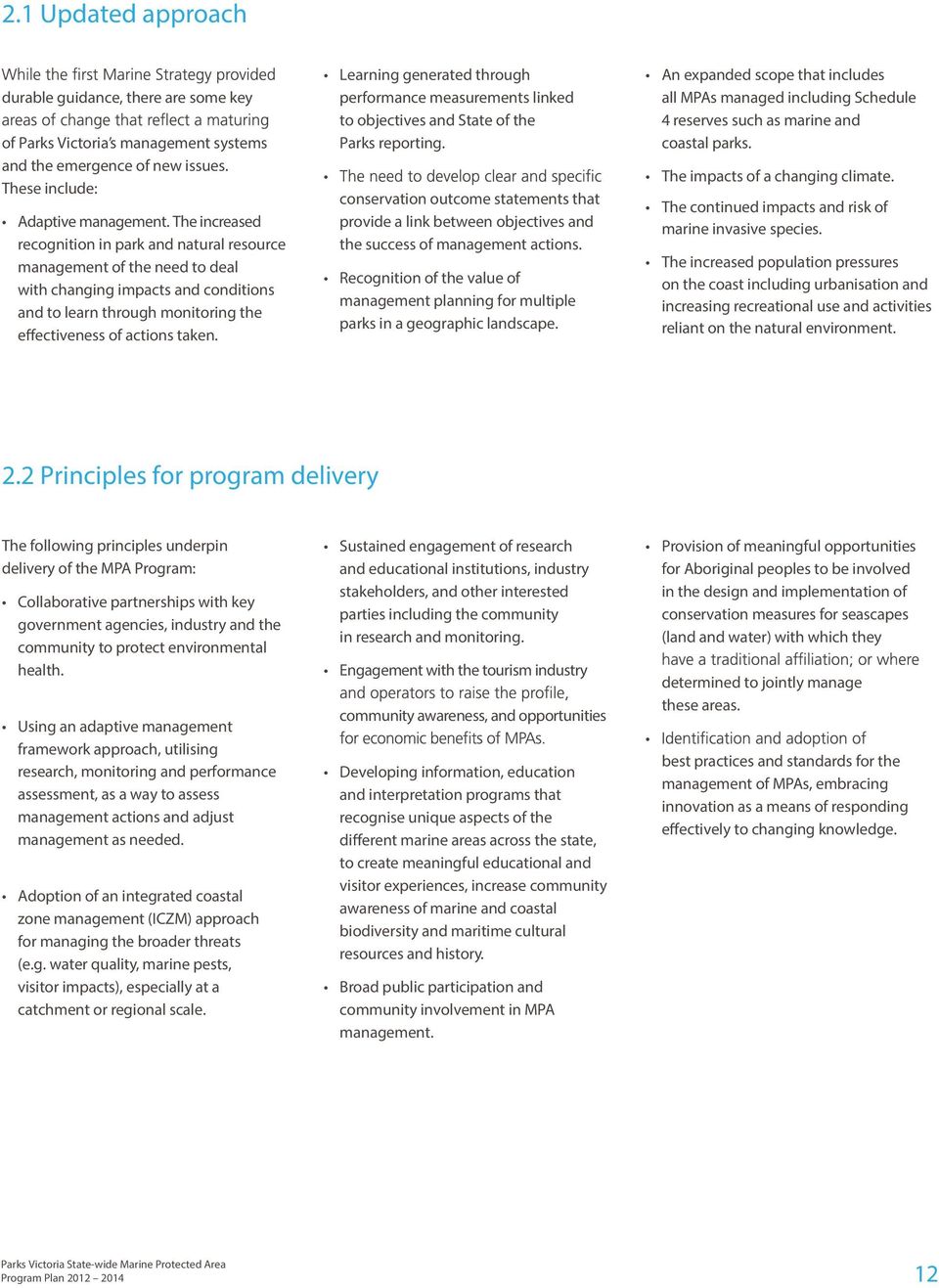
13 2.3 Program governance Implementation and accountability for delivery of the MPA Program is within a structured program governance arrangement that facilitates senior management oversight of the program. This is supported through the Environment and Heritage Division and regional Marine Coordinators, with delivery through divisional and operational line management as shown in Figure 2 below. Accountabilities for individual program area sections of the plan. Parks Victoria Board GM Environment and Heritage Division accountable for the marine program and chairs the marine protected areas steering group Divisional and regional managers (coastal regions) participate in the marine protected areas steering group Environment and Heritage Marine Program Coordinator Environment and Heritage Division provides direction and coordinates programming with regional coordinators and other divisions and directorates Accountable directorate and divisional managers Delivery Park Planning and Procedures Science and Management Effectiveness Programs Culture and Heritage Visitor and Asset Strategy and Planning Marketing and Education Tourism Compliance Fire Environment Land and Water Community Engagement Regional management (RMT) Regional marine coordinators Eastern Melbourne Western Operational delivery Compliance patrol Surveillance monitoring Community science programs Information Interpretation & Education Invasive Species Management Regional Catchment Strategy actions Emergency response support Figure 2: Program governance (as at June 2013)
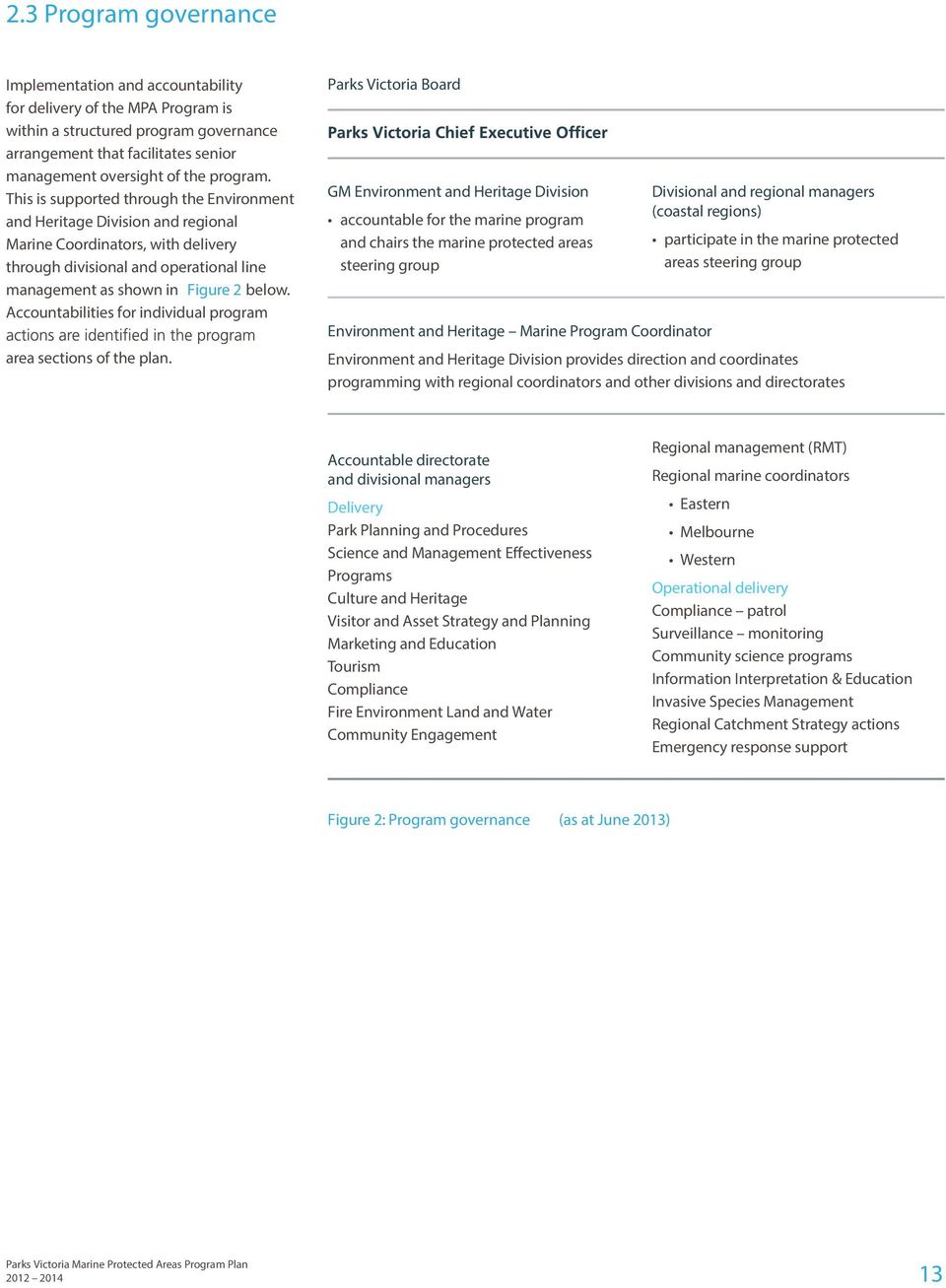
14 2.4 Program logic The MPA Program can be illustrated in a program Logic Model that sets out the steps which occur in the MPA Program and relates how activities carried out contribute to the program purpose, in the context of the high-level directions of the Environment, Land and Water area of work. The MPA Program logic is shown in Figure 3 right. Figure 3: Program Logic Model for the MPA Program Parks Victoria objectives To conserve park and waterway ecosystems To prepare for, respond to other emergencies To protect cultural heritage in parks To deliver better opportunities for people to use their parks and waterways Broader goals contributed to ELW directions Key natural assets and ecological processes of Victoria s parks network are maintained or restored for their long term viability MPA Program Marine protected areas values are managed through active intervention, community engagement, improved understanding, and compliance Core purpose of the area of work Natural values management: To maintain marine ecological integrity in MPAs Cultural values management: To protect and interpret cultural heritage in MPAs Visitor services: To support appropriate visitor experience and safety in MPAs Emergency management: To respond to marine incidents and emergencies Sustainable organisation: To build the skills and capacity for MPA management Program purpose Systematic monitoring, research, and evaluation, is used to inform management decisions Indigenous cultural values within MPAs protected Effective communication builds community stewardship for MPAs Emergency management preparedness facilitates support for MPA incidents A skilled and trained workforce is able to effectively manage MPAs

15 What will be happening differently as a result of the area of work Ongoing activities carried out directly through the area of work Invasive species impacts on MPAs are understood and managed to limit impacts Post contact cultural values within MPAs are MPA assets help protect environmental values and improve visitor safety Water quality threats to MPA values are recognised and addressed through collaboration Sustainable tourism and recreation uses within MPAs are supported Natural and cultural values in MPAs are protected through collaborative and targeted compliance programs with DEPI Partnerships with agencies and community inform and support MPA management Deliver services to improve the health of parks Improve our knowledge Prevent or limit the impact of marine pest incursions on MPAs Identify and protect Indigenous and European cultural values within MPAs Develop conservation objectives, implementation plans for all MPAs Develop, assess, and report on performance indicators for effective MPA management Assist in responding to cetacean stranding, oil spills and other emergencies Understand values, threats, and risks to MPAs through targeted marine research and monitoring Implement a planned compliance program with relevant partners including DPI Fisheries Facilitate community participation in marine monitoring to assist detection of changes in parks Deliver effective MPA messages th rough interpretation, education, media, and marketing Communicate research and monitoring findings to staff, stakeholders, and community Maintain built assets for MPA boundary recognition access and visitor safety Evaluate and report on the effectiveness of MPA management th rough State of the Parks Work together for resilient parks Integrate MPAs into Regional Catchment Strategies and water quality improvement plans Maintain biosecurity, compliance, and emergency response, agreements between agencies Support and promote sustainable visitor uses and tourism initiatives in MPAs Deliver key marine communication initiatives with key partners including DSE and DPI Support community participation and involvement through both regional and corporate programs Ensure good governance for MPA management at local, regional, and international levels

16

17 3. Program delivery approach 3.1 Park adaptive management Parks Victoria has adopted an adaptive management approach to environmental management. The Adaptive Management Framework (AMF) shown in Figure 4, will be applied to the management of both marine and terrestrial parks. Adaptive management allows for ongoing learning by continually assessing the success of actions in meeting management objectives, and allowing adjustment of management actions in the future. It is the integration of various components of management to provide a framework that systematically tests assumptions, promotes learning and provides timely information for management decisions. Under this framework, conservation outcomes for the priority natural assets objectives for the mitigation of threats to assets established, and management and monitoring strategies based on the objectives are developed. The framework provides logical steps and a range of tools to guide the effective implementation and evaluation of conservation projects and enables a clear connection to be made between desired conservation outcomes and actions on the ground. Figure 4: Adaptive Management Framework Adaptive Management Framework steps: 1. Conceptualise what you will achieve in the context of where you are working. 2. Plan both your actions and monitoring. 3. Implement both your actions and monitoring. State of the Parks 5. Share Adaptive Management Framework 4. Analyse your data to evaluate the effectiveness of your activities. Use your results to adapt your project to maximize impact. 5. Capture and share your results with key external and internal audiences to promote Learning. The Adaptive Management Framework international best practice and is based on the Conservation Measures Partnership (CMP) Open Standards, which were developed as part of a collaboration of NGOs (including IUCN, WCPA, WWF and Nature Conservancy) and government agencies

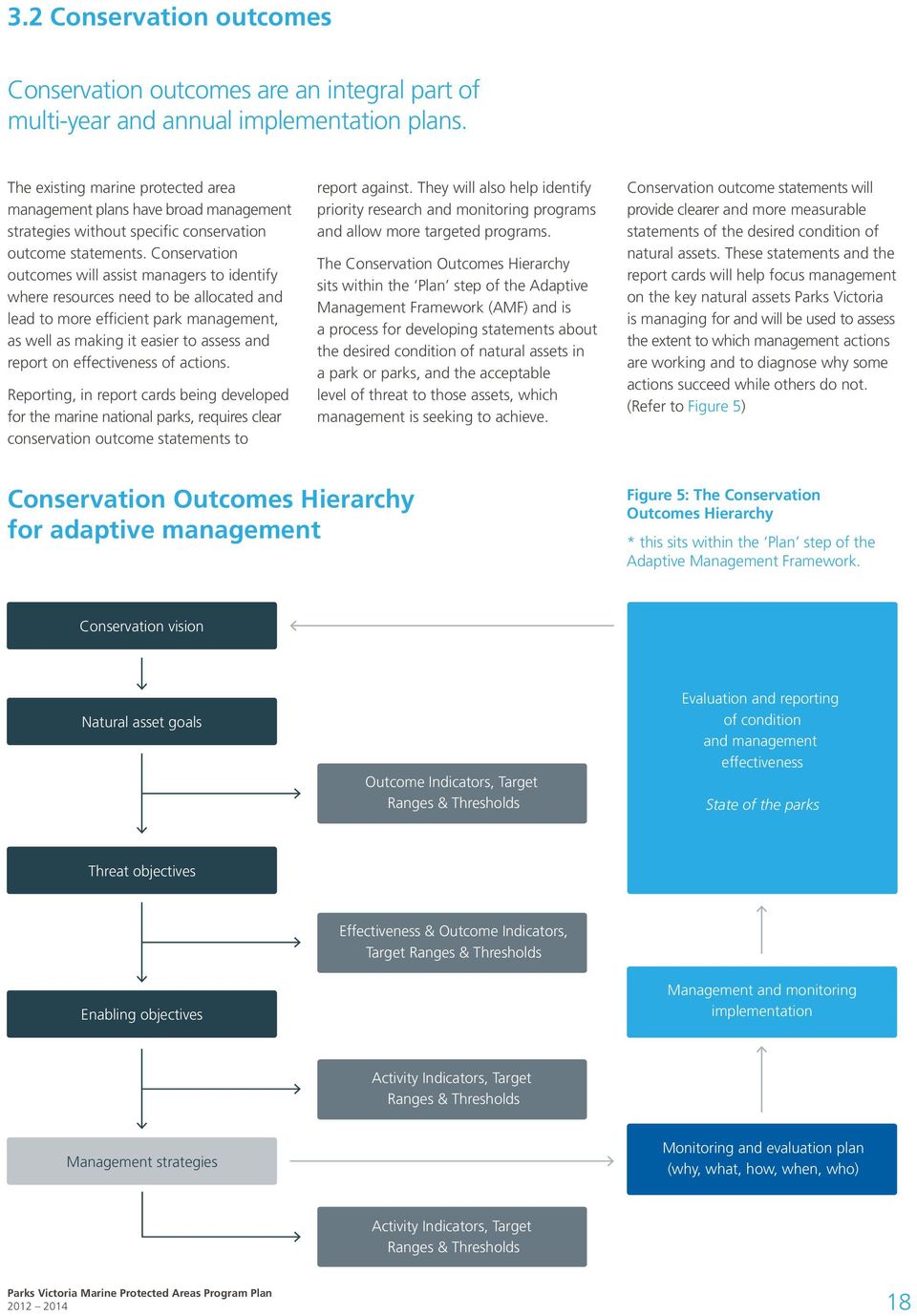
18 3.2 Conservation outcomes Conservation outcomes are an integral part of multi-year and annual implementation plans. The existing marine protected area management plans have broad management outcome statements. Conservation outcomes will assist managers to identify where resources need to be allocated and as well as making it easier to assess and report on effectiveness of actions. Reporting, in report cards being developed for the marine national parks, requires clear conservation outcome statements to report against. They will also help identify priority research and monitoring programs and allow more targeted programs. The Conservation Outcomes Hierarchy sits within the Plan step of the Adaptive Management Framework (AMF) and is a process for developing statements about the desired condition of natural assets in a park or parks, and the acceptable level of threat to those assets, which management is seeking to achieve. Conservation outcome statements will provide clearer and more measurable statements of the desired condition of natural assets. These statements and the report cards will help focus management on the key natural assets Parks Victoria is managing for and will be used to assess the extent to which management actions are working and to diagnose why some actions succeed while others do not. (Refer to Figure 5) Conservation Outcomes Hierarchy for adaptive management Figure 5: The Conservation Outcomes Hierarchy * this sits within the Plan step of the Adaptive Management Framework. Conservation vision Natural asset goals Outcome Indicators, Target Ranges & Thresholds Evaluation and reporting of condition and management effectiveness State of the parks Threat objectives Enabling objectives Effectiveness & Outcome Indicators, Target Ranges & Thresholds Management and monitoring implementation Activity Indicators, Target Ranges & Thresholds Management strategies Monitoring and evaluation plan (why, what, how, when, who) Activity Indicators, Target Ranges & Thresholds
19 3.3 Risk management Parks Victoria s Risk Management Framework applies the principles, framework and process in accordance with the international risk management standard ISO The Enterprise Risk Management Procedure documents a coordinated process to review and prioritise all risks impacting Parks Victoria as a whole and provides the evidence-based information and analysis to make informed decisions. The organisation s risk management processes are structured into four components, being: and analysis of risks. consideration of treatment of risks. ongoing evaluation of risk performance management performance including implementation of risk treatment plans. ongoing process for informing decision makers of risks. Assessing the existing and emerging risks for MPA management has been incorporated in a number of planning exercises over the decade, as shown in Table 1. There are also operational risk issues associated with staff competencies and training that need additional focus in a model of cover for marine management and operations. In the broader management context, the Victorian Coastal Strategy (2008) in impacts on the coast, including rising sea levels. is rapid in coastal areas. the health of our unique and valued marine environment. contribution to managing the Victorian coast and is directly impacted by these statewide issues. marine waters of South-Eastern Australia are expected to experience the greatest climate driven changes in the southern hemisphere over the next century. Building resilience in marine ecosystems through addressing current and emerging threats to values is the key approach to addressing this overarching threat. Risk assessment process and timeframe Introduction of exotic marine species affecting biodiversity. Water quality impacts including increased nutrient and sediment loads entering parks. Visitor impacts including disturbance, trampling, collection of biota and artefacts. Lack of ecological knowledge ultimately leading to detrimental effects on park habitats, communities or ecosystems in general. Governance issues (both park management and external agencies) affecting park habitats, communities or ecosystems in general. Pollution and litter from marine sources affecting park biota. Marine National Park and Sanctuary Park Management Plan development (between ) involved a risk assessment process. Regional planning compliance activity. A series of stakeholder workshops across the state drew on the expertise of agency staff, community groups, academics, and knowledgeable park neighbours, to identify hazards of major concern in the parks. (Carey et al 2007) Increased pressure on MPAs through urbanisation, coastal and port development and use of coastal resources. Table 1: Risk assessment >

20 Risk assessment process and timeframe the frequency and intensity of storm events and storm surge. Increasing water temperatures and altered currents and water circulation systems with potential for changed species distribution including emergence of new invasive species. Sea level rise will create an ecological squeeze effect for intertidal organisms where an upper boundary (e.g. a road) limits opportunities for upward migration of species leading to loss of suitable habitat for some species. Strategic Climate Change Risk Assessment in for all MPAs. The risk assessment involved a workshop process drawing on staff expertise from across the organisation. These risk assessments have since been reviewed as part of the conservation outcome planning process in A greater unknown but potentially very high risk is changed acidity (ph decline) impacts on food webs. Increased damage to infrastructure especially in coastal foreshore areas, with facilities and assets such as piers, jetties and boat launches impacted. Potential for major damage or the complete loss of heritage assets including buildings, structures and standing ruins and archaeological sites. 3.4 State of the Parks reporting The State of the Parks (SoP) program is the principal mechanism for evaluating the effectiveness of park management across the parks network. It provides a systematic evaluation of the outcomes of management programs and the extent to which park management objectives are being met. The results of these evaluations can be applied at a range of scales from the whole parks network, to landscape types to individual parks. Evaluation of management effectiveness will assist Parks Victoria in reviewing achievements, highlight current challenges and emerging issues and inform and adapt its management as part of the AMF. The objectives of the SoP program are to: the condition of parks and the current and emerging threatening processes that impact on parks. management as a means to deliver long-term objectives. at a range of scales, from corporate and network to park level. about Victoria s parks and outcomes of Parks Victoria s management of them. SoP provides an important means to ensure that the learning derived from gathered information is actually being applied to improving management. One of the performance measures listed in this Marine Plan, derived from SoP, is information available for making informed decisions for planning environmental or visitor activities. While clearly a subjective measure which will vary between parks, this is an important measure to gauge the application of information to improve management, a key component of the Adaptive Management Framework

21 4. Program areas Program areas This MPA Program Plan describes actions for the next 3 years, under the 12 program areas relevant for MPA management (refer to Table 2). The plan applies an adaptive management approach to the way programs are planned, delivered, reported and improved. The performance measures and indicators for each program area include activity measures and measures from the State of the Parks 2011 assessment. 1. Park planning and strategy 2. Compliance 3. Community and visitor engagement 4. Culture and heritage 5. Emergency management 6. Catchment and water management 7. Invasive species 8. Knowledge and management effectiveness 9. Asset management 10. Tourism and recreation 11. Partnerships Agencies 12. Partnerships Community Each of the 12 program area sections is set out in a consistent format with sections that cover: A purpose statement for the program. The program context in a brief description. A snapshot diagram of the adaptive management framework steps for the program. Actions, accountabilities and timeframes. Performance measurement. Table 2: MPA Program areas to Table 3. Performance assessment and reporting are detailed in Section 6. Accountabilities relate to Parks Victoria division branch and regions Division Branch / Directorate Abbreviations used in Program action tables. The Lead Accountability will appear in bold in each table. Environment and Heritage Park Planning and Procedures Science and management effectiveness Conservation Programs Culture and Heritage Fire Environment Land and Water Community Engagement E&H Planning E&H Science E&H Programs Cultural Heritage Emergency Management Community Engagement Visitor Experiences Visitor and Asset Strategy and Planning VE Strategy VE Marketing and Education Tourism Corporate Services People and Culture CS Human Resources Regional Services Compliance Coastal Compliance Table 3: MPA action accountabilities
22 Program Area 1: Park planning and strategy Align planning processes so that there is a clear connect between corporate and statewide priorities to regional and park operations. Context Plans guide management activities to protect natural and cultural values, and the provision of services to visitors. Planning extends from the strategic directions provided in the corporate and business plans, operational plans such as this MPA plan, through to individual park management plans and regional and district action and implementation plans. Management plans that set the directions for each marine national park and marine sanctuary were prepared between 2003 and There are draft plans from the early 1990 s for the South Gippsland marine and coastal parks. The development of clear and measurable conservation outcomes including natural asset goals and threat objectives (and associated indicators) will inform more detailed implementation planning for MPAs. These plans are being done for groups of parks in a logical geographic landscape, using a landscape planning model. MPA management also requires an adequate work force to deliver program activities and this must also be planned for. A Model of Cover for MPA programs will be developed which will describe what is required to deliver the program including a consideration for staff ongoing staff training and skill development needs. Finally, as an important part of planning processes, consideration of MPAs in relevant planning referrals from other agencies or local government is also a key step to ensure that park values are recognised and protected. Program snapshot Consistent process across MPA programs. Ongoing improvement to program development. Information shared across regions. 1. Define scope and context Planning for implementation of MPA programs provides the line of sight from business planning to park on-ground implementation. 5. Share and learn Adaptive Management Framework 2. Plan A statewide approach for parks. Conservation outcomes and objectives planning. Park management plans. Division and region action plans. State of the Parks 4. Analyse, adapt and apply 3. Implement Contemporary plans in place. Information for decision making and priority actions for natural values and visitor services. MPA program implemented. Adaptive management, objectives and targets. Risk assessment. Training and capacity building
23 Actions Accountability Finalise the Visitor Experience Framework to guide directions for planning visitor services that support the sustainable management of MPAs. Develop the direction the for divisional and regional annual MPA program (Service Statements). Develop annual region action plans incorporating service statement directions. VE Strategy E&H Programs statements for MPAs. Lead workshop process for marine focussed conservation outcome statements. Participate in development of conservation outcome statements for all MPAs and incorporate adaptive management processes and conservation outcomes into park implementation and regional operational plans. Integrate conservation outcome statements into park implementation plans. Develop a model of cover to meet the organisations requirements for marine competencies and associated staff training pathways. Integrate MPA competencies into organisational standards. E&H Programs E&H Science E&H Planning E&H Programs CS Human Resources Implement staff training and capacity building for marine competencies including compliance, invasive species and heritage management, communication, interagency liaison, planning and science support roles. Progressively implement the landscape plan model for park management plans. Current South-west Parks Plan and the South Gippsland marine and coastal park implementation plans to be prepared as a priority. Assist preparation of implementation plans. E&H Programs Assist preparation of implementation plans. VE Strategy Undertake regular reviews and assessment of risks at through statewide and regional processes to inform management. Risk assessment included as part of research, monitoring and research partner projects. Utilise risk assessment as part of compliance and operational planning. E&H Programs E&H Science
24 Actions Accountability reports in management reviews. E&H Programs Ensure improvements in planning approaches are shared across the organisation and with partners. E&H Programs Prepare for a new Statewide Marine National Park, Marine Sanctuary and other MPA management strategy post E&H Programs Provide responses to planning referrals that have potential to impact on MPAs including proposals for developments, dredging, provision of works, or local port and recreational management. Performance measurement Indicators and measures are focussed on operational compliance management; the management response and the impacts of non-compliance derived from State of the Parks (SoP) reporting (refer Appendix 3); formalised agency agreement and offence reporting data. Key Performance Indicators Planning frameworks for conservation and visitor services. Staff training and capacity building for marine of % of trained and currently skilled staff. Measures Frameworks developed Model of Cover established and staff training in place planning and decision making for natural values management (SoP measure). for decision making * Parks managed to conservation objectives and targets. * Corporate performance indicator % of the Parks Victoria estate managed and targets
25 Program Area 2: Compliance Achieve e ective compliance to protect natural and cultural values within Victoria s MPAs through collaborative arrangements with the Department of Environment and Primary Industries and other agencies and coastal managers. Program snapshot Context Compliance with the legislative framework is critical to ensure the park values are protected. Prohibited activities in marine national parks and sanctuaries include recreational and commercial well as other activities that may impact on ecological, geological, scenic, archaeological, historic or other values. A systematic approach to setting priorities, routine patrols and surveillance and where possible integration and standard approaches with DEPI. Effective compliance is gained through promotion of community and stakeholder understanding of the regulations applying in MPAs and enforcement of the regulations where voluntary compliance fails. Communication of the results of enforcement actions can deter other potential o enders. E ective education and enforcement programs are enhanced by a cooperative approach with relevant agencies, particularly Fisheries Victoria. Compliance within MPAs also includes management of visitor safety and is a further role for Parks Victoria s marine focussed sta. This important function ensures that visitors behave appropriately so as to maintain opportunities for safe enjoyment of the parks by all. Compliance with regulations established under the Marine Safety Act, Environment Protection Act, and other marine related heads of power, require rangers to be adequately trained and prepared to carry out their roles, often in partnership with or as a support to other agencies. Agency information sharing. Links with communications and education. Management experiences shared across regions. 1. Define scope and context Compliance activities cover a spectrum from information and education to support voluntary compliance through to enforcement. 5. Share and learn Adaptive Management Framework 2. Plan Formalised agreements between Agencies. Risk assessment and priority setting. Communications messages. State of the Parks 4. Analyse, adapt and apply 3. Implement O ence reporting. Impact of non-compliance on environmental resource. Community perception and behaviour. Operational delivery of compliance activity - patrol, intelligence sharing, surveillance, community education. Sta training and capacity
26 Actions Accountability Develop a framework for managing compliance that provides the program detail for a statewide approach to compliance. Include targets and reporting arrangements for illegal activities in a formalised statewide compliance agreement with DPI Fisheries. Establish agreed compliance principles with DPI Fisheries. Implement assigned role and task in regional compliance arrangements patrols, surveillance and reporting. Identify compliance priorities from risk assessments in the implementation plans and MPA annual program for input to statewide and regional arrangements. Compliance GM Environment & Heritage E&H Planning and maritime regulations across the community (link with Program Area 3 Community and Visitor Engagement). Integrate compliance messages in communications planning. Integrate compliance into tour operator messages and activities across marine areas and MPAs in line with DSE objectives and reforms. Prepare district education and MPA compliance plans and incorporate into the Marine Operations Manual. Build Parks Victoria staff capacity in compliance management for MPAs including focussed training (link with Program Area 1 Park Planning and Strategy). Implement staff training and capacity building for compliance management (link to Program Area 1 Park Planning and Strategy). Indentify new technologies to assist in compliance for illegal activities. Deploy new technologies to assist in compliance for illegal activities. Compliance VE Marketing and Education Tourism Compliance E&H Science reports in compliance reviews. Ensure improvements in compliance approaches are shared across the organisation and with partners. Compliance Compliance
27 Performance measurement Indicators and measures are focussed on operational compliance management; the management response and the impacts of non-compliance derived from State of the Parks (SoP) reporting (refer Appendix 3); formalised agency agreement and o ence reporting data. Performance Indicators Sta capacity in compliance management. E ectiveness of patrols and surveillance activity. Measures Adequate sta capacity Numbers of interactions with MPA users, tour operators Trend realtive to compliance effort Management response to non-compliance (SoP measure). % MPAs with planned comprehensive approach Current impact of non-compliance (SoP measure). % MPAs greater than moderate impact on conservation values Trend in impact of non-compliance (SoP measure). % MPAs with trend decreasing or unknown Increased compliance activity of marine tour operators. Number of licensed operators delivering compliance messages Agency agreement with DEPI. Compliance agreement in place
28 Program Area 3: Community and visitor engagement Raise awareness, enhance visitor experiences and assist in the management of threats. Context Effective communications will assist in building engaged, well-informed and aware communities and interest groups, working with park managers, and acting as stewards and ambassadors for the marine environment, through the provision of timely and appropriate information. Key communications objectives are: Victorians understand the purpose and and have increased awareness of the unique marine biodiversity, species and and activities that impact on these assets. regulations and the safe and responsible use of marine protected areas by reducing increasing the perception that offenders will be caught. role as a responsible manager of MPAs and in protecting the environmental health of the marine protected areas. Program area snapshot Results of program delivery. Impact of messages on visitor behaviour. Management experiences to inform planning and shared across regions. Communications covers information, interpretation and education activities. Links to management of compliance and tourism. 5. Share Adaptive Management Framework Plan activities and messages to meet objectives: To raise the compliance and Parks Victoria's reputation as MPA manager. State of the Parks Park management activities to meet visitor experience needs. Community Satisfaction research. Visitor research. Communication products and services and key messages developed and delivered including in partnerships and by tour operators
29 Actions Accountability Implement the statewide approaches from the MPA Visitor Communications Plan. VE Marketing and Education Deliver on-ground communications, interpretation and education services through Parks Victoria staff delivery, in accordance with the MPA Visitor Communications Plan. Use events and partnerships including with licensed tour operators and other agencies to promote MPA messages. VE Marketing and Education Develop the directions for Discovery and Learning for marine interpretation and education. VE Marketing and Education Deliver an integrated approach to providing information interpretation and education across regions. Implement Discovery and Learning for marine interpretation and education at parks and Parks Victoria managed sites and through education partnerships. Provide and support communications including development of new technology that raise awareness of the significance and purpose of MPAs, and support behaviour and compliance and Parks Victoria s management role. VE Marketing and Education Integrate science and research into communications products. E&H Science Utilise and develop communications products to deliver the key messages, enhance visitor experiences and complement active enforcement. Promote MPAs as destinations for unique marine tourism recreation opportunities. Tourism Involve tour operators and other tourism providers in MPA communications and deliver key messages about Victoria s marine habitats and species. Tourism Deliver ongoing and up to date support for tour operators. Establish formal links with DSE Coastcare for environmental stewardship of marine and coasts. E&H Programs Identify the priorities for market research to understand park visitor needs and perceptions. VE Marketing and Education Commission and communicate relevant market and visitor research. E&H Science reports in annual communication review. VE Marketing and Eduction Ensure improvements in communication approaches are shared across the organisation and with partners. VE Marketing and Eduction
30 Performance measurement Indicators and measures are targeted at on-ground delivery of interpretation and education programs with the intent for them to increase; measures derived from State of the Parks (SoP) reporting for management effectiveness (refer Appendix 3); and community awareness and perception data from surveys. Performance Indicators Implementation of Discovery and Learning for marine interpretation and education. Support provided to involve tour operators in delivering key messages. Extent to which interpretation programs met the needs of park management and legitimate visitor expectations (SoP measure). Measures Delivery in numbers of programs and participation % of performing tour operators % of programs that substantially meet needs Management response to interpretation (SoP measure). % MPAs with comprehensive, planned approach Extent education programs met the needs of park management and legitimate visitor expectations (SoP measure). % of programs that substantially meet needs Management response to education programs (SoP measure). % MPAs with planned or comprehensive approach Awareness of knowledge and understanding of park regulations. % rating from survey Community satisfaction rating of good or very good with the management of marine protected areas. % rating from survey
31 Program Area 4: Culture and heritage Protect, manage and appreciate Aboriginal and European cultural values in MPAs. Aboriginal cultural heritage context The cultural values associated with MPAs are diverse. They include the connection between Aboriginal people and Sea Country. This connection can be expressed through active involvement in marine management, use of cultural resources, and the interpretation of cultural stories. The array of Aboriginal cultural places associated with the marine environment such as middens, burials, story places and cultural resource use places are part ongoing connection between people and place. It is possible that some MPAs may become formally jointly managed in the future under the terms of the Traditional Owner Settlement Act. Program snapshot Traditional Owner sharing of knowledge to inform management. Experience of joint /collaborative management. The relationship with Traditional Owners including for land management and the protection of Indigenous cultural values. 5. Share Adaptive Management Framework Traditional Owner Partnerships Strategy (TOPS). Park management, interpretation and education plans. State of the Parks Condition of heritage sites and places. Management of threatening processes. Compliance with legislation. Indigenous partnerships. Heritage conservation and assessment. Monitoring, recording and interpretation of values
32 Actions Accountability Implement the Traditional Owner Partnership Strategy (TOPS) to provide the over-arching framework for Aboriginal cultural heritage management. Support implementation of the TOPS to progress the links with cultural heritage and land management by providing access to expertise and guidance. Develop a strategic approach to managing Aboriginal cultural Cultural Heritage Cultural Heritage Identify and prioritise heritage conservation and assessment projects. Implement funded heritage conservation and assessment projects focused on documenting and understanding the connection between Aboriginal people and key MPAs. Ensure that Aboriginal cultural values are incorporated where suitable into any interpretation and education program delivered in MPAs. Cultural Heritage reports to working with TOs. Ensure improvements in approaches to working with TOs is shared across the organisation and with partners. Implement Management Plan actions for protecting and interpreting Indigenous cultural heritage values in MPAs with all works and programs compliant with the terms of the Aboriginal Heritage Act and the Native Title Act. Support any state based process focused on the return of MPAs to Aboriginal title and assist with the development of associated joint management arrangements. Respond proactively to any request by the Aboriginal community in relation to collaborative MPR management. Develop sta awareness of MPA Aboriginal cultural values and build their capacity to carry out key heritage tasks such as monitoring, recording and project management. Cultural Heritage Cultural Heritage GM E&H and GM Regional Services GM E&H and GM Regional Services Performance measurement Indicators and measures are for compliance with legislation; relationships with Aboriginal partners; and from State of the Parks (SoP) reporting for a planned management approach (refer Appendix 3). Performance Indicators Adequacy of information to support planning and decision making for Aboriginal heritage values. Approach to Traditional Owner consultation and involvement in decision making. Measures support planning and decision making % MPAs with an established process of consultation >
33 Performance Indicators Measures Management response to Aboriginal heritage values. % MPAs with planned or comprehensive approach Compliance with legislation. No avoidable breaches of AHA and NT Act Aboriginal partners rating the relationship with Parks Victoria as good or very good. % rating Living heritage context The broader Victorian community also vests MPAs with an array of cultural and social values. These values can derive from personal, family and community history and are related to connections or attachment to both activities and physical places such as shipwrecks and structures like lightstations. People have a history of interaction with MPAs through recreational and traditional use which is woven into their family history and which shapes their views about MPA management. In addition, the community desires the retention of healthy marine environments as an intrinsic heritage value. Acknowledging this history and ongoing connection requires investment in cultural place research, monitoring, recording and protection; the management of historical collections; the recording of stories; and the establishment of innovative interpretation and education programs. Adequate information, tools and training are required to manage and protect historic places and objects, promote appropriate activities and create opportunities for interpretation and improved understanding in recognition of Shipping along the coast being one of Parks Victoria s key historic themes. Cooperation with key partners, such as Heritage Victoria, will be critical. Program snapshot Best practice heritage protection. Sharing of knowledge to inform management. 1. Define scope and context Heritage covers protection and management of European heritage sites and places. 5. Share and learn Adaptive Management Framework 2. Plan Parks Victoria Heritage Strategy. Park management plans. State of the Parks 4. Analyse, adapt and apply 3. Implement Condition of heritage sites and places. Management of threatening processes. Actions to protect sites and places within MPAs. Inventory of heritage values
34 Actions Accountability Implement the new Parks Victoria Heritage Strategy to provide the statewide direction for the management of European heritage values in parks. Implement Heritage Strategy actions to research and manage heritage assets, sites and places. Review arrangements with Heritage Victoria for managing heritage sites and shipwrecks and seek to develop operational procedures and protocols. Cultural Heritage Cultural Heritage Implement prioritised actions in partnership with Heritage Victoria and maintain a working relationship. Implement Management Plan actions for protecting and interpreting cultural heritage values in MPAs including support for inventory an site plans as required with Heritage Victoria. Implement sta training in association with Heritage Victoria shipwrecks, support enforcement of the Heritage Act. Performance measurement Indicators and measures are focussed on working with Heritage Victoria; and measures derived from State of the Parks reporting (refer Appendix 3) for managing threats to the condition of heritage values. Performance Indicators Working relationship with Heritage Victoria in place as routine management. and decision making for heritage values. Measures Number of issues or projects for planning and decision making Management response to heritage values. % MPAs with planned or comprehensive approach
35 Program Area 5: Emergency management Ensure that Parks Victoria has the planning and responsibilities set out in the Victorian Emergency Management Manual for response to marine incidents as support for other agencies. Context Parks Victoria has responsibilities for marine emergencies where they occur within managed areas, or to contribute as a part of statewide emergency response teams and provide support for lead agencies in managing emergencies in other areas. Potential marine emergencies include marine pest or disease outbreaks, and a range of safety and human situations from vessel groundings to rescues. When any of these incidents occur Parks Victoria must be clear on lead agency arrangements and its responsibilities as take direction from the controlling agency on appropriate actions. Program snapshot Cross regional skills and knowledge transfers (e.g. risk assessments). Incident response learning shared across regions. Emergency management covers Parks Victoria s role across marine pollution and wildlife incident response with other agencies. 5. Share Adaptive Management Framework Interagency arrangements for Parks Victoria s support role in Victorian emergency management, marine pollution and response. State of the Parks Emergency management response effectiveness. Visitor safety incidents and trends. Implementation procedures and guidelines in marine operations manual, SEMPs. Staff training and capacity
36 Actions Accountability for marine pollution responses in accordance with the Victorian Marine Pollution Contingency Plan (VICPLAN) and Wildlife Response (link with Program Area 1 Park Planning and Strategy). Implement park emergency management plans and arrangements with controlling agencies (e.g. marine pollution, cetacean wildlife and marine pest emergencies). Develop and maintain service agreements with Department of Transport and DEPI to provide clarity around institutional arrangements for emergency response, including marine emergency response and training arrangements (pollution, wildlife). Develop and maintain Parks Victoria s Marine Operation Manual and safety and environment management plans (SEMPs) for the local ports of Port Phillip, Western Port and Port Campbell to provide staff with response procedures and arrangements. Improve the structure and content of the Marine Operations Manual at keep it updated with relevant procedures and practices for emergency response applicable for all coastal regions. Emergency Management Emergency Management Parks Victoria s emergency management support role, including agency and community networks. (link with Program Area 1 Park Planning and Strategy). Integrate marine competencies into organisational standards. reviews in organisational risk management procedure. Incorporate risk assessments into operational practices and response. CS Human Resources E&H Programs
37 Performance measurement Indicators and measures are focussed on having the response arrangements and capacity for on-ground delivery of emergency response; measures derived from State of the Parks (SoP) reporting for visitor safety (refer Appendix 3); and numbers of incidents. Performance Indicators Sta capacity in emergency response. Procedures and practices for emergency response documented. Management response to visitor safety (SoP measure). Measures Marine Operations Manual Corporate Policy and Procedures Framework % MPAs with planned comprehensive approach Trend in level of visitor safety incidents (SoP measure). % MPAs with trend stable Current level of incidents, numbers, type, trends. Numbers of incidents where MPA values are adequately recognised
38 Program Area 6: Catchment and water management Protect MPAs and marine environment from catchment pollution and pressures through partnerships with catchment management authorities, waterway managers, partner agencies and the community. Context Marine protected areas are not islands that exist in isolation, but are part of a much broader land and seascape that includes their catchments, the areas from which visitors come, and connections with the broader marine environment. MPAs lie at the bottom of large catchment areas, Sediments and nutrients derived from catchment activities have been recognised through risk assessment undertaken as a consistent threat to marine values across the state. As high value areas, MPAs provide a significant asset for improved integration of efforts in coastal catchments in relation to water quality. This will improve protection for marine values at risk from poor water quality through coordinated actions amongst all natural resource managers, other agencies and local government, industry groups particularly agricultural, and with the broader community. These approaches are consistent with directions established in the Victorian Coastal Strategy for Integrated Coastal Zone Management (ICZM). Program snapshot Learnings from ICZM partnerships CMAs, EPA coastal boards, DSE. Data and results inform new plans and projects. 1. Define scope and context Catchments and water quality covers actions to protect MPAs as the high value areas at the receiving end of catchment inputs. 5. Share and learn Adaptive Management Framework 2. Plan Integrated coastal zone management (ICZM). Park management plans, catchment strategies, water quality plans. State of the Parks 4. Analyse, adapt and apply 3. Implement Park management response. ICZM partnerships. Trends and impacts from catchment inputs on water quality. MPA advocacy in plans and improvement projects: - agency - community - industry
39 Actions Accountability Victorian Coastal Strategy, Regional Catchment Strategies and relevant Coastal Action Plans. Plans recognise the marine national park system and other MPAs as a high value for protection and describe strategies to improve water quality. Provide technical advice to regions for water quality monitoring programs to be delivered in partnership with regional water and catchment authorities and community. Provide support and inform ICZM projects and water quality plans (including CMA monitoring programs, Melbourne Water, EPA, Research Partners) where appropriate and link to MPA protection. Identify priority areas where catchment inputs are impacting MPAs and advocate for appropriate treatments. Include actions to minimize the threats from catchment issues including water quality in park management plans. Include water quality messaging in the context of relevant MPAs as part of statutory planning responses and information, interpretation and education activities. Promote marine values at risk from poor water quality to E&H Programs E&H Science E&H Planning groups and community. Performance measurement Indicators and measures are focussed on building knowledge of water quality impacts on MPAs from State of the Parks (SoP) reporting (refer Appendix 3); and involvement in ICZM projects. Performance Indicators Trend in impact of inappropriate water regimes/water quality (SoP measure). Management response to inappropriate water regimes/water quality (SoP measure). Measures of impacts to enable assessment of the trend % MPAs with planned comprehensive approach Delivery of ICZM projects. Effectiveness of projects
40 Program Area 7: Invasive species management Minimise the risks posed by the introduction and spread of marine invasive species in the MPAs. Context Marine invasive species represent a major risk to biodiversity values within the MPA system. While not all introduced marine species become pests, Victoria has a number of known incursions that have markedly impacted on marine ecosystems, particularly in Port Philip Bay. Some species expanding their range into Victoria with climate change and over-abundant species indigenous to Victoria, can also exhibit pest-like qualities. Managing and preventing introductions is the most effective means of minimising the impact of invasive species on park values. for managing exotic marine organism incursions and response to detection of new incursions in the MPA system. Parks Victoria has a clear role as protected area manager to prevent establishment or spread of marine pests within MPAs. Parks Victoria will contribute to building capacity of staff, research partners, tour operators, contractors and community groups to ensure that detection and reporting of marine invasive species, while methods of prevention, and limiting spread and impacts continue to improve. Program snapshot Detection and monitoring information shared between agencies. Impact of messages for public education and behaviour change. Management of marine invasive species covers Parks Victoria s role in preventing their introduction and spread in MPAs and local ports. 5. Share Adaptive Management Framework Inter-agency arrangements for invasive species incursions and marine biosecurity roles, responsibilities and processes. Parks Victoria marine operations manual. State of the Parks Impact and spread of marine invasive species. Management response and effectiveness, including interagency arrangements. Implement marine pest incident protocols. Practice and communicate prevention best practice for vessels. Monitoring and research
41 Actions Accountability Contribute to response arrangements with other agencies including the National Environmental Biosecurity Response Agreement (NEBRA), and the Invasive Plants and Animals Framework that will be updated to include marine pest and disease protocols that recognise the impact of pests and diseases on marine environmental values. Contribute to the development of a Biosecurity Plan for Victoria s marine environment with DPI and DSE. Clarify interagency arrangements and roles in marine pest management. Develop and communicate a framework for managing impacts of invasive species and over-abundant native fauna populations including species that have changed range as a consequence of changes in climate. Develop monitoring techniques and practices to understand the extent and impact of the threat from marine pests and over-abundant native species. Participate in and support operations to detect and respond including surveillance for marine invasive species. Marine pest training package developed for staff. Update marine pest incident protocols in the Marine Operations Manual including divisional and regional accountabilities. (link to Program Area 1 - Park Planning and Strategy) Support preventative management through increased capacity building, staff training, and the development of marine pest risk assessment and ready response incursion management protocols. Demonstrate best practice in marine pest prevention through vessel cleaning and maintenance and take a role in advocacy for vessel and equipment hygiene as a tool to prevent spread by movements of vessels i.e. the DSE brochure Aquatic Pests: Treat em mean keep your boat clean. E&H Programs E&H Programs E&H Programs E&H Programs E&H Science E&H Programs >
42 Actions Accountability Require permit conditions for research and monitoring and other contractors that marine pests are reported when observed and best practice guidelines and protocols are followed. (link to Program Area 8 Knowledge and Management E ectiveness). E&H Science Ensure permit conditions for contractors are implemented. Provide support for research projects and community involvement in detection and reporting of marine invasive species, particularly in high risk locations. Include invasive species reporting in location permit conditions for tour operators and in relevant operational and best practice guidelines. Tourism Develop actions to prevent and respond to marine invasive species in park implementation plans and regional action plans. E&H Programs reports in invasive species management. E&H Programs Ensure improvements in invasive species management are shared across the organisation and with partners. E&H Programs Performance measurement Indicators and measures are focussed on having the surveillance and response arrangements in place, including with other agencies; and measures derived from State of the Parks (SoP) reporting (refer Appendix 3) for understanding the impacts and trends of invasive species in MPAs. Performance Indicators Marine pest risk assessment, surveillance and response incursion protocols. Response arrangements with other agencies (DSE, DPI, EPA, DOT). Implement permit conditions (contractors, research, LTOs, friends groups). Measures Protocols in place for each MPA Agency response arrangements in place Numbers of activated permits Management response to marine pests, pathogens and over-abundant native species for each MPA (SoP measure). % MPAs with planned comprehensive approach Trend in impact of marine pests, pathogens and overabundant native species (SoP measure). % MPAs with impact above moderate Trend in impact of marine pests, pathogens and overabundant native species (SoP measure). % MPAs with trend stable
43 Program Area 8: Knowledge and management effectiveness Address important management challenges, focussed on improving baseline knowledge of the MPAs and applied management questions that build capacity to implement evidencebased management. Context Parks Victoria has established extensive marine monitoring and research programs for MPAs to address important management challenges, focussed both on improving baseline knowledge of the MPAs as well as applied management questions not being addressed by others. This knowledge will continue to enhance Parks Victoria s capacity to implement an adaptive management approach through addressing critical knowledge gaps. The research and monitoring programs have been guided by the research themes outlined as part of Parks Victoria s Research Partners Panel program, a Marine Research and Monitoring Strategy and Marine National Park and Marine Sanctuary Monitoring Plan Much of the research and monitoring has been undertaken as part of the Research Partners program, involving collaboration with various research institutions. The program also covers research into visitor numbers and patterns of use, community perceptions and awareness of the MPAs. Program snapshot objectives, condition trend information. Shared across regions and with research partners, agencies and the community. The marine science program includes monitoring and research and activities that build and communicate the knowledge and information base for management. Research partners, modelling, habitat mapping, social research and community monitoring. 5. Share Adaptive Management Framework Marine Research and Monitoring Strategy. Park management plans. Threat and risk assessment. State of the Parks Condition and trend for natural values in MPAs. Application of research and monitoring to park management. MPA report cards. Research partner projects. Implement programs e.g. subtidal and intertidal habitats monitoring. Research partners projects. Conservation objectives. Community based monitoring
44 Actions Accountability Address critical knowledge gaps for marine ecosystems, habitats and species in the MPAs through collaborative research partnerships under the Research Partners Panel. Provide support for research partner projects and where appropriate manage regional research projects. Develop marine natural values reports to describe the current state of knowledge in an accessible format for managers, stakeholders and the community. Develop report cards for marine national parks to report on condition of natural assets, level of threats and trends to assess management effectiveness and inform adaptive management. Develop habitat based conceptual models as decision support tools for management. Complete habitat mapping program for areas in MPAs not currently covered to improve baseline habitat data for all MPAs. Complete habitat mapping program for areas in MPAs not currently covered to improve baseline habitat data. Develop a new Marine Research and Monitoring Plan, consistent with statewide Research Plan for Park Management , as the planning document for the research and Signs of Healthy Parks monitoring program. Support development of conservation outcomes for the MPAs, in line with the conservation outcomes hierarchy, to identify management and monitoring priorities and improve reporting. Participate in and contribute to development of conservation outcomes and use these as the basis for regional marine program planning. Address critical knowledge gaps for marine ecosystems, habitats and species in the MPAs through collaborative research partnerships under the Research Partners Panel. Review and update community based monitoring programs and protocols, e.g. Sea Search, and facilitate training in the use of methods. Analyse and interpret monitoring data and communicate management implications. Provide support for friends groups and community based monitoring including Reef Life Survey, Sea Search, Reefwatch. E&H Science E&H Science E&H Science E&H Science E&H Science E&H Science E&H Science E&H Science E&H Science
45 Actions Accountability Provide support for tour operators to participate in community based monitoring. Implement the Signs of Healthy Parks Monitoring program including the existing subtidal and intertidal reef monitoring programs and consolidate program in line with conservation outcomes statements and new Marine Research and Monitoring Plan. Maintain and improve marine information management systems and datasets and data sharing with other agencies. Stay abreast of and contribute to landscape-scale issues related to park management e.g. water, catchment management, connectivity, and climate change. Conduct targeted visitor research programs for visitor numbers and patterns of use, community perceptions, attitudes on issues regarding the management of MPAs, and awareness of the MPAs. Conduct research to understand impacts of visitor activities and feasible management responses. Improve performance evaluation capability through methods including analysis of management programs and monitoring of ecosystem conditions, through the Signs of Healthy Parks and State of the Parks programs. Participate in analysis of Signs of Healthy Parks and State of the Parks programs. Interpretation and communication of research data e.g. natural values reports, MPA report cards (also refer Program Area 3 Communications). E&H Science E&H Science E&H Science V&C Science E&H Science E&H Science E&H Science
46 Performance measurement Indicators and measures are focussed on the implementation of monitoring programs and research projects, including community projects; and measures derived from State of the Parks (SoP) reporting (refer Appendix 3) for understanding the condition of natural values. Performance Indicators Implementation of the subtidal and intertidal reef monitoring programs. Periodic assessment and reporting of MPA effectiveness. Implementation of projects under the Signs of Healthy Parks including with research partners. Measures Technical Series reports MPA Report cards developed Numbers of projects completed Regional implementation of monitoring and research projects. Numbers of projects in Regional action plans Implementation of visitor research projects. Numbers of projects completed Implementation of community based monitoring and research projects. Numbers of projects completed Science communications plan developed and implemented. Number of communications products released for staff use / partners / public Management response to natural values (SoP measure). % MPAs with planned comprehensive approach
47 Program Area 9: Asset management Provide assets to minimise risk to visitor safety, protect environmental values and support compliance with regulations and visitor use of the MPAs. Context Key built assets for the MPA system are relatively few but are a critical component of the management of these areas. The primary built assets for communicating park locations are navigation aids and signage to assist the community to readily recognise boundaries, both on the shoreline as well as at sea, to manage compliance with no-take provisions and other regulations. Clearly identifying boundaries, including with the use of new technologies, is also an important part of providing assets to minimise risk to visitor safety and environmental values. Other communication products such as parknotes, publications, website, apps and portable devices information complement the built assets in the MPAs. Parks Victoria and a number of agencies, port managers, and committees of management also manage a range of assets that support visitation to MPAs including boat ramps, piers and jetties, dredged channels, moorings and berths. These assets are generally managed as part of Local Port operations through of Transport. While recognising the synergy between MPAs and Local Port management, particularly in operational delivery, this plan does not attempt to deal with these matters in detail. Program snapshot Management of MPA assets as a component of the statewide asset base. Information sharing between regions. The primary assets in MPAs are signage and boundary marking for navigation and for visitor safety. 5. Share Adaptive Management Framework Information system to manage the asset base. Asset maintenance and replacement plans. State of the Parks Asset condition and management. Visitor safety and communication of MPA boundaries and regulations. Provide and maintain assets. Implement asset renewal and new types and designs for environmental protection and visitor safety
48 Actions Accountability Update, inform and structure Parks Victoria s asset information system for the asset base including navigation aids and boundary and information signage. Maintain the currency of data in the asset information system. Align assets to visitor experience criteria. Review adequacy of existing assets and information including boundary markers, signage, and communication products for MPAs in the context of the levels of service rating and visitor safety. (link to Program Area 3 Community and Visitor Engagement). Provide advisory, information and regulatory signage at key points of access to MPA s. Provide and maintain adequate boundary marking for MPAs, including replacement of high maintenance buoys with boundary marker piles and the use of environmentally friendly moorings. Establish a renewal program to provide improved boundary recognition where these have been demonstrated to create challenges for community, sta, or support agencies. Provide assets to minimise risk to visitor safety, provide safe access and protect environmental values including the use of new technologies within MPAs. VE Strategy VE Strategy Performance measurement Indicators and measures include management of built assets; and measures derived from State of the Parks (SoP) reporting (refer Appendix 3) for management of visitor facilities and for visitor safety. Performance Indicators Maintain the currency of information in the asset information system. Manage the built assets in MPAs. Measures % compliance with Department of Transport reporting requirements for aids to navigation % assets delivered and maintained in good condition Response to management and maintenance of assets and infrastructure (SoP measure). % MPAs with planned comprehensive approach
49 Program Area 10: Recreation and tourism Provide for and promote sustainable recreational uses within the MPAs while building awareness and stewardship. Context natural attractions for visitors to the parks and reserves estate. MPAs provide for a broad range of recreation and tourism opportunities for visitors to explore, enjoy, learn about and appreciate the wonders of the marine environment, and complements and enhances marine and coastal recreation opportunities in other locations. Licensed Tour Operators have potential to reserve system and assist in the delivery of key messages regarding parks values and opportunities to protect values. Supporting tour operators through the provision of well developed and targeted information tools, professional and product development opportunities and access to promotional campaigns provides an important opportunity to enhance the visitor s experience. Interaction with key tourism bodies to champion MPAs and facilitate promotional campaigns will assist to increase visitor numbers and dispersal and provide for Program snapshot Delivering visitor services and supporting LTOs. Sharing statewide consistent approaches across regions. Recreation and tourism covers visitor services, nature based experiences and licensed tour operator (LTO) management. 5. Share Adaptive Management Framework Visitor Experience Framework. Visitor communications plan. MPA tourism plan. Management plans, levels of service for MPAs. State of the Parks Adequacy of meeting recreation and tourism objectives and decision support information. LTO management. Visitor research. Implement Visitor Experience Framework, Parks Victoria tourism plan for MPAs and regional action plans. LTO management. Visitor research
50 Actions Accountability Develop the Visitor Experience Framework including updated VE Strategy and regional implementation plans. Deliver recreation management and delivery of visitor services in MPA operations. Develop the MPA Tourism Plan to facilitate and grow the tourism industry recognition of MPAs supporting and managing tour operators and engaging tourism industry sector including regional tourism organisations. Input to the development and delivery of the MPA Tourism Plan. Tourism for external state tourism bodies to position and promote MPAs including behavioural messages, activities and promotions. Work with recreation and industry peak bodies to review, improve and communicate vindustry standards and/or codes. Support implementation of volunteer codes of practice for activities in MPAs. Increase quality, opportunities for, and management of licensed operators through the Tour Operator Management System (TOMS). Support communication and planning for management of licensed operators through the TOMS including development of information and training needs of tour operators to enhance visitor experiences. Initiate research activities with tour operators and industry sector to identify product development opportunities and economic value data. Improve opportunities through a reporting framework for MPA users and tour operators to inform park managers of changes in condition of natural or cultural values, visitor facilities. Adapt and react to information that improves management. Tourism Tourism Tourism Tourism Tourism
51 Performance measurement Indicators and measures will track the effectiveness of Licensed Tour Operator management and measures derived from State of the Parks (SoP) reporting (refer Appendix 3) for understanding the delivery of recreation and tourism in the MPAs. Performance Indicators LTO management numbers compliant, using Parks Victoria products, providing management information,attending training and using interpretive messages and tools. Tour operators participation in volunteer codes of practice. Measures Tour Operator Management System - number of operators participating. Decrease in compliance breaches % of operators that participate Management response to tourism (SoP measure). % MPAs with planned comprehensive approach Extent tourism objectives met (SoP measure). % MPAs that fully or substantially met objectives External tourism agencies and industry engaged. % MPAs represented in external visitor and marketing platforms including websites
52 Program Area 11: Partnerships Agencies Support integrated governance approaches to management of MPAs and other managed marine areas. Context Developing partnerships aims to strengthen and pursue common objectives of resource sustainability and protection of values with other agencies. As outlined in previous sections in developing approaches threats Parks Victoria will continue to look for opportunities to apply the principles of integrated coastal zone and marine management (ICZM) and seek to actively build partnerships with those responsible integrity of marine protected areas. Partnerships enable the marine protected area system to be linked to, supported by, and integrated with governance arrangements to incorporate MPAs across the broader landscape and seascape. with the Department of Environment and Primary Industries, Department of Transport, EPA Victoria, Catchment Management Authorities, Museum Victoria, Victorian Coastal Council and a number of other statutory bodies. Local Governments can also be key partners in assisting with the management of MPAs through their direct relationships with communities. Program snapshot Effectiveness of application of statewide agreements in regional service delivery. Share information within Parks Victoria and with external partners. 1. Define scope and context Agency partnerships covers the collaborative interagency arrangements to deliver common objectives for MPA management. 5. Share and learn Adaptive Management Framework 2. Plan Formal operational MOUs and agreements. ICZM partnerships with agencies, management organisations including NGOs. State of the Parks 4. Analyse, adapt and apply 3. Implement Adequacy of partnerships. Extent agency partnerships contribute to park management objectives. Regional operations and services through regional action plans. Active advocacy for MPAs with agencies. and organisations
53 Actions Accountability Develop key partnerships with relevant agencies to aid management of MPAs through operational arrangements and emergency response. DEPI/EPA for marine pests and biosecurity. (refer to Program Area 7 - Invasive Species Management). Listed below with detailed actions in relevant program areas. E&H Planning DEPI for fisheries compliance. (refer to Program Area 2 - Compliance). DEPI Coastcare for environmental stewardship of marine and coasts (refer to Program Area 3 - Community and Visitor Engagement). Compliance E&H Programs Heritage Victoria for managing heritage sites. (refer to Program Area 4 Living Heritage). Cultural Heritage Department of Transport and DEPI to provide clarity around institutional arrangements for emergency response (refer to Program Area 5 Emergency Management). Emergency Management Engage with Victorian Coastal Council and coastal boards E&H Programs Strategy and Coastal Action Plans (refer to Program Area 6 - Catchment and Water Management). DOT for ports, navigation and recreation management. Tourism Victoria for opportunities to promote Tourism Implement operational activities to deliver key interagency collaborations with DEPI, DOT, Heritage Victoria to aid management, emergency response and compliance with regulations
54 Performance measurement Indicators and measures include project activity; and State of the Parks (SoP) reporting (refer Appendix 3) for agency partnerships management. Performance Indicators Implementation of agency partnership projects. Extent partnerships contributed to park management (SoP measure). Measures Numbers of projects % MPAs where partnerships were essential or contributed to key park objectives Agency agreements in place Measures are included in the relevant program areas
55 Program Area 12: Partnerships Community Develop and maintain community partnerships that educate, include consultation and participation mechanisms and that respond to community ideas and aspirations. Context Parks Victoria recognises the importance of community stewardship with its Healthy Parks Healthy People approach that promotes both the well being and engaged communities provide for the health of the park system. This is particularly true for MPAs where many of the threats to values, such as poor water quality or inappropriate visitor behaviours, are a consequence of the connection between land based human activities and marine protected areas. The long-term protection of MPAs will be achieved with engaged, well-informed and aware communities working in partnership with managers and acting as custodians and ambassadors for the marine environment. This depends on an informed community and community organisations that recognise the values of the MPAs, has attitudes that support their long-term protection and has the skills and willingness to take action to protect and maintain the values of these environments. Program snapshot Transfer of local learning, what is community success into regional and statewide volunteer partnerships. 1. Define scope and context Community partnerships covers friends and community volunteer groups that support MPAs, and the opportunities to participate in parks. 5. Share and learn Adaptive Management Framework 2. Plan Volunteer Strategy for community involvement. Management plans. Community grants. State of the Parks 4. Analyse, adapt and apply 3. Implement Success of friends groups. Extent volunteers and community partnerships contribute to park management. Delivery of regional action plans, community participation and assistance, grants. Friends groups science monitoring, events
56 Actions Accountability Develop a Volunteer Strategic Action Plan to guide Parks Victoria s development and support for volunteering. It will provide the context for the support for volunteer groups and regional operational procedures. Plan for community participation and involvement in MPAs within regional and corporate programs. Deliver community participation and involvement in MPAs. Deliver community participation and involvement in MPAs. Develop the Sea Search program to utilise community science and information that informs the adaptive management framework and provide information back to volunteers (link to Program Area 8 Knowledge and Management E ectiveness). Support community participation through Parks Victoria s friends groups and networks in activities such as catchment restoration and Sea Search monitoring. Recognise community stakeholders and their various segments, in development of communication plans. Engage the community in the development of management plans and communicate the outcomes achieved through management actions. Implement actions from management plans, conservation outcomes and supporting strategies for community participation and build community stewardship with groups and individuals. Provide resources for community initiatives to support MPA programs including through Healthy Parks Healthy People Grants. Assist community groups to access and utilise community initiative programs and resources. E&H Community Engagement E&H Community Engagement E&H Science VE Marketing and Education E&H Planning E&H Programs Performance measurement Indicators and measures include project activity and volunteer participation; and State of the Parks (SoP) reporting (refer Appendix 3) for community partnerships and volunteer management. Performance Indicators Management support to volunteer contribution. Extent volunteer activities contributed to park management (SoP measure). Measures Number of MPAs with active volunteers % MPAs with volunteer projects Approach to community consultation and involvement in decision making. % MPAs with e ective consultation processes for input to park management Response to volunteer management. % MPAs with a planned or comprehensive approach
57 5. Performance assessment and reporting Parks Victoria has a commitment to improving management accountability and reporting of management effectiveness for the MPA system. This MPA Program Plan documents the array of management programs and actions to implement the management of the MPAs. The performance assessment and reporting for the MPA Program is aligned with the priorities and directions of Parks Victoria s Corporate Plan and actions to manage MPAs and the performance measures and indicators are targeted at actions in the plan and do not replace or substitute corporate performance measures and reporting
58 5.1 Corporate and business plans Parks Victoria s Corporate Plan is a forward looking document guided by Parks Victorias statutory obligations and relevant government policies and strategies. It provides an overview of the long term vision, and the three year strategies the relationship between Parks Victoria s services and the Government s vision for Victoria. The one year Business Plan details the programs and priorities to be delivered the services to be delivered to Government each year. These plans are developed each year with input from the Board, Executive, staff of and are guided by government policies plan and business plan are endorsed by Parks Victoria s Board and provided to the Minister for Environment and Climate Change for approval each year. The National Parks Act Annual Report, required annually under the National Parks Act includes reporting on marine national parks and sanctuaries and other parks under the Act. 5.2 MPA performance assessment and reporting Annual MPA program report An annual report will be prepared for the Parks Victoria Board on the management of the MPA system based on implementation of the MPA Program Plan, including milestones and achievements. It will be developed via the program governance structure and be informed by in the plan. It will address the performance measures and indicators set out in the MPA Program Plan. This will also provide for analysis of the success of programs and actions taken to ensure that the organisation applies opportunities to share and learn. State of the Parks Central to improved evaluation and reporting is the application of an adaptive management approach for the park system, including MPAs, with measurable performance indicators linked to State of the Parks reporting. This will provide for the assessment of current management effectiveness and be a comparable measurement of progress in coming years. The State of the Parks (SoP) reporting will be on a 3 year cycle. The 2010 evaluation will provide the benchmark for the 2014 assessment
59 5.3 Providing information to the community Marine report cards assets and threats to those assets, will be developed for MPAs and form part of SoP reporting. The marine report cards will use information from quantitative and semi-quantitative/qualitative monitoring programs, expert opinion and SoP information to provide timely, accurate, and reliable information on the past and present condition of biodiversity, ecosystem processes and drivers and threats. comprehensive health assessment for the MPAs and results will contribute to prioritisation of management and further research and monitoring. The marine report cards will be accessible to the public and updated periodically. Marine natural values reports The aim of new marine natural values reports is to add new knowledge to the natural values associated with Victoria s Natural Values Study in 2003 there have been ongoing monitoring and research programs to increase knowledge of the MPAs. Key programs have included habitat mapping, intertidal and subtidal monitoring, statewide and individual MPA risk assessment as well as various research projects. These programs have considerably increased the knowledge fauna, of the 13 marine national parks and 11 marine sanctuaries. The new marine natural values reports will update the 2003 Marine Natural Values Study bioregions in Victoria and will give a comprehensive overview of the important natural values of each MPA that will assist in park management within the bio regions. The reports will be accessible to the public and provide a resource for education and public recognition of the natural values of the marine national parks system. Technical Series publications Parks Victoria s Technical Series has been research and monitoring carried out by contractors and consultants or by researchers through the Research Partners Program. The series aims to make relevant environmental research and monitoring in the Parks Victoria Technical Series were released in late All new releases are announced in News Update. The Parks Victoria Technical Series is predominantly an online publication with all reports in the series being available on Parkweb under the publications section. The knowledge base for managing our MPA s extensive biological survey program as well a major research program to improve baseline information including habitat mapping and other projects. Parks Victoria is committed to making accessible to the community the Technical Series and other publications and research studies for the MPAs
60 Appendix 1 Statewide MPA system map
61
62 Appendix 2 - Resources and references in this table are for use by Parks Victoria staff involved in the delivery of the Marine Protected Areas Program Plan Hyperlinks are correct location at the time of publishing (August 2012), recognising that these may change over time. Most of these links are not accessible by external stakeholders as many are internal documents, and as such cannot be readily accessed outside of Parks Victoria systems. interests in these documents are invited to make inquiries through their Parks Victoria resource Link to documents Marine Operations Manual PV Enterprise Risk Management Procedure Invasive Plants and Animals Framework Marine National Park and Sanctuary Monitoring Plan Sea Search Monitoring Protocols O:\PVgroups\Marine & Coastal\Sea Search 2012 Marine Natural Values Reports Marine Technical Series Publications O:\PVgroups\Marine & Coastal\Research & Monitoring\Natural Values Report\ Marine Natural Values Reports 2012 Change-_Risk-Assessment-Final-Report.pdf
63 Parks Victoria resource Parks Victoria Strategic Climate Change Risk Assessment Marine National Park Management Plan Risk Assessment Link to documents Change-_Risk-Assessment-Final-Report.pdf Traditional Owner Partnerships Strategy Heritage Strategy Marine Protected Areas Communications Plan Volunteer Management O:\PVgroups\Marine & Coastal\Communication Planning\Communications Plan Tourism Resources MPA Visitor Research reports Park Emergency Management Plans Marine National Park Management Strategy Marine Coastal and Estuarine Investigation (ECC, 2000) National-Parks-and-Marine-Sanctuaries-Strategy pdf
64 Appendix 3 State of the Parks 2010 summary The State of the Parks 2010 evaluation will provide the benchmark for the 2014 assessment. A brief summary of some of the results for each of the 12 MPA Program areas is provided. Program Area 1 Park planning and strategy Adequacy of information to support planning and decision making for natural values 30 MPAs responded. There are 4 MPAs Adequacy of information to support planning and decision making for visitor experiences 30 MPAs responded. There are Mushroom Reef, Beware Reef, Corner Inlet, Nooramunga, Shallow Inlet); and 3 MPAs (10%) with little or no information available to support planning and decision making. Program Area 2 Compliance Management response to non-compliance 27 MPAs responded. There is 1 MPA (3%) (Cape Howe) that reported a comprehensive, planned approach; 18 MPAs (66%) report a planned approach, constrained in scope, capacity or knowledge; and 7 MPAs (25%) (Beware Current impact of non-compliance 28 MPAs responded. There are 14 MPAs (50%) (Ricketts Point, Point Cooke, French Island, Mushroom Reef, Yaringa, Beware Reef, Point Hicks, Wilsons Promontory, Bunurong, 90 Mile Beach, Nooramunga, Shallow Inlet) that Trend in impact from non-compliance 28 MPAs responded. There are 8 MPAs (28%) that report impacts decreased; 5 MPAs (17%) where impacts were stable; 2 MPAs (7%) (Nooramunga, Twelve Apostles) with impacts increasing; and 13 MPAs (46% ) (Jawbone, Point Cooke, French Island, Beware Reef, Shallow Inlet, Wilsons Promontory) that report trend in impact unknown. Program Area 3 Community and visitor engagement Interpretation products and services substantially met the needs of park management and visitor expectations 28 MPAs responded. There are 15 MPAs (57%) (incl. Port Phillip Bay MPAs, Wilsons Promontory) that substantially met visitor expectations; and 11 MPAs (42%) (Gippsland MPAs, Otways MPAs) that report partially meeting expectations. Management response to interpretation 26 MPAs responded. There are 2 MPAs (7%) (Port Phillip Heads, Barwon Bluff) that report a comprehensive, planned approach; 19 MPAs (73%) had a planned approach, constrained in scope, capacity or knowledge; 4 MPAs (15%) (incl. Bunurong and Corner Inlet) reporting an ad hoc response. Extent education programs met the needs of park management and legitimate visitor expectations 16 MPAs responded. There are 7 MPAs (43%) (incl. Wilsons Promontory, Jawbone, Mushroom Reef) where programs substantially met expectations; 8 MPAs (50%) that report partially meeting expectations. Management response to education programs 16 MPAs responded. There are 7 MPAs (43%) that report a planned approach, ad hoc management
65 Program Area 4 Culture and heritage: Aboriginal Adequacy of information to support planning and decision making for Aboriginal heritage values 19 MPAs responded. There French Island, Mushroom Reef) where there is little or no information available to support planning and decision making. Management response to Aboriginal heritage values 19 MPAs responded. There are 4 MPAs (21%) (Port Phillip Heads, Wilsons Promontory) that report a comprehensive, planned approach; 4 MPAs (21%) had a planned approach, constrained in scope, capacity or knowledge; 2 MPAs (10%) reporting an ad hoc response; and 9 MPAs (47%) (incl. Westernport MPAs, Port Phillip Sanctuaries, Bunurong, Shallow Inlet) report no management. Approach to Traditional Owner consultation and involvement in decision making 27 MPAs responded. There are 3 MPAs (11%) that report an established process of consultation and involvement in decision making; 3 MPAs (11%) with an established process for Program Area 4 Culture and heritage: Living heritage The State of the Parks 2010 reporting Adequacy of information to support planning and decision making for heritage values 16 MPAs responded. There are 4 Management response to heritage values 16 MPAs responded. There are 2 MPAs (12%) (Barwon Bluff, Port Phillip Heads) that report a comprehensive, planned approach; 3 MPAs (18%) had a planned approach, constrained in scope, capacity or knowledge; 8 MPAs (50%) (incl. Point Cooke, Point Hicks, Beware Reef) reporting an ad hoc response; and 3 MPAs (18%) that report no management. Program Area 5 Emergency management The State of the Parks 2010 reporting Management response to visitor safety 26 MPAs responded. There are 10 MPAs (38%) (incl. Wilsons Promontory, Point Addis, Merri, Port Phillip Heads) that report a comprehensive, planned approach; 9 MPAs (34%) had a planned approach, constrained in scope, capacity or knowledge; 5 MPAs (19%) (French Island, Mushroom Reef, Corner Inlet M&CP and MNP, Nooramunga) reporting an ad hoc response; and 2 MPAs (7%) that report no management. Trend in level of visitor safety incidents 26 MPAs responded across multiple categories of risk. There are 12 risk issues where the number of incidents was stable; 1 risk issue increased; 2 risk issues decreased; and 19 risk issues where the trend in number of incidents is unknown
66 Program Area 6 Catchment and water management Management response to inappropriate water regimes/water quality 15 MPAs responded. There are 3 MPAs (20%) (Yaringa, Corner Inlet M&CP and MNP) that report a comprehensive, planned approach; 2 MPAs (13%) had a planned approach, constrained in scope, capacity or knowledge; 2 MPAs (13%) reporting an ad hoc response; and 8 MPAs (53%) (incl. Bunurong, Nooramunga, Shallow Inlet, Wilson Promontory, Merri) that report no management. Trend in impact of inappropriate water regimes/water quality 15 MPAs responded. There are 2 MPAs (13%) (Corner Inlet M&CP and MNP) where impacts decreased; and 13 MPAs (87%) (incl. Ricketts Point, Yaringa, Bunurong, Nooramunga, Shallow Inlet) where impacts are unknown. Program Area 7 Invasive species management Management response to marine pests, pathogens and over-abundant native species 24 MPAs responded. There are no MPAs that report a comprehensive, planned approach; 16 MPAs (66%) (incl. Jawbone, Point Cooke, Port Phillip Heads, Bunurong, Point Addis, Corner Inlet M&CP), reporting an ad hoc response; and 4 MPAs (16%) (incl. Corner Inlet MNP, Nooramunga, Point Hicks) that report no management. Current impact of marine pests, pathogens and over-abundant native species 24 MPAs responded. There are 3 MPAs (12%) Trend in impact of marine pests, pathogens and over-abundant native species 24 MPAs responded. There is 1 MPA (4%) impacts were stable; 2 MPAs (8%) (Point cook, Port Phillip Heads) where impacts increased; and 11 MPAs (45%) (incl. Eagle Rock, 12 Apostles, Merri, Corner Inlet, Shallow Inlet, Ricketts Point) that report trend in impact unknown. Program Area 8 Knowledge and management effectiveness Management response to natural values 30 MPAs responded. There is 1 MPA (3%) (Barwon Bluff) that reported a comprehensive, planned approach; 19 MPAs (63%) report a planned approach, constrained in scope, capacity or knowledge; 8 MPAs (26%) (incl. Beware Reef, Ricketts Point, Marengo Reefs, Nooramunga, Shallow Inlet) report ad hoc management; and 2 MPAs (6%) that report no management. Current condition of priority natural values - 26 MPAs responded. For the range of values of geological forms, non-threatened or the report shows: 5 MPAs (19%) of values in excellent condition; 18 MPAs (69%) of values in good condition; and 3 MPAs (11%) (incl. corner Inlet M&CP, Beware Reef, Jawbone) in fair condition. Trend in condition of natural values 30 MPAs responded. 20 MPAs responded. There are (66%) that report condition was maintained; 3 MPAs (10%) (Port Phillip Heads, Beware Reef, Bunurong MNP) report that condition declined; and 7 MPAs (23%) (incl Churchill Island, Point Hicks, Ninety Mile Beach) reported that trend in condition unknown
67 Program Area 9 Asset management The State of the Parks 2010 reporting Response to management and maintenance of assets and infrastructure 10 MPAs responded. There are 3 MPAs (30%) (Port Phillip Heads, Churchill, French Island) that reported a comprehensive, planned approach; 1 MPA (10%) (Eagle Rock) reports a planned approach, constrained in scope, capacity or knowledge; 3 MPAs (30%) (incl. Ricketts Point, Corner Inlet M&CP, Nooramunga) report ad hoc management; and 3 MPAs (30%) (incl Wilsons Promontory) that report no management. Program Area 10 Recreation and tourism Management response to tourism 18 MPAs responded. There are 5 MPAs (27%) (incl. Merri, Barwon Bluff, Port Phillip Heads, Mushroom Reef) that reported a comprehensive, planned approach; 6 MPAs (33%) that report a planned approach, constrained in scope, capacity or knowledge; and 7 MPAs (38%) (incl. Ricketts Point, Jawbone, Bunurong) report ad hoc management. Extent tourism objectives met 15 MPAs responded for LTO guided activities with 2 MPAs reporting objectives fully met, 9 substantially met and 4 partially met. 4 MPAs responded for tourism marketing and promotions with 1 MPA reporting objectives fully met, 1 substantially met and 2 partially met. Program Area 11 Partnerships with agencies Extent partnerships contributed to park management 10 MPAs responded. There are 2 MPAs (20%) (Corner Inlet MNP and M&CP) that report partnerships were essential for achieving key management objectives for the park; 7 MPAs (70%) (incl. Port Phillip Heads, Yaringa, French Island, Ricketts Point, Point Addis) where partnerships often contributed to achieving key management objectives for the park; and 1 MPA (10%) (Shallow Inlet) that reports partnerships rarely contributed to achieving key management objectives for the park. Program Area 12 Partnerships with community Approach to community consultation and involvement in decision making 28 MPAs responded. There are 7 MPAs (25%) (incl. Barwon Bluff, Mushroom Reef, Cape Howe, Wilsons Promontory) that report an established process of consultation and input into decision making that covers all major aspects of park management of interest to the communities involved; 8 MPAs (28%) (incl. Point Cooke, Ricketts Point, Merri, Twelve Apostles) that report consultation and input into decision making occurs at the initiation of park (25%) report that apart from any statutory management planning, there has been no community consultation about management of the park. Response to volunteer management 14 MPAs responded. There are 5 MPAs (35%) (incl. Jawbone, Point Cooke, Port Phillip Heads, Mushroom Reef) that reported a comprehensive, planned approach; 6 MPAs (43%) that report a planned approach, constrained in scope, capacity or knowledge; and 3 MPAs (21%) (Yaringa, Nooramunga, Discovery Bay) report ad hoc management
68
Parks Victoria Shaping Our Future
 Parks Victoria Shaping Our Future 1 2 A time of great opportunity Parks Victoria was established in 1996, for the protection and enhancement of Victoria s parks and waterways. Over time, we have developed
Native Vegetation Council. Strategic Plan 2014-16
 Native Vegetation Council Strategic Plan 2014-16 Foreword From the Presiding Member The Native Vegetation Council (NVC) is established under the Native Vegetation Act 1991, and exists to further the objects
Appendix A. The Marine Life Protection Act (MLPA)
 Appendix A. The Marine Life Protection Act (MLPA) THE PEOPLE OF THE STATE OF CALIFORNIA DO ENACT AS FOLLOWS: SECTION 1. Chapter 10.5 (commencing with Section 2850) is added to Division 3 of the Fish and
Preparing a Green Wedge Management Plan
 Preparing a Green Wedge Management Plan Planning Practice Note 31 JUNE 2015 This practice note provides a guide for the preparation of Green Wedge Management Plans and sets out the general requirements
Cultural Resource Management Policy
 Cultural Resource Management Policy Introduction to Parks Canada s Policies Parks Canada is privileged in its role as the steward of outstanding cultural and natural treasures that represent the richness
Protected Area Categories and Management Objectives
 Protected Area Categories and Management Objectives A protected area is defined as: An area of land and/or sea especially dedicated to the protection and maintenance of biological diversity, and of natural
Northern Territory Fisheries Resource Sharing Framework
 Northern Territory Fisheries Resource Sharing Framework Page 1 of 11 Introduction Fishing is important in the Northern Territory (Territory). Coastal Aboriginal people recognise sea country out to the
Melbourne Water s Submission. Draft Victorian Floodplain Management Strategy
 Melbourne Water s Submission Draft Victorian Floodplain Management Strategy Waterways, drainage and floodplains are essential to life and liveability. The rivers, creeks, estuaries, wetlands and floodplains
As amended at General Meeting 04 November 2015 (Item 11.1.2)
 As amended at General Meeting 04 November 2015 (Item 11.1.2) Operational Plan 2015-2016 What is an operational plan? Under the Local Government Act 2009, Council must adopt an operational plan each financial
CHAPTER 24: ENVIRONMENTAL MANAGEMENT
 Central Eyre Iron Project Environmental Impact Statement CHAPTER 24: ENVIRONMENTAL MANAGEMENT CHAPTER 24 ENVIRONMENTAL MANAGEMENT COPYRIGHT Copyright Iron Road Limited, 2015 All rights reserved This document
School Focused Youth Service Supporting the engagement and re-engagement of at risk young people in learning. Guidelines 2013 2015
 School Focused Youth Service Supporting the engagement and re-engagement of at risk young people in learning Guidelines 2013 2015 Published by the Communications Division for Student Inclusion and Engagement
How To Write A Listing Policy For A Species At Risk Act
 Fisheries and Oceans Canada Species at Risk Act Listing Policy and Directive for Do Not List Advice DFO SARA Listing Policy Preamble The Fisheries and Oceans Canada (DFO) Species at Risk Act (SARA) Listing
 Developing a Representative System of Marine Protected Areas in NSW 1 Developing a Representative System of Marine Protected Areas in NSW an Overview N O V E M B E R 2 0 0 1 New South Wales Developing
GREAT BARRIER REEF. Climate Change Action Plan
 GREAT BARRIER REEF Climate Change Action Plan 2007 2011 Climate change is now recognised as the greatest long-term threat to the Great Barrier Reef. The Great Barrier Reef is internationally renowned as
Communications strategy refresh. January 2012. 1 c:\documents and settings\mhln.snh\objcache\objects\a654473.doc
 Communications strategy refresh January 2012 1 c:\documents and settings\mhln.snh\objcache\objects\a654473.doc Contents 1. Introduction p 3 a. SNH: corporate aims and objectives b. SNH and communications
CORPORATE POLICY STATEMENT NO. 12 MANAGEMENT OF PEST ANIMALS
 1. OBJECTIVE CORPORATE POLICY STATEMENT NO. 12 MANAGEMENT OF PEST ANIMALS August 2015 To provide direction and guidance for the management of pest animals on lands and waters managed by the Department
Australian Government Response to the Senate Committee on Finance and Public Administration
 Australian Government Response to the Senate Committee on Finance and Public Administration Australian Government Response to the Senate Committee on Finance and Public Administration Native Vegetation
Guide to the National Safety and Quality Health Service Standards for health service organisation boards
 Guide to the National Safety and Quality Health Service Standards for health service organisation boards April 2015 ISBN Print: 978-1-925224-10-8 Electronic: 978-1-925224-11-5 Suggested citation: Australian
Strategic Plan. New Zealand Fire Service Commission to 2005 2010
 Strategic Plan New Zealand Fire Service Commission to 2005 2010 Table of contents Forward from the Chairperson...3 Summarises the purpose, content and logic behind the Commission s strategic direction.
Alan White The Nature Conservancy
 The Coral Triangle Region, The Coral Triangle Initiative, and the Development of the Six Country Marine Protected Area System Alan White The Nature Conservancy The Coral Triangle Initiative Coral Triangle
Adapting Northern Adelaide - Submission towards the new Climate Change Strategy for South Australia
 16 October 2015 Adapting Northern Adelaide Project City of Salisbury and City of Playford Polaris Innovation Centre Mawson Lakes SA 5095 Climate Change Team, GPO Box 1047 Adelaide SA 5001 [email protected]
A Functional Classification System for Marine Protected Areas in the United States
 A Functional Classification System for Marine Protected Areas in the United States The U.S. Classification System: An Objective Approach for Understanding the Purpose and Effects of MPAs as an Ecosystem
Summary: Introduction
 Summary: Melbourne Water has a range of responsibilities in the Port Phillip and Westernport region, including responsibilities for the protection and restoration of waterways and, in collaboration with
Reef Health Incident Response System
 Reef Health Incident Response System 2011 Commonwealth of Australia 2007 Published by the Great Barrier Reef Marine Park Authority Reef Health Incident Response System. 2011 ISSN 2200-2057 (pdf) This work
Our connection to the South Australian Strategic Plan and Economic Priorities
 General information Title: Principal Biosecurity Officer, Weeds Classification: PO4 Division: Biosecurity SA Type of appointment: Branch: NRM Biosecurity Ongoing Business NRM Biosecurity Term contract
Aiding the Hydro-scheme development process. Web-links to useful information sources
 Aiding the Hydro-scheme development process. Web-links to useful information sources Web-pages are in bold. These pages aim at providing developers, land-owners, decision makers and advisors with a collation
Foundations of Emergency Management Class 1 Emergencies. Working in conjunction with Communities, Government, Agencies and Business
 Foundations of Emergency Management Class 1 Emergencies Working in conjunction with Communities, Government, Agencies and Business Authorised and published by Emergency Management Victoria, 121 Exhibition
Dwejra A Coastal Nature Park
 Dwejra A Coastal Nature Park Introduction Dwejra is an important and very popular site in the Maltese Islands found on the North West coast of the island of Gozo. The site is famous for it natural beauty
Community Emergency Planning Guide
 Community Emergency Planning Guide Our district has experienced numerous events over past years. Evidence from previous emergencies has shown that communities that plan and manage their own needs before,
NATIONAL PRIORITIES FOR INTRODUCED MARINE PEST RESEARCH AND DEVELOPMENT 2013 2023
 NATIONAL PRIORITIES FOR INTRODUCED MARINE PEST RESEARCH AND DEVELOPMENT 2013 2023 Developed by the Marine Pest Sectoral Committee, 2013 Commonwealth of Australia Ownership of intellectual property rights
HEALTH SAFETY & ENVIRONMENT MANAGEMENT SYSTEM
 HEALTH SAFETY & ENVIRONMENT MANAGEMENT SYSTEM September 2011 OUR HEALTH, SAFETY AND ENVIRONMENT POLICY OUR PRINCIPLE OF DUE CARE We care about the wellbeing of our people and our impact on the environment.
State and Regional Emergency Management Committees Part 5: Emergency Management Manual Victoria
 State and Regional Emergency Management Committees Part 5: Emergency Management Manual Victoria Contents 5.1 Introduction...5 1 5.2 Committees in Emergency Management...5 1 5.3 State Crisis and Resilience
POSITION DESCRIPTION
 POSITION DESCRIPTION POSITION TITLE REPORTS TO AWARD/AGREEMENT/CONTRACT POSITION TYPE HOURS PER WEEK Nurse Unit Manager Business Director of Ambulatory and Continuing Care Professional Executive Director
WARNING: You cannot rely on a printed version of this document to be current. Always check the DECCW intranet to ensure you have the latest version.
 New South Wales Natural Resources Monitoring, Evaluation and Reporting Strategy 2010 2015 New South Wales Natural Resources Monitoring, Evaluation and Reporting Strategy 2010 2015 WARNING: You cannot
California Marine Life Protection Act Initiative California Natural Resources Agency 1416 Ninth Street, Suite 1311 Sacramento, CA 95814 916.654.
 California Marine Life Protection Act Initiative California Natural Resources Agency 1416 Ninth Street, Suite 1311 Sacramento, CA 95814 916.654.1885 To: MLPA Blue Ribbon Task Force From: MLPA I-Team Subject:
International Engagement: Enhancing the Global Parks Agenda
 International Engagement: Enhancing the Global Parks Agenda Marc Johnson and John Pinkerton Introduction This past year has been a productive and diverse one for Parks Canada s international programs,
Victorian Government Risk Management Framework. March 2015
 Victorian Government Risk Management Framework March 2015 This document reproduces parts of the AS/NZS ISO 31000:2099 Risk Management Principles and Guidelines. Permission has been granted by SAI Global
Demonstration Site Concept
 The Sustainable Financing and Management of Eastern Caribbean Marine Ecosystems Project Demonstration Site Concept Woburn Clarkes Court Bay Marine Protected Area Improving Water Quality in Marine Protected
BEST PRACTICE NOTE LANDSCAPE ASSESSMENT AND SUSTAINABLE MANAGEMENT 10.1 NZILA. Members Documentation
 BEST PRACTICE NOTE LANDSCAPE ASSESSMENT AND SUSTAINABLE MANAGEMENT 10.1 NZILA Members Documentation Background In August 2008, the New Zealand Institute of Landscape Architects (NZILA) Education Foundation
Compliance Audit Handbook
 Compliance Audit Handbook This Compliance Audit Handbook has been produced by the Compliance and Assurance Section of the Department of Environment and Conservation NSW (DEC). For technical information
ENVIRONMENTAL AND SOCIAL RISK ASSESSMENT IN LENDING
 ENVIRONMENTAL AND SOCIAL RISK ASSESSMENT IN LENDING Barclays has a strong and longstanding commitment to managing the environmental and social risks associated with commercial lending. We recognise that
Minnekhada Park Association (MPA)
 Minnekhada Park Association Strategic Plan 2012 - Page 1 Minnekhada Park Association (MPA) Strategic Plan (Adopted May 23, 2012) Our Mission: To preserve, protect and enhance the natural environment of
INTEGRATED PLANNING AND REPORTING
 Government of Western Australia Department of Local Government INTEGRATED PLANNING AND REPORTING Framework and Guidelines Integrated Planning and Reporting Framework and Guidelines p1. Contents Foreword
People Strategy 2013/17
 D a t a L a b e l : P U B L I C West Lothian Council People Strategy 2013/17 Contents 1 Overview 2 2 Council Priorities 8 3 Strategy Outcomes 10 1 Engaging and motivating our employees 13 2 Recognised
CONSERVATION AREAS ACT
 CONSERVATION AREAS ACT CAP. 30.15 Conservation Areas Act CAP. 30.15 Arrangement of Sections CONSERVATION AREAS ACT Arrangement of Sections Section 1 Short title... 5 2 Interpretation... 5 3 Declaration
Establishing large-scale trans-boundaries MPA networks: the OSPAR example in North-East Atlantic
 Establishing large-scale trans-boundaries MPA networks: the OSPAR example in North-East Atlantic Introduction A pledge to establish a representative network of marine and coastal protected areas by 2012
The anglo american Safety way. Safety Management System Standards
 The anglo american Safety way Safety Management System Standards 2 The Anglo American Safety Way CONTENTS Introduction 04 Anglo American Safety Framework 05 Safety in anglo american 06 Monitoring and review
Protected Areas on Private Land: Shaping the Future of the Park System in Australia
 11 Protected Areas on Private Land: Shaping the Future of the Park System in Australia Greg Leaman, Director of National Parks and Wildlife, Department of Environment, Water and Natural Resources, GPO
MARCH 2012. Strategic Risk Policy Update March 2012 v1.10.doc
 MARCH 2012 Version 1.10 Strategic Risk Policy Update March 2012 v1.10.doc Document History Current Version Document Name Risk Management Policy Statement and Strategic Framework Last Updated By Alan Till
Chapter 1b - Priority Map Development
 North Carolina s Forest Resources Assessment A statewide analysis of the past, current and projected future conditions of North Carolina s forest resources 2010 Chapter 1b - Priority Map Development This
The Berkshire Wildlife Trust (BBOWT)
 Strategic Plan 2010-2015 Protecting Wildlife for the Future Introduction The Berks, Bucks and Oxon Wildlife Trust (BBOWT) is one of the largest of the UK s Wildlife Trusts, a locally based voluntary organisation
Logan City Council. Strategic Planning and Performance Management Framework
 Logan City Council Strategic Planning and Performance Management Framework 1 Table of contents 1. Overview 3 a) Purpose 3 b) Key Features 3 2. Context 4 a) National Framework for Sustainability 4 b) Elements
First Annual Centennial Strategy for. Yucca House National Monument
 First Annual Centennial Strategy for Yucca House National Monument August 2007 Year: 2007 Vision Statement Yucca House National Monument was set aside in 1919 to preserve an unexcavated Ancestral Puebloan
PART C EMERGENCY MANAGEMENT ARRANGEMENTS
 PART C EMERGENCY MANAGEMENT ARRANGEMENTS Photo courtesy of Barry Davies Importance to the Community Protecting and reassuring the community in circumstances of an emergency that threatens the peace, stability
How To Be Sustainable With Tourism
 QUÉBEC DECLARATION ON ECOTOURISM In the framework of the UN International Year of Ecotourism, 2002, under the aegis of the United Nations Environment Programme (UNEP) and the World Tourism Organization
Compliance and Enforcement Policy. November 2013
 Compliance and Enforcement Policy November 2013 Contents 1. Context... 3 2. VBA compliance and enforcement public value... 3 2.1 Purpose...3 2.2 Outcome...3 2.3 Authority...3 2.4 Capability...3 2.4.1 Building...
Guide to Integrated Strategic Asset Management
 Guide to Integrated Strategic Asset Management Issue date: 14 November 2011 Acknowledgements This guide is based on the Australasian Procurement and Construction Council Inc. s (APCC) publication, Asset
Scientific & information management considerations (Best Practice #4 and 12# and Broader consideration #3)
 Public education, communication & awareness (Broader consideration #6) Best Practice examples Virtually the entire community (including the local communities and the wider public) are very familiar with
Biodiversity Concepts
 Biodiversity Concepts WHAT IS BIODIVERSITY? Biodiversity is the variety of life on Earth. For any kind of animal or plant each individual is not exactly the same as any other; nor are species or ecosystems.
Table of Contents Part A Introduction 7. Part B Understanding the Resource 15
 Table of Contents Part A Introduction 7 1.0 Introduction 8 1.1 Background 8 1.2 Report Objectives 8 1.3 Report Methodology, Structure and Terminology 9 1.3.1 Methodology 9 1.3.2 Structure 10 1.3.3 Terminology
How To Manage Protected Areas
 ECHOES FROM BARILOCHE: Conclusions, Recommendations and Action Guidelines The Second Latin American Congress on National Parks and other Protected Areas aimed to asses, value and project the contribution
EPA Victoria Engagement Policy ENVIRONMENT PROTECTION AUTHORITY
 EPA Victoria Engagement Policy ENVIRONMENT PROTECTION AUTHORITY The aspirations of the people of Victoria for environmental quality shall drive environmental improvement Environment Protection Act 1970
Angkor Heritage Management Framework. Synopsis
 Angkor Heritage Management Framework Synopsis i Angkor Angkor is a proud symbol of the Cambodian nation and Khmer culture. It is one of the world's most extraordinary heritage sites and part of humanity
4 Adoption of Asset Management Policy and Strategy
 4 Adoption of Asset Management Policy and Strategy Abstract The report recommends the adoption of an updated Asset Management Policy 2014 and an Asset Management Strategy 2014-2019. Both documents are
Marine Protected Areas POLICY
 Marine Protected Areas POLICY Canada March 1999 Published by: Canada Marine Ecosystems Conservation Branch Oceans Directorate Ottawa, ON K1A 0E6 DFO / 5870 Minister of Public Works and Government Service
Marine Stewardship Council
 Marine Stewardship Council MSC Fishery Standard Principles and Criteria for Sustainable Fishing Version 1.1 1 st May 2010 Committees responsible for this Standard This standard is intended to be used on
Policy. VBA Enterprise Risk Management. Governance Unit
 Policy VBA Enterprise Risk Management Governance Unit Keywords: Policy; risk; governance. ID: Version no: Status: VBAPOL-0074 2.0 Final Issue date: Date of effect: Next review date: 14/07/2015 14/07/2015
Memorandum of Understanding. Department of Justice and Attorney-General. Department of Transport and Main Roads. between the.
 Memorandum of Understanding between the Department of Justice and Attorney-General and the Department of Transport and Main Roads June 2010 Table of contents Part 1 - Introduction... 3 Legislative scope...
Best practice for on-ground property weed detection
 Best practice for on-ground property weed detection Appendix 1 Weeds Inspection Responsibilities in States and Territories Om Jhorar and Brian Sindel School of Environmental and Rural Science University
Note on Draft Progress Report Template
 Note on Draft Progress Report Template The Draft Progress Report template is provided as a guide to applicants on possible reporting requirements for the Biodiversity Fund. This actual report will be provided
Tasmanian Property Management Planning Framework
 Tasmanian Property Management Planning Framework Booklet 1 Foreword This information has been developed to provide an introductory explanation of the Tasmanian Property Management Planning Framework (PMPF).
Page 1 of 24. To present the Asset Management Policy 2014 for Council adoption.
 Page 1 of 24 COMMUNITY AND SERVICES SPECIAL COMMITTEE REPORT 9 DECEMBER 2104 AGENDA ITEM 6.1 ASSET MANAGEMENT POLICY 2014 REVIEW Director: Manager: Ian Butterworth Director Infrastructure and Engineering
Collaborative development of evaluation capacity and tools for natural resource management
 Collaborative development of evaluation capacity and tools for natural resource management Helen Watts (Adaptive Environmental Management, formerly NSW Department of Environment and Climate Change) Sandra
Discussion Paper. Strengthening Local Government. Strengthening councils and communities
 Strengthening councils and communities Building a new framework for measuring performance in Local Government Strengthening Local Government Discussion Paper November 2013 Table of contents Why measure
SERVICE CHARTER 2011-2015
 SERVICE CHARTER 2011-2015 Working together today for a healthier Reef tomorrow FROM THE CHAIRMAN I am pleased to present this Service Charter for the Great Barrier Reef Marine Park Authority. This Charter
Management of Marine Environment ENVS 590. Instructor Dr. Assad A. Al-Thukair
 Management of Marine Environment ENVS 590 Instructor Dr. Assad A. Al-Thukair Contingency Planning Background Elements of Contingency Planning Information gathering Strategy development Operational plan
Environmental Compliance Questionnaire for National Oceanic and Atmospheric Administration Federal Financial Assistance Applicants
 OMB Approval No.: 0648-0538 Environmental Compliance Questionnaire for National Oceanic and Atmospheric Administration Federal Financial Assistance Applicants Instructions The National Environmental Policy
BUILDING A HIGH PERFORMING SYSTEM. A business improvement plan for the Department for Education and Child Development
 BUILDING A HIGH PERFORMING SYSTEM A business improvement plan for the Department for Education and Child Development BUILDING A HIGH PERFORMING SYSTEM 1 Contents Executive summary 3 Increasing local decision-making
Co-creation progress update and an invitation to respond. Overview of ideas from co-creation activities towards a Climate Ready UK...
 Department for Environment, Food and Rural Affairs Climate Ready Co-creation progress update and an invitation to respond July 2012 Contents Overview of ideas from co-creation activities towards a Climate
Budget development and management within departments
 V I C T O R I A Auditor General Victoria Budget development and management within departments Ordered to be printed by Authority. Government Printer for the State of Victoria No. 39, Session 2003-2004
Our Environment, Our Future
 Our Environment, Our Future OUR ENVIRONMENT, OUR FUTURE Under the Liberals, our environment is going backwards. Energy efficiency targets were abolished, renewable energy industries have collapsed, national
Sites of Importance for Nature Conservation (SINCs). Guidelines for their Identification, Selection and Designation
 Sites of Importance for Nature Conservation (SINCs). Guidelines for their Identification, Selection and Designation Isle of Wight Biodiversity Partnership August 2010 1. Introduction 1.1 This document
Foreword. The Hon Andrew Powell MP Queensland Minister for Environment and Heritage Protection
 Table of contents Foreword... 3 Providing comment on this Plan... 4 Executive summary... 5 Introduction... 7 The Great Barrier Reef World Heritage Area... 7 Pressures on the Reef... 9 Current management...
Government of South Australia OUR PLACE OUR FUTURE. State Natural Resources Management Plan South Australia 2012 2017. Leunig
 Government of South Australia OUR PLACE OUR FUTURE State Natural Resources Management Plan South Australia 2012 2017 Leunig ABORIGINAL ACKNOWLEDGEMENT The State NRM Plan acknowledges the important and
GIANT S CAUSEWAY AND CAUSEWAY COAST WORLD HERITAGE SITE. Management Plan. Summary
 GIANT S CAUSEWAY AND CAUSEWAY COAST WORLD HERITAGE SITE Management Plan Summary FEBRUARY 2005 INTRODUCTION Background and Context The WHS Management Plan for the Giant's Causeway and Causeway Coast World
Views from Living Marine Resources Management and the Coral Triangle Project
 Views from Living Marine Resources Management and the Coral Triangle Project Annadel Salvio Cabanban Ecosystem Approach to Fisheries Management Specialist, Coral Triangle Initiative Southeast Asia Project:
Enterprise Risk Management Framework 2012 2016. Strengthening our commitment to risk management
 Enterprise Risk Management Framework 2012 2016 Strengthening our commitment to risk management Contents Director-General s message... 3 Introduction... 4 Purpose... 4 What is risk management?... 4 Benefits
HUNTER WATER CORPORATION. Greenprint For Sust ainable Urb an Wat er Managem ent
 HUNTER WATER CORPORATION Greenprint For Sust ainable Urb an Wat er Managem ent NOVEMBER 2012 Table of Contents Message from the Managing Director 4 1. Introduction 5 1.1 Cities of the Future 5 1.2 Our
COMPREHENSIVE ASSET MANAGEMENT STRATEGY
 COMPREHENSIVE ASSET MANAGEMENT STRATEGY APPROVED BY SENIOR MANAGEMENT COMMITTEE ON AUGUST 23, 2012 (TO BE FINALIZED AFTER APPROVAL OF CAM POLICY BY COUNCIL) August 2012 Contents CONTENTS EXECUTIVE SUMMARY
TOURISM AND THE GREAT BARRIER REEF
 GEF International Waters Conference TOURISM AND THE GREAT BARRIER REEF Doug Baird, Environment and Compliance Manager Quicksilver Group Cairns & Port Douglas, Australia The Great Barrier Reef stretches
Monitoring, Evaluation and Reporting Framework for Bushfire Management on Public Land
 Monitoring, Evaluation and Reporting Framework for Bushfire Management on Public Land The State of Victoria Department of Environment, Land, Water & Planning 2015 This work is licensed under a Creative