
Liebert Deluxe System/3
|
|
|
- Molly Lamb
- 9 years ago
- Views:
Transcription
1 Precision Cooling For Business-Critical Continuity Liebert Deluxe System/3 Operation and Maintenance Manual 50 and 60 Hz, 6-30 Ton DX Systems (DH/DE/VH/VE); Ton CW Systems (FH/UH)

2

3 TABLE OF CONTENTS 1.0 INTRODUCTION System Description Compressorized Two-Step Systems Compressorized Four-Step Systems Chilled Water Systems GLYCOOL (Chilled Glycol Cooling) Systems Dual Source Cooling Systems INITIAL START-UP PROCEDURE Additional Considerations for Upflow Units ADVANCED MICROPROCESSOR CONTROLS SETUP Basics Display the Main Menu AM Control Main Menu (AM) Status/Alarm Data Active Alarms Operating Status Alarm History Log Run Hours Log Analog Sensors Main Menu (AM) Setpoints/Setup View Setpoints Selection Setup System Selection Run Diagnostics Change Passwords Main Menu (AM) Date and Time Main Menu (AM) Status Display Load Control Features Short Cycle Control Sequential Load Activation Control Compressor Sequencing Control Control Circuit Board LCD Display Contrast Nonvolatile Memory DIP Switches Control Outputs Communications Monitor functions View/Change Functions ADVANCED MICROPROCESSOR WITH GRAPHICS CONTROL SETUP Basics Display the Main Menu AG Control Main Menu (AG) Status Display i
4 4.4 Main Menu (AG) View/Set Alarms Active Alarms Alarm History Log Setup Alarms Set Up Custom Alarms View Water Detect Floor Plan (for optional LTM1000/LT750) Setup Water Detect Floor Plan Main Menu (AG) Operating Status Main Menu (AG) View/Set Control Setpoints Main Menu (AG) Setup System Setup Operation Select Options Calibrate Sensors Calibrate Valve Actuator Select Control Algorithm Select Humidity Sensing Mode Set Status Display Change Passwords Main Menu (AG) Run Diagnostics Show Inputs Test Outputs Test Control Board DIP Switches Main Menu (AG) Date and Time Main Menu (AG) Plot Graphs Modify Plot Scales Main Menu (AG) Analog/Digital Inputs Read Analog Inputs Setup Analog Inputs Read Digital Inputs Set Up Digital Inputs Main Menu (AG) View Run Hours Log View 24 Hour Run Time History View Total Run Hours Load Control Features Short Cycle Control Sequential Load Activation Control Compressor Sequencing Control Control Circuit Board LCD Display Contrast Nonvolatile Memory DIP Switches Control Outputs Communications Monitor functions: View/Change Functions: ii

5 5.0 RESPONSE BY CONTROL TYPE ADVANCED MICROPROCESSOR CONTROLS Temperature Control Cooling/Heating Required, in Percent (%) Response to Control Types Cooling Operation Heating Operation Humidity Control Dehumidification/Humidification Required, in Percent (%) Control Types Dehumidification Operation Humidification Operation Control Types Load Control Features Short Cycle Control Sequential Load Activation Control Compressor Sequencing Control Analog Sensors Connecting the Analog Sensors Water Detection Display Communications Monitor functions: View/Change Functions: ALARM DESCRIPTIONS AND SOLUTIONS Standard Alarms Change Filter Compressor Overload Custom Alarms (Only With Advanced Controls) High Head Pressure High Humidity High Humidity and Low Humidity (Simultaneously) High Temperature High Temperature and Low Temperature (Simultaneously) Humidifier Problem Loss of Air Flow Loss of Power Low Humidity Low Suction Pressure Low Temperature Main Fan Overload Short Cycle Optional/Custom Alarms Loss of Water Flow Smoke Detected Standby GC Pump On Standby Unit On Water Under Floor iii
6 7.0 COMPONENT OPERATION AND MAINTENANCE, CHECKS AND ADJUSTMENTS System Testing Environmental Control Functions Electric Panel Filters Blower Package Fan Impellers and Bearings Belts Electronic Variable Speed Drive (Inverter) Refrigeration System Compressor Oil Level Suction Pressure Discharge Pressure Suction Superheat Thermostatic Expansion Valve Hot Gas Bypass Valve Air Cooled Condenser Water/Glycol Cooled Condensers Compressor Replacement Humidifier Infrared Humidifier Steam Generating Humidifier Electric Reheat TROUBLESHOOTING MAINTENANCE INSPECTION CHECKLIST MONTHLY MAINTENANCE INSPECTION CHECKLIST SEMIANNUAL iv

7 FIGURES Figure 1 Advanced microprocessor control panel Figure 2 Advanced microprocessor (AM) control menu Figure 3 Advanced microprocessor with graphics control panel Figure 4 Advanced microprocessor with graphics (AG) control menu Figure 5 Analog input jumpers Figure 6 Connecting the LT Figure 7 Hot gas bypass Figure 8 Outdoor fan/condenser configuration Figure 9 Infrared humidifier lamps Figure 10 Steam generating humidifier Figure 11 Run/drain switch Figure 12 Steam generating humidifier control board TABLES Table 1 Default control and alarm setpoints Table 2 Setup functions and factory default values Table 3 Select options Table 4 DIP switch settings Table 5 Alarm default time delay Table 6 Control output LEDs Table 7 Alarm default time delay Table 8 Default control and alarm setpoints Table 9 Setup functions and factory default values Table 10 Select options Table 11 DIP switch settings Table 12 Control output LEDs Table 13 Changing factory-set sensor inputs Table 14 Additional connections available after unit delivery Table 15 Suction pressures Table 16 Discharge pressures Table 17 Humidifier canister part numbers Table 18 Faults canister generator humidifier Table 19 Steam generating humidifier capacity Table 20 DIP switch settings for steam generating humidifier Table 21 Blower troubleshooting Table 22 Chilled water troubleshooting Table 23 Compressor and refrigeration system troubleshooting Table 24 Dehumidification troubleshooting Table 25 Glycol pumps troubleshooting Table 26 Humidifier steam generator troubleshooting Table 27 Humidifier infrared troubleshooting Table 28 Reheat troubleshooting v
8 vi

9 Introduction 1.0 INTRODUCTION 1.1 System Description Liebert Deluxe environmental control systems are available in several configurations. Each configuration can operate with either Advanced Microprocessor Controls (AM), or Advanced Microprocessor Controls with Graphics (AG). A brief description of each, including operational differences, are listed below. Check model numbers to see what is supplied with your unit Compressorized Two-Step Systems These systems may be air, water, or glycol cooled - depending on the heat rejection method selected. Cooling Two stages of mechanical refrigeration Heating Three stages of electric reheat standard; steam/hot water, hot gas on water and glycol-cooled systems optional Humidification Infrared standard, steam grid and steam generating optional Dehumidification Utilizes the lag compressor Compressorized Four-Step Systems The 4-stage systems have all the features of a compressorized 2-stage system plus cylinder unloaders on one head of each compressor. This permits the compressors to operate at a reduced level and increases energy efficiency during low load conditions. The system responds to an increasing room load with either a two step or a four step process of increasing the unit's cooling. Cooling Four stages of mechanical refrigeration: 1. Lead compressor at reduced capacity. 2. Lead and lag compressors at reduced capacity. 3. Lead compressor at full capacity; lag compressor at reduced capacity. 4. Lead and lag compressors at full capacity. Heating Three stages of electric reheat standard; hot water/steam optional Humidification Infrared standard, steam grid and steam generating optional Dehumidification Utilizes the lag compressor 1

10 1.1.3 Chilled Water Systems Introduction These systems utilize a central chiller and control cooling by modulating a control valve in the chilled water line. Cooling Modulating output water valve Heating Three stages of electric reheat standard; steam/hot water optional Humidification Infrared standard, steam grid and steam generating optional Dehumidification Chilled water valve opens proportionally in response to room needs GLYCOOL (Chilled Glycol Cooling) Systems GLYCOOL systems have all of the features of a compressorized water or glycol system, plus a second cooling coil that is connected into the water circuit. When fluid temperature is sufficiently low (below room temperature), cooling is provided by circulating the fluid through the second cooling coil (with the flow controlled by a motorized valve). This is then the primary cooling source, greatly reducing the compressor operation. Cooling Modulated cooling valve opens proportionally to match room needs (primary), two or four stages of mechanical refrigeration (secondary) Heating Three stages of electric reheat standard Humidification Infrared standard; steam generating optional Dehumidification Utilizes the lag compressor Dual Source Cooling Systems This system has all the features of a compressorized system but adds a second cooling coil that is connected to a source of chilled water. This second coil is controlled by a modulating control valve. It is the primary source of cooling and dehumidification so compressor operation is reduced. Cooling Second coil opens proportionally in response to the room needs (primary), two or four stages of mechanical refrigeration (secondary) Heating Three stages of electric reheat standard Humidification Infrared standard; steam generating optional Dehumidification Standard Controls use the lag compressor. Advanced Controls use the chilled water valve and then the lag compressor if required by the load. 2

11 Initial Start-Up Procedure 2.0 INITIAL START-UP PROCEDURE Before beginning start-up, make certain that unit was installed according to the instructions in the Installation Manual. All exterior panels must be in place. Locate the Start-Up form supplied with your unit documents. Complete the form during your start-up and mail it to Liebert when start-up is completed. Contact your Liebert supplier if you have any questions or problems during your unit installation, start-up, or operation.! WARNING Potentially lethal voltages exist within this equipment during operation. Observe all cautions and warnings on the unit and in this manual. Failure to do so could result in serious injury or death. Only qualified service and maintenance personnel should work with this equipment. 1. Disconnect all power to the environmental control unit. 2. Tighten all electrical wiring connections on electric panel and at all major components such as compressors, reheats, humidifiers and motors which may have loosened during shipping. 3. Remove all line voltage fuses except the main fan fuses at the far right of the electric panel and the Control Voltage fuses at the far left of the electric panel. For units supplied with circuit breakers, open them instead of removing fuses. 4. Turn on power and check line voltage on main unit disconnect switch. Line voltage must be within 10% of nameplate voltage. 5. Turn ON main unit disconnect switch and check secondary voltage at transformer T1. Voltage at T1 must be 24 VAC ±2.5 VAC (check at TB1-1 and TB1-8). T1 voltage must not exceed 28 VAC. Change primary tap if necessary. 6. Push ON button. Blower will start and ON lamp will light (lighted switch on Standard Controls only). 7. If you do not want your unit to operate at factory default settings, set temperature and humidity setpoints and sensitivity, alarms, and other control functions. Refer to Advanced Microprocessor Controls Setup or to Advanced Microprocessor with Graphics Control Setup on page Turn OFF main unit disconnect and main breaker. Unit ON button should be OFF. 9. Replace all fuses you removed during step three (or reset circuit breakers). 10. Restore power to unit; turn ON the main unit disconnect switch. 11. Check the current draw on all line voltage components and match with serial tag. 12. Push ON button, putting the unit into operation. 13. Check for unusual noises and vibration. 14. Check all refrigerant and water lines for leaks. 15. Test all functions of your unit for proper operation. Return completed startup form to: Liebert Corporation 1050 Dearborn Drive P.O. Box Columbus, OH Additional Considerations for Upflow Units These units are manufactured with factory supplied adjustable motor sheaves. Due to variations in applications, a fixed motor pulley may be desired and can be substituted for the adjustable sheave after obtaining and confirming the desired air flow. This will reduce vibration and wear on the belts and pulleys. Consult Liebert Applications Engineering for more information. 3

12 3.0 ADVANCED MICROPROCESSOR CONTROLS SETUP Advanced Microprocessor Controls Setup The Advanced Microprocessor (AM) Control for your Liebert Deluxe unit features an easy to use menu driven LCD display. The menus, control features, and circuit board details are described in this section. For more control details refer to Response by Control Type Advanced Microprocessor Controls, and for more alarm information refer to Alarm Descriptions and Solutions. 3.1 Basics Control keys include ON/OFF, MENU/ESCAPE, ENTER, Increase (UP) arrow, and Decrease (DOWN) arrow. Refer to Figure 1. These keys are used to move through the menus as prompted on the LCD display (refer to Figure 2). To turn the unit on, press the ON/OFF key after power is applied. To turn the unit off, press the ON/ OFF key before power is disconnected. Active alarms are displayed on the LCD screen. An audible beeper also annunciates alarms. To silence an alarm, press the ENTER key as prompted on the display. The unit stores the 10 most recent alarms for review. Setpoints, DIP switch settings, and other selections were made on your unit before testing at the factory. Setpoints were chosen based on typical operating experience. Other selections were made based on options included with your unit. Make adjustments to the factory default selections ONLY if they do not meet your specifications. When entering setpoints, time delays, etc., the allowable ranges are displayed and may require a password, if enabled. Figure 1 Advanced microprocessor control panel 3.2 Display the Main Menu AM Control Press the MENU/ESC key to display the Main Menu. The menu selections include: STATUS/ALARM DATA SETPOINTS/SETUP DATE AND TIME STATUS DISPLAY 4

13 Advanced Microprocessor Controls Setup Figure 2 Advanced microprocessor (AM) control menu Normal Display 72 50% Reheat Cooling Dehumidifying No Alarms Present Main Menu Status/Alarm Data Setpoints/Setup Date and Time Status Display Status Alarm Data Setpoints/Setup Date and Time Status Display Active Alarms Operating Status Alarm History Log Run Hours Log Analog Sensors View Setpoints Setup System Run Diagnostics Change Passwords 15-APR :30:00 ENTER to change ESCape to exit 75 F 59% RH Cooling Dehumidifying No Alarms Present Active Alarms Operating Status Alarm History Log Run Hours Log Analog Sensors View Setpoints Setup System Run Diagnostics Change Passwords No Alarms Present Alarm History Log Analog Sensors View Setpoints Run Diagnostics Change Passwords OR Alarm 01 of 01 High Head PR Use / to Scroll Operating Status DX Cool % Heat % Econo Cool %** CW Valve %** Dx Deh/Hum Alarm 01 of APR-09:20:45 High Humidity Use / to Scroll Analog 1(2,3,4)xx AD#1(2,3,4) Use / to Scroll ESCape to Exit Run Hours Log C1 C2 Glycool Fan Hum RH1 RH2 RH3 - selectable CW Coil ** Temp Setpoints Sensitivity Hi Temp Alarm Lo Temp Alarm Hi Hum Alarm Lo Hum Alarm Show Inputs Test Outputs Test Control Board Setpoint Password Setup Password Setup Operation Calibrate Sensors Setup Alarms Hum Control Method Calibrate Actuator Cold Start TO Restart TO IR Fill Rate F/C Degrees Min CW Temp CW/HW Flush Select Options Heating Humidifier Dehumidifier Hum Pan Hot Gas Reh Heat Stages Dehum Stages Show DIP Switches (1-7) Select Control Type Intelligent Proportional Tunable PID Proportional Derivative Gain Integral Gain Standard Alarms Humidifier Problems High Head Pressure Change Filter Loss of Air Flow High Temperature Low Temperature High Humidity Low Humidity Short Cycle Low Suction Pressure Loss of Power Set Time Delays Enable Alarms Enable Common Alarm Set Custom Alarms Select Alarm Change Custom TXT 1,2 Alarms Available* * Some alarms require optional equipment ** Optional Relative Absolute Custom Alarms Programmed Alarm Messages Water Under Floor Smoke Detected Standby GC Pump On Loss of Water Flow Standby Unit On User Customized Alarm Messages Available for Custom Alarms Analog Setup A/O Input 1 (2,3,4) Slope Text Intercept Set Status Display 5

14 Advanced Microprocessor Controls Setup 3.3 Main Menu (AM) Status/Alarm Data Selecting STATUS/ALARM DATA from the Main Menu will display the following selections: ACTIVE ALARMS OPERATING STATUS ALARM HISTORY LOG RUN HOURS LOG ANALOG SENSORS Active Alarms This screen, a submenu of Status/Alarm Data, displays any active alarm. The alarms are numbered, #1 being the most recent. If there are no active alarms, then NO ALARMS PRESENT will be displayed Operating Status The Operating Status submenu of Status/Alarm Data informs the user what the control is calling for the system to do. NOTE There may be some time lapse before a specific component matches the displayed number. For example: The display indicates the chilled water valve is 68% open. On a new call for cooling, it takes several seconds for the valve to travel from fully closed to 68% open. So when the display reads 68%, it may take a few seconds for the valve to actually open 68%. Also, if the display indicates a compressor is operating but the compressor has not turned on yet, it may be off because of the short cycle control (see Short Cycle Control) Alarm History Log The Alarm History Log, submenu of Status/Alarm Data, employs nonvolatile memory to retain the unit s 10 most recent alarms along with the date and time each occurred. The first alarm in the History Log is the most recent, and the tenth is the oldest. If the alarm history is full showing 10 alarms and a new alarm occurs, the oldest is lost and the newest is saved, becoming the first in the list in alarm history location 1. The rest are moved down the list by one position the second alarm becomes the third and so on. The Alarm History Log on a new unit may show the results of factory testing. Check the unit delivery date to see if this is the case Run Hours Log The total operating hours of all major components in the unit can be monitored from this display, a submenu of Status/Alarm Data. The information is retained in nonvolatile memory. Run times are available for the following: C1: compressor 1 C2: compressor 2 GLYCOOL Coil (or Dual Cool Coil) Fan HUM: humidifier RH1: reheat 1 (or Hot Water Reheat) RH2: reheat 2 RH3: reheat 3 CW: Chilled Water Coil The component run hours for each individual component can be reset by selecting the run hours display screen for the desired component, then pressing ENTER within five (5) minutes of applying power to the control. The user will then be prompted to press ENTER to clear the selected component's run hours. NOTE Run hours for a component should only be reset when the component has been replaced. 6

15 3.3.5 Analog Sensors Advanced Microprocessor Controls Setup The four (4) analog sensor inputs can be monitored from this submenu of Status/Alarm Data. The inputs are filtered and displayed along with the text label assigned during setup. See Analog Setup on page Main Menu (AM) Setpoints/Setup Selecting Setpoints/Setup from the Main Menu will display the following selections: VIEW SETPOINTS SETUP SYSTEM RUN DIAGNOSTICS CHANGE PASSWORDS NOTE Setpoints and system setup parameters are kept in nonvolatile memory View Setpoints Selection Control and alarm setpoints can be reviewed or changed with this submenu of Setpoints/Setup. The following table lists the default setpoints and their allowable ranges. Table 1 Default control and alarm setpoints Setpoint Default Range Temperature Setpoint 72 F 40 to 90 F (5 to 32 C) Temperature Sensitivity 2.0 F 1 to 9.9 F (0.6 to 5.6 C) Humidity Setpoint 50% 20 to 80% RH Humidity Sensitivity 5% 1 to 30% RH High Temperature Alarm 80 F 35 to 95 F (2 to 35 C) Low Temperature Alarm 65 F 35 to 95 F (2 to 35 C) High Humidity Alarm 60% 15 to 85% RH Low Humidity Alarm 40% 15 to 85% RH Setup System Selection The Setup System, a submenu of Setpoints/Setup, includes the following selections: SETUP OPERATION SELECT OPTIONS CALIBRATE SENSORS SHOW DIP SWITCHES SELECT CONTROL TYPE SETUP ALARMS HUM CONTROL METHOD ANALOG SETUP SET STATUS DISPLAY CALIBRATE ACTUATOR 7

16 Setup Operation Advanced Microprocessor Controls Setup The Setup Operation permits the review and/or adjustment of the unit configuration. The menu may include: Cold Start: This feature, also referred to as Positive Start or Winter Start Kit, allows for the lowpressure switch to be ignored for the programmed time during a cold start of the compressors, enabling the unit to run at low suction pressures. Entering a 0 for this time will bypass this feature. A 1, will bypass the low-pressure switch for one minute, a 2 for two minutes, etc. The programmed value can be from 0 to 3 minutes. This delay is factory set to 0 for water-cooled, glycol cooled, and GLYCOOL units. Typically, only air-cooled units need a Winter Start time. Restart: This feature allows for the unit to restart automatically after a loss of power. The programmed value is in 0.1 minute (6 seconds) intervals. A programmed value of zero (0) would require the user to manually press the ON/OFF key to start the unit, i.e. no auto restart. The purpose of this feature is to prevent several units from starting at the same time after a loss of power. The message Restart delay -- Please wait will be displayed when the system is in the AUTO RESTART mode. (It is suggested that multiple unit installations be programmed with different auto restart times.) IR Fill Rate (infrared humidifiers only): An autoflush system automatically controls a water makeup valve to maintain proper level in the infrared humidifier water pan during humidifier operation. If humidification is needed and 15 hours have elapsed since the last time the humidifier was on, the humidifier is held off until the valve completes an initial fill of the humidifier pan. This pre-fill is about 35 seconds for a small pan and 60 seconds for a large pan. The valve continues to fill and flush the pan for about 4 1/2 minutes for a small pan or 7 1/2 minutes for a large pan. Pan size is selected based on unit specifications and is preset at the factory. During humidifier operation, with the flush rate set at the default of 150%, the valve is opened periodically to add water to the pan (about 45 seconds every 7 minutes of humidifier operation for a small pan, or 80 seconds every 10 minutes of operation for a large pan). This adds enough water to the pan to cause about a third of the total water used to be flushed out the overflow standpipe located in the humidifier pan. This action helps to remove solids from the pan. The flush rate is adjustable from 110% to 500%. If the water quality is poor, it may be desirable to increase the water flushing action above the normal 150% rate. Also, if the supply water pressure is low, the flush rate adjustment can be increased so that sufficient water level is maintained during humidification. Chilled Water/Hot Water/Econ-O-Coil Flush: This feature will flush the respective coil for three (3) minutes after the programmed number of hours of non-use. For example, if the flush time is programmed with 24 hours on a hot water reheat type system and heating is not required for 24 hours, the hot water valve will be open for three (3) minutes to allow the coil to be flushed. The programmed value can be from 0 (zero) (no flush) to 99 (99 hours of non-use). F/C Degrees: The control can be selected to show readings and setpoints in either degrees Fahrenheit ( F) or Celsius ( C). The following table lists the Setup functions, their factory default values, and the allowable ranges that can be programmed: Table 2 Setup functions and factory default values Function Default Range Cold Start Time Delay* 3 0 to 3 min (0 = no delay) Restart Time Delay to 9.9 min (0 =manual restart) Infrared Fill Rate to 500% Chilled/Hot Water 24 0 to 99 hrs (also Econ-o-coil) Coil Flush F/C Degrees F C or F *Factory set to 0 for water-cooled, glycol, and GLYCOOL units. 8

17 Select Options Advanced Microprocessor Controls Setup The following table lists choices on the Select Options menu. These should match the options installed with your unit and should not need to change during normal operation. Table 3 Heating Humidifier Dehumidifier Select options Option Humidifier Pan Hot Gas Reheat Calibrate Sensors The temperature and humidity sensors can be calibrated by selecting this menu item. Sensor shows the actual sensor reading or raw reading. Calibrated shows the sensor reading after the calibration offset has been added. The temperature sensor can be calibrated ±5 degrees Fahrenheit and the humidity sensor can be calibrated ±10% RH. When calibrating the humidity sensor, the value shown will always be % RH, even though absolute humidity control may be selected. If absolute humidity control is selected, the Normal Status Display will display the adjusted reading and may not agree with the relative humidity reading displayed while in calibration. Show DIP Switches Selection Yes or No Yes or No Yes or No Small or Large Yes or No Heat Stages* 2 or 3 Dehumidification Stages 1 or 2 *If heat stage is set to 2 on a chilled water unit, the reheat 3 output is energized on a call for dehumidification. The DIP switch settings can be reviewed from the display panel. Changing the DIP switches requires opening the upper panel for access to the DIP switches on the microprocessor control board. Table 4 NOTE Power must be cycled off, then on from the unit disconnect switch for the control system to update the DIP switch settings (except for switch 8). DIP switch settings DIP Switch Number OFF ON 1 DX Compressor Cool Chilled Water 2 Electric/Hot Gas Reheat Hot Water Reheat 3 2 Step DX 4 Step DX 4 No GLYCOOL GLYCOOL 5 No Dual Cooling Dual Cooling 6 Not Used Not Used 7 Delayed Reheat Dehumidification with Normal Reheat These selections should match options installed on your unit and should not need to change during normal operation. Switches 1 through 6 are self-explanatory. Switch 7 is described in more detail below. DIP switch 8, not shown above, enables the password feature when set to ON and disables the password feature if set to OFF. 9

18 Advanced Microprocessor Controls Setup Dehumidification with Normal or Delayed Reheat: Dehumidification with normal reheat allows for operating BOTH compressors and reheats simultaneously. It is very important that electrical service to the unit be sized and wired for this option if selected.! CAUTION If the electrical service to the unit is not properly sized for this option, it could trip the building circuit breakers (or fuses) or, in extreme cases, damage the building wiring. With delayed reheat selected, the reheats are prevented from turning on when dehumidifying with both compressors until the point at which 100% heating is called for. At this time, the compressors are turned off until the reheats bring the temperature back up to the point at which the reheats are turned off. Select Control Type INTELLIGENT PROPORTIONAL TUNABLE PID The type of system control method used by the microprocessor can be selected from the front panel. The default setting is INTELLIGENT, which approximates the actions that a human operator would take to maintain precise, stable control. The control logic uses Artificial Intelligence techniques including fuzzy logic and expert systems methods to maintain precise, stable control and increase reliability by reducing component cycles. PROPORTIONAL is a standard control method that uses one gain factor (temperature sensitivity adjustment). TUNABLE PID (Proportional, Integral, and Derivative) uses three gain factors selected by the operator. PID allows precision tuning, but requires an experienced operator and seasonal adjustments. Note that if PID is selected, it is used for temperature control while humidity will continue to use Proportional Control. For chilled water units with the optional Variable Speed Drive, Intelligent Control is required for proper operation. Refer to Response by Control Type Advanced Microprocessor Controls for more detail on types of control. Setup Alarms Selecting SETUP ALARMS will step to the following menu: SET TIME DELAYS ENABLE ALARMS ENABLE COMMON ALARM SET CUSTOM ALARMS Each individual alarm can be programmed with a time delay from 0 to 255 seconds. Each individual alarm can be ENABLED or DISABLED and each individual alarm can be programmed to energize or not to energize the Common Alarm Relay. Set Time Delays: By programming a time delay for an alarm, the system will delay the specified amount of time before recognizing the alarm. The alarm condition must be present for the amount of time programmed for that alarm before it will be annunciated. If the alarm condition goes away before the time delay has timed out, the alarm will not be recognized and the time delay timer will be reset. For software alarms such as Loss of Power, Short Cycle, and Low Suction Pressure, a time delay will only delay the annunciation of that alarm. The condition of the alarm is not applicable because the condition has already occurred. For these alarms the time delay should be left at the factory default of 0. The following table shows the default time delays for each alarm. 10

19 Table 5 Alarm default time delay Alarm Default Delay (seconds) Humidifier Problem 2 High Head Pressure 1 2 High Head Pressure 2 2 Change Filter 2 Loss of Air Flow 3 Custom Alarm #1 0 Custom Alarm #2 0 Custom Alarm #3 0 Custom Alarm #4 6 High Temperature 30 Low Temperature 30 High Humidity 30 Low Humidity 30 Low Suction Pressure 1, 2 0 Short Cycle 1, 2 0 Compressor #1 Overload 2 Compressor #2 Overload 2 Main Fan Overload 5 Loss of Power 0 Advanced Microprocessor Controls Setup Enable Alarms: Each individual alarm can be selected to be ENABLED (annunciated audibly, visually, and communicated to a Site Products System) or DISABLED (ignored). Enable Common Alarm: Each individual alarm can be selected to energize or to not energize the common alarm relay. If the energize common alarm function is set to YES, the relay is energized immediately as the alarm is annunciated and de-energized when the alarm condition goes away (only after the alarm has been recognized). If the function is set to NO, the alarm has no effect on the common alarm relay regardless of whether the alarm is ENABLED or DISABLED. Set Custom Alarms: The custom alarm messages can be from a list of standard alarm messages or you can create your own message. NOTE Only one (1) or two (2) of the alarm messages can be your own message. They can be in any location(s) 1 through 4. The text for custom alarms can be changed at any time by selecting SET CUSTOM ALARMS. To change the text for a custom alarm, select SELECT ALARM. Then, select which alarm you would like to change, 1 through 4. Using the UP/DOWN arrows will step through the list of five standard alarm messages (see Standard Alarm Messages on page 12) and the two custom alarms. NOTE The two custom alarm message will be shown with what was previously programmed in them and can be changed. Press ENTER to make your selection. To modify the two custom alarm messages, go back one screen and select CHANGE CUSTOM TXT 1 (or 2). Text can be up to 20 characters in length and can be any of the following characters (or a blank space): ABCDEFGHIJKLMNOPQRSTUVWXYZ#%*

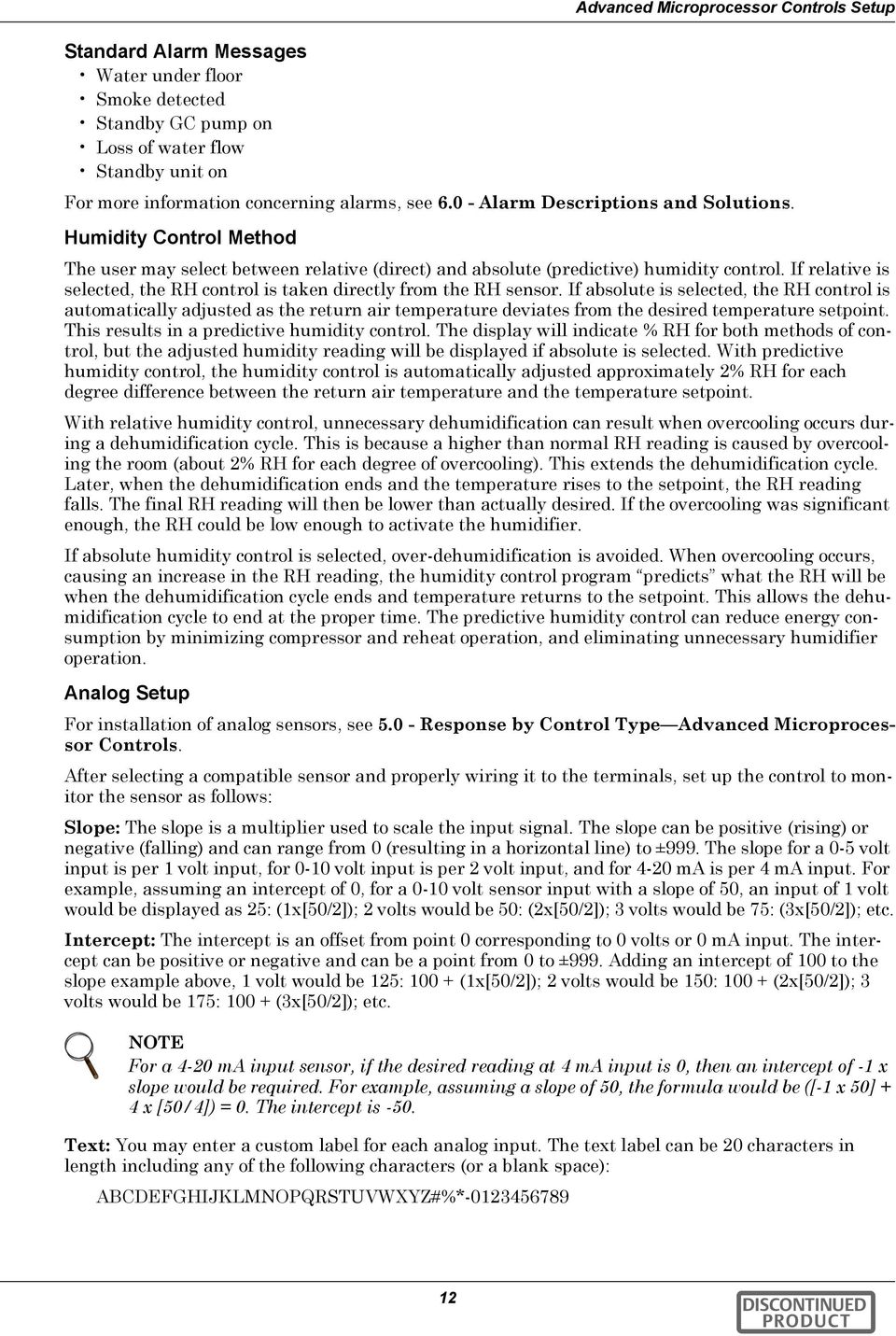
20 Standard Alarm Messages Water under floor Smoke detected Standby GC pump on Loss of water flow Standby unit on Advanced Microprocessor Controls Setup For more information concerning alarms, see Alarm Descriptions and Solutions. Humidity Control Method The user may select between relative (direct) and absolute (predictive) humidity control. If relative is selected, the RH control is taken directly from the RH sensor. If absolute is selected, the RH control is automatically adjusted as the return air temperature deviates from the desired temperature setpoint. This results in a predictive humidity control. The display will indicate % RH for both methods of control, but the adjusted humidity reading will be displayed if absolute is selected. With predictive humidity control, the humidity control is automatically adjusted approximately 2% RH for each degree difference between the return air temperature and the temperature setpoint. With relative humidity control, unnecessary dehumidification can result when overcooling occurs during a dehumidification cycle. This is because a higher than normal RH reading is caused by overcooling the room (about 2% RH for each degree of overcooling). This extends the dehumidification cycle. Later, when the dehumidification ends and the temperature rises to the setpoint, the RH reading falls. The final RH reading will then be lower than actually desired. If the overcooling was significant enough, the RH could be low enough to activate the humidifier. If absolute humidity control is selected, over-dehumidification is avoided. When overcooling occurs, causing an increase in the RH reading, the humidity control program predicts what the RH will be when the dehumidification cycle ends and temperature returns to the setpoint. This allows the dehumidification cycle to end at the proper time. The predictive humidity control can reduce energy consumption by minimizing compressor and reheat operation, and eliminating unnecessary humidifier operation. Analog Setup For installation of analog sensors, see Response by Control Type Advanced Microprocessor Controls. After selecting a compatible sensor and properly wiring it to the terminals, set up the control to monitor the sensor as follows: Slope: The slope is a multiplier used to scale the input signal. The slope can be positive (rising) or negative (falling) and can range from 0 (resulting in a horizontal line) to ±999. The slope for a 0-5 volt input is per 1 volt input, for 0-10 volt input is per 2 volt input, and for 4-20 ma is per 4 ma input. For example, assuming an intercept of 0, for a 0-10 volt sensor input with a slope of 50, an input of 1 volt would be displayed as 25: (1x[50/2]); 2 volts would be 50: (2x[50/2]); 3 volts would be 75: (3x[50/2]); etc. Intercept: The intercept is an offset from point 0 corresponding to 0 volts or 0 ma input. The intercept can be positive or negative and can be a point from 0 to ±999. Adding an intercept of 100 to the slope example above, 1 volt would be 125: (1x[50/2]); 2 volts would be 150: (2x[50/2]); 3 volts would be 175: (3x[50/2]); etc. NOTE For a 4-20 ma input sensor, if the desired reading at 4 ma input is 0, then an intercept of -1 x slope would be required. For example, assuming a slope of 50, the formula would be ([-1 x 50] + 4 x [50/4]) = 0. The intercept is -50. Text: You may enter a custom label for each analog input. The text label can be 20 characters in length including any of the following characters (or a blank space): ABCDEFGHIJKLMNOPQRSTUVWXYZ#%*
21 Set Status Display Advanced Microprocessor Controls Setup The Status Display can be set to show the return air temperature and humidity SENSOR READ- INGS or the temperature and humidity control SETPOINTS through this selection. When SET- POINTS is selected, the status display indicates so by displaying SETPTS. If SENSOR READINGS is selected, the Status Display will show the return air sensor readings. Calibrate Actuator For systems that use a valve actuator for chilled water or glycol cooling, the actuator timing may be calibrated or adjusted. This is the time it takes for the valve to travel from full closed to full open. It is programmable from 0 to 255 seconds. The factory default time is 165 seconds and should not be changed unless the actual valve travel time is not correct. The full valve travel time is used by the control to determine the appropriate valve position. For example, if the valve travel time is 165 seconds and 50% cooling is being called for, the valve will open for 83 seconds to achieve 50% open. To change the valve travel time, first enter the CALIBRATE ACTUATOR screen. The display will show the present period used by the control for valve actuator full travel. Press ENTER and adjust the time using the UP/DOWN arrows. When the correct time is displayed, press ENTER to store the new time in memory Run Diagnostics From the Run Diagnostics menu, maintenance personnel can check system inputs, outputs, and complete a test of the microcontroller circuit board, all from the front panel. Review of the system inputs and the microcontroller test can be done without interrupting normal operation. To test the system outputs, the normal system control is temporarily suspended. DO NOT leave the unit in the diagnostics mode any longer than is necessary for troubleshooting. The control system will return to normal operation in 5 minutes, automatically, if no key is pressed. Show Inputs With the unit on and the fan running, the input state for the following devices may be displayed: Air sail switch: normally off unless Loss of Air Alarm is active Custom alarm #1: normally off unless this alarm is active Custom alarm #2: normally off unless this alarm is active Custom alarm #3: normally off unless this alarm is active Custom alarm #4: normally off unless this alarm is active Humidifier problem: normally on unless this alarm is active Filter clog: normally off unless Change Filters Alarm is active Main fan overload: normally on unless Main Fan Overload Alarm is active High Head Comp 2: normally off unless High Head Pressure Alarm Compressor 2 is active Comp 2 Overload: normally on unless Compressor 2 Overload Alarm is active Shutdown device: normally on unless unit is off through the Fire Stat or Remote Shutdown Device Low press switch 2: normally on if compressor circuit 2 is in operation Low press switch 1: normally on if compressor circuit is in operation Comp 1 Overload: normally on unless Compressor 1 Overload Alarm is active High Head Comp 1: normally off unless High Head Pressure Alarm Compressor 1 is active 13
22 Test Outputs Advanced Microprocessor Controls Setup When this feature is selected, the unit is effectively turned off. When stepping from one load to the next, the previous load, if on, is turned off automatically. The loads can also be toggled on/off by selecting ENTER. Once turned on, the output will remain on for 5 minutes unless toggled off or the Test Outputs function is exited by selecting MENU/ESC. (Compressor is limited to 15 seconds on to prevent damage.) The outputs are as follows: Main fan: main fan contactor Comp 1: compressor 1 contactor LLSV1: liquid line solenoid valve 1 HGBP/CUV1: hot gas bypass or compressor 1 unloader valve (on certain units) Comp 2: compressor 2 contactor LLSV2: liquid line solenoid valve 2 HGBP/CUV2: hot gas bypass or compressor 2 unloader valve (on certain units) CWV/CGV: chilled water or GLYCOOL valve R5 relay: Relay 5 (heat rejection) Reheat 1: Reheat 1 contactor (also energizes fan for safety) Reheat 2: Reheat 2 contactor (also energizes fan for safety) RH 3/ Dehum Damper: Reheat 3/ dehum damper contactor (also energizes fan for safety) HWR/Steam: hot water or steam valve Humidifier: humidifier contactor (also energizes humidifier makeup valve and fan for safety) HMV: humidifier makeup valve Comm alarm: common alarm relay! CAUTION Do not test a compressor output for more than a few seconds. Compressor damage could result! Test Control Board By selecting this function, the microcontroller will perform a self test lasting approximately 10 seconds. At the end of the test, the ROM checksum, ROM part number and version number will be displayed Change Passwords This function prompts you to enter a three-digit password when making changes. The system includes two (2) passwords, one for setpoints and one for setup. The system allows the passwords to be changed by first entering the present password, factory set as 123 for setpoints and 321 for setup. The password function provides system security, so only personnel authorized to make changes should know the passwords. If unauthorized changes are being made, the passwords may be compromised and new ones should be selected. The password function can be disabled by setting DIP switch 8 to OFF. 3.5 Main Menu (AM) Date and Time The current date and time is available through the display. This feature allows the date and time to be read or changed and is accessed by selecting Date and Time from the Main Menu. The Date and Time is used by the control only for recording the Alarm History. NOTE The clock uses the 24 hour system. For example, 17:00 is 5:00 PM. The date and time are protected by a battery backup. 14
23 Advanced Microprocessor Controls Setup 3.6 Main Menu (AM) Status Display The Status Display shows the present room temperature, humidity, active status functions (cooling, heating, dehumidifying, humidifying), and active alarms. This is the data normally shown on the control screen. If no key is pressed for five minutes, the system automatically switches to the Status Display. The Status Display may also be selected from the Main Menu. While the Main Menu is displayed, pressing the MENU/ESC key returns to the Status Display. 3.7 Load Control Features Short Cycle Control The control system monitors both compressors and prevents each from turning on within 3 minutes of being turned off. If this (on, off, on) occurs too often, ten (10) times in one hour, a Short Cycle alarm could occur Sequential Load Activation Control The control allows only one load output to be energized at a time on a restoration of power or microcontroller reset. Each additional load output will be activated at one second intervals until desired operating conditions have been met Compressor Sequencing Control The lead compressor is the first one to be turned on when compressor operation is required. The lag compressor is turned on second if both compressors are required. The control monitors the operating time of both compressors and will automatically switch lead/lag compressor operation to maintain less than eight hours difference between the running times of two compressors. When the operating hours on the lead compressor become eight hours greater than on the lag compressor, the lead/lag operation is automatically switched. If the lead compressor is operating by itself at that time, it will be turned off, the lead/lag operation will be changed, and the new lead compressor will be turned on. NOTE If the hot gas reheat option has been selected, compressor 2 is always the lead compressor. 3.8 Control Circuit Board The control circuit board is located inside the unit behind the LCD display and control key panel. Open the front panel for access to the board. The control board includes an adjustment for LCD display contrast, nonvolatile memory, DIP switches (which should not require customer changes), control output LEDs and jumpers for board configuration. The jumpers should be placed as follows: P5 removed P12 removed P19 installed on Pins 1 and 2 P47 installed on Pins 1 and 2 P48 installed on Pins 1 and 2 P50 all jumpers installed for 4-20 ma analog inputs. See Table 14 for other configurations P51 removed LCD Display Contrast The level of contrast due to viewing angle of the LCD display can be adjusted using a small thumb wheel at the upper left of the control board just under the cable going to the display. The control is labeled R6. NOTE The LED backlighting on the text (4 x 20) display is always lit. 15
24 3.8.2 Nonvolatile Memory Advanced Microprocessor Controls Setup All critical information is stored in nonvolatile memory. Setpoints, setup parameters, and component run hours are kept inside the microcontroller in EEPROM. Information retained for the alarm history is kept in non-volatile RAM DIP Switches Equipment options are selected and enabled using DIP switches 1 to 7. These are located at the upper left of the control board and are labeled SW1. Switch 1 is at the top. These switches are factory set and should not require any user changes. The setting and function of the switches can be read from the LCD display and are also described in more detail in DIP Switches Control Outputs Active control outputs are indicated with LEDs on the lower section of the control board. Each LED is lit if the control output is active (on). The LEDs assist in troubleshooting the system. Table 6 Control output LEDs LED 3.9 Communications Control Output R5 Heat Rejection LLSV1 Liquid Line Solenoid Valve 1 HGBP1 Hot Gas By-Pass or Compressor Unloader Valve C1 Compressor 1 C2 Compressor 2 RH1 Reheat Stage 1 or Hot Gas Reheat Solenoid RH2 Reheat Stage 2 RH3 Reheat Stage 3 HUM Humidifier HGBP2 Hot Gas Bypass 2 or Compressor Unloader Valve 2 FAN Main Fan HMV Humidifier Make-Up Valve LLSV2 Liquid Line Solenoid Valve 2 The control system uses a two-wire, RS-422 channel to communicate with remote monitoring systems via Liebert Site Products. This communication, directly out of the control, uses a proprietary protocol. Your unit can have a variety of different Site Product devices wired to this port depending on the monitoring system you are using. Liebert Site Product Device SiteScan Centralized Monitoring System Stand-alone facility monitoring system SiteLink BMS Interface Module For Modbus or BACnet communication to a third party monitoring system OpenComms Network Interface Card For Ethernet connection using SNMP protocol OpenComms D.O. Interface Card For discrete outputs of status and alarm conditions Mini-Remote Stand-alone individual unit remote monitor ECA2 Communication Adapter For remote service monitoring directly or via a modem Consult the user manual of the appropriate device for specific installation and operation information. 16
25 Advanced Microprocessor Controls Setup Monitor functions 1. Temperature/Humidity: Present readings 2. Status: Cooling/Heating and Humidifying/Dehumidifying operating status in percent 3. Present Alarms: Alarms presently active 4. Alarm History: 10 most recent alarms (60 most recent alarms for AG) 5. Run Time Log: Operating hours on major components 6. Daily Log: High and Low Temperature & Humidity View/Change Functions 1. Setpoints Temperature Setpoint Temperature Sensitivity Humidity Setpoint Humidity Sensitivity High Temperature Alarm Low Temperature Alarm High Humidity Alarm Low Humidity Alarm Cold Start Delay Humidifier Flush Rate Chilled Water Flush Rate 2. Control Type: proportional, PID, intelligent 3. PID Parameters: Proportional, Derivative and Integral Gains 4. On/Off Status 5. Time: View Only 6. Silence Alarm 17
26 Advanced Microprocessor with Graphics Control Setup 4.0 ADVANCED MICROPROCESSOR WITH GRAPHICS CONTROL SETUP The Advanced Microprocessor with Graphics (AG) Control for your Deluxe unit features an easy-touse, menu-driven LCD Graphics Display. The menus, control features, and circuit board details are described in this section. For more details on the control refer to Response by Control Type Advanced Microprocessor Controls; for details on the alarms refer to Alarm Descriptions and Solutions. 4.1 Basics Control keys include ON/OFF, Menu/ESCape, ENTER, Increase (up) arrow, and Decrease (down) arrow. Refer to Figure 3. These keys are used to move through the menus as prompted on the LCD display Figure 4. To turn the unit on, press the ON/OFF key after power is applied. To turn the unit off, press the ON/ OFF key before power is disconnected. Active alarms are indicated on the LCD screen by a ringing bell graphic. Alarms are also annunciated by an audible beeper. To silence an alarm, press the ENTER key as prompted on the display. The unit stores the 60 most recent alarms for review. Setpoints, DIP switch settings, and other selections were made on your unit after testing at the factory and are kept in nonvolatile memory. Setpoints were chosen based on typical operating experience. Other selections were made based on options included with your unit. Make adjustments to the factory default selections ONLY if they do not meet your specifications. When entering setpoints, time delays, etc., the allowable ranges are displayed and may require a password, if enabled. Figure 3 Advanced microprocessor with graphics control panel 18
27 Advanced Microprocessor with Graphics Control Setup Figure 4 Advanced microprocessor with graphics (AG) control menu Normal Display 72 F Unit On 50% Reheat Dehumidifying Cooling * * *Main Menu* * * Cursor Movement Use UP/DOWN to move the cursor. Hit ENTER to select the menu item. ESC key moves backward through menus toward the Main Menu. Any Key except ON/OFF ESC key View/Set Alarms Operating Status View/Set Control Setpoints Setup System Run Diagnostics Date and Time Plot Graphs Analog/Digital Inputs View Run Hours Log Operating Status Compressor Cooling % Heating % Glycool %** Chilled Water Valve %** Humidification % Active Alarms Alarm History Log Setup Alarms High Temperature Low Temperature High Humidity Low Humidity Low Suction Comp 1 Low Suction Comp 2 Short Cycle Comp 1 Short Cycle Comp 2 Compressor 1 Overload Compressor 2 Overload Main Fan Overload Loss of Power Humidifier Problem High Head Pressure 1 High Head Pressure 2 Change Filters Loss of Air Flow Custom Alarm 1 Custom Alarm 2 Custom Alarm 3 Custom Alarm 4 Setup Custom Alarms Setup Custom Alarm Text Change Custom Text 1 Change Custom Text 2 Change Custom Text 3 Change Custom Text 4 View Water Detect Floor Plan Setup Water Detect Floor Plan Use / to Locate File Use ENTER to define file ** Optional Setup Operation Cold Start Delay Auto Restart Delay IR Flush Overfill CW/HW Coil Flush Display in Degrees (F/C ) Min Chilled Water Temp** Select Options Reheat Humidify Dehumidify Humidifier Pan Size Hot Gas Reheat Stages of Reheat Dehumidification Stages Calibrate Sensors Temperature Sensor Humidity Sensor Calibrated Reading Calibrate Valve Actuator Select Control Algorithm Proportional Intelligent Tunable PID Proportional Gain Derivative Gain Integral Gain Select Humidity Sensing Mode Relative Absolute Set Status Display Sensor Reading Setpoints Change Passwwords Setpoint Password Setup Password Change Passwords View/Set Control Setpoints Temperature Setpoint Sensitivity Setpoint Humidity Setpoint Sensitivity High Temperature Alarm Low Temperature Alarm High Humidity Alarm Low Humidity Alarm Date and Time Set Clock Show Inputs Air Sail Switch Custom Alarm 1 Custom Alarm 2 Custom Alarm 3 Custom Alarm 4 Humidifier Problem Filter Clog Switch Main Fan Overload High Head Compressor 2 Compressor 2 Overload Shutdown Device Low Pressure Switch 2 Low Pressure Switch 1 Compressor 1 Overload High Head Compressor 1 Test Outputs Main Fan Compressor 1 LLSV 1 HGBP/CUV 1 Compressor 2 LLSV 2 HGBP/CUV 2 CWV/CGV RS Delay Reheat 1 Reheat 2 RH3/Dehum Damper HMV Common Alarm Test Control Board Microcontroller Show DIP Switches Dipswitch 1 Dipswitch 2 Dipswitch 3 Dipswitch 4 Dipswitch 5 Dipswitch 6 Dipswitch 7 Read Analog Inputs Analog Input 1 Analog Input 2 Analog Input 3 Analog Input 4 Setup Analog Inputs Analog Input 1 (2,3,4) Slope Units Text Intercept Read Digital Inputs Setup Digital Inputs (How-to Text) Temperature Plot Humidity Plot Analog Sensor #1 Plot Analog Sensor #2 Plot Analog Sensor #3 Plot Analog Sensor #4 Plot Modify Plot Scales Modify Temp Scales Modify Humidity Scales Modify Analog Sensor #1 Scale #2 Scale #3 Scale #4 Scale View 24 Hour Run Time History Chilled Water** Glycool** Compressor 1 Compressor 2 Condenser Reheat 1, 2, 3 Humidifier Main Fan View Total Run Hours Compressor 1 Compressor 2 Glycool** Main Fan Humidifier Reheat 1, 2, 3 Chilled Water** Heat Rejection 19
28 4.2 Display the Main Menu AG Control Advanced Microprocessor with Graphics Control Setup Press the MENU/ESC key to display the Main Menu. The Menu selections include: VIEW/SET ALARMS OPERATING STATUS VIEW/SET CONTROL SETPOINTS SYSTEM SETUP RUN DIAGNOSTICS DATE AND TIME PLOT GRAPHS ANALOG/DIGITAL INPUTS VIEW RUN HOURS LOG Pressing the MENU/ESC key while the Main Menu is displayed will return the screen to the Status Display. 4.3 Main Menu (AG) Status Display The normal status screen is divided into two sections, a right half and a left half. The left half displays the return air temperature and humidity readings in large characters. NOTE The display can also be set to display the temperature and humidity setpoints. See Set Status Display. The right half of the screen is divided into four quadrants (top to bottom). In the four quadrants, six different graphic symbols may be displayed depending on the unit status. When an alarm is present, a hammer striking a bell appears at the top of the screen. The word Alarm appears beside the hammer and bell. The second quadrant down displays a rotating fan when the unit is turned on and the fan is running. The words Unit on appear next to the fan symbol. The third quadrant may display one of two symbols relating to heating or cooling. If the control is calling for cooling, a growing snowflake is shown next to the word Cooling. If the control is calling for heating, three moving heat rays are displayed next to the word Heating. In the bottom quadrant, there may be one of two symbols relating to humidification and dehumidification. If the control is calling for humidification, a growing water drop is shown next to the word Humidification. If the control is calling for dehumidification, a shrinking water drop is shown next to the word Dehumidification. 4.4 Main Menu (AG) View/Set Alarms Selecting VIEW/SET ALARMS will step to the following menu: ACTIVE ALARMS ALARM HISTORY LOG SETUP ALARMS SETUP CUSTOM ALARMS VIEW WATER DETECT FLOOR PLAN SETUP WATER DETECT FLOOR PLAN Active Alarms This screen displays any active alarm. The alarms are numbered, #1 being the most recent. The type of alarm (Urgent or Warning) is also displayed. If there are no active alarms, then NO ALARMS PRESENT will be displayed Alarm History Log A history of the sixty (60) most recent alarms is kept in nonvolatile memory along with the type of alarm, the alarm name, and the date and time of its occurrence. The first alarm in the history is the most recent and the last (up to 60) is the oldest. If the Alarm History is full (60 alarms) and a new alarm occurs, the oldest is lost and the newest is saved in alarm history location 1. The rest are moved down the list by 1. Alarm history on new units may show the results of factory testing. 20
29 4.4.3 Setup Alarms Advanced Microprocessor with Graphics Control Setup The list of alarms may be reviewed using the UP/DOWN keys. Any alarm may be selected to have its parameters modified by pressing the ENTER key. All alarms have a time delay and alarm type parameter. The high/low temperature and humidity alarms also have a programmable Trip Point. The Trip Point is the point at which the alarm is activated. By programming a time delay for an alarm, the system will delay the specified amount of time before recognizing the alarm. The alarm condition must be present for the amount of time programmed for that alarm before it will be annunciated. If the alarm condition goes away before the time delay has timed out, the alarm will not be recognized. For software alarms such as Loss of Power, Short Cycle, and Low Suction Pressure, a time delay will only delay the annunciation of that alarm. The condition of the alarm is not applicable because the condition has already occurred. For these alarms the time delay should be left at the factory default of 0. Table 7 Alarm default time delay Alarm Default Time Delay (seconds) Humidifier Problem 2 High Head Pressure 1 2 High Head Pressure 2 2 Change Filter 2 Loss of Air Flow 3 Custom Alarm #1 0 Custom Alarm #2 0 Custom Alarm #3 0 Custom Alarm #4 6 High Temperature 30 Low Temperature 30 High Humidity 30 Low Humidity 30 Low Suction Pressure 1, 2 0 Short Cycle 1, 2 0 Compressor #1 Overload 2 Compressor #2 Overload 2 Main Fan Overload 5 Loss of Power 0 Each individual alarm can be selected as either DISABLED, WARNING, or URGENT. The four custom alarms may also be selected to be a Status Only input. If the alarm is DISABLED, it is ignored. If the alarm is WARNING or URGENT, it will be annunciated audibly, visually, and communicated to a Site Products System, if appropriate. If the alarm is selected to be a WARNING, the alarm will NOT activate the common alarm relay. When the alarm is selected to be URGENT, the alarm is first annunciated as a WARNING, and then annunciated again, after the programmed time delay. When the alarm becomes URGENT, the control will activate the common alarm relay. The common alarm relay is de-energized after the alarm has been recognized and when the alarm no longer exists. When the alarm type has been selected to be URGENT, the allowable range for the time delay from warning to urgent is 0 minutes to 999 hours. When any of the four custom alarm inputs have been selected as Status Only, they become digital inputs for monitoring only and are no longer treated as alarms. 21
30 Advanced Microprocessor with Graphics Control Setup Set Up Custom Alarms Selecting SETUP CUSTOM ALARMS will step to the following menu: SETUP CUSTOM ALARM TEXT CHANGE CUSTOM TEXT 1 CHANGE CUSTOM TEXT 2 CHANGE CUSTOM TEXT 3 CHANGE CUSTOM TEXT 4 The custom alarm messages can be selected from a list of standard messages or you can write your own messages. The message selected for any custom alarm can be changed at any time by selecting SETUP CUSTOM ALARM TEXT. Five standard messages (see Standard Custom Alarm Messages below) and four custom messages are available to choose from. To modify the custom messages press CHANGE CUSTOM TEXT 1 (2, 3 or 4). Each message can be up to 20 characters in length and can be any of the following characters (or a blank space): ABCDEFGHIJKLMNOPQRSTU- VWXYZ#%* Standard Custom Alarm Messages WATER UNDER FLOOR SMOKE DETECTED STANDBY GC PUMP ON LOSS OF WATER FLOW STANDBY UNIT ON For more information concerning alarms, see Alarm Descriptions and Solutions View Water Detect Floor Plan (for optional LTM1000/LT750) When water is detected the alarm will sound and the WATER UNDER FLOOR alarm message will be displayed. To see where the water is in the room, select VIEW/SET ALARMS from the Main Menu, then VIEW WATER DETECT FLOOR PLAN. A tile will be highlighted and blinking to indicate the position of the detected water Setup Water Detect Floor Plan The water detection display is designed to graphically display the location of water under a raised floor when connected to an LT750 water detection system. The selected (i.e., cursor) floor tile will be highlighted and blinking. The UP and DOWN arrow keys are used to position the cursor tile. The UP key will move the cursor tile up and then it wraps around to the bottom of the next column to the right. The DOWN arrow key moves the cursor down, then to the top of the next column to the left. The cursor will also wrap around from the right top tile to the left bottom tile and back. There are three different types of tiles to be defined: the environmental unit, the LT750 and sensor cable tiles. To set up the cable layout, first move the cursor to the location of the environmental unit and press the ENTER key. A rectangular box will be drawn at that location. Then move the cursor to the location of the LT750 and press the ENTER key. A solid circle will be drawn on the display. No tile can have two definitions, so if the LT750 is physically directly under the unit, it has to be defined at least one tile away. The sensor cable should not be defined one tile at a time. The only sensor cable tiles that need to be defined are the tiles where the cable is going to change direction, and the last tile. The display will automatically define any tiles between two consecutively defined sensor tiles to be sensor tiles. The ENTER key is also used to undo tile definitions. If a tile is defined in the wrong place, position the cursor on that tile and press the ENTER key. It will undefine the tile under the cursor and move the cursor back to the last defined tile. The entire layout can be erased by successively pressing the ENTER key. When the last tile is defined, press the ESCape key to leave the setup screen. Installation LT750 DIP Switch Settings Install the LT750 following the instructions in the LT750 Users Manual. The following additional switch selections should be made when connecting to an Advanced Microprocessor control: DIP SW3-4 Off-(water alarm relay energizes for alarm) DIP SW3-5 Off-(cable fault relay energizes for alarm) Switch 1 - Off-(LT750 sources power for 4-20 ma loop) 22
31 4.5 Main Menu (AG) Operating Status Advanced Microprocessor with Graphics Control Setup The Operating Status is intended to provide the user with displayed information concerning what the control is calling for the system to do. NOTE There may be some time lapse before a specific component matches the displayed number. For example: The display indicates the chilled water valve is 68% open. On a new call for cooling, it takes several seconds for the valve to travel from full closed to 68% open. So when the display reads 68%, it may take a few seconds for the valve to actually open 68%. Also, if the display indicates a compressor is operating but the compressor has not turned on yet, it may be off because of the short cycle control (see Short Cycle Control). 4.6 Main Menu (AG) View/Set Control Setpoints Control setpoints can be reviewed and/or changed through the display. The following table lists the default setpoints and their allowable ranges. Table 8 Default control and alarm setpoints Setpoint Default Range* Temperature Setpoint 72 F 40 to 90 F (5 to 32 C) Temperature Sensitivity 2.0 F 1 to 9.9 F (0.6 to 5.6 C) Humidity Setpoint 50% 20 to 80% RH Humidity Sensitivity 5% 1 to 30% RH High Temperature Alarm 80 F 35 to 95 F (2 to 35 C) Low Temperature Alarm 65 F 35 to 95 F (2 to 35 C) High Humidity Alarm 60% 15 to 85% RH Low Humidity Alarm 40% 15 to 85% RH *Unit will operate at these conditions but will not control to these extremes of conditions. 4.7 Main Menu (AG) Setup System Selecting SETUP SYSTEM will step to the following menu: SETUP OPERATION SELECT OPTIONS CALIBRATE SENSORS CALIBRATE VALVE ACTUATOR SELECT CONTROL ALGORITHM SELECT HUMIDITY SENSING MODE SET STATUS DISPLAY CHANGE PASSWORDS 23
32 Advanced Microprocessor with Graphics Control Setup Setup Operation The SETUP OPERATION menu permits the review and/or adjustment of the unit configuration. This may include: Cold Start Delay This feature, also referred to as Positive Start or Winter Start Kit, allows for the low pressure switch to be ignored for the programmed time during a cold start of the compressor. Entering a 0 for this time will bypass this feature. A 1, will bypass the low pressure switch for one minute, a 2 for two minutes, etc. The programmed value can be from 0 to 3 minutes. This delay is factory set to 0 for water cooled, glycol-cooled, and GLYCOOL units. Typically, only air cooled units need a Winter Start time. Auto Restart Delay This feature allows for the unit to restart automatically after a loss of power. The programmed value is.1 minute (6 seconds) intervals. A programmed value of zero (0) would require the user to manually press the ON/OFF switch to start the unit, i.e. no auto restart. The purpose of this feature is to prevent several units from starting at the same time after a loss of power. The message Restart delay -- Please wait will be displayed when the system is in the AUTO RESTART mode. (It is suggested multiple unit installations be programmed with different auto restart times.) IR Flush Overfill (infrared humidifiers only) An autoflush system automatically controls a water makeup valve to maintain proper level in the infrared humidifier water pan during humidifier operation. If humidification is needed and 15 hours have elapsed since the last time the humidifier was on, then the humidifier is held off until the valve completes an initial fill of the humidifier pan. This pre-fill is about 30 seconds. The valve continues to fill and flush the pan for about 4 minutes. During humidifier operation, with the flush rate set at the default of 150%, the valve is opened periodically to add water to the pan (about 40 seconds every 9 and 1/2 minutes of humidifier operation). This adds enough water to the pan to cause about a third of the total water used to be flushed out the overflow standpipe located in the humidifier pan. This action helps to remove solids from the pan. The flush rate is adjustable from 110% to 500%. If the water quality is poor, it may be desirable to increase the water flushing action above the normal 150% rate. Also, if the supply water pressure is low, the flush rate adjustment can be increased so that sufficient water level is maintained during humidification. Chilled Water/Hot Water/Econ-O-Coil Flush This feature will flush the respective coil for three (3) minutes after the programmed number of hours of nonuse. For example, if the flush time is programmed with 24 hours on a hot water reheat type system, and heating is not required for a 24 hour period, the hot water valve will be opened for 3 minutes to allow the coil to be flushed. The programmed value can be from 0 (no flush) to 99 (99 hours of nonuse). Display in Degrees The control can be set to display readings and setpoints in either degrees Fahrenheit (F) or Celsius (C). Default Settings and Ranges See Table 9 below for the list of setup functions, their factory default values and the allowable ranges for which they can be programmed. Table 9 Setup functions and factory default values Function Default Range Cold Start Time Delay* 3 0 to 3 min (0 = no delay) Restart Time Delay to 9.9 min (0 =manual restart) Infrared Fill Rate to 500% Chilled/Hot Water Coil Flush 24 0 to 99 hrs (also Econ-o-coil) F/C Degrees F C or F *Factory set to 0 for water-cooled, glycol, and GLYCOOL units. 24
33 4.7.2 Select Options Advanced Microprocessor with Graphics Control Setup The following table is a list of features that should match the options installed with your unit and should not need to change during normal operation. Table 10 Heating Humidifier Dehumidifier Select options Option Humidifier Pan Hot Gas Reheat Calibrate Sensors The temperature and humidity sensors can be calibrated by selecting this menu item. SENSOR shows the actual sensor reading or raw reading. CALIBRATED shows the sensor reading after the calibration offset has been added. The temperature sensor can be calibrated ±5 degrees Fahrenheit and the humidity sensor can be calibrated ±10% RH. When calibrating the humidity sensor, the value shown will always be % RH, even though absolute humidity control may be selected. If absolute humidity control is selected, the Normal Status Display will display the adjusted reading and may not agree with the relative humidity reading displayed while in calibration Calibrate Valve Actuator For systems that use a valve actuator for chilled water or glycol cooling, the actuator timing may be calibrated or adjusted through this feature. This is the time it takes for the valve to travel from full closed to full open. It is programmable from 0 to 255 seconds. The factory default time is 165 seconds and should not be changed unless the actual valve travel time is not correct. The full valve travel time is used by the control to determine the appropriate valve position. For example, if the valve travel time is 165 seconds and 50% cooling is being called for, the valve will open for 83 seconds to achieve 50% open. To change the valve travel time, first enter the CALIBRATE VALVE ACTUATOR screen. The display will show the present period used by the control for valve actuator full travel. Press ENTER and adjust the time using the UP/DOWN arrows. When the correct time is displayed, press ENTER to store the new time in memory Select Control Algorithm Selection Yes or No Yes or No Yes or No Small or Large Yes or No Heat Stages* 2 or 3 Dehumidification Stages 1 or 2 *If heat stage is set to 2 on a chilled water unit, the reheat 3 output is energized on a call for dehumidification. The type of system control method used by the microprocessor can be selected from the front panel. The default setting is INTELLIGENT, which approximates the actions that a human operator would take to maintain precise, stable control. The control logic uses Artificial Intelligence techniques including fuzzy logic and expert systems methods to maintain precise, stable control and increase reliability by reducing component cycles. PROPORTIONAL is a standard control method that uses one gain factor (temperature sensitivity adjustment). TUNABLE PID (Proportional, Integral, and Derivative) uses three gain factors selected by the operator. PID allows precision tuning, but requires an experienced operator and seasonal adjustments. Note that if PID is selected, it is used for temperature control while humidity will continue to use Proportional Control. For chilled water units with the optional Variable Speed Drive, Intelligent is required for proper operation. Refer to Response by Control Type Advanced Microprocessor Controls for more details on types of control. 25
34 4.7.6 Select Humidity Sensing Mode Advanced Microprocessor with Graphics Control Setup This screen permits the user to select between RELATIVE (direct) and ABSOLUTE (predictive) humidity control. If relative is selected, the RH control is taken directly from the RH sensor. If absolute is selected, the RH control is automatically adjusted as the return air temperature deviates from the desired temperature setpoint. This results in predictive humidity control. The display will indicate % RH for both methods of control, but the adjusted humidity reading will be displayed if absolute is selected. With predictive humidity control, the humidity control is automatically adjusted approximately 2% RH for each degree difference between the return air temperature and the temperature setpoint. With relative humidity control, unnecessary dehumidification can result when overcooling occurs during a dehumidification cycle. This is because a higher than normal RH reading is caused by overcooling the room (about 2% RH for each degree of overcooling). This extends the dehumidification cycle. Later, when the dehumidification ends and the temperature rises to the setpoint, the RH reading falls. The final RH reading will then be lower than actually desired. If the overcooling was significant enough, the RH could be low enough to activate the humidifier. If absolute humidity control is selected, over-dehumidification is avoided. When overcooling occurs, causing an increase in the RH reading, the humidity control program predicts what the RH will be when the dehumidification cycle ends and temperature returns to the setpoint. This allows the dehumidification cycle to end at the proper time. The predictive humidity control can reduce energy consumption by minimizing compressor and reheat operation, and eliminating unnecessary humidifier operation Set Status Display The Status Display can be set to show the return air temperature and humidity SENSOR READ- INGS or the temperature and humidity control SETPOINTS through this selection. When setpoints are selected, the Status Display indicates so by also displaying SETPOINTS. If SENSOR READ- INGS is selected, the Status Display will show the return air sensor readings Change Passwords Selecting Change Passwords will prompt the user to select one of the following: SETPOINT PASSWORD SETUP PASSWORD The display prompts you to enter a three digit password when making changes. The system includes two (2) passwords, one for setpoints and one for system setup. The system allows the passwords to be changed by first entering the present password, factory set as 123 for setpoints and 321 for setup. The password function provides system security, so only personnel authorized to make changes should know the passwords. If unauthorized changes are being made, the passwords may be compromised and new ones should be selected. The password function can be disabled by setting DIP switch 8 to OFF. 4.8 Main Menu (AG) Run Diagnostics By selecting Run Diagnostics, maintenance personnel can check system inputs, outputs, and complete a test of the microcontroller circuit board, all from the front panel. Review of the system inputs and the microcontroller test can be done without interrupting normal operation. 26
35 4.8.1 Show Inputs Advanced Microprocessor with Graphics Control Setup With the unit on and the fan running, the input state for the following devices may be displayed: Air Sail Switch: normally off unless Loss of Air Alarm is active Custom Alarm #1: Normally off unless this alarm is active Custom Alarm #2: Normally off unless this alarm is active Custom Alarm #3: Normally off unless this alarm is active Custom Alarm #4: Normally off unless this alarm is active Humidifier Problem: Normally on unless this alarm is active Filter Clog Switch: Normally off unless Change Filters Alarm is active High Head Compressor 2: Normally off unless High Head Pressure Alarm Compressor 2 is active Compressor 2 Overload: Normally off unless Compressor 2 Overload Alarm is active Shutdown Device: Normally on unless unit is off through the Fire Stat or Remote Shutdown Device Low Pressure Switch 2: Normally on if compressor circuit 2 is in operation Low Pressure Switch 1: Normally on if compressor circuit 1 is in operation Compressor 1 Overload: Normally on unless Compressor 1 Overload Alarm is active High Head Compressor 1: Normally off unless High Head Pressure Alarm Compressor 1 is active Test Outputs When this feature is selected, the unit is effectively turned off. When stepping from one load to the next, the previous load, if on, is turned off automatically. The loads can also be toggled on/off by selecting ENTER. Once turned on, the output will remain on for 5 minutes unless toggled off or the test outputs function is exited by selecting MENU/ESC (Compressor is limited to 15 seconds on to prevent damage.) DO NOT leave the unit in the test outputs mode any longer than is necessary for troubleshooting. The outputs are as follows: Main Fan: Main fan contactor Compressor 1: Compressor 1 contactor LLSV1: Liquid line solenoid valve 1 HGBP/CUV1: Hot gas bypass or compressor 1 unloader valve (on certain units) Compressor 2: Compressor 2 contactor LLSV2: Liquid line solenoid valve 2 HGBP/CUV2: Hot gas bypass or compressor 2 unloader valve (on certain units) CWV/CGV: Chilled water or GLYCOOL valve R5 Relay: Relay 5 (heat rejection) Reheat 1: Reheat 1 contactor (also energizes fan for safety) Reheat 2: Reheat 2 contactor (also energizes fan for safety) Reheat 3: Reheat 3 contactor (also energizes fan for safety) HWR/Steam: Hot water or steam valve Humidifier: Humidifier contactor (also energizes humidifier makeup valve and fan for safety) HMV: Humidifier makeup valve Common alarm: Common alarm relay! CAUTION Do not test a compressor output for more than a few seconds. Compressor damage could result! Test Control Board By selecting this function, the microcontroller will perform a self test lasting approximately 10 seconds. At the end of the test, the ROM checksum, ROM part number and version number will be displayed. 27
36 4.8.4 DIP Switches Advanced Microprocessor with Graphics Control Setup The DIP switch settings can be reviewed from the display panel. Changing the DIP switches requires opening the front panel for access to the DIP switches on the microprocessor control board. NOTE Power MUST be cycled off, then on from the unit disconnect switch for the control system to update the DIP switch settings (except for switch 8). These selections should match options installed on your unit and should not need to change during normal operation. Switches 1 through 7 are self explanatory. DIP switch 8, not shown in the table, enables the password feature when set to ON and disables the password feature if set to OFF. Table 11 DIP switch settings Number OFF ON 1 Compressor Cool Chilled Water 2 Electric/Hot Gas Reheat Hot Water Reheat 3 2 Step 4 Step 4 No GLYCOOL GLYCOOL 5 No Dual Cooling Dual Cooling 6 Not Used Not Used 7 Delayed Reheat Dehumidification with Normal Reheat Dehumidification with Normal or Delayed Reheat Dehumidification with normal reheat allows for operating both compressors and reheats simultaneously. It is very important that electrical service to the unit be sized and wired for this option if selected.! CAUTION The result of electrical service to the unit not being sized properly for this option could be nuisance trips of the building circuit breakers (or fuses) or, in extreme cases, damage to building wiring. With delayed reheat selected, the reheats are prevented from turning on when dehumidifying with both compressors until the point at which 100% heating is called for. At this time, the compressors are turned off until the reheats bring the temperature back up to the point at which the reheats are turned off. 4.9 Main Menu (AG) Date and Time The current date and time is available through the display. This feature allows the date and time to be read or changed and is accessed by selecting DATE AND TIME from the Main Menu. The DATE AND TIME is used by the control for recording the Alarm History and plotting graphs. NOTE The clock uses the 24 hour system (For Example: 17:00 would be 5:00 PM). The date and time are backed up by a battery Main Menu (AG) Plot Graphs Selecting Plot Graphs will step to the following menu: TEMPERATURE PLOT HUMIDITY PLOT ANALOG SENSOR #1 PLOT ANALOG SENSOR #2 PLOT ANALOG SENSOR #3 PLOT ANALOG SENSOR #4 PLOT MODIFY PLOT SCALES 28
37 Advanced Microprocessor with Graphics Control Setup Six different data types are recorded for graphing: temperature, humidity, and four user defined analog inputs. Each data type can be viewed over three different time scales and two different resolutions. The three time scales are 90 minutes, 8 hours, and 24 hours. The two resolutions are minimum and maximum. With minimum resolution selected, the full scale of the sensor is displayed. In other words, the largest and smallest possible sensor readings are shown. Maximum resolution shows a range which covers two fifths of the full scale sensor range Modify Plot Scales The Modify Plot Scales menu item adjusts the layout of the graph. This setup screen selects the time scale and resolution. It also adjusts the center of the graph for a maximum resolution graph. The time scale and resolution can also be changed while the graph is displayed. The DOWN arrow key changes the time scale from 90 minutes to 8 hours to 24 hours. The UP arrow key toggles the display between maximum and minimum resolution Main Menu (AG) Analog/Digital Inputs Selecting Analog/Digital Inputs steps to the following menu: READ ANALOG INPUTS SETUP ANALOG INPUTS READ DIGITAL INPUTS SETUP DIGITAL INPUTS Read Analog Inputs The four (4) analog sensor inputs can be monitored from the display. The inputs are filtered, then displayed along with the text label assigned during setup Setup Analog Inputs For installation of analog sensors, see Main Menu (AG) Analog/Digital Inputs. After selecting a compatible sensor and properly wiring it to the terminals, setting up the control to monitor the sensor is as follows: Slope The slope is a multiplier used to scale the input signal. The slope can be positive (rising) or negative (falling) and can range from 0 (resulting in a horizontal line) to ±999. The slope for a 0-5 V input is per 1 V input, for 0-10 V input is per 2 V input, and for 4-20 ma is per 4 ma input. For example, assuming an intercept of 0 for a 0-10 V sensor input with a slope of 50, an input of 1 V would be displayed as 25: (1x[50/2]); 2 V would be 50: (2x[50/2]); 3 V would be 75: (3x[50/2]), etc. Intercept The intercept is an offset from point 0 corresponding to 0 volts or 0 ma input. The intercept can be positive or negative and can be a point from 0 to ±999. Adding an intercept of 100 to the slope example above, 1 V would be 125: (1x[50/2]); 2 V would be 150: (2x[50/2]); 3 V would be 175: (3x[50/2]); etc. Text NOTE For a 4-20 ma input sensor, if the desired reading at 4 ma input is 0, then an intercept of -1 x slope would be required. For example, assuming a slope of 50, the formula would be ([-1 x 50] + 4 x [50/4]) = 0. The intercept is -50. You may enter a custom label for each analog input. The text label can be 20 characters in length including any of the following: ABCDEFGHIJKLMNOPQRSTUVWXYZ#%* , or space. 29
38 Read Digital Inputs Advanced Microprocessor with Graphics Control Setup The four custom alarm inputs can be defined to be digital inputs. Digital inputs are used to sense customer devices for status display purposes only and will not activate the audible alarm Set Up Digital Inputs A digital input is enabled by defining one of the four custom alarms to be STATUS ONLY type in the alarm setup screen. The digital input is given a name by specifying it to be one of the optional alarms or a custom text alarm. See Setup Alarms and Set Up Custom Alarms Main Menu (AG) View Run Hours Log Selecting VIEW RUN HOURS LOG will step to the following menu: VIEW 24 HOUR RUN TIME HISTORY VIEW TOTAL RUN HOURS View 24 Hour Run Time History The history of each load for every hour during the past 24 hours is displayed in the run hour history. The percentage of each hour that the load was on is displayed from 0 to 100% in increments of 5% or 3 minutes. Loads with a variable output are displayed as a percentage of their capacity for an hour. For example, a variable load that is 50% on for 1/2 of the hour will be displayed as 25% on for that hour View Total Run Hours The total operating hours of all major components in the unit can be monitored from the display and are retained in nonvolatile memory. Run times are available for the following: COMPRESSOR 1 COMPRESSOR 2 GLYCOOL COIL (or DUAL COOL COIL) FAN HUMIDIFIER REHEAT 1 (or HOT WATER REHEAT) REHEAT 2 REHEAT 3 CHILLED WATER COIL HEAT REJECTION The component run hours for each individual component can be reset by selecting the run hours display screen for the desired component, then pressing ENTER within five (5) minutes of applying power to the control. The user will then be prompted to press ENTER to clear the selected component's run hours Load Control Features Short Cycle Control NOTE A component s run hours should BE RESET ONLY when the component has been replaced. The control system monitors both compressors and prevents each from turning on within 3 minutes of being turned off. If this (on, off, on) occurs too often, ten (10) times in one hour, a Short Cycle alarm could occur Sequential Load Activation Control The control allows only one load output to be energized at a time on a restoration of power or microcontroller reset. Each additional load output will be activated at one second intervals until desired operating conditions have been met. 30
39 Compressor Sequencing Control Advanced Microprocessor with Graphics Control Setup The lead compressor is the first one to be turned on when compressor operation is required. The lag compressor is turned on second if both compressors are required. The control monitors the operating time of both compressors and will automatically switch lead/lag compressor operation to maintain less than eight hours difference between the running times of two compressors. When the operating hours on the lead compressor become eight hours greater than on the lag compressor, the lead/lag operation is automatically switched. If the lead compressor is operating by itself at that time, it will be turned off, the lead/lag operation will be changed, and the new lead compressor will be turned on. NOTE If the hot gas reheat option has been selected, compressor 2 is always the lead compressor Control Circuit Board The control circuit board is located inside the unit behind the LCD display and control key panel. Open the front panel for access to the board. The control board includes an adjustment for LCD display contrast, nonvolatile memory, DIP switches (which should not require customer changes), control output LEDs and jumpers for board configuration. The jumpers should be placed as follows: P5 removed P12 removed P19 installed, Pins 1 and 2 P47 installed, Pins 1 and 2 P48 installed, Pins 1 and 2 P50 all jumpers installed for 4-20 ma analog inputs. See Table 14 for other configurations P51 removed LCD Display Contrast The level of contrast due to the viewing angle of the LCD display can be adjusted using a small thumb wheel at the upper left of the control board just under the cable going to the display. The control is labeled R6. NOTE The LCD backlighting will turn on when any key is pressed and will go off 5 minutes after the last key is pressed Nonvolatile Memory All critical information is stored in nonvolatile memory. Setpoints, setup parameters, and component run hours are kept inside the microcontroller in EEPROM. Information retained for data logging, 24 hour component run hour graphs, alarm history, and the water detection floor plan is kept in non-volatile RAM DIP Switches Equipment options are selected and enabled using DIP switches 1 to 7. These are located at the upper left of the control board and are labeled SW1. Switch 1 is at the top. These switches are factory set and should not require any user changes. The setting and function of the switches can be read from the LCD display and are also described in more detail in DIP Switches. 31
40 Advanced Microprocessor with Graphics Control Setup Control Outputs Active control outputs are indicated with LEDs on the lower section of the control board. Each LED is lit if the control output is active (on). Use these LEDs to assist in troubleshooting the system. Table 12 Control output LEDs LED Control Output R5 Heat Rejection LLSV1 Liquid Line Solenoid Valve 1 HGBP1 Hot Gas By-Pass or Compressor Unloader Valve C1 Compressor 1 C2 Compressor 2 RH1 Reheat Stage 1 or Hot Gas Reheat Solenoid RH2 Reheat Stage 2 RH3 Reheat Stage 3 HUM Humidifier HGBP2 Hot Gas Bypass 2 or Compressor Unloader Valve 2 FAN Main Fan HMV Humidifier Make-Up Valve LLSV2 Liquid Line Solenoid Valve Communications The control system uses a two-wire, RS-422 channel to communicate with remote monitoring systems via Liebert Site Products. This communication, directly out of the control, uses a proprietary protocol. Your unit can have a variety of different Site Product devices wired to this port depending on the monitoring system you are using. Liebert Site Product Device SiteScan Centralized Monitoring System Stand alone facility monitoring system SiteLink BMS Interface Module For Modbus or BACnet communication to a third party monitoring system OpenComms Network Interface Card For Ethernet connection using SNMP protocol OpenComms D.O. Interface Card For discrete outputs of status and alarm conditions Mini-Remote - Stand alone individual unit remote monitor ECA2 Communication Adapter For remote service monitoring directly or via a modem Consult the User Manual of the appropriate device for specific installation and operation information Monitor functions: 1. Temperature/Humidity: Present readings 2. Status: Cooling/Heating and Humidifying/Dehumidifying operating status in percent 3. Present Alarms: Alarms presently active 4. Alarm History: 10 most recent alarms (60 most recent alarms for AG) 5. Run Time Log: Operating hours on major components 6. Daily Log: High and Low Temperature & Humidity View/Change Functions: 1. Setpoints: Temperature Setpoint High Humidity Alarm Temperature Sensitivity Low Humidity Alarm Humidity Setpoint Cold Start Delay Humidity Sensitivity Humidifier Flush Rate High Temperature Alarm Chilled Water Flush Rate Low Temperature Alarm 2. Control Type: Proportional, PID, Intelligent 3. PID Parameters: Proportional, Derivative and Integral Gains 4. On/Off Status 5. Time: View Only 6. Silence Alarm 32
41 Response by Control Type Advanced Microprocessor Controls 5.0 RESPONSE BY CONTROL TYPE ADVANCED MICROPROCESSOR CONTROLS This section describes how your Advanced Microprocessor Controls respond depending on the algorithm/control type selected in setting up the controls. 5.1 Temperature Control Cooling/Heating Required, in Percent (%) The temperature control program for the advanced microprocessor is based on a calculated percent requirement for cooling/ heating, but the response varies according to the control algorithm or type Response to Control Types Proportional Control If Proportional Control is selected, the % requirement is determined by the difference between the return air temperature and the temperature setpoint. As the return air temperature rises above the temperature setpoint, the % cooling required increases proportionally (from 0 to 100%) over a temperature band equal to the temperature sensitivity +1 F. The % heating requirement is determined the same way as the temperature decreases below the setpoint. With this type of control the temperature at which the room is controlled increases as the room cooling load increases. At full cooling load, the room would be controlled at a temperature equal to the setpoint plus the sensitivity. PID Control If PID Control is selected, the return air temperature is controlled at or near the temperature setpoint independent of the room load. The % cooling/heating requirement is calculated by adding together three individual terms - proportional, integral, and derivative. The proportional term is figured in a manner similar to the previously described Proportional Control. The integral term (sometimes called reset action ) is figured by measuring how much and for how long the temperature has been above or below the setpoint. If the temperature is above the setpoint, the % cooling requirement is slowly but continuously increased until the total is sufficient to bring the temperature back to the setpoint. The derivative term provides an anticipation control for rapid changes in temperature. If the temperature is rising, the % cooling is increased temporarily until the temperature begins to stabilize. The % heating requirement is increased if temperature is falling. The proportional, integral, and derivative terms are all adjustable through the control selection menu and should be set or tuned to the characteristics of the room being controlled (see Load Control Features). Intelligent Control If Intelligent Control is selected, the return air temperature is controlled at or near the temperature setpoint. The % cooling/heating required is calculated based on a set of logical rules that are programmed into the control. These rules basically simulate the actions that an expert human operator would take if manually controlling the system (see Intelligent Control on page 35). 33
42 5.1.3 Cooling Operation Response by Control Type Advanced Microprocessor Controls Two-Step Cooling, Compressorized Direct Expansion (DX) Systems The first stage of cooling activates when the temperature control calculates a requirement for cooling of 50%. The first stage of cooling is deactivated when the cooling requirement drops below 25%. The second stage of cooling is activated when the requirement for cooling rises to 100% and deactivated when the requirement falls below 75%. Four-Step Cooling, Compressorized Direct Expansion (DX) Systems) The four stages of cooling are activated when the requirement for cooling is 25%, 50%, 75% and 100% respectively. Each stage of cooling is deactivated when the requirement for cooling falls 12% below the respective activation points. The four stages of cooling are accomplished in the following manner: 1 stage: One compressor, unloaded 2 stages: Both compressors, unloaded 3 stages: One compressor, loaded and one compressor, unloaded 4 stages: Both compressors, loaded GLYCOOL Cooling When GLYCOOL cooling is available, the temperature control will calculate a total cooling requirement of 200% rather than 100%. Assuming that full GLYCOOL capacity is available, the GLYCOOL valve opens proportionally as the requirement for cooling rises from 0 to 100%. If more than 100% cooling is required, then the compressors are activated at 150% and 200% respectively (125%, 150%, 175% and 200% for a four-step system). If full GLYCOOL capacity is not available, then the GLY- COOL valve will be opened proportionally over a cooling requirement band equal to the available GLYCOOL capacity. The compressor would be activated at a cooling requirement of 50% and 100% above the available GLYCOOL capacity. For example, if the GLYCOOL capacity is 60%, then the GLYCOOL valve would be full open at 60% cooling requirement and the compressors would activate at 110% and 160% cooling requirement. In order to reduce compressor cycling and prevent hunting, GLYCOOL capacity first becomes available when the entering glycol temperature is at least 8 F (22% capacity) below the return air temperature, or 3 F below the return air temperature for 2 hours. GLYCOOL capacity is 100% when the glycol temperature is 25 F below the return air temperature. The system will continue to Econ-O-Cool as necessary as long as the entering glycol temperature remains at least 3 F (0% capacity) below the return air temperature. If GLYCOOL is not available, the temperature control will operate the compressors in the same manner as a 2-step or 4-step system without GLYCOOL. Dual Cooling Source If dual cooling is available, the sensible cooling system operates in the same manner as a GLYCOOL system, except that it is assumed that 100% chilled water capacity is available any time the chilled water temperature is 3 F below the return air temperature. Chilled Water Cooling The chilled water control valve is adjusted proportionally as the temperature control varies the requirement for cooling from 0% to 100%. Units with the optional variable speed drive (VSD) fanspeed control operate in a similar manner, except that the minimum fan speed is 60% when the cooling requirement is less than 60%. Also, the fan is operated at 100% on a call for any heating and/or humidification Heating Operation Electric Reheat The three heat stages are activated when the temperature control calculates a requirement of 33%, 66% and 100% respectively. The stages are deactivated when the heat requirement is 16% less than or one half of the activation point. To help improve the life of the reheats, starts are rotated. The first reheat off will be the last to turn on. For example, on an initial call for heating, reheat 1 will turn on. If the control determines more heating is necessary, reheat 2 will turn on. Then, if less heating is needed, reheat 1 will turn off. If more heating is necessary, reheat 3 will turn on. If more heating is necessary, reheat 1 will turn on. If less heating is needed, reheat 2 will be the first off, then reheat 3 and so on. Reheat starts are not rotated if 2 stages of reheat operation are selected in the SELECT OPTIONS menu. 34
43 Hot Water/Steam Heat Response by Control Type Advanced Microprocessor Controls The valve begins to open when the requirement for heating is 33% and is proportionally adjusted until the valve is full open at 100% heat requirement. 5.2 Humidity Control Dehumidification/Humidification Required, in Percent (%) The humidity control program for the Advanced Microprocessor is based on a calculated % requirement for dehumidification/ humidification. This % requirement is determined by the particular type of control algorithm selected by the user Control Types Proportional Control The % requirement is determined only by the difference between the return air humidity and the humidity setpoint. As the return air humidity rises above the humidity setpoint, the % dehumidification required increases proportionally from 0 to 100% over a humidity band equal to the humidity sensitivity setting. The converse is true for % humidification requirement. PID Control If PID Control is selected, humidity is controlled in the proportional mode with the sensitivity band being determined by the humidity sensitivity setpoint. Intelligent Control If Intelligent Control is selected, the return air humidity is controlled at or near the humidity setpoint. The % dehumidification/humidification required is calculated based on a set of logical rules that simulate the actions of an expert human operator (see Intelligent Control on page 35) Dehumidification Operation One-Stage Dehumidification, Compressorized Direct Expansion (DX) Systems If single compressor dehumidification is selected, a compressor is activated when the humidity control calculates a requirement of 100%; the compressor is deactivated when the requirement falls below 50%. Two-Stage Dehumidification, Compressorized Direct Expansion (DX) Systems The first stage of dehumidification activates when the humidity control calculates a requirement for dehumidification of 50%. The first stage of dehumidification is deactivated when the dehumidification requirement drops below 25%. The second stage of dehumidification is activated when the requirement for dehumidification rises to 100% and deactivated when the requirement falls below 75%. If the compressors have unloading capability (four-step cooling), then the compressors are activated in the fully loaded condition for each stage of dehumidification. Normal or Delayed Reheat (for Two-Stage Dehumidification Only) If the return air temperature falls enough to require more than the total available reheat capacity, then one (1) stage of dehumidification is disabled and the reheats are activated. If the return air temperature falls enough to require twice the total reheat capacity (200%), both stages of dehumidification are disabled. One stage of dehumidification will be re-enabled at 66% call for heating. Both stages of dehumidification are re-enabled at 33% call. If delayed reheat is selected and both compressors are activated for dehumidification, the reheats are disabled until only one compressor is required. If normal reheat control is selected, then the reheats are not disabled during dehumidification, even if both compressors are operating. Refer to section Setup System Selection and DIP Switches regarding wiring required for this option. 35
44 Dual Cooling Source Dehumidification Response by Control Type Advanced Microprocessor Controls When dual cooling is available, the humidity control will calculate a total dehumidification requirement of 200% rather than 100%. The cooling valve opens proportionally as the requirement for dehumidification rises from 0 to 100%. If more than 100% dehumidification is required, then the compressors are activated at 150% and 200% respectively. Dual cooling is available if the entering chilled water temperature is 14 F (50% capacity) below the return air temperature. If dual cooling is not available, the humidity control will operate the compressors in the same manner as a 2-stage dehumidification system. Chilled Water Dehumidification The chilled water control valve is adjusted proportionally as the humidity control varies the requirement for dehumidification from 0 to 100% Humidification Operation System Activation The humidifier (infrared or steam) is activated when the humidity control calculates a requirement of 100% humidification, and deactivated when the requirement falls below 50% Control Types Proportional Control This is a standard control method that maintains the room at a temperature proportional to the load. The temperature maintained increases as the room load increases. At full load the room would be controlled at a temperature equal to the temperature setpoint plus the temperature sensitivity. If Proportional Control is selected, the gain is factory set and cannot be adjusted by the user. Operator inputs are the usual setpoint and sensitivity adjustments. PID Control The PID Control combines three individual terms to determine the control output for a given set of conditions. Note that PID Control is used only for temperature. If PID Control is selected, humidity will continue to use Proportional Control. The proportional (P term) is determined by the difference between the current temperature and the control setpoint. This term is expressed in % cooling (heating) desired for each degree above (below) the setpoint. It is adjustable from 0% to 100% per degree. The purpose of this term is to adjust the control output for any deviation between the current temperature and the control setpoint. The integral (I term) is determined by two things: the difference between the temperature and control setpoint and the amount of time this difference has existed. This term is expressed in % cooling (heating) desired for each minute and degree above (below) the setpoint. It is adjustable from 0% to 100% per degree-minute. The purpose of this term is to force the control to maintain the temperature around the setpoint by slowly but continuously adding (subtracting) a small amount of cooling (heating) to the total control output until the temperature is at the setpoint. The derivative (D term) is determined by the rate of change of temperature. This term is expressed in % cooling (heating) desired for each degree per minute rise (fall) in temperature. It is adjustable from 0% to 100% per degree/min. The purpose of this term is to adjust the control output for quickly changing temperatures, thus providing an anticipation control. All three types are adjusted in the Select Control Type menu, a submenu of the Setup System menu. If PID Control is selected, the temperature sensitivity setting is not used by the control. For optimum performance, a PID Control must be adjusted or tuned according to the characteristics of the particular space and load to be controlled. Improper tuning can cause the control to exhibit poor response and/or hunting. The characteristics of the space and load may change seasonally, so occasional retuning is required for optimum performance. 36
45 Response by Control Type Advanced Microprocessor Controls Suggested System Tuning Procedure 1. Initially adjust the integral and derivative settings to 0%/degree-min and 0%/degree/min. 2. Starting with 20% /degree, adjust the proportional setting in small increments (10% steps) until the control sustains a constant hunting action (the temperature swings are approximately the same amplitude from one peak to the next). 3. Note the time in minutes between peaks of adjacent temperature swings and the amplitude of the temperature swing (degrees above the setpoint). 4. Adjust the Proportional Control setting to about 1/2 the value obtained in step Adjust the integral setting to a value calculated by the following equation: approximate room load (in % full load) time between peaks x peak amplitude x 4 NOTE If this calculation results in a value of less than 1%, set the integral to 1%. 6. Adjust the derivative to a value calculated by the following equation: time between peaks x 5% The above tuning procedure is only an approximation for an initial set of adjustments and are based on the average room characteristics. Your particular settings may need to be further adjusted for optimum PID Control performance. Some suggestions for additional tuning are: If cooling output overshoot is occurring on load changes, decrease the proportional setting or the derivative setting. If system hunting occurs with constant room load, decrease the integral setting. If the control responds too slowly, resulting in large temperature excursions on a load change, increase the proportional setting or the derivative setting. If a constant temperature deviation exists between the temperature and setpoint, increase the integral setting. 37
46 Intelligent Control Response by Control Type Advanced Microprocessor Controls The Intelligent Control operates from a set of general rules that define how the control output should be adjusted for different system conditions. The rules are designed to duplicate the actions that an experienced human operator would take if manually controlling the system. Just as an operator might take several things into consideration before making a temperature control decision, the Intelligent Control can be programmed to do likewise. For example, not only is the current temperature used in making temperature control decisions, but also conditions such as: How fast is the temperature changing? What direction is the temperature changing? What is the cooling output now? What was the cooling output in the past? How long ago was the cooling output changed? Other factors. Any number of rules can be used in an Intelligent Control to define the controls operation under various operating conditions. Hence, several advantages are gained from this type of control over a more standard control approach that uses a fixed mathematical equation to define the operation of the control for all conditions (such as a proportional or PID Control). You can expect Intelligent Control to be more efficient and precise for most applications, but system performance based on room conditions is not as predictable as standard approaches that use a fixed equation. The Liebert Intelligent Control includes rules that significantly enhance the performance of the system, both from a standpoint of precision control and system reliability. Rules are included that: Cause the control to ignore very small or temporary temperature/humidity deviations. This eliminates unnecessary control adjustments that contribute to control instability. Help limit the frequency of control adjustments, thus extending the life of system components that are susceptible to mechanical wear or cycling. Recognize undesired modes of control operation, such as hunting, and make adjustments to the control response to eliminate them. Estimate the present load on the system and then tend to force the control output to the appropriate state Recognize conditions which indicate a large load change and allow the control to temporarily respond more quickly than normal. Cause the control to anticipate the need for reheat during dehumidification and activates reheats before overcooling occurs. 38
47 Response by Control Type Advanced Microprocessor Controls 5.3 Load Control Features Short Cycle Control The control system monitors both compressors and prevents each from turning on within a 3 minute period of being turned off. If this (on, off, on) occurs too often, ten (10) times in a one hour period, a Short Cycle alarm could occur Sequential Load Activation Control The control allows only one load output to be energized at a time on a restoration of power or microcontroller reset. Each additional load output will be activated at one second intervals until desired operating conditions have been met Compressor Sequencing Control The lead compressor is the first one to be turned on when compressor operation is required. The lag compressor is turned on second if both compressors are required. The control monitors the operating time of both compressors and will automatically switch lead/lag compressor operation to maintain less than eight hours difference between the running times of two compressors. When the operating hours on the lead compressor become eight hours greater than on the lag compressor, the lead/lag operation is automatically switched. If the lead compressor is operating by itself at that time, it will be turned off, the lead/lag operation will be changed, and the new lead compressor will be turned on. NOTE If the hot gas reheat option has been selected, compressor 2 is always the lead compressor. 39
48 Response by Control Type Advanced Microprocessor Controls 5.4 Analog Sensors Connecting the Analog Sensors The sensor inputs are factory-set to accept a 4-20 ma signal. The inputs can be changed by removing the appropriate jumpers on the control circuit board. See Table 13, Figure 5 and Figure 6. The user supplied analog sensors MUST have their own power supply. To reduce the effects of interference from any noise source, the sensor input wiring should be shielded twisted pair and the shield tied to earth ground at one end. Analog input terminals for field connections are factory wired to the microprocessor board if specified when ordered. Eight terminals are located in the field wiring compartment of the unit. Wire sensors to the terminals as follows: Table 13 Changing factory-set sensor inputs Terminal Signal 41 Input #1 (+) 42 Input #1 (-) 43 Input #2 (+) 44 Input #2 (-) 45 Input #3 (+) 46 Input #3 (-) 47 Input #4 (+) 48 Input #4 (-) Consult your Liebert supplier for a field installation kit to add these connections after, if required. Table 14 Additional connections available after unit delivery Input #1 Input #2 Input #3 Input # ma Jumper P50.1&2 and P50.3&4 Jumper P50.5&6 and P50.7&8 Jumper P50.9&10 and P50.11&12 Jumper P50.11&14 and P50.15& VDC Jumper P50.1&2 Jumper P50.5&6 Jumper P50.9&10 Jumper P50.13& VDC No jumper on P50.1&2 and P50.3&4 No jumper on P50.5&6 and P50.7&8 No jumper on P50.9&10 and P50.11&12 No jumper on P50.11&12 and P50.15&16 Figure 5 Analog input jumpers ENLARGED AREA Analog input jumper location 40
49 Response by Control Type Advanced Microprocessor Controls Water Detection Display The water detection display is designed to graphically display the location of water under a raised floor when connected to an LT750 water detection system. The graphical floor plan screen shows a 30 x 16 grid. Each square represents one standard floor tile (approximately 2 ft. x 2ft.). Figure 6 Connecting the LT750 2 TB6 1 3 TB5 2 1 fault 3 TB4 2 water 1 LT NO NC C NO NC C Environmental Unit Physical Connections The example above shows the 4-20 ma output of LT750 connected to Analog Input #1 (41 and 42) on the external inputs terminal strip. This strip is provided on units ordered with analog inputs. (If this strip is not installed, there is a field installation kit available from your Liebert representative.) The 4-20 ma output of the LT750 must be connected to the first analog input, as shown. TB4 is the water detected relay output. It can be connected to any one of the four special alarm inputs. TB5 is the cable fault relay output. It can also be connected to any one of the four special alarm inputs. Setup The following description assumes wiring connections as shown in Figure 6. First, verify that special alarms 1 and 2 are Enabled to either Warning or Urgent type. Do this by selecting View/Set Alarms from the Main Menu. Then, select Setup Alarms. Follow the instructions on the display to select the required type for Custom Alarm #1 and Custom Alarm #2 if not already set. Next, select the alarm message for Custom Alarm #1 and #2. From the Main Menu, select View/Set Alarms. Then, select Setup Custom Alarms. Then, select Setup Custom Alarm Text. Define Custom Alarm #1 to be Custom 1. (Custom 1 is the default message that will be displayed if a message has never been programmed.) Next, select the text for custom alarm #2 to be Water Under Floor. Now, change the message Custom 1 to LT750 Cable Fault. This is done by selecting the Change Custom Text 1 menu item in the Setup Custom Alarms menu. Follow the instructions on the screen to change the message. The slope and intercept values of Analog Input #1 are used to calculate the location of water. These values should initially be set to zero. The default values are zero, but it may be a good idea to verify those values. They can be viewed by selecting Analog/Digital Inputs from the Main Menu, then Setup Analog Inputs. See Setup Water Detect Floor Plan for more information. 41
50 Response by Control Type Advanced Microprocessor Controls Calibration Calibration should not be required for most installations. The accuracy of this display is approximately 1%. The display is calibrated by the slope and intercept values of Analog Input #1. The position of the water is calculated from the analog output of the LT750 using the formula: position = analog reading/full scale reading X (measured length + slope) + intercept position is the distance from the LT750 to the position of the detected water. measured length is the length of the cable which is calculated automatically when the layout is defined. The units for these values are in floor tiles. The intercept value read from Analog Input #1 is added to the measured position of a water indication to determine which tile to highlight. For example, if water is displayed under the seventh tile but determined to be under the fifth tile, set the offset value to -2 tiles. Use the intercept value to correct errors close to the start of the cable. Accuracy errors farther out on the cable should be corrected using Analog Input #1's slope value. This value effectively adjusts the measured length of the cable. Increasing the effective length of cable will increase the distance of the water and move the highlighted tile farther along the cable, and vice versa. Unlike the intercept, which adjusts by the same amount for all locations on the cable, the slope increases its effect for larger distances. The best procedure to calibrate the cable would be to first simulate water close to the LT750, about 5 tiles out. Adjust the intercept to get the correct reading. Next, simulate water 5 tiles from the end. Adjust the slope to get the correct reading. 5.5 Communications The control system uses a two-wire, RS-422 channel to communicate with remote monitoring systems via Liebert Site Products. This communication, directly out of the control, uses a proprietary protocol. Your unit can have a variety of different Site Product devices wired to this port depending on the monitoring system you are using. Liebert Site Product Device SiteScan Centralized Monitoring System Stand alone facility monitoring system SiteLink BMS Interface Module For Modbus or BACnet communication to a third party monitoring system OpenComms Network Interface Card For Ethernet connection using SNMP protocol OpenComms D.O. Interface Card For discrete outputs of status and alarm conditions Mini-Remote - Stand alone individual unit remote monitor ECA2 Communication Adapter For remote service monitoring directly or via a modem Consult the User Manual of the appropriate device for specific installation and operation information Monitor functions: 1. Temperature/Humidity: Present readings 2. Status: Cooling/Heating and Humidifying/Dehumidifying operating status in percent 3. Present Alarms: Alarms presently active 4. Alarm History: 10 most recent alarms (60 most recent alarms for AG) 5. Run Time Log: Operating hours on major components 6. Daily Log: High and Low Temperature & Humidity 42
51 5.5.2 View/Change Functions: 1. Setpoints Temperature Setpoint Temperature Sensitivity Humidity Setpoint Humidity Sensitivity High Temperature Alarm Low Temperature Alarm High Humidity Alarm Low Humidity Alarm Cold Start Delay Humidifier Flush Rate Chilled Water Flush Rate 2. Control Type: proportional, PID, intelligent 3. PID Parameters: Proportional, Derivative and Integral Gains 4. On/Off Status 5. Time: View Only 6. Silence Alarm Response by Control Type Advanced Microprocessor Controls 43
52 Alarm Descriptions and Solutions 6.0 ALARM DESCRIPTIONS AND SOLUTIONS The Advanced Microprocessor (AM) and the Advanced Microprocessor with Graphics (AG) Control systems will audibly and visually annunciate all Enabled alarms, including the four (4) custom alarms. With the AM & AG Controls, the customer alarms can be from the optional alarm list and/or can have their own fully custom text. Two (2) alarms may be selected as custom for AM and four (4) can be custom for AG. The custom alarm inputs are 24 Volts AC which is available from the Liebert unit. Alarms are wired from terminal 24 through a normally open contact to locations 50, 51, 55, and 56, respectively, for alarms 1 through 4. The AM and AG alarms can be delayed from 0 to 255 seconds (see Setup Alarms on page 10). The AM alarms can be Enabled or Disabled (also in Setup Alarms on page 10). Also, the AM alarms can be programmed to energize the Common Alarm Relay or to alarm only and not energize the Common Alarm Relay. The AG alarms can be selected as Warning, Urgent, or Disabled. If selected to be a Warning, they are annunciated after the Time Delay but do not energize the Common Alarm Relay. If selected as Urgent, they are annunciated after the Time Delay as a Warning alarm and then re-annunciated after a user programmable period from 0 minutes to 999 hours as an Urgent alarm. When annunciated as an Urgent alarm, the Common Alarm Relay is activated. The custom alarm inputs of the AG can be designated Status Only. As Status Only, the custom alarm input is referenced as a digital input and is no longer treated as an alarm. It is for monitoring only and can be reviewed by selecting Analog/Digital Inputs. When a new alarm occurs, it is displayed on the screen and the audible alarm is activated. If communicating with a Liebert Site Product, the alarm is also transmitted. The display will also show a message to Press Enter Key to Silence the alarm. After the alarm is silenced, the display will return to the Normal Status Display. For the AG, the bell and hammer are shown at the top of the Normal Status Display. For the AM, the bottom line will display the number of Active Alarms. For the SM, the alarm is displayed by a lighted LED next to the alarm text. The active alarms can be reviewed on the Advanced Microprocessor Controls by selecting Active Alarms. The alarms can also be silenced through communications with a Liebert Site Products unit. Most alarms will reset automatically when the alarm condition is no longer present and only after it has been acknowledged by being Silenced. The exceptions are: a. The three software alarms: Loss of Power, Low Suction Pressure, and Short Cycle which reset automatically 90 minutes after being Silenced or acknowledged. b. (2) Some alarms such as overloads and high pressure switches may require a manual reset depending on your model. A history of the alarms (10 for AM units and 60 for AG units) is retained in nonvolatile memory (for AM information, see Alarm History Log; for AG information, see Alarm History Log). This section provides a definition of each available alarm. Troubleshooting suggestions are included. Refer to Troubleshooting for more details. If you need assistance with your environmental control system, contact your Liebert supplier. 6.1 Standard Alarms Change Filter Periodically, the return air filters in the environmental units must be changed. The Change Filter alarm notifies the user that filter replacement is necessary. A differential air pressure switch closes when the pressure drop across the filters becomes excessive. The switch is adjustable using the procedure on the switch label Compressor Overload The control break compressor safety stats located internal to the Carlyle compressors are tripped when an overload condition occurs. When a Copeland compressor is used, an optional tri-block overload device can be used for each compressor. Compressor overload may be manual or automatic reset, depending on your model. Overload is located at the electric connection box on the compressor. Note that compressor #1 is the top compressor and compressor #2 is the bottom one. 44
53 6.1.3 Custom Alarms (Only With Advanced Controls) Alarm Descriptions and Solutions Custom alarm messages are programmed at the LCD display. The alarms may be specified by the customer at the time of order. Additional devices and wiring may be required at the factory or by others. The message displayed may be included in this alphabetical list of alarms, or it may be customized text (for up to 2 alarms). If customized text is used, customer maintenance personnel should be informed of the alarm function and corrective action required High Head Pressure Compressor head pressure is monitored with a pressure-sensing switch. One SPDT pressure switch is used for the compressor in the unit. If head pressure exceeds 360 PSIG, the switch turns off the compressor contactor and sends an input signal to the control. When the condition is acknowledged, the alarm is silenced. However, the pressure switch in the compressor compartment of the unit must be manually reset to clear the alarm, which will allow the compressor to start. On air cooled systems, check for power shut off to the condenser, condenser fans not working, defective head pressure control valves, closed service valves, dirty condenser coils, and crimped lines. Also, make sure that when the compressor contactor is energized the side switch on the contactor closes to energize the control circuit on the air cooled condenser. On water/glycol/glycool systems, check water regulating valves. Verify water/glycol flow (are pumps operating and service valves open?). Is water tower or drycooler operating? Is the coolant temperature entering the condenser at or below design conditions? Is relay R5 operating during cooling to turn on the drycooler? High Humidity If the return air humidity has increased to the High Humidity Alarm setpoint, check the following: Is the unit setup for dehumidification (check DIP switch)? Check for proper setpoints. Does the room have a vapor barrier to seal it from outdoor humidity? Are doors or windows open to outside air? Run diagnostics to make sure the cooling system is working properly (the cooling system dehumidifies) High Humidity and Low Humidity (Simultaneously) If these two alarms are displayed at the same time, the humidity input signal is lost. Dashes will be displayed for the humidity reading. The control system will deactivate humidification and dehumidification. Check for a disconnected cable or a failed sensor High Temperature If the return air temperature has increased to the High Temperature Alarm setpoint, check the following: Are the setpoints correct? Is the room load more than the unit can handle (is the unit capacity too small)? Run diagnostics to make sure all cooling components are operating (compressor and/or valves) High Temperature and Low Temperature (Simultaneously) If these two alarms are displayed at the same time, the temperature input signal is lost (or the humidity is out of sensor range: 15 to 85% RH). Dashes will be displayed for the temperature reading. The control system will initiate 100% cooling. Check for a disconnected cable or a failed sensor Humidifier Problem Infrared Humidifiers This alarm is activated by the high water float switch (AM and AG controls only) in the humidifier pan assembly. The high water float switch is normally closed and opens upon alarm condition. Check for a drain clog and, if present, clean the drain. Check for float switch stuck in the on position, free or replace the switch. Check for proper operation of the humidifier water makeup valve. Steam Generating (Canister) Humidifiers This alarm is activated by a signal from the humidifier control indicating that the canister needs to be replaced. 45
54 Loss of Air Flow A differential air pressure switch is used to indicate loss of air flow in Deluxe units. Alarm Descriptions and Solutions Check for blockage of unit air outlet or inlet. Check blower motor fuses and overload reset. Check for broken belts. Make sure blower wheels are tight to shaft. Run diagnostics to see if the fan contactor is working properly Loss of Power This alarm condition exists if the unit has lost power, or the disconnect switch was turned off before the unit ON switch was pressed (to turn the unit Off). This local alarm will occur when power is restored to the unit. A Liebert remote monitoring unit (optional) will immediately indicate loss of power Low Humidity If the return air humidity has decreased to the Low Humidity Alarm setpoint, check the following: Is the unit setup for humidification (check DIP switch)? Check for proper setpoints. Does the room have a vapor barrier to seal it from outdoor humidity? Are doors or windows open to outside air? Run diagnostics to make sure the humidifier system is working properly Low Suction Pressure When the compressor is in cooling operation, a pressure switch monitors the suction pressure at the compressor inlet. When pressure drops below a factory preset point, the switch opens. After the positive start kit time delay, and the switch stays open for five minutes, the alarm is activated. The alarm stays active for ninety minutes. Look for conditions that would cause loss of refrigerant. Check for piping problems such as leaks or crimped lines. Check for inoperative components such as liquid line solenoid valve, low pressure switch, expansion valve, and head pressure control valve. Check for closed service valves in the liquid line or at the condenser or receiver Low Temperature If the return air temperature has decreased to the Low Temperature Alarm setpoint, check for proper setpoints. Run diagnostics to make sure all heating components are operating (contactors and reheats). Check to see if the reheats are drawing the proper current (see nameplate for Amp rating) Main Fan Overload An optional tri-block overload is required for this alarm, and may or may not replace the internal motor overload, depending on your model. The overload device is located next to the main fan contactor in the line voltage section. The alarm is activated when the overload is tripped Short Cycle On compressorized systems, the compressor has exceeded 10 cooling starts in a one hour period, or the compressor has cycled 5 times in 10 minutes on the low pressure switch during non-cooling. This can be caused by low refrigerant level (but not low enough to activate Low Suction Pressure alarm) or a room cooling load that is small compared to capacity of the unit. Check for leaks, crimped lines, and defective components. If room load is low, increase sensitivity to reduce cycling (Proportional Control). On GLYCOOL units, dirty filters can cause the coil freeze stats to cycle the compressor. 46
55 Alarm Descriptions and Solutions 6.2 Optional/Custom Alarms Loss of Water Flow No water flow is detected in the chilled water or condenser water supply line. An optional flow switch is required for this alarm. Check for service valves closed, pumps not working, etc Smoke Detected Smoke is detected in the return air by an optional Liebert Smoke Detector. Check for source of smoke or fire, and follow appropriate emergency procedures Standby GC Pump On The primary pump has failed, and the standby pump is activated (glycol cooled and GLYCOOL units only). Check for problems with the primary pump (fuses blown, motor burn out, service valve shut, stuck check valve, impeller damage, etc.) Standby Unit On The primary environmental control system has had an alarm condition, and the standby system is activated Water Under Floor Water is detected by an optional Liebert Water Detection System. Check under the raised floor for water or other leaks. 47
56 Component Operation and Maintenance, Checks and Adjustments 7.0 COMPONENT OPERATION AND MAINTENANCE, CHECKS AND ADJUSTMENTS 7.1 System Testing! WARNING Potentially lethal voltages exist within this equipment during operation. Observe all cautions and warnings on unit and in this manual. Failure to do so could result in serious injury or death. Only qualified service and maintenance personnel should work with this equipment Environmental Control Functions The performance of all control circuits can be tested by actuating each of the main functions. This is done by temporarily changing the setpoints. Cooling To test the cooling function, set the setpoint to a temperature 10 F (5 C) below room temperature. A call for cooling should be seen and the equipment should begin to cool. A high temperature alarm may come on. Disregard it. Return setpoint to the desired temperature. Heating Reheat may be tested by setting the setpoint for 10 F (5 C) above room temperature. A call for heating should be seen and the heating coils should begin to heat. Disregard the temperature alarm and return the setpoint to the desired temperature. Humidification To check humidification, set the humidity setpoint to a relative humidity 10% above the room humidity. For infrared humidifiers, all the infrared bulbs should come on. For steam generating humidifiers, you will immediately hear the clicks as it energizes. After a short delay, the canister will fill with water. The water will heat and steam will be produced. Return the humidity setpoint to the desired humidity. Dehumidification Dehumidification can be checked by setting the humidity setpoint to a relative humidity 10% below room relative humidity. The compressor should come on. Return humidity setpoint to the desired humidity. Proportional Heating/Cooling/ Dehumidification On Chilled Water, GLYCOOL (Econ-O-Cycle, Free Cool, GLYCOOLING cycle) models, and models with hot water reheat, the microprocessor is capable of responding to changes in room conditions. These systems utilize either a two or three-way valve activated by a proportioning motor. For cooling and dehumidification, the microprocessor will respond by positioning the valve proportionally to match the needs of the room. Full travel of the valve takes place within the range of the sensitivity setting. During dehumidification, full travel of the valve takes place within 2% RH. For hot water reheat, the microprocessor will respond by positioning the hot water valve proportionally to match the needs of the room. Full travel of the valve takes place within 1 F with each 0.1 F resulting in 10% valve travel. 48
57 7.1.2 Electric Panel Component Operation and Maintenance, Checks and Adjustments The electric panel should be inspected for any loose electrical connections.! WARNING Be sure that power to the unit is shut down before attempting to tighten any fittings or connections. Control Transformer and Fuses The control system is divided into four (4) separate circuits. Fuses located on the transformer/fuse board individually protect the control voltage circuits. If any of the fuses are blown, first eliminate shorts, then use spare fuses supplied with unit. Use only type and size of fuse specified for your unit. The small isolation transformer on the main control board supplies 24 volts to the electronics. The transformer is internally protected. If the internal protector opens, the transformer/fuse board must be replaced. Also check the control voltage fuse on the main control board before replacing the transformer/fuse board. Fan Safety Switch For Deluxe units, the Fan Safety Switch is located in the low voltage compartment and consists of a diaphragm switch and interconnecting tubing to the blower scroll. The Fan Safety switch is wired directly to the control circuit to deactivate the unit and activate the alarm system if airflow is interrupted. Firestat The optional firestat is a bimetal operated sensing device with a Normally Closed switch. This device will shut down the entire unit when the inlet air temperature exceeds a preset point. It is connected between terminals 1 and 2 at plug P39. Smoke Detector The optional smoke detector power supply is located on the base of the upflow units, and at the top of downflow units. It is constantly sampling return air through a tube. No adjustments are required. Water Detection Sensor! CAUTION Do not use near flammable liquids or for flammable liquid detection. Liebert manufactures a variety of water-detection systems, including point, zone and cable systems. Follow the instructions supplied with your selected device for proper installation, adjustment and maintenance. Remote Shutdown A connection point is provided for customer-supplied remote shutdown devices. Terminals 37 and 38 on the terminal strip are jumpered when no remote shutdown device is installed. Refer to the unit s electrical schematic and the unit s installation manual. 49
58 7.2 Filters Component Operation and Maintenance, Checks and Adjustments Filters are usually the most neglected item in an environmental control system. To maintain efficient operation, they should be checked monthly and changed as required. Because replacement intervals vary with environmental condition and filter type, each unit is equipped with a filter clog switch. This warns of restricted airflow through the filter compartment by activating the Change Filter alarm. Turn power off before replacing filters. Deluxe filters can be replaced from either end by opening the end doors. On large chilled water units, filters can be replaced from the front. Removing the middle filters will allow you to remove the end ones. Install the new end filters first, then the middle ones. Replacement filters are commercially available in several efficiencies. For Deluxe units, refer to the Technical Data Manual or other documentation for filter sizes. After replacing the filter(s), test the operation of the filter clog switch. Turn the adjusting screw counter clockwise to trip the switch this will energize the Change Filter alarm. To adjust the switch proceed as follows: With the fan running, set the switch to energize the light with clean filters. The unit panels must all be in place and closed to accurately find this point. Then turn the adjusting knob 1 turn clockwise, or to the desired filter change point. 7.3 Blower Package Periodic checks of the blower package include: belt, motor mounts, fan bearings, and impellers. These units are manufactured with factory supplied adjustable motor sheaves. Due to variations in applications, a fixed motor pulley may be desired and can be substituted for the adjustable sheave after obtaining and confirming the desired air flow. This will reduce vibration and wear on the belts and pulleys. Consult the factory for more information Fan Impellers and Bearings Fan impellers should be periodically inspected and any debris removed. Check to see if they are tightly mounted on the fan shaft. Rotate the impellers and make sure they do not rub against the fan housing. Bearings used on the units are permanently sealed and self-lubricating. They should be inspected for signs of wear when belts are adjusted. Shake the pulley and look for movement in the fan shaft. If any excessive movement is noticed, bearings should be replaced. However, the cause of the wear must be determined and corrected before returning the unit to operation Belts The drive belt should be checked monthly for signs of wear and proper tension. Pressing in on belts midway between the sheave and pulley should produce from 1/2" to 1" (12 to 25 mm) of movement. Belts that are too tight can cause excessive bearing wear. Belt tension is adjusted by raising or lowering the fan motor base. To adjust the motor, loosen (but do not remove) the four motor mounting bolts. Turn adjustment bolt(s) on motor mounting base to adjust belt tension or to raise motor to remove belts. Tighten motor bolts after adjustment. If belt appears cracked or worn, it should be replaced with a matched belt (identically sized). With proper care, a belt should last several years. NOTE After adjusting or changing belts, always be certain that motor base nuts are tightened. Loose mounts will produce vibration that may damage the unit. 50
59 Component Operation and Maintenance, Checks and Adjustments Electronic Variable Speed Drive (Inverter) On large Deluxe chilled water models an optional variable speed drive inverter is available. This packaged unit is factory set and should not require field adjustments. The variable speed drive saves power by reducing blower speed to match unit load. If you suspect a problem with the inverter, first make sure that the INTELLIGENT CONTROL method is selected at the microprocessor.! WARNING For operator safety, the variable speed drive must not be programmed while power is connected to the motor. Read all instructions before proceeding. Only qualified service technicians should make changes to the variable speed drive programming. 1. TURN OFF ALL POWER TO THE UNIT AT THE DISCONNECT. 2. Open the unit accent panel and electric box cover. 3. Find the main fan motor wires. These are connected to the motor overload relay in the high-voltage section of the electric box. a. Mark motor wires to ensure they can be reconnected in the same order. b. Disconnect motor wires at the load side of the motor overload relay. c. Close the electric box cover. 4. Remove the right front vertical panel to gain access to the variable speed drive. 5. With the panel removed, restore power to the unit by turning the disconnect on. 6. Consult the factory for instructions on unlocking the keypad the keypad is locked after factory programming of the variable speed drive parameters. 7. Consult the variable speed drive operation manual for instructions on accessing and changing the desired parameter settings. 8. Place the right front vertical panel back on the unit. 9. Reconnect the motor wires to the overload and close the electric box cover and unit accent panel. 10. Restore power at the disconnect 7.4 Refrigeration System Each month the components of the refrigeration system should be inspected for proper function and signs of wear. Because evidence of malfunction is usually present prior to component failure, periodic inspections can be a major factor in the prevention of most system failures. Refrigerant lines must be properly supported and not allowed to vibrate against ceilings, floors, or the unit frame. Inspect all refrigerant lines every six months for signs of wear and proper support. Also inspect capillary and equalizer lines from the expansion valve and support as necessary. Each liquid line has a sight glass that indicates liquid refrigerant flow and the presence of moisture. Bubbles in the sight glass indicate a shortage of refrigerant or a restriction in the liquid line. The moisture indicator changes from green to yellow when moisture is present in the system Compressor Oil Level There is a glass bull s eye provided on each compressor (clearly visible when the end door is open) that permits viewing the oil level. Normally, the oil level should be 1/2 to 3/4 up from the bottom of the sight glass. However, this level may vary during operation due to the action of the moving parts. When idle, the oil level may be higher due to absorption of the refrigerant. After a compressor has been idle for an extended length of time, foaming will usually be present when the compressor first starts. Wait until the compressor has been operating for at least five minutes before viewing the oil level. Refrigeration oil does not deteriorate with normal usage and does not need to be changed unless it becomes discolored or acidic. Periodically inspect the compressor compartment for signs of oil leakage. If a leak is present, it must be corrected and the oil level returned to its proper level using Sunisco 3GS refrigerant oil. Take new oil from sealed containers opened at the time of use. Oil exposed to air will absorb moisture. 51
60 Component Operation and Maintenance, Checks and Adjustments Suction Pressure Suction pressure will vary with load conditions. The low pressure switch will shut the compressor down if suction pressure falls below the cut-out setting. On the other hand, high suction pressure reduces the ability of the refrigerant to cool compressor components and can result in compressor damage. Minimum (pressure switch cut-out setting) and maximum (design operating) suction pressures are listed in the following table. Table 15 Suction pressures System Discharge Pressure Discharge Pressure can be increased or decreased by load conditions or condenser efficiency. The high pressure switch will shut the compressor down at its cut-out setting. Refer to the table below. Table 16 Discharge pressures Suction Superheat Superheat can be adjusted by the Thermostatic Expansion Value (TEV). To determine superheat: 1. Measure the temperature of the suction line at the point the TEV bulb is clamped. 2. Obtain the gauge pressure at the compressor suction valve. 3. Add the estimated pressure drop between bulb location and suction valve. 4. Convert the sum of the two pressures to the equivalent temperature. 5. Subtract this temperature from the actual suction line temperature. The difference is superheat Thermostatic Expansion Valve Minimum Pressure PSIG (kpa) R 22 Maximum Pressure PSIG (kpa) R 22 Air FSC 15 (103) 90 (620) Floodback head pressure control 20 (137) 90 (620) Water Cooled 20 (137) 90 (620) Glycol Cooled 20 (137) 90 (620) System Design PSIG (kpa) Air Cooled 260 (1795) Water Cooled 65 to 75 F water (18 to 24 C) 210 (1450) 85 F water (29 C) 225 (1550) Glycol Cooled 295 (2035) Maximum 330 (2275) High Pressure Cut-Out 360 (2480) Operation The thermostatic expansion valve performs one function. It keeps the evaporator supplied with enough refrigerant to satisfy load conditions. It does not effect compressor operation. Proper valve operation can be determined by measuring superheat. If too little refrigerant is being fed to the evaporator, the superheat will be high; if too much refrigerant is being supplied, the superheat will be low. The correct superheat setting is between 10 and 15 F (5.6 and 8.3 C). 52
61 Component Operation and Maintenance, Checks and Adjustments Adjustment To adjust the superheat setting, proceed as follows: 1. Remove the valve cap at the bottom of the valve. 2. Turn the adjusting stem counterclockwise to lower the superheat. 3. Turn the adjusting stem clockwise to increase the superheat. NOTE Make no more than one turn of the stem at a time. As long as thirty minutes may be required for the new balance to take place Hot Gas Bypass Valve Operation The hot gas bypass is inserted between the compressor discharge line and the leaving side of the expansion valve through the side outlet distributor (refer to Figure 7). The system, during normal operation, when the evaporator is under full load, will maintain enough pressure on the leaving side of the hot gas valve to keep the valve port closed. If the load on the evaporator decreases, the evaporator will get colder. When the coil is too cold, the internal pressure in the evaporator drops and allows the hot gas bypass valve to open. Hot gas then mixes with the liquid coolant on the discharge side of the expansion valve, raising the temperature and pressure in the evaporator. The net result is a reduction in the cooling capacity of the unit to match the load. Adjustment Upon deciding what evaporator temperature is desired, the following procedure should be used to adjust the hot gas bypass valve: 1. Install the suction and discharge pressure gauge. 2. Turn thermostat to call for cooling so that the refrigeration compressor will run. 3. Remove the TOP adjusting nut from the valve. 4. Insert an Allen wrench in the brass hole at top of valve in adjusting port, and turn CLOCKWISE if a higher evaporator temperature is required. 5. After obtaining the suction pressure required, reinstall cap tightly making sure there are no leaks. 6. Let the evaporator operate for approximately 10 to 15 minutes to make sure the suction pressure is within the range desired. 7. There will be a fluctuation of approximately 3 to 6 PSIG (21 to 41 kpa) on the evaporator due to the differential on the hot gas bypass. Figure 7 Hot gas bypass External Equalizer Solenoid Valve Evaporator TEV External Equalizer Side Distribution Connector or ASC Hot Gas Solenoid Valve Discharge Bypass Valve Compressor Condenser 53
62 7.4.7 Air Cooled Condenser Component Operation and Maintenance, Checks and Adjustments Restricted airflow through the condenser coil will reduce the operating efficiency of the unit and can result in high compressor head pressure and loss of cooling. Clean the condenser coil of all debris that will inhibit air flow. This can be done with compressed air or commercial coil cleaner. Check for bent or damaged coil fins and repair as necessary. In winter, do not permit snow to accumulate around the sides or underneath the condenser. Check all refrigerant lines and capillaries for vibration isolation. Support as necessary. Visually inspect all refrigerant lines for signs of oil leaks. Checking Refrigerant Charge (Lee Temp / Flood Back Head Pressure Control) The system refrigerant level must be periodically checked. This is easily done by the following procedure: 1. Adjust temperature setpoint in the unit so that the compressor will run continuously. 2. The refrigerant level is visible through two sight glasses on the receiver, and will vary with ambient temperature. a. 40 F (4.4 C) and lower Midway on the bottom sight glass. b. 40 to 60 F (4.4 to 15.6 C) Bottom sight glass should be clear with liquid. c. 60 F (15.6 C) and above Midway on the top sight glass. 3. Return temperature setpoint to desired number. Figure 8 Outdoor fan/condenser configuration Fan Motor M1 Lee-Temp Heater Pad Connection Boxes Liquid Line Inverted Traps by Others Hot Gas Line Electric Service Supplied by Others Fan Motor FS Inverted Traps by Others Hot Gas Line Secure each leg to condenser frame at all points shown using hardware provided Liquid Line Electric Service Supplied by Others 54
63 7.4.8 Water/Glycol Cooled Condensers Shell and Tube Condensers Component Operation and Maintenance, Checks and Adjustments Each water or glycol cooled module has a shell and tube condenser which consists of a shell, removable heads, gaskets and cleanable copper tubes. It may be necessary to clean the copper tubing periodically to remove any scale or lime that should collect (periods between cleanings will vary with local water conditions). As deposits build up, a cleaning tool, available at any refrigeration supply house, should be used to clean the heat exchanger tubes. 1. Stop the unit (using the start/stop switch) and allow the compressor to pump down. 2. Open the disconnect switch. 3. Shut off the water supply valve to the condenser. 4. Drain the water from condensers and piping. 5. Remove the bolts securing each head and slowly pry them free. 6. Remove old gaskets and inspect sealing surfaces for pits and corrosion. 7. Swab the condenser tubes with a tube cleaning tool. 8. When the tubes are clean, reinstall the heads using new factory gaskets. 9. Consult factory for specific torque requirements. 10. Reconnect the piping, open water supply valve, vent the system and check for leaks. Regulating Valves The water regulating valves automatically regulate the amount of fluid necessary to remove the heat from the refrigeration system, permitting more water to flow when load conditions are high and less fluid to flow when load conditions are low. The valve consists of a brass body, balance spring, valve seat, valve disc holders, capillary tube to discharge pressure, and adjusting screw. Adjustment (Johnson Controls/Penn Johnson valves) The valves may be adjusted with a standard refrigeration service valve wrench or screwdriver. Refer to Table 16 for recommended refrigerant pressures. To lower the head pressure setting, turn the square adjusting screw clockwise until the high pressure gauge indicates the desired setting. To raise the head pressure setting, turn the adjusting screw counterclockwise until the desired setting is obtained. If your unit is equipped with valves from other manufacturers, please consult the factory. Testing Function of Valve First, turn off the refrigeration system. When the refrigeration system has been off for approximately 10 to 15 minutes, the water flow should stop. If the water continues to flow, the valve is either improperly adjusted (with head pressure too low) or the pressure sensing capillary is not connected properly to the condenser. Glycol Solution Maintenance It is difficult to establish a specific schedule of inhibitor maintenance since the rate of inhibitor depletion depends upon local water conditions. Analysis of water samples at time of installation and every six (6) months should help to establish a pattern of depletion. A visual inspection of the solution and filter residue is often helpful in judging whether or not active corrosion is occurring. The complexity of water-caused problems and their correction makes it important to obtain the advice of a water treatment specialist and follow a regularly scheduled maintenance program. Proper inhibitor maintenance must be performed in order to prevent corrosion of the glycol system. Consult glycol manufacturer for testing and maintenance of inhibitors. Do not mix products from different manufacturers. 55
64 7.4.9 Compressor Replacement Component Operation and Maintenance, Checks and Adjustments! CAUTION Avoid touching or contacting the gas and oils with exposed skin. Severe burns will result. Use long rubber gloves in handling contaminated parts. Infrequently, a fault in the motor insulation may result in a motor burn. However, in a properly installed system, burnouts rarely occur. Of those that do, most are the effects of mechanical or lubrication failures, resulting in the burnout as a secondary consequence. If problems that can cause compressor failures are detected and corrected early, a large percentage can be prevented. Periodic maintenance inspections by alert service personnel on the lookout for abnormal operation can be a major factor in reducing maintenance costs. It is easier and far less costly to take the steps necessary to ensure proper system operation than it is to allow a compressor to fail and require replacement. When troubleshooting a compressor, check all electrical components for proper operation. 1. Check all fuses and circuit breakers. 2. Check Hi-Lo Pressure switch operation. 3. If a compressor failure has occurred, determine whether it is an electrical or mechanical failure. Mechanical Failure A mechanical compressor failure will not be indicated by a burned odor. The motor will attempt to run. If you have determined that a mechanical failure has occurred, the compressor must be replaced. If a burnout does occur, correct the problem that caused the burnout and clean the system. It is important to note that successive burnouts of the same system are usually caused by improper cleaning. Electrical Failure An electrical failure will be indicated by a distinct pungent odor. If a severe burnout has occurred, the oil will be black and acidic. In the event that there is an electrical failure and a complete burnout of the refrigeration compressor motor, the proper procedures must be performed in order to clean the system to remove any acids that would cause a future failure. NOTE Damage to a replacement compressor caused by improper system cleaning constitutes abuse under the terms of the warranty, and the WARRANTY WILL BE VOID. There are two kits that can be used with a complete compressor burnout - Sporlan System Cleaner and Alco Dri-Kleener. Follow the manufacturer's procedure. 56
65 Compressor Replacement Procedure Component Operation and Maintenance, Checks and Adjustments Replacement compressors are available from your Liebert supplier. They will be shipped in a reusable crate to the job site as required by the service contractor. Upon shipping a replacement compressor, the service contractor will be billed in full for the compressor until the replacement has been returned to the factory. The compressor should be returned in the same container used for shipping to the job. The possible damage causes or conditions that were found should be recorded by marking the compressor return tag. 1. Disconnect power. 2. Attach suction and discharge gauges to access fittings. 3. Recover refrigerant using standard recovery procedures and equipment. Use a filter-drier when charging the system with recovered refrigerant. NOTE Release of refrigerant to the atmosphere is harmful to the environment and is unlawful. Refrigerant must be recycled or discarded in accordance with federal, state, and local regulations. 4. Front seat service valves to isolate the compressor. Reclaim charge from compressor. 5. Remove service valves, pressure switch capillaries, and disconnect all electrical connections. 6. Remove failed compressor. 7. Follow manufacturer s instructions for clean out kits. 8. Install replacement compressor and make all connections. 9. Pressurize and leak test the system at approximately 150 PSIG (1034 kpa) pressure. 10. Evacuate the system twice to 1500 microns, and the third time to 500 microns. Break the vacuum each time with clean, dry refrigerant to 2 PSIG (13.8 kpa). 11. Charge the system with refrigerant (R-22) based on requirements of the evaporator, condensing unit and lines. Refer to the installation manual or the unit nameplate. 12. Apply power and operate the system. Check for proper operation. Refer to Table 16 for design pressures. 7.5 Humidifier! WARNING Do not loosen any refrigeration or electrical connections before relieving pressure Infrared Humidifier During normal humidifier operation, deposits of mineral solids will collect in the humidifier pan. This should be cleaned out periodically to ensure efficient operation. Each water supply has different characteristics, so time interval between cleanings must be determined locally. A monthly check (and cleaning if necessary) is recommended. The humidifier pan is easily removed by draining the pan (remove the standpipe), disconnect the drain coupling, and removing the retaining screws on each end of the pan.! CAUTION Before removing pan, be sure power to unit is disconnected and water in humidifier pan is no hotter than lukewarm. Scale on the side and bottom can be loosened with a stiff brush. Flush with water and replace pan in humidifier. An autoflush system can greatly increase the time between cleanings, but does not eliminate the need for periodic checks and maintenance. 57
66 Figure 9 Component Operation and Maintenance, Checks and Adjustments Changing Humidifier Lamps 1. Open disconnect switch. 2. Open middle front panel. 3. Remove screws securing line voltage compartment cover, then remove the cover. 4. In line voltage compartment, disconnect one end of the purple jumpers, then locate the burned-out bulb with a continuity meter. 5. Remove humidifier pan. 6. Remove lamp brackets (3) under lamps.! CAUTION Do not touch the quartz lamps with your bare hands. Oily deposits, such as fingerprints, will severely shorten bulb life use clean cotton gloves at all times. Infrared humidifier lamps Humidifier lamps 7. Loosen two screws securing bulb wires to junction block. 8. Pull bulb straight down. 9. Replace bulb. Wrap wires once loosely around bulb. This will support the bulb and also allow for thermal expansion. Make sure lamp wires are secure in junction block. 10. Reverse steps 1-6 to reassemble. Autoflush Infrared Humidifier Cleaning System NOTE To operate properly, the Autoflush Humidifier requires a water source that can deliver at least 1 gpm (0.063 l/s) with a minimum pressure of 20 psig (138 kpa). The autoflush system will periodically flush the humidifier pan with water to prevent the buildup of water minerals due to saturation. Because water conditions vary, the amount of water flushing through the system may be programmed to match local needs. Water amounts between 110% and 500% of the amount needed for humidification may be selected. Operation of the flushing system is then automatic and no further adjustments need to be made. Autoflush Operation The operation of the autoflush is divided into four steps beginning with a call for humidification. 1. If the humidifier has not been activated for over 30 hours, the autoflush will flow water into the pan for about 30 or 60 seconds (based on the size of the pan). This will provide a minimum amount of water in the pan and prevent heat damage to the humidifier pan. Humidifier lamps are OFF. 2. If the humidifier has been activated within the last 30 hours, Step 1 is bypassed. The autoflush will flow water into the pan for about 4 or 7 minutes (based on the lengths of time between humidifier activations). The humidifier lamps are on and the humidifier is operational during this period. When the pan is filled (the fill cycle has timed out), the water make-up valve is closed. 3. The water make-up valve remains OFF and the humidifier lamps are on for a maximum of 8 to 10 minutes (based on the size of the pan). 4. After the 8 to 10 minute time delay, the autoflush adds water to the pan to replenish the water used in humidification and flush the pan of mineral solids. This amount of water is adjustable from 110% to 500% in increments of 10%. At the end of this cycle, the make-up valve is closed. Steps 3 and 4 repeat as long as humidification is required. 58
67 Component Operation and Maintenance, Checks and Adjustments Steam Generating Humidifier The humidifier drains and refills to maintain a current setpoint and alert the operator when the humidifier canister needs to be replaced. The humidifier is located in the lower section of upflow units, and in the middle section of downflow units. Figure 10 Steam generating humidifier Operation 1. During start-up, when the humidity control calls for humidification, the fill valve opens and allows water to enter the canister. When the water level reaches the electrodes, current flows and the water begins to warm. The canister fills until the amperage reaches the setpoint and the fill valve closes. As the water warms, its conductivity increases and the current flow, in turn, rises. If the current reaches 115% of the normal operating current, the drain valve opens and drains some of the water out of the canister. This reduces electrode contact with the water and lowers the current flow to the amperage setpoint. Boiling soon commences, and the canister operates normally. 2. If the conductivity of the water is low, the canister fills and the water level reaches the canister full electrode before the current setpoint is reached. The humidifier stops filling to prevent overflow. Boiling should commence in time. As water is boiled off, the mineral concentration in the canister increases and current flow also increases. The canister eventually reaches full output and goes to normal operation. No drain is permitted until then. 3. When full output is reached the circuit board starts a time cycle which is factory set at 60 (84) seconds. During this repeating time cycle, the fill valve will open periodically to replenish the water being boiled off and maintain a steady state output at the set point. 4. After many cycles, the mineral concentration in the canister becomes too high. When this occurs, the water boils too quickly. As the water quickly boils off and less of the electrode is exposed, the current flow decreases. When the current crosses the low threshold point before the end of the time cycle, the drain valve opens, draining the mineral-laden water out and replacing it with fresh water. This lowers the mineral concentration and returns the canister to steady state operation and prolongs canister life. The frequency of drains depends on water conductivity. 5. Over a period of time (usually between 500 and 1500 hours depending on water quality), the electrode surface will become coated with a layer of insulating material, which causes a drop in current flow. As this happens, the water level in the canister will slowly rise exposing new electrode surface to the water to maintain normal output. Eventually, the steady state water level will reach the canister full electrode and indicate so by activating the canister full alarm and opening the humidifier contactor. At this point, all of the electrode surface has been used up and the canister must be replaced. 6. After the entire electrode surface has been coated, the output will slowly begin to fall off. This usually occurs in the last several hours of electrode life and should allow enough time to schedule maintenance. During these last hours, the mineral concentration can increase. If the mineral concentration is too high, arcing can occur. If the electrodes start to arc, turn off the humidifier immediately and replace the canister with the identical part. 59
68 Component Operation and Maintenance, Checks and Adjustments Controls The humidifier RUN/DRAIN switch is located in the unit low voltage compartment for most Deluxe models (in the humidifier assembly for models FH599, 600, 739, 740C). This switch should be in the RUN position when the humidifier is in normal operation; it should be in the DRAIN position when a manual drain for service is required. The electronic control board for the humidifier is located in the same area as the humidifier RUN/DRAIN switch. When the main unit is energized, power is available to the humidifier circuits. Figure 11 Run/drain switch Replacing the Canister See Step 5 of Operation in Steam Generating Humidifier for indications that a canister may need to be replaced. To replace the canister: 1. Turn off the humidifier by lowering the humidity setpoint below the ambient humidity level. Record the original setpoint. 2. Place the RUN/DRAIN switch in the DRAIN position to drain the water from the canister. 3. Return the RUN/DRAIN switch to the RUN position after the canister has drained.! WARNING To avoid a shock hazard, all power to the unit must be disconnected before proceeding with the canister replacement procedure. 4. Turn OFF the power at the main unit. 5. Remove the cover from the humidifier cabinet.! WARNING The canister and steam hose may be hot! Allow time for the humidifier to cool before replacing parts. 6. FOR ALL MODELS EXCEPT FH599C, 600C, 739C and 740C, refer to replacement instructions that accompany replacement kit P1 and P2. 7. For models FH599C, 600C, 739C and 740C, locate the power wires to the steam canister. Make note of the wiring configuration before removing any wires. Refer to schematic on unit. Slide the rubber boot back to expose the connections. Remove the three power wires and the canister full wires at terminals 1,2 and 3. Do not loosen the screws that secure the electrodes. 8. For all models, use a screwdriver to remove the hose clamps that secure the drain and overflow hoses from the canister ports. 9. Loosen the fill line compression fitting and remove the tube from the input canister port. 10. Loosen the steam outlet hose clamps and slide the steam hose away from the canister fitting. Release the canister clamp along the best of the canister. 60
69 Component Operation and Maintenance, Checks and Adjustments 11. The canister is now ready to be removed. On the downflow chilled water units: Slide the humidifier cabinet bottom straight out toward you and drop the canister through the bottom of the cabinet. On all other units: Pull the canister straight out of the cabinet toward you. 12. Replace the canister with the part indicated in the following table. Table Replace the canister by reversing the above procedure. Make special note of the following: Fault Descriptions Overcurrent Operating current exceeds present limit Fill Valve Continuously energized valve exceeds preset limit End of Life Drain count limit exceeded in a 24-hour period Fail to Make Capacity Does not reach operational current within initial 24 hours Test Points Humidifier canister part numbers Unit Model Part Number Voltage All except below lbs/hr Capacity kg/hr * 11 or 22 5 or P P2 FH599C, 600C, 739C, 740C P FH599C, 600C, 739C, 740C P *Note: 575 V units have a step-down transformer included with unit! CAUTION When reconnecting the power wiring, follow exactly the instructions included with kit P1 and P2 or the unit electrical schematic with canisters P1 and P2. Table 18 NOTE When replacing the canister, always check the fill and drain solenoids for proper operation. Faults canister generator humidifier Priority Name LED Indication Description 1 Over Current Solid Humidifier Lockout 2 Fill Valve 2 second flash Humidifier Lockout 3 End of Life 4 second flash Humidifier Lockout 4 Fail to Make Capacity 1 second flash Indicate only TP1 Time Cycle Pot 1 VDC = 60 seconds TP2 Low Drain Pot 3 VDC = 80% TP3 Capacity Pot 3.5 VDC = 85% TP5 RT Capacity 1 VDC = 100% 61
70 Circuit Board Adjustments Component Operation and Maintenance, Checks and Adjustments! WARNING Circuit board adjustment should be performed by qualified personnel only. Hazardous voltages are present in the equipment throughout the procedure. Use extreme caution. If desired, power may be disconnected prior to the procedure. NOTE Numbers and percentages within parentheses ( ) in the following paragraphs refer to circuit board settings for downflow models FH599C, 600C, 739C and 740C. Humidifier operation is governed by the humidifier control board. This board is located in the lower right area of the panel in the control section of the unit, or in the humidifier compartment on models FH599C, 600C, 739C and 740C. There are two potentiometers mounted on the board. These pots can be used to adjust for extreme water conductivity conditions and capacity. The % pot controls the amperage at which the drain will energize. The pot is clearly marked in percentages. This adjustment is factory set, which indicates that the unit will drain when the amperage falls off of the capacity setpoint. Raising the value increases the frequency of drain cycles. Lowering the value decreases the frequency of drain cycles. The frequency should be increased for highly conductive water and decreased for less conductive water. If adjustment is necessary, and a change of three to four percent in either direction does not permit normal operation of the unit, consult your Liebert supplier. The pot marked SEC controls the duration of the drain cycle. The pot is clearly marked in seconds. This adjustment is factory set at 60 (84) seconds and should not be readjusted without consulting your Liebert supplier. Table 19 Steam generating humidifier capacity 60 Hz Models 50 Hz Models 75A, 72G, 86W, 114A, 110G, 127W, 125A, 116G, 138W, 147C, 200C, 248C 199A, 192G, 219W, 245A, 240G, 267W, 290A, 265G, 315W, 380A, 363G, 412W, 302C, 376C, 422C, 529C, 600C, 740C Capacity lbs/hr (kg/hr) 75A, 72G, 86W, 147C, 200C, 248C 11 (5) 115A, 111G, 128W, 130A, 121G, 143W, 199A, 192G, 219W, 245A, 240G, 267W, 290A, 265G, 315W, 380A, 363G, 412W, 302C, 376C, 422C, 529C, 599C, 739C 22 (10)! CAUTION The DIP switches must be set exactly as indicated in Table 20. Failure to correctly set the DIP switches may result in an electrical or water hazard. The DIP switches are used to set the capacity of the humidifier. These are preset at the factory and should not be changed. Refer to Table 19 for the capacity of your unit. Find your unit voltage and capacity in Table 20 to determine the correct DIP switch settings for your humidifier. A potentiometer (R40) is used to regulate the capacity of the humidifier. This adjustment is factory set fully clockwise to 100%. It can be used to reduce humidifier capacity, but should never be used to raise the capacity above the capacity for your model. Turn the adjustment counterclockwise to reduce your capacity. The minimum setting is approximately 50% of the DIP switch setting. 62
71 Figure 12 Steam generating humidifier control board Component Operation and Maintenance, Checks and Adjustments Table Electric Reheat DIP switch settings for steam generating humidifier Unit Rated Voltage Capacity SW1 SW2 SW3 SW4 Voltage Rated Values AMP Set Pt 200/ Off On Off On / On Off On On Off Off Off On Off Off On On /400/ On On Off Off /400/ Off On On On On Off Off Off Off Off Off On * 11 Off Off Off Off * 22 Off On Off On *The values are only suitable in models FH600C and FH740C. All other models use a 575 volt to 460 volt step-down transformer and therefore use the 460V settings.! CAUTION Reheat element sheaths and fins are manufactured with stainless steel. Regular inspections are necessary to assure proper cleanliness of the reheating element. Should inspection reveal corrosion particles on the reheating element or adjoining surfaces (including ducts and plenums), appropriate cleaning should be performed. Periodic reheating element replacement may be required to meet specific application requirements. 63
72 Troubleshooting 8.0 TROUBLESHOOTING Table 21 Use this section in troubleshooting your unit. Also refer to Alarm Descriptions and Solutions. Suggestions are grouped by product function for convenience.! WARNING Only qualified personnel should perform service on these units. Lethal voltage is present in some circuits. Use caution when troubleshooting with power on. Disconnect and lock out power before replacing components. Use caution and standard procedures when working with pressurized pipes and tubes.! CAUTION When using jumpers for troubleshooting, always remove jumpers when maintenance is complete. Jumpers left connected could override controls and cause equipment damage. Blower troubleshooting Symptom Possible Cause Check or Remedy Blower will not start Blower runs but controls will not operate Table 22 No main power Blown fuse or tripped circuit breaker (CB) Overloads tripped No output voltage from transformer Control fuse blown or circuit breaker tripped Start switch SS not making contact (SM only) Relay R1 not making contact (standard controls only) Chilled water troubleshooting Check L1, L2 and L3 for rated voltage. Check fuses or CBs to main fan. Push reset button on main fan overload. Check amp. draw. Check for 24 VAC between P24-2 and P24-1. If no voltage, check primary voltage. Check for 24 VAC between P4-4 and E1. If no voltage, check for short. Replace fuse or reset circuit breaker. Jumper P9-1 to P9-2. Unit should start. If unit stops after jumper is removed, replace S1. Check for 24 VAC between P36-9 and P If voltage is not present, R1 is not receiving power. Check air switch. Jumper P36-4 to P36-7 If R1 closes, air switch is not closing (check for blower rotation, loose wiring, and pinched tubing.) Remove jumper. Check for 24 VAC at R1 coil. If the voltage is present and R1 is not pulling, replace R1. Symptom Possible Causes Check or Remedy Actuator Motors Chilled water or hot water/steam valve not opening Modulating Motors No 24 VAC power to motor Motor operates but valve won t open No 24 VAC power to motor No signal from control Motor not working Check for 24 VAC between P22-3 and P22-5 (open), or P22-1 and P22-5 (closed). Check linkage for adjustment and be sure that it is tight on the valve. Check linkage for adjustment and be sure that it is tight on the valve. Check DC voltage on printed circuit board in motor. Terminal No. 1 is grounded and No. 3 is positive. DC voltage should vary from 0.8 to 2.0 VDC or above as temperature control is varied below room temperature on cooling valve or above room temperature on heating valve. Remove wires on terminal No. 1 and No. 3 from the motor (do not short). With 24 VAC power from TR to TR jumper terminal 1 and 2 on motor to drive open. Remove jumper to drive closed, if motor fails to work, replace it. 64
73 Table 23 Compressor and refrigeration system troubleshooting Symptom Possible Cause Check or Remedy Compressor will not start Compressor will not operate, contactor not pulling in Compressor will not operate, contact not pulling in Compressor contactor pulled in but compressor will not operate Compressor runs for three minutes then stops; contactor drops out. Motor operates but valve won't open High discharge pressure Low discharge pressure Low suction pressure Power off Current overload open Loose electrical connections Compressor motor burned out No call for cooling Solenoid valve not energizing Low pressure switch not making contact High pressure switch open Blown fuse or tripped CB Low pressure switch not closing Solenoid not opening Dirty condenser or drycooler fins Condenser equipment not operating High refrigerant charge Hot gas bypass valve adjusted improperly Water regulating valve adjusted improperly Excessive water now through condenser Suction service valve partially closed Leaky compressor suction valves Worn piston rings Faulty head pressure control valve or condenser fan speed control Insufficient refrigerant in system Dirty air filters Plugged filter-drier Improper superheat adjustment Defective expansion valve sensing element Poor air distribution Low condensing pressure Slipping belts Troubleshooting Check main switch, fuses or CBs and wiring Reset manually Tighten connections Check and replace compressor if defective. Check monitor status. Hold screwdriver over solenoid and check for magnetic field. This indicates solenoid is energized. Check gas pressure - manually energize low pressure switch. Reset switch. Refer to other refrigeration troubleshooting suggestions. Check for line voltage after fuses or CBs, and after contactors. Check for low gas pressure. Compressor is running on Positive Start Kit (air cooled systems only). Check magnetic field to see if energized. Clean coil Check operation. Check refrigerant charge. Adjust properly. Adjust properly. Adjust water regulating valve Open the valve. Pump down, remove the cylinder head, examine valves and valve seats; replace if necessary Replace compressor. Replace if defective. Check for leaks, repair, and add refrigerant Change filters. Replace filter. Reset expansion valve for F Replace element Check duct work for closed dampers. Check for underfloor restrictions at or near the unit. Check head pressure control device. Inspect and adjust 65
74 Table 23 Refrigerant flooding Blown valve plate or cylinder head in comp. Low compressor capacity or inability to pull down system Compressor noisy Defective or improperly set expansion valve Evaporator fan motor or belt Low condensing pressure Slipping belts Liquid refrigerant floodback or flooded start Blown valve plate or cylinder head gasket. Leaky valve plate or worn valve seats Leaky suction valves Broken connecting rods or pistons Leaking liquid line solenoid valve or dirt in valve Slugging due to floodback of refrigerant Bearings wiped because of loss of oil Loose compressor or piping support Broken connecting rods, valves or other running gear Increase superheat or replace valve Correct problem or replace fan motor and/or belts. Check head pressure control device Inspect and adjust See Symptom: Flooding Replace gaskets. Retorque cylinder head bolts to compressor manufacturer's specs. Replace valve plate assembly Troubleshooting Pump down, remove cylinder head examine valve and valve seats. Replace if necessary Replace compressor. Replace valve if clean; clean out valve if dirty. See Symptom: Flooding See Oil Pressure. Check for defective oil failure control. Tighten clamps. Replace compressor Pipe rattle Loose pipe connections Check pipe connections Blown valve plate or cylinder head gasket See Symptom: Blown Valve Plate Broken suction or discharge valve Replace valves and valve plate, if necessary. Compressor running hot Check setting of high and low pressure switches. Check Compression ratio too high condenser-- is it plugged? Check that all evaporator and condenser fans are operating properly. Excessive blow-by into crankcase -work rings, valves, or Replace gasket, valve plate, or compressor blown gasket Compressor cycles intermittently Compressor and refrigeration system troubleshooting (continued) Symptom Possible Cause Check or Remedy Low-pressure switch erratic in operation Insufficient refrigerant in system Suction service valve closed Insufficient water flowing through condenser or clogged condenser, or dirty air cooled condenser coils Discharge service valve not fully open Check tubing to switch to see if clogged or crimped Check for proper switch operation Check for leaks, fix, and add refrigerant Open valve. Adjust water regulating valve to condenser. Clean condenser. Open valve 66
75 Table 23 Compressor continually cycles Compressor motor protectors tripping or cycling Compressor cycles on locked rotor Motor burnout Table 24 Compressor and refrigeration system troubleshooting (continued) Symptom Possible Cause Check or Remedy Faulty low pressure switch Dirt or restriction in tubing to pressure stat Defective liquid line solenoid valve Plugged filter-dryer High discharge pressure Defective overload relay High suction temperature Loose power or control circuit wiring connection Defective motor Low line voltage Seized compressor (remove bearing head assembly and attempt to rotate crankshaft) Compressor motor defective Single phasing Liquid refrigerant condensing in cylinder Check control panel for welded contactor contacts or welded overload contacts Dehumidification troubleshooting Repair or replace. Check and clean tubing. Troubleshooting Check valve and solenoid operator; replace if necessary. Replace filter Check for loss of condenser water or blocked condenser fan or coil. Replace. Reduce suction temperature by expansion valve adjustment or provide desuperheating. Check all power and control circuit connections. Check for motor ground or short. Replace compressor, if either condition is found. Check line voltage and determine location of voltage drop. Replace compressor. Check for motor winding short or ground. Check voltage across all 3 legs at contactor. Correct source problem. Check and replace valve plates. Replace defective components. Symptom Possible Cause Check or Remedy Control not calling for dehumidification Check monitor status. No dehumidification Compressor contactor not pulling in See Compressor Section. Compressor won't run; fuse blown or CB tripped See Compressor Section. Check fuses or CBs and contacts. Check line voltage Table 25 Glycol pumps troubleshooting Symptom Possible Cause Check or Remedy Suddenly stops pumping Clogged strainer or impeller Clean out debris. Suddenly slow pumping Clogged impeller, diffuser, or line Clean out debris and use strainer. Excessive leakage around the pump shaft Worn seal or packing Replace seal or packing. while operating Worn impeller or seal Replace with new impeller or seal. Suction lift too high Relocate pump closer to supply. Performance poor Larger lead wires may be required Check for proper Motor not up to speed; low voltage line voltage (±10%). Worn bearings Replace pump Worn motor bearings Replace pump Noisy operation Low discharge head Throttle discharge-improve suction conditions. Debris lodged in impeller Remove cover and clean out. Cavitating pumps Adjust system pressures. 67
76 Troubleshooting Table 26 Humidifier steam generator troubleshooting Symptom Possible Cause Check or Remedy False canister full indication Main 24 VAC fuse or circuit breaker trips Unit ON, humidifier will not operate Contactor pulled in, but no water enters canister Water enters canister, but canister full circuit activates at a low water level Water enters canister, but canister full circuit activates at a low water level Canister fills but overflows Humidifier contactor is not pulled in (to reset, de-energize control unit) Red LED on humidifier control board is on. Humidifier contactor not pulled in (to reset, deenergize control circuit) Foaming Shorts or loose connections Faulty circuit board Humidifier not receiving power No water available to unit Clogged fill line strainer Wiring breaks or loose connections Faulty circuit board Foaming Canister interface connections incorrect Full isolation has broken down Drain assembly not operating freely Faulty circuit board Canister full circuit does not activate Cylinder full. Interface activated. Problem with fill water system Humidifier amps reached 138% of full load Mineral deposits obstruct drain valve Faulty solenoid Faulty circuit board Check drain valve to ensure that it drains freely. Check and replace if defective. Check water supply. If commercially softened, reconnect to raw water supply. If connected to hot water reconnect to cold water. Check the wiring connections of the 24 VAC circuit. Replace the circuit board. Verify that RUN/DRAIN switch is in the RUN position. Check fuses or CBs and replace or reset if necessary. Make sure molex connector is securely plugged into circuit board and that no wires art loose. Check external shut-off valves. Clean or replace fill line strainer. Check for faulty wiring and loose connections. Replace circuit board. Check drain valve and water supply. Check connection on component plate in humidifier cabinet Terminal #1 on the square block interface device must be connected to L2 of the power terminal block. L2 must also be connected to the electrode closest to the steam outlet port. Verify that the red wire from terminal #2 on the interface connects to the red top terminal on the canister. This is the one farthest from the steam outlet port and is the high water sensor probe. Remove red canister full wire from canister. If normal operation resumes, canister must be replaced. Remove the wire from terminal #3 on the interface. If normal operation resumes, canister full interface must be replaced. Check and replace coil or valve if necessary. Replace circuit board Check wiring of canister full interface. Replace circuit board. See similar symptoms above. Canister expired. Replace canister. Water supply is not on. Fill valve problem. Drain valve stuck open. Canister expired. Replace canister. DIP switch settings changed with water in canister. Drain canister, call Liebert service. Humidifier fill valve stuck open; check valve. Water conductivity too high; check water conductivity/quality. Contact Liebert service. DIP switches set incorrectly. Refer to Circuit Board Adjustments on page 62 Check drain valve for obstructions and clean if necessary. Check for magnetic field at coil. Replace circuit board. 68
77 Table 26 Excessive arcing in the canister On cold start-up, canister fills, high water alarm activates and humidifier fails to reach full amperage after 24 hours Table 27 Drain valve clogged or defective Improper water supply Insufficient drain rate Excessive iron content in water Conductivity of water too low Fill solenoid not closing tightly Humidifier infrared troubleshooting Troubleshooting Verify that drain valve operates freely when activated. Clean valve and replace coil or valve if defective. Flush canister several times and replace if arcing persists If water is commercially softened, reconnect humidifier to raw water supply, drain canister, and restart If connected to hot supply, reconnect to cold water. Increase drain rate by adjusting % pot on circuit board above the preset 87% (85%) to roughly 92% (90%). Analyze iron cement of water. If it exceeds 0.1 mg/l, install a filter to remove iron from water supply. Turn the % pot to roughly 82% (80%). Restart humidifier. If canister fails to reach FLA in 24 hours, have water supply conductivity checked. If humidifier returns to canister full condition, verity that the fill solenoid closes tightly. Symptom Possible Cause Check or Remedy No humidification Table 28 Humidifier pan not filling Control not calling for humidity Humidity contact not pulling in Humidifier bulb burned out Reheat troubleshooting Check water supply. Check fill valve operation Check drain stand pipe adjustment Check for clogged waterline Check monitor status Check visually. If contact is made, check line voltage after contactor and fuses or CBs. Check for open humidifier safety stat. Jumper between terminals P35-6 and P If contactor pulls in, replace safety. Remove jumper. Replace bulb. Loosen lead on old bulb. Trim excess lead length on new bulb to avoid shorts. Symptom Possible Cause Check or Remedy Reheat will not operate; contactor not pulling in Reheat not operating, contactor pulling in Humidifier steam generator troubleshooting (continued) Symptom Possible Cause Check or Remedy Control not calling for heat Reheat safety stat open Heater burned out Check monitor status. Jumper between terminals P34-1 and P34-2. If reheat operates, safety is open. Remove jumper. Replace safety. Turn off power and check heater continuity with Ohm meter. 69
78 Maintenance Inspection Checklist Monthly 9.0 MAINTENANCE INSPECTION CHECKLIST MONTHLY Date: Prepared by: Model #: Serial #: Filters Refrigeration Cycle/Section 1. Unrestricted air flow 1. Check suction pressure 2. Check filter switch 2. Check refrigerant lines 3. Wipe section clean 3. Check head pressure Blower Section 4. Check for moisture (sight glass) 1. Impellers free of debris 5. Check discharge pressure 2. Bearings free 6. Check hot gas bypass valve 3. Belt tension and condition 7. Check thermostatic exp. valve Compressor Section Reheat 1. Check for leaks 1. Check reheat element operation 2. Check oil levels 2. Inspect elements for cleanliness and corrosion Air Cooled Condenser (if applicable) 1. Condenser coil clean Steam Generating Humidifier 2. Motor mount tight 1. Check canister for deposits 3. Bearings free and in good condition 2. Check condition of steam hoses 4. Refrigerant lines properly supported 3. Check water make-up valve for leaks Infrared Humidifier 1. Check pan drain for clogs 2. Check humidifier lamps 3. Check pan for mineral deposits NOTES Signature Make photocopies of this form for your records 70
79 Maintenance Inspection Checklist Semiannual 10.0 MAINTENANCE INSPECTION CHECKLIST SEMIANNUAL Date: Prepared by: Model #: Serial #: Filters Refrigeration Cycle/Section 1. Unrestricted air flow 1. Check suction pressure 2. Check filter switch 2. Check refrigerant lines 3. Wipe section clean 3. Check head pressure Blower Section 4. Check for moisture (sight glass) 1. Impellers free of debris 5. Check refrigerant level 2. Bearings free 6. Check discharge pressure 3. Belt tension and condition 7. Check hot gas bypass valve 4. Inspect & tighten electrical connections 8. Check thermostatic exp. valve Compressor Section Reheat 1. Check for leaks 1. Check reheat element operation 2. Check oil levels 2. Inspect elements for cleanliness & 3. Inspect & tighten electrical connections corrosion Air Cooled Condenser (if applicable) 3. Inspect & tighten electrical connections 1. Condenser coil clean Steam Generating Humidifier 2. Motor mount tight 1. Check canister for deposits 3. Bearings free and in good condition 2. Check condition of steam hoses 4. Refrigerant lines properly supported 3. Check water make-up valve for leaks 5. Inspect & tighten electrical connections 4. Inspect & tighten electrical connections Water/Glycol Condenser (if applicable) 5. Inspect/clean out entire drain line 1. Cleaning internal tubes Infrared Humidifier 2. Inspect water regulating valves function 1. Check pan drain for clogs 3. Check glycol solution 2. Check humidifier lamps 4. Inspect for water/glycol leaks 3. Check pan for mineral deposits 5. Glycol pump 4. Inspect & tighten electrical connections 6. Inspect for glycol leaks Glycol Pump Air Distribution Section 1. Inspect for glycol leaks 1. Restriction in grille free area 2. Check pump operation Electric Panel 3. Inspect & tighten electrical connections 1. Check fuses 2. Inspect & tighten electrical connections 3. Check operation sequence NOTES 4. Check contactor operation Signature Make photocopies of this form for your records 71
80 Ensuring The High Availability 0f Mission-Critical Data And Applications. Emerson Network Power, the global leader in enabling business-critical continuity, ensures network resiliency and adaptability through a family of technologies including Liebert power and cooling technologies that protect and support business-critical systems. Liebert solutions employ an adaptive architecture that responds to changes in criticality, density and capacity. Enterprises benefit from greater IT system availability, operational flexibility and reduced capital equipment and operating costs. While every precaution has been taken to ensure the accuracy and completeness of this literature, Liebert Corporation assumes no responsibility and disclaims all liability for damages resulting from use of this information or for any errors or omissions Liebert Corporation All rights reserved throughout the world. Specifications subject to change without notice. Liebert and the Liebert logo are registered trademarks of Liebert Corporation. All names referred to are trademarks or registered trademarks of their respective owners. Technical Support / Service Web Site Monitoring [email protected] Outside the US: Single-Phase UPS [email protected] Outside the US: Three-Phase UPS [email protected] Environmental Systems Outside the United States Locations United States 1050 Dearborn Drive P.O. Box Columbus, OH Europe Via Leonardo Da Vinci 8 Zona Industriale Tognana Piove Di Sacco (PD) Italy Fax: Asia 7/F, Dah Sing Financial Centre 108 Gloucester Road, Wanchai Hong Kong Fax: SL-18345_REV02_08-06 Emerson Network Power. The global leader in enabling Business-Critical Continuity. EmersonNetworkPower.com AC Power Embedded Computing Outside Plant Racks & Integrated Cabinets Connectivity Embedded Power Power Switching & Controls Services DC Power Monitoring Precision Cooling Surge Protection Business-Critical Continuity, Emerson Network Power and the Emerson Network Power logo are trademarks and service marks of Emerson Electric Co Emerson Electric Co.
Liebert icom - PEX Product Application
 Precision Cooling For Business-Critical Continuity Liebert icom - PEX Product Application User Manual - Intelligent Communications & Monitoring 1.0 INTRODUCTION TABLE OF CONTENTS 1.1 Features...................................................................
NetworkAIR FM Precision Air Conditioner. Operation and Maintenance
 NetworkAIR FM Precision Air Conditioner Operation and Maintenance Contents Operation...1 Display Interface.................................... 1 Using the Display................................... 2
TABLE OF CONTENTS. 1.1 Features... 1. 2.1 System Screen... 4 2.2 Main Unit Screen... 6 2.3 Navigating Through the Liebert icom Menus...
 Liebert icom User Manual -Intelligent Communications & Monitoring for Liebert Challenger 3000, Liebert Challenger ITR, Liebert CW, Liebert DS Liebert PeX with Software Version PA2.01.029.03R TABLE OF
HP 5 Microprocessor Control for Mammoth Water Source Heat Pumps
 HP 5 Microprocessor Control for Mammoth Water Source Heat Pumps Operation and Maintenance Manual Model: 71028004 Applies to: Single Circuit Water-to-Water Twin Circuit Units Without DDC Controls MAMM WHSP
HEAT HEAT COOL HEAT PUMP COOL
 OWNER S MANUAL RESIDENTIAL THERMOSTAT P/N P374-1800 HEAT COOL HEAT PUMP Su AUTO 0I20: Pm 74 COOL HEAT 27 7-DAY MABLE DIGITAL THERMOSTAT 3 Configurable Outputs Accepts Optional Humidity Module: Control
DATA AIRE, Inc. MINI DATA ALARM PROCESSOR II
 DATA AIRE, Inc. MINI DATA ALARM PROCESSOR II Operation and Maintenance Manual Precise Temperature and Humidity Control Air and Water/Glycol Cooled and Chilled Water TABLE OF CONTENTS INTRODUCTION... 1-5
SERVICE MANUAL FOR 6535 SERIES TWO TON HIGH EFFICIENCY PACKAGED HEAT PUMPS
 SERVICE MANUAL FOR 6535 SERIES TWO TON HIGH EFFICIENCY PACKAGED HEAT PUMPS TABLE OF CONTENTS 1. Warnings...2 2. Accessibility Of Appliance...3 3. Unit Dimensions And Specifications...3 4. Unit Specifications
Variable Air Volume - VAV
 Mode Enable Sensor Options Variable Air Volume - VAV The temperature of this sensor will determine if the unit is in heating, cooling or vent mode during occupied operation. The following options are available:
MANUAL FOR MODEL MP30 ELECTRIC MOTOR DRIVEN LIMITED SERVICE CONTROLLER
 MANUAL FOR MODEL MP30 ELECTRIC MOTOR DRIVEN LIMITED SERVICE CONTROLLER Starting Serial No. "LA" This manual provides General Information, Installation, Operation, Maintenance and System Set-Up Information
Programmable Thermostat MODEL 3312026.XXX With Dehumidify 3312024.XXX With Out Dehumidify
 Comfort Control Center 2 Thermostat Operating Instructions Programmable Thermostat MODEL 3312026.XXX With Dehumidify 3312024.XXX With Out Dehumidify TABLE OF CONTENTS About your new thermostat Features...2
T-100-R Installation Guide
 T-100-R Installation Guide Table of Contents Page 2 Overview T-100-R Z-Wave Thermostat 3-4 Installation HVAC System Setup 6 Installer Settings Menu Items 7-9 Installer Settings Summary 10-11 Wiring Standard
SMM. Installation Operation Maintenance
 SMM Configuration SMM Module for Scroll Units, H Generation Installation Operation Maintenance 1 0 L80 IM 022 GB SMM Configuration SMM Module for Scroll Units, H generation Foreword These installation,
TABLE OF CONTENTS. 1.1 Features... 1. 2.1 Control Interface Large Display... 4. 2.1.1 Navigating to Various Views in the Liebert icom...
 Liebert icom User Manual -Intelligent Communications & Monitoring for Liebert Challenger 3000, Liebert CW and Liebert DS with Software Version PA2.01.48R TABLE OF CONTENTS 1.0 INTRODUCTION..........................................................1
COMPTROL 5000 INDEX 52. Issue 5.99 AIR CONDITIONING MICROPROCESSOR OPERATING INSTRUCTIONS. STULZ GmbH, Hamburg
 COMPTROL 5000 INDEX 52 Issue 5.99 AIR CONDITIONING MICROPROCESSOR STULZ GmbH, Hamburg OPERATING INSTRUCTIONS Contents Page INTRODUCTION... 4 NOTES ON SAFETY... 4 PAGE CODE... 4 DESCRIPTION OF THE CONTROLLER...
Si10-417_C. Pocket Manual. Service Diagnosis SPLIT & MULTI
 Pocket Manual Service Diagnosis SPLIT & MULTI Service Diagnosis SPLIT & MULTI 1. Troubleshooting with LED...5 1.1 Indoor Unit... 5 1.2 Outdoor Unit... 10 2. Troubleshooting by Symptoms...11 2.1 Air conditioner
Engineering White Paper UTILIZING ECONOMIZERS EFFECTIVELY IN THE DATA CENTER
 Engineering White Paper UTILIZING ECONOMIZERS EFFECTIVELY IN THE DATA CENTER SUMMARY A proper balance of temperature and humidity control is essential for efficient data center operation, and integral
Alerts and Delta T Diagnostics with the Prestige 2.0 IAQ Thermostat
 Alerts and Delta T Diagnostics with the Prestige 2.0 IAQ Thermostat MOUNTING LOCATIONS Refer to the guidelines below and Fig. 1 5 for mounting locations of the Discharge and Return Air Temperature Sensors.
Product Description Full Voltage Starting Electric Fire Pump Controllers FTA1000
 Product Description Full Voltage Starting Electric Fire Pump Controllers FTA1000 Description Firetrol FTA1000 Full Voltage Fire Pump Controllers are intended for use with electric motor driven fi re pumps
Liebert DS Thermal Management Unit
 Liebert DS Thermal Management Unit System Design Manual - 28-105kW (8-30 Tons), Downflow/Upflow, 60Hz Floor Mounted, Air-Cooled, Water/Glycol-Cooled, GLYCOOL Economizer Coil, Dual-Cool DX with Secondary
Controller Automation, Model II+
 Controller Automation Page 2 of 2 Automation with the RADAK II+ power controller II+ I/O Points: Inputs 5 Programmable Digital inputs 2 Dedicated digital inputs (Channel select and External SCR control
 AIR COOLED CHILLER CHILLED WATER PUMP CONTROL: The chilled water pump with the lowest runtime will automatically start when the outside air temperature rises above the system enable setpoint. When the
Owner s Manual RBC-AMS41E. Remote controller with weekly timer. Owner s Manual
 Owner s Manual Remote controller with weekly timer RBC-AMS41E Owner s Manual Remote controller Mode d emploi Télécommande Bedienungsanleitung Fernbedienung Manuale di istruzioni Telecomando Manual del
Operational Overview and Controls Guide
 DOCUMENT: ECSEQ2-1 EFFECTIVE: 02/14/07 SUPERSEDES: 02/26/03 Operational Overview and Controls Guide Standard Two or Three Pump Type VFD Booster Controls 6700 Best Friend Road. Norcross, GA 30071. (770)
INSTALLER S SYSTEM SETUP GUIDE
 2009 Lennox Industries Inc. Dallas, Texas, USA INSTALLER S SYSTEM SETUP GUIDE icomfort Thermostat Touch Screen Programmable Communicating Thermostat CONTROLS 506052 01 11/09 Litho U.S.A. Shipping and Packing
CCH/CCW, VFC/VFW, MHC/MHW, LVC/LVW
 Operation & Maintenance Manual OM 931-6 Group: WSHP Part Number: 910157590 Date: September 2014 MicroTech III Unit Controller for Water Source Heat Pump Units Used with Enfinity Models CCH/CCW, VFC/VFW,
Heating and Cooling Basics Thermostat Control
 Heating and Cooling Basics Thermostat Control UNI-LINE PRODUCT KNOWLEDGE 2012 Invensys. All Rights Reserved. The names, logos, and taglines identifying the products and services of Invensys are proprietary
Automation System TROVIS 5100 Ventilation Controller TROVIS 5177
 Automation System TROVIS 5100 Ventilation Controller TROVIS 5177 ounting and Operating Instructions EB 5177 EN Electronics from SASON Firmware version 1.05 Edition September 2000 Contents 1 Scope of the
Contents. Introduction
 TION Contents Introduction...1 Basics...2 Main Menu Structure...3 Time Schedule Menu...4 Settings Menu...5 Reports Menu...6 Date / Time Adjustment Menu...7 Introduction TION is an advanced control device
ETC TWO STAGE ELECTRONIC TEMPERATURE CONTROL
 RANCO INSTALLATION INSTRUCTIONS ETC TWO STAGE ELECTRONIC TEMPERATURE CONTROL Relay Electrical Ratings PRODUCT DESCRIPTION The Ranco ETC is a microprocessor-based family of electronic temperature controls,
Operational Overview and Controls Guide. Two or Three Pump IronHeart Lite with Variable Frequency Drives
 DOCUMENT: ECSEQ6-0 EFFECTIVE: 09/23/10 SUPERSEDES: Operational Overview and Controls Guide Two or Three Pump IronHeart Lite with Variable Frequency Drives 6700 Best Friend Road. Norcross, GA 30071. (770)
USER S MANUAL HSC-24A
 AIRREX AIR CONDITIONER USER S MANUAL HSC-24A Thank you for purchasing an AIRREX AIR CONDITIONER. BEFORE operation please read this user s manual carefully. Keep this manual readily available. It is ESSENTIAL
Service manual. Website: www.andico.com.au CAUTION - BEFORE SERVICING THE UNIT, READ THE SAFETY - PRECAUTIONS IN THIS MANUAL.
 Website: www.andico.com.au Service manual CAUTION - BEFORE SERVICING THE UNIT, READ THE SAFETY - PRECAUTIONS IN THIS MANUAL. - ONLY FOR AUTHORISED SERVICE PERSONNEL. MODELS: MPK1-09CR-QB8 MPK1-12ER-QB6
GPD 506/P5 Start-up Procedure and Checklist
 GPD 506/P5 Start-up Procedure and Checklist Preparation for GPD506/P5 Drive Start-Up...2 HVAC Start-Up Procedure for GPD 506/P5 WITH Bypass Option:...4 HVAC Start-Up Procedure for GPD 506/P5 WITHOUT Bypass
Single Zone LCD Thermostat Operating Instructions
 Fan Cool Furnace *Heat Pump or Heat Strip On/Off F Single Zone LCD Thermostat Operating Instructions MODEL 3313192.XXX Cool/Furnace 3313193.XXX Cool/Furnace/Heat Pump 3313194.XXX Cool/Furnace/Heat Strip
USER MANUAL WARNING! CONTENTS MODEL 1 SPECIFICATIONS READ ALL INSTRUCTIONS BEFORE PROCEEDING. Non-Programmable Single Stage Heat/Cool Thermostat
 Builder MODEL 1010 Series Non-Programmable Single Stage Heat/Cool Thermostat USER MANUAL Compatible with low voltage single stage gas, oil or electric heating or cooling systems, including single stage
REMOTE CONTROL MANUAL
 REMOTE CONTROL MANUAL ENGLISH CONTENT PRECAUTIONS...1-2 USING THE REMOTE CONTROL UNIT...3 OPERATION...4-9 Thank you for purchasing our Room Air Conditioner. Before using your air-conditioner, please read
SERVICE INSTRUCTION R410A. WALL MOUNTEDtype INVERTER SPLIT TYPE ROOM AIR CONDITIONER. Models Indoor unit Outdoor unit
 SERVICE INSTRUCTION SPLIT TYPE ROOM AIR CONDITIONER WALL MOUNTEDtype INVERTER Models Indoor unit Outdoor unit ASYG07LECA ASYG09LECA ASYG12LECA ASYG14LECA AOYG07LEC AOYG09LEC AOYG12LEC AOYG14LEC R410A CONTENTS
LIEBERT CORPORATION Air Products. Model Number Reference Guide. Revision: April 2004
 LIEBERT CORPORATION Air Products Model Number erence Guide Revision: April 2004 MODEL NUMBER INDEX BEGINNING MODEL PRODUCT PAGE FD, UD Deluxe System 2 1 FH, FE, UH, UE Deluxe System 3 1 DH, DE, VH, VE,
WALL MOUNTED SPLIT TYPE AIR CONDITIONER
 WALL MOUNTED SPLIT TYPE AIR CONDITIONER MANUAL 8 OM-G12-ACSON CONTENTS - Operating Guide page 1 - G12 Remote Controller Indication page 2 - Indicator Lights page 4 - Installation of Aroma page 5 - Auto
NELSON VOLTAGE MONITOR INSTALLATION & PROGRAMMING MANUAL
 NELSON VOLTAGE MONITOR INSTALLATION & PROGRAMMING MANUAL CONTENTS GENERAL INFORMATION...3 INSTALLATION...3 FIELD WIRING...4 PROGRAMMING...4 Circuit Monitor Options...5 Power Frequency...5 Alarm Silence
Liebert CW 26-181kW Chilled Water Cooled Precision Air Conditioning For Data Centers
 Liebert CW 26-181kW Chilled Water Cooled Precision Air Conditioning For Data Centers Precision Cooling For Business-Critical Continuity A Chilled Water Precision System That Handles The Most Demanding
Nest Learning Thermostat Pro installation & configuration guide
 Nest Learning Thermostat Pro installation & configuration guide Need help? Help online: http://support.nest.com/certified Nest Certified Professional support: 1-855-VIP-NEST (1-855-847-6378) Hours: 5am-9pm
HEAT PUMP PROGRAMMABLE THERMOSTAT
 HEAT PUMP PROGRAMMABLE THERMOSTAT SA PM 3 COOL TEMP Form 44014-01 r010408 Model 43168 Owners Manual 1 Congratulations! Heat Pump Programmable Thermostat Model 43168 THERMOSTAT CONTROLS Switches & Buttons...15
HVAC-32A. Operation Manual. Specifications. Digital Multistage Air Conditioning Controller with inbuilt Outside Air Economy function
 Specifications Supply Voltage 240VAC @ 0.07Amps or 24VAC @ 0.380Amps Relays 240V @ 12A max (resistive) / Comp1,2,3, Aux Ht, Rv O/B) Fuses (Equipment) 15 Amps Maximum 3AG Control Range Minus 10 to 50C Control
MP-4000 Alarm List (Software version 2.4.3 or later)
 Service Bulletin SUBJECT: MP4000 Alarm s BULLETIN: C 100 DATE: June 19, 2013 ALARM LIST Where it is possible the alarm number is kept the same as for MP-3000. MP-3000 holds alarm number from 0 to 127.
State of the Art Energy Efficient Data Centre Air Conditioning
 - White Paper - State of the Art Energy Efficient Data Centre Air Conditioning - Dynamic Free Cooling - Release 2, April 2008 Contents ABSTRACT... 3 1. WHY DO I NEED AN ENERGY EFFICIENT COOLING SYSTEM...
..OR How To Protect your 3-Phase Equipment Investment with 3-Phase Monitors from Time Mark...
 ..OR How To Protect your 3-Phase Equipment Investment with 3-Phase Monitors from Time Mark... TIME MARK CORPORATION 11440 EAST PINE STREET TULSA, OK 74116 USA tel 918 438-1220 fax 918 437-7584 www.time-mark.com
Operation manual. Daikin Altherma hybrid heat pump EHYHBH05AA EHYHBH08AA EHYHBX08AA. Operation manual Daikin Altherma hybrid heat pump.
 EHYHBH05AA EHYHBH08AA EHYHBX08AA English Table of contents Table of contents 1 About this document 2 2 About the system 2 2.1 Components in a typical system layout... 2 3 Operation 3 3.1 Overview: Operation...
MicroTech III Unit Controller for Water Source Heat Pump Units
 Operation & Maintenance Data OM 931-3 Group: WSHP Part Number: 669479403 Date: May 2012 MicroTech III Unit Controller for Water Source Heat Pump Units 2012 McQuay International 800.432.1342 www.daikinmcquay.com
Why and How we Use Capacity Control
 Why and How we Use Capacity Control On refrigeration and air conditioning applications where the load may vary over a wide range, due to lighting, occupancy, product loading, ambient weather variations,
Application Engineering
 Application Engineering February 2011 Electronic Unit Controller Table of Contents 1. Introduction and Features... 2 1.1 Technical Specifi cations... 3 1.2 Pressure Probe Error Bypass... 3 1.3 Bump Start...
SERVICE MANUAL 12VDC WALL THERMOSTAT AIR CONDITIONING SYSTEMS ROOFTOP UNITS ONLY
 SERVICE MANUAL 12VDC WALL THERMOSTAT AIR CONDITIONING SYSTEMS ROOFTOP UNITS ONLY! WARNING - SHOCK HAZARD! TO PREVENT THE POSSIBILITY OF SEVERE PERSONAL INJURY, DEATH, OR EQUIPMENT DAMAGE DUE TO ELECTRICAL
Failure code manual. content
 Failure code manual content 一 wall split AC series 2 二 floor standing AC series. 4 三 portable AC series.. 5 四 dehumidifer 6 五 DC inverter single split series...7 六 DC inverter multi-split series 10 1 一
Programmer/Controller
 Systems Plus START 7 8 9 envirotronics ALARM STOP 4 5 6 ALARM ACK Instrument Manual Systems Plus Programmer/Controller OFF HELP 1 2 0 3. ENTER ALARM RESET DEL Revision 6 9/12/97 Table of Contents 2 Menu
Example Retrocommissioning Measure: Opening Throttled Discharge Valves
 Opening Throttled Discharge Valves This 21-story building, constructed in 1997, is located in Oregon and contains 589,000 gross square feet of mostly office occupancy. The HVAC system includes six large
Hoshizaki America, Inc.
 Hoshizaki America, Inc. Stackable Crescent Cuber Models KM-1301SAH/3, SWH/3, SRH/3 KM-1400SWH-M, SWH3-M KM-1601SAH/3, SWH/3, SRH/3 KM-1900SAH/3, SWH/3, SRH/3 KM-2100SWH3, SRH3 KM-2500SWH3, SRH3 KMH-2000SWH/3,
Defining Quality. Building Comfort. Precision. Air Conditioning
 Defining Quality. Building Comfort. Precision Air Conditioning Today s technology rooms require precise, stable environments in order for sensitive electronics to operate optimally. Standard comfort air
its ELECTRIC POSITION for electric heat, or set the units fan control appropriately to ELECTRIC or another appropriate setting.
 Troubleshooting Poor Temperature Regulation This page lists problems that may affect the temperature performance of your LUX thermostat with suggested resolutions. For more detailed information please
Data Center Energy Profiler Questions Checklist
 Data Center Energy Profiler Questions Checklist Step 1 Case Name Date Center Company State/Region County Floor Area Data Center Space Floor Area Non Data Center Space Floor Area Data Center Support Space
FireSeeker Fire Alarm Control Panel Model FS-250 Programming Manual
 FireSeeker Fire Alarm Control Panel Model FS-250 Programming Manual P/N 315-049403-1 Siemens Building Technologies Fire Safety Table Of Contents Introduction...1 The Access levels...1 User Level...1 Maintenance
Federal Wage System Job Grading Standards for Air Conditioning Equipment Operating, 5415. Table of Contents
 Federal Wage System Job Grading Standards for Air Conditioning Equipment Operating, 5415 Table of Contents WORK COVERED... 2 WORK NOT COVERED...2 TITLES... 2 GRADE LEVELS... 2 HELPER AND INTERMEDIATE JOBS...
30RB/30RQ. Operation and maintenance instructions
 R 30RB/30RQ PRO-DIALOG Control A B C A B C Operation and maintenance instructions Contents 1 - SAFETY CONSIDERATIONS...4 1.1 - General...4 1.2 - Avoid electrocution...4 2 - GENERAL DESCRIPTION...4 2.1
Technical Information
 Date of last update: Oct-11 Ref: D7.8.4/1011/E Application Engineering Europe CORESENSE DIAGNOSTICS FOR STREAM REFRIGERATION COMPRESSORS CoreSense Diagnostics for Stream Refrigeration Compressors... 1
Oil and Coolant Circulating Heating System. Model - OCSM
 Oil and Coolant Circulating Heating System Model - OCSM Installation & Operation Manual 216280-000 REV 2 Identifying Your System The HOTSTART heating system is designed to heat fluids for use in marine
Communicating Wall Control Installation Manual TSTAT0101SC
 Communicating Wall Control Installation Manual TSTAT0101SC U.S. Patent No. 7,243,004 U.S. Patent No. 7,775,452 616 01 1017 02 08/07/12 Safety Considerations... 7 Introduction... 8 Quick Start... 9 Set
INSTALLATION INSTRUCTIONS MC95HAE-1 MASTER CONTROLLER
 INSTALLATION INSTRUCTIONS MC95HAE-1 MASTER CONTROLLER Bard Manufacturing Company, Inc. Bryan, Ohio 43506 Since 1914...Moving ahead just as planned. Manual : 2100-360B Supersedes: 2100-360A File: Volume
HVAC Processes. Lecture 7
 HVAC Processes Lecture 7 Targets of Lecture General understanding about HVAC systems: Typical HVAC processes Air handling units, fan coil units, exhaust fans Typical plumbing systems Transfer pumps, sump
QUICK INSTALLATION GUIDE
 QUICK INSTALLATION GUIDE Read Installer Notes before removing cover from Thermostat. 1F85RF-275 Wireless Remote Kit INSTALLER NOTES IMPORTANT Do not apply power to the thermostat or wireless sensor until
THERMO KING TRUCK & TRAILER UNIT ALARM CODES THIS DOCUMENT SHOWS ALL CURRENT ALARM CODES FOR THERMO KING TRUCK AND TRAILER UNITS.
 THERMO KING TRUCK & TRAILER UNIT ALARM CODES THIS DOCUMENT SHOWS ALL CURRENT ALARM CODES FOR THERMO KING TRUCK AND TRAILER UNITS. NOT ALL CODES ARE POSSIBLE ON ANY INDIVIDUAL UNIT. IF THE ALARM APPLIES
DISCONTINUED PRODUCT. Infrastructure Management & Monitoring For Business-Critical Continuity. Liebert icom-do. User Manual
 Infrastructure Management & Monitoring For Business-Critical Continuity Liebert icom-do User Manual TABLE OF CONTENTS 1.0 INTRODUCTION............................... 1 2.0 INSTALLATION...............................
Water Fired Chiller/Chiller-Heater. WFC-S Series: 10, 20 and 30 RT Cooling
 Water Fired Chiller/Chiller-Heater WFC-S Series: 1, 2 and 3 RT Cooling W E A R E F R I E N D L Y T O T H E E A R T H Water Fired SINGLE-EFFECT Chiller or Chiller-Heater Absorption Principle Cooling Cycle
Transport Air Conditioning TRANSPORT AIR CONDITIONING OPERATOR S MANUAL. for SPLIT SYSTEM. Bus Air Conditioning Units.
 R Transport Air Conditioning TRANSPORT AIR CONDITIONING OPERATOR S MANUAL for SPLIT SYSTEM Bus Air Conditioning Units T--326 Rev -- OPERATOR S MANUAL BUS AIR CONDITIONING UNITS GEN IV & GEN V CONTENTS
Operation manual. Daikin Altherma low temperature monobloc EBLQ05CAV3 EBLQ07CAV3 EDLQ05CAV3 EDLQ07CAV3
 EBLQ05CAV3 EBLQ07CAV3 EDLQ05CAV3 EDLQ07CAV3 English Table of Contents Table of Contents 1 About this document 2 2 About the system 2 2.1 Components in a typical system layout... 2 3 Operation 3 3.1 Overview:
Statement of Work. 3.0 Details of Service Pre Start-up. - 1 - Cooling Start-up Service. Installation Service. Table of Contents. 1.0 Executive Summary
 Installation Service Statement of Work - 1 - Cooling Start-up Service Cooling Start-up Service Service 1.0 Executive Summary Table of Contents 1.0 Executive Summary 2.0 Features & Benefits 3.0 Details
MicroTech III Unit Controller for Water Source Heat Pump Units
 Operation & Maintenance Data OM 931-1 Group: WSHP Part Number: 910100893 Date: April 2009 MicroTech III Unit Controller for Water Source Heat Pump Units 2009 McQuay International Table of Contents Introduction...
Operation manual. Daikin Altherma ground source heat pump EGSQH10S18AA9W. Operation manual Daikin Altherma ground source heat pump.
 English Table of contents Table of contents 1 About this document 2 2 About the system 2 2.1 Components in a typical system layout... 2 3 Operation 3 3.1 Overview: Operation... 3 3.2 The user interface
HEAT PUMP FREQUENTLY ASKED QUESTIONS HEAT PUMP OUTDOOR UNIT ICED-UP DURING COLD WEATHER:
 HEAT PUMP FREQUENTLY ASKED QUESTIONS HEAT PUMP OUTDOOR UNIT ICED-UP DURING COLD WEATHER: It is normal for a heat pump to have a build up of white frost on the outside coil during cold damp weather. The
How to read this guide
 How to read this guide The following shows the symbols used in this Quick start guide with descriptions and examples. Symbol Description Example P oint Reference Caution [ ] This symbol explains information
Heat Pump Water Heater IOM Manual
 Heat Pump Water Heater IOM Manual Installation Operation & Maintenance This manual is intended as an aid to qualified service personnel for proper installation, operation and maintenance of the heat pump
OWNER'S MANUAL R-410A Duct Free Split System Air Conditioner and Heat Pump
 R-410A Duct Free Split System Air Conditioner and Heat Pump Product Family: DFS4(A/H)-System, DFC4(A/H)3-Outdoor, DFF4(A/H)H-Indoor Please read the operating instructions and safety precautions carefully
Water Priming Mode Purge air from plumbing system. How do I solve ER-3 WATER PRIME: TIPS ON FILLING SPA IMPORTANT NOTE WARNING
 Water Priming Mode Purge air from plumbing system TIPS ON FILLING SPA Before filling remove spa skirt and be sure that all valves in the plumbing system are fully open to maximise the amount of air that
AUTOMATIC TRANSFER SWITCH CONTROL UNIT OPERATOR S MANUAL
 ATS-220 AUTOMATIC TRANSFER SWITCH CONTROL UNIT OPERATOR S MANUAL For Use in 208 to 240 Volts Single and 3 Phase ATS Systems With 110Volt AC or DC Control Motors and selenoids 4501 NW 27 ave Miami FL 33142
PARAGON ELECTRIC, INC. LIQUID LEVEL CONTROLLER USER MANUAL MODELS: LLC-I, LLC-II AND TELEMETRY OPTIONS
 PARAGON ELECTRIC, INC. LIQUID LEVEL CONTROLLER USER MANUAL MODELS: LLC-I, LLC-II AND TELEMETRY OPTIONS 2 Table of Contents Safety... 4 Introduction... 5 Features and Benefits... 6 Control Overview... 7
PANASONIC TROUBLE SHOOTING GUIDE
 A General Guide To Room Style Products Pipework Pipe sizes and lengths should be as the relevant Technical Guide Both lines should be insulated No line accessories or oil traps should be fitted In cooling
VLT 6000 HVAC. Contents
 Contents Introduction Safety...3 Safety Guidelines...3 Warnings Against Unintended Start...3 Introduction...4 About this manual...4 Assumptions...4 References...4 Trademarks...5 Programming the VLT 6000
Lesson 36 Selection Of Air Conditioning Systems
 Lesson 36 Selection Of Air Conditioning Systems Version 1 ME, IIT Kharagpur 1 The specific objectives of this chapter are to: 1. Introduction to thermal distribution systems and their functions (Section
Attachment J-C18.1. HVAC Work Instructions
 . RFP: Attachment J-C18.1 HVAC Work Instructions NNC13ZFD017J SOW Item No. Title Page C18-02 Control Air Systems Annual PM 2 C18-03 Split System AC Indoor Section Annual PM 3 C18-04 Condensing Unit Semi-Annual
4 Alarm and info. Alarm. Yes Warning. No Information No Reset alarms > No Current list > Alarm log list > Delete alarm log > No
 6. 6.1 and info (Menu 4) NB are shown in the event of unit faults or irregular operation Check the Current list (Menu 4) for alarm messages and refer to the list of alarms given at the end of these instructions.
Bring the fresh in. Dedicated Outside Air Systems
 Bring the fresh in. Dedicated Outside Air Systems The inside story on outside air. On average, we breathe in 3,400 gallons of air each day. Ambient indoor air pollution is a major problem, affecting health
LOBOY 16 AIR CONDITIONERS
 INSTRUCTION MANUAL FOR: LOBOY 16 AIR CONDITIONERS McLean Midwest Corp. dba: McLean Cooling Technology 11611 Business Park Blvd. N Champlin, MN 55316 Tel: 763-323-8200 Fax: 763-576-3200 www.mcleancoolingtech.com
Table V. Troubleshooting Checklist for Refrigeration Systems. Air or non-condensable gas in system. Inlet water warm.
 Table V Troubleshooting Checklist for Refrigeration Systems TROUBLE POSSIBLE CAUSE CORRECTIVE MEASURE High condensing pressure. Low condensing pressure. Air or non-condensable gas in system. Inlet water
NL708 (XWA11V) Walk-In Temp / Door /Alarm / Light Module
 NL708 (XWA11V) Walk-In Temp / Door /Alarm / Light Module 1. General Description 1 2. General Warnings 1 3. Interface 2 4. Temp Alarms Setting 3 5. Programming 3 6. Light Management 4 7. Installation and
Facilities Maintenance Standards rev 9-1-2015
 Facilities Maintenance Standards rev 9-1-2015 Purpose The purpose of these standards is to outline the minimum requirements for maintaining state owned facilities and infrastructures in a manner that will
INSTALLATION OPERATING & MAINTENANCE MANUAL
 INSTALLATION OPERATING & MAINTENANCE MANUAL Basic Climatic TM Controller Ecologic English November 2002 CONTENTS PAGE GENERAL DESCRIPTION 3 USER INTERFACE 4 The keypad incorporated on the unit 4 The keypad
Chapter 9 N.C. C. N.O. Single-Pole Double-Throw
 rather than providing multiple choices. The sensor modules used may only be suitable for use with the matching controller so it is wise to read the specifications to make sure the unit suits your application.
48/50EJ,EK,EW,EY038, 044, 048 SINGLE-PACKAGE COOLING UNITS VARIABLE VOLUME CONSTANT VOLUME FACTORY-INSTALLED OPTIONAL HEAT
 48/50E-4SB 48/50EJ,EK,EW,EY038, 044, 048 SINGLE-PACKAGE COOLING UNITS VARIABLE VOLUME CONSTANT VOLUME FACTORY-INSTALLED OPTIONAL HEAT GAS HEAT ELECTRIC HEAT PERFORMANCE DATA CERTIFIED DIMENSION PRINT CERTIFIED
User s Information/Installation Instructions
 Outdoor Heat Pump User s Information/Installation Instructions 13 SEER R-410A High Efficiency Split System These units have been designed and tested for capacity and effi ciency in accordance with A.R.I.
sip Sanyo Modbus Guide Technical Specification Pinouts, Cable Connections & Wiring Issue 2: February 2009 Synapsys Solutions Ltd, all rights reserved
 Sanyo Section : Section : Section : Section : Section : sip Modbus Guide Configuration Modbus Table Technical Specification Pinouts, Cable Connections & Wiring Alarm Fault Codes Issue : February 009 Section
Product Description Primary Resistance Starting Electric Fire Pump Controllers FTA1500
 Product Description Primary Resistance Starting Electric Fire Pump Controllers FTA1500 Description Firetrol FTA1500 Primary Resistance Fire Pump Controllers use resistors in the line to reduce line voltage
*.ppt 11/2/2009 12:48 PM 1
 Digital Compressor Controller *.ppt 11/2/2009 12:48 PM 1 Copeland Scroll Digital Controller Simple Controller That Enables OEM s To Use Digital Scrolls Relieves OEM From Developing Special Controllers