
STUDENT HANDBOOK
|
|
|
- Matilda Booker
- 10 years ago
- Views:
Transcription
1 BABSONGRADUATE STUDENT HANDBOOK

2 GRADUATE STUDENT HANDBOOK The Graduate Student Handbook is a resource to assist graduate students in getting to know the Babson community. The faculty and staff of Babson College and the F.W. Olin Graduate School of Business at Babson College are committed to helping students make the most of their educational experience and investment in Babson. Please note that this handbook is written for graduate students in all graduate programs. Students are required to know and comply with the policies, procedures, guidelines, and information in this handbook so that they can live and study in an environment where everyone in the community respects individual rights. The College reserves the right to change its policies and procedures, the courses it offers, its tuition and fees, and the requirements for graduation from time to time without notice. The College will endeavor to circulate such changes in advance, but any failure to do so shall not alter their impact. This handbook is not intended to nor does it create any contractual rights for students or other members of the College or Graduate School community. Additional policies and procedures not set forth in this handbook have been and are adopted from time to time by the College. Babson College educates men and women to be entrepreneurial leaders in a rapidly changing world and prepares them to create economic and social value at organizations of all types and sizes. Babson College prohibits discrimination on the basis of race, color, national or ethnic origin, ancestry, religion, sex, sexual orientation, age, physical or mental disability, and veteran or other protected status. This policy extends to all rights, privileges, programs, and activities, including admission, employment, education, and athletics. In addition, Babson College respects, values, and benefits from diversity in the College community. The College, through the president, vice presidents, and deans, requests that all members of the community support efforts that reinforce the value of diversity throughout the curriculum and all aspects of campus life. Copyright 2016 Babson College Updated January 19,
3 TABLE OF CONTENTS ACADEMIC POLICIES GRADING SYSTEM ACADEMIC PLANNING ACADEMIC REQUIREMENTS STARTUP FOR MBA AND MS STUDENTS WITHDRAWAL FROM COLLEGE EXPERIENCE-BASED LEARNING PROGRAMS REGISTRATION GRADUATION HONORS STUDENT SERVICES AND RESOURCES OFFICE OF PUBLIC SAFETY/CAMPUS POLICE HEALTH SERVICES COUNSELING SERVICES HORN LIBRARY INTERNATIONAL STUDENT AND SCHOLAR SERVICES (ISSS) STUDENT BUSINESSES FAMILY EDUCATIONAL RIGHTS AND PRIVACY ACT (FERPA) STUDENT LEADERSHIP INITIATIVE FUND (SLIF) BABSON ONECARD OFFICE BABSON BOSTON CAMPUS BABSON SAN FRANCISCO CAMPUS FINANCIAL INFORMATION AND POLICIES TUITION AND OTHER EXPENSES BILLING PROCEDURES FINANCIAL AID COMMUNITY STANDARDS GENDER-BASED MISCONDUCT POLICY 2

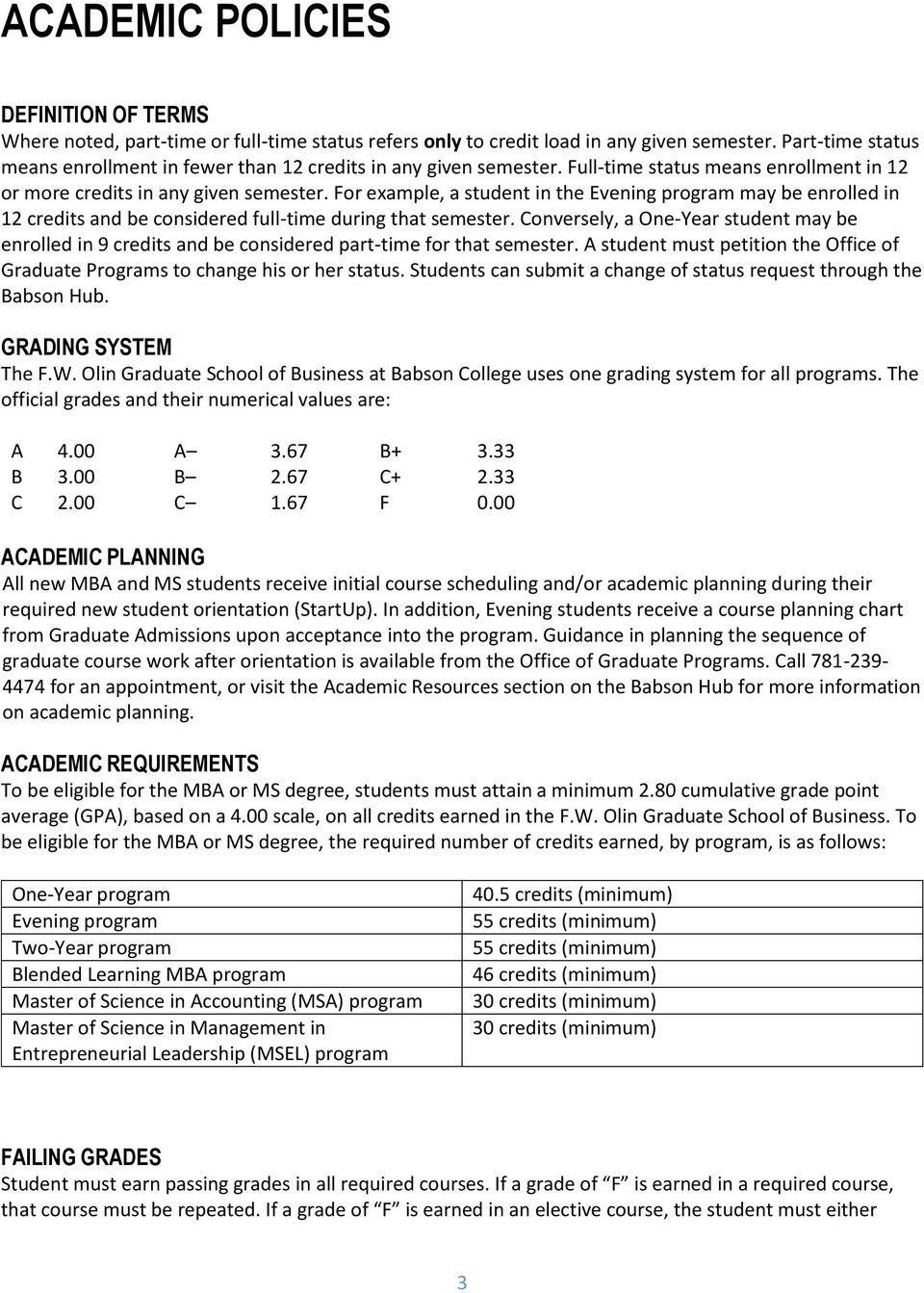
4 ACADEMIC POLICIES DEFINITION OF TERMS Where noted, part-time or full-time status refers only to credit load in any given semester. Part-time status means enrollment in fewer than 12 credits in any given semester. Full-time status means enrollment in 12 or more credits in any given semester. For example, a student in the Evening program may be enrolled in 12 credits and be considered full-time during that semester. Conversely, a One-Year student may be enrolled in 9 credits and be considered part-time for that semester. A student must petition the Office of Graduate Programs to change his or her status. Students can submit a change of status request through the Babson Hub. GRADING SYSTEM The F.W. Olin Graduate School of Business at Babson College uses one grading system for all programs. The official grades and their numerical values are: A 4.00 A 3.67 B B 3.00 B 2.67 C C 2.00 C 1.67 F 0.00 ACADEMIC PLANNING All new MBA and MS students receive initial course scheduling and/or academic planning during their required new student orientation (StartUp). In addition, Evening students receive a course planning chart from Graduate Admissions upon acceptance into the program. Guidance in planning the sequence of graduate course work after orientation is available from the Office of Graduate Programs. Call for an appointment, or visit the Academic Resources section on the Babson Hub for more information on academic planning. ACADEMIC REQUIREMENTS To be eligible for the MBA or MS degree, students must attain a minimum 2.80 cumulative grade point average (GPA), based on a 4.00 scale, on all credits earned in the F.W. Olin Graduate School of Business. To be eligible for the MBA or MS degree, the required number of credits earned, by program, is as follows: One-Year program Evening program Two-Year program Blended Learning MBA program Master of Science in Accounting (MSA) program Master of Science in Management in Entrepreneurial Leadership (MSEL) program 40.5 credits (minimum) 55 credits (minimum) 55 credits (minimum) 46 credits (minimum) 30 credits (minimum) 30 credits (minimum) FAILING GRADES Student must earn passing grades in all required courses. If a grade of F is earned in a required course, that course must be repeated. If a grade of F is earned in an elective course, the student must either 3
5 repeat the course or successfully pass another elective. In any case where a student receives an F, the original F grade and any subsequent passing grade are both factored into the student s cumulative GPA. The original F grade will show up on the student s transcript. A student who completes all course requirements with a GPA slightly below 2.80 will be permitted to take up to two additional courses to raise it. If the student fails to raise his or her GPA to 2.80, the degree will not be awarded. Students in the MSEL Program are allowed to take MBA elective courses (up to 6 credits) to raise their GPA with the approval of the Office of Graduate Programs. In all cases, students are responsible for the additional costs associated with taking these courses. Students can view grades online on the Babson Hub. GRADUATION REQUIREMENTS An application for degree is available electronically to all active students on studentportal.babson.edu in the Registrar subsection. Any student who is a degree candidate should complete this application before the beginning of the semester in which the student plans to complete degree requirements. Please note that the degree will be granted in the semester in which the student has met all academic course requirements and where the student is in good standing in all respects. Any course work completed after the semester in which a student earns his or her degree will be considered postgraduate work. If a student earns enough credits in the first or second summer session to complete the degree requirements, and would like to walk in Commencement, he or she will need to register and pay for any outstanding courses required to meet degree requirements. Only course work that can be completed in the first or second summer sessions can be considered. Students should contact the Registrar s Office at Ext to determine whether they are eligible to walk at Commencement and what the appropriate deadlines are. For a degree audit, contact the Office of Graduate Programs at Ext DISTRIBUTION OF ELECTIVES Evening students who enrolled in spring 2012 and after must complete 27 elective credits. One-Year and Two-Year students admitted fall 2011 and after must complete 27 elective credits. Blended Learning students must complete 12 elective credits. Students in the MSA program must complete 12 elective credits. Students in the MSEL program do not have Electives as part of their degree requirements. INTENSIVE ELECTIVES Intensive electives, offered to all graduate students, are 1.5 credit courses that typically meet for a two to three-day period with pre- and post- meeting work. Students in all programs must be in the electives portion of the program to be eligible for intensive electives. The intensive electives are designed with an executive-style format. Intensive electives are limited to four per student, per program, and students can earn a maximum of 6 credits toward their degrees. For specific offerings, refer to course registration materials. BABSON EXECUTIVE AND ENTERPRISE EDUCATION Babson Executive and Enterprise Education (BEEE) is one of the world s leading executive education providers, top ranked by both Financial Times and Bloomberg BusinessWeek. A dynamic learning laboratory, where clients, faculty, staff, and partners work together to address real-world business challenges and create and capitalize on opportunities for its clients, BEEE offers a broad range of programs for business leaders who work for organizations of all types and sizes. BEEE s solutions include customized and open enrollment programs, blended learning, consulting, published thought leadership, and more. For more information, please visit or call Limited space is available for MBA students in BEEE s Leadership and Influence, Coaching Inside the Organization, and BioPharma: Mastering the Business of Science open enrollment programs. (Please note that students who already have taken MOB7570 are not eligible to earn credits for the Leadership and Influence executive education program.) If interested, students should register early to reserve space in a 4
6 program. For registration information, call ; or visit REQUIRED CAPSTONE COURSE All MBA students are required to participate and achieve a passing grade in a Capstone course as a part of their degree requirements as indicated below: One-Year MBA: MBA7150 Two-Year MBA: MBA7350 Evening MBA: MBA7201 Blended Learning MBA: MBA7402 MBA students who enrolled prior to 2012 should contact the Office of Graduate Programs to discuss their Capstone course requirements. CANCELLATIONS OF CLASSES Members of the college s Crisis Response Team have developed a plan to monitor and address potential inclement weather providing for the safety and security of members of the Babson community. With over 85% of our undergraduate students living on campus, the college generally remains open during inclement weather. In rare circumstances, the College determines school closure or delay based on 1.) State of Emergency declared by the Governor and/or 2.) Severe weather conditions that make it difficult to keep the campus roads and parking lots cleared. Since safety is the College s highest priority, students are advised to exercise their own judgment regarding traveling to campus during inclement weather and to communicate directly with their professors about specific issues regarding travel. Staff and faculty are also advised to exercise their own judgment regarding traveling to work or remaining at home and some may choose to schedule class through WebEx or other available systems during inclement weather. During inclement weather, members of the Babson community can obtain updates regarding advisories and the status of College operations by accessing the Babson homepage, INFO line , the and local news and radio channels (WBZ/Channel 4/WBZ 1030 AM, WHDH/Channel 7/WRKO 680 AM, WCVB/Channel 5, WFXT/Fox 25.) INTERNATIONAL STUDENT REQUIREMENTS International students in F-1 or J-1 immigration status are required to be enrolled full time as defined by the College in order to maintain their lawful immigration status. Full-time enrollment at Babson consists of at least 12 credits per semester, except during the final semester if fewer than 12 credits are required to complete the program of study. International students in F-1/J-1 immigration status who withdraw, are suspended, or take a leave of absence (see Leave of Absence section) will lose their permission to remain in the United States in F-1/J-1 immigration status (exceptions exist for documented medical conditions with prior approval from the Glavin Office of Multicultural & International Education (Glavin Office). Any international student in F-1/J-1 immigration status who expects to separate from the College because of one of the above mentioned events or who is considering taking less than a full course load in a semester (other than the final semester of study) must speak with an international student advisor in the Glavin Office about immigration implications and possible options before any action is taken. Change of address: International students in F-1/J-1 immigration status are required to update their U.S. residential address with the U.S. Department of Homeland Security within 10 days of any change. This can be done through the 5
7 CONCENTRATIONS Concentrations are an optional way for MBA students to focus academic interests or career planning. The academic divisions developed these concentrations to provide course groupings that will help students academic and professional development. The F.W. Olin Graduate School of Business offers concentrations for its MBAs in the following areas: Business Analytics Entrepreneurship Finance Global Management Life Sciences & Healthcare (Please note that this concentration will be sunsetted by spring Students admitted to Babson after fall 2015 will not be eligible to declare Life Sciences & Healthcare as a concentration. Notably, course offerings will be limited) Marketing Students may declare a concentration once they are registered for the first semester at Babson. Students may declare up to two concentrations but can only double count up to 3 credits across the two concentrations. Concentrations are not degree requirements, and students will not be able to delay their graduation based upon not fulfilling concentration requirements. Concentrations are not printed on diplomas. Additional details of the MBA concentrations can be found at INTERNATIONAL REQUIREMENT The International Requirement is an integral part of the Two-Year and One-Year MBA programs. Two-Year and One-Year (beginning with the class of 2016) MBA students are required to develop a global business perspective through firsthand international experience. Two-Year and One-Year students must fulfill the Foundation MBA International Requirement before graduation by participating in one of the following learning activities: Babson s project-based experiential learning courses or internships providing crosscultural workplace immersion, the Babson Electives Abroad, the Semester Abroad Program, or by completing an international independent research project that has been approved by the Office of Graduate Programs. Two-Year and One-Year students with substantial international experience may be able to waive the International Requirement at the foundation level; such exemptions are determined on a case-by-case basis by the Office of Graduate Programs. OFF CAMPUS EXPERIENTIAL SERVICE LEARNING ACTIVITY An off campus experiential service learning activity is an integral part of the MSEL program. MSEL students must fulfill this requirement through teaching entrepreneurship in a developing economy context. Students unable to fulfill this requirement are not eligible to receive their degree. In rare circumstances, exemptions are considered on a case-by-case basis by the MSEL Faculty Director and may require students to extend their program graduation date in order to meet requirements approved by the Faculty Director as acceptable. 6
8 DEGREE TIME LIMIT Students entering the MBA and MSA programs must complete the requirements for the degree within eight years of their entry date. Students in the MSEL Program must complete the requirements for the degree within four years of their entry date. Students eligible to take a leave of absence should keep in mind the program-specific time limit (eight years for MBA and MSA programs, four years for MSEL program) is still in effect. An exception to the degree time limit requirement may be made at the sole discretion of the Office of Graduate Programs in unusual circumstances where good and compelling cause is demonstrated. SATISFACTORY ACADEMIC PROGRESS After each semester and module, the Academic Standards Committee (ASC) reviews the standing of all students whose cumulative GPA is below 2.80, or who receive a failing grade or an incomplete grade in a course. The ASC may in its discretion dismiss or issue a warning to any student in these cases. Students have the right to appeal the dismissal decision of the ASC, and will be given notice before the decision of dismissal is made. The ASC also may mandate that the student take more course work during the elective portion of the program to prove proficiency in the areas where the faculty has determined the student has not mastered the core skills. The committee will determine the criteria and conditions for continued study in all instances and communicate these in writing to the student. Dismissal Policy: The decision to dismiss a student can occur at any time in the course of his or her studies if it is the consensus of the ASC in its discretion that continued study is not advisable. Students have the right to appeal the dismissal decision of the ASC to the Graduate School dean, whose decision is final. Contact the appropriate program manager in the Office of Graduate Programs for details. Members of the ASC for the academic year are the associate and assistant deans of the F.W. Olin Graduate School of Business, the director of the Office of Graduate Programs, and the program advisor(s) of the MBA or MS program. As appropriate, the faculty director of the Blended Learning MBA, MSEL or MSA program also will join the committee. ADVANCED STANDING CREDIT AND WAIVER EXAM POLICIES Policy for Evening Program The following information on advanced standing credit and waiver exams applies only to the Evening program. The maximum amount of advanced standing credit that Evening MBA students may receive is 15 credits. Evening MBA students may earn advanced standing credit for core courses when they have earned a B or better at a nationally or regionally accredited college or university in the United States or in a comparable international program, as part of a degree earned within five years of entering the Evening MBA program, in courses substantially similar in content and credit hours to the following Babson MBA core courses: ACC7200, ECN7200, MKT7200, QTM7200, OPS7200, ACC7201, ECN7201, LAW7200, and FIN7200. Equivalent undergraduate or graduate course work is required to receive advanced standing credit for these core courses. In some cases, it is necessary to complete multiple courses in a functional area to receive advanced standing credit. Evening MBA students who have passed the CPA, CFA, or CMA exam will be granted advanced standing credit for specific core courses. A copy of the exam results must be submitted to Graduate Admissions. 7

9 Advanced standing credit for Evening MBA elective courses is determined by equivalent graduate course work and based upon approval from Graduate Admissions. Undergraduate-level courses cannot provide advanced standing credit for elective courses. To receive advanced standing credit for elective courses, the student must have earned a grade of B or better from a nationally or regionally accredited college or university in the United States or in a comparable international program within five years of entering the MBA program. Evening MBA students must resolve all questions about advanced standing credit with Graduate Admissions during their first semester at Babson. Should a student s request for advanced standing credit be denied or requested after his or her first semester, the student will be required to successfully complete the course at Babson. Students cannot take courses for which they have received advanced standing credit without first obtaining approval from the Office of Graduate Programs. In those rare cases in which approval is given, the advanced standing credit will be rescinded, whereby the previously granted credit hours are removed from the student s transcript. Waiver examinations: Students may receive credit for certain courses by passing a waiver examination. All waiver examinations must be completed by the end of final exams in a student s first semester of the program. Waiver examinations are not available for elective courses. For more detailed information on the waiver examination process, please visit Policy for Blended Learning Program The following information on advanced standing credit applies only to the Blended Learning program. Blended Learning Advanced Standing Credit: Advanced standing credit for Blended Learning elective courses is rare and determined by equivalent graduate course work and based upon approval from Graduate Admissions, and the faculty director of Blended Learning. To receive advanced standing credit, the student must have earned a grade of B or better from a nationally or regionally accredited college or university in the United States or in a comparable international program within five years of entering the MBA program. Policy for Masters of Science in Accounting (MSA) Program The following information on advanced standing credit applies only to the MSA program. The maximum amount of advanced standing credit that MSA students may be granted is 6 credits. Advanced standing credit for MSA elective courses is determined by equivalent graduate course work and based upon approval from Graduate Admissions and the faculty director of the MSA. To receive advanced standing credit, the student must have earned a grade of B or better from a nationally or regionally accredited college or university in the United States or in a comparable international program within five years of entering the MSA program. MSA students must resolve all questions about advanced standing credit with Graduate Admissions during their first semester at Babson. Should a student s request for advanced standing credit be denied or requested after his or her first semester, the student will be required to successfully complete the course at Babson. Students cannot take courses for which they have received advanced standing credit without first obtaining approval from the Office of Graduate Programs. In those rare cases in which approval is given, the advanced standing credit will be rescinded, whereby the previously granted credit hours are removed from the student s transcript. POST-MATRICULATION TRANSFER CREDIT Graduate students are expected to complete all degree requirements in residence at Babson. Transfer credit for courses taken elsewhere after matriculation will be granted only in cases in which a student 8
10 relocates (making the commuting distance to Babson impossible), or in certain other rare situations deemed appropriate by the Office of Graduate Programs at its discretion. The maximum post-matriculation transfer credit that may be granted to students in the One-Year MBA program is 12 elective credits, provided the student has completed the core. The maximum post-matriculation transfer credit that may be granted to Two-Year MBA students is 12 elective credits, provided the student has completed the core. The maximum post-matriculation transfer credit that may be granted to Evening MBA students is 12 credits, provided the student has met the minimum residency requirement of completing half of the total degree requirements of the Evening MBA program at Babson. The maximum post-matriculation transfer credit that may be granted to students in the Blended Learning MBA program is 6 elective credits (or by exception as endorsed by the College through academically accredited partnerships), provided the student has completed all of the core courses with the exception of the capstone. The 6-credit maximum includes advanced standing credit and post-matriculation transfer credit. The maximum post-matriculation transfer credit that may be granted to MSA students is 6 credits, provided the student has met the minimum residency requirement (MSA Core) of the MSA program. The combination of advanced standing credit and post-matriculation transfer credit may not exceed 6 credits. Students in the MSEL Program are not allowed to transfer in credit post-matriculation unless approved in advance by the MSEL Faculty Director for courses required to demonstrate academic competency. All requests for approval to undertake coursework for post-matriculation transfer credit must be submitted to the Office of Graduate Programs and approved in writing before registering at another institution. Note, the acceptance of credits or degrees earned at Babson for transfer credit to another institution is at the discretion of the transfer institution. Post-matriculation transfer credit for elective courses may be granted only for those offered in a degreegranting program comparable to AACSB-accredited or EQUIS-accredited schools, where the courses are substantially dissimilar in content to Babson elective courses, when a grade of B or better has been earned, and the Office of Graduate Programs has received the official transcript. The Office of Graduate Programs will coordinate with the appropriate division to determine approval of post-matriculation transfer credit requests. Exceptions to this policy may be made in rare circumstances by appeal to the associate dean. For Evening MBA, MSEL and MSA students, post-matriculation transfer credit for core courses may be granted only for courses taken at AACSB-accredited or EQUIS-accredited schools, where the courses are substantially similar in content to Babson core courses, when a grade of B or better has been earned, and the Office of Graduate Programs has received the official transcript. The Office of Graduate Programs will coordinate with the appropriate division to determine approval of post-matriculation transfer credit requests. Exceptions to this policy may be made in rare circumstances by appeal to the Associate Dean. SECOND DEGREE POLICY Students who have completed the MSA or Certificate of Advanced Accounting will be granted elective 9
11 credit for up to half of the MBA degree requirements. No credit will be given for core requirements. Applying MSA Credits toward a Future Degree Graduate credits completed with a grade of B or better in the Babson MSA degree may be applied as elective credit toward a future Babson graduate degree as long as the credits have been earned within seven years of starting the new degree program, MSA credits may be applied to no more than 50% of a future Babson graduate degree program s credits. Neither enrollment in nor completion of the MSA program guarantees admission into a future Babson graduate degree program. SEMESTER WORKLOADS Part-time students take 1 to 11.5 credits per semester. The average is 6 credits. Full-time students in the One-Year and Two-Year MBA program take 12 to 13.5 credits per semester during their elective period. Full-time students who want to take more than 18 credits must obtain written permission from the appropriate program advisor in the Office of Graduate Programs before registering for the additional course(s). INDEPENDENT RESEARCH Independent research provides an opportunity to conduct in-depth investigations in areas of specific interest selected by the student. Independent research is an individual effort and may be undertaken for academic credit with the prior approval of the student s faculty advisor, the appropriate division chair, and the Office of Graduate Programs. Please note that the student is responsible for recruiting his or her faculty advisor and obtaining the advisor s consent and commitment before applying for an independent research project. Authorization for such a project requires writing and submitting a formal proposal in accordance with standards set forth by the F.W. Olin Graduate School of Business. Students work closely with a faculty advisor throughout the project. Each independent research project can provide only 1.5 or 3 course credits. If a student wishes to complete more than 3 credits of independent research, he or she may contract for more than one project. To pursue independent research, Evening MBA students must have completed half of their degree requirements; Blended Learning students must have completed Core 7; Two-Year MBA students must have completed Module 4; and One-Year students must have completed Module 3. All students must have a cumulative GPA of at least 3.00 to qualify, and can receive a maximum of 6 credits toward the degree for independent research project(s). Any student interested in registering for independent research should visit CLASS ATTENDANCE The Graduate Program does not require class attendance with the exception of students in the core of the Blended Learning Program. Although attendance in class is not mandatory, faculty members may and often do include class participation as a significant component in calculating a student s course grade. It is the student s responsibility to notify the faculty members before being absent unless the student is unable to do so. Please see the Examinations and Grades section for policies related to attendance for final exams. With regard to absence due to religious observance, Babson College welcomes and values people and their perspectives and respects the interests of all members of the community. Babson recognizes the breadth of religious observance among students, faculty, and staff and the potential for conflict with scheduled components of the academic experience. Students are expected to review their syllabi and notify faculty within two weeks of the start of the course of potential conflicts between course requirements and religious observances. In such an event, the instructor will provide reasonable accommodations that do not unduly disadvantage the student. Blended Learning MBA Program: Attendance at Face-to-Face sessions in the core is required. Students in 10
12 the Blended Learning MBA Program may seek permission to miss a Face-to-Face session in cases with extenuating circumstances by contacting their Program Advisor in the Office of Graduate Programs. Massachusetts General Laws Chapter 151C, Section 2B: Any student in an educational or vocational training institution, other than a religious or denominational educational or vocational training institution, who is unable, because of his religious beliefs, to attend classes or to participate in any examination, study, or work requirement on a particular day shall be excused from any such examination or study or work requirement, and shall be provided with an opportunity to make up such examination, study, or work requirement that he may have missed because of such absence on any particular day; provided, however, that such makeup examination or work shall not create an unreasonable burden upon such school. No fees of any kind shall be charged by the institution for making available to the said student such opportunity. No adverse or prejudicial effects shall result to any student because of his availing himself of the provisions of this section. EXAMINATIONS The Registrar s Office will publish the final exam schedule for day courses and will make it available at Evening course final exams are given during the 14th class meeting, unless the instructor announces alternative plans. Instructors will schedule the final exams for day and evening courses held during the first half of the semester. Permission to miss a final exam must be obtained before the exam, from the Office of Graduate Programs, Ext. 4474, in cases with extenuating circumstances. Such extenuating circumstances include, but are not limited to, serious illness supported by doctor s certification, death in the immediate family, or observance of a religious holiday. The following are not considered extenuating circumstances: oversleeping, travel (business travel confirmed in writing in advance is acceptable for part-time students), disabled vehicles, or misunderstanding the schedule. A student who has either a time conflict or more than six hours of exams scheduled for one day may arrange for a revision of his or her schedule by contacting the Registrar s Office at Ext The Final Exam Conflict form is available in the Final Exams section at and needs to be turned into the Registrar s Office no later than a week before the final exam period begins. SERVICES FOR STUDENTS WITH DISABILITIES Mary Powell, Director of Learning Center/Disability Services The Office of Disability Services works to ensure that individuals with learning, hearing, vision, mobility, medical, and psychiatric disabilities have access to all of the programs and activities that Babson College offers. In compliance with Section 504 of the Rehabilitation Act of 1973 and the Americans with Disabilities Act (ADA Amendments Act 2008), disability services provides reasonable accommodations to qualified students. The director of disability services is located in the Learning Center, Hollister Hall, Suite 122, and can be reached at For more information, please visit POLICIES AND PROCEDURES FOR REQUESTING ACCOMMODATIONS FROM DISABILITY SERVICES The need for accommodation is reviewed on an individual basis for students with documented disabilities. If seeking accommodations, students should complete the following steps: 1. Submit documentation of the disability to: Mary Powell, Director Learning Center and Office of Disability Services Hollister Hall, Suite 122 Babson College 11
13 231 Forest Street Babson Park, MA Fax: Students are responsible for identifying themselves to this office as a person seeking accommodations and providing appropriate clinical documentation that support their requests in a timely manner. The eligibility determination process is not a same-day process. Once documentation is received, it will be reviewed in order of receipt; therefore, it is recommended that documentation be submitted well in advance of any accommodation-related need(s) (e.g., exam accommodations and alternative media services). To learn about the documentation necessary to receive accommodations and services please visit the student HUB at: 2. Complete the electronic registration form located on the student HUB at: 3. Schedule an appointment to meet with the director of Learning Center by calling Academic Accommodations: Once a student is registered with the Office of Disability Services, a Faculty Accommodation Letter (FAL) is ed to the student. To inform faculty of accommodations the student will provide a copy of the FAL at the beginning of each new session or class. The student may his/her faculty the FAL or he/she may print out the FAL and hand deliver it to his/her faculty. It is the responsibility of the student to work with his/her faculty and program administrator to set up exam or classroom accommodations. Failure to follow the policies and procedures may mean that the accommodation cannot be implemented as planned. 5. Housing Accommodations: Students should look for s from Housing Operations about deadlines for requesting medical housing accommodations and complete and submit an electronic Medical Housing Request form located at The Director of the Learning Center/Disability Services will respond to your request. For other questions regarding housing please contact Housing Operations at [email protected]. Babson College prohibits the use of recording devices to record class lectures or discussions unless a student has received the prior written approval of the professor, lecturer, guest lecturer, or speaker or has received prior written approval from the Office of Disability Services. The recording may not be accessed or used by any other individual. The recording may not be reproduced, transcribed, distributed, publicly played, or transmitted without the prior written approval of the professor, lecturer, guest lecturer, or speaker. In accordance with the above policy, all students should be aware that any class, including class discussions, may be subject to recording. More information about College policies, procedures, and available services can be found online at SEMESTER AND MODULE GRADES Course grades are available online on the Hub, under the Academic Services section, generally within two weeks of the examination period. INCOMPLETE GRADES A status of Incomplete ( I ) may be given to a student only when there is documented evidence of a valid reason for failure to complete the work required in a course (e.g., sickness, death in family). Students who 12
14 receive an I must consult with the instructor to determine the work required to remove the I. Faculty may administer makeup examinations for this purpose. The instructor will submit the new grade to the Registrar s Office after the student has fulfilled all course requirements. An I must be cleared (by taking a makeup exam or submitting missing work) before the last class of the next semester in which the student is registered. If the student is not registered in the semester after the I is recorded, the student will have either 12 calendar months or until the end of the next semester for which he or she is registered, whichever occurs first, to resolve the I. Incomplete courses that fulfill prerequisites for the following semester must be completed 72 hours before the end of the add/drop period. This earlier deadline is to provide faculty time to grade the outstanding work or exam and submit the final grades to the Registrar s Office before the end of add/drop. Students who do not make up incomplete work within the specified time periods will receive the instructor s final grade based on normal course requirements, with a numerical value of 0 calculated into the final grade for all items that remain incomplete at the end of the time period. GRADE DISPUTES Any requests for a review of a grade in any course, regardless if a final exam was given or not, must be presented to the faculty member by the last day of classes of the fall or spring semester immediately following the semester in which the grade was earned. This policy applies to all students regardless of the student s status in that following semester. Please note a different policy applies to incomplete grades. The following procedure should be followed in a grade dispute: The student should first contact the faculty members involved to discuss the matter. The purpose of the meeting is to check the accuracy of the grading process (confirming how the final grade was determined and the percentage of each deliverable in the final grade; and catching errors, if any, in the faculties grade sheet) and for the student to learn about his or her inadequacies or strong points. This procedure does not require the professor and student to agree on the final result. The obligation simply is to help the student understand the faculty s process in determining the grade. If the issue is not resolved, the student should then contact the respective division chair and file a written appeal explaining the student s position. The division chair will consider the appeal and issue a decision with reasonable promptness. If the issue remains unresolved, the student should then appeal to the associate dean, whose decision is final and not subject to appeal. ASSESSMENT OF LEARNING GOALS The F.W. Olin Graduate School of Business has established learning goals for each program. Babson College Mission Statement: Babson College educates entrepreneurial leaders who create great economic and social value everywhere. Consistent with the College mission, Babson MBA graduates are competent in the following: MBA Learning Goals Entrepreneurial Thinking and Acting: Babson MBA graduates create, identify, assess, shape, and act on opportunities in a variety of contexts and organizations. Social, Environmental, and Economic Responsibility: Babson MBA graduates make decisions based on an awareness of relevant stakeholders, ethical considerations, and an attempt to create and sustain social, 13
15 environmental, and economic value. Self- and Contextual Awareness: Babson MBA graduates understand their sense of purpose, identity, and context, and use this understanding to inform their decisions. Functional Depth with Integrative Ability: Babson MBA graduates draw upon deep functional knowledge and multiple functional skills and perspectives concurrently to shape comprehensive responses to business challenges and opportunities. Managing in a Global Environment: Babson MBA graduates recognize and evaluate global opportunities while incorporating cultural context and complexities associated with managing in a global environment. Leadership and Teamwork: Babson MBA graduates exercise appropriate leadership, value diverse perspectives and skills, and work collaboratively to accomplish organizational goals in a changing environment. MSA Learning Goals Entrepreneurial Thinking and Acting: Babson MSA graduates create, identify, assess, shape, and act on opportunities in a variety of contexts and organizations. Global Perspective: Babson MSA graduates recognize and evaluate global opportunities while incorporating cultural context and complexities associated with managing in a global environment. Ethics and Professional Responsibility: Babson MSA graduates are prepared to recognize and respond to ethical questions encountered in the practice of accounting. They can identify and apply legal and professional ethical standards applicable to the accounting profession, identify ethical concerns in situations commonly faced by accountants, identify alternative decisions in analyzing an ethical dilemma, identify the impacts of business actions on external shareholders, and demonstrate the ability and inclination to make decisions based on stated personal and professional values. Technical Skills in Accounting: Babson MSA graduates are technically competent in accounting. They identify, comprehend, and apply appropriate professional accounting rules and standards. They understand current issues and emerging trends in accounting. Communication Skills: Babson MSA graduates are proficient business communicators. They communicate logically, clearly, and persuasively in spoken, written, and visual form. They understand the importance of good communication in the world of business and can apply accepted norms and forms in business writing. MSEL Learning Goals Entrepreneurial Thinking and Acting: Babson MSEL graduates create, identify, assess, shape, and act on opportunities in a variety of contexts and organizations. Social, Environmental, and Economic Responsibility: Babson MSEL graduates make decisions based on an awareness of relevant stakeholders, ethical considerations, and an attempt to create and sustain social, environmental, and economic value. Self- and Contextual Awareness: Babson MSEL graduates understand their sense of purpose, identity, and context, and use this understanding to inform their decisions. Managing in a Global Environment: Babson MSEL graduates incorporate cultural context and complexities 14

16 when managing in a global environment. Leadership and Teamwork: Babson MSEL graduates exercise appropriate leadership, value diverse perspectives and skills, and work collaboratively to accomplish organizational goals in a changing environment. Innovative Problem Solving: Babson MSEL graduates develop creative solutions to challenging problems, and generate economic and socially valuable outcomes. Babson assesses these desired student learning goals as part of its commitment to continual program improvement. The assessment of these learning goals will take place periodically within identified courses in each program. The data collected will be completely anonymous and will have no impact on student grades. Aggregated results will be used for program planning and accreditation purposes within the F.W. Olin Graduate School of Business and Babson College, and may be included in institutional research analyses and reports. Further information about the learning goals and assessment may be obtained from the assistant dean of the graduate school or the director of Institutional Assessment. AUDIT POLICY The graduate program does not permit auditing of graduate-level courses. TRANSCRIPT REQUESTS Transcripts may be requested by clicking on the Registrar s link on the Babson Hub; in person by completing a Transcript Request form; by fax to ; or by writing to the Registrar s Office, Hollister Hall, Babson College, Babson Park, MA Students must date and sign requests not made via Portal. Requests will not be accepted by phone or . There is no fee for this service; generally, requests are processed within five business days. Copies of official undergraduate transcripts sent to Babson as a part of the student s graduate admission process cannot be released to the student without written permission from the registrar s office of the undergraduate institution. LEAVE OF ABSENCE Students are eligible to take a leave of absence for a period of up to two consecutive years. Requests for Leave of Absence for students in the MSEL program are considered in rare circumstances on a case-bycase basis by the MSEL Faculty Director and, if approved, will require students to extend their program graduation date in order to meet degree requirements. Requests for Leave of absence in the MSA program are considered in rare circumstances on a case-by-case basis by the MSA Faculty Director and will require students to extend their program graduation date in order to meet degree requirements. The application for a leave must be submitted to the Office of Graduate Programs, at least eight weeks before the start of the semester in which the leave would begin, except in the event of an emergency that would preclude the giving of such advance notice. All leaves will carry a specific expiration date. Students who return on or before the expiration date will be subject to all academic and graduate policies accorded a Babson graduate student as of the date of his or her initial enrollment. Students who wish to return early must inform the Registrar s Office in writing at least four weeks before the desired date of return. Any student on leave who does not return on the specified date or is not registered for courses and is not on an approved leave of absence will be removed from all mailing lists. To be reactivated, the student must notify the Office of Graduate Programs in writing at least four weeks before the desired date of return. Any student who has not enrolled in courses for more than two consecutive years will be withdrawn from the F.W. Olin Graduate School of Business and must petition the Office of Graduate Programs in writing for readmission. When a student wishes to return from leave, the Office of Graduate Programs will review the student s record and notify the student of any changes to course requirements. For example, if a leave of absence is substantially longer than two years, the Office of Graduate Programs may rescind advanced- 15

17 standing credit previously granted and/or any credit earned at Babson toward the MBA or MSA degree. Students may be subject to any new policies instituted during their leave. Two-Year students must complete the first year to be eligible for a leave of absence. One-Year students must complete the summer core to be eligible for a leave of absence. MSA, MSEL and Blended Learning MBA students should contact their program advisors for appropriate guidelines for obtaining permission to take a leave of absence. International Students International students in F-1/J-1 immigration status who withdraw, are suspended, or take a leave of absence will lose their permission to remain in the United States in F-1/J-1 immigration status (exceptions exist for documented medical conditions pre-approved by the Glavin Office). Any international student in F-1/J-1 immigration status who expects to separate from the College because of one of the above mentioned events or who is considering taking less than a full course load must speak with an international student advisor in the Glavin Office about immigration implications and possible options before any action is taken. VOLUNTARY, COLLEGE-INITIATED, AND EMERGENCY INTERIM MEDICAL WITHDRAWALS 1. PURPOSE AND INTENT: Babson College ( the College ) endeavors to provide a safe and healthy living and learning environment in which all qualified students can participate in the College s programs and activities and successfully pursue their academic, personal, social, and emotional development. The College recognizes that students may experience medical issues which limit their ability to function safely or successfully as students. The College offers a variety of medical, academic, and administrative resources to assist and support students in such situations, and makes reasonable accommodations to allow students with documented disabilities to have equal access to College programs and activities. When a student s personal well-being may be at risk or when a student experiences a medical issue that may prevent the student from participating in the College s programs and activities regardless of accommodation, the student is encouraged to consider a voluntary medical withdrawal from the College. Although students remain eligible to take other types of leave in accordance with applicable College policies and procedures, a voluntary medical withdrawal may carry certain advantages, including more flexible withdrawal timelines, less disruption to scholarships and funding, and tuition/housing refunds as determined by appropriate College officials. When the College becomes aware of a student who is unable to safely participate in the College s programs and activities regardless of accommodation or who presents a high probability of substantial harm to health or safety, the College may also consider the appropriateness of involuntary medical withdrawal from the College and/or emergency interim medical withdrawal according to the standards and procedures described in this Policy. Student conduct that violates the College s Community Standards remains subject to the Student Conduct Process regardless of whether such conduct violation results from or is exacerbated by a medical condition. Actions taken pursuant to this Policy do not affect the student s obligation to comply with other College policies or, where applicable, sanctions to which the student may be subject as a result of any violation of such policies. 16
18 This Policy is designed to ensure that students are given individualized attention, support, care, and consideration in addressing medical issues that may arise or escalate during matriculation. The College will apply this Policy to all students in a nondiscriminatory manner using a flexible and individualized process to facilitate student success. Decision makers acting under the Policy will make determinations on the basis of objective evidence of student behavior and reasonable judgments based on professional assessments and current medical knowledge not on the knowledge or belief that a student may be an individual with a disability. Whenever a College official is referenced in this Policy, such reference shall include another official designated to carry out such official s duties in their absence or the person who otherwise assumes such duties. 2. VOLUNTARY MEDICAL WITHDRAWAL ( VMW ) When a student s personal well-being may be at risk, or when a student experiences a medical issue that may prevent them from participating in the College s programs and activities regardless of accommodation, the student is encouraged to consider a VMW. The VMW process is designed to be reasonable and flexible, and to proceed as quickly as possible to allow a student experiencing difficulties due to a medical condition to receive the care, support, and treatment that they need. Students wishing to initiate a VMW should contact the Director of Health Services and/or the Director of Counseling Services (each, an Appropriate Health Service ). The Appropriate Health Service will meet with the student, if feasible, and review any medical documentation provided. The Appropriate Health Service will then submit a recommendation for a VMW if it determines that the student has a medical issue that prevents the student from participating in the College s programs and activities regardless of accommodation, or otherwise compromises the student s safety, wellbeing, or academic success. As appropriate, the Appropriate Health Service will make individualized treatment recommendations designed to help the student become academically and personally ready to resume life at the College with or without reasonable accommodation. The recommendation for a VMW and any relevant supporting documentation will be submitted to the Associate Dean of Students for Wellness or designee ( Associate Dean ) for review. The Associate Dean may consult with the Appropriate Health Service and others as appropriate in evaluating the recommendation and any relevant supporting documentation. Based on an individualized review of the facts and circumstances, the Associate Dean will make a final determination as to whether and for what length the VMW will be granted, and will so notify the student in writing. The student will also be notified of specific conditions, if any, that may be required in order to return to the College, based on the nature and individual circumstances of the VMW. A student may appeal the denial of a request for VMW in accordance with the Appeal Process set forth below. 17
19 3. COLLEGE-INITIATED MEDICAL WITHDRAWAL ( CIMW ) The College may initiate a medical withdrawal when it becomes aware of a student who is unable to safely participate in the College s programs and activities or who presents a high probability of substantial harm to health or safety. The College may initiate a CIMW only under the limited circumstances and only in accordance with the procedures set forth in this Policy. CIMW may only be initiated: (i) after reasonable efforts to obtain student cooperation for a VMW have been attempted, if feasible; (ii) after other available interim measures have been deemed inappropriate, insufficient, or unsuccessful; and (iii) as a nondisciplinary action. In evaluating whether the College will initiate a medical withdrawal, the Associate Dean will convene a medical withdrawal committee ( Committee ). The Committee will be comprised of the Associate Dean and one or more representatives from the Appropriate Health Service, along with other College officials with relevant knowledge and expertise who may have direct insight into the conduct or behavior of concern, such as representatives from the Office of Disability Services or Student Affairs. The Committee will conduct an individualized assessment of the student s present ability to safely participate in its programs and activities based on objective evidence and documentation. The individualized assessment will evaluate whether there is a high probability of substantial harm in light of: (i) the nature, duration, and severity of the risk; (ii) the probability that injury will occur; and (iii) whether reasonable accommodations can sufficiently mitigate the risk. The Committee will exercise reasonable judgments that rely on current medical information and documentation. If the Committee determines that the student is unable to safely participate in the College s programs and activities or presents a high probability of substantial harm to health or safety, it will submit a recommendation for a College-Initiated Medical Withdrawal ( CIMW ). The recommendation and any relevant supporting documentation will be submitted to the Vice President for Student Affairs or designee ( Vice President ) for review. As appropriate, the Appropriate Health Service will make individualized treatment recommendations designed to help the student become academically and personally ready to resume life at the College with or without reasonable accommodation. Upon receipt of a recommendation for a CIMW, the Vice President will carefully review the recommendation and any relevant supporting documentation. The Vice President may consult with the Appropriate Health Service and others as appropriate in evaluating the recommendation and any relevant supporting documentation. If, based on an individualized review of the facts and circumstances, the Vice President conditionally determines that a CIMW should be granted, the Vice President will so notify the student in writing. The student will be afforded three business days to submit a written statement and any other documentation or materials relevant to the conditional CIMW and the student s desired outcome before a final determination is made by the Vice President. If warranted under the circumstances, the Vice President may restrict the student from attending classes, living in college housing, or otherwise accessing campus property or participating in College activities during the conditional CIMW. 18

20 Based on an individualized review of the facts and circumstances, the Vice President will make a final determination as to whether and for what length the CIMW will be implemented, and will so notify the student in writing. The student will also be notified of specific conditions, if any, that may be required in order to return to the College, based on the nature and individual circumstances of the CIMW. A student placed on CIMW may appeal in accordance with the Appeal process set forth below. 4. EMERGENCY INTERIM MEDICAL WITHDRAWAL ( EIMW ) The College may initiate an emergency interim medical withdrawal ( EIMW ) when it reasonably determines that a student presents an imminent risk of substantial harm to health or safety. The College may initiate an EIMW only under the limited circumstances and only in accordance with the procedures set forth in this Policy. An EIMW may only be initiated: (i) after reasonable efforts to obtain student cooperation for a VMW have been attempted, if feasible; (ii) after other available interim measures have been deemed inappropriate, insufficient, or unsuccessful; and (iii) as a nondisciplinary action. The Vice President may implement an EIMW after conducting an individualized assessment based on objective evidence and documentation. The individualized assessment will evaluate whether there is an imminent risk of substantial harm in light of: (i) the nature, duration, and severity of the risk; (ii) the probability that injury will occur; and (iii) whether reasonable accommodations can sufficiently mitigate the risk. The Vice President will consult with the Appropriate Health Service and others as appropriate, and will exercise reasonable judgments that rely on current medical information. Circumstances permitting, the Vice President will convene a Committee to assist in the individualized assessment. The duration of an EIMW will be limited to the period necessary to address the imminent risk of substantial harm to health or safety. While under EIMW, the student is prohibited from attending classes or living in College housing, and may be trespassed from campus or other College facilities and/or prohibited from participating in College activities if warranted under the circumstances. A student placed on EIMW will be notified in writing by the Vice President as soon as possible. The student will also be notified of the specific conditions that are required in order to return to the College, based on the nature and individual circumstances of the EIMW. A student placed on EIMW may appeal in accordance with the Appeal process set forth below. The EIMW process is intended to address emergency situations on an interim basis. Where appropriate and in accordance with the terms and conditions of this Policy, an EIMW may be converted to a VMW or a CIMW. 5. RETURN FROM VOLUNTARY, COLLEGE-INITIATED, OR EMERGENCY INTERIM MEDICAL WITHDRAWAL All conditions for returning to the College will be the same for VMW and CIMW. The conditions for returning to the College from an EIMW will be equivalent, except that relevant timelines will be adjusted to account for the interim nature of the withdrawal. 19
21 The goal of a medical withdrawal is to ensure that students return with an increased opportunity for academic and personal success. Students are encouraged to take the time necessary to achieve this goal. Students may wish to periodically check in with the Associate Dean during their leave, as indefinite leaves will not be permitted. A student seeking to return to the College from a medical withdrawal should take the following steps to initiate the reenrollment process: A. Contact the Appropriate Health Service and provide all required documentation. With the exception of students placed on EIMW, it is requested that students submit all material by December 1 for consideration for the Spring Semester, April 1 for summer sessions, and July 1 for Fall Semester. This will help to ensure that the Associate Dean and the Appropriate Health Service have sufficient time to review the request and facilitate reenrollment as appropriate. If materials are received after the relevant deadline, the College will make reasonable efforts to review the request in a timely manner. B. Have the student s treatment provider(s) send a report to the Appropriate Health Service documenting the provider s work with the student, the student s clinical status, and an opinion as to the student s readiness to safely and successfully resume academics and college life. The student s treatment provider may also include any conditions or recommendations for ongoing treatment, or other suggestions to support the student s academic and personal well-being upon return to the College. The Appropriate Health Service relies heavily on information received from the student s treatment provider. Students will be asked to provide Release of Information Forms so that representatives of the Appropriate Health Service may communicate with treatment providers and others as appropriate regarding the student s return. C. As required by the Associate Dean depending upon the nature and individual circumstances of the medical withdrawal, provide information to the Appropriate Health Service showing that the student has reasonable capability of day-to-day functioning while a student at the College, with or without accommodation. There are several ways a student might be able to sufficiently demonstrate their day-to-day functioning, and the Associate Dean will discuss appropriate options with the student upon request. D. As required by the Associate Dean depending upon the nature and individual circumstances of the medical withdrawal, provide a brief written statement describing: (i) the student s experience away from the College including the activities undertaken while away; (ii) the student s current understanding of the factors that led to the medical withdrawal and any insights the student has gained from treatment and time away; and (iii) how the student plans to ensure a successful return to the College and to sustain their academic and personal well-being. Reasonable effort will be made to respond to a student s request to return from a medical withdrawal within ten business days of receipt of all required materials. Additional time may be required based on extenuating circumstances. If the information received from a treatment provider requires further explanation or clarification, or when there is a disconnect between the medical information provided and other information in the student s file, the Appropriate Health Service may contact the treatment provider to obtain additional information. In exceptional cases as required by the Associate Dean depending upon the 20
22 nature and individual circumstances of the medical withdrawal, the student may be asked to obtain a second, independent evaluation from a licensed medical professional approved by the Appropriate Health Service. The purpose of the independent evaluation is to document the student s clinical status and provide an opinion as to the student s readiness to safely and successfully resume academics and college life. Upon receipt of all required materials, the Associate Dean and the Appropriate Health Service, in consultation with others as appropriate, will determine if the student appears ready to resume academics and college life. If approved to return, the student will be required to check-in with the Appropriate Health Service to review the student s current safety and plan for sustained health, including recommendations for ongoing treatment and/or other support services as appropriate. Students with disabilities are eligible for reasonable accommodations. Students are responsible for communicating any requests for accommodation to the Office of Disability Services. Detailed information on the process for requesting accommodations is available at the Office for Disability Services website: The student will be approved to return to the College when the documentation demonstrates that the student is ready to safely resume studies and be a successful member of the campus community. If approved, the student will be notified in writing and informed of any applicable academic, housing, administrative, or other requirements for return. If the student is not approved for return from a medical withdrawal, the student will be notified in writing along with recommendations that will enhance the likelihood that a future request to return will be granted. The student may appeal the denial of their request to return from a medical withdrawal in accordance with the Appeal process set forth below. 6. APPEALS PROCESS A student has a right to file a written appeal ( Appeal ) to the Vice President requesting review/reconsideration of: (i) the denial of a request for VMW; (ii) the denial of a request for return from a medical withdrawal; (iii) the implementation of a CIMW; or (iv) the implementation of an EIMW. The Appeal must be submitted to the Vice President within five business days of the date of the notice to the student. The bases for the Appeal are limited to the following: (i) material information or evidence not considered in the original determination; (ii) new information or evidence that was not available at the time of the original determination; and/or (iii) a material deviation from procedures that was prejudicial to the student and that affected the outcome of the original determination. Appeals made on other grounds will not be considered. As appropriate, the student should include relevant supporting documentation with the Appeal. The Vice President will carefully consider the Appeal and any supporting documentation and render a final decision based on the best available information and an individualized review of the facts and circumstances. A final decision on the Appeal of the implementation of an EIMW will be made within three business days of receipt. Final decisions on all other appeals will be made within ten business days of receipt, 21
23 or the Vice President will notify the student that additional time will be necessary to consider the Appeal. The decision of the Vice President on the Appeal is final and not subject to further review. PROGRAM TRANSFER AND STATUS CHANGES With permission from a program advisor, students can only transfer from one of the cohort-based MBA programs (Two-Year, One-Year, and Blended Learning MBA) to the Evening program, not from the Evening program to a cohort-based program. All students requesting a change in program status must be in good academic standing. Students also may be subject to loss of earned credits due to the differences in curriculum across programs. If a current student seeks to transfer from one of the cohort-based program to the Evening program (e.g., Blended Learning MBA to Evening), only the eligible credits transfer over. In cases where a final grade is available, the final grade will appear on the transcript and will be used to calculate the student s final program GPA. MSEL Students are not allowed to transfer to the MBA program; they must apply. Two-Year students who wish to change from full-time to part-time status may do so after completing the first year. One-Year students may do so after completing the summer core. Blended Learning MBA students should contact their program advisors for appropriate guidelines on program changes. MSEL students are not eligible to change from full-time to part-time status. Evening or MSA students who wish to change from part-time to full-time status may do so at any time (when applicable), provided they are in good academic standing (minimum 2.80 cumulative GPA) and meet all conditions for doing so, including conforming to state immunization requirements and carrying health insurance. Evening students should note, however, that required courses will be offered only in the evening with periodic Saturday sessions. Elective courses are offered during the day and evening. Students can access the electronic form to change their status through the Babson Hub. Subject to policies regarding the time in which degree requirements must be satisfied, students changing their status will have the same degree requirements as when they entered the F.W. Olin Graduate School of Business and will remain in the program in which they were accepted. Students can contact the Office of Graduate Programs at Ext for more information. STARTUPS FOR MBA AND MS STUDENTS Students entering the MBA or MS programs are required to attend a StartUp (orientation) session typically held at the beginning of their first semester. The purpose of StartUp is to introduce new students to one another, to the program curriculum and to Babson s approach to instruction. MILITARY ACTIVATION In the event that a student who is a military reservist is called to active duty and is not able to complete an academic semester or module, he or she will be entitled to a full refund of tuition and fees and a prorated refund of room and board charges. WITHDRAWAL FROM COLLEGE Any student who wishes to withdraw from the College must notify the Office of Graduate Programs in writing and schedule an appointment with the appropriate program advisor of his or her program. Students registered in courses/modules must withdraw separately from those courses/modules (see Schedule Changes). International Students International students in F-1/J-1 immigration status who withdraw, are suspended, or take a leave of absence (see Leave of Absence section) will lose their permission to remain in the United States in F-1/J-1 immigration status (exceptions exist for documented medical conditions pre-approved by the Glavin Office). Any international student in F- 1/J-1 immigration status who expects to separate from the College due to one of the above mentioned events or who is considering taking less than a full course load must 22
24 speak with an international student advisor in the Glavin Office about immigration implications and possible options before any action is taken. EXPERIENCE-BASED LEARNING PROGRAMS Experience-based learning is an important part of the educational curriculum experience at Babson. Many opportunities are available that serve to leverage the student s academic training and greatly enhance the graduate experience and the ability to succeed in his or her career. These opportunities include Internships, the Management Consulting Field Experience (MCFE), Managing the Consulting Experience (Project Management), Joint Management Consulting Field Experience (JMCFE), and Babson Electives Abroad and exchange programs. MBA Internships Internships allow students the opportunity to gain or leverage specific skill sets that enhance their marketability for full-time employment and provide students with career direction through live experiences. Some companies create internship programs, particularly in the summer, as a way to assess talent and serve as a feeder for staffing. Students also have the chance to determine if the company, job responsibilities, industry, and culture are the right fit to match their passion and career objectives. Most internships are for pay or offer a stipend. A small number of internships are voluntary. Students should meet with their Graduate Center for Career Development (CCD) career advisor early on to assist with the internship process and their strategy. Many companies come on campus to begin interviewing at the end of the fall semester and heavily at the beginning of the spring. Internships are important for students career success. It is not unusual for some summer internships to continue to the fall or spring semester. It is the student s choice whether or not to agree to these extensions. Students should remember to keep the Graduate CCD informed of their decisions. All Two-Year and Full-Time Evening students are encouraged to participate in summer internships either those posted through Graduate CCD or opportunities found independently. Full-time Evening students must have completed a minimum of 30 credit hours before beginning their internship assignment to be eligible for on-campus summer internship recruiting. Two-Year students must have completed their firstyear modules to be eligible. International students are required to submit an Internship Application to the Office of Experiential Learning prior to applying for employment authorization at the Glavin Office in order to participate in most internships. International Students: International students in F-1/J-1 immigration status must consult an international student advisor in the Glavin Office. Specific work authorization (typically in the form of Curricular Practical Training [CPT]) is required before engaging in most internships (even if the position is unpaid). Management Consulting Field Experience (MCFE) One of Babson s fundamental approaches to developing well-rounded managers who have practical business experience is through MCFE. MCFE is a 3-credit project course that is team-based and allows students to leverage the analytical skills acquired in the classroom into valuable and tangible real-world experience. MCFE sponsors present a consulting opportunity that addresses a significant or strategic business issue. The MCFE team, consisting of three to five students and a faculty advisor, analyzes business problems and recommends solutions for a variety of sponsoring companies. MCFE projects have included 23
25 Fortune 500 companies, nonprofit organizations, entrepreneurial ventures, and privately held firms. At the conclusion of the project, the MCFE team presents its findings and recommendations to the sponsoring company in a detailed written report and oral presentation. Custom Management Consulting Field Experience (MCFE) Similar to the MCFE course above, a custom MCFE allows students to identify their own team members, and seek out an MCFE company in a business and/or industry that is tailored to the team s career goals and interests. The student team is also responsible for negotiating the project scope directly with the client. The custom MCFE is managed the same as other MCFE s, as teams are assigned a faculty advisor and receive a clear deliverables schedule with program guidelines. The faculty co-chair and Graduate Office of Experiential Learning must approve custom MCFE projects. Managing the Consulting Experience (Project Management) Also, students can receive practical, hands-on experience as project leaders by serving as managers for undergraduate MCFE teams. This involves supporting, guiding, and directing a team. This opportunity enhances the graduate student s ability to effectively manage, coordinate, and lead. Students participate in the Managing the Consulting Experience course, which meets weekly. Managing the Consulting Experience is a 3-credit courses offered through the Management Division in the spring and fall semesters. Interested participants are required to submit an application and interview with the program manager. Joint Management Consulting Field Experience (JMCFE) While similar to the MCFE program, JMCFE takes the consulting experience global. In the JMCFE program, teams comprise Babson graduate students and graduate students from a partner institution outside of the United States; in some instances, however, the team may be solely Babson students working directly with an international corporate sponsor. Each student team will be assigned a faculty advisor from its respective school. Projects are conducted during both fall and spring semesters for approximately 13 to 15 weeks. Each project begins with travel to the partner institution and/or company site during this period, students will begin the engagement process. In some cases, travel will not be required to begin the project work the client sponsor will decide this when the project application is submitted. At the end of the semester the students and/or client sponsor will travel to Babson, at which time the JMCFE team presents its findings and recommendations to its sponsor company in a written report and an oral presentation. Past projects have worked with partner institutions and clients in Brazil, Chile, Costa Rica, India, Italy, Germany, Mexico, Peru, Russia, and Sweden. When project offerings are announced, the JMCFE program requires interested students to apply and interview. All placements are made in the semester before the actual project work. JMCFE projects are 3 elective credits. For more information, call the Glavin Office at Ext or visit educationabroad.babson.edu. Graduate Semester Abroad The Graduate Semester Abroad program, through the Glavin Office, provides semester-long study abroad programs with partner business schools and universities worldwide. Through this experience, students can gain high-level knowledge of global trends and management strategies, acquire proficiency in foreign languages and cultural interaction, and hone their international-business skills. Opportunities for graduate students to study abroad are afforded by Babson s exchange agreements with several distinguished institutions including École des Hautes Études Commerciales de Paris (HEC Paris) in Jouy- en-josas, France; École Supérieure de Commerce de Paris (ESCP-EAP) in Paris, France; ESADE Business School in Barcelona, Spain; Instituto de Empresa in Madrid, Spain; Louvain School of Management in Louvain, Belgium; SDA Bocconi School of Management in Milan, Italy; Tsinghua University in Beijing, China; and University of St. Gallen in St. Gallen, Switzerland. Courses taken during a study abroad program at a Babson partner 24
26 business school are considered residential credit and do not count as post-matriculation transfer credit. When approved, study abroad credit may be granted only for elective courses taken at a Babson partner business school when a grade of C or better has been earned and the Office of Graduate Programs has received the official transcript. Note: only credit is transferred, not grades. The student s Babson transcript will record study abroad credit with an asterisk. The Babson GPA does not include grades for courses taken at Babson partner business schools. Therefore, students will have the same GPA when they return from overseas as they had before they left. In addition, with prior approval, students may pursue a semester abroad program of their own choosing with the permission of the Office of Graduate Programs. Courses taken during a study abroad program not affiliated with a Babson partner business school will follow post-matriculation transfer credit policies. Each option is contingent on transferability of courses to Babson degree requirements. Babson Electives Abroad Babson s customized electives abroad offered through the Glavin Office combine an intensive classroom experience with corporate site visits and guest lecturers to provide students with real-time learning in the global marketplace. These courses are team-taught by Babson faculty, and feature lectures by international faculty, CEOs, and senior managers of major companies, including prominent Babson alumni. Packaged in one- to three-week periods abroad, the electives also require sessions on campus before departure. The 3- credit elective courses are scheduled during winter, spring, or summer breaks. These electives are open to all graduate students who have met these eligibility requirements: full-time Two-Year and One-Year graduate students must complete their core requirements; Evening students must complete 27 credits toward their degree requirements; and Blended Learning students must be eligible to begin their elective courses. International Students: International students in F-1/J-1 immigration status should consult with an international student advisor in the Glavin Office before enrolling in a Babson Electives Abroad course to determine if there are any U.S. immigration implications. The following Babson Electives Abroad will be offered during the academic year. (Placements for all courses will be done during the fall 2015 semester.) Chile: Analyzing Entrepreneurial Opportunities in Latin America, January 2016 Singapore/Hong Kong: Startup Strategy, January 2016 Brazil: Doing Business in Brazil, March 2016 Russia: Russia in Transition, March 2016 China: The Business Reality, March 2016 Japan: Institutions and Entrepreneurship, May 2016 Turkey, Innovation and Entrepreneurship in Turkey, May 2016 Costs associated with the electives abroad include tuition, paid directly to Student Financial Services, and the program fee for travel expenses, which is paid to the Glavin Office. 25
27 Babson Electives Abroad can be found at educationabroad.babson.edu. REGISTRATION Students, with the exception of MSEL students, register for courses through the online Registration link under Academic Resources on the Babson Hub. All active graduate students receive, via Babson , registration information and dates to access the online application. MSEL students will be enrolled by the Registrar s Office. For tuition payment information, refer to the Tuition, Fees, Payment Policies, and Financial Aid section of this handbook. Entering One-Year and Two-Year students will be enrolled in their assigned module sections by the Registrar s Office before arrival in May for One-Year students, and in August and again in December for Two-Year students in their first year. Blended Learning MBA students will be enrolled by the Registrar s Office for all their core courses and the required capstone course. Elective registration will be available online using the Registration link. Course Changes Course changes may be made during registration and add/drop periods. This policy does not apply to the integrated summer session for the One-Year program, the first year of the Two-Year program, the MSEL Program or the Blended Learning MBA program core and capstone courses. Deadlines for Dropping or Withdrawing from Courses Students ceasing class attendance after the last date to withdraw will receive a final grade based on the normal course requirements, with a numerical value of 0 calculated into the final grade for all course requirements not completed. Ceasing to attend class does not constitute an official withdrawal. Students must notify the Registrar s Office by before the withdrawal date to withdraw from a course. The academic calendar lists the withdrawal dates. Students who withdraw from a course can no longer attend or participate in that course and will be removed from Blackboard. In the event the College suspends or dismisses a student, tuition and other charges will be calculated in the same manner described above for students withdrawing. 1. Day Courses That Meet Twice a Week There is no academic or financial penalty for dropping a course on or before the sixth business day of the semester, which coincides with the end of online registration for the term. Tuition is not refundable; however, and the grade of W is imposed if the withdrawal occurs after that time. No withdrawals may be made after the 10th week of the semester. 2. Day and Evening Courses That Meet Once a Week For classes that have not met before the end of online registration, contact the Registrar s Office for specific drop deadlines. Students may drop a course without academic or financial penalty on or before the sixth business day of the semester, which coincides with the end of online registration for the term. After the sixth business day of the semester, however, and not later than the start time of the fourth class meeting, one third of tuition becomes nonrefundable and a grade of W is posted for withdrawals that occur during this time. After the fourth class meeting, tuition becomes nonrefundable and a grade of W is given for the course withdrawn. No withdrawals may be made after the 10th week of the semester. 3. Half-Semester Courses For half-semester courses that meet twice a week, there will be no academic or financial penalty for dropping a course before the third class meeting. From the third class meeting and not later than the fifth class meeting, students who withdraw from a course will receive a grade of W 26
28 and will not receive any tuition refund. No withdrawals may be made after the fifth class meeting. For half-semester courses that meet once a week, there will be no academic or financial penalty for dropping a course before the second class meeting. From the second class meeting and not later than the fifth class meeting, students who withdraw from a course will receive a grade of W and will not receive any tuition refund. No withdrawals may be made after the fifth class meeting. 4. Summer Session Courses There is no academic or financial penalty for dropping a course before the second class meeting. After the second class meeting, there is a one-third tuition loss and a grade of W is given for the withdrawal. After the fourth class meeting, there is a total tuition loss and a grade of W is given for the withdrawal. No withdrawals may be made after two thirds of the class meetings during the summer. 5. First-Year Core in the Two-Year Program 1. Dropping: Constitutes withdrawal from the Two-Year program Drops in the first week of classes (first five class days) carry no academic or financial penalty. 2. Withdrawing: Constitutes withdrawal from the Two-Year program For withdrawals between the end of week 1 through the end of week 19, tuition and fees will be prorated on a daily basis. Students will receive a W grade for the module in progress at the time of withdrawal. The student will be dropped from all future modules with no grade. 6. Summer Core in the One-Year Program 1. Dropping: Constitutes withdrawal from the One-Year program Drops in the first week of classes (first five class days) carry no academic or financial penalty. 2. Withdrawing: Constitutes withdrawal from the One-Year program For withdrawals after the fifth day of classes through the end of week 9, tuition and fees will be prorated on a daily basis. Students will receive a W grade for the module in progress at the time of withdrawal. The student will be dropped from all future modules with no grade. 7. Summer Core in the MSA Program 1. Dropping: If not approved for a Leave of Absence dropping from a core course constitutes a withdrawal from the program. Drops before the second class meeting carries no academic or financial penalty. 2. Withdrawing: If not approved for a Leave of Absence withdrawing from a core course constitutes a withdrawal from the program. The student will be dropped from all future courses with no grade. For withdrawals after the second day of classes through the withdrawal date notes on the Registrar website (the 60% point in the semester), tuition and fees will be prorated on a daily basis. Students will receive a W grade for the module in progress at the time of withdrawal. 8. MSEL Program 1. Dropping: Constitutes withdrawal from the MSEL Program Drops occurring within the first week of classes (first five class days) carry no academic or financial penalty. 27
29 2. Withdrawing: Constitutes withdrawal from the MSEL Program For withdrawals occurring after the fifth day of classes through the end of week 9, tuition and fees will be prorated on a daily basis. Students will receive a W grade for the module in progress at the time of withdrawal. The student will be dropped from all future courses with no grade. 9. Blended Learning MBA Courses Drops in the first week of a module or course (first five class days whether the course starts online or face-to-face) carry no academic or financial penalty. If the approved date of the withdrawal occurs between the end of the first week and the 60 percent point of the academic period, tuition and fees will be prorated and the student will receive a grade of W for the course in progress at the time of withdrawal. No withdrawals will be approved and no tuition will be refunded after the 60 percent point of the academic period. Dropping or withdrawing from a core course constitutes withdrawal from the Blended Learning MBA program, except for an approved leave of absence request. 10. Intensive Electives Intensive electives must be dropped by 11:59 PM of the first class meeting. Each intensive elective has a specific drop date, which is in the course description. After the drop deadline there will be total tuition loss and a grade of W given. 11. Blended Delivery Courses (Non-Blended Learning MBA Program) (courses offered online combined with face-to-face meetings). Drops in the first week of a course (first five class days whether the course starts online or faceto-face) carry no academic or financial penalty. After that, if the withdrawal occurs between the sixth class day and the 60 percent point of the academic period, tuition and fees will be prorated and the student will receive a grade of W for the course in progress at the time of withdrawal. No withdrawals will be approved and no tuition will be refunded after the 60 percent point of the academic period. Students with any questions about their status in the F.W. Olin Graduate School of Business should contact the Office of Graduate Programs, Ext ONLINE COURSE LISTING Students can view all information about course offerings by accessing the Course Listing found under the Academic Resources section on the Babson Hub. Clicking on a course title displays the course description. Course Listing automatically updates whenever a change is made. Students can check the availability of courses at any time to see the number of students enrolled in a particular course and the maximum allowed. SCHEDULE CONFIRMATION Students may view their course schedules, grades, or other options under the Academic Resources section on the Babson Hub. Schedule confirmations are not mailed to students. GRADUATION HONORS Honors at graduation are awarded to graduate students by program as follows: Summa Cum Laude: The top 5 percent of students (ranked by GPA) by program Magna Cum Laude: The next 10 percent of students (ranked by GPA) by program Cum Laude: The next 10 percent of students (ranked by GPA) by program Honors are determined based on GPAs of all program graduates from within the current academic year. Babson does not release the specific GPA cutoff information to students. Program is defined as students 28
30 enrolled in the One-Year, Two-Year, Blended Learning, Evening, MSEL and MSA programs. Beta Gamma Sigma Scholastic Honorary Society Nominations for membership in Beta Gamma Sigma are presented to candidates for master s degrees (MBA and MS) whose academic rank is in the upper 20 percent of their master s class who have completed at least fifty percent of their degree program. 29
31 STUDENT SERVICES AND RESOURCES OFFICE OF PUBLIC SAFETY/CAMPUS POLICE Jim Pollard, Director, Public Safety Building The Office of Public Safety provides a wide range of assistance resident and building security, emergency medical response, medical shuttle service, lost and found, fire safety and detection, crime prevention, escorts, law enforcement, and emergency OneCard replacement 24 hours a day, seven days a week, 365 days a year. The office enforces College rules and regulations and investigates violations of state and federal laws. Most Public Safety officers are sworn officers of the Commonwealth of Massachusetts and have powers of arrest on the Babson campus. To request a copy of Babson s Crime Awareness and Campus Security Act report, contact Public Safety at Ext. 5555, or view it on Public Safety s website, This report contains information about Babson s policies and programs for safety and crime prevention as well as incident statistics. Any acts of theft, vandalism, or unruly behavior should be reported to the campus police. Students must, however, assume the major burden of protecting themselves against theft. Keeping automobiles locked, reporting suspicious behavior, and being conscious of security problems are the best protection against losses. It is particularly important, especially for Evening students, that family members be informed of a student s schedule. Students can help prevent crime on campus by keeping all doors and windows locked and by reporting any suspicious activity to Public Safety. For a problem in a residence hall that can be handled by a residence hall staff member (noise complaints, disruptive parties, etc.), students should call that person first. In an emergency situation, dial or Ext from a campus telephone. In the event of an emergency, to contact a student while in class, call the campus police to relay a message. The direct telephone number is or (TTY/TDD); the on-campus number is Ext. 5555, or Ext (TTY/TDD). The Office of Public Safety recognizes the need to have the Babson community s assistance to effectively perform its duties. In an effort to encourage calls from those members of the Babson community who would not normally contact Public Safety whenever they have complaints, concerns, or information, Public Safety has installed a confidential caller telephone line. Although Public Safety prefers to converse with individuals, it acknowledges that some people wish to leave information anonymously. To protect the identity of callers, all calls will be directed to an answering machine without caller ID. The telephone number is For information or immediate concerns, students should call Ext from a Babson campus telephone. HEALTH SERVICES Sharon Yardley APRN-BC, FNP, Director, Hollister Hall Polly McCabe, APRN-BC, ANP, Associate Director, Hollister Hall Dr. Elisabeth Brewer, Supervising Physician, Hollister Hall 30
32 Health Services is committed to maintaining and improving student health through preventive, diagnostic, and therapeutic care. The staff consists of a team of nurse practitioners, a supervising physician, a consulting nutritionist, an associate director, and a coordinator of health and wellness. The nurse practitioners are certified by the national nursing organization and are licensed to diagnose and treat illnesses, prescribe medication, order and interpret diagnostic tests, and provide health counseling and education. They work collaboratively with the supervising physician to evaluate and treat acute and chronic medical conditions and manage ongoing health maintenance issues. When appropriate, referrals are made to independent health care providers and medical specialists. Appointments can be made by calling Ext A clinician is available for consultation, on an on-call basis, when Health Services is closed during the academic year. To provide comprehensive care, Health Services works closely with the Babson Counseling Program and other departments across campus. Hours of Operation and Location Health Services is located on the first floor of Hollister Hall, and services are available to all full-time Babson College students. Students can be seen by appointment only between 9:00 a.m. and 5:00 p.m. Monday through Friday. Monday and Thursday nights, Health Services has walk-in hours from 5:00 p.m. until 7:00 p.m. during the fall and spring semesters. During the summer months, Health Services clinical hours are from 8:30 a.m. to 4:30 p.m. Monday through Friday by appointment only. Appointments are required and can be made by calling , ext or going to After-Hours Care: When Health Services is closed (nights, weekends, holidays), students can call Public Safety at Ext to speak with the on-call clinician. Emergencies: For on-campus emergencies, Public Safety should be contacted at Ext They will respond promptly and provide or arrange transportation to Health Services or to Newton - Wellesley Hospital. Acute emergencies are referred to Newton-Wellesley Hospital. Confidentiality All visits to Health Services and conversations with the staff are confidential. A student s permission must be obtained before information will be given to anyone not directly connected with that student s care. This includes parents, spouse, and College officials. There are limited exceptions to this policy, as Massachusetts public health law requires that certain communicable diseases be reported to the Department of Public Health. The other exception relates to life-threatening situations where there is a threat to self or others. Medical History and Immunization All full-time students must complete a Health and Immunization form before registration. Massachusetts law requires all full-time college students to submit provider-signed documentation of immunizations to Health Services. Any student failing to provide the required documentation will be prohibited from registering and attending classes. Students are required to be immunized against measles, mumps, rubella, hepatitis B, tetanus diphtheria, and pertussis. In addition, Babson College requires that all students either show documentation of being immune to Varicella (chicken pox) or be immunized against it. All new students who are living on campus are required to show proof of having been immunized against meningitis. An official Massachusetts Department of Public Health waiver form may be signed to decline being vaccinated against meningitis. Waiver forms can be downloaded from the Health Services website, 31
33 Health Insurance Massachusetts law requires that all students enrolled in 9 or more credits each semester provide proof of health insurance coverage. This is accomplished by submitting a waiver online to University Health Plans. Students must either purchase the health insurance plan offered by the College or provide proof of other comparable health insurance. Effective September 2006, the Commonwealth of Massachusetts required all international students to participate in the College-sponsored plan or purchase insurance from a U.S. company. No foreign insurance plans will be accepted, including embassy-sponsored plans. If a waiver is not submitted, students will be automatically enrolled in the Babson-sponsored student health insurance plan and will be billed accordingly. No refunds will be afforded once this insurance has been billed. The student health insurance plan is with BlueCross BlueShield of Massachusetts; the College s insurance broker is University Health Plans. This is a student health insurance plan that is available at competitive rates to Babson students who are enrolled in 9 credits or more. The plan offered through Babson does not provide coverage to dependents. Coverage begins in mid-august and terminates the following August. Students starting in the spring semester may enroll in January at an adjusted rate, with the policy ending in mid-august. All full-time Babson students are eligible to receive care at Health Services regardless of their health insurance plan. Women s Health Care Health care is available to female students that includes routine gynecological exams, contraceptive counseling, emergency contraception, pregnancy testing and counseling, HIV testing, and diagnosis and treatment of, and information on, sexually transmitted diseases. Appointments with the nurse practitioners for routine gynecological exams should be scheduled at least one week in advance. Men s Health Care Health care is available to male students for the evaluation and treatment of acute and ongoing medical conditions, including the diagnosis and treatment of sexually transmitted diseases, including HIV testing. Information and instruction in testicular self-examination (TSE) and contraceptive counseling also is available. Allergy Clinic Students who take ongoing allergy desensitization injections may have their injections administered at Health Services during physician clinic hours only by scheduling an appointment. Students must provide their own serum with instructions from their private physician. Allergy shots are not done during semester breaks or during the summer. Health Educator The health educator offers individual and group programs on alcohol and other drugs as well as student programs in stress management, healthy relationships, sexual assault and intimate partner violence, eating concerns and disorders, nutrition, sexuality, sleep hygiene, and other wellness topics. BASICS (Brief Alcohol Screening and Intervention of College Students), Choices, and Drug Education Programs The health educator conducts these programs to support students who want to learn more about their relationship with alcohol and other drugs in a confidential, nonjudgmental way that focuses on making 32
34 healthy choices and reducing risk of harm. To learn more about these programs, contact the health educator at Online Support The College has partnered with the JED Foundation to provide students with access to a confidential mental health information resource that is online. Students are encouraged to visit the site at or link to the site from Health and Wellness Peer Education Program This program trains student leaders to provide programming on a variety of health and wellness topics across campus. For more information, send a message to [email protected]. Safe Zone The Health Services and health and wellness staff is committed to making the department a Safe Zone and works consistently at being allies to the LGBTQ (lesbian, gay, bisexual, transgender, queer/questioning) student population. For more information about LGBTQ programs and services at Babson, please visit COUNSELING SERVICES Janice Holton, LICSW, Director Human Relations Service, Inc. (HRS) Babson College provides a variety of counseling services for students who need consultation, referral, and short-term treatment. Babson has partnered with Human Relations Service, Inc. (HRS) to provide counseling services. These services are provided at HRS, located at 11 Chapel Place, Wellesley, Massachusetts. Other counseling services may be available on campus. Information about services and appointments may be obtained by calling More information about HRS and the full range of services it provides to Babson students also may be obtained by contacting Jan Holton at Students who have transportation needs may contact Public Safety at , to arrange a ride to HRS. Confidentiality is of the utmost importance to Babson and HRS. Records of counseling sessions do not become part of a student s Babson record, and HRS s records are not shared with Babson personnel without a student s written permission except where required by law. Full-time students may see a counselor for up to 10 visits annually without charge. Medical insurance visits might cover more visits, or students can pay for visits on their own and may apply for a reduced fee according to need. Common reasons students come to HRS: Stress Depression Anxiety Family problems Eating disorders Relationship problems Peer relations/concerns Chronic health problems Sleep disorders Alcohol-related problems HORN LIBRARY library.babson.edu The Horn Library features a unique business collection of print, media, and electronic information 33
35 resources and a staff of highly trained information professionals who offer a wide range of services to the College community. The library s website contains information about the library. For assistance, students may stop by or contact the Information Desk at Ext or [email protected]. Books, Electronic Books, Videos, and Library Reserves: The catalog includes print and electronic collections available at Babson. Students may check out items with their Babson OneCard. Articles: Resources for searches include EBSCOhost, Factiva, InfoTrac, JSTOR, Proquest, ScienceDirect, and more. Searching by subject or periodical title also can be done on the library website. Company Information: Resources include Capital IQ, EBSCOhost, Morningstar, and Thompson One Banker. Industry Information: Market research sources include BizMiner, Business Monitor Intl, Forrester, Gartner, and IBISWorld, among many others. Global Information: This includes Euromonitor GMID, Global Insight, and ISI Emerging Markets. Online Research Guides: Online tutorials for starting research and using databases. On-Site and Webex Research Consultations: Individual consultations with a research librarian, in person or online, can be scheduled by clicking the Book Now icon on the library site. Stephen D. Cutler Center for Investments and Finance The Stephen D. Cutler Center for Investments and Finance provides Babson students, faculty, and alumni with state-of-the-art information resources and technology used by investment professionals in the marketplace. Home to the Babson College Fund (BCF), the Cutler Center reflects Babson s commitment to provide its students with a real-world educational experience. The market data information services available include Bloomberg, Capital IQ, Morningstar, WRDS, and others. Students should visit the Cutler Center s website for more information about the center s programs and instructional offerings or contact Jack Cahill at [email protected]. Research and Instruction Research librarians provide resource support and instruction to graduate students for course assignments, business plans, career exploration, and other projects. Using the Book Now icon or QRS code, students may schedule one-on-one or group consultation sessions that can occur remotely (online). Also, embedded online tutorials and research guides are available throughout the website, for students who wish to work online. research questions to [email protected]. In addition, Information Desk staff is available during all hours of operation to provide general reference support. Periodicals Online and in Print Nearly 200 browsing titles of current magazines, journals, and newspapers in print and more than 65,000 titles online in full text are available. Nonprint Materials Videos, DVDs, audiocassettes, multimedia, and CD-ROMs can be requested at the Information Desk. Video and audio playback equipment is available in Horn 164. To use the Playback Room, please check out a key 34
36 and headphones at the Information Desk. Interlibrary Loan Periodical articles and books not available in the Horn Library may be obtained through the free Interlibrary Loan/Document Delivery service. Requests for delivery of materials not available at Babson can be made by using the electronic Interlibrary Loan form on the library website. Horn Group Study Rooms and Wireless Access Group study rooms are available throughout the library. All study rooms offer a flat screen monitor that can be connected to a laptop. Study rooms 103, 104, 201, and 202 have a conference phone available for group meetings, though you must use a calling card to make outgoing calls. Rooms may be reserved for two-hour periods via EMS. Personal laptops can be configured for the building s wireless service at the IT Service Center on the second floor of the Horn Center. Babson OneCard A Babson OneCard is needed to check out items or use reserve materials in the library. Circulation Books Videos and audiocassettes Reserve videos Other reserve materials 4 weeks 4 hours 3 hours 2 hours Overdue Fines Reserve materials $1/ hour Maximum fine per overdue item $25 Lost materials cost of item + $20 processing fee Library Hours Monday Thursday 7:30 a.m. 2:00 a.m. Friday 7:30 a.m. 7:30 p.m. Saturday 8:30 a.m. 5:30 p.m. Sunday 9:00 a.m. 2:00 a.m. Hours vary during exam periods, holidays, intersessions, and in the summer. Changes are posted on the library website and at the entrance doors. Telephone Numbers Information Desk Interlibrary Loan INTERNATIONAL STUDENT AND SCHOLAR SERVICES (ISSS) Jamie Kendrioski, Director, International Student & Scholar Services (ISSS), Glavin Office, Hollister Hall Amir Reza, Vice Provost, International & Multicultural Education Glavin Office, Hollister Hall As part of the Glavin Office of Multicultural & International Education (Glavin Office), International Student 35
37 & Scholar Services (ISSS) provides comprehensive advisory and support services and collaborates with various campus departments to ensure a smooth transition and a successful experience for international students and scholars at Babson College. ISSS is responsible for issuing the Form I-20/Form DS-2019 (Certificates of Eligibility for F-1/J-1 student or exchange visitor immigration status), providing guidance on the visa application process, and facilitating orientation and information sessions on maintaining lawful F-1/J-1 immigration status while in the United States. ISSS also guides international students and scholars on employment regulations as well as academic, social, and cultural adjustment; supports intercultural student organizations; and promotes cross-cultural awareness and global leadership on campus. For further information, contact the Glavin Office by phone at or [email protected]. The Glavin Office provides Babson and visiting students with innovative, high-quality educational programs, services, and information that will assist in achieving an international and multicultural understanding, in addition to developing their professional objectives. These opportunities include international consulting experiences, international academic experiences, both short-term and semester- long, resources for underrepresented students, as well as resources for international students. During the academic year, office hours are Monday to Friday, 8:30 a.m. to 4:30 p.m. For more information, call the Glavin Office at Ext or [email protected]. STUDENT BUSINESSES No student may solicit for the sale of any article or service, post literature about the sale of any article or service, or act as a representative of any firm wishing to deal with students without first obtaining permission from the Office of Graduate Programs, Olin Hall 320. Solicitation is not permitted otherwise on campus. FAMILY EDUCATIONAL RIGHTS AND PRIVACY ACT (FERPA) BABSON COLLEGE FERPA POLICY REVISED JUNE 21, 2011 The Federal Family Educational Rights and Privacy Act (FERPA or Act) of 1974 (20 U.S.C. 1232g; 34 CFR Part 99) is a federal law that protects the privacy of student education records. Education Records are those records, files, documents and other materials which (i) contain information directly related to a student; and (ii) are maintained by an educational institution. FERPA affords students certain rights with respect to their education records. These rights are: 1. The right to inspect and review the student's Education Records within 45 days of the day the College receives a request for access. Students should submit to the Registrar written requests that identify the record(s) they wish to inspect. The Registrar will make arrangements for access and notify the student of the time and place where the records may be inspected. 2. The right to request the amendment of the student's Education Records that the student believes are inaccurate or misleading. Students may ask the College to amend a record that they believe is inaccurate or misleading. They should write to the Registrar, clearly identify the part of the record they want changed, and specify why it is inaccurate or misleading. If the College decides not to amend the record as requested by the student, the College will notify the student of the decision and advise the student of his or her right to a hearing regarding the request for amendment. 36
38 Additional information regarding the hearing procedures will be provided to the student when notified of the right to a hearing. NOTE: The right to challenge grades and notations about disciplinary decisions does not apply under the Act unless the grade assigned or the disciplinary decision rendered was inaccurately recorded. 3. The right to consent to disclosures of personally identifiable information contained in the student's Education Records, except to the extent that the law authorizes disclosure without consent. One exception that permits disclosure without consent is disclosure to College officials with legitimate educational interests. A College Official is a person employed by the College in an administrative, supervisory, academic or research, or support staff position (including Public Safety and Health Services); a person or company with whom the College has contracted as its agent to provide a service instead of using College employees or officials (such as an attorney, auditor or collection agent); a person serving on the Board of trustees; or another student serving on an official committee, such as a disciplinary or grievance committee, or assisting another College official in performing his or her tasks. A College Official has a legitimate educational interest if the official needs to review an Education Record in order to fulfill his or her professional responsibilities for the College. Another exception is the release of "Directory Information, which may be released without a student s consent unless specifically prohibited by the student. The following is considered Directory Information: The student s name Permanent and local addresses Telephone listings Electronic mail addresses Digitized photographs and images Date and place of birth Major field of study Grade level Enrollment status Dates of attendance Past and present participation in officially recognized activities, organizations and sports Weight and height of members of athletic teams Degrees, honors and awards received The most recent previous educational agency or institution attended by the student. A student s grades are considered Directory Information only to the extent that Dean s List, graduation honors and/or awards may be published. Individual grades and GPA information are not Directory Information and will not be released without the consent of the student. Upon request, the College also discloses Education Records to officials of another school in which a student seeks or intends to enroll, so long as the disclosure is for purposes related to the student s enrollment or transfer. Disclosure without consent may also be made concerning the following: Final results of a disciplinary proceeding in which a student was found to have violated College rules concerning a crime of violence or a 37
39 non-forcible sex offense. The outcome may be disclosed to the victim regardless of whether a violation was found. Alcohol or drug violations may be disclosed to parents if the student is under age 21. The College reserves the right to disclose information about students to their parents, regardless of the student s age, without the student s written consent in cases involving the student s health and well-being or in the case of a change of student status (including but not limited to, loss of housing, pending disciplinary proceeding, suspension, expulsion or to comply with a court order or subpoena). For the purposes of this Policy, parent means a parent of a student and includes a natural parent, a guardian, or an individual acting as a parent in the absence of a parent or a guardian. The term Education Records does not include the following records, and therefore such records are not governed by this Policy: a. Records of instructional, supervisory and administrative personnel and educational personnel ancillary to those persons, which: i. Are kept in the sole possession of the maker of the record; and ii. Are not accessible or revealed to any other individual, except to an individual who performs on a temporary basis the duties of the individual who made the record. b. College Public Safety Department records which are created and maintained by campus police solely for law enforcement purposes. c. Employment records, when College employment did not result from and does not depend upon the fact that an individual is a student at the College, provided that the employment records: i. Relate exclusively to the individual in that individual s capacity as a College employee; ii. Are made and maintained in the normal course of business; and iii. Are not available for use for any other purpose. All records relating to a student who is also an employee of the College are included in the definition of Education Records, if the student s employment is contingent upon the fact that he or she is a student. For example, work-study program records are Education Records. d. Health records which: i. Are created or maintained by a physician, psychiatrist, psychologist or other recognized professional or paraprofessional acting in his or her professional or paraprofessional capacity, or assisting in that capacity; ii. Are created, maintained or used only in connection with the provision of treatment to the student; and iii. Are not disclosed to anyone except to other than individuals providing the treatment, except that the records may be personally reviewed by a physician or other appropriate professional of the student s choice. 38
40 For the purpose of this definition, treatment does not include academic and career advising, tutoring, disability management counseling or any activities which are part of the program of instruction offered by the College. The Health Insurance Portability and Accountability Act of 1996 (HIPPA) Privacy Rule excludes student medical treatment records and other records protected by FERPA. e. Applicant records of individuals who do not enroll in or register with an academic program of the College. If and when applicants become students, their applicant records become Education Records, which are then accorded the same privacy rights as any other Education Records governed by this Policy. f. Records (i.e., alumni records) about a person containing only information obtained from that person after that person is no longer a student, or relating to that person and obtained from others after that person is no longer a student. Restricting the Release of Directory Information If you do not wish to authorize the release of Directory Information and do not want your Directory Information to appear in the Student Directory, you must indicate so through the My Info section of the Portal. [URL:]The restriction will be promptly initiated in any electronic media. For any printed media, the restriction will be initiated as of the next printing. At any time after restricting the release of your Directory Information, you may change your mind and choose to authorize the College to release Directory Information. You can grant such authorization at any time by editing the My Info section of the Portal. Students should be aware of the possible consequences of withholding Directory Information, such as missed announcements, mailings and messages, non-verification of enrollment or degree status and omission from the Commencement program. 4. The right to file a complaint with the U.S. Department of Education concerning alleged failures by the College to comply with the requirements of federal law as they pertain to access and disclosure of students Education Records. The name and address of the Office that administers this law is: Family Policy Compliance Office U.S. Department of Education 400 Maryland Avenue, S.W. Washington, DC Phone: USA-LEARN ( ) Questions or concerns about the privacy of students education records or these procedures may be brought to the attention of the Registrar s Office, Hollister Hall, room 334. Additional Resources For more information on FERPA and the regulations promulgated thereunder, please see the following links: STUDENT LEADERSHIP INITIATIVE FUND (SLIF) The Office of the Graduate Dean has a vested interest in cultivating Babson graduate student leaders. The 39
41 Student Leadership Initiative Fund (SLIF) supports leadership endeavors that promote the Babson brand. Graduate students seeking financial support from the Graduate School should apply to the SLIF, which is a centralized location for administrative support of student activities. Current students manage the fund. Examples of past student requests include: Events and activities such as conferences, case competitions, panel presentations, tournaments, which externally and internally promote the Babson brand and benefit the Babson student body The SLIF board members have criteria that must be met to grant the funding. The page has further information on getting involved with the SLIF and applying for funding. BABSON ONECARD OFFICE Dayne Forrester, Manager, Ext Public Safety Department, onecard.babson.edu The Babson OneCard is an electronically validated identification card that has many capabilities. The OneCard is a student s primary ID while on campus. Below is a summary of its uses. Identification: To gain access to the Webster Center Gym, or for various events, simply show the Babson OneCard to the attendant. Library Card: Use OneCard to borrow books from the Horn Library. Door Access: All students living on campus gain access to their building by swiping their OneCard. In addition, resident students have access to other residence halls between noon and 9 p.m. Any questions or problems with clearance authorization should be directed to the Office of Residence Life. For special access to on-campus rooms unrelated to residency, however, students should contact the OneCard Office. In Olin Hall, the main doors, the Babson Consulting Alliance Program (BCAP) rooms, and the office suites are equipped with card access readers. All graduate students receive access to the main doors through their OneCard. Students who participate in BCAP mentor teams and other activities will receive clearance as needed. Students enrolled in courses at the Boston location will receive OneCard access to the suite one hour before the start of class. Access is only granted for class times. It is crucial that students notify the OneCard Office (x5647) and/or Public Safety (x5555) if they misplace their OneCard so that the card can be deactivated. Students will be charged $10 for each OneCard replacement when the card is lost or stolen. Damaged, malfunctioning, or worn-out OneCards will be replaced at no cost, and funds will be transferred. If a student loses more than one card per academic year, the charge per OneCard will be increased to $20, with a $10 increase for each additional lost card. The OneCard is considered to be activated upon issuance, and students are responsible for all charges until they report it missing to the OneCard Office (or Public Safety after hours). 40
42 Meals: Students who have signed up for a meal plan use their Babson OneCard at Trim Dining Hall to enter for their meals. The card is automatically updated with the remaining meals balance. They also may swipe at Reynolds to use their bonus meals (or meal exchanges). Debit Card: As part of most meal plans, OneCard offers Flex, which can be used at Reynolds Café, Dunkin Donuts, Jazzman s Cafe in Horn Library, and Pandini s in Olin Hall. This is ideal for snack cravings or something light between mealtimes. Every time OneCard is swiped, it deducts from a set balance that cannot be increased. If a meal plan is still not enough, students can add extra money, called Babson Bucks. Babson Bucks may be used at all the same places as above, and also may be used at the College Bookstore, the Student Mailroom, snack machines, Pepsi machines, the QuickPix photo printer kiosk in Reynolds, the Copy Center in Central Services, and other off-campus businesses listed on the Hub. To add money or check balances, click on Babson Bucks on the Babson Hub. This site also allows others, such as relatives, to add Babson Bucks from their computers. Card Fraud: The Babson OneCard is an identification card. Possession of a false or altered ID is a serious offense that will subject the bearer to disciplinary action. Students who manufacture or distribute false IDs will be referred to the Office of Student Affairs and may be referred to law enforcement authorities. Students are advised of the Massachusetts law, Chapter 90, Section 24B, which pertains to driver s licenses: Whoever falsely makes, steals, alters, forges, or counterfeits a license, if convicted, is subject to a fine of not more than $500 or by imprisonment in the State Prison for not more than five years or in jail or House of Correction for not more than two years. MAIL SERVICES Todd Shea, Manager, Ext All full-time students, whether they live on or off campus, are assigned a mailbox in the Reynolds Campus Center. This box assignment will remain unchanged as long as the student is enrolled at the College. If a student withdraws for any reason, uses the mailbox in violation of College policies or law, and/or tampers with his or her mailbox, the student will lose this assignment. All student businesses and organizations generally are allowed to distribute mass mailings to inform the student body of events, specials, etc. If students would like to have a mailing placed in the boxes, the manager must approve the mailing before multiple copies are made. When doing a large personalized campus mailing, writing box numbers in numerical order on all correspondence helps to speed delivery. The service window is open Monday through Thursday from 9:00 a.m. to 6:00 p.m., and Friday from 8:30 a.m. to 4:30 p.m. for package pickup, shipping, and questions. First Class mail is delivered by noon; courier mail such as FedEx, UPS, and DHL is delivered at 1:30 p.m. daily. Mail is not delivered and packages cannot be received on weekends or holidays. All students need to use the following address format exactly to ensure the proper, timely delivery of any mail or packages: 41
43 Student s Full Name Campus Box # XXX Babson College Babson Park, MA Please note that mail should not be addressed to a residence hall, campus phone extension, or nickname, as this will delay or possibly cause the return of the mail. Students are responsible for updating their preferred forwarding address through the Babson Hub. Mail Services will forward a student s mail to this address during the summer and after graduation. Mail Services also is capable of handling outgoing mail. Students can send a letter or a package anywhere, using UPS, FedEx, or the Postal Service via the Student Mailroom. All purchases must be made using Babson Bucks on the Babson OneCard. More information can be obtained by visiting the Auxiliary Services website the link is on the Hub. For questions, contact the Student Mailroom at Ext BABSON BOSTON CAMPUS Location: 253 Summer Street, Third Floor, Suite 302, Boston, MA Hours of Operation: Monday-Saturday: During class time only and by appointment which be scheduled through EMS. See the Terms of Use for Students section below. Access: The Babson suite is equipped with a Babson OneCard reader. Students enrolled in courses at the Boston location will receive access to the space one hour before the start of class. Access is only granted for class times. Security: 253 Summer Street has 24/7 security. 253 Summer Street Security Boston Police Babson College Public Safety Terms of Use for Students The space cannot be used for group or individual study. All graduate student event requests require a Babson Sponsor who is a current employee (faculty, staff, or advisor). This sponsor must sign off on the event and also be on site during the event. Bookings must be in alignment with the Graduate School curricular and co-curricular mission; it may not be a socially related event. Graduate student event requests must be made by completing the Babson Boston Booking Request Form, which can be found on the Babson Hub, and must be booked at least four weeks before the event. Student clubs using the Boston space also are required to have a Babson Sponsor and must register their event via EMS Off Campus Event Request form ( 42
44 BABSON SAN FRANCISCO CAMPUS Location: 135 Main Street, Third Floor, San Francisco, CA Access: A key card is needed to access the campus on the third floor. The 135 Main Street building is open Monday through Friday, from 7:00 a.m. to 6:00 p.m.; outside of these times a keycard is required to access the building. Babson staff is generally on site Monday through Friday, from 9:00 a.m. to 5:00 p.m. San Francisco Blended Learning students receive a keycard on the first day of class. Security: 135 Main Street has 24/7 security. For medical or safety emergencies, call the San Francisco Police Department. 135 Main Street Security: San Francisco Police: 911 Terms of Use for Students: Blended Learning MBA students can access the San Francisco campus with their keycards from 9:00 a.m. to 9:00 p.m., Monday through Friday, and from 9:00 a.m. to 5:00 p.m. on Saturday and Sunday. Students may not use the San Francisco campus during another section s face-toface without prior permission. Use of audio/visual equipment, including telepresence and classroom podium computers, is prohibited unless prior approval and training has been given. Conference room phone usage is permitted for local calls only. Non-Blended Learning MBA students may [email protected] to inquire about using the space for studying during business hours Monday through Friday. 43
45 TUITION, FEES, PAYMENT POLICIES, AND FINANCIAL AID TUITION AND OTHER EXPENSES The Babson College Board of Trustees sets the tuition and fee rates for each academic year. For current tuition/fee rates and payment deadlines, please visit Questions concerning tuition, fees, payment policies, and financial aid should be directed to Student Financial Services at or by to BILLING PROCEDURES Students are notified via before each payment deadline. Student account information and balances due are available online on the Babson Hub. Although the F.W. Olin Graduate School of Business at Babson College recognizes that many graduate students receive financial aid or monetary assistance from third parties, the ultimate responsibility for satisfying all financial obligations rests with the student. Please note that failure to receive notification of a payment deadline does not eliminate payment obligations or prevent late payment penalties. Tuition charges are generated by information provided by the registrar. Contact the Registrar s Office with any questions about the courses for which one is registered and being charged. Information about withdrawing from courses and the resultant tuition adjustments is available in the section titled Course Changes. Payment for miscellaneous charges is typically due 10 days after the charges have been posted. Questions about any of the charges listed below should be directed to the appropriate office: Motor vehicle registration and parking violation charges: Prescription and lab charges: Room charges: Unreturned book charges: Webster Center equipment: Public Safety Health Services Residence Life Horn Library Athletics Babson charges a $50 fee if a payment made from a checking or savings account cannot be processed because of insufficient funds or incorrect information. PAYMENT METHODS Online: Electronic payments can be made through epay on the Babson Hub, which directs the payer to Tuition Management Systems (TMS) online services. Specific options vary by program: One-Year MBA, Two-Year MBA, and MS students U.S. checking or savings account, no fee Credit card, must pay convenience fee Evening MBA, Blended Learning MBA, and Certificate students U.S. checking or savings account, no fee 44
46 Credit card, no fee By Phone: Students may call to make a payment. Specific options vary by program: One-Year MBA, Two-Year MBA, and MS students U.S. checking or savings account by calling TMS, $10 fee Credit card by calling TMS, must pay convenience fee Evening MBA, Blended Learning MBA, and Certificate students U.S. checking or savings account by calling TMS, $10 fee Credit card by calling TMS, $10 fee Credit card by calling SFS at Babson, no fee By Mail: Students may send checks and money orders to Student Financial Services. Checks must be drawn in U.S. dollars from a U.S. bank. Please make payable to Babson College and mail to Student Financial Services, P.O. Box 57310, Babson Park, MA Wire Transfer: Babson College has partnered with peertransfer for international wire payments. Connect to peertransfer through epay on the Babson Hub or directly at For domestic wire transfers, Babson s bank information can be found on the Babson Hub, or by ing Student Financial Services at [email protected]. In Person: The College accepts cash, checks, and money orders in person at Student Financial Services. Monthly Payment Plans: For a list of payment plan options and to enroll in a plan, go to the Babson Hub. Third-Party Payments: Students whose employers will guarantee direct payment to Babson College upon receipt of invoice and without any conditions (such as a minimum grade requirement) should submit their employer s purchase order or authorization to Babson in lieu of payment by the semester payment deadline. They must submit a new purchase order or authorization each semester. Extended Payment Plan for Company-Sponsored Students (available to Blended Learning and Evening MBA students): This plan is designed for Blended Learning and Evening MBA students whose companies reimburse the students directly once they complete the course work. Students may defer two- thirds of their tuition payments until after the end of the semester ($50 per semester application fee). Students must submit a new Extended Payment Plan application each semester. Babson College reserves the right to deny enrollment in the plan to any student who misrepresents his or her eligibility for company-sponsored tuition reimbursement benefits, or who does not meet the Extended Payment Plan enrollment or payment deadlines. To enroll go to the Babson Hub. Late Payment Penalties A $200 late payment fee will be charged to any student who has not met the semester payment deadline. Also, the F.W. Olin Graduate School of Business will hold academic transcripts, hold diplomas, prohibit registration for a subsequent semester, and prohibit participation in Commencement exercises for any student who has an outstanding balance owed to the College. Unpaid accounts will be referred to collection action, with the fees of any collection agency, which may be based on a percentage at a maximum of 33 1/3 percent of the debt, and all costs and expenses, including reasonable attorneys fees, to be borne by the student. Students who wish to appeal a late payment penalty must do so in writing to Student Financial Services within 10 days of notification that the penalty has been imposed. 45
47 Refunds of Credit Balances Students who wish to have credit balances refunded to them should submit refund requests online on the Babson Hub. Starting at the end of the add/drop period, requests for credit balance refunds received by Tuesday at noon generally will be refunded on Thursday by 2:00 p.m. Refunds are not issued during the add/drop period. Also, refunds are not issued based on financial aid which is pending but not yet disbursed. Refund checks are made payable to the student unless otherwise requested. Students who have federal Title IV student aid disbursements (from the Federal Direct, Grad PLUS, and Perkins Loan Programs) in an amount that exceeds the costs of tuition, mandatory semester fees, and any room and board charged by Babson, will automatically have the amount of the Title IV credit balance refunded by check to their mailing address. Emergency Loans and Advances If an emergency arises for which students need a short-term loan or an advance on forthcoming loan funds, they should contact Student Financial Services. Requests should be made only for unanticipated expenses and may not be used to pay for tuition or fees. FINANCIAL AID PROGRAMS The F.W. Olin Graduate School of Business offers a variety of financial aid programs and financing options to graduate students. Approximately one-half of all graduate students receive some form of assistance. The Student Financial Services staff works with students to review options, determine eligibility for specific programs, and help select the best possible means for financing their graduate degrees at Babson. Details about the financial aid programs, criteria, and application procedures are available on Babson s website: Babson fellowships and scholarships Graduate assistantships Student loans Federal Student Aid Application Procedures: United States citizens and Permanent Residents of the United States are encouraged to apply for federal financial aid. To apply, submit the following documents each academic year: Free Application for Federal Student Aid (FAFSA), available online at List Babson College, Babson Park, MA, in the school listing section of the FAFSA. Babson s Title IV School Code is Babson recommends selecting the option to use the IRS Data Retrieval Process if federal tax returns have been submitted for the prior calendar year. Additional documents may be requested to complete the verification of the financial aid application. Payment and financial aid deadlines for each program are listed on Babson s website at Students may check their financial aid application status online. 46
48 Maintaining Eligibility: Students must be enrolled at least half time each semester to maintain eligibility for federal aid. Blended Learning students who progress on schedule with their cohort are considered half-time, and for other programs a minimum of 6 credits is considered half-time. The Academic Policies section of this handbook outlines the F.W. Olin Graduate School of Business policies on satisfactory academic requirements. According to federal regulations and Babson College policy, students must be making satisfactory academic progress to be eligible for financial aid. The eligibility depends on making progress toward the degree and maintenance of a satisfactory grade point average. Students who are not on pace to complete the program within 150 percent of the published timeframe will receive a warning letter. Pace is determined by dividing the cumulative number of hours the student has successfully completed by the cumulative number of hours the student has attempted. If the cumulative grade point average (GPA) falls below the required minimum, the student will be placed on financial aid warning status for the following semester. If the GPA is not brought up to the required level by the end of the warning semester, the student may lose funding in future semesters. Students who are denied financial aid may appeal the decision in writing to the Director of Financial Aid within 30 days of receiving notification. Decisions on appeals will be made within two weeks of the appeal. In no case will bunds be awarded to a student who has completed and/or attempted credits in excess of 150 percent of those required for the degree. Earned vs. Unearned Financial Aid: For a student receiving financial aid who withdraws from the College, Babson will calculate the portion of the semester s financial aid that must be returned to the funding source, because it is unearned, as follows: If the approved date of withdrawal is before or during the official drop/add period, 100 percent of the financial aid will be considered unearned and will be returned. If the approved date of withdrawal is after the last day of the official drop/add period, and on or before the 60 percent point in the semester, the earned financial aid will be calculated on a pro rata basis, equal to the percentage of the semester that was completed before the student withdrew or took a leave of absence. The balance is considered unearned and will be returned. If the approved date of withdrawal is after the 60 percent point in the semester, 100 percent of the financial aid will be considered earned, and none will be returned. Return of Financial Aid Funds: Babson will return the lesser of either: a) the unearned amount of financial aid, or b) the amount of unearned institutional charges. In the case where the unearned aid is greater than the unearned institutional charges, the student is obligated to return the difference. Federal Title IV aid will be returned in the following sequence: Federal Direct Unsubsidized Loan Federal Perkins Loan Federal Direct Graduate Plus Loan Federal Work-Study funds are not subject to this return policy. Any work-study earnings paid to the student through the student payroll do not need to be returned. Any other unearned financial aid will be returned to the funding source. 47
49 Please keep the following points in mind when considering a leave of absence or withdrawal. You are eligible for institutional financial aid for only one time through the academic requirements you must complete in order to graduate from Babson. If you leave during the middle of an academic period and have to repeat it in order to graduate, you will not receive institutional financial aid for the repeated academic period. If you have a federal student loan, repayment begins after you leave school or drop below halftime, and after your grace period has been utilized. If you return, you will be eligible to defer your payments as long as you remain enrolled at least half-time. If you decide to return to Babson, please contact Student Financial Services in advance of your expected date of return to request financial aid information. 48
50 COMMUNITY STANDARDS Statement On Values Integrity and respect for the community, both in and out of the classroom, are recognized by Babson College as core values. Flowing from these core values, the College has defined a set of expectations for all of its members. The College expects all students and student groups will do their utmost to embrace Babson s core values and subsequent expectations. In doing so, students and student groups will contribute to the development of Babson as a positive living and learning community. Jurisdiction Babson College assumes that all students and student groups will abide by College policies and by state, local, and federal law. In addition, the College strives to be a good neighbor to the surrounding community. Therefore, it is expected that students and student groups will observe the same standards and expectations whether they are on or off campus. The College may review any information regarding the conduct of a student or student group while off-campus to determine if they/it has acted in compliance with local, state, and federal law and College policies. Student conduct that has an adverse impact upon the educational mission, reputation, or operations of the College also will be reviewed. The College reserves the right, in its sole discretion, to determine whether an off-campus incident, involving one or more students or a student group, shall be subject to a review by the College s student conduct process. The College also reserves the right to sanction any student found guilty, who pleads no contest, is subject to a continuation without a finding or is found guilty in a court of law for a violation of law. In these instances, disciplinary action will be administered by the vice president for student affairs and dean of students or designee. The College s community standards apply to a student s conduct from the time of application for admission through the actual awarding of a degree. This includes conduct that occurs before classes begin or after classes end, during periods between terms of actual enrollment, during a leave of absence or other period of withdrawal. In the event of a violation committed while still enrolled but unresolved or reported after the respondent has taken a leave of absence, is withdrawn from the College or has graduated, the College may proceed with the student conduct process. In the case of serious misconduct, the College reserves the right to rescind a graduated student s degree and/or withhold a degree until a matter is resolved. When the College is investigating a serious violation of policy, the College will place a hold on the student s transcript until the matter has been resolved. Should the student request a transcript while the hold is placed on their account, a notation will be placed on their account to indicate that there is a pending investigation. Upon resolution of the matter, the College will apply the relevant transcript notation, when applicable and according to the definition of the sanction assigned to the respondent. Additionally, all students are responsible for the contents of their rooms, cars, or person. Please see the Room Search Policy in the Residence Education and Housing section of this handbook. Student Groups Student groups (including but not limited to registered student organizations, varsity athletic teams, club sports, Greek letter organizations, and special-interest living communities) may be held accountable either through the Office of Community Standards and/or by the office that oversees the group. The officers or the leaders of the student group are usually expected to represent the group during the student conduct process. The College s policies do not preclude holding certain members of an organization accountable for their individual acts committed in the context or in association with the group s alleged violation of College policy. How To Report Violation of the guidelines and requirements contained in this handbook and other College policies and pronouncements constitutes grounds for a valid complaint by any member of the Babson community. Reports of alleged violations of these standards can be submitted in writing to the assistant dean of Community Standards or to the Office of Public Safety by any member of the Babson community. A standard student conduct incident report, Office of Public Safety report, or a personal letter are all appropriate means by which referrals are made. The vice president for student affairs and dean of students, or designee, reviews the alleged misconduct in order to determine whether the conduct in question is a violation of College policies, rules, or regulations, and identifies those specific charges that may be brought against the student. If appropriate, the vice president for student affairs and dean of students, or designee, may refer certain 49
51 matters to the Office of Public Safety and/or the Needham or Wellesley police departments for further disposition. The Guide to the Student Conduct Process details this process. Record Retention Policy Student conduct files are maintained separately from any other academic or official file at the College by the Office of Community Standards. Generally, records will be retained for seven (7) years after the date of an incident unless: 1. we are mandated to maintain the record in compliance with federal, state, or local law or College policy; 2. the case resulted in an expulsion or a rescission of acceptance, in which case the student s entire conduct file will be retained indefinitely. Every student may review, upon written request, all nonconfidential contents of their conduct file to the extent permitted by law. Audio recordings of hearings are used for the request for reconsideration process only and are not considered a part of the student conduct file. Audio recordings are generally retained until the end of the reconsideration process, after which they are destroyed. Accommodations For Students With Disabilities Reasonable accommodations will be provided to students with disabilities in accordance with applicable law. A student with a disability who desires an accommodation for any student conduct-related meeting must follow the procedure for requesting an accommodation through Disability Services. Disability Services will make a determination regarding the request and notify the appropriate parties. A student will not be considered to have a disability unless the student registers with Disability Services. Please contact the Disability Services at , by at [email protected] or on the Babson Hub for further information. Policy Definitions The following list of behaviors is intended to represent the types of acts that constitute a violation of Babson s community standards. Although the list is extensive, it should not be regarded as all-inclusive. All community members are responsible for knowing and observing the College s policies and procedures. Students and/or student groups that are found to have violated College policy are subject to disciplinary action. Any attempt to violate College policies is considered sufficient information for having committed the violation itself. Students are responsible for the consequences of their actions even when the conduct may have been influenced by their physical or emotional state (irrespective of any medical or clinical diagnosis) and/or by their use of alcohol and/or other drugs. ABUSE OF COLLEGE RESOURCES Students who demonstrate a lack of regard for College regulations or policies through behavior that includes but is not limited to: accumulating an excessive number of parking tickets or excessively locking themselves out of their assigned residence hall may be subject to the disciplinary process. Please note that the Departments of Residence Education and Public Safety reserve the right to determine what constitutes an excessive number of parking tickets or lockouts. ACADEMIC HONESTY AND INTEGRITY POLICY Essential to the mission of Babson College is the commitment to the principles of intellectual honesty and integrity. Academic integrity is important for two reasons. First, independent and original scholarship ensures that students derive the most they can from their educational experience and the pursuit of knowledge. Second, academic dishonesty violates the most fundamental values of an intellectual community and diminishes the achievements of the entire college community. Accordingly, Babson views academic dishonesty as one of the most serious violations of the code of conduct that a student can commit while at Babson College. All members of the Babson College community students, faculty, and staff share the responsibility to bring forward known acts of apparent academic dishonesty. Any member of the academic community who witnesses or otherwise becomes aware of an act of academic dishonesty should report it to the appropriate faculty member or to the assistant dean of Community Standards. The charge will be investigated, and, if sufficient information is presented, the case will be referred to the student conduct process for adjudication. 50
52 The specific procedural guidelines for handling academic dishonesty complaints are outlined in the Guide to the College Student Conduct Process published by Community Standards and Student Affairs. Students will not be permitted to withdraw from a course while they have a pending academic integrity complaint. The following is a broad overview of what constitutes academic dishonesty, but is not meant to be an allencompassing definition. Cheating Intentionally using or attempting to use unauthorized materials, information, or study aids in any academic exercise. Examples of Cheating: Unauthorized use of notes, text, or other aids during an examination. Copying from another student s examination, research paper, case write-up, lab report, homework, computer disk, flash drive, etc. Talking during an examination. Handing in the same paper/assignment/components of a paper for more than one course without the written or explicit permission of the instructors. Sabotaging another student s work or record. Looking over a test before it is given. Hiding notes in a calculator or other electronic device, and non-electronic devices for use during an examination. Using a laptop/cell phone/handheld computer/wireless device or other electronic device to transmit exam material. Receiving assistance/help on an academic exercise from another person/resource without the expressed permission of the instructor. Fabrication Intentional and unauthorized falsification, misrepresentation, or invention of any information, data, or citation in an academic exercise. Examples of Fabrication Making up the data for a research project. Altering the results of a lab experiment or survey. Listing a citation for a source not used. Stating an opinion as a scientifically proven fact. Facilitating Academic Dishonesty Intentionally or knowingly helping or attempting to help another to violate any provision of this policy. Examples of Facilitating Academic Dishonesty Inaccurately listing as co-author of a paper, case write-up, or project someone who did not contribute. Sharing a take-home examination, homework assignment, case write-up, lab report, etc. with another without the expressed permission of the instructor. Taking an examination or writing a paper for another student. Plagiarism Intentionally or unintentionally representing the words or ideas of another or your own from previous 51
53 academic work as one s own in any academic exercise by failing to provide proper documentation of source by way of footnote, endnote, or intertextual note. The following sources demand documentation: Word-for-word quotations from a source, including your own work from a previous academic exercise or another student s work. Paraphrasing the ideas of others, including another student s work. Unusual or controversial facts facts not apt to be found in many places. Information obtained from internet sources must be cited in a manner consistent with other sources. Radio and television programs, interviews, and telephone conversations. Students should be aware the College makes available for use the plagiarism prevention software resource Turnitin by Blackboard to both faculty and students. Those with questions about how they can use this resource or what services it can offer should contact their faculty member or the IT Support Desk (dial HELP). Participation in Academically Dishonest Activities Intentionally or knowingly seeking to create an unfair advantage for a student, oneself, or others over other community members. Examples of Academically Dishonest Activities Stealing an examination or seeking access prior to its administration. Purchasing or otherwise obtaining a pre-written paper through mail-order, internet or similar service. Selling, loaning, or otherwise distributing materials for the purpose of cheating, plagiarizing, or carrying out other academically dishonest acts. Alteration, theft, forgery, and/or destruction of the academic work of other students, library materials, laboratory materials, or academic records, including transcripts, course registration, course syllabi, and examination/course grades. Intentionally missing an exam or assignment deadline to gain an unfair advantage. Misrepresenting or falsifying your class attendance or participation in required activities or that of another student. Intentional misrepresentation of academic information including grade point average (GPA), coursework, rank, grades earned, and honors received on a résumé or job application. Unauthorized Collaboration Instances when students, all claiming sole authorship, submit or attempt to submit separate reports or other materials that are substantially similar to one another or which contain duplicate or paraphrased passages. While several students may have the same source material (as in group case write-ups), the analysis, interpretation, and reporting of that data must be each individual s original work. Faculty members and other college officials reserve the right to use the turnitin.com or SafeAssign by Blackboard software programs or other programs as an educational tool in his or her classroom or otherwise to detect academic dishonesty. Outcomes For Academic Integrity Violations Each case involving an academic honor violation is evaluated on the unique set of facts and circumstances. The Babson College Undergraduate Honor Code does not use a single-sanction approach for academic honor violations. The current list of possible sanctions for academic integrity violations include, but are not limited to, the following: expulsion; suspension; failure in a course, paper, project, or examination; or grade 52
54 reduction in final course grade. Grade penalties are coupled with a transcript notation indicating an academic integrity violation was committed involving that class. Students can petition for removal of the transcript notation after the successful completion of an educational project focused on ethical decision making. AIDING IN THE VIOLATION OF COMMUNITY STANDARDS Any act or action that supports and/or facilitates a violation of College policies is prohibited, whether before or after the actual violation. A student may be held responsible as though they were a direct participant in the violation, even if information indicates that they were not directly involved in the committing of the violation. ALCOHOL POLICY Babson College is committed to encouraging and facilitating responsible student decision-making. The College recognizes that responsible decision-making concerning alcohol use is especially crucial to the health and safety of students, respect for college property, and the educational mission of the institution. Alcohol abuse among students has been shown to have serious negative effects on the students abilities to reach their educational goals. While students have the primary responsibility for maintaining their academic progress and their overall health, Babson College seeks, in its programs, services, and activities, to enforce the responsible use of alcohol on its campus and among its community members. To achieve this goal, and to monitor and regulate alcohol-related behavior, Babson has adopted the following policy and regulations. Students at Babson College must be aware that their behavior with respect to alcohol is constrained by three sets of rules: Massachusetts state law, the town of Wellesley s bylaws, and the College s own policies that reflect its concern for the health and well-being of its students. In Massachusetts, an individual must be 21 years of age to possess, consume, transport, and/or carry alcohol. Massachusetts State Law Massachusetts state law subjects an individual to fines ranging from $300 to $2,000, loss of driver s license, and/or imprisonment for the following acts: Sale or delivery of alcohol to anyone under 21 years of age. Possession, purchase, delivery, or transportation of alcohol by anyone under 21 years of age. Misrepresentation or falsification of identification in order to purchase alcohol. The law further states that anyone who wishes to purchase alcohol must show, upon request, a valid Massachusetts driver s license, Massachusetts Liquor Identification card, passport, or Military Identification card indicating that he or she is 21 years of age or older. Individuals who operate a motor vehicle while under the influence of alcohol are subject to criminal prosecution in addition to disciplinary action by the College. In addition to the above, courts are increasingly willing to hold those who serve intoxicating beverages liable for damage or injury caused or suffered by the individuals to whom the beverages were served. This could include the College; organizations that sponsor events where alcohol is served; the officers, members, and advisers of such groups; and the individuals who serve the beverages. This also could include liability for alcohol served at private parties and/or in residence halls. The College community should be aware that Public Safety officers are sworn officers of the Commonwealth of Massachusetts and thus may make arrests for state law violations. Medical Amnesty Policy The Babson community values the health and safety of its members and supports an environment that encourages students to help others who are in need of assistance. This policy has been established to encourage students to take responsible action when another student or guest is at-risk due to the consumption of alcohol and/or drugs. Students for whom medical or staff assistance is necessary due to being dangerously intoxicated and/or under the influence of drugs will be granted amnesty from the College disciplinary process in accordance with the terms of this policy. The Babson student/guest who calls the Department of Public Safety on behalf of a student/guest in need will likewise be granted amnesty provided: 53
55 The caller is a Babson student/guest, and The caller remains with the Babson student/guest in need until a Public Safety Officer and/or campus official arrives. This policy applies only to those students who seek emergency medical assistance in connection with an alcohol or drug-related medical emergency and does not apply to individuals experiencing an alcohol or drug-related medical emergency who are found by employees of the College (e.g., Public Safety, Resident Assistants, other Residence Education staff members, etc.), or where the reporting student(s) did not stay with them. Please note that a Babson student who requires medical or staff assistance due to being dangerously intoxicated and/or under the influence of drugs on more than one occasion may be subject to disciplinary action. Students involved in an alcohol and/or drug-related emergency for which amnesty is granted are subject to mandatory educational or developmental interventions. A Babson student/guest who summons assistance for a student in need will receive amnesty on an ongoing basis consistent with the terms of this policy. The College s response to these incidents is independent of any action taken by local law enforcement. Medical amnesty applies only to alcohol or other drug-related medical emergencies but does not apply to other conduct violations such as, but not limited to, assault, harassment, hazing, vandalism, driving under the influence, property damage, or distribution of illicit substances. Possession or Consumption of Alcohol by an Underage Individual The College strictly prohibits the possession and/or consumption of alcohol by individuals under the Massachusetts legal age of 21 years old. Additionally, it will be considered a violation to transport and/or carry alcohol if the individual is under the legal age of 21 years old. Excessive Consumption of Alcohol The College strictly prohibits intoxication requiring medical or staff attention. Providing Alcohol to Underage Individuals The College strictly prohibits students from providing alcohol to individuals under the Massachusetts legal age of 21 years old. The policy includes allowing underage students to consume alcohol in an on or offcampus residence. Please see the Guest Policy to understand the College s expectations for students who host guests in their residence. Drinking Paraphernalia / Drinking Games Drinking paraphernalia constitutes items that are being used, or could be used in connection with any drinking game or the rapid, mass, or otherwise dangerous consumption of alcohol of any type. This includes, but is not limited to, items such as funnels and table tops used in conjunction with drinking games. Students found in possession of drinking paraphernalia or participating in any drinking game will be referred to the College student conduct process. The College reserves the right to immediately and permanently confiscate all drinking paraphernalia. Open Container Policy Alcohol may not be possessed and/or consumed in outdoor areas of the College. Additionally, open containers of alcohol may not be possessed and/or consumed in residence hall hallways. On occasion, special authorization for specific locations may be obtained for outdoor or indoor consumption using the event registration process. 54
56 Unauthorized Locations for Alcohol Consumption Regardless of age, alcohol may not be consumed at athletics events, or with meals at Trim Dining Hall, the Crossroads Café at the Reynolds Campus Center, Starbucks, the Olin Cafe or any other unauthorized locations. Permissible Quantities of Alcohol The College prohibits the possession of quantities of alcohol that are larger than what is reasonable for personal consumption. The following are the general guidelines for the maximum amount of alcohol permitted in on-campus residences for those 21 years of age or older: twelve 12-ounce coolers, malts, or beers; or two 750 ml. bottles of wine; or one liter of hard liquor up to 80 proof. The total amount of alcohol in a residence hall room or suite may not exceed the total amount permitted for the residents of the room or suite, age 21 or older. The College reserves the right, in its sole discretion, and given the specific circumstances of a given incident, to determine the volume of alcohol which constitutes a violation of this policy. Central Source The College prohibits the possession, use and/or distribution of any central source of alcohol. A central source may include (but is not limited to) such items as a keg, pony keg, beer ball, or punch bowl. The College reserves the right, in its sole discretion, and given the specific circumstances of a given incident, to determine the volume of alcohol which constitutes a central source. Factors including, but not limited to, an excessive number of students in a given area using the same source of alcohol and/or the intent to consume and/or distribute alcohol for the purposes of mass and/or rapid consumption. Alcohol Delivery The commercial delivery of alcohol to Babson College, to individual students and/or student groups is prohibited. This includes but is not limited to College residence halls and/other College buildings. Exceptions to this policy may only be made for events that have been approved for the delivery of alcohol by the Office of Student Activities and Leadership and/or the Events Management Office. These approved and College-sanctioned events must take place in previously approved College venues. Event Registration Policy The College recognizes certain venues where organized social events may occur. In review of each proposed event, the College takes into consideration such elements as the timing, location, number of participants, and quantity of alcohol. The applicable regulations are determined by the venue to which the event is assigned. If the requirements of the event registration process are not met, the student and/or organization will be considered in violation of this policy. Residence Halls For events taking place in the residence halls, please see the Event Registration policy on the Residence Education website. Knight Auditorium Any event held in Knight Auditorium where alcohol is being served must be registered with the Office of Student Activities and Leadership at least seven days prior to the event. Maximum alcohol allowed is determined by the Office of Student Activities and Leadership. TIPS-certified alcohol servers and Public Safety officers must be present. Program planning packets are available in the Office of Student Activities and Leadership. For additional information on registering your event, please go to the Student Activities and Leadership website. Alcohol Policy Violations The tables on the following pages contain the violations and accompanying sanctions for individuals and organizations on the Babson College campus. This policy is subject to change based upon a review of its 55
57 effectiveness by the vice president for student affairs and dean of students. General Considerations: Any subsequent violation will be considered no less than a second violation. A third violation of the Babson Alcohol Policy may result in a removal from housing or a suspension from the College housing for at least one full semester. Seniors whose probation extends beyond the end of spring semester may lose College housing for Senior Week and Senior Week activity privileges. The length of disciplinary probation period is at the discretion of the hearing officer or board, and is based upon the student s previous disciplinary record and the circumstances surrounding the incident. The College reserves the right in its sole discretion to notify parents or guardians for any alcohol or drug-related matter or violations. Alcohol Policy Violations Table Violations and their sanctions include, but are not limited to, those listed below: The sanctions specified above are minimum sanctions. They may include additional sanctions as deemed appropriate given the specific circumstances of a particular violation/incident. Previous disciplinary history will be taken into consideration and may result in more severe sanctions. 56
58 BIAS-RELATED COMMUNITY STANDARDS VIOLATION Any act constituting a violation of College policy that is directed at any person and/or group and is motivated by race, color, national or ethnic origin, ancestry, religion, sex, sexual orientation, gender identity, gender expression, age, genetics, physical or mental disability, and veteran or other protected status. BULLYING Repeated and/or severe aggressive behavior likely to intimidate or intentionally hurt, control or diminish another person, physically or mentally (that is not speech or conduct otherwise protected by the 1 st Amendment). CANVASSING, SOLICITATION, AND POSTING POLICY Any activity on campus undertaken for the purpose of sales, sales promotion, or political canvassing is strictly prohibited without advance authorization from the approving authority. Postings may be displayed in designated spaces in campus buildings according to each building s specific guidelines. Please contact staff in the building for more information on their guidelines. Outdoor advertisements are permitted by special approval of the Office of Student Activities and Leadership. Postings from individual students and external vendors are permitted only in specifically designated areas of campus buildings. These activities are generally prohibited in the residence areas, unless the Office of Residence Education and Housing grants special authorization. Promotional activities by external groups are restricted to designated bulletin boards and must be approved by the Office of Student Activities and Leadership or by paid advertisement in the Babson Free Press/FREEP. Individuals who post any item are responsible for the removal of the posting once the date has expired. All postings in the F.W. Olin Graduate School of Business must be approved by the Graduate Student Affairs. The Messy Board is located in the front of Reynolds Campus Center. This space is open to postings. The board is cleaned on a periodic basis. We ask that you exercise respect for all members of the Babson community when adding your postings to the Messy Board. The Say It All Wall is a dry-erase wall space located across from the Information Desk in Reynolds Campus Center. It serves primarily as a place of expression to share ideas and start conversation. Please exercise respect to all members of the Babson community when adding your messages to the Say It All Wall. Any member of the Babson community may remove items on the Say It All Wall at any time. External solicitors or vendors including religious professionals and political organizers must register with the Student Activities and Leadership, , to sell items on the Babson College campus. Vending is restricted to the Reynolds Campus Center and Trim Dining Hall carts Student Activities and Leadership provides special authorization. The College reserves the right to prohibit or condition access to the campus and to all College buildings. COMPUTER CODE OF ETHICS/ACCEPTABLE USE OF CAMPUS NETWORK AND COMPUTING SYSTEMS Computer abuse affects everyone who uses computing facilities and results in significant expense to the College. The same moral and ethical behaviors that apply in the non-computing environment apply in the computing environment. Babson College treats access and use violations seriously. Access to the College computing facilities and information resources is a privilege granted to the College s students, faculty, administrators, and staff. Access to the College s computing facilities and information resources may be restricted or terminated at the College s sole discretion based on the following factors: failure to comply with relevant laws and contractual obligations (including the terms of any license agreements); the risk of damage or loss to the College; the impact of a violation upon the community or third parties; and costs incurred by the College in responding to abuses of the system. It is the responsibility of each community member to use the services provided by the College s campus network and computing systems appropriately and in compliance with all College, town, county, state, and federal laws and regulations. Furthermore, users are expected to use computer, electronic mail, and network 57
59 services in an effective, ethical, responsible, and efficient manner consistent with the instructional, research, public service, and administrative goals of the College. This policy covers all persons accessing a computer, telecommunications, or network resource at Babson College, including the campus data network, electronic mail, file sharing, printing, Web services, telephone services and cable television. College computing systems are college resources and may be provided to employees for business purposes. Computers and the information contained on them are the property of the College and may be accessed by College officials at any time. College policy and relevant laws apply to use of the College s network and computing services. Actions that are unacceptable in the College community also are unacceptable on the network, computing systems, and other electronic services including: Harassment in any form. Failure to respect the rights and property of others. Forgery or other misrepresentation of one s identity. Distribution, redistribution, attempted downloading, or downloading of copyrighted materials without the permission of the copyright owner. In addition, these policies specific to Babson s network and electronic services apply: College systems, networks, and electronic services may be used only for legal purposes and to access only those systems, software, and data for which the user is authorized. College systems, networks, and electronic services are provided only for uses consistent with the academic mission of the institution. They may not be used for private, commercial, or partisan political purposes, for personal gain, for unsolicited advertising, nor in any way that jeopardize the College s tax-exempt status. College facilities may not be used to provide Babson College network, Internet access, cable television or telephone service to anyone outside of the Babson College community for any purpose. The College s conflict of interest and consulting/outside employment policies also apply. College facilities may not be used in ways that violate the privacy rights of individuals, the College s confidentiality policy or related laws. Information resources licensed by the College for the use of its students, faculty, or staff may not be retransmitted outside of the College community. Examples include Encyclopedia Britannica (Online), site-licensed software, and commercial cable television service. Network, cable TV, and telephone services and wiring may not be modified or extended beyond the area of their intended use. This applies to all wiring, hardware, and in-room jacks. Computer users may not assign an IP number to their machines. IP numbers are assigned dynamically. Manually assigning an IP number to one s machine may disrupt the network access of another user. Users with special needs may request a non-dhcp IP address from the Service Center. All members of the Babson community who use the College s computing resources must act responsibly. This includes, but is not limited to, respecting the rights of other computer users, abiding by all pertinent licensing and contractual agreements, and taking reasonable steps to protect the security of one s computer and electronic identity (i.e. changing passwords frequently, logging off each time you leave your computer, locking computer, etc.). All electronic and telephonic communication systems and all communications and stored information sent, received, created on, or contained in the Babson systems are the property of the College, and as such, are to be used for job-related purposes. While members of the Babson community may make incidental personal use of Babson technology resources, it 58
60 must be done in accordance with all College policies and relevant laws and at a level that is determined to be reasonable with respect to the use of College resources. You should not consider any material on these systems to be private. Even erased or deleted material may remain available. While the College respects the privacy of its users, the College reserves the right to look at, listen to, or use anything on its systems and equipment, in its sole discretion, with or without notice, at any time and to bypass any pass code. Circumstances for such action may include, but are not limited to, protecting the College from liability; complying with requirements of the law, regulations, or College policies; protecting the integrity, security, and proper functioning of the College s computing systems; investigating violations of the law, regulations, or College policy; and enforcing College policy and adjudicating violations. The campus network is a shared resource. Therefore, network uses or applications that inhibit or interfere with the use of the network by others are not permitted. (For example, applications which use an unusually high portion of network bandwidth for extended periods of time, thus inhibiting the use of the network by others, are not permitted.) Users are required to know and obey the specific policies established for the systems and networks they access. They have a responsibility to stay informed of changes and adapt as needed. For any questions related to the computing policies at Babson, please contact the IT Service Center. Administrators of the network, computer systems, and other electronic services have the responsibility to protect the rights of users, to set policies consistent with those rights, and to publicize those policies to their users. They have authority to control or refuse access to the network or other services to anyone who violates these policies or threatens the rights of other users. Anybody who is active on any online communities (i.e. facebook.com, myspace.com, etc.) must be aware that any information, including personal Web logs and pictures, posted on these websites is public information. While the College does not typically review these online communities in an ongoing manner, if the College is made aware of any online posting which it deems to be problematic or indicative of policy violations, it reserves the right, but not the obligation, to respond. Violations of the Computer Code of Ethics/Acceptable Use Policy will be treated as violations of college policy and may result in disciplinary action including, but not limited to, loss of network and laptop privileges. Prosecution under state and federal laws also may apply. The College will respond in the following way after receiving notification of the transmission (upload or download) of copyrighted electronic files without the permission of the copyright owner. For Undergraduate students: o First notification: Official Warning: The Office of Community Standards will send an to the student with a copy of the notice the College received regarding the transmission. The will ask the student to remove the software and the copyrighted files from their computer. The will remind the student of the policy, explain that they have received an official warning and will indicate that future violations of the policy will result in disciplinary action. o Second notification: The Office of Community Standards will charge the student with a violation of the Computer Code of Ethics policy. If the student is found responsible, the student will lose laptop privileges for seven days. o Third notification: The Office of Community Standards will charge the student with a violation of the Computer Code of Ethics policy. If the student is found responsible, the student will lose Babson network privileges for specified period of time. 59
61 For Graduate students o First Notification: Official Warning: The Office of Community Standards will send an to the student with a copy of the notice the College received regarding the transmission. The will ask the student to remove the software and the copyrighted files from their computer. The will remind the student of the policy, explain that they have received an official warning and will indicate that future violations of the policy will result in disciplinary action. o Second Notification: The Office of Community Standards will charge the student with a violation of the Computer Code of Ethics policy. If the student is found responsible, the student will lose network privileges for a specified period of time. The sanctions specified above are minimum sanctions. They may include additional sanctions as deemed appropriate given the specific circumstances of a particular violation/incident. Previous disciplinary history will be taken into consideration and may result in more significant sanctions. DEMONSTRATIONS Peaceful demonstrations that do not interfere with the operation of the College, the freedom of movement of persons on the campus, the civil rights of any individual, or do not involve the unauthorized occupation of College property are permitted. The College prohibits acts of intimidation, preventing, or attempting to prevent use of a College facility, destroying or damaging College property, disregarding requests by a College official to disperse, and/or otherwise preventing College officials from carrying out their responsibilities to enforce College rules and regulations. Students who are involved in such demonstrations or activities, no matter what their degree of participation, may be referred to the Office of Community Standards or to outside agencies for prosecution. Students who are interested in organizing a demonstration that complies with College regulations should visit the Office of Student Activities and Leadership for guidance. DISORDERLY CONDUCT Inappropriate, disorderly, and/or disruptive conduct. Examples include but are not limited to: behavior in the classroom or instructional program that interferes with the instructor or presenter s ability to conduct the class or program, or the ability of others to benefit from the instruction; behavior that causes public inconvenience, disturbance or alarm; behavior in the residence halls that hinders the ability of residents to live in a safe, reasonably calm environment; intentional disruption of the administration or operations of the College or public urination. DISORDERLY CONDUCT INVOLVING A MOTOR VEHICLE A student who operates a motor vehicle on or off campus in a reckless or endangering manner will be subject to disciplinary action. DISRUPTIVE GATHERINGS Examples include, but are not limited to: Gatherings that result in a noise complaint, those that are disruptive to neighbors in any reasonable way, excessive attendance beyond what is safe and/or reasonable; central sources of alcohol present*, underage drinking*, or uncooperative residents and/or guests. *Please see the Alcohol Policy for a full description of the College s expectations on alcohol. DRIVING UNDER THE INFLUENCE Driving a motorized vehicle under the influence of alcohol and/or other drugs. DRUG POLICY Babson College must comply with state and federal laws regarding the use of nonprescription drugs. The College cannot and will not be a haven from federal and state jurisdiction. Each student who resides on the 60
62 Babson campus is responsible for the contents of their room/suite or automobile and the actions of those present in the room or suite. The use, possession, sale, or distribution of drugs and/or drug paraphernalia is strictly prohibited and could result in removal from housing, separation from the College, other sanctions as deemed appropriate, and referral for criminal prosecution. Please note that while possession of under one ounce of marijuana has been decriminalized in Massachusetts, it is nonetheless a violation of Babson College policy to be in possession of any amount of marijuana. In addition, the possession, use, or distribution of prescription drugs by a student for whom the medication was not prescribed is prohibited and will result in disciplinary action. Finally, although Massachusetts state law permits the use of medical marijuana for certain medical conditions, the possession and use of marijuana remains illegal under federal law. Consistent with federal law, including the Drug-Free Schools and Communities Act of 1989 (see more information below), the use and/or possession of marijuana continues to be prohibited by Babson College. Thus, use and/or possession of marijuana, even for medical use, is considered to be a violation of Babson College policy. Students who obtain a registration card from the Massachusetts Department of Public Health for medical marijuana use should contact the Associate Dean of Students for Wellness for more information regarding College policies and resources. To request a medical housing accommodation for a documented disability, students should contact the Director of the Learning Center (link). See At any time, the College reserves the right to contact the parents or guardians of any student about which it has any drug-related concern. The Drug-Free Schools and Communities Act of 1989, as amended, requires that Babson College annually distribute information regarding the unlawful use, possession, or distribution of illicit drugs and alcohol by students and employees on College property or as a part of any of its on-campus or off-campus activities. Babson College s standards of conduct regarding drugs and alcohol abuse are described below, along with the health risks associated with substance abuse. In compliance with the Act, the College has set forth sanctions under federal and state law for the illegal possession, use, or distribution of drugs and alcohol, as well as the range of sanctions for violations of the College s policies regarding substance abuse. Babson College does not permit or condone the illicit or unauthorized possession, use, consumption, sale, or distribution of illegal drugs and alcohol by its students and employees both on and off campus or as part of its activities. This policy applies to all students and employees, faculty members, administrators, and their respective guests. Persons who violate the College s policy regarding alcohol and drugs as described below are subject to appropriate disciplinary action including counseling, probation, suspension, expulsion, and referral to law enforcement authorities for investigation and/or prosecution. The Drug-Free Schools and Communities Act Amendment of 1989 also requires that a description of health risks associated with drug use and alcohol abuse be distributed to Babson students. Potential health risks resulting from alcohol and drug abuse include, but are not limited to, the following: Aggressive behavior Heart attack Physical dependence Brain Damage Hepatitis Pneumonia Bronchitis Impotence Pregnancy complications Cancer of the esophagus Irritability Relationship problems Cirrhosis of the liver Malnutrition Respiratory arrest Delirium tremens Meningitis Sleep problems Fluctuating moods and emotions Pancreatitis Ulcer 61
63 Resources are available to assist Babson students in understanding and dealing with drug and alcohol abuse. You can receive information by contacting any of the following local resources: Office of Student Affairs Office of Residence Education/Housing Office of Health Services Office of Public Safety Babson Counseling Program The following hotlines also are available to assist you. Cocaine Helpline COCAINE NDA Hotline HELP The Cocaine Helpline is a round-the-clock, information and referral service staffed by counselors who are recovering cocaine addicts. The National Drug Abuse Hotline (NDA) provides a confidential information and referral line that directs callers to drug and alcohol abuse treatment centers in the local community. Contact Health Services in Hollister Hall for free materials on drug use. Use Or Possession of Drugs The College strictly prohibits the possession of illegal drugs, prescription medications belonging to another individual and/or the illicit use of prescription or other medications. *The use and/or possession of marijuana, even for medical use, is also prohibited. *See the opening paragraph of the drug policy for more information. Drug Paraphernalia The College strictly prohibits the use, possession, manufacture, distribution and/or sale of drug paraphernalia or other items used in preparing or consuming drugs. Distribution, Sale, Or Manufacture Of Drugs The College strictly prohibits the distribution, sale and/or manufacture of drugs (illegal and prescription). This includes the cultivation of drugs and any other form of distribution or intention of distribution, even to one person. Violation of this policy includes knowingly allowing another to use personal prescription medication. Drug Policy Violations Table 62
64 Violations and attending sanctions include, but are not limited to, those listed below. The sanctions specified above are minimum sanctions. They may include additional sanctions as deemed appropriate given the specific circumstances of a particular violation/incident. For example, the type of drug will be strongly considered during sanctioning. Additionally, previous disciplinary history will be taken into consideration and may result in more significant sanctions. ENDANGERING BEHAVIOR Conduct or reckless actions that threaten or that endanger the general health or safety of any member of the community, including one s self, the community at large, and/or the operations of the College. FAILURE TO COMPLY Failure and/or refusal to comply with the reasonable request or directive of a College official (Public Safety officer, residence hall staff member, faculty member, or administrator). Examples include but are not limited to failing to produce identification, failing to consent to a room search, and/or fleeing the scene of an incident. Failure to comply with the conditions of a sanction imposed as the result of a disciplinary hearing is also covered under this policy. FALSE IDENTIFICATION Any student who uses and/or possesses false or altered identification for any purpose or who attempts to purchase alcohol, gain access to an event where alcohol is present, or obtain alcohol in any way, will be referred to the College student conduct process. In addition, in compliance with Massachusetts state law, the identification may be confiscated and turned over to the Registry of Motor Vehicles. Students are advised of the Massachusetts law, Chapter 90, Section 24B, which pertains to driver s licenses: Whoever falsely makes, steals, alters, forges, or counterfeits or procures or assists another to falsely make, steal, alter, forge or counterfeit a license, if convicted, is subject to a fine of not more than $500 or by imprisonment in the State Prison for not more than five years or in jail or House of Correction for not more than two years. FALSE INFORMATION AND MISREPRESENTATION Students, recognized organizations, and/or student businesses are prohibited from knowingly providing 63
65 false information or making misrepresentations to any College official, including Public Safety, residence hall staff, faculty members, administrators, or any member of the College community acting on behalf of the College. Students, recognized organizations, and/or student businesses also are prohibited from knowingly providing false information or in any way misrepresenting to any individual or agency, including but not limited to recruiters and employers, their status or relationship with the College. This policy includes recognized organizations and/or student businesses that operate without a student government-approved business license. Violation of this regulation may subject an individual or recognized organization to disciplinary action. FARE EVASION Fare evasion, or the act of using a transportation service, whether a public transportation service or a private company, without paying for the service in full. FIRE AND LIFE SAFETY REGULATIONS The residence halls are equipped with automated fire prevention systems. Each room has an early detection smoke alarm, and the hallways are equipped with both smoke and heat detector units. Additionally, there are emergency pull stations in every hallway, chemical fire extinguishers, in every kitchen area, and dry powder extinguishers in hallways. The College also permits students to have an all-purpose, dry-powder fire extinguisher in their rooms. A dry-powder extinguisher is the only type of extinguisher permitted. In Advance Become familiar with fire equipment, fire exits, and evacuation procedures. Keep rooms and public areas free of fire hazards. Report all damaged or inoperable fire equipment to the Office of Public Safety at x5555. Participate in all fire drills in your residence hall. In Case of Fire Sound the nearest campus alarm. This is linked automatically with the Wellesley Fire Department. When possible, shut windows, unlock and close doors, and leave the lights on. Keep the driveways clear and stay at least 100 feet from the building. Do not re-enter the building until it has been cleared by the Fire Department. Prevention Don t overload electrical circuits. Don t use hookahs, candles, cigarettes/e-cigarettes, cigars, incense, open flames, propane tanks, hot plates/burners, or halogen lamps. Extinguish all smoking material before disposing of it in a nonflammable container. Never store flammable liquids of any kind. Never store flammable gas or liquid in or near a residence hall. Never prop open a door. Never tamper with or damage door hardware or door lock/safety equipment (including warning alarms). Students are encouraged to play an active role in fire prevention and security in their buildings by doing the following: never propping open an exterior door; not allowing suspicious or unknown persons into a building; never pulling or forcing a door open, or damaging or tampering with any door or safety equipment. Any violation of these precautions is a violation of College policy and may be referred to the College student conduct process. It also may constitute a crime. Students should contact Public Safety if they observe unauthorized people in a residence hall. The setting of fires is strictly prohibited. Due to the serious risk of injury to persons and property and to 64
66 minimize fire and safety hazards within the residence halls, the following items, including but not limited to, are prohibited: air conditioners, sun-lamps, candles, hookahs*, hoverboards*, incense, space heaters, halogen lamps, fog/smoke machines, foam machines, electric blankets, and other heat-producing appliances, hot plates, toaster ovens, toasters, and coil immersion heaters for cooking. Compact refrigerators (up to 5.0 cubic feet) are permitted. Popcorn poppers, coffeemakers, and small microwaves (0.8 cubic feet, 700 watts or less) are permitted, if they are properly cleaned and maintained. In using extension cords, students must use grounded (3 prong) surge-protected plug strips with an off/on switch. To see the full list of prohibited items, please visit the Housing website. *Possession or use of hookah pipes or equipment on campus (inside and outside of the residence halls) is prohibited. Additionally, the use, possession or storage of self-balancing scooters, commercially known as hoverboards, on campus is prohibited. As with other prohibited items that violate the College s fire safety regulations, items found to be in violation of this policy will be confiscated and students found to be in possession of those items will be referred to the student conduct process. Appliances such as toasters, toaster ovens, and other heat-producing cookware are permitted in residential living areas and suites that currently have working cooktop ranges. These items can be stored in the room (not plugged in) but may only be used in the residential living areas and suites that have working cooktop ranges. Excessive appliances in these areas will be evaluated and may result in removal of appliances by Student Affairs. Violators are subject to immediate referral to the College student conduct process and/or the appropriate law enforcement agency for possible legal action. When a fire alarm is sounded, whether established as actual or false, the building must be evacuated immediately. Any individual failing to vacate a building during a fire alarm is subject to disciplinary action and a College fine. A second violation may result in suspension from housing or the College. Tampering with fire extinguishers, fire protection equipment, or fire exits is a criminal offense. Students found responsible for doing so may be subject to criminal prosecution and College disciplinary action if malicious or intentional damage is done to fire equipment, including but not limited to pull boxes, hoses, smoke alarms, heat sensors, and fire extinguishers. In the event that a pulled alarm box or activation of the alarm system is determined to be malicious, disciplinary action may be taken, including revocation of campus housing privileges, suspension, or expulsion from Babson. Violators will be reported to the Wellesley or Needham fire departments for possible criminal prosecution. Finally, if modifications to the fire equipment are deemed necessary because of misuse or damage, those determined responsible will be billed for the cost of repairs. If no individual(s) is found responsible, the residents of the hall or a portion thereof will be billed. All fines are due within 10 days following the billing, which will occur as soon after the event as possible. If an individual is not held responsible for the malicious activation of a fire alarm, the residents of the floor/wing section and/or building may be collectively responsible for a $500 College fine for each alarm (see chart). 65
67 Fire Policy and Life Safety Violations Table Violations and their sanctions include, but are not limited to, those listed below. The violations listed above are not all inclusive. The sanctions specified above are minimum sanctions. They may include additional sanctions as deemed appropriate given the specific circumstances of a particular violation/incident. Previous disciplinary history will be taken into consideration and may result in more severe sanctions. GAMBLING The College is concerned about the increasing problems associated with student gambling. Students are expected to abide by federal and state laws prohibiting illegal gambling. Gambling for money or other things of value on campus or at College-sponsored activities is prohibited except as permitted by law. Recognized student clubs and organizations interested in sponsoring raffles and similar events need to request 66
68 permission from the Office of Student Activities and Leadership and meet with staff to review compliance with College policy and applicable law. Such prohibited activity includes, but is not limited to, betting on, wagering on, or selling pools on any College or professional athletic event; possessing on one s person or premises (e.g., room, suite, car) any card, book, or other device for registering bets; knowingly permitting the use of one s premises or one s computer, telephone, or other electronic communications device for illegal gambling; knowingly receiving or delivering a letter, package, or parcel related to illegal gambling; offering, soliciting or accepting a bribe to influence the outcome of an athletic event; and, involvement in bookmaking or wagering pools with respect to sporting events. NCAA rules prohibit all such activities for student athletes and others with involvement with athletic teams. The consequences for violation of these rules are that a student athlete will be declared ineligible to compete in College sports. Student athletes are informed that if they place bets of any kind on any College or professional sport or if they give information to anyone who uses that information to make a bet, they are at risk of being removed from their team and subject to other disciplinary action. Students voluntarily seeking assistance for a gambling-related problem prior to the initiation of official investigations may do so without fear of disciplinary action, and will be treated with the utmost sensitivity and confidentiality. Such assistance may be sought through the Office of Student Affairs or Health Services. GENDER-BASED MISCONDUCT See Gender-Based Misconduct Policy GUEST POLICY All guests on the Babson campus are expected to act in a responsible and lawful manner, adhere to the regulations and policies of the College, and comply with applicable federal, state, and local laws, bylaws, and mandates, particularly those relating to use and/or possession of drugs and alcohol. A guest is defined as any person who is not a resident of the room or living unit in which they are present. This includes other Babson students who are visiting other parts of campus. Host students should themselves be aware and are responsible for ensuring that their guests are informed of the following guidelines, and that they act accordingly: Keys and OneCard access are issued for students use and may not be altered, duplicated, or distributed to a guest for their use. It is the host s responsibility to accompany their guests at all times while on the campus and inform guests of College policies. Guests are not permitted to live, cohabitate, or stay in a student s room for an extended period of time, not to exceed three consecutive days. Students will be held responsible for any violation that involves their guests. This includes responsibility for the consequences of their guest s actions, such as payment for any damages and reimbursement for any extraordinary expenses incurred by the College as a result of the guest s actions or behavior, and any fines or non-monetary sanctions impose. Guests also should be informed that failure to properly identify themselves upon request by a member or representative of the Office of Public Safety, Student Affairs, or the Office of Residence Education may result in their being asked to leave the campus. A guest s or host s failure to leave the campus when ordered to do so by College authorities may result in the issuance of a No Trespass Order. A violation of a trespass order may result in an arrest. The right of a student to live in reasonable privacy takes priority over the right of their roommate to entertain a guest in the room. The right of residents in a hall to live in reasonable privacy takes priority over the right of a student in the hall to entertain a guest in their room. Guests who are non-babson students and plan to park a vehicle on campus must obtain a 67
69 visitor s parking pass from the Office of Public Safety. Failure to obtain a visitor s parking pass may result in the issuance of a fine (for which the host would be responsible, and/or removal of the vehicle from campus at the host s expense). It is expected that guests will abide by all parking regulations while on campus. HARASSMENT Harassment is severe, persistent or pervasive conduct, including any form of communication or expression, any physical act or gesture, or any combination thereof, directed at one or more individuals that has the purpose or effect of: causing physical or unreasonable emotional harm to such individual(s) or damage to their property; placing the individual(s) in reasonable fear of harm to their safety or property; or infringing on the rights of other community members to fully participate in the programs, activities, and mission of the College. The College will use the reasonable person standard when evaluating this information. The College will also consider the full context of the conduct, giving due consideration to the protection of the College climate, individual rights, freedom of expression and academic freedom. Not every act that might be considered offensive to an individual or a group constitutes harassment and/or a violation of College policy. HAZING Babson College adheres to and enforces Massachusetts state law that prohibits the practice of hazing. Members of any organizations who fail to comply with the hazing law will be subject to the student conduct process or other disciplinary processes, which may result in immediate suspension from College housing, suspension or expulsion from the College, loss of organizational recognition, and other sanctions. Criminal charges also may be brought against individual members of any organization who are found to practice hazing. The Commonwealth of Massachusetts passed legislation in November 1985 regarding the issue of hazing. The College also is required by this statute to issue a copy of the law to the leadership of every registered student organization. The Office of Student Activities and Leadership will request all groups to sign an acknowledgment of this law. Hazing is a crime defined under the law as any conduct or method of initiation into any student organization, whether on public or private property, which willfully or recklessly endangers the physical or mental health of any student or other person. Such conduct shall include whipping; beating; branding; forced calisthenics; exposure to the weather; forced consumption of any food, liquor, beverage, drug, or any other substance; or any other brutal treatment, or forced physical activity which is likely to adversely affect the physical health or safety of any such student or other person, or which subjects such student or other person to extreme mental stress, including extended deprivation of sleep or rest, or extended isolation. A second important aspect of the law concerns the failure to report hazing. It states, Whoever knows that another person is the victim of hazing (as defined) and is at the scene of such crime shall, to the extent that such a person can do so without danger or peril to himself or others, report such crime to an appropriate law enforcement official as soon as reasonably practicable. Babson College expanded upon the Massachusetts law to also include the following as part of the Babson College Hazing Policy: Any act committed against someone joining or becoming a member or maintaining membership in any organization that is humiliating, intimidating, or demeaning, or endangers the health and safety of the person. Hazing includes active or passive participation in such acts and occurs regardless of the willingness to participate in the activities. This may include activities that are a violation of international organizational policies related to hazing. Hazing creates an environment/climate in which dignity and respect are absent. Examples of hazing include but are not limited to behaviors that emphasize a power imbalance between members of the group or team. This form of hazing typically involves activities or attitudes that breach reasonable standards of mutual respect and place members on the receiving end of ridicule, embarrassment, and/or humiliation tactics. Members often feel the need to endure this form of hazing to feel like part of the group/team/organization. Behaviors that cause emotional anguish or physical discomfort in order to feel like part of the group. This form of hazing confuses, frustrates, and causes undue stress for members. Behaviors 68
70 that have the potential to cause physical and/or emotional, or psychological harm. Examples include but are not limited to: Deception Assigning demerits Silence periods with implied threats for violation Deprivation of privileges granted to other members Requiring members to perform duties not assigned to all members Socially isolating members Lineups and drills/tests on meaningless information Name calling Requiring members to refer to other members with titles (e.g. Mr., Miss ) while they are identified with demeaning terms Expecting certain items to always be in one s possession Verbal abuse Threats or implied threats Asking members to wear embarrassing or humiliating attire Stunt or skit nights with degrading, crude, or humiliating acts Expecting members to perform personal service to other members, such as carrying books, errands, cooking, cleaning, etc. Sleep deprivation Sexual simulations Expecting members to be deprived of maintaining a normal schedule of bodily cleanliness Be expected to harass others Forced or coerced alcohol or other drug consumption Beating, paddling, or other forms of assault Branding Forced or coerced ingestion of vile substances or concoctions Burning Water intoxication Expecting abuse or mistreatment of animals Public nudity Expecting illegal activity Bondage Abductions/kidnaps Exposure to cold weather or extreme heat without appropriate protection The law includes references to fines and sanctions for violations. If you have any questions about hazing or would like any further information, contact the Office of Community Standards. HAZING AMNESTY POLICIES FOR INDIVIDUALS A student can report hazing behavior, even if they participated in such behavior, and will not be individually sanctioned through the College disciplinary process for violating the hazing policy, as long as their behavior did not contribute to causing harm and as long as that student participates fully and truthfully in the College s investigation of the incident and disciplinary process, if necessary. Students should be aware that any amnesty granted through the College disciplinary process does not extend to criminal or civil action or penalties that may result from the incident. Also, this amnesty policy does not apply if the student s or organization s behavior has already been discovered or reported to a College staff member or law enforcement. Please note that a Babson student who reports hazing behavior, that they participated in, on more than one occasion, may be subject to disciplinary action. 69
71 HAZING AMNESTY POLICIES FOR ORGANIZATIONS ( FRESH START ) POLICY If members of an organization, club, or team are concerned that any of the organization s activities, traditions, or rituals may violate the College s hazing policy, they may confidentially report any past or recent hazing behavior to the head of the department that supervises their organization (e.g. Athletics, Student Activities and Leadership, etc.). This staff member will then work with the organization in question to develop a plan to address any behavior that may be considered hazing. The organization in question will not be subject to the College disciplinary process for the reported behavior as long as the organization fully discloses any past behavior and the behavior in question did not cause harm. Additionally, in order for amnesty to be granted, the organization must fully implement the plan they designed to avoid hazing and discontinue any behavior that may violate the College s hazing policy. Organizations that choose to utilize this amnesty policy should be aware that if it is discovered that the organization continues to violate the College s hazing policy after completing this process, they will be subject to the disciplinary process for those violations. Also, this amnesty policy does not apply if the organization s behavior has already been discovered or reported to a College staff member or law enforcement. As with the individual hazing amnesty policy, any amnesty from the College disciplinary process does not extend to any relevant civil or criminal penalties. Please note that a Babson student organization that reports hazing behavior, that the organization participated in, on more than one occasion, may be subject to disciplinary action. INTERFERENCE WITH STUDENT CONDUCT PROCESS All persons responsible for addressing incidents (this includes but is not limited to: resident assistants, staff or faculty members and/or public safety personnel) have the right to document, investigate, participate, or administer the student conduct process free of any interference, retaliation, or intimidation by any member of the Babson community. INTIMATE PARTNER VIOLENCE See Gender-Based Misconduct Policy NOISE POLICY It is expected that all students and their guests will show consideration and respect for the need of others for quiet at all times of the day and night in all areas of campus. Noise caused by radios, televisions, voices, or otherwise should be monitored by the residents of a room so as not to affect the other residents in the building or persons outside the building. It is the responsibility of all students to ensure that a given noise level is not problematic to others. Students should seek out a residence hall staff member if they have questions about this responsibility. The College in its sole discretion reserves the right to make a determination about appropriate levels of noise. Please see the Residence Education section of the Handbook for information on official quiet hours. RETALIATION Any intentional adverse action taken against a person on the basis of their participation in a protected activity. Absent a legitimate nondiscriminatory purpose, retaliation can include intentional action taken by a respondent or allied third party as reprisal for participating in a protected activity, or intentional adverse action taken against a respondent after it was determined that the respondent did not violate this policy. Examples of protected activity include but are not limited to: Participating in or otherwise assisting with a College investigatory procedure or law enforcement investigation; Filing a complaint alleging a College policy violation or a violation of law; or Filing a complaint about the College s policy for resolving alleged violations of policy. Examples of adverse action include but are not limited to: Threats, intimidation, continued harassment or other misconduct; Discouraging an individual from participation in an investigation or adjudication process; or 70
72 Adverse educational or employment consequences. The College maintains the right to take action against a student for other legitimate reasons in accordance with College policies and procedures, even if that student has filed a complaint with the College or otherwise participated in a protected activity. Retaliation by any member of the College community or any person acting on their behalf is strictly prohibited. Retaliation is a serious violation that can result in sanctions independent of the merits of the underlying complaint or allegation. The College will respond immediately to retaliation and impose disciplinary measures as appropriate, including but not limited to interim or longer term suspension from the College. POSSESSION OF WEAPONS Babson College strictly prohibits the possession of illegal or dangerous weapons on campus. Such weapons include, but are not limited to, revolvers, pistols, rifles, shotguns, BB or pellet guns, stun guns/tazer, paint ball guns, replica guns, chemical weapons such mace or pepper spray, swords, knives (other than those used for cooking or small pocket knives), slingshots, martial arts weapons, bows and arrows, and others as deemed such by the vice president for student affairs and dean of students or designee. Possession or use of firearms, fireworks, ammunition, dangerous chemicals, bombs, and infernal devices on a college campus also is prohibited by Massachusetts state law. Any violation will result in immediate and permanent confiscation of the weapon and can result in immediate referral to the College student conduct process, or the appropriate law enforcement agency (which may result in criminal court action). PHYSICAL ABUSE/VIOLENCE Physical abuse of others, including but not limited to fighting and/or inflicting injury. Self-defense may only be used to the limited degree necessary for self-protection. SEXUAL HARASSMENT See Gender-Based Misconduct Policy SEXUAL MISCONDUCT POLICY See Gender-Based Misconduct Policy SMOKING POLICY Smoking in all College buildings is prohibited. This policy is to help promote a safe, healthy, and comfortable living and learning environment for all community members. Please note that e-cigarettes are included in this policy. Therefore, students may not smoke e-cigarettes in any building on College property. Note that smoking is not permitted in any student rooms, including graduate student apartments, individual suite rooms and lounges. Smoking is prohibited in all public areas in residence halls including the entranceways and the areas immediately outside buildings. This also includes the front steps and enclosed entry areas of all buildings. Smoking in private offices is also prohibited. Please note that this policy applies to all members of the community. Guests should be made aware of the College s smoking policy by the Babson community members with whom they are visiting. Individuals who choose to smoke are expected to maintain a minimum of 25 feet from a building entrance to ensure that smoke does not enter the building. Smokers also are expected to properly dispose of their cigarettes. Students who violate this policy are subject to a $150 fine and other sanctions as deemed appropriate. Babson recognizes that while this may be difficult for some members of the community, it is important that common courtesy and consideration toward others should be shown. Health Services (x4257) in conjunction with Human Resources (x4128) offers assistance in enrolling community members in smoking cessation sessions. Please contact these offices for additional assistance. 71
73 STALKING See Gender-Based Misconduct Policy THEFT Actual or attempted theft of personal property, College property, public/private property or identity. Additionally, the possession of stolen property is prohibited. UNAUTHORIZED ENTRY INTO COLLEGE FACILITIES Unauthorized entry, use, or occupancy of College facilities is a violation of College policy and may result in disciplinary action. Tampering with locks to College buildings, unauthorized possession or use of College keys or a Babson OneCard(s), and alteration or duplication of College keys and/or Babson OneCard(s), also are prohibited. VANDALISM/DAMAGE Damage, destruction or defacement of/to personal property, College property, or public/private property, whether intentional or through negligence. VIOLATION OF PUBLISHED COLLEGE POLICIES Violation of any College policy, rule, or regulation published in hard copy or available electronically on the Hub or College website. Student Conduct Process The overall administration of student conduct matters at the College has been delegated by the president to the Office of Student Affairs. The vice president for student affairs and dean of students is vested with the principal responsibility for implementing and administering the Community Standards section of the Student Handbook. Other members of the dean s staff may be involved at the College s discretion where appropriate. Professional staff members provide leadership for the program by advising students, faculty, administrators, and staff in regard to disciplinary concerns. The College student conduct process is designed as an educational process for resolving many, but not all, violations of the standards of conduct outlined in this handbook. The goals of the student conduct system are to protect the rights of Babson community members, to assure that all parties receive fair process in the handling of complaints, and to assist students in becoming responsible citizens and accepting the consequences of their behavior. Please see the Guide to the Student Conduct Process for details. Interim Restriction Under the limited circumstances described below, the vice president for student affairs and dean of students or designee may impose a temporary College suspension, residence hall suspension or other restriction(s) related to College property, programs, or activities. Interim restrictions become effective immediately and may be imposed at any point prior to the final resolution via the student conduct process or other administrative process. Whenever necessary, interim restrictions will be imposed to a) ensure the safety and well-being of members of the College community and/or surrounding communities, b) to maintain the normal operations of the College, and/or c) to preserve College property. The nature of the interim restriction(s) will be based on a careful review of all available information and the particular facts and circumstances of each situation. 72
74 The interim restriction(s) will be confirmed by written notification to the student and shall remain in effect until the conclusion of a hearing or administrative decision, without undue delay, in accordance with the student conduct process and policies. Violations of interim restrictions may result in suspension or expulsion from the College. The student may, within three (3) business days of the imposition of the interim restriction(s), petition the vice president for student affairs and dean of students for a modification or removal of the restriction(s). The petition must be in writing and must include supporting documentation or evidence that the particular restriction was unwarranted, excessive, or imposed improperly. A decision on such petition will be made without undue delay by the vice president for student affairs and dean of students or designee. No refunds for lost tuition, room, or board fees will be made during this interim restriction period. An interruption in a student s course of study may result in required courses no longer being available or only available on a limited basis. At its discretion, the College may allow course substitution, independent study opportunities, and/or a course taken off-campus for credit (at the student s expense). Any students who experiences an involuntary interruption in their course of study should immediately contact their class dean for academic guidance. 73
75 Gender-Based Misconduct Policy I. INTRODUCTION II. III. IV. SCOPE OF POLICY/JURISDICTION DEFINITIONS OPTIONS FOR INITIAL ASSISTANCE V. INTERIM MEASURES VI. VII. VIII. IX. REPORTING OPTIONS AND CONFIDENTIALITY OF INFORMATION INVESTIGATION/RESOLUTION PROCESS SANCTION GUIDELINES APPEAL PROCESS X. NOTICE OF RIGHTS XI. XII. XIII. OTHER PROVISIONS PREVENTION, EDUCATION AND TRAINING TITLE IX COORDINATOR CONTACT I. INTRODUCTION Babson College (the College ) is committed to preserving a learning environment that promotes the health and safety of our community members. This community must be free from gender-based discrimination and the College therefore strictly prohibits gender-based discrimination in any and all forms, including harassment and misconduct. Such misconduct is considered to be one of the most serious violations of the College s community standards. Title IX of the Education Amendments of 1972 prohibits discrimination based on sex in educational programs and activities that receive federal financial assistance. To ensure compliance with Title IX and other applicable laws, the College has developed the following policy that prohibits discrimination on the basis of gender, including but not limited to sexual misconduct, sexual violence, sexual harassment, intimate partner violence, stalking, and any other gender-based harassment or misconduct. Whether or not a complaint or report has been filed, the College will promptly and effectively respond to allegations of gender-based misconduct and take immediate action to eliminate the harassment, prevent its recurrence, and address its effects in accordance with this policy. When a community member is found to have violated this policy, sanctions may be implemented in an effort to ensure that such actions are not repeated. This policy is intended to define community standards and to outline the investigation and grievance procedures when those standards are alleged to have been violated. Any attempt to engage in conduct prohibited under this policy will be treated as a violation unless the attempt is abandoned or the prohibited conduct is prevented from occurring under circumstances that demonstrate a voluntary change of behavior. Aiding or cooperating in the violation of this policy is also prohibited. The policy applies regardless of an individual s sex, sexual orientation, gender identity, age, race, nationality, religion, disability, or other protected status. Additionally, harassment or discrimination based upon an individual s sexual orientation is considered gender-based and shall be subject to this policy. II. SCOPE OF POLICY/JURISDICTION The scope and jurisdiction of this policy are the same as set forth in the Community Standards section of this Handbook. To the extent that additional alleged violations of the College s community standards other than 74
76 gender-based misconduct arise in the context of this policy, such related allegations may be addressed hereunder in the sole discretion of the Assistant Dean for Community Standards. This policy relates specifically to student behavior and applies when the accused (hereafter referred to as respondent ) is a student or a student group. When the respondent is a Babson faculty or staff member, the matter will be addressed in accordance with the policies set forth in the College s Employment Guidelines. III. DEFINITIONS The following are definitions of prohibited conduct under this policy. Gender-Based Misconduct Gender-based misconduct is a broad term which encompasses unwelcome conduct of a sexual nature that is prohibited by Title IX and the College. The term includes but is not limited to sexual harassment, sexual assault, sex discrimination, sexual violence, rape, intimate partner violence, and stalking. Gender-based misconduct also includes any conduct of a sexual nature that lacks Effective Consent, or that has the purpose or effect of threatening, intimidating, or coercing an individual. Sexual Harassment Any unwelcome and/or unsolicited gender-based verbal, written or physical conduct of a sexual nature. Sexual harassment must also fall within the definition of hostile environment harassment and/or quid pro quo sexual harassment. Hostile environment sexual harassment exists where harassment is sufficiently severe, persistent, or pervasive and objectively offensive such that it unreasonably interferes with, limits or denies the ability to participate in or benefit from the College s educational or employment program and/or activities. Quid pro quo sexual harassment exists when there are unwelcome sexual advances, requests for sexual favors or other verbal or physical conduct of a sexual nature where submission to, or rejection of, such conduct results in adverse educational or employment consequences. Quid pro quo harassment may also exist when a threat of adverse action or a promise of a benefit is conditioned on submission to, or rejection of, such requests. Behaviors that may constitute sexual harassment include but are not limited to: Sexual advances, regardless of whether or not they involve physical touching; Requesting or demanding sexual favors with respect to employment, academic or other College activities; Lewd or sexually suggestive comments, jokes, gestures, or innuendos; Displaying sexually suggestive objects or pictures; Inquiries into one s sexual experiences; Discussion of one s sexual experiences; Unwelcome leering, whistling, gestures, suggestive or insulting comments; Unwelcome communications (verbal, written, electronic, etc.) of a sexual nature; Gossip about one s sex life or comments about an individual s sexual activity; Failure to accept the termination of a consensual relationship with repeated and persistent requests and behavior. Sexual Misconduct Non-Consensual Sexual Penetration Any sexual penetration (anal, oral, or vaginal), however slight, with any part of one s body or any object by a person without Effective Consent. Non-Consensual Sexual Contact Any intentional sexual touching, however slight, with any part of one s body or any object by a person without Effective Consent, or any disrobing of another by a person without Effective Consent 75
77 Sexual Exploitation Taking sexual advantage of another person without Effective Consent. Examples include but are not limited to: Causing or attempting to cause the incapacitation of another person to effect Sexual Misconduct through ingestion or use of drugs or alcohol or otherwise; Exposing one s genitals or other intimate body parts to a particular person and/or to the general public; Electronically recording, photographing, or transmitting intimate or sexual utterances, sounds or images of another person without consent; Allowing third parties to observe consensual or non-consensual sexual acts without the consent of each person being observed; Engaging in voyeurism; Distributing intimate or sexual information about another person without consent; Prostituting or soliciting another person or causing the prostitution of another person; and/or Knowingly exposing another person to a sexually transmitted infection or disease, including HIV Effective Consent Effective Consent is consent that is informed, knowing and voluntary. Effective Consent is mutually understandable words or actions which indicate willingness to participate in mutually agreed-upon sexual activity. Consent obtained as a result of physical force, threats, intimidating behavior, duress or coercion is not Effective Consent. Effective Consent may never be given by minors (in Massachusetts, those not yet sixteen (16) years of age), mentally disabled persons, those who are unconscious, unaware, and/or otherwise physically helpless and/or those who are in a state of incapacitation as a result of alcohol or other drug consumption (voluntary or involuntary). Incapacitation - Incapacitation is a state beyond drunkenness or intoxication. Incapacitation is a state where one cannot make a rational, reasonable decision because they lack the ability to understand the nature (i.e., the who, what, when, where, why or how) of their sexual interaction. (For example, an individual may experience a blackout state in which they do not have conscious awareness or the ability to give consent. That person may be considered incapacitated.) A person who engages in sexual activity with another person who they know or should reasonably have known is incapacitated will be in violation of this policy. In addition, it is important to understand that: Consent is mutually understandable when a reasonable person would consider the words and/or actions of the parties to have expressed a mutually understandable agreement to do the same thing, in the same way, at the same time, with one another. In the absence of mutually understandable words or actions, it is the responsibility of the initiator, or the person who seeks to engage in the specific sexual activity, to make sure that they have the consent from their partner(s) prior to initiating sexual activity. Effective Consent is active, not passive. Effective Consent to one form of sexual activity does not constitute Effective Consent to other forms of sexual activity. Effective Consent must be obtained with respect to each form of sexual activity in which parties intend to engage. The person who is the object of sexual advances is not required to physically or otherwise resist. The absence of resistance will not, in itself, suffice to demonstrate Effective Consent. Silence, previous sexual relationships or experiences, and/or a current relationship may not, in themselves, be taken to demonstrate Effective Consent. Intentional use of alcohol or other drugs does not excuse a violation of this policy. 76
78 Consent to sexual activity may be withdrawn at any time, as long as the withdrawal is communicated clearly (as set forth in the definition of Effective Consent). Once consent is withdrawn for some or all sexual activity, such activity must cease without delay. Coercion is unreasonable pressure for sexual activity. When someone makes clear that they do not want to go past a certain point of sexual interaction, continued pressure to go beyond that point may be considered coercive. Stalking Any behaviors or activities occurring typically on more than one occasion that collectively instill fear and/or threaten a person s safety, mental health, and/or physical health. Such behaviors or activities may include but are not limited to the following: Non-consensual communication (e.g., face-to-face communication, telephone calls, voice messages, text messages, messages, communication via social media networks, written letters, gifts, or any other communications that are unwanted); Threatening or obscene gestures; Surveillance, trespassing or pursuing; or Waiting, or showing up uninvited at a place of residence, classroom, workplace, etc. Intimate Partner Violence Any abusive behavior, whether emotional, psychological, physical or sexual, that one person in an intimate relationship uses in order to control the other. This type of behavior may be a single act or a pattern of behavior in relationships. Examples include but are not limited to: Threats; Demeaning or derogatory communications that amount to abusive behavior; Preventing contact with family or friends; or Actual or threatened physical harm. Retaliation Any intentional adverse action taken against a person on the basis of their participation in a protected activity. Absent a legitimate nondiscriminatory purpose, retaliation can include intentional action taken by a respondent or allied third party as reprisal for participating in a protected activity, or intentional adverse action taken against a respondent after it was determined that the respondent did not violate this policy. Examples of protected activity include but are not limited to: Participating in or otherwise assisting with a College investigatory procedure or law enforcement investigation; Filing a complaint alleging a College policy violation or a violation of law; or Filing a complaint about the College s policy for resolving alleged violations of policy. Examples of adverse action include but are not limited to: Threats, intimidation, continued harassment or other misconduct; Discouraging an individual from participation in an investigation or adjudication process; or Adverse educational or employment consequences. The College maintains the right to take action against a student for other legitimate reasons in accordance with College policies and procedures, even if that student has filed a complaint under the gender-based misconduct policy or otherwise participated in a protected activity. Retaliation by any member of the College community or any person acting on their behalf is strictly prohibited. Retaliation is a serious violation that can result in sanctions independent of the merits of the underlying complaint or allegation. The College will respond immediately to retaliation and impose disciplinary measures as appropriate, including but not limited to interim or longer term suspension from the College. Retaliation should be promptly reported to the deputy Title IX coordinator as outlined in Section VI B below. For information on sanctions, please see Section VIII (Sanction Statement) IV. OPTIONS FOR INITIAL ASSISTANCE 77
79 Individuals who have experienced gender-based misconduct have options and resources available to them regardless of their desire to participate in an internal or criminal investigation. The College wants such individuals to feel supported and safe at all times. The information below outlines on and off-campus resources available to anyone who has experienced gender-based misconduct, whether or not they wish to report the incident. The College encourages all individuals who have experienced sexual assault to promptly seek appropriate medical attention. Confidential medical care is available regardless of whether an individual feels ready to report the incident to the College or to an external law enforcement agency (e.g., the Wellesley Police Department). If an individual decides to seek hospital care on their own, the College encourages the individual to use an emergency room that is part of the Sexual Assault Nurse Examiner (SANE) program. The SANE program has specifically trained nurses who can examine the individual and collect evidence that could be used in the internal and/or criminal investigation process if the individual later decides to initiate either or both. Boston-area SANE hospitals include: Beth Israel Deaconess Medical Center, 330 Brookline Avenue, Boston, MA Boston Medical Center, One Boston Medical Center Place, Boston, MA Brigham and Women s Hospital, 75 Francis Street, Boston, MA Cambridge Hospital, 1493 Cambridge Street, Cambridge, MA Boston Children s Hospital, 300 Longwood Avenue, Boston, MA Massachusetts General Hospital, 55 Fruit Street, Boston, MA Babson College Public Safety can provide the individual with transportation to an emergency room that is a part of the SANE program. (Note that, unlike reports to medical professionals, reports to Public Safety Officers are not confidential.) Babson Health Services can also provide students with confidential medical care such as: preventative treatment for sexually transmitted infections and pregnancy. Students can call Health Services and make an appointment to see a nurse practitioner during normal business hours or make an appointment online at babson.medicatconnect.com. The College encourages all individuals who have experienced an incident of sexual assault to preserve any evidence by: Having a SANE exam as soon as possible (preferably within 72 hours of the incident) for purposes including physical evidence collection; Placing clothing and other relevant items (sheets, blankets, etc.) in a brown paper bag (not a plastic bag) for preservation; Avoiding drinking, bathing, showering, douching, brushing teeth, using mouthwash, combing hair, or changing clothes until physical evidence may be collected; Having the individual or a friend promptly write down everything that can be remembered about the incident. The College encourages the above steps be taken to preserve future options, even if the individual is undecided about whether or not to immediately report the incident. Ongoing Assistance The Title IX coordinator and the director of sexual assault prevention and response services can provide ongoing assistance to complainants by: informing them of, and connecting them to, available victim advocacy, academic support, counseling, disability, health or mental health services, and legal assistance both on and off campus; issuing a no-contact order, helping arrange a change to on-campus housing, working arrangements or course schedules or adjustments for assignments or tests; and informing the complainant of the right to report a crime to campus or local law enforcement and obtaining protective orders through the courts and providing the complainant with assistance if the complainant wishes to do so. 78
80 Students may also choose to take advantage of off-campus resources. Please see a comprehensive list below of off-campus resources in the Boston area. Off-campus counselors, advocates, and health care providers will generally maintain confidentiality and not share information with the College unless the individual requests the disclosure and signs a consent or waiver form. While off-campus counselors and advocates may maintain an individual s confidentiality by not informing the College, they may have reporting or other obligations under applicable law. These may include making reports to governmental agencies in cases involving minors, persons with disabilities and the elderly; a requirement to provide testimony in response to a subpoena; or where the individual is at risk of imminent harm to self or others. Boston Area Rape Crisis Center ( BARCC ): offers a 24-hour hotline at BARCC provides comprehensive, free services including the hotline, 24-hour medical advocacy, individual and group counseling, legal advocacy, and accompaniment to local hospitals and police stations. Jane Doe Inc. (Massachusetts Coalition Against Sexual Assault and Domestic Violence confidential and multilingual statewide hotline): offers a 24-hour hotline as well as a website to connect victims of sexual assault to local resources Gay Men's Domestic Violence Project ( GMDVP ): has a 24-hour crisis line: The GMDVP also offers confidential information and referrals for rape, sexual assault, dating violence, and domestic violence for gay, bisexual, and transgender men in Massachusetts. Fenway Health: Focused on the LGBTQI community, Fenway Health Violence Recovery Program offers a 24-hour hotline: (Extension 311). In addition Fenway Health also has confidential individual and group counseling, advocacy, information and referrals for lesbian, gay, bisexual, and transgender men and women. Additional Off-Campus Resources: Beth Israel Deaconess Medical Center for Violence Prevention and Recovery: Casa Myrna Vazquez: (offers a 24-hour shelter hotline) SafeLink (Statewide Domestic Violence Hotline Program of Casa Myrna Vazquez, Inc.): Child at Risk Hotline: Disabled Persons Protection Commission Hotline: Infolink National Victim Resource Line: Llamanos: (offers a 24-hour Spanish hotline) National Center for Victims of Crime: Needham Police Domestic Violence Action Committee: x511 RAINN (Rape Abuse Incest National Network): REACH Domestic Violence - 24-hour Hotline: Victims Rights Law Center (VRLC): Voices Against Violence: Wellesley Police Domestic Violence Hotline: in6: A resource for men: [email protected] For the most up-to-date information about on and off campus resources, please visit our website: V. INTERIM MEASURES When the College is made aware of an alleged violation of the gender-based misconduct policy, it will promptly take steps to ensure equal access to its programs and activities and protect the safety and wellbeing of affected individuals. The College will notify the complainant of their options to avoid contact with the respondent and allow the complainant to change extracurricular activities or the complainant s living, transportation, dining, and working situation as appropriate. The specific interim measures implemented and the process for implementation will vary depending on the facts and circumstances, but interim measures may include no contact orders, changes in College housing accommodations, changes in academic schedule, withdrawal from a class without penalty, tutoring support, and other actions as appropriate. The 79
81 College will also inform the student of their right to obtain protective orders through the courts. To the extent possible, interim measures will be imposed in a way that minimizes the burden on the complainant while balancing the rights of the respondent. Interim measures will be provided irrespective of whether the individual reports a crime to law enforcement or files a formal complaint with the College. If confidentiality is requested, interim measures will still be implemented as feasible while preserving the privacy of the complainant as much as is possible. At any point during the investigative process, the College may take other actions to stop the alleged harassment or discrimination, and protect the safety and well-being of any individual and/or the College community. These actions include, but are not limited to, College housing suspensions, campus access restrictions and College suspensions in accordance with applicable policies and procedures. Interim action is preliminary, and shall remain in effect only until the gender-based misconduct process is complete and a decision is rendered by the College. VI. REPORTING OPTIONS AND CONFIDENTIALITY OF INFORMATION The College encourages individuals who have experienced gender-based misconduct to promptly talk to somebody about what happened, so that they can get the support they need and the College can respond appropriately. The College will take seriously every report of gender-based misconduct, offering appropriate support and allowing individuals to maintain as much control as possible over their situation. When considering who to speak with about something that happened, it is important to understand the difference between confidential, private, and non-confidential reporters. Confidential Reporting Some professional staff members at the College are required by law to maintain near complete confidentiality. Private Reporting Other employees have been designated by the College to be able to speak privately with individuals who have experienced gender-based misconduct. Generally, a staff person designated as a private resource will only report statistical information about the incident without revealing any personally identifying information. Disclosures to these private resources will not generally trigger a College investigation into an incident against the wishes of the individual disclosing the incident. Non-Confidential Reporting All other College faculty and staff are responsible employees who are required to report all the details of an incident (including the identities of both the reporting party and respondent, when known) to the Title IX coordinator. Disclosure to a responsible employee constitutes a report to the College, and generally obligates the College to review the incident and to take prompt and appropriate steps to address the situation. REPORTING OPTIONS A. Confidential and Private Resources Confidential resources are not required to report any information about an incident to the Title IX coordinator or others at the College without an individual s permission. Contact information for these individuals follows below: The physicians and nurse practitioners in Health Services, on the first floor of Hollister Hall. Health Services can be reached by calling or students can make an appointment online at babson.medicatconnect.com. The counselors, psychologists, psychiatrist, and social workers at Babson Counseling Services (provided by Human Relations Services, Inc.). HRS is located at 11 Chapel Place in Wellesley. However, the Director of Counseling Services and the Assistant Director of Counseling Services both have offices in the Wellness Center in Park Manor South and are on-campus Monday-Friday 8:30am-4:30pm. Students can make an appointment by contacting Lindsay Segar, the Assistant Director of Counseling, at or [email protected]. Students may also call HRS directly, 80
82 at Please note: the College provides all students with 8 pre-paid counseling sessions per year. Transportation to HRS can be provided by Babson Community Service Officers through Public Safety. Ordained chaplains in the Office of Faith and Service located in the Glavin Chapel, who can be contacted by calling o Ecumenical Chaplain, Rev. Jenny Rankin o Catholic Priest, Daniel P. Horan, OFM Private resources. Some professional staff members can generally talk to individuals without revealing any personally identifying information about an incident to the College. Individuals can seek assistance and support from these individuals without triggering a College investigation that could reveal the individual s identity or that the individual has disclosed the incident. While maintaining an individual s confidentiality, these individuals or their office must report the nature, date, time, and general location of an incident to the Title IX coordinator. This limited report which includes no information that would directly or indirectly identify the individual helps keep the Title IX coordinator informed of the general extent and nature of sexual misconduct on and off campus so the coordinator can track patterns, evaluate the scope of the problem, and formulate appropriate campus-wide responses. Before reporting any information to the Title IX coordinator, these individuals will consult with the individual to ensure that no personally identifying details are shared with the Title IX coordinator. Following is contact information for these private resources: Babson College Safe Hotline -the Hotline is staffed 24 hours/day, 7 days/week, (SAFE) Ashleigh Hala, Director of Sexual Assault Prevention and Response Services, located in the Wellness Center in Park Manor South, Director of Alcohol and Other Drug Services, TBD Denning Aaris, Assistant Director of Faith and Service, Campus Chaplains in the Office of Faith and Service, Glavin Chapel, : Catholic Chaplain, Crista Mahoney Muslim Chaplain, Bilal Mirza Hillel Director and Jewish Chaplain, Dena Trugman Hindu Chaplain, Vaishali Gupta Undergraduate Christian Chaplain, Ben Pierce Graduate Christian Chaplain, Marianne Smith The administrative assistants (professional staff members) who work in Health Services and in the Wellness Center An individual who speaks to any of the confidential or private resources above must understand that, if the individual wants to maintain confidentiality and or privacy, the College may be unable to conduct an investigation into the particular incident or pursue disciplinary action against the respondent. Accordingly, the scope of the available remedies may be limited. Nevertheless, confidential and private resources may still assist the individual in receiving other necessary protection and support, such as victim advocacy, academic support or accommodations, disability, health or mental health services, and changes to living, working or course schedules. An individual who initially requests confidentiality may later decide to file a complaint with the College or report the incident to local law enforcement, and thus have the incident fully investigated. NOTE: While these resources may maintain confidentiality vis-à-vis the College, they may have reporting or other obligations under applicable law. These may include making reports to governmental agencies in cases involving minors, persons with disabilities and the elderly; a requirement to provide testimony in response to a subpoena; or where the individual is at risk of imminent harm to self or others. B. Reporting to Responsible Employees 81
83 A responsible employee is a College employee who has the authority to redress gender-based misconduct, who has the duty to report incidents of gender-based or other student misconduct, or who a student could reasonably believe has this authority or duty. All such staff and faculty members, with the exception of those listed above are considered responsible employees. Resident Assistants and Peer Mentors are also considered responsible employees. When a complainant tells a responsible employee about an incident of gender-based misconduct, the College will take immediate and appropriate steps to review what happened and to address the matter promptly and equitably. A responsible employee must promptly report to the Title IX coordinator all relevant details about the alleged gender-based misconduct shared by the complainant. The College will then need to determine what happened including the names of the complainant and respondent(s) (if provided), any witnesses, and any other relevant facts, including the date, time and specific location of the alleged incident. To the extent possible, information reported to a responsible employee will be shared only with those responsible for handling the College s response to the report. A responsible employee should not share information with law enforcement without the complainant s consent or unless the complainant has also reported the incident to law enforcement or the employee is otherwise required by law to do so. Before a complainant reveals any information to a responsible employee, the employee should ensure that the complainant understands the employee s reporting obligations and, if the complainant wants to maintain confidentiality, direct the victim to confidential resources. If the complainant wants to tell the responsible employee what happened, but also maintain confidentiality, the employee should tell the complainant that the College will consider the request, but cannot guarantee that the College will be able to honor it. In reporting the details of the incident to the Title IX coordinator, the responsible employee will also inform the Title IX coordinator of the complainant s request for confidentiality. Responsible employees will not pressure a complainant to request confidentiality or to make a full report if the complainant is not willing to do so. The College will seek to honor and support the complainant s wishes. C. Formal Reporting Options: To formally report an incident of gender-based misconduct, complainants may file a report with the College and/or law enforcement. See below for an explanation of both options: 1. Reporting to the College: a. Title Coordinator and Deputy Title IX Coordinators (during regular business hours) Complaints against students and student groups, should be reported to the deputy Title IX coordinator for Student Affairs: Colleen Ryan Assistant Dean for Community Standards Reynolds 211 [email protected] Complaints against faculty and staff, third parties and visitors should be reported to the Title IX coordinator: Betsy Rauch Title IX Coordinator Horn 329 [email protected] b. Dean On-Call (after-hours) 82
84 If a student would like to formally report to a College official after-hours, but would prefer not to file a report with Public Safety, they may contact Public Safety at and ask to be placed in contact with the Dean On-Call. The student is not required to indicate why they are contacting the Dean On-Call. The Dean On-Call will connect the student with the resource they require. The Deans On-Call are full-time Student Affairs administrators at the College who rotate on-call to manage after-hour emergencies. In situations where a complaint is filed against a community member who has more than one status at the College (e.g., the community member is a student and an employee), the Title IX coordinator has the authority to appoint investigators (possibly from different areas of the institution) and determine the appropriate investigation process for the reported incident (student, faculty or staff employee). The selected process shall make final determinations affecting all individual statuses at the College. 2. Reporting to law enforcement: The College strongly encourages prompt reporting to law enforcement. Reporting is best done as soon as possible after an incident, but it may be done at any time. If the incident occurred on campus and the complainant wants to report the incident to law enforcement, they may file a report with Babson College Public Safety by calling and/or Wellesley Police Department by calling and/or Needham Police Department at If the incident occurred off-campus, the complainant has the right to file a report with the local law enforcement agency in the jurisdiction where the incident occurred. Babson Public Safety can assist a complainant with identifying the appropriate local law enforcement agency and with the filing of a report with that agency. Following is a list of other law enforcement reporting options: Massachusetts State Police: Norfolk County District Attorney Office - Brookline: Norfolk Superior Court: Dedham District Court: Law enforcement agencies, including Babson College Public Safety, are generally required to investigate reports of a criminal nature to the extent they are able. However, filing a complaint with law enforcement does not require the complainant to participate in a criminal process if the complainant chooses not to do so. Anonymous Reporting Any individual may make an anonymous report to the College concerning an act of gender-based misconduct committed by a member of the College community. Any individual may report an incident to the Title IX coordinator anonymously, without disclosing their name, identifying the respondent, or requesting any action. Depending on the level of information provided to the Title IX coordinator about the incident or the individual(s) involved, the College s ability to respond to an anonymous report may be limited. As described in this policy, the College may have an obligation to respond to the information provided and/or other available information. D. Requesting Confidentiality from the College: How the College Will Weigh the Request and Respond If a complainant discloses an incident to a responsible employee of the College but wishes to maintain confidentiality or requests that no investigation into a particular incident be conducted or disciplinary action taken, the College must weigh that request against the College s obligation to provide a safe, nondiscriminatory environment for all students, including the complainant. If the College honors the request for confidentiality, a complainant must understand that the College s ability to meaningfully investigate the incident and pursue disciplinary action against the respondent may be limited. Additionally, remedies available for the complainant may be limited as well. 83
85 There are times when the College may not be able to honor a complainant s request in order to provide a safe, non-discriminatory environment for all students and employees. The College has designated any one or more of the following individuals to evaluate requests for confidentiality once the College is placed on notice of alleged gender-based misconduct: Title IX Coordinator Deputy Title IX Coordinator for Student Affairs Vice President for Student Affairs and Dean of Students When weighing a complainant s request for confidentiality or that no investigation or discipline be pursued, one or more of the above employees will consider a range of factors, including the following: The increased risk that the respondent will commit additional acts of gender-based misconduct or other violence, such as: whether there have been other gender-based misconduct complaints about the same respondent; whether the respondent has a history of arrests or records from a prior institution indicating a history of violence; whether the respondent threatened further gender-based or other violence against the complainant or others; whether the gender-based misconduct was committed by multiple perpetrators; whether the gender-based misconduct was perpetrated with a weapon; and whether the complainant is a minor; Whether the College possesses other means (e.g., security cameras, witnesses, or physical evidence) to obtain relevant evidence of the gender-based misconduct; or Whether the complainant s report or other documentation reveals a potential pattern of perpetration at a given location or by a particular individual or group (e.g., by intentionally incapacitating an individual without their knowledge via the use of drugs). The presence of one or more of these factors could lead the College to investigate and, if appropriate, pursue disciplinary action. If none of these factors is present, the College will likely honor the complainant s request for confidentiality. If the College has credible information that the respondent was reported, investigated and/or found responsible for gender-based misconduct in the past, the College would likely be compelled to investigate the allegation and, if appropriate, pursue disciplinary action. If the College determines that it cannot maintain a complainant s confidentiality, the College will inform the complainant prior to an investigation and, to the extent possible, share information only with those responsible for handling the College s response. The College will remain mindful of the complainant s well-being and take ongoing steps to protect the complainant from retaliation or harm. Retaliation against the complainant, whether by students or College employees, will not be tolerated. The College will not require a complainant to participate in any investigation or disciplinary proceeding. Because the College is under a continuing obligation to address the issue of gender-based misconduct campus-wide, reports of that nature (including non-identifying reports) will also prompt the College to consider broader remedial action such as increased monitoring, supervision or security at locations where the reported acts occurred; increasing education and prevention efforts, including to targeted population groups; and/or revisiting its policies and practices. If the College determines that it can grant a complainant s request for confidentiality, the College will also discuss other actions that might be implemented to protect and assist the complainant. Reporting Obligations: The College has a duty to report certain crimes to Babson Public Safety for statistical reporting purposes in accordance with applicable law. Personally identifiable information is not provided, but statistical 84
86 information must be reported depending on the nature of the incident and its general location (on or offcampus, in the surrounding area, but no addresses are given) for publication in the College s annual Campus Security Report. Additionally, College administrators must issue timely warnings in accordance with applicable law for incidents reported to them that pose a substantial threat of bodily harm or danger to members of the campus community. The College will ensure that a complainant s name and other identifying information are not disclosed, while still providing enough information for community members to make safety decisions in light of the potential harm or danger posed. VII. INVESTIGATION/RESOLUTION PROCESS The deputy Title IX coordinator for Student Affairs ( deputy coordinator ), in coordination with the College s Title IX coordinator, is responsible for the oversight of investigations of gender-based misconduct complaints where the respondent is a student or student group. Formal rules of process and evidence such as those applied in criminal or civil courts are not applicable in these investigations or in the resolution process. When made aware of a potential violation of the gender-based misconduct policy, the deputy coordinator or designee will open and conduct a preliminary investigation. The preliminary investigation under this policy will be conducted as soon as practicable, and will ordinarily be completed within ten (10) calendar days from the time of reporting. This time period may be shorter or longer depending on the circumstances, including the availability of witnesses and preliminary evidence. PRELIMINARY INVESTIGATION After reviewing the information received, the deputy coordinator will: 1. Work to determine the identity and contact information of the complainant; 2. Identify what, if any, portion(s) of the gender-based misconduct policy were allegedly violated; 3. Meet the complainant, if feasible, to inquire about and finalize the complaint; 4. Determine if there is cause to proceed with a formal investigation. If the deputy coordinator determines that there is no reasonable cause to pursue a complaint (e.g., if the information received does not present any potential violation of the gender-based misconduct policy, or if it is so vague or incomplete that no further investigation is possible), the matter will be closed with no further action and that decision will be communicated to the reporting party. FORMAL INVESTIGATION If the deputy coordinator determines that there is reasonable cause to pursue the complaint, a formal investigation will be initiated. The formal investigation under this policy will be conducted as promptly and equitably as possible without compromising thoroughness. Absent extenuating circumstances, the College s investigation and resolution process for gender-based misconduct complaints will ordinarily be completed within sixty (60) calendar days from the time of reporting (not including the appeal process). This time period may be shorter or longer depending on the circumstances including, but not limited to, the complexity of the case and the availability and number of witnesses. Should this process last longer than 60 days, the deputy coordinator will communicate the reasons and expected timeline for completion to all parties. At the initiation of the formal investigation, the deputy coordinator or designee will: 1. Notify the respondent and complainant of the investigation and provide an explanation of the investigation process; 2. Provide the respondent and complainant with a written notice of the charges, listing the specific portion(s) of the gender-based misconduct policy alleged to have been violated; and 3. Appoint a trained investigator to lead the investigation. The deputy coordinator may appoint additional investigators in their sole discretion. Concerns relating to any potential bias or conflict of interest of the appointed investigator(s) should be promptly addressed to the deputy coordinator who shall have sole discretion to remove or re-appoint investigator(s) as necessary. 85
87 At reasonable intervals throughout the investigation, the deputy coordinator will maintain communication with the complainant and the respondent regarding the status of the investigation and overall process. The appointed investigator will: 1. Commence a thorough and impartial investigation by developing an investigation plan, including a witness list, intended investigation timeframe, and order of interviews for all witnesses and the respondent; 2. Provide regular updates on the investigation to the Title IX coordinator 3. Determine whether or not one or more specific portions of the policy were violated based on the preponderance of the evidence. Under this standard, the respondent is presumed not to have violated the gender-based misconduct policy unless a preponderance of the evidence supports a finding that a violation occurred. A preponderance of the evidence indicates that it is more likely than not that the identified portion of the policy was violated by the respondent. Investigations shall proceed generally as follows: 1. The investigator will conduct interviews with the complainant, respondent and any witnesses deemed appropriate by the investigator. 2. All parties will be asked to provide names of relevant witnesses. The investigator will, in their sole discretion, determine which witnesses to interview. Witnesses are typically limited to people with firsthand knowledge of the events being reviewed. Character witnesses and character statements are not permitted. 3. All interviewed parties will be asked to submit relevant documentary evidence (e.g., photographs, video recordings, text messages, reports, phone records, etc.) to the investigator. The investigator will gather and review available documents, materials, or other identified evidence relevant to the investigation. The investigator, in consultation with the Title IX coordinator, will use their discretion about what evidence and information will be included in the case file. Redactions may be made as deemed necessary in the sole discretion of the investigator. 4. After each interview, the investigator will provide the interviewed party a written interview summary. The interviewed party will be afforded a reasonable opportunity to review the summary to confirm its accuracy or to provide written clarifications, comments, and/or corrections. The investigator shall review any written clarifications or comments that are submitted and incorporate those deemed relevant and appropriate into the interview summary. Comments that conflict significantly with information previously submitted by the interviewed party will be noted. 5. During the investigation, the investigator will afford the complainant and respondent an opportunity to respond to information provided by other parties, including witnesses. This information will typically be shared verbally during the interview. Either party may also request an opportunity to review the written interview summaries and/or documentary information. Such request will be granted if and when deemed appropriate in the sole discretion of the investigator. 6. At the conclusion of the investigation, but before any determinations are made by the investigator, the investigator will schedule separate meetings with the complainant and respondent to review the information included in the case file (including all written interview summaries and documentary evidence deemed relevant by the investigator). The complainant and respondent will have the opportunity to provide corrections, clarifications, comments, new relevant information or documentation, and/or suggest new witnesses who possess material information. a. The complainant and respondent will be given an additional two (2) business days after this meeting to provide any additional documentation or written clarifications or comments. The investigator shall review any written clarifications or comments that are submitted and incorporate those deemed relevant and appropriate into the case file. Comments that conflict significantly with information previously submitted by the interviewed party will be noted. 7. If the complainant and/or respondent identify additional relevant evidence, that evidence shall be gathered by the investigator to the extent reasonably possible and will also be included in the case file. Depending on the nature of the new evidence, it may be shared with the complainant and/or the respondent for comment. 8. The investigator will complete the case file to include all relevant evidence obtained during the investigation. 9. The investigator will review the case file and reach written conclusions as to whether or not the respondent violated the gender-based misconduct policy based on a preponderance of the evidence standard. 10. The investigator will send the case file and written conclusions to the deputy coordinator for review. 11. The deputy coordinator will review the case file and written conclusions to ensure the following: 86
88 a. The investigation was thorough, reliable, and impartial; b. The conclusions were based on the evidence collected; and c. The conclusions were based on the preponderance of the evidence. If the deputy coordinator determines that any further steps are necessary to meet any of these requirements, the deputy coordinator will so inform the investigator. The investigator will take the necessary steps and return the case file to the deputy coordinator for review. 12. Upon approval of the case file, the deputy coordinator will meet separately with the complainant and the respondent to deliver the outcome. These meetings will be arranged as contemporaneously as possible. At the outcome meetings, the deputy coordinator will: a. Make the case file available to both parties for their review (necessary redactions may be made in the discretion of the deputy coordinator); and b. Explain the next steps in the process: i. Appeal process if the outcome is not responsible (see section IX) ii. Sanction process if the outcome is responsible (see below) Please note: in addition to sharing the outcome with the parties, the deputy coordinator will also work directly with the Title IX coordinator to determine whether additional remedies are necessary for the complainant and/or community, if any, to address the incident. CONFLICT RESOLUTION OPTIONS The deputy coordinator may offer conflict resolution options when appropriate based on the facts and circumstances and regardless of the outcome of the preliminary or formal investigation. Such conflict resolution may include mediation, restorative justice, or other options and will only be utilized when both parties consent to the option. Mediation will not be used in cases involving sexual violence. SANCTIONS PROCESS 1. The complainant and the respondent shall each have two (2) business days from the date of their outcome meeting to submit a written impact statement to the deputy coordinator. The written impact statement is intended to inform the deputy coordinator of relevant information in determining the appropriate sanction(s), including, but not limited to, how the incident has affected the impacted party, and whether they believe any mitigating or aggravating facts and circumstances warrant leniency or enhanced sanctions. 2. Both the complainant and the respondent have the option to meet with the deputy coordinator to discuss potential sanctions either instead of or in addition to a written impact statement. Such a meeting is not an opportunity to challenge or contest the outcome of the investigation. 3. The deputy coordinator will confer with the Title IX coordinator regarding potential sanctions. The deputy coordinator also reserves the right to meet with other relevant parties, including but not limited to the investigator or witnesses, if the deputy coordinator believes it will assist in determining the appropriate sanction(s). 4. Before determining the sanction(s), the deputy coordinator will review: i) the case file and investigator s conclusions, ii) the respondent's prior disciplinary record, if any, and iii) any impact statements submitted by either party. 5. The deputy coordinator has three (3) business days from the last meeting with a relevant party to issue a written decision letter to both parties. Decision letters will be sent via . a. All sanctions are enacted immediately (unless otherwise stated) regardless of the status of the appeal. b. The College will not require either party to abide by a nondisclosure agreement, in writing or otherwise, that would prevent the redisclosure of information related to the outcome of the proceeding. VIII. SANCTION GUIDELINES Any student found responsible for violating the gender-based misconduct policy provision on nonconsensual sexual contact (where no penetration has occurred), sexual exploitation, sexual harassment, intimate partner violence or stalking will receive a sanction up to and including expulsion, depending on the severity of the incident and taking into account any previous disciplinary history. The standard sanction for non-consensual sexual penetration is suspension or expulsion.* The decision-maker reserves the right to broaden or lessen any range of recommended sanctions in the case of serious mitigating or aggravating circumstances. Neither the initial decision-maker nor any 87
89 appeals officer will deviate from the range of recommended sanctions unless compelling justification exists to do so. Please see a list of possible sanctions in the Guide to the Student Conduct Process, Appendix II.[WU2] IX. APPEAL PROCESS Both the respondent and the complainant have the opportunity to submit an appeal based on the outcome of the investigation and/or sanction as set forth below. Guiding principles of the appeal process: Appeals are confined to a review of the case file based on one or more of the pertinent grounds for appeal described below. Appeals are not intended to re-hear the allegations or to constitute a de novo review of the investigation. Absent clear and material error, appeals determinations are intended to be deferential to the original decision-maker. Findings should be revised by the appeal officer only when remanding for further investigation or granting a new investigation would be insufficient, impractical or unnecessary. Sanctions should be revised by the appeal officer only if there is a compelling justification to do so. An appeal must be submitted within three (3) business days after the decision letter is delivered to the student's Babson account (or non-babson account for complainants who are non-babson students). An appeal may be made solely on the grounds of: 1. Error in the charge and/or investigation or sanctioning process that has materially affected the outcome (e.g., substantiated bias, material deviation from established procedures, etc.), 2. New information that could not have been discovered prior to the investigation or sanctions meeting through the exercise of reasonable diligence and that would have materially affected the outcome. A summary of this new evidence and its potential impact must be included in the written appeal; or 3. The sanctions imposed fall outside the range of sanction guidelines and are grossly disproportionate to the violation(s) committed. The Vice President for Student Affairs and Dean of Students or designee shall act as the appeal officer. The appeal must be made in writing to the appeal officer and must clearly and succinctly outline and explain how the specific grounds described above have been met. The party submitting the appeal has the burden of demonstrating how the above grounds have been met. When one party submits an appeal, a copy of the appeal will be provided to the other party by the appeal officer. The other party will have the opportunity to submit a written statement to the appeal officer within three (3) business days, to be considered with the original appeal. The written statement shall be limited to a response to the content of the original appeal. After reviewing the written appeal(s), written statement(s), and associated case file, the appeal officer will take one of the following actions: 1. Reject the appeal as untimely or improper based on the grounds articulated above. 2. Uphold the original decision and/or sanction. 3. Grant the appeal and: Remand the case with specific instructions to the deputy coordinator for further consideration or, in the rare circumstances in which it would be impractical, improper, or infeasible to remand the case, grant a new investigation. If remanded for further investigation, any resulting sanction may be appealed. If the appeal officer remands to the deputy coordinator for review of the sanction, the reconsideration of the deputy coordinator is final. Modify the sanction(s) by reducing or enhancing the sanction(s). A rationale will be provided by the appeal officer when a sanction is modified. In rare circumstances, revise the outcome of the investigation from a not responsible to a responsible finding, or from a responsible to a not responsible finding. 88
90 If the outcome of the investigation is revised from a not responsible to a responsible finding, the appeal officer will either determine the final sanction(s) or remand the case to the deputy coordinator to determine the sanction(s). If remanded to the deputy coordinator, the resulting sanction(s) may be appealed. The complainant and the respondent will receive simultaneous written notification of the appeal officer s decision regarding the appeal(s) at their Babson accounts (or non-babson account for complainants who are non-babson students). Except where the case is remanded or a new investigation is granted, the decision of the appeal officer is final and not subject to further review. X. NOTICE OF RIGHTS Rights of the Complainant The complainant has a number of rights under this policy and with respect to a resolution of a complaint. If the College initiates an investigation, the complainant will retain the rights below. They include both those outlined above and the following: The right to an investigation and appropriate resolution of all credible complaints of sexual misconduct, gender-based discrimination and/or harassment made in good faith to the College; The right to be treated with respect by College employees throughout the process; The right to be notified of available counseling, mental and physical health services, on and offcampus; The right to be informed of and to report the incident to off-campus authorities and/or law enforcement and to be assisted by College employees in doing so; The right to be provided with a written explanation of rights and options with respect to the matter; The right to have the investigation and resolution process fully explained; The right receive written notice of all allegations for which the respondent is charged; The right to be notified of possible sanctions that may result if the respondent is found responsible of violating the policy(ies) in question; The right to an outcome based on information the decision-maker finds credible, relevant and convincing by a preponderance of the evidence (i.e., it is more likely than not that a policy violation occurred); The right to appeal the outcome of the investigation and/or sanction, in accordance with the appeal guidelines established in this policy; The right to privacy, and the assurance that information regarding the complaint will be shared only with those necessary. Rights of the Respondent The respondent has a number of rights under this policy and with respect to a resolution of a complaint. They include both those outlined above and the following: The right to an investigation and appropriate resolution of all credible complaints of sexual misconduct, gender-based discrimination and/or harassment made in good faith to the College; The right to be treated with respect by College employees throughout the process; The right to be notified of available counseling, mental and physical health services, on and offcampus; The right to be provided with a written explanation of rights and options with respect to the matter; The right to have the investigation and resolution process fully explained; The right to receive written notice of all charges; The right to be notified of possible sanctions that may result if found responsible for violating the policy(ies) in question; 89
91 The right to an outcome based on information the decision-maker finds credible, relevant and convincing by a preponderance of the evidence (i.e., it is more likely than not that a policy violation occurred); The right to appeal the outcome of the investigation and/or sanction, in accordance with the appeal guidelines established in this policy; The right to privacy, and the assurance that information regarding the complaint will be shared only with those necessary. XI. OTHER PROVISIONS ADVISERS Both the respondent and the complainant have the right to one (1) adviser of their choice. Advisers serve as a support person for the parties during the process, including investigative meetings, meetings with the deputy coordinator and sanction meetings. The adviser s name and relationship to a party (e.g., student, faculty member, family member, attorney, etc.) must be disclosed to the deputy coordinator prior to the meeting for which they will serve as the adviser. Students who are witnesses to the incident or are otherwise involved in the matter may not typically serve as advisers. Advisers are not permitted to advocate for a student or speak on their behalf during any of the aforementioned meetings. The College reserves the right to remove an adviser from any meeting should these expectations and guidelines be violated. Meetings are not generally delayed or rescheduled due to an adviser s schedule or availability. The deputy coordinator will consider requests made to delay or reschedule a meeting and will make the final determination at their sole discretion. The College reserves the right to have legal counsel present during any meeting. ATTENDANCE To enable the most accurate and fair review of the facts, the respondent is expected to attend and participate in meetings during the course of an investigation under this policy. If an individual chooses not to attend one or more meetings, the charges will be reviewed on the basis of the information and evidence available, and a decision will be made. Although no inference may be drawn against a student for failing to attend a meeting or remaining silent, the process will proceed and the conclusion will be based on the evidence presented. No decision shall be based solely on the failure of the respondent to attend one or more meetings, to participate in such meeting(s), or to answer the charges. HISTORY OF THE PRINCIPLE PARTIES Sexual History: Neither the past sexual history nor sexual character of either party will be considered in the investigation or any other proceeding unless such information is determined by the deputy coordinator to be specifically and directly relevant to a pending charge. Disciplinary History/History of Previous Complaints: Previous disciplinary history or previously filed complaints may be considered in the course of the investigation only if: 1. The facts related to the previous disciplinary history or complaints are substantially similar to the facts related to the present charge(s); 2. The information indicates a pattern of behavior and substantial conformity with that pattern by the respondent; or 3. There are other reasons deemed by the deputy coordinator to be specifically and directly relevant to the present charge(s). If any previous disciplinary history or complaints are considered in the course of the investigation, the relevant party will be notified of such and will be permitted to review the information that is to be considered. EFFECT OF CRIMINAL PROCEEDINGS 90
92 Because the standards for determining a violation of criminal law are different from the standards for determining a violation of this policy, criminal investigations, reports, or outcomes are not determinative of whether gender-based misconduct has occurred for purposes of this policy. In other words, conduct may constitute gender-based misconduct under this policy even if there is insufficient evidence of a crime or if law enforcement agencies decline to prosecute. The filing of a complaint of gender-based misconduct under this policy is independent of any criminal investigation or proceeding, and the College will not await the conclusion of any criminal investigation or proceedings to: (i) commence its own investigation; (ii) take interim measures to protect the complainant and the College community, if necessary; and/or (iii) implement disciplinary proceedings without regard to any pending criminal proceedings. FALSE COMPLAINT/FALSE INFORMATION The College will not tolerate false reporting and reserves the right to discipline members of the College community who knowingly bring false complaints of gender-based misconduct or provide false information during an investigation or hearing. No complaint will be considered "false" solely because it cannot be corroborated. If a respondent is determined to have provided false information during the investigation or sanctioning process, the respondent may be charged with false information and misrepresentation and/or the false information may be considered an aggravating circumstance during the sanctioning phase. AMNESTY FOR MINOR VIOLATIONS The College will extend amnesty for minor violations of policy, including but not limited to the possession and/or consumption of drugs or alcohol, when the violation is related to a report of gender-based misconduct. The seriousness of gender-based misconduct is a major concern for the College and the College does not want any circumstances (e.g., drug or alcohol use) to inhibit the reporting of gender-based misconduct or cooperation with an investigation. When amnesty is granted for minor violations of policy, the College may refer students to resources such as alcohol and/or drug education, but there will be no disciplinary record or sanction regarding the violation for which amnesty was granted. The deputy coordinator will determine what policy violations will be considered minor and therefore eligible for amnesty in this context. Amnesty for minor policy violations may be extended to all parties involved in the case, including but not limited to, the complainant, the respondent and witnesses. ACCOMMODATIONS FOR STUDENTS WITH DISABILITIES Reasonable accommodations will be provided to students with disabilities in accordance with applicable law. A student with a disability who requires an accommodation for any meeting or process under this policy must follow the procedure for requesting an accommodation through Disability Services. Disability Services will make a determination regarding the request and notify the appropriate parties. A student will not be considered to have a disability unless the student registers with Disability Services and follows the applicable procedures. Please contact the Disability Services at , by at [email protected] or on the hub at for further information. POLICY REVIEW The gender-based misconduct will be reviewed by the College a minimum of every 24 months. XII. PREVENTION AND EDUCATION AND TRAINING The College engages in comprehensive educational programming to prevent domestic violence, dating violence, sexual assault and stalking. Educational programming consists of primary prevention and awareness programs including bystander intervention for all incoming students as well as ongoing prevention and awareness campaigns for all students and the campus community in its entirety. These educational programs and awareness initiatives have clear goals and objectives, including but not limited to: Identify domestic violence, dating violence, sexual assault, stalking, and other forms of Gender-Based Misconduct as prohibited; Define the behavior that constitutes domestic violence, dating violence, sexual assault, stalking, and other Gender-Based Misconduct; Define what behavior and actions constitute consent to sexual interactions; Provide safe and effective options for both active and passive bystander intervention; Provide information on both harm reduction and risk reduction to help the college community recognize warning signs of prohibited behavior and to minimize the risk of potential attacks or retaliation; 91
93 Provide an overview of information contained in the Annual Security Report in compliance with Title IX, VAWA, the Campus SaVE Act, the CLERY Act and other applicable laws. The College has developed an annual educational curriculum consisting of presentations to the following populations (including but not limited to); new and returning students; student leaders (classified as responsible employees ); on-call and first line access staff; and Public Safety. Specific considerations in regards to education and programming are made in an effort to be culturally competent in practice and approach. The educational curriculum consists of programs throughout the year, including sessions such as: Prevalence of Sexual Assault on College Campuses Gender-Based Misconduct Policy/Procedure Overview & Reporting Contracted Speakers on Healthy Relationships & Sexual Assault Bystander Intervention Basics Trauma-Informed Practice & Crisis Response In addition to prevention and education efforts, the College ensures that all investigators, decision-makers and appeal officers receive annual training on the issues related to dating violence, domestic violence, sexual assault, and stalking as well as training on how to conduct an investigation, how the resolution process works and how to protect the safety of complainants and promote accountability. XIII. TITLE IX CONTACT Questions or concerns regarding the College s procedures and Title IX may be directed to one or more of the following resources: Title IX Coordinator - is responsible for overall compliance with Title IX including the investigation process: Betsy Rauch Title IX Coordinator Horn [email protected] Inquiries may be made externally to and complaints may be filed with: Office for Civil Rights (OCR) U.S. Department of Education 400 Maryland Avenue, SW Washington, DC Customer Service hotline: TDD #: [email protected] Web: 92
94 A ACADEMIC PLANNING... 3 ACADEMIC POLICIES... 3 ACADEMIC REQUIREMENTS... 3 ADVANCED STANDING CREDIT AND WAIVER EXAM POLICIES... 7 ASSESSMENT OF LEARNING GOALS AUDIT POLICY B BABSON BOSTON CAMPUS Babson Electives Abroad BABSON EXECUTIVE AND ENTERPRISE EDUCATION... 4 BABSON ONECARD OFFICE BABSON SAN FRANCISCO CAMPUS BILLING PROCEDURES C CANCELLATIONS OF CLASSES... 5 CLASS ATTENDANCE CONCENTRATIONS... 6 COUNSELING SERVICES Course Changes Custom Management Consulting Field Experience (MCFE). 24 D Deadlines for Dropping or Withdrawing from Courses DEFINITION OF TERMS... 3 DEGREE TIME LIMIT... 7 DISTRIBUTION OF ELECTIVES... 4 E EXAMINATIONS EXPERIENCE-BASED LEARNING PROGRAMS F FAILING GRADES... 3 FAMILY EDUCATIONAL RIGHTS AND PRIVACY ACT (FERPA) 36 FINANCIAL AID PROGRAMS G GRADE DISPUTES GRADING SYSTEM... 3 Graduate Semester Abroad GRADUATION HONORS GRADUATION REQUIREMENTS... 4 H HEALTH SERVICES HORN LIBRARY I INCOMPLETE GRADES INDEPENDENT RESEARCH INTENSIVE ELECTIVES... 4 INTERNATIONAL REQUIREMENT... 6 INTERNATIONAL STUDENT AND SCHOLAR SERVICES (ISSS) 35 INTERNATIONAL STUDENT REQUIREMENTS... 5 J Joint Management Consulting Field Experience (JMCFE) L LEAVE OF ABSENCE M MAIL SERVICES Management Consulting Field Experience (MCFE) Managing the Consulting Experience (Project Management) MBA Internships MBA Learning Goals MILITARY ACTIVATION MSA Learning Goals MSEL Learning Goals O OFF CAMPUS EXPERIENTIAL SERVICE LEARNING ACTIVITY... 6 OFFICE OF PUBLIC SAFETY/CAMPUS POLICE ONLINE COURSE LISTING P POLICIES AND PROCEDURES FOR REQUESTING ACCOMMODATIONS FROM DISABILITY SERVICES Policy for Blended Learning Program... 8 Policy for Evening Program... 7 POST-MATRICULATION TRANSFER CREDIT... 8 PROGRAM STATUS CHANGES R REGISTRATION REQUIRED CAPSTONE COURSE... 5 S SATISFACTORY ACADEMIC PROGRESS... 7 SCHEDULE CONFIRMATION SECOND DEGREE POLICY... 9 SEMESTER AND MODULE GRADES SEMESTER WORKLOADS SERVICES FOR STUDENTS WITH DISABILITIES STARTUPS FOR MBA AND MS STUDENTS STUDENT BUSINESSES STUDENT LEADERSHIP INITIATIVE FUND (SLIF) STUDENT SERVICES AND RESOURCES
95 T TRANSCRIPT REQUESTS TUITION AND OTHER EXPENSES TUITION, FEES, PAYMENT POLICIES, AND FINANCIAL AID W WITHDRAWAL FROM COLLEGE
Department of Computer Science Academic Policies
 Department of Computer Science Academic Policies January 2012 This manual describes the academic policies for the Master of Science Degree in Computer Science, Master of Science Degree in Computer Information
Department of Computer Science Academic Policies
 Department of Computer Science Academic Policies Version 4 August 2008 This manual describes the academic policies for the Master of Science Degree in Computer Science, Master of Science Degree in Computer
GIRNE AMERICAN UNIVERSITY TEACHING AND EXAMINATION BY LAW FOR ASSOCIATE AND BACHELOR S DEGREES
 GIRNE AMERICAN UNIVERSITY TEACHING AND EXAMINATION BY LAW FOR ASSOCIATE AND BACHELOR S DEGREES Name 1. This by law is referred to as the Girne American University Teaching and Examination By law for Associate
Wentworth Institute of Technology Cooperative Education Student Handbook 1
 Wentworth Institute of Technology Cooperative Education Student Handbook 1 Welcome to the co-op process. This document outlines the requirements, expectations and policies for your cooperative education
graduate academic policies and procedures
 graduate academic policies and procedures These pages contain information on policies, procedures, and regulations that are specific to graduate study at Columbia College Chicago. Students should check
Tuition and Fees 2014-2015. Academic and Registration Info
 Tuition and Fees 2014-2015 Academic and Registration Info North Idaho College 31 2014-2015 REGISTRATION Registration is the official process of enrolling in classes. NIC is on a 16-week Fall/Spring Semester,
MS in Business Analytics Student Policy Manual
 MS in Business Analytics Student Policy Manual Table of Contents Overview 3 Program Calendar 4 Attendance 5 Academics 6 Conduct 9 Honor Code 10 Financial Responsibilities 12 This information contained
Graduate Programs Manual Shawnee State University
 Graduate Programs Manual Shawnee State University INTRODUCTION The following is a guide to graduate programs at Shawnee State University (SSU). SSU retains the right to change its course offerings, academic
GEDIZ UNIVERSITY UNDERGRADUATE EDUCATION AND EXAMINATION REGULATIONS PART ONE
 GEDIZ UNIVERSITY UNDERGRADUATE EDUCATION AND EXAMINATION REGULATIONS PART ONE Aim, Scope, Basis and Definitions Aim ARTICLE 1 (1) The aim of these regulations is to stipulate the procedure and principles
ADMISSION REQUIREMENTS AND PROCEDURES
 ADMISSION REQUIREMENTS AND PROCEDURES Changes to some admission requirements have occurred, edits are indicated below in red. Santa Fe University of Art and Design is an academically challenging institution
ACADEMIC REGULATIONS FOR MASTER'S DEGREE PROGRAMS
 Additional Requirements 1. At least six hours of electives must be completed to present a minimum total of 120 semester hours. 2. A cumulative grade point average of 2.0, including a minimum of 2.0 in
MASTER OF EDUCATION (M.Ed.) PROGRAMS
 MASTER OF EDUCATION (M.Ed.) PROGRAMS 1. M.ED. PROGRAM GRID..................... 90 2. MASTER OF EDUCATION (GENERAL)........ 90 a. Statement of Purpose.................... 90 b. Admission Requirements.................
The Masters of Arts Program in Politics The Wilf Family Department of Politics Graduate School of Arts & Science New York University.
 The Masters of Arts Program in Politics The Wilf Family Department of Politics Graduate School of Arts & Science New York University Student Handbook Last Revised August 2014 Welcome to the Wilf Family
IPEK UNIVERSITY UNDERGRADUATE EDUCATION, TRAINING AND EXAMINATION REGULATIONS SECTION ONE. Purpose, Scope, Basis and Definitions
 From Ipek University IPEK UNIVERSITY UNDERGRADUATE EDUCATION, TRAINING AND EXAMINATION REGULATIONS SECTION ONE Purpose, Scope, Basis and Definitions Purpose ARTICLE 1 (1) The purpose of this Regulation
Masters Program Handbook
 Masters Program Handbook Last Edited: November, 2014 Table of Contents I. Overview and VCU Graduate Bulletin 1 II. Mandatory Orientation 2 III. Registration 2 A. VCU e-services 2 B. Advising Requirements
Graduate Handbook. School of Architecture 2014-2015. [email protected]. [email protected]. [email protected]
 School of Architecture 2014-2015 Graduate Handbook CONTACT: Graduate Program Director Ramesh Krishnamurti [email protected] Graduate Program Coordinator Darlene Covington-Davis [email protected] Graduate
MBA Program Policies and Procedures. Revised March 2015
 MBA Program Policies and Procedures Revised March 2015 GRADUATE SCHOOL OF MANAGEMENT POLICIES & PROCEDURES Updated March 2015 1. MASTER'S OF BUSINESS ADMINISTRATION DEGREE... 5 1.1 Requirements for the
Course registration Students may register for courses of study and drop or add courses only with the approval of the MLS director.
 Master of Liberal Studies (MLS) graduate students must meet the following minimums, deadlines and course or grade requirements to graduate in good standing from the university. These policies are based
Admissions. Campus Visits and Admission Application
 Admissions Campus Visits and Admission Application Several opportunities are available for prospective students to gain a personal view of life on the Hannibal-LaGrange University campus. Tours, entertainment,
JURIS DOCTOR PROGRAM. Introduction. Juris Doctor Program. Programs. Graduate. General Administrative. Procedures. Conduct. Policies.
 1 JURIS DOCTOR PROGRAM Full-Time Program...2 Part-Time Program...2 Academic Requirements and Policies...3 Juris Doctor Degree Requirements...3 Required First-Year Program...4 Upperclass Legal Writing Requirement...5
COLLEGE OF BUSINESS GRADUATE PROGRAMS MBA STUDENT HANDBOOK
 COLLEGE OF BUSINESS GRADUATE PROGRAMS MBA STUDENT HANDBOOK Hattiesburg Campus College of Business The University of Southern Mississippi 118 College Drive, # 5021 Hattiesburg, MS 39406 P: 601.266.4659
AFFIRMATION OF COMMUNITY RESPONSIBILITY
 AFFIRMATION OF COMMUNITY RESPONSIBILITY Illinois College is committed to the development and welfare of every member of our community: students, faculty, staff, and administration. To achieve the working
Academic Information. Academic Credit. Credit Earned at Carl Sandburg College. Credit for Courses Completed at Other Colleges and Universities
 Carl Sandburg College 1 Academic Information Academic Credit Credit Earned at Carl Sandburg College The unit of credit measure is the semester hour which approximates the effort expended in 50 minutes
Policies and Procedures
 1 Policies and Procedures Observance of Bulletin Requirements A student, except a classified graduate student, who remains in continuous attendance in regular sessions and continuing in the same curriculum
MBA Program Policies and Procedures Revised September 2011
 MBA Program Policies and Procedures Revised September 2011 Page left intentionally blank GRADUATE SCHOOL OF MANAGEMENT POLICIES & PROCEDURES Updated September 2011 Table of Contents 1. MASTER'S OF BUSINESS
College of Applied Health Sciences
 University of Illinois at Chicago 1 College of Applied Health Sciences Contact Information: Campus Location: 560 Applied Health Sciences Building (AHSB) [email protected] www.ahs.uic.edu Administration:
Academic Policies and Procedures
 Academic Policies and Procedures Academic policies can be changed at any time by the University of North Texas Health Science Center School of Public Health (UNTHSC-SPH). Students should review the Student
KU School of Education Graduate Student Handbook
 KU School of Education Graduate Student Handbook 2011-2012 Graduate Student Responsibility All graduate students are responsible for informing themselves of requirements of the Graduate School as stated
Blinn College Dual Credit Student Handbook
 Blinn College Dual Credit Student Handbook 2015-2016 1 Blinn College Dual Credit Program Table of Contents Table of Contents Welcome... 3 Introduction...3 Student Records... 4 FERPA 4 Annual Notification
Academic Policies. Grading Guidelines
 Academic Policies Grading Guidelines Ashesi s grading system is modeled after University of Cape Coast as required by the National Accreditation Board. Student work is evaluated throughout the semester
Transportation and Logistics Program STUDENT HANDBOOK
 Transportation and Logistics Program STUDENT HANDBOOK TABLE OF CONTENTS Page INTRODUCTION.............................................................. 1 THE FAMILY EDUCATIONAL RIGHTS AND PRIVACY ACT (FERPA)................
Graduate Studies Program. Student Handbook
 Graduate Studies Program Student Handbook Effective January 2016 This publication may not be duplicated in any way without the express written consent of the publisher. The information contained herein
Henry B. Tippie School of Management Student Policies and Procedures Handbook Hong Kong MBA Program (HK MBA) The University of Iowa February 2015
 Henry B. Tippie School of Management Student Policies and Procedures Handbook Hong Kong MBA Program (HK MBA) The University of Iowa February 2015 108 John Pappajohn Business Building, Suite C300 Iowa City,
2014-2015 BABSON UNDERGRADUATE STUDENT HANDBOOK
 2014-2015 BABSON UNDERGRADUATE STUDENT HANDBOOK TABLE OF CONTENTS Your Roles and Responsibilities.... 2 Academic Information.. 5 Academic Resources 24 Admission 27 Financial Information and Policies. 28
General Information Academic Regulations 49
 General Information Academic Regulations 49 Academic Regulations Students are responsible for informing themselves of the academic regulations, requirements and policies set forth in this Bulletin and
I. Master s Degree Requirements: A. Completion of appropriate course work as defined by the student s area (Behavioral Neuroscience, Clinical, or
 I. Master s Degree Requirements: A. Completion of appropriate course work as defined by the student s area (Behavioral Neuroscience, Clinical, or Cognitive). Students are to fill out the area course check-list
SUFFOLK COUNTY COMMUNITY COLLEGE SCHOOL OF NURSING
 SUFFOLK COUNTY COMMUNITY COLLEGE SCHOOL OF NURSING Student Policy Manual 1/13/15, 3/23/15, 4/17/15 P a g e 1 Suffolk County Community School of Nursing Student Policy Manual The School of Nursing Student
Herkimer College. College Now Parent & Student Handbook. Table of Contents
 Herkimer College College Now Parent & Student Handbook Table of Contents About the College Introduction Welcome Mission and Core Values Page 2 What is College Now? Overview The National Alliance of Concurrent
OFFICE OF THE REGISTRAR
 ACADEMIC POLICIES AND PROCEDURES 2015-2016 OFFICE OF THE REGISTRAR Donna Shelton, Interim University Registrar Julianna Wait, Interim Associate Registrar Christopher Newport Hall, First Floor (757) 594-7155
Graduate Programs - Withdrawal and Penalties
 GRADUATE STUDENT POLICIES Graduate Student Policies CONTENTS ACADEMIC INTEGRITY, SUMMARY... 3 ACADEMIC PROBATION... 3 ADDING AND/OR DROPPING COURSES... 4 CHANGE OF ADDRESS... 5 CHANGE OF ADVISER... 5 CHILDREN...
the doctor of jurisprudence degree
 bar review courses There are various bar review courses that are available to graduates to help them prepare for the Texas Bar Exam. Two major companies offer these courses: BAR/BRI and Kaplan PMBR. A
PSYCHOLOGY & LEADERSHIP DEPARTMENT OF ORGANIZATION. MASTER OF ARTS (M.A.) DEGREE IN PSYCHOLOGY: ORGANIZATIONAL Program Major Code: ORGM
 PROGRAM IN SOCIAL-ORGANIZATIONAL PSYCHOLOGY DEPARTMENT OF ORGANIZATION & LEADERSHIP http://www.tc.edu/o&l/orgpsych/ MASTER OF ARTS (M.A.) DEGREE IN PSYCHOLOGY: ORGANIZATIONAL Program Major Code: ORGM Updated
How To Get A Grade At A College
 Page 1 of 21 (1) GRADING SYSTEM: ACHIEVEMENT AT COLUMBUS STATE COMMUNITY COLLEGE (CSCC) Letter grades based on student achievement will be assigned to students enrolled in individual degree-credit courses
ACADEMIC POLICIES AND PROCEDURES. College of Business Administration California State University, Sacramento
 ACADEMIC POLICIES AND PROCEDURES College of Business Administration California State University, Sacramento Contents 1. Introduction... 1 2. Reviewing Body... 1 2.1. The College of Business Administration
Doctor of Education Higher Education with Concentration in Community College Administration Program Handbook
 Doctor of Education Higher Education with Concentration in Community College Administration Program Handbook College of Education Graduate Education and Research Texas Tech University Box 41071 Lubbock,
GRADUATE STUDENT HANDBOOK 2013-2014
 Herbert H. Lehman, CUNY THE OFFICE OF GRADUATE STUDIES GRADUATE STUDENT HANDBOOK 2013-2014 The Office of Graduate Studies: Shuster Hall, Room 279 (2 nd floor) Graduate Studies Office Assistant: Patrice
Graduate Programs. Bunce School of Education Emerson E. Evans School of Business College of Professional and Applied Studies
 Anniversary Hall 740.245.7167 office; 740.245.7175 fax Bob Evans Farms Hall 740.245.7167 office; 740.245.7175 fax 740.245.7352 office; 740.245.7123 fax Graduate Programs Bunce School of Education Emerson
Policies and Procedures Manual
 Policies and Procedures Manual for Master of Arts in Health Promotion Candidates Office of Graduate Studies 104 Marsh Hall http://www/concord.edu/graduate [email protected] 304-384-6223 TABLE OF CONTENTS
Allowable Grades The following grades are used in computing the grade point average:
 Academic Policies Office of the University Registrar Tel: 410.837.4825 Fax: 410.837.4820 Email: [email protected] Web: www.ubalt.edu/records PROGRAM ADVISING AND REQUIREMENTS FOR GRADUATION Students are
NORTHERN MICHIGAN UNIVERSITY SCHOOL OF NURSING
 NORTHERN MICHIGAN UNIVERSITY SCHOOL OF NURSING Information Packet for the Baccalaureate Nursing Program RN to BSN Track www.nmu.edu/nursing/ Revised may 2014 km/tv University & Nursing Program Information
Graduate Studies in. Civic Leadership. Linda Peek Schacht Executive Director, Nelson and Sue Andrews Institute for Civic Leadership
 Graduate Studies in Civic Leadership Linda Peek Schacht Executive Director, Nelson and Sue Andrews Institute for Civic Leadership Graduate Studies in Civic Leadership Master of Arts Linda Peek Schacht,
HANDBOOK FOR GRADUATE NURSING STUDENTS Supplement to the Ferris State University Code of Student Community Standards
 FERRIS STATE UNIVERSITY COLLEGE OF HEALTH PROFESSIONS SCHOOL OF NURSING HANDBOOK FOR GRADUATE NURSING STUDENTS Supplement to the Ferris State University Code of Student Community Standards JULY 2015 TABLE
G E N E R A L I N F O R M A T I O N F O R G R A D U A T E S T U D E N T S
 G E N E R A L I N F O R M A T I O N F O R G R A D U A T E S T U D E N T S This supersedes previous announcements by the Department of Philosophy. All regulations are to be interpreted in conformity with
Graduate Studies in. Civic Leadership. Linda Peek Schacht Executive Director, Nelson and Sue Andrews Institute for Civic Leadership
 Graduate Studies in Civic Leadership Linda Peek Schacht Executive Director, Nelson and Sue Andrews Institute for Civic Leadership Graduate Studies in Civic Leadership Master of Arts Linda Peek Schacht,
Southeastern Oklahoma State University. Graduate Studies Handbook. for. Master of Education Degree in Reading Specialist
 Southeastern Oklahoma State University Graduate Studies Handbook for Master of Education Degree in Reading Specialist Revised: April, 2009 Reading Specialist Program Handbook Department of Educational
LLED Doctoral Program Requirements
 LLED Doctoral Program Requirements Students are responsible for information on the Graduate School website. See, especially the Graduate Bulletin and the Graduate School s Academic Regulations & Procedures
Graduate Academic Policies and Procedures
 Graduate Academic Policies and Procedures Graduate Programs Sarah Lawrence offers 11 distinctive master s degree programs in the arts, humanities, and sciences: The Art of Teaching (Master of Science in
Student Policy Handbook
 Master of Arts in Educational Leadership and Administration (Focus on Community College & University Administration) Student Policy Handbook Department of Educational Leadership and Administration New
REGULATIONS: SCHOOL OF NURSING AND MIDWIFERY FREMANTLE AND BROOME
 REGULATIONS: SCHOOL OF NURSING AND MIDWIFERY FREMANTLE AND BROOME Purpose: These School Regulations apply to all students in the courses and units offered by the Schools of Nursing and Midwifery at the
Florida Gulf Coast University General Graduate Academic Policies
 I. Graduate Admission Policies Florida Gulf Coast University General Graduate Academic Policies A. Graduate Admission Requirements Applicants to graduate degree programs or post-baccalaureate professional
NORTHERN MICHIGAN UNIVERSITY SCHOOL OF NURSING
 NORTHERN MICHIGAN UNIVERSITY SCHOOL OF NURSING Information Packet for the Baccalaureate Nursing Program RN to BSN Track www.nmu.edu/nursing/ Revised may 2015 MC/AS University & Nursing Program Information
Procedures of Policy No. (3) - Undergraduate Registration and Enrollment
 Undergraduate Registration and Pages of these Procedures 1 of 10 Procedures of Policy No. (3) - Undergraduate Registration and 1. Eligibility a) Students who have not been admitted to the University are
Master of Arts in Psychology
 Master of Arts in Psychology Introduction This handbook describes the major milestones, program regulations and requirements that students will encounter as they complete the Master s program in Psychology
Graduate Programs. General Regulations 2012-13
 Graduate Programs General Regulations 2012-13 Northeastern University is an equal opportunity/ affirmative action Title IX education institution and employer. Tuition rates, all fees, rules and regulations,
HANDBOOK FOR GRADUATE NURSING STUDENTS Supplement to the Ferris State University Code of Student Community Standards
 FERRIS STATE UNIVERSITY COLLEGE OF HEALTH PROFESSIONS SCHOOL OF NURSING HANDBOOK FOR GRADUATE NURSING STUDENTS Supplement to the Ferris State University Code of Student Community Standards JULY 2012 TABLE
Master of Accountancy in Financial Accounting: Frequently Asked Questions
 Master of Accountancy in Financial Accounting: Frequently Asked Questions What is the deadline for submitting an application for admission into the Master of Accountancy in Financial Accounting ( MAccy-FA
DEPARTMENT OF CHEMISTRY AND BIOCHEMISTRY
 UNIVERSITY OF NOTRE DAME DEPARTMENT OF CHEMISTRY AND BIOCHEMISTRY GUIDE TO GRADUATE STUDIES 2014 2015 CONTENTS Chapter Page 1. INTRODUCTION 3 2. DEGREE REQUIREMENTS FOR THE DOCTOR OF PHILOSOPHY 3 3. ACADEMIC
Global Outreach and Extended Education Ira A. Fulton Schools of Engineering Arizona State University
 Graduate Student Handbook for the following programs: Master of Engineering MSE ES Software Engineering MSE ES Enterprise Systems Innovation and Management Global Outreach and Extended Education Ira A.
J.D./Grado Dual-Degree Program
 J.D./Grado Dual-Degree Program The College of Law, in cooperation with the University of Granada in Granada, Spain, offers a J.D./Grado dual-degree program. Students who complete the program will receive
Master s of Arts Degree in Leadership: P-12 Education and Principal Education License
 Master s of Arts Degree in Leadership: P-12 Education and Principal Education License Endorsement Areas: Principal License and Director of Special Education Student Handbook LRF: 11/12/15 TABLE OF CONTENTS
Master of Business Administration
 Master of Business Administration Designed to meet the needs of working professionals and full time students in the Gulf South region Southern Miss MBA Hattiesburg A full-time program delivered in traditional,
Self-Paced Online (Correspondence) Courses Policies and Procedures 2015-2016
 Self-Paced Online (Correspondence) Courses Policies and Procedures 2015-2016 The Nature of Self-Paced Online (Correspondence) Coursework Self-Paced Online (Correspondence) Courses are taught by instructors
RULES AND REGULATIONS ISTANBUL KÜLTÜR UNIVERSITY ASSOCIATE AND UNDERGRADUATE DEGREE PROGRAMS RULES AND REGULATIONS
 Date: September 10, 2013 Official Gazette Number: 28761 SECTION ONE RULES AND REGULATIONS ISTANBUL KÜLTÜR UNIVERSITY ASSOCIATE AND UNDERGRADUATE DEGREE PROGRAMS RULES AND REGULATIONS Aim, Scope, Legal
DEGREE REQUIREMENTS & ACADEMIC GUIDELINES
 Sam Houston State University 1 DEGREE REQUIREMENTS & ACADEMIC GUIDELINES Graduate Degree Requirements (p. 1) Academic Expectations and Guidelines (p. 3) Graduate programs are typically regarded as either
Table of Contents. Summer 2015 Calendar
 Table of Contents Important Dates: Summer 2015 Semester.......................... 2 Advising and Registration Information............................. 3 Adding and Dropping Courses...................................
Doctor of Philosophy Program Handbook
 Higher Education Doctor of Philosophy Program Handbook College of Education Graduate Education and Research Texas Tech University Box 41071 Lubbock, TX 79409-1071 (806) 742-1997 Fax (806) 742-2197 www.educ.ttu.edu
THE UNIVERSITY OF MEMPHIS CECIL C. HUMPHREYS SCHOOL OF LAW
 THE UNIVERSITY OF MEMPHIS CECIL C. HUMPHREYS SCHOOL OF LAW ACADEMIC REGULATIONS (Updated through April 27, 2015) TABLE OF CONTENTS ACADEMIC REGULATIONS (As Updated on April 27, 2015) 1. DEGREES CONFERRED
Graduate School. Admission to Graduate School Doctoral Program. Arriving at the Admission Score. Steps for Admission
 Dr. Angela Spaulding, interim dean Killgore Research Center, Room 102 WTAMU Box 60215 (806)651-2730 Fax (806)651-2733 www.wtamu.edu/graduateschool [email protected] Admission to Graduate School
G R A D U A T E P R O G R A M S
 37 GRADUATE PROGRAMS Degrees and Certificates Offered... 38 Doctor of Juridical Science (S.J.D.)... 39 Master of Laws in Advocacy... 39 Master of Laws Degree Requirements (for Programs Other Than Advocacy)...
Graduate Study in History
 Graduate Study in History Degrees and Options The History Program in the Department of History and Social Sciences at Pittsburg State University offers a graduate program leading to the MASTER OF ARTS
New Student Orientation Master of Science in Management and Leadership
 Master of Science in Management and Leadership Page 1 New Student Orientation Master of Science in Management and Leadership Contents: Welcome Academic Catalog, Courses, Registration Attendance, Admin
Master of Public Affairs Graduate Policy Manual
 Master of Public Affairs Graduate Policy Manual Established August 27, 2012 Page 1 Mission Statement The mission of the School of Public & Environmental Affairs Program is to sustain a diverse, collaborative
ANTALYA INTERNATIONAL UNIVERSITY DIRECTIVE REGARDING ASSOCIATE AND UNDERGRADUATE DEGREE PROGRAMS. CHAPTER 1 Objective, Scope, Grounds and Definitions
 ANTALYA INTERNATIONAL UNIVERSITY DIRECTIVE REGARDING ASSOCIATE AND UNDERGRADUATE DEGREE PROGRAMS CHAPTER 1 Objective, Scope, Grounds and Definitions Objective ARTICLE 1 (1) The objective of this directive
ROCKLAND COMMUNITY COLLEGE NURSING REGISTRATION, PROGRESSION, GRADING AND TESTING POLICIES FOR CORE NURSING PROCESS COURSES
 ROCKLAND COMMUNITY COLLEGE NURSING REGISTRATION, PROGRESSION, GRADING AND TESTING POLICIES FOR CORE NURSING PROCESS COURSES All students enrolled in courses at Rockland Community College are required to
College of Engineering, Architecture, and Computer Sciences POLICIES AND PROCEDURES
 College of Engineering, Architecture, and Computer Sciences POLICIES AND PROCEDURES Academic Progress Students should track their academic progress each semester using Degree Works. Students who have completed
The Undergraduate Study and Examinations Regulations and the KFUPM Rules for Their Implementations
 بسم الرحمن الرحيم Kingdom of Saudi Arabia Ministry of Higher Education King Fahd University of Petroleum & Minerals The Undergraduate Study and Examinations Regulations and the KFUPM Rules for Their Implementations
the polytechnic school
 the polytechnic school graduate student handbook make your ideas happen at the polytechnic school table of contents introduction about the polytechnic school graduate programs purpose of this handbook
The University of Texas System Online Consortium Kinesiology Online Master s Degree Program Handbook of Operating Procedures
 The University of Texas System Online Consortium Kinesiology Online Master s Degree Program Handbook of Operating Procedures Revised October 2009 TABLE OF CONTENTS 1. SECTION 1: INTRODUCTION AND DEFINITION
Program Policies & Regulations. Class of 2016
 Program Policies & Regulations Class of 2016 January 2015 December 2016 Professional MBA Office Brad Vierig Associate Dean and Director Kristal Kareh Associate Director Laura Craven Program Coordinator
DOCTORAL DEGREES ADMISSION REQUIREMENTS
 DOCTORAL DEGREES Ball State University offers programs leading to the doctor of philosophy degree (PhD), the doctor of education degree (EdD), the doctor of arts degree (DA), and the doctor of audiology
Michael G. Foster School of Business Continuation Policy
 1 Michael G. Foster School of Business Continuation Policy The Michael G. Foster School of Business wants every student admitted to be successful in the program. At the same time, the Foster School is
Admissions ADMISSION REQUIREMENTS
 Admissions Admission to Northwest University is granted to applicants meeting the University admissions requirements without regard to sex, race, color, age, national or ethnic origin, or physical disability.
Graduate Handbook. Master of Science in Criminal Justice Degree Requirements: Policies and Procedures. Department of Criminal Justice
 Department of Criminal Justice Graduate Handbook Master of Science in Criminal Justice Degree Requirements: Policies and Procedures Department of Criminal Justice Wayne State University 3293 Faculty/Administration
SORRELL COLLEGE OF BUSINESS
 61 The Sorrell College of Business supports the Troy University mission by preparing our diverse student body to become ethical professionals equipped to compete in the global business environment. To
PROGRAMME ASSESSMENT REGULATIONS EMBA-Global 2013
 PROGRAMME ASSESSMENT REGULATIONS EMBA-Global 2013 1 OVERVIEW 1.1 EMBA-Global is a dual degree Programme between Columbia Business School and London Business School. Students who successfully complete the
THE UNIVERSITY HONORS COLLEGE HANDBOOK
 THE UNIVERSITY HONORS COLLEGE HANDBOOK Congratulations on your acceptance into the University Honors College! The Honors experience will provide you with a unique and challenging set of opportunities,
TITLE 4. ADMISSIONS AND EDUCATIONAL STANDARDS
 TITLE 4. ADMISSIONS AND EDUCATIONAL STANDARDS DIVISION 2. ACCREDITED LAW SCHOOL RULES Adopted by the Committee of Bar Examiners and Approved by the Board of Governors of The State Bar of California Effective
Master of Public Administration Student Handbook
 Master of Public Administration Student Handbook TABLE OF CONTENTS Introduction 1 Mission 2 What is a Master of Public Administration Degree? 2 Why Public Administration? 3 The Core Foundations of Public
ELA Master s Programs
 ELA Master s Programs General Student Policies Revised Summer 2015 Revised Summer 2015 Page 1 ELA Master s Programs Student Policies The Department utilizes a cohort model in which students in each admitted