
Immersive Training and Mentoring for Laparoscopic Surgery
|
|
|
- Marylou Maxwell
- 10 years ago
- Views:
Transcription
1 Immersive Training and Mentoring for Laparoscopic Surgery Vasile Nistor* a, Brian Allen b, E. Dutson c, P. Faloutsos b, G. P. Carman a, a Mech. and Aero. Engineering, UCLA, 40 Westwood Plaza, Los Angeles, CA, USA 90095; b Computer Science, 40 Westwood Plaza, Los Angeles, CA, USA 90095; c Dept. Of Surgery, Le Conte Ave., Los Angeles, CA, USA ABSTACT We describe in this paper a training system for minimally invasive surgery (MIS) that creates an immersive training simulation by recording the pathways of the instruments from an expert surgeon while performing an actual training task. Instrument spatial pathway data is stored and later accessed at the training station in order to visualize the ergonomic experience of the expert surgeon and trainees. Our system is based on tracking the spatial position and orientation of the instruments on the console for both the expert surgeon and the trainee. The technology is the result of recent developments in miniaturized position sensors that can be integrated seamlessly into the MIS instruments without compromising functionality. In order to continuously monitor the positions of laparoscopic tool tips, DC magnetic tracking sensors are used. A hardware-software interface transforms the coordinate data points into instrument pathways, while an intuitive graphic user interface displays the instruments spatial position and orientation for the mentor/trainee, and endoscopic video information. These data are recorded and saved in a database for subsequent immersive training and training performance analysis. We use two 6 DOF DC magnetic trackers with a sensor diameter of just 1.3 mm - small enough for insertion into 4 French catheters, embedded in the shaft of a endoscopic grasper and a needle driver. One sensor is located at the distal end of the shaft while the second sensor is located at the proximal end of the shaft. The placement of these sensors does not impede the functionally of the instrument. Since the sensors are located inside the shaft there are no sealing issues between the valve of the trocar and the instrument. We devised a peg transfer training task in accordance to validated training procedures, and tested our system on its ability to differentiate between the expert surgeon and the novices, based on a set of performance metrics. These performance metrics: motion smoothness, total path length, and time to completion, are derived from the kinematics of the instrument. An affine combination of the above mentioned metrics is provided to give a general score for the training performance. Clear differentiation between the expert surgeons and the novice trainees is visible in the test results. Strictly kinematics based performance metrics can be used to evaluate the training progress of MIS trainees in the context of UCLA - LTS. Keywords: minimally invasive surgery (MIS), haptic feedback, telementoring, magnetic tracking sensors, laparoscopy, UCLA LTS. 1. INTODUCTION Minimally invasive surgical (MIS) techniques, such as laparoscopic surgery, are used for many common operations such as gallbladder removal, appendectomy and hernia repair [1]. MIS technique provides many advantages over classical approaches such as shorter hospital stays, faster recovery times, and minimal scarring resulting in improved cosmetics []. While the advantages are obvious, the extended training time required to achieve proficiency are among its major disadvantages. Currently employed training methodologies rely on dry box simulators followed by actual surgical operations. Given the extensive growth of simulation software during the last couple of decades, for example training pilots on computer simulations, one would expect the medical profession to be at the forefront of these simulations systems. While there have been attempts at developing training platforms, a widely accepted system by the medical and surgical community for interventional training does not currently exist. Therefore, there is an immediate need to develop superior training systems that are cost effective to teach the next generation of laparoscopic surgeons. Nanosensors, Microsensors, and Biosensors and Systems 007, edited by Vijay K. Varadan, Proc. of SPIE Vol. 658, 6580Q, (007) X/07/$18 doi: / Proc. of SPIE Vol Q-1

2 The general consensus of the community is that surgical training should be structured and skill level assessed at various levels. osser and collaborators [3, 4] addressed this aspect when they evaluated the suturing skills of trainees in a dry box environment. Similarly, in a study aiming to compare the reliability of various scoring systems, Martin et all [5], tested overall surgical skills following animal live tissue training compared to dry box models, and concluded that the acquired skill set was equivalent between the two methods. Traditional apprentice-model type training during actual surgical procedures is time consuming [6] and does not obviate the need for additional skills-acquisition training as found in a study by Chen [7]. Furthermore, training in the O exposes the patients to risk and is further compounded by the recently mandated reduced working hours for surgical trainees [6]. Therefore, a need exists for virtual reality (V) based trainers to at least master the basic skills and thereby reduce the length of the learning curve involved in acquiring the MIS skills [6], [8]. Additionally, the digital nature of these training systems allows automated and standardized scoring of performance, thus eliminating the confusion and bias of subjective performance interpretation. There have been several attempts at creating virtual reality (V) based trainers for laparoscopic surgery [7-9]. Some of these projects have produced commercially available products but none have gained wide acceptance in the medical community. For example the Virtual Laparoscopic Interface (VLI) tracks instruments in spatial position and orientation (5dof) with near real time representation of hands movement on screen; the LSW offers the addition of touch sensitivity to visual cues. Both of these systems have been licensed to other developers: LapSim (Surgical Science), MIST-V (Mentice). MIST-V [9] and Procedicus MIST, are some of the systems that have been most extensively studied and validated, [10], [11], [1], [13], [14], [15], [16], [17]. In addition to these systems a number of other systems have been reported on such as the Procedicus [18], LapSim [19-], Xitact [3-5], VEST [6], and CELTS [7]. This brief overview indicates that a variety of training systems with varying degrees of complexity or specialization are available for teaching laparoscopic skills [8, 9]. However their wide spread acceptance is limited primarily due to their limitation on transferring a general set of surgical skills, i.e. not just psychomotor skills, to enable clinical performance in an operation [9]. Furthermore, when addressing psychomotor skills these simulators have not proven to be superior to basic training techniques, such as videotape [30] or basic trainer boxes [8, 31]. Therefore, there still exists a need for a virtual trainer that teaches psychomotor skills as well as performance feedback to the laparoscopic novice surgeons. Some general shortcomings include the limited number tasks available for training, inability to educate anatomical variation in patients, and variation in the technical approach to a given situation. The purpose of this paper is to develop a more complete virtual simulator system to specifically meet these needs.. SYSTEM OVEVIEW The computer based UCLA-LTS (Laparoscopic Training System) is based around the fundamental philosophy that surgical procedures must be taught on actual surgical devices rather than simulated systems. The UCLA LTS system thus uses two actual laparoscopic instruments containing position tracking sensors seamlessly integrated into the instruments. The sensing signals are visually produced on a screen in real time graphic form as well as recorded for later feedback. The sensing data is fed into a software package to assess the performance metrics of the surgeon as well as provide individual scores on specific metrics as well as a final compound score. In general terms the system consists of a mechanical interface with instruments and tracking sensors, a software interface that acquires the data relating to the motion of each instrument, and a cognitive and psychomotor skills evaluation software, based on analysis of the instruments kinematics. This system combines the advantages of computer simulation with the features and simplicity of the traditional training boxes, which allows it to be easily customized in situ for a wide array of training tasks. The general configuration of the UCLA-LTS is illustrated in Fig 1. The laparoscopic training box has the porthole plate top covered with opaque material such that operators will see their instruments in action only on the monitor. A pegboard from a SAGES approved training set is fixed on the inside using Velcro tape. The active source electromagnet of the tracking system is rigidly attached to the far side of this box to provide a fixed reference system of coordinates. Visual feedback normally coming from an endoscopic camera is currently provided by a USB based webcam fixed to the front of the training box. Each laparoscopic instrument is inserted into a porthole through a trocar, which forms a friction joint with the rubber of the porthole simulating the friction normally encountered between trocar and abdominal wall tissue. The wiring from the electromagnetic tracking sensors is routed to the control box seen in the background plane; with the control box linked to the PC via a USB port. The computer monitor displays the video feed from the webcam as well as the performance monitoring graphics. Proc. of SPIE Vol Q-
![Similarly, in a study aiming to compare the reliability of various scoring systems, Martin et all [5], tested overall surgical skills following animal live tissue training compared to dry box models,](/docs-images/44/15403890/images/page_2.jpg "and concluded that the acquired skill set was equivalent between the two methods.")
3 Fig. 1. Overall view of the UCLA-LTS with the laparoscopic instruments and the trocar inserted in the training box portholes visible in the fore plan; the webcam use dof r video feedback is also visible. In the back plan we can see the computer monitor and the control box for the magnetic tracking system. Not visible in this image is the active source magnet of the tracking system, being placed in a fixed position behind the training box and the PC. Spatial and temporal tracking of the laparoscopic instruments is achieved through electromagnetic tracking. For the purpose of this paper we focused on two instruments most commonly used, i.e. a tissue grasper (Ethicon Endosurgery, Cincinnati, OH) and a needle driver (KAL STOZ GmbH & Co. KG, Tuttlingen, Germany). Each laparoscopic instrument contains two seamlessly integrated DC electromagnetic motion sensors (microbird, Ascension, Burlington, VT, USA). These three axis magnetic sensors (Fig a) contain three orthogonally oriented coils encased in an epoxy based coating forming a basic three-axis ring core fluxgate magnetometer. Each sensor is approximately 4 French or 1.3 mm in diameter and approximately 5 mm in length. I Fig.. Ascension microbird sensor (a) and active source electromagnet (b) The active source electromagnet unit (Fig b) consists of three orthogonally oriented coils excited by a multimillisecond pulsed dc current applied to a single coil at a time. The active electromagnet unit is rigidly attached to the training box. The sensor can be detected within a 0.5m radius from the electromagnetic unit, within the confines of the dry box. According to the manufacturer data sheet, for a working distance of m, the static resolution of the sensors is 0.5 mm for position and 0.1º MS angular for orientation. The output from the control unit provides 90 measurements of position and orientation per second. A recent study by Hummel [3] looked at the potential application for these kind (a) (b) Proc. of SPIE Vol Q-3

4 of sensors in endoscopes and guiding wires. Their experimental measurements, has largely confirmed these data and suggests many opportunity exists for spatial tracking during medical procedures. For the purpose of our training system we consider this level of accuracy and resolution to be sufficient. To compensate for the magnetic field distortions due to the presence of metallic objects we employ two of these sensors per instrument, one at the instrument tip (distal) and the other at the instrument handle (proximal)..1. Sensor Integration The sensors were integrated into the shaft of each tool without affecting its functionality. Each instrument was disassembled and the sensors were subsequently embedded into the metal shaft. The distal sensor is placed at a distance of 5 mm from the instrument tip, inside the shrouded part of the shaft, while the proximal sensor is placed 50 mm from the opposite end of the instrument shaft. The placement at the tip and the handle of the instruments allows complete tracking in space and time. L'i[ The sensor wires that energize the magnets are self contained in the shaft with slow cure epoxy as seen in Fig 3 for the Ethicon endoscopic grasper. (a) Fig. 3. Ethicon grasper disassembled (a) wiring sensors pulled through the metal shaft (b). The sensor wire exists through electrocautery connector of the instrument handle, as seen in Fig 4a. The m long and 0.9 mm diameter sensor wires hook up to the micro Bird control unit via customized connectors, as seen in Fig. 4b next to the instrument handle. (b) (a) Fig. 4. Ethicon grasper with the handle disassembled to show the sensors wire routing (a) and the assembled grasper handle with the sensors wiring and their connectors (b). Before each session the sensors are calibrated to a set of fixed points located inside the training box, due to the nature of the fluxgate magnetometers, and to get the price position of the instrument tip relative to the position of the sensors. The active source coil is attached to the training box in order to maintain a reference coordinate system... The Hardware Software Interface Each of the four sensors integrated into the laparoscopic tools provides its position (in millimeters) and orientation (as a 3x3 matrix) to the host computer through the standard Universal Serial Bus (USB). Two sensors have been placed in each tool, one at the distal position (i.e., closer to the tool s end-effector), and one at the proximal end in the tool s w handle. For each sampling, the real-world position ( p ) of the end-effector is computed from the distal ( p d ) and p proximal ( p ) sensor s positions as p w + = k( pd pp) pd (1) (b) Proc. of SPIE Vol Q-4

5 where k is the known and fixed ratio of the distance between the distal sensor and the end-effector and the distance between the two sensors. eal world position pw must also be transformed from the device coordinate system to world coordinates using the transform, f T0 T 1 = T T1 - T T0 1 If two of the sensors are in close physical proximity, the disturbance of the magnetic field of one may affect the other s accuracy adversely. To eliminate the systematic errors in measurement due to interference, the system detects w cases where the distal sensors are within 10mm of each other and, for these samples, calculates p based only on the proximal sensor position and orientation..3. The User Interface The software component of the system is comprised of separate interfaces for acquisition and analysis. Both interfaces make use of a common library for trace analysis written in C++. The acquisition program provides a simple interface, using the FLTK windowing library, to store new traces in the motion database. The analysis program uses the OpenSceneGraph library to allow real-time, three-dimensional playback and analysis of user traces from the motion database. To assist the user in self-assessment, several performance metrics are computed by the common library and reported via the interfaces. 3. TEST DESCIPTION The exercises in the training program are designed to train hand eye coordination using basic tasks as designed by the training supervisor. These tasks can be standardized or customized for the individual needs or requirements of a specific student or program. Using the console, the mentor defines the appropriate basic skill pathways for the novice surgeon to manipulate his instruments, over a set of synthetic models. An immersive training simulation is being generated by recording an expert surgeon perform a real operation while using this system. Intra-operative data is stored and later accessed at one or multiple training stations that are designed to reproduce an operating surgeon s ergonomic experience. Due to system design the specific tasks for a basic training session are independent of the performance metrics. The basic performance metrics are based strictly on the kinematic analysis of the instrument motion. This approach offers flexibility for in situ and impromptu designed training tasks as deemed appropriate by the mentor. For complete surgeries or complex scenario training a different set of performance skills are to be designed that should take into consideration more complex factors that should take into account the transition from a skill based behavior to a rules and knowledge based behavior [33]. In this exercise we start with a short explanation of the difficulties encountered during laparoscopic surgery: fulcrum effect, use of long instruments, poor depth perception, and disorientation, with the goal of mentally preparing the trainee to the difficulty of the task ahead. Following this preparation, the user is then introduced to the training task as described in Fig 5 a-e. () Proc. of SPIE Vol Q-5

6 (a) (b) (c) (d) Fig. 5. (a) place the instruments in a central neutral position, (b) pick the rubber piece located on the right side peg the with the needle driver (in the right hand), and lift it out of the peg, (c) over the training board pass the rubber piece from the needle driver to the grasper (grasping with the left hand), (d) using the grasper now place the rubber piece over the peg located on the left hand side, (e) release the rubber piece and bring both instruments back to the central location. To complete this training task, repeat the previous steps but in reverse order, thus transferring the rubber piece from the peg on the left hand side to the right hand side peg, and again end with both instruments in the central location. epeat these tasks for 10 times and then analyze the kinematic performance parameters for the each participant in this study. 4. PEFOMANCE METICS To better develop an adequate training approach we propose specific objective metrics to assist in the evaluation of laparoscopic surgery skill. A variety of metrics have been previously suggested [34], with various degrees of success[10]. Although any metric that successfully distinguishes motions made by novice trainees from those made by expert surgeons is beneficial, the invention of new metrics is non-trivial, and their validation is expensive and time consuming. For these reasons we believe it is beneficial to use a principled approach to the development of new metrics. We believe that the tool tip motion of an expert surgeon using the UCLA LTS strongly resembles normal human limb end effector (i.e. wrist) motion, as if the tool has become an extension of the surgeon s own limb, for the purpose of motion planning. This suggests that the neurophysiologic findings characterizing human arm motion should be a rich source of evaluative motion classifiers. Following this principle we propose performance metrics based on current neurophysiologic hypotheses Smoothness Metric Early neurophysiologic work found that the speed profile of natural human arm motion is bell-shaped [6]. This finding has been generalized and extended to the general result that human arm motions naturally are as smooth as possible [35]. Our smoothness metric is derived directly from the minimum-jerk model developed by Flash and Hogan [5]. Maximally smooth motion is equivalent to motion that minimizes the total of the third derivative of the position ( jerk ) over the course of the task. This metric has been previously suggested [3], and follows our general hypothesis that expert surgeons tool-tip motion will resemble the motion of natural human limbs. (e) Proc. of SPIE Vol Q-6

7 t d p d p d p x y z dt dt dt dt t m 1 = (3) t1 t Total Path Length Metric This heuristic metric is common among attempts to measure laparoscopic skill objectively. The assumption is that novice users will have poor economy of linear motion compared to expert users. This is been independently verified in previous studies [36]. The metric is the line integral along the path of motion: m t1 = t t = 0 dp dt x + dp dt y + dp dt z. (4) The path length implicitly captures common user errors, such as dropping the manipulated peg during the pegtransfer task, because such motions require additional tool-tip travel distance to correct, such as retrieving the dropped object Time to Completion metric A common measure of the user s ability is the time required to complete the task, m 3 = t1 to (5) Time-to-completion has been previously shown to be a good distinguisher of user skill [36], and is an intuitive measure. Nonetheless, over-emphasis on this metric encourages students to learn speed over precision. We suggest that the time-to-completion metric, as the easiest to measure and most common, has been over-emphasized in practice. To correct this, we adjust the relative weighting of the time-to-completion in the total score Scoring The total score, s, for a task is an affine sum of the relevant metrics, m i, scaled by weighting constants, k j, as s = kjmi (6) i The weighting factors serve to both normalize the metrics to a common abstract unit and to provide a relative measure of importance. To compute the total score, each metric was multiplied by a constant, k. Each metric s k was the maximum expert measurement attained, times an affine weighting factor of 0.5 for path-length, 0. for Time-to- Completion, and 0.3 for smoothness. Proc. of SPIE Vol Q-7

8 5. TEST DATA A small number of trials were performed using the described system to illustrate its utility at performance evaluation. Two traces of recorded motion, one from an expert (a) and a second from a novice (b), are shown in Fig 6. (a) Fig. 6. Two example motion traces for the peg-transfer task showing clear differences in the character of motion tracked between an (a) expert surgeon and a novice (b). Although contained in about the same physical volume, the expert surgeon describes a smooth and efficient instrument tip pathway. The novice trainee on the other hand wanders around as it repeatedly attempts to grab the rubber piece, or to pick it up from the floor after it dropped from his instrument. A clear difference is qualitatively visible from this graphical representation alone. The smoothness metric, as seen in Fig 7 directly compares the amount of jerk during a peg-transfer task, and provides a measure of the amount of change in acceleration at the tool-tip during the training task.. (b) Jerk (m/s^3) Jerk (m/s^3) Normalized Task Time (a) Normalized Task Time Fig. 7. these graphs show the instantaneous jerk (third derivative of motion) of an expert (a) and a novice (b) that provides the basis for the Smoothens Metric. The novice user s motion is substantially less smooth than the expert performing the same peg-transfer task. Note that expert trace shows high jerk at the beginning, middle, and end of the training task. These times correspond to the rapid motion of the tool-tip from the neutral position to the object s position and back, and show the purpose driven motion of an expert. In contrast, the novice user shows a far less patterned motion though, with much larger changes in instrument acceleration (more than 3 times) as it attempts to grab the transfer object; the two anomalous spikes in the jerk are due to dropping the rubber piece on the floor of the training box. (b) Proc. of SPIE Vol Q-8

9 Expert Novice Normalized Metric Time Path Length Smoothness Score Fig. 8. the three baseline metrics and total score are shown for the expert and novice users. The error bars indicate the standard deviation for each metric (for experts, n=; for novices, n=3) Although a rigorous validation is out of the scope of this work, Fig 8 shows that even for the small number of investigators tested, each of the metrics individually is able to distinguish novice from expert motions. The Score bars show the affine sum of the metrics of novice and expert users, and demonstrate the potential for performance evaluation. 6. CONCLUSIONS The UCLA LTS is built around the idea of using actual laparoscopic instruments on a PC based training environment thus combining the simplicity of the training boxes currently approved by SAGES (Society of American Gastrointestinal and Endoscopic Surgeons) with the advances in PC based virtual reality trainers currently available on the marketplace. An important development is the integration of the motion tracking sensors into the shaft of actual laparoscopic instruments, and therefore the instrument functionality is preserved. As a consequence these instruments can be used for collecting kinematic data while performing actual surgeries not just the basic training session over a synthetic model. This presents the opportunity for high fidelity training on actual cases, and the exposure to large number cases from that same simulator/trainer and without unnecessary risk to the patient. An obvious advantage when compared to either the classical training boxes or the PC based virtual reality based trainer is the increased variety of training material. By having an expert surgeon design each and every task the training simulation is not limited to the prepackaged simulations. Training tasks can be retrieved from the database of standardized curricula or can be designed by the training expert specifically for the needs of a certain surgeon, or of a specific upcoming surgery. The ability to design any skill deemed necessary by the expert is unlimited, from basic skills to complex surgery without the need to buy the additional software simulation package. Expertise from several sources and therefore different technical approaches can be accessed on this trainer. This enables not only more depth to trainee teaching, but equally important allows expert surgeons to exchange technical information for the betterment of surgical education. We envision a future where medical schools will have a data base of surgeries performed with this kind of instruments. These databases can become public knowledge to be exchanged for the good of the society, among the physician body, as a means of communicating and improving upon surgical knowledge and competency, just as other published research material. The electromagnetic motion sensors have been used previously to track motion for assessment of surgical skills, either by tracing instruments [37], or surgeons hands [38]. Since the magnetic fields experience no attenuation in the human body, there is no continuous line of sight requirement as in other instrument tracking systems. The major drawback, magnetic field distortion due to metallic instruments nearby is addressed by Ascension through the use of specific pulsed DC signals in the active source [39]. After each source coil is activated with the DC current, the system waits for the eddy currents induced in the nearby metallic object to die out before taking the measurement. By using only a small volume to track the instruments and therefore the magnetic sensors we overcome the drawback of position and orientation resolution degrading as the fourth power of the separation distance [39]. This also minimizes the latency issue normally associated with the need to use filter the noise of the signal. Proc. of SPIE Vol Q-9

10 Given the large variety of training tasks that from the basis of the UCLA LTS we couldn t rely on the performance metrics normally used on the PC based V reality trainers. The other approach to asses the performance of training on SAGES approved laparoscopic training boxes needs the presence of an expert on site. We addressed the challenge of giving meaningful performance metrics for the impromptu designed training tasks through the use of kinematic analysis of instrument tip. Metrics such as motion smoothness, total path length graphical display and time to completion analysis, are complimented by an overall score defined as their affine sum. Within the limitations of this study, these performance metrics were able to reveal the differences of surgical skill among the participants, and therefore segregate novices from expert surgeons. 7. EFEENCES 1. hand assisted laparoscopic procedures.. Nippon Geka, G.Z., Laparoscopic surgery for gastrointestinal malignancies (8): p osser, J.C., L.E. osser, and.s. Savalgi, Skill acquisition and assessment for laparoscopic surgery. Arch Surg, (): p osser, J.C., Jr, L.E. osser, and.s. Savalgi, Objective Evaluation of a Laparoscopic Surgical Skill Program for esidents and Senior Surgeons. Arch Surg, (6): p J. A. Martin, G..,. eznick, H. Macrae, J. Murnaghan, C. Hutchison, M. Brown,, Objective structured assessment of technical skill (OSATS) for surgical residents. British Journal of Surgery, (): p Aggarwal,., J. Hance, and A. Darzi, Surgical education and training in the new millennium. Surgical Endoscopy, 004. V18(10): p Chen, W., et al., Operative time is a poor surrogate for the learning curve in laparoscopic colorectal surgery. Surgical Endoscopy, 007. V1(): p Aucar, J.A.G., Nicholas ; Troxel, Scott A; Eubanks, Steve W, A eview of Surgical Simulation With Attention to Validation Methodology. Surgical Laparoscopy, Endoscopy & Percutaneous Techniques, (): p Kothari, S.N., et al., Training in Laparoscopic Suturing Skills Using a New Computer-Based Virtual eality Simulator (MIST-V) Provides esults Comparable to Those with an Established Pelvic Trainer System doi: / Journal of Laparoendoscopic & Advanced Surgical Techniques, 00. 1(3): p Maithel, S., et al., Construct and face validity of MIST-V, Endotower, and CELTS. Surgical Endoscopy, 006. V0(1): p Gallagher, A.G., et al., Discriminative validity of the Minimally Invasive Surgical Trainer in Virtual eality (MIST-V) using criteria levels based on expert performance. Surgical Endoscopy, 004. V18(4): p Adamsen, S., et al., A comparative study of skills in virtual laparoscopy and endoscopy. Surgical Endoscopy, 005. V19(): p Avgerinos, D.V., et al., Comparison of the sensitivity of physical and virtual laparoscopic surgical training simulators to the user's level of experience. Surgical Endoscopy, 005. V19(9): p McNatt, S.S. and C.D. Smith, A computer-based laparoscopic skills assessment device differentiates experienced from novice laparoscopic surgeons. Surgical Endoscopy, 001. V15(10): p Hackethal, A., M. Immenroth, and T. Bürger, Evaluation of target scores and benchmarks for the traversal task scenario of the minimally invasive surgical trainer-virtual reality (MIST-V) laparoscopy simulator. Surgical Endoscopy, 006. V0(4): p Madan, A.K., C.T. Frantzides, and L.M. Sasso, Laparoscopic Baseline Ability Assessment by Virtual eality. Journal of Laparoendoscopic & Advanced Surgical Techniques, (1): p Windsor, J.A. and F. Zoha, The laparoscopic performance of novice surgical trainees. Surgical Endoscopy, 005. V19(8): p Procedicus MIST. 004, Mentice AB. 19. LapSim System. 004, Surgical Science Ltd. 0. Duffy, A.J., et al., Construct validity for the LAPSIM laparoscopic surgical simulator. Surgical Endoscopy, 005. V19(3): p Langelotz, C., et al., LapSim virtual reality laparoscopic simulator reflects clinical experience in German surgeons. Langenbeck's Archives of Surgery, 005. V390(6): p Proc. of SPIE Vol Q-10

11 . Larsen, C.., et al., Objective assessment of gynecologic laparoscopic skills using the LapSimGyn virtual reality simulator. Surgical Endoscopy, 006. V0(9): p Schijven, M. and J. Jakimowicz, Construct validity. Surgical Endoscopy, 003. V17(5): p Schijven, M. and J. Jakimowicz, Face-, expert, and referent validity of the Xitact LS500 Laparoscopy Simulator. Surgical Endoscopy, 00. V16(1): p Schijven, M.P. and J. Jakimowicz, The learning curve on the Xitact LS 500 laparoscopy simulator: profiles of performance. Surgical Endoscopy, 004. V18(1): p Feygin, F.T.M.H.D.M.S.S.L.W.P.M.C.C.M.K.C.S.M.D.D., et al., VESTA STYLOPOULOS., N., et al., Computer-enhanced laparoscopic training system (CELTS): Bridging the gap. Surgical endoscopy, (5): p Torkington, J., et al., Skill transfer from virtual reality to a real laparoscopic task. Surgical Endoscopy, 001. V15(10): p Kimura, T., et al., Usefulness of a virtual reality simulator or training box for endoscopic surgery training. Surgical Endoscopy, 006. V0(4): p Ahlberg, G., et al., Does training in a virtual reality simulator improve surgical performance? Surgical Endoscopy, 00. V16(1): p Munz, Y., et al., Laparoscopic virtual reality and box trainers: is one superior to the other? Surgical Endoscopy, 004. V18(3): p Hummel, J.B., et al., Design and application of an assessment protocol for electromagnetic tracking systems. Medical Physics, (7): p Wentink, M., et al., asmussen's model of human behavior in laparoscopy training. Surgical Endoscopy, 003. V17(8): p Cotin, S., et al., Metrics for Laparoscopic Skills Trainers: The Weakest Link! Medical Image Computing and Computer-Assisted Intervention - MICCAI 00: 5th International Conference, Tokyo, Japan, September 5-8, 00, Proceedings, Part I Flash, T. and N. Hogan, The Coordination of Arm Movements: An Experimentally Confirmed Mathematical Model. Journal of Neuroscience, 5: , ( 7): p Vassiliou, M., G. Ghitulescu, and L. Feldman, The MISTELS program to measure technical skill in laparoscopic surgery : evidence for reliability. Surgical endoscopy, (5): p Datta, V., et al., The use of electromagnetic motion tracking analysis to objectively measure open surgical skill in the laboratory-based model. Journal of the American College of Surgeons, (5): p Aggarwal,., et al., Motion tracking systems for assessment of surgical skill. Surgical Endoscopy, 007. V1(): p Foxlin, E., Motion Tracking equirements and Technologies, in Handbook of Virtual Environment Technology, K. Stanney, Editor. 00, Lawrence Erlbaum Associates. p Proc. of SPIE Vol Q-11

ProART Robotic Drop-in Transducer
 User Guide Type 8826 ProART Robotic Drop-in Transducer English BB2084-C February 2013 For Professional Users Only LEGAL MANUFACTURER BK MEDICAL Mileparken 34 2730 Herlev Denmark Tel.:+45 4452 8100/Fax:+45
Virtual Training. Proven Results.
 Virtual Training. Proven Results. NEW BASIC SKILLS TASK TRAINING CAMERA ANATOMY TRAINING CHOLECYSTECTOMY VATS LOBECTOMY BARIATRICS SUTURING & ANASTOMOSIS APPENDECTOMY GYNECOLOGY NEPHRECTOMY The Advantage.
3D Position Tracking of Instruments in Laparoscopic Surgery Training
 The 1st Asia-Pacific Workshop on FPGA Applications, Xiamen, China, 2012 3D Position Tracking of Instruments in Laparoscopic Surgery Training Shih-Fan Yang, Ming-Feng Shiu, Bo-Kai Shiu, Yuan-Hsiang Lin
Pneumatically Driven Robot System with Force Perception for Minimally Invasive Surgery
 Pneumatically Driven Robot System with Force Perception for Minimally Invasive Surgery Tokyo Institute of Technology Kotaro Tadano Daisuke Haraguchi Kenji Kawashima Research Overview on Surgical Robots
Research-Grade Research-Grade. Capture
 Research-Grade Research-Grade Motion Motion Capture Capture The System of Choice For Resear systems have earned the reputation as the gold standard for motion capture among research scientists. With unparalleled
Five Really Easy Steps to Build a Homemade Low-Cost Simulator
 440508SRIXXX10.1177/1553350612440 508Moreira-Pinto et alsurgical Innovation Five Really Easy Steps to Build a Homemade Low-Cost Simulator Surgical Innovation XX(X) 1 5 The Author(s) 2012 Reprints and permission:
Development of Infrared-Based Positioning Simulator for Endoscopic Carpal Tunnel Release Surgery
 Draft to be submitted to Journal of American College of Surgeons Development of Infrared-Based Positioning Simulator for Endoscopic Carpal Tunnel Release Surgery Mason R. Jellings, Sarah R. Switalski,
THE CONTROL OF A ROBOT END-EFFECTOR USING PHOTOGRAMMETRY
 THE CONTROL OF A ROBOT END-EFFECTOR USING PHOTOGRAMMETRY Dr. T. Clarke & Dr. X. Wang Optical Metrology Centre, City University, Northampton Square, London, EC1V 0HB, UK [email protected], [email protected]
Vibrations can have an adverse effect on the accuracy of the end effector of a
 EGR 315 Design Project - 1 - Executive Summary Vibrations can have an adverse effect on the accuracy of the end effector of a multiple-link robot. The ability of the machine to move to precise points scattered
GYN 56 1.0 11/2015-E. GynTrainer. the virtual platform for diverse and risk-free training of gynecological diagnosis and therapy
 GYN 56 1.0 11/2015-E GynTrainer the virtual platform for diverse and risk-free training of gynecological diagnosis and therapy Virtual Reality (VR) in Medical Training and Further Education at KARL STORZ
Excellence needs training Certified programme in endoscopic surgery
 Facts Views Vis Obgyn, 2014, 6 (4): 240-244 Short communication Excellence needs training Certified programme in endoscopic surgery R. Campo 1,2,3, M. Puga 2, R. Meier Furst 2, A. Wattiez 2,3, R.L. De
Autonomous Mobile Robot-I
 Autonomous Mobile Robot-I Sabastian, S.E and Ang, M. H. Jr. Department of Mechanical Engineering National University of Singapore 21 Lower Kent Ridge Road, Singapore 119077 ABSTRACT This report illustrates
INSTRUCTOR WORKBOOK Quanser Robotics Package for Education for MATLAB /Simulink Users
 INSTRUCTOR WORKBOOK for MATLAB /Simulink Users Developed by: Amir Haddadi, Ph.D., Quanser Peter Martin, M.A.SC., Quanser Quanser educational solutions are powered by: CAPTIVATE. MOTIVATE. GRADUATE. PREFACE
DINAMIC AND STATIC CENTRE OF PRESSURE MEASUREMENT ON THE FORCEPLATE. F. R. Soha, I. A. Szabó, M. Budai. Abstract
 ACTA PHYSICA DEBRECINA XLVI, 143 (2012) DINAMIC AND STATIC CENTRE OF PRESSURE MEASUREMENT ON THE FORCEPLATE F. R. Soha, I. A. Szabó, M. Budai University of Debrecen, Department of Solid State Physics Abstract
Computer Graphics in Medicine
 Computer Graphics in Medicine Loren Block For my presentation, I will discuss several different papers that are related to graphics and imaging in the medical field. The main areas that the papers cover
Encoders for Linear Motors in the Electronics Industry
 Technical Information Encoders for Linear Motors in the Electronics Industry The semiconductor industry and automation technology increasingly require more precise and faster machines in order to satisfy
DISPLAYING SMALL SURFACE FEATURES WITH A FORCE FEEDBACK DEVICE IN A DENTAL TRAINING SIMULATOR
 PROCEEDINGS of the HUMAN FACTORS AND ERGONOMICS SOCIETY 49th ANNUAL MEETING 2005 2235 DISPLAYING SMALL SURFACE FEATURES WITH A FORCE FEEDBACK DEVICE IN A DENTAL TRAINING SIMULATOR Geb W. Thomas and Li
This week. CENG 732 Computer Animation. Challenges in Human Modeling. Basic Arm Model
 CENG 732 Computer Animation Spring 2006-2007 Week 8 Modeling and Animating Articulated Figures: Modeling the Arm, Walking, Facial Animation This week Modeling the arm Different joint structures Walking
Medical Robotics. Control Modalities
 Università di Roma La Sapienza Medical Robotics Control Modalities The Hands-On Acrobot Robot Marilena Vendittelli Dipartimento di Ingegneria Informatica, Automatica e Gestionale Control modalities differ
Alignment Laser System.
 - O T 6 0 0 0 Alignment Laser System. The OT-6000. Multi -Target,Two Dimensional Alignment. Introducing the most powerful way to measure alignment at distances up to 300 feet. The OT-6000 Alignment Laser
67273 EN V40/14 NOUVAG AG, all rights reserved Subject to change. Laparoscopic Hysterectomy Morcellator
 67273 EN V40/14 NOUVAG AG, all rights reserved Subject to change Laparoscopic Hysterectomy Morcellator Laparoscopic Hysterectomy Nowadays newly developed medical devices make hysterectomy possible by a
Industrial Robotics. Training Objective
 Training Objective After watching the program and reviewing this printed material, the viewer will learn the basics of industrial robot technology and how robots are used in a variety of manufacturing
Laparoscopic Trainer Product Catalog
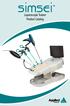 Laparoscopic Trainer Product Catalog Laparoscopic Trainer Product Catalog Simsei Table of Contents Laparoscopic Trainers 6 Organ Models 8 Skill Exercises 11 Accessories 12 Additional Information About
Micro-CT for SEM Non-destructive Measurement and Volume Visualization of Specimens Internal Microstructure in SEM Micro-CT Innovation with Integrity
 Micro-CT for SEM Non-destructive Measurement and Volume Visualization of Specimens Internal Microstructure in SEM Innovation with Integrity Micro-CT 3D Microscopy Using Micro-CT for SEM Micro-CT for SEM
Tracking Systems. Kevin Cleary, PhD
 Tracking Systems Kevin Cleary, PhD Technical Director, Bioengineering Initiative Children's National Medical Center Adjunct Professor, Department of Radiology Medical Center Washington, DC, USA [email protected]
A 5 Degree Feedback Control Robotic Arm (Haptic Arm)
 A 5 Degree Feedback Control Robotic Arm (Haptic Arm) 1 Prof. Sheetal Nirve, 2 Mr.Abhilash Patil, 3 Mr.Shailesh Patil, 4 Mr.Vishal Raut Abstract: Haptics is the science of applying touch sensation and control
da Vinci Prostatectomy Information Guide (Robotically-Assisted Radical Prostatectomy)
 da Vinci Prostatectomy Information Guide (Robotically-Assisted Radical Prostatectomy) Prostate Cancer Overview Prostate cancer is a disease in which malignant (cancer) cells form in the tissues of the
International Year of Light 2015 Tech-Talks BREGENZ: Mehmet Arik Well-Being in Office Applications Light Measurement & Quality Parameters
 www.led-professional.com ISSN 1993-890X Trends & Technologies for Future Lighting Solutions ReviewJan/Feb 2015 Issue LpR 47 International Year of Light 2015 Tech-Talks BREGENZ: Mehmet Arik Well-Being in
Robotics and Automation Blueprint
 Robotics and Automation Blueprint This Blueprint contains the subject matter content of this Skill Connect Assessment. This Blueprint does NOT contain the information one would need to fully prepare for
(I) s(t) = s 0 v 0 (t t 0 ) + 1 2 a (t t 0) 2 (II). t 2 = t 0 + 2 v 0. At the time. E kin = 1 2 m v2 = 1 2 m (a (t t 0) v 0 ) 2
 Mechanics Translational motions of a mass point One-dimensional motions on the linear air track LD Physics Leaflets P1.3.3.8 Uniformly accelerated motion with reversal of direction Recording and evaluating
Procon Engineering. Technical Document PELR 1002. TERMS and DEFINITIONS
 Procon Engineering Technical Document PELR 1002 TERMS and DEFINITIONS The following terms are widely used in the weighing industry. Informal comment on terms is in italics and is not part of the formal
Improving Robotic Operator Performance Using Augmented Reality James C. Maida / NASA JSC, Charles K. Bowen and John Pace / Lockheed Martin
 PROCEEDINGS of the HUMAN FACTORS AND ERGONOMICS SOCIETY 51st ANNUAL MEETING 2007 1635 Improving Robotic Operator Performance Using Augmented Reality James C. Maida / NASA JSC, Charles K. Bowen and John
Force/position control of a robotic system for transcranial magnetic stimulation
 Force/position control of a robotic system for transcranial magnetic stimulation W.N. Wan Zakaria School of Mechanical and System Engineering Newcastle University Abstract To develop a force control scheme
SOLID MECHANICS TUTORIAL MECHANISMS KINEMATICS - VELOCITY AND ACCELERATION DIAGRAMS
 SOLID MECHANICS TUTORIAL MECHANISMS KINEMATICS - VELOCITY AND ACCELERATION DIAGRAMS This work covers elements of the syllabus for the Engineering Council exams C105 Mechanical and Structural Engineering
What is Visualization? Information Visualization An Overview. Information Visualization. Definitions
 What is Visualization? Information Visualization An Overview Jonathan I. Maletic, Ph.D. Computer Science Kent State University Visualize/Visualization: To form a mental image or vision of [some
BARE PCB INSPECTION BY MEAN OF ECT TECHNIQUE WITH SPIN-VALVE GMR SENSOR
 BARE PCB INSPECTION BY MEAN OF ECT TECHNIQUE WITH SPIN-VALVE GMR SENSOR K. Chomsuwan 1, S. Yamada 1, M. Iwahara 1, H. Wakiwaka 2, T. Taniguchi 3, and S. Shoji 4 1 Kanazawa University, Kanazawa, Japan;
Unit 1: INTRODUCTION TO ADVANCED ROBOTIC DESIGN & ENGINEERING
 Unit 1: INTRODUCTION TO ADVANCED ROBOTIC DESIGN & ENGINEERING Technological Literacy Review of Robotics I Topics and understand and be able to implement the "design 8.1, 8.2 Technology Through the Ages
A System for Capturing High Resolution Images
 A System for Capturing High Resolution Images G.Voyatzis, G.Angelopoulos, A.Bors and I.Pitas Department of Informatics University of Thessaloniki BOX 451, 54006 Thessaloniki GREECE e-mail: [email protected]
Instruction Manual Service Program ULTRA-PROG-IR
 Instruction Manual Service Program ULTRA-PROG-IR Parameterizing Software for Ultrasonic Sensors with Infrared Interface Contents 1 Installation of the Software ULTRA-PROG-IR... 4 1.1 System Requirements...
Using Robotics for Non-Destructive Examination & Characterization of. Hazardous Storage Tanks
 Robotic End Effector For Inspection of Storage Tanks (FETC DE-AR21-93MC30363) Using Robotics for Non-Destructive Examination & Characterization of Hazardous Storage Tanks R. Beer ([email protected],
Microcontroller-based experiments for a control systems course in electrical engineering technology
 Microcontroller-based experiments for a control systems course in electrical engineering technology Albert Lozano-Nieto Penn State University, Wilkes-Barre Campus, Lehman, PA, USA E-mail: [email protected]
Physics 41, Winter 1998 Lab 1 - The Current Balance. Theory
 Physics 41, Winter 1998 Lab 1 - The Current Balance Theory Consider a point at a perpendicular distance d from a long straight wire carrying a current I as shown in figure 1. If the wire is very long compared
Advances in Robotic Technology
 Advances in Robotic Technology Reza Ghavamian M.D. Professor of Urology Director of Urologic Oncology and Robotic Surgery Montefiore Medical Center Albert Einstein College of Medicine New York Disclosure
Piezoelectric Driven Non-toxic Injector for Automated Cell Manipulation
 Medicine Meets Virtual Reality 18 J.D. Westwood et al. (Eds.) IOS Press, 2011 2011 The authors. All rights reserved. doi:10.3233/978-1-60750-706-2-231 231 Piezoelectric Driven Non-toxic Injector for Automated
Effects of Orientation Disparity Between Haptic and Graphic Displays of Objects in Virtual Environments
 Human Computer Interaction INTERACT 99 Angela Sasse and Chris Johnson (Editors) Published by IOS Press, c IFIP TC.13, 1999 1 Effects of Orientation Disparity Between Haptic and Graphic Displays of Objects
Motion Sensing with mcube igyro Delivering New Experiences for Motion Gaming and Augmented Reality for Android Mobile Devices
 Motion Sensing with mcube igyro Delivering New Experiences for Motion Gaming and Augmented Reality for Android Mobile Devices MAY 2014 Every high-end smartphone and tablet today contains three sensing
A Patient s Guide to the Calypso System for Breast Cancer Treatment
 A Patient s Guide to the Calypso System for Breast Cancer Treatment Contents Introduction How Radiation Works To Treat Cancer Radiation Treatment for Breast Cancer Special Concerns for Treating the Left
Development of Simulation Tools Software
 Development of Simulation Tools Software Vincent Luboz Department of Biosurgery and Surgical Technology Imperial College London BSc VR Surgical Simulation Software Slide 1 Contents Virtual Reality VR Surgical
Robotic Surgery 12 years of robotic assisted surgery vs. conventional laparoscopic surgery
 Robotic Surgery 12 years of robotic assisted surgery vs. conventional laparoscopic surgery A new chapter in medicine.from the first remote surgery by Prof. Dr. Senner to the today`s da Vinci technology
Sensory-motor control scheme based on Kohonen Maps and AVITE model
 Sensory-motor control scheme based on Kohonen Maps and AVITE model Juan L. Pedreño-Molina, Antonio Guerrero-González, Oscar A. Florez-Giraldo, J. Molina-Vilaplana Technical University of Cartagena Department
An Instructional Aid System for Driving Schools Based on Visual Simulation
 An Instructional Aid System for Driving Schools Based on Visual Simulation Salvador Bayarri, Rafael Garcia, Pedro Valero, Ignacio Pareja, Institute of Traffic and Road Safety (INTRAS), Marcos Fernandez
Software Development and Testing: A System Dynamics Simulation and Modeling Approach
 Software Development and Testing: A System Dynamics Simulation and Modeling Approach KUMAR SAURABH IBM India Pvt. Ltd. SA-2, Bannerghatta Road, Bangalore. Pin- 560078 INDIA. Email: [email protected],
CALIBRATION OF A ROBUST 2 DOF PATH MONITORING TOOL FOR INDUSTRIAL ROBOTS AND MACHINE TOOLS BASED ON PARALLEL KINEMATICS
 CALIBRATION OF A ROBUST 2 DOF PATH MONITORING TOOL FOR INDUSTRIAL ROBOTS AND MACHINE TOOLS BASED ON PARALLEL KINEMATICS E. Batzies 1, M. Kreutzer 1, D. Leucht 2, V. Welker 2, O. Zirn 1 1 Mechatronics Research
Design of a Universal Robot End-effector for Straight-line Pick-up Motion
 Session Design of a Universal Robot End-effector for Straight-line Pick-up Motion Gene Y. Liao Gregory J. Koshurba Wayne State University Abstract This paper describes a capstone design project in developing
Intuitive Navigation in an Enormous Virtual Environment
 / International Conference on Artificial Reality and Tele-Existence 98 Intuitive Navigation in an Enormous Virtual Environment Yoshifumi Kitamura Shinji Fukatsu Toshihiro Masaki Fumio Kishino Graduate
VRSPATIAL: DESIGNING SPATIAL MECHANISMS USING VIRTUAL REALITY
 Proceedings of DETC 02 ASME 2002 Design Technical Conferences and Computers and Information in Conference Montreal, Canada, September 29-October 2, 2002 DETC2002/ MECH-34377 VRSPATIAL: DESIGNING SPATIAL
The Laparoscopic Surgical Skills programme: setting the European standard
 ARTIGO DE OPINIAO The Laparoscopic Surgical Skills programme: setting the European standard S.N. Buzink^'^, PhD; J.M. Schiappa^'^, MD; H. Bicha Castelo^, MD PhD; A. Fingerhu^, MD PhD; G. HanncU, MD PhD;
An inertial haptic interface for robotic applications
 An inertial haptic interface for robotic applications Students: Andrea Cirillo Pasquale Cirillo Advisor: Ing. Salvatore Pirozzi Altera Innovate Italy Design Contest 2012 Objective Build a Low Cost Interface
VEHICLE TRACKING USING ACOUSTIC AND VIDEO SENSORS
 VEHICLE TRACKING USING ACOUSTIC AND VIDEO SENSORS Aswin C Sankaranayanan, Qinfen Zheng, Rama Chellappa University of Maryland College Park, MD - 277 {aswch, qinfen, rama}@cfar.umd.edu Volkan Cevher, James
UNIT II Robots Drive Systems and End Effectors Part-A Questions
 UNIT II Robots Drive Systems and End Effectors Part-A Questions 1. Define End effector. End effector is a device that is attached to the end of the wrist arm to perform specific task. 2. Give some examples
Intelligent Submersible Manipulator-Robot, Design, Modeling, Simulation and Motion Optimization for Maritime Robotic Research
 20th International Congress on Modelling and Simulation, Adelaide, Australia, 1 6 December 2013 www.mssanz.org.au/modsim2013 Intelligent Submersible Manipulator-Robot, Design, Modeling, Simulation and
EMI and t Layout Fundamentals for Switched-Mode Circuits
 v sg (t) (t) DT s V pp = n - 1 2 V pp V g n V T s t EE core insulation primary return secondary return Supplementary notes on EMI and t Layout Fundamentals for Switched-Mode Circuits secondary primary
Be careful not to scratch or hit front edge of the side viewing micro prisms onto hard objects!
 Instructions Manual Flexia BGA Inspection Systems This manual describes how to use Flexia BGA Inspection System Optilia Instruments 1 AB Contents 1. Safety and maintenance Instructions 3 2. About Flexia
An extended EMC study of an electrical powertrain for transportation systems
 European Association for the Development of Renewable Energies, Environment and Power Quality (EA4EPQ) International Conference on Renewable Energies and Power Quality (ICREPQ 12) Santiago de Compostela
Shielding Effectiveness Test Method. Harbour s LL, SB, and SS Coaxial Cables. Designs for Improved Shielding Effectiveness
 Shielding Effectiveness Test Method Harbour s LL, SB, and SS Coaxial Cables Designs for Improved Shielding Effectiveness Harbour Industries 4744 Shelburne Road Shelburne Vermont 05482 USA 802-985-3311
We bring quality to light. MAS 40 Mini-Array Spectrometer. light measurement
 MAS 40 Mini-Array Spectrometer light measurement Features at a glance Cost-effective and robust CCD spectrometer technology Standard USB interface Compatible with all Instrument Systems measuring adapters
Advantages of Auto-tuning for Servo-motors
 Advantages of for Servo-motors Executive summary The same way that 2 years ago computer science introduced plug and play, where devices would selfadjust to existing system hardware, industrial motion control
Chapter 1. Introduction. 1.1 The Challenge of Computer Generated Postures
 Chapter 1 Introduction 1.1 The Challenge of Computer Generated Postures With advances in hardware technology, more powerful computers become available for the majority of users. A few years ago, computer
Design-Simulation-Optimization Package for a Generic 6-DOF Manipulator with a Spherical Wrist
 Design-Simulation-Optimization Package for a Generic 6-DOF Manipulator with a Spherical Wrist MHER GRIGORIAN, TAREK SOBH Department of Computer Science and Engineering, U. of Bridgeport, USA ABSTRACT Robot
Presentation on CNC MACHINES. By: Hafiz Muhammad Rizwan
 Presentation on CNC MACHINES By: Hafiz Muhammad Rizwan WELCOME CNC Machines What is a CNC Machine? CNC : Computer Numerical Control Conventionally, an operator decides and adjusts various machines parameters
femtosecond laser platform Exceptional versatility without compromise
 Introducing the VICTUS femtosecond laser platform Exceptional versatility without compromise FEMTOSECOND TECHNOLOGY that empowers Introducing VICTUS the first femtosecond laser capable of exceptional performance
ADVANCES IN AUTOMATIC OPTICAL INSPECTION: GRAY SCALE CORRELATION vs. VECTORAL IMAGING
 ADVANCES IN AUTOMATIC OPTICAL INSPECTION: GRAY SCALE CORRELATION vs. VECTORAL IMAGING Vectoral Imaging, SPC & Closed Loop Communication: The Zero Defect SMD Assembly Line Mark J. Norris Vision Inspection
Application of Virtual Instrumentation for Sensor Network Monitoring
 Application of Virtual Instrumentation for Sensor etwor Monitoring COSTATI VOLOSECU VICTOR MALITA Department of Automatics and Applied Informatics Politehnica University of Timisoara Bd. V. Parvan nr.
CARS Configurable Automotive Research Simulator
 CARS Configurable Automotive Research Simulator Dagmar Kern, Marco Müller, Stefan Schneegaß, Lukasz Wolejko-Wolejszo, Albrecht Schmidt Pervasive Computing University of Duisburg-Essen Schützenbahn 70 45117
Design of a Robotic Arm with Gripper & End Effector for Spot Welding
 Universal Journal of Mechanical Engineering 1(3): 92-97, 2013 DOI: 10.13189/ujme.2013.010303 http://www.hrpub.org Design of a Robotic Arm with Gripper & End Effector for Spot Welding Puran Singh *, Anil
Robot Perception Continued
 Robot Perception Continued 1 Visual Perception Visual Odometry Reconstruction Recognition CS 685 11 Range Sensing strategies Active range sensors Ultrasound Laser range sensor Slides adopted from Siegwart
SAMSUNG ULTRASOUND RS80A
 Samsung Medison is a global leading medical device company. Founded in 1985, the company sells cutting-edge diagnostic ultrasound devices around the world in various medical fields. The company has attracted
Off-line Model Simplification for Interactive Rigid Body Dynamics Simulations Satyandra K. Gupta University of Maryland, College Park
 NSF GRANT # 0727380 NSF PROGRAM NAME: Engineering Design Off-line Model Simplification for Interactive Rigid Body Dynamics Simulations Satyandra K. Gupta University of Maryland, College Park Atul Thakur
Learning Systems Software Simulation
 Learning Systems Software Simulation EasyVeep PLC controls and technology training FluidSIM Fluid Power training aid for instructors and design tool for engineers COSIMIR PLC 3D simulation tool for practical
9/26/14. Joel E. Rand, MPAS, PA-C DMU Luncheon May 1, 2014
 Joel E. Rand, MPAS, PA-C DMU Luncheon May 1, 2014 No financial relationship or commercial interest in any of the technologies discussed Not supporting any non-fda off label uses of any product or service
Chen. Vibration Motor. Application note
 Vibration Motor Application note Yangyi Chen April 4 th, 2013 1 Table of Contents Pages Executive Summary ---------------------------------------------------------------------------------------- 1 1. Table
RIEGL VQ-480. Airborne Laser Scanning. Airborne Laser Scanner with Online Waveform Processing. visit our website www.riegl.com
 Airborne Laser Scanner with Online Waveform Processing RIEGL VQ-48 high-accuracy ranging based on echo digitization and online waveform processing high laser repetition rate - fast data acquisition multiple
MSc in Autonomous Robotics Engineering University of York
 MSc in Autonomous Robotics Engineering University of York Practical Robotics Module 2015 A Mobile Robot Navigation System: Labs 1a, 1b, 2a, 2b. Associated lectures: Lecture 1 and lecture 2, given by Nick
Highlights 2016. 2016 Edition, Quarter 3. Navigation
 Highlights 2016 2016 Edition, Quarter 3 Navigation NAV1 electromagnetic Easy and safe navigation with KARL STORZ High precision thanks to sensors in the instrument tips Compact design for easy integration
Effectiveness of Haptic Feedback in Open Surgery Simulation and Training Systems
 Effectiveness of Haptic Feedback in Open Surgery Simulation and Training Systems John HU a 1, Chu-Yin CHANG a, Neil TARDELLA a, James ENGLISH b, Janey PRATT b a Energid Technologies Corporation b Massachusetts
Robotics. DressPack Application Equipment & Accessories
 Robotics DressPack Application Equipment & Accessories DressPacks The need for well integrated cable and hose packages on the robot, DressPacks, has made ABB develop flexible packages to support applications
Integration Services
 Integration Services EXPERIENCED TEAM ADVANCED TECHNOLOGY PROVEN SOLUTIONS Integrations for large scale metrology applications Metris metrology to streamline your CAPABILITIES Advanced systems design Engineering
10. CNC Hardware Basics
 CAD/CAM Principles and Applications 10 CNC Hardware Basics 10-1/10-20 by P.N.Rao 10. CNC Hardware Basics 10.1 Structure of CNC machine tools Table 10.1 Some design criteria for CNC machine tool design
Study Protocol Title: Evaluation of the Fundamentals of Robotic Surgery (FRS) Online and Psychomotor Skill Curriculum: Validation Pilot Study
 Study Protocol Title: Evaluation of the Fundamentals of Robotic Surgery (FRS) Online and Psychomotor Skill Curriculum: Validation Pilot Study Principal Investigator: Roger Smith, PhD Sub Investigator:
GOM Optical Measuring Techniques. Deformation Systems and Applications
 GOM Optical Measuring Techniques Deformation Systems and Applications ARGUS Forming Analysis ARGUS Deformation analysis in sheet metal and forming industry Forming Characteristics of Sheet Metals Material
Monitoring of Natural Hazards With the ImpactSentinel Alarming System An Intelligent Solution
 Monitoring of Natural Hazards With the ImpactSentinel Alarming System An Intelligent Solution ImpactSentinel Natural Hazard Sensors und Systems hazard signalization in protection fences overstress, shock
A Remote Maintenance System with the use of Virtual Reality.
 ICAT 2001 December 5-7, Tokyo, JAPAN A Remote Maintenance System with the use of Virtual Reality. Moez BELLAMINE 1), Norihiro ABE 1), Kazuaki TANAKA 1), Hirokazu TAKI 2) 1) Kyushu Institute of Technology,