
ADDENDUM 1 TO APPENDIX 1 TO SCHEDULE 3.3
|
|
|
- Todd Pierce
- 10 years ago
- Views:
Transcription
1 ADDENDUM 1 TO APPENDIX 1 TO SCHEDULE 3.3 TO THE COMPREHENSIVE INFRASTRUCTURE AGREEMENT
2 Statement of Technical Approach for Cross Functional Services Northrop Grumman will implement a Cross Functional Services Office (CFSO) to deliver integration of services across all service areas. The CFSO will provide end-to-end processes to manage VITA s enterprise. The CFSO will implement process, quality and project methodologies to align processes to people and technology to fulfill the VITA mission. The CFSO will work in close partnership with Northrop Grumman s architecture team to provide service delivery that is based upon a scalable, flexible, integrated, and secure technology architecture and technology advancements as approved by VITA. The CFSO will provide oversight as innovation and transformation are rolled out and performed across all service areas. The CFSO will be responsible for the following functions: Process Management Quality Assurance Documentation and Knowledge Management Project Management Office Training Coordination Service Level Management and Reporting Asset Management Environmental and Facilities Support Process Management Northrop Grumman will use a structured approach to managing processes across the services provided to VITA. Each crossfunctional process will follow Northrop Grumman s formal Process Development and Maintenance Lifecycle, a methodology that governs the disposition of a process throughout its life. The Process Lifecycle begins with requirements development and is managed until retirement and through the process development and maintenance. The Process Lifecycle will be used to manage existing process to validate that the processes are maintained. Each major component of the Process Lifecycle has sub-processes that provide management, integration, and implementation of the methodology. The Exhibit 1 Process Lifecycle PAGE 1
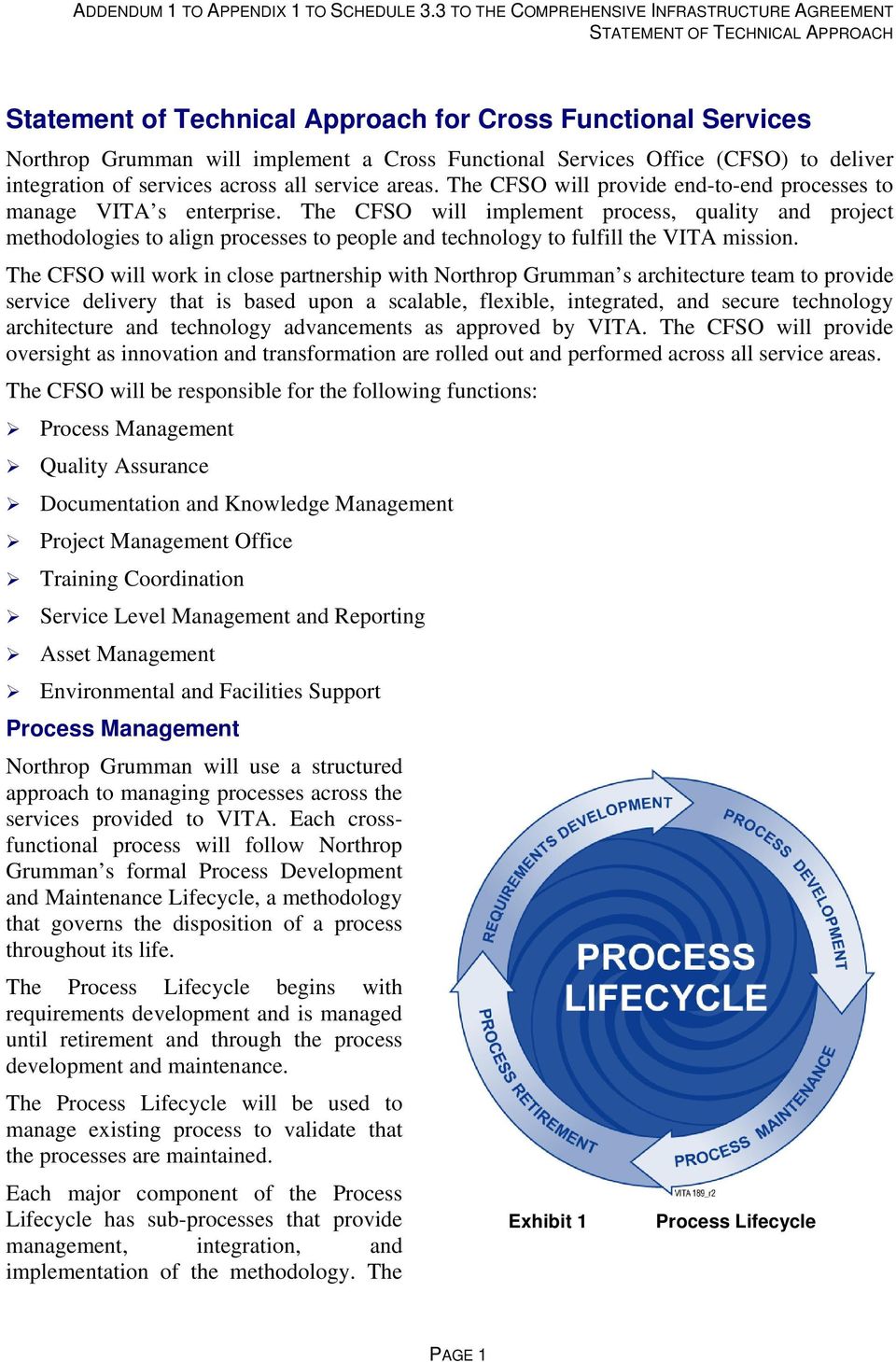
3 Process Lifecycle includes a series of checklists that Northrop Grumman will use to validate that all areas that impact process development are acknowledged and examined. The CFSO will own the Process Lifecycle and educate each service area. During transition, the CFSO will work with the process owners and the appropriate VITA personnel to review and deploy the Process Lifecycle. The CFSO will interface directly with VITA s Performance Managers to provide a cross functional methodology that is in compliance with VITA s policies. The CFSO will also work with the appropriate VITA staff to receive approval of the crossfunctional policies, procedures and documentation prior to implementation. Quality Assurance The Quality Assurance (QA) function will provide compliance to the required quality methods, continuously assessing processes and products during the development and delivery phases. General Responsibilities Purpose During transition, Northrop Grumman will work with VITA to establish a Relationship Management structure to manage the partnership with VITA. Relationship Management will be in place to begin the planning activities on the Service Commencement Date. Through the Transition phase, Northrop Grumman will collaborate with key VITA personnel to identify initial target agencies and environments and initiate proper links to Relationship Management to establish the communication channel. Northrop Grumman will review the SOW and schedule to communicate to VITA performance expectations to its support staff. Operationally, Northrop Grumman s standard Service Area processes will be employed to facilitate stabilization of the environment. Northrop Grumman will begin the optimization of processes as the ITIL framework is implemented. Northrop Grumman will initially implement Northrop Grumman s processes and procedures across all functional areas to begin the transformation of IT support from the current distributed environment to a more enterprise-oriented support model. Through the Transition phase, Northrop Grumman will provide a Service Operations and Support environment that optimizes these initial processes, based on the ITIL and Hewlett-Packard processes and methodologies for implementing ITSM. During this optimization, Northrop Grumman will also accommodate VITA and agency best practices, where possible, to develop solutions across VITA s enterprise. Northrop Grumman s approach to transformation will be to implement eight of the seventeen ITIL service processes. These processes will be the cornerstones of all service development for the program. The eight processes to be implemented are: Change management Configuration management Incident and service request management Problem management Service level management (service level monitoring and reporting) PAGE 2

4 Capacity management (including performance management) Service continuity management Release management Northrop Grumman will facilitate ITSM workshops to establish, optimize and deploy these processes across the support organization during transition. The CFSO will provide a consistent delivery and standardized methodology and implementation of process management, project management, QA, documentation and knowledge management, training coordination and service level management and reporting. Northrop Grumman technology and operations planning will be integrated and managed within Account Management to provide improvement projects and upgrades that follow established test, change and release processes. Northrop Grumman s approach will address the general requirements for Cross Functional Services, including: Developing and providing services that support VITA business needs, technical requirements and end-user requirements Complying with VITA policies, standards and regulations applicable to the services Developing and maintaining a comprehensive procedures manual that contains the actual operational and procedural standards that will be used in the delivery of the services Conforming to changes in laws, regulations and policies Reporting performance against the service levels Coordinating all changes to the IT infrastructure that may affect the services levels of any other service area Providing timely creation, updating and maintenance of project plans Coordinating service delivery with help desks, as well as other support groups, as necessary Providing VIP support services as necessary Planning and Analysis [Appendix 1 to Schedule 1 Section ] Purpose This process addresses the planning and analysis component of the engineering lifecycle development for new infrastructure technology projects. The Planning and Analysis process applies to all service areas, including: Internal Applications Security Help Desk Desktop PAGE 3
5 Messaging Mainframe and Server Data Network Voice and Video Telecom CFSO Chief Architect The Planning and Analysis Definition Process Planning and analysis services span all service areas within the technical environment. A framework of processes will be defined through the partnership of Northrop Grumman and VITA. Planning and Analysis are front-end lifecycle processes, primarily addressed within the Governance Strategy and Technology Committees. Northrop Grumman will work with VITA to develop the linkages for the partnership as they pertain to planning and analysis issues/agenda. Northrop Grumman will communicate planning and analysis issues/agenda to the appropriate service organizations through Northrop Grumman s service operations manager and the service support manager, who manage all of the service areas, as well as the Cross Functional Services manager and the Chief Architect. These processes will also include establishing a baseline of standards, processes, timeframes, recurring status meetings, and reporting requirements. Continuous planning and analysis efforts will be made for the current and future of VITA s IT environment in consideration of the business plan and changes in technology as predicted by the technology market. Northrop Grumman will work with VITA to perform infrastructure, configuration, technical, and service planning and analysis based on VITA s requirements. These planning and analysis activities will span all service areas. A baseline of acceptable conditions will be developed, reviewed and published to include system availability, capacity levels, system performance, backup and retention strategies, processes and procedures, IT Service Continuity, and Disaster Recovery processes. These conditions will be reviewed at regular intervals to confirm the consistent health of the environment. The Technology Review Process Through the Governance Technology Committee, the Chief Architect provides architecture design and guidance based upon an understanding of VITA s business requirements. The Chief Architect also collaborates with the appropriate VITA personnel to recommend technology improvements, innovations and enhancements that are a catalyst in the transformation of the VITA environment. In addition, through the Vendor partnership network, Northrop Grumman will stay apprised of technology trends and evaluate their adaptability to the VITA environment. New technology will be evaluated to determine if it aligns with the business and technology strategies of the VITA environment. As new technology is introduced, policies, procedures and methodologies will be updated, as necessary, to accommodate the appropriate changes in the environment. Northrop Grumman will work closely with Relationship Management and Business Development to propose business solutions and new technologies to the VITA team to confirm PAGE 4

6 that the business solution have been identified and evaluated for viability in the VITA environment, solutions will be presented to an Internal Review Board (often identified as an Opportunity Review Board). Northrop Grumman s recommended method of performing infrastructure technology evaluations is to conduct health reviews at regular intervals. These reviews evaluate the infrastructure from the perspective of revision levels, storage capacity, bandwidth capacity, server capacity and age, and port capacity and age of equipment. A refresh plan covering infrastructure components such as (network, server, desktop, messaging) will be established and reviewed at these intervals. The Program Review Process Northrop Grumman will meet with VITA on a monthly basis to review the program status during both transition and steady state. A sampling of what this review might include is as follows: Transition and steady state financial reporting SLA reports End-user customer satisfaction Management of service level metrics Key trends reports (e.g., storage and capacity reports) Project Status Reports Accomplishments 30-day look ahead Issues Financial report The Northrop Grumman Cross Functional Services manager will oversee projects across services for consistency and standardized PMI practices. Requirements Definition [Appendix 1 to Schedule 3.3 Section ] Purpose This process addresses the Requirements Definition component of the engineering lifecycle development for new infrastructure technology projects. The Requirements Definition process applies to all service areas, including: Internal applications Security Help desk Desktop Messaging PAGE 5

7 Mainframe and server Data network Voice and video telecom Cross Functional Services Office Chief Architect Northrop Grumman will work with VITA to define, develop and document a process to capture data related to requirements definitions. This process will also include definition standards and guidelines. Requirements Definition is a front-end lifecycle process, and is addressed primarily within the Governance Strategy, Technology, Operations, and Cooperative Value and Innovation (CVI) Committees. Northrop Grumman will work with VITA to develop the linkages for the partnership as they pertain to Requirements Definition issues/agenda. Northrop Grumman will communicate Requirements Definition issues/agenda to the appropriate service organizations through Northrop Grumman s service operations manager and the service support manager, who manage all of the service areas, as well as the Cross Functional Services manager and Chief Architect. Northrop Grumman will use CMMI and Northrop Grumman s ITIL/ITSM framework, as appropriate, to monitor that requirements are gathered, processed, analyzed, and implemented. Design Specification [Appendix 1 to Schedule 3.3 Section ] Purpose This process addresses the Design Specification component of the engineering lifecycle development for new infrastructure technology projects. The Design Specification process applies to all service areas, including: Internal applications Security Help desk Desktop Messaging Mainframe and server Data network Voice and video telecom The Design Specification process addresses the development and documentation of technical design plans and environment configuration based on VITA standards, architecture, functional, performance, availability, maintainability, security and IT Service Continuity requirements. Design Specification is a lifecycle process, and is addressed primarily within the Governance Technology and Operations Committees. Northrop Grumman will work with VITA to develop the linkages for the partnership as they pertain to Design Specifications issues/agenda. Northrop PAGE 6
8 Grumman will communicate Design Specification issues/agenda to the appropriate service organizations through Northrop Grumman s service operations manager and the service support manager, who manage all of the Service areas, as well as the CFSO manager and Chief Architect. The Chief Architect owns the responsibility for creating all design documents through approval by VITA. Northrop Grumman will provide specialized architects to address Design Specifications across the various service areas, such as network, desktop, servers, and messaging. Technical reviews will be conducted by all appropriate VITA personnel monitor that Design Specifications have addressed all aspects of the Requirements process. Acquisition and Management [Appendix 1 to Schedule 3.3 Section ] Purpose This process addresses the activities associated with acquisition and management of new and upgraded service area components. The Acquisition and Management process applies to all service areas, including: Desktop Mainframe and server Data network Northrop Grumman will implement an Asset Management Lifecycle from acquisition to disposal (illustrated in Exhibit 2). Northrop Grumman will establish, update and maintain an asset inventory database for the Desktop (as part of the Desktop Modernization Program), Mainframe/Server and Network service areas. Asset inventory agents will be added to VITA s servers and to refreshed desktops for full software and hardware inventory collection to a central asset repository. Mainframe software and hardware inventory data will be stored in the central repository and reviewed for accuracy. The network service area will use HP OpenView Network Node Manager and Cisco Works, which will track routers, switches and other managed devices. Northrop Grumman will maintain a network inventory data and configuration database that will update the central configuration management database. Partnering with VITA, Northrop Grumman will develop new equipment/hardware standards that are compliant with VITA s established IT standards and architectures. Acquisition Management is primarily addressed within the Governance Technology and Operations Committees. Northrop Grumman will work with VITA to develop the linkages for the partnership as they pertain to Acquisition Management issues/agenda. Northrop Grumman will communicate Acquisition Management issues/agenda to the appropriate service organizations through Northrop Grumman s service operations manager and the service support manager, who manage all of the service areas, as well as the Cross Functional Services manager and Chief Architect. The business manager owns the responsibility for identifying and managing acquisitions through approval by VITA. PAGE 7
9 Exhibit 2 Asset Management Lifecycle Northrop Grumman s specific Acquisition Management processes encompass the following areas: Forecasting 90-day requirements Providing quotes Processing orders Capturing and reporting asset data Cataloging file input and updates Evaluating new products Reporting acquisition activities Returning materials (authorization) Requesting special orders Asset Management Northrop Grumman will utilize the Altiris Asset Management Suite solution to confirm that data will be extracted and reported at the regional, site or business level. Northrop Grumman s desktop modernization program will establish a Project Service Center (PSC), a virtual warehouse environment that will facilitate the application of processes to provide consistency to support the refresh and uplift of the VITA s end-user computing devices with a Gateway Intel-based networked enterprise workstation. The PSC will process VITAapproved end-user workstations and function as the entry and exit point for all end-user computing devices. Northrop Grumman plans to establish the PSC in the area south of Richmond. The following major refresh services will be performed in this environment: Standardized hardware and image configuration(s) (includes asset tagging) PAGE 8

10 Asset staging based on individual agency configurations Creation and population of asset records in the asset management system Dispatch transportation service to deliver workstations to eligible end-user sites Asset recovery and classification Management of the provisioned asset database for recovered legacy assets Dispatch transportation service to pick up staged legacy assets Northrop Grumman will address existing environmental desktop and print issues prevalent throughout VITA-defined in-scope facilities revealed during the due diligence phase. Asset Inventory and Tracking The Altiris system will track installed desktop software for VITA compliancy, and will also maintain software license inventory and monitor meter usage to minimize unnecessary software purchases. Web-based reporting features permit designated VITA management insight into the asset database to review financial data or the assigned asset location. Altiris is also a key component of the PSC, where VITA-approved standard images are loaded and workstation hardware and software configurations are captured along with the VITA asset tag, purchase order and manufacturer s serial number. The Altiris system will also store software license, asset warranty, maintenance, and associated problem history data that will assist in proactively remedying end-user disruption by identifying problematic manufacturer s equipment. Altiris will facilitate asset inventory and tracking of assets; provide a single repository of asset information; support electronic software delivery, software license inventory and usage reporting, and metering; track changes; provide online storage of VITA software core and eligible-customer specific images; and support Northrop Grumman s desktop modernization program. Northrop Grumman will put tools in place and work closely to provide the necessary processes and documentation to allow VITA to monitor and audit the acquisition, configuration, deployment, relocation, and disposal of assets through reports as well as system queries and spot physical audits. Engineering/Development [Appendix 1 to Schedule 3.3 Section ] Purpose This process addresses the Engineering/Development components of the engineering lifecycle for new infrastructure technology projects. The Engineering/Development process applies to all service areas, including: Internal Applications Security Help Desk Desktop PAGE 9

11 Messaging Mainframe and Server Data Network Voice and Video Telecom Chief Architect Engineering/Development is primarily addressed within the Governance Technology and Operations Committees. Northrop Grumman will work with VITA to develop the linkages for the partnership as they pertain to Engineering/Development issues/agenda. Northrop Grumman will communicate engineering/ development issues/agenda to the appropriate service organizations through Northrop Grumman s service operations manager and the service support manager, who manage all of the service areas, as well as the Cross Functional Services manager and Chief Architect. The service operations manager and service support manager own the responsibility for identifying and managing engineering/development through approval by VITA. Engineering/Development Roles and Responsibilities Northrop Grumman will develop Engineering/Development policies, procedures and development plans for the technical infrastructure, tools and utilities that provide services for VITA s review and approval. Northrop Grumman s Architecture Group, lead by the Chief Architect, provides architecture design and guidance based on an understanding of VITA s short- and long-term business needs goals and future direction. Northrop Grumman will monitor that VITA s Business Management and Enterprise Architecture requirements are integrated with its strategic business and enterprise architecture designs, recommendations, and implementation plans. In addition, all production operating environments will document their operational requirements. Northrop Grumman will incorporate these requirements into its Engineering/Development design plans, policies and procedures for new or additional products and services. Northrop Grumman s Chief Architect and subject matter experts will collaborate with VITA s Strategic Management office and appropriate VITA personnel to recommend improvements to provide cost reduction while improving services through automation and standardized, integrated processes. This includes drafting technical recommendations and presentations, work plans and estimates including cost benefit analysis; evaluating and recommending tools to improve efficiencies in Northrop Grumman s managed services business; and reviewing of VITA s IT requirements to recommend value-add solutions. The Architecture Group will work with VITA to receive approval on and manage new and existing projects, to implement these new technologies to promote business continuity and crossfunctional integration, increase operational efficiencies, and promote stability in the IT environment. These projects will span a wide range of technology so that all aspects of VITA s ebusiness environment can benefit, from desktop support practices to complex security protection technologies. PAGE 10
12 Northrop Grumman will collaborate with VITA to oversee that VITA s projects are delivered and implemented as agreed upon. Communication with VITA will keep VITA abreast of project status through all phases. Integration and Testing [Appendix 1 to Schedule 3.3 Section ] Purpose This process addresses the Integration and Testing components of new infrastructure technology projects. The integration and testing processes apply to all service areas, including: Internal applications Security Help desk Desktop Messaging Mainframe and server Data network Voice and video telecom Chief Architect Integration and Testing are primarily addressed within the Governance Technology and Operations Committees. Northrop Grumman will work with VITA to develop the linkages for the partnership as they pertain to Integration and Testing issues/agenda. Northrop Grumman will communicate Integration and Testing issues/agenda to the appropriate service organizations through Northrop Grumman s service operations manager and the service support manager, who manage all of the service areas, as well as the Cross Functional Services manager and Chief Architect. The service operations manager and service support manager own the responsibility for identifying and managing integration and testing through approval by VITA. Northrop Grumman will perform integration and testing on VITA s infrastructure at both the individual component and integrated infrastructure level, to maintain operational integrity and compliance with VITA s security and IT architecture policies, regulations and procedures. Northrop Grumman will test and evaluate new and upgraded equipment, networks, software, and services to enable conformance within service levels that support VITA s key architecture decisions and specific programs with special requirements. Northrop Grumman will provide evaluation results and recommendations in accordance with those specified within the test plan across the services. Northrop Grumman will support evaluation and testing for compatibility, integration and security on all new hardware and software to be introduced into the VITA computing environment. These services are intended to aid in the successful integration of new equipment and reduce disruption PAGE 11
![6] Purpose This process addresses the Integration and Testing components of new infrastructure technology projects.](/docs-images/44/15299861/images/page_12.jpg "The integration and testing processes apply to all service areas, including: Internal applications Security Help desk Desktop Messaging Mainframe and server Data network Voice and video telecom Chief")
13 to the end-users when new hardware and software is introduced. This is a research and development function that will facilitate the introduction of proposed new or upgraded hardware and software. As part of the Integration and Testing methodology, Northrop Grumman will conduct market research and attend technology seminars to confirm Northrop Grumman maintain in-depth knowledge of all relevant technology developments. This enables Northrop Grumman to determine how or if new enhancements might be applicable to VITA s infrastructure, systems and applications through proactive management awareness. Systems Integration and Testing Laboratory (SITL) Northrop Grumman will implement a Systems Integration and Testing laboratory to conduct system evaluation, analysis, systems integration, and acceptance testing. The SITL provides a secure, dedicated, non-production environment to validate compliance with VITA s security, IT Architecture, policies, regulations and procedures. The SITL will be equipped with the hardware and software necessary to duplicate or simulate the environment at VITA sites spanning data center, desktop and network security environments. The SITL is also chartered to develop and maintain software release matrices across VITA s development, QA, production, and networks. The SITL provides evaluation and testing of all new hardware that is being considered for implementation in the computing environment. These services will include testing of all hardware including PDAs, PC desktops and laptops, scanners, printers, plotters, servers, and network devices. As part of its configuration management practice, Northrop Grumman will establish, maintain and document baseline hardware and software configurations for the SITL s hardware and software components. This information will be routinely compared to the information in the asset management system to confirm accuracy at the sub-component and software release level. In addition, Northrop Grumman uses a documented release management model to provide that the actual deployment of changes that are introduced into the VITA environment is accomplished through a planned, coordinated process. Using the Decision, Analysis, and Resolution Model (a CMMI process), technology focus areas are constantly being tested so that an optimal set of VITA s new or upgraded software and hardware components are rigorously tested and certified for compliance to VITA s security, IT Architecture, policies, regulations, and procedures. The general analysis flow of new or upgraded service area components or service includes: Determining the need for the evaluation Establishing evaluation criteria Identifying alternative solutions Selecting formal analysis methods and tools Analyzing requirements Identifying candidate solutions Evaluating and rate candidate solutions PAGE 12
14 Documenting the analysis and recommendation Quality assurance entails activities necessary to confirm that delivered products and services meet the customer needs. Northrop Grumman requires critical process steps are performed and follow CMMI and ITIL/ITSM practices. Within the SITL, all changes that are implemented undergo a QA review. This review verifies that associated documentation is accurate and conforms to the established documentation standards, testing has been conducted in accordance with testing procedures and has demonstrated positive results, and software or system changes are properly logged and performed under established configuration control. Northrop Grumman will provide Integration and Testing of the VITA infrastructure components for evaluation, testing, control, and release processes. Change Management The SITL will use the formal Change Management methodology and procedures, which are used throughout all VITA services. Northrop Grumman s Change Management process is a balance of a rigorous methodology honed over many years and environments, tailored to the specific needs of VITA. Implementation and Migration [Appendix 1 to Schedule 3.3 Section ] Purpose This process addresses the Implementation and Migration components of new or upgraded infrastructure technology projects. Northrop Grumman will manage Implementation and Migration following CMMI and ITIL practices. The Implementation and Migration processes apply to all service areas, including: Internal Applications Security Help Desk Desktop Messaging Mainframe and Server Data Network Voice and Video Telecom Implementation and Migration are primarily addressed within the Governance Technology and Operations Committees. Northrop Grumman will work with VITA to develop the linkages for the partnership as they pertain to Implementation and Migration issues/agenda. Northrop Grumman will communicate Implementation and Migration issues/agenda to the appropriate service organizations through Northrop Grumman s service operations manager and the service support manager, who manage all of the service areas, as well as the Cross Functional Services PAGE 13
15 manager and Chief Architect. The service operations manager and service support manager own the responsibility for identifying and managing Implementation and Migration through approval by VITA. Northrop Grumman s approach for Implementation and Migration is to conduct site and system pre-installation surveys and transfer this documentation via a formal Knowledge Repository for the Implementation and Migration teams. Northrop Grumman will work to identify personnel to involve in a knowledge transfer strategy that includes methods of system turnover. After VITA management approves the results of User Acceptance Testing, Northrop Grumman will execute the tasks necessary to implement the new installation or enhanced service components (hardware, software, middleware, utilities, networks, peripherals, configurations). This includes preparing the implementation plan, executing the implementation plan, and verifying functionality. The implementation will be accomplished with full communication between service teams following established Change Management policy and procedure. Northrop Grumman will schedule the system installations, migrations or upgrade enhancements with VITA management and the support and operations service teams. Once the schedule is determined, Northrop Grumman will coordinate with all user locations, as needed. Immediately following the Installation, Move, Add or Change (IMAC), Northrop Grumman will test the user functionality in each location and troubleshoot implementation issues. Northrop Grumman will perform data migrations, as agreed upon by Northrop Grumman and VITA, for in-scope applications using migration tools. Images created in the SITL environment are managed and a documented change control process that is common to all services. Northrop Grumman will provide training to VITA s IT technical staff and end users on new products and services as appropriate. This can be addressed in a variety of ways, depending on the complexity of the new product or service. Northrop Grumman will provide training on identified applications in coordination with VITA. Environment and Facilities Support [Appendix 1 to Schedule 3.3 Section ] Purpose Environment and Facilities Support provides that activities associated with maintaining the environmental and facilities requirements at the designated VITA facilities (e.g., heating, ventilation, air conditioning, power, cabling, fire suppression, and physical security) are monitored and managed following a strict Change/Configuration Management process. Northrop Grumman will develop a Standard and Emergency Operating Manual in compliance with VITA s business and security requirements. Key elements of the Standard and Emergency Operating Manual include: Administrative Emergency Call Lists Change Management General Maintenance Procedure PAGE 14

16 Daily Inspections Process and step-by-step procedures for the inspection of the grounding systems, utility transformers, circuit breakers, emergency generators, space temperature and humidity, Uninterrupted Power Supply (UPS), Power Distribution Unit (PDU), etc. to determine if they are operating normally. The following inspections will occur daily: Grounding Utility Transformers Emergency Generators UPS PDU Condensing Units Air Conditioning Units Space Temperature/Humidity Fire Alarm Pre-Action Fire Suppression System Gaseous Fire Suppression System General Building Condition Sump Emergencies/Alarms Step-by-step procedures for the response to the activations, alarms, loss of cooling, tripped circuit breakers, receipt of fuel and fuel spills, transferring loads from utility power to generator power, adding power circuits to power distribution units, transferring the UPS to maintenance bypass, sequence of operations during a load bank test of the emergency generators, and disabling the fire alarm system for any activity that has any potential for activating the fire alarm or fire suppression systems. Procedures include: EPO Activation Fire System Alarm Loss of Utility Power Manual Start and Transfer of Generator using Transfer Means UPS Alarm/Failure Loss of Cooling Air Conditioning Alarm/Failure Tripped Circuit Breaker Fuel Spillage PAGE 15

17 Routine Tasks/Testing Disabling Fire/Life Safety Systems Adding Power Circuits in PDU Transfer of UPS to Maintenance Bypass Load bank Testing Fuel Delivery Facilities Logs Facility Power/Energy Log UPS Log PDU Log Emergency Generator Checklist Emergency Generator Logs Security System Alarms Security System Northrop Grumman will work with VITA to adhere to environmental industry standards, which will enhance communications and system availability. The CFSO will provide collaboration and consistent processes across the following VITA service areas: Mainframe and servers Desktop Help desk Messaging Security Networking Video and voice telecom Northrop Grumman will provide planning and coordination of supporting the physical infrastructure from both an environmental and physical security perspective. Appropriate UPS units not only makes backup power available for a certain period of time, but also helps condition the power to protect sensitive IT equipment from things such as power spikes, edge speed (frequency) of electrical transients and line noise. It addition to UPS devices, infrastructure such as high-end switches and routers (which contain dual power supplies) can be fed from different phases so the interruption of any one phase will not result in an outage. In locations where accessing dual power grids are available, Northrop Grumman will work with VITA to confirm maximum availability. In addition, Northrop Grumman will help maintain existing back-up generators by conducting tests on a periodic basis, as well as make PAGE 16

18 recommendations where the business impact analysis would justify the installation or upgrade of a new system. While Change Management is more commonly associated with hardware equipment and software configurations, it is also applicable to physical access. The Change Management process for granting physical access to provide standardized methods and procedures are used for handling of changes. Training and Knowledge Transfer [Appendix 1 to Schedule 3.3 Section ] Purpose Training and Knowledge Transfer lead to the improvement of skills and implementation of new technology and support of VITA. Northrop Grumman will train its personnel and the Managed Employees, as well as Retained Employees. The training and knowledge transfer processes apply to service areas, including: Mainframe and server Desktop Help desk Messaging Security Data network Video and voice telecom Facilities Internal applications Training The Cross Functional Services manager will be the hub for training and knowledge transfer. Working closely with VITA and Northrop Grumman s Human Resources, Northrop Grumman will assess technical training needs and provide cross-functional coordination across VITA. As part of the Performance Management Process, Human Resources will maintain a training database that contains an inventory of the employees skill levels and certifications. Training requirements will be defined during Transition and built into Northrop Grumman s training plans. As technology changes and modernization projects are introduced into the environment, training plans will be developed in support to provide complete knowledge assimilation. Training will be performed by several multiple methods including lecture, Computer Based Training (CBT), individual, or other means. The Training and Knowledge Transfer program for VITA must be: Distributed, over a diverse and wide range of user types Modular, to access relevant information quickly and easily PAGE 17
19 Multi-sensory, to appeal to different styles of learning Non-linear, to address different learning levels Portable, to provide training where and when it is needed Responsive, to provide appropriate feedback to all learner responses Transferable, for training that increases actual on-the-job-skills Training and knowledge transfer guidelines and procedures will be detailed and implemented during the transition period. The CFSO will provide oversight to the service areas for documentation, training information, and knowledge assets are maintained current and secure. Northrop Grumman will complete the development and documentation of training and knowledge database requirements, guidelines and policies. Execution plans, schedules and final documentation will be completed as agreed-to by both teams after approval of the initial submission to VITA. Northrop Grumman and VITA will continue to proactively assess, develop and improve training requirements in conformance with policies. Northrop Grumman will develop a program to educate VITA s personnel on the provision of services. This program will include specific details to aid users in engaging service, understanding what the services are, and manage expectations in the delivery of the services. Knowledge Management Northrop Grumman uses a formal system of policies, procedures and asset libraries to govern and regulate its operations. A Web-based approach integrated with a knowledge management database and collaboration tools will be instituted for knowledge sharing, as well as knowledge collection, retention and management. During transition, Northrop Grumman will work with VITA to identify VITA personnel requiring access to the knowledge management system. During the Transition phase, the Northrop Grumman CFSO and VITA Teams will work together to establish an ongoing knowledge management environment in Livelink. Northrop Grumman will engage knowledge management specialists and senior knowledge management expertise to provide processes and procedures, templates, formats, and structures are incorporated in the VITA Livelink workspace. Documentation [Appendix 1 to Schedule 3.3 Section ] Purpose This process addresses the development and maintenance of documentation for the program, including processes and procedures, training materials and project related information. Documentation management requirements and supporting processes will apply to all Service areas, including: Internal applications PAGE 18
20 Security Help desk Desktop Messaging Mainframe and server Data network Voice and video telecom Documentation is primarily addressed within the Governance Technology and Operations Committees. Northrop Grumman will work with VITA to develop the linkages for the partnership as they pertain to Documentation issues/agenda. Northrop Grumman will communicate Documentation issues/agenda to the appropriate service organizations through Northrop Grumman s service operations manager and the service support manager, who manage all of the service areas, as well as the Cross Functional Services manager and Chief Architect. The CFSO owns the responsibility for identifying and managing documentation through approval by VITA. VITA approved documentation standards, procedure formats, guidelines, and quality control measures will be established to promote a consistent look, feel and quality of newly created documentation. Existing documents will also be stored in the document repository, and will be updated as the VITA organization is transformed to the desired environment. The CFSO has oversight responsibility for the management of all documentation using an established document development and maintenance lifecycle. Using automated version control and audit capabilities, the Northrop Grumman CFSO will verify the integrity of documents across the service areas. Procedures Manual Led by the CFSO, Northrop Grumman will collect, inventory and organize the existing VITA processes and procedures. The team will then perform a gap analysis of the existing processes and procedures versus those required to perform the services. Based on the results of this gap analysis, Northrop Grumman will provide VITA with a set of recommended documentation. Upon receiving VITA approval, Northrop Grumman will begin the process and procedure development phase, led by a process specialist with inputs from subject matter experts as needed. Northrop Grumman will perform ITIL/ITSM workshops to optimize the initial processes for deployment across the VITA enterprise. Northrop Grumman will provide the drafts of the procedures manual to VITA as they are developed during transition. As the VITA environment is transformed, new documentation will be created in the respective service area. Process owners will be assigned to the documentation, and this information will be housed in the knowledge repository. These new documents will be required to undergo a quality review prior to final approval by VITA. Changes will adhere to documentation control process to provide data integrity and accuracy. This will control changes from a cross-functional perspective. PAGE 19
21 Operations and Administration [Appendix 1 to Schedule 3.3 Section ] Purpose Northrop Grumman will define, develop and implement the appropriate operational procedures and processes to provide compliance with VITA s requirements and policies. IT Operations and Administration processes, policies and procedures are applicable to all data center processing and associated managed services functions that provide VITA and its customers with IT processing support services. The Centralized Management Operations Center (CMOC) is the hub for the delivery of managed services and customer support. The services include the following: Data center operational procedures and documentation Production scheduling Systems management Data center hardware, software, services, and component management Service level compliance management Operational and performance reporting Data storage media management Back-up and restoration of operational data Archive and off-site storage of operational data Disaster recovery planning Disaster recovery testing and verification Data center incident and problem management component Management of subcontractors and third party services providers Operations and Administration requirements and supporting processes will apply to all service areas including: Help desk Incident and problem management Project Management Office Systems administration IT Service Continuity and Disaster Recovery Mainframe and server Messaging Data network PAGE 20
22 The mainframe and server services team has direct first-line responsibility for a number of operations and administration services functions and assumes a coordinating role in the support of other functions. Key areas of first-line functional responsibility include operational and performance management, systems management, data back-up services, and disaster recovery. CMOC Northrop Grumman will supply highly available, reliable, scalable, and secure IT processing services by implementing a CMOC that serves as a hub for the delivery of managed services to achieve high service levels. Northrop Grumman will meet the needs of VITA and its customers for reliable, scalable and secure services by taking full ownership for problem resolution from the First Point of Contact through resolution. Northrop Grumman will staff the CMOC at the primary data center located in Richmond, Virginia with trained personnel who will leverage automated tools to proactively monitor system performance, make adjustments, perform corrective actions, and monitor and optimize the health of the computer systems. The CMOC provides for the health and performance of the entire VITA IT infrastructure. The back-up facility will be located in the back-up data center in Southwest Virginia. The CMOC is an integrated Support Model composed of three support elements: First Point of Contact As First Point of Contact, the centralized help desk provides IT Services to VITA. Support functions include call support; incident creation, tracking, and escalation; remote problem diagnosis and resolution; QA assistance; and site dispatching. To deliver the highest quality response to VITA needs, First Contact staff also receives notification and actionable information from the other support areas of the CMOC. On Site Service operations performs all field support and touch labor for enterprise facilities, power, and infrastructure equipment; local desktop support, networking, and customer IMACs. This staff is located at our data center and VITA locations wherever the requirement is to support the customer, help desk, service operations, and enterprise teams. Enterprise Enterprise operations is tasked with executing enterprise technology changeengineering, day-to-day operations, and system administration. It is staffed with subject matter experts across the technology domains and various technical disciplines. It is comprised of an enterprise technical engineering support staff and five primary operations centers. Enterprise Engineering and Technical Services Support The Northrop Grumman Enterprise Engineering and Technical Services Support will develop tactical information solutions and technologies that in partnership with VITA and their customers will contribute to VITA s ability to enhance its computing technology and support capabilities by maintaining technology focus while understanding the VITA IT requirements. In accordance with the continued changing business environment, Northrop Grumman Enterprise Engineering and Technical Services Support will work directly with the Northrop Grumman Architecture Group, as well as the CFSO, to provide alignment between the VITA objectives and their IT strategies, core capabilities/skills development, investment priorities, and major initiatives. As a technical engineering group, enterprise engineering and technical services support provides enterprise engineering services relative to the production environment. These engineering PAGE 21
23 initiatives are in support of optimizing enterprise infrastructure and services which include network, security, directory, messaging, mainframe and server, desktop, infrastructure, and services. In addition, this group will act as an escalation service to the enterprise component of the Northrop Grumman integrated support model responding to the escalation of problems and services via the incident management system. There will also be support design test and implementation initiatives relative to production enterprise services and technologies. The CMOC (illustrated in Exhibit 3) consolidates major functions of service delivery into collocated operations centers, staffed by trained, experienced personnel who leverage automated tools to proactively monitor and optimize services. This provides for the 24x7x365 health and performance of the entire VITA IT infrastructure. Key common services include: Monitoring and automated response Performance/optimization management and load balancing Pre-failure alerting Failover systems recovery Real-time management dashboard administration Integration of help desk and systems administration tools Advanced incident and problem support for help desk tiers Trending and root cause analysis Capacity planning Customized response strategy Metrics and reporting There are five operations centers that provide specific monitoring and real-time service adjustments. Staff assigned to console stations will continuously monitor the environment. Automated collection agents are configured to capture data from the monitored devices and report them back to the CMOC central repository. Alarm conditions are also reported to the help desk to permit help desk staff to dispatch the appropriate subject matter experts to mitigate problems. Alarms and other conditions are continually being evaluated for automation opportunities, either to prevent the alarm condition from occurring or to correct the situation when it does. The following describes the 5 focus areas that comprise the CMOC solution suite: Network Operations Center (NOC) The NOC is responsible for performing routine maintenance on the enterprise network, as well as tracking and responding to network events. Additionally, the NOC tracks and reports network utilization to confirm that service levels are being met and that sufficient capacity has been provisioned to meet business needs. Messaging Operations Center (MOC) Remote messaging operations include support for LAN-based messaging mail and Web-based mail, and similar services to confirm that customer s communications are reliable and delivered in a timely manner. PAGE 22
24 Enterprise Security Operations Center (ESOC) The ESOC is designed to monitor customer environments to detect and prevent unauthorized access. This promotes business continuity and protects the confidentiality, integrity and availability triad within a customer s IT environment. Infrastructure Services Operations Center (ISOC) The ISOC monitors base computing services such as servers, tape devices and storage systems so that day-to-day business application processing is available and optimized. The introduction of automated tool sets minimizes the need for local on-site touch support labor. Applications Operations Center (AOC) The AOC provides VITA with several application and database related management services. VITA can leverage Northrop Grumman s ability to centrally manage application schedules, correlate and audit events, and monitor businesscritical applications. Systems Management Exhibit 3 Centralized Management Operations Center (CMOC) Northrop Grumman will use ITIL-based practices and enterprise systems management tools. HP OpenView systems management tools will monitor and correct problems based upon event alerts. Northrop Grumman will also use automation and migration analysis tools for VITA s Microsoft Active Directory structure from Quest Software. Northrop Grumman will implement Quest s Management suite for Active Directory (AD) to provide diagnostics, recovery, detailed auditing, Group Policy management, reporting, self service, role-based delegation, user provisioning, and pre-migration planning to post-migration analysis. In addition to Quest Management suite for Active Directory, Northrop Grumman will use Quest Change Manager for Active Directory. Change Manager for Active Directory will provide comprehensive, detailed, consolidated tracking of changes to AD and Group Policy, with control over changes to the objects and configuration. PAGE 23
25 The Quest Change Manager for Active Directory tool is managed within Northrop Grumman s overall Change and Release Management processes. User Portal and Dashboard Northrop Grumman will implement a Web-based portal known as the VITA Systems Portal (VSP) using Peregrine in combination with Northrop Grumman s enterprise system management and reporting tools. This design will provide VITA with secure access to information related to its IT infrastructure and service level performance. The portal is customizable to address the particular information needs and responsibilities for VITA. The primary home page will contain links to documentation and reports such as: SLA reports Policies and procedures Project plans Richmond Enterprise Solutions Center announcements It will also link to a management Dashboard that will provide VITA and the support staff with information and visibility into: Service availability Response time Current incident and problem records Scheduled changes HP OpenView views of real-time system status, utilization, and response time Peregrine incident, problem, and change records Altiris hardware and software asset information Capacity and trending analysis Escalation lists Backup Services Northrop Grumman will use a number of technologies and procedures to facilitate and enhance operational data backups for VITA. Northrop Grumman plan to use the following technologies and backup processes: Advanced disk replication technology will exploit point-in-time copy functions in storage subsystems to provide a consistent back up is taken for the electronic and physical (tape) vault. Integration of tape back-up systems to support both the mainframe and server environments, allowing future integration of all platforms into a single system. Reduce back-up windows through the use of TimeFinder and SnapView software, which support near instant creation of point-in-time disk copies that can be used to create back-up tapes for local data recovery and support quick resumption of production processing. PAGE 24
26 Continue the use of tape management products, such as CA-1 and STAR-1100, for managing the tape resources dedicated to the mainframes, and VERITAS NetBackup to manage the server tape environment. Disaster Recovery Northrop Grumman uses a well-defined mobilization plan along with a robust disaster recovery methodology for integrated platform testing to consistently achieve high success rates on disaster recovery tests. The service areas will work closely with the disaster recovery and business continuity team to conduct comprehensive regularly scheduled disaster recovery tests. Maintenance [Appendix 1 to Schedule 3.3 Section ] Purpose Maintenance services are the activities associated with the maintenance and repair of hardware, software and networks to include preventive maintenance and break/fix services. Installed platform and product version levels are to be maintained at an N-1 release level, unless coordinated with and approved by VITA. The goal of maintenance services is to proactively maintain an efficient IT environment using tools and processes to predict failures before they occur, while maintaining the appropriate staff to react to outages that could not be predicted. Northrop Grumman s maintenance services will be ready to proactively manage VITA s environment. This includes: Developing and managing maintenance and repair policies, procedures and schedules Educating maintenance staff on dispatch procedures and eligible customer locations Providing appropriate coverage to maintain agreed-upon service levels Documenting and using diagnostics and remote management/repair tools Using Change Management, Release Control and Configuration Management processing during maintenance activities Developing and using patch management procedures Developing and using software distribution and version control procedures Replacing defective parts according to manufacturer s published guidelines Managing spare parts and stocking levels Maintenance services include support for all hardware, operating systems and applications supported by Northrop Grumman to provide services to VITA and its customers, such as: LAN devices and services WAN devices and services Servers (file servers, application servers, infrastructure support servers, etc.) Mainframes Desktop standards (desktops, laptops, tablets, handhelds, Blackberries) PAGE 25
27 Printers, scanners and network-attached multifunction devices In-scope applications Messaging applications (MS Exchange Services, Web Services, etc.) Telecommunication systems Maintenance and Repair Policies, Procedures and Schedule Northrop Grumman will develop documented procedures in support of VITA s policy requirement for the maintenance and repair of in-scope equipment, software and applications. Northrop Grumman will adhere to VITA-approved procedures published in the knowledge base and used by field support teams. The knowledge base and field services manual provide the operational and administrative framework for all tiers of the support model. Support staff will query the knowledge base for similar past problem remediation procedures to strive to lower problem resolution time. The maintenance and repair policies, procedures and schedule will clearly identify to the technical support staff the manufacturer s recommendations for compliance and incident resolution. Northrop Grumman will also implement a training plan to confirm all support staff are knowledgeable and stay current on the equipment supported. Maintenance and Break/Fix Services The maintenance and break/fix services for the VITA service areas begin at the help desk and through a tiered support model may result in dispatched technical support. A team of technicians will be strategically located to confirm that services are delivered as prescribed by the agreed service level. In addition, Northrop Grumman will provide its technical staff with the tools and resources required to efficiently provide maintenance and break/fix services. Electronic support technologies will enable remote management of equipment reducing on-site visitation. Northrop Grumman will provide the appropriate maintenance coverage for all service areas components managed by its team, and equip them with the appropriate tools to perform diagnostic activities on VITA s service areas, hardware and software. Northrop Grumman s team will troubleshoot, diagnose, resolve, and/or escalate reported problems, dispatch technician to device location, and follow an established communication process for notification to appropriate technical and management resources concerning the nature and duration of the outage until the incident is resolved. The team will replace warranty and nonwarranty parts with manufacturer-specified replacements to meet VITA s service level requirements. Northrop Grumman will test manufacturer s service pack, firmware, and software maintenance releases, and publish the results for VITA s approval prior to applying them to the production environment. Patch and Bug Fix Management Northrop Grumman will use proven processes and tools that will identify the requirements, obtain authorization, test, deploy, and track successful installation of patches and bug fixes. PAGE 26
28 Patches and hot fixes are generally categorized in corrective and preventative categories and will have applicable prioritization applied relative to the timeframe for distribution. Northrop Grumman will test patches and hot fixes in our SITL to provide compatibility in the VITA environment since manufacturers are known to add new functionality to the base operating system or application. Northrop Grumman will implement an electronic software delivery methodology using Altiris to deploy and distribute patches and hot fixes, or in media for nonnetworked devices. Northrop Grumman will make recommendations to VITA, who will determine which patches and hot fixes must be introduced in the environment and subsequently approve the implementation schedules. A patch and bug fix management process will be used to track current status, authorization and work in progress. This information will be available for VITA s review as needed. Software Distribution Northrop Grumman will provide distributed computing software installation support for authorized software, including upgrades, version releases and configuration modifications, using automated tools. The software deployment is authorized and tested, and the delivery is tracked. This service will cover operating systems, utilities, and other software for the VITA service areas supporting distributed servers, desktops and laptops. Additionally policies and procedures will be developed for upgrading software on non-networked computing resources and the remaining service areas. Software distribution will use comprehensive authorization, project planning, test, change management, and communication processes to confirm proper implementation throughout the VITA s environment. Technology Refresh and Replenishment [Appendix 1 to Schedule 3.3 Section ] Purpose This process addresses the modernization of infrastructure components within VITA s enterprise. The process outlines our continual modernization to confirm the infrastructure components stay current and compatible with the evolving industry. The Technology Refresh process applies to the following service areas: Internal applications Security Help desk Desktop Messaging Mainframe and server Data network Voice and Video telecom PAGE 27
29 The Technology Refresh process addresses the modernization of the environment configuration based on VITA standards, architecture, functional, performance, availability, maintainability, security, and IT Service Continuity and Disaster Recovery requirements. Interface Technology Refresh planning is a collaborative process (shown in Exhibit 4) with VITA and Northrop Grumman. This includes program and project management, enterprise architecture, and the VITA Governance Technology and Operations Committees. Technical reviews will be conducted by appropriate VITA personnel to confirm that Technology Refresh has addressed all aspects of the requirements. Exhibit 4 Technology Refresh Lifecycle Technology Refresh planning elements are communicated to the appropriate service organizations through the respective service operations and service support managers, as well as the Chief Architect. The Chief Architect owns the responsibility for creating standards documents as approved by VITA. Northrop Grumman will provide architects to address Technology Refresh across the various service areas, such as network, desktop, servers, and messaging. The Technology Refresh process uses a methodology based on Northrop Grumman s ITIL/ITSM framework. Northrop Grumman will collaborate with VITA to confirm that Technology Refresh has addressed the Requirements Definition process. Northrop Grumman will manage deployment of all IT infrastructure products, functioning as the scheduling and coordination point for all deployments from pre-site surveys to on-site PAGE 28
30 deployment and post installation support. Northrop Grumman will develop plans, establish work scope, perform resource scheduling, monitor activities, and confirm with the user that the project is satisfactorily completed. Northrop Grumman will visit sites to validate requirements and identify any issues or obstacles. Northrop Grumman s staff will work with the designated points of contact to confirm requirements are completed prior to the arrival of the survey team. The survey team will use the established, standardized site survey process to examine aspects of the planned deployment, facility configuration, network topology, hardware/software requirements, cabling, user needs, receiving dock capacities, and other physical characteristics of the sites. They will also determine the access requirements for shipments, the installation team and all other deployment activities. Northrop Grumman will develop the hardware, software and LAN requirements based on information collected in the previous tasks. Northrop Grumman will coordinate with VITA to develop requisitions for the needed hardware, and track the order throughout the process. Northrop Grumman s staff shall track and coordinate the delivery and processing of equipment through the staging facility to the agency deployment sites. Northrop Grumman shall coordinate deployment activities to include installation instructions, scripts, site-specific test plans, and QA checklists. Northrop Grumman installation team shall visit the site to conduct an inventory to confirm the shipment has arrived on site, is complete, and is in good condition. The systems shall be installed and tested in accordance with the established test plans and QA procedures. Checklists shall be used to determine that all of the planned equipment is installed, and that each item was tested, inspected and is fully operational. Replaced legacy equipment will be consolidated, inventoried and return shipped to the staging facility. Finally, any trash associated with the refresh will be removed. Upon completion of the physical deployment, qualified customer engineers remain available, as required, to provide technical guidance and assistance, and update the configuration management and change management databases. Capacity Management [Appendix 1 to Schedule 3.3 Section ] Purpose Capacity Management is made up of two focus areas: Planning and Control. Planning is accomplished by collecting historical and current system capacity data, and performing predictive analysis on how to modify the systems capacity to support a present or future need. Control is accomplished by participating in management processes that govern procurement, and participating in the development of the yearly budget. Management reporting is provided through the development of capacity planning reports. The VITA IT Capacity Management process is applicable to most IT service areas. These services include: PAGE 29
31 Mainframes Servers Storage (disk and tape) Print Network (LAN and WAN) In- applications Messaging Facilities Capacity Management involves input from many areas of the business to identify what services are required, what IT infrastructure is required to support these services, what level of contingency will be needed, and what the cost of this infrastructure will be. The process components of Capacity Management include: Performance monitoring for servers, network devices, server components, etc. Workload monitoring Application sizing Resource forecasting Demand forecasting Modeling Monitoring Resources will be monitored using customized monitoring tools and rule-based automation. One of the primary tools used to capture and provide historical trending analysis information on the network, servers, applications, and databases is HP OpenView Operations Manager. The monitors will measure key system capacity metrics identifying when preconfigured thresholds are exceeded. When a capacity event occurs, an alert is generated to the CMOC. The alert is logged and the CMOC staff takes recovery actions. This proactive recovery action may be executed by automation software, using customized rules created by the subject matter experts or system administrators for the service area receiving the alert. When the alert cannot be resolved by automation methods, the appropriate support person will be contacted/paged by the help desk. HP OpenView will automatically create tickets within the Peregrine ServiceCenter Incident Management system. Peregrine ServiceCenter will automatically update HP OpenView, via a bi-directional interface with pertinent ticket information, to confirm that the CMOC personnel have access to the current ticket status via the HP OpenView Manager of Managers Central Console. The system administrators will assess the alert and recommend changes to the services capacity. Following resolution, new automation rules are developed, tested, approved for implementation, and placed into production. PAGE 30
32 Reporting Northrop Grumman s approach provides for reporting to meet the varying needs of VITA and their customers. These reports will be available through a Peregrine management dashboard, which is a service of the CMOC. Mainframe and Servers Mainframe and servers are monitored through the use of established tools such as Mainview, Sightline and HP OpenView. These software tools build analytical models that are able to predict future hardware needs based on current application utilization. The software then applies projections of future application utilization to current utilization, summarizes the results, and provides recommendations of future Control Processing Unit (CPU), input/output (I/O) subsystem, memory, and network interface needs for the timeframe being studied. The results are then summarized and included in the capacity planning report. Messaging and Network The messaging and network service teams will work with the mainframe and servers service team to determine the required messaging and network capacity. This determination will be based primarily up the HP OpenView toolset and projected workloads. Performance Management [Appendix 1 to Schedule 3.3 Section ] Purpose The Performance Management process focuses on the comparison between actual system performance and expected system performance levels, which are pre-defined by VITA and Northrop Grumman. The VITA Performance Management process is applicable to all IT infrastructure systems, including hardware and applications supported by Northrop Grumman that provide services to VITA and its customers. The systems include: Mainframe/servers Desktop Help desk Security Storage (disk and tape) Print Network (LAN and WAN) In- applications Messaging Facilities PAGE 31
33 Process This Performance Management process provides continuous monitoring, reporting, troubleshooting, and automated response capabilities that are necessary in VITA s complex, heterogeneous environment. The approach provides interoperability and extensibility, reduces the complexity of managing a heterogeneous environment, is modular and scalable, and typically anticipates infrastructure problems before they can affect the environment. Resources will be monitored using customized monitoring tools and rule-based automation. Monitors will measure key system performance metrics set at pre-defined thresholds. When a performance event occurs, an alarm is generated to the CMOC. The alarm is logged and the CMOC staff takes recovery actions. This proactive recovery action may be executed by automation software, using customized rules created by subject matter experts or system administrators for the service area receiving the alarm. The information collected through Performance Management also provides input to the service level management and capacity planning tasks. Using historical data, Northrop Grumman s approach provides resource utilization and performance trends in-depth. With this information, bottlenecks can be forecasted, as opposed to allowing them go unchecked. Northrop Grumman will filter, correlate, process, and proactively respond to the events that emanate daily from VITA s network devices, systems, databases, and applications. Standard and customizable reports can be published that transform captured data into valuable performancemanagement information. Service Level Monitoring and Reporting [Appendix 1 to Schedule 3.3 Section ] Purpose The purpose of Service Level Monitoring and Reporting is to provide a mechanism for documenting, tracking and presenting actual results against established service levels across the systems and services supporting VITA s enterprise. The goal of service level monitoring is to provide the information necessary to continuously manage the quality of service delivered. The VITA Service Level Monitoring and Reporting processes are applicable to all IT infrastructure systems, including hardware and applications supported by Northrop Grumman that provide services to Eligible Customers. The systems include: Mainframe/servers Desktop Help desk Network (LAN and WAN) In- applications Messaging PAGE 32
34 Northrop Grumman will use a variety of systems management tools based on the ITIL framework to monitor and report performance against established service levels. Its processes for tracking and reporting service levels span the service areas and are presented as part of the formal program review. Northrop Grumman will provide VITA with summary reports that track performance against service levels for the services provided across the enterprise. These reports will provide VITA with insight into the performance of the environment. VITA will also have Web-based access to identified service level reports. The reports will be reviewed for compliance and also presented at the monthly program review meeting. If required, improvement plans will be documented that address root cause and corrective actions required. Northrop Grumman will coordinate the implementation of those plans with appropriate VITA personnel. IT Service Continuity and Disaster Recovery Services [Appendix 1 to Schedule 3.3 Section ] Purpose The purpose of providing IT service continuity and disaster recovery services is to confirm the continuous infrastructure, support and services necessary to recover VITA and their customers business and IT functionality in the event of a declared disaster. Northrop Grumman s IT service continuity and disaster recovery methodology delivers a systematic approach resulting in specific IT Service Continuity and Disaster Recovery policies, mature procedures that address recovery processes and robust disaster recovery plans. Northrop Grumman also builds QA and continuous improvement into the IT service continuity and disaster recovery lifecycle. Disaster preparedness and recovery requires developing a comprehensive recovery process, which includes business continuity and disaster recovery planning, prevention, preparation, annual disaster recovery test exercises, and lifecycle improvements throughout the life of mission-critical applications or systems. Each annual disaster recovery exercise will result in the delivery of a Disaster Recovery Exercise Report and Action Plan based on the outcome of the exercise. The Action Plan will address incidents encountered during the recovery exercise, procedural issues and recommended restoration improvements. Action plan issues will be resolved to VITA s satisfaction. The Disaster Recovery Plan will be updated after each disaster recovery exercise. Northrop Grumman will use Disaster Recovery Institute International (DRII) standards and methodologies to review existing or develop new on a project by project basis: Business impact analysis(es) Business continuity plan(s) Disaster Recovery Plan(s) Emergency Response and Operations Plan(s) Public Relations and Coordination Plan(s) PAGE 33
35 Recovery and Emergency Response Awareness Program(s). Disaster recovery support and services will be provided for internal Northrop Grumman applications and critical systems necessary for support and services delivery on the VITA program. Process Northrop Grumman will partner with VITA to review the current documents that support the as is VITA support and services provided for IT service continuity and disaster recovery. Northrop Grumman anticipate those documents to include the most current version of the SunGard Disaster Recovery Contract, disaster recovery plan(s), business continuity plan(s), business impact analysis(s), continuity of operation plan(s), emergency management operations policies and procedures, the most recent disaster recovery test results reports, and all related policies and procedures. Northrop Grumman s business continuity strategy includes the identification of VITA and VITA customers mission-critical systems and applications through business impact analyses and business continuity plans. Using VITA s existing recovery procedures as a guide, Northrop Grumman will work with VITA to develop and implement a robust Emergency Management and Disaster Recovery Plan. Organizational and program-wide communications is important to this process. The Northrop Grumman disaster recovery services manager will work directly with VITA s Disaster Recovery Performance Manager and, as appropriate, with all other relevant VITA Performance Manager(s). The Northrop Grumman disaster recovery service manager will participate in the various boards and committees that will provide governance and make decisions that will impact current or strategic technical and service support areas that affect IT service continuity or disaster recovery. There will also be close collaboration and coordination between the Northrop Grumman IT service continuity and disaster recovery team with the Northrop Grumman technical service delivery organizations (e.g., mainframe, distributed, networks, help desk, security). In partnership with VITA, Northrop Grumman will use DRII standards and methodologies to improve existing or develop new disaster recovery plans, Emergency Response, Operations, Public Relations and Coordination Plans, or Disaster Recovery and an Emergency Response awareness education program. Vendor Financial Management and Invoicing (Appendix 1 to Schedule 3.3 Section ) Purpose This process addresses Northrop Grumman s financial management and invoicing activities across the VITA program. Financial Management and Invoicing will address the following areas: Internal applications PAGE 34
36 Security Help desk Desktop Messaging Mainframe and server Data network Voice and video telecom Process Northrop Grumman shall work with VITA to confirm that VITA s financial management and invoicing requirements are met. Upon contract award, Northrop Grumman will review VITA s financial, reporting and audit requirements to understand the level of detail required to give VITA an accurate invoice and associated reports. Northrop Grumman shall develop and document a financial management and invoicing process with associated procedures to be approved by VITA for use on the program. Once this process is approved, Northrop Grumman shall document the process, maintain it in the knowledge management environment, and train appropriate team members providing financial management services in its practice. Although Northrop Grumman understand that VITA s invoice will be customized to VITAspecific requirements, Northrop Grumman invoice will reflect the service categories, including the following: Recurring Support Services provided as part of the SOW, by service. Project Activity Each project will be delineated and presented with hours to date, travel and consumables along with a comparison of how actuals are tracking to budget. Out of Activity Any out-of-scope activity requested and approved by VITA will be detailed on the invoice. Depending on the request, hours to date, travel and consumables may be included in this detail. Any other details as requested by VITA. Incident and Problem Management [Appendix 1 to Schedule 3.3 Section ] Purpose Incident and Problem Management provides consistent methods to detect, classify and record incidents across the systems and services supporting VITA s enterprise. Classification of incidents and problems is based on VITA s established 4-level prioritization scheme. Northrop Grumman s will provide end-to-end ownership of each incident from first contact through final resolution, to identify and resolve problems, and to use the root cause analysis process to reduce future problems and identify entire classes of problems that can be eliminated. PAGE 35
37 The VITA Incident and Problem Management processes are applicable to incidents and problems associated with all IT infrastructure systems, including hardware and applications supported by Northrop Grumman that provide services to VITA and its customers. The systems include: Mainframe/servers Desktop Help desk Security Storage (disk and tape) Print Network (LAN and WAN) In- applications Messaging Facilities There are other help desks and support organizations in VITA and in other agencies that are not in-scope for this SOW. Northrop Grumman will redirect any of these service requests on a bestlevel-of-effort to the proper service provider. Northrop Grumman will establish and maintain a single enterprise-wide problem and incident management system, which is based on the ITIL framework processes, procedures, and acceptance tests. Northrop Grumman s approach shall deploy a fully integrated help desk support model to support all service areas. During optimization, Northrop Grumman will establish procedures for addressing incidents and problems across Eligible Customers, as well as develop notification and escalation rules for all applicable service providers. Analysts have access to the appropriate tools and references to expedite the resolution of the incident or service request, or engage the appropriate technical support group. The help desk and support team follow an incident management approach that assigns total ownership of incidents and service requests to help desk analysts, and provides automated escalation to confirm service delivery within timeframes listed on the SLAs. On resolution of incidents and requests, appropriate information is captured to support Problem Management and Root Cause Analysis processes. Northrop Grumman shall provide consolidated support for the following Services: A consolidated help desk with First Point of Contact (FPOC) creating ease of access and improved ability to answer calls and achieve measurable First Contact Resolution (FCR). Tightly integrated help desk to facilitate the communication between services, provide end users with additional information on first call, and greatly increase overall resolution capability. End-to-end ownership of all incidents with continuous responsibility, resolution and complete traceability and accountability. PAGE 36
38 Integrated help desk and deskside support model to leverage statewide coverage with improved FCR and timely, consistent service levels. Single incident management system across the enterprise to track and report against established service levels. Improved incident resolution achieved by providing training, tools and technology that will improve FCR and overall incident management. Customer satisfaction achieved through the development of a strong relationship with VITA end users based on communication and collaboration. The enterprise incident and problem management approach shall provide metrics across service areas for all VITA agencies. Centralized account management will provide VITA with the capability of requesting, approving and auditing accounts across the entire enterprise. The reporting function will ease the process of generating reports by providing pre-generated templates and ad hoc reports selection. Root Cause Analysis [Appendix 1 to Schedule 3.3 Section ] The Root Cause Analysis process is applicable to all IT infrastructure systems, including hardware and applications supported by Northrop Grumman that provide services to VITA and its customers. Root Cause Analysis processes will be performed in the following areas: Mainframe/servers Desktop Help desk Security Storage Print Network (LAN and WAN) In- applications Messaging The Root Cause Analysis process is a systematic method used to discover a fault s primary or room cause. The Cross Functional Services manager will manage and maintain the Root Cause Analysis process, which will be performed by dedicated root cause analysts. The Root Cause Analysis process will provide support processes so that similar outages or faults are avoided, and/or response and resolution actions are quicker. Major outages or faults always result in an analysis of the root cause, the results of which are presented to customer management upon resolution. The Root Cause Analyst uses available data and support tools and identifies patterns and trends. The Root Cause Analyst provides relevant trend data to specific subject matter experts who carefully analyze the information to assist in identification of the root cause. PAGE 37
39 Root cause analysis may be performed on a pre-emptive basis or as a result of an identified fault. The pre-emptive analytical process is used to identify problem trends, target root causes, and identify actions required for future problem prevention and incoming call volume reduction. In addition, as an on-going process, resolution information is mined for resolution re-use. Once the root cause of a problem or trend has been determined, Northrop Grumman shall develop a corrective action plan using the Root Cause Corrective Action process. This process details and manages the activities required to address the root cause and prevent its recurrence. The corrective action plan shall be completed and the results reported to VITA. Configuration Management [Appendix 1 to Schedule 3.3 Section ] The VITA IT CM process is applicable to all modifications and upgrades to IT Systems. These systems include all hardware and applications supported by Northrop Grumman to provide services to VITA and its customers. These systems include: LAN devices and services WAN devices and services Servers (file servers, application servers, infrastructure support servers, etc.) Mainframes Desktop In-scope applications Messaging applications (MS exchange services, Web services, etc.) Telecommunication systems This process does not include general and routine maintenance and support for VITA s hardware systems (networks, servers, etc.) required to maintain these systems operating at optimal performance, as long as this maintenance is routine in nature and no system outage or downtime is planned or anticipated. In addition, CM processes are not required for content or data changes that do not affect the functionality or integrity of the respective system. Change Levels Upgrades and modifications to IT Systems will be classified into three levels, depending on the scope and complexity of the change. The changes will be classified as follows: Level 1 A Level 1 configuration change is limited to bug fixes, minor modifications to application reports and cosmetic-related changes. For hardware, operating systems and applications, these changes include the installation of patches and other actions to correct or prevent known problems. Level 2 A Level 2 configuration change includes medium-level upgrades and modifications to software and hardware. These include enhancements or changes to systems that result in additional functionality, or planned improvements to performance or capability. PAGE 38
40 Level 3 A Level 3 change is a major change or release upgrade to an existing system, or the initial release/implementation of a new application or technology. Level 3 changes are often identified by major changes to the structure or configuration of a system. A Level 3 change requires Advisory Committee approval prior to implementation. This approval can be documented via meeting minutes or any other source that clearly shows that the Advisory Committee has reviewed the change and has granted approval. Change Management and Release Management [Appendix 1 to Schedule 3.3 Section ] Northrop Grumman s Change and Release Management processes provide access to authorized individuals, and requires one change per item at a time, so that conflicting versions do not arise. Change and release management provide methods and tools to identify components, versions and baselines of selected items and to control the changes of these items. Northrop Grumman will provide an end-to-end change and release management solution based on the ITIL-based framework, using Peregrine Service Center s Change Management Module based on a centralized Configuration Management Database (CMDB). Close collaboration is required between the all IT service areas, and often requires coordination with multiple vendors. The Change and Release Management processes are critical to all aspects of service operations and service support including: Mainframe/server Desktop Help desk Messaging Security Network Facilities Internal applications IT Service continuity and disaster recovery Northrop Grumman s CFSO will monitor that all service areas adhere to the Change/Configuration and Release Management proven processes. This encompasses planning, designing, developing, and testing to confirm cross-functional communication, proper documentation and a back-out plan. Northrop Grumman recommends establishing a Change Approval Board led by the CFSO to facilitate the Change and Release Management Process. Northrop Grumman will work with VITA to jointly agree on membership on the Change Control Board. At a minimum, Northrop Grumman recommend a representative from each service area within service operations and service support, enterprise architecture, project managers (if appropriate), and the appropriate VITA Performance Managers. Northrop Grumman s help desk has a critical role on the Change PAGE 39
41 Approval Board. This enables the help desk to be proactive in addressing new customer support needs resulting from changes to VITA s environment. Release Management Northrop Grumman s approach shall update the CMDB following software or hardware changes, for the delivery of new software and updates into VITA s enterprise. From development to deployment, Northrop Grumman shall use ITIL-based release management steps including release policy creation, release planning, development, build and configuration, testing, release acceptance, roll-out planning, communication and training, and distribution and installation. An automated approval process moves change requests into release management. It is based on the Release Management Service Support process described within the ITIL framework including: Opportunity assessment Release planning Release preparation Release build and test Release implementation Release deployment Release activation Change Management Key elements include: Create a request for change ticket, assigning a unique number against which all activity can be tracked and reported. Changes are classified by categories, including default categories such as hardware and installation or Move, Add or Change; VITA-specific categories can also be defined. Within a change record, identify the tasks (work processes) required to accomplish the change. The system can automatically notify those responsible for accomplishing the tasks. Tasks are also assigned categories to facilitate tracking, reporting and assignment. Follow, track and query on a standard workflow through the entire implementation cycle. Phases are groupings of activities within a task or change that identify the logical sequence of repeatable steps within the change implementation cycle. Categories are used to classify changes and tasks. Tasks are the work processes necessary to complete the change. For example, to put a new hard drive in a network server, the tasks might include ordering the new drive, backing up the old drive, and replacing the old drive with the new drive. Tasks must belong to a change. Each task must have a start date and an end date within the parameters set in the change. Tasks can be worked on simultaneously. For a change request to be completed within ServiceCenter, the change must be approved. If making a change, the change request is submitted to an approval group, which can consist of one or multiple users. Approval requirements for a change request are defined in the change task, and approvals can consist of individual users or groups. PAGE 40
42 Change levels are used as a method of sorting change implications. Changes range from those that cause little to no impact (Minor or No Impact) to those that can seriously disrupt service (Major). The change process must also accommodate emergency changes that need to be acted on immediately. Change levels also provide a method for helping management to allocate resources for implementing changes. Infrastructure Design Review Board Some change projects are extremely complex and require a much more rigorous review by additional subject matter experts or governing boards. Northrop Grumman recommends the formation of an Infrastructure Design Review Board. This is a board composed of network, server, security, and other IT architecture experts who decide on the suitability and readiness of a particular change before it is formally submitted into the Change and Release Management process. This board will meet on a regular schedule to accommodate VITA s business needs and changing environment. The Infrastructure Design Review is a highly structured process with a formalized presentation template. The presentation is judged Accepted, in which case the change moves forward into the Change Approval Board, or it is denied. If a presentation to the Infrastructure Design Review Board is denied, it must be reworked and re-presented until the Change Request is approved. Account Management [Appendix 1 to Schedule 3.3 Section ] Purpose The Northrop Grumman Relationship Management function confirms that Northrop Grumman is aligned properly with VITA to maintain an effective business relationship centered on people, processes and technology. The interface points for the Relationship Manager are linked to six committees sponsored by VITA looking outward, and key functional areas of Northrop Grumman: VITA Performance Managers Human Resources Cross Functional Services Managers Chief Architect Service Managers The Relationship Management function will provide direction, guidance and oversight to the Northrop Grumman management team to implement a service model that energizes and motivates people, drives process management for consistency of operations, and uses technology to automate process and improve delivery cycle times to VITA customers. A key function in support of these objectives is the establishment of a CFSO. This function will report to the Relationship Manager, and will have a major role in the deployment of standardized process and project methodologies, implementing documentation and knowledge management, and building quality into the products and services. Operational Planning PAGE 41
43 Northrop Grumman s Relationship Management methodology is based on the following key criteria: Single Point of Accountability The Relationship Manager will be the single, accountable individual directing all activities to confirm contract compliance and program success. The Relationship Manager represents Northrop Grumman in all matters, such as contractual, administrative and technical issues. The Relationship Manager communicates with the customer on requirements and status of activities, allocates the necessary resources, takes required personnel actions, and directs efforts of subcontractors and product suppliers to achieve the customer s goals. Relationship Organization The organization for each engagement is structured uniquely to meet customer needs and requirements while providing a single-point-of-accountability with clear lines of responsibility. This provides customer visibility of how services will be delivered, and will enable VITA to understand and participate in the full scope of activities. The relationship management function will provide an effective mechanism to manage ongoing delivery of services in partnership with the VITA Performance Managers. The SOW service levels and schedules will be reviewed with the management team, so there is a clear understanding of the services to be delivered and the time frames to accomplish them. In parallel, roles and responsibilities for each service area will be validated to confirm ownership across the services. End-User Satisfaction The most effective partnership occurs when the end users do not know which provider is delivering the service to them. Like VITA, Northrop Grumman can be successful only when their customers are satisfied with services they receive. To determine customer satisfaction levels, Northrop Grumman will employ an automated customer satisfaction survey that will assess the users experience with the service received, and whether it had been resolved to their satisfaction. The survey will be designed to be minimally intrusive to VITA s customers while capturing the relevant data necessary to determine success or areas to focus attention. Northrop Grumman will evaluate the results and take appropriate actions to maintain a high level of satisfaction. Data will be examined for trends that may appear, and root cause analysis will be applied as appropriate. The data will captured for services provided across all major functions. User satisfaction reporting will be available to identified VITA and Northrop Grumman Team members, and also reported at monthly program reviews. Process Management During start-up and continuing through the transition phase, Northrop Grumman will provide a service delivery and support environment that optimizes Northrop Grumman s processes, which will be based on the ITSM framework. Northrop Grumman s approach through transition will address several ITIL/ITSM service processes, which are core processes for service management and service delivery. These processes will be a major component of all delivery aspects in support of VITA moving forward. Northrop Grumman will incorporate established processes and procedures at the account and functional levels, and begin the transformation from the current environment to an enterprise support environment. PAGE 42
44 Service and Service Level Reporting Progress and performance reporting will address transition progress, project activities and service level reporting. The Relationship Manager will keep key VITA management informed regarding Transition progress and steady state operations thereafter. Northrop Grumman recommends multiple approaches to performance reporting. During Transition, it will be mutually beneficial to provide regular status reporting, as the activity level will be high. The reporting mechanisms will include face-to-face meetings, weekly status reports and monthly briefings. VITA management will be consulted as to its recommended interface points and attendees. The monthly reviews will provide visibility and status of the transition from an enterprise perspective. A status of the transition plan will include progress to projects activities, process development and operational performance. As Northrop Grumman move through service commencement, performance reporting to service levels will be available via an online dashboard that encompasses the service areas. VITA will have Web-based access to the identified service level reports for the services provided across the enterprise. The capability will be developed during Transition. Northrop Grumman will provide VITA with summary reports that track performance against service levels. Together, the reports will be reviewed for compliance, and also presented at monthly program reviews. If required, improvement plans will be documented that address root cause and corrective actions required. Northrop Grumman will coordinate the implementation of those plans with appropriate VITA personnel. Human Resource Management The Relationship Manager, responsible for the overall health of the account, will have oversight of the Human Resources group and support the transfer of VITA staff. One of our critical success factors will be how well Northrop Grumman integrates the new staff into the Northrop Grumman family. As Northrop Grumman integrates the new employees, there will be communication forums to share information relating to the Northrop Grumman Corporation, employee benefits, training plans, and career opportunities. There will be a formal goal-setting session with each individual that focuses on how to meet VITA and employee needs. There will also be a follow-up coaching session to status progress to goals and continue an open dialogue between management and staff. All supporting employees will be kept apprised of Northrop Grumman s progress during transition and post transition. Service Catalog Northrop Grumman shall comply with the request for a Services Catalog, and VITA customers will have the capability to view existing service offerings and products with the appropriate process for approval, ordering, tracking, and pricing. The ordering process shall contain the pertinent instructions and mechanisms for adding, modifying or deleting service requests. Northrop Grumman will provide an electronic services order process that customers can use to request services. The process will forward the requests to the relevant Enterprise Service Director for approval. The Relationship Management function will provide a process for complex service requests or changes that require human dialogue to resolve, and will work closely with appropriate VITA personnel to properly receive and process the input. Providing both approaches will allow VITA customers a means to address service requests regardless of the complexity of the request. PAGE 43
ADDENDUM 5 TO APPENDIX 5 TO SCHEDULE 3.3 DESKTOP COMPUTING
 ADDENDUM 5 TO APPENDIX 5 TO SCHEDULE 3.3 TO THE DESKTOP COMPUTING Statement of Technical Approach for Desktop Computing Services The desktop service area delivers a common desktop operating environment
ADDENDUM 5 TO APPENDIX 4 TO SCHEDULE 3.3
 ADDENDUM 5 TO APPENDIX 4 TO SCHEDULE 3.3 TO THE Statement of Technical Approach for Help Desk Services Northrop Grumman s help desk solution will put in place the people, processes and tools to deliver
ITIL Roles Descriptions
 ITIL Roles s Role Process Liaison Incident Analyst Operations Assurance Analyst Infrastructure Solution Architect Problem Manager Problem Owner Change Manager Change Owner CAB Member Release Analyst Test
APPENDIX 3 TO SCHEDULE 8.1
 APPENDIX 3 TO SCHEDULE 8.1 TO THE COMPREHENSIVE INFRASTRUCTURE AGREEMENT 1.0 Transition Services and Affected Employees The highest priority in the design of Northrop Grumman s transition plan is to transfer
END TO END DATA CENTRE SOLUTIONS COMPANY PROFILE
 END TO END DATA CENTRE SOLUTIONS COMPANY PROFILE About M 2 TD M2 TD is a wholly black Owned IT Consulting Business. M 2 TD is a provider of data center consulting and managed services. In a rapidly changing
Exhibit to Data Center Services Service Component Provider Master Services Agreement
 Exhibit to Data Center Services Service Component Provider Master Services Agreement DIR Contract No. DIR-DCS-SCP-MSA-002 Between The State of Texas, acting by and through the Texas Department of Information
APPENDIX 5 TO SCHEDULE 3.3
 EHIBIT K to Amendment No. 60 - APPENDI 5 TO SCHEDULE 3.3 TO THE COMPREHENSIVE INFRASTRUCTURE AGREEMENT APPENDI 5 TO SCHEDULE 3.3 TO THE COMPREHENSIVE INFRASTRUCTURE AGREEMENT EHIBIT K to Amendment No.
Managed Services. Business Intelligence Solutions
 Managed Services Business Intelligence Solutions Business Intelligence Solutions provides an array of strategic technology services for life science companies and healthcare providers. Our Managed Services
Remote Infrastructure Support Services & Managed IT Services
 Remote Infrastructure Support Services & Managed IT Services Remote Desktop Services are designed to optimize the customers IT resource utilization and provide a standardized end-user environment. The
Request for Proposal for Application Development and Maintenance Services for XML Store platforms
 Request for Proposal for Application Development and Maintenance s for ML Store platforms Annex 4: Application Development & Maintenance Requirements Description TABLE OF CONTENTS Page 1 1.0 s Overview...
Cisco Unified Communications and Collaboration technology is changing the way we go about the business of the University.
 Data Sheet Cisco Optimization s Optimize Your Solution using Cisco Expertise and Leading Practices Optimizing Your Business Architecture Today, enabling business innovation and agility is about being able
COUNTY OF ORANGE, CA Schedule 2G Desktop Support SOW SCHEDULE 2G DESKTOP SUPPORT SOW. for. Date TBD
 COUNTY OF ORANGE, CA Schedule 2G Desktop Support SOW SCHEDULE 2G DESKTOP SUPPORT SOW for COUNTY OF ORANGE, CA Date TBD COUNTY OF ORANGE, CA Schedule 2G Desktop Support SOW Table of Contents 1.0 Desktop
ITSM Process Description
 ITSM Process Description Office of Information Technology Incident Management 1 Table of Contents Table of Contents 1. Introduction 2. Incident Management Goals, Objectives, CSFs and KPIs 3. Incident Management
APPENDIX 8 TO SCHEDULE 3.3
 APPENDI 8 TO SCHEDULE 3.3 TO THE COMPREHENSIVE INFRASTRUCTURE AGREEMENT APPENDI 8 TO SCHEDULE 3.3 TO THE COMPREHENSIVE INFRASTRUCTURE AGREEMENT APPENDI 8 TO SCHEDULE 3.3 TO THE COMPREHENSIVE INFRASTRUCTURE
APPENDIX 8 TO SCHEDULE 3.3
 EHIBIT Q to Amendment No. 60 - APPENDI 8 TO SCHEDULE 3.3 TO THE COMPREHENSIVE INFRASTRUCTURE AGREEMENT APPENDI 8 TO SCHEDULE 3.3 TO THE COMPREHENSIVE INFRASTRUCTURE AGREEMENT EHIBIT Q to Amendment No.
Exhibit to Data Center Services Service Component Provider Master Services Agreement
 Exhibit to Data Center Services Service Component Provider Master Services Agreement DIR Contract No. DIR-DCS-SCP-MSA-002 Between The State of Texas, acting by and through the Texas Department of Information
ENABIL Managed Services
 ENABIL Managed Services Overview ENABIL Solutions provides the following services to our customers: Customer & Revenue Management Services Problem Management Change Management Performance and Capacity
COUNTY OF ORANGE, CA Schedule 2D Service Desk Services SOW SCHEDULE 2D SERVICE DESK SERVICES SOW. for. Date TBD
 SCHEDULE 2D SERVICE DESK SERVICES SOW for COUNTY OF ORANGE, CA Date TBD Schedule 2D Service Desk Services SOW Table of Contents 1.0 Service Desk Services Overview and Service Objectives... 1 1.1 Service
Dynamic Service Desk. Unified IT Management. Solution Overview
 I T S E R V I C E + I T A S S E T M A N A G E M E N T INFRASTRUCTURE MANAGEMENT Dynamic Service Desk Unified IT Management Achieving business and IT alignment requires having insight into hardware and
Ongoing Help Desk Management Plan
 Ongoing Help Desk Management Plan HELP DESK IMPLEMENTATION /MANAGEMENT The Vendor shall provide in its Response to DIR a Help Desk Implementation Plan which shall include, but not be limited to: a. Customer
How To Ensure The C.E.A.S.A
 APPENDI 3 TO SCHEDULE 3.3 TO THE COMPREHENSIVE INFRASTRUCTURE AGREEMENT APPENDI 3 TO SCHEDULE 3.3 TO THE COMPREHENSIVE INFRASTRUCTURE AGREEMENT TUGeneral TUSecurity TURequirements TUDesign TUIntegration
Software Asset Management on System z
 Software Asset Management on System z Mike Zelle Tivoli WW IT Asset Management Marketing SAM in SHARE Project Manager [email protected] Agenda Why Software Asset Management (SAM) The Discipline of Software
Human Resource Services PO Box 115009 Classification and Compensation Gainesville, FL 32611-5009 352-392-2477 352-846-3058 Fax
 Human Resource Services PO Box 115009 Classification and Compensation Gainesville, FL 32611-5009 352-392-2477 352-846-3058 Fax UFIT Classification Specifications Revised March 20, 2014 Job Title: IT Senior
Service Catalog. it s Managed Plan Service Catalog
 Service Catalog it s Managed Plan Service Catalog 6/18/2012 Document Contents Contents Document Contents... 2 Overview... 3 Purpose... 3 Product Description... 3 Plan Overview... 3 Tracking... 3 What is
APPENDIX 3 TO SCHEDULE 3.3 SECURITY SERVICES SOW
 EHIBIT H to Amendment No. 60 APPENDI 3 TO SCHEDULE 3.3 TO THE COMPREHENSIVE INFRASTRUCTURE AGREEMENT SECURITY SERVICES SOW EHIBIT H to Amendment No. 60 Table of Contents 1.0 Security Services Overview
HP Service Manager software
 HP Service Manager software The HP next generation IT Service Management solution is the industry leading consolidated IT service desk. Brochure HP Service Manager: Setting the standard for IT Service
Asset management guidelines
 Asset management guidelines 1 IT asset management (ITAM) overview Objective Provide a single, integrated view of agency assets in order to allow agencies to identify the asset location and assess the potential
Texas State Library and Archives Commission. Information Technology Detail. August 26, 2010
 Texas State Library and Archives Commission Information Technology Detail 82 th Regular Session, Agency Submission, Version 1 August 26, 2010 PAGE: 1 of 6 5005 ACQUISITN INFO RES TECH 4 Computer Resources/Network
Fully Managed IT Support. Proactive Maintenance. Disaster Recovery. Remote Support. Service Desk. Call Centre. Fully Managed Services Guide July 2007
 Fully Managed IT Support Proactive Maintenance Disaster Recovery Remote Support Service Desk Call Centre London Office ITVET Limited 2 nd Floor 145 157 St John Street London EC1V 4PY t: +44(0)8704 232
Essential NCPI Management Requirements for Next Generation Data Centers
 Essential NCPI Requirements for Next Generation Data Centers By Ted Ives White Paper #14 1 Executive Summary The management of physical infrastructure in data centers can no longer be considered independently
MICHIGAN AUDIT REPORT OFFICE OF THE AUDITOR GENERAL THOMAS H. MCTAVISH, C.P.A. AUDITOR GENERAL
 MICHIGAN OFFICE OF THE AUDITOR GENERAL AUDIT REPORT THOMAS H. MCTAVISH, C.P.A. AUDITOR GENERAL The auditor general shall conduct post audits of financial transactions and accounts of the state and of all
INFORMATION TECHNOLOGY SERVICES IT SERVICES PORTFOLIO
 INFORMATION TECHNOLOGY SERVICES IT SERVICES PORTFOLIO Updated October 2010 Table of Contents Desktop and Customer Services... 3 Enterprise Application Services... 6 Department Specific Application Services...
APPENDIX 4 TO SCHEDULE 3.3
 EHIBIT J to Amendment No. 60 - APPENDI 4 TO SCHEDULE 3.3 TO THE COMPREHENSIVE INFRASTRUCTURE AGREEMENT APPENDI 4 TO SCHEDULE 3.3 TO THE COMPREHENSIVE INFRASTRUCTURE AGREEMENT EHIBIT J to Amendment No.
HP Service Manager. Software Version: 9.40 For the supported Windows and Linux operating systems. Processes and Best Practices Guide (Codeless Mode)
 HP Service Manager Software Version: 9.40 For the supported Windows and Linux operating systems Processes and Best Practices Guide (Codeless Mode) Document Release Date: December, 2014 Software Release
IBM Tivoli Asset Management for IT
 Cost-effectively manage the entire life cycle of your IT assets IBM Highlights Help control the costs of IT assets with a single product installation that tracks and manages hardware, software and related
Your Infrastructure. Our Responsibility.
 Know Us The SRM group is four decades old multi-million dollar business house currently operational in 15 cities worldwide. SRM group has made its presence felt in education, training, Electronics, Technology,
APPENDIX 7 TO SCHEDULE 3.3 TO THE COMPREHENSIVE INFRASTRUCTURE AGREEMENT MAINFRAME & SERVER SERVICES SOW EXHIBIT P TO AMENDMENT NO.
 EHIBIT P TO AMENDMENT NO. 60 APPENDI 7 TO SCHEDULE 3.3 TO THE COMPREHENSIVE INFRASTRUCTURE AGREEMENT APPENDI 7 TO SCHEDULE 3.3 TO THE COMPREHENSIVE INFRASTRUCTURE AGREEMENT EHIBIT P TO AMENDMENT NO. 60
AL RAFEE ENTERPRISES Solutions & Expertise.
 AL RAFEE ENTERPRISES Solutions & Expertise. Virtualization Al Rafee has strategically made substantial investment in building up a large end to end portfolio of Virtualization across the entire IT infrastructure
HP Service Manager. Software Version: 9.34 For the supported Windows and UNIX operating systems. Processes and Best Practices Guide
 HP Service Manager Software Version: 9.34 For the supported Windows and UNIX operating systems Processes and Best Practices Guide Document Release Date: July 2014 Software Release Date: July 2014 Legal
Information Technology Services
 Information Technology Services 2011 Services Guide 77 Accord Park Drive, Suite A10 Norwell, MA 02061 (781) 871-3662 A proactive, preventative approach to IT management. System downtime, viruses, spyware,
Datacenter Migration Think, Plan, Execute
 Datacenter Migration Think, Plan, Execute Datacenter migration is often regarded as a purely technical, almost trivial side-project, to be delivered by existing IT staff alongside their day jobs. With
DESIGNATED CONTRACT MARKET OPERATIONAL CAPABILITY TECHNOLOGY QUESTIONNAIRE
 DESIGNATED CONTRACT MARKET OPERATIONAL CAPABILITY TECHNOLOGY QUESTIONNAIRE Please provide all relevant documents responsive to the information requests listed within each area below. In addition to the
Accelerate your mission with GTSI Integration Services
 Accelerate your mission with GTSI Integration Services GTSI delivers deep technical expertise and integrates advanced computer and networking technologies. Organizations requiring technology integration
BoxTone Mobile User Management with ITIL and ITSM
 White Paper BoxTone Mobile User Management with ITIL and ITSM Summary Today, many organizations are shifting their IT focus from day-to-day technical operation of back-office infrastructure to delivering
Enterprise IT is complex. Today, IT infrastructure spans the physical, the virtual and applications, and crosses public, private and hybrid clouds.
 ENTERPRISE MONITORING & LIFECYCLE MANAGEMENT Unify IT Operations Enterprise IT is complex. Today, IT infrastructure spans the physical, the virtual and applications, and crosses public, private and hybrid
COMMON CORPORATE COSTS CAPITAL - INFORMATION TECHNOLOGY
 Updated: 0-0-0 EB-0-0 Tab Page of COMMON CORPORATE COSTS CAPITAL - INFORMATION TECHNOLOGY.0 OVERVIEW 0 Information Technology ( IT ) refers to computer systems (hardware, software and applications) that
9.0 Data Center Facilities Requirements
 9.0 Data Center Facilities Requirements Expect the Best Instructions to Vendors: Vendor shall address in its proposal the solution it proposes to address the Commonwealth s requirements for Data Center
GMS NETWORK ADVANCED WIRELESS SERVICE PRODUCT SPECIFICATION
 GMS NETWORK ADVANCED WIRELESS SERVICE PRODUCT SPECIFICATION 1. INTRODUCTION This document contains product information for the GMS Network Service. If you require more detailed technical information, please
Support and Service Management Service Description
 Support and Service Management Service Description Business Productivity Online Suite - Standard Microsoft Exchange Online Standard Microsoft SharePoint Online Standard Microsoft Office Communications
Draft Copy. Change Management. Release Date: March 18, 2012. Prepared by: Thomas Bronack
 Draft Copy Change Management Release Date: March 18, 2012 Prepared by: Thomas Bronack Section Table of Contents 10. CHANGE MANAGEMENT... 5 10.1. INTRODUCTION TO CHANGE MANAGEMENT... 5 10.1.1. PURPOSE OF
Managed Desktop Support Services
 managed enterprise technologies Managed Desktop Support Services MET Managed Desktop Support Service Most organisations spend lots of time and money trying to manage complex desktop environments and worrying
Optimos Enterprise Helpdesk Automation Solution Case Study
 Optimos Enterprise Helpdesk Automation Solution Case Study IT Help Central National Science Foundation Optimos Incorporated 4455 Brookfield Corporate Drive Chantilly, VA 20151 Telephone: (703) 488-6900
Automated IT Asset Management Maximize organizational value using BMC Track-It! WHITE PAPER
 Automated IT Asset Management Maximize organizational value using BMC Track-It! WHITE PAPER CONTENTS ADAPTING TO THE CONSTANTLY CHANGING ENVIRONMENT....................... 1 THE FOUR KEY BENEFITS OF AUTOMATION..................................
IBM Infrastructure Resource Management Services Offering Overview. IBM Global Services
 IBM Infrastructure Resource Management Services Offering Overview The role of IT infrastructure within the enterprise has evolved as business functions have become virtually inseparable from the IT that
Integrating Project Management and Service Management
 Integrating Project and Integrating Project and By Reg Lo with contributions from Michael Robinson. 1 Introduction Project has become a well recognized management discipline within IT. is also becoming
MSP Service Matrix. Servers
 Servers MSP Service Matrix Microsoft Windows O/S Patching - Patches automatically updated on a regular basis to the customer's servers and desktops. MS Baseline Analyzer and MS WSUS Server used Server
Empowering the Enterprise Through Unified Communications & Managed Services Solutions
 Continuant Managed Services Empowering the Enterprise Through Unified Communications & Managed Services Solutions Making the transition from a legacy system to a Unified Communications environment can
the limits of your infrastructure. How to get the most out of virtualization
 the limits of your infrastructure. How to get the most out of virtualization Business white paper Table of contents Executive summary...4 The benefits of virtualization?...4 How people and processes add
SWAP EXECUTION FACILITY OPERATIONAL CAPABILITY TECHNOLOGY QUESTIONNAIRE
 SWAP EXECUTION FACILITY OPERATIONAL CAPABILITY TECHNOLOGY QUESTIONNAIRE Please provide all relevant documents responsive to the information requests listed within each area below. In addition to the specific
Improving. Summary. gathered from. research, and. Burnout of. Whitepaper
 Whitepaper Improving Productivity and Uptime with a Tier 1 NOC Summary This paper s in depth analysis of IT support activities shows the value of segmenting and delegatingg activities based on skill level
Cloud Vendor Evaluation
 Cloud Vendor Evaluation Checklist Life Sciences in the Cloud Cloud Vendor Evaluation Checklist What to evaluate when choosing a cloud vendor in Life Sciences Cloud computing is radically changing business
Appendix D to DIR Contract No. DIR-SDD-2102. SYNNEX Corporation STATEMENT OF WORK / SUPPLEMENTAL AGREEMENT for <DIR CUSTOMER> END USER SERVICES
 Appendix D to DIR Contract No. DIR-SDD-2102 SYNNEX Corporation STATEMENT OF WORK / SUPPLEMENTAL AGREEMENT for END USER SERVICES TABLE OF CONTENTS 1. Introduction... 3 2. Term of SOW...
Autodesk PLM 360 Security Whitepaper
 Autodesk PLM 360 Autodesk PLM 360 Security Whitepaper May 1, 2015 trust.autodesk.com Contents Introduction... 1 Document Purpose... 1 Cloud Operations... 1 High Availability... 1 Physical Infrastructure
Altiris Asset Management Suite 7.1 from Symantec
 Ensuring compliance and maximizing your IT investment Overviewview In IT change is inevitable, but asset management provides a starting point for disciplined, standards-based management that elevates the
Version 1.0. IT Service Management & IT Asset Management Services (ITSM & ITAM Services) Governance Process
 Version 1.0 IT Service Management & IT Asset Management Services (ITSM & ITAM Services) Governance Process Table of Contents 1 Planning and Organization... 6 1.1 Executive Overview... 6 1.1.1 ITSM & ITAM
Domain 1 The Process of Auditing Information Systems
 Certified Information Systems Auditor (CISA ) Certification Course Description Our 5-day ISACA Certified Information Systems Auditor (CISA) training course equips information professionals with the knowledge
Technology Lifecycle Management. A Model for Enabling Systematic Budgeting and Administration of Government Technology Programs
 Technology Lifecycle Management A Model for Enabling Systematic Budgeting and Administration of Government Technology Programs Even as technology improves, government s fundamental IT challenge remains
IT Strategic Plan INFRASTRUCTURE PROPERTIES AND PLANNING
 IT Strategic Plan INFRASTRUCTURE PROPERTIES AND PLANNING 2016-2019 Purpose The purpose of this document is to provide the general scope and direction for information technology (IT) in Infrastructure Properties
How To Create A Help Desk For A System Center System Manager
 System Center Service Manager Vision and Planned Capabilities Microsoft Corporation Published: April 2008 Executive Summary The Service Desk function is the primary point of contact between end users and
ASSET Connect. The next level in Critical Environment Operational Efficiency
 Connect The next level in Critical Environment Operational Efficiency 10-30% is the potential efficiency gain from optimized Data Centers and Critical Environments Operational Efficiency of Your Critical
Your Software Quality is Our Business. INDEPENDENT VERIFICATION AND VALIDATION (IV&V) WHITE PAPER Prepared by Adnet, Inc.
 INDEPENDENT VERIFICATION AND VALIDATION (IV&V) WHITE PAPER Prepared by Adnet, Inc. February 2013 1 Executive Summary Adnet is pleased to provide this white paper, describing our approach to performing
Summit Platform. IT and Business Challenges. SUMMUS IT Management Solutions. IT Service Management (ITSM) Datasheet. Key Benefits
 Summit Platform The Summit Platform provides IT organizations a comprehensive, integrated IT management solution that combines IT service management, IT asset management, availability management, and project
Spyders Managed Security Services
 Spyders Managed Security Services To deliver world-class Managed Security Services, Spyders must maintain and invest in a strong Security Operations Centre (SOC) capability. Spyders SOC capability is built
Cisco Change Management: Best Practices White Paper
 Table of Contents Change Management: Best Practices White Paper...1 Introduction...1 Critical Steps for Creating a Change Management Process...1 Planning for Change...1 Managing Change...1 High Level Process
Managed Hosting is a managed service provided by MN.IT. It is structured to help customers meet:
 Managed Hosting Service Description Version 1.10 Effective Date: 3/3/2015 Purpose This Service Description is applicable to Managed Hosting services (MH) offered by MN.IT Services (MN.IT) and described
Organizations remain under intense pressure to reduce costs To reduce costs we must increase efficiency in resource allocation
 Total Cost of Ownership: What is it Really? August 11, 2003 The Challenge How do I optimize my IT investments? Organizations remain under intense pressure to reduce costs To reduce costs we must increase
Ubertas Cloud Services: Service Definition
 Ubertas Cloud Services: Service Definition February 2013 Innovation. Power. Trust. Contents 1. About Ubertas... 2 Our Company... 2 Our Approach to Service Delivery... 2 Our Partner Network & the UK Cloud
Vistara Lifecycle Management
 Vistara Lifecycle Management Solution Brief Unify IT Operations Enterprise IT is complex. Today, IT infrastructure spans the physical, the virtual and applications, and crosses public, private and hybrid
Data Center Assistance Group, Inc. DCAG Contact: Tom Bronack Phone: (718) 591-5553 Email: [email protected] Fax: (718) 380-7322
 Business Continuity and Disaster Recovery Job Descriptions Table of Contents Business Continuity Services Organization Chart... 2 Director Business Continuity Services Group... 3 Manager of Business Recovery
IBM Tivoli Netcool network management solutions for enterprise
 IBM Netcool network management solutions for enterprise The big picture view that focuses on optimizing complex enterprise environments Highlights Enhance network functions in support of business goals
CDC UNIFIED PROCESS JOB AID
 CDC UNIFIED PROCESS JOB AID Independent Verification & Validation Activities Document Purpose This Job Aid is a brief document listing the items to be noted, checked, remembered, and delivered when completing
Maximize potential with services Efficient managed reconciliation service
 RECONCILIATION IntelliMatch Operational Control services Optimize. PRODUCT SHEET Maximize potential with services Efficient managed reconciliation service Overview At its best, technology provides financial
PAR EverServ Services
 PAR EverServ Services Maximize your return on investment with PAR EverServ Services For more than 30 years, ParTech, Inc. (PAR) has been designing, integrating, and managing leading-edge technology systems
The Modern Service Desk: How Advanced Integration, Process Automation, and ITIL Support Enable ITSM Solutions That Deliver Business Confidence
 How Advanced Integration, Process Automation, and ITIL Support Enable ITSM Solutions That Deliver White Paper: BEST PRACTICES The Modern Service Desk: Contents Introduction............................................................................................
STATEMENT OF WORK LOS ANGELES COUNTY DEPARTMENT OF REGISTRAR-RECORDER/COUNTY CLERK. System Center Configuration Manager.
 STATEMENT OF WORK LOS ANGELES COUNTY DEPARTMENT OF REGISTRAR-RECORDER/COUNTY CLERK System Center Configuration Manager Statement of Work June 19, 2015 1.0 INTRODUCTION The purpose of this document is to
agility made possible
 SOLUTION BRIEF CA IT Asset Manager how can I manage my asset lifecycle, maximize the value of my IT investments, and get a portfolio view of all my assets? agility made possible helps reduce costs, automate
Why you need an Automated Asset Management Solution
 solution white paper Why you need an Automated Asset Management Solution By Nicolas Renard, Support and Professional Services Manager, BMC France Table of Contents 1 OVERVIEW Automated Asset Discovery
WHITE PAPER. Automated IT Asset Management Maximize Organizational Value Using Numara Track-It! p: 813.227.4900 f: 813.227.4501 www.numarasoftware.
 WHITE PAPER By Tony Thomas Senior Network Engineer and Product Manager Numara TM Software Inc. ADAPTING TO THE CONSTANTLY CHANGING IT ENVIRONMENT The challenge in controlling the corporate IT infrastructure
ITIL A guide to service asset and configuration management
 ITIL A guide to service asset and configuration management The goal of service asset and configuration management The goals of configuration management are to: Support many of the ITIL processes by providing
Documentation for data centre migrations
 Documentation for data centre migrations Data centre migrations are part of the normal life cycle of a typical enterprise. As organisations expand, many reach a point where maintaining multiple, distributed
Injazat s Managed Services Portfolio
 Injazat s Managed Services Portfolio Overview Premium Managed Services to Transform Your IT Environment Injazat s Premier Tier IV Data Center is built to offer the highest level of security and reliability.
ENTERPRISE IT SERVICE MANAGEMENT BUREAU OF ENTERPRISE SYSTEMS AND TECHNOLOGY ENTERPRISE SERVICE DESCRIPTION FOR. Ocotber 2012
 S T A T E O F C O N N E C T I C U T BUREAU OF ENTERPRISE SYSTEMS AND TECHNOLOGY ENTERPRISE SERVICE DESCRIPTION FOR ENTERPRISE IT SERVICE MANAGEMENT (Featuring Numara Footprints Service and Asset Management)
Audit of NSERC Award Management Information System
 Internal Audit Audit Report Audit of NSERC Award Management Information System TABLE OF CONTENTS 1. EXECUTIVE SUMMARY... 2 2. INTRODUCTION... 3 3. AUDIT FINDINGS- BUSINESS PROCESS CONTROLS... 5 4. AUDIT
IT Service Management by SAP Africa (ITSM) Dirk Smit ALM Engagement Manager
 IT Service Management by SAP Africa (ITSM) Dirk Smit ALM Engagement Manager Optimize IT Operations Process Support Business Goals CIO CEO/CFO Reliable Business Support Changes to improve IT services are