
Market Segmentation, Targeting, and Positioning. Leonard Walletzký
|
|
|
- Elfrieda Watson
- 10 years ago
- Views:
Transcription
1 Market Segmentation, Targeting, and Positioning Leonard Walletzký

2 5C STP Marketing Mix Marketing framework Customer Company Context Collaborators Competitors Segmentation Targeting Positioning 4P 7P 4C 7C 4S Název prezentace v zápatí 2
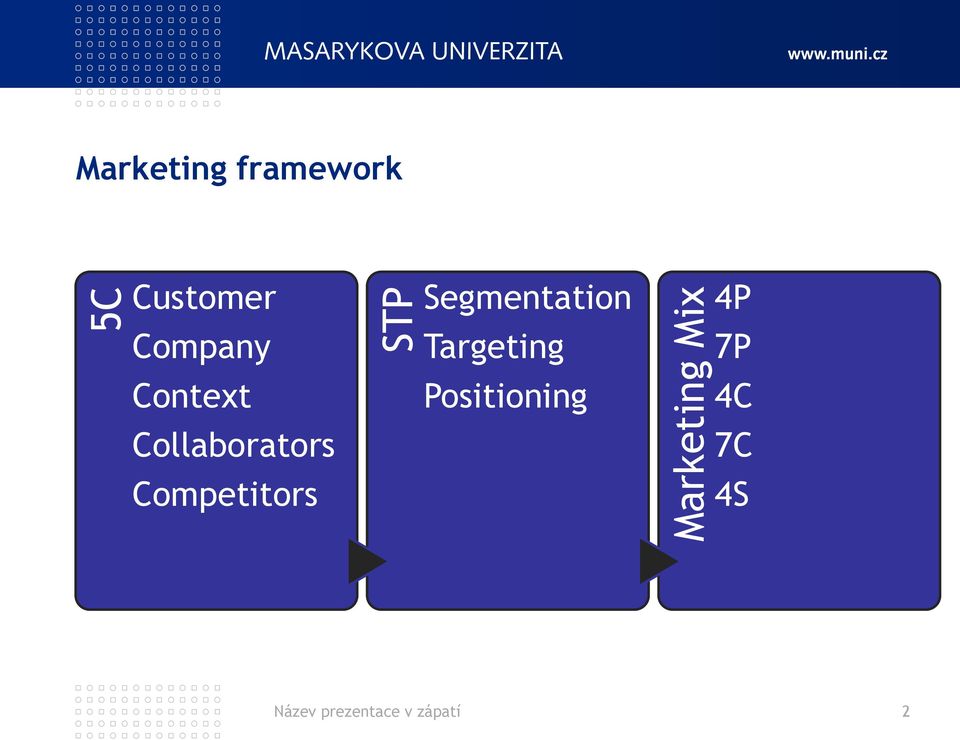
3 The STP Process Segmentation is the process of classifying customers into groups which share some common characteristic Targeting involves the process of evaluating each segments attractiveness and selecting one or more segments to enter Positioning is arranging for a product to occupy a clear, distinctive and desirable place relative to competing products in the mind of the consumer

4 Target Market A market is a set of all actual and potential buyers A target market is a group of people toward whom a firm markets its goods, services, or ideas with a strategy designed to satisfy their specific needs and preferences. Any marketing strategy must include a detailed (specific) description of this.

5 Advantages of Segmentation 1. The process of breaking up a homogeneous market into heterogeneous segments forces the marketer to analyse and consider both the needs of the market and the company s ability to competently serve those needs thereby making the company better informed about its customers 2. Competitor offerings and marketing positioning must also be analysed in this context so the company must consider what its competitive advantages and disadvantages are, helping it to clarify its own positioning strategy 3. Limited resources are used to best advantage, targeted at those segments that offer the best potential
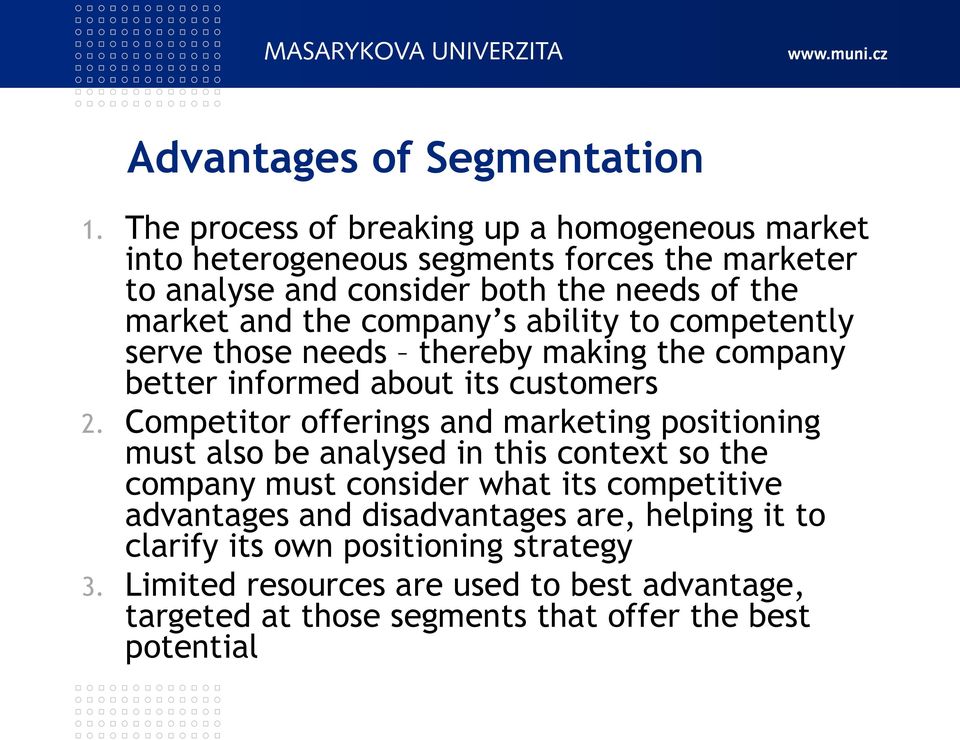
6 Requirements for Effective Segmentation Measurable Accessible Size, purchasing power, profiles of segments can be measured. Segments can be effectively reached and served. Substantial Segments are large or profitable enough to serve. Differential Segments must respond differently to different marketing mix elements & programs. Actionable Effective programs can be designed to attract and serve the segments.
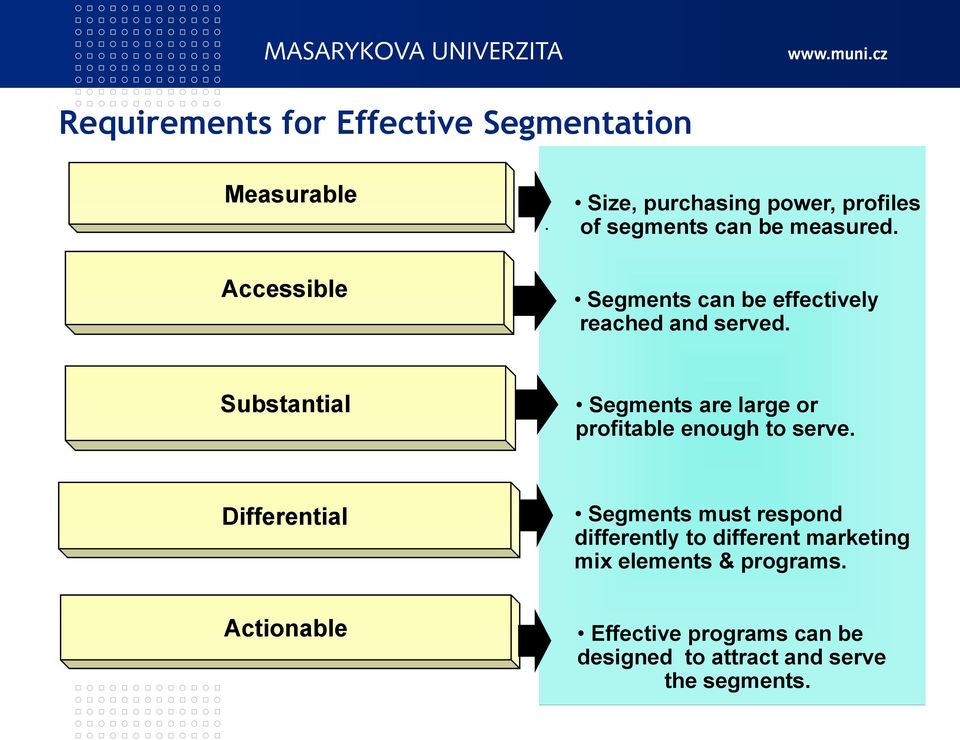
7 Steps in Segmentation, Targeting, and Positioning 4. Select Target Segment(s) 3. Develop Selection Criteria 6. Develop Marketing Mix for Each Target Segment 5. Develop Positioning for Each Target Segment Market Targeting Market Positioning 2. Develop Profiles of Resulting Segments 1. Identify Bases for Segmenting the Market Market Segmentation

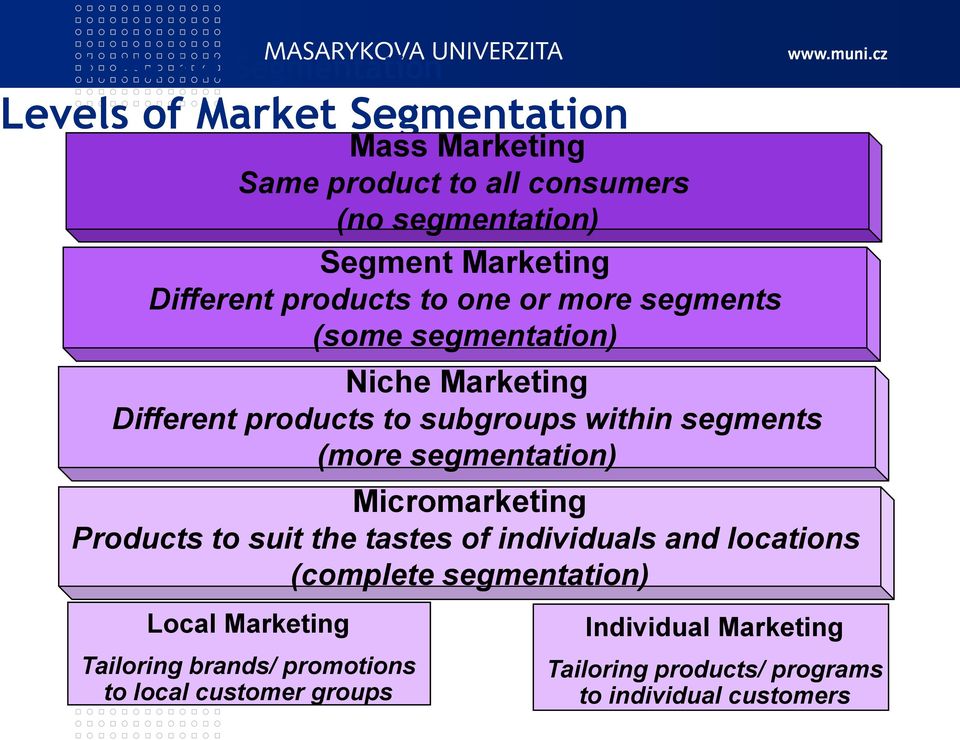
8 Step 1. Market Segmentation Levels of Market Segmentation Mass Marketing Same product to all consumers (no segmentation) Segment Marketing Different products to one or more segments (some segmentation) Niche Marketing Different products to subgroups within segments (more segmentation) Micromarketing Products to suit the tastes of individuals and locations (complete segmentation) Local Marketing Tailoring brands/ promotions to local customer groups Individual Marketing Tailoring products/ programs to individual customers
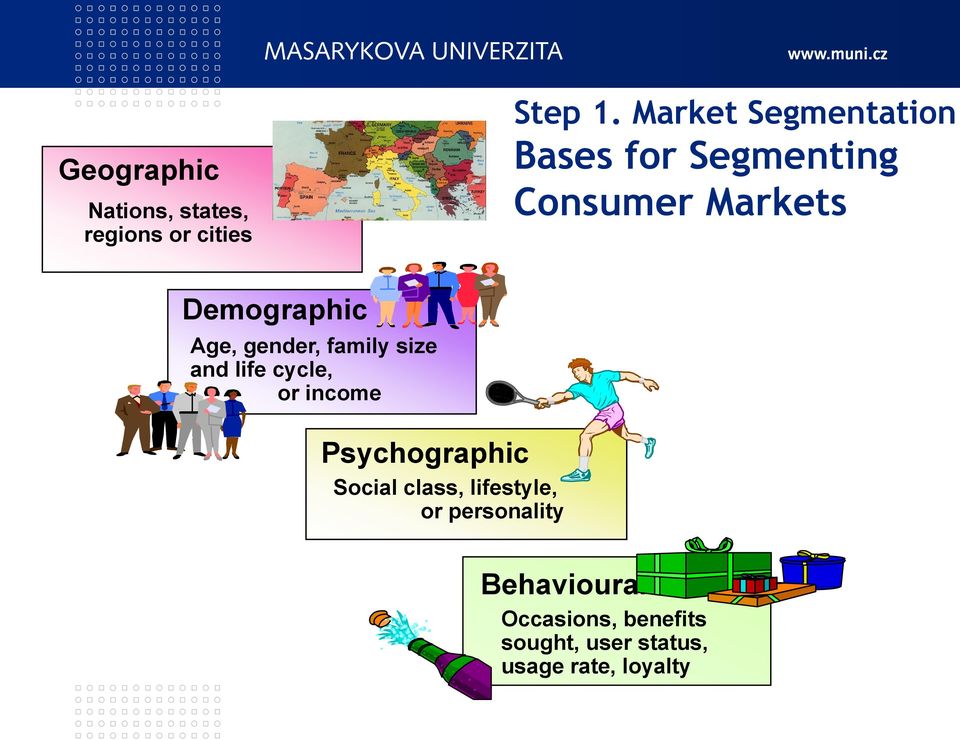
9 Geographic Nations, states, regions or cities Step 1. Market Segmentation Bases for Segmenting Consumer Markets Demographic Age, gender, family size and life cycle, or income Psychographic Social class, lifestyle, or personality Behavioural Occasions, benefits sought, user status, usage rate, loyalty
10 Step 1. Market Segmentation Bases for Segmenting Business Markets Personal Characteristics Demographics Situational Factors Bases for Segmenting Business Markets Operating Characteristics Purchasing Approaches

11 Segmenting Business Markets Segmentation by customer size or geographic location Four segments of business customers Programmed buyers Relationship buyers Transaction buyers Bargain hunters

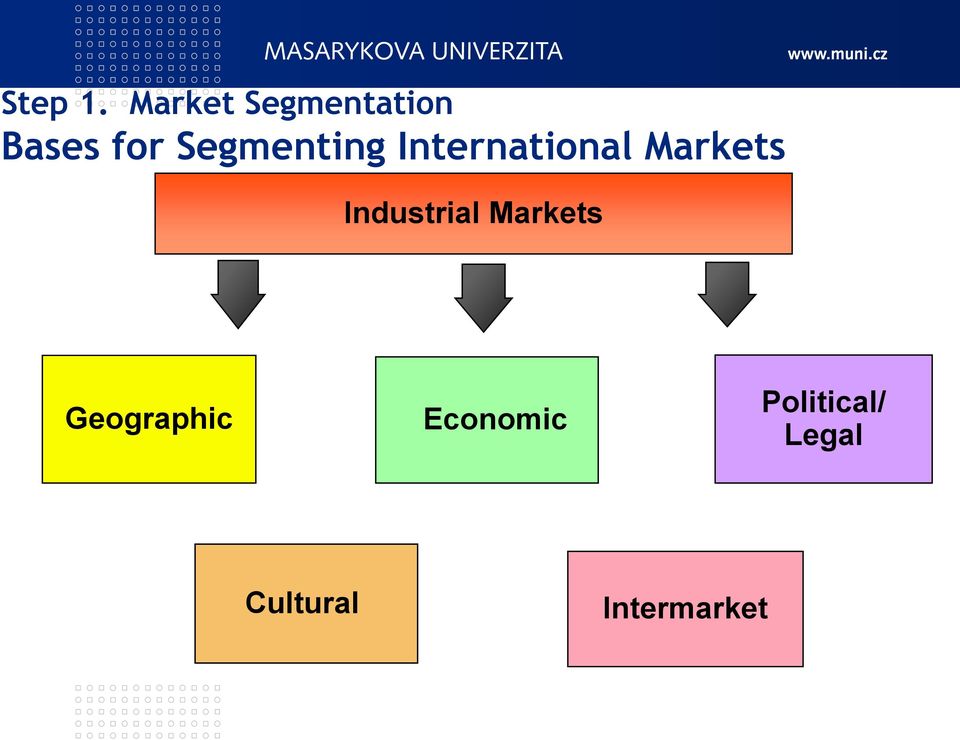
12 Step 1. Market Segmentation Bases for Segmenting International Markets Industrial Markets Geographic Economic Political/ Legal Cultural Intermarket
13 Step 2. Market Targeting Evaluating Market Segments (developing selection criteria) Segment Size and Growth Analyze sales, growth rates and expected profitability for various segments. Segment Structural Attractiveness Consider effects of: Competitors, Availability of Substitute Products and, the Power of Buyers & Suppliers. Company Objectives and Resources Company Objectives and Resources Company skills & resources relative to the segment(s). Look for Competitive Advantages.

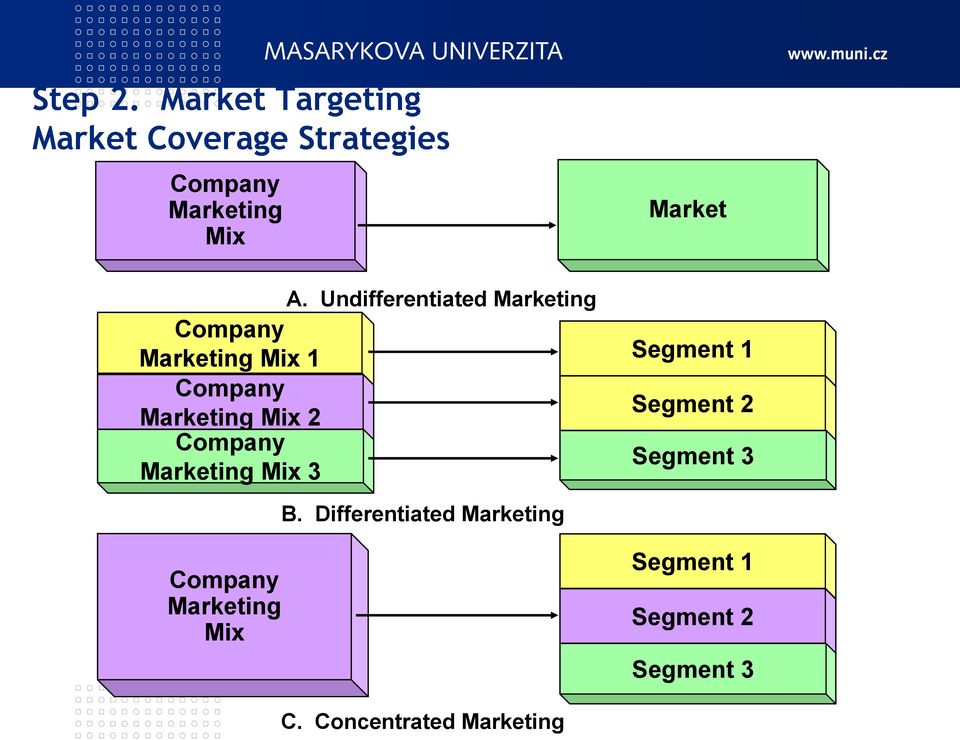
14 Step 2. Market Targeting Market Coverage Strategies Company Marketing Mix A. Undifferentiated Marketing Company Marketing Mix 1 Company Marketing Mix 2 Company Marketing Mix 3 Market Segment 1 Segment 2 Segment 3 B. Differentiated Marketing Company Marketing Mix Segment 1 Segment 2 Segment 3 C. Concentrated Marketing
15 Step 2. Market Targeting Choosing a Market-Coverage Strategy Company Resources Product Variability Product s Life-Cycle Stage Market Variability Competitors Marketing Strategies

16 Step 3. Positioning for Competitive Advantage Product s Position - the way the product is defined by consumers on important attributes - the place the product occupies in consumers minds relative to competing products. Marketers must: Plan positions to give their products the greatest advantage in selected target markets, Design marketing mixes to create these planned positions.

17 Step 3. Positioning for Competitive Advantage: Strategies Product Class Product Attributes Away from Competitors H G C Benefits Offered A Against a Competitor E B D F Usage Occasions User Class

18 Steps to Choosing and Implementing a Positioning Strategy Step 1. Identifying Possible Competitive Advantages: Competitive Differentiation. Step 2. Selecting the Right Competitive Advantage: Unique Selling Proposition (USP). Step 3. Communicating and Delivering the Chosen Position. Step 4. Support the positioning strategy with a unique marketing mix

19 Developing Competitive Differentiation Product Service Areas for Competitive Areas for Competitive Differentiation Image People

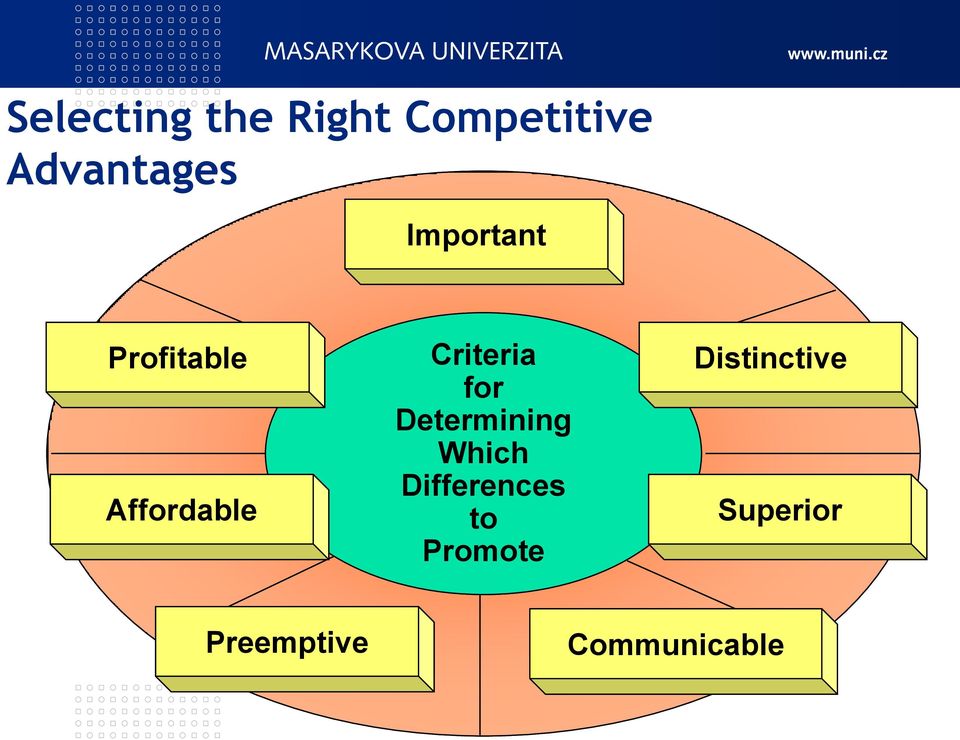
20 Selecting the Right Competitive Advantages Important Profitable Affordable Criteria for Determining Which Differences to Promote Distinctive Superior Preemptive Communicable
21 Step 4 Supporting the positioning strategy At this stage the company has decided on its positioning strategy and must now design a marketing mix to support this strategy. The next part of the course looks at Developing the Marketing Mix
Chapter Seven Customer-Driven Marketing Strategy: Creating Value for Target Customers
 Chapter Seven Customer-Driven Marketing Strategy: Creating Value for Target Customers Customer-Driven Marketing Strategy: Creating Value for Target Customers Market Segmentation Market Targeting Topic
Segmentation, Targeting, and Positioning
 Segmentation, Targeting, and Positioning What We Learn? Learn the three steps of target marketing, market segmentation, target marketing, and market positioning Understand the major bases for segmenting
Market Segmentation and Product Differentiation. What is Market Segmentation? Market Segmentation. Lectures in Marketing 2003 Dr.
 Segmentation and Product Differentiation Lectures in ing 2003 Dr. Richard Sjolander What is Segmentation? Consumers purchase products and services for the perceived satisfactions they can derive from their
Principles of Marketing
 Principles of Marketing 8-1 8-1 Session 8 Market Segmentation, Targeting and Positioning Text: Chapter 7 Outline 8-2 8-2 I. Stages in Market Orientation II. Segmenting Markets III. Market Targeting IV.
Trier 5. Segmentation and positioning
 Trier 5 Segmentation and positioning Previewing concepts (1) Define the steps in designing a customerdriven marketing strategy: market segmentation, market targeting, differentiation, and positioning (STP)
Master in Marketing and Communication. Module 7. Segmentation, Targeting, Differentiation and Positioning. Lecture 7- slide 1
 Master in Marketing and Communication Module 7 Segmentation, Targeting, Differentiation and Positioning. Lecture 7- slide 1 Customer-Driven Marketing Strategy: Creating Value for Target Customers Topic
Final Examination Semester 1 / Year 2010
 Southern College Kolej Selatan 南 方 学 院 Final Examination Semester 1 / Year 2010 COURSE : MARKETING PRINCIPLES AND PRACTICE COURSE CODE : ADAD 2062 TIME : 2 1/2 HOURS DEPARTMENT : ART AND DESIGN LECTURER
Marketing Management
 Marketing Management Theocharis Katranis Fall Semester 2014 1 Today s Lecture 1. We will discuss the competitive forces in a market 2. We will identify and analyse competitors 3. We will elaborate different
How To Understand Market Segmentation
 MODULE 3: MARKET SEGMENTATION AND POSITIONING Lecture - 5 FAQS (FREQUENTLY ASKED QUESTIONS): Ques 1 Ans 1 Define Market Segmentation Market segmentation is the process of identifying distinct groups and
Segmentasi, Target, dan Positioning
 Don t buy market share. Figure out how to earn it. Segmentasi, Target, dan Positioning Mata Kuliah: Pemasaran (TKI 4212) Target Marketing Target marketing requires marketers to take three major steps:
What this topic is about. The purpose of marketing Different approaches to marketing Segmentation Niche &mass markets B2C & B2B marketing
 Effective Marketing What this topic is about The purpose of marketing Different approaches to marketing Segmentation Niche &mass markets B2C & B2B marketing What is Marketing? The process of identifying,
Identifying Market Segments and Targets
 Chapter 7 Identifying Segments and Targets 7-1 ing Management Process 1. Situation Analysis Customer Analysis Competitor Analysis Company Analysis 2. Establish Strategic Direction Segmentation and Targeting
Barco Marketing Case Analysis
 Barco Marketing Case Analysis I. Position Statement: Over the past few months, many events have led Barco Projection Systems to be confronted with an important decision: Barco needs to continue its development
MARKETING SUMMARY Chapter 7 Target Marketing Strategies and CRM
 MARKETING SUMMARY Chapter 7 Target Marketing Strategies and CRM TARGET MARKETING STRATEGY: SELECT AND ENTER A MARKET Market fragmentation: The creation of many consumer groups due to a diversity of distinct
Marketing Plan Template
 1. Executive Summary (Done Last) Marketing Plan Template Keep in mind that not everyone will read every page of your marketing plan. Your executive summary should highlight the most important parts. It
1 Compiled by: Deep Banerjee, Marketingpundit.com (Market Segmentation)
 MARKET SEGMENTATION (Compiled by Deep Banerjee, Marketingpundit.com) Definition : The division of a market into different homogenous groups of consumers is known as Market Segmentation. Market segmentation
Marketing Research and Planning. Consumer Buying Process. Four Types of Buying Behavior. Decision Making Sets
 ing Research and Planning research: basic concepts and methods April 26, 2007 1 2 3 5 Selfactualization (self-development and and realization) 4 Esteem needs (self-esteem, recognition) Social needs (sense
The Role of Market Analysis in Developing Efficient Marketing Audit
 Abstract The Role of Market Analysis in Developing Efficient Marketing Audit Violeta Radulescu Lecture, PhD, Academy of Economic Studies, Bucharest E-mail: [email protected] Marketing Audit is an
Why Segmenting a Market?
 Segmentation & Targeting Segmentation is the process of dividing the market into consumer groups with similar needs and developing marketing programs that meet those needs. - The most successful firms
Market Segmentation. Chapter 8 Segmenting and Targeting Markets. Learning Outcomes. Learning Outcomes. Market Segmentation. A Market Is...
 Learning Outcomes Segmenting and Targeting Markets CHAPTER 8 Designed by Eric Brengle B-books, Ltd. Marketing 10 Lamb, Hair, McDaniel Prepared by Amit Shah Frostburg State University LO I LO 2 LO 3 Describe
Chapter 8 Identifying Market Segments and Targets
 Chapter 8 Identifying Market Segments and Targets 8-1 Key points for Chapter 8 1. Mass marketing 2. Micromarketing Segmentation marketing Niche marketing 3. Demographic segmentation 4. Psychographic segmentation
Know your market. How understanding local demographics can help you increase sales CHDC June 2013
 Know your market How understanding local demographics can help you increase sales CHDC June 2013 demographers.id informed decisions informed decisions.id is a company of demographers, housing analysts,
B203A Q. Week 9 Marketing Chapter 4 Chapter 6
 B203A Q. Week 9 Marketing Chapter 4 Chapter 6 Q1) Describe a major purchase that you have made on a proper example, and discuss the different stages of your consumer decisionmaking-process. A major part
Retail Marketing Strategy
 Chapter 5 Retail Marketing Strategy PPT McGraw-Hill/Irwin 5-1 Levy/Weitz: Retailing Management, 5/e Copyright 2004 by The McGraw-Hill Companies, Inc. All rights reserved. Elements in Retail Strategy Target
MARKET SEGMENTATION: A CONCEPTUAL FRAMEWORK
 Jasmer Singh International Journal of Advanced Research in MARKET SEGMENTATION: A CONCEPTUAL FRAMEWORK Abstract: The more a marketing paradigm evolves, the more long-term relationship with customers gains
Key Terms. DECA Ryerson 2015-16 Case Guides Business to Business Marketing
 Key Terms Acquisition Costs: The incremental costs involved in obtaining a new customer. Agent: A business entity that negotiates, purchases, and/or sells, but does not take title to the goods. Benchmark:
SWOT analysis can be used for:
 SWOT ANALAYSIS For business it is important to know your surrounding environment from internal and external point of view. Therefore it is important to evaluate environment opportunities in relation to
CHAPTER THREE Market Segmentation and Strategic Targeting
 CHAPTER THREE Market Segmentation and Strategic Targeting Copyright 2010 Pearson Education, Inc. Learning Objectives 1. To Understand Why Market Segmentation Is Essential. 2. To Understand the Criteria
MARKET SEGMENTATION TARGETING POSITIONING
 MARKET SEGMENTATION TARGETING POSITIONING Ch. 8 KOTLER, BOWEN, AND MAKENS. MARKETING FOR HOSPITALITY AND TOURISM. 6E. PEARSON HIGHER EDUCATION. 2014 MARKET SEGMENTATION Dividing a market into distinct
Strategies for Marketing, Sales, and Promotion
 Introduction to e-commerce Strategies for Marketing, Sales, and Promotion Objectives In this chapter, you will learn about: When to use product-based and customer-based marketing strategies Communicating
Modern Marketing = STP Marketing
 Market Segmentation and Targeting Target Marketing Segmentation is about identifying Targeting is about selecting Market Segmentation Positioning is about differentiating and communicating Modern Marketing
Marketing (Marketing Principles)
 Marketing (Marketing Principles) Main Aim(s) of the Unit: To provide students with a foundation for the analysis of marketing within organizations including decision making processes, segmentation, the
Market Segmentation. - A framework for determining the right target customers. BA-thesis May 2010
 Market Segmentation - A framework for determining the right target customers BA-thesis May 2010 By Nynne Larsen Supervisor: Mariette Ulbæk Aarhus School of Business Table of contents 1. Summary... 1 2.
CHAPTER. Market Research. Research? Section What Is Your Competitive Advantage?
 CHAPTER Market Research Section Research? What Is Market Section What Is Your Competitive Advantage? SECTION What Is Market Research? OBJECTIVES Explain why market research is important Consider important
SECTION A Consists of a separate multiple choice paper. Each question is worth one mark. Attempt all 25 questions.
 Foundations of Marketing: B1072: 2012/13 Exam Paper This examination is in TWO sections. SECTION A Consists of a separate multiple choice paper. Each question is worth one mark. Attempt all 25 questions.
Industrial Market Segmentation, Targeting & Positioning
 Industrial Market Segmentation, Targeting & Positioning Objectives is to help understand: 1. The meaning & rationale of and requirements for market segmentation 2. Types of criteria for industrial market
the combination of varying methods and strategies to get your into the minds and hands of prospective buyers. Marketing is
 Marketing for Growth Wayne Brass Art Mahoney Bill McKown Heather Bender the combination of varying methods and strategies to get your product or service into the minds and hands of prospective buyers.
MARK 3323 - IMC Dr. Freling EXAM II REVIEW
 MARK 3323 - IMC Dr. Freling EXAM II REVIEW Chapter 5 Advertising, Integrated Brand Promotion, & Consumer Behavior Chapter 6 Market Segmentation, Positioning, and the Value Proposition Chapter 7 Advertising
Advanced Diploma in Purchasing and Supply. Marketing for Purchasers. L5-10/May-08 LEVEL 5 MARKING SCHEME. May 2008. Carrington
 Advanced Diploma in Purchasing and Supply Marketing for Purchasers L5-10/May-08 LEVEL 5 MARKING SCHEME May 2008 Carrington SECTION A Q1 to test candidates knowledge and understanding of the marketing mix
Chapter 2 Market Structure, Types and Segmentation
 Market Structure There are a variety of differing market structures which are separated by the levels of competition that exist within each market and the market conditions in which the businesses operate.
U32803: Develop direct marketing plans PERFORMANCE CRITERIA. Unit Descriptor: Develop direct marketing plans
 U32803: Unit Descriptor: This unit is about developing direct marketing plans and associated budgets. It includes establishing and coordinating the messages to be communicated, agreeing the direct marketing
Marketing Plan Development 101: The Importance of Developing a Marketing Plan for Public Transit Agencies & Commuter Assistance Programs
 Marketing Plan Development 101: The Importance of Developing a Marketing Plan for Public Transit Agencies & Commuter Assistance Programs Mark Glein, PhD, Marketing Florida State University Marketing Plan
CHAPTER TWO SEGMENTING THE MARKET
 CHAPTER TWO SEGMENTING THE MARKET The Marketing Mixes 45 When marketers break the marketplace into separate target markets, they are segmenting the market, and each segment must meet four criteria in order
Chapter 11: Campaign Management
 Chapter 11: Campaign Management Overview Topics discussed: Campaign Management Process Campaign Planning and Development Campaign Execution Analysis & Control Campaign Feedback 2 Campaign A series of interconnected
MBA I Year Examination. MP-106 : Marketing Management. Time: 3 Hours Max. Marks: 80
 MBA I Year Examination MP-106 : Marketing Management Time: 3 Hours Max. Marks: 80 Note: The question paper is divided into three sections A, B & C. Write Answers as per the given instructions. Section
HOW TO USE NEEDS BASED CUSTOMER SEGMENTATION IMPROVE YOUR MARKETING AND SOCIAL MEDIA STRATEGY
 HOW TO USE NEEDS BASED CUSTOMER SEGMENTATION IMPROVE YOUR MARKETING AND SOCIAL MEDIA STRATEGY A publication of London, September 2012 HOW TO USE NEEDS BASED CUSTOMER SEGMENTATION by Michalis A. Michael
Diploma in Marketing
 Brentwood Open Learning College Diploma in Marketing (Level 4) Course Structure & Contents Diploma in Marketing Course Structure Contents Page 1 Unit 1 to Marketing The unit 1 covers the following topics:
Chapter 3: Using Databases
 Chapter 3: Using Databases Overview Topics discussed: Types of databases Categorization based on information in the databases Categorization based on the nature of the underlying marketing activities Categorization
THE COMPETITIVE ADVANTAGE THEORY AS A GROWTH STRATEGY
 THE COMPETITIVE ADVANTAGE THEORY AS A GROWTH STRATEGY Management Marketing - Tourism Ec. Ecaterina Nicoleta Ciurez Ph.D University of Craiova, Faculty of Economics and Business Administration, Craiova,
Bingo glossary marketing mix
 Bingo glossary marketing mix The management process which identifies customer wants, anticipates their future wants and then goes about satisfying them profitably. Where the market has been divided up
4. What are the requirements for effective. Kotler, Keller, Ang, Leong & Tan 8-3. Kotler, Keller, Ang, Leong & Tan 8-5
 Chapter 8 In this chapter, we address the following questions: IDENTIFYING Market Segments & Targets 8-1 1. What are the different levels of market segmentation? 2. How can a company divide a market into
Market Research. Module 2. Driving Revenue with an Optimal Marketing Strategy Solutions. Advancing Your Success.
 Market Research Module 2 Driving Revenue with an Optimal Marketing Strategy Solutions Advancing Your Success. The Roles and Steps in Market Research 2 The scientific process of planning, collecting and
CHAPTER. Market Research. Section 7.1 What Is Market Research? Section 7.2 What Is Your Competitive Advantage?
 CHAPTER Market Research Section 7.1 What Is Market Research? Section 7.2 What Is Your Competitive Advantage? SECTION What Is Market Research? OBJECTIVES Explain why market research is important Consider
Unit 4: Marketing Principles
 Unit 4: Marketing Principles Unit code: F/601/0556 QCF level: 4 Credit value: 15 credits Aim This unit aims to provide learners with understanding and skills relating to the fundamental concepts and principles
Loyalty to service provision: creating loyalty through the customer experience
 Loyalty to service provision: creating loyalty through the customer experience WWW.SBS.OXFORD.EDU EDUCATING LEADERS FOR 800 YEARS Dr Richard Cuthbertson Research Director Oxford Institute of Retail Management
Pantene myshampoo Marketing Management Project
 SOCIAL SCIENCES INSTITUTE MBA PROGRAMME Pantene myshampoo Marketing Management Project Mehmet Nuri ÇANKAYA June, 2003 Table of Contents Selection Of The Product... 3 Market Segments and Target Markets...
Divide and Rule. Marketing. Dr. Paurav Shukla 1. Segmentation, Targeting, Positioning & Marketing Mix. STP framework. Why segmentation?
 Divide and Rule Segmentation, Targeting, Positioning & Marketing Mix Dr. Paurav Shukla STP framework 3 Why segmentation? 4 1. Better matching of customer needs 2. Enhanced profits 3. Enhanced opportunity
Marketing: Promotion Basics
 Name: Class: Date Taken: Total Possible Marks: 39 Marketing: Promotion Basics Complete the following questions in the time allowed by your teacher Write a short, accurate definition for each of the following
Contents. Part- I: Introduction to Services Marketing. Chapter 1 Understanding Services 3-22. Chapter 2 The Nature of Services Marketing 23-38
 Contents Part- I: Introduction to Services Marketing Chapter 1 Understanding Services 3-22 Chapter 2 The Nature of Services Marketing 23-38 Part- II: The Customer Experience Chapter 3 Consumer Behavior
Advertising and Marketing Overview Part 1. Learning Objectives. Business has only two functions - marketing and innovation. Milan Kundera 2/20/15
 Advertising and Marketing Overview Part 1 Paul A Kiewiet MAS+ Learning Objectives Pt 1 focuses on Overview Pt.2 on Promotional Products role The 4 P s + 1 Marketing Advertising Branding Differences between
WSTiE. Marketing in Tourism
 WSTiE Marketing in Tourism dr Anna Sobczyk-Kolbuch AGENDA 1. Marketing the essence and features. Clasical and modern concepts of marketing 2. Evolution of enterprises` activities on the market the origin
Case Interview - Frameworks
 WWW.MCONSULTINGPREP.COM Case Interview - Frameworks For more free and detailed materials on Management Consulting Preparation, visit www.mconsultingprep.com 2014 MConsultingPrep, Inc. COMPLETE FRAMEWORKS
Segmentation, Targeting & Positioning
 Segmentation, Targeting & Positioning Prof. John Fahy, University of Limerick What Are You Going to Learn Today? What is meant by the core ideas of segmentation, targeting and positioning? What is Market
Chapter 3 MARKETING STRATEGY FOR SMALL BUSINESS: CONCEPTUAL FOUNDATIONS
 Chapter 3 MARKETING STRATEGY FOR SMALL BUSINESS: CONCEPTUAL FOUNDATIONS The two key marketing concepts: Segmentation and Product Differentiation At the root of strategic marketing are two concepts, segmentation
4 Explain t he. 7 geographic, domestic, and psychographic approaches t o 8 segment ing consumer market s. 5
 CHAPTER 9 Market ing Segment at ion, Target ing, and Posit ioning Chapter Objectives 1 2 3 Ident ify t he essent ial components of a market. Out line t he role of market segment at ion in developing a
MARKETING STRATEGY TEMPLATE
 MARKETING STRATEGY TEMPLATE START-UP ORGANISATION, PRODUCT OR SERVICE 1 Executive Summary rundown of what s in the document (often completed last) Purpose Use this template to capture the key information
High Performance Eng 9 Overview of Marketing
 High Performance Eng 9 Overview of Marketing Definition: Marketing is the performance of business activities that direct the flow of goods and services from producer to consumer or user in order to satisfy
Optimeyes: Case Study Notes
 Optimeyes: Case Study Notes Synopsis One of the strengths of this case is the breadth of the business and marketing issues it encompasses, while still allowing the opportunity for a rigorous analysis of
University of Greenwich Graduate Internship Programme. Welcome Jerry Allen
 University of Greenwich Graduate Internship Programme Welcome Jerry Allen th Monday 5 November AdministraAon IntroducAon unal 12.30 12.30-1.30 lunch 1.30-4.30 CompeAtor Analysis AdministraAon Passport/ID
MODULE 1. Segmentation,Targeting and Positioning
 MODULE 1 Segmentation,Targeting and Positioning Segmentation, Targeting and Positioning Definitions Segmentation Variables Evaluation of Segments Summary What is segmentation, anyone? What about targeting
MODULE TITLE: Foundations of Marketing
 SCHOOL OF ARTS, SOCIAL SCIENCES AND MANAGEMENT DIVISION OF BUSINESS, ENTERPRISE AND MANAGEMENT LEVEL 1 DIET 1 MODULE CODE: B1072 MODULE TITLE: Foundations of Marketing DATE: 16/12/2014 WRITING TIME: 2
CUSTOMER RELATIONSHIP MANAGEMENT CONCEPTS AND TECHNOLOGIES
 CUSTOMER RELATIONSHIP MANAGEMENT CONCEPTS AND TECHNOLOGIES Chapter 1: Introduction to CRM Selected definitions of CRM 1 CRM is an information industry term for methodologies, software, and usually Internet
Learning Objectives: Quick answer key: Question # Multiple Choice True/False
 0 Learning Objectives: 11.1 Describe the advantages and disadvantages of the most common forms of business ownership. 11.2 Identify the stakeholders of a business and describe why they are important. 11.3
Get Better Business Results
 Get Better Business Results From the Four Stages of Your Customer Lifecycle Stage 2 Service A white paper from Identify Unique Needs and Opportunities at Each Lifecycle Stage Each stage in the customer
Assessment Vocabulary Strategies. Advertiser. Describe three types of positions typically found in an advertising agency.
 What is Advertising (1-2 days) (1) The student knows business concepts and explains how business satisfies economic needs. The student is expected to: (A) Categorize business activities as production,
UNDERSTANDING INTERNAL AND EXTERNAL ENVIRONMENT FOR A FLEXIBLE PRODUCTION APPROACH
 UNDERSTANDING INTERNAL AND EXTERNAL ENVIRONMENT FOR A FLEXIBLE PRODUCTION APPROACH Cătălin Cristian BABALÂC The Bucharest University of Economic Studies, Bucharest, Romania [email protected] Abstract
MARKETING INTERMEDIATE LEVEL
 Syllabus MARKETING INTERMEDIATE LEVEL Proposed for examinations sessions starting May 2017 INTERMEDIATE Level, Marketing, MATSEC 1 Syllabus objectives The syllabus is intended to encourage candidates to:
Marketing: Helping Buyers Buy
 Chapter Thirteen Marketing: Helping Buyers Buy McGraw-Hill/Irwin Copyright 2010 by the McGraw-Hill Companies, Inc. All rights reserved. CRICKET LEE Fitlogic Developed a system of clothes sizing called
Marketing Strategy & Positioning. Competitive Environment
 Marketing Strategy & Positioning Chuck Felder MBA, PT, SCS, ATC Competitive Environment Direct competitors PT clinics POPT clinics Chiropractors? Personal trainers? Dance studios? Massage therapists? 2
Exploratory Research Design: Secondary Data
 1) Overview 2) Primary versus 3) Advantages & Uses of 4) Disadvantages of 5) Criteria for Evaluating 6) Classification of 7) Internal 8) Published External Secondary Sources 9) Computerized Databases 10)
Making business simple...
 Making business simple... Introduction 2 Contents Every business needs a Marketing Plan. This guide has been created to assist you in putting your Marketing Plan together. This guide will help you to indicate
Best Practices for Relationship Marketing
 WebTrends 851 SW 6th Ave., Suite 600 Portland, OR 97204 1.503.294.7025 1.503.294.7130 fax US Toll Free 1-877-WebTrends (1-877-932-8736) WebTrends Sales 1.888.932.8736 [email protected] Europe, Middle
INFO1400. Define an organization and compare the technical definition of organizations with the behavioral definition.
 Chapter 3 INFO1400 Review Questions 1. Which features of organizations do managers need to know about to build and use information systems successfully? What is the impact of information systems on organizations?
The First 90 Days: Differentiated Experiences That Combat Churn and Reduce Care Costs
 The First 90 Days: Differentiated Experiences That Combat Churn and Reduce Care Costs An Executive Brief for Telecommunications Leaders December 2012 Introduction The telecommunications industry is characterized
Chapter 6. E-commerce Marketing Concepts. Copyright 2009 Pearson Education, Inc. Slide 6-1
 Chapter 6 E-commerce Marketing Concepts Copyright 2009 Pearson Education, Inc. Slide 6-1 The Revolution in Internet Marketing Technologies Three broad impacts: Scope of marketing communications broadened
Blackblot PMTK Marketing Review. <Comment: Replace the Blackblot logo with your company logo.>
 Company Name: Product Name: Date: Contact: Department: Location: Email: Telephone: Blackblot PMTK Marketing Review Document Revision History:
Segmentation, Targeting, Positioning in Financial Services Markets
 Athens University of Economics and Business Segmentation, Targeting, Positioning in Financial Services Markets Paulina Papastathopoulou, Ph.D. Lecturer in Marketing Department of Marketing and Communications
Analytical CRM solution for Banking industry
 Analytical CRM solution for Banking industry Harbinger TechAxes PVT. LTD. 2005 Insights about What are the reasons and freq. for a customer contact? What are my product holding patterns? Which of my are
Course Outline. BUSN 5050/1-3 Marketing Management (3,0,0)
 Course Outline Department of Marketing, International Business, Entrepreneurship School of Business and Economics BUSN 5050/1-3 Marketing Management (3,0,0) Calendar Description Students examine the key
Effective Marketing Solutions for your Small Business
 COMMUNITY TECHNOLOGY CENTER PASSAIC COUNTY COMMUNITY COLLEGE Teacher: Lucia Gheorghiu Effective Marketing Solutions for your Small Business Ideas for Today and Tomorrow Dr. Lucia Gheorghiu 1 Effective
Professor: Dr. Mary Flannery Teaching Assistant: Jia-Yuh Chen ECON 136 Business Strategy February 27, 2006
 CASE STUDY Professor: Dr. Mary Flannery Teaching Assistant: Jia-Yuh Chen ECON 136 Business Strategy February 27, 2006 INDUSTRY ANALYSIS The retail industry is dominated by few retail giants, with Wal-Mart
Existing Analytical Market Assessment Tools - Definitions
 Existing Analytical Market Assessment Tools - Definitions November, 2003 This list of market assessment tools was prepared by Development Alternatives Inc. (DAI) as an internal working document to support
Cross Sell. Unlocking the value from your customer relationships. < PREVIOUS NEXT > CLOSE x PRINT. Visit our website: www.lbm.co.
 Unlocking the value from your customer relationships < PREVIOUS NEXT > CLOSE x PRINT Call us: 0161 616 Call 0599 us: 0161 616 0599 When cross and up-selling to your customers you tread a fine-line. Get