
Andover Continuum web.client Planning and Installation Guide for Version 1.92
|
|
|
- Gabriel Pearson
- 10 years ago
- Views:
Transcription
1 Andover Continuum web.client Planning and Installation Guide for Version 1.92

2 2010, Schneider Electric All Rights Reserved No part of this publication may be reproduced, read or stored in a retrieval system, or transmitted, in any form or by any means, electronic, mechanical, photocopying, recording, or otherwise, without prior written permission of Schneider Electric. This document is produced in the United States of America. Andover Plain English TM is a trademark of Schneider Electric. Andover Infinet TM is a trademark of Schneider Electric. All other trademarks are the property of their respective owners. Title: Andover Continuum web.client Planning and Installation Guide web.client Version 1.92 Date: December, 2010 Schneider Electric part number: The information in this document is furnished for informational purposes only, is subject to change without notice, and should not be construed as a commitment by Schneider Electric. Schneider Electric assumes no liability for any errors or inaccuracies that may appear in this document. On October 1st, 2009, TAC became the Buildings Business of its parent company Schneider Electric. This document reflects the visual identity of Schneider Electric. However, there remain references to TAC as a corporate brand throughout the Andover Continuum software. In those instances, the documentation text still refers to TAC only to portray the user interface accurately. As the software is updated, these documentation references will be changed to reflect appropriate brand and software changes. All brand names, trademarks and registered marks are the property of their respective owners. Schneider Electric One High Street North Andover, MA (978) Fax: (978)

3 Andover Continuum web.client Planning and Installation Guide Version 1.92 December, 2010
4

5 Contents About this Manual... 9 What s in this Manual... 9 Revision History Related Documentation Symbols Used Chapter 1 Introduction to web.client Overview web.client Overview web.client User Documentation A Typical System before web.client A Typical System Implementing web.client Differences between web.client and CyberStation Chapter 2 System and Pre-Installation Requirements web.client Setup Configurations Hardware and Software Requirements for LAN System Hardware and Software Requirements for a Standalone System 27 Pre-Installation Microsoft Tasks Installing System Software NET Framework Installing IIS on Windows Server Installing IIS on Windows XP and Windows Server Registering File Extensions for Windows Server Configuring IIS for Windows Vista Registering File Extensions for Windows Server 2008 and Windows Vista SSL Considerations for the IIS PC Andover Continuum web.client Planning and Installation Guide 5
6 Changing the Default TCP Web Port Number for the IIS PC Disabling WinSock Proxy Client on Standalone System. 48 Ensuring a Domain Membership Is Selected Avoiding Invalid Characters in a Server Name Disabling Windows Firewall Disabling Automatic Windows Updates Chapter 3 Installing and Configuring web.client on the IIS PC Overview Installing web.client on the IIS PC Creating and Initializing the Database on a Standalone IIS PC Adding web.client to an Existing Standalone Database. 66 Initializing the Database on a LAN IIS PC web.client Video System Upgrades Routing Alarms to the IIS PC on a LAN System Configuring Access Permissions for web.client Users Configuring Your Video Servers Configuring Graphics Folders for web.client: Windows XP and Windows Server Specifying a Local Folder as a Web Address Specifying a Network Folder as a Web Address Verifying Anonymous Access to Virtual Folders Configuring Graphics Folders for web.client: Windows Vista. 81 Setting Up an Application for Graphics on Windows Vista 81 Giving Everyone Access to Graphics Files on Windows Vista Establishing Pinpoint Folders Configuring DCOM Default Security Settings Configuring Default Launch and Access Permissions Disabling HTTP Keep-Alives Resetting Timeout and Live Events Via web.config File Inactivity Timeout Live EventView Establishing SSL Support for Confidential Information Using SSL Online Documentation Changing IE Security Internet Options to Accommodate SSL Enabling SSL for web.client Schneider Electric

7 Setting Up SSL for web.client Pinpoint Changing the Default TCP Port Number Chapter 4 Testing and Installing web.client on a Client PC Overview Testing Access to and Installing web.client on a Client PC Before Getting Started Launching Internet Explorer in Windows Vista Installing the web.client Utilities Control Installing Microsoft.NET Framework Installing web.client Pinpoint If your IIS PC Uses IIS 6.0 and Windows Server Installing the Video Layout Control and.net Framework Setting Browser Zone Permissions for.net Framework 108 Download and Install.NET Framework SDK Run the Microsoft Code Access Security Policy Tool. 109 Server Proxy Applications Logging Out of web.client Chapter 5 Using web.client to Set Up Your Organization Overview Example: Building a Security Management System web.client Security Basics Testing web.client Security Scenario 1: A Single-Building Company How Is the Company Physically Divided? Who Are the Users? What Are the Security Levels? Setting Up web.client in CyberStation Scenario 2: A Global Company What Are the Company Personnel Groups? Where Are the Company Facilities Located? Who Are the Users? What Are the Security Levels? Setting Up web.client in CyberStation Andover Continuum web.client Planning and Installation Guide 7

8 Appendix A web.client Security and Troubleshooting Tips Tips Tip 1 - Ensuring Full System Access for at Least One User Tip 2 - Placing PIM Files in a Single Folder Tip 3 - Applying Security to non-web.client Folders 127 Tip 4 - Verifying DCOM Is Enabled Tip 5 - Enabling the Default Document Tip 6 - Understanding Security Ramifications for IIS Applications Tip 7 - Be Sure that IIS Is Installed before.net Framework Tip 8 - Changing IIS / Windows Server 2003 Resource Recycle Time Appendix B web.client Applications that Are Installed Installed Applications Appendix C Guidelines for Upgrading to Version Upgrade Guidelines Appendix D SQL Express Installation Error Messages Overview SQL Express Installation Error Messages Schneider Electric
9 About this Manual What s in this Manual Introduction to web.client System and Pre-Installation Requirements Installing and Configuring web.client on the IIS PC Testing and Installing web.client on a Client PC Using web.client to Set Up Your Organization web.client Security and Troubleshooting Tips web.client Applications that Are Installed Guidelines for Upgrading to Version 1.92 SQL Express Installation Error Messages Andover Continuum web.client Planning and Installation Guide 9
10 About this Manual Revision History This manual documents web.client, Version Revision History Document Revision Software Version Date December, February, August, January, June, December, August, January, May, December, March, August, December, October, 2002 Related Documentation For additional or related information, refer to these documents. Related Documents Document Document Number Andover Continuum CyberStation Installation Guide CyberStation Access Control Essentials Guide CyberStation HVAC Essentials Guide web.client online help (Version 1.92) 10 Schneider Electric

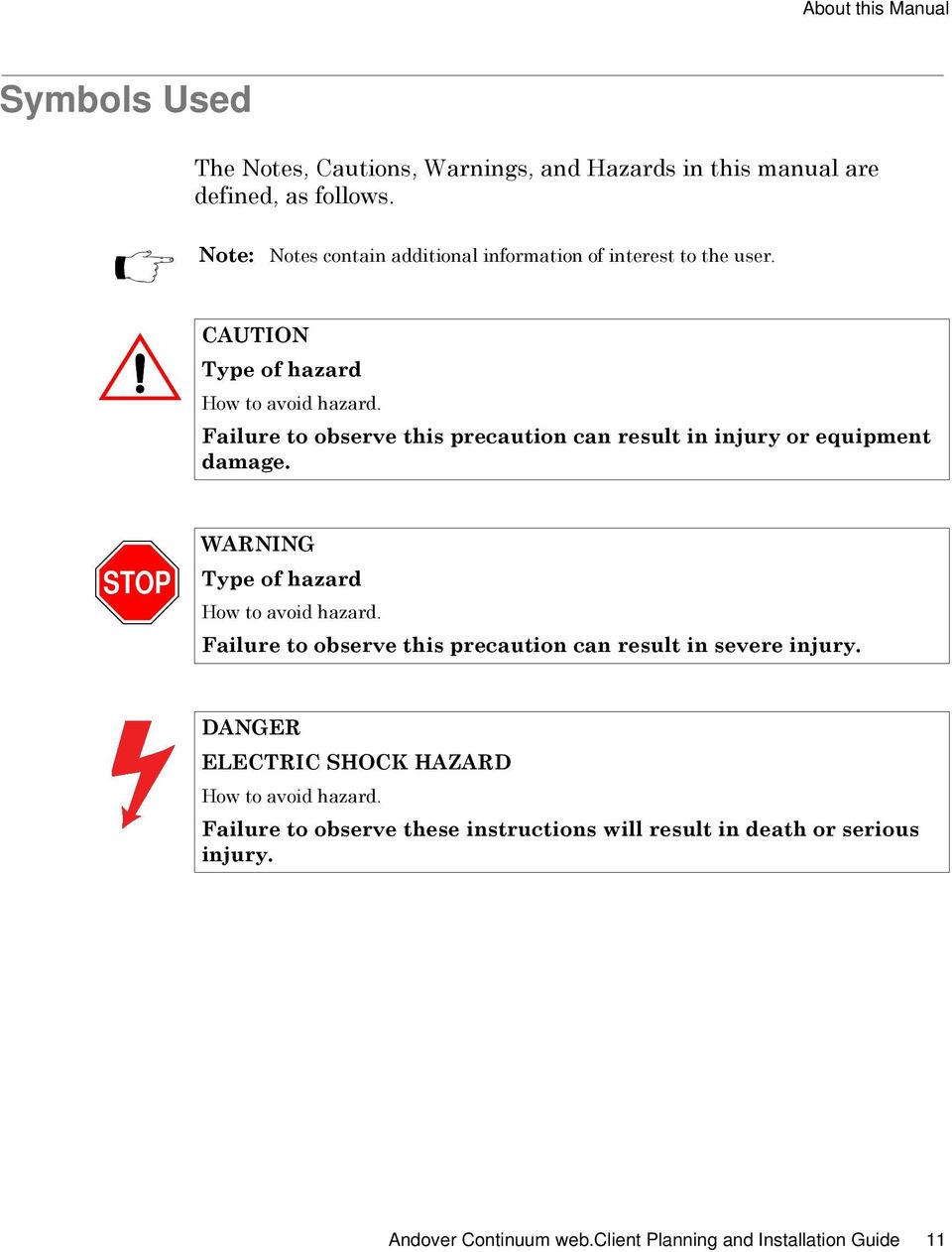
11 About this Manual Symbols Used The Notes, Cautions, Warnings, and Hazards in this manual are defined, as follows. Note: Notes contain additional information of interest to the user. CAUTION Type of hazard How to avoid hazard. Failure to observe this precaution can result in injury or equipment damage. WARNING Type of hazard How to avoid hazard. Failure to observe this precaution can result in severe injury. DANGER ELECTRIC SHOCK HAZARD How to avoid hazard. Failure to observe these instructions will result in death or serious injury. Andover Continuum web.client Planning and Installation Guide 11
12 About this Manual 12 Schneider Electric

13 Chapter 1 Introduction to web.client This chapter contains the following topics: web.client Overview web.client User Documentation A Typical System before web.client A Typical System Implementing web.client Differences between web.client and CyberStation Andover Continuum web.client Planning and Installation Guide 13
14 Chapter 1: Introduction to web.client Overview This manual provides you, the system administrator, with general information for planning, installing, and configuring your Andover Continuum web.client system, version CAUTION This manual is for system administrators. To use the installation and setup procedures in this manual you must be a system administrator with experience in setting up a web server. You must also have experience using Microsoft system software and understand that there are graphical user-interface differences between the different Windows platforms. For detailed information about Microsoft software, please see your Microsoft Windows online help and visit and other Microsoft web sites. Failure to observe this precaution can result in incorrect system configuration. Note: The procedures in this manual presume you and your users are installing or upgrading to web.client version You must meet the software and hardware requirements compatible with version Refer to Chapter 2, System and Pre-Installation Requirements. web.client Overview web.client is an application that provides you with web-enabled access everywhere, all the time. By using a standard browser, your authorized personnel can access the Continuum facility management system in real time across your site s local area network (LAN) or across your wide-area network (WAN). web.client is either added to a LAN Andover Continuum CyberStation system or installed with a standalone CyberStation on a single PC. With the basic web.client Personnel Manager option, your users can: Create, search for, edit, and delete personnel records Change employee access privileges View a person s access events 14 Schneider Electric
15 Chapter 1: Introduction to web.client View and generate reports of all access events, including area access events, access events by persons, and distribution-event transactions via the Access Distribution View Edit and view schedules and calendars. Change a password. With the advanced web.client Pro option, your users have all the features of the basic web.client Personnel Manager option as well as the following additional features: Create, run, and view graphical reports (class object Report), including bar charts, pie charts, trend charts, text reports, and so on. List and view graphics and groups View live system alarms and live events View live video, as well as search for and view recorded video, via the class object, VideoLayout. Search for web.client objects by exploring a folder tree hierarchy or a network/device tree hierarchy, or by using a text search engine Edit and view Loops and TrendLogs. For complete information about any of these features, please see the web.client online help. web.client User Documentation Extensive online help is available within the web.client application browser window. Click the question mark button. This button appears at the top of every web.client screen. The online help covers all of the major features in the web.client user interface. Andover Continuum web.client Planning and Installation Guide 15
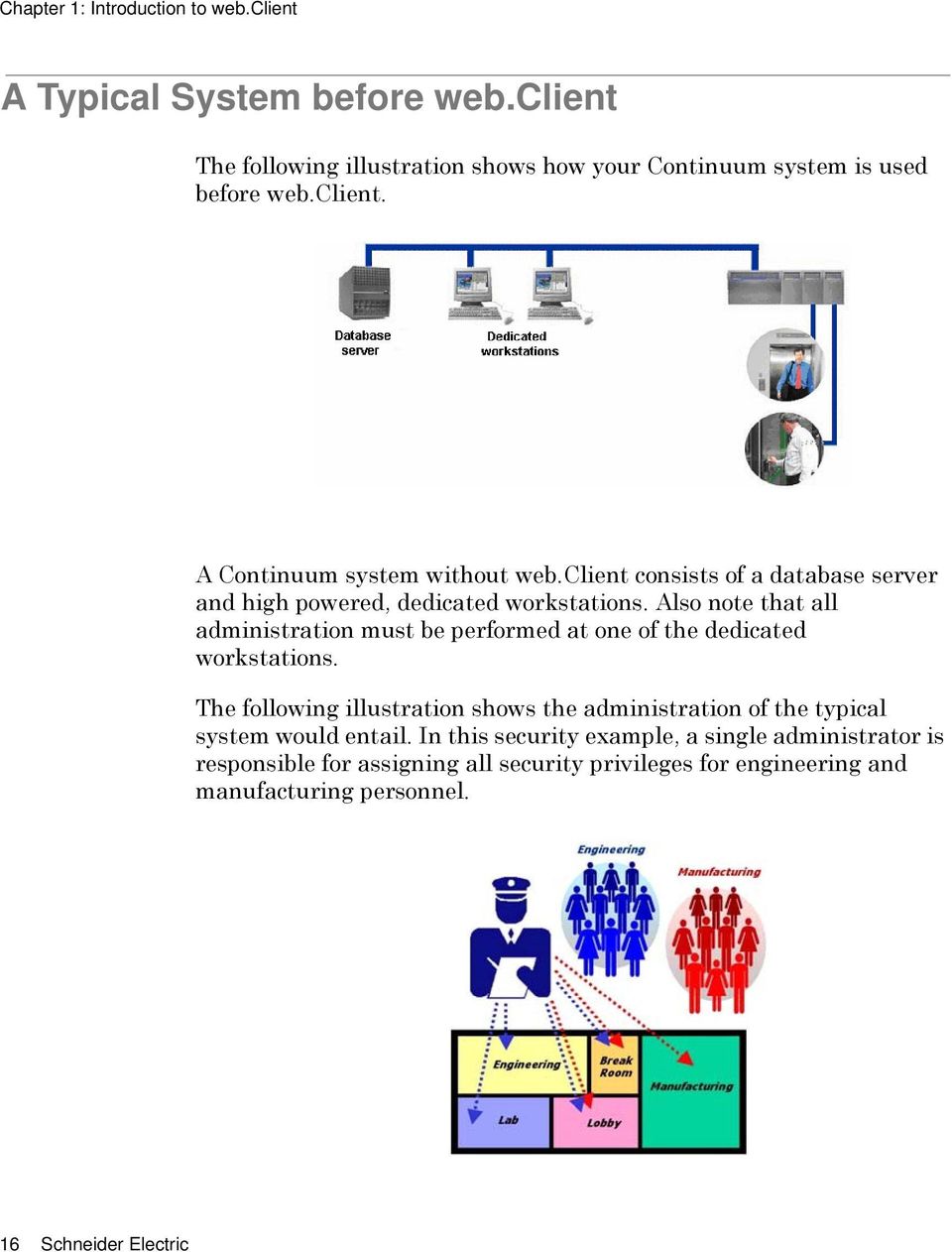
16 Chapter 1: Introduction to web.client A Typical System before web.client The following illustration shows how your Continuum system is used before web.client. A Continuum system without web.client consists of a database server and high powered, dedicated workstations. Also note that all administration must be performed at one of the dedicated workstations. The following illustration shows the administration of the typical system would entail. In this security example, a single administrator is responsible for assigning all security privileges for engineering and manufacturing personnel. 16 Schneider Electric
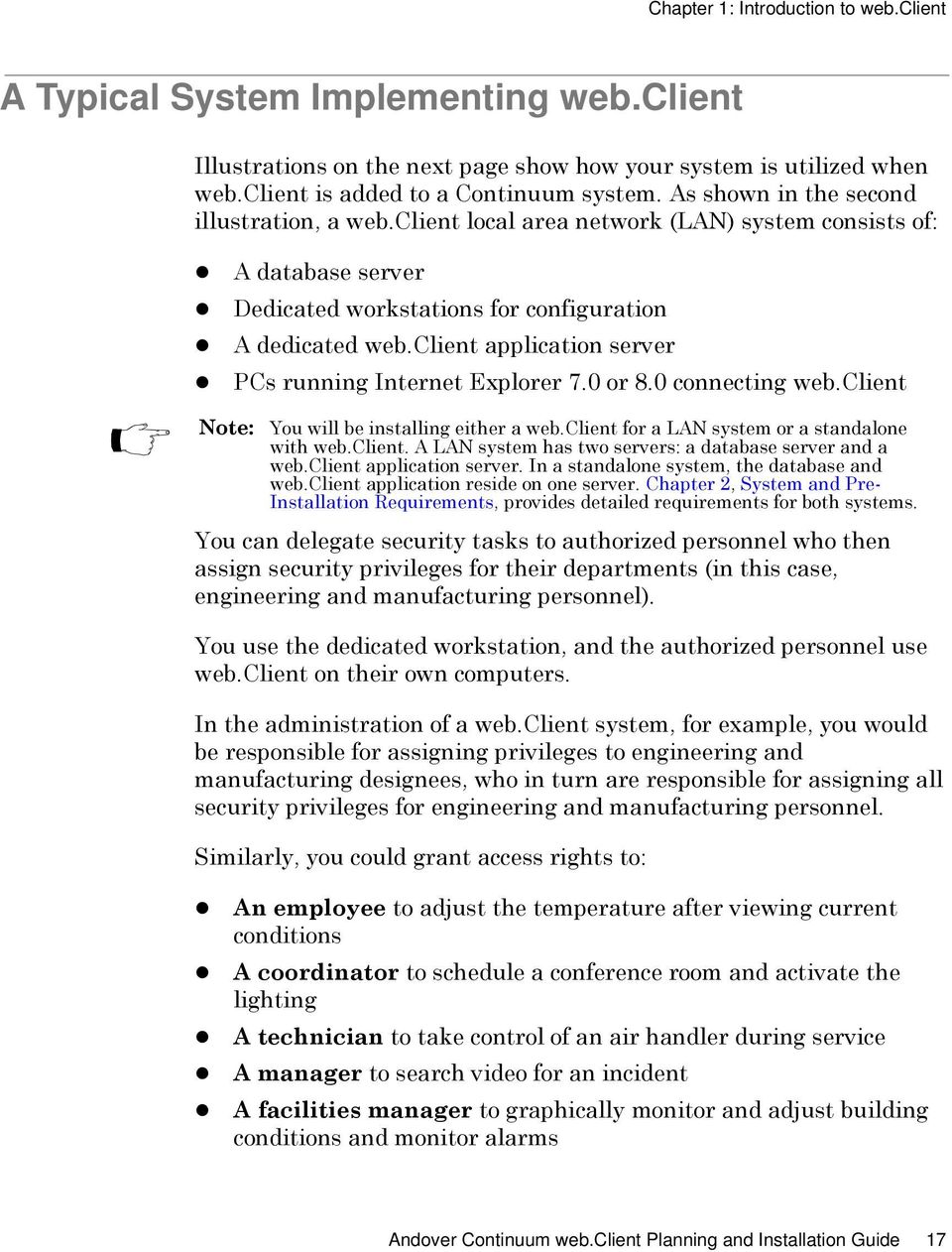
17 Chapter 1: Introduction to web.client A Typical System Implementing web.client Illustrations on the next page show how your system is utilized when web.client is added to a Continuum system. As shown in the second illustration, a web.client local area network (LAN) system consists of: A database server Dedicated workstations for configuration A dedicated web.client application server PCs running Internet Explorer 7.0 or 8.0 connecting web.client Note: You will be installing either a web.client for a LAN system or a standalone with web.client. A LAN system has two servers: a database server and a web.client application server. In a standalone system, the database and web.client application reside on one server. Chapter 2, System and Pre- Installation Requirements, provides detailed requirements for both systems. You can delegate security tasks to authorized personnel who then assign security privileges for their departments (in this case, engineering and manufacturing personnel). You use the dedicated workstation, and the authorized personnel use web.client on their own computers. In the administration of a web.client system, for example, you would be responsible for assigning privileges to engineering and manufacturing designees, who in turn are responsible for assigning all security privileges for engineering and manufacturing personnel. Similarly, you could grant access rights to: An employee to adjust the temperature after viewing current conditions A coordinator to schedule a conference room and activate the lighting A technician to take control of an air handler during service A manager to search video for an incident A facilities manager to graphically monitor and adjust building conditions and monitor alarms Andover Continuum web.client Planning and Installation Guide 17
18 Chapter 1: Introduction to web.client 18 Schneider Electric

19 Chapter 1: Introduction to web.client Differences between web.client and CyberStation web.client is an extension of CyberStation. Through the convenience of a web browser, you can view, monitor, and in some cases modify objects and their values. (These include BACnet objects, since CyberStation and web.client support the BACnet ANSI/ASHRAE standard.) However, there are some differences between what your users can do in web.client vs. CyberStation. You generally use web.client to view and monitor objects that were defined in CyberStation. The following table lists the levels of support offered with each major web.client feature. For information on web.client features, see the web.client online help. web.client Levels of Support LEVELS OF web.client SUPPORT Feature View Modify Delete Create Personnel X X X X Schedules and Calendars X X X Events within schedules only Reports X X X Areas X Groups X Loops X X Graphics X Alarms X X Events X Distribution Events X X X Points and objects X X X Except: BACnet objects cannot be deleted. TrendLogs X X Video X 1 Doors X X Controller Web Pages X Events within schedules only 1. Video can be modified, but not saved. For example, you can change cameras, show/hide time, change focus, zoom, but you will lose these changes if the page is refreshed or you open another editor. Andover Continuum web.client Planning and Installation Guide 19
20 Chapter 1: Introduction to web.client 20 Schneider Electric
21 Chapter 2 System and Pre-Installation Requirements This chapter contains the following topics: web.client Setup Configurations Hardware and Software Requirements for LAN System Hardware and Software Requirements for a Standalone System Pre-Installation Microsoft Tasks Note: Before installing or upgrading to web.client version 1.92, be sure the requirements outlined in this chapter are satisfied. web.client users must have a password to log on. Andover Continuum web.client Planning and Installation Guide 21
22 Chapter 2: System and Pre-Installation Requirements web.client Setup Configurations Depending on your web.client version 1.92 package and configuration, you are setting up either: web.client local area network (LAN) system A standalone single user system with web.client LAN system: The web.client LAN system comprises a Continuum/ SQL database server and an Internet Information Services (IIS) server dedicated to running the web.client application. On a LAN system, the IIS server can be a Windows XP Professional workstation, Windows Server 2003, or Windows Vista, but each supports a different number of user connections. See the table below. Standalone system: The standalone single user system with web.client comprises one PC on which the Continuum/SQL Express database, IIS, and the web.client application all reside. A standalone system PC may also run Windows XP Professional workstation, Windows Server 2003, or Windows Vista. The following table lists the maximum number of web.client version 1.92 users per server, as well as the maximum number of CyberStations and IIS servers, for each type of setup: Maximum Number of web.client 1.92 Users Per Server Maximum Number of web.client Users Per Server When IIS Is Installed on Windows Server 2003 When IIS Is Installed on Windows XP Professional Workstation When IIS Is Number Installed on of Cyber- Number of System Windows Vista Stations IIS Servers LAN Unlimited Unlimited Standalone A total of three machines (web.client browser PCs plus CyberStations) is the maximum number allowed on a standalone system. This means the following combinations are valid: Two web.client connections and one CyberStation, one web.client connection and two CyberStations, or three CyberStations (if there are no web.client connections). 22 Schneider Electric
23 Chapter 2: System and Pre-Installation Requirements Hardware and Software Requirements for LAN System A web.client LAN system has two server types: Continuum/SQL database server IIS server (one for every 25 users) If your system has no more than 25 users, select one server as the web.client IIS server. This IIS server should be dedicated to running the web.client application. For a larger LAN system (at least for any system having more than 25 users) your site must have more than one IIS server. Depending on your particular LAN installation, the IIS server can be: Windows XP Professional workstation (maximum of two users) Windows Server 2003 (maximum of 25 users per IIS server) Windows Vista (maximum of two users per IIS server) The IIS server must be on a network that can connect to the Continuum/SQL database server. The browser PCs must be on a network that can connect to the IIS server. web.client version 1.92 will upgrade any previous version on IIS server. web.client 1.92 includes CyberStation 1.92, and installing it upgrades the IIS machine to Workstations not at version 1.92 must be upgraded before installing web.client. Andover Continuum web.client Planning and Installation Guide 23
24 Chapter 2: System and Pre-Installation Requirements See also: Chapter 3, Installing and Configuring web.client on the IIS PC Appendix C, Guidelines for Upgrading to Version 1.92 Andover Continuum CyberStation Installation Guide, The following table shows the hardware and software requirements for the IIS server and the client browser on LAN systems. Hardware Requirements for IIS Server for LAN Systems Minimum Recommended Intel CoreTM 2, Duo, 1.66 GHz or better 1, 2 2 Gb RAM or higher 2 plus 5 Mb per connection Quad core 1 2 GHz or better 4 Gb RAM plus 5 Mb per connection 15 Gb free space (NTFS Partition) 30 Gb free space (NTFS Partition) CD ROM drive CD ROM drive Video resolution: 1024 x 768 pixels Video resolution: 1024 x 768 pixels Parallel or USB port Parallel or USB port 1. Memory and processor speed - Performance is directly related to processor speed and RAM. Increasing hard drive size allows for growth of applications (graphics, programs, and so on). Faster processor speeds and more RAM available to the program will increase performance. 2 Use Recommended requirement for systems with integrated video. Note: Every connection to the IIS server by a browser PC accessing web.client uses 5 MB of RAM on the IIS server. (For example, two browser PCs connected to the IIS server accessing web.client use 10 MB of RAM on the IIS server. For this configuration, Schneider Electric recommends a minimum of 512 MB plus 10 MB (used by the two PCs) or a minimum of 522 MB of RAM on the IIS Server.) 24 Schneider Electric
25 Chapter 2: System and Pre-Installation Requirements The following table shows the video-specific hardware requirements for the IIS server on LAN systems. Video-Specific Requirements Minimum Recommended 100 Mbps network port 1 Gb network port Graphics card with DirectX 9.x or later with 256 Mb of dedicated RAM DirectX 10 graphics device with WDDM 1.0 or higher driver with 512 Mb of dedicated RAM Note: Andover Continuum uses stream 2 to display video through video interfaces. Per standard Pelco Endura video configuration, you should configure stream 2. When doing so, be sure to set a lower resolution and smaller frame rate. Otherwise, the performance of your PC may be negatively affected. Be aware that Andover Continuum only supports H.264 and MPEG4 video formats. The following software is recommended for LAN systems. Software for LAN Systems Tested & Supported Software for LAN Systems 1 Server Note: For all operating systems, only the 32-bit environment is supported; the 64-bit environment is not supported. Microsoft Windows XP Professional workstation (SP3) OR: Microsoft Windows Server 2003 (SP2) OR: Microsoft Windows Server 2003 R2 (SP2) OR: Microsoft Windows Vista Ultimate (SP2) OR: Microsoft Vista Business (SP2) Browser Internet Microsoft Windows Server 2008 using SQL OR: Microsoft Windows Server 2008 R2 32-bit or 64-bit modes using SQL Server For Windows XP and Server 2003: Internet Explorer 7.0 or Internet Explorer 8.0 For Windows Vista: Internet Explorer 7.0 or Internet Explorer 8.0 IIS: Microsoft Windows XP: IIS 5.0 Microsoft Windows Server 2003: IIS 6.0 Microsoft Vista: IIS 7.0 Andover Continuum web.client Planning and Installation Guide 25
26 Chapter 2: System and Pre-Installation Requirements Software for LAN Systems Tested & Supported Software for LAN Systems 1 CyberStation Andover Continuum CyberStation Version 1.92 Database SQL Server 2000 (SP4) OR: SQL Server 2005 (SP3) OR: SQL Server 2008 (SP1) Network protocol When you are prompted to select an authentication mode, select Mixed Mode. For more information, please see the Andover Continuum CyberStation Installation Guide, TCP/IP Other Microsoft.NET Framework version 2.0 AND: Microsoft.NET Framework version 3.5 (SP1) Windows Installer Internet Explorer, IIS, and TCP/IP are included with the Microsoft operating systems. Upgrades and service packs are available free of charge from Microsoft s web site, 2. No CyberStation or webclient software installed. 26 Schneider Electric
27 Chapter 2: System and Pre-Installation Requirements The following table shows the Browser PCs that are recommended for LAN systems. Browser PCs for Users on a LAN System Tested & Supported Browser PCs for Users on a LAN System Hardware Software The video feature requires network access to a digital video recorder. This may require you to open port or establish a Virtual Private Network (VPN) connection if there is a firewall. The client browser PC on a LAN system can be running one of the following: Windows XP Professional (SP3) Windows Server 2003 (SP2) or Windows Server 2003 R2 (SP2) Windows Vista Business (SP2), Vista Ultimate (SP2), or Vista Home Premium SP2) For Windows XP, Windows Server 2003, or Windows Vista: Internet Explorer 7.0 OR Internet Explorer 8.0 Verify IE defaults are enabled for: Cookies and JavaScript Hardware and Software Requirements for a Standalone System On a single-user standalone system with web.client, the Continuum SQL Express database, IIS, and the web.client application are all installed on one Windows XP Professional workstation, one Windows Server 2003, or one Windows Vista machine. Note: The standalone system can accommodate two user connections (browser PCs). If you require more than two users, then you must upgrade to a LAN system with Windows Server 2003 (maximum 25 users). web.client version 1.92 will upgrade any previous version s IIS server. web.client 1.92 includes Cyberstation 1.92, and installing it upgrades the IIS machine to Workstations other than the IIS server that are not at version 1.92 must be upgraded before installing web.client. Andover Continuum web.client Planning and Installation Guide 27
28 Chapter 2: System and Pre-Installation Requirements (Refer to the Andover Continuum CyberStation Installation Guide, , for upgrade procedures.) See also: Chapter 3, Installing and Configuring web.client on the IIS PC Appendix C, Guidelines for Upgrading to Version 1.92 Andover Continuum CyberStation Installation Guide, The following table lists hardware and software requirements for the IIS workstation and the client browser on standalone systems. Hardware Requirements for Standalone Systems Minimum Recommended Intel CoreTM 2, Duo, 1.66 GHz or better1 1, 2 Quad core 1 2 GHz or better 2 Gb RAM or higher 2 4 Gb RAM 15 Gb free space 30 Gb free space CD ROM drive CD ROM drive Video resolution: 1024 x 768 pixels Video resolution: 1024 x 768 pixels Parallel or USB port Parallel or USB port 1. Memory and processor speed - Performance is directly related to processor speed and RAM. Increasing hard drive size allows for growth of applications (graphics, programs, and so on). Faster processor speeds and more RAM available to the program will increase performance. 2. Use Recommended requirement for systems with integrated video. Note: Every connection to the IIS server by a browser PC accessing web.client uses 5 MB of RAM on the IIS server. For example, two browser PCs connected to the IIS server accessing web.client use 10 MB of RAM on the IIS server. In this configuration, Schneider Electric recommends a minimum of 512 MB plus 10 MB (used by the two PCs) or a minimum of 522 MB of RAM on the IIS Server.) 28 Schneider Electric
29 Chapter 2: System and Pre-Installation Requirements The following table shows the video-specific hardware requirements for the IIS workstation on a standalone system. Video-Specific Requirements Minimum Recommended 100 Mbps network port 1 Gb network port Graphics card with DirectX 9.x or later with 256 Mb of dedicated RAM DirectX 10 graphics device with WDDM 1.0 or higher driver with 512 Mb of dedicated RAM Note: Andover Continuum uses stream 2 to display video through video interfaces. Per standard Pelco Endura video configuration, you should configure stream 2. When doing so, be sure to set a lower resolution and smaller frame rate. Otherwise, the performance on your PC may be negatively affected. Be aware that Andover Continuum only supports H.264 and MPEG4 video formats. The following table shows the software that is recommended for standalone systems. Software for Standalone Systems Tested & Supported Software for Standalone Systems Server Note: For all operating systems, only the 32-bit environment is supported; the 64-bit environment is not supported. Browser Internet Microsoft Windows XP Professional workstation (SP3) OR: Microsoft Windows Server 2003 (SP2) OR: Microsoft Server 2003 R2 (SP2) OR: Microsoft Windows Vista Ultimate (SP2) OR: Microsoft Vista Business (SP2) OR: Microsoft Windows Server 2008 using SQL OR: Microsoft Windows Server 2008 R2 32-bit or 64-bit modes using SQL Server For Windows XP, Windows Server 2003, or Windows Vista: Internet Explorer 7.0 OR Internet Explorer 8.0 IIS: Microsoft Windows XP: IIS 5.0 Microsoft Windows Server 2003: IIS 6.0 Microsoft Windows Vista: IIS 7.0 Andover Continuum web.client Planning and Installation Guide 29
30 Chapter 2: System and Pre-Installation Requirements Software for Standalone Systems (continued) Tested & Supported Software for Standalone Systems CyberStation Andover Continuum CyberStation Version 1.92 Database Network protocol SQL Express database engine with the Continuum database (SP4) Note: If you are upgrading version 1.92, your database engine is automatically upgraded to SQL Express, if SQL Express is not already installed. (See also Chapter 3, Installing and Configuring web.client on the IIS PC, Appendix C, Guidelines for Upgrading to Version 1.92,.and the Microsoft web site). TCP/IP Note: Internet Explorer, IIS, and TCP/IP are included with the Microsoft operating systems. Upgrades and service packs are available free of charge from their web site, Other Microsoft.NET Framework version 2.0 AND: Microsoft.NET Framework version 3.5 (SP1) Windows Installer No CyberStation or web.client software installed. 30 Schneider Electric
31 Chapter 2: System and Pre-Installation Requirements The following table shows the browser PCs that are recommended for standalone systems. Browser PCs for Users on a Standalone System Tested & Supported Browser PCs for Users on a Standalone System Hardware Software The video feature requires network access to a digital video recorder. This may require you to open port or establish a Virtual Private Network (VPN) connection if there is a firewall. The client browser PC on a standalone system can be running one of the following: Windows XP Professional (SP3) Windows Server 2003 (SP2) or Windows Server 2003 R2 (SP2) Windows Vista Business (SP2), Vista Ultimate (SP2), or Vista Home Premium SP2) For Windows XP and Server 2003: Internet Explorer 7.0 or Internet Explorer 8.0 For Windows Vista Home Premium: Internet Explorer 7.0 Verify IE defaults are enabled for Cookies and JavaScript Pre-Installation Microsoft Tasks Before installing web.client, perform the following tasks. CAUTION Microsoft system experience required. To perform this standard Microsoft procedure, you must have administrative experience using Microsoft system software and understand that there are differences in the graphical user interfaces between different Windows platforms. User interface illustrations are not provided. Please see your Microsoft Windows online help and visit and other Microsoft web sites. Failure to observe this precaution can result in incorrect system configuration. Andover Continuum web.client Planning and Installation Guide 31
32 Chapter 2: System and Pre-Installation Requirements Installing System Software Install the operating system, TCP/IP, and PC system software that meet the requirements specified earlier in this chapter..net Framework 2.0 Note: If IIS is installed after.net Framework, you will experience problems opening web.client Pinpoint graphics and some web.client editors. To avoid this problem, be sure that IIS has been installed on the server before Microsoft.NET Framework 2.0 is installed. If Microsoft Windows already comes with.net Framework 2.0, or you have downloaded.net Framework 2.0 separately during a Windows upgrade before IIS is installed, run the following command: C:\Windows\Microsoft.NET\Framework\v \aspnet_regiis.exe -i Installing IIS on Windows Server 2008 For Windows Server 2008, install Internet Information Services (IIS) on the designated web.client application server (LAN systems) or the standalone CyberStation/web.Client workstation (standalone system). The LAN web.client application server and standalone CyberStation/ web.client workstation are generically called IIS PC in this manual for both systems. 1. Start the Server Manager by clicking in the Administrative Tools menu. 32 Schneider Electric
33 Chapter 2: System and Pre-Installation Requirements 2. In the Server Manager, go to Roles and click Add Roles. Andover Continuum web.client Planning and Installation Guide 33
34 Chapter 2: System and Pre-Installation Requirements 3. In the Add Roles Wizard, Before You Begin page, click Next. 34 Schneider Electric
35 Chapter 2: System and Pre-Installation Requirements 4. In the Select Server Roles page, check the Application Server checkbox to install.net Framework 3 as a prerequisite. Andover Continuum web.client Planning and Installation Guide 35
36 Chapter 2: System and Pre-Installation Requirements 5. Click Add Required Features. 6. In the Select Server Roles page, click Next. 36 Schneider Electric
37 Chapter 2: System and Pre-Installation Requirements 7. In the Application Server page, click Next.. 8. In the Select Server Roles page, check the following checkboxes: Web Server (IIS) Support, HTTP Activation, and Message Queuing Activation. Andover Continuum web.client Planning and Installation Guide 37
38 Chapter 2: System and Pre-Installation Requirements An Add role services/features required dialog displays for each of your role service selections. 9. Click the Add Required Role Services or Add Required Features button to install additional features for Web Server (IIS) Support, HTTP Activation, and Message Queuing Activation. 38 Schneider Electric
39 Chapter 2: System and Pre-Installation Requirements 10. In the Select Role Services page, click Next. Andover Continuum web.client Planning and Installation Guide 39
40 Chapter 2: System and Pre-Installation Requirements 11. In the Web Server (IIS) page, click Next. 40 Schneider Electric
41 Chapter 2: System and Pre-Installation Requirements 12. In the Select Role Services page, check the IIS 6 Management Compatibility checkbox. 13. Click Next. 14. In the Confirm Installation Selections page, click Install to verify your selections. Andover Continuum web.client Planning and Installation Guide 41
42 Chapter 2: System and Pre-Installation Requirements An Installation Progress page displays with information on the roles, role services, or features being installed. 15. When the Installation Results page displays, click Close. 42 Schneider Electric
43 Chapter 2: System and Pre-Installation Requirements Installing IIS on Windows XP and Windows Server 2003 Note: If you have a Windows Vista, see Configuring IIS for Windows Vista. For Windows XP and Windows Server 2003, install IIS on the designated web.client application server (LAN systems) or the standalone CyberStation/web.Client workstation (standalone system). The LAN web.client application server and standalone CyberStation/ web.client workstation are generically called IIS PC in this manual for both systems. For Windows XP: Follow this procedure to install IIS 5.0: 1. From the Control Panel, open Add/Remove Programs. The Add/Remove Programs dialog appears. 2. Select Add/Remove Windows Components. The Windows Components Wizard (Windows Components) screen appears. 3. Check the Internet Information Services (IIS) checkbox, and click Next to install. Andover Continuum web.client Planning and Installation Guide 43
44 Chapter 2: System and Pre-Installation Requirements 4. After the Wizard completes the component-configuration process, which may take several minutes, click Finish. For Windows Server 2003: Follow this procedure to install IIS 6.0: 1. From the Control Panel, open Add/Remove Programs. The Add/Remove Programs dialog appears. 2. Select Add/Remove Windows Components. The Windows Components Wizard (Windows Components screen) appears. 3. Check the Application Server checkbox. 4. Select and highlight Application Server, and click the Details button. The Application Server dialog appears. 5. Check the following checkboxes: ASP.NET, Application Server Console, Enable network COM+ access, and Internet Information Services (IIS). 6. In the Application Server dialog, select and highlight Internet Information Services (IIS) and click the Details button. The Internet Information Services (IIS) dialog appears. 7. Check the following checkboxes: Common Files, Internet Information Services Manager, and World Wide Web Service. 8. In the Internet Information Services (IIS) dialog, select and highlight World Wide Web Service, and click the Details button. The World Wide Web Service dialog appears. 9. Check the following checkboxes: Active Server Pages, Internet Data Connector, Server Side Includes, WebDAV Publishing, and World Wide Web Service. 10. Click the OK button back through all three dialogs. 11. Click Next in the Wizard s Configuring Components screen. A progress bar appears on this screen during the configuration process, which may take several minutes. Please wait. 12. After the Wizard completes the component-configuration process, click Finish. 44 Schneider Electric
45 Chapter 2: System and Pre-Installation Requirements Registering File Extensions for Windows Server 2003 If you have Windows Server 2003, you must also register the.pin and.emf file extensions in the IIS MIME Types (for web.client Pinpoint graphics). After IIS installation on Server 2003, follow this procedure: 1. From the Control Panel, double click and open Administrative Tools. The Administrative Tools dialog appears. 2. Double click and open Internet Information Services (IIS) Manager. The Internet Information Services (IIS) Manager dialog appears. 3. In the tree, right click on the machine name, and select Properties from the popup menu. The Properties dialog appears. 4. Click the MIME Types button. The MIME Types dialog appears. 5. Click the NEW button. The MIME Type dialog appears. 6. In the Extension field, enter.pin and in the MIME type field, enter pinfiles/plain. 7. Click OK and repeat steps 5 and 6, but in the Extension field, enter.emf and in the MIME type field, enter image/emf. 8. Click OK three times back through the dialogs. 9. Restart your machine, follow the other pre-installation tasks, and follow the installation procedures in Installing and Configuring web.client on the IIS PC and Testing and Installing web.client on a Client PC. Configuring IIS for Windows Vista If you are installing web.client on Windows Vista, you must configure IIS settings, as follows. 1. From the Control Panel, open Programs and Features. 2. Under Tasks on the left, click Turn Windows features on or off. Andover Continuum web.client Planning and Installation Guide 45
46 Chapter 2: System and Pre-Installation Requirements 3. In the Windows Features (Turn Windows features on or off) dialog, in the tree, expand Internet Information Services. 4. Under Internet Information Services, expand Web Management Tools, then expand IIS 6 Management Compatibility. 5. Check only the following checkboxes: IIS 6 Management Console, IIS Metabase and IIS 6 configuration compatibility, and IIS Management Console. Other checkboxes must be cleared. 6. Under Internet Information Services, expand World Wide Web Services, then expand Application Development Features, Common Http Features, Health and Diagnostics, Performance Features, and Security. 7. Check only the following checkboxes:.net Extensibility, ASP.NET, ISAPI Extensions, ISAPI Filters, Default Document, Directory Browsing, HTTP Errors, Static Content, HTTP Logging, Request Monitor, Static Content Compression, Request Filtering, and Windows Authentication. Other checkboxes must be cleared. 8. Click OK. Restart your machine, follow the other pre-installation tasks, and follow the installation procedures in Installing and Configuring web.client on the IIS PC and Testing and Installing web.client on a Client PC. Registering File Extensions for Windows Server 2008 and Windows Vista If you have Windows Server 2008 and Windows Vista, you must also register the.pin and.emf file extensions in the IIS MIME Types (for web.client Pinpoint graphics). After IIS installation and configuration on Windows Server 2008 and Windows Vista, follow this procedure: 1. Access Internet Information Services (IIS) Manager. 46 Schneider Electric
47 Chapter 2: System and Pre-Installation Requirements 2. In the Connections tree, select the machine name. 3. In the right-hand content pane, under IIS, double click MIME Types. The Add MIME Type dialog appears. 4. Under Actions, click Add. 5. In the File name extension field, enter.pin. 6. In the MIME type field, enter pinfiles/plain. 7. Click OK and repeat Steps 4, 5, and 6, but in the File name extension field, enter.emf and in the MIME type field, enter image/emf. 8. Click OK. 9. Restart your machine, follow the other pre-installation tasks, and follow the installation procedures in Installing and Configuring web.client on the IIS PC and Testing and Installing web.client on a Client PC. SSL Considerations for the IIS PC The tasks described below are not necessarily pre-installation tasks, but they are related to establishing support for SSL on the IIS PC. For detailed instructions, please use the reference links below. Setting Up SSL on the IIS PC -- web.client version 1.74 (and higher) fully supports Secure Sockets Layer (SSL) technology, whereby a web.client user can access confidential, secure information over the Internet. As a system administrator, you must ensure that an SSL Certificate, acquired by an authorized SSL provider, resides on the IIS PC. You can set up SSL before or after web.client installation. For instructions, please see Establishing SSL Support for Confidential Information in Chapter 3. Enabling SSL for web.client -- After you have set up an SSL Certificate for the IIS PC, you must enable SSL for web.client via web.client Properties in Internet Information Services. For instructions, please see Enabling SSL for web.client in Chapter 3. Andover Continuum web.client Planning and Installation Guide 47
48 Chapter 2: System and Pre-Installation Requirements SSL and web.client Pinpoint Graphics -- The graphics package, web.client Pinpoint, can be used with an SSL installation. However, you must perform a few tasks to ensure compatibility with Pinpoint and ensure access to graphics files that have been set up in the Pinpoint graphics folders. This is not a pre-installation task. You must first establish Pinpoint graphics folders (Chapter 3) and set up an SSL Certificate on the IIS PC. For instructions, please see Setting Up SSL for web.client Pinpoint in Chapter 3. Changing IE Internet Security Options to Accommodate SSL -- After you have set up an SSL Certificate for the IIS PC, you must modify Internet Explorer Internet Options to disable superfluous warning messages that users would otherwise see while using certain web.client features with SSL. This is not a pre-installation task. For instructions, please see Changing IE Security Internet Options to Accommodate SSL in Chapter 3. Changing the Default TCP Web Port Number for the IIS PC Normally, the IIS PC defaults to Internet TCP port 80. Some Internetaccess providers do not use port 80. You can change this port number from 80 to another port number. This can be done before or after web.client installation. For more information, please see Changing the Default TCP Port Number in Chapter 3 Disabling WinSock Proxy Client on Standalone System To improve performance on a single-user standalone system, disable the Microsoft WinSock Proxy Client. Follow this procedure: 1. From the Windows Control Panel, double click WSP Client. The Microsoft WinSock Proxy Client dialog appears. 2. Remove the check from the Enable WinSock Proxy Client checkbox, and click OK. 48 Schneider Electric
49 Chapter 2: System and Pre-Installation Requirements Ensuring a Domain Membership Is Selected To improve performance (if your site has more than one web.client user), be sure each PC (computer name) is designated as a member of a domain, rather than a workgroup, via the Microsoft Windows system properties network identification. Note: After installing web.client, be sure you configure Distributed COM (DCOM) default security settings and disable HTTP keep-alives. For those Microsoft procedures, see Chapter 3, Installing and Configuring web.client on the IIS PC. See also Appendix A, web.client Security and Troubleshooting Tips for troubleshooting tips. Avoiding Invalid Characters in a Server Name When specifying a name for the web.client IIS server, be sure the server name does not contain an underscore character (_). If the web.client IIS server has an underscorehttp:// yourtown/news/malden/2010/05/planning_board_gives_green_lig.html, it will not be able to set cookies. Disabling Windows Firewall If your IIS server is a Windows XP (SP3), Windows Server 2003 (SP2) or Windows Vista machine, you must disable the Windows firewall as follows: 1. From the Control Panel, open Windows Firewall. The Windows Firewall dialog appears. 2. Select the Off (not recommended) radio button, and click OK. Andover Continuum web.client Planning and Installation Guide 49
50 Chapter 2: System and Pre-Installation Requirements Disabling Automatic Windows Updates When running web.client, you must disable Automatic Updates in Windows by following these instructions: In Windows XP: 1. From the Control Panel, open Automatic Updates. The Automatic Updates dialog appears. 2. Select the Turn off Automatic Updates radio button. 3. Click OK. In Windows Vista: 1. From the Control Panel, open Windows Update. The Windows Update with Windows Ultimate Extras page appears. 2. Click Change Settings on the right-side of the page. The Choose how Windows can install updates page displays. 3. In the Important Updates drop-down menu, click the Never check for updates (not recommended) menu item. 4. Click OK 50 Schneider Electric
51 Chapter 3 Installing and Configuring web.client on the IIS PC This chapter contains the following topics Overview Installing web.client on the IIS PC web.client Video System Upgrades Configuring Your Video Servers Configuring Graphics Folders for web.client: Windows XP and Windows Server 2003 Configuring Graphics Folders for web.client: Windows Vista Establishing Pinpoint Folders Configuring DCOM Default Security Settings Disabling HTTP Keep-Alives Resetting Timeout and Live Events Via web.config File Establishing SSL Support for Confidential Information Changing the Default TCP Port Number Andover Continuum web.client Planning and Installation Guide 51
52 Chapter 3: Installing and Configuring web.client on the IIS PC Overview This chapter provides instructions for installing and configuring web.client version 1.92 on the IIS PC, defined as follows: The IIS PC on a LAN system is the IIS server with Windows Server 2003, Windows XP Professional workstation, or Windows Vista. The IIS PC on a standalone system with web.client is the single machine (Windows XP Professional workstation, Windows Server 2003, or Windows Vista) on which both IIS and Continuum database reside. CAUTION Microsoft system experience required. To perform this standard Microsoft procedure, you must have administrative experience using Microsoft system software and understand that there are differences in the graphical user interfaces between different Windows platforms. User-interface illustrations are not provided. Please see your Microsoft Windows online help and visit and other Microsoft web sites. Failure to observe this precaution can result in incorrect system configuration. The procedures in this chapter are for a first-time installation. If you are upgrading to web.client version 1.92, refer to Appendix C, Guidelines for Upgrading to Version 1.92, which presents some guidelines for this upgrade. See also the Andover Continuum CyberStation Installation Guide, Schneider Electric
53 Chapter 3: Installing and Configuring web.client on the IIS PC Installing web.client on the IIS PC Follow this procedure to install web.client on the IIS PC. 1. Insert the web.client CD. The Install web.client screen displays. Click Install web.client to begin. 2. If you do not have the Microsoft VS 2008 C++ Redistributable installed, an InstallShield Wizard appears and indicates that this application is required before the CyberStation installation begins. Click Install. Continuum then checks to ensure that Microsoft.NET Framework 3.5 is also installed. If not, the following message displays: Andover Continuum web.client Planning and Installation Guide 53
54 Chapter 3: Installing and Configuring web.client on the IIS PC Continuum then checks to ensure that Microsoft.NET Framework 3.5 is also installed. If not, the following message displays: Follow these instructions, discontinue this CyberStation installation, and install the.net Framework 3.5 from the Continuum release CD. Once these requirements are installed, return to this installation and when the initial Install web.client screen displays once more, click Install web.client. Note: If you do not have the correct Microsoft service pack installed, you will receive a warning message, asking you to install the correct software. See Chapter 2 for software requirements. 3. When the web.client Installation dialog appears, click Next to continue. 54 Schneider Electric
55 Chapter 3: Installing and Configuring web.client on the IIS PC If your key is not enabled for web.client, you will receive a warning message. You may continue with the installation or cancel. 4. The License Information dialog appears. Read and accept the license agreement, and click Next to continue. 5. The RegisterUser dialog appears. Enter your User Name and Company Name. Later, after web.client is installed, you can right-click on the Continuum icon in your tool tray and select About to display the About Continuum dialog, which lists the information from the RegisterUser dialog. 6. An Alias Information screen appears explaining what happens next in the installation. Andover Continuum web.client Planning and Installation Guide 55
56 Chapter 3: Installing and Configuring web.client on the IIS PC After reading this screen, click Yes to continue. The Enter Text screen asks you to provide the web.client Virtual Directory Alias. Keep the default alias (WebClient) or provide your own alias. Click Next to continue. 7. The Create Web Server Virtual Directory screen asks you to select the physical path for your virtual Web Server directory. Select the default directory, or supply your own directory. Click Next to continue. 56 Schneider Electric
57 Chapter 3: Installing and Configuring web.client on the IIS PC The Setup Status screen appears as the files are installed. Once the progress bar disappears, the Create IIS Application window appears and informs you that the IIS application is being created. Then, you are asked if you would like to read the latest web.client release notes. Click Yes or No. Andover Continuum web.client Planning and Installation Guide 57
58 Chapter 3: Installing and Configuring web.client on the IIS PC Finally, you are asked if you would like to run the Database Initialization program now. Click Yes or No. web.client is now installed on the IIS PC. Depending on your system, follow one of the next three procedures, covered in the following subsections: Creating and Initializing the Database on a Standalone IIS PC Adding web.client to an Existing Standalone Database Initializing the Database on a LAN IIS PC 58 Schneider Electric
59 Chapter 3: Installing and Configuring web.client on the IIS PC Creating and Initializing the Database on a Standalone IIS PC A first-time database installation on a standalone system happens in two steps via the Database Initialization dialog: Step 1: Step 2: Installing the SQL Express database engine. Creating a new Continuum database. Note: After successful installation, the Continuum Database Initialization dialog automatically appears. Installing SQL Express Via Database Initialization Dialog CAUTION Close all applications on your computer before installation. After SQL Express is installed, your PC restarts immediately. You cannot restart your computer later. Be sure to close all open applications on your computer. Failure to observe this precaution will result in the loss of your work. Follow this procedure: 1. From the Start menu, select Programs > Continuum > Database Initialization. 2. Select Stand Alone from the Continuum Database Initialization dialog. Andover Continuum web.client Planning and Installation Guide 59
60 Chapter 3: Installing and Configuring web.client on the IIS PC The Database Initialization dialog appears. 3. Select the Create New Database radio button. 60 Schneider Electric
61 Chapter 3: Installing and Configuring web.client on the IIS PC Note that Microsoft SQL Server is shown in the DBMS Name field dropdown menu. 4. Ensure that Continuum (default setting) appears in the Data Source Name field. 5. Ensure that (Workstation Name)\SQLEXPRESS appears in the Server Name field. For example, QUALPC217 is the workstation name used in the previous dialog. 6. Leave the Database Name at its default, ContinuumDB. 7. Enter your login ID, Andover97, in the User Login ID field. 8. Enter your user password in the User Password field. Note: If you are upgrading to Version 1.92, and you accepted the pre-1.92 default password, Pyramid97, you must enter Pyramid97 here. If you are installing web.client for the first time, use a password of your choice. 9. Re-enter your password (Pyramid97 if you are upgrading to 1.92 from the previous version default) in the Confirm Password field. 10. DB File Location: If you leave DB File Location at its default path, then you must leave SQL Express at its default path when it is installed. If you browse a different path for DB File Location, then you must browse SQL Express to the same file path when it is installed. 11. Leave the Database Size at its default setting. 12. Enter a system administrator password of your choice into the Sa Password field. This password must meet Microsoft SQL Server rules for the composition of a password: The password must be at least eight characters long. The password must not contain all or part of the user s account name (three or more alphanumeric characters). The password must not contain the following characters: comma (,), period (.), hyphen (-), underscore (_), or number sign (#). The password must contain characters from three of the following four categories: Uppercase letters (A...Z) Andover Continuum web.client Planning and Installation Guide 61
62 Chapter 3: Installing and Configuring web.client on the IIS PC Lowercase letters (a...z) Digits Non-alphanumeric characters, such as exclamation (!) and dollar ($) Otherwise you will receive this warning: 13. In the Windows User Name field, enter your Microsoft Windows system user name here. This is necessary with SQL Express. You must have administrative access in order to run the automated scripts that are part of the database initialization process. 14. Enter your Microsoft Windows system password and confirm that password in the Windows Password and Confirm Password fields, respectively. CAUTION The password you enter here is required to execute scheduled SQL Server tasks. Should you later change your Windows password, these scheduled tasks will no longer execute. To correct this, access the Scheduled Tasks in Windows and change their password with the Set Password button in their Properties dialog 15. Check the checkboxes as follows: Note: Be sure the Create Default List Views, Create System List Views, Create System Alarm Enrollments, and Enhanced Alarm Logging boxes are checked. If you leave them unchecked, CyberStation does not import the necessary dump files. The dump files generate all of the default views, so the listviews and alarms are not created. In addition, faster alarm logging is not activated. The dump file import happens as soon as the workstation is started for the first time after installation and the appropriate files are placed in folders. For more information on Listviews, alarms, and alarm logging, please see the Continuum CyberStation online help. a. Create Default List Views - Check this box to import and create listviews (from the ASCII dump file, DefaultListViews.dmp) for all Cyber- Station object classes. 62 Schneider Electric
63 Chapter 3: Installing and Configuring web.client on the IIS PC b. Create System List Views - Check this box to import and create listviews (from the ASCII dump file, List.dmp) for system information other than object class defaults (for example, all events). c. Create System Alarm Enrollments - Check this box to import configured system AlarmEnrollment objects (from the ASCII dump file, SystemAlarms.dmp). These define the basic conditions under which CyberStation points go into alarm. d. Create/Update Graphical Report Settings - Check this box to import graphical report templates. CyberStation supplies many Report templates that include bar-chart templates, pie-chart templates, and trend templates, giving Reports a certain default look and feel. If you do not check this box, then these report templates will not be available. For more information on Reports, see the Continuum CyberStation online help. e. Enhanced Alarm Logging - Check this box to activate an enhanced method that automatically speeds up the process of logging alarms with workstations. Without enhanced alarm logging, configuration of workstation recipients in EventNotification objects becomes more cumbersome. Note: If the Enhanced Alarm Logging checkbox is not checked, the Enhanced Alarm Delivery checkbox becomes unselectable. f. Enhanced Alarm Delivery - This checkbox is intended for a system with multiple workstations. Check this box only if you intend to add more workstations to the system. If more workstations will not be added, then leave it unchecked. Note: This setting has no effect on BACnet alarms, which can be guaranteed through the configuration of BACnet alarm notifications. Checking this checkbox guarantees the delivery of alarms to all recipient workstations regardless of their status at the time of the alarm generation. This selection activates special background applications and processes (already installed) that establish an ongoing connection between workstations and the database server, where new alarms are written. Enhanced alarm delivery guarantees alarm delivery even when connections are lost. The alarms are delivered when the connection is restored. Enhanced alarm delivery provides a suite of diagnostic and troubleshooting tools that allow you, for example, to monitor the status of alarm messages and background alarm delivery processes as well as Andover Continuum web.client Planning and Installation Guide 63
64 Chapter 3: Installing and Configuring web.client on the IIS PC ping a particular workstation to deliver an alarm message that, for some reason, could not be delivered. For instructions on how to activate these diagnostic tools, please contact product support services. g. Extended Logging Backwards Compatibility - If you want to use pre-version 1.7 old extended logging, in addition to new extended logging, be sure this checkbox is checked. Note: Before version 1.7, you created Plain English programs for extended logs. These programs facilitated extended log tables in the database, one table per controller. In version 1.7 or higher, you must check the Extended Logging Backwards Compatibility box to retain the older method for creating extended logs, while also enabling new extended logging functionality. For more information about extended logs, please see the Continuum CyberStation online help. 16. Click the Continue button. The Is SQL Express Installed dialog appears. For first time installations, you should see this dialog. If, in the very unlikely event, you do not see this dialog, it means SQL Express is already on your computer for some other reason. If it is not installed, proceed to the next step. If it is already installed be sure it has been configured with the correct settings, as defined in the CyberStation Installation Guide, Select the Install SQL now radio button and click OK. SQL Express is then installed automatically. 64 Schneider Electric
65 Chapter 3: Installing and Configuring web.client on the IIS PC During SQL Express installation, the software checks your computer for certain problems that could complicate SQL installation and/or the creation or update of the Continuum database. There are several different scenarios. For example, thirdparty software may generate license-agreement issues. For a detailed description of these issues, how CyberStation resolves them, and a list of error messages, please see Appendix D, SQL Express Installation Error Messages. If there are no problems, the Select Folder dialog appears. 18. Accept the default path, or use the browse button to select a directory in which to install SQL Express, and click OK. Note: If you left DB File Location at its default path, then you MUST leave SQL Express at its default path when it is installed. If you browsed a different path for DB File Location, then you must browse SQL Express to the same file path Note: Be sure that the drive you have selected has a minimum of 2 GB of free space available. 19. The Extracting Files progress window appears. The unpacking takes approximately 1 to 5 minutes. Next, the Microsoft SQL Server 2005 Setup progress window appears. This also can take several minutes. After the installation has completed, the reboot dialog appears, which may take up to 60 seconds. Do not proceed until this dialogue appears. Click OK and reboot your computer. Note: Reboot happens immediately. You do not have the choice of doing this later. 20. After rebooting, a screen telling you that SQL script is running then appears. This screen closes automatically after a few minutes. Andover Continuum web.client Planning and Installation Guide 65
66 Chapter 3: Installing and Configuring web.client on the IIS PC 21. After your PC finishes rebooting, verify MSSQL server is running. Double click the SQL Server Service Manager icon in the system tool tray. The SQL Server Service Manager dialog appears. The status bar at the bottom of the dialog should read: Running - \\WorkstationName\SQLEXPRESS - MSSQLServer Note: If the SQL Server Service Manager icon is not present in the system tool tray, try running it from the Windows Start menu. Click Start, select Programs and Startup. The SQL Server Service Manager icon should be there. If this does not work, contact the Schneider Electric Technical Support department for further instructions. Adding web.client to an Existing Standalone Database On a standalone single-user system, if you are adding web.client to an existing Continuum database, perform this procedure. 1. Be sure you have performed the procedure, Installing web.client on the IIS PC. After the server reboots, the Continuum Database Initialization window appears. 66 Schneider Electric
67 Chapter 3: Installing and Configuring web.client on the IIS PC 2. Select Stand Alone. The Database Initialization dialog, shown on the next page, appears. 3. Select the Update Existing Database radio button. 4. Click the Continue button. Upon completion, you receive this message: Database successfully updated 5. Click OK. The Continuum Database Initialization window reappears. 6. Click Close. Andover Continuum web.client Planning and Installation Guide 67
68 Chapter 3: Installing and Configuring web.client on the IIS PC Initializing the Database on a LAN IIS PC Prior to using your web.client LAN system IIS PC, perform the following procedure to initialize the database. The detailed procedure for CyberStation is presented in the Andover Continuum CyberStation Installation Guide, , but the web.client specific steps are shown, as follows: 1. After the server reboots, the Continuum Database Initialization window appears. Select Workstation. 2. Once the database is set up on your web server, the main Workstation Configuration dialog, shown on the next page, appears. 68 Schneider Electric
69 Chapter 3: Installing and Configuring web.client on the IIS PC Select the Workstation tab to set the workstation parameters. Set the Workstation Name, Folder Name, Device Node ID and Network ID for the workstation. See the Andover Continuum CyberStation Installation Guide, , for further details. Andover Continuum web.client Planning and Installation Guide 69
70 Chapter 3: Installing and Configuring web.client on the IIS PC Note: The Andover Continuum CyberStation Installation Guide, , provides important guidelines for entering information in the Workstation Configuration dialog. Refer to that manual. 3. Select the Database tab, shown on the next page. 4. Fill in the fields as shown below if you are adding a new server to a LAN system. If this is a server upgrade, they will be populated automatically. The Server Name field should be set to the name of your Continuum database server. 5. Click OK to activate the workstation, then click Close on the Continuum Database Initialization window to complete the database initialization. 6. Run web.client on this machine. This will create the final objects in the Continuum database for this workstation. 70 Schneider Electric
71 Chapter 3: Installing and Configuring web.client on the IIS PC web.client Video System Upgrades If you are upgrading from a pre-1.92 version of web.client, the Learn All Video Servers dialog appears at the completion of the database initialization process. You must learn your video servers in order to see cameras. For more information on configuring video servers, see Configuring Your Video Servers. For more information on upgrading web.client, see Appendix C, Guidelines for Upgrading to Version Click Yes to learn all servers and cameras now, or No to learn them later in CyberStation s Video Administrator. It is recommended that you learn video servers and cameras now since it is more efficient to learn them all at once rather than learning them individually later. Note: Should you choose not to learn servers and cameras now, you will need to learn them later in Video Administrator. For more information on learning cameras, see the Video Administrator Settings tab in the CyberStation online help. If you click Yes, the Learn All Video Servers - Status dialog, shown on the next page, displays. It shows a count of the servers and cameras as they are learned. 2. Click Close to stop the learn process at any time. The video servers and cameras will then be in a partially-learned state- with only those servers and cameras that have been learned to that point displaying in the Learn All Video Servers - Status dialog. Andover Continuum web.client Planning and Installation Guide 71
72 Chapter 3: Installing and Configuring web.client on the IIS PC Note: If your video system is unstable, you may receive an ERROR:SERVERNAME message during the learn process. Should this occur, ensure that your system is stable and then perform a single Learn Cameras operation for that server. For more information, see the Video Server Editor - General Tab in the CyberStation online help. 72 Schneider Electric
73 Chapter 3: Installing and Configuring web.client on the IIS PC Routing Alarms to the IIS PC on a LAN System On a LAN system, perform the following procedure from another CyberStation to route alarms to the IIS PC: 1. For every EventNotification object, add the IIS PC s workstation to the list of alarm recipients to be notified. To do so, open the EventNotification editor and select the Delivery tab. 2. In the Delivery tab, click the Add Recipient button. The Recipients Configuration dialog, shown on the next page, appears. 3. Use the Recipient field s browse button and the browse dialog to search for and select the workstation that is on the IIS PC. 4. Configure these settings appropriately for your system. There are several ways to configure recipients, according to your needs. Refer to the Continuum CyberStation online help, for information on the configuration of event notifications. 5. Click OK to save the settings. Andover Continuum web.client Planning and Installation Guide 73
74 Chapter 3: Installing and Configuring web.client on the IIS PC Note: For additional enhanced alarm delivery, ensure that the Enhanced Alarm Delivery checkbox is checked via the Database Initialization dialog. For detailed information on the checkboxes in the Database Initialization dialog, please see the Andover Continuum CyberStation Installation Guide, Configuring Access Permissions for web.client Users Perform the following CyberStation procedure to grant or deny security access permissions for web.client users. 1. From the system tray in the lower right corner of your screen, right-click on the Continuum icon, and select Security from the popup menu to open the Security editor. 2. Select the Actions tab of the Security editor. 3. Scroll down to the bottom of the folder tree structure. 4. Expand the web.client folder. A list of all web.client permissions, or actions appears. 74 Schneider Electric
75 Chapter 3: Installing and Configuring web.client on the IIS PC 5. For each user group, edit each web.client action to grant or deny permission to access the web.client feature. To grant access, click to display a key, as shown above. To deny access, leave the lock, or if unlocked, click to display a lock. For complete Continuum security configuration procedures, see the Andover Continuum CyberStation Access Control Essentials Guide, , or the Continuum CyberStation online help. Configuring Your Video Servers For your users to access the web.client video surveillance monitor (also known as a video layout ) and assign one or more cameras to a video layout camera matrix, at least one video server must have been configured via Continuum s VideoServer object editor, so that its cameras are available to the video layout. Note: VideoServer and VideoLayout objects are created on CyberStation. Though you may modify a VideoLayout in web.client, you cannot save your modifications in web.client; only on CyberStation. For more information on configuring a video server (and the VideoServer object) please see VideoServer in the Continuum CyberStation online help. For more information on configuring video layouts, please see Video in the web.client online help. Andover Continuum web.client Planning and Installation Guide 75
76 Chapter 3: Installing and Configuring web.client on the IIS PC Configuring Graphics Folders for web.client: Windows XP and Windows Server 2003 If you have Windows XP or Windows Server 2003, perform the following procedures. If you have Windows Vista, see Configuring Graphics Folders for web.client: Windows Vista. Your users must access web.client Pinpoint graphics file folders as URL web-address locations on the Internet. This section presents the following procedures: Specifying a Local Folder as a Web Address Specifying a Network Folder as a Web Address Verifying Anonymous Access to Virtual Folders Note: If you are using SSL (and an SSL Certificate) to facilitate exchanges of encrypted, confidential information, then you must also set up web.client Pinpoint to be compatible with SSL. For instructions, please see Setting Up SSL for web.client Pinpoint later in this chapter. Note: web.client does not support multiple network interface cards (NICs). Specifying a Local Folder as a Web Address 76 Schneider Electric Use the following procedure to specify local folders as web addresses: 1. Using your Windows Explorer, search for and select the folder that you wish to access as a URL web address. For example, suppose the folder name is NewGraphicsFiles. 2. Right click on the folder. The Properties dialog appears (in this example, entitled NewGraphicsFiles Properties). 3. Select the Web Sharing tab on the Properties dialog. 4. Click the Share this folder radio button. The Edit Alias dialog appears. 5. Check the Read, Write and Directory browsing checkboxes in the Access permissions section, and be sure the Scripts radio button is selected in the Application permissions section.
77 Chapter 3: Installing and Configuring web.client on the IIS PC 6. Click OK. This graphics folder can now be accessed via the web address: If the server is registered in an Internet domain, the URL would be: where ServerName is the IIS PC. Normally, Internet port numbers default to port 80. Some Internet access providers use a port other than port 80. If you have such a provider, then Pinpoint graphics files may not be accessible. As a workaround, you can specify a port number other than 80 (the default) directly in the URL: where ServerName is the IIS PC and where PortNumber is an integer representing the number of the desired port. If the server is registered in an Internet domain, the format would be: Note: You can also permanently change the default TCP port number. See Changing the Default TCP Port Number later in this chapter. Refer to Establishing Pinpoint Folders to finish this procedure. Specifying a Network Folder as a Web Address Perform the following procedure to specify remote network graphics folders as URL web addresses that can be accessed via web.client on the Internet: 1. Using your Windows Start menu, select Settings, then Control Panel. 2. From the Control Panel, select Administrative Tools. Andover Continuum web.client Planning and Installation Guide 77
78 Chapter 3: Installing and Configuring web.client on the IIS PC The Administrative Tools dialog appears. 3. From the Administrative Tools dialog, select Internet Services Manager (or Internet Information Services in Windows XP). The Internet Information Services dialog appears. 4. From the explorer tree, expand your server name directory, exposing the default subdirectories. 5. Right click on the Default Web Site subdirectory. 6. From the popup menu, select New, then Virtual Directory. The Virtual Directory Creation Wizard appears. 7. Click the Next button to continue. The Virtual Directory Alias screen appears. 8. In the Alias field, enter an alias name that you want to use to gain access to this virtual web directory. For example, you could enter NewGraphicsFiles. 9. Click the Next button to continue. The Web Site Content Directory screen appears. 10. In the Directory field, enter (or use the Browse button to search for) the network server/drive and path containing the graphics files. 11. Click the Next button to continue. 12. Enter a user name and password to gain access to the network resource. 13. Click Next, and enter the password again to confirm. If you have a Windows Server 2003 machine - On Windows Server 2003, you must uncheck the checkbox, Always use the authenticated user s credentials when validating access to the network directory. Removing the check from this box makes the user and password fields selectable. 14. Click the OK button. The Access Permissions screen appears. 78 Schneider Electric
79 Chapter 3: Installing and Configuring web.client on the IIS PC 15. Check the Read, Write, Browse, and Run Scripts checkboxes. 16. Click Next. 17. Click Finish. 18. Using the example alias name, NewGraphicsFiles, established in step 8, the graphics files can now be accessed via the web address: where ServerName is the IIS PC. If the server is registered in an Internet domain, the URL would be: Normally, Internet port numbers default to port 80. Some Internet access providers use a port other than port 80. If you have such a provider, then Pinpoint graphics files may not be accessible. As a workaround, you can specify a port number other than 80 (the default) directly in the URL. (See Step 6 in the previous section for details.) Note: You can also permanently change the default TCP port number. See Changing the Default TCP Port Number later in this chapter. Refer to Establishing Pinpoint Folders to finish this procedure. Andover Continuum web.client Planning and Installation Guide 79
80 Chapter 3: Installing and Configuring web.client on the IIS PC Verifying Anonymous Access to Virtual Folders If you have a Windows Server 2003 or Windows XP machine(s), you must also verify that anonymous access to the virtual folders is established, as follows: 1. From the Control Panel, double click and open Administrative Tools. The Administrative Tools dialog appears. 2. Double click and open Internet Services Manager. The Internet Information Services (IIS) Manager dialog appears. 3. In the tree, expand your machine name, expand Web Sites, and expand Default Web Sites. 4. Right click on NewGraphicsFiles, and from the popup, select Properties. The NewGraphicsFiles Properties dialog appears. 5. Select the Directory Security tab, and under Authentication and access control, click the Edit button. The Authentication Methods dialog appears. 6. Check the Enable anonymous access checkbox. 7. Click OK. Refer to Establishing Pinpoint Folders to finish this procedure. 80 Schneider Electric
81 Chapter 3: Installing and Configuring web.client on the IIS PC Configuring Graphics Folders for web.client: Windows Vista If you have Windows Vista, perform the following procedures. If you have Windows XP or Windows Server 2003, see Configuring Graphics Folders for web.client: Windows XP and Windows Server Your users must access web.client Pinpoint graphics file folders as URL web-address locations (or application in Windows Vista) on the Internet. This section presents two procedures: Setting Up an Application for Graphics on Windows Vista Giving Everyone Access to Graphics Files on Windows Vista Setting Up an Application for Graphics on Windows Vista Follow this procedure to set up an application (folder) to accommodate graphics files on Windows Vista. 1. Access the Internet Information Services (IIS) Manager. 2. Under Connections, under computer name, expand Web Sites. 3. Expand Default Web Site. 4. Right click over Default Web Site, and select Add Application from the popup menu. 5. In the Add Application dialog, enter NewGrahphicsFiles in the Alias field. 6. In the Physical path field, specify the following: C:\Program Files\Continuum\NewGraphicsFiles 7. Click OK. 8. Under Default Web Site, select the newly created NewGraphicsFiles. Andover Continuum web.client Planning and Installation Guide 81
82 Chapter 3: Installing and Configuring web.client on the IIS PC 9. In the NewGraphicsFiles Home pane, under IIS, double-click and open Directory Browsing. 10. Under Actions, click Enable. 11. Save settings for the NewGraphicsFile application. 12. Launch Internet Explorer. 13. Enter the following URL: Files under C:\Program Files\Continuum\NewGraphicsFiles appears. Giving Everyone Access to Graphics Files on Windows Vista Follow this procedure to add everyone full-control access to the graphics files folder on Windows Vista. 1. Access Internet Information Services (IIS) Manager. 2. In the Connections tree, expand the computer name, then Web Sites, then Default Web Site. 3. Right click over NewGraphicsFiles. (See also Setting Up an Application for Graphics on Windows Vista.) 4. From the popup menu, click Edit Properties. 5. In the NewGraphicsFiles Properties dialog, select the Security tab, and click the Advanced button. 6. In the Advanced Security Settings for NewGraphicsFiles dialog, select the Permissions tab, and click Edit. 7. When the Permissions tab reappears, click Add. 8. In the Select User or Group dialog, specify the location for the object (Everyone). Make sure the computer name appears beneath From this location, and click Find Now. 9. In the Search results list, double click Everyone. 82 Schneider Electric
83 Chapter 3: Installing and Configuring web.client on the IIS PC 10. In the Permission Entry for NewGraphicsFiles dialog, Object tab, check the Full Control checkbox). 11. Click OK. 12. Launch Microsoft Notepad as user Administrator. (That is, when you open this program, right click on its menu selection, and from the popup menu, select Run as administrator.) 13. Access and open the ApplicationHost.config file located in: C:\Windows\System32\inetsrv\config\ 14. Change this line: <section name= requestfiltering overridemodedefault= Deny /> to: <section name= requestfiltering overridemodedefault= Allow /> 15. Access and open the Web.config file located in: C:\\Program files\continuum\dnwacserverfactory\ 16. Using Notepad as user Administrator, modify the file as follows: <system.webserver> <security> <requestfiltering allowdoubleescaping= True /> </security> </system.webserver> </configuration> 17. Launch Internet Explorer. 18. From the Tools menu, select Internet Options. 19. In the Internet Options dialog, select the Connections tab and click LAN Settings. 20. In the Local Area network (LAN) Settings dialog, make sure the Automatically detect settings checkbox is cleared. 21. Click OK. Andover Continuum web.client Planning and Installation Guide 83
84 Chapter 3: Installing and Configuring web.client on the IIS PC Establishing Pinpoint Folders Note: This Web Locations tab on the Options dialog appears only on Continuum workstations that have the web.client application installed and the graphics package enabled. Perform the following procedure: 1. Log on to Continuum and start Pinpoint. (See the Continuum CyberStation online help for details.) 2. From the Pinpoint application window, select the View dropdown menu, then Options. The Options dialog appears. 3. On the Web Locations tab, enter the appropriate paths to the following shared folders.if the image folder and background folder are under NewGraphicsFiles (the sample folder you just specified as a web address) then, in the Web Locations tab of the Pinpoint Options dialog, the new paths would be: and 84 Schneider Electric
85 Chapter 3: Installing and Configuring web.client on the IIS PC NewGraphics (Pin) Files - This is the location (specified as a URL web address) from which Pinpoint panel (.PIN) files are accessed. In a multi-user setup this could be a shared location across the workstations. ImageLibrary - This is the image file location (specified as a URL web address) that contains ready-made images that you can use to make graphic panels in Pinpoint. This is usually set up and copied by the installation program. Backgrounds - This is the image folder location (specified as a URL web address) that contains background files that serve as backgrounds for the panels. These files are specified per graphic in the Configuration editor of the CyberStation Pinpoint graphics application. Note: Ensure that you have given accessible sharing privileges to the above three folders so that all client machines can view the graphics. To ensure the paths you entered are correct, click the Check button. If the path is incorrect, the symbol appears next to the incorrect path. If the three paths are correct, click OK and close Pinpoint. CAUTION Manually changing an IP address If you use a specific IP address in the Graphics (Pin Files) field, instead of ServerName, and then manually change the IP address (in the IP Address field of the Default Web Site Properties dialog, accessed via the Control Panel s Administrative Tools - Internet Services Manager - Default Web Site properties) the Graphics URL no longer works. You must go back and change the path in the Graphics (Pin Files) field in the Options dialog to match what was changed in the IP Address field, or enter a server name. To map the local host to this new IP address, you must also edit, and place this new entry into the LMHOSTS.SAM file located in: C:\WINNT\system32\drivers\... Failure to observe this precaution can result in failure to access web.client Pinpoint graphics files. 4. Log out of Continuum and lock your computer. Andover Continuum web.client Planning and Installation Guide 85
86 Chapter 3: Installing and Configuring web.client on the IIS PC Configuring DCOM Default Security Settings CAUTION Microsoft system experience required. To perform this standard Microsoft procedure, you must have administrative experience using Microsoft system software and understand that there are differences in the graphical user interfaces between different Windows platforms. User-interface illustrations are not provided. Please see your Microsoft Windows online help and visit and other Microsoft web sites. Failure to observe this precaution can result in equipment issues. After installing web.client, the default security permissions for both access and launch might not be set. You must verify that the Distributed COM (DCOM) default security is configured properly. This involves editing the default access permissions and default launch permissions. Configuring Default Launch and Access Permissions Edit default launch permissions and default access permissions, as follows. Repeat this procedure for the ACWPPServerProxy and ACCXMLAuto, and ACWebServerProxy applications. Perform the following procedure for Windows XP Professional, Windows Server 2003, and Windows Vista. Note: If you are installing web.client Version 1.92 for the first time on a PC that does not contain any Adobe Acrobat product, you will likely receive a DCOM warning regarding Adobe Acrobat Reader, which is installed automatically with web.client. The warning states that a class ID is not recorded in \\HKEY_CLASSES_ROOT\AppId. When you are asked Do you wish to record it? click Yes. 1. From the Windows Start menu, select Run, and run the DCOM configuration utility. (In the Run dialog, enter dcomcnfg, and click OK.) The Component Services dialog appears. 86 Schneider Electric
87 Chapter 3: Installing and Configuring web.client on the IIS PC 2. In the explorer tree, expand Component Services, expand the Computers folder, expand My Computer, and expand DCOM Config. 3. Right-click over AccDataServices, and select Properties from the popup menu. The AccDataServices Properties dialog appears. 4. Select the Security tab, and in the Launch and Activation Permissions section, select the Customize radio button. 5. Click the Edit button. The Launch Permission dialog appears, displaying a Group or user names window and a Permission for... window. 6. Click the Add button. The Select Users, Computers, or Groups dialog appears. 7. Click the Locations button, and from the Locations dialog, select the IIS PC (computer) name. It usually appears at the top of the list. Click OK. You can also specify an object type via the Object Types button. 8. From the Select Users, Computers, or Groups dialog, click the Advanced button. A blank window appears at the bottom of the dialog. 9. Click the Find Now button. The window at the bottom of the dialog becomes populated with the names and locations of users and groups. 10. For Windows XP, highlight and add this account: ComputerName\ASPNET (ASP.NET) For Windows Server 2003, IIS 6.0, and Windows Vista, IIS 7.0, highlight and add this account: NETWORK SERVICE Andover Continuum web.client Planning and Installation Guide 87
88 Chapter 3: Installing and Configuring web.client on the IIS PC 11. Click OK, and OK again to close the Select Users, Computers, or Groups dialog. 12. On the Launch Permissions dialog, in the Permissions for... window, check the Local Launch and Local Activation checkboxes for each user/group. 13. Click OK. 14. From Security tab of the ACCDataServices Properties dialog, in the Access Permissions section, select the Customize radio button, then click the Edit button. The Access Permission dialog appears, displaying a Group or user names window and a Permission for... window. 15. Repeat steps 6 through 12 for Access Permissions this time (instead of Launch and Activation Permissions). But in step 12, be sure to select the Local Access checkbox. 16. Repeat steps 3 through 14 for AccXMLAuto, ACWebServerProxy, and ACWPPServerProxy application (in addition to AccDataServices). Note: In Windows XP, the ACCXMLAuto application may have the following global unique identifier name: {08B EF2-11D5-82F D6CE} Note: After installing web.client, check that the default document on the web.client virtual directory is set. (See Tip 5 - Enabling the Default Document in Appendix A.) 88 Schneider Electric
89 Chapter 3: Installing and Configuring web.client on the IIS PC Disabling HTTP Keep-Alives When your IIS PC is a Windows XP Professional workstation, you must disable HTTP keep-alives. (This is not necessary with Windows Server 2003.) Perform the following procedure for Windows XP Professional: 1. From the Control Panel, access Administrative Tools. 2. From the Administrative Tools dialog, select Internet Information Services Manager (IIS) Manager. The Internet Information (IIS) Services Manager dialog appears. 3. In the explorer tree, expand the IIS PC name directory, and expand the Web Sites folder. 4. Right click on the Default Web Site folder, and from the popup menu select Properties. The Default Web Site Properties dialog appears. 5. In the Web Site tab, remove the check from the HTTP Keep- Alives Enabled checkbox, and click OK. Resetting Timeout and Live Events Via web.config File The sessionstate timeout is set in the web.config file located in the folder: C:\Program Files\WebServer The timeout is the number of minutes that a web.client session remains active during non-use (inactivity) before the session ends, requiring the user to log on again. The maxeventviewrows is also set in the web.config file. It defines the maximum number of live events that are listed in the EventViews window. For more information about session timeout and EventViews, see the web.client online help. Andover Continuum web.client Planning and Installation Guide 89
90 Chapter 3: Installing and Configuring web.client on the IIS PC Inactivity Timeout The timeout default is 20 minutes, but it can be reset to a different time period by editing the web.config file: Live EventView The maxeventviewrows default value is 1000, but you may want edit the web.config file to reset it to a smaller number to save time while the event view list rebuilds: 90 Schneider Electric
91 Chapter 3: Installing and Configuring web.client on the IIS PC Establishing SSL Support for Confidential Information web.client version 1.74 (and higher) fully supports Secure Sockets Layer (SSL) technology, whereby a web.client user can access confidential, secure information over the Internet. Web pages that a client requests are encrypted at the server machine via an authorized SSL Certificate installed on the IIS PC. Likewise, the user deciphers the encrypted information on the client machine using an authentication process. As a system administrator, you must ensure that an SSL Certificate, acquired by an authorized SSL provider, resides on the IIS PC. There are several authorized SSL providers (also known as Certificate authorities) such as VeriSign. Using SSL Online Documentation Certificate authority web sites and Microsoft s IIS online documentation provide extensive information on SSL technology and extensive instructions on how to acquire a Certificate and install it on your server. For example, a leading Certificate authority, Verisign ( provides different sets of detailed instructions for preparing, installing, moving, and backing up a Certificate on different servers running different web server software. This includes: Microsoft IIS version 5.0 Microsoft IIS version 6.0. For example: VeriSign web-site instructions for generating a Certificate Signing Request (CSR) for a Microsoft IIS 6.0 Server, in preparation for installation. Andover Continuum web.client Planning and Installation Guide 91
92 Chapter 3: Installing and Configuring web.client on the IIS PC VeriSign web-site instructions for installing a Certificate on a Microsoft IIS 6.0 Server. VeriSign web-site instructions for moving a Certificate from one server to another. VeriSign web-site instructions for backing up a Certificate. You generate a CSR and install a Certificate through Microsoft s administrative tool, Internet Information Services, and the IIS Web Server Certificate Wizard. For complete instructions for using SSL on Microsoft platforms, please see Microsoft s extensive online IIS documentation on secure communications and certificates: 1. From your Control Panel, open Administrative Tools. 2. From the Administrative Tools dialog, open Internet Information Services. 3. In the navigation tree in the Internet Information Services dialog, expand your local PC name and the Web Sites folder. 4. Right click over Default Web Site, and select Properties. 5. On the Default Web Site Properties dialog, select the Directory Security tab. 6. Click the Help button. From the IIS Documentation window, select Secure communications. For very extensive, detailed information, click Certificates. This Microsoft IIS documentation provides information on: An overview of certificates Setting up SSL on your server Using the security task wizards Obtaining a server certificate 92 Schneider Electric
93 Chapter 3: Installing and Configuring web.client on the IIS PC Using Certificate trust lists. (Trust lists are managed via Internet Explorer s Internet Options dialog. From IE s Tools dropdown menu, select Internet Options. Select the Content tab. Certificate management options appear in the Certificates section. Obtaining a client Certificate Enabling client certificates Mapping client Certificates to user accounts. Note: When applying for and creating your certificate, please use the fully qualified domain name of the IIS server, particularly if you plan to connect the web server to the Internet with a public IP address. For example, use the following: (FQDN) System name.schneider-electric.com (public). If you plan to connect the web server internally with a private IP address, you need only use a NetBIOS name. For example, use the following: (netbios) System name (private). The URL of the site name must comprise the same server name and domain name to which your client machine browsers connect: For example: (public IP address) (private IP address) Otherwise, if these do not match, errors will result and SSL won t work. To test the URL, ping it from your machine and ensure there is a reply. Note: In order to use SSL encryption from the client machine, a web.client user must access web.client with the prefix: instead of For more information, see Chapter 4. To launch Microsoft s Web Server Certificate Wizard, click the Server Certificate button under Secure communications on the Directory Security tab of the Default Web Site Properties dialog. Andover Continuum web.client Planning and Installation Guide 93
94 Chapter 3: Installing and Configuring web.client on the IIS PC Changing IE Security Internet Options to Accommodate SSL Only after you have set up an SSL Certificate for the IIS PC, you must modify (on each client machine) Internet Explorer Internet Options to disable superfluous warning messages that users would otherwise see while using SSL with certain web.client features. Follow this procedure: 1. Install an SSL Certificate. See Establishing SSL Support for Confidential Information. 2. In Internet Explorer, select Internet Options from the Tools dropdown menu. 3. On the Internet Options dialog, select the Security tab. 4. In the Security level for this zone section, click the Custom Level button. 5. On the Security Settings dialog, scroll down to Miscellaneous. 6. Under Display mixed content, select the Enable radio button. 7. Under Access data sources across domains, select the Enable radio button. 8. Click OK in the Security Settings dialog and again in the Internet Options dialog. As an alternative, on each client machine you can add the web.client URL address to Trusted sites. On the Internet Options dialog: 1. Select the Security tab, and click Trusted sites. 2. On the Trusted sites dialog, enter the web address in the Add this Web site to the zone field. 3. Click OK. 94 Schneider Electric
95 Chapter 3: Installing and Configuring web.client on the IIS PC Enabling SSL for web.client You must also enable SSL for use with web.client via the web.client Properties dialog in Internet Information Services. Follow this procedure: 1. Install an SSL Certificate. See Establishing SSL Support for Confidential Information. 2. From the Control Panel, open Administrative Tools. 3. From the Administrative Tools dialog, select Internet Information Services. 4. From the navigation tree in the Internet Information Services dialog, expand your local computer name, expand Web Sites, and expand Default Web Site. 5. Locate and right-click over WebClient. Select Properties. 6. On the WebClient Properties dialog, select the Directory Security tab. 7. In the Secure communications section, click the Edit button. 8. On the Secure Communications dialog, check the Require secure channel (SSL) checkbox, and make sure the Ignore client certificates radio button is selected. 9. Click OK. Setting Up SSL for web.client Pinpoint The graphics package, web.client Pinpoint, can be used with an SSL installation. However, you must perform the following procedure to enable SSL for web.client Pinpoint, ensure compatibility with Pinpoint, and ensure access to graphics files. Follow this procedure: 1. Set up your Pinpoint graphics folders. See Configuring Graphics Folders for web.client: Windows XP and Windows Server 2003 and Configuring Graphics Folders for web.client: Windows Vista earlier in this chapter. Andover Continuum web.client Planning and Installation Guide 95
96 Chapter 3: Installing and Configuring web.client on the IIS PC 2. Install an SSL Certificate. See Establishing SSL Support for Confidential Information. 3. From the Control Panel, open Administrative Tools. 4. From the Administrative Tools dialog, select Internet Information Services. 5. From the navigation tree in the Internet Information Services dialog, expand your local computer name, expand Web Sites, and expand Default Web Site. 6. Locate and right-click over DNWACServerFactory. Select Properties from the popup menu. 7. On the DNWACServerFactory Properties dialog, select the Directory Security tab. 8. Under Secure communications, click the Edit button. 9. On the Secure Communications dialog, check the Require secure channel (SSL) checkbox, and make sure the Ignore client certificates radio button is selected. 10. Click OK. 11. On the same DNWACServerFactory Properties dialog, select the ASP.NET tab. 12. In the ASP.NET version field, make sure the version is Click OK. 14. Open the file, WWPMonitor.exe.config. It s located in: c:\program files\continuum\dnwacserverfactory\bin\ 15. Access the following lines of code: <add key= SSL_Use value= false /> <add key= SSL_ServerName value= xpavalon /> <add key= SSL_Port value= 443 /> 16. Modify these lines as follows: Change false to true when SSL is active. 96 Schneider Electric
97 Chapter 3: Installing and Configuring web.client on the IIS PC Change the value of the ServerName to the fully qualified domain name of the IIS server. Make sure the SSL port value remains 443, which is the default. Note: If you are using SSL with Pinpoint graphics, the SSL port must be Restart your computer. 18. After restarting your computer, test the Certificate and its compatibility with Pinpoint by accessing the following page: A Security Alert appears. Click Yes to the question, Do you want to proceed? This accepts the Certificate. 20. If the Certificate is valid with Pinpoint, the following page appears: If this page does not appear, it means it is not valid, or the Certificate has expired. At this point, SSL is ready for use with web.client Pinpoint. Andover Continuum web.client Planning and Installation Guide 97
98 Chapter 3: Installing and Configuring web.client on the IIS PC Changing the Default TCP Port Number Normally, the IIS PC defaults to Internet TCP port 80. Some Internetaccess providers do not use port 80. This may, for example, prevent access to web.client Pinpoint graphics files. (web.client users can access graphics file folders as URL web address locations. See Configuring Graphics Folders for web.client: Windows XP and Windows Server 2003 and Configuring Graphics Folders for web.client: Windows Vista.) If your IIS PC uses such an Internet access provider, you should change the default port 80 to another port compatible with your access provider. To change the default port number permanently on the IIS PC: 1. From the Control Panel, open Administrative Tools. 2. From the Administrative Tools dialog, open Internet Information Services. 3. From the navigation tree in the Internet Information Services dialog, expand the local computer name, and expand Web Sites. 4. Right click over Default Web Sites, then select Properties. 5. On the Default Web Site Properties dialog, select the Web Site tab. 6. Under Web Site Identification, in the TCP Port field, change 80 to a number compatible with your Internet access provider. (Consult your provider.) 7. Click OK. If you do not permanently change the TCP Port number, you can override the default, 80, by entering the desired port number directly into a URL web address. For example, if you want to connect to web.client: Note: The s in the URL is used when an authorized SSL Certificate is installed on the IIS PC. 98 Schneider Electric
99 Chapter 4 Testing and Installing web.client on a Client PC This chapter contains the following topics: Overview Testing Access to and Installing web.client on a Client PC Before Getting Started Launching Internet Explorer in Windows Vista Installing the web.client Utilities Control Installing Microsoft.NET Framework 2.0 Installing web.client Pinpoint Installing the Video Layout Control and.net Framework 3.5 Setting Browser Zone Permissions for.net Framework Server Proxy Applications Logging Out of web.client Andover Continuum web.client Planning and Installation Guide 99
100 Chapter 4: Testing and Installing web.client on a Client PC Overview When your web.client users log on to web.client via their clientmachine browsers for the first time, it is likely that several applications will be installed (automatically or via user prompts). Note: The procedures in this chapter presume you and your users are installing or upgrading to web.client version 1.92 and have Internet Explorer version 6.0 SP1 or Internet Explorer 7.0, and meet the other software and hardware requirements presented in Chapter 2, System and Pre-Installation Requirements. Testing Access to and Installing web.client on a Client PC After performing the installation and configuration procedures in Chapter 3, Installing and Configuring web.client on the IIS PC, you, as the administrator, must test web.client browser access, through a user-client PC, by logging on as a web.client user. If necessary, a user client is prompted to install the following applications: web.client Utilities Control Microsoft.NET Framework 2.0 web.client Pinpoint (only if users have access permission to graphics) Schneider Electric Video Layout Control (only if users have access permission to video) and Microsoft.NET Framework 3.0, which the video requires for its operation. This chapter shows you how to test browser access to web.client by logging on and installing web.client on a user-client workstation Schneider Electric
101 Chapter 4: Testing and Installing web.client on a Client PC Before Getting Started Before getting started: 1. Find a workstation suitable for testing client-browser access to web.client. 2. Be sure this workstation has versions of the operating system that your user clients would typically have. 3. Be sure the workstation meets the system requirements given in Chapter 2, System and Pre-Installation Requirements. 4. Restart this workstation and other client PCs before logging onto web.client for the first time. During these procedures, please be aware that on a client machine: web.client Utilities Control must be installed before a user can log on to web.client for the first time. (See Installing the web.client Utilities Control.).NET Framework 2.0 must be installed before a user can bring up the web.client Home screen in a browser for the first time. (See Installing Microsoft.NET Framework 2.0.) web.client Pinpoint must be installed before a user can open a graphic for the first time. (See Installing web.client Pinpoint.) The Schneider Electric Video Layout Control (and.net Framework 3.0, which is required for the Video Layout Control) must be installed before a user can open a video layout for the first time. (See Installing the Video Layout Control and.net Framework 3.5.) Note: All web.client users must have a password to log in. web.client users are created in CyberStation. web.client features must be unlocked at another CyberStation for the test user, so that the user can log on to web.client and perform all the necessary feature tests. Andover Continuum web.client Planning and Installation Guide 101
102 Chapter 4: Testing and Installing web.client on a Client PC Launching Internet Explorer in Windows Vista If any of your client users has a Windows Vista client machine, they must launch Internet Explorer, as follows. Note: Skip this procedure if your client users have Windows XP or Sever 2003; proceed to Installing the web.client Utilities Control. 1. Launch Internet Explorer as user Administrator, in one of the following ways: Right click the Internet Explorer icon in your tool tray, and select Run as administrator. Via Program Files in your Start menu, right click the Internet Explorer menu selection, and select Run as administrator. Note: Your users need only perform this step once in order to install ActiveX components and web.client Pinpoint. Once they do so, they can run web.client as that user (it is profile dependent) without being asked to specify the administrator account or run IE as administrator. 2. From the Internet Explorer Tools menu, select Internet Options. 3. In the Internet Options dialog, select the Connections tab, and click LAN Settings. 4. In the Local Area Network (LAN) Settings dialog, make sure the Automatically detect settings checkbox is cleared. 5. Click OK. Installing the web.client Utilities Control Before you can log on to web.client, you must install the web.client Utilities Control. This is done automatically. Follow this procedure: 1. Launch Internet Explorer. 2. Enter the following URL web address: Schneider Electric
103 Chapter 4: Testing and Installing web.client on a Client PC where MachineName is the name of the computer where you installed web.client and Continuum. See Chapter 3, Installing and Configuring web.client on the IIS PC. You must enter if you have installed an authorized SSL Certificate on the IIS PC. If this is not an SSL server, then you would enter Version 1.74 (and higher) fully supports SSL, which accommodates client-server exchanges of confidential information. (See Establishing SSL Support for Confidential Information in Chapter 3.) The VirtualDirectoryAlias was entered in the Enter Text screen of the installation procedure. Enter the name you supplied. If you did not change the default name, enter WebClient. For example: Note: You must be using Internet Explorer 6.0 SP1 or Internet Explorer 7.0. A Security Warning dialog appears, prompting you to install the web.client Utilities Control. Note: If the IIS server does not have Internet connectivity, it may take between 30 and 90 seconds for this installation prompt to appear. Note: The web.client Log On screen, shown on the next page, appears in the background, beneath this Security Warning dialog, but you cannot enter your user name and password until the web.client Utilities Control is installed. 3. Click the Yes button (or the Install button on Windows XP) on the Utilities Control Security Warning dialog to begin the installation. Installation of the Utilities Control happens automatically, in a few seconds. If you are upgrading from Version 1.73 to 1.92, go to the next step. If you are upgrading from Version 1.74 or 1.92, go to Step If you are upgrading from Version 1.73 to 1.92, a dialog appears, asking you to close and restart Internet Explorer. Do so now. After Andover Continuum web.client Planning and Installation Guide 103
104 Chapter 4: Testing and Installing web.client on a Client PC you restart Internet Explorer, enter the same URL you entered in Step On the web.client Log On screen, enter your user name and password. Installing Microsoft.NET Framework 2.0 web.client operates in a.net Framework environment. As you log on for the first time, if you do not already have Microsoft.NET Framework 2.0, you are asked to install it at this time. The Microsoft.NET Framework 2.0 Setup dialog guides you through an easy procedure: 1. At the Welcome to Microsoft.NET Framework 2.0 Setup window, click Next. The End-User License Agreement window appears. 2. Check the I accept the terms of the License Agreement checkbox, and click Install. A Setup progress-bar, followed by the Installing components window, appears while the installation is configured and components are installed. This may take a several minutes. Please wait. 104 Schneider Electric
105 Chapter 4: Testing and Installing web.client on a Client PC 3. When.NET Framework 2.0 is installed successfully, the Setup Complete window appears. Click Finish..Microsoft.NET Framework allows the system to accept configurations that include firewalls. Installing web.client Pinpoint Before your users can bring up a file in a web.client Pinpoint window for the first time, they must install the web.client Pinpoint graphics application. At least 4 MB of disk space are needed for web.client Pinpoint. (See also Appendix B, web.client Applications that Are Installed.) It is recommended your users install this application after bringing up the Home screen for the first time. Perform the following procedure: 1. Select Graphics from the navigation filter dropdown menu. 2. In the navigation pane, explore and search for a list of graphic paths, and click the name of the graphic file you want. A Security Warning dialog appears, prompting you to install the file, msxml4.cab. 3. Click the Yes button (or the Install button on Windows XP) to install the file. Another Security Warning dialog appears, asking if you want to install and run the WebClient Pinpoint graphics package. 4. Click Yes to launch the Install Shield Wizard for WebClient Pinpoint and begin the installation. Click Next. 5. A License Agreement window appears. Click Yes to accept the terms of the license agreement. 6. At this time, web.client Pinpoint files are installed. The Setup Status window appears, displaying the progress of the installation. When installation is complete, the InstallShield Andover Continuum web.client Planning and Installation Guide 105
106 Chapter 4: Testing and Installing web.client on a Client PC Wizard appears. Click Finish to complete the installation process.. If your IIS PC Uses IIS 6.0 and Windows Server 2003 If your IIS PC uses IIS 6.0 and Windows Server 2003, be aware that IIS resources are recycled after a long period of time (29 hours) by default. This means that your web.client Pinpoint windows, including web.client itself, are disconnected after this long period of time expires. Please take this into account if your users need Pinpoint running continuously for more than a day. If you need to run Pinpoint continuously for more than 29 hours, you may lengthen that time via the Windows Internet Information Services (IIS) Manager. For a procedure on how do to this, please see the section, Tip 8 - Changing IIS / Windows Server 2003 Resource Recycle Time, in Appendix A, web.client Security and Troubleshooting Tips. Installing the Video Layout Control and.net Framework 3.5 Before your users can bring up a web.client video for the first time, they must install the Schneider Electric Video Layout Control. They may also have to install Microsoft.NET Framework 3.5, which the Video Layout Control also requires for its operation. It is recommended your users perform these installations after bringing up the web.client Home screen for the first time. After.NET Framework 3.5 is installed, both versions 2.0 and 3.5 reside on the client machine.) Note: The video feature requires network access to a digital video recorder. This may require you to open port or establish a Virtual Private Network (VPN) connection if there is a firewall. At least 72 MB of disk space are needed for the Video Layout Control, which comprises the file, WebClientVideo.cab, and.net Framework 3.5. (See also Appendix B, web.client Applications that Are Installed.) 106 Schneider Electric
107 Chapter 4: Testing and Installing web.client on a Client PC To install the Video Layout Control and.net Framework 3.5, perform the following procedure: 1. From the navigation filter dropdown menu, select Video, 2. Explore and search for a list of video paths, and click the name of the VideoLayout object you want. A message appears, prompting you to install the file, WebClientVideo.cab, as the first step in Video Layout Control installation. 3. Click Install. If you do not already have Microsoft.NET Framework 3.5 installed on your computer, the InstallShield Wizard appears, asking you to install it now. (If you are not asked to install.net Framework 3.5, go to Step 5.) 4. Click Install. Installation of.net Framework 3.5 begins. A progress bar appears in the InstallShield Wizard window. Installation takes several minutes. Please wait. 5. When installation of.net Framework 3.5 completes, the Welcome to InstallShield Wizard for Schneider Electric Video Layout Control window appears. Click Next. 6. The Ready to Install the Program window apperas. Click Install. 7. The Installing Schneider Electric Video Layout Control window appears with a progress bar. Please wait. When installation completes, click Next. 8. The InstallShield Wizard Completed window appears. Click Finish. Your video layout object appears. Andover Continuum web.client Planning and Installation Guide 107
108 Chapter 4: Testing and Installing web.client on a Client PC Setting Browser Zone Permissions for.net Framework web.client operates in a Microsoft.NET Framework 2.0 environment. Microsoft s Internet Explorer has various browser zones (for example, the Internet zone, Local Intranet zone, and Trusted zone). Each zone requires different user permissions settings. On the client side,.net Framework 2.0 controls do not run in the IE browser s Internet or Trusted zone with their default permission settings. Therefore, users must add full trust to these zones. On each client machine, you can do so in one of the following two ways: Download and install the Microsoft.NET Framework Software Development Kit (SDK) 2.0, available from Microsoft, and set zone permissions. Run the Microsoft Code Access Security Policy tool, Caspol.exe Download and Install.NET Framework SDK 2.0 Download the Microsoft.NET Framework SDK 2.0. This is available from Microsoft, Then perform the following procedure to set zone permissions: 1. From the Windows Control Panel, open Administrative Tools. The Administrative Tools dialog appears. 2. In the Administrative Tools dialog, double click Microsoft.NET Framework 2.0 Configuration. The.NET Configuration 2.0 dialog appears. 3. In the tree, expand Runtime Security Policy, Machine, Code Groups, All_Code, until all code groups are listed. 4. Depending on which zone is running, right click on Trusted_Zone or Internet_Zone and select Properties from the popup menu. The Trusted_Zone Properties dialog (or Internet_Zone Properties dialog, respectively) appears. 108 Schneider Electric
109 Chapter 4: Testing and Installing web.client on a Client PC 5. Click the Permission Set tab, and from the Permission set dropdown menu, select FullTrust. 6. Click OK or Apply You can also change the default permission set or create a new permission set that has the following specific permissions. Security - Enable Assembly execution User Interface - Grant assemblies unrestricted access to user interface elements. Web Access - Grant assemblies unrestricted access to user interface elements. Run the Microsoft Code Access Security Policy Tool As an alternative, you can add full trust to the zones by executing the Microsoft Code Access Policy tool (caspol.exe) located in: C:\Windows\Microsoft.NET\Framework\v \ To add full trust to the Internet zone in.net Framework 2.0, execute the following: caspol.exe -m -addgroup Internet_Zone -zone InterNet FullTrust -name FullTrust To add full trust to the Trusted zone in.net Framework 2.0, execute the following: caspol.exe -m -addgroup Trusted_Zone -zone Trusted FullTrust -name FullTrust Andover Continuum web.client Planning and Installation Guide 109
110 Chapter 4: Testing and Installing web.client on a Client PC Server Proxy Applications There are some applications that are displayed during a web.client session, including: ACWebServerProxy, installed with web.client, displays a window, shown below, that logs all users who are logged on to web.client. It runs automatically on the server after the first user logs on the web site. It must not be manually closed. ACWPPServerProxy is used exclusively for web.client Pinpoint. Like the ACWebServer Proxy, it runs automatically on the server and must not be manually closed. Schneider Electric XML Automation server CAUTION Manually closing the ACWebServerProxy Do not manually close the ACWebServerProxy window. If anyone manually closes the ACWebServerProxy window, all users are disconnected from the application. 110 Schneider Electric
111 Chapter 4: Testing and Installing web.client on a Client PC Logging Out of web.client When a user logs onto web.client, one of the client licenses is reserved for that user to use. When a user wishes to end the web.client session, he/she must log out in order for that client license to be released and made available for another user to log on and use. CAUTION Closing sessions without logging out Users should not close their sessions without logging out. If the session is closed without logging out, the client license will not be available for a different user until after the timeout period has expired. Andover Continuum web.client Planning and Installation Guide 111
112 Chapter 4: Testing and Installing web.client on a Client PC 112 Schneider Electric
113 Chapter 5 Using web.client to Set Up Your Organization This chapter contains the following topics: Overview web.client Security Basics Scenario 1: A Single-Building Company Scenario 2: A Global Company Andover Continuum web.client Planning and Installation Guide 113
114 Chapter 5: Using web.client to Set Up Your Organization Overview Having installed and tested web.client version 1.92 on an Internet browser, you are now ready to use this powerful, web-based facility management tool. For example, web.client can distribute personnel records, view and edit schedules and points, integrate video, display live events, provide convenient access to reports for managers, monitor BACnet loops, and download TrendLog records. (For complete information, please see the web.client online help.) It is very important to plan for web.client carefully. If you can start planning for web.client before the initial configuration of the facility management system, implementation will be much easier. Example: Building a Security Management System This chapter provides a security example: building a security management system. It simulates an access control / personnel management system. Throughout this process keep in mind that you will be creating delegates to log on to web.client and access the Continuum facility management system. Start by asking the following questions: Is the security installation contained within one building or are there multiple facilities managed by one system? Where are the facilities located? Who are the security delegates that will administer the personnel records? What personnel records do the security delegates have authority to administer? What are the areas of which the security delegates have control? Can personnel records be placed in logical groups? Based on the answers to the above questions, you will have to decide: What folders will need to be created in CyberStation? 114 Schneider Electric
115 Chapter 5: Using web.client to Set Up Your Organization What Folder and Device Level (FDL) security should be used for these folders? What group level security should the security delegates have to limit their ability to view only certain object classes or perform only certain tasks? What object level security should be set up to limit the security delegate to specific groups of objects? This chapter details two scenarios in which the above questions were answered and decisions were made on how to set up the Continuum system. Use these examples to aid in planning for your scenario. web.client Security Basics To utilize web.client effectively, Continuum security will be applied to the users who have access to web.client, to limit their view and actions. Since CyberStation allows a user to be configured with just a user name and no password, only CyberStation users with both a user name and password can log onto web.client. This is achieved by configuring the Continuum system security at one of the workstations (not on the IIS Server). On this workstation, you will be creating the following: Security groups: Define these by right-clicking on the Continuum icon in your tool tray, and selecting Security from the popup menu. This invokes the Security Editor, where you can edit user-level security. web.client has its own set of object-class security keys for security groups to utilize. Using security groups, you can assign each group overall access to an object class by unlocking actions. That is, if the web.client class object has unlocked, Alarms permissions set for a security group, then the security group may view every alarm in the entire Continuum system. If a class and action is unlocked by a security group, only a security level may override it. Many users can be assigned to the same security group. Security levels: Security levels do not exist in the Continuum system by default, they must be created. Security levels are used to apply object-level security, to override permissions granted by security Andover Continuum web.client Planning and Installation Guide 115
116 Chapter 5: Using web.client to Set Up Your Organization groups, and can only be used to deny a permission granted by security groups. Security levels cannot be used to grant permissions denied by security groups. They may be applied to individual objects (for example, an area called Engineering ) or to a folder with many objects. When a security level is applied to a folder, all the contents of the folder, including subfolders, are limited to that security level s restrictions. Since only one security level can be applied to an individual object or folder, a security level must be defined to include all the restrictions that will be applied. For example, the following security levels may be required: Admin only Admin and Engineering Managers Admin, Engineering Managers, and Sales Managers Folders: Folders are used in the Continuum system to partition, or logically group objects in the database. For example, a folder may contain all the areas in building 52. Folders make Continuum security much easier to implement. Instead of individually applying security levels to every object, a security level can be applied to the folder once to set the appropriate security permissions. Users: Users created with the Continuum system are assigned to one or more security groups. Since a user may be a member of more than one security group, security groups may be set up to focus on a small set of permissions. Setting up security groups with a modular approach, makes assignment of security groups to users much easier. If a user is assigned to more than one security group with conflicting permissions, the unlocked permissions take precedence and the user will be granted the permission. Object-Level Security: is accomplished by using an object class called SecurityLevel. This class contains security permissions; these permissions are part of the SecurityLevel object and may be (and usually are) different than the default permissions. SecurityLevel: Objects are used to create security permissions for groups of objects (such as Building52 Areas or Administration Objects ). These permissions can then be attached to the appropriate objects. 116 Schneider Electric
117 Chapter 5: Using web.client to Set Up Your Organization Folder and Device Level Security (FDL): provides the user with the ability to apply a security level to a collection of child objects by placing them in a folder (the parent) so that they inherit the parent s security level. When you configure security using FDL, consider the following: Roles - Categories to which users can be assigned (for example, Administration, Guard, Maintenance, and so on) Partitions - Divisions of the site into physical areas (for example, Building A, Building B, and so on) Group names - The combination of roles and partitions (for example, BldgAAdmin, BldgAGuard, BldgAMaint, and so on) The number of groups is a product of the number of roles multiplied by the number of partitions: Number of Groups = (Number of Roles) x (Number of Partitions) For example, a site with three roles and two partitions would have six groups. Note: CyberStation supports up to 1024 groups. If the number of groups (number of roles multiplied by the number of partitions) exceeds 1024, then the number of roles and/or number of partitions needs to be decreased. Testing web.client Security After you configure security for your system, test all functional areas for proper security permissions. Log in as each user once and verify that the right areas are granted or denied according to your configuration plan. Andover Continuum web.client Planning and Installation Guide 117
118 Chapter 5: Using web.client to Set Up Your Organization Scenario 1: A Single-Building Company A single-building company would like to assign one security designee per department. This person will be responsible for creating, editing, and deleting department personnel, as well as assigning area permissions and time schedules to their personnel. The administrative designee (the Human Resources delegate) will have permissions to all records and areas. The IT personnel need to be granted permissions to all areas of the building so that they may work anywhere in the building. This section contains the following topics: How Is the Company Physically Divided? Who Are the Users? What Are the Security Levels? Setting Up web.client in CyberStation How Is the Company Physically Divided? The company is divided into the following departments: Administrative Engineering Sales IT The areas of the building are: Main lobby East stairwell West stairwell Fitness room Human Resources department Administrative offices Engineering lab 118 Schneider Electric
119 Chapter 5: Using web.client to Set Up Your Organization Engineering Conference room Sales offices The areas can be grouped as: Common areas: Main lobby, fitness room, east stairwell, west stairwell Administrative areas: Human Resources department, administrative offices Engineering areas: Engineering lab, engineering conference room Sales areas: Sales offices Who Are the Users? The following table lists the users in scenario: Who Are the Users? Name HRDel EngDel SalesDel ITDel Description Human Resources delegate with permissions to all personnel records and areas Engineering delegate with permissions only to engineering personnel records and engineering and common areas Sales delegate with permissions only to sales personnel records and sales and common areas IT delegate with permissions only to IT personnel records and all areas Since this setup requires that each delegate have different sets of permissions, it requires four security groups (one for each user / delegate). These groups will be: Admin, Eng, Sales, and IT (where the HRDel serves as the Admin delegate). Also, since only one security level can be applied per folder or object, it is recommended that you create separate security levels for each folder. This will make it easier to organize permissions specifically for the contents of the folder. Andover Continuum web.client Planning and Installation Guide 119
120 Chapter 5: Using web.client to Set Up Your Organization What Are the Security Levels? The following table lists the security levels in this scenario: What Are the Security Levels? This security level Is Unlocked for these Groups CommonAreasSL All security groups AdminAreasSL Administrative and IT groups EngAreasSL Administrative, IT, and engineering groups SalesAreasSL Administrative, IT, and sales groups AdminPersonnelSL Administrative group EngPersonnelSL Administrative and engineering groups SalesPersonnelSL Administrative and sales groups ITPersonnelSL Administrative and IT groups Setting Up web.client in CyberStation For the scenario described above, it is recommended you set up web.client in Continuum CyberStation to have the following security groups, personnel folders, area folders, security levels, and users. Recommended Set Up Security Groups Personnel Folders Area Folders Security Levels Users Admin Eng Sales IT AdminPersonnel EngPersonnel SalesPersonnel ITPersonnel CommonAreas AdminAreas EngAreas SalesAreas CommonAreasSL AdminAreasSL EngAreasSL SalesAreasSL AdminPersSL EngPersSL SalesPersSL ITPersSL HrDel EngDel SalesDel ITDel 120 Schneider Electric
121 Chapter 5: Using web.client to Set Up Your Organization Scenario 2: A Global Company In a global company, you would like to assign one security designee per company location. This person will be responsible for creating, editing, and deleting personnel, as well as assigning area permissions and time schedules to their location s personnel. There will also be a global administrator (GlobalViewer) who will have permissions to view all records and areas. This user may not create, edit, or delete records. For traveling employees who do not have a particular location, there is another global administrator (GlobalPersonnelAdmin). This person can create, edit, and delete the personnel records of these people in particular, but they cannot assign access to any areas. Lastly, local administrators can grant area permissions to the traveling employees, but they may not create, edit, or delete their records. This section contains the following topics: What Are the Company Personnel Groups? Where Are the Company Facilities Located? Who Are the Users? What Are the Security Levels? Setting Up web.client in CyberStation What Are the Company Personnel Groups? The company is divided into the following personnel groups: Andover personnel England personnel France personnel Germany personnel Hong Kong personnel Mexico personnel Andover Continuum web.client Planning and Installation Guide 121
122 Chapter 5: Using web.client to Set Up Your Organization Global personnel (the traveling personnel) Where Are the Company Facilities Located? The locations of the company facilities are, as follows: Andover England France Germany Hong Kong Mexico Who Are the Users? The following table lists the user names in this scenario: Who Are the Users? Name Description AndoverAdmin Andover delegate with permissions to all Andover personnel records and areas, also has permissions to view global personnel and assign Andover area permissions to them. EnglandAdmin England delegate with permissions to all England personnel records and areas, also has permissions to view global personnel and assign England area permissions to them. FranceAdmin France delegate with permissions to all France personnel records and areas, also has permissions to view global personnel and assign France area permissions to them. GermanyAdmin Germany delegate with permissions to all Germany personnel records and Areas, also has permissions to view global personnel and assign Germany area permissions to them. HongKongAdmin Hong Kong delegate with permissions to all Hong Kong personnel records and areas, also has permissions to view global personnel and assign Hong Kong area permissions to them. MexicoAdmin Mexico delegate with permissions to all Mexico personnel records and areas, also has permissions to view global personnel and assign Mexico area permissions to them. 122 Schneider Electric
123 Chapter 5: Using web.client to Set Up Your Organization Who Are the Users? (continued) Name GlobalPersonnelA dmin GlobalViewer Description Global delegate with permissions to all global personnel records but not to areas, so he/she cannot assign area permissions to global personnel. Global delegate with permissions only to view all personnel records and areas. Since this setup requires that each delegate have different sets of permissions, this scenario requires eight administrative groups (one for each user / delegate). These groups will be: Andover Administrator, England Administrator, France Administrator, Germany Administrator, Hong Kong Administrator, Mexico Administrator, Global Personnel Administrator, and Global Viewer. Also, since only one security level can be applied per folder or object, it is recommended to create separate security levels for each folder. This will make it easier to organize permissions specifically for the contents of the folder. What Are the Security Levels? The following table lists the security levels in this scenario: What Are the Security Levels? This security level Is Unlocked for this Group 1 AndoverAreaSL EnglandAreaSL FranceAreaSL GermanyAreaSL HongKongAreaSL MexicoAreaSL AndoverPersonnelSL EnglandPersonnelSL FrancePersonnelSL GermanyPersonnelSL HongKongPersonnelSL Andover administrator group England administrator group France administrator group Germany administrator group Hong Kong administrator group Mexico administrator group Andover administrator group England administrator group France administrator group Germany administrator group Hong Kong administrator group Andover Continuum web.client Planning and Installation Guide 123
124 Chapter 5: Using web.client to Set Up Your Organization What Are the Security Levels? (continued) This security level Is Unlocked for this Group 1 MexicoPersonnelSL GlobalPersonnelSL Mexico administrator group Global personnel administrator group 1. All Security Levels will also be unlocked for the Global Viewer with the exception that the keys (in the security settings) will be locked for the change, edit, create, and delete functions. Setting Up web.client in CyberStation The web.client setup in Continuum CyberStation for this scenario is recommended to have the following security groups, personnel folders, area folders, and security levels. Recommended Setup Security Groups Andover Administrator England Administrator France Administrator Germany Administrator Hong Kong Administrator Personnel Folders AndoverPersonnel EnglandPersonnel FrancePersonnel GermanyPersonnel HongKongPersonnel MexicoPersonnel GlobalPersonnel Area Folders Security Levels Users AndoverAreas EnglandAreas GermanyAreas HongKongAreas MexicoAreas AndoverAreaSL EnglandAreaSL FranceAreaSL GermanyAreaSL HongKongAreaSL MexicoAreaSL AndoverPersonnelSL EnglandPersonnelSL FrancePersonnelSL GermanyPersonnelSL HongKongPersonnelSL MexicoPersonnelSL GlobalPersonnelSL AndoverAdmin EnglandAdmin FranceAdmin GermanyAdmin HongKongAdmin MexicoAdmin GlobalPersonnel Admin Global Viewer Mexico Administrator Global Personnel Administrator Global Viewer 124 Schneider Electric
125 Appendix A web.client Security and Troubleshooting Tips This appendix contains the following topics: Tip 1 - Ensuring Full System Access for at Least One User Tip 2 - Placing PIM Files in a Single Folder Tip 3 - Applying Security to non-web.client Folders Tip 4 - Verifying DCOM Is Enabled Tip 5 - Enabling the Default Document Tip 6 - Understanding Security Ramifications for IIS Applications Tip 7 - Be Sure that IIS Is Installed before.net Framework Tip 8 - Changing IIS / Windows Server 2003 Resource Recycle Time Andover Continuum web.client Planning and Installation Guide 125
126 Appendix A: web.client Security and Troubleshooting Tips Tips This appendix provides some tips for keeping your web.client system secure and for troubleshooting some common problems that may arise. CAUTION Microsoft system experience required. To perform the Microsoft-related procedures, you must have administrative experience using Microsoft system software and understand that there are differences in the graphical user interfaces between different Windows platforms. User-interface illustrations are not provided. Please see your Microsoft Windows online help and visit and other Microsoft web sites. Failure to observe this precaution can result in incorrect system configuration. Tip 1 - Ensuring Full System Access for at Least One User To protect your Andover Continuum system, reserve user security groups 1 and 128 (or the highest-numbered user security group your site uses) to have all keys unlocked for all classes. Do this for the baselevel security and all object-level security (security levels). Note: Although it is unlikely you would use all of them, CyberStation provides a maximum of 1024 user security groups. Be sure at least one user is assigned to both the first and your highestnumbered security groups. This ensures that at least one user will have full access to the system in case of an inadvertently locked action. Tip 2 - Placing PIM Files in a Single Folder If the Personnel Information Manager (PIM) is being used, the PIM requires that all personnel records exist in a single folder under the Root. 126 Schneider Electric
127 Appendix A: web.client Security and Troubleshooting Tips Tip 3 - Applying Security to non-web.client Folders When adding new personnel using web.client, the New Person dialog displays all of the CyberStation system folders for which that logged-on user has permissions to view. Schneider Electric recommends that you apply a security level to all folders not used by web.client users (the folders that do not include any personnel, areas, or numerics used by schedules) so as to prevent personnel from inadvertently being placed in the wrong folder. 1. Create a security level at a CyberStation workstation and call it NonWebClient. 2. Unlock permissions only for CyberStation workstation users. Keep the columns reserved for web.client security groups locked. 3. Apply this new security level to all folders without personnel, areas, or numerics (used by schedules). Andover Continuum web.client Planning and Installation Guide 127
128 Appendix A: web.client Security and Troubleshooting Tips Tip 4 - Verifying DCOM Is Enabled To verify that DCOM is enabled properly, perform the following procedure. For Windows XP Professional and Windows Server From the Windows Start menu, select Run. The Run dialog appears. 2. Enter dcomcnfg. The Component Services dialog appears. 3. In the explorer tree, expand Component Services, and right click on My Computer. The My Computer Properties dialog appears. 4. Select the Default Properties tab. 5. Verify that the Enable Distributed COM on this computer checkbox is checked. See also Configuring DCOM Default Security Settings Tip 5 - Enabling the Default Document Perform the following procedure to ensure that the default document on the web.client virtual directory is set. 1. From the Start menu, select Settings Control Panel. 2. From the Control Panel, select Administrative Tools. The Administrative Tools dialog appears. 3. From the Administrative Tools window, click Internet Services Manager. (or Internet Information Services on Windows XP and Server 2003). The Internet Services Manager dialog appears. 4. In the left-hand explorer tree pane of the Internet Information Services dialog, expand the directories beneath the computer icon that is the name of the computer on which you are working. 128 Schneider Electric
129 Appendix A: web.client Security and Troubleshooting Tips 5. Expand the directory name, Default Web Site. (On Windows XP and Windows Server 2003, expand Web Sites, then Default Web Sites.) Note: There is a virtual directory under the default web site that is used for web.client, and by default it is called WebClient. During the installation of web.client, this directory name can be changed. 6. Right click on the WebClient directory, and select Properties. Note: If you are unsure which directory it is, click them, one at a time, to list the contents in the right-hand pane. The web.client virtual directory will have two ACCWebMgr files in the list in the pane. 7. The WebClient Properties dialog appears. Select the Documents tab. 8. Ensure that the Enable Default Document checkbox is checked. 9. Click OK to close the WebClient Properties dialog and the Internet Information Services dialog. Tip 6 - Understanding Security Ramifications for IIS Applications Launching an OLE or COM object requires certain permissions. This is normally not an issue for most interactive users because the default permissions for launching and accessing OLE and COM objects allow access to anyone logged onto the local machine interactively. An IIS application, whether it is running in the context of the IUSR_<servername> account or an impersonated user account from Basic or NTLM authentication, is not interactively logged on. Therefore, the default permissions for launching and accessing OLE and COM objects will not allow an ISAPI extension DLL, CGI application, or Internet script to launch these objects successfully by default. The utility DCOMCNFG allows you to set the default permissions for *ALL* COM and OLE objects on your machine. You can use this utility to provide OLE and COM access to the IUSR_<servername> account as well as all user accounts that might be impersonated by your IIS configuration. You can even grant permissions to the Everyone group. Andover Continuum web.client Planning and Installation Guide 129
130 Appendix A: web.client Security and Troubleshooting Tips For more information on launching OLE servers from ISAPI applications, refer to the Microsoft article on Security Ramifications for IIS Applications. This article can be found at: eadg4n77.htm?id=231. Tip 7 - Be Sure that IIS Is Installed before.net Framework To avoid problems opening web.client Pinpoint graphics, be sure that IIS has been installed on the server before Microsoft.NET Framework 2.0 is installed. If Microsoft Windows already comes with.net Framework 2.0, or you have downloaded.net Framework 2.0 separately during a Windows upgrade before IIS is installed, perform the following: For Windows XP Professional or Windows Server 2003 run the following command: C:\windows\Microsoft.NET\Framework\v \aspnet_regiis.exe -i Refer to Chapter 2, System and Pre-Installation Requirements. and Chapter 3, Installing and Configuring web.client on the IIS PC. Tip 8 - Changing IIS / Windows Server 2003 Resource Recycle Time If your IIS PC uses IIS 6.0 and Windows Server 2003, please be aware that IIS resources are recycled after a long period of time (29 hours) by default. This means that your web.client Pinpoint windows, including web.client itself and other resources, are disconnected after this long period of time expires. Please take this into account if your users need Pinpoint and/or web.client running continuously for more than a day. You may lengthen this resource-recycle time via the Windows Internet Information Services (IIS) Manager. On the IIS PC (Windows Server 2003) perform this procedure: 1. From the Windows Control Panel, double click and open Administrative Tools. The Administrative Tools dialog appears. 130 Schneider Electric
131 Appendix A: web.client Security and Troubleshooting Tips 2. Double click and open Internet Information Services (IIS) Manager. The Internet Information Services (IIS) Manager dialog appears. 3. In the navigational directory, expand your local computer directory. 4. Expand the Application Pools directory. 5. Right click on DefaultAppPool, and from the popup menu, select Properties. The DefaultAppPool Properties dialog appears. 6. Select the Recycling tab. 7. Next to the Recycle worker processes (in minutes) checkbox, which should be checked, notice the field displaying the default number of minutes minutes. This is equivalent to 29 hours. 8. To lengthen this time, use the field's up-arrow button to add minutes. (Use the down arrow to subtract minutes.) 9. Click OK. Your resources are now automatically disconnected when this new time expires. Andover Continuum web.client Planning and Installation Guide 131
132 Appendix A: web.client Security and Troubleshooting Tips 132 Schneider Electric
133 Appendix B web.client Applications that Are Installed This appendix lists the applications that web.client installs on the client PCs and the file size of each application. Andover Continuum web.client Planning and Installation Guide 133
134 Appendix B: web.client Applications that Are Installed Installed Applications The following table lists the applications that web.client installs on the client PCs and the file size of each application. Applications that web.client Installs on the Client PCs Installed Application web.client Utilities Control Microsoft.NET Framework 2.0 Schneider Electric Video Layout Control and Microsoft.NET Framework 3.5 Description This 60 KB application configures some internal settings that are invisible to administrators and users. Required before user logs on. web.client operates in a Microsoft.NET Framework 2.0 environment. The user installs.net Framework 2.0 on the client machine when web.client is launched for the first time. Be sure you have at least 22 MB of free disk space for.net Framework 2.0. For more information, refer to Installing Microsoft.NET Framework 2.0 When a user brings up a video layout in web.client for the first time, he/she is prompted to install the Video Layout Control. As part of that installation, the user may also be prompted to install.net Framework 3.5, which the Video Layout Control requires. The Video Layout Control and.net Framework 3.5 make up the file WebClientVideo.cab. Adobe scalable vector graphics (SVG) viewer for graphical reports. web.client Pinpoint (wpinpoint) web.client Video Control Be sure you have at least 72 MB of free disk space. For more information, refer to Installing the Video Layout Control and.net Framework 3.5 This 5 MB application allows the client to view web.client Reports. (See the web.client online help.) This 4 MB application allows the client to view Pinpoint graphics through web.client. This 2 MB application allows the client to view and play back live and recorded video images through web.client. 134 Schneider Electric
135 Appendix C Guidelines for Upgrading to Version 1.92 This appendix contains guidelines for upgrading web.client to version Andover Continuum web.client Planning and Installation Guide 135
136 Appendix C: Guidelines for Upgrading to Version 1.92 Upgrade Guidelines This appendix presents guidelines for upgrading web.client to version A quick procedure is provided below, but please refer back to the procedures and requirements in Chapter 2, Chapter 3, and Chapter 4. Refer also to the Andover Continuum CyberStation Installation Guide, As with any upgrade, it is good practice to ensure, before you begin, that you have a known good backup of the database. Note: web.client version 1.92 supports Microsoft Windows Server 2003, in addition to Windows XP Professional Workstation. 1. Upgrade your hardware security key to version 1.92 Depending upon the version of CyberStation you are running, you may need to update your hardware security key to version If your CyberStation software is a pre-1.9 version (such as, v1.6, or v1.81), you will have to upgrade your key to support v1.92. If you are running version 1.9 or higher, however, you will not need to update your security key; your key is already enabled to support version Perform pre-installation tasks, and ensure your system meets the minimum software and hardware requirements. (See Chapter 2, System and Pre-Installation Requirements.) 3. Reboot your PC before inserting the version 1.9CD, and start the web.client Install program. Perform the installation over the previous version s application. Reboot your PC, when prompted. Also refer to the procedure in Chapter 3: Installing web.client on the IIS PC. 4. After the installation procedure is complete, and you have rebooted your machine, the database initialization procedure begins. When the Database Initialization dialog appears, select the Update Existing Database radio button to update the database. 136 Schneider Electric Note: If you do not have the database engine, SQL Express, already installed, or if you have an older version of the database engine, then SQL Express is installed for you automatically during the database initialization process.
137 Appendix C: Guidelines for Upgrading to Version 1.92 Refer to the procedures in Chapter 3: Initializing the Database on a LAN IIS PC and Creating and Initializing the Database on a Standalone IIS PC. See also, Appendix D, SQL Express Installation Error Messages. 5. Follow these other configuration procedures from Chapter 3: Configuring Access Permissions for web.client Users Configuring Your Video Servers Configuring Graphics Folders for web.client: Windows XP and Windows Server 2003 Configuring Graphics Folders for web.client: Windows Vista Configuring DCOM Default Security Settings Disabling HTTP Keep-Alives Establishing SSL Support for Confidential Information Enabling SSL for web.client 6. After installation is complete, and your users are ready to log onto web.client on their client-pc browsers, follow the procedures, as needed, in Chapter 4, Testing and Installing web.client on a Client PC. Be sure your users reboot their browser PCs before logging on to the upgraded IIS PC. Note: During the web.client installation, if a client machine does not already have Microsoft.NET Framework 2.0 installed, a user must install it as he/she logs on to web.client for the first time. web.client operates in a.net Framework environment. When a user is logged onto web.client and tries to bring up a video layout for the first time, he/she may be prompted to install.net Framework 3.0 on the client machine, if it is not already installed. The web.client Video Control requires the client machine to have.net Framework 3.0, just as web.client overall requires.net Framework 2.0. For more information see Installing the Video Layout Control and.net Framework 3.5 in Chapter 4..NET Framework installation typically takes several minutes. If your machine has a 9600 baud-rate modem, the process is longer. Please be patient. Andover Continuum web.client Planning and Installation Guide 137
138 Appendix C: Guidelines for Upgrading to Version Schneider Electric
139 Appendix D SQL Express Installation Error Messages This appendix contains the following topics: Overview SQL Express Installation Error Messages Andover Continuum web.client Planning and Installation Guide 139
140 Appendix D: SQL Express Installation Error Messages Overview This appendix provides a list of error messages that may appear if certain problems occur during the installation of the database engine, SQL Express. (SQL Express is installed or upgraded automatically on a standalone system during the Continuum database initialization process.) During SQL Express installation, one of three things is detected on your computer: There is no SQL Express at all. In this case, SQL Express is installed automatically. MSDE 2000 is already installed as the database engine. In this case, SQL Express is installed over MSDE However, your computer is also checked for certain rare problems that could complicate SQL Express installation and/or the creation or update of the Continuum database. For example, a third-party software vendor may already be using the existing database engine. This creates license-agreement conflicts and possible performance problems. To satisfy the software license agreement, Continuum CyberStation must own the database engine. In this case, it may be necessary to create another instance of SQL Express for Continuum CyberStation and/or notify the software vendor. Using another example, the database may be configured incorrectly. In this case, it may be necessary to re-create the Continuum database during database initialization. In a few cases, it may be necessary to contact your Technical Support representative. There are many variations of these special cases. If a problem arises, you will receive an SQL Express installation error message that states the problem and provides instructions for correcting it. 140 Schneider Electric
141 Appendix D: SQL Express Installation Error Messages SQL Express Installation Error Messages For every problem that may occur during SQL Express installation, one of the following error messages appears. These messages are selfexplanatory: An error occurred while upgrading or installing SQL Express on your computer. Please contact your Technical Support representative for further instructions. We have detected an existing incorrectly configured version of SQL Express, which cannot be upgraded. Installation has been halted. Please uninstall this version manually, and rerun Continuum Database Initialization. To uninstall, go to the Windows Control Panel, open Add/Remove Programs, select "SQL Server 2005", and uninstall. We have detected an incorrectly configured existing version of SQL Express, which Continuum is already using. Another instance of SQL Express will be installed now, and the existing Continuum database will be attached to it automatically. We have detected an incorrectly configured existing version of SQL Express, which another software vendor is already using. According to the Microsoft license agreement, Continuum cannot use this version of SQL Express. We will now install another instance of SQL Express for Continuum. After the SQL Express instance is installed, a reboot of your computer is required. Please note the new server name, "ServerName\ContinuumSE". Each client workstation will need to have the server name adjusted accordingly to include "\ContinuumSE". For example, a server formerly named "MyServer" is now "MyServer\ContinuumSE". Please use this new SQL Express instance for Continuum only. This satisfies the conditions of the Microsoft license agreement. We have detected that an existing version of SQL Express is already installed on your computer. However, another software vendor, in addition to Continuum, is already using this existing version. The upgrade will continue, but we recommend you notify the software vendor that it is using an SQL Express instance belonging to Continuum and suggest that the vendor create its own instance of SQL Express to avoid configuration incompatibilities, performance problems, and license-agreement conflicts. Andover Continuum web.client Planning and Installation Guide 141
142 Appendix D: SQL Express Installation Error Messages We have detected that your Continuum database is configured incorrectly. To correct the problem, please call your Technical Support representative after the database update for further instructions. 142 Schneider Electric
143
144 Andover Continuum web.client Planning and Installation Guide Document Number Version 1.92
Installation Guide for Pulse on Windows Server 2012
 MadCap Software Installation Guide for Pulse on Windows Server 2012 Pulse Copyright 2014 MadCap Software. All rights reserved. Information in this document is subject to change without notice. The software
intertrax Suite resource MGR Web
 intertrax Suite resource MGR Web Resource Management Installation Guide Version 4 2012 Copyright 2003-2012 by Salamander Technologies, Inc. Protected by US Patents 5,573,278; 5,596,652; 5,793,882; 6,761,312;
Web VTS Installation Guide. Copyright 2006-2010 SiiTech Inc. All rights reserved.
 Web VTS Installation Guide Copyright 2006-2010 SiiTech Inc. All rights reserved. Table of Contents Overview of Web VTS... 1 System Requirements... 2 Installation Sequence... 3 Installing Web VTS... 6 ii
Installation Guide for Pulse on Windows Server 2008R2
 MadCap Software Installation Guide for Pulse on Windows Server 2008R2 Pulse Copyright 2014 MadCap Software. All rights reserved. Information in this document is subject to change without notice. The software
Diamond II v2.3 Service Pack 4 Installation Manual
 Diamond II v2.3 Service Pack 4 Installation Manual P/N 460987001B ISS 26APR11 Copyright Disclaimer Trademarks and patents Intended use Software license agreement FCC compliance Certification and compliance
Nexio Connectus with Nexio G-Scribe
 Nexio Connectus with Nexio G-Scribe 2.1.2 3/20/2014 Edition: A 2.1.2 Publication Information 2014 Imagine Communications. Proprietary and Confidential. Imagine Communications considers this document and
PC-Duo Web Console Installation Guide
 PC-Duo Web Console Installation Guide Release 12.1 August 2012 Vector Networks, Inc. 541 Tenth Street, Unit 123 Atlanta, GA 30318 (800) 330-5035 http://www.vector-networks.com Copyright 2012 Vector Networks
CONFIGURING MICROSOFT SQL SERVER REPORTING SERVICES
 CONFIGURING MICROSOFT SQL SERVER REPORTING SERVICES TECHNICAL ARTICLE November/2011. Legal Notice The information in this publication is furnished for information use only, and does not constitute a commitment
Andover Continuum. Network Security Configuration Guide
 Andover Continuum Network Security Configuration Guide 2010, Schneider Electric All Rights Reserved No part of this publication may be reproduced, read or stored in a retrieval system, or transmitted,
AXIS Camera Station Quick Installation Guide
 AXIS Camera Station Quick Installation Guide Copyright Axis Communications AB April 2005 Rev. 3.5 Part Number 23997 1 Table of Contents Regulatory Information.................................. 3 AXIS Camera
Reference and Troubleshooting: FTP, IIS, and Firewall Information
 APPENDIXC Reference and Troubleshooting: FTP, IIS, and Firewall Information Although Cisco VXC Manager automatically installs and configures everything you need for use with respect to FTP, IIS, and the
Andover Continuum Remote Communication Configuration Guide
 Andover Continuum Remote Communication Configuration Guide 2010, Schneider Electric All Rights Reserved No part of this publication may be reproduced, read or stored in a retrieval system, or transmitted,
INSTALLING MICROSOFT SQL SERVER AND CONFIGURING REPORTING SERVICES
 INSTALLING MICROSOFT SQL SERVER AND CONFIGURING REPORTING SERVICES TECHNICAL ARTICLE November 2012. Legal Notice The information in this publication is furnished for information use only, and does not
SQL Server 2008 R2 Express Installation for Windows 7 Professional, Vista Business Edition and XP Professional.
 SQL Server 2008 R2 Express Installation for Windows 7 Professional, Vista Business Edition and XP Professional. 33-40006-001 REV: B PCSC 3541 Challenger Street Torrance, CA 90503 Phone: (310) 303-3600
Topaz Installation Sheet
 Topaz Installation Sheet P/N 460924001E ISS 08FEB12 Content Introduction... 3 Recommended minimum requirements... 3 Setup for Internet Explorer:... 4 Topaz installation... 10 Technical support... 14 Copyright
StruxureWare Power Monitoring 7.0.1
 StruxureWare Power Monitoring 7.0.1 Installation Guide 7EN02-0308-01 07/2012 Contents Safety information 5 Introduction 7 Summary of topics in this guide 7 Supported operating systems and SQL Server editions
Instruction Bulletin Retain for future use. POWERLOGIC SMS 4.0, SU1 System Manager Software Setup Guide
 Instruction Bulletin Retain for future use. POWERLOGIC SMS 4.0, SU1 System Manager Software Setup Guide HAZARD CATEGORIES AND SPECIAL SYMBOLS Read these instructions carefully and look at the equipment
Installation Instruction STATISTICA Enterprise Server
 Installation Instruction STATISTICA Enterprise Server Notes: ❶ The installation of STATISTICA Enterprise Server entails two parts: a) a server installation, and b) workstation installations on each of
Xactimate v.27 Network Installation
 Xactimate v.27 Network Installation Requirements Like all networked software applications, Xactimate Version 27 must be installed on a workstation connected to a network that has been properly set up and
Version 3.8. Installation Guide
 Version 3.8 Installation Guide Copyright 2007 Jetro Platforms, Ltd. All rights reserved. This document is being furnished by Jetro Platforms for information purposes only to licensed users of the Jetro
Central Management System
 Central Management System Software Installation Guide Ver. 1.5.0.101115.001 ... ii System Introduction... 3 Client/Server Architecture...3 System Requirements... 4 System Setup...4 Multiple Monitor Configuration...5
Important. Please read this User s Manual carefully to familiarize yourself with safe and effective usage.
 Important Please read this User s Manual carefully to familiarize yourself with safe and effective usage. About This Manual This manual describes how to install and configure RadiNET Pro Gateway and RadiCS
GE Healthcare Life Sciences UNICORN 5.31. Administration and Technical Manual
 GE Healthcare Life Sciences UNICORN 5.31 Administration and Technical Manual Table of Contents Table of Contents 1 Network setup... 1.1 Network terms and concepts... 1.2 Network environment... 1.3 UNICORN
WebSpy Vantage Ultimate 2.2 Web Module Administrators Guide
 WebSpy Vantage Ultimate 2.2 Web Module Administrators Guide This document is intended to help you get started using WebSpy Vantage Ultimate and the Web Module. For more detailed information, please see
NETWRIX ACCOUNT LOCKOUT EXAMINER
 NETWRIX ACCOUNT LOCKOUT EXAMINER ADMINISTRATOR S GUIDE Product Version: 4.1 July 2014. Legal Notice The information in this publication is furnished for information use only, and does not constitute a
About This Manual. 2 About This Manual
 Ver.4.1 Important This System Guide applies to RadiNET Pro Ver. 4.1. Please read this System Guide and the User s Manual on the RadiNET Pro CD-ROM carefully to familiarize yourself with safe and effective
Portions of this product were created using LEADTOOLS 1991-2009 LEAD Technologies, Inc. ALL RIGHTS RESERVED.
 Installation Guide Lenel OnGuard 2009 Installation Guide, product version 6.3. This guide is item number DOC-110, revision 1.038, May 2009 Copyright 1992-2009 Lenel Systems International, Inc. Information
NETWRIX FILE SERVER CHANGE REPORTER
 NETWRIX FILE SERVER CHANGE REPORTER ADMINISTRATOR S GUIDE Product Version: 3.3 April/2012. Legal Notice The information in this publication is furnished for information use only, and does not constitute
How To Set Up Safetica Insight 9 (Safetica) For A Safetrica Management Service (Sms) For An Ipad Or Ipad (Smb) (Sbc) (For A Safetaica) (
 SAFETICA INSIGHT INSTALLATION MANUAL SAFETICA INSIGHT INSTALLATION MANUAL for Safetica Insight version 6.1.2 Author: Safetica Technologies s.r.o. Safetica Insight was developed by Safetica Technologies
This document describes the installation of the Web Server for Bosch Recording Station 8.10.
 Description Content 1 Introduction... 1 2 Web Server for BRS running on Windows 7... 2 3 Web Server for BRS running on Windows Server 2008... 15 4 Web Server for BRS running on Windows XP... 29 5 Web Server
Additional Requirements for ARES-G2 / RSA-G2. One Ethernet 10 Base T/100 Base TX network card required for communication with the instrument.
 TA Instruments TRIOS Software Installation Instructions Installation Requirements Your TRIOS Instrument Control software includes all the components necessary to install or update the TRIOS software, as
Server Application. ACTi NVR v2.2. Quick Installation Guide
 Server Application ACTi NVR v2.2 Quick Installation Guide ACTi APP-2000 This document is copyrighted, 2003-2008 by ACTi Corporation. All rights are reserved. ACTi Corporation reserves the right to make
Introduction and Overview
 Inmagic Content Server Workgroup 10.00 Microsoft SQL Server 2005 Express Edition Installation Notes Introduction and Overview These installation notes are intended for the following scenarios: 1) New installations
Core Protection for Virtual Machines 1
 Core Protection for Virtual Machines 1 Comprehensive Threat Protection for Virtual Environments. Installation Guide e Endpoint Security Trend Micro Incorporated reserves the right to make changes to this
Secret Server Installation Windows 8 / 8.1 and Windows Server 2012 / R2
 Secret Server Installation Windows 8 / 8.1 and Windows Server 2012 / R2 Table of Contents Table of Contents... 1 I. Introduction... 3 A. ASP.NET Website... 3 B. SQL Server Database... 3 C. Administrative
026-1010 Rev 7 06-OCT-2011. Site Manager Installation Guide
 026-1010 Rev 7 06-OCT-2011 Site Manager Installation Guide Retail Solutions 3240 Town Point Drive NW, Suite 100 Kennesaw, GA 30144, USA Phone: 770-425-2724 Fax: 770-425-9319 Table of Contents 1 SERVER
Issue Tracking Anywhere Installation Guide
 TM Issue Tracking Anywhere Installation Guide The leading developer of version control and issue tracking software Table of Contents Introduction...3 Installation Guide...3 Installation Prerequisites...3
WhatsUp Gold v16.2 Installation and Configuration Guide
 WhatsUp Gold v16.2 Installation and Configuration Guide Contents Installing and Configuring Ipswitch WhatsUp Gold v16.2 using WhatsUp Setup Installing WhatsUp Gold using WhatsUp Setup... 1 Security guidelines
OrgPublisher EChart Server Setup Guide
 Table of Contents Table of Contents Introduction... 3 Role Requirements for Installation... 3 Prerequisites for Installation... 3 About OrgPublisher ECharts... 3 About EChart Rich Client Publishing...
ION EEM 3.8 Server Preparation
 PREREQUISITE GUIDE JUNE 21, 2006 ION EEM 3.8 Server Preparation This document details the server configuration required for an ION EEM installation. This document can and should be used by the your company
BUILDER 3.0 Installation Guide with Microsoft SQL Server 2005 Express Edition January 2008
 BUILDER 3.0 Installation Guide with Microsoft SQL Server 2005 Express Edition January 2008 BUILDER 3.0 1 Table of Contents Chapter 1: Installation Overview... 3 Introduction... 3 Minimum Requirements...
USER GUIDE WEB-BASED SYSTEM CONTROL APPLICATION. www.pesa.com August 2014 Phone: 256.726.9200. Publication: 81-9059-0703-0, Rev. C
 USER GUIDE WEB-BASED SYSTEM CONTROL APPLICATION Publication: 81-9059-0703-0, Rev. C www.pesa.com Phone: 256.726.9200 Thank You for Choosing PESA!! We appreciate your confidence in our products. PESA produces
Installing and Configuring WhatsUp Gold
 Installing and Configuring WhatsUp Gold This guide provides information about installing and configuring WhatsUp Gold v14.2, including instructions on how to run the WhatsUp web interface through an Internet
How To Install Help Desk Premier
 Help Desk Premier Installation Guide 2012 BrightBox Solutions All rights reserved. Last Updated October, 2012 Help Desk Premier is a trademark of BrightBox Solutions. Help Desk Premier software and the
Pro-Watch Software Suite Installation Guide. 2013 Honeywell Release 4.1
 Pro-Watch Software Suite Release 4.1 Installation Guide Document 7-901073V2 Pro-Watch Software Suite Installation Guide 2013 Honeywell Release 4.1 Copyright 2013 Honeywell. All rights reserved. Pro-Watch
Installation & Upgrade Guide. Hand-Held Configuration Devices Mobility DHH820-DMS. Mobility DHH820-DMS Device Management System Software
 Installation & Upgrade Guide Hand-Held Configuration Devices Mobility DHH820-DMS Mobility DHH820-DMS Device Management System Software WARNING notices as used in this manual apply to hazards or unsafe
NSi Mobile Installation Guide. Version 6.2
 NSi Mobile Installation Guide Version 6.2 Revision History Version Date 1.0 October 2, 2012 2.0 September 18, 2013 2 CONTENTS TABLE OF CONTENTS PREFACE... 5 Purpose of this Document... 5 Version Compatibility...
Installation Notes for Outpost Network Security (ONS) version 3.2
 Outpost Network Security Installation Notes version 3.2 Page 1 Installation Notes for Outpost Network Security (ONS) version 3.2 Contents Installation Notes for Outpost Network Security (ONS) version 3.2...
Magaya Software Installation Guide
 Magaya Software Installation Guide MAGAYA SOFTWARE INSTALLATION GUIDE INTRODUCTION Introduction This installation guide explains the system requirements for installing any Magaya software, the steps to
Allworx OfficeSafe Operations Guide Release 6.0
 Allworx OfficeSafe Operations Guide Release 6.0 No part of this publication may be reproduced, stored in a retrieval system, or transmitted, in any form or by any means, electronic, mechanical, photocopy,
NETWRIX EVENT LOG MANAGER
 NETWRIX EVENT LOG MANAGER QUICK-START GUIDE FOR THE ENTERPRISE EDITION Product Version: 4.0 July/2012. Legal Notice The information in this publication is furnished for information use only, and does not
Upgrading from Call Center Reporting to Reporting for Contact Center. BCM Contact Center
 Upgrading from Call Center Reporting to Reporting for Contact Center BCM Contact Center Document Number: NN40010-400 Document Status: Standard Document Version: 02.00 Date: June 2006 Copyright Nortel Networks
Mobility Services Platform 3.1.1 Software Installation Guide
 Mobility Services Platform 3.1.1 Software Installation Guide Mobility Services Platform 3.1.1 Software Installation Guide 72E-100159-04 Revision D January 2008 2007 by Motorola, Inc. All rights reserved.
3M Command Center. Installation and Upgrade Guide
 3M Command Center Installation and Upgrade Guide Copyright 3M, 2015. All rights reserved., 78-8129-3760-1d 3M is a trademark of 3M. Microsoft, Windows, Windows Server, Windows Vista and SQL Server are
Table of Contents. Introduction...9. Installation...17. Program Tour...31. The Program Components...10 Main Program Features...11
 2011 AdRem Software, Inc. This document is written by AdRem Software and represents the views and opinions of AdRem Software regarding its content, as of the date the document was issued. The information
How to Install Microsoft Mobile Information Server 2002 Server ActiveSync. Joey Masterson
 How to Install Microsoft Mobile Information Server 2002 Server ActiveSync Joey Masterson How to Install Microsoft Mobile Information Server 2002 Server ActiveSync Joey Masterson Copyright Information
Iridium Extreme TM Satellite Phone. Data Services Manual
 Iridium Extreme TM Satellite Phone Data Services Manual Table of Contents 1 OVERVIEW... 1 2 HOW IT WORKS... 1 3 BEFORE INSTALLING... 2 4 USB DRIVER INSTALLATION... 3 5 MODEM INSTALLATION AND CONFIGURATION...
User Manual. Onsight Management Suite Version 5.1. Another Innovation by Librestream
 User Manual Onsight Management Suite Version 5.1 Another Innovation by Librestream Doc #: 400075-06 May 2012 Information in this document is subject to change without notice. Reproduction in any manner
Portions of this product were created using LEADTOOLS 1991-2010 LEAD Technologies, Inc. ALL RIGHTS RESERVED.
 Installation Guide Lenel OnGuard 2010 Installation Guide, product version 6.4. This guide is item number DOC-110, revision 1.045, May 2010 Copyright 1995-2010 Lenel Systems International, Inc. Information
GUARD1 PLUS SE Administrator's Manual
 GUARD1 PLUS SE Administrator's Manual Version 4.4 30700 Bainbridge Road Solon, Ohio 44139 Phone 216-595-0890 Fax 216-595-0991 [email protected] www.guard1.com i 2010 TimeKeeping Systems, Inc. GUARD1 PLUS
formerly Help Desk Authority 9.1.3 Upgrade Guide
 formerly Help Desk Authority 9.1.3 Upgrade Guide 2 Contacting Quest Software Email: Mail: Web site: [email protected] Quest Software, Inc. World Headquarters 5 Polaris Way Aliso Viejo, CA 92656 USA www.quest.com
Quick Install Guide. Lumension Endpoint Management and Security Suite 7.1
 Quick Install Guide Lumension Endpoint Management and Security Suite 7.1 Lumension Endpoint Management and Security Suite - 2 - Notices Version Information Lumension Endpoint Management and Security Suite
XStream Remote Control: Configuring DCOM Connectivity
 XStream Remote Control: Configuring DCOM Connectivity APPLICATION BRIEF March 2009 Summary The application running the graphical user interface of LeCroy Windows-based oscilloscopes is a COM Automation
Server Installation Manual 4.4.1
 Server Installation Manual 4.4.1 1. Product Information Product: BackupAgent Server Version: 4.4.1 2. Introduction BackupAgent Server has several features. The application is a web application and offers:
Batch. Production Management INSTALLATION GUIDE INTEGRATED PRODUCTION & PERFORMANCE SUITE
 INTEGRATED PRODUCTION & PERFORMANCE SUITE Production Management Batch INSTALLATION GUIDE P UBLICATION BATCH-IN011C-EN-P November 2014 Supersedes Publication BATCH-IN011B-EN-E Contact Rockwell Customer
Sharp Remote Device Manager (SRDM) Server Software Setup Guide
 Sharp Remote Device Manager (SRDM) Server Software Setup Guide This Guide explains how to install the software which is required in order to use Sharp Remote Device Manager (SRDM). SRDM is a web-based
Software Installation Requirements
 Software Installation Guide PrintIQ TM Software Installation Requirements Please use the following guide to ensure that you're meeting all requirements prior to installing the PrintIQ TM Xerox Device Agent
NeuralStar Installation Guide
 NeuralStar Installation Guide Version 9.8 Release 2 October 2011 1st Edition Preface Software License Agreement Software is defined as the Kratos Technology & Training Solutions, Inc. computer programs
Point of Sale 2015 Enterprise. Installation Guide
 Point of Sale 2015 Enterprise Installation Guide Contents About this guide 3 System Requirements - Microsoft SQL Server 2008 R2 Express 3 System Requirements - POS Enterprise 2015 (Administrator) 3 System
Dell Statistica 13.0. Statistica Enterprise Installation Instructions
 Dell Statistica 13.0 2015 Dell Inc. ALL RIGHTS RESERVED. This guide contains proprietary information protected by copyright. The software described in this guide is furnished under a software license or
XIA Configuration Server
 XIA Configuration Server XIA Configuration Server v7 Installation Quick Start Guide Monday, 05 January 2015 1 P a g e X I A C o n f i g u r a t i o n S e r v e r Contents Requirements... 3 XIA Configuration
Wonderware Information Server Installation Guide
 Wonderware Information Server Installation Guide Invensys Systems, Inc. Revision E Last Revision: March 11, 2010 Copyright All rights reserved. No part of this documentation shall be reproduced, stored
ProSystem fx Workpaper Manager. Installation Guide
 ProSystem fx Workpaper Manager Installation Guide July 2014 Copyright 2014, CCH INCORPORATED, a part of Wolters Kluwer. All Rights Reserved. Material in this publication may not be reproduced or transmitted,
ProSystem fx Engagement. Installation Guide
 ProSystem fx Engagement Installation Guide October 2013 Copyright 2013, CCH INCORPORATED and/or its affiliates. All Rights Reserved. Material in this publication may not be reproduced or transmitted, in
Sage Timberline Enterprise Installation and Maintenance Guide
 Sage Timberline Enterprise Installation and Maintenance Guide NOTICE This document and the Sage Timberline Enterprise software may be used only in accordance with the accompanying Sage Timberline Enterprise
EntraPass WebStation. Installation Manual DN1864-1005
 EntraPass WebStation Installation Manual EntraPass WebStation Installation Manual Table of Contents General Information...1 Copyright Info...1 Technical Support...1 Overview...2 Introduction... 2 Description...
NETWRIX WINDOWS SERVER CHANGE REPORTER
 NETWRIX WINDOWS SERVER CHANGE REPORTER INSTALLATION AND CONFIGURATION GUIDE Product Version: 4.0 March 2013. Legal Notice The information in this publication is furnished for information use only, and
Archive Attender Version 3.5
 Archive Attender Version 3.5 Getting Started Guide Sherpa Software (800) 255-5155 www.sherpasoftware.com Page 1 Under the copyright laws, neither the documentation nor the software can be copied, photocopied,
Bosch ReadykeyPRO Unlimited Installation Guide, product version 6.5. This guide is item number DOC-110-2-029, revision 2.029, May 2012.
 Bosch ReadykeyPRO Unlimited Installation Guide, product version 6.5. This guide is item number DOC-110-2-029, revision 2.029, May 2012. Copyright 1995-2012 Lenel Systems International, Inc. Information
Interworks. Interworks Cloud Platform Installation Guide
 Interworks Interworks Cloud Platform Installation Guide Published: March, 2014 This document contains information proprietary to Interworks and its receipt or possession does not convey any rights to reproduce,
Pro-Watch Software Suite Installation Guide. 2011 Honeywell Release 3.81
 Pro-Watch Software Suite Release 3.81 Installation Guide Document 7-901073, Revision C Pro-Watch Software Suite Installation Guide 2011 Honeywell Release 3.81 Copyright 2011 Honeywell. All rights reserved.
Desktop Surveillance Help
 Desktop Surveillance Help Table of Contents About... 9 What s New... 10 System Requirements... 11 Updating from Desktop Surveillance 2.6 to Desktop Surveillance 3.2... 13 Program Structure... 14 Getting
FedEx Ship Manager Software. Installation Guide
 FedEx Ship Manager Software Installation Guide Before you start Check here to see that your PC has what it needs to run FedEx Ship Manager Software: Minimum System and Hardware Requirements Intel Pentium
PLEASE NOTE: The client data used in these manuals is purely fictional.
 Welcome! CAREWare Quick Start guides will walk you through the basics of setting up, managing and using the main CAREWare functions. It is intended for non-technical users who just need to get basic information
FTP, IIS, and Firewall Reference and Troubleshooting
 FTP, IIS, and Firewall Reference and Troubleshooting Although Cisco VXC Manager automatically installs and configures everything you need for use with respect to FTP, IIS, and the Windows Firewall, the
Server Installation Guide ZENworks Patch Management 6.4 SP2
 Server Installation Guide ZENworks Patch Management 6.4 SP2 02_016N 6.4SP2 Server Installation Guide - 2 - Notices Version Information ZENworks Patch Management Server Installation Guide - ZENworks Patch
INSTALLATION GUIDE. AXIS Camera Station
 INSTALLATION GUIDE AXIS Camera Station About this Guide This guide is intended for administrators and users of the AXIS Camera Station, and is applicable for software release 3.50 and later. It covers
WhatsUp Gold v16.1 Installation and Configuration Guide
 WhatsUp Gold v16.1 Installation and Configuration Guide Contents Installing and Configuring Ipswitch WhatsUp Gold v16.1 using WhatsUp Setup Installing WhatsUp Gold using WhatsUp Setup... 1 Security guidelines
STATISTICA VERSION 10 STATISTICA ENTERPRISE SERVER INSTALLATION INSTRUCTIONS
 Notes: STATISTICA VERSION 10 STATISTICA ENTERPRISE SERVER INSTALLATION INSTRUCTIONS 1. The installation of the STATISTICA Enterprise Server entails two parts: a) a server installation, and b) workstation
TAC Vista. TAC Software. Installation Manual. TAC Pangaea WorkStation
 TAC Vista TAC Pangaea WorkStation TAC Software Installation Manual TAC Vista TAC Software Installation Manual Copyright 2006-2010 Schneider Electric Buildings AB. All rights reserved. This document, as
Sharpdesk V3.5. Push Installation Guide for system administrator Version 3.5.01
 Sharpdesk V3.5 Push Installation Guide for system administrator Version 3.5.01 Copyright 2000-2015 by SHARP CORPORATION. All rights reserved. Reproduction, adaptation or translation without prior written
ArcGIS 9. Installation Guide: Workgroup for Microsoft SQL Server Express
 ArcGIS 9 Installation Guide: Workgroup for Microsoft SQL Server Express Copyright 2006 ESRI All Rights Reserved. Printed in the United States of America. The information contained in this document is the
Dell Statistica Document Management System (SDMS) Installation Instructions
 Dell Statistica Document Management System (SDMS) Installation Instructions 2015 Dell Inc. ALL RIGHTS RESERVED. This guide contains proprietary information protected by copyright. The software described
http://docs.trendmicro.com
 Trend Micro Incorporated reserves the right to make changes to this document and to the products described herein without notice. Before installing and using the product, please review the readme files,
Installing Windows Rights Management Services with Service Pack 2 Step-by- Step Guide
 Installing Windows Rights Management Services with Service Pack 2 Step-by- Step Guide Microsoft Corporation Published: October 2006 Author: Brian Lich Editor: Carolyn Eller Abstract This step-by-step guide
TANDBERG MANAGEMENT SUITE 10.0
 TANDBERG MANAGEMENT SUITE 10.0 Installation Manual Getting Started D12786 Rev.16 This document is not to be reproduced in whole or in part without permission in writing from: Contents INTRODUCTION 3 REQUIREMENTS
Velocity Web Services Client 1.0 Installation Guide and Release Notes
 Velocity Web Services Client 1.0 Installation Guide and Release Notes Copyright 2014-2015, Identiv. Last updated June 24, 2015. Overview This document provides the only information about version 1.0 of
MGC WebCommander Web Server Manager
 MGC WebCommander Web Server Manager Installation and Configuration Guide Version 8.0 Copyright 2006 Polycom, Inc. All Rights Reserved Catalog No. DOC2138B Version 8.0 Proprietary and Confidential The information
Using. Microsoft Virtual PC. Page 1
 Using Microsoft Virtual PC T4 Page 1 Microsoft Virtual PC Microsoft Virtual PC allows multiple Guest Operating Systems (Virtual Machines) to run using the resources of the Host Operating System (The PC
Microsoft SQL Server 2014. Installation Guide
 Microsoft SQL Server 2014 Installation Guide Notices 2015 XMPie Inc. All rights reserved. U.S. Patents 6948115, 7406194, 7548338, 7757169 and pending patents. JP Patent 4406364B and pending patents. Microsoft