
DX 3243 / DX Operating Instructions. Before Using the Machine Basics Printing Functions Troubleshooting User Tools Remarks Specifications
|
|
|
- Victoria Barnett
- 10 years ago
- Views:
Transcription
1 DX 3243 / DX 3443 Operating Instructions Before Using the Machine Basics Printing Functions Troubleshooting User Tools Remarks Specifications Read this manual carefully before you use this machine and keep it handy for future reference. For safe and correct use, be sure to read Safety Information before using the machine.
2 Introduction This manual contains detailed instructions and notes on the operation and use of this machine. For your safety and benefit, read this manual carefully before using the machine. Keep this manual in a handy place for quick reference. Important Contents of this manual are subject to change without prior notice. In no event will the company be liable for direct, indirect, special, incidental, or consequential damages as a result of handling or operating the machine. Do not copy or print any item for which reproduction is prohibited by law. Copying or printing the following items is generally prohibited by local law: bank notes, revenue stamps, bonds, stock certificates, bank drafts, checks, passports, driver's licenses. The preceding list is meant as a guide only and is not inclusive. We assume no responsibility for its completeness or accuracy. If you have any questions concerning the legality of copying or printing certain items, consult with your legal advisor. s: Some illustrations in this manual might be slightly different from the machine. Certain options might not be available in some countries. For details, please contact your local dealer. The model names of the machines do not appear in the following pages. Check the type of your machine before reading this manual. LG drum: Not Available A4 drum: Type 1 B4 drum: Type 2 Two kinds of size notation are employed in this manual. With this machine refer to the metric version. The supplier shall not be responsible for any damage or expense that might result from the use of parts other than genuine parts from the supplier with your office products. Power Source V, 50/60Hz, 0.7A or more Please be sure to connect the power cord to a power source as above. For details about power source, see p.123 Power Connection.
3 TABLE OF CONTENTS Manuals for This Machine...1 What You Can Do with this Machine...2 How to Read this Manual...4 Safety Information...5 Safety During Operation...5 User Information on Electrical & Electronic Equipment...7 Users in the EU, Switzerland and Norway...7 All Other Users...7 for the Battery and/or Accumulator Symbol (For EU countries only)...8 ENERGY STAR Program...9 Positions of RWARNING and RCAUTION Labels...10 Guide To Components...11 Options...13 Option List...13 Guide to Major Options...13 Control Panel...14 Panel Display Before Using the Machine Originals...19 Recommended Sizes and Weights of Originals...19 Print Paper...21 Non-recommended Paper...22 Storing Paper...23 Printing Size Basics Printing Preparations...25 Using the Paper Feed Tray and Delivery Tray...25 After Printing...28 Folding the Paper Feed Tray and Delivery Tray Placing Originals...30 Placing Originals on the Exposure Glass...30 Placing Originals in the Auto Document Feeder...30 Basic Procedure...32 Energy Saver Mode...34 Auto Reset...34 Printing on Thick or Thin Paper...35 Feed Roller Pressure Lever Position...35 Separation Pressure Lever Position...37 Auto Cycle...38 Original Type...39 Sample Print and Adjustment...40 Adjusting the Print Image Position...40 Changing the Printing Speed...43 i

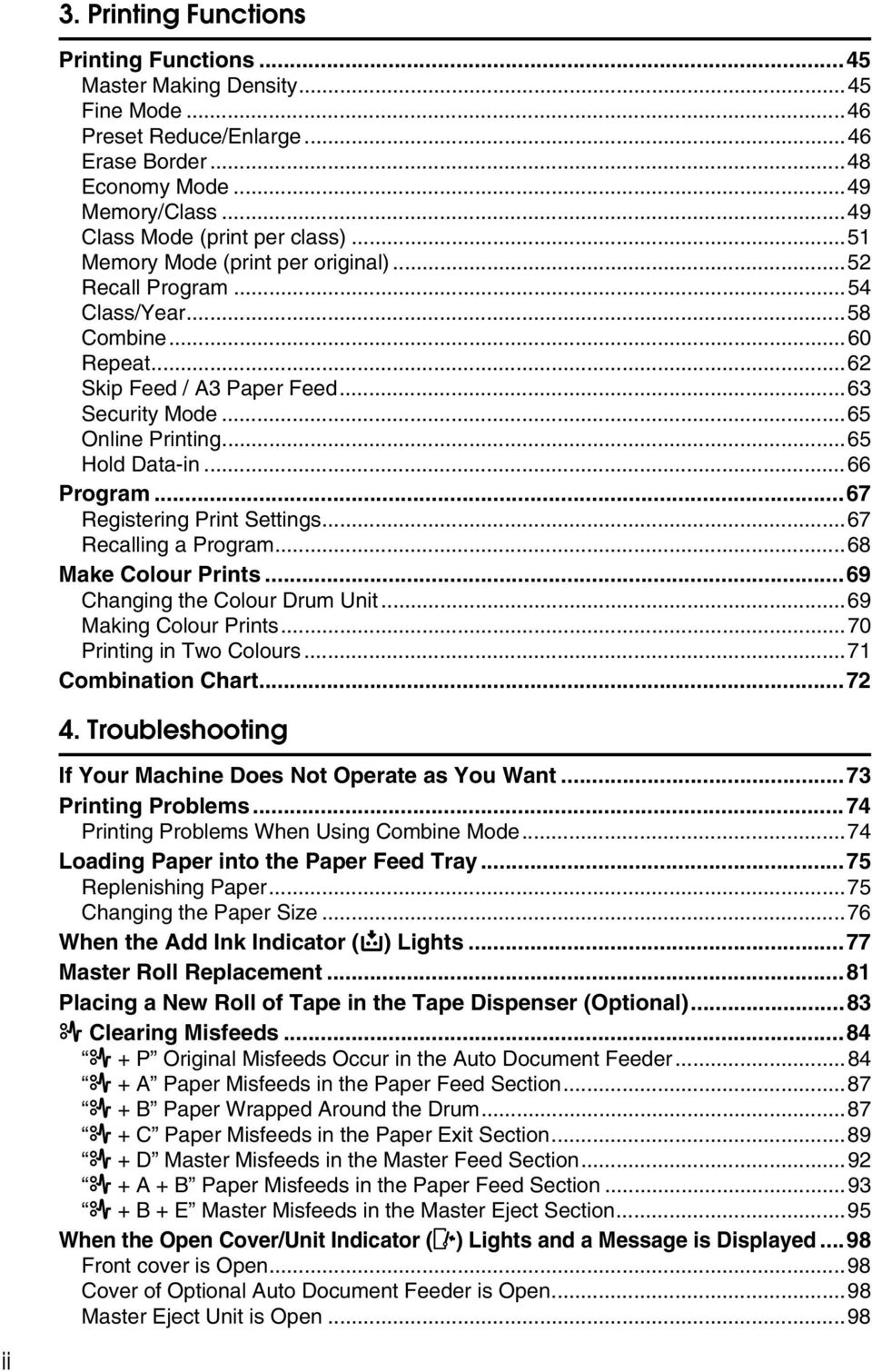
4 3. Printing Functions Printing Functions...45 Master Making Density...45 Fine Mode...46 Preset Reduce/Enlarge...46 Erase Border...48 Economy Mode...49 Memory/Class...49 Class Mode (print per class)...51 Memory Mode (print per original)...52 Recall Program...54 Class/Year...58 Combine...60 Repeat...62 Skip Feed / A3 Paper Feed...63 Security Mode...65 Online Printing...65 Hold Data-in...66 Program...67 Registering Print Settings...67 Recalling a Program...68 Make Colour Prints...69 Changing the Colour Drum Unit...69 Making Colour Prints...70 Printing in Two Colours...71 Combination Chart Troubleshooting If Your Machine Does Not Operate as You Want...73 Printing Problems...74 Printing Problems When Using Combine Mode...74 Loading Paper into the Paper Feed Tray...75 Replenishing Paper...75 Changing the Paper Size...76 When the Add Ink Indicator (j) Lights...77 Master Roll Replacement...81 Placing a New Roll of Tape in the Tape Dispenser (Optional)...83 x Clearing Misfeeds...84 x + P Original Misfeeds Occur in the Auto Document Feeder...84 x + A Paper Misfeeds in the Paper Feed Section...87 x + B Paper Wrapped Around the Drum...87 x + C Paper Misfeeds in the Paper Exit Section...89 x + D Master Misfeeds in the Master Feed Section...92 x + A + B Paper Misfeeds in the Paper Feed Section...93 x + B + E Master Misfeeds in the Master Eject Section...95 When the Open Cover/Unit Indicator (M) Lights and a Message is Displayed...98 Front cover is Open...98 Cover of Optional Auto Document Feeder is Open...98 Master Eject Unit is Open...98 ii
5 When the Master End Indicator (C) Lights and a Message is Displayed...99 Master Feeding Cover is Open...99 Master Tray is Not Set Properly...99 When the Master Eject Indicator (k) Lights When Other Indicators Light Poor Printing Dirt on the Back Side of Paper Dirt on the Front Side of Paper (Black Line/Stain) Blank Prints or Incomplete Prints User Tools Accessing the User Tools Quitting User Tools User Tools Menu Counter System Set Operation Mode Initial Settings Mode Settings Administrator Tools Online Settings User Code Entering the User Code to Use the Machine Clearing the Counter Remarks Operation s General Cautions Print Paper Originals Where to Put Your Machine Environmental Conditions Power Connection Access to Machine Maintaining the Machine Main Frame Optional Document Feeder Specifications Main Frame Auto Document Feeder (ADF) Consumables INDEX iii

6 iv

7 Manuals for This Machine The following manuals describe the operational procedures of this machine. For particular functions, see the relevant parts of the manual. Manuals provided are specific to machine type. Adobe Acrobat Reader/Adobe Reader is necessary to view the manuals as a PDF file. Safety Information (paper) Describes information about the safety precautions. Easy Operation Guide (paper/pdf file - CD-ROM *1 ) Describes information about the control panel and basic operations. Operating Instructions (this manual) (PDF file - CD-ROM *1 ) Describes operations, functions, User Tools (initial setting, mode setting, etc.) and troubleshooting. *1 Provided on the CD-ROM labeled "Operating Instructions" 1

8 What You Can Do with this Machine Below is a quick summary of this machine's features and where to look in this manual for more information Basic Procedure See p.32 Basic Procedure. Printing on Thick or Thin Paper See p.35 Printing on Thick or Thin Paper. Selecting Original Type See p.39 Original Type. Adjusting the Print Image Position See p.40 Adjusting the Print Image Position. Adjusting the Print Image Density See p.45 Master Making Density. Changing the Print Speed See p.43 Changing the Printing Speed. Fine Mode See p.46 Fine Mode. Reducing and Enlarging Using Preset Ratios See p.46 Preset Reduce/Enlarge. Saving Ink (Economy Mode) See p.49 Economy Mode. Printing per Class (Class Mode) See p.51 Class Mode (print per class). R R R R R R R GRCLAS0E Printing per Original (Memory Mode) See p.52 Memory Mode (print per original). A A B B C D C D GRCLAS1E Combining Originals onto One Print See p.60 Combine. A B A B ZCTX040E GRRATI0E Erasing Edge Margins See p.48 Erase Border. 2 ACY068S

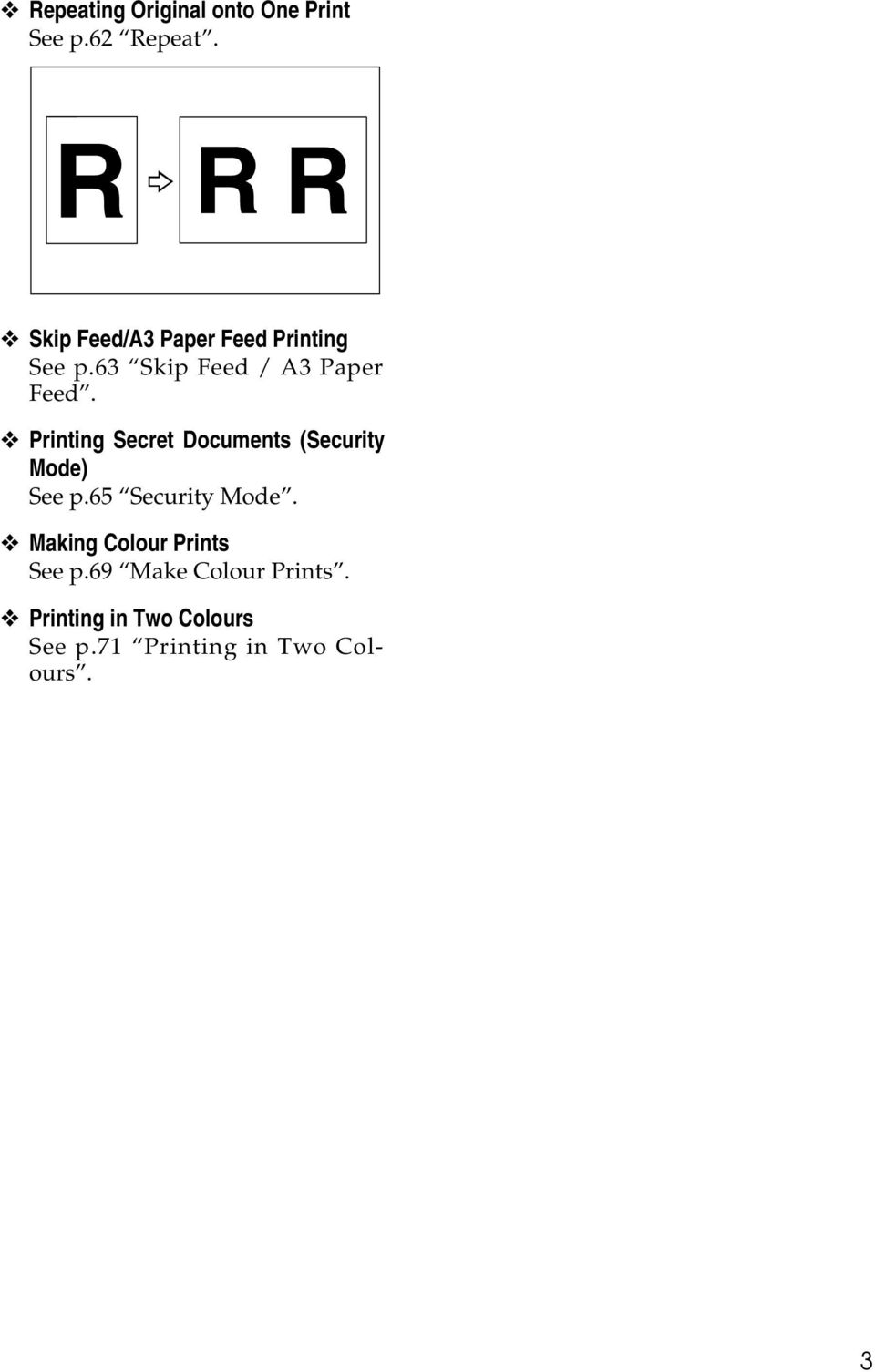
9 Repeating Original onto One Print See p.62 Repeat. Skip Feed/A3 Paper Feed Printing See p.63 Skip Feed / A3 Paper Feed. Printing Secret Documents (Security Mode) See p.65 Security Mode. Making Colour Prints See p.69 Make Colour Prints. Printing in Two Colours See p.71 Printing in Two Colours. 3
10 How to Read this Manual Symbols This manual uses the following symbols: R WARNING: Indicates important safety notes. Ignoring these notes could result in serious injury or death. Be sure to read these notes. They can be found in the "Safety Information" section of About This Machine. R CAUTION: Indicates important safety notes. Ignoring these notes could result in moderate or minor injury, or damage to the machine or to property. Be sure to read these notes. They can be found in the "Safety Information" section of About This Machine. Important Indicates points to pay attention to when using the machine, and explanations of likely causes of paper misfeeds, damage to originals, or loss of data. Be sure to read these explanations. Indicates supplementary explanations of the machine s functions, and instructions on resolving user errors. Reference This symbol is located at the end of sections. It indicates where you can find further relevant information. [ ] Indicates the names of keys that appear on the machine s display panel. { } Indicates the names of keys on the machine s control panel. 4

11 Safety Information When using this machine, the following safety precautions should always be followed. Safety During Operation In this manual, the following important symbols are used: R WARNING: Indicates a potentially hazardous situation which, if instructions are not followed, could result in death or serious injury. R CAUTION: Indicates a potentially hazardous situation which, if instructions are not followed, may result in minor or moderate injury or damage to property. R WARNING: Do not damage, break or make any modifications to the power cord. Do not place heavy objects on it. Do not pull it hard nor bend it more than necessary. These actions could cause an electric shock or fire. Disconnect the power plug (by pulling the plug, not the cable) if the power cable or plug becomes frayed or otherwise damaged. To avoid hazardous electric shock, do not remove any covers or screws other than those specified in this manual. Turn off the power and disconnect the power plug (by pulling the plug, not the cable) if any of the following occurs: You spill something into the machine. You suspect that your machine needs service or repair. The external housing of your machine has been damaged. Keep the machine away from flammable liquids, gases, and aerosols. A fire or an electric shock might occur. Connect the power cord directly into a wall outlet and never use an extension cord. Only connect the machine to the power source described in this manual. Disposal can take place at our authorized dealer or at appropriate collection sites. 5

12 R CAUTION: After you move the machine, use the caster fixture to fix it in place. Otherwise the machine might move or come down to cause an injury. If you use the machine in a confined space, make sure there is a continuous air turnover. Keep the machine away from humidity and dust. Otherwise a fire or an electric shock might occur. Protect the machine from dampness or wet weather, such as rain and snow. Do not place the machine on an unstable or tilted surface. If it topples over, an injury might occur. Unplug the power cord from the wall outlet before you move the machine. While moving the machine, you should take care that the power cord will not be damaged under the machine. When you disconnect the power plug from the wall outlet, always pull the plug (not the cable). Do not allow paper clips, staples, or other small metallic objects to fall inside the machine. For environmental reasons, do not dispose of the machine or expended supply waste at household waste collection points. Disposal can take place at an authorized dealer. When disposing of a used ink container, reattach the cap to prevent ink from splattering. Be careful not to get ink on your clothes when replacing an ink container. Ink stains on clothes are hard to remove. Be careful not to cut yourself on any sharp edges when you reach inside the machine to remove misfed sheets of paper or masters. If ink comes into contact with your eyes, rinse immediately in running water. For other symptoms, consult a doctor. Keep the ink or ink container out of reach of children. If ink is ingested, induce vomiting by drinking a strong saline solution. Consult a doctor immediately. If your skin comes into contact with ink, wash the affected area thoroughly with soap and water. While printing, do not touch the belt at the end of the paper delivery tray. Otherwise, an injury might occur. Our products are engineered to meet the high standards of quality and functionality, and we recommend that you only use the expendable supplies available at an authorized dealer. 6
13 User Information on Electrical & Electronic Equipment Users in the EU, Switzerland and Norway Our Products contain high quality components and are designed to facilitate recycling. Our products or product packaging are marked with the symbol below. The symbol indicates that the product must not be treated as municipal waste. It must be disposed of separately via the appropriate return and collection systems available. By following these instructions you ensure that this product is treated correctly and help to reduce potential impacts on the environment and human health, which could otherwise result from inappropriate handling. Recycling of products helps to conserve natural resources and protect the environment. For more detailed information on collection and recycling systems for this product, please contact the shop where you purchased it, your local dealer or sales/service representatives. All Other Users If you wish to discard this product, please contact your local authorities, the shop where you bought this product, your local dealer or sales/service representatives. 7

14 for the Battery and/or Accumulator Symbol (For EU countries only) In accordance with the Battery Directive 2006/66/EC Article 20 Information for end-users Annex II, the above symbol is printed on batteries and accumulators. This symbol means that in the European Union, used batteries and accumulators should be disposed of separately from your household waste. In the EU, there are separate collection systems for not only used electrical and electronic products but also batteries and accumulators. Please dispose of them correctly at your local community waste collection/recycling centre. 8

15 ENERGY STAR Program ENERGY STAR Program Requirements for Imaging Equipment This company is a participant in the ENERGY STAR Program. This machine is compliant with the regulations specified by the ENERGY STAR Program. The ENERGY STAR Program Requirements for Imaging Equipment encourage energy conservation by promoting energy efficient computers and other office equipment. The program backs the development and dissemination of products that feature energy saving functions. It is an open program in which manufacturers participate voluntarily. Targeted products are computers, monitors, printers, facsimiles, copiers, scanners, and digital duplicator. Energy Star standards and logos are internationally uniform. 9

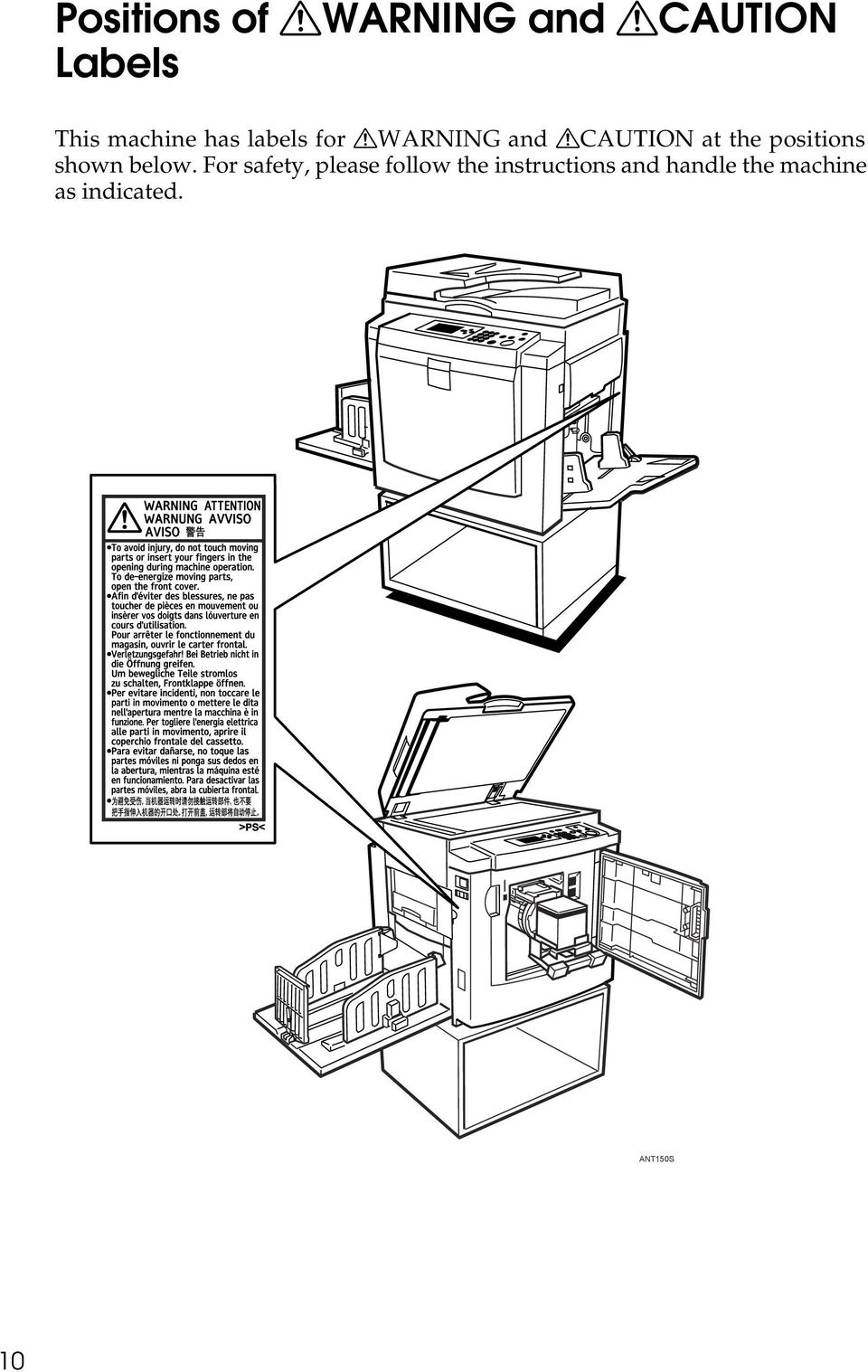
16 Positions of RWARNING and RCAUTION Labels This machine has labels for RWARNING and RCAUTION at the positions shown below. For safety, please follow the instructions and handle the machine as indicated. ANT150S 10
17 Guide To Components ANT046S 1. Front cover Open for access to the inside of the machine. 2. Control panel Operator controls and indicators are located here. See p.14 Control Panel. 3. Exposure glass cover (optional) or Auto Document Feeder (optional) Lower this cover over an original on the exposure glass. If you have the ADF, load a stack of originals here. They will be fed automatically, one by one. (The illustration shows the ADF.) 4. Master tray Open this tray when installing the master. 5. Feed roller pressure lever Use to adjust the contact pressure of the paper feed roller according to paper thickness. 6. Separation pressure lever Use to prevent double feed. 7. Paper feed side plate lock lever Use to lock or unlock the paper feed side plates. 8. Side tray fine adjusting dial Use to shift the paper feed tray sideways. 9. Paper feed tray Set paper on this tray for printing. 10. Paper feed side plates Use to prevent paper skew. 11. Paper feed tray down key Press to lower the paper feed tray. 11

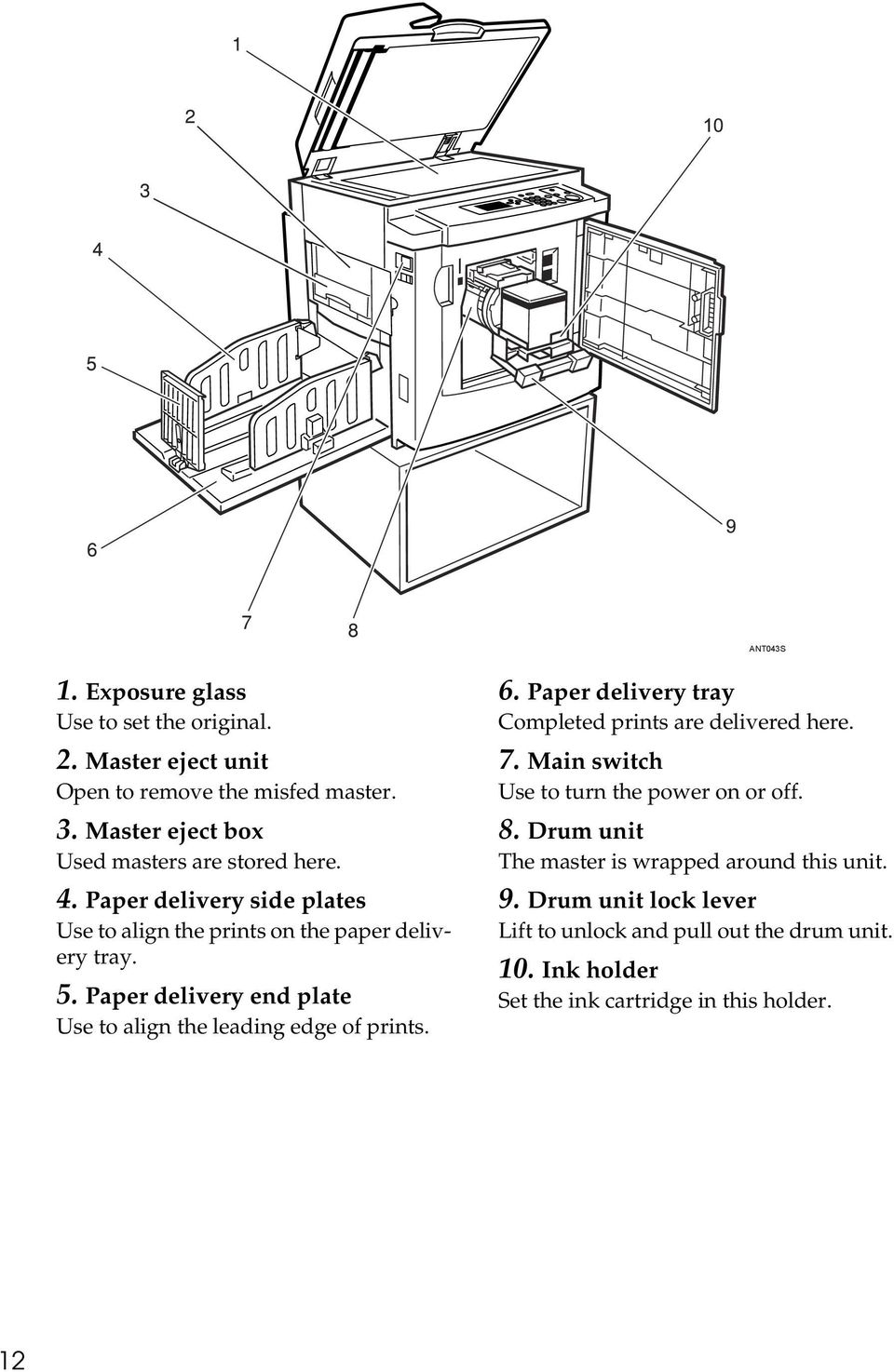
18 ANT043S 1. Exposure glass Use to set the original. 2. Master eject unit Open to remove the misfed master. 3. Master eject box Used masters are stored here. 4. Paper delivery side plates Use to align the prints on the paper delivery tray. 5. Paper delivery end plate Use to align the leading edge of prints. 6. Paper delivery tray Completed prints are delivered here. 7. Main switch Use to turn the power on or off. 8. Drum unit The master is wrapped around this unit. 9. Drum unit lock lever Lift to unlock and pull out the drum unit. 10. Ink holder Set the ink cartridge in this holder. 12
19 Options Option List Options Model Name Auto Document Feeder (ADF) DF Type 20 Exposure Glass Cover Platen Cover Type 1018 Drum unit Color Drum Type 20 A4 Color Drum Type 20 B4 Tape Dispenser Priport Tape Maker Type 20 Printer Controller Printer Unit VC-20 (Non Network Connectable) Printer Unit Type 4545 (Network Connectable) Key Counter Printer Unit VC-20 and Printer Unit Type 4545 cannot be used at the same time. Even if both units are connected, by default only Printer Unit Type 4545 can be used. Printer Unit VC-20 is not available on the network. If Printer Unit VC-20 is connected to your printer server via USB, it cannot be used as a network printer. Guide to Major Options Auto Document Feeder (ADF) Load a stack of originals here. They will be fed automatically, one by one. ANT071S 13

20 Control Panel BFU002S {Economy} key Press to save ink. See p.49 Economy Mode. 2. {Memory/Class} key Press to select Memory or Class mode. See p.51 Class Mode (print per class) or p.52 Memory Mode (print per original). 3. {Erase Border} key Press to select erase margins on the prints. See p.48 Erase Border. 4. {User Tools} key Press to change the default settings to suit your requirements. See p.109 User Tools. 5. {Master Making Density} key Press to make prints darker or lighter. See p.45 Master Making Density. 6. Indicators Show errors and machine status. :Colour Drum indicator u: Key Counter indicator See p.101 When Other Indicators Light. j: Add Ink indicator See p.77 When the Add Ink Indicator (j) Lights. C: Master End indicator See p.99 When the Master End Indicator (C) Lights and a Message is Displayed. B: Load Paper indicator See p.75 Loading Paper into the Paper Feed Tray. k: Master Eject indicator See p.100 When the Master Eject Indicator (k) Lights. x: Misfeed indicator See p.84 x Clearing Misfeeds. M: Open Cover/Unit indicator See p.98 When the Open Cover/Unit Indicator (M) Lights and a Message is Displayed. 7. Panel Display The panel display shows the machine status, error messages, and function menus. 8. {Escape} key Press to cancel a selection or an entry, and to return to the previous display. 9. Counter Shows the number of prints entered. While printing, it shows the remainder that is to be printed. 10. {U}{T} keys Press to select an item on the panel display. 11. {OK} key Press to confirm a selection or an entry. 12. {Program} key Press to input or recall user programs. See p.67 Program.

21 13. {Clear Modes/Energy Saver} key Clear Modes Press to clear the previously entered job settings. Energy Saver Press to switch to and from Energy Saver Mode p.34 Energy Saver Mode. 14. {Proof} key Press to make proof prints. 15. {Master Making} mode select key Press to select the master making mode. 16. {Auto Cycle} key Press to make masters and prints in a single operation. See p.32 Basic Procedure 17. {Print} mode select key Press to select the print mode. 18. {Fine} key Press to select the fine image. See p.46 Fine Mode. 19. {Security} key Press to make prints of secret documents. See p.65 Security Mode. 20. {Skip Feed/A3 Paper Feed} key Press to select skip feed or A3 Paper Feed printing. See p.63 Skip Feed / A3 Paper Feed. 21. Data In indicator (Green) On: Data waiting for Master Making and printing is in the machine. Blinking: Data is being received, or Master Making or printing is in progress. Off: Master Making and printing are completed. 22. Error indicator (Red) On: An error has occurred. Master Making and printing stops. Off: Normal status 23. {Job Reset} key Press to cancel the data from an optional printer controller. 24. {Hold Data-in} key Press to reject the online print temporarily. 25. {Original Type} key Press to select Text, Photo, Text/Photo, Pale, or Pencil mode. See p.39 Original Type. 26. {Reduce/Enlarge} key Press to reduce or enlarge the image by preset ratios. Seep.46 Preset Reduce/Enlarge. 27. {Combine/Repeat} key Press to combine two originals onto one print. See p.60 Combine. Press to repeat the image of an original on one print. See p.62 Repeat. 28. {Full Size} key Press to make full size prints. 29. {W} and {V} keys (Speed keys) Press to adjust the printing speed. See p.43 Changing the Printing Speed. 30. {Image Position} key Press to shift the image forwards or backwards. See p.40 Adjusting the Print Image Position. 31. Number keys Press to enter the desired number of prints and data for selected modes. 32. {q} key Press to enter data in selected modes. 33. {Clear/Stop} key Press to cancel a number you have entered or to stop printing. 34. {Start} key Press to start making masters or printing. 35. Processing indicators Shows the process of making master to printing. 15
22 Panel Display The panel display shows the machine status, error messages, and function menus. Important Do not subject the panel display to strong impact or a force equivalent to 30N or more, otherwise it could be damaged. When you select an item on the panel display, it is highlighted (e.g. 100 ). 2 ANT100S 1. Menu for the function selected 2. Machine status or messages Common keys {OK} key {Escape} key {U}{T} keys Press to confirm a selection or an entry. Press to cancel a selection or entry, and to return to the previous display. Press to select items on the panel display. 16
23 Panel Display Layout The basic elements of the panel display are explained below. Understanding their meaning helps you use this machine's features quickly and easily. Sample display when selecting the {Reduce/Enlarge} key ANT101S 1. Machine status or messages When the {Reduce/Enlarge} key is pressed, the following display is shown. ANT102S Functions and settings available: Press the {U}{T} keys to select an item. Press the {OK} key to confirm your settings. Press the {Escape} key to return to the previous display. 17
24 18
25 1. Before Using the Machine Originals Recommended Sizes and Weights of Originals Metric version Where original is placed Original size Original weight Exposure glass Up to A3 *1 -- ADF Maximum: 297 mm 432 mm Minimum: 105 mm 128 mm g/m 2 *1 When using an A3 size original, be sure to check the printed paper size and print size, and use the Reduce or Combine functions. Inch version Where original is placed Original size Original weight Exposure glass Up to 11" 17" L *1 -- ADF Maximum: 11.7" 17.0" Minimum: 4.1 " 5.0 " lb. *1 When using an 11" 17" size original, be sure to check the printed paper size and print size, and use the Reduce or Combine functions. The maximum number of originals that can be placed in the ADF is about 30 (80 g/m 2, 20 lb). If you do not lift the exposure glass cover more than 30 when you place another original, the machine might not detect the next original correctly. 19
26 Before Using the Machine Non compatible originals for the Auto Document Feeder (ADF) 1 Placing the following types of originals in the ADF can cause paper misfeeds or result in damage to the originals. Place these originals on the exposure glass instead. Originals other than those specified on p.19 Recommended Sizes and Weights of Originals. Perforated or torn originals Curled, folded, or creased originals Pasted originals Originals with any kind of coating, such as thermal fax paper, art paper, aluminum foil, carbon paper, or conductive paper. Originals with indexes, tags, other projecting parts Stapled or clipped original Sticky originals such as translucent paper Thin originals that have low stiffness Thick originals such as postcards Bound originals such as books Transparent originals such as OHP transparencies or translucent paper 20
27 Print Paper Print Paper The following limitations apply: Metric Paper Size Inch Paper Weight 1 Paper feed tray A3L *1, B4 JIS L, A4 L, B5 JIS LK, A5 L, B6 JIS L, A6 L Others (Vertical: mm, Horizontal: mm) 8 1 / 2 " 14" L, 8 1 / 2 " 11" L, 5 1 / 2 " 8 1 / 2 " LK, 8" 13" L Others (Vertical: 3.6" ", Horizontal: 5.9" ") g/m 2, lb *1 For details about how to print on A3L, see p.64 A3 Paper Feed Paper with a thickness of g/m 2 can be used. However, when using a thickness less than 52.5 g/m 2 or greater than 81.6 g/m 2, it is advised to select printing speed to setting 1. About 1,000 sheets of paper with a 64 g/m 2 thickness is the standard amount that can be set in the paper feed tray. This amount changes depending on the paper thickness. In general, set paper at a height less than 105 mm. When using paper that easily curls or waves in humidity, if there is high humidity (more than 80%), set less than 500 sheets in the paper feed tray. Paper with a length of mm and width of mm can be set in the paper feed tray. However, when using a paper size that exceeds 275 mm length and 395 mm width, specify A3 Paper Feed. Specifying this function sets the printing speed to 80 cpm and the print position to -20 mm (Type 1: A4 drum) / -10 mm (Type 2: B4 drum). Do not use curled or waved paper. Use paper with less than 5 mm curl and 3 mm wave. When paper feed problems arise, try using a slower print speed. 21
28 Before Using the Machine Non-recommended Paper 1 The following types of paper are not recommended for this machine: Roughly cut paper Paper of different thickness and types in the same stack Envelopes heavier than 85 g/m 2, 22 lb. Folded, curled, creased, or damaged paper Damp paper Torn paper Slippery paper Rough paper Paper with any kind of coating (such as carbon) Short grain paper Thin paper that has low stiffness Paper that is prone to generate a lot of paper dust Grained paper loaded with the direction of the grain perpendicular to the feed direction Certain types of long thin envelopes. E.g. international mail envelopes ZFXX040E The following types of envelopes 22 Do not use inkjet paper. It does not absorb ink well, print will smudge if rubbed, and the back of paper may be dirtied. If you print on rough grained paper, the print image might be blurred.
29 Print Paper Important Correct curls in the paper before placing it in the machine. When you cannot correct the paper curl, stack the paper with the curl face down or face up as shown in the illustration. If the paper is curled, it might wrap around the drum or stains might appear. 1 TPEY990E Storing Paper When storing paper, the following precautions should always be taken: Do not store paper where it will be exposed to direct sunlight. Avoid storing paper in humid (greater than 70%) areas. Store on a flat surface. Keep open reams of paper in the package and store as you would unopened paper. 23
30 Before Using the Machine Printing Size 1 Maximum print size Type 1 (A4 drum) model: mm, 8.3" 11.3" Type 2 (B4 drum) model: mm, 9.8" 14.0" At low temperatures, the maximum print size may be somewhat smaller. Range that cannot be printed The first 5 mm, 0.2" of the leading edge cannot be printed. When using the optional Auto Document Feeder, the first 5 mm, 0.2", of the leading edge as well as the last 2 mm, 0.08", of the trailing edge cannot be printed. Original Print a a: 5 mm, 0.2" 24
31 2. Basics Printing Preparations Using the Paper Feed Tray and Delivery Tray C Load paper into the paper feed tray. Loading Paper A Carefully open the paper feed tray. ANT074S TSLH026E Correct the paper curl before setting the paper. If you cannot do so, stack the paper with the curl face down as shown. B Shift the paper feed side plates lock lever forward. Adjust the side plates to match the paper size. GRMARU0E 1 GRBATS0E ANT072S 1: Paper Feed Side Plates Lock Lever 25
32 Basics D Make sure that the paper feed side plates touch the paper lightly. Shift the lock lever to its original position. C Lift the paper delivery end plate and move it to match the print paper size. 2 Setting Up the Paper Delivery Tray A Open the paper delivery tray. TSLY015E ANT037S D Lift the paper delivery end plate and adjust it to match the paper size. ANT038S ANT035S B Lift the paper delivery side plates and adjust them to the paper size ANT062S 26
33 Printing Preparations Using the side plate guides When printing on A4L, 8 1 / 2 "L, B5 JISKLsize paper and thin paper, you should attach the side plate guides to the side plates of the Paper Delivery Tray. Using the side plate guides allows you to properly assemble the printed papers on the Paper Delivery Tray. B Turn the Side Plate Guide to the direction shown by the arrow, and make sure it is fixed. 2 Side plate guides ANT042S C After attaching the Side Plate Guide on one side, repeat the same process for the other side. E Turn on the main switch. ANT040S Side Plate guides come equipped with the machine. A Insert the protruding portion into the Side Plate holes. ANT076S ANT041S Insert the middle protruding portion first followed by the upper and lower portions. 27
34 Basics After Printing This section shows you how to return the paper feed tray and paper delivery tray to their original positions. C Close the paper feed tray. 2 Folding the Paper Feed Tray and Delivery Tray A Remove the paper from the paper feed tray. TSLH020E D Move the end plate until the plate handle is flush with the end of the tray. ANT073S The paper feed tray will move down. B Turn off the main switch. ANT038S E Lower the end plate. ANT077S ANT039S 28
35 After Printing F Move the side plates to the sides, then lower them ANT036S G Close the tray. 29
36 Basics 2 Placing Originals When using the exposure glass, place the originals face down. When using the ADF, place the originals face up. Placing Originals on the Exposure Glass A Lift the exposure glass cover. C Lower the exposure glass cover. D Adjust print settings as necessary, and then press the {Start} key. Placing Originals in the Auto Document Feeder A Adjust the guide to the original size. B Insert the aligned originals face up into the ADF. ANT064S Be sure to lift the exposure glass cover more than 30. B Place the original face down on the exposure glass. The original should be aligned with the left scale. AJK153S To avoid originals misfeeding, fan the originals before placing them in the ADF. Limitation Approximately 30 originals (80 g/m 2, 20 lb) can be inserted at a time in the ADF. The first (top) original will be fed first. 1. Left scale ACY070S To avoid jamming, fan the originals before placing them in the ADF. The guides must fit snugly against both sides of the stack. 30
37 Placing Originals C Adjust print settings as necessary, and then press the {Start} key. If the next original has been placed in the ADF before the machine stops, that original is fed automatically. 2 31
38 Basics Basic Procedure 2 When Auto Cycle mode is on, you can process masters and make prints in a single operation. You can process masters and make prints in a single operation. See p.38 Auto Cycle. If the machine has user codes set, enter your user code using the number keys, and then press the {OK} key. Reference See p.117 User Code. A Make sure no previous settings remain. If previous settings remain, press the {Clear Modes/Energy Saver} key before entering your settings. B Place the originals. Reference See p.30 Placing Originals. C Make sure the {Master Making} mode select key is lit. If it is not lit, press the {Master Making} mode select key. D Make the necessary settings. E Press the {Start} key. Master making starts. ANT015S Press the {Proof} key to check the image before making prints. ANT010S Reference To change the image position, see p.40 Adjusting the Print Image Position. F Make sure the {Print} mode select key is lit. 32 ANT014S
39 Basic Procedure G Enter the required number of prints using the number keys. -How to operate To stop the machine during a multiprint run Press the {Clear/Stop} key. To return the machine to the initial condition after printing Press the {Clear Modes} key. 2 ANT008S Set a print quantity between 1 (minimum) and 9999 (maximum). H Press the {Start} key. When clearing entered values Press the {Clear/Stop} key. ANT015S When the print job finishes, press the {Clear Modes} key. Previously entered job settings are cleared. 33
40 Basics 2 Energy Saver Mode If the machine has not been operated for a certain period of time after printing, or when you press and hold the {Clear Modes/Energy Saver} key for 3 seconds, the panel display goes off and the machine enters Energy Saver mode. In Energy Saver mode, the machine consumes less electricity. Press the {Clear Modes/Energy Saver} key again, and the machine will return to the ready condition. By default, the time taken for the machine to shift to Energy Saver mode is 3 minutes. You can change the waiting time within a range of 1 to 120 minutes. See Energy Saver Timer on p System. In the following cases, the machine will not shift automatically to Energy Saver mode. If there is no ink If originals or paper are jammed If the machine has not finished making masters or prints If the machine is printing the second page of a Combine print If there is no master If the master eject box is full If there is an original in the optional Auto Document Feeder If the cover open indicator is lit If you are in the process of making changes to the user tools If the screen for entering a user code is displayed Auto Reset This machine can be set to return automatically to its initial condition if it has not been operated for a certain period of time. This is called Auto Reset. The Auto Reset time can be set from 1 to 5 minutes, or to Off. See Auto Reset Timer on p System. The default for Auto Reset is Off. In the following cases, Auto Reset will not take place. If there is no ink If originals or paper are jammed If the machine has not finished making masters or prints If the machine is printing the second page of a Combine print If there is no paper If there is no master If the master eject box is full If there is an original in the optional Auto Document Feeder If the cover open indicator is lit If you are in the process of making changes to the user tools If you have set Auto Reset to Off 34
41 Printing on Thick or Thin Paper Printing on Thick or Thin Paper When you make prints on thick (127.9 to g/m 2, 34.0 to 55.6 lb), standard (52.3 to g/m 2, 13.9 to 34.0 lb) or thin (47.1 to 52.3 g/m 2, 12.5 to 13.9 lb) paper, perform the following steps. Reduce the print speed when printing on thick or thin paper. Feed Roller Pressure Lever Position A Shift the feed roller pressure lever to the Thick, Standard, or Thin paper position. Shift the lever according to the paper weights as shown in the following table. Metric version Thick g/m 2 Standard Thin * g/m g/m 2 Inch version lb lb lb. *1 When paper is smaller than B5, 5 1 / 2 " 8 1 / 2 " and heavier than 81.4 g/m 2 (21.6 lb.), move the feed roller pressure lever to the Thin paper position. B Shift the paper feed side plates lock lever forward. Adjust the side plates to match the paper size. 2 1 ANT075S ANT072S 1: Paper Feed Side Plates Lock Lever 35
42 Basics C Make sure that the paper feed side plates touch the paper lightly. E When you finish printing, shift the feed roller pressure lever to the Standard paper position. 2 ZCTH150E ANT075S When printing onto thin paper A Set the side pads to both sides of the paper feed side plates. Make sure that the paper feed side plates touch the paper lightly. D Shift the lock lever to its original position. TSLY015E 36
43 Printing on Thick or Thin Paper Separation Pressure Lever Position A To prevent double feed, adjust the paper separation pressure using the separation pressure lever. 2 ANT117S Paper separation pressure can be adjusted according to the paper weights as shown in the following table. Position Metric version Inch version 1 Use this position if the leading edge of the paper is curled, or when the paper does not feed properly at Position 2. 2 * g/m 2 lb g/m 2 lb. *1 This position can also be used if the leading edge of the paper is curled, or when the paper does not feed properly. 37
44 2 Basics Auto Cycle Using the default settings, you can process masters and make prints in a single operation. This is called "Auto Cycle". A Make sure the {Auto Cycle} key is lit. E Enter the required number of prints using the number keys. ANT008S F Press the {Start} key. ANT012S If it is not lit, press the {Auto Cycle} key. B Place your originals. Reference See p.30 Placing Originals. C Make sure the {Master Making} mode select key is lit. If it is not lit, press the {Master Making} mode select key. D Make the necessary settings. ANT015S When the print job finishes, press the {Clear Modes} key. Previously entered job settings are cleared. 38
45 Auto Cycle Original Type A Press the {Original Type} key. Select one of the following four types to match your originals: Text Specify this if the original document consists primarily of text. Text/Photo If the original document contains a combination of text and photographs, it is printed using the optimum image balance. Photo Specify this for photographs, pictures, or coloured documents. Pale When printing pale colours, the master is created using pale colour print. Pencil Specify this for originals drawn / written in pencil. You can specify the original type that is selected by default when the power is turned on. See Original Type on p Initial Settings. The default is Text mode. Moire patterns may occur when you are printing from screened originals. When using Photo mode to print originals with both text and photographs, the text might appear faint. To avoid this, use Text/Photo mode instead. When using Pencil mode, set documents drawn / written in pencil on the exposure glass. ANT016S B Use the {U}{T} keys to select the type of original, and then press the {OK} key. 2 39
46 Basics Sample Print and Adjustment 2 Once the master making has been completed, it is possible to confirm the print finish before pressing the {Print} mode select key to start the printing process. A Press the {Proof} key. A single printed page is ejected. ANT010S Press the key continuously to eject printed pages in succession. Adjusting the Print Image Position After master making, you can adjust the print image position to suit your needs. There are two ways: Shifting the Image Position Forward or Backward Shift the image position using the {Image Position} keys. Shifting the Image Position to the Right or Left Shift the image position using the side tray fine adjusting dial. Shifting the Image Position Forward or Backward GRFORW0E * Paper feed direction 40
47 Sample Print and Adjustment A Press the left {Image Position} key to move the image forwards, the right key to move it backwards. B Press the {Proof} key to check the image position. 2 ANT010S ANT024S When you shift the image forwards, leave a margin (more than 5 mm, 0.2") at the leading edge. If there is no margin, paper might wrap around the drum and cause a misfeed. The right or left {Image Position} keys shift the image about 0.5 mm, 0.02" each time they are pressed. The value of the image position that shifted is displayed on the panel display. In A3 Paper Feed mode, the images are fixed at the following positions: Type 1 (A4 drum) model: -20 mm, -0.8" Type 2 (B4 drum) model: -10 mm, -0.4" Shifting the Image Position to the Right or Left * Paper feed direction A Turn the side tray fine adjusting dial as shown in the illustrations. Shifting the image to the right GRLEFT0E TSLH02IE 41
48 Basics Shifting the image to the left 2 TSLH02JE The image position can be shifted up to about 10 mm, 0.4" each way. Each division on the scale is 2 mm, 0.08". In A3 paper feed mode, adjust the print position to within ±1 mm, ±0.04" of the center. B Adjust the paper delivery side plates to the print paper position. C Press the {Proof} key to check the image position. ANT010S 42
49 Changing the Printing Speed Changing the Printing Speed Use the {W} or {V} key to adjust the speed of the machine with the image density and printing paper. Adjust the print speed using the Speed Keys for the following instances: When the paper type is changed: Reduce the print speed when printing on thick or thin paper. When you want to change the print density: Increase the print speed to lighten the print density. Reduce the print speed to darken the print density. A Press the {V} key to increase the speed and press the {W} key to reduce the speed. 2 ANT023S The following speeds are available: Setting 1: 80 sheets/minute Setting 2: 100 sheets/minute Setting 3: 130 sheets/minute As a default setting, setting 2 is selected. In A3 paper feed mode, the print speed is fixed at setting 1. 43
50 Basics 2 44
51 3. Printing Functions Printing Functions Master Making Density C Press the {Start} key. You can adjust the image density to suit your needs. You can specify the image density that is selected by default when the power is turned on. See Master Making Density on p Initial Settings. A Press the {Master Making Density} key to select the density you want to set. ANT015S D Press the {Proof} key to check the print image density. ANT010S BFU005S If your original has a coloured background such as red or blue, select a lighter image density to prevent the prints from appearing dirty. B Make sure the {Master Making} mode select key is lit. If it is not lit, press the {Master Making} mode select key. 45
52 Printing Functions Fine Mode Use the {Fine} key to make clear prints. A Set your originals. B Press the {Fine} key to select Fine mode. Preset Reduce/Enlarge Use this function to reduce or enlarge originals by a preset ratio. 3 GRRATI0E ANT025S C Enter the number of prints with the number keys. You can select a ratio regardless of the size of the original or the printing paper. However, with some ratios, parts of the image might not be printed or margins will appear on prints. You can choose from 7 preset ratios (3 enlargement ratios and 4 reduction ratios). Metric version Ratio (%) Original Print paper size 141 A5 A4, B5 JIS B4 JIS 122 A4 B4 JIS, A5 B5 JIS ANT008S 115 B5 JIS A4 D Press the {Start} key A3 B4 JIS, A4 B5 JIS 82 B4 JIS A4, B5 JIS A5 71 A3 A4, A4 A5, B4 JIS B5 JIS ANT015S 46
53 Printing Functions Inch version Ratio (%) Original Print paper size D Enter the number of prints with the number keys / 2 " 8 1 / 2 " 8 1 / 2 " 14" / 2 " 8 1 / 2 " 8 1 / 2 " 11" / 2 " 14" 11" 17" / 2 " 14" 8 1 / 2 " 11" 74 11" 15" 8 1 / 2 " 11" 65 11" 17" 8 1 / 2 " 11", 8 1 / 2 " 11" 5 1 / 2 " 8 1 / 2 " You can specify the reproduction ratio that is selected by default when the power is turned on. See Ratio on p Initial Settings. A Set your original. B Press the {Reduce/Enlarge} key. E Press the {Start} key. ANT008S 3 ANT015S ANT018S C Use the {U}{T} keys to select your desired reproduction ratio, and then press the {OK} key. 47
54 Printing Functions Erase Border This function erases all four margins of the original or paper. D Enter the number of prints with the number keys. 3 ACY068S You can specify within a range of 0 to 20mm, 0" to 0.8", the width of the margin to be erased. See Erase Border Width on p Initial Settings. E Press the {Start} key. ANT008S The default is 5 mm, 0.2". A Set your original. B Press the {Erase Border} key. ANT015S Auto Delete Margin Shadow BFU006S C Use the {U}{T}keys to select the original size and orientation, and then press the {OK} key. If the exposure glass or ADF is open during scanning, and Erase Border is not selected, dark areas surrounding the original might appear as a shadow on the prints. The Auto Delete Margin Shadow function automatically detects there areas and prevents them appearing on the prints. 48
55 Printing Functions Economy Mode D Press the {Start} key. Use this function to save ink. Prints will appear lighter when Economy mode is used. The default is Off. To select either On or Off for Economy mode, see Economy Mode on p Initial Settings. A Set your original. B Press the {Economy Mode} key. BFU004S C Enter the number of prints with the number keys. Memory/Class ANT015S The Memory/Class function is useful especially for people such as teachers, who often have to make different numbers of prints from the same original for different classes or have to make the same number of prints from a number of different originals for the same class. Under the Memory/Class function, the following modes are available: Class Mode (print per class) Use to make prints from one original for multiple classes, with the same number of prints for each class. 3 R R R ANT008S R R R R GRCLAS0E 49
56 Printing Functions 3 Memory Mode (print per original) You can choose from the following two types of Memory mode: Normal Memory Mode Use to make prints from a number of different originals. A different number of prints is made from each original. A A B B C D C D Class/Year Mode Reference If the use of this machine is not limited to school or college, you can choose to have this mode displayed as Department displayed instead of Class/Year. See Class Display on p Set Operation Mode. Stack Memory Mode Use to make prints from one original, with a different number of prints for each class. A A A A A GRCLAS1E STKMEM1E You can specify either Normal Memory Mode or Stack Memory Mode as the default. See Memory Mode Setting on p Mode Settings. Recall Program Use to recall settings that you have stored under the Memory Mode and Class Mode. GRCLAS2E All Use to make prints from the same original for all the registered classes in all the school years. Class Select to make prints from the same original for only the classes selected. Households Use to make prints from the same original for all the registered student households in the school. 50
57 Printing Functions Class Mode (print per class) You can print for up to 24 combinations of number of prints and number of classes. The maximum possible number of classes in one combination is 99. A Set your original. B Press the {Memory/Class} key. E With the number keys, enter the desired number of classes, and then press the {q} key. Repeat Steps D to E as desired. F Press the {OK} key. G If you are using the optional tape dispenser, turn on the tape dispenser switch. 3 ANT026S C Use the {U}{T} keys to select Class and then press {OK} key. On Off TSLP013E D With the number keys, enter the desired number of prints, and the press the {q} key. The optional tape dispenser automatically feeds out strips of paper to separate each group of prints. H Press the {Start} key. ANT015S 51
58 Printing Functions 3 Memory Mode (print per original) Normal Memory Mode You can make prints from up to 30 originals at one time. A Set your original. B Press the {Memory/Class} key. E Press the {OK} key. F If you are using the optional tape dispenser, turn on the tape dispenser switch. On Off TSLP013E ANT026S C Use the {U}{T} keys to select Memory, and then press the {OK} key. The optional tape dispenser automatically feeds out strips of paper to separate the prints made from each original. G Press the {Start} key. D With the number keys, enter the desired number of prints for each original, and then press the {q} key. ANT015S Repeat this step until you have entered for all the originals. 52
59 Printing Functions Stack Memory Mode Limitation To use Stack Memory mode, you need to first set Memory Mode to Stack Mode using the user tools. See Memory Mode Setting on p Mode Settings. You can make prints for up to 30 classes at one time. A Set your original. B Press the {Memory/Class} key. D With the number keys, enter the desired number of prints for each class, and then press the {q} key. Repeat this step until you have entered for all of your classes. E Press the {OK} key. F If you are using the optional tape dispenser, turn on the tape dispenser switch. G Press the {Start} key. 3 ANT026S C Use the {U}{T} keys to select Memory, and then press the {OK} key. ANT015S 53
60 Printing Functions 3 Recall Program You can store up to 10 entries for Memory mode with each entry containing settings for up to 30 originals (Normal Memory mode), or settings for up to 30 classes (Stack Memory mode). You can store up to 10 entries for Class mode with each entry containing settings for up to 24 combinations of classes and numbers of prints. C Use the {U}{T} keys to select 7 Program/Change Memory, and then press the {OK} key. D Use the {U}{T} keys to select a number, and then press the {OK} key. Storing Normal Memory Mode Settings A Press the {User Tools} key. ANT027S B Use the {U}{T} keys to select 4 Initial Settings, and then press the {OK} key. If the number is already in use, a message will be displayed asking if you wish to overwrite the settings stored. To overwrite, press the {OK} key. Otherwise press the {Escape} key to return to the previous display, and then select another number. E With the number keys, enter the number of prints for each original, and then press the {q} key. 54 Repeat Steps D and E to register all of your originals. F Press the {OK} key. G Press the {Clear Modes/Energy Saver} key. The contents that you have stored are now effective.
61 Printing Functions Storing Stack Memory Mode Settings Limitation To use Stack Memory mode, you need to first set Memory Mode to Stack using the user tools. See Memory Mode Setting on p Mode Settings. A Press the {User Tools} key. ANT027S B Use the {U}{T}keys to select 4 Initial Settings, and then press the {OK} key. D Use the {U}{T} keys to select a number, and then press the {OK} key. If the number is already in use, a message will be displayed asking if you wish to overwrite the settings stored. To overwrite, press the {OK} key. Otherwise press the {Escape} key to return to the previous display, and then select another number. E With the number keys, enter the number of prints for each class, and then press the {q} key. 3 C Use the {U}{T} keys to select 7 Program/Change memory, and then press the {OK} key. Repeat Steps D and E to register all of your classes. F Press the {OK} key. G Press the {Clear Modes/Energy Saver} key. The contents that you have stored are now effective. 55
62 Printing Functions Storing Class Mode Settings A Press the {User Tools} key. D Use the {U}{T} keys to select a number, and then press the {OK} key. 3 ANT027S B Use the {U}{T} keys to select 4 Initial Settings, and then press the {OK} key. If the number is already in use, a message will be displayed asking if you wish to overwrite the settings stored. To overwrite, press the {OK} key. Otherwise press the {Escape} key to return to the previous display, and then select another number. E With the number keys, enter the number of prints, and then press the {q} key. C Use the {U}{T} keys to select 6 Program/Change Class, and then press the {OK} key. F With the number keys, enter the number of classes, and then press the {q} key. 56 Repeat Steps D to F to register all of your classes. G Press the {OK} key. H Press the {Clear Modes/Energy Saver} key. The contents that you have stored are now effective.
63 Printing Functions Recalling the Stored Settings A Set your original. B Press the {Memory/Class} key. F Confirm that the settings are correct, and then press the {OK} key. ANT026S C Use the {U}{T} keys to select Recall Program, and then press the {OK} key. To change the stored settings, use the {U}{T} keys to select the item that you wish to change, and then overwrite using the number keys. G Press the {Start} key. 3 D Use the {U}{T} keys to select Class or Memory, and then press the {OK} key. ANT015S E Use the {U}{T} keys to select the number to recall, and then press the {OK} key. 57
64 Printing Functions 3 Class/Year Preparation To use this mode, you need to first register the number of prints required for each class. Registering Class/Year You can register for up to 108 classes (up to 12 classes per school year for a maximum of 9 school years). A Press the {User Tools} key. D Use the {U}{T} keys to select the desired school year, and then press the {OK} key. E With the number keys, enter the number of prints for a class, and then press the {q} key. ANT027S B Use the {U}{T} keys to select 4 Initial Settings, and then press the {OK} key. Repeat Steps D and E to register all of your classes. F Press the {OK} key. G Press the {Clear Modes/Energy Saver} key. The contents that you have registered are now effective. Printing for All Years A Set your original. B Press the {Memory/Class} key. C Use the {U}{T} keys to select 8 Prog./Change:Class/Year, and then press the {OK} key. ANT026S 58
65 Printing Functions C Use the {U}{T} keys to select Class/Year, and then press the {OK} key. C Use the {U}{T} keys to select Class/Year, and then press the {OK} key. D Use the {U}{T} keys to select All, and then press the {OK} key. D Use the {U}{T} keys to select the school year, and then press the {OK} key. 3 E Press the {Start} key. E Use the {U}{T} keys to select the class that you wish to print for, and then press the {q} key. Printing for Selected Classes A Set your original. B Press the {Memory/Class} key. ANT015S Repeat Step E to select more classes. You can only select classes from the same school year. If you have selected the wrong class, highlight it again using the {U}{T} keys, and then press the {q} key to cancel its selection. F Press the {OK} key. ANT026S 59
66 Printing Functions 3 G Press the {Start} key. Combine Use this function to combine two originals onto one sheet of paper. When the two originals are combined, their sizes would be reduced or enlarged as follows: Metric version Paper Size Inch version Paper Size Original Size A4K B5K A5K B4L 87% 100% 122% A4L 71% 82% 100% 8 1 / 2 " 14"L Original Size 8 1 / 2 " 11"K 5 1 / 2 " 8 1 / 2 "K 65% 100% ANT015S If the length of the first original is shorter than 91mm, 3.6", Combine mode will be disabled. You can set the machine to automatically cancel Combine/Repeat mode once you have finished using it. See Cancel Combine Setting on p Mode Settings. Any image closer than 5mm, 0.2" to the leading edge of the first original will not be printed. Also, any image closer than 4mm, 0.16" to the leading edge of the second original will not be printed. When the image is too close to the leading edge, make duplicates of the originals with the image shifted away from the leading edge, and then print from the duplicates. You can select different image settings for the first and second originals. Make sure that the paper feed side plates touch the paper lightly. If they do not, then the two images will not be properly aligned on the prints. Reference For details on how to use the optional Auto Document Feeder when combining originals, see p.61 Using the Auto Document Feeder when Combining Originals. A Place the first original face down on the exposure glass. When combining originals, place the original face down on the exposure glass with its leading edge towards you, as shown above. 8 1 / 2 " 11"L 65% 100% 60
67 Printing Functions B Press the {Combine/Repeat} key. G Press the {Start} key. ANT017S C Use the {U}{T} keys to select Combine 2, and then press the {OK} key. ANT015S Using the Auto Document Feeder when Combining Originals A Place the originals face up in the Auto Document Feeder. 3 D Use the {U}{T} keys to select original and paper size, and then press the {OK} key. AJK153S E Press the {Start} key. The first (top) original will be printed on the left side of the print. B Press the {Combine/Repeat} key. ANT015S F After the first original has been scanned, place the second original in the same way. ANT017S 61
68 Printing Functions C Use the {U}{T} keys to select Combine 2, and then press the {OK} key. Repeat Use this function to repeat the image twice on the same sheet of paper. 3 D Use the {U}{T} keys to select original and paper size, and then press the {OK} key. E Press the {Start} key. ANT015S Limitation You cannot use the optional Auto Document Feeder with the Repeat function. You can choose to have either Combine or Repeat selected by default when the power is turned on. See Combine/Repeat Priority on p Mode Settings. A Set your original. B Press the {Combine/Repeat} key. After the first original has been stored, the second original is fed. ANT017S 62
69 Printing Functions C Use the {U}{T}keys to select Repeat 2, and then press the {OK} key. D Use the {U}{T} keys to select original and paper size, and then press the {OK} key. Skip Feed / A3 Paper Feed Skip Feed If the backs of prints are dirty, you can use the Skip Feed function to make the drum rotate twice instead of once with every sheet of paper fed. This gives you time to remove prints one by one from the paper delivery tray, or to insert a sheet of paper between two prints. 3 E Press the {Start} key. ANT015S You can specify how many times that the drum rotates when the power is turned on. Alternatively, you can also choose whether or not to change the number of rotations temporarily when the {Skip Feed/A3 Paper Feed} key is pressed. See Skip Feed on p Mode Settings. The number of rotations can be set from 2 to 9. The default is 2. A Press the {Skip Feed/A3 Paper Feed} key. BFU001S 63
70 Printing Functions 3 64 B Use the {U}{T}keys to select Skip Feed, and then press the {OK} key. C Press the {Start} key. A3 Paper Feed ANT015S This machine can print on A3 size paper. Although printing on A3L size paper is possible, the maximum possible size of the printed image is as follows: Type 1 (A4 drum) model: mm Type 2 (B4 drum) model: mm If you print A3L size originals on A3L paper at 100% magnification, areas of the printed image will be missing. The horizontal (upper and lower) image position are fixed at -20 mm (Type 1: A4 drum) / -10 mm (Type 2: B4 drum). The vertical (left and right) print margins can each be adjusted by approximately 1 mm. Print speed is limited to 80 cpm. The following paper weights are available for A3 Paper Feed. Type 1 (A4 drum) model: 52.3 g/m 2 and 81.4 g/m 2 Type 2 (B4 drum) model: 52.3 g/m 2 and 157 g/m 2 The A3L output tray can store up to 500 sheets of 64 g/m 2 (20 lb) paper. To load A3L size paper, the Side pads and Side plate guides must first be removed. Skip Feed Printing is not possible when printing on A3L size paper A3 Paper Feed cannot be registered to Memory mode. When the Hold Data-in mode is off, the A3 Paper Feed function cannot be used. When using the A3 Paper Feed function for online printing, set Hold Data-in mode to on after Master Making, and then specify A3 Paper Feed to print. A Press the {Skip Feed/A3 Paper Feed} key. BFU001S B Use the {U}{T}keys to select A3 Paper Feed, and then press the {OK} key.
71 Printing Functions C Press the {Start} key. B Press the {OK} key. Security Mode ANT015S Use this function to prevent others from accessing your masters and making prints of confidential documents after you have done so. A After you have made your prints, press the {Security} key. BFU003S Once Security mode is set, you will not be able to press the {Proof} key or the {Start} key, nor will you be able to pull out the drum unit. Security mode cannot be cleared by turning off the main switch. Security mode will be cancelled when you set a new original and press the {Start} key. Online Printing ANT022S Online printing allows you to use this machine as a PC printer. Limitation The optional printer controller is required. Reference For details about online printing, refer to the manual for the printer controller. 3 65
72 Printing Functions Hold Data-in 3 You can select whether or not the machine automatically switches to Online mode when it receives data from a PC. Press the {Hold Data-in} key to switch it on or off. When the Hold Data-in mode is off, the machine gives priority to data received from a PC. If you are making prints and do not wish to have your print job interrupted by a PC, press the {Hold Data-in} key to turn it on. The default is Off. A Press the {Hold Data-in} key. BFU007S 66
73 Program Program Use this function to store up to nine frequently used print job settings and to recall them for future use. The stored contents will not be cleared even when you turn off the main switch. The stored contents cannot be deleted. To change the contents of a program, overwrite it with new print settings. You can store settings for the following functions: Type of Original Image Density Image Position Printing Speed Fine Mode Preset Reduce/Enlarge Edge Erase Economy Mode Memory/Class Combine/Repeat Skip Feed Hold Data-in You cannot store settings for A3 Paper Feed function. You cannot store settings for Security mode, nor for the Program function itself. Registering Print Settings A First specify the print settings that you wish to store. B Press the {Program} key. ANT006S C Use the {U}{T} keys to select Register, and then press the {OK} key. D Use the {U}{T} keys to select a number. If the number is already in use, a message will be displayed asking whether you wish to overwrite the settings stored. To overwrite, press the {OK} key. Otherwise press the {Escape} key to return to the previous display, and then select another number. E Press the {OK} key. 67 3
74 Printing Functions Recalling a Program E Press the {Start} key. A Press the {Program} key. 3 ANT015S ANT006S B Use the {U}{T} keys to select Recall, and then press the {OK} key. C Use the {U}{T} keys to select the number to recall, and then press the {OK} key. The stored settings are displayed. D Confirm that the settings are correct, and then set your original. 68
75 Make Colour Prints Make Colour Prints Colour drum units (red, blue, green, brown, yellow, purple, navy, maroon, orange and teal) are available as options in addition to the standard black unit. For making colour prints, a separate drum unit is necessary for each colour. If you cannot pull out the drum unit, push the drum unit handle, then pull out the drum unit. C Hold the rail on the drum and slide out the drum while pulling the release towards you. 3 ANT114S Changing the Colour Drum Unit A Open the front cover. ANT047 D Remove the drum unit from the machine while holding the upper drum stay. ANT057S B Pull out the drum unit handle. ANT048S Be careful not to let the drum unit fall. ANT052S 69
76 Printing Functions E Insert the colour drum unit along the guide rail. H Close the front cover. 3 F Slide in the drum unit until it locks into position. G Lower the drum unit lock lever. ANT053S ANT049S Make sure that the Cover Open indicator (M) turns off, and the Color indicator is lit. Making Colour Prints ANT059S A Make sure that the Color indicator is lit. B Set your original. C Press the {Start} key. ANT015S ANT115S 70
77 Make Colour Prints Printing in Two Colours C Press the {Start} key. After printing in one colour, you can print in another colour on the same side of the print. Important Leave the prints for a while before printing on them again to let the ink dry. If the prints are not dry, the paper feed roller might become dirty. In this case, wipe off the roller with a cloth. You cannot print in two colours at a time. A Prepare two originals. Set the first original on the exposure glass. ANT015S D Remove the prints from the paper delivery tray and set them on the paper feed tray again as shown in the illustration. 3 ANT079S ANT113S B Enter the number of prints with the number keys. E Exchange the drum unit. See p.69 Changing the Colour Drum Unit. ANT008S ANT054S F Set the second original and press the {Start} key. 71
78 Printing Functions Combination Chart This combination chart shows which modes can be used together. Blank means that these modes can be used together. means that these modes cannot be used together. Function chosen later 3 Master Making Density Original Type Fine mode Economy mode Auto Cycle Preset Reduce/Enlarge Combine/Repeat Erase Border Memory/Class Program Skip Feed/A3 Paper Feed On Line Master Making Density -- Original Type -- Fine mode -- Economy mode -- Auto Cycle -- Preset Reduce/Enlarge -- Function selected first Combine/Repeat -- Erase Border -- Memory/Class -- Program -- Skip Feed/A3 Paper Feed -- *1 On Line *1 -- *1 When in On Line mode, the A3 Paper Feed function cannot be used. 72
79 4. Troubleshooting If Your Machine Does Not Operate as You Want The following chart gives explanations of common problems and messages. If other messages appear, follow the instructions displayed. If a malfunction or a misfeed occurs, the following messages will appear on the display. When a Message is Displayed Message Causes Solutions Set the original. Set the Drum Unit correctly. Set the Master Eject Box correctly. Auto-shutdown occurred due to power problems. Press OK to exit. You have not changed the original on the exposure glass before pressing the {Start} key. An original has not been placed. The drum unit is not set correctly. The master eject box is not set correctly. A power problem has occurred. Place the next original on the exposure glass or in the ADF. Place your originals. Slide in the drum until it clicks. Make sure that the drum is completely set in position. Make sure that the master eject box is completely set in position. Press {OK} key. If it occurs frequently, contact your customer service. 73
80 Troubleshooting Printing Problems Problem Cause Action When you try to select several functions at the same time, some of them cannot be selected. Some functions cannot be used together. See p.72 Combination Chart. Parts of the image are not printed in Edge Erase mode. The edge erase margin that you set is too wide. The original has very narrow margins. Adjust the edge erase margin with the user tools. See Erase Border Width on p Initial Settings. 4 Prints are blank, or parts of the image are not printed. The paper feed side plates are not set correctly. Make sure that the paper feed side plates touch the paper lightly. Printing in a second colour is unsatisfactory. The first colour is still wet. Wait until the first colour becomes dry. An uneven solid image appears. Large solid image wrinkles the master. Increase the printing speed or use Photo mode. Printing Problems When Using Combine Mode Problem Cause Action Prints are blank or parts of the image are not printed. The image is not printed correctly. Original size and orientation are not correct. The originals were fed in the wrong order. You cannot combine originals of different sizes and orientations When using the optional Auto Document Feeder, place the originals face up. The first original should be on the top. When using the exposure glass, place the originals face down on the exposure glass. The first original should be placed first. 74
81 Loading Paper into the Paper Feed Tray Loading Paper into the Paper Feed Tray The Load Paper indicator (B) lights when the paper feed tray runs out of paper. Replenishing Paper A Press the {Clear/Stop} key. The paper feed tray will lower without the key being pressed when the printing paper runs out. The top sheet might remain between the feed rollers. In this case, remove the top sheet. C Load paper into the paper feed tray. 4 ANT011S This step is necessary only if you want to pause a print run to replenish paper. B Press the {Paper Feed Tray Down} key. ANT074S Correct paper curl before setting the paper. D Press the {Start} key to resume printing. ANT015S ANT045S 75
82 Troubleshooting Changing the Paper Size C Load paper into the paper feed tray. A Remove the paper from the paper feed tray. ANT074S 4 The paper feed tray will lower. B Shift the paper feed side plates lock lever forward. Adjust the paper feed side plates to match the paper size. 1 ANT073S Correct any paper curl before setting the paper. Make sure that the side plates touch the paper lightly. Shift the lock lever to its original position. D Adjust the side plates and the end plate ANT072S 1: Paper Feed Side Plates Lock Lever ANT062S 76
83 When the Add Ink Indicator (j) Lights When the Add Ink Indicator (j) Lights The Add Ink indicator (j) lights when it is time to supply ink. R CAUTION: Keep the ink or ink container out of reach of children. R CAUTION: Be careful not to get ink on your clothes when replacing an ink container. Ink stains on clothes are hard to remove. R CAUTION: When disposing of a used ink container, reattach the cap to prevent ink from splattering. R CAUTION: If your skin comes into contact with ink, wash the affected area thoroughly with soap and water. 4 R CAUTION: If ink comes into contact with your eyes, rinse immediately in running water. For other symptoms, consult a doctor. R CAUTION: If ink is ingested, induce vomiting by drinking a strong saline solution. Consult a doctor immediately. Important Faults may occur if you use ink other than the recommended type. Our products are engineered to meet high standards of quality and functionality, and we recommend that you use only the expendable supplies available at an authorized dealer. Be sure to supply ink of the same colour as the current drum. Store ink in a cool, dry place. Do not store ink where it will be exposed to heat or direct sunlight. Store ink on a flat surface. 77
84 Troubleshooting A Open the front cover. ANT057S 4 B Push the ink holder lever. ANT060S C Pull out the ink holder. ANT089S 78
85 When the Add Ink Indicator (j) Lights D Remove the used ink cartridge. ANT091S E Remove the cap of the new ink cartridge. 4 ANT098S F Insert the new cartridge into the ink holder. ANT092S 79
86 Troubleshooting Always supply ink of the same colour. Be sure to firmly insert the part indicated by the arrow mark into the guide. 4 ANT097S G Return the ink holder to its original position until it clicks. ANT090S H Close the front cover. ANT059S The machine will start idling to supply ink to the drum. It will stop when the correct amount of ink reaches the drum. 80
87 Master Roll Replacement Master Roll Replacement The Master End indicator (C) is lit when it is time to replace the master roll. A Pull out the master tray. D Remove the used master roll and pull out both spools. Then, insert both spools into a new master roll. 4 TSLT010E ANT065S B Press the release button to open the master feeding cover. It is necessary to replace the master roll even if some master remains on the old roll. E Set the new master roll in the master tray. ZJVH070E C Unwrap the tape from the new master roll. ZFRH260E 81
88 Troubleshooting F Insert the master and set its leading edge to the position of the marks. 4 ANT080S G Close the master feeding cover firmly. ZFRH250E H Close the master tray. ANT066S 82
89 On Off Placing a New Roll of Tape in the Tape Dispenser (Optional) Placing a New Roll of Tape in the Tape Dispenser (Optional) Make sure that the main switch is turned on and the power switch of the tape dispenser is off. A Open the cover of the tape dispenser. C Feed the leading edge of the roll in the dispensing slot until it stops. 4 TSLP012E TSLP010E B As shown, put the roll in the dispenser. Push the tape as far as possible through the slot. D Turn on the power switch of the tape dispenser. TSLP013E TSLP011E Make sure that the tape is installed in the proper direction. If it is not in the correct direction, the tape dispenser will not work correctly. E Press the manual cut button to trim off the leading edge of the tape. TSLP014E 83
90 Troubleshooting x Clearing Misfeeds The location indicators show where the jam has occurred. Important When clearing misfeeds, do not turn off the main switch. Otherwise, your print settings are cleared. x + P Original Misfeeds Occur in the Auto Document Feeder An original misfeed has occurred in the optional Auto Document Feeder. 4 This indicator is only displayed when the machine is equipped with the optional Auto Document Feeder. A Open the Auto Document Feeder cover. ZDCY090E B Pull out the original gently. ZDCY120E C If you are unable to remove the misfed original in Step B, lift the Auto Document Feeder. 84
91 x Clearing Misfeeds D Pull the green knob towards you to remove the original. TPEH220E E Return the document feed sheet to its original position. F Close the Auto Document Feeder cover until it clicks into position. 4 ZDCY100E 85
92 Troubleshooting 4 -To prevent original misfeeds Use the exposure glass for the following kinds of originals: Originals heavier than 128g/m 2, 34 lb Originals lighter than 52g/m 2, 14 lb Originals smaller than 148mm 210mm, 5.9" 8.3" Originals larger than 297mm 864mm, 11.6" 34.0" Stapled or clipped originals Perforated or torn originals Curled, folded, or creased originals Originals with any kind of coating, such as thermal fax paper, art paper, aluminum foil, carbon paper, or conductive paper Bound originals such as books Damaged originals Originals with glue on them Pasted originals Originals written in pencil Thin and flimsy originals Originals with index tabs Transparent originals such as OHP transparencies or translucent paper You cannot place originals of different sizes at the same time. Remove staples or clips from the originals, and then fan the originals lightly. Do not stack originals above the limit mark. 86
93 x Clearing Misfeeds x + A Paper Misfeeds in the Paper Feed Section A paper misfeed has occurred in the paper feed section. R CAUTION: Be careful not to cut yourself on any sharp edges when you reach inside the machine to remove misfed sheets of paper or masters. A Slowly but firmly pull out the paper. 4 ZFRY010E B If the indicators remain lit, open the front cover and close it firmly or press {OK} key. Reference See p.90 To prevent paper misfeeds. x + B Paper Wrapped Around the Drum The paper is wrapped around the drum. A Pull out the drum unit. ANT054S 87
94 Troubleshooting B Remove the misfed paper. TSLH02BE 4 C Insert the drum unit until it locks into position, and then lower the drum unit lock lever. ANT061S D Close the front cover. ANT059S Reference See p.90 To prevent paper misfeeds. 88
95 x Clearing Misfeeds x + C Paper Misfeeds in the Paper Exit Section A paper misfeed has occurred in the paper exit section. R CAUTION: Be careful not to cut yourself on any sharp edges when you reach inside the machine to remove misfed sheets of paper or masters. A Remove the misfed paper. 4 ANT094S Make sure that the paper delivery end plate and side plates are in their correct positions. If a jam occurs because the current printing speed is too fast, reduce the speed. B If you can not see the misfed paper, push the button and open the master eject unit. ANT081S 89
96 Troubleshooting C Remove the misfed paper. ANT084S 4 D Close the master eject unit. ANT083S E If the indicators remain lit, open the front cover and close it firmly or press {OK} key. -To prevent paper misfeeds If paper is curled or the margin on the leading edge of the original is too narrow, the following action is necessary. Before using the paper, correct the curl as shown below. BQA023S 90
97 x Clearing Misfeeds If you are unable to correct the paper curl, place the paper in the paper feed tray with it curling either upward or downward, as shown in the illustration below. TPEY990E 4 When the leading edge margin of the original is less than 5mm, 0.2", or when there is a solid image on the leading edge, feed the original from the edge with the widest margin. Alternately, create a leading edge margin on a duplicate of the original, and then print from the duplicate. GRLEAD0E Depending on the paper type, paper jams or wrinkling may occur. In such cases, reduce the printing speed and then print. For details about how to change printing speed, see p.43 Changing the Printing Speed. 91
98 Troubleshooting x + D Master Misfeeds in the Master Feed Section A master misfeed has occurred in the master feed section. A Pull out the master tray. 4 ANT065S B Open the master feeding cover, and then remove the misfed master inside. ZJVH070E C Set the leading edge of the master to the position of the marks. ANT080S 92
99 x Clearing Misfeeds D Close the master feeding cover firmly. ZFRH250E E Close the master tray. 4 ANT066S x + A + B Paper Misfeeds in the Paper Feed Section The paper is jammed between the drum and the paper feed section. A Unlock the lever and then pull out the drum unit. ANT054S 93
100 Troubleshooting B Remove the misfed paper from inside. TSLH01BE 4 C Insert the drum until it locks into position, and then lower the lock lever. ANT061S D Close the front cover. ANT059S 94
101 x Clearing Misfeeds x + B + E Master Misfeeds in the Master Eject Section Either a master misfeed has occurred in the master eject section, or the master is wrapped around the drum unit. A Grip the handle and pull out the master eject box. 4 ANT095S B Remove the misfed master. ZFRH120E Be careful not to stain your hands with ink when you touch used masters. C Return the master eject box to its original position. ANT096S 95
102 Troubleshooting When the master is wrapped around the drum A Unlock the lever and then pull out the drum unit. 4 ANT054S B Unlock the lever to open the clamp of drum unit. ANT111S C Remove the misfed master. ANT085S 96
103 x Clearing Misfeeds When the lever is released, the clamp will be set back. Make sure that the clamp is set correctly as shown. ANT087S D Insert the drum until it locks into position, and then lower the lock lever. 4 ANT061S E Close the front cover. ANT059S 97
104 Troubleshooting When the Open Cover/Unit Indicator (M) Lights and a Message is Displayed A message is displayed explaining the place where the doors/covers are not properly closed. Front cover is Open Master Eject Unit is Open A Close the master eject unit. 4 A Close the front cover completely. ANT083S ANT059S Cover of Optional Auto Document Feeder is Open A Close the Auto Document Feeder until it clicks into place. ZDCY100E 98
105 When the Master End Indicator (C) Lights and a Message is Displayed When the Master End Indicator (C) Lights and a Message is Displayed A message is displayed explaining the place in the master feed section that is not properly set. Master Feeding Cover is Open A Close the master feeding cover firmly with both hands. 4 ZFRH250E Master Tray is Not Set Properly A Push in the master tray completely. ANT066S 99
106 Troubleshooting When the Master Eject Indicator (k) Lights The master eject indicator (k) lights when it is time to empty master eject box. A Grip the handle and pull out the master eject box. 4 ANT095S B Remove the used masters. ANT088S Spread out an old newspaper, and then tip the used masters onto the newspaper. Throw away the used masters. C Return the master eject box to its original position. ANT096S 100
107 When Other Indicators Light When Other Indicators Light u Set Key Counter. The key counter (option) is not set. Insert the key counter into its slot
108 Troubleshooting Poor Printing Dirt on the Back Side of Paper 4 GRDIRT0E When you use paper that is smaller than the original, select the proper reduction ratio. Otherwise, you might get dirty background prints. When you use postcards, the background might be dirty because postcards do not absorb ink well. A Turn off the main switch. ANT076S B Open the front cover. ANT057S 102
109 Poor Printing C Unlock the lever, and then pull out the drum unit. ANT054S Reference For details about how to remove the drum unit, see p.69 Changing the Colour Drum Unit. D Clean the pressure roller with a clean cloth. 4 ANT058S E Insert the drum unit until it locks into position, and then lower the drum unit lock lever. ANT061S 103
110 Troubleshooting F Close the front cover. ANT059S 4 G Turn on the main switch. ANT077S 104
111 Poor Printing Dirt on the Front Side of Paper (Black Line/Stain) GRBLAC1E If there is no margin or if there is a solid image area near the leading edge of the original, make a margin of at least 5mm, 0.2" at the leading edge. Otherwise, the paper exit pawl might become dirty and cause black lines on prints. Check the exposure glass cover and clean it if dirty. See p.124 Maintaining the Machine. Check the exposure glass and clean it if dirty. See p.124 Maintaining the Machine. When black lines or stains still appear on prints even if you clean the above, contact your service representative
112 Troubleshooting Blank Prints or Incomplete Prints GRWHIT0E 4 Make sure that the paper feed side plates touch the paper lightly. Shift the lock lever backward. TSLY015E When you use the optional Auto Document Feeder, make sure that the original guides contact the originals lightly. When blank or incomplete prints persist even after you have checked the above, perform the following procedure. A Open the front cover. ANT057S 106
113 Poor Printing B Unlock the lever and pull out the drum unit. ANT054S Reference For details about how to remove the drum unit, see p.124 Maintaining the Machine. C Remove paper that is stuck to the drum. 4 TSLH02BE D Insert the drum unit until it locks into position, then lower the drum unit lock lever. ANT061S 107
114 Troubleshooting E Close the front cover. ANT059S 4 108
115 5. User Tools Accessing the User Tools This section is intended for the machine administrator. The user tools allow the administrator to customize the default settings of this machine. Reference For the detailed user tool menu, see p.110 User Tools Menu. A Press the {User Tools} key. Quitting User Tools A To quit the User Tools menu, press the {User Tools} key. ANT027S ANT027S B Use the {U}{T} keys to select the desired user tool. Changes made to the following user tools become effective when you press the {Clear Modes/Energy Saver} key. Program/Change Class Program/Change Memory ProgChnge:Clssss/Year Skip Feed Reference See p.110 User Tools Menu. C Enter a number using the number keys or select the desired mode using the {U}{T} keys. D Press the {OK} key. 109
116 User Tools User Tools Menu 1 Counter No. Mode Description 1 Display Counter Shows the total number of masters and prints. The trial print will not be counted as part of the total. 2 System No. Mode Description 5 1 Auto Reset Timer The machine automatically returns to its initial condition if it has not been operated for a certain period of time. 2 Disp. Resettable Counter 3 Reset Resettable Counter Default: Off Shows the total number of masters and prints after resetting. The trial print will not be counted as part of the total. You can select whether or not to clear the number of resettable counter. Default: Do not reset 4 mm/inch You can select the units of measurement used on the panel display. Default: Metric version: mm Inch version: inch 5 Language on LCD You can select the language for the panel display. Default: English 6 Date/Time You can set the date and time for the machine's internal clock using the number keys. 7 Energy Saver Option You can select the energy saver mode from Energy Saving or Auto Off. Default: Energy Saving 110
117 User Tools Menu No. Mode Description 8 Energy Saver Timer You can specify the time taken for the machine to enter Energy Saver mode. Default: 3 min. (minutes) 9 Auto Off Timer You can select to use the auto off timer. Default: Off 10 Data Print You can print the log data and the counter list. 3 Set Operation Mode No. Mode Description 1 Minimum Print Quantity You can set a minimum print quantity between 0 and Any number below the minimum will not be printed. Default: Maximum Print Quantity You can set a maximum print quantity between 0 and Default: Panel Beeper You can turn the beeper on or off. Default: Standard Available settings: All On (The beeper sounds either when you press a key or when warning messages are shown on the panel display.) Standard (The beeper sounds only when warning messages are shown on the panel display and not when you press a key.) All Off (The beeper does not sound at all.) 4 LCD Contrast You can adjust the brightness of the panel display. 5 Class Display Under the Memory/Class function, you can select to have Select Class/Year displayed as Select Department instead, when the machine is not limited to school or college use. Default: School Year 111
118 User Tools 4 Initial Settings No. Mode Description 1 Master Making Density You can specify the image density that is selected by default when the power is turned on. Default: Normal 2 Original Type You can specify the original type that is selected by default when the power is turned on. Default: Text 3 Ratio You can specify the reproduction ratio that is selected by default when the power is turned on. 5 Default: 100% (Full Size) 4 Economy Mode You can select to have Economy mode as either On or Off when the power is turned on, or after mode settings have been cleared. Default: Off 5 Erase Border Width 6 Program/ Change Class 7 Program/ Change Memory 8 Prog./Change: Class/Year You can specify the edge erase margin. Default: 5 mm, 0.2" To store settings of the Class mode, see p.56 Storing Class Mode Settings. To store settings of the Memory mode, see p.54 Storing Normal Memory Mode Settings and p.55 Storing Stack Memory Mode Settings. To store settings of the Select Class/Year, see p.58 Registering Class/Year. 112
119 User Tools Menu 5 Mode Settings No. Mode Description 1 Auto Cycle You can select to have Auto Cycle mode as either On or Off when the power is turned on. Default: On 2 Background Correction When you make prints in Photo, or Text/Photo mode, the background of the prints might appear dirty. In this case, you can select background correction to improve the clarity of your prints. Default: Correct text mode only 3 Longer Paper If you are making prints on paper of custom sizes, you can set Use. 4 Combine/Repeat Priority 5 Cmb/Img Repeat Sep. Line 6 Cancel Combine Setting Default: Do not Use You can choose to have either Combine or Repeat selected by default when the power is turned on. Default: Repeat Priority You can specify the type of separate line of combine and repeat. Default: None You can specify whether Combine/Repeat mode will be automatically cleared after you have finished your print job. Default: Do not Cancel 5 7 Skip Feed You can specify the number of times that the drum rotates when in Skip Feed mode.. 8 Memory Mode Setting Default: 2 times The time can be set from 2 to 9 times. You can choose to have either Memory mode or Stack Memory mode as the default. Default: Normal (Memory mode) 9 Auto Class Under the Class mode, the machine stops after it is finished a Class print job. When you select Auto Class, the machine stops for 2 seconds and then goes on to the next Class print job. Default: Normal 113
120 User Tools 6 Administrator Tools User Codes If user codes are turned on, operators must enter their user codes before they can operate the machine. The machine keeps count of the number of masters and prints made under each user code. See 3 User Code Management below. 1 Display Counter(s) You can check the number of masters and copies made under each user code. 2 Clear Counter(s) You can clear each or all of the user code counters. Reference To clear the number of masters and copies, see p.118 Clearing the Counter. 5 3 User Code Management You can select whether or not to use User Code mode. Default: Do not Use 4 Key Counter Adjust Normally, the optional key counter counts the number of prints regardless of the number of masters used. You can, however, add to the key counter a value between 0 and 50 to the key counter each time a new master is used. Default: 0 time Range of adjustment: User Tools Protect Prevent the initial (User Tools) menu being accessed by users other than the administrator. Default: Off 6 User Tools Protect PW Specify a four digit password for setting User Tools Protect. 114
121 User Tools Menu 7 Online Settings Limitation The optional printer controller is required for these settings. The displayed Online Settings menus depend on the type of printer controller. No. Mode Description 1 Hold Data-in You can select to have Hold Data-in mode either On or Off when the power is turned on, or after mode settings have been cleared. Default: Off 2 List/Test Print Allows you to print the system controller's configuration data. 3 DHCP (Auto-Obtain) Select either "On" or "Off" for DHCP. If you select "On", the machine obtains its IP address automatically by DHCP. If you select "Off", a static IP address must be manually specified as the machine's IP address. Default: On 5 4 IP Address If you have selected "Off" for the DHCP setting, you must specify a static IP address for the machine here. Default: Subnet Mask If you have selected "Off" for the DHCP setting, you must specify a subnet mask for the machine here. Default: Gateway Address If you have selected "Off" for the DHCP setting, you must specify a gateway address for the machine here. (A gateway is a connection or interchange point between two networks.) Default: Ethernet Speed Allows you to specify the network access speed. Default: Auto Select 115
122 User Tools 8 I/O Timeout Allows you to specify how many seconds the machine waits before it cancels a stalled print job. that if job data from other ports often arrives while earlier print jobs are in progress, specifying a longer timeout period will prevent the machine cancelling the earlier jobs. Default: 15Sec. 9 I/O Buffer Allows you to specify the size of the I/O Buffer. Normally it is not necessary to change this setting. Default: 128KB 5 10 Restore Defaults Allows you to reset changed settings back to their factory-set default values. that the following settings do not change: DHCP IP Address Subnet Mask Gateway Address Ethernet Speed 116
123 User Code User Code In User Code mode, users need to enter a user code before they can use the machine. The machine keeps count of the numbers of masters and prints under each user code. To use this feature, User Code mode must be set to Use. See 3 User Code Management on p Administrator Tools. When the User Code mode is on, the machine will prompt you for your user code when you turn on the main switch, or after the machine has been reset. The following user codes are available: 000, 019, 028, 037, 046, 055, 064, 073, 082, 091, 100, 119, 128, 137, 146, 155, 164, 173, 182, 191, 200, 219, 228, 237, 246, 255, 264, 273, 282, 291, 300, 319, 328, 337, 346, 355, 364, 373, 382, 391, 400, 419, 428, 437, 446, 455, 464, 473, 482, 491, 500, 519, 528, 537, 546, 555, 564, 573, 582, 591, 600, 619, 628, 637, 646, 655, 664, 673, 682, 691, 700, 719, 728, 737, 746, 755, 764, 773, 782, 791, 800, 819, 828, 837, 846, 855, 864, 873, 882, 891, 900, 919, 928, 937, 946, 955, 964, 973, 982, 991 Entering the User Code to Use the Machine A Enter your 3 digit user code with the number keys. The user code will not displayed on the panel display. If you have made a wrong entry, press the {Clear/Stop} key and enter the number again. B Press the {OK} key. C Make your Prints. D After printing, press the {Clear Modes/Energy Saver} key and the {Clear/Stop} key at the same time. The User Code mode is once again set. Other users will not be able to make prints using your user code
124 User Tools Clearing the Counter You can clear each or all of the user code counters. A Press the {User Tools} key. To clear the counter for each user code A Use the {U}{T} keys to select Clear per User. B Use the {U}{T} keys to select the user code that you wish to clear. 5 ANT027S B Use the {U}{T} keys to select 6 Administrator Tools, and then press the {OK} key. C Use the {U}{T} keys to select 2 Clear Counter, and then press the {OK} key. C Press the {OK} key. If you have selected the wrong user code, press the {Escape} key to return to the previous display. D Press the {OK} key. To clear the counters for all user codes A Use the {U}{T} keys to select Clear All Counters. B Press the {OK} key. 118
125 6. Remarks Operation s General Cautions While printing, do not turn off the main switch. While printing, do not open the door or covers. While printing, do not unplug the power cord. While printing, do not move the machine. Keep corrosive liquids, such as acid, off the machine. Open and close the door and covers softly. Do not put anything except originals on the machine. Do not spill liquid on the machine. When opening or closing the door or covers, keep hold of them so they don't fall. When removing the drum unit from the machine, be careful not to let the drum unit fall. Do not modify or replace any parts other than the ones specified in this manual. Do not operate the machine without covers. You might get your fingers caught in the machine, or the machine might be damaged because, for example, dust or the like might get inside. Since some parts of the machine are sharp and might cause injury, touch only the parts specified in this manual. If you clean rubber parts with water, wipe them with a dry cloth afterwards. Always turn the machine off when you have finished printing for the day. If the machine must be transported by vehicle, please contact your service representative. Be sure to make a few trial prints to check the image position because the image position of the trial print might not correspond with that of the original. If the image registration is not consistent, slow the printing speed down to Setting 1. When performing duplex or multicoloured printing, leave the printed paper for a while before the next printing in order to let the ink dry on the printed paper. If this is not done, feed roller marks will appear on the print image. If the machine is not used for a long period, the image density might decrease because the ink on the drum might dry. Make extra prints until the image density recovers. When the machine is used in low temperature conditions, the image density might decrease. In this case, slow the printing speed down to step 1 or
126 Remarks 6 When making duplex prints, misdetection of paper wrapping might occur if the paper delivery sensor detects a black area at the leading edge of the back side. Keep at least 5 mm, 0.2" margin at the leading edge of the back side of the printing paper. Press the {Proof} key to perform a test print as the first few prints might be light. When making duplex prints or when using non-white printing paper, the paper end sensor might malfunction and fail to detect the paper. In this case, place a blank sheet under the printing paper on the paper feed tray. The outer portion of the image might not be printed under low temperature. In this case, slow the printing speed down to step 1 or 2, or increase the room temperature. The paper exit pawl might contact the printing paper and cause black lines on the prints. In this case, increase the printing speed or make a new master with lighter image density mode. If you cannot pull out the drum, close the front cover again to rotate the drum. Pull out the drum after it stopped at the correct position. The leading edge of the prints might become stained if the edge touches the image of prints on the paper delivery tray. The ink of the print on the paper delivery tray might stick to the back side of the next print. When the machine is on and the power source is less than 90% of the specified amount, printing quality will decrease. Therefore, make sure the supply from your electrical outlet is at least 90% of the required amount. As various kinds and qualities of paper exist, some paper might be wrapped around the drum or cause misfeeds. If your hands are stained with ink: Avoid prolonged or repeated contact with skin. Cleanse skin thoroughly after contact, before breaks and meals, and at the end of the work period. Ink is readily removed from skin by waterless hand cleaners followed by washing with soap and water. Also, be careful not to get any ink on your clothing while emptying the master eject box or while loading a new ink cartridge. The image density varies according to the printing speed and the room temperature. So, adjust the printing speed or increase the room temperature. When you make a lot of prints from a small image, ink might ooze out from the edges of the master, especially under high temperature and when printing in two or more colours. In this case, make a new master. Use ink made within one year. Ink stored for a long period tends to dry slowly and yield lower image density. While making a master, do not leave the exposure glass cover or optional Auto Document Feeder open. 120
127 Operation s In Letter/Photo mode, moire patterns might occur when screened originals are printed. In this case, make prints in Letter or Photo mode. When you use originals with light lettering, edges of the letters might be printed clearly and the inside of the letters might be light. In this case, increase the image density. When marks on the printing paper occur, clean the paper feed roller. See p.124 Maintaining the Machine. If you make a second print before the ink from the first print dries, the ink may adhere to the paper feed roller and soil the print. Before printing on the reverse side of a printed sheet or overprinting on a printed sheet, be sure that the ink on the first print is adequately dry. Print Paper When the paper is curled, stack the paper with the curl face down, otherwise the paper might wrap around the drum or stains might appear. Postcards and the like do not absorb ink well. Offset images might appear on the rear side of subsequent prints. Solid image originals will cause offset image prints. Originals 6 If there is no margin or if there is a solid image area near the leading edge of the original, leave a margin of at least 5 mm, 0.2" at the leading edge; otherwise, the paper might wrap around the drum or the paper exit pawl might become dirty and cause black lines on prints. If you use originals that have bold letters or solid images at the leading edges, you might get prints with dirty edges. In this case, insert the widest margin first, or raise the printing speed. Under the following conditions, the machine might not detect the original on the exposure glass. If you press the {Master Making} mode select key again, the machine will start making a master anyway: When you set a dark original on the exposure glass. When the original is not centered according to the size marks on the right scale. If you do not open the exposure glass cover at an angle of more than 30 with the exposure glass when you replace originals. If the machine is installed under a strong light. 121
128 Remarks Where to Put Your Machine Your machine's location should be carefully chosen because environmental conditions greatly affect its performance. Environmental Conditions Optimum environmental conditions R CAUTION: Keep the machine away from humidity and dust. Otherwise a fire or an electric shock might occur. Do not place the machine on an unstable or tilted surface. If it topples over, an injury might occur. 6 R CAUTION: Make sure the room where you are using the machine is well ventilated and spacious. Good ventilation is especially important when the machine is used heavily. R CAUTION: After you move the machine, use the caster fixture to fix it in place. Otherwise the machine might move or come down to cause an injury. Temperature: C, F Humidity: Main Frame: 20 90%RH Auto Document Feeder (option): 20 70%RH A strong and level base (a sturdy desk and cabinet etc.). The machine must be level within 5 mm, 0.2" both front to rear and left to right. Make sure to locate this machine in a large well ventilated room that has an air turnover of more than 30 m 3 /hr/person. Environments to avoid Locations exposed to direct sunlight or strong light (more than 1500 lux). Locations directly exposed to cool air from an air conditioner or heated air from a heater. (Sudden temperature changes might cause condensation within the machine.) Places where the machine might be subjected to frequent strong vibration. Dusty areas. Areas with corrosive gases. 122
129 Where to Put Your Machine Power Connection R WARNING: Connect the power cord directly into a wall outlet and never use an extension cord. Only connect the machine to the power source describe in the manual. Do not damage, break or make any modifications to the power cord. Do not place heavy objects on it. Do not pull it hard nor bend it more than necessary. These actions could cause an electric shock or fire. R CAUTION: Unplug the power cord from the wall outlet before you move the machine. While moving the machine, you should take care that the power cord will not be damaged under the machine. R CAUTION: When you disconnect the power plug from the wall outlet, always pull the plug (not the cable). The socket-outlet shall be installed near the machine and shall be easily accessible. Voltage must not fluctuate more than 10%. 6 Access to Machine Place the machine near the power source, providing clearance as shown. Main Frame GRINST0E 1. More than 10 cm, 4.0" 2. More than 60 cm, 23.7" 3. More than 60 cm, 23.7" 4. More than 60 cm, 23.7" 123
130 Remarks Maintaining the Machine 6 To maintain high print quality, clean the following parts and units regularly. Main Frame Exposure Glass A Lift the exposure glass cover or optional Auto Document Feeder. B Clean A and B. When using the exposure glass, clean B only. Exposure Glass Cover A Lift the exposure glass cover. B Clean the exposure glass cover with a damp cloth and wipe it with a dry cloth. AM1P0100 If you do not clean the exposure glass cover, marks on the cover will be printed. Paper Feed Roller (paper feed tray) ZDCH130E A Wipe off the paper dust on the paper feed roller with a damp cloth, then wipe it with a dry cloth. ANT093S If you do not clean the paper feed roller, paper misfeeds tend to occur. 124
131 Maintaining the Machine Optional Document Feeder Cleaning the Sheet A Lift the document feeder. B Clean the sheet with a damp cloth and wipe it with a dry cloth. ANT056S If you do not clean the sheet, marks on the sheet will be printed
132 Remarks 6 126
133 7. Specifications Main Frame Configuration: Desktop Printing Process: Full automatic one drum system Original Type: Sheet/Book Original Size: Maximum 297 mm 432 mm, 11.7" 17.0" Pixel Density: dpi (in Fine mode dpi) Image Mode: Text mode Text/Photo mode Photo mode Pale mode Pencil mode Reduction Ratios: Inch version: 93%, 77%, 74%, 65% Metric version: 93%, 87%, 82%, 71% Enlargement Ratios: Inch version: 155%, 129%, 121% Metric version: 141%, 122%, 115% Printing Area: LG drum (Not Available): 210 mm 355 mm, 8.3" 14.0" A4 drum (Type 1): 210 mm 288 mm, 8.3" 11.3" B4 drum (Type 2): 250 mm 355 mm, 9.8" 14.0" 127
134 Specifications Print Paper Size: Maximum 275 mm 395 mm, 10.9" 15.6" Maximum 297 mm 420 mm, 11.6" 16.5" (When the A3 Paper Feed function is used) Minimum 90 mm 140 mm, 3.5" 5.5" Leading Edge Margin: 5 mm ± 3 mm, 0.2" ± 0.12" Print Paper Weight: 47.1 g/m 2 to g/m 2, 12.5 lb to 55.6 lb When the A3 Paper Feed function is used Type 1 (A4 drum): 52.3 g/m 2 to 81.4 g/m 2, 13,9 lb to 21.6 lb Type 2 (B4 drum): 52.3 g/m 2 to 157 g/m 2, 13.9 lb to 41.7 lb 7 Print Speed: 3 steps Setting 1: 80 sheets/minute Setting 2: 100 sheets/minute Setting 3: 130 sheets/minute Setting 1 fixed (When the A3 Paper Feed function is used) First Copy Time (Master Process Time): 32.0 seconds (A4L, 8 1 / 2 " 11"L) (When setting an original on the exposure glass) Second Copy Time (First Print Time): 33.0 seconds (A4L, 8 1 / 2 " 11"L) (When setting an original on the exposure glass) Colour Printing: Drum unit replacement system (black, red, blue, green, brown, yellow, purple, navy, maroon, orange and teal) 128 Image Position Adjustment: Vertical: ± 10 mm, ± 0.4" When the A3 Paper Feed function is used Type 1 (A4 drum): -20 mm, -0.8" fixed Type 2 (B4 drum): -10 mm, -0.4" fixed Side: 10 mm, 0.4" (for either side) In A3 paper feed mode, adjust the print position to within ± 1 mm, ± 0.04" of the center.
135 Main Frame Paper Feed Tray Capacity: 1,000 sheets (64 g/m 2, 17 lb) Paper Delivery Tray Capacity: 1,000 sheets (64 g/m 2, 17 lb) 500 sheets (64 g/m 2, 17 lb)(when the A3 Paper Feed function is used) Master Eject Box Capacity: 30 masters Dimensions (W D H): Width Depth Height Stored 750 mm, 29.5" 681 mm, 26.8" 633 mm, 24.9" Stored with Auto Document Feeder 750 mm, 29.5" 681 mm, 26.8" 686 mm, 27.0" Set up 1,244 mm, 49.0" 681 mm, 26.8" 633 mm, 24.9" Set up with Auto Document Feeder 1,244 mm, 49.0" 681 mm, 26.8" 686 mm, 27.0" Weight: Main Frame with Exposure Glass Cover: 70 kg, lb Main Frame with optional Auto Document Feeder: 75 kg, lb Noise Emission *1: Sound Power Level 7 Printing Speed Noise Emission Ready mode db(a) During printing 130 cpm 84 db(a) Sound Pressure Level*2 Printing Speed Noise Emission Ready mode db(a) During printing 130 cpm 70 db(a) *1 The above measurement made in accordance with ISO 7779 are actual value. *2 It is measured at the position of the operator. Power Source: See the inside front cover of this manual. 129
136 Specifications Power Consumption: Printer Controller Printer Unit VC-20 *1 Printer Unit Type 4545 *2 Sleep mode Less than kw Less than kw Ready mode Less than kw Less than kw Master Making Less than 0.19 kw Less than 0.19 kw Printing: Speed 1 Less than kw Less than kw Printing: Speed 2 Less than kw Less than kw Printing: Speed 3 Less than 0.19 kw Less than 0.19 kw *1 Non Network Connectable *2 Network Connectable 7 Optional Equipment: Colour Drum LG Drum (Not Available) A4 Drum B4 Drum Key Counter Tape Dispenser Auto Document Feeder Exposure Glass Cover Printer Controller Printer Unit VC-20 Printer Unit Type
137 Auto Document Feeder (ADF) Auto Document Feeder (ADF) Mode: ADF mode Original size: A3L A5KL 11" 17"L 5 1 / 2 " 8 1 / 2 "KL Original weight: One-sided originals: g/m 2 (14 28 lb) Number of originals to be set: 30 sheets (80 g/m 2, 20 lb) Maximum power consumption: Less than 25 W (power is supplied from the main unit.) Dimensions (W D H): mm, 21.7" 18.6" 3.6" Weight: 7 kg (15 lb) or less Specifications are subject to change without notice
138 Specifications Consumables Name Size Remarks 7 Master for LG drum Master for A4 drum Master for B4 drum Length: 125 m, 410ft/roll Width: 240 mm, 9.5" 2 Rolls/case Length: 125 m, 410ft/roll Width: 240 mm, 9.5" 2 Rolls/case Length: 125 m, 410ft/roll Width: 280 mm, 11.0" 2 Rolls/case 260 masters can be made per roll 300 masters can be made per roll 260 masters can be made per roll Ink-Black 600ml/pack, 5 packs/case Environmental conditions: Ink-Red 600ml/pack, 5 packs/case 5 to 40 C, 10 to 95%RH Ink-Blue Ink-Green Ink-Brown Ink-Yellow Ink-Purple Ink-Navy Ink-Maroon Ink-Orange Ink-Teal Tape for Tape dispenser 600ml/pack, 5 packs/case 600ml/pack, 5 packs/case 600ml/pack, 5 packs/case 600ml/pack, 5 packs/case 600ml/pack, 5 packs/case 600ml/pack, 5 packs/case 600ml/pack, 5 packs/case 600ml/pack, 5 packs/case 600ml/pack, 5 packs/case 35 m (114.8 ft)/roll Specifications are subject to change without notice. 132
139 INDEX A A3 Paper Feed, 64 Access to machine, 123 ADF, 13 Administrator Tools, 114 Auto Class, 113 Auto Cycle, 113 Auto Cycle key, 15 Auto Delete Margin Shadow, 48 Auto Document Feeder, 11, 13 misfeed, 84 Auto Document feeder (ADF), 131 Auto Reset, 34, 110 B Background Correction, 113 Basic procedure, 32 Blank Prints, 106 C Changing the Colour Drum Unit, 69 Changing the Paper Size, 76 Changing the Printing Speed, 43 Class Display, 111 Class Mode, 51 Class/Year, 58 Class/Year Mode, 50 Clear Counter(s), 114 Clearing the Counter, 118 {Clear Modes/Energy Saver} key, 15 {Clear/Stop} key, 15 Combination chart, 72 Combine, 60 {Combine/Repeat} key, 15 Combine/Repeat Priority, 113 Consumables, 132 Control panel, 11, 14 Counter, 110 counter, 14 D Data In indicator (Green), 15 DHCP (Auto-Obtain), 115 Display Counter, 110 Display Counter(s), 114 Display Resettable Counter, 110 document feeder cleaning, 125 Drum unit, 12 Drum unit lock lever, 12 E F {Economy} key, 14 Economy Mode, 112 Economy mode, 49 Energy Saver mode, 34 Energy Saver Timer, 111 Enlarging, 46 {Enter} key, 15 Environments to avoid, 122 Erase Border, 48 {Erase Border} key, 14 Erase Border Width, 112 Error indicator (Red), 15 {Escape} key, 14 Ethernet Speed, 115 Exposure glass, 12 exposure glass cleaning, 124 Exposure glass cover, 11 exposure glass cover cleaning, 124 Feed roller pressure lever, 11 {Fine} key, 15 Fine Mode, 46 Folding the Paper Feed Tray and Delivery Tray, 28 Front cover, 11 {Full Size} key, 15 G Gateway Address, 115 Guide to Components, 11 H I Hold Data-in, 66, 115 Hold Data-in key, 15 Image Position, 40 {Image Position} key, 15 Incomplete Prints, 106 Indicators, 14 Initial Settings,
140 Ink Add ink indicator (j), 77 Ink holder, 12 I/O Buffer, 116 I/O Timeout, 116 IP Address, 115 J K L {Job Reset} key, 15 Key Counter Adjust, 114 Language on LCD, 110 LCD Contrast, 111 List/Test Print, 115 Loading Paper, 25 Loading Paper into the Paper Feed Tray, 75 location indicator, 84 Longer Paper, 113 M Main Frame, 127 main frame cleaning, 124 Main switch, 12 Maintaining the Machine, 124 Make Colour Prints, 69 Making Colour Prints, 70 master Master eject indicator (k), 100 Master eject box, 12 master eject box, 100 Master eject unit, 12 Master end indicator (C) When the Master End Indicator (C) Lights and a Message is Displayed, 99 Master Making Density, 45, 112 {Master Making Density} key, 14 Master Making mode select key, 15 Master misfeeds in the master eject section, 95 in the master feed section, 92 Master Roll Replacement, 81 Master tray, 11 Maximum Print Quantity, 111 Memory/Class, 49 Class Mode, 49, 51 Class/Year, 58 Class/Year Mode, 50 Memory Mode, 50, 52 Recall Program, 50, 54 {Memory/Class} key, 14 Memory Mode, 52 Minimum Print Quantity, 111 Misfeed, 84 misfeed location indicators, 84 mm/inch, 110 Mode Settings, 113 N Normal Memory Mode, 52 Number keys, 15 O {OK} key, 14 Online Printing, 65 Online Settings, 115 Open Cover/Unit indicator (M), 98 Open Cover/Unit indicator (M) Auto Document Feeder Cover is Open, 98 front cover is Open, 98 Master Eject Unit is Open, 98 Operation s, 119 Optimum environmental conditions, 122 Options, 13 Original misfeeds, 84 Originals, 19 Original Type, 39, 112 {Original Type} key, 15 P Pale Original Type, 39 Panel Beeper, 111 Panel Display, 14 panel display, 16 panel display layout, 17 Paper delivery end plate, 12 Paper delivery side plates, 12 Paper delivery tray, 12 paper delivery tray misfeed, 89 paper feed roller cleaning,
141 Paper feed side plate lock lever, 11 Paper feed side plates, 11 Paper feed tray, 11 Misfeed, 87 Paper feed tray down key, 11 Paper misfeeds in the paper feed section, 87, 93 Paper misfeeds in the paper exit section, 89 Paper wrapped around the drum, 87 Pencil Original Type, 39 Photo Original Type, 39 Placing originals, 30 originals in auto document feeder, 30 originals on exposure glass, 30 Placing a New Roll of Tape in the Tape Dispenser, 83 Placing Originals, 30 Poor Printing, 102 Dirt on the Back Side of Paper, 102 Dirt on the Front Side of Paper, 105 Power connection, 123 Preset Reduce/Enlarge, 46 Printer controller, 65 Printing Functions, 45 Printing in Two Colours, 71 Printing Problems, 74 When Using Combine Mode, 74 Printing Size, 24 Print key, 15 Print paper, 21 Processing indicators, 15 Prog.Change Class/Year, 112 Program, 67 Recalling, 68 Registering Print Settings, 67 Program/Change Class, 112 Program/Change Memory, 112 {Program} key, 14 {Proof} key, 15 R Ratio, 112 Recall Program, 50, 54 Recommended Sizes and Weights of Originals, 19 {Reduce/Enlarge} key, 15 Reducing, 46 Repeat, 62 Replenishing Paper, 75 Reset Resettable Counter, 110 Restore Defaults, 116 S T Safety Information, 5 {Security} key, 15 Security Mode, 65 Separation pressure lever, 11 Set Operation Mode, 111 Setting Up the Paper Delivery Tray, 26 Shifting the Image Position Forward or Backward, 40 Shifting the Image Position to the Right or Left, 41 Side tray fine adjusting dial, 11 Skip Feed, 63 Skip feed / A3 Paper Feed, 63 {Skip Feed/A3 Paper Feed} key, 15 {Speed} key, 15 Stack Memory Mode, 53 {Start} key, 15 Subnet Mask, 115 System, 110 tape dispenser, 83 Text Original Type, 39 Text/Photo Original Type, 39 Troubleshooting, 73 U user code, 114, 117 User Code Management, 114 user tools Accessing the User Tools, 109 Quitting User Tools, 109 User Tools Menu, 110 {User Tools} key, 14 User Tools Protect, 114 User Tools Protect PW, 114 W Where to Put Your Machine,
142 136 GB GB C
143 In accordance with IEC 60417, this machine uses the following symbols for the main switch: a means POWER ON. b means POWER OFF. Copyright 2009
144 DX 3243 / DX 3443 Operating Instructions Type for DX 3243 Type for DX 3443 GB GB C
Troubleshooting. Operating Instructions
 Operating Instructions Troubleshooting 1 2 3 4 5 6 7 8 When the Machine Does Not Operate As Wanted Troubleshooting When Using the Copy Function Troubleshooting When Using the Facsimile Function Troubleshooting
Printer / Scanner Reference
 Operating Instructions Printer / Scanner Reference 1 2 3 4 5 6 Getting Started Installing the Software Using the Printer Function Using the TWAIN Scanner Function Troubleshooting Appendix Read this manual
DDST Unit Type A / Type B. Printer / Scanner Reference. Operating Instructions
 DDST Unit Type A / Type B Operating Instructions Printer / Scanner Reference 1 2 3 4 5 6 Getting Started Installing the Software Using the Printer Function Using the TWAIN Scanner Function Troubleshooting
Trademarks...3 Safety Information...4 Positions of RWARNING and RCAUTION labels...8 ENERGY STAR Program...9 How to Read This Manual...
 Setup Guide Read This First Trademarks...3 Safety Information...4 Positions of RWARNING and RCAUTION labels...8 ENERGY STAR Program...9 How to Read This Manual...10 Guide to the Printer Exterior: Front
AW10 All-in-One Printer
 START OK All-in-One Printer AW10 User Guide AW10 All-in-One Printer ADVENT AW10 All-in-One Printer Your ADVENT Printer combines ease of use and KODAK Color Technology to print crisp-looking documents and
Trademarks...3 How to Read This Manual...4
 Maintenance Guide Read This First Trademarks...3 How to Read This Manual...4 Paper and Other Media Paper and Other Media Supported by This Printer...5 Paper Recommendations...9 Loading Paper...9 Storing
User s Guide: Maintenance/Troubleshooting
 User s Guide: Maintenance/Troubleshooting Table of contents 1 Cleaning This Machine 1.1 Before getting started... 1-2 1.2 Cleaning... 1-4 1.2.1 Cleaning the outside of this machine...1-4 Control Panel...1-4
DIGITAL MULTIFUNCTIONAL SYSTEM
 MODEL: MX-M283N MX-M363N MX-M453N MX-M503N DIGITAL MULTIFUNCTIONAL SYSTEM Quick Start Guide Before using the machine Functions of the machine and procedures for placing originals and loading paper. Copying
Image Scanner Operating Instructions
 Image Scanner Operating Instructions Guide to Components Setting up the Scanner Installing Software Setting Originals Using the TWAIN Driver Appendix Read this manual carefully before you use this machine
General Settings Guide
 Operating Instructions General Settings Guide 1 2 3 4 5 6 7 8 9 Connecting the Machine System Settings Copier / Document Server Features Facsimile Features Printer Features Scanner Features Registering
is a registered trademark of RISO KAGAKU CORPORATION in Japan and other countries. is a trademark of RISO KAGAKU CORPORATION.
 Riso shall not be responsible for any damage or expense that might result from the use of this manual. As we are constantly improving our products, the machine may differ in some respects from the illustrations
www.ricoh-usa.com Ricoh Product Line Segment 2 thru 6 MP/5000/5001, MP C5000/C6000/C6501, MP7000/8000, MP6001/7001, MP8001/9001, MP907EX
 www.ricoh-usa.com Ricoh Product Line Segment 2 thru 6 MP/5000/5001, MP C5000/C6000/C6501, MP7000/8000, MP6001/7001, MP8001/9001, MP907EX Understanding Your Ricoh Control Panel To access system administrator
Lexmark T64x Troubleshooting Guide
 Lexmark T64x Troubleshooting Guide Online technical support Technical support is available on our Lexmark Web site at www.lexmark.com. Checking an unresponsive printer If the printer is not responding,
MULTIFUNCTIONAL DIGITAL COLOR SYSTEMS. Troubleshooting Guide
 MULTIFUNCTIONAL DIGITAL COLOR SYSTEMS Troubleshooting Guide 2009 KYOCERA MITA All rights reserved Preface Thank you for purchasing Multifunctional Digital Color System. This guide describes how to troubleshoot
Solving printing problems 1
 Solving printing problems 1 Some printer problems are very easy to solve. If your printer is not responding, first make sure: The printer cable is securely attached to the printer and the host computer.
This guide describes the action to take when a paper jam or other problem occurs.
 This guide describes the action to take when a paper jam or other problem occurs. Applicable Printer models 9050/9050R 7050/7050R/7010/7010R 3050/3050R/3010/3010R CAUTION After reading this guide, keep
Quick Reference. Store this guide next to the machine for future reference. ENG
 Quick Reference Store this guide next to the machine for future reference. ENG Contents * Screen shots used in this manual may differ from the ones you actually see. Things You Can Do with This Device...........................................................................................................
MULTIFUNCTIONAL DIGITAL SYSTEMS. Troubleshooting Guide
 MULTIFUNCTIONAL DIGITAL SYSTEMS Troubleshooting Guide 0-03 TOSHIBA TEC CORPORATION All rights reserved Under the copyright laws, this manual cannot be reproduced in any form without prior written permission
RICOH. Quick User Guide For Copying, Printing E-mailing and Faxing
 RICOH Quick User Guide For Copying, Printing E-mailing and Faxing 1 Index Chapter 1: Chapter 2: Navigating the Ricoh Operation Panel Chapter 3: Making a Copy Chapter 4: Sending a Fax Enter a Fax Number
MG2400 series. Online Manual. Troubleshooting. English
 MG2400 series Online Manual Troubleshooting English Contents Troubleshooting................................................... 5 Problems with Printing.....................................................
Printer Reference. Operating Instructions
 Operating Instructions Printer Reference 1 2 3 4 5 Preparing the Machine Setting Up the Printer Driver Other Print Operations Direct Printing from a Digital Camera (PictBridge) Appendix Read this manual
Understanding the home screen
 Quick Reference Learning about the printer Using the printer control panel 1 2 3 4 5 6 Understanding the home screen When the printer is turned on, the display shows a basic screen, referred to as the
AR-5620 AR-5623 AR-5618D AR-5620D AR-5623D DIGITAL MULTIFUNCTIONAL SYSTEM OPERATION GUIDE
 MODEL: AR-568 AR-560 AR-56 AR-568D AR-560D AR-56D DIGITAL MULTIFUNCTIONAL SYSTEM OPERATION GUIDE CONTENTS INTRODUCTION... USING THE MANUAL... DIFFERENCES BETWEEN MODELS... 5 SETUP BEFORE SOFTWARE SETUP...
FCC COMPLIANCE STATEMENT FOR AMERICAN USERS
 FCC COMPLIANCE STATEMENT FOR AMERICAN USERS This equipment has been tested and found to comply with the limits for a CLASS A digital device, pursuant to Part 15 of the FCC Rules. These limits are designed
LBP-1210 Laser Printer
 LBP-1210 Laser Printer Getting Started Guide IMPORTANT: Read this manual carefully before using your printer. Save this manual for future reference. Copyright Copyright 2002 Canon Inc. All information
Scanner Reference. Operating Instructions
 Operating Instructions Scanner Reference 1 2 3 4 5 6 7 Sending Scan Files by E-mail Sending Scan Files by Scan to Folder Storing Files Using the Scanner Function Delivering Scan Files Scanning Originals
V1.0 April 2010. Xerox WorkCentre 3550 User Guide
 V1.0 April 2010 Xerox WorkCentre 3550 2010 Xerox Corporation. All Rights Reserved. Unpublished rights reserved under the copyright laws of the United States. Contents of this publication may not be reproduced
Understanding the home screen
 Quick Reference Learning about the printer Using the printer control panel 1 2 3 4 5 6 Understanding the home screen When the printer is turned on, the display shows a basic screen, referred to as the
HP Scanjet Professional 1000 Mobile Scanner. User Guide
 HP Scanjet Professional 1000 Mobile Scanner User Guide ii Contents 1 Scanner overview... 3 Scanner hardware... 3 Scanner front panel buttons... 3 Scanner software... 4 How to scan with the HP Scanjet 1000
HP Color LaserJet CM2320 MFP Series Paper and Print Media Guide
 HP Color LaserJet CM2320 MFP Series Paper and Print Media Guide Copyright and License 2008 Copyright Hewlett-Packard Development Company, L.P. Reproduction, adaptation, or translation without prior written
User Guide Guide d'utilisation MS SD/HC MMC. 5200 Series. All-in-One Printers Imprimantes tout-en-un
 MS SD/HC MMC User Guide Guide d'utilisation 5200 Series All-in-One Printers Imprimantes tout-en-un KODAK ESP 5200 Series All-in-One Printers Your KODAK All-in-One Printer combines ease-of-use and affordable
HP Scanjet N6350. User Guide
 HP Scanjet N6350 User Guide Contents 1 Use the scanner HP scanning software overview...4 Scanner overview...5 Scanner control panel...6 Automatic document feeder (ADF)...7 Transparent materials adapter
General Settings Guide
 Operating Instructions General Settings Guide 1 Connecting the Machine 2 System Settings 3 Copier/Document Server Features 4 Facsimile Features 5 Printer Features 6 Scanner Features 7 Registering Addresses
How To Use A Brother Ql700
 User's Guide QL-700 Be sure to read and understand this guide before using the machine. We recommend that you keep this guide nearby for future reference. www.brother.com US ENG ver.0 Thank you for purchasing
DD 4450. Digital Duplicator DD 4450 B/W
 DD 4450 Digital Duplicator DD 4450 130 B/W High-quality digital duplication The DD 4450 A3 B/W digital duplicator is a robust mid-range model offering excellent performance at an affordable cost. Running
Lexmark E260, E260d, and E260dn Series. Maintenance Guide
 Lexmark E260, E260d, and E260dn Series Maintenance Guide May 2008 www.lexmark.com Contents...3 Cleaning the exterior of the printer...3 Storing supplies...3 Conserving supplies...3 Checking the status
Print-Quality and Copy-Quality Problems
 Print-Quality and Copy-Quality Problems Topics Covered: Print-quality checklist...................... Page 1 Image defect examples: Light print (partial page)................... Page 2 Light print (entire
ML 3320/3321. English. Read Me First SEL SEL MENU SHIFT TOF FF/LOAD EXIT GROUP ITEM SET PRINT POWER ALARM MENU TEAR PARK
 MENU SHIFT TOF ML 3320/3321 HSD NLQ CHARACTER PITCH UTL SSD 10 12 15 17 20 PROP Every effort has been made to ensure that the information in this document is complete, accurate, and up-to-date. Oki assumes
MODEL: MX-C250 MX-C300W DIGITAL FULL COLOR MULTIFUNCTIONAL SYSTEM OPERATION GUIDE
 MODEL: MX-C250 MX-C300W DIGITAL FULL COLOR MULTIFUNCTIONAL SYSTEM OPERATION GUIDE INTRODUCTION This manual describes MX-C250/MX-C300W Digital full color multifunctional system. Where "MX-XXXX" appears
OPERATION GUIDE. TASKalfa 181/221 FS-1300D
 OPERATION GUIDE FS-1100 FAX SYSTEM R TASKalfa 181/221 FS-1300D NOTICE This Operation Guide contains information for using this FAX System that relates to both the inch and metric versions of this machine.
Learning about your All-In-One on page 9. Information about the printer parts and software. How to use your All-In-One in a network environment.
 X6100 Series User s Guide for Windows Learning about your All-In-One on page 9 Information about the printer parts and software. Networking on page 75 How to use your All-In-One in a network environment.
W850. Maintenance Guide
 W850 Maintenance Guide August 2011 www.lexmark.com Contents...3 Cleaning the exterior of the printer...3 Storing supplies...3 Conserving supplies...3 Checking the status of supplies...4 Checking the status
Network ScanGear Guide
 Network ScanGear Guide Please read this guide before operating this product. After you finish reading this guide, store it in a safe place for future reference. ENG Network ScanGear Guide Contents Before
Operation Guide <Functions Edition> Click on the button to jump to the desired section.
 Operation Guide Click on the button to jump to the desired section. Using the Scanner Function Sending Scanned Image Data to Your Computer Sending Scanned Image Data by Email Using
Quick Reference Guide. copy. locked print. fax. scan-to-email
 Quick Reference Guide copy locked print fax scan-to-email Copy Basic Copy Procedure 3 Place original(s) face up in the Auto Document Feeder, or face down on the Platen Glass.. Select the [Copy] function
AR-NB2 A NETWORK EXPANSION KIT. OPERATION MANUAL (for network scanner) SCANNER FUNCTION 17 USING THE NETWORK
 MODEL AR-NB A NETWORK EXPANSION KIT OPERATION MANUAL (for network scanner) Page INTRODUCTION BEFORE USING THE NETWORK SCANNER FUNCTION USING THE NETWORK SCANNER FUNCTION 7 TROUBLESHOOTING SHARPDESK CD-ROM
Portable Air Conditioner
 Portable Air Conditioner Owner's Manual Model:3 in 1 12,000 Btu/h Series 3 Please read this owner s manual carefully before operation and retain it for future reference. CONTENTS 1. SUMMARY...1 2. PORTABLE
HP Scanjet G4000 series. User Guide
 HP Scanjet G4000 series User Guide Contents 1 How to use the scanner...2 Where to get additional information...2 Accessibility...2 How to use the HP Photosmart software...3 Front panel and accessories
MICA HEATER INSTRUCTION MANUAL Model No: UHM-786 230V 50Hz 2200W
 MICA HEATER INSTRUCTION MANUAL Model No: UHM-786 230V 50Hz 2200W Safety Precautions To reduce the risk of personal injury or damage to property, basic safety precautions must be observed including the
Xerox ColorQube 9201/9202/9203 Quick Use Guide
 Xerox ColorQube 9201/9202/9203 2009 Xerox Corporation. All Rights Reserved. Unpublished rights reserved under the copyright laws of the United States. Contents of this publication may not be reproduced
ES&S AutoMARK. Pre-Election Day Checklist
 ES&S AutoMARK Pre-Election Day Checklist Rear Access Door Touch Screen Monitor Lid Compact Flash Access Door Lid Latches Key-Operated Mode Switch Keypad Ballot Feed Tray ADA Port Headphone Jacks 1 Checking
Before you can use the machine, you must set up the hardware. Please read this Quick Setup Guide for the correct setup procedure.
 FAX-2820 FAX-2920 Before you can use the machine, you must set up the hardware. Please read this Quick Setup Guide for the correct setup procedure. Quick Setup Guide Setting Up the Machine Setup is Complete!
HP Color LaserJet CM1312 MFP Series Paper and Print Media Guide
 HP Color LaserJet CM1312 MFP Series Paper and Print Media Guide HP Color LaserJet CM1312 MFP Series Paper and Print Media Guide Copyright and License 2008 Copyright Hewlett-Packard Development Company,
7 High-Resolution Digital Photo Frame
 TM 16-1003 User s Guide 7 High-Resolution Digital Photo Frame One demo photo included, as illustrated Please read this user s guide before using your new photo frame. Package contents Photo Frame AC Adapter
Checking the Package Contents. Installing the Printer Software. Connecting. Unpacking the. the Printer. Printer. Attaching
 Installing the Printer Software Checking the Package Contents Connecting the Printer Unpacking the Printer Installing the Ink Cartridges Plugging in the Printer Attaching the Printer Parts 4032216-00 EUL
Series. Basic Guide. Large Format Printer. Preface. Handling Paper. Consumables and Maintenance. Printer Parts. Printer Relocation
 Large Format Printer Series Preface Safety Precautions... 2 Manuals for this printer... 6 Handling Paper Handling rolls... 12 Handling sheets... 20 Consumables and Maintenance Ink Tanks...24 Printheads...29
Artisan 1430 User's Guide
 Artisan 1430 User's Guide Contents Artisan 1430 User's Guide... 9 Product Basics... 10 Printer Parts Locations... 10 Printer Parts - Top... 10 Printer Parts - Back... 11 Printer Parts - Inside... 12 Printer
Network Interface Panel User s Guide NPD4747-01 EN
 User s Guide NPD4747-01 EN Contents Contents Copyright and Trademarks Safety Instructions Important Safety Instructions... 4 Cautions and Notes... 4 Getting to Know Your Network Interface Panel Package
Legal Notes. Regarding Trademarks. Model supported by the KX printer driver. 2010 KYOCERA MITA Corporation
 Legal Notes Unauthorized reproduction of all or part of this guide is prohibited. The information in this guide is subject to change for improvement without notice. We cannot be held liable for any problems
WARNING! If you get toner in your eyes, wash it out immediately with cool water and consult a doctor.
 About Toner Cartridges Your printer uses four toner cartridges: black, yellow, magenta, and cyan. Handle the toner cartridges carefully to avoid spilling toner inside the printer or on yourself. The toner
Dell V725w User's Guide
 Dell V725w User's Guide January 2012 www.dell.com support.dell.com Machine type(s): 4449 Model(s): 7d1, 7dE Contents 2 Contents Safety information...6 About your printer...7 Thank you for choosing this
MULTIFUNCTIONAL DIGITAL SYSTEMS. User s Guide
 MULTIFUNCTIONAL DIGITAL SYSTEMS User s Guide 03 TOSHIBA TEC CORPORATION All rights reserved Under the copyright laws, this manual cannot be reproduced in any form without prior written permission of TTEC.
HP Scanjet N8400 series. User Guide
 HP Scanjet N8400 series User Guide Copyright and license 2007 Copyright Hewlett-Packard Development Company, L.P. Reproduction, adaptation or translation without prior written permission is prohibited,
User's Manual. Metapace L-1. Label Printer Rev. 1.00
 User's Manual Label Printer Rev. 1.00 Table of Contents Manual Information & Usage Precautions 3 1. Content Confirmation 6 2. Product Part Names 7 3. Installation & Usage 9 3-1 Power Connection 9 3-2 Interface
Photo All-In-One. Quick Start Guide. series
 Photo All-In-One Quick Start Guide series Getting Help from Canon Help Us Help You Better Before you contact Canon, please record the following information. Serial Number (located on the inside of the
hp deskjet 948c/940c/920c series learning about your printer... 1
 quick help hp deskjet 948c/940c/920c series table of contents learning about your printer...................... 1 introducing your hp deskjet printer........................ 2 finding information...................................
 - - - - - - 601/751 Print To access the print driver in most programs: 1. File Print 2. From the dropdown box next to Name, select the Bizhub 601/751 Printer 3. Click the Properties or Preferences button
Computer Lane Monitor HOW TO MAKE A TAPE AND HOW TO READ A TAPE
 Computer Lane Monitor T M HOW TO MAKE A TAPE AND HOW TO READ A TAPE April, 2003 SP03-8 General Description The Brunswick Lane Monitor System is designed to permanently record and read the amount of dressing
EPSON Stylus C66. Printer Parts. Printer Specifications. Accessories. User Replaceable Parts. Printing. Ink Cartridges. Mechanical.
 Printer Parts support Left edge guide Ink button and light button and light Power button and light Printer cover Epson paper name PremierArt Matte Scrapbook Photo User Replaceable Parts Letter SCR1002
Instructions Manual AmazonBasics 12-Sheet Cross-Cut Paper / CD / Credit Card Shredder with Basket ASIN# B005QAQFFS. Customer Service 1-866-216-1072
 Instructions Manual AmazonBasics 12-Sheet Cross-Cut Paper / CD / Credit Card Shredder with Basket ASIN# B005QAQFFS Customer Service 1-866-216-1072 Paper Shredder Instructions Manual Sheet Capacity 12 Sheets
CANON USER GUIDE. 1. How to register and print with your LSE ID Card 2. Changing print settings 3. Scan to email 4. How to copy
 CANON USER GUIDE 1. How to register and print with your LSE ID Card 2. Changing print settings 3. Scan to email 4. How to copy 1 How to register and print with your LSE ID Card 1 Getting Started: 2 To
Basic User's Guide DCP-L2560DW MFC-L2720DW MFC-L2740DW
 Basic User's Guide DCP-L560DW MFC-L70DW MFC-L740DW Online User's Guide This Basic User's Guide does not contain all the information about the machine. To learn detailed information, read the Online User's
DocuPrint M225 dw DocuPrint M225 z Basic User s Guide
 DocuPrint M5 dw DocuPrint M5 z Basic User s Guide Contacting Fuji Xerox IMPORTANT For technical help, you must call Fuji Xerox customer service or your local Fuji Xerox dealer. Technical Support Fuji Xerox
S PT-E550W ELECTRONIC E C LABELING L SYSTEM
 ELECTRONIC E C LABELING L SYSTEM S PT-E0W In order to use your P-touch labeling system safely, read the included Quick Setup Guide first. Read this guide before you start using your P-touch labeling system.
Overview. Quick User Guide. Copy. ApeosPort-IV C5570/4470/3370/2270 DocuCentre-IV C5570/4470/3370/2270. Fax. Scan. Print. Job Status.
 Quick User Guide ApeosPort-IV C5570/4470/3370/2270 DocuCentre-IV C5570/4470/3370/2270 Setup Job Status Print Overview Copy Scan Fax This User Guide is printed on FUJI XEROX Office Color Capable Products.
How To Use An Easypad On A Pc Or Macbook Or Ipad (For Pc)
 User Guide Congratulations on your new EasyPad 1000. Please follow the instructions in this manual carefully. Statement: If the final version of this product has any differences from the description of
Printer/Scanner Unit Type 3045. Scanner Reference. Operating Instructions
 Printer/Scanner Unit Type 3045 Operating Instructions Scanner Reference 1 2 3 4 5 6 7 8 9 10 Getting Started Sending Scan Files by E-mail Sending Scan Files by Scan to Folder Storing Files Delivering Scan
d-color MF 2 Code: 57
 d-color MF 2 d-color MF2 2/d-COLOR MF 2 d-color MF452/d-COLOR MF552 Code: 57 PUBLICATION ISSUED BY: Olivetti S.p.A. Gruppo Telecom Italia Via Jervis, 77-10015 Ivrea (ITALY) www.olivetti.com Copyright 2012,
Basic Specifications. Electrical. EPSON Perfection 3170. Color EPSON MatrixCCD TM line sensor. device Effective pixels
 Scanner Parts Document table Power cord Document cover Transparency unit (TPU) under lid Web Transparency unit (TPU) connector TPU indicator light e-mail Carriage and lamp (in the home position) USB port
Instruction Manual. Image of SP-3015 & SP-3815. Important Safeguards. Automatic Dispensing Hot Water Pot with Reboil Function
 Important Safeguards READ ALL INSTRUCTIONS BEFORE USE. Instruction Manual Automatic Dispensing Hot Water Pot with Reboil Function Image of SP-3015 & SP-3815 SP-3015: 3.0L SP-3815: 3.8L SP-3017: 3.0L (Stainless
C790 Series. Maintenance Guide
 C790 Series Maintenance Guide April 2011 www.lexmark.com Contents...3 Cleaning the exterior of the printer...3 Cleaning the printhead lenses...3 Storing supplies...4 Checking the status of supplies...5
500/600/1000. User Manual June 2011 Rev. 061311. 1 v061311
 500/600/1000 User Manual June 2011 Rev. 061311 1 v061311 http://shopping.netsuite.com/digitalcheck TABLE OF CONTENTS Contents Radio Frequency Interference... 3 About the SB Scanner... 3 SB Scanner Equipment...
Carpet Washer. vax.co.uk VRS5W. Vax Careline: (UK) 0844 412 8455 (ROI) 1-800 928 308. Vax model number: Version 1.0
 VRS5W Powermax User Guide V1.0.qxd:V1.0 23/7/10 15:35 Page 1 Vax Careline: (UK) 0844 412 8455 (ROI) 1-800 928 308 Carpet Washer Vax model number: VRS5W instruction manual Version 1.0 Please read carefully
Operating Instructions
 Operating Instructions (For Facsimile and Internet Fax) Digital Color Imaging Systems Model No. DP-C406 / C306 / C266 Before operating this machine, please carefully read this manual, and keep this documentation
MS312, MS315, and MS415
 MS312, MS315, and MS415 User's Guide March 2014 www.lexmark.com Machine type(s): 4514 Model(s): 330, 335, 530 Contents 2 Contents Safety information...7 Learning about the printer...9 Using this guide...9
Start Here. 3200 Series. All-in-One Printer. Print Copy Scan. Includes Information on the: ESP 3250 All-in-One Printer ESP 3260 All-in-One Printer
 Start Here All-in-One Printer 3200 Series MS SD/HC MMC Print Copy Scan Includes Information on the: ESP 3250 All-in-One Printer ESP 3260 All-in-One Printer Note: A USB 2.0 cable is required to connect
Nokia Wireless Keyboard (SU-8W) User Guide
 Nokia Wireless Keyboard (SU-8W) User Guide DECLARATION OF CONFORMITY We, NOKIA CORPORATION declare under our sole responsibility that the product SU-8W is in conformity with the provisions of the following
Quick Reference. Store this guide next to the machine for future reference. ENG
 Quick Reference Store this guide next to the machine for future reference. ENG Contents * Screen shots used in this manual may differ from the ones you actually see. Things You Can Do With This Device.....................................................................................................
DocuPrint P115 w User s Guide
 DocuPrint P115 w User s Guide Types of Manuals Which manual? Safety Guide Quick Setup Guide User s Guide Network User s Guide Mobile Printing Fuji Xerox Print & Scan Utility What's in it? Read this Guide
User Guide Nokia Portable Wireless Charging Plate DC-50
 User Guide Nokia Portable Wireless Charging Plate DC-50 Issue 1.1 EN User Guide Nokia Portable Wireless Charging Plate DC-50 Contents For your safety 3 About your accessory 4 Keys and parts 5 Top up your
How To Use A Powerpoint 3D Printer On A Pc Or Mac Or Mac (For Pc Or Ipad) On A Mac Or Ipod (For Mac) On An Ipod Or Ipo (For Ipo) On Pc Or Pc
 Xerox ColorQube 90 / 90 / 90 Control Panel Available services can vary on your printer setup. For details about services and settings, see the User Guide.? Menus GHI PRS 7 * ABC JKL TUV 8 0 DEF MNO 6 WXY
USER S GUIDE RJ-4030 RJ-4040
 USER S GUIDE RJ-4030 RJ-4040 Before using this printer, be sure to read this User's Guide. We suggest that you keep this manual in a handy place for future reference. Version A US ENG Introduction Thank
HP LaserJet 4050 and 4050 N Printers Getting Started Guide. English
 HP LaserJet 4050 and 4050 N Printers Getting Started Guide English HP LaserJet 4050 and 4050 N Printers Getting Started Guide Copyright Hewlett-Packard Company 1999 All Rights Reserved. Reproduction,
Smart Cam, CC-Smart-Cam, and Smart Cam Packages Installation and Quick Start Operating Instructions
 Smart Cam, CC-Smart-Cam, and Smart Cam Packages Installation and Quick Start Operating Instructions 12/12/2013 FRONT VIEW BACK VIEW TYPICAL PACKAGE 1 Installation Assemble video coupler to the zoom body
P3000 Printer Guide. 566372-001 Rev A. January 2006
 P3000 Printer Guide 566372-001 Rev A January 2006 Information resources for the P3000 ID Card Printer Installation Message Help To install one printer to a PC using a USB cable, see the Installation Map,