
HiCommand Device Manager Agent Installation Guide
|
|
|
- Sylvia Lucas
- 10 years ago
- Views:
Transcription
1 HiCommand Device Manager Agent Installation Guide MK-92HC019-17

2

3 2008 Hitachi, Ltd., Hitachi Data Systems Corporation, ALL RIGHTS RESERVED Notice: No part of this publication may be reproduced or transmitted in any form or by any means, electronic or mechanical, including photocopying and recording, or stored in a database or retrieval system for any purpose without the express written permission of Hitachi Data Systems Corporation (hereinafter referred to as "Hitachi Data Systems"). Hitachi Data Systems reserves the right to make changes to this document at any time without notice and assumes no responsibility for its use. Hitachi Data Systems products and services can only be ordered under the terms and conditions of Hitachi Data Systems' applicable agreements. All of the features described in this document may not be currently available. Refer to the most recent product announcement or contact your local Hitachi Data Systems sales office for information on feature and product availability. This document contains the most current information available at the time of publication. When new and/or revised information becomes available, this entire document will be updated and distributed to all registered users. Trademarks Hitachi Data Systems, HiCommand, and the Hitachi Data Systems design mark are registered trademarks, trademarks, and/or service marks of Hitachi, Ltd. TagmaStore is a registered trademark and Lightning 9900, Thunder 9500, and Thunder 9200 are trademarks of Hitachi Data Systems Corporation. Intel is a registered trademark of Intel Corporation or its subsidiaries in the United States and other countries. AIX and IBM are registered trademarks of International Business Machines Corporation (IBM). AMD, AMD Opteron, and combinations thereof, are trademarks of Advanced Micro Devices, Inc. Emulex is a registered trademark of Emulex Corporation. HACMP is a trademark of the International Business Machines Corp. in the U.S. HP, Ignite-UX, and Compaq and the names of HP and Compaq products referenced herein are trademarks, service marks, or registered trademarks of HP and/or its subsidiaries. JDK is a trademark or registered trademark of Sun Microsystems, Inc. in the United States and other countries. JNI is a registered trademark of JNI Corporation. Linux is a registered trademark of Linus Torvalds. Microsoft is a registered trademark of Microsoft Corp. in the U.S. and other countries. HiCommand Device Manager Agent Installation Guide iii

4 QLogic is a registered trademark of QLogic Corporation. Solaris, Java, and Sun are trademarks of Sun Microsystems, Inc. Red Hat is a trademark or a registered trademark of Red Hat Inc. in the United States and other countries. UNIX is a registered trademark of The Open Group in the United States and other countries. All SPARC trademarks are used under license and are trademarks or registered trademarks of SPARC International, Inc., in the United States and other countries. Products bearing SPARC trademarks are based upon an architecture developed by Sun Microsystems, Inc. Sun, Sun Microsystems, the Sun logo, iforce, Java, Netra, N1, Solaris, Sun Fire, Sun Ray, SunSpectrum, Sun StorEdge, SunTone, and The Network is the Computer, all trademarks and logos that contain Sun, Solaris, or Java, and certain other trademarks and logos appearing on this website, are trademarks or registered trademarks of Sun Microsystems, Inc. in the United States and other countries. SUSE is a registered trademark of Novell, Inc. in the United States and other countries. Veritas is a trademark of Veritas Software Corporation. Veritas, and Veritas Storage Foundation are trademarks or registered trademarks of Symantec Corporation or its affiliates in the U.S. and other countries. VMware is a registered trademark or trademark of VMware, Inc. in the United States and/or other jurisdictions. Windows is a registered trademark of Microsoft Corp. in the U.S. and other countries. Windows Server is a registered trademark of Microsoft Corporation in the United States and/or other countries. BSAFE is a registered trademark or trademark of RSA Security Inc. in the United States and/or other countries. RC2 is a registered trademark or trademark of RSA Security Inc. in the United States and/or other countries. RC4 is a registered trademark or trademark of RSA Security Inc. in the United States and/or other countries. RSA is a registered trademark or trademark of RSA Security Inc. in the United States and/or other countries. All other brand or product names are or may be registered trademarks, trademarks or service marks of and are used to identify products or services of their respective owners. This product includes software developed by the Apache Software Foundation ( iv Preface
5 This product includes software developed by Ben Laurie for use in the Apache-SSL HTTP server project. This product includes software developed by Ralf S. Engelschall for use in the mod_ssl project ( This product includes software developed by Greg Stein for use in the mod_dav module for Apache ( HiCommand Device Manager includes RSA BSAFE Cryptographic software from RSA Security Inc. This product includes software developed by Borland Software Corp. The file of interclient.jar was extracted from the InterClient Solaris version 2.0 as of November 15th, 2002, which "Original Code" was created by InterBase Software Corp and its successors, and which portions created by Borland/Inprise are Copyright (C) Borland/Inprise. All Rights Reserved. Portions of this software were developed at the National Center for Supercomputing Applications (NCSA) at the University of Illinois at Urbana-Champaign. This product includes software developed by the University of California, Berkeley and its contributors. This software contains code derived from the RSA Data Security Inc. MD5 Message-Digest Algorithm, including various modifications by Spyglass Inc., Carnegie Mellon University, and Bell Communications Research, Inc (Bellcore). This product includes altered versions of software originally developed by Henry Spencer. Notice of Export Controls Export of technical data contained in this document may require an export license from the United States government and/or the government of Japan. Please contact the Hitachi Data Systems Legal Department for any export compliance questions. HiCommand Device Manager Agent Installation Guide v
6 Document Revision Level Revision Date Description MK-92HC November 2002 Initial Release Note: This document supersedes and replaces HiCommand Device Manager HiScan Installation Guide (MK-91HC005-4). MK-92HC May 2003 Revision 1, supersedes and replaces MK-92HC MK-92HC September 2003 Revision 2, supersedes and replaces MK-92HC MK-92HC February 2004 Revision 3, supersedes and replaces MK-92HC MK-92HC March 2004 Revision 4, supersedes and replaces MK-92HC MK-92HC September 2004 Revision 5, supersedes and replaces MK-92HC MK-92HC October 2004 Revision 6, supersedes and replaces MK-92HC MK-92HC February 2005 Revision 7, supersedes and replaces MK-92HC MK-92HC June 2005 Revision 8, supersedes and replaces MK-92HC MK-92HC July 2005 Revision 9, supersedes and replaces MK-92HC MK-92HC October 2005 Revision 10, supersedes and replaces MK-92HC MK-92HC February 2006 Revision 11, supersedes and replaces MK-92HC MK-92HC June 2006 Revision 12, supersedes and replaces MK-92HC MK-92HC October 2006 Revision 13, supersedes and replaces MK-92HC MK-92HC January 2007 Revision 14, supersedes and replaces MK-92HC MK-92HC June 2007 Revision 15, supersedes and replaces MK-92HC MK-92HC October 2007 Revision 16, supersedes and replaces MK-92HC MK-92HC January 2008 Revision 17, supersedes and replaces MK-92HC vi Preface

7 Preface Welcome to the HiCommand Device Manager Agent Installation Guide. This guide describes how to install the HiCommand Device Manager agent software for HiCommand Device Manager. We assume that our audience has: a background in data processing and understands peripheral storage device subsystems and their basic functions, read and understands the user guide(s) for the applicable Hitachi storage subsystem(s); for example, Hitachi Lightning 9900 V Series User and Reference Guide (MK-92RD100), Hitachi Thunder 9500 V Series User and Reference Guide (MK-92DF601), familiarity with the host operating system (e.g., the HP-UX OS) on which the agent is installed, and has knowledge of Storage Area Networks (SANs). Notes: The term "Universal Storage Platform (USP)" refers to the entire Hitachi USP subsystem family, unless otherwise noted. The term "9900V" refers to the entire Hitachi Lightning 9900 V Series subsystem family, unless otherwise noted. The term "9900" refers to the entire Hitachi Lightning 9900 subsystem family, unless otherwise noted. Please refer to the Hitachi Lightning 9900 User and Reference Guide (MK-90RD008) for further information on the 9900 disk array subsystems. The term "9500" refers to the entire Hitachi Thunder 9500 V Series subsystem family, unless otherwise noted. Please refer to the Hitachi Thunder 9500 V Series User and Reference Guide (MK-92RD100) for further information on the 9500V disk array subsystem. The term "9200" refers to the entire Hitachi Thunder 9200 subsystem family, unless otherwise noted. Please refer to the Hitachi Thunder 9200 User and Reference Guide (MK- 90DF504) for further information on the 9200 disk array subsystem. Third-party agents are available for other servers. For the latest information about these agents, please contact your Hitachi Data System representative or refer to documentation about a specific agent. The use of HiCommand Device Manager and all other Hitachi Data Systems products is governed by the terms of your agreement(s) with Hitachi Data Systems. Readme and Release Notes Contents Readme and release notes files are included on the installation CD. These files contain requirements and notes for use of the HiCommand Device Manager agent that may not be fully described in this manual. Review these files before installing the HiCommand Device Manager agent. HiCommand Device Manager Agent Installation Guide vii
8 Software Version This document revision applies to HiCommand Device Manager version 5.9 and higher. Convention for Storage Capacity Values This document uses the following convention for storage capacity values: 1 KB (kilobyte) = 1,024 bytes 1 MB (megabyte) = 1,024 2 bytes 1 GB (gigabyte) = 1,024 3 bytes 1 TB (terabyte) = 1,024 4 bytes Referenced Documents HiCommand Device Manager documents: HiCommand Device Manager Error Codes, MK-92HC016 HiCommand Device Manager Server Installation and Configuration Guide, MK-91HC002 Hitachi RAID subsystem documents: Hitachi Lightning 9900 V Series User and Reference Guide, MK-92RD100 Hitachi Lightning 9900 User and Reference Guide, MK-90RD008 Hitachi Thunder 9500 V Series User and Reference Guide, MK-92RD100 Hitachi Thunder 9200 User and Reference Guide, MK-90DF504 Comments Please send us your comments on this document. Make sure to include the document title, number, and revision. Please refer to specific section(s) and paragraph(s) whenever possible. [email protected] Fax: Mail: Technical Writing, M/S Hitachi Data Systems Scripps Ranch Blvd. San Diego, CA Thank you! (All comments become the property of Hitachi Data Systems Corporation.) viii Preface

9 Contents Chapter 1 Chapter 2 Chapter 3 Introduction Overview How the HiCommand Device Manager Agent Works Supported Servers and Operating Systems... 3 Installation Requirements and Procedures Supported Operating Systems and Required Programs Applying Required Patches for Operating Systems Supported by the Device Manager Agent JRE Used by the HiCommand Device Manager Agent HiCommand Device Manager Server Versions and Agent Connections Supported Storage Subsystems Reviewing the Supported Host Connection Configurations Checking the HBA Model Version Reviewing the Supported iscsi Connection Configurations Requirements for Using FC-HUB (FC-SWITCH) Supported IPv6 Environments File Systems Supported by the HiCommand Device Manager Agent Volume Managers Supported by the HiCommand Device Manager Agent Cluster Software Supported by the HiCommand Device Manager Agent Path Management Software Supported by the HiCommand Device Manager Agent Installing the HiCommand Device Manager Agent About Additional Installation Options Installing the Device Manager Agent on a Windows System Installing the Device Manager Agent on a Solaris, AIX, HP-UX, or Linux System Installing the Device Manager Agent Using Silent Installation Setting up the HiCommand Device Manager Agent Setting up Server Information, the HiScan Command Execution Period, and CCI Usage Setting Server Information Setting the Execution Period for HiScan Command Setting Information for Using CCI Uninstalling the HiCommand Device Manager Agent Uninstalling the Device Manager Agent in Windows Systems Uninstalling the Device Manager Agent in Solaris, AIX, HP-UX, and Linux HiCommand Device Manager Agent Operations Configuring and Operating the HiCommand Device Manager Agent Automatic and Manual Execution of the HiScan Command Settings for Operating the HiCommand Device Manager Agent Notes on Device Manager Agent Operations Using Hosts with Multiple Network Adapters Changing Storage Subsystem Configurations Correcting Invalid Paths When the Host is 64-bit Windows Server 2003 or Windows Server Using Multi-path Configurations HiCommand Device Manager Agent Installation Guide ix

10 3.2.6 Changing Windows Firewall Settings Manually Granting Administrator Privileges to Users of Device Manager Agent Service Execution Solaris, AIX, HP-UX, and Linux Host Operating Systems AIX Hosts in a Cluster Environment Troubleshooting when HiCommand Suite Products Access the Device Manager Agent Drive Letters Assigned to a Device for Windows Hosts Using a Solaris Host with VxVM Using a Linux Host OS Applying Settings When 100 or More LUs are Recognized by the Host When the Host OS is Solaris When the Host OS is AIX and the SED Mode is all When the Host OS is Windows and VMware ESX Server is Used When Updating the JDK Starting and Stopping the HiCommand Device Manager Agent Starting the HiCommand Device Manager Agent Stopping the HiCommand Device Manager Agent Checking the HiCommand Device Manager Agent Operating Status Restarting the HiCommand Device Manager Agent Stopping the HiCommand Device Manager Agent when it Cannot Stop Modifying Server Information Changing the Execution Period of the HiScan Command Using the HiCommand Device Manager Agent in IPv6 Environments Using HiCommand Device Manager Agent Commands hbsasrv Command Syntax HiScan Command Syntax hldutil Command Syntax hdvmagt_schedule Command Syntax hdvmagt_account Command Syntax hdvmagt_setting Command Syntax hdvm_info Command Syntax Property Files server.properties File logger.properties File programproductinfo.properties File hldutil.properties File Using a User-created CCI Configuration Definition File Requirements for Using a User-created CCI Configuration Definition File Reporting CCI Configuration Definition File Data to the HiCommand Device Manager Server Cautionary Notes when using HiCommand Device Manager with CCI x Contents

11 Chapter 4 Troubleshooting HiCommand Device Manager Agent Operations Acquiring Error Information Collectively Calling the Hitachi Data Systems Support Center Acronyms and Abbreviations Index HiCommand Device Manager Agent Installation Guide xi

12 List of Figures List of Tables Figure 3.1 Configuration Examples when using VMware ESX Server Table 2.1 Supported Operating Systems for the HiCommand Device Manager Agent... 6 Table 2.2 Required Java Execution Environment for Various Operating Systems... 7 Table 2.3 Required Patches for Operating Systems Supported by HiCommand Device Manager Agent... 8 Table 2.4 HBA Models Required to Obtain Host WWN Information Table 2.5 Supported iscsi Connection Configurations Table 2.6 File Systems Supported by the HiCommand Device Manager Agent Table 2.7 Volume Managers Supported by the HiCommand Device Manager Agent Table 2.8 Cluster Software Supported by the HiCommand Device Manager Agent Table 2.9 Path Management Software Supported by the HiCommand Device Manager Agent Table 2.10 Default Installation Locations Table 2.11 Commands for Obtaining the Device Manager Agent Version Table 2.12 Minimum Free Hard Disk Space Needed for Installation Table 2.13 Default Installation Locations for Solaris, HP-UX, Linux, and AIX Table 2.14 Directories for Which Symbolic Links Cannot be Created Table 2.15 Return Values in the Execution Results for Silent Installation Table 2.16 Setting Items, Setting Methods, and Description Locations Table 3.1 Items to Set When Several LUs Are Recognized by a Host Table 3.2 Setting Values When a Volume Manager is not Used Table 3.3 Setting Values When a Volume Manager is Used (in Windows) Table 3.4 Setting Values When a Volume Manager is Used (in Solaris) Table 3.5 Setting Values When a Volume Manager is Used (in AIX) Table 3.6 Setting Values When a Volume Manager is Used (in HP-UX) Table 3.7 Setting Values When a Volume Manager is Used (in Linux) Table 3.8 hbsasrv Command Syntax Table 3.9 HiScan Command Syntax Table 3.10 hldutil Command Syntax Table 3.11 Sort Key Descriptions Table 3.12 Displayed Items Table 3.13 Correspondence between RaidID and Models Table 3.14 hdvmagt_schedule Command Syntax Table 3.15 hdvmagt_account Command Syntax Table 3.16 hdvmagt_setting Command Syntax Table 3.17 hdvm_info Command Syntax Table 3.18 server.properties File (Setting up Ports Used by the Daemon Process and the Web Server Function) Table 3.19 server.properties File (Setting the Host Name, IP Address, and NIC Used by the Web Server Function) Table 3.20 server.properties File (Setting up Basic Operations of the Web Server Function)92 Table 3.21 server.properties File (Security Settings for the Web Server Function) xii Contents

13 Table 3.22 server.properties File (Information of the Device Manager Server) Table 3.23 server.properties File (Setting up CCI) Table 3.24 server.properties File (Setting up Timeout) Table 3.25 logger.properties File Table 3.26 programproductinfo.properties File Table 3.27 hldutil.properties File Table 3.28 Supported Formats in the CCI Configuration Definition File Used in Device Manager Table 3.29 Requirements for a CCI Configuration Definition File Used in HiCommand Device Manager (HORCM_MON Parameter) Table 3.30 Requirements for a CCI Configuration Definition File Used in HiCommand Device Manager (HORCM_CMD Parameter) Table 3.31 Requirements for a CCI Configuration Definition File Used in HiCommand Device Manager (HORCM_DEV Parameter) Table 3.32 Requirements for a CCI Configuration Definition File Used in HiCommand Device Manager (HORCM_LDEV Parameter) Table 3.33 Requirements for a CCI Configuration Definition File Used in HiCommand Device Manager (HORCM_INST Parameter) Table 4.1 Required Logs for Troubleshooting Windows Hosts Table 4.2 Required Logs for Troubleshooting Solaris Hosts Table 4.3 Required Logs for Troubleshooting HP-UX Hosts Table 4.4 Required Logs for Troubleshooting AIX Hosts Table 4.5 Required Logs for Troubleshooting Linux Hosts HiCommand Device Manager Agent Installation Guide xiii
14 xiv Contents

15 Chapter 1 Introduction This chapter provides an overview of the HiCommand Device Manager agent. Overview (see section 1.1) Supported Servers and Operating Systems (see section 1.2) HiCommand Device Manager Agent Installation Guide 1
16 1.1 Overview The HiCommand Device Manager agent is installed on application servers and reports data about LUN utilization, HBAs, World Wide Names (WWNs), operating systems, SCSI addresses, and other vital device-specific information. The collected information is sent, via TCP/IP, to a Device Manager server. By collecting information about the storage infrastructure, the HiCommand Device Manager agent, together with Device Manager, provides complete, end-to-end capacity and performance management for managing today's complex storage environments. For even greater flexibility, the HiCommand Device Manager agent can work with Hitachi Provisioning Manager (HPvM), Hitachi Replication Monitor (HRpM), and Hitachi Dynamic Link Manager (HDLM) by requesting: host information from the HiCommand Device Manager Server, the creation of a volume pair from the HiCommand Device Manager Server, and linkage with other program products such as Dynamic Link Manager, and Provisioning Manager modules. The HiCommand Device Manager agent can perform these tasks in parallel. For convenience, all processes are integrated into a single add-on module, and are managed by the HiCommand Device Manager agent How the HiCommand Device Manager Agent Works The HiCommand Device Manager agent is comprised of two programs: A daemon for UNIX platforms or a service for Windows platforms A WebServer When the HiCommand Device Manager agent receives a request from the HiCommand Device Manager Server, the daemon or service process generates the WebServer process. The WebServer process gathers server-side information, which it forwards to the HiCommand Device Manager server via TCP/IP. In this way, the Device Manager Server presents its view of Hitachi storage resources to the Device Manager client. Collected information can be viewed using the command hldutil and sent using the command HiScan. Both commands are part of the HiCommand Device Manager agent command line interface (CLI) and are explained later in this guide. The HiCommand Device Manager agent (version 5.9 or later) enables you to obtain storage subsystem performance information by operating in conjunction with the Device Manager CIM/WBEM function. For details about the function for obtaining storage subsystem performance information and its setting method, see the HiCommand Device Manager Server Installation and Configuration Guide. 2 Chapter 1 Introduction
17 1.2 Supported Servers and Operating Systems The HiCommand Device Manager agent can run under a number of servers and operating systems, including: Microsoft Windows 2000 Microsoft Windows Server 2003 Microsoft Windows Server 2003 x64 Edition Microsoft Windows Server 2003 R2 Microsoft Windows Server 2003 R2 x64 Edition Microsoft Windows Server 2008 Solaris AIX HP-UX Red Hat Enterprise Linux AS Red Hat Enterprise Linux ES Red Hat Enterprise Linux 5 Advanced Platform Red Hat Enterprise Linux 5 base server SUSE LINUX Enterprise Server For more information about these operating systems, see section 2.1. Third-party agents are available for other operating systems and servers. For more information, please contact your Hitachi Data System representative or refer to documentation about a specific agent. HiCommand Device Manager Agent Installation Guide 3

18 4 Chapter 1 Introduction

19 Chapter 2 Installation Requirements and Procedures This chapter describes the requirements and procedures for installing the HiCommand Device Manager agent. Topics include: Supported Operating Systems and Required Programs (see section 2.1) Supported Storage Subsystems (see section 2.2) Reviewing the Supported Host Connection Configurations (see section 2.3) Requirements for using FC-HUB (FC-SWITCH) (see section 2.4) IPv6 Environments Supported by the HiCommand Device Manager Agent (see section 2.5) File Systems Supported by the HiCommand Device Manager Agent (see section 2.6) Volume Managers Supported by the HiCommand Device Manager Agent (see section 2.7) Cluster Software Supported by the HiCommand Device Manager Agent (see section 2.8) Path Management Software Supported by the HiCommand Device Manager Agent (see section 2.9) Installing the HiCommand Device Manager Agent (see section 2.10) Setting up the HiCommand Device Manager Agent (see section 2.11) Uninstalling the HiCommand Device Manager Agent (see section 2.12) HiCommand Device Manager Agent Installation Guide 5

20 2.1 Supported Operating Systems and Required Programs Table 2.1lists the operating systems supported by the HiCommand Device Manager agent, and the required programs for it. Note: Third-party agents are available for other servers. For the latest information about these agents, please contact your Hitachi Data System representative or refer to the documentation about a specific agent. Table 2.1 Supported Operating Systems for the HiCommand Device Manager Agent OS OS Version Supported Architecture Remarks Windows 2000 (Note 1) SP4 or later x86 Not applicable Windows Server 2003 (Note 1 and 2) No SP, SP1, or SP2 x86 IPF Not applicable Runs under WOW64. We recommend that SP2 be installed. Windows Server 2003 x64 Edition (Note 1 and 2) No SP or SP2 EM64T AMD64 Runs under WOW64. Windows Server 2003 R2 (Note 1 and 2) No SP or SP2 x86 Not applicable Windows Server 2003 R2 x64 Edition (Note 1 and 2) No SP or SP2 EM64T AMD64 Runs under WOW64. Windows Server 2008 No SP x86 Not applicable IPF EM64T Runs under WOW64. AMD64 Solaris 7 8 SPARC (32 and 64 bit) We recommend that Solaris Patch Cluster be installed (Note 3) SPARC (32 and 64 bit) x64 (Note 4) AIX (Note 5) 32 and 64 bit Not applicable HP-UX 11i v1 PA-RISC (32 and 64 bit) Workstation is not supported. 11i v2 PA-RISC (64 bit) 11i v3 IPF 6 Chapter 2 Installation Requirements and Procedures
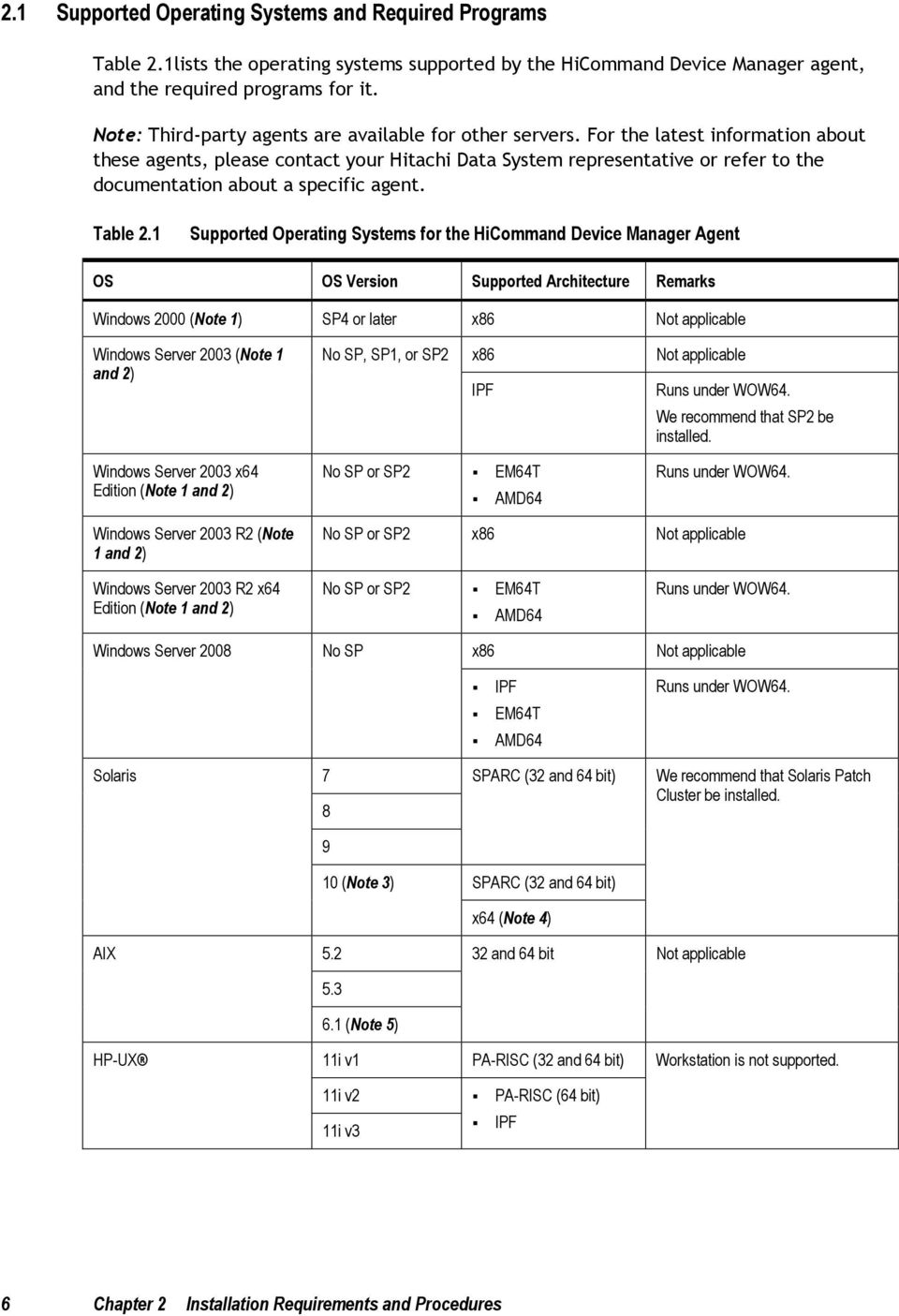
21 OS OS Version Supported Architecture Remarks Red Hat Enterprise Linux AS 2.1 x86 Not applicable Red Hat Enterprise Linux AS/ES 3 4 (Update 1, Update 3, Update 4) 4.5 x86 IPF EM64T Red Hat Enterprise Linux Advanced Platform/server 5 SUSE LINUX Enterprise Server 9 x86 Only the default kernel is supported. 10 Note 1: VMware ESX Server 3.0.x is supported. Note 2: If Windows Firewall is active, you must add the HiCommand Device Manager agent as an exception to the Windows Firewall exceptions list. For details on how to do this after installing the agent, see section Note 3: The HiCommand Device Manager agent runs in the usual global environment (global zone) only. If a non-global zone has been created, install the HiCommand Device Manager agent in the global zone. Note 4: The Device Manager agent supports only the Sun Fire x64 server family hardware. In addition, only the 64-bit kernel mode is supported. Note 5: The Device Manager agent does not support environments where the Secure by Default function is enabled. The Java execution environment noted in Table 2.2 must be installed on the system as a prerequisite for the HiCommand Device Manager agent. Table 2.2 Required Java Execution Environment for Various Operating Systems Operating System Required Java Execution Environment Windows Java2 Java Runtime Environment (Build 06) Use the 32-bit JRE even when the 64-bit processor version is used. Solaris (SPARC edition) Java2 Java Runtime Environment (Build 06) Use the 32-bit JRE. Solaris 10 (x64 edition) Java2 Java Runtime Environment (Update11 or later) Use the 64-bit Java2 SDK. AIX IBM AIX Developer Kit and Runtime, Java Technology Edition Use the 32-bit JRE. HP-UX Java2 Runtime Environment (Build 06) For a PA-RISC machine, use the RTE for PA-RISC. For an IA-64 machine, use the RTE for Itanium. HiCommand Device Manager Agent Installation Guide 7
22 Operating System Required Java Execution Environment Linux Java2 Runtime Environment (Build 06) For the 32-bit processor version, use the 32-bit JRE. For the 64-bit processor version, use the 64-bit Java 2 SDK Applying Required Patches for Operating Systems Supported by the Device Manager Agent Before using the HiCommand Device Manager agent, the following OS patches must be applied. Otherwise, if they are not applied, the HiCommand Device Manager agent may be unable to start. Table 2.3 OS Required Patches for Operating Systems Supported by HiCommand Device Manager Agent Patches Windows Server 2003 (x86 or IPF) SP1 KB Windows Server 2003 x64 Edition without SP Windows Server 2003 R2 (x86) without SP Windows Server 2003 R2 x64 Edition without SP Solaris SunOS 5.7: /usr/lib/fs/ufs/fsck patch SunOS 5.7: dkio.h & commands.h patch SunOS 5.7: Kernel Update Patch SunOS 5.7: libthread patch SunOS 5.7: Linker Patch SunOS 5.7: 32-Bit Shared library patch for C OpenWindows 3.6.1: Xsun Patch SunOS 5.7: 64-Bit Shared library patch for C CDE 1.3: dtsession patch CDE 1.3: libdtwidget Patch OpenWindows libxt Patch Motif and 2.1.1: Runtime library patch for Solaris CDE 1.3: dtwm patch SunOS 5.7: X Input & Output Method patch 8 Chapter 2 Installation Requirements and Procedures
23 OS Solaris 8 Patches SunOS 5.8: Unable to load fontset in 64-bit Solaris 8 iso-1 or iso SunOS 5.8: /usr/lib/libdhcpagent.so.1 patch SunOS 5.8: Font2DTest2 abort when Lucida Sans Thai Typewriter selected SunOS 5.8: linker patch SunOS 5.8: /usr/lib/libmtmalloc.so.1 patch SunOS 5.8: /kernel/drv/random patch SunOS 5.8: 32-Bit Shared library patch for C SunOS 5.8: 64-Bit Shared library patch for C OpenGL 1.3: OpenGL Patch for Solaris (32-bit) OpenGL 1.3: OpenGL Patch for Solaris (64-bit) SunOS 5.8: /usr/bin/nawk patch SunOS 5.8: /usr/bin/fgrep patch SunOS 5.8: RBAC Feature Patch SunOS 5.8: /kernel/fs/mntfs and /kernel/fs/sparcv9/mntfs patch SunOS 5.8: /sbin/init and /usr/sbin/init patch SunOS 5.8: /usr/sbin/mount patch SunOS 5.8: /sbin/sulogin and /sbin/netstrategy patch SunOS 5.8: /sbin/uadmin and /sbin/hostconfig patch X : Xsun patch CDE 1.4: dtwm patch Motif and 2.1.1: Runtime library patch for Solaris SunOS 5.8: IIIM and X Input & Output Method patch SunOS 5.8: Patch for patchadd and patchrm SunOS 5.8: kernel update and Apache patch SunOS 5.8: /usr/kernel/sys/acctctl and /usr/kernel/sys/exacctsys patch SunOS 5.8: LDAP2 client, libc, libthread and libnsl libraries patch SunOS 5.8: libresolv.so.2 and in.named patch SunOS 5.8: sendmail patch SunOS 5.8: sockfs patch Solaris OpenGL 1.3: OpenGL Patch for Solaris (32-bit) OpenGL 1.3: OpenGL Patch for Solaris (64-bit) SunOS 5.9: linker patch X : OWconfig patch X : Xsun patch HiCommand Device Manager Agent Installation Guide 9
24 OS Solaris 9 Solaris 10 (Notes 1) (SPARC edition) Patches SunOS 5.9: sockfs patch SunOS 5.10: ld Patch SunOS 5.10: FMA Patch SunOS 5.10: kernel Patch AIX 5L V5.2 (5200_02 RMP or later) AIX 5L V5.3 APAR IY71978 APAR IY70159 APAR IY71980 HP-UX 11i (Notes 2 and 3) PHCO_24402 s700_ libc cumulative header file patch PHCO_26061 s700_ Kernel configuration commands patch PHCO_29960 s700_ Pthread enhancement and fixes PHCO_27740 s700_ libc cumulative patch PHCO_27958 s700_ mountall cumulative patch, Dev IDs enabler PHKL_24751 s700_ preserve IPSW W-bit and GR31 lower bits PHKL_25233 s700_ select(2) and poll(2) hang PHKL_25468 s700_ eventport (/dev/poll) pseudo driver PHKL_25993 s700_ thread nostop for NFS, rlimit, Ufalloc fix PHKL_25994 s700_ Thread NOSTOP, Psets Enablement, Ufalloc PHKL_27091 s700_ Core PM, vpar, Psets Cumulative, slpq1 perf PHKL_27094 s700_ Psets Enablement Patch, slpq1 perf PHKL_27096 s700_ VxVM,EMC,Psets&vPar,slpq1,earlyKRS PHKL_27316 s700_ Shared synchronization performance support PHKL_27317 s700_ detach; NOSTOP, Abort; Psets; slpq1 perf PHKL_27686 s700_ MO 4k sector size;fifo;event Port;perf;shmem PHKL_28122 s700_ signals,threads enhancement,psets Enablement PHKL_26233 s700_ VM-JFS ddlock, mmap,thread perf, user limits PHNE_29887 s700_ cumulative ARPA Transport patch PHNE_29783 s700_ ONC/NFS General Release/Performance Patch PHSS_26560 s700_ ld(1) and linker tools cumulative patch PHSS_26971 s700_ Japanese TrueType font patch PHSS_28370 s700_ X/Motif Runtime Periodic Patch PHSS_28470 s700_ X Font Server Patch PHSS_24638 s700_ HP ac++ -AA runtime libraries (acc A.03.33) PHSS_29964 s700_ HP DCE/ DCE Client IPv6 patch 10 Chapter 2 Installation Requirements and Procedures
25 OS Patches HP-UX 11i v2 (PA-RISC) PHKL_31500 s700_ Sept04 base patch (Note 4) HP-UX 11i v2 (IPF) PHKL_31500 s700_ Sept04 base patch (Note 4) PHKL_32264 s700_ mmap(2) MAP_NORESERVE signal correction PHSS_30231 s700_ Integrity ac++ Runtime (A.05.56) PHSS_30232 s700_ Integrity Unwind Library PHSS_32765 s700_ linker + fdp cumulative patch Red Hat Enterprise Linux AS/ES 3 Red Hat Enterprise Linux AS 3 (IPF) SUSE LINUX Enterprise Server 10 gdb i386.rpm gdb ia64.rpm gdb or later Note 1: In Solaris 10 environments, do not apply the following patches: For SPARC: and For x64: and Note 2: Do not apply PHCO_29109, because Hewlett-Packard Company warns that this patch can cause an application hang-up. If this patch is already installed, apply PHCO_ Note 3: Do not apply PHKL_28267, because Hewlett-Packard Company warns that this patch can cause a system panic. If this patch is already installed, delete PHKL_28267 and then apply PHKL_26233 instead. Note 4: Do not install PHKL_31500 alone. Instead, apply HP-UX 11i v2 (B.11.23) released in September 2004, which includes this patch. However, if this patch contains a warning patch, apply a succeeding patch that addresses the problem. HiCommand Device Manager Agent Installation Guide 11
26 2.1.2 JRE Used by the HiCommand Device Manager Agent The JRE used by the HiCommand Device Manager agent differs, depending on the applicable OS: When the OS is not Solaris 10 (x64 edition): When the OS is Solaris, AIX, HP-UX, or Linux (IPF), use JRE 1.4. When the OS is Windows or Linux (x86 or EM64T), use JRE 5.0 (1.5). The JRE is shipped with the HiCommand Device Manager agent. During installation of the HiCommand Device Manager agent, the JRE is automatically installed in the installation directory of the HiCommand Device Manager agent. In addition, JRE 5.0 is required for operation in an IPv6 environment. For details, see 2.5. When the OS is Solaris 10 (x64 edition): The HiCommand Device Manager agent uses the JRE included in JDK 5.0 (update 11 or later). If JDK 5.0 (update 11 or later) is not installed, install it in advance. You can install JDK 5.0 (update 11 or later) in any location HiCommand Device Manager Server Versions and Agent Connections The HiCommand Device Manager agent can connect to a HiCommand Device Manager server version 5.9 or later. If your version of HiCommand Device Manager server is newer than the version of the HiCommand Device Manager agent, you can use the agent functions supported by HiCommand Device Manager for the version of the agent. 12 Chapter 2 Installation Requirements and Procedures
27 2.2 Supported Storage Subsystems Hitachi storage subsystem models supported by the HiCommand Device Manager agent are: Universal Storage Platform V/VM TagmaStore USP Lightning 9900V Lightning 9900 Hitachi AMS series TagmaStore AMS/WMS series TagmaStore AMS Thunder 9500V Thunder 9200 If a host with the HiCommand Device Manager agent installed is connected to a Hitachi storage subsystem, all HBA models supported by that storage subsystem are available. Please refer to the appropriate Hitachi Data Systems documentation. Caution: When using Thunder 9200, Thunder 9500 V, TagmaStore AMS/WMS series, or Hitachi AMS series, do not change the default settings of the following: Vendor ID: Do not change the default setting (HITACHI). Product ID: For Thunder 9200, do not change the default setting (DF500F). For Thunder 9500V, TagmaStore AMS/WMS series, and Hitachi AMS series, do not change the default setting (DF600F). Important: For 9200 LUN attachments, the HiCommand Device Manager agent requires the Hitachi Freedom Storage Thunder 9200 array to be configured with the Report Inquiry Page 83H option and INQUIRY WWN Mode. For more information, contact your Hitachi Data Systems account team. If a Hitachi Freedom Storage Lightning 9900 is connected to a Linux host using a fibre channel, they must be in a one-to-one relationship. HiCommand Device Manager Agent Installation Guide 13
28 2.3 Reviewing the Supported Host Connection Configurations This section explains HBA and iscsi connection configurations supported by the HiCommand Device Manager agent Checking the HBA Model Version You may be unable to obtain host WWN information when one of the following conditions is satisfied: The host on which the HiCommand Device Manager agent is running does not recognize the logical unit for the storage subsystem. A multi-path configuration is set up in the following host environment: The host OS is Windows, and Dynamic Link Manager or Windows MPIO is used. The host OS is Solaris, and Dynamic Link Manager or Sun StorEdge Traffic Manager is used. The host OS is AIX, and MPIO is used. To obtain host WWN information, the HBA models shown in the following table and the HBA API library provided by the HBA vendor are required. Table 2.4 HBA Models Required to Obtain Host WWN Information OS Model Name Hitachi Type Name Windows Emulex LP8000 Emulex LP9002DC Emulex LP9002L Emulex LP9802 Not applicable Not applicable Not applicable Not applicable QLogic QLA23xx Not applicable (See Note 1) QLogic QLA24xx Not applicable (See Note 1) Solaris (SPARC edition) Solaris (x64 edition) AIX Hitachi GV-CC62G1 JNI FCI-1063 JNI FC JNI FCE-6410 JNI FCE-6460 QLogic QLA2200 Sun HBA (See Note 2) QLogic QLA2310 Sun HBA IBM6227 IBM6228 Not applicable A-6516-FCPN A-6716-FCSN Not applicable Not applicable Not applicable Not applicable Not applicable Not applicable Not applicable Not applicable 14 Chapter 2 Installation Requirements and Procedures
29 OS Model Name Hitachi Type Name HP-UX Linux HP A3404A HP A3591B HP A3636A HP A3740A HP A5158A HP A6684A HP A6685A HP A6795A QLogic QLA2200F QLogic QLA23xx QLogic QLA24xx Hitachi GV-CC62G1 HT-F3360-FC2 HT-F3360-FC3 HT-F3360-FC1 HT-F3360-PC5 HT-F3360-PC5A Not applicable Not applicable HT-F3360-PCFC Not applicable Not applicable Not applicable Not applicable Note 1: To use a QLogic HBA, download and install Fibre Channel Information Tool (fcinfo) version x86 from the Microsoft Web site. If a host machine with Device Manager agent installed is running Linux on IPF or x64, the fcinfo x86 version must be used. Note 2: If you use an HBA by Sun Microsystems on Solaris 9, install Sun StorEdge SAN Foundation Software 4.2 or later Reviewing the Supported iscsi Connection Configurations The HiCommand Device Manager agent supports the iscsi connection configurations listed in Table 2.5 in IPv4 environments only. Note that an instance of HiCommand Device Manager connected by using iscsi can only manage storage subsystems that belong to the TagmaStore AMS/WMS series. Table 2.5 Supported iscsi Connection Configurations OS NIC or HBA Necessary Drivers Windows NIC Microsoft iscsi Software Initiator (2.04 or later) Windows Server 2003 Enterprise Edition SP1 (x86 or x64) Windows Server 2003 R2 Enterprise Edition (x86 or x64) QLogic QLA4050c QLogic QLA4052c Microsoft iscsi Software Initiator (2.04 or later) and QLogic Driver Solaris NIC Included with the OS AIX NIC Included with the OS HP-UX NIC Included with the OS Linux NIC Included with the OS (Drivers are not installed by default.) HiCommand Device Manager Agent Installation Guide 15
30 2.4 Requirements for Using FC-HUB (FC-SWITCH) Before you connect a host with storage subsystems via FC-HUB (or FC-SWITCH), use the following procedure to confirm whether FC-HUB (or FC-SWITCH) and its firmware is available for the storage subsystem: 1. Depending on the storage subsystem, see section 2.3.1, and check the corresponding HBA. 2. Check the FC-HUB and related firmware supported by the target storage subsystems. Please refer to the appropriate documentation for your storage subsystem. 16 Chapter 2 Installation Requirements and Procedures
31 2.5 Supported IPv6 Environments The HiCommand Device Manager agent supports an Internet Protocol version 6 (IPv6) environment in the following OSs. Note that with the IPv6 environment, the Java Runtime Environment (JRE) 5.0 is required: Windows Server 2003 SP2 Windows Server 2003 R2 SP2 Windows Server 2008 HP-UX 11i v2 HP-UX 11i v3 Solaris 10 AIX 5.3 AIX 6.1 Red Hat Enterprise Linux AS/ES 4 Update 4 Red Hat Enterprise Linux AS/ES 4.5 Red Hat Enterprise Linux 5 Cautions: JRE 5.0 is required for operation of the HiCommand Device Manager agent in IPv6 environments. Install JRE 5.0 when the OS is Solaris (SPARC), HP-UX, AIX, or Linux (IPF). The HiCommand Device Manager agent does not support environments where only IPv6 addresses can be used. To use the HiCommand Device Manager agent in IPv6 environments, set up the OS so that both IPv4 and IPv6 addresses can be used. The HiCommand Device Manager agent only supports global addresses. You cannot use link-local addresses or global unique local addresses (site-local addresses). HiCommand Device Manager Agent Installation Guide 17
32 2.6 File Systems Supported by the HiCommand Device Manager Agent The following table lists the file systems that are supported by the HiCommand Device Manager agent. Table 2.6 OS File Systems Supported by the HiCommand Device Manager Agent File System Windows NTFS FAT FAT32 Solaris Veritas File System UFS AIX JFS HP-UX HFS Veritas File System (JFS) Red Hat Enterprise Linux AS 2.1 Red Hat Enterprise Linux AS/ES 3 ext2 ext3 Red Hat Enterprise Linux AS/ES 4 Red Hat Enterprise Linux 5 SUSE LINUX Enterprise Server 9 SUSE LINUX Enterprise Server Chapter 2 Installation Requirements and Procedures
33 2.7 Volume Managers Supported by the HiCommand Device Manager Agent The following table lists the volume managers that are supported by the HiCommand Device Manager agent. Only the operating systems that support volume managers are listed. Table 2.7 Volume Managers Supported by the HiCommand Device Manager Agent OS OS Version or Architecture Volume Manager Windows 2000 SP4 Basic Dynamic Veritas Volume Manager 2.7, 3.0 and 3.5 Windows Server 2003 (x86) No SP or SP2 Basic Dynamic SP1 Basic Dynamic Veritas Volume Manager 4.3 Windows Server 2003 (IPF) No SP, SP1, or SP2 Basic Dynamic Windows Server 2003 x64 Edition Windows Server 2003 R2 (x86) Windows Server 2003 R2 x64 Edition SP2 or no SP Basic Dynamic SP2 or no SP Basic Dynamic SP2 or no SP Basic Dynamic Windows Server Basic Dynamic Solaris 7 Veritas Volume Manager SDS Veritas Volume Manager 3.2, 3.5 and SVM 1.0 Veritas Volume Manager 3.5, 4.0 and 4.1 Veritas Volume Manager (SPARC edition) SVM 1.0 Veritas Volume Manager (x64 edition) SVM 1.0 Veritas Volume Manager 4.1 AIX -- LVM HiCommand Device Manager Agent Installation Guide 19
34 OS OS Version or Architecture Volume Manager HP-UX 11i v1 LVM Veritas Volume Manage i v2 LVM Veritas Volume Manager 3.5 and i v3 LVM Veritas Volume Manage 4.1 Linux Red Hat Enterprise Linux AS 2.1 Red Hat Enterprise Linux AS/ES 3 Red Hat Enterprise Linux AS/ES 4 Red Hat Enterprise Linux 5 SUSE LINUX Enterprise Server 9 SUSE LINUX Enterprise Server 10 LVM rc4 LVM LVM2 20 Chapter 2 Installation Requirements and Procedures
35 2.8 Cluster Software Supported by the HiCommand Device Manager Agent The HiCommand Device Manager agent runs in cluster environments configured with the cluster software in the following table. The HiCommand Device Manager agent runs in both Active-Standby and Active-Active configurations. Notes: Table 2.8 only lists the operating systems that support the cluster software. Because the HiCommand Device Manager agent is not compatible with the logical host, it cannot be registered in cluster resources. The HiCommand Device Manager agent is activated on the physical hosts that comprise the cluster, and collects the data for them. Table 2.8 OS Cluster Software Supported by the HiCommand Device Manager Agent Supported Cluster Software Windows 2000 SP4 Windows Server 2003 (x86) without SP Windows Server 2003 (x86) SP1 Windows Server 2003 (IPF) without SP or SP1 Windows Server 2003 x64 Edition without SP Windows Server 2003 R2 (x86) without SP Windows Server 2003 R2 x64 Edition without SP MSCS MSCS VCS 4.1 MSCS VCS 4.1 VCS 4.3 MSCS MSCS MSCS MSCS Solaris 7 VCS 1.3 and 2.0 Solaris 8 Sun Cluster 3.0 and 3.1 VCS 1.3, 2.0, and 3.5 Solaris 9 Sun Cluster 3.1 VCS 3.5, 4.0, and 4.1 Cluster Perfect 4.1 Solaris 10 (SPARC edition) Sun Cluster 3.1 VCS 4.1 PRIMECLUSTER (Note 1 and 2) AIX 5.2 HACMP 5.1 AIX 5.3 HACMP 5.2 HACMP 5.3 (Only supports AIX bit version) HiCommand Device Manager Agent Installation Guide 21
36 OS Supported Cluster Software HP-UX 11i v1 MC/Service Guard (Only supports HP-UX 11i v1 64 bit version) Serviceguard HP-UX 11i v2 Serviceguard and HP-UX 11i v3 Serviceguard Red Hat Enterprise Linux AS 2.1 (x86) VCS 2.2 Red Hat Enterprise Linux AS/ES 4 Update 1 (x86) VCS 4.1 Red Hat Enterprise Linux AS/ES 4 Update 4 (IPF) PRIMECLUSTER 4.2 (Note 1) Note 1: File systems created with GDS are not supported. Note 2: The Dynamic Link Manager must be already installed. 22 Chapter 2 Installation Requirements and Procedures
37 2.9 Path Management Software Supported by the HiCommand Device Manager Agent The following table lists the path management software supported by the HiCommand Device Manager agent. Only the operating systems that support path management software are listed. Table 2.9 Path Management Software Supported by the HiCommand Device Manager Agent OS Architecture Path Management Software Name Path Management Software Version Windows 2000 SP4 x86 Dynamic Link Manager /A or later Windows Server 2003 without SP x86 or IPF Dynamic Link Manager or later Windows Server 2003 SP1 x86 or IPF Dynamic Link Manager Windows MPIO (MPIO DSM: Provided by Dynamic Link Manager 5.5 or later) 5.6 or later Versions supported by DSM described to the left Windows Server 2003 SP2 x86 Dynamic Link Manager Windows MPIO (MPIO DSM: Provided by Dynamic Link Manager or later) or later Versions supported by DSM described to the left IPF Dynamic Link Manager 5.6 or later Windows MPIO (MPIO DSM: Provided by Dynamic Link Manager or later) Versions supported by DSM described to the left Windows Server 2003 x64 Edition without SP x64 Dynamic Link Manager Windows MPIO (MPIO DSM: Provided by Dynamic Link Manager 5.5 or later) 5.7 or later Versions supported by DSM described to the left Windows Server 2003 x64 Edition SP2 x64 Dynamic Link Manager Windows MPIO (MPIO DSM: Provided by Dynamic Link Manager or later) or later Versions supported by DSM described to the left Windows Server 2003 R2 without SP x86 Dynamic Link Manager Windows MPIO (MPIO DSM: Provided by Dynamic Link Manager 5.5 or later) 5.8 or later Versions supported by DSM described to the left HiCommand Device Manager Agent Installation Guide 23
38 OS Architecture Path Management Software Name Path Management Software Version Windows Server 2003 R2 SP2 x86 Dynamic Link Manager Windows MPIO (MPIO DSM: Provided by Dynamic Link Manager or later) or later Versions supported by DSM described to the left Windows Server 2003 R2 x64 Edition without SP x64 Dynamic Link Manager Windows MPIO (MPIO DSM: Provided by Dynamic Link Manager 5.5 or later) 5.8 or later Versions supported by DSM described to the left Windows Server 2003 R2 x64 Edition SP2 x64 Dynamic Link Manager Windows MPIO (MPIO DSM: Provided by Dynamic Link Manager or later) or later Versions supported by DSM described to the left Windows Server 2008 x86, IPF, and x64 Dynamic Link Manager Windows MPIO (MPIO DSM: Provided by Dynamic Link Manager or later) or later Versions supported by DSM described to the left Solaris 7 and 8 SPARC Dynamic Link Manager 03-00, and or later Solaris 9 SPARC Veritas Volume Manager (Dynamic Multi-Pathing) 4.1 Dynamic Link Manager or later Sun StorEdge Traffic Manager Solaris 10 SPARC Dynamic Link Manager or later Sun StorEdge Traffic Manager -- x64 Sun StorEdge Traffic Manager -- AIX Dynamic Link Manager or later MPIO -- AIX Dynamic Link Manager or later MPIO -- AIX Dynamic Link Manager or later HP-UX 11i v1 PA-RISC(32 bit) PV-link -- PA-RISC(64 bit) PV-link -- Dynamic Link Manager or later HP-UX 11i v2 PA-RISC (64 bit) and IPF PV-link -- Dynamic Link Manager or later 24 Chapter 2 Installation Requirements and Procedures
39 OS Architecture Path Management Software Name Path Management Software Version HP-UX 11i v3 PA-RISC (64 bit) and IPF PV-link -- MPIO -- Red Hat Enterprise Linux AS 2.1 Red Hat Enterprise Linux AS/ES 3 x86 Dynamic Link Manager or later x86 and IPF Dynamic Link Manager 5.4 or later Red Hat Enterprise Linux AS/ES 4 Update 1 x86 and IPF EM64T Dynamic Link Manager or later or later Red Hat Enterprise Linux AS/ES 4 Update 3 x86, IPF, and EM64T Dynamic Link Manager or later Red Hat Enterprise Linux AS/ES 4 Update 4 x86, IPF, and EM64T Dynamic Link Manager or later Red Hat Enterprise Linux AS/ES 4.5 x86, IPF, and EM64T Dynamic Link Manager or later Red Hat Enterprise Linux 5 x86, IPF, and EM64T Dynamic Link Manager or later SUSE LINUX Enterprise Server 9 SUSE LINUX Enterprise Server 10 x86 Dynamic Link Manager 5.7 or later x86 Dynamic Link Manager 5.9 or later HiCommand Device Manager Agent Installation Guide 25
40 2.10 Installing the HiCommand Device Manager Agent This section describes how to install the HiCommand Device Manager agent for each supported program. Table 2.10 shows the default installation locations for supported operating systems when the HiCommand Device Manager agent is installed for the first time. Table 2.10 Default Installation Locations Operating System Windows 32 bit (x86) systems Windows 64 bit system (IPF, EM64T, or AMD64) systems Solaris, HP-UX, and Linux AIX Default Installation Location system-drive\program Files\HITACHI\HDVM\HBaseAgent system-drive\program Files (x86)\hitachi\hdvm\hbaseagent /opt/hdvm/hbaseagent /usr/hdvm/hbaseagent Cautions: The HiCommand Device Manager agent does not support environments where only IPv6 addresses can be used. If you want to use the HiCommand Device Manager agent in IPv6 environments, set up the OS such that both IPv4 and IPv6 addresses can be used. If the installation destination is a Windows system, and if Hitachi Dynamic Link Manager (version 5.8 or later) or the HiCommand Device Manager agent (version 4.3 or earlier) is already installed in the Windows system, the installation destination folders for the HiCommand Device Manager agent are determined in the order shown below. 1. If Dynamic Link Manager version 5.8 or later has already been installed, the HiCommand Device Manager agent is installed on the drive that contains Dynamic Link Manager. 2. If the HiCommand Device Manager agent (version 4.3 or earlier) has already been installed, the HiCommand Device Manager agent is installed in the following location: installation-folder-for-an-older-version-of-device-manager-agent\hbaseagent If the HiCommand Device Manager agent has already been installed, you can obtain the version of the installed Device Manager agent by issuing a command that is appropriate for your operating system, as outlined in the following table. The version is displayed in V.R1.R2-MM format, where V is the version number, R1.R2 is the revision number, and MM is the modified version. Table 2.11 Commands for Obtaining the Device Manager Agent Version For This Operating System Windows Solaris, HP-UX, and Linux AIX Issue This Command > installation-folder-for-device-manager-agent\bin\hdvm_info.exe # /opt/hdvm/hbaseagent/bin/hdvm_info # /usr/hdvm/hbaseagent/bin/hdvm_info 26 Chapter 2 Installation Requirements and Procedures
41 Note: Before you install the HiCommand Device Manager agent, verify there is sufficient space in the default directory for this installation. Caution: Do not issue any of the following commands when upgrading the HiCommand Device Manager agent. Also, do not install the Device Manager agent while the following commands are executing: hbsasrv, HiScan, hdvmagt_account, hdvmagt_schedule, hdvmagt_setting, hldutil, TIC, hdvmagt, or stop_hdvmagt The hdvmagt command and stop_hdvmagt command are for versions of the HiCommand Device Manager agent earlier than 5.0. If you execute these commands during installation, the upgrade installation might end abnormally. Be sure to restart the system after installation. The upgrade installation is complete after you have restarted the system. Cautions: If a version of Hitachi Dynamic Link Manager earlier than 5.8 is installed, you must install the HiCommand Device Manager agent and set the port number that it uses. For details, see section The Device Manager agent versions 5.7 and later are compatible with the new Daylight Saving Time (DST) rules implemented in the United States and Canada beginning in When using the Device Manager agent in a United States or Canada time zone, set the host OS for the new DST rules according to information provided by OS vendors. If the host OS is not compatible with the new DST rules, the Device Manager agent will be incompatible with the new rules About Additional Installation Options You can download the Device Manager agent from the Device Manager server by using the Web client. Decompress the downloaded file and then install the decompressed files. For details on downloading, see the Device Manager online Help. The HiCommand Device Manager agent also has silent installation capability, which does not require any input by the user. For details, see section HiCommand Device Manager Agent Installation Guide 27
42 Installing the Device Manager Agent on a Windows System In Windows, the HiCommand Device Manager agent provides the following installation methods: New installation Use this installation method to install the HiCommand Device Manager agent in a host where the HiCommand Device Manager agent does not exist. For more information, see section Upgrade Perform this to install an upgrade of the HiCommand Device Manager agent in a host that already contains a version earlier than the version to be installed. For more information, see section Re-installation Perform this to re-install the HiCommand Device Manager agent in a host that already contains the same version as the version to be installed. For more information, see section Preparing for the Installation Before installing the HiCommand Device Manager agent on a Windows system, please review this list and complete any necessary tasks: Remove the currently installed HiCommand Device Manager agent (HDSHiScan). 1. Select Start, Settings, Control Panel, and Add/Remove Programs. 2. From the list, select HiCommand Device Manager - Agent. Before removing it, you may inspect its execution parameters by opening its properties folder and examining the task tab. See section for information on agents. 3. Select Change/Remove. Refer to Table 2.1 for supported operating systems and a listing of required programs for your operating system. Verify that there is enough space in the default directory for installing the HiCommand Device Manager agent. You must be a superuser. At least 96 MB of free space is required on the hard disk. An additional 96 MB of free space is required on the system drive to create temporary files during installation. If the HiCommand Device Manager agent has already been installed, do not perform an overwrite installation with a version earlier than the current version. If you need to install an old version, uninstall the existing version first. Note: If the versions and revisions are the same, you can install an uncorrected HiCommand Device Manager agent after installing a corrected one. Before starting the installation of the Device Manager agent, cancel any programs that may be running. 28 Chapter 2 Installation Requirements and Procedures
43 Make sure that the setting for automatically generating short file and folder names (8.3 format) is enabled. In addition, when performing an installation, use the Windows account created when the setting was enabled. If the above conditions are not satisfied, an attempt to install the Device Manager agent might fail or the Device Manager agent might not work properly. Also, do not change the setting for automatically generating short names even after the installation has completed. To check whether the user was created while the setting for automatically generating short file and folder names was disabled, execute the following command: dir /x /a- "Windows-system-drive:\Documents and Settings\Windows-account-name" find "Local Settings" One of the following examples shows the command execution results when the setting for automatically generating short file and folder names was enabled, and the other shows the results when the setting was disabled. If LOCALS~1 is displayed, the user was created while this setting was enabled. If the user was created while the setting was enabled: 2008/01/01 18:26 <DIR> LOCALS~1 Local Settings If the user was created while the setting was disabled: 2008/01/01 18:26 <DIR> Local Settings Check if any security monitoring programs have been installed. If a security monitoring program has been installed, either stop it or change its settings so that it will not interfere with the installation of the HiCommand Device Manager. If you log in to Windows from a remote console and install a Device Manager agent after logging in, you must use Terminal Service Client. Stop the hdvmagt service before updating the HiCommand Device Manager agent (version 3.5 or earlier). If a host environment satisfies both of the following conditions, refreshing the host from the Web client might cause JavaVM to end abnormally and the refresh operation to timeout: The host OS is Windows Server 2003 (IPF), and Service Pack 1 or later has not been installed. The host recognizes many LUs (guideline value is 100 or more). To avoid above problem, we recommend that you install Service Pack 1 or later, and then install the HiCommand Device Manager agent. If you install a service pack after installing the HiCommand Device Manager agent, after you install the service pack, perform an overwrite installation of the HiCommand Device Manager. Note: If 100 or more LUs are recognized by the host, another error might occur. See section and change the settings for the Device Manager agent. HiCommand Device Manager Agent Installation Guide 29
44 When installing the HiCommand Device Manager agent on a host in which Windows Server 2003 (IPF) or Windows Server 2003 x64 Edition was installed in the following order, you cannot add the Device Manager agent as an exception to the Windows Firewall exceptions list during the installation. a. Install Windows Server 2003 (IPF) (no Service Pack) or Windows Server 2003 x64 Edition (no Service Pack). b. Install Service Pack 1 or later. For such hosts, manually add the HiCommand Device Manager agent as an exception to the Windows Firewall exceptions list after installing it. For more information, see section Note that, when you install the HiCommand Device Manager agent on a host in which Windows Server 2003 (IPF) or Windows Server 2003 x64 Edition with Service Pack 1 or later was installed, you can add the HiCommand Device Manager agent to the Windows Firewall exceptions list during the installation. 30 Chapter 2 Installation Requirements and Procedures
45 New Installation on a Windows System To install the Device Manager agent, the JRE version (Build 06) must be installed in advance. To perform a new installation of Device Manager agent, use the installation support tool to first install the JRE required for the Device Manager agent and then the Device Manager agent. After completing a new installation of the HiCommand Device Manager agent, you can immediately perform the setup procedure. To install the JRE and Device Manager agent: 1. Log on to Windows using a User ID in the Administrators Group. 2. Insert the HiCommand Device Manager agent CD-ROM. Note: Before starting the installation, cancel any programs that may be running. 3. Select Start, Run, Browse, and then select and execute install.exe in the \Agent\Windows folder of the CD-ROM. Caution: If a request from a HiCommand Suite product is being executed, the installation is interrupted and a dialog box appears asking if you want to continue the installation. Select Retry to continue the installation, or Cancel to cancel the installation. Installation of the Device Manager agent starts, and the Welcome to the InstallShield Wizard for HiCommand Device Manager - Agent dialog box appears. 4. Select Next. The agent License Agreement panel appears. 5. Select Yes. The Choose Destination Location panel appears. Specify (64 bytes or less) the folder on which you want to install the Device Manager agent. Space characters and the following characters can be used in the path name for the installation folder: a-z A-Z 0-9. _ ( ) However, a space character cannot be specified for the first character or the last character of the folder name. Additionally, two or more space characters cannot be specified consecutively. Cautions: If the Device Manager agent or the version 5.8 or later of Dynamic Link Manager has already been installed, this panel does not appear. If the installation path you specify for the Device Manager agent contains a space character, and there is a folder or file whose path matches the specified path (from the beginning until the space character), information cannot be sent to the Device Manager server at the startup of the Device Manager agent service. For example, if you installed the Device Manager agent in the folder d:\host agent and a folder or file whose path is d:\host exists, this problem occurs. To avoid this problem, perform one of the following: Delete the relevant folder or file. Uninstall the Device Manager agent, and then re-install it in another folder. HiCommand Device Manager Agent Installation Guide 31
46 6. Select Next. A confirmation dialog box appears, asking whether you want to add the Device Manager agent as an exception to the Windows Firewall exceptions list. Select Yes. 7. Select Next. The Start Copying Files panel appears. Note: If you select the Next button in this panel, you cannot cancel the HiCommand Device Manager agent installation. 8. Select Next to continue. After the installation, the Setup Status panel and Installing Add-on panel are displayed. Add-on functionality is installed together with the HiCommand Device Manager agent. When the installation process finishes, a dialog box appears asking whether you want to continue with the setup procedure for the HiCommand Device Manager agent. 9. Select Yes, then continue with the setup procedure for the HiCommand Device Manager agent. A window for setting information for the HiCommand Device Manager server appears. If you select No, a message appears prompting you to use either the hdvmagt_account command and the hdvmagt_schedule command, or the hdvmagt_setting command, to perform the setup procedure. After installation is complete, manually perform the setup procedure for the Device Manager agent. For details about the setup procedure, see section Enter the IP address (or host name), port number, user ID, and password for the HiCommand Device Manager server. To set the information for the HiCommand Device Manager server at a later time, select No. Setup later. then Next. In this case, the information for the HiCommand Device Manager server must be set manually after installation is complete. Specification of the IP address or host name Enter the IP address or host name for the HiCommand Device Manager server. You can use a character string of 50 bytes or less to specify a host name. The following characters can be used: a-z A-Z 0-9 _ Specification of the port number Enter a port number for the HiCommand Device Manager server. Specification of the user ID Enter a user ID for logging on to the HiCommand Device Manager server. You can use a character string of 1 to 256 bytes to specify a user ID. The following characters can be used: a-z A-Z 0-9 # + _ The default user ID after the first installation is HaUser. This user ID has already been registered in the HiCommand Device Manager server for use with the HiCommand Device Manager agent. The default password for HaUser is haset. 32 Chapter 2 Installation Requirements and Procedures
47 Specification of the password Enter a password for logging on to the HiCommand Device Manager server. You can use a character string of 1 to 256 bytes to specify a password. The following characters can be used: a-z A-Z 0-9! " # $ % & ( ) * + -. \ ^ _ ' The default password after the first installation is haset. 11. Select Next. An error message will appear if characters that cannot be used have been entered. Change the values to characters that can be used, then select Next. After Next is selected, a connection to the HiCommand Device Manager server will be attempted. If a connection to the Device Manager server is established, a message will appear indicating that the connection to the server is recognized. Select OK to go to the next step. If the attempt to connect to the Device Manager server fails, a dialog box will appear asking if you want to modify the information for the Device Manager server. Check the error information displayed in the dialog box, and if you want to re-enter the information for the Device Manager server, select Yes to modify the information. Select No to go to the next step without re-entering the information to set the entered values as specified. Once the settings for the information for the HiCommand Device Manager server are complete, a window for setting the execution period for the HiScan command appears. 12. Specify the execution period for the HiScan command. This setting is optional. If you do not specify the execution period, the Device Manager server is not periodically notified of information acquired by the Device Manager agent. If you want to specify the execution period for the HiScan command at a later time, or if you do not want the HiScan command to execute automatically, select No. Setup later. and then Next. Select Hourly to perform automatic execution once every hour, Daily to perform automatic execution once every day, or Weekly to perform automatic execution once every week. Caution: When the HiCommand Device Manager agent is installed on multiple hosts, set the HiScan command to execute daily or weekly to reduce the load of the HiCommand Device Manager server. Also, change the start times for execution of the HiScan command on each host so that the command will not be executed simultaneously from multiple hosts. For details about checking the execution time for the HiScan command, see section If you select Weekly, specify the day of the week on which automatic execution is to be performed. Select Sun, Mon, Tue, Wed, Thu, Fri, or Sat. 14. Specify the time when automatic execution is to be performed. You can specify a value from 0 to 23 for execution time (hour) and 0 to 59 for execution time (minute). HiCommand Device Manager Agent Installation Guide 33
48 15. Select Next. This completes the settings for the execution period for the HiScan command. Next, the window for setting information for using CCI appears. 16. Specify the information for using CCI. This setting is optional. If you want to set the information for using CCI at a later time, or if you do not use CCI, select No. Setup later. and then Next. Specification of the installation drive for CCI Specify the drive on which CCI has been installed. Caution: Do not specify a floppy disk drive or CD-ROM drive. If you do this, the Device Manager agent might not operate normally. Specification of the central management method Specify whether to operate the HiCommand Device Manager agent as a central management server. To operate the HiCommand Device Manager agent as a central management server, specify enable for this setting. 17. Select Next. After selecting Next, the installation status of CCI is checked. If CCI has not been installed on the installation drive that you specified, a dialog box appears asking if you want to change the specified installation drive. Select Yes to check whether the specified value has no problem. If the specified value has no problem, select No to go to the next step. A dialog box indicating the completion of the setup procedure appears. 18. Select OK. 19. If system-drive\_hdvmagent0590_install_tmp_ remains, delete it manually. The system-drive\_hdvmagent0590_install_tmp_ folder is a temporary one created during installation. If it cannot be deleted, log on to Windows again to delete it. Note: When you install the HiCommand Device Manager agent, the folder in which commands are installed is automatically added to the environment variable PATH. Therefore, when you execute a command, you do not need to change the current folder to the folder that contains commands. After installing the Device Manager agent, you will have to log off from, and then log on to Windows for the changes in the environment variable PATH to be applied. Cautions: If VxVM has been installed, specify the version of the installed VxVM in the programproductinfo.properties file. For information about the setting, see section To use the HiCommand Device Manager agent in an IPv6 environment, you must specify extra settings. For details on the extra settings, see section Chapter 2 Installation Requirements and Procedures
49 Upgrading on a Windows System To perform an upgrade: 1. Log on to Windows using a user ID in the Administrators group. 2. Insert the HiCommand Device Manager agent CD-ROM. 3. Select Start, Run, and Browse, and then select and execute agent_jre_setup.bat in the \Agent\Windows folder of the CD-ROM. When upgrading the Device Manager agent by overwriting Device Manager of version 4.0 or later, select Start, Run, and Browse, and then select and execute install.exe in the \Agent\Windows folder of the CD- ROM. Caution: If a request from a HiCommand Suite product is being executed, or a Device Manager agent command is being executed, the installation is interrupted and a dialog box appears asking if you want to continue the installation. Select Retry to continue the installation, or Cancel to quit the installation. A confirmation message appears, asking whether you want to continue the upgrade. 4. Select Yes. A panel indicates that add-on modules are being installed. Add-on functionality is installed together with the HiCommand Device Manager agent. Upon completion of the installation process, an Install Complete window appears. 5. Select OK. 6. If system-drive\_hdvmagent0590_install_tmp_ remains, delete it manually. The system-drive\_hdvmagent0590_install_tmp_ folder is a temporary one created during installation. If it cannot be deleted, log on to Windows again to delete it. Notes: For upgrade (overwrite) installations, predefined settings for HiCommand Device Manager server information and the execution period of the HiScan command will be inherited. To modify information about the HiCommand Device Manager server, see section 3.4. For information about changing the execution period, see section 3.5. When you install the HiCommand Device Manager agent, the folder in which commands are installed is automatically added to the environment variable PATH. Therefore, when you execute a command, you do not need to change the current folder to the folder that contains commands. After installing the Device Manager agent, you will have to log off from and then log on to Windows, in order for the changes in the environment variable PATH to be applied. HiCommand Device Manager Agent Installation Guide 35
50 Cautions: If VxVM has been installed, specify the version of the installed VxVM in the programproductinfo.properties file. For information about the setting, see section If you upgrade the Device Manager agent by overwriting the existing Device Manager agent (version 4.1 or earlier) in Windows Server 2003, the previously installed VDS provider is deleted, disabling its use. If you want to use VDS functions, separately install the VDS provider. For details on such installation, see the HiCommand Device Manager Server Installation and Configuration Guide. Re-installation/Restoration in Windows Note: When performing a re-installation of the HiCommand Device Manager agent, do not execute the following commands during installation: HiScan, hdvmagt_account, hdvmagt_schedule, hdvmagt, stop_hdvmagt, and TIC Should you execute any of these commands, uninstallation might not complete properly. In such a case, retry uninstalling. 36 Chapter 2 Installation Requirements and Procedures
51 Reinstalling on Windows Systems To reinstall the HiCommand Device Manager agent on a Windows system: 1. Log on to Windows using a user ID in the Administrators group. 2. Insert the HiCommand Device Manager agent CD-ROM. 3. From the Start menu, select Run and then Browse. Execute install.exe in the \Agent\Windows\ folder on the CD-ROM. Caution: If a request from a HiCommand Suite product is being executed, or a Device Manager agent command is being executed, the installation is interrupted and a dialog box appears asking if you want to continue the installation. Select Retry to continue the installation, or Cancel to cancel the installation. The Welcome panel appears. 4. Select Repair, and then Next. A panel appears for confirmation of the re-installation. 5. Select OK. A panel indicates that add-on modules are being installed. Add-on functionality is installed together with the HiCommand Device Manager agent. Upon completion of the installation process, an Install Complete window appears. 6. Select OK. 7. If system-drive\_hdvmagent0590_install_tmp_ remains, delete it manually. The system-drive\_hdvmagent0590_install_tmp_folder is a temporary one created during installation. If it cannot be deleted, log on to Windows again to delete it. Caution: If VxVM has been installed, specify the version of the installed VxVM in the programproductinfo.properties file. For information about the setting, see section HiCommand Device Manager Agent Installation Guide 37
52 Installing the Device Manager Agent on a Solaris, AIX, HP-UX, or Linux System This section describes how to install the HiCommand Device Manager agent on Solaris, AIX, HP-UX, and Linux systems Preparing for the Installation Installation Requirements Following are the requirements for installing the HiCommand Device Manager agent on a Solaris, AIX, HP-UX, or Linux system: You must be a superuser. The hard disk must have the amount of free space shown in the following table. Table 2.12 OS Name Minimum Free Hard Disk Space Needed for Installation Amount of Hard Disk Free Space (Unit: MB) Solaris 100 AIX 120 HP-UX 220 Linux 140 Installation Directories for First-Time Installations The following table shows the default installation location for the HiCommand Device Manager agent when you install the program for the first time. Table 2.13 Default Installation Locations for Solaris, HP-UX, Linux, and AIX Operating System Solaris, HP-UX, and Linux AIX Default Installation Location /opt/hdvm/hbaseagent /usr/hdvm/hbaseagent General Precautions Before you install the HiCommand Device Manager agent, cancel any programs that are running. 38 Chapter 2 Installation Requirements and Procedures
53 Symbolic Links Do not create a symbolic link for any of the directories in the following table. If you have already created a symbolic link by using any of the directories below, do not install the Device Manager agent. Table 2.14 Directories for Which Symbolic Links Cannot be Created Operating System Solaris, HP-UX, and Linux Directory /opt All subdirectories under /opt/hdvm (including the /opt/hdvm) /var /var/opt All subdirectories under /var/opt/hbaseagent (including /var/opt/hbaseagent) All subdirectories under /var/opt/hdvm (including /var/opt/hdvm) /var/tmp AIX /usr All subdirectories under /usr/hdvm (including /usr/hdvm) All subdirectories under /var/hdvm (including /var/hdvm) /var All subdirectories under /var/hbaseagent (including /var/hbaseagent) /var/tmp Notes about Security Monitoring Programs Check if any security monitoring programs have been installed. If a security monitoring program has been installed, either stop it or change its settings so that it will not interfere with the installation of HiCommand Device Manager. Cautionary Notes on Installing on Solaris 10 When installing the HiCommand Device Manager agent, do not specify the system's zone settings. If you do this, installation might fail. When the HiCommand Device Manager agent is installed in an environment where the non-global zone is set, it will be installed in both the global zone and the non-global zone. The HiCommand Device Manager agent is not required for the non-global zone because the Device Manager agent runs only in the global zone. To uninstall the Device Manager agent in the non-global zone, log in to the non-global zone, and then execute the following command: # pkgrm HDVMAgent HiCommand Device Manager Agent Installation Guide 39
54 Cautionary Notes on Installing on HP-UX If you perform the installation on a workstation, the following message will be displayed and the installation will fail: ERROR: Could not apply the software selection "HDVMAgent" because there are no product variations that are compatible with the destination host(s). When installing the HiCommand Device Manager agent, the swagentd daemon needs to be running. If it is not running, execute the following command to start it. /usr/sbin/swagentd Confirm that the file system currently mounted on the host matches the file system defined in /etc/fstab, and then install the HiCommand Device Manager agent. Before installing the HiCommand Device Manager agent, verify the network settings (such as those in the hosts file) are correct. Cautionary Notes on Installing on Linux If a Linux firewall is configured, the Device Manager agent might be unable to communicate with the Device Manager server. In that case, execute the iptables stop command on the Linux host to disable iptables, and then configure the host to not automatically start iptables when the OS starts, or configure iptables so that the Device Manager releases the port in use. For the port numbers used, see the HiCommand Device Manager Server Installation and Configuration Guide. Cautionary Notes on Installing on AIX When IBM XL C/C++ Enterprise Edition V8 for AIX Runtime version from to has been applied, the overwrite installation of the Device Manager agent will hang if one of the following conditions exists: The installed version of Dynamic Link Manager is from 5.8 or later to earlier than 5.9. The installed version of the Device Manager agent is from 5.0 to When you use the Device Manager agent, upgrade IBM XL C/C++ Enterprise Edition V8 for AIX Runtime to version or later, or apply the patch (APAR IY87291). For details about the patch (APAR IY87291), see the IBM website. You can use this command to check the version of IBM XL C/C++ Enterprise Edition V8 for AIX Runtime: # lslpp -L xlc.aix50.rte AIX has the Stack Execution Disable (SED) function that protects systems from attacks that use a buffer overflow. If the SED mode is set to all, change the mode to a mode other than all before installing the Device Manager agent. To change the SED mode to a mode other than all, execute the following command: # sedmgr -m {select off setidfiles} For details about the sedmgr command, see the AIX documentation. To return the SED mode to all after installing the Device Manager agent, exclude the java process that is bundled with the Device Manager agent from the SED protection targets. For details, see section Chapter 2 Installation Requirements and Procedures
55 Cautionary Notes on Overwrite Installations If the HiCommand Device Manager agent has already been installed, do not perform an overwrite installation with a version earlier than the current version. To install an earlier version, uninstall the existing version first. Note: If the versions and revisions are the same, you can install an uncorrected HiCommand Device Manager agent after installing a corrected one Deleting the HDSHiScan Package For Solaris, AIX, or HP-UX, the currently installed HDSHiScan package must be deleted before the HiCommand Device Manager agent is installed. HDSHiScan is the name used for versions prior to 2.2. HDVMAgent is the name used for version 2.2 and later. Installation directory for the HDSHiScan package In Solaris or HP-UX: /opt/hdvm In AIX: /usr/hdvm To delete the HDSHiScan package: 1. At the prompt, use the following commands to check for the presence of a HiScan package installation: In Solaris: % su # pkginfo -l HDSHiScan In AIX: % su # lslpp -l HDSHiScan.rte In HP-UX: % su # swlist HDSHiScan Note: It is recommended that you remove any agents that you will not be using. 2. If the HDSHiScan package is already installed, you can review the execution parameters of the HiScan command before uninstalling. Enter the following commands. (For an interpretation of the HiScan command scheduling entry, see section ) % su # crontab -l 3. To remove the existing HiScan package, enter the following commands: In Solaris: % su # pkgrm HDSHiScan The screen will verify that the selected program has been deleted. HiCommand Device Manager Agent Installation Guide 41
56 In AIX: If the version of the HiCommand Device Manager agent is 3.0 or later: # /usr/hdvm/bin/.uninstall.sh Note: This is the preferred method for installing on an AIX system. If the version of the HiCommand Device Manager agent is 2.4 or earlier: % su # installp -u HDSHiScan.rte Note: This is the manual method for installing on an AIX system. In HP-UX: % su # swremove HDSHiScan Installing the HiCommand Device Manager Agent After completing a new installation of the HiCommand Device Manager agent, you can immediately perform the setup procedure. Note: For upgrade (overwrite) installations, predefined settings for HiCommand Device Manager server information and the execution period of the HiScan command are inherited. To modify information about the HiCommand Device Manager server, see section 3.4. For details about changing the execution period, see section 3.5. To install the Device Manager agent: 1. Insert the HiCommand Device Manager agent CD-ROM and mount it. Caution: If the CD-ROM cannot be automatically mounted, mount the CD-ROM to /mnt/cdrom. 2. Move to the directory that contains install.sh, then issue the following command: #./install.sh Cautions: If a request from a HiCommand Suite product is being executed, the installation is interrupted and a message appears asking if you want to continue the installation. To continue the installation, enter y. To cancel the installation, enter n. For an overwrite installation, if a command of the Device Manager agent is being executed, the installation is interrupted and a message appears asking if you want to continue the installation. To continue the installation, enter y. To cancel the installation, enter n. Issuing install.sh starts installation of the HiCommand Device Manager agent (Installation of add-on functionality is also performed). 3. At this point, software licensing agreement information will appear. If you do not accept the licensing agreement, uninstall the HiCommand Device Manager agent after installation finishes. 42 Chapter 2 Installation Requirements and Procedures
57 4. The following message appears when installation finishes: Device Manager - agent installed successfully. 5. For a new installation, a message appears asking whether you want to continue with the setup procedure for the HiCommand Device Manager agent. Enter y to perform the setup procedure for the HiCommand Device Manager agent. Would you like to setup the Device Manager agent? (Y)es or (N)o. (default:y) If you enter n, a message appears prompting you to use either the hdvmagt_account command and the hdvmagt_schedule command, or the hdvmagt_setting command, to perform the setup procedure. After installation is complete, manually perform the setup procedure for the Device Manager agent. For details about the setup procedure, see section Cautions: If you will install JRE 5.0 after the HiCommand Device Manager agent has been installed in an IPv6 environment, perform the setup after installing JRE. 6. A message appears, asking you whether you want to set the Device Manager server information. Press the Enter key without entering a value, or Enter y. Do you want to specify the Device Manager server information? (Y)es or (N)o. (default:y) If you want to set the information for the HiCommand Device Manager server at a later time, enter n. In this case, the information for the HiCommand Device Manager server must be set manually after installation is complete. 7. The following message appears, prompting you to enter the IP address or host name of the Device Manager server. Enter the IP address or host name. Enter the IP address or hostname of the Device Manager server. (default: ) If you do not enter a value and then press the Enter key, the default value is set. You can use a character string of 50 bytes or less to specify a host name. The following characters can be used: a-z A-Z 0-9 _ If you enter a character that cannot be used and then press the Enter key, you will be prompted to re-enter a value. 8. The following message appears, prompting you to enter the port number of the Device Manager server. Enter the port number. Enter the port number of the Device Manager server. (default:2001) If you do not enter a value and then press the Enter key, the default value is set. 9. The following message appears, prompting you to enter the user ID for logging on to the Device Manager server. Enter the user ID. If you want to use the default value(hauser), leave this field blank and press the Enter key. Enter the user ID for logging on to the Device Manager server. If you do not enter a value and then press the Enter key, the default value is set. You can use a character string of 1 to 256 bytes to specify a user ID. The following characters can be used: a-z A-Z 0-9 # + _ HiCommand Device Manager Agent Installation Guide 43
58 If you enter a character that cannot be used and then press the Enter key, you will be prompted to re-enter a value. The default user ID after the first installation is HaUser. This user ID has already been registered in the HiCommand Device Manager server for use with the HiCommand Device Manager agent. The default password for HaUser is haset. 10. The following message appears, prompting you to enter the password for logging on to the Device Manager server. Enter the password. If you want to use the default value, leave this field blank and press the Enter key. Enter the password for logging on to the Device Manager server. You can use a character string of 1 to 256 bytes to specify a password. The following characters can be used: a-z A-Z 0-9! " # $ % & ( ) * + -. \ ^ _ ' The default password after the first installation is haset. If you enter a character that cannot be used and then press the Enter key, you will be prompted to re-enter a value. If you enter valid characters, and then press the Enter key, the following message appears, then a connection to the HiCommand Device Manager server will be attempted. Connecting to the server... If a connection to the Device Manager server is established, the following message appears: The connection to the server has been verified. If the attempt to connect to the Device Manager server fails, the message shown below appears together with the message ID and error information. To re-enter the values, enter y. To set the entered values as they are and proceed to the next step, enter n. Do you want to modify the server configuration? Enter (Y)es to modify the server configuration. Enter (N)o to keep the setting and proceed to the next step. (default:y) 11. A message appears, asking you whether you want to specify the execution period for the HiScan command. To specify the execution period, enter y. Do you want to specify the execution period of the HiScan command? (Y)es or (N)o. (default:y) This setting is optional. If you do not specify the execution period, the Device Manager server is not periodically notified of information acquired by the Device Manager agent. To specify the execution period for the HiScan command at a later time, or if you do not want the HiScan command to execute automatically, enter n. Caution: If the OS version is Red Hat Enterprise Linux AS 2.1 or earlier than Red Hat Enterprise Linux AS/ES 3 Update 6, do not specify the execution period for the HiScan command. If you have already specified the execution period, clear the setting. For details about clearing this setting, see section If system operation requires that the HiScan command be executed automatically, do not execute any OS commands or the dlmcfgmgr command while the HiScan command is automatically executing. 12. A message appears, prompting you to specify the execution period. Enter h for automatic hourly execution, d for automatic daily execution, or w for automatic weekly execution. Enter execution period: (H)ourly, (D)aily, (W)eekly (default:d) 44 Chapter 2 Installation Requirements and Procedures
59 Caution: When the HiCommand Device Manager agent is installed on multiple hosts, set the HiScan command to execute daily or weekly to reduce the load of the HiCommand Device Manager server. Also, change the start times for execution of the HiScan command on each host so that the command will not be executed simultaneously from multiple hosts. For details about checking the execution period for the HiScan command, see section If you enter w, the following message appears, prompting you to specify the day of the week when automatic execution is performed. Specify the day of the week. Enter a day of the week: (0)Sun,(1)Mon,(2)Tue,(3)Wed,(4)Thu,(5)Fri,(6)Sat 14. The following message appears, prompting you to specify when automatic execution is performed. To accept the default time, enter y. To specify the time for automatic execution, enter n. When you specify the day of the week or enter d: Do you want to set the default time (2:47) to the execution time? (Y)es or (N)o. (default:n) When you enter n, the following message appears (specify the execution time): Enter time (hour): (0-23) Enter time (minute): (0-59) 15. The following message appears asking you whether you want to apply the settings. To apply these settings, enter y. This will set the HiScan automatic execution schedule. Are you sure? (Y)es or (N)o. (default:y) Caution: If you enter n, all of the execution period settings for the HiScan command will be canceled. Go to the next step. If you enter y, the following message appears, and the settings for the execution period are completed: Configuration of the HiScan automatic execution schedule has completed. 16. A message appears, asking whether you want to specify the installation directory for CCI. To specify the installation directory, enter y. Do you want to specify the RAID Manager installation directory? (Y)es or (N)o. (default:y) This setting is optional. If you want to set the information for using CCI at a later time, or if you do not use CCI, enter n. 17. Specify the installation directory of CCI. Enter the RAID Manager installation directory. (default: /HORCM) After you enter the installation directory of CCI, the CCI installation status will be checked. If the specified installation directory cannot be found, the message shown below appears. If you want to change the directory, enter y. To go to the next step, enter n. RAID Manager is not installed in the selected directory. Do you want to select another directory? Enter (Y)es to select another directory. Enter (N)o to keep the settings and proceed to the next step. (default:y) HiCommand Device Manager Agent Installation Guide 45
60 18. A message appears, asking whether you want to operate the Device Manager agent as a central management server. If you want to operate the HiCommand Device Manager agent as a central management server, enter y. If you do not want to operate the HiCommand Device Manager agent as a central management server, enter n. Enter (Y)es when a single host centrally manages the creation, status change, and deletion of copy pairs. Do you want to be enable centrally manage pair configuration? (Y)es or (N)o. (default:n) The following message appears, and the setup of the Device Manager agent is completed: The Device Manager agent setup has completed successfully. Caution: To use the HiCommand Device Manager agent in an IPv6 environment, you need to specify extra settings. For details, see section Chapter 2 Installation Requirements and Procedures
61 Installing the Device Manager Agent Using Silent Installation The HiCommand Device Manager agent has silent installation capability, which does not require any input by the user. You can use a script file to automatically install the HiCommand Device Manager agent on multiple hosts. However, you must create the script file yourself. In addition, pay careful attention to the following points: For a new installation, you cannot perform the setup procedure immediately after installation. For an overwrite installation, version 4.1 or later of the HiCommand Device Manager agent must already be installed. The HiCommand Device Manager agent cannot be automatically registered as an exception to the Windows firewall. Following are the scripts for executing silent installation: Windows: install.exe /s [Device-Manager-agent-installation-folder] The Device Manager agent installation folder is enabled only for a new installation. For details about the number and type of characters that can be specified, see section If this setting is not made, the HiCommand Device Manager agent will be installed in the default installation folder. Solaris, AIX, HP-UX, or Linux: install.sh -s No error messages will appear during the execution of silent installation, even if the installation fails. Refer to the values returned in the execution results to resolve any problems that occur. The following table lists and describes the return values in the execution results for silent installation. Table 2.15 Return Values in the Execution Results for Silent Installation Return value Description Action 00 Ended normally. None. 0x90 A failure occurred during the installation of the HiCommand Device Manager agent. The following are likely causes: There is insufficient free disk space. Secure sufficient disk space, and then perform the installation again. The OS where the installation is being performed is not supported. Check the OS. The HiCommand Device Manager agent is running. Wait a few minutes, and then perform the installation again. HiCommand Device Manager Agent Installation Guide 47
62 Return value Description Action 0x91 0x93 0x95 The installation command contains a syntax error. The setting value for the installation directory is not correct. A failure occurred while copying files of another program product. A failure occurred during the installation of add-on functionality. The syntax of the installation command argument is incorrect. Correct the syntax, and then perform the installation again. The installation directory has been set with characters that cannot be used, or exceeds 64 bytes. Correct the setting, and then perform the installation again. The following characters can be in for the installation directory: a-z A-Z 0-9. _ ( ) Note that a space character cannot be specified for the first character or the last character of the directory name. Additionally, two or more space characters cannot be specified consecutively. For an environment in which HiCommand Protection Manager Console has been installed, execute either hptmguiinst.exe or hptmguiinst.sh. Check the error message, take the appropriate action to correct the error, and then perform the installation again. For an environment in which the GUI for Dynamic Link Manager has been installed, contact maintenance personnel for assistance. There is insufficient free disk space. Secure sufficient disk space, and then perform the installation again. 48 Chapter 2 Installation Requirements and Procedures
63 2.11 Setting up the HiCommand Device Manager Agent You need to set up the HiCommand Device Manager agent, unless the setup was already completed during installation. Following are the items that need to be set up: Information for the Device Manager server Execution period of the HiScan command (optional setting) If you do not set up the execution period, the HiCommand Device Manager server is not periodically notified of information acquired by the HiCommand Device Manager agent. Information for using CCI (optional setting) You can use the hdvmagt_setting command to set up all of these items. You can also use other commands or property files to set up each item individually. Table 2.16 lists the items to set, setting methods, and description locations. Table 2.16 Setting Items, Setting Methods, and Description Locations Item No. Setting item Setting method Description location 1 All items for Item No. 2-4 hdvmagt_setting command Information for the HiCommand Device Manager server hdvmagt_account command Execution period for the HiScan command hdvmagt_schedule command Information for using CCI server.properties file Setting up Server Information, the HiScan Command Execution Period, and CCI Usage You can execute the hdvmagt_setting command from the command prompt to set up the Device Manager agent. The hdvmagt_setting command is stored in the following location: Windows: installation-folder-for-device-manager-agent\bin\hdvmagt_setting.exe Solaris, HP-UX, or Linux: /opt/hdvm/hbaseagent/bin/hdvmagt_setting AIX: /usr/hdvm/hbaseagent/bin/hdvmagt_setting When you execute the hdvmagt_setting command in Windows, the settings window displays. In Solaris, AIX, HP-UX, or Linux, a message for specifying settings appears. The setting procedure that follows is the same as the setup procedure performed during a new installation. For details about specifying these settings in Windows, see section For details about applying these settings in Solaris, AIX, HP-UX, or Linux, see section The messages that appear will partly differ depending on whether these settings are performed during a new installation or by using the hdvmagt_setting command. Complete the settings as indicated in the messages that appear. HiCommand Device Manager Agent Installation Guide 49
64 Setting Server Information Set the IP address or host name, port number, user ID, and password of the Device Manager server interactively using the hdvmagt_account command. Caution: When prompted for each item, operations will end abnormally if you enter three invalid values consecutively. To set the server information: 1. Issue the hdvmagt_account command from the command prompt. The hdvmagt_account command is stored in the following locations: In Windows: installation-folder-for-device-manager-agent\bin\hdvmagt_account.bat In Solaris, HP-UX, or Linux: /opt/hdvm/hbaseagent/bin/hdvmagt_account In AIX: /usr/hdvm/hbaseagent/bin/hdvmagt_account 2. A message asks whether you want to change the Device Manager server information. Enter y. Would you like to change the Device Manager Server information? (Y)es or (N)o. (default:n) 3. The following message prompts you to enter the IP address or host name of the Device Manager server. Enter the IP address or host name. Enter the IP address or host name of the Device Manager Server. (default: ) If you do not enter a value and then press the Enter key, the default value is set. You can use a character string of 50 bytes or less to specify a host name. The following characters can be used: a-z A-Z 0-9 _ If the entered value is not in the specified format, or the host name cannot be resolved to an IP address, you are prompted to re-enter it. 4. The following message prompts you to enter the port number of the Device Manager server. Enter the port number. Enter the port for the Device Manager Server.(default:2001) If you do not enter a value and then press the Enter key, the default value is set. If the entered value is invalid, you will be prompted to re-enter it. 50 Chapter 2 Installation Requirements and Procedures
65 5. The following message prompts you to enter the user ID for logging on to the Device Manager server. Enter the user ID. Enter the Device Manager Server user ID. (default:hauser) You can use a character string of 1 to 256 bytes to specify a user ID. The following characters can be used: a-z A-Z 0-9 # + _ If you enter an invalid character and press the Enter key, you will be prompted to reenter the user ID. If no characters are entered, the default value will be set. The user ID HaUser has already been registered in the HiCommand Device Manager server for use with the HiCommand Device Manager agent. The default password for HaUser is haset. 6. The following message prompts you to enter the password for logging on to the Device Manager server. Enter the password. Enter the Device Manager Server password. You can use a character string of 1 to 256 bytes to specify a password. The following characters can be used: a-z A-Z 0-9! " $ % & ( ) * + -. \ ^ _ ' If you do not enter anything or enter an invalid character and press the Enter key, you will be prompted to re-enter the password. 7. When a message confirms whether the settings are to be saved, Enter y. Would you like to save to server.properties? (Y)es or (N)o. (default:n) Caution: For Windows, restart the HiCommand Device Manager agent service after executing the hdvmagt_account command. For details on starting and stopping the HiCommand Device Manager agent, see section 3.3. HiCommand Device Manager Agent Installation Guide 51
66 Setting the Execution Period for HiScan Command Set the execution period for notifying the HiCommand Device Manager Server of the information obtained by the HiCommand Device Manager agent. For new HiCommand Device Manager agent installations, the information obtained by the HiCommand Device Manager agent is not regularly sent to the HiCommand Device Manager Server, unless you set the execution period for the HiScan command. Cautions when the host operating system is Linux (these cautionary notes apply to the following versions): Red Hat Enterprise Linux AS 2.1 Versions earlier than Red Hat Enterprise Linux AS/ES 3 Update 6 Do not set the execution period of the HiScan command. If the execution period of the HiScan command is set, clear the setting. For information clearing this setting, see section If system operation requires that the HiScan command be executed automatically, do not execute any OS commands or the dlmcfgmgr command while the HiScan command is automatically executing. Cautions when installing the HiCommand Device Manager agent on multiple hosts: When the HiCommand Device Manager agent is installed on multiple hosts, set the HiScan command to be executed daily or weekly to reduce the load of the HiCommand Device Manager server. Also, change the start times for execution of the HiScan command on each host so that the command will not be executed simultaneously from multiple hosts. When changing a start time, make sure that you set a time that does not overlap the HiScan command execution period (command start time to end time) set for any other host. You can check the HiScan command execution period by referencing the following messages output to the HiScan.log file: KAIC22805-I (This message is output when the HiScan command starts.) KAIC22804-I (This message is output when the HiScan command ends.) The HiScan.log file is stored in the following location: Windows: installation-folder-for-device-manager-agent\bin\logs\hiscan.log Solaris, HP-UX, and Linux: /opt/hdvm/hbaseagent/bin/logs/hiscan.log AIX: /usr/hdvm/hbaseagent/bin/logs/hiscan.log 52 Chapter 2 Installation Requirements and Procedures
67 To set the execution period: 1. Issue the hdvmagt_schedule command from the command prompt: The hdvmagt_schedule command is stored in the following locations: In Windows: installation-folder-for-device-manager-agent\bin\hdvmagt_schedule.bat In Solaris, HP-UX, or Linux: /opt/hdvm/hbaseagent/bin/hdvmagt_schedule In AIX: /usr/hdvm/hbaseagent/bin/hdvmagt_schedule 2. When a message asks whether you want to set the execution period, Enter y or n. If the schedule for performing automatic execution is already registered, the registered contents are also displayed. When a schedule for performing automatic execution has not been registered: Do you want to set the execution period of the HiScan command? (Y)es or (N)o. (default:y) When a schedule for performing automatic execution has already been registered: Do you want to set the execution period of the HiScan command? (Y)es or (N)o. (default:n) 3. When a message prompts you to specify the execution period, enter h for automatic hourly execution, d for automatic daily execution, or w for automatic weekly execution. If you do not want to perform automatic execution or to cancel the set automatic execution, enter c. When a schedule for performing automatic execution has not been registered: Enter execution period: (H)ourly, (D)aily, (W)eekly (default:d) When a schedule for performing automatic execution has already been registered: Enter execution period: (H)ourly, (D)aily, (W)eekly, (C)lear (default:d) If you enter a character other than c, go to the next step. If you enter c, the message "This will remove the current HiScan automatic execution schedule. Are you sure? (Y)es or (N)o. (default:n)" is displayed. Also, the registered contents are displayed. When you enter y, the message "Configuration of the HiScan automatic execution schedule has completed." appears, and then the setting of the execution period finishes. 4. If you enter w, the following message prompts you to specify the day of the week when automatic execution is performed. Specify the day of the week. Enter a day of the week: (0)Sun,(1)Mon,(2)Tue,(3)Wed,(4)Thu,(5)Fri,(6)Sat HiCommand Device Manager Agent Installation Guide 53
68 5. The following message prompts you to specify when automatic execution is performed. To accept the default time, enter y. If you want to specify the time for automatic execution, enter n. When you specify the day of the week or enter d: Do you want to set the default time (2:47) to the execution time? (Y)es or (N)o. (default:n) When you enter h: Do you want to set the default time (*:47) to the execution time? (Y)es or (N)o. (default:n) When you enter n, the following message appears (specify the execution time): Enter time(hour):(0-23) Enter time(minute):(0-59) 6. A message asks whether you want to apply the settings. Enter y or n. The new settings are also displayed along with the message. When setting the execution period for the first time: This will set the HiScan automatic execution schedule. Are you sure? (Y)es or (N)o. (default:n) When updating the execution period: This will update the current HiScan automatic execution schedule. Are you sure? (Y)es or (N)o. (default:n) 7. If you enter y, the following message appears, and the setting of the execution period finishes. Configuration of the HiScan automatic execution schedule has completed. 8. For Windows, start the HiCommand Device Manager agent service. For information about starting the HiCommand Device Manager agent service, see section Setting Information for Using CCI Set information for using CCI from the Device Manager agent. The information for using CCI must be set in the following properties in the server.properties file: server.agent.rm.location server.agent.rm.centralizepairconfiguration For details on network configuration properties, see section Chapter 2 Installation Requirements and Procedures
69 2.12 Uninstalling the HiCommand Device Manager Agent Before uninstalling the HiCommand Device Manager agent, review the following notes: When uninstalling the HiCommand Device Manager agent, the HiCommand Device Manager agent and add-on modules stop automatically. If attempts to stop fail, see section Do not execute any of the following commands during the uninstallation, or the uninstallation might fail. Also, do not uninstall while the following commands are executing: hbsasrv, HiScan, hdvmagt_account, hdvmagt_schedule, hdvmagt_setting, hldutil, or TIC If you attempt to uninstall while the HiScan command is executing, uninstallation will stop. So wait for the execution to finish, and then uninstall again. If you attempt to uninstall while a command other than the HiScan command is executing, the uninstallation might end abnormally. In this case, reboot the system. If Dynamic Link Manager version 5.8 or later has been installed, some folders, files, and detailed information will not be deleted even if the HiCommand Device Manager agent is uninstalled. However, these folders, files, and detailed information will be deleted when Dynamic Link Manager is uninstalled. Files created by using the HiScan command, CCI configuration definition files, and error information files created from the results of TIC commands cannot be deleted Uninstalling the Device Manager Agent in Windows Systems The following sections describe how to uninstall the HiCommand Device Manager agent and delete tasks that run the HiScan command. Notes: Once uninstallation is started, you cannot use the Cancel button to stop the processing. After the uninstallation finishes, install the HiCommand Device Manager agent again. If a Device Manager agent is registered as an exception in the Windows Firewall exceptions list, you must release the Windows Firewall settings after uninstalling the Device Manager agent. For details on how to release these settings, see step 3 in section HiCommand Device Manager Agent Installation Guide 55
70 Uninstalling the HiCommand Device Manager Agent in Windows 1. Log on to Windows using a user ID of the Administrators group. 2. Select Start, Settings, Control Panel, and Add/Remove Programs. Caution: When operating in a Server Core environment on Windows Server 2008, execute the agent_uninstshortcut.bat file and then proceed to step 4. The agent_uninstshortcut.bat file is stored in the following location: installation-folder-for-device-manager-agent\bin\ 3. Click the Change/Remove button for the HiCommand Device Manager agent. 4. In the displayed HiCommand Device Manager agent maintenance menu, choose Remove. Note: In the maintenance menu, although Repair and Remove are selectable, do not select Repair. Caution: If a request from a HiCommand Suite product is being executed, or a Device Manager agent command is being executed, the uninstallation is interrupted and a dialog box appears asking if you want to continue the uninstallation. Select Retry to continue the uninstallation, or Cancel to quit the uninstallation Deleting Tasks that Execute the HiScan Command The following tasks execute the HiScan command. They cannot be deleted even if the HiCommand Device Manager agent is uninstalled. Tasks that execute exehiscan.bat whose task schedule was modified by a user using Scheduled Tasks in the Control Panel Tasks that execute exehiscan.bat in Windows Server 2003 or Windows Server 2008 Instead, delete these tasks from Scheduled Tasks in the control panel. 56 Chapter 2 Installation Requirements and Procedures
71 Uninstalling the Device Manager Agent in Solaris, AIX, HP-UX, and Linux Cautionary Notes on Uninstalling on Solaris 10 When uninstalling the HiCommand Device Manager agent, do not specify the system's zone settings. If you do this, uninstallation might fail. Cautionary Notes on Uninstalling on HP-UX When uninstalling the HiCommand Device Manager agent, the swagentd daemon must be running. If it is not running, issue the following command to start it: /usr/sbin/swagentd Confirm that the file system currently mounted on the host matches the file system defined in /etc/fstab, and then uninstall the HiCommand Device Manager agent. To uninstall the HiCommand Device Manager agent in Solaris, AIX, HP-UX, or Linux: 1. Issue the following command from the command line: In Solaris, HP-UX, and Linux: # /opt/hdvm/hbaseagent/bin/.uninstall.sh In AIX: # /usr/hdvm/hbaseagent/bin/.uninstall.sh The following message asks whether you want to perform the uninstallation. Are you sure to UNINSTALL HiCommand Device Manager - Agent? (Y)es or (N)o: 2. Enter y. The following message appears, indicating that the uninstallation procedure has finished. Device Manager - agent removed successfully. Caution: If a request from a HiCommand Suite product is being executed, or a Device Manager agent command is being executed, the uninstallation is interrupted and a dialog box appears asking if you want to continue the uninstallation. To continue the uninstallation, enter y. If you want to cancel the uninstallation, enter n. HiCommand Device Manager Agent Installation Guide 57
72 58 Chapter 2 Installation Requirements and Procedures
73 Chapter 3 HiCommand Device Manager Agent Operations This chapter describes how to specify the commands that are used for the HiCommand Device Manager agent operations, and it provides details about HiCommand Device Manager agent properties. Topics include: Configuring and Operating the HiCommand Device Manager Agent (see section 3.1) Notes on Device Manager Agent Operations (see section 3.2) Starting and Stopping the HiCommand Device Manager Agent (see section 3.3) Modifying Server Information (see section 3.4) Changing the execution period of the HiScan Command (see section 3.5) Using the HiCommand Device Manager Agent in IPv6 Environments (see section 3.6) Using HiCommand Device Manager Agent Commands (see section 3.7) Property Files (see section 3.8) Using a User-created CCI Configuration Definition File (see section 3.9) HiCommand Device Manager Agent Installation Guide 59
74 3.1 Configuring and Operating the HiCommand Device Manager Agent When the HiCommand Device Manager agent is normally installed, the resident program (hdvmagt) starts automatically, and the HiScan command executes periodically by the system's task-management function. The HiCommand Device Manager agent has a command (the hldutil command) that collects the aforementioned information, a command (the HiScan command) that transmits the information to the Device Manager server, and a resident program that provides information in response to requests from programs, such as the Device Manager server, and Dynamic Link Manager. Cautions: Executing HiScan commands at the same time on multiple hosts places a heavy load on the Device Manager server. Therefore, when the HiCommand Device Manager agent is installed on two or more hosts, configure each HiCommand Device Manager agent so that the HiScan command will be executed at different times for each host. There must not be more than one host executing the HiScan command at the same time. For details about changing the execution period of the HiScan command, see section or The name of the host that is running the HiCommand Device Manager agent must be unique for each HiCommand Device Manager Server to which information is to be reported Automatic and Manual Execution of the HiScan Command The HiScan command can execute automatically and manually. Under auto execution, the HiScan command runs according to the specified execution period. For details on how to set up the execution period, see section For information about changing the specified execution period, see section 3.5. Under manual execution, the user runs the HiScan command as necessary Settings for Operating the HiCommand Device Manager Agent You need to set the server information and the execution period for the HiScan command to suit the system conditions. For details about modifying the server information, see section 3.4. For details about changing the execution period, see section Chapter 3 HiCommand Device Manager Agent Operations
75 3.2 Notes on Device Manager Agent Operations This section provides additional notes on the HiCommand Device Manager agent operations and the settings required before performing those operations Using Hosts with Multiple Network Adapters If the HiCommand Device Manager agent runs on a host with multiple network adapters, specify the IP address of the network adapter used by the HiCommand Device Manager agent in the server.http.socket.agentaddress property in the server.properties file. For details about the server.properties file, see section Changing Storage Subsystem Configurations The OS may not recognize the latest updates immediately after the storage subsystem configuration is changed (for example, if an LU is registered or deleted). In such a case, HiCommand Device Manager agent reports old information to HiCommand Device Manager Server. If the changes in the storage subsystem configuration are not reflected in HiCommand Device Manager Server, execute the hldutil command to check that the host recognizes the configuration changes, and then execute the HiScan command. For information about the hldutil command, see section For information about the HiScan command, see section Correcting Invalid Paths Occasionally, a path for an LU managed by HiCommand Device Manager that the host recognizes is invalid, due to a problem such as a disconnection. If the HiScan command is executed in this situation, the error message KAIC22019-E is output to the console where the command is executed or to the error log file. In such a case, the system might be unable to register the host information in HiCommand Device Manager Server. If this happens, restore the invalid path, or change the OS settings so the OS cannot recognize the invalid path. HiCommand Device Manager Agent Installation Guide 61
76 3.2.4 When the Host is 64-bit Windows Server 2003 or Windows Server 2008 The HiCommand Device Manager agent runs on WOW64. Execute the commands provided by the HiCommand Device Manager agent from the command prompt for WOW64. The following shows an example of executing commands at the command prompt: C:\WINDOWS\SysWOW64\cmd.exe When other programs linked with HiCommand Device Manager frequently access the HiCommand Device Manager agent, JavaVM might end abnormally. In this case, edit the following file: installation-folder-for-device-manager-agent\agent\bin\server.cmd Use a text editor to open the server.cmd file, and add -Djava.compiler=NONE to the java startup option. The following example shows how the server.cmd file should be edited:..java -Dalet.msglang -Djava.compiler=NONE %1 %2 -classpath "C:\Program Files\HITACHI\HDVM\HBaseAgent\jar\Agent4.jar;C:\Program Files\HITACHI\HDVM\HBaseAgent\jar\jdom.jar;C:\Program Files\HITACHI\HDVM\HBaseAgent\jar\xerces.jar;C:\Program Files\HITACHI\HDVM\HBaseAgent\jar\servlet.jar;C:\Program Files\HITACHI\HDVM\HBaseAgent\jar\log4j jar" com.hitachi.soft.hicommand.dvm.agent4.as.export.server %* exit /b %ERRORLEVEL% Using Multi-path Configurations When multi-path configurations are used in the following host environments, WWN information and LU information (including file systems, volume usage, copy types, copy roles, and copy statuses) might not be obtainable for alternate paths: The host OS is Windows, and Dynamic Link Manager or Windows MPIO is used. The host OS is Solaris, and Dynamic Link Manager or Sun StorEdge Traffic Manager is used. The host OS is AIX, and MPIO is used. For information about obtaining WWN information for alternate paths, see section Chapter 3 HiCommand Device Manager Agent Operations
77 3.2.6 Changing Windows Firewall Settings Manually To run Device Manager agent for which Windows Firewall is active, add the Device Manager agent to the Windows Firewall exceptions list. To register Device Manager as an exception: 1. Issue the following command to register the exception: > netsh firewall add allowedprogram program="installation-folder-for-the-device-manager-agent\agent\bin\hbsa_service.exe" name="hbase agent" mode=enable > netsh firewall add allowedprogram program="installation-folder-for-the-device-manager-agent\agent\jre1.5\bin\java.exe" Note: If Windows Firewall has been turned on for the first time, restart the machine. 2. Issue the following command to check the registered contents: > netsh firewall show all Make sure of the following from the command execution results: That HBase agent is displayed. That Mode is Enable. That the paths to hbsa_service.exe and java.exe are correct. 3. Issue the following command to deactivate this setting: > netsh firewall delete allowedprogram "installation-folder-for-device-manageragent\agent\bin\hbsa_service.exe" > netsh firewall delete allowedprogram "installation-folder-for-device-manageragent\agent\jre1.5\bin\java.exe" Granting Administrator Privileges to Users of Device Manager Agent Service Execution In Windows systems, LocalSystem privileges are set up for the user who executes the HiCommand Device Manager agent service. To grant Administrator privileges to this user, use the following procedure to change the hdvmagt Service execution user. 1. Stop the Device Manager agent. For details on this procedure, see section Open the Services window by choosing Management Tools and then Services. 3. Select HBsA Service, Operations, and then Properties. The HBsA Service property window opens. 4. Click the Logon tab and select Account. 5. Set up the user and password and click OK. 6. From the Services window, choose the HBsA Service and start it. HiCommand Device Manager Agent Installation Guide 63
78 3.2.8 Solaris, AIX, HP-UX, and Linux Host Operating Systems Write localhost and your host (host name) into the /etc/hosts file. If the host OS is Linux, write your host on the line above the localhost line. After this, restart the daemon process of the Device Manager agent AIX Hosts in a Cluster Environment SC_DISK_ERR2 (Device Busy) may occasionally be output to the error log in the standby node if: The execution period for the HiScan command of the HiCommand Device Manager agent is set to the same period in both the active node and standby node, and If the I/O load on the shared disk increases. In this case, the shared disk is correctly reserved by the active node, so the system is not affected by this error. In addition, because the information about the shared disk is obtained from the HiCommand Device Manager agent operating in the active node, there is no problem in the operation Troubleshooting when HiCommand Suite Products Access the Device Manager Agent If the HiCommand Device Manager agent is accessed by another HiCommand product either immediately after the agent was installed or immediately after the service was started, a transmission error occurs and the other HiCommand Suite product might stop running. If the product stops running, wait a few minutes and then restart it. If a version of Dynamic Link Manager earlier than 5.8 is installed, set the port number used by the HiCommand Device Manager agent. The following examples show the values set for the property in the server.properties file: server.http.port: server.agent.port: For details about the server.properties file, see section Drive Letters Assigned to a Device for Windows Hosts The HiCommand Device Manager agent will not acquire data from devices assigned drive letter A or B. Assign a drive letter from C to Z for a device managed by using the HiCommand Device Manager agent. 64 Chapter 3 HiCommand Device Manager Agent Operations
79 Using a Solaris Host with VxVM If the host OS is Solaris and a VxVM version earlier than 4.0 is used, when a device is named based on its enclosure, the HiCommand Device Manager agent does not notify the HiCommand Device Manager server of correspondence between a file system and a LUN Using a Linux Host OS If the host OS is Red Hat Enterprise Linux AS 2.1, or Red Hat Enterprise Linux AS/ES 3 earlier than Update 6, observe the following points: Do not perform the following operations while updating host information in the Device Manager client: Setting up a host (creating or deleting a device file; or creating, expanding, or deleting a file system) by using the Provisioning Manager client Executing the Dynamic Link Manager dlmcfgmgr command Executing disk control-related commands (such as blockdev) Do not perform the following operations while starting the Device Manager agent: Setting up a host (creating or deleting a device file; or creating, expanding, or deleting a file system) by using the Provisioning Manager client Executing the Dynamic Link Manager dlmcfgmgr command Executing disk control-related commands (such as blockdev) Do not perform the following operations concurrently with the Device Manager agent HiScan command or hldutil command: Setting up a host (creating or deleting a device file; or creating, expanding, or deleting a file system) by using the Provisioning Manager client Executing the Dynamic Link Manager dlmcfgmgr command Executing disk control-related commands (such as blockdev) Do not perform automatic execution of the Device Manager agent HiScan command. If the HiScan command has been set for automatic execution, cancel this setting. For information about the procedure, see section If the HiScan command needs to be automatically executed for system-operational reasons, do not execute any OS commands or the dlmcfgmgr command during automatic execution of the HiScan command. HiCommand Device Manager Agent Installation Guide 65
80 Applying Settings When 100 or More LUs are Recognized by the Host If the number of LUs managed by Device Manager and recognized by a single host is 100 or more, the following problems might occur: When the HiScan command is executed, the KAIC22009-E, KAIC22014-E, KAIC22019-E, or KAIC22048-E error message is output, and the host information cannot be registered in the Device Manager server. When performing operations such as refreshing the host, an OutOfMemory error occurs on the host, and the host does not respond even after waiting for a while. To avoid these issues, change the values shown in the following table. Table 3.1 Setting item Items to Set When Several LUs Are Recognized by a Host Description The maximum length of data that can be received by the Device Manager server The timeout value for the processing to register information in a server The memory heap size Set the value for the server.http.entity.maxlength property in the server.properties property file of the HiCommand Device Manager server. For details about the server.http.entity.maxlength property, see the HiCommand Device Manager Server Installation and Configuration Guide. Set the following properties in the server.properties property file for the HiCommand Device Manager agent: server.http.server.timeout server.util.processtimeout For details about the properties, see section Set the value for the server.agent.maxmemorysize property in the server.properties property file of the HiCommand Device Manager agent. For details about the server.agent.maxmemorysize property, see section The values set for the above items differ depending on whether the host is using a volume manager. For details when no volume manager is used, see section For details when a volume manager is used, see section Caution: Depending on the load status of the Device Manager server, an OutOfMemory error might also occur. If the following error message is output to the log file specified for the -t option of the HiScan command or the HiScan.msg file, change the memory heap size of the Device Manager server by following the procedure in the HiCommand Device Manager Server Installation and Configuration Guide. <html><head><title>400 Bad request</title> <meta http-equiv="content-type" content="text/html; charset=iso "> </head><body> <h1>400 Bad request</h1> <p><strong>serviceconnection#0: java.lang.outofmemoryerror</strong> </body></html> 66 Chapter 3 HiCommand Device Manager Agent Operations
81 In addition, to reduce the load of the Device Manager server, use the hdvmagt_schedule command to set the execution period of the HiScan command to prevent multiple hosts from executing the HiScan command at the same time. Notes: Depending on the environment, this issue may not be solved by setting the guide values. Make sure that you adjust the values to suit your environment. In the following cases, set a value two-to-three times larger than the guide value: When executing the HiScan command shortly after restarting the HiCommand Device Manager agent. When executing the hldutil command and HiScan command at the same time. When executing multiple HiScan commands at the same time. If the host OS is Windows Server 2003 (IPF), make sure that Service Pack 1 or later has been installed Setting Values When a Volume Manager is not Used The following table lists approximate standards for the setting values. Table 3.2 Setting Values When a Volume Manager is not Used Number of LUs Managed by Device Manager, and Recognized by the Host server.http.entity.maxlength (units: bytes) server.http.server.timeout (units: seconds) server.util.processtimeout (units: milliseconds) 100 Default value (131072) Default value (600) Default value (600000) HiCommand Device Manager Agent Installation Guide 67
82 Setting Values When a Volume Manager is Used The following tables list the setting values when the execution of the HiScan command finishes within an hour, for each host OS. Using a configuration where the number of LUs or logical volumes is more than the number shown in the following tables is not recommended because, in such a configuration, it will take more than one hour to execute the HiScan command, and the HiScan command might fail. Table 3.3 Setting Values When a Volume Manager is Used (in Windows) Number of LUs and Logical Volumes Managed by Device Manager and Recognized by the Host server.http.entity.maxlength (units: bytes) server.http.server.timeout (units: seconds) server.util.process TimeOut (units: milliseconds) server.agent.maxmemory Size (units: MB) 88/ Default value (600) Default value (600000) 64 88/ / / Table 3.4 Setting Values When a Volume Manager is Used (in Solaris) Number of LUs and Logical Volumes Managed by Device Manager and Recognized by the Host server.http.entity.maxlength (units: bytes) server.http.server.timeout (units: seconds) server.util.process TimeOut (units: milliseconds) server.agent.maxmemory Size (units: MB) 100/ Default value (600) Default value (600000) / / / / / Table 3.5 Setting Values When a Volume Manager is Used (in AIX) Number of LUs and Logical Volumes Managed by Device Manager and Recognized by the Host server.http.entity. maxlength (units: bytes) server.http.server. timeout (units: seconds) server.util.processtime Out (units: milliseconds) server.agent.maxmemorysize (units: MB) 100/ Default value (600) Default value (600000) / Chapter 3 HiCommand Device Manager Agent Operations
83 Number of LUs and Logical Volumes Managed by Device Manager and Recognized by the Host server.http.entity. maxlength (units: bytes) server.http.server. timeout (units: seconds) server.util.processtime Out (units: milliseconds) server.agent.maxmemorysize (units: MB) 175/ / / / Table 3.6 Setting Values When a Volume Manager is Used (in HP-UX) Number of LUs and Logical Volumes Managed by Device Manager and Recognized by the Host server.http.entity.maxlength (units: bytes) server.http.server. timeout (units: seconds) server.util.processtime Out (units: milliseconds) server.agent.maxmemorysize (units: MB) 100/ Default value (600) Default value (600000) / / / / / / Table 3.7 Setting Values When a Volume Manager is Used (in Linux) Number of LUs and Logical Volumes Managed by Device Manager and Recognized by the Host server.http.entity.maxlength (units: bytes) server.http.server. timeout (units: seconds) server.util.processtime Out (units: milliseconds) server.agent.maxmemorysize (units: MB) 100/ Default value (600) Default value (600000) / / / HiCommand Device Manager Agent Installation Guide 69
84 When the Host OS is Solaris You cannot obtain partition information of LUs that do not have a label. Therefore, Provisioning Manager displays the partition size of such LUs as Unknown When the Host OS is AIX and the SED Mode is all If you want to change the SED mode to all, you need to follow the procedure below to register the java process that is bundled with the Device Manager agent as an SED exception. To register the java process as an SED exception: 1. Execute the following command to register the java process that is bundled with the Device Manager agent as an SED exception: # sedmgr -c exempt /usr/hdvm/hbaseagent/agent/jre1.4/bin/java If this command execution succeeds, the execution result will not be output. 2. Execute the following command to make sure that the java process that is bundled with the Device Manager agent has been registered as an SED exception: # sedmgr -d /usr/hdvm/hbaseagent/agent/jre1.4/bin/java If the java process has been registered as an SED exception, the following information will be displayed: /usr/hdvm/hbaseagent/agent/jre1.4/bin/java : exempt 3. Restart the host. 70 Chapter 3 HiCommand Device Manager Agent Operations
85 When the Host OS is Windows and VMware ESX Server is Used To use the Device Manager agent to manage virtual hosts on a VMware ESX Server, do not share a single HBA among multiple virtual hosts. Figure 3.1 shows an example of a correct configuration and an incorrect configuration when VMware ESX Server is used. Figure 3.1 Configuration Examples when using VMware ESX Server If a virtual host on VMware ESX Server uses a volume in the storage subsystem, you must define that volume as Mapped Raw LUN. If you do not define the volume, the Device Manager agent will not notify the Device Manager server of the information about that volume. To define a volume that a virtual host on VMware ESX Server uses as Mapped Raw LUN: 1. From Virtual Infrastructure Client, shut down the virtual host that has a volume to be used. 2. On Virtual Infrastructure Client, choose the virtual host that you have shut down, and then select the Summary tab. 3. Choose Edit Settings in Commands. The Virtual Machine Properties window appears. 4. Select the Hardware tab, then choose Add. The Add Hardware Wizard window appears. 5. Select Hard Disk, and then Next. HiCommand Device Manager Agent Installation Guide 71
86 6. Select the Mapped SAN LUN radio button, and then Next. 7. Select the volume that you want to use, and then Next. 8. Select the Store with Virtual Machine radio button, and then Next. 9. Select Physical, and then Next. 10. Select the desired node, and then Next. 11. Check the displayed settings, and then select Finish. For details, see the VMware ESX Server documentation When Updating the JDK In Solaris 10 (x64 edition) environments, use JDK 5.0. To upgrade from version 1.5.0_xx to 1.5.0_yy: 1. Stop the HiCommand Device Manager agent. 2. Perform the upgrade for JDK 5.0. Specify the same installation location as that of the currently-installed version. If you change the installation location, it is necessary to specify the installation location in server.agent.jre.location of the server.properties file. For details about the property server.agent.jre.location, see section For details about the upgrade procedure, see the JDK 5.0 installation instructions. 3. Start the HiCommand Device Manager agent. 72 Chapter 3 HiCommand Device Manager Agent Operations
87 3.3 Starting and Stopping the HiCommand Device Manager Agent You can start, stop, and check the operating status of the HiCommand Device Manager agent. Note: Starting the HiCommand Device Manager agent starts the following service or daemon process: Windows: hbsa_service.exe (service name: HBsA Service) Solaris, AIX, HP-UX, or Linux: hbsa_service Note: In Solaris, AIX, HP-UX, or Linux, if setup is performed after the HiCommand Device Manager agent installation finishes, the HiCommand Device Manager agent daemon process starts automatically Starting the HiCommand Device Manager Agent Starting the HiCommand Device Manager agent requires Administrator or superuser privileges. If the OS is Windows Server 2008, the hbsasrv command must be executed from a command prompt started as an Administrator. Caution: To run the HiCommand Device Manager agent properly, you must set up the HiCommand Device Manager agent beforehand. For details about the setup procedure, see section In Windows systems, there are two ways to start the HiCommand Device Manager agent: From the Services window, select HBsA Service to start the service, or Execute the hbsasrv command from the command line: > installation-folder-for-device-manager-agent\bin\hbsasrv.exe start In Solaris, HP-UX, or Linux, issue the following command from the command line: # /opt/hdvm/hbaseagent/bin/hbsasrv start In AIX, issue the following command from the command line: # /usr/hdvm/hbaseagent/bin/hbsasrv start HiCommand Device Manager Agent Installation Guide 73
88 3.3.2 Stopping the HiCommand Device Manager Agent Stopping the HiCommand Device Manager agent requires Administrator or superuser privileges. If the OS is Windows Server 2008, the hbsasrv command must be executed from a command prompt started as an Administrator. In Windows systems, there are two ways to stop the HiCommand Device Manager agent: From the Services window, select HBsA Service to stop the service. Execute the hbsasrv command from the command line: > installation-folder-for-device-manager-agent\bin\hbsasrv.exe stop Caution: If you are working in a Windows Server 2003 or Windows Server 2008 environment, use the hbsasrv command to stop the service. In Solaris, HP-UX, or Linux, issue the following command from the command line: # /opt/hdvm/hbaseagent/bin/hbsasrv stop In AIX, issue the following command from the command line: # /usr/hdvm/hbaseagent/bin/hbsasrv stop Checking the HiCommand Device Manager Agent Operating Status Checking the HiCommand Device Manager agent s operating status requires Administrator or superuser privileges. If the OS is Windows Server 2008, the hbsasrv command must be executed from a command prompt started as an Administrator. Caution: The checking methods shown below are used to check whether the HiCommand Device Manager agent service or daemon process is running. To run the HiCommand Device Manager agent properly, setup for the HiCommand Device Manager agent must be completed beforehand. For details about the setup procedure, see section In Windows systems, the following methods can be used to check the operating status: From the Services window, check the HBsA Service status, or Issue the following command from the command line: > installation-folder-for-device-manager-agent\bin\hbsasrv.exe status In Solaris, HP-UX, or Linux, issue the following command from the command line: # /opt/hdvm/hbaseagent/bin/hbsasrv status In AIX, issue the following command from the command line: # /usr/hdvm/hbaseagent/bin/hbsasrv status 74 Chapter 3 HiCommand Device Manager Agent Operations
89 If the command execution result displays Status as Running, it means the HiCommand Device Manager agent service or daemon process is operating. If the result displays Status as Stop, the service or daemon process has stopped. Caution: The version displayed when you execute the hbsasrv command is not the Device Manager agent version. You must use one of the following commands to check the Device Manager agent version: Windows: > installation-folder-for-device-manager-agent\bin\hdvm_info.exe Solaris, HP-UX, or Linux: # /opt/hdvm/hbaseagent/bin/hdvm_info AIX: # /usr/hdvm/hbaseagent/bin/hdvm_info Restarting the HiCommand Device Manager Agent The HiCommand Device Manager agent must be restarted if: The IP address of a host in which the HiCommand Device Manager agent is installed is changed. The HBA driver or HBA API library was installed on a host in which the HiCommand Device Manager agent is installed. A host in which the HiCommand Device Manager agent is running is deleted in the Web client host management window. The contents of the property files (logger.properties, server.properties, programproductinfo.properties, and hldutil.properties) of the HiCommand Device Manager agent were modified. CCI was installed or uninstalled. Hitachi Dynamic Link Manager was installed or uninstalled in AIX or Linux. The hdvmagt_account command execution was interrupted The hdvmagt_account command was executed in Windows. When the hdvmagt_setting command execution was interrupted Caution: If the Device Manager server is not running, information will not be reported to the server even if a Device Manager agent is installed or a Device Manager agent service starts. For information to be reported to the Device Manager server, make sure that the Device Manager server service is running, and install a Device Manager agent or start a Device Manager agent service. HiCommand Device Manager Agent Installation Guide 75
90 3.3.5 Stopping the HiCommand Device Manager Agent when it Cannot Stop The HiCommand Device Manager agent may be unable to stop when an add-on module or version or later of Dynamic Link Manager is running. In such a case, the error message KAIE62604-E appears. To stop the HiCommand Device Manager agent, wait until processing is complete for the add-on module and Dynamic Link Manager, and then stop the HiCommand Device Manager agent again. Note: If you need to stop the HiCommand Device Manager agent immediately, you can force the HiCommand Device Manager agent to shut down by executing the hbsasrv command with the stop -f option. In such a case, all processing by the HiCommand Device Manager agent is forced to terminate, thus ongoing processing of jobs is not guaranteed. 76 Chapter 3 HiCommand Device Manager Agent Operations
91 3.4 Modifying Server Information You can use the hdvmagt_account command to change the Device Manager server to which the HiCommand Device Manager agent transmits information. This command provides an interactive user interface for setting the following property values in the server.properties file: server.server.serveripaddress server.server.serverport server.server.authorization For details about the properties, see section For information about the hdvmagt_account command, see section Changing the Execution Period of the HiScan Command For details about changing the execution period of the HiScan command, see section or Using the HiCommand Device Manager Agent in IPv6 Environments This section explains how to operate the HiCommand Device Manager agent in IPv6 environments. To use the HiCommand Device Manager agent in IPv6 environments: 1. If the OS is Solaris (SPARC), HP-UX, AIX, or Linux (IPF), install JRE 5.0. You can install JRE 5.0 into any directory. 2. Stop the HiCommand Device Manager agent. 3. Specify the installation path of JRE 5.0 in server.agent.jre.location in the server.properties file. For example: server.agent.jre.location=/usr/jdk/instances/jdk1.5.0/ 4. Set the items below in the server.properties file. For details on how to set these items, see section server.http.socket.agentaddress server.http.socket.bindaddress 5. Start the HiCommand Device Manager agent. HiCommand Device Manager Agent Installation Guide 77
92 3.7 Using HiCommand Device Manager Agent Commands With the Device Manager agent, you can use the following commands: hbsasrv command This command starts and stops the Device Manager agent and displays the operating status. See section HiScan command This command sends information to the Device Manager server. See section hldutil command This command displays device information and manages execution of result log files. See section hdvmagt_schedule command This command changes the execution period of the HiScan command. See section hdvmagt_account command This command changes information about the Device Manager server. See section hdvmagt_setting command This is a command for changing the execution period of the HiScan command (the setting details are the same as for the hdvmagt_schedule command), the information for the HiCommand Device Manager server (the setting details are the same as for the hdvmagt_account command), and the information for using CCI. For details about the hdvmagt_setting command, see section hdvm_info command This is a command for displaying the version of the HiCommand Device Manager agent. For details about the hdvm_info command, see section Note: In Windows, the folder in which the Device Manager agent commands are installed is automatically added to the environment variable PATH. Therefore, when you execute a command, you do not need to change the current folder to the folder that contains commands. After installing the Device Manager agent, you will have to log off from, and then log on to Windows for the changes in the environment variable PATH to be applied. 78 Chapter 3 HiCommand Device Manager Agent Operations
93 3.7.1 hbsasrv Command Syntax The hbsasrv command is used to start and stop the HiCommand Device Manager agent and to display the operating status. The command is stored in the following location: Windows: installation-folder-for-device-manager-agent\bin\hbsasrv.exe Solaris, HP-UX, or Linux: /opt/hdvm/hbaseagent/bin/hbsasrv AIX: /usr/hdvm/hbaseagent/bin/hbsasrv Table 3.8 describes the hbsasrv command syntax. Table 3.8 Item Synopsis Description Options hbsasrv Command Syntax Description hbsasrv [start stop [-f] status] Starts or stops the service or daemon process of the HiCommand Device Manager agent. Also, this command displays the status of the service or daemon process. This operation requires Administrator or superuser privileges. If the OS is Windows Server 2008, the command must be executed from a command prompt started as an Administrator. start: Starts the service or daemon process. stop [-f]: Stops the service or daemon process. If any add-on module or version 5.8 or later of Dynamic Link Manager is still running, you may not be able to stop the HiCommand Device Manager agent. In such a case, the error message KAIE62604-E appears. Wait until the add-on module or Dynamic Link Manager completes its operation, and then execute the command again. If you urgently need to stop the HiCommand Device Manager agent, you can force the HiCommand Device Manager agent to shut down by executing the hbsasrv command with the stop -f option. In such a case, all processing is forced to terminate, thus ongoing processing of jobs is not guaranteed. status: Displays the service or daemon process operating status. Note: If you execute the command without specifying an argument, the command usage information is displayed. HiCommand Device Manager Agent Installation Guide 79
94 3.7.2 HiScan Command Syntax The HiScan command is stored in the following locations. Windows: installation-folder-for-device-manager-agent\bin\hiscan.bat Solaris, HP-UX, or Linux: /opt/hdvm/hbaseagent/bin/hiscan AIX: /usr/hdvm/hbaseagent/bin/hiscan The following table lists and describes the agent (HiScan) command syntax. Table 3.9 Item HiScan Command Syntax Description Synopsis HiScan { -s server [-u userid -p password] [ { -c sec -t output-file } ] -t output-file } Description Options Sends host information to the HiCommand Device Manager server. Host information includes the host name, the WWN of HBA, file systems, mount points, and information about the LU to which the host is connected. From these results it creates a HTTP/XML message. You can specify the HiCommand Device Manager server destination by using the s option. This command requires superuser or Administrator privileges. If the OS is Windows Server 2008, the command must be executed from a command prompt started as an Administrator. -s server: server can be specified in the following format: {IP-address[:port-number] host-name[:port-number] localhost[:port-number] } Specifies the network address for the transfer destination of the HTTP/XML message generated by the HiCommand Device Manager agent. An IP address, a host name, or localhost can be specified as a network address. In addition, a port number can be attached to the address in an address:port-number format. If no port number is provided, the default port number is For example; :2001. In addition, when you specify an IPv6 format IP address and port number at the same time, place square brackets ([]) before and after the IPv6 address as in [2001::1234:5678]:2001. You can use a character string of 50 bytes or less to specify a host name. The following characters can be used: a-z A-Z 0-9 _ This is an optional parameter. If -s is omitted, the -t option must be supplied. -u userid: The user identifier is used by the HiCommand Device Manager server to validate database update requests of the HiScan command. If the -s option is supplied and -u option is omitted, HiScan uses the userid and password that are stored in server.server.authorization of the server.properties file (see Table 3.22). 80 Chapter 3 HiCommand Device Manager Agent Operations
95 Item Options (continued) Description You can use a character string of 1 to 256 bytes to specify this option. The following characters can be used: a-z A-Z 0-9 # + _ -p password: The password is used by the HiCommand Device Manager Server to validate the userid supplied if the -u option. parameter is supplied. Note: If the s option. is supplied and -p option. is omitted, HiScan uses the userid and password that are stored in server.server.authorization of the server.properties file (see Table 3.22). You can use a character string of 1 to 256 bytes to specify this option. The following characters can be used: a-z A-Z 0-9! " # $ % & ( ) * + -. \ ^ _ ' -c sec: Specifies the interval (in seconds) at which host information is sent to the HiCommand Device Manager server. Host information is continuously sent to the HiCommand Device Manager server at the specified interval, until a forced termination occurs. Values of less than ten seconds are recognized as invalid. If -t is supplied, -c must not be used. -t output-file: Sends the output messages to the indicated output file. Note: This option is intended for diagnostic purposes only. The -t option may be supplied in addition to the s option. If both are supplied, the output request message and input response message (from HiCommand Device Manager Server) are both included in the output file. If -t is supplied, -c must not be used hldutil Command Syntax The hldutil command is stored in the following locations: Windows: installation-folder-for-device-manager-agent\util\bin\hldutil.exe Solaris, HP-UX, or Linux: /opt/hdvm/hbaseagent/util/bin/hldutil AIX: /usr/hdvm/hbaseagent/util/bin/hldutil The following table lists and describes the hldutil command syntax. Table 3.10 Item Synopsis Description hldutil Command Syntax Description For the device information display function: hldutil [-d [device-file] -g [disk-group] -l ldev#.ser#] [-p] [-q] [-nolog] [-s sortkey...] [-serdec] [-k -hf [log-file] -h [log-number]] For the execution-result log file management function: hldutil -h [log-number] -hb [log-file] -hrm [log-number all] -history number The hldutil command provides device information display and execution results log file management functions. If you do not specify an option, the command outputs information about all currently recognized logical devices. This command requires superuser or Administrator privileges. If the OS is Windows Server 2008, the command must be executed from a command prompt started as an Administrator. If you execute the hldutil command immediately after the host environment is changed (for example, when a logical unit is added or deleted), the command might not be able to recognize the changed contents of the host. HiCommand Device Manager Agent Installation Guide 81
96 Item Options Description -d [device-file]: If you want to view information about a specific logical device, specify the device special file name (in Solaris, AIX, HP-UX, or Linux) or disk number (in Windows) of the logical device. If you omit this option, the command displays information about all currently recognized logical devices. You cannot specify the -d option and the -g or -l option at the same time. -g [disk-group]: If you want to view information about a specific disk group, specify the name of the disk group. If you omit the disk group name, the command outputs information about all currently defined disk groups. You cannot specify the -g option and the -d or -l option at the same time. -l ldev#.ser#: If you want to view information about a specific logical device, specify the logical device number (ldev#) and serial number (ser#) of the logical device. The logical device number and serial number must be specified in the indicated order. If you omit the logical device number or serial number, the command does not output information about the logical device. You cannot specify the -l option and the -d or -g option at the same time. If you specify the -l option, the display items output by the command with this option specified is limited to Ldev# (logical device number). If you specify the -l option, the command displays only the following items: Ldev# (logical device number), Ser#(storage subsystem serial number), Device (device special file or disk number), Dg name (disk group name), fs (file system) -p: Specify this option to add the P-VOL and S-VOL information (that you set up by using ShadowImage, TrueCopy, Copy-on-Write Snapshot, QuickShadow or Universal Replicator) to the logical device information to be output. If no P-VOL or S-VOL information is assigned to a logical device, the command with this option specified does not output P-VOL or S-VOL information. -q: Specify this option to output command execution results only to the execution-result log file. If you specify this option, the command does not send its execution results to the standard output (quiet mode). Typically, you specify this option when you want to run a background job to supply the latest logical device information to the execution-result log file. However, error messages are output to the standard error output. -nolog: Specify this option to output command execution results only to the standard output. If you specify this option, the execution-result log file is not updated. -s sort-key: Specify this option when sorting logical device information in ascending order of ASCII codes. This option includes one or more sort keys. When specifying multiple sort keys, place a one-byte space between adjacent sort keys. If you specify multiple sort keys, the command sorts information using the sort keys in the order in which they are specified. If you specify the file system name as the sort key, the command sorts logical device information using the file system name that is included in each logical device and assigned the lowest ASCII code. If you do not specify a sort key or if you specify the same sort key more than once, you receive an error message. If you do not specify the -s option, the command outputs logical device information in the order in which it has processed the information. See Table 3.11 for the sort key descriptions. -k: Specify this option when outputting the latest execution-result log file to the standard output. This processing involves no hardware access. Since the command skips processing for obtaining logical device information, its execution does not affect device input or output. However, if the execution-result log file contains no record, the command acquires logical device information and output the results to the standard output and the execution-result log file. You cannot specify the -k option and the -h or -hf option at the same time. -hf [log-file]: The command outputs the contents of the specified execution-result log file to the standard output. The command does not access any disk array device. If you omit the file name, the command waits for the entry of a file name. If the specified file name does not identify an execution-result log file, the command outputs an error message and ends. You cannot specify the -hf option and the -k or -h option at the same time. 82 Chapter 3 HiCommand Device Manager Agent Operations
97 Item Options Description -h [log-number]: If you use the device information display function, the command outputs the contents of the execution-result log file identified by the specified log number to the standard output. The command does not access any disk array device. If you use the execution-result log file management function, the command copies an execution-result log file. Assign the copy source execution-result log file name to a log number and specify the -hb option to designate the copy destination. If you omit the log number, the command displays a list of the existing execution-result log files and waits for the entry of a log number. If the specified log number does not identify an execution-result log file, the command outputs an error message and terminates. You cannot specify the -h option and the -k or -hf option at the same time. -hb [log-file]: Specify this option when copying an execution-result log file that is the result of using the device information display function. The command copies the execution-result log file specified by the -h option to the file specified by the -hb option. Use the full path name (including directories) or relative path name for the file. If you omit the log file, the command waits for the specification of a file name. If the specified file already exists, the command displays a prompt asking you whether you want to overwrite the file and waits for your reply. You must specify this option together with the -h option. You cannot specify the -hb option together with any option other than -h. -hrm [log-number all]: Specify this option when deleting an execution-result log file that was created when the device information display function was used. Specify the log number that identifies the execution-result log file to be deleted. If you specify all instead of a log number, the command deletes all execution-result log files from the default log storage directory. If you omit the log number, the command displays a list of execution-result log files and waits for the specification of a log number. If the specified log number does not identify any execution-result log file, the command displays an error message and terminates. You cannot specify the -hrm option together with any other option. -history number: Specify the number of generations of execution-result log files to be retained. The execution-result log files are created when the device information display function is used. You can specify a number between 1 and 64. The default value is 32. The specified number becomes effective the next time the device information display function is used to create an execution-result log file. You cannot specify the - history option together with any other option. -serdec: Specify this option to display the serial number of the storage subsystem in the decimal format when displaying device information. Table 3.11 Sort Key dg Fs iscsin ldev lun port prod Rg rid ser tid vend wwnn wwnp Sort Key Descriptions Descriptions Disk group name File system name iscsi name for the iscsi initiator Logical device number Logical unit number Port number Product name RAID Group number Character string representing a storage subsystem model Serial number of a storage subsystem Target ID Vendor name Node WWN name Port WWN name HiCommand Device Manager Agent Installation Guide 83
98 Table 3.12 lists and describes the items displayed by the device information display function in output order. The displayed items differ depending on the OS and the specified options. Table 3.12 Item Dg name Device fs P/S Vend. Prod. Port# Tid# Lun# Ldev# Ser# RaidID RG# PortWWN NodeWWN iscsiname Displayed Items Description Disk group name Device special file name (for Solaris, AIX, HP-UX, or Linux) Disk number (for Windows) File system name Identification of the primary volume or secondary volume Vendor name Product name Port number (on the DKC) Target ID (SCSI interface on the host) Logical unit number (SCSI interface on the host) Logical device number (on the DKC) Serial number of the storage subsystem Character string indicating the model of the storage subsystem RAID Group number Port WWN Node WWN iscsi name for the iscsi initiator Table 3.13 describes the correspondence between the character string for RaidID and the models. Table 3.13 RaidID Correspondence between RaidID and Models Model D50L Thunder 9200 D500 Thunder 9200 D60J D600 D60H Thunder 9530V Thunder 9570V, Thunder 9520V Thunder 9580V 71 TagmaStore WMS TagmaStore AMS TagmaStore AMS TagmaStore AMS Chapter 3 HiCommand Device Manager Agent Operations
99 RaidID R401 Model Lightning 9910V R400 Lightning 9960 R451 R450 R500 Lightning 9970V Lightning 9980V TagmaStore USP R501 TagmaStore NSC 55 R600 R601 Universal Storage Platform V Universal Storage Platform VM hdvmagt_schedule Command Syntax The hdvmagt_schedule command specifies the execution period of the HiScan command. It is stored in the following locations: Windows: installation-folder-for-device-manager-agent\bin\hdvmagt_schedule.bat Solaris, HP-UX, or Linux: /opt/hdvm/hbaseagent/bin/hdvmagt_schedule AIX: /usr/hdvm/hbaseagent/bin/hdvmagt_schedule The following table lists and describes the hdvmagt_account command syntax. Table 3.14 Item Synopsis Description Options hdvmagt_schedule Command Syntax Description hdvmagt_schedule The hdvmagt_schedule command provides an interactive interface to setup the automatic execution period of the HiScan command. To execute the hdvmagt_schedule command, you must be a superuser or a member of the Administrators group. If the OS is Windows Server 2008, the command must be executed from a command prompt started as an Administrator. When you execute this command, you can choose one of four automatic execution periods for the HiScan command, as follows: Hourly Daily Weekly No automatic execution (or cancel the set schedule). This can be selected only if an automatic execution period has already been set. You can specify any execution time. If you do not specify the execution time, for the hourly execution period, the HiScan command is executed at the 47th minute of every hour. For the daily or weekly period, the command is executed at 2:47 AM. None HiCommand Device Manager Agent Installation Guide 85
100 3.7.5 hdvmagt_account Command Syntax The hdvmagt_account command specifies information for the Device Manager server to which the HiCommand Device Manager agent sends host information. When you change an account used in the HiCommand Device Manager agent, use the Web client to create or change the user ID. For this work, set the user privileges to Peer. For information about creating or changing a user ID, see the Device Manager online Help. Caution: For Solaris, AIX, HP-UX or Linux, if you execute the hdvmagt_account command, the HiCommand Device Manager agent will be restarted regardless of whether the server information has changed. For details about starting and stopping the HiCommand Device Manager agent, see section 3.3. The hdvmagt_account command is stored in the following locations: Windows: installation-folder-for-device-manager-agent\bin\hdvmagt_account.bat Solaris, HP-UX, or Linux: /opt/hdvm/hbaseagent/bin/hdvmagt_account AIX: /usr/hdvm/hbaseagent/bin/hdvmagt_account The following table lists and describes the hdvmagt_account command syntax. Table 3.15 Item Synopsis Description hdvmagt_account Command Syntax Description hdvmagt_account The hdvmagt_account command allows you to change the information about the Device Manager server that communicates with the HiCommand Device Manager agent. This command provides an interactive interface to set server.server.serveripaddress, server.server.serverport, and server.server.authorization in the server.properties file. For details about the properties, see section To execute this command, you must be a superuser or a member of the Administrators group. If the OS is Windows Server 2008, the command must be executed from a command prompt started as an Administrator. Note that when prompted for each item, operations will end abnormally if you enter three invalid values consecutively. Note: On Windows, after using the hdvmagt_account command to change the server.properties file, you must restart the HiCommand Device Manager agent. For information about starting the HiCommand Device Manager agent, see section 3.3. Enter the following information when requested: IPAddress: Enter the IP address or host name of the HiCommand Device Manager server. This is specified in the property file, server.server.serveripaddress (see Table 3.22). When specifying an IP address: For IPv4, specify the IP address in the dotted-decimal format. For IPv6, specify the IP address by using hexadecimal numbers with colons. Abbreviation can be used. When specifying a host name: You can use a character string of 50 bytes or less to specify a host name. The following characters can be used: a-z A-Z 0-9 _ If the entered value is not in the specified format, or the host name cannot be resolved to an IP address, you will be prompted to re-enter it. Port: Enter the port number of the HiCommand Device Manager Server to which the HiCommand Device Manager agent is going to connect. This must be a number from 0 to Chapter 3 HiCommand Device Manager Agent Operations
101 Item Description Description Note: This is specified in the property file, server.server.serverport (see Table 3.22). Userid and Password: Enter the user ID and password authorized by the HiCommand Device Manager Server to give validity to any database update requests of the HiCommand Device Manager agent and the HiScan command. Note: The user ID HaUser and password haset have already been registered in the HiCommand Device Manager server for use with the HiCommand Device Manager agent. You can use a character string of 1 to 256 bytes to specify a user ID. The following characters can be used: a-z A-Z 0-9 # + _ You can use a character string of 1 to 256 bytes to specify a password. The following characters can be used: a-z A-Z 0-9! " # $ % & ( ) * + -. \ ^ _ ' The hdvmagt_account command encodes the user ID and password and stores it in the property file, server.server.authorization (see Table 3.22). Note: The server.server.authorization is encoded data, so you cannot edit it. Options None HiCommand Device Manager Agent Installation Guide 87
102 3.7.6 hdvmagt_setting Command Syntax The hdvmagt_setting command specifies the following information: Information for the HiCommand Device Manager server Execution period for the HiScan command Information for using CCI The hdvmagt_setting command is stored in the following locations: Windows: installation-folder-for-device-manager-agent\bin\hdvmagt_setting.exe Solaris, HP-UX, or Linux: /opt/hdvm/hbaseagent/bin/hdvmagt_setting AIX: /usr/hdvm/hbaseagent/bin/hdvmagt_setting The following table lists and describes the hdvmagt_setting command syntax. Table 3.16 Item Synopsis Description Options hdvmagt_setting Command Syntax Description hdvmagt_setting The hdvmagt_setting command sets the following items in order: 1. Information for the HiCommand Device Manager server You can specify the same settings as for the hdvmagt_account command. For details about these settings, see Execution period for the HiScan command You can specify the same settings as for the hdvmagt_schedule command. For details about these settings, see Information for using CCI Specify the following items: Installation location for CCI Specify the drive or directory where CCI is installed. Do not specify a floppy disk drive or a CD-ROM drive. Central management method Specify whether to operate the HiCommand Device Manager agent as a central management server. This command requires superuser or Administrator privileges. If the OS is Windows Server 2008, the command must be executed from a command prompt started as an Administrator. None 88 Chapter 3 HiCommand Device Manager Agent Operations
103 3.7.7 hdvm_info Command Syntax The hdvm_info command displays the version of the HiCommand Device Manager agent. The command is stored in the following locations: Windows: installation-folder-for-device-manager-agent\bin\hdvm_info.exe Solaris, HP-UX, or Linux: /opt/hdvm/hbaseagent/bin/hdvm_info AIX: /usr/hdvm/hbaseagent/bin/hdvm_info The following table lists and describes the hdvm_info command syntax. Table 3.17 Item Synopsis Description Options hdvm_info Command Syntax Description hdvm_info The hdvm_info command displays the version of the HiCommand Device Manager agent in V.R1.R2- MM format, where V is the version number, R1.R2 is the revision number, MM is the modified version. None HiCommand Device Manager Agent Installation Guide 89
104 3.8 Property Files This section describes the property files used in the HiCommand Device Manager agent. The server.properties file: This property file is used to configure the HiCommand Device Manager agent. The logger.properties file: This property file is used to configure the logging function of the HiCommand Device Manager agent. The programproductinfo.properties file (for Windows): This property file is used to specify program product information. The hldutil.properties file This property file is used to specify the action of the hldutil command. These four files define various properties. When you modify these files, you must restart the HiCommand Device Manager agent. The server.properties, logger.properties, and hldutil.properties files are stored in the following locations: In a Windows system: installation-folder-for-device-manager-agent\agent\config\server.properties installation-folder-for-device-manager-agent\agent\config\logger.properties installation-folder-for-device-manager-agent\agent\config\programproductinfo.properties installation-folder-for-device-manager-agent\util\bin\hldutil.properties In a Solaris, HP-UX, or Linux system: /opt/hdvm/hbaseagent/agent/config/server.properties /opt/hdvm/hbaseagent/agent/config/logger.properties /opt/hdvm/hbaseagent/util/bin/hldutil.properties In an AIX system: /usr/hdvm/hbaseagent/agent/config/server.properties /usr/hdvm/hbaseagent/agent/config/logger.properties /usr/hdvm/hbaseagent/util/bin/hldutil.properties 90 Chapter 3 HiCommand Device Manager Agent Operations
105 3.8.1 server.properties File The server.properties file contains network configuration properties. Table 3.18 to Table 3.24 list and describe the HTTP communication function properties for the HiCommand Device Manager agent. Table 3.18 Property server.properties File (Setting up Ports Used by the Daemon Process and the Web Server Function) Description server.agent.port server.http.localport server.http.port Specify the port number for the HiCommand Device Manager agent's daemon process (or service). Normal range is 1024 to Note that too small a number may conflict with other applications. If a version of Dynamic Link Manager earlier than 5.8 is installed, set Default: Specify the port number for communication between the HiCommand Device Manager agent's daemon process and the WebServer process. Normal range is 1024 to Note that too small a number may conflict with other applications. Default: Specify the port number that the HiCommand Device Manager agent's WebServer uses. Avoid specifying small port numbers because such numbers might conflict with other applications. Normal range is 1024 to Note that too small a number may conflict with other applications. If a version of Dynamic Link Manager earlier than 5.8 is installed, set Default: Table 3.19 Property server.properties File (Setting the Host Name, IP Address, and NIC Used by the Web Server Function) Description server.http.host server.http.socket.agentaddress Specify the host that executes the HiCommand Device Manager agent's WebServer. Default: localhost Specify the IP address at which the HiCommand Device Manager agent transmits notifications to a HiCommand Device Manager server. In order to limit the IP addresses notified to the HiCommand Device Manager server from the HiCommand Device Manager agent, specify the IP address to be notified. The default is the IP address acquired by the HiCommand Device Manager agent. For multiple IP addresses, the first IP address acquired by the HiCommand Device Manager agent via API is used. For operation in an IPv6 environment, specify a global address. If you specify a site-local address or link-local address, the IPv4 address will be used. It is necessary to match the IP address version to the one specified in server.http.socket.bindaddress. The IP address that you specified in this property can also be used when creating or editing the CCI configuration definition file. If CCI is used with the HiCommand Device Manager agent, make sure that communication between CCI instances is possible by using the IP address that you specified. Default: IP address acquired by the HiCommand Device Manager agent. HiCommand Device Manager Agent Installation Guide 91
106 Property server.http.socket.bindaddress Description In situations in which the HiCommand Device Manager agent runs on a platform on which two or more network interface cards (NICs) are installed, this property allows you to specify the NIC through which the HiCommand Device Manager agent can accept requests. If the property is left blank (which is the default), the HiCommand Device Manager agent can accept requests through all NICs. To restrict the interface to be accepted, specify the IP address to be accepted with the HiCommand Device Manager agent. For operation in an IPv6 environment, specify a global address. If you specify a site-local address or link-local address, the default value will be used. It is necessary to match the IP address version to the one specified in server.http.socket.agentaddress. Default: None. (The HiCommand Device Manager agent accepts all requests by NICs.) Table 3.20 Property server.properties File (Setting up Basic Operations of the Web Server Function) Description server.agent.maxmemorysize server.agent.shutdowntime server.agent.jre.location Specify the maximum memory heap size for Web server function processes of the HiCommand Device Manager agent, in MB. Specifiable range (MB): 32 to Default: None (the heap runs in a 64-megabyte memory area. In Solaris 10 (x64 edition), the heap runs in a memory area that is 1/4 of the physical memory area or a 1-gigabyte memory area, whichever is smaller.) Specify the period (in milliseconds) to shutdown the HiCommand Device Manager agent's WebServer since it received or sent the last http message. If a value of zero or less is specified, the waiting period is unlimited. Do not edit this property without current knowledge of the HiCommand Device Manager agent's performance. Default :600000[msec] Specify the JRE installation directory used by the HiCommand Device Manager agent. The installation directory can be specified if the OS is Solaris, HP-UX, AIX, or Linux (IPF). The HiCommand Device Manager agent uses a bundled JRE, when there is no specification. Default: None Table 3.21 Property server.properties File (Security Settings for the Web Server Function) Description server.http.entity.maxlength Specify the maximum size (in bytes) of HTTP request entities permitted by the Web server function of the HiCommand Device Manager agent. Normally, the default value of this property need not be changed. By limiting the impact of malicious requests with an entity that has an abnormally large data size, this setting can be useful in repelling attacks that are intended to impair services or cause a buffer overflow. When detecting a post request larger than the specified limit, the HiCommand Device Manager agent sends a remote error response and records details of the request in the log. Default: Chapter 3 HiCommand Device Manager Agent Operations
107 Property server.http.security.clientip Description Specify an IPv4 or IPv6 address that can be used to connect to the HiCommand Device Manager agent. This setting limits the IP addresses permitted for connection, thus preventing denial-of-service attacks or other attacks that intend to overflow buffers. You can use an asterisk (*) as a wildcard character when you use IPv4 addresses. To specify multiple IP addresses, separate them by commas (,) In the following example, the specification permits the address and addresses from to to connect to the HiCommand Device Manager agent: server.http.security.clientip= , *.* In the following example, the specification permits the addresses 2001::203:baff:fe36:109a and 2001::203:baff:fe5b:7bac to connect to the HiCommand Device Manager agent: server.http.security.clientip=2001::203:baff:fe36:109a,2001::203:b aff:fe5b:7bac Default: None (All IP addresses can connect to the HiCommand Device Manager agent.) Table 3.22 Property server.properties File (Information of the Device Manager Server) Description server.server.authorization server.server.serveripaddress server.server.serverport This property is a stored user ID and password authorized by the HiCommand Device Manager server. This property is encoded data, so you cannot edit it using a text editor. To edit this property, use the hdvmagt_account command (see section 3.7.5). Default: None Enter the IP address or host name of the HiCommand Device Manager server. When specifying an IP address: For IPv4, specify the IP address in the dotted-decimal format. For IPv6, specify the IP address by using hexadecimal numbers with colons. Abbreviation can be used. This example shows how to specify an IPv6 address: server.server.serveripaddress=2001::214:85ff:fe02:e53b When specifying a host name: You can use a character string of 50 bytes or less to specify a host name. The following characters can be used: a-z A-Z 0-9 _ You may specify this property using the text editor, or by executing the hdvmagt_account command (see section 3.7.5). Default: Specify the port number of the HiCommand Device Manager server to which the HiCommand Device Manager agent is going to connect. As a general rule, you can specify a value from 1024 to You must specify the same value specified for the server.http.port property of HiCommand Device Manager server. Note: The value of this property equals the value of the port number of the HiCommand Device Manager server. You may specify this property by using a text editor, or executing the hdvmagt_account command (see section 3.7.5). Default: 2001 HiCommand Device Manager Agent Installation Guide 93
108 Table 3.23 Property server.properties File (Setting up CCI) Description server.agent.rm.centralizepairconfiguration server.agent.rm.exclusion.instance server.agent.rm.location server.agent.rm.optimization.userhorcmfile When a specific host is used to centrally manage pair configurations of ShadowImage, TrueCopy, Copy-on-Write Snapshot, QuickShadow, or UniversalReplicator for the storage subsystems managed by a HiCommand Device Manager server (whenthe central management method is being used), set this property to enable for that host. In this case, if the host recognizes the command device in each storage subsystem, the LUs not recognized by the host can also be used for a pair setting. The default value of this property is disable, in which only LUs that are recognized by the host can be used for a pair setting. Default: disable When a volume pair on the host installing the HiCommand Device Manager agent is already managed by CCI and you attempt to exclude the volume pair from Device Manager operations, you may specify the instance number of CCI to exclude that volume pair. When you specify multiple instance numbers, separate the individual numbers with commas (,). From the HiCommand Device Manager agent, you cannot operate a CCI that has the instance number specified in this property. Default: None You can specify the install directory of CCI. For Windows systems, you cannot specify \ as a delimiter. Use \\ or / instead. To view copy pair information or operate copy pairs, it is necessary to specify the correct directory where CCI is installed. Default for Windows: drive-where-device-manager-agent-is-installed/horcm Default for Solaris, AIX, HP-UX, and Linux: /HORCM Specify whether you want the user-created CCI configuration definition file to be optimized. To optimize the file, specify true. If you do this, the file is updated so that Device Manager can use it. Also, when the HiCommand Device Manager agent starts or when the configuration definition file is updated by pair operations, the following optimizations are performed: A serial number is added to a command device as a comment. The unit ID, logical device number, and serial number of a command device are added as comments. If the above command device becomes unavailable due to, for example, a change to the volume name, the configuration definition file information is updated so that the command device can be used. If the host is connected to multiple command devices in a storage subsystem and only some of those command devices are specified, the rest of the command devices are specified as reserved command devices. Command devices that are not being used are deleted. The CU and LDEV numbers of a command device and pair volume are added as a comment in the cu:ldev format. Default: false 94 Chapter 3 HiCommand Device Manager Agent Operations
109 Table 3.24 Property server.properties File (Setting up Timeout) Description server.agent.rm.moduletimeout server.http.server.timeout server.util.processtimeout This property allows you to set a timeout value (in seconds) for return of the command execution result when the HiCommand Device Manager agent executes a CCI command. When a command takes longer to execute than the setting in this property, the HiCommand Device Manager agent concludes that an error occurred during the command execution. This property should be changed only by a system administrator who has expert knowledge, when he or she needs to fine-tune performance of the HiCommand Device Manager agent s pair configuration facility. Default: 600 (seconds) Specify a timeout value (in seconds) for receiving a response from the Device Manager server when registering host information using the HiScan command. If no response is received from the Device Manager server by the time specified in this property, the HiCommand Device Manager agent concludes that an error has occurred and the HiScan command terminates abnormally. You can specify a minimum value of 100 and a maximum value of 3600 in this property. When the specified value is outside these bounds, the timeout is assumed to be 100 if the specified value is less than the minimum, or 3600 if the specified value exceeds the maximum. Default: 600 Specify the period (in milliseconds) that is regarded as the HiCommand Device Manager agent's normal execution time of external programs. If an external program takes longer than the time period specified in this property, the HiCommand Device Manager agent regards the program as something abnormal and terminates it. If you specify too short a time period, the HiCommand Device Manager agent may stop execution of external programs that are running regularly. Do not edit this property without current knowledge of the HiCommand Device Manager agent's performance. Default:600000[msec] (= 10 minutes) HiCommand Device Manager Agent Installation Guide 95
110 3.8.2 logger.properties File The following table contains the logging function properties of the HiCommand Device Manager agent. Table 3.25 Property logger.loglevel logger.properties File Description You can specify the level of log that the HiCommand Device Manager agent outputs to the files error.log and trace.log. Log levels: DEBUG, INFO, WARN, ERROR and FATAL. Default: INFO logger. MaxBackupIndex logger.maxfilesize You can specify the maximum number of log file backups. If more log files are generated than specified, the HiCommand Device Manager agent writes over the oldest one. If a log file reaches the maximum size, the file is renamed by adding a counter (which represents the version) to the file name. For example, access.log becomes access.log.1. If additional backup log files are created, the counter increases until the specified number of backup log files is generated (for example, access.log.1 becomes access.log.2). After the specified number of backup log files are created, each time a new backup file is created, the oldest backup file is deleted. Specifiable range: 1 through 20. Default: 10 You can specify the maximum size of each log file. If a log file becomes larger than you specified here, the HiCommand Device Manager agent creates a new file and writes logs to it. Unless KB is specified for kilobytes or MB for megabytes, a specified size is interpreted to mean bytes. In this property, the term KB is interpreted as 1024 bytes, and MB as 1024 kilobytes. Specifiable range: from 512KB to 32MB Default: 1 MB programproductinfo.properties File The following table contains the program product information properties of the HiCommand Device Manager agent. Table 3.26 Property programproductinfo.properties File Description veritas.volume.manager.version Indicates the version of VxVM installed in Windows. If VxVM is installed in a Windows environment, specify the VxVM version in this property, in the x.x format. Default: None 96 Chapter 3 HiCommand Device Manager Agent Operations
111 3.8.4 hldutil.properties File The following table lists and describes the properties used to specify the action of the hldutil command. Table 3.27 Property hldutil.properties File Description agent.util.hpux.displaydsf Specifies the format of the device file name displayed when the hldutil command is executed on a host on which HP-UX 11i v3 is running as the OS. If disk is specified: The disk device files are displayed. If ctd is specified: The ctd device files are displayed. If mix is specified: Both the disk device files and ctd device files are displayed. If any value other than the above is specified, mix is assumed. This property cannot be specified in an OS other than HP-UX 11i v3 and later. Default: mix HiCommand Device Manager Agent Installation Guide 97
112 3.9 Using a User-created CCI Configuration Definition File In HiCommand Device Manager, you can use a user-created CCI configuration definition file to manage copy pairs. This section describes requirements for using a user-created CCI configuration definition file in HiCommand Device Manager, how to report the information of the CCI configuration definition file to HiCommand Device Manager, and cautionary notes Requirements for Using a User-created CCI Configuration Definition File This section describes requirements for using a user-created CCI configuration definition file in HiCommand Device Manager, referring to the following four items: Installation and setup for the HiCommand Device Manager agent Storage location for a CCI configuration definition file Contents of a CCI configuration definition file Instance number for a CCI configuration definition file Installation and Setup for the HiCommand Device Manager Agent When you use a CCI configuration definition file in HiCommand Device Manager, the following setup is required in the HiCommand Device Manager agent: Installation and Setup for the HiCommand Device Manager agent The HiCommand Device Manager agent must be installed on a host on which CCI has been installed. The HiCommand Device Manager server information must be registered after the setup has been completed. Setup for the HiCommand Device Manager agent If you are using the central management method, you need to specify enable for the server.agent.rm.centralizepairconfiguration property in the server.properties file. If one of the following conditions is satisfied, you need to specify the installation directory of CCI for the server.agent.rm.location property of the server.properties file. CCI have been installed in a directory other than the default installation directory. In Windows, the installation drive for CCI, and the installation drive for the HiCommand Device Manager agent are different. For details about the server.properties file, see section Chapter 3 HiCommand Device Manager Agent Operations
113 Storage Location for a CCI Configuration Definition File When you use a user-created CCI configuration definition file in HiCommand Device Manager, the configuration definition file must be stored in the following location: Windows: System folder (which is indicated by the environment variable %windir%) In Solaris, AIX, HP-UX, or Linux: /etc directory Reviewing the Contents of a CCI Configuration Definition File When you use a CCI configuration definition file in HiCommand Device Manager, there are some limitations on the format and contents of the CCI configuration definition file. The following table lists the CCI configuration definition file formats that are supported. Table 3.28 Supported Formats in the CCI Configuration Definition File Used in Device Manager Parameter Item Value Version of Device Manager agent to or to 4.3 Earlier than 3.5 HORCM_MON ip_address IP address(note 1) Yes Yes Yes Yes- Yes Yes Yes Host name Yes Yes Yes Yes Yes Yes Yes NONE Yes Yes NONE6 Yes service service Port name Port number Yes Yes Yes Yes Yes Yes Yes poll A value (in milliseconds) Yes Yes Yes Yes Yes Yes Yes -1 Yes Yes Yes Yes Yes Yes Yes timeout Timeout period Yes Yes Yes Yes Yes Yes Yes HORCM_CMD dev_name Special file in Solaris, AIX, HP- UX, or Linux Yes Yes Yes Yes Yes Yes Yes PhysicalDrive format in Windows Yes Yes Yes Yes Yes Yes Yes GUID format in Windows Yes Yes Yes Yes Yes CMD format in Windows Yes Yes Yes Yes Specifying multiple command devices in the same device Yes Yes Yes Yes Yes Yes Yes HiCommand Device Manager Agent Installation Guide 99
114 Parameter Item Value Version of Device Manager agent to or to 4.3 Earlier than 3.5 Specifying command devices in multiple devices Yes Yes Yes Yes Yes Yes Yes HORCM_DEV dev_group Group name Yes Yes Yes Yes Yes Yes Yes dev_name Pair logical volume name Yes Yes Yes Yes Yes Yes Yes port# Port name Yes Yes Yes Yes Yes Yes Yes targetid LU# MU# Target ID of SCSI/Fibre Logical unit number of SCSI/Fibre Mirror descriptor Omitted (blank) or a numerical value Mirror descriptor A numerical value that starts with h Yes Yes Yes Yes Yes Yes Yes Yes Yes Yes Yes Yes Yes Yes Yes Yes Yes Yes Yes Yes Yes Yes Yes Yes Yes Yes Yes -- HORCM_LDEV dev_group Group name Yes Yes Yes dev_name Serial# LDEV# Pair logical volume name Device number of the storage subsystem Disk number of the storage subsystem(note 2) Yes Yes Yes Yes Yes Yes Yes Yes Yes MU# Mirror descriptor Yes Yes Yes HORCM_INST dev_group dev_group of HORCM_DEV or HORCM_LDEV Yes Yes Yes Yes Yes Yes Yes ip_address IP address(note 1) Yes Yes Yes Yes Yes Yes Yes Host name Yes Yes Yes Yes Yes Yes Yes service Port name Port number Yes Yes Yes Yes Yes Yes Yes Legend: Yes: The format of the relevant CCI configuration definition file is supported. 100 Chapter 3 HiCommand Device Manager Agent Operations
115 --: The format of the relevant CCI configuration definition file is not supported. Note 1 Versions 5.9 or later support IPv6. Note 2 You need to specify the LDEV to which a path has already been assigned. The requirements for a CCI configuration definition file for each parameter are shown below. The following are limits common to all parameters: A line that consists only of space characters cannot be included. If the version of Device Manager agent is 5.5 or earlier, a line that starts with H and includes any of the following character strings cannot be included (except in the starting line of the parameter): HORCM_MON, HORCM_CMD, HORCM_DEV, HORCM_INST HORCM_MON parameter The following table describes the limitations for the HORCM_MON parameter. Table 3.29 Item ip_address Requirements for a CCI Configuration Definition File Used in HiCommand Device Manager (HORCM_MON Parameter) Requirements Specify the IP address or name of the host. The values below are not allowed because the HiCommand Device Manager server cannot resolve a host with those values. When the version of the HiCommand Device Manager agent is 5.9 or later: NONE6 When the version of the HiCommand Device Manager agent is 5.8 or later: Cluster virtual IP address Cluster virtual host name NONE When the version of the HiCommand Device Manager agent is 5.7 or earlier: Loopback IP address (from to ) Loopback host name (localhost) Cluster virtual IP address Cluster virtual host name NONE When specifying the IP address or name of the host, use the IP address or host name managed by the HiCommand Device Manager server. The host name must be the same case as the name of the host managed by the HiCommand Device Manager server. In addition, match the IP address version to the one specified in HORCM_INST. When using an IPv6 environment, you cannot specify a host name. If you have specified a host name, use an IPv4 environment. If the OS is Windows Server 2003, you cannot specify an IPv6 address. When using IPv6 environments with Windows Server 2003, you must specify NONE6. service Specify the port number by using a value from 0 to HiCommand Device Manager Agent Installation Guide 101
116 HORCM_CMD parameter The following table describes the limitations for the HORCM_CMD parameter. Table 3.30 Item dev_name Requirements for a CCI Configuration Definition File Used in HiCommand Device Manager (HORCM_CMD Parameter) Requirements Specify this item in one of the following formats: \\.\PhysicalDrivedisc-number-defined-by-Windows For the HiCommand Device Manager agent 4.3 or earlier, this item is case sensitive. \\.\Volume{GUID} The version of the HiCommand Device Manager agent must be 5.0 or later. \\.\CMD-serial-number[-logical-device-number[-port-name[-host-group-number]]] The version of the HiCommand Device Manager agent must be 5.1 or later. You must use base 10 numbers to specify the serial number and logical device number.for the host group number, if the version of the Device Manager agent is 5.6 or later, specify a value from 0 to 254. If the version of the Device Manager agent is 5.5 or earlier, specify a value from 0 to 127. The specified command device must be recognized by the host. HORCM_DEV parameter The following table describes the limitations for the HORCM_DEV parameter. Table 3.31 Item dev_group dev_name Port# MU# Requirements for a CCI Configuration Definition File Used in HiCommand Device Manager (HORCM_DEV Parameter) Requirements Specify this item by using no more than 31 single-byte characters. A hyphen (-) cannot be specified at the beginning of a character string. Specify this item by using no more than 31 single-byte characters. A hyphen (-) cannot be specified at the beginning of a character string. If you specify the host group number immediately after the port name, the range of the value you can specify differs depending on the version of the Device Manager agent as follows: When the version of the HiCommand Device Manager agent is 5.6 or later Specify a value from 0 to 254. When the version of the HiCommand Device Manager agent is 5.5 or earlier Specify a value from 0 to 127. The value that can be specified differs depending on the version of the HiCommand Device Manager agent. When the version of the HiCommand Device Manager agent is 3.5 or earlier Specify a value from 0 to 13. When the version of the HiCommand Device Manager agent is 4.0 or 4.1 Specify a value from 0 to 13, or from h1 to h3. When the version of the HiCommand Device Manager agent is 4.2 or later Specify a value from 0 to 63, or from h1 to h3. You cannot specify h Chapter 3 HiCommand Device Manager Agent Operations
117 Limitations for the dev_group and dev_name values The same dev_name value must not be duplicated in a configuration definition file. The combination of the dev_group and dev_name values must not be duplicated in the configuration definition file for a host. HORCM_LDEV parameter You can specify the HORCM_LDEV parameter when version 5.6 or later of the HiCommand Device Manager agent has been installed. Caution: If you use the HORCM_LDEV parameter to set up copy pair volumes, you can only view or delete the CCI configuration definition file. The following table describes the limitations for the HORCM_LDEV parameter. Table 3.32 Item dev_group dev_name Serial# Requirements for a CCI Configuration Definition File Used in HiCommand Device Manager (HORCM_LDEV Parameter) Requirements Specify this item by using no more than 31 single-byte characters. A hyphen (-) cannot be specified at the beginning of a character string. Specify this item by using no more than 31 single-byte characters. A hyphen (-) cannot be specified at the beginning of a character string. Specify this item by using base 10 numbers. LDEV# Specify this item by using hexadecimal numbers in CU:LDEV format, hexadecimal numbers, or base 10 numbers. Example: 01:04 (Hexadecimal numbers in CU:LDEV format) Example: 0x104 (Hexadecimal numbers) Example: 260 (base 10 numbers) MU# Specify this item by using a value from 0 to 63, or from h1 to h3. You cannot specify h0. Limitations for the dev_group and dev_name values The same dev_name value must not be duplicated in a configuration definition file. The combination of the dev_group and dev_name values must not be duplicated in the configuration definition file for a host. HiCommand Device Manager Agent Installation Guide 103
118 HORCM_INST parameter The following table describes the limitations for the HORCM_INST parameter. Table 3.33 Item dev_group ip_address Requirements for a CCI Configuration Definition File Used in HiCommand Device Manager (HORCM_INST Parameter) Requirements Specify this item by using no more than 31 single-byte characters. A hyphen (-) cannot be specified at the beginning of a character string. Specify the IP address or name of the host. You can specify only one IP address or name of the host for a dev_group. The values below are not allowed because the HiCommand Device Manager server cannot resolve the host with those values. When the version of the HiCommand Device Manager agent is 5.8 or later: Cluster virtual IP address Cluster virtual host name When the version of the HiCommand Device Manager agent is 5.7 or earlier: Loopback IP address (from to ) Loopback host name (localhost) Cluster virtual IP address Cluster virtual host name When specifying the IP address or name of the host, use the IP address or name of the host managed by the HiCommand Device Manager server. The host name must be the same case as the name of the host managed by the HiCommand Device Manager server. In addition, match the IP address version to the one specified in HORCM_INST. When using an IPv6 environment, you cannot specify a host name. If you have specified a host name, use an IPv4 environment. service Specify the port number by using a value from 0 to You cannot specify multiple ip_address for a single dev_group Using the Correct Instance number for a CCI configuration definition file When using HiCommand Device Manager to collect copy pair information or to operate copy pairs, the instance number for the CCI configuration definition file must be in the range from 0 to Note: Instance numbers from 900 to 998 might be used temporarily when HiCommand Device Manager acquires copy pair information. We recommend that you do not use these instance numbers when creating a configuration definition file. 104 Chapter 3 HiCommand Device Manager Agent Operations
119 3.9.2 Reporting CCI Configuration Definition File Data to the HiCommand Device Manager Server If you created or changed a CCI configuration definition file, you must report the information of the configuration definition file to the HiCommand Device Manager server. To report the information, refresh the storage subsystems that are associated with copy pair volumes that are stored in the configuration definition file Cautionary Notes when using HiCommand Device Manager with CCI Notes About Deleting Copy Pairs When you perform a delete operation of copy pairs from a client, if all the definitions of the copy pairs in a configuration definition file is deleted, that configuration definition file will be deleted. If you do not want the configuration definition file to be deleted, make a backup of the configuration definition file before you perform a delete operation Notes on Optimization Processing of the Configuration Definition File If true is specified for the server.agent.rm.optimization.userhorcmfile property of the server.properties file (see section 3.8.1) when the HiCommand Device Manager agent service starts, or when you operate copy pairs, the HiCommand Device Manager agent optimizes the contents of the CCI configuration definition file. In this case, note the following points: Backing up the Configuration Definition File In the optimization processing, the original configuration definition file horcmxx.conf is backed up as horcmxx.conf.bk. If the optimization processing is performed twice or more, the original user-created configuration definition file will be lost, because only one generation of backup file can be made. Therefore, make a backup as necessary. Working with Comments in the Command Device Definition When the CCI configuration definition file is optimized, the unit ID, logical device number, and serial number for the command device are added as comments on the line before the line on which the command device is defined. In this case, be careful about the following: Do not change the contents of the comment because the Device Manager agent references it. When you copy the CCI configuration definition file that the Device Manager agent is already managing, and then create a new CCI configuration definition file, delete this comment. HiCommand Device Manager Agent Installation Guide 105
120 Changing a CCI Instance Number and Service Number When acquiring copy pair information, HiCommand Device Manager temporarily creates a configuration definition file. This configuration definition file uses the following instance number and service number: Instance number: 900 to 998 Service number: to If a number shown above is used in a user-created configuration definition file, CCI error information might be output to the system log or event log. We recommend that you change the number in the user-created configuration definition file to a number other than those listed above. 106 Chapter 3 HiCommand Device Manager Agent Operations
121 Chapter 4 Troubleshooting HiCommand Device Manager Agent Operations This chapter covers the following topics: Acquiring Error Information Collectively (see section 4.1) Calling the Hitachi Data Systems Support Center (see section 4.2) HiCommand Device Manager Agent Installation Guide 107
122 4.1 Acquiring Error Information Collectively If an error occurs in the HiCommand Device Manager agent, acquire error information from both the HiCommand Device Manager agent and the Device Manager server. In the HiCommand Device Manager agent, you can use Trouble Information Collector (TIC). TIC acquires the log files and other information necessary to determine the cause of the error collectively from the HiCommand Device Manager agent environment. For information about acquiring error information in the Device Manager server, see the HiCommand Device Manager Server Installation and Configuration Guide. Note: To use TIC, you must be a member of the Administrator group or a superuser. If the OS is Windows Server 2008, the command must be executed from a command prompt started as an Administrator. The location of the TIC command differs depending upon the following operating systems. Windows: installation-folder-for-device-manager-agent\bin Solaris, HP-UX, or Linux: /opt/hdvm/hbaseagent/bin AIX: /usr/hdvm/hbaseagent/bin Format In Windows: TIC.bat [-outdir location-of-resultdir-directory [-f]] In Solaris, AIX, HP-UX, or Linux: TIC.sh [-outdir location-of-resultdir-directory [-f]] Arguments -outdir location-of-resultdir-directory Specifies the location of the resultdir directory for storing the acquired error information. Specify the relative path from the execution directory or the absolute path. If another resultdir directory already exists in the specified location, a confirmation message appears, asking you whether you want to delete that directory. Note: If you do not specify this argument, the resultdir directory is created in the directory that contains the TIC command. -f When this argument is specified, and another resultdir directory already exists in the location specified in -outdir, the TIC command deletes the existing directory without displaying a confirmation message. The acquired error information files will be stored in a new resultdir directory. Caution: This argument can be specified only when the location of the directory is specified in -outdir. 108 Chapter 4 Troubleshooting HiCommand Device Manager Agent Operations
123 To acquire error information collectively using TIC: 1. Open the Command Prompt window, and execute the TIC command. If the resultdir directory already exists, the following confirmation message appears: Output Directory [location-of-resultdir-directory\resultdir] already exists. This program will delete [location-of-resultdir-directory\resultdir] before working. Continue? (Y)es or (N)o : 2. Enter y or n. When you enter y, the command deletes the resultdir directory, and stores the acquired error information files in a new resultdir directory. When you enter n, processing is canceled. Note: Even if you enter y, the resultdir directory may not be deleted. If the resultdir directory remains undeleted, the command creates a new directory in the specified location. The directory name is resultdir with an index (for example, resultdir_1). A listing of acquired error information appears. Completed collection of name-of-acquired-file: last-update-time... A termination message appears once the command successfully acquired error information: Finished successfully. When the command terminated abnormally, the following message appears: Finished abnormally. Message HiCommand Device Manager Agent Installation Guide 109
124 4.2 Calling the Hitachi Data Systems Support Center If you need to call the Hitachi Data Systems Support Center, please provide as much of the following information about the problem as possible: Circumstances surrounding the error or failure The platform (OS and version) Host agent version and build HBA make, model, firmware, and driver HDvM Server version and build HDvM Server OS and version (including build) All applicable configuration and log files of the HiCommand Device Manager agent and the HiScan command (see Table 4.1 through Table 4.5) The exact content of any error messages displayed on the HiCommand Device Manager Server, HiCommand Device Manager client, the HiCommand Device Manager agent, and/or host system The required logs as shown in Table 4.1 through Table 4.5 The Hitachi Data Systems customer support staff is available 24 hours a day, seven days a week. If you need technical support, please call: United States: (800) Outside of the United States: (858) Table 4.1 Required Logs for Troubleshooting Windows Hosts File to Collect File Location Explanation access.log error.log service.log trace.log HiScan.msg HiScan.log HiScan.err hdvmagterr.log Installation-directory-for-Device- Manager-agent/agent/logs/ Installation-directory-for-Device- Manager-agent/agent/logs/ Installation-directory-for-Device- Manager-agent/agent/logs/ Installation-directory-for-Device- Manager-agent/agent/logs/ Installation-directory-for-Device- Manager-agent/bin/logs/ Installation-directory-for-Device- Manager-agent/bin/logs/ Installation-directory-for-Device- Manager-agent/bin/logs/ Installation-directory-for-Device- Manager-agent/bin/logs/ Access log for the communication control function Communication control function error log Servlet function operation log Warnings of communication control function, internal trace data log Directory where HiScan output messages are stored HiScan output log HiScan output error log hdvmagt log file 110 Chapter 4 Troubleshooting HiCommand Device Manager Agent Operations
125 File to Collect File Location Explanation hldu_err.log Timestamp.log HiCommand_Device_ Manager_VERSION NO._InstallLog.log Installation-directory-for-Device- Manager-agent/util/logs/ Installation-directory-for-Device- Manager-agent/util/logs/ Installation-directory-for-Device- Manager-agent hldutil.exe error log Volume information extracted by HLDUTIL An information output log file when the HiCommand Device Manager agent is installed. Table 4.2 Required Logs for Troubleshooting Solaris Hosts File to Collect File Location Explanation access.log /opt/hdvm/agent/logs/ Access log for the communication control function error.log /opt/hdvm/agent/logs/ Communication control function error log service.log /opt/hdvm/agent/logs/ Servlet function operation log trace.log /opt/hdvm/agent/logs/ Warnings of communication control function, internal trace data log HiScan.msg /var/opt/hdvm/logs/ Directory where HiScan output messages are stored HiScan.log /var/opt/hdvm/logs/ HiScan output log HiScan.err /var/opt/hdvm/logs/ HiScan output error log hdvmagterr.log /var/opt/hdvm/logs/ Hdvmagt log file hldn_err.log /var/opt/hdvm/logs/ HLDUTIL log file timestamp.log /var/opt/hdvm/logs/ Volume information extracted by HLDUTIL messages /var/adm/ OS output log Table 4.3 Required Logs for Troubleshooting HP-UX Hosts File to Collect File Location Explanation access.log /opt/hdvm/agent/logs/ Access log for the communication control function Error.log /opt/hdvm/agent/logs/ Communication control function error log service.log /opt/hdvm/agent/logs/ Servlet function operation log Trace.log /opt/hdvm/agent/logs/ Warnings of communication control function, internal trace data log HiScan.msg /var/opt/hdvm/logs/ Directory where HiScan output messages are stored HiScan.log /var/opt/hdvm/logs/ HiScan output log HiScan.err /var/opt/hdvm/logs/ HiScan output error log hdvmagterr.log /var/opt/hdvm/logs/ Hdvmagt log file hldn_err.log /var/opt/hdvm/logs/ HLDUTIL log file timestamp.log /var/opt/hdvm/logs/ Volume information extracted by HLDUTIL HiCommand Device Manager Agent Installation Guide 111
126 File to Collect File Location Explanation syslog.log /var/adm/syslog/ OS output log swagent.log /var/adm/sw/ HiCommand Device Manager agent install log swinstall.log /var/adm/sw/ HiCommand Device Manager agent install log Table 4.4 Required Logs for Troubleshooting AIX Hosts File to Collect File Location Explanation access.log /usr/hdvm/agent/logs/ Access log for the communication control function Error.log /usr/hdvm/agent/logs/ Communication control function error log service.log /usr/hdvm/agent/logs/ Servlet function operation log Trace.log /usr/hdvm/agent/logs/ Warnings of communication control function, internal trace data log HiScan.msg /var/hdvm/logs/ Directory where HiScan output messages are stored HiScan.log /var/hdvm/logs/ HiScan output error log HiScan.err /var/hdvm/logs/ HiScan output error log hdvmagterr.log /var/hdvm/logs/ hdvmagt log file hldu_err.log /var/hdvm/logs/ HLDUTIL log file timestamp.log /var/hdvm/logs/ Volume information extracted by HLDUTIL syslog.log /var/adm/syslog/ OS output log Table 4.5 Required Logs for Troubleshooting Linux Hosts File to Collect Location where File is Stored Explanation access.log /opt/hdvm/agent/logs/ Access log for the communication control function error.log /opt/hdvm/agent/logs/ Communication control function error log service.log /opt/hdvm/agent/logs/ Servlet function operation log trace.log /opt/hdvm/agent/logs/ Warnings of communication control function, internal trace data log HiScan.msg /var/opt/hdvm/logs/ Directory where HiScan output messages are stored HiScan.log /var/opt/hdvm/logs/ HiScan output log HiScan.err /var/opt/hdvm/logs/ HiScan output error log hdvmagterr.log /var/opt/hdvm/logs/ Hdvmagt log file hldu_err.log /var/opt/hdvm/logs/ HLDUTIL log file timestamp.log /var/hdvm/logs/ Volume information extracted by HLDUTIL 112 Chapter 4 Troubleshooting HiCommand Device Manager Agent Operations
127 Acronyms and Abbreviations AMS API ASCII CCI CIM CLI CVS DNS DSM DST HBA HDvM HPvM HRpM HTML HTTP TagmaStore Adjustable Modular Storage application programming interface American Standard Code for Information Interchange command control interface Common Information Model command line interface custom volume size Domain Name Server Device Specific Module Daylight Saving Time host bus adapter HiCommand Device Manager HiCommand Provisioning Manager HiCommand Replication Monitor hypertext markup language hypertext transfer protocol IPv6 Internet Protocol version 6 iscsi Internet Small Computer System Interface JDK JFS JRE LU LUN LVM MPIO MRCF-Lite NIC NTFS OS RTE SCSI SDK SED SNIA SP Java Developers Kit Journaled File System Java Runtime Environment or Java 2 Runtime Environment logical unit logical unit number, logical unit Logical Volume Manager MultiPath I/O Multiple RAID Coupling Feature - Lite network interface card NT File System operating system run time environment small computer systems interface software development kit stack execution disable Storage Networking Industry Association service pack HiCommand Device Manager Agent Installation Guide 113
128 TCP/IP TIC UFS VDS VxVM transmission control protocol/internet protocol trouble information collector UNIX File System virtual disk service Veritas Volume Manager WBEM Web Based Enterprise Management WOW64 Windows on Windows 64 WWN worldwide name XML extensible markup language 114 Acronyms and Abbreviations
129 Index A acquiring error information collectively TIC AIX uninstalling C calling the Support Center CCI configuration definition file cautionary notes reporting information to Device Manager server requirements for using in Device Manager 98 customer support D Device Manager agent checking operating status stopping...74, 76 supported storage subsystem E execution period for HiScan command setting up H hdvm_info command syntax hdvmagt_setting command syntax HiScan hdvmagt_account command syntax hldutil command syntax Hitachi AMS series hldutil command... 2 HP-UX uninstalling I information for using CCI setting up installing HiCommand Device Manager Agent 26 for AIX for HP-UX for Linux for Solaris for Windows IPv6...17, 77 iscsi connection configurations J JRE...12, 17 L Linux uninstalling M MPIO P property file hldutil.properties file R requirements using FC-HUB (FC-SWITCH) S server information setting up server.agent.jre.location...77, 92 server.agent.maxmemorysize server.properties file information of Device Manager server security setting for Web server function setting host name setting IP address setting NIC setting up basic operation of Web server function setting up CCI setting up port setting up timeout service call setting up execution period for the HiScan command 52 information for using CCI server information server information, execution period for hiscan command, and information for using CCI Solaris uninstalling Sun StorEdge Traffic Manager Support Center T TagmaStore USP HiCommand Device Manager Agent Installation Guide 115
130 technical support TIC troubleshooting hldutil.properties file programproductinfo.properties file server.properties file U uninstalling HiCommand Device Manager Agent for AIX for HP-UX for Linux for Solaris for Windows Universal Storage Platform V/VM V VxVM W Windows changing execution user Index
Hitachi Storage Command Suite Hitachi Device Manager Software Agent Installation Guide
 Hitachi Storage Command Suite Hitachi Device Manager Software Agent Installation Guide FASTFIND LINKS Document Organization Software Version Getting Help Contents MK-92HC019-18 Copyright 2008 Hitachi Data
Hitachi Device Manager Software 7.2.0-00 System Requirements
 Hitachi Device Manager Software -00 System Requirements Table of Contents Table of Contents... 1 Management server requirements... 1 Host Data Collector requirements... 16 Device Manager GUI requirements...
HiCommand Dynamic Link Manager (HDLM) for Windows Systems User s Guide
 HiCommand Dynamic Link Manager (HDLM) for Windows Systems User s Guide MK-92DLM129-13 2007 Hitachi Data Systems Corporation, ALL RIGHTS RESERVED Notice: No part of this publication may be reproduced or
HP Service Manager Compatibility Matrix
 HP Service Manager Compatibility Matrix Software Version 9.21 January 12, 2011 Click one of the following links to see more detailed information. Tier Definitions Servers Applications Support Windows Client
Hitachi NAS Blade for TagmaStore Universal Storage Platform and Network Storage Controller NAS Blade Error Codes User s Guide
 Hitachi NAS Blade for TagmaStore Universal Storage Platform and Network Storage Controller NAS Blade Error Codes User s Guide MK-95RD280-03 2006 Hitachi, Ltd., Hitachi Data Systems Corporation, ALL RIGHTS
Hitachi Backup Services Manager Certified Configurations Guide 6.5
 Hitachi Backup Services Manager Certified Configurations Guide 6.5 Doc ID:MK-96APT014-02 i ii Chapter 0Preface Thank you for purchasing Hitachi TM Backup Services Manager powered by APTARE. About This
Hitachi Command Suite. Dynamic Link Manager. (for Windows ) User Guide. Document Organization. Product Version. Getting Help. Contents MK-92DLM129-30
 Hitachi Command Suite Dynamic Link Manager (for Windows ) User Guide Document Organization Product Version Getting Help Contents MK-92DLM129-30 2014 Hitachi, Ltd. All rights reserved. No part of this publication
1. Revision Page 1. 1. Revision Page 1
 1. Revision Page 1 Note: This document contains support information for only the 3 most recent versions of Hitachi Dynamic Link Manager Advanced. If you require support for previous versions, please ask
Netapp Interoperability Matrix
 Netapp Interoperability Matrix FC, FCoE, iscsi and NAS (NFS) Storage Interoperability The Interoperability Matrix (IMT) defines the components and versions that have been qualified and which can be used
ArcSDE Oracle Database Requirements
 ArcSDE Oracle Database Requirements Supported Database Versions Supported Operating Systems Database Requirements Operating System Limitations Supported Database Versions Standard/Standard One/Enterprise
Job Management Partner 1/Performance Management - Remote Monitor for Virtual Machine Description, User's Guide and Reference
 Job Management Partner 1 Version 10 Job Management Partner 1/Performance Management - Remote Monitor for Virtual Machine Description, User's Guide and Reference 3021-3-353(E) Relevant program products
Job Management Partner 1/Data Highway - Server System Administrator Guide
 Job Management Partner 1 Version 10 Job Management Partner 1/Data Highway - Server System Administrator Guide Description, User's Guide, Operator's Guide 3021-3-359(E) Notices Relevant program products
Windows Host Utilities 6.0.2 Installation and Setup Guide
 Windows Host Utilities 6.0.2 Installation and Setup Guide NetApp, Inc. 495 East Java Drive Sunnyvale, CA 94089 U.S.A. Telephone: +1 (408) 822-6000 Fax: +1 (408) 822-4501 Support telephone: +1 (888) 463-8277
FUJITSU Storage ETERNUS Multipath Driver (Windows Version) Installation Information
 FUJITSU Storage ETERNUS Multipath Driver (Windows Version) Installation Information Jan 2015 Contents About ETERNUS Multipath Driver for Windows... 4 Supported Operation System (OS) Versions... 5 Supported
Hitachi Universal Storage Platform V Hitachi Universal Storage Platform VM Hitachi Data Retention Utility User s Guide
 Hitachi Universal Storage Platform V Hitachi Universal Storage Platform VM Hitachi Data Retention Utility User s Guide FASTFIND LINKS Document Organization Product Version Getting Help Contents MK-96RD612-03
Job Management Partner 1/IT Desktop Management 2 - Asset Console Description
 Job Management Partner 1 Version 10 Job Management Partner 1/IT Desktop Management 2 - Asset Console Description 3021-3-375(E) Notices Relevant program products Job Management Partner 1/IT Desktop Management
Windows Host Utilities 6.0 Installation and Setup Guide
 Windows Host Utilities 6.0 Installation and Setup Guide NetApp, Inc. 495 East Java Drive Sunnyvale, CA 94089 U.S.A. Telephone: +1 (408) 822-6000 Fax: +1 (408) 822-4501 Support telephone: +1 (888) 4-NETAPP
HP StorageWorks Command View XP installation guide
 HP StorageWorks Command View XP installation guide Part number: B9357-96159 Third edition: January 2006 Legal and notice information Copyright 1999 2006 Hewlett-Packard Development Company, L.P. Hewlett-Packard
Hitachi Device Manager Software Getting Started Guide
 Hitachi Device Manager Software Getting Started Guide FASTFIND LINKS Document Organization Software Version Getting Help Contents MK-98HC149-03 Copyright 2008, 2009 Hitachi Ltd., Hitachi Data Systems Corporation,
JP1/IT Desktop Management 2 - Agent (For UNIX Systems)
 JP1 Version 11 JP1/IT Desktop Management 2 - Agent (For UNIX Systems) 3021-3-B62(E) Notices Relevant program products JP1/IT Desktop Management 2 - Additional License for Linux P-8142-7GBL JP1/IT Desktop
SAN Conceptual and Design Basics
 TECHNICAL NOTE VMware Infrastructure 3 SAN Conceptual and Design Basics VMware ESX Server can be used in conjunction with a SAN (storage area network), a specialized high speed network that connects computer
HiCommand Dynamic Link Manager User s Guide for Linux
 HiCommand Dynamic Link Manager User s Guide for Linux MK-92DLM113-10 2008 Hitachi, Ltd., Hitachi Data Systems Corporation, ALL RIGHTS RESERVED Notice: No part of this publication may be reproduced or
Symantec Enterprise Security Manager Patch Policy Release Notes
 Symantec Enterprise Security Manager Patch Policy Release Notes Symantec Enterprise Security Manager Patch Policy Release Notes The software described in this book is furnished under a license agreement
Veritas NetBackup Installation Guide
 Veritas NetBackup Installation Guide Windows Release 6.5 12308334 NetBackup Installation Guide Copyright 1998-2007 Symantec Corporation. All rights reserved. NetBackup 6.5 Symantec, the Symantec logo,
Symantec NetBackup Enterprise Server and Server 7.x OS Software Compatibility List
 Symantec NetBackup Enterprise Server and Server 7.x OS Software Compatibility List Created on December 20, 2013 Copyright 2013 Symantec Corporation. All rights reserved. Symantec, the Symantec Logo, and
Installation and Support Guide for Microsoft Windows Server, Linux, Novell NetWare, and VMware ESX Server
 System Storage DS3000 Storage Manager Version 10 Installation and Support Guide for Microsoft Windows Server, Linux, Novell NetWare, and VMware ESX Server System Storage DS3000 Storage Manager Version
Oracle Business Intelligence Publisher. 1 Oracle Business Intelligence Publisher Certification. Certification Information 10g Release 3 (10.1.3.4.
 Oracle Business Intelligence Publisher Certification Information 10g Release 3 (10.1.3.4.2) E12692-08 September 2011 This document outlines the certified hardware and software configurations for Oracle
Symantec NetBackup Enterprise Server and Server 7.x OS Software Compatibility List
 Symantec NetBackup Enterprise Server and Server 7.x OS Software Compatibility List Created on March 12, 2015 Copyright 2015 Symantec Corporation. All rights reserved. Symantec, the Symantec Logo, and NetBackup
Adobe LiveCycle ES Update 1 System Requirements Adobe LiveCycle ES Foundation-based solution components
 Adobe LiveCycle ES Update 1 System Requirements Adobe LiveCycle ES Foundation-based solution s LiveCycle Barcoded Forms ES LiveCycle e Business Activity ty Monitoring ES LiveCycle Content Services ES LiveCycle
Symantec NetBackup Enterprise Server and Server 7.0-7.6.x Hardware Compatibility List
 Symantec NetBackup Server and Server 7.0-7.6.x Hardware Compatibility List Created on April 03, 2015 Copyright 2015 Symantec Corporation. All rights reserved. Symantec, the Symantec Logo, and NetBackup
Netapp Interoperability Matrix
 Netapp Interoperability Matrix Storage Solution : Snap for Oracle (SMO) NetApp FC, FCoE, iscsi and NAS (NFS) Storage System Interoperability The NetApp Interoperability Matrix (IMT) defines the components
Veritas Operations Manager Release Notes. 3.0 Rolling Patch 1
 Veritas Operations Manager Release Notes 3.0 Rolling Patch 1 Veritas Operations Manager Release Notes The software described in this book is furnished under a license agreement and may be used only in
SANsurfer FC HBA Manager Application User s Guide for OEMs
 Q Simplify SANsurfer FC HBA Manager Application User s Guide for OEMs Management Application for SANblade Fibre Channel Host Bus Adapters FS0054603-00 C Page i SANsurfer FC HBA Manager Application User
IBM CICS Transaction Gateway for Multiplatforms, Version 7.0
 Delivers highly flexible, security-rich and scalable SOA access to CICS applications IBM Multiplatforms, Version 7.0 Highlights Connects WebSphere SOA Introduces real-time monitoring Foundation server
PATROL Console Server and RTserver Getting Started
 PATROL Console Server and RTserver Getting Started Supporting PATROL Console Server 7.5.00 RTserver 6.6.00 February 14, 2005 Contacting BMC Software You can access the BMC Software website at http://www.bmc.com.
Best practices for data migration.
 IBM Global Technology Services June 2007 Best practices for data migration. Methodologies for planning, designing, migrating and validating data migration Page 2 Contents 2 Executive summary 4 Introduction
Veritas Operations Manager Management Server 5.0 Installation Guide
 Veritas Operations Manager Management Server 5.0 Installation Guide November 2012 Veritas Operations Manager Management Server Installation Guide The software described in this book is furnished under
Ahsay Replication Server v5.5. Administrator s Guide. Ahsay TM Online Backup - Development Department
 Ahsay Replication Server v5.5 Administrator s Guide Ahsay TM Online Backup - Development Department October 9, 2009 Copyright Notice Ahsay Systems Corporation Limited 2008. All rights reserved. Author:
EMC Information Protection Software Compatibility Guide - Last Updated: June 30, 2008
 EMC Information Protection Software Compatibility Guide - Q208 Page 1 of 150 EMC Information Protection Software Compatibility Guide - Last Updated: June 30, 2008 WARNING: To get the latest version of
Veritas Operations Manager Management Server 6.0 Installation and Configuration Guide
 Veritas Operations Manager Management Server 6.0 Installation and Configuration Guide July 2014 Veritas Operations Manager Management Server Installation and Configuration Guide The software described
Setup for Failover Clustering and Microsoft Cluster Service
 Setup for Failover Clustering and Microsoft Cluster Service ESX 4.0 ESXi 4.0 vcenter Server 4.0 This document supports the version of each product listed and supports all subsequent versions until the
24x7 Scheduler Multi-platform Edition 5.2
 24x7 Scheduler Multi-platform Edition 5.2 Installing and Using 24x7 Web-Based Management Console with Apache Tomcat web server Copyright SoftTree Technologies, Inc. 2004-2014 All rights reserved Table
PGP Command Line Version 10.3 Release Notes
 PGP Command Line Version 10.3 Release Notes Page 1 of 6 PGP Command Line Version 10.3 Release Notes Thank you for using this Symantec Corporation product. These Release Notes contain important information
Compute Systems Manager
 Hitachi Command Suite Compute Systems Manager Installation and Configuration Guide MK-91HC195-12 2014, 2015 Hitachi, Ltd. All rights reserved. No part of this publication may be reproduced or transmitted
CA SiteMinder. Web Agent Installation Guide for Apache-based Servers 12.51
 CA SiteMinder Web Agent Installation Guide for Apache-based Servers 12.51 This Documentation, which includes embedded help systems and electronically distributed materials (hereinafter referred to as the
EMC AVAMAR BACKUP CLIENTS
 EMC AVAMAR BACKUP CLIENTS 5.0 USER GUIDE P/N 300-008-819 REV A01 EMC CORPORATION CORPORATE HEADQUARTERS: HOPKINTON, MA 01748-9103 1-508-435-1000 WWW.EMC.COM Copyright and Trademark Notices This document
Symantec NetBackup Clustered Master Server Administrator's Guide
 Symantec NetBackup Clustered Master Server Administrator's Guide for Windows, UNIX, and Linux Release 7.5 Symantec NetBackup Clustered Master Server Administrator's Guide The software described in this
ASM_readme_6_10_18451.txt -------------------------------------------------------------------- README.TXT
 README.TXT Adaptec Storage Manager (ASM) as of June 3, 2009 Please review this file for important information about issues and erratas that were discovered after completion of the standard product documentation.
FASTFIND LINKS. Document Organization Product Version Getting Help Contents MK-96RD617-06
 Hitachi Universal Storage Platform V Hitachi Universal Storage Platform VM Hitachi Performance Manager User s Guide Performance Monitor, Volume Migration, and Server Priority Manager FASTFIND LINKS Document
Symantec NetBackup Getting Started Guide. Release 7.1
 Symantec NetBackup Getting Started Guide Release 7.1 21159722 Contents NetBackup Getting Started Guide... 5 About NetBackup... 5 How a NetBackup system works... 6 How to make a NetBackup system work for
System Requirements and Platform Support Guide
 Foglight 5.6.7 System Requirements and Platform Support Guide 2013 Quest Software, Inc. ALL RIGHTS RESERVED. This guide contains proprietary information protected by copyright. The software described in
DOCUMENTATION FILE RESTORE
 DOCUMENTATION Copyright Notice The use and copying of this product is subject to a license agreement. Any other use is prohibited. No part of this publication may be reproduced, transmitted, transcribed,
Chapter 3. Hardware and software requirements
 Chapter 3. Hardware and software requirements The following sections provide specific information about the memory, software, and hardware requirements for installing IBM Tivoli Monitoring. This section
IBM RealSecure Server Sensor System Requirements
 IBM RealSecure Server Sensor System Requirements Contents of This Document This document describes the system requirements for the current versions of IBM RealSecure Server Sensor components. Overview
Veritas Operations Manager Installation Guide 4.1
 Veritas Operations Manager Installation Guide 4.1 January 2013 Veritas Operations Manager Installation Guide The software described in this book is furnished under a license agreement and may be used only
Chapter 3 Startup and Shutdown This chapter discusses how to startup and shutdown ETERNUSmgr.
 Preface This guide discusses procedures and safeguards relating to the use of ETERNUSmgr to configure ETERNUS DX400 series, ETERNUS DX8000 series, ETERNUS2000, ETERNUS4000, ETERNUS8000, ETERNUS3000, ETERNUS6000,
Teradata Tools and Utilities. Installation Guide for Microsoft Windows
 Teradata Tools and Utilities Installation Guide for Microsoft Windows Release 12.00.00 B035-2407-067A December 2007 The product or products described in this book are licensed products of Teradata Corporation
Oracle Virtual Desktop Client. Release Notes for Release 3.2
 Oracle Virtual Desktop Client Release s for Release 3.2 E36350-03 January 2013 Oracle Virtual Desktop Client: Release s for Release 3.2 Copyright 2013, Oracle and/or its affiliates. All rights reserved.
IBM License Metric Tool Version 7.2.2. Installing with embedded WebSphere Application Server
 IBM License Metric Tool Version 7.2.2 Installing with embedded WebSphere Application Server IBM License Metric Tool Version 7.2.2 Installing with embedded WebSphere Application Server Installation Guide
Siebel Installation Guide for UNIX. Siebel Innovation Pack 2013 Version 8.1/8.2, Rev. A April 2014
 Siebel Installation Guide for UNIX Siebel Innovation Pack 2013 Version 8.1/8.2, Rev. A April 2014 Copyright 2005, 2014 Oracle and/or its affiliates. All rights reserved. This software and related documentation
Patch Assessment Content Update Release Notes for CCS 11.0. Version: 2012-2 Update
 Patch Assessment Content Update Release Notes for CCS 11.0 Version: 2012-2 Update Patch Assessment Content Update 2012-2 Release Notes for CCS 11.0 Legal Notice Copyright 2012 Symantec Corporation. All
Oracle Access Manager
 Oracle Access Manager Third-Party Integrations for, WebPass, Application Server Connector and Policy Manager 10g (10.1.4.0.1), 10g (10.1.4.2.0), and 10g (10.1.4.3) August 2013 This document is a guide
PN 00651. Connect:Enterprise Secure FTP Client Release Notes Version 1.2.00
 PN 00651 Connect:Enterprise Secure FTP Client Release Notes Version 1.2.00 Connect:Enterprise Secure FTP Client Release Notes Version 1.2.00 First Edition This documentation was prepared to assist licensed
HP STORAGEWORKS EVA DYNAMIC CAPACITY MANAGEMENT SOFTWARE
 You can read the recommendations in the user guide, the technical guide or the installation guide for HP STORAGEWORKS EVA DYNAMIC CAPACITY MANAGEMENT SOFTWARE. You'll find the answers to all your questions
Chapter 1: EMC NetWorker Fast Start... 5 EMC NetWorker Fast Start 7.6 SP1, 7.6, 7.5 SP1, 7.4 SP3 and 7.4 SP2 5
 EMC Software Compatibility Guide January 5, 2012 Contents Chapter 1: EMC Fast Start... 5 EMC Fast Start 7.6 SP1, 7.6, 7.5 SP1, 7.4 SP3 and 7.4 5 Chapter 2: EMC... 9 EMC Server and Client Software 7.6,
Hitachi Storage Command Suite Hitachi Protection Manager Software for Microsoft SQL Server Getting Started Guide
 Hitachi Storage Command Suite Hitachi Protection Manager Software for Microsoft SQL Server Getting Started Guide MK-96HC128-05 2008 Hitachi, Ltd., Hitachi Data Systems Corporation, ALL RIGHTS RESERVED
Operation, Monitoring, and Linkage Guide
 ucosminexus Application Server Operation, Monitoring, and Linkage Guide 3020-3-Y10-10(E) Relevant program products See the manual ucosminexus Application Server Overview. Export restrictions If you export
VERITAS NetBackup 6.0 High Availability
 VERITAS NetBackup 6.0 High Availability System Administrator s Guide for UNIX, Windows, and Linux N152848 September 2005 Disclaimer The information contained in this publication is subject to change without
PeopleSoft Customer Relationship Management 9.1 Hardware and Software Requirements Guide
 PeopleSoft Customer Relationship Management 9.1 Hardware and Software Requirements Guide June 2012 PeopleSoft Customer Relationship Management 9.1 Hardware and Software Requirements Guide SKU crm91hwsw
Hitachi Universal Storage Platform V Hitachi Universal Storage Platform VM Dynamic Provisioning User s Guide
 Hitachi Universal Storage Platform V Hitachi Universal Storage Platform VM Dynamic Provisioning User s Guide FASTFIND LINKS Document Organization Product Version Getting Help Contents MK-96RD641-07 Copyright
Application Servers - BEA WebLogic. Installing the Application Server
 Proven Practice Application Servers - BEA WebLogic. Installing the Application Server Product(s): IBM Cognos 8.4, BEA WebLogic Server Area of Interest: Infrastructure DOC ID: AS01 Version 8.4.0.0 Application
http://docs.trendmicro.com
 Trend Micro Incorporated reserves the right to make changes to this document and to the products described herein without notice. Before installing and using the product, please review the readme files,
-------------------------------------------------------------------- README.TXT
 README.TXT Adaptec Storage Manager (ASM) as of September 17, 2007 Please review this file for important information about issues and erratas that were discovered after completion of the standard product
Interstage Application Server V7.0 Single Sign-on Operator's Guide
 Interstage Application Server V7.0 Single Sign-on Operator's Guide Single Sign-on Operator's Guide - Preface Trademarks Trademarks of other companies are used in this user guide only to identify particular
IBM Lotus Enterprise Integrator (LEI) for Domino. Version 8.5.2. August 17, 2010
 IBM Lotus Enterprise Integrator (LEI) for Domino Version 8.5.2 August 17, 2010 A) What's new in LEI V8.5.2 B) System requirements C) Installation considerations D) Operational considerations E) What's
CA SiteMinder. Web Agent Installation Guide for Apache-based Servers. r12.5. 2nd Edition
 CA SiteMinder Web Agent Installation Guide for Apache-based Servers r12.5 2nd Edition This Documentation, which includes embedded help systems and electronically distributed materials, (hereinafter referred
Symantec NetBackup Clustered Master Server Administrator's Guide
 Symantec NetBackup Clustered Master Server Administrator's Guide for Windows, UNIX, and Linux Release 7.6 Symantec NetBackup Clustered Master Server Administrator's Guide The software described in this
HP 3PAR Online Import for HDS Storage 1.3.0 Data Migration Guide
 HP 3PAR Online Import for HDS Storage 1.3.0 Data Migration Guide Abstract This guide provides information on using HP 3PAR Online Import for HDS Storage software to migrate data from an HDS Storage system
Siebel Installation Guide for Microsoft Windows. Siebel Innovation Pack 2013 Version 8.1/8.2, Rev. A April 2014
 Siebel Installation Guide for Microsoft Windows Siebel Innovation Pack 2013 Version 8.1/8.2, Rev. A April 2014 Copyright 2005, 2014 Oracle and/or its affiliates. All rights reserved. This software and
Supported Platforms. HP Vertica Analytic Database. Software Version: 7.1.x
 HP Vertica Analytic Database Software Version: 7.1.x Document Release Date: 10/14/2015 Legal Notices Warranty The only warranties for HP products and services are set forth in the express warranty statements
DS License Server. Installation and Configuration Guide. 3DEXPERIENCE R2014x
 DS License Server Installation and Configuration Guide 3DEXPERIENCE R2014x Contains JAVA SE RUNTIME ENVIRONMENT (JRE) VERSION 7 Contains IBM(R) 64-bit SDK for AIX(TM), Java(TM) Technology Edition, Version
ODBC Driver User s Guide. Objectivity/SQL++ ODBC Driver User s Guide. Release 10.2
 ODBC Driver User s Guide Objectivity/SQL++ ODBC Driver User s Guide Release 10.2 Objectivity/SQL++ ODBC Driver User s Guide Part Number: 10.2-ODBC-0 Release 10.2, October 13, 2011 The information in this
Huawei OceanStor V3 Converged Storage Interoperability Matrix
 Huawei OceanStor V3 Converged Storage Interoperability Matrix Date: 2/7/204 Copyright Huawei Technologies Co., Ltd. Huawei Technologies Co., Ltd. provides customers with comprehensive technical support
Remote Support Proxy Installation and User's Guide
 IBM XIV Storage System Remote Support Proxy Installation and User's Guide Version 1.1 GA32-0795-01 IBM XIV Storage System Remote Support Proxy Installation and User's Guide Version 1.1 GA32-0795-01 Note
bbc Installing Your Development Environment Adobe LiveCycle ES July 2007 Version 8.0
 bbc Installing Your Development Environment Adobe LiveCycle ES July 2007 Version 8.0 2007 Adobe Systems Incorporated. All rights reserved. Adobe LiveCycle ES 8.0 Installing Your Development Environment
SAN Implementation Course SANIW; 3 Days, Instructor-led
 SAN Implementation Course SANIW; 3 Days, Instructor-led Course Description In this workshop course, you learn how to connect Windows, vsphere, and Linux hosts via Fibre Channel (FC) and iscsi protocols
QuickSpecs. HP Integrity Virtual Machines (Integrity VM) Overview. Currently shipping versions:
 Currently shipping versions: HP Integrity VM (HP-UX 11i v2 VM Host) v3.5 HP Integrity VM (HP-UX 11i v3 VM Host) v4.1 Integrity Virtual Machines (Integrity VM) is a soft partitioning and virtualization
Using Symantec NetBackup with VSS Snapshot to Perform a Backup of SAN LUNs in the Oracle ZFS Storage Appliance
 An Oracle Technical White Paper March 2014 Using Symantec NetBackup with VSS Snapshot to Perform a Backup of SAN LUNs in the Oracle ZFS Storage Appliance Introduction... 2 Overview... 3 Oracle ZFS Storage
Hardware Compatibility List
 Symantec Storage Foundation and High Availability Solutions 6.0, 6.0 Platform Release 1 (Solaris), 6.0.1, 6.0.2 (Linux), 6.0.3, 6.0.4 (Linux), 6.0.5 and Dynamic Multi-Pathing for VMware 6.0, 6.0.1 Hardware
IBM Enterprise Content Management Software Requirements
 IBM Enterprise Content Management Software Requirements This document describes the software prerequisite requirements for the IBM Enterprise Content Management suite of products. Last Updated: May 31,
SnapServer NAS GuardianOS 5.2 Compatibility Guide October 2009
 SnapServer NAS GuardianOS 5.2 Compatibility Guide October 2009 1 Table of Contents 1 Introduction... 3 2 ed SnapServer NAS Systems... 3 3 Client Compatibility... 3 3.1 Microsoft Windows... 3 3.2 Apple
Data Replication User s Manual (Installation and Operation Guide for Windows)
 NEC Storage Manager Data Replication User s Manual (Installation and Operation Guide for Windows) IS016-5E NEC Corporation 2001-2004 No part of the contents of this book may be reproduced or transmitted
Novell Access Manager
 J2EE Agent Guide AUTHORIZED DOCUMENTATION Novell Access Manager 3.1 SP3 February 02, 2011 www.novell.com Novell Access Manager 3.1 SP3 J2EE Agent Guide Legal Notices Novell, Inc., makes no representations
NetFlow Collection and Processing Cartridge Pack User Guide Release 6.0
 [1]Oracle Communications Offline Mediation Controller NetFlow Collection and Processing Cartridge Pack User Guide Release 6.0 E39478-01 June 2015 Oracle Communications Offline Mediation Controller NetFlow
SNOW LICENSE MANAGER (7.X)... 3
 SYSTEM REQUIREMENTS Products Snow License Manager Snow Inventory Server, IDR, IDP Client for Windows Client for Linux Client for Unix Client for OS X Oracle Scanner External Data Provider Snow Distribution
HP-UX Event Monitoring Service (EMS) Hardware Monitors Release Notes
 HP-UX Event Monitoring Service (EMS) Hardware Monitors Release Notes Version: B.11.23.15.03 for HP-UX 11i v2 HP Part Number:834958-001 Published: September 2015 Edition: 1 Legal Notices Copyright 2003,
HP StorageWorks EVA Hardware Providers quick start guide
 Windows 2003 HP StorageWorks EVA Hardware Providers quick start guide EVA 4000 EVA 6000 EVA 8000 product version: 3.0 first edition (May 2005) part number: T1634-96051 This guide provides a summary of
IT Business Management System Requirements Guide
 IT Business Management System Requirements Guide IT Business Management 8.0 This document supports the version of each product listed and supports all subsequent versions until the document is replaced
capacity management for StorageWorks NAS servers
 application notes hp OpenView capacity management for StorageWorks NAS servers First Edition (February 2004) Part Number: AA-RV1BA-TE This document describes how to use HP OpenView Storage Area Manager
Data Migration Service for isr6200
 Data Migration Service for isr6200 Planning Guide ISR654607-00 C Data Migration Service for isr6200 Planning Guide Information furnished in this manual is believed to be accurate and reliable. However,