
Army Enterprise Resource Planning (ERP) Services. Attachment 0009 DRAFT. Sample Task Order. Performance Work Statement (PWS)
|
|
|
- Darleen Gray
- 10 years ago
- Views:
Transcription
1 Army Enterprise Resource Planning (ERP) Services Attachment 0009 DRAFT Sample Task Order Performance Work Statement (PWS) 11 July 2014
2 Table of Contents 1. Introduction Background Scope Objectives Period of Performance Milestones Contract Type Performance Requirements Task A-1: Project Management Task B-1: Sustain Increment Task B-2: Sustain Combined Baseline Task C-1: Requirements Analysis and Traceability Task C-2: Solution Architecture Task C-3: Design Task C-4: System Configuration and Build Task C-5: Test Task C-6: Deployment and Fielding Task C-7: Configuration Management Task C-8: Maintenance Task C-9: Organizational Change Management Task C-10: Help Desk Task C-11: Information Assurance (IA) Task C-12: Compliance Task C-13: Transition Out Increment Assumptions General Requirements Non-Personal Services Business Relations Personnel Administration and Management Contract Administration Subcontract Management Place of Performance Travel / Temporary Duty (TDY) Special Requirements Antiterrorism (AT) and Operations Security (OPSEC) Page i 11 July 2014

3 5.2 Other Security and Privacy Government Furnished Equipment (GFE)/Government Furnished Information (GFI) Applicable Guidance Deliverables AQL Rating Matrix Appendix A: List of Acronyms Appendix B: RICEFW Definitions and Complexity Index of Figures Figure 1: Task Order Schedule and Milestones... 8 Index of Tables Table 1: ASERP Increment 1 RICEFW Profile... 3 Table 2: ASERP Increment 2 RICEFW Profile... 7 Table 3: Task Order Milestones... 8 Table 4: Task and Performance Period Summary Table 5: Task B-1 Labor Categories and FTEs Table 6: Task B-2 Labor Categories and FTEs Table 7: Task Order Deliverables Table 8: AQL Rating Matrix Table 9: RICEFW Complexity Definitions Page ii 11 July 2014

4 1. Introduction This Task Order (TO) Performance Work Statement (PWS) includes a scope of work based on a hypothetical Army Enterprise Resource Planning (ERP) system that is representative of the type of work that will be required under the Army ERP Services Small Business Multiple Award Task Order Contract Indefinite Delivery Indefinite Quantity (SB MATOC IDIQ). The scope of this Sample TO includes all 14 Army ERP Services task areas contained in the basic contract PWS. The hypothetical system is SAP-based, includes both logistics and financial capabilities, and will be referred to as Army Sample ERP (ASERP). ASERP Increment 1 reached full deployment in FY13 and is currently in sustainment. Additional capabilities will be added to ASERP as Increment Background Army ERP General Background PM AESIP is responsible for the Army's logistics ERP portfolio. PM GFEBS is responsible for the Army's financial General Fund ERP portfolio. Their portfolios include large Commercial Off-The-Shelf (COTS) SAP-based ERP implementations supporting Army logistics and financial business processes. These programs have historically been supported by separate Lead System Integrators (LSIs) from private Industry with multiple contracts, Service Level Agreements (SLAs), competencies, deployment schedules, funding sources, architectures, and service offerings. In 2008, the Army established an organic Government ERP Competency Center at Picatinny Arsenal now known as the Army Shared Services Center (Army-SSC), which acts as an organic LSI ASERP Increment 1 System Profile SAP COTS Components: SAP ERP Central Component (ECC) 6.0 EhP6 (Enhancement Pack 6) SAP Business Warehouse (BW) 7.4 SAP Business Intelligence (BI) 4.1 SAP Portal (Web Portal) 7.4 SAP Process Integration (PI) 7.4 SAP Solution Manager SAP Supplier Relationship Management (SRM) 7.0 Page 1 11 July 2014
5 Advanced Business Application Programming (ABAP/4) Construction Tools Business Explorer Suite Modules: ECC 6.0 Materials Management (MM) Financial Accounting (FI) & Controlling (CO) Project System (PS) Sales & Distribution (SD) SRM BW/BI Functionality: Master Data Management (MDM) Collect, Consolidate, and normalize master data Materials Vendors Customers Inventory Management Manage Material Stocks Plan and Enter all Material Movements Carry out the Physical Inventory Financial Management External Accounting General Ledger Accounting Accounts Receivable Accounts Payable Internal Accounting Creating and Executing Budgets Model Organizations financial structure Sales Management Order Tracking from Inquiry to Invoicing Set Pricing for Items Manage Item availability Manage Customer Accounts Project Planning Model and Manage Organization Structure Model Projects via WBS or Work Packages Page 2 11 July 2014

6 Track costs, payments, resources, and materials by Project Supplier Relationship Management Manage sourcing of goods Manage supplier catalogs Manage supplier contracts Streamline Procure to Pay Processes Enterprise Reporting Power User Ad Hoc Reporting Automated Report Publication Management-Level Dashboards Real-time Reporting System to System Interfacing Inbound and Outbound Interfaces Other Government ERPs Other Government Systems Process Modeling End User Access Portal Access all above functionality via a zero-footprint portal Accessible anywhere on the Nonsecure Internet Protocol (IP) Router Network (NIPRNet) Reports, Interfaces, Conversions, Extensions, Forms, and Workflows (RICEFW) Profile: Increment 1 Object Complexity RICEFW Object Type Low Medium High Totals Reports Interfaces Conversions Extensions Forms Workflows Totals Note: RICEFW definitions and complexity are in Appendix B. Table 1: ASERP Increment 1 RICEFW Profile Operating System Software: Windows Server 2003 Enterprise Edition Build 3790 Service Pack (SP) 2 Page 3 11 July 2014

7 Database Software: Oracle 11g Enterprise Edition Release 11.2 with Sun Solaris 5.10 Third Party Software Adobe Life Cycle Oracle User Productivity Kit (UPK) Eclipse SAP Design Time Microsoft SharePoint Java Programming Language Oracle PL/SQL Programming Language Hardware/Landscape Information: Hosted at an Army data center in the Continental United States (CONUS) with Continuity of Operations (COOP) site hosted at a second CONUS-based Army data center. Landscapes include: Development, Quality Assurance, Training, Production, and COOP. Lifecycle Phase: Sustainment Number/Location of Users: 10,000 in CONUS Increment 2 ASERP New Capabilities Increment 2 capability is based on implementing an additional SAP component: Customer Relationship Management (CRM). CRM functionality will be leveraged by users from Army reimbursable organizations to identify, track, and manage customer engagements (customers may include DoD, Other Government Agencies (OGAs), academia, and others). Army users will analyze customer data to share with the enterprise and determine potential future business offerings, target markets, and customers. Customers will not have direct interaction with the CRM system; Army users will record interactions with customers using the SAP CRM Interaction Center. In addition to the new functionality that will be provided by the CRM component, much of its usefulness and power comes from tightly integrating it with the existing Increment 1 SAP components described in Section above. No external interfaces are required to support the integration of CRM. The preexisting data in the MM, FI&CO, and SD modules (within the ECC) will provide the base for the initial customer relationships. Increment 2 requirements include updated reporting using the current SAP BW/BI components and integration with the existing SAP End User Access Portal. The following new capabilities are being implemented in ASERP Increment 2: SAP COTS Components (In addition to Increment 1) SAP CRM (Customer Relationship Management) 7.0 EhP 2 including: Web ChannelCRM Service Page 4 11 July 2014
8 Interaction Center Field Applications Functionality/Capabilities Integration with Existing Increment 1 SAP Capabilities ECC Master Data Management Inventory Management BW/BI (Enterprise Reporting) Portal (End User Access) Product Catalog Management Model Individual Products Produce All-Encompassing Product Portfolio Sales & Order Management (for Army Reimbursable Organizations) Forecasting Relationship Modeling Proposals Quoting, Pricing, Contracts, Orders Service Management Service Orders Service Contracts Case Management Document Management Document Creation, Routing, and Review Archive Audit Reporting Enterprise Reporting Power User Ad Hoc Reporting Automated Report Publication Management-Level Dashboards Real-time Reporting (where needed) End User Access Web-Portal Access User-Customized Favorites Operating System Software: Same as Increment 1 Database Software: Same as Increment 1 Third Party Software (In Addition to Increment 1) Microsoft Office Integration Page 5 11 July 2014

9 Hardware/Landscape Information: Same as Increment 1 Lifecycle Phase: Development Number/Location of Users: 200 CONUS users at three sites (subset of existing Increment 1 users) There is a hypothetical legacy system used by approximately half of the user population. The data from this system will need to be converted and migrated into the new CRM database leveraging the eight Conversions identified in Table 2 below. The other half of the user population uses spreadsheets and local databases that will not be converted by the Contractor (this data will be entered by users after go-live). Contractor shall assume no physical presence will be required at the three CONUS sites receiving Increment 2 capability the capability will be remotely deployed and supported. These new Increment 2 capabilities will be implemented through a combination of ERP configuration and customization (RICEFW object development). The RICEFW profile for the new capabilities has been developed by the Government and is detailed in Table 2 below. Of the six interfaces identified in Table 2 below, the three low complexity Interfaces move data from the ECC to CRM and the three medium complexity Interfaces extract data from CRM to BW. Object Complexity RICEFW Object Type Low Medium High Totals Reports ECC: 3 BW: 7 ECC: 2 BW: 6 ECC: 1 BW: 2 21 Interfaces 3 ECC to CRM 3 CRM to BW 0 6 Conversions 3 All CRM 4 All CRM 1 All CRM 8 Extensions 12 All CRM 6 Portal: 2 CRM: 4 2 Portal: 1 CRM: 1 20 Forms 4 All Portal 12 All Portal 3 All Portal 19 Workflows 9 All CRM 15 All CRM 2 All CRM 26 Totals Note: RICEFW definitions and complexity are in Appendix B. Page 6 11 July 2014

10 Table 2: ASERP Increment 2 RICEFW Profile Contractor shall assume all RICEFW objects identified in Table 2 above are new and no modifications are required to existing Increment 1 objects. 1.2 Scope The scope of this TO is to provide personnel to support Army-SSC sustainment of ASERP Increment 1, implement ASERP Increment 2 new capabilities, transition Increment 2 to the Army-SSC, and provide personnel to support Army-SSC sustainment of the combined baseline. A detailed description of the scope of work is included in Section 2, Performance Requirements. 1.3 Objectives The objectives of this TO are to: Augment the Army-SSC sustainment of ASERP Increment 1 with skilled personnel Provide the total solution to implement new capabilities defined as ASERP Increment 2 (using the Contractor s lifecycle methodology) Maintain coordination between Increment 1 (Army-SSC led) and Increment 2 (Contractor led) activities to eliminate impacts to the production system as a result of new capability development Transition the newly fielded Increment 2 capabilities into Increment 1 to create a single baseline for sustainment by the Army-SSC Provide personnel with the skills required to augment the sustainment of ASERP after Increment 2 is merged back into the sustainment baseline 1.4 Period of Performance The total Period of Performance (PoP) for this TO is five years, comprised of a two-year base period and one three-year option period. Note: The PoP as stated is specific to this Sample TO only. 1.5 Milestones Key TO milestones are depicted with PWS tasks in Figure 1 and listed in Table 3 below. Contractor shall develop and execute its approach to meet these milestones. The sizing and schedule for Increment 2 was developed to be consistent with both current DoD acquisition guidance for business systems and a scope of work able to be performed by a Small Business prime contractor. Page 7 11 July 2014


11 Project Management Base Period Option Period FY15 FY16 FY17 FY18 FY19 1Q 2Q 3Q 4Q 1Q 2Q 3Q 4Q 1Q 2Q 3Q 4Q 1Q 2Q 3Q 4Q 1Q 2Q 3Q 4Q Task A-1 Project Management Deployed Sustainment Baseline Task B-1 Sustain Increment 1 Task B-2 Sustain Combined Baseline Transition of Increment 2 Complete Government-Led Sustainment (Army-Shared Services Center) Increment 2 Implementation C-1 C-2 C-3 C-4 Build PDR CDR TRR C-5 Test C-6 Field C-8 Maintenance C-10 Help Desk C-7 Configuration Management Task Descriptions C-1: Requirements Analysis and Traceability C-2: Solution Architecture C-3: Design C-4: System Config & Build C-5: Test C-6: Deployment and Fielding C-7: Configuration Management C-8: Maintenance C-9: Organizational Change Mgt C-10: Help Desk C-11: Information Assurance C-12: Compliance C-13: Transition Out Inc 2 C-11 Information Assurance C-12 Compliance C-9 Organizational Change Management PDR Preliminary Design Review CDR Critical Design Review TRR Test Readiness Review Increment 2 Acquisition Milestones MS B FDD IOT&E LFD IOC FD LFD Limited Fielding Decision IOT&E Initial Operational Test & Evaluation IOC Initial Operational Capability FDD Full Deployment Decision FD Full Deployment Figure 1: Task Order Schedule and Milestones Milestone Preliminary Design Review Critical Design Review Milestone B Test Readiness Review Limited Fielding Decision Initial Operational Capability Full Deployment Decision Full Deployment Milestone Date 90 days from TO award 150 days from TO award 170 days from TO award days from TO award 450 days from TO award 600 days from TO award 620 days from TO award 730 days from TO award Table 3: Task Order Milestones Page 8 11 July 2014

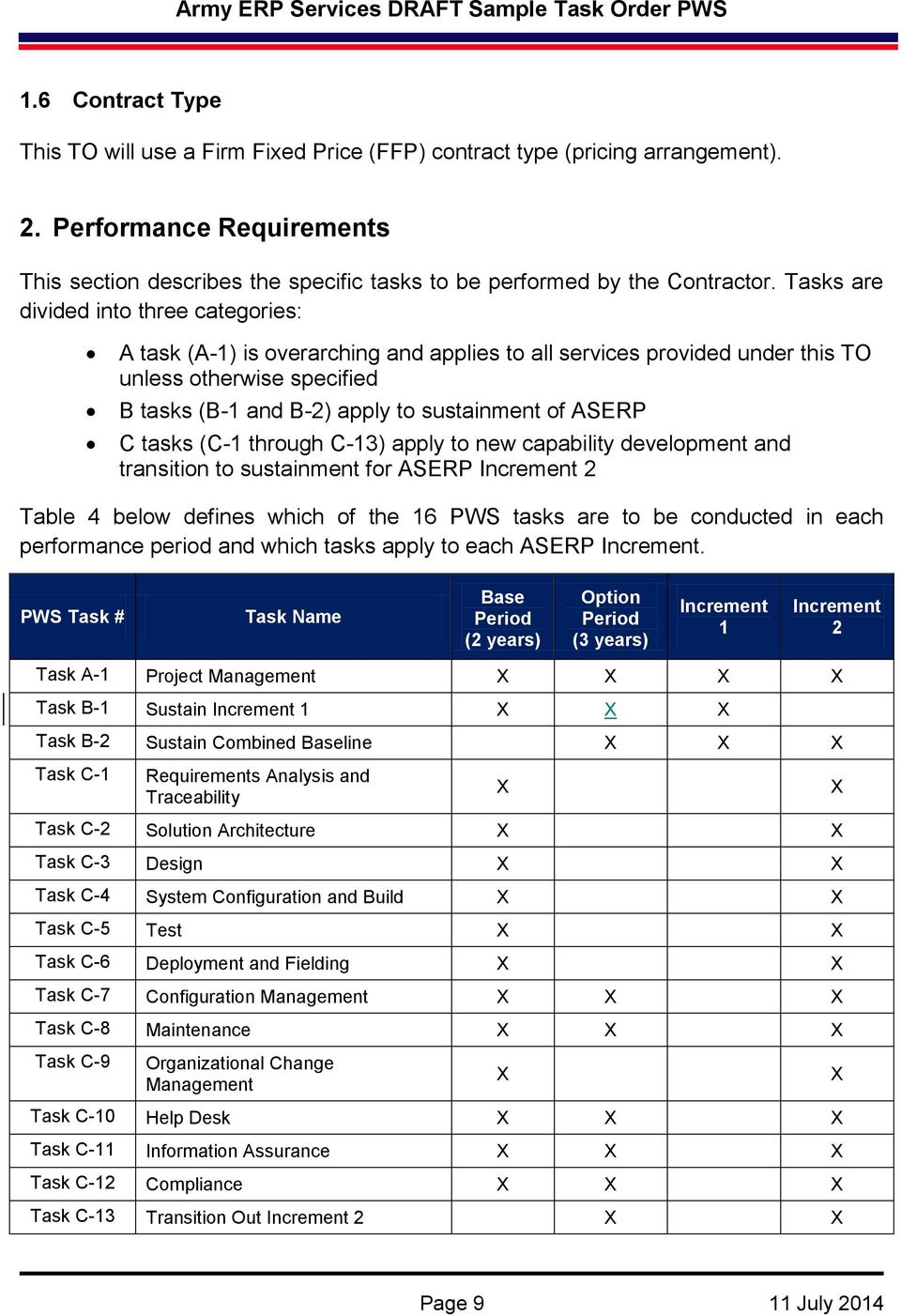
12 1.6 Contract Type This TO will use a Firm Fixed Price (FFP) contract type (pricing arrangement). 2. Performance Requirements This section describes the specific tasks to be performed by the Contractor. Tasks are divided into three categories: A task (A-1) is overarching and applies to all services provided under this TO unless otherwise specified B tasks (B-1 and B-2) apply to sustainment of ASERP C tasks (C-1 through C-13) apply to new capability development and transition to sustainment for ASERP Increment 2 Table 4 below defines which of the 16 PWS tasks are to be conducted in each performance period and which tasks apply to each ASERP Increment. PWS Task # Task Name Base Period (2 years) Option Period (3 years) Increment 1 Increment 2 Task A-1 Project Management X X X X Task B-1 Sustain Increment 1 X X X Task B-2 Sustain Combined Baseline X X X Task C-1 Requirements Analysis and Traceability X X Task C-2 Solution Architecture X X Task C-3 Design X X Task C-4 System Configuration and Build X X Task C-5 Test X X Task C-6 Deployment and Fielding X X Task C-7 Configuration Management X X X Task C-8 Maintenance X X X Task C-9 Organizational Change Management X X Task C-10 Help Desk X X X Task C-11 Information Assurance X X X Task C-12 Compliance X X X Task C-13 Transition Out Increment 2 X X Page 9 11 July 2014
13 2.1 Task A-1: Project Management Table 4: Task and Performance Period Summary Contractor shall perform all the activities required to plan, coordinate, and manage execution of the TO scope in concert with Government and other contractor activities while adhering to schedule and performance objectives. This task (A-1) applies to the entire scope of work performed under this TO with the exception of subtask 2.1.2, Schedule Task Order Management Contractor shall provide TO management including controls, organizational resources, lifecycle methodology, tools, processes, subcontractor management (if applicable), and communications required to meet the cost, schedule, and performance requirements of this TO. Contractor status reporting activities shall include reporting on TO progress as well as providing input to monthly status reports produced by the ASERP Product Management Office (PMO) and the Army-SSC. Contractor shall manage risks and issues and provide weekly input to the Government s risk and issue management processes. The Government does not envision a need for the Program Manager labor category to be utilized in support of this Sample TO Schedule Contractor shall develop and maintain a TO Schedule for Tasks C-1 through C-13 reflecting TO milestones as documented in Table 3. The Contractor shall plan, schedule, and resource activities as needed to meet the TO objectives and to facilitate status reporting. Contractor shall develop the TO Schedule based on its selected lifecycle methodology. At a minimum, the TO Schedule shall include: activities, tasks, dependencies, and deliverables/work products deemed necessary to support the TO milestones delineated in Table Quality Assurance Contractor shall develop and execute a Quality Assurance Plan (QAP) to ensure its performance meets the Acceptable Quality Levels (AQLs) established for this TO. The plan shall include metrics and measurements to monitor work in progress and interim delivery milestones, which shall be included in the Monthly Task Order Status Report. Page July 2014

14 2.1.4 Knowledge Management Contractor shall fully document all work products and deliverables produced under this TO in the Government provided Knowledge Management (KM) tool. Documentation shall be versioned, indexed, searchable, and appropriately tagged for ease of retrieval and sharing by the Government and other contractors supporting the program. It is essential that complete and accurate documentation of the solution is maintained at all times in the centralized Government provided KM tool Support Joint Government-Contractor Management Boards The Contractor shall support and participate in joint Government-Contractor management boards the Change Control Board (CCB) and the Risk/Issue Management Board. These boards both convene monthly for one hour meetings, and require preparation of approximately four hours each Provide Information to the Army Contractor Manpower Reporting Application (CMRA) Site The Contractor shall report ALL Contractor labor hours (including subcontractor labor hours) required for performance of services provided under this contract via a secure data collection site. The Contractor is required to completely fill in all required data fields using the following web address: and then click on "Department of the Army CMRA." Reporting inputs will be for the labor executed during the period of performance during each Government fiscal year (FY), which runs 1 October through 30 September. While inputs may be reported any time during the FY, all data shall be reported no later than 31 October of each calendar year. Contractors may direct questions to the help desk by clicking on "Send an " which is located under the Help Resources ribbon on the right side of the login page of the applicable Service/Component's CMRA website. Task A-1 Deliverables Monthly Task Order Status Report Task Order Schedule Quality Assurance Plan (QAP) Page July 2014
15 Task A-1 Performance Standards/AQLs a. STD: Completes tasks within required schedule AQL: See AQL Rating Matrix for Schedule b. STD: Monthly Task Order Status Report and Task Order Schedule contain all required up-to-date information c. STD: Provides timely and accurate responses to Government inquiries AQL: See AQL Rating Matrix for Business Relations 2.2 Task B-1: Sustain Increment 1 Contractor shall provide the personnel identified in Table 5 below to support the Army- SSC in its sustainment of ASERP Increment 1. Contractor shall perform as part of an integrated Army-SSC led team that includes Contractor s personnel, Government personnel, and other contractors supporting the Army-SSC through various contract vehicles. As the Lead Systems Integrator (LSI), Army-SSC will utilize its lifecycle methodology to guide sustainment activities. Ramp-up of Contractor personnel including onboarding, knowledge transfer, and hand-over of day-to-day responsibilities shall be conducted in support of the Army-SSC. There are no specified deliverables for Task B- 1. Status shall be reported as part of the Monthly Task Order Status Report in Task A-1. Labor Category Base Period Year 1 FTEs Base Period Year 2 FTEs Option Period Year 1 FTEs Principal Industry/Functional Area Specialist Program Support Specialist Principal Enterprise Application Product Expert Sr. Enterprise Application Product Expert Enterprise Application Modeler/Developer Enterprise Application Product Associate Sr. Application Development Engineer Applications Development Engineer Database Management Specialist Database Development Specialist Quality Assurance Analyst Page July 2014

16 Labor Category Base Period Year 1 FTEs Base Period Year 2 FTEs Option Period Year 1 FTEs Technical Writer/Editor Systems Analyst Totals Table 5: Task B-1 Labor Categories and FTEs Major activities anticipated under this task include: Support Army-SSC to (i) analyze requirements to assess feasibility and impact on the deployed production baseline and (ii) provide an execution plan in accordance with Army-SSC policies and procedures. Support Army-SSC in providing the full lifecycle of operations activities and services to maintain and optimize the deployed production baseline. Support Army-SSC with the day-to-day knowledge transfer activities required to transition the application sustainment, management, and administration of the SAP Applications as configured in the deployed production baseline. Follow the Army-SSC procedures, policies, templates, documentation, and review processes (e.g., configuration management and quality assurance). Support Army-SSC in technical integration activities across the solution to include system monitoring, interface monitoring, batch failure monitoring and escalation, workflow support, technical architecture support, archiving, and reporting. Support Army-SSC in production implementation evaluation, release planning and facilitation, as well as planning and executing maintenance outages and upgrades. Support Army-SSC in enterprise architecture activities to establish architectural direction, maintain the integrity of the deployed production baseline, and support its alignment with DoD and Army architecture standards. Provide application configuration, design, documentation, test, and sustainment support in accordance with Army-SSC processes. Support transition and knowledge transfer in concert with the above activities. Task B-1 Performance Standards/AQLs a. STD: Completes assigned tasks within required schedule as determined by the Government Team Lead AQL: See AQL Rating Matrix for Schedule b. STD: Performs assigned tasks while adhering to Army-SSC policies, procedures, and standards Page July 2014

17 c. STD: Provides personnel as specified in Table 5. AQL: See AQL Rating Matrix for Management of Personnel 2.3 Task B-2: Sustain Combined Baseline Contractor shall provide the personnel identified in Table 6 below to support the Army- SSC in its sustainment of the combined ASERP baseline (following integration of Increment 2 into the deployed production baseline). Contractor shall perform as part of an integrated Army-SSC team that includes Contractor s personnel, Government personnel, and other contractors supporting the Army-SSC through various contract vehicles. As the LSI, Army-SSC will utilize its lifecycle methodology to guide sustainment activities. Note: In time sequence, this task will take place after Task C-13: Transition Out Increment 2. There are no specified deliverables for Task B-2. Status shall be reported as part of the Monthly Task Order Status Report in Task A-1. Labor Category Option Period Year 2 FTEs Option Period Year 3 FTEs Principal Industry/Functional Area Specialist 2 2 Program Support Specialist 2 2 Principal Enterprise Application Product Expert 2 2 Sr. Enterprise Application Product Expert 1 1 Enterprise Application Modeler/Developer 2 2 Enterprise Application Product Associate 2 2 Sr. Application Development Engineer 1 1 Applications Development Engineer 2 2 Database Management Specialist 2 2 Database Development Specialist 1 1 Quality Assurance Analyst 2 2 Technical Writer/Editor 1 1 Systems Analyst 2 2 Totals Table 6: Task B-2 Labor Categories and FTEs Major activities anticipated under this task are the same as the activities listed under Task B-1: Sustain Increment 1. Page July 2014

18 Task B-2 Performance Standards/AQLs a. STD: Completes assigned tasks within required schedule as determined by the Government Team Lead AQL: See AQL Rating Matrix for Schedule b. STD: Performs assigned tasks while adhering to Army-SSC policies, procedures, and standards c. STD: Provides personnel as specified in Table 6. AQL: See AQL Rating Matrix for Management of Personnel 2.4 Task C-1: Requirements Analysis and Traceability Contractor shall review and analyze Government-defined requirements against SAP ERP solution capabilities and associated business processes. Contractor shall leverage SAP COTS ERP software to enable Business Process Reengineering (BPR) and associated changes to the business processes with the goal of maximizing standard COTS configuration-based capability and minimizing RICEFW development. The Contractor shall document its analysis of the requirements to confirm completeness and work with the Government to resolve any identified gaps prior to proceeding with development of design specifications. The results of this task shall be documented in a BPR Recommendations Report. For the purposes of this Sample TO, Contractor shall assume no changes to the Government provided RICEFW count in Table 2. Task C-1 Deliverable BPR Recommendations Report Task C-1 Performance Standards/AQLs a. STD: Completes tasks within required schedule AQL: See AQL Rating Matrix for Schedule b. STD: Maximizes BPR through use of standard COTS configuration-based capability and minimizes changes to the established Increment 2 RICEFW profile in Table Task C-2: Solution Architecture Contractor shall develop and document the ASERP Increment 2 solution architecture leveraging technical and business process expertise in the applicable functional Page July 2014

19 domains (i.e., finance, logistics). The Increment 2 solution architecture shall be guided by the established Increment 1 solution architecture and include, at a minimum: application components, modules, databases, tools, interfaces, extensions, bolt-ons, and standards. Contractor shall develop the solution architecture in full collaboration with the Government and its support contractors. The architecture and all its component artifacts shall maintain compliance with the current version of the DoD Business Enterprise Architecture (BEA). The solution architecture shall enable minimization of custom code, the use of modular design, standards-based interfaces, and leverage best practices to provide ease of configuration updates, portability, maintainability, vendor independence, reusability, upgradeability, interoperability, and long-term supportability. Task C-2 Deliverable Solution Architecture Artifacts Task C-2 Performance Standards/Acceptable Quality Levels (AQLs) a. STD: Completes tasks within required schedule AQL: See AQL Rating Matrix for Schedule b. STD: Provides a complete and accurate set of required artifacts c. STD: Adheres to Business Enterprise Architecture (BEA) and Financial Improvement Audit Readiness (FIAR) including all subordinate statutory and regulatory standards 2.6 Task C-3: Design Contractor shall create all necessary functional and technical design documentation for the ERP solution and support the reviews and documentation updates required to complete the design. Contractor shall provide documentation, system demonstration, logistics, and facilitation for the Preliminary Design Review (PDR), during which ASERP stakeholders will have an opportunity to review the functional design and raise issues and gaps to be resolved. Contractor shall demonstrate traceability from the functional design to the requirements in the Requirements Traceability Matrix (RTM). The intended outcome of the PDR is an approved functional baseline that will be the primary input to the development of technical specifications. Page July 2014
20 Contractor shall provide documentation, system demonstration, logistics, and facilitation for the Critical Design Review (CDR), during which ASERP stakeholders will have an opportunity to review the comprehensive design and raise issues and gaps to be resolved. The intended outcome of the review is an approved design baseline that will be the primary input to system configuration and RICEFW development activities. For the purposes of this Sample TO, Contractors shall assume no changes to the Government provided RICEFW count. Contractor shall update the Configuration Documents and RTM based on the completed Functional Solution Design, PDR, and CDR. Task C-3 Deliverables Functional Solution Design Document Configuration Documents Functional Design Specifications Reports Functional Design Specifications Interfaces Functional Design Specifications Conversions Functional Design Specifications Extensions Functional Design Specifications Forms Functional Design Specifications Workflows Preliminary Design Review Briefing Materials Technical Design Specifications Reports Technical Design Specifications Interfaces Technical Design Specifications Conversions Technical Design Specifications Extensions Technical Design Specifications Forms Technical Design Specifications Workflows Critical Design Review Briefing Materials Updated Requirements Traceability Matrix Task C-3 Performance Standards/AQLs a. STD: Completes tasks within required schedule AQL: See AQL Rating Matrix for Schedule b. STD: Provides a complete and accurate set of required deliverables c. STD: Configuration documents and specifications are completed in accordance with Government standards and templates Page July 2014

21 d. STD: Adheres to Business Enterprise Architecture (BEA) and Financial Improvement Audit Readiness (FIAR) including all subordinate statutory and regulatory standards 2.7 Task C-4: System Configuration and Build Contractor shall perform system configuration and RICEFW object development (build) activities based on the approved design. Task C-4 includes unit testing and use of mandated code scanning tools Perform System Configuration Contractor shall configure the SAP components and modules based on the approved design baseline. System configuration shall be based on configuration documents that incorporate configuration scope, release cycles, test plans, data requirements, and associated development objects. Contractor shall also produce documentation of the system configuration, including development of Business Process Procedures (BPPs). Each BPP shall provide sufficient information to enable users to understand the processes and activities within the system to include user role definition, user responsibility and role based security, system process flows, and step-by-step activities. Contractor shall support configuration reviews in collaboration with the Government and its support contractors. The purpose of the reviews is to ensure the configured system is technically sound, meets the design, and is properly documented. Any configuration decisions that contemplate deviation from the approved design baseline shall be provided to the Government for adjudication using the Government s CCB process Develop RICEFW Objects Contractor shall conduct all activities required to develop, implement, and unit test RICEFW objects based on the approved design baseline. Development of RICEFW objects shall be based on approved technical specifications (Task C-3 deliverables) that incorporate configuration scope, release cycles, test plans, data requirements, and associated system configuration. Contractor shall also produce documentation of RICEFW objects and support RICEFW reviews in collaboration with the Government and its support contractors. The purpose of the reviews is to ensure the developed software code is technically sound, meets the design, and is properly documented. Any development decisions that contemplate deviation from the approved design baseline shall be provided to the Government for adjudication using the Government s CCB process. Page July 2014
22 2.7.3 Implement use of Software Code Quality (SCQ) and Software Code Assurance (SCA) Contractor shall implement the use of Government provided Software Code Quality (SCQ) and Software Code Assurance (SCA) tools (currently CAST Application Intelligence Platform and HP Fortify) in order to detect errors, enable best practices, find security vulnerabilities, and remediate the applicable vulnerabilities within developed software source code. COTS software (e.g., standard applications included in the Army Gold Master [AGM]) will not be scanned. Task C-4 Deliverables Updated Configuration Documents Updated Functional and Technical Specifications Business Process Procedures RICEFW Objects Task C-4 Performance Standards/AQLs a. STD: Completes tasks within required schedule AQL: See AQL Rating Matrix for Schedule b. STD: Provides a complete and accurate set of required deliverables c. STD: Completes configuration documents and specifications in accordance with Government standards and templates d. STD: Adheres to Business Enterprise Architecture (BEA) and Financial Improvement Audit Readiness (FIAR) including all subordinate statutory and regulatory standards e. STD: Configures the system and develops RICEFW objects in accordance with the approved technical and functional specifications and Government configuration management policy, processes, procedures, and templates f. STD: Incorporates the use of Government provided SCQ and SCA tools within the software development process Page July 2014
23 2.8 Task C-5: Test Contractor shall plan and conduct comprehensive testing of ASERP Increment 2, including regression testing to ensure Increment 1 capability is not negatively affected by Increment Develop Test Plan Contractor shall develop the Test Plan which shall address at a minimum: defining test events, developing test scripts, creating and maintaining test data, conducting test readiness reviews, performing test events, producing test result reports, and maintaining requirements traceability documentation Perform Test Events Contractor shall prepare for and conduct a Test Readiness Review (TRR) that includes collaboration with the Government and its support contractors prior to commencing test events. Contractor shall prepare, schedule, coordinate, conduct, analyze, and document test events. Test events shall include: connectivity, integration, functional, volume, stress, regression, security, user acceptance, backup, restore, and disaster recovery. Contractor shall support applicable financial compliance testing (e.g., Federal Information Systems Controls Audit Manual [FISCAM]). Contractor shall identify, track, mitigate, manage, and resolve all defects discovered during test events. Defects may be related to system configuration, RICEFW objects, and/or documentation. Contractor shall perform necessary regression testing when system changes are introduced as a result of defect resolution. Contractor shall use Government Furnished Equipment (GFE) testing tools to execute and document test events. Task C-5 Deliverables Test Plan Test Readiness Review Briefing Materials Test Results Reports Updated Requirements Traceability Matrix Task C-5 Performance Standards/AQLs a. STD: Completes tasks within required schedule Page July 2014
24 AQL: See AQL Rating Matrix for Schedule b. STD: Provides a complete and accurate set of required deliverables c. STD: Adheres to Business Enterprise Architecture (BEA) and Financial Improvement Audit Readiness (FIAR) including all subordinate statutory and regulatory standards d. STD: Complies with Test and Evaluation Master Plan (TEMP) e. STD: Resolves test defects in accordance with thresholds, standards, and timelines identified in approved Test Plan 2.9 Task C-6: Deployment and Fielding Contractor shall perform all activities and tasks required to successfully deploy, field, and support ASERP Increment 2 capabilities Perform Deployment Activities Contractor shall carry out all necessary deployment and fielding tasks including fully preparing the users for implementation; conducting pre-deployment assessments; providing end user identification, mapping, provisioning, and implementation; and Organizational Change Management (OCM) and communications activities. The Contractor shall plan and execute user training activities, data conversion activities, site specific BPPs, and support as required during the go-live event. Contractor shall develop and deliver three user training sessions for the 200 Increment 2 users. Training shall be developed in Microsoft PowerPoint and delivered remotely leveraging GFE collaboration software. Deployment and fielding status shall be reported as part of the Monthly Task Order Status Report in Task A Provide Post Go-Live Support The Contractor shall remotely support post deployment activities for a period of 30 days after go-live (e.g., end user training, data validation, data maintenance, prioritization and escalation of help desk tickets, financial compliance and validation, Field Service Representative duties, translate business processes in the SAP environment, and identification and recommendation of resolutions for Segregation of Duties [SoD] conflicts). Post go-live support shall be performed IAW the requirements of Task C-10: Help Desk. Page July 2014
25 Task C-6 Deliverable Deployment and Fielding Plan User Training Materials Task C-6 Performance Standards/AQLs a. STD: Completes tasks within required schedule AQL: See AQL Rating Matrix for Schedule b. STD: Provides a complete and accurate set of required deliverables c. STD: Achieves high levels of customer satisfaction AQL: Average score of 4 out of 5 on post go-live user satisfaction surveys 2.10 Task C-7: Configuration Management Contractor shall utilize GFE system infrastructure provided by the Government hosting organization. The Contractor shall maintain, sustain, update, and migrate system baselines for Development, Quality Assurance, Training, Production, and COOP landscapes in coordination with the Government hosting organization. The Contractor shall be responsible for application level administration and ERPspecific database administration. Contractor will not be responsible for hardware, system software (e.g., operating systems), database installation/maintenance, or network connectivity at the hosting location(s), and is not anticipated to be physically present at the hosting location(s). Contractor shall maintain configuration management and version control of all developed configuration items and configuration objects as well as manage and maintain the consistency of the system baseline. The Contractor shall participate in the CCB, perform release management, maintain the Configuration Management Database (CMDB), and support configuration audits. Task C-7 Deliverables Updated CMDB Updated Configuration Documents Updated Functional and Technical Specifications Fully Functioning ASERP Increment 2 Software Solution Task C-7 Performance Standards/AQLs Page July 2014
26 a. STD: Completes tasks within required schedule AQL: See AQL Rating Matrix for Schedule b. STD: Delivers and maintains complete configuration objects and documentation in accordance with Government configuration management policy, processes, procedures, and templates c. STD: Delivers an ASERP Increment 2 Software Solution that meets all functional and technical requirements as identified in the RTM 2.11 Task C-8: Maintenance Contractor shall plan and conduct system maintenance activities, performance management, monitoring, reporting, and COOP Plan and Conduct Corrective Maintenance Contractor shall plan and conduct corrective maintenance activities including the identification, isolation, and resolution of system problems to restore normal operations Conduct Operational and System Performance Management Contractor shall conduct performance management to include monitoring and reporting of system and operational metrics against defined standards and parameters Plan and Coordinate Processes and Procedures for Continuity of Operations Contractor shall design and document processes and procedures to ensure that COOP is consistent with system availability requirements during all disaster recovery test events, and after a natural or manmade disaster renders a component of the technical landscape unusable. Coordination includes communication with the hosting organization to ensure the requirements for system design and sustainment are synchronized. The Contractor s plan shall include application installation/restoration instructions and application installation scripts for use in the COOP site Perform Data Management Contractor shall review, develop, migrate, cleanse, validate, and maintain data. The Contractor shall document all data management activities. Page July 2014
27 Data Management activities include data extract, transform and load to enterprise applications, as well as data harmonization and brokering via the enterprise Master Data Management (MDM) hub (i.e., AESIP Hub). Data Management activities also include implementation of data management system controls. Task C-8 Deliverables Continuity of Operations Plan Data Management Plan Updated CMDB Task C-8 Performance Standards/AQLs a. STD: Completes tasks within required schedule AQL: See AQL Rating Matrix for Schedule b. STD: Completes operational and system performance measurement and applies corrective maintenance updates to restore normal operations in accordance within the established standards AQL: See AQL Rating Matrix for Schedule c. STD: Provides a complete and accurate set of required deliverables d. STD: Updates configuration objects and documentation in accordance with Government configuration management policy, processes, procedures, and templates e. STD: Adheres to COOP standards and policies (e.g., Army Regulation [AR] 500-3) f. STD: Implements data management controls in compliance with FISCAM control activities 2.12 Task C-9: Organizational Change Management Contractor shall create and implement OCM to mitigate organizational impacts and create an environment that is conducive to adoption of new or changed system functionality and business processes resulting from the implementation of ASERP Increment 2. OCM includes developing and implementing communications strategies, plans, and themes/messages to facilitate the organizational transition, as well as Page July 2014
28 providing training specific to organizational change in relation to the new system capabilities and business process changes. Task C-9 Deliverables OCM Plan OCM Communications Products OCM Training Materials Task C-9 Performance Standards/AQLs a. STD: Completes tasks within required schedule AQL: See AQL Rating Matrix for Schedule b. STD: Provides a complete and accurate set of required deliverables c. STD: Achieves high levels of customer satisfaction AQL: Average score of 4 out of 5 on user satisfaction surveys 2.13 Task C-10: Help Desk Contractor shall provide comprehensive support to system users requesting help. The Contractor shall document, track, report, and resolve system incidents identified by users. Incidents may include questions, problems, or other requests for assistance by users. This includes problems that impact system functionality or availability, diagnostics, interface problems, performance-related problems, and collaboration with the COTS enterprise application vendor to resolve problems. The Contractor s Help Desk shall be for Tier 2 only and shall coordinate with the Tier 1 Help Desk being provided by the Increment 1 sustainment organization (Army-SSC). Contractor shall provide information on common problems and questions regarding ASERP Increment 2 to the Tier 1 Help Desk so it can handle these requests without escalating to Tier 2. Hours of operation will be EST Monday through Friday. Contractor shall use the Government provided Help Desk ticketing system. Task C-10 Deliverables Help Desk Operating Procedures Help Desk Incident Database and Knowledgebase Help Desk Metrics Report Task C-10 Performance Standards/AQLs Page July 2014
29 a. STD: Responds to and resolves incidents within the prescribed service level timeframes AQL: See AQL Rating Matrix for Schedule b. STD: Provides a complete and accurate set of required deliverables c. STD: Achieves high levels of customer satisfaction AQL: Average score of 4 out of 5 on user satisfaction surveys 2.14 Task C-11: Information Assurance (IA) Contractor shall satisfy Information Assurance (IA) requirements to include developing artifacts IAW DoD Instruction (Risk Management Framework [RMF] for DoD Information Technology) and supporting the Government in obtaining an Authorization to Operate (ATO), to operate ASERP Increment 2 on the Defense Information Systems Network (DISN)/Global Information Grid (GIG). The Contractor shall also satisfy the FISCAM requirements relative to IA that enable sustained audit readiness. Contractor shall provide input to the Government Plan of Action and Milestones (POAM) as required. Task C-11 Deliverables Information Assurance Artifacts Task C-11 Performance Standards/AQLs a. STD: Captures any identified deviation from standard in a POAM with a mitigation, remedy, and estimated date of completion AQL: See AQL Rating Matrix for Schedule b. STD: Conducts periodic validation of IA controls AQL: See AQL Rating Matrix for Schedule c. STD: Ensures compliance with IA standards and policies including AR 25-2, Department of Defense Directive (DoDD) , Department of Defense Instruction (DODI) , DoDD , Federal Information Security Management Act (FISMA), and FISCAM Page July 2014
30 2.15 Task C-12: Compliance Contractor shall design and implement ASERP Increment 2 in compliance with all applicable Federal, DoD, and Army financial auditability and system compliance requirements including, but not limited to: Government Auditing Standards (the Yellow Book") Defense Finance and Accounting Services (DFAS) Financial Management Systems Requirements Manual (the "Blue Book") Department of Defense (DoD) Financial Improvement and Audit Readiness (FIAR) Plan Department of Army Financial Improvement Plan (FIP) Applicable federal accounting standards published by the Federal Accounting Standards Advisory Board (FASAB) Chief Financial Officers Act of 1990 Business Enterprise Architecture (BEA) Department of Defense Architecture Framework (DoDAF) DoD Standard Financial Information Structure (SFIS) Army Portfolio Management Solution (APMS) Federal Financial Management Improvement Act (FFMIA) Federal Information System Controls Audit Manual (FISCAM) There are no specified deliverables for Task C-12; however, Contractor is responsible for maintaining compliance with the standards listed in this task and supporting Government certification and attestation activities. Task C-12 Performance Standards/AQLs a. STD: Completes tasks within required schedule AQL: See AQL Rating Matrix for Schedule b. STD: Complies with the guidance, policy, and other standards identified in Task C Task C-13: Transition Out Increment 2 Contractor shall plan and execute the transition of ASERP Increment 2 into a combined baseline which shall be under the management and control of the Army-SSC. The transition shall include knowledge transfer (both explicit and tacit), documentation and system configuration management transition, as well as transition of all day-to-day Page July 2014
31 operational responsibilities for sustainment and support of the system. The Contractor shall perform the transition while maintaining acceptable levels of system performance, without impact to the functionality of the deployed production baseline, and without taking the system offline longer than would be required for a normal maintenance window (i.e., over a weekend). Transition shall be completed NLT 12 months after completion of ASERP Increment 2 fielding (FD milestone) and shall require sign-off by the Product Manager and the Director, Army-SSC based on a pre-established set of criteria documented in the approved Transition Plan. Task C-13 Deliverables Transition Plan Inventory of System Documentation Current ASERP Increment 2 Software Solution Transition Status Report Task C-13 Performance Standards/AQLs a. STD: Completes tasks within required schedule AQL: See AQL Rating Matrix for Schedule b. STD: Maintains documentation that is current, complete, and accurate 3. Assumptions Contractor shall take the following assumptions into account when formulating and executing its approach to the work described in this PWS: Physical presence will not be required at the three CONUS sites receiving Increment 2 capability the capability will be remotely deployed and supported. Infrastructure will be hosted in a Government facility and all development, testing, and production landscapes will be hosted in the Government facility and in the.mil domain. Government will provide server/operating system level administration whereas contractor will provide application level systems administration. No changes to the Government provided RICEFW count in Table 2. All RICEFW objects identified in Table 2 are new and no modifications are required to existing Increment 1 objects. Page July 2014
32 FTEs specified for Tasks B-1 and B-2 will not require ramp-up time for the purposes of this hypothetical Sample TO. No key personnel roles are specified or required for this hypothetical Sample TO. The Government does not envision a need for the Program Manager labor category to be utilized in support of this Sample TO. 4. General Requirements The following sub-sections provide details of various general requirements for this TO. 4.1 Non-Personal Services The Contractor shall provide strictly non-personal services and shall work as an independent Contractor. Contractor employees are not subject to direct supervision and control by the Government. The Contractor shall advise and assist the Government, but shall not make final decisions or certifications on behalf of the Government, nor perform any inherently Governmental functions. The Contractor and its employees shall not represent the Government nor appear to represent the Government in performance of these contract services. Contractor personnel shall clearly identify themselves as Contractor employees in all interactions during contract performance. 4.2 Business Relations The Contractor shall successfully integrate and coordinate all activity needed to execute the requirements. The Contractor shall manage the timeliness, completeness, and quality of problem identification. The Contractor shall provide corrective action plans, submittals, timely identification of issues, and effective management of subcontractors. The Contractor shall seek to ensure customer satisfaction and professional and ethical behavior of all Contractor personnel. 4.3 Personnel Administration and Management The Contractor shall provide personnel management and support as required. The Contractor shall provide administrative support to employees in a timely fashion (e.g., time keeping, leave processing, pay, emergency needs). The Contractor shall establish clear organizational lines of authority and responsibility to ensure effective management of the resources assigned to the requirement. The Contractor shall maintain the currency of its employees training. Page July 2014
33 4.4 Contract Administration The Contractor shall establish processes and assign appropriate resources to effectively administer this TO. The Contractor shall respond to Government requests for contractual actions in a timely fashion. The Contractor shall assign work effort and maintain proper and accurate time keeping records of personnel assigned to work on the requirement. 4.5 Subcontract Management The Contractor shall be responsible for any subcontract management necessary to integrate work performed on this requirement and shall be responsible and accountable for subcontractor performance on this requirement. 4.6 Place of Performance The places of performance are Contractor facilities in the National Capital Region (NCR) and in the vicinity of Picatinny Arsenal, NJ (approximately half of the personnel at each location). 4.7 Travel / Temporary Duty (TDY) There is no Government directed travel or TDY included in this TO. Convenience and/or commuting travel shall be at the Contractor s expense as part of its Firm Fixed Price. 5. Special Requirements The Contractor shall abide by the following special requirements. Use of the term Contractor shall include subcontractor(s), and use of the term Contractor employee(s) shall include subcontractor employee(s). 5.1 Antiterrorism (AT) and Operations Security (OPSEC) AT Level I Training Contractor employees requiring access to Government installations, facilities, and controlled access areas shall complete AT Level I awareness training within 30 calendar days after contract start date or addition of new Contractor employees. The Contractor shall submit certificates of completion for each affected Contractor employee to the COR within 30 calendar days after completion of training. AT Level I awareness training is available at the following website: Page July 2014
34 5.1.2 Access and General Protection Policy and Procedures Contractor employees shall comply with applicable installation, facility, and area commander installation and/or facility access and local security policies and procedures (provided by Government representative). The Contractor shall also provide all information required for background checks to meet installation access requirements to be accomplished by installation Provost Marshal Office, Director of Emergency Services, or Security Office. Contractor employees must comply with all personal identity verification requirements as directed by DoD, HQDA and/or local policy. In addition to the changes otherwise authorized by the changes clause of this contract, should the Force Protection Condition (FPCON) at any individual facility or installation change, the Government may require changes in Contractor security matters or processes iwatch Training The Contractor shall brief all employees on the local iwatch program (training standards provided by the requiring activity Antiterrorism Officer). This locally developed training will be used to inform employees of the types of behavior to watch for and instruct employees to immediately report suspicious activity to installation security or local law enforcement personnel. The COR will be notified of each suspicious activity reporting incident within 30 days of each incident. This training shall be completed within 30 calendar days of contract award and within 30 calendar days of new employees commencing performance. The Contractor shall submit evidence of completion for each affected Contractor employee to the COR within 30 calendar days after completion of training Access to Government Information Systems All Contractor employees with access to a Government information system must be registered in the Army Training Certification Tracking System (ATCTS) at the commencement of services, and must successfully complete the DoD Information Assurance Awareness training prior to access to the information systems and then annually thereafter Requirement for OPSEC Training Per AR 530-1, Contractor employees shall complete OPSEC Level I training within 30 calendar days of reporting for duty. All Contractor employees shall complete annual OPSEC awareness training. Page July 2014
35 5.1.6 Information Assurance and/or Information Technology (IT) Training Contractor employees shall complete the DoD IA awareness training before issuance of network access and annually thereafter. All Contractor employees working IA/IT functions shall comply with DoD and Army training requirements in DoDD , DoD M, and AR 25-2 upon TO award Information Assurance and/or Information Technology Training Certification Per DoD M, DFARS and AR 25-2, all Contractor employees supporting IA/IT functions shall be appropriately certified upon TO award. The baseline certification as stipulated in DoD M shall be completed upon TO award. 5.2 Other Security and Privacy Designation of Information Technology Level Contractor personnel will be designated as Information Technology Level I through IV in accordance with AR Contractor personnel without a SECRET clearance who are nominated for IT I through IV positions will initiate for review a SF 85P and Supplemental Questionnaire Security Clearances All Contractor personnel performing on this TO shall posses or be eligible to obtain a SECRET security clearance. SECRET is the highest classification anticipated under this TO. The Contractor shall comply with FAR , Security Requirements and all other applicable requirements Non-U.S. Citizens in IT Positions Performance by non-u.s. citizens in IT positions shall be minimized. However, compelling reasons may exist to grant access to DoD IT resources in those circumstances in which a non-u.s. citizen possesses a unique or unusual skill or expertise that is urgently needed for a specific DoD requirement and for which a suitable U.S. citizen is not available. Access to sensitive information by a non-u.s. citizen who is not a DoD employee will only be permitted In Accordance With (IAW) applicable disclosure policies (e.g., National Disclosure Policy 1, DoDD , DoDD ) and U.S statutes (e.g., the Arms Export Control Act, 22 USC 39). If information to which the Contractor will have access is authorized for foreign disclosure, non-u.s. citizens assigned to DoD IT positions are subject to the Page July 2014
36 investigative requirements outlined below. For positions identified as IT - II and III, foreign nationals may be appointed if they: 1) possess a unique or unusual skill or expertise that is urgently needed for a specific DoD requirement and for which a suitable United States citizen is not available, and 2) are approved in writing by the Program Executive Office Enterprise Information Systems (PEO EIS) as the Agency Director. However, under no circumstances can these individuals be assigned before completion and favorable adjudication of the appropriate security investigation. In all cases the Contractor shall forward employee investigation information to the COR before employees are assigned to work under a specific TO. The Contractor will ensure that a Visit Request is forwarded to the COR for each location where employees will be assigned. That Visit Request must be provided on an annual basis Right to Require Removal The Government retains the right to require removal of Contractor personnel, regardless of prior clearance or adjudication status, whose actions while performing on this TO conflict with the security and privacy interests of the Government. The reason for removal will be documented in writing by the Contracting Officer Privacy Act Data processed at PEO EIS locations may contain Privacy Act information which requires the reading, signing, and adherence to appropriate nondisclosure documents. 5.3 Government Furnished Equipment (GFE)/Government Furnished Information (GFI) Note: The GFE and GFI listed below are hypothetical for the purposes of the Sample Task Order. No actual GFE or GFI will be provided. The Government will provide the following GFE: Software licenses for SAP and related applications and tools listed in Sections and Computers and/or Laptops All work under this TO shall be conducted on GFE computers that will be issued to each Contractor staff member who has a valid need as determined by the Government. Virtual Private Network (VPN) capability will also be provided to enable remote access to the ERP technology landscapes. Managed Hosting Services Hosting is anticipated to be at the target state facility throughout the TO period of performance, eliminating the need to migrate from one facility/infrastructure to another at the time of production Page July 2014
37 deployment. Service level agreements are in place to ensure the hosting provider can meet ASERP requirements. Requirements Management and Test Management Tool This tool will be the central repository for test information and traceability from requirements to testing and will also be used for reporting testing metrics and managing defects. Configuration Management Tool The Government will provide a configuration management tool to be used by Contractor to manage source code and other software objects. Knowledge Management (KM) Tool The Government will provide a KM/content management tool to manage all program artifacts and meta data. The common KM/content tool will be used by all Army-SSC and ASERP contractors. Risk Management Tool The Government will provide a risk management tool to manage all program risks. The common risk management tool will be used by all Army-SSC and ASERP contractors. Testing Tools The Government will provide test tools required for functional testing, automated test execution, and performance/load/stress testing. Help Desk Software The Government will provide a help desk software solution to be used by Contractor that will be the same solution used by the Army-SSC for sustainment of ASERP Increment 1. Other software, utilities and tools The Government will procure other software, utilities, or tools based on valid needs. Customary office equipment The Government will provide customary office equipment in the designated Government place(s) of performance such as telephones, printers, and copiers/fax machines. The Government will provide the following GFI: Increment 2 Requirements Traceability Matrix (RTM) Army-SSC Policies and Standards ASERP COOP Plan 6. Applicable Guidance The Contractor shall comply with applicable DoD and Army policies and directives as required by the terms of the contract and as specified in this TO PWS. Page July 2014
38 7. Deliverables Table 7 below contains the post-award TO deliverables and delivery instructions. Unless stated otherwise in Table 7, the following instructions apply to all deliverables: Timeframes are specified in business days. All deliverables shall be completed using Contractor format. The Contractor is required to provide draft and final versions of deliverables IAW the timeframes specified in Table 7 below. All versions of the deliverables required by the task order shall be delivered electronically to the COR and/or their designee and shall be subject to Government review and approval. Deliverable due dates proposed by the Contractor shall take into account the review periods described below. Draft deliverables will be reviewed and feedback and/or requested changes provided within ten (10) business days. The Government reserves the right to request a formal review session with the Contractor during these timeframes and may request that the Contractor make changes to any version of a deliverable. The Government will review and approve or reject all final versions of all deliverables within ten (10) business days of receipt. If any deliverable is rejected, the Contractor will be notified within the specified time periods and will have five (5) business days within which to rework the deliverable and resubmit for Government approval. All changes to any version of a deliverable and/or deliverable outline shall be approved by the COR. If more than the specified number of business days is required for Government review and approval, the COR will inform the Contractor of the need for an extension within the initial review period. The Contractor shall prepare and submit the deliverables on or before the required due date, in the quantity and format stated in Table 7, to the COR or designee via . For deliverables that are not documents (e.g., software configurations) the Contractor shall submit a description of the deliverable and any associated documentation or descriptive information. In no case shall any deliverable be received by the Government less than fifteen (15) business days prior to the end of the Period of Performance. The due dates listed in Table 7 are for final deliverables; hence, draft deliverables must be submitted in advance of these dates to allow time for Government review and Contractor update as described above. The Contractor shall prepare and submit the deliverables listed in Table 7 at a minimum. The Contractor is encouraged to suggest additional deliverables if advantageous to the Government based upon the Contractor s technical approach. Rejection of any deliverable by the Government does not excuse the Contractor from meeting the baseline due dates for any other deliverables. Page July 2014
39 ID # PWS Task Deliverable Title File Type Special Instructions Schedule 1 A-1 Monthly Task Order Status Report MS Word No draft required Monthly NLT 5 days after end of month 2 A-1 Task Order Schedule MS Project Draft due at Award + 10 days Must align to Government provided milestones Initial Award + 30 days Recurring Monthly 3 A-1 Quality Assurance Plan MS Word Award + 20 days 4 C-1 BPR Recommendations Report MS Word 5 C-2 Solution Architecture Artifacts ARIS Contractor to use Government tool (GFE) 6 C-3 Functional Solution Design Document Per Contractor 7 C-3 Configuration Documents Per Contractor 8 C-3 Functional Design Specifications Reports Per Contractor 9 C-3 Functional Design Specifications Interfaces Per Contractor 10 C-3 Functional Design Specifications Conversions Per Contractor 11 C-3 Functional Design Specifications Extensions Per Contractor 12 C-3 Functional Design Specifications Forms Per Contractor 13 C-3 Functional Design Specifications Workflows Per Contractor 14 C-3 Preliminary Design Review Briefing Materials Various 15 C-3 Technical Design Specifications Reports Per Contractor 16 C-3 Technical Design Specifications Interfaces Per Contractor 17 C-3 Technical Design Specifications Conversions Per Contractor 18 C-3 Technical Design Specifications Extensions Per Contractor 19 C-3 Technical Design Specifications Forms Per Contractor Page July 2014
40 ID # PWS Task Deliverable Title File Type Special Instructions Schedule 20 C-3 Technical Design Specifications Workflows Per Contractor 21 C-3 Critical Design Review Briefing Materials Various 22 C-3 Updated Requirements Traceability Matrix Requirements Management and Test Management Tool Contractor to use Government tool (GFE) 23 C-4 Updated Configuration Documents Per Contractor 24 C-4 Updated Functional and Technical Specifications Per Contractor 25 C-4 Business Process Procedures Per Contractor 26 C-4 RICEFW Objects Software Objects Contractor to manage software objects in GFE configuration management tool 27 C-5 Test Plan Per Contractor 28 C-5 Test Readiness Review Briefing Materials Various 29 C-5 Test Results Reports MS Word GFE Test Management Tool 30 C-5 Updated Requirements Traceability Matrix Requirements Management and Test Management Tool Contractor to use Government tool (GFE) Contractor to use Government tool (GFE) 31 C-6 Deployment and Fielding Plan MS Word 32 C-6 User Training Materials MS PowerPoint 33 C-7 Updated CMDB GFE CMDB Contractor to use Government tool (GFE) 34 C-7 Updated Configuration Documents Per Contractor 35 C-7 Updated Functional and Technical Specifications Per Contractor 36 C-7 Fully Functioning ASERP Increment 2 Software Solution Software Contractor to manage software objects in GFE configuration management tool 37 C-8 Continuity of Operations Plan MS Word 38 C-8 Data Management Plan MS Word Page July 2014
41 ID # PWS Task Deliverable Title File Type Special Instructions Schedule 39 C-8 Updated CMDB GFE CMDB Contractor to use Government tool (GFE) 40 C-9 OCM Plan MS Word 41 C-9 OCM Communications Products Per Contractor 42 C-9 OCM Training Materials Per Contractor Proposal MS PowerPoint 43 C-10 Help Desk Operating Procedures 44 C-10 Help Desk Incident Database and Knowledgebase MS Word Ongoing updates GFE Ticketing System 45 C-10 Help Desk Metrics Report Per Contractor 46 C-11 Information Assurance Artifacts Ongoing updates Contractor to use Government tool (GFE) Monthly NLT 5 days after end of month starting upon commencement of Task C-10 Various 47 C-13 Transition Plan Per Contractor 48 C-13 Inventory of System Documentation Per Contractor 49 C-13 Current ASERP Increment 2 Software Solution GFE CMDB Contractor to use Government tool (GFE) 50 C-13 Transition Status Report Per Contractor Monthly NLT 5 days after end of month starting upon commencement of Task C-13 Table 7: Task Order Deliverables Page July 2014
42 8. AQL Rating Matrix The following table provides the Performance Standards and AQL adjectival Ratings that will be used to evaluate performance requirements. Performance Standards Unsatisfactory (Red) Marginal (Yellow) Acceptable Quality Level (AQL) Ratings Satisfactory (Green) Very Good (Purple) Exceptional (Dark-Blue) Schedule Quality of Deliverable or Service Cost Control (applicable only to Cost Reimbursable/Time & Materials) Does not meet the delivery schedule(s) and did not coordinate with the Government for an extension or exception OR does not make final delivery. Deliverables or services are unacceptable. They do not meet the TO requirements, even with Government intervention and guidance. Actual costs significantly exceed planned costs. Does not meet the delivery schedule(s) and coordinated with the Government for an extension or exception. Deliverables or services meet TO requirements after Government intervention and guidance. Actual costs exceed planned costs. Meets delivery schedule(s). Deliverables or services meet all TO requirements with only minor revisions. Actual costs are equal to planned costs. Meets delivery schedule(s). Some early deliveries to the Government s benefit. Deliverables or services meet all TO requirements with no revisions required. Actual costs are below planned costs. Delivery is ahead of schedule(s) and/or many early deliveries to the Government s benefit. Deliverables or services exceed all TO requirements with no revisions required. Actual costs are significantly below planned costs. Page July 2014
43 Performance Standards Unsatisfactory (Red) Marginal (Yellow) Acceptable Quality Level (AQL) Ratings Satisfactory (Green) Very Good (Purple) Exceptional (Dark-Blue) Business Relations Management of Personnel Not responsive (within one business day, more than 5 times in one month) to Government inquiries (written or verbal communications and data calls). Unnecessary change s and significant untimely definitization of change s. Fails to provide or replace personnel IAW Labor Category Descriptions within 30 calendar days of TO award or departure of personnel. Not responsive (within one business day, more than 3 times in one month) to Government inquiries (written or verbal communications and data calls). Unnecessary change s and untimely definitization of change s Fails to provide or replace personnel IAW Labor Category Descriptions within 15 calendar days of TO award or departure of personnel. Responds to Government inquiries within one business day. Provides personnel IAW Labor Category Descriptions within 15 calendar days of TO award or departure of personnel. Contractor personnel possess skills and abilities that meet the TO requirements. Responds to Government inquiries within one business day with no oversight. Anticipates, identifies, and recommends changes in technical and contractual matters. Provides personnel IAW Labor Category Descriptions within 10 calendar days of TO award or departure of personnel. Contractor personnel possess skills and abilities that meet the TO requirements. Responds to and exceeds all Government inquiries within one business day with no oversight. Anticipates, identifies, and recommends changes in technical and contractual matters. Provides personnel IAW Labor Category Descriptions within 5 calendar days of TO award or departure of personnel. Contractor personnel possess skills and abilities that exceed the TO requirements. Table 8: AQL Rating Matrix Page July 2014
44 9. Appendix A: List of Acronyms Acronym ABAP ACPERS AESIP AGM AOR APMS AR AQL ASERP AT ATCTS ATO BEA BI BPR BW CCB CCSS CDR CMDB CMRA CO CONUS COOP COR COTS CRM DD DFAS DFARS DID DoD DoDAF DoDD DODI EBS ECC EIS ERP Phrase Advanced Business Application Programming Automated Civilian Personnel System Army Enterprise Systems Integration Program Army Gold Master Area of Responsibility Army Portfolio Management Solution Army Regulation Acceptable Quality Level Army Sample Enterprise Resource Planning Antiterrorism Army Training and Certification Tracking System Authorization To Operate Business Enterprise Architecture Business Intelligence Business Process Reengineering Business Warehouse Change Control Board Commodity Command Standard System Critical Design Review Configuration Management Database Contractor Manpower Reporting Application Controlling Continental United States Continuity of Operations Contracting Officer's Representative Commercial Off-The-Shelf Customer Relationship Management Department of Defense (Form) Defense Finance and Accounting Service Defense Federal Acquisition Regulation Supplement Data Item Description Department of Defense Department of Defense Architecture Framework Department of Defense Directive Department of Defense Instruction Enterprise Business System ERP Central Component Enterprise Information System Enterprise Resource Planning Page July 2014
45 Acronym FAR FASAB FD FDD FFMIA FFP FI FIAR FIP FISCAM FISMA FPCON FY GFE GFEBS GIG IA IOC IOT&E HQDA IAT IAW IT JTR KM LFD LMP LSI MDM MM MS B NIPRNet NLT OCM OCONUS OGA OPSEC PEO PI PM PMO Phrase Federal Acquisition Regulation Federal Accounting Standards Advisory Board Full Deployment Full Deployment Decision Federal Financial Management Improvement Act Firm Fixed Price Financial Accounting Financial Improvement Audit Readiness Financial Improvement Plan Federal Information System Controls Audit Manual Federal Information Security Management Act Force Protection Condition Fiscal Year Government Furnished Equipment General Fund Enterprise Business System Global Information Grid Information Assurance Initial Operational Capability Initial Operational Test and Evaluation Headquarters, Department of the Army Information Assurance Training In Accordance With Information Technology Joint Travel Regulation Knowledge Management Limited Fielding Decision Logistics Modernization Program Lead System Integrator Master Data Management Materials Management Milestone B Nonsecure Internet Protocol (IP) Router Network Not Later Than Organizational Change Management Outside the Continental United States Other Government Agency Operations Security Program Executive Office Process Integration Project/Product Manager Project/Product Management Office Page July 2014
46 Acronym POAM PoP PDR PS PWS QAP RICEFW RMF SCA SCQ SD SFIS SLA SoD SRM SSC STD TDY TEMP TO TRR UPK Phrase Plan of Action and Milestones Period of Performance Preliminary Design Review Project System Performance Work Statement Quality Assurance Plan Reports, Interfaces, Conversions, Extensions, Forms, and Workflows Risk Management Framework Software Code Assurance Software Code Quality Sales and Distribution Standard Financial Information Structure Service Level Agreement Segregation of Duties Supplier Relationship Management Shared Services Center Standard Temporary Duty Test and Evaluation Master Plan Task Order Test Readiness Review User Productivity Kit Page July 2014
47 10. Appendix B: RICEFW Definitions and Complexity RICEFW Definitions Report A formatted and organized presentation of data. A Report is a parameterdriven set of retrievable data presented in either a static or format-adjustable (e.g., variable sort) manner for consumption. Statutory/Regulatory, Transactional/Operational (out of ERP), Business Intelligence (BI) Analytical/Dashboard/Scorecards, and Printed Documents are all different types of reports. Custom (non-standard) ERP reports, changes to standard ERP reports, custom printed documents, changes to standard printed documents, custom BI reports, scorecards, dashboards, and changes to standard BI reports, scorecards, and dashboards all count as reports. Interface A boundary across which two independent systems meet and act on or communicate with each other. An Interface is a single directional unique program, driven by a business process or data exchange. Integration between two systems may require multiple interfaces to accommodate the unique business processes being integrated. Interfaces are typically counted by transaction type (e.g., inventory issue, inventory receiving). A single interface may require multiple RICEFW objects. Types of interfaces include: External Interfaces with external trading partners or systems Persistent Interfaces with persistent legacy systems Transitional Interfaces required to support the release strategy during fielding (within a release or between releases) Conversion A process that transfers or copies data from an existing system to load production systems at implementation. All relevant code and processing for programmatic conversion/migration of data source(s) to the ERP target data object. This includes the load from data source to the Staged Data Repository (SDR) and from the SDR to the ERP data object. Conversions are usually one-time data loads, although it is possible that an interface may be utilized for initial load. Extension A program that is in addition to an existing standard program but that does not change core code or objects. Extensions are changes or additions to an existing software package that provide the functionality to support a client s business processes. The extensions could take the form of new or changed programs, scripts, or data files. Extensions are programs and activities that provide these functions. The purpose of an Extension is to provide the additional functions required for a package to support an organization s business processes. The notation of the extension source should be in accordance with the programming standards defined for the project. The source usually resides in text files and comprises entities such as: Page July 2014
48 Code to connect existing application programming interfaces Object Oriented (OO) classes and methods Structured programming modules Scripts Lookup or translation tables Structured Query Language (SQL) files Plug-ins The source should contain comments on its operation and, through the build process, should generate executables that allow the operation of the interfaces among the various programs of the client s applications and external systems. Form A client/server user interface (new or modified screen). Custom user interface screens are changes to standard user interface screens and are typically considered forms. Multiple field changes to a single screen are often considered a single RICEFW object. However, creating a custom field could be a separate extension of an object. Workflow A workflow is a series of steps, or ERP screens that must be completed for a business scenario. Some examples of workflow scenarios are: Manage Customer Create sales order Receive invoice RICEFW Complexity Definitions Complexity Object Type Low Medium High Reports Less than 5 standard application tables. As many as 1 external file. Straightforward data retrieval. Logic: Basic, single-level report. Little aggregation or sorting. No use of external subroutines. One version suits all requirements. Between 5 & 8 standard application tables. As many as 3 external files. Some crosschecking. Logic: Multiple-level drill down capability. Moderate calculation, sorting. Some customization (ex: company-wide). Field translations required. 9 or more standard application tables. 3 or more external files. Data from multiple functional areas. Logic: Use of sub-screens, pop-ups, etc. Significant authorization checking. Complicated data retrieval. Some customization (ex: plant-wide). Field translations required. Interfaces Interfaces Inbound - 1 file, fewer than 3 different record types. Logic: Up to 2 transactions in upload. No retry logic (errors to report to log). No reconciliation. Batch. Interfaces Outbound - 1 file, Fewer than 3 different record types. Logic: No translations of Batch codes. Data read from less than 5 tables. Interfaces Inbound - 2 to 4 files, 3 to 5 more different record types. Logic: 2 to 5 transactions in upload. Moderate coding (some validation). Some retry logic and error processing. Minimal reconciliation. Interfaces Outbound - 2 to 4 files, 3 to 5 difficult record types. Logic: Batch. Moderate translations of codes. Data read from 5 to 9 tables. Interfaces Inbound - 5 or more external files, and 8 or more different record types. Logic: More than 6 transactions in upload. Complex coding (complex validation). Significant retry logic and error handling. Heavy reconciliation. Interfaces Outbound - 5 to 6 external files, 6 to 7 different record types. Logic: heavy translations. Near realtime/real-time. Triggering via user Page July 2014
49 Complexity Object Type Low Medium High exits. Data read from 9 to 11 tables. Conversions Data is pre-extracted and formatted. Up to 2 input files/record types. Logic: Use of standard application load programs. Loading basic master data. Single load program. Assume zero, until identified. Number of files with data elements pre-extracted and formatted, and 1 input file / record element type. Physical file attributes include standard application load programs, simple coding, basic master data load, and single load program. Some reformatting of data is required. 3 or 4 input files/record types. Logic: Baseline coding (some validation) Single load program. Number of files with data elements pre-extracted and formatted, and 2 input files / record element types. Physical file attributes include standard application load programs, simple coding, basic master data load, and single load program. Significant reformatting is required. 6 or more input files/record types. Logic: Moderate coding (moderate validation). Loading lowest level master data. Single load program. Number of files with data elements pre-extracted and formatted, 3 or more input files / record element types. Physical file attributes include standard application load programs, simple-complex coding, basic master data load / lowest level master data load, and single load program. Extensions Manipulation of 1 standard table. Logic: Does not require user exits. Initial & detail screen. Menu extensions. No database updates. One version suits all requirements. Number of manipulated standard tables with Initial and detail screen, Menu extensions, No user exits, No Function Exit, No database updates, No customization. Minor changes to standard Portal objects. Manipulation of 2 standard tables. Logic: User exits to capture data only. Initial & detail screen. Function exit. Update database. Some customization (e.g., company-wide). Number of manipulated standard tables with Initial and detail screen, Menu extensions, User exits, Function Exit, Database updates, Some customization. Moderate changes to existing Portal or new Portal objects. Manipulation of 3 or more standard tables. Logic: User exits with substitution logic. Step-loop to maintain header & detail. Initial screen with sub-screens. Some customization (e.g., plant-wide). Number of manipulated standard tables with Initial screen with sub screens, Dynapro extensions, User exits with substitution Logic, Function Exit, Database updates, Some customization. Newly developed Portal objects. Forms Small set of form data elements (1 to 10). Simple logic to populate form data elements. Extensively leverage SAP provided or existing LMP forms. Minor custom development required. Medium set of form data elements (11-25). Moderate logic to populate form data elements. Partially leverage SAP provided or existing LMP forms. Moderate custom development required. Large set of form data elements (26 or more). Complicated logic to populate form data elements. Minimally leverage SAP provided or existing LMP forms. Major custom development required. Workflows Number of standard workflow elements requiring minor modifications (1-5). Number of standard workflow elements requiring moderate modifications (6-10). Number of new workflows developed and/or standard workflow elements requiring significant modifications (11 or more). Table 9: RICEFW Complexity Definitions Page July 2014
Introduction. Background. Army Enterprise Resource Planning (ERP) Services Request for Information
 Introduction This is a (RFI), as defined in Federal Acquisition Regulation (FAR) 15.201(e). Small Businesses are strongly encouraged to submit responses to this RFI. This is not a request for proposal,
Request for Proposal for Application Development and Maintenance Services for XML Store platforms
 Request for Proposal for Application Development and Maintenance s for ML Store platforms Annex 4: Application Development & Maintenance Requirements Description TABLE OF CONTENTS Page 1 1.0 s Overview...
Application Management Services
 Application Management Services Application Development Key Initiative Overview Structured Approach Strategize and Plan Develop Governance Drive Change Management Execute Measure and Improve Data source:
Application Management Services (AMS)
 Contents 1. AMS : An Overview 2. AMS : Models 3. Delivery Organization 4. Processes & Tools 5. Transition Methodology 6. Pricing Application Management Services (AMS) Enterprise Application Services Capability
Oracle Fixed Scope Services Definitions Effective Date: October 14, 2011
 Oracle Fixed Scope Services Definitions Effective Date: October 14, 2011 "You" and "your" refers to the individual or entity that has ordered Advanced Customer Services from Oracle or an authorized distributor.
CDC UNIFIED PROCESS JOB AID
 CDC UNIFIED PROCESS JOB AID Independent Verification & Validation Activities Document Purpose This Job Aid is a brief document listing the items to be noted, checked, remembered, and delivered when completing
Fixed Scope Offering for Implementation of Sales Cloud & Sales Cloud Integration With GTS Property Extensions
 Fixed Scope Offering for Implementation of Sales Cloud & Sales Cloud Integration With GTS Property Extensions Today s Business Challenges Adopt leading CRM practices and stream line processes Take advantage
Template K Implementation Requirements Instructions for RFP Response RFP #
 Template K Implementation Requirements Instructions for RFP Response Table of Contents 1.0 Project Management Approach... 3 1.1 Program and Project Management... 3 1.2 Change Management Plan... 3 1.3 Relationship
Questions and Answers. Army Enterprise Resource Planning (ERP) Services Industry Day 27 February 2014. Responses noted in blue italics.
 1 Questions and Answers Army Enterprise Resource Planning (ERP) Services Industry Day 27 February 2014 Responses noted in blue italics. 1. If a Small Business has not responded to the Request for Information
Project Management Guidelines
 Project Management Guidelines 1. INTRODUCTION. This Appendix (Project Management Guidelines) sets forth the detailed Project Management Guidelines. 2. PROJECT MANAGEMENT PLAN POLICY AND GUIDELINES OVERVIEW.
Overview. FedRAMP CONOPS
 Concept of Operations (CONOPS) Version 1.0 February 7, 2012 Overview Cloud computing technology allows the Federal Government to address demand from citizens for better, faster services and to save resources,
PERFORMANCE WORK STATEMENT. for. United States Air Forces in Europe (USAFE)/ Air Forces Africa (AFAFRICA)
 PERFORMANCE WORK STATEMENT for United States Air Forces in Europe (USAFE)/ Air Forces Africa (AFAFRICA) Communications Directorate (A6) Task Management Tool (TMT) Support 1 TABLE OF CONTENTS Contract Number
The Project Management Plan will be used to guide, communicate and coordinate project efforts.
 F.1 General Implementation Contractor Deliverables include critical system planning and development components. Sufficient deliverables have been identified at key steps in the project to guide the project
IBM Tivoli Service Request Manager
 Deliver high-quality services while helping to control cost IBM Tivoli Service Request Manager Highlights Streamline incident and problem management processes for more rapid service restoration at an appropriate
Colorado Department of Health Care Policy and Financing
 Colorado Department of Health Care Policy and Financing Solicitation #: HCPFRFPCW14BIDM Business Intelligence and Data Management Services (BIDM) Appendix B BIDM Project Phases Tables The guidelines for
California Department of Technology, Office of Technology Services WINDOWS SERVER GUIDELINE
 Table of Contents 1.0 GENERAL... 2 1.1 SUMMARY...2 1.2 REFERENCES...2 1.3 SUBMITTALS...2 1.3.1 General...2 1.3.2 Service Request...3 1.4 EXPECTATIONS...3 1.4.1 OTech...3 1.4.2 Customer...3 1.5 SCHEDULING...4
NSSC Enterprise Service Desk Configuration Management Database (CMDB) Configuration Management Service Delivery Guide
 National Aeronautics and Space Administration NASA Shared Services Center Stennis Space Center, MS 39529-6000 www.nssc.nasa.gov NASA Shared Services Center Version 1.0 NSSC Enterprise Service Desk Configuration
HP Service Manager software
 HP Service Manager software The HP next generation IT Service Management solution is the industry leading consolidated IT service desk. Brochure HP Service Manager: Setting the standard for IT Service
S24 - Governance, Risk, and Compliance (GRC) Automation Siamak Razmazma
 S24 - Governance, Risk, and Compliance (GRC) Automation Siamak Razmazma Governance, Risk, Compliance (GRC) Automation Siamak Razmazma [email protected] September 2009 Agenda Introduction to
How To Implement An Enterprise Resource Planning Program
 ERP Implementation Program Key phases of ERP implementation: Analysis of the company existing or designing new business process descriptions Inventory of the company s existing formal workflows or designing
How Accenture is taking SAP NetWeaver Identity Management to the next level. Kristian Lehment, SAP AG Matthew Pecorelli, Accenture
 How Accenture is taking SAP NetWeaver Identity Management to the next level Kristian Lehment, SAP AG Matthew Pecorelli, Accenture In This Session You will receive an overview of the functionality that
Data Migration/Conversion to SAP from Legacy systems - Our Strategy
 By, WWW.101ERPTEAM.COM Data Migration/Conversion to SAP from Legacy systems - Our Strategy Project Implementation Team ---------------------------------------- SAP Consulting Services - Implementation,
LANDesk Professional Services
 LANDesk Professional Services Service Description For G-Cloud Background Drawing upon 25 years of experience, LANDesk today is recognized as a leading provider of systems and endpoint security management,
- ATTACHMENT - PROGRAM MANAGER DUTIES & RESPONSIBILITIES MARYLAND STATE POLICE W00B0400021
 - ATTACHMENT - PROGRAM MANAGER DUTIES & RESPONSIBILITIES MARYLAND STATE POLICE W00B0400021 About this document this is a detailed description of typical Project Manager (PM) duties, responsibilities, and
On-Demand SAP BPC Support
 On-Demand SAP BPC Support Content Solution Overview Introduction to SAP RDS Solutions Solution Details SAP BPC 10 Techwave Consulting Inc. Data source: Gartner Techwave BPC Center of Excellence Implementation
Your Software Quality is Our Business. INDEPENDENT VERIFICATION AND VALIDATION (IV&V) WHITE PAPER Prepared by Adnet, Inc.
 INDEPENDENT VERIFICATION AND VALIDATION (IV&V) WHITE PAPER Prepared by Adnet, Inc. February 2013 1 Executive Summary Adnet is pleased to provide this white paper, describing our approach to performing
SECTION A: DESCRIPTION/SPECIFICATIONS/WORK STATEMENT
 SECTION A: DESCRIPTION/SPECIFICATIONS/WORK STATEMENT Article A.1 Introduction This contract is intended to provide IT solutions and services as defined in FAR 2.101(b) and further clarified in the Clinger-Cohen
SECTION C: DESCRIPTION/SPECIFICATIONS/WORK STATEMENT Article C.1 Introduction This contract is intended to provide IT solutions and services as
 SECTION C: DESCRIPTION/SPECIFICATIONS/WORK STATEMENT Article C.1 Introduction This contract is intended to provide IT solutions and services as defined in FAR 2.101(b) and further clarified in the Clinger-Cohen
Validating Enterprise Systems: A Practical Guide
 Table of Contents Validating Enterprise Systems: A Practical Guide Foreword 1 Introduction The Need for Guidance on Compliant Enterprise Systems What is an Enterprise System The Need to Validate Enterprise
G-Cloud Service Definition. Atos SI Oracle CRM and CX Services
 G-Cloud Service Definition Atos SI Oracle CRM and CX Services Atos SI Oracle CRM and CX Services SCS Atos provides a range of expert Customer Relationship Management (CRM) and Customer Experience (CX)
Service Catalog. it s Managed Plan Service Catalog
 Service Catalog it s Managed Plan Service Catalog 6/18/2012 Document Contents Contents Document Contents... 2 Overview... 3 Purpose... 3 Product Description... 3 Plan Overview... 3 Tracking... 3 What is
KMS Implementation Roadmap
 KMS Implementation Roadmap Sample Excerpt Prepared by: The Knowledge Compass, Inc. TABLE OF CONTENTS 1. EXECUTIVE SUMMARY 5 1.1 Overview 5 1.2 Project Goals & Objectives 5 1.3 Implementation Approach 5
Department of Administration Portfolio Management System 1.3 June 30, 2010
 E 06/ 30/ 2010 EX AM PL 1. 3 06/ 28/ 2010 06/ 24/ 2010 06/ 23/ 2010 06/ 15/ 2010 06/ 18/ 2010 Portfolio System 1.3 June 30, 2010 Contents Section 1. Project Overview... 1 1.1 Project Description... 1 1.2
Independent Evaluation of NRC s Implementation of the Federal Information Security Modernization Act of 2014 for Fiscal Year 2015
 Independent Evaluation of NRC s Implementation of the Federal Information Security Modernization Act of 2014 for Fiscal Year 2015 OIG-16-A-03 November 12, 2015 All publicly available OIG reports (including
PHASE 5: DESIGN PHASE
 PHASE 5: DESIGN PHASE During the Design Phase, the system is designed to satisfy the requirements identified in the previous phases. The requirements identified in the Requirements Analysis Phase are transformed
Information Security for Managers
 Fiscal Year 2015 Information Security for Managers Introduction Information Security Overview Enterprise Performance Life Cycle Enterprise Performance Life Cycle and the Risk Management Framework Categorize
Support and Service Management Service Description
 Support and Service Management Service Description Business Productivity Online Suite - Standard Microsoft Exchange Online Standard Microsoft SharePoint Online Standard Microsoft Office Communications
SAP BusinessObjects GRC Access Control 10.0 New Feature Highlights and Initial Lessons Learned
 SAP BusinessObjects GRC Access Control 10.0 New Feature Highlights and Initial Lessons Learned Executive Summary Organizations evaluating technology solutions to enhance their governance, risk and compliance
Microsoft Premier Deployment. Office 365 Service Description
 Microsoft Premier Deployment Office 365 Service The information contained in this document represents the current view of Microsoft Corporation on the issues discussed as of the date of publication and
CMS Testing Framework Overview
 Department of Health and Human Services Centers for Medicare & Medicaid Services Office of Information Services CMS Framework Overview Version 1.1 May 18, 2011 Table of Contents 1. Introduction... 1 1.1
Migration Planning Guidance (Draft)
 Financial Management Line of Business Migration Planning Guidance (Draft) Section 1.1 Overview The purpose of the Migration Planning Guidance document is to help agencies prepare for, and manage, a migration
The new ASAP Methodology
 The new ASAP Methodology Overview of the new ASAP Methodology for Implementation 7.x and ASAP Business Add-Ons Jan Musil Director, Global Project Management Office SAP Field Services Raimar Hoeliner Program
APPENDIX 2A.1 TO SCHEDULE 2A Revision 1
 ATTACHMENT E APPENDIX 2A.1 TO SCHEDULE 2A Revision 1 IT SERVICE MANAGEMENT AND LIFE CYCLE MANAGEMENT TOOLS for COUNTY This is Appendix 2A.1 (IT Service Management and Life Cycle Services Tools) to the
AGILENT SPECIFICATIONS INFORMATICS SOFTWARE SUPPORT AND SERVICES GOLD-LEVEL
 AGILENT SPECIFICATIONS INFORMATICS SOFTWARE SUPPORT AND SERVICES GOLD-LEVEL The following terms set forth the specifications under which Agilent will provide support and services to customers who are under
How To Create A Help Desk For A System Center System Manager
 System Center Service Manager Vision and Planned Capabilities Microsoft Corporation Published: April 2008 Executive Summary The Service Desk function is the primary point of contact between end users and
SECTION C: DESCRIPTION/SPECIFICATIONS/WORK STATEMENT
 PAGE 6 of 51 SECTION C: DESCRIPTION/SPECIFICATIONS/WORK STATEMENT Article C.1 Statement of Work This contract is designed to permit the Institutes and Centers (ICs) of NIH, the Department of Health and
Address IT costs and streamline operations with IBM service desk and asset management.
 Asset management and service desk solutions To support your IT objectives Address IT costs and streamline operations with IBM service desk and asset management. Highlights Help improve the value of IT
The Modern Service Desk: How Advanced Integration, Process Automation, and ITIL Support Enable ITSM Solutions That Deliver Business Confidence
 How Advanced Integration, Process Automation, and ITIL Support Enable ITSM Solutions That Deliver White Paper: BEST PRACTICES The Modern Service Desk: Contents Introduction............................................................................................
Application Services Portfolio
 Application Services Portfolio Overview Injazat Application Services offer end-to-end solutions that align Enterprises business objectives with their IT goals. Our solutions focus on implementing, building
CMMS/EAM. Maintenance Solutions
 CMMS/EAM Maintenance Solutions Superior Functionality. Fully Integrated Solution. Maximum System Support. Maximize Critical Assets Maintenance Software Solutions For nearly 40 years, CHAMPS has remained
Position Description
 Position Description Position Title: Group/Division/Team: WebCenter / UCM Technical Support Business Technology Services Group / IT Operations Division Date: December 2011 Reports To: Roles Reporting To
UNCLASSIFIED. R-1 Program Element (Number/Name) PE 0605080S / Defense Agency Initiatives (DAI) - Financial System
 Exhibit R-2, RDT&E Budget Item Justification: PB 2015 Defense Logistics Agency Date: March 2014 0400: Research, Development, Test & Evaluation, Defense-Wide / BA 5: System Development & Demonstration (SDD)
December 21, 2012. The services being procured through the proposed amendment are Hosting Services, and Application Development and Support for CITSS.
 Justification for a Contract Amendment to Contract 2012-01: Interim Hosting and Jurisdiction Functionality for the Compliance Instrument Tracking System Service (CITSS) December 21, 2012 Introduction WCI,
ATTACHMENT 3 SPS PROJECT SENIOR PROGRAM MANAGER (SPM) DUTIES & RESPONSIBILITIES
 1. ROLE DEFINITIONS ATTACHMENT 3 SPS PROJECT SENIOR PROGRAM MANAGER (SPM) DUTIES & RESPONSIBILITIES The purpose of this section is to distinguish among the roles interacting with the SPM obtained through
Fixed Scope Offering Fusion Financial Implementation
 Fixed Scope Offering Fusion Financial Implementation Mindtree limited 2015 Agenda Introduction Business Objectives Product Overview Key Implementation Features Implementation Packages & Timelines Cloud
3.B METHODOLOGY SERVICE PROVIDER
 3.B METHODOLOGY SERVICE PROVIDER Approximately four years ago, the American Institute of Certified Public Accountants (AICPA) issued Statement on Standards for Attestation Engagements (SSAE) No. 16, Reporting
HP Service Manager. Software Version: 9.34 For the supported Windows and UNIX operating systems. Processes and Best Practices Guide
 HP Service Manager Software Version: 9.34 For the supported Windows and UNIX operating systems Processes and Best Practices Guide Document Release Date: July 2014 Software Release Date: July 2014 Legal
At the Heart of Connected Manufacturing
 www.niit-tech.com At the Heart of Connected Manufacturing Transforming Manufacturing Operations to Drive Agility and Profitability The success of the new manufacturing network hinges on the agility of
SMART CRM Desk for Service Sector. Solution for Customer Relationship Mgmt (CRM) in Service Industry
 SMART CRM Desk for Service Sector Solution for Customer Relationship Mgmt (CRM) in Service Industry SMART CRM Desk for Service Sector A unique solution for the aftermarket warranty and service operations,
Ubertas Cloud Services: Service Definition
 Ubertas Cloud Services: Service Definition February 2013 Innovation. Power. Trust. Contents 1. About Ubertas... 2 Our Company... 2 Our Approach to Service Delivery... 2 Our Partner Network & the UK Cloud
EDI Modernization Case Studies and Best Practices
 Simplify and Accelerate e-business Integration EDI Modernization Case Studies and Best Practices EDI Modernization Drivers External Locations, s, and Services Customers Suppliers / Service Providers Cloud/SaaS
ComplianceSP TM on SharePoint. Complete Document & Process Management for Life Sciences on SharePoint 2010 & 2013
 TM ComplianceSP TM on SharePoint Complete Document & Process Management for Life Sciences on SharePoint 2010 & 2013 Overview With increasing pressure on costs and margins across Life Sciences, the industry
Significant Revisions to OMB Circular A-127. Section Revision to A-127 Purpose of Revision Section 1. Purpose
 Significant Revisions to OMB Circular A-127 Section Revision to A-127 Purpose of Revision Section 1. Purpose Section 5. Definitions Section 6. Policy Section 7. Service Provider Requirements Section 8.
Client Services Service Level Agreement
 RMI Corporation Client Services Service Level Agreement 40 Darling Drive Avon, CT 06001 Phone: 860.677.1005 *Fax: 860.677.2454 RMI Corporation Client Services - Service Level Agreement TABLE OF CONTENTS
How To Improve Your Business
 IT Risk Management Life Cycle and enabling it with GRC Technology 21 March 2013 Overview IT Risk management lifecycle What does technology enablement mean? Industry perspective Business drivers Trends
DEPARTMENT OF THE ARMY ARMY CONTRACTING COMMAND REDSTONE BUILDING 5303 MARTIN ROAD REDSTONE ARSENAL, ALABAMA 35898-5000
 DEPARTMENT OF THE ARMY ARMY CONTRACTING COMMAND REDSTONE BUILDING 5303 MARTIN ROAD REDSTONE ARSENAL, ALABAMA 35898-5000 Enterprise Services Solutions Directorate [Insert date, but DO NOT ISSUE on Friday
PROJECT SCOPE STATEMENT
 PROJECT SCOPE STATEMENT Note: Any work not explicitly included in the Project Scope Statement is implicitly excluded from the project. Project Name: Prepared by: BI - IT Governance Amy Winkel Date: 12/20/2010
STATEMENT OF WORK. This Statement of Work (SOW) describes database programming and administration services defined as follows:
 STATEMENT OF WORK 1. Scope This order will provide highly skilled Database Programming and Administration support for the unclassified Information Systems group at the Naval Research Laboratory s Naval
thoughtonomy Virtual Workforce for Service Automation
 thoughtonomy Virtual Workforce for Service Automation The Thoughtonomy Virtual Workforce uses software to replicate the interactions of people and technology to automate a wide range of operational and
Report No. D-2009-097 July 30, 2009. Data Migration Strategy and Information Assurance for the Business Enterprise Information Services
 Report No. D-2009-097 July 30, 2009 Data Migration Strategy and Information Assurance for the Business Enterprise Information Services Additional Information and Copies To obtain additional copies of this
NCOE whitepaper Master Data Deployment and Management in a Global ERP Implementation
 NCOE whitepaper Master Data Deployment and Management in a Global ERP Implementation Market Offering: Package(s): Oracle Authors: Rick Olson, Luke Tay Date: January 13, 2012 Contents Executive summary
<name of project> Software Project Management Plan
 The document in this file is adapted from the IEEE standards for Software Project Management Plans, 1058-1998, which conforms to the requirements of ISO standard 12207 Software Life Cycle Processes. Tailor
The Requirements Compliance Matrix columns are defined as follows:
 1 DETAILED REQUIREMENTS AND REQUIREMENTS COMPLIANCE The following s Compliance Matrices present the detailed requirements for the P&I System. Completion of all matrices is required; proposals submitted
HHSN316201200042W 1 QSSI - Quality Software Services, Inc
 ARTICLE C.1. STATEMENT OF WORK This contract is designed to permit the Institutes and Centers (ICs) of NIH, the Department of Health and Human Services (DHHS), and all other federal agencies to acquire
NA101 Umoja Overview
 NA101 Umoja Overview 1 Agenda Course Introduction Module 1: Umoja Introduction Module 2: Umoja Foundation Solution Course Summary Course Assessment Course Survey 2 Course Overview The Umoja Overview course
Maximize potential with services Efficient managed reconciliation service
 RECONCILIATION IntelliMatch Operational Control services Optimize. PRODUCT SHEET Maximize potential with services Efficient managed reconciliation service Overview At its best, technology provides financial
Best Practices Statement Project Management. Best Practices for Managing State Information Technology Projects
 State of Arkansas Office of Information Technology 124 W. Capitol Ave. Suite 990 Little Rock, AR 72201 501.682.4300 Voice 501.682.4020 Fax http://www.cio.arkansas.gov/techarch Best Practices Statement
SACM and CMDB Strategy and Roadmap. David Lowe ActionableITSM.com March 20, 2012
 SACM and CMDB Strategy and Roadmap David Lowe ActionableITSM.com March 20, 2012 Disclaimer The strategy and roadmap information presented here is generic by nature and based on a highly hypothetical use
ADMINISTRATIVE SUPPORT AND CLERICAL OCCUPATIONS SIN 736 1
 Following are the Contractor Site and Government Site Labor Categories for SIN 736-1, SIN 736-1, and SIN 736-5. Please do not hesitate to contact us at [email protected] if you have any questions ADMINISTRATIVE
Orange County Convention Center Orlando, Florida June 3-5, 2014. Architecturing the cloud for your SAP landscape Florian Stilkerich
 Orange County Convention Center Orlando, Florida June 3-5, 2014 Architecturing the cloud for your SAP landscape Florian Stilkerich LEARNING POINTS What are the different types of Cloud Enterprise Architecture
Project Type Guide. Project Planning and Management (PPM) V2.0. Custom Development Version 1.1 January 2014. PPM Project Type Custom Development
 Project Planning and Management (PPM) V2.0 Project Type Guide Custom Development Version 1.1 January 2014 Last Revision: 1/22/2014 Page 1 Project Type Guide Summary: Custom Development Custom software
ITIL Roles Descriptions
 ITIL Roles s Role Process Liaison Incident Analyst Operations Assurance Analyst Infrastructure Solution Architect Problem Manager Problem Owner Change Manager Change Owner CAB Member Release Analyst Test
Enterprise Test Management Standards
 Enterprise Test Management Standards Version 4.0 09/28/2012 Document Number: FSA_TOADG_STDS_TEST.TMS_001 Document Version Control This section summarizes this document revision history. Each entry includes
Applying Business Architecture to the Cloud
 Applying Business Architecture to the Cloud Mike Rosen, Chief Scientist Mike.Rosen@ WiltonConsultingGroup.com Michael Rosen Agenda n What do we mean by the cloud? n Sample architecture and cloud support
Applying CMMI SM In Information Technology Organizations SEPG 2003
 Applying CMMI SM In Information Technology Organizations Mark Servello, Vice President Jim Gibson, Senior Consultant ChangeBridge, Incorporated Page 1 Portions Copyright 2002 Carnegie Mellon University
How To Ensure The C.E.A.S.A
 APPENDI 3 TO SCHEDULE 3.3 TO THE COMPREHENSIVE INFRASTRUCTURE AGREEMENT APPENDI 3 TO SCHEDULE 3.3 TO THE COMPREHENSIVE INFRASTRUCTURE AGREEMENT TUGeneral TUSecurity TURequirements TUDesign TUIntegration
Published April 2010. Executive Summary
 Effective Incident, Problem, and Change Management Integrating People, Process, and Technology in the Datacenter Published April 2010 Executive Summary Information technology (IT) organizations today must
IT Application Support Engineer (Database, Web & User)
 IT Application Support Engineer (Database, Web & User) Analysis, design, implementation, and testing of web-shared databases. These databases are mainly administrative oriented and are used to support
Overview of EAM Services. A Fully Integrated Global EAM Service Provider
 A Fully Integrated Global EAM Service Provider Table of Contents Strategy & Process Services Overview... p. 3 Asset Reliability Services Overview... p. 4 Systems & Technology Services Overview... p. 7
Dynamic Service Desk. Unified IT Management. Solution Overview
 I T S E R V I C E + I T A S S E T M A N A G E M E N T INFRASTRUCTURE MANAGEMENT Dynamic Service Desk Unified IT Management Achieving business and IT alignment requires having insight into hardware and
Domain 1 The Process of Auditing Information Systems
 Certified Information Systems Auditor (CISA ) Certification Course Description Our 5-day ISACA Certified Information Systems Auditor (CISA) training course equips information professionals with the knowledge
PROJECT MANAGEMENT PLAN TEMPLATE < PROJECT NAME >
 PROJECT MANAGEMENT PLAN TEMPLATE < PROJECT NAME > Date of Issue: < date > Document Revision #: < version # > Project Manager: < name > Project Management Plan < Insert Project Name > Revision History Name
Whitepaper Data Governance Roadmap for IT Executives Valeh Nazemoff
 Whitepaper Data Governance Roadmap for IT Executives Valeh Nazemoff The Challenge IT Executives are challenged with issues around data, compliancy, regulation and making confident decisions on their business
Implementation of ITIL Service Desk Improves Operational Efficiency and Customer Service for Australian Telco
 Implementation of ITIL Service Desk Improves Operational Efficiency and Customer Service for Australian Telco A leading Australian telecommunications service provider wanted to implement a consolidated