
Sybase Adaptive Server Enterprise Monitor Historical Server User s Guide
|
|
|
- Hester Wilcox
- 10 years ago
- Views:
Transcription
1 Sybase Adaptive Server Enterprise Monitor Historical Server User s Guide

2

3 Document ID: September 1997 Copyright Information Copyright by Sybase, Inc. All rights reserved. Sybase, Inc., 6475 Christie Avenue, Emeryville, CA Information in this document is subject to change without notice. The software described herein is furnished under a license agreement, and it may be used or copied only in accordance with the terms of that agreement. No part of this publication may be reproduced, transmitted, or translated in any form or by any means, electronic, mechanical, manual, optical, or otherwise, without the prior written permission of Sybase, Inc. Use, duplication, or disclosure by the government is subject to the restrictions set forth in subparagraph (c)(1)(ii) of DFARS for the DOD and as set forth in FAR (a)-(d) for civilian agencies. Sybase, the Sybase logo, APT-FORMS, Certified SYBASE Professional, Data Workbench, First Impression, InfoMaker, PowerBuilder, Powersoft, Replication Server, S-Designor, SQL Advantage, SQL Debug, SQL SMART, SQL Solutions, Transact-SQL, VisualWriter, and VQL are registered trademarks of Sybase, Inc. Adaptable Windowing Environment, Adaptive Component Architecture, Adaptive Server, Adaptive Server Monitor, ADA Workbench, AnswerBase, Application Manager, AppModeler, APT-Build, APT-Edit, APT- Execute, APT-Library, APT-Translator, APT Workbench, Backup Server, BayCam, Bit-Wise, ClearConnect, Client-Library, Client Services, CodeBank, Column Design, Connection Manager, DataArchitect, Database Analyzer, DataExpress, Data Pipeline, DataWindow, DB-Library, dbq, Developers Workbench, DirectConnect, Distribution Agent, Distribution Director, Dynamo, Embedded SQL, EMS, Enterprise Client/Server, Enterprise Connect, Enterprise Manager, Enterprise SQL Server Manager, Enterprise Work Architecture, Enterprise Work Designer, Enterprise Work Modeler, EWA, Formula One, Gateway Manager, GeoPoint, ImpactNow, InformationConnect, InstaHelp, InternetBuilder, iscript, Jaguar CTS, jconnect for JDBC, KnowledgeBase, Logical Memory Manager, MainframeConnect, Maintenance Express, MAP, MDI Access Server, MDI Database Gateway, media.splash, MetaWorks, MethodSet, Net-Gateway, NetImpact, Net-Library, ObjectConnect, ObjectCycle, OmniConnect, OmniSQL Access Module, OmniSQL Toolkit, Open Client, Open ClientConnect, Open Client/Server, Open Client/Server Interfaces, Open Gateway, Open Server, Open ServerConnect, Open Solutions, Optima++, PB-Gen, PC APT-Execute, PC DB-Net, PC Net Library, Power++, Power AMC, PowerBuilt, PowerBuilt with PowerBuilder, PowerDesigner, Power J, PowerScript, PowerSite, PowerSocket, Powersoft Portfolio, Power Through Knowledge, PowerWare Desktop, PowerWare Enterprise, ProcessAnalyst, Quickstart Datamart, Replication Agent, Replication Driver, Replication Server Manager, Report-Execute, Report Workbench, Resource Manager, RW-DisplayLib, RW-Library, SAFE, SDF, Secure SQL Server, Secure SQL Toolset, Security Guardian, SKILS, smart.partners, smart.parts, smart.script, SQL Anywhere, SQL Central, SQL Code Checker, SQL Edit, SQL Edit/TPU, SQL Modeler, SQL Remote, SQL Server, SQL Server/CFT, SQL Server/DBM, SQL Server Manager, SQL Server SNMP SubAgent, SQL Station, SQL Toolset, Sybase Client/Server Interfaces, Sybase Development Framework, Sybase Gateways, Sybase IQ, Sybase MPP, Sybase SQL Desktop, Sybase SQL Lifecycle, Sybase SQL Workgroup, Sybase Synergy Program, Sybase Virtual Server Architecture, Sybase User Workbench, SybaseWare, SyBooks, System 10, System 11, the System XI logo, SystemTools, Tabular Data Stream, The Architecture for Change, The Enterprise Client/Server Company, The Model for Client/Server Solutions, The Online Information Center, Translation Toolkit, Turning Imagination Into Reality, Unibom, Unilib, Uninull, Unisep, Unistring, Viewer, Visual Components, VisualSpeller, WarehouseArchitect, WarehouseNow, Warehouse WORKS, Watcom, Watcom SQL, Watcom SQL Server, Web.SQL, WebSights, WebViewer, WorkGroup SQL Server, XA-Library, and XA-Server are trademarks of Sybase, Inc. 6/97 All other company and product names used herein may be trademarks or registered trademarks of their respective companies.
4

5 Table of Contents Audience xv How to Use This Book xv Related Documents xvi Other Sources of Information xvi Conventions Used in this Manual xvii If You Need Help xviii Technical Support xviii 1. Introduction Description of Adaptive Server Enterprise Monitor Adaptive Server Monitor Components Adaptive Server Monitor Architecture Historical Server Concepts Recording Sessions Playback Sessions Views Data Items and Statistic Types Configuring Historical Server Historical Server Configuration Concepts The Historical Server Control File and Home Directory Accessing Control File Information Do Not Edit the Control File The Operating System Startup Account The Historical Server Superuser Account Sybase Open Client/Server Connections Initial Configuration on UNIX Platforms Assumptions on UNIX Platforms Results of Installation on UNIX Platforms Configuration Procedures on UNIX Platforms What s Next? Initial Configuration on Windows NT Assumptions on Windows NT Results of Installation on Windows NT Configuration Procedures on Windows NT Changing Startup Parameter ASE Monitor Historical Server User s Guide v
6 ASE Monitor Historical Server Version 11.5 What s Next? Setting Historical Server Startup Parameters Function Syntax Parameters Configuring Multiple Instances of Historical Server When to Create Multiple Instances of Historical Server Configuring an Additional Historical Server on UNIX Platforms Configuring an Additional Historical Server On Windows NT Task 1: Add Startup Parameters to the NT Registry Task 2: Update the NT Registry Services List Task 3: Add Connectivity Information for Historical Server Task 4: Configure Historical Server Client Machines Task 5: Create a.bat File (Optional) Starting and Stopping Starting and Stopping Historical Server on UNIX Platforms Starting Historical Server on UNIX Stopping Historical Server on UNIX Who Can Shut Down Historical Server Determining Current Activity on Historical Server Deferred versus Immediate Shutdown Detailed Shutdown Procedures Starting and Stopping Historical Server on NT Starting Historical Server on NT Inferring Startup Parameters from the NT Registry Verifying that Historical Server is Running Stopping Historical Server on Windows NT Who Can Shut Down Historical Server on Windows NT Determining Current Activity on Windows NT Deferred versus Immediate Shutdown on Windows NT Detailed Shutdown Procedures on Windows NT Shutdown Methods to Avoid on Windows NT Command Reference Command Summary Command Syntax Command Status and Errors Script Files as Input to Historical Server vi Table of Contents
7 ASE Monitor Historical Server Version 11.5 Connecting to Historical Server Assumptions before Connection How to Connect Required Permissions for Historical Server Activities Mutually Exclusive Sessions Starting and Ending a Recording Session Definition Starting and Ending a Playback Session Historical Server Commands hs_create_alarm hs_create_filter hs_create_playback_session hs_create_playback_view hs_create_recording_session hs_create_view hs_delete_data hs_initiate_playback hs_initiate_recording hs_list hs_playback_sample hs_shutdown hs_status hs_terminate_playback hs_terminate_recording Data Files Overview of Historical Server Data Files Description of Historical Server Files Permissions on Files General File Format Control File Header Record Session Control Record View Control Record Data Item Control Record Alarm Control Record Filter Control Record Data File Error Message File Script File ASE Monitor Historical Server User s Guide vii
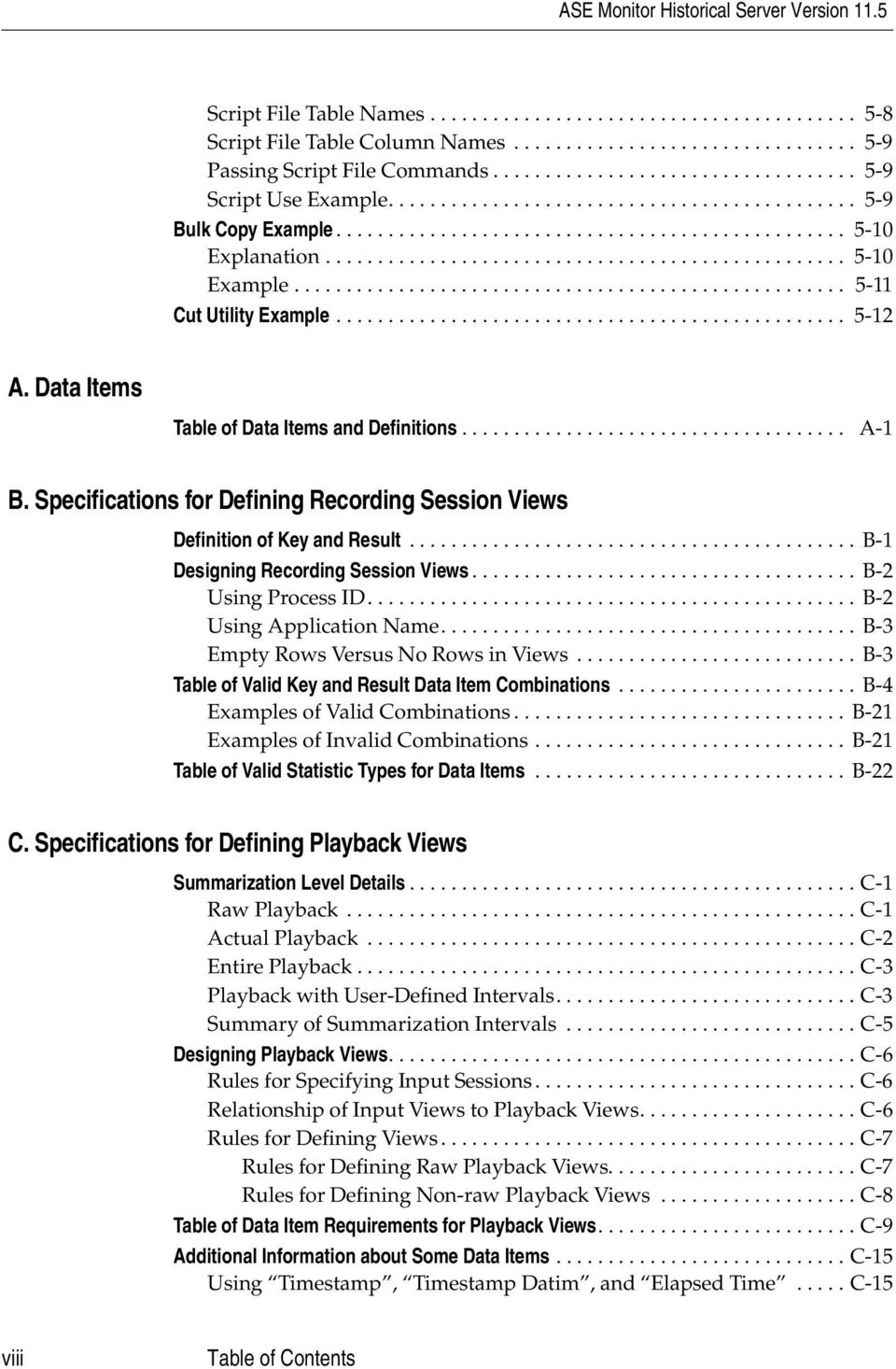
8 ASE Monitor Historical Server Version 11.5 Script File Table Names Script File Table Column Names Passing Script File Commands Script Use Example Bulk Copy Example Explanation Example Cut Utility Example A. Data Items Table of Data Items and Definitions A-1 B. Specifications for Defining Recording Session Views Definition of Key and Result B-1 Designing Recording Session Views B-2 Using Process ID B-2 Using Application Name B-3 Empty Rows Versus No Rows in Views B-3 Table of Valid Key and Result Data Item Combinations B-4 Examples of Valid Combinations B-21 Examples of Invalid Combinations B-21 Table of Valid Statistic Types for Data Items B-22 C. Specifications for Defining Playback Views Summarization Level Details C-1 Raw Playback C-1 Actual Playback C-2 Entire Playback C-3 Playback with User-Defined Intervals C-3 Summary of Summarization Intervals C-5 Designing Playback Views C-6 Rules for Specifying Input Sessions C-6 Relationship of Input Views to Playback Views C-6 Rules for Defining Views C-7 Rules for Defining Raw Playback Views C-7 Rules for Defining Non-raw Playback Views C-8 Table of Data Item Requirements for Playback Views C-9 Additional Information about Some Data Items C-15 Using Timestamp, Timestamp Datim, and Elapsed Time..... C-15 viii Table of Contents
9 ASE Monitor Historical Server Version 11.5 Using Process ID C-16 Using Procedure Elapsed Time and Procedure CPU Time C-16 D. Examples of Recording Session Views Cache Performance Summary D-1 Database Object Lock Status D-2 Database Object Page I/O D-3 Data Cache Activity for Individual Caches D-3 Data Cache Statistics for Recording Session D-4 Data Cache Statistics for Sample Interval D-4 Device I/O for Recording Session D-5 Device I/O for Sample Interval D-5 Device I/O Performance Summary D-6 Engine Activity D-6 Lock Performance Summary D-7 Network Activity for Recording Session D-7 Network Activity for Sample Interval D-8 Network Performance Summary D-8 Page I/O D-9 Procedure Cache Statistics for Recording Session D-9 Procedure Cache Statistics for Sample Interval D-10 Procedure Page I/O D-10 Process Activity D-11 Process Database Object Page I/O D-11 Process Detail for Locks D-12 Process Detail Page I/O D-13 Process Locks D-14 Process Page I/O D-14 Process State Summary D-15 Process Stored Procedure Page I/O D-15 Server Performance Summary D-16 Stored Procedure Activity D-16 Transaction Activity D-17 Index ASE Monitor Historical Server User s Guide ix

10 ASE Monitor Historical Server Version 11.5 x Table of Contents

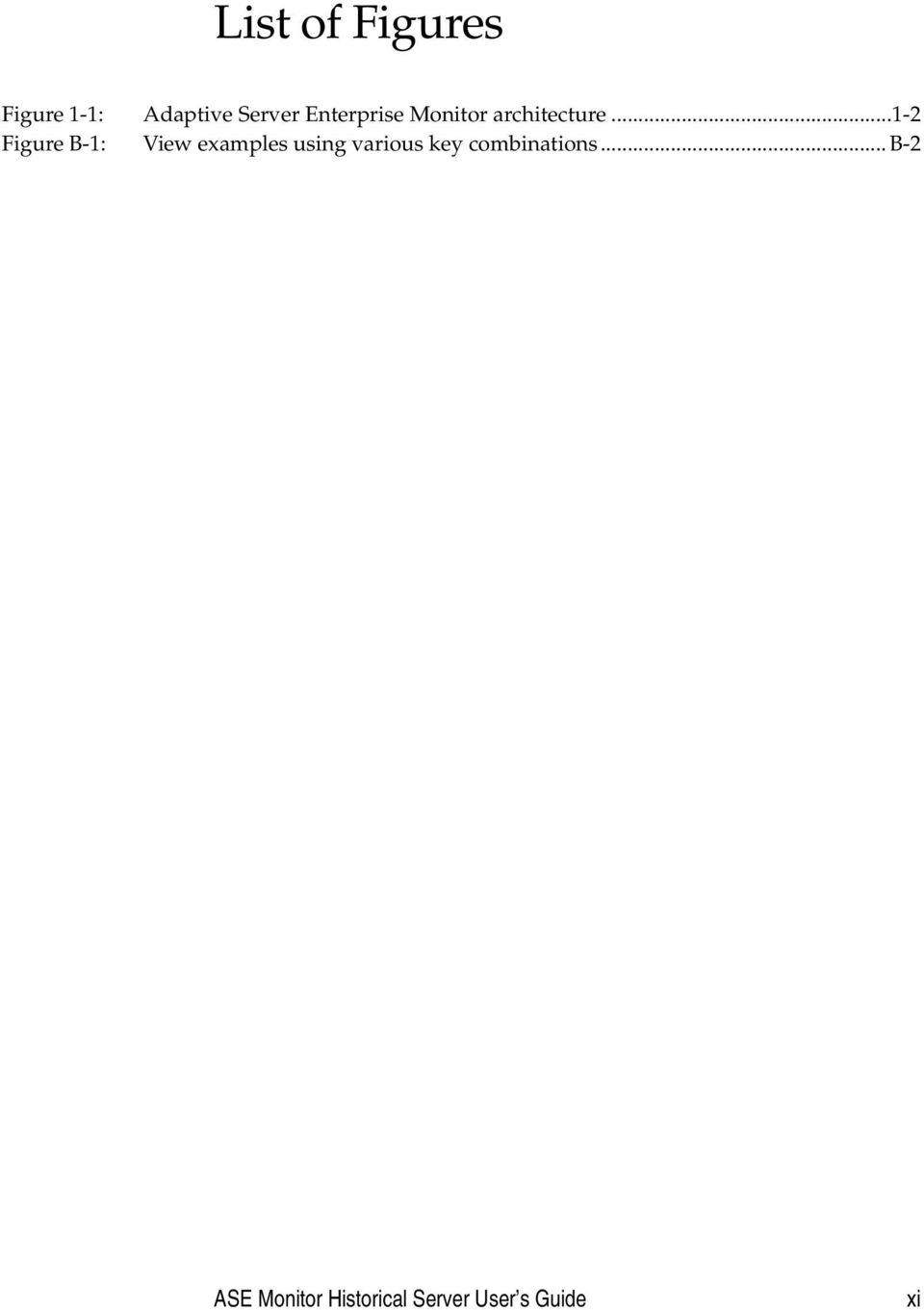
11 List of Figures Figure 1-1: Adaptive Server Enterprise Monitor architecture Figure B-1: View examples using various key combinations... B-2 ASE Monitor Historical Server User s Guide xi
12 ASE Monitor Historical Server Version 11.5 xii List of Figures

13 List of Tables Table 2-1: Historical Server startup parameters Table 4-1: Historical Server commands Table 4-2: Severity Levels in Command Errors Table 4-3: Permissions required for Historical Server activities Table A-1: Data items and definitions... A-1 Table B-1: Valid key and result combinations... B-5 Table B-2: Data items and their valid statistic types... B-22 Table C-1: Summarization interval features...c-5 Table C-2: Data item requirements for playback views...c-9 ASE Monitor Historical Server User s Guide xiii

14 ASE Monitor Historical Server Version 11.5 xiv List of Tables

15 Preface Adaptive Server Enterprise Monitor Historical Server User s Guide describes how to use Sybase Adaptive Server Enterprise Monitor Historical Server release 11.5 (Historical Server). Historical Server is a Sybase Open Server application that obtains performance statistics on Sybase SQL Server release 11.0 and later and Adaptive Server Enterprise (ASE) release Audience This book is for people responsible for: Configuring and managing Historical Server Using Historical Server to monitor Adaptive Server performance How to Use This Book This book contains the following chapters: Chapter 1, Introduction, provides an overview of Adaptive Server Enterprise Monitor and presents some basic Historical Server concepts. Chapter 2, Configuring Historical Server, describes how to complete an initial Historical Server configuration or change a configuration, for both UNIX and Windows NT platforms. Chapter 3, Starting and Stopping, describes how to start and stop Historical Server on both UNIX and Windows NT platforms. Chapter 4, Command Reference, describes the isql command interface to Historical Server. Chapter 5, Data Files, describes the files that Historical Server creates and how to access the data in them, including how to use the bcp utility to load the data into Sybase SQL tables. Appendix A, Data Items, provides descriptions of the data items available through Historical Server. Appendix B, Specifications for Defining Recording Session Views, describes valid combinations of data item names and statistic types for defining recording session views. ASE Monitor Historical Server User s Guide xv
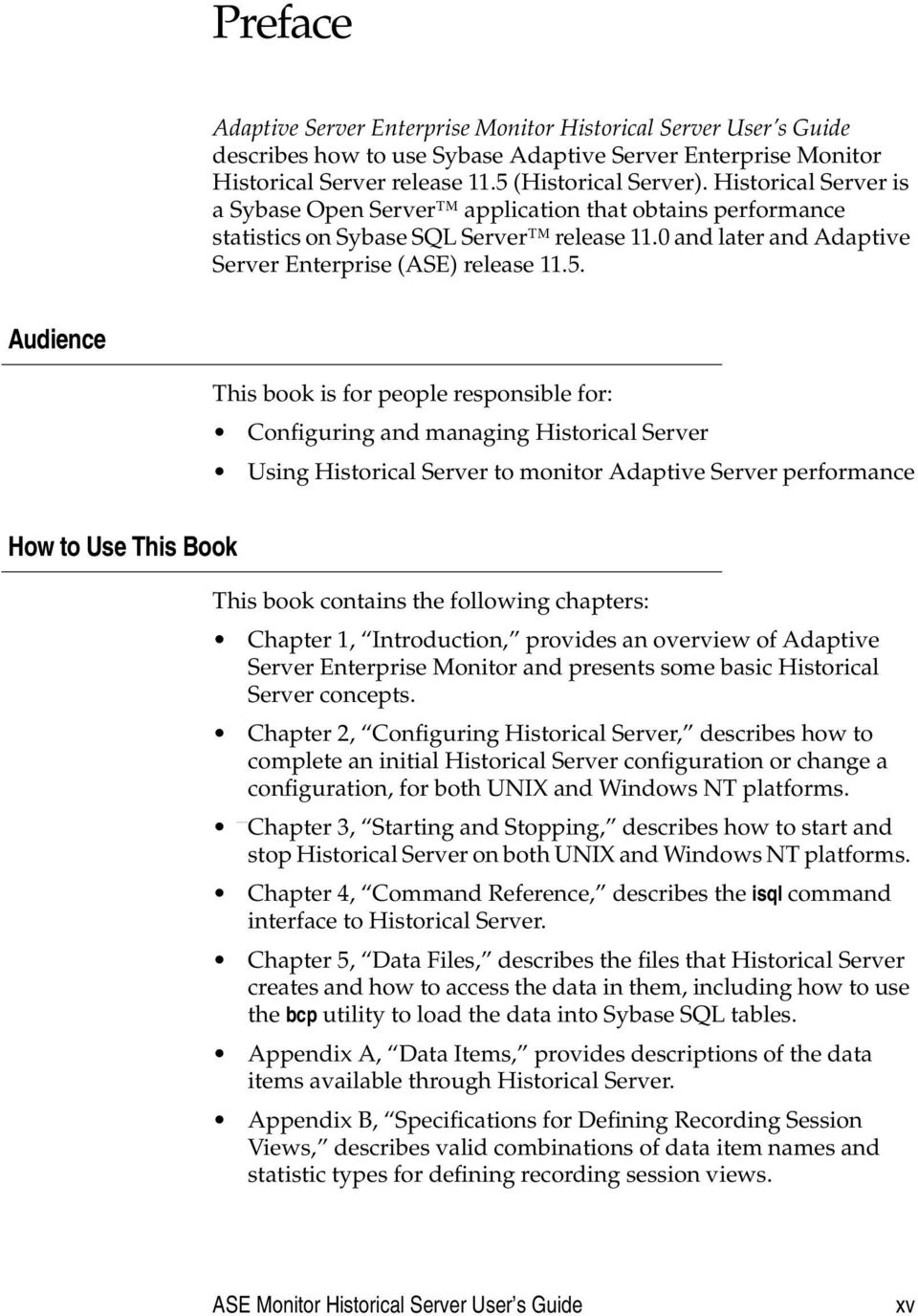
16 Related Documents ASE Monitor Historical Server Version 11.5 Appendix C, Specifications for Defining Playback Views, describes valid combinations of data item names and statistic types for defining playback session views. Appendix D, Examples of Recording Session Views, provides examples of recording session views. Related Documents Use the following books for more information about Adaptive Server Enterprise Monitor: Sybase Adaptive Server Enterprise Monitor Release Bulletin contains release notes and platform-specific information about all Adaptive Server - Monitor components. Sybase Adaptive Server Enterprise Monitor Server User s Guide describes how to configure and manage Monitor Server. Managing and Monitoring Sybase Adaptive Server Enterprise describes how to use the Monitor Viewer features of Sybase Central. Sybase Adaptive Server Enterprise Monitor Client Library Programmer s Guide describes how to access and use Monitor Client Library. The library provides a programming interface to the performance data gathered by Monitor Server. It also provides a programming interface for recording and playing back performance data using Historical Server. Other Sources of Information Use the following books for more information about Adaptive Server configuration and tuning: Open Client/Server TM Configuration Guide for UNIX and Open Client/Server Configuration Guide for Desktop Platforms describe the utilities that enable client/server connections, such as dsedit. Adaptive Server Enterprise Utility Programs is a guide to Adaptive Server utilities, such as isql. Adaptive Server Enterprise System Administration Guide contains information on tuning and configuring Adaptive Server. Adaptive Server Enterprise Performance and Tuning Guide documents Adaptive Server performance analysis and optimizing. xvi Preface
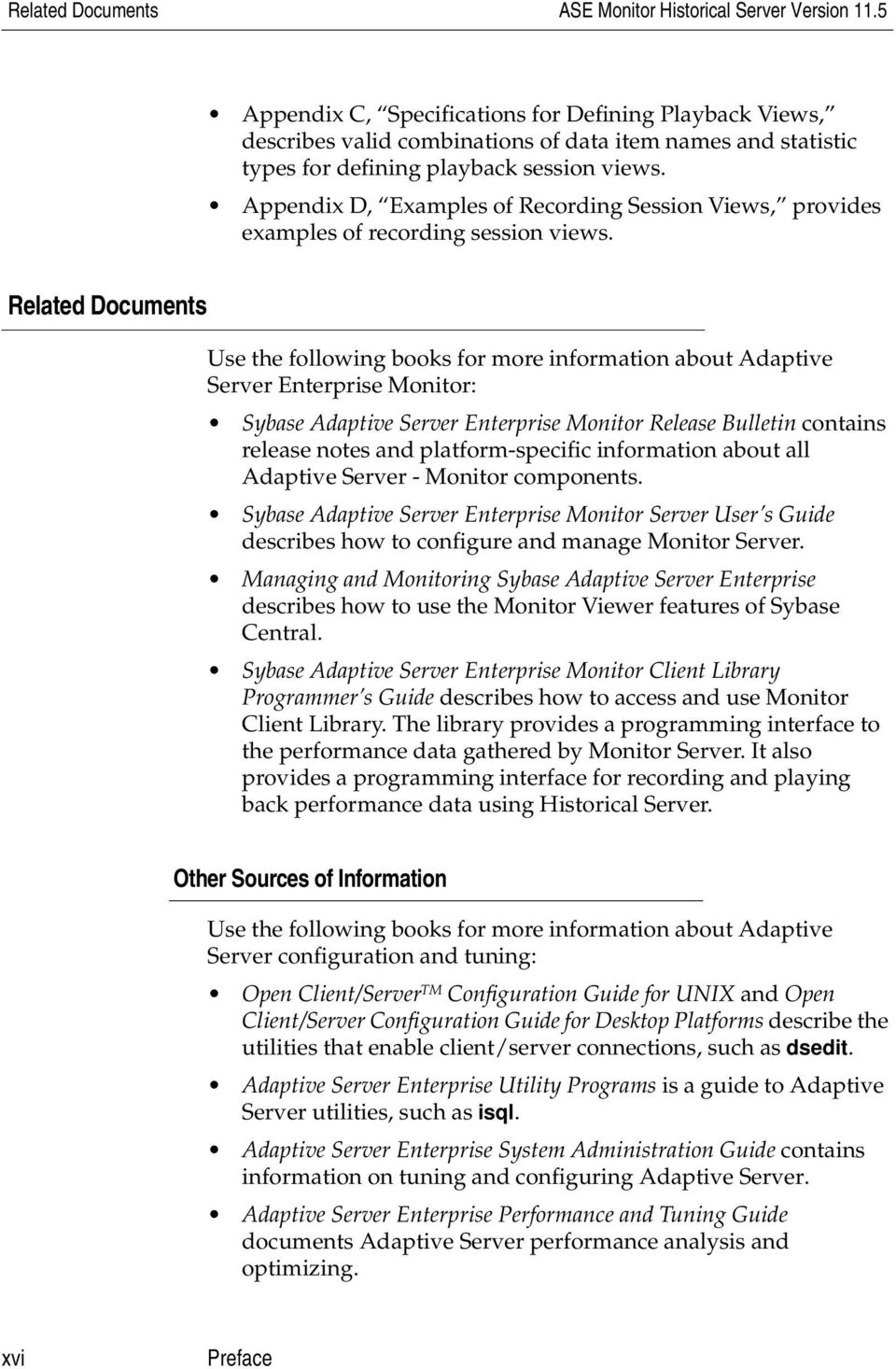
17 ASE Monitor Historical Server Version 11.5 Conventions Used in this Manual Use the SyBooks and SyBooks-on-the-Web online resources to learn more about your product: SyBooks documentation is on the CD that comes with your software. The DynaText browser, also included on the CD, allows you to access technical information about your product in an easy-to-use format. Refer to Installing SyBooks in your documentation package for instructions on installing and starting SyBooks. SyBooks-on-the-Web is an HTML version of SyBooks that you can access using a standard Web browser. To use SyBooks-on-the-Web, go to and choose Documentation. Conventions Used in this Manual The following table describes the style conventions used in this manual. Description Command names, command parameters, and other keywords appear in the text in bold typeface. Bold typeface also indicates emphasis or that a definition accompanies the highlighted term. Variables, file names, path names, database names, and SQL Server table names appear in the text in italic typeface. User input appears in Courier bold typeface. Computer output, such as error messages and command output, appears in Courier typeface. Brackets indicate that the enclosed item is optional. Do not type the brackets.. Curly braces indicate that you must choose at least one of the enclosed options. Do not type the braces. Examples The -S parameter is required. The -T1 parameter is not recommended for production systems. -Uusername master database isql -Usybase -Psa -Sserver1 Unable to attach with shared memory. [no_wait] {0,1} ASE Monitor Historical Server User s Guide xvii

18 If You Need Help ASE Monitor Historical Server Version 11.5 Description Ellipses indicate that you may repeat the preceding item multiple times in the command. Do not include ellipses in your command. Examples [, dataitemname, dataitemstat]... If You Need Help You can get help on Historical Server from the documentation and from the Technical Support Center. Technical Support Each Sybase installation that has purchased a support contract has one or more designated people who are authorized to contact Sybase Technical Support. If you cannot resolve a problem using the manuals or online help, please have the designated person contact Sybase Technical Support or the Sybase subsidiary in your area. xviii Preface
19 1 Introduction 1. This chapter contains the following topics: Description of Adaptive Server Enterprise Monitor 1-1 Historical Server Concepts 1-3 Description of Adaptive Server Enterprise Monitor Adaptive Server Enterprise Monitor (Adaptive Server Monitor) provides a way to monitor Adaptive Server performance in real time or in a historical data-gathering mode. System administrators can use this information to identify potential resource bottlenecks, to research current problems, and to tune for better performance. Adaptive Server Monitor provides feedback for tuning at several levels: Adaptive Server configuration Database design SQL statements in applications and stored procedures Adaptive Server Monitor Components Adaptive Server Monitor consists of four components that gather or display Adaptive Server performance data: Adaptive Server Enterprise Monitor Server (Monitor Server) This server collects Adaptive Server performance data in real time and makes the data available to the other Adaptive Server - Monitor components. Monitor Server is a Sybase Open Server TM application. Adaptive Server Enterprise Monitor Historical Server (Historical Server) This server obtains Adaptive Server performance data from Monitor Server and saves the data in files for deferred analysis. Historical Server is a Sybase Open Server application. Monitors in the Adaptive Server Enterprise Plug-in for Sybase Central (Monitor Viewer) The monitors obtain Adaptive Server performance data from Monitor Server and display the data in real time in tables and graphs. Adaptive Server Enterprise Monitor Client Library (Monitor Client Library) This application programming interface (API) to ASE Monitor Historical Server User s Guide 1-1

20 Description of Adaptive Server Enterprise Monitor ASE Monitor Historical Server Version 11.5 Monitor Server and Historical Server is available to users for developing monitoring applications. Historical Server and the monitors in the Adaptive Server Enterprise Plug-in for Sybase Central are Monitor Client Library applications. Adaptive Server Monitor Architecture The following figure shows the relationships between Adaptive Server and the various components of Adaptive Server Monitor. Shared Memory Adaptive Server Enterprise Monitor Server These servers must reside on the same computer. Open Client Library Open Client Library Open Client Library Monitor Client Library Monitor Client Library Monitor Client Library Adaptive Server Enterprise client applications Monitor Viewer in Sybase Central Historical Server Other Monitor Client Library applications Figure 1-1:Adaptive Server Enterprise Monitor architecture Adaptive Server saves performance data in a shared memory area that Monitor Server reads. Because of this shared memory technique, Monitor Server must be installed and running on the same machine as the Adaptive Server being monitored. A one-to-one relationship exists between an Adaptive Server and a Monitor Server. For more information about Monitor Server, see Sybase Adaptive Server Enterprise Monitor Server User s Guide. Monitor Client Library applications obtain Adaptive Server performance statistics from Monitor Server. These applications are clients of Monitor Server. For performance reasons, Sybase 1-2 Introduction
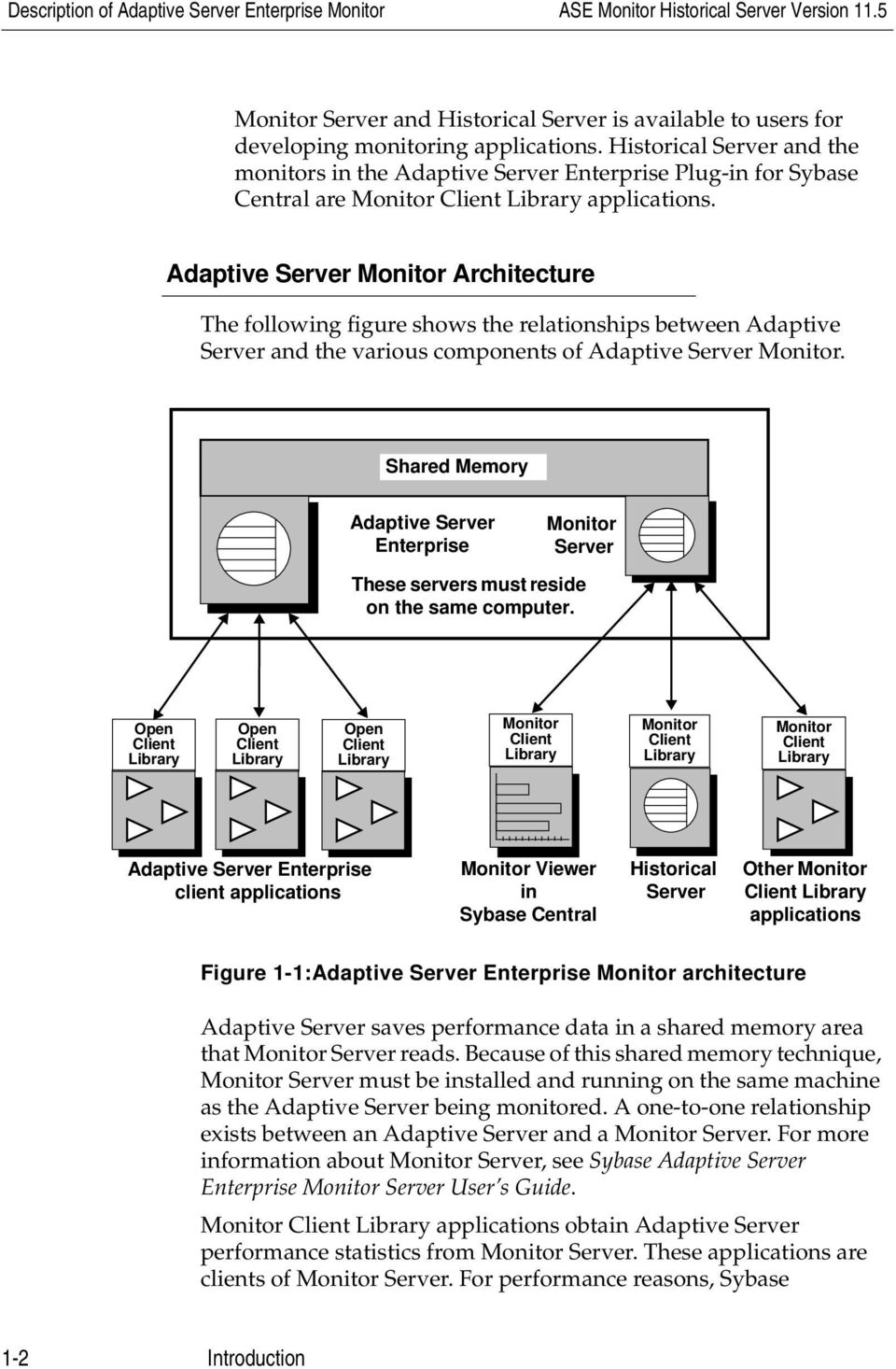
21 ASE Monitor Historical Server Version 11.5 Historical Server Concepts recommends running Monitor Client Library applications on machines other than the ones where pairs of Adaptive Server and Monitor Server are running. See Sybase Adaptive Server Enterprise Monitor Client Library Programmer s Guide for more information. The Adaptive Server Enterprise Plug-in for Sybase Central includes a set of monitors showing different aspects of Adaptive Server resource usage at various levels of detail. Each open monitor is a separate application, with a unique client connection to Monitor Server. In Sybase Central, each Adaptive Server installation has its own Monitors folder containing the set of monitor objects. See Managing and Monitoring Sybase Adaptive Server Enterprise for more information about the monitors. Historical Server collects performance information from Monitor Server and saves the information in files for deferred analysis. Historical Server interfaces let users specify the data to collect and the time period desired. They also include a historical data playback feature. The interfaces are: A command interface in isql. For more information, see Sybase Adaptive Server Enterprise Monitor Historical Server User s Guide. A programming interface using Monitor Client Library. For more information, see Sybase Adaptive Server Enterprise Monitor Client Library Programmer s Guide and Sybase Adaptive Server Enterprise Monitor Historical Server User s Guide Historical Server Concepts This section describes the following Historical Server concepts: Recording Sessions 1-3 Playback Sessions 1-4 Views 1-5 Data Items and Statistic Types 1-6 Recording Sessions Recording sessions gather Adaptive Server performance data and store it in files for later analysis. Some attributes of a recording session are: Monitor Server name By association, this defines the Adaptive Server whose performance you are monitoring. ASE Monitor Historical Server User s Guide 1-3
22 Historical Server Concepts ASE Monitor Historical Server Version 11.5 Sample interval This attribute defines how often to collect performance data. Views, alarms, and filters Views and filters define the data you want to collect. Alarms define actions that can occur when a specified data item hits a predefined threshold value. Start time and end time These specifications define the time period during which you want to collect the data. To create a recording session, use a sequence of commands in the Historical Server isql command interface: hs_create_recording_session hs_create_view hs_create_filter (optional) hs_create_alarm (optional) hs_initiate_recording When you create a recording session, Historical Server assigns it a session ID. You can list the session IDs of defined recording sessions using the hs_list command. That command can also show the complete recording session definition, including view names and the data items, alarms, and filters in the view. Historical Server stores these recording session definitions in its control file, which resides in the Historical Server home directory. Therefore, hs_list can only see recording session definitions that were created by Historical Server instances using the same home directory that the current Historical Server is using. See Configuring Multiple Instances of Historical Server on page 2-16 for more information on configuring Historical Server home directories. To examine the data gathered by a recording session, you can: Populate Adaptive Server tables with the data from recording sessions by using the Sybase bulk copy (bcp) utility. See Bulk Copy Example on page 5-10 for more information. Initiate a Historical Server playback session. See Playback Sessions on page 1-4 for more information. Playback Sessions Playback sessions let you retrieve the data gathered during one or more recording sessions. You can play back data in two forms: 1-4 Introduction
23 ASE Monitor Historical Server Version 11.5 Historical Server Concepts Playback to a client The results of the playback are sent to the user, who can view the results on the terminal or redirect them to a file. Playback to a file The results of the playback are stored in a file. The resulting files are essentially a new recording session. You can use these files as input to yet another playback session, or as input to the bcp utility to populate Adaptive Server tables, or any other way that you would use recording session files. The following attributes define a playback session: Input recording sessions The input to a playback session is one or more recording sessions. Views, start time, and end time These attributes define the data from the input recording sessions that you want to include in the playback session. Summarization level - You can specify raw playback, which shows you exactly what was recorded, or you can specify various summarization levels. To create a playback session, use the following sequence of commands from the Historical Server command interface: hs_create_playback_session hs_create_playback_view hs_initiate_playback hs_playback_sample (used only for playback to a client) hs_terminate_playback Views A recording session view defines the performance data you want Historical Server to gather. A playback session view defines which performance data from a recording session view you want Historical Server to play back. A view consists of a view name and one or more data items. Each data has a statistic type associated with it. See Data Items and Statistic Types on page 1-6 for more information. When you define a recording session, you define one or more views to be included in that recording session. A recording session must have at least one view. For more information about creating recording session views, see hs_create_view on page ASE Monitor Historical Server User s Guide 1-5
24 Historical Server Concepts ASE Monitor Historical Server Version 11.5 Appendix D, Examples of Recording Session Views, contains many sample recording session views. When you define a playback session, you define which views in the previously defined recording session(s) should be included in the playback session. The playback session view name(s) must be the same as the name(s) used for the recording session(s) views. You can include all data items or a subset of the data items from the recording session view in the corresponding playback view. For more information about creating playback views, see hs_create_playback_view on page Data Items and Statistic Types A data item identifies specific information that you want to include in the view. If a data item includes embedded spaces, you must surround the name with quotation marks when you use it. Some sample data items are: Page I/O, Login Name, and CPU Time. Table A-1: Data items and definitions lists all available data items and describes each one. Each data item has a statistic type associated with it. The statistic type defines the duration of the data item (sample or session) and whether Historical Server performs calculations on the data item. The statistic types contain embedded spaces. You must surround them with quotation marks when you use them in the Historical Server commands. Not all statistic types are valid with all of the data items. Table B-2: Data items and their valid statistic types shows valid statistic types for each data item. The six statistic types are: Value for Sample This statistic type returns a count of activity or some type of information that applies to the most recent sample interval. It implies no calculations. - Activity Counts For data items that represent activity counts, this statistic type returns the number of occurrences of an activity during the most recent sample interval. For example, Value for Sample for Page I/O is the number of page I/Os that occurred during the most recent sample interval. - Other information This is the only statistic type valid for data items that represent character strings. For example, Value for Sample for Object Name returns the name of a table. This 1-6 Introduction
25 ASE Monitor Historical Server Version 11.5 Historical Server Concepts statistic type is also the only one valid for data items that represent values such as IDs and values for configured parameters, such as Process ID and Code Memory Size. Value for Session This statistic type returns a cumulative count of activity since the start of gathering the data (since the connection was opened). No calculations are performed. For example, Value for Session for Page I/O is the number of page I/Os that occurred since the recording session started. Rate for Sample This statistic type calculates a rate per second. It returns the average number of occurrences per second of an activity during the most recent sample interval. For example, Rate for Sample for Page I/O is the average number of page I/Os that occurred each second during the most recent sample interval. The calculation is: Count for the most recent sample interval Number of seconds in the sample interval Rate for Session This statistic type calculates a rate per second. It returns the average number of occurrences per second of an activity during the current recording session. For example, Rate for Session for Page I/O is the average number of page I/Os that occurred per second since the recording session started. The calculation is: Count for the session Number of seconds in the session Average for Sample This statistic type calculates an average value per occurrence of an activity over the most recent sample interval. Only a few data items can use this statistic type. The meaning of the returned value depends on the data item. For example, Average for Sample for Procedure Elapsed Time is the average execution time per execution of a stored procedure during the most recent sample interval. Average for Session This statistic type calculates an average value per occurrence of an activity over the session. Only a few data items can use this statistic type. The meaning of the returned value depends on the data item. For example, Average for Session ASE Monitor Historical Server User s Guide 1-7
26 Historical Server Concepts ASE Monitor Historical Server Version 11.5 for Procedure Elapsed Time is the average execution time per execution of a stored procedure during the recording session. Table B-2: Data items and their valid statistic types shows valid combinations of data items and statistic types. 1-8 Introduction
27 2 Configuring Historical Server 2. This chapter describes the following topics: Historical Server Configuration Concepts 2-1 Initial Configuration on UNIX Platforms 2-4 Initial Configuration on Windows NT 2-7 Setting Historical Server Startup Parameters 2-13 Configuring Multiple Instances of Historical Server 2-16 Historical Server Configuration Concepts This section describes concepts that you should understand before configuring Historical Server. Topics covered are: The Historical Server Control File and Home Directory 2-1 The Operating System Startup Account 2-2 The Historical Server Superuser Account 2-3 The Historical Server Control File and Home Directory The Historical Server control file maintains information about recording sessions that users create. This information persists across startups, so users can access recording sessions that they created during previous executions of Historical Server. The control file restricts user access to private recording session files. (Recording session files can have public or private access.) The Historical Server home directory is important for two reasons: It contains the Historical Server control file. When Historical Server starts, it looks for a control file in the home directory. If a control file does not exist, Historical Server creates it. It is the default directory location for the data files that Historical Server writes during recording sessions. The users who create the recording sessions can override this default location. The -D parameter in the Historical Server startup command specifies the home directory location. This is a required parameter. The current execution of Historical Server can access data files from previous executions only if the current execution is using the same ASE Monitor Historical Server User s Guide 2-1
28 Historical Server Configuration Concepts ASE Monitor Historical Server Version 11.5 control file, in the same home directory, as the previous executions were using. Therefore, in most cases, you should not change the Historical Server home directory (the -D startup parameter) between startups. See Configuring Multiple Instances of Historical Server on page 2-16 for a discussion about using different home directories. For more information about the files created by Historical Server, see Chapter 5, Data Files. Accessing Control File Information Use the Historical Server hs_list command to gain access to the information in the Historical Server control file. Do Not Edit the Control File Do not edit the control file. You might inadvertently corrupt the file. Regardless of the editor you use, do not open and then save this file. This is true especially if Historical Server is running on Windows NT. Unlike the other files created by Historical Server, the control file is not a standard-format Windows NT text file. Lines of text in the control file are terminated only with newline characters, rather than the usual carriage-return/newline pairs. Do not try to edit this file because the editing program may corrupt the file by embedding unwanted carriage-return/newline pairs into the text. The Operating System Startup Account The account that starts Historical Server must satisfy these conditions: The same account must start Historical Server each time. The operating system account that starts Historical Server for the first time, when Historical Server creates the control file, is the only account that has subsequent access to that control file. The same account must perform all subsequent startups of Historical Server using the same home directory, to gain access to the control file. No other account can start Historical Server successfully using the same home directory. This restriction prevents unauthorized reading and modification of Historical Server files. A different account can start Historical Server if the startup command specifies a different home directory. In the new 2-2 Configuring Historical Server
29 ASE Monitor Historical Server Version 11.5 Historical Server Configuration Concepts location, if no control exists, Historical Server creates one. The recording session data files in a home directory are not visible to a Historical Server using a different home directory. The account must have search (execute) and write access to the Historical Server home directory specified in the startup command. The account must have search (execute) and write access to the locations of recording session data files, as specified by users who create recording sessions. The default location is the Historical Server home directory, but users can override that default on a session-by-session basis when they create recording sessions. The Historical Server Superuser Account The -U parameter in the Historical Server startup command can optionally specify a superuser for Historical Server. If this parameter is specified, the superuser is allowed to: Shut down Historical Server View or delete any historical data files If the startup command does not include the -U parameter, any user may stop Historical Server, but no user has unrestricted access to historical data files. Sybase Open Client/Server Connections Historical Server establishes client/server connections using either interfaces files (the interfaces file on UNIX; sql.ini file on Windows NT) or a directory service, as supported by Sybase Open Client/Server Release 11.1.x. The advantage of using a directory service is that you do not need to update the interfaces or sql.ini files on all of the client machines. A single directory service entry replaces these files. Changes such as moving a server to a new address or changing the server name are easier to administer. See Open Client/Server Configuration Guide for UNIX or Open Client/Server Configuration Guide for Desktop Platforms for more information. The configuration instructions in this chapter summarize the required tasks for successful Historical Server connections. ASE Monitor Historical Server User s Guide 2-3
30 Initial Configuration on UNIX Platforms ASE Monitor Historical Server Version 11.5 Initial Configuration on UNIX Platforms This section describes how to configure Historical Server on UNIX platforms. Assumptions on UNIX Platforms The instructions in this section are based on the following assumptions: Historical Server software was unloaded from the delivery media using the using the instructions provided with the delivery media. An Adaptive Server/Monitor Server pair is configured on your network. Results of Installation on UNIX Platforms On UNIX platforms, the installation process unloads the files from the delivery media. Configuration Procedures on UNIX Platforms To configure Historical Server on a UNIX platform: 1. Set the $SYBASE environment variable to the value of the Sybase installation directory where you unloaded Historical Server. 2. Log on using the sybase account or some other account that has read, write, and search (execute) permissions on the $SYBASE directory. 3. Set the $PATH environment variable. The Historical Server executable resides in $SYBASE/bin. Add this path name to the $PATH environment variable for the account that will start Historical Server. 4. Create a script file for Historical Server startup. A script file ensures that correct startup parameters are used for each Historical Server startup. The script file contains the Historical Server startup command, histserver, and its parameters. To create a Historical Server script file: 2-4 Configuring Historical Server
31 ASE Monitor Historical Server Version 11.5 Initial Configuration on UNIX Platforms a. Using any editor, create a new file. The recommended name and location for the new file is: install_dir/install/run_histservername, where histservername is the name of the Historical Server. b. Edit the new file, inserting the histserver command and supplying parameters and values appropriate to your installation. Do not use carriage returns within the command; use the UNIX continuation character (\) to continue the command on multiple lines. Spaces between a parameter and its value are optional. Table 2-1 on page 2-14 describes the command and its parameters. The parameters marked required in the table must appear in the script file. The ones with default values may be omitted if the default values are acceptable. A sample script file for starting Historical Server follows: histserver -D server1histdir -S server1hist \ -U sa -P sapasswd \ -l server1histlog -n 15 & c. Use the chmod command to give the account that will start Historical Server execute permission on the script file. 5. Add connectivity information for Historical Server. This task assigns a port or network address to Historical Server. It also ensures that Historical Server can connect to one or more Adaptive Server/Monitor Server pairs. Add Historical Server connection information either to the interfaces files or to a directory service. See Open Client/Server Configuration Guide for UNIX for information on dsedit, dscp, dsedit_dce, and dscp_dce. If you are relying on interfaces files for making client/server connections: a. Check the server listings in the interfaces file used by Historical Server. For Historical Server to run, this file must contain entries for all of the following servers: - Any Adaptive Server you want to monitor - A Monitor Server paired with each Adaptive Server - Historical Server b. Use either dsedit (if your system is running X windows) or dscp (a command line utility) to add entries to an interfaces file. ASE Monitor Historical Server User s Guide 2-5
32 Initial Configuration on UNIX Platforms ASE Monitor Historical Server Version 11.5 Follow the instructions in Open Client/Server Configuration Guide for UNIX. To add these entries, you must know the following information: - Monitor Server and Adaptive Server names that you want Historical Server to connect to - Port numbers or network addresses assigned to these servers when they were configured. If you need to research this information, use dsedit or dscp on the machine where a server was configured to examine the appropriate interfaces file. If you are relying on a directory service for making client/server connections: a. Make sure that the libtcl.cfg file on the machine where Historical Server was installed points to the appropriate directory service. Use an editor to check and update libtcl.cfg files. b. Add Historical Server to the directory service, using dsedit_dce (if your system is running X Windows) or dscp_dce (a command line utility). You need to know the Historical Server name to complete this step. 6. Configure Historical Server on client machines This task enables clients to connect to Historical Server. t Historical Server clients are users who create recording sessions or playback sessions. Each client machine must be configured appropriately. See Open Client/Server Configuration Guide for UNIX for instructions on using dsedit and dscp. If you are relying on interfaces files for making client/server connections: a. Update all of the interfaces files used by Historical Server clients. The client interfaces files must contain entries for: - Historical Server - Any Adaptive Server that you want to monitor through Historical Server - Monitor Server associated with each Adaptive Server listed b. Use dsedit (if your system is running X Windows) or dscp (a command line utility) to add entries to an interfaces file. To add these entries, you must know the following information: - Historical Server name 2-6 Configuring Historical Server
33 ASE Monitor Historical Server Version 11.5 Initial Configuration on Windows NT - Monitor Server and Adaptive Server names that you want Historical Server to connect to - Port numbers or network addresses assigned to these servers when they were configured. If you need to research this information, use dsedit or dscp on the machine where a server was configured to examine the appropriate interfaces file. If you are relying on a directory service for making client/server connections, then make sure that the libtcl.cfg file on all Historical Server client machines points to the appropriate directory service. Use a text editor to check and update libtcl.cfg files. What s Next? Configuration of the new Historical Server is now complete. Go to Chapter 3, Starting and Stopping, for instructions on starting the server, verifying that it is running correctly, and connecting to it using clients. Initial Configuration on Windows NT This section describes how to configure Historical Server on Windows NT machines. It includes the following topics: Assumptions on Windows NT 2-7 Results of Installation on Windows NT 2-8 Configuration Procedures on Windows NT 2-8 What s Next? 2-12 Assumptions on Windows NT These procedures make the following assumptions: The Historical Server software was loaded from the delivery media, using the instructions provided with the delivery media. An Adaptive Server/Monitor Server pair is configured on your network. ASE Monitor Historical Server User s Guide 2-7
34 Initial Configuration on Windows NT ASE Monitor Historical Server Version 11.5 Results of Installation on Windows NT On the Windows NT platform, the Sybase installation process performs a nearly complete installation of Historical Server. The installation process does the following regarding Historical Server: Copies Historical Server files to the Sybase installation directory. Adds parameter values for the Historical Server startup command to the NT Registry. It uses default values for these parameters. The entries are under: \\HKEY_LOCAL_MACHINE\SOFTWARE\SYBASE\SERVER\ servername\parameters Adds the new Historical Server to the list of services in the NT Registry. The entry is under: HKEY_LOCAL_MACHINE\SYSTEM\CurrentControlSet\ Services Adds Historical Server connectivity information to the sql.ini file in the Sybase installation directory on the Historical Server machine. Configuration Procedures on Windows NT To complete Historical Server configuration, perform the following steps: 1. Add connectivity information for Historical Server. This task assigns a port or network address to Historical Server. It also ensures that Historical Server can connect to one or more Adaptive Server/Monitor Server pairs. Add connection information either to sql.ini files or to a directory service. See Open Client/Server Configuration Guide for Desktop Platforms for more information on any of the following procedures and on ocscfg or dsedit. If you are relying on sql.ini files for making client/server connections, then check the server listings in the sql.ini file. For Historical Server to run, this file must contain entries for all of the following servers: - Any Adaptive Server you want to monitor. - A Monitor Server paired with each Adaptive Server. - Historical Server. Entries for Historical Server should exist, since the Sybase installation process adds them. However, 2-8 Configuring Historical Server
35 ASE Monitor Historical Server Version 11.5 Initial Configuration on Windows NT since the Adaptive Server/Monitor Server pairs usually are running on a different machine from Historical Server, entries probably do not exist for them on the Historical Server machine. If this is the case, you need to add entries for each Adaptive Server/Monitor Server pair to which Historical Server intends to connect. Use dsedit to add entries to a sql.ini file. To add these entries, you must know the following information: - Monitor Server and Adaptive Server names that you want Historical Server to connect to - Port numbers or network addresses assigned to these servers when they were configured. If you need to research this information, use dsedit on the machine where a server is configured to examine the appropriate sql.ini or interfaces file. Note The Adaptive Server name must not be an alias name. It must be the name that Monitor Server knows it by. For example, use the value you used in the -S parameter in the Monitor Server startup command. If you edit a sql.ini file using a text editor instead of dsedit, make sure that a carriage return exists at the end of the last line in the file. If you are relying on a directory service for making client/server connections: - Make sure that the libtcl.cfg file on the machine where Historical Server is installed points to the appropriate directory service. Use ocscfg to check and update libtcl.cfg files. - Add Historical Server to the appropriate directory service, using dsedit. You need to know the Historical Server name to complete this step. The default name created by the installation process is in the format machinename_hs. For example, smith_hs. 2. Configure Historical Server client machines. This task enables clients to connect to Historical Server. Historical Server clients are users who create recording sessions or playback sessions. Each client machine must be configured appropriately. ASE Monitor Historical Server User s Guide 2-9
36 Initial Configuration on Windows NT ASE Monitor Historical Server Version 11.5 If you are relying on sql.ini files for making client/server connections, then update all of the sql.ini files used by Historical Server clients. The client sql.ini files must contain entries for: - Historical Server - The Monitor Server associated with each Adaptive Server listed. - Any Adaptive Server that you want Historical Server to collect data for. Use dsedit to add entries to a sql.ini file. To add these entries, you must know the following information: - Historical Server name - Monitor Server and Adaptive Server names that you want Historical Server to connect to - Port numbers or network addresses assigned to these servers when they were configured. If you need to research this information, use dsedit on the machine where a server was configured to examine the appropriate sql.ini file. If you are relying on a directory service for making client/server connections, then make sure that the libtcl.cfg file on all Historical Server client machines points to the appropriate directory service. Use ocscfg to check and update libtcl.cfg files. 3. Review startup parameters in the NT Registry. This task ensures that the default startup parameter values that the installation process inserted into the NT Registry are suitable for your site. When you start Historical Server using the Control Panel Services window, the server reads its startup parameters from the NT Registry entry. If you start the server from command line or by means of a batch file, Historical Server uses the startup parameters from both the Registry entry and from the command. If the same parameter appears in both places, the value specified in the command takes precedence over the value in the Registry entry. If you do not specify any startup parameters in the command, by default all of the NT Registry entry parameters are used Configuring Historical Server
37 ASE Monitor Historical Server Version 11.5 Initial Configuration on Windows NT Changing Startup Parameter To change startup parameters or to change the server name in the NT Registry: 1. Start the NT Registry Editor (regedt32.exe, usually in winnt\system32). 2. Select the window named \\HKEY_LOCAL_MACHINE (NT 4.0) or \\HKEY_USER and select the correct user entry (NT 3.51). 3. Save or print the existing settings before proceeding. From the Registry menu, select the Save Subtree As command or the Print command. 4. In the tree view, highlight: \SOFTWARE\SYBASE\Server\ srvrname\parameters where srvrname is the name of the server whose startup parameters you want to change. On the right side of the window, review the list of existing startup parameters. They appear in the following format: Argx, datatype, parameter where: - x is an integer in sequential order - datatype defines the type of data in the parameter value - parameter is a startup option, preceded by a dash and followed by the parameter value. An example containing the Historical Server -D, -U, and -P startup parameters follows: Arg0:REG_SZ:-Dc:\sybase\data\hs_data Arg1:REG_SZ:-Uhssuper Arg2:REG_SZ:-Pxwdfr 5. To add a new startup parameter: - From the Edit menu, choose Add Value. - In the resulting dialog box, in the Value Name box, enter Argx where x is the next integer not currently assigned. - From the Data Type drop down list, choose REG_SZ. ASE Monitor Historical Server User s Guide 2-11
38 Initial Configuration on Windows NT ASE Monitor Historical Server Version In the resulting String dialog box, enter the parameter and value. 6. To modify existing parameters: - Double-click the parameter line you want to change. - In the resulting String dialog box, change the entry. 7. From the Registry menu, choose Exit. What s Next? Historical Server configuration is now complete. Go to Chapter 3, Starting and Stopping, for instructions on starting the server, verifying that it is running correctly, and connecting to it using clients Configuring Historical Server
39 ASE Monitor Historical Server Version 11.5 Setting Historical Server Startup Parameters Setting Historical Server Startup Parameters This section describes the Historical Server startup command and parameters. The section applies to Historical Server running on both UNIX and NT platforms. Function Starts Historical Server. Syntax {histserver histsrvr} -D homedir [-I interfacesfile] [-l logfile] [-U username] [-P password] [-n maxconnections] [-S hsname] [-v] The executable name is histserver on UNIX platforms and histsrvr on Windows NT. ASE Monitor Historical Server User s Guide 2-13
40 Setting Historical Server Startup Parameters ASE Monitor Historical Server Version 11.5 Parameters Table 2-1 describes the parameters to the Historical Server startup command. Table 2-1:Historical Server startup parameters Parameter Description -D homedir Required. This parameter specifies the home directory for this instance of Historical Server. The account that starts Historical Server must have read, write, and search (execute) permissions on the Historical Server home directory. The default home directory is the current working directory for the account that starts Historical Server. The control file used by this instance of Historical Server resides in the home directory. The control file contains information about past recording sessions and is updated during the current run as new recording sessions are established. The directory specified by this parameter is also the default directory into which historical data files are written during a recording session. The user who creates a recording session can override this default location without affecting the definition of the control file. Multiple instances of Historical Server can share the same home directory. See Configuring Multiple Instances of Historical Server on page 2-16 for more information. Note: If any UNIX shell-specific characters, such as the C shell s tilde (~), appear at the start of the directory s name, you must separate the -D parameter and the directory name by one or more space characters. Otherwise, the shell is unable to recognize that file name expansion is required. -i interfacesfile (Upper or lower case i is valid after the dash.) Path name of the interfaces file to use. The file must contain connection information, including the correct names, for Historical Server and all Adaptive Server and Monitor Server pairs that you want this Historical Server to connect to. If you omit this parameter, the name and location of the detault interfaces file is: UNIX: $SYBASE/interfaces NT: SYBASE\sql.ini (where SYBASE is the value of the SYBASE environment variable) -l logfile Path name of the log file in which information and error messages about the Historical Server are logged. The data collected includes start-up information, error messages, and possibly a record of alarms that were triggered. The default path name is hs.log in the current directory Configuring Historical Server
41 ASE Monitor Historical Server Version 11.5 Setting Historical Server Startup Parameters Table 2-1:Historical Server startup parameters (continued) Parameter Description -n maxconnections Specifies the maximum number of concurrent Open Client connections allowed to Historical Server. Valid values are 1 through 20. The default is 20. Open Client connections to Historical Server are isql connections. -P password Password of user specified with the -U parameter. A user who logs in to Historical Server must supply this username and password to be allowed to exercise Historical Server superuser privileges. See The Historical Server Superuser Account on page 2-3 for more information Note for UNIX: If you specify the -U parameter, but do not specify this parameter, Historical Server prompts for a password during startup. However, Historical Server must be started in foreground mode for you to receive the prompt. Make the following changes to the startup script if you want to be prompted for a password: Remove the -P parameter and the ampersand (&) from the startup script file. Execute the script file. When prompted for a password, enter the password for the username you specified in the -U parameter. Put the Historical Server process in the background. -S hsname Name of Historical Server as it appears in the interfaces file. If omitted, the Historical Server name defaults to the value of the DSLISTEN environment variable. If DSLISTEN is not set, the name histserver is used. -U username Name of Historical Server superuser. When the superuser logs into Historical Server, that user is allowed to issue the shutdown command to terminate Historical Server, and to view or delete any data files created by Historical Server, regardless of the user who initiated the recording sessions. This user name is not required to correspond to either an Adaptive Server login account or to an operating system registration. See The Historical Server Superuser Account on page 2-3 for more explanation. If you do not specify this parameter, any user may stop Historical Server, but no user has unrestricted access to the Historical Server data files. -v Displays Historical Server version information and exits, ignoring all other parameters. ASE Monitor Historical Server User s Guide 2-15
42 Configuring Multiple Instances of Historical Server ASE Monitor Historical Server Version 11.5 Configuring Multiple Instances of Historical Server There are times when running more than one instance of Historical Server is appropriate. However, you must be sure to configure the multiple instances correctly to either allow or restrict user access to the recording sessions of the multiple instances. This section discusses the following configuration topics: When to Create Multiple Instances of Historical Server 2-16 Configuring an Additional Historical Server on UNIX Platforms 2-17 Configuring an Additional Historical Server On Windows NT 2-18 When to Create Multiple Instances of Historical Server If a single instance of Historical Server is managing many concurrent recording sessions that have short sample intervals, the amount of time required to process and record the samples may interfere with the timely acquisition of new samples. If the timestamps in the recorded data files indicate that samples are not being collected at a reasonable approximation of the requested sample interval, you may choose to spread the load among two or more instances of Historical Server. When multiple instances of Historical Server use the same home directory: Each instance must be started by the same operating system account. All instances that use the same home directory use the same control file. The sessions recorded by one instance are visible to the other instances. File locking mechanisms ensure that the control file is not corrupted by concurrent accesses. When multiple instances of Historical Server use different home directories: The Historical Server instances can be started by different user accounts. The Historical Server instances use different control files Configuring Historical Server
43 ASE Monitor Historical Server Version 11.5 Configuring Multiple Instances of Historical Server The recording sessions of one server are not visible to the others. For example, the hs_list command, issued through isql, cannot access the recording sessions defined by another Historical Server using a different home directory. When deciding whether multiple instances should use the same or different home directories, consider these factors: Visibility of data. If users of the multiple instances need access to each other s recording session definitions, use the same home directory. If sharing is undesirable, use different home directories. Visibility of status information. The hs_status command cannot distinguish between multiple instances of Historical Server using the same home directory. If this distinction is important to Historical Server administration, use different home directories. Contention on the control file. If a large control file receives heavy access from multiple users, different home directories might mean better user response time. Actions such as creating recording sessions and listing information about recording sessions use the control file; recording sessions themselves, when they are running, do not block other users from the control file. Configuring an Additional Historical Server on UNIX Platforms To configure an additional Historical Server on UNIX platforms: 1. Copy the startup script that you created for the original Historical Server. Name the new file to reflect the name of the new Historical Server you want to start. 2. Edit the startup file, changing the parameters to the startup command as appropriate for the new instance of Historical Server. See Setting Historical Server Startup Parameters for explanations of all Historical Server startup parameters. Pay particular attention to the -D parameter, which specifies the historical server home directory. You must decide whether you want multiple instances of Historical Server to share the same home directory or maintain separate ones. See When to Create Multiple Instances of Historical Server on page 2-16 for guidelines. 3. Set up connectivity information for Historical Server, adding entries for the new Historical Server. Use a port number for the new Historical Server that is unique on its machine. See Step 5 in ASE Monitor Historical Server User s Guide 2-17
44 Configuring Multiple Instances of Historical Server ASE Monitor Historical Server Version 11.5 Initial Configuration on UNIX Platforms on page 2-4 for details. 4. Edit the connectivity information on the client machines, adding entries for the new Historical Server. See Step 6 in Initial Configuration on UNIX Platforms on page 2-4 for details. Configuring an Additional Historical Server On Windows NT The Server Configuration utility cannot configure a new Historical Server. To configure an additional Historical Server after initial installation: Task 1: Add Startup Parameters to the NT Registry 2-18 Task 2: Update the NT Registry Services List 2-20 Task 3: Add Connectivity Information for Historical Server 2-22 Task 4: Configure Historical Server Client Machines 2-23 Task 5: Create a.bat File (Optional) 2-24 Task 1: Add Startup Parameters to the NT Registry To add Historical Server startup parameters to the NT Registry: 1. Start the NT Registry Editor (regedt32.exe, usually in winnt\system32). 2. Select the window named \\HKEY_LOCAL_MACHINE (NT 4.0) or \\HKEY_USER and select the appropriate user (NT 3.51). 3. Save or print the existing settings before proceeding. From the Registry menu, select the Save Subtree As command or the Print command. 4. In the tree view, highlight: \SOFTWARE\SYBASE\Server 5. From the Edit menu, choose Add Key. 6. In the resulting dialog box, in the Key Name box, enter the name of the Historical Server you are adding. Leave the Class box blank. 7. In the tree view, highlight: \SOFTWARE\SYBASE\Server\hsName where hsname is the new Historical Server name Configuring Historical Server
45 ASE Monitor Historical Server Version 11.5 Configuring Multiple Instances of Historical Server 8. From the Edit menu, choose Add Value. 9. In the resulting dialog box, in the Value Name box, enter: ServerType From the Data Type drop down list, choose: REG_SZ In the resulting String dialog box, enter: HISServer 10. Make sure the entry for the new Historical Server name remains highlighted. 11. From the Edit menu, choose Add Key. 12. In the resulting dialog box, in the Key Name box, enter: Parameters Leave the Class box blank. 13. In the tree view, highlight: \SOFTWARE\SYBASE\Server\hsName\Parameters where hsname is the new Historical Server name. 14. From the Edit menu, choose Add Value. 15. In the resulting dialog box, in the Value Name box, enter: Arg0 From the Data Type drop down list, choose: REG_SZ In the resulting String dialog box, enter: -ShsName where hsname is the Historical Server name you used previously. 16. Repeat steps 13 through 15 until you have entered all of the startup parameters for Historical Server. See Setting Historical Server Startup Parameters on page 2-13 for information about startup parameters. ASE Monitor Historical Server User s Guide 2-19
46 Configuring Multiple Instances of Historical Server ASE Monitor Historical Server Version 11.5 At a minimum, enter the following required parameters. The order does not matter; for example, -D does not have to be Arg1. Value Name Data Type String Arg0 REG_SZ -ShsName where: hsname is the Historical Server name you used in step 5. Example: -SHS_SERVER1 Arg1 REG_SZ -DdataDirectoryName where: datadirectoryname is the full path name of an existing directory where you want to store Historical Server data. All users who will create Historical Server recording sessions must have write access to this directory. Example: -Dc:\SYBASE\data\hs.data Arg2 REG_SZ -IinstallationRootDir\ini\sql.ini Example: -Ic:\SYBASE\ini\sql.ini Arg3 REG_SZ -linstallationrootdir\install\logname where: logname is the file name where you want to store Historical Server error messages. The server creates the file on startup if it does not exist. Example: -lc:\sybase\install\hs.log Task 2: Update the NT Registry Services List To add Historical Server to the list of services in the NT Registry: 1. Start the NT Registry Editor (regedt32.exe, usually in winnt\system32). 2. Select the window named \\HKEY_LOCAL_MACHINE (NT 4.0) or \\HKEY_CURRENT_USER and select the correct user (NT 3.51). 3. Save or print the existing settings before proceeding. From the Registry menu, select the Save Subtree As command or the Print command Configuring Historical Server
47 ASE Monitor Historical Server Version 11.5 Configuring Multiple Instances of Historical Server 4. In the tree view, highlight: \SYSTEM\CurrentControlSet\Services 5. From the Edit menu, choose Add Key. 6. In the resulting dialog box, in the Key Name box, enter: SYBHIS_hsName where hsname is the name of the Historical Server you just configured. Leave the Class box blank. 7. In the tree view, highlight: \SYSTEM\CurrentControlSet\Services\SYBHIS_hsName 8. From the Edit menu, choose Add Value as many times as necessary to enter all of the following values, data types, and strings to the SYBHIS_hsName key entry. Value Name Data Type String DisplayName REG_SZ Sybase HISServer _ hsname ErrorControl REG_DWORD 01 (Select hex radio button) Group REG_SZ (leave blank) ImagePath REG_ EXPAND_SZ rootinstldir\bin\histsrvr.exe -ShsName -C ObjectName REG_SZ LocalSystem Start REG_DWORD 03 (Select hex radio button) Type REG_DWORD 010 (Select hex radio button) 9. Make sure the SYBHIS_hsName key entry remains highlighted. 10. From the Edit menu, choose Add Key. 11. In the resulting dialog box, in the Key Name box, enter the following value: Security Leave the Class box blank. 12. In the tree view, highlight the following Security key entry: \SOFTWARE\SYBASE\Server\hsName\Security 13. From the Edit menu, choose Add Value. ASE Monitor Historical Server User s Guide 2-21
48 Configuring Multiple Instances of Historical Server ASE Monitor Historical Server Version Enter the following values for value name, data type, and binary editor: Value Name Data Type Binary Editor Security REG_BINARY From the Registry menu, choose Exit. 16. Reboot the machine. Task 3: Add Connectivity Information for Historical Server This task assigns a port or network address to Historical Server. It also ensures that Historical Server can connect to one or more Adaptive Server/Monitor Server pairs. This task differs depending on whether you rely on sql.ini files or a directory service for making client/server connections: If you are relying on sql.ini files for making client/server connections, check the server listings in the sql.ini file for the Historical Server machine. For Historical Server to run, this file must contain entries for all of the following servers: - Any Adaptive Server you want to monitor - Monitor Server paired with each Adaptive Server - Historical Server Use dsedit to add entries to a sql.ini file. To add these entries, you must know the following information: - Monitor Server and Adaptive Server names that you want Historical Server to connect to. - Port numbers or network addresses assigned to these servers when they were configured. If you need to research this information, use dsedit on the machine where a server was configured to examine the appropriate sql.ini file Configuring Historical Server
49 ASE Monitor Historical Server Version 11.5 Configuring Multiple Instances of Historical Server Note The Adaptive Server name must not be an alias name. It must be the name that Monitor Server knows it by. For example, use the value you used in the -S parameter in the Monitor Server startup command. If you are relying on a directory service for making client/server connections: - Make sure that the libtcl.cfg file on the machine where Historical Server was installed points to the appropriate directory service. Use ocscfg to check and update libtcl.cfg files. - Add Historical Server to the appropriate directory service, using dsedit. You need to know the Historical Server name to complete this step. The default name created by the installation process is in the format machinename_hs. For example, smith_hs. See Open Client/Server Configuration Guide for Desktop Platforms for instructions on using ocscfg and dsedit. Task 4: Configure Historical Server Client Machines This task enables clients to connect to Historical Server. Historical Server clients are users who create recording sessions or playback sessions. Each client machine must be configured appropriately. The configuration task differs depending on whether you rely on sql.ini files or a directory service for making client/server connections. If you are relying on sql.ini files for making client/server connections, then update all of the sql.ini files used by Historical Server clients. The client sql.ini files must contain entries for: - Historical Server - The Monitor Server associated with each Adaptive Server listed. - Any Adaptive Server that you want Historical Server to collect data for. Use dsedit to add entries to a sql.ini file. To add these entries, you must know the following information: - Historical Server name ASE Monitor Historical Server User s Guide 2-23
50 Configuring Multiple Instances of Historical Server ASE Monitor Historical Server Version Monitor Server and Adaptive Server names that you want Historical Server to connect to - port numbers or network addresses assigned to these servers when they were configured. If you need to research this information, use dsedit on the machine where a server is configured to examine the appropriate sql.ini file. If you are relying on a directory service for making client/server connections, then make sure that the libtcl.cfg file on all Historical Server client machines points to the appropriate directory service. Use ocscfg to check and update libtcl.cfg files. Task 5: Create a.bat File (Optional) This task is optional. It lets you start Historical Server by executing a batch file, rather than by using the services icons. To prepare for Historical Server startup from a batch file: 1. Start any text editor and open a new text file. 2. Enter the Historical Server startup command, histsrvr, and all desired parameters. Use the full path name of the startup command histsrvr.exe. See Inferring Startup Parameters from the NT Registry on page 3-5 for precedence rules used by Historical Server to obtain startup parameters. See Setting Historical Server Startup Parameters on page 2-13 for explanations of startup parameters. An example line in the.bat file follows. The example has carriage returns inserted in the command. Do not put carriage returns in your.bat file. The entire file should be one line. c:\sybase\bin\histsrvr.exe -Shs_server1 -Dc:\sybase\data\hs_data -Ic:\sybase\ini\sql.ini -lc:\sybase\data\hs.log 3. Save the file with a.bat extension. The name RUN_ hsname.bat is recommended. For example: RUN_hs_server1.bat 2-24 Configuring Historical Server
51 3 Starting and Stopping 3. This chapter contains the following topics: Starting and Stopping Historical Server on UNIX Platforms 3-1 Starting and Stopping Historical Server on NT 3-4 Starting and Stopping Historical Server on UNIX Platforms This section describes how to start and stop Historical Server running on UNIX platforms. Starting Historical Server on UNIX On UNIX, you can start a configured Historical Server in two ways: Execute the histserver command from a UNIX shell prompt. If you use this method, you must type all appropriate parameters each time. Execute a script file that contains the histserver command and all appropriate parameters. If you followed the configuration instructions in Chapter 2, you would start Historical Server using the following command: install_dir/install/run_histservername where install_dir is the Sybase root directory and histservername is the name of the Historical Server you want to start. Regardless of which method you use, observe the following: Verify that the Adaptive Server to be monitored and its corresponding Monitor Server are running. Use the same account each time to start Historical Server, if you want the new instance to have access to previously recorded sessions. See The Operating System Startup Account on page 2-2 for more information. Set the $SYBASE environment variable to the root directory of the Sybase installation. The $SYBASE environment variable must contain the name of a directory that has the appropriate locales and charsets subdirectories for Historical Server. These subdirectories were created and populated by the installation procedure. ASE Monitor Historical Server User s Guide 3-1
52 Starting and Stopping Historical Server on UNIX Platforms ASE Monitor Historical Server Version 11.5 The $SYBASE environment variable also identifies the default location of the interfaces file. Use parameters to the histserver command to override the default location. Historical Server displays the following message to indicate that start-up was successful: Initialization is over. Ready to accept connections. Historical Server writes messages to its log file during startup. You can ignore these messages if startup was successful. If startup is not successful, examine the log file to research the problem. The default path name for the Historical Server log file is hs.log in the current directory at the time of startup. You can override this default path name with the -l parameter (the letter l) to the histserver command. Stopping Historical Server on UNIX This section describes: Who Can Shut Down Historical Server 3-2 Determining Current Activity on Historical Server 3-2 Deferred versus Immediate Shutdown 3-3 Detailed Shutdown Procedures 3-3 Who Can Shut Down Historical Server If the startup command specifies a superuser account, then only the superuser account can stop Historical Server. If a superuser is not specified in the startup command, any user can stop Historical Server. The superuser is the one whose account was specified in the -U and -P parameters to the Historical Server startup command. Determining Current Activity on Historical Server Before shutting down Historical Server, check current activity on Historical Server to determine if you want to issue a deferred shutdown or an immediate shutdown. A deferred shutdown lets all current activity complete before terminating Historical Server. 3-2 Starting and Stopping
53 ASE Monitor Historical Server Version 11.5 Starting and Stopping Historical Server on UNIX Platforms Historical Server activity might include fully defined and initiated recording sessions, uninitiated recording sessions with definitions still in progress, playback sessions in progress, and playback sessions being defined. Client connections can be from multiple machines and they might be monitoring various Adaptive Servers. To determine current activity in Historical Server, connect to Historical Server with the isql utility and issue the hs_status activity command. Deferred versus Immediate Shutdown To close Historical Server, connect to it using the isql utility and issue one of the following commands: hs_shutdown defers shutdown until all active recording sessions complete and any other active connections are closed. No new connections are accepted during this time. A deferred shutdown may block for an extended period of time, and entering Control-C while the hs_shutdown command is blocked has no effect. hs_shutdown no_wait shuts down Historical Server immediately and terminates any connections and active recording sessions. In either case, the active recording sessions are shut down in a controlled manner. The Historical Server control file and the historical data files are available to Historical Server when it is restarted. Detailed Shutdown Procedures Shut down servers in the following order: Historical Server Monitor Server Adaptive Server To stop Historical Server on a UNIX platform: 1. Connect to Historical Server. If you are using isql, the command is: isql [ -Uhs_superuser_name -Phs_superuser_password ] -Shistorical_server where: ASE Monitor Historical Server User s Guide 3-3
54 Starting and Stopping Historical Server on NT ASE Monitor Historical Server Version 11.5 superuser_name is the name that was used with the -U parameter to the Historical Server startup command. If -U was not used in the startup command, any user can stop Historical Server, and the -U parameter in this isql command is optional. superuser_password is the password that was used with the -P parameter to the Historical Server startup command. If -U was not used in the startup command, any user can stop Historical Server, and this parameter is optional. historical_server is the name of the Historical Server you want to stop. 2. To determine current activity on Historical Server, issue the following command when the isql prompt appears: 1> hs_status activity 2> go 3. To shut down Historical Server, issue one of the following commands: or 1> hs_shutdown 2> go 1> hs_shutdown no_wait 2> go Starting and Stopping Historical Server on NT This section describes how to start and stop Historical Server running on NT platforms. Topics are: Starting Historical Server on NT 3-4 Inferring Startup Parameters from the NT Registry 3-5 Verifying that Historical Server is Running 3-5 Stopping Historical Server on Windows NT 3-6 Starting Historical Server on NT You can start Historical Server by using: The Windows NT Control Panel Services window. A batch (.bat) file containing the startup command and parameters. The file name is run_hsname.bat, where hsname is the 3-4 Starting and Stopping
55 ASE Monitor Historical Server Version 11.5 Starting and Stopping Historical Server on NT name of the Historical Server instance. Sybase recommends invoking the batch file from a command line shell rather than double-clicking it in File Manager. The command line shell captures startup error messages, if any occur, whereas the File Manager does not. The startup command typed directly from a command line shell. The name of the Historical Server executable file for Windows NT is histsrvr.exe. When you use a.bat file or a command line command to start Historical Server, the server process is linked to your current login account. When you log off, the server shuts down. For production systems, Sybase recommends starting Historical Server using the Windows NT Control Panel Services Manager. When you start a server as a service, it persists across logins. Inferring Startup Parameters from the NT Registry Startup parameters for Historical Server are in the following NT Registry entry: \SOFTWARE\SYBASE\SERVER\servername\Parameters When you start Historical Server using the Control Panel, the server reads its startup parameters from this NT Registry entry. If you start the server from the command line or by means of a batch file, the startup parameters are taken from both the Registry entry and from the command. If the same parameter appears in both places, the value specified in the command takes precedence over the value in the Registry entry. If you do not specify any startup parameters in the command, by default all of the NT Registry entry parameters are used. See Task 1: Add Startup Parameters to the NT Registry on page 2-18 for information on editing the NT Registry entries. Verifying that Historical Server is Running On Windows NT, check the status of Historical Server in the Windows NT Control Panel Services window. ASE Monitor Historical Server User s Guide 3-5
56 Starting and Stopping Historical Server on NT ASE Monitor Historical Server Version 11.5 Stopping Historical Server on Windows NT This section describes: Who Can Shut Down Historical Server on Windows NT 3-6 Determining Current Activity on Windows NT 3-6 Deferred versus Immediate Shutdown on Windows NT 3-6 Detailed Shutdown Procedures on Windows NT 3-7 Shutdown Methods to Avoid on Windows NT 3-8 Who Can Shut Down Historical Server on Windows NT If a superuser account is specified at startup, only the superuser account can stop Historical Server. If a superuser is not specified in the startup command, any user can stop Historical Server. Administrators with privileges to use the Control Panel Services window can also shut down Historical Server. The superuser account is specified in the -U and -P parameters to the Historical Server startup command. Determining Current Activity on Windows NT Before shutting down Historical Server, check current activity on Historical Server to determine if you want to issue a deferred shutdown or an immediate shutdown. A deferred shutdown lets all current activity complete before terminating Historical Server. Historical Server activity might include fully defined and initiated recording sessions, uninitiated recording sessions with definitions still in progress, playback sessions in progress, and playback sessions being defined. Client connections can be from multiple machines and they might be monitoring various Adaptive Servers. To determine current activity in Historical Server, connect to Historical Server with the isql utility and issue the hs_status activity command. Deferred versus Immediate Shutdown on Windows NT To close Historical Server, connect to it using the isql utility and issue one of the following commands: 3-6 Starting and Stopping
57 ASE Monitor Historical Server Version 11.5 Starting and Stopping Historical Server on NT hs_shutdown defers shutdown until all active recording sessions complete and any other active connections are closed. No new connections are accepted during this time. A deferred shutdown may block for an extended period of time, and entering Control-C while the hs_shutdown command is blocked inside the isql has no effect. hs_shutdown no_wait shuts down Historical Server immediately and terminates any connections and active recording sessions. In either case, the active recording sessions are shut down in a controlled manner. The Historical Server control file and the historical data files are available to Historical Server when it is restarted. Detailed Shutdown Procedures on Windows NT Shut down servers in the following order: Historical Server Monitor Server Adaptive Server To stop Historical Server on Windows NT, use any of these methods: Click the stop button on the Windows NT Control Panel Services window. Issue the hs_shutdown command from isql. If startup was done from the command line or by means of a batch file, then Historical Server is associated with the login that started it. In these cases, you cause Historical Server to shut down if you close the window in which the Historical Server was started or log off of the system. If the controlled shutdown of Historical Server takes longer than a predetermined time interval (five seconds for closing the window or twenty seconds for logoff), the system displays a pop-up dialog box at regular intervals, asking you whether or not to terminate the process. ASE Monitor Historical Server User s Guide 3-7
58 Starting and Stopping Historical Server on NT ASE Monitor Historical Server Version 11.5 WARNING! Unless you respond with Wait each time the dialog box is presented, Historical Server shuts down in an uncontrolled way, risking data loss and file corruption. To stop Historical Server using isql: 1. Connect to Historical Server using isql: isql -Uhs_supersuer_name -Phs_superuser_password -Shistorical_server where: superuser_name is the name that was used with the -U parameter to the Historical Server startup command. If -U was not used in the startup command, any user can stop Historical Server, and this parameter is optional. superuser_password is the password that was used with the -P parameter to the Historical Server startup command. If -U was not used in the startup command, any user can stop Historical Server, and this parameter is optional. historical_server is the name of the Historical Server you want to stop. 2. To determine current activity on Historical Server, issue the following command when the isql prompt appears: 1> hs_status activity 2> go 3. When the isql prompt appears, issue one of the following commands: or 1> hs_shutdown 2> go 1> hs_shutdown no_wait 2> go Shutdown Methods to Avoid on Windows NT In some cases, shutting down your system without first shutting down Historical Server can cause uncontrolled shutdown. Unless Historical Server is experiencing a very high level of recording activity, its controlled shutdown should take much less than twenty 3-8 Starting and Stopping
59 ASE Monitor Historical Server Version 11.5 Starting and Stopping Historical Server on NT seconds. If twenty seconds or more are used for the controlled shutdown, however, the system may intervene and terminate Historical Server in an uncontrolled way. WARNING! To be safe, Sybase recommends that Historical Server be stopped manually before shutting down the system. If Microsoft Visual C++ Process Viewer tool is installed on your system, Sybase recommends that you do not use the Kill Process button in the Process Viewer window. WARNING! Using the Kill Process button causes an uncontrolled shutdown. ASE Monitor Historical Server User s Guide 3-9
60 Starting and Stopping Historical Server on NT ASE Monitor Historical Server Version Starting and Stopping
61 4 Command Reference 4. This chapter describes the Historical Server command interface. The chapter includes the following introductory topics: Command Summary 4-2 Command Syntax 4-3 Command Status and Errors 4-3 Script Files as Input to Historical Server 4-4 Connecting to Historical Server 4-5 Historical Server Commands 4-8 ASE Monitor Historical Server User s Guide 4-1
62 Command Summary ASE Monitor Historical Server Version 11.5 Command Summary The following table summarizes the Historical Server commands. Table 4-1:Historical Server commands Activity Creating recording sessions Viewing recording session definitions Creating a playback session Administering Historical Server Commands Use these commands to create a recording session: hs_create_recording_session defines the characteristics of a recording session. hs_create_view defines a view, which is a collection of data to record. hs_create_filter specifies filtering criteria on a data item. hs_create_alarm specifies a threshold value for a data item that triggers an alarm action. hs_initiate_recording ends recording session definition and enables recording to begin at its predefined start time. hs_terminate_recording stops a recording session. hs_list lists all of the views defined for a recording session and their data items. Use these commands to create a playback session: hs_create_playback_session defines the characteristics of a playback session hs_create_playback_view specifies one or more views from the input recording session(s) to include in the playback session. hs_initiate_playback ends playback session definition. Also starts playback to a file. hs_playback_sample plays back a sample to a client. hs_terminate_playback stops a playback session. Use these commands to manage Historical Server: hs_delete_data deletes the files containing the recorded data for specified recording sessions. hs_status displays the current status of Historical Server. hs_shutdown stops Historical Server. 4-2 Command Reference
63 ASE Monitor Historical Server Version 11.5 Command Syntax Command Syntax The syntax for Historical Server commands is: hs_xxx arg1, arg2, arg3,..., argn where XXX is the command name. For example, a typical command is hs_create_recording_session. Parameters must be separated by commas. You can omit parameters that are optional or that have default values; however, you must use the value NULL for those parameters as a placeholder if other parameter values follow them. For example, the following command uses the default value for most parameters: hs_create_playback_session null, null, raw, null, null, client, null, null, null, null, 7 Command names, command keywords, the word NULL, data items, and statistic types are all case-insensitive. File names, view names, and other user-supplied names are case-sensitive. If a parameter value contains embedded spaces (such as those in data items, statistic types, and date-time specifications), you must surround the value with quotation characters. Matched pairs of single-quotation characters or double-quotation characters are valid delimiters. If the parameter value contains an embedded quotation character that is the same as the character used to delimit the entire value, supply a pair of the quotation characters within the parameter value. Historical Server compresses the pair of quotation characters to a single character. The word NULL within quotation characters is not considered a keyword. You can enter Historical Server commands on multiple lines. Command Status and Errors All Historical Server commands return a status value of either zero or one. Zero indicates a successful execution. One indicates an error condition. If a status of one is returned, an error message and its appropriate error code, severity level, and state are returned to the client. ASE Monitor Historical Server User s Guide 4-3
64 Script Files as Input to Historical Server ASE Monitor Historical Server Version 11.5 Historical Server is an Open Server application that uses Client- Library to communicate with one or more pairs of Adaptive Server and Monitor Server. Any of these components may detect and report error conditions. Historical Server also detects and reports error conditions, which it logs or reports or both to clients. Historical Server error codes are all five-digit numbers from through Open Server error codes are in the range between and For error codes in either of these ranges, the Historical Server assigns one of the following severity levels: Table 4-2:Severity Levels in Command Errors Severity Description 1 Informational message 2 Warning message 3 Fatal server error 4 Fatal process error 5 Operating system error Errors detected by Client-Library, Adaptive Server, and Monitor Server use their own error numbering and severity-level schemes. Script Files as Input to Historical Server A convenient way to provide input to Historical Server is to type the commands in a text file and use that file as input. The Historical Server input file is not an isql file, and does not necessarily conform to isql conventions. For example, Historical Server does not have a comments feature. Appendix D, Examples of Recording Session Views provides examples of views that you might use as a start for your input files. These views also appear in the views file that was installed in the sample/histserver subdirectory in the installation directory. Note, however, that the file includes explanatory text that you must remove before using the file as input to Historical Server. 4-4 Command Reference
65 ASE Monitor Historical Server Version 11.5 Connecting to Historical Server Connecting to Historical Server This section contains the following topics: Assumptions before Connection How to Connect Required Permissions for Historical Server Activities Mutually Exclusive Sessions Assumptions before Connection Before you can connect to Historical Server: The Adaptive Server whose performance data you want to collect must be running. A Monitor Server that is monitoring the Adaptive Server must be running. See Sybase Adaptive Server Enterprise Monitor Server User s Guide for instructions on verifying whether an Adaptive Server/Monitor Server pair is running. The Historical Server must be running. See Chapter 3, Starting and Stopping, for instructions on verifying whether a Historical Server is running. Connection information must be configured correctly on both the Historical Server machine and its client machines. See Chapter 2, Configuring Historical Server, for more information. How to Connect Connect to Historical Server using a utility that offers an interactive interface to Sybase servers, such as SQL Advantage or isql. Follow the standard connection procedures for the utility. For example, in SQL Advantage, choose the Connect menu item. In isql, start isql using the Historical Server name as the value of the -S parameter. Required Permissions for Historical Server Activities Connect to Historical Server using a user login and password that has permissions for the activities you intend to perform, as described in Table 4-3. Depending on the permissions required, you might have ASE Monitor Historical Server User s Guide 4-5
66 Connecting to Historical Server ASE Monitor Historical Server Version 11.5 to disconnect and reconnect with different login accounts to perform various activities. Table 4-3:Permissions required for Historical Server activities Activity Superuser activities: Stop Historical Server. Delete Historical Server files, including recording session data files. Access files from private recording sessions. Create recording sessions. Create playback sessions using public recording session files (from recording sessions whose protection_level parameter is public). Use hs_list command on public recording session files. Create playback sessions using private recording session files (from recording sessions whose protection_level parameter is private). Use the hs_list command on private recording session files. Permissions Required to Perform the Activity Superuser permissions. To obtain superuser permissions, connect to Historical Server using the superuser account defined at startup. The superuser account does not have to be a valid account in any Adaptive Server. Valid login and password in the Adaptive Server being monitored. Execute permission on the mon_rpc_connect stored procedure in the Adaptive Server being monitored. This permission is required in order to connect to Monitor Server. Valid login and password in the Adaptive Server being monitored. The same login that created the private sessions, or superuser. In the latter case, the superuser account must be a valid login in the Adaptive Server being monitored. A single Historical Server can connect to and collect data from multiple Adaptive Server/Monitor Server pairs. For example, from the same Historical Server connection, you could create two recording sessions, one gathering performance data for an Adaptive Server named server1 using a Monitor Server named server1_mon, and the other gathering data for an Adaptive Server named server2 using a Monitor Server named server2_mon. If you do not have a login account that is valid in both Adaptive Server instances, you 4-6 Command Reference
67 ASE Monitor Historical Server Version 11.5 Connecting to Historical Server would need to create these recording sessions in different connections to Historical Server, using different login accounts. The data files from the two recording sessions, however, could reside in the same directory. The hs_create_recording_session command specifies the Monitor Server you want to connect to, which indirectly implies the Adaptive Server you want performance information about. Mutually Exclusive Sessions A Historical Server connection can only be involved with one session at a time. You can either be defining a recording session, or defining and executing a playback session, but you cannot mix together commands for multiple sessions. That is, if you start a recording session definition with the hs_create_recording_session command, you must finish the sequence of commands to define that session (or cancel the session) before you can start to define a playback session or a new recording session. Note that defining a recording session is not the same thing as a recording session in progress. The user who defines a recording session is connected to and actively communicating with Historical Server during definition of a recording session. The user does not actively communicate with Historical Server during the actual recording. Any user connections are irrelevant during recording. For example, a user might connect to Historical Server at 3 pm, define a recording session that starts at 10 pm, and then disconnect from Historical Server. At 10 pm, it is irrelevant whether the user is connected to Historical Server; the recording session takes place if Historical Server is running. A playback session, however, requires the user connection during both playback definition and playback execution. To cancel playback execution and allow the user connection to perform some other communication, the user must issue the hs_terminate_playback command. Starting and Ending a Recording Session Definition The hs_create_recording_session command starts a recording session definition. After issuing this command, you further define the recording session by issuing other commands to create views, filters, and alarms for the recording session. To end the recording session definition, use either: ASE Monitor Historical Server User s Guide 4-7
68 Historical Server Commands ASE Monitor Historical Server Version 11.5 hs_initiate_recording signals that the definition is complete and enables the recording session to start at the session s specified start time. hs_terminate_recording cancels a recording session definition that is in progress. Starting and Ending a Playback Session The hs_create_playback_session command starts a playback definition. After issuing this command, you use other commands to define the playback session and perform the playback. After issuing a successful hs_create_playback_session command, you must successfully execute a hs_terminate_playback command to end the playback session. This command cancels the definition and ends playback. Historical Server Commands The following pages describe the Historical Server commands: hs_create_alarm hs_create_filter hs_create_playback_session hs_create_playback_view hs_create_recording_session hs_create_view hs_delete_data hs_initiate_playback hs_initiate_recording hs_list hs_playback_sample hs_shutdown hs_status hs_terminate_playback hs_terminate_recording 4-8 Command Reference
69 ASE Monitor Historical Server Version 11.5 hs_create_alarm hs_create_alarm Function Creates an alarm. An alarm is triggered when a data item value reaches a specified threshold value. Syntax hs_create_alarm view_name, data_item_name, data_item_stat, alarm_action, alarm_action_data, alarm_value Parameters view_name name of the view that contains the data item to which the alarm applies. data_item_name the data item to which the alarm applies. If the data item contains embedded spaces, surround it quotation marks. data_item_stat statistic type for data_item_name. The data_item_name and data_item_stat combination must exist in the view definition. Surround the statistic type with quotation marks. alarm_action action to take when an alarm condition occurs. Values are: log logs messages when the alarm condition occurs. You specify the log file name in the alarm_action_data parameter. execute executes a program or script file when the alarm condition occurs. You specify the file to execute in the alarm_action_data parameter. alarm_action_data specifies information required to carry out the alarm_action: If alarm_action is log Then alarm_action_data is: Name of the file where Historical Server should log the alarm messages. The default is the Historical Server log file. If you specify a file that does not exist, Historical Server creates it. If you specify an existing file, the user who started Historical Server must have write permission for the file. ASE Monitor Historical Server User s Guide 4-9
70 hs_create_alarm ASE Monitor Historical Server Version 11.5 If alarm_action is execute Then alarm_action_data is: Name of the file to execute, optionally followed by a list of parameters separated by spaces. The file must exist and the user who started Historical Server must have execute permission for it. Warning: When an alarm condition occurs and alarm_action is execute, the specified file is executed by the account that started Historical Server, not by the account that created the alarm. This means that the access privileges of the person who starts Historical Server are available to the users who define alarms. A user who normally could not execute a file might be able to execute it through an Historical Server alarm. alarm_value triggering value for the alarm. Examples 1. This example creates an alarm for a view named PageIO. The view contains the Page I/O data item with a Value for Session statistic type. The data is logged to the page_io_alarm_file file when a trigger value of 50 or greater is achieved. hs_create_alarm PageIO,"Page I/O", "Value for Session",log,page_io_alarm_file,50 2. This example creates an alarm for a view named PageIO. This alarm causes the /user/script1 script to be executed and passed the value 100 as its first parameter when a trigger value of 100 or greater is achieved on the Page I/O data item. hs_create_alarm PageIO,"Page I/O", "Value for Session",execute, "/user/script1 100",100 Comments Ifalarm_action is execute, when the alarm condition occurs, the script or program executes in the background. The commands within the script or program are executed in the foreground and displayed if applicable Command Reference
71 ASE Monitor Historical Server Version 11.5 hs_create_alarm For example, if you want the clock to display in an alarm condition, you should put clock.exe into a script file and specify the script file name when creating the alarm, rather than specifying clock.exe when creating the alarm. When an alarm condition occurs and alarm_action is log, Historical Server writes three lines to the log file. The first line contains: - Timestamp of the sample that triggered the alarm - Name of the data item on which the alarm was set - Statistic type of that data item - Value of the data item that triggered the alarm - Threshold value of the alarm The second line in the log file contains: - Session ID - View name - Alarm ID The third line in the log file contains: - Name of the Adaptive Server being monitored - Names and values of all key data items in the view for the row of sample data that triggered the alarm When an alarm condition occurs and alarm_action is execute, Historical Server runs the script or program specified in the alarm_action_data parameter. Historical Server invokes the program or file using the arguments specified in alarm_action_data, followed by additional positional arguments that can be accessed within the program. The positional arguments appended to the call by Historical Server represent the following information: - Session ID - Alarm ID - Sample timestamp - Data item on which the alarm was set - Statistic type of that data item - Value of the data item that triggered the alarm - Threshold value of the alarm ASE Monitor Historical Server User s Guide 4-11
72 hs_create_alarm ASE Monitor Historical Server Version Name of the Adaptive Server being monitored - Number of key data items in the view - For each key data item: Name of the data item Value of that data item for the row of sample data that triggered the alarm When an alarm condition occurs and alarm_action is execute, the specified file is executed by the account that started Historical Server, not by the account that created the alarm. This means that the access privileges of the person who starts Historical Server are available to users who define alarms. WARNING! It is possible that a user who normally could not execute a file can execute that file through an Historical Server alarm Command Reference
73 ASE Monitor Historical Server Version 11.5 hs_create_filter hs_create_filter Function Specifies filtering criteria on a data item. A filter limits the scope of collected data for a single data item in a view. Filters are optional. Syntax hs_create_filter view_name, data_item_name, data_item_stat, filter_type, value_spec Parameters view_name name of the view that contains the data item to filter. data_item_name the data item to which the filter applies. If the data item contains embedded spaces, surround it with quotation marks. data_item_stat statistic type for data_item_name. The data_item_name and data_item_stat combination must exist in the view definition. Surround the statistic type with quotation marks. filter_type type of filter to use. Valid values are: eq passes values that match any of a list of values. That is, a value passes the filter if it equals the first filter value, or the second filter value, or any other value in the list. Specify the list of values in the value_spec parameter. neq passes values that are not equal to any value in a list of values. That is, a value passes the filter if it is not equal to the first filter value, not equal to the second filter value, and not equal to any other value in the list. Specify the list of values in the value_spec parameter. range passes values that fall inside a range of values. Specify the ranges in the value_spec parameter. top passes a specified number of values that are the highest values received for the data item during a sample interval. For example, a top 10 filter passes the 10 rows of a sample that have the highest values for the data item. ASE Monitor Historical Server User s Guide 4-13
74 hs_create_filter ASE Monitor Historical Server Version 11.5 value_spec specifies values for the filter tests. The syntax depends on the value of filter_type: If filter_type is eq or neq range top value_spec syntax is value1[, value2]... See Using Wildcards on page 4-15 for information about using a wildcard character (%) when valuen is a character string. See Specifying Filters on Object Name and Procedure Name on page 4-15 for information on specifying a value for the Object Name and Procedure Name data items. To specify values >= to a low bound: low,value To specify values <= a high bound: high,value To specify values >= a low bound and <= a high bound: low,value1,high,value2 See Specifying Filters on Object Name and Procedure Name on page 4-15 for information on specifying a value for the Object Name and Procedure Name data items. If you are specifying both an upper and lower bound for either of these data items, each bound must have the same number of subcomponents. value where value is the number of items to be passed. It must be greater than zero. Example This example creates a filter for a view named PageIO. The view contains the Page I/O data item with a "Value for Session" statistic type. The example limits the rows recorded for a sample to the 20 rows that have the highest total number of Page I/Os for the recording session to date. hs_create_filter PageIO,"Page I/O","Value for Session",top,20 Comments This section contains more information on: Using Multiple Filters in a View 4-14 Command Reference
75 ASE Monitor Historical Server Version 11.5 hs_create_filter Using Wildcards Specifying Filters on Object Name and Procedure Name Using Multiple Filters in a View Filters limit the amount of data that Historical Server records. Each filter applies to one data item in the view. Each data item can have only one filter applied to it. If multiple data items in a view have filters, Historical Server records data that satisfies all of the individual filters. Effectively, the Boolean AND operation is applied to the values of the various filters. If the top filter is in effect for a data item and another filter is in effect for a second data item, some of the values passed by the top filter may be eliminated by the other filter. The result is that less that specified top n values are returned. Using Wildcards The wildcard character is the percent sign (%). When filter_type is eq or neq, you can use the wildcard in value_spec for data items that return character strings.the wildcard matches any string of zero or more characters. The wildcard can appear anywhere within the filter value (beginning, end, or anywhere in between). Only a single instance of the wildcard can appear in value_spec. An exception to the single instance rule for the wildcard pertains to the Object Name and Procedure Name data items. In those multicomponent data items, you can use a single instance of the wildcard in each component. See Specifying Filters on Object Name and Procedure Name on page 4-15 for more information. When filter_type is range, you cannot use the wildcard character in value_spec. Specifying Filters on Object Name and Procedure Name The Object Name and Procedure Name data items accept multicomponent values in value_spec when filter_type is eq, neq, and range. These composite filter values can use the following name forms, where object_name is either a table name or a stored procedure name: object_name owner_name.object_name database_name.owner_name.object_name ASE Monitor Historical Server User s Guide 4-15
76 hs_create_filter ASE Monitor Historical Server Version 11.5 If filter_type is eq or neq, each component can contain a single instance of the wildcard character (%). The wildcard can be used in place of the entire component. For example, a value_spec of %.%.authors for the data_item Object Name sets a filter that returns the authors table in all databases, regardless of owner. See Using Wildcards on page 4-15 for more information about the wildcard character. If filter_type is range with both upper and lower bounds, the two bounds must have the same number of subcomponents. Some specific considerations for designing filters using these component data items follow: If database_name is a component of a composite filter value for an "Object Name" data item, a "Database Name" data item also must be present in the view. If owner_name is a subcomponent of any composite filter value for an "Object Name" data item, an "Owner Name " data item also must be present in the view. Ifdatabase_name is a subcomponent of any composite filter value for a "Procedure Name" data item, a "Procedure Name" data item also must be present in the view. Ifowner_name is a component of any composite filter value for a "Procedure Name" data item, a "Procedure Owner Name" data item also must be present in the view Command Reference
77 ASE Monitor Historical Server Version 11.5 hs_create_playback_session hs_create_playback_session Function Defines the characteristics of a playback session. This command is the first step in creating a playback session. Syntax hs_create_playback_session start_time, end_time, summarization_interval, allow_estimation, missing_data_option, target, directory_name, protection_level, script_type, delete_option, session_id[, session_id... ] Parameters start_time specifies the date and time of the beginning of the recorded data to be played back. The default is to start playback from the beginning of the first session specified by session_id. Use the value null to accept the default. The format for start_time is: year/month/day hour:minute[:second] [time zone] Depending on the summarization_interval and missing_data_option parameters, and depending on whether there is any data available at the time specified, playback might use data from a time later than that specified; however, playback does not use data from a time earlier than start_time. The start_time, if specified, must be earlier than the end time of at least one of the sessions specified in session_id. The following time zone options are available: Parameter Value EST EDT CST CDT MST MDT PST Explanation US Eastern Time zone, standard time. US Eastern Time zone, daylight saving time. US Central Time zone, standard time. US Central Time zone, daylight saving time. US Mountain Time zone, standard time. US Mountain Time zone, daylight saving time. US Pacific Time zone, standard time ASE Monitor Historical Server User s Guide 4-17
78 hs_create_playback_session ASE Monitor Historical Server Version 11.5 Parameter Value PDT MET MET DST WET DST GMT GMT{+-}hours_offset Explanation US Pacific Time zone, daylight saving time Middle European Time zone, standard time Middle European Time zone, daylight saving time Western European (Greenwich) Time zone, daylight saving time Greenwich Mean Time. This is equivalent to Western European (Greenwich) Time zone without regard to daylight saving time. All of the preceding time zone specifications, such as EST or EDT, can be supplied only in combination with dates and times when Standard Time or Daylight Savings Time is in effect. GMT can be paired with any date and time specification. To specify any other time zone, where hours_offset is the number of hours that must be added to Greenwich Mean Time to derive the local time. The acceptable range of offset values is between +24 and -24 hours, inclusive. Fractional offsets such as +5.5 are valid. The default time_zone is the local time zone of Historical Server. end_time specifies the date and time for the end of the recorded data to be played back. The default is to end playback at the end of the last session specified. Use the value null to accept the default. The format of this parameter is the same as the start_time format. The end_time, if specified, must be later than the start_time of at least one input session. summarization_interval a required parameter (no default exists) that specifies the level of detail of the playback. Valid values are: raw plays back data as it was collected, using the same sample intervals. Choose this option to view raw data as it was recorded. Also, this is the only option available for playing back snapshot data, such as current SQL statement data and status information on locks or processes. See Table C-2: Data item requirements for playback views for a definitive list of the snapshot data items. (They are the ones with no in the Allowed for Non-raw column.) This option is valid only when target is client. actual plays back data using the same sample intervals as the input recording sessions Command Reference
79 ASE Monitor Historical Server Version 11.5 hs_create_playback_session Choose this option to add or change certain data items when summarization is not required. Also, when target is set to file, this option provides a way to concatenate the non-snapshot data in multiple recording sessions. This option is valid only when target is client. entire plays back data for each input recording session summarized as a single sample. The sample interval is the timespan between the requested playback start_time and end_time. Choose this option to consolidate recorded data, rolling up details into overviews of activity over longer time periods. sample_interval plays back data summarized into sample intervals of the specified length. The parameter value is the sample interval length, specified as: S M:S H:M:S D H:M:S where: S is seconds M is minutes H is hours D is days All components are numeric and can be one or two digits. Some examples are: 30 (specifies sample intervals of 30 seconds) 10:0 (specifies sample intervals of 10 minutes) 8:30:0 (specifies sample intervals of 8 1/2 hours) 5 0:0:0 (specifies sample intervals of 5 days) The first sample interval starts at start_time, and every sample, except possibly the last one, has the specified length. Choose this option to summarize data into any desired granularity. This type of summary can mediate deviations in activity and is useful for observing trends over time. The actual, entire, and user-defined interval options have the following features in common: - Data item changes in playback views For all three options, the playback view can use statistic types different from those in the input view, and it can include some estimated and calculated ASE Monitor Historical Server User s Guide 4-19
80 hs_create_playback_session ASE Monitor Historical Server Version 11.5 data items not in the input view. It cannot include snapshot data, such as current SQL statement data. See Table C-2: Data item requirements for playback views for a definitive list of data items and statistic types that can be included in playback views when these options are chosen. - Data adjustments For all three options, Historical Server performs appropriate mathematical computations to compensate for differences in: - the input recording session(s) sample interval and the requested playback sample interval - the input recording sessions(s) session lengths and the requested playback start and end times To handle these differences, accumulated counts are pro-rated. Percentages and rates are weight-averaged, weighted by the number of seconds that each input sample contributes. See Appendix C, Specifications for Defining Playback Views for more information. allow_estimation specifies whether or not you want playback to estimate values for data items that cannot be calculated exactly. Valid values are: disallow (the default) - causes the hs_create_playback_view command to return an error if it encounters data items that require estimation. allow - causes playback to estimate values, if necessary, for certain data items. Some data items cannot be included in a playback view unless you allow estimation in the playback session. This parameter is ignored if summarization_interval is raw. See Table C-2: Data item requirements for playback views to determine which data items require estimation. missing_data_option when target is client, this parameter specifies how the hs_playback_sample command treats periods of time when no data is available in the input session(s). Valid values are: skip (default) when a time period contains no data, the hs_playback_sample command goes directly to the next time period containing data, rather than returning a sample having no data Command Reference
81 ASE Monitor Historical Server Version 11.5 hs_create_playback_session show - the hs_playback_sample command returns a sample even for a time period where no data is available. During client playback, the column headers are returned with zero rows. When target is file, gaps are not allowed. target specifies the target results of the playback session. Valid values are: client (default) enables playback to the client. file enables creation of a new session containing all the data specified by this hs_create_playback_session command and by subsequent hs_create_playback_view commands. Use the hs_initiate_playback command to create the new session. Setting target to file is not allowed if the summarization_interval parameter is raw or actual. directory_name when target is file, this parameter specifies the directory where the new files are created. This parameter is ignored when target is client. The default is the Historical Server home directory. The operating system account that started Historical Server must have execute (search) and write permission on the specified directory. protection_level when target is file, this parameter specifies the permission level that the hs_initiate_playback command assigns to the data files for the newly created session. The protection level controls viewing the metadata in the control file (using the hs_list command) and creating playback sessions with the data (using the hs_create_playback_session command). Valid values are: private (default) specifies that the new files will be passwordprotected. The files will be accessible only to the same account that created them or to the Historical Server superuser. public gives unrestricted access to the data in the new session s files. null implements the default value, private. When target is client, this parameter is ignored. script_type when target is file, this parameter specifies whether you want the hs_initiate_playback command to create a script file for the newly created session. The script file contains SQL commands that create an Adaptive Server table for each playback view defined for the new session. Valid values are: ASE Monitor Historical Server User s Guide 4-21
82 hs_create_playback_session ASE Monitor Historical Server Version 11.5 no_script (default) does not create a script file for the new session. sybase_script creates a script file. The file is located in the Historical Server home directory. Its name is ssessionid, where: - s is a constant - SessionId is assigned by Historical Server null implements the default value, no_script. When target is client, this parameter is ignored. delete_option when target is file, this parameter specifies whether you want the hs_initiate_playback command to delete the input session files after successfully creating the new session. Valid values are: retain (default) - does not delete the files containing the data for the input sessions delete - deletes all input session files, if creation of the new session is successful. The user must be either the Historical Server superuser or the owner of all the input sessions. null implements the default value, retain. When target is client, this parameter is ignored. session_id[,session_id...] specifies the unique identifier(s) for the input session(s) to be played back. At least one session_id is required. When more than one are used, they must be specified in the correct order according to their start times, with the earliest start time first. Playback skips over the sessions that are out of order. If summarization_interval is raw, then only one session_id is valid. Historical Server assigns a session ID to a recording session when the recording session is defined. Use the hs_list command to find the session IDs that you want to play back. If target is file, no gaps can exist between an input session s end time and the next input session s start time. Also, each session specified must have completed its recording. If target is client, then each session must have started recording, but can be continuing to record when you submit the hs_create_playback_session command Command Reference
83 ASE Monitor Historical Server Version 11.5 hs_create_playback_session Examples 1. This example creates a playback session based on a single input session (session 7). The session is played back in its entirety, with no summarization or normalization, and without creating a new session. hs_create_playback_session null, null, raw, null, null, client, null, null, null, null, 7 2. This example creates a playback session based on three input sessions (sessions 4, 6, and 9). Only data collected between the time period from 9:00 to 5:00 is played back. The played back data is summarized at half-hour intervals. The playback is stored as a new session. hs_create_playback_session 1996/5/3 9:00, 1996/5/3 17:00, 0 00:30:00, disallow, skip, file, null, public, no_script, retain, 4, 6, 9 Comments A connection to Historical Server can either be defining a recording session or defining and executing a playback session, but not both. After the successful execution of the hs_create_playback_session command, you must successfully execute a hs_terminate_playback command before starting to define a recording session or starting to define another playback session. The behavior of the playback session is different depending on the value of the target parameter: - Iftarget is client, the client retrieves the data using the hs_playback_sample command. Playback can occur from recording sessions that are still in the process of recording. - Iftarget is file, the client does not retrieve any data for this playback session; instead, Historical Server creates a new session and fills the data file(s) for that new session with the data from this playback session. The accessibility of the new session is determined by the protection_level parameter. The user who invokes this command is the owner of the new session. The hs_initiate_playback command creates the new session. Playback is restricted to sessions that are finished recording as of when you submit the hs_create_playback_session command. ASE Monitor Historical Server User s Guide 4-23
84 hs_create_playback_session ASE Monitor Historical Server Version 11.5 Iftarget is file and multiple playback sessions are used as input, no time gaps are allowed. For example, if you collected data from 9 AM to 5 PM every day from Monday through Friday, you could not play back those five recording sessions to create a new, summarized, weekly session. However, if you eliminate the time gaps by collecting data from 9 AM to 9 AM every day from Monday through Friday, you could use the playback feature to create a new, summarized weekly session. Another way to eliminate the time gaps is to keep the 9 AM to 5 PM recording session, but add another set of recording sessions scheduled from 5 PM to 9AM. Use a longer sample interval for the off hours to reduce the volume of data collected. The value of the summarization_interval parameter used in the hs_create_playback_session command affects the rules that the hs_create_playback_view command uses to define views Command Reference
85 ASE Monitor Historical Server Version 11.5 hs_create_playback_view hs_create_playback_view Function Specifies a view from the input recording sessions that you want to include in the playback session. Also specifies the data items in each view that you want to play back. Syntax hs_create_playback_view view_name, [data_item_name_1, data_item_stat_1 [,data_item_name_2, data_item_stat_2]...] Parameters view_name name of a view that you want to play back. The playback view name must match the name of a corresponding view in the input session(s). If there are two or more input sessions, then the view must exist in all of the input sessions and must contain the exact same data items and filters in all of the input sessions. Only one playback view can be defined for a given view name. An attempt to create a second playback view with the same name fails. Use the hs_list command to list the views in an input session and the data items in each view. data_item_name_n the data items existing in the input view that you want to see in the playback view. (In some cases, you can introduce new data items not in the input views.) If the data item contains embedded spaces, surround it with quotation marks. If you do not specify any data items, then the view is defined using all of the data items from the corresponding view in the input session(s). However, if a data item from that corresponding view is not valid in the playback view, an error results. See Table C-2: Data item requirements for playback views for more information about designing playback views. data_item_stat_n statistic types for the respective data items. The statistic types do not necessarily need to be the same as the statistic types used in the input view. See Table C-2: Data item requirements for playback views to determine valid statistic types for data items in playback views. ASE Monitor Historical Server User s Guide 4-25
86 hs_create_playback_view ASE Monitor Historical Server Version 11.5 Surround statistic types with quotation marks. Examples 1. This example creates a playback view based on the view device_view from the input session(s). The playback view includes all of the data items from the input view, with the same combinations of data items and statistic types: hs_create_playback_view device_view 2. This example creates a playback view that returns a timestamp and two data items from the input session(s): hs_create_playback_view device_view,"timestamp","value for Sample", Device Name, Value for Sample, "Device Reads","Rate for Sample" Comments The hs_create_playback_view command is valid only during the definition of a playback session; that is, it must be issued after a successful hs_create_playback_session command, but before a successful hs_initiate_playback command. A playback session must have at least one view. Appendix C, Specifications for Defining Playback Views, explains the requirements for designing valid playback views, including valid combinations of data items and statistic types for playback views Command Reference
87 ASE Monitor Historical Server Version 11.5 hs_create_recording_session hs_create_recording_session Function Establishes a new recording session. Syntax hs_create_recording_session monservername, sample_interval[,dir_name][,start_time][,end_time] [,protection_level][,error_option][,script_type] Parameters monservername name of the Monitor Server used to collect data from the Adaptive Server for which you want to collect historical data. The user name and password you used to connect to Historical Server must match a valid login account on the Adaptive Server being monitored by the Monitor Server you specify here. sample_interval determines the time between samples (in seconds). The shortest valid sample interval is 1 second; the longest valid sample interval is seconds, which is the number of seconds in one day. dir_name path name of the directory where the historical data files resulting from this recording session will reside. The operating system account that started Historical Server must have search (execute) and write permissions on this directory. The default is the Historical Server home directory, specified in the -D parameter to the Historical Server startup command. start_time date and time at which recording is to start, using the format year/month/day hour:minute[:second] [time zone]. The default is to start immediately. The following time zone options are available: Parameter Value EST EDT CST CDT Explanation US Eastern Time zone, standard time. US Eastern Time zone, daylight saving time. US Central Time zone, standard time. US Central Time zone, daylight saving time. ASE Monitor Historical Server User s Guide 4-27
88 hs_create_recording_session ASE Monitor Historical Server Version 11.5 Parameter Value MST MDT PST PDT MET MET DST WET DST GMT GMT{+-}hours_offset Explanation US Mountain Time zone, standard time. US Mountain Time zone, daylight saving time. US Pacific Time zone, standard time US Pacific Time zone, daylight saving time Middle European Time zone, standard time Middle European Time zone, daylight saving time Western European (Greenwich) Time zone, daylight saving time Greenwich Mean Time. This is equivalent to Western European (Greenwich) Time zone without regard to daylight saving time. All of the preceding time zone specifications, such as EST or EDT, can be supplied only in combination with dates and times when Standard Time or Daylight Savings Time is in effect. GMT can be paired with any date and time specification. To specify any other time zone, where hours_offset is the number of hours that must be added to Greenwich Mean Time to derive the local time. The acceptable range of offset values is between +24 and -24 hours, inclusive. Fractional offsets such as +5.5 are valid. If you do not specify a time zone, the local time zone of the Historical Server is used. The start_time may not be more that 31 days from the present time. end_time time at which recording is to stop. The default is to stop the recording session 24 hours after the start_time. If you specify an end_time and do not specify a start_time, the start_time defaults to the present. protection_level specifies whether the data files created in this recording session are password-protected or accessible to all users. The protection level controls viewing the metadata in the control file (using the hs_list command) and creating playback sessions with the data (using the hs_create_playback_session command). private (default) specifies that the recorded data will be password-protected. The files will be accessible only by the 4-28 Command Reference
89 ASE Monitor Historical Server Version 11.5 hs_create_recording_session same account that created them, or by the Historical Server superuser. public specifies that access to the recorded data will be unrestricted. error_option specifies how you want Historical Server to handle non-fatal errors during a recording session. Valid values are: continue (default) specifies that recording is to continue when non-fatal errors are detected. For example, when the Monitor Server fills all of its configured buffers while summarizing monitoring information, one or more non-fatal errors are sent to Historical Server, but it is still possible for Historical Server to collect the available information from the current sample and from future samples. halt specifies that the recording session is to terminate when a non-fatal error is detected. script_type specifies whether you want Historical Server to create a script file that creates tables from your the recording session view definitions. sybase_script creates a script file containing SQL commands that create an Adaptive Server table for each view in the recording session. no_script (the default) does not create a script file. Example This example creates a recording session to capture data from the Monitor Sever called SERVER1_MON. The data is captured every 30 seconds and written to the data files in the /user/hist_dir directory, starting now and ending on August 8, 1997 at 10:30 a.m. EDT (Eastern Time zone, daylight saving time). The resulting files have private restrictions. The recording session continues if non-fatal errors are detected. A script file that creates an Adaptive Server table for each recorded view is created. hs_create_recording_session SERVER1_MON,30, /user/hist_dir,null,"97/08/08 10:30 EDT", private,continue, sybase_script Comments Fatal errors include crashes and other connection failures with Adaptive Server or Monitor Server. A fatal error forces ASE Monitor Historical Server User s Guide 4-29
90 hs_create_recording_session ASE Monitor Historical Server Version 11.5 termination of the recording session, regardless of the value of error_option. You must issue this command before you define any views, alarms, or filters for the recording session. After you have issued this command and have defined at least one view, you can start recording with the hs_initiate_recording command Command Reference
91 ASE Monitor Historical Server Version 11.5 hs_create_view hs_create_view Function Defines a collection of data items to be recorded during a session. Syntax hs_create_view view_name, data_item_name_1, data_item_stat_1 [,data_item_name_2, data_item_stat_2]... Parameters view_name user-defined name of the view. The view name must be constructed from the characters a-z, A-Z, 0-9, and the underscore character (_). data_item_name_x data items that participate in the view. If a data item contains embedded spaces, surround it with quotation marks. See Table A-1: Data items and definitions for a list of available data items. See Table B-1: Valid key and result combinations for valid combinations of data items within views. data_item_stat_x statistic types of the respective data items. The statistic type must be surrounded with quotation marks. Valid statistic types are: Value for Sample Value for Session Rate for Sample Rate for Session Avg for Sample Avg for Session Not all statistic types are valid for all data items. See Table B-2: Data items and their valid statistic types. Example This example creates a view called PageIO that contains the Page I/O data item with a Value for Session statistic type and the Kernel Process ID data item with a Value for Sample statistic type. hs_create_view PageIO,"Page I/O","Value for Session","Kernel Process ID","Value for Sample" ASE Monitor Historical Server User s Guide 4-31
92 hs_create_view ASE Monitor Historical Server Version 11.5 Comments The order in which you specify the options determines the order in which the data items are stored in the recorded data file for the view. You must define at least one view for each recording session. If you intend to use the Historical Server playback features to examine data in a recording session, you might want to think about the playback view while designing the recording session view. For many data items, Historical Server can play back a data item using a different statistic type from the one used during recording. However, for some data items, Historical Server summarizes data by estimating values (as opposed to exact calculation), unless certain additional data items are included in the recorded data. See Table C-2: Data item requirements for playback views to determine which data items are required for exact calculations Command Reference
93 ASE Monitor Historical Server Version 11.5 hs_delete_data hs_delete_data Function Deletes the historical monitoring files associated with one or more inactive recording sessions. Syntax hs_delete_data low_session_id[,high_session_id] Parameters low_session_id unique identifier of the first recording session whose data is to be deleted. high_session_id unique identifier of the last in a range of sessions whose data is to be deleted. If omitted, only the session identified by low_session_id has its data deleted. Example This example deletes historical monitoring files for any inactive recording sessions that have Session IDs of 1 through 15. hs_delete_data 1,15 Comments The only users who can delete historical data files are: - Historical Server superuser - users who connected to Historical Server using the same user name and password that defined the recording session Only inactive recording session files are deleted. Files associated with active recording sessions are not deleted, even if their session IDs fall within the range specified in the hs_delete command. An inactive recording session is one that was terminated because the end_time was reached or because the hs_terminate_recording command was issued. ASE Monitor Historical Server User s Guide 4-33
94 hs_initiate_playback ASE Monitor Historical Server Version 11.5 hs_initiate_playback Function Specifies that you are finished defining a playback session and ready to perform the playback. If the playback target is to a file, this command starts the playback. If the playback target is to a client, this command initializes playback so that the hs_playback_sample command with a default step returns the first sample in the playback session. Syntax hs_initiate_playback Comments The hs_create_playback_session command and one or more successful hs_create_playback_view commands must precede the hs_initiate_playback command. If no views were created before the hs_initiate_playback command, then hs_initiate_playback returns an error. The user may still attempt an hs_create_playback_view command, or may cancel the playback session with the hs_terminate_playback command Command Reference
95 ASE Monitor Historical Server Version 11.5 hs_initiate_recording hs_initiate_recording Function Specifies that the definition of a recording session is complete and requests that recording be started or scheduled to start at the recording session s start_time. Syntax hs_initiate_recording Comments The hs_create_recording_session command and one or more hs_create_view commands must precede the hs_initiate_recording command. One or more hs_create_alarm and hs_create_filter commands may also precede the hs_initiate_recording command. After you execute the hs_initiate_recording command, you may later cancel the session, but you cannot add any more views, filters, or alarms to the description of this recording session. ASE Monitor Historical Server User s Guide 4-35
96 hs_list ASE Monitor Historical Server Version 11.5 hs_list Function Lists information about past and present recording sessions. Syntax hs_list level[,restriction] Parameters level specifies the level of detail returned for each recording session. Its value can be sessions, views, data_items, alarms, filters, or summarization_data_items. restriction Selects a subset of the data available about recording sessions for a given level. If level is sessions views data_items, alarms, filters, or summarization_ data_items Then restriction is One of the following: active limits the returned data to currently active recording sessions of this Historical Server instance inactive selects only completed recording sessions latest selects only the recording session (if any) most recently initiated on the current client connection Ifrestriction is omitted, all active and inactive recording sessions that you have permission to access are listed. A session ID whose views you want to list. Ifrestriction is omitted, the views of all recording sessions that you have permission to access are listed. A session ID and, optionally, a view name whose data items you want to list. The syntax is: session_id[,view_name] session_id limits the listing to data items that participated in a single session. If specified, view_name limits the listing to data items that appeared in a single view defined for the session. Ifrestriction is omitted, the data items that belong to all views defined for all active and inactive recording sessions that you have permission to access are listed Command Reference
97 ASE Monitor Historical Server Version 11.5 hs_list Examples 1. This example lists all active sessions for this Historical Server instance: hs_list sessions,active 2. This example lists all alarms that have been defined for data items in the PageIO view of the session whose ID is 10: hs_list alarms,10,pageio Comments The hs_list command returns the following fields as an integer datatype: - Session ID - Sample interval - Alarm count - Filter count The hs_list command returns the following field as a float datatype: - Alarm value All other fields are returned as character strings. If a session was recorded with the private protection level and the current user is not the Historical Server superuser, the current user s name and password are verified against the name and password of the user who recorded the session before that session is made visible. Description of Returned Data The data returned by hs_list depends on the value of level: sessions causes a single row to be returned for each session, with the following columns: - Session ID (a unique identifier for the session) - Status of the session: active inactive active remotely or inactive status of the session cannot be determined unambiguously. Sessions that are currently active in another instance of Historical Server that is using the same ASE Monitor Historical Server User s Guide 4-37
98 hs_list ASE Monitor Historical Server Version 11.5 home directory as the current instance fall into this category. (For more information about running mutliple instances of Historical Server and sharing control files, see Configuring Multiple Instances of Historical Server on page 2-16.) Sessions that have already ended because of an abnormal termination of the Historical Server instance that was running them, and whose intended end times have not yet been passed, are also in this category. - Name of the user who initiated the recording session - Name of the Adaptive Server monitored - Name of the Monitor Server used - Start date and time of the recording session - End date and time of the recording session - Directory containing the recorded data - Sampling interval used. If this value is 0, it means that the session was created by playback with a summarization_level of entire. (The entire session is represented in one sample, and there is no sample interval.) - Error option used (continue or halt on non-fatal error) views produces one row for each view, with the following columns: - Session ID - View name data_items produces one row for each data item defined in a view, with the following columns: - Session ID - View name - Data item - Data item statistic type - Number of alarms defined for the data item - Number of filters defined for the data item - One of the following keywords: recorded indicates that the data is from the original recording session or preserved from that original session 4-38 Command Reference
99 ASE Monitor Historical Server Version 11.5 hs_list summarized indicates that the data was summarized at a different sample interval from that of the original session estimated indicates that the data was estimated, rather than calculated accurately, during summarization alarms produces one row for each alarm defined for a data item in a view, with the following columns: - Session ID - View name - Data item - Data item statistic type - Alarm action (log or execute) - File name for log file or file to execute - Alarm value filters produces one row for each filter for a data item in a view, with the following columns: - Session ID - View name - Data item - Statistic type - Filter type (eq, neq, range, or top) - Value specified (returned as a single string) summarization_data_items produces one row for each combination of data item and statistic type that can be requested for non-raw playback from a view, with the following columns: - Session ID - View name - Data item - Statistic type - One of the following keywords: recorded indicates that the data for this data item, if played back, would be the data from the original recording session, or data preserved from that original session, summarized indicates that the data for this data item, if played back, would be available in summarized form ASE Monitor Historical Server User s Guide 4-39
100 hs_list ASE Monitor Historical Server Version 11.5 estimated indicates that the data for this data item, if played back, would be available only in estimated form 4-40 Command Reference
101 ASE Monitor Historical Server Version 11.5 hs_playback_sample hs_playback_sample Function Plays back a sample when the playback target is client. The target is defined in the hs_create_playback_session command. Syntax hs_playback_sample [step [, retry_count]] Parameters step specifies the sample to send to the client, relative to the sample sent in the most recent hs_playback_sample command for the current playback session. Valid values are 0 or positive numbers. The default is +1, which sends the next later sample. At the beginning, a step of +1 returns the first sample. Zero resends the most recently sent sample. A step of +2 sends the next later sample after the one that a step of +1 would have sent, and so on. An attempt to display a sample later than the last sample returns an error message. The hs_initiate_playback command initializes playback so that the default (+1) sends the first sample in the playback session. The definition of what constitutes a sample is affected by the summarization_interval and missing_data_option parameters to the hs_create_playback_session command. See the Comments section for more information.. If the playback session was created with a summarization_interval parameter of actual, entire, or a user-specified interval, and if any view in the playback session contains a data item with a statistic type of Value for Session or Rate for Session, then the only permissible value for step is +1, the default. retry_count specifies the number of times that the Historical Server will retry, at one-second intervals, to read data from a historical data file of a recording session that is still recording at the time of playback. The default is zero, that is, no retries are attempted and an error is returned when playback reaches an end-of-file condition while reading a historical data file. ASE Monitor Historical Server User s Guide 4-41
102 hs_playback_sample ASE Monitor Historical Server Version 11.5 Examples 1. This example plays back the next sample: hs_playback_sample 2. This example skips over one sample and plays the next sample. If recording is ongoing, Historical Server retrys up to 30 times to retrieve another sample if the end-of-file is reached. hs_playback_sample 2, 30 Comments This section discusses the following topics: Format of Returned Data on page 4-42 Gaps in Data Within the Playback Session on page 4-43 Format of Returned Data The hs_playback_sample command returns data in the form of tables. It returns one table for each playback view. The tables are arranged in the same order in which you submitted the hs_create_playback_view commands that created the views. The columns in each table correspond to the data items in the corresponding playback view. The columns are arranged in the order in which the data items were listed when you defined the playback view. See Table B-2: Data items and their valid statistic types to determine the data type of each column. Each row represents a different combination of key data items in the view. If the view contains no key data items, then the table returns a single row reflecting server-level data. When there is no activity to report, some views return a row with zero values and other views omit the row. The rules controlling whether or not a row with zero values appears in a view are: Views with server level data items always return a row, even when there is no activity to report. Views that contain the key data items Process ID, Object ID, or Procedure ID omit the row when there is no activity to report. See Views with Process ID on page 4-43 for more explanation about when a Process ID is returned. Views that contain keys other than those listed in the previous item return rows even when there is no activity Command Reference
103 ASE Monitor Historical Server Version 11.5 hs_playback_sample If playback is summarizing data, a row is returned for a combination of keys if any sample in any of the input session(s) contains the same combination of keys. If an integer data item overflows, Historical Server returns the largest valid number in the data item, and returns an information message to the client. Views with Process ID When a server process terminates, Adaptive Server can reuse its Process ID for a new process. Therefore, the Process ID data item is not guaranteed to uniquely identify a process. The Kernel Process ID data item, however, uniquely identifies a process. Views that include Process ID return rows as follows: Recording session views (and hence, raw playback views) return a row only for Process IDs representing processes that exist at the end of a sample interval. If a server process terminates in the middle of a sample interval, a row is not returned for its Process ID. Summary playback views do not require the server process to exist for the duration of the playback sample. Summary views return rows for all server processes included in any of the input views. However, since Process ID is not guaranteed to be unique, the Kernel Process ID must be included in any summary view that includes Process ID to ensure uniqueness of the key. Otherwise, the summary could erroneously combine data from two different processes. Gaps in Data Within the Playback Session The start_time and end_time parameters to the hs_create_playback_session command define the period of time that the playback session covers. When the target parameter to the hs_create_playback_session command is client, there might be intervals of time between the playback session s start and end times for which no data is available in any of the input session(s). Note When target is file, no gaps are allowed in the specified input sessions, so there will not be gaps in the playback session. Gaps in available data might occur when: ASE Monitor Historical Server User s Guide 4-43
104 hs_playback_sample ASE Monitor Historical Server Version 11.5 The input sessions specified for the playback session are not contiguous. For example, if a series of input sessions covered the time period between 9AM and 5PM, Monday through Friday, data gaps would exist between 5PM each evening and 9AM the next morning. Larger gaps would exist between Friday evening and Monday morning. The playback session does summarization and has a start or end time beyond when data is available from the input session(s). When the target of playback is a client, Historical Server handles gaps according to the value of the missing_data_option parameter to the hs_create_playback_session command: skip (the default) when a time period contains no data, the hs_playback_sample command goes directly to the next time period containing data, rather than returning a sample having no data. show - the hs_playback_sample command returns a sample even for a time period where no data is available. No data is returned (the length of each data table returned is zero). In order for the client to receive a timestamp in this case, there must be a playback view containing only the data item Timestamp or Timestamp Datim. A view containing any other data item(s) will return zero rows. The playback session s summarization level affects the number of empty samples returned during playback: - ifsummarization_level is raw or actual, the entire gap is represented with one sample. For example, a gap in data between the hours of 5PM and 9AM would be represented by one sample. -if summarization_level is a time interval, such as 1/2 hour (specified as 0 00:30:00 ), the gap is represented with a sample for each time interval. For example, if the time interval is specified as 1/2 hour, a gap in data between the hours of 5PM and 9AM would be represented by 32 empty samples. - ifsummarization_level is entire, gaps are ignored Command Reference
105 ASE Monitor Historical Server Version 11.5 hs_shutdown hs_shutdown Function Shuts down Historical Server. Syntax hs_shutdown [wait_option] Parameters wait_option specifies whether termination should occur immediately or wait for active connections to close. Valid values are: no_wait causes Historical Server to shut down immediately and terminates any connections (including those performing playback) and active recording sessions. The active recording sessions and playback sessions that are creating new sessions are shut down in a controlled manner, which prevents corruption of the control file or any historical data files. wait (the default) defers shutdown until all active recording sessions (including those performing playback) complete and any other active connections are closed. No new connections are accepted during this time. Example This example shuts down Historical Server immediately and terminates any connections and active recording sessions. hs_shutdown no_wait Comments If you use the hs_shutdown command without the no_wait option and then want to cancel the request, you can send an interrupt to Historical Server to cancel the shutdown request. A DB-Library application calls the dbcancel() function and a CT-Library application calls the ct_cancel() function to cause such an the interrupt. The isql command generates one of these calls when you send it an interrupt signal, which usually is done by entering Ctrl-C at the keyboard. You can request an immediate shutdown of Historical Server at any time by sending one of the following four signals: ASE Monitor Historical Server User s Guide 4-45
106 hs_shutdown ASE Monitor Historical Server Version SIGQUIT (quit) - SIGINT (interrupt) - SIGABORT (abort) - SIGTERM (terminate) Reception of one of these signals at any time (including while waiting for the hs_shutdown command to complete) is equivalent to issuing the hs_shutdown no_wait command. WARNING! It is strongly recommended that you do not use the kill signal (SIGKILL) to shut down Historical Server. The kill signal does not permit any controlled cleanup to be done and may result in data loss. If any active sessions were terminated during the shutdown, Historical Server writes information about the sessions to its log file. Active sessions are recording sessions or playback sessions in the process of creating a new recording session. If a superuser was specified in the Historical Server startup command, the only user who can shut down Historical Server is the superuser. If a superuser was not specified, any user can shut down Historical Server. See Chapter 3, Starting and Stopping, for more information about stopping Historical Server Command Reference
107 ASE Monitor Historical Server Version 11.5 hs_status hs_status Function Obtains status information. Syntax hs_status option Parameters option one of the following specifications: directory displays the name of the Historical Server home directory, specified by the -D parameter to the Historical Server startup command. superuser displays the name of the Historical Server superuser, specified by the -U parameter to the Historical Server startup command (or NULL if this parameter was omitted). interfaces displays the path name of the interfaces or sql.ini file in use by Historical Server. max_connections displays the maximum number of concurrent client connections permitted. logfile displays the name of the Historical Server log file. version displays the version string and copyright information of Monitor Historical Server. activity displays the following information about the current level of activity on Historical Server: Number of connections Number of active recording sessions Uninitiated recording sessions Connections to Historical Server, including the current connection. Sessions created with hs_create_recording_session and initiated with hs_initiate_recording. Includes sessions whose start times have not yet been reached. Sessions created with hs_create_recording_session but no matching hs_initiate_recording was executed. ASE Monitor Historical Server User s Guide 4-47
108 hs_status ASE Monitor Historical Server Version 11.5 Number of active playback sessions Number of uninitiated playback sessions Sessions created with hs_create_playback_session and initiated with hs_initiate_playback. Sessions created with hs_create_playback_session but no matching hs_initiate_playback was executed. The activity information is relevant when stopping Historical Server because Historical Server does not shut down while other connections exist or any sessions are active, unless the no_wait option for the hs_shutdown command is explicitly requested. Example This example displays the name of the Historical Server home directory: hs_status directory Comments The hs_status command returns the max_connections field and all of the activity fields as integer datatypes. All other fields are returned as character strings Command Reference
109 ASE Monitor Historical Server Version 11.5 hs_terminate_playback hs_terminate_playback Function Terminates the definition of a playback session and the actual playback. Syntax hs_terminate_playback Comments This command is valid only after a successful hs_create_playback_session command. Once you issue a successful hs_create_playback_session command, you must issue hs_terminate_playback before you can start defining any additional playback sessions or recording sessions. Unlike a recording session definition, playback session definitions are not stored in the Historical Server control file. ASE Monitor Historical Server User s Guide 4-49
110 hs_terminate_recording ASE Monitor Historical Server Version 11.5 hs_terminate_recording Function Terminates the definition of a recording session, cancels the scheduled start of a recording session, or terminates a recording session in progress. Syntax hs_terminate_recording session_id[,delete_option] Parameters session_id identifies the session you want to terminate. Historical Server assigns a session ID when a session is defined with hs_create_recording_session. Use the hs_list command to view session IDs. delete_option specifies whether to delete the files associated with the recording session, if recording is in progress. - delete deletes the files - retain (the default) does not delete the files This parameter is ignored when you are cancelling a recording session that was not initiated. Example This example terminates the active recording session with identifier 5 and then deletes all files associated with Session 5. hs_terminate_recording 5,delete Comments If you initiate a recording, you are the session owner. To terminate a recording session, you must be the session owner or the Historical Server superuser. The hs_terminate_recording_session command can cancel the definition of a recording session that was created in the current connection but never initiated. This allows you to define another recording session or to define a playback session using the current connection. If you attempt to terminate an inactive recording session, this command returns an error Command Reference
111 5 Data Files 5. This chapter contains the following topics: Overview of Historical Server Data Files 5-1 Control File 5-2 Data File 5-7 Error Message File 5-7 Script File 5-8 Bulk Copy Example 5-10 Cut Utility Example 5-12 Overview of Historical Server Data Files The topics in this section are: Description of Historical Server Files 5-1 Permissions on Files 5-2 General File Format 5-2 Description of Historical Server Files The Historical Server files are: Control File. All recording sessions for the same Historical Server use the same control file. For information about multiple Historical Server instances and control files, see Configuring Multiple Instances of Historical Server on page Error Message File. Each recording session has its own error message file. The file is empty if no errors are logged for the session. Data File. Each view in a recording session is represented by a data file. The data file holds all of the samples collected for the view during the session. Script File. When you define a recording session using the hs_create_recording_session command, the script_type parameter can specify creation of a SQL script file. The script file defines a Sybase SQL table for each view in the recording session. ASE Monitor Historical Server User s Guide 5-1
112 Control File ASE Monitor Historical Server Version 11.5 You can use the Bulk Copy (bcp) utility to populate existing Adaptive Server tables. If you are a UNIX user, you can put subsets of the fields into separate Adaptive Server tables if you first invoke the cut utility to strip the desired columns from the file. Permissions on Files All of the historical monitoring data files for a given recording session are stored in the same directory. This directory is, by default, the directory specified by the -D parameter to the Historical Server startup command. You can override this default for a session when you create the session. The user who starts Historical Server is the owner of the files that Historical Server creates. The owner has read and write permission on the historical monitoring files. If the data contained in an historical data file or error message file is public rather than private, all users and groups have read permission. General File Format All files use newline characters as end-of-record markers. The fields in each file are variable-length and are separated by commas. All data is stored in ASCII format, which is compatible with the Sybase bulk copy (bcp) utility. Control File The hs.ctl control file resides in the Historical Server home directory. The control file maintains information about all recording sessions, past and present, known to Historical Server. See The Historical Server Control File and Home Directory on page 2-1 for more details about how Historical Server uses the control file. Use the Historical Server hs_list command to gain access to the information in the Historical Server control file. Do not edit the control file. You might inadvertently corrupt the file. Regardless of the editor you use, do not open and then save this file. This is true especially if Historical Server is running on Windows NT. Unlike the other files created by Historical Server, the control file is not a standard-format Windows NT text file. Lines of text in the control file are terminated only with new-line characters, rather than the usual carriage-return/newline pairs. Do not try to edit this file 5-2 Data Files
113 ASE Monitor Historical Server Version 11.5 Control File because the editing program may corrupt the file by embedding unwanted carriage-return/newline pairs into the text. The control file contains the following types of records: Header Record 5-3 Session Control Record 5-4 Data Item Control Record 5-6 Alarm Control Record 5-6 View Control Record 5-5 Filter Control Record 5-6 Header Record The first record in the control file is a header record that contains the following six integer fields: An update in progress flag A byte offset in the file of the information being updated A unique session ID to be assigned by Historical Server to the next recording session A copy of the unique session ID for use in file corruption detection and recovery The session ID of the session whose control information was most recently written to the control file The number of session entries in the control file that are no longer valid because one or more data files or error message files they refer to were deleted Following this header record are a number of records of different types that describe all of the recording sessions, past and present, known to Historical Server. These records appear in hierarchical sequential order in the control file, where the hierarchy of record types in top-down order is: Session control View control Data item control Alarm control and filter control For example, a session that consisted of two views, each with two data items that had one alarm and one filter apiece, would be ASE Monitor Historical Server User s Guide 5-3
114 Control File ASE Monitor Historical Server Version 11.5 represented by the following hierarchy of control records, stored in the following order: session 1 view 1 data item 1 alarm 1 filter 1 data item 2 alarm 2 filter 2 view 2 data item 3 alarm 3 filter 3 data item 4 alarm 4 filter 4 The contents of the various control record types are described in the next sections. Session Control Record The Session Control record contains: Record identifier (the word session ). Status of the session. The status can be active, inactive, or invalid. A status of invalid applies if any data file or error message file belonging to the session has been deleted or if the session was terminated before its start time was reached. Byte offset to the next session record in the control file, from the start of this record. Session ID, a number that uniquely identifies the session among all sessions that appear in this control file. Session IDs are integers assigned sequentially in increasing order. User name of the client who requested that the recording be made. Start date and time of the recording session. 5-4 Data Files
115 ASE Monitor Historical Server Version 11.5 Control File The start and end times in the control file reflect as closely as possible when a recording session actually started and ended. These actual times might differ slightly from the start_time and end_time parameter values specified in the command. For example, start_time might be scheduled as 1 pm, but because of a busy system, the session might actually start at 1:02 pm. End date and time of the recording session. Name of the Adaptive Server monitored. Name of Monitor Server that participated in the recording session. Path name of the directory in which the monitoring files for the session are stored. Name of the error message file for the session. Sample interval, in seconds, used during recording. If this value is 0, it means that the session was created by playback with a summarization_level of entire. (The entire session is represented in one sample, and there is no sample interval.) Protection level in effect (public/private). Error option (continue/halt if nonfatal error during recording). Type of script file created (sybase_script/no_script). Encrypted password of the client that created the recording session. If the session was created as a result of playback, the keyword summary. There is one session control record in the file for each recording session. The first view control record for the session follows immediately. View Control Record The View Control record contains: Record identifier (the word view ) View name Name of the data file for the view One view control record exists for each view defined on a recording session. One or more data item control records that identify the data items in the view follow each control record. Alarm control and filter ASE Monitor Historical Server User s Guide 5-5
116 Control File ASE Monitor Historical Server Version 11.5 control records are interspersed between the data item control records as appropriate. Data Item Control Record The Data Item Control record contains: Record identifier (the word dataitem ) Data item name Statistic type In sessions created from playback, the keyword estimated indicates a data item whose values were obtained by estimation from data items in other sessions. One data item control record exists for each data item that appeared in the current view s definition. If alarms or filters or both are applied to the data item, their control records follow that data item s control record. All of the alarm control records for the data item precede the filter control records for the same data item. Alarm Control Record The Alarm Control record contains: Record identifier (the word alarm ) Alarm action Alarm action data (file name, possibly followed by a list of parameters) Alarm datatype Alarm value One alarm control record exists for each alarm that is defined for the current data item. All of the alarm control records for the data item are grouped ahead of the first filter control record for the data item. Filter Control Record The Filter Control record contains: Record identifier (the word filter ) Filter type Filter datatype 5-6 Data Files
117 ASE Monitor Historical Server Version 11.5 Data File Value specification (one or more fields, separated by commas, in the same format as is used by the hs_create_filter command) One filter control record exists for each filter that was applied to the current data item. Data File A data file contains the data for a single view recorded during a session. The file name is dsessionid_viewnumber_viewname where: sessionid is the unique identifier for the session. viewnumber is a number greater than or equal to 1 that reflects the order in which views were defined for the session. viewname is the user-supplied name for the view, truncated if necessary to conform to the file-naming conventions of the current platform. On the Windows NT platform, the file name is limited to 8 characters. One record in the file exists for each unique combination of data item key field values that occurred in each sample taken. Each such record holds: Date and time of the sample This timestamp is based on the local time in effect at the Adaptive Server that was monitored. Values of all of the data items sampled If no data is returned for this view during a given sample interval, a place-holder record is written to the historical data file. This record contains the timestamp of the sample, followed by a commaseparated list of empty values. That is, the timestamp field is followed by as many commas as are needed to separate the remaining data items of the view, but no values are stored for those data items. This format is acceptable to the Bulk Copy utility, provided that the columns into which the data items are being copied will accept nulls. Error Message File Any error messages that are received while recording samples for a session are stored in a separate error message file. This file s name is esessionid where: ASE Monitor Historical Server User s Guide 5-7
118 Script File ASE Monitor Historical Server Version 11.5 e is a constant SessionId is the unique identifier for the session Each record in this file contains the following fields: Date and time of the sample that occasioned the error message. This timestamp is based on the local time in effect at the Adaptive Server that was monitored. The timestamp field may be empty if the error prevented Historical Server from retrieving the sample timestamp. Error number. Error severity. Error state. Error source. 1 = Unknown 2 = Historical Server 3 = CT-Library 4 = Adaptive Server 5 = Monitor Server Error message text. For more information about error message fields, refer to the Adaptive Server Reference Manual. Script File If the value of the script_type parameter of the hs_create_recording_session command is sybase_script, a script file is created for the session. The name of the script file is ssessionid where sessionid is the unique identifier for the session. Script File Table Names The script file contains the text of create table commands, one command per view defined for the session. The name of each table is ssessionid_viewnumber_viewname where: s is a constant SessionId is the unique identifier for the session 5-8 Data Files
119 ASE Monitor Historical Server Version 11.5 Script File viewnumber is a number greater than or equal to one that reflects the order in which views were defined for the session. viewname is the user-supplied name for the views, truncated if necessary to conform to the limitations on the lengths of Adaptive Server identifiers. Script File Table Column Names The first column defined for each table contains the sample timestamp field. It is always named Timestamp and has the datatime datatype. The names of the remaining table columns are derived from the data items that they represent. Each column name is dataitemname_stattype where: dataitemname is a compressed form of the data item s name. stattype is an abbreviated form of the data item s statistic type. Each column is assigned a datatype that is appropriate for the type of information that the data item represents. All columns except the sample timestamp column can contain null values. Passing Script File Commands You can pass the create table commands in the script file to Adaptive Server by using the isql utility s :r command. After the table is defined with the :r command, you can use the Bulk Copy utility to import the view data files into the tables. For a Bulk Copy example, see Bulk Copy Example on page Script Use Example Use the following isql command to connect to the Adaptive Server in which you want to store the recorded monitoring data: isql -U username -P password -S server where username is the name of a login account in that Adaptive Server, password is the password of that login account, and server is the Adaptive Server name. Execute the following isql commands: use database ASE Monitor Historical Server User s Guide 5-9
120 Bulk Copy Example ASE Monitor Historical Server Version 11.5 go where database is the name of the database that will contain the new tables. :r scriptfile go where scriptfile is the pathname of the script file that was created by the Historical Server. A table now exists in the Adaptive Server for each view defined for the recording session. Bulk Copy Example This section describes how to pass historical data files to the Bulk Copy (bcp) utility to populate Adaptive Server tables. Explanation To store recorded data in an Adaptive Server table by using bcp, you must first create a table for each view defined for the session. In the table, create a separate column for each of the data items that comprise the view. The first column for each table, which stores the date and time of the sample, must be of the datetime data type. If no data is returned for a view during a sample interval while Historical Server is recording, a place-holder record is written to the view s data file. This record contains the timestamp of the sample followed by a comma-separated list of empty values. For this reason, it is recommended that all but the first column be defined to allow nulls. You may simplify the process of creating tables by having the Historical Server create a script file for you. Use the script_type parameter of the hs_create_recording_session command. After you create the table(s) on Adaptive Server, you can use the bcp utility to import data from the view data files to their respective tables. Run the following command once for each data file for which you want to import the data into an Adaptive Server table: bcp [[database_name.]owner.]table_name in view_data_file -c [ -e errfile] [-U username] [-P password] [-S sqlserver] -t, where: 5-10 Data Files
121 ASE Monitor Historical Server Version 11.5 Bulk Copy Example database_name is the name of the database where the tables to hold the imported data are located. owner is the name of the table s owner (presumedly your own user name in the database that contains the table). table_name is the name of the database table into which the data from the view s data file is to be imported. view_data_file is the name of the data file for the view. errfile is the name of an error file in which any rows that could not be transferred to the database table are to be stored. username is the login name to Adaptive Server. password is the password of the username. sqlserver is the name of Adaptive Server. -t, specifies the column terminators as being commas. The default row terminator when using the -c option is a \n (new line) character used by data files. Therefore, you do not need to specify the -r option. If you do specify the record terminator option (-r), be sure to avoid the special significance the backslash (\) character has by including another backslash, i.e., -r\\n. For more information about bcp, refer to Sybase Adaptive Server Utility Programs for your platform. Example Suppose you want to record, once every second, the reads, writes, and total I/O per device on an Adaptive Server that is monitored by the SMS1100 Monitor Server. You can use the following steps to record the data, create a table to accept the data, and then use the bcp utility to import the data into the table. In this example, the view data file that is created by Historical Server for the view is d1_1_device_io. 1. Use isql to log in to Historical Server. 2. Record the data by using the following commands: hs_create_recording_session SMS1100, 1 go hs_define_view device_io, "device name", "value for sample", "device reads", "value for sample", "device writes", "value for sample", ASE Monitor Historical Server User s Guide 5-11
122 Cut Utility Example ASE Monitor Historical Server Version 11.5 "device i/o", "value for sample" go hs_initiate_recording go 3. Use isql to log in to Adaptive Server. Because the recording session contains only one view ( device_io ), create just one table in the pubs2 database to store data for that view by using the following transact sql commands: use pubs2 go create table device_io ( sample_time datetime not null, device_name varchar (255) null, device_reads_val int null, device_writes_val int null, device_io_val int null, ) go 4. After the recording session is complete, you can use bcp to import data from the view s data file into the database table. Use the following commands: bcp pubs2..device_io in d1_1_device_io -c -e d1_1_device_io.err -U username -P password -S server -t Cut Utility Example If you are on a UNIX machine, you can put subsets of the fields from data files into separate Adaptive Server tables if you first invoke the cut utility to strip and save the desired columns from the file. Use the following command: cut -f list -d, view_data_file > output_file_name where: 5-12 Data Files
123 ASE Monitor Historical Server Version 11.5 Cut Utility Example list is a comma-separated list of the field numbers that you want to cut and save from the original view data file. The first field has field number 1. view_data_file is the name of the file where all of the recording data is stored. output_file_name is the name of the file where the stripped data is to be stored. After using cut, you can use the bcp utility to import the data in the output_file_name into an Adaptive Server table. Historical Server might return lines to the view_data_file that are similar to: 1995/3/25 10:32:39,master,0,0,0 1995/3/25 10:32:39,sysprocsdev,0,0,0 1995/3/25 10:32:39,ANewDBDevice,0,0,0 1995/3/25 10:32:39,ATestDevice,0,0,0 1995/3/25 10:32:40,master,0,0,0 1995/3/25 10:32:40,sysprocsdev,0,0,0 1995/3/25 10:32:40,ANewDBDevic,0,0,0 1995/3/25 10:32:40,ATestDevice,0,0,0 Suppose that you are interested in just the total I/O for each device during the sample. You could execute the following command to cut out the data you want by executing the following command: cut -f1,2,5 -d, d1_1_device_io > d1_1_device.io.new where field 1 is the date and time of the sample, 2 is the second field, which is the device name, and 5 is the fifth field, which is the device I/O value. Now you can import the d1_1_device.new file into an Adaptive Server table as described in the previous section, Bulk Copy Example. For more information about the cut utility, refer to the UNIX man pages on your system. ASE Monitor Historical Server User s Guide 5-13
124 Cut Utility Example ASE Monitor Historical Server Version Data Files
125 A Data Items A. Table of Data Items and Definitions Table A-1 describes the data items available for inclusion in recording session views. The table lists data items in alphabetical order and provides the following information about each one: A definition An Adaptive Server release dependency designation A result or key designation Table A-1:Data items and definitions Data Item Application Execution Class Release: 11.5 and later Description Configured execution class, if any, for a given application name. Because of override features, the configured execution class does not necessarily reflect the priority and engine group at runtime. The following notations are used in the monitor: blank no execution class is configured for this application. execution class name the execution class configured for the application in general, without consideration for specific logins. (That is, an execution class is configured for the application with null scope.) execution class name followed by asterisk (*) in addition to the execution class configured for the application in general, additional execution classes are configured for specific logins. (That is, an execution class is configured for the application with null scope and at least one additional execution class is configured for the application with a specific scope.) an asterisk (*) without execution class no execution class is configured for the application in general, but execution classes are configured for specific logins using this application. (That is, at least one execution class is configured for the application with a specific scope.) ASE Monitor Historical Server User s Guide A-1
126 Table of Data Items and Definitions ASE Monitor Historical Server Version 11.5 Table A-1:Data items and definitions (continued) Data Item Application Name Blocking Process ID Cache Efficiency Cache Hit Pct Cache Hits Cache ID Cache Misses Description Name of application for which other statistics are being accumulated. Views that contain Application Name only report on processes that are active as of the end of the sample period. Application name is mutually exclusive with Process ID in a view. Type: Key ID of the process that holds a lock that another process is waiting for, if any. A returned value of zero means that the other process is not blocked. The number of cache hits per second per megabyte of a particular data cache. The fraction of the page reads for objects bound to a particular data cache that are satisfied from the cache computed from the following formula: cache_hits / (cache_hits + cache_misses) * 100 The number of times a page read was satisfied from a particular data cache. The ID of a data cache in Adaptive Server release 11.0 or later. Particular database tables and indexes may be bound to a specific data cache, or all objects in a database may be bound to the same data cache. No object may be bound to more than one data cache. Type: Key Number of times a page read was satisfied from disk rather than from a particular data cache. This data item includes failed attempts to locate pages in the data caches during page allocation. Therefore, the number of physical page reads reported may be overstated. If this occurs, the percentage of data cache misses reported by Cache Hit Pct is understated. A-2 Data Items
127 ASE Monitor Historical Server Version 11.5 Table of Data Items and Definitions Table A-1:Data items and definitions (continued) Data Item Cache Name Cache Prefetch Efficiency Release: 11.0 or later Description The name of a data cache. Particular database tables and indexes may be bound to a specific data cache, or all objects in a database may be bound to the same data cache. No object may be bound to more than one cache. Type: Key A percentage comparing the count of pages being reused in large I/O buffers (the denominator) to the number of those pages that were ever referenced by Adaptive Server. When a buffer is reused, all of the pages in it are counted as reused. Buffers are reused when there are no free buffers in the pool to accept a new physical read from a database device. This metric indicates the effectiveness of large I/O fetches. Number of reused pages referenced by Adaptive Server Pages per buffer * Number of reused buffers Note: Regardless of how many buffer pools are configured in a named data cache, Adaptive Server only uses two of them. It uses the 2K buffer pool and the pool configured with the largest-sized buffers. Prefetch effectiveness does not apply to the 2K buffer pool, since 2K grabs are not considered large I/O Therefore, prefetch effectiveness applies to the largest buffer pool in the cache. For example, if a data cache has pools of buffers sized 2K, 8K, and 16K, the 8K pool is not used, and this metric reflects the effectiveness of large I/O in the 16K buffer pool. If the ratio is large, then prefetching is effective; otherwise, prefetching is not providing much benefit. This may suggest that a buffer pool should be eliminated (or it may imply that a clustered index on some table is fragmented, and that the index should be dropped and recreated). ASE Monitor Historical Server User s Guide A-3
128 Table of Data Items and Definitions ASE Monitor Historical Server Version 11.5 Table A-1:Data items and definitions (continued) Data Item Cache Refer and Reuse Release: 11.0 or later Cache Reuse Release: 11.0 or later Cache Reuse Dirty Release: 11.0 or later Cache Size Cache Spinlock Contention Code Memory Size Description The number of pages in buffers were both referenced and reused. This count is employed when determining the efficiency of prefetching buffers (see Cache Prefetch Efficiency). This data item, unlike Cache Prefetch Efficiency, includes activity in the default 2K buffer pool. See Cache Prefetch Efficiency for a definition of buffer reuse. The number of pages in buffers that were reused. A large value indicates a high rate of turnover (of buffers in this memory pool), and suggests that the pool may be too small. A zero value suggests that this memory pool may be too large. This data item, unlike Cache Prefetch Efficiency, includes activity in the default 2K buffer pool. See Cache Prefetch Efficiency for a definition of buffer reuse. The number of times that a buffer that was reused had changes that needed to be written. A non-zero value indicates that the wash size is too small. See Cache Prefetch Efficiency for a definition of buffer reuse. The size of a data cache, in megabytes. The fraction of the requests for a data cache s spinlock that were forced to wait. spinlock_waits / spinlock_requests Amount of memory in bytes allocated to Adaptive Server. A-4 Data Items
129 ASE Monitor Historical Server Version 11.5 Table of Data Items and Definitions Table A-1:Data items and definitions (continued) Data Item Connect Time CPU Busy Percent CPU Percent CPU Time CPU Yields Release: 11.0 or later Current Application Name Current Engine Current Execution Class Release: 11.5 and later Current Process State Description Number of seconds elapsed since the process was started or since the session was started, whichever is smaller. Percentage of total server CPU ticks that the Adaptive Server CPU was busy. If used in a view with Process ID, this is the percentage of time a single process was in the Running state over the time all processes were in the Running state. If used in a view with Application Name, this is the percentage of time the set of processes running a given application were in the Running state over the time all processes were in the Running state. If used in a view with no keys, this data item is the total CPU busy time, in seconds, on the server. If used with keys, this data item is the busy time, in seconds, that was used by each process, application, or engine. Process ID and Application Name are mutually exclusive. Number of times that the Adaptive Server yielded to the operating system. The name of the application that is currently executing on a particular process. Number of the Adaptive Server engine on which the process was running most recently. The name of the execution class under which a process is currently running. Current state of a process. See Process State for definitions of the possible states. ASE Monitor Historical Server User s Guide A-5
130 Table of Data Items and Definitions ASE Monitor Historical Server Version 11.5 Table A-1:Data items and definitions (continued) Data Item Current Stmt Batch ID Release: 11.5 Current Stmt Batch Text Release: 11.5 Current Stmt Batch Text Byte Offset Release: 11.5 Current Stmt Batch Text Enabled Release: 11.5 Current Stmt Context ID Release: 11.5 Current Stmt CPU Time Release: 11.5 Description The ID of a particular query batch being executed on a particular process. The text of a particular query batch being executed for a particular process. This text may be only an initial substring of the complete text in a query batch. The amount of text stored in this field is determined by the Adaptive Server configuration parameter max SQL text monitored. The byte offset to the beginning of a statement within the query batch or stored procedure being executed for a particular prcess. If both: Current Stmt Procedure Database ID == 0 and Current Stmt Procedure ID == 0 then the statement is the currently executing SQL statement in the query batch. Otherwise, the statement is the currently executing SQL statement in the stored procedure uniquely identified by these two IDs. Reports whether Adaptive Server (version 11.5 or later) is saving the SQL text of the currently executing query batches and, if so, how much. Value of 0 = saving SQL text disabled Value of 1 or more = maximum number of bytes of batch text per server process that can be saved. The ID that uniquely identifies a stored procedure invocation within a particular query batch being executed for a particular process. The amount of time (in seconds) that the currently executing SQL statement has spent in the running state. A-6 Data Items
131 ASE Monitor Historical Server Version 11.5 Table of Data Items and Definitions Table A-1:Data items and definitions (continued) Data Item Current Stmt Elapsed Time Release: 11.5 Current Stmt Line Number Release: 11.5 Current Stmt Locks Granted After Wait Release: 11.5 and later Current Stmt Locks Granted Immediately Release: 11.5 and later Current Stmt Locks Not Granted Release: 11.5 and later Current Stmt Logical Reads Release: 11.5 and later Description The amount of time (in seconds) that the currently executing SQL statement has been running. The number of the line (within a query batch or stored procedure) that contains the beginning of the currently executing SQL statement for a particular process. The currently executing SQL statement is in the query batch if both: Current Stmt Procedure Database ID == 0 and Current Stmt Procedure ID == 0 Otherwise, the currently executing SQL statement is in the stored procedure uniquely identified by these two ID's. Number of lock requests by the currently executing SQL statement that were granted after waiting. Number of lock requests by the currently executing SQL statement that were granted immediately or were not needed (because sufficient locking was already held by the requestor). Number of lock requests by the currently executing SQL statement that were denied. Number of data page reads satisfied from cache or from device reads by the currently executing SQL statement. ASE Monitor Historical Server User s Guide A-7
132 Table of Data Items and Definitions ASE Monitor Historical Server Version 11.5 Table A-1:Data items and definitions (continued) Data Item Current Stmt Number Release: 11.5 and later Current Stmt Page I/O Release: 11.5 and later Current Stmt Physical Reads Release: 11.5 and later Current Stmt Procedure Database ID Release: 11.5 Current Stmt Procedure Database Name Release: 11.5 Description The number of the statement (appearing in a query batch or stored procedure) that is the currently executing SQL statement for a particular process. The currently executing SQL statement is in the query batch if both: Current Stmt Procedure Database ID == 0 and Current Stmt Procedure ID == 0 Otherwise, the currently executing SQL statement is in the stored procedure uniquely identified by these two ID's. A value of 0 indicates partial result data for the currently executing SQL statement (i.e. this SQL statement began executing before monitoring began. Performance metrics are available but numbers reflect only the time period since the start of monitoring). Number of combined logical page reads and page writes by the currently executing SQL statement. Number of data page reads by the currently executing SQL statement that could not be satisfied from the data cache. The database ID of the stored procedure (including triggers, a special kind of stored procedure) that contains the currently executing SQL statement for a particular process. If the currently executing SQL statement is not contained in a stored procedure, this ID is 0. The database name of the stored procedure (including triggers, a special kind of stored procedure) that contains the currently executing SQL statement for a particular process. If the currently executing SQL statement is not contained in a stored procedure, this name is "**NoDatabase**". A-8 Data Items
133 ASE Monitor Historical Server Version 11.5 Table of Data Items and Definitions Table A-1:Data items and definitions (continued) Data Item Current Stmt Procedure ID Release: 11.5 Current Stmt Procedure Name Release: 11.5 Current Stmt Procedure Owner Name Release: 11.5 Current Stmt Procedure Text Release: 11.5 Current Stmt Query Plan Text Release: 11.5 Description The ID of the stored procedure (including triggers, a special kind of stored procedure) that contains the currently executing SQL statement for a particular process. If the currently executing SQL statement is not contained in a stored procedure, this ID is 0. The name of the stored procedure (including triggers, a special kind of stored procedure) that contains the currently executing SQL statement for a particular process. If the currently executing SQL statement is not contained in a stored procedure, this name is "**NoObject**". The owner name of the stored procedure (including triggers, a special kind of stored procedure) that contains the currently executing SQL statement for a particular process. If the currently executing SQL statement is not contained in a stored procedure, this name is "**NoOwner**". The text of a particular stored procedure (including triggers, a special kind of stored procedure) being executed for a particular process. If both: Current Stmt Procedure Database ID == 0 and Current Stmt Procedure ID == 0 then a stored procedure is not currently executing and this text is a NULL-terminated empty string (""). If the text is not available (because this stored procedure was compiled and its text was discarded, or because the text is stored in an encrypted format), then this text is a NULL-terminated empty string (""). The text of the query plan for a particular query being executed for a particular process. If the text is not available (because the Adaptive Server has removed this plan from its catalog of query plans), then this text is a NULL-terminated empty string (""). ASE Monitor Historical Server User s Guide A-9
134 Table of Data Items and Definitions ASE Monitor Historical Server Version 11.5 Table A-1:Data items and definitions (continued) Data Item Current Stmt Start Time Release: 11.5 Current Stmt Text Byte Offset Release: 11.5 Database ID Database Name Deadlock Count Demand Lock Device Hit Percent Description The date and time, in the time zone of Adaptive Server, when the currently executing SQL statement began running. If this SQL statement began running before monitoring began, then this result is the date and time that activity was first encountered for this statement. The byte offset to the beginning of a statement within the query batch or stored procedure being executed for a particular process. If both: Current Stmt Procedure Database ID == 0 and Current Stmt Procedure ID == 0 then the statement is the currently executing SQL statement in the query batch. Otherwise, the statement is the currently executing SQL statement in the stored procedure uniquely identified by those two IDs. Unique identification of a database. Type: Key Name of the database. Number of deadlocks. A character string (Y or N) that indicates whether or not a lock that has been upgraded to demand lock status. The fraction of device requests computed from the following formula: Device Hits * 100 Device Misses + Device Misses A-10 Data Items
135 ASE Monitor Historical Server Version 11.5 Table of Data Items and Definitions Table A-1:Data items and definitions (continued) Data Item Device Hits Device I/O Device Misses Device Name Device Reads Device Writes Elapsed Time Engine Number Host Name Index Logical Reads Index Physical Reads Kernel Process ID Kernel Structures Memory Size Description Number of times access to a device was granted. Combination of device reads and device writes. Number of times access to a device had to wait. Name of a database device defined in Adaptive Server. Type: Key Number of reads made from a device. Number of writes made to a device. The time increment, in seconds, either from one data refresh to the next (sample) or from the creation of the view to the present (session.) Number of the Adaptive Server engine. Type: Key The name of the host computer that established a particular connection. Number of index page reads satisfied from cache and from database devices. Number of index page reads that could not be satisfied from the data cache. An Adaptive Server process identifier that remains unique over long periods of time. Type: Key Amount of memory in bytes allocated to the kernel structures. ASE Monitor Historical Server User s Guide A-11
136 Table of Data Items and Definitions ASE Monitor Historical Server Version 11.5 Table A-1:Data items and definitions (continued) Data Item Large I/O Denied Large I/O Performed Large I/O Requested Lock Count Lock Hit Percent Lock Result Description The number of times the buffer manager did not satisfy requests (of the optimizer) to load data into a buffer in this data cache by fetching more than one contiguous page from disk at a time. The number of times the buffer manager satisfied requests (of the optimizer) to load data into a buffer in this data cache by fetching more than one contiguous page from disk at a time. The number of times the optimizer made requests (of the buffer manager) to load data into a buffer in this data cache by fetching more than one contiguous page from disk at a time. Number of locks. Percentage of successful requests for locks. Result of a logical lock request. Lock result values are: 1 Granted immediately 2 Not needed; requestor already held a sufficient lock 3 Waited; requestor waited 4 Didn t wait; lock was not available immediately and the requestor did not want the lock request to be queued 5 Deadlock; requestor selected as deadlock victim 6 Interrupted; the lock request was interrupted by attention condition Type: Key A-12 Data Items
137 ASE Monitor Historical Server Version 11.5 Table of Data Items and Definitions Table A-1:Data items and definitions (continued) Data Item Lock Results Summarized Lock Status Lock Status Count Lock Type Locks Being Blocked Count Description Lock results summarized at a granted or not granted level. 1 The lock result summary granted is composed of the lock results: granted, not needed, and waited. 2 The lock result summary not granted is composed of the lock results: didn t wait, deadlock, and interrupted. Type: Key Current status of a lock which includes lock status values: 1 Held and blocking 2 Held and not blocking 3 Requested and blocked 4 Requested and not blocked Type: Key Number of locks in each lock status. This is a snapshot value. Adaptive Server protects tables or data pages currently used by active transactions by locking them. Adaptive Server employs the following lock types: 1 Exclusive table lock 2 Shared tablelock 3 Exclusive intent lock 4 Shared intent lock 5 Exclusive page lock 6 Shared page lock 7 Update page lock Type: Key Number of locks being blocked by this process that holds this held_and_blocking lock. ASE Monitor Historical Server User s Guide A-13
138 Table of Data Items and Definitions ASE Monitor Historical Server Version 11.5 Table A-1:Data items and definitions (continued) Data Item Locks Granted Immediately Release: 11.5 and later Locks Granted After Wait Release: 11.5 and later Locks Not Granted Release: 11.5 and later Log Contention Percent Logical Page Reads Login Name Most Active Device I/O Most Active Device Name Net Bytes Received Net Bytes Sent Net Default Packet Size Description Number of locks that were granted immediately, without having to wait for another lock to be released. Number of locks that were granted after waiting for another lock to be released. Number of locks that were requested but not granted. The percentage of times, of the total times when a user log cache was flushed into the transaction log, that it had to wait for the log semphore. A high percentage may indicate that the user log cache size should be increased. Number of data page reads per unit of time, whether satisfied from cache or from a database device. Login name associated with Adaptive Server processes. Number of combined reads and writes against the device with the most activity during a given time interval. Name of the device with the largest number of combined reads and writes during a given time interval. Number of network bytes received. Number of network bytes sent. Default network packet size. A-14 Data Items
139 ASE Monitor Historical Server Version 11.5 Table of Data Items and Definitions Table A-1:Data items and definitions (continued) Data Item Net I/O Bytes Net Max Packet Size Net Packet Size Received Net Packet Size Sent Net Packets Received Net Packets Sent Number of Engines Number of Processes Object ID Object Name Object Type Description Total number of network bytes sent and received. Configured maximum size for a network packet. Average size of network packets received. Average size of network packets sent. Number of network packets received. Number of network packets sent. Number of engines configured for Adaptive Server. Number of processes currently running on Adaptive Server, or, if used with the key Application Name, the number of processes currently running a given application. ID of a database object. The object returned is either a database table, a stored procedure, or a temporary table. Object IDs might be negative numbers. The object IDs that Adaptive Server assigns to temporary tables can be positive or negative. Type: Key Database object name. The string **TempObject** is reported for temporary tables. Type of database object: 0 None 1 Stored procedure (including triggers) 2 Table ASE Monitor Historical Server User s Guide A-15
140 Table of Data Items and Definitions ASE Monitor Historical Server Version 11.5 Table A-1:Data items and definitions (continued) Data Item Owner Name Page Cache Size Page Hit Percent Page I/O Page Number Page Writes Physical Page Reads Procedure Buffer Size Procedure CPU Time Procedure Database ID Procedure Database Name Description Name of an objects s owner. Amount of memory in bytes allocated for the page cache. Percentage of times that a data page read could be satisfied from cache without requiring a physical page read. Combined total of logical page reads and page writes. Data page number for a particular lock or lock request. Type: Key Number of pages written to a database device. Number of data page reads that could not be satisfied from the data cache. Amount of memory in bytes allocated for the procedure buffer. Number of seconds of CPU time spent executing a stored procedure. Database ID of the active stored procedure. Type: Key Database name of the active stored procedure. Type: Key A-16 Data Items
141 ASE Monitor Historical Server Version 11.5 Table of Data Items and Definitions Table A-1:Data items and definitions (continued) Data Item Procedure Elapsed Time Procedure Execution Class Release: 11.5 and later Procedure Execution Count Procedure Header Size Procedure Hit Percent Procedure ID Procedure Line Number Procedure Line Text Procedure Logical Reads Procedure Name Procedure Owner Name Description Number of seconds elapsed during a stored procedure execution. All statistic types valid with this data item report time in units of seconds. For example, Procedure Elapsed Time, Average for Session reports the average number of elapsed seconds per procedure execution. Configured execution class, if any, for a given stored procedure. Number of times a stored procedure, or a line in a stored procedure, was executed. Amount of memory in bytes allocated for the procedure header. Percentage of times that a procedure execution found the procedure s query plan in procedure cache and available for use. Active stored procedure. Active indicates the toplevel stored procedure was called. Type: Key Stored procedure line number. Type: Key Entire text of the stored procedure. Number of requests to execute a stored procedure, whether satisfied from procedure cache or with a read from sysprocedures. Name of the active stored procedure.. Name of the owner of the active stored procedure. ASE Monitor Historical Server User s Guide A-17
142 Table of Data Items and Definitions ASE Monitor Historical Server Version 11.5 Table A-1:Data items and definitions (continued) Data Item Procedure Physical Reads Procedure Statement Number Process ID Description Number of requests to execute a stored procedure, for which a read from sysprocedures was necessary. Statement number within a stored procedure. A single stored procedure line can contain one or more statements. Type: Key Adaptive Server process identification number. Views that contain Process ID only report on processes that are active as of the end of the sample period. Process ID is mutually exclusive with Application Name in a view. Type: Key A-18 Data Items
143 ASE Monitor Historical Server Version 11.5 Table of Data Items and Definitions Table A-1:Data items and definitions (continued) Data Item Process State Process State Count Rows Deleted Rows Deleted Deferred Rows Deleted Direct Description Process state: 0 None. 1 Alarm Sleep.Waiting on an alarm. 2 Background. Adaptive Server process executing. 3 Bad Status. Undetermined error condition. 4 Infected. Tagged by Adaptive Server as unprocessable. 5 Lock Sleep. Waiting on a lock acquisition. 6 Received Sleep. Waiting on a network read. 7 Runnable. Waiting to run according to priority and availability of CPU. 8 Running. Executing. 9 Send Sleep. Waiting on a network send. 10 Sleeping. Paused for any other reason not listed here, such as: waiting on device I/O (physical reads) or waiting for client activity. 11 Stopped. Process terminated. 12 Terminating. Process terminating. 13 Unknown. Process state undeterminable. 14 Remote I/O. Waiting on a remote (OMNI) server to complete an operation. 15 Synch Sleep. Waiting to synchronize with some other server process(es) that are working in parallel to execute a given query. Type: Key Number of processes in a particular state. Number of rows deleted from a database table. Number of rows deleted from a database table in deferred mode. Number of rows deleted from a database table in direct mode. ASE Monitor Historical Server User s Guide A-19
144 Table of Data Items and Definitions ASE Monitor Historical Server Version 11.5 Table A-1:Data items and definitions (continued) Data Item Rows Inserted Rows Inserted Clustered Rows Inserted Heap Rows Updated Rows Updated Deferred Rows Updated Direct Rows Updated Expensive Rows Updated In Place Rows Updated Not In Place Select Statements Server Structures Size Description Insertions into a database table. Insertions into database tables with clustered indexes. Insertions into database tables without clustered indexes. Updates to a database table. Updates that require two steps to complete. First, records for deleting the existing entry and inserting the new entry are written to the log, but only the deletes are actually performed on the data pages. In the second step, the log is rescanned and the insert operations performed on the data pages. The sum of expensive, in-place, and not-in-place updates (everything except updates deferred). A type of direct update that deletes a row from its original location and and inserts it in a new location. A type of direct update that does not require rows to move on a data page. A type of direct update that does not require the updated row to move, but because the length of the updated row changes, other rows on the data page are moved. Also known as cheap updates. Number of SELECT or OPEN CURSOR statements. Amount of memory in bytes allocated for the Adaptive Server structures. A-20 Data Items
145 ASE Monitor Historical Server Version 11.5 Table of Data Items and Definitions Table A-1:Data items and definitions (continued) Data Item SQL Server Name SQL Server Version Thread Exceeded Max Release: 11.5 and later Thread Exceeded Max Percent Release: 11.5 and later Thread Max Used Release: 11.5 and later Time Waited on Lock Timestamp Description Name of the Adaptive Server that is being monitored as specified by the -S parameter in the startup command for the Monitor Server being used. Release of the Adaptive Server that is being monitored. For more information, refer to the global variable in the Transact-SQL User s Guide. The number of times a query plan was adjusted at runtime because of attempting to exceed the configured limit of threads in the server-wide worker thread pool in Adaptive Server release 11.5 or later. The percentage of time a query plan was adjusted at runtime because of attempting to exceed the configured limit of threads in the server-wide worker thread pool in Adaptive Server release 11.5 or later. The maximum number of threads from the serverwide worker thread pool which were concurrently in use on the server. Amount of time (in seconds) that a lock request has been waiting. In recording session views and in playback views when when summarization_level is raw, the date and time on the Adaptive Server when the recording session data was gathered. In playback views, when summarization_level is actual, entire, or a user-defined interval, the time is converted to the time zone of Historical Server. For more information, refer to the getdate() function in the Transact-SQL User s Guide. ASE Monitor Historical Server User s Guide A-21
146 Table of Data Items and Definitions ASE Monitor Historical Server Version 11.5 Table A-1:Data items and definitions (continued) Data Item Timestamp Datim Transactions Description In recording session views and in playback views when when summarization_level is raw, the date and time on the Adaptive Server when the recording session data was gathered, returned in a CS_DATETIME struct. For more information, refer to the getdate() function in the Adaptive Server Transact-SQL User s Guide. In playback views, when summarization_level is actual, entire, or a user-defined interval, the time is converted to the time zone on Historical Server. Total number of committed Transact-SQL statement blocks delimited by a begin transaction and commit transaction statement. A-22 Data Items
147 B Specifications for Defining Recording Session Views B. This appendix describes rules and considerations for designing recording session views. It includes the following topics: Definition of Key and Result B-1 Designing Recording Session Views B-2 Table of Valid Key and Result Data Item Combinations B-4 Table of Valid Statistic Types for Data Items B-22 Definition of Key and Result Data items are either keys or results. A key data item uniquely identifies the rows returned in a view. For example, in a view that defines per-process data, the Process ID data item identifies each process. A result data item identifies the information to be returned concerning each key value. By using a mix of keys and results to define recording session views, you control the data that Historical Server returns. You can combine key data items within a view to narrow the scope of the returned data. With the inclusion of each successive key, envision adding the word per to a view definition. For example, page I/Os per database table per process. (Only certain key combinations are valid for each data item. See Table B-1.) To return server-wide data, define a view with no keys. In a view with no keys, the result always contains exactly one row. (Only certain data items are valid at the server level. See Table B-1.) The following figure provides examples of views using different key combinations. ASE Monitor Historical Server User s Guide B-1
148 Designing Recording Session Views ASE Monitor Historical Server Version 11.5 View Definition Page I/O Process ID (key), Login Name, Page I/O Process ID (key), Database ID (key), Object ID (key), Database Name, Object Name, Page I/O Results Since there are no keys in the view, the result is page I/O for the whole server. For example: Page I/O The result is page I/O per process. For example: Process ID Login Name Page I/O sa 45 5 joe 100 The result is page I/O per database table per process. For example: Process Database Object Database Object Page ID ID ID Name Name I/O pubs2 authors pubs2 titles pubs2 authors 100 Figure B-1:View examples using various key combinations Designing Recording Session Views To define a view: Choose valid combinations of key and result data items using Table B-1: Valid key and result combinations. Choose valid statistic types for each of the data items using Table B-2: Data items and their valid statistic types. Using Process ID When a server process terminates, Adaptive Server can reuse its Process ID for a new process. Therefore, the Process ID data item is B-2 Specifications for Defining Recording Session Views
149 ASE Monitor Historical Server Version 11.5 Designing Recording Session Views not guaranteed to uniquely identify a process. The Kernel Process ID data item, however, uniquely identifies a process. To create a non-raw playback view that shows per-process data, the recording session view and the playback view must include both the Process ID and Kernel Process ID data items. If playback is raw, using only Process ID is allowed. Views that include Process ID return rows as follows: Recording session views and raw playback views. These views return a row only for process IDs that exist at the end of a sample interval. If a server process terminates in the middle of a sample interval, a row is not returned for its process ID. Playback views when the session s summarization_level parameter is actual, entire, or user-defined intervals. These views return rows for all server processes included in any of the input samples. However, since process IDs are not guaranteed to be unique, the Kernel Process ID data item must also be included to ensure uniqueness of the key. Otherwise, the view could erroneously summarize two different processes. Using Application Name Historical Server accumulates performance data per application by summing the data for all processes having the same application name. It collects performance data only for processes that exist as of the end of the sample interval. See the explanation of Process ID described in the previous section for more information. Empty Rows Versus No Rows in Views When there is no activity to report, some data items cause an empty row (that is, a row with zero values for result data items) to appear in a view, and other data items cause the row to be omitted. The rules controlling whether empty rows appear in a view are: Server level data items always return a row, even when there is no activity to report. Views that contain the key data item Process ID or Application Name only report on processes that are active as of the end of the sample period. ASE Monitor Historical Server User s Guide B-3
150 Table of Valid Key and Result Data Item Combinations ASE Monitor Historical Server Version 11.5 Views that contain the key data items Object ID or Stored Procedure ID omit the row when there is no activity to report during the sample period. Views that contain keys other than those listed in the previous bullets return rows when there is no activity. Table of Valid Key and Result Data Item Combinations There are restrictions on the data items that can be combined within a view. The restrictions are based upon the relationships between data items. For example, it makes no sense to ask for "CPU Busy Percent" per "Page Number"; therefore, it is not allowed. Table B-1 shows valid combinations of result and key data items for views. The table lists result data items in alphabetical order. The basic rules for determining whether a result data item can be included in a recording session view are: The view must include all of the required keys listed for the result data item. The view can include the optional keys listed for the result data item. However, not all of the optional keys listed for a data item are guaranteed to work together. The view cannot include any other keys besides those listed as required or optional. (A few exceptions are described in the Notes column.) Data Available at Server Level? indicates whether this data item can be used in a view without any keys to obtain summary or static information about Adaptive Server. A result data item that has no required keys can be used in serverlevel views. Server-level views have no keys and report summary or static information about Adaptive Server. Footnotes contain additional information about using the result data items in views. They are repeated here for convenience: 1. These data items infer names from IDs or status types. They are valid in any view containing the required keys, regardless of the other keys that might also be in the view. (For example, Database Name is valid in any view containing the key Database ID; therefore, it would be valid in a view whose keys are Database ID and Process ID.) 2. These data items are available only if you are monitoring Adaptive Server release 11.5 and later. B-4 Specifications for Defining Recording Session Views
151 ASE Monitor Historical Server Version 11.5 Table of Valid Key and Result Data Item Combinations 3. Process ID and Application Name cannot be used in the same view. 4. In previous releases, Cache Name was a key. In this release, Cache Name is a result. A new key, Cache ID, replaces the key Cache Name. For compatibility, Cache Name remains valid as a key. However, for efficiency and for forward compatibiltiy, use Cache ID as the key in new views. Table B-1:Valid key and result combinations Data Item Application Execution Class 2 Application Name (KEY) 3 Blocking Process ID Cache Efficiency Cache Hit Pct Cache Hits Cache ID (KEY) 4 Required and Optional Keys Valid at server level? No Required keys: Application Name Valid at server level? No Required keys: Process ID Database ID Object ID Lock Status Page Number Optional keys: Lock Type Valid at server level? No Required keys: Cache ID Valid at server level? No Required keys: Cache ID Valid at server level? No Required keys: Cache ID ASE Monitor Historical Server User s Guide B-5
152 Table of Valid Key and Result Data Item Combinations ASE Monitor Historical Server Version 11.5 Table B-1:Valid key and result combinations (continued) Data Item Cache Misses Cache Name 4 Cache Prefetch Efficiency Cache Refer and Reuse Cache Reuse Cache Reuse Dirty Cache Size Cache Spinlock Contention Code Memory Size Connect Time Required and Optional Keys Valid at server level? No Required keys: Cache ID Valid at server level? No Required keys: Cache ID Valid at server level? No Required keys: Cache ID Valid at server level? No Required keys: Cache ID Valid at server level? No Required keys: Cache ID Valid at server level? Yes Required keys: None Optional keys: Cache ID Valid at server level? No Required keys: Cache ID Valid at server level? No Required keys: Cache ID Valid at server level? Yes Required keys: None Valid at server level? No Required keys: Process ID B-6 Specifications for Defining Recording Session Views
153 ASE Monitor Historical Server Version 11.5 Table of Valid Key and Result Data Item Combinations Table B-1:Valid key and result combinations (continued) Data Item CPU Busy Percent CPU Percent 3 CPU Time 3 CPU Yields Current Application Name Current Engine Current Execution Class 2 Current Process State Required and Optional Keys Valid at server level? Yes Required keys: None Optional keys: Engine Number Valid at server level? No Required keys: Process ID or Application Name Optional keys: Engine Number Valid at server level? Yes Required keys: None Optional keys: Process ID or Application Name Engine Number Valid at server level? Yes Required keys: None Optional keys: Engine Number Valid at server level? No Required keys: Process ID Valid at server level? No Required keys: Process ID Valid at server level? No Required keys: Process ID Valid at server level? No Required keys: Process ID ASE Monitor Historical Server User s Guide B-7
154 Table of Valid Key and Result Data Item Combinations ASE Monitor Historical Server Version 11.5 Table B-1:Valid key and result combinations (continued) Data Item Current Stmt Batch ID 2 Current Stmt Batch Text 2 Current Stmt Batch Text Byte Offset 2 Current Stmt Batch Text Enabled 2 Current Stmt Context ID 2 Current Stmt CPU Time 2 Current Stmt Elapsed Time 2 Current Stmt Line Number 2 Current Stmt Locks Granted After Wait 2 Current Stmt Locks Granted Immediately 2 Required and Optional Keys Valid at server level? No Required keys: Process ID Valid at server level? No Required keys: Process ID Valid at server level? No Required keys: Process ID Valid at server level? Yes Required keys: None Valid at server level? No Required keys: Process ID Valid at server level? No Required keys: Process ID Valid at server level? No Required keys: Process ID Valid at server level? No Required keys: Process ID Valid at server level? No Required keys: Process ID Valid at server level? No Required keys: Process ID B-8 Specifications for Defining Recording Session Views
155 ASE Monitor Historical Server Version 11.5 Table of Valid Key and Result Data Item Combinations Table B-1:Valid key and result combinations (continued) Data Item Current Stmt Locks Not Granted 2 Current Stmt Logical Reads Current Stmt Number 2 Current Stmt Page I/O 2 Current Stmt Page Writes 2 Current Stmt Physical Reads 2 Current Stmt Procedure Database ID 2 Current Stmt Procedure Database Name 2 Current Stmt Procedure ID 2 Current Stmt Procedure Name 2 Required and Optional Keys Valid at server level? No Required keys: Process ID Valid at server level? No Required keys: Process ID Valid at server level? No Required keys: Process ID Valid at server level? No Required keys: Process ID Valid at server level? No Required keys: Process ID Valid at server level? No Required keys: Process ID Valid at server level? No Required keys: Process ID Valid at server level? No Required keys: Process ID Valid at server level? No Required keys: Process ID Valid at server level? No Required keys: Process ID ASE Monitor Historical Server User s Guide B-9
156 Table of Valid Key and Result Data Item Combinations ASE Monitor Historical Server Version 11.5 Table B-1:Valid key and result combinations (continued) Data Item Current Stmt Procedure Owner Name 2 Current Stmt Procedure Text 2 Current Stmt Query Plan Text 2 Current Stmt Start Time 2 Current Stmt Text Byte Offset 2 Database ID (KEY) Database Name 1 Deadlock Count Demand Lock Required and Optional Keys Valid at server level? No Required keys: Process ID Valid at server level? No Required keys: Process ID Valid at server level? No Required keys: Process ID Valid at server level? No Required keys: Process ID Valid at server level? No Required keys: Process ID Valid at server level? No Required keys: Database ID Valid at server level? Yes Required keys: None Valid at server level? No Required keys: Process ID Database ID Object ID Lock Status Page Number Optional keys: Lock Type B-10 Specifications for Defining Recording Session Views
157 ASE Monitor Historical Server Version 11.5 Table of Valid Key and Result Data Item Combinations Table B-1:Valid key and result combinations (continued) Data Item Device Hit Percent Device Hits Device I/O Device Misses Device Name (KEY) Device Reads Device Writes Elapsed Time Engine Number (KEY) Host Name Required and Optional Keys Valid at server level? Yes Required keys: None Optional keys: Device Name Valid at server level? Yes Required keys: None Optional keys: Device Name Valid at server level? Yes Required keys: None Optional keys: Device Name Valid at server level? Yes Required keys: None Optional keys: Device Name Valid at server level? Yes Required keys: None Optional keys: Device Name Valid at server level? Yes Required keys: None Optional keys: Device Name Valid at server level? Yes Required keys: None Valid at server level? No Required keys: Process ID ASE Monitor Historical Server User s Guide B-11
158 Table of Valid Key and Result Data Item Combinations ASE Monitor Historical Server Version 11.5 Table B-1:Valid key and result combinations (continued) Data Item Index Logical Reads Index Physical Reads Kernel Process ID 1 Kernel Structures Memory Size Large I/O Denied Large I/O Performed Large I/O Requested Required and Optional Keys Valid at server level? Yes Required keys: None Optional keys: Process ID Database ID Object ID Engine Number Key combination: - Procedure Database ID - Procedure ID Valid at server level? Yes Required keys: None Optional keys: Process ID Database ID Object ID Engine Number Key combination: - Procedure Database ID - Procedure ID Valid at server level? No Required keys: Process ID Valid at server level? Yes Required keys: None Valid at server level? No Required keys: Cache ID Valid at server level? No Required keys: Cache ID Valid at server level? No Required keys: Cache ID B-12 Specifications for Defining Recording Session Views
159 ASE Monitor Historical Server Version 11.5 Table of Valid Key and Result Data Item Combinations Table B-1:Valid key and result combinations (continued) Data Item Required and Optional Keys Lock Count Valid at server level? Yes Required keys: None Optional keys: Process ID Lock Type Lock Result Lock Results Summarized Lock Hit Percent Valid at server level? Yes Required keys: None Lock Result (KEY) Lock Results Summarized (KEY) Lock Status (KEY) Lock Status Count Valid at server level? No Required keys: Lock Status Lock Type (KEY) Locks Being Blocked Count Valid at server level? No Required keys: Process ID Database ID Object ID Lock Status Lock Type Page Number Locks Granted After Wait 3 Valid at server level? Yes Required keys: None Optional keys: Process ID or Application Name Key Combination: - Database ID - Object ID Key Combination: - Procedure Database ID - Procedure ID ASE Monitor Historical Server User s Guide B-13
160 Table of Valid Key and Result Data Item Combinations ASE Monitor Historical Server Version 11.5 Table B-1:Valid key and result combinations (continued) Data Item Locks Granted Immediately 3 Locks Not Granted 3 Log Contention Percent Logical Page Reads Login Name 1 Required and Optional Keys Valid at server level? Yes Required keys: None Optional keys: Process ID or Application Name Key Combination: - Database ID - Object ID Key Combination: - Procedure Database ID - Procedure ID Valid at server level? Yes Required keys: None Optional keys: Process ID or Application Name Key Combination: - Database ID - Object ID Key Combination: - Procedure Database ID - Procedure ID Valid at server level? Yes Required keys: None Valid at server level? Yes Required keys: None Optional keys: Process ID Engine Number Key combination: - Database ID - Object ID Key combination: - Procedure Database ID - Procedure ID Valid at server level? No Required keys: Process ID B-14 Specifications for Defining Recording Session Views
161 ASE Monitor Historical Server Version 11.5 Table of Valid Key and Result Data Item Combinations Table B-1:Valid key and result combinations (continued) Data Item Most Active Device I/O Most Active Device Name Net Bytes Received Net Bytes Sent Net Default Packet Size Net I/O Bytes Net Max Packet Size Net Packet Size Received Net Packet Size Sent Net Packets Received Net Packets Sent Number of Engines Number of Processes 2 Object ID (KEY) Required and Optional Keys Valid at server level? Yes Required keys: None Valid at server level? Yes Required keys: None Valid at server level? Yes Required keys: None Valid at server level? Yes Required keys: None Valid at server level? Yes Required keys: None Valid at server level? Yes Required keys: None Valid at server level? Yes Required keys: None Valid at server level? Yes Required keys: None Valid at server level? Yes Required keys: None Valid at server level? Yes Required keys: None Valid at server level? Yes Required keys: None Valid at server level? Yes Required keys: None Valid at server level? Yes Required keys: None Optional keys: Application Name ASE Monitor Historical Server User s Guide B-15
162 Table of Valid Key and Result Data Item Combinations ASE Monitor Historical Server Version 11.5 Table B-1:Valid key and result combinations (continued) Data Item Object Name 1 Object Type 1 Owner Name 1 Page Cache Size Page Hit Percent Page I/O Page Number(KEY) Required and Optional Keys Valid at server level? No Required keys: Database ID Object ID Valid at server level? No Required keys: Database ID Object ID Valid at server level? No Required keys: Database ID Object ID Valid at server level? Yes Required keys: None Valid at server level? Yes Required keys: None Optional keys: Process ID Engine Number Key combination: - Database ID - Object ID Key combination: - Procedure Database ID - Procedure ID Valid at server level? Yes Required keys: None Optional keys: Process ID Engine Number Key combination: - Database ID - Object ID Key combination: - Procedure Database ID - Procedure ID B-16 Specifications for Defining Recording Session Views
163 ASE Monitor Historical Server Version 11.5 Table of Valid Key and Result Data Item Combinations Table B-1:Valid key and result combinations (continued) Data Item Page Writes Physical Page Reads Procedure Buffer Size Procedure CPU Time Procedure Database ID (KEY) Procedure Database Name 1 Required and Optional Keys Valid at server level? Yes Required keys: None Optional keys: Process ID Engine Number Key combination: - Database ID - Object ID Key combination: - Procedure Database ID - Procedure ID Valid at server level? Yes Required keys: None Optional keys: Process ID Engine Number Key combination: - Database ID - Object ID Key combination: - Procedure Database ID - Procedure ID Valid at server level? Yes Required keys: None Valid at server level? No Required keys: Procedure Database ID Procedure ID Optional keys: Process ID Procedure Stmt Number Procedure Line Number Valid at server level? No Required keys: Procedure Database ID ASE Monitor Historical Server User s Guide B-17
164 Table of Valid Key and Result Data Item Combinations ASE Monitor Historical Server Version 11.5 Table B-1:Valid key and result combinations (continued) Data Item Required and Optional Keys Procedure Elapsed Time Valid at server level? No Required keys: Procedure Database ID Procedure ID Optional keys: Process ID Procedure Stmt Number Procedure Line Number Procedure Execution Class 2 Valid at server level? No Required keys: Procedure Database ID Procedure ID Procedure Execution Count Valid at server level? No Required keys: Procedure Database ID Procedure ID Optional keys: Process ID Procedure Stmt Number Procedure Line Number Procedure Header Size Valid at server level? Yes Required keys: None Procedure Hit Percent Valid at server level? Yes Required keys: None Procedure ID (KEY) Procedure Line Number (KEY) Procedure Line Text Valid at server level? No Required keys: Procedure Database ID Procedure ID Procedure Logical Reads Valid at server level? Yes Required keys: None B-18 Specifications for Defining Recording Session Views
165 ASE Monitor Historical Server Version 11.5 Table of Valid Key and Result Data Item Combinations Table B-1:Valid key and result combinations (continued) Data Item Required and Optional Keys Procedure Name 1 Procedure Owner Name 1 Valid at server level? No Required keys: Procedure Database ID Procedure ID Valid at server level? No Required keys: Procedure Database ID Procedure ID Procedure Physical Reads Valid at server level? Yes Required keys: None Procedure Statement Number(KEY) Process ID (KEY) 3 Process State (KEY) Process State Count Rows Deleted Rows Deleted Deferred Rows Deleted Direct Rows Inserted Rows Inserted Clustered Rows Inserted Heap Rows Updated Rows Updated Deferred Valid at server level? No Required keys: Process State Valid at server level? Yes Required keys: None Valid at server level? Yes Required keys: None Valid at server level? Yes Required keys: None Valid at server level? Yes Required keys: None Valid at server level? Yes Required keys: None Valid at server level? Yes Required keys: None Valid at server level? Yes Required keys: None Valid at server level? Yes Required keys: None ASE Monitor Historical Server User s Guide B-19
166 Table of Valid Key and Result Data Item Combinations ASE Monitor Historical Server Version 11.5 Table B-1:Valid key and result combinations (continued) Data Item Rows Updated Direct Rows Updated Expensive Rows Updated In Place Rows Updated Not In Place Select Statements Server Structures Size SQL Server Name SQL Server Version Thread Exceeded Max 2 Thread Exceeded Max Percent 2 Thread Max Used 2 Time Waited on Lock Required and Optional Keys Valid at server level? Yes Required keys: None Valid at server level? Yes Required keys: None Valid at server level? Yes Required keys: None Valid at server level? Yes Required keys: None Valid at server level? Yes Required keys: None Valid at server level? Yes Required keys: None Valid at server level? Yes Required keys: None Valid at server level? Yes Required keys: None Valid at server level? Yes Required keys: None Valid at server level? Yes Required keys: None Valid at server level? Yes Required keys: None Valid at server level? No Required keys: Process ID Database ID Object ID Lock Status Page Number Optional keys: Lock Type B-20 Specifications for Defining Recording Session Views
167 ASE Monitor Historical Server Version 11.5 Table of Valid Key and Result Data Item Combinations Table B-1:Valid key and result combinations (continued) Data Item Required and Optional Keys Timestamp Timestamp Datim Valid at server level? Yes Required keys: None Valid at server level? Yes Required keys: None Transactions Valid at server level? Yes Required keys: None 1. These data items infer names from IDs or status types. They are valid in any view containing the required keys, regardless of the other keys that might also be in the view. (For example, Database Name is valid in any view containing the key Database ID; therefore, it would be valid in a view whose keys are Database ID and Process ID.) 2. These data items are available only if you are monitoring Adaptive Server Release 11.5 and later. 3. Process ID and Application Name cannot be used in the same view. 4. In previous releases, Cache Name was a key. In this release, Cache Name is a result. A new key, Cache ID, replaces the key Cache Name. For compatibility, Cache Name remains valid as a key. However, for efficiency and for forward compatibiltiy, use Cache ID as the key in new views. Examples of Valid Combinations Login Name, Process ID, Page I/O Process ID, CPU Percent Login Name, Process ID Deadlock Count, CPU Busy Percent Transactions, Rows Deleted, Rows Inserted, Rows Updated Current Engine, Login Name, Process ID Current Engine, Login Name, Process ID, CPU Percent Login Name, Process ID, Page I/O, Connect Time Examples of Invalid Combinations Current Engine, Process ID, Lock Status Count Lock Status Count is not available per process. ASE Monitor Historical Server User s Guide B-21
168 Table of Valid Statistic Types for Data Items ASE Monitor Historical Server Version 11.5 Login Name, Blocking Process ID Need to add the other required key data items. Net I/O Bytes, Demand Lock Demand Lock requires keys and Net I/O Bytes is not valid with any key data items. Current Engine, Login Name, Deadlock Count Deadlock count is not compatible with any key data items, but keys are required for Current Engine and Login Name. Table of Valid Statistic Types for Data Items There are six valid statistic types: Value for Sample Value for Session Rate for Sample Rate for Session Avg for Sample Avg for Session However, all six are not valid for all data items. Table B-2 shows the statistic types that are valid with each data item. In the table: A blank cell indicates that the statistic type is not valid with that data item. The valid statistic types are indicated by showing the data type of the resulting data when that statistic type is specified: - long and ENUMS indicate integers - double indicates floating point numbers - charp indicates character strings Table B-2:Data items and their valid statistic types Data Item Statistic Type Value for Sample Value for Session Rate for Sample Rate for Session Avg for Sample Avg for Session Application Execution Class charp Application Name charp B-22 Specifications for Defining Recording Session Views
169 ASE Monitor Historical Server Version 11.5 Table of Valid Statistic Types for Data Items Table B-2:Data items and their valid statistic types (continued) Data Item Statistic Type Value for Sample Value for Session Rate for Sample Rate for Session Avg for Sample Avg for Session Blocking Process ID long Cache Efficiency double double Cache Hit Pct double double Cache Hits long long double double Cache ID long Cache Misses long long double double Cache Name charp Cache Prefetch Efficiency double double Cache Refer and Reuse long long double double Cache Reuse long long double double Cache Reuse Dirty long long double double Cache Size double Cache Spinlock Contention double double Code Memory Size long Connect Time long long CPU Busy Percent double double CPU Percent double double CPU Time double double CPU Yields long long double double Current Application Name charp Current Engine Current Execution Class Current Process State Current Stmt Batch ID Current Stmt Batch Text Current Stmt Batch Text Byte Offset long charp ENUMS long charp long ASE Monitor Historical Server User s Guide B-23
170 Table of Valid Statistic Types for Data Items ASE Monitor Historical Server Version 11.5 Table B-2:Data items and their valid statistic types (continued) Data Item Statistic Type Value for Sample Value for Session Rate for Sample Rate for Session Avg for Sample Avg for Session Current Stmt Batch Text Enabled long Current Stmt Context ID long Current Stmt CPU Time double double Current Stmt Elapsed Time double double Current Stmt Line Number Current Stmt Locks Granted Immediately Current Stmt Locks Granted After Wait Current Stmt Locks Not Granted Current Stmt Logical Reads long long long double double long long double double long long double double long long double double Current Stmt Number long Current Stmt Page I/O long long double double Current Stmt Page Writes long long double double Current Stmt Physical Reads long long double double Current Stmt Procedure Database ID Current Stmt Procedure Database Name Current Stmt Procedure ID Current Stmt Procedure Name Current Stmt Procedure Owner Name Current Stmt Procedure Text long charp long charp charp charp B-24 Specifications for Defining Recording Session Views
171 ASE Monitor Historical Server Version 11.5 Table of Valid Statistic Types for Data Items Table B-2:Data items and their valid statistic types (continued) Data Item Statistic Type Value for Sample Value for Session Rate for Sample Rate for Session Avg for Sample Avg for Session Current Stmt Query Plan Text charp Current Stmt Start Time Current Stmt Text Byte Offset charp long Database ID long Database Name charp Deadlock Count long long Demand Lock charp Device Hit Percent double double Device Hits long long double double Device I/O long long double double Device Misses long long double double Device Name charp Device Reads long long double double Device Writes long long double double Elapsed Time long long Engine Number long Host Name charp Index Logical Reads long long double double Index Physical Reads long long double double Kernel Process ID long Kernel Structures Memory Size long Large I/O Denied long long double double Large I/O Performed long long double double Large I/O Requested long long double double Lock Count long long double double Lock Hit Percent double double Lock Result ENUMS ASE Monitor Historical Server User s Guide B-25
172 Table of Valid Statistic Types for Data Items ASE Monitor Historical Server Version 11.5 Table B-2:Data items and their valid statistic types (continued) Data Item Statistic Type Value for Sample Value for Session Rate for Sample Rate for Session Avg for Sample Avg for Session Lock Results Summarized ENUMS Lock Status ENUMS Lock Status Count long long double double Lock Type ENUMS Locks Being Blocked Count long Locks Granted After Wait long long double double Locks Granted long long double double Immediately Locks Not Granted long long double double Log Contention Percent double double Logical Page Reads long long double double Login Name charp Most Active Device I/O long long double double Most Active Device Name charp Net Bytes Received long long double double Net Bytes Sent long long double double Net Default Packet Size long Net I/O Bytes long long double double Net Max Packet Size long Net Packet Size Received double double double double Net Packet Size Sent double double double double Net Packets Received long long double double Net Packets Sent long long double double Number of Engines long Number of Processes long Object ID long Object Name charp B-26 Specifications for Defining Recording Session Views
173 ASE Monitor Historical Server Version 11.5 Table of Valid Statistic Types for Data Items Table B-2:Data items and their valid statistic types (continued) Data Item Statistic Type Value for Sample Value for Session Rate for Sample Rate for Session Avg for Sample Avg for Session Object Type ENUMS Owner Name charp Page Cache Size long Page Hit Percent double double Page I/O long long double double Page Number long Page Writes long long double double Physical Page Reads long long double double Procedure Buffer Size long Procedure CPU Time double double double double Procedure Database ID long Procedure Database Name charp Procedure Elapsed Time double double double double Procedure Execution charp Class Procedure Execution Count long long double double Procedure Header Size long Procedure Hit Percent double double Procedure ID long Procedure Line Number long Procedure Line Text charp Procedure Logical Reads long long double double Procedure Name charp Procedure Owner Name charp Procedure Physical Reads long long double double Procedure Statement Number long Process ID long ASE Monitor Historical Server User s Guide B-27
174 Table of Valid Statistic Types for Data Items ASE Monitor Historical Server Version 11.5 Table B-2:Data items and their valid statistic types (continued) Data Item Statistic Type Value for Sample Value for Session Rate for Sample Rate for Session Avg for Sample Avg for Session Process State ENUMS Process State Count long Rows Deleted long long double double Rows Deleted Deferred long long double double Rows Deleted Direct long long double double Rows Inserted long long double double Rows Inserted Clustered long long double double Rows Inserted Heap long long double double Rows Updated long long double double Rows Updated Deferred long long double double Rows Updated Direct long long double double Rows Updated Expensive long long double double Rows Updated In Place long long double double Rows Updated Not In Place long long double double Select Statements long long double double Server Structures Size long SQL Server Name charp SQL Server Version charp Thread Exceeded Max long long double double Thread Exceeded Max Percent double double Thread Max Used long Time Waited on Lock long Timestamp charp Timestamp Datim datim Transactions long long double double B-28 Specifications for Defining Recording Session Views
175 C Specifications for Defining Playback Views C. This appendix describes rules and considerations for designing playback views. It includes the following topics: Summarization Level Details C-1 Designing Playback Views C-6 Table of Data Item Requirements for Playback Views C-9 Additional Information about Some Data Items C-15 Summarization Level Details All playback views in a session play back with the same summarization level. You define the summarization level of playback using the summarization_level parameter to the hs_create_playback_session command. The summarization levels are: raw actual entire user-defined intervals Raw Playback This option plays back data as it was collected, using the same sample intervals. Choose this option to view raw data as it was recorded. Also, this is the only option available for playing back snapshot data, such as current SQL statement data and per-process status data. See Table C-2: Data item requirements for playback views for a definitive list of the snapshot data items. (They are the ones with no in the Allowed for Non-raw column.) This option is valid only when target is client. Historical Server performs no processing on the data. The time of each playback sample matches exactly the time on the sample from the input session. The data is exactly the same as in the input session. Raw playback includes only those recording session samples that fall entirely between the playback start_time and end_time. For example, if the playback session start_time is 3 pm, and an input recording ASE Monitor Historical Server User s Guide C-1
176 Summarization Level Details ASE Monitor Historical Server Version 11.5 session has 10-minute samples with one starting at 2:55, the first sample in the playback is the one that starts at 3:05. If playback start_time is later than the input recording session start time, cumulative session values are played back as they were collected, with no adjustments made. For example, if an input recording session started at 1 pm, but the playback start_time is 3 pm, the data item Device I/O Total for Session would reflect the total I/O since 1 pm. Actual Playback This option plays back data using the same sample intervals as the input recording sessions. The playback view can use statistic types different from those in the recorded data, and it can include some estimated and calculated data items not in the original view. It cannot include snapshot data, such as process or lock status data and current SQL statement data.see Table C-2: Data item requirements for playback views for a definitive list of data items that can be converted or added to a playback view. Choose this option to add or change certain data items when summarization is not required. This option is valid only when target is client. Historical Server returns samples whose time intervals correspond to those of samples in the input session(s). However, samples might be truncated to comply with the start_time or end_time specified, or if overlaps occur across input sessions. If the requested playback start or end times fall in the middle of a sample interval, Historical Server prorates counted values and performs weighted averages on percentages and rates. The weights are the number of seconds that each input sample contributes. For example, if the playback session start_time is 3 pm, and an input recording session has 10-minute samples with one starting at 2:55, the first sample in the playback is the one that started at 2:55, with all values prorated 50% to reflect half a sample. If playback start_time is later than the input recording session start time, cumulative session values are played back prorated to reflect the partial session. For example, if an input recording session started at 1 pm, but the playback start_time is 3 pm, the data item Device I/O Total for Session would be a pro-rated value for I/O since 3 pm. C-2 Specifications for Defining Playback Views
177 ASE Monitor Historical Server Version 11.5 Summarization Level Details Entire Playback This option plays back data for all input recording sessions summarized as a single sample. For example, seven input recording sessions would result in a single playback sample. The sample interval is the timespan between the requested playback start_time and end_time. The playback view can use statistic types different from those in the recorded data, and it can include some estimated and calculated data items not in the original view. It cannot include snapshot data, such as process or lock status data and current SQL statement data. See Table C-2: Data item requirements for playback views for a definitive list of data items that can be converted or added to a playback view. Choose this option to consolidate recorded data, rolling up details into overviews of activity over longer time periods. If the requested playback start or end times fall in the middle of the input recording session, Historical Server prorates counted values and performs weighted averages on percentages and rates. The weights are the number of seconds that each input sample contributes. For example, if the playback session start_time is 3 pm and the end_time is 6 pm, and an input recording session started at 1 pm and ended at 9 pm, Historical Server calculates data item values for the hours between 3 pm and 6 pm. It prorates cumulative (session) counts and uses weighted averages for cumulative percentages and rates if the start and end times specified for playback do not match the start and end times of the input session(s). Playback with User-Defined Intervals This option plays back data summarized into sample intervals of the specified length. The parameter value is the sample interval, specified as: S M:S H:M:S D H:M:S where: S is seconds M is minutes ASE Monitor Historical Server User s Guide C-3
178 Summarization Level Details ASE Monitor Historical Server Version 11.5 H is hours D is days All components are numeric and can be one or two digits. Some examples are: 30 (specifies sample intervals of 30 seconds) 10:0 (specifies sample intervals of 10 minutes) 8:30:0 (specifies sample intervals of 8 1/2 hours) 5 0:0:0 (specifies sample intervals of 5 days) The first sample interval starts at start_time, and every sample, except possibly the last one, has the specified length. If the requested playback start or end times fall in the middle of a sample interval in the original recording session, Historical Server pro-rates the recorded data values for the playback sample.the last sample might be shorter, if necessary, to end at the end_time specified. Choose this option to summarize data into any desired granularity. This type of summary can mediate deviations in activity and is useful for observing trends over time. The playback view can use statistic types different from those in the recorded data, and it can include some estimated and calculated data items not in the original view. See Table C-2: Data item requirements for playback views for a definitive list of data items that can be converted or added to a playback view. For each sample interval, Historical Server prorates counted values and performs weighted averages on percentages and rates to align the data with the requested playback sample interval. The weights are the number of seconds that each input sample contributes. C-4 Specifications for Defining Playback Views
179 ASE Monitor Historical Server Version 11.5 Summarization Level Details Summary of Summarization Intervals Table C-1 summarizes the playback features offered by each of the summarization_interval values. Table C-1:Summarization interval features Feature Raw Actual Entire Defined Interval All recorded data items are available for playback. Timestamp allowed in playback view. Changed statistic types allowed in playback view. Playback to a file (to create a summarized recording session) allowed Calculated or estimated data items not in input view allowed in playback view. Session (cumulative) data prorated when playback starts in the middle of an input session. Yes No No No Yes Yes Yes Yes No Yes Yes Yes No No Yes Yes No Yes Yes Yes No Yes Yes Yes Sample data prorated when playback starts in the middle of an input sample. No - The sample is omitted. Yes Yes Yes Summarization. No No Yes Yes Standardized sample intervals, with appropriate data adjustments No No No Yes ASE Monitor Historical Server User s Guide C-5
180 Designing Playback Views ASE Monitor Historical Server Version 11.5 Designing Playback Views This section describes the following topics: Rules for Specifying Input Sessions C-6 Relationship of Input Views to Playback Views C-6 Rules for Defining Raw Playback Views C-7 Rules for Defining Non-raw Playback Views C-8 Using Timestamp, Timestamp Datim, and Elapsed Time C-15 Using Process ID C-16 Using Procedure Elapsed Time and Procedure CPU Time C-16 Rules for Specifying Input Sessions When you are using multiple input sessions to create a playback session to a file, no time gaps are allowed in input sessions. That is, when target is file, no gaps can exist between an input session s end time and the next input session s start time. For example, if you collected data from 9 AM to 5 PM every day from Monday through Friday, you could not play back those five recording sessions to create a new, summarized, weekly session. However, if you eliminate the time gaps by collecting data from 9 AM to 9 AM every day from Monday through Friday, you could use the playback feature to create a new, summarized weekly session. Another way to eliminate the time gaps is to keep the 9 AM to 5 PM recording session, but add another set of recording sessions scheduled from 5 PM to 9AM. Use a longer sample interval for the off hours to reduce the volume of data collected. Relationship of Input Views to Playback Views Use the hs_create_playback_session command to create a playback session. Then use one or more hs_create_playback_view commands to add views to the playback session. A playback session must contain at least one view. It can contain more than one view. In the hs_create_playback_session command, you specify the input session ids that you want to include in the playback. The input views are the views that were defined for the input recording sessions. A C-6 Specifications for Defining Playback Views
181 ASE Monitor Historical Server Version 11.5 Designing Playback Views playback view defines which data items in the corresponding input view you want to play back. Playback views are derived from the input views. The name of a playback view must match the name of a view in the input session(s). In the case of multiple input sessions, the view must exist in all of the input sessions, and the view definitions in all of the input sessions must contain exactly the same list of data items and the same list of filters. Rules for Defining Views The rules for defining playback views are different depending on whether the summarization_interval defined for the playback session is raw or non-raw. Rules for Defining Raw Playback Views When the summarization_interval for the playback session is raw: All key data items in the input view must be included in the playback view. The column labeled Key in Table C-2 indicates which data items are keys. The only valid statistic type for a key is Value for Sample. The result data items in the input view are optional in the playback view. The statistic types for all data items in the playback view must be the same as those used for the input view. Any playback view can include these data items: Timestamp Value for Sample Timestamp Datim Value for Sample Elapsed Time Value for Sample Elapsed Time Value for Session If you want to play back all data items in the input view and do not need to add Timestamp, use the hs_create_playback_view command without the data_item_name_n and data_item_stat_n parameters. The default when you omit these parameters is to define the playback view using all of the data items from the input view of the same name. ASE Monitor Historical Server User s Guide C-7
182 Designing Playback Views ASE Monitor Historical Server Version 11.5 Rules for Defining Non-raw Playback Views When summarization_interval is entire, actual, or a summary interval: All key data items in the input view must be included in the playback view. The column labeled Key in Table C-2 indicates which data items are keys. The only valid statistic type for keys is Value for Sample. Any playback view can include these data items: Timestamp Value for Sample Timestamp Datim Value for Sample Elapsed Time Value for Sample Elapsed Time Value for Session The column labeled Valid for Non-raw? in Table C-2 indicates which result data items are allowed in a non-raw playback view. The column labeled Conditions for Inclusion represents conditions under which the data item is allowed. If the Conditions for Inclusion column indicates Full, the full range of statistic types valid for that data item is available to the playback view, regardless of the statistic type used in the input view. Use Table B-2: Data items and their valid statistic types to determine valid statistic types for each data item. If the Conditions for Inclusion column indicates Estimated, then both of the following conditions must be true if you want to include the data item in the playback view: - The statistic type for the data item must be Value for Sample in the input view and - The playback session must be defined to allow estimations. (In the hs_create_playback_session command, the allow_estimation parameter must be allow.) The full range of statistic types valid for the data item is available for the playback view, regardless of the statistic type used in the input view. If the Conditions for Inclusion column indicates Calculated, then one of the following conditions must be true if you want to include the data item in the playback view: - The data items listed in the column labeled Other Data Items Needed for Calculation exist in the input view. If this is true, Historical Server calculates values during playback. C-8 Specifications for Defining Playback Views
183 ASE Monitor Historical Server Version 11.5 Table of Data Item Requirements for Playback Views or - If the data items required for calculation do not exist in the input view, Historical Server can estimate values during playback. For this to happen, the conditions for estimating, described previously, must be true. The full range of statistic types valid for the data item is available for the playback view, regardless of the statistic type used in the input view. Table of Data Item Requirements for Playback Views Table C-2 describes the requirements for including data items in a playback view. Read the previous section for explanations of the columns. Table C-2:Data item requirements for playback views Data Item (Keys in an input view are required in a playback view) Valid for nonraw? Conditions for Inclusion Application Execution Class Valid Value for Sample Application Name (KEY) Blocking Process ID No Cache Efficiency Valid Estimated Cache Hit Pct Valid Calculated from: - Cache Hits - Cache Misses Cache Hits Valid Full Cache ID (KEY) 1 Cache Misses Valid Full Cache Name 1 Valid Value for Sample Cache Prefetch Efficiency Valid Estimated Cache Refer And Reuse Valid Full Cache Reuse Valid Full Cache Reuse Dirty Valid Full Cache Size Valid Value for Sample ASE Monitor Historical Server User s Guide C-9
184 Table of Data Item Requirements for Playback Views ASE Monitor Historical Server Version 11.5 Table C-2:Data item requirements for playback views Data Item (Keys in an input view are required in a playback view) Valid for nonraw? Conditions for Inclusion Cache Spinlock Contention Valid Estimated Code Memory Size Valid Value for Sample Connect Time Valid Full CPU Busy Percent Valid Estimated CPU Percent Valid Estimated CPU Time Valid Full CPU Yields Current Application Name Current Engine Current Execution Class Current Process State Current Stmt Batch ID Current Stmt Batch Text Current Stmt Batch Text Byte Offset Current Stmt Batch Text Enabled Current Stmt Cache Reads Current Stmt Context ID Current Stmt CPU Time Current Stmt Elapsed Time Current Stmt Line Number Current Stmt Locks Granted Immediately Current Stmt Locks Granted After Wait Current Stmt Locks Not Granted Current Stmt Max Text Config Size Current Stmt Max Text Default Size Current Stmt Max Text Run Size Current Stmt Number Current Stmt Page I/O No No No No No No No No No No No No No No No No No No No No C-10 Specifications for Defining Playback Views
185 ASE Monitor Historical Server Version 11.5 Table of Data Item Requirements for Playback Views Table C-2:Data item requirements for playback views Data Item (Keys in an input view are required in a playback view) Valid for nonraw? Conditions for Inclusion Current Stmt Page Writes No Current Stmt Physical Reads No Current Stmt Procedure Database ID No Current Stmt Procedure Database Name No Current Stmt Procedure ID No Current Stmt Procedure Name No Current Stmt Procedure Owner Name No Current Stmt Procedure Text No Current Stmt Query Plan Text No Current Stmt Start Time No Current Stmt Text Byte Offset No Database ID (KEY) Valid Database Name Valid Value for Sample Deadlock Count Valid Full Demand Lock No Device Hit Percent Valid Calculated from: - Device Hits - Device Misses Device Hits Valid Full Device I/O Valid Full Device Misses Valid Full Device Name (KEY) Valid Value for Sample Device Reads Valid Full Device Writes Valid Full Elapsed Time 2 Valid Full Engine Number (KEY) Valid Value for Sample Host Name No Index Logical Reads Valid Full Index Physical Reads Valid Full ASE Monitor Historical Server User s Guide C-11
186 Table of Data Item Requirements for Playback Views ASE Monitor Historical Server Version 11.5 Table C-2:Data item requirements for playback views Data Item (Keys in an input view are required in a playback view) Valid for nonraw? Conditions for Inclusion Kernel Process ID (KEY) Valid Value for Sample Kernel Structures Memory Size Valid Value for Sample Large I/O Denied Valid Full Large I/O Performed Valid Full Large I/O Requested Valid Full Lock Count Valid Full Lock Hit Percent Valid Estimated Lock Result (KEY) Valid Value for Sample Lock Results Summarized (KEY) Valid Value for Sample Lock Status (KEY) Valid Value for Sample Lock Status Count No Lock Type (KEY) Valid Value for Sample Locks Being Blocked Count No Locks Granted Immediately Valid Full Locks Granted After Wait Valid Full Locks Not Granted Valid Full Log Contention Percent Valid Estimated Logical Page Reads Valid Full Login Name Valid Value for Sample Most Active Device I/O No Most Active Device Name No Net Bytes Received Valid Full Net Bytes Sent Valid Full Net Default Packet Size Valid Value for Sample Net I/O Bytes Valid Full Net Max Packet Size Valid Value for Sample Net Packet Size Received Valid Calculated from: - Net Packets Received - Net Bytes Received C-12 Specifications for Defining Playback Views
187 ASE Monitor Historical Server Version 11.5 Table of Data Item Requirements for Playback Views Table C-2:Data item requirements for playback views Data Item (Keys in an input view are required in a playback view) Valid for nonraw? Conditions for Inclusion Net Packet Size Sent Valid Calculated from: - Net Packets Sent - Net Bytes Sent Net Packets Received Valid Full Net Packets Sent Valid Full Number of Engines Valid Value for Sample Number of Processes Valid Estimated Object ID (KEY) Valid Value for Sample Object Name Valid Value for Sample Object Type Valid Value for Sample Owner Name Valid Value for Sample Page Cache Size Valid Value for Sample Page Hit Percent Valid Calculated from: - Logical Reads - Physical Reads Page I/O Valid Full Page Number (KEY) Valid Value for Sample Page Writes Valid Full Physical Page Reads Valid Full Procedure Buffer Size Valid Value for Sample Procedure CPU Time Procedure Database ID (KEY) Valid Value for Sample Procedure Database Name Valid Full Procedure Elapsed Time Valid Requires: Procedure Execution Count See Using Procedure Elapsed Time and Procedure CPU Time on page C-16 Procedure Execution Class No ASE Monitor Historical Server User s Guide C-13
188 Table of Data Item Requirements for Playback Views ASE Monitor Historical Server Version 11.5 Table C-2:Data item requirements for playback views Data Item (Keys in an input view are required in a playback view) Valid for nonraw? Conditions for Inclusion Procedure Execution Count Valid Full Procedure Header Size Valid Value for Sample Procedure Hit Percent Valid Calculated from: - Procedure Logical Reads - Procedure Physical Reads Procedure ID (KEY) Valid Value for Sample Procedure Line Number (KEY) Valid Value for Sample Procedure Line Text Valid Value for Sample Procedure Logical Reads Valid Full Procedure Name Valid Value for Sample Procedure Owner Name Valid Value for Sample Procedure Physical Reads Valid Full Procedure Statement Number (KEY) Valid Value for Sample Process ID (KEY) Valid Value for Sample Process State (KEY) Valid Value for Sample Process State Count No Rows Deleted Valid Full Rows Deleted Deferred Valid Full Rows Deleted Direct Valid Full Rows Inserted Valid Full Rows Inserted Clustered Valid Full Rows Inserted Heap Valid Full Rows Updated Valid Full Rows Updated Deferred Valid Full Rows Updated Direct Valid Full Rows Updated Expensively Valid Full Rows Updated In Place Valid Full C-14 Specifications for Defining Playback Views
189 ASE Monitor Historical Server Version 11.5 Additional Information about Some Data Items Table C-2:Data item requirements for playback views Data Item (Keys in an input view are required in a playback view) Valid for nonraw? Conditions for Inclusion Rows Updated Not In Place Valid Full Select Statements Valid Full Server Structures Size Valid Value for Sample SQL Server Name Valid Value for Sample SQL Server Version Valid Value for Sample Thread Exceeded Max Valid Full Thread Exceeded Max Percent Valid Full Thread Max Used No Time Waited on Lock No Timestamp 2 Valid Value for Sample Timestamp Datim 2 Valid Value for Sample Transactions Valid Full 1. In previous releases, Cache Name was a key. In this release, Cache Name is a result. A new key, Cache ID, replaces the key Cache Name. For compatibility, Cache Name remains valid as a key. However, for efficiency and for forward compatibiltiy, use Cache ID as the key in new views. 2. These data items can be included in any playback view even if not present in the input view. Additional Information about Some Data Items This section provides additional information about using some data items in views. Using Timestamp, Timestamp Datim, and Elapsed Time The following data items can always be included in a playback view, even if they were not in the input view: Timestamp Value for Sample Timestamp Datim Value for Sample Elapsed Time Value for Sample Elapsed Time Value for Session ASE Monitor Historical Server User s Guide C-15
190 Additional Information about Some Data Items ASE Monitor Historical Server Version 11.5 You can create a playback view consisting only of one or more of these time-related data items. To do this, you need a valid view name from the input session, which means that there must be some view in the input session(s) that you do not intend to play back. When summarization_level is raw, Timestamp and Timestamp Datim values are the same as those in the original data file, which is the time as reported by Adaptive Server when the recording was originally made. When summarization_level is actual, entire, or a userdefined interval, Timestamp and Timestamp Datim values reflect the time zone on the Historical Server system where the summarization was made. Using Process ID When a server process terminates, Adaptive Server can reuse its process ID for a new process. Therefore, the Process ID data item is not guaranteed to uniquely identify a process. The Kernel Process ID data item, however, uniquely identifies a process. To create a non-raw playback view that shows per-process data, the input view and the playback view must include both the Process ID and Kernel Process ID data items. If playback is raw, using only Process ID is allowed. Views that include Process ID return rows as follows: Recording session views and raw playback views. These views return a row only for process IDs that exist at the end of a sample interval. If a server process terminates in the middle of a sample interval, a row is not returned for its process ID. Playback views when the session s summarization_level parameter is actual, entire, or user-defined intervals. These views return rows for all server processes included in any of the input views. However, since process IDs are not guaranteed to be unique, the Kernel Process ID data item must also be included to ensure uniqueness of the key. Otherwise, the view could erroneously summarize two different processes. Using Procedure Elapsed Time and Procedure CPU Time This section discusses how to use the data items that can have the Avg for Sample and Avg for Session statistic types. The data items are: C-16 Specifications for Defining Playback Views
191 ASE Monitor Historical Server Version 11.5 Additional Information about Some Data Items Procedure Elapsed Time Procedure CPU Time If the playback view uses these data item names with the Value for Sample or Value for Session statistic types, the input view must have the same statistic type. If the playback view uses these data item names with the Avg for Sample or Avg for Session statistic types: The returned value is calculated if the input view includes the additional data item Procedure Execution Count. The returned value is estimated if all of the following are true: - Procedure Execution Count does not exist in the input view, and - Procedure Elapsed Time exists in the input view with the statistic type Avg for Sample, and - The playback session allows estimations. (That is, in the hs_create_playback_session command, the allow_estimation parameter was set to allow.) ASE Monitor Historical Server User s Guide C-17
192 Additional Information about Some Data Items ASE Monitor Historical Server Version 11.5 C-18 Specifications for Defining Playback Views
193 D Examples of Recording Session Views D. The appendix contains examples of valid views for Historical Server. These views also appear in the views file that was installed in the sample/histserver subdirectory under the installation directory. You may find that some of these views collect exactly the information you need, while others can serve as templates for building the views that you need. Some of the sample views differ from one another only in the time interval over which the data is accumulated (either duration of the recording session, or just the most recent sample interval). Other views contain similar data items but in different orders. The order in which data items appear in a view is significant because the data is sorted according to the key fields. The first key field that appears in a view s definition acts as the primary sort key, the second key field is the secondary sort key, and so on. Do not use the views file directly as input to isql, for the following reasons: It is unlikely that you would want to define all of the views contained in this file for a single recording session. The file contains comment lines intermingled with lines that contain the actual text of the view definitions. Historical Server does not understand comment lines. As you cut and paste the view definitions, discard the comment lines. Cache Performance Summary This view represents the overall effectiveness of Adaptive Server caches during the most recent sample interval. It shows the percentage of data page reads that are satisfied from the Adaptive Server data caches, as well as the percentage of requests for procedure executions that are satisfied from the Adaptive Server procedure cache. hs_create_view cache_perf_sum, "Page Hit Percent", "Value for Sample", "Procedure Hit Percent", "Value for Sample" ASE Monitor Historical Server User s Guide D-1
194 Database Object Lock Status ASE Monitor Historical Server Version 11.5 Database Object Lock Status This view shows the status of locks on database objects that are held or being requested by Adaptive Server processes, as of the end of the most recent sample interval. Each lock is identified by the name and ID of the object being locked, the name and ID of the database that contains that object, and the page number to which the lock applies (if it is a page lock). Each Adaptive Server process associated with the lock is also identified by its login name, process ID, and kernel process ID. The type of lock is presented, together with the current status of the lock and an indication of whether or not this is a demand lock. If the lock is being requested by the process, the amount of time that this process waited to acquire the lock and the process ID of the process that already holds the lock are shown. If, instead, the process already holds the lock, the count of other processes waiting to acquire that lock is shown. hs_create_view object_lock_status, "Database ID", "Value for Sample", "Database Name", "Value for Sample", "Object ID", "Value for Sample", "Object Name", "Value for Sample", "Page Number", "Value for Sample", "Login Name", "Value for Sample", "Process ID", "Value for Sample", "Kernel Process ID", "Value for Sample", "Lock Type", "Value for Sample", "Lock Status", "Value for Sample", "Demand Lock", "Value for Sample", "Time Waited on Lock", "Value for Sample", "Blocking Process ID", "Value for Sample", "Locks Being Blocked Count", "Value for Sample" D-2 Examples of Recording Session Views
195 ASE Monitor Historical Server Version 11.5 Database Object Page I/O Database Object Page I/O This view shows objects in the Adaptive Server databases and the page I/Os associated with them. It shows the Adaptive Server database name and ID and the object names and IDs within each database. This view shows for each object the associated logical page reads, physical page reads, and page writes for both the most recent sample interval and for the recording session. hs_create_view object_page_io, "Database ID", "Value for Sample", "Database Name", "Value for Sample", "Object ID", "Value for Sample", "Object Name", "Value for Sample", "Logical Page Reads", "Value for Sample", "Physical Page Reads", "Value for Sample", "Page Writes", "Value for Sample", "Logical Page Reads", "Value for Session", "Physical Page Reads", "Value for Session", "Page Writes", "Value for Session" Data Cache Activity for Individual Caches This view is available only for SQL Server release 11.0.x and Adaptive Server release It contains information about the performance of individual data caches. For each named cache configured in the Adaptive Server, and also for the default data cache, this view collects the cache s name and the percentage of page reads for objects bound to the cache that were satisfied from the cache since the start of the recording session. This view also presents a measure of the efficiency of the cache s space utilization, and the percentage of times when an attempt to acquire the cache s spinlock was forced to wait, since the start of the session. The actual number of cache hits and misses for the session are also collected. ASE Monitor Historical Server User s Guide D-3
196 Data Cache Statistics for Recording Session ASE Monitor Historical Server Version 11.5 hs_create_view data_cache_sum, "Cache Name", "Value for Sample", "Cache Hit Pct", "Value for Session", "Cache Efficiency", "Value for Session", "Cache Spinlock Contention", "Value for Session", "Cache Hits", "Value for Session", "Cache Misses", "Value for Session" Data Cache Statistics for Recording Session This view represents the overall effectiveness of the combined data caches of the Adaptive Server since the start of the recording session. It shows the percentage of requests for page reads that were satisfied from cache for the recording session. The view also shows the number and rate of logical page reads, physical page reads, and page writes for the recording session. hs_create_view session_page_cache_stats, "Page Hit Percent", "Value for Session", "Logical Page Reads", "Value for Session", "Logical Page Reads", "Rate for Session", "Physical Page Reads", "Value for Session", "Physical Page Reads", "Rate for Session", "Page Writes", "Value for Session", "Page Writes", "Rate for Session" Data Cache Statistics for Sample Interval This view represents the overall effectiveness of the combined data caches of the Adaptive Server for the most recent sample interval. It shows the percentage of requests for page reads that were satisfied from cache for the most recent sample interval. The view also shows the number and rate of logical page reads, physical page reads, and page writes for the most recent sample interval. hs_create_view sample_page_cache_stats, "Page Hit Percent", "Value for Sample", D-4 Examples of Recording Session Views
197 ASE Monitor Historical Server Version 11.5 Device I/O for Recording Session "Logical Page Reads", "Value for Sample", "Logical Page Reads", "Rate for Sample", "Physical Page Reads", "Value for Sample", "Physical Page Reads", "Rate for Sample", "Page Writes", "Value for Sample", "Page Writes", "Rate for Sample" Device I/O for Recording Session This view represents the I/O activity that occurred on Adaptive Server database devices since the start of the recording session. It identifies each device by name. Device I/O levels are presented in two ways: as counts of total device I/Os, reads and writes since the start of the session, and also as overall rates of total I/Os, reads and writes per second since the session began. hs_create_view session_device_io, "Device Name", "Value for Sample", "Device Reads", "Value for Session", "Device Writes", "Value for Session", "Device I/O", "Value for Session", "Device Reads", "Rate for Session", "Device Writes", "Rate for Session", "Device I/O", "Rate for Session" Device I/O for Sample Interval This view represents the I/O activity that occurred on the Adaptive Server database devices during the most recent sample interval. It identifies each device by name. Device I/O levels are presented in two ways: as counts of total device I/Os, reads and writes during the most recent sample interval, and also as rates of total I/Os, reads and writes per second during the sample interval. ASE Monitor Historical Server User s Guide D-5
198 Device I/O Performance Summary ASE Monitor Historical Server Version 11.5 hs_create_view sample_device_io, "Device Name", "Value for Sample", "Device I/O", "Value for Sample", "Device Reads", "Value for Sample", "Device Writes", "Value for Sample", "Device I/O", "Rate for Sample", "Device Reads", "Rate for Sample", "Device Writes", "Rate for Sample" Device I/O Performance Summary This view represents reads and writes to database devices by Adaptive Server, accumulated from the start of the recording session. It shows the overall rate of reads and writes to database devices since the start of the session, as well as the most active database device for that time period and the rate of reads and writes to the most active device. hs_create_view device_perf_sum, "Device I/O", "Rate for Session", "Most Active Device Name", "Value for Session", "Most Active Device I/O", "Rate for Session" Engine Activity This view shows the level of activity for each active Adaptive Server engine during the most recent sample interval. For each engine, the percentage of the sample interval, when that engine used the CPU, is presented. Also shown are the number of logical page reads, physical page reads, and page writes that were generated by that engine during the sample interval. hs_create_view engine_activity, "Engine Number", "Value for Sample", "CPU Busy Percent", "Value for Sample", "Logical Page Reads", "Value for Sample", "Physical Page Reads", "Value for Sample", D-6 Examples of Recording Session Views
199 ASE Monitor Historical Server Version 11.5 Lock Performance Summary "Page Writes", "Value for Sample" Lock Performance Summary This view represents the total number of locks of each type requested and granted during the most recent sample interval. hs_create_view lock_perf_sum, "Lock Type", "Value for Sample", "Lock Results Summarized", "Value for Sample", "Lock Count", "Value for Sample" Network Activity for Recording Session This view represents the network activity over all of the Adaptive Server network connections since the start of the recording session. It shows the default packet size, the maximum packet size, and both average packet sizes sent and received since the start of the session. The view shows the number of packets sent, the number of packets received, and the rate at which packets were sent and received. It also shows the number of bytes sent and the number of bytes received and the rate at which bytes were sent and received. hs_create_view session_network_activity, "Net Default Packet Size", "Value for Sample", "Net Max Packet Size", "Value for Sample", "Net Packet Size Sent", "Value for Session", "Net Packet Size Received", "Value for Session", "Net Packets Sent", "Value for Session", "Net Packets Received", "Value for Session", "Net Packets Sent", "Rate for Session", "Net Packets Received", "Rate for Session", "Net Bytes Sent", "Value for Session", "Net Bytes Received", "Value for Session", "Net Bytes Sent", "Rate for Session", "Net Bytes Received", "Rate for Session" ASE Monitor Historical Server User s Guide D-7
200 Network Activity for Sample Interval ASE Monitor Historical Server Version 11.5 Network Activity for Sample Interval This view represents the network activity over all of the Adaptive Server network connections during the most recent sample interval. It shows the default packet size, the maximum packet size, and both average packet sizes sent and received for the sample interval. The view shows the number of packets sent, the number of packets received, and the rate at which packets were sent and received. It also shows the number of bytes sent and the number of bytes received and the rate at which bytes were sent and received. hs_create_view sample_network_activity, "Net Default Packet Size", "Value for Sample", "Net Max Packet Size", "Value for Sample", "Net Packet Size Sent", "Value for Sample", "Net Packet Size Received", "Value for Sample", "Net Packets Sent", "Value for Sample", "Net Packets Received", "Value for Sample", "Net Packets Sent", "Rate for Sample", "Net Packets Received", "Rate for Sample", "Net Bytes Sent", "Value for Sample", "Net Bytes Received", "Value for Sample", "Net Bytes Sent", "Rate for Sample", "Net Bytes Received", "Rate for Sample" Network Performance Summary This view represents the rate of Adaptive Server activity over all its network connections during the most recent sample interval. It shows the number of bytes per second that were received by and sent by the Adaptive Server during the interval. hs_create_view network_perf_sum, "Net Bytes Received", "Rate for Sample", "Net Bytes Sent", "Rate for Sample" D-8 Examples of Recording Session Views
201 ASE Monitor Historical Server Version 11.5 Page I/O Page I/O This view enables you to determine which tables experienced the highest number of page reads over the duration of the recording session. It also allows you to track activity against tables at different times of day because page reads are also accumulated on a persample basis. You can set the sample interval for the recording session to whatever granularity is most useful for establishing activity trends at different times of day. You may want to accumulate only total page reads for the entire recording session. In that case, you can set the sample interval to nearly the length of the recording session, and drop Logical Page Reads, Value for Sample from the view. hs_create_view page_ios, "Database ID", "Value for Sample", "Database Name", "Value for Sample", "Object ID", "Rate for Sample", "Logical Page Reads", "Value for Sample", "Logical Page Reads", "Rate for Session" Note The count of the page I/Os collected by this view for a given database table includes I/Os against indexes on the table, in addition to those performed against the data pages of the table itself. Procedure Cache Statistics for Recording Session This view represents the effectiveness of the procedure cache of the Adaptive Server since the start of the recording session. It shows the percentage of requests for stored procedure executions that were satisfied by the procedure cache. The view also shows the number of logical reads and physical reads of stored procedures since the start of the session, and the overall rate of logical and physical reads of stored procedures since the start of the session. ASE Monitor Historical Server User s Guide D-9
202 Procedure Cache Statistics for Sample Interval ASE Monitor Historical Server Version 11.5 hs_create_view session_procedure_cache_stats, "Procedure Hit Percent", "Value for Session", "Procedure Logical Reads", "Value for Session", "Procedure Logical Reads", "Rate for Session", "Procedure Physical Reads", "Value for Session", "Procedure Physical Reads", "Rate for Session" Procedure Cache Statistics for Sample Interval This view represents the effectiveness of the procedure cache of the Adaptive Server for the most recent sample interval. It shows the percentage of requests for stored procedure executions that were satisfied by the procedure cache for the most recent sample interval. The view also shows the number of logical reads and physical reads of stored procedures during the most recent sample interval, and the rate of logical and physical reads of stored procedures for the most recent sample interval. hs_create_view sample_procedure_cache_stats, "Procedure Hit Percent", "Value for Sample", "Procedure Logical Reads", "Value for Sample", "Procedure Logical Reads", "Rate for Sample", "Procedure Physical Reads", "Value for Sample", "Procedure Physical Reads", "Rate for Sample" Procedure Page I/O This view represents page I/Os that occurred while running stored procedures during the most recent sample interval. For each stored procedure that generated page I/Os during the sample interval, it shows the stored procedure name and ID, together with the name and ID of the database that contains the procedure. If page I/Os were produced when no stored procedure was active, those I/Os are associated with procedure ID and database ID values of zero. This view also shows, on a per stored procedure level, the total page I/Os, the percentage of page I/O requests that could be satisfied by the Adaptive Server data caches, and the number of logical page reads, physical page reads, and page writes generated while D-10 Examples of Recording Session Views
203 ASE Monitor Historical Server Version 11.5 Process Activity executing the stored procedures during the most recent sample interval. hs_create_view procedure_page_cache_io, "Procedure Database Name", "Value for Sample", "Procedure Database ID", "Value for Sample", "Procedure Name", "Value for Sample", "Procedure ID", "Value for Sample", "Page I/O", "Value for Sample", "Page Hit Percent", "Value for Sample", "Logical Page Reads", "Value for Sample", "Physical Page Reads", "Value for Sample", "Page Writes", "Value for Sample" Process Activity This view shows the CPU utilization, page I/Os, and current process state for all processes in the Adaptive Server. For the most recent sample interval, the login name, process ID and kernel process ID are given for each process, together with its current process state. The view also presents each process's connect time, total page I/Os and CPU utilization time, accumulated since the start of the recording session. hs_create_view process_activity, "Login Name", "Value for Sample", "Process ID", "Value for Sample", "Kernel Process ID", "Value for Sample", "Connect Time", "Value for Session", "Page I/O", "Value for Session", "CPU Time", "Value for Session", "Current Process State", "Value for Sample" Process Database Object Page I/O This view represents the page I/Os by database object for each Adaptive Server process. It shows the login name, process ID, and ASE Monitor Historical Server User s Guide D-11
204 Process Detail for Locks ASE Monitor Historical Server Version 11.5 kernel process ID for each process that had page I/Os during the most recent sample interval. For each such process and for each database object it accessed, the view also shows the object name, object ID, and the object's database name and ID, plus the page I/Os associated the object. The view also shows the total page I/Os, the percentage of page I/O requests that could be satisfied by the Adaptive Server cache, and the number of logical page reads, physical page reads, and page writes for the most recent sample interval. hs_create_view process_object_page_io, "Login Name", "Value for Sample", "Process ID", "Value for Sample", "Kernel Process ID", "Value for Sample", "Database Name", "Value for Sample", "Database ID", "Value for Sample", "Object Name", "Value for Sample", "Object ID", "Value for Sample", "Object Type", "Value for Sample", "Page I/O", "Value for Sample", "Page Hit Percent", "Value for Sample", "Logical Page Reads", "Value for Sample", "Physical Page Reads", "Value for Sample", "Page Writes", "Value for Sample" Process Detail for Locks This view shows the status of locks held by or being requested by Adaptive Server processes as of the end of the most recent sample interval. Each lock is identified by the login name, process ID, and kernel process ID of the Adaptive Server process associated with the lock, as well as the name and ID of the object being locked, the name and ID of the database that contains that object, and the page number to which the lock applies (if it is a page lock). The current status of each lock is presented, as is an indication of whether or not this is a demand lock. If the lock is being requested by the process, the amount of time that this process waited to acquire the lock and the process ID of the process that already holds the lock are shown. If D-12 Examples of Recording Session Views
205 ASE Monitor Historical Server Version 11.5 Process Detail Page I/O instead the process already holds the lock, the count of other processes waiting to acquire that lock is shown. hs_create_view process_detail_locks, "Login Name", "Value for Sample", "Process ID", "Value for Sample", "Kernel Process ID", "Value for Sample", "Database Name", "Value for Sample", "Database ID", "Value for Sample", "Object Name", "Value for Sample", "Object ID", "Value for Sample", "Page Number", "Value for Sample", "Lock Status", "Value for Sample", "Demand Lock", "Value for Sample", "Time Waited on Lock", "Value for Sample", "Blocking Process ID", "Value for Sample", "Locks Being Blocked Count", "Value for Sample" Process Detail Page I/O This view represents the page I/Os for each Adaptive Server process in detail. The login name, process ID, kernel process ID, current process state and current engine are shown for each Adaptive Server process as of the end of the most recent sample interval. The view shows the percentage of page I/O requests that could be satisfied by the Adaptive Server data caches, both for the sample interval and since the start of the session. This view also presents the number of logical page reads, physical page reads, and page writes accumulated since the start of the recording session. hs_create_view process_detail_io, "Login Name", "Value for Sample", "Process ID", "Value for Sample", "Kernel Process ID", "Value for Sample", "Current Process State", "Value for Sample", "Current Engine", "Value for Sample", "Connect Time", "Value for Session", ASE Monitor Historical Server User s Guide D-13
206 Process Locks ASE Monitor Historical Server Version 11.5 "CPU Time", "Value for Session", "Page Hit Percent", "Value for Sample", "Page Hit Percent", "Value for Session", "Logical Page Reads", "Value for Session", "Physical Page Reads", "Value for Session", "Page Writes", "Value for Session" Process Locks This view shows the count of lock requests for every process in the Adaptive Server that generated lock requests during the most recent sample interval. hs_create_view process_lock, "Login Name", "Value for Sample", "Process ID", "Value for Sample", "Kernel Process ID", "Value for Sample", "Lock Count", "Value for Sample" Process Page I/O This view represents the page I/Os summarized on a per Adaptive Server process level for the most recent sample. It shows the login name, process ID, and kernel process ID for each process in the Adaptive Server that generated page I/Os during the interval. This view also shows, on a per process level, the total page I/Os, the percentage of page I/O requests that could be satisfied by the Adaptive Server data caches, and the number of logical page reads, physical page reads, and writes for the most recent sample interval. hs_create_view process_page_io, "Login Name", "Value for Sample", "Process ID", "Value for Sample", "Kernel Process ID", "Value for Sample", "Page I/O", "Value for Sample", "Page Hit Percent", "Value for Sample", "Logical Page Reads", "Value for Sample", "Physical Page Reads", "Value for Sample", D-14 Examples of Recording Session Views
207 ASE Monitor Historical Server Version 11.5 Process State Summary "Page Writes", "Value for Sample" Process State Summary This view shows the number of processes that were in each process state at the end of the most recent sample interval. hs_create_view process_perf_sum, "Process State", "Value for Sample", "Process State Count", "Value for Sample" Process Stored Procedure Page I/O This view represents the page I/Os associated with stored procedure executions by Adaptive Server processes. It shows the login name, process ID, and kernel process ID for each process that generated page I/Os during the sample interval. For each process and stored procedure that generated page I/Os, it shows the name and ID of the database that contains the stored procedure, as well as the name and ID of the procedure itself. The view also shows the total page I/Os, the percentage of page I/O requests that could be satisfied from data caches, and the number of logical page reads, physical page reads, and page writes for the most recent sample interval. hs_create_view process_procedure_page_io, "Login Name", "Value for Sample", "Process ID", "Value for Sample", "Kernel Process ID", "Value for Sample", "Procedure Database Name", "Value for Sample", "Procedure Database ID", "Value for Sample", "Procedure Name", "Value for Sample", "Procedure ID", "Value for Sample", "Page I/O", "Value for Sample", "Page Hit Percent", "Value for Sample", "Logical Page Reads", "Value for Sample", "Physical Page Reads", "Value for Sample", "Page Writes", "Value for Sample" ASE Monitor Historical Server User s Guide D-15
208 Server Performance Summary ASE Monitor Historical Server Version 11.5 Server Performance Summary This view represents overall Adaptive Server performance. It shows the number of lock requests per second, the percentage of the sample interval when the Adaptive Server was busy, the number of transactions processed per second, and the number of times the Adaptive Server detected a deadlock during the most recent sample interval. hs_create_view server_perf_sum, "Lock Count", "Rate for Sample", "CPU Busy Percent", "Value for Sample", "Transactions", "Rate for Sample", "Deadlock Count", "Value for Sample" Stored Procedure Activity This view shows stored procedure activity at the level of procedure statement. Each statement of any stored procedure that was executed during the most recent sample interval is identified by the name and ID of the database that contains the procedure, the name and ID of the procedure, the relative number of the statement within the procedure, and the line of the procedure's text on which the statement begins. The view includes the number of times each statement was executed, both during the most recent sample interval and since the start of the recording session. It also contains the average elapsed time needed to execute the statement, both for the sample interval and for the recording session so far. hs_create_view procedure_activity, "Procedure Database ID", "Value for Sample", "Procedure Database Name", "Value for Sample", "Procedure ID", "Value for Sample", "Procedure Name", "Value for Sample", "Procedure Line Number", "Value for Sample", "Procedure Statement Number", "Value for Sample", "Procedure Execution Count", "Value for Sample", "Procedure Execution Count", "Value for Session", "Procedure Elapsed Time", "Avg for Sample", D-16 Examples of Recording Session Views
209 ASE Monitor Historical Server Version 11.5 Transaction Activity "Procedure Elapsed Time", "Avg for Session" Transaction Activity This view details the transaction activity that occurred in Adaptive Server, both for the sample interval and the recording session. hs_create_view transaction_activity, "Transactions", "Value for Sample", "Rows Deleted", "Value for Sample", "Rows Inserted", "Value for Sample", "Rows Updated", "Value for Sample", "Rows Updated Directly", "Value for Sample", "Transactions", "Value for Session", "Rows Deleted", "Value for Session", "Rows Inserted", "Value for Session", "Rows Updated", "Value for Session", "Rows Updated Directly", "Value for Session", "Transactions", "Rate for Sample", "Rows Deleted", "Rate for Sample", "Rows Inserted", "Rate for Sample", "Rows Updated", "Rate for Sample", "Rows Updated Directly", "Rate for Sample", "Transactions", "Rate for Session", "Rows Deleted", "Rate for Session", "Rows Inserted", "Rate for Session", "Rows Updated", "Rate for Session", "Rows Updated Directly", "Rate for Session" ASE Monitor Historical Server User s Guide D-17
210 Transaction Activity ASE Monitor Historical Server Version 11.5 D-18 Examples of Recording Session Views
211 Index Symbols $DSLISTEN 2-15 $SYBASE 2-4, 2-14, 3-1.bat file 2-24 A Accounts "sybase" 2-4 alarms and 4-10 startup 2-3, 2-16, 3-1 superuser 2-3, 2-15 Active recording sessions 4-37 Activity none B-3 Activity, displaying current 4-47 Actual playback 4-18, C-2 Adaptive Server 1-3, 3-1, 4-27 Adding second Historical Server on NT 2-18 second Historical Server on UNIX 2-17 to.bat file 2-24 to NT Registry 2-18 to Services List 2-20 Administering 2-17 Alarm control record, in control file 5-6 Alarms defining 4-9 listing definitions of 4-36 log file entries 4-11 Application Name B-4 Application programming interface 1-1 Average, statistic type definition of 1-7 B bcp utility 1-4, 5-2 example 5-10 to 5-12 Bulk Copy utility See bcp utility C Cache ID B-5 Cache Name B-5 Calculations, in playback views C-8 charsets directory 3-1 Client connections See Connections Client playback 4-21, 4-41 Commands See also Utilities 1-4 histserver 2-4, 2-13, 3-1 histsrvr 2-13, 2-24, 3-5 hs_create_alarm 1-4, 4-9, 4-35 hs_create_filter 1-4, 4-13, 4-35 hs_create_playback_session 1-5, 4-17, C-6, C-8, C-17 hs_create_playback_view 1-5, 4-25, C-6, C-7 hs_create_recording_session 1-3, 4-27, 4-35, 5-8 hs_create_view 1-4, 4-31, 4-35 hs_delete_data 4-33 hs_initiate_playback 1-5, 4-21, 4-22, 4-34 hs_initiate_recording 1-4, 4-8, 4-30, 4-35 hs_list 1-4, 2-2, 2-17, 4-22, 4-25, 4-36, 5-2 hs_playback_sample 1-5, 4-20, 4-41 hs_shutdown 3-3, 3-7, 4-45 hs_status 2-17, 4-47 hs_terminate_playback 1-5, 4-8, 4-23, 4-49 hs_terminate_recording 4-8, 4-33, 4-50 monserver 2-5 summary of 4-2 syntax 4-3 Configuring Historical Server on NT 2-7 ASE Monitor Historical Server User s Guide Index-1
212 ASE Monitor Historical Server Version 11.5 Historical Server on UNIX 2-4 Historical Server startup parameters 2-13 to 2-15 second Historical Server on NT 2-18 second Historical Server on UNIX 2-17 Services List 2-20 Connecting and Directory Services 2-3 and interfaces files 2-3 and sql.ini files 2-3 mutually exclusive sessions 4-7 permissions for 4-5 to Historical Server 4-5 to Monitor Server 1-3, 4-5, 4-27 Connections definition of 4-7 displaying current 4-47 maximum number of 2-15, 4-47 Contention, on control file 2-17 Control file 1-4, 2-1, 2-14, 2-16 contention for 2-17 editing 2-2, 5-2 format of 5-2 permissions on 2-2 startup account and 2-2 Creating alarms 4-9 filters 4-13 playback sessions 4-8 playback views 4-25, C-1 recording sessions 1-3, 4-7 recording session views 4-31, B-1 tables 4-21, 4-29, 5-8 cut utility 5-12 D Data files 5-1 deleting 4-22, 4-33 examining contents of 1-4, 4-2, 5-1 format of 5-7 location of 4-27, 5-2 owner of 5-2 permissions on 2-2, 2-3, 2-17, 4-28, 5-2 Data item control record, in control file 5-6 Data items Application Name B-4 Cache ID B-5 Cache Name B-5 definitions of A-1 Procedure CPU Time C-16 Procedure Elapsed Time C-16 Process ID B-4, C-16 requirements for playback C-9 requirements for recording sessions B-4 Timestamp C-15 valid statistic types for B-22 Defining See Creating Deleting data files 4-22, 4-33 Directories See also Home directory for data files 4-27, 5-2 installation 2-4 locales and charsets 3-1 Directory Service 2-3 -D parameter 2-1, 2-14, 4-27, 5-2 dscp utility 2-5 dsedit utility 2-5, 2-9 DSLISTEN environment variable 2-15 E Editing the control file 2-2, 5-2 Embedded spaces 4-3 Empty rows B-3 Ending sessions 4-8, 4-49, 4-50 End time for playback sessions 4-18, 4-43 for recording sessions 4-28 Entire playback 4-19, C-3 Environment variables DSLISTEN 2-15 SYBASE 2-14 Index-2
213 ASE Monitor Historical Server Version 11.5 SYBASE 2-4, 3-1 Error files 5-7 messages 4-3, 4-4 option for recording sessions 4-29 status codes 4-3 Estimations, in playback views 4-20, C-8 Examples of views D-1 Exclusive sessions 4-23 F Files See also Control file; Data files; Log file; Script files.bat 2-24 as playback target 4-21 data 5-1 interfaces 2-14 interfaces 2-3, 2-5, 2-6 libctl.cfg 2-9 sql.ini 2-8 sql.ini 2-3 Filter control record, in control file 5-6 Filters 4-13 listing definitions of 4-36 Filter value specification 4-13, 4-14 G Gaps, in playback data 4-24 Gaps in playback data 4-43 Graphical user interface 1-1 H Header record, in control file 5-3 Historical Server Monitor Client Library and 1-3 playback and 1-3 histserver command 2-4, 2-13, 3-1 histsrvr command 2-13, 2-24, 3-5 Home directory 1-4, 2-1, 2-14 startup account and 2-3 hs.ctl file See Control file hs.log file See Log file hs_create_alarm command 1-4, 4-9, 4-35 hs_create_filter command 1-4, 4-13, 4-35 hs_create_playback_session command 1-5, 4-17, C-6, C-8, C-17 hs_create_playback_view command 1-5, 4-25, C-6, C-7 hs_create_recording_session command 1-3, 4-27, 4-35, 5-8 hs_create_view command 4-31 hs_create_view command 1-4, 4-35 hs_delete_data command 4-33 hs_initiate_playback command 1-5, 4-21, 4-22, 4-34 hs_initiate_recording command 1-4, 4-8, 4-35 hs_list command 1-4, 2-2, 2-17, 4-22, 4-25, 4-36, 5-2 hs_playback_sample command 1-5, 4-20, 4-41 hs_recording command 4-30 hs_shutdown command 3-3, 3-7, 4-45 hs_status command 2-17, 4-47 hs_terminate_playback command 1-5, 4-8, 4-23, 4-49 hs_terminate_recording command 4-8, 4-33, 4-50 I Inactive recording sessions 4-37 Inferring startup parameters 3-5 Initiating playback sessions 4-34 Input sessions See Recording sessions Input views C-6 Installation directory 2-4 instructions for 2-4, 2-8 Instances ASE Monitor Historical Server User s Guide Index-3
214 ASE Monitor Historical Server Version 11.5 See Multiple instances Interfaces file 2-14 interfaces files 2-3, 2-5, 2-6 Intervals, in playback sessions 4-19, C-4 -I parameter i parameter 2-14 K Key data items, definitions of B-1 L libctl.cfg file 2-9 Listing alarms 4-36 filters 4-36 recording session definitions 4-36 summarization levels 4-36 views 4-36 locales directory 3-1 Error See also Log file Log file 2-14, 3-2 alarms and 4-9, 4-11 location of 3-2 name l parameter 2-14, 3-2 M Maximum number of connections 2-15, 4-47 Monitor Client Library 1-1, 1-2 Historical Server and 1-3 Monitor Server 1-1, 3-1 connecting to 1-3 SQL Server and 1-2 Monitor Server name 4-27 Monitor Viewer 1-1, 1-2 monserver command 2-5 Multiple instances on NT 2-18 on UNIX 2-17 Mutually exclusive sessions 4-7, 4-23 N no_wait See hs_shutdown command -n parameter 2-15 NT configuing second server on 2-18 configuring Historical Server on 2-7 inferring startup parameters 3-5 stopping on 3-6 verifying on 3-5 NT Registry 2-18, 2-20 startup parameters in 3-5 O ocscfg utility 2-9 Open Server 1-1 Output from playback 4-23 Owner of data files 5-2 P Parameters -D 2-1, 2-14, 4-27, 5-2 -I i l 2-14, 3-2 -n P 2-15, 3-2, 3-6 -S 2-15, 4-5 startup 2-13 to U 2-3, 2-15, 3-2, 3-6 -v 2-15 Password in startup command 2-15 prompting for 2-15 Permissions control file and 2-2 data files and 2-2 Index-4
215 ASE Monitor Historical Server Version 11.5 for shutdown 2-3 on data files 2-3, 2-17, 5-2 on installation directory 2-4 on playback files 4-21 on recording session files 4-28 summary of 4-5 superuser and 4-6 Playback 1-3 Playback data gaps in data 4-24 Playback intervals 4-19, C-4 Playback sessions creating 4-8 end time 4-43 gaps in data 4-43 introduction to 1-4 listing summarization for 4-36 mutually exclusive 4-7 permissions on files 4-21 results of 4-23 sample intervals in C-3 starting 4-34 start time 4-43 terminating 4-49 to a client 4-41 Playback views calculations in C-8 creating 4-25, C-1 estimations in C-8 names of 4-25 requirements for C-9 summarization level in C-1 valid statistic types in C-9 -P parameter 2-15, 3-2, 3-6 Procedure CPU Time C-16 Procedure Elapsed Time C-16 Process ID B-4, C-16 Q Quotation characters 4-3 R Raw playback 4-18, C-1, C-7 Recording sessions concurrent 2-15 creating 1-3, 4-7 end time 4-28 errors during 4-29 examining data from 1-4 initiating 4-35 introduction to 1-3 listing definitions of 4-36 mutually exclusive 4-7 past 4-36 start time 4-27 status of 4-37 terminating 4-33, 4-50 Recording session views creating 4-31 examples of D-1 names of 4-31 requirements for B-4 regedt32.exe 2-18, 2-20 Release of Historical Server 2-15, 4-47 Result data items, definitions of B-1 Results of playback 4-23 Rows empty B-3 S Sample interval 1-3, 4-27 Sample intervals user defined in playback C-3 Script files alarms and 4-9 for creating tables 4-21, 4-29 for creating tables in Adaptive Server 5-8 for startup 2-4 Server Configuration utility 2-18 Server level views B-4 Services List 2-20 Session control record, in control file 5-4 ASE Monitor Historical Server User s Guide Index-5
216 ASE Monitor Historical Server Version 11.5 Session ID 1-4 Sessions, mutually exclusive 4-23 Shared memory 1-2 Shutdown 4-45 permissions for 2-3 SIGKILL signal S parameter 2-15, 4-5 sql.ini files 2-3 sql.ini files 2-8 Starting on NT 3-4 on UNIX 3-1 playback sessions 4-34 Start time for playback sessions 4-17, 4-43, C-2, C-3 of recording sessions 4-27 Startup.bat file 2-24 account 2-3, 2-16, 3-1 parameters 2-13 to 2-15 script file 2-4 Startup parameters in NT Registry 3-5 Statistic types 1-6 for each data item B-22 in playback views C-9 Status of Historical Server 2-17, 4-47 of recording sessions 4-37 of sessions 4-37 Status codes 4-3 Stopping 4-45 on NT 3-6 on UNIX 3-2 playback sessions 4-49 Summarization level 4-36, C-1 Superuser 2-3, 2-15, 3-2, 3-6, 4-6, 4-47 "sybase" account 2-4 Sybase Central 1-2 SYBASE environment variable 2-4, 2-14, 3-1 T Table column names, in script files 5-9 Tables creating 5-8 Tables, creating 4-29 Target of playback session 4-21, 4-23 Technical support xviii Timestamp 2-16, C-15 Time zones 4-17, 4-27 U UNIX configuing second server on 2-17 configuring Historical Server on 2-4 Starting Historical Server 3-1 stopping on 3-2 -U parameter 2-3, 2-15, 3-2, 3-6 User-defined sample intervals C-3 User name 2-15 Utilities bcp 5-2 cut 5-12 dscp 2-5 dsedit 2-5, 2-9 ocscfg 2-9 Server Configuration 2-18 V Verifying startup 3-5 Version See Release View control record, in control file 5-5 Views See also Recording session views; Playback views 1-5 introduction to 1-5, B-1 listing definitions of 4-36 requirements for playback C-9 server level B-4 -v parameter 2-15 Index-6
Sybase Adaptive Server Enterprise Monitor Server User s Guide
 Sybase Adaptive Server Enterprise Monitor Server User s Guide Document ID: 36555-01-1150-02 September 1997 Copyright Information Copyright 1989 1997 by Sybase, Inc. All rights reserved. Sybase, Inc.,
Release Bulletin Software Developer s Kit 12.5.1 for Microsoft Windows
 Release Bulletin Software Developer s Kit 12.5.1 for Microsoft Windows Document ID: DC74865-01-1251-01 Last revised: December 2003 Topic Page 1. Accessing current release bulletin information 1 2. Product
Installation Guide. SQL Expert 12.5
 Installation Guide SQL Expert 12.5 DOCUMENT ID: 31101-01-1250-01 LAST REVISED: October 2001 Copyright 1989-2001 by Sybase, Inc. All rights reserved. This publication pertains to Sybase database management
Introducing SQL Anywhere Studio. Last modified: March 2002 Part Number: MC0055-04
 Introducing SQL Anywhere Studio Last modified: March 2002 Part Number: MC0055-04 Copyright 1989 2002 Sybase, Inc. Portions copyright 2001 2002 ianywhere Solutions, Inc. All rights reserved. Information
Sybase HIPAA Accelerator
 Installation Guide Sybase HIPAA Accelerator 6.0 [ Windows ] DOCUMENT ID: DC32253-01-0600-01 LAST REVISED: June 2006 Copyright 1998-2006 by Sybase, Inc. All rights reserved. This publication pertains to
Performance and Tuning Guide: Volume 3 - Tools for Monitoring and Analyzing Performance
 Performance and Tuning Guide: Volume 3 - Tools for Monitoring and Analyzing Performance Adaptive Server Enterprise 12.5 DOCUMENT ID: 33619-01-1250-03 LAST REVISED: July 2001 Copyright 1989-2001 by Sybase,
Component Integration Services User s Guide
 Component Integration Services User s Guide Adaptive Server Enterprise 12.5 DOCUMENT ID: 32702-01-1250-01 LAST REVISED: May 2001 Copyright 1989-2001 by Sybase, Inc. All rights reserved. This publication
Heterogeneous Replication Guide. Replication Server 15.5
 Heterogeneous Replication Guide Replication Server 15.5 DOCUMENT ID: DC36924-01-1550-01 LAST REVISED: March 2010 Copyright 2010 by Sybase, Inc. All rights reserved. This publication pertains to Sybase
Users Guide. Ribo 3.0
 Users Guide Ribo 3.0 DOCUMENT ID: DC37542-01-0300-02 LAST REVISED: April 2012 Copyright 2012 by Sybase, Inc. All rights reserved. This publication pertains to Sybase software and to any subsequent release
Client-Library Migration Guide
 Client-Library Migration Guide Open Client 12.5.1 DOCUMENT ID: DC36065-01-1251-01 LAST REVISED: July 2003 Copyright 1989-2003 by Sybase, Inc. All rights reserved. This publication pertains to Sybase software
VERITAS NetBackup Microsoft Windows User s Guide
 VERITAS NetBackup Microsoft Windows User s Guide Release 3.2 Windows NT/95/98 May, 1999 P/N 100-001004 1994-1999 VERITAS Software Corporation. All rights reserved. Portions of this software are derived
Sybase Replication Agent
 Installation Guide Sybase Replication Agent 15.0 [ Linux, Microsoft Windows, and UNIX ] DOCUMENT ID: DC38268-01-1500-02 LAST REVISED: October 2007 Copyright 1998-2007 by Sybase, Inc. All rights reserved.
Adaptive Server Enterprise
 Using Backup Server with IBM Tivoli Storage Manager Adaptive Server Enterprise 15.7 DOCUMENT ID: DC01176-01-1570-01 LAST REVISED: September 2011 Copyright 2011 by Sybase, Inc. All rights reserved. This
Heterogeneous Replication Guide. Replication Server 15.7.1 SP100
 Heterogeneous Replication Guide Replication Server 15.7.1 SP100 DOCUMENT ID: DC36924-01-1571100-01 LAST REVISED: May 2013 Copyright 2013 by Sybase, Inc. All rights reserved. This publication pertains to
VERITAS Bare Metal Restore 4.6 for VERITAS NetBackup
 VERITAS Bare Metal Restore 4.6 for VERITAS NetBackup System Administrator s Guide for UNIX and Windows N09870C Disclaimer The information contained in this publication is subject to change without notice.
New Features Guide. Adaptive Server Enterprise 15.7 SP50
 New Features Guide Adaptive Server Enterprise 15.7 SP50 DOCUMENT ID: DC00641-01-157050-01 LAST REVISED: July 2013 Copyright 2013 by Sybase, Inc. All rights reserved. This publication pertains to Sybase
Automated Configuration Guide. EAServer 6.0
 Automated Configuration Guide EAServer 6.0 DOCUMENT ID: DC00548-01-0600-01 LAST REVISED: July 2006 Copyright 1997-2006 by Sybase, Inc. All rights reserved. This publication pertains to Sybase software
CORBA Components Guide. EAServer 6.0
 CORBA Components Guide EAServer 6.0 DOCUMENT ID: DC00547-01-0600-01 LAST REVISED: July 2006 Copyright 1997-2006 by Sybase, Inc. All rights reserved. This publication pertains to Sybase software and to
Business Enterprise Server Help Desk Integration Guide. Version 3.5
 Business Enterprise Server Help Desk Integration Guide Version 3.5 June 30, 2010 Copyright Copyright 2003 2010 Interlink Software Services, Ltd., as an unpublished work. All rights reserved. Interlink
System Administration of Windchill 10.2
 System Administration of Windchill 10.2 Overview Course Code Course Length TRN-4340-T 3 Days In this course, you will gain an understanding of how to perform routine Windchill system administration tasks,
Sybase HIPAA Accelerator
 User s Guide Sybase HIPAA Accelerator 6.0 [ Windows ] DOCUMENT ID: DC37002-01-0600-01 LAST REVISED: June 2006 Copyright 1998-2006 by Sybase, Inc. All rights reserved. This publication pertains to Sybase
Adaptive Server Enterprise
 Configuration Guide Adaptive Server Enterprise 15.7 [ Windows ] DOCUMENT ID: DC38421-01-1570-01 LAST REVISED: September 2011 Copyright 2011 by Sybase, Inc. All rights reserved. This publication pertains
Utility Guide. Sybase IQ 12.6
 Utility Guide Sybase IQ 12.6 DOCUMENT ID: DC00168-01-1260-01 LAST REVISED: December 2004 Copyright 1991-2004 by Sybase, Inc. All rights reserved. This publication pertains to Sybase software and to any
Quick Start SAP Sybase IQ 16.0
 Quick Start SAP Sybase IQ 16.0 UNIX/Linux DOCUMENT ID: DC01687-01-1600-01 LAST REVISED: February 2013 Copyright 2013 by Sybase, Inc. All rights reserved. This publication pertains to Sybase software and
Installation Guide. SyBooks 3.4. [ Windows, Linux ]
![Installation Guide. SyBooks 3.4. [ Windows, Linux ]](/thumbs/36/17551871.jpg "Installation Guide. SyBooks 3.4. [ Windows, Linux ]") Installation Guide SyBooks 3.4 [ Windows, Linux ] DOCUMENT ID: DC00123-01-0340-01 LAST REVISED: October 2008 Copyright 2008 by Sybase, Inc. All rights reserved. This publication pertains to Sybase software
Installation Guide SyBooks 3.4 [ Windows, Linux ] DOCUMENT ID: DC00123-01-0340-01 LAST REVISED: October 2008 Copyright 2008 by Sybase, Inc. All rights reserved. This publication pertains to Sybase software
MyOra 3.0. User Guide. SQL Tool for Oracle. Jayam Systems, LLC
 MyOra 3.0 SQL Tool for Oracle User Guide Jayam Systems, LLC Contents Features... 4 Connecting to the Database... 5 Login... 5 Login History... 6 Connection Indicator... 6 Closing the Connection... 7 SQL
Rational Rational ClearQuest
 Rational Rational ClearQuest Version 7.0 Windows Using Project Tracker GI11-6377-00 Rational Rational ClearQuest Version 7.0 Windows Using Project Tracker GI11-6377-00 Before using this information, be
EMC Data Protection Search
 EMC Data Protection Search Version 1.0 Security Configuration Guide 302-001-611 REV 01 Copyright 2014-2015 EMC Corporation. All rights reserved. Published in USA. Published April 20, 2015 EMC believes
CA Workload Automation Agent for Databases
 CA Workload Automation Agent for Databases Implementation Guide r11.3.4 This Documentation, which includes embedded help systems and electronically distributed materials, (hereinafter referred to as the
ORACLE USER PRODUCTIVITY KIT USAGE TRACKING ADMINISTRATION & REPORTING RELEASE 3.6 PART NO. E17087-01
 ORACLE USER PRODUCTIVITY KIT USAGE TRACKING ADMINISTRATION & REPORTING RELEASE 3.6 PART NO. E17087-01 FEBRUARY 2010 COPYRIGHT Copyright 1998, 2009, Oracle and/or its affiliates. All rights reserved. Part
TIBCO Administrator User s Guide. Software Release 5.7.1 March 2012
 TIBCO Administrator User s Guide Software Release 5.7.1 March 2012 Important Information SOME TIBCO SOFTWARE EMBEDS OR BUNDLES OTHER TIBCO SOFTWARE. USE OF SUCH EMBEDDED OR BUNDLED TIBCO SOFTWARE IS SOLELY
Microsoft Dynamics TM NAV 5.00. Installation & System Management: Application Server for Microsoft Dynamics NAV
 Microsoft Dynamics TM NAV 5.00 Installation & System Management: Application Server for Microsoft Dynamics NAV INSTALLATION & SYSTEM MANAGEMENT: APPLICATION SERVER FOR MICROSOFT DYNAMICS NAV Information
SQLBase. Starter Guide 20-2905-1004
 SQLBase Starter Guide 20-2905-1004 Trademarks Centura, Centura net.db, Centura Ranger, the Centura logo, Centura Web Developer, Gupta, the Gupta logo, Gupta Powered, the Gupta Powered logo, Fast Facts,
Heterogeneous Replication Guide. SAP Replication Server 15.7.1 SP200
 Heterogeneous Replication Guide SAP Replication Server 15.7.1 SP200 DOCUMENT ID: DC36924-01-1571200-02 LAST REVISED: April 2014 Copyright 2014 by SAP AG or an SAP affiliate company. All rights reserved.
Sybase ASE Linux Installation Guide Installation and getting started guide for SAP Sybase ASE on Linux
 Sybase ASE Linux Installation Guide Installation and getting started guide for SAP Sybase ASE on Linux www.sap.com TABLE OF CONTENTS INSTALLING ADAPTIVE SERVER... 3 Installing Adaptive Server with the
Release 6.2.1 System Administrator s Guide
 IBM Maximo Release 6.2.1 System Administrator s Guide Note Before using this information and the product it supports, read the information in Notices on page Notices-1. First Edition (January 2007) This
HYPERION SYSTEM 9 N-TIER INSTALLATION GUIDE MASTER DATA MANAGEMENT RELEASE 9.2
 HYPERION SYSTEM 9 MASTER DATA MANAGEMENT RELEASE 9.2 N-TIER INSTALLATION GUIDE P/N: DM90192000 Copyright 2005-2006 Hyperion Solutions Corporation. All rights reserved. Hyperion, the Hyperion logo, and
Web Server Configuration Guide
 Web Server Configuration Guide FOR WINDOWS & UNIX & LINUX DOCUMENT ID: ADC50000-01-0680-01 LAST REVISED: February 11, 2014 Copyright 2000-2014 by Appeon Corporation. All rights reserved. This publication
CA ARCserve Backup for Windows
 CA ARCserve Backup for Windows Agent for Sybase Guide r16 This Documentation, which includes embedded help systems and electronically distributed materials, (hereinafter referred to as the Documentation
Monitoring Replication
 Monitoring Replication Article 1130112-02 Contents Summary... 3 Monitor Replicator Page... 3 Summary... 3 Status... 3 System Health... 4 Replicator Configuration... 5 Replicator Health... 6 Local Package
epolicy Orchestrator Log Files
 Reference Guide epolicy Orchestrator Log Files For use with epolicy Orchestrator 4.6.0 Software COPYRIGHT Copyright 2011 McAfee, Inc. All Rights Reserved. No part of this publication may be reproduced,
End Users Guide VERSION 9.2 JULY 2003
 End Users Guide VERSION 9.2 JULY 2003 COPYRIGHT NOTICE 2003 Macrovision Corporation. All rights reserved. Macrovision products contain certain confidential information of Macrovision Corporation. Use of
CatDV Pro Workgroup Serve r
 Architectural Overview CatDV Pro Workgroup Server Square Box Systems Ltd May 2003 The CatDV Pro client application is a standalone desktop application, providing video logging and media cataloging capability
New Features Guide. Appeon 6.1 for PowerBuilder
 New Features Guide Appeon 6.1 for PowerBuilder DOCUMENT ID: DC20033-01-0610-01 LAST REVISED: October 2008 Copyright 2008 by Appeon Corporation. All rights reserved. This publication pertains to Appeon
SMARTEAM - Editor Administrator Guide
 SMARTEAM - Editor Administrator Guide SmarTeam Corporation Ltd. Web: www.smarteam.com Tel: +972-9-7644000 5 Hagavish St., P.O.B 7020 Email: [email protected] Fax: +972-9-7644001 Kfar Saba, Israel 44641
CA Workload Automation Agent for Microsoft SQL Server
 CA Workload Automation Agent for Microsoft SQL Server Release Notes r11.3.1, Second Edition This Documentation, which includes embedded help systems and electronically distributed materials, (hereinafter
CA ARCserve Backup for Windows
 CA ARCserve Backup for Windows Agent for Sybase Guide r16.5 This Documentation, which includes embedded help systems and electronically distributed materials, (hereinafter referred to as the Documentation
Auditing manual. Archive Manager. Publication Date: November, 2015
 Archive Manager Publication Date: November, 2015 All Rights Reserved. This software is protected by copyright law and international treaties. Unauthorized reproduction or distribution of this software,
Sybase Software Asset Management (SySAM)
 Users Guide Sybase Software Asset Management (SySAM) 2.0 DOCUMENT ID: DC00530-01-0200-03 LAST REVISED: August 2008 Copyright 2008 by Sybase, Inc. All rights reserved. This publication pertains to Sybase
EMC RepliStor for Microsoft Windows ERROR MESSAGE AND CODE GUIDE P/N 300-002-826 REV A02
 EMC RepliStor for Microsoft Windows ERROR MESSAGE AND CODE GUIDE P/N 300-002-826 REV A02 EMC Corporation Corporate Headquarters: Hopkinton, MA 01748-9103 1-508-435-1000 www.emc.com Copyright 2003-2005
Business Intelligence Tutorial
 IBM DB2 Universal Database Business Intelligence Tutorial Version 7 IBM DB2 Universal Database Business Intelligence Tutorial Version 7 Before using this information and the product it supports, be sure
NetIQ Identity Manager Setup Guide
 NetIQ Identity Manager Setup Guide July 2015 www.netiq.com/documentation Legal Notice THIS DOCUMENT AND THE SOFTWARE DESCRIBED IN THIS DOCUMENT ARE FURNISHED UNDER AND ARE SUBJECT TO THE TERMS OF A LICENSE
Adaptive Server Enterprise
 Using Backup Server with IBM Tivoli Storage Manager Adaptive Server Enterprise 15.5 DOCUMENT ID: DC01176-01-1550-01 LAST REVISED: November 2009 Copyright 2009 by Sybase, Inc. All rights reserved. This
MyOra 3.5. User Guide. SQL Tool for Oracle. Kris Murthy
 MyOra 3.5 SQL Tool for Oracle User Guide Kris Murthy Contents Features... 4 Connecting to the Database... 5 Login... 5 Login History... 6 Connection Indicator... 6 Closing the Connection... 7 SQL Editor...
Design Guide. Replication Server 15.5
 Design Guide Replication Server 15.5 DOCUMENT ID: DC32580-01-1550-02 LAST REVISED: December 2010 Copyright 2010 by Sybase, Inc. All rights reserved. This publication pertains to Sybase software and to
McAfee Content Security Reporter 2.0.0
 Product Guide Revision A McAfee Content Security Reporter 2.0.0 For use with epolicy Orchestrator 4.6.5 Software COPYRIGHT Copyright 2013 McAfee, Inc. Do not copy without permission. TRADEMARK ATTRIBUTIONS
BEAWebLogic. Server. Configuring and Managing WebLogic Server
 BEAWebLogic Server Configuring and Managing WebLogic Server Version 8.1 Revised: June 28, 2006 Copyright Copyright 2004-2005 BEA Systems, Inc. All Rights Reserved. Restricted Rights Legend This software
PATROL From a Database Administrator s Perspective
 PATROL From a Database Administrator s Perspective September 28, 2001 Author: Cindy Bean Senior Software Consultant BMC Software, Inc. 3/4/02 2 Table of Contents Introduction 5 Database Administrator Tasks
Cisco UCS Director Payment Gateway Integration Guide, Release 4.1
 First Published: April 16, 2014 Americas Headquarters Cisco Systems, Inc. 170 West Tasman Drive San Jose, CA 95134-1706 USA http://www.cisco.com Tel: 408 526-4000 800 553-NETS (6387) Fax: 408 527-0883
EView/400i Management Pack for Systems Center Operations Manager (SCOM)
 EView/400i Management Pack for Systems Center Operations Manager (SCOM) Concepts Guide Version 6.3 November 2012 Legal Notices Warranty EView Technology makes no warranty of any kind with regard to this
System Monitoring and Diagnostics Guide for Siebel Business Applications. Version 7.8 April 2005
 System Monitoring and Diagnostics Guide for Siebel Business Applications April 2005 Siebel Systems, Inc., 2207 Bridgepointe Parkway, San Mateo, CA 94404 Copyright 2005 Siebel Systems, Inc. All rights reserved.
Oracle Enterprise Manager
 Oracle Enterprise Manager System Monitoring Plug-in for Oracle TimesTen In-Memory Database Installation Guide Release 11.2.1 E13081-02 June 2009 This document was first written and published in November
QAD Enterprise Applications. Training Guide Demand Management 6.1 Technical Training
 QAD Enterprise Applications Training Guide Demand Management 6.1 Technical Training 70-3248-6.1 QAD Enterprise Applications February 2012 This document contains proprietary information that is protected
Running a Workflow on a PowerCenter Grid
 Running a Workflow on a PowerCenter Grid 2010-2014 Informatica Corporation. No part of this document may be reproduced or transmitted in any form, by any means (electronic, photocopying, recording or otherwise)
Matisse Server Administration Guide
 Matisse Server Administration Guide May 2014 MATISSE Server Administration Guide Copyright 2013 Matisse Software Inc. All Rights Reserved. This manual and the software described in it are copyrighted.
Release Bulletin EDI Products 5.2.1
 Release Bulletin EDI Products 5.2.1 Document ID: DC00191-01-0521-01 Last revised: June, 2010 Copyright 2010 by Sybase, Inc. All rights reserved. Sybase trademarks can be viewed at the Sybase trademarks
SAS IT Resource Management 3.2
 SAS IT Resource Management 3.2 Reporting Guide Second Edition SAS Documentation The correct bibliographic citation for this manual is as follows: SAS Institute Inc 2011. SAS IT Resource Management 3.2:
Basic System. Vyatta System. REFERENCE GUIDE Using the CLI Working with Configuration System Management User Management Logging VYATTA, INC.
 VYATTA, INC. Vyatta System Basic System REFERENCE GUIDE Using the CLI Working with Configuration System Management User Management Logging Vyatta Suite 200 1301 Shoreway Road Belmont, CA 94002 vyatta.com
Change Management for Rational DOORS User s Guide
 Change Management for Rational DOORS User s Guide Before using this information, read the general information under Appendix: Notices on page 58. This edition applies to Change Management for Rational
BrightStor ARCserve Backup for Linux
 BrightStor ARCserve Backup for Linux Agent for MySQL Guide r11.5 D01213-2E This documentation and related computer software program (hereinafter referred to as the "Documentation") is for the end user's
VERITAS NetBackup TM 6.0
 VERITAS NetBackup TM 6.0 System Administrator s Guide, Volume II for UNIX and Linux N15258B September 2005 Disclaimer The information contained in this publication is subject to change without notice.
Oracle Identity Manager
 Oracle Identity Manager Connector Guide for Microsoft Active Directory Password Synchronization Release 9.1.1 E11218-15 November 2015 Oracle Identity Manager Connector Guide for Microsoft Active Directory
Tutorial: Mobile Business Object Development. SAP Mobile Platform 2.3 SP02
 Tutorial: Mobile Business Object Development SAP Mobile Platform 2.3 SP02 DOCUMENT ID: DC01927-01-0232-01 LAST REVISED: May 2013 Copyright 2013 by Sybase, Inc. All rights reserved. This publication pertains
Scheduler Job Scheduling Console
 Tivoli IBM Tivoli Workload Scheduler Job Scheduling Console Feature Level 1.3 (Revised December 2004) User s Guide SC32-1257-02 Tivoli IBM Tivoli Workload Scheduler Job Scheduling Console Feature Level
User's Guide - Beta 1 Draft
 IBM Tivoli Composite Application Manager for Microsoft Applications: Microsoft Cluster Server Agent vnext User's Guide - Beta 1 Draft SC27-2316-05 IBM Tivoli Composite Application Manager for Microsoft
White Paper BMC Remedy Action Request System Security
 White Paper BMC Remedy Action Request System Security June 2008 www.bmc.com Contacting BMC Software You can access the BMC Software website at http://www.bmc.com. From this website, you can obtain information
ehealth Resource Discovery Guide
 ehealth Resource Discovery Guide MN-ADMDISGD-001 October 2006 This documentation (the "Documentation") and related computer software program (the "Software") (hereinafter collectively referred to as the
ODBC Driver User s Guide. Objectivity/SQL++ ODBC Driver User s Guide. Release 10.2
 ODBC Driver User s Guide Objectivity/SQL++ ODBC Driver User s Guide Release 10.2 Objectivity/SQL++ ODBC Driver User s Guide Part Number: 10.2-ODBC-0 Release 10.2, October 13, 2011 The information in this
Oracle Enterprise Manager
 Oracle Enterprise Manager Getting Started with Oracle Change Management Pack Release 9.2.0 March 2002 Part No. A96679-01 Oracle Enterprise Manager Getting Started with Oracle Change Management Pack, Release
bbc Parameters for Opening PDF Files Adobe Acrobat SDK June 2008 Version 9.0
 bbc Parameters for Opening PDF Files Adobe Acrobat SDK June 2008 Version 9.0 2008 Adobe Systems Incorporated. All rights reserved. Adobe Acrobat SDK 9.0 Parameters for Opening PDF Files for Microsoft Windows,
Release Bulletin Adaptive Server Enterprise Version 12.5.1 for HP-UX
 Release Bulletin Adaptive Server Enterprise Version 12.5.1 for HP-UX Document ID: DC74500-01-1251-02 Last revised: October 15, 2003 Topic 1. Accessing current release bulletin information 3 2. Product
KOFAX. Capture 8. Installation Guide. 10300627-000 Rev A
 KOFAX Capture 8 Installation Guide 10300627-000 Rev A 1994-2008 Kofax Image Products, Inc., 16245 Laguna Canyon Road, Irvine, California 92618, U.S.A. All rights reserved. Use is subject to license terms.
Integrity 10. Curriculum Guide
 Integrity 10 Curriculum Guide Live Classroom Curriculum Guide Integrity 10 Workflows and Documents Administration Training Integrity 10 SCM Administration Training Integrity 10 SCM Basic User Training
TIBCO ActiveMatrix BusinessWorks Plug-in for Big Data User s Guide
 TIBCO ActiveMatrix BusinessWorks Plug-in for Big Data User s Guide Software Release 1.0 November 2013 Two-Second Advantage Important Information SOME TIBCO SOFTWARE EMBEDS OR BUNDLES OTHER TIBCO SOFTWARE.
CA Spectrum and CA Service Desk
 CA Spectrum and CA Service Desk Integration Guide CA Spectrum 9.4 / CA Service Desk r12 and later This Documentation, which includes embedded help systems and electronically distributed materials, (hereinafter
Tutorial: Mobile Business Object Development. Sybase Unwired Platform 2.2 SP02
 Tutorial: Mobile Business Object Development Sybase Unwired Platform 2.2 SP02 DOCUMENT ID: DC01208-01-0222-01 LAST REVISED: January 2013 Copyright 2013 by Sybase, Inc. All rights reserved. This publication
Usage Analysis Tools in SharePoint Products and Technologies
 Usage Analysis Tools in SharePoint Products and Technologies Date published: June 9, 2004 Summary: Usage analysis allows you to track how websites on your server are being used. The Internet Information
Administration Guide: Volume 2. Replication Server 15.5
 Administration Guide: Volume 2 Replication Server 15.5 DOCUMENT ID: DC32518-01-1550-01 LAST REVISED: March 2010 Copyright 2010 by Sybase, Inc. All rights reserved. This publication pertains to Sybase software
"Charting the Course... ... to Your Success!" MOC 50331 D Windows 7 Enterprise Desktop Support Technician Course Summary
 Description Course Summary This course provides students with the knowledge and skills needed to isolate, document and resolve problems on a Windows 7 desktop or laptop computer. It will also help test
Release Bulletin Sybase ETL Small Business Edition 4.2
 Release Bulletin Sybase ETL Small Business Edition 4.2 Document ID: DC00737-01-0420-02 Last revised: November 16, 2007 Topic Page 1. Accessing current release bulletin information 2 2. Product summary
webmethods Certificate Toolkit
 Title Page webmethods Certificate Toolkit User s Guide Version 7.1.1 January 2008 webmethods Copyright & Document ID This document applies to webmethods Certificate Toolkit Version 7.1.1 and to all subsequent
Data Access Guide. BusinessObjects 11. Windows and UNIX
 Data Access Guide BusinessObjects 11 Windows and UNIX 1 Copyright Trademarks Use restrictions Patents Copyright 2004 Business Objects. All rights reserved. If you find any problems with this documentation,
Copyright 2012 Trend Micro Incorporated. All rights reserved.
 Trend Micro Incorporated reserves the right to make changes to this document and to the products described herein without notice. Before installing and using the software, please review the readme files,
Tutorial: Mobile Business Object Development. SAP Mobile Platform 2.3
 Tutorial: Mobile Business Object Development SAP Mobile Platform 2.3 DOCUMENT ID: DC01927-01-0230-01 LAST REVISED: March 2013 Copyright 2013 by Sybase, Inc. All rights reserved. This publication pertains
UNICORN 7.0. Administration and Technical Manual
 UNICORN 7.0 Administration and Technical Manual Page intentionally left blank Table of Contents Table of Contents 1 Introduction... 1.1 Administrator functions overview... 1.2 Network terms and concepts...
ServerView Inventory Manager
 User Guide - English FUJITSU Software ServerView Suite ServerView Inventory Manager ServerView Operations Manager V6.21 Edition October 2013 Comments Suggestions Corrections The User Documentation Department