
Component Integration Services User s Guide
|
|
|
- Darlene Lindsey
- 10 years ago
- Views:
Transcription
1 Component Integration Services User s Guide Adaptive Server Enterprise 12.5

2 DOCUMENT ID: LAST REVISED: May 2001 Copyright by Sybase, Inc. All rights reserved. This publication pertains to Sybase database management software and to any subsequent release until otherwise indicated in new editions or technical notes. Information in this document is subject to change without notice. The software described herein is furnished under a license agreement, and it may be used or copied only in accordance with the terms of that agreement. To order additional documents, U.S. and Canadian customers should call Customer Fulfillment at (800) , fax (617) Customers in other countries with a U.S. license agreement may contact Customer Fulfillment via the above fax number. All other international customers should contact their Sybase subsidiary or local distributor. Upgrades are provided only at regularly scheduled software release dates. No part of this publication may be reproduced, transmitted, or translated in any form or by any means, electronic, mechanical, manual, optical, or otherwise, without the prior written permission of Sybase, Inc. Sybase, the Sybase logo, ADA Workbench, Adaptable Windowing Environment, Adaptive Component Architecture, Adaptive Server, Adaptive Server Anywhere, Adaptive Server Enterprise, Adaptive Server Enterprise Monitor, Adaptive Server Enterprise Replication, Adaptive Server Everywhere, Adaptive Server IQ, Adaptive Warehouse, AnswerBase, Anywhere Studio, Application Manager, AppModeler, APT Workbench, APT-Build, APT-Edit, APT-Execute, APT-FORMS, APT-Translator, APT-Library, Backup Server, ClearConnect, Client-Library, Client Services, Data Pipeline, Data Workbench, DataArchitect, Database Analyzer, DataExpress, DataServer, DataWindow, DB-Library, dbqueue, Developers Workbench, Direct Connect Anywhere, DirectConnect, Distribution Director, E-Anywhere, E-Whatever, Embedded SQL, EMS, Enterprise Application Studio, Enterprise Client/Server, Enterprise Connect, Enterprise Data Studio, Enterprise Manager, Enterprise SQL Server Manager, Enterprise Work Architecture, Enterprise Work Designer, Enterprise Work Modeler, EWA, Financial Fusion, Financial Fusion Server, Gateway Manager, ImpactNow, InfoMaker, Information Anywhere, Information Everywhere, InformationConnect, InternetBuilder, iscript, Jaguar CTS, jconnect for JDBC, KnowledgeBase, MainframeConnect, Maintenance Express, MAP, MDI Access Server, MDI Database Gateway, media.splash, MetaWorks, MySupport, Net-Gateway, Net-Library, ObjectConnect, ObjectCycle, OmniConnect, OmniSQL Access Module, OmniSQL Toolkit, Open Client, Open ClientConnect, Open Client/Server, Open Client/Server Interfaces, Open Gateway, Open Server, Open ServerConnect, Open Solutions, Optima++, PB-Gen, PC APT Execute, PC DB-Net, PC Net Library, Power++, power.stop, PowerAMC, PowerBuilder, PowerBuilder Foundation Class Library, PowerDesigner, PowerDimensions, PowerDynamo, PowerJ, PowerScript, PowerSite, PowerSocket, Powersoft, PowerStage, PowerStudio, PowerTips, Powersoft Portfolio, Powersoft Professional, PowerWare Desktop, PowerWare Enterprise, ProcessAnalyst, Report Workbench, Report-Execute, Replication Agent, Replication Driver, Replication Server, Replication Server Manager, Replication Toolkit, Resource Manager, RW-DisplayLib, RW-Library, S-Designor, SDF, Secure SQL Server, Secure SQL Toolset, Security Guardian, SKILS, smart.partners, smart.parts, smart.script, SQL Advantage, SQL Anywhere, SQL Anywhere Studio, SQL Code Checker, SQL Debug, SQL Edit, SQL Edit/TPU, SQL Everywhere, SQL Modeler, SQL Remote, SQL Server, SQL Server Manager, SQL SMART, SQL Toolset, SQL Server/CFT, SQL Server/DBM, SQL Server SNMP SubAgent, SQL Station, SQLJ, STEP, SupportNow, Sybase Central, Sybase Client/Server Interfaces, Sybase Financial Server, Sybase Gateways, Sybase MPP, Sybase SQL Desktop, Sybase SQL Lifecycle, Sybase SQL Workgroup, Sybase User Workbench, SybaseWare, Syber Financial, SyberAssist, SyBooks, System 10, System 11, System XI (logo), SystemTools, Tabular Data Stream, Transact-SQL, Translation Toolkit, UNIBOM, Unilib, Uninull, Unisep, Unistring, URK Runtime Kit for UniCode, Viewer, Visual Components, VisualSpeller, VisualWriter, VQL, WarehouseArchitect, Warehouse Control Center, Warehouse Studio, Warehouse WORKS, Watcom, Watcom SQL, Watcom SQL Server, Web Deployment Kit, Web.PB, Web.SQL, WebSights, WebViewer, WorkGroup SQL Server, XA-Library, XA-Server and XP Server are trademarks of Sybase, Inc. 3/01 Unicode and the Unicode Logo are registered trademarks of Unicode, Inc. All other company and product names used herein may be trademarks or registered trademarks of their respective companies. Use, duplication, or disclosure by the government is subject to the restrictions set forth in subparagraph (c)(1)(ii) of DFARS for the DOD and as set forth in FAR (a)-(d) for civilian agencies. Sybase, Inc., 6475 Christie Avenue, Emeryville, CA

3 Contents About This Book... vii CHAPTER 1 Introduction... 1 New features in Adaptive Server Enterprise Who can use Component Integration Services... 4 Steps needed to use Component Integration Services... 5 CHAPTER 2 Understanding Component Integration Services... 7 Basic concepts... 8 Access methods... 8 Server classes... 8 Object types... 9 Interface to remote servers Proxy tables Using the create table command Using the create existing table command Using the create proxy_table command Remote Procedures as proxy tables New server limits Cascading proxy tables Proxy databases User proxy databases System proxy databases DDL commands behavior affected by proxy databases File system access Directory access Recursion through subordinate directories File access Security considerations ANSI joins Table join limit Union in views Referential integrity iii

4 Contents Remote servers Defining remote servers Connection management LDAP directory services Secure communication with SSL Security issues Remote server logins Mapping of external logins Remote server connection failover Remote server capabilities Query processing Processing steps Query plan execution Passthrough mode Quoted identifier support auto identity option Triggers RPC handling and Component Integration Services Site handler and outbound RPCs Component Integration Services and outbound RPCs Text parameters for RPCs Text parameter support for XJS/ Transaction management Two-phase commit Pre-12.x servers Transactional RPCs Restrictions on transaction management Using update statistics Finding index names Java in the database Constraints on Java class columns Error messages SQLJ in Adaptive Server Enterprise Datatypes Unicode support Datatype conversions text and image datatypes Fine-grained access control The select into command select into syntax Execute immediate Configuration and tuning iv
5 Contents Using sp_configure Global variables for status CHAPTER 3 SQL reference dbcc commands dbcc options Trace flags Transact-SQL commands alter database alter table begin transaction case close commit transaction connect to...disconnect create database create existing table create index create proxy_table create table create trigger deallocate cursor declare cursor delete drop database drop index drop table execute fetch Functions insert open prepare transaction readtext rollback transaction select set setuser truncate table update update statistics writetext v

6 Contents APPENDIX A Tutorial Getting Started with Component Integration Services Adding a Remote Server Mapping Remote Objects to Local Proxy Tables Join Between Two Remote Tables APPENDIX B Troubleshooting Problems Accessing Component Integration Services Problems Using Component Integration Services Unable to Access Remote Server Unable to Access Remote Object Problem Retrieving Data From Remote Objects If You Need Help vi
7 About This Book Audience This book is written for Sybase Adaptive Server Enterprise System Administrators, database administrators, and users. How to use this book This guide will assist you in configuring and using Component Integration Services. The book includes the following chapters: Chapter 1, Introduction, provides an overview of Component Integration Services. Chapter 2, Understanding Component Integration Services, provides a framework for understanding how Component Integration works. This chapter includes both basic concepts and in-depth topics. Chapter 3, SQL Reference, describes the Component Integration Services server classes required to access remote databases. Appendix A, Tutorial, includes a tutorial designed to help new users get Component Integration Services up and running. Appendix B, Troubleshooting, provides troubleshooting tips if you encounter a problem with Component Integration Services. Adaptive Server Enterprise documents The following documents comprise the Sybase Adaptive Server Enterprise documentation: The release bulletin for your platform contains last-minute information that was too late to be included in the books. vii
8 A more recent version of the release bulletin may be available on the World Wide Web. To check for critical product or document information that was added after the release of the product CD, use the Sybase Technical Library. The Installation Guide for your platform describes installation, upgrade, and configuration procedures for all Adaptive Server and related Sybase products. Configuring Adaptive Server Enterprise for your platform provides instructions for performing specific configuration tasks for Adaptive Server. What s New in Adaptive Server Enterprise? describes the new features in Adaptive Server version 12.5, the system changes added to support those features, and the changes that may affect your existing applications. Transact-SQL User s Guide documents Transact-SQL, Sybase s enhanced version of the relational database language. This manual serves as a textbook for beginning users of the database management system. This manual also contains descriptions of the pubs2 and pubs3 sample databases. System Administration Guide provides in-depth information about administering servers and databases. This manual includes instructions and guidelines for managing physical resources, security, user and system databases, and specifying character conversion, international language, and sort order settings. Reference Manual contains detailed information about all Transact-SQL commands, functions, procedures, and datatypes. This manual also contains a list of the Transact-SQL reserved words and definitions of system tables. Performance and Tuning Guide explains how to tune Adaptive Server for maximum performance. This manual includes information about database design issues that affect performance, query optimization, how to tune Adaptive Server for very large databases, disk and cache issues, and the effects of locking and cursors on performance. The Utility Guide documents the Adaptive Server utility programs, such as isql and bcp, which are executed at the operating system level. The Quick Reference Guide provides a comprehensive listing of the names and syntax for commands, functions, system procedures, extended system procedures, datatypes, and utilities in a pocket-sized book. Available only in print version. viii

9 About This Book The System Tables Diagram illustrates system tables and their entity relationships in a poster format. Available only in print version. Error Messages and Troubleshooting Guide explains how to resolve frequently occurring error messages and describes solutions to system problems frequently encountered by users. Component Integration Services User s Guide explains how to use the Adaptive Server Component Integration Services feature to connect remote Sybase and non-sybase databases. Java in Adaptive Server Enterprise describes how to install and use Java classes as datatypes, functions, and stored procedures in the Adaptive Server database. Using Sybase Failover in a High Availability System provides instructions for using Sybase s Failover to configure an Adaptive Server as a companion server in a high availability system. Using Adaptive Server Distributed Transaction Management Features explains how to configure, use, and troubleshoot Adaptive Server DTM features in distributed transaction processing environments. EJB Server User s Guide explains how to use EJB Server to deploy and execute Enterprise JavaBeans in Adaptive Server. XA Interface Integration Guide for CICS, Encina, and TUXEDO provides instructions for using Sybase s DTM XA interface with X/Open XA transaction managers. Glossary defines technical terms used in the Adaptive Server documentation. Sybase jconnect for JDBC Programmer s Reference describes the jconnect for JDBC product and explains how to use it to access data stored in relational database management systems. Full-Text Search Specialty Data Store User s Guide describes how to use the Full-Text Search feature with Verity to search Adaptive Server Enterprise data. Historical Server User s Guide describes how to use Historical Server to obtain performance information for SQL Server and Adaptive Server. Monitor Server User s Guide describes how to use Monitor Server to obtain performance statistics from SQL Server and Adaptive Server. ix

10 Monitor Client Library Programmer s Guide describes how to write Monitor Client Library applications that access Adaptive Server performance data. Other sources of information Use the SyBooks and SyBooks-on-the-Web online resources to learn more about your product: SyBooks documentation is on the CD that comes with your software. The DynaText browser, also included on the CD, allows you to access technical information about your product in an easy-to-use format. Refer to Installing SyBooks in your documentation package for instructions on installing and starting SyBooks. SyBooks-on-the-Web is an HTML version of SyBooks that you can access using a standard Web browser. To use SyBooks-on-the-Web, go to and choose Documentation. Conventions What you type to the computer screen is shown as: Enter text in an entry field Computer output is shown as: CIS returns results. Command arguments you replace with a non-generic value are shown in italics: machine_name x

11 About This Book If you need help Each Sybase installation that has purchased a support contract has one or more designated people who are authorized to contact Sybase Technical Support. If you cannot resolve a problem using the manuals or online help, ask a designated person at your site to contact Sybase Technical Support. xi

12 xii

13 CHAPTER 1 Introduction Component Integration Services is a feature that extends Adaptive Server capabilities and provides enhanced interoperability. Component Integration Services provides both location transparency and functional compensation. Location transparency means that Component Integration Services allows Adaptive Server to present a uniform view of enterprise data to client applications. Enterprise-wide data from heterogeneous sources can be accessed as if it were local. Functional compensation allows Component Integration Services to emulate all features of the Transact-SQL language, and interact with a data source only when actual data is needed. With this capability, the full range and power of Transact-SQL can be applied to any data source, whether the data source provides support for a particular feature of Transact-SQL or not. Examples of this capability are built-in functions and Java functions. Component Integration Services allows statements to use these functions even though the data on which these functions may operate is derived from external sources that cannot support the functions. Component Integration Services together with Adaptive Server Anywhere, Adaptive Server IQ and various DirectConnect interfaces, extends the reach of Adaptive Server Enterprise by enabling transparent access to database management systems anywhere in the enterprise. This transparent, extended reach of Adaptive Serve Enterprise makes it easy for Enterprise Portal components to: Access data from anywhere, and present it as dynamic content to web pages. Execute transactions that span heterogeneous boundaries View an entire enterprise through a single view provided by the global metadata stored in the ASE/CIS system catalogs. 1

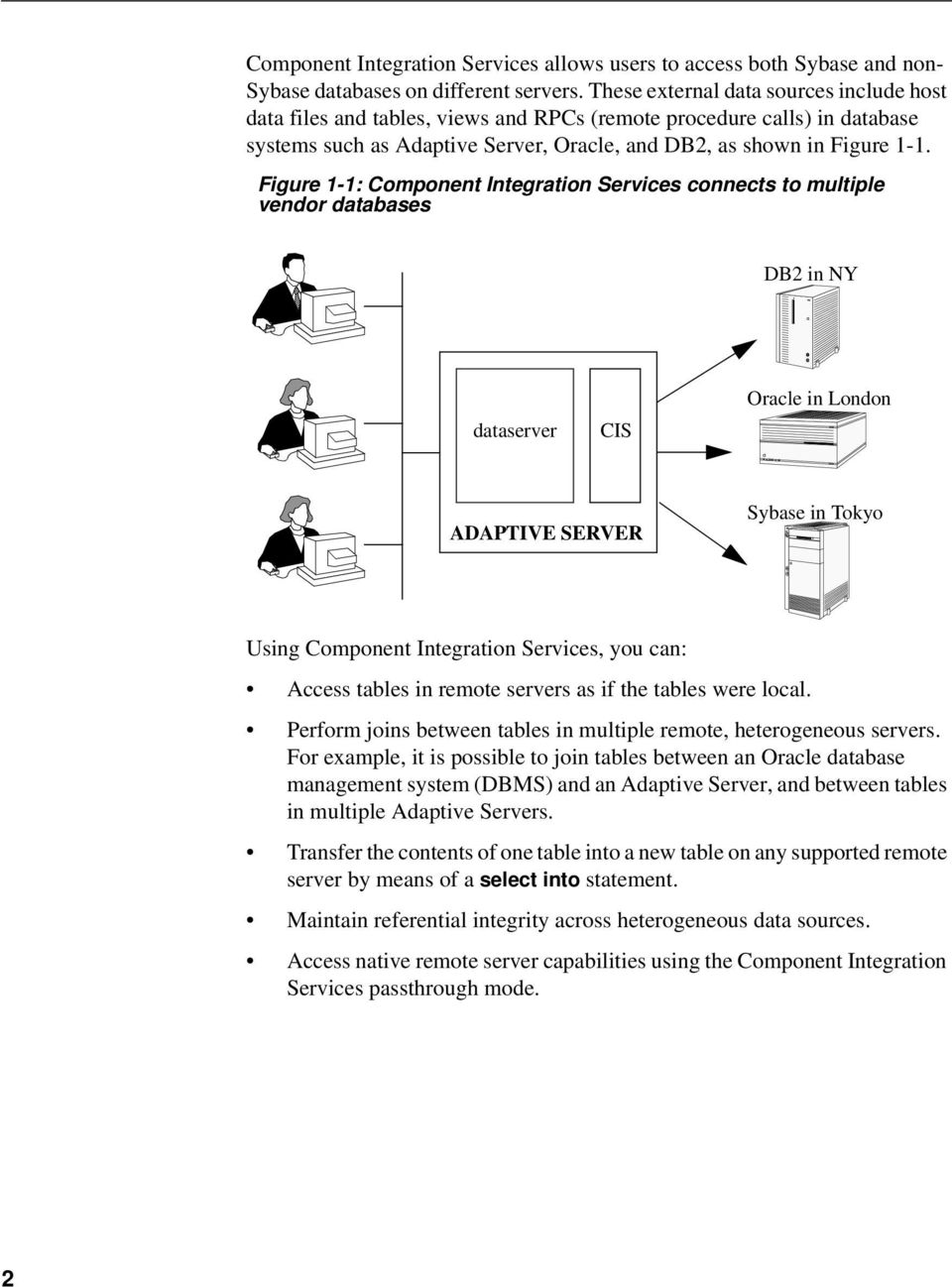
14 Component Integration Services allows users to access both Sybase and non- Sybase databases on different servers. These external data sources include host data files and tables, views and RPCs (remote procedure calls) in database systems such as Adaptive Server, Oracle, and DB2, as shown in Figure 1-1. Figure 1-1: Component Integration Services connects to multiple vendor databases DB2 in NY dataserver CIS Oracle in London ADAPTIVE SERVER Sybase in Tokyo Using Component Integration Services, you can: Access tables in remote servers as if the tables were local. Perform joins between tables in multiple remote, heterogeneous servers. For example, it is possible to join tables between an Oracle database management system (DBMS) and an Adaptive Server, and between tables in multiple Adaptive Servers. Transfer the contents of one table into a new table on any supported remote server by means of a select into statement. Maintain referential integrity across heterogeneous data sources. Access native remote server capabilities using the Component Integration Services passthrough mode. 2
15 Chapter 1 Introduction New features in Adaptive Server Enterprise 12.5 Component Integration Services is fully compatible with the new features of Adaptive Server Enterprise version There are also many new or enhanced features in Component Integration Services. Distributed Query Optimization Enhancements Distributed Transaction Management Enhancements Enhanced Data Access via File System Login name/password mapping to remote systems XNL - Extensible new limits Unicode support - new datatypes for support of Unicode character set LDAP SSL Union in views Administration and Diagnostic Enhancements Cascading Proxy Support Quoted Identifier Support Enhanced Full Text Search Capabilities select into existing tables Enhancements to Proxy Table Support for Remote Procedures Proxy Database Support New Global Variables and Set Commands 3

16 Who can use Component Integration Services Who can use Component Integration Services Component Integration Services can be used by anyone who needs to access multiple data sources or legacy data. It can also be used by anyone who needs to migrate data from one server to another. A single server is often used to access data on multiple external servers. Component Integration Services manages the data regardless of the location of the external servers. Data management is transparent to the client application. Component Integration Services, in combination with EnterpriseConnect and MainframeConnect products, provides transparent access to a wide variety of data sources, including: Oracle Informix IBM databases including: DB2 for MVS DB2/400 DB2/2 DB2 for VM (SQL/DS) Microsoft SQL Server Adaptive Server Enterprise Adaptive Server Anywhere Adaptive Server IQ Mainframe data, including: ADABAS IDMS IMS VSAM The list of certified and supported sources and front-end tools is increasing. For current information on all data sources, versions supported, and products required for support, please call the Sybase FAX on Demand at Request the Partner Certification Report. 4
17 Chapter 1 Introduction Steps needed to use Component Integration Services To get Component Integration Services running: Install DirectConnect server(s) or gateways for the external data sources you choose to access (Oracle, DB2, Informix). Configure the server to access remote objects as described in Chapter 2, Understanding Component Integration Services. 5

18 Steps needed to use Component Integration Services 6

19 CHAPTER 2 Understanding Component Integration Services This chapter explains how to use Component Integration Services. It is intended to help you understand how Adaptive Server works with the Component Integration Services option configured. The chapter includes the following topics: Name Page Basic concepts 8 Proxy tables 13 Proxy databases 25 File system access 32 Remote servers 40 Query processing 49 RPC handling and Component Integration Services 67 Transaction management 72 Java in the database 80 select into syntax 94 Configuration and tuning 97 7

20 Basic concepts Basic concepts The ability to access remote (or external) tables as if they were local is a hallmark of Component Integration Services. Component Integration Services presents tables to a client application as if all the data in the tables were stored locally. Remote tables are mapped to local proxy tables which hold metadata. Internally, when a query involving remote tables is executed, the storage location is determined, and the remote location is accessed so that data can be retrieved. The access method used to retrieve remote data is determined by two attributes of the external object: The server class associated with the remote object The object type To achieve location transparency, tables must first be mapped to their corresponding external locations. Access methods Access methods form the interface between the server and an external object. For each server class, there are separate access methods that handle all interaction between Adaptive Server and remote servers of the same class and object type. Server classes A server class must be assigned to each server when it is added by means of the system procedure sp_addserver. Server classes determine the access method used to interact with the remote server. The server classes are: ASEnterprise Used if the server is an Adaptive Server Enterprise version 11.5 or later. This is the default server class. ASAnywhere Used if the server is an Adaptive Server Anywhere version 6.0 or later. ASIQ Used if the server is an Adaptive Server IQ version
21 Chapter 2 Understanding Component Integration Services sql_server indicates that the server is a Sybase SQL Server. Component Integration Services determines whether the Sybase server is a release 10.0 or later server (supports cursors and dynamic SQL) or a prerelease 10.0 server (does not support cursors or dynamic SQL). local the local server. There can be only one. direct_connect indicates that the server is an Open Server application that conforms to the interface requirements of a DirectConnect server. For access to Microsoft SQL Server a DirectConnect must be used. access_server a synonym for server class direct_connect for compatibility with previous releases. db2 indicates that the server is a gateway to DB2 or DB2-compatible databases. This class is provided only for backward compatibility. The preferred class is direct_connect. sds indicates that the server conforms to the interface requirements of a Specialty Data Store. Object types The server presents a number of object types to client applications as if they were local tables. Supported object types are: table The object in a remote server of any class is a relational table. This is the default type. view The object in a remote server of any class is a view. Component Integration Services treats views as if they were local tables without any indexes. rpc The object in a remote server of any class is an remote procedure. Component Integration Services treats the result set from the remote procedure as a read-only table. file The object is an individual file within a file system. directory The object is a file system directory. 9
22 Basic concepts Interface to remote servers Directory services Remote server definition Logging into remote servers The interface between the server and remote servers is handled by the Open Client software, Client-Library. The Client-Library features that are used to implement the interface are dependent upon the class of server with which Component Integration Services is interacting. For example, if the server class is direct_connect (access_server), a number of features such as cursor and dynamic requests are used. These features are not used by a server of class db2. Before the server can interact with a remote server, you need to configure the following: Remote server addition to directory services Remote server definition Remote server login information Remote object definition Before accessing remote tables with Component Integration Services, you must either have access to LDAP directory services, or an interfaces file (sql.ini file on Windows NT). For information on setting up directory services, see the configuration documentation for your platform. You may wish to refer to Appendix A which serves as a basic tutorial for Component Integration Services users. Remote servers are defined by means of the stored procedure sp_addserver. This procedure is documented in the Adaptive Server Reference Manual. When using release 12.0 or greater you must name the local server. Once the remote server has been configured, login information must be provided. By default, the server uses the names and passwords of its clients whenever it connects to a remote server on behalf of those clients. However, this default can be overridden by the use of the stored procedure sp_addexternlogin. This procedure allows a system administrator to define the name and password for each user who connects to a remote server. Using connect to server_name, you can verify that the server configuration is correct. This command establishes a passthrough mode connection to the remote server. Passthrough mode allows clients to communicate with remote servers in native syntax. This passthrough mode remains in effect until you issue a disconnect command. 10
23 Chapter 2 Understanding Component Integration Services Defining remote objects Once a remote server has been properly configured, objects in that remote server cannot be accessed as tables until a mapping between them and a local object (proxy table) has been established. You can create new tables on remote servers, and you can define the schema for an existing object in a remote server. The procedures for both are similar. You can use one of two methods for defining the storage location of remote objects: 1 Define the storage location of individual objects 2 Define the default location of all objects in a database Defining the storage location of individual objects Defining individual object storage locations is done by means of the system procedure sp_addobjectdef or the use of the at pathname syntax. This procedure allows you to associate a remote object with a local proxy table name. The remote object may or may not exist before you do the mapping. Complete syntax for sp_addobjectdef is provided in the Adaptive Server Reference Manual. An easier method for defining storage locations is with the create proxy_table command. create proxy_table <table_name> [external file] at "pathname" Creating proxy tables Once you have defined the storage location, you can create the table as a new or existing object. If the table does not already exist at the remote location, use the create table syntax. If it already exists, use the create existing table syntax. If the object type is rpc, only the create existing table syntax is allowed. When a create existing table statement is received, and the object type is either table or view, the existence of the remote object is checked by means of the catalog stored procedure sp_tables. If the object exists, then its column and index attributes are obtained. Column attributes are compared with those defined for the object in the create existing table statement. Column name, type, length, and null property are checked. Index attributes are added to the sysindexes system table. 11
24 Basic concepts The create proxy_table command is easier to use than create existing table. Proxy tables can also be created using the Adaptive Server Enterprise system administration tool, Sybase Central. Once the object has been created, either as a new or an existing object, the remote object can be queried by using its local name. 12
25 Chapter 2 Understanding Component Integration Services Proxy tables Proxy tables are the key to location transparency. A proxy table is a local table containing metadata which points to a remote or external table. The remote table is mapped to the proxy table to make it appear as if it were a local table. There are three ways to create proxy tables: The create table command allows the creation of new external tables with the following syntax: create table table_name (column_list) [ [ external {table file}] at pathname ]] create table allows external object type table and file. The create existing table command is used to map existing remote tables. It provides datatype conversion and allows the user to specify which columns are to be mapped with the following syntax: create existing table table_name (column_list) [ on segment_name ] [[external {table procedure file}] at pathname] create existing table allows external object type table, procedure and file. The create proxy_table command creates proxy tables which automatically inherit all the columns, column names and datatypes of the external table using the following syntax: create proxy_table table_name [ external type ] at pathname create proxy table allows external object type table, file and directory. Complete syntax for these commands are found in Chapter 3 of this book. Using the create table command The create table command creates a proxy table and a remote table at the same time with the following syntax: create table table_name (column_list) [ [ external {table file}] at pathname ]] The remote location is specified with the at pathname clause. create table allows external object type table and file. The datatype of each column is passed to the remote server without conversion except with server class db2. 13
26 Proxy tables Using the create existing table command The create existing table command allows the definition of existing tables (proxy tables). The syntax for this option is similar to the create table command and reads as follows: create existing table table_name (column_list) [ on segment_name ] [[external {table procedure file}] at pathname] The action taken by the server when it receives this command is quite different from the action it takes when it receives the create table command, however. In this case, a new table is not created at the remote location; instead, the table mapping is checked, and the existence of the underlying object is verified. If the object does not exist (either host data file or remote server object), the command is rejected with an error message. If the object does exist, its attributes are obtained and used to update system tables sysobjects, syscolumns, and sysindexes. The nature of the existing object is determined. For remote server objects (other than RPCs), column attributes found for the table or view are compared with those defined in the column_list. Column names must match identically (although case is ignored), column types and lengths must match, or at least be convertible, and the NULL attributes of the columns must match. Index information from the host data file or remote server table is extracted and used to create rows for the system table sysindexes. This defines indexes and keys in server terms and enables the query optimizer to consider any indexes that may exist on this table. The on segment_name clause is processed locally and is not passed to a remote server. After successfully defining an existing table, issue an update statistics command for the table.this allows the query optimizer to make intelligent choices regarding index selection and join order. 14
27 Chapter 2 Understanding Component Integration Services Datatype Conversions When you use the create table or create existing table commands, you must specify all datatypes, using recognized Adaptive Server datatypes. If the remote server tables reside on a class of server that is heterogeneous, the datatypes of the remote table are converted into the specified Adaptive Server types automatically when the data is retrieved. If the conversion cannot be made, the create table or create existing table commands do not allow the table to be created or defined. Example of Remote Table Definition The following example illustrates the steps necessary to define the remote Adaptive Server table, authors, starting with the server definition: 1 Define a server named SYBASE. Its server class is sql_server, and its name in the interfaces file is SYBASE: exec sp_addserver SYBASE, sql_server, SYBASE 2 Define a remote login alias. This step is optional. User sa is known to remote server SYBASE as user sa, password timothy : exec sp_addexternlogin SYBASE, sa, sa, timothy 3 Define the remote authors table: create existing table authors ( au_id id not null, au_lname varchar(40) not null, au_fname varchar(20) not null, phone char(12) not null, address varchar(40) null, city varchar(20) null, state char(2) null, country varchar(12) null, postalcodechar(10) null ) at "SYBASE.pubs2.dbo.authors", "table" 4 Update statistics in tables to ensure reasonable choices by the query optimizer: update statistics authors 5 Execute a query to test the configuration: select * from authors where au_lname = Carson 15
28 Proxy tables Using the create proxy_table command create proxy_table is a variant of the create existing table command. Use create proxy_table to create a proxy table, but (unlike create existing table) you do not specify a column list. CIS derives the column list from the metadata it obtains from the remote table. The create proxy_table command creates proxy tables which automatically inherit all the columns, column names and datatypes of the external table using the following syntax: create proxy_table table_name [ external type ] at pathname create proxy table allows external object type table, file and directory.the location information provided by the at keyword specifies the pathname to the remote object. External type can be one of the following: external table specifies that the object is a remote table or view. external table is the default, so this clause is optional. external directory specifies that the object is a directory with a path similar to the following: /tmp/directory_name [;R]. The option R indicates recursive external file specifies that the object is a file with a path similar to: /tmp/filename Remote Procedures as proxy tables An optional clause may be added to the create existing table statement to indicate the remote object is actually a stored (or other) procedure instead of a table. Without this clause, the remote object is assumed to be a table or view: create existing table t1 ( column_1int, column_2int ) EXTERNAL PROCEDURE AT "SERVER_A.mydb.dbo.p1" In the case where the remote object is type procedure, several processing differences occur: No indexes are created for objects of this type. 16
29 Chapter 2 Understanding Component Integration Services A column list must be provided which matches the description of the remote procedure s result set. This column list is the responsibility of the user, and no verification of its accuracy is provided. Column names beginning with underscore ( _ ) can be used to specify parameters, which are not part of the remote procedure s result set. These columns are referred to as parameter columns. For example: create existing table rpc1 ( a int, b int, c int, _p1 int null, _p2 int null ) external procedure at SYBASE.sybsystemprocs.dbo.myproc select a, b, c from t1 where _p1 = 10 and _p2 = 20 In this example, the parameter columns _p1 and _p2 are not expected in the result set, but can be referenced in the query. CIS passes the search arguments to the remote procedure via parameters, using the If a parameter column is included in the select list, its value is equivalent to the values specified for it in the where clause, if it was passed to the remote procedure as a parameter. If the parameter column did not appear in the where clause, or was not able to be passed to the remote procedure as a parameter, but was included in the select list, its value would be NULL. A parameter column can be passed to the remote procedure as a parameter if it is what the Adaptive Server Enterprise query processor considers to be a searchable argument, or SARG. It is generally a SARG if it is not included in any or predicates. For example, the following query would prevent the parameter columns from being used as parameters: select a, b, c from t1 where _p1 = 10 OR _p2 = 20 Rules exist for the definition of parameter columns in the create existing table statement: parameter columns must allow NULL. parameter columns cannot precede normal, result columns (i.e. they must appear at the end of the column list). 17
30 Proxy tables Allowing the definition of remote procedures as local tables gives CIS the ability to treat the result set of a remote procedure as a virtual table, which can be sorted, joined with other tables, or inserted into another table via insert/select syntax. However, tables of this type are considered read only: You cannot issue a delete, update or insert command against a table of type procedure; You cannot issue a create index, truncate table or alter table command against tables of this type. Examples Component Integration Services users can map remote or external objects of the type rpc to local proxy tables. If a table is created in this way, it can be referenced only by the select and drop commands. The commands insert, delete, and update generate error messages, since the table is assumed to be read-only. Proxy definitions should only be created for procedures which return data. If an object of the type rpc has been defined within the server, a query is not issued to the remote server on which the object resides. Instead, the server issues an RPC and treats the results from the RPC as a read-only table. create existing table rtable (col1 int, col2 datetime, col3 varchar(30) ) external procedure at RMTSERVER...myproc select * from rtable When this query is issued, the server sends the RPC named myproc to server RMTSERVER. Row results are treated like the results from any other table; they can be sorted, joined with other tables, grouped, inserted into another table, and so forth. RPC parameters should represent arguments that restrict the result set. If the RPC is issued without parameters, the entire result set of the object is returned. If the RPC is issued with parameters, each parameter further limits the result set. For example, the following query: select * from rtable where col1 = 10 results in a single parameter, that is sent along with the RPC. Its value is
31 Chapter 2 Understanding Component Integration Services Component Integration Services attempts to pass as many of the search arguments as possible to the remote server, but depending on the SQL statement being executed, Component Integration Services might perform the result set calculation itself. Each parameter represents a search for an exact match, for example, the = operator. The following are rules which define the parameters sent to the RPC. If an RPC is used as a Component Integration Services object, these rules should be kept in mind during development. Component Integration Services sends = operators in the where clause as parameters. For example, the query: select * from rpc1 where a = 3 and b = 2 results in Component Integration Services sending two parameters. Parameter a has a value of 3 and parameter b has a value of 2. The RPC is expected to return only result rows in which column a has a value of 3 and column b has a value of 2. Component Integration Services does not send any parameters for a where clause, or portion of a where clause, if there is not an exact search condition. For example: select * from rpc1 where a = 3 or b = 2 Component Integration Services does not send parameters for a or b because of the or clause. Another example: select * from rpc1 where a = 2 and b < 3 Component Integration Services does not send parameters because there is nothing in the where clause representing an exact search condition. Component Integration Services performs the result set calculation locally. 19
32 Proxy tables New server limits Limits on length of char, varchar, binary and varbinary datatypes - In version 12.5 as in prior releases of Adaptive Server Enterprise, a row cannot span page boundaries, therefore column size has been limited by row size. However, in version 12.5 of Adaptive Server Enterprise, configuration allows page sizes of 2K, 4K, 8K or 16K bytes. Also, the arbitrary limit of 255 bytes for char/binary columns has been removed. The version 12.5 supports extended sizes of char, varchar, binary and varbinary data types. The new limit depends on the page size of the server. For various page sizes, the new limits are as follows: Table 2-1: New Limits Pagesize Max. Column Size Note that these sizes are still approximate. The basic rule specifies that the limit is the maximum size that still allows a single row to fit on a page. These limits also vary depending on the locking scheme specified when the table is created. It is assumed that the bulk of proxy tables are created with the default locking scheme, which is all page locking. Limits on length of Transact-SQL variables and parameters - the size of char, varchar, binary and varbinary variables are extended to equal the maximum size of columns of the same datatype for a given server. This allows variables to be passed to stored procedures (or RPCs) whose length exceeds the current limit of 255 bytes. Limits on number of columns per table- the old limit of 250 are removed, and up to 1024 columns per table are allowed, as long as the columns can still fit on a page. Note that there is a limit of 254 variable length columns (null columns are also considered variable length). Limits on the width of an index - the total width of an index within Adaptive Server Enterprise can be larger than in prior releases, depending on server page size. In the following table, maximum index width is shown according to pagesize: Table 2-2: Maximum Index Width Pagesize Index Width
33 Chapter 2 Understanding Component Integration Services Pagesize Index Width Limits on the number of columns per index - the current limit of 31 columns per index are unchanged in version What these changes mean to CIS and remote servers CIS connects to is described in the following sections. Remote server capabilities When communicating with a remote server, CIS needs to know the maximum length of a char/varchar column that can be supported by the DBMS. For connections to servers in classes ASEnterprise, ASAnywhere, ASIQ, sql_server and db2, the maximum size is determined based on known attributes of these servers (according to version). For servers in class direct_connect and sds, this information is provided by an addition to the result set returned by the sp_capabilities RPC. A new capability is specified to allow the Direct Connect to indicate the maximum length of columns supported by the DBMS for which the Direct Connect is configured. Additionally, it is necessary for the Direct Connect to know about the maximum length of char columns that can be supported by CIS. For this reason, changes to the existing RPC sp_thread_props are required: sp_thread_props "maximum ASE column length", n This RPC is sent to a Direct Connect after CIS has established a connection for the first time. The value of n is an integer indicating the maximum column size, in bytes, allowed by ASE/CIS. create new proxy table The create table command allows columns of datatype char, varchar, binary and varbinary to be specified with extended lengths, as described above. These datatypes and lengths are forwarded to the remote server on which the table is to be created. 21
34 Proxy tables create existing proxy table The create existing table command also allows columns to be specified with a length of greater than 255 bytes. This allows CIS to treat columns in remote databases as char, varchar, binary or varbinary that previously had to be treated as text or image columns. There is still an opportunity for column size mismatch errors. For example, in the case where the remote database contains a table with a column length of 5000 bytes, and the Adaptive Server Enterprise processing the create existing table command only supports columns up to 1900 bytes, a size mismatch error would occur. In this case, it is necessary to re-specify the column as a text or image column. In the case where the proxy table column size exceeds that of the corresponding column in the remote table, a size mismatch error is detected and the command is aborted. create proxy_table The create proxy_table command imports metadata from a remote server and converts column information into an internal create existing table command, with a column list derived from the imported metadata. When obtaining the column metadata, conversion from the remote DBMS type to internal Adaptive Server Enterprise types is required. If the size of remote columns (char, varchar, binary or varbinary datatypes) exceeds 255 bytes but is still less than or equal to the maximum Adaptive Server Enterprise column size, then equivalent Adaptive Server Enterprise datatypes are used for the proxy table. However, if the size of a remote column exceeds the column size supported by Adaptive Server Enterprise, then CIS converts the corresponding proxy table column to text or image (as is the case with the current in-market implementation). alter proxy table If this command operates on a proxy table, it is first processed locally, then forwarded to the remote server for execution. If the remote execution fails, the local changes are backed out and the command is aborted. The remote server must process the command appropriately, or raise an error. If an error is produced, the CIS side of the command is aborted and rolled back. 22
35 Chapter 2 Understanding Component Integration Services select, insert, delete, update CIS handles large column values when proxy tables are involved in DML operations. CIS handles DML using one of several strategies: TDS Language commands - if the entire SQL statement can be forwarded to a remote server, then CIS does so using TDS Language commands generated by Ct-Library - ct_command (CS_LANG_CMD). The text of the language buffer may contain data for long char or binary values that exceeds 255 bytes, and remote servers must handle parsing of these command buffers. TDS Dynamic commands - if CIS cannot forward the entire SQL statement to a remote server (i.e. CIS is forced to provide functional compensation for the statement), then an insert, update or delete may be handled by using TDS Dynamic commands, with parameters as needed, using the Ct-Library function ct_dynamic (CS_PREPARE_CMD, CS_EXECUTE_CMD, CS_DEALLOC_CMD). The parameters for the dynamic command may be CS_LONGCHAR_TYPE or CS_LONGBINARY_TYPE. TDS Cursor commands - Ct-Library cursor operations can be used to handle proxy table operations for select, update and delete if functional compensation has to be performed. For example, if updating a proxy table and there are multiple tables in the from clause, CIS may have to fetch rows from multiple data sources, and for each qualifying row, apply the update to the target table. In this case, CIS uses ct_cursor ({CS_DECLARE_CMD, CS_OPEN_CMD, CS_CURSOR_UPDATE_CMD, CS_CLOSE_CMD, CS_DEALLOC_CMD}). After a cursor is prepared, parameters are specified. These parameters may now include those of type CS_LONGCHAR or CS_LONGBINARY. Bulk insert commands - when performing a select/into operation, if the target server supports the bulk interface (only true of remote ASE s), then the remote server must be prepared to handle char/binary values > 255 (via CS_LONGCHAR, CS_LONGBINARY values). Columns from remote servers may be returned to CIS as type CS_LONGCHAR_TYPE or CS_LONGBINARY_TYPE. 23
36 Proxy tables RPC handling RPCs sent to remote servers can contain parameters of types CS_LONGCHAR and CS_LONGBINARY. The CIS command cis_rpc_handling supports these new types. Note that sending long parameters to pre-12.5 servers is not allowed, as prior versions of Adaptive Server Enterprise do not support CS_LONGCHAR or CS_LONGBINARY data. CIS examines TDS capabilities for the remote server prior to sending the RPC, and if the remote server cannot accept these datatypes, an error results. Cascading proxy tables Issues have arisen surrounding attempts to have a proxy table in one instance of CIS reference a proxy table in another instance. Version 12.5 addresses those issues, allowing cascading proxy table configurations between any number of instances of CIS. There are obviously conditions where this can cause problems, such as circular references, or transactions in which the second proxy table references a local table on the same server as the first proxy table. In this case, application deadlocks can result that will not be detected by CIS. Configuring systems to avoid these potential pitfalls is left to the customer. 24
37 Chapter 2 Understanding Component Integration Services Proxy databases There are two types of proxy databases: user and system proxy databases. This section describes the behavior of each. User proxy databases When a user proxy database is created, metadata for the proxy tables is imported automatically from the remote location which contains the actual tables. This metadata is then used to create proxy tables within the proxy database. Proxy database creation is done through syntax which extends the create database command: create database <dbname> [create database options] [with default_location = pathname ] [for proxy_update]] The use of the clause with default_location allows the database creator to specify the storage location of any new tables, and the location from which metadata may be imported for automatic proxy table creation if the for proxy_update clause is also specified. The for proxy_update clause establishes the database as a proxy database; the with default_location clause defines the location from which proxy tables are imported. Without the for proxy_update clause, the behavior of the with default_location clause is the same as that provided by the stored procedure sp_defaultloc - a default storage location is established for new and existing table creation, but automatic import of proxy table definitions is not done during the processing of the create database command. The value of pathname is a string identifier in the following format: servername.dbname.owner. Note: the dots are significant, and all three must be present! Each field in this string is described as follows: servername - required field; represents the name of the server that owns the objects to be referenced by proxy tables. Must exist in master.dbo.sysservers.srvname. dbname - may be omitted. The name of the database within servername which contains objects to be referenced by proxy tables 25
38 Proxy databases owner - may be omitted. The name of the owner of objects to be referenced by proxy tables. This may be restrictive, so that if more than one user owns objects in dbname, specifying the owner will select only those objects owned by that user. Proxy tables must not be created for objects owned by other users. If for proxy_update is specified with no default_location, an error is reported. When a proxy database is created (using the for proxy_update option), CIS functions are called upon to: Provide an estimate of the database size required to contain all proxy tables representing the actual tables/views found in the primary server s database. This estimate is provided in terms of the number of database pages needed to contain all proxy tables and indexes. This size is used if no size is specified, and no database devices are specified. Note: if the database is created with specific size specifications [on device_name = nn], or if a device name is specified with no size [on device_name], then the size requirements for the proxy database are not estimated; it is assumed in this case that the user or dba wants to override the default size calculated for the proxy database. If you are importing metadata from another Adaptive Server, remote database users are imported before proxy tables are created. Each imported database user must have a corresponding system user name in syslogins. Create all proxy tables representing the actual tables/views found in the companion server s database. Proxy tables are not created for system tables. Note: Before the proxy tables are created, the quoted identifier state is turned on, and each table is created with quotes surrounding the table name and column name. This allows the creation of tables containing names that may be Sybase Transact-SQL reserved words. When all proxy tables are created, the quoted identifier state is restored to its original setting. grant all permissions on proxy tables to PUBLIC add the GUEST user to the proxy database import database users from remote site (if Adaptive Server Enterprise) grant create table permission to PUBLIC 26
39 Chapter 2 Understanding Component Integration Services The database status is set to indicate that this database is a user proxy database. This is done by setting a status field in master.dbo.sysdatabases.status3 (0x0001, DBT3_USER_PROXYDB). After the database has been created, it contains a proxy table for each table or view found in the default_location. Then the behavior for a user proxy database, is identical to prior database behavior. Users can create additional objects, such as procedure, views, rules, defaults, etc., and both DDL and DML statements that operate on proxy tables behave as documented in the Component Integration Services User s Guide. The only exception to this is the alter database command. New syntax and capabilities of this command are described in the next section. User Proxy Database Schema Synchronization At times, it may be necessary for a DBA to force re-synchronization of the proxy tables contained within the proxy database. This can be done through the alter database command: alter database <dbname> [alter database options] [for proxy_update] If the for proxy_update clause is entered with no other options, the size of the database will not be extended; instead, the proxy tables, if any, are dropped from the proxy database and re-created from the metadata obtained from the pathname specified during create database... with default_location = pathname If this command is used with other options to extend the size of the database, the proxy table synchronization is performed after the size extensions are made. The purpose of this alter database extension is to provide a DBA with an easyto-use, single step operation with which to obtain an accurate and up-to-date proxy representation of all tables at a single remote site. This re-synchronization is supported for all external data sources, and not just the primary server in a HA-cluster environment. Also, a database need not have been created with the for proxy_update clause. If a default storage location has been specified, either through the create database command or using sp_defaultloc, the metadata contained within the database can be synchronized with the metadata at the remote storage location. Certain behavior is implied by the use of create/alter database to specify a proxy database: 27
40 Proxy databases Modification to the default location specified with the create database command is not allowed using alter database. Local tables cannot be created in the proxy database. create table commands result in the creation of proxy tables, and the actual table is created at the default location. The default location of the table may be specified in the create table command, using the at pathname syntax. If the pathname differs from the default location, then the alter database command will not synchronize the metadata for this table. In order to change the default location, it is necessary to first drop the database then re-create it with a new pathname specified in the with default_location = pathname clause. If the location is changed using sp_defaultloc, then the new location is used to provide metadata synchronization, and proxy tables that were created with the prior location not be synchronized, and in fact may be dropped and replaced if the name conflicts with that of tables at the new location. System proxy databases System proxy databases are provided which behave like user proxy databases, with some notable enhancements and exceptions. These differences are described in this section. System proxy databases are only used in an HA configuration. The purpose of providing system proxy databases is to allow customer-written applications to run on either node in a high-availability cluster. This does not imply single-system image capability; rather, it suggests an environment in which most user-written applications will be able to execute on either node in the cluster. This means that both databases and user-created objects should be visible to both nodes. To facilitate this capability, the notion of a system proxy database was introduced in version 12.0 of Adaptive Server Enterprise. A system proxy database has the same name as the database in the primary node which it references, and contains handling for the user-defined objects that are necessary to support the application: Proxy tables are created for each user table and view found in the primary database, and stored procedures are converted to RPCs and forwarded to the node referenced by the proxy database. 28
41 Chapter 2 Understanding Component Integration Services System proxy database creation A system proxy database is created automatically under the following circumstances: The HA cluster is being configured through the use of the stored procedure sp_companion ServerName, configure, with_proxydb In this case, a system proxy database is created for each user database found in server indicated by ServerName. A create database command is issued in a server whose HA state is one of MODE_APNC, MODE_SNC or MODE_ASNC. When the creation of the system proxy database is complete, CIS functions will then be called upon to: grant create table to public - this will allow table creation on the primary server to result in proxy table creation in the system proxy database. Schema synchronization when current database has a system proxy database In an HA cluster, some of the changes to a primary server s database need to be forwarded to the companion server, in order to keep both servers synchronized. Several DDL commands, when executed within a database that has a system proxy database, will cause notification of the companion server and result in automatic synchronization of the resulting changes: create table and drop table - local operation executes, resulting in the local table being created or dropped. The command is then forwarded to the companion server, for execution in the system proxy database, so that a proxy table can be created or dropped create index and drop index - local operation executes, resulting in an index being created or dropped. The server owning the system proxy database is then notified, and the proxy table is dropped and re-created, allowing the change to the index to be represented within the proxy table. create view and drop view - the local operation succeeds, resulting in the local view being created or dropped. The server owning the system proxy database is then notified, and a proxy table is either created or dropped. If these commands are executed within the system proxy database, similar behavior occurs: 29
42 Proxy databases create table and drop table - local proxy table is created or dropped. The command is then forwarded to the primary server, so that a local table referenced by the proxy table can be created or dropped. create index and drop index - local operation on the proxy table executes, resulting in an index being created or dropped. The server owning the primary database is then notified, and an index is either created or dropped on the local table referenced by the proxy table create view and drop view - not allowed within a system proxy database. Error is produced (see below). Stored procedure execution within a system proxy database If a stored procedure request is encountered when the current database is a system proxy database, the stored procedure request is automatically converted to an RPC and sent to the server referenced by the system proxy s default location. Additional behavior of the system proxy database Certain commands, when executed within a system proxy database, will be rejected with an error: create procedure and drop procedure create view and drop view create trigger and drop trigger create rule and drop rule create default and drop default The error generated in these cases is: Msg 12818, Severity 16: Cannot create an object of this type in system-created proxy database DDL commands behavior affected by proxy databases Some commands will be affected by the implementation of proxy databases, others will not. This section contains a list of DDL commands which are affected by system proxy databases. dump database - dump transaction - 30
43 Chapter 2 Understanding Component Integration Services load database - load transaction - create table - create view - create index - create database - drop table - drop view - drop index - drop database - All other DDL commands remain unaffected by the existence of system proxy databases. 31
44 File system access File system access Version 12.5 provides access to the file system through the SQL language. With file system access, you can create proxy tables that are mapped to file system directories, or to individual files. These features are bundled as an option and must be purchased separately. Directory access A new class of proxy tables is allowed in version 12.5 that enables SQL access to file system directories and their underlying files. In order to create proxy tables mapped to directories or files, you must have System Administrator or System Security Officer privileges. The supported syntax is: create proxy_table <table_name> external directory at "directory pathname[;r]" The directory pathname must reference a file system directory visible to and searchable by the Adaptive Server Enterprise process. A proxy table is created which maps column names to attributes of files that exist within the directory. If the ;R (indicating "recursion") extension is added to the end of pathname, CIS includes entries in all subordinate directories. The following table contains a description of the proxy table columns that are created when this command successfully completes: Table 2-3: Proxy table columns Column Name Datatype Description id numeric(24) Identity value consisting of values from st_dev and st_ino (See stat(2)). These two values are converted first to a single string (format: "%d%014ld"), and the string is then converted to a numeric value. filename varchar(n) The name of the file within the directory specified in at pathname, or within directories subordinate to pathname. While the length of pathname is limited to 255 bytes, the total length (n) of filename is system dependent, and specified by the definition of MAXNAMLEN. For Solaris systems, this value is 512 bytes; for most other systems this will be 255 bytes. 32
45 Chapter 2 Understanding Component Integration Services Column Name Datatype Description size int For regular files - specifies the number of bytes in the file. For directories - block special or character special, this is not defined. filetype varchar(4) the file type - legal values are: FIFO, for pipe files; DIR for directories; CHRS for character special files; BLKS for block special files; REG for ordinary files; UNKN for all other file types. Links are automatically expanded, and will not appear as a separate file type. access char(10) access permissions, presented in a more or less standard Unix format: "drwxrwxrwx" uid varchar(n) The name of the file owner. The value of n is specified by the system definition L_cuserid, which is 9 on all systems except Compaq Tru64, where it is 64. This value is 0 on NT systems. gid varchar(n) The name of the owning group. The value of n is specified by the system definition L_cuserid, which is 9 on all systems except Compaq Tru64, where it is 64. This value is 0 on NT systems. atime datetime Date/time file data was last accessed mtime datetime Date/time when file was last modified ctime datetime Date/time when file status was last changed content image The actual physical content of the file (for regular files only). NULL if the file is not a regular file. A proxy table that maps to a file system directory can support the following SQL commands: select - File attributes and content can be obtained from the proxy table using the select command. Built-in functions that are designed to handle text values are fully supported for the content column. (i.e. textptr, textvalid, patindex, pattern). insert - A new file or files can be created using the insert command. The only column values that have meaning are filename and content; the rest of the columns should be left out of the insert statement. If they are not left out, they are ignored. delete - files may be removed by the use of the delete command. update - Only the name of a file may be changed using the update command; 33
46 File system access readtext - the contents of a file may be retrieved using the readtext command; writetext - the contents of a file may be modified using the writetext command; No other SQL commands will operate on tables of this type. Regular file content is available only if the Adaptive Server Enterprise process has sufficient privileges to access and read the file, and if the file type indicates an ordinary file. In all other cases, the content column will be null. For example: select filename, size, content from directory_table where filename like %.html returns the name, size and content of regular files with a suffix of.html, if the Adaptive Server Enterprise process has access privileges to the file. Otherwise, the content column will be NULL. The create proxy_table command fails if the pathname referenced by directory pathname is not a directory, or is not searchable by the Adaptive Server Enterprise process. If traceflag is turned ON, then messages are written to the errorlog that contain information about the contents of the directories and the query processing steps needed to obtain that information. Recursion through subordinate directories If the "pathname" specified in the create proxy_table statement contains the ;R extension, CIS traverses all directories subordinate to pathname, returning information for the contents of each subordinate directory. When this is done, the filename returned by a query contains the complete name of the file relative to the pathname. In other words, all subordinate directory names appear in the filename. For example, if pathname specifies "/work;r": create proxy_table d1 external directory at "/work;r" select filename, filetype from d1 returns values for files in subordinate directories as follows: Table 2-4: Values for files Filename dir1 dir1/file1.c Filetype DIR REG 34
47 Chapter 2 Understanding Component Integration Services Filename dir1/file2.c dir2 dir2/file1.c Filetype REG DIR REG File access Another new class of proxy tables are allowed in version 12.5 that enables SQL access to individual files within a file system. The supported syntax is: create proxy_table <table_name> external file at " pathname" [column delimiter <string> ] When this command is used, a proxy table with one column (named record, type varchar(255)) will be created. It is assumed in this case that the contents of the file are readable characters, and individual records within the file are separated by the newline (\n) character. It is also possible to specify your own column names and datatypes, using the create [existing] table command: create existing table fname ( column1 int null, column2 datetime null, column3 varchar(1024) null etc. etc. ) external file at "pathname" [column delimiter <string> ] Columns may be any datatype except text, image, or a Java ADT. The use of the existing keyword is optional, and has no effect on the processing of the statement. In all cases (create table, create existing table, create proxy_table), if the file referenced by pathname does not exist, it is created. If it does exist, its contents are not overwritten. There is no difference in behavior between the create table and create existing table commands. When a proxy table is mapped to a file, some assumptions about the file and its contents are made: 1 The file is a regular file (i.e. not a directory, block special, or character special file); 2 The Adaptive Server Enterprise server process has at least read access to the file. If the file is to be created, the server process must have write access to the directory in which the file is to be created; 3 The contents of an existing file are in human-readable form; 35
48 File system access 4 Records within the file are delimited by a newline character; 5 The maximum supported record size is bytes; 6 Individual columns, except for the last one, are delimited by the column delimiter string, which can be up to 16 bytes long; the default is a single tab character; 7 There is a correspondence between delimited values within each record of the file and the columns within the proxy table. With proxy tables mapped to files, it is possible to: 1 Back-up database tables to the file system using either select/into or insert/select. When an insert statement is processed, each column is converted to characters in the default character set of the server. The results of the conversion are buffered, and all columns (except for the last) are delimited by a single tab. The last column is terminated by a newline. The buffer is then written to the file, representing a single row of data. 2 Provide a SQL alternative to using bcp in and bcp out. The use of a select/into statement can easily back-up a table to a file, or copy a file s contents into a table. 3 Query file content with the select statement, qualifying rows as needed with search arguments or functions. For example, it is possible to read the individual records within the Adaptive Server Enterprise errorlog file: create proxy_table errorlog external file at "/usr/sybase/ase12_5/install/errorlog" select record from errorlog where record like "%server%" The query will return all rows from the file that match the like pattern. If the rows are longer than 255 bytes, they will be truncated. It is possible to specify longer rows: create existing table errorlog ( record varchar(512) null ) external file at "/usr/sybase/ase12_5/install/errorlog" In this case, records up to 512 bytes in length will be returned. Again, since the proxy table contains only one column, the actual length of each column will be determined by the presence of a newline character. Only the select, insert data access statements are supported for file access. update and delete will result in errors if the file proxy is the target of these commands. 36
49 Chapter 2 Understanding Component Integration Services When inserting values into a file, all datatypes are first converted to char values and then delimited by the column delimiter. Important: truncate table sets the file size to 0. Traceflag is also used to log message to the errorlog. These messages contain information about the stages of query processing that are involved with file access. Security considerations Only Adaptive Server Enterprise users with System Administrator (sa) or System Security Officer (sso) roles are allowed to create proxy tables that are mapped to files or directories. This requirement addresses the concerns over the security aspects of accessing file system data from within the Adaptive Server Enterprise server process (which may have root permission as it runs). ANSI joins ANSI joins are fully supported for remote data access. If a query cannot be translated, CIS will compensate functionally. The following rules apply to ANSI joins with remote data: When the remote server supports only ANSI joins All queries containing outer joins are converted to ANSI joins. When the remote server supports both ANSI joins and T-SQL joins Queries containing ANSI join syntax are sent using ANSI join syntax. Queries containing T-SQL outer join syntax are sent with T-SQL syntax. When the remote server supports only DB2-ANSI The query to the remote server will be sent in ANSI if all tables in the from clause participate in an ANSI join. Not sent: select * from T1 left join T2 on T1.a = T2.a, T3 37
50 File system access Sent select * from T1 Left Join T2 on T1.a = T2.a Left Join T3 on T3.a = T2.a When an ANSI query is received for a server that does not support ANSI syntax The query will be converted to T-SQL if possible. 50-Table join limit The 50-table join limit is fully functional with remote servers that support it. CIS first checks the capabilities of remote servers. If the 50-table join is supported by the remote server, the requested query is passed onto the remove server. If the remote server does not support a 50-table join, a query is sent that references 16 tables or less at a time. Union in views New syntax to support the inclusion of the union operator within a view has been added to version Note that the resulting view is not updatable, meaning that insert, delete and update operations are not allowed on views containing the union operator. Component Integration Services supports union in views when proxy tables are referenced on either side of the union operator by forwarding as much syntax as possible to a remote site. This makes it possible to create a virtual table consisting of separate tables in Oracle and DB2, for example. This feature is internal to ASE/CIS, and does not directly affect remote servers. However, when a statement is executed involving a view of this type, and all tables referenced by the view reside on the same remote server, the previously defined union capability will be examined to determine whether the union operator can be sent to the remote server. 38
51 Chapter 2 Understanding Component Integration Services Referential integrity You can use Component Integration Services to maintain referential integrity between remote tables. See the section on constraints in the Transact-SQL User s Guide. During update, insert, and delete operations, Component Integration Services checks the referenced table. If the check fails, the transaction is rolled back. 39
52 Remote servers Remote servers This section explains how component Integration Services interacts with remote server. Defining remote servers Use the system procedure sp_addserver to add entries to the sysservers table for the local server and for each remote server that is to be called. The sp_addserver syntax is: sp_addserver server_name [,server_class [,network_name]] where: server_name is the name used to identify the server. It must be unique. server_class is the type of server. The supported server classes with the types of servers that are in each class are described in the following sections. The default is server class ASEnterprise. network_name is the server name in the interfaces file. This name may be the same as server_name, or it may differ. The network_name is sometimes referred to as the physical name. The default is the same name as server_name. Server class ASEnterprise A server with server class ASEnterprise is Adaptive Server Enterprise version 11.5 or later. When CIS first establishes a connection to a server in this class, CIS determines the version (i.e. 11.5, , 12.0, etc.) and establishes server capabilities based on the version found. For example, version 12.0 supports ANSI syntax for outer joins, while prior versions do not. Server class ASAnywhere A server with server class ASAnywhere is an instance of Adaptive Server Anywhere or Adaptive Server IQ: Adaptive Server Anywhere 6.0 or later 40
53 Chapter 2 Understanding Component Integration Services Server class ASIQ A server with server class ASIQ is any version of Adaptive Server IQ of 12.0 or later. Server class sql_server A server with server class sql_server is: SQL Server release 4.9 or earlier Server class db2 A server with server class db2 is an IBM DB2 database accessed through: DirectConnect for MVS / TRS (can also be configured as server class direct_connect) Direct (gateway less) access to Mainframe Connect Server class direct_connect A server with server class direct_connect is an Open Server-based application that conforms to the direct_connect interface specification. Server class access_server is synonymous with server class direct_connect. It is used for compatibility with previous releases. Open Server-based applications using server class direct_connect are the preferred means of accessing all external, non-sybase data sources. Figure 2-1 illustrates the manner in which Adaptive Server with Component Integration Services enabled interacts with clients and Open Server-based applications. The data sources are not limited to those in this diagram: 41
54 Remote servers Figure 2-1: Adaptive Server with CIS interacts with clients and other servers Network DirectConnect - AS/400 Client application CIS DirectConnect - DB2 DirectConnect - Oracle Adaptive Server Client application Access to DirectConnect DirectConnect - Informix Server class sds A server with server class sds conforms to the interface requirements of a Specialty Data Store as described in the Adaptive Server Specialty Data Store Developer s Kit manual. A Specialty Data Store is an Open Server application you design to interface with Adaptive Server. Connection management When connecting to a remote server on behalf of a client, CIS uses Client- Library functions. Once the first connection to a remote server is established for a given client, that connection remains open until the client disconnects from Component Integration Services. 42
55 Chapter 2 Understanding Component Integration Services For servers of class ASA, ASE, ASIQ, direct_connect (access_server) and sql_server (release 10.0 and later), only one connection is established to that server for each client that requires access to that server. All interaction with these servers is done within this single connection context. However, for pre-release 10.0 SQL Server, and servers of class db2, it may be necessary to establish more than one connection to that server in order to process a single client request. In this case, multiple connections are established as needed, and all but one are closed when the Transact-SQL command requiring them has completed. LDAP directory services The LDAP directory services means that it is no longer necessary to use an interfaces file in both the client and the server. Version 12.5 supports LDAP services for obtaining server information, and so does Component Integration Services. When a connection to a remote server is attempted, CIS instructs Open Client software to reference either the interfaces file or an LDAP server. CIS uses LDAP services only when the configuration file (libtcl.cfg) specifies it. libtcl.cfg can be found at $SYBASE/$SYBASE_OCS/config/libtcl.cfg. Note: When an LDAP Server is specified in libtcl.cfg then server information becomes accessible from the LDAP Server only and ASE/CIS ignores any (traditional) interfaces file. Secure communication with SSL Using SSL, you can establish secure connections from CIS to any number of remote servers that support the SSL protocol (Adaptive Server enterprise 12.5 and some DirectConnects). CIS handles SSL connections as follows: The location of the trusted roots file is established. If the current server is SSL-enabled, then all outbound CIS connections will use the same trusted roots file as Adaptive Server Enterprise. If the current server is SSL-enabled, then a connection property is established to define the Open Client callback that will be used to respond to a challenge from a remote SSL-enabled server. If the current server is not SSL-enabled, then the callback used will fail any connection to a remote SSL-enabled server. 43
56 Remote servers Trusted root files The trusted roots file contains certificates for other servers that the local server treats as trusted when properly added to the system. A trusted roots file is accessible by the local server (Adaptive Server Enterprise) in: $SYBASE_CERT/servername.txt if $SYBASE_CERT is defined. Otherwise it is in: $SYBASE/$SYBASE_ASE/certificates/servername.txt (for UNIX) %SYBASE%\%SYBASE_ASE%\certificates\servername.txt (for NT) where servername is the name of the current Adaptive Server. Security issues When establishing a connection to a remote Adaptive Server, Client-Library functions are used instead of a site handler when either cis_rpc_handling or set transactional_rpc is on. This method of establishing connections prevents the remote server from distinguishing these connections from those of other clients. Thus, any remote server security configured on the remote server to allow or disallow connections from a given server does not take effect. Another Adaptive Server with Component Integration Services enabled cannot use trusted mode for remote server connections. This forces the Adaptive Server to be configured with all possible user accounts if it is going to be used with Component Integration Services. Passwords are stored internally in encrypted form. Remote server logins To fully support remote logins, Client-Library provides new connection properties which enable CIS to request a server connection. This connection is recognized at the receiving server as a server connection (as opposed to an ordinary client connection), allowing the remote server to validate the connection through the use of sysremotelogins as if the connection were made by a site handler. This feature is not enabled automatically. Instead, the SSO or DBA must request it by executing sp_serveroption: exec sp_serveroption <server_name>, server login, true false 44
57 Chapter 2 Understanding Component Integration Services You cannot change the server login property if the current server global variable is currently NULL. If the server login option is enabled (set to TRUE), then CIS uses Client- Library connection properties to establish connections to the specified server: Remote passwords specified by the client application are passed unchanged to the remote server. The use of and rules associated with remote passwords in server logins are identical to those associated with site handler connections. These connection properties are only established if: The server option server login is set to TRUE The remote server is configured with server class ASEnterprise There is a local server name defined for the CIS-enabled server (i.e. the query returns something other than NULL) Trusted mode Trusted mode can be used with CIS connections if server logins is set for a remote server. Mapping of external logins Adaptive Server Enterprise users who invoke CIS, knowingly or unknowingly, require login names/passwords to remote servers. By default, the username/password pair used by CIS to connect to a remote server is the same username/password used by the client to connect to Adaptive Server Enterprise. This default mapping is frequently insufficient, and since its first release CIS has supported a one-to-one mapping of Adaptive Server Enterprise login names and passwords to remote server login names and passwords. For example, using the stored procedure sp_addexternlogin, it is possible to map Adaptive Server Enterprise user steve, password sybase to DB2 login name login1, password password1: sp_addexternlogin DB2, steve, login1, password1 In version 12.5, it is possible to provide a many-to-one mapping so that all Adaptive Server Enterprise users who need a connection to DB2 can be assigned the same name and password: sp_addexternlogin DB2, NULL, login2, password2 45
58 Remote servers One-to-one mapping has precedence, so that if user steve has an external login for DB2, that would be used rather than the many-to-one mapping. In addition to this, it is possible to assign external logins to Adaptive Server Enterprise roles. With this capability, anyone with a particular role can be assigned a corresponding login name/password for any given remote server: sp_addexternlogin DB2, null, login3, password3, rolename The use of the fifth argument to this procedure, containing the role name, identifies the name of a role, rather than the name of a user. Whenever a user with this role active requires a connection to DB2, the appropriate login name/password for the role is used to establish the connection. When establishing a connection to a remote server for a user that has more than one role active, each role is searched for an external login mapping, and the first mapping found is used to establish the login. This is the same order as displayed by the stored procedure sp_activeroles. The general syntax for sp_addexternlogin is: sp_addexternlogin <servername>, <loginname>, <external_loginname>, <external_password> [, <rolename>] <rolename> is optional; if specified then the loginname parameter is ignored. Precedence for these capabilities are as follows: If one-to-one mapping is defined, it is used - this has the highest precedence. If no one-to-one mapping is defined, then if a role is active and a mapping for it can be found, the role mapping is used to establish a remote connection; If neither of the above are true, then many-to-one mapping is used if defined. If none of the above is true, then the Adaptive Server Enterprise login name and password are used to make the connection. If role mapping is done, and a user s role is changed (via set role), then any connections made to remote servers that used role mapping is disconnected. The stored procedure sp_helpexternlogin has been updated to allow viewing the various types of extern logins that have been added using sp_addexternlogin. The syntax for sp_helpexternlogin is: 46
59 Chapter 2 Understanding Component Integration Services sp_helpexternlogin [<servername> [,<loginname> [,<rolename>]]] All three parameters are optional, and any of the parameters can be NULL. The stored procedure sp_dropexternlogin has also been modified to accept a third argument, <rolename>. If <role name> is specified then the second argument, <login name>, is ignored. Remote server connection failover A standard feature of Ct-Library version 12.0 and greater is the ability to automatically failover connections from a server that is no longer available to one that is configured as a failover server. This feature is supported by CIS, but requires modifications to directory services in order for it to take effect. For example, server S2 can be configured to serve as a failover server for S1, and vice-versa, by additions to the interfaces file, as shown in this example: S1 S2 master tcp ether host query tcp ether host hafailover S2 master ether host query ether host hafailover S1 If the interfaces file (or LDAP directory service) is set up to define a failover configuration, then CIS takes advantage of it by automatically failing over connections to the failover server if a connection to the primary server fails. Remote server capabilities The first time Adaptive Server establishes a connection to a remote server of class sds or direct_connect, it issues an RPC named sp_capabilities and expects a set of results in return. This result set describes functional capabilities of the remote server so that Component Integration Services can adjust its interaction with that remote server to take advantage of available features. Component Integration Services forwards as much syntax as possible to a remote server, according to its capabilities. 47
60 Remote servers For servers in other classes, CIS sets remote server capabilities for the remote server based on a set of assumptions. For example, server class db2 inherits a set of assumptions based on known capabilities of IBM s DB2 database management system. For server class ASEnterprise, capabilities are established based on the version of ASE represented by the remote server. 48
61 Chapter 2 Understanding Component Integration Services Query processing The following section describes query processing within Component Integration Services. Processing steps The query processing steps taken when Component Integration Services is enabled are similar to the steps taken by Adaptive Server, except for the following: If a client connection is made in passthrough mode, the Adaptive Server query processing is bypassed and the SQL text is forwarded to the remote server for execution. When select, insert, delete or update statements are submitted to the server for execution, additional steps may be taken by Component Integration Services to improve the query s performance, if local proxy tables are referenced. The query processing steps are shown in Figure 2-2. An overview of these steps follows. 49
62 Query processing Figure 2-2: Query processing steps parse normalize preprocess Component Integration Services plan generation yes? no Adaptive Server optimization/plan generation Can Component Integration Services handle the entire statement? Component Integration Services remote location optimizer execute Component Integration Services access methods Server access methods Shaded boxes indicate steps taken by Component Integration Services. Query parsing The SQL parser checks the syntax of incoming SQL statements, and raises an error if the SQL being submitted for execution is not recognized by the Transact-SQL parser. Query normalization During query normalization, each object referenced in the SQL statement is validated. Query normalization verifies the objects referenced in the statement exist, and the datatypes are compatible with values in the statement. Example select * from t1 where c1 = 10 50
63 Chapter 2 Understanding Component Integration Services The query normalization stage verifies that table t1 with a column named c1 exists in the system catalogs. It also verifies that the datatype of column c1 is compatible with the value 10. If the column s datatype is datetime, for example, this statement is rejected. Query preprocessing Query preprocessing prepares the query for optimization. It may change the representation of a statement such that the SQL statement Component Integration Services generates will be syntactically different from the original statement. Preprocessing performs view expansion, so that a query can operate on tables referenced by the view. It also takes steps such as reordering expressions and transforming subqueries to improve processing efficiency. For example, subquery transformation may convert some subqueries into joins. Decision point After preprocessing, a decision is made as to whether Component Integration Services or the standard Adaptive Server query optimizer will handle optimization. Component Integration Services will handle optimization (using a feature known as quickpass mode) when: Every table represented in the SQL statement resides within a single remote server. The remote server is capable of processing all the syntax represented by the statement. Component Integration Services determines the query processing capabilities of the remote server by its server class. Servers with server class sql_server, or db2, have implied capabilities. For example, Component Integration Services assumes that any server configured as server class sql_server is capable of processing all Transact-SQL syntax. For remote servers with server class access_server or direct_connect, Component Integration Services issues an RPC to ask the remote server for its capabilities the first time a connection is made to the server. Based on the server s response to the RPC, Component Integration Services determines the syntax of the SQL it will forward to the remote server. The following is true of the SQL statement: 51
64 Query processing It is a select, insert, delete, or update statement If it is an insert, update, or delete statement, there are no identity or timestamp columns, or referential constraints It contains no text or image columns It contains no compute by clauses It contains no for browse clauses It is not a select...into statement It is not a cursor-related statement (for example, fetch, declare, open, close, deallocate, update or delete statements that include where current of cursor) If the above conditions are not met, quickpass mode cannot be used, and the standard Adaptive Server query optimizer handles optimization. Component Integration Services plan generation If quickpass mode can be used, Component Integration Services produces a simplified query plan. When statements contain proxy tables, they are executed more quickly when processed by the remote server than when processed through the Adaptive Server plan generation phase. Adaptive Server optimization and plan generation Adaptive Server optimization and plan generation evaluates the optimal path for executing a query and produces a query plan that tells the Adaptive Server how to execute the query. If the update statistics command has been run for the tables in the query, the optimizer has sufficient data on which to base decisions regarding join order. If the update statistics command has not been run, the Adaptive Server defaults apply. For more information on Adaptive Server optimization, refer to Chapter 7, The Adaptive Server Query Optimizer, in the Performance and Tuning Guide. 52
65 Chapter 2 Understanding Component Integration Services Component Integration Services remote location optimizer Adaptive Server generates a query plan containing the optimal join order for a multitable query without regard to the storage location of each table. If remote tables are represented in the query, Component Integration Services, which takes the storage location into account, performs additional optimization for the following conditions: Join processing Aggregate processing In order to make intelligent evaluations of a query to improve performance in the above areas, statistics are required. These are obtained by executing the command update statistics for a specific table. update statistics When updating statistics on a remote table, Component Integration Services intercepts the request and provides meaningful statistics for the remote table and all of its indexes (if any). The result of executing an update statistics command is a distribution statistics page stored in the database, for each index. In Adaptive Server, data used to create this distribution page comes from local index pages. When you are updating statistics on a remote table, the data used to create the distribution statistics page comes from the keys used to make up the index on the remote table. The Adaptive Server issues a query to the remote server to obtain all columns making up the index, sorted according to position within the index. For example, if table1 has an index made up of two columns, col1 and col2, then the query to that server is sent as follows when update statistics is executed: select col1, col2 from table1 order by col1, col2 The results are then used to construct a distribution page in the format needed by the optimizer. The detailed distribution statistics are used to determine optimal join order. This gives the server the ability to generate optimal queries against remote databases that may not support cost-based query optimization. 53
66 Query processing On large tables, update statistics can take a long time. To speed up the process, turn on trace flag before executing update statistics. This trace flag instructs update statistics to obtain only row counts on remote tables. The Adaptive Server query optimizer uses the row count information to make assumptions about the selectivity of a particular index. While these assumptions are not as complete as the full distribution statistics, they provide the minimal information needed to handle query optimization. Join processing Component Integration Services remote location optimizer isolates join conditions represented in the query plan. For each remote server that is represented by two or more tables in the join, Component Integration Services modifies the query plan to appear as though a single virtual table is being processed for that server. Component Integration Services then forwards the join conditions to the remote server during query execution. For example, if a query involves four tables, two that are located on the remote server SERVERA and two that are located on the remote server SERVERB, Component Integration Services processes the query as though it were a twoway join. The following query: select * from A1, A2, B1, B2 where A1.id = A2.id and A2.id = B1.id and B1.id = B2 id gets converted to: select * from V1, V2 where V1.id = V2.id V1 is the virtual table representing the results of the join between A1 and A2 (processed by SERVERA), and V2 is the virtual table representing the results of the join between B1 and B2 (processed by SERVERB). Since the Adaptive Server uses nested iteration (looping) to process inner tables of a join, the query is processed as follows: open cursor on V1 fetch V1 row for each row in V1 open a cursor on V2 fetch V2 route results V1, V2 to client close cursor on V2 54
67 Chapter 2 Understanding Component Integration Services Aggregate processing Component Integration Services optimizes queries containing ungrouped aggregate functions (min, max, sum, and count) by passing the aggregate to the remote server if the remote server is capable of performing the function. For example, consider the following query on the remote table A1: select count(*) from A1 where id > 100 The count(*) aggregate is forwarded to the remote server that owns A1. Query execution The query execution stage receives a query plan, generated either as a result of an adhoc query or a stored procedure, and executes each step of the plan, according to the information stored in the plan. Query plan structures are tagged with information that indicates which access method is to be invoked. If a table is local, then normal Adaptive Server access methods used to process a query are activated as required by the plan execution logic. If the table is remote, then Component Integration Services access methods are invoked to process each table (or virtual table) represented in the query. Distributed query optimization The performance of queries involving proxy tables that reference two or more remote servers is critical to the success of the CIS features incorporated into Adaptive Server Enterprise. Several optimization strategies are provided to make distributed query processing as optimal as possible within the constraints of the current Adaptive Server Enterprise query processor. Optimizer cost model for proxy tables In previous releases, the Adaptive Server Enterprise optimizer has been modified to incorporate the cost of network access to remote servers. The network cost was pretty much hard-coded into Adaptive Server Enterprise s optimizer as an algorithm that assumes network exchanges will be required to open a cursor fetch 50 rows close a cursor. 55
68 Query processing An exchange is required for each 50 rows. The cost of an exchange in prior releases was hard-coded at 100 milliseconds. With version 12.5, the cost of a single exchange is under the user s control, and is specified on a per-server basis, defaulting to 1000 milliseconds, by the sp_serveroption stored procedure: sp_serveroption <servername>, "server cost", "nnnn" Where nnnn is a string of numeric digits representing the number of milliseconds to be used per exchange during the optimizer s calculation of network cost. The string "server cost" represents a new server option introduced with version Note The server cost limit is If you exceed that limit, an arithmetic overflow error occurs. When a new server is added to sysservers using the stored procedure sp_addserver, the default cost, 1000ms, is stored in sysattributes for that server. The use of sp_serveroption may be used to specify a greater or lesser cost for a given server. The stored procedure sp_helpserver has also been modified to show the current network cost associated with the server. Sort/Merge joins In the Adaptive Server Enterprise 12.0, sort/merge joins were enabled as a possible join strategy for joining local tables. However, this strategy is disabled if any table in a query is a proxy table. Joins between proxy tables will not be managed by the sort/merge algorithm. Semi joins (Reformatting) Reformatting allows the contents of the inner table of a nested loop join to be transferred to a work table. A clustered index is created on the join column of the work table, and subsequent join operations use this work table rather than the original. When a proxy table is chosen to be the inner table of a nested loop join, the reformatting strategy can result in significant performance improvements, as the network is only accessed once, rather than for each row obtained by the outer table(s). 56
69 Chapter 2 Understanding Component Integration Services Component Integration Services access methods The Component Integration Services access methods interact with the remote servers that contain objects represented in a query. In Adaptive Server 12.5, all interaction is done through Client-Library. When an entire statement can be forwarded to the remote server, the statement is taken from the query plan. After any parameters have been substituted into the text of the statement, the entire statement is forwarded to the appropriate remote server. When the Adaptive Server optimizer and plan generator are involved, the statement or fragment of a statement that is to be executed remotely is constructed from data structures contained within the query plan. The statement or fragment of a statement is then forwarded to the appropriate remote server. The results from the remote servers are then converted into the necessary internal data types, and processed as if they were derived from local tables. When an order by is processed by the remote server, the results may be different from what Adaptive Server would return for the same query, because the sort order is determined by the remote server, not by Adaptive Server. Query plan execution Any command that could affect a table is checked by the server to determine whether the object has a local or remote storage location. If the storage location is remote, then the appropriate access method is invoked when the query plan is executed in order to apply the requested operation to the remote objects. The following commands are affected if they operate on objects that are mapped to a remote storage location: alter table begin transaction commit create index create table create existing table deallocate table declare cursor 57
70 Query processing delete drop table drop index execute fetch insert open prepare transaction readtext rollback select set setuser truncate table update update statistics writetext create table command When the server receives a create table command, the command is interpreted as a request for new table creation. The server invokes the access method appropriate for the server class of the table that is to be created. If it is remote, the table is created. If this command is successful, system catalogs are updated, and the object appears to clients as a local table in the database in which it was created. The create table command is reconstructed in a syntax that is appropriate for the server class. For example, if the server class is db2, then the command is reconstructed using DB2 syntax before being passed to the remote server. Datatype conversions are made for datatypes that are unique to the Adaptive Server environment. Some server classes have restrictions on what datatypes can and cannot be supported. 58
71 Chapter 2 Understanding Component Integration Services The create table command is passed to remote servers as a language request. create existing table command When a create existing table command is received, it is interpreted as a request to import metadata from the remote or external location of the object for updating system catalogs. Importing this metadata is performed by means of three RPCs sent to the remote server with which the object has been associated: sp_tables verifies that the remote object actually exists. sp_columns obtains column attributes of the remote object for comparison with those defined in the create existing table command. sp_statistics obtains index information in order to update the local system table, sysindexes. alter table command When the server receives the alter table command, it passes the command to an appropriate access method if: The object on which the command is to operate has been associated with a remote or external storage location. The command consists of an add column request. Requests to add or drop constraints are not passed to the access methods; instead, they are handled locally. The alter table command is passed to remote servers as a language request. create index command When the server receives the create index command, it passes the command to an appropriate access method, if the object on which the command is to operate has been associated with a remote or external storage location. The command is reconstructed using a syntax appropriate for the class and is passed to the remote server for execution. The create index command is passed to remote servers as a language request. 59
72 Query processing drop table command When the server receives the drop table command for a remote table, a check is made to determine whether the table to be dropped has been created with the existing option. If so, references to the object within the system tables are removed, and the operation is complete. If the table was not created with the existing option, the command is passed to an appropriate access method, if the object on which the command is to operate has been associated with a remote or external storage location. The drop table command is reconstructed using a syntax appropriate for the class and is passed to the remote server for execution. This command is passed to remote servers as a language request. In all cases, references to the object from within the system catalogs are removed. drop index command When the server receives the drop index command, it passes the command to an appropriate access method, if the object on which the command is to operate has been associated with a remote or external storage location. The drop index command is reconstructed using a syntax appropriate for the class and is passed to the remote server for execution. This command is passed to remote servers as a language request. truncate table command When the server receives the truncate table command, it passes the command to an appropriate access method, if the object on which the command is to operate has been associated with a remote or external storage location. The command is reconstructed using a syntax appropriate for the class and is passed to the remote server for execution. Since this syntax is unique to the Adaptive Server environment, a server of class db2 would receive a delete command with no qualifying where clause: delete from t1 The truncate table command is passed to remote servers as a language request. 60
73 Chapter 2 Understanding Component Integration Services Passthrough mode Passthrough mode is provided within Component Integration Services as a means of enabling a user to perform native operations on the server to which the user is being passed through. For example, requesting passthrough mode for an Oracle server, allows you to send native Oracle SQL statements to the Oracle DBMS. Results are converted into a form that is usable by the Open Client application and passed back to the user. The Transact-SQL parser and compiler are bypassed in this mode, and each language batch received from the user is passed directly to the server to which the user is connected in passthrough mode. Results from each batch are returned to the client. There are several ways to use passthrough mode: The connect to command The sp_autoconnect stored procedure The sp_passthru stored procedure The sp_remotesql stored procedure The connect to command The connect to command enables users to specify the server to which a passthrough connection is required. The syntax of the command is as follows: connect to server_name where server_name is the name of a server added to the sysservers table, with its server class and network name defined. See sp_addserver in the Adaptive Server Reference Manual. When establishing a connection to server_name on behalf of the user, the server uses: A remote login alias set using sp_addexternlogin, or The name and password used to communicate with the Adaptive Server. In either case, if the connection cannot be made to the server specified, the reason is contained in a message returned to the user. 61
74 Query processing Once a passthrough connection has been made, the Transact-SQL parser and compiler are bypassed when subsequent language text is received. Any statements received by the server are passed directly to the specified remote server. Note Some database management systems do not recognize more than one statement at a time and produce syntax errors if, for example, multiple select statements were received as part of a single language text buffer. Example After statements are passed to the requested server, any results are converted into a form that can be recognized by the Open Client interface and sent back to the client program. To exit from passthrough mode, issue the disconnect, or disc, command. Subsequent language text from this client is then processed using the Transact- SQL parser and compiler. Permission to use the connect to command must be explicitly granted by the System Administrator. The syntax is: grant connect to user_name To revoke permission to use the connect to, the syntax is: revoke connect from user_name The connect to permissions are stored in the master database. To globally grant or revoke permissions to public, the System Administrator sets the permissions in the master database; the effect is server-wide, regardless of what database is being used. The System Administrator can only grant or revoke permissions to or from a user, if the user is a valid user of the master database. The System Administrator can grant or revoke all permissions to or from public within any database. If the permissions are in the master database, all includes the connect to command. If they are in another database, all does not include the connect to command. The System Administrator wants to revoke permission from public and wants only the user fred to be able to execute the connect to command. fred must be made a valid user of master. To do this, the System Administrator issues the following commands in master: revoke connect from public sp_adduser fred grant connect to fred 62
75 Chapter 2 Understanding Component Integration Services sp_autoconnect Some users may always require a passthrough connection to a given server. If this is the case, Component Integration Services can be configured so that it automatically connects these users to a specified remote server in passthrough mode when the users connect to the server. This feature is enabled and disabled by the system procedure sp_autoconnect using the following syntax: sp_autoconnect server_name, true false [,loginname] Before using sp_autoconnect, add the server_name to sysservers by using sp_addserver. A user can request automatic connection to a server using sp_autoconnect, but only the System Administrator can enable or disable automatic passthrough connection for another user. Thus, only the System Administrator can specify a third argument to this procedure. If the second argument is true, the autoconnect feature is enabled for the current user (or the user specified in the third argument). If the second argument is false, the autoconnect feature is disabled. Anytime a user connects to the server, that user s autoconnect status in syslogins is checked. If enabled, the server_name, also found in syslogins (placed there by sp_autoconnect), is checked for validity. If the server is valid, the user is automatically connected to that server, and a passthrough status is established. Subsequent language statements received by the server from this user are handled exactly as if the user explicitly entered the connect command. This user then views the server very much like a passthrough gateway to the remote server. When an autoconnected user executes a disconnect, she or he is returned normally to the server. If the remote server cannot be reached, the user (unless the user is assigned the sa role) will not be connected to the local Adaptive Server. A login failed error message is returned. sp_passthru The sp_passthru procedure allows the user to pass a SQL command buffer to a remote server. The syntax of the SQL statement(s) being passed is assumed to be the syntax native to the class of server receiving the buffer; no translation or interpretation is performed. Results from the remote server are optionally placed in output parameters. The syntax for sp_passthru follows: 63
76 Query processing Example sp_passthru server, command, errcode, errmsg, rowcount [, arg1, arg2,... argn] where: server is the name of the server that is to receive the SQL command buffer; the datatype is varchar(30). command is the SQL command buffer; the datatype is varchar(255). errcode is the error code returned by the remote server; the datatype is int output. errmsg is the error message returned by the remote server; the datatype is varchar(255) output. rowcount is the number of rows affected by the last command in the command buffer; the datatype is int output. arg1 argn are optional parameters. If provided, these output parameters will receive the results from the last row returned by the last command in the command buffer. The datatypes may vary. All must be output parameters. sp_passthru ORACLE, "select date from output This example returns the date from the Oracle server in the output If an Oracle error occurs, the error code is placed and the corresponding message is placed parameter is set to 1. For more information on sp_passthru and its return status, refer to the Adaptive Server Reference Manual. sp_remotesql sp_remotesql allows you to pass native syntax to a remote server. The procedure establishes a connection to a remote server, passes a query buffer, and relays the results back to the client. The syntax for sp_remotesql is as follows: where: sp_remotesql server_name, query_buf1 [, query_buf2,..., query_buf254] server_name is the name of a server that has been defined using sp_addserver. 64
77 Chapter 2 Understanding Component Integration Services Example server_name is a varchar(30) field. If server_name is not defined or is not available, the connection fails, and the procedure is aborted. This parameter is required. query_buf1 is a query buffer of type char or varchar with a maximum length of 255 bytes. This parameter is required. Each additional buffer is char or varchar with a maximum length of 255 bytes. If supplied, these optional arguments are concatenated with the contents of query_buf1 into a single query buffer. sp_remotesql freds_server, In this example, the server passes the query buffer to freds_server, which interprets the syntax and returns version information to the client. The returned information is not interpreted by the server. For more information on sp_remotesql and its return codes, refer to the Adaptive Server Reference Manual. Quoted identifier support In version 12.5, quoted identifiers will be forwarded to remote servers that support them. This is triggered by a set command: set quoted identifier on If this thread property is enabled, CIS will quote identifiers before sending SQL statements to remote servers. Remote servers must have the ability to support quoted identifiers. There is a capability in the sp_capabilities result set reserved for this purpose: Capability id: 135 Capability name: quoted identifier Capability value: 0 = no support; 1 = supported The capability defaults to 0 for Direct Connects that do not provide a value for this capability. Lack of support for this ability has resulted in CR
78 Query processing auto identity option When the Adaptive Server auto identity database option is enabled, an IDENTITY column is added to any tables that are created in the database. The column name is CIS_IDENTITY_COL, for proxy tables, or SYB_IDENTITY_COL, for local tables. In either case, the column can be referenced using the syb_identity keyword. Triggers Component Integration Services allows triggers on proxy tables; however their usefulness is limited. It is possible to create a trigger on a proxy table and the trigger will be invoked just as it would be for a normal Adaptive Server table. However, before and after image data is not written to the log for proxy tables because the insert, update and delete commands are passed to the remote server. The inserted or deleted tables, which are actually views into the log, contain no data for proxy tables. Users cannot examine the rows being inserted, deleted, or updated, so a trigger with a proxy table has limited value. 66
79 Chapter 2 Understanding Component Integration Services RPC handling and Component Integration Services When Component Integration Services is enabled, you can choose between the site handler or Component Integration Services to handle outbound remote procedure calls (RPCs). Each of these mechanisms is described in the following sections. Site handler and outbound RPCs Within an Adaptive Server, outgoing RPCs are transmitted by means of a site handler, which multiplexes multiple requests through a single physical connection to a remote server. The RPC is handled as part of a multistep operation: 1 Establish connection The Adaptive Server site handler establishes a single physical connection to the remote server. Each RPC requires that a logical connection be established over this physical connection. The logical connection is routed through the site handler of the intended remote server. The connection validation process for these connect requests is different than that of normal client connections. First, the remote server must determine if the server from which the connect request originated is configured in its sysservers table. If so, then the system table sysremotelogins is checked to determine how the connect request should be handled. If trusted mode is configured, password checking is not performed. (For more information about trusted mode, see Trusted Mode on page 2-32.) 2 Transmit the RPC The RPC request is transmitted over the logical connection. 3 Process results All results from the RPC are relayed from the logical connection to the client. 4 Disconnect The logical connection is terminated. Because of the logical connect and disconnect steps, site handler RPCs can be slow. 67
80 RPC handling and Component Integration Services Component Integration Services and outbound RPCs If Component Integration Services has been enabled, a client can use one of two methods to request that Component Integration Services handle outbound RPC requests: Configure Component Integration Services to handle outbound RPCs as the default for all clients by issuing: sp_configure "cis rpc handling", 1 If you use this method to set the cis rpc handling configuration parameter, all new client connections inherit this behavior, and outbound RPC requests are handled by Component Integration Services. This is a server property inherited by all future connections. The client can, if necessary, revert back to the default Adaptive Server behavior by issuing the command: set cis_rpc_handling off Configure Component Integration Services to handle outbound RPCs for the current connection only by issuing: set cis_rpc_handling on This command enables cis rpc handling for the current thread only, and will not affect the behavior of other threads. When cis rpc handling is enabled, outbound RPC requests are not routed through the Adaptive Server s site handler. Instead, they are routed through Component Integration Services, which uses persistent Client-Library connections to handle the RPC request. Using this mechanism, Component Integration Services handles outbound RPCs as follows: 1 Determines whether the client already has a Client-Library connection to the server in which the RPC is intended. If not, establish one. 2 Sends the RPC to the remote server using Client-Library functions. 3 Relays the results from the remote server back to the client program that issued the RPC using Client-Library functions. RPCs can be included within a user-defined transaction. In fact, all work performed by Component Integration Services on behalf of its client can be performed within a single connection context. This allows RPCs to be included in a transaction s unit of work, and the work performed by the RPC can be committed or rolled back with the other work performed within the transaction. This transactional RPC capability is supported only when release 10.0 or later Servers or DirectConnect servers are involved. 68
81 Chapter 2 Understanding Component Integration Services The side effects of using Component Integration Services to handle outbound RPC requests are as follows: Client-Library connections are persistent so that subsequent RPC requests can use the same connection to the remote server. This can result in substantial RPC performance improvements, since the connect and disconnect logic is bypassed for all but the first RPC. Work performed by an RPC can be included in a transaction, and is committed or rolled back with the rest of the work performed by the transaction. This transactional RPC behavior is currently supported only when the server receiving the RPC is another Adaptive Server or a DirectConnect which supports transactional RPCs. Connect requests appear to a remote server as ordinary client connections. The remote server cannot distinguish the connection from a normal application s connection. This affects the remote server management capabilities of an Adaptive Server, since no verification is performed against sysremotelogins, and all connections must have valid Adaptive Server login accounts established prior to the connect request (trusted mode cannot be used in this case).. Text parameters for RPCs A new feature has been added to Adaptive Server Enterprise that provides the ability to send large chunks of data in a single remote procedure call. This is done by treating certain parameters as text pointers, then de-referencing these text pointers to obtain the text values associated with them. The text data is then packaged into 32k chunks and handed to Client Library as parameters to the RPC. A text pointer is identified as a parameter of type binary(16) or varbinary(16). The text value referenced by each text pointer parameter will be obtained when the RPC is executed, and expanded into 32k chunks, each of which is passed to Client Library as a parameter of type CS_LONGCHAR_TYPE. This behavior is triggered by a new set command: set textptr_parameters ON When an RPC is requested (cis_rpc_handling must be ON), text pointers are de-referenced in the CIS layer, and the text value obtained is used to construct one or more parameters for Client Library. 69
82 RPC handling and Component Integration Services In order for this to work, the text pointers must be preceded by a pathname argument, which is used to identify the table from which the text pointers have been derived. For example: varchar(90) binary(16) binary(16) = = = textptr(c2) from mydatabase.dbo.t1 where... (whatever) set textptr_parameters ON @textptr2 set textptr_parameters OFF When the RPC named myrpc gets sent to server NETGW, parameter is not actually sent, but is used to help locate the text values referenced by the textptr The varchar must immediately precede the binary(16) parameter, will be considered an ordinary parameter and will be transmitted to the server NETGW as a normal binary(16) value. If the text values of a text pointer exceed 32k bytes in size, the text will be broken into 32k chunks, each of which will be a separate parameter of type CS_LONGCHAR_TYPE. The current value will be ignored. This scheme is also designed to work with proxy tables mapped to remote procedures. For example: create existing table myrpctable ( id int, -- result column crdate datetime, -- result column name varchar(30), -- result column _pathname varchar(90), -- parameter column _textptr1 binary(16), -- parameter column _textptr2 binary(16), -- parameter column ) external procedure at NETGW...myrpc go binary(16) binary(16) = = textptr(c2) from mydatabase.dbo.t1 where <whatever> set textptr_parameters ON select id, crdate, name from myrpctable where_pathname = "mydatabase.dbo.t1" and 70
83 Chapter 2 Understanding Component Integration Services _textptr1 and _textptr2 When the query against the proxy table myrpctable is processed, CIS will send an RPC named myrpc to the server NETGW. The parameters will be derived from the search arguments contained in the where clause of the query. Since the textptr_parameters option has been set ON, the textptr s will be expanded to CS_LONGCHAR_TYPE, just as in the case of the RPC example shown previously. Text parameter support for XJS/390 Because of the ability to forward large blocks of text as RPC parameters, it is now possible for CIS to interact with IBM mainframes using XJS/390. XJS/390 scripts (Javascript-like syntax) can be stored within Adaptive Server Enterprise tables (or files accessible via proxy tables), and forwarded to the mainframe using an RPC. The syntax of the script is analyzed and executed by XJS/390 facilities, and result sets are generated according to the procedural logic of the script. In this way, several new features are enabled: It is now possible for database events within Adaptive Server Enterprise to result in the generation of an MQ Series message. Since XJS/390 Mscript supports the generation of messages, an RPC can be sent to the mainframe to request that such a message be generated in response to a triggered event within the database. This can be thought of as SEEB-like functionality, without the use of Replication Server. CIS users now have access to VSAM, IMS and MQ Series data without the need to install third party middleware such as InfoHub. Note that version 2.0 or later of XJS/390 is required for handling scripts as RPC parameters. Please refer to the XJS/390 specification for details. 71
84 Transaction management Transaction management Transactions provide a way to group Transact-SQL statements so that they are treated as a unit either all work performed by the statements is committed to the database, or none of it is. For the most part, transaction management with Component Integration Services is the same as transaction management in Adaptive Server, but there are some differences. They are discussed in the following section. Two-phase commit Two-phase commit transaction management is now available for remote data. It is transparent to user-written applications. This service tracks the state of a transaction in the local CIS-enabled server, as well as in all remote servers participating in transactions. When a user application commits a transaction, the commit is propagated to all participating remote servers using the Adaptive Server Transaction Coordinator (ASTC). The management of multi-site transactions is handled by the ASTC; CIS registers new participating servers for each transaction, then turns over control of the transaction coordination to ASTC. Configure sybsystemdb for at least 10MB. Version 12.5 introduces a powerful mechanism for supporting distributed transaction management transparently, using only the services of Adaptive Server Enterprise. This feature is now used to support transparent two-phase commit services between local and remote Adaptive Server Enterprise 12.0 servers, involving both RPC and DML (select, insert, delete, update) operations. In version 12.0, transparent two-phase commit was limited to DTM-enabled Adaptive Server Enterprise s. However, with version 12.5, this limit has been removed and support for DTM-enabled DirectConnects has been provided. A Direct Connect will indicate its ability to handle two-phase commit transactions by means of the capability for Transactions: Table 2-5: Transaction capabilities CAP ID Value Description No support for transactions is provided. CIS sends no transaction control statements or RPCs to remote servers in this case. 72
85 Chapter 2 Understanding Component Integration Services CAP ID Value Description Best Effort support is provided. This requires CIS to send begin tran, prepare tran, commit tran, rollback tran commands to the DirectConnect when appropriate, and the DirectConnect will to the best it can to properly handle the commands (and report errors/failures) Can participate in two-phase commit operations managed by ASTC, implying support for ASTC s Native RPCs. DDL is not supported within a distributed transaction. An attempt to do so results in an exception. Server classes and ASTC Internally, ASTC views a server as one of three types: DTM-enabled, Pre- DTM, or No-DTM. These types map to the three sets of callbacks used, and map to server classes as indicated in the following table: Table 2-6: ASTC and CIS server classes ASTC Server Type DTM-enabled Pre-DTM CIS Server Class ASEnterprise (12.x or greater) ASEnterprise (pre-12.x) ASAnywhere sql_server(10.x or greater) No-DTM sds ASIQ sql_server (pre-system 10) db2 Transaction processing through an Adaptive Server Enterprise release 12.x server to pre-dtm and No-DTM remote servers should produce the same output as transaction processing through a pre-12.x server to the same remote servers. Before starting distributed transactions, the local server must be named. Strict DTM enforcement To ensure complete two-phase commit capability, ASTC uses the concept of strict dtm enforcement. When enabled, strict dtm enforcement causes a transaction to abort if an attempt is made to include a pre-dtm or no-dtm server in the transaction. 73
86 Transaction management Enable xact coordination ASTC uses the configuration option enable xact coordination. This option, enabled by default, allows ASTC to manage all transactions involving remote servers. You must enable CIS before xact coordination is enabled. While xact coordination is enabled, CIS cannot be disabled. When xact coordination is enabled, transactional_rpc s are implicitly enabled. Enable CIS ASTC relies on CIS to handle all communication with remote servers. Since ASTC is enabled by default (enable xact coordination), CIS is also enabled by default. CIS set commands The behavior of the cis rpc handling configuration property and the set transactional_rpc commands has changed with the introduction of ASTC. In earlier releases, enabling cis rpc handling caused all RPCs to be routed through CIS Client-Library connection. As a result, whenever cis rpc handling was enabled, transactional_rpc behavior occurred whether or not it had been specifically set. With Adaptive Server Enterprise release 12.x, this behavior has changed. If cis rpc handling is enabled and transactional_rpcs is off, RPCs within a transaction are routed through the site handler. RPCs executed outside a transaction are sent via the CIS Client-Library connection. The following table illustrates this change in functionality. As with previous releases, cis rpc handling is disabled by default. Table 2-7: CIS RPC Handling and Transactional RPCs 12.x Pre-12.x CIS RPC handling OFF Non-transactional Non-transactional Transactional RPCs OFF CIS RPC handling ON Non-transactional Transactional Transactional RPCs OFF CIS RPC handling ON Transactional RPCs ON Transactional Transactional 74
87 Chapter 2 Understanding Component Integration Services Attach and detach ASTC provides the capability to attach and detach from a transaction. This allows a user to detach from a transaction that will later be attached to a TP monitor for completion. An exception results if you attempt to detach from a transaction that includes pre-dtm and no-dtm servers. Pre-12.x servers Component Integration Services makes every effort to manage user transactions for pre-12.x servers reliably. However, the different access methods incorporated into the server allow varying degrees of support for this capability. The general logic described below is employed by server classes direct_connect (access_server), sql_server (when the server involved is release 10.0 or later), and sds if the Specialty Data Store supports transaction management. The method for managing transactions involving remote servers uses a twophase commit protocol. Adaptive Server 11.5 implements a strategy that ensures transaction integrity for most scenarios. However, there is still a chance that a distributed unit of work will be left in an undetermined state. Even though two-phase commit protocol is used, no recovery process is included. The general logic for managing a user transaction is as follows: Component Integration Services prefaces work to a remote server with a begin transaction notification. When the transaction is ready to be committed, Component Integration Services sends a prepare transaction notification to each remote server that has been part of the transaction. The purpose of prepare transaction is to ping the remote server to determine that the connection is still viable. If a prepare transaction request fails, all remote servers are told to roll back the current transaction. If all prepare transaction requests are successful, the server sends a commit transaction request to each remote server involved with the transaction. Any command preceded by begin transaction can begin a transaction. Other commands are sent to a remote server to be executed as a single, remote unit of work. 75
88 Transaction management Transactional RPCs The server allows RPCs to be included within the unit of work initiated by the current transaction. Before using transactional RPCs, issue the set transactional_rpc on or set cis_rpc_handling on command. Assuming that the remote server can support the inclusion of RPCs within transactions, the following syntax shows how this capability might be used: begin transaction insert into t1 values (1) update t2 set c1 = 10 = RMTSERVER.pubs2.dbo.myproc = 1 commit transaction else rollback transaction In this example, the work performed by the procedure myproc in server RMTSERVER is included in the unit of work that began with the begin transaction command. This example requires that the remote procedure myproc return a status of 1 for success. The application controls whether the work is committed or rolled back as a complete unit. The server that is to receive the RPC must allow RPCs to be included in the same transactional context as Data Manipulation Language (DML) commands (select, insert, delete, update). This is true for Adaptive Server and is expected to be true for most DirectConnect products being released by Sybase. However, some database management systems may not support this capability. Restrictions on transaction management Restrictions on transaction management are as follows: If nested begin transaction and commit transaction statements are included in a transaction that involves remote servers, only the outermost set of statements is processed. The innermost set, containing the begin transaction and commit transaction statements, is not transmitted to remote servers. 76
89 Chapter 2 Understanding Component Integration Services The transaction model described in Pre-12.x servers on page 75 is not supported in server class db2. It is also not supported in server class sql_server when the remote server is a pre-release 10.0 SQL Server or a Microsoft SQL Server. In these cases, the transactions are committed after each statement is completed. 77
90 Using update statistics Using update statistics The update statistics command helps the server make the best decisions about which indexes to use when it processes a query, by providing information about the distribution of the key values in the indexes. update statistics is not automatically run when you create or re-create an index on a table that already contains data. It can be used when a large amount of data in an indexed column has been added, changed, or deleted. The crucial element in the optimization of your queries is the accuracy of the distribution steps. Therefore, if there are significant changes in the key values in your index, rerun update statistics on that index. Only the table owner or the System Administrator can issue the update statistics command. The syntax is: update statistics table_name [index_name] Try to run update statistics at a time when the tables you need to specify are not heavily used. update statistics acquires locks on the remote tables and indexes as it reads the data. If trace flag is used, tables will not be locked. The server performs a table scan for each index specified in the update statistics command. Since Transact-SQL does not require index names to be unique in a database, you must give the name of the table with which the index is associated. After running update statistics, run sp_recompile so that triggers and procedures that use the indexes will use the new distribution: sp_recompile authors Finding index names You can find the names of indexes by using the sp_helpindex system procedure. This procedure takes a table name as a parameter. To list the indexes for the authors table, type: sp_helpindex authors To update the statistics for all of the indexes in the table, type: update statistics authors To update the statistics only for the index on the au_id column, type: 78
91 Chapter 2 Understanding Component Integration Services update statistics authors auidind 79
92 Java in the database Java in the database Java in the Database is supported for remote data access with Component Integration Services. The following restrictions apply: Java is supported for remote Adaptive Server Enterprise 12.x servers only. Java is supported for language events only (no dynamic SQL can be used with remote tables.) Before using Java for remote data access, read the section elsewhere in this book entitled Java class definitions on page 83. Then, after installing your Java class files on the local server, install the required Java class files on the remote server. Data is returned as a serialized Java object using the image datatype format and then deserialized on the local must be set large enough to hold the serialized object. is set too small, the object will be truncated, and the deserialization indicates the amount of character data to be returned from a tostring() method. It is similar in behavior except it applies only the char data returned by the Java Object.toString() method. The default will value is 50. The max value is A value of zero means use the default. This value can be modified by a new set command: set stringsize n where n is an integer value between 0 and The new value will immediately show up in the global 80
93 Chapter 2 Understanding Component Integration Services Constraints on Java class columns Constraints defined on Java columns of remote tables must be checked on the remote server. If the constraint checking is attempted on the local server, it will fail. Therefore, you must enable trace flag when you insert, update or delete data for which constraint checking will be done on Java data types. See Trace Flags in Chapter 3. Error messages There are two new error messages that are specific to Java use with remote data access: Error A statement referencing an extended datatype contained syntax that prevented it from being sent to the remote server. Rewrite the statement or remove the extended datatype reference. Error An object in column '<colname>' could not be deserialized, possibly because the object was truncated. Check that the value is large enough to accommodate the serialized object. SQLJ in Adaptive Server Enterprise The SQLJ effort in Adaptive Server Enterprise version 12.5 consists of enhancements to the 12.0 Java Classes in Server project in order to bring the implementation into compliance with the current SQLJ standard proposal. In particular, the SQLJ proposal addresses Part 1 of the SQLJ standard - which specifies conventions for calling static Java methods as stored procedures and user-defined functions (UDF s) Changes to CIS The create function statement will allow a new keyword, exportable, that determines whether or not a function can be exported to a remote site. It does not specify that the function must be exported, it specifies only that the function may be exported. The new statement syntax is: create function sql_function_name sql_function_signature sql_properties external_java_reference 81
94 Java in the database sql_function_name ::= [[identifier1.]identifier2.]identifier3 sql_function_signature ::= ( [sql_parameters]) returns sql_datatype sql_parameters ::= sql_parameter [{, sql_parameter}...] sql_parameter ::= [parameter_mode] [sql_identifier] sql_datatype parameter_mode ::= in out inout sql_properties ::= [modifies sql data] [dynamic result sets integer] [deterministic not deterministic ] [returns null on null input called on null input ] [exportable] language java parameter style java external_java_reference ::= external name java_method_name [java_method_signature] java_method_name ::= java_class_name.method_identifier java_class_name ::= [packages.]class_identifier packages ::= package_identifier[.package_identifier]... package_identifier ::= java_identifier class_identifier ::= java_identifier method_identifier ::= java_identifier java_method_signature ::= ( [ java_parameters ]) java_parameters ::= java_datatype [{, java_datatype}... When CIS encounters a SQL function, a check for the presence of the exportable keyword will be made during CIS s query decomposition phase. If the function is exportable, the statement will be a candidate for quickpass mode. If the function is not exportable, it will cause the statement to be thrown out of quickpass mode. In quickpass mode, the function name and argument list will be forwarded to a remote server, even if the capability for JAVA UDF indicates that Java functions are not supported. This will allow a CIS administrator to create packages of functions that, for example, emulate behavior of foreign database systems (Oracle, DB2, etc.). In this way, SQLJ functions can be created within CIS that will allow CIS to forward statements in quickpass mode even though the function named in the query is not a standard Transact-SQL built-in. If the statement containing the function cannot be forwarded to the remote server in quickpass mode, CIS still provides for the correct execution of the function by retrieving data from remote sites, then invoking the function locally to operate on the recently-fetched remote data. 82
95 Chapter 2 Understanding Component Integration Services Java Abstract Datatypes (ADTs) Java Classes in SQL (JCS) is the method of storing and using Java objects within the Adaptive Server. CIS interaction in this implementation is needed to support Java objects and Java functions on remote servers. CIS supports JCS on remote Adaptive Server Enterprise version 12.0 or greater. Objects are passed between the local and remote servers in a serialized format, i.e. a binary representation that is used to re-instantiate the object. CIS treats a serialized object as an image blob, using text and image handling functions to pass objects between servers. The object is re-instantiated on the destination server before processing continues. When handling queries containing references to Java objects and functions on remote servers, CIS attempts to forward as much syntax as possible to the remote server. Any portion of the query that cannot be passed to the remote server is handled on the local server, requiring the serialization and deserialization of all necessary remote objects. Due to the overhead associated with serializing and de-serializing the java objects, performance of such queries is significantly less than comparable local access. To facilitate the interchange of Java objects between servers, CIS issues the command: set raw_object_serialization ON to each ASEnterprise server that is Java-enabled. This allows CIS to easily deserialize the object obtained from the remote site. Java class definitions The Java class definitions on the local and remote servers must be compatible to facilitate passing objects between servers. For this reason, CIS assumes that compatibility exists, and any errors in object definition will be detected during de-serialization efforts. Objects are considered compatible if the serialized form of the object on the remote server can be used to successfully instantiate an object on the local server, or vise versa. Also, any Java method referenced in the local server in conjunction with a remotely mapped object must be defined on the remote object as well. It is the responsibility of the database administrator to ensure that class definitions on local and remote servers are compatible. Incompatible objects and invalid method references will result in de-serialization errors or Java exceptions that will cancel the requesting query. 83
96 Java in the database To improve overall performance, the cis packet size configuration variable should be increased to better facilitate passing serialized objects between servers. Serialized objects are passed between servers with a datatype of image, and can vary in size from a few bytes to 2 gigabytes. 84
97 Chapter 2 Understanding Component Integration Services Datatypes The following section discusses how Component Integration Services deals with various datatype issues. Unicode support The Adaptive Server Enterprise version 12.5 contains formal support for the Unicode character set. The new datatypes provided are unichar, and univarchar. They comprise 2-byte characters expressed in Unicode. Adaptive Server Enterprise 12.5 provides conversion functions between Unicode data and all other datatypes, consistent with current handling of char, and varchar datatypes. By supporting these new datatypes in combination with XNL features, CIS is able to present a view of all enterprise character data expressed in Unicode. Character data from mainframes and all other foreign or legacy systems is converted into Unicode when columns of type unichar or univarchar are used to defined columns in proxy tables. The following CIS features are affected by these new datatypes: create table The create table statement may contain columns described using the new Unicode datatypes. If the table to be created is a proxy table, CIS forwards the entire command, including the Unicode datatype names (unichar, univarchar) to the remote server where the new table is to be created. If the remote server cannot handle the datatypes, it will be expected to raise an error. create existing table When comparing Adaptive Server Enterprise column types and lengths with the metadata obtained from a remote server, Unicode datatypes in the proxy table are allowed under the following circumstances: The remote server datatype for a column is either unichar or univarchar with equal length (expressed in characters, not bytes) The remote server datatype for a given column is char or varchar. In this case, it will be the responsibility of CIS to perform conversions to Unicode on data fetched from the remote server, and conversions from Unicode to the default Adaptive Server Enterprise character set (UTF8) on data transmitted as part of DML commands (select, insert, delete, update). 85
98 Datatypes The remote server datatype for a Unicode column is binary or varbinary. In this case, the length of the remote server column must be twice the length of the Unicode column. In this case, CIS performs conversions as required when transmitting data to or from the remote server. No other datatype mapping for Unicode datatypes is allowed when mapping a proxy table to a remote table. Other types result in a type mismatch error. Using this mechanism, it is possible to convert data from legacy systems into Unicode simply by creating a proxy table that maps a Unicode column to an existing char or varchar column. create proxy_table By using create proxy_table, an Adaptive Server Enterprise user does not have to specify the column list associated with the proxy table. Instead, the column list is derived from column metadata imported from the remote server on which the actual table resides. Unicode columns from the remote server are mapped to Unicode columns in the proxy table only when the remote column is datatype unichar or univarchar. alter table The alter table command allows column types to be modified. With the Adaptive Server Enterprise version 12.5, a column s type can be modified to and from Unicode datatypes. If the command operates upon a proxy table, the command is reconstructed and forwarded to the remote server that owns the actual table. If the remote server (or DirectConnect) cannot process the command, an error is expected, and the Adaptive Server Enterprise command will be aborted. If traceflag is ON, then the alter table command does not get forwarded to a remote server; adding, deleting or modifying columns is only done locally on the proxy table. select, insert, update and delete statements Unicode datatypes impact the processing of select statements in two ways when proxy tables are involved. The first involves the construction of SQL statements and parameters that are passed to remote servers; the second involves the conversion of data to Unicode when CIS fetches non-unicode data. 86
99 Chapter 2 Understanding Component Integration Services A DML command involving a proxy table is handled using either TDS Language requests or TDS Cursor requests when interacting with the remote server. If a select statement contains predicates in the where clause that involve Unicode columns and constants, it will be necessary to handle the Unicode constants in one of two ways, depending on whether Language or Cursor commands will be used to process the statement: 1 TDS Language: Generate clear-text values that can be included in the language text buffer. This involves converting a constant Unicode value to clear text values that can be transmitted as part of a language request. 2 TDS Cursor: Generate Unicode parameters for Ct-Library cursor requests. Parameter values may be Unicode data, requiring CIS to use parameter types of CS_UNICHAR_TYPE. CIS handles an insert command involving a proxy table using either TDS Language requests or TDS Dynamic requests. If the insert command can be processed in quickpass mode, then TDS Language requests are used. If the command cannot be handled in quickpass mode, then the insert will be processed using TDS Dynamic requests. In the case of language requests, the issues are the same as with select - Unicode values have to be converted to clear text form so they can be transmitted with the rest of the SQL statement. In the case of dynamic requests, Unicode data (along with all other data values) will be transmitted as parameters to the dynamic command. The receiving server is expected to process parameters of type CS_UNICHAR_TYPE. The issues with update and delete commands are the same as for select and insert. Unicode values have to be converted either to clear text characters for transmission with the rest of the SQL statement, or they have to be converted into parameters of type CS_UNICHAR_TYPE. Datatype conversions Datatype conversion can take place whenever the server receives data from a remote source, be it DB2, Adaptive Server, or an Open Server-based application. Depending on the remote datatype of each column, data is converted from the native datatype on the remote server to a form that the local server supports. 87
100 Datatypes Datatype conversions are made when the create table, alter table and create existing table commands are processed. The datatype conversions are dependent on the remote server s server class. See the create table, alter table and create existing table commands in the following reference pages for tables that illustrate the datatype conversions that take place for each server class when the commands are processed. text and image datatypes The text datatype is used to store printable character data, the column size of which depends on the logical page size of the Adaptive Server. The image datatype is used to store a number of bytes of hexadecimal-encoded binary data that, again, depends on the logical page size of the Adaptive Server. The maximum length for text and image data is defined by the server class of the remote server to which the column is mapped. Restrictions on text and image columns text and image columns cannot be used: As parameters to stored procedures except when set textptr_parameters is ON. As local variables. In order by, compute, or group by clauses. In indexes. In subqueries. In where clauses, except with the keyword like. In joins. Limits select statements return text and image data up to the limit specified in the global The set textsize command is used to change this limit. The initial value is 32K; the maximum value is 2147MB. 88
101 Chapter 2 Understanding Component Integration Services Odd bytes padded image values of less than 255 bytes that have an odd number of bytes are padded with a leading zero (an insert of "0xaaabb" becomes "0x0aaabb"). It is an error to insert an image value of more than 255 bytes if the value has an odd number of bytes. Converting text and image datatypes You can explicitly convert text values to char or varchar and image values to binary or varbinary with the convert function, but you are limited to the maximum length of the character and binary datatypes, which depends on the logical page size of the Adaptive Server. If you do not specify the length, the converted value has a default length of 30 bytes. Implicit conversion is not supported. Pattern matching with text data Use the patindex function to search for the starting position of the first occurrence of a specified pattern in a text, varchar, or char column. The % wildcard character must precede and follow the pattern (except when you are searching for the first or last character). You can use the like keyword to search for a particular pattern. The following example selects each text data value from the blurb column of the texttest table that contains the pattern Straight Talk% : select blurb from texttest where blurb like "Straight Talk%" Entering text and image values The DB-Library functions dbwritetext and dbmoretext and the Client- Library function ct_send_data are the most efficient ways to enter text and image values. When inserting text or image values using the insert command, the length of the data is limited to 450 bytes. readtext using bytes If you use the readtext using bytes command on a text column, and the combination of size and offset result in the transmission of a partial character, then errors result. 89
102 Datatypes text and image with bulk copy When you use bulk copy to copy text and image values to a remote server, the server must store the values in data pages before sending them to the remote server. Once the values have been issued to the remote server, the data pages are released. Data pages are allocated and released row by row. Users must be aware of this for the following reasons: The overhead of allocating and releasing data pages impacts performance. The data pages are allocated in the database where the table resides, so the database must be large enough to accommodate enough data pages for the largest text and image values that exist for any given row. Error logging Processing of text and image data (with remote servers only) can be logged by using trace flag text and image data with server class sql_server A pointer in a text or image column is assigned when the column is initialized. Before you can enter text or image data into a column, the column must be initialized. This causes a 2K page to be allocated on the remote or Adaptive Server. To initialize text or image columns, use the update with a NULL or a non-null insert command. See writetext for more information. Before you use writetext to enter text data or readtext to read it, the text column must be initialized. Use update or insert non-null data to initialize the text column, and then use writetext and readtext. Using update to replace existing text and image data with NULL, reclaims all of the allocated data pages, except the first page, in the remote server. writetext, select into, DB-Library functions, or Client-Library functions must be used to enter text or image values that are larger than 450 bytes. insert select cannot be used to insert text or image values. readtext is the most efficient way to access text and image data. 90
103 Chapter 2 Understanding Component Integration Services text and image data with server class direct_connect (access_server) Specific DirectConnect servers support text and image data to varying degrees. Refer to the DirectConnect documentation for information on text and image support. The server uses the length defined in the global for the column length. Before issuing create table, the client application should to the required length by invoking the set textsize command. For DirectConnect servers that support text and image datatypes but do not support text pointers, the following restrictions apply: The writetext command is not supported. The readtext command is not supported. Client-Library functions that use text pointers are not supported. DB-Library functions that use text pointers are not supported. For DirectConnect servers that support text and image datatypes but do not support text pointers, some additional processing is performed to allow the following functions to be used: patindex char_length datalength If text pointers are supported, the server performs these functions by issuing an RPC to the DirectConnect server. For DirectConnect servers that do not support text pointers, the server stores data in the sysattributes system table. Data pages are preallocated on a per column per row basis. The column size is determined by global variable. If this value is not sufficient an error is returned. Specific DirectConnect servers may or may not support pattern matching against the text datatype. If a DirectConnect server does not support this pattern matching, the server copies the text value to internal data pages and performs the pattern matching internally. The best performance is seen when pattern matching is performed by the DirectConnect server. writetext, select into, or insert...select must be used to enter text or image values that exceed 450 bytes. 91
104 Datatypes select into and insert...select can be used to insert text or image values, but the table must have a unique index. db2 server issues text and image datatypes for a server of class db2 are not supported. If you need text and image datatypes, you must use a DirectConnect server. 92
105 Chapter 2 Understanding Component Integration Services Fine-grained access control CIS users can employ the features of FGAC because access rules can be bound to columns on proxy tables. When queries against proxy tables are processed, the access rule is added to the query tree during query normalization, thus making its existence transparent to downstream query processing. Therefore, CIS users can forward additional predicates to remote servers to restrict the amount of data transferred, according to the expression defined by the access rule. CIS can function as an FGAC hub to the entire enterprise through the use of access rules bound to columns on proxy tables. 93
106 The select into command The select into command An Adaptive Server Enterprise 12.5 server with a 2K page configuration cannot be automatically upgraded to a 4K, 8K or 16K configuration, nor can the dump / load backup facilities provide this upgrade through the Backup Server. Instead, data (and metadata) must be transferred, or migrated, from one server to another. To accomplish this task, use the ddlgen feature of Sybase Central for Adaptive Server Enterprise. Version 12.5 fully supports DDL, and enables the transfer of server schema and configuration data from one server to another. In addition, a migration tool serves as a driver for the data transfer. Once the metadata has been transferred from one server to another, the migration tool is used to coordinate the data transfer. Do this by creating proxy tables at the source server for each table on the target server, and then execute a select into statement to effect the transfer from the source table, which is on local disk, to the target, which is a proxy table referencing the target server. To facilitate this process, three significant changes to the manner in which the select into command is executed have been made: 1 Parallel data transfer: If the source table is partitioned, and is local, then the data transfer is achieved through worker threads, one per partition. 2 Allow bulk transfer to existing tables: since the remote tables will already be in place, thanks to the migration tool, it is necessary to enable data transfer via select into even if the target table already exists. This is done with new syntax: select <column_list> into existing table <table_name> from... The option existing table is new, and allows the command to operate on tables that have previously been created. A check is made to ensure that the datatypes of the <column_list> match, in type and length, the data types of the target table. 3 Enable bulk insert arrays: when performing a bulk transfer of data from Adaptive Server Enterprise to another Adaptive Server Enterprise, CIS buffers rows internally, and asks the Open Client bulk library to transfer them as a block. The size of the array is controlled by a new configuration parameter cis bulk insert array size. The default is 50 rows, and the property is dynamic, allowing it to be changed without server reboot. To achieve performance levels required, the bulk interface currently in use by CIS has been modified to support bulk insert array binding. This allows CIS to buffer a specified number of rows in local memory, and transfer them all with a single bulk transfer command. An Adaptive Server Enterprise configuration property has been implemented to specify the size of the bulk insert array: sp_configure "cis bulk insert array size", n 94
107 Chapter 2 Understanding Component Integration Services where n is an integer value greater than 0. The default is 50. select into syntax In addition to the existing table syntax described in the previous section, additional syntax is provided to allow the specification of proxy table attributes when you want to create a proxy table through the select into statement. The new syntax is: select <column_list> into <newtablename> [[external <type>] at "location_string" [column delimiter "<string>"]] from <source_table(s) [where...] Using this syntax, you don t need to use sp_addobjectdef to specify the location of a proxy table. All attributes of a proxy table can be specified with this new select into syntax. The new table created will be a proxy table if the clause at location_string is provided. The external <type> qualifier is used to indicate that the new proxy table is mapped to a remote table, a directory, or a file. The column delimiter is only valid if the new type is file., and if used to specify the string used to delimit separate fields within the file. The default is a tab character. In addition to the above syntax, new syntax is provided to enable the select into command when tables already exist: select <column_list> into existing table <newtablename> from <source_table(s) [where...] The option existing table is new, and allows the command to operate on tables that have previously been created. A check is made to ensure that the datatypes of the column_list match, in type and length, the data types of the target table. If the source columns can be NULL, the corresponding column in the target table must also allow NULL. Additional restrictions on the use of existing table syntax exist: The statement containing the existing table option cannot be used in a procedure, trigger or view. The target table (the existing table ) must be a proxy table. Using this syntax for local tables is not allowed. (Use insert select instead.) 95
108 Execute immediate Execute immediate The execute immediate feature is fully supported when using Component Integration Services. 96
109 Chapter 2 Understanding Component Integration Services Configuration and tuning This section is intended for System Administrators. It provides information about configuration, tuning, trace flags, backup and recovery, and security issues. The System Administrator or database owner may elect to use the server in such a way as to optimize performance or to allow use by a required number of clients. Configuration choices might involve being able to review total numbers of reads and writes for a given SQL command. Once an application is up and running, the System Administrator should monitor performance and may choose to customize and fine-tune the system. The server provides tools for these purposes. This section explains: Changing system parameters with the sp_configure procedure Using update statistics to ensure that Component Integration Services makes the best use of existing indexes Monitoring server activity with the dbcc command. Setting trace flags Executing ddlgen and related backup and recovery issues Determining database size requirements Using sp_configure The configuration parameters in the sp_configure system procedure control resource allocation and performance. The System Administrator can reset these configuration parameters in order to tune performance and redefine storage allocation. In the absence of intervention by the System Administrator, the server supplies default values for all the parameters. The procedure for resetting configuration parameters is: Execute the system procedure sp_configure, which updates the values field of the system table master..sysconfigures. Restart the server if you have reset any of the static configuration parameters. The parameters listed below are dynamic; all others are static: cis rpc handling cis cursor rows cis connect timeout 97
110 Configuration and tuning cis bulk insert batch size cis bulk insert array size cis packet size sysconfigures table The master..sysconfigures system table stores all configuration options. It contains columns identifying the minimum and maximum values possible for each configuration parameter, as well as the configured value and run value for each parameter. The status column in sysconfigures cannot be updated by the user. Status 1 means dynamic, indicating that new values for these configuration parameters take effect immediately. The rest of the configuration parameters (those with status 0) take effect only after the reconfigure command has been issued and the server restarted. You can display the configuration parameters currently in use (run values) by executing the system procedure sp_configure without giving it any parameters. Changing the configuration parameters The stored procedure sp_configure displays all the configuration values when it is used without an argument. When used with an option name and a value, the server resets the configuration value of that option in the system tables. See the System Administration Guide for a complete discussion of sp_configure with syntax options. To see the Component Integration Services options enter: sp_configure "Component Integration Services" To change the current value of a configuration parameter, execute sp_configure as follows: sp_configure "parameter", value Component Integration Services configuration parameters The following configuration parameters are unique to Component Integration Services: enable cis 98
111 Chapter 2 Understanding Component Integration Services enable file access enable full-text search max cis remote connections cis bulk insert batch size cis bulk insert array size cis connect timeout cis cursor rows cis packet size cis rpc handling enable cis enable file access enable full-text search max cis remote connections cis bulk insert batch size Use this parameter with sp_configure to enable Component Integration Services as follows: 1 Log into Adaptive Server as the System Administrator and issue the following command: sp_configure "enable cis", 1 2 Restart Adaptive Server. Issuing the command sp_configure "enable cis", 0 disables Component Integration Services after restarting the server. This configuration parameter enables access through proxy tables to external File System. Requires a license for ASE_XFS. This configuration parameter enables Enhances Full-Text Search services. Requires a license for ASE_EFTS. This configuration property is no longer needed, as RDES structs will be allocated as needed from shared memory. The default values are sufficient. With version 12.5, this value will be set to KMAXFD (a platform-dependent value) for each engine. This configuration parameter determines how many rows from the source table(s) are to be bulk copied into the target table as a single batch using select into, when the target table resides in an Adaptive Server or in a DirectConnect server that supports a bulk copy interface. If left at zero (the default), all rows are copied as a single batch. Otherwise, after the count of rows specified by this parameter has been copied to the target table, the server issues a bulk commit to the target server, causing the batch to be committed. 99
112 Configuration and tuning If a normal client-generated bulk copy operation (such as that produced by the bcp utility) is received, the client is expected to control the size of the bulk batch, and the server ignores the value of this configuration parameter. cis bulk insert array size cis connect timeout cis cursor rows cis packet size When performing a bulk transfer of data from Adaptive Server Enterprise to another Adaptive Server Enterprise, CIS buffers rows internally, and asks the Open Client bulk library to transfer them as a block. The size of the array is controlled by a new configuration parameter cis bulk insert array size. The default is 50 rows, and the property is dynamic, allowing it to be changed without server reboot. This configuration parameter determines the wait time in seconds for a successful Client-Library connection. By default, no timeout is provided. This configuration parameter allows users to specify the cursor row count for cursor open and cursor fetch operations. Increasing this value means more rows will be fetched in one operation. This increases speed but requires more memory. The default is 50. This configuration parameter allows you to specify the size of Tabular Data Stream (TDS) packets that are exchanged between the server and a remote server when connection is initiated. The default packet size on most systems is 512 bytes, which is adequate for most applications. However, larger packet sizes may result in significantly improved query performance, especially when text and image or bulk data is involved. If a packet size larger than the default is specified, and the requested server is release 10.0 or later, then the target server must be configured to allow variable-length packet sizes. Adaptive Server configuration parameters of interest in this case are: additional netmem cis rpc handling maximum network packet size Refer to the System Administration Guide for a complete explanation of these configuration parameters. This global configuration parameter determines whether Component Integration Services will handle outbound RPC requests by default. When this is enabled using sp_configure cis rpc handling 1, all outbound RPCs are handled by Component Integration Services. When you use sp_configure cis rpc handling 0, the Adaptive Server site handler is used. The thread cannot override it with set cis_rpc_handling on. If the global property is disabled, a thread can enable or disable the capability, as required. 100
113 Chapter 2 Understanding Component Integration Services For more information on using the Adaptive Server site handler vs. using Component Integration Services to handle outbound RPCs, see RPC handling and Component Integration Services on page 67. Dynamic reconfiguration Dynamic reconfiguration refers to the ability to re-configure Adaptive Server Enterprise without having to reboot the server in order for the configuration changes to become effective. Prior to version 12.5, there are 5 memory pools used to contain various CIS resources: SRVDES - pool size is independent of other configuration values; OMNI_DES - pool size dependent upon value of "open objects" - one OMNI_DES is allocated per open object (DES); OMNI_PSS - pool size is dependent upon value of "user connections" - one OMNI_PSS is allocated per user connection (PSS). OMNI_CURSOR - pool size is dependent upon value of "user connections" - one OMNI_CURSOR is allocated per SDES; 16 SDES s are allocated per user connection. RDES - pool size is dependent upon value of "user connections" - there are four RDES s allocated for each user connection. With versions before 12.5, if insufficient resources were configured to accommodate actual server usage, the configuration had to be changed and rebooted. With the changes to version 12.5, resource pools will be dynamic, allowing expansion as needed. CIS dbcc commands The CIS dbcc command dbcc cis("rusage") has been replaced by the Adaptive Server Enterprise command: dbcc mempools. Global variables for status The following global variables have been added for @@textptr_parameters 101
114 Configuration and tuning These global variables show the current status of the corresponding configuration parameters. For instance, to see the status of cis_rpc_handling, issue the following command: select This returns either 0 (off) or 1 (on). 102
115 CHAPTER 3 SQL reference This chapter provides reference material on the server classes supported by Component Integration Services. The topics include: Name Page dbcc commands 104 Transact-SQL commands 107 Each server class has a set of unique characteristics that System Administrators and programmers need to know about in order to configure the server for remote data access. These properties are: Types of servers that each server class supports Datatype conversions specific to the server class Restrictions on Transact-SQL statements that apply to the server class 103
116 dbcc commands dbcc commands All dbcc commands used by Component Integration Services are available with a single dbcc entry point. The syntax for dbcc cis is: dbcc cis ("subcommand"[, vararg1, vararg2...]) If Component Integration Services is not configured or loaded, the command will result in a run-time error. The use of the dbcc cis command is unrestricted. dbcc options remcon rusage srvdes showcaps The following dbcc options are unique to Component Integration Services. remcon displays a list of all remote connections made by all Component Integration Services clients. It takes no arguments. rusage returns a report describing the total memory used by each Component Integration Services resource utilizing shared memory. The report describes total configured items, number of items used, number of items available, and total memory used for each resource. The CIS dbcc command dbcc cis("rusage") has been replaced by the Adaptive Server Enterprise command: dbcc mempools srvdes returns a formatted list of all in-memory SRVDES structures, if no argument is provided. If an argument is provided, this command syncs the inmemory version of a SRVDES with information found in sysservers. The command takes an optional argument as follows: srvdes, [ srvid ] showcaps shows a list of all capabilities for servername by capability name, ID, and value as follows: showcaps, servername Example: dbcc cis( showcaps, servername ) 104
117 Chapter 3 SQL reference Trace flags The dbcc traceon option allows the System Administrator to turn on trace flags within Component Integration Services. Trace flags enable the logging of certain events when they occur within Component Integration Services. Each trace flag is uniquely identified by a number. Some are global to Component Integration Services while others are spid-based and affect only the user who enabled the trace flag. dbcc traceoff turns off trace flags. The syntax is: dbcc traceon (traceflag [, traceflag...]) Trace flags and their meanings are shown in Table 3-1: Table 3-1: Component Integration Services trace flags Trace Flag Description 3703 Disables proxy table index creation during create existing table or create proxy_table command execution. If this flag is set on, then no index metadata will be imported from the remote site referenced by the proxy table, and no indexes for the proxy table will be created. This trace flag is global and should be used with care and turned off when no longer necessary. (global) Logs client connect events, disconnect events, and attention events. (global) Logs client language, cursor declare, dynamic prepare, and dynamic execute-immediate text. (global) Logs client rpc events. (global) Logs all messages routed to client. (global) Logs all interaction with remote server. (global) Logs file/directory processing steps Logs text and image processing. (global) Prevents the create index and drop table statements from being transmitted to a remote server. sysindexes is updated anyway. (spid) Instructs update statistics to obtain just row counts rather than complete distribution statistics, from a remote table. (spid) Disables Component Integration Services enhanced remote query optimization. (spid) Not used Prevents escape on underscores ( _ ) in table names. (spid) Prevents generation of column and table constraints. (spid) 105
118 dbcc commands Trace Flag Description Disables Component Integration Services recovery at start-up. (global) Sets enhanced remote optimization for servers of class db2. (global) Disables enhanced remote optimization. (spid) Disables enhanced remote optimization. (global) Disables constraint checking of remote tables on the local server. This avoids duplicate checking. Setting this trace flag ON ensures that a query won t be rejected by the quickpass mode because of constraints. (spid) Disables alter table commands to the remote server when ON. This allows users to modify type, length and nullability of columns in a local table without changing columns in the remote table. Use trace flag with caution. It may lead to tables which are out of sync. (spid) 106
119 Chapter 3 SQL reference Transact-SQL commands The following pages are reference pages, presented in alphabetical order, which discuss Transact-SQL commands that either directly or indirectly affect external tables, and, as a result, Component Integration Services. For each command, a description of its effect on Component Integration Services, and the manner in which Component Integration Services processes the command, is described. For a complete description of each command, see the Adaptive Server Reference Manual. If Component Integration Services does not pass all of a command s syntax to a remote server (such as all clauses of a select statement), the syntax that is passed along is described for each server class. Each command has several sections that describe it: Function - contains a brief description of the command. Syntax - contains a description of the full Transact-SQL syntax of the command. Comments - contains a general, server class-independent description of handling by Component Integration Services. Server Class ASEnterprise - contains a description of handling specific to server class ASEnterprise. This includes syntax that is forwarded to a remote server of class ASEnterprise. Server Class ASAnywhere - contains a description of handling specific to server class ASAnywhere. This includes syntax that is forwarded to a remote server of class ASAnywhere. Server Class ASIQ - contains a description of handling specific to server class ASIQ. This includes syntax that is forwarded to a remote server of class ASIQ. Server Class sql_server - contains a description of handling specific to server class sql_server. This includes syntax that is forwarded to a remote server of class sql_server. Server Class direct_connect - contains a description of handling specific to server class direct_connect (access_server). This includes syntax that is forwarded to a remote server of class direct_connect (access_server). In this release, all comments that apply to server class direct_connect, also apply to server class sds. Server Class db2 - contains a description of handling specific to server class db2. This includes syntax that is forwarded to a remote server of class db2. 107
120 alter database alter database Description Syntax Usage Increases the amount of space allocated to a database. Synchronizes proxy table metadata with tables at remote location. alter database database_name [on {default database_device } [= size] [, database_device [= size]]...] [log on { default database_device } [ = size ] [, database_device [= size]]...] [with override] [for load] [for proxy_update]] Usage If a database has been created with the optional clause with default_location = pathname, then the alter database command, with the for proxy_update clause, will re-synchronize the proxy tables in the named database with tables and views found in the pathname to the remote location. The default location may also have been specified with the system stored procedure sp_defaultloc. The for proxy_update clause of alter database works the same way in this case. This is a convenient, one-step procedure for keeping the proxy table definition in sync with the definition of actual tables and views in a remote database. If for proxy_update is specified with no size or device name, then the size is not altered; only proxy table synchronization is performed. In some cases, a database may not be large enough to contain all proxy table definitions; therefore, it may be necessary to change the size as well when the for proxy_update clause is used. When for proxy_update is used, the names of remote tables and views are obtained from the server specified in the default location for the database (master.dbo.sysdatabases.default_loc) using the RPC named sp_tables. For each user table and view, column attributes are then obtained, using the RPC named sp_columns. Once all metadata has been obtained for a table (or view), an internal command is executed which is equivalent to create existing table, causing the proxy table to be created within the named database. If the proxy table already exists, it is automatically dropped before the internal create existing table command is executed. 108
121 Chapter 3 SQL reference After the proxy table is created, index metadata is obtained from the remote location so that indexes on the proxy table can also be created. Index metadata is obtained from the remote server using the RPC sp_statistics. See also This command behaves the same way for all server classes; interaction with the remote server associated with the database default location is limited to the RPCs sp_tables, sp_columns and sp_statistics (to import index information). See Also create database in the Adaptive Server Reference Manual and later in this chapter. 109
122 alter table alter table Description Syntax Adds, changes or drops columns; adds, changes, or drops constraints; partitions or unpartitions an existing table; changes the locking scheme for an existing table; specifies ascending or descending index order when alter table is used to create referential integrity constraints that are based on indexes; specifies the ratio of filled pages to empty pages, to reduce storage fragmentation. alter table [database.[owner].]table_name {add column_name datatype [default {constant_expression user null}] {identity null not null} [[constraint constraint_name] {{unique primary key} [clustered nonclustered] [asc desc] [with { { fillfactor = pct max_rows_per_page = num_rows }, reservepagegap = num_pages }] [on segment_name] references [[database.]owner.]ref_table [(ref_column)] check (search_condition) ]... } [, next_column]... add { [constraint constraint_name] { {unique primary key} [clustered nonclustered] (column_name [asc desc] [, column_name [asc desc]...]) [with { { fillfactor = pct max_rows_per_page = num_rows}, reservepagegap = num_pages}] [on segment_name] foreign key (column_name [{, column_name}...]) references [[database.]owner.]ref_table [(ref_column [{, ref_column}...])] check (search_condition)} drop {[column_name [, column_name]] [constraint constraint_name]} modify column_name {[data_type] [null] [not null]] [, column_name] replace column_name default {constant_expression user null} partition number_of_partitions unpartition 110
123 Chapter 3 SQL reference lock {allpages datarows datapages } } Usage with exp_row_size = num_bytes Usage Component Integration Services processes the alter table command when the table on which it operates has been created as a proxy table. Component Integration Services forwards the request (or part of it) to the server that owns the actual object. When Component Integration Services forwards the alter table command to a remote server, it is assumed that the column names on the proxy table and on the remote server are the same. The only portions of the alter table command that are forwarded to a remote server are add, modify, drop column, partition, and unpartition. The rest of the syntax is processed internally, and not forwarded to a remote server. The only exception to this is the lock clause, and then only for ASEnterprise-class servers. Server Class ASEnterprise Component Integration Services forwards the following syntax to a server configured as class sql_server: alter table [database.[owner].]table_name {add column_name datatype [{identity null}] {[, next_column]}...} [drop column_name [, column_name]} modify column_name [data_type] [NULL] [not null]] [, column_name]} When a user adds a column with the alter table command, Component Integration Services passes the datatype of each column to the remote server without type name conversions. For ASEnterprise class servers only, the lock clause is also forwarded, if contained in the original query, if the version of ASE is or later. Server Class ASAnywhere Handling of the alter table command by servers in this class is the same as for ASEnterprise servers. Server Class ASIQ Handling of the alter table command by servers in this class is the same as for ASEnterprise servers. 111
124 alter table text and image datatypes are not supported by server class ASIQ. If text and image datatypes are used, Component Integration Services raises Error 11205: Datatype <typename> is unsupported for server <servername>. Server Class sql_server Handling of the alter table command by servers in this class is the same as for ASEnterprise servers. Server Class direct_connect Component Integration Services forwards the following syntax to a remote server configured as class direct_connect: alter table [database.[owner].]table_name add column_name datatype [{identity null}] {[, next_column]}... Although Component Integration Services requests a capabilities response from a server with class direct_connect, support for alter table is not optional. Component Integration Services forwards the alter table command to the remote server regardless of the capabilities response. The behavior of the server with class direct_connect is database dependent.alter table [database.[owner ].]table_name {add column_name datatype [{identity null}] {[, next_column ]}... The Transact-SQL syntax is forwarded, and errors may or may not be raised, depending on the ability of the remote database to handle this syntax. If the syntax capability of the remote server indicates Sybase Transact- SQL, Adaptive Server datatypes are sent to the remote server. If the syntax capability indicates DB2 SQL, DB2 datatypes are sent. The mapping for these datatypes is shown in Table 3-2 Table 3-2: DirectConnect datatype conversions for alter table Adaptive Server Datatype DirectConnect Default Datatype DirectConnect DB2 Syntax Mode Datatype binary(n) binary(n) char(n) for bit data bit bit char(1) char char char datetime datetime timestamp decimal(p, s) decimal(p, s) decimal(p, s) float float float 112
125 Chapter 3 SQL reference Adaptive Server Datatype DirectConnect Default Datatype DirectConnect DB2 Syntax Mode Datatype image image varchar(n) for bit data; the value of n is determined by the global int int int money money float numeric(p, s) numeric(p, s) decimal(p, s) nchar(n) nchar(n) graphic(n) nvarchar(n) nvarchar(n) vargraphic(n) real real real smalldatetime smalldatetime timestamp smallint smallint smallint smallmoney smallmoney float timestamp timestamp varbinary(8) tinyint tinyint smallint text text varchar(n); the value of n is determined by the global unichar unichar varchar(n) for bit data univarchar univarchar varchar(n) for bit data varbinary(n) varbinary(n) varchar(n) for bit data varchar(n) varchar(n) varchar(n) Server Class db2 Component Integration Services forwards the following syntax to a remote server configured as class db2: alter table [database.[owner].]table_name add column_name datatype [null] {[, next_column]}... text and image datatypes are not supported by server class db2. If text and image datatypes are used, Component Integration Services raises Error 11205: Datatype <typename> is unsupported for server <servername> The datatype specification contains DB2 datatypes that are mapped from Adaptive Server datatypes. The datatype conversions are shown in Table
126 alter table Table 3-3: DB2 datatype conversions for alter table Adaptive Server Datatype DB2 Datatype binary(n) char(n) for bit data, where n <= 254 bit char(1) char(n) char(n), where n <= 254 datetime timestamp decimal(p, s) decimal(p, s) float float image Not supported int int money float nchar char(n) nvarchar varchar(n) numeric(p, s) decimal(p, s) real real smalldatetime timestamp smallint smallint smallmoney float tinyint smallint text Not supported unichar varchar(n) for bit data univarchar varchar(n) for bit data varbinary(n) varchar(n) for bit data, where n <=254 varchar(n) varchar(n), where n <= 254 See also See Also alter table in the Adaptive Server Reference Manual. 114
127 Chapter 3 SQL reference begin transaction Description Syntax Usage Marks the starting point of a user-defined transaction. begin tran[saction] [transaction_name] Usage When the Distributed Transaction Manager (DTM) is enabled, DTM handles all transaction processing for servers of server class ASEnterprise with a version of 12.0 or later. If the Adaptive Server is configured with strict dtm enforcement = 1, any attempt to include a remote server in the transaction that has a server class other than ASEnterprise will cause the transaction to be aborted. For all server classes, when Adaptive Server receives a begin transaction command, an internal state is set which marks the beginning of a transaction. At this point, Component Integration Services is not involved, and the command is not immediately forwarded to remote locations. transaction_name is not used by Component Integration Services in this release. Sever Class ASEnterprise Transaction process for servers in class ASEnterprise with a version prior to 12.0 is identical to that of server class sql_server (release 10.0 or later). When DTM is not enabled, transaction processing for all servers in class ASEnterprise is identical to that of server class sql_server (release 10.0 or later). Component Integration Services checks the transaction state of the connection to a server of class ASEnterprise. If the internal transaction state indicates that a transaction is in progress, and the state of the connection to the remote participant indicates that no transaction is in progress, Component Integration Services informs the Distributed Transaction Manager that the server has become a participant in the transaction. The Distributed Transaction Manager then issues a BeginXact RPC to the remote server. Server Class ASAnywhere Transaction processing for servers in class ASAnywhere is identical to that of server class sql_server (release 10.0 or later). Server Class ASIQ 115
128 begin transaction Transaction processing for servers in class ASIQ is identical to that of server class sql_server (release 10.0 or later). Server Class sql_server Component Integration Services checks the transaction state of the connection to a server of class sql_server. If the internal transaction state indicates that a transaction is in progress, and the state of the connection to the server indicates that no transaction is in progress, Component Integration Services forwards the begin transaction command to the server prior to forwarding the first command to that server. In the example below, assume tables t1 and t2 are both located on the same remote SQL Server: begin transaction insert into t1 values (...) update t2... commit transaction At the time the begin transaction command is processed, no interaction with the remote SQL Server occurs. When the insert command is processed, the transaction state of the connection to the server that owns t1 is checked. Since this is the first command within the transaction, the connection is in a NO TRANSACTION ACTIVE state, and the begin transaction command is forwarded to the server. The insert command is then forwarded to the remote location, and the transaction state for the connection is marked as TRANSACTION ACTIVE. When processing the update command, the transaction state of the server that owns table t2 is checked. Since it is the same server that owns table t1, it is in the TRANSACTION ACTIVE state, and the begin transaction command is not forwarded. Note These comments apply only to release 10.0 or later, which supports cursors. For pre-release 10.0 SQL Server and Microsoft SQL Server, transaction handling is similar to server class db2, described below. Server Class direct_connect 116
129 Chapter 3 SQL reference Transaction processing for servers in class direct_connect is identical to that of server class sql_server (release 10.0 or later). Server Class db2 See also Transactions are supported only at the statement level for servers in class db2. When the internal state of a client connection indicates that there is an active transaction, Component Integration Services precedes each statement forwarded to the server with a begin transaction command. Component Integration Services then issues a commit or rollback transaction (depending on the success or failure of the statement) immediately after the statement is complete. See Also begin transaction in the Adaptive Server Reference Manual. 117
130 case case Description Syntax Usage Supports conditional SQL expressions; can be used anywhere a value expression can be used. case end Usage when search_condition then expression [when search_condition then expression]... [else expression] case expression simplifies standard SQL expressions by allowing you to express a search condition using a when...then construct instead of an if statement. case expressions can be used anywhere an expression can be used in SQL. If your query produces a variety of datatypes, the datatype of a case expression result is determined by datatype hierarchy. If you specify two datatypes that Adaptive Server cannot implicitly convert (for example, char and int), the query fails. Server Class ASEnterprise The capability for handling case expressions is set for ASE 11.5 and all later versions. The presence of a case expression in the original query syntax will not cause the query optimizer to reject quickpass mode. Server Class ASAnywhere The capability for handling case expressions is set for ASA 6.0, ASIQ 12.0, and all later versions. The presence of a case expression in the original query syntax will not cause the query optimizer to reject quickpass mode. Server Class ASIQ The capability for handling case expressions is not set for servers in this class. When a SQL statement containing a case expression is optimized, the presence of the case expression will cause CIS quickpass optimization to reject the statement. When this happens, the case expression must be evaluated by the local ASE after retrieving data from the remote server. Server Class sql_server The capability for handling case expressions is not set for servers in this class. When a SQL statement containing a case expression is optimized, the presence of the case expression will cause CIS quickpass optimization to reject the statement. When this happens, the case expression must be evaluated by the local ASE after retrieving data from the remote server. 118
131 Chapter 3 SQL reference Server Class direct_connect The capability for handling case expressions is determined by the result set from the RPC sp_capabilities. If the direct_connect indicates that it can handle case expressions, then CIS will forward them to the direct_connect when quickpass mode is used to handle the query. Server Class db2 The capability for handling case expressions is, by default, not set for servers in this class. When a SQL statement containing a case expression is optimized, the presence of the case expression will cause CIS quickpass optimization to reject the statement. When this happens, the case expression must be evaluated by the local ASE after retrieving data from the remote server. If traceflag is turned on, the default capabilities for server class db2 are modified to enable more capabilities, and case expressions are enabled by default. Note that DB2 does recognize case expression syntax. Also, the traceflag must be turned on before CIS makes its first connection to the remote server, or else the capabilities set by the first connection will remain in effect until the server is rebooted. 119
132 close close Description Syntax Usage Deactivates a cursor. close cursor_name Usage If the cursor specified by cursor_name contains references to proxy tables, Adaptive Server notifies Component Integration Services to close and deallocate its remote cursors for those tables. Component Integration Services uses Client-Library to manage cursor operations to a remote server. When Component Integration Services receives a close command, it uses the following Client-Library functions to interact with the remote server: ct_cursor(command, CS_CURSOR_CLOSE, NULL, CS_UNUSED, NULL, CS_UNUSED, CS_UNUSED) See also ct_cursor(command, CS_CURSOR_DEALLOC, NULL, CS_UNUSED, NULL, CS_UNUSED, CS_UNUSED) If the cursor contains references to more than one proxy table, Component Integration Services must close a remote cursor for each server represented by the proxy tables. See Also deallocate cursor, declare cursor, fetch, open in this chapter. close in the Adaptive Server Reference Manual. 120
133 Chapter 3 SQL reference commit transaction Description Syntax Usage Marks the successful ending point of a user-defined transaction. commit [tran[saction] work] [transaction_name] Usage When Adaptive Server receives the commit transaction command, it notifies Component Integration Services, and Component Integration Services attempts to commit work associated with remote servers involved in the current transaction. For all other server classes, when Adaptive Server receives the commit transaction command, it notifies Component Integration Services, and Component Integration Services attempts to commit work associated with remote servers involved in the current transaction. Multiple remote servers can be involved in a single transaction, each with their own unit of work which is associated with the Adaptive Server unit of work. Remote work is committed before local work. If the remote servers do not respond, or respond with errors, the transaction is aborted, including any local work. Work performed by transactional RPC s must be part of an explicit transaction. transaction_name is not used by Component Integration Services in this release. Server Class ASEnterprise Transaction process for servers in class ASEnterprise with a version prior to 12.0 is identical to that of server class sql_server (release 10.0 or later) When DTM is not enabled, transaction processing for all servers in class ASEnterprise is identical to that of server class sql_server (release 10.0 or later). In all other cases, when the Adaptive Server receives notification to commit a transaction, the Distributed Transaction Manager issues a CommitXact RPC to all remote participants having a server class of ASEnterprise. Server Class ASAnywhere Transaction processing for servers in class ASAnywhere is identical to that of server class sql_server (release 10.0 or later). 121
134 commit transaction Server Class ASIQ Transaction processing for servers in class ASIQ is identical to that of server class sql_server (release 10.0 or later). Server Class sql_server See also When Component Integration Services receives notification to commit a transaction, it checks the TRANSACTION ACTIVE state of all remote participants associated with the client application. If there is more than one remote server involved in a transaction, Component Integration Services first sends a prepare transaction command to each connection with an active transaction. If all remote servers respond with no error, Component Integration Services sends a commit transaction command to each server involved in the transaction. If all remote servers again respond with no error, Component Integration Services notifies the Adaptive Server that it can commit local work. This process applies to release 10.0 or later. Transaction handling is the same as server class db2, described below, if the server represented by server class sql_server is: Pre-release 10.0 SQL Server Microsoft SQL Server (any version) Sybase IQ Server Class direct_connect Transaction processing for servers in class direct_connect is identical to that of server class sql_server (release 10.0 or later). Server Class db2 Transactions are supported only at the statement level for servers in class db2. When the internal state of a client connection indicates that there is an active transaction, a begin transaction command precedes all insert, update and delete commands. Component Integration Services issues a commit or rollback transaction (depending on the success or failure of the statement) immediately after the statement is complete. See Also commit in the Adaptive Server Reference Manual. 122
135 Chapter 3 SQL reference connect to...disconnect Description Syntax Usage Connects to the specified server to establish a passthrough-mode connection; takes the connection out of passthrough mode. connect to server_name disconnect Usage connect to specifies the server to which a passthrough connection is required. Passthrough mode enables you to perform native operations on a remote server. server_name must be the name of a server in the sysservers table, with its server class and network name defined. When establishing a connection to server_name on behalf of the user, Component Integration Services uses one of the following identifiers: - A remote login alias described in sysattributes, if present - The user s name and password In either case, if the connection cannot be made to the specified server, Adaptive Server returns an error message. For more information about adding remote servers, see sp_addserver. After making a passthrough connection, Component Integration Services bypasses the Transact-SQL parser and compiler when subsequent language text is received. It passes statements directly to the specified server, and converts the results into a form that can be recognized by the Open Client interface and returned to the client program. To take the connection created by the connect to command out of passthrough mode, use the disconnect command. You can use this command only after the connection has been made using connect to. disconnect does not actually cause the termination of the connection to the remote server; instead, it simply takes the connection out of passthrough mode, leaving the connection available for subsequent DDL or DML statements that are processed normally by the ASE query processor. The disconnect command can be abbreviated to disc. The disconnect command returns an error unless connect to has been previously issued and the server is connected to a remote server. Server Class ASEnterprise 123
136 connect to...disconnect When the disconnect command is issued, CIS will forward the disconnect command to the remote server, to take it out of passthrough mode. If not in passthrough mode, syntax errors may occur, but they are ignored by CIS and not forwarded to the client. Server Class ASAnywhere No interaction occurs with ASAnywhere when the connect or disconnect commands are issued. Server Class ASIQ No interaction occurs with ASIQ when the connect or disconnect commands are issued. Server Class sql_server No interaction occurs with sql_server when the connect or disconnect commands are issued. Server Class direct_connect When the connect command is issued using a server in class direct_connect, the direct_connect is sent an RPC: sp_thread_props passthru mode, 1 When the disconnect command is issued, and the server for which a passthrough-mode connection has been established is a direct_connect, the direct_connect is sent an RPC: sp_thread_props passthru mode, 0 Server Class db2 See also No interaction occurs with db2 when the connect or disconnect commands are issued. See Also commit in the Adaptive Server Reference Manual. 124
137 Chapter 3 SQL reference create database Description Syntax Usage Creates a new database create database database_name [on {default database_device} [= size] [, database_device [= size]]...] [log on database_device [= size] [, database_device [= size]]...] [with override] [with default_location = pathname ] [for proxy_update] [for load] Usage This command creates a new database within Adapter Server Enterprise. The new syntax with default_location = pathname and for proxy_update have been added to allow automatic creation of proxy tables representing tables and views found in a remote location. If the clause with default_location = pathname is used, the pathname is stored in master.dbo.sysdatabases.default_loc, and serves the same purpose as the default location added via the system stored procedure sp_defaultloc If the clause for proxy_update is used, the with default_location = pathname clause must also be used. This clause indicates that the database is to be a proxy database, and all tables created in it will become proxy tables, referencing objects contained at the default location. When a database is created as a proxy database, and no device or size specification is included in the syntax, the default size will be calculated based on the number of proxy tables that it will be expected to contain. The formula for calculating the number of 2k, 4k, 8k, and 16k pages for the database is as follows: pages = #rmt_tbls * 32/* 4 extents per table */ overhead = (pages * 1.1) /* add 10% */ if overhead < 500 pages then overhead = 500 pages total_pages = pages + overhead add pages in model db The new database is placed on the default device, if no device name is specified. 125
138 create database See also After the database is created, but before the command is complete, the presence of the for proxy_update clause will instruct CIS to create a proxy table in the new database for each remote table or view. When the create database command is finished, the newly created database will be populated with proxy tables representing all user tables and views found at the remote location. See Also alter database in the Adaptive Server Reference Manual. 126
139 Chapter 3 SQL reference create existing table Description Creates a new proxy table representing an existing object in a remote server. Syntax create existing table [database.[owner].]table_name (column_name datatype [default {constant_expression user null}] {[{identity null not null}] [[constraint constraint_name] {{unique primary key} [clustered nonclustered] [with {fillfactor max_rows_per_page}= x] [on segment_name] references [[database.]owner.]ref_table [(ref_column)] check (search_condition)}]}... [constraint constraint_name] {{unique primary key} [clustered nonclustered] (column_name [{, column_name}...]) [with {fillfactor max_rows_per_page}= x] [on segment_name] foreign key (column_name [{, column_name}...]) references [[database.]owner.]ref_table [(ref_column [{, ref_column}...])] check (search_condition)} [{, {next_column next_constraint}}...]) Usage [with max_rows_per_page = x] [on segment_name] [external {table procedure}] [at pathname ] Usage Adaptive Server processes the create existing table command as if the table being created is a new local table. After creating the local table, Adaptive Server passes the create existing table command to Component Integration Services, with the external location for the existing remote object. Component Integration Services verifies that the table exists by issuing the sp_tables RPC to the remote server that owns the existing object. Component Integration Services verifies the column list by sending the sp_columns RPC to the remote server. Column names, datatypes, lengths, identity property, and null properties are checked for the following: 127
140 create existing table Datatypes in the create existing table command must match or be convertible to the datatypes of the column on the remote location. For example, a local column datatype might be defined as money, while the remote column datatype might be numeric. This is a legal conversion, therefore, no errors are reported. Each column s null property is checked. If the local column s null property is not identical to the remote column s null property, a warning message is issued, but the command is not aborted. Each column s length is checked. If the length of char, varchar, binary, varbinary, decimal and numeric columns do not match, a warning message is issued, but the command is not aborted. The column names used in the syntax must match with those found at the remote location. The proxy table need not contain the exact number of columns as found in the remote table. However, all columns referenced in by the proxy table must be found in the remote table. If the count of columns in the proxy table is less than the actual number of columns in the remote server, then a warning is issued, but the command is not aborted. The remote column name is stored in syscolumns.remote_name and is used during query processing when a statement is forwarded to the remote server. This name is not affected by sp_rename, so after the proxy table is created, if any column name is changed, it won t affect processing of subsequent SQL commands. Column datatypes do not need to be identical, but they must be convertible in both directions, or a column datatype mismatch error is raised, and the command is aborted. The column length defined for columns of type char, varchar, binary, and varbinary must match the length of the corresponding columns in the remote table. Scale and precision of columns of type numeric or decimal must match the scale and precision of the corresponding columns in the remote table. If the null property is not identical to the remote column s null property, a warning message is issued, but the command is not aborted. Server Class ASEnterprise Table 3-4 describes the allowable datatypes that can be used when mapping remote Adaptive Server columns to local proxy table columns: 128
141 Chapter 3 SQL reference Table 3-4: Adaptive Server datatype conversions for create existing table Remote Adaptive Server Datatype Allowable Adaptive Server Datatypes binary(n) image, binary(n), and varbinary(n); if not image, the length must match bit bit, decimal, float, int, money, numeric, real, smallint, smallmoney, and tinyint char(n) text, nchar( n), nvarchar( n), char( n), varchar(n), unichar, univarchar; if not text, the length must match datetime datetime and smalldatetime decimal(p, s) bit, decimal, float, int, money, numeric, real, smallint, smallmoney, and tinyint float bit, decimal, float, int, money, numeric, real, smallint, smallmoney, and tinyint image image int bit, decimal, float, int, money, numeric, real, smallint, smallmoney, and tinyint money bit, decimal, float, int, money, numeric, real, smallint, smallmoney, and tinyint nchar(n) text, nchar( n), nvarchar( n), char( n), varchar( n); if not text, the length must match numeric(p, s) bit, decimal, float, int, money, numeric, real, smallint, smallmoney, and tinyint nvarchar(n) text, nchar( n), nvarchar( n), char( n), varchar(n), unichar, univarchar; if not text, the length must match real bit, decimal, float, int, money, numeric, real, smallint, smallmoney, and tinyint smalldatetime datetime and smalldatetime smallint bit, decimal, float, int, money, numeric, real, smallint, smallmoney, and tinyint smallmoney bit, decimal, float, int, money, numeric, real, smallint, smallmoney, and tinyint text text timestamp timestamp tinyint bit, decimal, float, int, money, numeric, real, smallint, smallmoney, and tinyint unichar char, varchar, unichar, univarchar, text, datetime, and smalldatetime 129
142 create existing table Remote Adaptive Server Datatype univarchar varbinary(n) varchar(n) Allowable Adaptive Server Datatypes char, varchar, unichar, univarchar, text, datetime, and smalldatetime image, binary(n), and varbinary(n); if not image, the length must match text, nchar( n), nvarchar( n), char( n), varchar(n) unichar, univarchar; if not text, the length must match Server Class ASAnywhere Table 3-5 describes the allowable datatypes that can be used when mapping remote Adaptive Server columns to local proxy table columns: Table 3-5: Adaptive Server Anywhere datatype conversions for create existing table Remote Adaptive Server Datatype binary(n) bit char(n) datetime decimal(p, s) float image int money nchar(n) numeric(p, s) Allowable Adaptive Server Datatypes image, binary(n), and varbinary( n); if not image, the length must match bit, decimal, float, int, money, numeric, real, smallint, smallmoney, and tinyint text, nchar(n), nvarchar(n), char(n), varchar(n), unichar, univarchar; if not text, the length must match datetime and smalldatetime bit, decimal, float, int, money, numeric, real, smallint, smallmoney, and tinyint bit, decimal, float, int, money, numeric, real, smallint, smallmoney, and tinyint image bit, decimal, float, int, money, numeric, real, smallint, smallmoney, and tinyint bit, decimal, float, int, money, numeric, real, smallint, smallmoney, and tinyint text, nchar(n), nvarchar(n), char(n), varchar(n), unichar, univarchar; if not text, the length must match bit, decimal, float, int, money, numeric, real, smallint, smallmoney, and tinyint 130
143 Chapter 3 SQL reference Remote Adaptive Server Datatype nvarchar(n) real smalldatetime smallint smallmoney text timestamp tinyint varbinary(n) varchar(n) Allowable Adaptive Server Datatypes text, nchar(n), nvarchar(n), char(n), varchar(n), unichar, univarchar; if not text, the length must match bit, decimal, float, int, money, numeric, real, smallint, smallmoney, and tinyint datetime and smalldatetime bit, decimal, float, int, money, numeric, real, smallint, smallmoney, and tinyint bit, decimal, float, int, money, numeric, real, smallint, smallmoney, and tinyint text timestamp bit, decimal, float, int, money, numeric, real, smallint, smallmoney, and tinyint image, binary(n), and varbinary(n), unichar, univarchar; if not image, the length must match text, nchar(n), nvarchar(n), char(n), varchar(n), unichar, univarchar; if not text, the length must match Server Class ASIQ text and image datatypes are not supported by ASIQ. Other than text and image datatypes, behavior is the same as for server class ASAnywhere. Server Class sql_server Allowable datatype conversions are the same as for server class ASEnterprise. Server Class direct_connect The RPC sp_columns queries the datatypes of the columns in the existing table. Local column datatypes do not need to be identical to remote column datatypes, but they must be convertible as shown in Table 3-6. If not, a column type error is raised, and the command is aborted. 131
144 create existing table Table 3-6: DirectConnect datatype conversions for create existing table DirectConnect Datatype Allowable Adaptive Server Datatypes binary(n) image, binary(n), varbinary(n); if the length does not match, the command is aborted binary(16) timestamp bit bit, decimal, float, int, money, numeric, real, smallint, smallmoney, and tinyint char(n) text, nchar(n), nvarchar(n), char(n) and varchar(n), unichar, univarchar; if the length does not match, the command is aborted datetime datetime, smalldatetime decimal(p, s) bit, decimal, float, int, money, numeric, real, smallint, smallmoney, and tinyint float bit, decimal, float, int, money, numeric, real, smallint, smallmoney, and tinyint image image int bit, decimal, float, int, money, numeric, real, smallint, smallmoney, and tinyint money bit, decimal, float, int, money, numeric, real, smallint, smallmoney, and tinyint nchar(n) text, nchar(n), nvarchar(n), char(n) and varchar(n), unichar, univarchar; if the length does not match, the command is aborted numeric(p, s) bit, decimal, float, int, money, numeric, real, smallint, smallmoney, and tinyint nvarchar(n) text, nchar(n), nvarchar(n), char(n) and varchar(n), unichar, univarchar; if the length does not match, the command is aborted real bit, decimal, float, int, money, numeric, real, smallint, smallmoney, and tinyint smalldatetime datetime, smalldatetime smallint bit, decimal, float, int, money, numeric, real, smallint, smallmoney, and tinyint smallmoney bit, decimal, float, int, money, numeric, real, smallint, smallmoney, and tinyint text text timestamp timestamp, binary(8), varbinary(8) unichar text, nchar(n), nvarchar(n), char(n), varchar(n), unichar, univarchar; if not text, the length must match 132
145 Chapter 3 SQL reference DirectConnect Datatype univarchar Allowable Adaptive Server Datatypes text, nchar(n), nvarchar(n), char(n), varchar(n), unichar, univarchar; if not text, the length must match Datatype information is passed in the CS_DATAFMT structure associated with the parameter. The following fields of the structure contain datatype information: datatype the CS_Library datatype representing the Adaptive Server datatype. For example, CS_INT_TYPE. usertype the native DBMS datatype. sp_columns passes this datatype back to Component Integration Services during a create existing table command as part of its result set (see sp_columns in the Adaptive Server Reference Manual). Adaptive Server returns this datatype in the usertype field of parameters to assist the DirectConnect in datatype conversions. Server Class db2 Column names are checked in a case-insensitive manner. If there is no match, a column name error is raised, and the command is aborted. Note The Adaptive Server table can contain fewer columns than the remote table, but each column in the Adaptive Server table must have a matching column in the remote table. text and image datatypes are not supported by server class db2. When a create existing table command is processed, the datatype for each column specifies the type of conversion to perform between the DB2 and Adaptive Server datatypes during query processing. Table 3-7 describes the allowable Adaptive Server datatypes that can be used for existing DB2 datatypes: Table 3-7: DB2 datatype conversions for create existing table DB2 Datatype int smallint tinyint float Allowable Adaptive Server Datatypes int int, smallint, and tinyint; if length does not match, a warning message is issued int, smallint, and tinyint; if length does not match, a warning message is issued real, float, and money 133
146 create existing table DB2 Datatype double precision real decimal(scale > 0) decimal (scale = 0) numeric (scale > 0) numeric (scale = 0) char char(n) for bit data varchar varchar(n) for bit data long varchar (length of maximum column size depends on the logical page size of the Adaptive Server) date time timestamp graphic vargraphic long vargraphic Allowable Adaptive Server Datatypes real, float, and money real, float, and money float, money, decimal, and numeric; for decimal and numeric, scale and precision must match float, money, decimal, and numeric; for decimal and numeric, scale and precision must match float, money, decimal, and numeric; for decimal and numeric, scale and precision must match float, money, decimal, and numeric; for decimal and numeric, scale and precision must match char, varchar, bit, binary, varbinary, text and image, unichar, univarchar; if not text or image, length must match binary(n), varbinary(n), unichar, univarchar, and image; if not image, length must match char, varchar, bit, binary, varbinary,unichar, univarchar, text and image; if not text or image, length must match binary(n), varbinary(n),unichar, univarchar, and image; if not image, length must match char, varchar, bit, binary, varbinary, unichar, univarchar, text and image; if not text or image, length must match char(10), varchar(10), and datetime (time set to 12:00AM) char(8), varchar(8), and datetime (date set to 1/1/1900) char(26), varchar(26), datetime, and smalldatetime Not supported Not supported Not supported If the data contained in a long varchar column exceeds the length allowed by the logical page size of the Adapted Server, it is truncated, or, if the gateway is so configured, an error is returned. DB2 table names are limited to 18 characters. DB2 authorization IDs (owner names) are limited to 8 characters. 134
147 Chapter 3 SQL reference See also The maximum string length for columns returned by DB2 is 254 characters for char and varchar datatypes. For long varchar, the length is 32,704 bytes. DB2 can return date values that are not within the range of the Adaptive Server datetime datatype. DB2 s range is to The Adaptive Server s range is to When a date earlier than is retrieved from DB2, it is converted to Check DB2 documentation for the maximum number of columns per DB2 table. This varies with the DB2 version. See Also create existing table in the Adaptive Server Reference Manual. 135
148 create index create index Description Syntax Usage Creates an index on one or more columns in a table. create [unique] [clustered nonclustered] index index_name on [[database.]owner.]table_name (column_name [, column_name]...) [with {{fillfactor max_rows_per_page} = x, ignore_dup_key, sorted_data, [ignore_dup_row allow_dup_row]}] [on segment_name] Usage Component Integration Services processes the create index command when the table involved has been created as a proxy table. The actual table resides on a remote server, and Component Integration Services forwards the request to the remote server after Adaptive Server catalogs are updated to represent the new index. Trace flag changes the behavior of the create index command. If trace flag is turned on, Component Integration Services does not send the create index command to the remote server. Instead, Adaptive Server processes the command locally, as if the table on which it operates is local. This is useful for creating an index on a proxy table that maps to a remote view. Adaptive Server performs all system catalog updates in order to identify the index. However, just as there are no data pages in the server for proxy tables, there are no index pages. When Component Integration Services forwards the create index command to a remote server, the table name used is the remote table name, and the column names used are the remote column names. These names may not be the same as the local proxy table names. Server Class ASEnterprise Component Integration Services forwards everything except the on segment_name clause to the remote server. Server Class ASAnywhere Component Integration Services forwards everything except the on segment_name clause to the remote server. Server Class ASIQ 136
149 Chapter 3 SQL reference Component Integration Services forwards everything except the on segment_name clause to the remote server. Server Class sql_server For pre-release 10.0 SQL Server or Microsoft SQL Server 6.5, neither the max_rows_per_page or on segment_name clause is forwarded to the remote server. Server Class direct_connect When the language capability is set to Transact-SQL, Component Integration Services forwards all syntax except the max_rows_per_page and on segment_name clauses to the remote server. When the language capability is set to DB2, the behavior is the same as for server class db2. The DirectConnect must either translate the Sybase extensions to equivalent native syntax or ignore them. Server Class db2 Component Integration Services does not forward the following clauses to the remote server: on segment_name max_rows_per_page ignore_dup_key ignore_dup_row allow_dup_row See also Component Integration Services converts the fillfactor option to pctfree and then forwards it to the remote server. See Also create index in the Adaptive Server Reference Manual. 137
150 create proxy_table create proxy_table Description Creates a proxy table without specifying a column list. Component Integration Services derives the column list from the metadata it obtains from the remote table. Syntax create proxy_table table_name [ external type ] at pathname Usage Usage create proxy_table is a variant of the create existing table command. You use create proxy_table to create a proxy table, but (unlike create existing table) you do not specify a column list. CIS derives the column list from the metadata it obtains from the remote table. The location information provided by the at keyword specifies the pathname to the remote object. If the remote server object does not exist, the command is rejected with an error message. If the remote object exists, column metadata is obtained from the remote server, and an internal create existing table command is processed. If the remote server is case insensitive (as is the case with DB2, Oracle, perhaps others), then the case of the generated table and column names is determined by the case of the table_name used with the create proxy_table statement: if table_name is lower case, the generated proxy table name is also lower case, as are all of its columns if table_name is uppercase, the generated proxy table name is also upper case, as are all of its columns The external type can be of three types external table specifies that the object is a remote table or view. external table is the default, so this clause is optional. external directory specifies that the object is a directory with a path in the following format: /tmp/directory_name [;R]. The option R indicates recursive external file specifies that the object is a file with a path in the following format: /tmp/filename See also See Also 138
151 Chapter 3 SQL reference create table and create existing table in the Adaptive Server Reference Manual. 139
152 create table create table Description Creates new tables and optional integrity constraints; specifies a locking scheme for the table being created; specifies ascending or descending index order when creating referential integrity constraints that depend on indexes; specifies the expected row size, to reduce row forwarding; specifies a ratio of empty pages to be left for each filled page; allows you to map the table to a table, view, or procedure at a remote location. Syntax create table [database.[owner].]table_name (column_name datatype [default {constant_expression user null}] {[{identity null not null}] [off row in row] [[constraint constraint_name] {{unique primary key} [clustered nonclustered] [asc desc] [with { { fillfactor = pct max_rows_per_page = num_rows }, reservepagegap = num_pages }] [on segment_name] references [[database.]owner.]ref_table [(ref_column)] check (search_condition)}]}... [constraint constraint_name] {{unique primary key} [clustered nonclustered] (column_name [asc desc] [{, column_name [asc desc]}...]) [with { {fillfactor = pct max_rows_per_page = num_rows }, reservepagegap = num_pages } ] [on segment_name] foreign key (column_name [{, column_name}...]) references [[database.]owner.]ref_table [(ref_column [{, ref_column}...])] check (search_condition)... } [{, {next_column next_constraint}}...]) [lock {datarows datapages allpages }] [with { max_rows_per_page = num_rows, exp_row_size = num_bytes, reservepagegap = num_pages } ] [on segment_name] [ [ external {table file}] at pathname ]] Usage Usage If the table being created is mapped to a remote location, a proxy table is created. A proxy table is identical to a local table, except that the sysobjects.sysstat2 column contains a status flag that indicates the table is mapped to an external location. 140
153 Chapter 3 SQL reference The external location must be previously defined using the at pathname clause. After the Adaptive Server processes the create table command, it notifies Component Integration Services of the need to forward the command to the remote location (if a location has been previously specified). Component Integration Services reconstructs the SQL necessary to create the table, and forwards the SQL to the remote server. It does not forward all the original syntax to the remote server. The following clauses are processed by Adaptive Server: on segment name check constraints default with max_rows_per_page Trace flag changes the behavior of the create table command. Referential constraints and unique or primary key constraints are forwarded to the remote server unless trace flag is turned on, in which case they are processed locally. For each column, the column name, datatype, length, identity property, and null property are reconstructed from the original statement. Component Integration Services passes a NULL char column as a NULL varchar column. Component Integration Services passes a NULL binary column as a NULL varbinary column. Server Class ASEnterprise Component Integration Services passes the datatype of each column to the remote server without conversion. Server Class ASAnywhere Component Integration Services passes the datatype of each column to the remote server without conversion. Server Class ASIQ Component Integration Services passes the datatype of each column to the remote server without conversion. Server Class sql_server 141
154 create table Component Integration Services passes the datatype of each column to the remote server without conversion. Server Class direct_connect Component Integration Services reconstructs the create table command and passes commands to the targeted DirectConnect. The gateway transforms the commands into a form that the underlying DBMS recognizes. Some DirectConnects support DB2 syntax mode, which is described in the DirectConnect documentation. When the DirectConnect enables DB2 syntax mode, Component Integration Services constructs DB2 SQL syntax and converts the column to a datatype DB2 supports. Adaptive Server datatypes are converted to either the DirectConnect or DB2 syntax mode datatypes shown in Table 3-8, depending on whether the DirectConnect supports DB2 syntax mode Table 3-8: DirectConnect datatype conversions for create table Adaptive Server Datatype DirectConnect Default Datatype DirectConnect DB2 Syntax Mode Datatype binary(n) binary(n) char(n) for bit data bit bit char(1) char char char datetime datetime timestamp decimal(p, s) decimal(p, s) decimal(p, s) float float float image image varchar(n) for bit data; the value of n is determined by the global int int int money money float numeric(p, s) numeric(p, s) decimal(p, s) nchar(n) nchar(n) graphic(n) nvarchar(n) nvarchar(n) vargraphic(n) real real real smalldatetime smalldatetime timestamp smallint smallint smallint smallmoney smallmoney float timestamp timestamp varbinary(8) tinyint tinyint smallint 142
155 Chapter 3 SQL reference Adaptive Server Datatype text text varchar(n); the value of n is determined by the global unichar(n) unichar char(n) for bit data univarchar(n) char(n) for bit data varchar(n) for bit data varbinary(n) varbinary(n) varchar(n) for bit data varchar(n) varchar(n) varchar(n) Server Class db2 DirectConnect Default Datatype DirectConnect DB2 Syntax Mode Datatype Table 3-9 shows the datatype conversions that are performed when a create table command is processed. Adaptive Server datatypes are converted to the DB2 datatypes shown. Table 3-9: DB2 datatype conversions for create table Adaptive Server Datatype DB2 Datatype binary(n) char(n) for bit data, where n <= 254 bit char(1) char(n) char(n), where n <= 254 datetime timestamp decimal(p, s) decimal(p, s) float float image Not supported int int money float nchar char(n) nvarchar varchar(n) numeric(p, s) decimal(p, s) real real smalldatetime timestamp smallint smallint smallmoney float tinyint smallint text Not supported varbinary(n) varchar(n) for bit data, where n <=
156 create table Adaptive Server Datatype DB2 Datatype varchar(n) varchar(n), where n <= 254 See also See Also create table in the Adaptive Server Reference Manual. 144
157 Chapter 3 SQL reference create trigger Description Syntax Usage Creates a trigger, a type of stored procedure that is often used for enforcing integrity constraints. A trigger executes automatically when a user attempts a specified data modification statement on a specified table. create trigger [owner.]trigger_name on [owner.]table_name for {insert, update, delete} as SQL_statements Or, using the if update clause: create trigger [owner.]trigger_name on [owner.]table_name for {insert, update} as [if update (column_name) [{and or} update (column_name)]...] SQL_statements [if update (column_name) [{and or} update (column_name)]... SQL_statements]... Usage When a trigger is created on a proxy table, it will execute after an insert, delete or update statement on that proxy table completes. However, the special tables inserted and deleted, which normally are views into the local transaction log, will not contain any data, since changes to remote data are not logged locally. Some direct_connects have the ability to support the special tables inserted and deleted. If this is the case, CIS will forward references to these tables when found within a trigger. The reference will be constructed as in this example: select... from dbname.owner.tablename inserted, dbname.owner.tablename deleted where inserted.id = deleted.id The names for the inserted and deleted tables are passed to the direct_connect as alias names, and the table name in the from clause is the actual name of the table in the DBMS accessed by the DirectConnect. Server Class ASEnterprise Servers in this class do not support access to remote inserted and deleted tables. 145
158 create trigger Server Class ASAnywhere Servers in this class do not support access to remote inserted and deleted tables. Server Class ASIQ Servers in this class do not support access to remote inserted and deleted tables. Server Class sql_server Servers in this class do not support access to remote inserted and deleted tables. Server Class direct_connect The ability to support inserted and deleted tables is determined by a capability. If enabled, CIS will forward syntax referencing these tables to the DirectConnect. With version 12.0, the only DirectConnect supporting this capability is the DirectConnect for Oracle. Server Class db2 Servers in this class do not support access to remote inserted and deleted tables. Server Class genereic Servers in this class do not support access to remote inserted and deleted tables. 146
159 Chapter 3 SQL reference deallocate cursor Description Syntax Usage Makes a cursor inaccessible and releases all memory resources committed to that cursor. deallocate cursor cursor_name Usage If the cursor specified by cursor_name contains references to proxy tables, Adaptive Server notifies Component Integration Services to deallocate its remote cursors for those tables. If the remote cursor is not closed, Component Integration Services closes and deallocates it. If the remote cursor is already closed, no additional actions are taken. Component Integration Services uses Client-Library to manage cursor operations to a remote server. When Component Integration Services receives a deallocate cursor command and the cursor has not been explicitly closed with a close command, Component Integration Services uses the following Client-Library functions to interact with the remote server: ct_cursor(command, CS_CURSOR_CLOSE, NULL, CS_UNUSED, NULL, CS_UNUSED, CS_UNUSED) See also ct_cursor(command, CS_CURSOR_DEALLOC, NULL, CS_UNUSED, NULL, CS_UNUSED, CS_UNUSED) If the cursor contains references to more than one proxy table, Component Integration Services must deallocate a remote cursor for each server represented by the proxy tables. See Also close, declare cursor, fetch, open in this chapter. deallocate cursor in the Adaptive Server Reference Manual. 147
160 declare cursor declare cursor Description Syntax Usage See also Defines a cursor. declare cursor_name cursor for select_statement [for {read only update [of column_name_list]}] Usage If the cursor specified by cursor_name contains references to proxy tables, Adaptive Server notifies Component Integration Services to establish a connection to the remote servers referenced by the proxy tables. A separate connection is required for each server represented by all proxy tables. For example, if all proxy tables in the cursor reference the same remote server, only one connection is required while the declare cursor command is processed. However, if two or more servers are referenced by the proxy tables, a separate connection to each server is required. See Also close, deallocate cursor, fetch, open in this chapter. declare cursor in the Adaptive Server Reference Manual. 148
161 Chapter 3 SQL reference delete Description Syntax Usage Removes rows from a table. delete [from] [[database.]owner.]{view_name table_name} [where search_conditions] delete [[database.]owner.]{table_name view_name} [from [[database.]owner.]{view_name table_name [(index index_name [ prefetch size ][lru mru])]} [, [[database.]owner.]{view_name table_name (index index_name [ prefetch size ][lru mru])]} ]...] [where search_conditions] delete [from] [[database.]owner.]{table_name view_name} where current of cursor_name Usage Component Integration Services processes the delete command when the table on which it operates has been created as a proxy table. Component Integration Services forwards the entire request (or part of it) to the server that owns the actual object. Component Integration Services executes the delete command using one of two methods: a The entire command is forwarded to the remote server as a single statement in close to its original syntax. If the syntax and remote capabilities match, the entire statement is forwarded and processed remotely. This is referred to as quickpass mode. b If the entire command cannot be forwarded to a remote server, Component Integration Services declares and opens one or more cursors in update mode, and begins a scan on the remote table. Each cursor forwards as much of the original statement s predicates to the remote server as possible. For each row fetched that meets the search criteria, a positioned delete is executed. When Component Integration Services forwards the delete command to a remote server, the table name used is the remote table name, and the column names used are the remote column names. These names may not be the same as the local proxy table names. Component Integration Services generally passes the original delete syntax to remote servers as a single statement, but the following conditions will likely cause the statement to be executed using method 2, above: The statement contains multiple tables that are not located in the same remote server 149
162 delete The statement contains local tables (including temporary tables) The statement contains case expressions The statement contains text or image columns The statement contains certain referential integrity checks The statement contains system functions in the predicate list The statement contains syntax that the remote server does not support The format involving where current of is never forwarded to a remote server and causes the statement to be executed using method 2 above. If Component Integration Services cannot pass the entire statement to a remote server, a unique index must exist on the table. Server Class ASEnterprise If Component Integration Services cannot forward the original query without alteration, it performs the delete using method 2. Server Class ASAnywhere If Component Integration Services cannot forward the original query without alteration, it performs the delete using method 2. Server Class ASIQ If Component Integration Services cannot forward the original query without alteration, it performs the delete using method 2. Server Class sql_server If Component Integration Services cannot forward the original query without alteration, it performs the delete using method 2. Server Class direct_connect The syntax forwarded to servers of class direct_connect is dependent on the capabilities negotiation which occurs when Component Integration Services first connects to the remote DirectConnect. Examples of negotiable capabilities include: subquery support, group by support, and built-in support. A DirectConnect can request that the delete command be generated in DB2 syntax. 150
163 Chapter 3 SQL reference Component Integration Services passes data values as parameters to either a cursor or a dynamic SQL statement. Language statements can also be used if the DirectConnect supports it. The parameters are in the datatype native to Adaptive Server and must be converted by the DirectConnect into formats appropriate for the target DBMS. Server Class db2 Server s of class db2 do not contain the capabilities negotiation features of server class direct_connect, so the syntax passed to the remote server is simpler than that allowed by Transact-SQL. The syntax does not contain the following: See also Search conditions containing subqueries, group by, or order by clauses Transact-SQL built-in functions Transact-SQL operators (such as bitwise operators) Syntax not allowed by DB2 Component Integration Services processes the delete command using method 2, described above, when the statement is complex. If the server is a DB2 system, use traceflag to instruct Component Integration Services that the remote server is capable of handling all DB2 syntax. This assumption is not made automatically because not all gateways using the db2 server class are actually connected to DB2 systems. When trace flag is turned on, quickpass mode is used unless the following conditions exist: The statement cannot be expressed in DB2 syntax The statement contains outer joins The statement contains like clauses with Sybase extensions The statement contains built-in functions that are not supported by DB2 See Also delete in the Adaptive Server Reference Manual. 151
164 drop database drop database Description Syntax Usage See also Removes one or more databases from Adaptive Server. drop database database_name [, database_name]... Usage For each database being dropped, Component Integration Services scans sysobjects to check for proxy tables in the database. Each proxy table that was not created with the existing keyword is dropped in the remote server that owns the object. Server Class ASEnterprise Component Integration Services issues a drop table command for each table that was not created with the existing keyword. Server Class ASAnywhere Component Integration Services issues a drop table command for each table that was not created with the existing keyword. Server Class ASIQ Component Integration Services issues a drop table command for each table that was not created with the existing keyword. Server Class sql_server Component Integration Services issues a drop table command for each table that was not created with the existing keyword. Server Class direct_connect Component Integration Services issues a drop table command for each table that was not created with the existing keyword. Server Class db2 Component Integration Services issues a drop table command for each table that was not created with the existing keyword. See Also drop database in the Adaptive Server Reference Manual. 152
165 Chapter 3 SQL reference drop index Description Syntax Usage Removes an index from a table in the current database. drop index table_name.index_name [, table_name.index_name]... Usage Component Integration Services processes the drop index command when the table involved has been created as a proxy table. The actual table and index reside on a remote server. Component Integration Services forwards the request to the remote server, and removes the index from the proxy table. When Component Integration Services forwards the drop index command to a remote server, the table name used is the remote table name, and the index names used are the remote index names. These names may not be the same as the local proxy table names. If multiple indexes are dropped in a single command, each index is sent as an individual drop index command. Trace flag changes the behavior of the drop index command. If trace flag is turned on, the drop index command is not sent to the remote server. Instead, Adaptive Server processes the command locally, as if the table on which it operates is local. This is useful for synchronizing the local Adaptive Server schema with the schema of the remote database. Server Class ASEnterprise Component Integration Services forwards the following drop index syntax to a remote server configured as class ASEnterprise: drop index table_name.index_name Component Integration Services precedes this statement with a use database command since the drop index syntax does not allow you to specify the database name. Server Class ASAnywhere Component Integration Services forwards the following drop index syntax to a remote server configured as class ASAnywhere: drop index table_name.index_name Component Integration Services precedes this statement with a use database command since the drop index syntax does not allow you to specify the database name. 153
166 drop index Server Class ASIQ Component Integration Services forwards the following drop index syntax to a remote server configured as class ASIQ: drop index table_name.index_name Component Integration Services precedes this statement with a use database command since the drop index syntax does not allow you to specify the database name. Server Class sql_server Component Integration Services forwards the following drop index syntax to a remote server configured as class sql_server: drop index table_name.index_name Component Integration Services precedes this statement with a use database command since the drop index syntax does not allow you to specify the database name. Server Class direct_connect Component Integration Services forwards the following drop index syntax to a remote server configured as class direct_connect: drop index table_name.index_name Server Class db2 See also Component Integration Services forwards the following drop index syntax to a remote server configured as class db2: drop index index_name See Also drop index in the Adaptive Server Reference Manual. 154
167 Chapter 3 SQL reference drop table Description Syntax Usage Removes a table definition and all of its data, indexes, triggers, and permissions from the database. drop table [[database.]owner.]table_name [, [[database.]owner.]table_name ]... Usage Component Integration Services processes the drop table command when the table on which it operates has been created as a proxy table. Component Integration Services forwards the entire request (or part of it) to the server that owns the actual object if the table was not created with the existing keyword. When Component Integration Services forwards the drop table command to a remote server, the table name used is the remote table name. This name may not be the same as the local proxy table name. If multiple tables are dropped in a single command, each table is sent as an individual drop table command. A table in use by another user or process cannot be dropped and an error stating that the table is in use is returned. Server Class ASEnterprise Component Integration Services forwards the following drop table syntax to a remote server configured as class ASEnterprise: drop table database.owner.table_name Server Class ASAnywhere Component Integration Services forwards the following drop table syntax to a remote server configured as class ASAnywhere: drop table database.owner.table_name Server Class ASIQ Component Integration Services forwards the following drop table syntax to a remote server configured as class ASIQ: drop table database.owner.table_name Server Class sql_server Component Integration Services forwards the following drop table syntax to a remote server configured as class sql_server: drop table database.owner.table_name 155
168 drop table Server Class direct_connect Component Integration Services requests a capabilities response from a remote server with server class direct_connect, but support for drop table is not optional. The behavior of the DirectConnect is database dependent. Server Class db2 See also Component Integration Services forwards the following drop table syntax to a remote server configured as class db2: drop table owner.table_name See Also drop table in the Adaptive Server Reference Manual. 156
169 Chapter 3 SQL reference execute Description Runs a system procedure or a user-defined stored procedure. Syntax [execute] [@return_status = ] [[[server.]database.]owner.]procedure_name[;number] [[@parameter_name =] value [@parameter_name [output] [,[@parameter_name =] value [@parameter_name [output]...]] [with recompile] Usage Usage When the execute command is used to issue an RPC to a remote server, Adaptive Server issues the RPC via one of two methods. The method used to issue the RPC determines whether the work performed by the RPC can be part of an on-going transaction. The two methods are as follows: The RPC is issued via the Adaptive Server s site handler. This is the Adaptive Server s default method of issuing RPCs. In this case, the RPC cannot be part of an on-going transaction. The RPC is issued via Component Integration Services. In this case, the RPC can be part of an on-going transaction. To issue RPCs using this method, cis rpc handling must be turned on. This is done via the set command or the sp_configure system procedure. See also See Also RPC handling and Component Integration Services on page 67. set in this chapter. execute in the Adaptive Server Reference Manual. 157
170 fetch fetch Description Returns a row or a set of rows from a cursor result set. Syntax fetch cursor_name [ into fetch_target_list ] Usage Usage When the first fetch is received, Component Integration Services constructs the query defined by the declare cursor command and sends it to the remote server. If the remote server supports Client-Library cursors, Component Integration Services takes the following steps: a Declares a cursor: ct_cursor(command, CS_CURSOR_DECLARE...) b Establishes the cursor row count: ct_cursor(command, CS_CURSOR_ROWS,... cursor_row_count) c Opens a Client-Library client cursor to the remote server: ct_cursor(command, CS_CURSOR_OPEN...) If the remote server does not support Client-Library cursors, Component Integration Services sends a language request to the server. This may require an additional connection to that server. If the declare cursor command included a for update clause, the cursor row count is set to 1; otherwise, it is set to the value of the configuration parameter cis_cursor_rows. After the cursor is opened or the language request is sent, Component Integration Services issues a Client-Library ct_fetch command to obtain the first row. Client-Library array binding is used to establish the buffer in which to place the fetched results, whether Client-Library cursors or language requests are used to generate the fetchable results. The number of rows that are buffered by a single fetch is determined by the cursor row count discussed above. Subsequent fetch requests retrieve rows from the buffered results, until the end of the buffer is reached. At that time, Component Integration Services issues another Client-Library ct_fetch command to the remote server. A fetch against a cursor that has no remaining rows in its result set causes Component Integration Services to close the remote cursor. Server Class ASEnterprise 158
171 Chapter 3 SQL reference If the cursor is read only, Component Integration Services sends a language request to the remote server when the first fetch is received after the cursor is opened. Otherwise, Component Integration Services declares a cursor to the remote server by means of Client-Library. Server Class ASAnywhere Handling of the fetch statement is the same as for ASEnterprise. Server Class ASIQ Component Integration Services sends a language request to the remote server when the first fetch is requested after the cursor is opened. Server Class sql_server See also For pre-version 10.0 SQL Server, Component Integration Services sends a language request to the remote server when the first fetch is received after the cursor is opened. For version 10.0 or later servers, Component Integration Services declares a cursor to the remote server by means of Client-Library. Server Class direct_connect Component Integration Services treats servers in class direct_connect as if they were version 10.0 or later of class sql_server. Server Class db2 Component Integration Services sends a language request to the remote server when the first fetch is requested after the cursor is opened. See Also close, deallocate cursor, declare cursor, open in this chapter. fetch in the Adaptive Server Reference Manual. 159
172 Functions Functions Description Support for Functions within Component Integration Services The following section defines the compatibility of the CIS server classes with the built-in ASE functions. When a SQL statement such as a select, insert, delete or update contains a built-in function, CIS has to determine whether or not the function can be forwarded to the remote server, or if it must be evaluated within the local server using remote data. Functions are only sent to a remote server if the statement containing them can be handled by quickpass mode (see the select command). In the tables shown below, support for function by server class is indicated by a Y ; an N indicates no support is provided, and C indicates support for it is determined by capabilities of the underlying DBMS (often the case for DirectConnects). Aggregate Functions The aggregate functions generate summary values that appear as new columns in the query results. The aggregate functions are: Table 3-10: Server Class Support for Aggregate Functions Function ASE ASA ASIQ sql_serv dir_con db2 avg Y Y Y Y C Y count Y Y Y Y C Y max Y Y Y Y C Y min Y Y Y Y C Y sum Y Y Y Y C Y Datatype Conversion Functions Datatype conversion functions change expressions from one datatype to another and specify new display formats for date/time information. The datatype conversion functions are: Table 3-11: Server Class Support for Datatype Conversion Functions Function ASE ASA ASIQ sql_serv dir_con db2 convert() Y Y Y Y C N inttohex() Y Y N Y C N hextoint() Y Y N Y C N Date Functions The date functions manipulate values of the datatype datetime or smalldatetime. Note that the getdate() function is always expanded by the local server; the presence of this builtin function will not cause a query to be eliminated from quickpass mode optimizations, however. 160
173 Chapter 3 SQL reference Table 3-12: Server Class Support for Date Functions Function ASE ASA ASIQ sql_serv dir_con db2 dateadd Y Y Y Y C N datediff Y Y Y Y C N datename Y Y N Y C N datepart Y Y Y Y C N Mathematical Functions Mathematical functions return values commonly needed for operations on mathematical data. Mathematical function names are not keywords. Each function also accepts arguments that can be implicitly converted to the specified type. For example, functions that accept approximate numeric types also accept integer types. Adaptive Server automatically converts the argument to the desired type Table 3-13: Server Class Support for Mathematical Functions Function ASE ASA ASIQ sql_serv dir_con db2 abs Y Y Y Y C N acos Y Y N Y C N asin Y Y N Y C N atan Y Y N Y C N atn2 Y Y N Y C N ceiling Y Y Y Y C N cos Y Y N Y C N cot Y Y N Y C N degrees Y Y N Y C N exp Y Y N Y C N floor Y Y Y Y C N log Y Y N Y C N log10 Y Y N Y C N pi Y Y N Y C N power Y Y N Y C N radians Y Y N Y C N rand Y Y Y Y C N round Y Y N Y C N sign Y Y N Y C N sin Y Y N Y C N sqrt Y Y Y Y C N tan Y Y N Y C N 161
174 Functions Security Functions Security functions return security-related information.the security functions are: Table 3-14: Server Class Support for Security Functions Function ASE ASA ASIQ sql_serv dir_con db2 ic_sec_ser N N N N N N vice_on() show_sec_ services) N N N N N N String Functions String function operate on binary data, character strings, and expressions. The string functions are: Table 3-15: Server Class Support for String Functions Function ASE ASA ASIQ sql_serv dir_con db2 ascii Y Y N Y C N char Y Y N Y C N charindex Y Y N Y C N char_lengt Y Y N Y C N difference Y Y Y Y C N lower Y Y Y Y C N ltrim Y Y Y Y C N patindex N N N N N N replicate Y Y N Y C N reverse Y N N Y Y N right Y Y Y Y C N rtrim Y Y Y Y C N soundex Y N Y Y C N space Y Y N Y C N str Y Y N Y C N stuff Y Y N Y C N substring Y Y Y Y C N upper Y Y Y Y C N System Functions System functions return special information from the database. The system functions are: Table 3-16: Server Class Support for System Functions Function ASE ASA ASIQ sql_serv dir_con db2 col_length Y Y N Y C N col_name Y Y N Y C N 162
175 Chapter 3 SQL reference Function ASE ASA ASIQ sql_serv dir_con db2 curunreservedp N N N N N N gs data_pgs N N N N N N datalength Y Y N Y C N db_id N N N N N N db_name N N N N N N host_id N N N N N N host_name N N N N N N index_col N N N N N N isnull Y Y N Y N N lct_admin N N N N N N mut_excl_roles N N N N N N object_id N N N N N N object_name N N N N N N proc_role N N N N N N ptn_data_pgs N N N N N N reserved_pgs N N N N N N role_contain N N N N N N role_id N N N N N N role_name N N N N N N rowcnt N N N N N N show_role N N N N N N suser_id N Y Y N N N suser_name N Y Y N N N tsequal Y Y N Y N N used_pgs N N N N N N user Y Y Y N N N user_id Y Y Y Y N N user_name Y Y Y Y N N valid_name N N N N N N valid_user N N N N N N Text and Image Functions Text and image functions operate on text and image data. The text and image functions are: Table 3-17: Server Class Support for Text and Image Functions Function ASE ASA ASIQ sql_serv dir_con db2 textptr() Y Y N Y C N 163
176 Functions Function ASE ASA ASIQ sql_serv dir_con db2 textvalid) Y Y N Y C N 164
177 Chapter 3 SQL reference insert Description Syntax Usage Adds new rows to a table or view. insert [into] [database.[owner.]]{table_name view_name} [(column_list)] {values (expression [, expression]...) select_statement } Usage Component Integration Services processes the insert command when the table on which it operates has been created as a proxy table. Component Integration Services forwards the entire request (or part of it) to the server that owns the actual object. When Component Integration Services forwards the insert command to a remote server, the table name used is the remote table name, and the column names used are the remote column names. These names may not be the same as the local proxy table names. Server Class ASEnterprise insert commands using the values keyword are fully supported. insert commands using a select command are supported for all datatypes except text and image. text and image columns are only supported when they contain null values. If all insert and select tables reside on the same remote server, the entire statement is forwarded to the remote server for execution. This is referred to as quickpass mode. Quickpass mode is not used if the select statement does not conform to all the quickpass rules for a select command (see select on page 175). If the select tables reside on one remote server, and the insert table resides on a different server, Component Integration Services selects each row from the source tables, and inserts the row into the target table. Server Class ASAnywhere Handling of the insert statement is the same as for ASEnterprise. Server Class ASIQ Handling of the insert statement is the same as for ASEnterprise. Server Class sql_server Handling of the insert statement is the same as for ASEnterprise. Server Class direct_connect 165
178 insert insert commands using the values keyword are fully supported. See also insert commands using a select command are fully supported, but the table must have a unique index if the table has text or image columns. When using insert with a select command, the entire command is sent to the remote server if: All tables referenced in the command reside on the remote server The capabilities response from the DirectConnect indicates that insert-select commands are supported If both conditions are not met, Component Integration Services selects each row from the source tables, and inserts the row into the target table. Component Integration Services passes data values as parameters to either a cursor or a dynamic SQL statement. Language statements can also be used if the DirectConnect supports it. The parameters are in the datatype native to Adaptive Server and must be converted by the DirectConnect into formats appropriate for the target DBMS. Server Class db2 insert commands using the values keyword are fully supported for all valid DB2 datatypes. insert commands using a select command are fully supported for all valid DB2 datatypes. When using insert with a select command, the entire statement is sent to the remote server if: All tables referenced in the statement reside on the remote server Trace flag is enabled If both conditions are not met, Component Integration Services selects each row from the source tables, and inserts the rows into the target table. See Also insert in the Adaptive Server Reference Manual. 166
179 Chapter 3 SQL reference open Description Syntax Usage See also Opens a cursor for processing. open cursor_name Usage open opens a cursor. Cursors allow you to modify or delete rows on an individual basis. You must first open a cursor to use the fetch, update, and delete statements. For more information about cursors, see the Transact- SQL User s Guide. Adaptive Server returns an error message if the cursor is already open or if the cursor has not been created with the declare cursor statement. Opening the cursor causes Adaptive Server to evaluate the select statement that defines the cursor (specified in the declare cursor statement) and makes the cursor result set available for processing. When the cursor is first opened, it is positioned before the first row of the cursor result set. When you set the chained transaction mode, Adaptive Server implicitly begins a transaction with the open statement if no transaction is currently active. See Also close, deallocate cursor, declare cursor, fetch in this chapter. open in the Adaptive Server Reference Manual. 167
180 prepare transaction prepare transaction Description Syntax Usage Used by two-phase commit applications to see if a server is prepared to commit a transaction. prepare tran[saction] Usage When the Distributed Transaction Manager (DTM) is enabled, DTM handles all transaction processing for servers of server class ASEnterprise with a version of 12.0 or later. prepare transaction is ignored for servers with a server class of db2. For all other server classes, Adaptive Server notifies Component Integration Services when it receives a prepare transaction command so that remote servers involved in the current transaction can enter the prepared state. For each server that is involved in the current transaction, a prepare transaction command is sent to the server and the results are monitored. If there are no errors reported, each remote server is assumed to be in a prepared state and Component Integration Services returns control to the Adaptive Server. Adaptive Server then enters a prepared state for local work performed by the transaction. Server Class ASEnterprise Transaction process for servers in class ASEnterprise with a version prior to 12.0 is identical to that of server class sql_server (release 10.0 or later). When DTM is not enabled, transaction processing for all servers in class ASEnterprise is identical to that of server class sql_server (release 10.0 or later). When the Adaptive Server receives notification to prepare a transaction, the Distributed Transaction Manager issues a PrepareXact RPC to all remote participants having a server class of ASEnterprise. When all remote participants have acknowledged the PrepareXact RPC, any local data changes are written to the database. Server Class ASAnywhere Transaction processing for servers in class ASAnywhere is identical to that of server class sql_server (release 10.0 or later). Server Class ASIQ 168
181 Chapter 3 SQL reference Transaction processing for servers in class ASIQ is identical to that of server class sql_server (release 10.0 or later). Server Class sql_server Component Integration Services sends a prepare transaction command to each server in class sql_server that is version 10.0 or later. The prepare transaction command is not sent to the following types of servers: Sybase IQ 11.x Microsoft SQL Server Pre-version 10.0 SQL Server OmniSQL Server Server Class direct_connect Handling of the prepare transaction command for servers in class direct_connect is identical to that of server class sql_server (version 10.0 or later). Server Class db2 See also Component Integration Services does not send the prepare transaction command to servers in class db2. See Also prepare transaction in the Adaptive Server Reference Manual. 169
182 readtext readtext Description Syntax Usage Reads text and image values, starting from a specified offset and reading a specified number of bytes or characters. readtext [[database.]owner.]table_name.column_name text_pointer offset size [holdlock noholdlock] [readpast] [using {bytes chars characters}] [at isolation { [ read uncommitted 0 ] [ read committed 1 ] [ repeatable read 2 ] [ serializable 3 ] } ]] Usage Component Integration Services processes the readtext command when the table on which it operates has been created as a proxy table. Component Integration Services forwards the entire request (or part of it) to the server that owns the actual object. When Component Integration Services forwards the readtext command to a remote server, the table name used is the remote table name, and the column names used are the remote column names. These names may not be the same as the local proxy table names. The using bytes and at isolation clauses are ignored. The holdlock, noholdlock and readpast options are ignored. Server Class ASEnterprise Component Integration Services forwards the following syntax to the remote server when the underlying table is a proxy table: readtext [[database.]owner.]table_name.column_name text_pointer offset size [using {chars characters}] Server Class ASAnywhere Handling of the readtext statement is the same as for ASEnterprise. Server Class ASIQ Handling of the readtext statement is the same as for ASEnterprise. Server Class sql_server Handling of the readtext statement is the same as for ASEnterprise. Server Class direct_connect 170
183 Chapter 3 SQL reference See also If the DirectConnect does not support text pointers, readtext cannot be sent and its use results in errors. If the DirectConnect does support text pointers, Component Integration Services forwards the following syntax to the remote server: readtext [[database.]owner.]table_name.column_name text_pointer offset size [using {chars characters}] readtext is issued anytime text or image data must be read. readtext is called when a select command refers to a text or image column in the select list, or when a where clause refers to a text or image column. For example, you have a proxy table books that is mapped to the books table on the remote server foo. The columns are id, name, and the text column blurb. When the following statement is issued: select * from books Component Integration Services sends the following syntax to the remote server: select id, name, textptr(blurb) from foo_books readtext 0 0 using chars Server Class db2 readtext is not supported since text and image datatypes are not supported for servers in class db2. See Also readtext in the Adaptive Server Reference Manual. 171
184 rollback transaction rollback transaction Description Syntax Usage Rolls a user-defined transaction back to the last savepoint inside the transaction or to the beginning of the transaction. rollback {transaction tran work} [transaction_name savepoint_name ] Usage When the Distributed Transaction Manager (DTM) is enabled, DTM handles all transaction processing for servers of server class ASEnterprise with a version of 12.0 or later. For all other server classes, Adaptive Server notifies Component Integration Services when it receives a rollback transaction command and Component Integration Services attempts to rollback work associated with remote servers in the current transaction. Multiple remote servers can be involved in a single transaction, each with their own unit of work which is associated with the Adaptive Server unit of work. Remote work is rolled back before local work. Work performed by transactional RPC s is included in the local transaction and can be rolled back if the remote server supports RPC s within transactions. transaction_name and savepoint_name is not used by Component Integration Services in this release. Server Class ASEnterprise Transaction processing for servers in class ASEnterprise with a version prior to 12.0 is identical to that of server class sql_server (release 10.0 or later). When DTM is not enabled, transaction processing for all servers in class ASEnterprise is identical to that of server class sql_server (release 10.0 or later). When the Adaptive Server receives notification to rollback a transaction, the Distributed Transaction Manager issues a RollbackXact RPC to all remote participants having a server class of ASEnterprise. Server Class ASAnywhere Transaction processing for servers in class ASAnywhere is identical to that of server class sql_server (version 10.0 or later). 172
185 Chapter 3 SQL reference Server Class ASIQ Transaction processing for servers in class ASIQ is identical to that of server class sql_server (version 10.0 or later). Server Class sql_server When Component Integration Services receives notification that a transaction is to be rolled back, it checks the TRANSACTION ACTIVE state of all remote connections associated with the client application. For each connection with an active transaction, Component Integration Services sends a rollback transaction. If all remote servers respond with no error, Component Integration Services notifies the Adaptive Server that it can begin to roll back local work. This process applies to version 10.0 or later, but not to the following servers represented by server class sql_server is: Pre-version 10.0 SQL Server Microsoft SQL Server (any version) Sybase IQ For these types of servers, transaction handling is similar to server class db2, described below. Server Class direct_connect Transaction processing for servers in class direct_connect is identical to that of server class sql_server (version 10.0 or later). Server Class db2 Transactions are supported only at the statement level for servers in class db2. When the internal state of a client connection indicates that there is an active transaction, Component Integration Services precedes each insert, update and delete command with a begin transaction command. It then issues a commit or rollback transaction (depending on the success or failure of the statement) immediately after the statement is complete. Object type = file files are not part of transaction management. They can not be committed or rolled back. Object type = directory directories are not part of transaction management. They can not be committed or rolled back. 173
186 rollback transaction See also See Also rollback in the Adaptive Server Reference Manual. 174
187 Chapter 3 SQL reference select Description Syntax Retrieves rows from database objects. select [all distinct] select_list [into [[database.]owner.]table_name] [from [[database.]owner.]{view_name table_name [(index index_name [ prefetch size ][lru mru])]} [holdlock noholdlock] [shared] [,[[database.]owner.]{view_name table_name [(index index_name [ prefetch size ][lru mru])]} [holdlock noholdlock] [shared]]... ] [where search_conditions] [group by [all] aggregate_free_expression [, aggregate_free_expression]... ] [having search_conditions] [order by {[[[database.]owner.]{table_name. view_name.}] column_name select_list_number expression} [asc desc] [,{[[[database.]owner.]{table_name view_name.}] column_name select_list_number expression} [asc desc]]...] [compute row_aggregate(column_name) [, row_aggregate(column_name)]... [by column_name [, column_name]...]] [for {read only update [of column_name_list]}] [at isolation {read uncommitted read committed serializable}] Usage [for browse] [plan "abstract plan"] Usage Component Integration Services processes the select command when any table on which it operates has been created as a proxy table. When possible, Component Integration Services forwards the entire syntax of a select command to a single remote server. This is referred to as quickpass mode. When Component Integration Services forwards the select command to a remote server, the table name used is the remote table name, and the column names used are the remote column names. 175
188 select The following keywords are ignored for all servers except Sybase System 10 and later versions of Adaptive Server Enterprise, but they do not prevent Component Integration Services from using quickpass mode: lock index parallel prefetch size holdlock noholdlock readpast shared at isolation The following keywords are never forwarded to a remote server and they do prevent Component Integration Services from using quickpass mode: compute by for browse into plan abstract plan Quickpass mode is not used if any of the following conditions exist: All tables referenced in the from clause do not reside on the same remote server Any tables are local (including temporary tables) The query contains syntax that the remote server does not support select commands in a union operation can all be forwarded to a remote server, including the union operator, if all tables in the select commands reside on the same remote server. 176
189 Chapter 3 SQL reference If the select command returns a sorted result set involving a character column from a remote server (for example, in a union operation, a group by clause, or an order by clause), the rows may be returned in an unexpected sort order if the remote server is configured with a different sort order than Adaptive Server. You can rerun the query with traceflag turned on to receive the expected sort order. This traceflag is global and should be turned off as soon as the query is executed. Server Class ASEnterprise All syntax is supported. Since the remote server is assumed to have all capabilities necessary to process Transact-SQL syntax, all elements of a select command, except those mentioned above, are forwarded to a remote server, using quickpass mode. A bulk copy transfer is used to copy data into the new table when a select...into command is issued and the into table resides on a remote Adaptive Server. Both the local and remote databases must be configured with dboption set to select into / bulkcopy. Server Class ASAnywhere All syntax is supported. Since the remote server is assumed to have all capabilities necessary to process Transact-SQL syntax, all elements of a select command, except those mentioned above, are forwarded to a remote server, using quickpass mode. If the select...into format is used and the into table is accessed through the ASAnywhere interface, bulk inserts are not used. Instead, Component Integration Services uses Client-Library to prepare a parameterized dynamic insert command, and executes it for each row returned by the select portion of the command. Server Class ASIQ All syntax is supported. Since the remote server is assumed to have all capabilities necessary to process Transact-SQL syntax, all elements of a select command, except those mentioned above, are forwarded to a remote server, using quickpass mode. If the select...into format is used and the into table is accessed through the db2 interface, bulk inserts are not used. Instead, a separate connection is used to handle the text of a CIS-generated insert command. Server Class sql_server 177
190 select All syntax is supported. Since the remote server is assumed to have all capabilities necessary to process Transact-SQL syntax, all elements of a select command, except those mentioned above, are forwarded to a remote server, using quickpass mode. A bulk copy transfer is used to copy data into the new table when a select...into command is issued and the into table resides on a remote Adaptive Server. Both the local and remote databases must be configured with dboption set to select into / bulkcopy. Server Class direct_connect The first time Component Integration Services requires a connection to a server in class direct_connect, a request for capabilities is made of the DirectConnect. Based on the response, Component Integration Services determines the parts of a select command to forward to the DirectConnect. In most cases, this is determined by the capabilities of the DBMS with which the DirectConnect is interfacing. If the entire statement cannot be forwarded to the DirectConnect using quickpass mode, Component Integration Services compensates for the functionality that cannot be forwarded. For example, if the remote server cannot handle the order by clause, quickpass is not used and Component Integration Services performs a sort on the result set. Component Integration Services passes data values as parameters to either a cursor or a dynamic SQL statement. Language statements can also be used if the DirectConnect supports it. The parameters are in the datatype native to Adaptive Server and must be converted by the DirectConnect into formats appropriate for the target DBMS. The select...into command is supported, but the table must have a unique index if the table has text or image columns. If the select...into format is used and the into table is accessed through a DirectConnect, bulk inserts are not used. Instead, Component Integration Services uses Client-Library to prepare a parameterized dynamic insert command, and executes it for each row returned by the select portion of the command. Server Class db2 By default, Component Integration Services does not forward syntax involving order by, group by, union, distinct, all, and expressions that involve more than column names. 178
191 Chapter 3 SQL reference See also When you turn traceflag on, the full capabilities of a DB2 database are assumed, and Component Integration Services forwards as much syntax to the remote server (gateway) as DB2 can process, including order by, group by, union, and so forth. See Also select in the Adaptive Server Reference Manual. 179
192 set set Description Syntax Usage Sets Adaptive Server query processing options for the duration of the user s work session. The subset of options listed below affects behavior unique to Component Integration Services. For a complete list of options, see the Adaptive Server Reference Manual. set cis_rpc_handling {on off} set strict_dtm_enforcement {on off} set transaction_isolation_level {on off} set transactional_rpc {on off} set textptr_parameters {on off} set textsize value Usage Normally, all outbound RPCs are routed through Adaptive Server s site handler. These RPCs cannot participate in any transactions, and the performance characteristics of routing many RPCs through the site handler may necessitate the use of an alternate method for RPC handling. Component Integration Services provides an alternate means of handling outbound RPCs. If cis_rpc_handling is on, outbound RPCs are routed through a Client-Library connection that is persistent through the life of the client s connection to the Adaptive Server. This means that any number of RPCs can be routed through the same connection, without a connect and disconnect between each RPC. This connection is the same connection used by Component Integration Services to handle all interaction with the remote server, including processing of select, insert, delete and update commands. The client application issues set cis_rpc_handling on or off to control whether an outbound RPC is to be routed through the Adaptive Server s site handler or through a Component Integration Services connection. If cis_rpc_handling is on, Component Integration Services processes the RPC request; if cis_rpc_handling is off, the site handler processes the RPC. When a client application makes a new connection to Adaptive Server, the connection inherits the setting for the configuration parameter cis rpc handling (default is off). This determines the default handling for outbound RPCs. strict_dtm_enforcement 180
193 Chapter 3 SQL reference See also If this property is ON, then transactions that involve participants that are not DTM-enabled servers (i.e. non-ase 12.0 servers) are aborted. The default is OFF, in which case the behavior of transaction management for remote servers is best-effort, which is compatible with prior release behavior. transaction_isolation_level The isolation level state between the local thread and the thread created by the connection to the remote server is maintained. If the isolation level changes, then the state is synchronized between the local and remote servers by sending the appropriate set transaction_isolation_level command. This state synchronization is only performed for connections to servers in class ASEnterprise. transactional_rpc Setting transactional_rpc on results in the same behavior as setting cis_rpc_handling on, except that RPCs that are issued outside of a transaction will continue to be routed through the site handler if cis_rpc_handling is off. textptr_parameters This command will affect the behavior of parameters to RPCs that are managed by CIS. Any RPC parameter that is of type binary(16) or varbinary(16) is assumed to be a textptr if the setting for textptr_parametrs is on - only if the binary parameter is preceded by a char or varchar parameter that contains a string reference to a table that was the source of the textptr (Please refer to the discussion of textptr_parameter handling in Chapter 3 of this book). The textptr is expanded into as many 32k chunks of text as are needed to contain the full text value, and sent to the remote server as CS_LONGCHAR parameters if the remote server supports the TDS LONGCHAR data type. If this type is not supported, then the expansion is disabled, and the setting of textptr_parameters is assumed to be off. See Also set in the Adaptive Server Reference Manual. 181
194 setuser setuser Description Syntax Usage See also Allows a Database Owner to impersonate another user. setuser ["user_name"] Usage The Database Owner uses the setuser command to adopt the identity of another user in order to use another user s database objects. When using Component Integration Services, these objects can be either local or remote. Component Integration Services processes the setuser command it does not forward the command to the remote server. Component Integration Services drops all current connections that have been made on behalf of the current user. The setuser command cannot be executed when a transaction is current. Permissions that are set on a remote server override permissions set by Component Integration Services. Component Integration Services cannot change permissions of a user on a remote server. Prior to using the setuser command, the user to be impersonated must have an external login mapped to the remote server. This is set by the sp_addexternlogin system procedure (for more information on sp_addexternlogin, see the Adaptive Server Reference Manual). See Also setuser in the Adaptive Server Reference Manual. 182
195 Chapter 3 SQL reference truncate table Description Syntax Usage Removes all rows from a table. truncate table [[database.]owner.]table_name Comments Component Integration Services processes the truncate table command when the table on which it operates has been created as a proxy table. When Component Integration Services forwards the truncate table command to a remote server, the table name used is the remote table name. This name may not be the same as the local proxy table name. Server Class ASEnterprise Component Integration Services forwards the truncate table command to servers of class ASEnterprise. Server Class ASAnywhere Component Integration Services forwards the truncate table command to servers of class ASAnywhere. Server Class ASIQ Component Integration Services forwards the truncate table command to servers of class ASIQ. Server Class sql_server Component Integration Services forwards the truncate table command to servers of class sql_server. Server Class direct_connect and sds See also If the remote server has requested DB2 syntax, the following statement is forwarded: delete from [owner.]table_name Otherwise, Transact-SQL syntax is sent: truncate table [[database.]owner.]table_name Server Class db2 The following syntax is forwarded to the remote server: delete from [owner.]table_name truncate table in the Adaptive Server Reference Manual. 183
196 update update Description Syntax Changes data in existing rows, either by adding data or by modifying existing data. update [[database.]owner.]{table_name view_name} set [[[database.]owner.]{table_name. view_name.}] column_name1 = {expression1 NULL (select_statement)} [, column_name2 = {expression2 NULL (select_statement)}]... [from [[database.]owner.]{view_name table_name [(index index_name [ prefetch size ][lru mru])]} [,[[database.]owner.]{view_name table_name [(index index_name [ prefetch size ][lru mru])]}]...] [where search_conditions] update [[database.]owner.]{table_name view_name} set [[[database.]owner.]{table_name. view_name.}] column_name1 = {expression1 NULL (select_statement)} [, column_name2 = {expression2 NULL (select_statement)}]... where current of cursor_name Usage Component Integration Services processes the update command when the table on which it operates has been created as a proxy table. Component Integration Services forwards the entire request (or part of it) to the server that owns the actual object. The update command specifies the row or rows you want to change, and the new data. The new data can be a constant, an expression, or data pulled from other tables. Component Integration Services executes the update command using one of two methods: The entire command is forwarded to the remote server as a single statement in close to its original syntax. If the syntax and remote capabilities match, the entire statement is forwarded and processed remotely. This is referred to as quickpass mode. If the entire command cannot be forwarded to a remote server, Component Integration Services declares and opens one or more cursors in update mode, and begins a scan on the remote table. Each cursor forwards as much of the original statement s predicates to the remote server as possible. For each row fetched that meets the search criteria, a positioned update is executed. 184
197 Chapter 3 SQL reference When Component Integration Services forwards the update command to a remote server, the table name used is the remote table name, and the column names used are the remote column names. These names may not be the same as the local proxy table names. Component Integration Services generally passes the original update syntax to remote servers as a single statement, but the following conditions will likely cause the statement to be executed using method 2, above: The statement contains multiple tables that are not located in the same remote server The statement contains local tables (including temporary tables) The statement contains certain referential integrity checks The statement contains system functions in the predicate list The statement contains syntax that the remote server does not support The following keywords are ignored and do not prevent Component Integration Services from using quickpass mode: prefetch index lru mru The format involving where current of is never forwarded to a remote server and causes the statement to be executed using method 2 above. Server Class ASEnterpriser If Component Integration Services cannot pass the entire statement to a remote server, a unique index must exist on the table. The update command is fully supported for all datatypes except text and image. text and image data cannot be changed with the update command, except when setting the text or image value to null. Use the writetext command instead. If quickpass mode is not used, data is retrieved from the source tables, and the values in the target table are updated using a separate cursor designed for handling a positioned update. Server Class ASAnywhere Handling of the update statement is the same as for ASEnterprise. Server Class ASIQ 185
198 update Handling of the update statement is the same as for ASEnterprise. Server Class sql_server Handling of the update statement is the same as for ASEnterprise. Server Class direct_connect The following syntax is supported by servers of class direct_connect: update [[database.]owner.]{table_name view_name} set [[[database.]owner.]{table_name. view_name.}] column_name1 = {expression1 NULL (select_statement)} [, column_name2 = {expression2 NULL (select_statement)}]... [where search_conditions] update commands that conform to this syntax use quickpass mode, if the capabilities response from the remote server indicates that all elements of the command are supported. Examples of negotiable capabilities include: subquery support, group by support, and built-in support. If the remote server does not support all elements of the command, or the command contains a from clause, Component Integration Services issues a query to obtain the values for the set clause, and then issues an update command to the remote server. Component Integration Services passes data values as parameters to either a cursor or a dynamic SQL statement. Language statements can also be used if the DirectConnect supports it. The parameters are in the datatype native to Adaptive Server and must be converted by the DirectConnect into formats appropriate for the target DBMS. Server Class db2 The following syntax is supported by servers of class db2: update [[database.]owner.]{table_name view_name} set [[[database.]owner.]{table_name. view_name.}] column_name1 = {expression1 NULL (select_statement)} [, column_name2 = {expression2 NULL (select_statement)}]... [where search_conditions] Server s of class db2 do not contain the capabilities negotiation features of server class direct_connect, so the syntax passed to the remote server is simpler than that allowed by Transact-SQL. The syntax does not contain the following: 186
199 Chapter 3 SQL reference See also Search conditions containing subqueries, group by, or order by clauses Transact-SQL built-in functions Transact-SQL operators (such as bitwise operators) Syntax not allowed by DB2 Component Integration Services processes the update command using method 2, described above, when the statement is complex. If the server is a DB2 system, use traceflag to instruct Component Integration Services that the remote server is capable of handling all DB2 syntax. This assumption is not made automatically because not all gateways using the db2 server class are actually connected to DB2 systems. When trace flag is turned on, quickpass mode is used unless the following conditions exist: The statement cannot be expressed in DB2 syntax The statement contains outer joins The statement contains like clauses with Sybase extensions The statement contains built-in functions that are not supported by DB2 When an update statement contains a select statement, Component Integration Services issues a query to obtain the values for the set clause, and then issues an update command to the remote server, unless trace flag is enabled. When an update statement contains a from clause, Component Integration Services issues a query to obtain the values for the set clause, and then issues an update command to the remote server. update in the Adaptive Server Reference Manual. 187
200 update statistics update statistics Description Updates information about the distribution of key values in specified indexes. Also updates row count information. Syntax update statistics table_name [index_name] Usage When the update statistics command is issued against a proxy table, Component Integration Services provides meaningful statistics on the remote table and the given index or on all indexes if no index is specified. The results are used to construct a distribution page for each index. This distribution page is stored in the database. When a new distribution page is created for an index, any previous distribution page for that index is freed. Using update statistics, Component Integration Services creates extremely accurate distribution statistics for remote tables. This information is used to determine the optimal join order, giving Component Integration Services the ability to generate optimal queries against remote databases which may not support cost-based query optimization. When Component Integration Services forwards the command to a remote server, the table name used is the remote table name, and the column names used are the remote column names. These names may not be the same as the local proxy table names. Obtaining information on an index, and especially on a number of indexes, can be time consuming on large tables. Trace flag can be used to indicate that update statistics is to obtain row count only. When this flag is on, previous distribution pages for indexes are not replaced. Component Integration Services retrieves row count information even if no indexes exist. Server Class ASEnterprise If the table on which the statistics are requested has no indexes, Component Integration Services issues the following command: select count(*) from table_name It is also the only command issued when trace flag is on. If the table has an index and the index is specified in the command, Component Integration Services issues the following commands: select count(*) from table_name 188
201 Chapter 3 SQL reference See also select count(*) column_name [,column_name,...] from table_name group by column_name [,column_name,..] The column name(s) represent the column or columns that make up the index. For example, when the following command is issued: update statistics customers ind_name Component Integration Services issues: select count(*) from customers select count(*) last_name, first_name from customers group by last_name, first_name If the table has one or more indexes but no index is specified in the statement, Component Integration Services issues the select count (*) once, and the select/order by commands for each index. Server Class ASAnywhere The processing of update statistics in this server class is identical to that of server class ASEnterprise described above. Server Class ASIQ The processing of update statistics in this server class is identical to that of server class ASEnterprise described above. Server Class sql_server The processing of update statistics in this server class is identical to that of server class ASEnterprise described above. Server Class direct_connect The processing of update statistics in this server class is identical to that of server class ASEnterprise described above. If the direct_connect indicates that is cannot handle the group by or the count(*) syntax, statistics are not collected for the direct_connect. Server Class db2 The processing of update statistics in server class db2 is identical to that of server class ASEnterprise described above. update statistics in the Adaptive Server Reference Manual. 189
202 writetext writetext Description Permits non-logged, interactive updating of an existing text or image column. Syntax writetext [[database.]owner.]table_name.column_name text_pointer [with log] data Usage Component Integration Services processes the writetext command when the table on which it operates has been created as a proxy table. If the remote server referenced by the proxy table does not support text pointers, writetext is not supported. To process the writetext command, Component Integration Services issues the following Client Library commands using the connection established to the remote server: See also ct_command(command, CS_SEND_DATA_CMD, NULL, CS_UNUSED, CS_COLUMN_DATA); ct_data_info(command, CS_SET, CS_UNUSED, iodesc) ct_send_data(command, (CS_VOID *) start, length) Server Class ASEnterprise The writetext command is processed using a separate connection to the remote server. Server Class ASAnywhere The writetext command is processed using a separate connection to the remote server. Server Class ASIQ The writetext command is processed using a separate connection to the remote server. Server Class sql_server The writetext command is processed using a separate connection to the remote server. Server Class direct_connect If the DirectConnect supports text pointers, Component Integration Services treats the DirectConnect as if it were a server in class sql_server. Server Class db2 writetext is not supported for tables owned by servers in this class. writetext in the Adaptive Server Reference Manual. 190
203 APPENDIX A Tutorial This chapter provides a beginner s tutorial for setting up Component Integration Services and accessing a remote server. Getting Started with Component Integration Services This section is intended to help first-time users get Component Integration Services running quickly. It provides a step-by-step guide to configuring the server to access remote data sources. It includes instructions for: Adding a remote server Mapping remote objects to local proxy tables Performing joins between remote tables Routine system administration tasks such as starting and stopping Adaptive Server, creating logins, creating groups, adding users, granting permissions, and password administration are explained in the Adaptive Server documentation. Adding a Remote Server You can use the server to access data on remote servers. Before you can do this, you must configure Component Integration Services. Follow these steps to configure the server to access remote data: Overview of the Procedure 1 Add the remote server to the interfaces file, using the dsedit or dscp utility. 2 Add the name, server class, and network name of the remote server to system tables, using the system procedure sp_addserver. 191
204 Getting Started with Component Integration Services 3 Assign an alternate login name and password, using the system procedure sp_addexternlogin. This step is optional. Step 1: Add the Remote Server to the Interfaces File Use the dsedit or dscp utility to edit the interfaces file located in the $SYBASE directory on the UNIX platform: In UNIX, the interfaces file is called interfaces. In Windows NT, the interfaces file is called sql.ini. For a complete discussion of the interfaces file, see the Adaptive Server configuration guide for your platform. Step 2: Create Server Entries in System Tables Use the system procedure sp_addserver to add entries to the sysservers table. sp_addserver creates entries for the local server and an entry for each remote server that is to be called. The sp_addserver syntax is: Example sp_addserver server_name [,server_class [,network_name]] where: server_name is the name used to identify the server. It must be unique. server_class is one of the supported server classes. Server classes are defined in Chapter 4, Server Classes. The default value is sql_server. If server_class is set to local, network_name is ignored. network_name is the server name in the interfaces file. This name may be the same as server_name, or it may differ. The network_name is sometimes referred to as the physical name. The following examples create entries for the local server named DOCS and for the remote server CTOSDEMO with server class sql_server. sp_addserver DOCS, local sp_addserver CTOSDEMO, sql_server, CTOSDEMO Step 3: Add an Alternate Login and Password Use the system procedure sp_addexternlogin to assign an alternate login name and password to be used when communicating with a remote server. This step is optional. The syntax for sp_addexternlogin is: 192
205 APPENDIX A Tutorial Examples sp_addexternlogin remote_server, login_name, remote_name [, remote_password] where: remote_server is the name of the remote server. The remote_server must be known to the local server by an entry in the master.dbo.sysservers table. login_name is an account known to the local server. login_name must be represented by an entry in the master.dbo.syslogins table. The sa account, the sso account, and the login_name account are the only users authorized to modify remote access for a given local user. remote_name is an account known to the remote_server and must be a valid account on the node where the remote_server runs. This is the account used for logging into the remote_server. remote_password is the password for remote_name. sp_addexternlogin FRED, sa, system, sys_pass Allows the local server to gain access to remote server FRED using the remote name system and the remote password sys_pass on behalf of user sa. sp_addexternlogin OMNI1012, bobj, jordan, hitchpost Tells the local server that when the login name bobj logs in, access to the remote server OMNI1012 is by the remote name jordan and the remote password hitchpost. Only the bobj account, the sa account, and the sso account have the authority to add or modify a remote login for the login name bobj. Verifying Connectivity Use the connect to server_name command to verify that the configuration is correct. connect to requires that sa explicitly grant connect authority to users other than sa. The connect to command establishes a passthrough mode connection to the remote server. This passthrough mode remains in effect until you issue a disconnect command. Mapping Remote Objects to Local Proxy Tables Location transparency of remote data is enabled through remote object mapping. 193
206 Getting Started with Component Integration Services Once a remote server has been properly configured, users can reference the remote objects that have been defined. Users can create new tables on remote servers and can define the schema for an existing table on a remote server. Overview of the Procedure 1 Use the stored procedure sp_addobjectdef to define the storage location of a remote object. 2 Use the create table or the create existing table command to map the remote table schema to the server. Step 1: Define the Storage Location of a Remote Object The at pathname syntax used with create existing table command is the preferred method for defining the storage location of remote objects. The following method using sp_addobjectdef is also supported. The stored procedure sp_addobjectdef defines the storage location of a remote object. This procedure allows the user to associate a remote object name with a local table name. The remote object may or may not exist before the storage location is defined. The syntax for sp_addobjectdef is: sp_addobjectdef object_name, "object_loc" [,"object_type"] where: object_name is the local proxy table name to be used by subsequent statements. object_name takes the form: dbname.owner.object where dbname and owner are optional and represent the local database and owner name. If not present, the object is defined in the current database owned by the current owner. If either dbname or owner is specified, the entire object_name must be enclosed in quotes. If only dbname is present, a placeholder is required for owner. object_loc is the storage location of the remote object. It takes the form: where: server_name.dbname.owner.object;aux1.aux2 server_name is the name of the server that contains this remote object (required.) 194
207 APPENDIX A Tutorial Example dbname is the name of the database managed by the remote server that contains this object (optional). If the server is class db2, this is the location_name portion of a DB2 table name. owner is the name of the remote server user that owns the remote object (optional). If the server is class db2, this is the DB2 authorization ID. object is the name of the remote table, view, or rpc. aux1.aux2 is a string of characters that is passed to the remote server during a create table or create index command as the segment name; the meaning of this string is dependent upon the class of the server that receives it. If the server is class db2, aux1 is the DB2 database in which to place the table, and aux2 is the DB2 tablespace in which to place the table. aux1.aux2 is optional. object_type is the type of remote object. It can be a table, view, file, or rpc. This parameter is optional; the default is table. When present, the object_type option must be enclosed in quotes. To map the proxy table authors to the remote authors table, use the following syntax for the database shown in Figure A-1: sp_addobjectdef authors, "ORACLEDC...authors", "table" Figure A-1: Using sp_addobjectdef to map a remote table to a proxy table MYCIS Server ORACLEDC server authors proxy table authors table Proxy Tables Tables Step 2: Map Remote Table Schema to Adaptive Server Once you have defined the storage location, you can create the table as a new object or as an existing object. If the table does not exist at the remote storage location, use the create table syntax. If it already exists, use the create existing table syntax. If the object type is rpc, only the create existing table syntax is allowed. 195
208 Getting Started with Component Integration Services When a create existing table statement is received and the object type is either table or view, the existence of the remote object is checked using the catalog stored procedure sp_tables. If the object exists, column and index attributes are obtained and compared with those defined for the object in the create existing table command. The server checks the column name, type, length and null property and adds index attributes to the sysindexes system table. Once the object has been created, either as a new or existing object, users can query the remote object by using the local proxy name. See create table and create index in the Adaptive Server Reference Manual. Join Between Two Remote Tables With Component Integration Services, you can perform joins across remote tables. The following steps show how to join two Adaptive Server tables: Overview of the Procedure 1 Add the remote servers to the interfaces file. 2 Define each remote server using sp_addserver. 3 Map the remote tables to the server using create existing table. 4 Perform the join using select. Step 1: Add the Remote Servers to the Interfaces File Edit the interfaces file using the dsedit utility. Step 2: Define the Remote Servers Use the system procedure sp_addserver to add entries to the sysservers system table. On the server originating the call, there must be an entry for each remote server that is to be called. The sp_addserver syntax is: sp_addserver server_name [,server_class] [,network_name] where: server_name is the name used to identify the server. It must be unique. 196
209 APPENDIX A Tutorial Example server_class is one of the supported server classes, defined in Chapter 4, Server Classes. The default value is sql_server. If the value is local, network_name is ignored. network_name is the server name in the interfaces file. This name may be the same as the server_name specification, or it may be different. If network_name is not provided, the default value is the server_name. The following examples create entries for the local server named DOCS and for the remote server SYBASE of class sql_server. sp_addserver DOCS, local sp_addserver CTOSDEMO, sql_server, SYBASE Step 4: Map the Remote Tables to Adaptive Server The create existing table command enables the definition of existing (proxy) tables. The syntax for this option is similar to the create table command and reads as follows: create existing table table_name (column_list) [ on segment_name ] at pathname When the server processes this command, it does not create a new table. Instead, it checks the table mapping and verifies the existence of the underlying object. If the object does not exist (either host data file or remote server object), the server rejects the command and returns an error message to the client. Example After you define an existing table, it is good practice to issue an update statistics command for that table. This helps the query optimizer make intelligent choices regarding index selection and join order. Figure A-2 illustrates the remote Adaptive Server tables publishers and titles in the sample pubs2 database mapped to a local server. 197
210 Getting Started with Component Integration Services Figure A-2: Defining remote tables in a local server MYCIS Server myown database owner sa publishers proxy table SYBASE server pubs2 database owner dbo publishers table pub_id pub_name city... Proxy Tables books proxy table Tables titles table title_id title type... Mapping the Remote Tables The steps required to produce the mapping illustrated above are as follows: 1 Define a server named SYBASE. Its server class is sql_server, and its name in the interfaces file is SYBASE: exec sp_addserver SYBASE, sql_server, SYBASE 2 Define a remote login alias. This step is optional. User sa is known to remote server SYBASE as user sa, password timothy : exec sp_addexternlogin SYBASE, sa, sa, timothy 3 Add an object definition for the remote publishers table: exec sp_addobjectdef publishers, "SYBASE.pubs2.dbo.publishers", "table" 4 Define the remote publishers table: create existing table publishers ( pub_id char(4) not null, pub_name varchar(40)null, city varchar(20)null, state char(2) null ) at "SYBASE.pubs2.dbo.titles" 5 Define the remote titles table: create existing table books ( 198
211 APPENDIX A Tutorial title_id tid not null, title varchar(80)not null, type char(12) not null, pub_id char(4) null, price money null, advance money null, total_salesint null, notes varchar(200)null, pubdate datetime not null, contract bit not null ) 6 Update statistics in both tables to ensure reasonable choices by the query optimizer: update statistics publishers update statistics books Step 5: Perform the Join Use the select statement to perform the join. select Publisher = p.pubname, Title = b.title from publishers p, books b where p.pub_id = b.pub_id order by p.pubname 199
212 Getting Started with Component Integration Services 200
213 APPENDIX B Troubleshooting This appendix provides troubleshooting tips for problems that you may encounter when using Component Integration Services. The purpose of this chapter is: To provide enough information about certain error conditions so that you can resolve problems without help from Technical Support To provide lists of information that you can gather before calling Technical Support, which will help resolve your problem quickly To provide you with a greater understanding of Component Integration Services Error Messages and the Troubleshooting Guide should also be used for troubleshooting. While this appendix provides troubleshooting tips for most frequently asked Component Integration Services questions, Error Messages lists all error messages with a one-line recovery procedure; the Troubleshooting Guide provides tips on SQL Server problems that are not specific to Component Integration Services. For the most up-to-date information on troubleshooting and technical tips, refer to Sybase s electronic services. See Other sources of information on page x. Problems Accessing Component Integration Services If you issue a command that accesses a remote object and Component Integration Services is not found, the following error message appears: 4050 cis extension not enabled or installed Do the following: Verify that the enable cis configuration parameter is set to 1 by running: sp_configure "enable cis" 201
214 Problems Using Component Integration Services sp_configure returns the following row for the enable cis parameter: name min max config value run value enable cis Both config value and run value should be 1. If both values are 0, set the enable cis configuration parameter to 1, and restart the server. Use the syntax: sp_configure "enable cis" 1 If config value is 1 and run value is 0, the enable cis configuration parameter is set, but will not take effect until the server is restarted. Check the error log. If Component Integration Services loaded correctly, you will see the following line at the start of the error log: Distributed services option loaded. If there was a problem loading Component Integration Services, the message stating the problem is displayed instead. Contact Sybase Technical Support to correct the problem. (See If You Need Help on page 208.) Problems Using Component Integration Services This section provides tips on how to correct problems you may encounter when using Component Integration Services. Unable to Access Remote Server When you cannot access a remote server, the following error message is returned: Unable to connect to server server_name. The message will be preceded by one of the following Client-Library messages: Requested server name not found Driver call to connect two endpoints failed Login failed The Client-Library message indicates why you cannot access the remote server as described in the following sections. 202
215 APPENDIX B Troubleshooting Requested Server Name Not Found The server is not defined in the interfaces file when the following messages display: Requested server name not found Unable to connect to server server_name. When a remote server is added using the sp_addserver stored procedure, the interfaces file is not checked. It is checked the first time you try to make a connection to the remote server. To correct this problem, add the remote server to the interfaces file that is being used by Component Integration Services. Driver Call to Connect Two Endpoints Failed If the remote server is defined in the interfaces file, but no response was received from the connect request, the following messages are displayed: Driver call to connect two endpoints failed Unable to connect to server server_name. Check the following: Is your environment set up correctly? To test this, try to connect directly to the remote server using isql or a similar tool. Do this by following these steps: Log into the machine where Component Integration Services is running. Set the SYBASE environment variable to the same location that was used when Component Integration Services was started. Component Integration Services uses the interfaces file in the directory specified by the SYBASE environment variable, unless it is overridden in the runserver file by the -i argument. Note These first two steps are important to ensure that the test environment is the same environment that Component Integration Services was using when you could not connect to the remote server. Use isql or a similar tool to connect directly to the remote server. If the environment is set up correctly and the connection fails, continue through this list. If the connection is made, there is a problem with the environment being used by Component Integration Services. Is the remote server up and running? 203
216 Problems Using Component Integration Services Log into the machine where the remote server is located to verify the server is running. If the server is running, continue through this list. If the server is hung, restart the server and try your query again. Is the entry for the remote server in the interfaces file correct: Is the machine name the correct name for the machine the software is loaded on? If the interfaces file is a text file, do the query and master lines start with a tab and not spaces? Is the port number available? Check the services file in the /etc directory to ensure that the port number is not reserved for another process. If the port is available, is it already in use? To determine this on UNIX, run the command: netstat -a Login Failed If the remote server is accessed, but the login name and password are not correct, the following messages display: Login failed Unable to connect to server server_name. Check to see if there is an external login established for the remote server by executing: exec sp_helpexternlogin server_name If no external login is defined, Component Integration Services uses the user login name and password that was used to connect to Adaptive Server. For example, if the user connected to Adaptive Server using the sa account, Component Integration Services uses the login name sa when making a remote connection. Unless the remote server is another Adaptive Server, the "sa" account probably does not exist, and an external login must be added using sp_addexternlogin. If an external login is defined, verify that the user s login name is correct. Remote server logins are case sensitive; for example, DB2 logins are all uppercase. Is the case correct for the user login name you are using and the entry in externlogins? 204
217 APPENDIX B Troubleshooting If the login name is correct, the password might be incorrect. It is not possible to display the password. If the user login name is incorrect or if the password might be incorrect, drop the existing external login and redefine it by executing the commands: exec sp_dropexternlogin server_name, login_name go exec sp_addexternlogin server_name, login_name, remote_login, remote_password go Unable to Access Remote Object When you are unable to access a remote object, the following error message appears: Error Remote object object does not exist. The problem may be in the local proxy table definition or in the table itself on the remote server. Verify the following: Has the object been defined in Component Integration Services? To confirm, run: sp_help object_name If the object does not exist, create the object in Component Integration Services (see Mapping Remote Objects to Local Proxy Tables on page 3-4). If the object has been defined in Component Integration Services, is the definition correct? Table names can have four parts with the format server.dbname.owner.tablename. The dbname part is not valid for DB2, Oracle or InfoHUB servers. If the object definition is incorrect, delete it using sp_dropobjectdef, and define correctly using sp_addobjectdef. If the local object definition is correct, check the table on the remote server: Are permissions set to allow access to both the database and table? Has the database been marked suspect? 205
218 Problems Using Component Integration Services Is the database available? Can you access the remote table using a native tool (for example, SQL on Rdb or SQL*Plus on Oracle)? Problem Retrieving Data From Remote Objects When you receive error messages pertaining to mismatches in remote objects, the Component Integration Services object definition does not match the remote object definition. This happens if: The object definition was altered outside of Component Integration Services An index was added or dropped outside of Component Integration Services Object Is Altered Outside Component Integration Services Once an object is defined in Component Integration Services, alterations made to an object at the remote server are not made to the local proxy object definition. If an object is altered outside of Component Integration Services, the steps to correct the problem differ, depending on whether create existing table or create table was used to define the object. To determine which method was used to define the object, run the statement: sp_help object_name If the object was defined via the create existing table command, the following message is returned in the result set: Object existed prior to CIS. If this message is not displayed, the object was defined via the create table command. If create existing table was used to create the table in Component Integration Services: 1 Use the drop table command in Component Integration Services. 2 Create the table again in Component Integration Services using create existing table. This creates the table using the new version of the table on the remote server. 206
219 APPENDIX B Troubleshooting If the table was created in Component Integration Services using create table, you will drop the remote object when you use drop table. To prevent this, follow these steps: 1 Rename the table on the remote server so the table is not deleted when you use drop table. 2 Create a table on the remote server using the original name. 3 Use drop table in Component Integration Services to drop the table in Component Integration Services and on the remote server. 4 Rename the saved table in step 1 with its original name on the remote server. 5 Create the table again in Component Integration Services using create existing table. Warning! Do not use drop table in Component Integration Services prior to renaming the table on the remote server, or you will delete the table on the remote server. A good rule to follow is to create the object on the remote server, and then do a create existing table to create the object in Component Integration Services. This enables you to correct mismatch problems with fewer steps and with no chance of deleting objects on the remote server. Index Is Added or Dropped Outside CIS Component Integration Services is unaware of indexes that are added or dropped outside Component Integration Services. Verify that the indexes used by Component Integration Services are the same as the indexes used on the remote server. Use sp_help to see the indexes used by Component Integration Services. Use the appropriate command on your remote server to verify the indexes used by the remote server. For example, you can use the describe command with an Oracle server or select * from syscolumns, sysindexes for a DB2 server. If the indexes are not the same, the steps to correct the problem differ, depending on whether create existing table or create table was used to define the object. To determine which method was used to define the object, run the statement: sp_help object_name 207
220 If You Need Help If the object was defined via the create existing table command, the following message is returned in the result set: Object existed prior to CIS. If this message is not displayed, the object was defined via the create table command. If create existing table was used to create the object: 1 Use drop table in Component Integration Services. 2 Re-create the table in Component Integration Services using create existing table. This will update the indexes to match the indexes on the remote table. If create table was used to create the object: 1 Use drop table to drop the index from the remote table. 2 Re-create the index in Component Integration Services using create index. This creates the index in Component Integration Services and the remote server. An alternative method if create table was used to define the object is to turn on trace flag This trace flag prevents the create index statement from transmitting to the remote server. To use trace flag 11208, follow these steps: 1 Turn on trace flag 11208: dbcc traceon(11208) 2 Create the index using create index. 3 Turn off trace flag 11208: dbcc traceoff(11208) If You Need Help If you encounter a problem that you cannot resolve using the manuals, ask the designated person at your site to contact Sybase Technical Support. Gather the following information prior to calling Technical Support to help resolve your problem more quickly. 208
221 APPENDIX B Troubleshooting If a problem occurs while you are trying to access remote data, execute the same script against a local table. If the problem does not exist on the local table, it is specific to Component Integration Services and you should continue through this list. Find out what version of Component Integration Services you are using: Note the SQL script that reproduces the problem. Include the script that was used to create the tables. Find the processing plan for your query. This is generated using set showplan. An example of this is: set showplan, noexec on go select au_lname, au_fname from authors where au_id = A go The output for this query will look like this: STEP1 The type of query is SELECT. FROM TABLE authors Nested iteration Using Clustered Index The noexec option compiles the query, but does not execute it. No subsequent commands are executed until noexec is turned off. Obtain the event logging when executing the query by turning on trace flags These trace flags log the following: Client connect, disconnect, and attention events Client language, cursor declare, dynamic prepare, and dynamic execute-immediate text Client rpc events Messages routed to client Interaction with remote servers After executing the script with the trace flags turned on, the logging is found in the error log in the $SYBASE/install directory. For example: dbcc traceon (11201,11202,11203,11204,11205) go 209
222 If You Need Help select au_lname, au_fname from authors where au_id = A go dbcc traceoff (11201,11202,11203,11204,11205) go The error log output is as follows (the timestamps printed at the beginning of each entry have been removed to improve legibility): server LANGUAGE, spid 1: command text: select au_lname, au_fname from authors where au_id = A server SIGDISABLE, spid 1: signals disabled on endpoint 10 server RMT_CONNECT, spid 1: connected to server SYBASE, using language/charset us_english.iso_1, packet size 512 server SYB_TSCN, spid 1, server SYBASE: SELECT au_id, au_lname, au_fname FROM pubs2.dbo.authors WHERE au_id = "A " server OMNIENDS, spid 1: closing cursor O1_16 server OMNICLOS, spid 1: deallocating cursor O1_16, type CONNECTION. This tracing is global, so once the trace flags are turned on, any query that is executed will be logged; therefore, turn tracing off once you have your log. Also, clean out the error log periodically by bringing the server down, renaming the error log, and restarting the server. This creates a new error log. 210
223 Index A Access methods 8 access_server server class 41 connection management 43 datatype conversions 133 with text and image datatypes 91 Adding columns to a table 108, 110 rows to a table or view 165 space to a database 108 Aliases, user remote logins 192 Allocating resources with sp_configure 97 alter database command 108 alter table command 108, 110 ANSI joins global variable 88 auto identity 66 auto identity database option 15 Automatic connections 63 B bcp (bulk copy utility) for text and image datatypes 90 begin transaction command 75 proxy tables and 115 C Changes, canceling. See rollback command 172 Changing database size 108 remote tables 108, 110 Checkpoint process See also Recovery\ 172 Savepoints 172 cis connect timeout configuration parameter 100 cis cursor rows configuration parameter 100 cis packet size configuration parameter 100 cis rpc handling configuration parameter 100 Client-Library functions 10 connection management 42 ct_send_data 89 close command 117 Clustered indexes See also Indexes 136 Columns adding to table 108, 110 creating indexes on proxy table 135 commit command 120 remote servers and 75 commit work command. See commit command 121 Component Integration Services configuring and tuning 199 running 5 setting up 5, 191 users 4 Configuration (Server) Component Integration Services 4, 191, 199 Configuration and tuning 97 Configuration parameters Component Integration Services 98, 101 connect to command 61, 193 connect to option, grant 62 Connection management 42 Connections listing of remote 104 management of 42 permission 62 physical and logical 67 timeouts 100 verification 75, 193 Constraints preventing 105 Conventions used in manuals x 211
224 Index Converting remote server datatypes 14 server class db2 135 Copying text and image datatypes 90 create existing table 14 create existing table command 11, 14 datatype conversions and 15 example 15 proxy tables 122, 124 create index command 135 query plan for remote tables 59 create proxy table 13, 16 create proxy_table command mapping proxy tables to remote tables 138 create table command proxy tables 137 query plan 58 remote tables 11, 14 Creating indexes on proxy tables 135 proxy tables 122, 124, 137 ct_send_data Client-Library function 89 Cursor result set returning rows 158 Cursors deallocating 147 fetching remotely 158 opening 167 row count, setting 100 D Data modification text and image with writetext 190 update 184 Database syntax, using native. See Passthrough mode 66 Databases increasing size of 108 Datatype conversions 87 remote servers 14 server class db2 135 server class direct_connect or access_server 133 Datatypes 85 db2 server class datatype conversions 135 with text and image datatypes 92 db2 syntax mode, Open Server applications that support 142 dbcc (Database Consistency Checker) 69, 105 DB-Library programs prepare transaction 168 dbmoretext DB-Library function 89 dbwritetext DB-Library function 89 deallocate cursor command remote servers and 144 Deallocating cursors 147 declare cursor command 147 Defining indexes 14 remote objects 10, 193, 196 remote servers 10, 191, 193 storage locations of remote objects 11, 194 tables 11, 14, 15 delete command remote tables 148 Deleting See also Dropping 149 direct_connect server class 41 connection management 43 with text and image datatypes 91 DirectCONNECT servers 5 directory access 32 disconnect command 62 drop database command remote servers 151 drop index command proxy tables 152 query plan for remote tables 60 drop table command proxy tables 154 query plan for remote tables 60 Dropping databases from remote servers 152 indexes on proxy tables 153 proxy tables 155 rows from a table 149 E enable cis configuration parameter
225 Index Error logging of text and image datatypes 90 Event logging 105 execute command RPCs 157 Execute immediate 96 Extending database storage 108 External logins 192 F fetch command proxy tables 157 Fetching cursors proxy tables 157 File access 35 File system access 32 Files interfaces 192 sql.ini file 192 G grant command passthrough connections 62 grant connect to command 62 I IDENTITY columns 15 image datatype 88 bulk copy to remote servers 90 converting 89 entering values 89 error logging 90 padding 88 pattern matching 89 pointer values in readtext 170 restrictions 88 with server class sql_server 90 with server class db2 92 with server class direct_connect or access_server 91 with server class sql_server 90 writetext to 190 Impersonating a user. See setuser command 182 Indexes defining 14 dropping from proxy tables 152 update statistics on 188 updating 105 insert command proxy tables 159 Integrity of data remote tables and 66 Interface to remote servers 9 Interfaces file adding remote servers 192 J Java in the database 80 Joins between remote tables 196, 197 L LDAP directory services 43 like keyword 89 Local tables. See Proxy tables 66 lock timeout interval configuration parameter 69 Logging events 105 text or image data 190 Logging in to remote servers 10 Logical connections 67 Logins external 192 See also Remote logins\ 182 Users 182 M Mapping remote objects 193, 196 Mapping external logins
226 Index Markers, user-defined. See Placeholders\ 172 max cis remote connections configuration parameter 99 Memory releasing with deallocate cursor 147 Memory usage report 104 Modes, trusted/untrusted 45 Modifying databases 108 N Names local 11 setuser 182 Native database syntax, using. See Passthrough mode 61 Nested select statements. See select command\ 175 Non-logged operations 190 O Object types 9 rpc as read only tables 18 open command 166 Opening cursors 167 Optimization defining existing tables and 14 quickpass mode 51, 149, 165, 175, 184 remote tables 53, 78 update statistics 53 Original identity, resuming an. See setuser command 182 Outbound remote procedure calls 100 P Packets, network size for remote servers 100 Pages, data See also Index pages\ 136 Table pages 136 Passthrough connection permission 62 Passthrough mode 61 connect to command 61, 193 connect to command 123 sp_autoconnect system procedure 62 sp_passthru system procedure 63 sp_remotesql system procedure 64 patindex string function 89 Pattern matching remote tables 89 with text datatype 89 Performance configuration parameters 97 query optimization 43 remote tables 53, 78 Permissions passthrough connections 62 Physical connections 67 prepare transaction command 75 proxy tables and 168 Processing remote procedure calls 67 Proxy databases 25 Proxy tables 13 mapping 193, 196 mapping to remote tables with create proxy_table 138 triggers 66 Q Queries execution settings 180 Query optimization 49, 57 disabling 105 Query plans 57 create table 58 remote tables and 57 Query processing 49 Quickpass mode 51, 149, 165, 175, 184 Quoted identifier support 65 R readtext command errors from 89 remote tables and 169 Recovery disabling CIS at start-up
227 Index Reference information Transact-SQL commands for CIS 107 Referential integrity 39, 66 remcon option, dbcc 104 Remote connection listing 104 Remote logins. See External logins 192 Remote objects defining 10 individual storage location 194 mapping 193, 196 Remote procedure calls 77 handling outbound 100 transactional 75 transmitting 67 Remote servers 40 adding 191, 193 connection verification 193 definition 10 interface to 9 interfaces file entries 192 joins 196, 197 logging in 10 security issues 44 setting up external logins 192 transaction management 75 Remote tables joins 196, 197 Removing. See Dropping 149 Reports in-memory SRVDES structures 104 memory usage 104 remote connections 104 Resource allocation (sp_configure) 97 Results cursor result set 158 rollback command remote servers and 171 rollback command\ 172 rollback transaction command. See rollback command 172 rollback work command. See rollback command 172 Rows, table See also select command 175 update 184 RPC handling 24, 67 RPCs. See Remote procedure calls 75 Running a procedure with execute remote servers 157 Running Component Integration Services 4, 191 rusage option, dbcc 104 S Savepoints 172 schema synchronization 29 sds server class 42 Search conditions remote tables 89 Security issues for remote servers 44 Security issues 45 select command remote tables 174 select into command 94, 95 Server class access_server 41 connection management 43 datatype conversions 133 with text and image datatypes 91 Server class db2 41 connection management 43 datatype conversions 135 with text and image datatypes 92 Server class direct_connect 41 connection management 43 with text and image datatypes 91 Server class generic connection management 43 Server class sds 42 Server class sql_server 41 connection management 43 with text and image datatypes 90 Server classes 8 See also individual server class names 8 access_server 41 db2 41 direct_connect 41 sds 42 sql_server 41 set command See also individual set options 179 remote queries
228 Index Set commands 74 Setting up Component Integration Services 4, 191 setuser command remote objects and 181 sp_addexternlogin system procedure 192 sp_addobjectdef system procedure 11, 194 sp_addserver system procedure 192, 196 sp_autoconnect system procedure 63 sp_capabilities system procedure 47 sp_configure system procedure 97 sp_passthru system procedure 63 sp_remotelogin system procedure 45 sp_remotesql system procedure 64 Space adding to database 108 sql.ini file 192 sql_server server class connection management 43 srvdes option, dbcc 104 SSL 43 Start-up recovery, disabling 106 Statistics update statistics 187 Stored procedures executing remote 157 Subqueries 175 Syntax, using native database. See Passthrough mode 66 sysconfigures system table updating values in 98 sysservers system table remote servers for Component Integration Services 40, 192 System activities setting query processing option for 180 T Tables changing remote 108, 110 creating proxy 127 creating remote 140 dropping proxy 155 read-only 18 remote, joins 196, 197 Tables, proxy defining 11, 14, 15 triggers 66 text datatype 88 bulk copy to remote servers 90 converting 89 entering values 89 error logging 90 padding 88 pattern matching 89 restrictions 88 with server class db2 92 with server class direct_connect or access_server 91 with server class sql_server global variable 88 textsize option, set 88 Timeout, connect 100 Trace flags 105 traceon/traceoff option, dbcc 105 Transaction canceling. See rollback command 172 Transaction management 72, 76 Transactional remote procedure calls 75 Transactional RPCs 76 transactional_rpc on option, set command 76 Transactions ending with commit 121 preparing 167 See also Batch processing\ 172 User-defined transactions 172 Transmitting remote procedure calls 67 Triggers 60 truncate table command query plan for remote tables 60 remote tables 182 Trusted mode 45 Tuning Component Integration Services 199 U Undoing changes. See rollback command 172 Union in views 38 update command remote tables 183 update statistics
229 Index update statistics command defining existing tables and 14 obtaining complete distribution statistics 105 remote tables 53, 78, 188 Updating image datatype 90 indexes 105 text datatype 90 writetext 190 User-defined stored procedures, executing RPCs 157 User-defined transactions See also Transactions 115 begin transaction 115 ending with commit 121 Users 182 Users of Component Integration Services 4 using option, readtext errors from 89 V Variables, configuration. See Configuration parameters 97 Verifying connectivity 193 W Wildcard characters 89 Work session, set options for 180 Write operations logging text or image 190 writetext command remote tables
230 Index 218
Release Bulletin Software Developer s Kit 12.5.1 for Microsoft Windows
 Release Bulletin Software Developer s Kit 12.5.1 for Microsoft Windows Document ID: DC74865-01-1251-01 Last revised: December 2003 Topic Page 1. Accessing current release bulletin information 1 2. Product
Component Integration Services Users Guide. SAP Adaptive Server Enterprise 16.0
 Component Integration Services Users Guide SAP Adaptive Server Enterprise 16.0 DOCUMENT ID: DC32702-01-1600-01 LAST REVISED: June 2014 Copyright 2014 by SAP AG or an SAP affiliate company. All rights reserved.
Installation Guide. SQL Expert 12.5
 Installation Guide SQL Expert 12.5 DOCUMENT ID: 31101-01-1250-01 LAST REVISED: October 2001 Copyright 1989-2001 by Sybase, Inc. All rights reserved. This publication pertains to Sybase database management
Sybase Adaptive Server Enterprise Monitor Historical Server User s Guide
 Sybase Adaptive Server Enterprise Monitor Historical Server User s Guide Document ID: 36556-01-1150 September 1997 Copyright Information Copyright 1989 1997 by Sybase, Inc. All rights reserved. Sybase,
Sybase Adaptive Server Enterprise Monitor Server User s Guide
 Sybase Adaptive Server Enterprise Monitor Server User s Guide Document ID: 36555-01-1150-02 September 1997 Copyright Information Copyright 1989 1997 by Sybase, Inc. All rights reserved. Sybase, Inc.,
Performance and Tuning Guide: Volume 3 - Tools for Monitoring and Analyzing Performance
 Performance and Tuning Guide: Volume 3 - Tools for Monitoring and Analyzing Performance Adaptive Server Enterprise 12.5 DOCUMENT ID: 33619-01-1250-03 LAST REVISED: July 2001 Copyright 1989-2001 by Sybase,
Introducing SQL Anywhere Studio. Last modified: March 2002 Part Number: MC0055-04
 Introducing SQL Anywhere Studio Last modified: March 2002 Part Number: MC0055-04 Copyright 1989 2002 Sybase, Inc. Portions copyright 2001 2002 ianywhere Solutions, Inc. All rights reserved. Information
Client-Library Migration Guide
 Client-Library Migration Guide Open Client 12.5.1 DOCUMENT ID: DC36065-01-1251-01 LAST REVISED: July 2003 Copyright 1989-2003 by Sybase, Inc. All rights reserved. This publication pertains to Sybase software
Sybase HIPAA Accelerator
 Installation Guide Sybase HIPAA Accelerator 6.0 [ Windows ] DOCUMENT ID: DC32253-01-0600-01 LAST REVISED: June 2006 Copyright 1998-2006 by Sybase, Inc. All rights reserved. This publication pertains to
Heterogeneous Replication Guide. Replication Server 15.5
 Heterogeneous Replication Guide Replication Server 15.5 DOCUMENT ID: DC36924-01-1550-01 LAST REVISED: March 2010 Copyright 2010 by Sybase, Inc. All rights reserved. This publication pertains to Sybase
Heterogeneous Replication Guide. Replication Server 15.7.1 SP100
 Heterogeneous Replication Guide Replication Server 15.7.1 SP100 DOCUMENT ID: DC36924-01-1571100-01 LAST REVISED: May 2013 Copyright 2013 by Sybase, Inc. All rights reserved. This publication pertains to
CORBA Components Guide. EAServer 6.0
 CORBA Components Guide EAServer 6.0 DOCUMENT ID: DC00547-01-0600-01 LAST REVISED: July 2006 Copyright 1997-2006 by Sybase, Inc. All rights reserved. This publication pertains to Sybase software and to
New Features Guide. Adaptive Server Enterprise 15.7 SP50
 New Features Guide Adaptive Server Enterprise 15.7 SP50 DOCUMENT ID: DC00641-01-157050-01 LAST REVISED: July 2013 Copyright 2013 by Sybase, Inc. All rights reserved. This publication pertains to Sybase
Users Guide. Ribo 3.0
 Users Guide Ribo 3.0 DOCUMENT ID: DC37542-01-0300-02 LAST REVISED: April 2012 Copyright 2012 by Sybase, Inc. All rights reserved. This publication pertains to Sybase software and to any subsequent release
SQL Server. 2012 for developers. murach's TRAINING & REFERENCE. Bryan Syverson. Mike Murach & Associates, Inc. Joel Murach
 TRAINING & REFERENCE murach's SQL Server 2012 for developers Bryan Syverson Joel Murach Mike Murach & Associates, Inc. 4340 N. Knoll Ave. Fresno, CA 93722 www.murach.com [email protected] Expanded
Automated Configuration Guide. EAServer 6.0
 Automated Configuration Guide EAServer 6.0 DOCUMENT ID: DC00548-01-0600-01 LAST REVISED: July 2006 Copyright 1997-2006 by Sybase, Inc. All rights reserved. This publication pertains to Sybase software
SQL Server An Overview
 SQL Server An Overview SQL Server Microsoft SQL Server is designed to work effectively in a number of environments: As a two-tier or multi-tier client/server database system As a desktop database system
Sybase Replication Agent
 Installation Guide Sybase Replication Agent 15.0 [ Linux, Microsoft Windows, and UNIX ] DOCUMENT ID: DC38268-01-1500-02 LAST REVISED: October 2007 Copyright 1998-2007 by Sybase, Inc. All rights reserved.
Adaptive Server Enterprise
 Using Backup Server with IBM Tivoli Storage Manager Adaptive Server Enterprise 15.7 DOCUMENT ID: DC01176-01-1570-01 LAST REVISED: September 2011 Copyright 2011 by Sybase, Inc. All rights reserved. This
Heterogeneous Replication Guide. SAP Replication Server 15.7.1 SP200
 Heterogeneous Replication Guide SAP Replication Server 15.7.1 SP200 DOCUMENT ID: DC36924-01-1571200-02 LAST REVISED: April 2014 Copyright 2014 by SAP AG or an SAP affiliate company. All rights reserved.
CA ARCserve Backup for Windows
 CA ARCserve Backup for Windows Agent for Sybase Guide r16 This Documentation, which includes embedded help systems and electronically distributed materials, (hereinafter referred to as the Documentation
Adaptive Server Enterprise
 Using Backup Server with IBM Tivoli Storage Manager Adaptive Server Enterprise 15.5 DOCUMENT ID: DC01176-01-1550-01 LAST REVISED: November 2009 Copyright 2009 by Sybase, Inc. All rights reserved. This
New Features Guide. Appeon 6.1 for PowerBuilder
 New Features Guide Appeon 6.1 for PowerBuilder DOCUMENT ID: DC20033-01-0610-01 LAST REVISED: October 2008 Copyright 2008 by Appeon Corporation. All rights reserved. This publication pertains to Appeon
Utility Guide. Sybase IQ 12.6
 Utility Guide Sybase IQ 12.6 DOCUMENT ID: DC00168-01-1260-01 LAST REVISED: December 2004 Copyright 1991-2004 by Sybase, Inc. All rights reserved. This publication pertains to Sybase software and to any
Sybase HIPAA Accelerator
 User s Guide Sybase HIPAA Accelerator 6.0 [ Windows ] DOCUMENT ID: DC37002-01-0600-01 LAST REVISED: June 2006 Copyright 1998-2006 by Sybase, Inc. All rights reserved. This publication pertains to Sybase
CA ARCserve Backup for Windows
 CA ARCserve Backup for Windows Agent for Sybase Guide r16.5 This Documentation, which includes embedded help systems and electronically distributed materials, (hereinafter referred to as the Documentation
Performance and Tuning: Monitoring and Analyzing
 Performance and Tuning: Monitoring and Analyzing Adaptive Server Enterprise 12.5.1 DOCUMENT ID: DC20022-01-1251-01 LAST REVISED: August 2003 Copyright 1989-2003 by Sybase, Inc. All rights reserved. This
Configuring Heterogeneous Replication server for MSSQL
 Configuring Heterogeneous Replication server for MSSQL Recommendations First Sybase recommends that ECDA for ODBC, and the target database reside on the same machine. MSSQL database should be set to capability
Installation Guide. SyBooks 3.4. [ Windows, Linux ]
![Installation Guide. SyBooks 3.4. [ Windows, Linux ]](/thumbs/36/17551871.jpg "Installation Guide. SyBooks 3.4. [ Windows, Linux ]") Installation Guide SyBooks 3.4 [ Windows, Linux ] DOCUMENT ID: DC00123-01-0340-01 LAST REVISED: October 2008 Copyright 2008 by Sybase, Inc. All rights reserved. This publication pertains to Sybase software
Installation Guide SyBooks 3.4 [ Windows, Linux ] DOCUMENT ID: DC00123-01-0340-01 LAST REVISED: October 2008 Copyright 2008 by Sybase, Inc. All rights reserved. This publication pertains to Sybase software
Adaptive Server Enterprise
 Configuration Guide Adaptive Server Enterprise 15.7 [ Windows ] DOCUMENT ID: DC38421-01-1570-01 LAST REVISED: September 2011 Copyright 2011 by Sybase, Inc. All rights reserved. This publication pertains
1 Changes in this release
 Oracle SQL Developer Oracle TimesTen In-Memory Database Support Release Notes Release 4.0 E39883-01 June 2013 This document provides late-breaking information as well as information that is not yet part
Release Bulletin Adaptive Server Enterprise Version 12.5.1 for HP-UX
 Release Bulletin Adaptive Server Enterprise Version 12.5.1 for HP-UX Document ID: DC74500-01-1251-02 Last revised: October 15, 2003 Topic 1. Accessing current release bulletin information 3 2. Product
DBMS / Business Intelligence, SQL Server
 DBMS / Business Intelligence, SQL Server Orsys, with 30 years of experience, is providing high quality, independant State of the Art seminars and hands-on courses corresponding to the needs of IT professionals.
Choosing a Data Model for Your Database
 In This Chapter This chapter describes several issues that a database administrator (DBA) must understand to effectively plan for a database. It discusses the following topics: Choosing a data model for
NetIQ Identity Manager Setup Guide
 NetIQ Identity Manager Setup Guide July 2015 www.netiq.com/documentation Legal Notice THIS DOCUMENT AND THE SOFTWARE DESCRIBED IN THIS DOCUMENT ARE FURNISHED UNDER AND ARE SUBJECT TO THE TERMS OF A LICENSE
Business Intelligence Tutorial
 IBM DB2 Universal Database Business Intelligence Tutorial Version 7 IBM DB2 Universal Database Business Intelligence Tutorial Version 7 Before using this information and the product it supports, be sure
Unified Agent and Agent Management Console
 Users Guide Unified Agent and Agent Management Console 2.0.2 Windows and UNIX DOCUMENT ID: DC00384-01-0202-01 LAST REVISED: November 2008 Copyright 2008 by Sybase, Inc. All rights reserved. This publication
Instant SQL Programming
 Instant SQL Programming Joe Celko Wrox Press Ltd. INSTANT Table of Contents Introduction 1 What Can SQL Do for Me? 2 Who Should Use This Book? 2 How To Use This Book 3 What You Should Know 3 Conventions
Tutorial: BlackBerry Object API Application Development. Sybase Unwired Platform 2.2 SP04
 Tutorial: BlackBerry Object API Application Development Sybase Unwired Platform 2.2 SP04 DOCUMENT ID: DC01214-01-0224-01 LAST REVISED: May 2013 Copyright 2013 by Sybase, Inc. All rights reserved. This
ODBC Client Driver Help. 2015 Kepware, Inc.
 2015 Kepware, Inc. 2 Table of Contents Table of Contents 2 4 Overview 4 External Dependencies 4 Driver Setup 5 Data Source Settings 5 Data Source Setup 6 Data Source Access Methods 13 Fixed Table 14 Table
Adaptive Server Enterprise
 Using Sybase Failover in a High Availability System Adaptive Server Enterprise 15.7 DOCUMENT ID: DC00356-01-1570-02 LAST REVISED: Feburary 2012 Copyright 2012 by Sybase, Inc. All rights reserved. This
Release Bulletin Adaptive Server Enterprise 12.5.4 for HP-UX
 Release Bulletin Adaptive Server Enterprise 12.5.4 for HP-UX Document ID: DC74500-01-1254-02 Last revised: July 7, 2006 Topic Page 1. Accessing current release bulletin information 3 2. Product summary
ORACLE GOLDENGATE BIG DATA ADAPTER FOR HIVE
 ORACLE GOLDENGATE BIG DATA ADAPTER FOR HIVE Version 1.0 Oracle Corporation i Table of Contents TABLE OF CONTENTS... 2 1. INTRODUCTION... 3 1.1. FUNCTIONALITY... 3 1.2. SUPPORTED OPERATIONS... 4 1.3. UNSUPPORTED
CA Clarity Project & Portfolio Manager
 CA Clarity Project & Portfolio Manager Using CA Clarity PPM with Open Workbench and Microsoft Project v12.1.0 This documentation and any related computer software help programs (hereinafter referred to
Adaptive Server Enterprise
 Web Services Users Guide Adaptive Server Enterprise 15.5 DOCUMENT ID: DC10061-01-1550-01 LAST REVISED: October 2009 Copyright 2009 by Sybase, Inc. All rights reserved. This publication pertains to Sybase
Working with the Geodatabase Using SQL
 An ESRI Technical Paper February 2004 This technical paper is aimed primarily at GIS managers and data administrators who are responsible for the installation, design, and day-to-day management of a geodatabase.
How To Create A Table In Sql 2.5.2.2 (Ahem)
 Database Systems Unit 5 Database Implementation: SQL Data Definition Language Learning Goals In this unit you will learn how to transfer a logical data model into a physical database, how to extend or
Quick Start SAP Sybase IQ 16.0
 Quick Start SAP Sybase IQ 16.0 UNIX/Linux DOCUMENT ID: DC01687-01-1600-01 LAST REVISED: February 2013 Copyright 2013 by Sybase, Inc. All rights reserved. This publication pertains to Sybase software and
AV-005: Administering and Implementing a Data Warehouse with SQL Server 2014
 AV-005: Administering and Implementing a Data Warehouse with SQL Server 2014 Career Details Duration 105 hours Prerequisites This career requires that you meet the following prerequisites: Working knowledge
CA Workload Automation Agent for Databases
 CA Workload Automation Agent for Databases Implementation Guide r11.3.4 This Documentation, which includes embedded help systems and electronically distributed materials, (hereinafter referred to as the
Database Migration from MySQL to RDM Server
 MIGRATION GUIDE Database Migration from MySQL to RDM Server A Birdstep Technology, Inc. Raima Embedded Database Division Migration Guide Published: May, 2009 Author: Daigoro F. Toyama Senior Software Engineer
Design Guide. Replication Server 15.7.1 SP100
 Design Guide Replication Server 15.7.1 SP100 DOCUMENT ID: DC32580-01-1571100-01 LAST REVISED: May 2013 Copyright 2013 by Sybase, Inc. All rights reserved. This publication pertains to Sybase software and
Business Intelligence Tutorial: Introduction to the Data Warehouse Center
 IBM DB2 Universal Database Business Intelligence Tutorial: Introduction to the Data Warehouse Center Version 8 IBM DB2 Universal Database Business Intelligence Tutorial: Introduction to the Data Warehouse
Postgres Plus xdb Replication Server with Multi-Master User s Guide
 Postgres Plus xdb Replication Server with Multi-Master User s Guide Postgres Plus xdb Replication Server with Multi-Master build 57 August 22, 2012 , Version 5.0 by EnterpriseDB Corporation Copyright 2012
Administration Guide: Volume 1. Replication Server 15.0.1
 Administration Guide: Volume 1 Replication Server 15.0.1 DOCUMENT ID: DC32511-01-1501-01 LAST REVISED: February 2007 Copyright 1992-2007 by Sybase, Inc. All rights reserved. This publication pertains to
MODULE FRAMEWORK : Dip: Information Technology Network Integration Specialist (ITNIS) (Articulate to Edexcel: Adv. Dip Network Information Specialist)
 Year: 2011 (2 nd year) Term: 3 Class group: Blue Facilitator: C. Du Toit Description: Learn how to install, configure and administer a Microsoft SQL Server. Learn how to manage a SQL database hosted on
Tutorial: Mobile Business Object Development. SAP Mobile Platform 2.3 SP02
 Tutorial: Mobile Business Object Development SAP Mobile Platform 2.3 SP02 DOCUMENT ID: DC01927-01-0232-01 LAST REVISED: May 2013 Copyright 2013 by Sybase, Inc. All rights reserved. This publication pertains
New Features for Sybase Mobile SDK and Runtime. Sybase Unwired Platform 2.1 ESD #2
 New Features for Sybase Mobile SDK and Runtime Sybase Unwired Platform 2.1 ESD #2 DOCUMENT ID: DC60009-01-0212-02 LAST REVISED: March 2012 Copyright 2012 by Sybase, Inc. All rights reserved. This publication
Design Guide. Replication Server 15.5
 Design Guide Replication Server 15.5 DOCUMENT ID: DC32580-01-1550-02 LAST REVISED: December 2010 Copyright 2010 by Sybase, Inc. All rights reserved. This publication pertains to Sybase software and to
Release Bulletin Sybase ETL Small Business Edition 4.2
 Release Bulletin Sybase ETL Small Business Edition 4.2 Document ID: DC00737-01-0420-02 Last revised: November 16, 2007 Topic Page 1. Accessing current release bulletin information 2 2. Product summary
CA IDMS Server r17. Product Overview. Business Value. Delivery Approach
 PRODUCT sheet: CA IDMS SERVER r17 CA IDMS Server r17 CA IDMS Server helps enable secure, open access to CA IDMS mainframe data and applications from the Web, Web services, PCs and other distributed platforms.
v4.8 Getting Started Guide: Using SpatialWare with MapInfo Professional for Microsoft SQL Server
 v4.8 Getting Started Guide: Using SpatialWare with MapInfo Professional for Microsoft SQL Server Information in this document is subject to change without notice and does not represent a commitment on
Using the Query Analyzer
 Using the Query Analyzer Using the Query Analyzer Objectives Explore the Query Analyzer user interface. Learn how to use the menu items and toolbars to work with SQL Server data and objects. Use object
SAP Business Objects Business Intelligence platform Document Version: 4.1 Support Package 7 2015-11-24. Data Federation Administration Tool Guide
 SAP Business Objects Business Intelligence platform Document Version: 4.1 Support Package 7 2015-11-24 Data Federation Administration Tool Guide Content 1 What's new in the.... 5 2 Introduction to administration
Unisys INFOIMAGE FOLDER ON WINDOWS NT. Connector for Microsoft Exchange. Getting Started Guide
 INFOIMAGE FOLDER ON WINDOWS NT Connector for Microsoft Exchange Unisys Getting Started Guide Copyright 1999 Unisys Corporation. All rights reserved. Unisys is a registered trademark of Unisys Corporation.
LearnFromGuru Polish your knowledge
 SQL SERVER 2008 R2 /2012 (TSQL/SSIS/ SSRS/ SSAS BI Developer TRAINING) Module: I T-SQL Programming and Database Design An Overview of SQL Server 2008 R2 / 2012 Available Features and Tools New Capabilities
Micro Focus Database Connectors
 data sheet Database Connectors Executive Overview Database Connectors are designed to bridge the worlds of COBOL and Structured Query Language (SQL). There are three Database Connector interfaces: Database
Data Access Guide. BusinessObjects 11. Windows and UNIX
 Data Access Guide BusinessObjects 11 Windows and UNIX 1 Copyright Trademarks Use restrictions Patents Copyright 2004 Business Objects. All rights reserved. If you find any problems with this documentation,
D61830GC30. MySQL for Developers. Summary. Introduction. Prerequisites. At Course completion After completing this course, students will be able to:
 D61830GC30 for Developers Summary Duration Vendor Audience 5 Days Oracle Database Administrators, Developers, Web Administrators Level Technology Professional Oracle 5.6 Delivery Method Instructor-led
Version 14.0. Overview. Business value
 PRODUCT SHEET CA Datacom Server CA Datacom Server Version 14.0 CA Datacom Server provides web applications and other distributed applications with open access to CA Datacom /DB Version 14.0 data by providing
Sybase Replication Server 15.6 Real Time Loading into Sybase IQ
 Sybase Replication Server 15.6 Real Time Loading into Sybase IQ Technical White Paper Contents Executive Summary... 4 Historical Overview... 4 Real Time Loading- Staging with High Speed Data Load... 5
Data Warehouse Center Administration Guide
 IBM DB2 Universal Database Data Warehouse Center Administration Guide Version 8 SC27-1123-00 IBM DB2 Universal Database Data Warehouse Center Administration Guide Version 8 SC27-1123-00 Before using this
Online Transaction Processing in SQL Server 2008
 Online Transaction Processing in SQL Server 2008 White Paper Published: August 2007 Updated: July 2008 Summary: Microsoft SQL Server 2008 provides a database platform that is optimized for today s applications,
Tutorial: Mobile Business Object Development. Sybase Unwired Platform 2.2 SP02
 Tutorial: Mobile Business Object Development Sybase Unwired Platform 2.2 SP02 DOCUMENT ID: DC01208-01-0222-01 LAST REVISED: January 2013 Copyright 2013 by Sybase, Inc. All rights reserved. This publication
Demystified CONTENTS Acknowledgments xvii Introduction xix CHAPTER 1 Database Fundamentals CHAPTER 2 Exploring Relational Database Components
 Acknowledgments xvii Introduction xix CHAPTER 1 Database Fundamentals 1 Properties of a Database 1 The Database Management System (DBMS) 2 Layers of Data Abstraction 3 Physical Data Independence 5 Logical
Migrating Non-Oracle Databases and their Applications to Oracle Database 12c O R A C L E W H I T E P A P E R D E C E M B E R 2 0 1 4
 Migrating Non-Oracle Databases and their Applications to Oracle Database 12c O R A C L E W H I T E P A P E R D E C E M B E R 2 0 1 4 1. Introduction Oracle provides products that reduce the time, risk,
Connectivity Pack for Microsoft Guide
 HP Vertica Analytic Database Software Version: 7.0.x Document Release Date: 2/20/2015 Legal Notices Warranty The only warranties for HP products and services are set forth in the express warranty statements
PaperClip32. Installation Guide. for Workgroup and Enterprise Editions. Document Revision 2.1 1
 PaperClip32 Installation Guide for Workgroup and Enterprise Editions Document Revision 2.1 1 Copyright Information Copyright 2005, PaperClip Software, Inc. The PaperClip32 product name and PaperClip Logo
Tutorial: Mobile Business Object Development. SAP Mobile Platform 2.3
 Tutorial: Mobile Business Object Development SAP Mobile Platform 2.3 DOCUMENT ID: DC01927-01-0230-01 LAST REVISED: March 2013 Copyright 2013 by Sybase, Inc. All rights reserved. This publication pertains
Database FAQs - SQL Server
 Database FAQs - SQL Server Kony Platform Release 5.0 Copyright 2013 by Kony, Inc. All rights reserved. August, 2013 This document contains information proprietary to Kony, Inc., is bound by the Kony license
Release Bulletin. Sybase Mobile Sales for SAP CRM 1.2
 Release Bulletin Sybase Mobile Sales for SAP CRM 1.2 DOCUMENT ID: DC01178-01-0120-01 LAST REVISED: December 2010 Copyright 2010 by Sybase, Inc. All rights reserved. This publication pertains to Sybase
Administration: User Management and Security. SAP Sybase IQ 16.0
 Administration: User Management and Security SAP Sybase IQ 16.0 DOCUMENT ID: DC01774-01-1600-01 LAST REVISED: January 2013 Copyright 2013 by Sybase, Inc. All rights reserved. This publication pertains
TIBCO ActiveMatrix BusinessWorks Plug-in for Big Data User s Guide
 TIBCO ActiveMatrix BusinessWorks Plug-in for Big Data User s Guide Software Release 1.0 November 2013 Two-Second Advantage Important Information SOME TIBCO SOFTWARE EMBEDS OR BUNDLES OTHER TIBCO SOFTWARE.
Tutorial: BlackBerry Application Development. Sybase Unwired Platform 2.0
 Tutorial: BlackBerry Application Development Sybase Unwired Platform 2.0 DOCUMENT ID: DC01214-01-0200-02 LAST REVISED: May 2011 Copyright 2011 by Sybase, Inc. All rights reserved. This publication pertains
System Monitoring and Diagnostics Guide for Siebel Business Applications. Version 7.8 April 2005
 System Monitoring and Diagnostics Guide for Siebel Business Applications April 2005 Siebel Systems, Inc., 2207 Bridgepointe Parkway, San Mateo, CA 94404 Copyright 2005 Siebel Systems, Inc. All rights reserved.
Database Encryption Design Considerations and Best Practices for ASE 15
 Database Encryption Design Considerations and Best Practices for ASE 15 By Jeffrey Garbus, Soaring Eagle Consulting Executive Overview This article will explore best practices and design considerations
Release Bulletin EDI Products 5.2.1
 Release Bulletin EDI Products 5.2.1 Document ID: DC00191-01-0521-01 Last revised: June, 2010 Copyright 2010 by Sybase, Inc. All rights reserved. Sybase trademarks can be viewed at the Sybase trademarks
Dell InTrust 11.0. Preparing for Auditing Microsoft SQL Server
 2014 Dell Inc. ALL RIGHTS RESERVED. This guide contains proprietary information protected by copyright. The software described in this guide is furnished under a software license or nondisclosure agreement.
Oracle Database. New Feature in Oracle Database 11g Release 2 (11.2.0.2) Products Available on the Oracle Database Examples Media
 Oracle Database Examples Installation Guide 11g Release 2 (11.2) E17861-03 September 2010 This document describes how to install and configure the products available on the Oracle Database Examples media.
BusinessObjects XI R2 Product Documentation Roadmap
 XI R2 Product Documentation Roadmap XI R2 indows and UNIX Patents Trademarks Copyright Third-party contributors Business Objects owns the following U.S. patents, which may cover products that are offered
BrightStor ARCserve Backup for Windows
 BrightStor ARCserve Backup for Windows Agent for Microsoft SQL Server r11.5 D01173-2E This documentation and related computer software program (hereinafter referred to as the "Documentation") is for the
JD Edwards World. Database Audit Manager Release A9.3 E21957-02
 JD Edwards World Database Audit Manager Release A9.3 E21957-02 April 2013 JD Edwards World Database Audit Manager, Release A9.3 E21957-02 Copyright 2013, Oracle and/or its affiliates. All rights reserved.
Oracle Database Gateways. An Oracle White Paper July 2007
 Oracle Database Gateways An Oracle White Paper July 2007 Oracle Database Gateways Introduction... 3 Connecting Disparate systems... 3 SQL Translations... 4 Data Dictionary Translations... 4 Datatype Translations...
Enterprise Architecture Modeling PowerDesigner 16.1
 Enterprise Architecture Modeling PowerDesigner 16.1 Windows DOCUMENT ID: DC00816-01-1610-01 LAST REVISED: November 2011 Copyright 2011 by Sybase, Inc. All rights reserved. This publication pertains to
SAS IT Resource Management 3.2
 SAS IT Resource Management 3.2 Reporting Guide Second Edition SAS Documentation The correct bibliographic citation for this manual is as follows: SAS Institute Inc 2011. SAS IT Resource Management 3.2:
Maintaining Stored Procedures in Database Application
 Maintaining Stored Procedures in Database Application Santosh Kakade 1, Rohan Thakare 2, Bhushan Sapare 3, Dr. B.B. Meshram 4 Computer Department VJTI, Mumbai 1,2,3. Head of Computer Department VJTI, Mumbai