
MeritMail User Guide ZCS 8.0
|
|
|
- Brian Miller
- 10 years ago
- Views:
Transcription
1 MeritMail User Guide ZCS 8.0 August 2012
2

3 Table of Contents 1 Setting Up Your Account Using Advanced and Standard Versions Signing In and Signing Out Sign In Sign Out Choose a Default Client Version If Your Session Expires Changing Your Password Navigating the MeritMail Web Client Use Keyboard Shortcuts Use Browser Tools Get Help Personalizing Your Account Change the Theme Change the Language Change Text Direction Change Font and Size Move the Reading Pane Change the Pane Size Change Your Default Time Zone Accessing External Accounts Add an External Account Set Up POP Behavior for Your Account Managing Your Customizing Your Mailbox Initial View View Messages by Conversation Change the Message View Using Zimlets Enable or Disable a Zimlet Using A Reading Pane Turn Reading Pane On or Off Set the Reading Pane for Marked as Read Behavior Changing How Often Your Account Checks for New Mail Setting Desktop Alerts For New Messages Moving Less Important Mail Out of the Inbox Automatically Forwarding Messages You Receive Receiving New Mail Notification to Another Address Marking Multiple Messages for the Same Action Delete more than one message at once Tag more than one message at once Print more than one message at once Forward more than one message at once Moving Messages Sorting Messages in the Content Pane Group Messages Removing Spam

4 MeritMail User Guide Mark as Spam Mark as Not Spam Empty the Junk Folder Spam Mail Options Maintaining a Trusted Addresses List Finding the Origin of an Message Managing Your Account Quota Reduce the Size of Your Mailbox Folder Information Setting Up an Out of Office Message Subscribing to RSS Feeds Reading Mail Read a Message in Conversation View Read a Message in Single Message View Mark a Message or Conversation as Unread Opening Attachments to an Message View Attachments Remove Attachments Preview Attachments View Attachments as HTML Displaying Messages in HTML Format or Plain Text Set Message Display Format Turn Off Preference to Display Images in Messages How Address Bubbles Work Returning Read Receipts Printing an Message Print a conversation (all messages) Print one message in a conversation Deleting a Message Empty Your Trash Folder Recover Items Purged from Trash Assigning Retention Policies to Folders Composing and Sending Composing a New Message Addressing a Message Use Automatic Address Completion Adding Attachments Add an Attachment to a Message Add Attachments Using Drag and Drop Removing an Attachment Using Signatures Automatically Using Other Account Identities When You Send an Add Personas Delegate Others to Send Messages on Your Behalf Sending on Behalf of Someone Else Customizing Your Options for Composing Messages Using HTML to Compose Messages Request a Return Receipt Save a Message as a Draft Mark the Priority Level of a Message Spell Check a Message Adding Words to the Spell Dictionary Spell Check All Messages Before They are Sent

5 Replying to Messages Reply to a Message Set Preferences for Replies Forwarding Messages Forward an Message Forward a Message as the Originator Forward a Message as a Redirected Message Set Preferences for Forwarded Undeliverable Working with Filters Setting Up Filter Rules Filter Conditions Filter Rule Actions Creating a Filter Create a Filter from an Message Create a Filter for Calendar Invitations Viewing Filters View Existing Filters Change Filter Order Applying a Filter Apply a Filter to a Contact Editing a Filter Making a Filter Active or Inactive Setting Up an Activity Stream Filter Set Up an Activity Stream Filter Move Messages Into the Activity Stream Folder Move Messages Out of the Activity Stream Folder Filtering Using Wildcards Asterisk (*) Question mark (?) Escape character is Slash: \ Setting Up Filters Examples Example of Sorting Incoming Messages Example of Using the Activity Stream Filter and Adding Exceptions 58 Example of Adding an Exception to Your Activity Stream Filter Organizing Your Account Using Folders Create a Folder Rename a Folder Delete a Folder Using Tags Create a Tag Assign a Tag to an Item Remove a Tag Display Messages with a Specific Tag Search for Items by Tag Change a Tag Color Rename a Tag Delete a Tag Using Flags

6 MeritMail User Guide Flag a Message or Conversation Remove a Flag from a Message or Conversation Using Address Books Adding Contacts to an Address Book Add a New Contact Add a New Contact from an Existing Message Automatically Add Contacts to ed Contacts List Viewing Contacts in Your Address Books Check if an Address is in Your Address Book Creating a Contact Group Creating a Contact Group from an Address Book List Adding Members to an Existing Contact Group Moving a Contact to Another Address Book Editing Contact Information Forwarding Contact Information Printing a Contact Name or Address Book Deleting Contacts Importing an Address Book Exporting an Address Book Managing Distribution Lists Create a Distribution List View a Distribution List Modify a Distribution List Unsubscribe from a Distribution List Subscribing to a Distribution List Working with Calendars Set Your Default Calendar View Create a Calendar Organize your Calendars into Groups Add Color to a Calendar View Multiple Calendars View Calendar Activities in a List Display All Day Appointments in Your Work Week View Displaying Your Free/Busy Information Send Your Free/Busy Status to Others Other Calendar Preferences to Configure Set Up Your Calendar as a Private Calendar Automatically Add Received Appointments to Calendar Import Your ical Calendar Export Your ical Calendar Adding an icalendar From an Message Adding External Calendars Printing a Calendar Deleting a Calendar Scheduling Appointments, Meetings, and Events Creating an Appointment Quickly Quick Appointments from the Mini Calendar Configure Your Default Meeting Duration Creating a Meeting from the Appointment Page

7 Send Invites to Attendees in Different Time Zones Using the Scheduling Tool to Set Location Preferences Using the Scheduling Tool to Find Attendee Availability View Availability in the Mini-Calendar Scheduling Equipment Scheduling an All-Day Appointment Move All Day Events to a New Day Creating an Appointment from an Existing Appointment Scheduling an Appointment Within an Message Using Messages to Set Up Meetings Create a Meeting Request From a Contact Changing an Appointment or Meeting Resend an Meeting Invitation Cancelling a Meeting Delete One Meeting in a Series Delete All Meetings in a Series Receiving a Permission Denied Message Printing an Appointment or Meeting Responding to a Meeting Invitation Hide Declined Meetings in Your Calendar Forward a Meeting Invite Show Reminders Using Task Lists Creating a Task List Creating a Task Add a Task Quickly Create a Detailed Task Viewing Tasks in the Reading Pane Changing a Task Update a Task Mark a Task Complete Moving a Task to Another List Sorting Tasks within a Task List Filtering Tasks by Status Deleting a Task or Task List Delete a Task Delete a Task List Printing a Task or Task List Importing a Task Lists Exporting a Task List Working in Briefcase Creating Briefcase Folders Adding Files to Your Briefcase Folders Upload Files from Briefcase Upload Attachments to Briefcase Checking Out and Checking In Files to Briefcase Managing Version Control of Files in Briefcase View Version History of a Briefcase File Restore a Document to the Previous Version Delete a Document from Briefcase Rename a File MeritMail Collaboration Suite 7
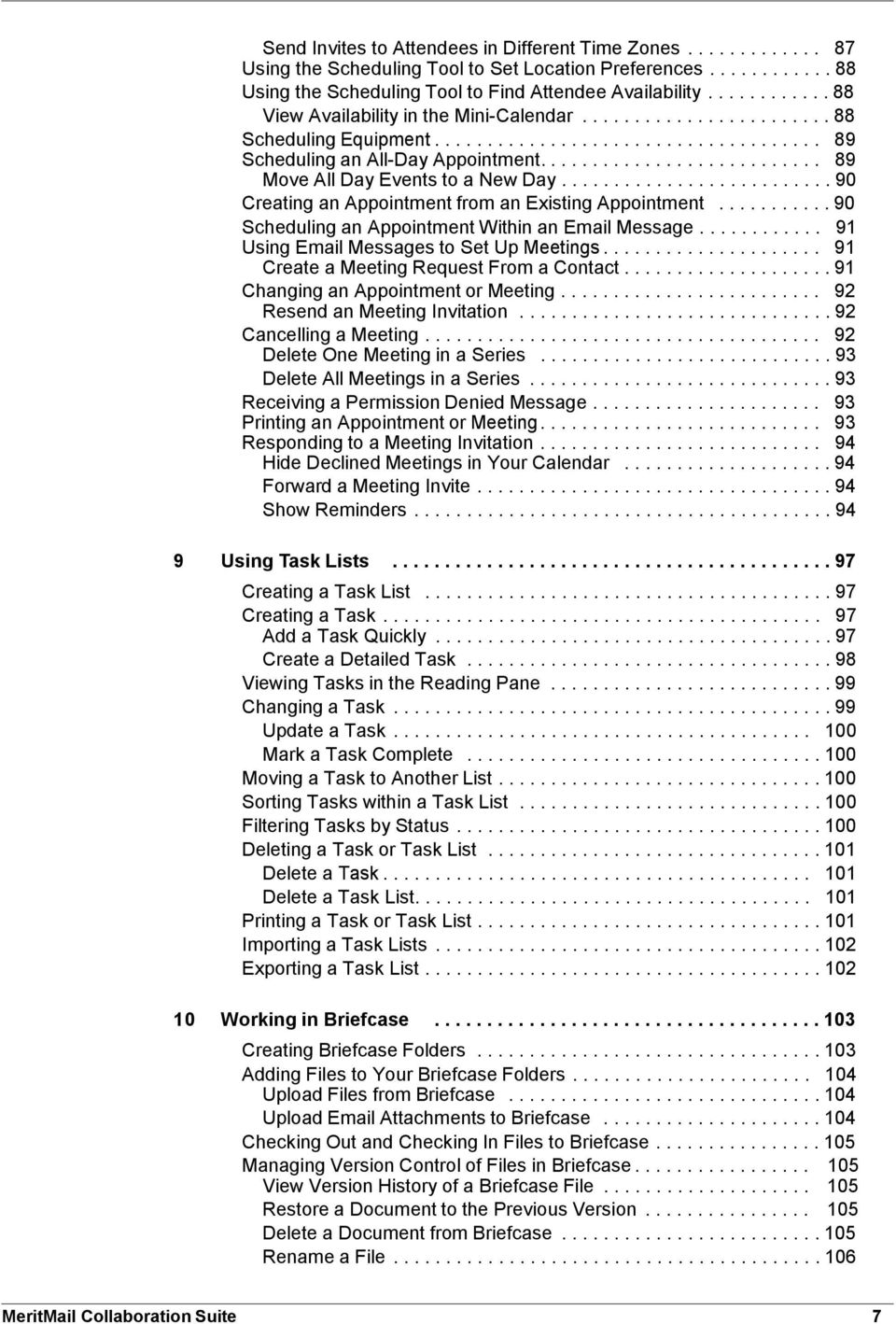
8 MeritMail User Guide Creating Documents in Briefcase Format with the Rich-text Editor Viewing Files in Briefcase Working in Briefcase Open Files in Briefcase Move Files in Briefcase Tag a File in Briefcase Sending Files from Your Briefcase Send an with a Link to a File Send a File as an Attachment Sharing Your Account Folders Accessing Privileges Roles for Internal Users Type of Items to Share Share Mail Folders Share Address Books Share Calendars Share Task List Folders Sharing a Folder Changing User Access to a Shared Folder Removing User Access to a Shared Folder Accepting an Invitation to Share Items Finding Items Shared With You Managing Your Shared Items Share a Folder from the Preferences Sharing Page Change Access From the Sharing Preferences Page Sharing with a Distribution List Searching Your Account Finding an Item with Quick Search Perform a Quick Search Performing an Advanced Search Search Filters You Can Use Basic Filters Advanced Filters Searching Syntax Searching with Key Words Using * as a Wildcard in Search Setting Search Folders and Items Preferences Displaying Search String Saving a Search Query Searching for Messages Sent To or From the Sender Search From Messages that You Received Use Advanced Search Searching for Messages Sent To or From the Recipient Search Sent and Draft Folders Use Advanced Search Search Examples Search for a specific type of attachment Search for a contact from a specific company Search for an item that was tagged Search by a date range MeritMail Collaboration Suite
9 Search for mail across all folders Understanding Advanced Search Query Language Search Language Structure Multiple Search Terms MeritMail Collaboration Suite 9
10 MeritMail User Guide X MeritMail Collaboration Suite

11 1 Setting Up Your Account The MeritMail Web Client is a full-featured messaging and collaboration application that offers reliable, , address books, calendaring, task lists, and Web document authoring capabilities. Note: Your account might not include all the features described in this guide. Check with your administrator to see which features are available. Using Advanced and Standard Versions MeritMail has two versions. The Advanced version offers the full set of Web collaboration features. This is usually the default setting. It works with most current browsers and faster Internet connections. If you have a slow Internet connection or prefer HTML-based messaging, you can use the Standard version, which has many of the same features. This user guide describes how to use the advanced version. Many of the same features are available for the standard version, but might not be accessed as described in this guide. The differences between the advanced and standard versions are summarized in Appendix A: Standard MeritMail Web Client. Refer to the Help in MeritMail for more information about these features. Signing In and Signing Out You must use a browser to run MeritMail. Not all browsers are supported, so check with your administrator. When you Sign In to MeritMail, you enter your name and password and select the client version to use. You can select use the Default client, or change the client version. You can choose to stay signed in for the day, even if the browser closes by selecting the Remember Me option. If you leave your web client open but do not access your mailbox for a period of time, your session might time out, and you need to sign back in. MeritMail Collaboration Suite 11
12 MeritMail User Guide Sign In 1. Open a browser window and enter the URL provided by your MeritMail administrator. For example: 2. When the Sign In screen appears, type your username. You might be required to type your full address as the username (for example, [email protected]) and your password. 3. To stay signed in until the session expires or you sign out, select Remember me. 4. If you do not want to use your default client, you can change the version. 5. Click Sign In. Sign Out To prevent others from having access to your account, always sign out when you are not using your computer. If you browse to a different site without signing out first, your session might sign out automatically when it reaches the specified timeout. In the top-right corner, click the arrow next to your name and select Sign out. Choose a Default Client Version You can set the default client version of MeritMail at sign in. You can always switch to a different client version at sign in. 1. Go to the Preferences>General page. 2. In the Sign in Options>Sign in using section, select how you want to sign in. Advanced. Offers the full set of Web collaboration features. The advanced client works best with newer browsers and faster Internet connections. Standard. Recommended when Internet connections are slow or when using older browsers. 3. Click Save. The next time you sign in, your selection appears as the default. If Your Session Expires Your system might log you out if your session is inactive for a preconfigured period of time. 12 MeritMail Collaboration Suite
13 Setting Up Your Account Your administrator might also set a maximum amount of time that you can be logged in, regardless of whether any activity occurs. If you are automatically logged out, simply log in again and continue working. Changing Your Password You can change your password. If you have trouble changing your password or have forgotten your password, or if the Password option is not displayed, contact your administrator. 1. Go to the Preferences>General page. 2. In the Sign in Options>Password, click Change Password. 3. Enter your new password and click Change password. 4. Click Save. Navigating the MeritMail Web Client When you sign in, you see a screen view similar to the one below. This view is the Mail view. The view changes when you use another application, such as Address Book or Calendar. MeritMail Collaboration Suite 13

14 MeritMail User Guide Option Window header Application tabs Overview pane Mini-calendar Toolbar Content pane Reading pane Search bar Description The Window header displays: Search box User Name under which you are logged in. From the drop-down menu of your user name you can access product help, new features, about, change password, and sign out features. The applications that you can access are listed in the tabs on this row, such as Mail or Calendar applications. The Overview pane displays: Folders including system folders (Inbox, Sent, Draft, Junk (and Trash) as well as customer folders you created Searches search queries that you created and saved for future use Tags any tags you have created. Click on a tag to quickly see all messages that are tagged with that tag. Zimlets links that may have been created to integrate with third-party applications from within your mailbox. When you are in the Calendar application, the Overview pane displays your calendar list and Zimlets. The mini-calendar is optional. You can disable the mini-calendar using the Preferences>Calendar page. The toolbar shows actions available for the application you are currently using. The Content pane area changes depending on what application is in use. In the Inbox view, it displays all messages or conversations in your Inbox. messages are displayed in the Reading pane. Search options, including the Advanced Search feature, are displayed in this area. You can also save searches from here. 14 MeritMail Collaboration Suite

15 Setting Up Your Account Use Keyboard Shortcuts Many MeritMail functions and commands have keyboard shortcuts. To view a list of shortcuts while working in your mailbox, press Ctrl+Q. If you want to leave the shortcut window open while you work in your account, click New Window. To print the list, go to Preferences>Shortcuts and click Print in the top-right corner. Use Browser Tools Use your browser's Back button to return you to the previous page you were viewing. You can also use the Forward button. Do not use the browser's Reload or Refresh button. Clicking Reload or Refresh restarts your session. Get Help Passing your mouse cursor over items, such as command buttons, conversations, or mail addresses in message headers, displays a description about the item. Personalizing Your Account You can use the actions in this section to personalize your account. Most options are set on the Preferences>General page. Change the Theme A theme is a color scheme that is used in the appearance of MeritMail. There are different themes available which you can select in your Preferences settings. 1. Go to the Preferences>General page. 2. In the Sign in Options>Theme section, select the theme you want to use. 3. Click Save. Change the Language You can change the language used to display text. 1. Go to the Preferences>General page. 2. In the Sign in Options>Language section, select a language to use. 3. Click Save. MeritMail Collaboration Suite 15

16 MeritMail User Guide Change Text Direction You can change the direction of your text from left to right, or right to left. 1. Go to the Preferences>General page. 2. In the Sign in Options>Compose Direction section, select Left to Right or Right to Left. 3. To switch the text direction from the toolbar, select Show direction buttons in compose toolbar. 4. Click Save. When you change the text direction, when you click Save a warning displays asking if you want to reload your account now to display the new font, or to display the new font the next time you sign in. Change Font and Size You can change the typeface and size for the text and font size in your view of MeritMail. 1. Go to the Preferences>General page. 2. In the Sign in Options>Font drop-down menu, select the font. 3. Click Save. Move the Reading Pane You can change the display to a three-pane view, with the Overview pane on the left, the Content pane in the center, and the Reading pane on the right. On the toolbar, click View and select the reading pane to display and where. Change the Pane Size For split-pane windows, such as the Conversation view, you can increase or decrease the size of the upper and lower panes. Click and drag on the bar separating the panes up or down. Change Your Default Time Zone In the advanced client, the time zone setting on your computer is used as the time stamp for received messages and calendar activities. In the standard client, the time zone setting is used to localize the time for received messages and calendar activities. The time zone for your account using the standard client can be different from your computer time zone. 1. Go to the Preferences>General page. 16 MeritMail Collaboration Suite
17 Setting Up Your Account 2. In the Sign in Options>Default Timezone drop-down menu select the time zone you want to use. 3. Click Save. Accessing External Accounts Instead of logging on to each of your external accounts, you can retrieve messages from your MeritMail account. You can also create a persona to use when you reply to or forward a message received from the external account. Note: Messages from your external account are not automatically received in your MeritMail account. Click the Refresh icon on the toolbar to get the latest messages. Add an External Account 1. Go to the Preferences>Accounts page. 2. Click Add External Account. 3. In the External Account Settings section, enter the address of the external account and add a name in the Account Name text box to identify the account. 4. Select the type of account: POP or IMAP. 5. In the Username of Account text box, enter the name associated with this account. Sometimes your username is the part of your address before and other times it is your full address. 6. In the server text box, enter the name for your external account s server. 7. In the Password text box, enter the password you use to sign in to the external account. To see that the password you typed is correct, select Show password. 8. If your service provider uses a different port than the default, change it in the Advanced Settings area. If you use a secure connection, enable Use an encrypted connection (SSL) when accessing this server. Your provider should let you know if they do not use a standard IMAP (143) or POP (110) port. 9. Click Test Settings to verify the information. 10. Select where to download the messages. MeritMail Collaboration Suite 17

18 MeritMail User Guide 11. To delete messages from the external account after you receive them in your MeritMail account, select Delete messages on the server after downloading them. 12. Type the name to appear in the From field of your outgoing messages (for example, John). This is the name that is shown before your address. 13. To direct replies to messages from this persona to a name and address different from the one you configured in From: a. Select Set the Reply-to field of messages to b. Enter the name in the text box. 14. (Optional) To associate a signature with the persona, click Manage your Signatures. 15. Click Save. If you set up a POP account, go to the Preferences>Mail page to set up how messages in that account should be downloaded to your MeritMail account. Set Up POP Behavior for Your Account If you set up an external POP account, you can configure the POP behavior when messages are downloaded to your account. 1. Go to the Preferences>Mail page. 2. In the Access from Other Mail Clients section, select how to handle messages. Option Message Downloads Incoming Junk Messages Incoming Deleted Messages Description Select whether to download all mail saved in your POP account to your MeritMail account or only new mail received since you set up the access to the external account. Select if you want messages sent to your POP account Junk folder sent to your MeritMail account. The messages are added to your POP account folder. Select how to save messages you deleted in your POP account in your MeritMail account. 3. Click Save. 18 MeritMail Collaboration Suite

19 2 Managing Your This chapter describes how to customize your mailbox and how to handle messages you receive. Customizing Your Mailbox Initial View In your Preferences Mail page, Default Mail Search specifies the initial view when you log into your mailbox. The default search is your Inbox folder. Therefore, when you sign in, the results of your Inbox display. You can change this to have another folder, tag, or a saved search displayed when you first open the web client. 1. Go to the Preferences>Mail page. 2. In the Displaying Messages>Default Mail Search text box specify which messages are displayed when you open your mailbox. Enter the search keyword, followed by a : and folder, tag, or a saved search name. The following table lists some examples to enter in the text box. is:unread tag:<tagname> in:<foldername> To display only unread messages To display messages that are tagged with specific tags. For example, to display only messages marked with the ToDo tag, type tag:todo To display messages that are sent to a specific folder via an filter Note: Use quotes if the folder or tag is more than one word. For example in: Unread 3. Click Save. View Messages by Conversation In the Conversation view your messages are grouped to make it easier to follow the thread of an exchange. A conversation thread begins when you send or receive an and then send or receive subsequent replies and MeritMail Collaboration Suite 19

20 MeritMail User Guide Using Zimlets forwards based on the original . The subject displays only once in your Inbox, and the number of messages in the conversation is shown. Conversations containing unread messages are shown in bold with a blue dot to the left of the sender s name. Conversations can span folders. For example, one could be in your Inbox, another in your Sent folder, and others in another folder. If you move a conversation from one folder to another, all messages within that conversation are also moved to that folder. Messages in the Sent folder and in the Trash folder are not moved. To create a new conversation thread, you must create a new message, not reply to or forward an existing message. Change the Message View messages in your mailbox can be organized by the date a message is received and by Conversation. 1. On the Mail tab toolbar, click the View drop-down menu. 2. Select either By Conversation or By Message. Zimlets are add-on applications that enhance the functionality of your account. Several preconfigured Zimlets are included when MeritMail is installed. You can enable optional Zimlets from the Zimlet page. If you need more information about Zimlets and managing them, see your system administrator. Enable or Disable a Zimlet 1. Go to Preferences>Zimlets page. 2. Choose Zimlets that you want to enable or disable. 3. Click Save. Using A Reading Pane You can use the Reading Pane to preview messages in your Inbox and other folders. If you have the Reading Pane on, when you click on an message, the message displays in the Reading Pane and the message is marked as read. To adjust the size of the Reading Pane, place your pointer on the divider bar and drag the bar. 20 MeritMail Collaboration Suite

21 Managing Your Turn Reading Pane On or Off The Reading Pane lets you read messages from your Inbox without opening the . Depending on your view, the Reading Pane can be at the bottom or on the right, or turned off. 1. On the Mail tab toolbar, click the View drop-down menu. 2. Select the Reading Pane option. Set the Reading Pane for Marked as Read Behavior You can also select whether messages you view in the Reading Pane are marked as read or not marked as read. 1. Go to the Preferences>Mail page. 2. In the Displaying Messages>Reading Pane section, select how messages are handled when the message is selected. 3. Click Save. Changing How Often Your Account Checks for New Mail You can set preferences for receive new messages including how often you receive messages and whether you are notified when you receive new messages. Your account is updated with new messages based on the polling interval set up in the mail preferences Check New Mail drop-down menu. The default is every five minutes. If you are expecting an message, you can click the refresh icon on the right side of the toolbar any time to receive new immediately. 1. Go to the Preferences>Mail page. 2. In the Displaying Messages>Check New Mail drop-down menu select how often to check for new mail. If you select Manually, you must click the reload icon to get new Click Save. Setting Desktop Alerts For New Messages You can set up desktop alerts for new notification. To receive alerts, your mailbox must be opened. 1. Go to the Preferences>Mail page. 2. In the Receiving Messages>Message Arrival section, select how you want to be notified when new message arrive. Select any of these options. MeritMail Collaboration Suite 21
22 MeritMail User Guide Option Play a sound Highlight the Mail tab Flash the browser title Show a popup notification Description You are notified by a beep. If you have your volume set to mute, you do not hear a sound. For this to work, you must have either QuickTime or Windows MediaCenter installed. The Mail tab is highlighted if you are not working in the Mail tab at the time. Browser flashes until you open the Mail tab Information about the message displays. You must have Yahoo!BrowserPlus installed. To get a copy, go to browserplus.yahoo.com/ Moving Less Important Mail Out of the Inbox You can set up the Activity Stream filter to have messages that are less important, such as newsletters and social update communications, delivered to the Activity Stream folder instead of your Inbox. The Activity Stream Folder is added to your personal folders list in the Overview pane. 1. Click the gear icon in the Folders heading in the Navigation pane and select Activity Stream. You can also set this up from the Preferences>Filter page, Activity Stream Settings link. 2. In the Activity Stream dialog box, select Enable moving messages into Activity Stream. 3. Select the type of messages to move. You can move the following type of messages: Messages where your address is not in the To or in the To or Cc field Messages from people not in your address book Messages sent to a distribution list that you are a member of Commercial mass marketing and bulk mail messages 4. Click OK. 5. In the information box that opens click Yes. If you want to set more advanced filtering for messages delivered to the Activity Stream folder, see the Working with Filters chapter. 22 MeritMail Collaboration Suite
23 Managing Your Automatically Forwarding Messages You Receive You can configure your preferences to automatically forward a messages you receive to another account. 1. Go to the Preferences>Mail page. 2. In the Receiving Messages>Message Arrival section, Forward a copy to: text box enter the address where messages should be sent. 3. If do not want the messages saved in your mailbox, select Don t keep a local copy of the message. 4. Click Save. Receiving New Mail Notification to Another Address You can configure your preferences to notify you at another address when you receive an message to your MeritMail mailbox. This feature might be useful if you do not receive a lot of to this account, but when you do receive , it's important enough to require a timely response. 1. Go to the Preferences>Mail page. 2. In the Receiving Messages>Message Arrival section, select Send a notification message to. 3. Enter the address in the text box. 4. Click Save. Marking Multiple Messages for the Same Action Use the check box on the Content pane to select one or more messages or conversations to perform the same action on. Note: If check boxes are not displayed in your Mail view, go to the Preferences>General page and in the Other section, select Settings. Selecting the box in the header automatically checks all the messages on the page. Delete more than one message at once 1. In the Mail Content pane, select the boxes for messages that you want to delete. 2. Right-click and select Delete. MeritMail Collaboration Suite 23
24 MeritMail User Guide Tag more than one message at once 1. In the Mail Content pane, select the boxes for messages that you want to tag with the same tag. 2. Right-click and select Tag Conversations. 3. Select the tag from your list or create a new tag. Print more than one message at once 1. In the Mail Content pane, select the boxes for messages that you want to print. 2. Right-click and select Print. 3. In the Print Box, click OK. All the messages are printed as one continuous file. Forward more than one message at once 1. In the Mail Content pane, select the boxes for messages that you want to forward. 2. Right-click and select Forward. A message compose page opens with the messages attached. 3. Complete the message and send. Moving Messages You can move messages or entire conversations from a folder. Drag and drop the item to the desired folder in the left-hand Overview pane. Right click the message and select Move. The Move Message dialog appears. If you are moving a few messages within a conversation, the conversation appears in both places. The Conversation Detail View window shows the new location of the message that was moved. Note: You can immediately undo the move. Click Undo that appears at the top of the page to move the message back to its original location. Sorting Messages in the Content Pane You can sort your messages in a folder by Subject, Size, Date, Attachment, Flag and Priority. You can only sort by one column at a time. In the Content pane header, right-click and select the sorting option. The header displays the sort order. 24 MeritMail Collaboration Suite
25 Managing Your Group Messages In each of your folders, you can group message by date or by size in ascending or descending order. When you group messages by date, messages display grouped by messages received today, yesterday, last week, two weeks ago, three weeks ago, last month and older. When you group messages by size, messages display grouped by enormous (messages larger than 5MB) and tiny (messages less than 10KB), Grouping message by size is a good way to manage your mailbox quota by finding the largest messages to remove from your account. 1. Select the folder and in the Content pane header right-click and select Group By. 2. Select to group by date or size. 3. Select the order that the messages should be displayed. Removing Spam Most filtering of unsolicited automated (also known as spam or junk mail) is handled by a spam filter before those messages reach your Inbox. that might possibly be junk mail, but is not certain to be junk, is placed in your Junk folder. You can review these messages and either move them out of the Junk folder or delete them. If you do not move or delete the messages, they are purged after a number of days as specified by your administrator. If you are receiving a large number of unwanted messages, contact your administrator. Reporting as spam helps your administrator to finetune spam filtering. Mark as Spam 1. Select the message to mark as junk. 2. On the toolbar, select Spam. You can also right-click the message and select Mark as Spam. The is moved to your Junk folder. Mark as Not Spam Sometimes messages that are not junk are placed in the Junk folder. You can move the messages to the appropriate folder. Drag the message to another folder. Right-click the message and select Mark as Not Spam. The selected message is moved to your Inbox. MeritMail Collaboration Suite 25
26 MeritMail User Guide Empty the Junk Folder The contents of the Junk folder are automatically purged after an administration-configured number of days. You can empty your Junk folder any time. 1. Right-click the Junk folder and select Empty Junk. 2. Click OK. Spam Mail Options If you notice that certain addresses are always being incorrectly added to your Inbox or Junk folder, you can identify those addresses to block or not block. 1. Go to the Preferences >Mail page. 2. Scroll to the Spam Mail Options section. 3. In the Block messages from text box, enter addresses that should always be treated as junk. You can list up to 100 addresses. 4. In the Allow messages from text box, enter addresses you trust that for some reason end up in your Junk folder, such as newsletters you subscribe to. Messages from these addresses are never blocked. You can list up to 100 addresses. 5. Click Save. Maintaining a Trusted Addresses List You can specify addresses from specific domains as trusted addresses so that embedded images in messages you receive from these addresses automatically display when you open the message. You can add up to 500 addresses to this list. 1. Go to the Preferences>Trusted Addresses page. 2. Enter the address or domain name in the text box. To include all addresses from a specific domain, type * before name. 3. Click Add. 4. Click Save. Finding the Origin of an Message When you receive a message and you want to see message transport history, you can right-click on a message and select Show Original. The text page displays header information along with the text of the body of the message. 26 MeritMail Collaboration Suite
27 Managing Your The header is sometimes referred to as the envelope information. The message header details the path the message took from the sender to the recipients. The header includes the IP addresses, dates, and spam flagging information. To find the origin of the message, right-click the message and select Show Original. A new window opens with the information displayed. Managing Your Account Quota To manage disk and resource usage, your administrator might enforce quotas to limit the amount of disk space your account can use. To display your mail quota and how much you have used, hover the mouse over your name on the toolbar. If you are over quota, the following things might happen: You receive an notification. Your interface displays a notification when you log in. sent to you might be returned to the sender, along with a notification that your mailbox is full. Reduce the Size of Your Mailbox Delete old messages that are no longer needed. Delete large file attachments to messages. Save the file attachments locally if you want to preserve them. Empty the Trash folder. Your administrator may have set up automatic purging of messages that are over a certain number of days old. Your administrator sets the policy for when messages are purged, how old they have to be, and which folders are purged. Folder Information If you hover your cursor over a folder, the number of messages in the folder and the size of the folder display. Setting Up an Out of Office Message You can create a message that automatically replies to people who send you messages when you are out of the office. If you want people who send you that our not in your domain to receive a different reply message, you can create a separate reply message. MeritMail Collaboration Suite 27
28 MeritMail User Guide The auto-reply message is sent to each recipient only once in a specified interval of days regardless of how many messages that person sends during that period. The default is seven days but the administrator can change this. 1. Go to the Preferences> Out of Office page. 2. Check Send auto-reply message. 3. In the Auto Reply Message text box, type the response to send while you are out of the office. 4. If you want this message enabled for a specific time frame, select Send auto-replies during the following time period and enter the start and end dates to send the auto-reply message. If you do not specify a specific time frame, auto-replies are sent until you select Do not send auto replies. 5. (Optional) If you want to send a different message to users outside of your domain, select External Senders. Select the type of external users to receive the second message. The default is anyone outside my domain. If you want contacts listed in your address books to receive the first message, in the drop-down menu select anyone outside my domain except those in address book. 6. Click Save. Subscribing to RSS Feeds You can subscribe to Web sites that provide your favorite RSS (Really Simple Syndication) and podcast feeds to send updated information directly to your mailbox. You must know the URL of the feed to set up the subscription. 1. Click the gear icon in the Folders heading and select New Folder. Note: You must create a separate folder for each RSS feed. 2. In the Name text box, type the name of the RSS feed folder. 3. Check Subscribe to RSS/ATOM feed. 4. Enter the URL for the feed in the URL field. 5. Select where to add the RSS feed folder in the folder menu. If you choose the root folder, the new folder is placed at the highest level in your folder view, which is the same level as your Inbox folder. 6. Click OK. The new folder appears in the Overview pane with the RSS feed icon. Your RSS data feed is automatically updated every 12 hours. Click Load Feed in the toolbar to update the content at any time. 28 MeritMail Collaboration Suite
29 Managing Your Note: RSS feeds you save count against your account quota. Reading Mail By default new messages are placed in your Inbox. If you have mail filter rules, new messages can appear in folders other than your Inbox. The number in parentheses next to each folder name indicates the number of unread messages within that folder. Read a Message in Conversation View 1. To read a message in the Conversation view double-click the conversation containing the message. The individual messages display in the Reading pane. To expand the message to see all the conversations, click Show quoted text at the end of the message. To collapse the conversation view so only the last message is displayed, click Hide quoted text at the end of the message. To collapse all messages to view only the sender s name and the snippet of the first line of the message, click the + icon in the message header. 2. To open the message, click the line that contains the message you want to read. If you have Reading Pane enabled, the message body appears in the Reading Pane. Otherwise, double-click the message. The message is displayed in the Content pane. Read a Message in Single Message View If the Reading Pane feature is enabled, click the message and read it in the Reading Pane. If the Reading Pane feature is not enabled, double-click the message. The message is displayed in the Content pane. Mark a Message or Conversation as Unread Conversations containing unread messages are shown in bold with a blue dot to the left of the sender s name. To mark an entire conversation as unread in your Inbox, click the blue dot. When the conversation is expanded, all messages within the conversation display as unread and with blue dot. MeritMail Collaboration Suite 29
30 MeritMail User Guide To mark an individual message in a conversation as unread, click the triangle to expand the conversation and click the dot next to the message you want to display as unread. The conversation displays in your Inbox as being unread, but when the conversation is expanded only the unread message displays with the blue dot. Opening Attachments to an Message messages can include attached files such as word processing documents, spreadsheets, text files, ZIP files, images, executable applications, or any other type of computer file that resides on the sender's computer network. Messages that contain attachments display a paper clip next to the subject. You can open any file attachment directly from your account, provided that you have the right application and the extension is not blocked by your system administrator. If the file type is one that is supported by the installed software on your computer, you can typically double-click the file and your computer automatically launches the right application for reading that file. Computer viruses are often spread via file attachments. Therefore, system administrators might block incoming containing certain types of attachments, often with the extension.exe or.zip as part of their filename. Computer viruses can spread through attachments. It is considered standard practice for system administrators to implement virus filtering for incoming mail as well as virus scanning for personal computers. However, there is always a chance that something could get through. In the case of viruses, the majority of them are activated when a file attachment containing the virus is opened or viewed. Many of these viruses have been known to spread themselves using entries in users' address books. Therefore, we recommend that you use care when opening file attachments, even from senders who appear to be known to you. View Attachments To view an attachment open the message: Click the name of the attachment to open the attachment (if you have the correct application available). Click Download to choose whether to open the file or save it on your computer. If you choose Save to Disk, a browser dialog box appears so that you can choose where to save the file. The file is still attached to the message until you remove it. 30 MeritMail Collaboration Suite
31 Managing Your Remove Attachments Attachments to your affect your quota. You may want to remove larger attachments from the message. Removing the attachment deletes the file from your mailbox. If you downloaded the file, you still have a copy. To remove an attachment open the message and click Remove. Preview Attachments If you have the Preview option, you can quickly view the content of the attachment without having to download or open the attachment. To preview an attachment click Preview to open the attachment even if the application is not installed on your network. View Attachments as HTML You may have the feature to view attachments as HTML. This allows you to open an attachment even if the corresponding application is not installed. Click view as html to view the content of the file. This feature is set by your system administrator. Displaying Messages in HTML Format or Plain Text You can view messages in two formats, HTML or plain text. HTML messages can have text formatting, numbering, bullets, colored background, and links, which can make messages easier to read. Plain text messages can always be read by other clients. Plain text does not support any text formatting, styles, links or images. You can view a message in plain-text mode even if it contains HTML. The HTML tags are displayed in the body of the message in the plain text view. Set Message Display Format 1. Go to the Preferences>Mail page. 2. In the Displaying Messages>Display Mail, select either As HTML (when possible) or As Text. 3. Click Save. Turn Off Preference to Display Images in Messages When you display mail as HTML, images attached to a message are automatically displayed when you open the message. 1. To change this go the the Preferences>Mail page, Images and deselect Display pictures automatically in HTML Click Save. MeritMail Collaboration Suite 31
32 MeritMail User Guide How Address Bubbles Work Names in the address field display in an bubble rather than as text. The bubbles are more interactive than addresses displayed as text. The following actions are available when using bubbles for addresses. When addressing an , you can right-click on a bubble to display a menu of options, including Delete, Edit, Edit Contacts. When reading an message, you can right-click on a bubble to display a menu of options, including Add to Contacts, New , Advanced Search. You can left-click a single bubble and drag and drop it into another address field or select multiple bubbles and drag the addresses using the "rubber band" selection tool to move bubbles. "Rubber band" selecting is left clicking on the white space on the field and dragging a selection box across selected bubbles. The selected bubbles are highlighted in blue. You can now drag and drop them to another field. You can use CTRL+C to copy and CTRL+V to paste the address. You can tab or use the left/right arrow keys to navigate between bubbles. When autocomplete is used to select a distribution list, the bubble includes a + (plus) sign to identify the address as a distribution list. You can click the + to expand the list to display distribution list members. You can also click on an address in the list to send an individual to the selected addressee. Bubbles are enabled by default. You can enable or disable bubbles by going to the Preferences>General page, Other section. Returning Read Receipts Messages you receive from other MeritMail users can be marked to request a return receipt message to be sent back when you open your message. You can specify how to handle return receipt requests: 1. Go to the Preferences>Mail page, Receiving Messages section 2. In the Read Receipt section, select how you want read receipt requests to be handled. Option Never send a read receipt Always send a read receipt message Description When a message is received with a return read receipt request, the request is ignored. You are not informed of the request. This is the default. A return read receipt message is sent when you open an flagged for a return receipt. 32 MeritMail Collaboration Suite
33 Managing Your Option Ask me Description You are given the option to send a receipt when you open an flagged for a return receipt. 3. Click Save. Printing an Message The default font size used when a message is printed is 12 points. You can change this from the Preferences tab>general page. Note: Do not use the browser's File>Print feature. The page will not be wellformatted, and your message may be difficult to read. 1. Right-click on the message and select Print. The message opens in a new window. A standard print dialog appears. 2. Choose a printer. 3. Click OK. The message is sent to the selected printer. 4. Close the message window. Alternately, you can select Print from the Actions link on the toolbar. Print a conversation (all messages) 1. Right-click the conversation to be printed, and select Print. The conversation opens in a new window. A standard print dialog appears. 2. Choose a printer. 3. Click OK. The conversation is sent to the selected printer. 4. Close the conversation window. Alternately, you can select Print from the Actions link on the toolbar. Print one message in a conversation 1. Open the conversation and select the message to print. 2. At the end of the message, click the gear icon and select print. The message opens in a new window. A standard print dialog appears. 3. Choose a printer. 4. Click OK. The message is sent to the selected printer. 5. Close the message window. MeritMail Collaboration Suite 33
34 MeritMail User Guide Deleting a Message You can delete specific messages or a complete conversation thread. Right-click the message or conversation to delete and select Delete. Deleted messages are moved to your Trash folder. You can recover files from Trash within 30 days of deleting them. After 30 days, the items are permanently deleted. To permanently delete a message, click Shift>Delete. Messages are permanently deleted from your account. Empty Your Trash Folder The Trash folder is available for each application in your account. When you open the Trash folder from an application such as Mail, only items for that application are displayed. But when you select Empty Trash from any of your applications, items from all applications are deleted. You can empty your Trash folder any time. Right-click on the Trash folder and select Empty Trash. All messages are deleted. Items deleted from Trash are removed from your account and your account quota is updated. Note: Messages might be automatically purged if Trash purge policies are configured. Recover Items Purged from Trash If Recover Deleted Items displays when you right-click the Trash folder, you have the ability to recover messages you deleted from Trash. 1. Right-click on the Mail Trash folder and select Recover Deleted Items. 2. Select one or more messages to recover. Use the Search text box to find a specific item to recover. 3. Click the Folder icon below the Search text box and select the destination folder or create a new folder. 4. Click OK. Assigning Retention Policies to Folders If your organization notifies you to apply an message retention policy to your folders, you set the retention policy for each folder. You do not set a 34 MeritMail Collaboration Suite
35 Managing Your retention policy on the Junk or Trash folders. You can also set your own custom policy for a folder. Two options can be set up: Message Retention. When Enable Message Retention is selected, when you select to delete a message in the folder with a receive or sent date within the range configured, a warning displays stating that the message is within the folder s retention period to remind you not to delete the message. Message Disposal. Messages in the folder that are older than the time configured are automatically deleted. You are are not notified. 1. In the Navigation pane, right-click on a mail folder and select Edit Properties. 2. Click the Retention tab. 3. To set the retention policy, select Enable Message Retention. 4. In the Retention Range drop down list, select which retention policy to apply. If you are setting a custom policy, in the text box enter the number of years, months, weeks or days and select the period from the drop-down menu. 5. To set when messages should be deleted from the folder, select Enable Message Disposal. 6. In the Disposal Threshold drop down list, select which policy to apply. If you are setting a custom policy, in the text box enter the number of years, months, weeks or days and select the period from the drop-down menu. 7. Click OK. MeritMail Collaboration Suite 35
36 MeritMail User Guide 36 MeritMail Collaboration Suite
37 3 Composing and Sending You can compose and send your messages as soon as you write them, compose a draft and return to it later to finish and send, or compose the message and specify a time in the future to send the message. You can customize your options for composing messages in your Preferences>Mail page. Composing a New Message Depending on your mail preferences, when you click New Message either a Compose tab appears in the Application toolbar or the compose page opens in a separate window. 1. In the Mail tab click New Message. Depending on your preferences, the blank compose page opens in a new tab or opens as a separate compose window. 2. In the To text box, enter the addresses of the person or persons to whom you are sending the message. Either type the address or click To to search through your contacts or the global address list. Note: You can drag and drop the address bubble in the text box to the Cc or Bcc text boxes, and you can copy the address bubble by clicking CTRL+c. 3. If you have more than one identity (also known as a persona) configured, From is displayed above the To: field. Select the identity to use for this (Optional) In Options, click Signatures and select the signature that should be added to the message. 5. (Optional) To send a copy of the to other recipients (Cc) or to send a blind copy (Bcc) without the recipients knowledge, enter addresses in the Cc and Bcc fields. Note: You can send a message without an address in the To field if there is an address in either the Cc or Bcc field. MeritMail Collaboration Suite 37
38 MeritMail User Guide 6. In the Subject field, tell the recipient what the message is about. 7. Click Send to send the message. A copy of the message you sent is saved in your Sent folder. Addressing a Message The auto complete feature suggests names as you type into the To, Cc, and Bcc fields in a new message. A list of possible addresses from your contacts in which either the first name, last name, or address starts with the text you typed is displayed. As you continue to type, the list of matching addresses becomes smaller as fewer matches are available. The list disappears if there are no matches. For example, to send an message to David Brinks, whose address is [email protected], when you type D, a list appears showing all possible matches, with the matching portions highlighted. In this case, it might display: Dale Edwards <[email protected]> David Brinks <[email protected]> Erica Dodd <[email protected]> When you add an a (Da) into the To field, the list would display: Dale Edwards <[email protected]> David Brinks <[email protected]> Use Automatic Address Completion To select a match from the list, you can click the match with the mouse or use one of the following keys to perform an action: The comma, semicolon, Return/Enter, and Tab keys all complete the first match in the list and place it in the field. ESC hides the list. The up and down arrow keys change the selection in the list. Moving the mouse cursor over the list also changes the selection. To select an address when composing an 1. Type enough characters until the contact you want is the first match. 2. Press a quick key, such as Enter or the semicolon. The address displays in the recipient field. Adding Attachments You can attach any file on your file system that you can find using Browse. 38 MeritMail Collaboration Suite
39 Composing and Sending You can open any file attachment directly from your mailbox, provided that you have the right application and the extension is not blocked by your administrator. If the file type is one that is supported by the installed software on your computer, you can typically double-click the file and your computer automatically launches the right application for reading that file. Computer viruses are often spread through file attachments. Therefore, system administrators might block incoming containing certain types of attachments, often with the extension.exe or.zip as part of their filename. If you send an message to someone whose system has been configured to block certain types of attachments, you might not receive any notification if the was blocked. Add an Attachment to a Message You can attach documents, spreadsheets, pictures, slide shows, and other types of files to an message. 1. Compose the message. 2. Below the Subject field, click Attach and select My Computer. 3. Select the files and click Open. The file names displays below the Subject text box. 4. Click Send to send the message and the attachments. Note: Recipients must have the appropriate software to open the file. Common file formats, such as text files, HTML files, and images such as GIF or JPEG files, can be opened in a variety of programs. Add Attachments Using Drag and Drop You can easily add an attachment to an message by dragging the file from a folder into your Select one or more files and hold down the cursor on the file(s) to be attached. 2. Drag the files to the message header area and release the cursor. The file names are displayed in the header. Removing an Attachment To remove an attachment, click the x in the attachment bubble. MeritMail Collaboration Suite 39
40 MeritMail User Guide Using Signatures Automatically You can include an automatic signature at the end of an . A signature can include your name and any additional text. If you are using an HTML editor, you can format your signature, add a link to a URL and add graphics. You can create more than one signature. For example, you can have a formal signature for s sent to customers and an informal signature for s sent to friends. If you create multiple identities (also known as personas), you can create different signatures and assign them to specific addresses. 1. Go to the Preferences>Signatures page. 2. In the Name text box, type a descriptive name to identify the signature. You can create multiple signatures, so using an identifiable name here is helpful. 3. (Optional) To format in plain text, click Format as HTML and select Format as Plain Text. 4. In the text box, type the signature text as you want it to appear. If you are using Format as HTML, you can add images and create links to your signature text. 5. In the Using Signatures section, select the default signature from the drop down menu to use with messages sent from your various accounts. 6. Select the placement of your signature in a message. Select Above included messages to add your signature at the end of your reply and before the included messages. Select Below included messages to add your signature at the end of the message. 7. Click Save. Using Other Account Identities When You Send an When you send , it is identified with an account. When your account is set up, your account name is your primary identity. However, you can create other identities called personas to manage different types of . For example, you can create one persona for your business and another for your personal . If you have more than one persona or added external accounts, when you send an you can select the account you want to use as the From address. 40 MeritMail Collaboration Suite
41 Composing and Sending Add Personas Creating different personas allows you to use multiple addresses from your mailbox. For example, you could use your primary account persona for your business correspondence, and create a new persona for your personal correspondence. 1. Go to the Preferences>Accounts page. Your default account and personal information is shown as the primary account. 2. Click Add Persona. The account name New Persona displays in the Account Name column and in the Persona Settings>Persona Name text box. 3. In the Persona Names text box enter a name to identity the persona to use in the From list when you are composing an . This name does not appear in the message. 4. In the Settings for Sent Messages section, specify the From information for this persona. a. In the From text box type the name that appears in the From field of your outgoing messages. This is the name that is shown before your address. b. In the drop-down menu next to the text box, select the address from which to send messages. If this field is not editable, you do not have additional external accounts identified. 5. To direct replies to messages from this persona to a name and address different from that which you configured in From. a. Select Set the Reply-to field of messages to. b. Enter the name in the text box. 6. (Optional) To associate a signature with the persona, click Signature. 7. To automatically use this persona when replying to messages sent to a specific address or when forwarding messages from that address: a. Select When replying or forwarding messages sent to. b. Type the address in the text box. If you are entering more than one address, separate the addresses with either a comma or a semi-colon. 8. To automatically use this persona when replying to messages in a specific folder or when forwarding messages from this folder: a. Select Replying to or forwarding messages in folder(s). b. Click the folder icon to select one or more folders from the list of existing folders or to create a new folder. c. If you are selecting more than one folder, separate the folder names with either a comma or a semi-colon. MeritMail Collaboration Suite 41
42 MeritMail User Guide 9. Click Save. Delegate Others to Send Messages on Your Behalf You can give other people permission to send messages on your behalf. When messages are sent on your behalf, the From address shows your name and the name of the person who is sending the message. This is not the same as sharing your Inbox with another person. The person who is sending a message on your behalf is working in his own account. When a new message is created, your name is selected from the From field drop-down menu as the From address. You can also give permission to people to send messages as you. The From address shows your name and address as the message sender, but the actual message is sent from the delegated person's Inbox. 1. Go to the Preferences>Accounts page. 2. In the Primary Account Settings, The following users have delegated authority to this account section, click Add Delegate. 3. Add the address of the person you are delegating permission. This must be an internal user address. 4. Check the permissions you want to give. 5. Click OK. An message is sent to the person letting him know that he has been granted delegate permissions. Sending on Behalf of Someone Else If you have been granted delegate permissions for another person, you can send messages on their behalf. The message's From address includes both your address and the person you are sending the message for. If you were given permission to send a message as that person, the person's address is in the menu. When you select this, your address is not included in the message. 1. In your Inbox, click New Message. 2. In the From field, select the name of the sender from the drop-down menu. 3. Compose and send the message. Customizing Your Options for Composing Messages From your preferences you can select to create simple plain text messages or create message with HTML styling, and you can set up signatures and personas that can be applied to messages you send. 42 MeritMail Collaboration Suite
43 Composing and Sending In addition to the options for composing messages, other options you can set up include return receipt requests, whether to compose messages in a new window and to require that your message are spell checked before they are sent. 1. Go to the Preferences>Mail page, Composing Messages section. 2. Select how you want your messages to be sent, As HTML or As Text. 3. If you select As HTML, in the drop down menus, select the Font style, Size, and Color. 4. In Settings, select the options for how you want to manage composing messages. Option Automatically save drafts of messages while you are composing Always request read receipt Reply/Forward using format of the original message Always compose in new window Mandatory spellcheck before sending a message Save a copy to Sent folder Description While you compose your message, a copy is periodically saved in your Draft folder. All messages you send request a return receipt message sent back to you when the recipient opens your message. When you set this as your default, you can change this for individual messages from the Options drop-down menu on the compose toolbar. Even if your default text editor is different from the message received, check this box to reply to the message in the same format as received. This is useful to make sure the recipient can get the message in the best format they can read. A separate compose window opens. You can view and navigate within your mailbox while the compose window is open. All messages are automatically spell checked before they are sent. This is enabled by default. You can deselect this option. 5. (Optional) Click Accounts Page to go to the Accounts preferences page and set up your personas. 6. (Optional) Click Manage your signatures..., to go to the Signatures Preferences page and add signatures that can be used when sending messages. 7. Click Save. MeritMail Collaboration Suite 43
44 MeritMail User Guide Using HTML to Compose Messages Messages created using the HTML editor can have text formatting, numbering, bullets, colored background, tables, and links. However, some clients do not accept messages formatted in HTML. You can change the editor for a specific message. Note: You do not need to know HTML to use the HTML editor. To change the format for the message that you are sending, under Options, select either Format As HTML or Format As Plain Text. Request a Return Receipt Message you send to other MeritMail users can be marked to request a return receipt when the recipient opens your message. However, the recipient must have the Return Receipt feature enabled. To set this as the default Go to the Preferences>Mail page, and in the Composing Messages section, select Always Request read receipt. To set this request per message Before sending the message, in the Options drop-down list, select Request Read Receipt. Save a Message as a Draft You can save a message to finish and send later. Click Save Draft. The message is saved in the Drafts folder. To retrieve a draft, open the Drafts folder and click on the message. When the message is sent, the message is removed from the Drafts folder. Mark the Priority Level of a Message You can indicate a message s level of importance. For example, if you have a request that needs to be replied to as soon as possible. Before you send the message, in the Priority drop-down menu in the message header, select the priority option, high, normal, or low. The recipient sees the message priority flag in their mailbox and in the message. Spell Check a Message You can use the spell check feature at any time to check your spelling. 44 MeritMail Collaboration Suite
45 Composing and Sending 1. On the toolbar, click the Abc link. Words in the message that are unknown to the spell checker are highlighted. 2. Right-click on a highlighted word. A drop-down menu displays suggested corrections. 3. Select the correct word. The word is highlighted in another color. 4. To accept your changes and close the spell checker, click Resume editing. Before you close the spell checker, you can change a corrected word back to the original spelling. Click on the highlighted word and select the initial spelling from the top of the pop-up. Adding Words to the Spell Dictionary Right-click on the correctly spelled word and click Add. You cannot remove words from your dictionary after they are added. You can also configure the spell check to ignore words, right-click on the word and click Ignore. Spell Check All Messages Before They are Sent 1. Go to Preferences>Mail>Compose. 2. Select the option Mandatory spellcheck before sending a message. 3. Click Save. Replying to Messages You can reply to the sender of a message or to the sender and all recipients. By default, when you reply to a message, the original message is included in the body, but the original attachments are not. You can also decide to prefix each response in the message to track the different replies. For example, each reply within the message is marked with an angle bracket (>). The most recent reply has one > before each line, the reply before that has two (>>), before that three (>>>): > Previous message > > Message before previous message > > > And so forth Reply to a Message 1. Select the you want to reply to. MeritMail Collaboration Suite 45
46 MeritMail User Guide 2. Click Reply or Reply to All in the toolbar. A new compose window is displayed with the address(es) in the header and the original message in the body. If you view message in the Conversation view, you can click reply at the bottom of the message 3. Type your reply. 4. Click Options on the toolbar and select an option if you want to change how the original message is included in the reply. 5. Click Send. Note: If you add your signature automatically to your messages, it is placed in the message according to your preference settings. Set Preferences for Replies To reply to the message in the same format it is received, select Reply/ Forward using format of the original message. This ensures that the recipient gets the message in the most readable format. 1. Go to the Preferences>Mail page, Composing Messages section. 2. To reply to the message in the same format it is received, select Reply/ Forward using format of the original message. 3. Select whether to include the original text in your reply message. If you are including the original message: Choose whether to mark the previous responses with a character or include the original details in the header (The To, From, and Subject fields). You can also include the original message as an attachment. If you want to prefix the previous responses, select either the angle bracket (>) or pipe ( ). 4. Click Save. Forwarding Messages You can forward an message to someone else. Forwarding a message includes all file attachments. Forward an Message 1. Select the you want to forward. 2. Click Forward on the toolbar. The text of the forwarded message appears in the body of the compose page, unless you have set your preferences to forward messages as attachments. 46 MeritMail Collaboration Suite
47 Composing and Sending 3. Enter addressees. 4. Click Send. Forward a Message as the Originator You can forward an existing message as if you are the originator of the message. The forwarded notice is not added to the subject field and the header information shows you are the originator. 1. Right-click on the message and select Edit as New. 2. Address the message, remove existing address if necessary. 3. Click Send. Forward a Message as a Redirected Message Redirecting a message lets you send an message you received as if the original author sent the message. Redirect a message instead of forwarding it makes it easier for the recipient to reply to the original sender. 1. Right-click on the message and select Redirect. 2. In the Redirect text box, enter the recipients addresses. 3. Click OK. Set Preferences for Forwarded When you forward an you can choose how to handle the original text when forwarding an message. 1. Go to the Preferences>Mail page, Composing Messages section. 2. If you want to prefix the original message, select either the angle bracket (>) or pipe ( ) Note: If you have selected a prefix for reply messages, you must use the same prefix for both replies and forwarded messages. Undeliverable Sometimes a message cannot be delivered. One reason is because the address is not valid. In this case, verify that you have the correct address. Other causes can be that the recipient s mailbox is full or the recipient s mail system is having problems. If a message is rejected, it bounces back to you with a message stating why it could not be delivered. If you can resolve the problem, try resending the . MeritMail Collaboration Suite 47
48 MeritMail User Guide If you continue to have the following problems, contact your administrator. Every message you send is rejected. bounces back with user unknown or bad address messages for addresses that you have successfully used from your corporate address list. You receive bounce messages for you did not send. 48 MeritMail Collaboration Suite
49 4 Working with Filters You can define filters to manage incoming and outgoing messages, including Calendar-related messages and Activity Streams. A filter consists of one or more conditions and one or more actions. You can base a condition on a subject, messages from a specific person, or messages for a particular date. If the message matches the conditions, the specified actions are performed. You can create filters to do the following: Sort incoming messages into folders. For example, all messages from your supervisor are automatically moved into your Management Directives folder on receipt. Tag messages. For example, messages from the corporate-events mailing list are marked with the Events tag. Forward or discard . For example, all messages received from a particular address are moved to the Trash folder. Flag messages for importance. Filters are applied in the order that they are listed. You can change the order at any time. Note: An message is evaluated by each active filter, unless you specify that a message is treated only by the first filter that it matches. Usually, you do not want more than one filter applied to a message after the first match because the message can undergo multiple, perhaps contradictory, actions. Setting Up Filter Rules A filter rule consists of one or more conditions and one or more actions. If the message matches the conditions, the specified actions are performed. You can also set Activity Stream rules. Activity Stream rules move messages out of your Inbox into an Activity Stream folder that you can check at your convenience. For more information about Activity Stream rules, see Set Up an Activity Stream Filter on page 55. MeritMail Collaboration Suite 49
50 MeritMail User Guide Filter Conditions A filter can contain one or more conditions. For example, if someone sends you messages from more than one address and you want to direct all messages from the person into one folder, you can create one filter that has two conditions, one for each address, and one action to move the messages to the same folder. The order of the conditions is not important. You can choose whether the message must match all conditions or just meet any one of the listed conditions. You can also use a negative condition. For example, you can filter an message that does not contain a particular word. Filter conditions are not case-sensitive. You can base a filter condition on the following: Specific addresses in the From, To, or Cc fields messages that are under or over a specific size Dates Presence or absence of file attachments Words in the message subject or body Calendar invitation messages that are marked by importance Filtering Using Any Versus All You can group conditions within a filter rule using the terms any or all. The use of these terms is similar to the "AND" versus "OR" type searches described under the Search feature, with any being OR and all being AND. If you choose any when defining conditions for a new filter rule, then a message that meets any one of the conditions is considered a match. However, if you choose all, every condition specified in that filter rule must apply in order for that message to match the filter. Filtering Using Contains, Matches, and Is Options Three of the comparison methods for filter conditions are Contains, Matches pattern, and Matches Exactly. These options appear for some items such as the subject line. Other comparison methods are available depending on your conditions selections. Contains means that the specified line must contain, somewhere within it, the specified string. For example, specifying that the subject line contains "bananas" would match both "Cooking with bananas" and "Bananas for breakfast". Matches pattern means that the specified line must match the specified string, which includes wildcards. For example, specifying " bana*" would match "banana" and "banana tree but not "free bananas". 50 MeritMail Collaboration Suite
51 Working with Filters Is means that the specified line must exactly match the specified string, with no wildcards or substitutions. For example, specifying that the subject line must match "bananas" would only match "bananas" and not "Banana", "My bananas", or "Bananas?" Filter Rule Actions A filter rule can contain one or more actions. If the message matches the specified conditions, all actions are applied in the order in which they appear in the filter. Creating a Filter Examples of filter rule actions are: Keep the message in your Inbox Move the message to a specific folder Tag or flag the message Discard the message before it reaches your Inbox Forward or redirect the message to a specified address You can define filters to manage incoming and outgoing messages. A filter consists of one or more conditions and one or more actions. If the message matches the conditions, the specified actions are performed. 1. Go to the Preferences>Filters page. 2. Click either Incoming Message Filters or Outgoing Message Filters. 3. Select New Filter. 4. In the Filter Name text box, enter a unique name for the filter. 5. To make the filter active, check the Active box in the upper right corner. 6. Choose whether the message must meet any or all of the listed conditions. any means that if a message meets any one of the conditions, the action is performed. all means that the message must meet all conditions for the action to be performed. 7. From the drop-down menu, select which part of the message to apply to the filter, such as Subject or Date. 8. Choose how the item must match, such as contains or does not contain. 9. Enter or select the information to compare against, such as the date, address, or phrase. Conditions are not case-sensitive. MeritMail Collaboration Suite 51
52 MeritMail User Guide For example, if you selected Subject and contains and entered Staff Meeting, all messages containing Staff Meeting are filtered. The filter also catches Staff Meetings or Today s Staff Meeting, because you chose contains and not matches exactly. In this example, we use roadmap. 10. To add more conditions, click the + button and repeat the above steps. The order of the conditions does not matter. 11. Under Perform the following actions, choose an action from the drop-down menu, such as Move into folder. Depending on the action that you choose, you might need to browse to locate a folder or tag name, or enter an address to redirect a message. 12. To add more actions, click the + button and repeat the above step. The actions are applied in the order in which they are listed. 13. If you want more than one filter to be applied to a message, uncheck Do not process additional filters. Note: Usually, you do not want more than one filter applied to a message after the first match because the message can undergo multiple, perhaps contradictory, actions. 14. When you are done creating the filter, click OK. Create a Filter from an Message You can create a filter based on an message in your Inbox. The filter information is extracted from the message. You can then modify the conditions and actions. 1. Right-click an message and choose New Filter. The Edit Filter dialog box appears populated with the information from the message. 2. In the Filter Name text box, type a unique name for the filter. 3. Change the conditions and actions as necessary using the drop-down menus. 4. Click OK. Create a Filter for Calendar Invitations You can create a filter to organize Calendar invitations that you receive and send. 1. Go to the Preferences>Filters page. 2. Click either Incoming Message Filters or Outgoing Message Filters. 52 MeritMail Collaboration Suite
53 Working with Filters 3. Select New Filter. 4. In the Filter Name text box, enter a unique name for the filter. 5. To make the filter active, check the Active box in the upper right corner. 6. In the Subject drop-down menu, select Calendar. 7. Select an invite is replied/not reply or invite is requested/not requested condition from the drop-down menu. 8. To add more conditions, click the + button and repeat the above steps. The order of the conditions does not matter. 9. Under Perform the following actions, choose an action from the drop-down menu. Depending on the action that you choose, you might need to browse to locate a folder or tag name. 10. To add more actions, click the + button and repeat the above step. The actions are applied in the order in which they are listed. 11. If you want more than one filter to be applied to a message, uncheck Do not process additional filters. Note: Usually, you do not want more than one filter applied to a message after the first match because the message can undergo multiple, perhaps contradictory, actions. 12. Click OK. Viewing Filters View Existing Filters You can view the filters that you have defined and their status. 1. Go to the Preferences>Filters page. 2. Double-click a filter to view information about it. Change Filter Order Active filters are applied in the order that they are listed. You can change the order. 1. Go to the Preferences>Filters page. 2. Use the Move Up and Move Down buttons to change the order. MeritMail Collaboration Suite 53
54 MeritMail User Guide Applying a Filter You can apply a filter to messages that you have already received. Using a filter is a quick way to organize by moving messages into folders. 1. Go to the Preferences>Filters page. 2. Click Run Filter. 3. Select the folders to which to apply the filter. 4. Click OK. Editing a Filter A Filter run complete dialog displays after the filter has completed. The messages stated how many messages were processed and how many were affected. Apply a Filter to a Contact 1. Go to the Address Book>Contacts page and select a contact. 2. In the contact s details in the right pane, right click the contact s address. 3. Select Add to Filter and select the filter or create a new filter. You can modify an existing filter. 1. Go to the Preferences>Filters page. 2. Select the filter that you want to change. 3. Click Edit Filter. 4. Change the conditions and actions as necessary using the drop-down menus. 5. Click OK. Making a Filter Active or Inactive You can turn a filter on or off. If a filter is inactive, it is ignored. Making a filter inactive allows you to keep it for later use rather than deleting it. 1. Go to the Preferences>Filters page. 2. Click Edit Filter. 3. Uncheck the Active box in the upper right corner to turn the filter off. 4. Click OK. 54 MeritMail Collaboration Suite
55 Working with Filters Setting Up an Activity Stream Filter You can set rules using the Activity Stream filter to move messages out of your Inbox and into an Activity Stream folder. This allows you to read the filtered messages at your convenience. For example, you might want to automatically filter the following types of messages into the Activity Stream folder: Messages sent through distribution lists to which you are subscribed Commercial mass marketing and bulk mail messages Messages where your address is not in the To or in the To or Cc field Messages from people not in your address book Set Up an Activity Stream Filter 1. Go to the Preferences>Filters page. 2. Click Activity Stream Settings. 3. Select Enable moving messages into Activity Stream. 4. Select the rules you want to apply and click Save. 5. To configure a more detailed filter, click Advanced Controls. For more information about how to edit this filter, see Creating a Filter on page 51 Click OK. The Activity Stream filter displays in your Active Filters list. Move Messages Into the Activity Stream Folder If you receive an message in your Inbox, and you want to filter the message and similar messages to the Activity Stream folder, drag and drop the message into the Activity Stream folder. This gives you the opportunity to create a new Activity Stream rule to route similar messages to the Activity Stream folder in the future. 1. In your Inbox, select the message you want to move. 2. Drag and drop the message into the Activity Stream folder. 3. In the Activity Stream Rules dialog, select properties to create a rule to apply to similar messages. This routes similar messages to the Activity Stream folder in the future. 4. Click Save. Move Messages Out of the Activity Stream Folder If you have messages routed to the Activity Stream folder that you do not want to filter, and you do not want similar messages filtered in the future, you can create an exception. Drag and drop the message from the Activity MeritMail Collaboration Suite 55
56 MeritMail User Guide Stream folder to your Inbox. An Activity Stream Exception is created and you are given the opportunity to create a rule for similar messages to no longer be filtered to the Activity Stream folder. 1. Select a message in your Activity Stream folder. 2. Drag and drop the message into your Inbox. In the Activity Stream Exceptions dialog, select properties to create a rule to prevent similar messages from being routed into the Activity Stream folder in the future. 3. Click Save. Filtering Using Wildcards You can use wildcards in comparisons that use the "Matches pattern" comparison operator. The two wildcard characters are * and? Asterisk (*) The asterisk * is a placeholder for "zero or more characters of any type". Example subject-line search string: banana*float With Matches: Subject lines such as " bananafloat", "bananas", "banana-leaf casserole float" but not "super-banana-float" Example subject-line search string: w*bandanna With Matches: Subject lines such as "white bandanna" or "whose bandanna" but not "whose bandanna is this?" Question mark (?) The question mark is a placeholder for "exactly one character". Example subject-line search string: banana?boat With Matches: Subject lines such as " bananasboat", "banana-boat", "banana!boat", or "banana boat" Escape character is Slash: \ There may be times that you will want to specify an exact match on a string that contains characters that normally are considered wildcards. For example, you might want to specify a match on a subject line where the main heading is surrounded on both sides by three asterisks, such as ***MORE MONEY!!!*** or ***FREE GIFT*** To specify a wildcard as itself rather than a substitution for other characters, use the backslash \ immediately before the character. For example the 56 MeritMail Collaboration Suite
57 Working with Filters comparison string "\*\*\**\*\*\*" specifies a subject with three asterisks before and after any string in the middle (including spaces). Setting Up Filters Examples The following are examples of setting up filters in MeritMail. Example of Sorting Incoming Messages You can sort incoming messages into folders. For example, all messages from your supervisor are automatically moved into your Management Directives folder upon receipt, or social messages such as those from Facebook or Twitter are moved to a Social Networks folder. To set up a filter to put messages from your supervisor into a Management Directives folder: 1. Go to the Preferences>Filters page. 2. Click New Filter. 3. On the Add Filter dialog, enter a filter name such as Supervisor. 4. Select all from the If any/all of the following conditions are met. 5. Select the conditions that match your supervisor s messages from the drop-down menus or enter them into the text box: a. Select From b. Select matches exactly c. Enter your supervisor s address, such as [email protected] into the text field. d. Select all 6. In Perform the following actions, select what you want to do with the filtered messages from your supervisor. From the drop-down menu: a. Select Move into folder b. Click Browse and browse to the folder you want to filter your supervisor s s to, or create New folder. In this example, we are creating a new folder called Management Directives. c. Apply a color to the folder for easier viewing. Click OK. 7. On the Choose Folder dialog box, select where in your folder hierarchy you to place your new Management Directives folder. 8. Click OK to return back to the Add Filter dialog box. 9. Check Do not process additional filters so that other filters are not be applied to your new filter and the moving of your supervisors s into your new folder. MeritMail Collaboration Suite 57
58 MeritMail User Guide 10. Check Active in the upper right of the Add Filter dialog box. This means the filter is in an active state and working. 11. Click OK. 12. You are now back on the Preferences>Filters page. 13. Select your new filter from the filters list and click Run Filter. 14. The Choose Folder dialog box displays asking you what folder you want to apply the filter to? Select Inbox because we are filtering incoming messages from your supervisor out of your Inbox and into the new Management Directives folder. You have the option to select more than one folder, such as selecting your Inbox and your Sent folders so that all correspondence to and from your supervisor is moved, or filtered, into the Management Directives folder. 15. Click OK. The filter runs and a progress window displays with the filter status. Depending on how many messages you are filtering, the process might take some time. You can stop the filter at anytime by clicking Cancel. 16. The Filter Run Complete dialog box displays when the process is complete, indicating how many messages were processed and how many messages were affected or moved. Click OK. 17. You can now go to your folders to see your new Management Directives folder containing s from your supervisor. Example of Using the Activity Stream Filter and Adding Exceptions You can filter less important incoming messages you receive in your Inbox to an Activity Stream folder. This is performed with the Activity Stream Filter. For example, you are on a distribution list and receive messages a few times a week regarding Live Webinars that your company is hosting. You can filter these messages from your Inbox to your Activity Stream folder, allowing you to read these messages at your convenience and not have them crowd your Inbox. If you find you are filtering messages you do not want to go to your Activity Stream folder, you can create an exception. The exception allows you to have selected messages sent to a folder you assign, or keep them in your Inbox. 1. Go to the Preferences>Filters page. 2. Click Activity Stream Settings near the top of the Filters page. The Activity Stream dialog box displays. 3. Click Enable moving messages into Activity Stream. 4. Select your Activity Stream filter rules. 58 MeritMail Collaboration Suite
59 Working with Filters You can select rules that apply to messages that you want to filter and send to the Activity Stream Folder. There are four general rules that might apply to messages you want to filter out of your Inbox, such as filtering: messages from a distribution list to which you are subscribed mass marketing and bulk mail messages messages where your address is not in the To or other field messages from people not in your address book You can also select Advanced Controls from this screen, which gives you the opportunity to create a more detailed filter. 5. For our example, select Messages sent through distribution lists to which I m subscribed. This will filter the Live Webinars messages and other messages received from subscribed distribution lists out of your Inbox. 6. Click Save. 7. You are now back on the Preferences>Filters page. 8. Select the Activity Stream filter from the Active Filters list and click Run Filter. 9. The Choose Folder dialog box displays asking you what folder you want to apply the filter to? Select Inbox, to move all distribution list messages out of your Inbox and into the Activity Stream Folder. 10. Click OK. The filter runs and a progress window displays with the filter status. Depending on how many messages you are filtering, the process might take some time. You can stop the filter at anytime by clicking Cancel. 11. The Filter Run Complete dialog box displays when the process is complete, indicating how many messages were processed and how many messages were affected or moved. Click OK. Go to your Activity Stream folder to confirm messages from distribution lists are now moved from your Inbox. Example of Adding an Exception to Your Activity Stream Filter If you have a type of message in your Activity Stream folder that you do not want to have filtered, you can make an exception to prevent this type of message from being filtered in the future. For example, you have Last Chance to Register s that you want to remain in your Inbox and not filtered to the Activity Stream Folder. The Last Chance to Register s are being filtered because they are coming from a distribution list, and you have all distribution list s filtered to the Activity Stream folder. Create and exception to keep the Last Chance to Register s in your Inbox. 1. Go to your Activity Stream folder, which is found under Folders in the Navigation pane. MeritMail Collaboration Suite 59
60 MeritMail User Guide 2. Select the Last Chance to Register that you want to create an exception for so that it will not be filtered out of your Inbox in the future. 3. Click the message and drag it from your Activity Stream folder to your Inbox. 4. The Activity Stream Exceptions dialog box displays. In the Subject contains text box enter Last Chance to Register. This prevents future messages that have Last Chance to Register in the subject line from being moved from the Inbox. You can also select and enter other criteria to prevent messages from being filtered out of your Inbox. For example, check Receive from: and enter an address. This prevents messages with that address from being moved from your Inbox. You can also select Advanced, and enter advanced filtering criteria. 5. Click Save. 60 MeritMail Collaboration Suite
61 5 Organizing Your Account Using Folders MeritMail provides several ways to organize items in your account. You can use these features, such as folders, tags, and flags, along with the Search feature to quickly locate and retrieve messages. Folders are used to organize your incoming and outgoing messages. You can create your own folders, or use the system defined folders: User-defined folders. Folders you create to organize your are displayed in the Folders list in the Overview pane. Top-level folder names cannot be the same as any other top-level folder in your , calendar, or address book folders. System folders. System folders cannot be moved, renamed, or deleted. The following are system folders: Inbox. New arrives in the Inbox. Sent. A copy of each message you send is saved in the Sent folder. Drafts. Messages you have composed but have not sent are saved in the Drafts folder. Junk. Most filtering of unsolicited automated (also known as spam or junk mail) is handled by a spam filter before those messages reach your Inbox. that might possibly be junk mail, but isn't certain to be junk, can be placed in your Junk folder. You can review these messages and either move them or delete them. If you don't delete them, they will be purged after a period of time, as specified by your administrator Trash. Deleted items are placed in the Trash folder and remain there until you manually empty the trash or until the folder is purged automatically. Create a Folder You can create a standalone user-defined folder or a folder inside another folder, including system folders. MeritMail Collaboration Suite 61
62 MeritMail User Guide You cannot create two folders with the same name within the same parent folder. For example, you cannot have two folders named Shopping inside your Inbox folder, but you can have one folder named Shopping inside your Inbox folder, and another folder with the same name inside the Sent folder. 1. Go to the Mail>Folders page and click the Folders gear icon. 2. Select New Folder. 3. Enter the new folder Name and select a folder Color. Folder names can include any character except a colon (:), forward slash (/), and quotation mark ("). You have the option to select to subscribe to RSS/ATOM feed. 4. In the Folders tree, select the placement of the new folder. Click Folders to have the new folder displayed at the top of the list. Click an existing folder to place your new folder within that folder. 5. Click OK. Rename a Folder You can rename user-defined folders but not system folders. 1. Go to the Mail>Folders page. 2. Right-click a folder and choose Rename Folder. 3. Enter the new folder name. Folder names can include any character except a colon (:), forward slash (/), and quotation mark ("). 4. Click OK. Delete a Folder You can delete user-defined folders, but not system folders. When you delete a folder, the folder and its contents are moved to Trash. If you want to save some of the messages in a folder before you delete the folder, move the messages to another folder. You can recover a folder and its contents from Trash by dragging and dropping the folder to another folder. Important: When you delete a folder, a pop-up displays at the top of the pane indicating the folder is moved to Trash. Click Undo if you want to revert the deletion. This pop-up displays for a very short time, so click Undo immediately if you did not want to delete the folder, otherwise you ll have to manually recover the folder. 1. Go to the Mail>Folders page. 62 MeritMail Collaboration Suite
63 Organizing Your Account 2. Right-click the folder you want to delete and select Delete. Note: The Trash folder is purged on a regular basis, which is set by your administrator, so items in the Trash do not stay there forever. Using Tags You can use tags to help classify and organize your messages, conversations, calendar items, contacts, briefcase, or tasks. For example, you can have a tag for Immediate Turnaround and another for Medium Priority. You can tag for tasks or a project tag to sort , and you can search for all items with a particular tag. You can also apply multiple tags to an item. Create a Tag 1. In the Overview pane, click the Tags gear icon and select New Tag. 2. Enter the new Tag name and select a Color for the tag. Tag names can include any character except a colon (:), forward slash (/), and quotation mark (") 3. Click OK. The new tag is listed under Tags. Assign a Tag to an Item After you create a tag, you can apply it to an item. You can assign more than one tag to an item to classify it under different categories. If an item has multiple tags, the tag icon is multicolored. Only tags that are not already applied to the item are listed. 1. In the Content pane, right click an item. 2. In the drop-down menu, select Tag <topic>. For example, the topic can be a Conversation, which displays as Tag Conversation. 3. Click the tag to apply to the item. A tag icon displays next to the item. Remove a Tag 1. Right-click an item that is tagged. 2. In the drop-down menu, select Tag <topic>. For example, the topic can be a Conversation, which displays as Tag Conversation. 3. Select Remove Tag. If the item has multiple tags, select the tag you want to remove or choose All Tags to remove all tags. MeritMail Collaboration Suite 63
64 MeritMail User Guide You can remove a tag from a message when you have the message open in a reading pane. The tag displays in the message header under Tags, and you can click the X on the tag to delete the tag. Display Messages with a Specific Tag To find tagged message quickly, click a tag in the Tag section of the Overview pane. All messages with the selected tag are displayed in the Content pane. Search for Items by Tag To search for a specific tag, type the following into the Search field: tag:<tagname>. Displays all tags with this name. Note: If the tag name is two words, you must use quotes around the tag name. Change a Tag Color 1. Go to Overview pane>tags section. 2. Right-click the tag for which you want to change the color. 3. Select Tag Color and click a new color for the tag. All tags with the previous color are changed to the new color. Rename a Tag 1. Go to Overview pane>tags section. 2. Right-click the tag you want to rename and select Rename Tag. 3. Enter the New Tag Name. Tag names can include any character except a colon (:), forward slash (/), and quotation mark (") 4. Click OK. Delete a Tag Deleting a tag removes the tag from any item that has the tag. The items themselves are not deleted. 1. Go to Overview pane>tags section. 2. Right-click the tag you want to delete and select Delete. 3. Click Yes to confirm the deletion. 64 MeritMail Collaboration Suite
65 Organizing Your Account Using Flags The flag icon in the message list is a yes/no indicator that denotes whether the message has been flagged. This can be used to indicate an actionneeded item or to distinguish the message or conversation from other items of lesser importance. Flag a Message or Conversation 1. Place your cursor over the flag column for a message or conversation. The flag icon displays in a shadowed form. 2. Click once directly over the flag icon. The flag icon appears in its active form, which turns the flag red in color. Remove a Flag from a Message or Conversation Click an active flag icon to toggle the flag off. The flag is disabled and the flag color turns to a greyscale color. MeritMail Collaboration Suite 65
66 MeritMail User Guide 66 MeritMail Collaboration Suite
67 6 Using Address Books Address Book is where you can store contact details. Two types of address lists are supported in the Web Client: Your personal address books, which consists of contacts you maintain. By default a Contacts, Distributions Lists, and an ed Contacts address book are created in Address Book. You can create additional address books and share them with others. A Global Address List (GAL), sometimes called Company Contacts, is available to users within your organization. The GAL may contain convenience features such as distribution lists to facilitate communicating with an entire department. Note: You cannot edit GAL entries. You can, however, import an address once it appears in you send or receive. You can add additional contact information when the name is in a list in your Address Book. You can add contacts to any of your address books. Only a name is required to create a contact, or you can create detailed contact forms that include full name, multiple addresses, work, home, and other addresses, phone numbers, and an image. You can also create group contact lists. The ed Contacts address book is populated automatically when you send an to a new address that is not in one of your other address books. Your administrator can set a maximum limit for the number of entries you can have in all your address books. When you reach this maximum, you cannot add any more contacts. You can delete contacts to free up space. When you compose an message, the auto-complete feature displays a list of names from your address books that match the text you are typing. Adding Contacts to an Address Book Add a New Contact 1. Go to the Address Book page and select New Contact. 2. Enter the contact information and optionally upload a photo. MeritMail Collaboration Suite 67
68 MeritMail User Guide A plus sign next to a text box indicates that you can add more than one entry. For instance, in the Phone text box, you can add mobile, home, work, and other phone numbers. 3. To add a custom text box, select Other from the drop-down menu for the text box and enter the information. 4. Select how and where you want to save the contact in the upper right of the screen. For File as, select how to file the name. The default is by last name, first name. For Location, select which address book to save the contact. 5. Click Save. Add a New Contact from an Existing Message You can add addresses to an address book directly from the Sent By, To, Cc, and Bcc fields. 1. In an message, right-click the name to add and choose Add to Contacts. A new contact form opens pre populated with the information available from the header. 2. Add additional information and check the pre populated fields for accuracy. 3. Choose how and where you want to save the contact. For File as, select how to file the name. The default is by last name, first name. For Location, select which address book to save the contact. 4. Click Save. Automatically Add Contacts to ed Contacts List You can automatically save the addresses that you send to in your ed Contacts list. Any time you respond to, or compose a message that includes an address that is not in your address books, it is added to your ed Contacts list. If you are using the autocomplete feature, maintaining an ed Contacts list helps you quickly find addresses that you have ed to in the past. 1. Go to the Preferences>Address Book page. 2. Under Options>Settings, select Add new contacts to ed Contacts. 68 MeritMail Collaboration Suite
69 Using Address Books Viewing Contacts in Your Address Books Go to the Address Book page and select the address book you want to view. The content pane updates with the address book content. Check if an Address is in Your Address Book Hover your mouse over an address. The information associated with the name displays. If the name is already in one of your address books, the contact information displays. If the name is not in one of your address books, only the address displays. Creating a Contact Group You can combine multiple addresses into a Contact Group when you want to send the same message to everyone. The Contact Group is assigned a name, called an alias. When you a group contact name, everyone whose address is included in the contact group list is added to the address field. 1. Go to the Address Book>New Contact drop-down menu and select Contact Group. 2. Enter a name for the group. 3. Add members to your group using your address books or enter an address. 4. Click Add or Add All. 5. Click Save. Creating a Contact Group from an Address Book List You can create a contact group within a selected address book. Select members of the address book to become a member of a contact list within the selected address book. This makes it convenient for you to send messages to a particular group of people within an address book, instead of selecting addressees one by one. 1. Go to the Address Book page and open an Address book. 2. Select the contacts from the selected address book you want to be in your contact group. 3. Go to Actions>Contact Group>New Contact Group. 4. Enter a group name and click OK. MeritMail Collaboration Suite 69
70 MeritMail User Guide A contact group is created within the address book you selected. Adding Members to an Existing Contact Group 1. Go to the Address Book page and select the contact group to add members. 2. Right-click the contact group and select Edit Group. 3. Find a new group member. You can select new group members from the following options: Type a name into the Find text box and select the address book from the in: drop down menu to search. Click Search. Names that match your entry are listed in the address list box. Select the names from the list that you want to add to the group and click Add or Add All. Select an address book you want to search in the in: drop-down menu. Select the names from the list that you want to add to the group and click Add or Add All. Type the address in the Or enter addresses below text box. Separate addresses with either a comma (,) or semicolon (;), or pressing Return. Click Add. addresses you type are not verified. The selected names are added to the Members list. 4. Click Save. Moving a Contact to Another Address Book You can move contacts from one address book to another. 1. Go to the Address Book page and select the address book from which you want to move a contact. 2. Right-click a contact and select Move. 3. Select the new destination address book. 4. Click OK. Editing Contact Information 1. Go to the Address Book page and select the address book that you want to edit. 2. Right-click the contact you want to edit and click Edit Contact. 3. Make changes to the contact. 4. Click Save. 70 MeritMail Collaboration Suite
71 Using Address Books Forwarding Contact Information You can forward contacts in your address book as electronic business cards, called vcards. 1. Go to the Address Book page and select the address book that contains the contact you want to forward. 2. Right-click the contact and select Forward Contact. A compose pane opens with the.vcf file attached. 3. Complete the message and click Send. Upon receipt, the recipient can download the.vcf directly to their contact list. Printing a Contact Name or Address Book You can print a complete address book or just print the information for one contact. 1. Go to the Address Book page and select an address book or contact to print. 2. Click the Print icon and select Print selected contact(s) or Print Address Book. Deleting Contacts Any contact lists you create can be deleted. When contact names are deleted, they no longer appear in your address book and information is not available from the name tool tips for the address auto-completion or from the address search dialog in the compose window. Contacts can be deleted in one of three ways: From an address book, select the contact to be removed, and click Delete on the toolbar. Drag the contact name to the Trash folder. Right-click on the contact and select Delete. Importing an Address Book You can import contact lists and address books that are saved in a commaseparated (.csv) file. After the contacts are imported, they are alphabetized by last name in your address book. 1. Go to Preference>Import/Export page. 2. In the Import>File text box, Browse and locate the.csv file to import. MeritMail Collaboration Suite 71
72 MeritMail User Guide 3. Select the Type of contact list you are importing. You can select to autodetect the contact list, or select from the contact lists in the drop-down menu. 4. Select the Destination address book to import the contacts or create a new address book. If creating a new address book, click New and enter a name, color and location for the new folder. 5. Click OK. 6. Click Import. Depending on the size of the.csv file, the import might take a few minutes. When the import is complete, the Status Box shows the number of contacts successfully imported. Exporting an Address Book You can export your address books to a comma-separated (.csv) file. 1. Go to Preference>Import/Export page. 2. In the Export>Type section, select what you want to export. Option Accounts Calendar Contacts Description All account data can be exported to a "Tar- GZipped" (.tgz) format, which can be imported back into the system. You have the option to select Advanced settings. You can export your appointments in the standard icalendar (.ics) format, then import them into another calendar program. You can export your contacts in the standard "Comma-Separated Values" (.csv) format, then import them into another contact manager program. 3. Select the Source folder of the contacts to export. 4. Click OK. 5. Click Export. Managing Distribution Lists You can create a new distribution list, view distribution lists in which you are a member, and subscribe or unsubscribe to a distribution list. 72 MeritMail Collaboration Suite
73 Using Address Books A distribution list, also known as a mailing list, is a group of mail addresses contained in a list with a common mail address. When an message is sent to a distribution list, the is sent to everyone whose address is included in the distribution list. Create a Distribution List 1. Go to the Address Book>New Contact drop-down menu and select Distribution List. 2. Enter a Distribution List name the text box next to the domain name. This will be the address of your distribution list. For example, if using sample as your distribution list name, along with the domain name your complete distribution list name/address is [email protected]. The name must be available. If it is not available, you will receive an error notice and must try another name. 3. Select the Distribution List Properties tab. 4. Enter a Display Name for the distribution list. If you want a name other than the address of the distribution list, enter a display name and this is used throughout MeritMail as the general name of the list. 5. Enter the Description for the distribution list. 6. Check the Directory box if the distribution list is Private, and the list is hidden in the Global Address List (GAL). 7. Select the Mail options. Mail options set rules about who can view your distribution list. Anyone can send to this list Only members can send to this list Only internal users can send to this list Only these users can send to this list. Enter the names and addresses in the text box of users that can send to the list. 8. Select the type of New Subscriptions Requests you want to allow to this distribution list. Automatically accept Require list owner approval Automatically reject 9. Set the rules for Unsubscription Requests for this distribution list. Automatically accept Require list owner approval Automatically reject MeritMail Collaboration Suite 73
74 MeritMail User Guide 10. Enter the List Owner s name(s) and address(es) in the text box. 11. Enter any Notes that you want to make about the distribution list. 12. Select new group members to add to your list. You can select new group members from the following options: Type a name into the Find text box and select the address book from the in: drop down menu to search. Click Search. Names that match your entry are listed in the address list box. Select the names from the list that you want to add to the group and click Add or Add All. Select an address book you want to search in the in: drop-down menu. Select the names from the list that you want to add to the group and click Add or Add All. Type the address in the Or enter addresses below text box. Separate addresses with either a comma (,) or semicolon (;), or pressing Return. Click Add. addresses you type are not verified. The selected names are added to the Members list. You can add additional accounts. Use the Shift or Control key to select more than one name at a time from the list. 13. Click Save. The accounts are added to the distribution list and the account s distribution lists are updated to show the distribution list name. View a Distribution List 1. Go to the Address Book>Address Books page. 2. Select Distribution List. The right panel updates with a list of all the distribution lists you are a member or that you are the owner. Modify a Distribution List You can modify a distribution list in which you are the owner. 1. Go to the Address Book>Address Books page. 2. Select Distribution List. The right panel updates with a list of all the distribution lists. 3. Select the distribution list you want to modify and click Edit. You must be the owner of the list or have permissions to modify the list. 4. Edit the distribution list and click Save. Unsubscribe from a Distribution List 1. Go to the Address Book>Address Books page. 74 MeritMail Collaboration Suite
75 Using Address Books 2. Select Distribution Lists. The right panel updates with a list of all the distribution lists. 3. Select the distribution list you want to unsubscribe from. On the right of the distribution list header, click Unsubscribe. You must have permissions to modify the list. If there is a lock icon to the right of the name of the distribution list, you do not have permissions to unsubscribe from the list. Subscribing to a Distribution List You can subscribe to a distribution list if you know the name of the list and you are given the option to subscribe to the list, meaning it is open to new subscriptions. If the distribution list is not open to subscriptions, you must send an message to the owner of the list and ask to be added. MeritMail Collaboration Suite 75
76 MeritMail User Guide 76 MeritMail Collaboration Suite
77 7 Working with Calendars You can use the MeritMail Calendar to track and schedule appointments, meetings, and events. You can maintain several calendars and move events from one calendar to another. You can also share your calendars with others. To open Calendar, click the Calendar tab. The Work Week is the default view. Your working days and times are in white. Your nonworking time is in gray. Set Your Default Calendar View The Work Week view is displayed by default. You can change the view that displays when you open your calendar, 1. Go to the Preferences>Calendar page. 2. Select the view from the Default View drop-down menu. Option Day View Work Week View Description Displays activities for the day. Displays Monday through Friday activities. 7 Day Week View Displays seven days of activities. You can select which day is the first day of your week in Start Week on drop-down menu. Month View List View Displays activities for a month. When you view a monthly calendar, you can double-click on a date and a fish-eye view of the day s appointments displayed by the hour is displayed. Displays a list of appointments within a specified date range for calendars selected in the Overview pane. 3. Click Save. MeritMail Collaboration Suite 77
78 MeritMail User Guide Create a Calendar One calendar is created for you. You can create additional calendars to keep track of different type of functions. For example, you can create one calendar for work, one for personal appointments, and one for company activities. 1. Click the Calendar tab. 2. On the toolbar, select New>Calendar. 3. In the Name text box, type the name of the calendar. 4. Select a color for displaying the Calendar s activities. 5. To prevent others from seeing your calendar when scheduling appointments, select Exclude this calendar when reporting free/busy times. 6. To synchronize this calendar with a remote calendar, select Synchronize appointments from remote calendar. Enter the URL for the remote ical file. 7. Click OK. The new calendar displays in the Calendar list. Organize your Calendars into Groups If you manage multiple calendars, you can group the calendars in a hierarchical display. For example, you could group all shared Calendars under a Calendar folder you call Shared. You can also move the calendar In the Calendar Overview pane, select a calendar and drag it to the calendar to be nested under. Alternately, right-click the calendar to move and select Move. In the Choose Folder dialog box select the calendar to move under. Add Color to a Calendar You can color-code calendars so that activities for that calendar always display in the selected color, which is helpful when you are looking at activities from multiple calendars in one view. You can use a color more than once. 1. Right-click on the calendar and select Edit Properties. 2. Select a color from the drop-down menu. 3. Click OK. View Multiple Calendars Meetings display in the selected Calendar view in the calendar color selected. If meetings are scheduled that are not in the current time view, an arrow displays on the calendar s page indicating that there are meetings scheduled that are not in the current view. 78 MeritMail Collaboration Suite
79 Working with Calendars 1. In the Calendar list in the Overview pane, check the boxes for the calendars you want to view. 2. Select the view. Day view shows the calendars side-by-side. The calendar name is at the bottom of the page. The Work Week, Week, and Month views show appointments on the calendar by the color associated with the calendar. View Calendar Activities in a List The List view gives lets you view details that are not available in the other Calendar views. You can change how the information is presented. When using the List view you can Show appointments in a specific date range. Set the from-through dates in the Show appointments text boxes. Click the Calendar column header to arrange the appointment by individual calendars. Click the Status column header to see appointment by your status Click the Subject column header to see an alphabetic view of the Subjects. Select multiple appointment check boxes to act upon more than one message at a time. Right-click and select the action to perform. Display All Day Appointments in Your Work Week View All day events are displayed in the first row of the calendar with no time specified. You can hide all day events in your calendar. In Work Week View, click on the thick line in the first row. The first row is hidden. Viewing all day appointments can be toggled back on off. Click on the thick line below the header row to display the appointments. Displaying Your Free/Busy Information The free/busy feature allows others to see meeting times scheduled on your calendars. The free/busy feature is on by default, but you can turn it off or limit who can see the information. 1. Go to the Preferences>Calendar page. 2. Scroll to the Permissions section, select the Free/Busy option that you want to set for this calendar. If you select Allow only the following internal users to see my free/busy information, in the text field enter the address of the internal users. MeritMail Collaboration Suite 79
80 MeritMail User Guide 3. (Optional) In the Invites section, specify who can invite you to meetings. If you select Allow only the following internal users to see my free/busy information, in the text field, enter their internal user names or full address. 4. If you limit who can invite you to meetings, you might want to select Send to send an auto-reply to users who are denied from inviting me. 5. Click Save. Note: These settings do not affect calendars that you have configured to not display free/busy information. Send Your Free/Busy Status to Others You can a link of your free/busy status that shows appointments in your personal and shared calendars. 1. Click the Calendars tab. 2. In the Calendar Overview pane, click the gear icon. 3. Click Send Free & Busy Link As and select to send the information as either HTML, ICS, or an ICS Event. 4. In the Compose page that opens complete the address and subject line. The calendar link is in the text area. Add more information if you want. 5. Click Send to send the to the users. The recipients can click the link to view your schedule. Your calendar updates itself for the recipients when you add new events to your calendars. Other Calendar Preferences to Configure You can set different preferences to manage how you work within Calendar. Set Up Your Calendar as a Private Calendar The default that all incoming calendar invites are marked as public, unless the appointment creator marks the meeting notification as private. When Private is set, all incoming calendar invites are marked as private. Details about events that are marked private do not display. 1. Go to the Preferences>Calendar page. 2. In the Default appointment visibility drop down menu select Private. 3. Click Save. 80 MeritMail Collaboration Suite
81 Working with Calendars A small lock icon appears next to the message on your calendar to show that it is a private appointment. Calendars that you share with others show the appointment on your calendar but do not show any details. Automatically Add Received Appointments to Calendar invitations sent to your Inbox can be automatically added to your calendar. You can accept or decline the invite from either the Inbox or Calendar. When this option is not checked, the appointment is added to your calendar when you click Accept or Tentative in the message. 1. Go to the Preferences>Calendar page. 2. In the General section select Automatically add received appointments to calendar. 3. Click Save. Import Your ical Calendar You can import icalendars that are saved in the.ics format. icalendars are the standard for calendar data exchange over the Internet, and.ics is the standard format for icalendar information. 1. Go to the Preferences>Import/Export page. 2. Browse to the.ics file on your computer. 3. Select the folder for the file or create a new folder. 4. Click Import. Depending on the size of the.ics file, the import might take a few minutes. Export Your ical Calendar You can export calendars in the.ics format. 1. Go to the Preferences>Import/Export page. 2. In Export, select Calendar as the type. You export your appointments in the standard.ics format. To import them to another calendar program, see the documentation in the other program for help importing the file. 3. In Source, select the calendar to export. 4. Click Export. Select Save to Disk and click OK. 5. Select where to save the file and enter a file name. 6. Click Save. MeritMail Collaboration Suite 81
82 MeritMail User Guide Adding an icalendar From an Message When you receive an message containing a link to an.ics file, you can add the calendar to your Calendar list in the Overview pane. 1. In the message, right-click the.ics calendar link. 2. Select Create New Calendar. 3. Enter the calendar name and select the color for the calendar. 4. If you do not want this calendar included in reporting your free/busy times, select Exclude this calendar when reporting free/busy times. 5. Click OK. Adding External Calendars You can add your external Google or Yahoo CalDAV calendars and your ical calendars subscriptions to your Calendars list. Changes to your external calendar are synced to the CalDAV calendar you added. Note: Only CalDAV calendars that have SSL enabled and use port 443 can are able to sync calendar events to your account. 1. In the Calendar Overview pane, click the gear icon and select Add External Calendar. 2. Select the calendar type to add and click Next. 3. Select the type of calendar to add, either CalDAV account or an ical Subscription. 4. Enter your address and password for this account. 5. Click Next. 6. In the Name text box, type the name for this calendar and select a color. 7. If you want to exclude this calendar from reporting your free/busy time, select Exclude this calendar when reporting free/busy times. 8. Click OK. The calendar is added and meetings on the external calendar are synced to the calendar you added. Printing a Calendar You can print your calendars in any of the calendar views. You can select a single calendars or multiple calendars to be included in the printed view. 1. Click the print icon on the Calendar toolbar. 82 MeritMail Collaboration Suite
83 Working with Calendars 2. In the Print calendar dialog box select how the printed copy should be printed. Select which calendars to print. Set the date or date range. Select the which view to print. Set the options based on the view to print. 3. Click Print. A preview of the view that will be printed is displayed. 4. If the view is correct, click OK. Deleting a Calendar You can delete any calendar in your Calendars list, except your default calendar. When you delete a calendar, the meetings created from this calendar are not deleted from the calendars of the invited attendees. Before you delete a calendar, you should cancel any invitations that you have sent out. 1. In the Calendars Overview pane, right-click on the calendar to be deleted. 2. Click Delete. The calendar is moved to the Trash folder. MeritMail Collaboration Suite 83
84 MeritMail User Guide 84 MeritMail Collaboration Suite
85 8 Scheduling Appointments, Meetings, and Events You can create single or recurring appointments, meetings and events. While creating an appointment you can see if attendees are free before inviting them, reserve a room and equipment and write a message that is sent with the invite. Creating an Appointment Quickly The QuickAdd option makes it easy to quickly create an appointment for yourself. Note: The QuickAdd feature is an option. If you would prefer to always open the Appointment page when you double-click or drag on the calendar, disable this feature from your Calendar Preferences. 1. Right-click on either the mini-calendar or the start time in one of your calendar views. You can select to create a New Appointment or a New All Day Appointment. 2. In the Subject text box, add a brief description of the meeting. The text added here becomes the description in the calendar. 3. In the Location text box enter where the meeting is. If the location is in the company directory, when you start to type, locations that match are listed. You can also click Suggest a location to see a list of available locations in your company 4. In the Display drop down menu, select the Free/Busy option for this appointment. 5. If this appointment should be added to a calendar other than the default Calendar, select the calendar. 6. In the Mark As drop down select where the appointment is private or public. Details about events that are marked private do not display in a grantee's shared calendar. Only the start and end time, duration, recurrence information, and the organizer's identity are shown in the shared calendar. MeritMail Collaboration Suite 85
86 MeritMail User Guide 7. Define the start and end day and time. If the appointment is recurring, in Repeat, select the how often this appointment should be scheduled. 8. (Optional) If you want to add other attendees, schedule a resource, or add notes to the appointment, click More Details. 9. Click OK. Quick Appointments from the Mini Calendar Right click on the mini-calendar and select New Appointment or New All Day Appointment. The QuickAdd Appointment dialog box opens. Configure Your Default Meeting Duration If most of the meetings you schedule are for the same period of time, you can set this in your preferences. When you set the start time, the end time is automatically set based on the setting. Go to Preferences>Calendar and in the Default appointment duration dropdown menu select the number of minutes your meetings usually run. Creating a Meeting from the Appointment Page You can create an appointment from the Calendar tab. 1. On the Calendar header, click New Appointment. 2. If the From field displays above the Subject line, you created more than one persona for your account. Select the identity to use when creating this appointment. 3. In the Subject text box, add a brief description of the meeting. The text added here becomes the description in the calendar. 4. Define the start and end day and time. If the appointment is recurring, in Repeat, select the how often this appointment should be scheduled. Select All day event to make this appointment all day. 5. In the Attendees text box, type the addresses, separating addresses by a semicolon (;). As you enter names, the Scheduler opens and the attendees free/busy information is displayed. a. To help you find a time when all attendees are available, click Suggest Time. A calendar displays with the availability. As you enter attendee names, the scheduling tool begins to suggest times that all the attendees are available. Note: If an attendee has set a preference to allow only certain users to see free/busy information and you are excluded from the list, you cannot view the free/busy schedule. 86 MeritMail Collaboration Suite
87 Scheduling Appointments, Meetings, and Events b. If some attendees are not required to be at the meeting, but you want to invite them, select Show Optional and type address in the field. You can also do this in the Scheduler. Click the icon next to the name and select Optional Attendee. When the invite is sent, their names are listed as optional. 6. In the Location text box enter where the meeting is. If the location is in the company directory, when you start to type, locations that match are listed. You can also click Suggest a location to see a list of available locations in your company 7. Click Show Equipment if you want to reserve equipment resources that have been identified in your company s directory. 8. In the Display, select the Free/Busy option for this appointment, which calendar the appointment should be added to, and whether this appointment should be marked as Private. 9. In the Reminder drop-down menu, set an alarm notification to remind invitees of the appointment. If you have configured an address or SMS alert in your Preferences>Notification page, check the appropriate box, or SMS. If you have not configured a notification, click Configure to go to the Preferences>Notification page to set this up. Note: Notifications cannot be set on a per-entry basis. This means that whatever settings are in your Preferences>Notifications will be used for all your notifications, and not only for this particular calendar event or task. 10. In the text box below Scheduler, type an message that is included in the appointment invitation. To add attachments, click the paperclip icon on the toolbar. 11. The default is to ask the attendees to reply to your invitation. If you do not want a response from the attendees, in the Calendar toolbar, click Options>Request Response to remove the check mark. 12. If you do not want to send the invite out at this time, click Save. Otherwise click Send. Send Invites to Attendees in Different Time Zones If the time zone is displayed in the appointment page, it reflects the time zone that you are in. You usually do not need to change this. When you schedule meetings with attendees in different time zones, the invitation is sent reflecting the meeting time in their time zone. For example, if you create a meeting with attendees in California and New York, the invitation displays Pacific time for attendees in California and Eastern time (three hours later) for attendees in New York. MeritMail Collaboration Suite 87
88 MeritMail User Guide Using the Scheduling Tool to Set Location Preferences If you always want to reserve rooms that are in a specific location, you can use the Suggested Location tool in the Calendar application to suggest the availability of those rooms when you create an appointment. 1. In the New Appointment page, click Suggest a location. 2. In the pane that opens, click the gear icon. 3. In the Suggestion Preferences dialog box, Location Preferences section enter the information about the location. You can enter just the name of the location, or you can be more specific. 4. Click OK. The column on the right displays locations that meet your requirements. Room locations are displayed if they have been configured in the company directory. Once you set this up for an appointment, this information is saved and available when you make other appointments. Using the Scheduling Tool to Find Attendee Availability When you schedule meetings, you can check to see when attendees are busy or free so you can find a good time for all attendees to meet. As you add attendees to the Attendees field, a suggestion panel in the Overview pane shows availability in 30 minute time slots for the attendees. The default time preference is to suggest time within your working hours and within the attendee s working hours. Only include my working hours. This is the work week and hours you set in your Calendar preferences. Only include other attendee s working hours. When searching for a location it takes into consideration everyone s working hours. Calculate availability using this number of instances You can change this. 1. In the New Appointment page, click Suggest a time. 2. In the Suggest Times pane that opens, click the gear icon. 3. Uncheck the boxes you do not want used to calculate attendee availability. 4. Click OK. View Availability in the Mini-Calendar The mini-calendar suggests attendee availability by color code. Green in the calendar are the days that all attendees and at least one location is available. 88 MeritMail Collaboration Suite
89 Scheduling Appointments, Meetings, and Events Orange means that not everyone can attend but more than half can, and at least one location is available. You can hover the cursor over the date to see the names of up to 10 people who are not available Red means more than half of the attendees cannot attend the meeting on those days. Scheduling Equipment When you set up a meeting and schedule equipment for use in the meeting, you select the equipment and invite it to the meeting. The equipment resource account receives the invite and if it is free, accepts the meeting. Administrators set up equipment accounts and configure the equipment s scheduling policy. A meeting can be declined if the equipment already has a meeting scheduled for that time. In some cases, the equipment scheduling policy is set up to allow the equipment to accept dates in recurring meetings even if there are conflicts. You receive an showing which dates conflict. Scheduling an All-Day Appointment You can use the calendar to schedule an all day appointment, which is called an event. 1. On the Calendar header, click New Appointment. 2. If the From field displays above the Subject line, you created more than one persona for your account. Select the identity to use when creating this appointment. 3. In the Subject text box, add a brief description of the meeting. The text added here becomes the description in the calendar. 4. Select All day and select the start and stop date. 5. In the Attendees text box, type the addresses, separating addresses by a semicolon (;). As you enter names, the Scheduler opens and the attendees free/busy information is displayed. a. To help you find a time when all attendees are available, click Suggest Time. A calendar displays with the availability. As you enter attendee names, the scheduling tool begins to suggest times that all the attendees are available. Note: If an attendee has set a preference to allow only certain users to see free/busy information and you are excluded from the list, you cannot view the free/busy schedule. b. If some attendees are not required to be at the meeting, but you want to invite them, select Show Optional and type address in the field. You can also do this in the Scheduler. Click the icon next to the name and select Optional Attendee. When the invite is sent, their names are listed as optional. MeritMail Collaboration Suite 89
90 MeritMail User Guide 6. In the Location text box enter where the meeting is. If the location is in the company directory, when you start to type, locations that match are listed. You can also click Suggest a location to see a list of available locations in your company 7. In the Display, select the Free/Busy option for this appointment, which calendar the appointment should be added to, and whether this appointment should be marked as Private. 8. Reminder. Set an alarm notification to remind invitees of the appointment. If you have configured an address or SMS alert in your Preferences>Notification page, check the appropriate box, or SMS. If you have not configured a notification, click Configure to go to the Preferences>Notification page to set this up. Note: Notifications cannot be set on a per-entry basis. This means that whatever settings are in your Preferences>Notifications will be used for all your notifications, and not only for this particular calendar event or task. 9. In the text box below Scheduler, type an message that is included in the appointment invitation. To add attachments, click the paperclip icon on the toolbar. 10. The default is to ask the attendees to reply to your invitation. If you do not want a response from the attendees, in the Calendar toolbar, click Options>Request Response to remove the check mark. 11. If you do not want to send the invite out at this time, click Save. Otherwise click Send. Move All Day Events to a New Day To change the date for an all day event, in the Calendar view select the event and drag it to the new date. Creating an Appointment from an Existing Appointment You can create appointment similar to an existing appointment and the existing attendees, location, notes and recurrent pattern can be quickly set up for new dates and times. You can also modify any of the information before sending the invite. 1. Right-click on the appointment to copy and select Create a Copy. The appointment compose page opens with all the information of the copied meeting added to the appointment page. 2. To create an appointment exactly as the one you copied, but on another date, you only need to change the start and end date. 3. Make any other changes to attendees, location, text, etc. 90 MeritMail Collaboration Suite
91 Scheduling Appointments, Meetings, and Events 4. Click Send and a invite is sent to attendees and the appointment is added to your calendar. Scheduling an Appointment Within an Message Within an message, certain text is interpreted as a date and triggers the ability to right-click to create an appointment. Text such as today, tomorrow, a day of the week (i.e. Thursday ), or an exact date are highlighted in messages. 1. Hover the mouse over this type of text to see if you have an appointment scheduled. 2. Click on the highlighted text to open your calendar. 3. Create the appointment. Using Messages to Set Up Meetings You can quickly create a meeting request by dragging and dropping a message, conversation to a date on the mini-calendar. When you drag and drop a message or conversation, the information in the message is used to populate many of the fields on the Appointment page. 1. Click a specific message or conversation and drag it to a date on the minicalendar. 2. The Add Attendees dialog opens The appointment page opens with many of the fields populated from information in the message. The Subject of the appointment is the subject of the message. The attendees are all the addresses in the To: and Cc: fields of the message, or the most recent message in conversations. When you drag a contact from your contacts lists the mini-calendar, the contact's first address is added to the attendee field. The text of the message becomes the text of the invitation. Message attachments are not attached to the appointment request. 3. In the appointment page, review the meeting request details and make any necessary changes. 4. Set the time for the meeting, and, if this meeting recurs, set any recurrence. 5. Click Send. Create a Meeting Request From a Contact 1. Click on a name from your Address Book contact list and drag the name to a date on the mini-calendar. The appointment page opens with the contact name in the Attendees field. MeritMail Collaboration Suite 91
92 MeritMail User Guide 2. Enter the subject, location, time, and other attendees. if this meeting recurs, set any recurrence. 3. Click OK to send the invitation. Changing an Appointment or Meeting You can change meeting or appointment information. If you created a recurring meeting, you can change one occurrence or the series of meetings. You can select to send or not send an to attendees to update the meeting details. 1. Double-click on the meeting that you want to change. If the meeting is recurring, the Open Recurring Item dialog opens. You can change either a single instance of a recurring meeting or the entire series. 2. Click OK to open the Appointment page. 3. Change any information necessary. 4. The default is to ask the attendees to reply to your invitation. If you do not want a response from the attendees, in the Calendar toolbar, click Options>Request Response to remove the check mark. 5. Click Send to send the revised meeting details to the attendees. Resend an Meeting Invitation As the organizer of a meeting you can resend a meeting invitation. In Calendar view, right-click a meeting that you organized and select Reinvite Attendees. The invitation is immediately re-sent to all attendees. Cancelling a Meeting If you created a meeting, you can cancel it. If you created a recurring meeting, you can delete one occurrence or the entire series. An is sent to attendees to inform them of the cancelled meeting. Deleting a meeting is permanent; you cannot undo the deletion. Note: Only the originator of an appointment can cancel the appointment. Attendees can remove the appointment from their own calendars, but they cannot cancel the entire appointment. 1. In the calendar view, right-click the meeting and select Cancel. A confirmation box appears. 2. Click Edit Message to edit the sent to attendees. 3. Click Send to send the cancellation message. 92 MeritMail Collaboration Suite
93 Scheduling Appointments, Meetings, and Events The appointment is immediately removed from your calendar. An is sent to the attendees, and the appointment is deleted from their calendars. Delete One Meeting in a Series 1. Right-click on the appointment and select Instance. 2. Select Delete Instance. 3. When deleting an instance, click Edit Message to edit the sent to attendees. Click Send to send the cancellation message. The appointment is immediately removed from your calendar. An is sent to the attendees, and the appointment is deleted from their calendars. Delete All Meetings in a Series 1. Right-click on the appointment and select Series. 2. Select Delete Series. 3. Select either to delete all occurrences of the meeting from your calendar (both past dates and future dates) or to delete all references from this date and future dates. Click Yes. 4. Click Edit Message to edit the sent to attendees. Click Send to send the cancellation message. The appointment is immediately removed from your calendar. An is sent to the attendees, and the appointment is deleted from their calendars. You cannot undo a delete. Receiving a Permission Denied Message If you send out an invitation to a meeting and you receive an message that says You do not have permission to invite this users to a meeting from an attendee, the attendee has set up their Calendar permissions preferences to limit who can invite them to a meetings. Printing an Appointment or Meeting You can print the appointment details. 1. Open the appointment. 2. Click the Print icon on the toolbar. 3. Click OK. MeritMail Collaboration Suite 93
94 MeritMail User Guide Responding to a Meeting Invitation Invitations to meetings are delivered to your Inbox, and if you have the Calendar preferences Automatically add received appointments to calendar enabled, the meeting is also added to your default Calendar and marked New. You can respond to the invitation either from the Inbox or from the Calendar pane. 1. Open the message that contains the meeting request in either Inbox or right-click the appointment in the Calendar. 2. Select whether you want to accept or decline the meeting. If you want to propose a new time, the meeting organizer receives an with the suggested time. A reply is automatically sent to the meeting organizer. After you respond to the meeting invitation, the invitation is moved to the Trash, and New is removed from the calendar notice. Declined appointments display on your calendar in a faded view, as a reminder of the meetings you declined. You can delete the declined meetings any time. Hide Declined Meetings in Your Calendar When you decline a meeting, the meeting continue to display on your calendar in a faded view. You can set your preferences so that meetings you decline do not display in your calendar. 1. Go to the Preferences>Calendar page and deselect Show declined meetings. 2. Click Save. Forward a Meeting Invite You can forward invite s you receive. 1. In Calendar view, select the appointment to forward. 2. In the Actions drop-down menu, click Forward Instance. 3. In the that opens, enter the forwarding addresses, add any comments to the Compose text area and click Send. Show Reminders You can set up meeting reminders. The default is five minutes. You can also choose to Play a sound with the reminder. If your computer volume is set to mute, you will not hear a sound. Select Flash the browser title if you are working in a different browser tab or browser window and choose to have the browser title flash to remind you. 94 MeritMail Collaboration Suite
95 Scheduling Appointments, Meetings, and Events 1. Go to the Preferences>Calendar page. 2. In the General>Show Reminders section, set how many minutes before meetings to send you a reminder. This is the default and you can change it for individual meetings. 3. Select how you want to be notified about an upcoming meeting. Select any of these options. Option Play a sound Highlight the Mail tab Show a popup notification Description You are notified by a beep. If you have your volume set to mute, you do not hear a sound. For this to work, you must have either QuickTime or Windows MediaCenter installed. The Mail tab is highlighted if you are not working in the Mail tab at the time. Information about the message displays. You must have Yahoo!BrowserPlus installed. To get a copy, go to MeritMail Collaboration Suite 95
96 MeritMail User Guide 96 MeritMail Collaboration Suite
97 9 Using Task Lists The Tasks feature lets you create to-do lists and manage tasks through completion. You can add tasks to the default task list, and you can create other task lists to organize your to-do lists by more specific activities, such as by work or personal projects. Creating a Task List Creating a Task When you create a new task, you select a Task folder, also referred to as Task list, for which to track the task. By default, the Tasks list gives you a list view of all your tasks in the Tasks folder. You can create different task lists, in addition to the default Task list, and configure the lists to synchronize with the tasks from a remote ical To Do list. 1. Go to the Tasks page. 2. In the Overview pane, click the Tasks gear icon and select New Task List. 3. Enter a Name and select a Color for the new task list. To Synchronize tasks from a remote service, select the check box and enter the URL. 4. Click OK. The task list is displayed in the task list. Create a new task by entering the task name in your tasks list, or you can open a new task page and add detailed information about the task and include notes and attachments. Add a Task Quickly 1. Go to the Tasks page and in the Overview pane select the task list to which you want to add a task. 2. In the Click here to add a new task text box in the Content pane, enter the new task name. 3. Press Enter. This adds the task subject to your task list, but it does not give any details. To add details, edit the task. MeritMail Collaboration Suite 97
98 MeritMail User Guide Note: If you created a task in the wrong list, open the task and select the correct list from the Task Lists drop-down, or you can drag and drop the task on the Content pane to the correct list Create a Detailed Task You can use your task lists to create and track the progress of a task. In addition, you can write notes and attach files for easy access from within the task. Having all of the relevant information with your task is useful when you share your task list with others. You can estimate the length of the project by entering the start date and the due date and set the priority. When you start the task you can select the status such as Not Started or In Progress, and select the percentage complete. 1. Go to the Task page and select New Task. 2. In the Details area, enter the task information. Only Subject is required to give the task a name. Option Subject Location Priority Task List Description (Required) Enter a brief description of the task. The text added becomes the description in the task list. Enter where the task occurs. Select the priority for this task. Select the task list where you want this task displayed. 3. In the Progress area, enter the information to track the progress of the task. This information is not required for your task. Option Status Percentage Start Date Due Date Description Select the status for this task. You can reopen this task and change the status at any time. Select a percentage to go with the status of the task. You can reopen this task and change the percentage at any time. Define the start date for the task. Define the due date for the task. 98 MeritMail Collaboration Suite
99 Using Task Lists Option Reminder Description Set a reminder date and time. If you have configured an address or SMS alert in your Preferences>Notification page, check the appropriate box for the reminder. If you have not configured a notification, click Configure to go to the Preferences>Notification page to set this up. Note: Notifications cannot be set on a per-entry basis. This means that whatever settings are in your Preferences>Notifications will be used for all your notifications, and not only for this particular calendar event or task. Add attachments Click Add Attachments on the tool bar to add any notes in the text field and to add attachments. 4. Click Save. Viewing Tasks in the Reading Pane You can enable a Reading pane to view the content of a task without opening the task. The Reading pane can display at the bottom of the Content pane, on the right of the Content pane, or you can turn it off so there is not reading pane. 1. Go to the Tasks page. 2. Click View on the Task toolbar to select how to display the Reading pane. Option Reading Pane At The Bottom Reading Pane On the Right Reading Pane Off Description The task list view displays at the bottom of the pane. The task list view does not show the status of a task, and the percentage completed is shown as a progress bar. The reading pane does not display Changing a Task As you progress on a task, you might want to add information, change the status and percentage completed, or mark the task complete. MeritMail Collaboration Suite 99
100 MeritMail User Guide Update a Task 1. Go to the Tasks page and select the task that you want to edit. 2. Click Edit and make the changes to the task information. 3. Click Save. Mark a Task Complete 1. Go to the Tasks page and select one or more tasks that you want to mark as complete. 2. In the Task page header, select Mark as Completed. The task information remains in your task folder until you delete the task. Moving a Task to Another List 1. Right-click a task and select Move. 2. Select the destination list to where you want to move the task. Enter the task list name, or use the keyboard arrows to navigate to the destination list. Click New to create a new task list. 3. Click OK. Sorting Tasks within a Task List You can sort a task list to quickly see tasks by status. 1. Go to the Tasks page. 2. In the Overview pane, select the task list you want to sort. 3. In the header of the Content pane, right-click the Sorted by drop-down menu. 4. Click how you want to sort the task list. Filtering Tasks by Status You can filter tasks in your task list to quickly see tasks by status. In Filter by drop-down menu on the Task toolbar, select which type of tasks you want to view. Option Not started Completed Description Shows tasks that are not started. Shows tasks that are complete. 100 MeritMail Collaboration Suite
101 Using Task Lists Option In Progress Waiting for someone else Deferred All To-Do List Description Shows tasks that are in progress. Shows tasks that are waiting for someone else. Shows tasks that are deferred. Shows all tasks, no matter the status. Shows tasks with the status of In Progress, Not Started or, if the task is overdue, Waiting for someone else. Deleting a Task or Task List Delete a Task 1. Go to the Tasks page. 2. In the Overview pane, select the task list that contains the tasks you want to delete. 3. In the Content pane, select the task(s) to delete. You can select multiple tasks by selecting the check box next to the task. 4. Click Delete in the toolbar. You can immediately undo this action by clicking the Undo link that appears at the top of the page. The task is moved back to its original location. Delete a Task List When deleting a task list, you can only delete task lists that you have created. 1. Go to the Tasks page. 2. In the Overview pane, select the task list you want to delete. 3. In the drop-down menu, select Delete. You can immediately undo this action by clicking the Undo link that appears at the top of the page. The task list is moved back to its original location. Printing a Task or Task List You can print all the tasks in your list or you can select specific tasks to print. 1. Go to the Tasks page. 2. In the Overview pane, select the task or task list that you want to print. To select multiple tasks, use the check boxes next to the task. MeritMail Collaboration Suite 101
102 MeritMail User Guide 3. In the Content pane, select the task list or tasks to print. 4. On the Task toolbar, click Print and select whether to Print selected task(s) or to Print Task Folder. 5. In the Print dialog, click OK. Importing a Task Lists You can import task lists that are saved to a.tgz file. 1. Go to Preferences>Import/Export. 2. In Import>File, click Browse to locate the task list tgz file to import. 3. For the Destination, click All folders and select the task list that the tasks will be imported into or create a new task list. 4. Click Import. Depending on the size of the.tgz file, the import might take a few minutes. Exporting a Task List Your task list is exported and saved in a.tgz file format. 1. Go to Preferences>Import/Export. 2. In Export>Type, select Accounts, Calendar or Contacts as the type of data you want to export. 3. Select the Source and check the Advanced Settings box 4. Remove the check box from all applications except Tasks. 5. Click Export. 6. Check Save to disk. 7. Click OK. 102 MeritMail Collaboration Suite
103 10 Working in Briefcase Briefcase can be used to share and manage documents that you create in Briefcase or documents and images that you upload to your Briefcase folders. Use Briefcase to save files in your MeritMail account so that you can access these files whenever you log in to your account from any computer. You can share your briefcases folders with others who can view and edit the files in the shared Briefcase. You can create multiple briefcase folders and then upload any type of file from your computer or your computer network, save attachments sent with your messages, and create new documents. Files in Briefcase are copies of the original file, whether the file is on your computer or an attachment to your . Changes you make to files in your briefcase do not change the original file. Creating Briefcase Folders 1. Go to Briefcase>Folders. 2. Click the gear icon and select New Briefcase. 3. Enter a Name for the new briefcase folder. The briefcase folder name must be unique within the hierarchy of your all of mailbox folders. This name cannot match any top-level folder in your mailbox, calendar, or address book. For example, if you have a calendar named Holidays, you cannot name a top-level briefcase Holidays. Holidays could be a name of a briefcase within another briefcase. 4. Select the Color of the new briefcase file. 5. Select the folder hierarchy, either under Folders or under another briefcase folder. You can create a new top-level briefcase, or you can place it under an existing briefcase. 6. Click OK. MeritMail Collaboration Suite 103
104 MeritMail User Guide Adding Files to Your Briefcase Folders Uploading a file copies a file from your personal computer to your MeritMail account. This makes the file available any time you log into your account. You can upload files in the following ways: Clicking attachments you receive with your messages. Using the file upload tool when working in Briefcase Using WebDav Client tools Upload Files from Briefcase 1. Go to the Briefcase tab and select the Briefcase to save the file. 2. Click Upload File and Browse to find the file to upload. 3. In the Notes text field, add any information about the file. This information is displayed in the file list. 4. To add another file, click Add. You cannot upload a file with the same name to the same briefcase. If a file is uploaded that already exists in the folder, an Upload Conflict dialog displays. You can either click Yes to upload the file, overwriting the existing file, or click No. The version number is updated if a file is overwritten. 5. When all files are uploaded, click OK. Note: If you selected the wrong briefcase, you can use drag and drop to move the file to the correct Briefcase folder. If the file is too large, a warning displays. Files that you upload impact your account quota. Upload Attachments to Briefcase 1. To add the attachment, click the add to briefcase link in the message header next to the Attachments link. 2. In the Add to Briefcase dialog, select the destination folder or create a new briefcase folder. 3. Click OK. Note: A copy of the attachment is put in our Briefcase folder. If you are managing your quota, you may want to delete the attachment in the when you add upload the attachment to your Briefcase. 104 MeritMail Collaboration Suite
105 Working in Briefcase Checking Out and Checking In Files to Briefcase You can open files in your Briefcase any time you log on to your account. You must have the appropriate software application to open and read or updated files that you did not create with the documents tools in Briefcase. If you have shared a briefcase with others, you may want to use the check-out and check-in feature of Briefcase to manage editing of files. The check out and check in process is slightly different depending on whether the file is one you uploaded to your briefcase or a documented in created in briefcase 1. Go to the Briefcase tab and select the file that you want to check out. 2. Click Actions>Check Out File. 3. In the dialog that displays, select to save the file to your computer. Because you checked out the file, you must save it to your computer to edit it, as the file has been marked as read-only and changes to the file cannot be saved. 4. Edit the file with the appropriate tool and save it. 5. After you saved the file to your computer, right-click on the locked file from the Briefcase file list and select Check In File. 6. In the Check In File to Briefcase dialog that opens, browse to the edited file on your computer. If you want to add information about changes, enter this is the Notes text area. 7. Click Check In. The file is uploaded. The lock is removed and the file details, including a new version number and notes, are updated in the file list. Managing Version Control of Files in Briefcase Version control lets you manage changes to your documents in Briefcase. Each time you make a change to a file and save the file, the version number is updated. The latest version number is displayed in the file document list. View Version History of a Briefcase File Click the arrow in the preview pane to see the version history and the authors. If preview pane is turned off, you will see a column with the version number. Restore a Document to the Previous Version Right-click on another version and select Restore as Current Version. Delete a Document from Briefcase 1. Go to the Briefcase tab and select the document you want to delete. MeritMail Collaboration Suite 105
106 MeritMail User Guide 2. Click Delete. Each version of a file counts against your account quota. Rename a File Renaming a file creates another version of the file. 1. Go to the Briefcase tab and select the document you want to rename. 2. Right-click on the file and select Rename. The Name field is changed to an editable field. 3. Edit this field to change the file name. Remember to keep the same extension in the file name or it may not be editable later. 4. Press Enter. Creating Documents in Briefcase You can create documents in Briefcase and design the content layout using the rich-text format tools available in Briefcase. 1. Go to the Briefcase tab and select the Briefcase folder where you want to create a new document. 2. Click New Document. A blank page appears: 3. Compose the content of the page using the rich text editor. You can add style, color and tables to your page from the toolbar links. 4. Enter the name of the new document in the Save field. 5. Click Save. Format with the Rich-text Editor When you edit using the rich-text editor, the two-row toolbar lets you easily format your page layout. Select, change, or add the following: Font sizes, faces, and colors Text styles Background colors Tables Attachments Images These formatting tools work the same as many word processing tools. Viewing Files in Briefcase 1. Go to the Briefcase page. 106 MeritMail Collaboration Suite
107 Working in Briefcase 2. Click View on the Task toolbar to select how to display the file in the Preview Pane. Option Preview Pane At The Bottom Preview Pane On the Right Preview Pane Off Description The Briefcase preview pane displays at the bottom of the pane. The Briefcase preview pane displays on the right. The Preview Pane does not display Working in Briefcase In Briefcase, you can open files to work in them, create new documents directly in the briefcase folder, move files, tag files and send an with a link to a file in your Briefcase. The toolbar is your direct link to many of these features. Open Files in Briefcase You can open files in your briefcase from any computer. You must have the appropriate software application to open and read or update the file. Common file formats such as text files, HTML files, and images such as.gif or.jpg files can be opened in a variety of programs. 1. Go to the Briefcase tab and select the file to open. 2. Click Download. Browse to the application to open the file, or save the file to your computer. Move Files in Briefcase You can move files from one briefcase to another. 1. Go to the Briefcase tab. 2. Right-click the file you want to move. 3. Click Move and select the destination folder or create a new briefcase folder. 4. Click OK. Tag a File in Briefcase 1. Go to the Briefcase tab and select a file to tag. 2. Click the Tag drop-down menu and select a tag. Tags only display in the Detail view. MeritMail Collaboration Suite 107
108 MeritMail User Guide Sending Files from Your Briefcase Send an with a Link to a File You can send an that has a link to a file in briefcase. The recipient must have appropriate share permission to work with the file and the appropriate software to open the file. Any modifications they make to a linked file are reflected in the file in your Briefcase folder. 1. Go to the Briefcase tab and select the file to share. 2. Click Actions and select Send link(s). A confirmation pane opens reminding you that the recipient must have permission to view the content of the folder. Click Yes to proceed. 3. A new compose message opens with the link displayed in the body of the message. Complete the message and click Send to mail the message. Send a File as an Attachment You can send a file as an attachment to an directly from Briefcase. The recipients must have the appropriate software to open the file. 1. Go to the Briefcase tab and select the file to attach. 2. Click Actions and select Send as attachment(s). The compose page opens with the file attached. 3. Add the recipient s address and complete the message. 4. Click Send. 108 MeritMail Collaboration Suite
109 11 Sharing Your Account Folders Sharing lets you give others access to folders in our account. You specify which items to share and the level of access. You invite a user to share, and the user can accept or decline the invitation. The Sharing page under Preferences helps you manage your shared items. This page shows the folders you shared with others and folders that are shared with you. Accessing Privileges You can share your folders with specific internal users and external users or make a folder public. External and public users can only view content - they cannot make changes. When you share a folder with internal users, you determine the type of access privileges to give the user. You can set permissions per user or group. You can edit the access rights and revoke permissions at any time. Roles for Internal Users You assign internal users or groups privileges using roles. The user or group must have a valid address in your company s mail server. Viewer. Can read the contents of the shared folder, but cannot make changes to the content. Manager. Can view and edit the content of a shared folder, create new sub folders, edit and delete files in the shared folder. Admin. Can view, edit, add, remove, accept, decline, and administer content. None. Temporarily disables access to a shared folder without revoking the share privileges. Users still have the shared folder in their mailbox but cannot view or manage the content. Type of Items to Share You can share any of your mail folders, calendars, address books and task list. MeritMail Collaboration Suite 109
110 MeritMail User Guide Share Mail Folders You can share any of your mail folders, including your Inbox folder, with internal and external users. You cannot share the Trash and Junk folders. Users that you share with can see the content of the folder but the information is not saved to their mailboxes. Users that have the manager role have full permission to view and edit the contents of the shared mail folder, create new sub-folders, send on the your behalf, and delete messages. Users with the admin role have full permission to view, edit the content of the mail folder, create new sub-folders, send on your behalf, delete messages, and share your mail folder with others. Copies of the messages the user sends on your behalf are saved in your mailbox, and if the user deletes something from your mailbox or marks it as spam, the message is moved to your Trash folder or Junk folder. If the user has access to more than one of your folders, the user can Move the contents from one folder to another folder in your mailbox. Copy an message from your folders to their mail folders. Your folder also retains a copy. Create folders within the shared mail folder. The new folder appears in the your mailbox. Scenarios for Sharing a Mail Folder Your sales department wants one central mailbox for all messages requesting information about a product, and everyone in sales should be able to view messages when they come in. You can give everyone in the department permission to view the mail folder, and they can copy the messages to their mailbox. You could also give them permission to manage the mail folder and reply on behalf of this address. A manager is often out of the office and does not have time to respond to messages, so access is granted to the manager s assistant. The assistant can respond to on the manager s behalf, create folders to organize messages, and delete messages. Instead of sending messages to dozens of addresses every time you have an announcement, you can identify one of your folders as a public folder that contains the announcements. You can assign shared access to only specific addresses and set a password that must be entered to view the content. Or you can create a URL, and anyone who has the URL can view the content. Share Address Books You can share any of your address books with internal and external users. Sharing your address book is useful for giving others access to contacts for a 110 MeritMail Collaboration Suite
111 Sharing Your Account Folders specific project. You can choose to make the address book view-only or allow internal users to edit, add, and delete names. Share Calendars You can share your calendars with internal and external users. Sharing our calendar is a way to let others see or handle your schedule. You can choose to make the calendar view-only or allow someone to create meetings and manage invites. When you share your calendars with internal users, you can select the type of access the internal users can have: Manager gives full access to view and modify the calendar. Administrator gives full access to view, modify, share, and revoke calendar shares. Viewer gives read-only access. External guests and the public have readonly access Users with manager or administrator access can create meeting invitations and send them on your behalf, and accept and decline meeting invitations on your behalf. When the user sends an response to a meeting, the return message header shows the From as the user s address and an On Behalf of address as your address. The calendar you share shows your private appointment time as busy but does not show details about the appointment. When you create the share, you can select to allow internal users or groups and external guests to see your private appointment details. Share Task List Folders You can share your Task List folders with internal and external users. You can choose to make the task lists view-only, or allow someone to edit, add, or delete tasks. Sharing a Folder You can share your mail folders, address books, calendars, and task lists folders. You invite a user to share, and the user can accept or decline the invitation. Note: When you share your mail folders, you cannot share the Trash or Junk folders. 1. Right-click the folder that you want to share. 2. Click Share Folder. MeritMail Collaboration Suite 111
112 MeritMail User Guide 3. In the Shared Properties dialog box, select whether you want to share with internal, external, or public users. 4. Depending on with whom you share, do the following: For Internal users or groups, enter the user s addresses. In the Role area, select the access privileges. For External guests, enter user s addresses. External guests are sent an message with a link to the shared item. They create a display name and password the first time they go to view the shared item. For Public, enter the URL to use. 5. In the Message area, select which type of message to send to those who you are granting access. This message can be sent to internal users and external guests. Note: If you selected Public, you must notify the public of the URL. 6. Click OK. If the user accepts the invitation to share the folder, a copy of the folder is put in the user s account. Changing User Access to a Shared Folder You can change the share privileges that you have assigned to a user or group. 1. Right-click on the shared folder to change and select Edit Properties. The Folder Properties dialog box displays the names that share the folder. 2. Under Sharing for this folder, click Edit next to the name to change. 3. In the Share Properties dialog box, change the privileges. You can temporarily disable access to a shared folder without revoking the share privileges by selecting None. 4. Choose whether you want to inform the user via Click OK. Removing User Access to a Shared Folder 1. Right-click the shared folder and select Edit Properties. The Folder Properties dialog box displays the names that share the folder. 2. Click Revoke next to the user name that is being removed. 3. In the Revoke Share dialog box select whether to send a standard message or to add a note to your message. 4. Click Yes. 112 MeritMail Collaboration Suite
113 Sharing Your Account Folders The user can no longer access your folder. Accepting an Invitation to Share Items If you receive an notice that you have been granted access to share another persons mail folder, you can accept or decline the share. If you accept, the shared folder displays in the specified application s list in the Overview pane. This information is not actually saved in your mailbox. 1. To accept the invitation, click Accept Share. 2. In the Accept Share dialog box, you can change the folder name and select a color to highlight the folder. 3. Choose whether to send a confirmation to the person who sent the invitation. 4. Click Yes. The folder is added to your Overview pane, and the message is moved to your Trash folder. Finding Items Shared With You Sometimes you might not get an notification that an item is shared with you, or your organization might have shared items with the public that you would like to find. The Find Shares link helps you find items that can be shared with you. The Find Shares link is at the bottom of the Folders section in the Overview pane. 1. Click Find Shares In the Add Shared Folder dialog box, select the item shared with you that you have not accepted, or in the Finds Shares text box, enter an address to see if an item was shared with you from that address. 3. In the Include drop down menu, select which application to search. Select All Applications to search all applications for items shared with you. 4. Click Search. 5. Select the items you want to accept. 6. Click Add. Managing Your Shared Items The Preferences>Sharing page shows items that are shared with you and items that are shared by you. You can also find items that have been shared with you but you have not yet accepted the share. This page is organized into the following sections: MeritMail Collaboration Suite 113
114 MeritMail User Guide Folders that have been shared with me but not yet accepted. In this section you toggle between two views: Show folders shared with me through a distribution list. This option is selected by default. If folders are shared with you through a DL, the fields are populated with the shared item information. Show folders shared with me by the following user. When you select this option, enter a name of a user that has shared an item with you. The information is displayed in one of the fields depending on whether you have accepted a share invitation or not. You can view information from one user at a time. The details are not saved. Folders shared with me that I have accepted. In this section, the folders that are shared with you are listed. Folders shared by me. In this section your shared folders are listed with details about how the share was set up, including the role you assigned the user and the item shared. You can edit the share properties, revoke permissions to your share, and resend the invitation. Share a Folder. You can share your , address book, calendar, tasks,, and briefcase folders from here as well. Share a Folder from the Preferences Sharing Page 1. Go to the Preferences>Sharing page. 2. In the Share a Folder section, select the type of folder to share from the drop-down menu. 3. Click Share. 4. Select the folder to share and click OK. 5. In the Shared Properties dialog box, select whether you want to share with internal, external, or public users. 6. Depending on with whom you share, do the following: For Internal users or groups, enter the user s addresses. In the Role area, select the access privileges. For External guests, enter user s addresses. External guests are sent an message with a link to the shared item. They create a display name and password the first time they view the shared item. For the Public, enter the URL to use. 7. In the Message area, select which type of message to send to those who you are granting access. This message can be sent to internal users and external guests. Note: If you select Public, you must notify the public of the URL. 8. Click OK. 114 MeritMail Collaboration Suite
115 Sharing Your Account Folders Change Access From the Sharing Preferences Page 1. In the Folders shared by me section on the Sharing page select the name of the user to change. 2. In the Actions column you can edit, revoke or resend a shared item. Option Edit Revoke Resend Description To open the Shared Properties dialog and change the role. To open the Revoke Share dialog and cancel the shared folder. To resend the share notice. Sharing with a Distribution List Instead of creating individual share requests, you can share items with a distribution list. Everyone in the distribution list has the same share privileges. When new members are added to the distribution list they can be automatically notified about the items that are shared with the list, and users can click Find Shares in the Overview pane to see the shared items that were published in distribution lists they are members of. When a member is removed from the distribution list, the share privilege is revoked. MeritMail Collaboration Suite 115
116 MeritMail User Guide 116 MeritMail Collaboration Suite
117 12 Searching Your Account Searching lets you find messages, contacts, appointments, tasks, and files. You can search by specific words, dates, time, URL, size, tag, whether or not a message has been read, whether it has file attachments and more. The MeritMail Web Client offers two types of searches: A quick search that executes whatever search query is currently displayed in the search text box. You can enter one of the search key words in the search field and a list of possible search arguments is automatically displayed. In addition, the drop-down arrow at the left of the search text box allows you to select which type of items to search for. You can select to search within messages, your contacts, including company contact lists, appointments and files. An advanced search makes it easy to execute more complex searches. You can group your search results. You can save your search queries and re-execute them at a later date. Finding an Item with Quick Search A quick way to search is to type a name or word, without any keywords in the search text box. For example, to find all mail containing the word " tim" anywhere in the subject line, To: From: Cc: or Bcc: lines, message body, or file attachment, type tim into the search box and click Search. You can enter any value, such as a word, first name, last name, phone number, or domain name. For contacts in your address books, the field must be a whole word. For example, to search contacts by phone number you would have to enter the full phone number as it appears in the contact entry; you could not search just by the area code alone. The drop-down arrow on the left of the search text box allows you to select which type of items to search for. Perform a Quick Search 1. In the Search text box, type the search text. For search options, see Searching Syntax on page 119. MeritMail Collaboration Suite 117
118 MeritMail User Guide 2. Select which part of your account to search from the drop-down menu next to the search text box. 3. Press Enter. When you are finished with the search, you can clear the search by clicking the X on the search tab. Performing an Advanced Search Instead of typing your keyword and criteria in the search text box, on the advanced search page you can select from search filters to add more detailed criteria for your search. 1. In the search text box, click the magnifying glass. The advanced search page displays. 2. In the Navigation pane, select from the advanced filters drop down links to create your search. The search syntax displays in a bubble in the search field at the top of the page. You can select from any of the filters. 3. You can further refine your search criteria by adding AND, OR, or NOT search conditions. Search Filters You Can Use When you click the magnifying glass in the search text box, you can select to use basic and advanced filters to build search queries. Basic Filters On the advanced search page, select Basic Filters such as has attachment, is flagged and is unread to perform a general search for messages matching your selected criteria. Advanced Filters To build more complex and detailed search queries, use the advanced filters as described in the table below. Option Received from Sent to Description Search for certain domains in the message header (From, To, and Cc). The domains that you can search for are predefined. Search for certain domains in the message header (From, To, and Cc). The domains that you can search for are predefined. 118 MeritMail Collaboration Suite
119 Searching Your Account Option Date sent Attachments Size Status Tag Folder Description Search for messages received after, before, or on a selected date. To search between dates, select Date sent is before and then select Date sent is after and enter the date range. Search for based on whether it has an attachment. If you are searching for a particular type of attachment, select the type from the list of formats displayed. Search for messages by size (KB or MB). Search for messages or contacts based on their status, such as read, unread, forwarded, or replied to. Search for messages or contacts that have a specific tag. Limit search to selected folders. Searching Syntax You can search for any item, such as a word, first name, last name, phone number, or domain name. When you are searching for content, there are certain rules to keep in mind. Searching for content searches the body of the message, plus any system-readable file attachments. Exact text match: If you search for phrases, each word within that phrase must be an exact match. Spelling variants are not allowed. For example, if you search for bananas, messages with banana are not a match. Case sensitivity: Search is not case sensitive; South, south, and SOUTH are all the same thing. Special characters: These special characters cannot be used in your search text. ~ # $ % ^ & * () _- +? / { }[ ] ; : " Wild cards: The asterisk * as a wildcard after a prefix is supported. For example, if you search for do*, it returns items with the word dog, door, etc. Attachments: System-readable file attachments are searched. A system-readable file is one that can be converted to HTML, such as Microsoft Office documents and text files. Contacts in address books: You must search for a whole word or number string. For example, to search contacts by phone number, you must enter the full phone number as it appears in the contact entry. You cannot search just by the area code. Note: Searching content in MeritMail differs slightly from text- match searches or word-processing features such as Find. MeritMail Collaboration Suite 119
120 MeritMail User Guide Searching with Key Words If you know where to search for your item, you can enter keywords followed by a colon and search item in the search text box. For example, in: inbox. Option content from to cc subject in has filename type attachment Description Specifies text that the message must contain. For example, content:bananas finds all items containing the word "bananas". Specifies a sender name or address that is in the From header. This can be text, as in "John Smith III", an address such as "[email protected]", or a domain such as "school.edu". Same as from: except that it specifies one of the people to whom the was addressed in the To: header. Same as from: except that it specifies a recipient in the Cc: header of the message. Specifies text that must appear in the subject header of the message. An example might be subject:new vacation policy. Specifies a folder. For example, in:sent shows all items in your Sent folder. Specifies an attribute that the message must have. The types of object you can specify are "attachment", "phone", or "url". For example, has:attachment finds all messages which contain one or more attachments of any type. Specifies an attachment file name. For example, filename: query.txt finds messages with a file attachment named "query.txt". Specifies a search within attachments of a specified type. The types of attachment you can specify are "text", "word", "excel", and "pdf". For example, type:word hello finds messages with attachments that are Microsoft Word documents and searches within those attachments for the word "hello". Specifies any item with a certain type of attachment. For example, attachment:word finds all messages with a Word file attachment. Note: If you did not find an attachment that was written in a non-western language, see Search Issues with Non-Western Language Attachments. 120 MeritMail Collaboration Suite
121 Searching Your Account Option is date Description Searches for messages with a certain status. Allowable values are "unread", "read", "flagged", "unflagged", "sent", "draft", "received", "replied", "unreplied", "forwarded", unforwarded", "anywhere", "remote" (in a shared folder), "local", "sent", and "solo" For example, is: unread finds all unread messages. is:solo finds messages that do not have a reply to them yet. The Status drop-down menu in the advanced filters includes these options. Use this keyword to specify a date You can use an absolute date (mm/dd/yyyy or yyyy/dd/mm) or a relative date (+/- nnnn [hour, day, week, month, year]). Use the format that is default on your browser's locale. For example, US English format date:2/1/2012 finds messages dated February 1, The greater symbol (date:>date) is the same as after:date. The less symbol (date:>date) is the same as the before:date. after before size larger smaller tag Specifies mail sent after a certain date. For example, after:2/1/2012 specify mail sent after February 1, Same as after: except specifies mail sent before the specified date. Specifies messages whose total size, including attachments, is a specified number of bytes, kilobytes, or megabytes. For example, size:12 kb finds messages that are exactly 12K in size. The greater than (>) or less than (<) symbols can be used instead of bigger or smaller. Similar to size: except specifies greater than the specified size. Similar to size: except specifies smaller than the specified size. Finds messages which have been tagged with a specified tag. For example, tag:amber finds message that have a tag called "amber" applied. MeritMail Collaboration Suite
122 MeritMail User Guide Using * as a Wildcard in Search The asterisk * after a prefix can be used as a wildcard in a search to find content with words that have similar spellings. For example, do* returns items with the word dog, door, etc. Note: A double-byte asterisk sign in a search query is not considered a wildcard character and is ignored when the search runs. Setting Search Folders and Items Preferences Trash, Spam and Shared folders are by default not included in search settings. You can set your preferences to include these folders and items in your search. 1. Go to Preferences>General page. 2. Select Search Settings>Include Spam Folder in Searches, Include Trash Folder in Searches, and Include Shared Items in Searches to include these folders in any search you perform. By default these folders are not searched. 3. Click Save. Displaying Search String 1. Go to Preferences>General page. 2. Select Search Language>Show advanced search language in search toolbar to show search string details in the search text box. By default, this option is not selected. 3. Click Save. Saving a Search Query If you create a search that you want to use again, you can save it. 1. Create the search query. 2. Next to the Search button, click Save. 3. Enter a Name and select a Color for the search. 4. Select where to save the search in the menu tree. 5. Click OK. 122 MeritMail Collaboration Suite
123 Searching Your Account Searching for Messages Sent To or From the Sender You can search for messages received from or sent to the sender of a message in one of the following ways: By right-clicking a message that was sent or received from the sender. Using advanced search filters. Search From Messages that You Received Note: Select a message, not a conversation to perform this search. 1. In your Inbox or other personal folder, select a message received from the sender you want to find. 2. Right-click the message and select Find s. 3. Select either Received From Sender or Sent to Sender. The search is executed, and messages that meet your request display in the Content pane. Use Advanced Search 1. In the search text box, click the magnifying glass. The advanced search page displays. 2. In the Navigation pane, from the advanced filters drop down select Received from... or Sent to... and enter the sender s address or domain. The search syntax displays in the search text box at the top of the page. The search is executed and messages that meet your request display in the Content pane. Searching for Messages Sent To or From the Recipient You can search for messages from or to a recipient of a message in one of the following ways: From the Sent or Drafts folders To column Using advanced search filters When you search within a folder, only results for messages within that folder are displayed. When you use the advanced search option, you can select which folders to search. Results include messages from the folders selected for the search. MeritMail Collaboration Suite
124 MeritMail User Guide Search Sent and Draft Folders Note: Select a message, not a conversation to perform this search. 1. In the Sent and Drafts folders, select a message with the name of the recipient you want to find. 2. Right-click the message and select Find s. 3. Select either Received From Recipients or Sent To Recipients. The search is executed and messages that meet your request display in the Content pane. Use Advanced Search 1. In the search text box, click the magnifying glass. The advanced search page displays. 2. In the Navigation pane, select from the advanced filters drop down select Received from... or Sent to... and enter the recipient s address or domain. The search syntax displays in the Search field at the top of the page. Search Examples The search is executed and messages that meet your request display in the Content pane. When performing an advanced search, you use different panes depending on the search criteria. The following examples demonstrate which search panes to use for particular types of searches. Search for a specific type of attachment You are looking for a message with a picture attached. You don't remember who sent it or when, but you recall that it was either a PDF or JPEG file. How to do it: 1. From the search drop-down menu, select Mail and click the magnifying glass in the search text box to display the advanced search page. 2. Click the magnifying glass in the search text box to display the advanced search page. 3. In the Attachments Filters drop-down menu, choose Attachments... and then select both Adobe PDF and Image. 4. Click Search. 124 MeritMail Collaboration Suite
125 Searching Your Account Search for a contact from a specific company You don't remember the contact's name but you know the name of the company that the person works for. How to do it: 1. From the search drop-down menu, select Contacts, and click the magnifying glass in the search text box to display the advanced search page. 2. Select Address Book>Contacts, enter the company name. 3. Click Search. Search for an item that was tagged You want to find all the new procedures for your industry, which you had tagged as Industry News. How to do it: 1. In the Mail navigation pane, scroll down to the Tags section. 2. Click the tag Industry News. Items that are tagged with the Industry news tag display. Note: Tags are user-defined, so this assumes that you have already created the tag and applied it to objects in your mailbox. Search by a date range Someone who sends you a lot of claims to have sent you a specific message in early February. Rather than look through all your s, you can search by the contact name and the date range. How to do it: 1. From the search drop-down menu, select Mail. 2. Click the magnifying glass in the search text box to display the advanced search page. 3. Select Date sent... to set the date range. 4. Select is before and specify an end date. 5. Select is after and specify a start date. 6. Click Search. Search for mail across all folders For example, you are looking for from your manager. You know your manager s address, but don t remember what folder you have placed received from him in. MeritMail Collaboration Suite
126 MeritMail User Guide How to do it: 1. From the search drop-down menu, select Mail. 2. Click the magnifying glass in the search text box to display the advanced search page. 3. Select Received from... and enter the address of your manager in the Address text box. 4. Select Status>in any folder. 5. Click Search. Understanding Advanced Search Query Language This advanced topic describes in detail the search grammar used for MeritMail Search feature. Search Language Structure Simple searches can be performed by entering a word into the search text box. Bare words (words without a search operator) are interpreted to search in the 'content:' operator -- this matches any text in the message. More advanced searches can be done by specifying a search operator. A search operator is a special keyword followed by a colon, followed by some other parameter specific to that operator. For example: in: inbox the operator is "in" and the parameter is " inbox" - this returns messages which are in the folder named " inbox" from:someone the operator is "from" and the parameter is "someone" - this returns messages which have the word "someone" in their address You can prefix any keyword with the word "not" to specify items that do not have that criterion, for example not in: inbox. Search is not case sensitive, meaning that "in:inbox" is the same as "in:inbox". The minus sign (-) is a synonym for NOT So: not in:inbox is the same as -in:inbox. In most cases, it is not necessary to include punctuation-type characters in your search string, as these are ignored by the search code. There are certain times where this is not true (for example, searching for a time '9:30' in a message) and in those cases you should enclose the search parameter in quotation marks. For example: subject:"9:30" returns messages which have the string 9:30 in the subject. Allowable characters in the search parameter: The following characters cannot be anywhere in a search parameter unless it is enclosed by quotes: ~ '! # $ % ^ & * ( ) _? / { }[ ] ; : The following characters are allowed in a search parameter as long as they are not the first character: - + < > 126 MeritMail Collaboration Suite
127 Note: Special characters, such as trademark symbols that are part of a word, are removed when the word is indexed for search. They are ignored in a search. For example, a search for Zimbra finds all references to Zimbra, including those without the trademark symbol. Multiple Search Terms If multiple search terms are entered (separated by spaces), they are " ANDed" together by default. in:inbox tim means "return me messages which are in the inbox AND which have the word tim in them". For searches using multiple criteria, you can either find items that match one of the specified criteria or all of them. For all search panes other than the basic search, the rules are: Searching for messages that match any of the specified criteria is called an 'OR' search, because if the message contains either X or Y, then it is considered a match. Searching for messages that contain both X and Y is called an 'AND' search, because the message must meet all the specified criteria in order to be considered a match. Only "OR" appears in a query. If you selected as an option to show the search query in the Search bar as you make selections in the advanced search, the Search text box updates to show the resulting query. With the 'AND' type of search, the word 'AND' does not appear. Tip: Using parenthesis with AND and OR. Words within parentheses are considered as a unit. For example from: (john thomas) is equivalent to from:john AND from: thomas. If you use OR in the parenthesis, from:(john or smith), the search is for results from:john OR from: smith. 127 MeritMail Collaboration Suite
Welcome to NETVIGATOR Email
 About NETVIGATOR Email Welcome to NETVIGATOR Email NETVIGATOR Email service is a full-featured messaging and collaboration application offering reliable, high-performance email, contact lists, calendaring,
Zimbra Web Client User Guide
 Zimbra Web Client User Guide Advanced Web Client Release 6.0 Copyright Notice Copyright 2009 Zimbra, Inc. All rights reserved. This document contains confidential, proprietary information of Zimbra, Inc.
Zimbra Web Client User Guide Advanced Web Client. Release 7.2
 Zimbra Web Client User Guide Advanced Web Client Release 7.2 Legal Notices Copyright 2005-2012 VMware, Inc. All rights reserved. This product is protected by U.S. and international copyright and intellectual
USER GUIDE. Basic Email Features
 USER GUIDE Basic Email Features Merit Network, Inc. 1000 Oakbrook Drive, Suite 200, Ann Arbor, Michigan 48104-6794 Phone: (734) 527-5700 Fax: (734) 527-5790 E-mail: [email protected] TABLE OF CONTENTS - BASIC
Vodafone Hosted Services: User Guide. Vodafone Hosted Services. User Guide
 Vodafone Hosted Services User Guide 1 Welcome to the Vodafone Web Client, there are two versions of our client; the advanced and basic web clients. The advanced web client offers the full set of Ajax-based
Notes on using the Zmail web client at UTD. Table of Contents. Using Zmail@UTD
 Table of Contents Notes on using the Zmail web client at UTD...1 What is Zmail?...2 Browser Compatibility...2 Accessing Zmail...2 The Main Interface...2 Check email, compose and save drafts...3 Mailbox
Webmail Instruction Guide
 Webmail Instruction Guide This document is setup to guide your through the use of the many features of our Webmail system. You may either visit www.safeaccess.com or webmail.safeaccess.com to login with
User Guide for Kelani Mail
 User Guide for Kelani Mail Table of Contents Log in to Kelani Mail 1 Using Kelani Mail 1 Changing Password 2 Using Mail Application 3 Using email system folders 3 Managing Your Mail 4 Using your Junk folder
Using Webmail. Document Updated: 11/10. Technical Manual: User Guide. The Webmail Window. Logging In to Webmail. Displaying and Hiding the Full Header
 Using Webmail Technical Manual: User Guide Webmail is supported in the following browsers: Windows Internet Explorer 6, Internet Explorer 7, Firefox 2, and Firefox 3 Mac OSX Safari 2, Safari 3, Firefox
Using Webmail. Technical Manual: User Guide. Document Updated: 1/07. The Webmail Window. Displaying and Hiding the Full Header.
 Using Webmail Technical Manual: User Guide The Webmail Window To save an attachment: 1. Click once on the attachment name. Or, if there are multiple attachments, click the Save icon to save all attachments
Web Mail Guide... Error! Bookmark not defined. 1 Introduction to Web Mail... 4. 2 Your Web Mail Home Page... 5. 3 Using the Inbox...
 Powered by Table of Contents Web Mail Guide... Error! Bookmark not defined. 1 Introduction to Web Mail... 4 1.1 Requirements... 4 1.2 Recommendations for using Web Mail... 4 1.3 Accessing your Web Mail...
Using Webmail. Document Updated: 9/08. Technical Manual: User Guide. The Webmail Window. Displaying and Hiding the Full Header.
 Using Webmail Technical Manual: User Guide Webmail is supported in the following browsers: Windows Internet Explorer 6, Internet Explorer 7, Firefox 2, and Firefox 3 Mac OSX Safari 2, Safari 3, Firefox
Email -- Reading and Printing Email
 Email -- Reading and Printing Email Checking for New Email By default, webmail checks for new email automatically. If you want to manually check for new email, click the Check Email button. Or, click the
Microsoft Outlook 2010
 Microsoft Outlook 2010 Prepared by Computing Services at the Eastman School of Music July 2010 Contents Microsoft Office Interface... 4 File Ribbon Tab... 5 Microsoft Office Quick Access Toolbar... 6 Appearance
Student Office 365 Outlook Web App OWA Quick Guide. Getting you up to speed quickly.
 Student Office 365 Outlook Web App OWA Quick Guide Getting you up to speed quickly. Information Services 9-5-2014 Contents Logging into the CWU Student Outlook Web App... 3 Getting Started with Office
Webmail User Guide. The Webmail Window. Logging In to Webmail. Displaying and Hiding the Full Header. Printing an Email. Composing a New Email
 Webmail User Guide Rev: November, 2012 Webmail is supported in the following browsers: Windows Internet Explorer 6, Internet Explorer 7, Firefox 2, and Firefox 3 Mac OSX Safari 2, Safari 3, Firefox 2,
Using Outlook WebAccess
 Using Outlook WebAccess Outlook Toolbars - Terminology Update all folders New Move/Copy Reply Forward Check for New Messages Help Show/Hide Folders Delete Reply to All Show/Hide Reading Pain Search Address
Using Your New Webmail
 1 Using Your New Webmail Contents Compose a New Message... 3 Add an Attachment... 5 Insert a Hyperlink... 6 Forward an Email... 7 Search Email... 8 Download Email from an existing POP3 Account... 9 Move
Microsoft Outlook 2013 -And- Outlook Web App (OWA) Using Office 365
 1 C H A P T E R Microsoft Outlook 2013 -And- Outlook Web App (OWA) Using Office 365 1 MICROSOFT OUTLOOK 2013 AND OUTLOOK WEB ACCESS (OWA) Table of Contents Chapter 1: Signing Into the Microsoft Email System...
WHAT S NEW IN OUTLOOK 2010 & HOW TO CUSTOMIZE IT
 WHAT S NEW IN OUTLOOK 2010 & HOW TO CUSTOMIZE IT THE RIBBON... 2 CONTEXTUAL TABS... 4 THE FILE TAB... 4 DIALOG BOXES... 5 MINIMIZING THE RIBBON... 5 CUSTOMIZING THE RIBBON... 6 CUSTOMIZING THE QUICK ACCESS
Zimbra Collaboration Suite Advanced Web Client User Guide
 Zimbra Collaboration Suite Advanced Web Client User Guide Copyright Zimbra, Inc. 2007. All rights reserved. The Zimbra logo and logo types are trademarks of Zimbra, Inc. All other trademarks are property
Using Outlook Web App
 Using Outlook Web App About Outlook Web App Using a web browser and the Internet, Outlook Web App (OWA) provides access to your Exchange mailbox from anywhere in the world at any time. Outlook Web App
ZIMBRA LAYOUT. Keyboard Shortcuts Hitting G and the beginning letter of any of the tabs will instantly take you to that tab
 TABS ZIMBRA LAYOUT Overview Pane TABS Mail Inbox, compose new Address Book contacts (university contacts do not show up in book; however, they will show up in search) Calendar appointments (can be shared)
CITY OF BURLINGTON PUBLIC SCHOOLS MICROSOFT EXCHANGE 2010 OUTLOOK WEB APP USERS GUIDE
 CITY OF BURLINGTON PUBLIC SCHOOLS MICROSOFT EXCHANGE 2010 OUTLOOK WEB APP USERS GUIDE INTRODUCTION You can access your email account from any workstation at your school using Outlook Web Access (OWA),
Using Your New Webmail
 Using Your New Webmail Table of Contents Composing a New Message... 2 Adding Attachments to a Message... 4 Inserting a Hyperlink... 6 Searching For Messages... 8 Downloading Email from a POP3 Account...
Microsoft Outlook 2013 Part 1: Introduction to Outlook
 CALIFORNIA STATE UNIVERSITY, LOS ANGELES INFORMATION TECHNOLOGY SERVICES Microsoft Outlook 2013 Part 1: Introduction to Outlook Fall 2014, Version 1.0 Table of Contents Introduction...3 Starting Outlook...3
What browsers can I use to view my mail?
 How to use webmail. This tutorial is our how-to guide for using Webmail. It does not cover every aspect of Webmail; What browsers can I use to view my mail? Webmail supports the following browsers: Microsoft
Microsoft Outlook 2010. Reference Guide for Lotus Notes Users
 Microsoft Outlook 2010 Reference Guide for Lotus Notes Users ContentsWelcome to Office Outlook 2010... 2 Mail... 3 Viewing Messages... 4 Working with Messages... 7 Responding to Messages... 11 Organizing
Outlook Live Basics. for Students
 Outlook Live Basics for Students 2 Outlook Live for Support Staff Outlook Live for Support Staff 3 Getting Started... 6 Signing into your Outlook Account... 6 Migrating your Account... 8 Address Book...
MICROSOFT OUTLOOK 2010
 MICROSOFT OUTLOOK 2010 George W. Rumsey Computer Resource Center 1525 East 53rd, Suite 906 Chicago, IL 60615 (773) 955-4455 www.computer-resource.com [email protected] What Is Outlook?... 1 Folders... 2
Outlook 2010. Mail, Calendar, Contacts, Notes & Tasks. User Guide
 User Guide Outlook 2010 Mail, Calendar, Contacts, Notes & Tasks IT Training (818) 677-1700 [email protected] www.csun.edu/it/training CSUN IT Training YouTube Channel http://www.youtube.com/user/csuninfotech
Outlook Web Access (OWA) User Guide
 Outlook Web Access (OWA) User Guide September 2010 TABLE OF CONTENTS TABLE OF CONTENTS... 2 1.0 INTRODUCTION... 4 1.1 OUTLOOK WEB ACCESS SECURITY CONSIDERATIONS... 4 2.0 GETTING STARTED... 5 2.1 LOGGING
New Features in Outlook Web Access
 New Features in Feature and functionality Logon Screen Navigation Description User logon screen for Navigation in resembles navigation in Microsoft Office Outlook 2007. Drag-and-Drop Move items by dragging
EMAIL QUICK START GUIDE
 IT Services Microsoft Outlook 2010 EMAIL QUICK START GUIDE Contents What is Outlook?...2 Quick Guide to Email...2 Create a new e-mail message...2 Forward or reply to an e-mail message...2 Creating new
Microsoft Outlook 2010 Part 1: Introduction to Outlook
 CALIFORNIA STATE UNIVERSITY, LOS ANGELES INFORMATION TECHNOLOGY SERVICES Microsoft Outlook 2010 Part 1: Introduction to Outlook Spring 2015, Version 1.4 Table of Contents Introduction...3 Starting Outlook...3
Lotus Notes Client Version 8.5 Reference Guide
 Lotus Notes Client Version 8.5 Reference Guide rev. 11/19/2009 1 Lotus Notes Client Version 8.5 Reference Guide Accessing the Lotus Notes Client From your desktop, double click the Lotus Notes icon. Logging
Email Basics Managing Your Inbox
 Email Basics Managing Your Inbox The following are provided to help keep your Zimbra email and calendar usage consistent, professional, and up-to-date. Viewing Options Using a Reading Pane Turn Reading
Outlook Web App OWA Quick Guide. Getting you up to speed quickly.
 Outlook Web App OWA Quick Guide Getting you up to speed quickly. Information Services 8-1-2014 Contents Exploring the OWA (Outlook Web App) User Interface... 2 Getting Started... 2 Mail... 6 Creating and
Microsoft Outlook Web Access Overview
 Microsoft Outlook Web Access Overview Table of contents Logging on to Outlook Web Access... 3 The sections of Outlook Web Access... 4 The Inbox Toolbar... 4 How to sections... 5 Email Basics... 5 Use the
Module One: Getting Started... 6. Opening Outlook... 6. Setting Up Outlook for the First Time... 7. Understanding the Interface...
 2 CONTENTS Module One: Getting Started... 6 Opening Outlook... 6 Setting Up Outlook for the First Time... 7 Understanding the Interface...12 Using Backstage View...14 Viewing Your Inbox...15 Closing Outlook...17
BCSD WebMail Documentation
 BCSD WebMail Documentation Outlook Web Access is available to all BCSD account holders! Outlook Web Access provides Webbased access to your e-mail, your calendar, your contacts, and the global address
The online email environment
 The online email environment These are the options for the selected application. Navigation Pane is comprised of a folders list and oneclick access to your Inbox, Calendar, Contacts, and Tasks folders
Charter Email. Email Addresses Create / Manage
 Charter Email Email Addresses Create / Manage You can create and manage your email addresses from your My Account. If you have not already done so as the primary account holder, you will need to create
Entourage - an Introduction to E-mail
 Entourage - an Introduction to E-mail Version 2004 for Macintosh Table of Contents What is Entourage Starting Entourage The Navigation Pane Getting Help Creating and Sending a Message Using the UI Exchange
Outlook 2007 - Exchange
 Information Technology MS Office Outlook 2007 Users Guide Outlook 2007 - Exchange Mail, Calendar, Contacts, Notes & Tasks Folders IT Training & Development 677-1700 [email protected] TABLE OF CONTENTS
Training Manual. Version 6
 Training Manual TABLE OF CONTENTS A. E-MAIL... 4 A.1 INBOX... 8 A.1.1 Create New Message... 8 A.1.1.1 Add Attachments to an E-mail Message... 11 A.1.1.2 Insert Picture into an E-mail Message... 12 A.1.1.3
Outlook 2010 Essentials
 Outlook 2010 Essentials Training Manual SD35 Langley Page 1 TABLE OF CONTENTS Module One: Opening and Logging in to Outlook...1 Opening Outlook... 1 Understanding the Interface... 2 Using Backstage View...
Outlook 2011 Window. [Day], [Work Week], [Full [Home]. Schedule and plan: Click the [New
![Outlook 2011 Window. [Day], [Work Week], [Full [Home]. Schedule and plan: Click the [New](/thumbs/27/11891778.jpg "Outlook 2011 Window. [Day], [Work Week], [Full [Home]. Schedule and plan: Click the [New") MS Outlook 2011 Quick Reference for Macintosh The Ribbon consists a series of tabs giving access to buttons, menus, and dialog boxes in various groups to facilitate locating the tools required for a particular
MS Outlook 2011 Quick Reference for Macintosh The Ribbon consists a series of tabs giving access to buttons, menus, and dialog boxes in various groups to facilitate locating the tools required for a particular
www.novell.com/documentation Client User Guide GroupWise 2014 April 2014
 www.novell.com/documentation Client User Guide GroupWise 2014 April 2014 Legal Notices Novell, Inc., makes no representations or warranties with respect to the contents or use of this documentation, and
Zimbra Connector for Outlook User Guide. Release 6.0
 Zimbra Connector for Outlook User Guide Release 6.0 Network Edition August 2010 Legal Notices Copyright 2005-2010 Zimbra, Inc. All rights reserved. Zimbra and the Zimbra logo are trademarks of Zimbra.
Microsoft Outlook 2010 Part 1: Introduction to Outlook
 CALIFORNIA STATE UNIVERSITY, LOS ANGELES INFORMATION TECHNOLOGY SERVICES Microsoft Outlook 2010 Part 1: Introduction to Outlook Spring 2012, Version 1.0 Table of Contents Introduction...3 Starting the
Basics of Microsoft Outlook/Email. Microsoft Outlook
 Basics of Microsoft Outlook/Email Microsoft Outlook Workshop Outline for Improve Your Outlook Microsoft Outlook Contents Starting the application... 3 The Outlook 2010 window... 3 Expanding and minimizing
Email at Bradford - Outlook
 This document provides guidance for staff using Office 365 with Microsoft Outlook 2010 for email at the University of Bradford. The University of Bradford retains copyright for this material, which may
Microsoft Outlook Web App Quick Reference Card
 Microsoft Outlook Web App Quick Reference Card Accessing Outlook Web App You can access your mailbox through any browser that supports HTML 3.2 and ECMA. To access your mailbox, enter your OWA web address/url
Outlook Web App McKinney ISD 5/27/2011
 Outlook Web App McKinney ISD 5/27/2011 Outlook Web App Tutorial Outlook Web Access allows you to gain access to your messages, calendars, contacts, tasks and public folders from any computer with internet
Web Mail Classic Web Mail
 April 14 Web Mail Classic Web Mail Version 2.2 Table of Contents 1 Technical Requirements... 4 2 Accessing your Web Mail... 4 3 Web Mail Features... 5 3.1 Home... 5 3.1.1 Mailbox Summary... 5 3.1.2 Announcements...
Microsoft Outlook 2003 Basic Guide
 Microsoft Outlook 2003 Basic Guide Table of Contents Introduction... 2 Getting Help... 2 Exploring Outlook... 3 Drop-Down Menus... 3 Navigation Pane... 4 Folder Pane... 7 Reading Pane... 7 Toolbars...
Microsoft Office 365 Outlook Web App (OWA)
 CALIFORNIA STATE UNIVERSITY, LOS ANGELES INFORMATION TECHNOLOGY SERVICES Microsoft Office 365 Outlook Web App (OWA) Spring 2013, Version 1.0 Table of Contents Introduction...3 Signing In...3 Navigation
Outlook Email. User Guide IS TRAINING CENTER. 833 Chestnut St, Suite 600. Philadelphia, PA 19107 215-503-7500
 Outlook Email User Guide IS TRAINING CENTER 833 Chestnut St, Suite 600 Philadelphia, PA 19107 215-503-7500 This page intentionally left blank. TABLE OF CONTENTS Getting Started... 3 Opening Outlook...
To install ZCO. Once you have the above information and the ZCO.msi installation file, use the following instructions to install ZCO.
 How to Install and Use Zimbra Connector for Outlook The Zimbra Connector for Outlook (ZCO) provides real time two-way synchronization of email messages, folders including the Chats folder, tags, contacts,
Webmail 6.0 User guide
 Webmail 6.0 User guide Table of Contents Overview...4 What is WebMail 6.0?...4 Login to WebMail 6.0...4 The WebMail 6.0 Main Screen...5 Main Menu...6 Secondary Menu...6 Feature Details...6 Home...7 1)
Microsoft Office 365 Outlook Web App (OWA)
 CALIFORNIA STATE UNIVERSITY, LOS ANGELES INFORMATION TECHNOLOGY SERVICES Microsoft Office 365 Outlook Web App (OWA) Winter 2015, Version 2.0 Table of Contents Introduction...3 Logging In...3 Navigation
www.novell.com/documentation Client User Guide GroupWise 2014 R2 November 2015
 www.novell.com/documentation Client User Guide GroupWise 2014 R2 November 2015 Legal Notices Novell, Inc., makes no representations or warranties with respect to the contents or use of this documentation,
Outlook. Getting Started Outlook vs. Outlook Express Setting up a profile Outlook Today screen Navigation Pane
 Outlook Getting Started Outlook vs. Outlook Express Setting up a profile Outlook Today screen Navigation Pane Composing & Sending Email Reading & Sending Mail Messages Set message options Organizing Items
Email. Help Documentation. This document was auto-created from web content and is subject to change at any time. Copyright (c) 2013 SmarterTools Inc.
 Help Documentation This document was auto-created from web content and is subject to change at any time. Copyright (c) 2013 SmarterTools Inc. Email Email Overview SmarterMail users can send and receive
Zimbra Connector for Outlook User Guide. Release 6.0
 Zimbra Connector for Outlook User Guide Release 6.0 Network Edition August 2009 Legal Notices Copyright 2009. Yahoo! Inc. All rights reserved. Zimbra is a trademark of Yahoo!. No part of this document
Faculty & Staff Guide for Outlook Web App (OWA) Prepared by Information Technology Division Lehman College July 11, 2013
 im Faculty & Staff Guide for Outlook Web App (OWA) Prepared by Information Technology Division Lehman College July 11, 2013 Lehman College, CUNY 1 Information Technology Division Table of Contents Introduction...
Outlook Web Access Tutorial
 1 Outlook Web Access Tutorial Outlook Web Access 2010 allows you to gain access to your messages, calendars, contacts, tasks and public folders from any computer with internet access. How to access your
Migrating to Microsoft Exchange with Outlook 2007 and Outlook Web Access
 Migrating to Microsoft Exchange with Outlook 2007 and Outlook Web Access Jeff Pankin Information Services and Technology This document will focus on key differences when moving to Exchange using Outlook
Outlook Web Access (OWA or WebMail) Frequently Asked Questions
 Outlook Web Access (OWA or WebMail) Frequently Asked Questions If you are a part-time staff member, adjunct faculty member, or Villanova student, you will access your Villanova email using a program called
Connecting to LUA s webmail
 Connecting to LUA s webmail Effective immediately, the Company has enhanced employee remote access to email (Outlook). By utilizing almost any browser you will have access to your Company e-mail as well
Outlook Web Access E-mail
 Outlook Web Access E-mail A. Accessing the mailbox via the Internet 1. Open your browser Firebox or Internet Explorer 2. In the URL address location box, key mail.asbury.edu for students and mail2.asbury.edu
Outlook Web Access (OWA) 2010 Email Cheat Sheet
 June 9, 2014 Outlook Web Access (OWA) 2010 Email Cheat Sheet Outlook Web Access 2010 allows you to gain access to your messages, calendars, contacts, tasks and public folders from any computer with internet
Outlook Web App OWA. Let s take a look at the new features and functionality available on OWA. Feature & Functionality Description User experience
 Outlook Web App OWA Let s take a look at the new features and functionality available on OWA. Feature & Functionality Description User experience Logon Screen User logon screen for Outlook Web App (OWA)
Cisco WebEx Mail User's Guide
 Cisco WebEx Mail User's Guide Copyright 1997-2009 Cisco Systems, Inc. and/or its affiliated entities. All rights reserved. WEBEX, CISCO, Cisco WebEx, the CISCO logo, and the Cisco WebEx logo are trademarks
Cloud. Hosted Exchange Administration Manual
 Cloud Hosted Exchange Administration Manual Table of Contents Table of Contents... 1 Table of Figures... 4 1 Preface... 6 2 Telesystem Hosted Exchange Administrative Portal... 7 3 Hosted Exchange Service...
Kerio Connect. Kerio Connect Client. Kerio Technologies
 Kerio Connect Kerio Connect Client Kerio Technologies 2015 Kerio Technologies s.r.o. Contents Kerio Connect Client.......................................................... 10 Kerio Connect Client.....................................................
Focus On echalk Email. Introduction. In This Guide. Contents:
 Focus On echalk Email Introduction Email can be very useful in a school setting. For instance, instead of writing out a memo and delivering it to everyone s mailbox in the main office, you can simply send
Webmail with. Sun Convergence
 Webmail with 09 08 1 TABLE OF CONTENTS TABLE OF CONTENTS 1 2 1.1 Getting started 2 1.2 Reading E-mail 4 Sorting 4 Searching 4 Opening a message 5 Writing a message 6 1.3 Sending E-mail 6 Message with an
Outlook basics. Identify user interface elements that you can use to accomplish basic tasks.
 Outlook basics Outlook is a powerful tool for managing your e-mail, contacts, calendars, and tasks. To use it most effectively, you first have to understand the basics. This tutorial introduces some of
Changes to Skillnet Group Emails. Outlook and Outlook Express Users
 Changes to Skillnet Group Emails Skillnet Group emails are moving from the current provider to our own exchange mail server. This will mean that you will have a much improved web-mail system and almost
Microsoft Outlook. KNOW HOW: Outlook. Using. Guide for using E-mail, Contacts, Personal Distribution Lists, Signatures and Archives
 Trust Library Services http://www.mtwlibrary.nhs.uk http://mtwweb/cgt/library/default.htm http://mtwlibrary.blogspot.com KNOW HOW: Outlook Using Microsoft Outlook Guide for using E-mail, Contacts, Personal
Bare Bones Guide to Using Outlook 2010 for Email
 Bare Bones Guide to Using Outlook 2010 for Email July 10, 2013 Alternative Format Statement This publication is available in alternative media upon request. Statement of Non-Discrimination The Pennsylvania
OWA User Guide. Table of Contents
 OWA User Guide Table of Contents 1. Basic Functionality of Outlook Web Access... 2 How to Login to Outlook Web Access (OWA)... 2 Change Password... 3 Mail... 3 Composing Mail... 5 Attachments - Web Ready
Zimbra Connector for Microsoft Outlook User Guide. Network Edition 7.0
 Zimbra Connector for Microsoft Outlook User Guide Network Edition 7.0 February 2011 Legal Notices Copyright 2005-2011 VMware, Inc. All rights reserved. This product is protected by U.S. and international
Microsoft Outlook 2011 The Essentials
 Microsoft Outlook 2011 The Essentials Training User Guide Sue Pejic Training Coordinator Information Technology Services Email : [email protected] Mobile : 0419 891 113 Table of Contents Overview Outlook
1) Important browser information New 2) Why is my browser so slow? 3) How can I view more than one screen without the other disappearing?
 Known/Unresolved issues: Browser Scan to e-mail Creating Help Desk tickets for the scan-to-email issue is no longer necessary. A member of MIS will follow up with each office to determine scan-to-email
Grapevine Mail User Guide
 Grapevine Mail User Guide Table of Contents Accessing Grapevine Mail...2 How to access the Mail portal... 2 How to login... 2 Grapevine Mail user guide... 5 Copying your contacts to the new Grapevine Mail
OWA - Outlook Web App
 OWA - Outlook Web App Olathe Public Schools 0 Page MS Outlook Web App OPS Technology Department Last Revised: May 1, 2011 Table of Contents MS Outlook Web App... 1 How to Access the MS Outlook Web App...
Zimbra Connector for Microsoft Outlook User Guide 7.1
 Zimbra Connector for Microsoft Outlook User Guide 7.1 March 2011 Legal Notices Copyright 2005-2011 VMware, Inc. All rights reserved. This product is protected by U.S. and international copyright and intellectual
For detailed information on these options and more, please read the appropriately titled topic in this help document.
 Introduction to Webmail Webmail allows you to perform a variety of e-mail related tasks, such as viewing, composing, and sending e-mail messages. Individuals who have used e-mail clients and word processors
If you encounter difficulty or need further assistance the Archdiocesan help desk can be reached at (410) 547-5305, option 1. Email Access Methods:
 ArchMail (www.archbalt.org/archmail) is a centrally hosted email system for the employees of the Archdiocese. To simplify employee access multiple methods for accessing email have been established. This
This handout, along with additional supporting Outlook handouts, and other information can be found at www.med.wayne.edu/msis/somputing/email.
 Outlook Web Access Introduction Users who are away from their computers, as well as users who share a computer, can take advantage of Outlook Web Access to access your account on SOM's Exchange Server
GroupWise Web Access 8.0
 GroupWise Web Access 8.0 How to check your email via the Internet For More Information, please contact: Administrative Office of the Courts Technology Help Desk (615) 532 9503 or (800) 448-7980 Table of
Outlook Web App (OWA) To create a new message:
 What you ll see in Mail 1. Create a new message by clicking New mail. 2. Folder list. The folder list includes the folders in your mailbox. It may include other folders, such as Favorites and archive folders.
Configuring, Customizing, and Troubleshooting Outlook Express
 3 Configuring, Customizing, and Troubleshooting Outlook Express............................................... Terms you ll need to understand: Outlook Express Newsgroups Address book Email Preview pane
How To Use Outlook On A Pc Or Macbook With A Pc (For A Pc) Or Macintosh (For An Ipo) With A Macbook Or Ipo With A Ipo (For Pc) With An Outlook (For Macbook
 Outlook for Mac Getting started, reading and sending emails When you use Outlook for the first time, we suggest starting with a few minor adjustments to make the interface more familiar. From the View
VAST EMAIL. How to Register and Login to Your Vast Email Account. Selecting email address and password
 VAST EMAIL How to Register and Login to Your Vast Email Account Selecting email address and password To choose your Vast Internet email address and password, as well as register your account from your
Core Essentials. Outlook 2010. Module 1. Diocese of St. Petersburg Office of Training [email protected]
 Core Essentials Outlook 2010 Module 1 Diocese of St. Petersburg Office of Training [email protected] TABLE OF CONTENTS Topic One: Getting Started... 1 Workshop Objectives... 2 Topic Two: Opening and Closing