
Prostate Cancer & Its Treatment
|
|
|
- Richard Manning
- 10 years ago
- Views:
Transcription
1 Your Health Matters Prostate Cancer & Its Treatment By the UCSF Medical Center Prostate Cancer Advocates Greetings! From our personal experience in dealing with our own prostate cancers, we UCSF Patient Advocates know that fully understanding prostate cancer and choosing among the various treatment options can be a difficult, frustrating, and anxiety arousing process. We prepared these guidelines to help you become more knowledgeable about this cancer, and develop confidence in the course of treatment you eventually choose. The advances that have been made in detecting prostate cancer have led to men being diagnosed earlier with this disease and being treated more effectively for it. There is good reason to have hope and optimism for your future. For some people, almost all of the information presented may be completely new. Others may already be well informed about prostate cancer and its treatment, and much of what is discussed will be familiar. Either way, don t feel that this material has to be fully absorbed and understood in one reading. Reviewing portions of the material and discussing it with family, other men with prostate cancer, and your physicians can make this information more meaningful and useful. Areas covered in the guide include: How prostate cancer is detected and diagnosed Available treatments, their effectiveness, and their effects on quality of life Effective ways of coping with the stress related to a cancer diagnosis SDURO0080 Revised 3/11 Your Feedback We regularly revise these guidelines to keep them up to date and make them as useful as possible to the reader. Your feedback about any aspect of this document the content, format, and/or language would be very much appreciated. You can your comments to [email protected], or send them by regular mail to Your Health Matters c/o Kimberly Goldfien, Box 0738, UCSF Department of Urology, San Francisco, CA If you wish to talk with a Patient Advocate, please call 415/ This guide, along with other Urologic Oncology documents, can be viewed online with this link: Find a Doctor: (800) Patient Education Library:

2 Table of Contents I Introduction... 2 II What is Prostate Cancer?... 3 III How is Prostate Cancer Detected? Physical Symptoms Digital Rectal Examination (DRE) Prostate Specific Antigen (PSA) Test... 4 IV Diagnosing, Grading, and Staging the Cancer Formal Diagnosis Imaging Techniques Grading the Cancer Staging the Cancer... 9 V Treatment Decision Making Factors to Consider A Critical Question Is the Cancer Confined to the Prostate? Assessing Degree of Risk of Cancer Recurrence VI Treatment Options Active Surveillance Radical Prostatectomy (Surgery) Radiation Therapy a. External Beam Radiation Therapy with X rays b. External Beam Radiation Therapy with Proton Beams c. Permanent Brachytherapy (Seed Implants) d. Temporary Brachytherapy (High Dose Rate HDR) Cryosurgery Hormone Therapy Chemotherapy VII What if Initial Treatment is Not Sufficient or Your Cancer Recurs? Why the Cancer Recurs How do You Know when More Treatment is Required or Cancer has Recurred? How You May Deal with Recurrence VIII New Treatment Approaches and Clinical Trials What are Clinical Trials? Should I Participate? Can I Access Active Clinical Trials at UCSF? ii

3 IX Complementary and Alternative Therapies Definitions Diet, Nutrition, and Supplements a. Diet and Nutrition b. Supplements and Nutrients c. Change Your Diet Exercise Stress Reduction X Coping With Prostate Cancer Helpful Hints Dealing With Anxiety, Emotional Upset, and Uncertainty Getting Second Opinions Keeping Good Records Involving the Family Sexuality and Intimacy Join a Support Group Keeping a Positive Attitude Glossary iii

4 I Introduction How Common is Prostate Cancer? Prostate cancer is the most common cancer, other than skin cancer, in American men, and the second leading cause of cancer death in men. The American Cancer Society (ACS) has estimated that in 2008, about 186,230 new cases of prostate cancer will be diagnosed in the United States, and about 28,660 men will die from this disease. It is diagnosed primarily in older men, with a majority being over age 65, although men in their 30s and 40s have been diagnosed with the disease. The good news is that the 5-year survival rate for all stages of prostate cancer has increased from 69% to almost 99% over the past 20 years. Possible reasons for this include increased public awareness, earlier detection, and continued improvements in the treatment of this cancer. However, the death rate for prostate cancer is more than two times higher for African American men than for Caucasian men, and it is suggested that screening for prostate cancer be started at an earlier age for African American men who wish to be screened. Taking Time to Make a Decision Most prostate cancers are slow growing, but some grow more quickly and spread, or metastasize, to other parts of the body. If unchecked, these spreading cancers can be fatal. Because prostate cancer usually grows slowly, immediate action to treat it ordinarily isn t necessary. Many men take as long as a number of months to decide what to do. Decision-making about treating prostate cancer can be complicated. The treatment(s) chosen can significantly affect your life, which makes it especially important to take the time needed to educate yourself and more confidently choose the treatment that is appropriate for you. Take an Active Role It is essential that you take an active role throughout the entire process of becoming informed about your condition, choosing your treatment, dealing with the effects of the treatment, and monitoring the outcome. During the course of this process, you will be meeting and working with a number of physicians and other health care professionals. While you will be relying upon those you choose to work with for their advice and the treatment they provide, you should also feel that you are the one taking charge of your treatment and your life. Become Fully Informed! You need to be fully informed about the pros and cons of the various treatments, to get second opinions, and to decide what is best for you. Your decision will also depend upon your particular situation and your personal priorities. Learning about prostate cancer from a variety of sources, involving your family, and attending a support group can help you to take charge, develop a more confident and positive attitude, and become an active participant in your care. Ultimately, you need to choose the treatment(s) with which you feel most comfortable. 2
5 While you will be learning much about prostate cancer and its treatment, there are three basic things that you will need to know and fully understand. These factors will play the dominant role in determining the treatment that is appropriate for you: Your PSA level and what this blood test means at different points in the diagnostic, treatment, and follow-up process. Your Gleason Score, the pathologic measurement of how aggressive your tumor is. Your Clinical stage, the estimation of how extensive your tumor growth is. These will be explained and discussed more fully throughout this guide. II What is Prostate Cancer? The prostate is a walnut-sized organ located below the bladder and in front of the rectum in the male reproductive system that normally feels like the ball portion of the palm of a man s hand. It surrounds part of the urethra, the tube that carries urine from the bladder to outside the body. The gland s main function is to produce fluid for semen, which nourishes and transports sperm cells. When cells grow abnormally and become a mass, it is called a tumor. Some tumors are benign (not likely to be life-threatening) and others are malignant (cancerous and potentially life-threatening). Over time, some prostate cells may become cancerous. Sometimes, the cancer can be very small, localized, and confined within the prostate. Most often, however, the cancer is present in more than one site, often on both sides of the gland. Through a process called metastasis, the cancer cells can spread outside the prostate to nearby lymph nodes or organs in the pelvic area. They eventually can spread to more distant parts of the body, through the blood and lymph systems, most often to the bones. Determining whether the cancer is confined to the prostate, or whether it has spread either locally or to more distant sites, is very important in selecting treatment. 3

6 III How is Prostate Cancer Detected? 1. Physical Symptoms Should I wait for symptoms? No, in its early stages, prostate cancer often doesn t produce any symptoms. The two most common findings that lead to a diagnosis of prostate cancer are: (1) an elevated prostate specific antigen (PSA) blood test and (2) an abnormal digital rectal examination (DRE). As a single screening method, the PSA test is more effective than the DRE. But using both increases the chance of detecting early stage cancer when present. These tests will be discussed more. It is important to note that a biopsy is required to confirm the diagnosis of prostate cancer. The vast majority of patients do not have any symptoms when diagnosed with prostate cancer. Symptoms that may indicate prostate cancer are listed below but it is important to note that most men with these symptoms have benign (non-cancer) related causes: Frequent urination, especially at night Urgency in urinating Inability to start your urine stream A weak or interrupted urine stream Pain or burning during urination A feeling that your bladder doesn t empty completely Blood in the urine Pain in the back, hips or pelvis Weakness, weight loss, loss of appetite (common to all cancers when advanced) As noted above, although these symptoms can be caused by prostate cancer, they are more frequently caused by other conditions that are not cancer. A very common one is benign prostatic hyperplasia (BPH). As men age, the prostate often enlarges and can press on and block the urethra and bladder, producing some of the symptoms described above. BPH can be successfully treated with medication or surgery. 2. Digital Rectal Examination (DRE) During this examination, a doctor inserts a gloved, lubricated finger into a man s rectum to feel for any irregular or abnormally firm area in the prostate. Most prostate cancers cannot be detected this way. 3. Prostate-Specific Antigen (PSA) Test Prostate-specific antigen (PSA) is a protein in the blood that is produced only by prostate cells. PSA reflects the volume of both normal and cancerous prostate tissue. The higher the PSA level, the more likely prostate cancer is present. The PSA test results are reported as nanograms per milliliter (ng/ ml). In the past, results of less than or equal to 4.0 ng/ml were considered normal, and values above 4

7 that were regarded as high. But recent research has shown that 15% or more of men with a PSA below 4.0 have a clinically significant prostate cancer. Prostate cancer can be detected at all levels of PSA, although the likelihood of detecting prostate cancer increases as PSA increases. The average PSA level increases with age and prostate size. Because prostate cancer screening is controversial, it is best to discuss this thoroughly with your physician to make sure you understand the risks and benefits of screening and the implications of different PSA values for you. In the past, a simple cut off of 4.0 ng/ml was used to prompt further evaluation for prostate cancer. Now different methods are being used, including total PSA value, change in PSA over time (velocity), the size of the prostate, a man s age, family history, race, and overall health. Deciding what is a normal or safe PSA velocity can be a complex process and should be done in consultation with a physician. The determination to proceed to biopsy is based on a combination of factors and should be done after discussing the risks and benefits with a physician. Screening and biopsy are not recommended for men with a life expectancy of less than 10 years. The following factors can indicate the need to discuss a biopsy with your urologist: Abnormal DRE High PSA A low free PSA High PSA velocity (rate of change of the PSA) - this measures how quickly the PSA level rises over a period of time. Prostate cancer is more likely if the PSA rises more than 0.75 ng/ml per year (for a PSA of 4-10), or 0.4 ng/ml per year (for a PSA less than 2.5). Another useful measure is the Doubling Time. If the PSA doubles in less than a year, there is an increased likelihood of prostate cancer. More accuracy is achieved with a minimum of three tests over a period of 18 months or less to determine the velocity. Again, all of these variables are used in context and must be individualized to the patient. A high PSA does not mean that you have cancer. Certain activities and conditions can produce a high PSA, including: Benign prostatic hyperplasia Ejaculation up to three days prior to the testing (which is controversial) A recent prostate biopsy (A man should wait at least six weeks after a prostate biopsy before getting another PSA test.) An acute urinary tract infection Prostatitis, an inflammation of the prostate that usually is treated successfully with antibiotics Rarely, bicycle riding However, if the PSA scores remain high with repeat testing, and this elevation cannot be explained by any of the above, it is essential that you continue regular monitoring of your prostate situation, even if the latest biopsy results were negative for cancer. Similarly, a low or normal PSA does not mean that you are cancer-free. The findings from other tests such as the DRE, a color Doppler transrectal ultrasound, the percent free-psa, and the PSA velocity should be considered in making this assessment. Some prostate cancers produce very little PSA. 5
8 Certain medications and herbal preparations may lower PSA levels, possibly masking the presence of early prostate cancer. These include: Finasteride (Proscar or Propecia) Dutasteride (Avodart or Avocar) Saw palmetto, an herb some men use to treat benign prostatic hyperplasia Herbal mixtures such as Prostasol and others like it Estrogens Tell your doctor if you are taking any of these. Another modification of the PSA test can increase its effectiveness for detecting cancer: Percent free-psa, indicates how much PSA circulates unbound in the blood (free-psa), and how much is bound together with other blood proteins. Men with prostate cancer are more likely to have low levels of free-psa. A free-psa score below 15 percent may indicate prostate cancer. A score above 25 percent is more consistent with benign prostatic enlargement. Levels between 15 percent and 25 percent are indeterminate, but suggest the need for more monitoring or evaluation. The percent free-psa measure appears most useful when the total PSA level is between 4 and 10. The range of the percent free-psa can vary with the assay or testing procedure used by the laboratory. This test is primarily used for the initial detection of prostate cancer, in deciding whether or not to perform a biopsy. Other Uses of the PSA Test While the PSA test is used mostly for early detection, it has value in other situations. Men with PSA scores above 20 ng/ml are more likely to have cancer that has spread beyond the prostate. In such cases, localized treatments such as radical prostatectomy an operation to remove the prostate or radiation therapy are less likely to be successful as a sole treatment. The PSA test also is used to monitor treatment effectiveness, and should be done regularly after treatment. Rising PSA levels after surgery or radiation, or during hormonal treatment, can provide an early sign that the cancer is recurring or continuing to grow. The earlier and more rapid the rise of your PSA following localized treatment, the more likely the recurrence is due to cancer cells that were already distant from the site of the prostate. However, some advanced cancers produce very little PSA, and other markers or tests have to be used to monitor the status of the cancer. 6
9 IV Diagnosing, Grading, and Staging the Cancer This section will describe how prostate cancer is formally diagnosed, how it is graded to estimate its aggressiveness, how it is staged to describe its extent, and the procedures commonly used to accomplish these tasks. 1. Formal Diagnosis Making a formal diagnosis of prostate cancer requires a needle biopsy. The samples obtained from the prostate are then examined by a pathologist in a laboratory to confirm the diagnosis. Transrectal ultrasound (TRUS) guided biopsy A TRUS uses sound waves produced by a small probe placed in the rectum to create an image of the prostate on a video screen. The transrectal ultrasound also can sometimes provide valuable information about whether the cancer has reached the edge of or broken through the capsule of the prostate gland. It also provides an estimate of the size of the prostate. While the image can reveal suspicious areas that should be sampled, multiple other areas of the prostate should be sampled for tumors that do not show on ultrasound. An instrument called a biopsy gun quickly inserts and removes narrow needles, obtaining cores of tissue about one half inch long that are sent to the laboratory for examination. A minimum of 8 cores and up to 20 should be removed from different areas of the prostate and especially from the more suspicious locations. The patient should not fear this procedure. It usually causes only mild discomfort, a little bleeding, and takes less than half an hour. An antibiotic is usually given prior to and following the procedure to reduce the risk of infection. Sometimes, the first biopsy doesn t reveal the presence of cancer, even when this is strongly suggested by the patient s symptoms or PSA test results. Repeat biopsies may be required if the presence of cancer is still suspected. 2. Imaging Techniques Bone Scan A radionuclide bone scan can show whether the cancer has spread from the prostate to the bones. Some low level radioactive material is taken into the body by injection and will be taken up by diseased bone cells. This allows the location of diseased bone to be seen on the total body bone scan image. These areas may suggest that metastatic cancer is present, but arthritis and other bone diseases could create a similar pattern. Very small metastases may not be detected by this scan. Usually, a bone scan is not ordered unless there are signs of aggressive disease such as an elevated PSA level (>15ng/ml), a high Gleason grade (a prostate cancer grading system described later in the guidelines), a large tumor, or bone pain. Computed Tomography (CT scan or CAT scan) uses a rotating X-ray beam to create a series of pictures of the body from many angles that can be put together into a detailed cross sectional image. This can help reveal abnormally enlarged pelvic lymph nodes, or spread of the cancer to other internal organs. A CT scan usually isn t ordered unless there is an elevated PSA (>20ng/ml), a high Gleason score or primary Gleason grade of 4, or evidence of a large tumor. Magnetic Resonance Imaging (MRI) is like a CT scan except that magnetic fields are used instead of X rays to create the detailed images of selected areas of the body. These scans are not effective in 7
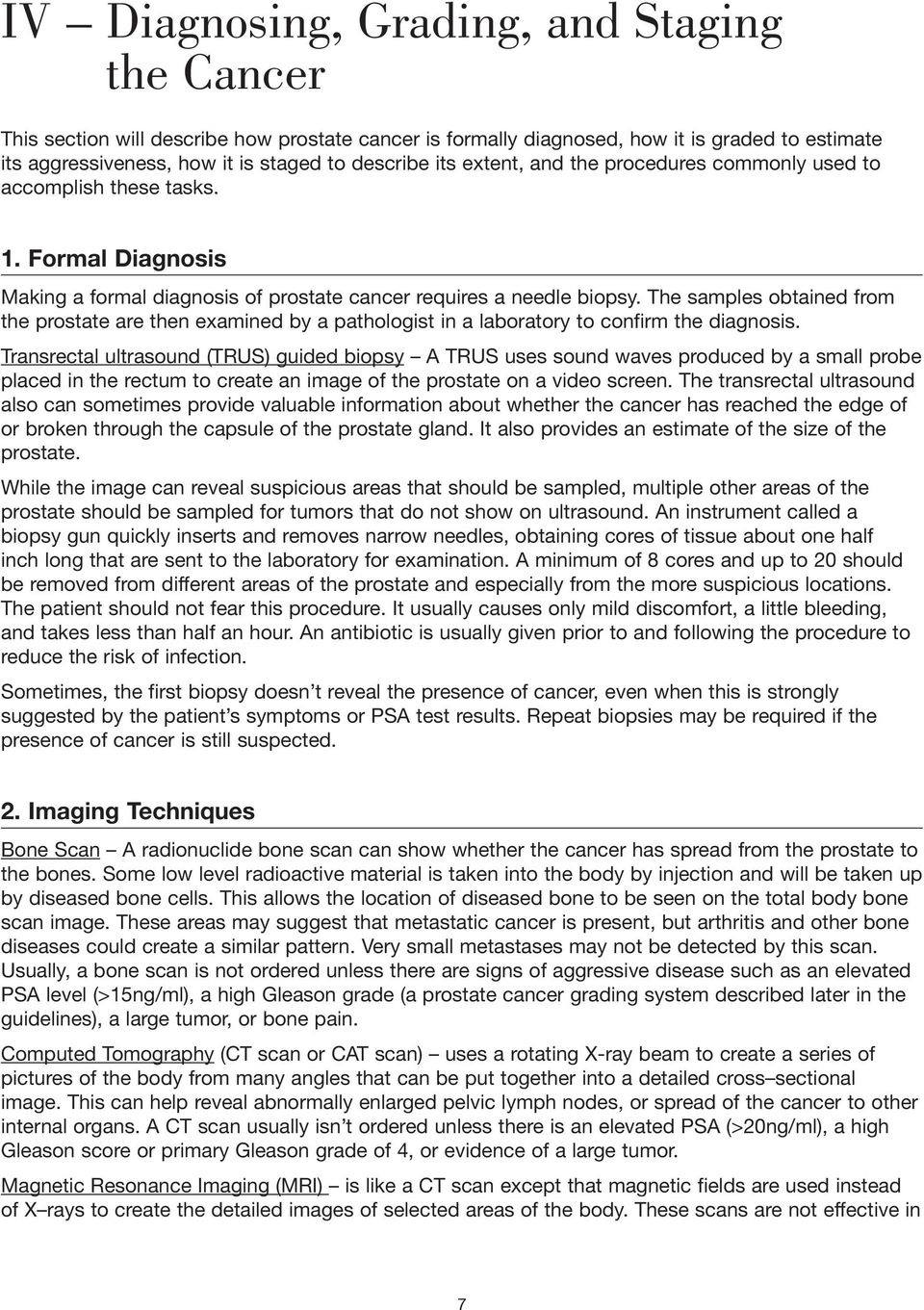
10 revealing microscopic sized cancers, although an MRI using an endorectal coil is superior to a routine pelvic MRI as it images the prostate gland itself better. Color Doppler Ultrasound This is a refinement of the standard transrectal ultrasound, which produces only black and white images. The Color Doppler machine can detect blood flow patterns; cancerous areas sometimes show an increase in the density of the blood vessels. Only the prostate gland and immediate adjoining tissues are imaged. Magnetic Resonance Spectroscopy Imaging (MRSI) This is a refinement of the endorectal MRI. Magnetic resonance spectroscopy detects the levels of certain compounds that are present in different amounts in benign and cancerous prostate tissues. These are then mapped on a regular MRI image to indicate possible cancer sites. This method can produce findings for the prostate gland, but does not image the lymph nodes. This study may be useful in monitoring the prostate after radiation therapy as well. Currently, it remains investigational. ProstaScint This method uses a special antibody that can recognize prostate cancer cells. This antibody is chemically attached to a radioactive tracer, and then injected into the bloodstream. A few days later, the entire body is scanned by a procedure similar to a bone scan. The ProstaScint can locate microscopic amounts of prostate cancer cells in soft tissues in the body. Combining it with a regular CT or MRI scan can increase its accuracy. Newer antibodies have been developed that will improve cancer staging, as they become available for use in the near future. This test is not commonly used due to the high likelihood of both false positive and false negative results. Other Imaging Techniques: Under unusual circumstances other imaging studies may be indicated such as PET/CT, Combidex (not FDA approved), and Sentinel node Imaging. Since there is no general agreement as to the clinical indication for using these tests, they will not be discussed here. uniform tightly packed 1 varied cell size, shaped and loosely packed 2 increased cell size, less distinction 3 irregular, large fused cells 4 irregular, fused cells invading connective tissue cells 5 3. Grading the Cancer If cancer is found in the prostate biopsy sample, it is graded to estimate its aggressiveness. The most commonly used prostate cancer grading and scoring system is called the Gleason system. The pathologist examines the cancer cells under a microscope and evaluates how closely the arrangement of the cancer cells matches that of normal prostate cells. For each sample, two grading assessments are made. The first is an estimate of the most common cancer cell pattern, and the second is of the next most common cancer cell pattern. These are done on a scale of 1 (most like normal cells) through 5 (least like normal cells). The two grades are then added (e.g., 3+2=5) to give the Gleason score or sum, with a range of 2 to 10. The Gleason score is very important! The Gleason score is essential for treatment planning and decision-making. Every prostate cancer patient should know his Gleason score. Those with low scores (6 or less) are more likely to have a less aggressive, slower growing 8
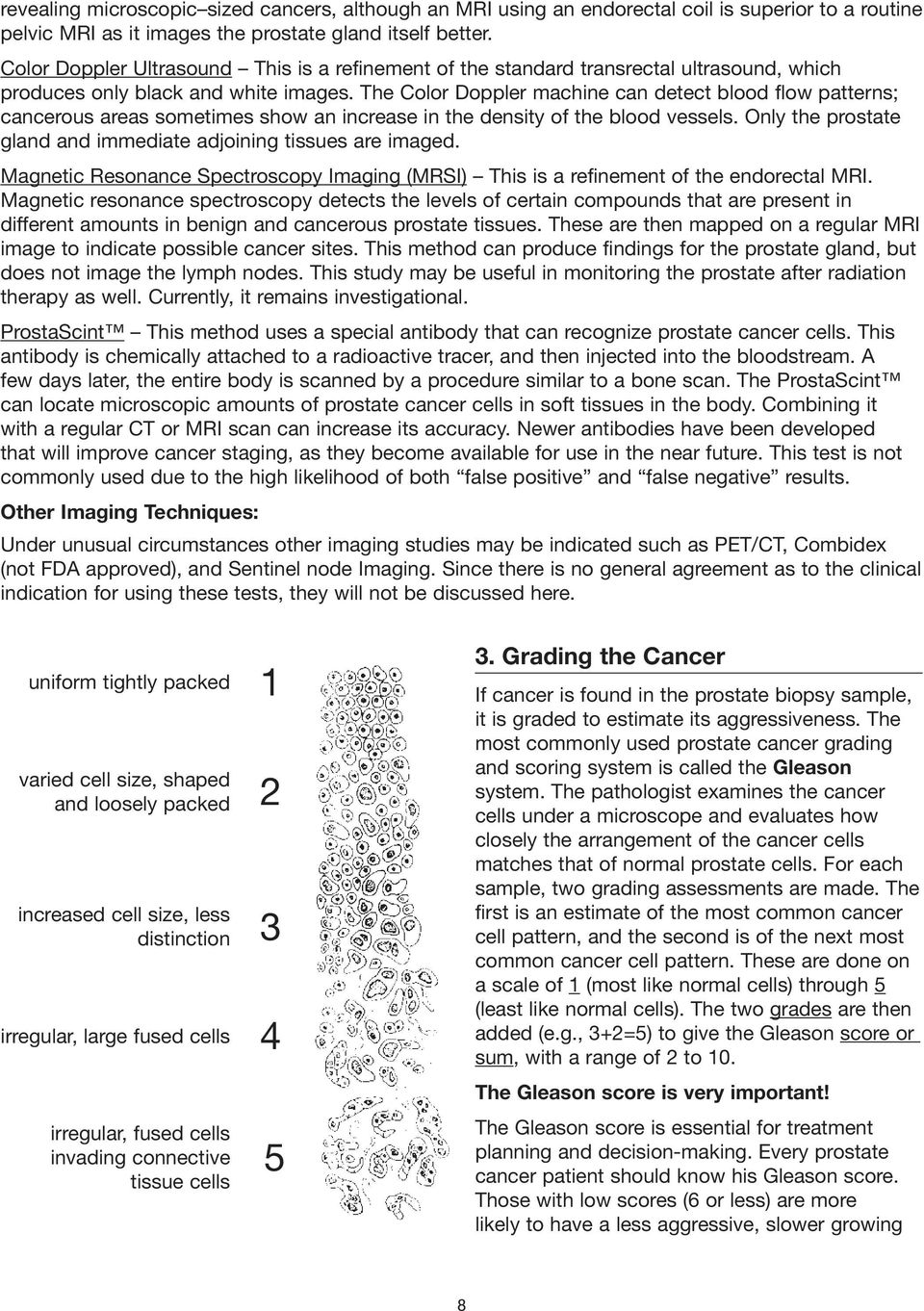
11 cancer. Gleason 6 is the most common score. Gleason 7 indicates intermediate risk; a Gleason 3+4 may be a less aggressive cancer than a 4+3, so knowing both the primary and secondary grades is helpful. Gleason scores of 8 to 10 indicate high-risk cancers that could grow and spread more rapidly. Since the most accurate grading of the cancer is, in part, a function of the skill and experience of the pathologist, it may be appropriate to get a second opinion for the Gleason score. Ideally, the pathology report should provide for each of the biopsy cores containing cancer tissue the following information (which can help in evaluating your cancer and planning treatment): The length of the core. The Gleason score for that core. The percentage of cancerous tissue in that core. The site in the prostate of the core with cancer. Both the primary and secondary grades. A Gleason 7 sample should indicate whether it is 3+4 or 4+3, and also show the percentage of Gleason Grade 4 in that sample. The presence of any grade 5 should be noted even if not primary or secondary. 4. Staging the Cancer A prostate cancer s stage indicates how far it has spread, and is very important in selecting treatments and in predicting prognosis or the future of the disease. The commonly used staging system is the TNM system. This describes the extent of the primary tumor (T), the absence or presence of metastasis to nearby lymph nodes (N) and the absence or presence of distant metastasis (M). (Previously used staging systems for prostate cancer had employed I through IV and A through D classifications) T Categories There are two types of T classifications for prostate cancer. The clinical stage is based on the digital rectal examination, and imaging findings. The pathological stage is based upon surgical removal of the entire prostate gland, the seminal vesicles (which are two small sacs that store semen), and sometimes nearby lymph nodes. The clinical stage is used in making treatment decisions. This is the best estimate short of surgery, but may underestimate the extent of cancer development and spread. The pathological stage determination is more thorough, and therefore more accurate in making a prognosis and indicating the need for further treatment. However, it can be determined only with patients who have had a radical prostatectomy or a biopsy of tissue confirming the presence of disease beyond the prostate (e.g. Seminal Vesicles). T1 Refers to a tumor that is not felt during a digital rectal exam. T1a (5% or less of specimen involved in tumor) and T1b (more than 5% tumor involved) describe cancers found incidentally during a TURP (transurethral resection of the prostate, a surgical procedure done to relieve symptoms of benign prostatic hyperplasia), where examination of the removed prostate tissue reveals cancer. T1c cancers are those detected by an elevated PSA only and which are then diagnosed with a biopsy. T1c is now the most common stage for newly diagnosed men. T2 Refers to a cancer that is felt by the doctor during the digital rectal examination, or is seen with imaging studies, and is believed to be confined within the prostate gland. If the cancer is in one half or less of only one side of the prostate, the stage is T2a. If the cancer is in more than one half of only one side of the prostate, the stage is T2b. If the cancer is in both sides of the prostate, the stage is T2c. 9

12 T3 Refers to a cancer that has extended beyond the capsule of the prostate and/or to the seminal vesicles, as indicated by imaging studies or biopsy. If the cancer can be felt during a DRE, and extends outside the prostate on one side, but not to the seminal vesicles, the stage is T3a. If the cancer has spread to the seminal vesicles, the stage is T3b. T4 The cancer has spread to other organs next to the prostate, such as the bladder s external sphincter (which helps control urination), the rectum, and/or the wall of the pelvis. Imaging tests are usually necessary to detect this more advanced tumor stage. N Categories N0 means the cancer has not spread to any lymph nodes. N1 or N+ indicates spread to one or more regional pelvic lymph nodes. (Nx indicates that regional lymph nodes have not been assessed.) M Categories M0 means the cancer has not metastasized beyond the regional nodes. M1a means metastases are present in distant lymph nodes. M1b means the cancer has spread to the bones. M1c means the cancer has spread to other distant organs such as the lungs, liver, or brain, with or without bone disease. The site(s) of the metastases may be specified. (Mx indicates that distant metastases have not been assessed.) Staging via the Clinical States Model This model is needed for staging more advanced disease. A shortcoming of the TNM system is its failure to account for these situations: 1 - Many men who have received local therapy such as a radical prostatectomy or radiation may develop a rising PSA without any evidence of metastatic disease; and 2 - For patients with metastatic disease, there is a significant difference between the form of the disease that is responsive to hormonal therapy (to be described later) and that which is progressing/growing despite hormonal therapy (often called hormone independent or refractory, or castration resistant prostate cancer). Thus, determining as best as possible which clinical state the cancer is in at a particular time non-metastatic or metastatic; hormone responsive or hormone independent is critical for guiding the treatment of patients with advanced disease. 10

13 V Treatment Decision-Making 1. Factors to Consider Deciding how to treat prostate cancer can be a confusing process. Each treatment has its own mix of benefits, risks and impacts on quality of life. The good news is that several treatments are very successful for many prostate cancer patients, either in providing a cure or keeping the cancer under control for many years. However, your physician cannot always tell you specifically which treatment to choose, because for most men, the choice is significantly influenced by personal preferences. While the stage and grade of the cancer, as well as the serum PSA level, are key factors in choosing the treatment that is right for you, that choice is also influenced by other factors such as: Your age and life expectancy Your general health and specific medical conditions Cost and practical considerations Attitudes about cure and/or living with cancer Your needs, concerns, values and social relationships Your feelings about specific side effects 2. A Critical Question Is the Cancer Confined to the Prostate? It is not possible to determine with absolute certainty whether or not the cancer is confined to the organ. The probability of spread increases in cases where the cancer is at a higher stage (T2b or above), and/or has a Gleason score of 7 or more, and/or has a pre-treatment PSA above 10. One way to determine the likelihood of cancer spread is to use a risk assessment instrument that is based on diagnostic information. Three of the most commonly used instruments are: The Kattan nomogram ( The Partin tables ( The UCSF-CAPRA score ( Although helpful, these tables represent results for large numbers of men; therefore, they may not reflect your specific condition and should be interpreted with caution. The following general guidelines apply: If the cancer appears to be confined to the organ, then a localized treatment that attempts a cure may be considered. Options here include: a radical prostatectomy that removes the organ; one of the forms of radiation therapy; or cryosurgery, which uses extreme cold to kill cancer cells. If the cancer appears to have spread, either locally to nearby lymph nodes or more distantly to bones or other organs, then the goal of treatment may be to control the cancer rather than to cure it. Hormone therapy is often considered as an initial treatment in such circumstances, either by itself or combined with other treatments. Hormonal therapies alone may control the cancer for many years in many patients, depending on a variety of factors. 11
14 3. Assessing Degree of Risk of Cancer Recurrence Determining what risk category you fall into is important in your treatment decision-making. The following three risk factors are the main ones used to classify your level of risk: Pre treatment PSA score Clinical stage Gleason score Low Risk The PSA is under 10, and the clinical stage is T1c or T2a, and the Gleason score is 6 or below. The likelihood of cancer recurrence is relatively low after treatment, and any one of the approaches attempting a cure of the cancer can be considered as the sole primary treatment method to be undertaken. Intermediate Risk The PSA is between 10 and 20, or the clinical stage is T2b, or the Gleason score is 7. The probability of a cancer recurrence after a single treatment method is somewhat higher, and a combination of two or more treatment methods might be considered. High Risk The PSA is over 20, or the clinical stage is above T2b, or the Gleason score is between 8 and 10. The probability of a cancer recurrence is substantially higher, and the initial treatment approach very likely may include two or more treatment methods, including hormone therapy with radiation therapy, or surgery followed by additional treatment based upon post-surgical findings. These risk categories are not precise, especially in the intermediate and high risk groups, where there is considerable overlap. A very high elevation of any of the basic risk factors could significantly increase the likelihood of an early treatment failure or recurrence of the cancer. Other factors that may influence this risk assessment are: The number and percentage of positive biopsy samples. Thirty three percent or more may indicate a higher level of risk. The percentage of cancer in any individual sample. More than 50% may indicate a higher level of risk. For a Gleason 7, whether it is 3+4 (lower risk) or 4+3 (higher risk), and the percentage of Gleason grade 4 in such samples. Pre-treatment PSA velocity, or change in PSA over time. An increase of 2 ng/ml or higher a year, prior to the formal diagnosis of prostate cancer, may be associated with a higher mortality rate from the disease but this belief has recently been called into question. 12
15 VI Treatment Options Because there is no consensus on what is the best form of treatment, your choice among the different options will be based on several factors, including but not limited to: Your knowledge about the pros and cons of each treatment option, especially effectiveness and side effect profile, but also such factors as cost and convenience. Your age, general health, and specific medical conditions The grade and stage of your disease Your values, concerns, life goals, and family/social situation The recommendations of your physicians. As appropriate, you and your physicians may choose a combination of treatments. 1. Active Surveillance In the past, men who were diagnosed with prostate cancer were almost automatically presented with more aggressive treament approaches, often with a cure as the goal of the treatment. With increased screening for this disease, more men have been diagnosed with earlier forms of the cancer that are smaller in size, relatively less aggressive, and possibly not becoming life-threatening in nature. There is increasing concern that such men may be overtreated by the surgical, radiation, and hormonal therapies (to be described later), experiencing the side effects that such treatments can bring. This has led to the growing interest in and use of Active Surveillance as a treatment option in such cases. Active Surveillance is an approach where treatment for cure is delayed in men who are a) low risk, b) have a low likelihood of rapid disease progression, c) agree to close monitoring, and d) are comfortable with this approach. The goal of this treatment option is to prevent overtreatment of prostate cancer and defer side effects of disease in men who do not require immediate treatment, but also to preserve the ability to cure the prostate cancer if and when the time comes for treatment. Active Surveillance is an active process where continued monitoring is required and lifestyle changes are encouraged. It should be distinguished from what has been called Watchful Waiting, which tended to be more passive in nature, involved less systematic monitoring of a man s prostate cancer status, and treated metastatic or symptomatic disease rather than attempting to cure prostate cancer. You are most likely to be a candidate for Active Surveillance if the disease is in its early stages, namely: PSA is 10 or less and has not changed much over time Ultrasound results indicate the cancer has not spread beyond the prostate i.e. Stage T1 or T2 Minimum 12-needle biopsy indicates: Gleason Score equal or less than 6 Cancer is present in no more than one-third of the core samples No single sample shows more than 50% of any single core is cancerous If regular measurement indicates no progression in the cancer then no active treatment is called for. Some men also opt to change lifestyle factors such as diet, exercise, stress reduction and use 13

16 of supplements, but this is not a required aspect of active surveillance. Men on Active Surveillance can elect for treatment for cure at any time if the psychological stress of living with the cancer becomes too great, or may continue on surveillance as long as disease specific parameters do not change. These parameters include PSA levels, ultrasound imaging, and biopsy results. If any of these variables increase, or suggest disease progression, the man is advised to select a treatment option for cure. Active Surveillance is suitable for men of any age but if it is elected, it must be accompanied by periodic and regular monitoring and observation supervised by your treating physician. If you qualify for, and are considering Active Surveillance, UCSF offers an ongoing clinical trial that has been following men who opt for this choice for more than 10 years and has over 500 participants. Participation requires the following: Monitor free and total PSA every three months. Repeat the transrectal ultrasound every 6 12 months. Repeat the DRE every 3 months. Repeat the prostate needle biopsy every months, depending on the results of the imaging studies, and changes in either the absolute level or velocity of increase in your PSA. Consider active treatment when A repeat biopsy shows an increase in volume, grade, or stage. There is a rapid velocity of increase in your PSA i.e. the value climbs steeply and quickly even if your previous PSA value was low. The imaging studies show a significant increase in size of the cancer tumors(s). Your physician suggests the stage of your disease has worsened (see Section lv.3) Approximately 20% of the men in UCSF s trial have received treatment, usually 2 3 years after initial diagnosis and with similar results as would have been expected had they not waited. Some men, particularly those who are older and/or with a life expectancy of 10 years or less, may choose not to undertake more active treatment. It is still important that their disease parameters be monitored. Often, hormonal therapy may be started when there is test evidence of disease progression or actual symptom production. Any patient who chooses this approach must also have the mindset and mental strength to accept the continued existence of cancerous cells within his body. 2. Radical Prostatectomy (Surgery) (For more detailed information, see the UCSF document, Radical Prostatectomy: A Patient Guide, available at This operation removes the entire prostate gland plus some surrounding tissue, and it is used when the cancer is thought to be confined to the prostate or not to have spread far outside the gland. Thus, the goal of undertaking a radical prostatectomy is complete removal of the cancer and curing the patient of the disease. The surgery is done under general anesthesia, generally takes two to four hours, and requires a hospital stay of one to three days. A urinary catheter is placed into the penis for a period of one to two weeks after the surgery, to drain the urine directly from the bladder to outside the body. There are three main types of radical prostatectomy: Retropubic In this procedure, the surgeon uses an incision in the lower abdomen to remove the prostate and also the lymph nodes for examination. This procedure allows for a nerve sparing 14

17 approach, which can lower, but not totally eliminate, the risk of impotence following surgery. In the nerve-sparing approach, the surgeon tries to preserve one or both of the small nerve bundles needed for unassisted erections. However, if the cancer has spread to the nerves or is close to them, nerve sparing may not be advised. Perineal In this procedure, the prostate is removed through an incision in the skin between the scrotum and anus. The lymph nodes can t be removed through this incision. If the lymph nodes need to be examined, removal can be done through a small abdominal incision or by a laparoscopic procedure. Nerve sparing also can be performed perineally. Laparoscopic In this procedure, the prostate is removed in a fashion similar to a retropubic prostatectomy, but is performed through five very small (less than 1.0 cm) incisions using probes with lighted magnifier scopes, cameras, and surgical instruments. The prostate specimen is removed in a small bag through one of the incisions, which is expanded to 2 to 3 cm. This procedure is done in two different ways: Pure laparoscopic The surgeon works directly with the surgical instruments to remove the prostate. Robotically The surgeon works with a computer to robotically manipulate the instruments. Potential benefits of this procedure are less blood loss, less pain and earlier return to full activities. Nerve sparing and lymph node dissections can be performed with this technique as well. The laparoscopic procedures take about an hour longer, on the average, than the other ones, but are associated with a slightly shorter hospital stay. Present Status of Radical Prostatectomy The retropubic and perineal procedures have been performed successfully for many years, and for a long time, open prostatectomy was regarded as the gold standard of prostate cancer treatment. However, the robotic laparoscopic operation has now become a frequently used method for doing a prostatectomy. Since the laparoscopic approach is relatively new, what studies have been done do show less in the way of immediate post-operative problems. But the medium term studies show similar results for treatment outcome and side effects for the laparoscopic and non-laparoscopic techniques. For patients with a PSA below 10, a Gleason score of 6 or less, and a prostate confined cancer, the rates of cure (defined as an undetectable PSA) can exceed 90% over a five or ten year period. Also, for intermediate risk patients and even select high-risk patients with prostate cancer, radical prostatectomy can be a very effective treatment, but additional therapy may need to be used. Determining Treatment Effectiveness Since the entire prostate is removed in these procedures, there is no tissue left to produce PSA. Therefore, the indication for a successful prostatectomy is an undetectable PSA in the tests done following the surgery (a PSA of 0.02 or less). An important value of a prostatectomy is that the primary tumor is removed and the entire prostate can be evaluated in the pathology laboratory. Studies have shown that up to 40% of cancers have been understaged, i.e., the cancer is more aggressive and/or extensive than was estimated pre-operatively. These findings can help guide decision-making about the need for additional treatment. Main Risks and Side Effects The most significant side effects include erectile dysfunction (a complete or partial inability to have an erection without assistance) and urinary incontinence (a loss of control over the flow of urine). The skill and experience of the surgeon are important factors in how frequently these occur, or how severe these are. Surgeons who have done large numbers (hundreds) of procedures generally have better results, but quantity doesn t guarantee quality. Patients should always ask their doctors for complete data about people they have treated. Information should be available on erectile function and urinary continence, as well as rates of recurrence of prostate cancer. Erectile Dysfunction All men experience some degree of erectile dysfunction during the first six months 15

18 following the surgery. Some men may start to recover their ability to have an erection within weeks of the procedure, others may require up to three years. After a non nerve sparing radical prostatectomy, over 90 percent of men become impotent. ( Impotent here means the inability to maintain an erection without any aids). With the nerve sparing procedure, the impotence rate drops considerably. Besides age, other factors such as degree of potency and sexual interest prior to the surgery, and various medical conditions, can affect the extent of recovery. Even with recovery of potency, the resulting orgasms will be dry because the prostate gland and the seminal vesicles are no longer there to produce fluid for the ejaculate. Men tend to get used to orgasms without the ejaculate. Those men who may want to father children after having their prostatectomy should consider sperm banking prior to the operation. All these issues should be discussed with your physician(s) and your partner. Treatments and aids for erectile dysfunction These can be very effective, but can also be inconvenient or bothersome. More detailed information can be found in the UCSF document, Managing Impotence A Patient Guide, available online in PDF format at: Prescription medications such as Viagra, Cialis, and Levitra can help create erections. A recent study has shown that frequent, perhaps even daily use of such a medication as soon as possible after surgery will help achieve a more effective return of potency. There are medical risks associated with their use, which should be discussed with your physician. A penile suppository A kit helps place a small pellet of a medication into the tip of the penis to produce an erection. A penile injection A fine needle is used to inject a medication into a specific part of the penis to produce an erection. An autoinjector is available. A vacuum device that is placed over the penis, with a pump that draws blood into the penis to produce an erection. A penile prosthesis A device surgically placed in the penis, often with an external pump, to create an erection. It should be emphasized that whether or not such treatment aids are used, an open and cooperative relationship with your sexual partner is very important in helping restore a satisfying sexual relationship. Incontinence Many men will experience some temporary urinary incontinence immediately after surgery. Normal bladder control usually returns within several weeks or months. Anywhere from 3 percent to 8 percent of patients have some permanent stress incontinence (passing urine after coughing, laughing, sneezing, or exercising) or general difficulty controlling urine flow. Certain exercises known as Kegel exercises, that strengthen the urinary sphincter, may improve or restore bladder control. Biofeedback programs may be helpful, and surgical procedures that implant either a male sling or an artificial urinary sphincter, or inject collagen or carbon coated balls, all of which serve to compress the urethra, can also be considered for the approximately one percent of men who may experience severe incontinence. 3. Radiation Therapy Radiation has been used to treat prostate cancer for 100 years and, like radical prostatectomy, is done with the intent of curing the disease by eradicating it from the prostate gland and preventing the spread to distant parts of the body. There are three main types: (1) external beam radiation therapy (EBRT) with X rays; (2) EBRT with proton beams or other particles; and (3) brachytherapy (permanent seed implants or temporary, high dose rate, implants). 16
19 a. External Beam Radiation Therapy with X rays Radiation in the form of X rays is focused from a source outside the body on the area affected by the cancer. Imaging studies are done to locate the prostate gland in relation to the surrounding structures and organs. Then, a treatment plan is designed to guide where the radiation beams will be directed. Marks placed on the patient s skin and/or internal markers (non radioactive seeds) help align the patient to the radiation beams during treatment. Patients are usually treated five days per week in an outpatient center over a period of seven to eight weeks, with each treatment lasting approximately seven to ten minutes. The number of treatments will be reduced if EBRT is combined with brachytherapy. The continued development over the years in the delivery of EBRT led to the development of Three-Dimensional Conformal Radiation Therapy (3D Conformal). It is an image-based treatment that uses a sophisticated computer program to more precisely target radiation beams from four to nine different directions. An external mold cast is commonly used to keep the patient in place, and non radioactive gold seeds are sometimes inserted into the prostate as markers to compensate for daily variations of the prostate gland within the pelvis and locate the gland more accurately. This more accurate aiming from multiple directions makes it possible to reduce the radiation received by nearby tissues therefore reducing the side effects from the treatment while increasing the radiation dose to the prostate, which is associated with better treatment outcomes. Intensity Modulated Radiation Therapy (IMRT) is a more advanced development of the 3D Conformal technique. Here the shape and intensity of the different radiation beams can be varied during the treatment to further minimize damage to other tissues. IMRT is becoming the standard of care for delivering EBRT with X-rays. An even more advanced form of IMRT, Image Guided Radiation Therapy (IGRT) uses repeat imaging of the prostate to adjust the directions of the beams for changes in location of the organ. Side effects of EBRT These can include diarrhea, frequent urination, a burning sensation while urinating, and (occasionally) blood in the urine. These symptoms usually significantly lessen and disappear over time, and some relief is possible with medications or changes in diet. Patients also may experience fatigue, which can last for a month or two after treatment stops. Men who receive external beam radiation therapy may develop impotence two or more years after the treatment. Overall, the risk of erectile dysfunction (ED) appears to be slightly higher with surgery than with radiotherapy. However, the ability to achieve erections improves for many nerve sparing prostatectomy patients, while there is an increasing amount of erectile dysfunction for a number of EBRT patients. Because of the effect on sexual function, men who may want to father children after their radiation therapy should consider sperm banking prior to the treatment. Treatment Outcomes External beam radiation therapy has been used both with patients who have localized disease (confined to the prostate) and with patients where there might be spread of the cancer to nearby tissues or to the lymph nodes, since the radiation beams can be directed more broadly to the involved areas for a part of the treatment. Historically, such higher risk patients have been less likely to be considered for a prostatectomy. Therefore, a number of past outcome studies showing better results for surgery were not comparing equivalent groups of patients. More recent studies comparing prostatectomy with 3D Conformal radiation therapy for similar groups of patients show similar high rates of positive outcomes. The rates for successful treatment decrease with higher Gleason scores. Higher risk patients who choose any form of radiation therapy should consider getting a course of neoadjuvant, concurrent and/or adjuvant hormone therapy (taken before, during, and/or following the radiation therapy), the length of which might be dependent upon the level of risk. 17

20 b. External Beam Radiation Therapy with Proton Beams This uses charged particles rather than X-rays to kill the cancer cells. It is presently available at under a dozen centers in this country. It also utilizes a conformal beam approach, and it may be combined with X-ray therapy. The primary advantage claimed for proton beam therapy is that it will cause less tissue damage to surrounding organs, although this has not yet been proven. Studies have shown that proton beam therapy is effective in treating localized prostate cancer and may produce long-term outcomes as good as x ray therapy. c. Permanent Brachytherapy (Seed Implants) Both forms of brachytherapy use ionizing radiation placed into and/or near the prostate gland to destroy cancer cells. In a permanent seed implant (SI), small radioactive pellets, less than the size of a grain of rice, are implanted into the prostate. These seed implants contain radioactive isotopes such as iodine-125, palladium-103 and Cesium 131. They are left permanently in the prostate and give off radiation for a period of months. This is done as an outpatient procedure. A transrectal ultrasound is usually used to accurately guide the placement of the radioactive material into the prostate. The seeds are placed inside thin hollow needles inserted through the skin of the perineum, the area between the scrotum and anus, and the needles are then withdrawn, leaving the seeds in place. The placement of the seeds carefully follows the pre determined computer map and has great accuracy when applied by experienced hands. d. Temporary Brachytherapy (High Dose Rate HDR) In this method, the high-energy radioactive material (iridium-192) is attached to a wire that is placed in the inserted hollow needles for relatively short periods of time (about 5 10 seconds per insertion) and then withdrawn from the prostate. Here too, the prostate is precisely imaged and a complex computer program helps determine where and how long the radioactive source is directed within the prostate. Typically, two or three treatments are administered over two days in a hospital. Brachytherapy Treatment Issues Brachytherapy can be done only on a prostate gland that is not too large, and where the pelvic bone structure permits access to the entire prostate. In cases of an enlarged prostate, a course of hormone therapy may reduce the size of the gland sufficiently to make the implant procedure safer. Similarly, brachytherapy has been combined with external beam radiation therapy to improve treatment outcome, particularly in cases where there may be some spread to local tissues, and/or if the Gleason score is high (>7). Some treatment centers that undertake brachytherapy are now generally restricting its use as a single treatment to patients with PSA scores under 10 and Gleason scores of 6 or less. Side effects of brachytherapy Many men experience some short-term side effects from brachytherapy, such as perineal pain, discolored urine or urinary problems such as slow starting, incomplete emptying or increased frequency. Erectile dysfunction may develop over a more extended period of time, but there may be somewhat less impairment of sexual function than with EBRT. A small percentage will experience varying degrees of stress urinary incontinence or significant rectal or bowel problems. The effectiveness of both brachytherapy and external beam radiation therapy is indicated by the extent of decline of the PSA. The lowest level of the PSA that is attained is referred to as the nadir. Doctors frequently look for a nadir of a PSA of 0.5 or less; the lower it is, the better. It may take one to four years after radiation therapy to reach a nadir. About one third of men who have undergone brachytherapy experience a temporary spike or bounce in their PSA scores 6 to 36 months after the procedure before the PSA resumes its continuing decline. Such a spike can be alarming, but should not be interpreted as treatment failure. A similar spike may occur in a smaller percentage of 18

21 patients undergoing external beam radiation therapy. The long-term outcomes of brachytherapy, for patients with low-grade organ confined cancers, are similar to those of prostatectomy and external beam therapy. 4. Cryosurgery This procedure, used to treat localized prostate cancer, kills the cancer cells in the prostate by freezing them. Probes containing liquid nitrogen are inserted into the prostate gland and are maneuvered under ultrasound guidance to destroy prostate tissue. This method has shown good results in treating cancer confined to the prostate, but is presently performed at a limited number of locations around the country. Some doctors maintain that to be maximally effective, the entire prostate must be frozen, which impacts the nerve bundles on the sides of the gland. Consequently, impotence almost always results from cryosurgery. Urinary incontinence may also occur. Improvements in the technology and practice of cryosurgery have resulted in better treatment outcomes. Some physicians are performing focal cryotherapy, where only the cancerous area of the prostate is treated, in patients where color Doppler imaging indicates the presence of very limited disease. There is the risk that microscopic amounts of cancer may be missed, and studies have shown mixed results with this approach. When appropriate, cryosurgery can be repeated if the cancer recurs. 5. Hormone Therapy What This Is - Hormone therapy is based on the finding that prostate cancer cells require testosterone, the main male hormone (androgen), to develop. Therefore, lowering androgen levels can stop or slow cancer growth. Hormone therapy may control the cancer, often for a number of years, but it is not a cure. The cancer may change over time so that it is capable of growing in a reduced testosterone setting, most likely by adapting to use testosterone or other hormones more efficiently. When this happens, it is called castration resistant or androgen independent or hormone refractory prostate cancer, and other treatments must be considered. However, most prostate cancers are very responsive to hormone therapy when first diagnosed. There have been studies that suggest that some tumors produce their own testosterone and there are medications being tested to suppress this production. General Treatment Considerations Hormone therapy usually is recommended as the initial treatment for advanced prostate cancers, including prostate cancers that have metastasized. Its use is frequently recommended in conjunction with radiation therapy for men with intermediate or high-risk disease. Hormone therapy does have significant side effects, and the decision to undergo it should not be made casually. Previously Used Methods of Hormone Therapy Two methods used extensively in the past are occasionally used today for some men. One approach is the surgical procedure of orchiectomy, which removes the testes, the main source of androgens in men. This is an effective hormonal treatment, but it is permanent, and it becomes more difficult to undertake intermittent hormone therapy (discussed later). Men may have to cope with the psychological consequences of the loss of their testes. The other approach involves giving estrogen compounds, such as diethylstilbesterol (DES), to reduce testosterone levels. Using estrogens may cause side effects such as breast enlargement and weight gain, as well as an increase in the risk of heart attacks and strokes. Newer forms of estrogen treatment, such as estrogen patches, are being developed which may reduce these risks. Current Hormone Therapy Presently, this treatment usually uses a combination of two different types of medication. The first type is called a luteinizing hormone-releasing hormone (LHRH) analog 19
22 or agonist. This modifies the body s hormone control system to cause the testes to shut down testosterone production. The effect is equivalent to an orchiectomy. These medications are put into a time-release preparation that is injected into the muscle or inserted under the skin every month or three to four months. Some common LHRH agonists available in this country are Lupron (leuprolide acetate), Zoladex (goserelin), and Trelstar (triptorelin pamoate). A newer, longer acting agent (six months) called Eligard (leuprolide acetate) has been developed and is available for use. These LHRH agonists may cause a temporary increase or flare in testosterone when first administered, which may be troublesome for some men, particularly those with more advanced or metastatic cancer. An anti-androgen (see below) should be started concurrently or a week prior to giving the LHRH agonist, to block the effects of this flare. (A new medication, degarelix, has recently been approved by the FDA for use in the United States. It is a GnRH receptor antagonist that works by directly blocking the receptors on the cells that stimulate testosterone production. It therefore acts more quickly that the LHRH agonists and does not require an anti-androgen when first started.) During hormone therapy, the serum testosterone level should be checked to see that it has been sufficiently lowered, preferably to 20 to 50 ng/dl or lower. The second type of medication is called a non-steroidal anti-androgen. Even after testicular production is shut down, a small amount of androgen is still produced by the adrenal glands. Anti androgens block the ability of prostate tissue to use androgens by blocking the androgen receptor in the actual cancer cell. Anti androgens include Eulexin (flutamide), Casodex (bicalutamide) and Nilandron (nilutamide), which are taken as pills one to three times a day. This combination of the two types of medications is called total androgen blockade (TAB) or combined androgen blockade (CAB). Except for protection from testosterone flare, there is controversy about whether anti androgens need to be used with LHRH agonists. Combined therapy appears be more effective than single agent therapy (monotherapy), but outcome studies comparing the two approaches have produced mixed results. Also controversial is the use of a third medication ( triple blockade ) as part of the hormone therapy mix, either Proscar (finasteride) or Avodart (dutasteride), which are commonly used to treat benign prostatic hyperplasia (BPH). These medications block the enzymes that convert other androgens to dihydrotestosterone (DHT), the most active form of testosterone in stimulating the growth of both a normal and a cancerous prostate. Side Effects of Hormonal Therapy and How to Deal With Them These are primarily a result of the lowering of the body s testosterone levels. It should be noted that the following side effects are usually temporary and will diminish or disappear when the therapy is stopped. Decrease in sexual desire and erectile dysfunction Most men on hormone therapy experience some degree of both of these, from minimal to almost total. Remedy: Working cooperatively with your partner to accommodate the changes resulting from hormone therapy can help you remain sexually active. The old saying, Use it or lose it, very much applies here. The lessened interest in sex may lead to a man avoiding sexual activity. In such cases, a man can use whatever helps arouse and maintain his sexual interest. For problems with potency, some of the medications and the mechanical methods described previously may help restore this. Hot flashes These are common and vary greatly in frequency or intensity among individuals. They tend to become less bothersome over time or may disappear almost completely. Remedy: Hot flashes can be treated with different medications, but most men do not find treatment necessary. Breast tenderness and breast tissue growth A less common side effect, but this may occur more frequently as time on hormone therapy increases. Radiotherapy may prevent this complication. 20
23 Remedy: As these begin to develop, radiation to the breast area may reduce or stop, but not reverse them. Also, certain drugs may be used to control or reduce these side effects. Both types of treatment have potential risks. Fatigue, lower energy, reduced muscle mass, and/or weight gain Again, there is a great deal of variability among men as to how these conditions may be experienced. Remedy: Regular physical activity and exercise! This is not only critical in dealing with these side effects, but is also very important in developing a feeling of well being, reducing depression, maintaining an effective diet, and reducing the risk of cardiovascular disease. Just walking for half an hour three times a week can provide some positive benefit. Osteoporosis This is a thinning of the bones caused by a loss of calcium, a direct effect of lowered testosterone. Men who are on hormone therapy for more than two to three years or have a history of malnutrition are at risk for developing this condition. Osteoporosis is diagnosed by a bone density imaging test. You should consult with your physician about having this test to establish baseline bone mineral density prior to starting on long term hormone therapy. A follow-up test should be done at least every two years. In general, older men and, in particular, men with prostate cancer tend to have reduced bone densities and should have their levels checked. Remedy: A class of medications called bisphosphonates can effectively treat or even reverse osteoporosis, if a significant reduction in bone density is found. An oral medication, such as Fosamax, is taken once a week, while medications such as Aredia and Zometa are infused every three months or at longer intervals. Zometa has been found to be effective in reducing bone metastases in advanced prostate cancer. A regular weight-bearing exercise program that moderately stresses the bones is also of value. Calcium and vitamin D should be taken with these medications. Nausea and diarrhea caused by an anti-androgen Relatively less frequent. Remedy: This is occasionally severe enough to require discontinuing the medication. Sometimes, switching to another anti androgen can alleviate the problem. Abnormal liver function or very elevated blood pressure related to anti-androgen use These occur in a relatively small percentage of men. Men on hormone therapy need to monitor their liver function regularly. Remedy: Consult with your physician and consider stopping or changing the medication. Cardiovascular disease Recent analyses have shown that hormonal therapy may increase slightly the risk of heart attacks, strokes and the development of diabetes. It appears that the risk is greatest in those patients who have other risk factors for these problems (such as high blood pressure or high cholesterol) Because these can be potentially life threatening, you should discuss the relative risks versus benefits of hormonal therapy if you have a prior history of diabetes or cardiovascular disease. Remedy: Make sure you know your cholesterol and blood pressure and that you regularly consult with a primary care physician, and that he/she knows that you are taking hormonal therapy. Some other side effects of hormone therapy These include impairment of memory and concentration, emotional distress and depression. Also, there may be anemia, weight gain, decreased muscular strength, genital shrinkage, and loss of body hair. Clearly, there are many issues to consider before committing to a regimen of hormone therapy that involves testosterone suppression. A hormonal therapy approach that maintains more normal testosterone levels Some men have been using a treatment approach of taking a high dose of Casodex, sometimes with Proscar or Avodart, 21
24 but without an LHRH agonist. This helps avoid many of the side effects described above. This approach is generally referred to as Peripheral Androgen Blockade or PAB. Preliminary findings of this approach show that it can reduce the PSA and control the prostate cancer, but not as well or for as long as standard hormone therapy. This approach is generally ineffective for men with more advanced cancer. The main side effect of this approach is gynecomastia (enlarged breasts). Intermittent Hormone Therapy (or intermittent androgen blockade) This approach is used both as an initial or primary treatment for prostate cancer and as a secondary treatment for men who have had a recurrence after other treatment. A patient is placed on hormone therapy for several months to a year or more. After the PSA level has dropped to a number close to zero and remains at this level for at least six to nine months, the hormone therapy is stopped. When the PSA rises to a certain level following the return of testosterone production, the hormone therapy is resumed. The length of time that a man can stay off treatment may range from several months to well over a year. There is presently no clear consensus as to what PSA level should be used to restart the hormone therapy, or how long the periods of the initial treatment or the resumption of treatment should be. A number of men using this approach have undergone eight or more on-off rounds, for up to twelve or more years, with the treatment retaining its effectiveness. The intermittent approach may reduce some of the side effects of hormone therapy, improve quality of life and allow some men to regain their sexual interest and potency during the off period. While this method is regarded as experimental, an increasing number of clinicians are advocating its use instead of continuous hormone therapy. Studies are being conducted to compare its effectiveness with continuous hormone therapy and to find out if it delays androgen independence. When/If Hormone Therapy Fails The continued rise of the PSA while the patient is on hormone therapy is the main indicator that the treatment is no longer working. Indications that the intermittent hormone therapy may be losing its effectiveness are: It takes longer for the PSA to get to an undetectable level when the hormone therapy is restarted; or the PSA no longer gets to an undetectable level for its lowest point. This does not necessarily mean that the hormone therapy should now be stopped. The process of conversion of the cancer to a hormone independent form is usually a more gradual one, and some of the cancer will remain hormone sensitive and respond to the standard therapy. Some men who are on combined androgen blockade may experience what is called an anti-androgen withdrawal response (AAWR), when the anti-androgen medication is stopped and their PSA then falls. This reduction usually is only temporary, lasting for perhaps several months. In some instances, changing the anti androgen can restore the earlier effectiveness of the hormone therapy. When the hormone therapy no longer works, other second line hormonal treatments can be considered: Ketoconazole (Nizoral), which shuts down hormone production by the adrenal glands and requires supplementary hydrocortisone when it is used, has shown sustained effectiveness in controlling advanced prostate cancer. Aminogluthamide also is used for this purpose, as are some estrogenic compounds. Promising Developments In Hormone Therapy: Estrogen Patch This patch delivers estrogen through the skin. This can substantially lower men s testosterone levels, and can provide a new and potentially cost-effective way of delivering hormone therapy. The technology still needs further development, and its effectiveness with prostate cancer and the risks associated with its use need to be evaluated. Abiraterone This drug, presently in phase III clinical trials, has shown some effectiveness with men whose cancer no longer responds to traditional hormone therapy. Many recent studies have shown that the prostate cancer cells themselves can make testosterone, and abiraterone may be shutting down this production. 22
25 6. Chemotherapy Chemotherapy is a standard systemic treatment approach currently utilized in advanced (metastatic and hormone refractory) prostate cancer only. Although chemotherapy is used in early stage disease in many other cancers such as breast and colon, it has not yet been studied sufficiently in prostate cancer for its use to be considered standard. Systemic means the treatment addresses the whole body - not just the prostate, or even the prostate, seminal vesicles, and pelvic lymph nodes alone. Thus, chemotherapy is appropriate if your doctors suspect the cancer has metastasized (spread widely), and prostate cancer cells are present in significant amounts throughout other parts of your body. There are two drugs that are considered standard chemotherapy for prostate cancer Docetaxel (Taxotere) and Mitoxantrone (Novantrone). Both are administered intravenously under the direction of an oncologist. They kill cancer cells directly, usually by disrupting the reproductive cycle of those cells. The treatment cycle may vary from 3 to 6 months, with the drugs administered every 2 3 weeks. Chemotherapy is often supported with Hormone Therapy drugs such as Lupron or Casodex, unless the disease has already proven to be hormone refractory (resistant). Local treatment, in particular radiation therapy (see Section Vl.2) may also be combined with chemotherapy. In addition, the patient may expect to receive regular infusions of a bone-strengthening drug (bisphosphonate) like Zometa, which is also effective in reducing the likelihood of bone damage, pain and nerve compression from bone metastases. Chemotherapy agents may be used in combinations to make them more effective, for example Taxotere (docetaxel) and Avastin, an inhibitor of new blood vessel formation (angiogenesis). They may also include drugs often prescribed for non-cancerous prostate ailments such as Avodart (dutasteride) and Proscar (finasteride). At any given time there are various drugs being tested and available under FDA-supervised trials. (See Section Vlll). In addition, immunotherapy vaccine approaches are under development at UCSF and elsewhere and have led to significant improvements in disease in many patients. Since chemotherapy is systemic, the side effects can be varied. Unlike many chemotherapies, the drugs we currently use in prostate cancer produce less nausea than is commonly anticipated. The risk for infection and low blood counts, while present, is lower than in other cancers in which multiple chemotherapy drugs are administered simultaneously. Chemotherapy side effects such as fatigue and neuropathy generally disappear after treatment is stopped, although they can be debilitating and seriously affect quality of life in some patients. Varying the dosages and intervals of treatment, and administrating the chemotherapy intermittently, are being explored as ways of reducing the toxicity while maintaining treatment effectiveness. More and more, chemotherapy is proving effective in treating advanced and metastasized prostate cancer. New research and tests emerge continuously, suggesting new drugs or the application of existing drugs to address prostate cancer as well as evaluating the success of various approaches (such as chemotherapy) in earlier states of the disease. They provide more options, success and hope to men diagnosed with the most serious form of this disease. 23
26 VII What if Initial Treatment is Not Sufficient or Your Cancer Recurs? While the diagnosis and treatment of prostate cancer has improved significantly in recent years, the cancer can still recur. Not surprisingly, clinical studies show the likelihood is higher the more advanced the disease was in the first place, and the more time that passes since diagnosis and treatment. While differences emerge between different types of treatment, many other factors also come into play such as the original staging, Gleason score, extent of the cancer, and age of the patient. The various nomograms (Section V.2) help assess this risk. There are usually a number of treatment options that men in such situations can consider to successfully treat or control the cancer. Choosing among them will require a new decision-making process. It is still essential that you and your physician continue to monitor your PSA on a quarterly basis, no matter how successful your treatment has seemed to be. 1. Why the Cancer Recurs The cancer may have been understaged (more extensive than originally estimated) and/or undergraded (with higher Gleason scores than were found in the pre-treatment biopsy). Both of these have been discovered in up to one-third of the pathology studies of the entire prostate following a prostatectomy. But this understaging or undergrading could also be the case where other treatments besides surgery were done. The cancer may have been undertreated. For example, the pre-treatment scores indicated that the patient was in a higher risk category, yet the patient underwent only a single treatment method that was unlikely to be effective by itself. The treating physician may have been underqualified, not having the necessary skill and/or experience to do the most effective job with the treatment procedure employed. The biology of the cancer is such that it may recur even after effective treatment. On very rare occasions, the cancer may also morph into a different form, for example from adenocarcinoma to small-cell cancer. 2. How do You Know When More Treatment is Required or Cancer has Recurred? On occasion, your initial treatment choice may not remove all the cancer. Both understaged and undergraded cancers are likely to be identified through a post-operative pathology examination of the removed prostate if surgery is elected. For other treatments, this is not always clear, and different criteria apply for each treatment method. The most common sign that the cancer has not been completely removed or has recurred is a rising PSA. Not all patients with a rising PSA will go on to develop metastatic prostate cancer, and not all patients will face the possibility of a life threatening form of the disease. The severity of the relapse can be determined by reviewing how soon the PSA started to rise after treatment and how quickly it is rising. This is frequently referred to as the PSA doubling time (PSADT), which is expressed generally in months. Radical Prostatectomy The PSA should be undetectable 0.1 or less since some labs may not discern less than 0.1 following a successful surgery. If the post-op biopsy is negative, but PSA gets to 0.4 or higher, and then continues to rise, the cancer may still be present. 24
27 External Beam Radiation Therapy It may take from several months up to two years or more, after treatment has concluded, for the PSA to reach its lowest point (the nadir). If the nadir does not get to 0.5 or below, then concern should be raised about eventual treatment failure. The continued rise in the PSA over three consecutive measurement points is a strong indication that the EBRT is failing. Brachytherapy (Seed Implants) Similarly, the nadir may not be reached for up to two years or more, after treatment has concluded. During this time, a temporary spike in the PSA may occur, after a year or more, in up to one third of seed implant patients; the average value of this PSA spike is 0.7. (This happens less frequently with EBRT.) The PSA then resumes its downward course, but this spike may arouse anxiety in patients. Failure in brachytherapy is less clearly defined than with EBRT, but the continued rise in the PSA over three or more consecutive measurement points can indicate that the treatment may be failing. Hormone Therapy A continued rise in the PSA while the patient is still on hormone therapy is a strong indication that the cancer may be starting to convert to a form which needs very little or no testosterone, or even may be producing its own testosterone. Therefore the hormone therapy may become increasingly ineffective at controlling the cancer. Testosterone should also be measured quarterly to ensure the HDT is still effective. Combined Therapies - When treatments are combined, for example hormone therapy and radiation, then the PSA may well be lower than the guide PSA numbers indicated above for single treatments. It is not unusual to see PSA levels of 0.1 or less when treatment includes hormone therapy. But the PSA may rise for a while after the hormone therapy is stopped, until it resumes its decline to the nadir. 3. How You May Deal With Recurrence. In the case of surgery, the post-op pathology report will identify what may have contributed to the later recurrence. If there is still cancer present (positive margins) or the cancer is more aggressive (higher Gleason scores are detected), then several options are available: Some form of external radiation to the pelvic girdle may be prescribed. External radiation is often accompanied by hormone therapy; the duration will depend on the Gleason score and staging of the identified cancer. Active Surveillance with its implied monitoring, if the remaining cancer appears insignificant. You and your physician can then decide when to intervene more aggressively. A more rapid rate of change of the PSA following treatment failure would suggest a more aggressive cancer that is likely to metastasize, or has already done so. In the case of patients who first elected radiation therapy, either external or brachytherapy, and similarly with cryosurgery, a salvage prostatectomy is possible but difficult, and more likely to result in incontinence and/or impotence. Advanced imaging techniques such as CT scans, MRI s and MRSI s may be helpful in determining where the cancer is present. For any additional treatment, participation in an appropriate clinical trial (see Section Vlll) is an option and should be researched with the help of your doctor. 25
28 VIII New Treatment Approaches and Clinical Trials 1. What are Clinical Trials? Clinical trials are medically supervised, carefully controlled studies with actual patients that attempt to determine whether a proposed new treatment is both safe and effective, and could lead to better outcomes than existing treatments. They may include combinations of researchers from many scientific disciplines including physicians, geneticists, biologists, chemists & psychologists. New treatments are continually in progress for all diseases, including cancer and prostate cancer specifically. While many prostate cancer trials are designated for patients with a rising PSA after local treatment or with advanced, metastatic cancers, there are still many trials for men with less aggressive cancer, for example the Active Surveillance trial at UCSF (see Section Vl.6). A number of the new agents and treatments show promise, some as simple as lifestyle changes in diet and exercise, and may eventually provide more treatment options for both new and recurring cancers. The funding sources are varied and include: the National Cancer Institute; universities and medical centers; private research foundations; pharmaceutical and biotechnology companies; or some combination of them. Trials are always phased: Phase I studies determine safe and therapeutic dosage levels Phase II trials determine whether the new agent is beneficial Phase III trials extend the test to a large group that receives the experimental treatment; results are compared with results from a control group receiving standard therapy and/or a placebo. After a successful Phase III trial, the new treatment must still be formally approved by the FDA (Food & Drug Administration) for use with appropriate patients in whom it has been shown to be effective. 2. Should I Participate? Clinical trials can offer hope and the chance for you and society to benefit from a promising new treatment, but they have their risks as well. Any patient considering participating in a trial should ask himself and his treating doctor: Do I fit the criteria for inclusion? How might I benefit from participating? What are the probable side effects? What if I m placed in the Control Group that doesn t get the treatment or medication? (There are many trials where those receiving the placebo will cross over later on and receive the active treatment.) What will happen if I quit or am dropped from the trial? What will happen if my condition gets worse while I am in the trial? 26
29 3. Can I Access Active Clinical Trials at UCSF? Clinical trials are conducted at hospitals, clinics and centers around the country, and participants are often actively recruited. UCSF is currently conducting research in four main areas: 1. Identification of genetic and lifestyle factors that predispose men to clinically significant prostate cancer 2. Discovering alterations in genes and proteins to improve current prostate cancer treatment 3. Developing novel therapies for men with recurrent widespread prostate cancer. 4. Preventing progression of early state untreated disease (active surveillance). More information may be obtained by calling the Urologic Oncology Clinic ( ) and ask to speak with a nurse regarding clinical trials. Discussion with a nurse familiar with ongoing trials can get you directed to the appropriate physician and trial for your particular situation. 27
30 IX Complementary and Alternative Therapies 1. Definitions There is an important distinction between complementary and alternative therapies. Complementary therapies are undertaken in addition to conventional medical treatment, and may be more often encouraged by medical treatment personnel, for example exercise and diet changes. Alternative therapies are undertaken instead of conventional medical treatment. They therefore carry more risks associated with their use and should be examined and implemented with more caution. Many therapies can fall into either category. Some interfere with standard medical treatment or cause serious side effects, so be sure to advise your physician of your use of these therapies. Lifestyle changes are likely to be helpful in both controlling and preventing prostate cancer. UCSF is one of the institutions in the forefront of running clinical trials regarding diet, exercise and stress. In addition, every prostate cancer patient treated at UCSF receives open access to a nutritionist/dietician to help plan the healthiest diet and to address diet issues that may arise during treatment. HIFU - A new treatment method, High Intensity Focused Ultrasound (HIFU), which attempts to kill cancer cells by high heat, may be capable of performing focal therapy for prostate cancer. HIFU has been used in Europe and Canada but is not FDA approved, and is therefore considered investigational. Clinical trials on this treatment method are being conducted in the United States. 2. Diet, Nutrition and Supplements There is broad consensus that good nutrition reduces the risk of a number of major illnesses such as heart disease, stroke, diabetes, obesity, and cancer. The positive benefits of a healthy diet include increased energy, an enhanced immune system, and a better overall quality of life. Many of the nutritional guidelines that promote general health are also associated with a lower risk of prostate cancer. The increasingly strong association of nutritional factors with a reduced incidence and possibly a reduced rate of recurrence after treatment suggests the newly diagnosed prostate cancer patient should actively consider reviewing and revising his diet as an important part of overall treatment. A prostate cancer diet is also a heart healthy diet. In studies carried out by Dean Ornish M.D., an adapted heart healthy diet was also found to stabilize and limit tumors in men diagnosed with early stage prostate cancer. Avoiding red or processed meats and limiting dairy products may have significant benefits in fighting prostate cancer. The majority of the following recommendations concerning diet and supplements are consistent with what might be recommended to protect against other major chronic disease, such as heart disease, obesity, or diabetes. More detailed information, findings, and recommendations about nutrition and supplements can be found in the UCSF Your Health Matters publication, Nutrition & Prostate Cancer, by Natalie Ledesma, MS, RD. (To access the document go to patientguides/urooncpt_doc.html and click on the title. The document is in PDF format.) 28
31 a. Diet and Nutrition Low Fat Diet Consuming a high fat diet contributes to obesity, and both greater fat intake (in particular saturated fat) and larger body size have been linked to an increased risk of prostate cancer development as well as recurrence. Many advocate a goal of 20% or less of total calories from fat in your diet, although for several chronic diseases, it is important to also consider the type of fat. For example, it is generally recommended to minimize saturated fat consumption and avoid trans-fats, and consume instead mono- and poly-unsaturated fats that are found more in plant-based oils, nuts, and seafood. At least one study has shown that a Mediterranean-style diet, which is rich in fats from olive oil and nuts and includes fruits, vegetables, whole grains and fish, may be very beneficial. Saturated Fats Studies indicate that higher saturated fat intake from meat and dairy products may promote the incidence of prostate cancer and greater risk of metastatic disease. Consumption of red meat, milk, cheese, mayonnaise, butter and prepared products such as baked goods should be reduced or even eliminated. Trans fats This type of fat is found in margarine, fried foods, and many processed goods such as breads, cereals, crackers and cookies. It can be identified on the labels of food products as partially hydrogenated oils or fats. Their use is associated with increased risk of heart disease, perhaps with increased cancer risk, and should be limited or avoided. Body Weight Obesity can contribute to a number of serious medical disorders such as heart disease, diabetes, dementia, and several cancer types, including prostate cancer. Studies consistently link obesity to worse prostate cancer presentation and risk of progression among men diagnosed with prostate cancer. Being obese also increases the likelihood of complications and side effects from treatment for prostate cancer. Omega 3 Fatty Acids DHA and EPA are good fats; many studies indicate regular consumption of fish, which is rich in long chain omega-3 fatty acids, reduces the risk of getting prostate cancer as well as its progression. These fatty acids are found in cold-water fish such as salmon (wild is preferred to farm raised), trout, herring, and sardines. Omega-3 fatty acids can also be found in chia seeds, flax seeds (the ground seeds are recommended), walnuts, and in supplements. Studies suggest that men who ate fish a couple of times a week versus rarely were protected against prostate cancer development and progression. Omega 6 Fatty Acids While results in human are less conclusive, laboratory studies on cell lines and animals suggest that high levels of Omega-6 fatty acids may be associated with the growth of prostate tumors, especially if consumed in a high ratio to omega-3 s (greater than 4:1). Omega-6 fatty acids are found in meat, butter, egg yolks, whole milk products, and vegetable oils, including corn, sunflower, safflower and cottonseed. Fruits and Vegetables These contain fiber (also found in cereals, beans and peas, nuts, and seeds), vitamins, minerals and cancer-fighting phytonutrients (lycopene, carotenoids, indoles, and flavonols). Tomatoes are high in lycopene, and appear more beneficial when cooked or processed (e.g. tomato sauce). Cruciferous vegetables such as broccoli, Brussel sprouts, cauliflower, cabbage, and kale have been associated with a reduced risk of prostate cancer. The allium plant family that includes garlic, onions, scallions, leeks, and shallots is rich in flavonoids and other compounds with anti cancer properties. Soy Foods These are rich in protein, fiber, calcium and B vitamins as well as certain anti oxidants called isoflavones. Their use is associated with reduced rates of heart disease and certain cancers, including prostate cancer. The soy foods and products such as edamame, tofu, miso, soy nuts, and soy milk are preferred to soy extracts. One daily serving is recommended. Green Tea Green tea (and black tea to a lesser extent) contains various flavonoids that have anti oxidant and possible anti-cancer properties. Studies are mixed as to how effective green tea is in 29
32 preventing or inhibiting prostate cancer, or how much daily usage may exhibit a protective effect. Green tea extracts are available, but their effect is uncertain. Pomegranates Research suggests pomegranates exhibit strong anti-inflammatory and anti-oxidant effects. Pomegranate juice may slow cell growth and even promote cell death. 8 oz pomegranate juice daily has been shown to significantly lower the rate of PSA increase in men with prostate cancer (i.e., increased PSA doubling time). Other dark colored fruits and their juices, such as blueberries and cranberries, may also be beneficial. b. Supplements, Vitamins and Nutrients This category includes many different substances such as vitamins, herbs, food or plant derived products, and preparations containing different compounds. Many studies have been conducted to establish the efficacy of these various substances. However, there is currently no positive proof of the effectiveness of any supplements for men with prostate cancer. Notwithstanding, there are many studies that suggest favorable impact on either the prevention or recurrence of the disease. You should use caution in using such supplements, and share this information with your physician. When the supplements are derived from food, generally the whole food appears more effective than the extract. A nutrition consultation with a professional can be very informative, and as a UCSF patient, a nutritionist is available free for a personal session. The following are some supplements, vitamins or nutrients that may have anti-cancer effects, or have been prominently used in the prostate cancer community Vitamin D There has been growing interest in vitamin D and its potential for beneficially influencing the course of prostate cancer. Vitamin D plays an important role in prostate cell metabolism, and in maintaining overall good health. Prostate cancer rates are higher in men with lower levels of vitamin D, and also in countries further away from the Equator, reflecting the decreased exposure to sunlight, which produces vitamin D. Modest exposure to sunlight (10 to 15 minutes 3 4 times a week) and food sources such as coldwater fish and fortified cereal provide vitamin D though research is indicating that it may not be sufficient. Absorption of vitamin D does decline with age. Some researchers have recommended that the recommended total daily intake of vitamin D, which is presently i.u. for those over 50 years old, be raised to as much as 2,000 i.u. Some prostate cancer practitioners have suggested megadoses of vitamin D, although this is controversial. It would be wise to measure your blood level of 25-hydroxy-vitamin D3 to be sure it is at an acceptable level. Calcium Calcium is an essential nutrient and proper amounts are needed to maintain healthy bones and other body functions. However, a high daily calcium intake (more than 1,200 mg) has been associated with increased prostate cancer risk, particularly advanced cancer. This seems to be especially true if the primary source of calcium is from dairy foods. The optimal healthy daily total intake of calcium (diet + supplements), particularly for men over 50, is 1,200 mg. It is recommended that men, particularly those taking a bisphosphonate (such as Fosamax) to treat or prevent osteoporosis, obtain adequate amounts of calcium in their diet, but limit dairy and avoid a high calcium intake. Vitamin E Originally, large-scale human population studies indicated that supplemental vitamin E or having higher levels of circulating vitamin E was strongly associated with a lower incidence of prostate cancer development and mortality. Some data indicated that such benefit was stronger or limited to men who had a history of smoking or a certain genotype, or evident only for the prevention of more aggressive disease. Vitamin E is an antioxidant found in vegetable oils, nuts, seeds, soybeans, and sweet potatoes and also commonly found in multivitamins and single supplements. Recently two very large randomized clinical trials observed no benefit of taking 400 IU daily of 30
33 supplemental vitamin E compared to a placebo, for an average of 5.5 years for the prevention of total prostate cancer. These negative results persisted regardless of smoking history. Thus, at this time, the totality of evidence does not support the broad usage of supplemental vitamin E for the primary prevention of overall prostate cancer. Selenium This micronutrient is an antioxidant that was consistently reported to reduce the risk of prostate cancer in observational human studies and in secondary data analyses of clinical trials for other diseases. It is found in Brazil nuts, seafood, and some grains. The most commonly used amount of selenium as a supplement is 200 mcg (micrograms) daily; 400 mcg or more may be toxic. Selenium was also tested in the same large randomized primary prevention clinical trial described above for vitamin E. Similarly, investigators reported no benefit for taking 200mcg daily of supplemental selenium. Lycopene This is an antioxidant that scavenges free radicals and reduces tissue damage that could lead to cancer development. Circulating lycopene, dietary lycopene, and lycopene-rich foods have been associated with reduced prostate cancer risk, lowered PSA levels, or lower risk of recurrence among survivors. Cooked tomato products and juices are a rich source of lycopene. The actual food is a better source of lycopene than extracts in supplements. A small amount of fat, such as olive oil, will aid absorption. Vitamin C While a commonly acknowledged antioxidant, no consistent relationship has been found between Vitamin C and prostate cancer. Like selenium and vitamin E, a large, randomized controlled trial showed that there is no evidence that Vitamin C prevents prostate cancer. Zinc Zinc is an essential mineral, and plays a role in maintaining a healthy immune system. Only small amounts are needed by the body, and it is found in many food sources. Many multi-vitamin supplements include zinc, which in excessive amounts, may actually contribute to developing advanced prostate cancer. Herbs Saw Palmetto is often indicated for prostate health and for enlarged prostates or BPH (320mg/ daily). There is no conclusive evidence as to its effect on prostate cancer; however. It may alter PSA levels and thus needs to be taken into account when your PSA is measured. Again, tell your physician everything you take. Turmeric, containing the active ingredient curcumin, has been shown to encourage prostate cancer cell death, suggesting it may suppress tumor initiation, promotion and metastasis. However, the active Ingredient is not readily absorbed into the blood stream from the digestive tract. Chinese herb mixtures, and in particular PC-SPES, have had claims made about their effectiveness in treating prostate cancer, but generally with no research evidence to support those claims. One of them, PC SPES, a mixture of eight herbs including saw palmetto, had shown some positive results in a controlled study with both androgen dependent and androgen independent cancers. But its apparent effectiveness may have resulted at least in part from an estrogenic compound that was subsequently found in the mixture. The FDA recalled PC-SPES for contamination, and using it, as well as similar products, may cause serious health effects. Statins And Anti-Inflammatory Drugs - The statins are commonly used cholesterol-lowering drugs (Zocor, Lipitor, Pravachol, Crestor, Mevacor) and the anti-inflammatories (aspirin, ibuprofen, naproxen, Celebrex) used to alleviate pain. Some studies have shown that both classes of drugs, which work in different ways, may have a preventive effect for prostate cancer, and particularly for reducing the risk of more advanced disease. At least one study has suggested a strong effect when both drugs have been taken together due to other medical indications (i.e. not specifically taken for any type of cancer prevention). Their impact upon a diagnosed prostate cancer has yet to be evaluated, but some 31
34 practitioners are recommending statin use as part of the treatment. It should be noted however that at least one study reported an elevation in risk of developing prostate cancer associated with statin use among men who were obese. c. Changing Your Diet Men vary considerably in how much change they are willing to make in their diets. A relatively simple step is the elimination of white foods white flour, white sugar, white rice, namely refined products, and to substitute with whole foods. Some choose to eat less meat and dairy products and continue to eat fish with its proven nutritional content, while others become vegetarians and some even vegans, eliminating all dairy products. Many make the nutrition-healthy changes easily, while others struggle to achieve changes in their eating habits. The support of family and friends can be crucial in making and maintaining changes in your diet. For some men, giving up favored foods can create a sense of loss. But men can also learn how to eat more healthfully at their favorite places of dining and the social events they attend. Seeing a physician and/or a nutritionist, enrolling in nutrition classes or programs, and attending special support groups may all help. Classes and support are provided through the UCSF Ida and Joseph Friend Cancer Resource Center. 3. Exercise Several recent studies show the benefit of exercise for cancer patients. Now, doctors are more frequently recommending exercise, to whatever extent possible, at the onset of treatment. While no studies have yet been concluded for prostate cancer, several are underway at prestigious hospitals including UCSF. For other cancers such as breast cancer, results are remarkable, showing up to a 67% improvement in mortality rates against a control group. It may not be long before exercise is considered a viable complementary therapy. For men on therapies that reduce their testosterone levels, daily exercise is imperative to combat fatigue, loss of muscle tone, and gynecomastia (development of breasts) from the lack of testosterone. Every man has different capacity; some men may already incorporate rigorous daily exercise into their lifestyle, while others may never have previously exercised so that a daily brisk walk is encouraged and celebrated. Finding an exercise buddy whatever your preferred activity can help sustain an exercise program. Regular exercise also plays an important role in following a diet and maintaining a healthy weight. 4. Stress Reduction A wide array of activities can help reduce stress and anxiety. These include various meditation practices, modifying your breathing rhythm, visualization, relaxation exercises and massage. By way of example, recent Harvard research has shown that daily meditation lowers high blood pressure by increasing the level of nitrous oxide in the blood stream, thus dilating the blood vessels. Acupuncture, increasingly accepted by Western medicine, can reduce pain and discomfort. Stylized exercises such as tai chi, qigong and yoga can help people become more at ease with themselves. Classes and groups are available to teach these techniques at the UCSF Ida and Joseph Friend Cancer Resource Center, as well as the UCSF Osher Center for Integrative Medicine (415/ ). These centers can provide inofrmation and direct you to helpful resources. A diagnosis of cancer can lead to an examination of one s life and how it is lived, resulting in positive changes in work, play, relationships, and personal and social practices that accentuate the positive and reduce the more stressful and negative aspects of daily life. 32
35 X Coping with Prostate Cancer Helpful Hints 1. Dealing With Anxiety, Emotional Upset, and Uncertainty I heard the doctor say, I m sorry; the test results show that you have prostate cancer. I heard nothing else. My mind went blank, and then I kept thinking, No, there must be some mistake. Learning that you have prostate cancer can come as a shock. How did you react? You may have felt numb, frightened, or angry. You may not have believed what the doctor was saying. You may have felt all alone, even if your friends and family were in the same room with you. These feelings are all normal. For many people, the first few days and weeks after diagnosis are very difficult. After you hear the word cancer, you may have trouble breathing or listening to what is being said. When you are at home, you may have trouble thinking, eating, or sleeping. People diagnosed with cancer and those close to them experience a wide range of feelings and emotions. These feelings can change often and without warning. Getting knowledge and support Becoming knowledgeable about prostate cancer and the different treatments options available to you will diminish this distress and enable you to make more informed treatment decisions. This process is helped by support from family, friends and health care professionals, and by learning how to take charge of your treatment. The most important step you can take is to seek help as soon as you feel you are having trouble coping. Taking action early will enable you to understand and deal with the many effects of your illness. Living with Uncertainty Learning to live with the basic uncertainty about treatment outcome is a challenge for anyone. There are no absolute guarantees that a cure has been achieved, even with confirmed good findings at the time of treatment, and a number of years being disease free after treatment. The PSA level should be monitored at appropriate intervals for the rest of your life. Some men experience temporary PSA-anxiety around the time the test is done. But many men and their families live their lives without obsessive worry that the cancer may return. What can help You A variety of sources can provide information to help you during diagnosis, treatment and after treatment, including: Your physicians and other medical team members; Books and articles Support groups, in person and on the Internet Networking with other prostate cancer patients The UCSF Ida and Joseph Friend Cancer Resource Center programs are available, including support groups and counseling services. For those without a computer or Internet access, computer access may be available at your local library. Local cancer centers may provide Internet access and have staff to assist you with your search for information. Be careful to validate the information you find on websites not associated with accredited cancer treatment facilities or endorsed by the American Cancer Society or other reputable cancer information facilities. 33
36 2. Getting Second Opinions Because understanding the different treatments and then choosing among them isn t easy, getting multiple opinions may be a necessary part of your decision-making. In the course of developing a treatment approach for yourself, you may consult with a urologist, radiation oncologist, and medical oncologist, along with your primary care physician and other medical specialists. They may bring differing perspectives to the assessment of your cancer and to their treatment recommendations. It is helpful to prepare yourself in advance for a meeting with any doctor by writing out a list of questions you want to ask, bringing along a partner or a friend and recording the discussion for future reference. The Ida and Joseph Friend Cancer Resource Center at UCSF has a good list of questions you can review and bring to your office visit. 3. Keeping Good Records It is very helpful to keep a complete and well-organized medical record, with copies of your laboratory work, diagnostic studies and treatment recommendations, and the treatment reports with the outcomes. This will help you get the most out of your second opinions, deal with insurance companies and play a more active role in your treatment. The test results particularly, can provide baseline data about your condition, help you monitor the outcome of your treatment, and alert you to the need for possible changes in your treatment approach. 4. Involving the Family Many are Affected by a Cancer Diagnosis Prostate cancer affects not just the patient, but family and friends as well. Keeping them informed and involving them in the decision-making is helpful to everyone involved. Wives, partners and children, who may become fearful about losing a mate or parent, may not be able to express these fears directly. Studies have shown that the wives, partners, and family caregivers of prostate cancer patients are at increased risk for anxiety, depression and other symptoms of distress. Keeping communication channels open and discussing fears and hopes openly can be helpful. In some instances, the wife or partner may become the more active person in getting information about the disease, arranging for and participating in medical visits, and supporting continued action and decision-making. It may be appropriate to have frank talks about risk reduction measures with adult sons and brothers, who are now shown to be at greater risk for developing prostate cancer. In some families, the increased risk may be related to known, inherited or genetic factors. Suspicions are raised about a genetic predisposition when prostate cancer occurs in multiple family members, when the diagnosis occurs at age 60 or younger, and/or when there is a family history of cancer. Family members who are at increased risk may reduce their risk through regular screening and prevention strategies. Patients are encouraged to discuss their medical family histories with their doctors. Genetic Counseling In some families, genetic testing may identify altered genes that increase the risk for cancer and are passed from parent to child. Patients and family members might find it helpful to consult with specialty trained genetic counselors and physicians. They can provide accurate family history assessment, education and counseling, offer genetic testing for cancer predisposition genes (when appropriate), and discuss screening and prevention options for patients and family members. These services are available through the UCSF Prostate Cancer Risk and Prevention Program. 415/ Additional information is available at: 34
37 5. Sexuality and Intimacy Prostate Cancer Treatment Does Affect Sexuality An oncologist who treats prostate cancer was reported to have said, There is no treatment for prostate cancer that enhances quality of life. Almost every treatment for prostate cancer can affect sexual drive and functioning, often in a major way. The man may have to cope with the prospect and then the actuality of partial or total impotence. This can create anxiety, a sense of loss, and/or a lowered self esteem, which in turn can affect and disrupt the sexual relationship with the man s partner. If the relationship is to remain mutually satisfying for both partners, significant changes may have to be made over time in the attitudes, behavior, and interaction of the partners. However, many men, after treatment, do have very satisfying sexual relationships. Dealing With Sexual Concerns and Changes Various concerns may emerge during and after treatment. A man s anxiety about his difficulty in getting an erection and/or a lessening of sexual drive, may lead to his avoiding sexual activity with his partner. But men often overestimate their partners need for frequent sexual intercourse, as compared with other means of showing love and physical closeness. A readjustment of how the partners relate to each other may be needed. Partners need to be open with each other, comfortable and direct in expressing their desires, fears and hopes, and willing to work out their differences in a mutually respectful way. 6. Join a Support Group! A support group can help both the man with prostate cancer and his loved ones, before, during and after treatment. Studies have shown the value of support groups in helping with decision making, enhancing quality of life and possibly in prolonging life. Being with other men with prostate cancer who have been successfully treated can be tremendously reassuring. Hearing how others did their decision-making, what their actual experiences were, and how they coped with the consequences of their treatment is also very helpful. This applies as well to men whose initial treatment has failed or who are dealing with recurrence of their cancer. Most support groups enable partners and loved ones to participate, and/or to have their own meetings. The local office of the American Cancer Society is a good source of information about support groups in your area, as is the UCSF Ida and Joseph Friend Cancer Resource Center. 7. Keeping a Positive Attitude Learning more about prostate cancer and its treatment is one way to develop a positive attitude. As you get more information about treatment options and what that means for you, feelings of hope and optimism will emerge more frequently. You should recognize that everyone copes differently and benefits from different types of support. Become aware of what feels most supportive to you. Try to incorporate activities and people that bring you a sense of joy, peace and healing. This may mean joining a support group, spending more time with family, seeking individual counseling, varying your daily routine, setting aside special days for yourself, or spending time alone in nature. 35
38 Glossary Adjuvant therapy - The use of hormone therapy or chemotherapy after surgery or radiation therapy as part of cancer treatment. Compare with Neoadjuvant. Adrenal glands - Glands located above each kidney that produce several kinds of hormones, including a small amount of sex hormones. Androgen - A male sex hormone. The main one is testosterone. Anti-androgen - A drug that blocks the action of male sex hormones on prostate and other cells. Benign - Refers to a tumor that is not malignant and does not spread. Benign prostatic hyperplasia (BPH) - A non cancerous enlargement of the prostate that may cause difficulty in urination. Biopsy - A procedure that removes small samples of tissue from the body for examination. Brachytherapy - A treatment in which radioactive material is inserted into and/or near the prostate. Cancer - A general term for more than 100 diseases characterized by the abnormal and uncontrolled growth of cells, which may eventually spread to other parts of the body. Chemotherapy - The use of one or more strong drugs to treat or control a cancer. Clinical trial - The systematic investigation in human subjects of the safety and effectiveness of a procedure or drug designed to diagnose or treat a specific disease. Combination therapy - The use of two or more modes of treatment (surgery, radiotherapy, chemotherapy, hormone therapy, immunotherapy) in combination, to achieve optimum results against cancer or other disease. Control group - A group of patients in a clinical trial that receives either a standard treatment or no treatment, that is compared with an experimental group that is receiving a proposed new treatment that might be more effective. Cryosurgery - A procedure that uses extremely cold liquid nitrogen to destroy cancer cells. Digital rectal exam (DRE) - A screening procedure for prostate cancer where a doctor inserts a gloved, lubricated finger into the rectum to feel the size and shape of the prostate. Double-blind - Characteristic of a controlled experiment in which neither the patient nor the attending physician knows whether the patient is getting one or another drug or dose. Dry orgasm - Sexual climax without the release of seminal fluid. Ejaculation - The release of fluid containing semen through the penis during orgasm. Estrogen - A female sex hormone. External beam radiation therapy - The use of high energy x rays or heavy particles (protons) aimed from outside the body to treat a cancer. Gleason grade and score - This is a grading system used to determine how aggressive a prostate cancer is, by examining samples of prostate cancer cells under a microscope and rating how similar or different the cancer cells are to normal prostate cells. Hormone - A chemical product of one of the endocrine glands of the body, which is secreted into body fluids and has a specific effect on other cells or organs. Hormone therapy - A treatment method for prostate cancer that interferes with the production and/or activity of testosterone and other male hormones that promote prostate cancer growth. 36
39 Imaging tests - A variety of tests that produce pictures of the inside of the body to help diagnose and stage a cancer. Immune system - A complex network of organs, cells, and specialized substances distributed throughout the body that defend it from foreign organisms that cause infection or disease. Immunotherapy - An experimental method of treating cancer that stimulates the body s immune defense system to identify and attack the cancer cells. Impotence - Inability to have an unassisted erection. Incontinence - Inability to control the flow of urine from the bladder (urinary incontinence), or the passage of feces from the intestines (fecal incontinence.). Informed consent - The process in which a patient learns about and understands the purpose and aspects of a treatment or clinical trial and then agrees to participate. Internal radiation therapy (see brachytherapy) - The placement of radioactive material inside an organ of the body to treat a cancer. Local therapy - A method of treating cancer only in the area where the cancer is. Luteinizing hormone-releasing hormone (LHRH) agonist - A class of drugs that are used as part of hormone therapy that shuts down the production of testosterone by the testes. Lymph nodes or glands - Small, bean shaped collections of tissue located along the channels of the lymphatic system, that may trap infectious organisms or cancer cells. Lymphatic system - The tissues and organs, including the bone marrow, spleen, thymus, and lymph nodes, which produce and store cells that fight infection and disease. Malignant - Refers to a tumor that is cancerous and can grow and spread to other parts of the body. Metastasis - The spread of cancer cells from the original tumor site through the blood and lymph vessels to other parts of the body to produce tumors at new sites. Neoadjuvant - Therapy given before and/or during primary therapy. Oncologist - A doctor who specializes in treating cancer, either through surgery, radiation, or the administration of special drugs. Orchiectomy - Surgery to remove the testes, but not the scrotum. Palpable tumor - A tumor in the prostate that can be felt during a digital rectal exam. Pathologist - A doctor who identifies and grades diseases, in part by studying cells and tissues under a microscope. Pelvic - Referring to the areas of the body located below the waist and surrounded by the hip and pubic bones. Pelvic lymph node dissection - The removal of lymph nodes in the pelvic area to examine them for the presence of cancer cells. Perineal - Referring to the area between the anus and scrotum that may be used as the site where a prostatectomy or brachytherapy will be performed. Placebo - An inactive substance, used as a control, which may resemble a medication that is being evaluated for its treatment effectiveness in a clinical trial. Prognosis - A judgment made about the course of a disease and/or the probable outcome of its treatment. Prostate - A gland, part of the male reproductive system and located below the bladder, which produces fluid for the semen that carries sperm cells. 37
40 Prostate specific antigen (PSA) - A protein produced by the prostate gland; its level can be determined by a blood test. The PSA test scores can be used to help detect prostate cancer, estimate the extent of the cancer, and monitor the results of the treatment(s) for the cancer. Prostatic acid phosphatase (PAP) - An enzyme produced by the prostate gland. Changes in its level in the blood may help detect changes in the extent and nature of the prostate cancer. Radical prostatectomy - Surgery to remove the entire prostate gland to treat prostate cancer. Also just called prostatectomy. Rectum - The last six inches of the large intestine ending at the anus, which leads to the outside of the body. Recurrence - A return of the cancer following the completion of treatment. Remission - Disappearance of the signs and symptoms of cancer, either temporarily or permanently. Risk - Refers to the likelihood of a person developing a certain disease, or an estimation of the probable success or failure of the treatment for that disease. Screening - The use of different tests and/or examinations to detect the presence of cancer or other diseases at early stages. Scrotum - The external sac or pouch that contains the testes. Semen - The fluid that is released through the penis during orgasm. Semen is made up of sperm from the testicles and fluid from the prostate and seminal vesicles. Seminal vesicles - Pouch like organs located above the prostate that produce and store seminal fluid. Side effect - A secondary and usually negative effect from a drug or procedure used to treat a disease. Stage and staging - Stage is a term used to describe the size and extent of a cancer and whether it has progressed throughout the body. Staging refers to the tests and examinations done to determine the stage. Standard treatment - A treatment or other intervention currently being used and considered to be of proven effectiveness on the basis of past studies. Systemic therapy - Treatment that attempts to reach and affect cancer cells all over the body. Testes - The two egg shaped glands that produce sperm and male hormones. Testosterone - The primary male sex hormone (androgen) produced mostly by the testes. It stimulates the growth and activity of the male sex organs, and also plays a role in the development of healthy bones. It also appears to be necessary for the growth of prostate cancer tumor cells. Transrectal ultrasound (TRUS) - An imaging technique that uses sound waves and their echoes from an instrument inserted into the rectum to form a picture of the prostate and help locate sites of abnormal tissue. Transurethral resection of the prostate (TURP) - The use of an instrument inserted through the penis to remove tissue from the prostate, usually to treat the symptoms of BPH. Tumor - An abnormal and excessive growth of cells. This can be benign or malignant. Urethra - The canal that carries urine from the bladder or semen from the sex glands to the outside of the body. Urologist - A doctor who specializes in diseases of the urinary organs in females and the urinary and sex organs in males.
Early Prostate Cancer: Questions and Answers. Key Points
 CANCER FACTS N a t i o n a l C a n c e r I n s t i t u t e N a t i o n a l I n s t i t u t e s o f H e a l t h D e p a r t m e n t o f H e a l t h a n d H u m a n S e r v i c e s Early Prostate Cancer:
These rare variants often act aggressively and may respond differently to therapy than the more common prostate adenocarcinoma.
 Prostate Cancer OVERVIEW Prostate cancer is the second most common cancer diagnosed among American men, accounting for nearly 200,000 new cancer cases in the United States each year. Greater than 65% of
AFTER DIAGNOSIS: PROSTATE CANCER Understanding Your Treatment Options
 AFTER DIAGNOSIS: PROSTATE CANCER Understanding Your Treatment Options INTRODUCTION This booklet describes how prostate cancer develops, how it affects the body and the current treatment methods. Although
An Introduction to PROSTATE CANCER
 An Introduction to PROSTATE CANCER Being diagnosed with prostate cancer can be a life-altering experience. It requires making some very difficult decisions about treatments that can affect not only the
Prostate Cancer Screening. A Decision Guide
 Prostate Cancer Screening A Decision Guide This booklet was developed by the U.S. Department of Health and Human Services, Centers for Disease Control and Prevention (CDC). Is screening right for you?
PSA Screening for Prostate Cancer Information for Care Providers
 All men should know they are having a PSA test and be informed of the implications prior to testing. This booklet was created to help primary care providers offer men information about the risks and benefits
PATIENT GUIDE. Localized Prostate Cancer
 PATIENT GUIDE Localized Prostate Cancer The prostate* is part of the male reproductive system. It is about the same size as a walnut and weighs about an ounce. As pictured in Figure 1, the prostate is
1. What is the prostate-specific antigen (PSA) test?
 1. What is the prostate-specific antigen (PSA) test? Prostate-specific antigen (PSA) is a protein produced by the cells of the prostate gland. The PSA test measures the level of PSA in the blood. The doctor
Radiation Therapy for Prostate Cancer
 Radiation Therapy for Prostate Cancer Introduction Cancer of the prostate is the most common form of cancer that affects men. About 240,000 American men are diagnosed with prostate cancer every year. Your
Prostate Cancer Screening. A Decision Guide for African Americans
 Prostate Cancer Screening A Decision Guide for African Americans This booklet was developed by the U.S. Department of Health and Human Services, Centers for Disease Control and Prevention (CDC). Published
Prostate Cancer. What is prostate cancer?
 Scan for mobile link. Prostate Cancer Prostate cancer is a tumor of the prostate gland, which is located in front of the rectum and below the bladder. Your doctor may perform a physical exam, prostate-specific
Treating Localized Prostate Cancer A Review of the Research for Adults
 Treating Localized Prostate Cancer A Review of the Research for Adults Is this information right for me? Yes, this information is right for you if: Your doctor * said all tests show you have localized
PROSTATE CANCER. Get the facts, know your options. Samay Jain, MD, Assistant Professor,The University of Toledo Chief, Division of Urologic Oncology
 PROSTATE CANCER Get the facts, know your options Samay Jain, MD, Assistant Professor,The University of Toledo Chief, Division of Urologic Oncology i What is the Prostate? Unfortunately, you have prostate
A Woman s Guide to Prostate Cancer Treatment
 A Woman s Guide to Prostate Cancer Treatment Supporting the man in your life Providing prostate cancer support and resources for women and families WOMEN AGAINST PROSTATE CANCER A Woman s Guide to Prostate
CMScript. Member of a medical scheme? Know your guaranteed benefits! Issue 7 of 2014
 Background CMScript Member of a medical scheme? Know your guaranteed benefits! Issue 7 of 2014 Prostate cancer is second only to lung cancer as the leading cause of cancer-related deaths in men. It is
DIAGNOSIS OF PROSTATE CANCER
 DIAGNOSIS OF PROSTATE CANCER Determining the presence of prostate cancer generally involves a series of tests and exams. Before starting the testing process, the physician will ask questions about the
Bard: Prostate Cancer Treatment. Bard: Pelvic Organ Prolapse. Prostate Cancer. An overview of. Treatment. Prolapse. Information and Answers
 Bard: Prostate Cancer Treatment Bard: Pelvic Organ Prolapse Prostate Cancer An overview of Pelvic Treatment Organ Prolapse Information and Answers A Brief Overview Prostate Anatomy The prostate gland,
Prostate Cancer. There is no known association with an enlarged prostate or benign prostatic hyperplasia (BPH).
 Prostate Cancer Definition Prostate cancer is cancer that starts in the prostate gland. The prostate is a small, walnut-sized structure that makes up part of a man's reproductive system. It wraps around
Prostate Cancer Action Plan: Choosing the treatment that s right for you
 Prostate Cancer Action Plan: Choosing the treatment that s right for you Segment 1: Introduction Trust me, there's a better way to choose a treatment for your prostate cancer. Watching this program is
Prostate Cancer. Understanding your diagnosis
 Prostate Cancer Understanding your diagnosis Prostate Cancer Understanding your diagnosis When you first hear that you have cancer, you may feel alone and afraid. You may be overwhelmed by the large amount
For further information on screening and early detection of prostate cancer, see the Section entitled Screening for Prostate Cancer.
 Prostate Cancer For many older men, prostate cancer may be present but never cause symptoms or problems and many men will die with their prostate cancer rather than of their prostate cancer. Yet it remains
Prostate Cancer Treatment
 Scan for mobile link. Prostate Cancer Treatment Prostate cancer is a tumor of the prostate gland, which is located in front of the rectum and below the bladder. Your doctor may perform a physical exam,
HEALTH NEWS PROSTATE CANCER THE PROSTATE
 HEALTH NEWS PROSTATE CANCER THE PROSTATE Prostate comes from the Greek meaning to stand in front of ; this is very different than prostrate which means to lie down flat. The prostate is a walnut-sized
Us TOO University Presents: Understanding Diagnostic Testing
 Us TOO University Presents: Understanding Diagnostic Testing for Prostate Cancer Patients Today s speaker is Manish Bhandari, MD Program moderator is Pam Barrett, Us TOO International Made possible by
Understanding Prostate Cancer. The Urology Group Guide for Newly Diagnosed Patients. Advanced Care. Improving Lives.
 Understanding Prostate Cancer The Urology Group Guide for Newly Diagnosed Patients Advanced Care. Improving Lives. UNDERSTANDING PROSTATE CANCER The Urology Group has created this publication to provide
Prostate Cancer. Patient Information
 Prostate Cancer Patient Information 1 The Prostate & Prostate Cancer The prostate is a small gland in the male reproductive system, approximately the size and shape of a walnut. It is located directly
FAQ About Prostate Cancer Treatment and SpaceOAR System
 FAQ About Prostate Cancer Treatment and SpaceOAR System P. 4 Prostate Cancer Background SpaceOAR Frequently Asked Questions (FAQ) 1. What is prostate cancer? The vast majority of prostate cancers develop
After Diagnosis: Prostate Cancer. Understanding Your Treatment Options
 After Diagnosis: Prostate Cancer Understanding Your Treatment Options What s inside How will this booklet help me?... 3 What is the prostate?... 4 What is prostate cancer?... 4 Who gets prostate cancer?...
Prostate Cancer Screening
 Prostate Cancer Screening The American Cancer Society and Congregational Health Ministry Team June Module To access this module via the Web, visit www.cancer.org and type in congregational health ministry
LIvING WITH Prostate Cancer
 Living with Prostate Cancer A Common Cancer in Men If you ve been diagnosed with prostate cancer, it s normal to be concerned about your future. It may help you to know that this disease can often be cured
A918: Prostate: adenocarcinoma
 A918: Prostate: adenocarcinoma General facts of prostate cancer The prostate is about the size of a walnut. It is just below the bladder and in front of the rectum. The tube that carries urine (the urethra)
Prostate Cancer Guide. A resource to help answer your questions about prostate cancer
 Prostate Cancer Guide A resource to help answer your questions about prostate cancer Thank you for downloading this guide to prostate cancer treatment. We know that all the information provided online
PROSTATE CANCER. Diagnosis and Treatment
 Diagnosis and Treatment Table of Contents Introduction... 1 Patient and Coach Information... 1 About Your Prostate... 1 What You Should Know About Prostate Cancer... 2 Screening and Diagnosis... 2 Digital
Newly Diagnosed Prostate Cancer: Understanding Your Risk
 Newly Diagnosed Prostate Cancer: Understanding Your Risk When the urologist calls with the life-changing news that your prostate biopsy is positive for prostate cancer, an office appointment is made to
CONTENTS: WHAT S IN THIS BOOKLET
 Q Questions & A & Answers About Your Prostate Having a biopsy test to find out if you may have prostate cancer can bring up a lot of questions. This booklet will help answer those questions. CONTENTS:
Treating Prostate Cancer
 Treating Prostate Cancer A Guide for Men With Localized Prostate Cancer Most men have time to learn about all the options for treating their prostate cancer. You have time to talk with your family and
male sexual dysfunction
 male sexual dysfunction lack of desire Both men and women often lose interest in sex during cancer treatment, at least for a time. At first, concern for survival is so overwhelming that sex is far down
Medical Tests for Prostate Problems
 Medical Tests for Prostate Problems National Kidney and Urologic Diseases Information Clearinghouse U.S. Department of Health and Human Services NATIONAL INSTITUTES OF HEALTH What is the prostate? The
Prostate Specific Antigen (PSA) Blood Test
 TO PROVIDE THE VERY BEST CARE FOR EACH PATIENT ON EVERY OCCASION Prostate Specific Antigen (PSA) Blood Test An information guide Prostate Specific Antigen (PSA) Blood Test Prostate Specific Antigen (PSA)
Screening for Prostate Cancer
 Cancer Expert Working Group on Cancer Prevention and Screening Screening for Prostate Cancer Information for men and their families 1 What is the prostate? 2 What is prostate cancer? prostate The prostate
Thomas A. Kollmorgen, M.D. Oregon Urology Institute
 Thomas A. Kollmorgen, M.D. Oregon Urology Institute None 240,000 new diagnosis per year, and an estimated 28,100 deaths (2012) 2 nd leading cause of death from cancer in U.S.A. Approximately 1 in 6 men
Prostate Cancer In-Depth
 Prostate Cancer In-Depth Introduction Prostate cancer is the most common visceral malignancy among American men. In the year 2003, there are expected to be 220,000 new cases and nearly 29,000 deaths in
da Vinci Prostatectomy Information Guide (Robotically-Assisted Radical Prostatectomy)
 da Vinci Prostatectomy Information Guide (Robotically-Assisted Radical Prostatectomy) Prostate Cancer Overview Prostate cancer is a disease in which malignant (cancer) cells form in the tissues of the
Prostate cancer is the most common cause of death from cancer in men over age 75. Prostate cancer is rarely found in men younger than 40.
 A.D.A.M. Medical Encyclopedia. Prostate cancer Cancer - prostate; Biopsy - prostate; Prostate biopsy; Gleason score Last reviewed: October 2, 2013. Prostate cancer is cancer that starts in the prostate
PCA3 DETECTION TEST FOR PROSTATE CANCER DO YOU KNOW YOUR RISK OF HAVING CANCER?
 PCA3 DETECTION TEST FOR PROSTATE CANCER DO YOU KNOW YOUR RISK OF HAVING CANCER? PCA3 DETECTION TEST FOR PROSTATE CANCER There is a range of methods available to your healthcare professional to verify the
Questions to ask my doctor: About prostate cancer
 Questions to ask my doctor: About prostate cancer Being diagnosed with prostate cancer can be scary and stressful. You probably have a lot of questions and concerns. Learning about the disease, how it
PROSTATE CANCER 101 WHAT IS PROSTATE CANCER?
 PROSTATE CANCER 101 WHAT IS PROSTATE CANCER? Prostate cancer is cancer that begins in the prostate. The prostate is a walnut-shaped gland in the male reproductive system located below the bladder and in
Localised prostate cancer
 Diagnosis Specialist Nurses 0800 074 8383 prostatecanceruk.org 1 Localised prostate cancer In this fact sheet: What is localised prostate cancer? How is localised prostate cancer diagnosed? What do my
Analysis of Prostate Cancer at Easter Connecticut Health Network Using Cancer Registry Data
 The 2014 Cancer Program Annual Public Reporting of Outcomes/Annual Site Analysis Statistical Data from 2013 More than 70 percent of all newly diagnosed cancer patients are treated in the more than 1,500
Prostate cancer A guide for newly diagnosed men
 Prostate cancer A guide for newly diagnosed men 2 Prostate cancer A guide for newly diagnosed men About this booklet This booklet is for men who have recently been diagnosed with prostate cancer. It is
Screening for Prostate Cancer
 Screening for Prostate Cancer It is now clear that screening for Prostate Cancer discovers the disease at an earlier and more curable stage. It is not yet clear whether this translates into reduced mortality
Talking about Prostate Cancer
 Talking about Prostate Cancer Talking about Prostate Cancer If I can avoid going to a doctor, I will but not when we re talking about prostate cancer. Why take chances with a condition that might be serious?
Smoking and misuse of certain pain medicines can affect the risk of developing renal cell cancer.
 Renal cell cancer Renal cell cancer is a disease in which malignant (cancer) cells form in tubules of the kidney. Renal cell cancer (also called kidney cancer or renal adenocarcinoma) is a disease in which
Prostate cancer screening. It s YOUR decision!
 Prostate cancer screening It s YOUR decision! For many years now, a test has been available to screen for. The test is called the prostate-specific antigen blood test (or PSA test). It is used in combination
150640_Brochure_B 4/12/07 2:58 PM Page 2. Patient Information. Freedom From an Enlarged Prostate
 150640_Brochure_B 4/12/07 2:58 PM Page 2 Patient Information Freedom From an Enlarged Prostate 150640_Brochure_B 4/12/07 2:58 PM Page 3 GreenLight Laser Therapy 1 150640_Brochure_B 4/12/07 2:58 PM Page
Locally advanced prostate cancer
 Diagnosis Specialist Nurses 0800 074 8383 prostatecanceruk.org 1 Locally advanced prostate cancer In this fact sheet: What is locally advanced prostate cancer? How is locally advanced prostate cancer diagnosed?
Prostate Cancer. Treatments as unique as you are
 Prostate Cancer Treatments as unique as you are UCLA Prostate Cancer Program Prostate cancer is the second most common cancer among men. The UCLA Prostate Cancer Program brings together the elements essential
Prostate Cancer. What is cancer?
 What is cancer? Prostate Cancer The body is made up of trillions of living cells. Normal body cells grow, divide into new cells, and die in an orderly way. During the early years of a person s life, normal
Questions to Ask My Doctor About Prostate Cancer
 Questions to Ask My Doctor Being told you have prostate cancer can be scary and stressful. You probably have a lot of questions and concerns. Learning about the disease, how it s treated, and how this
Prostate Cancer Treatment: What s Best for You?
 Prostate Cancer Treatment: What s Best for You? Prostate Cancer: Radiation Therapy Approaches I. Choices There is really a variety of options in prostate cancer management overall and in radiation therapy.
How prostate cancer is diagnosed
 How prostate cancer is diagnosed This information is an extract from the booklet Having tests for prostate cancer. You may find the full booklet helpful. We can send you a free copy see page 7. Contents
Thymus Cancer. This reference summary will help you better understand what thymus cancer is and what treatment options are available.
 Thymus Cancer Introduction Thymus cancer is a rare cancer. It starts in the small organ that lies in the upper chest under the breastbone. The thymus makes white blood cells that protect the body against
The PSA Test for Prostate Cancer Screening:
 For more information, please contact your local VA Medical Center or Health Clinic. U.S. Department of Veterans Affairs Veterans Health Administration Patient Care Services Health Promotion and Disease
Understanding. Pancreatic Cancer
 Understanding Pancreatic Cancer Understanding Pancreatic Cancer The Pancreas The pancreas is an organ that is about 6 inches long. It s located deep in your belly between your stomach and backbone. Your
Possible Side Effects of Radiation Therapy on the Prostate Gland
 Possible Side Effects of Radiation Therapy on the Prostate Gland Information compiled by Daniel J. Faber, Coordinator of the Warriors+one, a Breakout Group of the Prostate Cancer Canada Network- Ottawa,
Oncology Annual Report: Prostate Cancer 2005 Update By: John Konefal, MD, Radiation Oncology
 Oncology Annual Report: Prostate Cancer 25 Update By: John Konefal, MD, Radiation Oncology Prostate cancer is the most common cancer in men, with 232,9 new cases projected to be diagnosed in the U.S. in
7. Prostate cancer in PSA relapse
 7. Prostate cancer in PSA relapse A patient with prostate cancer in PSA relapse is one who, having received a primary treatment with intent to cure, has a raised PSA (prostate-specific antigen) level defined
Understanding Your Diagnosis of Endometrial Cancer A STEP-BY-STEP GUIDE
 Understanding Your Diagnosis of Endometrial Cancer A STEP-BY-STEP GUIDE Introduction This guide is designed to help you clarify and understand the decisions that need to be made about your care for the
Understanding the PSA test. A guide for men concerned about prostate cancer
 Understanding the PSA test A guide for men concerned about prostate cancer Introduction This booklet is for men who want to know more about having a blood test, called a PSA test, that can help diagnose
ACTION PLAN. Choosing the treatment that s right for you. Endorsed by Kaiser Permanente Inter-regional Chiefs of Urology
 Prostate Cancer ACTION PLAN Choosing the treatment that s right for you Video Series Guidebook View videos at kpactionplans.org Endorsed by Kaiser Permanente Inter-regional Chiefs of Urology 2015 Kaiser
BRACHYTHERAPY OR RADIOACTIVE SEED IMPLANTATION CANCER OF THE PROSTATE
 BRACHYTHERAPY OR RADIOACTIVE SEED IMPLANTATION CANCER OF THE PROSTATE Prostate cancer, like other cancers, is a disease of the body's cells. Normal cells reproduce themselves by dividing--facilitating
Introduction Breast cancer is cancer that starts in the cells of the breast. Breast cancer happens mainly in women. But men can get it too.
 Male Breast Cancer Introduction Breast cancer is cancer that starts in the cells of the breast. Breast cancer happens mainly in women. But men can get it too. Many people do not know that men can get breast
Dealing with Erectile Dysfunction During and After Prostate Cancer Treatment For You and Your Partner
 Dealing with Erectile Dysfunction During and After Prostate Cancer Treatment For You and Your Partner The following information is based on the general experiences of many prostate cancer patients. Your
855-DRSAMADI or 212-241-8779
 SMART SURGERY NEWS MARCH 2013 Dr. David Samadi 855-DRSAMADI or 212-241-8779 YOUR PROSTATE CANCER NEWS PREVENTION DIAGNOSIS TREATMENT LIFE AFTER PROSTATE CANCER PREVENTION Prostate Cancer Need-to-Knows
Advice to patients about the PSA (prostate-specific antigen) blood test: frequently-asked questions
 Advice to patients about the PSA (prostate-specific antigen) blood test: frequently-asked questions What is the PSA blood test? If you want more information before deciding to have this test, it is important
to Know About Your Partner s
 What You Need to Know About Your Partner s Prostate Cancer. A Guide for Wives, Partners, and the Men They Love. Providing Support for Your Partner Prostate cancer can be a physical and emotional challenge
CONTENTS. What is Cancer?... 2. What Should I Know About Prostate Cancer?... 3. Who's at Risk?... 3 Diagnosis & Staging Tests... 3
 CONTENTS Introduction................................. 1 What is Cancer?.............................. 2 What Should I Know About Prostate Cancer?....... 3 Who's at Risk?................................
Spine University s Guide to Cauda Equina Syndrome
 Spine University s Guide to Cauda Equina Syndrome 2 Introduction Your spine is a very complicated part of your body. It s made up of the bones (vertebrae) that keep it aligned, nerves that channel down
dedicated to curing BREAST CANCER
 dedicated to curing BREAST CANCER When you are diagnosed with breast cancer, you need a team of specialists who will share their knowledge of breast disease and the latest treatments available. At Cancer
Small cell lung cancer
 Small cell lung cancer Small cell lung cancer is a disease in which malignant (cancer) cells form in the tissues of the lung. The lungs are a pair of cone-shaped breathing organs that are found within