
Commonwealth of Massachusetts
|
|
|
- Elisabeth Powers
- 10 years ago
- Views:
Transcription
1 Commonwealth of Massachusetts Electricity Price, Reliability, and Markets Report A Report to the Great and General Court on the Status of Restructured Electricity Markets in Massachusetts Spring 2006 Mitt Romney Governor Kerry Healy Lieutenant Governor Janice Tatarka Director Office of Consumer Affairs & Business Regulation David O Connor Commissioner of Energy Resources

2 ACKNOWLEDGEMENTS The Division of Energy Resources Energy Supply and Pricing (ESP) Group prepared this report under the direction of Alvaro Pereira, group manager. Readers may obtain specific information concerning the report from the Division at The following individuals made primary analytical and writing contributions: Brian Tracey Lou Sahlu, Alvaro Pereira Cliff Sullivan Wholesale Prices and Reliability Retail Prices and Distribution System Reliability Competitive Markets Please feel free to convey to the contributors listed above your reaction to this report and your thoughts with respect to future annual reports. This report is also posted on DOER s website at ii
3 Table of Contents Executive Summary... vii Chapter 1: Introduction...1 Purpose of Report...1 Report Outline...1 Chapter 2: Prices...3 Electricity Price Overview...3 Wholesale Electricity Price Analysis...5 On-Peak Energy Prices...5 On-Peak/Off-Peak Energy Price Ratios...9 Day-Ahead/Real-Time Energy Price Ratios...11 Wholesale Price Components...12 All-In Wholesale Price and Costs...13 Retail Electricity Price Analysis...15 Overview of Default Service Prices By Load Zone...15 Other Retail Price Components...17 Transmission Cost Analysis...17 Transition Cost Balance Analysis...19 Retail Prices by Massachusetts Electric Companies...21 Retail Price Disparity...22 Restructuring Savings Analysis...23 Changes in Price and Expenditure Levels...23 Annual Total Expenditures/Total Bills...25 Calculating Bill Savings or Increases...26 Conclusion...31 Chapter 3: Reliability...33 Wholesale Reliability...33 Reserve Margins...33 System Reliability...35 Fuel Diversity...37 Import/Export Capabilities...39 Future Wholesale Reliability...40 Distribution System Reliability...43 SAIDI...43 SAIFI...44 One Day in Ten Years Loss of Load Expectation (LOLE)...46 Conclusion...46 Chapter 4: Markets...48 Market Overview...48 Competitive Market Migration Analysis...50 Residential and Small Commercial & Industrial Customers...52 iii
4 Medium Commercial & Industrial Customers...53 Large Commercial & Industrial Customers...54 Monthly Switching & Return Rates...55 Licensed Competitive Brokers and Suppliers...56 Competitive Suppliers Market Share...57 Conclusion...58 iv

5 List of Tables 2-1 Historical Electricity Prices for all Consumers, MA, New England, and the Nation Massachusetts Average Annual On Peak Prices, Summer Season (June-September) On-Peak/Off-Peak Ratios Components of All-In Wholesale Price New England's All-In Wholesale Costs (Dollars) Massachusetts' All-In Wholesale Costs (Estimates) (Dollars) Average Residential Default Service Prices by Load Zone Regional Network Transmission Service ($/kw-yr) MA Investor-Owned Utilities' Transition Cost Balances as of 2004 DTE Filings (Dollars) Revenue per kwh for Massachusetts Electric Companies (average price in cents/kwh) Comparison of Distribution Company and Municipal Company Prices ( ) Price Disparity Among Distribution Companies Average MA Retail Electricity Rates for Different Customer Groups ( ) Total Electricity Expenditures by Customer Group (Dollars) Price Impacts Assuming 1997 Price Levels in the Period (Cents/Kilowatthour) Bill Impacts of Assuming 1997 Price Levels in the Period Price Impacts of Assuming Historical Growth During Period (Cents/Kilowatthour) Bill Impacts of Assuming Historical Growth in Prices in Period Bill Impacts of Assuming Growth in Electric Prices same as Consumer Price Index ) (Dollars) New England Peak Loads New England Generation Fuel Mix By ISO-NE Data NE Generation Fuel Mix By NE-GIS Data 2003 and New England Generation Sources, One Day In Ten Years Loss of Load Expectation (LOLE) Composition of Massachusetts Demand, Utility vs. Competitive Service, MWh Issued Licenses by Type Broker and Supplier and by Sector Served Market Share of Suppliers...58 v
6 List of Figures 2-1 Retail Prices for Historical Retail Electricity Prices for all Consumers ( ) Massachusetts Wholesale Electricity Pricing Zones Wholesale Electricity Prices-Average Monthly On-Peak ECPs and Real-Time LMPs ) Locational Marginal Prices in Massachusetts and Connecticut (Real-Time On-Peak LMPs) All-In Price Metric for Weighted Average Monthly Standard Offer and Default Service Prices Massachusetts Electricity Prices, Massachusetts Electricity Prices, Compared to Fixed 1997 Price Levels Massachusetts Electricity Prices, Compared to Forecasted Prices (cents/kwh) NEPOOL Summer Reserve Margins Forecasts, Installed Capacity net Average Monthly Reductions versus Monthly Peak Load New England RTEP Subareas NEPOOL System & Boston Subarea Annual Loss of load Expectation (days/yr) (NPCC reliability criteria <0.1 day in 1 yr or 1day in 10 yr) Electric System Average Interruption Duration Index, SAIDI (Exclude Major Events) Electric System Interruption Frequency Index, SAIFI (Exclude Major Events) Load by Distribution Company, Revenues by Distribution Company, Competitive Market Load Competitive Market Customers Monthly Switching Rates...56 vi
7 Executive Summary A new era for energy policy in the Commonwealth commenced with the passage of the Electric Utility Restructuring Act (Chapter 164 of the Acts and Resolves of 1997) ( the Act ). The Act had a number of laudable goals: reduce electricity prices, provide retail customers with a choice of power suppliers, maintain the reliability of the electric system, and improve distribution performance, among others. This report examines the final years 2002, 2003, and 2004 in the Standard Offer period in terms of progress made to meet the price, reliability, and market-development goals set out in the Act. In addition, it revisits past market monitoring efforts and recasts them in terms of a more streamlined, directed analysis of important events and data. Prices Wholesale electricity markets underwent significant changes during the 2002 to 2004 timeframe. The energy marketplace was restructured from a single zone, single settlement system to a multizone, multi-settlement system similar to New York and the Mid-Atlantic markets. Electricity prices increased drastically due to fuel price increases from 2002 to 2004, not market restructuring, particularly increases in natural gas prices which fires a large percentage of new power plants in New England and other parts of the country. Market participants encountered limited opportunities to employ demand response resources due to low peak-to-off-peak energy price ratios during , but efforts continue to increase demand response penetration at the wholesale level. The energy component continued to account for the vast majority of the all-in wholesale costs and is expected to continue that way in the near future. Capacity market costs dropped over the three years due to the capacity oversupply in the region: however, they should pick up as reserve margins begin to decrease due to little capacity addition, load growth and regulatory commitments to implement pricing structures to maintain resource adequacy. Transmission costs remained relatively stable, increasing only slightly, over the study period, while transition costs will continue for several more years until the utility stranded cost balance is eliminated. Despite the public claims and perceptions that restructuring efforts have not resulted in savings, a comparison of retail electric prices and expenditures in the periods immediately prior to and after the start of retail access do show savings. This conclusion holds even if potential inflation in prices since 1997 are not accounted for, a scenario that is highly unlikely given historical trends and the lack of indigenous energy resources in or close to the Massachusetts and New England markets. Restructuring, however, remains a work in progress. Trends in the post-restructuring period clearly show an upward trend in prices. If this trend continues, savings that have been earned to date may begin to erode dependent on the rate of growth in electricity prices. However, it is important to note that while prices increased by about 18% for all consumer goods during the vii
8 period according to the CPI, 1 the increase in electricity prices during that time was about 13%. If such a trend is sustained, consumers will continue to enjoy savings in real dollars. Reliability ISO-NE has maintained short term system reliability adequately over the period. Installed capacity reserve margins are acceptable but have dropped from highs in 2002 due to little new capacity development and load growth exceeding ISO-NE projections. The region s reliance on natural gas continues to be a concern and potentially jeopardizes the reliability of the electricity system. Increasing or maintaining the region s use of nuclear, coal and renewablefueled power plants should be a priority for the regional authorities. Until a greater share of more stable fuels can penetrate the New England market, ISO-NE operating procedures and market rules have been established to minimize risk of over-reliance on gas-fired power plants during peak winter heating season when the gas pipeline delivery system in the Northeast is heavily used to deliver gas for space heating. The region s long term supply of electricity generation appears adequate to meet even peak demands through 2010, but at this time the loss of load (LOLE) expectation begins to creep higher and risks increase of violating the acceptable LOLE reliability standard. Supply adequacy could, however, become compromised much sooner in the event of earlier-than-expected plant retirements, unexpected long-term plant outages (e.g. of nuclear plants) or significant delays in the construction of anticipated transmission lines. In terms of the electric distribution system, reliability data showed successive performance improvements in the service territories from year 2002 to year These performance improvements could be attributable to better weather conditions (i.e. the demand for heating and cooling energy was normal or below normal), application of better technology, and/or increased financial incentives to avoid possible financial penalties for poor performance). It is also possible that more transparent performance data produced more attention to the quality of service to consumers on the part of distribution company management. Finally, data show that despite the statistical improvement in reliability, there is still incidence of higher and unacceptable levels based on wholesale-system criteria loss of load expectation in the reliability of the retail-level distribution system compared to the wholesale electric grid. This difference in reliability levels may require a shift in policy emphasis or attention to reliability problems at local, rather than region-wide, levels. Markets During the period the progress of the competitive retail market was very different in each of the three market segments. The market for large commercial and industrial customers was very competitive with three or more competitive offerings available a majority of the time. These customers displayed considerable market savvy by returning to regulated service when confronted with uncertainty or risk associated with the institution of Standard Market Design in April Residential and small commercial and industrial customers did not often have 1 The index in 2004 was compared to the 1998 value of viii

9 competitive service available to them and showed limited progress in market development. The one exception was the Cape Light Compact aggregation, which enrolled a large number of residential customers with a single competitive supplier. Perhaps the most difficult to gauge market segment was the medium commercial and industrial customers who demonstrated some movement to the use of competitive suppliers but for whom no clear pattern has emerged. The interest of competitive suppliers entering the MA market remains almost exclusively limited to large commercial and industrial customers with little interest in the mass market or residential and small commercial and industrial customers. DOER will conduct periodic survey of the retail competitive suppliers to monitor the market and identify issues or barriers to market development. Finally, though there was significant entry of potential providers of competitive supply in 2005, market share data show high concentration among 3 major suppliers, implying an interest in providing competitive supplies to Massachusetts consumers on the part of more companies than are actually able or willing to do so. ix

10 Chapter 1 Introduction A new era for energy policy in the Commonwealth commenced with the passage of the Electric Utility Restructuring Act (Chapter 164 of the Acts and Resolves of 1997) ( the Act ). 2 The Act had a number of laudable goals: reduce electricity prices, provide retail customers with a choice of power suppliers, maintain the reliability of the electric system, and improve distribution performance, among others. A key provision of the Act was to provide an orderly transition for customers. Distribution companies were required to provide Standard Offer generation service to all customers who were receiving service as of March 1, 1998 and who had not chosen a competitive power supplier. This service was provided at a fixed price that increased annually until March 2005 when the Standard Offer ended. In order to monitor the progress of electric industry restructuring and customer movement to competitive suppliers, the Act required the Division of Energy Resources (DOER) to make periodic reports to the Legislature (M.G.L. c. 25A 7, 11D, 11E). Since inception of electric restructuring, DOER has written comprehensive reports ( Market Monitors ) in which DOER presented major findings on electricity prices and price disparities, competitive market developments, and electric system reliability. DOER also made recommendations for policy, legislative, and regulatory changes. 3 In addition to these reports, in November of 2003, DOER sponsored an assessment 4 of the restructuring experience in Massachusetts compared to other jurisdictions to help inform the development of policies and actions for the post-standard Offer period. Purpose of Report This report examines the final years 2002, 2003, and 2004 in the Standard Offer period in terms of progress made to meet the price, reliability, and market-development goals set out in the Act. In addition, it revisits past market monitoring efforts and recasts them in terms of a more streamlined, directed analysis of important events and data. Report Outline The Restructuring Act actually tasks DOER with reporting on two major issues related to electricity. The first consists of an analysis of prices and price disparity, and the second concentrates on reliability. The Act also has a number of additional reporting requirements related to market development and how restructured markets have impacted both prices and reliability. Hence, the next three chapters discuss price, reliability, and market issues, respectively. Chapter 2 contains an analysis of electricity price changes during the period. First provided is an overview of Massachusetts retail prices compared to regional and national prices. 2 Signed into law on November 25, These documents can be found at the following address: for the years 1998, 1999, 2000 and a summary pamphlet for Massachusetts Electric Restructuring: Beyond the Standard Offer, November 14,
11 These prices are then investigated in more detail with an analysis of prices at both wholesale and retail levels. The main concentration is on retail prices because the independent system operator of New England s bulk power system, ISO-NE, already produces extensive analyses of wholesale prices 5. This report s analysis, however, does highlight wholesale prices because they are passed through to retail customers and represent a large percentage of monthly bills. Furthermore, this chapter includes the price disparity discussion that is required by the Act. The chapter concludes with a discussion of monetary savings for customers due to the provisions of the Act and resulting events. Chapter 3 contains an analysis of reliability issues at both the wholesale and retail levels. We discuss how reliability standards at each of these levels are determined and monitored/regulated. We also report on the extent to which reliability has been provided by the electricity delivery system at both the wholesale and local-distribution-company levels compared to set standards. Chapter 4 provides a review of the development of the retail market during this time period. Wholesale market developments are only sparsely discussed (compared to the Market Monitors) because (a) as with wholesale prices, the regional grid operator, ISO-NE, provides extensive analyses and discussions of wholesale market events and (b) state policy and intervention has limited impact on regional, wholesale electricity market development. Rather, most of the chapter discusses changes in the retail markets and the success with retail access, a major creation of the Act. As discussed above, this report is intended to provide in-depth analyses of the period Where possible, the report offers a comparison of the data during this period to data for 1997, the year prior to passage of the Act, thereby enabling conclusions regarding progress towards achieving the goals set out in the Act. 5 For example, see the 2004, Q3 Quarterly Report, ISO-NE. 2

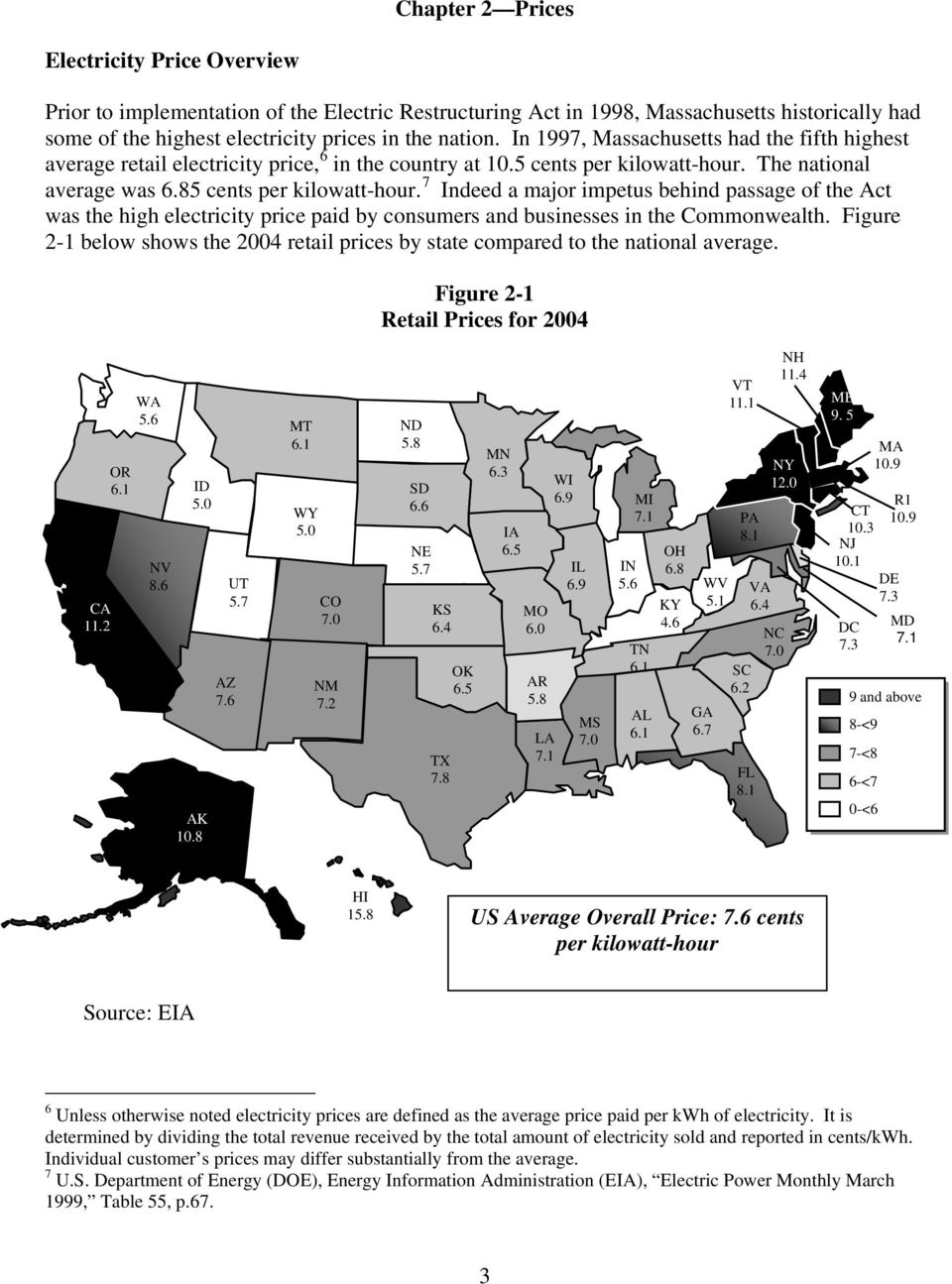
12 Chapter 2 Prices Electricity Price Overview Prior to implementation of the Electric Restructuring Act in 1998, Massachusetts historically had some of the highest electricity prices in the nation. In 1997, Massachusetts had the fifth highest average retail electricity price, 6 in the country at 10.5 cents per kilowatt-hour. The national average was 6.85 cents per kilowatt-hour. 7 Indeed a major impetus behind passage of the Act was the high electricity price paid by consumers and businesses in the Commonwealth. Figure 2-1 below shows the 2004 retail prices by state compared to the national average. Figure 2-1 Retail Prices for 2004 CA 11.2 OR 6.1 WA 5.6 NV 8.6 ID 5.0 AK 10.8 AZ 7.6 MT 6.1 WY 5.0 UT 5.7 CO 7.0 NM 7.2 ND 5.8 SD 6.6 NE 5.7 KS 6.4 TX 7.8 OK 6.5 MN 6.3 IA 6.5 MO 6.0 AR 5.8 LA 7.1 WI 6.9 MI 7.1 IL 6.9 MS 7.0 IN 5.6 TN 6.1 AL 6.1 OH 6.8 KY 4.6 GA 6.7 WV 5.1 VT 11.1 PA 8.1 SC 6.2 FL 8.1 VA 6.4 NY 12.0 NC 7.0 NH 11.4 ME 9. 5 MA 10.9 R1 CT NJ 10.1 DE 7.3 DC and above 8-<9 7-<8 6-<7 0-<6 MD 7.1 HI 15.8 US Average Overall Price: 7.6 cents per kilowatt-hour Source: EIA 6 Unless otherwise noted electricity prices are defined as the average price paid per kwh of electricity. It is determined by dividing the total revenue received by the total amount of electricity sold and reported in cents/kwh. Individual customer s prices may differ substantially from the average. 7 U.S. Department of Energy (DOE), Energy Information Administration (EIA), Electric Power Monthly March 1999, Table 55, p.67. 3
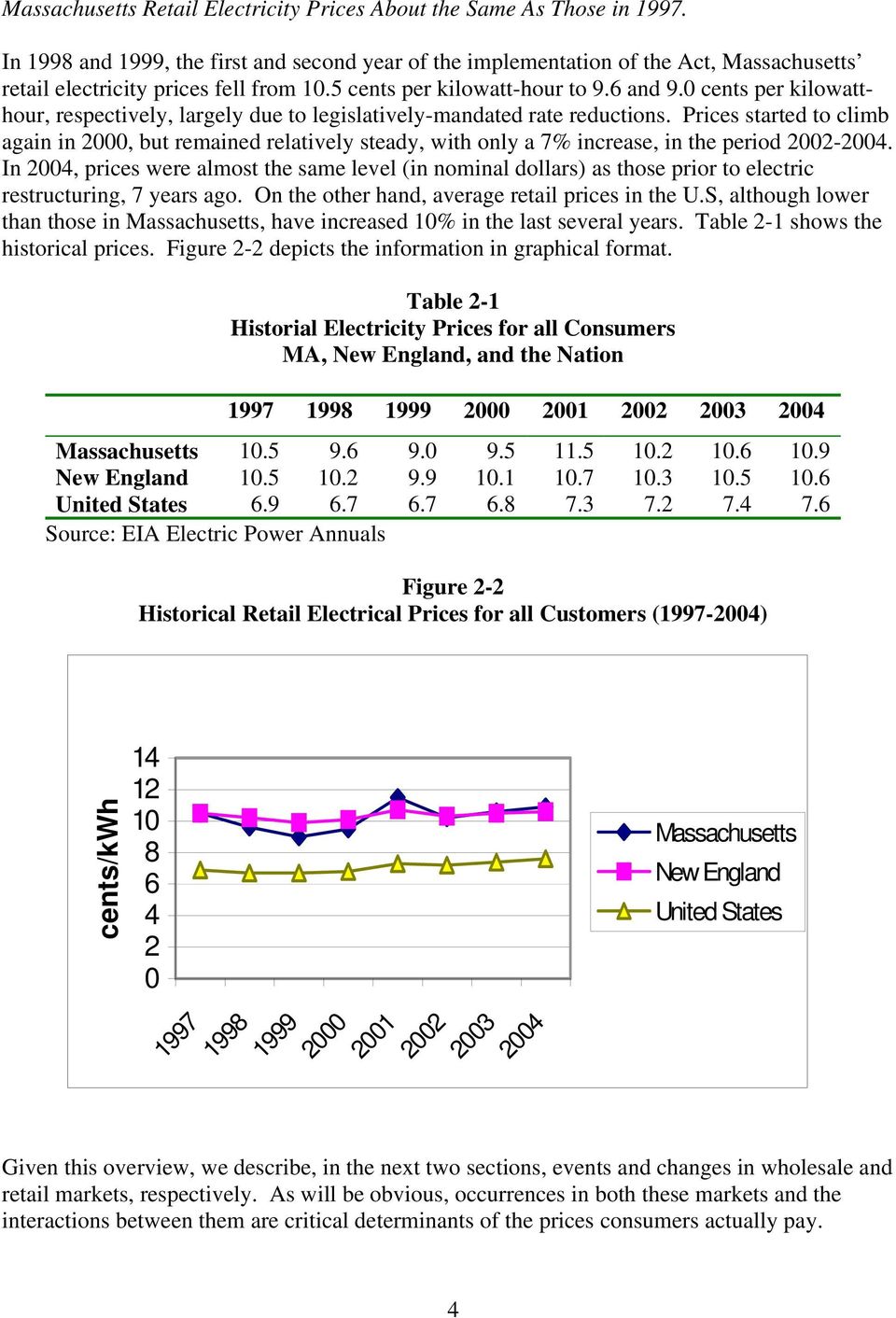
13 Massachusetts Retail Electricity Prices About the Same As Those in In 1998 and 1999, the first and second year of the implementation of the Act, Massachusetts retail electricity prices fell from 10.5 cents per kilowatt-hour to 9.6 and 9.0 cents per kilowatthour, respectively, largely due to legislatively-mandated rate reductions. Prices started to climb again in 2000, but remained relatively steady, with only a 7% increase, in the period In 2004, prices were almost the same level (in nominal dollars) as those prior to electric restructuring, 7 years ago. On the other hand, average retail prices in the U.S, although lower than those in Massachusetts, have increased 10% in the last several years. Table 2-1 shows the historical prices. Figure 2-2 depicts the information in graphical format. Table 2-1 Historial Electricity Prices for all Consumers MA, New England, and the Nation Massachusetts New England United States Source: EIA Electric Power Annuals Figure 2-2 Historical Retail Electrical Prices for all Customers ( ) cents/kwh Massachusetts New England United States Given this overview, we describe, in the next two sections, events and changes in wholesale and retail markets, respectively. As will be obvious, occurrences in both these markets and the interactions between them are critical determinants of the prices consumers actually pay. 4
14 Wholesale Electricity Price Analysis In 1999, New England s wholesale electricity market was restructured wherein buyers and sellers now trade electricity at market based prices rather than at traditional cost-of-service rates. The Independent System Operator of New England (ISO-NE), the entity overseeing the wholesale market, is responsible for three functions: The day-to-day reliable operation of New England s bulk power generation and the transmission system; Oversight and fair administration of the region s wholesale electricity markets; and Management of a comprehensive regional bulk power system planning process. Since its inception, the reformed wholesale market had some flaws and unintended consequences. The ISO-NE, market participants, state regulators and the Federal Energy Regulatory Commission (FERC) addressed many of the problems through new or changed market rules. During , FERC ordered ISO-NE to implement major structural changes, commonly referred to Standard Market Design (SMD), to the wholesale market design. 8 An interim market, commonly referred to as pre-standard Market Design (SMD), with some rule changes existed from 1999 to February Starting on March 1, 2003, ISO-NE began to administer a revised market with substantial changes known as SMD. One reason for the changes was that many of New England s market modifications were already being executed in other wholesale control areas like the PJM market. The basic difference with prior market structures was that the pre-smd market consisted of one zone (New England) with a single settlement clearing price market. The SMD market consists of eight zones throughout New England and a new Locational Marginal Pricing (LMP) based market that clears twice, in the day-ahead and real-time markets. The bid price of the marginal unit in New England basically determined the pre-smd Energy Clearing Price (ECP) and the marginal unit in the zones sets the post-smd Locational Marginal Prices (LMPs). Given the market changes and other market influences during , this section examines wholesale electricity prices and their components. It concentrates mainly on the generation or energy cost, since that is the largest cost component of wholesale electricity. On-Peak Energy Prices Average On-Peak Energy Prices Increased, Mostly Due to Natural Gas Price Increases. During , New England s on-peak 9 electric energy prices have trended upwards and spiked three times in - August 2002, February 2003, and January This upward price trend 8 See ISO-NE website for the history of SMD Orders. 9 On-Peak vs. Off-Peak definition: Bilateral contracts cover the hours between 7:00 a.m. and 11:00 p.m. on nonholiday weekdays as on-peak hours in the New England Control Area. The off-peak period is from 11:00 p.m. to 7:00 a.m. on weekdays, all day on Saturdays, Sundays, and holidays. Demand for electricity is generally higher during the on-peak periods and lower in the off-peak periods, driven primarily by commercial and industrial sector use. 5
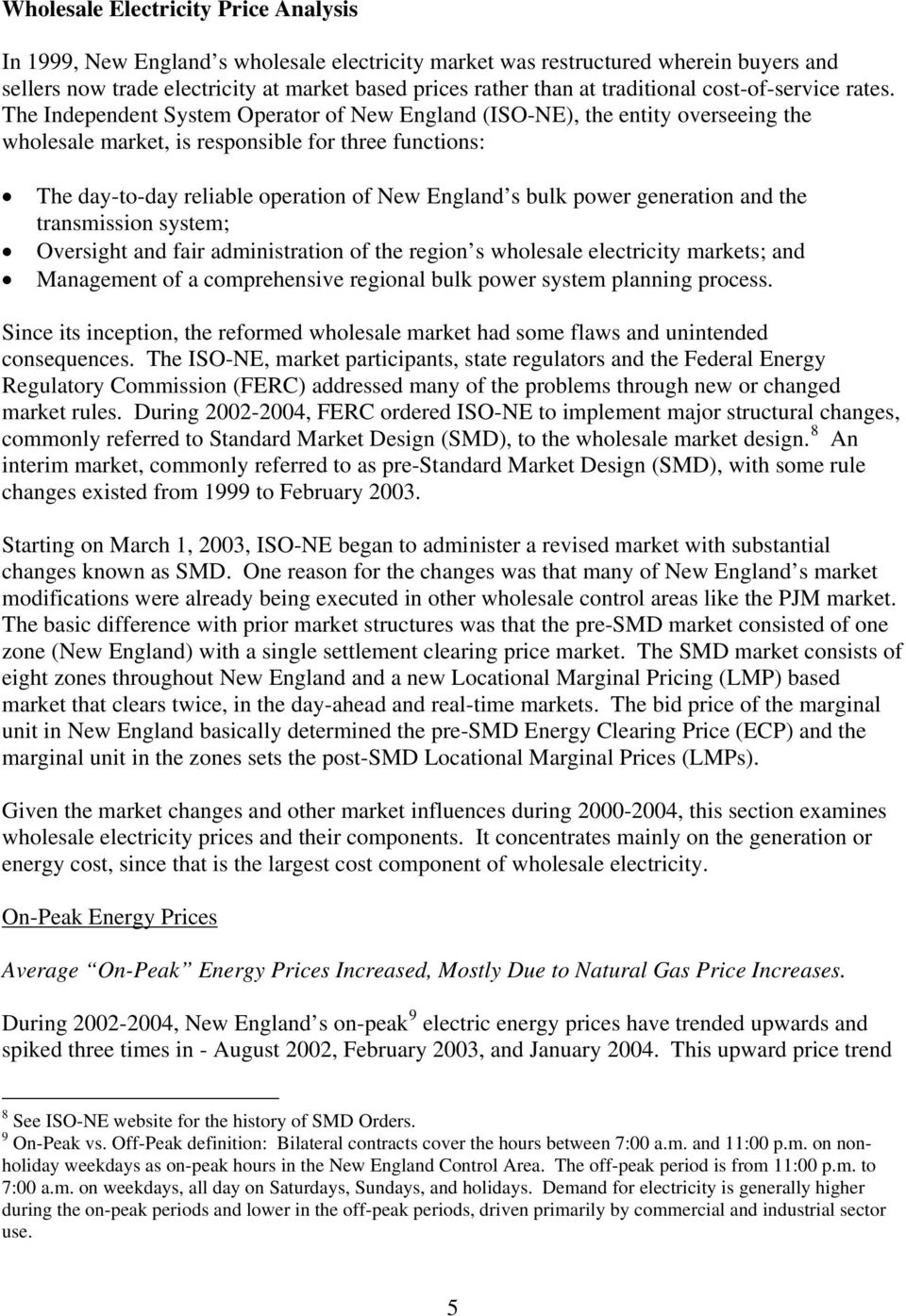
15 is largely attributed to an increase in the price of fuel, most notably natural gas, used to generate electricity. 10 During this study s time period, natural gas-fired or natural gas-capable plants operated on the margin (the marginal unit generally set the energy clearing price levels or LMPs) during 81% 11 of all hours. The new SMD structure, implemented in March 2003 is depicted below in Figure 2-3. The new regime divided the Massachusetts electric market into three zones: Boston/Northeastern MA region (NEMA), Southeastern MA (SEMA) and Western/Central MA (WCMA). Figure 2-3 Massachusetts Wholesale Electricity Pricing Zones (effective March 2003) WCMA NEMA SEMA Source: MA DG Collaborative Discussion Document, Sept. 9 th, 2005, Eight Opportunities Analysis Approach_ ppt 10 Henry Hub natural gas prices rose 75% from 2002 to Natural Gas prices for New England consumers who procure gas off the El Paso Tennessee interstate pipeline, Algonquin Gas Pipeline or at the Dracut citygate rose about 80% over the study period. See Appendix table A-1 for further price details for the three major New England pipeline supplies. 11 ISO- NE Annual Markets Reports ( ). 6
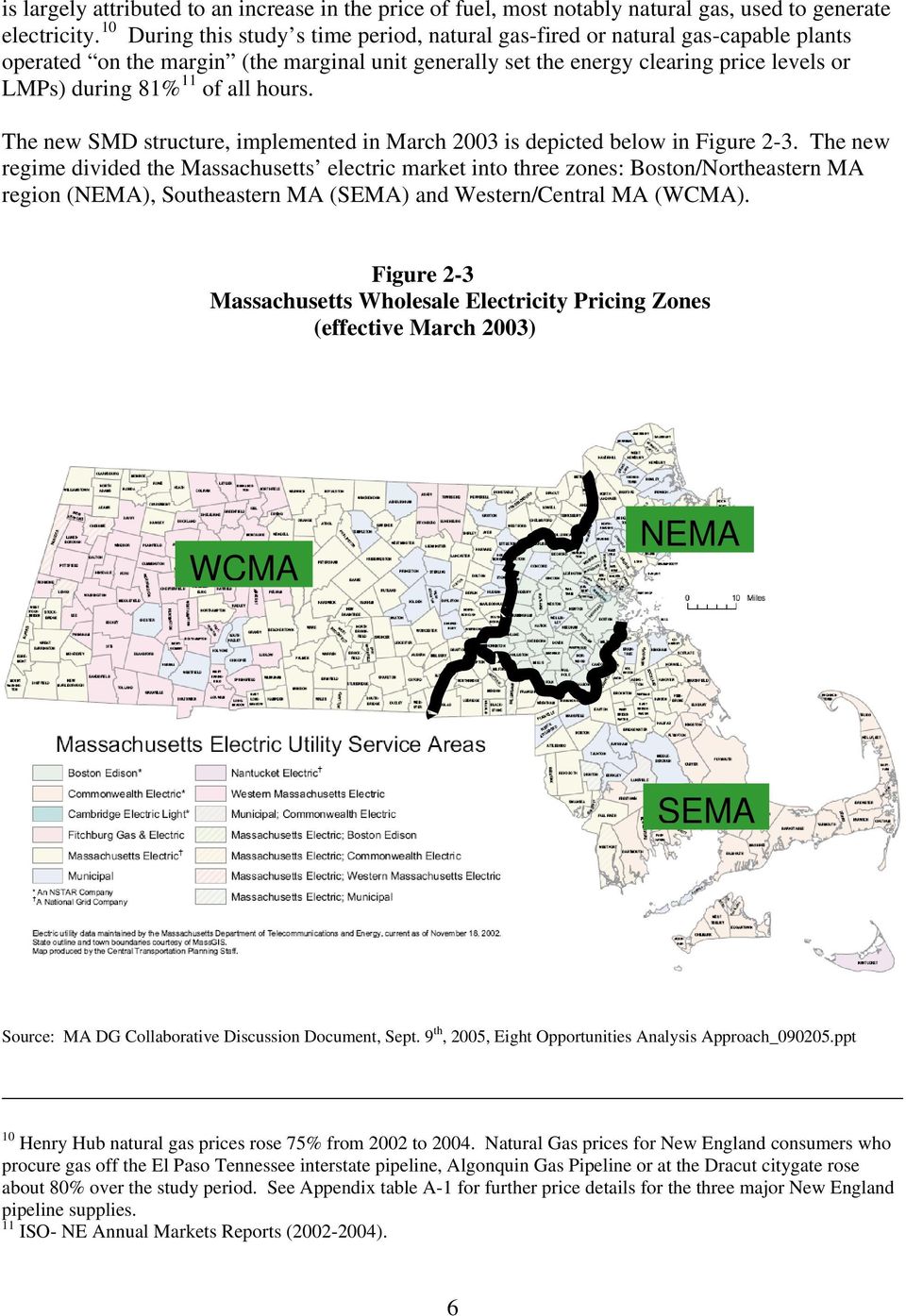
16 Table 2-2 lists the average annual on-peak energy prices for Massachusetts customers from 2002 to In 2002, that price was $41.35/MWh. The 2002 data is the average on-peak price paid by all customers in New England. The data is depicted in this manner because prices for MA in 2002 and January and February 2003 are the same as those throughout New England. Under the new zonal pricing structure, the different New England zones experienced different clearing prices, now known as locational marginal prices (LMPs). As shown, the MA zonal prices hovered around $56-57/MWh in 2003 and $58-59/MWh in Table 2-2 Massachusetts Average Annual On Peak Prices, ($/MWh) NE NEMA SEMA WCMA 2002 $ $56.83 $56.26 $ $58.91 $57.88 $59.95 Source: ISO-NE, DOER Historically, the peak load summer months were the highest price months. That has not been the trend over the period studied. Interestingly, during this time, fuel (oil and natural gas) prices increased, in general, but especially in the winter when the delivery infrastructures for those fuels experienced extreme strain due to high demand. 12 Figure 2-4 shows New England s average monthly on-peak energy prices from January 2002 to March It also incorporates the Massachusetts zonal prices for NEMA, SEMA and WCMA from 2003 (post-smd) through December Although there was a rise in energy prices, the data show that the Massachusetts zonal energy prices consistently converged during This means that there was relatively little congestion in transmitting power in Massachusetts among the zones. Prior to SMD implementation, more significant congestion impacts were expected in the NEMA/Boston electrical area zone relative to other New England zones than was realized during the study period Appendix Table A-2 illustrates the New England summer and winter peak load hours experienced in New England Brings Power Market In Line With Federal Plan, DJ Newswire, Feb 28, 2003, Wholesale power prices are projected to rise most significantly in greater Boston and SW CT due to transmission import constraints. ISO-NE simulated a 14% increase in power prices from current levels. 7
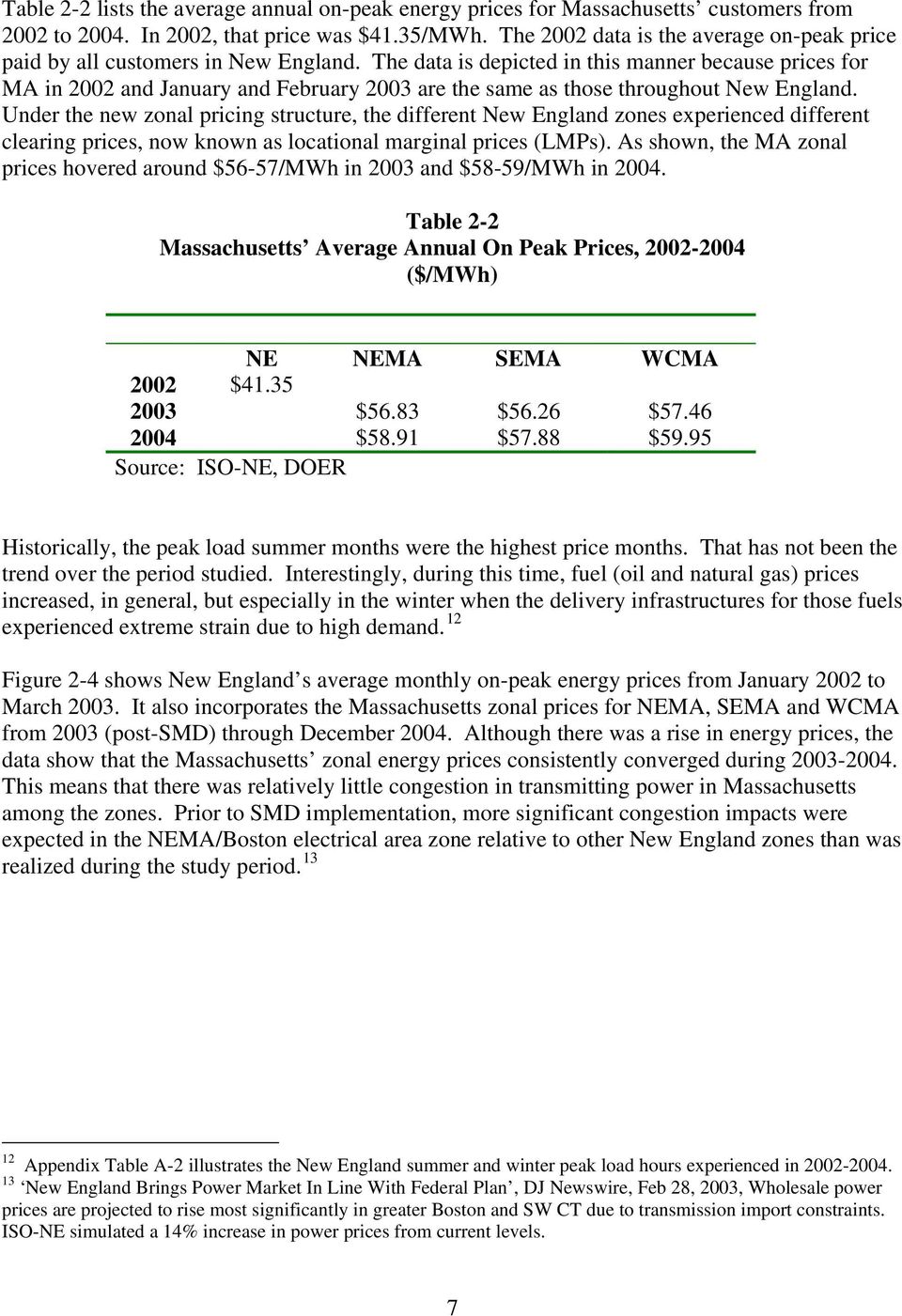
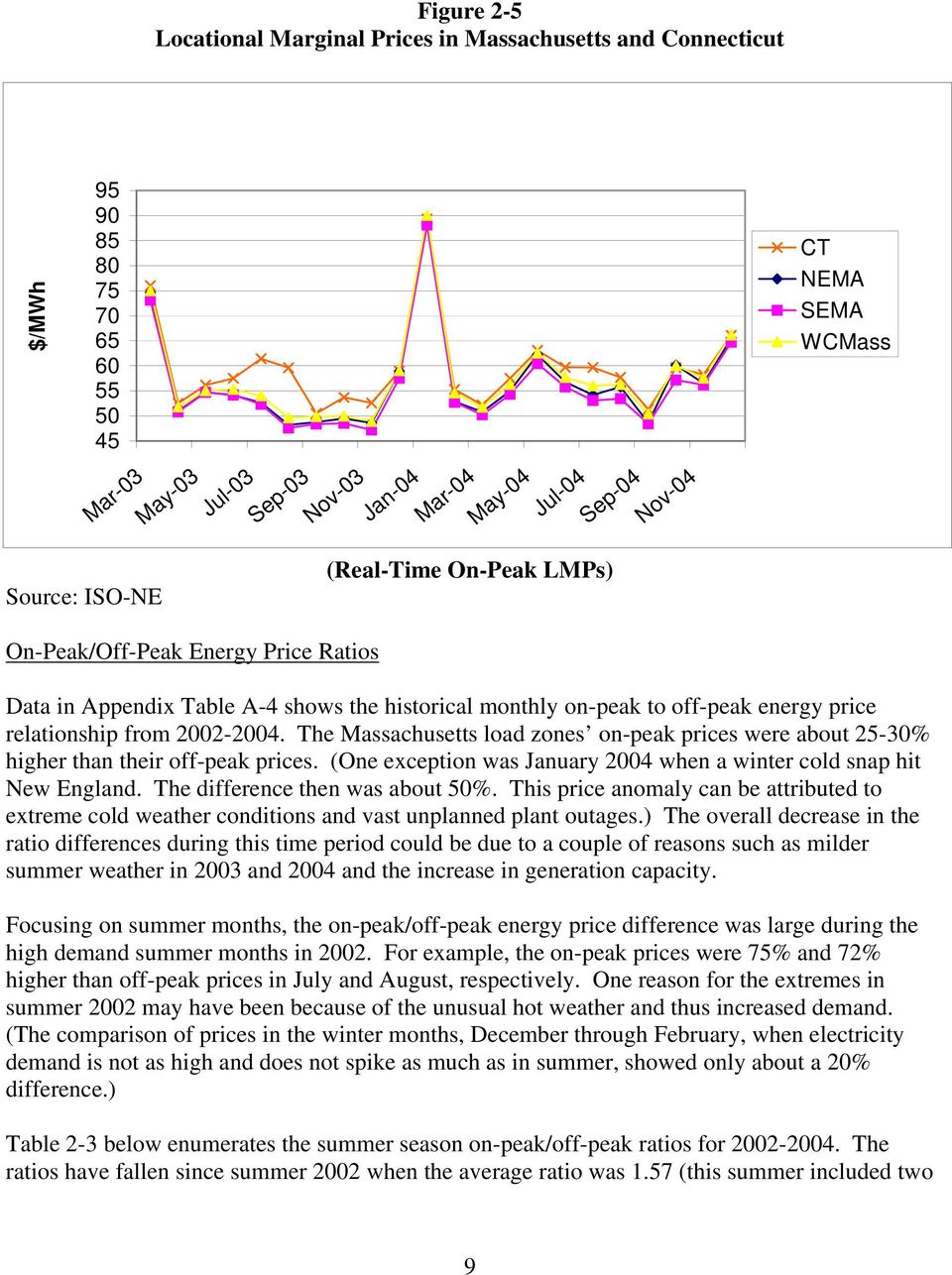
17 Figure 2-4 Wholesale Electricity Prices Average Monthly On-Peak ECPs and Real-Time LMPs ( ) $/MWh Jan-02 Mar-02 May-02 Source: ISO-NE Jul-02 Sep-02 Nov-02 Jan-03 Mar-03 May-03 Jul-03 Sep-03 Nov-03 Jan-04 Mar-04 May-04 Jul-04 Sep-04 Nov-04 MA On-Peak Zonal Energy Prices Diverge from Connecticut Zonal Prices. In the SMD market, Connecticut (CT) is considered one load zone for purposes of locational pricing. The CT load zone includes the southwestern part of the state, a severely import constrained area. Figure 2-5 compares the locational energy prices in Massachusetts zones with the CT zone. The graph illustrates the relatively considerable divergence in prices and how Connecticut supply tended to be higher cost than Massachusetts electricity supply. This divergence is due to the constrained transmission infrastructure and high-priced generation located in southwest CT. The New England electric market also uses a common commercial hub to support trading and hedging activities for market participants. A major reason for the hub is to help participants hedge their exposure to risk in the real-time market, when electricity is delivered. The three Massachusetts zones to which power must be physically delivered are typically priced very close to the hub price. The Western MA premium during the SMD era was less than 1%, while the NEMA and SEMA prices were 1 to 2% less than the hub price See Appendix Table A-3 for monthly premium values by MA LMP zone. NEMA SEMA WCMass Average ON Peak Price 8

18 Figure 2-5 Locational Marginal Prices in Massachusetts and Connecticut $/MWh CT NEMA SEMA WCMass Mar-03 May-03 Jul-03 Sep-03 Nov-03 Jan-04 Mar-04 May-04 Jul-04 Sep-04 Nov-04 Source: ISO-NE (Real-Time On-Peak LMPs) On-Peak/Off-Peak Energy Price Ratios Data in Appendix Table A-4 shows the historical monthly on-peak to off-peak energy price relationship from The Massachusetts load zones on-peak prices were about 25-30% higher than their off-peak prices. (One exception was January 2004 when a winter cold snap hit New England. The difference then was about 50%. This price anomaly can be attributed to extreme cold weather conditions and vast unplanned plant outages.) The overall decrease in the ratio differences during this time period could be due to a couple of reasons such as milder summer weather in 2003 and 2004 and the increase in generation capacity. Focusing on summer months, the on-peak/off-peak energy price difference was large during the high demand summer months in For example, the on-peak prices were 75% and 72% higher than off-peak prices in July and August, respectively. One reason for the extremes in summer 2002 may have been because of the unusual hot weather and thus increased demand. (The comparison of prices in the winter months, December through February, when electricity demand is not as high and does not spike as much as in summer, showed only about a 20% difference.) Table 2-3 below enumerates the summer season on-peak/off-peak ratios for The ratios have fallen since summer 2002 when the average ratio was 1.57 (this summer included two 9
19 months of ratios of 1.72). On peak prices averaged $43.85/MWh in July This was 75% greater than off-peak prices which averaged $25.10/MWh. Since then, the two following summers have had individual monthly ratios reach only as high as 1.39 in one month, August The entire summer of 2003 did not produce a single month exhibiting a ratio higher than 1.28, which was in June. Table 2-3 Summer Season (June September) On-Peak/Off-Peak Ratios NE NEMA SEMA WCMA Source: ISO-NE and DOER calculations One contributing factor to smaller price ratios seen over the past two years is the growth of offpeak prices relative to on-peak prices. Average annual off-peak prices grew 49% from 2002 to 2004 in NEMA/Boston, while on-peak prices grew 42% during the same period 15. The off-peak prices are a function of base load fuel costs and other variable O&M costs such as emission allowances. Stable priced feedstock such as hydro, nuclear and coal typically fuel base load generation in the US power markets. Coal costs, however, have increased 40% to 100% 16 depending on the grade over the study period, while uranium, also heavily demanded, has increased over 100% since Emission allowance prices almost quadrupled from 2003 to Opportunities Exist for Demand Response During On-Peak Periods. A high on-peak/off-peak energy ratio suggests that there are times when market participants, and ultimately consumers, would want to respond to high energy prices through demand curtailment to save on electricity costs or smooth price volatility. In fact, the ability of customers to respond to price signals is an important component of a workably competitive marketplace. 15 The average off-peak price in 2002 was $30.07/MWh and $44.86/MWh for the real time off-peak energy in WSJ, High Coal Prices Crimp Utilities, Big Energy Users; Impact Is Most Deeply Felt By Consumers Who Depend On Cheaper Off-Peak Power Rebecca Smith. WSJ (Eastern edition). New York, N.Y.: August 24, 2004, pg. A.2, During the past 20 months, prices for Eastern coal have risen by as much as 40% to 100%, depending on the grade and market, according to Standard & Poor's credit-rating agency. Low-sulfur coal, which is preferred for power generation, has as much as doubled in price on the spot market since January 2003 to about $60 a ton. Prices quoted on multiyear contracts for low-sulfur coal from central Appalachia are up about 40% since early 2003, S&P said, to $38 to $45 a ton. 17 Reuters, Soaring Prices Put Shine on U.S. Uranium, Sunday March 27, 2005, By Belinda Goldsmith The price has spiked to about $22 a pound from $10 in 2002 as Asian nations build nuclear reactors to create electricity amid high oil prices and concerns over global warming. 18 DJ Newswire, High Coal Costs, Competitive Markets Squeeze US Power Companies, Matthew Dalton, June 23,

20 For several reasons, though, demand response is a difficult figure to estimate. A key metric, however, for customer demand response is sustained and transparent high on-peak to off-peak price ratios. Without both sustained and transparent high price ratios, customers will not be induced to substitute for their electric consumption behavior. If on-peak to off-peak ratios do not reach a significant level, customers will not bother with peak shaving investments and will turn to energy efficiency investments that can be effective regardless of changing daily or monthly prices. ISO-NE administers voluntary Load (demand) Response programs to provide opportunity and flexibility to end use customers to react to volatile real time generation prices. The inducement of large C&I end users to reduce demand via the ISO administered Load Response programs ultimately produces a more efficient energy market and price benefits for the region as a whole. Details of the Load Response programs and participation in them can be found at the ISO-NE website. The success of these programs will be influenced by the ratio of on-peak to off-peak prices. Day-Ahead/Real-Time Energy Price Ratios Day-Ahead Prices Have a Slight Premium Over Real Time Prices. Convergence between Day-Ahead (DA) and Real Time (RT) 19 energy prices are an important goal of a Locational Marginal Pricing (LMP) marketplace. Generally, the expectation is that the generators incorporate a risk premium in their day-ahead energy price to insure for capacity commitments and outage risks prior to real time operation and performance. Significant price divergence would suggest a lack of efficient arbitrage using special financial instruments. 20 Reserve cost allocation issues impeding efficient use of virtual transactions were only corrected recently which should lead to greater use of these transactions in the future. In summer 2003, Forward Contracting premiums were measured in a study released by ISO- NE s independent market advisor. That report s data show that NEMA exhibits about a 3% premium in the day-ahead prices, while the other MA zones have about a 1% to 2% day-ahead premium. Clearing price differences between day-ahead and real time were highest in NEMA/Boston compared to the other NEPOOL zones, but were still generally consistent. 21 Appendix Table A-5 provides price ratios of day-ahead to real time over the period studied. Similar convergence results were realized in other multi settlement markets in NY and PJM, 19 The Day-Ahead and Real Time markets make up the ISO-NE Multi-settlement System (MSS). The Day-Ahead Energy Market produces financially binding schedules for generators and load serving entities one day before the operating day. The market closes at 12 noon and re-offers must be made between 4 and 6 pm the day prior to the dispatch or plant operating day. The Real Time Energy Market reconciles differences between the Day-Ahead scheduled amounts of electricity and the actual real time demand. In 2004, 97% of energy load was covered through the Day-Ahead auction, while only 3% of load was assigned real time prices (ISO 2004 Annual Markets Report, page 7). 20 Virtual transactions are instruments that create arbitrage opportunities based on price differences between the DA and RT markets. 21 See the ISO-NE report Six Month Review of SMD Electricity Markets in New England, page

21 displaying a small premium for day-ahead settlements. Longer-term bilateral contracts 22 (as opposed to short term or day ahead trading) tend to have larger premiums, which are correlated to their contract duration and specific delivery terms. Wholesale Price Components Energy (Generation) Cost, the Largest Wholesale-Price Component, Increased by almost 7%. Bulk power suppliers, competitive suppliers and default distribution utilities, must procure, in addition to energy, other services from ISO-NE administered markets. Energy prices are the dominant component in the wholesale power costs, but other components are necessary to maintain system integrity and resource adequacy. The data in Table 2-4 represents the components of the bulk power price in a percentage format. The data show that energy prices have increased by 6.7% since The energy component increase can be attributed to the SMD power market design, which eliminated bid based reserve markets as well as poor performance of the capacity market. 23 Capacity market component costs fell to only 0.1% of 2004 all-in costs, from six percent in Uplift 24 fell in 2003 to 1.3% of costs, but increased to 2.2 percent in A forward reserve market was implemented in 2004 accounting for the uptick in ancillary services costs from 1.1% to 1.7% of the All-In cost 26. A new locational capacity (LICAP) commodity market is scheduled for implementation no earlier than October 2006 per an August 2005 FERC order. 27 A FERC Administrative Law Judge filed her initial decision in support of the ISO-NE s demand curve-based LICAP market which, if approved by FERC, could increase wholesale supply costs by $3 billion annually for the six state region. 28 This would increase the capacity cost component of the all-in price 22 Bilateral contracts make up approximately 75% of the energy market whereas short term or day-ahead trades and spot market or real time contracting covers the remaining 25%. 23 FERC ordered ISO-NE to implement a Peaking Unit Safe Harbor (PUSH) bidding scheme on June 1, 2003 to avoid having to negotiate out of market, cost-of-service agreements seeking compensation for Reliability Must Run (RMR) services. The Commission ordered ISO-NE to implement an approach using formulated PUSH bid ceilings to allow high-cost, seldom run units to recover levelized fixed costs and variable costs through their energy offers without mitigation risk to increase resources during scarcity events. The PUSH bidding scheme is to last until the implementation of a Locational Installed Capacity Market. The majority of cost recovery for PUSH units came from uplift. In 2004, twenty PUSH units recovered $25.5 Million in operating reserve credits (ORCs) (Economic and RMR) and special reliability payments. The implementation of PUSH has proven to be ineffective as only 3% of the PUSH units set the LMPs in Uplift is a general term for costs not included in the LMP energy market or reserve markets. Uplift is paid thru ORCs (Economic and RMR, day ahead and real time) and reactive power and special constraint reserve (SCR) tariff costs. RMR ORCs and SCR tariff costs are localized, where as Economic ORCs and Voltage support are socialized. 25 Uplift refers to the costs borne from dispatching a plant out-of-economic merit order or for special local reliability purposes. Uplift is compensated with Operating Reserve Credits (ORCs) or designated tariff payments. 26 The forward reserve market prices cleared about 1,900 MWs for the seasonal auction at prices between $3.75 and $4.50/kw-mo. For more information, visit the ISO-NE website. 27 Devon Power, LLC, et al, Docket No. ER , August 10, 2005, 112 FERC 61, Devon Power, LLC, et al, Docket No. ER , June 15, 2005, 111 FERC 63,063 12
22 significantly. 29 The key question is whether increases in the capacity component would be offset by some decrease in the other components. Table 2-4 Components of All-In Wholesale Price ENERGY 90.4% 95.9% 96.0% UPLIFT 2.3% 1.3% 2.2% CAPACITY 6.0% 1.8% 0.1% ANCILLARY SERVICES 1.3% 1.1% 1.7% TOTAL 100% 100% 100% Source: ISO-NE State of the Markets reports, All-In Wholesale Price and Costs Figure 2-6 illustrates the monthly average All-In wholesale power prices for the New England region over the study period. The average monthly All-In prices are for around-the-clock (ATC) hours, as opposed to prices in Figure 2-2 which exhibits only average monthly on-peak hours. Similar to the on-peak hours, the same three peaks are evident in Figure 2-6, but the All-In prices are not as high as the on-peak prices. The average All-In cost for 2003 was $55.36 /MWh and $57.05/MWh in Data for 2002 are not discussed due to issues of comparability with post- SMD data. 29 Per a 2003 FERC order, ISO-NE proposed a capacity market structure utilizing an administrative Demand Curve (DC), however many parties oppose the design. The demand curve prices the capacity commodity as a function of the installed capacity level in separate regions of New England (e.g. NEMA/Boston). The proposed Estimated Benchmark Cost of Capacity (EBCC) for NEMA/Boston is $8.16/kw-mo, which converts to $20.87/MWh, assuming a load factor of 60% and including a 12% required reserve capacity. This cost would account for 26.8% of the All-In cost in 2006, assuming other component prices are the same as realized in This increase in 2006 would be an immense change in component allocation from levels, however, the DC price is not likely to reach the EBCC in the early years. Assuming the DC dictates a capacity cost of 25% of EBCC or $2.04/kw-mo, the capacity cost would still make up 8.4% of the all-in price at the converted $5.22/MWh. 13
23 Figure 2-6 All-In Price Metric for $/MWh SEMA WCMA NEMA Syst Overall Jan-02 Jul-02 Feb-03 Aug-03 Mar-04 Sep-04 Source: ISO-NE Tables 2-5 and 2-6 illustrate the magnitude of the All-In wholesale costs for the entire New England regional market and the Massachusetts market over the past two years. Table 2-5 New England s All-In Wholesale Costs ENERGY $6,943,035,407 $7,257,855,360 UPLIFT $94,118,311 $166,325,852 CAPACITY $130,317,661 $7,560,266 ANCILLARY SERVICES $79,638,571 $128,524,522 TOTAL COSTS $7,247,109,950 $7,560,266,000 NET LOAD (MWH) 130,778, ,520,000 Source: ISO-NE s State of the Markets Reports, CELT Report, DOER The Massachusetts costs in Table 2-6 below are estimates. We assumed the same all-in cost component breakdown for the Commonwealth as for the entire region. This is a valid approximation, however, because the majority of localized (not allocated to the entire region) 14
24 uplift costs are obligations of NEMA suppliers and transmission owners the costs are greatest in the Boston area and would increase the uplift component relative to the New England regional breakdown in Table 2-5 Table 2-6 Massachusetts All-In Wholesale Costs (Estimates) ENERGY $3,157,329,663 $3,285,313,248 UPLIFT $42,800,089 $75,288,428 CAPACITY $59,261,662 $3,422,201 ANCILLARY SERVICES $36,215,460 $58,177,422 TOTAL COSTS $3,295,606,875 $3,422,201,300 NET LOAD (MWH) 59,471,000 59,986,000 Source: ISO-NE s State of the Markets Reports, CELT Report, DOER Retail Electricity Price Analysis Retail electricity prices are composed of wholesale power costs and other costs of service. Since the energy supply cost is a predominant component (approximately 50%) of retail prices, it gets a lot of attention in analyzing the overall retail electric service costs. However, many other services must be procured and provided to deliver safe, reliable electricity. This section furnishes an overview of Massachusetts retail electricity prices and provides some discussion of retail cost elements. One of these is known as transition or stranded costs, which are legacies of the regulated generation market. These costs can be significant depending on a customer s distribution utility. We first discuss the generation portion of a customers retail bill. Overview of Default Service Prices by Load Zone The local distribution companies (LDCs) procure energy in any one or more of the three Massachusetts load zones, depending on each LDCs service territory. After SMD took effect in March 2003, the MA LDCs for the first time procured energy in all the different load zones, namely NEMA, SEMA and WCMASS. Initially, the NEMA zone was expected to command a higher price due to high demand and congestion problems. Table 2-7 supplies data on the weighted, average residential default service prices in Massachusetts classified by Massachusetts load zones procured by the different local distribution companies. As can be seen, the retail price differences among load zones decreased. Over a period of one and half years, the price differentials between NEMA, SEMA, and WCMASS load zones have decreased from 12% to 3% (NEMA/SEMA) and from 17% to 1.3% (NEMA/WCMASS). 15
25 Table 2-7 Average Residential Default Service Prices by Load Zone NEMA Price SEMA Price WCMASS Price NEMA/SEMA Ratio NEMA/WCMASS Ratio May Jun Jul Aug Sep Oct Nov Dec Jan Feb Mar Apr May Jun Jul Aug Sep Oct Nov Dec Source: Massachusetts Department of Telecommunications and Energy Retail Default Service Lags All-In Wholesale Costs According to Figure 2-7, the retail default service prices lag the All-In wholesale prices and are not as volatile, largely due to the longer-term procurements found in default and standard offer service. Such a disconnect between wholesale and retail prices provides challenges to customers when evaluating competitive-market alternatives to utility-provided generation service. The figure shows the wholesale power price hikes in January 2003 and January 2004 which were caused by increase in natural gas prices and above normal cold winter weather conditions. The wholesale price ranged between $30.00-$80.00 per MWh. The resulting, but lagged, retail prices ranged between $51.00-$71.00 per MWh. There may be opportunities for competitive suppliers to enter the retail marketplace when there are significant differences between default service prices and All-In wholesale prices. 16
26 Figure 2-7 Weighted Average Monthly Standard Offer and Default Service Prices $90.00 $80.00 $70.00 $60.00 $/MWH $50.00 $40.00 $30.00 $20.00 SOSP DSP All-In W holesale Price $10.00 $0.00 Jan-02 Mar-02 May-02 Jul-02 Sep-02 Nov-02 Jan-03 Mar-03 May-03 Jul-03 Sep-03 Nov-03 Jan-04 Mar-04 May-04 Jul-04 Sep-04 Nov-04 Other Retail Price Components In addition to the generation portion of a retail customer's bill, there are a number of other retail price components: distribution, transmission, transition, and social-benefit charges (SBC) for energy efficiency and renewable electricity programs. We do not discuss distribution charges in this report, as these have been discussed extensively in prior Market Monitors and generally only change by a few percentage points (close to the rate of inflation) due to implementation of performance-based rate plans. We also do not discuss SBC charges since these are set at legislatively-determined levels. Transmission and Transition charges are discussed below. Transmission Cost Analysis Retail electricity suppliers must also procure bulk transmission service to deliver the electric supply to end use customers. The transmission portion of the bill is small (5-10%) but may increase with additions to the transmission network. Transmission expenses incurred by suppliers are regulated by FERC under three rate tariffs. Suppliers must take service under 17
27 NEPOOL s Open Access Transmission Tariff (OATT) Electric Tariff No. 1, a utility company FERC Electric Tariff No , also known as local network service (LNS) and ISO-NE FERC Electric Tariff No. 1. There are several other types of transmission services and upgrades which require application submittal to the ISO-NE. Finally, some utilities may also allocate Reliability Must Run (RMR) contract costs to the Network Load of a reliability region where a generation need has been identified by ISO-NE. 31 Congestion costs were once included in transmission expenses, however, since the implementation of SMD on March 1, 2003, congestion costs are now a component of the energy commodity price known as the LMP discussed earlier in this chapter. In this section, we only provide data for OATT. The OATT tariff provides access to the New England control area s regional transmission facilities greater than or equal to 69kV, commonly referred to as the Pool Transmission Facilities (PTF). The OATT tariff service is known as Regional Network Service (RNS) and recovery of costs is through the NEPOOL RNS rate. The NEPOOL tariff also provides Scheduling and Dispatch Service, Reactive power and Black start service. The RNS rate is transitioning from zonal utility transmission rates to a single regional rate with the transition to be complete in The combined RNS rate 32 is calculated per a FERC approved formula and is shown for Massachusetts utilities in Table 2-8 for the study period. 33 The data show that RNS rates have steadily increased since Over $337 million in costs were recovered through RNS rates from New England customers in This cost converts to an average of roughly $4.06/MWh considering the net energy of 132,520 GWh for the region and regional summer load factor of close to 63%. 30 The OATT and utility Tariff have been renamed effective February 1, 2005 per RTO-NE formation. The NOATT is now referred to as the ISO-NE Transmission, Markets and Services Tariff, FERC Electric Tariff No. 3, while the utility company FERC Electric Tariff No. 10 has been renamed to ISO-NE Transmission, Markets and Services Tariff. 31 Only MA utilities serving customers in the NEMA zone had to allocate RMR contract costs during the study period. The Exelon New Boston Station in South Boston has operated under a RMR agreement to maintain downtown Boston reliability for several years, while the Mirant Kendall Station in Cambridge has been under an RMR agreement since The total 2004 RMR costs allocated to customers for NEMA reliability must run contracts totaled $43.6 Million, $30 Million of which were directed to the South Boston facility. 32 Pre-1997 PTF and post 1996 PTF. 33 One can convert the common RNS rate ($/kw-yr) to a variable rate realized by ratepayers of $/MWh or $/kwh by adjusting the annual RNS rate for capacity utilization or load factor. Typical utility load factors are about 60%. 18
28 Table 2-8 Regional Network Transmission Service ($/kw-yr) Jun-02 Jun-03 Jun-04 Transmission Final/Total Final/Total Final/Total Provider RNS Rate RNS Rate RNS Rate $/kw-yr $/kw-yr $/kw-yr Boston Edison Comm Electric NGRID NU - WMECO Pool PTF Source: ISO-NE Transition Cost Balance Analysis A major cornerstone of the Restructuring Act was that utility distribution companies were mandated to divest and sell their generation assets. Under the Act, distribution companies were allowed to recover prudently incurred costs, after all reasonable steps, including divestiture of generation assets, were taken to mitigate the investments. The remaining costs for generationrelated assets are known as stranded costs or transition costs. Depending on the LDC, transition costs may account for up to 30% of a customer s bill, higher than distribution-related charges for some customers. In many cases, the power plant sales exceeded remaining book values thereby mitigating the transition cost balances more than anticipated. 34 In some cases, utility sponsored divestitures did not produce an adequate sales price and utilities were forced to retain asset(s) and apply to the MA Department of Telecommunications and Energy (D.T.E.) for continued recovery of transition costs. Mitigation efforts by utilities have been an ongoing issue to reduce transition cost balances over the past six years. Savings efforts are important to reduce balances because, as illustrated in Table 2-9, cost balances are forecasted to last until 2023 in the case of Commonwealth Electric. The data in the table also exhibit the beginning transition cost balance and the most recent balances per utility transition cost reconciliation filings made to the D.T.E in 2004 or supplemental filings in See MA DOER Market Monitor The NPV analysis assumes a 10% discount rate. 19
29 Table 2-9 MA Investor-Owned Utilities Transition Cost Balances as of 2004 DTE Filings (Dollars) Initial 1998 Transition Charges (Excluding Reg. Assets) Unrecovered Transition Charges as of 2004 Filing Forecasted Year of Transition Charge Termination Boston Edison 3,170,831,000 1,413,455, Cambridge 190,221,000 78,838, Commonwealth 1,197,040, ,297, FG&E 87,986,000 49,547, Mass. Electric 3,207,347, ,601, WMECo 851,375, ,380, Total (2005 US$) 8,704,800,000 2,808,121,282 Source: DOER and Utility Reconciliation filings (initial and supplemental) The above table shows the combined transition costs qualified for recovery by utility. A more detailed look at transition costs would show that the costs are classified as either fixed or variable costs. Fixed costs are unrecovered power plant asset investments that did not sell for a higher price than the book value. All power plant assets have been divested by utilities as of Variable costs are generally associated with above-market power purchase agreements (PPAs) which are considered uneconomic in today s bid-based market 36. DOER will update this analysis on a yearly basis. 36 In 2004, Nstar petitioned the MA DTE for approval to mitigate transition costs via several different PPA buy-outs or restructurings. Nstar also filed with the DTE to securitize costs of $675 Million for upfront buyout costs related to contracts with two plants (Masspower and Dartmouth Power). Although Nstar negotiated several deals to buyout nearly half of the 1,100 MW contracted thru 24 PPAs on the auction block, only two petitions were approved by the DTE in Boston Edison completed the Ocean State Power contract assignment (DTE 04-68).and Cambridge and Commonwealth Electric completed the Altresco-Pittsfield contract termination agreement (DTE 04-60). Savings estimated by Nstar for the Ocean State deal were $12 Million and $6 Million for the buyout of the Altresco contract. 20
30 Retail Prices by Massachusetts Electric Companies Table 2-10 shows total retail prices for all customers for each of the local distribution companies and the municipal companies as a whole. The retail prices shown in the table (and in this section) result from adding all the retail price components discussed above and represent the actual prices paid, on average, by all consumers and businesses of the Commonwealth for their electricity purchases. Table 2-10 Revenue per kwh for Massachusetts Electric Companies (average price in cents/kwh) 2002 Average Price 2003 Average Price 2004 Average Price Change ( ) Boston Edison % Cambridge Electric % Commonwealth Electric % Fitchburg Gas & Electric % Massachusetts Electric % Nantucket Electric % Western Massachusetts Electric % Total: Distribution Company % Total:Municipal Company % Total of Entire State % Source: FERC Form 1, Massachusetts Electric, EIA (for Massachusetts Electric & 2002 overall price), DOER The data show that overall prices paid by all customers classes showed little change 37 over the time period. The data also show that distribution companies overall price disadvantage over municipal companies has narrowed over the time period. As shown in Table 2-11, however, municipal companies continue to provide electric service at cheaper rates for their residential customers. 37 The 2004 overall price shown in Table 2-10 differs from the overall price shown in Figure 2-1 due to different data sources. The analysis of Figure 2-1 is a comparison of MA average prices to other states and national prices. The analysis shown in Table 2-10 is a temporal analysis and utility specific. 21
31 Table 2-11 Comparison of Distribution Company and Municipal Company Prices ( ) Residential Average LDC Company Price Average Municipal Utility Price Difference -15.8% -18.1% -19.7% Small Commercial or Industrial Average LDC Company Price Average Municipal Utility Price Difference -5.9% 14.6% 16.5% Large Commercial or Industrial Average LDC Company Price Average Municipal Utility Price Difference % 25.6% Overall Average LDC Company Price Average Municipal Utility Price Difference -7.8% -2.3% -0.3% Source: FERC, Massachusetts Electric, Municipal Electric Companies Retail Price Disparity Retail price disparity refers to the difference in prices among the LDCs and customer classes. A higher value for price disparity for a customer class indicates that there are greater differences among customers in a particular customer group. As part of its annual market monitor reports, DOER has reported on changes in price disparity from year to year. Table 2-12 shows this analysis for the time period. As in prior years, price disparity increases with the range of sizes within the customer class that is, it is more likely one will find greater price disparity among commercial and industrial (C&I) customers than among residential customers; hence prices paid by customers in the C&I group should differ by a greater amount. In terms of year-to-year changes, it was less likely that price disparity changed (higher or lower) among the 22
32 LDCs between than between , because the F-Tests 38 are higher for The data show that for the industrial class, this probability is only 47%, implying that it was more likely than not that price disparity changed, increasing from 8.0 cents/kwh to 14.6 cents/kwh. From , however, the F-Test shows that even though price disparity increased further to 17.1, there was an 85% chance that this change was not statistically significant. Table Price Disparity Among Distribution Companies Residential Commercial Industrial Overall Price Disparity F-TEST Residential Commercial Industrial Overall Price Disparity F-TEST Source: FERC, National Grid, DOER Restructuring Savings Analysis This final section compares retail electricity prices and bills incurred by Massachusetts consumers during periods prior to restructuring and after March 1, 1998, the start of retail choice. A comparison of electric prices and expenditures shows consumer savings after the start of electric restructuring. 39 Changes in Price and Expenditure Levels Table 2-13 shows retail electricity prices by sector over the period. 40 The main point is that prices were constantly increasing from (an 18% increase over that time), and then dropped precipitously in 1998 and 1999, largely due to the mandated rate discounts to customers. Since then, prices have risen (largely due to fuel-related increases), and most recently, prices are only slightly higher (in current dollars) than the prices in 1997 for all 38 The F-Test is a statistical test that measures the probability that the variance among two datasets are not statistically significant and thus measures the probability that price disparity did not change from year to year. A higher value implies that disparity among two datasets is less likely. 39 The conclusions cannot be attributed to any particular program or event that is in place or has occurred during the post-march 1998 period, such as the mandatory 15% discounts and divestiture or fuel-clause surcharges, or similar events in the period prior to March 1, Rather, the analysis considers all events as a whole in each period. 40 In order to simplify the analysis, DOER utilized EIA data by customer sector for the entire state of Massachusetts. 41 Indeed one of the major objectives of restructuring efforts in Massachusetts and other high-cost states was to attempt to address the high costs of electricity. 23
33 customer groups except industrial customers. 42 Figure 2-8 provides a visual interpretation of the data, showing that initial lower prices due to restructuring have been reversed and the trend in the data is higher prices. Table 2-13 Average MA Retail Electricity Rates for Different Customer Groups (cents/kwh) Residential Commercial Industrial Average Source: EIA 42 This may be due to the movement of many larger customers to the competitive market and the use of selfgeneration. 24
34 Figure 2-8 Massachusetts Electricity Prices, (cents/kwh) Period Prior to Restructuring Post-Restructuring Period Source: Table 2-13 Annual Total Expenditures/Total Bills The actual expenditures, the total bills, paid by each customer group is displayed in Table The total column includes the three listed sectors, Residential, Commercial and Industrial, plus other sectors (e.g. transportation) expenditures which are small and not catalogued separately. Total expenditures increased from about $4 billion in 1990 to about $5.5 billion in This increase was a function of increasing prices and increases in electricity demand. Within the timeframe, total expenditures fluctuated from year to year based on different demand levels (e.g. increased cooling demands during an extremely warm summer) and the prices in a particular year. As with the price data, there was a large drop in expenditures in 1998 and 1999 after restructuring began compared to 1997 levels. Shown in the table, Massachusetts customers incurred the highest expenditures in This increase was mostly due to the application of fuel surcharges related to oil and natural gas prices, not necessarily due to increased demand since that year had relatively cool summer weather. By contrast, 2003 featured similarly high expenditures, but these were due to demand pressures rather than high prices. 25
35 Table 2-14 Total Electricity Expenditures by Customer Group (Dollars) Residential Commercial Industrial Total ,504,941,000 1,589,746, ,597,000 4,020,327, ,599,159,000 1,707,623, ,697,000 4,270,460, ,651,863,000 1,734,562, ,313,000 4,346,885, ,737,123,000 1,827,747, ,126,000 4,518,345, ,779,120,000 1,889,105, ,519,000 4,610,826, ,800,174,000 1,975,875, ,112,000 4,704,725, ,828,592,000 2,021,905, ,425,000 4,789,172, ,886,625,000 2,144,520, ,571,000 5,002,787, ,736,823,000 2,003,097, ,394,000 4,659,240, ,754,849,000 1,896,086, ,959,000 4,481,797, ,849,974,000 2,101,791, ,505,000 4,914,011, ,252,843,000 2,601,803, ,347,000 5,877,821, ,033,929,000 2,399,935, ,712,000 5,337,695, ,252,562,000 2,683,966, ,798,000 5,819,274, ,117,791,000 2,580,029, ,426,000 5,458,124,000 Source: EIA Calculating Bill Savings or Increases This section calculates the impacts of restructuring on prices and bills by using the above actual prices and usage levels and comparing them to three different scenarios. Scenario 1: Restructuring vs. prices fixed at pre-restructuring levels consumers saved $750 million through restructuring. This scenario assumes that prices remain at 1997 levels throughout the 1998 to 2004 time period. This would be similar to a rate freeze proposal, instead of the mandated discounts specified in the Act. Using a nominal (or current) dollar analysis of the price and expenditure impacts of restructuring, Figure 2-9 compares fixed 1997 prices to actual prices (see Figure 2-8) to depict how much prices changed since 1997, and how much less (or more) customers paid than they would have with a steady 1997 level. It shows that compared to 1997 levels, prices were lower for four of the seven years in the post-1997 period and close to 1997 levels for 2 other years; only 2001 was the much different (higher) than 1997 levels. 26
36 Figure 2-9 Massachusetts Electricity Prices, Compared to Fixed 1997 Price Levels (cents/kwh) Actual Period Prior to Restructuring Source: Table 2-14, DOER Post-Restructuring Period Tables 2-15 shows the price impacts of this scenario in terms of these differences. As can be seen, these conclusions generally hold for individual customer sectors as well. The data shows that in 1998, restructuring reduced prices statewide by about a 0.9 cents/kwh and in 1999 by 1.4 cents/kwh. In 2001, prices increased by this same amount Prices at 1997 Levels 27
37 Table 2-15 Price Impacts Assuming 1997 Price Levels in the Period (Cents/Kilowatthour) Residential Commercial Industrial Total Source: Table 2-14, DOER Table 2-16 applies the 1997 price levels to the usage levels implied in Table 2-14 to generate a new set of expenditures and then subtracts actual expenditures to arrive at the bill impacts for this scenario. Though the results differ by customer group, overall, customers have saved over $750 million during the post-restructuring period under this scenario, with the largest savings enjoyed by residential customers. Table 2-16 Bill Impacts of Assuming 1997 Price Levels in the Period Residential Commercial Industrial Total ,517, ,020,474-51,710, ,326, ,901, ,899, ,773, ,386, ,473, ,144,682-51,489, ,342, ,441, ,487, ,703, ,817, ,792,097-37,529,697 7,182, ,174, ,145,793 48,568,837 40,676, ,057, ,568, ,597,441-20,565, ,345,828 Total -508,528, ,940,816-61,975, ,008,135 Source: EIA, DOER This scenario, while useful, does not provide a complete analysis of the bill savings due to restructuring. That is because prices generally do not remain fixed as this scenario assumed. For some products, prices may go down, but generally, most product prices increase. The next two scenarios account for inflation in electricity prices. 28
38 Scenario 2: Restructuring vs. prices growing at historical rates- consumers saved over $4 billion through restructuring. This scenario assumes that prices after 1997 grow at historical rates. This assumption is analogous to examining what would have happened without restructuring, assuming that recent history is a good indicator of future events. Historical data is used for the time period and a linear trend is used for the assumption for the period. Figure 2-10 compares these calculated prices to the actual prices during the post-1997 period. By assuming that prices would have grown at historical rates if restructuring had not occurred, Figure 2-10 shows that prices would have exceeded actual prices in all but one year (2001). Table 2-17 shows the differences in the above mentioned two sets of prices. Figure 2-10 Massachusetts Electricity Prices, Compared to Forecasted Prices (cents/kwh) Actual 8.00 Prices Based on Historical Growth Period Prior to Restructuring Source: Table 2-14, DOER Post-Restructuring Period
39 Table 2-17 Price Impacts of Assuming Historical Growth During Period (Cents/Kilowatthour) Residential Commercial Industrial Total Source: EIA, DOER The calculated prices shown in Table 2-17 are then applied to actual usage levels to calculate bills that would have been incurred. Table 2-18 shows the bill impacts assuming that prices would have increased at the rate of historical growth by comparing the calculated prices to the actual prices found in Table Table 2-18 Bill Impacts of Assuming Historical Growth in Prices in Period Residential Commercial Industrial Total ,222, ,775,938-52,762, ,336, ,872, ,554, ,907, ,720, ,468, ,319, ,093, ,980, ,446, ,815,812 45,575, ,360, ,515, ,012,401-92,289, ,638, ,644, ,245,368-86,520, ,503, ,057, ,595, ,452, ,987,008 Total -2,054,227,374-1,949,686, ,449,241-4,020,805,731 Source: EIA, DOER Not surprisingly, assuming that prices would have grown at historical levels increases the bill savings dramatically from $750 million in Scenario 1 to over $4.0 billion saved in the years period. 30
40 Scenario 3: Restructuring vs. prices growing at rates of consumer goods inflation consumers saved 4.5 billion through restructuring. In the third scenario, the price of electricity increases at the same level of other consumer goods such as furniture, autos, and household expenditures. This scenario compares the impacts of restructuring to price growth in other industries. The consumer price index (CPI) for northeast urban customers, published by the Bureau of Labor Statistics, is the inflation source. Table 2-19 shows the impact on total bills. Using the CPI as the inflation measure yields even higher savings calculations than the ones calculated in Scenario 2 that used the historical growth in electricity prices. Hence, if electricity prices had grown at the same rate as a basket of consumer goods during the post-1997 period, rather than growing at the actual rates during that period, consumers would have paid an additional $4.5 billion for the same electricity product. Thus, using this assumption for growth in prices, consumers saved about $4.5 billion during the post-1997 period. Table 2-19 Bill Impacts of Assuming Growth in Electric Prices same as Consumer Price Index (Dollars) Residential Commercial Industrial Total ,715, ,597,335-64,413, ,050, ,862, ,768, ,249, ,110, ,780, ,072, ,910, ,191, ,297, ,620,650 45,147, ,177, ,017, ,122,614-89,737, ,222, ,148, ,691,225-87,605, ,604, ,057, ,117, ,780, ,904,580 Total -1,973,879,805-1,911,748, ,549,023-4,492,906,367 Source: EIA, BLS, DOER Conclusion Wholesale electricity markets underwent significant changes during the 2002 to 2004 timeframe. The energy marketplace was restructured per FERC order of SMD implementation from a single zone, single settlement system to a multi zone, multi settlement system similar to New York and the Mid-Atlantic markets. Electricity prices increased drastically due to fuel price increases from 2002 to 2004, not market restructuring, particularly increases in natural gas prices which fires a large percentage of new power plants in New England and other parts of the country. 31
41 Market participants encountered limited opportunities to employ demand response resources due to low peak to off-peak ratios during , but efforts continue to increase DR penetration at the wholesale level. The energy component continued to account for the vast majority of the all-in wholesale costs and is expected to continue that way in the near future. Capacity market costs dropped over the three years due to the capacity over-supply in the region, however, they should pick up as reserve margins begin to decrease due to little capacity addition, load growth and regulatory commitments to implement pricing structures to maintain resource adequacy. Transmission costs remained relatively stable, increasing only slightly, over the study period, while transition costs will continue for several more years until the utility stranded cost balance is eliminated. Despite the public claims and perceptions that restructuring efforts have not resulted in savings, a comparison of electric prices and expenditures in the periods immediately prior and after the start of retail access do show savings. This conclusion holds even if potential inflation in prices since 1997 are not accounted for, a scenario that is highly unlikely given historical trends and the lack of indigenous energy resources in or close to the Massachusetts and New England markets. Restructuring, however, remains a work in progress. Trends in the post-restructuring period clearly show an upward trend in prices. If this trend continues, savings that have been earned to date may begin to erode dependent on the rate of growth in electricity prices. However, it is important to note that while prices increased by about 18% for all consumer goods during the period according to the CPI, 43 the increase in electricity prices during that time was about 13%. If such a trend is sustained, consumers will continue to enjoy savings in real dollars. 43 The index in 2004 was compared to the 1998 value of
42 Chapter 3 -- Reliability A broad definition of reliability of the electric system is the degree of performance of the system that results in electricity being delivered to customers within accepted standards and in the amount desired. Reliability may be measured by the frequency, duration and magnitude of adverse effects on the electric system. Electric system reliability can be addressed by considering two basic and functional aspects of the electric system adequacy and security. Very generally, adequacy refers to the ability of the system to supply customer s demand. Security means the ability of the system to withstand disturbances or unanticipated losses of the electric system elements. 44 This chapter reviews some metrics for measuring the reliability of the New England bulk power system and reliability at the Massachusetts local distribution level. Wholesale Reliability In the U.S., the National Energy Reliability Council (NERC) sets reliability resource adequacy standards, which are then administered by regional NERC entities, such as the Northeast Power Coordinating Council (NPCC) in Northeastern U.S. and Canada. Northeastern wholesale power markets typically require reserve margins between 12 and 18 percent, depending on their reliability modeling methodology. Although there is no strict NPCC criteria for reserve margins in power pools, reliability criteria in New England is currently based on loss of load probabilities. The NPCC defines its Loss of Load Expectation (LOLE) criteria as the loss of firm or non-interruptible customers, on average, no more than one day in 10 years or one tenth of one day per year 45. We discuss the application of these criteria at the conclusion of this section. First we analyze characteristics of a reliable system including New England s generation capacity reserve margins, the system s overall reliability especially during extreme demand, fuel diversity and import/export capabilities. Reserve Margins Since electricity cannot be stored, the dynamics of power supply and demand require a sufficient generating capacity reserve margin to maintain a safe and reliable power supply system. Reserve margin is generally considered to be the amount of electric generating capacity needed to exceed demand. In other words, it represents the extra supply capacity available to respond to unexpected events and should be adequate to cover a reasonable amount of extreme weather and/or unplanned generation plant shutdowns. It is a major component of system reliability. 44 NPCC Document A-07, Glossary of Terms. 45 One day in ten years equals twenty four hours divided by ten years which is 2.4 hours in a year. The 2.4 hours times sixty minutes equals one hundred forty-four minutes a year. Therefore, one day in ten years equals one hundred forty-four minutes loss of load expectation in a year 33
43 ISO-NE Over-Estimated Forecasted Reserve Margins Compared to Actuals The reserve margin discussed in this report represents the percent of New England s installed capacity above the adjusted peak load forecast. Figure 3-1 depicts ISO-NE s ten-year projections of percent of summer reserve margins which are listed in ISO-NE s annual Capacity, Energy, Load and Transmission Forecast (CELT) reports. As shown, the ISO-NE has forecasted that reserve margins will diminish significantly over time. Interestingly, the forecasted reserve margins for 2004 are drastically higher than the 2004 actual reserve margins. For summer 2005, ISO-NE projected (in the CELT 2002 Report) a 38% reserve margin, while CELT 2005 projected a 19% margin for that summer. This 50% decrease in reserve margin over the CELT study period can be attributed to a decrease in projected installed capacity per 2002 projections and load projection increases since the CELT 2002 release. ISO-NE 2004 Forecast Predicts Inadequate Reserve Margins in 2010 The data from the CELT 2005 Report, shown in Figure 3-1, indicate that in 2010 the reserve margin forecasted by ISO-NE falls below the historically considered reasonable reserve margin of 15%. As such, the situation for maintaining reliability will become dangerously inadequate. In fact, decisions about corrective actions are needed sooner than 2010 due to the long lead time needed to construct a central station power plant. Depending on the type of plant built, the construction lead time varies, but can take up to seven years. Figure 3-1 NEPOOL Summer Reserve Margins Forecasts, % 35% 30% 25% 20% 15% 10% CELT 2002 CELT 2003 CELT 2004 CELT % 0% Source: ISO-NE, Celt Reports for years It is important to note that the role of transmission resources is not accounted for in evaluating the deterministic reserve margin levels. We discuss the interaction of generation and transmission resources in the LOLE discussion below. 34
44 System Reliability Despite some extreme demand conditions during the study period, New England s grid system reliability has been strong. For example, in August 2002, New England hit a record peak demand of 25,348 MW, a record high, but ISO-NE was able to maintain system reliability. ISO- NE implemented emergency operating procedures 4 times that month, but still the system reliability was maintained. Over the next two summers, mild weather and a large capacity reserve margin helped minimize emergency supply events. Massachusetts was largely unaffected on August 15, 2003 during the largest blackout in U.S. history, which affected approximately 50 million people from Michigan to New York to Ontario, Canada. Yet, only a small area in Connecticut and western MA were subject to this disturbance and fell under New England s emergency Operating Procedure #4 (OP4) 46. Increased emergency events during winter months has been a growing trend over the past couple years. The January 2004 cold snap event produced extreme outages at gas-fired plants and a dangerously low capacity reserve margin. ISO-NE operating procedures for extreme cold weather incidents have since been designed through an ISO-NE Cold Snap Task Force. The appropriate calculation of payments to generators under the NEPOOL tariff for cost recovery for designated winter emergency events is currently pending before FERC. 47 Table 3-1 illustrates the summer and winter peak loads, actual and weather normalized, as well as the number of OP4 events 46 OP4 Procedure establishes criteria and guides for actions during capacity deficiencies, as directed by the ISO and as implemented by the ISO and the Local Control Center Control Centers. This Procedure may be implemented any time one or more of qualified events are expected to occur, as detailed in the operating procedure ISO New England, Inc. and New England Power Pool, Docket No. ER , ER , ER , November 17, 2005, 113 FERC 61,
45 Table 3-1 New England Peak Loads Summer Peak Actual Weather Normalized OP4 Events Peak (MW) Peak (MW) ,348 24, ,685 25, ,116 25,760 1 Winter Peak Actual Weather Normalized OP4 Events Peak (MW) Peak (MW) 01/02 19,872 21, /03 21,533 21, /04 22,818 22, /05 22,635 22,450 1 Source: ISO-NE The regional view of system reliability during is illustrated below in Figure The monthly peak loads, shown by the line, were compared to adjusted installed capacity in the region. To do this comparison, the 2002 and 2003 regional installed capacity was adjusted for each month s average maintenance scheduled (AMS) and unscheduled (forced) outages to give a more accurate reserve margin. The 2004 installed capacity adjustment included, in addition to Forced and Unforced Out-of-Service (OOS) capacity, a monthly average capacity unavailable due to start time. This unavailable capacity existed in 2002 and 2003, but was not reported by ISO-NE. If the data accounted for the amount of generation capacity unavailable due to start time, it would show thinner reserve margins than those depicted in Figure 3-3. This system reliability analysis shows one disturbing trend - the increase in unscheduled or forced outages. Such outages jeopardize system reliability. The outages during the Cold Snap of January 2004 are an example. The 2004 average of forced outages jumped 22% relative to the 2002 figure with over 3,400 MW of capacity claiming forced outages were necessary on a daily basis. 48 The underlying data in the figure is shown in Table A-6 in the Appendix. 36
46 Figure 3-2 Installed Capacity net Average Monthly Reductions versus Monthly Peak Load ,000 35,000 30,000 25,000 MW 20,000 15,000 10,000 5,000 - Jan-02 Mar-02 May-02 Jul-02 Sep-02 Nov-02 Jan-03 Capacity net Reductions Forced OOS Peak Mar-03 May-03 Jul-03 Sep-03 Nov-03 Jan-04 Mar-04 May-04 Jul-04 Sep-04 Nov-04 AMS Scheduled Outages Gen Unavailable due to start Time Source: ISO-NE, DOER Fuel Diversity An important part of system reliability is an adequate and diverse fuel portfolio because it means the system does not depend on any one fuel. A multi-fuel portfolio can help to lower electricity costs for the region due to fuel competition and can lower volatility in electricity prices. Due to New England s geography and the states stringent environmental regulations, the region is challenged to acquire the most economically optimal mix of fuel and, in recent years, has come to heavily rely on natural gas. The ISO-NE and the NEPOOL Generation Information System (GIS) report on the generation fuel mix. Table 3-2 uses ISO-NE data to examine the New England fuel mix over the past three years 49. The data show that diversity has been stable during the period after declining in the 49 ISO-NE does not break down generation fuels usage from dual fuel generating units. 37
47 prior period. Virtually all of the 9,480 MWs of new generation resources constructed and operating since the market began operating in 1999 are fueled with natural gas. Currently, natural gas accounts for almost 30% of the fuel mix as opposed to only 15.7% in Nuclear and coal account for about 27% and 12% of fuel portfolio, respectively. Oil-fired plants have remained a considerable contributor in the region at 10-12% oil use, but that percentage has fallen since 1999 when oil-fired plants fuel use accounted for 19% of the mix. Table 3-2 New England Generation Fuel Mix By ISO-NE Data Natural Gas 28.9% 30.5% 28.9% Oil 3.6% 5.6% 4.0% Oil/Gas 9.6% 10.1% 11.9% Nuclear 26.6% 26.6% 27.6% Coal 12.3% 11.9% 11.4% Coal/Oil 2.6% 1.3% 2.9% Hydro 5.0% 5.8% 5.4% Wood/Refuse 5.1% 4.8% 4.9% Small Generation 0.7% 0.6% 0.6% Pumping Load 1.8% 1.4% 1.4% Source: ISO-NE The NEPOOL GIS also reports fuel mix statistics, as shown in Table 3-3. GIS accounts for each megawatt of electricity production in New England and for the fuel usage from dual-fueled technology. According to the 2003 and 2004 data (2002 data were unavailable), natural gas fuel usage in those years was about 34%. This percentage is 5% greater than the ISO-NE data which embeds this data in its oil/gas fuel statistics. (Note that coal fires about 15% of New England generation, which is greater than the 12% reported by ISO-NE. Table 3-3 New England Generation Fuel Mix By NE-GIS Data 2003 and Coal Natural Gas Nuclear Oil Hydroelectric/Hydropower Other Note: Average annual % figures derived from NE-GIS quarterly reporting data Oil also includes diesel and jet fuel. Other fuels include digester gas, fuel cell, landfill gas, municipal solid waste, photovoltaics, wind, and biomass. Source: NEPOOL GIS 38
48 Due to New England s relatively high-cost fuel mix, its energy prices are higher than other organized power markets in the U.S. which utilize vastly different fuels for their generating portfolio. For example, the largest power market in the U.S., PJM Interconnection, serves the middle Atlantic States and a growing portion of the Midwestern U.S. The majority of PJM s generation resource base is powered by stable-priced fuels (i.e. low fuel price risk) including coal and nuclear power which accounted for 88.9% fuels for total electricity in 2004, while natural gas accounted for only 7%. 50 As a result, the energy prices in PJM are markedly lower and less volatile than those in New England and New York. As noted earlier, during , gascapable plants set prices in 81% of price intervals, thus exposing electric prices to much higher price risk than PJM. Neighboring New York s power market also suffers from a limited quantity of stable priced fuel for their generation mix relative to PJM. Since all three markets operate under very similar SMD structures with LMPs, most of the price differential among the three power pools can be attributed to the cost of the fuel mix. 51. Recently, the three independent system operators of these northeastern power markets entered into an MOU to support one another during gas supply shortage events. Import/Export Capabilities On a daily basis, neighboring power markets support New England s system reliability by sharing resources for reserve needs. The three main power markets physically tied to New England are New York ISO, Hydro Quebec and New Brunswick. The interface transmission line resources (ties), which can transmit power from outside pools, are also considered as reliability assets in meeting New England s electricity demands. These resources are included in New England s annual Objective Capability (OC) requirements. This accounting helps to ultimately reduce the cost for resources in the region. The Tie Reliability Benefits (TRBs) assumed in the OC calculations are as follows: 1,200 MWs for Hydro-Quebec, 200 MWs for New Brunswick and 600 MWs from New York. Over the past few years, however, New England has used a decreasing supply of imports from neighboring pools, as shown in Table 3-4. The total imported power accounted for almost 8% of New England s needs in 2002, but fell to 3.7% in Canadian net imports have fallen by about 50% since Total net imports from neighboring regions in 2004 amounted to 4,907,000 MWhs, representing 3.7% of the annual New England load. The net power import value represents an average power import of 560 MWs per hour in 2004, down from over 1,100 MWs in Hydro Quebec (HQ) ships the majority of the net imported power into New England via the Phase I/II and Highgate interfaces. The HQ power represented about 75% of the total net imports in 2004, or about 421 MWs on an hourly basis. In 2002, HQ delivered an average of 838 MWs on an hourly basis. The 2004 New Brunswick Keswick interface transmitted the 50 PJM 2004 State of the Market Report, page PJM average all hour day ahead prices in 2003 and 2004 were $36.92 and $42.91, NY average all hour day ahead prices in 2003 and 2005 were $53.07 and $55.64 compared to New England prices of $48.72 and $ Source: ISO-NE Annual Markets Reports 2003 (pg 13) and 2004 (pg 38). 39
49 remaining net imported power of about 152 MWs, while New England exported an average of 13 MWs an hour to New York via the Roseton and Cross Sound Cable ties. Table 3-4 New England Generation Sources, Total Native Power 94.5% 97.3% 97.7% Total Net Power Imported 7.7% 4.2% 3.7% Total NE Power Consumption (includes load needed for pumped storage) Source: ISO-NE 102.2% 101.4% 101.4% Future Wholesale Reliability Unlike the deterministic Reserve Margin analysis discussed earlier in this chapter, probabilistic resource planning and reliability projections completed by the ISO-NE show improvements in reliability over the study period. Reliability improvements are measured by the LOLE metric. This measure accounts for the transmission interfaces throughout the region which allow control areas to rely upon one another for resources. Deterministic generating capacity reserve margin analysis simply shows the wholesale reserve capacity margin, but does not account for dynamics of random plant outages, load asset changes, and interactions with transmission resources. ISO-NE performs bulk power system reliability assessments or resource adequacy assessments (RAA) on an annual basis and publishes these results in their Regional Transmission Expansion Plan (RTEP) 52. The assessment attempts to identify the expected reliability of the NEPOOL bulk power system when reflecting expected transmission constraints. As mentioned, the New England control area must conform with NPCC basic criteria for design and operation of interconnected power grids. In its assessment, ISO-NE divides the New England system into thirteen sub-areas (see Figure 3-4) to reflect the expected transmission constraints. The RAA results identify zones or sub areas that are in jeopardy of reliability problems. Massachusetts is broken into four RTEP sub areas: Boston, CMA/NEMA, WMA, and SEMA. Boston is the only zone in Massachusetts which is import constrained and vulnerable to reliability problems. Nevertheless, based on the study periods RAAs, all of Massachusetts, including Boston, is in good condition with regard to wholesale reliability. 52 Since 2001, ISO New England has also conducted annual resource adequacy assessments for the ISO New England Regional Transmission Expansion Plans 40
50 Figure 3-3 New England RTEP Subareas The LOLE assessment of generation resource adequacy represents a relatively limited assessment of system reliability. The method does not address operational and local transmission problems internal to the Sub-areas which could result in other reliability problems. Even if this type of analysis indicates that the system is meeting LOLE criteria, there may still be any number of reliability concerns that deterministic and more detailed system assessment methods are designed to identify. The latest RAAs conducted examine RTEP/RSP sub areas for 2002 through The analysis assessed the adequacy of generating resources and transmission facilities to meet forecasted Sub-area loads, based on planning assumptions. ISO-NE also conducted sensitivity analysis, based on various loads, generation, and transmission facility assumptions. ISO-NE assessed specific reliability improvements from proposed upgrades, and showed the incremental impact of new resources, resource retirements, and/or load growth. Figure 3-4 illustrates the study periods RTEP reliability assessments for the New England region as a whole and the import constrained Boston Load Pocket separately. According to the 2004 RTEP RAA, the figure shows that the entire region and Boston sub area are projected to be sufficiently reliable as the LOLE is no more than 0.1 days per year through These scenarios are base cases which assume existing supply remains available through 2013 and updated demand projections grow at historic growth rates. 41
51 Figure 3-4 also shows that the region as a whole was most vulnerable, per the RTEP 2003 base case, due to the lack of Southwest CT infrastructure. The LOLE would violate the 0.1 days per year criteria beginning in The 2003 base case assumes that the proposed Phase I transmission upgrade is not constructed. According to RTEP 2003, the SWCT Phase I upgrade is expected to increase import limits in SWCT and NOR and improve reliability by 71%. Figure 3-4 NEPOOL System & Boston SubArea Annual Loss of Load Expectation (days/yr) (NPCC reliability criteria < 0.1 day in 1 yr or 1 day in 10 yr) NEPool - RTEP03 Boston - RTEP03 NEPool - RTEP04 NEPool - RTEP02 Boston - RTEP04 Boston - RTEP Source: ISO 2002, 2003, 2004 RTEPs The NEPOOL region as a whole and Boston sub area are considered very reliable per the 2004 ISO assessment. The 2004 NEPOOL base case assumes Southwest Connecticut demands will be met with the emergency RFP and transmission resources without any material construction delays. The 2004 Boston sub area assessment assumes the Boston Edison transmission line increases import capability beginning in 2007 for phase I and 2008 and 2009 for Phase II and III. On the other hand, there are scenarios where retirements of existing power generating resource do occur and could impact sub area or regional reliability, but, overall reliability in the Boston area is not expected to be a problem under normal conditions. 42
52 Distribution System Reliability The above section discussed reliability at the wholesale level, which has been excellent with no loss of load due to events at the level of the wholesale electric grid. In this section, we examine distribution system reliability, which is maintained and operated by the LDCs. Recently, the DTE required the MA investor-owned LDCs to file certain data in order to determine the quality of their service. A set of reliability attributes are measured and weighted for their importance in the overall calculation of satisfaction with LDC service. This is known as the Service Quality Index (SQI). Individual LDC s information is then monitored and benchmarked against certain historical standards. Two measurements used in MA are the System Average Interruption Duration Index (SAIDI) and the System Average Interruption Frequency Index (SAIFI). SAIDI The System Average Interruption Duration Index (SAIDI) is a measure that determines the length of time the average customer is without electric service during a prescribed period of time. The measurement used is the total minutes of sustained customer interruption durations divided by the total number of customers, and is expressed in minutes per year. The SAIDI figures reported by LDCS do not include Excludable Major Events 53. Figure 3-5 shows the SAIDI measurements by LDC for From the data, the year 2002 had the most minutes of sustained outages per customer per year across most LDCs. In 2004, on the other hand, SAIDI statistics show much improved performance over 2002 data. SAIDI is a system-wide reporting mechanism and does not accurately account for customers in a subarea of an LDC s service territory who have endured more minutes of sustained outages than the reported average minutes of sustained outages. For example, even though Boston Edison has shown good performance over the time period, there may be pockets within the service territory that had much higher incidences of outages than shown in the data in Figure 3-6. Unfortunately, such data are not publicly available. 53 Excludable Major Events include: 1) natural disaster such as earthquake, fire or storm resulting in state of emergency declaration by the Governor, 2) unplanned interruption to more than 15% customers of the electric LDC's operating area, and 3) events from other system failures not owned or operated by the electric LDC, such as disturbance of a transmission line and power supply. 43
53 Figure 3-5 Electric System Average Interruption Duration Index, SAIDI (Exclude Major Events) 250 Minutes of Sustained Outages per Customer per Year Beco Cambridge Electric Commonwealth Electric FG&E Meco Nantucket Electric Wmeco Source: Massachusetts Department of Telecommunications and Energy SAIFI The System Average Interruption Frequency Index (SAIFI) is a measure that determines the number of times (frequency) the average customer experiences a loss of electric service that lasts at least five minutes (sustained outage) and is not classified as a momentary outage. It is measured by the total number of sustained customer interruptions divided by the total number of customers and is expressed in interruptions per customer per year. Figure 3-6 shows the SAIFI data with 2002 having the most frequent interruptions. That year, Fitchburg, Massachusetts Electric and Western Mass. Electric Companies had the most frequent interruptions. Boston Edison, Commonwealth, Cambridge and Nantucket Electric Companies had the least frequent interruptions. In 2003,Commonwealth Electric Company is 44
54 the only electric company with more frequent interruptions than in In 2004, Boston Edison, Cambridge Electric, Massachusetts Electric, and Nantucket Electric had an increase in frequency of interruptions but still showing improvement from 2002 levels. As previously mentioned, the SAIFI is system-wide reporting in the frequency of interruptions and does not account for specific customers who may have suffered more frequent interruptions than the average frequency of interruptions shown in the figure. Finally, the SAIDI and SAIFI totals without adjusted criteria that incorporate D.T.E. assumptions for calculating electric reliability measures, including the definition of excludable major events in 2004 for Fitchburg Electric Co. are twice and nine times the adjusted SAIDI and SAIFI, respectively. Data for other LDCs are not available in this fashion. This order of magnitude difference illustrates further that the reported SAIDI and SAIFI figures underestimate the actual minutes of sustained outages and frequent interruptions. Figure 3-6 Electric System Average Interruption Frequency Index, SAIFI (Exclude Major Events) Beco Cambridge Electric Commonwealth Electric FG&E Meco Nantucket Electric Wmeco Source: Mass Department of Telecommunications & Energy 45
55 One Day In Ten Years Loss of Load Expectation (LOLE) In the prior section, an LOLE of one day in ten years was examined as a wholesale reliability threshold. We apply this level to reliability levels at the distribution-system level. Table 3-5 shows the multiplication of SAIDI and SAIFI, which corresponds to the average total loss of load in one year. The data show that in 2002, Fitchburg Electric Company, Massachusetts Electric Company and Western Mass Electric Company did not meet the one day in ten years reliability standard criterion (more than 144 minutes of interruptions a year). In 2003, Fitchburg Electric Company and Western Mass Electric Company and, in 2004, Massachusetts Electric did not meet the one day in ten years reliability standard. During the service period, the LDCs, did not meet, as a group, the one in ten years reliability standard 29% (6/21) of the time, which is much worse than the performance of the wholesale electricity network, as measured by LOLE over the past 3 years. Table 3-5 One Day In Ten Years Loss of Load Expectation (LOLE) SAIFI * SAIDI 1 in 10 Standard (minutes per year) Beco Under Under Under Cambridge Electric Under Under Under Commonwealth Electric Under Under Under FG&E Over Over Under Massachusetts Electric Over Under Over Nantucket Electric Under Under Under Wmeco Over Over Under Source: Figures 3-5 and 3-6, DOER Conclusion ISO-NE has maintained short term system reliability adequately over the period. Installed capacity reserve margins are acceptable, however, have dropped from highs in 2002 due to little new capacity development and load growth exceeding ISO-NE projections. The region s reliance on natural gas continues to be a concern and potentially jeopardize the health of the electricity system. Increasing the region s use of nuclear, coal and renewables should be a priority for the regional authorities. Until a greater share of more stable fuels can penetrate the New England market, ISO-NE operating procedures and market rules were established to avoid risk of infrastructure over-reliance during peak winter heating season which strains the pipeline delivery system in the Northeast. The region s long term resource adequacy appears acceptable beyond 2010 at which point the loss of load expectation begins to creep higher and close to violating the acceptable standard. 46
56 Resource adequacy could become compromised only in the event of several plant retirements, unexpected long-term outages or significant delays in transmission line construction. The SAIDI, SAIFI and one day in ten years reliability data showed successive performance improvements in the service territories from year 2002 to year These performance improvements could be attributable to better weather condition, i.e. the demand for heating and cooling energy being normal or below normal, application of better technology, financial incentives (avoidance of possible financial penalties for poor SAIDI and SAIFI statistics) and possible emphasis towards more transparent data based consumer service oriented management style. Finally, data show that despite the improvement in SAID and SAIFI, there is still incidence of higher and unacceptable levels based on NPCC criteria LOLE in the reliability of the distribution system compared to the wholesale electric grid. This difference in reliability levels may require a shift in policy emphasis or attention to reliability problems at local, rather than region wide, levels. 47
57 Chapter 4 Markets Market Overview There are almost 3 million electric customers in Massachusetts. In terms of customer sales (MWh), local distribution companies (LDCs) meet 86 percent of Massachusetts electricity demand, while municipal utilities deliver the remaining 14 percent. In terms of number of customers, competitive suppliers could conceivably serve over 2.5 million customers. 54 The bulk of the retail electricity demand in 2004 was divided among eight distribution companies, as shown in Table 4-1. Two LDCs, NStar s Boston Edison Company and NGrid s Massachusetts Electric Company, account for 67 percent of all electricity demand in the state. In 2004, the Massachusetts electric industry collected about $5.3 billion in revenues. LDC revenues totaled about $4.6 billion, and assuming that generation revenues are approximately 60% of total revenues, yields approximately $2.8 billion as a measure of the revenue potential for competitive suppliers. Distribution Company Table 4-1 Composition of Massachusetts Demand, 2004 Number of Customers (Yearly Average) Electric Revenue ($ Millions) Customer Sales (MWh) 697,198 1,596,915,537 15,200,803 Boston Edison Cambridge Electric 47, ,532,078 1,633,125 Commonwealth Electric 361, ,987,873 4,243,907 Fitchburg Gas & Electric 27,713 55,633, ,168 Massachusetts Electric 1,217,349 1,902,413,116 21,757,295 Nantucket Electric 11,153 16,278, ,460 Western Massachusetts Electric 202, ,829,123 4,088,831 Total: Distribution Companies 2,564,742 4,572,588,867 47,610,589 Total: Municipal Companies 386, ,735,903 7,666,413 TOTAL OF ENTIRE STATE 2,951,697 5,306,324,770 55,277,002 Sources: FERC Form 1, Municipal Reports to DTE, Massachusetts Electric Electricity Demand Has Increased Electricity demand, as measured by MWh sales, has increased during for the eight investor-owned LDCs. Load has consistently grown over the study time period, which results in 54 Municipal company customers and revenues are not included because these service territories are closed to competitive suppliers. 48
58 additional revenues to LDCs and municipal companies but also additional opportunities for sales to competitive suppliers. Figure 4-1 Load (MWh) by Distribution Company, ,000,000 20,000, ,000,000 10,000,000 5,000,000 0 Boston Edison Cambridge Electric Commonwealth Electric F G & E Mass Electric Nantucket Electric Western Mass Electric Sources: FERC Form 1, Municipal Reports to DTE, Massachusetts Electric Revenues Are More Volatile Than Sales During , the LDCs revenues were more volatile than sales, but revenues are a function not only of load but of prices--distribution-service prices, which usually consistently grow at about the inflation rate and generation-service prices, which are dependent on fuel prices 49
59 and are thus more volatile. Given that this volatility is associated with the generation portion of the bill, one would expect competitive suppliers potential purchased-energy costs and revenues in MA also to be somewhat volatile. Figure 4-2 Revenues by Distribution Company, ,500,000,000 2,000,000,000 1,500,000,000 1,000,000, ,000,000 0 Boston Edison Cambridge Electric Commonwealth Electric F G & E Mass Electric Nantucket Electric Western Mass Electric Sources: FERC Form 1, Municipal Reports to DTE, Massachusetts Electric Competitive Market Migration Analysis A look at the retail electricity market in the period 2002 through 2004 shows that competitive service captured a similar share of the total MWh or load in 2002 and 2003, and an increasing share in Competitive generation as a percentage of the total was 21% in 2002, 20.2% in 50
60 2003, and 25.5% in The increase in 2004 can be attributed to an increase in the number of customers receiving Default Service set at a market rate and the enrollment of a significant number of large customers into competitive service. Table 4-2 enumerates in MWH the size of the Utility vs. Competitive Service during Table 4-2 Utility vs. Competitive Service, MWh Utility Service 36,314,115 37,490,158 35,256,628 Competitive Service 9,734,044 9,488,537 11,978,495 Total 46,048,158 46,978,695 47,235,123 Source: DOER Migration Data The development of a competitive market is often measured using either the number of customers receiving competitive service or the amount of load provided by competitive suppliers. Figures 4-3 and 4-4 show these data. Generally, number of customers is a more relevant metric when examining residential or small C&I customers because they have smaller and more similar loads. In this report we will look at both the number of customers and the amount of load that has migrated to competitive service. In addition, there are characteristics of different customer groups that make them attractive as potential customers. The most common characteristics are size, load shape and geographical location. Size or usage is a major factor because the cost of marketing and providing service to a large customer is a small percentage of the total cost and can be justified given the total dollar sale of electricity. Load shape can also make a customer with sufficient size attractive because if the load shape is better than the load shape for its rate class there can be savings due to less need to procure balancing services that smooth out peaks in demand. Finally, geography or location can be a factor. For example, one distribution company s generation rates can be higher than another s relative to the all-in wholesale price, thus providing greater opportunity for a competitive supplier to beat a specific utility s regulated price. Here we will look at the MA market as three segments; Residential and Small Commercial and Industrial, Medium Commercial and Industrial, and Large Commercial and Industrial DOER designates customer groups by aggregating rate class data as follows: small commercial and industrial (C&I) includes rate classes with average monthly usage levels below or equal to 3,000 kwh/month; medium C&I includes rate classes with average monthly levels greater than 3,000 kwh/month but less than or equal to 120,000 kwh/month; large C&I includes rate classes with average monthly usage levels greater than 120,000 kwh/month. 51
61 Residential and Small Commercial and Industrial Customers May 2002 Rise in Competitive Customers and Load Entry of the Cape Light Compact Residential and Small Commercial and Industrial customers are often considered together and viewed as a distinct market. This is because customers in these sectors have relatively low consumption and competitive suppliers need to have sophisticated information systems to enroll and service large numbers of these customers. The percentage of customers and load in the residential and small commercial and industrial sectors on competitive service was low and relatively stable through the three-year period. The exception was after May 2002 when the Cape Light Compact (CLC), a regional aggregation of 21 towns in Barnstable County, initiated a pilot program to provide competitive generation service for 41,000 default service customers. Although the Cape Light Compact represented all customer classes, a substantial majority is residential and small commercial customers. The rise in June 2002 migration figures for residential and small commercial and industrial customers, from 0.46% in May 2002 to 2.4% in June 2002 can be attributed almost solely to this aggregation. In addition, the number of Cape Light Compact customers increased throughout the remainder of 2003 and 2004, to 53,000 customers in December Figure 4-3 Competitive Market Load (% of Total Load in each Customer Group 60.00% 50.00% 40.00% 30.00% Large C&I Medium C&I Small C&I Residentail 20.00% 10.00% 0.00% Jan-02 Mar-02 Source: LDCs, DOER May-02 Jul-02 Sep-02 Nov-02 Jan-03 Mar-03 May Jul-03 Sep-03 Nov-03 Jan-04 Mar-04 May-04 Jul-04 Sep-04 Nov-04
62 Figure 4-4 Competitive Market Customers (% of Total Customers in Each Customer Group 60.00% 50.00% 40.00% 30.00% 20.00% 10.00% 0.00% Source: LDCs, DOER Medium Commercial and Industrial Customers Jan-02 Mar-02 May-02 Jul-02 Sep-02 Nov-02 Jan-03 Mar-03 May-03 Jul-03 Sep-03 Nov-03 Jan-04 Mar-04 May-04 Jul-04 Sep-04 Nov-04 The Medium Commercial and Industrial customers can be characterized as having attractive-toadequate load size to support one-at-a- time customer acquisition by suppliers, but have less accurate load information than larger customers. This lack of interval data makes it more difficult for suppliers to accurately price the supply to meet customer load and lowers a supplier s margins. The Medium Commercial and Industrial customers enjoyed a degree of success in the period Competitive load for the period was consistently around 17% and around 11% of the customers. The larger load number at 17% can also be an indication of the fact that customers with larger than the average load for the group are migrating to competitive service. Like the Large C&I customers, in May 2003, medium customers reacted to the implementation of SMD Large C&I Medium C&I Small C&I Residential 53
63 by leaving competitive service for regulated service. The percent of customers on competitive service dipped to 8% in April 2003, and the load dipped to 12% in May In general it is the medium sized customers characteristics of substantial load size and price sophistication that identify it as the most likely target for future market development. Large Commercial and Industrial Customers These Customers Had Most Success in Migration The Large Commercial and Industrial Customers are seen as the ideal customers for competitive suppliers. These customers purchase large amounts of electricity and have sophisticated metering information that allows suppliers to more accurately match electric supply to a customer s needs. Understandably, this customer class showed the most success in migration of customers and load to competitive service. The Large Commercial and Industrial customers bottomed in May 2003 at 21% of the customers and 27% of the load, and peaked in November 2004 with 38% of the customers and 52% of the load. March 2003 Decrease Large C&I and Medium C&I - ISO NE Standard Market Design In the period January through March 2003, the competitive load for Large Commercial and Industrial customers, and to a lesser extent for Medium Commercial and Industrial customers, experienced a major decline. One reason is attributed to the implementation of SMD by the ISO- NE on March 1, The new wholesale market design caused great uncertainty for participants in both the wholesale and retail markets. Suppliers and customers were unaccustomed to assessing the risk involved with the new market design and congestion pricing. In addition, as pointed out in Figure 2-7, there was a marked increase in the All-In power prices in the period prior to March 1st while the regulated Standard Offer and Default Services prices were $20 to $25 lower per MWh. As a result large numbers of customers returned to the security of regulated service. Post March 2003 Increase The Market Adapts to SMD and Competitive Load Rises for Large Customers In the period May through December 2003, the competitive load for Large Commercial and Industrial customers climbed steadily from a March 2003 low of 27% to 52% in December. The rapid increase is also present, but to a lesser degree, for medium Commercial and Industrial customers. The constant rise can be associated with the familiarity suppliers and customers developed for SMD and their increased confidence in the ability of contracts to reflect the costs and assign the risks appropriately. Finally, there was a rise in the prices of utility-provided service compared to competitive service with energy purchased from the wholesale market (see Figure 2-7). 54
64 Post November 2004 Decrease Uncertainty at the End of Standard Offer Although the data for 2004 is not conclusive in itself, the decline in Large Commercial and Industrial customers receiving competitive service at the end of 2004 may be attributable to regulatory uncertainty. The Massachusetts Restructuring Act set March 1, 2005 as the end of the transition period from regulated to a deregulated market. On March 1 the utility offered standard offer service was scheduled to end and all customers were to continue on Default Service at a market rate. It was not clear that in the last months leading up to this date the legislature or the MA DTE would not change the design of the post standard offer service and customers and suppliers waited to see what would happen. In November, 38% of the customers and 55% of the load were on competitive service. This declined to 31% of the customers and 52% of the load in December Monthly Switching and Return Rates Figure 4-5 illustrates the rate of change in the customer load on a monthly basis for the period for all customer classes. Positive numbers indicate an increase in the percent of load on competitive service from the previous month and negative numbers indicate a drop in the percent of load on competitive service from the previous month. Large customers registered the highest gains and declines, showing a minus 12% change in April 2003 and a 5% gain in August The minus 12% in April corresponds to the implementation of Standard Market Design in May 2003 by ISO New England. The 5% change in August 2003 shows competitive service load growth after the implementation of Standard Market Design. Medium customers switching rates generally track the large customers throughout the period, exhibiting less dramatic swings in the rate but simultaneous increases and decreases. Residential and small commercial and industrial customers never exceed a 2% change in any month and are generally positive and negative when the other sectors are. All customer groups show a negative switching rate from October through December This may be attributed to regulatory uncertainty surrounding the end of the Standard Offer period on March 1,
65 Figure 4-5 Monthly Switching Rates 6.00% 4.00% 2.00% 0.00% -2.00% Resi Small Med Large -4.00% -6.00% -8.00% Feb-02 Apr-02 Jun-02 Aug-02 Oct-02 Dec-02 Feb-03 Apr-03 Jun-03 Aug-03 Oct-03 Dec-03 Feb-04 Apr-04 Jun-04 Aug-04 Oct-04 Dec-04 Source: LDCs, DOER Licensed Competitive Brokers and Suppliers The Massachusetts Department of Telecommunications and Energy issues licenses to Competitive Suppliers and Electricity Brokers. Licensed Competitive Suppliers take title to electric power and are a required intermediary in a retail power transaction. Brokers are also licensed by the Commonwealth but do not take title to power. Brokers often work with one or more suppliers to offer customer service to customers prior to contracting with a supplier for competitive service. In addition, the MA DTE licensing procedure requires suppliers to state the customer group(s) to whom they plan to offer power. As a result, it is possible to infer from the entrance of suppliers seeking to offer power to a specific customer group(s) the vitality of specific markets. The number of retail suppliers and brokers is an indication of a vibrant or competitive market. Lots of entrants into a market are an indication that opportunity exists to make money. The exit or loss of suppliers and brokers would indicate a still or receding market. Table 4-3 looks at the entrance of licensed suppliers into the Massachusetts market by customer group. 56 It presents the change in supplier licenses issued by DTE between 2004 and In 56 See complete list of brokers and suppliers licensed in MA in Appendix Table A-7. 56
66 2005, of the 19 electricity brokers licensed, 3 indicated the intention to work in the residential market, 16 brokers chose the commercial market, and 15 the industrial market. Three competitive suppliers entered the Massachusetts market in Only 1 supplier was interested in the residential market, while 2 stated a preference for commercial and 1 for industrial. It is interesting to note that the number of suppliers stating a preference for the residential market is much smaller than the other sectors, with 13 Electricity Brokers and 7 suppliers licenses selecting this market. Also, the new supplier for residential customers was not noted as active in all distribution company service areas, thus limiting the availability of competitive supply to fewer residential customers. Table 4-3 Issued Licenses by Type Broker and Supplier and by Sector Served Total Licenses Issued For Residential For Commercial For Industrial 2004 Brokers Suppliers Total Broker Supplier Licenses Total Net Change Brokers Suppliers Source: MA DTE Competitive Suppliers Market Share The top 3 competitive market suppliers held 78.1% and 84.1% market share in 2003 and Table 4-4 shows (data were unavailable for 2002) market share data illustrating the concentration of the largest players in the market. Smaller suppliers are aggregated in a second group. 57 The data show increased concentration of market share among the 3 largest suppliers. DOER will continue to track market share in future PRM reports. 57 DOER compiled confidential data available from NEPOOL GIS data to derive competitive supplier s market share positions. DOER compiled individual companies shares and subsequently aggregated the largest three or four suppliers per year to illustrate the dominant positions of the largest MA competitive suppliers. Efforts were made to 57
67 Table 4-4 Market Share of Suppliers Top 3 Suppliers 78.1% 84.1% Remaining Suppliers 21.9% 15.9% Total # of Suppliers 11 9 Source: NEPOOL GIS, DOER Conclusion During the period the progress of the competitive retail market was very different in each of the three market segments. The market for large commercial and industrial customers was very competitive with three or more competitive offerings available a majority of the time, These customers displayed considerable market savvy by returning to regulated service when confronted with uncertainty or risk associated with the institution of Standard Market Design in April Residential and small commercial and industrial customers did not often have competitive service available to them and showed limited progress in market development. The one exception was the CLC aggregation, which enrolled a large number of residential customers. Perhaps the most difficult to gauge market segment was the medium commercial and industrial customers for whom some progress was made but no clear pattern has emerged. The interest of competitive suppliers entering the MA market remains almost exclusively limited to large commercial and industrial customers with little interest in the mass market or residential and small commercial and industrial customers. DOER will conduct periodic survey of the retail competitive suppliers to monitor the market and identify issues or barriers to market development. Finally, though there was significant entry of potential providers of competitive supply in 2005, market share data show high concentration among 3 major suppliers, implying that there is a significant difference between being licensed to operate and actually operating in the Massachusetts market. check the accuracy of the annual NEPOOL GIS load data with DOER customer migration data. Due to supplier unfamiliarity with NEPOOL GIS accounting and compliance, 2002 data does not agree with DOER competitive data, thus 2002 data is not illustrated. 58
68 Appendix Data Tables 59
69 Table A-1 Natural Gas Prices $/MMBtu or $/Mcf Henry Hub Tenn Zone 6 Dracut into TN Algonquin
70 Table A-2 Wholesale System Peaks, Summer and Winter Summer Peak Hour Actual Wthr Norm Date Day Ending Peak (MW) Peak (MW) 2002 August 14, 2002 Wednesday 15:00 25,348 24, August 22, 2003 Friday 15:00 24,685 25, August 30, 2004 Monday 16:00 24,116 25,760 Winter Peak Day Hour Actual Wthr Norm Date Type Ending Peak (MW) Peak (MW) 2001/2002 December 17, Monday 18:00 19,872 21, /2003 January 22, 2003 Wednesday 19:00 21,533 21, /2004 January 15, 2004 Monday 19:00 22,818 22, /2005 December 20, 2004 Monday 19:00 22,635 22,450 Source: ISO-NE 61
71 Table A-3 MA Zones/NEPool HUB Premium NEMA, SEMA, WCMass NEMA/NEPool HUB SEMA/NEPool HUB WCMass/NEPool HUB 3/1/ /1/ /1/ /1/ /1/ /1/ /1/ /1/ /1/ /1/ /1/ /1/ /1/ /1/ /1/ /1/ /1/ /1/ /1/ /1/ /1/ /1/ Average Premium
72 Table A-4 On-Peak vs. Off-Peak Price Ratios Jan-02 Feb-02 Mar-02 Apr-02 May-02 Jun-02 Jul-02 Aug-02 Sep-02 Oct-02 Nov-02 Dec-02 Jan-03 Feb-03 Mar-03 Apr-03 May-03 Jun-03 Jul-03 NEPool NEMA SEMA WCMA ECPs Real Time prices Real Time prices Real Time prices on/off ratio
73 Aug-03 Sep-03 Oct-03 Nov-03 Dec-03 Jan-04 Feb-04 Mar-04 Apr-04 May-04 Jun-04 Jul-04 Aug-04 Sep-04 Oct-04 Nov-04 Dec-04 NEPool NEMA SEMA WCMA ECPs Real Time prices Real Time prices Real Time prices on/off ratio
74 Table A-5 Day Ahead vs. Real Time Prices NEMA, SEMA, WCMass Mar 2003-December 2004 DA Peak/RT DA Peak/RT DA Peak/RT Peak Peak Peak NEMA SEMA WCMass Mar % 103% 104% Apr % 100% 101% May-03 96% 96% 96% Jun % 102% 102% Jul % 104% 103% Aug % 105% 105% Sep-03 97% 96% 96% Oct % 101% 101% Nov % 99% 99% Dec-03 98% 99% 99% Jan % 111% 111% Feb % 103% 103% Mar % 102% 102% Apr % 104% 104% May % 102% 102% Jun % 106% 105% Jul % 103% 101% Aug-04 94% 97% 96% Sep % 102% 101% Oct-04 97% 98% 96% Nov % 103% 103% Dec % 100% 100% mean 103% 102% 101% min 94% 96% 96% max 112% 111% 111% 65
75 Table A-6 Installed Capacity net Average Monthly Reductions versus Monthly Peak Load (MWs) Total Capacity Capacity net Reductions AMS Scheduled Outages Reductions Forced OOS Gen Unavailable due to start Time Forced Out of Service Jan-02 29,600 26, , ,850 19,389 Feb-02 30,371 26,181 1,646 2, ,544 19,406 Mar-02 29,976 23,428 4,106 2, ,441 18,416 Apr-02 30,018 23,386 3,293 3, ,339 18,438 May-02 29,908 23,646 3,216 3, ,046 18,460 Jun-02 29,189 26, , ,688 23,124 Jul-02 28,945 26, , ,999 24,935 Aug-02 29,265 26, , ,986 25,524 Sep-02 28,905 23,738 2,350 2, ,817 22,621 Oct-02 30,019 23,453 4,384 2, ,183 19,567 Nov-02 30,495 24,309 3,197 2, ,990 18,814 Dec-02 30,534 26, , ,526 20,920 Jan-03 31,385 28,113 1,148 2, ,124 21,597 Feb-03 31,860 27, , ,465 20,488 Mar-03 31,301 26,214 2,452 2, ,635 20,279 Apr-03 31,978 25,383 4,143 2, ,452 18,036 May-03 32,648 25,256 3,958 3, ,434 16,741 Jun-03 31,811 28,057 1,213 2, ,540 24,500 Jul-03 31,843 29, , ,561 24,026 Aug-03 32,587 30, , ,712 24,664 Sep-03 31,500 27,767 1,853 1, ,880 19,374 Oct-03 33,014 25,382 4,681 2, ,951 18,064 Nov-03 33,521 25,841 2,500 5, ,181 18,514 Dec-03 33,565 28,103 1,016 4, ,446 20,698 Peak 66
76 Total Capacity Capacity net Reductions AMS Scheduled Outages Reductions Forced OOS Gen Unavailable due to start Time Forced Out of Service Jan-04 33,711 24, ,005 3,604 8,609 22,727 Feb-04 34,092 22,409 1,197 3,163 7,323 10,486 20,013 Mar-04 33,634 20,862 2,023 3,124 7,626 10,750 19,233 Apr-04 33,552 19,479 5,530 2,991 5,553 8,543 17,881 May-04 33,845 19,987 4,255 4,305 5,298 9,603 18,218 Jun-04 32,151 22,466 1,007 3,134 5,545 8,679 22,960 Jul-04 32,750 23, ,347 6,365 8,712 23,142 Aug-04 32,843 24, ,117 6,397 8,514 24,146 Sep-04 32,436 21, ,914 7,899 9,813 20,598 Oct-04 34,761 20,651 1,942 5,082 7,086 12,168 17,753 Nov-04 34,220 21,603 1,233 4,117 7,267 11,384 18,985 Dec-04 34,455 23, ,486 7,668 11,154 22,552 Peak 67
77 Active Retail Electricity Brokers -5/2005 Table A-7 Active Retail Electricity Brokers and Suppliers Active in these service areas NSTAR FG&E MECO WMECO Absolute Energy Services X X Acela Energy Group X Affiliated Power Purchasers X American Power Net Services X X X Axesses Energy Group X X X Bay State Consultants X Better Cost Council X Chamber Energy Coalition X X Competitive Energy Services MA X X X DSR Energy X Energy Rebate X X X Global Companies X X X X James Devaney Fuel Co. X X LowCost Energy X Market Direct X X X Metromedia Power X X X Northeast Energy Partners X X X Patriot Energy X X X X Pay Less Utilities X Power Mgmt Co.-New England X X SourceOne X X X Supreme Energy X X Usource X X X World Energy Solutions X X Active in These Service Areas Total NSTAR FG&E MECO WMECO New Entrants since 5/ Source: Distribution Company Active Lists *Companies in the MECO Green Up Program are not Included 68
78 Retail Electricity Suppliers 5/2005 Active in these service areas NSTAR FG&E MECO WMECO APS Energy Corp. X X ConEdison Solutions X X X Constellation NewEnergy X X X X Dominion Retail Energy Mkting X X X Gexa Energy X Mirant Americas Retail X X MXENERGY X Select Energy X X X X Sempra Energy Solutions X X Sprague Energy X X Strategic Energy X X X Suez Energy Resources f/k/a Tractabel X X X X TransCanada Power Mkting X X X X Active in These Service Areas Total NSTAR FG&E MECO WMECO New Entrants since 5/ Source: Distribution Company Active Lists Note: Con Ed Solutions and Suez entered additional areas since 5/
Rates and Bills An Analysis of Average Electricity Rates & Bills in Georgia and the United States
 Rates and Bills An Analysis of Average Electricity Rates & Bills in Georgia and the United States During regulatory and public policy discussions of electricity costs for Georgia ratepayers, the conversation
Electric Market National Overview
 Electric Market Overview Electric Market National Overview 1122 Electric Market Overview: Generation Output and Temperatures Page 2 of 8 Weekly U.S. Electric Generation Output and Temperatures Electric
Regional Electricity Forecasting
 Regional Electricity Forecasting presented to Michigan Forum on Economic Regulatory Policy January 29, 2010 presented by Doug Gotham State Utility Forecasting Group State Utility Forecasting Group Began
State Annual Report Due Dates for Business Entities page 1 of 10
 State Annual Report Due Dates for Business Entities page 1 of 10 If you form a formal business entity with the state, you may be required to file periodic reports on the status of your entity to preserve
How To Rate Plan On A Credit Card With A Credit Union
 Rate History Contact: 1 (800) 331-1538 Form * ** Date Date Name 1 NH94 I D 9/14/1998 N/A N/A N/A 35.00% 20.00% 1/25/2006 3/27/2006 8/20/2006 2 LTC94P I F 9/14/1998 N/A N/A N/A 35.00% 20.00% 1/25/2006 3/27/2006
U.S. Department of Housing and Urban Development: Weekly Progress Report on Recovery Act Spending
 U.S. Department of Housing and Urban Development: Weekly Progress Report on Recovery Act Spending by State and Program Report as of 3/7/2011 5:40:51 PM HUD's Weekly Recovery Act Progress Report: AK Grants
Winter Impacts of Energy Efficiency In New England
 Winter Impacts of Energy Efficiency In New England April 2015 Investments in electric efficiency since 2000 reduced electric demand in New England by over 2 gigawatts. 1 These savings provide significant
Heat Pumps: An Untapped Resource For Energy Savings Programs. Regional and State-Level Economic Analysis of Heating Applications
 Heat Pumps: An Untapped Resource For Energy Savings Programs Regional and State-Level Economic Analysis of Heating Applications INTRODUCTION Consumers and policymakers alike are concerned about the rising
Massachusetts PV and SHW Program Update Elizabeth Kennedy Program Director Massachusetts Clean Energy Center
 Massachusetts PV and SHW Program Update Elizabeth Kennedy Program Director Massachusetts Clean Energy Center MassCEC Statutory Mandate Advance Clean Energy Technology Create Jobs Develop a Trained Workforce
Breakeven Cost for Residential Photovoltaics in the United States: Key Drivers and Sensitivities (Report Summary)
 Breakeven Cost for Residential Photovoltaics in the United States: Key Drivers and Sensitivities (Report Summary) Paul Denholm Robert M. Margolis Sean Ong Billy Roberts December 2009 NREL/PR-6A2-47248
Federation of State Boards of Physical Therapy Jurisdiction Licensure Reference Guide Topic: Continuing Competence
 This document reports CEU requirements for renewal. It describes: Number of required for renewal Who approves continuing education Required courses for renewal Which jurisdictions require active practice
Electricity Costs White Paper
 Electricity Costs White Paper ISO New England Inc. June 1, 2006 Table of Contents Executive Summary...1 Highlights of the Analysis...1 Components of Electricity Rates...2 Action Plan for Managing Electricity
Workshop B. 11:15 a.m. to 12:30 p.m.
 Workshop B Advanced Energy Management Tools: Benefitting from the Competitive Electricity Marketplace Beyond the Fixed Rate & Key Issues to Understand when Comparing Electricity Quotes 11:15 a.m. to 12:30
State Corporate Income Tax-Calculation
 State Corporate Income Tax-Calculation 1 Because it takes all elements (a*b*c) to calculate the personal or corporate income tax, no one element of the corporate income tax can be analyzed separately from
Trends in Medigap Coverage and Enrollment, 2011
 Trends in Medigap Coverage and Enrollment, 2011 May 2012 SUMMARY This report presents trends in enrollment in Medicare Supplement (Medigap) insurance coverage, using data on the number of policies in force
Massachusetts Saving Electricity:
 Commonwealth of Massachusetts Massachusetts Saving Electricity: A Summary of the Performance of Electric Efficiency Programs Funded by Ratepayers Between 2003 and 2005 Executive Office of Energy and Environmental
Standardized Pharmacy Technician Education and Training
 Standardized Pharmacy Technician Education and Training Kevin N. Nicholson, RPh, JD Vice President, Pharmacy Regulatory Affairs National Association of Chain Drug Stores May 19, 2009 Overview of how technicians
Federation of State Boards of Physical Therapy Jurisdiction Licensure Reference Guide Topic: Continuing Competence
 This document reports CEU (continuing education units) and CCU (continuing competence units) requirements for renewal. It describes: Number of CEUs/CCUs required for renewal Who approves continuing education
Federation of State Boards of Physical Therapy Jurisdiction Licensure Reference Guide Topic: PTA Supervision Requirements
 These tables provide information on what type of supervision is required for PTAs in various practice settings. Definitions Onsite Supervision General Supervision Indirect Supervision The supervisor is
Alternative RE Approach Technical Support Document
 Alternative RE Approach Technical Support Document 1.1. Introduction Renewable energy (RE) is a cost-effective approach for reducing carbon dioxide (CO 2) emissions from fossil fuel-fired electric generating
Life Settlements Source List
 BROKERS Ashar Group LLC - Life Settlement Specialists 407-772-1818 www.ashargroup.com Except AK NH VT Except AK NH VT Varies based on current market opportunities and groups that pass Ashar s due diligence
Building a Market for Small Wind: The Break-Even Turnkey Cost of Residential Wind Systems in the United States
 Building a Market for Small Wind: The Break-Even Turnkey Cost of Residential Wind Systems in the United States Ryan H. Wiser Lawrence Berkeley National Laboratory [email protected]; 510-486-5474 Global WINDPOWER
Enrollment Snapshot of Radiography, Radiation Therapy and Nuclear Medicine Technology Programs 2013
 Enrollment Snapshot of Radiography, Radiation Therapy and Nuclear Medicine Technology Programs 2013 A Nationwide Survey of Program Directors Conducted by the American Society of Radiologic Technologists
Enrollment Snapshot of Radiography, Radiation Therapy and Nuclear Medicine Technology Programs 2014
 Enrollment Snapshot of, Radiation Therapy and Nuclear Medicine Technology Programs 2014 January 2015 2015 ASRT. All rights reserved. Reproduction in any form is forbidden without written permission from
The 80/20 Rule: How Insurers Spend Your Health Insurance Premiums
 SUMMARY The 80/20 Rule: How Insurers Spend Your Health Insurance Premiums The Affordable Care Act holds health insurers accountable to consumers and ensures that American families receive value for their
Update of Financial Incentives for Promoting New and Renewable Energy in the U.S. Cary Bloyd EGNRET-38 Wellington, New Zealand June 18-19, 2012
 Update of Financial Incentives for Promoting New and Renewable Energy in the U.S. Cary Bloyd EGNRET-38 Wellington, New Zealand June 18-19, 2012 The U.S. has a wide range of financial mechanisms that support
Table 12: Availability Of Workers Compensation Insurance Through Homeowner s Insurance By Jurisdiction
 AL No 2 Yes No See footnote 2. AK No Yes No N/A AZ Yes Yes Yes No specific coverage or rate information available. AR No Yes No N/A CA Yes No No Section 11590 of the CA State Insurance Code mandates the
Regional Short-term Electricity Consumption Models
 Regional Short-term Electricity Consumption Models Prepared for 25 th Annual North American Conference of the USAEE/IAEE, Denver September 18-21, 25 Frederick L. Joutz, Department of Economics The George
Florida Workers Comp Market
 Florida Workers Comp Market 10/5/10 Lori Lovgren 561-893-3337 [email protected] Florida Workers Compensation Rates 10-1-03 1-1-11 to 1-1-11* Manufacturing + 9.9% 57.8% Contracting + 7.3% 64.4 % Office
Time to fill jobs in the US January 2015. 30day. The. tipping point
 Time to fill jobs in the US January 2015 The 30day tipping point Time to fill jobs in the US Key Findings For businesses that fail to fill job openings within the first month, there is a 57% chance that
UNITED STATES OF AMERICA BEFORE THE FEDERAL ENERGY REGULATORY COMMISSION
 UNITED STATES OF AMERICA BEFORE THE FEDERAL ENERGY REGULATORY COMMISSION Coordination between Natural Gas and Electricity Markets Docket No. AD12-12-000 Prepared Statement of Brad Bouillon on behalf of
ANALYSIS OF US AND STATE-BY-STATE CARBON DIOXIDE EMISSIONS AND POTENTIAL SAVINGS IN FUTURE GLOBAL TEMPERATURE AND GLOBAL SEA LEVEL RISE
 ANALYSIS OF US AND STATE-BY-STATE CARBON DIOXIDE EMISSIONS AND POTENTIAL SAVINGS IN FUTURE GLOBAL TEMPERATURE AND GLOBAL SEA LEVEL RISE by Paul Knappenberger SPPI ORIGINAL PAPER Updated April 2013 ANALYSIS
Health Workforce Data Collection: Findings from a Survey of States
 Health Workforce Data Collection: Findings from a Survey of States Jean Moore, DrPH David Armstrong, PhD Health Workforce Technical Assistance Center School of Public Health University at Albany, SUNY
The New Workers Compensation Experience Mod. Billy Smith EVP, Risk Management Pete Bellnier, Sr. Underwriter, Workers Compensation
 The New Workers Compensation Experience Mod Billy Smith EVP, Risk Management Pete Bellnier, Sr. Underwriter, Workers Compensation 1 Why is There an E-Mod? Industry Standard Individual Employer s Published
PJM Overview and Wholesale Power Markets. John Gdowik PJM Member Relations
 PJM Overview and Wholesale Power Markets John Gdowik PJM Member Relations PJM s Role Ensures the reliability of the high-voltage electric power system Coordinates and directs the operation of the region
Federation of State Boards of Physical Therapy Jurisdiction Licensure Reference Guide Topic: License Renewal Who approves courses?
 Federation of State s of Physical The table below provides information on approval of continuing education/competence courses and for each jurisdiction. Summary Number of jurisdictions requiring approval
Energy Ventures Analysis 1901 N. Moore St. Arlington, VA 22209 (703) 276 8900
 T H E I M P A C T O F E A R L Y C O A L R E T I R E M E N T S O N K E Y P O W E R M A R K E T S ISO = 46.6% Prepared for: National Mining Association Washington, DC Northwest = 41.3% MISO = 36.8% NYISO
The Survey of Undergraduate and Graduate Programs in Communication. Sciences and Disorders has been conducted since 1982-83. Surveys were conducted in
 Introduction The Survey of Undergraduate and Graduate Programs in Communication Sciences and Disorders has been conducted since 1982-83. Surveys were conducted in 1982-83, 1983-84, 1984-85, 1985-86, 1986-87,
NAAUSA Security Survey
 NAAUSA Security Survey 1. How would you rate the importance of each of the following AUSA security improvements. Very important Somewhat important Not too important Not at all important Secure parking
Private Passenger Auto Insurance in North Carolina:
 Private Passenger Auto Insurance in North Carolina: Trends, Challenges & Comparisons with National & Regional Markets 2012 North Carolina Insurance Symposium UNC-Charlotte and Appalachian State University
Presentation for The National Commission for Energy State Regulation of Ukraine
 Presentation for The National Commission for Energy State Regulation of Ukraine Todd Keech Laura Walter PJM Interconnection June 17, 2014 What is PJM? 1 What is PJM? ISO RTO Map Part of Eastern Interconnection
The Lincoln National Life Insurance Company Variable Life Portfolio
 The Lincoln National Life Insurance Company Variable Life Portfolio State Availability as of 12/14/2015 PRODUCTS AL AK AZ AR CA CO CT DE DC FL GA GU HI ID IL IN IA KS KY LA ME MP MD MA MI MN MS MO MT NE
Mapping State Proficiency Standards Onto the NAEP Scales:
 Mapping State Proficiency Standards Onto the NAEP Scales: Variation and Change in State Standards for Reading and Mathematics, 2005 2009 NCES 2011-458 U.S. DEPARTMENT OF EDUCATION Contents 1 Executive
New York Public School Spending In Perspec7ve
 New York Public School Spending In Perspec7ve School District Fiscal Stress Conference Nelson A. Rockefeller Ins0tute of Government New York State Associa0on of School Business Officials October 4, 2013
Evaluation of Inquiries about the UIS Environmental Studies Online Master s Degree Program
 Evaluation of Inquiries about the UIS Environmental Studies Online Master s Degree Program Lenore Killam Hung-Lung Wei Dennis R. Ruez, Jr. University of Illinois at Springfield Introduction The Department
NHIS State Health insurance data
 State Estimates of Health Insurance Coverage Data from the National Health Interview Survey Eve Powell-Griner SHADAC State Survey Workshop Washington, DC, January 13, 2009 U.S. DEPARTMENT OF HEALTH AND
Department of Legislative Services
 Department of Legislative Services Maryland General Assembly 2008 Session HB 1169 FISCAL AND POLICY NOTE House Bill 1169 Ways and Means (Delegate Barve) Sales and Use Tax - Computer Services Exemption
2014 APICS SUPPLY CHAIN COUNCIL OPERATIONS MANAGEMENT EMPLOYMENT OUTLOOK
 2014 APICS SUPPLY CHAIN COUNCIL OPERATIONS MANAGEMENT EMPLOYMENT OUTLOOK 1 ABOUT THIS REPORT APICS Supply Chain Council, in conjunction with the Cameron School of Business at the University of North Carolina-Wilmington,
Table 11: Residual Workers Compensation Insurance Market By Jurisdiction
 Table 11: Residual Workers Market By AL Yes/NCCI 3 Two declination AK Yes/NCCI Two declination AZ Yes/NCCI Three declination, including one from the State Fund Agent/ ()/ Access? 4 Recommend NWCRP Recommend
ehealth Price Index Trends and Costs in the Short-Term Health Insurance Market, 2013 and 2014
 ehealth Price Index Trends and Costs in the Short-Term Health Insurance Market, 2013 and 2014 June 2015 1 INTRODUCTION In this report, ehealth provides an analysis of consumer shopping trends and premium
Performance Metrics. For Independent System Operators And Regional Transmission Organizations
 Performance Metrics For Independent System Operators And Regional Transmission Organizations A Report to Congress In Response to Recommendations of the United States Government Accountability Office April
Industries Association. ERCOT Successes and Challenges
 Texas Renewable Energy Industries Association ERCOT Successes and Challenges Laura Doll Board Chair Electric Reliability Council of Texas November 7, 2011 ERCOT Overview The ERCOT market covers roughly
Trends in Medigap Enrollment and Coverage Options, 2013
 November 2014 Trends in Medigap Enrollment and Coverage Options, 2013 www.ahipresearch.org LIST OF TABLES AND FIGURES TABLE 1. TABLE 2. TABLE 3. TABLE 4. Distribution of Medigap Companies with Standardized
Small Business Credit Outlook
 2014 Q4 Small Business Credit Outlook The Growth Engine in 2015 Stock market volatility and GDP growth slowing to 2.6% lead many to believe the economy is stumbling. This problem can be attributed to a
CINCINNATI HILLS CHRISTIAN ACADEMY COLLEGE QUESTIONNAIRE FOR STUDENTS
 CINCINNATI HILLS CHRISTIAN ACADEMY COLLEGE QUESTIONNAIRE FOR STUDENTS Complete & bring with you to your Junior College Planning Meeting. NAME: ADDRESS: EMAIL: BIRTHDATE: PHONE #: DATE: PLEASE READ BEFORE
Nurse Practitioners and Physician Assistants in the United States: Current Patterns of Distribution and Recent Trends. Preliminary Tables and Figures
 Nurse Practitioners and Physician Assistants in the United States: Current Patterns of Distribution and Recent Trends Preliminary Tables and Figures Kevin M. Stange, PhD Assistant Professor Gerald R. Ford
2012 AGRIBUSINESS JOB REPORT
 2012 AGRIBUSINESS JOB REPORT U.S Edition Highlights Unemployment rates in the United States hovered around eight percent in 2012, down from nine percent in 2011. Meanwhile, the number of jobs posted on
APICS OPERATIONS MANAGEMENT EMPLOYMENT OUTLOOK REPORT SUMMER 2013
 APICS OPERATIONS MANAGEMENT EMPLOYMENT OUTLOOK REPORT SUMMER 2013 1 ABOUT THIS REPORT APICS, in conjunction with the Cameron School of Business at the University of North Carolina Wilmington, is pleased
Challenges to the Electricity Sector: California s Efforts at Long-term Decarbonisation
 Challenges to the Electricity Sector: California s Efforts at Long-term Decarbonisation 14 th IEA-IETA-EPRI Annual Workshop on Greenhouse Gas Emission Trading October 8, 2014 Agenda California s Long-Range
How To Regulate Rate Regulation
 Rate Regulation Introduction Concerns over the fairness and equity of insurer rating practices that attempt to charge higher premiums to those with higher actual and expected claims costs have increased
Small Business Credit Outlook
 2015 Q1 Small Business Credit Outlook Small Business to the Rescue Small business came to the rescue for the U.S. economy in Q1 2015. GDP surprised on the low side at 0.2% in the 1st quarter and demand
PJM Electric Market. PJM Electric Market: Overview and Focal Points. Federal Energy Regulatory Commission Market Oversight www.ferc.
 PJM Electric Market: Overview and Focal Points Page 1 of 14 PJM Electric Market Source: Velocity Suite Intelligent Map Updated August 23, 21 145 PJM Electric Market: Overview and Focal Points Page 2 of
Demand Response Programs: Lessons from the Northeast
 Demand Response Programs: Lessons from the Northeast Charles Goldman E. O. Lawrence Berkeley National Laboratory [email protected] Mid Atlantic Demand Response Initiative Meeting Baltimore MD December
TITLE POLICY ENDORSEMENTS BY STATE
 TITLE POLICY ENDORSEMENTS BY STATE State Endorsement ID Endorsement Description AK ARM ALTA 6 Adjustable (Variable) Rate AK BALLOON FNMA Balloon Endorsement AK CONDO ALTA 4 Condominium AK COPY FEE Copies
Payroll Tax Chart Results
 Payroll Tax Chart Results Terminated Employee -- Involuntary Terminated Employee -- Vacation Pay Terminated Employee -- Voluntary Taxing Authority Federal Payment Date for Involuntary Termination No provision
State and Local Sales Tax Revenue Losses from E-Commerce: Estimates as of July 2004
 State and Local Sales Tax Revenue Losses from E-Commerce: Estimates as of July 2004 by Dr. Donald Bruce, Research Assistant Professor [email protected] and Dr. William F. Fox, Professor and Director [email protected]
2014 Retail Electric Rates. in Deregulated and Regulated States
 2014 Retail Electric Rates in Deregulated and Regulated States Published April 2015 2014 Retail Electric Rates in Deregulated and Regulated States Prepared by Paul Zummo, Manager, Policy Research and Analysis
Energy and Consumer Impacts of EPA s Clean Power Plan. Prepared for the American Coalition for Clean Coal Electricity
 Energy and Consumer Impacts of EPA s Clean Power Plan Prepared for the American Coalition for Clean Coal Electricity Contents Executive Summary Overview of the Clean Power Plan NERA Methodology Baseline
Moving TIM from Good to Great?
 FHWA Update: Traffic Incident Management Program Moving TIM from Good to Great? Iowa Traffic Safety Forum November 19, 2014 Mr. Jeff King (Retired Capt. AzDPS) Traffic Incident Management Public Safety
Executive Summary. Honda, Husaberg, Kawasaki, KTM, Moto Guzzi, Piaggio, Polaris, Suzuki, Triumph, Vespa, Victory and Yamaha.
 Date: September 24, 2012 Regarding: 2011 Motorcycle Theft and Recovery (through 5/31/12) Report (External Dissemination) Prepared By: Chris Kluz, Strategic Analyst Executive Summary This ForeCAST Report
Small Business Credit Outlook
 2015 Q2 Small Business Credit Outlook A Change Will Do You Good Foreign markets falling. The U.S. economy holding up relatively well due to the consumer. Technology radically changing entire industries
Experience in Electricity Market Restructuring. Texas: Mostly Good. Jay Zarnikau Frontier Associates And University of Texas at Austin.
 Experience in Electricity Market Restructuring Texas: Mostly Good Jay Zarnikau Frontier Associates And University of Texas at Austin September 2005 1 Outline Texas is unique Overview of wholesale market
Enrollment Snapshot of Radiography, Radiation Therapy and Nuclear Medicine Technology Programs 2015
 Enrollment Snapshot of, Radiation Therapy and Nuclear Medicine Technology Programs 2015 December 2015 2015 ASRT. All rights reserved. Reproduction in any form is forbidden without written permission from
The Economic Impact of Commercial Airports in 2010
 The Economic Impact of Commercial Airports in 2010 January 2012 Prepared for: Airports Council International North America Prepared by: CDM Smith 8805 Governor s Hill Drive Cincinnati, Ohio 45249 Table
ThermWise. Unlocking Customer Potential Through Data. Ted Peterson Program Manager Energy Efficiency, Questar Gas BECC Conference, December 10, 2014
 ThermWise Unlocking Customer Potential Through Data Ted Peterson Program Manager Energy Efficiency, Questar Gas BECC Conference, December 10, 2014 Agenda Introduction to Questar Introduction to ThermWise
Suitability Agent Continuing Education Requirements by State
 Suitability Agent Continuing Education Requirements by State STATE AL AK AZ AR CA CO CT DE DC FL GA HI ID Insurance producers holding a life line of insurance license must complete a one-time 4 hour annuity
An Introduction to... Equity Settlement
 An Introduction to... Equity Settlement The New York CEMA & Co-op Process June 2009 About Us... Established in 1986 Over 100 Associates Approved Vendor for Bank of America Preferred Vendor for Many National
Wall Street & California s Student Debt Crisis
 ISSUE BRIEF Wall Street & California s Student Debt Crisis Center On Culture, Organizations and Politics Institute for Research on Labor and Employment University of California, Berkeley By Charlie Eaton
Kaiser Family Foundation/eHealthInsurance. August 2004
 AUGUST 2004 Revised Update on Individual Health Insurance Kaiser Family Foundation/eHealthInsurance August 2004 Revised Update on Individual Health Insurance B a c k g r o u n d In recent years, President
Competitive Electricity Prices: An Update 1
 Competitive Electricity Prices: An Update by J. Alan Beamon Throughout the country, States are moving to make their electricity generation markets more competitive. Although the timing will surely vary,