
SITUATION and PROSPECTS for e-learning in SPAIN
|
|
|
- Miles Cameron
- 10 years ago
- Views:
Transcription
1 SITUATION and PROSPECTS for e-learning in SPAIN Institut Català de Tecnologia (ICT) December 2003 Situation and Prospects for e-learning in Spain 0
2 Report elaborated by: Institut Català de Tecnologia (Barcelona, Spain), within the framework of the Leonardo da Vinci Project (Ref. E/02/B/F/PP ). December 2003 This report has been elaborated with the support of the European Commission under the Leonardo da Vinci Programme. Its contents do not necessarily reflect the Commission s own position. Situation and Prospects for e-learning in Spain 1

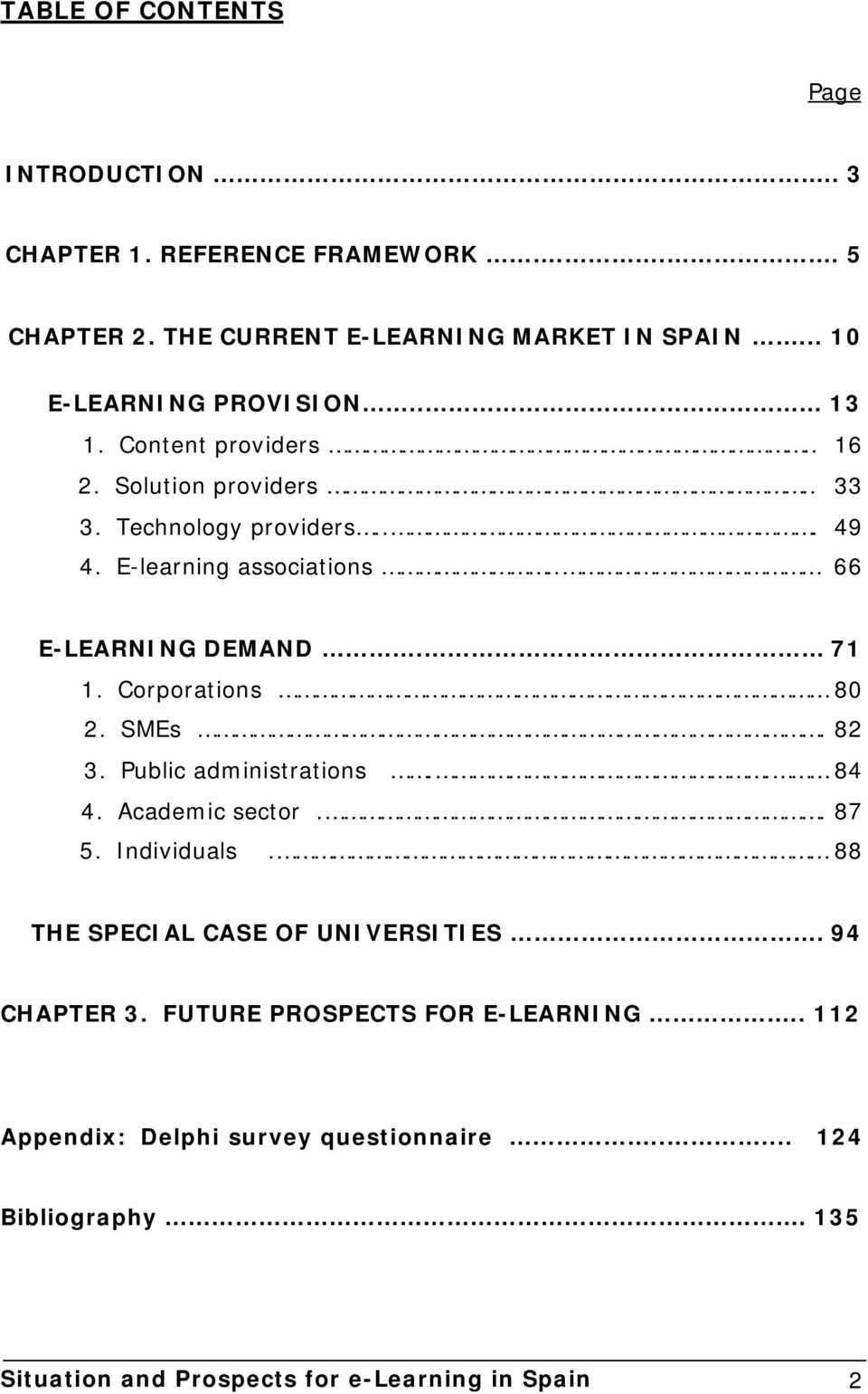
3 TABLE OF CONTENTS Page INTRODUCTION.. 3 CHAPTER 1. REFERENCE FRAMEWORK... 5 CHAPTER 2. THE CURRENT E-LEARNING MARKET IN SPAIN E-LEARNING PROVISION Content providers Solution providers Technology providers E-learning associations.. 66 E-LEARNING DEMAND Corporations SMEs Public administrations Academic sector Individuals. 88 THE SPECIAL CASE OF UNIVERSITIES. 94 CHAPTER 3. FUTURE PROSPECTS FOR E-LEARNING Appendix: Delphi survey questionnaire Bibliography. 135 Situation and Prospects for e-learning in Spain 2
4 INTRODUCTION The issue of e-learning as an advanced system for training and education using information and communication technologies (ICT) has received an increasing level of interest in recent years in most western countries. The flexibility offered by this new learning system, together with the great possibilities provided by ICT, helps to explain, to some extent, this social and economic phenomenon, and at the same time opens a broad field for research and development in the near future. As an element which aims to contribute to increasing our knowledge in this field, this report offers an analysis of the situation and prospects for e- learning in Spain at present (end of year 2003). As a starting point, chapter one provides a reference framework which includes an overview of the evolution of e-learning in our country over recent years, as well as looking at its positioning within the framework of our national educational and training system. After that, chapter two is dedicated to studying and analysing the e- learning market in Spain at present. First of all there is a short description, in general terms, of the characteristics of our e-learning market at present. This is followed by an extensive description of the main players in both the supply and demand sectors of this market. As regards the supply of e-learning services, this document provides a list and description of the key players operating in this area in our country. It includes information about them in terms of basic data (origin and background), market placement, product portfolio and technology, prices (where available), duration of courses, target groups and marketing strategy. They are classified into the following categories: content, solution or technology providers, and other relevant organisations working in the field of e-learning. A final table summarises the different players by provider Situation and Prospects for e-learning in Spain 3

5 category, business type, markets addressed, products or services offered and approach adopted. With reference to the demand in this market, a description of typologies and characteristics of the main target groups is presented, including corporations, small and medium-sized enterprises (SMEs), the public sector and training/educational institutions. Some topics covered by the analysis for each group are the following: sector or group overview, learning patterns, motivation for e-learning, type of products or services required, access barriers in relation to e-learning and examples of champions in this field. As above, a final table summarises group description, key e-learning characteristics, list of motivations or driving forces, products or services required and access barriers. Finally, chapter three is dedicated to exploring the prospects and trends regarding the future evolution of e-learning in Spain, including market prospects as well as key factors that are expected to determine its development and success in the medium and long term. This research work has been carried out within the framework of the Leonardo Project (T-ICT Project Ref. E/02/B/F/PP ). The objectives of this project are twofold: firstly, to analyse the situation at present and the prospects for the future of e-learning in the participating partner countries, and secondly, to develop resources and expertise in this field by means of a pilot project. The leading partner in this project is the Catalan Institute of Technology (Institut Català de Tecnologia - ICT), a technology centre based in Barcelona (Spain). The collaborating partners in this are the following organisations: ed-consult (Denmark), Economic Development Initiative (Northern Ireland), Instituto de Soldadura e Qualidade (Portugal), University of Ioannina Network Operations Centre (Greece), University of Luton Luton Business School (United Kingdom) and net-4-net (Switzerland). Situation and Prospects for e-learning in Spain 4

6 CHAPTER 1. REFERENCE FRAMEWORK E-LEARNING IN SPAIN IN RECENT YEARS E-Learning is an effective learning process created by combining digitally delivered content with learning support and services. It provides a new perspective in the understanding of distance training thanks to the possibilities provided by the Internet and the new information and communication technologies (ICT). Although distance training was implemented in Spain a long time ago, at all training levels (from university 1 level to training by dossiers), Internet and ICT have introduced new ways to complement the traditional methods of distance learning. As far as university level education is concerned, the creation of UOC 2, the first virtual open university in Spain, represented a revolution in the university environment. In the academic year , the UOC launched its teaching activity by means of a pilot course with 200 students. In the following academic year ( ), the number of students grew to 1,500. At present, the total number of students involved in all its educational activities is close to 24,000, a figure which will probably increase in the future thanks to the expansion of the university in the Latin American market, with university studies accredited in the Spanish language. This growth will also be possible thanks to the fact that, due to its wide acceptance, the supply of continual education in Spanish has been expanded. 1 For example, the UNED Universidad Nacional de Educación a Distancia (National Distance Education University) is going to commemorate the 30 th anniversary of its creation ( 2 Universitat Oberta de Catalunya (Open University of Catalonia) ( Situation and Prospects for e-learning in Spain 5

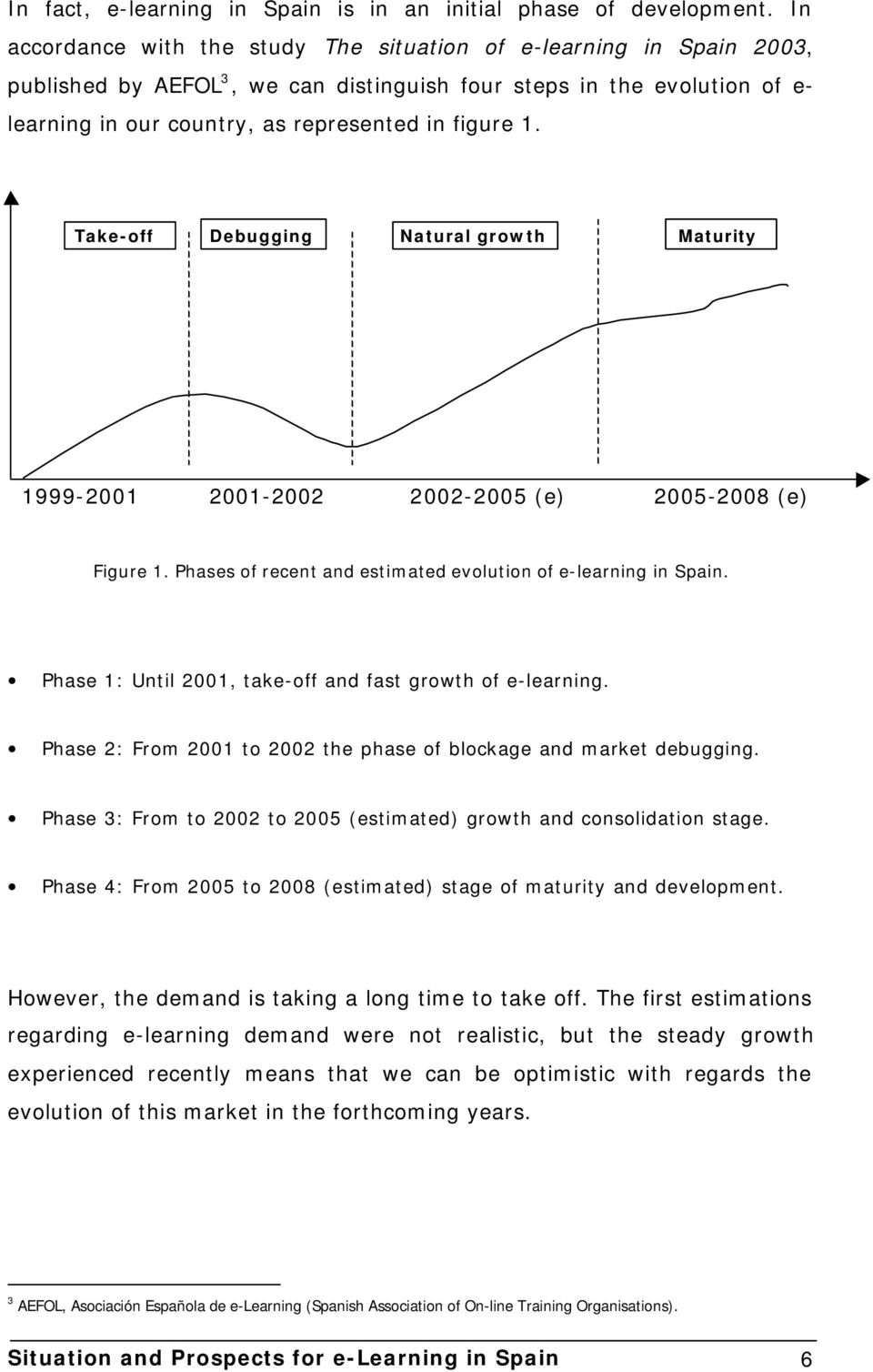
7 In fact, e-learning in Spain is in an initial phase of development. In accordance with the study The situation of e-learning in Spain 2003, published by AEFOL 3, we can distinguish four steps in the evolution of e- learning in our country, as represented in figure 1. Take-off Debugging Natural growth Maturity (e) (e) Figure 1. Phases of recent and estimated evolution of e-learning in Spain. Phase 1: Until 2001, take-off and fast growth of e-learning. Phase 2: From 2001 to 2002 the phase of blockage and market debugging. Phase 3: From to 2002 to 2005 (estimated) growth and consolidation stage. Phase 4: From 2005 to 2008 (estimated) stage of maturity and development. However, the demand is taking a long time to take off. The first estimations regarding e-learning demand were not realistic, but the steady growth experienced recently means that we can be optimistic with regards the evolution of this market in the forthcoming years. 3 AEFOL, Asociación Española de e-learning (Spanish Association of On-line Training Organisations). Situation and Prospects for e-learning in Spain 6
8 Most western countries are now in the consolidation stage, where the demand for e-learning is growing at an important rate. So now it is time to give strong support to all e-learning projects and activities within the framework of existing European and national policies. As is known, the members of the European Union launched the e-learning Initiative at the European Council in Lisbon on March The e-learning Initiative aims to enhance the use of new multimedia technologies and the Internet to improve the quality of learning by facilitating access to resources and services, as well as promoting remote exchanges and collaboration. As a result of this initiative, each European country supports different e- learning activities, according to its own strategy. Concerning the policies and initiatives developed to support the development of e-learning in Spain, we can highlight the following: At the educational system level. The main e-learning strategies are: 1. To provide all schools with the equipment and facilities needed to access new information and communication technologies; 2. To develop Internet courses and training; 3. To set up an observatory and laboratory responsible for the educational applications of ICT, thereby supporting innovation and development in such applications; 4. To strengthen cooperation between Latin America and Europe in the area of ICT in education. Some of the actions developed are related to the use of ICT in education, either at school or at the vocational training level. Some examples of these actions are the following: Andalusia: Averroes 4, Educastur 5, Proyecto Medusa 6 ; Cantabria: Interaulas 7 ; Catalonia: XTEC 8, Centro Nacional de Información y Situation and Prospects for e-learning in Spain 7

9 Comunicación Educativa 9, Proyecto Mentor 10, Programa de Nuevas Tecnologías y Educación 11. Some other projects involve the promotion of information and communication infrastructures, such as Murcia Plumier - Intranet Educativa Regional 12. In addition to this, the Ministry of Education publishes a magazine called Red Digital 13, which aims to promote the use of information and communication technologies at schools and other educational centres. Other actions promoting ICT and e-learning at the educational system level are the following: Aldea Digital 14 : site of an institutional initiative for the integration of new technologies in rural schools. Catalunya Edu : site of a portal for telematic education in Catalonia. Other actions are those related to vocational and continuing training financed by the Spanish Government through the European Social Fund and through FORCEM (Continuous Training Foundation) 16. As an example, 30% of all training plans presented in 2002 were for e-learning courses. Another initiative related to the promotion of e-learning is FORINTEL. The main aim of this initiative is to promote ICT training actions for employees The project aims at giving impulse to the infrastructure of technology in education in Murcia The main aims of Fundación para la Formación Continua (FORCEM) are to support, to promote and to spread continuous training among enterprises and employees, as well as to manage the funds for continuous training. Situation and Prospects for e-learning in Spain 8

10 Some of the training actions financed use e-learning as a training methodology. Finally, there was also a project called Action Plan INFO XXI, whose main aim was to promote the development of the Information Society in Spain during the period Some of the projects financed by this plan included e-learning activities. Now, the Spanish Government has launched the Plan España.es to cover the period One of the many actions included in this plan is the promotion of accessibility to training (with a total budget of 240 million ) and digital content (with a budget of 220 million ). To summarise, e-learning has a very recent history in Spain in the framework of the educational and training system. To a large extent, the main reference point for its appearance is the initiative of the UOC university, due to its wide implementation. The Spanish and the autonomous regional governments do not carry out specific actions to implement e-learning in the educational and training system, but they have other more generic or horizontal plans that indirectly promote the development of e-learning projects and activities. Situation and Prospects for e-learning in Spain 9

11 CHAPTER 2. THE CURRENT E-LEARNING MARKET IN SPAIN GENERAL OVERVIEW E-learning in Spain is still at a premature stage. Most educational platforms based on the Internet do not have the methodology and treatment required by this new environment. The social change required by this new tool will take a long time, so we will have to wait for some time until the educational system is capable of taking on this new training tool. In the short term, it is possible that as has happened with the Internet frenetic activity will happen around any size of enterprise within this new market. Probably, as fast as many new enterprises appear, many will also disappear. So we can thus state that the e-learning market in Spain is still a very young sector. After some years of tests and pilot projects, lots of initiatives have begun to appear, but presumably only a few of them will be consolidated in the future. At the moment there is more supply than demand in the marketplace 17, producing confusion among consumers. They do not know what to choose or, even worse, whether it is necessary to choose e-learning products at all. Some companies are offering all types of e-learning solutions; others are in the market just because they are technologically able to develop solutions. It is important to take into account the training needs of companies in order to develop the correct contents and methodology in accordance with their aims and real needs. While traditional face-to-face training was the best-known method, some firms introduced electronic books as a system of e-learning. This involved selling training contents designed for classroom courses, but which were to be used in a computer environment. Consequently, the first attempts at e- learning had a few faults, such us having too much HTML and too little Situation and Prospects for e-learning in Spain 10

12 interest for users. These experiences did not benefit from the collaboration and simulation possibilities offered by e-learning, and they did not integrate training actions into a practical and real experience either. However, they offered real potential for the future. As a result of this situation, e-learning products were so poor, and so far off meeting a minimum level of quality, that firms were reticent to introduce e- learning in their training programmes. Now that all those products have disappeared, it is time to convince companies that just having a few course catalogues is not enough. It is necessary to endow e-learning with the appropriate services so as to assist students. Increased usage of new technologies in business and continuing training (in all training environments) positions e-learning as a new way to learn, which is clearly and strongly integrated into the training plans of companies and professional associations. According to a study elaborated by Grupo Doxa 18, e-learning growth in Spain is affected by the crisis in the technological sector and by the deceleration in growth of the most important world economies. Talking in general terms, e-learning in Spain is very sparsely implemented, according to the information provided by Juan Manuel Cruz, Training and Technology Director of PriceWaterhouseCoopers (PwC), especially if we compare it with the data from the United States and Europe. His data indicates that only 180,000 individuals are following real e-learning training programmes in Spanish companies. However, taking into account the advantages of e-learning, such as reduction of costs and increased efficiency, it is expected to represent a significant part of the sector in the future Ignacio Maratech, Aprenderh (2003), Qué puede hacer el e-learning por las empresas, pp GRUPO DOXA, E-learning en las grandes empresas. Panel anual de resultados On Aprenderh (2003), Qué puede hacer el e-learning por las empresas, pp Situation and Prospects for e-learning in Spain 11

13 However, the e-learning model does not involve any technical novelty. The real potential of this way of training is the conjunction of various elements, enabling the development of any educational content in a flexible way for students, and providing monitoring by tutors and trainers in a collaborative learning environment. This scenario offered by e-learning facilitates improves motivation for students and accelerates of their learning process. In fact, all these remarks refer to our expectations for virtual training. As we have said before, e-learning is still at a premature stage in Spain. The social change introduced by e-learning is still in progress and some time is required to adapt the learning system to this new training environment. Nevertheless, it is clear that all kinds of companies and institutions, even if they are not directly related to training, must revise their strategy and adapt to the challenges that this new way to deal with training brings with it. For the moment, big ICT and financial companies are the target groups; these have the most highly developed e-learning experience in Spain, this being mainly due to the fact that they have very good technological infrastructure systems and that training is strategically vital for them to be competitive. Situation and Prospects for e-learning in Spain 12

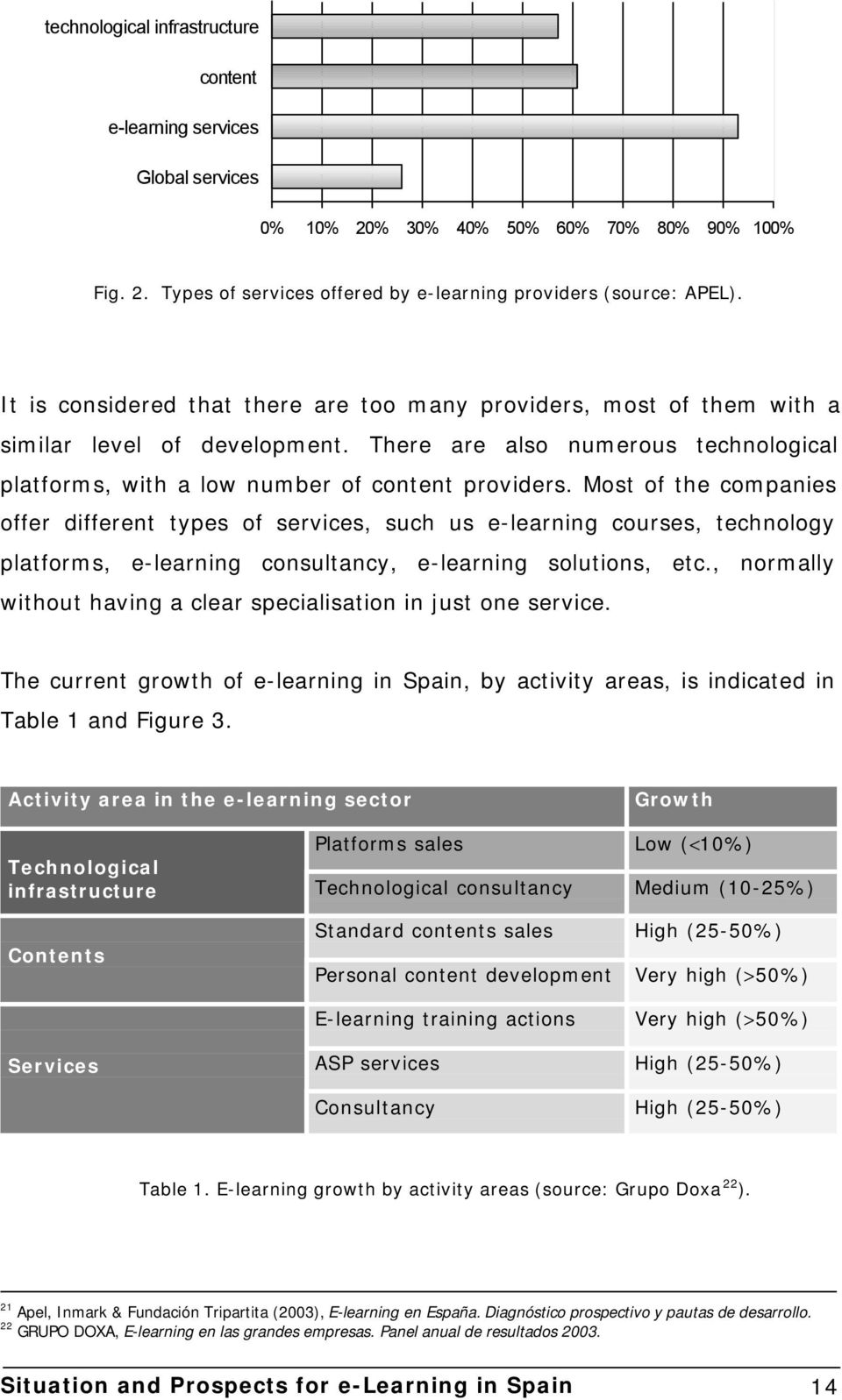
14 E-LEARNING PROVISION GENERAL OVERVIEW As regards the supply of e-learning in the Spanish market, we can state that it is very heterogeneous; it is made up of big technology consultancy companies, training consultants, business schools, ICT companies, universities, etc. These provide courses either to individuals or to e-learning providers who operate in the field of continuing training in businesses. This provision comes from numerous sources and is highly dispersed, without there being any clear leadership. E-learning provision in Spain is a growing sector that is closely linked to the implementation of ICT, as well as to the development of training programmes in many companies. The estimated number of companies related to this sector is around 500, of which more than 150 are e-learning providers 20. This means that there is a great level of fragmentation as a result of an emerging market (these companies have an average of 4 employees). The majority of them are quite new in the market, but there are also some training companies which have been the market for a long time (25-35 years) that are offering now e-learning courses. Following a study published by APEL 21 (e-learning Providers Association), the services offered by these providers are those indicated in Figure Apel, Inmark & Fundación Tripartita (2003), E-learning en España. Diagnóstico prospectivo y pautas de desarrollo. Situation and Prospects for e-learning in Spain 13

15 technological infrastructure content e-learning services Global services 0% 10% 20% 30% 40% 50% 60% 70% 80% 90% 100% Fig. 2. Types of services offered by e-learning providers (source: APEL). It is considered that there are too many providers, most of them with a similar level of development. There are also numerous technological platforms, with a low number of content providers. Most of the companies offer different types of services, such us e-learning courses, technology platforms, e-learning consultancy, e-learning solutions, etc., normally without having a clear specialisation in just one service. The current growth of e-learning in Spain, by activity areas, is indicated in Table 1 and Figure 3. Activity area in the e-learning sector Growth Platforms sales Low (<10%) Technological infrastructure Technological consultancy Medium (10-25%) Contents Standard contents sales High (25-50%) Personal content development Very high (>50%) E-learning training actions Very high (>50%) Services ASP services High (25-50%) Consultancy High (25-50%) Table 1. E-learning growth by activity areas (source: Grupo Doxa 22 ). 21 Apel, Inmark & Fundación Tripartita (2003), E-learning en España. Diagnóstico prospectivo y pautas de desarrollo. 22 GRUPO DOXA, E-learning en las grandes empresas. Panel anual de resultados Situation and Prospects for e-learning in Spain 14
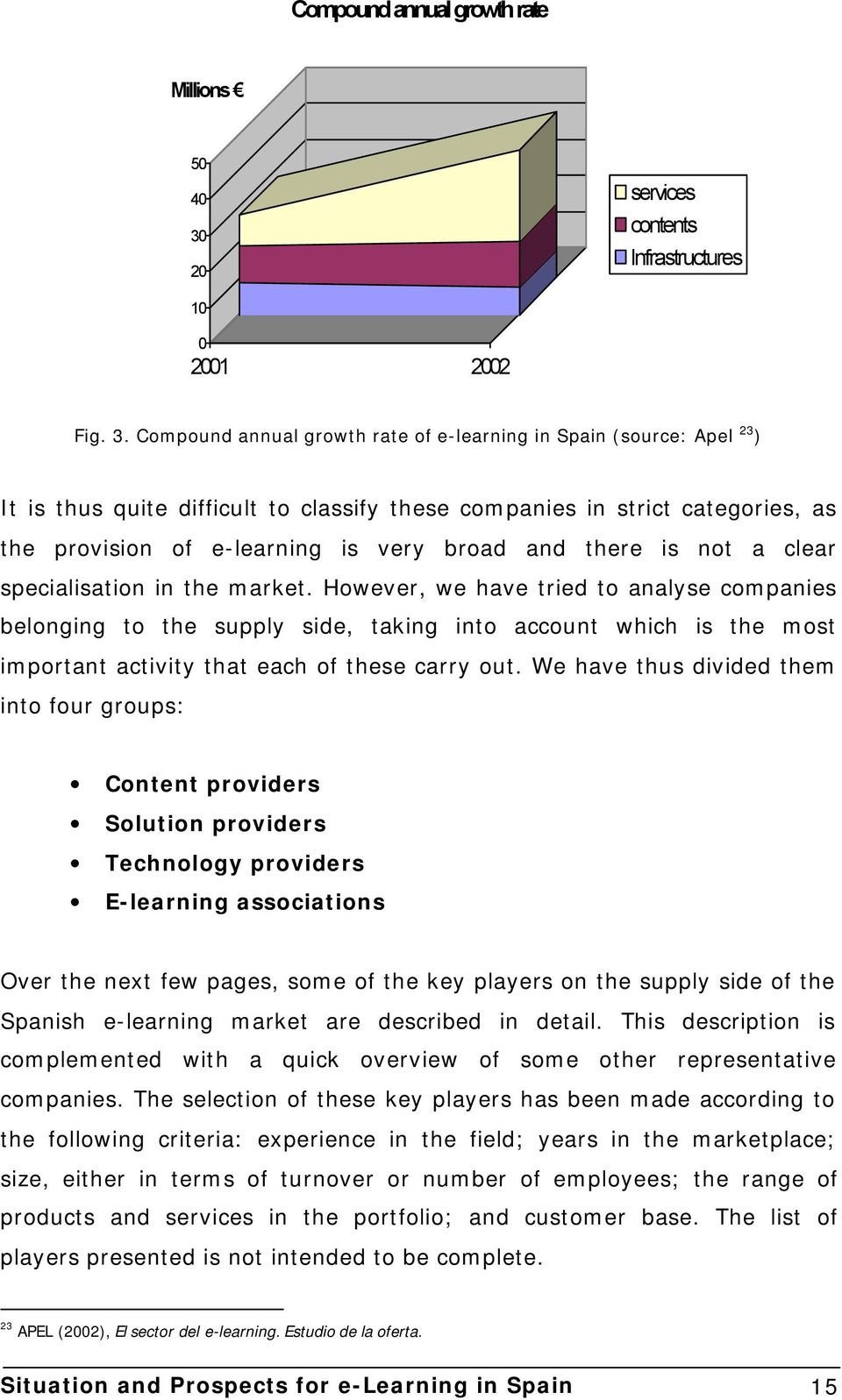
16 Compound annual growth rate Millions services contents Infrastructures Fig. 3. Compound annual growth rate of e-learning in Spain (source: Apel 23 ) It is thus quite difficult to classify these companies in strict categories, as the provision of e-learning is very broad and there is not a clear specialisation in the market. However, we have tried to analyse companies belonging to the supply side, taking into account which is the most important activity that each of these carry out. We have thus divided them into four groups: Content providers Solution providers Technology providers E-learning associations Over the next few pages, some of the key players on the supply side of the Spanish e-learning market are described in detail. This description is complemented with a quick overview of some other representative companies. The selection of these key players has been made according to the following criteria: experience in the field; years in the marketplace; size, either in terms of turnover or number of employees; the range of products and services in the portfolio; and customer base. The list of players presented is not intended to be complete. 23 APEL (2002), El sector del e-learning. Estudio de la oferta. Situation and Prospects for e-learning in Spain 15
17 1.- CONTENT PROVIDERS In this section we describe some companies whose main activity focuses on delivering different types of content. We have included a few training organisations that offer e-learning courses in the list, even though some of them provide other services as well, apart from content FYCSA Website: Official classification: Group Fycsa is a training institution. Origin and background Fycsa is one of the main training companies in Spain, both in terms of its size as well as its product portfolio. It has more than 20 years experience in the training market and it s one of the best examples of a training institution which is increasing its training provision through e-learning. It has permanent offices in Madrid and in Barcelona in order to be close to customers and to offer them the highest quality services. Fycsa defines itself as an educational craftsman, providing made-tomeasure solutions: offering strategies to improve efficiency and to attain objectives, as well as providing cultural change and ensuring consolidation. Product and market placement Fycsa, with more than 20 years experience in the training market, is one of the main training companies in Spain, especially in the life-long training field. With more than 300 companies using its services, the yearly sales are estimated at over 10 million euros. Situation and Prospects for e-learning in Spain 16

18 In order to meet its aims and to respond to its customers needs, Fycsa has a staff of 90 people and 200 regular collaborators. Investment in product development is more than 10% of the sales obtained yearly. Main products and services Fycsa has services divided into three categories and aimed at two main sectors: companies and individuals. Fycsa Group offers its customer s services in: Consultancy: In order to develop a learning and management strategy to guarantee the cost efficiency of training. Training solutions: Combining an increase in personal skills with an innovative learning experience. Technology: Which facilitates accessibility, efficacy and speed in the provision of knowledge. Business services Fycsa develops complete added-value solutions for companies human resources development, as the best way of improving and generating competitive advantages for the companies is via their employees. Fycsa adds value in: Learning experience: Transferring learning experiences into key skills, which permits real change in practice and in work behaviour. Result transfer: Consolidating the change produced by training with the necessary resources to guarantee the transfer of results to the workplace. Strategy: Developing the skills needed to implement the strategy. Fycsa offers a complete e-learning solution through: Situation and Prospects for e-learning in Spain 17

19 E-learning strategies Helping customers in the analysis of their needs, fixing the transition aims of an e-learning model and starting actions aimed at beginning successful e- learning experiences. Platform Formanet is a latest-generation platform which permits access by the head of training plans to all the on-line actions occurring on the platform and facilitating the development of a collaborative training environment for students through access to: contents, forums, training activities, tutor, quality tests, etc. The platform can be installed on an appropriately personalised customer server. Other e-learning services In order to ensure the effectiveness of the e-learning strategy implemented within the company, Fycsa provides expert services in: Managing and invigorating the plan following inscriptions, adapting the edition of the course on the web, managing the tutors and other support staff, elaborating activity reports, contacting students, etc. Tutoring the plan at different levels in accordance with the content of the course and the participant s profile. The different tutorial models are: Self study with animation Self study with reactive tutorial Self study with proactive tutorial Blended learning Courses Fycsa offers made-to-measure courses which are compatible with any platform supporting SCORM, and a course catalogue with more than 500 on-line courses is available. Situation and Prospects for e-learning in Spain 18
20 Individual services Through the New Technologies Business School, Fycsa offers individuals advanced training solutions for managers and professionals in IT, telecommunications and finance. It also provides face-to-face courses as well as on-line courses. The catalogue is the same as that for the business service and it has more than 500 courses, which are oriented to: Skills development and culture change Management of knowledge and practices Finance Banking Information technologies Telecommunications Prices As the range of services and products that Fycsa offers is very large, the prices vary according the services offered. Among the courses there are also some differences related to duration, with courses from 5 hours through to postgraduates and masters courses of hours. Main customers Fycsa s customers include over 300 firms, 17 of which belong to IBEX 35. Concerning individuals, we can distinguish three levels of participants: Management and Director level Professionals Postgraduates Situation and Prospects for e-learning in Spain 19
21 1.2 INSTITUTO DE FORMACIÓN ON-LINE Website: Origin and background Instituto de Formación Online (IFO) is a company founded in 1996 which focuses its activity on the development of teletraining projects through the application of new technologies and the use of telematic environments. IFO has developed high-quality teletraining methodologies to apply to training projects. Importance is given to the relationship between the different actors involved in training and learning processes; in this sense, the technologies aren t the main aim, but a tool to attain the objectives of each teletraining project. Equally, IFO has carried out lots of projects helping other institutions to develop their own teletraining provision. Its experience in different methodologies and technologies available in this field has made IFO a leader in the quality teletraining market. IFO is currently oriented to the development of strategic new lines as a result of technical and methodological research, with the aim of incorporating the latest technological advances. The new lines of activity are grouped in five blocks: IFOpyme: Collaboration with portals addressed to SMEs in order to increase their range of training services. IFOmaster: Collaboration with different schools and institutions offering masters, with the aim of converting these courses into online masters. IFOclips: Short duration and thematically varied tutorial courses with interactive elements and self-evaluation activities. Internet Para.Net: Development of courses in order to show the uses of the Internet and its tools to specific professional groups, such as pharmacists, doctors, architects, lawyers, etc. Situation and Prospects for e-learning in Spain 20
22 Product and market placement The Instituto de Formación Online (IFO) has become, in its five years of existence, a leader and reference company in the development of quality teletraining projects through the appliance of new technologies to education and to telematic areas of face-to face training. Throughout its history, IFO has trained more than 400 trainers and more than 35 supervisors to distribute online courses. Also, it has distributed nearly a hundred courses in collaboration with the most prestigious and varied institutions, from which over 2,500 students have been trained. Main products and services IFO Clips IFO Clips are little interactive tutorials with an attractive design which use animations to give a general overview about a practical and specific theme. Self-training tutorials The student receives the documentation specially designed for the selftraining tutorial and does some self-evaluation exercises; it is also possible to ask questions to the tutor or trainer. Nowadays the documentation can be presented in multimedia, CD-Rom or via a web page. As the self-training requires a high level of discipline and constancy, the courses are short and practical. Virtual class courses These involve teletraining courses which apply the virtual classroom methodology. In teaching terms, this methodology is based on the attainment of the different training objectives through the interaction of the participants: trainer-student, trainer-class, student-student; telematic tools are used in order to obtain the same motivational and human aspects encountered in the face-to-face training environment. Situation and Prospects for e-learning in Spain 21
23 Platforms IFO has a web application (Campus IFO). It s a tool designed for training, and it can be easily configured and managed. It creates the possibility of having a personalised campus with the company s corporate image. It includes hosting and operation, so it s not necessary to have a server or a telecommunications system which facilitates access to users. It also has other platforms which can be personalised in accordance with the customer s needs and possibilities. Development of courses and follow-up IFO designs, structures and manages the courses, as well as developing the logistics and technical aspects, the secretarial aspects and inscriptions, methodological supervision to trainers, etc. Training teletrainers IFO develops and imparts courses which can be personalised for any company and which aim to meet the training needs of trainers. Throughout IFO s history more than 200 trainers have been trained. These courses combine different methodologies, such as face-to-face training and teletraining. Content development IFO designs and develops training materials available for use in a web environment. Conversion of face-to face courses into on-line courses For all those training institutions interested in entering the field of on-line learning, IFO carries out consultancy and assessment services, explaining all the elements needed to guarantee the success of these courses. Situation and Prospects for e-learning in Spain 22
24 Development of new courses For all those customers without an infrastructure capable of creating, designing and developing new courses, IFO has a team of educational experts in new-course design. IFO also has about 100 trainers trained for on-line course development. Main customers IFO has a course catalogue with more than 60 courses available, with a duration of between 30 minutes and 30 hours; the main customers are companies and training institutions. Situation and Prospects for e-learning in Spain 23
25 1.3 E-LEARNING.ES Website: Origin and background E-learning.es is a platform created by the Human Resources Division of PriceWaterhouseCoopers Spain, the main aim of this being to become the first e-learning platform addressed to companies, offering all the products and services required to implement on-line training, immediately and without an investment. Main products and services Factory of Contents Factory of Contents is a tool elaborated by PwC and Ingenia that permits an approach to the creation and management of training contents in an efficient and effective form. The Factory of Contents is the best manager of training contents, with options for the pick up, storage, treatment and distribution of contents. It s useful when: There is a long curriculum to adapt. The update and/or adaptation will be continued, and it is worth tackling it from a different point of view, with more effective and efficient tools. It is necessary to create contents with standards of quality in a limited period of time. Although there are many solutions on the market, e-learning.es undertook the development of Factory of Contents to facilitate the creation and management of contents in a complete manner. Situation and Prospects for e-learning in Spain 24
26 Audience analysis This solution makes it possible to ensure that any remote training action undertaken is in accordance with the plans, policy, strategy and culture of the company, and it also considers the training demands and expectations of all those involved in the learning process. With audience analysis and training needs it becomes possible to develop specific and suitable training actions adapted to the real learning needs of employees. Platform This solution allows users to use a Learning Management System platform for the development of e-learning courses in the company. The portal is managed as an ASP system (application service provider) that is installed in a common platform managed by PricewaterhouseCoopers. Implementation and follow-up There is a service of tutorials in e-learning.es for all the contents offered. This service is also complementary to the contents, supporting the transference of knowledge and learning to the day to day running of the company. The tutorial uses communication tools such as forums, chats, mail, telephone, work groups, follow-up meetings, etc Evaluation of results The objective of this solution is to determine the benefits provided by the on-line training actions in terms of the application of the acquired knowledge and abilities in the work place. Course catalogue E-learning.es has an e-learning course catalogue linked to the main partners of e-learning.es. It has more than 450 courses divided into the following areas: Situation and Prospects for e-learning in Spain 25
27 Human resources Personnel development Management Finance Marketing and sales Law Technology Internet and e-business Tourism Health The length of the courses varies from 2 hours to 2-year masters. Prices The prices are fixed in accordance with the services requested. E-learning.es creates a personalised service related to the real needs of the user and bases the price on this. Main customers The main customers of e-learning.es are training departments or human resources departments who wish to introduce e-learning strategies into their company. There is also the catalogue of courses, as e-learning.es is also addressed to individuals, and there is a course-search service. Situation and Prospects for e-learning in Spain 26
28 1.4 SANTILLANA FORMACIÓN Website: Origin and background Santillana Formación represents the Santillana Group s commitment to increasing its activities into adult learning through new training channels. The Publishing Group Santillana is made up of a set of companies which carry out their activity in the Spanish-speaking countries. It has its origin in the publishing house of the same name, founded in Throughout its existence, the Santillana Group has been consolidating its specialisation in educational publishing, extending this beyond the Spanish borders, with special attention to Latin America, where the group is a leader in the educational book sector. In the seventies it extended its activity into the field of general publishing and its catalogue started to include literary works for all ages, in addition to works of thought or reference, and the distribution of textbooks. This line received an important impulse with the contribution brought about by the incorporation of three prestigious publishing houses (Taurus in 1974, Alfaguara in 1980 and Aguilar in 1986) and the development of its own projects, such as Ediciones Altea and Richmond Publishing. From 1998 the Santillana Group has acted decisively and, for the first time, it has become involved in the training of adults via the Internet. This project materialised with the creation of the new company Santillana Formación and the majority shareholding in the company now known as Santillana Netlanguages. Situation and Prospects for e-learning in Spain 27
29 Product and market placement Complete solutions Santillana Formación offers its customers the possibility of implementing a complete e-learning solution, which involves: A virtual campus based on the most advanced training technology via the Internet; the Docent Enterprise suite; a large catalogue of courses; personalisation of any customer requirement; advice throughout the process. Virtual campus This is for those companies aiming to implement an e-learning strategy for the knowledge management of its employees. The service involves: Administration system. The administration system allows companies to: - Create private training domains. - Define roles and permit training management: administrator, supervisor, secretary, tutor, etc. - Create professional profiles and to define skills and to establish training itineraries related to these skills for registered users. - Obtain management reports and training evaluations. Management system To store a student s progress throughout the process and to carry out a follow-up activity related to the student and each course. Virtual classrooms The virtual classrooms make the following available to organisations: training contents; learning, evaluation and follow-up activities; access to a tutorial system; other course resources, such as library, glossaries, etc; synchronous and asynchronous communication tools through chats, forums, , etc.; information and orientation tools: help system, on-line assistance, FAQ s, etc. Situation and Prospects for e-learning in Spain 28
30 Tailor-made services Personalised solutions for each customer. Specific solutions for bodies and vocational training institutions. Innovative training policies. Accompanying services. Design of services and made-to-measure contents. Personalised assessment. Training catalogue Santillana Formación offers courses in the following areas: telecommunications, financial services, tourism skills and business management, languages, and information and communication technologies. Main customers Training solutions and assessment services are addressed to: Organisations Companies and institutions convinced that the e-learning is a key factor in competitiveness and that it provides support for the company s strategy. Bodies and institutions involved in the development of innovative training policies and the design of qualifications and professional training plans. Individuals Professionals and graduates aiming to expand their knowledge through postgraduate university programmes. Situation and Prospects for e-learning in Spain 29
31 1.5. EDUCALINE Website: Origin and background EducaLine was founded in 1999, composed of a multidisciplinary team experienced in e-learning projects. Right from its beginnings, EducaLine has focused its research on teaching and technological areas. EducaLine is particularly interested in expert analysis and knowledge of all the tools available on the market and in the latest advances in teaching methodology design applied to on-line learning. EducaLine develops and manages e-learning projects for organisations, training institutions, companies and professionals. It also offers technological infrastructure and specialised professionals to cover all the phases of the development of an e-learning project: elaboration, management, training materials, multimedia technology, etc ITEM FORMACIÓN S. L. Basic data: Origin and background Elaboration of multimedia and e-learning content. Item Formación is a company specialising in vocational-training e-learning courses, and in the development of multimedia content for e-learning courses. Additionally, it also offers some made-to-measure contents development as well as a virtual campus. Situation and Prospects for e-learning in Spain 30
32 1.7 CADMO CONOCIMIENTO Website: Origin and background Cadmo Conocimiento has its origins in 1981 when it founded the Escuela de Gestión Empresarial (Business Management School). After a brief period of operation, in 1983 the company changed its name to Técnicas de Formación (Training Techniques). In 2001, after observing and analysing the market training needs in terms of the Information Society, the company expanded its range of services. As a result of this internal and external transformation, a new firm was born - CADMO/ Conocimiento, which combined the experience acquired from Técnicas de Formación with the future and the innovation of the Knowledge Society. The future of Cadmo Conomiciento is linked to the awareness needed to produce and distribute knowledge in order to help organisations adapt to the Information Society. Cadmo Conocimiento carries out its activities around the organisation s intellectual capital, using innovative teaching models supported by information and communication technologies, through its main services: e- learning, e-content and e-media. Situation and Prospects for e-learning in Spain 31
33 1.8. CEDECO Website: Origin and background Cedeco was founded on 1913 as a distance-training institution. The company now offers four training modes: in company training, e- learning, private training, and open courses, mainly focused on information and communication technologies. The target group is individuals aiming to follow e-learning courses, and it has about 800 students in Spain. Other content provider companies: Situation and Prospects for e-learning in Spain 32
34 2. SOLUTION PROVIDERS 2.1 GRUPO DOXA Website: Origin and background Grupo Doxa is a national capital group of companies. The shareholders are the managers, the employees and the collaborators of the different companies included in the group. Grupo Doxa has its origins in 1994, when Doxa Consultores was founded as an assessment company whose main activities were the carrying-out of studies and European projects as well as the management and the development of continuing training. In 2003 Doxa Consultores absorbed Doxa Formación and Doxa Consultoría y Sistemas and formed Grupo Doxa Formación y Consultoría. Other firms within the group are: Doxa Producción y Logística (founded in 1994) Doxa América Latina (founded in 2001 and located in Santiago, Chile) Grupo Doxa has more than 110 professionals on its staff, with each member receiving an average of 60 hours of training per year. They apply a quality system with the aim of obtaining the satisfaction of customers and students. All the projects developed during 2002 were evaluated with a score higher than 4 (on a scale of 0 to 5). Grupo Doxa has had ISO 9001 certification since Situation and Prospects for e-learning in Spain 33
35 Product and market placement Main products and services Training and e-learning consultancy Training and knowledge management consultancy. Design and development of e-learning projects. Design and development of multimedia training contents. Made-to-measure design of corporative training portals (educadoxa). Consultancy and development of e-learning solutions in an ASP option. Studies of training needs, training evaluation and the cost-effectiveness of training. Training outsourcing Training management through extranet connections using educadoxa. Outsourcing of companies and organisations training departments through the integration of information systems. Management of training plans. Development of e-learning courses Development of training actions: face-to-face, distance and blended learning, supported by multimedia tools and e-learning platforms. Development of training actions through educadoxa, an Internet training portal. Educadoxa Is the first personalised portal for training development and outsourcing, permitting continuing training plans and up-to date action. It was created as a response to the growing demand for the made-tomeasure training needs of every organisation, following the highest quality standards. This service - an ASP (Application Service Provider) - permits friendly access to the training portal without costly investment in technology. Situation and Prospects for e-learning in Spain 34
36 Doxa has developed more than 50 portals for business organisations, trade unions, public administrations and companies. E-learning training supply The supply of e-learning training is divided into the following knowledge areas: Information technologies: 133 courses available Languages: 25 courses available Commerce and marketing: 8 courses available Economics and finance: 2 courses available Quality, environment and workplace risk prevention: 1 course available Human resources: 3 courses available Business management: 1 course available Main customers Among the customers there are private companies (more than 75 companies), public administration bodies (about 32), and business associations and trade unions (about 40). There are also individuals following the different courses offered by Doxa. Situation and Prospects for e-learning in Spain 35
37 2.2. GRUPO VÉRTICE. VÉRTICE E-LEARNING Websites: Official classification: Grupo Vértice is a business group composed of 14 different firms; one of them is Vértice e-learning. Origin and background The Vértice Group is an enterprise founded 23 years ago through the efforts of professionals working in the different firms of the group and the trust of customers. Vértice e-learning emerged as the e-learning strategies and solutions provider of the Vértice Group. Vértice e-learning is the result of more than 20 years of training experience of the Vértice Group and of the efforts of the group in information and communication technologies. Uniactiva 24 ( currently constitutes one of the clearest and most representative examples of the experience of Vértice e-learning; it is the provider of the virtual campus of Uniactiva.com as well as of the learning and management system of the Universidad Abierta Interactiva. Product and market placement Virtual training environments Vértice e-learning has standard compatible spaces (SCORM), including different synchronous and asynchronous communication systems, as well as data sharing and swapping during communication. All of these are characterised by flexibility in accordance with the requirements of the public. Virtual classrooms Situation and Prospects for e-learning in Spain 36
38 On-line auditoriums Interactive seminars Virtual campus (LMS: Learning Management System) composed of all kinds of educational resources, on-line seminars, etc. Management and administration of training environments Vértice e-learning creates on-line environments capable of handling the administration and management activities typical of any training centre. In these environments, administration management and academic management solutions are offered. As examples of administration and management solutions, Vértice e- Learning proposes: Administrative records. Area indicators (such as supply, demand, quality, efficiency ). Enrolment and on-line payment. On the academic management solutions side: Student records. Profiles and course control. LCMS: Learning Content Management System. Software and training tools Vértice e-learning develops applications for e-learning course development and design which are in accordance with the programme s characteristics and which and related to the training centre or department preferences. Dynamic creation of evaluation questionnaires. Author tools for the editing of multimedia contents. Editing and administration of on-line publications. Content edition Vértice e-learning offers an extensive rage of content in 4 different formats: paper (or pdf), CAT/L (computer-assisted training/learning) interactive (CD or intranet), CAT/L interactive (on-line Internet) and 24 Universidad Abierta Interactiva - Open Interactive University. Situation and Prospects for e-learning in Spain 37
39 interactive simulator. The multimedia contents are SCORM compatible. All the contents are developed, updated and revised under ISO 9001:2000. Prices As Vértice e-learning has a wide rage of possibilities, there is also a wide range of prices, which vary in accordance with the services requested. The company offers a personalised budget for any project. Main customers More than 20,000 individuals have been trained through Vértice e-learning. The majority of them are employees of different companies, professional associations, town councils, banks, etc. Situation and Prospects for e-learning in Spain 38
40 2.3 NEXE Website: Official classification: Limited society Origin and background Nexe, founded in 1993, is one of the pioneer companies in Europe in assessment, development and implementation of solutions to facilitate the integration of all the company changes required by new learning methods; this is done through the use of e-learning strategies and methodologies, communication and knowledge management. Taking into account the situation of each organisation and knowing its future business strategy, such as its plans for change and training, Nexe detects the key capacities and knowledge areas necessary to reinforce people s knowledge base in the short and medium term and to guarantee the continuous improvement of the organisation s competitiveness. Nexe supports and works together with customers to define and implement the e-learning solutions and knowledge management necessary to increase their learning capacity and to improve the impact of e-learning processes on business results. Nexe has offices in Madrid and Barcelona and it has 9 years experience in the sector, vouched for by over 250 projects related to the conception and development of virtual environments for training and learning, the management of knowledge and products and net learning processes. For the development of its projects, Nexe has a multidisciplinary team of 50 people with varied professional profiles: business and organisation consultants, e-learning and knowledge-management consultants, Situation and Prospects for e-learning in Spain 39
41 educationalists and editors, computer scientists, and specialists in usability and visual contact. Product and market placement Defining, implementing and managing the whole e-learning project Nexe accompanies the customer at the time of making the decision to determine which is the best e-learning solution, taking into account the situation and culture of the organisation, the key scopes of knowledge in the company, the correct methodologies adapted to people s needs, the knowledge and the objectives. Knowledge-resources intranet This product is focused on the teaching, management and monitoring of learning processes. It also allows users to compile, segment and distribute the knowledge generated during the learning process among all the members of an organisation. In addition to the learning process, this tool allows clients to see the knowledge which is generated every day in the organisation. This tool is available in seven languages and it adapts to the diverse organisational structures of companies. The knowledge-resources intranet offers the following possibilities: To manage initial and continuing training. To administer the e-learning model in a centralised or decentralised way based on different organisational structures. To define a suitable training model for the needs of different groups. To administer the supply of training, enrolments and inscriptions on courses. Management of users, roles, profiles, monitoring and curriculum. To administer courses, projects and communities. To determine communication systems and spaces such as chats and forums, as well as a mail manager. To manage the added value of knowledge creation. Situation and Prospects for e-learning in Spain 40
42 Training material and content generator This tool allows the organisation to create contents without having to worry about the technical, graphical and teaching solution of the final training product. This generator of learning material permits the organisation: To define the teaching methodology of the training material. To create theoretical and practical contents, glossaries of terms, tests, editing flows, validation and publication of materials. To export the materials to market standards (AICC and SCORM). To take advantage of the existing contents in courses generated previously. To incorporate associated materials in different formats and to insert graphics. To determine which results can be improved. Course catalogue Remote training material doesn t just need to be good - it must also motivate. For this reason it is necessary to combine, in suitable proportions, a good teaching approach, functional design, graphic interface and computer system. Nexe has a multidisciplinary team to help in the development of quality materials and to take responsibility for all the phases of the process, as well as to work in conjunction with experts from the customer s organisation or other experts in the field. Creation of learning and knowledge-exchange-oriented solutions In the creation process for the solution, Nexe is involved in the following stages: Conceptualisation of the teaching model. Definition of implementation, dynamisation and evaluation strategies. Development of learning materials. Training the people involved. Supporting the customer in the implementation and follow-up process. Situation and Prospects for e-learning in Spain 41
43 Main customers The main customers are organisations and companies aiming to implement e-learning strategies. Among customers, we can distinguish between public administrations, universities and private companies. Even though Nexe has a course catalogue with more than 30 titles, individuals are not its main target group. Situation and Prospects for e-learning in Spain 42
44 2.4 GLOBAL ESTRATEGIAS Website: Origin and background Global Estrategias began its activities in 1990, organising seminars focused on improving business practices. Now about 50 people are working on continuing training as a tool for professional development. Global Estrategias runs fast training programmes, allowing professionals to get up to date on the latest trends, management skills, changes in legislation and norms, etc. Global Estrategias organises seminars, professional meetings, specialist courses and on-line seminars. Also, the training department offers its customers consultancy projects to adapt to e-learning. Global Estrategias offers more than 300 seminars annually and 100 incompany courses, mostly in Spain and Portugal, with more than 6,000 people attending. The main aim of the firm is to offer high-quality products and services with added value for human resources professionals. Product and market placement The solutions offered by Global Estrategias to companies are aimed at linking the power of Internet with companies training needs. In Global Estrategias a complete group of consultants specialising in on-line training, educationalists, editors, programmers and designers are available to tackle any on-line training project. Situation and Prospects for e-learning in Spain 43
45 Main products and services On-line training services Global Estrategias has a large range of services for the company and for its adaptation to on-line training processes. Consultancy and on-line training implementation Creation and adaptation of training elements to e-learning. On-line welcome plans. Virtual campus. Training trainers in e-learning techniques. Just in time training. On-line consultancy Through this on-line service, Global Estrategias makes a free e-learning consultancy service available to the customer in order to resolve any queries or answer any questions related to e-learning, teletraining platforms, contents management, etc. E-learning courses Global Estrategias offers its customers a series of courses using a virtual campus. These courses are totally on-line and come with support and tutoring from specialised professionals. Some OPEN COURSES are: Telephone payment and effective management. Creation and adaptation of e-learning courses. Labour welfare in the modern company. Excel for financers. Effective management of complaints and claims: customer loyalty. Cost analysis for the technical development of an e-learning course. E-learning tutorials. University expertise on distance-training management. Costs analysis for the development of e-learning courses. Efficient use of . Situation and Prospects for e-learning in Spain 44
46 In-company training Global Estrategias analyses the company s environment, needs and specific difficulties in order to elaborate made-to-measure training plans in accordance with the company s real interests. Main customers Even though Global Estrategias has some open e-learning courses, the main target group of its services are companies and associations aiming to introduce e-learning strategies into their firms. Situation and Prospects for e-learning in Spain 45
47 2.5. VIRTUAL TRAINING Website: Origin and background Virtual Training began its activity in 1998, and since then its main aim has been the elaboration of quality training through the Internet. Virtual Training designs and develops all kind of web solutions and services in accordance with customer needs and demands. The whole activity of Virtual Training is based on providing quality through the most modern information and communication technologies. Product and services Platform Virtual Training has developed an e-learning platform containing all the requirements for complete management of training. The content generator, the tutors, the training manager and the students have an important role in the platform. Through the platform the companies can easily implement their own LMS, which is adapted to the organisation s needs. Contents Virtual Training develops training contents in the following areas: IT, security, business skills, quality and environment, and languages. All the courses meet the content development standards of SCORM 1.2, IMS and AICC. Situation and Prospects for e-learning in Spain 46
48 2.6. DOMÈNECH MULTIMÈDIA Website: Origin and background Domènech Multimedia was founded in 1975 with the main aim of offering a complete service in the training field. Since then, Domènech Multimedia has experienced continuous evolution thanks to the organisation s specialisation. Domènech is composed of a professional human team, experienced in the latest technologies and able to develop all the activities required by the customers. Domènech has developed the second generation of e-learning content platforms. This new platform permits the real time updating of all the elements through the most powerful data base: Oracle, Access Informix, SQL, and html and xml. The interface is intuitive, composed of basic elements, permitting effective navigation and flexible learning. It permits access to users via a password, and it evaluates and facilitates continuous follow-up. Situation and Prospects for e-learning in Spain 47
49 2.7. RIAL E-LEARNING Website: Origin and background RIAL e-learning consulting is a Spanish company offering a wide range of services related to e-learning. The professional team, together with strategic partners and an extensive and prestigious network of contacts, combines good knowledge of the Spanish market's needs, broad experience in the e-learning field and expertise to offer effective e-learning solutions at all levels of application and e-learning products. Products and services Rial e-learning offers standard services classified into three categories: Basic, Premium and Gold, as well as tailor-made services. Other solution provider companies: Situation and Prospects for e-learning in Spain 48
50 3. TECHNOLOGY PROVIDERS 3.1. NANFOR IBÉRICA Website: Origin and background Nanfor Ibérica is an organisation specialising in information technologies and it has more than 10 years experience in traditional training and 4 years in e-learning. It is recognised by the main manufacturers of software (IBM, Lotus, Microsoft, Borland, SUN Microsystems, Macromedia, Trend Micro) due to its capacity for innovation and quality. It has been rewarded with prizes such as: Excellence in Training in EMEA by the Industry of Training in Information Technologies ITTA, best CTEC Partner of the year by Microsoft, best LAEC by Lotus, prize for one of the Best Ideas on the Internet for on-line training by Microsoft and Lotus. It is the company with most awards for its e-learning solutions. In 2000 NANFOR Ibérica took on the commitment to undertake the development, implementation and certification of a system to ensure quality, in accordance with the requirements established in Norm ISO- 9002:1994. Product and market placement Main products and services Nanfor Ibérica has developed a wide variety of resources in order to offer a large range of e-learning solutions, as well as blended learning, thereby facilitating improvements in learning. Knowledge management Through the consultants from Nanfor Ibérica, it will be possible to make plans for the organisation of a company s RRHH, analysing the potential of Situation and Prospects for e-learning in Spain 49
51 the employee in order to define, via a complete set of evaluations, the professional capacities of the members of the company, thus allowing for the organisation of programmes for professional development on the basis of the objectives of the company. Through e-learning systems and tools, Nanfor Ibérica applies e-learning tools and simulators for knowledge management; it uses LMS training tools to support an organisation s resource management, training and knowledge acquisition process. Platform solutions Nanfor Ibérica offers the most complete platform solutions oriented to companies knowledge-management systems through LMS platforms. These platforms organise, coordinate and manage a company s training resources. ASP (Application Service Provider) The Application Service Provider model is very useful in an e-learning environment, as content and the Internet delivery of training represent one of the main problems. For the SMEs and for the first stages of e-learning projects, platform hosting means eliminating some unnecessary risks. The main advantages are the low access cost and the speed of implementation. Content: Nanfor Ibérica has been developing courses from It has some standardised courses as well as made-to-measure content adapted to a company s training needs. Administration services, animation and management of e-learning Nanfor Ibérica has a complete team of educationalists, e-tutors and LMS platform administrators who specialise in animation and management of virtual courses in order to proactively promote learning as well as e-learning activities. Situation and Prospects for e-learning in Spain 50
52 Training outsourcing Nanfor Ibérica offers outsourcing services to those companies that want to eliminate the fixed administration and maintenance costs of training activities, offering complete solutions for human resources departments. The customer will be able to manage all the training resources as well as its training projects using the latest-generation systems for knowledge management. E-commerce for e-learning Nanfor Ibérica offers e-commerce solutions linked to e-learning solutions. Through these solutions, customers can market any training solution through their own web pages. Training and employee portals For big corporations and organisations aiming to offer training solutions to their employees on their own intranets. Integration of e-learning platforms with ERPs The majority of e-learning platforms have modules and integration solutions with human resource management software. Complete e-learning projects Nanfor Ibérica offers complete e-learning solutions for any size of company and any group. It has experience in e-learning projects since E-learning courses Nanfor Ibérica has its own catalogue of e-learning courses, which are open to any individual. The areas of the courses are: information technologies, Internet, microcomputing, quality, languages, finance, management courses, etc. Some courses are in English. Situation and Prospects for e-learning in Spain 51
53 Main customers The main customers of Nanfor Ibérica are companies aiming to develop e- learning strategies. As it also has an e-learning courses catalogue, individuals are also good customers of Nanfor Ibérica. Situation and Prospects for e-learning in Spain 52
54 3.2. FYNET BUSINESS AND TRAINING Website: Origin and background Fynet Business & Training was founded on 1997, establishing academic collaboration agreements with institutions such as the University of Cambridge and the Brooklyn Chamber of Commerce. It is a Lotus and IBM Advanced Partner, specialising in the development of technological training solutions. In 1998 it offered the first European masters completely via Internet and implemented this with Lotus/IBM technologies, bringing together important professionals and institutions. Its specialisation in IBM technologies applied to training allowed Fynet to become the first Spanish partner member of IBM Mindspan, participating in outstanding e-learning projects. Fynet services include all areas of e-learning: consultancy, implementation of platforms, programming, support, ASP, and content development. Product and market placement Main products and services Fynet Business & Training make the necessary technical and human resources available to customers to elaborate their own virtual campus, organising all the areas and processes involved, from the definition of initial requirements to the completion of the definitive system. Fynet offers a full package with all the services that the customer needs in order to choose, define and implement an e-learning solution. Situation and Prospects for e-learning in Spain 53
55 Consultancy Implementing an e-learning solution involves different departments, so it is necessary to establish appropriate objectives and planning phases, as well as determining technical and organisational solutions. As each company or academic institution has its own specific needs, Fynet has expert consultants in the main technologies as well as in distance training methods. Needs definition Fynet consultants help the company to choose the suitable technologies, system and organisation, and to ensure that these are compatible. Return on investment (ROI) ratio calculation and the extent of organisational change Fynet helps the customer to analyse the ROI rate in all the areas involved: platform implementation, content, training management system and all the aspects directly related to e-learning. Pilot programmes This service consists of the installation of an e-learning technology as a pilot programme, in order to be sure that it is the most suitable solution. Fynet has two levels of pilot programmes: Initial level Advanced level: including content elaboration and management, learning management system and connectivity. Implementation The experience and expertise of Fynet experts guarantee a successful installation of the e-learning platform. This platform can be purchased or hosted in accordance with the customer s needs and capacity. Fynet offers the personalisation of the platform through the elaboration of corporate educational portals, adaptation of the corporate image interface and the development of specific functions in accordance with the company s needs. Situation and Prospects for e-learning in Spain 54
56 Products Lotus LearningSpace is a complete training-management and distribution solution permitting the company take advantage of all on-line training. Fynet factory Fynet transfers any kind of content to e-learning in order to distribute it within a distance-training platform, through interactive CDs or through an intranet/extranet solution, or it creates new contents. Course catalogue Fynet has an e-learning course catalogue available for all customers. It also offers tutorial support and follow-up for these courses from e-learning specialists. Main customers The main customers of Fynet are companies, associations and institutions. Individuals aren t its target group, as the course catalogue is available only for companies or institutions aiming to introduce e-learning solutions with Fynet s help. Situation and Prospects for e-learning in Spain 55
57 3.3. QS MEDIA Website: Origin and background Since 1997 QS media has successfully completed many projects for multinational and national clients and public institutions. From pilot schemes with limited investment to those on a large-scale, such as the e-learning project for the Generalitat Valenciana (Valencia's autonomous government), which will provide on-line tutored training for more than 120,000 civil servants and public employees. QS media is part of the SATEC group, a multinational specialising in IP communications and network and large-system engineering. QS media offers personalised solutions which are adapted to the training needs of companies and the infrastructure and software available. QS media's e-learning solutions will improve the way in which different organisations or companies learn and share knowledge. QS media's e-learning solutions go beyond training the organisation's employees. Product and market placement Main products and services QS media develops and implements comprehensive solutions for e-learning - the new corporate teletraining system via the Internet. A complete range of products and services, including consultation, planning, programme development, set-up and the putting into action of solutions Situation and Prospects for e-learning in Spain 56
58 which will increase the productivity of the human resources of the company or the organisation. QS media offers personalised solutions which are adapted to the training needs of the company and the infrastructure and software the company has available. LMS QS Tutor LMS QStutor offers both tutor/pupil and pupil/tutor synchronous and asynchronous communications: real-time chat, inclusion of videoconferencing, forums and messaging systems. All these services are assigned by course and group with no limit. QS Author QS author is a simple tool for course creation which is compatible with the main training platforms. It allows users to integrate multimedia resources quickly and simply and to build evaluation systems, interactive tests and exams in a simple manner with no need for any programming knowledge. Its compatibility with the latest standards (AICC, SCORM) guarantees that the results can be collected by QS tutor tutor or any other compatible LMS (Learning Management System). QS Author facilitates the creation of high-quality teaching courses through the use of structure and content assistants which guide the author, step by step, through the process of creating the course. E-learning consulting services QS media s consulting services offer comprehensive solutions in the fields of teletraining, knowledge management and human capital development, using the latest developments in information technology. Situation and Prospects for e-learning in Spain 57
59 Courses QS media provides high quality interactive courses, designed for organisations that want to increase competitiveness through developing their workers skills. QS media courseware is engaging and interactive, with content based upon simulation and animation. Hosting QS tutor s technical requirements aren t high but it s possible that a company won t want to make any investment in hardware, software and IT infrastructure. QS media offers a no-investment alternative, providing the organisation with e-learning solutions via the rental of QS tutor infrastructure systems. ASP In addition to hosting options, QS media s ASP services (Application Service Provider) offer full outsourcing of e-learning projects. Now it s possible to deploy a training plan with e-learning in a pay-per-use formula without the need for any investment or waiting for deployment. Main customers Amongst its customers, QS media has more than 60 companies, public administrations and other institutions. Situation and Prospects for e-learning in Spain 58
60 3.4. AVANZO M2S Website: Origin and background AVANZO is a new business project that began in 2003, although its origins date back to The firm is 100% Spanish and it provides a complete selection of contents, technologies and services for business training. AVANZO s main activity is e- learning. The driving force at AVANZO is the human capital. A valuable team of professionals who are highly qualified and who have a thorough knowledge of the various aspects of e-learning ensure that Avanzo s products and services are of the highest quality. Product and market placement AVANZO is a Spanish firm that provides a complete selection of contents, technologies and services for business training. The high educational quality of AVANZO solutions guarantees the success and profitability of any e-learning project. Its team's customer orientation and professionalism are AVANZO's main assets. The firm's aim is to provide profitable solutions, enabling companies to increase their employees' level of efficiency. AVANZO's activity embraces standard products, customised courses, and high value added services. AVANZO's provision covers the main areas of business training: Information technologies Management Languages Tailor-made content AVANZO markets its products directly. However, it has also reached agreements with qualified distributors in order to better satisfy its customers needs. Situation and Prospects for e-learning in Spain 59
61 Main products and services When introducing e-learning projects, AVANZO provides its customers with a wide range of high-value-added services to achieve the best results and a high level of satisfaction from users. A team of qualified technicians and consultants advise, co-ordinate and carry out technical implementation processes, platform integration, educational implementation, certifications and course dynamisation. These services are added to other, more traditional ones, such as hot-lines, which enable the user to benefit even more from training investments. Hot-line The hot-line support service, provided by a team of specialised tutors, provides solutions to any query related to the functioning and contents of the courses, either over the phone or by . Thanks to this service, students can rest assured that they will have the help they need when they need it, giving them more security and motivation while learning. The AVANZO hot-line service is the ideal humanising component of any training project based on e-learning. Active tracking The consultancy department at AVANZO has developed an active implementation model that is highly appreciated by its customers. AVANZO studies the features and needs of each company and personalises services accordingly. In general terms, during this process AVANZO: Maintains permanent co-ordination with the client's project manager. Recommends the best technical and educational solutions for each project. Co-ordinates and carries out the project, applying a set of criteria: Provides users with initial information and motivation, so that they may adopt e-learning training and benefit from it. Provides users with personal assistance throughout the process. Provides users and clients with periodic reports on the progress made. Situation and Prospects for e-learning in Spain 60
62 Once the project is completed, AVANZO gives the client a report and advice on future e-learning actions. Technical services AVANZO provides backing to its solutions with high-quality, rapid technical support. LMS integration? The Technical Department is formed by a group of professionals who have in-depth knowledge and experience of AVANZO s own technology, as well as other technologies related to e-learning, particularly e-learning standards: AICC, IMS, SCORM etc. AVANZO has integrated its courses in most of the LMS (learning management system) platforms that exist on the Spanish market. Internet? Intranet? CD? Following an analysis of the technical infrastructure of each company, AVANZO s Technical Department will advise the customer on the content distribution technology that best suits its needs. AVANZO will accompany the customer during the e-learning project's implementation. Main customers The main customers of AVANZO are companies, organisations and institutions which aren t technologically able to develop their own e-learning project, either in terms of infrastructure or content and management. Situation and Prospects for e-learning in Spain 61
63 3.5. TELESOFT Website: Origin and background Telesoft, S.L., is one of the first Spanish companies offering multimedia ASP (Application Service Provider) in interactive services. It offers multimedia services with high added value based on IP protocol, on the conventional networks (RT, ISDN) and the new broadband networks (ADSL, wireless mesh). Telesoft develops and serves hosting applications, CTU and multimedia services for operators of telephony and cable ISPs and integrates leading companies into the sector of telecommunications. Telesoft services are focused on multimedia interaction between companies (B2B) and between companies and individuals (B2C) in order to improve the service to the customer and to facilitate electronic commerce and virtual transactions ITACA MULTIMEDIA Website: Origin and background Itaca Multimedia is a Catalan technology company providing products and services; it offers complete multimedia solutions in the knowledge management field which are oriented to knowledge transmission, consultancy and training. Itaca elaborates and manages distance training with different types of supports and tools, such as CD ROM, Internet, Intranet, etc. All the courses include self-evaluation exercises, and they are provided as distance training courses with tutorial consultation and support via Internet. Situation and Prospects for e-learning in Spain 62
64 Itaca has its own tutors who are able to carry out the course tutorials and follow-up. It s also possible to adopt and personalise the multimedia courses in accordance with the customer s needs. Itaca also offers e-learning solutions and tools to big firms and training institutions. Easyprof technologies for virtual platforms: EasyProf for content generation EasyProf Content Management EasyProf Tutor: a powerful tool designed as a tutoring tool which is able to carry out the development and carrying-out of evaluation exercises via the Internet. Itaca has as its main customers: university institutions, academies, training centres and the training or human resources departments of companies and corporations CENTRA Website: Origin and background For over eight years, Centra has been providing business software and services for real-time communication, collaboration & learning over the Web, with self-service meetings, Web seminars, virtual classes and more. Today, more than 3.2 million professionals at over 1,200 organisations worldwide use Centra everyday to improve communication & collaboration across their organisations in order to increase productivity, rapidly reduce operational costs and accelerate business processes. Centra makes real-time business meetings and events more cost-effective and convenient by reducing travel and extending the reach of meetings to globally dispersed customers, partners, and co-workers over low-bandwidth Situation and Prospects for e-learning in Spain 63
65 network connections through a simple browser interface. By utilising existing corporate computing infrastructure and platforms, Centra helps organisations align business IT strategies with key business processes to enhance productivity, lower costs, and drive up revenue. Centra 7 for Real-Time Business Collaboration. Centra 7 is the first application software designed to enable real-time business collaboration, communication & learning. Centra 7 offers complete solutions that go beyond the "live" meeting and which address entire business processes before and after the online meeting, class, or event making real-time collaboration fit seamlessly into everyday work for the business user. And the advanced system s architecture addresses IT requirements for scalability, reliability, administration, and security to ensure a successful deployment across the entire company. Centra has commercial and software partnerships with PwC Consulting, Deloitte Consulting, EDS, Microsoft, SAP Siebel and Cisco GRUPO GARBEN Website: Origin and background Since its inception, Garben has focused its activity on providing quality services in the information and communication technologies field. Its experience in application development and its professionalism in the development of training plans have made Garben a leading company in new technologies and training. Situation and Prospects for e-learning in Spain 64
66 3.9. INGENIA Website: Origin and background With more than 10 years on the market, Ingenia is a Spanish company with a clear technological orientation which offers an advanced and competitive range of solutions, products and services in the fields of information technologies, communications and Internet. Ingenia offers the following services: strategic consultancy, data centre, portal design, graphic design, software design, training, outsourcing and IT support. Other technology provider companies: Situation and Prospects for e-learning in Spain 65
67 4. E-LEARNING ASSOCIATIONS 4.1. AEFOL Website: Origin and background Founded in May 2001, with the aim of promoting e-learning and sharing knowledge and best practices in this field, Aefol was created as an open association for all those interested in learning and sharing. AEFOL (On-line Training Enterprises Association) of is a non-profit professional and independent association addressed to professionals, companies and institutions in order to offer services and to promote and increase knowledge of e-learning. AEFOL aims to create a virtual community which is able to acquire and share knowledge to improve e-learning experiences. AEFOL s mission consists of helping companies and professionals to share experiences and the know-how required to satisfy their training and professional needs. AEFOL aims to promote and spread knowledge on what e-learning represents throughout Spain. Activities AEFOL accomplishes its aims through two main channels: the web page, and the activities organised in collaboration with associated companies or other organisations requiring AEFOL s services. Some of the past activities in which AEFOL has participated were: Stand at the Word Education Market in Lisbon with more than 4,000 visits. Stand at Portal Point in Barcelona with 7,300 visits. Collaboration at the E-learning Forum within the framework of the Expodidactica Fair in Barcelona, with 175 participants. Organisation of Expolearning in Madrid. Situation and Prospects for e-learning in Spain 66
68 E-learning conference in Malaga and at IESE Barcelona (about 400 participants). In the future it will participate in the following activities: II E-learning and Enterprise Meeting II International Conference in Multimedia and ICT in Education International conferences on technology and communication 4.2. AEFVI Website: Origin and background AEFVI, the Virtual Training and Education Agency, is the name received by the non-profit association aefvi.org (Internet Virtual Training and Education Association). The association is supported by companies and associations interested in AEFVI s aims and activities, which are: Aims: Coordination and representation of the social, economic and political agents interested in the fields of interactive self-learning, remote learning, and education through the Internet. Organisation and carrying-out of promotion, debate and exchange of activities, aiming to improve interactive self-learning, remote learning, and education through the Internet in Spanish. Creation of multi-sectoral platforms which permit different companies, educational and training sectors, etc. to converge in content development and expand the application of new technologies. Elaboration of strategies to create a leading position for the sectors of teletraining, self-training and distance education through Internet in Spain. Situation and Prospects for e-learning in Spain 67
69 Promotion of the development of high quality standards for e-learning. Cooperation in the elimination of barriers for universal access to the Information Society. Development of activities in order to link the Spanish-speaking community with the European Union member states in the field of e-learning. Promotion of Spanish education and of education in Spanish through the use of new technologies. As a main activity, for the last two years the association has organised the virtual conference Educa, with more than 1,500 participants from Spain and Latin America ANCED Website: Origin and background ANCED is the National Association of Distance Training Institutions. ANCED started its activities in 1977 with the aim of promoting and defending the interests of its associates and the companies and students who use distance training. Over the last 25 years, it has been the business organisation representing private on-line distance training centres, aiming to promote quality in continuing training courses. It has about 80 associated training centres in Spain. Situation and Prospects for e-learning in Spain 68
70 4.4. APEL Website: Origin and background APEL is the Spanish e-learning Providers Association. The Spanish e-learning Providers Association, APEL, is the point of reference for companies interested in knowing about telematic distance training processes. E-learning is changing the way people learn and it permits the consolidation of the principle of equality for individuals, companies and training institutions located far away from knowledge centres. Following this philosophy, APEL s activities are oriented to the promotion of e-learning, organising and collaborating in the development of different events and conferences. APEL organises its activities into the following commissions: Institutional relationships: Projects: Quality in e-learning. Certification of e-learning trainers. E-learning observatory: Market studies. Follow-up of European and national legislation on training and e-learning. Creation of a virtual laboratory with the associated institutions. Events and communication: Mass media relationships. ExpoApel fair (yearly). Congresses and conferences around Spain. Situation and Prospects for e-learning in Spain 69
71 PROVIDER CATEGORY BUSINESS TYPE MARKETS PRODUCTS/SERVICES APPROACH CONTENT Market dominated by training Individuals aiming to Most courses fall into one of the As there is no public PROVIDERS companies and organisations that participate in e-learning following areas: funding for this activity, are increasing their training offer courses. Companies and ICT, languages, finance, human the prices of the products by means of e-learning. professional associations resources development, business vary in accordance with not technically able to management, quality, environment the duration of the course develop their own and risk prevention. and the complementary training contents. The majority of companies also offer services required: just the additional services, such as advisory content, or content and services. tutorial, or LMS, etc. TECHNOLOGY Market dominated by private Companies, associa- Technology platforms, contents and Varies from hosting to PROVIDERS companies and corporations. tions and training author tools, technical services, etc. sales of various This is the smallest group. organisations. technology products. SOLUTION Market dominated by private Companies, training Complete e-learning implementation As soon as the market PROVIDERS companies. There are also organisations and services, including technology becomes more some training organisations. public platforms, LMS, tutorials, assess- specialised, the number of This is the largest group. administrations. ment, content providers, etc. players will reduce and some companies will migrate to content providers. Situation and Prospects for e-learning in Spain 70
72 E-LEARNING DEMAND GENERAL OVERVIEW The incorporation of ICT into the new training and learning environment has provided two main benefits: they have progressively improved the way by which the traditional services are delivered, and they have also offered the possibility of increasing the market size thanks to new learning initiatives and programmes. Generally speaking, e-learners appreciate the convenience, wide choice, and flexibility that e-learning offers. In addition to this, course designers value the standardised framework and flexibility of the e-learning media. Teachers think e-learning is convenient. They applaud the ease of recordkeeping and the reduced travel that are part of the e-learning revolution. Managers like the idea of automated, consistent assessment information, as well as the reduced costs that e-learning can bring to an organisation. All these aspects favour an increasing demand for e-learning from society. In this chapter we will analyse who are the most important e-learning demand agents in Spain. We will put the emphasis on what their motivations to use e-learning are and we will also mention the benefits that it provides for them. Being able to see how key e-learning stakeholders view things can help us to get a better grasp on e-learning. Concerning e-learning customers, the most important target groups are universities and employees (for continuing training), especially in the financial and ICT sectors. There are universities involved in e-learning projects, companies created to be specialists in this field, and companies offering this new training mode as a complement or as an alternative to traditional training. Finally, some ICT companies are offering the possibility of learning via the Internet. Situation and Prospects for e-learning in Spain 71
73 Productive and social sectors are now demanding internal flexibility in training processes in order to make employee spaces and times compatible. By means of e-learning it is possible to create virtual spaces with face-toface interaction, with no time or costs associated to travel. The Internet is one of the vehicles which is acquiring significant importance in continuing training, as it offers many training opportunities and expands the possibilities for learning. Other companies 9% Public administration 8% Training institutions 6% Individuals 13% Financial and ICT companies 33% Professional associations 31% Fig. 4. Main e-learning target groups in Spain (source: APEL 25 ). For new companies, such us mobile operators, or for enterprises which are geographically dispersed, e-learning becomes an alternative training tool which is able to decentralise and to update employees knowledge in a continually changing environment. This means giving information in some cases, or providing high quality service in others, quickly and in large volumes. For a more thorough study of each target group, we have distributed e- learning demand into the following four categories: 25 APEL (2002), El sector del e-learning. Estudio de la oferta. Situation and Prospects for e-learning in Spain 72
74 Business training (corporations and SMEs) Public administration Academic sector Individuals Business training Though in this section we will consider companies of any size all together, afterwards we are going to divide them into two groups, corresponding to corporations and SMEs, as each one has specific characteristics and requirements. It is a reality that if companies want to be competitive in the marketplace, they need to have employees who are trained to deal with the challenges that the new socio-economic environment poses. It is only through the development of training actions and plans that companies will be able to guarantee the required learning and knowledge for its employees. So, the development of training plans becomes a strategic factor for the competitiveness of companies. Apart from this, training opportunities offered by ICT open new perspectives for business training. In Spain, continuing training is widely implemented by companies. For 80% of Spanish firms it is a strategic decision related to policy 26. However, the size of the company determines the duration of training actions, as well as the development of specific training plans personalised for each employee. Most training actions are shorter than a week and they are focused either on updating the knowledge of employees or solving problems (or needs) in the workplace. Business training in Spain is in a process of change. It will become a mixed model, combining virtual methods with face-to-face meetings, in order to 26 CEOE, La formación en las empresas españolas. Situación, tendencias y expectativas. Situation and Prospects for e-learning in Spain 73
75 ensure a better coexistence between technology and training contents. There is not any intention to replace face-to-face training at all. So e-learning is seen as a new tool to complement the training process. This is not for nothing, as e-learning in Spain currently represents 4% of total business training (2.8% in 2002). This figure rises to 5.5% in corporations and big companies (4% in 2002) 27. Apart from this, more than 95% of big companies are developing or introducing some e-learning projects, but in 42% of them e-learning remains just a pilot project, as shown in Figure 5. development phase after a pilot experience 33% Pilot experiecies 42% totally implanted 24% don't know 1% Fig. 5. E-learning development in Spanish companies (source APEL 28 ). If we consider the development of e-learning projects in relation to the size of companies, we see that e-learning is implemented to a much larger extent among big companies than among small and medium-sized enterprises, as shown in Figure GRUPO DOXA, E-learning en las grandes empresas. Panel anual de resultados Apel, Inmark, Fundación Tripartita (2003), E-learning en España. Situation and Prospects for e-learning in Spain 74
76 2,00% 1,70% 1,50% 1,00% 0,50% 0,85% 0,54% 0,77% 0,78% 0,00% more 250 employees total Fig. 6. Implementation of e-learning according to business size (source: eespaña 2002, Fundación Auna). On average, e-learning is used in Spain by 40% of big companies, while this ratio is very low (2%) in small and medium-sized businesses. As far as time spent on e-learning is concerned, in relation to the total amount of hours dedicated to conventional face-to-face training, the progress over recent years and estimations for the near future present a positive evolution, as can be seen in Figure 7. 14% 12% 10% 8% 6% 4% 2% 0% Fig. 7. Evolution of e-learning hours in terms of total training hours in Spanish companies (source: E-learning. Las mejores prácticas en España. Aedipe, 2003). Situation and Prospects for e-learning in Spain 75
77 The arguments given most frequently by companies in favour of e- learning are the following: Reduced training costs This is one of the most important advantages from the companies point of view, as compared to traditional methods of training, E-learning has the following advantages: Reduction in the cost of tutoring services, as it is not necessary to have a teacher on site. Inherent savings are made when applications are used among a large number of learners. The cost of employee absence is reduced thanks to e-learning, as the employee can better manage their time schedule. Provided that the content is adapted to on-line training, e-learning also reduces overall training costs by promoting self-study or on-line training. The employee can concentrate on the teacher's contribution in the traditional mode in those areas where significant value is added. Increased training efficiency Online learning increases general training efficiency for the following reasons: Courses are more easily accessible, as the learner is able to study at work, home or wherever he or she has Internet access. More flexibility, since the employee can study when he or she wishes, without being concerned about travelling to a course or having to stick to a timetable. Situation and Prospects for e-learning in Spain 76
78 Training is more easily adaptable to each individual learner's needs. Thanks to computer interactivity, training content can be more easily adapted to the training needs of employees in terms of their learning speed. The main reasons stated to justify the absence of e-learning development in firms, in order of importance, are the following: business culture (38%), the business profile (35%), technical and computing problems (29%), costs (21%), ignorance (15%) and absence of confidence in e-learning (6%) 29. Medium-sized businesses are now introducing some e-learning projects in order get involved in electronic training. The economic sectors where the e-learning is most extensively implemented in Spain are the financial, insurance, technological and industrial sectors, as indicated in Table ECONOMIC SECTORS % OF E-LEARNING TRAINING GROWTH LEVEL 10 to 40 % in big banks Very fast Finance 0 to 10% in small banks Slow and other organisations Information and communication technologies 5 to 40% in big companies 0-10% in the rest Normal Slow Industry and energy 10-40% in energy Very fast 0 to 5% in industry Slow Transport and communication 3-5% Fast Other services and construction 0-5% Slow Table 2. Degree of penetration and growth of e-learning by economic sectors (source: Grupo Doxa 31 ). 29 GLOBAL ESTRATEGIAS (2003), Formación en las empresas y utlización de las nuevas tecnologías. 30 NEXE, Informe del sector e-learning en España Doxa (2003), E-learning en las grandes empresas. Situation and Prospects for e-learning in Spain 77
79 The e-learning services most requested by companies are: content development, tutorials and e-learning portals, as shown in Figure 8. 70% 60% 50% 66% 63% 50% 40% 30% 20% 10% 20% 10% 0% Content creation Standard contents Tutorials Made-tomeasure portals Others Fig. 8. E-learning services requested by Spanish companies (source: Doxa 32 ). With reference to the content, that which is on the market at present covers about 15% of company needs, but this percentage is bigger in the case of languages and information technology. As a general rule, most required contents refer to office applications, languages and other technical issues (see Figure 9). However, businesses are requesting more and more high-quality, specialised contents which are adapted to sectoral needs. The standardised courses are valid for an initial stage, but if a greater e-learning development is required, then it is necessary to elaborate new specialised and tailor-made contents in order to integrate e-learning as a training strategy in the company. In this case it is necessary to adapt contents to the company s real training needs, thus reducing the amount of standardised materials. 32 Doxa (2003), E-learning en las grandes empresas. Situation and Prospects for e-learning in Spain 78
80 Company culture 9% Products and Services 8% Skills 8% Office Applications 49% Languages 16% ICT 10% Fig. 9. Types of e-learning contents required by Spanish companies (source: Doxa 33 ). It is generally accepted among all agents involved in the development of an e-learning programme that its success in a business environment depends on two critical aspects: The development or adaptation of the technological platform. The quality of the contents, which must be directly related to the real training needs of the customers. In this sense, most enterprises have e-learning platforms as a basic element to provide technological support to the e-learning process. These platforms are mostly in Spanish. They are used both as content support and as a communication tool between teachers and students, or among students. 33 Doxa (2003), E-learning en las grandes empresas. Situation and Prospects for e-learning in Spain 79
81 CORPORATIONS Introduction E-learning in Spain is a growing sector linked to the ICT evolution and implementation, as well as to companies training strategies. Even if the big corporations aren t the most representative components of the Spanish business network, it s important take into account their role in e-learning, as 95% of big companies in Spain have some kind of e-learning strategy. Training in companies Two thirds of Spanish companies already have a training plan, which means that companies are aware of the importance of training as a tool to obtain added value. The main criteria for which organisations establish training plans are: to obtain a greater optimisation of their human resources, to obtain greater professional prestige via increased demand from the sector, and to acquire business competitiveness. In addition to this, training plans are implemented as a form of motivation and an internal mechanism for the promotion of employees. Although face-to-face training continues being the main force in Spanish companies, on-line methodologies are beginning to prevail in the training plans of companies and they are occupying a more important position. E-learning As mentioned above, e-learning is widely accepted among companies, and 95% of big enterprises which have more than 2,000 employees and which are linked to the technology sector are developing or introducing some e- learning projects; however, in 42% of big enterprises e-learning remains just a pilot project. Situation and Prospects for e-learning in Spain 80
82 Spanish companies choose the e-learning methodology when the training commitment is bigger. As more hours are destined to training, more e- learning is used. Economy and flexibility would be a great motivation to introduce e-learning methodologies in companies training plans, but knowledge and qualifications are what is sought in terms of motivation; the main aim of the introduction of e-learning methodologies is learning, as well as the trainingevaluation process. Companies investing more resources in training are heading towards the implementation and use of new technologies in training. One out of every 5 training programmes is developed through e-learning methodologies. The Internet is emerging, as the increase in business investment in training and the continuous changes in the corporate market mean that on-line methodologies are becoming the second business training option. The main difficulties of the on-line market are ignorance concerning the existing possibilities and the limitations of the technological infrastructure. Services required Most big companies are using ASP while only the companies with more than 5,000 employees are using their own LMS. The most common services required by companies are contents, platforms, tutorials and other services. The contents may be made-to-measure or standardised, though this is related to the company size: the bigger the company, the more made-tomeasure contents which are developed. The platforms required can be hosted or specially developed, though the second option is quite infrequent (see Figure 10). Situation and Prospects for e-learning in Spain 81
83 60% 50% 40% 30% 20% 10% 0% 8% Own platform 12% Acquired platform 50% ASP consultancy platforms 20% Content provider platform 8% Other Fig. 10. Type of e-learning technology platforms used by Spanish companies (source: Doxa (2003), E-learning en las grandes empresas). Taking into account that most e-learning actions are developed in large companies (and medium-sized companies as well), there is a wide market open for e-learning and continuous training plans in companies. SMEs SMEs represent 99.87% of the total of Spanish enterprises. From a total of 2,710,389 firms, 2,545,675 are micro-enterprises (form 0 to 9 employees), 140,426 are small enterprises (from 10 to 49) and 20,838 are medium enterprises (from 50 to 149 employees). This means that SMEs play an important role in the Spanish business network. Even though e-learning is most frequently found in big companies training plans, it is also present in SMEs, but in an indirect way, thanks to the training actions promoted by chambers of commerce and professional associations, which cover 31% of e-learning training actions. This means that the employees of SMEs following e-learning courses are using the services offered by their professional associations or chambers of commerce. Situation and Prospects for e-learning in Spain 82
84 Services required For SMEs, most frequent services required are e-learning training courses with tutorials and evaluation services. As the investment required to develop personalised platforms and made-tomeasure courses is too high for Spanish SMEs (taking into account that most Spanish SMEs have less than 10 employees), the most common solution adopted is the purchase of e-learning courses. The content is standardised and the employees are treated individually, like the other participants on the course. There isn t any adaptation to the company profile or to the specific training needs. Concerning the benefits and barriers, whilst flexibility and the adaptability for employee are regarded as big benefits, the barriers are related to technological investments as well as the uncertainty about the most convenient technologies to use. Situation and Prospects for e-learning in Spain 83
85 PUBLIC ADMINISTRATIONS Introduction In Spain, the public administration is organised as follows: there is a general public administration establishing the general policies for the country, but there are also regional public administrations (autonomous community administrations) as well as local administrations. In total there are 2,329,667 employees in the public sector. 23.4% belong to the national state administration, 48.9% belong to the autonomous community administrations, and finally, 23.7 % work in local administration. E-learning E-learning can be a good solution for public administrations as there are a large number of employees to train, and these are dispersed around Spain and have similar training needs. E-learning also permits the provision of the same course to different large groups, without the inconveniences of a traditional classroom. The contents can be reused indefinitely by a large number of users, and this makes them more cost effective. Among the different administrations, there are some institutions developing e-learning courses. These institutions are: Instituto Nacional de Administración Pública ( The National Institute of Public Administration (INAP) is an autonomous body whose main aims are: Development of training policies that correspond to its powers, especially relating to the higher public workings of the national public administration. Selection of nationally authorized civil servants from local administrations. Situation and Prospects for e-learning in Spain 84
86 Support of studies and research on matters relating to public administration. Maintenance of the necessary co-operation and collaboration relationships with other administrations and institutions involved in the pursuit of these goals, regardless of the specific recognised powers over these matters pertaining to other centres, institutes or schools of the national public administration. Among its training activities, INAP has an e-learning service, developed by IBM, offering e-learning courses for the employees of the public administration. Also, K Consulting has developed some e-learning solutions addressed to facilitating the training and the development of public managers in order to deal with the modernisation of the public administration. Following the main directives from the European Union which aim to subsidise 30% of e-learning courses in 2005, INAP has promoted some initiatives. Among these initiatives the Aula Virtual (Virtual Classroom) merits special attention, as it permits the development of a telematic course with tutorials, video-conferences, the presence of invited tutors, etc. INAP has inaugurated more than 60 virtual classrooms over recent years. Another initiative is the organisation of the seminar Seminario sobre nuevas tecnologías de la información para formadores (New ICT for trainers). Situation and Prospects for e-learning in Spain 85
87 Finally, INAP has developed, in collaboration with the Polytechnic University of Madrid, a training portal for the employees of the public administration, which will be a meeting point for employees. There are other public institutions developing e-learning projects for their employees, such as: Instituto Andaluz de Administración Pública: Instituto Aragonés de Administración Pública: Instituto Canario de Administración Pública: Escuela de Administración Pública de Cataluña: Escola Galega de Administración Pública (EGAP): Escuela de Administración Pública de la Región de Murcia: Instituto Navarro de Administración Pública: Instituto Vasco de Administración Pública (IVAP): Escuela de Administración Pública de la Junta de Extremadura: Generalitat Valenciana: Institut Valencià d Administracions Públiques: Situation and Prospects for e-learning in Spain 86
88 ACADEMIC SECTOR Introduction Among the different bodies demanding e-learning services, it is important to take the academic sector into account. By academic sector we mean all the training institutions: schools, universities, life-long-learning institutions, professional or business schools, etc. Schools Even if we can not speak about e-learning at school level, it is important to mention the use of Internet with educational aims. Use of the Internet and other ICT systems in schools is increasing and the various administrations responsible for this area are promoting policies to introduce the use of new technologies in schools. The development of the Information Society will not be effective if the young are not able to use the new technologies from school level, with learning and training strategies adapted this new way of learning. There are policies focused on the introduction of PCs at school, for Internet connections, for specific training for teachers (in order to know how to use ICT in training), etc. Situation and Prospects for e-learning in Spain 87
89 INDIVIDUALS As another important type of e-learning customer, there are many people aiming to update their knowledge and to participate in a continuing training process, but who have certain barriers in terms of time and distance. These people have the solution to their training needs through e-learning. The profile of these customers can be characterised as young professionals with university qualifications aiming to complement their knowledge through post-graduate courses. The services required are complete e-learning courses, offered by training institutions or universities, with complementary services such as tutorials, chats, evaluations, etc. Finally we want to finish this chapter by taking into account the different perspectives of e-learning users and the way they feel about the advantages and benefits of e-learning from their own point of view. Learners appreciate the following qualities of e-learning: E-learning fosters interaction among students and instructors. Interaction stimulates understanding and the recall of information. It accommodates different learning styles and fosters learning through a variety of activities that apply to different learning styles. It fosters self-paced learning whereby students can learn at the rate that suits them. It is convenient for students, as they have access at any time and any place. It reduces travel time and travel costs for students. It encourages students to browse through information through hyperlinks to sites on the Worldwide Web and thereby find information relevant to their personal situations. Situation and Prospects for e-learning in Spain 88
90 It allows students to select learning materials, or to be directed to content that meets their level of knowledge, interest and what they need to know to perform more effectively in their particular activity. It provides context-sensitive help (electronic performance support systems) to computer users and helps them complete tasks. It develops knowledge of the Internet that will help learners throughout their careers. It encourages students to take responsibility for their learning and success builds self-knowledge and self-confidence. Instructors value the following strengths of e-learning: E-learning allows instructors to develop materials using the resources on the Internet. It allows instructors to communicate information in a more engaging fashion than in text-based distance education programmes. It offers a wide-range of text, diagrams and images with video and sound, including virtual reality technology, which in the future will improve the effectiveness of the approach even further. It is convenient, as instructors have access at any time and any place. It allows instructors to package essential information for all students to access. Instructors can then concentrate on high-level activities. It retains records of discussions and allows later reference through the use of threaded discussions on bulletin boards. It generates more personal gratification for instructors through quality student participation. It reduces travel and accommodation costs associated with training programmes. The advantages of e-learning experienced by instructional developers include: Developers can develop training, demonstrating, in very specific detail, how to perform a task such as repairing equipment. E-learning sets a framework for standardised course delivery. Situation and Prospects for e-learning in Spain 89
91 It facilitates modification of training and education materials by using html. It allows developers to design once and use the same module in several programmes by using template-like learning objects. It promotes the orderly layout of course materials, assignments and general administration through a Web site. The advantages of e-learning for training and education administrators include the following: E-learning accommodates automated, continuous assessment of student progress. It reduces the capital costs associated with traditional bricks and mortar schools and training facilities. It can be accessed by a variety of platforms, such as Windows, UNIX and Mac, as all these read html files. The template approach to developing on-line learning engenders consistency. It allows institutions to build the e-learning modules from the courses of leading instructors. Eight issues regarding e-learning Students may be required to purchase or rent new computer equipment. Technical difficulties or operator error may hamper students and instructors. Students and instructors may have gaps in their computer knowledge in areas such as Windows, so they will require training in computer basics before they can start the on-line learning and training. Using telephone lines and Internet service providers to access Internet services, when required, leads to high user fees in many parts of the world. The initial costs of developing courses may be considerable, depending on the approach taken. Instructors may need to become familiar with electronic text books, Internet-based research material, copyright law, and other e-learning related matters. Situation and Prospects for e-learning in Spain 90
92 Internet bandwidth may not be robust enough to support the desired level of multimedia. People working in the e-learning field at an individual location may be pioneers and not have the support of a network of more experienced colleagues. Situation and Prospects for e-learning in Spain 91
93 TARGET GROUP DESCRIPTION KEY E-LEARNING CHARACTERISTICS SMEs Employ less than 250 people % of Spanish businesses are SMEs, but most of them have less than 10 employees. Due to the specific characteristics and limited size of most SMEs, the introduction of e-learning comes from indirect channels (e.g. through actions promoted by chambers of commerce, as well as professional associations). MOTIVATIONS/DRIVERS Less disruptive than off-site training. Less time away from work. Effectiveness. It can be personalised. CORPORATIONS Employ over 250 staff. Approximately: 3500 corporations exist in Spain. Increasing demand for knowledge workers in these organisations. High commitment to training and skills development. Most of them have a training department or specific training plans. Higher uptake of e-learning. Reduction of training costs: no need to have a teacher on site. Application used among a large number of learners. Reduction of costs arising from employee absence. Increased training efficiency: Accessibility of courses. Flexibility for learners. Adaptability to individual training needs. Situation and Prospects for e-learning in Spain 92
94 TARGET GROUP DESCRIPTION KEY E-LEARNING CHARACTERISTICS PUBLIC SECTOR Employs more than 2.3 million civil servants. It is divided into: general administration, regional administration and local administration. Different public institutions developing e-learning actions for their employees. Virtual classrooms. Development of specific portals for the development of e-learning courses targeted to public-sector employees. MOTIVATIONS/DRIVERS Compliance with Government policy and European Union directives. Savings: They can get more staff trained with the same budget, as there is no limit to classroom size in virtual training environment. Savings: They can train a large number of civil servants distributed all over Spain using the same material. Anytime, anywhere. ACADEMIC SECTOR Universities and schools. Universities: special sector which acts as a service provider and e- learning consumer. Schools: introduction of the Information Society at the school level. Universities: No official degrees. Majority of the supply is postgraduate and specialisation courses. Creation of networks among different universities. Schools: Introduction of the Internet as a training tool. Introduction to ICT management. Compliance with government policy and European Union directives. Can reach a large number of students. Eliminates the space barriers to university access. Enables the educational use of the Internet. Situation and Prospects for e-learning in Spain 93
95 THE SPECIAL CASE OF UNIVERSITIES Due to their specific nature, we have dedicated a separate section to universities, as they can be classified both from the demand side, as well as from the supply side. In this chapter we have selected universities with the highest degree of e- learning implementation, describing their main characteristics and the services they offer, including the companies created around them. Within universities there is a large range of possibilities for on-line participation. But if we consider only the possibilities directly related to access to training materials, then the quantity diminishes. The most frequent cases are training materials as a support to classroom development, as well as access to electronic newspapers and other teaching material located on the Net. It is important to take into account access to virtual libraries. In the university environment, we can distinguish four types of e-learning implementation 34. Firstly, the virtual universities. In this category it is important to mention the UOC (Universitat Oberta de Catalunya), which was the first Open University in Spain. Secondly, some face-to-face universities have created their own virtual university, completely autonomous from the university itself, but sharing the teachers. This means that teachers are combining their training tasks between both types of university: face-to-face and distance. 34 RUPIÉREZ, G. (2003), Educación virtual y e.learning, Ed. Fundación Auna, Madrid. Situation and Prospects for e-learning in Spain 94
96 Thirdly, those universities with their own virtual training platform used as a training complement: providing new content, complementary lectures, etc. Finally, there are face-to-face universities offering complementary information using the Internet: either in the communication between teacher and student, or offering new or complementary subject content. We can add another category: the UNED (Universidad Nacional de Educación a Distancia). This university was created as a distance university, but one which uses traditional methods (books and telephone). It is currently in the process of introducing new training tools, such as the Internet, and it s creating a virtual platform as a complement to its traditional methods. Concerning the provision of e-learning courses, there are only a small number of universities offering official titles; the university course provision in this type of training is focused on postgraduate courses and specialisation courses. One of the most interesting aspects linked with the development of new learning environments in Spanish universities is the aspect related to the creation of virtual educational projects through the collaboration of different public universities in order to reduce the investment and guarantee the sharing of on-line resources. One of the main examples of this kind of collaboration is Universia ( ). Universia.net was created by its founding partners to provide leadership in the development of the Information Society in Hispanic university education. The project's mission is to foster a high degree of participation from member universities, to support the introduction of new technologies, and to accelerate the introduction of key projects. Another key aim is to improve the quality standards and the degree of competitiveness of the higher education sector by implementing specific proposals made within our universities, which are intended to ease our way forward in the great move towards the new Information Society. Situation and Prospects for e-learning in Spain 95
97 Universia.net is currently active in ten countries (Argentina, Brazil, Colombia, Chile, Spain, Mexico, Peru, Portugal, Puerto Rico and Venezuela). 724 universities have already signed sharing agreements with their respective national Universia.net Portal. Universia.net was created to provide new channels for information related to universities, to support the development of the application of new technologies in education and to encourage educational and technological innovation and the emergence of new platforms of communication within the Hispanic university community. There is also a collaboration agreement between the universities of the Balearic Islands, Oviedo, Cantabria, Basque Country, La Rioja, Navarre, Saragossa and Estremadura in order to develop a virtual campus; another initiative is Intercampus, which integrates all the Catalan public universities. Finally, the Madrid public universities participate in the ADA Project (Open Distance Classroom) allowing students to do some subjects via Internet. Situation and Prospects for e-learning in Spain 96
98 UOC GROUP Website: Origin and background As the result of an initiative of the Generalitat de Catalunya, and with the determination to give impetus to its own provision of distance education, the Foundation for the Universitat Oberta de Catalunya (FUOC) came into being in Its objective was to promote the creation and recognition of the UOC. The law giving recognition to the UOC was passed by the Catalan Parliament in March In the academic year , the UOC launched its teaching activity by means of a pilot course with 200 students. The following year ( ), the number of students grew to 1,500. There are now around 24,000 students taking part in this educational activity, and this figure will probably increase in the future thanks to the expansion of the university in the Latin American market with university studies accredited in the Spanish language. The increase will also be thanks to the fact that, owing to its wide acceptance, the supply of continuing education in Spanish has been widened. The fundamental objective of the Foundation is to promote the creation and recognition of a university that is legally considered as being private and which has the long-term aim of offering distance university education, thereby facilitating access to distance learning to all those people who, for personal, work-related, economic or other reasons, may wish to embark on it. The Foundation, through the University, shall dedicate preferential attention to research in the ambit of methodologies and techniques applied to distance education. Situation and Prospects for e-learning in Spain 97
99 The Foundation shall carry out the tasks of inspection, evaluation, and control necessary to ensure the maximum quality of the educational process and of all the elements involved therein. The UOC, as an active university closely linked to its environment, has established a series of companies that make up the UOC Group and which aim to broadcast and transfer knowledge and know-how to society and business. These transfer services are made up of: Eurecamedia: Content creation and production Due to the importance that it gives to the design and drafting of the teaching material adapted to its innovative learning process, the UOC generates its own on and off-line content through the company Eurecamedia, which takes advantage of the expertise acquired and offers its own services as a specialised multimedia producer. Among Eurecamedia's most noteworthy activities, apart from the elaboration of teaching materials of the regulated studies, are the following: - A contribution to the launch of EVIU. -The bringing-together of the efforts made in R&D, which are seen in the launching of MAGIC (Advanced Methodology of Integral Content Management), which allows for the integrated management of content in terms of its production, update and re-use in an efficient way. IdeaSolutions Online training systems IdeaSolutions is an initiative for technology transfer that offers organisations and companies all the UOC's know-how in distance education. GEC GEC is a UOC Group company that develops customised virtual communities with the aim of attracting, uniting, linking, training and Situation and Prospects for e-learning in Spain 98
100 increasing user loyalty through new relations in a new space for communication and the exchange of knowledge. GEC has led the creation of virtual communities in sectors including education, agriculture, social services, judicial services and professional exchange environments for companies' toplevel management, as well as creating spaces for knowledge management in the pharmaceutical, petrochemical, aeronautic and defence industries, in the banking, automobile, insurance and sports sectors and for the World Health Organisation. It offers consultancy services to companies that are looking to refresh their aims, products and services, market and clients, or technology and organisational structure so as to integrate themselves into the digital world. Important initiatives have been carried out in order to consolidate GEC and position it as the reference company for knowledge-management projects, e- learning and virtual communities in Spain and Latin America. A multidisciplinary team of 125 specialists in various areas (consultants, communicators, educationalists, engineers, designers, and so on) made this possible. New offices have been opened in Seville and Madrid, as well as a second office in Barcelona. Buenos Aires and Santiago (Chile) are the current bases of operation to take on our entry into the new Latin American markets. From a clear business mission "let knowledge in organisations flow" the strategic objectives and the application of several plans of action have been elaborated: The creation of a strategic plan and of a value-added proposal for our customers. The creation of a new corporate identity which is in accordance with the mission and the objectives of the company, which includes a change of brand and logo: now it s GEC, UOC Group. Implementation of a new visual identity. The promotion or organisation of marketing and corporate communications initiatives, such as attending events (fairs, congresses, talks, and so on). Implementation of a methodology in the project-elaboration process. Acquisition of the consultancy firm from E-strategies Group. Situation and Prospects for e-learning in Spain 99
101 Acquisition of the Business and Special Projects division from Planeta UOC. Consolidation and winning of new customers and projects. Ensenyament Obert Ensenyament Obert, a company created by Enciclopèdia Catalana and the Universitat Oberta de Catalunya, aims to offer distance training programmes, focusing particularly on the pre-university sector, which are geared to those people who, owing to job limitations, cannot do face-to-face courses, yet are keen to make personal and professional progress. Over recent years, Ensenyament Obert's main objectives have been the consolidation of existing courses and the widening of its educational offer. E-Strategies E-strategies is a strategic consultancy firm specialised in designing Internet business strategies. The customers of E-strategies are innovative businesses and institutions which want to attain leadership in their fields of action and create value for their clients, users, and shareholders. E-strategies gets strategic reflection under way, constitutes a plan of action, investigates the necessities and the habits of the market, designs communication plans, calculates financial necessities, identifies partners, and supervises the project and the various professionals who collaborate in the development of a digital Killer Application. So far it has elaborated projects for the following institutions: Government of Andorra Barcelona Chamber of Commerce City Council of Barcelona City Council of Mataró City Council of Sabadell City Council of Vilafranca del Penedès Department of Social Welfare Department of Agriculture, Livestock and Fisheries Consell de Col legis de Diplomats en Infermeria de Catalunya Espacio Pyme Situation and Prospects for e-learning in Spain 100
102 Foundation for the Universitat Oberta de Catalunya "la Caixa" Unión de Mutuas Abacus Resmundi COPCA Situation and Prospects for e-learning in Spain 101
103 UNIVERSITAT DE BARCELONA VIRTUAL (UB VIRTUAL) Basic data: Origin and background Barcelona Virtual University is an initiative of the Barcelona University Group, Caixa Catalunya Group and Santander Central Hispano Group, which aims to compile and support the Universitat de Barcelona s continuing and distance training offer. UB Virtual s strong points are: Educational model: based on the personalised follow-up of the learning process through the tutor profile. The tutor is the key actor, as they act as a guide and as a support to the students throughout the process, facilitating the relationship and guaranteeing the successful follow-up of the course. Plurality of subjects: UB Virtual has a large and diverse training offer. Its contents are elaborated by experts in different areas and revised by an educational team, thus guaranteeing the educational quality of contents. Product and market placement The mission of UB Virtual is to offer complete e-learning solutions to companies, institutions and individuals with the main aim of optimising their training investment and improving employees qualifications. Main products and services Consultancy UB Virtual designs and runs training programmes in accordance with companies needs and interests. Situation and Prospects for e-learning in Spain 102
104 In-company training Standard on-line training: 285 training programmes in different fields, such as business, health, education, sciences, etc. Adapted on-line training: personalised training itineraries, organisation adaptation, flexibility in groups, etc. Made-to-measure courses: made-to-measure corporate training programmes, design of training actions, learning management system, training of on-line tutors, creation of virtual campuses, personalised technological support. Enterprise solutions UB Virtual, through the correct use of ICT, permits a thorough knowledge of the organisation s accumulated experience and know-how. Escuela Virtual Empresa-EVE Website: Origin and background Escuela Virtual Empresa (EVE - Virtual Business School) was founded in June of 1999 with the idea of becoming a dynamic organisation which continuously adapts to society s needs and which is a point of reference for on-line business training. The main aim is to include, within the same strategic framework, the concept of a virtual business school addressed to all those managers aiming to be up to date through training actions and to company departments offering consultancy and training services. The EVE courses are created for those professionals aiming to follow some continuing training, without the inconveniencies of having to travel to the course, through practical classes put together by the most distinguished professors and Barcelona Virtual University R&D Department. All the professors and tutors of EVE courses are business and academic professionals with extensive experience and recognised prestige in the university sector. Situation and Prospects for e-learning in Spain 103
105 The EVE methodology allows students to share ideas and to learn new strategies thanks to the participation of the other course participants, thus providing different points of view. Les Heures In 1993, in response to the business world's need for continuing training, the Fundació Bosch i Gimpera created Formació Continuada Les Heures, currently Les Heures - Universitat de Barcelona, with support from institutions and businesses both in Catalonia and in Spain as a whole. Les Heures - Universitat de Barcelona aims to respond to the training needs of present and future professionals in companies and institutions in all sectors of activity. Its activities are overseen by a Steering Committee, the Delegate Commission, the Advisory Committee of the Fundació Bosch i Gimpera and an Educational Committee. Les Heures has representatives from government bodies, financial institutions, and over a hundred companies. Les Heures - Universitat de Barcelona offers different training formats: open training (for individuals), corporate training (for companies) and vocational training and refresher courses. Les Heures - Universitat de Barcelona also offers a wide range of services to companies: organisation of congresses and training meetings, an employment exchange service, and a training consultancy service. Les Heures Business School offers its students a range of services that aim to broaden and enrich the training imparted at our centre and to create lasting ties between ex-alumni and the centre in the future: Les Heures Virtual Community, a documentation centre, language courses, medical insurance, sports, and accommodation in Barcelona. Les Heures - Universitat de Barcelona is a member of various networks of continuing university education, including: Situation and Prospects for e-learning in Spain 104
106 European Universities Continuing Education Network (EUCEN) University Continuing Education Association (UCEA) Red Universitaria de Educación Continuada de América Latina y el Caribe (RECLA) Associació Catalana d'educació Contínua Universitària (ACECU) Consejo Latinoamericano de Escuelas de Administración (CLADEA) European Foundation for Management Development (EFMD) Asociación para la Calidad de la Formación Permanente (for Q) Red de Fundaciones Universidad-Empresa (red FUE) Red Universitaria de Estudios de Postgrado y Educación Continua (RUEPEC) Products and services Access to information is essential to decision-making processes in a society that is changing increasingly faster. The new training concept of "Life-long Learning" has replaced old approaches. Les Heures - Universitat de Barcelona offers a wide variety of training programmes for professionals, companies and institutions: Open training Open training includes programmes of varying length (seminars, knowledge updates, specialisation programmes, postgraduate and masters courses), some on a distance learning basis, some in situ, and some in both formats. The academic programming covers a variety of themes, and offers training programmes in the following areas: Business (business management and administration), Health, Human and Social Sciences, Experimental Sciences and Human Resources. Academic qualifications and length of courses The training courses provided by Les Heures - Universitat de Barcelona entitle participants to an academic qualification either from the University of Barcelona, from Les Heures - Universitat de Barcelona or in conjunction with other universities, including, the Polytechnic University of Catalonia, the Autonomous University of Barcelona, the Open University of Catalonia, Columbia University. Situation and Prospects for e-learning in Spain 105
107 Corporate training Corporate training provides specific solutions to the training needs of companies and institutions with the participation of experts in a wide range of areas. Corporate training offers a number of different programmes: Custom-designed training and consultancy. Short term training programmes, including advanced training programmes. FORCEM plans. International projects. Vocational training courses Vocational training courses: These are designed according to the training needs identified by, and in, companies in different sectors. They are taught by practising professionals with an excellent understanding of their sector. They are aimed at the unemployed; they have a tutorial module of practical training in companies and an individualised job-placement scheme. Situation and Prospects for e-learning in Spain 106
108 UNIACTIVA Website: Origin and background The genesis of Uniactiva - Interactive Open University is linked to over 20 years of experience held by Grupo Vértice in training and new technologies. Uniactiva is a specialised training institution in e-learning whose activities are aimed at being a point of contact for knowledge-transfer between professionals, institutions and companies from a humanist, global and innovative perspective which is supported by new technologies and which strives for excellence. Uniactiva has the experience of more than 20,000 students trained in its Masters programmes and specialisation and continuing training courses for directors and professionals. The training actions are distributed over the virtual campus Uniactiva.com, a technological platform aimed at providing guidance and customised support to each student, with the maximum quality of on-line training being guaranteed. Also, the international vocation and the collaborative spirit of Uniactiva means it actively participates in bodies and professional associations, such as the International Council for Distance Education (ICDE), the Association of Suppliers of e-learning (APEL) and the Spanish Association of e-learning Training (AEFOL). The main aims of Uniactiva are: To support excellence in the development of professionals through e-learning by means of the design and implementation of quality training actions adapted to the emerging needs of companies and professionals. To establish a network community addressed to talent search, the creation of value through intangible factors, the technological revolution and globalisation, made up of people able to adapt to the new requirements required by the Knowledge Era. To create a meeting forum for professionals, people with training aims, institutions and companies, for the transfer of knowledge and professional enrichment without space-time borders or barriers. Situation and Prospects for e-learning in Spain 107
109 Product and market placement As it s a virtual university, Uniactiva focuses its activities on high-qualification training programmes, even though it also has some complementary services for professionals and companies. Main products and services Post-graduate courses There are high-level training programmes addressed to university-qualified people and oriented to professional skills development in a specific field through the integration of knowledge, skills and strategies. Courses for professionals and managers Training courses focusing on the acquisition of skills or the development of specific skills oriented to future professional success. Corporate and in-company training Training actions oriented to students from the same company or organisation, taking into account the specific nature and needs of each institution. Main customers Uniactiva offers solutions to the training needs of professionals, public and private institutions, and to people with specific training needs. Situation and Prospects for e-learning in Spain 108
110 CAMPUS VIRTUAL UNIVERSIDAD CEU Website: Origin and background The Virtual Campus of CEU University was founded in 2001 as an Internet virtual training centre. The teaching staff is composed of professors from the San Pablo Ceu University of Madrid, Cardenal Herrera CEU University of Valencia and from other Spanish universities, as well as including professionals from the business and institutional sectors. The Virtual Campus was created as a consequence of the application of ICT to the educational and training system of the different CEU centres and universities. Its main aim is to create an intercommunication space between the students and the institution via the Internet in order to avoid space and time difficulties. Products and services Services to companies The CEU Virtual Campus offers different ways for carrying out courses: 1. Course implementation from the customer platform The customer has its own platform and the technical infrastructure for carrying out courses, and the CEU Virtual Campus integrates its courses onto this platform. 2. Course implementation from San Pablo-CEU University Virtual Campus The customer uses the CEU university technical infrastructure to access and run courses. Situation and Prospects for e-learning in Spain 109
111 3. Completely on-line course In this case the whole course will be organised on-line. CEU also offers two possibilities: courses with or without a tutorial service. 4. Mixed course: on-line and face-to-face. CEU offers the customer the possibility of deciding which training system is best for its needs. 5. Adaptation of standard courses This option facilitates the adaptation of standardised courses to companies training needs in terms of the length or the mode of training (on-line or mixed). It also permits the design of masters training programmes for the directors of companies. 6. Complete development of content The CEU University develops the course contents taking into account the customer s initial specifications concerning the course areas and length. 7. Development of customer content This mode is addressed to those companies aiming to develop highly specialised courses with their own internal contents. Services to students The students will have the continuous support of the virtual professor in order to answer any academic queries. This permanent contact will be possible thanks to: On-line tutorials, on-line conversations, chats, forums, etc. Some additional services, such as a library and employment agency are also offered to students, as well as some support in the administrative and technical fields. Situation and Prospects for e-learning in Spain 110
112 Other universities offering e-learning courses: Situation and Prospects for e-learning in Spain 111
113 CHAPTER 3. FUTURE PROSPECTS FOR E-LEARNING Following on from the analysis of the present situation of e-learning in Spain which was carried out in the previous chapter, we will now focus our attention on which are the main trends and prospects for its future development in the medium and long term. The research work conducted to identify the trends and prospects for e- learning in our country have been based on a mini Delphi survey among a number of experts working in this field (a sample of 34 professionals were surveyed). To do this we have used the Delphi questionnaire that is shown in the Appendix of this document. The quantitative data resulting from this survey have been complemented by means of some interviews with experts working in the e-learning world. These interviews have provided other qualitative inputs, which have been very useful to enrich this work. We will now proceed to present the main results, be they of a quantitative or qualitative nature, obtained from both sources. First of all we will present the main findings obtained from the Delphi survey. Where applicable, we also include there the qualitative inputs provided by the interviews with experts in the field. Finally, we will summarise the future prospects and trends for e- learning in Spain that can be derived from these sources. As regards the respondents profile for the Delphi survey, one third of interviewees belonged to the group of providers (contents, solutions or technology platforms), one quarter to universities or training institutions, another quarter were consultants, and the rest of the sample fell into the category of users, as shown in Figure 11. Situation and Prospects for e-learning in Spain 112
114 Users 15% Content providers 6% Solution providers 21% Universities and training institutions 26% Consultants 26% Technology providers 6% Fig. 11. Profile of the Delphi survey s respondents. The results of the survey indicate a clear growth of e-learning and blended learning as new learning modes in the short and medium term, as well as in the long term, as shown in Table 3 (values are indicated as a percentage of the total number of experts surveyed). Table 3. Evolution of main learning categories ( I = Increase M = Maintain D = Decrease ) I M D I M D Presential 21% 56% 24% 6% 38% 56% Distance (traditional) 9% 21% 71% 3% 16% 81% E-learning 82% 15% 3% 84% 9% 6% Blended learning 88% 9% 3% 88% 9% 3% With reference to the matter of where e-learning will take place, the experts surveyed think that it will be carried out either at work or in other places. However, the results of the survey suggest that the option of e-learning out of working time could experience notable growth in the long term. Situation and Prospects for e-learning in Spain 113
115 As regards the duration of e-learning modules, the results of field work confirm a predominant offer of e-learning modules of 20 hours in the short and medium term, with an increase in courses of between 20 and 50 hours in the long term (see Table 4). Table 4. Usual duration of e-learning modules ( U = Usually S = Sometimes R = Rarely ) U S R U S R Less than 20 hours 65% 29% 6% 76% 24% 0% From 20 to 50 hours 30% 55% 15% 52% 27% 21% From 51 to 100 hours 15% 30% 55% 12% 39% 48% More than 100 hours 6% 18% 76% 6% 27% 67% If we consider what the main trainer roles will be in future e-learning scenarios, the experts surveyed think that both consultant and facilitator will be the predominant roles for the trainers in this learning environment, particularly in the long term (see Table 5). Some experts interviewed think that from now on we will continue with classic educational methods, based on tests and tutoring sessions, while in the long term there will be a shift towards more collaborative training, including training between peers. Table 5. Main trainer roles ( VH = Very High H = High L = Low ) Year 2007 Year 2012 VH H L VH H L Traditional (teaching) 18% 42% 39% 12% 24% 64% Moderator / Presenter 24% 56% 21% 44% 38% 18% Consultant 36% 52% 12% 67% 33% 0% Facilitator (content generator) 42% 45% 12% 61% 30% 9% Concerning what will be the most usual approach of e-learning modules, the results of the survey indicate that there will probably be a more theoretical Situation and Prospects for e-learning in Spain 114
116 approach to such modules in the short and medium term, which will shift towards a more practical and hybrid approach in the long term. If we refer to the most usual modes in which e-learning modules will be delivered, the field work seems to indicate that standardised learning modules will predominate in the short and medium term, changing to more customised contents in the long term. If we consider the evolution of investments in e-learning contents in the future, results of the Delphi survey show that there will be an increasing demand in all types of contents during the current decade. However, it seems that in the short and medium term there will be a greater demand for contents related to computer skills, information and communication technologies and languages, among other areas. In the long term, on the contrary, it is expected that there will be a bigger demand for training modules related to business skills, corporate issues and company products or services, as shown in Table 6. Apart from this, some people interviewed think that, as a general trend, the development of tailor-made contents, that can be reused, will be the segment of activity with the greatest demand. Table 6. Evolution of investments in e-learning contents ( I = Increase M = Maintain D = Decrease ) I M D I M D Computer skills 74% 26% 0% 41% 38% 21% Information/comm. technologies 74% 26% 0% 50% 41% 9% Languages 65% 26% 9% 56% 29% 15% Business skills 53% 35% 12% 62% 24% 15% Corporative issues 55% 36% 9% 65% 29% 6% Products / Services 58% 32% 10% 73% 27% 0% As far as target groups are concerned, it is expected that there will be an increasing demand for e-learning, particularly from organisations in the short and medium term, which will shift towards individuals in the longer term (see Table 7). Situation and Prospects for e-learning in Spain 115
117 Table 7. Evolution of main e-learning customer targets ( I = Increase M = Maintain D = Decrease ) I M D I M D Individual (professional, student ) 47% 50% 3% 74% 24% 3% Organisations (company, public adm.) 74% 26% 0% 79% 21% 0% With reference to sectors where e-learning will most likely develop in the future, Delphi survey results indicate that advanced services, high-tech companies, universities and training institutions will be early adopters of this mode of training in the short and medium term. In the long term, it is expected that all sectors will embrace e-learning to some extent, except in the case of traditional services, traditional industries and small companies, as indicated in Table 8. Table 8. Sectors where e-learning will most likely develop ( VH = Very High H = High L = Low ) Year 2007 Year 2012 VH H L VH H L Advanced services 56% 38% 6% 85% 15% 0% Traditional services 0% 27% 73% 9% 67% 24% High-tech companies 53% 38% 9% 76% 24% 0% Advanced industries 30% 36% 33% 42% 48% 9% Traditional industries 3% 27% 70% 12% 55% 33% Small companies 3% 33% 64% 18% 52% 30% Public administrations 24% 48% 27% 61% 39% 0% Universities 38% 50% 12% 76% 24% 0% Training institutions 39% 39% 21% 73% 27% 0% Concerning the future percentage of all organisations training actions that e- learning training activities will account for, results of the field work show that it will comprise between 11 to 20%, in the case of big companies in the short and medium term (less than 5%, in the case of SMEs), growing to 21 to 50% in the long term for all type of organisations. Situation and Prospects for e-learning in Spain 116
118 With reference to target groups preferred technology platforms for carrying out e-learning applications, the survey has shown that the modes of content provider and applications service provider (ASP) will be the preferred options in the future (see Table 9). However, some experts interviewed think that the technological options chosen for specific e-learning programmes are irrelevant. What is important is to think about contents that are accessible through multiple channels, which at the same time could be integrated into different information and management systems (LMS, intranets, portals, etc). Table 9. Types of technology platform ( VH = Very High H = High L = Low ) Year 2007 Year 2012 VH H L VH H L Own development 0% 30% 70% 9% 12% 79% Platform purchased 3% 61% 36% 9% 30% 61% ASP platform 32% 53% 15% 53% 44% 3% Content provider platform 38% 56% 6% 61% 27% 12% Also, there will be an increased use of Internet and mobile phones or Personal Digital Assistants (PDAs) as support devices, and a decreased use of paper and CD-based applications in the long term, as indicated in Table 10. Table 10. Evolution of different content supports ( I = Increase M = Maintain D = Decrease ) I M D I M D Paper 3% 65% 32% 3% 26% 71% CD-multimedia 21% 59% 21% 12% 33% 55% Internet 88% 12% 0% 94% 6% 0% Mobile phones / PDAs 42% 48% 9% 76% 15% 9% As regards the factors that motivate users to choose an e-learning option as a training methodology, the survey respondents show that cost reduction is the Situation and Prospects for e-learning in Spain 117
119 main incentive, at least in the short term, while convenience either in the form of having training at any place or at any time will have greater importance in the long term (see Table 11). Apart from this, some experts interviewed have highlighted that the need for life-long learning will represent another very important factor that ensures a continuous demand for e-learning from society. Other aspects pointed out by some experts as motivations for the demand for e-learning are the following: its flexibility, which enables learning without the need to commute or comply with strict timetables; the possibility of offering a more personalised training; the possibility of having access to practical on-line communities and benefiting from their knowledge flows; the re-utilisation of contents, etc. Table 11. Main factors that will foster development of e-learning ( VI = Very Important I = Important MI = Minor Importance ) Year 2007 Year 2012 VI I MI VI I MI Cost reduction 53% 44% 3% 47% 31% 22% Convenience: any time 44% 47% 9% 66% 25% 9% Convenience: any place 39% 48% 12% 71% 23% 6% With respect to what kind of factors represent barriers to the development of e-learning, experts surveyed state that the dominant hindering factors are of a cultural and educational nature, but that their importance will decrease in the long term, as can be seen in Table 12. Apart from this, some experts interviewed think that there are other types of barriers to the development of e-learning. These are the following: low quality of provision, either due to the contents or the teaching system used; the creation of false expectations in the users by means of products or services that do no fulfil their real needs (which in turn generates a lack of confidence towards the suppliers); the abuse of cost-saving reasoning, which is used as Situation and Prospects for e-learning in Spain 118
120 the only argument to approach customers; the conception of e-learning as a substitute for presential learning; the lack of a real e-learning culture in society; the existence of technological barriers, such us lack of informationtechnology equipment or inadequate telecommunication network access (e.g. broadband), amongst other factors. Table 12. Main barriers to the development of e-learning ( VI = Very Important I = Important MI = Minor Importance ) Year 2007 Year 2012 VI I MI VI I MI Teaching system barriers 39% 45% 15% 28% 19% 53% Cultural barriers 65% 29% 6% 27% 48% 24% Technological barriers 32% 50% 18% 6% 33% 61% Language (of original contents) 27% 42% 30% 19% 25% 56% On the other hand, in the survey we also tried to investigate what kind of factors have an impact on the success of an e-learning programme. Results of the survey show that these success factors are the following: prior assessment of either the organisation or individual s needs; a clear involvement of top management; the fact that e-learning programmes would be led by either the human resources or training departments; the use of collaborative on-line communities; the delivery of high-quality contents; the existence of a good tutoring system; and finally, the availability of a flexible technological platform. In the longer term, the focus of the control and management systems will also be important (see Table 13 for more details). Other relevant factors mentioned by the experts interviewed are: quality contents developed in accordance with a suitable teaching approach; the existence of good trainers who take on a dynamic role; the creation of customer loyalty; trust in the e-learning provider; the implementation of the best practices that exist in this field and the continuous evaluation of the quality delivered. Situation and Prospects for e-learning in Spain 119
121 Table 13. Success factors in the development of an e-learning programme ( VI = Very Important I = Important MI = Minor Importance ) Year 2007 Year 2012 VI I MI VI I MI Strategic and organisational Top management involvement 65% 32% 3% 64% 27% 9% Programmes led by HR / T 47% 47% 6% 45% 39% 15% Organis./indiv. needs assessment 74% 21% 6% 73% 24% 3% Goal setting incentives 27% 48% 24% 31% 44% 25% Roadmap to learning success 33% 42% 24% 50% 25% 25% Collaborative on-line communities 33% 48% 18% 63% 31% 6% Content quality Proven high-quality materials 47% 41% 12% 73% 21% 6% Timely, relevant + consistent info 38% 59% 3% 64% 36% 0% Contents continuously updated 47% 47% 6% 70% 30% 0% Tutoring system Broad and easy access to info 45% 48% 6% 66% 34% 0% Engaging user experience 53% 41% 6% 61% 33% 6% Regular reinforcement / motivation 58% 36% 6% 56% 34% 9% Platform flexibility Scalable to any size of enterprise 34% 50% 16% 42% 45% 13% Easy integration vs. internal system 39% 58% 3% 59% 41% 0% Customised training support 52% 35% 13% 61% 39% 0% Control + management system Measuring return on investment 33% 58% 9% 48% 48% 3% Behavioural change measurement 29% 52% 19% 55% 42% 3% Finally, the survey asked the experts about their vision regarding the future growth of the e-learning market in terms of compound annual growth rate (CAGR), making the distinction between the growth of this market as a whole and its growth by specific segments, such as contents, services and technology. The survey provided the following results: it is expected that there will be a compound growth for the overall e-learning market in Spain of between 5 to 10% in the short and medium term, which will increase to 11-20% in the long term. As far as the contents and services segments are concerned, a CAGR of between 11-20% is expected in the short and medium term, increasing to 21-50% in the longer term. Lastly, with regard to the technology segment, a compound growth rate of between 5 to 10% is expected in the future. Situation and Prospects for e-learning in Spain 120
122 Following the above presentation of the Delphi survey results, we will now describe the main trends that are foreseen in relation to the future evolution of e-learning in Spain. The future trends that we will present here represent a summary of different information taken either from interviews carried out with experts or from other bibliographic sources. The main trends that are foreseen for the e-learning sector in Spain for the forthcoming years are summarised in the following points: Concentration of e-learning providers in the market A process of business concentration in the e-learning market is foreseen, in which the more consolidated companies will acquire smaller and more specialised ones in order to be able to offer a complete portfolio of specialised e-learning solutions. Some others, lacking size or specific skills, will disappear due to the dynamics of the market and economic reasons. Also, IT firms will include more e-learning functionalities in their solutions. Firms will consider training as a critical issue The need for training is a continuous process due to the speed of the changes which take place in the market, so it is becoming a critical issue within businesses. Learning processes which are of short duration and which focus on specific tasks will be enhanced. In this context, new information technologies will help to reduce the costs of training. Focus on Return of Investment Companies place increasing importance on Return of Investment (ROI) in the introduction of training programmes. In this respect, it will be important to define performance indicators in order to evaluate the results achieved, Situation and Prospects for e-learning in Spain 121
123 including the ROI. This activity will have to take into account the growth of the productivity of employees, as well as the savings obtained in terms of time and money. Content will be key for e-learning success Alongside the application of teaching theories, content will take on increasing importance in achieving learning goals. Some experts interviewed think that it is of paramount importance to ensure that contents are compatible with the context of users, being available when necessary. The ideal situation is that they would be prepared to fit personalised paths, in order to ensure the correct learning process. The quality of the contents thus constitutes a basic requisite. It is thus expected that content will play a key role in the success of all e-learning programmes. Increasing the use of collaborative learning It is foreseen that all agents involved in the learning process will make increased use of platforms, enabling strong collaboration and feedback between them. This will be possible thanks to virtual meeting tools, which will make it possible to decrease communication costs and avoid travelling (e.g. videoconferences, chats, discussion forums, etc.). There will thus no longer be a place for e-learning actions based only on the reading of multiple documents, without a strong interaction between trainers and learners. Increasing use of live e-learning This means that there will be a trend to offer, where available, direct training sessions through the Internet using telephone or voice over IP (VoIP). This new system will enable immediate access to training sessions in the case of urgent issues. It would be also intended for big audiences around the world. Situation and Prospects for e-learning in Spain 122
124 Combined e-learning or blended learning A clear trend foreseen for the next few years is that content analysis, together with the delivery media, will determine the correct methodology to use in order to obtain the best training results. The possibility of combining different methodologies, including presential and virtual sessions in a blended learning approach, will increase the success of the learning process. Increased importance of the methodology The motivation of the trainee is essential for the success of a learning project. It is important to involve the trainee in the training process and to give them control over their training experience, including access to a wide range of resources. Blended learning is foreseen as the best practice in this field, as has been mentioned earlier. However, most experts interviewed think that there will not be a unique training model in the future. The approaches taken should be carried out according to proven teaching criteria. Personalisation of the training process Finally, it is foreseen that training will be adapted to the specific profile of the students. The advances in artificial intelligence will allow for the identification of the employee s training gaps, enabling a training adaptation system to eliminate these gaps. Content-management systems will be designed to satisfy this requirement. Situation and Prospects for e-learning in Spain 123
125 APPENDIX: DELPHI SURVEY QUESTIONNAIRE Situation and Prospects for e-learning in Spain 124
126 DELPHI SURVEY QUESTIONNAIRE This appendix includes a questionnaire, which is intended to identify the main trends that will drive the e-learning market in Europe in future years, with a horizon year of As e-learning involves many social, cultural, economic and technological changes in society, which will not take place overnight, the goal of this survey is to identify the changes that are most likely to happen in this field in the medium and long term. Attention is focused exclusively on vocational training and business training programmes developed in the e-learning mode. The contents of the questionnaire are structured in the following sections: Learning categories and operational aspects. Teaching aspects. Content topics. Customer sectors and types. Technology platforms. Factors fostering the development of e-learning. Barriers to the development of e-learning. Success factors of an e-learning programme. Growth of the e-learning market. Comments and remarks. As an expert in the e-learning field, we kindly ask you to answer the following questions related to the future evolution of e-learning in our country. Your answers and personal data will be kept confidential. You will receive a copy of the results obtained from this research. Many thanks for your collaboration. PROFESSIONAL AND CONTACT DATA: Name: Position:.. Company / Organisation: Address:. Postcode:. City:... Telephone: Fax: .. RETURN TO: Once completed, the questionnaire should be returned to (fill in the next fields with your own data): Name: Position:.. Partner organisation:.. Address:. Postcode:. City:... Telephone: Fax: .. Situation and Prospects for e-learning in Spain 125
127 I. LEARNING CATEGORIES AND OPERATIONAL ASPECTS Question no. 1 Please specify how you think the main learning categories (presential, distance (traditional), e-learning and blended learning) will evolve in your country in the future (Increase (I), Maintain (M), or Decrease (D)). Period Period I M D I M D Presential... Distance (traditional)... E-learning.... Blended learning.. Question no. 2 Please specify where the e-learning process will mainly take place (at work, during working hours; or at home or other places, out of working time), as a whole, and how you think its use will evolve in your country in the future (Usually (U), Sometimes (S), or Rarely (R)). Period Period U S R U S R At work (working hours)... Other places (out of work time)... Question no. 3 Please specify what the usual duration of the e-learning modules or courses will be (from less than 20 hours to more than 100 hours), as a whole, and how you think its use will evolve in your country in the future (Usually (U), Sometimes (S), or Rarely (R)). Period Period U S R U S R Less than 20 hours... From 20 to 50 hours... From 51 to 100 hours.... More than 100 hours... Situation and Prospects for e-learning in Spain 126
128 II. TEACHING ASPECTS Question no. 4 Please specify the main trainer roles that you foresee, as a whole, in e-learning provision in your country in the future and their respective level of involvement in the learning process (Very High (VH), High (H), Low or Irrelevant (L)). Around year 2007 Around year 2012 VH H L VH H L Traditional (teacher).. Moderator / Presenter.. Consultant.. Facilitator (content generator) Question no. 5 Please specify what the usual approach of the e-learning modules will be (theoretical, practical, or hybrid (both modes)), as a whole, and how you think its use will evolve in your country in the future (Usually (U), Sometimes (S), or Rarely (R)). Around year 2007 Around year 2012 U S R U S R Theoretical... Practical.... Hybrid (both modes).. Question no. 6 Please specify what the usual modes of e-learning modules will be (standardised, customised, or hybrid (both modes)), as a whole, and how you think their use will evolve in your country in the future (Usually (U), Sometimes (S), or Rarely (R)). Around year 2007 Around year 2012 U S R U S R Standardised.. Customised.. Hybrid (both modes).. Situation and Prospects for e-learning in Spain 127
129 III. CONTENT TOPICS Question no. 7 Please specify how you think investments will evolve in the acquisition / development of e-learning contents in the future in your country for each of the following areas (Increase (I) / Maintain (M) / Decrease (D)). Period Period I M D I M D Computer skills.... Information/communic. technol... Languages.... Business skills.. Corporate issues.. Products / Services... Others (please, specify): IV. CUSTOMER SECTORS AND TYPES Question no. 8 Please specify how you think the demand of the main e-learning target customers (either individuals or organisations) will evolve in your country in the future (Increase (I), Maintain (M), or Decrease (D)). Period Period I M D I M D Individual.... (Professional, student ) Organisations..... (Company, public administration ) Situation and Prospects for e-learning in Spain 128
130 Question no. 9 Please specify in which sectors / organisation types you foresee that e-learning is most likely to develop in your country in the future and their respective level of use / diffusion (Very High (VH), High (H), Low or Irrelevant (L)). Around year 2007 Around year 2012 VH H L VH H L Advanced services... (Financial, Insurance, Telecoms ) Traditional services.. (Trade, Hotel, Restaurants ) High-tech companies. (Biotech, Aerospace, Computer ) Advanced industries. (Chemical, Mechanical, Machinery ) Traditional industries (Paper, Wood, Textile, Footwear ) Small companies (all sectors) Public administrations Universities. Training institutions Question no. 10 In the case of big companies and corporations, please specify which percentage of total training actions (activities or projects) you think e-learning programmes will represent in the future: Around year 2007 Around year 2012 Less than 5%.... Between 5 to 10%... Between 11 to 20%.... Between 21 to 50%.... Between 51 to 100%.. Question no. 11 In the case of small and medium sized companies (SMEs), please specify the percentage of total training actions (activities or projects) you think e-learning programmes will represent in the future: Around year 2007 Around year 2012 Less than 5%.. Between 5 to 10%... Between 11 to 20%.... Between 21 to 50%.... Between 51 to 100%.. Situation and Prospects for e-learning in Spain 129
131 V. TECHNOLOGY PLATFORMS Question no. 12 Please specify which technology platform types you foresee for the implementation of e-learning in your country in the future and their respective use / diffusion (Very High (VH), High (H), Low or Irrelevant (L)). Around year 2007 Around year 2012 VH H L VH H L Own development.. Purchased platform. ASP (*) platform.. Content provider platform. Others (please specify):.... (*) Application Service Provider Question no. 13 Please specify the commercial / non-commercial technology products that you foresee for the implementation of e-learning in your country in the future and their respective use / diffusion (Very High (VH), High (H), Low or Irrelevant (L)). Around year 2007 Around year 2012 VH H L VH H L BlackBoard... Web CT. FirstClass Lotus Learning Space.. Docent.. Luvit Others (please specify):... Question no. 14 Please specify how you think investments in the acquisition of e-learning management systems (LMS) will evolve in the future in your country for each of the following modules (Increase (I) / Maintain (M) / Decrease (D)). Period Period I M D I M D User management and support... System management... Content generation... Content management... Situation and Prospects for e-learning in Spain 130
132 Question no. 15 Please specify how you think the use of different content supports (paper, CDmultimedia, Internet, mobile phones/pdas and others) will evolve in your country in the future (Increase (I) / Maintain (M) / Decrease (D)). Period Period I M D I M D Paper.... CD-multimedia... Internet (HTML, XML )... Mobile phones / PDAs (*)... Others (please specify): (*) Personal Digital Assistants VI. FACTORS FOSTERING THE DEVELOPMENT OF E-LEARNING Question no. 16 Please specify the main factors (cost reduction, convenience in terms of any time or any place, and others) that you predict will foster the development of e-learning in your country in the future and their respective importance (Very Important (VI), Important (I), Minor Importance (MI)). Around year 2007 Around year 2012 VI I MI VI I MI Cost reduction.. Convenience: any time.. Convenience: any place. Others (please specify): Situation and Prospects for e-learning in Spain 131
133 VII. BARRIERS TO THE DEVELOPMENT OF E-LEARNING Question no. 17 Please specify the main barriers (teaching, cultural, technological, language and others) that you foresee to the development of e-learning in your country in the future and their respective importance (Very Important (VI), Important (I), Minor Importance (MI)) Around year 2007 Around year 2012 VI I MI VI I MI Teaching barriers.. Cultural barriers. Technological barriers Language (of original contents).. Others (please specify): VIII. SUCCESS FACTORS OF AN E-LEARNING PROGRAMME Question no. 18 Please specify the success factors (strategic, organisational, operational, control and management systems, etc.) that you foresee for the development of e-learning programmes in your country in the future and their respective importance (Very Important (VI), Important (I), Minor Importance (MI)). Around year 2007 Around year 2012 VI I MI VI I MI Strategic and organisational Top management involvement Programmes led by HR/T (*) Organis./indiv. needs assessment Goal setting incentives Roadmap to learning success. Collaborative on-line communities Content quality Proven high-quality materials Timely, relevant + consistent info Contents continuously updated Tutoring system Broad and easy access to info.. Engaging user experience.. Regular reinforcement/motivation Situation and Prospects for e-learning in Spain 132
134 Platform flexibility Scalable to any size of enterprise. Easy integration vs. intern system Customised training support.. Control and management systems Measuring return on investment. Behavioural change measurement. Others (please specify): (*) Human resources or training departments. IX. GROWTH OF THE E-LEARNING MARKET Question no. 19 Please specify the compound annual growth rate (CAGR) that you foresee, in general terms, in the e-learning market in your country in the future: Period Period Less than 5%.. Between 5 to 10%... Between 11 to 20%.... Between 21 to 50%.... Between 51 to 100%.. More than 100%... Question no. 20 Please specify the compound annual growth rate (CAGR) that you foresee for contents / services / technology platforms in the e-learning market in your country in the future: For contents Period Period Less than 5%.. Between 5 to 10%... Between 11 to 20%.... Between 21 to 50%.... Between 51 to 100%.. More than 100%... Situation and Prospects for e-learning in Spain 133
135 For services Period Period Less than 5%.. Between 5 to 10%... Between 11 to 20%.... Between 21 to 50%.... Between 51 to 100%.. More than 100%... For technology platforms Period Period Less than 5%.. Between 5 to 10%... Between 11 to 20%.... Between 21 to 50%.... Between 51 to 100%.. More than 100%... COMMENTS / REMARKS. Situation and Prospects for e-learning in Spain 134
136 BIBLIOGRAPHY APEL, Inmark and Fundación Tripartita (2003): E-learning en España. Diagnóstico prospectivo y pautas de desarrollo. APEL (2002): El sector del e-learning. Estudio de la oferta. Babot, I. (2003): E-learning, corporate learning. Gestión Barcelona. Ballestero, F. (dir.) (2002): eespaña Informe anual sobre el desarrollo de la Sociedad de la Información en España. Fundación Auna. Madrid. Ballestero, F. (dir.) (2003): eespaña Informe anual sobre el desarrollo de la Sociedad de la Información en España. Fundación Auna. Madrid. CEOE (2001): La formación en las empresas españolas. Situación, tendencias y expectativas. Global Estrategias (2003): Formación en las empresas y utilización de las nuevas tecnologías. Grupo DOXA (2003): E-learning en las grandes empresas. Panel anual de resultados Hasebrook, Herrmann, Rudolph (2003): Perspectives for European e-learning businesses. Markets, technologies and strategies. CEDEFOP, Luxembourg. Maratech, I. (2003): Qué puede hacer el e-learning por las empresas?. Aprenderh, pp Nexe (2002): Informe del sector del e-learning en España. Situation and Prospects for e-learning in Spain 135
137 Pelegrin and López (coord.) (2003): E-learning. Las mejores prácticas en España. Ed. AEDIPE. Madrid. Rupiérez, G. (2003): Educación Virtual y elearning. Fundación Auna. Madrid. Situation and Prospects for e-learning in Spain 136
THE BENEFITS OF THE USE OF INDUCTION VIRTUAL COMMUNITIES IN SUPPORTING NEW STUDENTS IN DISTANCE EDUCATION UNIVERSITIES
 THE BENEFITS OF THE USE OF INDUCTION VIRTUAL COMMUNITIES IN SUPPORTING NEW STUDENTS IN DISTANCE EDUCATION UNIVERSITIES Angeles Sánchez-Elvira Paniagua,UNED, Spain Co-authors: Marcela Paz González Brignardello,
María Laura Mosqueda Tablante
 María Laura Mosqueda Tablante Strategy consultant at Rooter and Co-Founder LeKAdvisor.com Summary Thinking big and focus on key inputs for successful business outcomes and social impact projects related
Training Executives in MAPFRE
 8 number 31 // april 2004 Training Executives in MAPFRE Text prepared from information supplied verbally by Elvira Arango Luque Manager of MAPFRE's International Centre for Executive Training (Centro Internacional
UNIVERSIDAD NACIONAL ABIERTA Y A DISTANCIA ESCUELA CIENCIAS DE LA EDUCACIÓN
 UNIVERSIDAD NACIONAL ABIERTA Y A DISTANCIA ESCUELA CIENCIAS DE LA EDUCACIÓN 551018 FIRST AND SECOND LANGUAGE ACQUITION AND LEARNING Julio Tulande Henry Carvajal Evaluador UNAD Enero de 2014 1 551018 First
Spain: ICT R&D and participation to FP7
 Spain: ICT R&D and participation to FP7 Research & Development expenditure in ICT In 2011, public support for ICT R&D (ICT GBAORD) in Spain was 686.7M, roughly 9% of total public funding for R&D, which
The know-how of the Fundación Claves de Arte
 ACADEMIC PROGRAMS The know-how of the Fundación Claves de Arte Since its inception, the Fundación Claves de Arte has pursued its mission to become a leading educator for studies in the art market, and
degrees University of Santiago de Compostela Faculty of Economics and Business Studies
 degrees University of Santiago de Compostela Faculty of Economics and Business Studies Founded over five hundred years ago, the University of Santiago de Compostela (USC) is an institution that commands
Augmented Reality Architects. www.creativitic.com [email protected] facebook.com/creativitic. Location LA RIOJA & BASQUE COUNTRY (SPAIN)
 2015 Augmented Reality Architects www.creativitic.com [email protected] facebook.com/creativitic Location LA RIOJA & BASQUE COUNTRY (SPAIN) CreativiTIC Innova is an ICT engineering SME founded in 2011
UNIVERSITY OF ULSTER PROGRAMME SPECIFICATION. PgCert/PgDip/MSc in Healthcare informatics
 UNIVERSITY OF ULSTER PROGRAMME SPECIFICATION PgCert/PgDip/MSc in Healthcare informatics PLEASE NOTE: This specification provides a concise summary of the main features of the course and the learning outcomes
Drawing up and assessment of proposals for officially recognised postgraduate programmes and degrees. Academic Year 2008-2009
 Drawing up and assessment of proposals for officially recognised postgraduate programmes and degrees Academic Year 2008-2009 The Quality Assurance Agency for the University System in Castilla y León June
1. breakdown of students by type of programme
 THE UOC IN FIGURES STUDENTS 1. breakdown of students by type of programme OFFICIAL DEGREE PROGRAMMES EHEA degree 18,062 UOC-specific degree programmes Master s degree 781 Grau Postgraduate Postgraduate
ADVANCED MANAGEMENT PROGRAM. Hugo Cetrángolo, Fernando Vilella, Héctor Ordoñez
 1 DISTANCE EXECUTIVE EDUCATION FOOD AND AGRIBUSINESS ADVANCED MANAGEMENT PROGRAM Hugo Cetrángolo, Fernando Vilella, Héctor Ordoñez Food Agribusiness Program School of Agriculture UNIVERSITY OF BUENOS AIRES
Sustainability & Transferability Plan
 QUALOBSTER SUSTAINABILITY & TRANSFERABILITY PLAN Qualobster Quality Assurance in Learning Organisation in the Banking and Financial Sector in Europe LU/07/LLP-LdV/TOI/156005 Sustainability & Transferability
University of Lleida. UdL the best university for teaching quality. (Report of the Fundación Conocimiento y Desarrollo 2008)
 University of Lleida UdL the best university for teaching quality (Report of the Fundación Conocimiento y Desarrollo 2008) Iceland Ireland United Kingtom Norway Denmark Sweden Finland Lithuania Belarus
Curriculum Vitae: Maria-Jose Vieira
 León (Spain), June 2010 Curriculum Vitae: Maria-Jose Vieira Personal details First Name: Maria-Jose Family Name: Vieira Nationality: Spanish Current Position: Associate Professor in Educational Sciences
Training in Cartography: e-learning Courses in Thematic Cartography
 Training in Cartography: e-learning Courses in Thematic Cartography Concepción Romera and Judith Sánchez National Atlas and Thematic Cartography Department ([email protected], [email protected]) National
71. Art Libraries. Key words: content-management, web 2.0, social web, content syndication.
 Date submitted: 14/05/2010 Development of an open-source content-management system for documentary art heritage Elena Roseras Carcedo Library and Documentation Department Manager ARTIUM, Basque Centre-Museum
FREEDOM IN ADULT EDUCATION
 FREEDOM IN ADULT EDUCATION Abstract The paper deals with the term freedom in the education environment. The author s attention is focused on the adult education. He attempts to specify his point of view
Degree Title Master of Science in Management: Specialization in Marketing. University Universitat Pompeu Fabra
 ISA Master s in Management Degree Title Master of Science in Management: Specialization in Marketing University Universitat Pompeu Fabra University Overview Founded in 1990, the Pompeu Fabra University
E-LEARNING A NEW PARADIGM FOR EDUCATING AND TRAINING HUMAN RESOURCES
 E-LEARNING A NEW PARADIGM FOR EDUCATING AND TRAINING HUMAN RESOURCES Prof. Dr. Petruţa BLAGA Petru Maior University of Târgu-Mureş Abstract Training human resources in organizations is a mandatory and
Nottingham Trent University Programme Specification
 Nottingham Trent University Programme Specification Basic Programme Information 1 Awarding Institution: Nottingham Trent University 2 School/Campus: School of Education/ Clifton campus/ Offsite 3 Final
Communication Software Laboratory Academic Year 2007-2008. E-learning Platforms. Moodle and Dokeos.
 Communication Software Laboratory Academic Year 2007-2008 E-learning Platforms. Moodle and Dokeos. Group 95 Homero Canales Guenaneche 100031592 Fernando García Radigales 100039032 Index 1. Introduction...
Internal Quality Assurance Enhancing quality culture. Workshop report
 Workshop report 16 Internal Quality Assurance Enhancing quality culture A sample of good and ineffective practices on internal quality assurance as presented in the ENQA IQA seminar in June 2010 2 Introduction
E-ASSESSMENT IN A MASTER ONLINE COURSE. A CASE STUDY
 E-ASSESSMENT IN A MASTER ONLINE COURSE. A CASE STUDY Inés Gil-Jaurena, Teresa Aguado, Beatriz Malik, Pilar Cucalón Universidad Nacional de Educación a Distancia (UNED) (SPAIN) Abstract E-assessment is
PIXEL. Pixel. Name of the organisation: Via Luigi Lanzi 12, 50134 Firenze - Italia. Address: Tel: 0039 055 48 97 00. Fax: 0039 055 462 88 73
 PIXEL Name of the organisation: Address: Pixel Via Luigi Lanzi 12, 50134 Firenze - Italia Tel: 0039 055 48 97 00 Fax: 0039 055 462 88 73 Web site: www.pixel-online.net Name of the contact person: Elisabetta
A self-directed Virtual Learning Environment: Mi propio jefe (My own boss)
 A self-directed Virtual Learning Environment: Mi propio jefe (My own boss) Diego Ernesto Leal Fonseca, Gerardo Tibaná Herrera ([email protected], [email protected]) LIDIE Research and Development
SHARING INFORMATION ON PROGRESS (SIP) REPORT 2014
 SHARING INFORMATION ON PROGRESS (SIP) REPORT 2014 OBS ONLINE BUSINESS SCHOOL OBS Online Business School www.obs.es 932278090 INDEX I. OBS Online Business School General Overview II. III. Renewal of the
DEVELOPING E-LEARNING PROTOTYPE FOR LIBRARY MANAGEMENT - A CASE STUDY. Indira Gandhi National Open University Indira Gandhi National Open University
 DEVELOPING E-LEARNING PROTOTYPE FOR LIBRARY MANAGEMENT - A CASE STUDY Dr. Uma Kanjilal and Dr. S.B. Ghosh Reader, Faculty of LIS Professor, Faculty of LIS Indira Gandhi National Open University Indira
Common Rules Courses leading to the Awarding of a Professional Doctorate (Research) Doctor of
 Common Rules Courses leading to the Awarding of a Professional Doctorate (Research) Doctor of Version: 3.00 Approved: Council Date: 20 June 2008 Administered: Governance Next Review: June 2011 COMMON RULES
Programme Specification
 Programme Specification Title: International Business Final Award: Bachelor of Arts with Honours (BA (Hons)) With Exit Awards at: Certificate of Higher Education (CertHE) Diploma of Higher Education (DipHE)
Foundation Degree (Arts) International Hospitality Management
 Foundation Degree (Arts) International Programme Specification Programme Code: 2C44 Programme valid from September 2014 Valid for delivery at: University of Derby Derby College (from September 2015) CONTENTS
EDUCATIONAL TECHNOLOGY, E-LEARNING AND KNOWLEDGE MANAGEMENT: An evolving initiative for an evolving world
 1 EDUCATIONAL TECHNOLOGY, E-LEARNING AND KNOWLEDGE MANAGEMENT: An evolving initiative for an evolving world Janaina Minelli de Oliveira 1, Luis Marqués Molías 2, Mercè Gisbert Cervera 3 Universitat Rovira
THE STUDENT S PERSPECTIVE: TEACHING USAGES OF MOODLE AT UNIVERSITY
 THE STUDENT S PERSPECTIVE: TEACHING USAGES OF MOODLE AT UNIVERSITY José Sánchez-Santamaría, Francisco Javier Ramos, Pablo Sánchez-Antolín University of Castilla-La Mancha (SPAIN) [email protected],
STUDY VISITS FOR EDUCATION AND VOCATIONAL TRAINING SPECIALISTS AND DECISION-MAKERS
 Brussels, 31.01.2012 (LLP/NA/DIR/2012/004 Annex-1) STUDY VISITS FOR EDUCATION AND VOCATIONAL TRAINING SPECIALISTS AND DECISION-MAKERS PROGRAMME ANNOUNCEMENT FOR STUDY VISITS IN THE 2012-2013 ACADEMIC YEAR
Henley MBA by Flexible Learning For students entering in 2012/3. Relevant QAA subject Benchmarking group(s): Programme length:
 Henley MBA by Flexible Learning For students entering in 2012/3 Awarding Institution: Teaching Institution: Relevant QAA subject Benchmarking group(s): Faculty: Programme length: Date of specification:
SYMPOSIUM the status of women in spanish political science
 SYMPOSIUM the status of women in spanish political science arantxa elizondo Department of Political Science, University of the Basque Country, B Sarriena, Leioa, E-48940, Spain E-mail: [email protected]
BUSINESS COMMUNICATION- SPANISH FOR BUSINESS
 BUSINESS COMMUNICATION- SPANISH FOR BUSINESS 6 ECTS credits 65 teaching hours/ 5 contact hours per week The goals, contents and activities of this course are organized in three main blocks and cover all
HCB Human Capacity Building
 Human Capacity Building Initiatives Using the Blended Learning Approach 2nd Facilitation Meeting on Action Line C7: e-learning Geneva, Switzerland From 15.00 to 18.00 hours at ITU Headquarters, Rooms K1
EMPLOYERS PERCEPTIONS OF THE EMPLOYABILITY AND SKILLS OF RECENT GRADUATES IN CATALONIA. Main findings of the AQU Catalunya Employers Survey 2014
 EMPLOYERS PERCEPTIONS OF THE EMPLOYABILITY AND SKILLS OF RECENT GRADUATES IN CATALONIA Main findings of the AQU Catalunya Employers Survey 2014 EMPLOYERS PERCEPTIONS OF THE EMPLOYABILITY AND SKILLS OF
Por Charlotte de Grünberg Director ORT General Uruguay. ORT Uruguay
 1 Por Charlotte de Grünberg By Charlotte de Director Grünberg General Director ORT General Uruguay ORT Uruguay The granting by the Ministry of Education of full university status to ORT Uruguay came after
Application folder for the Erasmus Mundus Master Degree MUNDUSFOR
 SELECTION OF STUDENTS TO ERASMUS MUNDUS MASTER DEGREE MUNDUSFOR 1. Call for applications for students 1.1 Description of the study programme TITLE: Mundusfor Education of Professionals of Education 1.1.1.
EUROPASS DIPLOMA SUPPLEMENT
 EUROPASS DIPLOMA SUPPLEMENT TITLE OF THE DIPLOMA (ES) Técnico Superior en Desarrollo de Aplicaciones Web TRANSLATED TITLE OF THE DIPLOMA (EN) (1) Higher Technician in Development of Web Applications --------------------------------------------------------------------------------------------------------------------------------------------------------------------------------------------------
NEW APPROACHES IN TOURISM MANAGEMENT: THE INNOVATIVE BUSINESS GROUP PROGRAMME IN SPAIN
 Boletín de la New Asociación approaches de Geógrafos in tourism Españoles management: N.º 66 the - 2014, innovative págs. business 521-527 group programme in Spain I.S.S.N.: 0212-9426 NEW APPROACHES IN
Postgraduate Diploma in Practice Education (Social Work) For students entering in 2008
 Postgraduate Diploma in Practice Education (Social Work) For students entering in 08 Awarding Institution: University of Reading Teaching Institution: University Of Reading Faculty of Social Sciences Relevant
REGULATIONS FOR THE DEGREE OF MASTER OF SCIENCE IN INFORMATION TECHNOLOGY IN EDUCATION (MSc[ITE])
![REGULATIONS FOR THE DEGREE OF MASTER OF SCIENCE IN INFORMATION TECHNOLOGY IN EDUCATION (MSc[ITE])](/thumbs/37/17802903.jpg "REGULATIONS FOR THE DEGREE OF MASTER OF SCIENCE IN INFORMATION TECHNOLOGY IN EDUCATION (MSc[ITE])") 243 REGULATIONS FOR THE DEGREE OF MASTER OF SCIENCE IN INFORMATION TECHNOLOGY IN EDUCATION (MSc[ITE]) (See also General Regulations) Any publication based on work approved for a higher degree should contain
243 REGULATIONS FOR THE DEGREE OF MASTER OF SCIENCE IN INFORMATION TECHNOLOGY IN EDUCATION (MSc[ITE]) (See also General Regulations) Any publication based on work approved for a higher degree should contain
QUEEN S UNIVERSITY BELFAST. e-learning and Distance Learning Policy 2009-2012
 QUEEN S UNIVERSITY BELFAST e-learning and Distance Learning Policy 2009-2012 1 Introduction The University defines e-learning as learning facilitated and supported through the use of information and communication
Programme Specification
 Programme Specification Title: Sustainable Architectural Design Final Award: Master of Science (MSc) With Exit Awards at: Postgraduate Certificate (PG Cert) Postgraduate Diploma (PG Dip) Master of Science
Nottingham Trent University Course Specification Multidisciplinary Master s
 Nottingham Trent University Course Specification Multidisciplinary Master s Basic Course Information 1. Awarding Institution: Nottingham Trent University 2. School/Campus: All Schools / All Campuses 3.
How To Teach Elearning
 Consulting, training and service for teaching staff Online Educa 2008 Pre-Conference Workshop 5 December 3rd, 2008 Nadia Juhnke Brigitte Grote, Ulrike Mußmann CeDiS Competence Center E-Learning / Multimedia
STUDY VISITS FOR EDUCATION AND VOCATIONAL TRAINING SPECIALISTS AND DECISION MAKERS
 Brussels,. (LLP/NA/DIR/2011/012 Annex) STUDY VISITS FOR EDUCATION AND VOCATIONAL TRAINING SPECIALISTS AND DECISION MAKERS PROGRAMME ANNOUNCEMENT FOR STUDY VISITS IN THE 2011-2012 ACADEMIC YEAR Applicants
ACCESSIBLE AND INCLUSIVE HIGHER EDUCATION: THE ESVI-AL PROJECT
 ACCESSIBLE AND INCLUSIVE HIGHER EDUCATION: THE ESVI-AL PROJECT Markku Karhu Helsinki Metropolia University of Applied Sciences Concha Batanero, Antonio García-Cabot, Eva García-López Universidad de Alcalá
PROGRAMME SPECIFICATION
 PROGRAMME SPECIFICATION Course record information Name and level of final award: Name and level of intermediate awards: The BSc (Hons) Computer Science is a B.Sc. BSc (Hons) Computer Science with Industrial
USING THE PRINCIPLES OF ITIL ; SERVICE CATALOGUE. Examination Syllabus V 1.2. October 2009
 USING THE PRINCIPLES OF ITIL ; SERVICE CATALOGUE Examination Syllabus V 1. October 009 ITIL is a Registered Trade Mark of the Office of Government Commerce in the United Kingdom and other countries APMG
CONTENTS OF THE UNIVERSIDAD MAYOR CATALOG 13 March 2015 Version
 CONTENTS OF THE UNIVERSIDAD MAYOR CATALOG 13 March 2015 Version Chapter n 1 UNIVERSIDAD MAYOR (UM) http://www.umayor.cl/transparenciamayor/hechos-cifras.php Organization, Figures, UM facts Universidad
MARKETING COMMUNICATIONS
 MARKETING COMMUNICATIONS Equivalent QCF level: Level 5 Credit Value: 30 Learning time (hours): 300 UNIT PURPOSE This unit provides the learner with an understanding of marketing communications in both
1. VOCATIONAL TRAINING SYSTEM
 1. VOCATIONAL TRAINING SYSTEM University Doctoral degree (Ph.D) Master 1º - 2º Degree 1st 4th High vocational training Languages: High Secondary Education: High School 1st 2nd Intermediate vocational training
Programme Specification
 Programme Specification Title: Marketing Final Award: Master of Science (MSc) With Exit Awards at: Postgraduate Certificate (PG Cert) Postgraduate Diploma (PG Dip) Master of Science (MSc) To be delivered
IMPLEMENTATION OF A MANAGEMENT AND QUALITY CONTROL SYSTEM UNDER ISO STANDARDS 9001:2000, 19113, 19114,19138 AND 19115 IN CARTOGRAPHIC PRODUCTION
 IMPLEMENTATION OF A MANAGEMENT AND QUALITY CONTROL SYSTEM UNDER ISO STANDARDS 9001:2000, 19113, 19114,19138 AND 19115 IN CARTOGRAPHIC PRODUCTION SUMMARY INTRODUCTION JOSELYN A. ROBLEDO CEBALLOS [email protected]
TEACHING AND LEARNING JURIDICAL SCIENCES BY MEANS OF CONCEPTUAL MAPS. A TRIAL WITH CMAPTOOLS
 TEACHING AND LEARNING JURIDICAL SCIENCES BY MEANS OF CONCEPTUAL MAPS. A TRIAL WITH CMAPTOOLS María de la Sierra Flores Doña y Marta Blanco Carrasco Facultad de Derecho, Universidad Complutense Madrid,
Latin-American Network for Education in Nuclear Technology (LANENT)
 Latin-American Network for Education in Nuclear Technology (LANENT) TERMS OF REFERENCE 1. Need for and benefits of LANENT 1.1. General rationale Access to nuclear technology is essential not only in order
THE TERTIARY TECHNOLOGICAL EDUCATION IN GREECE AND ITS POSITION IN THE SINGLE EUROPEAN HIGHER EDUCATION AREA
 THE TERTIARY TECHNOLOGICAL EDUCATION IN GREECE AND ITS POSITION IN THE SINGLE EUROPEAN HIGHER EDUCATION AREA Chatzichristos Christos 1, Karasavvoglou Anastasios 2, Vassiliadis Spyros 1 1 Technological
Part one: Programme Specification
 Part one: Programme Specification Course record information Name and level of final award: Name and level of intermediate awards: Awarding body/institution: Status of awarding body/institution: Location
ISBN : 978-602-97249-0-5
 ISBN : 978-602-97249-0-5 International Seminar on Vocational Education and Training 279 E-LEARNING READINESS OF VOCATIONAL SCHOOLS IN ENHANCING GLOBAL WORKFORCE Muhamad Ali Department of Electrical engineering
Henley Business School at Univ of Reading. Accreditation from the British Computer Society will be sought
 MSc in Business Technology Consulting For students entering in 2011/2 Awarding Institution: Teaching Institution: Relevant QAA subject Benchmarking group(s): Faculty: Programme length: Date of specification:
Quality Assurance in University of Alicante
 Quality Assurance in University of Alicante Sergio Luján Mora Department of Software and Computing Systems University of Alicante Content Europe Background Spanish Model ANECA University of Alicante: Quality
MBA students develop, or already possess,
 Master MBA Leadership of Business Specialisation Administration MBA students develop, or already possess, strong management skills; however the practice of effective leadership is essential for dedicated
 UPC International Relations Plan 2003-2006 Servei de Comunicació Institucional de la UPC, 2003 (7077) Contents Introduction Teaching Subsection 1: The European Higher Education Area Subsection 2: The internationalisation
Analyzing lifelong learning student behavior in a progressive degree
 Analyzing lifelong learning student behavior in a progressive degree Ana-Elena Guerrero-Roldán, Enric Mor, Julià Minguillón Universitat Oberta de Catalunya Barcelona, Spain {aguerreror, emor, jminguillona}@uoc.edu
The entrepreneurial role in the market economy
 MBA Entrepreneurship Specialisation The entrepreneurial role in the market economy is a major influence behind spirited economic activity in all corners of the globe. Our MBA with a Specialisation Track
Higher Education in Business Administration in Spain: Adapting to the European Area of Higher Education *
 Higher Education in Business Administration in Spain: Adapting to the European Area of Higher Education * Leandro Cañibano Professor of Financial Economics and Accounting Autonomous University of Madrid
MBA/PGDip/PGCert in Construction and Real Estate N/A For students entering in 2009
 MBA/PGDip/PGCert in Construction and Real Estate N/A For students entering in 2009 UCAS Code: Awarding Institution: The University of Reading Teaching Institution: College of Estate Management Faculty:
Quality Assurance in Higher Education
 III.4.7 Decision-making structures Good practices in decision-making suggest: Strong feeling of identity, commitment and responsibility Recognition based on performance criteria Awareness to improve quality
820324 - GEEN - Energy Management
 Coordinating unit: 820 - EUETIB - Barcelona College of Industrial Engineering Teaching unit: 709 - EE - Department of Electrical Engineering Academic year: Degree: 2015 BACHELOR'S DEGREE IN ENERGY ENGINEERING
THE UNIVERSITY OF MANCHESTER Postgraduate Programme Specification
 Note: To add a new row to any table sit in the last column of the last row and press the Tab key. 1. GENERAL INFORMATION Award Programme Title Duration Mode of study MSc Information Systems Engineering
ICT in the National Health System
 ICT in the National Health System The Healthcare Online programme Progress update January 2010 01. Introduction 02. The National Health System: basic data 03. Healthcare centres connectivity 04. Electronic
Mode of Study The MPH course will be delivered full-time and part-time on campus at the Kedleston Road site
 PROGRAMME SPECIFICATION DOCUMENT SECTION ONE: GENERAL INFORMATION Programme Title/ Subject Title: Master of Public Health Award title and Interim awards: Postgraduate Certificate in Public Health Postgraduate