
2012 Annual Report 2. Annual Report 2012 Company Developments
|
|
|
- Silvia Chapman
- 10 years ago
- Views:
Transcription
1 2012 Annual Report 2 Annual Report 2012 Company Developments

2 2012 Annual Report 1 Contents 1. Orascom Development in Key Events About Orascom Development Destinations Map Board and Management Statements Letter to Shareholders CEO s Statement CFO s Comment Business Segments Hotels Real Estate and Construction Destination Management Other Segments Countries Egypt UAE Jordan Oman Switzerland Morocco Montenegro United Kingdom Romania Corporate Governance Group Structure and Significant Shareholders Capital Structure Board of Directors Executive Management Compensation, shareholdings and loans Shareholders participation Changes of control and defense measures External Auditors Information Policy Investor Information Consolidated Financial Statements 2012 Orascom Development Holding AG Consolidated statement of comprehensive income Consolidated statement of financial position Consolidated statement of changes in equity Consolidated statement of cash flows Notes to the consolidated financial statements F-3 F-5 F-7 F-8 F Financial Statements 2012 Orascom Development Holding AG Income statement Statutory balance sheet Statement of changes in equity Cash flow statement Notes to the financial statements F-85 F-86 F-87 F-88 F Glossary of Terms 168

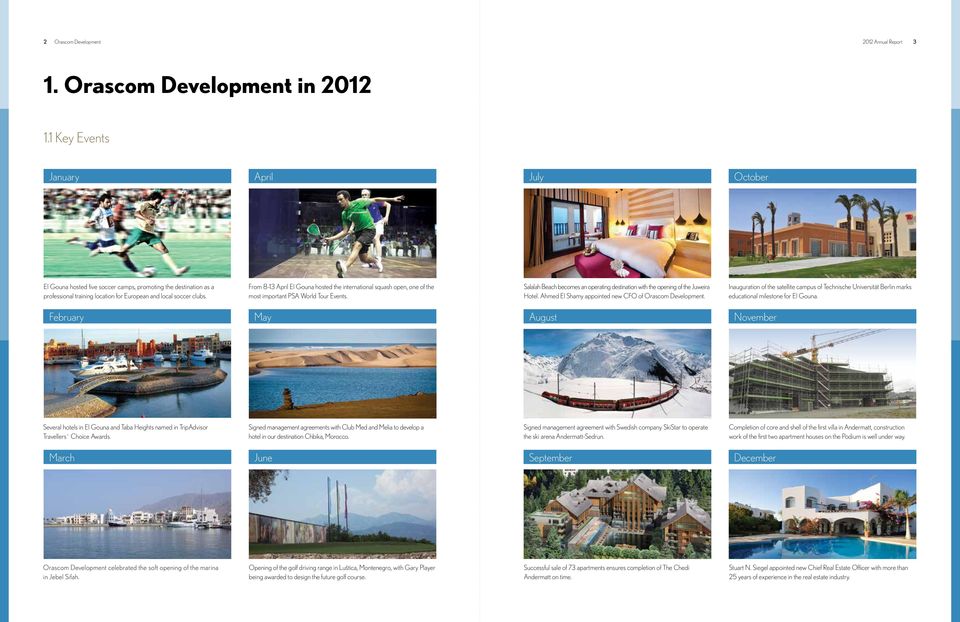
3 2 Orascom Development 2012 Annual Report 3 1. Orascom Development in Key Events January April July October El Gouna hosted five soccer camps, promoting the destination as a professional training location for European and local soccer clubs. From 8-13 April El Gouna hosted the international squash open, one of the most important PSA World Tour Events. Salalah Beach becomes an operating destination with the opening of the Juweira Hotel. Ahmed El Shamy appointed new CFO of Orascom Development. Inauguration of the satellite campus of Technische Universität Berlin marks educational milestone for El Gouna. February May August November Several hotels in El Gouna and Taba Heights named in TripAdvisor Travellers` Choice Awards. Signed management agreements with Club Med and Melia to develop a hotel in our destination Chbika, Morocco. Signed management agreement with Swedish company SkiStar to operate the ski arena Andermatt-Sedrun. Completion of core and shell of the first villa in Andermatt, construction work of the first two apartment houses on the Podium is well under way. March June September December Orascom Development celebrated the soft opening of the marina in Jebel Sifah. Opening of the golf driving range in Luštica, Montenegro, with Gary Player being awarded to design the future golf course. Successful sale of 73 apartments ensures completion of The Chedi Andermatt on time. Stuart N. Siegel appointed new Chief Real Estate Officer with more than 25 years of experience in the real estate industry.
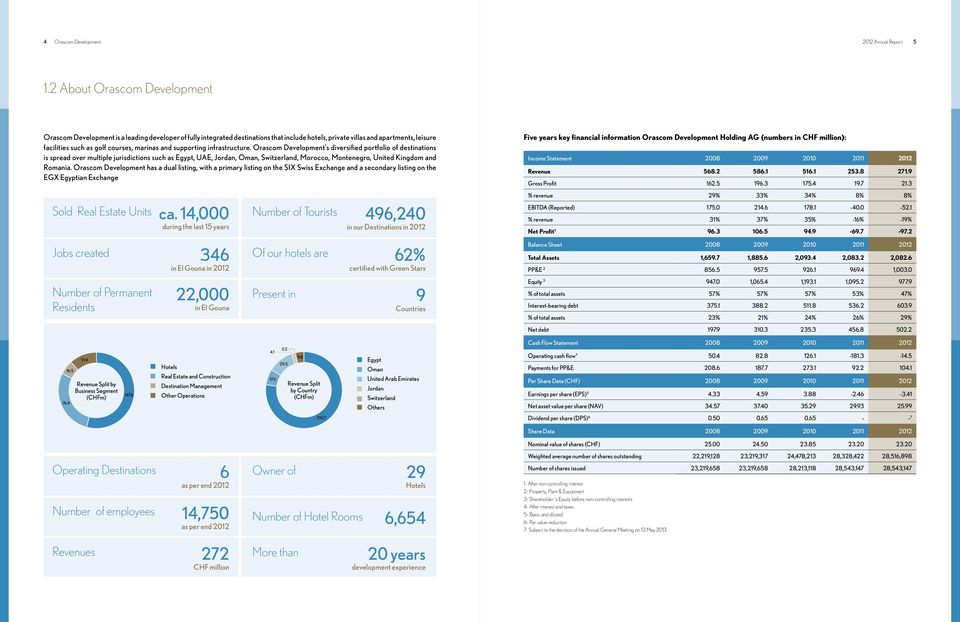
4 4 Orascom Development 2012 Annual Report About Orascom Development Orascom Development is a leading developer of fully integrated destinations that include hotels, private villas and apartments, leisure facilities such as golf courses, marinas and supporting infrastructure. Orascom Development s diversified portfolio of destinations is spread over multiple jurisdictions such as Egypt, UAE, Jordan, Oman, Switzerland, Morocco, Montenegro, United Kingdom and Romania. Orascom Development has a dual listing, with a primary listing on the SIX Swiss Exchange and a secondary listing on the EGX Egyptian Exchange Sold Real Estate Units ca. 14,000 during the last 15 years Number of Tourists 496,240 in our Destinations in 2012 Five years key financial information Orascom Development Holding AG (numbers in CHF million): Income Statement Revenue Gross Profit % revenue 29% 33% 34% 8% 8% EBITDA (Reported) % revenue 31% 37% 35% -16% -19% Net Profit Jobs created 346 in El Gouna in 2012 Of our hotels are 62% certified with Green Stars Balance Sheet Total Assets 1, , , , ,082.6 PP&E ,003.0 Number of Permanent Residents 22,000 in El Gouna Present in 9 Countries Equity , , , % of total assets 57% 57% 57% 53% 47% Interest-bearing debt % of total assets 23% 21% 24% 26% 29% Net debt Egypt 29.5 Hotels Oman Real Estate and Construction 17.6 United Arab Emirates Revenue Split by Destination Management Revenue Split Business Segment by Country Jordan (CHFm) Other Operations (CHFm) Switzerland Others Cash Flow Statement Operating cash flow⁴ Payments for PP&E Per Share Data (CHF) Earnings per share (EPS) Net asset value per share (NAV) Dividend per share (DPS) Operating Destinations 6 as per end 2012 Number of employees 14,750 as per end 2012 Owner of 29 Hotels Number of Hotel Rooms 6,654 Share Data Nominal value of shares (CHF) Weighted average number of shares outstanding 22,219,128 23,219,317 24,478,213 28,328,422 28,516,898 Number of shares issued 23,219,658 23,219,658 28,213,118 28,543,147 28,543, After non controlling interest 2- Property, Plant & Equipment 3- Shareholder`s Equity before non-controlling interests 4- After interest and taxes 5- Basic and diluted 6- Par value reduction 7- Subject to the decision of the Annual General Meeting on 13 May 2013 Revenues 272 CHF million More than 20 years development experience
5 6 Orascom Development 2012 Annual Report Destinations Map 49.7 million m million m million m million m 2 Egypt U.A.E. Oman Switzerland Operating Destination The Cove Operating destination El Gouna Taba Heights Haram City Developing destination Amoun Island Fayoum Makadi Qena Gardens Operating Destination Jebel Sifah Salalah Beach 1 Developing destination As Sodah Island Destination in the pipeline City Walk, Muscat 2 Developing destination Andermatt Swiss Alps 15.0 million m million m million m million m 2 Morocco Montenegro United Kingdom Romania million m 2 total area 15.5 million m 2 completed 15% completed Developing destination Chbika Developing destination Luštica Development Destination in the pipeline Eco-Bos Destination in the pipeline Constanta Any plot of land, developed or undeveloped, which is under the direct or indirect possession of Orascom Development by virtue of lease, usufruct and/or ownership rights and over which Orascom Development may have further rights to develop, fully own, lease to third parties, sell to third parties, grant sub-usufruct rights to third parties, or otherwise dispose to third parties. Each plot of land is governed by the respective agreement between Orascom Development (directly or indirectly) and the respective governmental entity, shareholders, and/or investors. 1 The discrepancy between the land size of the Salalah Beach project reflected in this year s Annual Report as compared to previous years is due to our earlier reliance on the initial agreement (reflected in the initial master plan) between Orascom Development and the Ministry of Tourism. It was initially agreed that Orascom Development would be granted 25.1 million square meters of land. However, the final arrangement was to grant us the 15.6 million square meters as reflected in the Development Agreement and the final master plan. Orascom Development and the Government of the Sultanate of Oman agreed to later discuss the possibility of acquiring the remaining land to develop a housing project. 2 An understanding has been reached between Orascom Development and the government of Oman in 2007, however no official land has been allocated to Orascom Development yet.

6 8 Orascom Development 2012 Annual Report 9 2. Board and Management Statements 2.1 Letter to Shareholders Dear Shareholders, Samih O. Sawiris Chairman of the Board of Directors Despite the challenging market environment, Orascom Development offers an attractive real estate and hotels mix in unique locations and customers will ultimately reward our offering over time. As I wrote to you last year, Orascom Development started to adapt its business model to counteract the adverse effects of the fragile macroeconomic environment and unstable political situation in the MENA region. During the period under review, we analyzed several options for each of our destinations to embark on a more capital-light growth path. We established encouraging partnerships to expand projects as planned but with less financial commitments from our side and at the same time succeeded to turn some of these partnerships into first visible results. During September, we achieved to sell 73 apartments in The Chedi Andermatt to Acuro Immobilien AG, which secured the completion and opening of the hotel for December this year. In order to further streamline our business and to focus on our core competencies, we decided to divest the tour operations business and signed a sale and purchase agreement in November to sell further stakes in companies operating in this segment. We continuously reviewed our capital expenditures and recurring costs based on achievable cash flows and have identified a portfolio of non-strategic assets which we are going to divest over the next 24 months. Board of Directors At the previous and fourth Annual General Meeting in Altdorf, Switzerland, on May 7, 2012 all members of the Board of Directors, with the exception of Amr Sheta who left Orascom Development to pursue business opportunities outside of the company, stood for reelection and were confirmed in their office for a further year. In light of the results 2012, the Board of Directors will propose to the fifth Annual General Meeting on March 13, 2013 to pay no dividend. Executive Management In order to respond to the changed market environment we strengthened the Executive Management team. Effective July 2012, Ahmed El Shamy who has a track record in private equity in the MENA region was appointed Chief Financial Officer. His predecessor Mahmoud Zuaiter, whose career spans 14 years in the hotel industry, became Chief Hotel Officer. In addition, Stuart Siegel was appointed Chief Real Estate Officer. He has vast experience in the real estate business and served for more than 15 years as President and CEO of Sotheby s International Realty. Furthermore, the Board of Directors appointed Aly Elhitamy as new member of the Executive Management responsible for Egypt. Aly Elhitamy is Orascom Development s Managing Director of Egypt and Chief Construction Officer. The assignment of responsibility to the new members underscores the relevance that they have for our company. The new Executive Management now contains seven members. We believe that the appointments enable us to improve the performance of Orascom Development in the coming years. Significant events after the balance sheet date On March 26, 2013, the Board of Directors decided to improve the capitalization of Orascom Development s Swiss subsidiary Andermatt Swiss Alps (ASA). As a result of the transaction, I will become majority shareholder with a 51% share by converting my loans to Orascom Development into ASA equity, and will act as new Executive Chairman of ASA. Orascom Development remains shareholder with a 49% share. Furthermore, I will invest at least CHF 150 million of new equity or subordinated loans into ASA in order to secure funding of the critical size of the resort in Andermatt until The transaction will release Orascom Development from further capex spending in Andermatt and significantly reduce debt levels. Furthermore I remain firmly committed to fully finance the expected operating cash deficit of Orascom Development of up to CHF 60 million in Outlook for 2013 For 2013, we expect that the political environment will remain unstable in many regions in the Middle East. However, our destinations especially on the Red Sea and in the United Arab Emirates are affected only to a limited extent because of their safety and security. Therefore, tourists from the MENA region and Europe continue to visit our towns in good numbers which enables us to generate free cash flows from these operations. Sales of secondary homes depend on the general economic environment, the location and the funding schemes available. In this regard, the conditions have not changed materially in the last months, but we remain cautiously optimistic regarding real estate sales for In addition, the Board has mandated the management of Orascom Development to put a stronger focus on cost reduction across our destinations and business segments to prepare the company for the future. We believe that Orascom Development offers an attractive mix of real estate in unique locations, and customers will ultimately reward our offering over time. More than once, Orascom Development has proved to be able to adapt to difficult market conditions and to initiate change to undermine its position as a leading town developer. Personally, I am convinced that we can transform the Group to a position of former strength, thereby creating long-term value for both our stakeholders and you, our shareholders. The Board of Directors likes to thank all employees for their contribution and efforts to advance our company in We also like to express a special thanks to our shareholders for their continued support of Orascom Development, as well as to our clients, suppliers and business partners for the trust and confidence they have placed in our company. Samih O. Sawiris Chairman of the Board of Directors

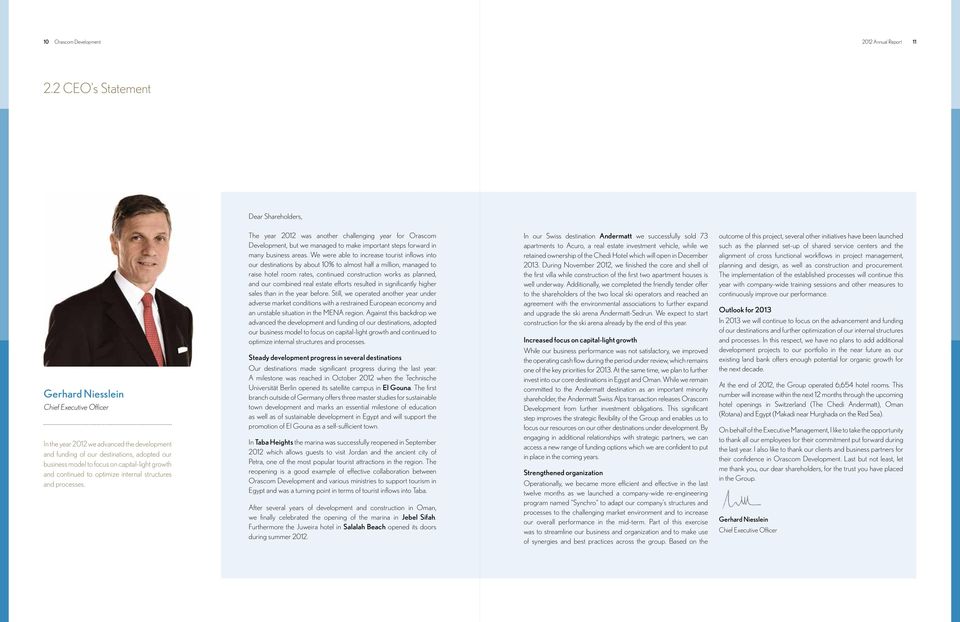
7 10 Orascom Development 2012 Annual Report CEO s Statement Dear Shareholders, Gerhard Niesslein Chief Executive Officer In the year 2012 we advanced the development and funding of our destinations, adopted our business model to focus on capital-light growth and continued to optimize internal structures and processes. The year 2012 was another challenging year for Orascom Development, but we managed to make important steps forward in many business areas. We were able to increase tourist inflows into our destinations by about 10% to almost half a million, managed to raise hotel room rates, continued construction works as planned, and our combined real estate efforts resulted in significantly higher sales than in the year before. Still, we operated another year under adverse market conditions with a restrained European economy and an unstable situation in the MENA region. Against this backdrop we advanced the development and funding of our destinations, adopted our business model to focus on capital-light growth and continued to optimize internal structures and processes. Steady development progress in several destinations Our destinations made significant progress during the last year. A milestone was reached in October 2012 when the Technische Universität Berlin opened its satellite campus in El Gouna. The first branch outside of Germany offers three master studies for sustainable town development and marks an essential milestone of education as well as of sustainable development in Egypt and will support the promotion of El Gouna as a self-sufficient town. In Taba Heights the marina was successfully reopened in September 2012 which allows guests to visit Jordan and the ancient city of Petra, one of the most popular tourist attractions in the region. The reopening is a good example of effective collaboration between Orascom Development and various ministries to support tourism in Egypt and was a turning point in terms of tourist inflows into Taba. After several years of development and construction in Oman, we finally celebrated the opening of the marina in Jebel Sifah. Furthermore the Juweira hotel in Salalah Beach opened its doors during summer In our Swiss destination Andermatt we successfully sold 73 apartments to Acuro, a real estate investment vehicle, while we retained ownership of the Chedi Hotel which will open in December During November 2012, we finished the core and shell of the first villa while construction of the first two apartment houses is well underway. Additionally, we completed the friendly tender offer to the shareholders of the two local ski operators and reached an agreement with the environmental associations to further expand and upgrade the ski arena Andermatt-Sedrun. We expect to start construction for the ski arena already by the end of this year. Increased focus on capital-light growth While our business performance was not satisfactory, we improved the operating cash flow during the period under review, which remains one of the key priorities for At the same time, we plan to further invest into our core destinations in Egypt and Oman. While we remain committed to the Andermatt destination as an important minority shareholder, the Andermatt Swiss Alps transaction releases Orascom Development from further investment obligations. This significant step improves the strategic flexibility of the Group and enables us to focus our resources on our other destinations under development. By engaging in additional relationships with strategic partners, we can access a new range of funding options which we are confident to put in place in the coming years. Strengthened organization Operationally, we became more efficient and effective in the last twelve months as we launched a company-wide re-engineering program named Synchro to adapt our company s structures and processes to the challenging market environment and to increase our overall performance in the mid-term. Part of this exercise was to streamline our business and organization and to make use of synergies and best practices across the group. Based on the outcome of this project, several other initiatives have been launched such as the planned set-up of shared service centers and the alignment of cross functional workflows in project management, planning and design, as well as construction and procurement. The implementation of the established processes will continue this year with company-wide training sessions and other measures to continuously improve our performance. Outlook for 2013 In 2013 we will continue to focus on the advancement and funding of our destinations and further optimization of our internal structures and processes. In this respect, we have no plans to add additional development projects to our portfolio in the near future as our existing land bank offers enough potential for organic growth for the next decade. At the end of 2012, the Group operated 6,654 hotel rooms. This number will increase within the next 12 months through the upcoming hotel openings in Switzerland (The Chedi Andermatt), Oman (Rotana) and Egypt (Makadi near Hurghada on the Red Sea). On behalf of the Executive Management, I like to take the opportunity to thank all our employees for their commitment put forward during the last year. I also like to thank our clients and business partners for their confidence in Orascom Development. Last but not least, let me thank you, our dear shareholders, for the trust you have placed in the Group. Gerhard Niesslein Chief Executive Officer
8 12 Orascom Development 2012 Annual Report CFO s Comment Dear Shareholders, Ahmed El Shamy Chief Financial Officer Operating cash flow improved in 2012, but results were impacted by extraordinary items. In 2013 we will continue to focus on cost savings and monetization efforts. Despite the on-going challenging market environment in the MENA region and the subdued economic situation in Europe, Orascom Development achieved to increase revenues by 7.1% to CHF million, up from CHF million a year ago. The growth in revenues was mainly a result of higher income from the hotel and real estate segment. Gross profit for the period under review improved from CHF 19.7 million (7.7% margin) to CHF 21.3 million (7.8% margin). Extraordinary non cash items such as impairments or transaction losses of CHF 45.1 million and provisions for cancelled real estate sales and doubtful collections of CHF 27.3 million negatively impacted the income statement. Accordingly, the operating result (EBITDA) in 2012 was a negative CHF 52.1 million (2011: CHF 40.0 million loss). When adjusting for the above mentioned extraordinary items EBITDA in 2012 was CHF 20.3 million (7.5% margin) compared to CHF 42.6 million in 2011 (16.8% margin). While group taxes were virtually zero last year, in 2012 some CHF 10.1 million of taxes were charged against the income statement. Combined with higher finance costs this resulted in a net loss after minorities for the period of CHF 97.2 million versus a loss of CHF 69.7 million in Reported versus adjusted EBITDA 2012 (in CHF million) EBITDA reported Extraordinary items Real Estate provisions 20.3 EBITDA Adjusted Balance sheet Total assets on the balance sheet at the end of 2012 were largely unchanged at CHF 2,082.6 million compared to one year ago. The increase in property, plant and equipment (infrastructure, hotels and land belonging to the Group) is mainly due to our development in Switzerland (The Chedi) and Oman (Rotana). The decline in the accounts receivables balance is due to an improved real estate collection process in Egypt and the provision for doubtful debts. Despite ongoing construction works, the inventory increased only slightly. Cash and cash equivalents at the end of the reporting period reached more than CHF 100 million. Borrowings increased by CHF 67.7 million to CHF million due to the use of credit facilities from the group s majority shareholder to finance our construction and development activities. Net debt accordingly was CHF million, compared to CHF million a year ago. After having successfully rescheduled the 2013 and 2014 loan maturities, the group is in discussions with its major creditors to further optimize the funding structure. As a consequence of the reported net loss shareholders equity including non-controlling interests decreased from CHF 1,095.2 million to CHF million. The equity ratio declined from 52.6% to 47.0%, respectively. The ratio of net debt to equity increased from 41.7% a year ago to 51.4%. Operating cash flow improving In 2012 Orascom Development generated an operating cash flow (after interest and taxes) of negative CHF 14.5 million, which was an improvement versus the same period last year. During 2012 we invested CHF million as we continued to develop our destinations in Switzerland and Oman and as we maintained the standard in our Egyptian destinations. For 2013, we expect a capex of around CHF million, excluding discretionary capex, to finish the completion of the Rotana hotel in Oman and for several other smaller projects in Egypt. Further focus on cost savings and monetization programs An important element for 2013 is the implementation of a more capital-light strategy. This is a combination of divestments of nonstrategic assets to strengthen the balance sheet or cooperation with external partners in order to complete and finance entire development phases or certain project elements. Besides working on those monetization efforts, the Group has developed several other strategies to ensure that appropriate and immediate actions are taken during those unstable times and to ensure sufficient funding for our 2013 plans, one of which is the postponement of certain planned capital expenditure investments. On an operational level, we are now focusing on liquidating our inventory of finished or close to be finished real estate units as well as initiating several efficiency and cost saving initiatives that should generate savings in overhead expenses, direct expenses and interest expenses. We expect 2013 to be a tough year, yet we are firm believers that all our efforts in monetization and efficiencies will pay out. We will keep monitoring the events as they unfold at the present and will continue revamping our operations to be more efficient so that they are in the right structure once this cycle reverses. Ahmed El Shamy Chief Financial Officer

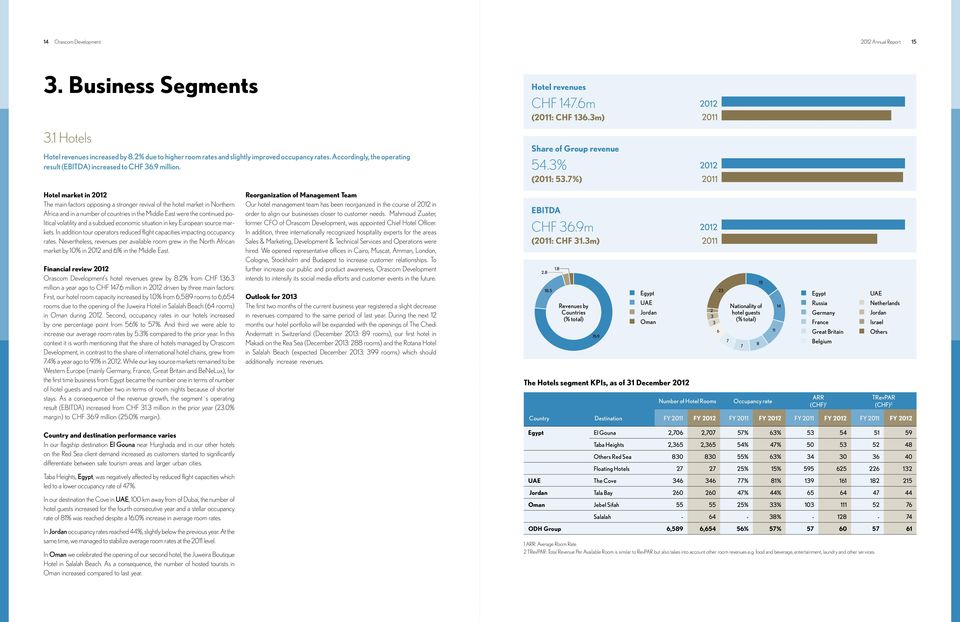
9 14 Orascom Development 2012 Annual Report Business Segments 3.1 Hotels Hotel revenues increased by 8.2% due to higher room rates and slightly improved occupancy rates. Accordingly, the operating result (EBITDA) increased to CHF 36.9 million. Hotel revenues CHF 147.6m (2011: CHF 136.3m) Share of Group revenue 54.3% (2011: 53.7%) Hotel market in 2012 The main factors opposing a stronger revival of the hotel market in Northern Africa and in a number of countries in the Middle East were the continued political volatility and a subdued economic situation in key European source markets. In addition tour operators reduced flight capacities impacting occupancy rates. Nevertheless, revenues per available room grew in the North African market by 10% in 2012 and 6% in the Middle East. Financial review 2012 Orascom Development s hotel revenues grew by 8.2% from CHF million a year ago to CHF million in 2012 driven by three main factors: First, our hotel room capacity increased by 1.0% from 6,589 rooms to 6,654 rooms due to the opening of the Juweira Hotel in Salalah Beach (64 rooms) in Oman during Second, occupancy rates in our hotels increased by one percentage point from 56% to 57%. And third we were able to increase our average room rates by 5.3% compared to the prior year. In this context it is worth mentioning that the share of hotels managed by Orascom Development, in contrast to the share of international hotel chains, grew from 7.4% a year ago to 9.1% in While our key source markets remained to be Western Europe (mainly Germany, France, Great Britain and BeNeLux), for the first time business from Egypt became the number one in terms of number of hotel guests and number two in terms of room nights because of shorter stays. As a consequence of the revenue growth, the segment`s operating result (EBITDA) increased from CHF 31.3 million in the prior year (23.0% margin) to CHF 36.9 million (25.0% margin). Country and destination performance varies In our flagship destination El Gouna near Hurghada and in our other hotels on the Red Sea client demand increased as customers started to significantly differentiate between safe tourism areas and larger urban cities. Taba Heights, Egypt, was negatively affected by reduced flight capacities which led to a lower occupancy rate of 47%. In our destination the Cove in UAE, 100 km away from of Dubai, the number of hotel guests increased for the fourth consecutive year and a stellar occupancy rate of 81% was reached despite a 16.0% increase in average room rates. In Jordan occupancy rates reached 44%, slightly below the previous year. At the same time, we managed to stabilize average room rates at the 2011 level. In Oman we celebrated the opening of our second hotel, the Juweira Boutique Hotel in Salalah Beach. As a consequence, the number of hosted tourists in Oman increased compared to last year. Reorganization of Management Team Our hotel management team has been reorganized in the course of 2012 in order to align our businesses closer to customer needs. Mahmoud Zuaiter, former CFO of Orascom Development, was appointed Chief Hotel Officer. In addition, three internationally recognized hospitality experts for the areas Sales & Marketing, Development & Technical Services and Operations were hired. We opened representative offices in Cairo, Muscat, Amman, London, Cologne, Stockholm and Budapest to increase customer relationships. To further increase our public and product awareness, Orascom Development intends to intensify its social media efforts and customer events in the future. Outlook for 2013 The first two months of the current business year registered a slight decrease in revenues compared to the same period of last year. During the next 12 months our hotel portfolio will be expanded with the openings of The Chedi Andermatt in Switzerland (December 2013: 89 rooms), our first hotel in Makadi on the Rea Sea (December 2013: 288 rooms) and the Rotana Hotel in Salalah Beach (expected December 2013: 399 rooms) which should additionally increase revenues. EBITDA CHF 36.9m (2011: CHF 31.3m) Revenues by Countries (% total) 76.9 Egypt UAE Jordan Oman The Hotels segment KPIs, as of 31 December Number of Hotel Rooms 23 Occupancy rate Egypt Russia Germany France Great Britain Belgium ARR (CHF) 1 UAE Netherlands Jordan Israel Others TRevPAR (CHF) 2 Country Destination FY 2011 FY 2012 FY 2011 FY 2012 FY 2011 FY 2012 FY 2011 FY 2012 Egypt El Gouna 2,706 2,707 57% 63% Taba Heights 2,365 2,365 54% 47% Others Red Sea % 63% Floating Hotels % 15% UAE The Cove % 81% Jordan Tala Bay % 44% Oman Jebel Sifah % 33% Salalah % ODH Group 6,589 6,654 56% 57% Nationality of hotel guests (% total) 1 ARR: Average Room Rate 2 TRevPAR: Total Revenue Per Available Room is similar to RevPAR but also takes into account other room revenues e.g. food and beverage, entertainment, laundry and other services
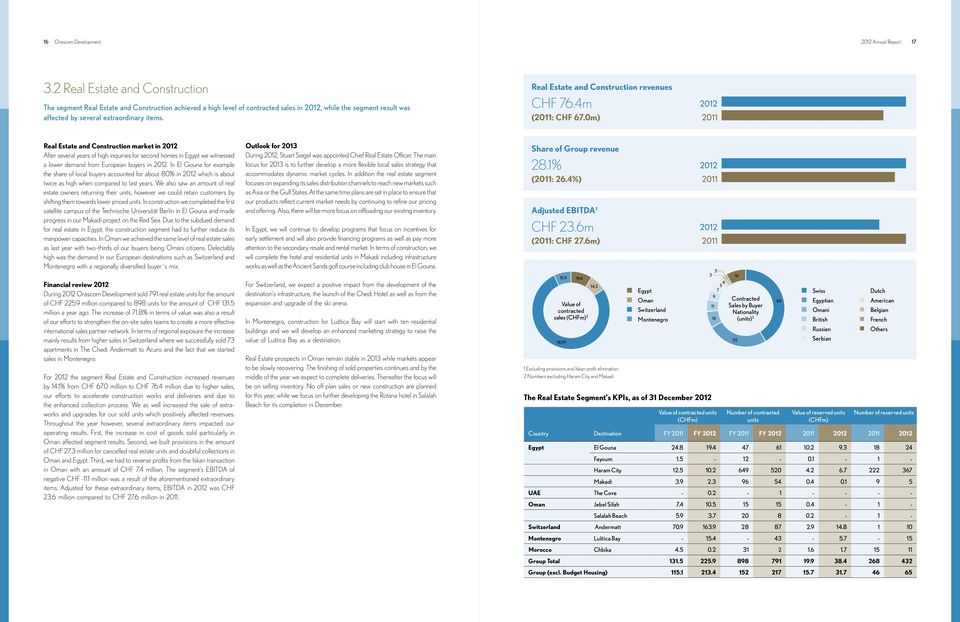
10 16 Orascom Development 2012 Annual Report Real Estate and Construction The segment Real Estate and Construction achieved a high level of contracted sales in 2012, while the segment result was affected by several extraordinary items. Real Estate and Construction revenues CHF 76.4m (2011: CHF 67.0m) Real Estate and Construction market in 2012 After several years of high inquiries for second homes in Egypt we witnessed a lower demand from European buyers in In El Gouna for example the share of local buyers accounted for about 80% in 2012 which is about twice as high when compared to last years. We also saw an amount of real estate owners returning their units, however we could retain customers by shifting them towards lower priced units. In construction we completed the first satellite campus of the Technische Universität Berlin in El Gouna and made progress in our Makadi project on the Red Sea. Due to the subdued demand for real estate in Egypt, the construction segment had to further reduce its manpower capacities. In Oman we achieved the same level of real estate sales as last year with two-thirds of our buyers being Omani citizens. Delectably high was the demand in our European destinations such as Switzerland and Montenegro with a regionally diversified buyer`s mix. Financial review 2012 During 2012 Orascom Development sold 791 real estate units for the amount of CHF million compared to 898 units for the amount of CHF million a year ago. The increase of 71.8% in terms of value was also a result of our efforts to strengthen the on-site sales teams to create a more effective international sales partner network. In terms of regional exposure the increase mainly results from higher sales in Switzerland where we successfully sold 73 apartments in The Chedi Andermatt to Acuro and the fact that we started sales in Montenegro. For 2012 the segment Real Estate and Construction increased revenues by 14.1% from CHF 67.0 million to CHF 76.4 million due to higher sales, our efforts to accelerate construction works and deliveries and due to the enhanced collection process. We as well increased the sale of extraworks and upgrades for our sold units which positively affected revenues. Throughout the year however, several extraordinary items impacted our operating results. First, the increase in cost of goods sold particularly in Oman affected segment results. Second, we built provisions in the amount of CHF 27.3 million for cancelled real estate units and doubtful collections in Oman and Egypt. Third, we had to reverse profits from the Iskan transaction in Oman with an amount of CHF 7.4 million. The segment s EBITDA of negative CHF million was a result of the aforementioned extraordinary items. Adjusted for these extraordinary items, EBITDA in 2012 was CHF 23.6 million compared to CHF 27.6 million in Outlook for 2013 During 2012, Stuart Siegel was appointed Chief Real Estate Officer. The main focus for 2013 is to further develop a more flexible local sales strategy that accommodates dynamic market cycles. In addition the real estate segment focuses on expanding its sales distribution channels to reach new markets such as Asia or the Gulf States. At the same time plans are set in place to ensure that our products reflect current market needs by continuing to refine our pricing and offering. Also, there will be more focus on offloading our existing inventory. In Egypt, we will continue to develop programs that focus on incentives for early settlement and will also provide financing programs as well as pay more attention to the secondary resale and rental market. In terms of construction, we will complete the hotel and residential units in Makadi including infrastructure works as well as the Ancient Sands golf course including club house in El Gouna. For Switzerland, we expect a positive impact from the development of the destination s infrastructure, the launch of the Chedi Hotel as well as from the expansion and upgrade of the ski arena. In Montenegro, construction for Luštica Bay will start with ten residential buildings and we will develop an enhanced marketing strategy to raise the value of Luštica Bay as a destination. Real Estate prospects in Oman remain stable in 2013 while markets appear to be slowly recovering. The finishing of sold properties continues and by the middle of the year we expect to complete deliveries. Thereafter the focus will be on selling inventory. No off-plan sales or new construction are planned for this year, while we focus on further developing the Rotana hotel in Salalah Beach for its completion in December. Share of Group revenue 28.1% (2011: 26.4%) Adjusted EBITDA 1 CHF 23.6m (2011: CHF 27.6m) 15.4 Value of contracted sales (CHFm) Excluding provisions and Iskan profit elimination 2 Numbers excluding Haram City and Makadi Egypt Oman Switzerland Montenegro The Real Estate Segment s KPIs, as of 31 December Value of contracted units (CHFm) Contracted Sales by Buyer Nationality (units) 2 Number of contracted units Value of reserved units (CHFm) Dutch American Belgian French Others Number of reserved units Country Destination FY 2011 FY 2012 FY 2011 FY Egypt El Gouna Fayoum Haram City Makadi UAE The Cove Oman Jebel Sifah Salalah Beach Switzerland Andermatt Montenegro Luštica Bay Morocco Chbika Group Total Group (excl. Budget Housing) Swiss Egyptian Omani British Russian Serbian
11 18 Orascom Development 2012 Annual Report Destination Management For 2012 revenues and operating result in Destination Management were slightly below last year. Destination Management revenues CHF 16.5m (2011: CHF 17.7m) Destination Management environment in 2012 The segment Destination Management felt the aftermath of the European debt crisis and political events in the MENA region during In addition, real estate owners spent less and used their properties less frequently than usual. The rising awareness that our destinations have a high level of security standards, however, stimulated demand. Financial review 2012 Revenues in Orascom Development s segment Destination Management slightly decreased to CHF 16.5 million in 2012 (2011: CHF 17.7 million). Around 60% of revenues were generated from utility functions such as water or electricity generation, while the remaining 40% were derived from commercial, urban and community services as well as infrastructure and maintenance activities. The segment reported an operating loss (EBITDA) of CHF 1.7 million in Outlook for 2013 We will continue to strengthen our brand awareness and ensure that guests/ residents experience our life as it should be vision in our destinations. For El Gouna and Taba Heights, it is vital to increase their brand awareness not only in European key markets, but to further address secondary markets such as Turkey, the Ukraine and other CIS countries. Additionally, we will continue to further develop world class services and facilities. For Oman, we will work to enforce Jebel Sifah s positioning as a natural picturesque getaway offering an adventurous experience including hiking, diving, water sports, whale and dolphin watching which is unique in the Middle Eastern region. Similarly, Salalah Beach will be branded as the only exclusive tropical destination in the region. Share of Group revenue 6.1% (2011: 7.0%) EBITDA CHF -1.7m (2011: CHF 0.1m) As Destination Management encompasses every component of the destination s operation such as facility management, security, landscaping, transportation, telecommunications and environmental services, the segment name was changed from Town Management to Destination Management. The segment s composition itself has not been changed. Key events In April the El Gouna International Squash Open, one of the most important tournaments on the PSA World Tour, took place in El Gouna. In October we celebrated the opening of the Technische Universität Berlin satellite campus in El Gouna. The satellite campus offers three master studies for sustainable town development and marks a milestone of education as well as of sustainable development in Egypt and will support the promotion of El Gouna as a selfsufficient town Destination Management Revenues by Destination (% total) 64.2 Haram City El Gouna Taba The Cove Destination Management Revenues by Service Type (% total) 59.9 Utilities Commercial Services Infrastructure & Maintenance Urban Services Community Services Others Egypt`s Prime Minister Dr. Hisham Qandil and Orascom Development s chairman Samih O. Sawiris successfully reopened the marina of our destination Taba Heights. The marina as a revitalising element for our destination allows guests to visit Jordan and the ancient city of Petra, one of the most popular tourist attractions in the region. For Oman the year 2012 was characterized by the opening of the marina in Jebel Sifah and the soft opening of the Juweira Hotel in Salalah Beach.

12 20 Orascom Development 2012 Annual Report Other Segments Land Sales Occasionally, the Group sells land where there are no development obligations or where the Group has developed infrastructure in order to sell the land to third-party developers. This establishes a reference point for the market price of our land bank. Revenues from such sales are included in our Land Sales segment. Revenues from the sale of land, sale of land rights and the associated costs are recognized when land is delivered and the risk of ownership and control has been transferred to the buyer. Other operations The segment Other operations combines those businesses of Orascom Development that are not classified in any of the other business segments. The segment includes activities such as mortgage financing, rental of villas and apartments, hospital and educational services, marina, limousine rentals, laundry and other services. During 2012, revenues of the segment Other operations increased by 2.9% from CHF 30.5 million to CHF 31.4 million, in particular due to our mortgage business (Tamweel) which increased revenues above expectations. Land Sales revenues CHF 0.0m (2011: CHF 2.3m) Other operations revenues CHF 31.4m (2011: CHF 30.5m) Share of Group revenue 0.0% (2011: 0.9%) Share of Group revenue 11.6% (2011: 12.0%) EBITDA CHF -2.4m (2011: CHF -0.9m) EBITDA CHF 15.7m (2011: CHF 5.7m) Note regarding the segment Tour Operations During 2012 Orascom Hotels & Development S.A.E, a subsidiary of the Group entered into shares sale and purchase agreements with Garranah family. Besides reducing the ownership in several investments in associates, the Group sold their remaining subsidiary operating in the tour operations business. Therefore the segment Tour Operations is considered a discontinued operation and is presented accordingly. For further information also see the financial report, footnote 14, 20 and 36.

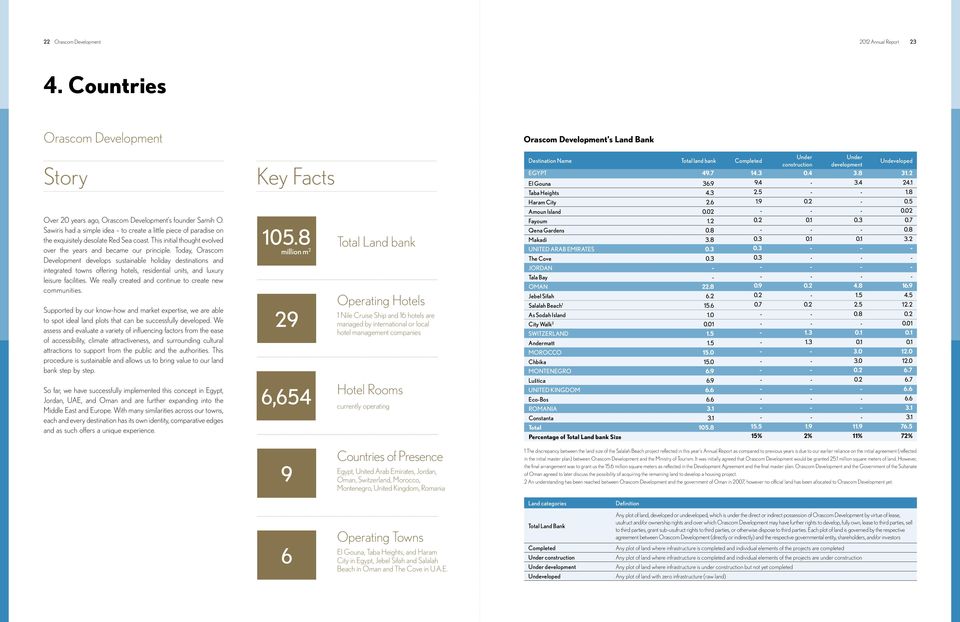
13 22 Orascom Development 2012 Annual Report Countries Orascom Development Story Over 20 years ago, Orascom Development s founder Samih O. Sawiris had a simple idea to create a little piece of paradise on the exquisitely desolate Red Sea coast. This initial thought evolved over the years and became our principle. Today, Orascom Development develops sustainable holiday destinations and integrated towns offering hotels, residential units, and luxury leisure facilities. We really created and continue to create new communities. Supported by our know-how and market expertise, we are able to spot ideal land plots that can be successfully developed. We assess and evaluate a variety of influencing factors from the ease of accessibility, climate attractiveness, and surrounding cultural attractions to support from the public and the authorities. This procedure is sustainable and allows us to bring value to our land bank step by step. So far, we have successfully implemented this concept in Egypt, Jordan, UAE, and Oman and are further expanding into the Middle East and Europe. With many similarities across our towns, each and every destination has its own identity, comparative edges and as such offers a unique experience. Key Facts million m ,654 9 Total Land bank Operating Hotels 1 Nile Cruise Ship and 16 hotels are managed by international or local hotel management companies Hotel Rooms currently operating Countries of Presence Egypt, United Arab Emirates, Jordan, Oman, Switzerland, Morocco, Montenegro, United Kingdom, Romania Orascom Development s Land Bank Destination Name Total land bank Completed Under construction Under development Undeveloped EGYPT El Gouna Taba Heights Haram City Amoun Island Fayoum Qena Gardens Makadi UNITED ARAB EMIRATES The Cove JORDAN Tala Bay OMAN Jebel Sifah Salalah Beach As Sodah Island City Walk SWITZERLAND Andermatt MOROCCO Chbika MONTENEGRO Luštica UNITED KINGDOM Eco-Bos ROMANIA Constanta Total Percentage of Total Land bank Size 15% 2% 11% 72% 1 The discrepancy between the land size of the Salalah Beach project reflected in this year s Annual Report as compared to previous years is due to our earlier reliance on the initial agreement (reflected in the initial master plan) between Orascom Development and the Ministry of Tourism. It was initially agreed that Orascom Development would be granted 25.1 million square meters of land. However, the final arrangement was to grant us the 15.6 million square meters as reflected in the Development Agreement and the final master plan. Orascom Development and the Government of the Sultanate of Oman agreed to later discuss the possibility of acquiring the remaining land to develop a housing project. 2 An understanding has been reached between Orascom Development and the government of Oman in 2007, however no official land has been allocated to Orascom Development yet. Land categories Definition 6 Operating Towns El Gouna, Taba Heights, and Haram City in Egypt, Jebel Sifah and Salalah Beach in Oman and The Cove in U.A.E. Total Land Bank Completed Under construction Under development Undeveloped Any plot of land, developed or undeveloped, which is under the direct or indirect possession of Orascom Development by virtue of lease, usufruct and/or ownership rights and over which Orascom Development may have further rights to develop, fully own, lease to third parties, sell to third parties, grant sub-usufruct rights to third parties, or otherwise dispose to third parties. Each plot of land is governed by the respective agreement between Orascom Development (directly or indirectly) and the respective governmental entity, shareholders, and/or investors Any plot of land where infrastructure is completed and individual elements of the projects are completed Any plot of land where infrastructure is completed and individual elements of the projects are under construction Any plot of land where infrastructure is under construction but not yet completed Any plot of land with zero infrastructure (raw land)
14 24 Orascom Development 2012 Annual Report 25 EL GOUNA, EGYPT Operating Destination Increased client demand for El Gouna Hotels Spotlight on kite surfing Repeated visits of kite surfing world champions such as Kristin Boese, raised public awareness for El Gouna as a prime location for kite surfing events. The hotel sector improved customer relationships and strengthened its sales approach, driving more business to the town. Occupancy rates increased to 63% in 2012 from 57% in 2011, making El Gouna hotels among the best performing in the Orascom Development portfolio. Opening of satellite campus of Technische Universität Berlin In September, El Gouna achieved a new educational milestone with the inauguration of the Technische Universität Berlin El Gouna Campus. 30 students were enrolled in the first semester. El Gouna International Squash Open Success For the 2nd time El Gouna hosted the International Squash Open. With the world s top 16 players, live international broadcasts, and remarkable audience and viewership, El Gouna made itself a name in hosting international events. New attraction: El Gouna Water Sports Complex covering 90,000 m 2 Opening in summer 2013, El Gouna is preparing to welcome its latest attraction - El Gouna Water Sports Complex, offering water ski and wake board cableways facilities.

15 Key Facts Story 36.9 million m 2 16 Total land stretching along 10 km of beach and spreading across 36 islands and lagoons Hotels 2,707 guest rooms The catalyst and powerhouse behind the growth of Orascom Development s activities - El Gouna - started with a man s search for a perfect spot on the seaside. Over the course of 20 years, the barren spot nourished, demand increased, and the community grew into a fully fledged town. With jobs on offer in the areas of construction, hospitality, service and infrastructure management, El Gouna turned into a microeconomy. Growing the critical mass to over 22,000 permanent residents, El Gouna became an internationally well-known destination. Now El Gouna is a model of a self-sufficient and fully-integrated resort town, illustrating the destination s vision of Life as it should be. 463 Commercial outlets 22,000 Permanent residents Home to some of the world s most reputable brands, El Gouna s facilities include a landing strip, three yacht marinas, an 18-hole championship golf course - and another one under construction, 16 hotels, two spa outlets, a state-of-the-art gym, an international standard hospital, a satellite campus of the Technische Universität Berlin, a field study center of the American University in Cairo, a German-Egyptian hotel school, a nursing institute, and an international K12 School. 2,790 Residential Units sold since 1997 till 31 st of December 2012

16 26 Orascom Development 2012 Annual Report 27 TABA HEIGHts, EGYPT Operating Destination Re-opening of Taba Heights marina TripAdvisor Travellers Choice Awards 2012 In the TripAdvisor Travellers`Choice Awards 2012 several hotels in Taba Heights were awarded. The marina in Taba Heights re-opened in September which increased the attractiveness of the destination among both Jordanian and European tourists. The marina connects Tala Bay in Jordan with Taba Heights in Egypt. Around 30,000 travelers used the marina since it was re-inaugurated. Marketing efforts bear fruit Thanks to new partnerships with German Tour Operators starting in fall 2012, Taba Heights could increase the share of German guests in the destination. Ideal starting point for excursions Taba Heights is the ideal starting point for cultural excursions to the ancient city of Petra in Jordan or St. Catherine s Monastery on the Sinai Peninsula. Jordanian travelers appreciate the ease of accessibility and luxury offered by the Taba Heights hotels. Taba Heights Golf course topranked in the region For another consecutive year in a row Taba Heights Golf course was ranked among the top 5 golf courses in the region by an independent website dedicated to the best golf courses in the world (top100golfcourses).

17 Key Facts Story 4.3 million m 2 6 Total Land private resort built along 5 kilometers of natural beaches Hotels internationally branded with 2,365 guest rooms Taba Heights emerges as a precious jewel in the stunning Sinai Peninsula. Sprawling down a gentle slope framed by mountain ranges and turquoise waters, the integrated upscale resort town boasts breathtaking scenery and a supreme location with a view of four countries: Egypt, Israel, Jordan, and Saudi Arabia. It is an ideal tourist destination featuring six hotels, an uptown village that is home to arts and crafts boutiques, a central square where folklore shows and live music are staged, an 18-hole championship golf course regarded as one of Egypt s most beautiful, the region s first man-made salt cave and a five-star water sports center. 107 Commercial outlets With a fully functioning harbor operating as official port of entry to Egypt, Taba Heights is a popular starting point for excursions to UNESCO World Heritage sites such as the monastery of Saint Catherine, the rose-red city of Petra, the desert of Wadi Rum, the holy city of Jerusalem, and the Dead Sea. 4,000 Permanent residents

18 28 Orascom Development 2012 Annual Report 29 HARAM CITY, EGYPT Operating Destination Another year with more than 500 residential units sold For the 5th consecutive year, Orascom Housing Communities (OHC) sold more than 500 residential units in the low income housing sector. Social Mobility Initiative with World Bank During 2012 OHC worked with the World Bank and the GSF to promote a social mobility concept, focusing on modular expansion of smaller units into larger ones. Guarantee and Subsidy Fund activated Activation of the Guarantee and Subsidy Fund (GSF), a governmental low income housing program providing mortgage subsidies, supported inventory sales. OHC wins Cityscape Egypt award In February OHC was awarded the Residential Project Award for its flagship project Haram City by Cityscape Egypt. This award is the fourth and most recent acknowledgement for OHC s efforts in developing fully integrated cities.

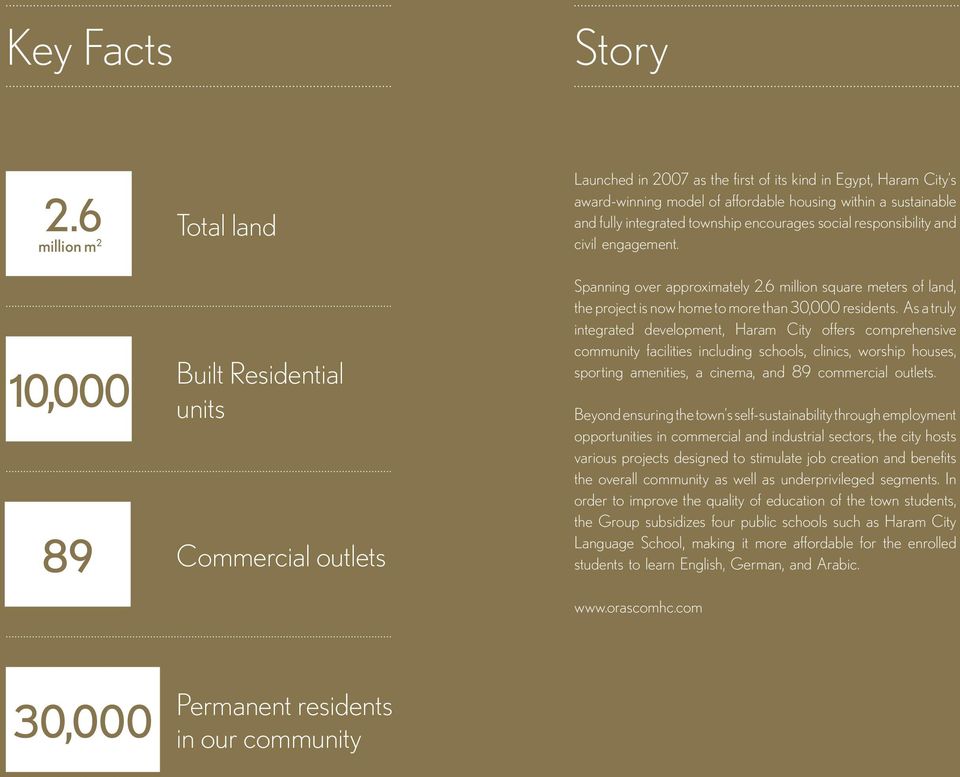
19 Key Facts Story 2.6 million m 2 Total land Launched in 2007 as the first of its kind in Egypt, Haram City s award-winning model of affordable housing within a sustainable and fully integrated township encourages social responsibility and civil engagement. 10,000 Built Residential units 89 Commercial outlets Spanning over approximately 2.6 million square meters of land, the project is now home to more than 30,000 residents. As a truly integrated development, Haram City offers comprehensive community facilities including schools, clinics, worship houses, sporting amenities, a cinema, and 89 commercial outlets. Beyond ensuring the town s self-sustainability through employment opportunities in commercial and industrial sectors, the city hosts various projects designed to stimulate job creation and benefits the overall community as well as underprivileged segments. In order to improve the quality of education of the town students, the Group subsidizes four public schools such as Haram City Language School, making it more affordable for the enrolled students to learn English, German, and Arabic. 30,000 Permanent residents in our community
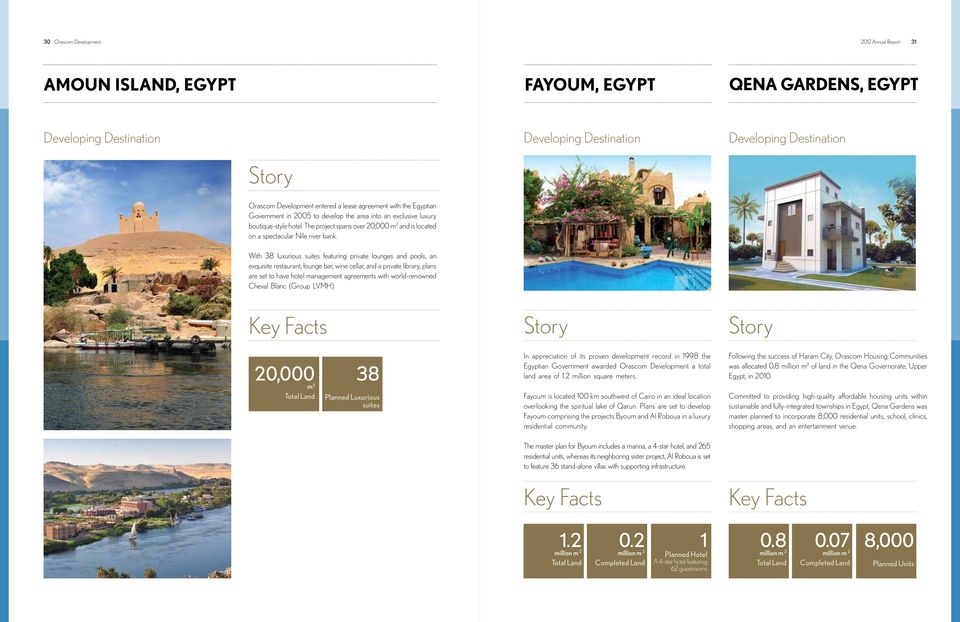
20 30 Orascom Development 2012 Annual Report 31 AMOUN ISLAND, EGYPT FAYOUM, EGYPT QENA GARDENS, EGYPT Developing Destination Developing Destination Developing Destination Story Orascom Development entered a lease agreement with the Egyptian Government in 2005 to develop the area into an exclusive luxury boutique-style hotel. The project spans over 20,000 m 2 and is located on a spectacular Nile river bank. With 38 luxurious suites featuring private lounges and pools, an exquisite restaurant, lounge bar, wine cellar, and a private library, plans are set to have hotel management agreements with world-renowned Cheval Blanc (Group LVMH). Key Facts Story Story 20,000 m 2 Total Land 38 Planned Luxurious suites In appreciation of its proven development record in 1998 the Egyptian Government awarded Orascom Development a total land area of 1.2 million square meters. Fayoum is located 100 km southwest of Cairo in an ideal location overlooking the spiritual lake of Qarun. Plans are set to develop Fayoum comprising the projects Byoum and Al Roboua in a luxury residential community. Following the success of Haram City, Orascom Housing Communities was allocated 0.8 million m 2 of land in the Qena Governorate, Upper Egypt, in Committed to providing high-quality affordable housing units within sustainable and fully-integrated townships in Egypt, Qena Gardens was master planned to incorporate 8,000 residential units, school, clinics, shopping areas, and an entertainment venue. The master plan for Byoum includes a marina, a 4-star hotel, and 265 residential units, whereas its neighboring sister project, Al Roboua is set to feature 36 stand-alone villas with supporting infrastructure. Key Facts Key Facts 1.2 million m 2 Total Land 0.2 million m 2 Completed Land 1 Planned Hotel A 4-star hotel featuring 62 guestrooms 0.8 million m 2 Total Land 0.07 million m 2 Completed Land 8,000 Planned Units
21 32 Orascom Development 2012 Annual Report 33 MAKADI, EGYPT ROYAL AZUR & CLUB AZUR, EGYPT ZAHRA OBEROI, EGYPT Developing Destination Other Hotel Other Hotel High local market visibility Hosting a mega event in cooperation with Vodafone Egypt; Makadi is currently enjoying a PR boost on a local level. The event was attended by around 80% of the home owners and generated huge media coverage. Story Having paved the way with two decades of experience and sound reputation, the Orascom Development business model has evolved with Orascom Development and Management lending its expertise to land owners in return for a stake in the proceeds of real estate sales or a share of the operational revenue. Story Story Makadi, Orascom Development and Management s flagship project, is settled in the heart of the Red Sea tourism hub located only 30 kilometers away from Hurghada International Airport and just a short drive from the bustling shopping and dining venues of Hurghada and Sahl Hasheesh. With a mission to provide upper middle class families the opportunity to own a home at affordable prices, the town resort will feature, once fully developed, a variety of residential units, a hotel, commercial and entertainment areas, as well as all the supporting infrastructure and services such as a school, a medical center, supermarket, laundries, banks, worship areas, and transportation facilities. Makadi is also home to the first sports club in the Hurghada area, allowing individuals and families to benefit from a more active lifestyle. Key Facts The two hotels are located only a short drive away from Hurghada, offering 830 guest rooms collectively and provide easy access to most of the Red Sea s world-class waterfront destinations. Key Facts Offering the highest standards of hospitality and service, the Zahra Oberoi is described as one of Egypt s most spacious cruise ships with 27 cabins. Recognized by the Egyptian Ministry of Tourism as the Best Cruiser on the River Nile, the Oberoi Zahra is the only Nile Cruiser with a full-service spa. Makadi presents a secure and promising opportunity for both homeowners and investors million m 2 Total Land 1,902 Sold Residential units Since star hotel with 288 rooms due to open in December star hotel Royal Azur offering 491 guestrooms 4 star hotel Club Azur offering 339 guestrooms
22 34 Orascom Development 2012 Annual Report 35 THE COVE, U.A.E Operating Destination Story Key Facts A rising star in the region s tourism industry, the northernmost emirate of Ras Al Khaimah has a lot to offer to both tourists and investors. Similarly, The Cove with its ideal location at the entrance of the emirate, close proximity to both the international airport and Dubai, made the development a regional investment and leisure attraction. 0.3 million m 2 Total Land with 600 meters of private beach Extending over about 300,000 square meters, The Cove overlooks 600 meters of private beach and comprises an internationally renowned 5-star hotel operated by Rotana, exclusive real estate, and a range of upscale services and amenities. State-of-the-art leisure and urban facilities are within easy reach as the development is in close proximity to two golf courses, several shopping malls and supermarkets, international schools, and hospitals of international standard. 1 A 5-star hotel with 346 guestrooms
23 36 Orascom Development 2012 Annual Report 37 TALA BAY, JORDAN Other Hotels Story Key Facts Tala Bay is one of the Group s regional roll-outs of its business model outside of Egypt. Situated on the Gulf of Aqaba making it an exquisite getaway to the Northern Red Sea, the destination is built on a manmade lagoon and is one of the largest tourism destinations in the country. 1 Operating hotel with 260 guestrooms In Tala Bay, only 10 km away from the Aqaba International Airport, Orascom Development owns and manages the Marina Town Plaza Hotel which started operations in April 2008 encompassing 260 rooms. Connected to Sinai in Egypt via the Taba Heights Marina, Tala Bay is a tourist attraction for its proximity to Sinai s cultural attractions and the ancient town of Petra in Jordan.
24 38 Orascom Development 2012 Annual Report 39 JEBEL SIFAH, OMAN Operating Destination Improved hotel performance The 2011 opened Sifawy Boutique hotel (55 rooms) witnessed in 2012, during its first full year of operations, increased hotel occupancy rates and revenues. Discussions about destination upgrade We expect that the start of the construction works of the new road to Jebel Sifah, making it only 45 minutes away from Muscat city center, as well as the ongoing discussions around a regular fast ferry service tying Seeb to Jebel Sifah will further increase demand for our destination in Jebel Sifah. Destination s life more accentuated New real estate owners The destination s life became more accentuated with the opening of the Jebel Sifah marina and the fact that we increased occupancy levels within our commercial shops. During 2012 we continued to deliver further units (3 villas and 34 apartments) to their respective owners.
25 Key Facts Story 6.2 million m Total Land along 5 kilometers of beach front Hotels One existing 4-star and five planned 5-star international branded hotels Planned golf course an 18-hole golf course Located on land that combines a modern spirit with traditional hospitality, Jebel Sifah, Orascom Development s third biggest town offers 100% freehold property and the possibility for expatriates to obtain official residency permits. This is making Jebel Sifah a great opportunity for foreign and local investors alike. Only an hour away from the Muscat city center, and stretching across 5 km of beachfront, Jebel Sifah boasts a planned 950 residential units, an 18-hole PGA golf course, and a 84-berth inland marina surrounded by a picturesque marina town. Orascom Development currently operates the Sifawy Boutique Hotel, and further plans to develop five 5-star hotels including some of the world s most prestigious brands, namely Four Seasons and Rezidor Missoni. Restaurants, cafés, luxuriously-appointed spas, and boutiques featuring the latest fashion complete the town s offerings. 1 World Class Marina opened March 2012
26 40 Orascom Development 2012 Annual Report 41 SALALAH BEACH, OMAN Operating Destination Soft opening of first hotel The soft opening of our first hotel in Salalah Beach, the Juweira Hotel with 64 rooms, took place in 2012; and marked an important milestone for the project. Delivery of further real estate units During 2012 we delivered 7 villas and 39 apartments to their respective owners. In addition we opened the first fish restaurant in our destination. Rotana Hotel Construction works for our second hotel in Salalah Beach, the Rotana Hotel are underway and we are expecting the soft opening of the 399 rooms in December Salalah International Airport Over the next decade tourism in Southern Oman is forecasted to increase. To support this trend the government of the Sultanate of Oman decided to upgrade the airport in Salalah to have international status. The foreseen opening is in 2014.
27 Key Facts Story 15.6 million m Total Land boasting 8.2 kilometers of beach located only 20 kilometers from Salalah Airport and approximately 90 minutes flight from most GCC countries Planned hotels one existing and 6 planned with 1,800 planned guestrooms Marina A 200-berth world-class marina Offering a spectacular landscape of fertile plains, fresh water springs, and lush coconut trees enhanced by the monsoon during the summer, Salalah Beach is the Group s first and the region s only tropical destination. Located on the southern part of Oman in the Dhofar region, Salalah Beach is a large family-oriented integrated tourism complex boasting over 8 kilometers of beachfront on the Arabian Sea as well as a man-made lagoon system extending the sea inland. Once fully developed, it comprises high-end luxury apartments and villas, restaurants and cafés, shopping and retail outlets, hotels - ranging from boutique to five-star beach resorts, a 200-berth inland marina, as well as two 18-hole PGA golf courses. The various real estate options are all subject to a low-density building policy that limits built-up areas to 25% while the remaining 75% are left to nature, properties are 100% freehold and come with access to all the amenities of the destination including the opportunity for expatriates to obtain official residency permits in a tax-free country. Planned golf courses 2 18-hole golf courses
28 42 Orascom Development 2012 Annual Report 43 AS sodah ISLAND, OMAN CITY WALK, OMAN Developing Destination Destination in the Pipeline Story Located off the southern coast of Oman opposite Salalah Beach, As Sodah is a secluded island covering a surface area of 11 million square meters. Set to be the region s niche destination, As Sodah Island s highlight is planned to be a Cheval Blanc (Group LVMH) managed luxury boutique hotel. A corresponding management agreement was signed in The hotel spans an area of 1 million square meters and features 32 exclusive pavilions, each having its own private swimming pool and private access beach. The hotel s master plan also includes a main lodge and a spa. Story City Walk Muscat is the awaited vibrant Downtown City Complex serving the cosmopolitan capital city of Oman, Muscat. The master plan encompasses a modern administrative tower and a luxury shopping mall. Furthermore, the project plan includes a five star hotel with a capacity of 270 rooms. An understanding has been reached between Orascom Development and the government of Oman in 2007, however no official land has been allocated to Orascom Development.
29 44 Orascom Development 2012 Annual Report 45 ANDERMATT, SWITZERLAND Developing Destination Development of ski arena Andermatt- Sedrun progressed significantly Throughout the year we acquired the local ski lift operators Andermatt Gotthard Sportbahnen AG and Sedrun Bergbahnen AG to develop the ski arena Andermatt-Sedrun. Hotel The Chedi Andermatt to open in December 2013 At the same time, we finished large parts of the façade works of The Chedi Andermatt and retained ownership of the hotel which will open as planned in December We further signed in August a partnership and management agreement with the Swedish company SkiStar to operate the ski arena Andermatt-Sedrun. Successful sale of The Chedi Andermatt apartments (Real Estate) In September we successfully sold 73 apartments in The Chedi Andermatt complex to the real estate investment vehicle Acuro Immobilien AG for a base purchase price of CHF million plus a variable pricing component from sales proceeds. Steady construction progress achieved Construction in Andermatt progressed swiftly. During this past year we have almost completed the shell and core of Steinadler and Hirsch our first two apartment buildings and celebrated the topping-out ceremony of the first villa.
30 Key Facts Story 1.5 million m Total Land Planned Hotels 4- and 5-star hotels with a total of 844 guestrooms, with The Chedi Andermatt expected to open in December 2013 Planned apartments in 42 buildings Strategically located halfway between Zurich and Milan, the village of Andermatt nestles amid snowy mountaintops at an altitude of 1,444 meters at the foot of the Gotthard Massif. Through the current resort expansion, the winter sports location of Andermatt is set to become an exclusive year-round holiday destination whilst maintaining its original character. Andermatt Swiss Alps will sustainably enhance the traditional mountain village with numerous attractions. Tailor-made real estate, hotel and leisure facilities will support the existing village. In addition to new infrastructure, public facilities will be expanded and modernized. Andermatt offers many options for both the physically active and those seeking pure relaxation, from an ecologically designed 18- hole golf course meeting international tournament standards ideal for outdoor summer activities, to modernized ski facilities linking up with the neighboring ski area of Sedrun to form a 120-kilometer ski domain. In December 2013, Andermatt is due to celebrate the opening of its first hotel The Chedi Andermatt Planned exclusive villas 1 Planned ski arena Andermatt-Sedrun Largest ski arena in Central Switzerland once fully developed
31 46 Orascom Development 2012 Annual Report 47 CHBIKA, MOROCCO Developing Destination Marina Nearly 75% of the marina basin works have been finished as of end Construction Two on-site riads were intensively renovated and are currently operating as the administration offices. Club Med and Melia During 2012 we signed management agreements with Club Med and Melia regarding the management of one of Chbika s first-phase hotels. Mansions At the end of 2012 two mansions were fully developed in our destination in Morocco.
32 Key Facts Story 15.0 million m Total Land Planned Hotels with 2,500 planned guestrooms Planned world-class marina with a capacity of 100 berths and a medina-style city center Orascom Development is planning to turn 15 million square meters of the land set amidst the sparkling shores of the Atlantic Ocean and the smooth golden dunes of the Sahara Desert into the country`s first self-sufficient and fully integrated town. Struck by its ideal location directly in front of the Canary Island of Fuerteventura, topographical splendor and ease of accessibility, the Group master planned the area to become a modern oasis of harmony characterized by a western, Moroccan cultural blend. Home to eight planned hotels, 1,166 apartments and 685 villas, atmospheric riads, and even customizable mansions in the Kosour neighborhood, Chbika like all other Orascom Development signature towns will feature state-of-art facilities including an 18-hole championship golf course, a marina, shops, dining outlets, as well as a medina-style handcraft center and a medical facility. 1 Planned 18-hole golf course
33 48 Orascom Development 2012 Annual Report 49 LUŠTICA BAY, MONTENEGRO Developing Destination Golf Course Driving Range opened The opening of Luštica Bay s golf course driving range took place on July 10, 2012 in the attendance of the course s designer Gary Player. Real Estate Off Market sales Luštica Bay s fully finished model apartment appealed to potential clients boosting sales and creating a diversified buyer s nationality mix. Almara Beach Club The Golf Course is complemented by the Luštica Bay Almara Beach Club attracting an exclusive highend clientele. Summer activities The summer activities, Almara Beach Club, Golf Driving Range, Bistro 19 as well as the site access roads with the viewing platforms helped to give the project a face and supported sales activities.
34 Key Facts Story 6.9 million m Total Land Planned 18-hole championship golf course designed by Gary Player Planned world-class marinas on the Adriatic Sea with a total of 170 berths Its unspoiled natural beauty and rich culture deeply rooted in history made Montenegro one of the fastest growing tourism destinations in Europe. With its picturesque location, inviting land bank complemented by the Orascom Development expertise, Luštica Bay is set to become a premium luxury holiday resort and a fully-integrated, self-sufficient town offering guests and residents a taste of lavishness and refinement unsurpassed in the region. The planned 2,080 residential units and hotels will be complemented by high-end leisure amenities including two world-class marinas on the Adriatic Sea, an 18-hole championship golf course designed by Gary Player, along with a downtown area featuring year-round living facilities including shops, restaurants, schools, medical services, and a conference center. A philosophy honoring both the natural beauty and the cultural heritage of the land is carried throughout the project s planning, execution, and long-term operation starting from the project s emblem to the eco-friendly designs and building methods which allow the town to blend in smoothly with the backdrop of the peninsula. The project will be the first certified eco-labeled development in Montenegro.
35 50 Orascom Development 2012 Annual Report 51 ECO-Bos, UK CONSTANTA, ROMANIA Destination in the Pipeline Destination in the Pipeline Story Selected for its track record in areas of community creation, real estate and marina development, Orascom Development is the lead partner in an ambitious scheme to turn six old, disused china clay sites and the harbor into the region s first purpose-built, sustainable community in the heart of Cornwall. Set to cover 6.6 million square meters, Eco-Bos will offer a mixed portfolio of 5,000 real estate dwellings including affordable housing and upscale residential units. These will be complemented by a 5-star hotel and a marina with a berth capacity of 125 vessels and a variety of commercial operations. The Eco-Bos proposals are seen as a rare opportunity to provide significant economic, social, and environmental benefits by creating employment and helping to reenergize the local community. Story In 2009, Orascom Development acquired land in Constanta Romania covering an area of 2.5 million square meters with plans to develop the first international budget housing town outside Egypt. In 2010 and 2011, more plots of land were acquired increasing the land bank size to 3.1 million square meters. With environmental preservation and conservation as core values, Orascom Development joined forces with Imerys, a global player in producing and transforming industrial minerals, in planning these fully-integrated communities promoting sustainable living across the region. The British government s official recognition of the Eco-Bos plans as one of the country s first large scale green developments is seen as a significant accolade for the scheme. Key Facts 6.6 million m 2 Total Land 5,000 Planned ecohomes 1 Planned Worldclass marina
36 52 Orascom Development 2012 Annual Report Corporate Governance 5.1. Group Structure and Significant Shareholders Group Structure (Reporting Structure) Significant shareholders Orascom Development Holding AG Since the initial public offering of the Company s shares in May 2008 through the end of the 2012 financial year, the following shareholders have disclosed participation in the Company of 3 percent or more in voting rights (in accordance with Art. 20 SESTA 2 ): 3 Name of Shareholder Date of latest disclosure 4 Number of shares Percentage of ownership of the total equity capital and voting rights 5 Corporate Functions Samih O. Sawiris 6 May 13, ,534, % Janus Capital Management LLC 7 Aug. 25, ,156, % Orascom Development 8 Dec. 15, ,286, % Hotels Real Estate and Construction Destination Management Land Sales Other Segments On September 21, 2011, Blue Ridge Capital Holdings LLC and Blue Ridge Capital Offshore Holdings LLC 9 disclosed that their participation in the company had fallen below 3 percent in voting rights. Aside from the above, the Company is not aware of a shareholder holding a participation of 3 percent or more of voting rights. The operating business of Orascom Development Holding AG ( Orascom Development or the Company ) is organized into the following segments: Hotels, Real Estate and Construction, Destination Management, Land Sales and Other Segments. As of the end of the 2012 financial year, the following listed companies were part of the Orascom Development scope of consolidation: Cross-Shareholdings There are no cross-shareholdings between the Company and any other entity that would exceed 5 percent of capital or voting rights on both sides. Company Orascom Development Holding AG (Altdorf, Switzerland) (Cairo, Egypt) Orascom Hotels & Development S.A.E. (Cairo, Egypt) The market capitalization of Orascom Development as per December 31, 2012 is CHF Orascom Development has a dual listing with its primary listing on the main board of the SIX Swiss Exchange. The secondary listing is in the form of EDRs (Egyptian Depositary Receipts) on the EGX Egyptian Exchange (20 EDRs = 1 equity share). SIX Registration Exchange SIX Swiss Exchange Symbol ODHN Security number ISIN CH EGX Registration Exchange Symbol ISIN EGX Egyptian Exchange ODHN EGG676K1D011 EGX Registration Exchange EGX Egyptian Exchange Market capitalization EGP 4,312,727,955 1 Symbol ORHD ISIN EGS70321C012 Orascom Hotels & Development S.A.E. is 99.68% owned by Orascom Development 1 The last trading day of Orascom Hotels & Development S.A.E. on EGX was on December 31, Swiss Federal Act on Stock Exchanges and Securities Trading. 3 The table, in accordance with the SIX Swiss Exchange s guidelines, shows significant shareholders participations as last disclosed pursuant to Art. 20 SESTA. The numbers of shares and percentages shown conform to the situation at the time of the respective last disclosure. They do not necessarily conform to the situation as per December 31, 2012, given that a shareholder may have purchased or sold shares subsequent to the last disclosure but not thereby crossed a disclosure threshold. See also fn. 5 in respect of the percentages shown. For information on the participations of shareholders exceeding 3 percent of voting rights as reflected in the Company s share register as of December 31, 2012, refer to Note 27.5 to the Company s consolidated financial statements. 4 The date indicated is (a) as from 2010, the date of publication on the SIX Swiss Exchange s online database; (b) prior to 2010, the date of the issue of the Swiss Commercial Gazette in which the disclosure was published or, in those cases where the latest disclosure was made in or in conjunction with the Offering Circular published by the Company in the course of the initial public offering of its shares, the date of the Offering Circular (May 13, 2008). 5 The percentages shown relate to the Company s registered share capital as of the date of the respective disclosure. For information on changes in capital since the founding of the Company, refer to Section 5.2 below. In those cases where the latest disclosure was made in or in conjunction with the Offering Circular published by the Company in the course of the initial public offering of its shares, the percentages shown are those disclosed as Expected holding upon completion of the Offering (assuming full exercise of Over-Allotment Option). 6 The shares of Samih O. Sawiris are held directly and through his entities Thursday Holding Ltd.(former-TNT Holding Ltd.) and SO.S Holding Ltd. 7 Janus Capital Management LLC, with its principal office at 151 Detroit Street, Denver, CO, 80206, is the investment adviser of (a) Janus Overseas Fund, with its principal office at 151 Detroit Street, Denver, CO , (b) Janus Adviser International Growth Fund, with its principal office at 151 Detroit Street, Denver, CO, 80206, and (c) Janus Aspen Series International Growth Portfolio, with its principal office at 151 Detroit Street, Denver, CO Orascom Development and Samih O. Sawiris entered into a Securities Lending Agreement under which the Company is entitled to borrow from Samih O. Sawiris up to the indicated number of shares. On 2 December 2010 the indicated number of shares was transferred to the Company. 9 Blue Ridge Capital Holdings LLC, with its principal office at 660 Madison Avenue, New York, New York 10065, is the general partner of Blue Ridge Limited Partnership, with its principal office at 660 Madison Avenue, New York, New York Blue Ridge Capital Offshore Holdings LLC, with its principal office at 660 Madison Avenue, New York, New Yord 10065, is the general partner of Blue Ridge Offshore Master Limited Partnership, with its principal office at P.O. Box 309, Grand Cayman KY1-1104, Cayman Islands. Pursuant to a tender offer completed in January 2011, Orascom Development increased its holding in the Egyptian subsidiary Orascom Hotels & Development S.A.E. to 99.68%. For information on the non-listed companies comprised by the Orascom Development s scope of consolidation, please refer to Note 19 (Subsidiaries) of the consolidated financial statements.
37 54 Orascom Development 2012 Annual Report Capital Structure Capital As of December 31, 2012, the Company s issued share capital amounted to CHF 662,201, and was divided into 28,543,147 registered shares with a nominal value of CHF each, fully paid in. The authorized capital amounted to CHF 108,343, while the conditional capital amounted to CHF 130,489, Authorized and conditional capital Authorized capital Art. 4a of the Company s articles of incorporation ( Articles of Incorporation ), relating to its authorized capital, reads as follows: The board of directors is authorized to increase the share capital of the Company by a maximum of CHF 108,343, by issuing of up to 4,669,971 fully paid-up registered shares with a par value of CHF each until May 23, A partial increase is permitted. The board of directors determines the date of issue, the issue price, the type of contribution, the date of dividend entitlement as well as the allocation of non exercised pre-emptive rights. The board of directors can withdraw or limit the pre-emptive rights of the shareholders in case of (i) the use of shares in connection with mergers, acquisitions, financing and/or refinancing of mergers, acquisitions and other investment projects, (ii) national and international offerings of shares for the purpose of increasing the free float or to meet applicable listing requirements, (iii) an over-allotment option (greenshoe) being granted to one or more financial institutions in connection with an offering of shares and (iv) conversion of loans, securities or equity securities (including shares of subsidiaries) into shares. Conditional capital Art. 4b of the Articles of Incorporation, relating to the Company s conditional capital, reads as follows: The share capital may be increased by a maximum amount of CHF 130,489, through the issuance of up to 5,624,556 fully paid registered shares with a nominal value of CHF each, (a) up to the amount of CHF 14,489, corresponding to 624,556 fully paid registered shares through the exercise of option rights granted to the members of the board and the management, further employees and/ or advisors of the company or its subsidiaries, (b) up to the amount of CHF 116,000,000 corresponding to 5,000,000 fully paid registered shares through the exercise of conversion rights and/or warrants granted in connection with the issuance of newly or already issued bonds or other financial instruments by the Company or one of its group companies. The subscription rights of the shareholders shall be excluded. The board of directors may restrict or withdraw the right for advance subscription (Vorwegzeichnungsrecht) of the shareholders in connection with (i) the financing (refinancing inclusively) of acquisitions of enterprises or parts thereof, participations or other investment projects of the company and/or its subsidiaries or (ii) the placement of convertible bonds or financial instruments with conversion or option rights on the national or international capital market. In case the right of advance subscription (Vorwegzeichnungsrecht) will be withdrawn, (x) the bonds or financial instruments have to be placed at market conditions, (y) the period of time for exercising the conversion rights or the option rights may not exceed 10 years and (z) the exercise or conversion price of the new registered shares has to be fixed at the conditions of the market. The terms and conditions of the convertible bonds or financial instruments with option or conversion rights, the issue price of the new shares, the dividend entitlement as well as the type of contribution shall be determined by the board of directors. As of December 31, 2012, no option rights, conversion rights, or warrants had been granted on the basis of Art. 4b. Changes in capital in the past three years 2010 At the ordinary general meeting of shareholders on May 11, 2010, it was resolved to reduce the share capital by CHF 15,092, from CHF 568,881,621 to 553,788, by reducing the nominal value of each of the 23,219,658 registered shares from CHF to CHF The amount of the reduction of CHF 0.65 per registered share was remitted to shareholders. On September 29, 2010, the Board of Directors resolved, based on the authorization included in Art. 4a of the Articles of Incorporation to increase the share capital by CHF 119,094,021 through the issuance of 4,993,460 new registered shares to CHF 672,882, divided into 28,213,118 registered shares with a nominal value of CHF each At the ordinary general meeting of shareholders on May 23, 2011, it was resolved to reduce the share capital by CHF 18,338, from CHF 672,882, to CHF 654,544, by reducing the nominal value of each of the 28,213,118 registered shares from CHF to CHF and to remit the amount of reduction of CHF 0.65 per registered share to the shareholders. At the same meeting it was resolved that the nominal value of any shares created from authorized or conditional capital in accordance with Art. 4a and Art. 4b of the Articles of Incorporation (cf. next paragraph) until completion of the capital reduction be equally reduced by CHF 0.65 and the amount of the reduction remitted to the respective shareholders. At its meetings of July 14, 2011 and July 28, 2011 (i.e. before the share capital reduction described in the preceding paragraph had become effective), the Board of Directors resolved, based on the authorization included in Art. 4a of the Articles of Incorporation, to increase the share capital by CHF 7,871, through the issuance of new registered shares, from CHF 672,882, to CHF 680,754,055.95, divided into 28,543,147 registered shares with a nominal value of CHF each. The share capital reduction resolved by the shareholders on May 23, 2011 (see above) became effective on August 8, The payment for the reduction of CH 0.65 per registered share amounted to a total of CHF 18,553, The registered share capital after the reduction amounts to CHF 662,201, and is divided into 28,543,147 registered shares with a par value of CHF each The share capital was not changed during the year under review and no decisions have been made on changes in share capital. The registered share capital as of December 31, 2012 amounts to CHF 662,201, and is divided into registered shares with a par value of CHF Shares and participation certificates The 28,543,147 registered shares with a par value of CHF are fully paid in. They are in the form of dematerialized securities (Wertrechte, within the meaning of the Swiss Code of Obligations) and intermediated securities (Bucheffekten, within the meaning of the Swiss Federal Intermediated Securities Act). Each registered share carries an equal right to dividend payments. Voting rights are described in Section 5.6. The voting rights of registered shares held by the Company or any of its subsidiaries are suspended. No preferential or similar rights have been granted. As of December 31, 2012, no participation certificates (Partizipationsscheine) have been issued. Profit sharing certificates The Company has not issued any profit sharing certificates (Genussscheine). Limitation on transferability and nominee registrations Limitations on transferability for each share category; indication of statutory group clauses and rules for granting exceptions Pursuant to Art. 5 of the Articles of Incorporation, the Company maintains a share register in which the full name, address, and nationality (in case of legal entities, the company name and registered office) of the holders and usufructuaries of registered shares are recorded. Upon application to the Company, acquirers of registered shares will be recorded in the share register as shareholders with the right to vote, provided that they explicitly declare to have acquired the shares in their own name and for their own account. Acquirers who do not make this declaration will be recorded in the share register as shareholders without the right to vote (for an exception to permit nominee registrations, see below). Exemptions in the year under review No exemptions from the limitations on transferability of shares have been granted in the year under review. Permissibility of nominee registrations; indication of any percent clauses and registration conditions Pursuant to the Company s Regulations on the Registration of Nominees, the Company may register a nominee in its share register as a shareholder with the right to vote if either such nominee s shareholdings do not exceed 5 percent of the issued share capital as set forth in the Commercial Register, or, if such nominee s shareholdings exceed that threshold, the respective nominee discloses to the Company the names, addresses, locations or registered offices, nationalities and the number of shares held on behalf of all beneficial owners whose beneficial shareholdings exceed 0.5 percent of the issued share capital Procedure and conditions for cancelling statutory privileges and limitations on transferability The Articles of Incorporation do not provide for any privileges. The limitations on transferability of the Company s shares, as described above, may be cancelled by a resolution (amending the Articles of Incorporation) of an ordinary general meeting of shareholders reuniting the absolute majority of votes represented at the meeting, or by a resolution of an extraordinary general meeting of shareholders reuniting a majority of two thirds of votes represented (ref. to Section 5.6 below). Convertible bonds and warrants/options The Company has not issued any convertible bonds, warrants or options.
38 56 Orascom Development 2012 Annual Report Board of Directors Samih O. Sawiris Luciano Gabriel Nicholas N. Cournoyer Adil Douiri Carolina Müller-Möhl Jean-Gabriel Pérès Franz Egle Chairman Non-Executive Member, Lead Director Non Executive Member Non Executive Member Non Executive Member Non Executive Member Non Executive Member After receiving his Diploma in economic engineering from the Technical University of Berlin in 1980, Mr. Sawiris founded his first company, National Marine Boat Factory. In 1996 he established Orascom Projects for Touristic Development and in 1997 Orascom Hotel Holdings, the two companies that later merged to form Orascom Hotels & Development S.A.E. (OHD). Furthermore, Mr. Sawiris established El Gouna Beverages Co. in 1997, which he sold in 2001 when it was the largest beverage company in Egypt. Formerly CEO of Orascom Development, Mr. Sawiris now serves as chairman of the Board of Directors. Mr. Gabriel is delegate of the board of directors and CEO of PSP Swiss Property Group (PSP). Prior to joining PSP, Mr. Gabriel worked for Union Bank of Switzerland ( ), where he held management positions in corporate finance, risk management, international corporate account management and business development. From 1998 to 2002 he was responsible for corporate finance and group treasury at Zurich Financial Services. He serves as a member of the executive board of the European Public Real Estate Association (EPRA). Mr. Gabriel completed his studies in economics at the Universities of Bern and Rochester (NY, USA) and his activity as assistant in economics at the University of Bern in 1983 with the title of Dr.rer.pol. Nicholas N. Cournoyer is a finance and capital markets specialist. He is the Managing Director of Montpelier Investment Management LLP, London, an investment company focusing on Emerging Market equities and distressed debt. Prior to founding Montpelier in 1992, Mr. Cournoyer worked for Chase Manhattan Bank from 1982 to 1991, first working in its sovereign and corporate debt restructuring teams in Central and South America ( ), then establishing its New Yorkbased Emerging Markets debt trading group (1985) and finally heading a similar operation in London ( ). He is also the Managing Director of Montpelier Capital Advisors (Monaco) SAM and resides in Monaco. He holds a Bachelor s degree in Arts from the Connecticut College (New London, CT). Mr. Douiri is the founding shareholder and CEO of Mutandis, a Moroccan investment company established in Mr. Douiri served in His Majesty King Mohamed VI s Government as Minister of Tourism ( ) and later as Minister for Tourism, Crafts & Social Economy ( ). In 1992 Mr. Douiri founded Casablanca Finance Group (later renamed CFG Group), the country s first investment bank. Until 2002 he acted as chairman of its supervisory board and is still a board member. He is also a board member of BMCE Bank, the third largest Moroccan commercial bank, and MFEX, a Stockholm-based technology company serving the financial industry. Mr. Douiri graduated as an engineer from the Ecole Nationale des Ponts & Chaussées (ENPC) in Paris. Ms. Müller-Möhl has been president of the Müller-Möhl Group since From 1999 to 2000 she was vice chair of the board of Müller-Möhl Holding AG, after working as a journalist and advertising and PR consultant. She is currently the chairperson of Hyos Invest Holding AG. After gaining an International Baccalaureate at Upper School Salem International College (Germany), Ms. MüllerMöhl studied politics, history and law at the University of Heidelberg and at the Otto-Suhr Institut at the Freie Universität Berlin. She graduated with a Master s degree in political science and completed further studies at the London School of Economics and at the Europainstitut of the University of Basel. Mr. Pérès has more than 20 years of experience in senior appointments in the hospitality and luxury consumer brands segments. Since 1999 he has served as President and CEO of Mövenpick Hotels & Resorts. From 1985 to 1996 he worked with the Le Méridien Group, where he first had responsibility for development in Africa and the Middle East and as of 1989 was a member of group executive management and head of the Asia Pacific region. Mr. Pérès holds an MBA degree from the Ecole Supérieure des Sciences Economiques et Commerciales (ESSEC). Mövenpick Hotels & Resorts has been retained by the Group to manage two of its hotels. Mr. Egle s background is in strategy development, corporate communications, media and PR. After holding senior positions in the private sector he was in charge of communications at the Swiss Federal Department of Foreign Affairs and advisor to the Minister of Foreign Affairs ( ). Before co-founding Dynamics Group, a Swiss company providing strategic consulting, communication management and research analysis, Mr. Egle was a partner of Hirzel.Neef.Schmid.Konsulenten, a communication and financial consultancy firm ( ). Mr. Egle holds a Doctor s degree in sociology from the University of Zurich. Dynamics Group, where Mr. Egle is a Senior Partner, has been retained by the Group to provide services in the field of communications.
39 58 Orascom Development 2012 Annual Report 59 Members of the board Name Function Nationality Birth Elected first Elected until Audit Committee Nomination & Comp. Committee Samih O. Sawiris Chairman EGY Adil Douiri Member MOR Franz Egle Member CH Luciano Gabriel Member, Lead Director CH Chair Chair Carolina Müller-Möhl Member CH Member Jean-Gabriel Pérès Member F Member Nicholas Cournoyer Member UK / US Member - The current members of the Board of Directors are all non-executive. With the exception of the Chairman, none of the members of the Board of Directors held executive positions with Orascom Development during the three financial years preceding the year under review. Other than as individually mentioned above, none of these members, and no enterprise or organization represented by them, maintains any substantial business relationship with an Orascom Development subsidiary. There are no news in respect of other activities and vested interests which fall within the scope of Subsection 3.2 of the SIX Directive on Information relating to Corporate Governance. Elections and terms of office The Board of Directors is elected by the general meeting of shareholders. In accordance with the Articles of Incorporation, the Board is composed of a minimum of three and a maximum of fifteen members, whose term of office shall not exceed three years (a year for that purpose meaning the period between two ordinary general meetings of shareholders). Each member s term of office is determined upon his or her election, and there are no limits on re-election. At the Company s fourth ordinary general meeting of shareholders held on May 7, 2012, all present members of the Board were re-elected (each by separate vote) for a term of one year. Mr. Sheta decided not to stand for reelection at the ordinary general meeting of shareholders on May 7, Internal organizational structure Board The Board of Directors governs the Company and is ultimately responsible for the Company s business strategy and management. It has the authority to decide on all corporate matters not reserved by law or by the Articles of Incorporation to the general meeting of shareholders or to another body. Subject to its inalienable duties pursuant to the law and to a number of additional matters, the Board has delegated the management of the Company s business to the CEO. The Board appoints the CEO and the other members of Executive Management. The Board of Directors constitutes itself autonomously and appoints its Chairman and secretary, who does not have to be a member of the Board. It may deliberate if a majority of members are present at a meeting. Decisions are taken by the majority of votes cast. In case of a deadlock, the Chairman has a casting vote. A Board member shall abstain from voting if he or she has a personal interest in a matter other than an interest in his or her capacity as shareholder of the Company. In order to ensure good corporate governance and a balance of leadership and control for the Company, a Lead Director has been appointed. The Lead Director must be non-executive, and is elected by the Board of Directors for a term of one year. He has the right to access any files or records of the Company or to solicit information from any member of Executive Management at any time. Committees Two permanent committees have been formed to support the Board of Directors; these are the Audit Committee and the Nomination & Compensation Committee. The Lead Director chairs both of the permanent committees. The duties and competences of either committee are defined as below. Audit Committee The Audit Committee consists of two non-executive members of the Board of Directors as determined by the Board. The two Audit Committee members currently appointed have broad experience in finance and accounting on the basis of their professional backgrounds. The Lead Director is a member ex officio of the Audit Committee. The mission of the Audit Committee is to assist the Board of Directors in the discharge of its responsibilities with respect to financial reporting and audit. The committee reports and issues recommendations to the Board regarding yearly and interim financial statements, the auditing process, the internal control system, the integrity and effectiveness of the Company s external and internal auditors and other topics submitted to it by the Board from time to time. The Audit Committee has no decision making power. Nomination & Compensation Committee The Nomination & Compensation Committee consists of three nonexecutive members of the Board of Directors as determined by the Board. The Lead Director is a member ex officio of the Nomination & Compensation Committee. The mission of the Nomination & Compensation Committee is to assist the Board of Directors in the discharge of its responsibilities and to discharge certain responsibilities of the Board relating to compensation and nomination of members of the Board and of Executive Management. The Nomination & Compensation Committee has decision-making power regarding matters of the compensation of executive members of the Board of Directors and members of Executive Management. The Nomination & Compensation Committee issues recommendations to the Board without having decision-making power regarding other matters of compensation, the nomination of Board members and members of Executive Management, and other topics submitted to the Board for the committee s consideration.
40 60 Orascom Development 2012 Annual Report 61 Work methods of the Board of Directors and its committees Invitations to attend meetings of the Board of Directors are extended by the Chairman or the Secretary of the Board. Any member of the Board may request the Chairman to convene a meeting. The members of the Board and the committees are provided with all necessary supporting material before a meeting is held, enabling them to prepare for discussion of the relevant agenda items. Pursuant to their respective Charters, the committees of the Board of Directors convene at least once (in the case of the Nomination & Compensation Committee) or twice a year (in the case of the Audit Committee), but can be summoned by their respective chairman as often as the business requires. Meetings of the Audit Committee may, upon invitation by its chairman and in an advisory function, be attended by members of Executive Management. The Company s auditors are in regular contact with the chairman of the Audit Committee and have the right to have items added to its agenda. In the 2012 financial year, the Board of Directors convened for 11 meetings, and passed 1 circular resolution. Of the 11 meetings, seven were held as physical meetings, and four were meetings held by telephone conference. The Audit Committee convened for five meetings, four were physical meetings, and one was held by telephone conference. The Nomination & Compensation Committee convened for one physical meeting and one telephone conference. Certain members of the Executive Management, in particular the CEO and the CFO participated in several meetings of the Board and the committees. Physical meetings of the Board as well as of the Audit Committee and the Nomination & Compensation Committee typically lasted approximately from three to eight hours, while telephone conferences typically lasted from thirty minutes to two hours. Definition of areas of responsibility Based on the provision of Art. 15 of the Articles of Incorporation governing the delegation of duties, the Board of Directors has entrusted the preparation and the execution of certain of its decisions, the supervision of certain tasks, as well as certain decision-making powers to the permanent committees. The Board has delegated the management of the Company s business to the CEO, who may further delegate any of his duties and competencies to Executive Management and other members of the Company s management although the CEO remains fully responsible for all duties and competencies delegated to him by the Board. Excluded from such delegation to the CEO are the inalienable duties of the Board as defined by law (Art. 716a Para. 1 of the Swiss Code of Obligations), the duties of the Board s permanent committees (as described above), and decisions on the following matters which remain reserved to the Board: 1. The approval of the issuance of securities or other capital market transactions, and the entering into loan agreements in excess of CHF 80 million; 2. The approval of investments and acquisitions (including land acquisitions, whether by way of contract or by rights in rem, or acquisitions of companies and participations in companies) as well as divestments, dispositions and asset disposals in excess of CHF 20 million; 3. The entering into agreements with a value in excess of CHF 20 million (subject to 1. above); 4. The provision of guarantees, suretyships, liens and pledges and other security in excess of CHF 20 million; 5. The approval of inter-company agreements of a value exceeding CHF 20 million. Information and control instruments vis-a-vis senior management To ensure comprehensive information is provided to the Board of Directors on the performance of the functions delegated by it, members of Executive Management and other senior managers are regularly invited by the Chairman or the Lead Director to attend meetings of the Board, or to participate when individual agenda items are discussed. For example, during the year under review, the CEO and the CFO were present at all physical meetings of the Board of Directors. Also during the year under review, individual Board members supported Executive Management in various projects. Furthermore, Board members cultivate a regular informal exchange of ideas with Company management and regularly visit the Company s locations. The company s management has been managing to enhance the internal governance by increasing the capacity of the internal audit functions. During the year under review, BDO Muscat has been appointed to provide the services of internal audit in Oman. In General, the in-house internal audit function has performed many ad-hoc assignments in addition to the preplanned assignments. For each assignment, a report of major findings was presented to and discussed with the management on the entity level, and corrective actions were agreed. Executive Management meetings, chaired by the CEO, are held on a (at least) monthly basis in which performance of operating projects is reviewed alongside the budget and previous financial year. Key performance indicators are reviewed as described in the preceding paragraph. Updates on new projects, whether off-plan or under construction, are shared and future steps agreed.
41 62 Orascom Development 2012 Annual Report Executive Management Members of the Executive Management Gerhard Niesslein, Chief Executive Officer Austrian national, born 1954, Dr. Niesslein joined Orascom Development as CEO on November 1, He is an experienced real estate expert who served in leading positions at various companies in Canada and Germany during the last 35 years. After holding real estate-related positions at Deutsche Bank and Commerzbank, he became a member of the Board of Landesbank Hessen-Thüringen (Helaba) responsible for real estate financings, investments and funds. In 1999, he became CEO of DeTe Immobilien GmbH (the real estate business of Deutsche Telekom). Since 2008, he was CEO of IVG Immobilien AG, Bonn, one of the big real estate companies in Europe. Julien Renaud-Perret, Chief Development Officer French national, born 1968, Mr. Renaud-Perret joined the Group in 2006 as a member of the Executive Management in charge of worldwide development activities. Prior to that, he was a member of the executive committee of Club Méditerranée responsible for group strategy and implementation with respect to resort development and asset management. Mr. Renaud- Perret started his career with Euro Disney SCA, where he held positions in finance and strategic planning. He was educated in France and holds an MBA degree from INSEAD. Hamza Selim, Chief Destination Management Officer Ahmed El Shamy, Chief Financial Officer (AS of JULY 2012) Egyptian national, born 1971, Mr. El-Shamy joined Orascom Development as Chief Financial Officer on July 1, During the last six years Mr. El-Shamy served as Managing Director and CFO of Citadel Capital, a leading private equity firm in Africa and in the Middle East. Prior to that, he served as Founder and CFO of Fayrouz International, a company today fully owned by the Dutch beverage company Heineken. Mr. El-Shamy started his career with Protector & Gamble where he scaled to the role of Regional Finance Manager for their European Care Operations based in Brussels. Mr. El-Shamy holds a BA degree from Helwan University. Egyptian national, born 1961, Prior to joining the Group in 2005 Mr. Selim worked extensively with Hyatt Regency, serving as general manager for its Taba Heights property as well as area general manager for Egypt. Other positions with Hyatt included the position as regional director of marketing for the Middle East and general manager for hotels in Jeddah and Dubai. Mr. Selim holds a Bachelor s degree in business administration from Cairo University, Egypt. Mahmoud M. Zuaiter, Chief Hotel Officer Raymond Cron, Chief OPERATING Officer Swiss national, born 1959, Since 1989 Mr. Cron held top management positions in major construction companies in Switzerland. In 1996 he was appointed managing director and member of the executive board in a key Swiss construction enterprise. He was also Director General of the Federal Office of Civil Aviation (FOCA) from 2004 to He joined the Group at the end of Until 2011 he was responsible for all European projects of Orascom Development. As of 2012, Mr. Cron was promoted to Orascom Development s Chief Operating Officer. Mr. Cron graduated from the Swiss Federal Institute of Technology (ETH) in Zurich and completed his postgraduate studies in business management at BWI/ETH in Zurich. Other members of senior management German national, born 1967, Mr. Zuaiter s career spans 14 years of experience with the InterContinental Hotels Group, culminating in the position of Director of Finance for the Middle East & Africa region. Mr. Zuaiter joined the Group in Formally CFO of Orascom Development for eight years, Mr. Zuaiter was promoted to Chief Hotel Officer as of July 1, Educated in Germany, Mr. Zuaiter holds an MBA degree from Columbus University and is a qualified financial accountant. The following member of the Company s senior management, although not a member of the Executive Management, is regularly invited to participate in Executive Management meetings as a guest: Aly Elhitamy, Chief CONSTRUCTION Officer & MANAGING DIRECTOR EGYPT Egyptian national, born 1941, Eng. Elhitamy joined Orascom Development four years ago being responsible for the Construction Segment. In May 2012, he was promoted to Managing Director of Egypt, overseeing all activities of the Group in Egypt. In October 2012, Eng. Elhitamy became member of the Executive Management. For the past three decades, Eng. Elhitamy has been heading top managerial positions in major construction and real estate companies dealing with local and international projects. In addition to his engineering degree from Cairo University, he is a licensed consultant engineer from the Egyptian Syndicate of Engineers in Civil Project Management since StUARt N. Siegel, Chief Real ESTATE Officer (AS of NOVEMBER 2012) American national, born 1955, Mr. Siegel joined the Group in 2012 as Chief Real Estate Officer overseeing the Group`s real estate projects from El Gouna on the Red Sea in Egypt to Andermatt in the Swiss Alps. Mr. Siegel s primary career started at Sotheby s International Realty, a subsidiary of Sotheby s Holdings. He was appointed President and CEO of the firm in 1999 and served on Sotheby s Holding Worldwide Management Committee ( ) and on the North American Board of Directors ( ). Mr. Siegel graduated from the University of Virginia Graduate School of Architecture in Charlottesville, VA, USA.
42 64 Orascom Development 2012 Annual Report Compensation, shareholdings and loans 5.6. Shareholders participation For detailed information on compensation paid to members of the Board of Directors and to members of Executive Management for the financial year 2012, and on shares and options held by and loans granted to these persons as of December 31, 2012, please refer to Note 12.1 (Board and Executive Compensation Disclosures as Required by Swiss Law) of the consolidated financial statements. The compensation of the members of the Board of Directors and of Executive Management is determined as specified below. The Company does not have any formal stock ownership or option plans for members of the Board of Directors or Executive Management. It does not employ external advisors or systematically use external benchmarks for fixing compensation. Board of Directors In respect of the compensation of members of the Board of Directors for their service on the Board and on its committees, the Board decided in 2008, in its discretion, on the amount of the annual remuneration per member (CHF for all Board members, except for the Lead Director in whose case the amount is set at CHF ), and on the form in which that remuneration is discharged. It was decided that half the remuneration shall be discharged in cash and half in the form of shares of the Company. This decision of the Board, in which all Board members participated at the time, remained in effect for the 2012 financial year. The shares of the Company allocated to the members of the Board as compensation are, for that purpose, purchased by the Company in the market, and their valuation (for purposes of the calculation of the number of shares allocated to each member) is based on the average purchase price paid by the Company for the shares. For members of Executive Management, the Policy provides that their target bonus lies in the range of 0-75% of their base salary, and that it may be paid in cash or in the form of unrestricted shares of the Company (for 50% of the bonus at most). Details in respect of compensation paid in the form of shares, if any, remain to be defined upon individual agreement. The amount of the bonus paid to members of Executive Management for a particular year (percentage of the target bonus) is determined, pursuant to the Policy, based on two categories of targets: Firstly, a target figure for the Company s financial performance (Net Profit) is annually defined, the achievement of which determines the bonus entitlement of the members of Executive Management in respect of three fourths of the target bonus. The entitlement for this part of the bonus rises, in defined steps, from 0% (in case of achievement of less than 95% of the Net Profit target) to 100% (in case of achievement of % of the Net Profit) and further to a maximum of 150% (in case of achievement of more than 110% of the Net Profit). Secondly, several individual bonus targets are set for members of Executive Management at the beginning of each year, which in the aggregate determine the member s entitlement in respect of one fourth of the target bonus (e.g. where five individual targets are set, each target will determine the entitlement to 5% of the target bonus). Such individual targets comprise both quantitative and qualitative targets. As the Company didn t achieve its financial performance target (Net profit) in 2012, this part of the bonus was zero. Voting rights and representation restrictions With the exception of restrictions on the transferability of shares (ref. to Section 5.2 above), there are no limitations on voting rights. At a general meeting of shareholders, each share entitles its owner to one vote. By means of a written proxy, each shareholder may be represented by a third person who does not need to be a shareholder. Statutory quora According to Art. 10 of the Articles of Incorporation, the holders of at least 25 percent of issued shares must be present or represented at an ordinary general meeting of shareholders for the meeting to be validly constituted. Similarly, holders of at least 50 percent of issued shares must be present or represented at an extraordinary general meeting of shareholders for the meeting to be validly constituted. Resolutions are generally passed, in the case of an ordinary general meeting of shareholders (except for matters subject to a higher majority requirement by law), with the absolute majority of the shares represented. In the case of an extraordinary general meeting of shareholders, resolutions are generally passed with a majority of two thirds of the shares represented. Resolutions relating to the following matters, however, require a majority of 75 percent of shares represented at the meeting: (a) capital increases pursuant to Art. 650 CO and reductions of the share capital pursuant to Art. 732 CO; (b) dissolving the Company before its termination date or changing its duration (which pursuant to the Articles of Incorporation is 99 years from its formation); (c) changing the Company s purpose; and (d) any merger with another company. Agenda Shareholders who represent shares with a par value of at least CHF 1,000,000 may request that an item be placed on the agenda. The request must be communicated to the Board of Directors in writing, stating the item to be placed on the agenda and the shareholder s corresponding motion, at least 45 days prior to the general meeting of shareholders. Record date for entry into the share register In order to be entitled to participate at the 2012 ordinary general meeting of shareholders, a holder of registered shares need be inscribed in the share register as a shareholder with voting rights by May 2, Changes of control and defense measures Duty to make an offer The Articles of Incorporation do not provide for any opting out or opting up arrangements within the meaning of Art. 22 and Art. 32 SESTA. Clauses of change of control No change of control clauses have been agreed upon. Executive Management Compensation of the members of Executive Management for their service in Executive Management consists of a base salary which is annually reviewed, and a bonus payment which is annually determined, as further described below. The initial base salaries of the members of Executive Management were either (in case of members who have served in that capacity since the Company was formed in 2008) carried over from their previous employment with Orascom Hotels & Development S.A.E., or (in case of members appointed at a later time) they were determined in a discretionary decision of the CEO together with the Nomination & Compensation Committee. In respect of the annual salary review and bonus determination, the Nomination & Compensation Committee discusses the proposals presented by the CEO, approves them if deemed fit, and subsequently informs the Board on its decisions. Members of Executive Management do not have a right to attend meetings of the Nomination & Compensation Committee at which decisions are taken in respect of their compensation, or otherwise to participate in the decision process. In the year under review, there were no changes in the base salaries of members of Executive Management. Bonus In late 2010, the Board of Directors approved a formal bonus policy ( Policy ) for the Company. Since 2010, the Policy applies to the members of Executive Management. The individual targets set for each member of Executive Management were achieved at different levels in The members of Executive Management agreed to defer the payment of this bonus part to January Furthermore, all members of the Executive Management agreed that the entitlement to this bonus part will be subject to a certain share price of the Company at the end of If the share price at the end of 2014 is: - below CHF % of the deferred bonus part is to be paid - between CHF and CHF % of the deferred bonus part is to be paid - between CHF and CHF % of the deferred bonus part is to be paid - above CHF % of the deferred bonus part is to be paid Convocation of the general meeting of shareholders An ordinary general meeting of shareholders is to be held annually following the close of the financial year. It is called by the Board of Directors or, if necessary, by the auditors. Extraordinary general meetings may be called by the Board of Directors, the auditors, the liquidators, or by the general meeting of shareholders itself. One or more shareholders representing at least 10 percent of the share capital may request in writing that the Board of Directors call an extraordinary general meeting of shareholders. The request must state the purpose of the meeting and the agenda to be submitted. General meetings of shareholders are held at the statutory seat of the Company or at such other place as determined by the Board of Directors. Notice of a general meeting of shareholders is given by means of a single publication in the Swiss Commercial Gazette (Schweizerisches Handelsamtblatt) or by registered letter to the shareholders of record. There must be a time period of not less than 20 days between the day of the publication or the mailing of the notice and the scheduled date of the meeting. The notice of the general meeting of shareholders must indicate the agenda and the motions by the Board of Directors.
43 66 Orascom Development 2012 Annual Report External Auditors 5.9 Information Policy Duration of the mandate and term of office of the lead auditor Since the foundation of the Company on January 17, 2008, Deloitte AG, Zurich, have been the statutory auditors with responsibility for the audit of the Company s non-consolidated and consolidated financial statements. The Company s subsidiary OHD is audited by Deloitte Saleh, Barsoum & Abdel Aziz, Cairo. The auditor in charge for the Company at Deloitte AG, Hans- Peter Wyss, took up office as of the 2008 financial year. A rotation cycle of 7 years is foreseen for the position of the auditor in charge. The Board of Directors will propose to the ordinary general meeting of shareholders on May 13, 2013 to re-elect Deloitte AG, Zurich as the statutory auditors for the 2013 financial year. Auditing fees Deloitte received the following fees for their services as the statutory auditors of the Company and the majority of Orascom Development companies on the one hand, and for non-audit services on the other hand: In Audit Services 2,202,814 2,401,507 Tax Services - - IPO/Listing related services - - Other services - 12,000 Total non-audit services - 12,000 Total fees 2,202,814 2,413,507 Informational instruments pertaining to the external audit The Board of Directors Audit Committee has the task of ensuring the effective and regular supervision of the statutory auditors reporting with the aim of ensuring its integrity, transparency and quality. In advance of each financial year, the proposed auditing schedule is presented to and discussed with the Audit Committee. After each audit, important observations by the statutory auditors, together with appropriate recommendations, are presented to the Audit Committee (after discussions with the CFO) during its relevant meeting. Subsequently, members of the Audit Committee receive the statutory auditors management letter in final form. During the year, the statutory auditors are in regular contact with the chairman of the Audit Committee to discuss matters arising in the performance of their task. Based on these communications the Audit Committee discusses its impression of the integrity and effectiveness of the statutory auditors work, and issues a recommendation to the Board concerning the proposal to the general meeting of shareholders whether to re-elect the statutory auditors for the following year. In its assessment, the Audit Committee places particular value on demonstrated independence and willingness to identify and challenge assumptions underlying the financial reporting, and the timely completion of audits permitting the Company to comply with its reporting obligations and its corporate communications calendar. In the year under review, representatives of the statutory auditors participated in all five Audit Committee meetings. The CEO, the CFO, and the Investor Relations Department took care of the communication with investors during The company intends to update the financial community through personal contacts, discussions, and presentations held through various road shows and investor conferences. Orascom Development is committed to an open information policy and provides shareholders, the capital market, employees and all stakeholders with open, transparent and timely information. The information policy accords with the requirements of the Swiss stock exchange as well as the relevant statutory requirements. As a company listed on SIX Swiss Exchange, Orascom Development also publishes information relevant to its stock price in accordance with Art. 53 of the Listing Rules (ad hoc publicity). The financial reporting system is comprised of quarterly, interim (semiannual), and annual reports. Consolidated financial statements are prepared in accordance with International Financial Reporting Standards (IFRS) in compliance with Swiss and Egyptian law and the rules of the SIX Swiss Exchange and EGX Egyptian Exchange. In addition, the Company utilizes electronic news releases to report the latest changes and developments to ensure equal treatment for all capital market participants. Corporate Calendar Annual general meeting of shareholders May 13, 2013 First quarter 2013 results May 28, 2013 Second quarter 2013 results August 27, 2013 Third quarter 2013 results November 26, 2013 Further information and contact Investors and interested stakeholders can find further information about Orascom Development on the company s website at Stakeholders may subscribe to the Company s alert service to receive news releases at Investors may also contact the Investor Relations department as follows: Till Leisner Sara El Gawahergy [email protected].
44 68 Orascom Development 2012 Annual Report Investor Information Introduction Orascom Development Holding AG has a dual listing with its primary listing on the main board of the SIX Swiss Exchange. The secondary listing is in the form of Egyptian Depository Receipts (EDRs) on the EGX Egyptian Exchange. Overview Switzerland 31/12/ /12/2012 Shares held with SIS and registered in the share register 10,742,864 12,860,045 Dispo shares 6,036,375 5,514,015 Egypt Share equivalents in custody of MCDR s depositary bank (EDRs) 10,633,698 9,048,227 Shares in custody of MCDR (Not Traded) 1,130,210 1,120,860 Total Shares 28,543,147 28,543,147 Market capitalization (in CHF billion) Per share data 1 31/12/ /12/2012 Share price at year-end (in CHF) Highest share price during the year (in CHF) Lowest share price during the year (in CHF) Number of traded shares (in millions) Value of traded shares (in CHF million) Average number of traded shares per day 21,644 22,421 Average traded value per day (in CHF) 677, ,434 Share information 1 Shares listing Zurich, Switzerland EDRs information 1 EDRs listing Cairo, Egypt 1 Source: Bloomberg Number of shares 18,374,060 ISIN code CH Currency Swiss Franc Ticker code (Bloomberg) ODHN:SW Number of EDRs 2 180,964,540 ISIN code EGG676K1D011 Currency Egyptian Pound Ticker code (Bloomberg) ODHN:EY Per EDR data 1 31/12/ /12/2012 Market price at year-end (in EGP) Highest market price during the year (in EGP) Ticker code (Reuters) ODHN.S Ticker code (Reuters) ODHN.CA Lowest market price during the year (in EGP) As at end of Implying a conversion ratio of 20:1, where 20 EDRs are equivalent to 1 registered share. Number of traded EDRs (in millions) Value of traded EDRs (in EGP million) Average number of traded EDRs per day 80,281 72,568 Average traded value per day (in EGP) 768, , Source: Bloomberg
45 70 Orascom Development 2012 Annual Report 71 Shareholding structure A- Shares Shareholders by type Categories Number of shareholders Number of shares Legal persons 80 8,899,302 Banks 24 1,806,634 Natural persons 3,600 1,721,689 Investment trusts ,816 Pension funds 14 61,741 Foundations 5 10,763 Public corporations 2 1,100 Total 3,747 12,860,045 B- EDRs EDRs holders by type Categories Number of EDRs Holders Number of EDRs Individuals ,067,281 Legal entities 26 28,494,996 Funds 8 1,495,227 Other foundations 4 323,520 Banks 4 1,653,300 Pension funds 3 930,216 Public corporations - - Total 1, ,964,540 Significant Shareholders Name of major shareholders 1 Name of major shareholders Number of shares issued Percentage of ownership (%) Number of shares issued Percentage of ownership (%) Samih O. Sawiris 2 17,634, % 17,907, % Janus Capital Management LLC 1,533, ,542, Others 9,375, ,093, Total 28,543, ,543, Shareholders by country Country Distribution of shareholdings 1 Number of shareholders Number of shareholders Number of shares Egypt 6 7,116,591 Switzerland 3,694 2,733,730 United Kingdom 7 1,627,213 Greece 1 500,444 Cayman Islands 1 371,640 United States of America 3 270,083 Virgin Islands (British) 1 124,441 United Arab of Emirates 2 59,528 Germany 11 19,197 Netherlands 1 8,933 Ireland 3 8,667 Austria 3 7,300 Singapore 2 3,300 Malta 1 3,000 Liechtenstein 3 2,370 Belgium 1 1,163 Thailand Brazil Bahamas Spain France Total 3,747 12,860,045 Number of shares , ,303 72, ,000 1, ,850 1,001 10, ,361 10, , ,009, ,001 1,000, ,741,821 1,000, ,999, ,591,597 Total 3,747 12,860, Distribution of registered shares/edrs as at 31 December EDRs holders by country Country Number of EDRs Holders Number of EDRs Egypt 1, ,712,882 United Kingdom 12 21,878,224 Saudi Arabia 13 11,086,100 United States of America 6 678,114 Germany 3 265,520 Singapore 1 149,439 Canada 2 62,400 Jordan 5 26,235 Bahrain 1 22,948 India 2 22,760 Syria 1 13,839 Lebanon 2 13,236 Malaysia 1 9,100 Oman 1 8,240 Italy 1 6,250 Palestine 5 5,970 Netherlands 1 2,200 Thailand 1 1,060 United Arab of Emirates 1 19 Switzerland 1 4 Total 1, ,964,540 Distribution of EDRs Holders 1 Number of EDRs Holders Number of EDRs , , ,094 1,001 10, ,683,548 10, , ,450, ,001 1,000, ,550,632 1,000, ,999, ,962,554 Total 1, ,964,540 1 Overview of significant shareholders as at 31 December The shares of Samih O. Sawiris are held directly and through his entities Thursday Holding (former TNT Holding) and SOS Holding. Corporate Calendar 2013 Date Events 13 May th Annual General Meeting 28 May 2013 First quarter 2013 results 27 August 2013 Half-year 2013 results 26 November 2013 Nine-months 2013 results Research coverage Bank Sarasin & Co. Ltd Patrick Hasenböhler [email protected] T: Goldman Sachs Eyad R. Faraj [email protected] T: UBS Andre Rudolf von Rohr [email protected] T: Zürcher Kantonalbank Marco Strittmatter [email protected] T: Investor Contacts Till Leisner Head of Group Controlling & Investor Relations T: Sara El Gawahergy Investor Relations Manager T: [email protected] For publications and further information visit
46 F-1 Orascom Development 2012 Annual Report F-2 Contents Orascom Development Orascom Development Holding AG (consolidated financial statements) Consolidated statement of comprehensive income F-3 Consolidated statement of financial position F-5 Consolidated statement of changes in equity F-7 Consolidated statement of cash flows F-8 Notes to the consolidated financial statements F-10 Orascom Development Holding AG Income statement F-85 Statutory balance sheet F-86 Statement of changes in equity F-87 Cash flow statement F-88 Notes to the financial statements F-89 Holding Consolidated financial statements together with auditor's report for the year ended 31 December 2012 F-2
47 F-3 Orascom Development 2012 Annual Report F-4 Orascom Development Holding AG Consolidated statement of comprehensive income for the year ended 31 December 2012 CHF Notes CONTINUING OPERATIONS Revenue 6/7 271,900, ,761,623 Cost of sales 7.2 (250,592,124) (234,103,253) GROSS PROFIT 21,308,726 19,658,370 Investment income 9 5,638,592 11,844,621 Other gains and losses 10 (33,254,281) (13,224,071) Administrative expenses 8 (76,221,769) (81,434,322) Finance costs 11 (8,925,935) (8,122,655) Share of losses of associates 20 (907,733) (4,980,563) (LOSS)BEFORE TAX (92,362,400) (76,258,620) Income tax expense 13 (10,073,093) (35,619) LOSS FOR THE YEAR FROM CONTINUING OPERATIONS DISCONTINUED OPERATIONS Gain/(loss) for the year from discontinued operations (102,435,493) (76,294,239) 14 1,080,814 (140,881) LOSS FOR THE YEAR (101,354,679) (76,435,120) Orascom Development Holding AG Consolidated statement of comprehensive income for the year ended 31 December 2012 CHF Notes Earnings per share from continuing and discontinued operations Basic 15 (3.41) (2.46) Diluted 15 (3.41) (2.46) Earnings per share from continuing operations Basic 15 (3.45) (2.46) Diluted 15 (3.45) (2.46) Samih Sawiris Gerhard Niesslein Ahmed El Shamy Chairman Group CEO Group CFO Other comprehensive income, net of income tax Exchange differences arising on translation of foreign operations Net gain on hedging instruments entered into for cash flow hedges Gain/(loss) on revaluation of financial assets at FVTOCI Total other comprehensive income for the year, net of tax (40,803,196) (21,212,198) 562, ,004 17,245,804 (34,749,698) (22,995,316) (55,260,892) Total comprehensive income for the year (124,349,995) (131,696,012) (Loss) attributable to: Owners of the Parent Company (97,207,864) (69,704,752) Non-controlling interests (4,146,815) (6,730,368) Total comprehensive income attributable to: (101,354,679) (76,435,120) Owners of the Parent Company (113,306,820) (121,370,862) Non-controlling interests (11,043,175) (10,325,150) (124,349,995) (131,696,012) F-3 F-4
48 F-5 Orascom Development 2012 Annual Report F-6 Orascom Development Holding AG Consolidated statement of financial position at 31 December 2012 CHF Notes 31 December December 2011 ASSETS NON-CURRENT ASSETS Property, plant and equipment 16 1,002,981, ,362,187 Investment property 17 78,903,321 76,366,131 Goodwill 18 7,331,756 7,951,210 Investments in associates 20 18,852,835 29,349,124 Non-current receivables 21 74,119,839 89,167,880 Non-current receivable due from related parties 42 2,140, ,143 Deferred tax assets ,999,043 30,681,825 Finance lease receivables 26 17,742,084 12,760,423 Other financial assets 22 54,319,056 39,609,291 TOTAL NON-CURRENT ASSETS 1,287,390,234 1,255,385,214 CURRENT ASSETS Inventories ,127, ,154,600 Trade and other receivables 25 90,265, ,567,041 Finance lease receivables 26 4,376,243 3,214,009 Current receivables due from related parties 42 17,500,946 45,218,733 Other financial assets 22 8,249,157 14,557,520 Other current assets 23 74,015,193 73,719,589 Cash and bank balances ,668,196 79,399,104 TOTAL CURRENT ASSETS 795,202, ,830,596 TOTAL ASSETS 2,082,593,096 2,083,215,810 CHF Notes 31 December December 2011 EQUITY AND LIABILITIES CAPITAL AND RESERVES Issued capital ,201, ,201,010 Reserves 28 (149,503,893) (134,983,659) Retained earnings ,270, ,175,626 Equity attributable to owners of the Parent Company 741,967, ,392,977 Non-controlling interests ,883, ,823,907 Total equity 977,851,660 1,095,216,884 NON-CURRENT LIABILITIES Borrowings ,376, ,353,148 Trade and other payables 34 32,139,626 31,717,802 Retirement benefit obligation , ,295 Notes payable 3,688,597 5,797,662 Deferred tax liabilities ,360,551 36,396,168 Other financial liabilities 35 13,121,891 14,018,690 Total non-current liabilities 369,558, ,699,765 CURRENT LIABILITIES Trade and other payables 34 49,984,236 57,631,059 Borrowings ,484, ,857,673 Due to related parties 42 17,081,959 5,760,784 Current tax liabilities ,187,962 6,133,481 Provisions 32 79,106,988 90,144,020 Other current liabilities ,337, ,772,144 Total current liabilities 735,183, ,299,161 Total liabilities 1,104,741, ,998,926 Total equity and liabilities 2,082,593,096 2,083,215,810 Samih Sawiris Gerhard Niesslein Ahmed El Shamy Chairman CEO Group CFO F-5 F-6
49 F-7 Orascom Development 2012 Annual Report F-8 Orascom Development Holding AG Consolidated statement of changes in equity for the year ended 31 December 2012 Total Noncontrolling interests Attributable to owners of the Parent Company Retained earnings Equity swap settlement Reserve from common control transactions Foreign currency translation reserve General reserve Investments revaluation reserve Hedging reserve Treasury shares Share premium Issued Capital CHF Balance at 1 January ,882, ,272,821 (1,464,267) (1,712,949) (1,025,518) - (195,803,181) (106,255,917) (10,220,295) 396,880, ,553, ,589,888 1,193,143,824 Loss for the year (69,704,752) (69,704,752) (6,730,368) (76,435,120) Other comprehensive income for the year, net of income tax ,004 (34,749,698) - (17,617,416) (51,666,110) (3,594,782) (55,260,892) Total comprehensive income for the year ,004 (34,749,698) - (17,617,416) - - (69,704,752) (121,370,862) (10,325,150) (131,696,012) Reserve from common control transactions (14,961,709) - - (14,961,709) - (14,961,709) Share capital reduction (repayment of nominal value) (18,553,046) (18,553,046) - (18,553,046) Equity swap settlement (note 28.8) ,487,709-14,487,709-14,487,709 Share capital increase (issuance of ordinary shares) 7,871,192 1,699, ,916, (14,487,709) Share capital increase costs - (173,451) (173,451) - (173,451) Purchase of treasury shares - - (589,600) (589,600) - (589,600) Non-controlling interests share in equity of consolidated subsidiaries ,559,169 53,559,169 Balance at 31 December ,201, ,799,019 (2,053,867) (1,011,945) (35,775,216) 4,916,868 (213,420,597) (121,217,626) (10,220,295) 327,175, ,392, ,823,907 1,095,216,884 Balance at 1 January 2012 (note 28) 662,201, ,799,019 (2,053,867) (1,011,945) (35,775,216) 4,916,868 (213,420,597) (121,217,626) (10,220,295) 327,175, ,392, ,823,907 1,095,216,884 Loss for the year (97,207,864) (97,207,864) (4,146,815) (101,354,679) Other comprehensive income for the year, net of income tax ,076 17,245,804 - (33,906,836) (16,098,956) (6,896,360) (22,995,316) Total comprehensive income for the year ,076 17,245,804 - (33,906,836) - - (97,207,864) (113,306,820) (11,043,175) (124,349,995) Distribution of treasury shares - - 1,285, (697,003) 588, ,556 Non-controlling interests share in equity of consolidated subsidiaries , ,163 6,103,052 6,396,215 Balance at 31 December (note 28) 662,201, ,799,019 (768,308) (449,869) (18,529,412) 4,916,868 (247,327,433) (120,924,463) (10,220,295) 229,270, ,967, ,883, ,851,660 F-7 Orascom Development Holding AG Consolidated cash flow statement for the year ended 31 December 2012 CHF Notes CASH FLOWS FROM OPERATING ACTIVITIES (Loss) for the year (101,354,679) (76,435,120) Adjustments for: Income tax expense recognized in profit or loss ,073,093 35,619 Share of losses of associates ,733 4,980,563 Finance costs recognized in profit or loss 11 8,925,935 8,166,347 Investment income recognized in profit or loss 9 (5,638,592) (11,844,621) Impairment loss on receivables and other current assets ,739,967 29,843,491 Reversal of impairment loss on trade receivables 25 (2,059,010) (684,615) Gain on sale or disposal of property, plant and equipment 10 (390,539) (413,555) (Gain)/loss on revaluation of investment properties 17 (3,951,870) 4,745,050 Gain on disposal of subsidiaries 36 (4,356,370) - Loss on deemed disposal of subsidiary 37 1,992,741 - Gain arising on financial assets carried at FVTPL - (127,724) Impairment losses in relation to investments in associates 10/20 18,582,682 - Depreciation and amortization of non-current assets 16 34,492,359 33,499,525 Net foreign exchange losses 10 9,828,821 11,332,336 MOVEMENTS IN WORKING CAPITAL Decrease/(increase) in trade and other receivables 10,609,005 (21,295,585) (Increase) in finance lease receivables (7,388,416) (264,741) (Increase) in inventories (24,442,248) (205,465,076) Decrease in other assets 17,839,919 26,474,236 (Decrease) in trade and other payables (8,166,320) (5,859,094) (Decrease)/increase in provision (6,919,075) 33,437,215 Increase in other liabilities 68,336,709 33,235,182 Cash generated from/(used in) operations 37,661,845 (136,640,567) Interest paid (46,812,129) (30,550,953) Income tax paid (5,381,121) (14,107,925) Net cash (used in) operating activities (14,531,405) (181,299,445) CASH FLOWS FROM INVESTING ACTIVITIES Payments for property, plant and equipment 16 (104,131,640) (92,158,715) Proceeds from disposal of property, plant and equipment 6,700,578 5,320,782 Proceeds on sale of financial assets 7,294,817 10,936,585 Payments to acquire financial assets (291,121) (15,653,211) Payments to acquire investments in associates 37 (5,600,000) - Dividends received 9 105,906 1,157,774 Interest received 5,532,686 10,686,847 Net cash outflow on deconsolidated subsidiaries 36/37 (676,852) - Net cash (used in) investing activities (91,065,626) (79,709,938) CASH FLOWS FROM FINANCING ACTIVITIES Transaction costs resulted from capital increase - (173,451) Issued capital reduction paid to shareholders (13,580,644) Proceeds from distribution of shares 588,556 - Payment for buy-back of shares - (589,600) Non controlling interests shares in changes of equity for consolidated subsidiaries 11,216,699 60,733,748 Repayment of borrowings (22,661,676) (9,259,658) Proceeds from borrowings 142,239,779 42,786,749 Net cash generated by financing activities 131,383,358 79,917,144 Net increase/(decrease) in cash and cash equivalents 25,786,327 (181,092,239) Cash and cash equivalents at the beginning of the year 79,399, ,452,970 Effects of exchange rate changes on the balance of cash held in foreign currencies (3,517,235) (15,961,627) Cash and cash equivalents at the end of the year ,668,196 79,399,104 F-8
50 F-9 Orascom Development 2012 Annual Report F-10 Index to the notes to the consolidated financial statements Page 1 General information 10 2 Application of new and revised International Financial Reporting Standards 10 3 Significant accounting policies 15 4 Critical accounting judgments and key sources of estimation uncertainty 29 5 The group and major changes in group entities 32 6 Revenue 32 7 Segment information 33 8 Employee benefits expense 36 9 Investment income Other gains and losses Finance costs Compensation of key management personnel Income taxes relating to continuing operations Discontinued operations Earnings per share Property, plant and equipment Investment property Goodwill Subsidiaries Investments in associates Non-current receivables Other financial assets Other current assets Inventories Trade and other receivables Finance lease receivables Capital Reserves (net of income tax) Retained earnings and dividends on equity instruments Non-controlling interests Borrowings Provisions Other current liabilities Trade and other payables Other financial liabilities Disposal of a subsidiary Deemed loss of control of subsidiary Retirement benefit plans Risk assessment disclosure required by Swiss law Financial instruments Share-based payments Related party transactions Cash and cash equivalents Non-cash transactions Operating lease arrangements Commitments for expenditure Litigation Other significant events that occurred during the reporting period Subsequent events Approval of financial statements 82 Notes to the consolidated financial statements for the year ended 31 December GENERAL INFORMATION Orascom Development Holding AG ( ODH or the Parent Company ), a limited company incorporated in Altdorf, Switzerland, is a public company whose shares are traded on the SIX Swiss Exchange. In addition, Egyptian Depository Receipts ( EDRs ) of the Parent Company are traded at the EGX Egyptian Exchange. One EDR represents 1/20 of an ODH share. The Company and its subsidiaries (the Group ) is a leading developer of fully integrated towns that include hotels, private villas and apartments, leisure facilities such as golf courses, marinas and supporting infrastructure. The Group s diversified portfolio of projects is spread over nine jurisdictions, with primary focus on touristic towns and recently affordable housing. The Group currently operates in Egypt, Jordan, UAE, Oman, Switzerland, Morocco, United Kingdom, Montenegro and Romania and is continuously seeking development opportunities in untapped yet attractive locations all over the world. The Group has four existing projects: El Gouna, the flagship project, a fully-fledged town on the Red Sea coast (Egypt); Taba Heights, on the Sinai Peninsula (Egypt), the Group s second tourism destination following El Gouna s business model; the Cove (Ras Al Khaimah, UAE), the Group s first development experience outside Egypt; and Haram City, an integrated town dedicated to affordable housing in Egypt, catering for the mass population. The addresses of its registered office and principal place of business are disclosed in the introduction to the annual report. 2 Application of new and revised International Financial Reporting Standards ( IFRSs ) 2.1 New and revised IFRSs affecting amounts reported in the current year and prior years The following new and revised Standards and Interpretations have been applied in the current period and have affected these financial statements. Details of other new and revised IFRSs applied in these financial statements that have had no material effect on the financial statements are set out in note 2.2: IFRS 9 Financial Instruments Amendment of recognition and measurement requirements as the first part of the project to replace IAS 39 In the current year, the Group has early applied IFRS 9 Financial Instruments (as issued in November 2009 and revised in October 2010) and the related consequential amendments. As the Standard is required to be applied retrospectively, the date of initial application is 1 January Comparative amounts have been restated where appropriate. The main reason why the Group decided to early apply IFRS 9 is the elimination of the available-for-sale ( AFS ) category of financial assets. AFS financial assets needed to be assessed for impairment with any impairment losses recognised through profit or loss. Going forward any gains and losses in financial assets previously classified as AFS will be shown either in profit or loss or, where the Group irrevocably designates, other comprehensive income relating to equity instruments which are not held for trading and at initial recognition have been classified as at fair value through other comprehensive income (FVTOCI) with no subsequent recycling to profit or loss even in case of disposal or if they are impaired as indicated by significant or prolonged declines in fair values. In its 2011 financial statements the group held equity instruments classified as AFS in the amount of CHF 56.4 million for which a decline in fair value of CHF 35.8 million has been recognised in other comprehensive income. Although the decline in fair value was significant and prolonged the group has assessed that the decline did not represent an impairment based on the reasons given in Note 21.1 of the 2011 financial statements. During 2012 in the course of an investigation by SIX Exchange Regulation the company agreed that the group should have deemed these investments impaired based on the requirements of IAS 39 and that this error could be remediated through the early application of IFRS 9 in Had the requirements of IAS 39 been applied accordingly, other gains and losses as well as loss for the period would have increased by the same amount and basic and diluted losses per share would have been CHF However, due to the early adoption of IFRS 9 the comparative period does not need to be restated. IFRS 9 introduces new classification and measurement requirements as set out below for financial assets and liabilities that before were in the scope of IAS 39 Financial Instruments: Recognition and Measurement. F-9 F-10
51 F-11 Orascom Development 2012 Annual Report F-12 Financial assets IFRS 9 requires all financial assets to be classified and subsequently measured at either amortised cost or fair value on the basis of the Group s business model for managing the financial assets and the contractual cash flow characteristics of the financial assets. As required by IFRS 9, debt instruments are measured at amortised cost only if The asset is held within a business model whose objective is to hold assets in order to collect contractual cash flows; and The contractual terms of the financial asset give rise on specified dates to cash flows that are solely payments of principal and interest on the principal amount outstanding. If either of the two criteria is not met, the debt instruments are classified as at fair value through profit or loss ( FVTPL ). However, the Group may choose at initial recognition to designate a debt instrument that meets the amortised cost criteria as at FVTPL if doing so eliminates or significantly reduces an accounting mismatch. The Group has not elected to designate any such debt instruments as at FVTPL. Debt instruments that are subsequently measured at amortised cost are subject to impairment. Investments in equity instruments are classified and measured as at FVTPL except when the equity investment is not held for trading and is designated by the Group as at fair value through other comprehensive income FVTOCI. If the equity investment is designated at FVTOCI, all gains and losses, except for dividend income that is generally recognised in profit or loss in accordance with IAS 18 Revenue, are recognised in other comprehensive income and are not subsequently reclassified to profit or loss. Due to the initial application of IFRS 9, all equity investments which were previously classified as AFS financial assets under IAS 39 have been designated as at FVTOCI. The impact of this change is the following: AFS equity instruments which previously were measured at fair value will continue to be measured at fair value with fair value changes recognized through OCI. However, contrary to the requirements of IAS 39, there will be no recycling to profit or loss in case of realisation or permanent and prolonged impairment. This change does not lead to a restatement of the Company s financial statements at 1 January 2011 and the comparative period based on the reasons above. AFS equity instruments which previously were measured at cost are now measured at fair value with all gains and losses recognised in other comprehensive income. Management has reviewed the value of Falcon Company for Hotels ( Falcon ), the only material investment measured at cost. As already noted in ODH s consolidated financial statements at 31 December 2011, the financial statements of Falcon were incorporated into ODH s consolidated financial statements at 31 December 2008 in accordance with the International Financial Reporting Standards, as a result of the business combination previously effected through one of ODH s subsidiaries whereby control had existed over Falcon at that time. Subsequent to the first time consolidation, but prior to the completion of the transfer of the legal title on the Egyptian Stock Exchange (EGX), a dispute over the Falcon securities purchase agreement had arisen. At the beginning of October 2009, the Group ceased consolidating Falcon due to changes in Falcon s management resulting in a loss of control for the Group which was one of the reasons of the dispute. Hence cost value of Falcon represents the fair value on deconsolidation. Due to lack of any detailed financial information of Falcon and the legal dispute over the Falcon securities purchase agreement, management believes that the fair value on deconsolidation is still the best estimate of fair value as at 1 January 2011 and any period since then. For all other immaterial investments held at cost under IAS 39 management believes that cost value represents the best estimate of fair value due to lack of detailed financial information. This change does not lead to a restatement of the Company s financial statements at 1 January 2011 and the comparative period based on the reasons above. Financial liabilities The Groups consolidated financial statements so far included hedging liabilities held at FVTPL as well as other financial liabilities at amortized cost. The option agreements with CMAR and ADL, which are shown in ODH s consolidated financial statements as at 31 December 2011 under other financial liabilities are in substance liabilities from the acquisition of additional interests in these companies to be settled in the future. Therefore since the initial recognition they have been treated as financial liabilities at amortized cost. There are no changes in relation to such financial liabilities under IFRS 9 hence the adoption of IFRS 9 did not have any impacts on the financial liabilities. Summary of impact on initial application of IFRS 9 as at 1 January 2011 FS Item Categories Carrying Amounts (in CHF) IAS 39 IFRS 9 IAS 39 IFRS 9 Financial Assets Cash and bank balances Cash and bank Cash and bank 276,452, ,452,970 Other current financial assets FVTPL FVTPL 1,380,948 1,380,948 Other current financial assets Held to maturity Amortized cost 9,427,913 9,427,913 Other non-current financial assets AFS at FV FVTOCI 51,723,128 51,723,128 Other non-current financial assets AFS at cost FVTOCI 18,874,019 18,874,019 Various receivables L & R Amortized cost 338,065, ,065,282 Financial Liabilities Other non-current financial liabilities FVTPL FVTPL 2,141,187 2,141,187 Other non-current financial liabilities Amortized cost Amortized cost 13,307,420 13,307,420 Borrowings Amortized cost Amortized cost 511,768, ,768,954 Trade and other payables Amortized cost Amortized cost 93,042,714 93,042,714 Various other financial liabilities Amortized cost Amortized cost 116,974, ,974, New and revised IFRSs applied with no material effect on the consolidated financial statements Amendments to IFRS 7 Disclosures Transfers of Financial Assets The Group has applied the amendments to IFRS 7 Disclosures Transfers of Financial Assets in the current year. The amendments increase the disclosure requirements for transactions involving the transfer of financial assets in order to provide greater transparency around risk exposures when financial assets are transferred. So far this amendment has not had an impact on the consolidated financial statements of the Group as in the current year there were no transfers of financial assets where some level of continuing exposure in the asset was retained. Amendments to IAS 12 Deferred Tax: Recovery of Underlying Assets The amendments to IAS 12 provide an exception to the general principles in IAS 12 that the measurement of deferred tax assets and deferred tax liabilities should reflect the tax consequences that would follow from the manner in which the entity expects to recover the carrying amount of an asset. Specifically, under the amendments, investment properties that are measured using the fair value model in accordance with IAS 40 Investment Property are presumed to be recovered through sale for the purposes of measuring deferred taxes, unless the presumption is rebutted in certain circumstances. The Group measures its investment properties using the fair value model. Management has reviewed the Group s investment properties and concluded that the objective is to consume substantially all of the economic benefits embodied in the investment properties over time, rather than through sale. Therefore, management has determined that the presumption set out in the amendments to IAS 12 is rebutted and therefore this amendment has had no effect on the amounts reported in the current and prior years. One major change under IFRS 9 relates to the accounting for changes in the fair value of a financial liability (designated as at FVTPL) attributable to changes in the credit risk of that liability. This accounting requirement is further explained in the accounting policies and did not have any impact on the consolidated financial statements. F-11 F-12
52 F-13 Orascom Development 2012 Annual Report F Standards and Interpretations in issue but not yet effective At the date of authorisation of these financial statements, the Group has not adopted the following Standards and Interpretations that have been issued but are not yet effective. They will be effective on or after the dates described below. New, amended and revised Standards and Interpretations IFRS 7/ IAS 32 IFRS 10 IFRS 10 IFRS 11 IFRS 12 IFRS 13 The amendments to IAS 32 clarify existing application issues relating to the offset of financial assets and financial liabilities requirements. Specifically, the amendments clarify the meaning of currently has a legally enforceable right of set-off and simultaneous realisation and settlement. The amendments to IFRS 7 require entities to disclose information about rights of offset and related arrangements (such as collateral posting requirements) for financial instruments under an enforceable master netting agreement or similar arrangement. IFRS 10 replaces the parts of IAS 27 Consolidated and Separate Financial Statements that deal with consolidated financial statements. SIC-12 Consolidation Special Purpose Entities has been withdrawn upon the issuance of IFRS 10. Under IFRS 10, there is only one basis for consolidation; that is control. In addition, IFRS 10 includes a new definition of control that contains three elements which should all be possessed by an entity to conclude it controls an investee, these are: (a) power over an investee, (b) exposure, or rights, to variable returns from its involvement with the investee, and (c) the ability to use its power over the investee to affect the amount of the investor's returns. The amendments to IFRS 10 introduce an exception to consolidating subsidiaries for an investment entity, except where the subsidiaries provide services that relate to the investment entity s investment activities. Under the amendments to IFRS 10, an investment entity is required to measure its interests in subsidiaries at fair value through profit or loss. To qualify as an investment entity, certain criteria have to be met. Specifically, an entity is required to: - obtain funds from one or more investors for the purpose of providing them with professional investment management services; - commit to its investor(s) that its business purpose is to invest funds solely for returns from capital appreciation, investment income, or both; and - measure and evaluate performance of substantially all of its investments on a fair value basis. Consequential amendments to IFRS 12 and IAS 27 (as revised in 2011) have been made to introduce new disclosure requirements for investment entities. IFRS 11 replaces IAS 31 Interests in Joint Ventures. IFRS 11 deals with how a joint arrangement of which two or more parties have joint control should be classified. SIC-13 Jointly Controlled Entities Non-monetary Contributions by Venturers has been withdrawn upon the issuance of IFRS 11. Under IFRS 11, joint arrangements are classified as joint operations or joint ventures, depending on the rights and obligations of the parties to the arrangements. In contrast, under IAS 31, there are three types of joint arrangements: jointly controlled entities, jointly controlled assets and jointly controlled operations. In addition, joint ventures under IFRS 11 are required to be accounted for using the equity method of accounting, whereas jointly controlled entities under IAS 31 can be accounted for using the equity method of accounting or proportionate consolidation accounting. IFRS 12 is a disclosure standard and is applicable to entities that have interests in subsidiaries, joint arrangements, associates and/or unconsolidated structured entities. In general, the disclosure requirements in IFRS 12 are more extensive than those in the current standards. IFRS 13, which shall be applicable on a prospective basis, establishes a single source of guidance for fair value measurements and disclosures about fair value measurements. The Standard defines fair value, establishes a framework for measuring fair value, and requires disclosures about fair value measurements. The scope of IFRS 13 is broad; it applies to both financial instrument items and non-financial instrument items for which other IFRSs require or permit fair value effective from Annual periods beginning on or after 1 January 2013 (IFRS 7) and 1 January 2014 (IAS 32) Annual periods beginning on or after 1 January 2013 Annual periods beginning on or after 1 January 2014 Annual periods beginning on or after 1 January 2013 Annual periods beginning on or after 1 January 2013 Annual periods beginning on or after 1 January 2013 F-13 IAS 1 IAS 19 IAS 27 IAS 28 measurements and disclosures about fair value measurements, except in specified circumstances. In general, the disclosure requirements in IFRS 13 are more extensive than those required in the current standards. For example, quantitative and qualitative disclosures based on the three-level fair value hierarchy currently required for financial instruments only under IFRS 7 Financial Instruments: Disclosures will be extended by IFRS 13 to cover all assets and liabilities within its scope. The new amendments to IAS 1, that have to be adopted retrospectively, retain the option to present profit or loss and other comprehensive income in either a single statement or in two separate but consecutive statements. However, the amendments to IAS 1 require additional disclosures to be made in the other comprehensive income section such that items of other comprehensive income are grouped into two categories: (a) items that will not be reclassified subsequently to profit or loss; and (b) items that will be reclassified subsequently to profit or loss when specific conditions are met. Income tax on items of other comprehensive income is required to be allocated on the same basis. The amendments to IAS 19 change the accounting for defined benefit plans and termination benefits. The most significant change relates to the accounting for changes in defined benefit obligations and plan assets. The amendments require the recognition of changes in defined benefit obligations and in fair value of plan assets when they occur, and hence eliminate the 'corridor approach' permitted under the previous version of IAS 19 and accelerate the recognition of past service costs. The amendments require all actuarial gains and losses to be recognised immediately through other comprehensive income in order for the net pension asset or liability recognised in the consolidated statement of financial position to reflect the full value of the plan deficit or surplus. Another significant change to IAS 19 relates to the presentation of changes in defined benefits obligations and plan assets with changes being split into three components: Service cost recognised in profit or loss and includes current and past service cost as well as gains or losses on settlements. Net interest recognised in profit or loss and calculated by applying the discount rate at the beginning of the reporting period to the net defined benefit liability or asset at the beginning of each reporting period. Remeasurement recognized in other comprehensive income and comprises actuarial gains and losses on the defined benefit obligation, the excess of the actual return on plans assets over the change in plan assets due to the passage of time and the changes, if any, due to the impact of the asset ceiling. As a result, the profit or loss will no longer include an expected return on plan assets, instead, imputed finance income is calculated on the plan assets and is recognised as part of the net interest cost in profit or loss. Any actual return above or below the imputed finance income on plan assets is recognised as part of remeasurement in other comprehensive income. Except for two exceptions this amendment needs to be applied retrospectively. IAS 27 Separate Financial Statements (revised 2011), has been amended for the issuance of IFRS 10 but retains the current guidance for separate financial statements. IAS 28 Investments in Associates and Joint Ventures (revised 2011), has been amended for conforming changes based on the issuance of IFRS 10 and IFRS 11. Annual periods beginning on or after 1 July 2012 Annual periods beginning on or after 1 January 2013 Annual periods beginning on or after 1 January 2013 Annual periods beginning on or after 1 January 2013 Various Amendments resulting from annual improvement project Annual periods beginning on or after 1 January 2013 IFRIC 20 IFRIC 20 clarifies the requirements for accounting for stripping costs associated with waste removal in surface mining, including when production stripping costs should be recognised as an asset, how the asset is initially recognised, and subsequent measurement. As the Group s activities do not extend to that industry this IFRIC will not be applicable. Annual periods beginning on or after 1 January 2013 Due to the changes to IAS 19 the Group will have to change its accounting policy for the recognition of actuarial gains/losses as they are currently accounted for using the corridor approach. The Group estimates that the change in accounting policy will increase the defined benefit obligation recognized for 31 December 2012 by CHF 1.7 million and will impact profit and loss for 2012 by CHF (0.4) million. For all other changes, the Group is assessing whether these changes will impact the consolidated financial statements in the period of initial application. F-14
53 F-15 Orascom Development 2012 Annual Report F-16 3 SIGNIFICANT ACCOUNTING POLICIES 3.1 Statement of compliance The consolidated financial statements have been prepared in accordance with International Financial Reporting Standards (IFRS) issued by the International Accounting Standards Board (IASB). 3.2 Basis of preparation The consolidated financial statements have been prepared on the historical cost basis except for financial instruments that are measured at fair value or amortized cost, as appropriate and investment properties that are measured at fair value as explained in the accounting policies below. Historical cost is generally based on the fair value of the consideration given in exchange for assets. The principal accounting policies are set out below. 3.3 Basis of consolidation The consolidated financial statements of the Group incorporate the financial statements of the Parent Company and entities (including special purpose entities) controlled by the Parent Company (its subsidiaries). Control is achieved where the Parent Company has the power to govern the financial and operating policies of an entity so as to obtain benefits from its activities. The Parent Company considers the existence and effect of potential voting rights that are currently exercisable or convertible, including potential voting rights held by another entity such as a call and put option, when assessing whether it has the power to govern the financial and operating policies of its subsidiary. Potential voting rights are not currently exercisable or convertible if they cannot be exercised or converted until a future date or until the occurrence of a future event. Income and expenses of subsidiaries acquired or disposed of during the year are included in the consolidated statement of comprehensive income from the effective date of acquisition or up to the effective date of disposal, as appropriate. Total comprehensive income of subsidiaries is attributed to the owners of the Parent Company and to the non-controlling interests even if this results in the non-controlling interests having a deficit balance, except where attribution of total comprehensive income to the owners of the parent and to the non-controlling interests has already started prior to 1 January 2010 (in which case the Group does not restate any such attribution for reporting periods preceding that date) - as set out below in the same note and rather applies the new attribution rules as set out in IAS 27 (revised 2008) prospectively after that date. Where necessary, adjustments are made to the financial statements of a Group entity to bring its accounting policies in line with those used by other members of the Group. All intra-group transactions, balances, income and expenses are eliminated in full on consolidation. Non-controlling interests in subsidiaries are identified separately from the Group s equity therein. Where the non-controlling interests have arisen from business combinations for which the acquisition date is prior to 1 January 2010, the non-controlling shareholders are initially measured at the non-controlling interests proportionate share of the fair value of the acquiree s identifiable net assets, at the date of the original business combination. Subsequent to acquisition, the carrying amount of non-controlling interests is the amount of those interests at initial recognition plus the non-controlling interests share of subsequent changes in equity. Total comprehensive income is attributed to non-controlling interests to the extent of the carrying amount of those non-controlling interests. Losses applicable to the non-controlling shareholders in excess of their interests in a subsidiary s equity are allocated against the interests of the Group except to the extent that the non-controlling shareholders have a binding obligation and are able to make an additional investment to cover the losses. Changes in the Group's ownership interests in existing subsidiaries Changes in the Group's ownership interests in subsidiaries that do not result in the Group losing control over the subsidiaries are accounted for as equity transactions. The carrying amounts of the Group's interests and the non-controlling interests are adjusted to reflect the changes in their relative interests in the subsidiaries. Any difference between the amount by which the noncontrolling interests are adjusted and the fair value of the consideration paid or received is recognised directly in equity and attributed to owners of the Parent Company. When the Group loses control of a subsidiary, the profit or loss on disposal is calculated as the difference between (i) the aggregate of the fair value of the consideration received or receivable and the fair value of any retained interest and (ii) the previous carrying amount of the assets (including goodwill), and liabilities of the subsidiary and any non-controlling interests. When assets of the subsidiary are carried at re-valued amounts or fair values and the related cumulative gain or loss has been recognised in other comprehensive income and accumulated in equity, the amounts previously recognised in other comprehensive income and accumulated in equity are accounted for as if the Parent Company had directly disposed of the relevant assets (i.e. reclassified to profit or loss or transferred directly to retained earnings as specified by applicable IFRSs). The fair value of any investment retained in the former subsidiary at the date when control is lost is regarded as the fair value on initial recognition for subsequent accounting under IFRS 9 Financial Instruments: Recognition and Measurement or, when applicable, the cost on initial recognition of an investment in an associate or a jointly controlled entity. 3.4 Business combinations Acquisitions of businesses are accounted for using the acquisition method. The consideration transferred in a business combination is measured at fair value, which is calculated as the sum of the acquisition-date fair values of the assets transferred by the Group, liabilities incurred by the Group to the former owners of the acquiree and the equity interests issued by the Group in exchange for control of the acquiree. Acquisition-related costs are generally recognised in profit or loss as incurred. At the acquisition date, the identifiable assets acquired and the liabilities assumed are recognised at their fair value at the acquisition date, except that: deferred tax assets or liabilities and liabilities or assets related to employee benefit arrangements are recognised and measured in accordance with IAS 12 Income Taxes and IAS 19 Employee Benefits respectively; liabilities or equity instruments related to share-based payment arrangements of the acquiree or share-based payment arrangements of the Group entered into to replace share-based payment arrangements of the acquiree are measured in accordance with IFRS 2 Share-based Payment at the acquisition date; and assets (or disposal groups) that are classified as held for sale in accordance with IFRS 5 Non-current Assets Held for Sale and Discontinued Operations are measured in accordance with that Standard. Goodwill is measured as the excess of the sum of the consideration transferred, the amount of any non-controlling interests in the acquiree, and the fair value of the acquirer's previously held equity interest in the acquiree (if any) over the net of the acquisitiondate amounts of the identifiable assets acquired and the liabilities assumed. If, after reassessment, the net of the acquisition-date amounts of the identifiable assets acquired and liabilities assumed exceeds the sum of the consideration transferred, the amount of any non-controlling interests in the acquiree and the fair value of the acquirer's previously held interest in the acquiree (if any), the excess is recognised immediately in profit or loss as a bargain purchase gain. Non-controlling interests that are present ownership interests and entitle their holders to a proportionate share of the entity's net assets in the event of liquidation may be initially measured either at fair value or at the non-controlling interests' proportionate share of the recognised amounts of the acquiree's identifiable net assets. The choice of measurement basis is made on a transaction-by-transaction basis. Other types of non-controlling interests are measured at fair value or, when applicable, on the basis specified in another IFRS. When the consideration transferred by the Group in a business combination includes assets or liabilities resulting from a contingent consideration arrangement, the contingent consideration is measured at its acquisition-date fair value and included as part of the consideration transferred in a business combination. Changes in the fair value of the contingent consideration that qualify as measurement period adjustments are adjusted retrospectively, with corresponding adjustments against goodwill. Measurement period adjustments are adjustments that arise from additional information obtained during the measurement period (which cannot exceed one year from the acquisition date) about facts and circumstances that existed at the acquisition date. The subsequent accounting for changes in the fair value of the contingent consideration that do not qualify as measurement period adjustments depends on how the contingent consideration is classified. Contingent consideration that is classified as equity is not re-measured at subsequent reporting dates and its subsequent settlement is accounted for within equity. Contingent consideration that is classified as an asset or a liability is re-measured at subsequent reporting dates in accordance with IFRS 9 (or where applicable IAS 39 or IAS 37 Provisions, Contingent Liabilities and Contingent Assets, as appropriate, with the corresponding gain or loss being recognised in profit or loss. When a business combination is achieved in stages, the Group's previously held equity interest in the acquiree is re-measured to fair value at the acquisition date (i.e. the date when the Group obtains control) and the resulting gain or loss, if any, is recognised in profit or loss. Amounts arising from interests in the acquiree prior to the acquisition date that have previously been recognised in other comprehensive income are reclassified to profit or loss where such treatment would be appropriate if that interest were disposed of. If the initial accounting for a business combination is incomplete by the end of the reporting period in which the combination occurs, the Group reports provisional amounts for the items for which the accounting is incomplete. Those provisional amounts are adjusted during the measurement period (see above), or additional assets or liabilities are recognised, to reflect new information obtained about facts and circumstances that existed at the acquisition date that, if known, would have affected the amounts recognised at that date. Business combinations that took place prior to 1 January 2010 were accounted for in accordance with the previous version of IFRS 3.The policy described above is applied to all business combinations that took place on or after January For common control transactions in which all of the combining entities or businesses ultimately are controlled by the same party or parties both before and after the combination, and that control is not transitory, the Group recognises the difference between purchase consideration and carrying amount of net assets of acquired entities or businesses as an adjustment to equity. This accounting treatment is also applied to later acquisitions of some or all shares of the non-controlling interests in a subsidiary. F-15 F-16
54 F-17 Orascom Development 2012 Annual Report F Investment in associates An associate is an entity over which the Group has significant influence and that is neither a subsidiary nor an interest in a joint venture. Significant influence is the power to participate in the financial and operating policy decisions of the investee but is not control or joint control over those policies. The results, assets and liabilities of associates are incorporated in these consolidated financial statements using the equity method of accounting, except when the investment is classified as held for sale, in which case it is accounted for in accordance with IFRS 5 Non-current Assets Held for Sale and Discontinued Operations. Under the equity method, an investment in an associate is initially recognised in the consolidated statement of financial position at cost and adjusted thereafter to recognise the Group's share of the profit or loss and other comprehensive income of the associate. When the Group's share of losses of an associate exceeds the Group's interest in that associate (which includes any long-term interests that, in substance, form part of the Group's net investment in the associate), the Group discontinues recognising its share of further losses. Additional losses are recognised only to the extent that the Group has incurred legal or constructive obligations or made payments on behalf of the associate. Any excess of the cost of acquisition over the Group s share of the net fair value of the identifiable assets, liabilities and contingent liabilities of an associate recognised at the date of acquisition is recognised as goodwill, which is included within the carrying amount of the investment. Any excess of the Group s share of the net fair value of the identifiable assets, liabilities and contingent liabilities over the cost of acquisition, after reassessment, is recognised immediately in profit or loss. The requirements of IAS 39 are applied to determine whether it is necessary to recognise any impairment loss with respect to the Group s investment in an associate. When necessary, the entire carrying amount of the investment (including goodwill) is tested for impairment in accordance with IAS 36 Impairment of Assets as a single asset by comparing its recoverable amount (higher of value in use and fair value less costs to sell) with its carrying amount. Any impairment loss recognised forms part of the carrying amount of the investment. Any reversal of that impairment loss is recognised in accordance with IAS 36 to the extent that the recoverable amount of the investment subsequently increases. Upon disposal of an associate that results in the Group losing significant influence over that associate, any retained investment is measured at fair value at that date and the fair value is regarded as its fair value on initial recognition as a financial asset in accordance with IFRS 9.The difference between the previous carrying amount of the associate attributable to the retained interest and its fair value is included in the determination of the gain or loss on disposal of the associate. In addition, the Group accounts for all amounts previously recognised in other comprehensive income in relation to that associate on the same basis as would be required if that associate had directly disposed of the related assets or liabilities. Therefore, if a gain or loss previously recognised in other comprehensive income by that associate would be reclassified to profit or loss on the disposal of the related assets or liabilities, the Group reclassifies the gain or loss from equity to profit or loss (as a reclassification adjustment) when it loses significant influence over that associate. When a Group entity transacts with associates of the Group, profits and losses resulting from the transactions with the associate are recognised in the Group s consolidated financial statements only to the extent of interests in the associate that are not related to the Group. 3.6 Goodwill Goodwill arising on an acquisition of a business is carried at cost as established at the date of acquisition of the business (see note 3.4) less accumulated impairment losses, if any. For the purposes of impairment testing, goodwill acquired in a business combination is allocated, starting from the acquisition date, to each of the Group s cash-generating units (or groups of cash-generating units) that is expected to benefit from the synergies of the combination. When assessing each unit or group of units to which the goodwill is so allocated, the Group s objective is to test goodwill for impairment at a level that reflects the way the Group manages its operations and with which the goodwill would naturally be associated under the reporting system in place. A cash-generating unit to which goodwill has been allocated is tested for impairment annually, or more frequently when there is indication that the unit may be impaired. If the recoverable amount of the cash-generating unit is less than its carrying amount, the impairment loss is allocated first to reduce the carrying amount of any goodwill allocated to the unit and then to the other assets of the unit pro-rata based on the carrying amount of each asset in the unit. Any impairment loss for goodwill is recognised directly in profit or loss in the consolidated statement of comprehensive income. An impairment loss recognised for goodwill is not reversed in subsequent periods. On disposal of the relevant cash-generating unit, the attributable amount of goodwill is included in the determination of the profit or loss on disposal. The Group s policy for goodwill arising on the acquisition of an associate is described in note Revenue recognition Revenue is measured at the fair value of the consideration received or receivable. Revenue is reduced for estimated customer returns, rebates and other similar allowances. Different policies for revenue recognition apply across the Group's business segments. The following table shows the link between the accounting policies for revenue recognition and segment information. Accounting policies Revenue on sale of land Sale of land Segments classified by type of activity Revenue from agreements for construction of real estate Real estate and construction Construction revenue Real estate and construction Revenue from the rendering of services Hotels Destination management Other operations Dividend and interest income Other operations Rental income Other operations Revenue on sale of land Revenue from sale of land, sale of land right and associated cost are recognised when land is delivered and the significant risks, rewards of ownership and control have been transferred to the buyer, the amount of revenue can be measured reliably, it is probable that the economic benefits associated with the transaction will flow to the Group and the costs incurred or to be incurred in respect of the transaction can be measured reliably. Management uses its judgment and considers the opinion obtained from the legal advisors in assessing whether the Group s contractual and legal rights and obligations in the agreements are satisfied and the above criteria are met Revenue from agreements for construction of real estate Management uses its judgment to analyze the Group's agreements for the construction of real estate and any related agreements to conclude whether or not the contractual terms of such agreements indicate that they are, in substance, for the provision of construction services or for the delivery of goods that are not complete at the time of entering into the agreement. Such conclusion depends on the terms of the agreement and all the surrounding facts and circumstances and on whether such an agreement meets the definition of a construction contract, as described in below. In accordance with IFRIC 15, an agreement for the construction of real estate will meet the definition of a construction contract when the buyer is able to specify the major structural elements of the design of the real estate before construction begins and / or specify major structural changes once construction is in progress, whether it exercises that ability or not. Where such conditions are met, revenue and costs associated with such contracts are accounted for in accordance with IAS 11 Construction Contracts (see 3.7.3). Where an agreement for the construction of real estate does not meet the definition of a construction contract and is not for the rendering of services, then it is accounted for as a sale of goods under the scope of IAS 18 Revenue. Management concluded that all contracts entered into for the construction of real estate meet the revenue recognition criteria for the sale of goods. Accordingly, revenue from the sale of real estate is recognised when all the following conditions are satisfied: the Group has transferred to the buyer the significant risks and rewards of ownership of the real estate, the Group retains neither continuing managerial involvement to the degree usually associated with ownership nor effective control over the real estate sold, the amount of revenue and the costs incurred or to be incurred in respect of the transaction can be measured reliably and it is probable that the economic benefits associated with the transaction will flow to the entity Construction revenue A construction contract is a contract specifically negotiated for the construction of an asset or a combination of assets that are closely interrelated or interdependent in term of their design, technology and function or their ultimate purpose or use. Where the outcome of a construction contract can be estimated reliably, revenue and costs are recognised by reference to the stage of completion of the contract activity at the end of the reporting period measured based on the completion of a physical proportion of the contract work. Variations in contract work, claims and incentive payments are included to the extent that they have been agreed with the customer, their amount can be measured reliably and its receipt is considered probable. Where the outcome of a construction contract cannot be estimated reliably, contract revenue is recognised to the extent of contract costs incurred that is probable to be recovered. Contract costs are recognised as expenses in the period in which they are incurred. When it is probable that total contract costs will exceed total contract revenue, the expected loss is recognised as an expense immediately. F-17 F-18
55 F-19 Orascom Development 2012 Annual Report F-20 When contract costs incurred to date plus recognized profits less recognized losses exceed progress billings, the surplus is shown as amounts due from customers for contract work. For contracts where progress billings exceed contract costs incurred to date plus recognized profits less recognized losses, the surplus is shown as amounts due to customers for contract work. Amounts received before the related work is performed are included in the consolidated statement of financial position, as a liability, as advances received. Amounts billed for work performed but not yet paid by the customer are included in the consolidated statement of financial position under trade and other receivables. Construction contract revenue comprises revenue arising from finishing of sold units, extra works requested by customers and any construction agreement with third parties Revenue from the rendering of services Revenue from services is recognised in the accounting periods in which the services are rendered Dividend and interest income Dividend income from investments other than in associates is recognised when the shareholder s right to receive payment has been established, provided that it is probable that the economic benefits will flow to the Group and the amount of income can be measured reliably. Interest income from a financial asset is recognized when it is probable that the economic benefits will flow to the Group and the amount of income can be measured reliably. Interest income is accrued on a time basis, by reference to the principal outstanding and at the effective interest rate applicable, which is the rate that exactly discounts estimated future cash receipts through the expected life of the financial asset to that asset s net carrying amount on original recognition Rental income The Group s policy for recognition of revenue from operating leases is described in Cost of sales Cost of sales comprises costs related directly to the sale of goods or rendering of services. These costs include also administration expenses of revenue generating entities in the Group. Under administration expenses are costs allocated for corporate and head quarter functions as well as non revenue generating entities, such as corporate companies, holding companies and start up companies. Companies providing these services are marked as HQ in the subsidiaries' list in note Leasing Leases are classified as finance leases whenever the terms of the lease substantially transfer all the risks and rewards of ownership to the lessee. All other leases are classified as operating leases The Group as lessor Amounts due from lessees under finance leases are recognised as receivables at the amount of the Group's net investment in the leases. Finance lease income is allocated to accounting periods so as to reflect a constant periodic rate of return on the Group's net investment outstanding in respect of the leases. Rental income from operating leases is recognized on a straight-line basis over the term of the relevant lease. Initial direct costs incurred in negotiating and arranging an operating lease are added to the carrying amount of the leased asset and recognized on a straight-line basis over the lease term The Group as lessee Assets held under finance leases are initially recognised as assets of the Group at their fair value at the inception of the lease or, if lower, at the present value of the minimum lease payments. The corresponding liability to the lessor is included in the statement of financial position as a finance lease obligation. Lease payments are apportioned between finance expenses and reduction of the lease obligation so as to achieve a constant rate of interest on the remaining balance of the liability. Finance expenses are recognised immediately in profit or loss, unless they are directly attributable to qualifying assets, in which case they are capitalised in accordance with the Group s general policy on borrowing costs (see 3.10 below). Contingent rentals are recognised as expenses in the periods in which they are incurred. Operating lease payments are recognised as an expense on a straight-line basis over the lease term, except when another systematic basis is more representative of the time pattern in which economic benefits from the leased asset are consumed. Contingent rentals arising under operating leases are recognised as an expense in the period in which they are incurred. In the event that lease incentives are received to enter into operating leases, such incentives are recognised as a liability. The aggregate benefit of incentives is recognised as a reduction of rental expense on a straight-line basis, except when another systematic basis is more representative of the time pattern in which economic benefits from the leased asset are consumed. 3.9 Foreign currencies The individual financial statements of each subsidiary are presented in the currency of the primary economic environment in which the entity operates (its functional currency). For the preparation of the Group s consolidated financial statements, the results and financial position of each subsidiary are translated into Swiss Franc (CHF), which is the Group s presentation currency. F-19 In preparing the financial statements of each individual group entity, transactions in currencies other than the entity s functional currency (foreign currencies) are recognised at the rates of exchange prevailing at the dates of the transactions. At the end of each reporting period, monetary items denominated in foreign currencies are retranslated at the rates prevailing at that date. Nonmonetary items carried at fair value that are denominated in foreign currencies are retranslated at the rates prevailing at the date when the fair value was determined. Non-monetary items that are measured in terms of historical cost in a foreign currency are not retranslated. Exchange differences on monetary items are recognised in profit or loss in the period in which they arise except for: Exchange differences on foreign currency borrowings relating to assets under construction for future productive use, which are included in the cost of those assets when they are regarded as an adjustment to interest costs on those foreign currency borrowings; Exchange differences on monetary items that qualify as hedging instruments in transactions entered into to hedge certain foreign currency risks (see 3.22 below for hedging accounting policies); and Exchange differences on monetary items receivable from or payable to a foreign operation for which settlement is neither planned nor likely to occur (therefore forming part of the net investment in the foreign operation), which are recognised initially in other comprehensive income and reclassified from equity to profit or loss on repayment of the monetary items. For the purpose of presenting consolidated financial statements, the assets and liabilities of the Group s foreign operations are translated into Swiss Francs (CHF) using exchange rates prevailing at the end of each reporting period. Income and expense items are translated at the average exchange rates for the period, unless exchange rates fluctuate significantly during that period, in which case the exchange rates at the dates of the transactions are used. Exchange differences arising, if any, are recognised in other comprehensive income and accumulated in the Group s foreign currency reserve, a separate component in equity (attributed to non-controlling interests as appropriate). On the disposal of a foreign operation (i.e. disposal of the Group s entire interest in a foreign operation, or a disposal involving loss of control over a subsidiary that includes a foreign operation, or a disposal involving loss of significant influence over an associate that includes a foreign operation), all of the exchange differences accumulated in other comprehensive income in respect of that operation attributable to the owners of the Parent are reclassified to profit or loss. In the case of a partial disposal of a subsidiary that does not result in the Group losing control over the subsidiary, the proportionate share of accumulated exchange differences are re-attributed to non-controlling interests and are not recognized in profit or loss. For all other partial disposals (i.e. reductions in the Group's ownership interest in associates that do not result in the Group losing significant influence), the proportionate share of the accumulated exchange differences is reclassified to profit or loss. Goodwill and fair value adjustments on identifiable assets and liabilities acquired arising on the acquisition of a foreign operation are treated as assets and liabilities of the foreign operation and translated at the exchange rate prevailing at the end of each reporting period. Exchange differences arising are recognised in equity. The exchange rates for the major foreign currencies against CHF relevant to the annual consolidated financial statements were: Currency table Average Year end Average Year end 1 EGP Egyptian Pound USD US Dollar EUR Euro OMR Oman Rial AED United Arab Emirates Dirham MAD Moroccan Dirham JOD Jordanian Dinar Borrowing costs Borrowing costs directly attributable to the acquisition, construction or production of qualifying assets, which are assets that necessary take a substantial period of time to get ready for their intended use or sale, are added to the cost of those assets until such time, as the assets are substantially ready for their intended use or sale. The following principles apply when borrowing costs are partly or fully capitalized by the Group as part of a qualifying asset: Where hedge accounting is not applied to minimize the interest rate risk on borrowings used to fund that asset and, therefore derivatives are classified as at fair value through profit or loss, all gains / losses on non-hedging derivatives are immediately recognized in profit or loss. Where variable rate borrowings are used to finance a qualifying asset and a derivative is designated to cash flow hedge the variability in interest rates on such borrowings, any gain or loss on the hedging derivative that is effective and, therefore previously recognized in other comprehensive income, is reclassified from equity to profit or loss when the hedged risk F-20
56 F-21 Orascom Development 2012 Annual Report F-22 impacts profit or loss. The hedged interest component of the qualifying asset (hedged risk) impacts profit or loss when the qualifying asset is amortized, impaired or sold. Where fixed rate borrowings are used to finance a qualifying asset and a derivative is designated to hedge the fair value exposure to changes in interest rates of such borrowings, the synthetic floating interest rate that is achieved as a result of a highly effective hedge is capitalized, so that borrowing costs always reflect the hedged interest rate. The amount of borrowing costs capitalized in such a case comprises the actual fixed rate on the borrowings plus the effect of swapping this fixed rate into floating rates. Investment income earned on the temporary investment of specific borrowings pending their expenditure on qualifying assets is deducted from the borrowing costs eligible for capitalisation. All other borrowing costs are recognised in profit or loss in the period in which they are incurred. As the financing activity is co-ordinated centrally and generally by the parent and some of the main subsidiaries, the group determines the amount of borrowing costs eligible for capitalisation by applying a capitalisation rate to the expenditures on that asset. The group includes all borrowings of the parent and its subsidiaries when computing the weighted average of the borrowing costs applicable to the borrowings that are outstanding during the period other than borrowings made specifically for the purpose of obtaining a qualifying asset. The amount of borrowing costs that an entity capitalises during the period shall not exceed the amount of borrowing costs it incurred during that period, provided that the carrying amount of the qualifying asset on which eligible borrowing costs have been capitalized does not exceed its recoverable amount (being the higher of fair value less costs to sell or amount in use for that asset) Government grants Government grants are not recognised until there is reasonable assurance that the Group will comply with the conditions attached to them and that the grants will be received. Government grants are recognised in profit or loss on a systematic basis over the periods in which the Group recognises as expenses the related costs for which the grants are received. Government grants whose primary condition is that the Group should purchase, construct or otherwise acquire non-current assets are recognised as deferred revenue in the consolidated statement of financial position and transferred to profit or loss on a systematic and rational basis over the useful lives of the related assets. Government grants that are receivable as compensation for expenses or losses already incurred or for the purpose of giving immediate financial support to the Group with no future related costs are recognised in profit or loss in the period in which they become receivable. The benefit of a government loan granted at below-market interest rates of interest is treated as a government grant and measured as the difference between proceeds received and the fair value of the loan based on prevailing market interest rates Retirement benefit costs Employee pension and retirement benefits are based on the regulations and prevailing circumstances of those countries in which the Group is represented. In Switzerland, ordinary pension and retirement benefit plans qualify as defined-benefit plans and are accounted for in conformity with IAS 19 Employee Benefits. For defined benefit retirement benefit plans, the cost of providing benefits is determined using the Projected Unit Credit Method, with actuarial valuations being carried out at the end of each reporting period. Actuarial gains and losses that exceed 10 percent of the greater of (i) the present value of the Group s defined benefit obligation and (ii) the fair value of plan assets as at the end of the prior year are amortised over the excepted average remaining working lives of the participating employees. Past service-costs are recognised immediately in profit or loss to the extent that the benefits are already vested, and otherwise are amortized on a straight-line basis over the average period until the benefits become vested. The retirement benefit obligation recognised in the consolidated statement of financial position represents the present value of the defined benefit obligation as adjusted for unrecognised actuarial gains and losses and unrecognised past service cost, and as reduced by the fair value of plan assets. Any asset resulting from this calculation is limited to unrecognised actuarial losses and past service cost, plus the present value of available refunds and reductions in future contributions to the plan. Payments to defined contribution retirement benefit plans are recognised as an expense when employees have rendered service entitling them to the contribution Taxation Income tax expense represents the sum of the tax currently payable and deferred tax Current tax The tax currently payable is based on taxable profit for the year. Taxable profit differs from profit as reported in the consolidated statement of comprehensive income because of items of income or expense that are taxable or deductible in other years and items that are never taxable or deductible. The Group s liability for current tax is calculated using tax rates that have been enacted or substantively enacted by the end of the reporting period. F Deferred tax Deferred tax is recognised on temporary differences between the carrying amounts of assets and liabilities in the consolidated financial statements and the corresponding tax bases used in the computation of taxable profit, and are accounted for using the Balance Sheet Liability Method. Deferred tax liabilities are generally recognised for all taxable temporary differences. Deferred tax assets are generally recognised for all deductible temporary differences to the extent that it is probable that taxable profits will be available against which those deductible temporary differences can be utilized. Such deferred tax liabilities are not recognised if the temporary difference arises from goodwill and no deferred tax assets or liabilities are recognised for temporary differences resulting from the initial recognition (other than in a business combination) of other assets and liabilities in a transaction that affects neither the taxable profit nor the accounting profit. Deferred tax liabilities are recognised for taxable temporary differences associated with investments in subsidiaries and associates, and interests in joint ventures, except where the Group is able to control the reversal of the temporary difference and it is probable that the temporary difference will not reverse in the foreseeable future. Deferred tax assets arising from deductible temporary differences associated with such investments and interests are only recognised to the extent that it is probable that there will be sufficient taxable profits against which to utilize the benefits of the temporary differences and they are expected to reverse in the foreseeable future. The carrying amount of deferred tax assets is reviewed at the end of each reporting period and reduced to the extent that it is no longer probable that sufficient taxable profits will be available to allow all or part of the asset to be recovered. Deferred tax assets and liabilities are measured at the tax rates that are expected to apply in the period in which the liability is settled or the asset realised, based on tax rates (and tax laws) that have been enacted or substantively enacted by the end of the reporting period. The measurement of deferred tax liabilities and assets reflects the tax consequences that would follow from the manner in which the Group expects, at the end of the reporting period, to recover or settle the carrying amount of its assets and liabilities. Deferred tax assets and liabilities are offset when there is a legally enforceable right to set off current tax assets against current tax liabilities and when they relate to income taxes levied by the same taxation authority and the Group intends to settle its current tax assets and liabilities on a net basis Current and deferred tax for the year Current and deferred tax are recognised as an expense or income in profit or loss, except when they relate to items that are recognised in other comprehensive income or directly in equity, in which case, the current and deferred tax are also recognised in other comprehensive income or directly in equity respectively. Where current tax or deferred tax arises from the initial accounting for a business combination, the tax effect is included in the accounting for the business combination Property, plant and equipment Buildings, plant and equipment, furniture and fixtures held for use in the production, supply of goods or services or for administrative purposes are stated in the consolidated statement of financial position at cost less any accumulated depreciation and accumulated impairment losses. Properties in the course of construction for production, administrative purposes or for a currently undetermined future use are carried at cost less any recognised impairment loss. Cost includes professional fees and, for qualifying assets, borrowing costs capitalized in accordance with the Group s accounting policy as described in note Such properties are classified to the appropriate categories of property, plant and equipment when completed and ready for intended use. Depreciation of these assets, on the same basis as other property assets, commences when the assets are ready for their intended use. Depreciation of buildings, plant and equipment as well as furniture and fixtures commences when the assets are ready for their intended use. Freehold land is not depreciated. Depreciation is recognized so as to write off the cost of assets (other than freehold land and properties under construction) less their residual values over their estimated useful lives, using the straight-line method. The estimated useful lives, residual values and depreciation method are reviewed at the end of each reporting period, with the effect of any changes in estimate accounted for on a prospective basis. Assets held under finance leases are depreciated over their expected useful lives on the same basis as owned assets. However, when there is no reasonable certainty that ownership of the leased asset will be obtained by the end of the lease term, assets are depreciated over the shorter of the lease term and their useful lives. An item of property, plant and equipment is derecognised upon disposal or when no future economic benefits are expected to arise from the continued use of the asset. Any gain or loss arising on the disposal or retirement of an item of property, plant and equipment is determined as the difference between the net sales proceeds and the carrying amount of the asset and is recognised in profit or loss. F-22
57 F-23 Orascom Development 2012 Annual Report F-24 The following estimated useful lives are used in the calculation of depreciation: Buildings Plant and equipment Furniture and fixtures years 4 25 years 3 20 years 3.15 Investment property Investment properties are properties (land or a building or part of a building or both) held by the Group entities to earn rentals and / or for capital appreciation (including property under construction for such purposes). Investment properties are measured initially at cost, including transaction costs. Subsequent to initial recognition, investment properties are measured at fair value at the end of each reporting period. Gains and losses arising from changes in the fair value of investment properties are recognised in profit or loss including an adjustment to the related deferred tax position in the period in which they arise. Fair value is the amount for which an asset could be exchanged between knowledgeable and willing parties in an arm s length transaction. The fair value of investment properties reflects market conditions at the end of each reporting period and is determined without any deduction for transaction costs which the Group may incur on sale or other disposal. The fair value of investment properties is determined based on evaluations performed by independent valuators. An investment property is derecognised upon disposal or when the investment property is permanently withdrawn from use and no future economic benefits are expected from the disposal. Any gain or loss arising on de-recognition of the property (calculated as the difference between the net disposal proceeds and the carrying amount of the asset) is included in profit or loss in the period in which the property is derecognised Impairment of tangible assets At the end of each reporting period, the Group reviews the carrying amounts of its tangible assets to determine whether there is any indication that those assets have suffered an impairment loss. If any such indication exists, the recoverable amount of the asset is estimated in order to determine the extent of the impairment loss (if any). Where it is not possible to estimate the recoverable amount of an individual asset, the Group estimates the recoverable amount of the cash-generating unit to which the asset belongs. Where a reasonable and consistent basis of allocation can be identified, corporate assets are also allocated to individual cash-generating units, or otherwise they are allocated to the smallest group of cash-generating units for which a reasonable and consistent allocation basis can be identified. Recoverable amount is the higher of fair value less costs to sell and value in use. In assessing value in use, the estimated future cash flows are discounted to their present value using a pre-tax discount rate that reflects current market assessments of the time value of money and the risks specific to the asset for which the estimates of future cash flows have not been adjusted. If the recoverable amount of an asset (or cash-generating unit) is estimated to be less than its carrying amount, the carrying amount of the asset (or cash-generating unit) is reduced to its recoverable amount. An impairment loss is recognised immediately in profit or loss. Where an impairment loss subsequently reverses, the carrying amount of the asset (or cash-generating unit) is increased to the revised estimate of its recoverable amount, but so that the increased carrying amount does not exceed the carrying amount that would have been determined had no impairment loss been recognised for the asset (or cash-generating unit) in prior years. A reversal of an impairment loss is recognized immediately in profit or loss Inventories Inventories are stated at the lower of cost and net realizable value. Costs, including an appropriate portion of fixed and variable production overheads as well as other costs incurred in bringing the inventories to their present location and condition, are assigned to inventories by the method most appropriate to the particular class of inventory, with the majority being valued on a weighted average basis. For items acquired on credit and where payment terms of the transaction are extended beyond normal credit terms, the cost of that item is its cash price equivalent at the recognition date with any difference from that price being treated as an interest expense on an effective-yield basis (see note 11). Net realizable value represents the estimated selling price for inventories less all estimated costs of completion and costs necessary to make the sale. Estimates of net realisable value are generally made on an item-by-item basis, except in circumstances, where it is more appropriate to group items of similar or related inventories. The net realizable value of an item of inventory may fall below its cost for many reasons including, damage, obsolescence, slow moving items, a decline in selling prices, or an increase in the estimate of costs to complete and costs necessary to make the sale. In such cases, the cost of that item is written-down to its net realizable value and the difference is recognized immediately in profit or loss. Properties intended for sale in the ordinary course of business or in the process of construction or development for such a sale are included in inventories. These are stated at the lower of cost and net realizable value. The cost of development properties includes the cost of land and other related expenditure attributable to the construction or development during the period in which activities are in progress that are necessary to get the properties ready for its intended sale Provisions Provisions are recognised when the Group has a present obligation (legal or constructive) as a result of a past event, it is probable that the Group will be required to settle the obligation, and a reliable estimate can be made of the amount of the obligation. The amount recognised as a provision is the best estimate of the consideration required to settle the present obligation at the end of the reporting period, taking into account the risks and uncertainties surrounding the obligation. When a provision is measured using the cash flows estimated to settle the present obligation, its carrying amount is the present value of those cash flows (where the effect of the time value of money is material). When some or all of the economic benefits required to settle a provision are expected to be recovered from a third party, a receivable is recognised as an asset, if it is virtually certain that reimbursement will be received and the amount of the receivable can be measured reliably Financial instruments Financial assets and financial liabilities are recognised when a Group entity becomes a party to the contractual provisions of the instrument. Financial assets and financial liabilities are initially measured at fair value. Transaction costs that are directly attributable to the acquisition or issue of financial assets and financial liabilities (other than financial assets and financial liabilities at fair value through profit or loss) are added to or deducted from the fair value of the financial assets or financial liabilities, as appropriate, on initial recognition. Transaction costs directly attributable to the acquisition of financial assets or financial liabilities at fair value through profit or loss are recognised immediately in profit or loss Financial assets All regular way purchases or sales of financial assets are recognised and derecognised on a trade date basis. Regular way purchases or sales are purchases or sales of financial assets that require delivery of assets within the timeframe established by regulation or convention in the market place. All recognised financial assets are subsequently measured in their entirety at either amortised cost or fair value, depending on the classification of the financial assets Classification of financial assets Debt instruments that meet the following conditions are subsequently measured at amortised cost less impairment loss (except for debt investments that are designated as at fair value through profit or loss on initial recognition): the asset is held within a business model whose objective is to hold assets in order to collect contractual cash flows; and the contractual terms of the instrument give rise on specified dates to cash flows that are solely payments of principal and interest on the principal amount outstanding. All other financial assets are subsequently measured at fair value Effective interest method The effective interest method is a method of calculating the amortised cost of a debt instrument and of allocating interest income over the relevant period. The effective interest rate is the rate that exactly discounts estimated future cash receipts (including all fees or points paid or received that form an integral part of the effective interest rate, transaction costs and other premiums or discounts) through the expected life of the debt instrument, or, where appropriate, a shorter period, to the net carrying amount on initial recognition. Income is recognised on an effective interest basis for debt instruments measured subsequently at amortised cost. Interest income is recognised in profit or loss and is included in the investment income line item Financial assets at fair value through other comprehensive income (FVTOCI) On initial recognition, the Group can make an irrevocable election (on an instrument-by-instrument basis) to designate investments in equity instruments as at FVTOCI. Designation at FVTOCI is not permitted if the equity investment is held for trading. A financial asset is held for trading if: it has been acquired principally for the purpose of selling it in the near term; or on initial recognition it is part of a portfolio of identified financial instruments that the Group manages together and has evidence of a recent actual pattern of short-term profit-taking; or it is a derivative that is not designated and effective as a hedging instrument or a financial guarantee. F-23 F-24
58 F-25 Orascom Development 2012 Annual Report F-26 Investments in equity instruments at FVTOCI are initially measured at fair value plus transaction costs. Subsequently, they are measured at fair value with gains and losses arising from changes in fair value recognised in other comprehensive income and accumulated in the investments revaluation reserve. The cumulative gain or loss will not be reclassified to profit or loss on disposal of the investments. The Group has designated all investments in equity instruments that are not held for trading as at FVTOCI on initial application of IFRS 9. Dividends on these investments in equity instruments are recognised in profit or loss when the Group s right to receive the dividends is established in accordance with IAS 18 Revenue. Dividends earned are recognised in profit or loss and are included in the investment income line item Financial assets at fair value through profit or loss (FVTPL) Investments in equity instruments are classified as at FVTPL, unless the Group designates an investment that is not held for trading as at fair value through other comprehensive income (FVTOCI) on initial recognition. Debt instruments that do not meet the amortised cost are measured at FVTPL. In addition, debt instruments that meet the amortised cost criteria but are designated as at FVTPL are measured at FVTPL. A debt instrument may be designated as at FVTPL upon initial recognition if such designation eliminates or significantly reduces a measurement or recognition inconsistency that would arise from measuring assets or liabilities or recognising the gains and losses on them on different bases. The Group has not designated any debt instrument as at FVTPL. Debt instruments are reclassified from amortised cost to FVTPL when the business model is changed such that the amortised cost criteria are no longer met. Reclassification of debt instruments that are designated as at FVTPL on initial recognition is not allowed. Financial assets at FVTPL are measured at fair value at the end of each reporting period, with any gains or losses arising on remeasurement recognised in profit or loss. The net gain or loss recognised in profit or loss is included in the 'other gains and losses' line item in the consolidated statement of comprehensive income. Fair value is determined in the manner described in note Interest income on debt instruments as at FVTPL is included in the net gain or loss described above. Dividend income on investments in equity instruments at FVTPL is recognised in profit or loss when the Group's right to receive the dividends is established in accordance with IAS 18 Revenue and is included in the net gain or loss as described above Impairment of financial assets Financial assets that are measured at amortised cost are assessed for impairment at the end of each reporting period. Financial assets are considered to be impaired when there is objective evidence that, as a result of one or more events that occurred after the initial recognition of the financial assets, the estimated future cash flows of the asset have been affected. Objective evidence of impairment could include: significant financial difficulty of the issuer or counterparty; or breach of contract, such as a default or delinquency in interest or principal payments; or it becoming probable that the borrower will enter bankruptcy or financial re-organisation; or the disappearance of an active market for that financial asset because of financial difficulties. For certain categories of financial asset, such as trade receivables, assets that are assessed not to be impaired individually are, in addition, assessed for impairment on a collective basis. Objective evidence of impairment for a portfolio of receivables could include the Group's past experience of collecting payments, an increase in the number of delayed payments in the portfolio past the average credit period of 60 days, as well as observable changes in national or local economic conditions that correlate with default on receivables. The amount of the impairment loss recognised is the difference between the asset's carrying amount and the present value of estimated future cash flows reflecting the amount of collateral and guarantee, discounted at the financial asset's original effective interest rate. The carrying amount of the financial asset is reduced by the impairment loss directly for all financial assets with the exception of trade receivables, where the carrying amount is reduced through the use of an allowance account. When a trade receivable is considered uncollectible, it is written off against the allowance account. Subsequent recoveries of amounts previously written off are credited against the allowance account. Changes in the carrying amount of the allowance account are recognised in profit or loss. If, in a subsequent period, the amount of the impairment loss decreases and the decrease can be related objectively to an event occurring after the impairment was recognised, the previously recognised impairment loss is reversed through profit or loss to the extent that the carrying amount of the investment at the date the impairment is reversed does not exceed what the amortised cost would have been had the impairment not been recognised De-recognition of financial assets The Group derecognises a financial asset only when the contractual rights to the cash flows from the asset expire, or when it transfers the financial asset and substantially all the risks and rewards of ownership of the asset to another entity. If the Group neither transfers nor retains substantially all the risks and rewards of ownership and continues to control the transferred asset, the Group recognises its retained interest in the asset and an associated liability for amounts it may have to pay. If the Group retains substantially all the risks and rewards of ownership of a transferred financial asset, the Group continues to recognise the financial asset and also recognises a collateralised borrowing for the proceeds received. On derecognition of a financial asset measured at amortised cost, the difference between the asset s carrying amount and the sum of the consideration received and receivable is recognised in profit or loss. On derecognition of a financial asset that is classified as FVTOCI, the cumulative gain or loss previously accumulated in the investments revaluation reserve is not reclassified to profit or loss, but is reclassified to retained earnings Financial liabilities and equity instruments Classification as debt or equity Debt and equity instruments issued by a Group entity are classified as either financial liabilities or as equity in accordance with the substance of the contractual arrangements and the definitions of a financial liability and an equity instrument Equity instruments An equity instrument is any contract that evidences a residual interest in the assets of an entity after deducting all of its liabilities. The instrument is an equity instrument if, and only if, both conditions (a) and (b) below are met: a) The instrument includes no contractual obligation: i. to deliver cash or another financial asset to another entity; or ii. to exchange financial assets or financial liabilities with another entity under conditions that are potentially unfavourable to the issuer. b) If the instrument will or may be settled in the issuer s own equity instruments, it is: i. a non-derivative that includes no contractual obligation for the issuer to deliver a variable number of its own equity instruments; or ii. a derivative that will be settled only by the issuer exchanging a fixed amount of cash or another financial asset for a fixed number of its own equity instruments. A contract that will be settled by the Group entity receiving or delivering a fixed number of its own equity instruments in exchange for a fixed amount of cash or another financial asset is an equity instrument. Equity instruments issued by the Group are recognised at the proceeds received, net of direct issue costs. Repurchase of the Company s own equity instruments is recognised and deducted directly in equity. No gain or loss is recognised in profit or loss on the purchase, sale, issue or cancellation of the Company s own equity instruments Financial liabilities All financial liabilities are subsequently measured at amortised cost using the effective interest method or at FVTPL. A financial liability is classified as current liability when it satisfies any of the following criteria: - It is expected to be settled in the entity s normal operating cycle - It is held primarily for the purposes of trading; - It is due to be settled within twelve months after the reporting period; - The entity does not have an unconditional right to defer settlement of the liability for at least twelve months after the reporting period. All other financial liabilities are classified as non-current However, financial liabilities that arise when a transfer of a financial asset does not qualify for derecognition or when the continuing involvement approach applies, financial guarantee contracts issued by the Group, and commitments issued by the Group to provide a loan at below-market interest rate are measured in accordance with the specific accounting policies set out below. F-25 F-26
59 F-27 Orascom Development 2012 Annual Report F-28 Financial liabilities at FVTPL Financial liabilities are classified as at FVTPL when the financial liability is either held for trading or it is designated as at FVTPL. A financial liability is classified as held for trading if: it has been acquired principally for the purpose of reselling it in the near term; or on initial recognition it is part of a portfolio of identified financial instruments that the Group manages together and has a recent actual pattern of short-term profit-taking; or it is a derivative, except for a derivative that is a financial guarantee contract or a designated and effective hedging instrument. A financial liability other than a financial liability held for trading may be designated as at FVTPL upon initial recognition if: such designation eliminates or significantly reduces a measurement or recognition inconsistency that would otherwise arise; or the financial liability forms part of a group of financial assets or financial liabilities or both, which is managed and its performance is evaluated on a fair value basis, in accordance with the Group s documented risk management or investment strategy, and information about the grouping is provided internally on that basis; or it forms part of a contract containing one or more embedded derivatives, and the entire combined contract is designated as at FVTPL in accordance with IFRS 9. Financial liabilities at FVTPL are stated at fair value. Any gains or losses arising on remeasurement of held-for-trading financial liabilities are recognised in profit or loss. Such gains or losses that are recognised in profit or loss incorporate any interest paid on the financial liabilities and are included in the other gains and losses line item in the consolidated statement of comprehensive income. However, for non-held-for-trading financial liabilities that are designated as at FVTPL, the amount of change in the fair value of the financial liability that is attributable to changes in the credit risk of that liability is recognised in other comprehensive income, unless the recognition of the effects of changes in the liability s credit risk in other comprehensive income would create or enlarge an accounting mismatch in profit or loss. The remaining amount of change in the fair value of liability is recognised in profit or loss. Changes in fair value attributable to a financial liability s credit risk that are recognised in other comprehensive income are not subsequently reclassified to profit or loss. Financial liabilities subsequently measured at amortised cost Financial liabilities that are not held-for-trading and are not designated as at FVTPL are measured at amortised cost at the end of subsequent accounting periods. The carrying amounts of financial liabilities that are subsequently measured at amortised cost are determined based on the effective interest method. Interest expense that is not capitalised as part of costs of an asset is included in the 'finance costs' line item. Derecognition of financial liabilities The Group derecognises financial liabilities when, and only when, the Group s obligations are discharged, cancelled or they expire. The difference between the carrying amount of the financial liability derecognised and the consideration paid and payable, including any non-cash assets transferred or liabilities assumed, is recognised in profit or loss Derivative financial instruments The Group enters into a variety of derivative financial instruments mainly to manage its exposure to interest rate and foreign exchange rate risk, including foreign exchange forward contracts and interest rate swaps. Further details of derivative financial instruments are disclosed in notes 35 and Hedge accounting The Group generally designates certain derivatives as hedging instruments in respect of foreign currency risk or interest rate risk. Hedges of foreign currency risk on firm commitments, hedges of net investments in foreign operations as well as hedges of the variability risk of interest rates are all accounted for by the Group as cash flow hedges. At the inception of the hedge relationship, the entity documents the relationship between the hedging instrument and the hedged item, along with its risk management objectives and its strategy for undertaking various hedge transactions. Furthermore, at the inception of the hedge and on an ongoing basis, the Group documents whether the hedging instrument, in a hedging relationship, is highly effective in offsetting changes in cash flows of the hedged item attributable to the hedged risk Cash flow hedges The effective portion of changes in the fair value of derivatives that are designated and qualify as cash flow hedges is recognised in other comprehensive income and accumulated under the heading of cash flow hedging reserve. The gain or loss relating to the ineffective portion is recognised immediately in profit or loss, and is included in the other gains and losses line item. Amounts previously recognised in other comprehensive income and accumulated in equity are reclassified to profit or loss in the periods when the hedged item is recognised in profit or loss, in the same line of the consolidated statement of comprehensive income as the recognised hedged item. However, when the hedged forecast transaction results in the recognition of a nonfinancial asset or a non-financial liability, the gains and losses previously recognized in other comprehensive income and accumulated in equity are transferred from equity and included in the initial measurement of the cost of the non-financial asset or non-financial liability. Hedge accounting is discontinued when the Group revokes the hedging relationship, the hedging instrument expires or is sold, terminated, or exercised, or when it no longer qualifies for hedge accounting. Any gain or loss recognised in other comprehensive income and accumulated in equity at that time remains in equity and is recognised when the forecast transaction is ultimately recognised in profit or loss. When a forecast transaction is no longer expected to occur, the gain or loss accumulated in equity is recognised immediately in profit or loss Non-current assets held for sale Non-current assets and disposal groups are classified as held for sale if their carrying amount will be recovered principally through a sale transaction rather than through continuing use. This condition is regarded as met only when the sale is highly probable and the non-current asset (or disposal group) is available for immediate sale in its present condition. Management must be committed to the sale, which should be expected to qualify for recognition as a completed sale within one year from the date of classification. When a Group entity acquires a non-current asset (or disposal group) exclusively with a view to its subsequent disposal, it classifies the non-current asset (or disposal group) as held for sale at the acquisition date only if the one-year requirement above is met and it is highly probable that the other criteria above that are not met at that date will be met within a short period following the acquisition. When the Group is committed to a sale plan involving loss of control of a subsidiary, all of the assets and liabilities of that subsidiary are classified as held for sale when the criteria described above are met, regardless of whether the Group will retain a non-controlling interest in its former subsidiary after the sale. Non-current assets (and disposal groups) classified as held for sale are measured at the lower of their previous carrying amount and fair value less costs to sell. Derivatives are initially recognised at fair value at the date the derivative contracts are entered into and are subsequently remeasured to their fair value at the end of each reporting period. The resulting gain or loss is recognised in profit or loss immediately unless the derivative is designated and effective as a hedging instrument, in which event the timing of the recognition in profit or loss depends on the nature of the hedge relationship. A derivative with a positive fair value is recognized as a financial asset; a derivative with a negative fair value is recognized as a financial liability. A derivative that has a remaining maturity of less than twelve months from the end of the reporting period or has a remaining maturity greater than twelve months but is expected to be settled within twelve months is presented as current asset or liability. A derivative that is designated and effective in a hedging relationship with a non-current hedged item is presented as a noncurrent asset or liability in accordance with the presentation of the hedged item. A derivative that has a maturity of more than twelve months from the end of the reporting period and is not intended to be settled within twelve months is presented as a non-current asset or liability, even if that derivative is not part of a designated and effective hedge accounting. F-27 F-28
60 F-29 Orascom Development 2012 Annual Report F-30 4 CRITICAL ACCOUNTING JUDGMENTS AND KEY SOURCES OF ESTIMATION UNCERTAINTY In the application of the Group s accounting policies, which are described in note 3, management is required to make judgments, estimates and assumptions about the carrying amounts of assets and liabilities that are not readily apparent from other sources. The estimates and associated assumptions are based on historical experience and other factors that are considered to be relevant. Actual results may differ from these estimates. The estimates and underlying assumptions are reviewed on an ongoing basis. Revisions to accounting estimates are recognised in the period in which the estimate is revised if the revision affects only that period or in the period of the revision and future periods if the revision affects both current and future periods. 4.1 Critical judgments in applying accounting policies The following are the critical judgments, apart from those involving estimations (see note 4.2 below), that management have made in the process of applying the Group s accounting policies and that have the most significant effect on the amounts recognised in the consolidated financial statements Revenue recognition Real estate sales The operating cycle of residential construction projects predominantly starts when the Group enters into agreements to sell the real estate units off-plan. The Group treats the sale of real estate units as sale of goods in accordance with IAS 18 Revenue and IFRIC 15 Agreements for the Construction of Real Estates. Management takes the view that the critical event of revenue recognition hinges on the transfer of significant risks and rewards of ownership and control to the buyer. When management makes this assessment it ensures that the detailed criteria for revenue recognition from the sale of goods as set out in IAS 18 and IFRIC 15 - including the transfer of significant risks and rewards of ownership and control to the buyer - are satisfied and that recognition of revenue from the sale of real estate is appropriate in the current reporting period. Given the structure of the real estate sale contracts and the application of IAS 18 and IFRIC 15 as described above, revenue recognition from residential construction projects can occur in independent stages which consist of the sale of land, constructed, but unfinished units and finished units. The transfer of significant risks and rewards of ownership and control of each stage is documented in an official delivery protocol and signed by representatives of the Group as well as the buyer. Regarding the Acuro deal, which is further explained in note 42, no revenue has been recognized in 2012 due to management s assessment that significant risk and rewards will be transferred to the buyer on completion of construction stages and the handing over of the properties Government grants Acquisition by the Group entities of part of the land used in the construction of their real estate projects from governments of the local jurisdictions in which they carry out their activities has not brought these transactions under the scope of IAS 20 Accounting for Government Grants and Disclosure of Government Assistance and, therefore, has not resulted in the recognition of government grants in the current or in prior periods. In these cases the government is the only possible seller in the market and the Group purchases the land at market prices available to all interested parties and does not obtain finance facilities from the government which would require accounting for government grants Employee benefits expense Employee benefits expense which are directly related to the sale of goods or rendering of services form part of the operation s cost of sales. Where employee benefit expense is incurred to perform head quarter functions or relate to non-revenue generating entities, such as corporate companies, holding companies and start up companies, they are allocated to administration expenses Sale of 15% stake in Garranah investments and sale of tour operations On 1 November 2012, the Group signed a share sale and purchase agreement to sell to the Garranah family an additional 15% percent stake in five investments whereof four are operating floating hotels (International Stock Company for Floating Hotels & Touristic Establishments, Mirotel for Floating Hotels Company, Tarot Garranah & Merotil for Floating Hotels, El Tarek for Nile Cruises & Floating Hotels) and one is active as a tour operator (Tarot Tours Company (Garranah) SAE). The company that provides tour transportation services (Tarot Garranah for Touristic Transportation) has been sold completely. Pursuant to this agreement, the Group s interest in the four operating floating hotels and the tour operator decreased from 45 to 30 percent however the Group keeps its significant influence over these investments in associates. All interests held in the company providing tour transportations services have been sold. Legal procedures to transfer title were still in process at year end. Included in this sale and purchase agreements is also the sale of the residual entity of the Group operation in the tour operations segment. This sale is disclosed as a discontinued operation in accordance with IFRS 5 in these consolidated financial statements, as management is of the opinion that being the residual entity of the tour operations segment the sale represents a separate major line of business. This part of the transaction also included an additional purchase of 8.8% in the subsidiary Royal for Investments Deferred taxation on investment property For the purposes of measuring deferred tax liabilities or deferred tax assets arising from investment properties management concluded that the Group s investment properties are held under a business model whose objective is to consume substantially all of the economic benefits embodied in the investment properties over time, rather than through sales. Therefore, in determining the Group s deferred taxation on investment properties, management has determined that the presumption that the carrying amounts of investment properties measured using the fair value model are recovered entirely through sale is rebutted. As a result, the Group has recognised any deferred taxes on changes in fair value of investment properties. 4.2 Key sources of estimation uncertainty The following are the key assumptions concerning the future and other key sources of estimation uncertainty at the end of the reporting period, that have a significant risk of causing a material adjustment to the carrying amounts of assets and liabilities within the next financial year Impairment of tangible assets and investments in associates At the end of each reporting period, the Group reviews the carrying amounts of its tangible assets and investments in associates to determine whether there is any indication that those assets have suffered an impairment loss. If any such indication exists, the recoverable amount of the asset is estimated in order to determine the extent of the impairment loss (if any). Where it is not possible to estimate the recoverable amount of an individual asset, the Group estimates the recoverable amount of the cash-generating unit to which the asset belongs. Where a reasonable and consistent basis of allocation can be identified, corporate assets are also allocated to individual cash-generating units, or otherwise, they are allocated to the smallest Group of cash-generating units for which a reasonable and consistent allocation basis can be identified. In light of the political development in Egypt, management reconsidered the recoverability of the Group's significant items of property, plant and equipment and its investments in associates, which are included in the consolidated statement of financial position at 31 December 2012 at CHF 1,002,981,620 and CHF 18,852,835 respectively (31 December 2011: CHF 969,362,187 and CHF 29,349,124). As at 30 June 2o12 the impairment review of investments in associates resulted in an impairment loss of CHF 12.2 million on some of the investments in Garranah entities. As at 30 September 2012 further indirect impairment of CHF 6.4 million was recognized through provisions based on the estimated sales price of the 15% stake in Garranah Group subsidiaries. The impairment losses are shown as other gains and losses (for further details see note 10). Other than that no other items of property, plant and equipment or investments in associates were impaired. Management is aware that the slow-down in processes and logistics still impacts the business operations considerably. However, occupancy rates have started to improve in the last few months and management expects that the slowdown in construction activities mainly leads to a shift of those revenues to other financial periods. These facts have reconfirmed management's previous estimates of anticipated revenues from the projects. Management periodically reconsider their assumptions in light of the macroeconomic developments regarding future anticipated margins on their products. Detailed sensitivity analysis has been carried out and management is confident that the carrying amount of these assets will be recovered in full, even if returns are reduced. This situation will be closely monitored, and adjustments made in future periods if future market activity indicates that such adjustments are appropriate Valuation of financial assets at FVTOCI Basically the fair value of financial assets at FVTOCI is based on stock quotes. However, due to extraordinary situations, as for example the political situation in Egypt, such market prices might not reflect the real value at all times. In such cases alternative valuation methods are used to determine the fair value Useful lives of property, plant and equipment The carrying value of the Group's property, plant and equipment at the end of the current reporting period is CHF 1,002,981,620 (31 December 2011: CHF 969,362,187). Management s assessment of the useful life of property, plant and equipment is based on the expected use of the assets, the expected physical wear and tear on the assets, technological developments as well as past experience with comparable assets. A change in the useful life of any asset may have an effect on the amount of depreciation that is to be recognized in profit or loss for future periods. Losses on disposal of the 15% stake in Garranah Group entities of CHF 6.4 million were recognized on sale of the 15% stake. However, as such losses were already recognized as indirect impairment through provisions based on the estimated sales price in the third quarter of 2012, they are shown as impairment and not as loss from disposal of part of the investments in associates. Together with the gains from the sale of the tour transportation services company these losses were recognised through other gains and losses (refer to note 10 for further details). F-29 F-30
61 F-31 Orascom Development 2012 Annual Report F Impairment of goodwill Determining whether goodwill is impaired requires an estimation of the value in use of the cash-generating units to which goodwill has been allocated. The value in use calculation requires management to estimate the future cash flows expected to arise from the cash-generating unit and a suitable discount rate in order to calculate present value. The carrying amount of goodwill at the end of the current reporting period is CHF 7,331,756 (31 December 2011: 7,951,210). The recoverability of goodwill is tested for impairment annually during the fourth quarter, or earlier, if an indication of impairment exists. The value of goodwill is primarily dependent upon projected cash flows, discount rates (WACC) and long-term growth rates. The significant assumptions are disclosed in note 18. As at 31 December 2012 the annual impairment test showed no impairment loss (2011: none). Changes to the assumptions may result in further impairment losses in subsequent periods Provisions The carrying amount of provisions at the end of the current reporting period is CHF 79,106,988 (31 December 2011: CHF 90,144,020). This amount is based on estimates of future costs for infrastructure completion, legal cases, government fees, employee benefits and other charges including taxes in connection with the Group s operations (see note 32). As the provisions cannot be determined exactly, the amount could change based on future developments. Changes in the amount of provisions due to change in management estimates are accounted for on a prospective basis and recognized in the period in which the change in estimates arises Impairment of trade and other receivables as well as other current assets An allowance for doubtful receivables is recognized in order to record foreseeable losses arising from events such as a customer s insolvency. The carrying amount of the allowance for trade and other receivables at the end of the current reporting period is CHF 42,730,631 (31 December 2011: CHF 23,127,659) (see note 25). In determining the amount of the allowance, several factors are considered. These include the aging of accounts receivables balances, the current solvency of the customer and the historical write-off experience. A similar assessment has been done in relation to the recoverability of other current assets amounted to CHF 74,015,193 (2011: CHF 73,719,589) which includes amounts due from employees and management (see note 23), outstanding proceeds from the sale of the six percent stake in the former Garranah subsidiaries and the entire interests in the Joud Funds 1, 2, 3 and 4 (see note 23). To determine the need for the recognition of any impairment charge, management considered several factors, such as the contractual repayment date, current solvency of the counterparty and historical write-off experience. In 2012 an impairment charge of total CHF 9.9 million has been booked in relation to the amounts outstanding from employees and management. CHF 8.8 million were netted off whereas CHF 1.1 million are included in provisions At 31 December 2011, an impairment charge of CHF 18 million was recorded in addition to the CHF 15 million charged in 2010 to cover any shortfall that might occur in relation to Joud Fund 1, 2, 3 and 4. The actual write-offs and / or impairment charges might be higher than expected if the actual financial situation of the customers and other counterparties is worse than originally expected Deferred income taxes The measurement of deferred income tax assets and liabilities is based on the judgment of management. Deferred income tax assets are only capitalized if it is probable that they can be used. Whether or not they can be used depends on whether the deductable tax temporary difference can be offset against future taxable gains. In order to assess the probability of their future use, estimates must be made of various factors including future taxable profits. At 31 December 2012 deferred income tax assets amounted to CHF 30,999,043 (31 December 2011: CHF 30,681,825) that have mainly resulted from the tax impact of carry forward tax losses (see note 13.4). Such deferred tax assets are only recorded when the development phase of the project has been started and it becomes evident that future taxable profits are probable. If the actual values differ from the estimates, this can lead to a change in the assessment of recoverability of the deferred tax assets and accounting for such a change, if any, is to be made on a prospective basis in the reporting periods affected by the change Retirement benefit obligations The retirement benefit obligation is calculated on the basis of various financial and actuarial assumptions. The key assumptions for assessing these obligations are the discount rate, future salary and pension increases and the probability of the employee reaching retirement. The obligation was calculated using a discount rate of 2.00% (31 December 2011: 2.40%). Pension costs were calculated on the basis of an expected return on investment on plan assets of 3.00% (31 December 2011: 3.00%). The calculations were done by an external expert and the principal assumptions used are summarised in note 38. At 31 December 2012, the underfunding amounted to CHF 2,935,142 (31 December 2011: CHF 2,352,983), whereby only CHF 871,355 (31 December 2011: CHF 416,295) were recorded as an obligation in the consolidated statement of financial position because the corridor approach is used. Using other basis for the calculations could have led to different results Classification and valuation of investment property Generally real estate units are constructed either for the Group s own use or for the sale to third parties and carried at cost. However, when a unit may not be sold, as soon as a long term rent contract over more than 1 year is agreed with a third party at market conditions, the unit is classified as an investment property and measured at the fair value obtained from independent, third party valuation experts. The fair value of investment properties at 31 December 2012 is CHF 78,903,321 (2011: CHF 76,366,131). The fair value of each of these properties has been arrived at on the basis of valuations carried out, at the dates specified above, by Messrs Alan Tinkler, Ramlackhan & Co and Fincorp, independent valuation specialists not related to the Group. Note 17 provides detailed information about the valuation techniques applied and the key assumptions used in the determination of the fair value of each investment property Net realisable value of inventory Inventory mainly includes real estate construction work under progress which is recognised at cost or net realisable value. The majority of real estate under construction (approximately three quarters) is already sold at market prices which are significantly higher than construction cost. Therefore the estimation uncertainty only relates to the unsold real estate under construction. In general the profit margins on these real estate projects are high and management currently does not expect any of these projects to be sold below cost Infrastructure cost The Group has an obligation under the terms of its sale and purchase agreements to develop the infrastructure of the sold land. Infrastructure cost is deemed to form part of the cost of revenue and is based on management estimate of the future budgeted costs to be incurred in relation to the project including, but are not limited to, future subcontractor costs, estimated labor costs, and planned other material costs. The provision for infrastructure costs requires the Group s management to revise its estimate of such costs on a regular basis in light of current market prices for inclusion as part of the cost of revenue Liquidity shortages and related uncertainties For further details on management s plans to manage liquidity shortages and related uncertainty please refer to note THE GROUP AND MAJOR CHANGES IN GROUP ENTITIES The Group is comprised of the Parent Company and its subsidiaries operating in different countries. There have been no major changes in the group structure during the period except for the sale of the last remaining subsidiary operating in the tour operations segment (note 36), the disposal of Lupp Middle East, an Omani subsidiary of the Group (note 36), as well as the deemed loss of control of the Swiss subsidiary Andermatt Sedrun Sportbahnen AG due to the acquisition of two companies operating skiing areas (note 37). Orascom Hotels & Development SAE ( OHD ) remains the principal operating subsidiary and is located in Egypt. The group controls its subsidiaries directly and indirectly. 6 REVENUE An analysis of the Group s revenue for the year is as follows: Revenue from the rendering of services and rental income 195,491, ,537,743 Revenue from agreements for construction of Real Estate and construction revenue 76,409,607 66,969,813 Revenue on sale of land - 2,254,067 TOTAL 271,900, ,761,623 F-31 F-32
62 F-33 Orascom Development 2012 Annual Report F-34 7 SEGMENT INFORMATION 7.1 Products and services from which reportable segments derive their revenues After selling the last subsidiary operating in the Tours operations segment and therefore showing the Tours operations segment as discontinued operation (note 14), the Group has four remaining reportable segments, as described below, which are the Group s strategic divisions. The strategic divisions offer different products and services and are managed separately because they require different skills or have different customers. For each of the strategic divisions, the Country CEOs and the Head of Segments review the internal management reports at least on a quarterly basis. The following summary describes the operation in each of the Group s reportable segments: Hotels Include provision of hospitality services in two to five star hotels owned by the Group which are managed by international or local hotel chains or by the Group itself. Real estate and construction Include acquisition of land in undeveloped areas and addition of substantial value by building residential real estate and other facilities in stages. Land sales Include sale of land and land rights to third parties on which the Group have developed or will develop certain infrastructure facilities and where the Group does not have further development commitments. Town management Include provision of facility and infrastructure services at operational resorts and towns. Other operations include the provision of services from businesses not allocated to any of the segments listed above comprising rentals from investment properties, mortgages, sports, hospital services, educational services, marina, limousine rentals, laundry services and other services. None of these segments meets any of the quantitative thresholds for determining a reportable segment in 2012 or The following is an analysis of the Group's revenue from continuing operations by its major products and services. (i) Segment Product Revenue from external customers Hotels Hotels managed by international chains 107,571, ,012,697 Hotels managed by local chains 26,584,114 24,282,196 Hotels managed by the Group 13,429,956 10,045,297 Segment total 147,585, ,340,190 Real estate and construction Tourism real estate 54,699,294 48,963,392 Budget Housing 14,262,654 12,413,287 Construction work 7,447,659 5,593,134 Segment total 76,409,607 66,969,813 Land sales Sales of land and land rights - 2,254,067 Destination management (i) Utilities (e.g. water, electricity) 16,500,275 17,680,163 Other operations Mortgage (Real estate financing) 6,626,927 5,132,459 Sport (Golf) 2,698,181 3,299,447 Rentals (ii) 8,542,561 8,043,705 Hospital services 3,635,022 3,304,702 Educational services 2,318,836 2,244,077 Marina 1,957,357 1,759,677 Limousine 522, ,145 Laundry services 83, ,284 Others 5,019,809 6,029,894 Segment total 31,404,976 30,517,390 TOTAL 271,900, ,761,623 The name of this segment has been changed from Town Management to Destination Management without any further changes to the segment itself. (ii) Rentals include income from investment property of CHF 6,170,558 (2011: CHF 5,943,966) and from other short term rent contracts in hotels, marinas and golf courses of CHF 2,372,003 (2011: CHF 2,099,739). 7.2 Segment revenue, depreciation and results The following is an analysis of the Group s revenue and results from continuing operations by reportable segments: Total segment revenue Inter-segment revenue Revenue external customers Cost of revenue Depreciation Gross profit/(loss) Segment result CHF Hotels 147,585, ,340, ,585, ,340,190 (103,463,909) (102,911,153) (18,355,710) (15,406,495) 25,766,373 18,022,542 19,707,733 16,353,995 Real estate and construction 91,905, ,211,348 (15,495,859) (53,241,535) 76,409,607 66,969,813 (76,835,957) (60,689,287) (2,303,264) (3,324,903) (2,729,614) 2,955,623 (2,887,491) 5,141,429 Land sales 2,667,000 2,254,067 (2,667,000) - - 2,254,067 (343,541) (1,776,573) (991,611) (822,128) (1,335,152) (344,634) (3,120,496) (344,634) Destination management 36,256,490 37,627,873 (19,756,215) (19,947,710) 16,500,275 17,680,163 (17,936,199) (19,024,460) (5,206,170) (5,022,111) (6,642,094) (6,366,408) (6,492,586) (6,620,684) Other operations 56,763,136 44,882,127 (25,358,160) (14,364,737) 31,404,976 30,517,390 (21,794,408) (21,585,538) (3,361,355) (3,540,605) 6,249,213 5,391,247 12,370, ,178 Total 335,178, ,315,605 (63,277,234) (87,553,982) 271,900, ,761,623 (220,374,014) (205,987,011) (30,218,110) (28,116,242) 21,308,726 19,658,370 19,577,760 14,868,284 Unallocated items*: Share of (losses) of associates (907,733) (4,980,563) Other gains and losses (32,122,085) (5,763,837) Investment income 316,351 4,991,948 Central administration costs and directors salaries (76,221,769) (81,434,322) Finance costs (3,004,924) (3,940,130) (Loss) before tax (continuing operations) (92,362,400) (76,258,620) Income tax expenses (10,073,093) (35,619) (Loss) for the year (continuing operations) (102,435,493) (76,294,239) * For the purpose of segment reporting, part of the amounts reported for these items in the consolidated statement of comprehensive income have been allocated in the table above to their relevant segments. The accounting policies of the reportable segments are the same as the Group s accounting policies described in note 3. Segment profit represents the profit earned by each segment without allocation of central administration costs and directors salaries, share of profits (losses) of associates, investment income, other gains and losses, finance costs and income tax expense, as included in the internal management reports that are regularly reviewed by the Board of Directors. This measure is considered to be most relevant for the purpose of resources allocation and assessment of segment performance. No single customer contributed ten percent or more to the Group s revenue for both 2012 and No impairment loss in respect of property, plant and equipment as well as goodwill was recognized in 2012 and F-34 F-33
63 F-35 Orascom Development 2012 Annual Report F Segment assets and liabilities Segment assets and liabilities CHF 31 December December 2011 SEGMENT ASSETS Hotels 738,364, ,711,544 Real estate and construction 974,017,458 1,109,734,159 Land sales 384,691, ,331,750 Destination management 175,807, ,121,198 Other operations 387,005, ,917,106 Segment assets before elimination 2,659,886,444 2,811,815,757 Inter-segment elimination (989,626,735) (1,028,758,550) Segment assets after elimination 1,670,259,709 1,783,057,207 Unallocated assets 412,333, ,158,603 CONSOLIDATED TOTAL ASSETS 2,082,593,096 2,083,215,810 CHF 31 December December 2011 SEGMENT LIABILITIES Hotels 421,486, ,301,571 Real estate and construction 773,067, ,270,468 Land sales 125,823, ,887,402 Destination management 114,786, ,058,920 Other operations 416,862, ,316,670 Segment liabilities before elimination 1,852,027,062 1,895,835,031 Inter-segment elimination (1,138,287,574) (1,223,067,481) Segment liabilities after elimination 713,739, ,767,550 Unallocated liabilities 391,001, ,231,376 CONSOLIDATED TOTAL LIABILITIES 1,104,741, ,998,926 For the purpose of monitoring segment performance and allocation of recourses between segments, all assets and liabilities are allocated to reportable segments except for the assets of holding companies or companies which are not yet operational. Goodwill is allocated to reportable segments as described in note Additions to non-current assets Hotels 102,988,784 21,360,865 Real estate and construction 2,665,624 20,210,653 Land sales - - Destination management 403, ,308 Other operations 5,642,239 12,468,607 Unallocated 17,039,672 53,448,277 TOTAL 128,739, ,843, Geographical information The Group currently operates in nine principal geographical areas Egypt, Oman, United Arab Emirates, Jordan, Switzerland, UK, Montenegro, Romania and Morocco. The Group's revenue from continuing operations from external customers by location of operations and information about its non-current assets by location of assets are detailed below: Revenue Non-current assets Egypt 210,659, ,706, ,055, ,582,843 Oman 17,575,560 6,052, ,966, ,371,343 United Arab Emirates 29,519,371 26,590,213 49,788,656 53,214,387 Jordan 4,144,485 4,424,362 16,463,538 17,429,087 Switzerland 179, , ,326, ,630,120 UK ,111,292 16,737,816 Montenegro ,177,364 9,763,197 Romania - - 5,949,121 5,932,251 Morocco - 1,469 4,534,723 5,612,679 Others 9,822,760 10,630,816 71,843,481 62,405,805 TOTAL 271,900, ,761,623 1,089,216,697 1,053,679,528 Non-current assets exclude investments in associates, financial instruments and deferred tax assets. 7.5 Additional information on segment results The aftermath of the Arab Spring continues to affect the Group s performance in 2012 for a number of reasons, including: The political uncertainty and the after-effects of the extraordinary events that took place in Egypt and other countries in the Middle East have had a significant impact on the general business environment in these countries. The slow-down in processes and logistics does still impact the business operations considerably. The circumstances in Egypt had a noticeable impact on the tourism sector s performance during the period under review, following the issuance of security warnings and travel ban from almost all feeder markets. Nevertheless, occupancy rates started to improve slowly in The events led to a slowdown in construction activities in the Group s Egyptian operations since the beginning of 2011, meaning that significantly less real estate and construction revenues were recognized from real estate units under construction. Moreover, some events in the Middle East, including Oman, affected the pace of development in the Group s other operations within the region. Accordingly, real estate and construction revenues will be shifted to other financial periods. Contrary to expectations of the Group last year, revenue increased rather slowly due to ongoing slow-down in processes and logistics. 8 EMPLOYEE BENEFITS EXPENSE Employee benefits expense 112,722,523 96,318,219 Thereof included in cost of sales 81,611,963 80,520,315 Thereof included in administration expenses 31,110,560 15,797,904 F-35 F-36
64 F-37 Orascom Development 2012 Annual Report F-38 9 INVESTMENT INCOME 11 FINANCE COSTS Interest income: - Bank deposits 1,613,288 3,244,728 - Other loans and receivables 3,919,398 7,442,119 Dividends received from equity investments 105,906 1,157,774 TOTAL 5,638,592 11,844,621 Investment income earned on financial assets by category of assets is CHF 5,532,686 (2011: CHF 10,686,847) for loans and receivables including cash and bank balances and CHF 105,906 (2011: CHF 1,157,774) for dividend income earned on financial assets at FVTOCI. Gain or (loss) relating to financial assets classified as at fair value through profit or loss is included in Other gains and losses in note OTHER GAINS AND LOSSES Gain on disposal of property, plant and equipment 390, ,555 Net foreign exchange losses (9,828,821) (11,321,328) Impairment losses in relation to investments in associates (i) (18,582,682) - Impairment losses in relation to reversed sales (ii) (7,371,785) - (Loss)/Gain from change in fair value of investment property (iii) 3,951,870 (4,745,050) Gain on disposal of subsidiaries (iv) 1,133,310 - Other (losses)/gains (2,946,712) 2,428,752 TOTAL (33,254,281) (13,224,071) (i) Impairment losses in relation to investment in Garranah (note 20). This amount also includes the losses on disposal of the 15% stake in Garranah Group entities of CHF 6.4 million. However, as such losses were already shown as indirect impairment through provisions based on the estimated sales price, they are shown as impairment and not as loss from disposal of part of the investments in associates. (ii) Impairment losses in relation to reversed sales from Iskan (note 42) (iii) This net gain/loss represents the effect from the revaluation of the investment properties (note 17) (iv) In 2012 the Group disposed of its investment in one of the Omani subsidiaries due to liquidation which resulted in a gain of sale of CHF 3,126,051 (note 36). This gain was partly netted off by the loss resulting from the lost control over a Swiss subsidiary (note 37) which resulted in a loss on disposal of CHF 1,992,741. In 2011 no subsidiaries or associates were sold. Interest on bank overdrafts and loans (39,727,415) (34,849,416) Interest on call and put option arrangements (1,019,092) (977,090) Total interest expense for financial liabilities not classified as at fair value through profit or loss (40,746,507) (35,826,506) Less: amounts included in the cost of qualifying assets (i) 31,820,572 27,703,851 TOTAL (8,925,935) (8,122,655) (i) The amount of capitalization cost of qualifying assets (project under construction and work in progress) has increased compared to prior year. This is mainly due to increased activities in relation to the current hotel projects and real estate projects (mainly Switzerland and Oman), which are eligible for the capitalization of interest expense and the increase in the weighted average capitalization rate. The weighted average capitalization rate on funds borrowed generally is 7.6% per annum (2011: 7.45% per annum). This is the rate that the Group used to determine the amount of borrowing costs eligible for capitalization. 12 COMPENSATION OF KEY MANAGEMENT PERSONNEL Salaries 4,473,530 4,328,504 Other short-term employee benefits 761,309 1,014,604 Post employment benefits 255, ,154 TOTAL COMPENSATION OF KEY MANAGEMENT PERSONNEL 5,490,370 5,554,262 There is a compensation plan in place for the Board of Directors which consists of a fixed compensation subject to an annual review. As to the compensation of the members of Executive Management, the base salary is either (in case of members who have served in that capacity since the Company was formed in 2008) carried over from their previous employment with Orascom Hotels & Development SAE, or (in case of members appointed at a later time) determined in a discretionary decision of the CEO approved by the Nomination & Compensation Committee. In respect of the bonus part of the compensation, proposals by the CEO are presented to the Nomination & Compensation Committee which discusses such proposals and approves them if deemed fit. The annual proposals and decisions concerning the compensation of the members of Executive Management are based on an evaluation of the individual performance of each member, as well as of the performance of the business area for which each member is responsible (in case of the executive members of the Board, the performance of the Orascom Development Group as a whole). The CEO forms the respective proposals in his discretion, based on his judgment of the relevant individuals' and business areas' achievements. Total compensation of directors and Executive Management is part of the employees benefit expense allocated between cost of sales and administrative expenses (see note 8). F-37 F-38
65 F-39 Orascom Development 2012 Annual Report F Board and Executive Compensation Disclosures as Required by Swiss Law Compensation in 2012 CHF Gross value of salaries and fees Gross value of cash bonuses Unrestricted shares Other benefits (car, insurance) Pension contributions BOARD OF DIRECTORS Samih Sawiris Chairman 85,333-85, ,666 Franz Egle Member 85,333-85, ,666 Adil Douiri Member 82,666-82, ,332 Luciano Gabriel 1 Member 98,666-98, ,332 Carolina Müller-Möhl Member 85,333-85, ,666 Jean-Gabriel Pérès Member 85,333-85, ,666 Nicolas Cournoyer Member 85,333-85, ,666 TOTAL BOARD OF DIRECTORS 607, , ,215,994 EXECUTIVE MANAGEMENT Gerhard Niesslein 2 1,240, , ,179 1,400,187 Total other members of Executive Management 2,625, , ,352 2,874,189 TOTAL EXECUTIVE MANAGEMENT 3,865, , ,531 4,274,376 TOTAL COMPENSATION OF KEY MANAGEMENT 1 acting as Lead Director 2 highest-compensated member of the Executive Management Compensation in 2011 CHF 4,473, , , ,531 5,490,370 Gross value of salaries and fees Gross value of cash bonuses Total remuneration Unrestricted shares Other benefits (car, insurance) Pension contributions Total remuneration BOARD OF DIRECTORS Samih Sawiris Chairman 85,000-85, ,000 Amr Sheta Vice- Chairman 83,000-83, ,000 Franz Egle Member 85,000-85, ,000 Adil Douiri Member 83,000-83, ,000 Luciano Gabriel Member 98,000-98, ,000 Carolina Müller-Möhl Member 85,000-85, ,000 Jean-Gabriel Pérès Member 85,000-85, ,000 Nicolas Cournoyer 4 Member 85,000-85, ,000 TOTAL BOARD OF DIRECTORS 689, , ,378,000 EXECUTIVE MANAGEMENT Samih Sawiris 5 741, ,709 Gerhard Niesslein 6 206,668 8,000 28, ,475 Total other members of Executive Management 2,691, , ,347 3,191,078 TOTAL EXECUTIVE MANAGEMENT 3,639, , ,154 4,176,262 TOTAL COMPENSATION OF KEY MANAGEMENT 4,328, , , ,154 5,554,262 A company which is among others owned by Mr. Samih Sawiris and a former member of the Board bought a property in 2010 that has been leasing office space to the Group. The rent expenses paid to this company since the acquisition of this property amounted to CHF 847,137 (2011: CHF 845,816). In 2011, a consultancy firm, in which a member of the Board is a partner, was paid a fee amounted to CHF 492,291. In 2012 no such fee was paid Holding of Shares ODH shares OHD OHD ODH shares shares shares BOARD OF DIRECTORS Samih Sawiris 1 Chairman 17,907,121-17,634,321 - Amr Sheta 4 Vice-Chairman ,943 - Franz Egle Member 16,776-10,806 - Adil Douiri Member 7,520-2,346 - Luciano Gabriel Member 9,656-2,753 - Carolina Müller-Möhl Member 10,276-4,306 - Jean-Gabriel Pérès Member 8,970-3,000 - Nicolas Cournoyer 5 Member 639, ,368 - TOTAL BOARD OF DIRECTORS 18,600,065-18,308,843 - EXECUTIVE MANAGEMENT Samih Sawiris 3 CEO See above See above See above See above Gerhard Niesslein 3 CEO Amr Sheta 4 Co-CEO - - See above See above Ahmed El Shamy 2 CFO Mahmoud Zuaiter 2 CEO Hotel 16,750-16,750 - Julien Renaud-Perret VP International Destinations 6,000-6,000 - Raymond Cron VP European Destinations Hamza Selim VP Destination Management 8,000-8,000 - Aly Elhitamy Chief Construction Officer Stuart Siegel Chief Real Estate Officer TOTAL EXECUTIVE MANAGEMENT 31,150-31,150 - total includes direct and indirect holding ownership as per note As at 1 July 2012 Ahmed El Shamy was appointed as new CFO of the Group. Mahmoud Zuaiter was promoted to CEO for the Hotel operations. As at 1 November 2011 Gerhard Niesslein was appointed as new CEO of the Group. Mr. Samih Sawiris remains Chairman of the Board of Directors (see above) 4 As at 7 May 2012 Amr Sheta has left the Group 5 The shares are held by investment funds managed or advised by Montpelier Investment Management LLP of which Mr. Cournoyer is the Managing Director. In 2011 only the directly held shares were shown in this note which has been corrected for this year s note. An amount of CHF 762,500 (2011: CHF 5,422,833) is due from key executives relating to the allocation of OHD shares in 2007 as detailed in note 23. No loans or credits were granted to members of the Board, the Executive Management or parties closely linked to them during 2012 and ) has been paid out in February ) since June ) January October ) November/December 2011 F-39 F-40
66 F-41 Orascom Development 2012 Annual Report F Income taxes relating to continuing operations 13.1 Income tax recognised in profit or loss CURRENT TAX Current tax expense for the current year 6,110,045 4,640,658 Adjustments recognized in the current year in relation to the current tax of prior years - - 6,110,045 4,640,658 DEFERRED TAX Deferred tax (income)/expense recognized in the current year 3,963,048 (4,854,441) Deferred tax reclassified from equity to profit or loss - - Write-down of deferred tax assets - - Adjustments to deferred tax attributable to changes in tax rates and laws - 249,402 TOTAL INCOME TAX EXPENSE RECOGNIZED IN THE CURRENT YEAR RELATING TO CONTINUING OPERATIONS 3,963,048 (4,605,039) 10,073,093 35,619 The following table provides reconciliation between income tax expense recognized for the year and the tax calculated by applying the applicable tax rates on accounting profit: (Loss) before tax from continuing operations (92,362,400) (76,258,620) Income tax expense calculated at 16.86% (2011: 15.87%) (15,572,300) (12,102,243) Previously unrecognized deferred tax assets - - Unrecognized deferred tax assets during the year 17,436,820 7,195,656 Effect of income that is exempt from taxation 3,507,664 2,979,235 Effect of deferred tax balances due to change in income tax rate (see below) - (249,402) Effect of expenses or (income) that are not (deductible) or added in determining taxable profit 4,700,909 2,212,373 INCOME TAX EXPENSE RECOGNIZED IN PROFIT OR LOSS 10,073,093 35,619 The average effective tax rate of 16.86% (2011: 15.87%) is the effective tax rate from countries in which the company generates taxable profit. The increase is mainly due to higher tax rates in Egypt. The new Presidential Decree in Egypt that changes some of the Egyptian Tax Rules which has been issued but was deactivated on 7 December 2012 could affect the Group once it is activated Income tax recognized in other comprehensive income DEFERRED TAX Fair value measurement of hedging instruments entered into in a cash flow hedge (140,519) (175,251) TOTAL INCOME TAX RECOGNISED IN OTHER COMPREHENSIVE INCOME (140,519) (175,251) 13.3 Current tax assets and liabilities Current tax expense 6,110,045 4,640,658 Balance due in relation to the current tax of prior years - 1,867,976 Advance payment in relation to current tax of current year (559,455) - Foreign currency difference (362,628) (375,153) CURRENT TAX LIABILITIES 5,187,962 6,133, Deferred tax balances Deferred tax assets and liabilities arise from the following: 2012 Recognized Acquisition/ Opening Charged to Exchange in other Closing disposal of balance income difference comprehensive income balance Subsidiary CHF ASSETS Temporary differences Property, plant & equipment 10,626, ,423 (833,184) ,767,353 Cash flow hedges 252, (140,519) - 112,467 Tax losses 14,615,389 1,559,082 (930,587) ,243,884 Provisions 5,174,793 26,044 (361,466) - - 4,839,371 Pension plan 12,543 23, ,968 30,681,825 2,582,974 (2,125,237) (140,519) - 30,999,043 LIABILITIES Temporary differences Property, plant & equipment 27,531,272 5,498,221 (1,800,355) - (1,970) 31,227,168 Investment property 8,827,675 1,047,801 (779,314) - - 9,096,162 Pension plan 37, ,221 36,396,168 6,546,022 (2,579,669) - (1,970) 40,360,551 NET DEFERRED TAX LIABILITY 5,714,343 3,963,048 (454,432) 140,519 (1,970) 9,361, CHF Opening balance Charged to income Exchange difference Recognized in other comprehensive income Acquisition/ disposal of Subsidiary Closing balance ASSETS Temporary differences Property, plant & equipment 11,308,002 (314,798) (367,090) ,626,114 Cash flow hedges 428, (175,251) - 252,986 Tax losses 1,990,492 12,283, , ,615,389 Provisions 3,587,482 1,654,115 (66,804) - - 5,174,793 Pension Plan 5,232 7, ,543 17,319,445 13,629,794 (92,163) (175,251) - 30,681,825 LIABILITIES Temporary differences Property, plant & equipment 22,653,422 5,486,805 (608,954) ,531,272 Investment property 5,302,598 3,537,950 (12,874) - - 8,827,675 Pension plan 37, ,221 27,993,241 9,024,755 (621,828) ,396,168 NET DEFERRED TAX LIABILITY 10,673,796 (4,605,039) (529,665) 175,251-5,714,343 F-41 F-42
67 F-43 Orascom Development 2012 Annual Report F Unrecognized deferred tax assets Deferred tax assets not recognized at the reporting date: Tax losses in Parent Company (expiry in 2016) (i) 275,640, ,640,031 Tax losses in Parent Company (expiry 2018) (i) 846,695, ,695,821 Tax losses in Parent Company (expiry 2019) (i) 1,032,630,753 - Temporary differences in subsidiaries (ii) 316,992, ,117,480 (i) At 31 December 2011 the Parent Company s tax losses amounted to CHF 1,122,335,852 which mainly related to tax losses caused by impairment charges recognized on investments as a consequence of the recent restructuring of the Group and the stock market listing in Switzerland. The Parent Company incorporated in Switzerland is a holding company and enjoys a privileged taxation for dividend income from subsidiaries, as such income is tax exempted if certain criteria are met. The Parent Company does not expect to have any substantial income streams other than tax exempted dividend income in the foreseeable future and therefore it is not probable that the unused tax losses can be utilized. As a consequence and unchanged to prior year, all of the tax losses accumulated in the Parent Company which amounted to CHF 2,154,966,605 at 31 December 2012 were treated as unrecognized deferred tax assets. (ii) At 31 December 2012, the Group has not recognised deferred tax assets for gains recognized at the subsidiaries level on intercompany land sales which took place in 2010 in the amount of CHF 233,390,930 (31 December 2011: CHF 229,117,480). During 2012, the Group has not recognised any deferred tax asset on the sale transaction as the development of this land either has not yet been started or is still in the early stages of development and therefore it is not evident that future taxable profits are probable. The residual temporary differences are unrecognized tax losses in subsidiaries which expire in Discontinued operations 14.1 Disposal of Tour Operations As at 1 November 2012 OHD, a subsidiary of the Group, entered into shares sale and purchase agreements with Garranah family. Besides reducing the ownership in several investments in associates, the Group sold their remaining subsidiary operating in the tour operations business. Therefore the segment tour operations is considered a discontinued operation and is presented accordingly. CASH FLOWS FROM DISCONTINUED OPERATIONS Net cash outflows from operating activities (69,512) (115,522) Net cash flows from investing activities - - Net cash flows from financing activities - - CASH FLOWS FROM DISCONTINUED OPERATIONS (69,512) (115,522) 15 EARNINGS PER SHARE Basic earnings per share is calculated by dividing the earnings from continuing operations attributable to ordinary shareholders by the weighted average number of ordinary shares outstanding during the year. For diluted earnings per share, the weighted average number of ordinary shares in issue is adjusted to assume conversion of all dilutive potential ordinary shares. As the company does not have any dilutive potential, the basic and diluted earnings per share are the same. BASIC AND DILUTED EARNINGS PER SHARE From continuing operations (3.45) (2.46) From discontinued operations 0.04 (0.00) TOTAL BASIC AND DILUTED EARNINGS PER SHARE (3.41) (2.46) The earnings from continuing operations and weighted average number of ordinary shares used in the calculation of basic and diluted earnings per share are as follows: Loss for the year attributable to the equity holders of the Parent Company (97,207,864) (69,704,752) Less: (Gain)/loss for the year from discontinued operations (1,080,814) 140,881 Earnings from continuing operations (for basic and diluted earnings per share) (98,288,678) (69,563,871) Weighted average number of shares for the purposes of EPS 28,516,898 28,328, Analysis of loss for the period from discontinued operations The result of the discontinued operation included in the consolidated statement of comprehensive income is set out below. The comparative loss and cash flows from discontinued operations have been re-presented to include this operation classified as discontinued in the current period. The sale of the tour operations business resulted in a gain on disposal of CHF 1.2 million which is further described in note 36. GAIN/(LOSS) FOR THE PERIOD FROM DISCONTINUED OPERATIONS Revenue 1,097,993 2,295,402 Cost of sales (1,008,290) (2,381,583) Gross profit/(loss) 89,703 (86,181) Other gains and losses (127,808) (11,008) Administrative expenses (110,141) - Finance costs - (43,692) (Loss) before tax (148,246) (140,881) Income tax (1,259) - (Loss) after tax (149,505) (140,881) Gain on disposal of discontinued operations 1,230,319 - GAIN/(LOSS) FOR THE PERIOD FROM DISCONTINUED OPERATIONS 1,080,814 (140,881) F-44
68 F-45 Orascom Development 2012 Annual Report F PROPERTY, PLANT AND EQUIPMENT CHF Freehold land Buildings Plant and equipment Furniture and fixtures Property under construction Total CHF Freehold land Buildings Plant and equipment Furniture and fixtures Property under construction Total ACCUMULATED DEPRECIATION AND IMPAIRMENT Balance at - 70,133,162 74,283,139 43,946, ,362,881 1 January 2011 COST Balance at 1 January ,211, ,217, ,440,779 80,501, ,069,698 1,114,440,723 Additions 293,618 29,501,690 18,389,774 9,492,540 50,166, ,843,710 Disposals / Transfers (4,247,052) (2,045,770) (1,803,321) (3,218,523) - (11,314,666) Transferred to investment property Derecognized on disposal of a subsidiary Foreign currency exchange differences Balance at 1 January (7,356,692) - - (7,356,692) (1,910,770) (12,366,436) (3,112,360) (1,673,546) (2,317,572) (21,380,684) 139,347, ,306, ,558,180 85,102, ,918,214 1,182,232,391 Additions 529,380 36,050,845 8,088,552 5,277,827 78,792, ,739,359 Disposals / transfers (195,635) (983,728) (2,467,290) (3,274,921) (3,474,928) (10,396,502) Derecognized on disposal of a subsidiary Foreign currency exchange differences Balance at 31 December (1,210,766) (2,482,463) (1,012,342) (1,731,778) (6,437,349) (8,095,926) (37,431,633) (9,665,786) (5,348,730) (5,974,157) (66,516,232) 131,585, ,731, ,031,193 80,743, ,530,106 1,227,621,667 Eliminated on disposals of assets Transferred to investment property - (139,970) (742,290) (1,278,127) - (2,160,387) - - (2,497,094) - - (2,497,094) Depreciation expense - 12,958,029 11,785,655 8,755,841-33,499,525 Foreign currency exchange differences Balance at 1 January 2012 Eliminated on disposals of assets - (1,767,877) (1,753,655) (813,189) - (4,334,721) - 81,183,344 81,075,755 50,611, ,870,204 - (58,185) (1,099,883) (2,928,395) - (4,086,463) Derecognized on disposal of a subsidiary - (420,308) (1,456,943) (760,529) - (2,637,780) Depreciation expense - 14,082,187 10,820,182 9,589,990-34,492,359 Foreign currency exchange differences Balance at 31 December (6,102,790) (6,143,093) (3,752,390) - (15,998,273) - 88,684,248 83,196,018 52,759, ,640,047 CARRYING AMOUNT At 31 December ,347, ,123,423 57,482,425 34,490, ,918, ,362,187 At 31 December ,585, ,047,237 48,835,175 27,984, ,530,106 1,002,981,620 At 31 December 2012, property, plant and equipment (PPE) of the Group with a carrying amount of CHF 70.3 million (31 December 2011: CHF 92.9 million) were pledged to secure borrowings of the Group as described in note 31. See note 11 for the capitalized finance cost during the year. F-45 F-46
69 F-47 Orascom Development 2012 Annual Report F INVESTMENT PROPERTY The following table summarizes movements, which have occurred, during the current reporting period, on the carrying amount of investment property. FAIR VALUE OF COMPLETED INVESTMENT PROPERTY Balance at the beginning of the year 76,366,131 78,355,235 Transfer from property, plant and equipment - 4,859,598 Revaluation gain/(loss) 3,951,870 (4,745,050) Foreign currency translation adjustment (1,414,680) (2,103,652) Balance at the end of the year 78,903,321 76,366,131 The Group s investment properties are located in Mauritius and in Egypt. Their fair values at 31 December 2012 and 2011 have been arrived at on the basis of valuations carried out at these dates by Messrs Alan Tinkler, Ramlackhan & Co and Fincorp, independent valuation specialists not related to the Group. They are both accredited valuators in Mauritius and Egypt and have appropriate qualifications and recent experience in the valuation of properties in the relevant locations. Both valuation companies have relied on the Discounted Cash Flow (DCF) method to determine the fair value of the investment property. The Discounted Cash Flow (DCF) approach describes a method to value the investment property using the concepts of the time value of money. All future cash flows are estimated and discounted to give them a present value. This valuation method is in conformity with the International Valuation Standards. For the valuation of the major investment property (86% of total value) in Mauritius the valuer used cash flow projections based on the rental contracts and the financial budgets approved by the directors, covering a ten-year period and an average discount rate of 10.52% per annum for Mauritius. The expected rental income based on the rental contracts was indexed using a historical inflation index provided by Eurostat. For the valuation of the residual investment property situated in Egypt the valuer used cash flow projections based on financial budgets for the next four years and an average discount rate of 22.6% (cost of equity). For the terminal value a perpetual growth rate of 3% was used. All of the Group s investment property is held under freehold interests. The following table summarizes income and direct operating expenses from investment properties rented out to third parties. Rental income from investment properties (i) 6,170,558 5,943,966 Direct operating expenses (including repairs and maintenance) arising from investment properties that generated rental income during the period 1,689,212 1,253, Allocation of goodwill to cash-generating units Annual test for impairment An impairment test of goodwill was performed by the Group in order to assess the recoverable amount of its goodwill. No impairment was recorded as a result of this test. All cash-generating units were tested for impairment using the Discounted Cash Flow (DCF) method in accordance with IFRS. The Group s business segments have been identified as cash generating units. The DCF model utilized to evaluate the recoverable amounts of these units was based on a five year projection period. A further description of the assumptions used in the model is given in the following paragraphs. The carrying amount of goodwill that has been allocated for impairment testing purposes is as follows: CHF Segment Hotel companies * Hotels 7,331,756 7,951,210 *Each subsidiary considered separately 7,331,756 7,951,210 Hotels As already mentioned, Egypt has been on the brink of social and political turmoils in the past couple of years. While the Egyptian uprising has come with the promise of major political reform, it has led to the temporary disruption of economic activity. Looking beyond the current crisis, Egypt can benefit from maintaining its current momentum towards economic liberalization, privatization, and a more efficient government. This will improve Egypt s economic position and help foster a sustained growth once the inevitable global economic upturn materializes. In light of the previously mentioned analysis, the impairment model has taken the current economical situation of Egypt into close consideration. The recoverable amount of each cash-generating unit has been determined based on a value in use calculation which uses cash flow projections based on the financial budgets approved by management covering a five-year period and an average discount rate of 18% per annum (2011: 19% per annum). The discount rate is based on a risk free tax rate of 10.5% as well as a risk premium of 7.5%. An average occupancy rate of 75% - 80% was used for the calculations. Cash flow projections during the budget period were based on management s expected growth rates for each hotel within the cash-generating unit. The cash flows beyond that five year period were extrapolated using a growth rate between 0% and 3%. No impairment loss (2011: CHF nil) was recognized due to impairment test described above. Sensitivity analysis where the average discount rate was increased by 4.5% and the growth rate reduced by 0.5%, which according to management is a reasonably possible change in key assumptions, did not cause the aggregate carrying amount to exceed the aggregate recoverable amount of the cash-generating unit. Furthermore, management believes that any reasonably possible change in the key assumptions (sensitivity analysis) on which the recoverable amount is based would not cause the aggregate carrying amount to exceed the aggregate recoverable amount of the cash-generating unit. (i) See note 7.1 for further information on the Group s rental income. 18 GOODWILL Cost 7,331,756 7,951,210 Accumulated impairment losses - - Carrying amount at end of year 7,331,756 7,951,210 COST Balance at beginning of year 7,951,210 8,208,807 Effect of foreign currency exchange differences (619,454) (257,597) Balance at end of year 7,331,756 7,951,210 F-47 F-48
70 F-49 Orascom Development 2012 Annual Report F SUBSIDIARIES The Group has control over all the subsidiaries below either directly or indirectly through subsidiaries controlled by the Parent Company. Details of the Group s significant subsidiaries at the end of the reporting period are as follows: Country Company name Domicile FC Egypt Share/paidin capital Proportion of ownership interest and voting power held by the Group Abu Tig for Hotels Company Red Sea EGP 3,412, % 2 Accasia for Hotels Company Cairo EGP 25,000, % 5 Arena for Hotels Company S.A.E Cairo EGP 20,000, % 4 Azur for Floating Hotels Company S.A.E (ii) Cairo EGP 3,000, % 5 Captain for Hotels Company Red Sea EGP 768, % 3 El Dawar for Hotels Company Cairo EGP 9,560, % 3 El Khamsa for Hotels & Touristic Establishments El Golf for Hotels Company & Touristic Establishments Red Sea EGP 48,000, % Cairo EGP 19,000, % 5 El Gouna for Hotels Company S.A.E Cairo EGP 79,560, % 5 El Gouna Hospital Company Red Sea EGP 19,000, % El Gouna Services Company Red Sea EGP 250, % El Mounira for Hotels Company S.A.E Red Sea EGP 13,000, % 4 El Tebah for Hotels & Touristic Establishments Company Cairo EGP 52,000, % 5 El Wekala for Hotels Company Cairo EGP 39,000, % 4 International Company for Taba Touristic Projects (Taba Resorts) International Hotel Holding (previously: Orascom Hotels Holding S.A.E) Marina 2 for Hotels & Touristic Establishments Company Marina 3 for Hotels & Touristic Establishments Company Cairo EGP 96,000, % 5 Cairo EGP 452,367, % Cairo EGP 19,250, % 4 Cairo EGP 26,000, % 4 Med Taba for Hotels Company S.A.E Cairo EGP 51,000, % 4 Misr El Fayoum for Touristic Development Company S.A.E Cairo EGP 28,000, % Mokbela for Hotels Company S.A.E Cairo EGP 85,000, % 5 Orascom Hotels & Development S.A.E Cairo EGP 1,109,811, % Orascom Housing Communities (OHC) Cairo EGP 185,000, % Haram City for Constructions and Services S.A.E Cairo EGP 1,500, % Orascom Housing Company Cairo EGP 22,000, % Paradisio for Hotels & Touristic Establishments Company S.A.E Red Sea EGP 18,500, % 4 Rihana for Hotels Company S.A.E Red Sea EGP 13,000, % 4 Roaya for Tourist & Real Estate Development SAE Royal for Investment & Touristic Development S.A.E Red Sea EGP 50,000, % Cairo EGP 50,000, % 4 Taba First Hotel Company S.A.E Cairo EGP 105,000, % 5 Taba Heights Company S.A.E South Sinai EGP 157,510, % Tamweel Leasing Finance Co. ILC Cairo EGP 28,860, % Tamweel Mortgage Finance Company S.A.E Cairo EGP 100,000, % Tawila for Hotel Company S.A.E Cairo EGP 68,000, % 5 Segment HO* R&C LS DM Other HQ Country Company name Domicile FC Jordan Share/paid in capital Proportion of ownership interest and voting power held by the Group Golden Beach for Hotels Company Aqaba JOD 8,200, % 4 Mauritius Club Méditerranée Albion Resorts Ltd (i) Montenegro Lustica Development Ad Podgorica Morocco Oued Chibika Development (SA) Chbika Rive Hotel Oman Madrakah Hotels Management Company LLC Muriya Tourism Development Company (S.A.O.C) Salalah Beach Tourism Development Company (S.A.O.C) Sifah Tourism Development Company (S.A.O.C) Wateera Property Management Company LLC Switzerland Andermatt Swiss Alps AG (previously AADC AG) Andermatt Hotels Holding AG Bellevue Hotels and Apartment Development AG. United Arab Emirates RAK Tourism Investment FZC Port- Louis EUR 20,000, % Podgoric a EUR 25, % Casablan ca Casablan ca MAD 286,117, % MAD 16,500, % UC Muscat OMR 4,350, % Muscat OMR 7,500, % Muscat OMR % Muscat OMR 17,700, % Muscat OMR 270, % Altdorf CHF 42,000, % Anderma tt CHF 100, % Altdorf CHF 4,360, % UC Ras al Kaimah AED 7,300, % 5 United Kingdom Eco-Bos Development Limited Cornwall GBP 10,000, % Segment HO* R&C LS DM Other HQ (i) The Group has control over the Club Méditerranée Albion Resorts Ltd through a call and put option as described in note 35. Abbreviations: HO Hotels R&C Real estate and construction LS Land sales DM Destination management HQ Headquarter or not yet operational Other Other operations * Number of stars the hotel holds UC Hotel under construction F-49 F-50
71 F-51 Orascom Development 2012 Annual Report F INVESTMENTS IN ASSOCIATES Details of the Group s associates at the end of the reporting period are as follows: Name of associate Jordan Company for Projects and Touristic Development (i) Place of incorporation Proportion of ownership interest and voting power held by the Group Carrying value (CHF ) Jordon 15.64% 6,092,150 6,850,240 Orascom for Housing and Establishments (ii) Cairo 39.90% 1,113,972 1,208,091 International Stock Company for Floating Hotels & Touristic Establishments (iii) Cairo 30.00% 107, ,523 Mirotel for Floating Hotels Company (iii) Cairo 30.00% 21, ,039 Tarot Garranah & Merotil for Floating Hotels (iii) Cairo 30.00% 96,829 1,055,735 Tarot Tours Company (Garranah) S.A.E (iii) Cairo 30.00% 3,555,767 13,564,911 Tarot Garranah for Touristic Transportation (iii) Cairo - - 5,579,585 Al Tarek for Tourist & Hotel Cruises Cairo 30.00% 5,379 - Andermatt-Sedrun Sport AG (iv) Switzerland 40.26% 7,859,634 - TOTAL 18,852,835 29,349,124 Summarised financial information in respect of the Group s associates is set out below. Total assets 180,574, ,527,845 Total liabilities (132,846,883) (144,337,166) Net assets 47,727,631 56,190,679 Group s share of net assets of associates 12,904,901 13,084,459 Total revenue (4,614,320) 37,391,756 Total (loss) for the period (2,997,425) (11,167,476) Group s share of profit/(loss) of associates (907,733) (4,980,563) (i) Jordan Company for Projects and Touristic Development (JPTD) JPTD is investing in property, town management and development in Aqaba in Jordon. Since 2008 the Group exercised significant influence with their two active board members out of eleven leading to changes in the JPTD s Executive Management and provision of essential technical information. The proportion of ownership interest held by the Group at 31 December 2012 is unchanged to prior year. Sale of 15% stake in Garranah investments On 1 November 2012, the Group signed a share sale and purchase agreement to sell to the Garranah family an additional 15% stake in five investment whereof four are operating floating hotels (International Stock Company for Floating Hotels & Touristic Establishments, Mirotel for Floating Hotels Company, Tarot Garranah & Merotil for Floating Hotels, El Tarek for Nile Cruises & Floating Hotels) and one is active as a tour operator (Tarot Tours Company (Garranah) SAE). The company that provides tour transportation services (Tarot Garranah for Touristic Transportation) has been sold completely. Pursuant to this agreement, the Group s interest in the four operating floating hotels and the tour operator decreased from 45 to 30 percent however the Group keeps its significant influence over these investments in associates. All interests held in the company providing tour transportations services have been sold. Legal procedures to transfer title were still in process at year end. Losses on disposal of the 15% stake in Garranah Group entities of CHF 6.4 million were recognized on sale of the 15% stake. However, as such losses were already recognized as indirect impairment through provisions based on the estimated sales price in the third quarter of 2012, they are shown as impairment and not as loss from disposal of part of the investments in associates. Together with the gains from the sale of the tour transportation services company these losses were recognised through other gains and losses (refer to note 10 for further details). (iv) Andermatt-Sedrun Sport AG As further explained in note 37, the Group lost control over its investment in Andermatt-Sedrun Sport AG ( ASS ) however with a 40.26% interest still has significant influence. The investment in associates is accounted for at its fair value on transaction date plus the share of gains/losses of ASS since the transaction date. The fair value of ASS was assessed by using a DCF model for its investment in the skiing area, which is the main asset of ASS. The DCF valuation is based on a five year business plan and a relatively low discount rate of 5.5% which is due to favourable long-term government financing. In connection with the acquisition of the skiing areas a total loss of CHF 1.9m resulted from this transaction. See note 37 for further details. 21 NON-CURRENT RECEIVABLES Trade receivables 47,273,333 53,370,912 Notes receivable 26,846,506 35,796,968 TOTAL 74,119,839 89,167,880 Non-current receivables include long term receivables for real estate contracts, which will be collected over an average collecting period of 5.5 years (2011: 5.5 years) and accounts receivables from the mortgage company (Tamweel Mortgage Finance Company S.A.E.), one of OHD subsidiaries, with an average collecting period of 10 years (2011: 10 years). None of these non-current receivables are impaired and/or overdue. Tamweel Mortgage Finance Company S.A.E. has pledged trade receivable with carrying amount of CHF 18.7 million (2011: CHF 15.6 million) to secure borrowings (note 31). (ii) Orascom for Housing and Establishment The company develops real estate and housing projects located in Egypt for the low cost sector. The proportion of ownership interest held by the Group at 31 December 2012 is unchanged to prior year. (iii) ODH investments in Garranah Group subsidiaries Impairment 2012 During 2012 an impairment loss of CHF 12.2 million was recognized in the statement of comprehensive income as other gains and losses as described in note 10. The recoverable amount was determined using a DCF-model based on the latest financial performance and financial forecasts of Garranah for five years. The discount rates used were between 14% and 17% and the growth rates used were based on market expectations. As at 31 December 2012 no further impairment was necessary. F-51 F-52
72 F-53 Orascom Development 2012 Annual Report F OTHER FINANCIAL ASSETS Details of the Group s other financial assets are as follows: CHF Financial assets carried at fair value through profit or loss (FVTPL) Held for trading non-derivative financial assets - certificates of mutual funds (i) Current Non-current ,121 7,294, Financial assets carried at fair value through other comprehensive income (FVTOCI) Nasr City company for Housing & Development (N.C.H.R.) (ii) ,447,108 12,601,741 Egyptian Resort Company (iii) - - 7,116,022 6,174,190 Green Power Uri AG ,000 30,000 Sedrun Bergbahnen AG (iv) ,800 Andermatt Gotthard Sportbahnen AG (iv) ,208 Andermatt-Urserntal Tourismus GmbH Investments - - 5,000 5,000 Reclaim Limited - - 1,090,854 1,099,709 Falcon for Hotels SAE (v) ,257,402 18,767,007 Egyptian Mortgage Refinance Company , ,570 Camps and Lodges Company ,863 38,892 Palestine for Tourism Investment Company ,569 26,645 El Koseir Company Sasso San Gotthardo ,000 - Golfplatz Sedrun AG - - 7,300 - Luzern Tourismus AG Investments ,000 - Financial assets carried at amortized cost Bonds issued by the Egyptian Government (14.5%, 11 December 2012) - 7,262, (i) Bonds issued by the Egyptian Government (14%, 3 December 2013) 7,958, TOTAL 8,249,157 14,557,520 54,319,056 39,609,291 Certificates mutual fund The Group holds certificates in Mutual Funds and these certificates are recorded at their redemption price at year end. (ii) Nasr City Company for Housing & Development (N.C.H.R.) The investment in N.C.H.R. remains unchanged to prior year at 7.07%. In 2009, a development management agreement was signed between Orascom Development & Management (ODM) and N.C.H.R., an Egyptian listed real estate development company with a total land bank of million square meters. This agreement has been cancelled in In general, the stock market in Egypt has recovered significantly in 2012 following the large losses in However, due to low turnovers, the markets are still very volatile. In line with this overall recovery the fair value of N.C.H.R has increased by CHF 14.8 million after it witnessed large losses in (iii) Egyptian Resort Company The investment in Egyptian Resort Company ( ERC ) remains unchanged to prior year. The company is acting as the developer of the hotel and real estate project in Sahel Hashish (Egypt). Since March 2011, ERC is involved in a dispute with the General Authority for Tourism and Development ( GATD ). As mentioned above, the stock market in Egypt has recovered significantly in 2012 following the large losses in However, due to low turnovers, the markets are still very volatile. In line with this overall recovery the fair value of ERC has increased by CHF 0.9 million after it witnessed large losses in (iv) Sedrun Bergbahnen AG / Andermatt Gotthard Sportbahnen AG Due to the deconsolidation of one of the Group s Swiss subsidiaries, which held these financial investments, they were deconsolidated as well. For further information refer to notes 20 and 37. (v) Falcon for hotels The financial statements of Falcon Company for Hotels ( Falcon ) were incorporated into ODH s consolidated financial statements at 31 December 2008 in accordance with the International Financial Reporting Standards, as a result of the business combination previously effected through one of ODH s subsidiaries whereby control had existed over Falcon at that time. Subsequent to the first time consolidation, but prior to the completion of the transfer of the legal title on the Egyptian Stock Exchange (EGX), a dispute over the Falcon securities purchase agreement had arisen. At the beginning of October 2009, the Group ceased consolidating Falcon due to changes in Falcon s management resulting in a loss of control for the Group which was one of the reasons of the dispute. Management believes that the carrying amount of this investment is the best estimate of its fair value as at 1 January 2011 and any period since then (for further details refer to note 2.1). 23 OTHER CURRENT ASSETS Advance to suppliers (i) 10,836,547 9,741,155 Other debit balances (ii) 33,934,262 19,228,883 Amounts due from employees and the management team (iii) 1,831,250 12,995,352 Down payments for investments 42, ,217 Prepaid expenses 3,968,603 7,568,536 Deposit with others 3,823,240 4,040,411 Prepaid sales commissions related to uncompleted units 8,716,562 7,376,268 Withholding tax 5,603,634 3,268,261 Urban development authority 990,199 1,073,860 Letters of guarantee cash margin 2,091,455 6,413,957 Cash imprest 285, ,172 Accrued revenue 1,891,169 1,528,517 TOTAL 74,015,193 73,719,589 (i) The increase in advance to suppliers mainly relates to prepayments in relation to construction activity in Switzerland. (ii) Included in other debit balances as at 31 December 2012 is an amount of CHF 11.4 million which is the value of OHC withdrawn land amounting to CHF 9.7 million as well as infrastructure expenditures located on the withdrawn land in Fayoum amounting to CHF 1.7 million.. Further, other debit balances include deferred proceeds of net CHF nil million (2011: CHF nil million) from the sale of all interests in Joud Fund 1, 2, 3 and 4 net of the impairment charge of CHF 33 million of which CHF 15 million was recorded against other debit balances at 31 December 2010 to cover any shortfall that might occur as a result of the recent political developments in the Middle East region. In 2011 an additional impairment charge of CHF 18 million was recorded. (iii) This amount is due from employees and management team including executive board members as a result of receiving two million OHD shares in These shares were previously issued based on a general assembly resolution in OHD dated 13 February 2006 authorizing the company to issue 2 million shares at par to be used to allocate to employees and management team (see note 42). All of these shares were swapped at a rate of 1:10 for ODH shares in On one side payment of the share price was deferred and payback period was extended each year, on the other side employees and management were instructed not to sell their unpaid shares. Due to the fact that the share price decreased substantially since the allocation of the shares, provisions against these receivables were recognized in 2011 and In March 2013, the terms and conditions of the final settlement were ultimately determined by the Board of Directors based on the share price as at 31 December This resulted in an amount of CHF 1,831,250 (2011: 12,787,116) which is due from employees and management team including executive board members and a residual provision of CHF 1,068,750. All other amounts due were netted off. The reduction in the amount due from employee and management is not considered remuneration as the shares were not ready for use until this final settlement agreement. Therefore only the issuance of shares to the employees and management in 2007 should be regarded as remuneration. F-53 F-54
73 F-55 Orascom Development 2012 Annual Report F INVENTORIES (i) Construction work in progress (i) 371,424, ,744,293 Land held for development under purchase agreements (ii) 71,318,624 66,831,436 Other inventories (iii) 56,384,331 60,578,871 TOTAL 499,127, ,154,600 This amount includes real estate construction work under progress. The real estate units are sold off plan. The growth is mainly due to ongoing construction work in Switzerland. For further details on the net realisable value of construction work in progress refer to note (ii) In 2008, the finance leases between OHD and General Authority for Touristic and Development ( GATD ) for development of land were terminated and replaced with purchase agreements with GATD. On May 2008, OHD signed a new purchase agreement with GATD to purchase a plot of land and paid a down payment of 27% and the remaining balance is payable in equal annual instalment commencing upon the expiry of the grace period of three years. In addition, OHD is required to pay an annual interest at the rate of 5% after the grace period with each instalment. The value of land shown above is for those plots of land assigned for development and not yet sold by OHD. (iii) This amount includes hotels inventory of CHF 23.9 million (2011: CHF 30.9 million as well as completed but unsold units of CHF 34.6 million (2011: CHF 29.6 million) There were no material write-downs or reversal of write-downs of inventory in 2012 and TRADE AND OTHER RECEIVABLES Trade receivables (i) 102,599, ,196,247 Notes receivable 30,396,931 49,498,453 Allowance for doubtful debts (see below) (42,730,631) (23,127,659) TOTAL 90,265, ,567,041 (i) The average credit period on sales of real-estate is 5.5 years. No contractual interest is charged on trade receivables arising from the sale of real estate units. Interest is only charged in case of customers default. The Group has recognised an allowance for doubtful debts of 42% (2011: 22%) based on individual bad debts and allowances due to past due amounts which significantly increased in 2012 compared to 2011 due to the difficult economic environment in Egypt and the other countries in the middle east. Allowances for doubtful debts are recognised against trade receivables based on estimated irrecoverable amounts determined by reference to past default experience of the counterparty and an analysis of the counterparty's current financial position. Aging of receivables that are past due but not impaired: Less than 30 days 14,382,236 19,533,160 Between 30 to 60 days 7,805,512 6,123,969 Between 60 to 90 days 1,440, ,867 Between 90 to 120 days 1,517,196 1,526,522 More than 120 days 11,233,753 12,783,434 TOTAL 36,379,401 40,926, FINANCE LEASE RECEIVABLES Current finance lease receivables 4,376,243 3,214,009 Non-current finance lease receivables 17,742,084 12,760,423 TOTAL 22,118,327 15,974, Leasing arrangements Tamweel Leasing Finance Co., a subsidiary of the Group entered into finance lease arrangements for buildings, cars, equipments, computer hardware and software as a lessor. All leases are denominated in EGP. The average term of finance leases entered into is ten years Amounts receivable under finance lease Minimum lease payments Present value of minimum lease payments Not later than one year 7,667,979 5,676,716 4,376,243 3,214,009 Later than one year and not later than five years 22,460,952 15,366,748 17,189,670 12,311,059 Later than five years 638,241 1,310, , ,364 30,767,172 22,353,871 22,118,327 15,974,432 Less: unearned finance income (8,648,845) (6,379,439) - - Present value of minimum lease payments 22,118,327 15,974,432 22,118,327 15,974,432 The interest rate inherent in the leases is fixed at the contract date for the entire lease term. The average effective interest rate contracted is approximately 16% (31 December 2011: 16%) per annum. The finance lease receivables at the end of the reporting period include CHF 110,041 which are past due (31 December 2011: CHF 14,123). None of these are impaired. Movement in the allowance for doubtful debt: Balance at beginning of year (23,127,659) (10,729,483) Impairment losses recognised on receivables (20,739,967) (11,849,852) Impairment losses reversed (allowance no longer used) 2,059, ,615 Foreign exchange translation gains and losses (922,015) (1,232,939) Balance at end of year (42,730,631) (23,127,659) Included in the Group s trade and other receivable balance are debtors with a carrying amount of CHF 36,379,401 (2011: CHF 40,926,952) which are past due but not impaired at the reporting date. The Group has not built an allowance for impairment loss for the past due amounts reported below as there has not been a significant change in credit quality and the amounts are still considered recoverable (see note 40). F-55 F-56
74 F-57 Orascom Development 2012 Annual Report F CAPITAL 27.1 Issued capital Par value per share CHF CHF Number of ordinary shares issued and fully paid 28,543,147 28,543,147 Issued capital 662,201, ,201, Fully paid ordinary shares There were no changes to the share capital in the current financial year. In 2011 the following transactions within the share capital occurred: With reference to the authorizations of the general assembly meeting the board of directors has increased the share capital of the Parent Company by a capital increase resolution on 14 July 2011 in the amount of CHF 7,871, through the issuance of 330,029 fully paid-up registered shares with a par value of CHF each. The registered shares were issued at the price of CHF each, corresponding to the closing price of the shares of the Parent Company on 11 July 2011, a total of CHF 9,570,841. The 330,029 newly issued registered shares were fully paid up on 28 July 2011 by set-off against the claim of Mr. Samih Sawiris, pursuant to the Securities Lending Agreement. On 8 August 2011, the share capital was decreased based on a decision made by the General Meeting on 23 May 2011 by CHF 18,553,046 from CHF 680,754,056 to CHF 662,201,010 through a reduction in the par value of the registered shares by CHF 0.65 from CHF to CHF The capital reduction through a reduction in the par value of the registered shares included also the newly issued registered shares mentioned above. The Company remitted to the shareholders the amount of CHF 18,553,046. Fully paid ordinary shares, which have a par value of CHF each, carry one vote per share and carry a right to dividends Authorized capital The Board of Directors is authorized to increase the share capital of the Parent Company by a maximum CHF 108,343,327 by issuing of up to 4,669,971 fully paid registered shares with a par value of CHF each until 23 May A partial increase is permitted. The Board of Directors determines the date of issuance, the issue price, the type of contribution, the date of dividend entitlement as well as the allocation of non exercised pre-emptive rights. The Board of Directors may withdraw or limit the preemptive rights of the shareholders Conditional capital The share capital may be increased by a maximum amount of CHF 130,489,699 through the issuance of up to 5,624,556 fully paid registered shares with a nominal value of CHF each a) up to the amount of CHF 14,489,699 corresponding to 624,556 fully paid registered shares through the exercise of option rights granted to the members of the Board and the management, further employees and / or advisors of the Parent Company or its subsidiaries. b) up to the amount of CHF 116,000,000 corresponding to 5,000,000 fully paid registered shares through the exercise of conversion rights and / or warrants granted in connection with the issuance of newly or already issued bonds or other financial instruments by the Parent Company or one of its group companies. The subscription rights of the shareholders shall be excluded. The Board of Directors shall determine the conditions of the option rights, the issue price, the dividend entitlements as well as the type of contribution. At 31 December 2012, no option rights, conversion rights or warrants had been granted on that basis Significant shareholders The following significant shareholders are known to us CHF Number of shares % Number of shares % Samih Sawiris (i) 17,907, % 17,634, % Janus Capital Management LLC 1,542, % 1,533, % Others 9,093, % 9,375, % TOTAL 28,543, % 28,543, % (i) The shares of Samih Sawiris are held directly and through his entities Thursday Holding (Ex-TNT Holding) and SOS Holding. 28 RESERVES (NET OF INCOME TAX) Share premium (note 28.1) 243,799, ,799,019 Treasury shares (note 28.2) (768,308) (2,053,867) Cash flow hedging reserve (note 28.3) (449,869) (1,011,945) Investments revaluation reserve (note 28.4) (18,529,412) (35,775,216) General reserve (note 28.5) 4,916,868 4,916,868 Foreign currencies translation reserve (note 28.6) (247,327,433) (213,420,597) Reserve from common control transactions (note 28.7) (120,924,463) (121,217,626) Equity swap settlement (note 28.8) (10,220,295) (10,220,295) TOTAL (149,503,893) (134,983,659) 28.1 Share premium Balance at beginning of year 243,799, ,272,821 Share capital increase (issuance of ordinary shares) - 1,699,649 Share capital increase costs - (173,451) Balance at end of year 243,799, ,799, Treasury shares Balance at beginning of year (2,053,867) (1,464,267) Purchase of treasury shares (i) - (589,600) Distribution of treasury shares (i) 1,285,559 Balance at end of year (768,308) (2,053,867) As of 31 December 2012, the Company owned 26,249 own shares (31 December 2011: 70,171). 26,171 own shares were received on 30 December 2010 as part of the compensation for the sale of the six percent stake in the former Garranah subsidiaries. The residual shares are shares not yet distributed to board members. (i) On 28 December 2011, the Company bought 44,000 own shares as a part of the board member remuneration for Most of these shares have been forwarded to the board members during the first quarter The valuation difference has been recognized in retained earnings (note 29) 28.3 Cash flow hedging reserve Balance at beginning of year (1,011,945) (1,712,949) Gain (loss) arising on changes in fair value of hedging instruments entered into for cash flow hedges Interest rate swaps 702, ,255 Income tax related to gains/losses recognised in other comprehensive income (140,519) (175,251) Balance at end of year (449,869) (1,011,945) The cash flow hedging reserve represents the cumulative effective portion of gains or losses arising on changes in fair value of hedging instruments entered into for cash flow hedges. The cumulative gain or loss arising on changes in fair value of the hedging instruments that are recognised and accumulated under the heading of cash flow hedging reserve will be reclassified to profit or loss only when the hedged transaction affects the profit or loss, or included as a basis adjustment to the non-financial hedged item, consistent with the relevant accounting policy. As the cash flow hedge is 100% effective at 31 December 2012 the cumulative hedging gain up to that date is recognised in other comprehensive income (note 40.7). F-57 F-58
75 F-59 Orascom Development 2012 Annual Report F Investments revaluation reserve Balance at beginning of year (35,775,216) (1,025,518) Net gain/(loss) arising on revaluation of financial assets at FVTOCI 17,245,804 (34,749,698) Balance at end of year (18,529,412) (35,775,216) The investments revaluation reserve represents the cumulative gains and (losses) arising on the revaluation of financial assets at fair value through other comprehensive income ( FVTOCI ) General reserve Balance at beginning of year 4,916,868 - Share capital increase (issuance of ordinary shares) - 4,916,868 Balance at end of year 4,916,868 4,916,868 On 3 December 2010, the Parent Company borrowed 1,286,353 ODH shares from Mr. Samih Sawiris free of charge under a securities lending agreement. These shares were intended to be used for the tender offer regarding the buy-out of the remaining shareholders of Orascom Hotels & Development SAE (OHD), a company listed at the EGX. The borrowed ODH shares were not accounted for as treasury shares by the Group, as Mr. Samih Sawiris retained the significant rights, such as dividend and voting rights, during the borrowing period as per contractual provisions. Under the above mentioned securities lending agreement the Parent Company has returned of the borrowed ODH shares to Mr. Samih Sawiris on 28 July 2011 by way of capital increase, which is further explained in note 42. Part of the remaining 956,324 shares, which were not used during the above mentioned tender offer, were already returned to Mr. Samih Sawiris. The residual 236,744 shares will be returned in The difference between the balance, which was reported in equity as equity swap settlement, measured at the fair value of the share at the end of the tender offer, and the fair value amount of the capital increase was recognised in General reserve Foreign currencies translation reserve Balance at beginning of year (213,420,597) (195,803,181) Exchange differences arising on translating the foreign operations (33,906,836) (17,617,416) Balance at end of year (247,327,433) (213,420,597) Exchange differences relating to the translation of the results and net assets of the Group's foreign operations from their functional currencies to the Group's presentation currency (CHF) are recognized directly in other comprehensive income and accumulated in the foreign currency translation reserve. Exchange differences previously accumulated in the foreign currency translation reserve in respect of translating the results and net assets of foreign operations are reclassified to profit or loss on the disposal of the foreign operation Reserve from common control transactions Balance at beginning of year (121,217,626) (106,255,917) Reserve from common control transactions 293,163 (14,961,709) Balance at end of year (120,924,463) (121,217,626) The reserve from common control transactions mainly relates to the restructuring of the group and the set up of a new holding company during May This new structure became effective by way of a share exchange between the shareholders of the initial holding company (OHD) and the new holding company (ODH). Following this acquisition through exchange of equity instruments, ODH became the parent of OHD with an ownership stake of 98.05%, later increased to 98.16% at 31 December Whereas the new holding company (ODH) is ultimately owned and controlled by the same major shareholders, management decided that this Group reorganisation was for the purpose of capital restructuring and it has been accounted for as a continuation of the financial statements of the initial holding Group (OHD) in the 2008 consolidated financial statements Management concluded that the above Group restructure is classified as a transaction under common control since the combining entities are ultimately controlled by the same parties both before and after the combination and that control is not transitory. However, since IFRS 3 Business Combinations excludes from its scope business combinations involving entities or businesses under common control (common control transactions), IAS 8 requires management to develop and apply an accounting policy that results in information that is relevant and reliable. Management used its judgment in developing and applying an accounting policy for common control transactions arising from the Group s capital restructuring as follows: Recognition of the assets acquired and liabilities assumed of the initial holding Group (OHD) at their previous carrying amounts; Recognition of the difference between purchase consideration and the previous carrying amount of net assets acquired as an adjustment to equity; Transaction costs, which were incurred in relation to the issuance of ODH shares, have been recognised as a reduction to the reserve from common control transaction. Amount included in the consolidated statement of changes in equity. In 2012 the movement in this reserve is due to the acquisition of the additional 8.8% stake in Royal for Investment. Legal procedures to transfer title were still in process at year end. In 2011 the decrease was mainly due to the increase in ownership of OHD to 99.68% Equity swap settlement Balance at beginning of year (10,220,295) (10,220,295) Equity swap settlement - 14,487,709 Share capital increase (issuance of ordinary shares) - (14,487,709) Balance at end of year (10,220,295) (10,220,295) The consolidated statement of changes in equity includes a balance of CHF million outstanding at 31 December 2012 which is the Group s sale of the six percent stake in Garranah companies to the Garranah family during The unsettled consideration at 31 December 2012 amounts to CHF 10.6 million of which CHF 10.2 million is reported as a negative component. The remaining balance arising from such sale of CHF 0.4 million is classified as trade and other receivables. During 2011 shares were borrowed from Mr. Samih Sawiris which has resulted in the recognition of an amount owed to Mr. Samih Sawiris of CHF 14.5 million reported as a positive component. Under the above mentioned securities lending agreement the Parent Company has returned 330,029 of the borrowed ODH shares to Mr. Samih Sawiris on 28 July 2011 by way of capital increase, which is further explained in note The difference between the balance, which was reported in equity as equity swap settlement, measured at the fair value of the shares at the end of the tender offer, and the fair value amount of the capital increase was recognised in General reserve in 2011 (note 28.5). 29 RETAINED EARNINGS AND DIVIDENDS ON EQUITY INSTRUMENTS Balance at beginning of year 327,175, ,880,378 Profit/(loss) attributable to owners of the Parent Company (97,207,864) (69,704,752) Distribution of treasury shares (note 28.2) (697,003) - Balance at end of year 229,270, ,175,626 During 2011 and 2012 no dividends had been paid, but a capital reduction with payment to the shareholders took place in 2011 as explained in note 27. In respect of the current year, the Board of Directors does not propose a dividend or a capital reduction to the shareholders at the Annual General Meeting. 30 NON-CONTROLLING INTERESTS Balance at beginning of year 240,823, ,589,888 Share of (loss)/profit for the year (4,146,815) (6,730,368) Exchange differences arising on translation of foreign operations (6,896,360) (3,594,782) Non-controlling interest share in equity of consolidated subsidiaries (i) 6,103,052 53,559,169 Balance at end of year 235,883, ,823,907 (i) For 2012 and 2011 this figure represents NCI share in capital increases mainly due to share contribution to Salalah, Sifah, Soda (Oman), Med Taba (Egypt) and Qued Chibika Development (Morocco). In 2012 the increase was smoothened by the purchase of an additional interest in Royal for Investments (Egypt) as well as the disposal of Lupp Middle East (Oman). F-59 F-60
76 F-61 Orascom Development 2012 Annual Report F BORROWINGS Current Non-current Secured - at amortized cost Credit facilities (i) 210,771, ,986, Bank loans (ii) 40,584,879 67,871, ,376, ,353,148 Shareholder s loan (iii) 73,127, TOTAL 324,484, ,857, ,376, ,353, Summary of borrowing arrangements The weighted average contractual effective interest rate for all credit facilities and loans are 7.64% (2011: 6.69%). It is calculated by dividing the forecasted contractual interest expense due next year by the total outstanding credit facilities and bank loans at the end of the current reporting period. For a breakdown of debts bearing variable and fixed interest see note (i) Credit facilities used by the group are revolving facilities used to finance working capital requirements and they are available in multiple currencies. The average interest rate for the credit facilities for year 2012 is 8.76% (2011: 7.96%). (ii) Bank loans are current and non-current loans and have in general variable interest rates including a mark up. Property, plant and equipment with a carrying amount of CHF 70.3 million (2011: CHF 92.9 million) and non-current receivable with a carrying amount of CHF 18.7 million (2011: CHF 15.6 million) have been pledged to secure borrowings (see notes 16 and 21). The shift from current to non-current loans is mainly due to rescheduling of loans (see note 31.2). In 2012 the Group entered into new bank loans in Egypt, Oman and Jordan at the total equivalent of CHF 30 million. (iii) In order to finance working capital requirements, the Group, as part of its credit arrangements with the Chairman, has withdrawn CHF 73 million Breach of loan agreement In light of the political turmoil that has ensued in Egypt post the revolution; the Egyptian economy has been at a virtual standstill throughout 2012 up to date. The tourism sector, the main pillar industry, has been adversely affected, which has led to a decrease in the number of incoming tourists evidenced by a decline in occupancy rates. Our subsidiary in Egypt, being the main pillar of the Group, has been greatly affected by the surrounding circumstances and this has had a direct adverse influence, reflected in the declining profitability and cash flow of the Group. Due to the aforementioned factors and the resulting low cash flow, which fell short of meeting financial obligations, the Group has exerted a great deal of effort to negotiate with its banks a rescheduling scheme, which aims to reschedule all 2012 due instalments and their accompanying interest expense. By the end of 2011, the current portion of long term debts (CPLTD) was CHF 56.9 million (hotels & real estate segments representing CHF 49.6 million) while the related interest expense was CHF 29.4 million (hotels & real estate segments representing CHF 21.3 million). Due to the long track record the Group has had with its banks and due to the current economic conditions, the Group has succeeded in negotiating rescheduling its due instalments to the amount of CHF 33.2 million and interest expense in the amount of CHF 6.4 million. It is worth highlighting that to accomplish this rescheduling scheme, the Group was involved in negotiations, which have led to the successful receipt of formal commitment letters from the relevant banks, in addition to that, the Group is currently in the process of signing the ALA (Amended Loan Agreement) with the new runoffs which are expected to relieve the burden of the current financial obligations. Furthermore, it is envisaged that the loan agreements will be finalized to give further effect to the rescheduling scheme. All such actions undertaken by the Group led to steadily waiving covenants testing by the banks, which in turn enabled the Group to be in compliance with the financial covenants of the loans and ensured that no breach takes place. 32 PROVISIONS CHF 31 December December 2011 Current 79,106,988 90,144,020 Non-Current - - TOTAL 79,106,988 90,144,020 CHF Provision for infrastructure completion Provision for legal cases Provision for governmental fees Provision for employee benefits Other provisions (i) (ii) (iii) (iv) (v) Balance at 1 January ,880,492 19,629,349 4,529,185 4,463,340 36,641,654 90,144,020 Additional provisions recognized Reductions arising from payments Exchange differences arising on translation of foreign operations Balance at 31 December 2012 Total - 2,099, ,370 3,763, ,226 7,087,328 (4,145,782) (1,930,000) (51,733) (1,180,984) (6,981,293) (14,289,792) (507,732) (842,810) (533,176) (268,873) (1,681,977) (3,834,568) 20,226,978 18,956,274 4,223,646 6,777,480 28,922,610 79,106,988 (i) Provision for infrastructure completion relates to committed cash outflows for the development of the necessary infrastructure to make the project area that is usually located in remote regions, habitable and attractive. Such provisions are recorded for land and real estate sales on the date on which all the criteria for revenue recognition are met, in case that the cash outflows for related infrastructure costs have not yet been incurred and take place with the upcoming twelve months. (ii) Provision for legal cases consists of expected cash outflows for the settlement of pending litigations and relates amongst others to the Falcon case which is described in note 47. (iii) Provision for government fees relates to cash outflows for fees due on the sale of land and / or any profit thereon which were recorded during the current year. Such provision is calculated and recorded using the locally enacted fee structures. Management expects the related cash outflow to take place within the upcoming twelve months. (iv) Provision for employee benefits relates to compulsory termination payments to foreign employees in Oman. The provision is based on their actual salaries. As the work permits for these employees are reconsidered by the Government on annual basis, the related cash outflows are likely to take place within the upcoming twelve months. Additionally, in 2012, part of the provision made for amounts due from employees and management in relation to the share plan (see note 23) was netted off against the receivables. A residual provision of CHF 1.1 million is recognized under this category of provisions. (v) This provision mainly includes charges, services and consultancy fees for the Group's current year's operations which have not yet been finally negotiated. In addition it covers the Group s exposures to tax risks amounting to CHF 11.0 million at 31 December 2012 which was increased by CHF 4.0 million (31 December 2011: CHF 7.7 million). Management expects the related cash outflows to take place within the upcoming twelve months. Management annually reviews and adjusts these provisions based on the latest developments, discussions and agreements with the involved parties. As per loan agreement entered between OHD and Arab International Bank ( AIB ), there are some financial covenants that OHD shall adhere to, otherwise it will be considered as a breach of the loan agreement. One of those financial covenants is the debt service coverage ratio ( DSCR ) which shall be maintained at level higher than 1.2 during the life of loan. As at 31 December 2012, OHD s DSCR was below that predefined ratio, and it has been deemed as a possible breach. Accordingly the non-current portion of this AIB loan has been reclassified to current borrowings. F-62
77 F-63 Orascom Development 2012 Annual Report F OTHER CURRENT LIABILITIES Advances from customers (i) 185,144, ,379,708 Other credit balances 11,785,375 17,012,088 Accrued expenses (ii) 35,215,893 30,772,641 Deposits from others 7,900,172 8,483,834 Taxes payable (other than income taxes) 9,035,337 7,598,048 Amounts due to shareholders (iii) 8,574,896 22,871,079 Due to management companies 1,680,930 2,654,746 TOTAL 259,337, ,772,144 (i) Advances from customers include amounts received (progress payments) from buyers of real estate units between the time of the initial agreement and contractual completion. The increase is mainly related to the construction of real estate in Switzerland and Oman. The increases in Switzerland are mainly caused by the Acuro transaction which is further described in note 42. (ii) Accrued expenses mainly include operating costs for the hotel and town management activities. (iii) Amounts due to shareholders include amounts owed to non controlling shareholders for planned capital increases in several subsidiaries in Egypt in the total of CHF 1.1 million (2011: CHF 6.6 million) as well as amounts owed to Mr. Samih Sawiris in the total of 7.5 million (2011: CHF 14.9 million). 34 TRADE AND OTHER PAYABLES Non-current trade payables 32,139,626 31,717,802 Current trade and other payables 49,984,236 57,631,059 Trade and other payables decreased by CHF 11.5 million in 2012 as there was a slowdown in construction work in Egypt and Oman. The decrease was partly compensated by construction work in Switzerland. 35 OTHER FINANCIAL LIABILITIES Financial liabilities carried at amortized cost Put option and call option agreement CMAR (i) 10,821,075 11,001,067 Derivatives linked to unquoted equity instruments Call option agreement ADL 1,738,479 1,752,692 Derivatives that are designated and effective as hedging instruments carried at fair value Hedging liabilities 562,337 1,264,931 13,121,891 14,018,690 Current - - Non-current 13,121,891 14,018,690 TOTAL 13,121,891 14,018,690 Put option and call option agreement - CMAR (i) Pursuant to the Put option and Call option Agreement dated April 2006 between Orascom Holding for Hotels Company (IHH), European Investment Bank (EIB), and Société de Promotion ET De Participation pour la Cooperation Economique (PROPARCO). IHH (a subsidiary) unconditionally and irrevocably undertakes to purchase all or part of EIB and PROPARCO shares in Club Méditerranée Albion Resort Ltd. (CMAR) during the put period ending 31 March 2016 if EIB and PROPARCO exercise their rights. In addition, IHH had a right to buy all or part of the shares of EIB and PROPARCO during the call period ending 31 March A financial asset right to buy and a corresponding financial liability were initially recognised at fair value amounting to CHF 13 million which is the present value of the amount to be redeemed to the other shareholders if they were to exercise the option on the last day of the option period (future value at 2016: CHF 28 million). The difference between the present value and final redemption amount is interest expense that is recognized in profit or loss over the life of the financial liability using an effective interest rate of 6.75%. This financial liability was subsequently measured at amortised cost in each subsequent period (details of accounting policy are disclosed in note 3.21 to the financial statements). The interest expenses recognised in the year amounted to CHF 1,019,092 (2011: CHF 977,090) (note 11). On 5 October 2012, EIB served to IHH a letter notifying EIB s intention to exercise the Put Option. Subsequently, on 15 January 2013, IHH served to PROPARCO a letter notifying IHH s intention to exercise the Call Option. Starting 1 January 2007, CMAR has been deemed to be controlled due to the potential voting rights arising from the call option the Group has over 42.5% of EIB s and PROPARCO s interests in CMAR, in addition to the existing voting rights of 12.5%. Therefore, CMAR was regarded as a subsidiary and consolidated for the first time in 2007 based on the Group s present ownership interest in CMAR of 12.5% with the financial asset derecognised. The Put Option agreement states that the ownership benefits and the voting rights of the put shares are transferable to IHH only upon payment of the put price. Given that fact, the group share will stay unchanged. As of 31 December 2012, CMAR s assets were CHF 44.4 million (2011: CHF 46.9 million), its total revenues amounted to CHF 5.0 million (2011: CHF 5.2 million) and profit for the year amounted to CHF 0.0 (2011: CHF 0.7 million losses). 36 DISPOSAL OF A SUBSIDIARY 36.1 Description of transactions On 1 November 2012 OHD, a subsidiary of the Group, entered into shares sale and purchase agreements with Garranah family. Besides reducing the ownership in several investments in associates, the Group is also selling their remaining subsidiary operating in the tour operations business. Therefore the segment tour operations is considered a discontinued operation and is presented accordingly. For further details refer to note Consideration received CHF Tour operations LUPP Consideration received in cash and cash equivalents - - Other consideration received 153,562 6,732,750 Total consideration received 153,562 6,732, Analysis of assets and liabilities over which control was lost CHF Tour operations LUPP Non-current assets Property, plant and equipment 5,591 2,062,198 Current assets Inventory - 223,475 Trade and other receivables 441,186 1,804,631 Due from related parties 39,488 - Other currents assets 197,166 5,619,032 Cash and bank balances 20, ,472 Non-current liabilities Deferred tax liabilities (1,970) - Current liabilities Trade and other payables (25,021) - Current borrowings (865,068) - Due to related parties (895,710) (96,839) Provisions (283,389) Other current liabilities (61,321) (1,295,985) Non-controlling interests 68,399 (4,609,896) Net assets and non-controlling interests disposed of (1,076,757) 3,606,699 F-63 F-64
78 F-65 Orascom Development 2012 Annual Report F Gain on disposal of subsidiaries CHF Tour operations LUPP Consideration received 153,562 6,732,750 Net assets and non-controlling interests disposed of (1,076,757) 3,606,699 Gain on disposal 1,230,319 3,126, Net cash outflow from deemed loss of control CHF ASS Consideration paid in cash and cash equivalents (5,600,000) Less: cash and cash equivalent balances disposed of (472,877) Total net cash outflow (6,072,877) 36.5 Net cash outflow on disposal of subsidiaries CHF Tour operations LUPP Consideration received in cash and cash equivalents - - Less: cash and cash equivalent balances disposed of (20,503) (183,472) Total net cash outflow (20,503) (183,472) 37 DEEMED LOSS OF CONTROL OF SUBSIDIARY 37.1 Description of transactions In September and November 2012, Andermatt-Sedrun Sports AG ( ASS ), a subsidiary of ODH, has acquired two companies operating skiing areas. The acquisitions were financed through capital increases in ASS. As Andermatt Swiss Alps AG ( ASA ), another subsidiary of ODH and the sole shareholder in ASS before the capital increases, did not fully participate in all capital increases, ASA has lost control over ASS during this transaction. As at 31 December 2012 the Group has a remaining share of interest of 40.26% in ASS, therefore the investment is classified as an investment in associates (for further details refer to note 20) Analysis of assets and liabilities over which control was lost CHF ASS Non-current assets Property, plant and equipment 1,731,778 Other financial assets 750,508 Current assets Trade and other receivables 27,537 Cash and bank balances 472,877 Current liabilities Trade and other payables (2,607) Due to related parties (3,820,118) Other current liabilities (912,458) Net assets disposed of (1,752,483) 37.3 (Loss) from deemed loss of control CHF ASS Consideration paid in cash 5,600,000 Consideration paid non-cash 6,004,857 Deconsolidated net assets (1,752,483) Cost value of investment in associates 9,852,374 Fair value of investment in associates 7,859,633 Loss from deemed loss of control 1,992,741 The loss from deemed loss of control is recognised in the statement of comprehensive income as other gains and losses (see note 10). 38 RETIREMENT BENEFIT PLANS 38.1 Defined contribution plans Employees of specific subsidiaries in the Group (such as Eco-Bos Development Ltd (UK), Oued Chbika Development SA (Morocco), Orascom International Hotel and Development (France) and Luštica Development a.d. (Montenegro)) are members of private or state-managed retirement benefit plans operated by insurance companies or the relevant Jurisdictions Social Insurance Authorities. The subsidiaries are required to contribute a specified percentage of payroll costs to the retirement benefit scheme to fund the benefits. Qualifying employees of these subsidiaries are also required to contribute to such schemes at a different percentage deducted from their salaries. Benefits are payable to qualifying employees, by the relevant insurance companies and authorities, on attainment of a retirement age specified in the plans. The only obligation of the Group with respect to the retirement benefit plan is to make the specified contributions. The total expense recognised in the consolidated statement of comprehensive income of CHF 757,103 (2011: CHF 645,611) represents contributions payable to these plans by the Group at rates specified in the rules of the plans. At 31 December 2012, contributions of CHF 149,055 are due in respect of the 2012 reporting period had not been paid over to the plans (2011: contributions of CHF 63,683 were due in respect of 2011 reporting period). The amounts were paid subsequent to the end of the reporting period Defined benefit plans The Group operates fund defined benefit plans for qualifying employees in Switzerland. Under the plans, the employees are entitled to retirement benefits and risk insurance for death and disability. No other post-retirement benefits are provided to these employees. The most recent actuarial valuations of plan assets and the present value of the defined benefit obligation were carried out on 31 December The present value of the defined benefit obligation, and the related current service cost and past service cost, were measured using the Projected Unit Credit Method. The principal assumptions used for the purposes of the actuarial valuations were as follows: Discount rates 2.00% 2.40% Expected return on plan assets 3.00% 3.00% Expected rates of salary increase 1.00% 1.00% Expected pension increases 0.00% 0.00% Expected average remaining working lives in years 9.85 years years Amounts recognised in profit or loss in respect of these defined benefit plans are as follows: Current service cost 1,170, ,892 Finance cost (Interest on obligation) 234, ,985 Expected return on plan assets (217,924) (230,281) Actuarial loss recognised in current year 97,611 82,709 Past service cost - 115,804 Expense recognised in profit or loss 1,285, ,109 F-65 F-66
79 F-67 Orascom Development 2012 Annual Report F-68 The amount included in the consolidated statement of financial position arising from the Group s obligation in respect of its defined benefit plans is as follows: Present value of funded defined benefit obligation 10,024,790 9,972,579 Fair value of plan assets (7,089,648) (7,619,596) Funded status (deficit) 2,935,142 2,352,983 Net actuarial losses not recognized (2,063,787) (1,936,688) Restrictions on asset recognized - - Net liability arising from defined benefit obligation 871, ,295 The history of experience adjustments is as follows: Fair value of defined benefit obligation (9,529,270) (10,072,984) (6,923,328) (4,489,050) (3,309,876) Expected plan assets 7,126,534 7,673,236 5,736,572 3,602,282 2,777,189 Deficit (2,402,736) (2,399,748) (1,186,756) (886,768) (532,687) Experience adjustments on Defined Benefit Obligation (gain)/loss 307,696 (592,234) (282,065) (178,318) (69,113) Experience adjustments on plan assets gain/(loss) (36,886) (53,640) (20,599) (45,985) (136,081) Movements in the present value of the defined benefit obligation in the current year were as follows: Opening defined benefit obligation 9,972,579 7,389,547 Current service cost 1,170, ,892 Finance cost 234, ,985 Contributions from plan participants 830, ,460 Past service cost - 115,804 Benefits (paid)/deposited (2,371,368) 500,061 Actuarial losses 187, ,830 Closing defined benefit obligation 10,024,790 9,972,579 Movements in the present value of the plan assets in the current period were as follows: Opening fair value of plan assets 7,619,596 5,715,973 Expected return on plan assets 217, ,281 Actuarial (losses) (36,886) (53,640) Contributions from the employer 830, ,460 Contributions from plan participants 830, ,461 Benefits (paid)/deposited (2,371,368) 500,061 Closing fair value of plan assets 7,089,648 7,619,596 The major categories of plan assets, and the expected rate of return at the end of the reporting period for each category, are as follows: Expected return Fair value of plan assets Equity instruments (e.g. shares) third party % - 175,867 Debt instruments (e.g. bonds) third party % - 6,506,912 Property not occupied and not used by the group % - 823,548 Others 2.20% 1.75% 7,089, ,269 Total plan assets at fair value 7,089,648 7,619,596 In 2012 all plan assets are shown as Others as Allianz is providing reinsurance on these assets and bears all market risk on these assets. The overall expected rate of return is a weighted average of the expected returns of the various categories of plan assets held. Management's assessment of the expected returns is based on historical return trends and analysts' predictions of the market for the asset over the life of the related obligation. The actual return on plan assets was CHF 181,038 (2011: CHF 176,641). The assets of the retirement benefit scheme have been invested under a collective insurance contract in accordance with an affiliation contract concluded with Allianz Suisse Lebensversicherungs-Gesellschaft. The Group expects to make a contribution of CHF 913,442 to the defined benefit plans during the next financial year (2011: CHF 669,104). 39 RISK ASSESSMENT DISCLOSURE REQUIRED BY SWISS LAW Organizational and process measures have been designed to identify and mitigate risks throughout the Group at an early stage. The responsibility for risk assessment and management is primarily allocated to the segments and entities. However, Group Finance has implemented monitoring and consolidating measures. The Group s entities report to the Group Finance on their current operations and financial situation regularly. Various reports and analysis have been implemented to allow the Group to monitor the operations closely and immediately identify risks and initiate mitigating actions. In addition, the Group Finance has established during 2008 a new function for risk assessment and internal control. A risk matrix has been created that was populated by the most significant entities of the Group. The Group has centralized certain functions (e.g. treasury, asset management, information technology and human resources) to be able to identify and control risks more closely. The Group initiated a plan to centralize the legal and internal audit functions in order to mitigate the risks in an effective and efficient way. Group Finance assesses and consolidates all information from the entities and shares and discusses it with the Group Management on a regular basis. A more formal reporting on risks over financial reporting was made prior to year-end to the Board of Directors. The Board of Directors in turn has performed a risk assessment covering longer-term operational and strategic risks to the Group. The conclusions of such risk assessments have also been considered by Group Finance. As the Group CFO is consistently and closely involved in the risk assessment process and the preparation of the consolidated financial statements it is ensured that all conclusions from the Group-wide risk assessment are adequately considered in the consolidated financial statements. 40 FINANCIAL INSTRUMENTS 40.1 Capital risk management The Group manages its capital to ensure that entities in the Group will be able to continue as a going concern while maximising the return to stakeholders through the optimisation of the debt and equity balance. The Group s overall strategy remains unchanged since The capital structure of the Group consists of net debt (borrowings, as detailed in note, 31 offset by cash and bank balances) and equity of the Group (comprising issued capital, share premium, reserves, retained earnings and non-controlling interests as detailed in notes 27 to 30). The Group is not subject to any externally imposed capital requirements. According to the Group s internal policies and procedures, the Executive Management reviews the capital structure on a regular basis. As part of this review, the committee considers the cost of capital and the risks associated with each class of capital. The Group has a target gearing ratio of 40% to 45% determined as the proportion of net debt to equity. The gearing ratio at 31 December 2012 of 51.36% (see below) was above the revised target of 50% recommended by the committee. This is mainly due to the losses for the period. F-67 F-68
80 F-69 Orascom Development 2012 Annual Report F-70 The gearing ratio at the end of the reporting period was as follows: Debt (i) 603,860, ,210,821 Cash and cash equivalents (101,668,196) (79,399,104) Net debt 502,192, ,811,717 Equity (ii) 977,851,660 1,095,216,884 Net debt to equity ratio 51.36% 41.71% (i) Debt is defined as long- and short-term borrowings (excluding derivatives), as detailed in (note 31). (ii) Equity includes all capital and reserves of the Group and non- controlling interests that are managed as capital Significant accounting policies Details of the significant accounting policies and methods adopted, including the criteria for recognition, the basis of measurement and the basis on which income and expenses are recognised, in respect of each class of financial asset, financial liability and equity instrument are disclosed in 3.19 Financial instruments Categories of financial instruments Financial assets Cash and bank balances 101,668,196 79,399,104 Fair value through profit or loss ( FVTPL) Held for trading non-derivative financial assets 291,121 7,294,817 Fair value through other comprehensive income (FVTOCI) 54,319,056 39,609,291 Financial assets measured at amortized cost 246,852, ,305,329 Financial liabilities Derivative instrument in designated hedge accounting relationship 562,337 1,264,931 At amortised cost 1,008,615, ,305, Financial risk management objectives In the course of its business, the Group is exposed to a number of financial risks. This note presents the Group s objectives, policies and processes for managing its financial risk and capital. The Group s Corporate Treasury function provides services to the business, co-ordinates access to domestic and international financial markets, monitors and manages the financial risks relating to the operations of the Group through internal risk reports which analyse exposures by degree and magnitude of risks. These risks include market risk (including currency risk, interest rate risk and other price risk), credit risk and liquidity risk. Other price risk includes equity price risk, settlement risk and commodity price risk. It is, and has been throughout 2012 and 2011, the Group s policy not to use derivatives without an underlying operational transaction or for trading (i.e. speculative) purposes. The Group seeks to minimise the effects of these risks mainly through operational and finance activities and, on occasional basis, using derivative financial instruments to hedge these risk exposures. The use of financial derivatives is governed by the Group s internal policies and procedures approved by the Board of Directors, which provide written principles on foreign exchange risk, interest rate risk, credit risk, the use of financial derivatives and non-derivative financial instruments, and the investment of excess liquidity. The Group does not enter into or trade financial instruments, including derivative financial instruments, for speculative purposes. The Corporate Treasury function reports monthly to the Executive Management. The Group Treasury Director carries out risk management under the Group s guidelines Market risk The Group s activities expose it primarily to the financial risks of changes in foreign currency exchange rates (see 40.6 below) and interest rates (see 40.7 below). Driven by the need, the Group s policy is to enter into a variety of derivative financial instruments to manage its exposure to foreign currency risk and interest rate risk, including: forward foreign exchange contracts to hedge the exchange rate risk arising on sales in foreign currency to the tourism / real estate industry; interest rate swaps to mitigate the risk of rising interest rates 40.6 Foreign currency risk management The Group undertakes certain transactions denominated in foreign currencies. Hence, exposures to exchange rate fluctuations arise. The currencies, in which these transactions primarily are denominated, are US Dollar (USD), Euro (EUR) and Egyptian Pound (EGP). Exchange rate exposures are managed within approved policy parameters utilising forward foreign exchange contracts. The Group s main foreign exchange risk arises from sales in foreign currency to the tourism / real estate industry, which generates a net foreign currency surplus for the Group. The Group has strong inflows in foreign currency, mainly US Dollar, Euro, Oman Rial and Egyptian Pound. Out of the total receivables on hand at the end of the reporting period, receivables in USD have accounted for 32% (2011: 40%), in EUR for 7% (2011: 6%),in EGP for 46% (2011: 41%) and in CHF for 13% (2011: 11%) respectively. To mitigate the above risk exposures, where possible, the Group borrows in matching currencies to create a natural hedge. The following table shows the carrying amounts of borrowings, at the end of the reporting period, in the major currencies in which they are issued. Borrowing USD 215,885,556 36% 243,970,612 46% EGP 212,183,963 35% 194,250,742 36% CHF 82,594,428 14% 9,307,207 2% EUR 68,706,387 11% 77,275,959 14% OMR 14,226,606 2% - - AED 5,540,243 1% 11,406,301 2% JOD 4,723,667 1% - - Total 603,860, % 536,210, % At the end of the reporting period, the carrying amounts of the Group s major foreign currency denominated monetary assets (mainly receivables and finance lease receivables) and monetary liabilities (mainly borrowings), at which the Group is exposed to currency rate risk, are as follows: CHF Liabilities Assets Currency-USD 215,885, ,970,615 60,683, ,229,240 Currency-EUR 68,706,387 77,275,959 13,680,237 15,755,310 Currency-EGP 212,183, ,250,742 86,127, ,624,884 Residual foreign exchange exposure is managed by hedging through entering into foreign currency forward contracts. Currency risk has also recently developed due to the Group s investments in different markets such as those in Egypt, UAE, Oman, Jordan, Morocco, Switzerland, Romania and the UK. Again, the Group borrows in the local currency of the investment and uses the above mentioned strategies to mitigate residual currency risk Foreign currency sensitivity analysis As discussed above, the Group is mainly exposed to the US Dollar (USD), Euro (EUR) and Egyptian Pound (EGP) arising from sales in these currencies to the tourism / real estate industry. The following table details the Group s sensitivity to a 5% increase and decrease in CHF against the relevant foreign currencies. The (5%) is the sensitivity rate used when reporting foreign currency risk internally to key management and represents management s assessment of the reasonably possible change in foreign exchange rates. The sensitivity analysis includes only outstanding foreign currency denominated monetary items and adjusts their translation at the period end for a 5% change in foreign currency rates. F-69 F-70
81 F-71 Orascom Development 2012 Annual Report F-72 The sensitivity analysis includes outstanding borrowings, impact of the changes in the fair value of derivative instruments designated as cash flow hedges and receivables in foreign currencies and, where appropriate, loans to foreign operations within the Group where the denomination of the loan is in a currency other than the functional currency of the lender or the borrower. A positive number below indicates an increase in profit or equity where the CHF strengths 5% against the relevant currency. For a 5% weakening of the CHF against the relevant currency, there would be a comparable impact on the profit or equity, and the balances below would be negative. CHF Currency USD Impact Currency EUR Impact Currency EGP Impact Profit or loss 7,760,113 6,937,068 2,752,375 3,075,846 6,301,744 4,253,738 Equity 55,887 52, The Group's sensitivity to foreign currency has changed in accordance with the changes in EGP, USD and AED borrowings. Forward foreign exchange contracts It is the policy of the Group to enter into forward foreign exchange contracts to cover specific foreign currency receipts within 25% to 30% of the exposure generated. At 31 December 2012, the Group has no outstanding forward foreign currency exchange contracts. However, the Group entered during the current year into several forward foreign currency exchange contracts to hedge part of the Group s receivables denominated in EUR and USD. At 31 December 2012, no ineffectiveness has been recognised in profit or loss arising from the Group s hedging activities Interest rate risk management The Group is exposed to interest rate risk because entities in the Group borrow funds at both fixed and floating interest rates. The risk is managed by the Group by maintaining an appropriate mix between fixed and floating rate borrowings, and by the use of interest rate swap contracts. Hedging activities are evaluated regularly to align with interest rate views and defined risk appetite, ensuring the most cost-effective hedging strategies are applied. The Group's exposures to interest rates on financial assets and financial liabilities are detailed in the liquidity risk management section of this note. At 31 December 2012, the Group held one interest rate swap contract (IRS) under which the Group agrees to exchange the difference between fixed and floating rate interest amounts calculated on the agreed notional principal amount. The notional amount of the IRS contract is based on the outstanding amount of one of the long-term borrowings. The group was engaged in this contract on September 2008 and it will expire on June As the interest rate swap exchanges floating rate interest amounts for fixed rate interest amounts it is designated as a cash flow hedge in order to reduce the Group s cash flow exposure resulting from variable interest rates on borrowings. The interest rate swap and the interest payments on the borrowing occur simultaneously and the amount accumulated in equity is reclassified in profit or loss over the period that the floating rate interest payments on debt affect profit or loss. The Group receives the fair value of the swap from the counterparty bank at the end of each reporting period and is disclosed below. The average interest rate is based on the outstanding balances at the end of the reporting period. Management has assessed that the cash flow hedge is 100% effective and therefore the entire change in fair value of the interest rate swap is recognised in other comprehensive income and accumulated in equity (note 28.3). The following table details the notional principal amount and remaining terms of the interest rate swap contract outstanding at the end of the reporting period Interest rate sensitivity analysis The sensitivity analyses below have been determined based on the exposure to interest rates for both derivatives and nonderivative instruments at the end of the reporting period. For floating rate liabilities, the analysis is prepared assuming the amount of liability outstanding at the end of reporting period was outstanding for the whole year. A 100 basis point (1%) increase or decrease is used when reporting interest rate risk internally to key management personnel and represents management s assessment of the reasonably possible change in interest rates. If interest rates had been 100 basis points higher / lower and all other variables were held constant, the Group s profit for the year ended 31 December 2012 would decrease / increase by CHF 2.5 million (2011: decrease / increase by CHF 2.6 million). This is mainly attributable to the Group s exposure to interest rates on its variable rate borrowings Other price risks The Group is exposed to equity price risks arising from equity investments. Equity investments are held for strategic rather than trading purposes. The Group does not actively trade these investments Credit risk management Credit risk refers to the risk that a counterparty will default on its contractual obligations resulting in financial loss to the Group. The Group credit risk arises from transactions with counterparties, mainly individual customers and corporations. The Group has adopted a policy of only dealing with creditworthy counterparties and obtaining sufficient collateral, where appropriate, as a means of mitigating the risk of financial loss from defaults. The Group s exposure to credit risk is, to a great extent, influenced by the individual characteristics of each customer. Risk control assesses the credit quality of the customer, taking into account its financial position, past experience, other publicly available financial information, its own trading records and other factors, where appropriate, as a means of mitigating the risk of financial loss from defaults. The Group s exposure is continuously monitored and the aggregate value of transactions concluded is spread amongst approved counterparties. Trade receivables consist of a large number of customers, spread across various industries and geographical areas. The Group does not have any significant credit risk exposure to any single counterparty or any Group of counterparties having similar characteristics. The Group defines counterparties as having similar characteristics if they are related entities. The credit risk on sales of real estate is limited because the Group controls this risk through the property itself by registering the unit in the name of the customer only after receiving the entire amount due from the customer. Counterparty risk is also minimized by ensuring that 80% of derivative financial instruments, money market investments and current account deposits are placed with financial institutions whose credit standings are above Aa1 and 20% above BB+. The carrying amount of financial assets recorded in the financial statements, which is net of impairment losses, represents the Group s maximum exposure to credit risk without taking account of the value of any collateral obtained Liquidity risk management Ultimate responsibility for liquidity risk management rests with the Board of Directors, which has established an appropriate liquidity risk management framework for the management of the Group s short-, medium- and long-term funding and liquidity management requirements. The Group manages liquidity risk by maintaining adequate reserves, banking facilities and reserve borrowing facilities, by continuously monitoring forecast and actual cash flows and matching the maturity profiles of financial assets and liabilities. Regarding management s plans to manage liquidity shortages and related uncertainty please refer to note As of 31 December 2012, total un-drawn facilities, that the Group has at its disposal in order to further reduce liquidity risk, are CHF 23.7 million (31 December 2011: CHF 6 million). Last instalment date Average contracted Notional principal amount Fair value assets (liabilities) Fixed interest rate CHF CHF Jun % 3.50% 34,856,237 35,827,969 (562,337) (1,264,931) The interest rate swap settles on a half-yearly basis. The floating rate on the interest rate swaps is based on LIBOR for 6 months. The Group settles the difference between the fixed and floating interest rate on a net basis. F-71 F-72
82 F-73 Orascom Development 2012 Annual Report F Liquidity and interest risk tables The following tables detail the Group's remaining contractual maturity for its non-derivative financial liabilities with agreed repayment periods. The tables have been drawn up based on the undiscounted cash flows of financial liabilities based on the earliest date on which the Group can be required to pay. The tables include both interest and principal cash flows. To the extent that interest cash flows are floating rate, the undiscounted amount is derived from interest rate curves at the end of the reporting period. The contractual maturity is based on the earliest date on which the Group may be required to pay. Maturities of non-derivative financial liabilities 2012 Weighted average effective CHF interest rate Less than 6 month 6 months to one year 1 5 years 5 + years Total Non-interest bearing 457,843,181-5,986, ,829,227 Variable interest rate instruments 5.62% 21,221, ,911, ,639,484 55,467, ,240,342 Fixed interest rate instruments 9.96% 14,814,897 84,851,916 54,527,135 23,581, ,775,769 TOTAL 493,880, ,763, ,152,665 79,049,163 1,090,845, Weighted average effective CHF interest rate Less than 6 month 6 months to one year 1 5 years 5 + years Total Non-interest bearing - 150,433,926 5,986, ,419,971 Variable interest rate instruments 5.57% 35,101, ,012, ,952,426 40,222, ,289,306 Fixed interest rate instruments 10.05% 14,173,492 78,085,279 50,707,845 18,534, ,501,329 TOTAL 199,709, ,097, ,646,316 58,757, ,210,606 In January 2012, ODH has finalized credit agreements in the total amount of CHF 125 million which enable the Group - together with existing cash reserves and existing credit lines - to finance all its activities in The terms and conditions of these credit agreements, which materialized due to commitments of the majority shareholder Samih Sawiris, will reduce the average cost of debt of the Group. If necessary, Samih Sawiris would also secure the funding of the 2013 investment program with additional contributions. The Group has access to financing facilities as explained above. The Group expects to meet its other obligations from operating cash flows and proceeds of maturing financial assets. The Group target is not to exceed a revised debt to equity ratio of 50%. As at 31 December 2012 the Group is above this target however expects to meet the target during Counterparty Rating Credit limit Carrying amount Credit limit Carrying amount Bank 1 B3 31,801,755 31,700,580 31,321,277 31,431,569 * Bank 2 Aa3 14,345,000 11,580,424 15,557,000 15,179,094 Bank 3-34,896,433 38,901,674 36,217,682 38,003,417 Bank 4 Aa3 22,822,536 19,455,389 23,458,789 23,456,674 * Bank 5 B3 12,715,265 12,667,986 13,272,766 12,790,742 * Outstanding amount includes interest charged The average interest rate for credit facilities is 8.76% (2011: 7.96%). The amounts included above for variable interest rate instruments for liabilities is subject to change if changes in variable interest rates differ to those estimates of interest rates determined at the end of the reporting period. F Impairment losses on financial assets Impairment loss on trade receivables 20,739,967 11,849,852 Impairment loss on other current assets carried at amortized cost - 17,993,639 TOTAL 20,739,967 29,843, Fair value of financial instruments Fair value of financial instruments carried at amortised cost Except as detailed in the following table, management considers that the carrying amounts of financial assets and financial liabilities recognised in the consolidated financial statements approximate their fair values. 31 December December 2011 CHF Carrying amount Fair value Carrying amount Fair value Financial liabilities Borrowings/bank loans 603,860, ,002, ,210, ,354, Valuation techniques and assumptions applied for the purposes of measuring fair value The fair values of financial assets and financial liabilities are determined as follows: The fair values of financial assets with standard terms and conditions and traded on active liquid markets are determined with reference to quoted market prices (includes unlisted and listed equity investments classified as at FVTPL and FVTOCI respectively). The Group receives the fair values of foreign currency forward contracts and interest rate swaps from the counterparty banks. Foreign currency forward contracts are usually measured using quoted forward exchange rates and yield curves derived from quoted interest rates matching maturities of the contracts. Interest rate swaps are usually measured at the present value of future cash flows estimated and discounted based on the applicable yield curves derived from quoted interest rates. The fair values of other financial assets and financial liabilities (excluding those described above) are determined in accordance with generally accepted pricing models based on discounted cash flow analysis. Specifically, significant assumptions used in determining the fair value of the following financial assets and liabilities are set out below. Finance lease receivables The fair value of finance lease receivables is estimated to be CHF 22.1 million (31 December 2011: CHF 15.9 million) using a 16% discount rate (31 December 2011: 16%) based on an average six year tenor and adding a credit margin that reflects the secured nature of the receivables Fair value measurements recognised in the consolidated statement of financial position The following table provides an analysis of financial instruments that are measured subsequent to initial recognition at fair value, grouped into Levels 1 to 3 based on the degree to which the fair value is observable. Level 1: fair value measurements are those derived from quoted prices (unadjusted) in active markets for identical assets or liabilities. Level 2: fair value measurements are those derived from inputs, other than quoted prices included within Level 1, that are observable for the asset or liability, either directly (i.e. as prices) or indirectly (i.e. derived from prices). Level 3: fair value measurements are those derived from valuation techniques that include inputs for the asset or liability that are not based on observable market data (unobservable inputs) CHF Level 1 Level 2 Level 3 Total Financial assets at FVTPL Non-derivative financial assets held for trading 291, , Financial assets at FVTOCI Listed and unlisted shares measured at FV 34,563,130-19,755,926 54,319,056 34,563,130-19,755,926 54,319,056 Derivative financial liabilities designated in a effective hedge relationship - 562, , , ,337 F-74
83 F-75 Orascom Development 2012 Annual Report F CHF Level 1 Level 2 Level 3 Total Financial assets at FVTPL Non-derivative financial assets held for trading 7,294, ,294,817 Financial assets at FVTOCI 7,294, ,294,817 Listed and unlisted shares measured at FV 18,775,931-20,833,360 39,609,291 Derivative financial liabilities designated in a effective hedge relationship 18,775,931-20,833,360 39,609,291-1,264,931-1,264,931-1,264,931-1,264,931 There were no transfers between Level 1 and 2 in the period. The financial assets at FVTOCI were measured at fair value based on a method that combined the earning and net equity book values of the companies. Reconciliation of Level 3 fair value measurements of financial assets Unquoted equity securities Opening balance 20,833,360 19,295,157 Total gains or( losses) recognized in other comprehensive income (535,726) 433,494 Transferred to investments in associates (see note 22-iv) (710,008) Purchases 168,300 1,104,709 Closing balance 19,755,926 20,833, Derivatives The financial statements include interest rate swaps which are measured at fair value (note 28.3). Fair value is determined by the counterparty (financial institution) at mark to market. Management considers that the carrying amounts of financial liabilities recorded at amortised cost in the financial statements approximate their fair values 41 SHARE-BASED PAYMENTS At 31 December 2012 and unchanged to prior year, the Group did not have any share option or participation schemes in place and had not granted any ODH shares to the members of the Board or the Executive Management. The Group compensated the members of the Board with a fixed fee whereof 50% was paid in cash and the other 50% in unrestricted shares of the Parent Company. The shares received by the board members had a fair value of CHF 607,997 based on the quoted market prices at the grant date, and have been recognized in the consolidated statement of comprehensive income as part of administrative expenses. They will be transferred to the members of the Board in RELATED PARTY TRANSACTIONS A party (a company or individual) is related to an entity if: a) directly, or indirectly through one or more intermediaries, the party: i. controls, is controlled by, or is under common control with, the entity (this includes parents, subsidiaries and fellow subsidiaries); ii. has an interest in the entity that gives it significant influence over the entity; or iii. has joint control over the entity; b) the party is an associate (as defined in IAS 28 Investments in Associates) of the entity; c) the party is a joint venture in which the entity is a venturer (as defined in IAS 31 Interests in joint ventures); d) the party is a member of the key management personnel of the entity or its parent; e) the party is a close member family of any individual referred to in (a) or (d); f) the party is an entity that is controlled, jointly controlled or significantly influenced by, or which significant voting power in such entity resides with, directly or indirectly, any individual referred to in (d) or (e); or g) the party is a post-employment benefit plan for the benefit of employees of the entity, or of any entity that is related party of the entity. Balances and transactions between the Group and its subsidiaries, which are related parties of the Group, have been eliminated on consolidation and are not disclosed in this note. Details of transactions between the Group and other related parties are disclosed below. During the year, the Group purchased services from companies in which members of the Board have a partnership or significant influence through ownership during the reporting period. These services related to the provision of consultancy services and the leasing of office space (see note 12). The following balances were outstanding at the end of the reporting period: Due from related parties Due to related parties Financial instruments Three Corners Company 7,479,863 7,202, El Gouna Football Club 4,583,355 9,322, Falcon for Hotels ,055,238 5,699,176 Kingdom Co. 1,376,136 1,389, Camps and lodges 1,145,363 1,111, Iskan International Projects 2,140,680 22,276, Besix Group SA - - 3,871,000 - Other (balances less than CHF each) 836, ,231 1,062,775 61,608 Non controlling shareholders Tarot Tours Garanah 12,601 1,375,785 2,092,946 - Mirotel For Floating Hotels 648, , Tarot Garranah for touristic transportation 88,996 97, Tarot & Merotil Garranah for hotels 181, , Close family members Samih Sawiris (i) Close family companies Orascom for Touristic Establishments company (OTEC) 1,148,366 1,242, Total 19,641,626 45,355,876 17,081,959 5,760,784 Current 17,500,946 45,218,733 17,081,959 5,760,784 Non-current 2,140, , Total 19,641,626 45,355,876 17,081,959 5,760,784 F-75 F-76
84 F-77 Orascom Development 2012 Annual Report F-78 (i) Loans from Mr. Samih Sawiris are disclosed in note 31. Transactions involving Mr. Samih Sawiris, Chairman, CEO and major shareholder: Purchase of shares from OHD On 17 January 2007 OHD allocated to employees and the management team (including the chairman and the executive board members) an amount of 2 million shares for full consideration being the market price as of that day. Mr. Samih Sawiris acquired under this transaction 330,000 shares at the market price. Amounts due from Mr. Samih Sawiris under this transaction are included in Other assets as amounts due from employees and management team and amounted to CHF0.4 million at 31 December 2012 (31 December 2011: CHF 2.15 million). Amounts due from executive board members under this transaction are included in Other assets as amounts due from employees and management team and amounted to CHF 0.6 million in 2012 (CHF 3.27 million in 2011) (see note 23(iii)). Taba Heights Company transactions One of the Group companies had been granted the right to acquire freehold title to the project's land by the Tourism Development Authority. Due to foreign ownership restrictions on the Sinai Peninsula becoming applicable in connection with the reorganization, the respective Group company had to be transferred to Mr. Samih Sawiris, major shareholder and of Egyptian nationality. Mr. Samih Sawiris entered into a binding agreement to retransfer these shares subject to approval of the competent authorities, and that until such retransfer, the Group would be put into a position as the full economic beneficiary of these shares. This entails, inter alia, an irrevocable assignment of dividends and the authorization to collect dividends, exercise voting rights related to these shares and cause the sale of shares with no additional rights of Mr. Samih Sawiris in any value received. Iskan International Project W.L.L. Inc. Transaction Iskan International Project W.L.L. Inc. (Iskan) entered into a purchase agreements with Sifah Tourism Development Company (S.A.O.C) and Salalah Beach Tourism Development Company (S.A.O.C) to acquire a total of 172 real estate properties. Mr. Samih Sawiris is a major shareholder in Iskan. The contracts are based on normal commercial terms and conditions. In the second quarter of 2012, 51 real estate properties of the remaining 134 units were re-acquired by the Group to increase the number of available hotel rooms in the Oman subsidiaries. The residual 83 units owned by Iskan as at 31 December 2012 have a value of USD 28.2 million (equals CHF 25.7 million). As a result of the re-acquisition trade and other receivables balances in the Group s consolidated financial statements were reduced from US$ 23.7 million (equals CHF 21.6 million) as at year end 2011 to US$ 2.3 million (equals CHF 2.1 million) as at 31 December Losses in relation to the reversal of the sales of CHF 7.4m were recognized in other gains and losses. No related revenue has been recognized during the current period. Acuro Transaction Acuro Immobilien AG ( Acuro ) has purchased 73 apartments in The Chedi Andermatt, Switzerland from one of the Swiss subsidiaries of the Group for CHF million plus participation in future sales profits on the properties. 50% of the agreed purchase price has been collected at closing of this transaction with the residual 50% payable in pre-agreed instalments according to the progress of construction work. Acuro is a real estate investment vehicle that is managed by third parties. Mr. Samih Sawiris, Chairman of the Board of Directors and major shareholder of Orascom Development, and his family invested into Acuro as an important minority shareholder. As at 31 December 2012 there are no receivables due from Acuro outstanding. The related revenue has been deferred as not all criteria necessary to recognize revenue have been met. Revenue will be recognized upon completion of The Chedi Andermatt, Switzerland. Securities lending agreement On 3 December 2010, the Parent Company borrowed 1,286,353 ODH shares from Mr. Samih Sawiris free of charge under a securities lending agreement. These shares were intended to be used for the tender offer regarding the buy-out of the remaining shareholders of Orascom Hotels & Development SAE (OHD), a company listed at the EGX. For information on the outcome of this tender offer which was completed on 18 January 2011 (see note 27). The borrowed ODH shares were not accounted for as treasury shares by the Group, as Mr. Samih Sawiris retained the significant rights, such as dividend and voting rights, during the borrowing period as per contractual provisions. Under the above mentioned securities lending agreement the Parent Company has returned shares of the borrowed ODH shares to Mr. Samih Sawiris on 28 July 2011 by way of capital increase, which is further explained in note Part of the remaining 956,324 shares, which were not used during the above mentioned tender offer, were already returned to Mr. Samih Sawiris. The residual 236,744 shares will be returned in The difference between the balance, which was reported in equity as equity swap settlement, measured at the fair value of the share at the end of the tender offer, and the fair value amount of the capital increase was recognised in General reserve (note 28.5). Rental contract for office building in Cairo Orascom Hotel and Development, a wholly owned subsidiary of Orascom Development Holding AG, has a five year rental contract for 1,701 square meters office space in Nile City office building- Cairo where its owned headquarters are currently situated, the contract was transferred in 2010 among other similar contracts totalling 11,274 square meters to a Joint Stock company which is majority owned by the Chairman amongst others. The basic annual rental value under this contract is USD 903,420 payable in advance on quarterly basis which is in line with the other contracts transferred (there are other standard parking, deposit and maintenance clauses in the contract that are the same for all other units in the same building). TU Berlin transaction In October 2012, the Technische Universität Berlin (TUB) opened its satellite campus in El Gouna. TUB is one of the global leading technical universities. The campus was built by a subsidiary of ODH and the building costs have been charged to the current account of Mr. Samih Sawiris. The complex spans an area of 10,000 square meters and encompasses a lecture hall, an exhibition and reader panel as well as seven seminar, office and laboratory buildings. The opening is the result of a successful collaboration between the Egyptian and German Ministries of Education, the TUB, Orascom Development and the Sawiris Foundation for Social Development. Explanation of other movements Part of the amount due from El Gouna Football Club was settled by Mr. Samih Sawiris, which is the main reason for the decrease in related party receivables. The residual balance will be settled over the next five years as a settlement of the dues on El Gouna Football Club to OHD resultant from the sponsorship agreement. The increase in payables is mainly caused by payables in connection with Falcon due to net operating profits taken over from a joint project as well as Tarot Tours in connection with the Garranah deal in In 2011 the increase was due to the Hotel 4b Development Ltd project, which is a project to plan, design, construct and operate a Hotel and sell the apartments and related facilities. The project is run by a subsidiary of ODH and Besix Group, which is a related party of the Group. 43 CASH AND CASH EQUIVALENTS For the purposes of the consolidated cash flow statement, cash and cash equivalents include cash on hand, demand deposits and balances at banks. Cash equivalents are short-term, highly liquid investments of maturities of three months or less from the acquisition date, that are readily convertible to known amounts of cash and which are subject to an insignificant risk of changes in value. Cash and cash equivalents 101,668,196 79,399, Management s plans to manage liquidity shortages and related uncertainty Following the political turmoil in Egypt and other Arab countries the market segments where the group operates became severely affected. The Group s real estate and hotel operations in Egypt initially suffered significantly. Oman destinations have been facing a reduction in tourism and real estate revenues due to secondary impact of the Arab spring and the slowdown of the Gulf Cooperation Council (GCC) economies; a trend that is now reversing in the GCC countries. Accordingly, the operating cash flows of the group have significantly decreased in 2011 and recovered partially in Key indicators in Egypt have also started to show initial signs of slow recovery. The current cash flows from normal operations are not, on their own, sufficient to finance the current operational costs, the capital expenditures commitment as well as the other planned but not committed investments in the Group s destinations in addition to the debt repayment obligations. Although there is certain flexibility in the timing of capital expenditures and management believes that debt repayment may be re-negotiated, there is a need to generate extra liquidity in addition to the operational cash flows. The actions taken by the group so far towards managing this situation are as follows: Partial sale of the Swiss operations On 26 March 2013 the board agreed with the Chairman, Mr. Samih Sawiris, that he converts his previously extended loans to the Group into the equity of the Swiss subsidiary Andermatt Swiss Alps (ASA) reducing the Group share in ASA to 49% and that he becomes responsible for the funding of the resort by investing at least CHF 150 million into ASA (see note 49 Subsequent events). This move, not only relieves ODH from further funding needs from ASA, but also reduces debt and its burden on ODH and significantly improves the debt / equity ratio. New Loan from Chairman Mr. Samih Sawiris further agreed to lend the Group CHF 60 million until 30 April 2014l, of which CHF 9.4 million have already been received after the balance sheet date. F-78
85 F-79 Orascom Development 2012 Annual Report F-80 Monetization plan Management has also prepared a monetization plan to sell certain assets and implement other actions to generate cash. This will free up cash to be injected into the business of the group. This monetization plan would generate between CHF 29 million on a worst case basis in 2013 up to more than CHF million on best case basis in However, should the action steps under the monetization plan not be sufficient to fund the Group s operations for the next twelve months assuming conservative cash generation of only CHF 29 million in the initial phase of monetization, then the group intends to postpone certain planned capital expenditure investments that are discretionary; such postponement of these projects will result in shifting their related revenues forward to the future until they are completed. Such related revenues in any case were not assumed in the current 2013 plans. From an operational perspective management is also working on several cost saving initiatives that should generate savings in overhead expenses, direct expenses and interest expenses. These initiatives target enhancing the performance of the group in certain segments where we believe that there is room for enhancement mainly in the hotel segment in Egypt. Management believes that these plans are sufficient to substantially mitigate the liquidity risk. Given that there is a certain degree of uncertainty in major countries where the Group operates, namely Egypt and Oman, the loan from our Chairman is extended to support the company in the coming few months should such uncertainties prevail. However management keeps monitoring the events as they unfold in case further immediate action is required. 44 NON-CASH TRANSACTIONS During the current year, the Group entered into the following non-cash investing and financing activities which are not reflected in the consolidated statement of cash flow: Capitalization of interest of CHF 11.6 million over projects under constructions (see note 11). Transfer of treasury shares to the members of the Board of Directors of CHF 0.6 million Non-cash acquisition of properties of CHF 3.1 million Additions to Property, plant and equipment related to transferred assets of CHF 10 million. Transactions related to disposal of LUPP Middle East, Tab Heights Tours (see note 36) and deemed disposal of ASS (see note 37) 45 OPERATING LEASE ARRANGEMENTS 45.1 The Group as lessee Leasing arrangements Operating leases relates to car lease with lease terms of between 2 to 4 years and office facilities with lease terms of 25 years. The Group (as a lessee) does not have an option to purchase these leased assets at the expiry of the lease periods Payments recognised as an expense in the period Minimum lease payments 1,629,825 1,692,922 TOTAL 1,629,825 1,692, The Group as lessor Leasing arrangements Operating leases relate to the investment property owned by the Group with lease terms of between 1 and 4 years for premises in El Gouna (Egypt) and 25 years for the resort in Mauritius. These lease contracts do not include a lease extension option and are subject to renegotiation at the end of the lease term. The lessee does not have an option to purchase the property at the expiry of the lease period. Rental income earned by the Group from its investment properties and direct operating expenses arising on the investment properties for the year are set out in note Non-cancellable operating lease receivables Not later than 1 year 5,189,230 6,248,417 Later than 1 year and not longer than 5 years 21,815,733 26,268,597 Later than 5 years 36,141,306 51,287,319 TOTAL 63,146,269 83,804, COMMITMENTS FOR EXPENDITURE The following commitments for expenditure have been made for the future development of the respective projects: CHF 2012 Salalah Beach Tourism Development Company (S.A.O.C) 14,226,600 Sifah Tourism Development Company (S.A.O.C) 2,371,100 Andermatt Swiss Alps AG (i) 37,985,000 Eco-Bos Development Limited (ii) 5,325,607 (i) The Swiss subsidiary Andermatt Swiss Alps AG (ASA) has obligations towards the canton of Uri and the municipality of Andermatt. ASA is responsible for the construction of certain parts of the tourism resort Andermatt. Within certain periods of time or should the construction work be stopped for whatever reason, ASA has the obligation to rebuild the relevant plots of land to the original state. At 31 December 2012, 36,985 ASA shares with a nominal value of CHF 1,000 each, amounting to a total book value of CHF 36,985,000, have been pledged as a security to the canton and municipality. Additionally, land with a value of CHF 1,000,000 is pledged under this transaction and the security towards the canton of Uri amounts to CHF 33,347,000. (ii) The UK subsidiary Eco-Bos Development Ltd. is committed to purchase three plots of land from Imerys, a multinational industrial minerals company, to develop an integrated Eco Town in Cornwall, UK. One part of the Group s business is to acquire land for the development of touristic projects. Out of these business opportunities often no legally binding commitments incur however the Group has unbinding business opportunity commitments in relation to their projects. Such commitments should be considered together with the legally binding commitments for expenditure listed above Non-cancellable operating lease commitments Total of future minimum lease payments Not longer than 1 year 210, ,612 Longer than 1 year and not longer than 5 years 842, ,400 Longer than 5 years 3,369,600 3,580,200 TOTAL 4,422,600 4,659,212 In respect of non-cancellable operating leases, no liabilities have been recognised. F-79 F-80
86 F-81 Orascom Development 2012 Annual Report F LITIGATION Falcon The financial statements of Falcon Company for Hotels ( Falcon ) were incorporated into ODH s consolidated financial statements at 31 December 2008 in accordance with the International Financial Reporting Standards, as a result of the business combination previously effected through one of ODH s subsidiaries whereby control had existed over Falcon at that time. Subsequent to the first time consolidation, but prior to the completion of the transfer of the legal title on the Egyptian Stock Exchange (EGX), a dispute over the Falcon securities purchase agreement had arisen. At the beginning of October 2009, the Group ceased consolidating Falcon due to changes in Falcon s management resulting in a loss of control for the Group which was one of the reasons of the dispute. Several arbitration and litigation proceedings involving Falcon, the Group and third parties have been and are still pending. However, during the 2012 some positive progress has been achieved in one of the major arbitration proceedings involving Falcon s original owners and a third party having a direct impact on the whole dispute. This positive progress improves chances for ultimate recovery of the Group s investments. Withdrawals of land by the government Land withdrawal of 6th of October in Egypt 2000 Acres With reference to the purchased land in Sixth of October city (2000 acres) in Egypt, the Urban Communities Authority related to the Ministry of Housing issued its resolution on 11 December 2011 to grant one of the subsidiaries of ODH an area of 1,000 acres rather than 2,000 acres on the condition of completing the construction works on this area not later than 30 September Since it is challenging for the subsidiary to fulfil the construction obligation during that period of time and as it is contrary to the terms of the initial contract with the Authority, the Group s entity challenged this decision and filed an administrative complaint against it. This has resulted in further complications; as the Urban Communities Authority has then decided to withdraw the allocation of another 380 acres, accordingly the Group s entity now has just 620 acres. The Group s subsidiary further challenged this decision and is in the process of going through several administrative and judicial channels to overturn. No administrative resolution or decision has been issued as of the date of this report. It is expected that this process will be lengthy. 200 Acres On 5 May 2008 one of the subsidiaries of ODH signed a contract with the Ministry of Housing for receiving 50 acres and a promise of sale for another 150 acres to construct a project for low and middle income housing. On 15 March 2010 the subsidiary received the declaration from the Ministry of Housing in Egypt permitting the subsidiary to apply for necessary construction licenses; on 13 July 2010 the subsidiary received a letter from the Ministry of Housing cancelling the project and to withdraw the land. The company has taken legal actions to protect its rights over the land and the court case has not been finalized yet. Land withdrawal at Al Fayoum Project: In addition, Fayoum Governorate, Egypt, issued a resolution on 11 June 2011 to terminate the contract signed 9 June 2007 for the purchase of a piece of land in Fayoum Governorate, Egypt, taking into consideration that the Group started major construction work on that land worth EGP 11 million (equals CHF 1.7 million). The subsidiary of ODH requested the cancelation of this decision. As a result, the Conciliation Commission within the Governorate of Fayoum issued a resolution on 3 October 2011 recommending the cancelation of the termination decision issued by the Fayoum Governorate. On the basis of this decision, the subsidiary has raised a law suit to the Egyptian judiciary to cancel the decision and, alternatively, to request compensation for the construction works. No judgement or decision has been issued as of the date of this report. Land withdrawal at Royal Azur In January 2012, Royal Azur for Tourism and Real Estate Development ( Royal ) agreed, as part of an overall settlement with the Tourism Development Authority ( TDA ), to voluntarily relinquish its legal claims and return the land. As part of the settlement, Royal would take the land subject of dispute on a leasing basis together with the buildings until an agreement is reached for the repurchase of the land by Royal. This undoubtedly allows Royal the time to rethink the entire purchasing scheme and avoids a lengthy litigation with the TDA. 48 OTHER SIGNIFICANT EVENTS THAT OCCURRED DURING THE REPORTING PERIOD Political situation in Egypt The substantial political events that took place in Egypt since January 2011 continue to impact the economic sectors in general and the tourism sector in particular. A few months after the election of a new president in June 2012, political disputes and violent street confrontations disrupted regular activities. On top of that, there is currently a highly debated and contested constitution in place and the newly introduced parliament election law has been rejected by the judges and is subject to further legal investigation Therefore the low level of economic activities in Egypt and other parts of the middle east region continues to be substantial. As described in note 7, these political events in Egypt had a significant impact on the Group s operations in the current period. Management expects that the situation in Egypt, which is still insecure, may have a further impact on the Group s operations in future financial periods. However, the following should be considered regarding the future of the Group s performance: With Egypt in specific, the Group has endured two challenging years with the current political situation and its inevitable effect on the economy as security and political uncertainty being the primary issues of concern for tourists and investors alike. This does not mean that Egypt s tourism and foreign investment will not recover; in fact, Egypt s Tourism has suffered a hard blow in 1997 and almost immediately recovered a year later. Additionally, Egypt will remain a hub for foreign investment, whereas, the economic fundamentals are still intact to a large extent; its attractive location at a crossroad between Europe, the Middle East and Africa as well as the fact that Egypt remains one of the Arab world s most diversified economies. Oman on the other hand, has been affected by the Arab spring from one end as well as general economic slowdown in the Gulf Cooperation Council (GCC) area. However, there are optimistic forecasts that the Omani tourism and real estate industry will continue to witness some recovery in the next year. This recovery has been reflected slowly in the Group s performance in the Muriya destinations in SUBSEQUENT EVENTS Partial sale of Swiss operations On 26 March 2013, the Board of Directors of ODH and Mr. Samih Sawiris agreed to improve the capitalization of its Swiss subsidiary Andermatt Swiss Alps (ASA). As a result of the transaction, Mr. Samih Sawiris becomes the new majority shareholder with a 51% share by converting his loans to the Group into ASA equity, and will act as new Executive Chairman of ASA. ODH remains shareholder with a 49% share. Furthermore, Mr. Samih Sawiris will invest at least CHF 150 million of new equity or subordinated loans into ASA in order to secure funding of the resort Andermatt until ASA will be deconsolidated in the first half of As a consequence of the transaction existing loans between the Group and Mr. Samih Sawiris will be fully offset and the indebtedness of the Group will be reduced. The transaction will improve the debt-to-equity ratio of the Group and lower interest expense. Acquisition of further interest in CMAR and intended disposal of CMAR On 5 December 2012, European Investment Bank (EIB) served a letter to a subsidiary of the Group notifying EIB s intention to see their interest in the shares of Club Méditerranée Albion Resort Ltd. (CMAR) based on the Put option and Call option Agreement dated April 2006 between International Holding for Hotels Company (IHH), European Investment Bank (EIB), and Société de Promotion ET De Participation pour la Cooperation Economique (PROPARCO). Subsequently, on 15 January 2013, IHH served to PROPARCO a letter notifying IHH s intention to exercise the Call Option, through which the Group will acquire the residual interests in the share capital of CMAR. It is the Group s intention to sell its investment in CMAR within the next few months to a third party. Necessary measures have been initiated since February APPROVAL OF FINANCIAL STATEMENTS The financial statements were approved by the directors and authorized for issue on 10 April F-81 F-82
87 F-83 Orascom Development 2012 Annual Report F-84 Deloitte AG General Guisan-Quai 38 Postfach 2232 CH-8022 Zürich Tel: +41 (0) Fax: +41 (0) REPORT OF THE STATUTORY AUDITOR To the General meeting of Orascom Development Holding AG, Altdorf Orascom Development Report on the consolidated financial statements As statutory auditor, we have audited the accompanying consolidated financial statements of Orascom Development Holding AG, Altdorf, which comprise the statement of comprehensive income, statement of financial position, cash flow statement, statement of changes in equity and notes (pages F-3 to F-82) for the year ended 31 December Board of Directors Responsibility The Board of Directors is responsible for the preparation of the consolidated financial statements in accordance with International Financial Reporting Standards and the requirements of Swiss law. This responsibility includes designing, implementing and maintaining an internal control system relevant to the preparation and fair presentation of consolidated financial statements that are free from material misstatement, whether due to fraud or error. The Board of Directors is further responsible for selecting and applying appropriate accounting policies and making accounting estimates that are reasonable in the circumstances. Auditor s Responsibility Our responsibility is to express an opinion on these consolidated financial statements based on our audit. We conducted our audit in accordance with Swiss law and Swiss Auditing Standards and the International Standards on Auditing. Those standards require that we plan and perform the audit to obtain reasonable assurance whether the consolidated financial statements are free from material misstatement. An audit involves performing procedures to obtain audit evidence about the amounts and disclosures in the consolidated financial statements. The procedures selected depend on the auditor s judgment, including the assessment of the risks of material misstatement of the consolidated financial statements, whether due to fraud or error. In making those risk assessments, the auditor considers the internal control system relevant to the entity s preparation and fair presentation of the consolidated financial statements in order to design audit procedures that are appropriate in the circumstances, but not for the purpose of expressing an opinion on the effectiveness of the entity s internal control system. An audit also includes evaluating the appropriateness of the accounting policies used and the reasonableness of accounting estimates made, as well as evaluating the overall presentation of the consolidated financial statements. We believe that the audit evidence we have obtained is sufficient and appropriate to provide a basis for our audit opinion. Holding AG Statutory financial statements together with auditor's report for the year ended 31 December 2012 Opinion In our opinion, the consolidated financial statements for the year ended 31 December 2012 give a true and fair view of the financial position, the results of operations and the cash flows in accordance with International Financial Reporting Standards and comply with Swiss law. Report on Other Legal Requirements We confirm that we meet the legal requirements on licensing according to the Auditor Oversight Act (AOA) and independence (article 728 CO and article 11 AOA) and that there are no circumstances incompatible with our independence. In accordance with article 728a paragraph 1 item 3 CO and Swiss Auditing Standard 890, we confirm that an internal control system exists, which has been designed for the preparation of the consolidated financial statements according to the instructions of the Board of Directors. We recommend that the consolidated financial statements submitted to you be approved. Deloitte AG Hans-Peter Wyss Licensed audit expert Auditor in charge Zurich, 10 April 2013 Thomas Schmid Licensed audit expert F-84
88 F-85 Orascom Development 2012 Annual Report F-86 Orascom Development Holding AG Income statement CHF Notes Revenue Interest income 6,386,327 6,916,679 Management fee 807, ,800 Other revenues 35, ,372 Total revenues 7,228,826 7,540,851 Operating expenses Personnel expenses (9,230,810) (6,784,871) Marketing expenses (618,079) - Depreciation of fixed assets (23,792) (129,664) Impairment of receivables 12 (7,268,864) (32,993,640) Other operating expenses (8,337,780) (5,407,251) Total operating expenses (25,479,325) (45,315,426) Other income/expenses Amortization of incorporation and organization costs 4 (6,234,903) (6,211,020) Impairment on investments 8 (998,292,000) (795,148,339) Interest expense (3,655,709) (1,831,901) Other finance expenses 8 (5,000,000) - Exchange rate differences 991,925 (5,729,984) Total other income/(expenses) (1,012,190,687) (808,921,244) Extraordinary revenues and expenses Extraordinary revenues from previous years 56,938 - Extraordinary expenses from previous years (2,246,507) - Total extraordinary revenues and expenses (2,189,569) - Net (loss) for the period (1,032,630,755) (846,695,821) Orascom Development Holding AG Statutory balance sheet CHF Notes 31 December December 2011 Assets Current assets Cash at bank 14,174,082 6,847,093 Other receivables - Affiliated companies ,665, ,276,209 - Related party , Third parties 12/20 2,073,853 9,485,012 Own shares ,050 2,053,867 Total current assets 328,364, ,662,181 Non-current assets Fixed assets 5 308,466 43,996 Incorporation and organization costs 4 6,063,854 12,298,757 Investments 8 1,334,083,963 2,327,369,382 Total non-current assets 1,340,456,283 2,339,712,135 Total assets 1,668,821,014 2,661,374,316 Liabilities and shareholders equity Short-term liabilities Bank overdraft 10,678,409 10,833,284 Other payables - Shareholder 7 73,127,911 15,257,372 - Affiliated companies 60,357,907 78,822,091 - Third parties 6 517, ,007 Accrued expenses 1,779,731 2,373,785 Provisions 2,348,673 1,150,000 Total short-term liabilities 148,810, ,993,539 Long-term liabilities Long-term liabilities 260,767 - Total long-term liabilities 260,767 - Total liabilities 149,070, ,993,539 Shareholders equity Share capital 9 662,201, ,201,010 Reserve for own shares , ,600 Capital contribution reserve (privileged) 10 - Additional paid-in capital (agio) 2,507,026,456 2,507,026,456 - Reserve for own shares ,708 1,464,267 - Other reserve 9 492,767, ,481,458 Other reserve 9 11,953,838 11,953,838 Accumulated losses (1,122,335,852) (275,640,031) Net (loss) of the period (1,032,630,755) (846,695,821) Total shareholders' equity 1,519,750,022 2,552,380,777 Total liability and shareholders equity 1,668,821,014 2,661,374,316 Samih Sawiris Gerhard Niesslein Ahmed El Shamy Chairman Group CEO Group CFO F-85 F-86
89 F-1 F-87 Orascom Development 2012 Annual Report F-88 Orascom Development Holding AG Statement of changes in equity Other reserves Retained earnings Total Reserve for own shares Additional paid-in capital (agio) CHF Share capital Balance at 1 January ,882,864 2,505,326,807 1,464, ,108,028 (275,640,031) 3,403,141,935 Share capital decrease (18,553,046) (18,553,046) Share capital increase 7,871,192 1,699,649-4,916,868-14,487,709 Acquisition of own shares ,600 (589,600) - - (Loss) for the period (846,695,821) (846,695,821) Balance at 31 December ,201,010 2,507,026,456 2,053, ,435,296 (1,122,335,852) 2,552,380,777 Balance at 1 January ,201,010 2,507,026,456 2,053, ,435,296 (1,122,335,852) 2,552,380,777 Reduction of own shares - - (1,285,559) 1,285, Loss for the period (1,032,630,755) (1,032,630,755) Balance at 31 December ,201,010 2,507,026, , ,720,855 (2,154,966,607) 1,519,750,022 Orascom Development Holding AG Cash flow statement Cash flows from operating activities (Loss) for the period (1,032,630,755) (846,695,821) Depreciation of fixed assets 23, ,664 Amortization of incorporation and organization cost 6,234,903 6,211,020 Other finance cost 5,000,000 - Impairment on investments 998,292, ,148,339 Movements in working capital Decrease in trade and other receivables 7,291,995 15,744,621 Increase in due from affiliated parties (13,394,188) (127,389,437) (Decrease) in trade and other payables (39,413) (319,826) (Decrease)/Increase in due to affiliated parties (18,464,183) 17,121,867 Increase in other liabilities 604,619 2,411,552 Cash generated from (used in)operating activities (47,081,230) (137,638,021) Cash flows from investing activities Payments for fixed assets (29,262) (22,801) Increase in investments of subsidiaries (5,000,000) (17,770,579) Net cash used in investing activities (5,029,262) (17,793,380) Cash flows from financing activities Increase in liabilities against shareholder 57,870,539 15,079,995 (Decrease)/increase in bank overdrafts (154,875) 10,833,284 Incorporation and organization cost - (282,866) Capital reduction - (18,553,046) Acquisition of own shares - (589,600) Decrease of own shares 1,721,817 - Net cash generated from/ (used in) financing activities 59,437,481 6,487,767 Net increase/(decrease)in cash and cash equivalents 7,326,989 (148,943,634) Cash and cash equivalents as at beginning of the financial year 6,847, ,790,727 Cash and cash equivalents as at end of the financial year 14,174,082 6,847,093 F-88
90 F-89 Orascom Development 2012 Annual Report F-90 Notes to the financial statements 1 GENERAL The purpose of the Company is the direct or indirect acquisition, durable management and disposal of participations in domestic or foreign enterprises, in particular in the field of real estate, tourism, hotels, construction, resort management, financing of real estate and related industries as well as the provision of related services. 2 PLEDGED ASSETS TO SECURE OWN OBLIGATIONS The Swiss subsidiary Andermatt Swiss Alps AG (ASA) has obligations towards the canton of Uri and the municipality of Andermatt. ASA is responsible for the construction of certain parts of the tourism resort Andermatt. Within certain periods of time or should the construction work be stopped for whatever reason, ASA has the obligation to rebuild the relevant plots of land to the original state. As at 31 December 2012, 36,985 ASA shares (2011; 32,347) with a nominal value of CHF 1,000 each, amounting to a total book value of CHF 36,985,000 (2011: CHF 32,347,000), have been pledged as a security to the canton and municipality. Additionally, land with a value of CHF 1,000,000 has been pledged (31 December 2011: CHF 1,000,000). 3 OFF-BALANCE-SHEET LEASING COMMITMENTS Cars - 26,012 Office rent 4,422,600 4,633,200 4 INCORPORATION COSTS Incorporation costs relate to costs incurred in relation to the incorporation of the Company, the related capital increase and exchange offer, as well as the listing of the shares at the SIX Swiss Exchange and the EGX Egyptian Exchange in 2008 and the public offering in relation to the capital increase in September Incorporation costs are capitalised and amortised over a period of five years. 5 FIRE INSURANCE VALUE OF FIXED ASSETS The fire insurance value of fixed assets at 31 December 2012 amounts to CHF 731,000 (31 December 2011: CHF 731,000). 6 LIABILITIES TOWARDS STAFF PENSION SCHEMES Current liabilities at 31 December 2012 amount to CHF 7,777 (31 December 2011: CHF 63,683). 7 OTHER PAYABLES SHAREHOLDER As in prior year the position of other payables shareholder at 31 December 2012 includes CHF 5,013,504 (2011: CHF 4,925,982 due to the Egyptian counterparty Misr for Central Clearing, Depository and Registry (MCDR), which will pay out the amount of CHF 0.65 per share to the shareholders with shares which are registered and traded on the Egyptian Stock Exchange (EGX). The difference between the value of 2011 and 2012 is accrued interest with an amount of CHF 87,522. The amount of CHF 68,114,407 due to Mr. Samih Sawiris (31 December 2011: CHF 10,331,389) is also included within this position. 8 INVESTMENTS Investments are valued at acquisition cost less adjustments for impairment, if any. On a regular basis the Company s management reviews the recoverable value of the Company s investments in the various destinations, and accordingly amends the carrying value with impairment losses if there are any. The Egyptian revolution in 2011 has negatively affected the performance of the Company s Egyptian arm under Orascom Hotels & Development S.A.E. ( OHD ). OHD s different operating segments, especially the real estate and hotels being the key revenue and value drivers of OHD, have been negatively affected by the deteriorated economic conditions that took place in Egypt. This is represented in downsized demand on real estate purchases and declined flow of tourists. During 2012 the performance of OHD s different segments started to recover partially and perform in a better manner than However, the recovery was not as comprehensive and quick as anticipated in prior year. There still remains uncertainty and the foreseen performance over the coming five years does not indicate a full recovery. The valuation model of the Company captures the different investments, whether greenfield projects, brownfield projects, or operating projects. The valuation model adopts various approaches depending on the category of the project, as for the greenfield projects and brownfield projects, the model keeps it at investment cost given the uncertainty of the future assumptions and the absence of track record for those projects. One of the major contributors to the investments value are land banks in Egypt. Its value depends very much on developments and sales that are achievable over a long-term period. Due to this long-term view and the current political and economic situation there remains a significant uncertainty. For the operating projects, DCF valuation techniques have been applied in addition to net asset value techniques for the hotels segment. Major underlying assumptions are occupancy and average room rates for hotels and the number of real estate units to be sold. The various assumptions and future projections incorporate the various political, economic and operational facts prevailing at the time of preparing the valuations. Future developments may impact the value. The valuation model of Egypt resulted in an enterprise value for OHD of CHF 1,143 million against the carrying amount of CHF 2,141 million which resulted in an impairment loss of CHF 998 million. The Company s management considers the carrying amount of OHD after this impairment as fairly stated and reflecting its realizable value as at December 31, However, there remains a significant uncertainty as to the assumptions used in the valuation. At 31 December 2012, the Company directly holds the following investments: Company, domicile, purpose Ownership % Share capital 31 December December 2011 Orascom Hotels & Development S.A.E % 99.68% EGP 1,109,811,630 (previously: EL Gouna Development & Hotels S.A.E.), Egypt Real estate development, hotel management Arena for Hotels Company S.A.E., Egypt 99.85% 99.85% EGP 20,000,000 Hotel operation Orascom Development Holding International Ltd, British Virgin Islands (BVI) % USD 1 International holding company Orascom Development & Management Limited, Cyprus % % EUR 1,000 Management company ORH Investment Holding Ltd, BVI % % USD 125,000,000 International holding company ONSA Holding Ltd, BVI % USD 1 International holding company Lustica Development AD, Montenegro 51.00% 51.00% EUR 25,000 Real estate development, hotel management Andermatt Swiss Alps AG, Switzerland (ASA) % % CHF 42,000,000 Real estate development Orascom Development International AG, Switzerland % % CHF 100,000 Real estate development F-89 F-90
91 F-91 Orascom Development 2012 Annual Report F-92 Orascom Hotels & Development S.A.E. (OHD) On 22 December 2010 the Company launched a tender offer to the remaining minority shareholders to acquire the outstanding OHD shares. The registration process for approximately 2% of these shares was not completed at the time of launching the tender offer and therefore this portion was also included in the tender offer. The Company had control over the voting rights and borne all the risks and rewards of these shares including dividend rights. The tender offer to buy-out the minority shareholders of OHD ended on 18 January The Company acquired a total of 8,117,758 OHD shares and thereby increased its share of OHD to 99.66%. 330,029 borrowed ODH shares were used to acquire 6,997,392 OHD shares. Furthermore 1,120,366 OHD shares were acquired by cash-payments. During the second and the third quarter 2011, the Company acquired 3,752 additional shares for an amount of CHF 21,592 and increased its share in OHD to 99.68%. ORH Investment Holding Limited (ORH) On 12 April 2010, ODH bought all outstanding shares from group companies and has increased its ownership to %. In Q1, 2012 Orascom Development Holding International Ltd was merged into ORH. The shares of ONSA Holding Ltd were transferred from ODH to ORH. Andermatt Swiss Alps AG (ASA) On 15 December 2011, the capital was increased in the amount of CHF 10,000,000 by paying off a credit balance due to the Company. On 18 December 2012, the Company issued a waiver for an intercompany loan amounting to CHF 5,000,000 granted to ASA and recorded the respective costs as finance expenses in the income statement. Also, a capital increase in the amount of CHF 5,000,000 took place on 12 December SHAREHOLDERS EQUITY As at 31 December 2012 the Company's share capital of CHF 662,201,010 was divided into 28,543,147 registered shares with a par value of CHF each. The share capital is fully paid-in. The registered shares of the Company are listed on the Swiss Exchange (SIX). The Company has also issued Egyptian Depository Rights (EDRs) which are traded on the Egyptian Stock Exchange (EGX). Par Value CHF Shares # CHF Share capital ,543, ,201,010 Authorized capital ,669, ,343,327 Conditional capital ,624, ,489,699 The table below shows the development of issued capital and additional paid-in capital (agio): Par Value Shares Issued capital Additional paid-in capital (agio) # CHF CHF Date Transaction CHF Change Total Change Total Change Total 01/01/2011 Opening balance ,213, ,882,864-2,505,326,807 a) 28/07/2011 Capital increase ,029 28,543,147 7,871, ,754,056 1,699,650 2,507,026,456 b) 08/08/2011 Capital reduction ,543,147 (18,553,046) 662,201,010-2,507,026,456 a) According to the resolution of the general shareholder meeting held on 23 May 2011, the board of directors has approved on 14 July 2011 a capital increase in the amount of CHF 7,871,192 (made up of 330,029 shares with a par value of CHF 23.85) at a total issue price of CHF 9,570,841. The capital increase has been completed on 28 July Therefore, the additional paid-in capital increased by CHF 1,699,649 to CHF 2,507,026,456 in total. On 3 December 2010, the Company borrowed 1,286,353 ODH shares from Mr. Samih Sawiris free of charge under a securities lending agreement. These shares were intended to be used for the tender offer regarding the buy-out of the remaining shareholders of Orascom Hotels & Development SAE, a company listed at the EGX. During this offer 330,029 shares have been swapped against ODH shares. At the time when Mr. Sawiris lent the shares, the market value for the shares swapped was CHF 14,487,709. The difference between this amount and the issue price of CHF 9,570,841 amounting to CHF 4,916,868 was recorded within general reserves b) As per resolution of the general shareholder meeting held on 23 May 2011, the share capital was reduced by decreasing the nominal value per share from CHF to CHF The amount of CHF 0.65 per share was distributed to the shareholders on 15 September PRIVILEGED CAPITAL CONTRIBUTION RESERVES As of 1 January 2011, Swiss tax authorities introduced a new regulation concerning capital contribution reserves. The new regulation foresees the exemption of distributions from the capital contribution reserves, which were received after 31 December 1996 from Swiss income and withholding tax. In order to reflect this new regulation, capital contribution reserves have been classified separately in the balance sheet. The tax authorities have approved capital contribution reserves in the amount of CHF 2,999,972, OWN SHARES As of 31 December 2012, the Company owned 26,249 own shares (31 December 2011: 70,171). 26,171 own shares were received on 30 December 2010 at a value of CHF each as part of the compensation for the sale of the six percent stake in the former Garranah subsidiaries. On 28 December 2011, the Company bought 44,000 own shares at the price of CHF as a part of the board member remuneration for ,922 of these shares were forwarded to the board members during the first quarter ACCOUNTS RECEIVABLES FROM THIRD PARTIES Accounts receivables are included after a deduction for bad debtors in the amount of CHF 32,993,640 (31 December 2011: CHF 32,993,640), the receivables position concerned was fully impaired. Further, accounts receivables include a position in the amount of CHF 1,918,897 (31 December 2011: CHF 9,306,925), whose value is determined by the market value of ODH shares and EDRs. 13 ACCOUNTS RECEIVABLES FROM AFFILIATED COMPANIES Receivables from affiliated companies include an amount of CHF 34 million (31 December 2011: CHF 30 million) due from ASA, which is subordinated to all other existing and future claims against the Company. 14 RISK ASSESSMENT Orascom Development Holding AG, as the Parent Company of the Group, is fully integrated into the Group-wide internal risk assessment process. Such assessment is performed bottom-up and top-down with final conclusions consolidated in the Group Finance Function. The Group s entities report periodically to the Group Finance on their current operations and financial situation. Various reports and analysis have been implemented to allow the Group to monitor the operations closely and immediately identify risks. In managing the Companies vital activities and controlling the risks within those activities the Company pursuits a policy of centralization at the corporate level in which the bank accounts, the fixed assets, the collection of receivables and material transactions are controlled at the corporate level with certain approvals required to exercise or execute any of the above. Management is efficiently and effectively assisted into taking decisions based on the short term operating level and long term strategic level through the various reports that are provided through the system. In addition to that there is a monthly as well as quarterly reporting package and a set of key performance indicators on the entity and segment level that enable the management to monitor the business, take decisions and undergo corrective action whenever necessary. In addition, the Group Finance has a function for risk assessment and internal control. A risk matrix is regularly updated for the most significant entities of the Group. All information from the entities is reviewed and consolidated by Group Finance and is shared and discussed with the Executive Management on a regular base. A more formal reporting on risks over financial reporting was made prior to year-end to the Board of Directors. The Board of Directors in turn has performed a risk assessment covering more long-term operational and strategic risks to the Group. The conclusions of such risk assessment are also considered by Group Finance. The risk mitigating actions are performed on the segment and entity level. The Group has centralized certain functions to be able to identify and control risks more closely. This risk assessment also covers the specific risks related to unconsolidated financial statements of Orascom Development Holding AG. F-91 F-92
92 F-93 Orascom Development 2012 Annual Report F SIGNIFICANT SHAREHOLDERS Name of holder Number of shares 31 December December 2011 %-ownership of total equity capital and voting rights Number of shares %-ownership of total equity capital and voting rights Samih Sawiris (i) 17,907, % 17,634, % Janus Capital Management LLC 1,542, % 1,533, % Others 9,093, % 9,375, % TOTAL 28,543, % 28,543, % (i) The shares of Samih Sawiris are held directly and through his entities Thursday Holding (Ex-TNT Holding) and SOS Holding. 16 REMUNERATION OF THE BOARD OF DIRECTORS AND EXECUTIVE MANAGEMENT Proposed appropriation of reserves As accumulated losses exceed more than half of the share capital and legal reserves, the Board of Directors proposes to the General Assembly the reallocation of CHF 250,000,000 Additional paid-in capital (agio) to Other reserve in order to meet its obligations in relation to article 725 paragraph 1 CO: Capital Contribution Reserve (in CHF) Before Reallocation Reallocation After Reallocation Additional paid-in capital (agio) 2,507,026,456 (250,000,000) 2,257,026,456 Reserve for own shares 178, ,708 Other reserve 492,767, ,000, ,767,017 Total capital contribution reserve 2,999,972,181-2,999,972,181 A detailed overview of the remuneration of the Board of Directors and Executive Management is provided in the consolidated financial statements. 17 JOINT LIABILITY IN FAVOUR OF THIRD PARTY The company together with certain Swiss subsidiaries act as a group against confederate value-added tax authorities. This leads to a joint liability from group taxation for value added tax purposes. 18 CONTINGENT LIABILITIES On 6 September 2012, Bellevue Hotels and Apartments Development AG (BHAD) and Acuro Immobilien AG entered into a real estate purchase agreement (the Purchase Agreement) and Orascom Development Holding AG as the major shareholder of BHAD guarantees for this agreement in case that BHAD should not be able to fulfil its duties against Acuro. The guaranty is limited to CHF 100 million. This agreement is in the sense of article 111 of the Swiss Code of Obligations and not as a surety pursuant to article 492 et seqq of the Swiss Code of Obligations. 19 SUBSEQUENT EVENTS Partial sale of Swiss operations On 26 March 2013, the Board of Directors of ODH and Mr. Samih Sawiris agreed to improve the capitalization of its Swiss subsidiary Andermatt Swiss Alps (ASA). As a result of the transaction, Mr. Samih Sawiris becomes new majority shareholder with a 51% share by converting his loans to the Group into ASA equity, and will act as new Executive Chairman of ASA. ODH remains shareholder with a 49% share. Furthermore, Mr. Samih Sawiris will invest at least CHF 150 million of new equity or subordinated loans into ASA in order to secure funding of the resort Andermatt until ASA will be deconsolidated in the first half of As a consequence of the transaction existing loans between the Group and Mr. Samih Sawiris will be fully offset and the indebtedness of the Group will be reduced. The transaction will improve the debt-to-equity ratio of the Group and lower interest expenses. 20 RECLASSIFICATIONS Certain reclassifications in the prior year balance sheet and the cash flow statement have been made in order to be in line with the 2012 presentation. F-93
93 F-95 Orascom Development 2012 Annual Report F-96 Deloitte AG General Guisan-Quai 38 Postfach 2232 CH-8022 Zürich Tel: +41 (0) Fax: +41 (0) Report on Other Legal Requirements REPORT OF THE STATUTORY AUDITOR To the General meeting of Orascom Development Holding AG, Altdorf Report on the financial statements As statutory auditor, we have audited the accompanying financial statements of Orascom Development Holding AG, Altdorf, which comprise the income statement, statutory balance sheet, statement of changes in equity, cash flow statement and notes (pages F-85 to F-93) for the year ended 31 December Board of Directors Responsibility The Board of Directors is responsible for the preparation of the financial statements in accordance with the requirements of Swiss law and the company s articles of incorporation. This responsibility includes designing, implementing and maintaining an internal control system relevant to the preparation of financial statements that are free from material misstatement, whether due to fraud or error. The Board of Directors is further responsible for selecting and applying appropriate accounting policies and making accounting estimates that are reasonable in the circumstances. We confirm that we meet the legal requirements on licensing according to the Auditor Oversight Act (AOA) and independence (article 728 CO and article 11 AOA) and that there are no circumstances incompatible with our independence. In accordance with article 728a paragraph 1 item 3 CO and Swiss Auditing Standard 890, we confirm that an internal control system exists, which has been designed for the preparation of financial statements according to the instructions of the Board of Directors. We further confirm that the proposed appropriation of reserves (F-94) complies with Swiss law and the company s articles of incorporation. We recommend that the financial statements submitted to you be approved. Furthermore, we draw your attention to the fact that half of the share capital and legal reserves are not covered by net assets as required by article 725 paragraph 1 CO. The approval of the proposed appropriation of reserves will remedy this situation. Deloitte AG Auditor s Responsibility Our responsibility is to express an opinion on these financial statements based on our audit. We conducted our audit in accordance with Swiss law and Swiss Auditing Standards. Those standards require that we plan and perform the audit to obtain reasonable assurance whether the financial statements are free from material misstatement. An audit involves performing procedures to obtain audit evidence about the amounts and disclosures in the financial statements. The procedures selected depend on the auditor s judgment, including the assessment of the risks of material misstatement of the financial statements, whether due to fraud or error. In making those risk assessments, the auditor considers the internal control system relevant to the entity s preparation of the financial statements in order to design audit procedures that are appropriate in the circumstances, but not for the purpose of expressing an opinion on the effectiveness of the entity s internal control system. An audit also includes evaluating the appropriateness of the accounting policies used and the reasonableness of accounting estimates made, as well as evaluating the overall presentation of the financial statements. We believe that the audit evidence we have obtained is sufficient and appropriate to provide a basis for our audit opinion. Opinion In our opinion, the financial statements for the period ended 31 December 2012 comply with Swiss law and the company s articles of incorporation. Without qualifying our opinion, we draw your attention to note 8 to the financial statements disclosing the existence of a significant uncertainty relating to the valuation of the investments in subsidiaries. Hans-Peter Wyss Licensed audit expert Auditor in charge Zurich, 10 April 2013 Thomas Schmid Licensed audit expert
94 168 Orascom Development 9. Glossary of Terms AG Aktiengesellschaft (abbreviation AG) is the German name for a stock corporation. ARR Average Room Rate is a statistical unit often used in the lodging industry. The ARR is calculated by dividing the room revenue (excluding services and taxes) earned during a specific period by the number of occupied rooms. Company Orascom Development Holding AG. EBIT Earnings Before Interest and Taxes is an indicator of a company s profitability, calculated as total revenue minus total expenses, excluding tax and interest. EBIT is also referred to as Operating Earnings, Operating Profit and Operating Income. The indicator is also known as Profit Before Interest and Taxes (PBIT), and is equal to the net income with interest and taxes added back to it. EBITDA Earnings Before Interest, Taxes, Depreciation and Amortization is an indicator of a company s financial performance, calculated as total revenue less total expenses, excluding tax, interest, depreciation and amortization. EBITDA is essentially net income with interest, taxes, depreciation, and amortization added back to it, and can be used to analyze and compare profitability between companies and industries because it eliminates the effects of financing and accounting decisions. EDRs Egyptian Depository Receipts. EFSA Egyptian Financial Supervisory Authority. EGX The Egyptian Exchange is one of the oldest stock markets established in The Middle East. The origins of the Egyptian Exchange date back to 1883 when the Alexandria Stock Exchange was established, followed by the Cairo Stock Exchange in GOP Gross Operating Profit means the profit of our hotel business after deducting operating costs and before deducting amortization and depreciation expenses. It excludes all costs related to non-hotel operations. Group Orascom Development Holding AG and its subsidiaries. KPI Key Performance Indicators are financial and non-financial metrics used to help an organization define and measure progress toward organizational goals. M 2 Square meter. M 3 Cubic meter. MBA The Master of Business Administration is a master s degree in business administration. MCDR Misr for Central Clearing, Depository and Registry provides securities settlement and custody services in Egypt by applying a central depositary system, effecting central registry of securities traded in the Egyptian capital market and facilitating securities trading on dematerialized shares. MENA Middle East and North Africa. MV Megavolt. NAV Net Asset Value is a term used to describe the value of an entity s assets less the value of its liabilities. RevPAR Revenue Per Available Room equals average room rate (ARR) multiplied by average occupancy. SESTA Swiss Federal Act on Stock Exchanges and Securities Trading of 24 March 1995 (Bundesgesetz vom 24. März 1995 über die Börsen und den Effektenhandel, BEHG) SIS SIS SegaInterSettle AG provides securities settlement and custody services in Switzerland. SIX Swiss Exchange The SIX Swiss Exchange is Switzerland s principal stock exchange and part of the Cash Markets Division of the SIX Group. It operates several trading platforms and is the marketplace for various types of securities. The SIX Swiss Exchange is supervised by the Swiss Financial Market Supervisory Authority (FINMA). SYNCHRO The Synchro project is a comprehensive group wide business re-engineering project that aims to increase the company s transparency, efficiency and effectiveness by defining a common process landscape and business processes that are based on leading practices across the Group. TRevPAR Total Revenue Per Available Room is similar to RevPAR but also takes into account other room revenues e.g. food and beverage, entertainment, laundry and other services. UAE United Arab Emirates. UK United Kingdom.
95
BACK ON TRACK. Annual Report 2014
 BACK ON TRACK Annual Report 2014 4 BACK ON TRACK Orascom Development 2014 Annual Report 5 Contents 1. Strategic Pillars 2. Orascom Development at a Glance 3. Perfomance Overview: Business Segments 2.1
Creating Living Communities
 004200520 2007200822008 092010112 ANNUAL REPORT 122013201 004200520 200720082 092010112 122013201 Creating Living Communities Creating Living Communities Creating Living Communities CONTENTS 51 15 1 59
Technische Universität Berlin. Campus El Gouna. Prof. Dr. Rudolf Schäfer F O U N D I N G D I R E C T O R
 Campus El Gouna Prof. Dr. Rudolf Schäfer F O U N D I N G D I R E C T O R Table of content 1. Objectives of the project 2. Location El Gouna 3. Campus El Gouna Master s programs 4. Current status of the
H1 2015 RESULTS. July 30, 2015
 H1 2015 RESULTS July 30, 2015 Sébastien Bazin CHAIRMAN AND CEO ACCORHOTELS H1 2015 Results 07/30/2015 2 Staying the course in a changing environment Solid H1 2015 results reflecting transformation Strong
Key figures as of June 30, 2013 1st half
 Never standing still. Interim Report as of June 30, 2013 Contents 2 Key figures as of June 30, 2013 1st half 3 Key figures as of June 30, 2013 2nd quarter 6 Strong revenue growth 12 Consolidated interim
METRO GROUP increases sales 2012 in a challenging consumer environment
 METRO GROUP increases sales in a challenging consumer environment Sales rose by 1.2% to 66.7 billion (adjusted for portfolio measures: +2.3%); EBIT before special items reached around 2.0 billion Operating
Consolidated sales of 6,347 million euros, up 10% on a like-for-like basis (7% as reported)
 14.18 Order intake surged 25% to 9.1 billion euros Sales came in at 6.3 billion euros, up 10% like for like (7% as reported) Operating margin (1) up 15% to 442 million euros, or 7.0% of sales Net income
Quarterly Report Egypt Hotels Full-Year 2015. Egypt Full-Year 2015 Review 4 Key Cities
 Quarterly Report Egypt Hotels Full-Year 2015 Egypt Full-Year 2015 Review 4 Key Cities Contents Cairo... 3 Sharm El Sheikh... 4 Hurghada... 5 Alexandria... 6 2 Cairo SUPPLY A number of high profile properties
Revenues before loan loss provisions almost stable at EUR 2.3 bn despite seasonal effects
 Press release For business desks 7 November 2013 Commerzbank: operating profit of EUR 103 m in third quarter Revenues before loan loss provisions almost stable at EUR 2.3 bn despite seasonal effects Annual
Half Year 2015 Results
 Half Year 2015 Results Letter to shareholders LifeWatch First Half Highlights Revenue growth of 9.1% to USD 52.5 million Above-market growth of over 12% in core monitoring services resulting in market
Significant reduction in net loss
 press release 12 May 2015 Royal Imtech publishes first quarter 2015 results Significant reduction in net loss Order intake in Q1 at a satisfactorily level of 912 million Revenue 3% down excluding Germany
Emaar Misr. Delivering integrated lifestyle communities. March 2015
 Emaar Misr Delivering integrated lifestyle communities March 2015 A premium, diversified developer in the heart of Egypt Company snapshot Commenced operations in 2005 as a JV between Emaar Properties and
Watpac Limited. 30 June 2013 Full Year Results Presentation. 28 August 2013
 Watpac Limited 30 June 2013 Full Year Results Presentation 28 August 2013 1 Disclaimer This presentation contains summary information about Watpac Limited and its subsidiaries ( Watpac ), and should be
Asia Pacific Wire & Cable Company Reports Full Year 2013 Financial Results
 Asia Pacific Wire & Cable Company Reports Full Year 2013 Financial Results Gross profit was $51.8 million, an increase of 2.6% from $50.5 million in FY2012 Cash flows from operations was $20.6 million,
Ontex Q3 2015: Trading in line with Company expectations and full year outlook reiterated
 Ontex Q3 2015: Trading in line with Company expectations and full year outlook reiterated Aalst-Erembodegem, November 5, 2015 - Ontex Group NV (Euronext Brussels: ONTEX; Ontex, the Group or the Company
Financial Information
 Financial Information Solid results with in all key financial metrics of 23.6 bn, up 0.4% like-for like Adjusted EBITA margin up 0.3 pt on organic basis Net profit up +4% to 1.9 bn Record Free Cash Flow
2015 Results and Prospects
 PRESS RELEASE Paris, 23 March 2016 2015 Results and Prospects Revenues: 2,579.3 million, up 3.2% EBITDA: 342.0 million, an operating margin of 13.3% 2016 Objectives: revenues close to 3 billion and an
GrandVision reports 2.8 billion Revenue and 449 million EBITDA for 2014
 GrandVision reports 2.8 billion Revenue and 449 million EBITDA for 2014 Schiphol, the Netherlands 18 March 2015. GrandVision N.V. publishes Full Year and Quarter 2014 results. 2014 Highlights Revenue grew
Organic Growth and Strategic Acquisitions. Delivered record 66 million of validated cost savings to our customers
 2014 Preliminary Results For the year ended 31 December 2014 Organic Growth and Strategic Acquisitions Delivered record 66 million of validated cost savings to our customers Agenda Overview Financial highlights
Press Release Corporate News Vienna, 18 March 2015
 Press Release Corporate News Vienna, 18 March 2015 IMMOFINANZ with stable operating performance in the first three quarters, Net profit reduced New share buyback program resolved KEY FIGURES (in MEUR)
Europe: Growth of +7.8% in Recurring Operating Income France: New half of improved profitability
 2014 FIRST HALF RESULTS: CONTINUED GROWTH Organic sales growth of 4.3% Increase in Recurring Operating Income of +13.8% Strong increase in adjusted net income, Group share of +16.7% Strong profit growth
Consolidated Financial Results for the First Two Quarters of the Fiscal Year Ending March 31, 2016 (Japan GAAP)
 Consolidated Financial Results for the First Two Quarters of the Fiscal Year Ending March 31, 2016 (Japan GAAP) Name of Listed Company: Yokogawa Electric Corporation (the Company herein) Stock Exchanges
Aalberts Industries Net profit and earnings per share +15%
 PRESS RELEASE 1 ST HALF YEAR 2015 Aalberts Industries Net profit and earnings per share +15% Langbroek, 13 August 2015 Highlights o Revenue EUR 1,244 million, increase +18% (organic +2%). o Operating profit
The first quarter was highlighted by:
 Mercantile Bank Corporation Reports Strong First Quarter 2013 Results Diluted earnings per share increased 79 percent Continued asset quality improvement and outlook remains positive GRAND RAPIDS, Mich.,
A strong third quarter
 A strong third quarter Interim presentation for the third quarter 2015 Stockholm, 5 November 2015 Anders Nissen, CEO Liia Nõu, CFO Today s agenda Introduction Financial review Business model and value
Hotel Establishment Statistics
 Hotel Establishment Statistics Monthly report December & Full Year 49% 15% 7% Page 1 of 18 Executive Summary December December showed an increase of 25% in guest arrivals when compared to last year, with
FOR IMMEDIATE RELEASE
 FOR IMMEDIATE RELEASE O-I REPORTS FULL YEAR AND FOURTH QUARTER 2014 RESULTS O-I generates second highest free cash flow in the Company s history PERRYSBURG, Ohio (February 2, 2015) Owens-Illinois, Inc.
Summary of Consolidated Financial Statements for the Second Quarter of Fiscal Year Ending March 31, 2012 (Japanese GAAP)
 This document is a translation of the Japanese financial statements and is not in conformity with accounting principles of the United States. Summary of Consolidated Financial Statements for the Second
Focus on fleet customers SAF-HOLLAND 1st half-year results 2014
 Focus on fleet customers SAF-HOLLAND 1st half-year results 214 Detlef Borghardt, CEO Wilfried Trepels, CFO August 7, 214 Executive Summary 1 Increase in group sales by 1.7% to 482.mn (previous year: 435.6)
Aalberts Industries increases earnings per share +10%
 Aalberts Industries increases earnings per share +10% Langbroek, 26 February 2015 Highlights o Revenue EUR 2,201 million, increase +8% (organic +3.1%) o Operating profit (EBITA) +10% to EUR 247 million;
Q3 2015. Cairo Real Estate Market Overview
 Cairo Real Estate Market Overview Cairo Market Summary All sectors of the Cairo real estate market exhibited positive performance and improved sentiment during, with the office market signaling the most
Herzogenaurach, Germany, July 27, 2004 PUMA AG announces its consolidated nd
 P Quarter P Half-Year For immediate release MEDIA CONTACT: INVESTOR CONTACT: U.S.A.: Lisa Beachy, Tel. +1 617 488 2945 Europe: Ulf Santjer, Tel. +49 9132 81 2489 Dieter Bock, Tel. +49 9132 81 2261 Herzogenaurach,
Ipsos / Europ Assistance barometer Europeans Plans and Concerns for the Holidays Summary Ipsos for the Europ Assistance Group May 24th 2012
 Ipsos / Europ Assistance barometer Europeans Plans and Concerns for the Holidays Summary Ipsos for the Europ Assistance Group May 24th 2012 Contacts Ipsos Public Affairs: Fabienne SIMON 01 41 98 92 15
AUSTRIAN POST Q1 2012:
 AUSTRIAN POST Q1 2012: Revenue growth (+6.0%) and earnings improvement (EBITDA +7.0%) in Q1; outlook confirmed for 2012 Increased revenue Revenue up 6.0% above the prior-year quarter Good development in
Air Arabia. Investor Presentation FY 2015
 Air Arabia Investor Presentation FY 2015 Disclaimer Information contained in this presentation is subject to change without notice, its accuracy is not guaranteed and it may not contain all material information
Earnings Release Q1 FY 2016 October 1 to December 31, 2015
 Munich, Germany, January 25, 2016 Earnings Release FY 2016 October 1 to December 31, 2015 Strong start into the fiscal year earnings outlook raised»we delivered a strong quarter and are well underway in
The Consumer Holiday Trends Report. ABTA Consumer Survey 2013
 The Consumer Holiday Trends Report ABTA Consumer Survey 2013 Number of holidays taken Despite market challenges, British holidaymakers continue to value their holidays with eight in ten 83% taking a holiday
PRESS RELEASE. Ana Botín: Santander is well positioned to face the challenges. We will lead change GENERAL SHAREHOLDERS MEETING
 PRESS RELEASE GENERAL SHAREHOLDERS MEETING Ana Botín: Santander is well positioned to face the challenges. We will lead change Banco Santander has room for growth within our customer base and in our ten
Company Presentation VTG AG Connecting worlds. Analyst Conference April 14, 2015
 Company Presentation VTG AG Connecting worlds Analyst Conference April 14, 2015 Table of content 1 Highlights 2014 2 Performance & Financials 2014 3 Update on Strategy 4 Outlook 2015 5 Appendix 1 Executive
Q3 2014. Cairo Real Estate Market Overview
 Cairo Real Estate Market Overview Cairo Market Summary The third quarter of 2014 saw further political stability as the regime proceeded with implementing its roadmap. Following the reduction of energy
Our brands and our businesses outside the UK continue to perform well and we are determined to create a stronger foundation for profitable growth.
 3 August 2011 Thomas Cook Group plc Interim Management Statement Underlying operating profit was 20.1m for the three months to 30 June 2011 (2010: 25.8m). Group results impacted by weak performance in
Service Tax Planning - Expected Revenue Growth in FY 2015
 Munich, Germany, May 7, 2015 Earnings Release FY 2015 January 1 to March 31, 2015 Portfolio gains drive income»for business volume, we performed well in our markets. The profitability of our Industrial
How To Understand How Well-Run A Company Like Aerocean Does Well
 3 rd Quarter 2014 Earnings Conference Call Transcript Overview*: BDC reported 3Q14 consolidated revenues of $613.1M, income from continuing operations of $50.4M and diluted EPS from continuing operations
Presentation to Analysts 2009 Preliminary Results. 16 March 2010
 Presentation to Analysts 2009 Preliminary Results 16 March 2010 Contents Executive Summary Delivering returns 2009 performance overview Business progress Market place Positive outlook The numbers behind
Executive Summary. 1. Volumes:
 WARSAW, Poland May 15, Central European Distribution Corporation (CEDC) today announced its results of operations for the period ended. Executive Summary In the first quarter the Company continued to focus
A good start to the year, in line with expectations Danone continues to re-balance its model of growth
 First-quarter 206 sales Press release Paris, April 9, 206 A good start to the year, in line with expectations Danone continues to re-balance its model of growth FIRST QUARTER 206 sales growth: +3.5% Solid
CPI PROPERTY GROUP holds its course set steady growth, successful acquisitions and decreasing cost of capital
 CPI PROPERTY GROUP holds its course set steady growth, successful acquisitions and decreasing cost of capital Corporate news Acquisition of 16.7% of own shares On 25 September 2015 the CPI PROPERTY GROUP
Financial Review +0.3 % -14 % The Group s adjusted net asset value. The Group s underlying earnings ADJUSTED NAV. HK$39,627m UNDERLYING EARNINGS
 Performance and Outlook Financial Review The financial details outlined in this chapter provide an overview of the Group s consolidated results and financial capital as categorised by the International
Alternative Networks plc Interim results for the six months to 31 March 2015
 Alternative Networks plc Interim results for the six months to 31 March 2015 Edward Spurrier, Chief Executive Officer Mark Quartermaine, Chief Operating Officer (CEO Designate) Gavin Griggs, Chief Financial
adidas Group records stellar financial performance in Q3 2015 and raises full year guidance
 FOR IMMEDIATE RELEASE Herzogenaurach, November 5, 2015 Nine Months 2015 Results: adidas Group records stellar financial performance in Q3 2015 and raises full year guidance Major developments in Q3 2015
RTL Group reports strong digital growth and a record fourth quarter EBITA in 2014
 RTL Group reports strong digital growth and a record fourth quarter EBITA in 2014 Q4/2014: EBITA up 7.1 per cent to 466 million, driven by Mediengruppe RTL Deutschland and Groupe M6 Full-year revenue and
RANBAXY EGYPT COMPANY (L.L.C.) FINANCIAL STATEMENTS FOR THE YEAR ENDED 31 MARCH 2015 TOGETHER WITH AUDITOR S REPORT
 FINANCIAL STATEMENTS FOR THE YEAR ENDED 31 MARCH 2015 TOGETHER WITH AUDITOR S REPORT Translation of Auditor s report AUDITOR S REPORT TO THE SHAREHOLDERS OF Report on the Financial Statements We have audited
Fully Automated multi-temperature and multi-user 3PL logistics solution
 Fully Automated multi-temperature and multi-user 3PL logistics solution Integrated National Logistics (INL) is a leader in total logistics solutions for companies seeking cradle to grave support for their
Understanding a Firm s Different Financing Options. A Closer Look at Equity vs. Debt
 Understanding a Firm s Different Financing Options A Closer Look at Equity vs. Debt Financing Options: A Closer Look at Equity vs. Debt Business owners who seek financing face a fundamental choice: should
Net attributable income totaled 64.7million in first-half 2015 compared with 69.0 million in firsthalf
 HALF-YEAR RESULTS 2015 H1 2015: FURTHER STRONG GROWTH FOR COMMUNICATION AND SHIPPING SOLUTIONS Sales up 10.4%, or -1.1% organically 1 CSS activities: organic growth of 16.0% Current operating margin 2
Press Release. 2014 Q1 key figures Q1 14 Q1 13 Change
 ABB reports four divisions on track, "Step change" program in Power Systems Orders stable on a like-for-like 1 basis, early-cycle trends remain positive Operational EBITDA 2 steady, excluding Power Systems
VOLEX INTERIM RESULTS TO OCTOBER 5 2014. Christoph Eisenhardt, CEO Nick Parker, CFO November 2014
 VOLEX INTERIM RESULTS TO OCTOBER 5 2014 Christoph Eisenhardt, CEO Nick Parker, CFO November 2014 Disclaimer This Presentation has been prepared by Volex PLC (the Company ) in connection with the publication
Financial Results. siemens.com
 s Financial Results Fourth Quarter and Fiscal 2015 siemens.com Key figures (in millions of, except where otherwise stated) Volume Q4 % Change Fiscal Year % Change FY 2015 FY 2014 Actual Comp. 1 2015 2014
2013 Half Year Results
 2013 Half Year Results Erwin Stoller, Executive Chairman Joris Gröflin, Chief Financial Officer Agenda 1. Introduction and summary of first half year 2013 2. Financial results first half year 2013 3. Outlook
Ahlers AG, Herford. ISIN DE0005009708 and DE0005009732 INTERIM REPORT
 Ahlers AG, Herford ISIN DE0005009708 and DE0005009732 I N T E R I M R E P O R T for the first six months of the 2006/07 financial year (December 1, 2006 to May 31, 2007) BUSINESS DEVELOPMENT IN THE FIRST
For Immediate Release
 For Immediate Release BRAMPTON BRICK REPORTS RESULTS FOR THE FOURTH QUARTER AND YEAR ENDED DECEMBER 31, 2014 (All amounts are stated in thousands of Canadian dollars, except per share amounts.) BRAMPTON,
COMPUTERSHARE LIMITED (ASX:CPU) FINANCIAL RESULTS FOR THE FULL YEAR ENDED 30 JUNE 2014. 13 August 2014
 COMPUTERSHARE LIMITED (ASX:CPU) FINANCIAL RESULTS FOR THE FULL YEAR ENDED 30 JUNE 2014 13 August 2014 NOTE: All figures (including comparatives) are presented in US Dollars (unless otherwise stated). The
How To Make Money From A Bank Loan
 NEWS RELEASE FOR FURTHER INFORMATION: WEBSITE: www.bnccorp.com TIMOTHY J. FRANZ, CEO TELEPHONE: (612) 305-2213 DANIEL COLLINS, CFO TELEPHONE: (612) 305-2210 BNCCORP, INC. REPORTS THIRD QUARTER NET INCOME
AXA INVESTMENT MANAGERS
 AXA INVESTMENT MANAGERS Entering a new phase of growth Investor Day November 20, 2014 Andrea ROSSI CEO AXA Investment Managers Member of the AXA Group Executive Committee Certain statements contained herein
Hotel Asset Management
 Hotel Asset Management A World Apart The leading Hotel Asset Management Company serving Asia Pacific region S i n g a p o r e B a l i N e w Z e a l a n d i n f o @ g l o b a l a s s e t s o l u t i o n.
DCC Overview DCC is an international sales, marketing, distribution and business support services group operating across four divisions
 Company Overview DCC Overview DCC is an international sales, marketing, distribution and business support services group operating across four divisions Profit by division * Profit by geography * 14% 4%
FY 2014-2015 press release
 FY 2014-2015 press release (Results for the year ended 31 March 2015) Press release May 29, 2015 Huizingen, Belgium Under embargo until May 29, 2015 1,8 year-over-year turnover growth resulting from 9,6
FURTHER PROFIT GROWTH IN FIRST-HALF 2015
 FURTHER PROFIT GROWTH IN FIRST-HALF 2015 Net sales of 37.7bn, up +5.2% (+2.9% on an organic basis) Growth in Recurring Operating Income: 726m, +2.6% at constant rates Strong growth in adjusted net income,
Doha Airport / City Centre. Increase in tourist arrivals and opening of new hotels expected to keep the market growth in line with 2014 performance.
 MENA Hotels August 2015 MENA HOTEL FORECASTS 3-Month Rolling Forecast Highlights Aug Oct 2015 YoY RevPAR Variance % Doha Airport / City Centre Increase in tourist arrivals and opening of new hotels expected
Aalberts Industries realises strong growth in revenue (15%) and earnings per share (24%)
 date 23 February 2012 more information e-mail Jan Aalberts / John Eijgendaal [email protected] phone +31 (0)343 565 080 Press Release Aalberts Industries realises strong growth in revenue (15%) and earnings
Etisalat Group. Aspire Forward. Q1 2014 Results Presentation 28 April 2014
 Etisalat Group Aspire Forward Q1 2014 Results Presentation 28 April 2014 Disclaimer Emirates Telecommunications Corporation and its subsidiaries ( Etisalat or the Company ) have prepared this presentation
Kingdom of Saudi Arabia Capital Market Authority. Investing in the Stock Market
 Kingdom of Saudi Arabia Capital Market Authority Investing in the Stock Market Background Saudi joint-stock companies started their business in the mid 1930s when the Arab Automobile Company was established
PRESS RELEASE. Board of Directors approves results as of December 31 2014
 PRESS RELEASE Board of Directors approves results as of December 31 2014 SOGEFI (CIR GROUP): REVENUES AT OVER 1.3 BLN (+1.1%; +4.7% AT SAME EXCHANGE RATES), NET INCOME AT 3.6 MLN MARGINS LOWER BECAUSE
InformatIon Nine-month business update 2012 8 November 2012
 Information Nine-month business update 2012 8 November 2012 Kuoni: higher turnover and improved operating earnings in the first nine months of 2012 Kuoni Group s turnover increased 17.5% to CHF 4476 million
COMPANY CONTACTS: Jay S. Hennick Founder & CEO. D. Scott Patterson President & COO (416) 960-9500
 COMPANY CONTACTS: Jay S. Hennick Founder & CEO D. Scott Patterson President & COO John B. Friedrichsen Senior Vice President & CFO (416) 960-9500 FOR IMMEDIATE RELEASE FirstService Reports Record Fourth
EU Supply Plc ( EU Supply, the Company or the Group ) Interim results for the six months ended 30 June 2015
 9 September EU Supply Plc ( EU Supply, the Company or the Group ) Interim results for the six months ended EU Supply, the e-procurement SaaS provider, is pleased to announce its unaudited interim results
O KEY GROUP ANNOUNCES AUDITED FINANCIAL RESULTS FOR 2014
 Press Release 19 March 2015 O KEY GROUP ANNOUNCES AUDITED FINANCIAL RESULTS FOR 2014 O KEY Group S.A (LSE: OKEY), a leading food retailer in Russia, today released audited consolidated financial results
Q3 2015. Oslo 12 November 2015 Baard Schumann, CEO Sverre Molvik, CFO
 Q3 2015 Oslo 12 November 2015 Baard Schumann, CEO Sverre Molvik, CFO Agenda Highlights Operational update Financial update Market Outlook and summary 2 HIGHLIGHTS Highlights Q3 2015 Continued strong margins
Commerzbank: Operating profit improved after nine months of 2015 to EUR 1.5 bn CET 1 ratio increased to 10.8%
 IR release 2 November 2015 Commerzbank: Operating profit improved after nine months of 2015 to EUR 1.5 bn CET 1 ratio increased to 10.8% Operating profit in Group in third quarter at EUR 429 m (Q3 2014:
Al Razzi Holding Company
 4 February 214 Analyst Analyst Title Recomm. Subsidiaries, 213 Stake (%) Shifa Healthcare 1% Warba Medical Supplies 8% Dawaa Manufacturing 99% Environmental Industries Held through Shifa Healthcare NR
Japan 94% of parents think that their children s safety has improved since moving. China is home to the highest earning expats in the world
 Explorer Survey 2014 - life worldwide Canada is the most popular destination for retired expats UK expats spend more time socialising with locals than with other expats Switzerland comes top as an all-round
DUBAI HOUSE PRICE INDEX REPORT FIRST QUARTER 2013. Accelerating success.
 DUBAI HOUSE PRICE INDEX REPORT FIRST QUARTER 13 Accelerating success. HOUSE PRICE INDEX Q1 13 DUBAI TABLE OF CONTENTS Executive Summary 3 Dubai Overall House Price Index 4 Alternative Analysis 6 Apartment
Deutsche Bank UK Banks Conference 07 April 2011 Chris Lucas, Group Finance Director
 Deutsche Bank UK Banks Conference 07 April 2011 Chris Lucas, Group Finance Director Slide: Name Slide Thanks very much, it s a great pleasure to be here today and I d like to thank our hosts Deutsche Bank
Q2 2015. Dubai Real Estate Market Overview
 Q2 2015 Dubai Real Estate Market Overview Dubai Market Summary Dubai s real estate market saw little change in the second quarter, with the slowdown in performance across all asset classes continuing,
Press release first quarter figures 2010
 Press release first quarter figures 2010 VASTNED RETAIL REALISES DIRECT INVESTMENT RESULT OF 17.1 MILLION IN SPITE OF DIFFICULT LETTING MARKET; VALUE MOVEMENTS IN PROPERTY PORTFOLIO BACK INTO BLACK AFTER
Mouwasat Medical Services Company - Mouwasat
 Recommendation Overweight Fair Value (SR) 92.00 Price as of 2 nd of March 2014 (SR) 81.75 Expected return 12.5% Company data Tadawul symbol 4002.SE 52- week high (SR) 94.00 52-week low(sr) 52.25 YTD change
INTERIM RESULTS FOR THE SIX MONTHS ENDED 30TH SEPTEMBER 2015
 Hong Kong Exchanges and Clearing Limited and The Stock Exchange of Hong Kong Limited take no responsibility for the contents of this announcement, make no representation as to its accuracy or completeness
MANAGING DIRECTOR S LETTER
 SUPPLY CHAIN & PROCUREMENT SALARY SURVEY GUIDE UAE 2014 CONTENTS MANAGING DIRECTOR S LETTER 2 SUPPLY CHAIN & PROCUREMENT 3 MARKET INSIGHT 4 SALARY GUIDE 5 UNDERSTANDING THIS GUIDE 6 TALK TO US 7 MANAGING
WTM Why exhibit? 9,000 ** 50,000 ** Promote your business to the world. 2.5 billion * Find out more wtmlondon.com. More than.
 2-5 November 2015 WTM Why exhibit? Promote your business to the world More than 50,000 ** attendees from 186 countries More than 9,000 ** buyers attend WTM 2.5 billion * of new business generated at World
Hydrogenics Reports Fourth Quarter and Full Year 2015 Results
 PRESS RELEASE Hydrogenics Reports Fourth Quarter and Full Year 2015 Results Kolon, Alstom, and China Wins Highlight 2015 Achievements Mississauga, Ontario. March 9, 2016 Hydrogenics Corporation (NASDAQ:
AssetCo plc ( AssetCo or the Company ) Results for the six-month period ended 31 March 2012
 Issued on behalf of AssetCo plc Date: Friday 29 June 2012 Immediate Release Statement by the Chairman, Tudor Davies AssetCo plc ( AssetCo or the Company ) Results for the six-month period ended 31 March
Travelling Egypt's Mobile Phone Market
 Telecom Egypt announces Q1 2014 Results 13, May 2014 Presenters Mr. Mohamed ELnawawy, Managing Director and Chief Executive Officer, Mr. Mohamed Shamroukh, Chief Financial Officer. Mr. Mohamed Kamal, General