
Public Administration in The Netherlands
|
|
|
- Loraine Lyons
- 10 years ago
- Views:
Transcription
1 Public Administration in The Netherlands Prepared for the Steering Committee of the Sub-Project on Public Administration under the SOCRATES Thematic Network on Political Science and Public Administration dr. Jos C.N. Raadschelders Department of Public Administration University of Leiden, April 1998

2 Table of Contents 1. Development of Public Administration 2. Institutional Setting 3. Positioning vis-à-vis other Academic Programs 4. Comparative Analysis of Public Administration Programs 5. The European and Comparative Dimension 6. Research in Public Administration Departments 7. Relation and Interaction with the Profession 8. In-service Training and Staff Development 9. Conclusion Literature Annexes 1. Public Administration Programs 2. Public Administration Courses 3. International and Comparative Courses 4. Academics in Research 5. Special Programs for Higher Civil Servants, Leiden Department

3 Introduction This overview of public administration programs, including information both on curricula and research, has been compiled from a variety of sources. In the past three years several of such overviews have been published and/or compiled. With respect to the development of Dutch public administration we have drawn from three sources (Kickert, 1996; Raadschelders, 1998 and Thomassen, 1996). The overview of the programs presented is based on the Studyguides we have requested from the institutions that were selected for the curriculum evaluation performed by the Maes-committee (see below), as well as on a report by Coolsma et al. (June 1995). At the time that this report was completed the Maes-committee (1998) evaluation was, however, not yet available. The research section rests upon the nation-wide evaluation carried out by the Hoogerwerf-committee (1995), the research program of the Netherlands Institute of Government (1996), an article by Kickert (1996) and a report by Möhring and Plug of Berenschot Consultants on the state of the art of public administration research in The Netherlands (prepared for the Ministry of Social Affairs and Employment, 1997). Information on the section about training is based on an OECD-paper by dr. F.M. van der Meer (1996). We have the most complete information about those institutions that have been evaluated by both the Hoogerwerf- (research, 1996) and Maes-committees (curricula, 1998). These include: 1. Department of Public Administration, University of Leiden; 2. Department of Public Administration, University of Rotterdam; 3. Department of Public Administration and Management Science, Catholic University of Nijmegen; 4. Faculty of Public Administration and Public Policy, University of Twente; These are also the four programs that were incorporated in the Thomassenreport. The Hoogerwerf-committee also collected information on research programs at the following instititions: 5. Department of Political Science, University of Amsterdam; 6. Department of Political Science and Public Administration, Free University of Amsterdam; 7. Delft University of Technology, Section of Public Administration. Two departments were evaluated only by the Maes-committee: 1

4 8. Department of Public Administration, University of Brabant; 9. The Open University in Heerlen; Three programs were not included in the either one of these evaluations: 10. The University of Utrecht, Center for Policy and Management; 11. The Department of Public Administration in Groningen. 12. Department of Policy, Economics and Organization of Care, University of Maastricht. The Berenschot-report provided information on the research programs, with a special focus on social welfare research, of the departments listed under numbers 1-7, 11 and 12 above. We are grateful for the support that mrs. S.L. Kuipers provided, especially with respect to the annexes 2 and 3. An article written by dr. F.M. van der Meer (Leiden Department) and dr. F.K.M. van Nispen on training for the Dutch civil service is separately added to this report, providing more background to the information of section 8 of this report. 2
5 1. Development of Public Administration The first steps toward the development of public administration programs were taken in the slipstream of the enormous growth of local government services, personnel and expenditure from the 1880s onward. In view of these expanded demands upon local government officials, the town clerks (gemeentesecretarissen) took up the challenge to develop coursematerial aimed at enhancing the expertise of the civil service. Characteristic for their work was a practical orientation, hence the study of public administration was strongly rooted in practice. Courses were developed and offered as in-service training for both entry-level as well as for mid-career civil servants. Given that most town clerks, and certainly those of the larger municipalities, had completed a law degree (often at the University of Leiden) the approach was one characteristic for state and administrative law. The administrative law orientation is still visible in the programs at e.g. the universities of Groningen, Leiden and Utrecht. The challenge to develop an independent curriculum and academic study of public administration was taken up in the decade following the First World War. This proceeded along two avenues. First, upon the initiative of professor C.W. de Vries an extraordinary chair in public administration was created at the Economic Academy (later University) of Rotterdam in Its first incumbent was professor Van Poelje, who, before and during the First World War had been actively involved in the development of training programs focused on municipal employees. Van Poelje would occupy this post until 1933, when he was appointed as director-general at the Ministry of Education. His successor was mr. A. Koelma, town clerk of Alkmaar from and mayor of Alkmaar from Hence early Dutch public administration at the university was also closely linked with practice, and especially with local government. Following the Second World War dr. Van Poelje was instrumental in the creation of the Institute for Administrative Sciences (Instituut voor Bestuurswetenschappen) in 1946, of which the activities were closely linked to the International Institute of Administrative Sciences created in the same year. Second, the interbellum witnessed the advent of the study of administrative law at universities. This was evident in the publication of some studies and in the creation of an Association of Administrative Law (Vereniging voor Administratief Recht) in The first extraordinary chair in this field was occupied by professor Vegting (1946). The distinction between public admini- 3
6 stration and administrative law then was not as strong as it is nowadays. With the exception of the chair occupied by Van Poelje, all chairs in public administration were established in the postwar period. During the formative years, i.e. those in which no independent department of public administration existed, 11 chairs in public administration were created. Year University Disciplinary Affiliation 1928 Economic Academy (Rotterdam) Economics 1953 Institute of Social Studies in The Hague Social (developmental) sciences 1961 Free University (Amsterdam) Political Science 1966 Erasmus University Rotterdam Sociology 1969 University of Utrecht Law 1970 University of Amsterdam Political Science 1971 Technical University of Delft Law 1972 University of Leiden Law and political science 1973 Catholic University Nijmegen Political Science 1976 Interuniversity Institute Delft Business Administration 1976 University of Groningen Law Source: Kickert, Independent programs for public administration were established from the 1970s onward, starting at the University of Twente (1976) and the Universities of Leiden and Rotterdam (1984). Since 1976 the number of chairs in public administration has increased substantially. This growth of programs and chairs was basically a consequence of the growing need for wide-ranging scientific insight and training in light of the growth of the welfare state. Different from the prewar period, public administration since 1945 has roots in both the study of law and in several of the social sciences. In terms of curriculum the University of Twente adopted a multidisciplinary approach, 4

7 where public administration program was clustered around the disciplines of law, economics, political science and sociology. The Leiden and Rotterdam universities, on the other hand, have adopted a more integrated approach to the study. This is reflected in the curriculum. The number of students enrolled in the various programs increased sharply in the 1970s and 80s and declined since 1993 (1385 students in 1986, 3675 in 1991, 2454 in 1995). 5

8 2. Institutional Setting Public administration is taught at a variety of institutions. At the universities we have a total of 12 programs that provide predominantly pre-entry training and are concluded with a MA-diploma. The University of Twente is the only one where public administration is organized as a separate faculty. 1 All the other programs are organized as departments within a faculty. University Institutional Position 1. University of Leiden Faculty of Social Sciences, Faculty of Law 2. Erasmus University Faculty of Social Sciences 3. Catholic University Nijmegen Faculty of Policy Sciences 4. University of Twente Faculty of Public Administration and Public Policy 5. University of Amsterdam Faculty of Social Sciences 6. Free University (Amsterdam) Faculty of Social-Cultural Sciences 7. Delft University of Technology Faculty of Systems Engineering, Policy Analysis and Management 8. Catholic University Brabant Faculty of Social Sciences, Faculty of Law 9. Open University (Heerlen) Faculty of Business and Policy Sciences 10. University of Utrecht Faculty of Social Sciences, Faculty of Law 11. University of Groningen Faculty of Law Source: Kickert, 1996 (the University of Maastricht missing in Kickert's overview). Four out of the remaining 11 departments are rooted in the social science faculties (University of Amsterdam, Free University of Amsterdam, Nijmegen, Rotterdam; three out of 11 are rooted in both a law and a social science faculty 1 In The Netherlands 'faculty' refers to an organizational unit that usually encompasses a number of related departments. Thus the University of Leiden consists of 8 faculties. 6

9 (Brabant, Leiden, Utrecht); and one is based in the faculty of law (Groningen). Public administration at the universities of Delft, Heerlen and Maastricht is part of a larger faculty partially outside the law and social sciences. Pre-entry training at BA-level is provided by the Thorbecke Academy (Leeuwarden), and is a school for higher vocational education in public administration. Also offering BA-level coursework are the Schools for Higher Economic and Administrative Education, where 'government' is one among the specializations offered. 7

10 3. Positioning vis-à-vis other Academic Programs In general the goal of all academic programs is to train researchers in public administration, even though only a fairly small number of the graduates will eventually pursue an academic career (15%). While many programs provide courses focused on professional practice, the curricula are not aimed at 'training' future civil servants. The Twente program was interdisciplinary from the start. Given the fact that its faculty-members were drawn from the 'mother'-disciplines a clear influence of these (law, economics, political science, sociology) was visible from the beginning. There is not really one discipline that dominates. The Twente faculty has made a name especially with the development of the policy sciences. This is an angle that has also been adopted by the public administration department of the Catholic University of Nijmegen The Leiden/Rotterdam interuniversity department was also interdisciplinary from the start, but there the idea was espoused that public administration is a core discipline around which the 'mother'-disciplines provide courses in the curriculum (introductions in law, economics, political science, and sociology in the first year and in-depth courses in these disciplines in the second year). Here too, one cannot say that one discipline particularly dominates. Little is left of the early focus in Rotterdam (a sociology of government, bestuurssociologie) and in Leiden (political science, law and government). Characteristic for the Leiden and Rotterdam departments is a traditional focus on structure and functioning of government. At the Free University of Amsterdam the origin in the sociology of government/administration (bestuurssociologie) is still visible. The dominant approach in the development of public administration programs has been interdisciplinary in the larger programs. In the smaller programs the relation to the 'mother'-disciplines (especially law and political science) is maintained. A sociological (Free University Amsterdam) and managerial approach (Open University, Tilburg) exists in some places. The programs that provide a public administration specialization within a law faculty (Groningen, Leiden, Tilburg, University of Amsterdam, Utrecht) are clearly linked to the study of law. 8

11 4. Comparative Analysis of Public Administration Programs All academic programs are concluded with an MA-degree (doctoraal diploma) allowing the graduate to adopt the title of doctorandus (drs.). In the case of public administration programs offered in a law faculty, the candidate can either graduate in law with a specialization in public administration, the academic degree being that of meester in de rechten (mr.) or graduate as a drs. Generally students are enrolled that have successfully completed the Atheneum or Gymnasium, the two most advanced types of secondary school in The Netherlands. Some students, however, have completed another type of secondary school (the Hoger Algemeen Voortgezet Onderwijs, HAVO) which provides them entry into the higher vocational schools (the Hoger Beroepsonderwijs, HBO). If the first year of a higher vocational school is successfully completed it gives the student the right to enroll at university. In both these cases the MA-degree can be obtained after a period of four to five years. All curricula (with the exception of that provided by the Open University) are based on four-year programs. Several programs have now started with short curricula of one to two years for those who already have a) completed a relevant academic study, b) a relevant degree from an institute of higher vocational education or c) professional experience. These programs also offer a full MA-degree. A distinction needs to be made between those programs that provide a fullfledged public administration degree (Twente, Leiden, Rotterdam, University of Amsterdam and the Open University) and those that provide a public administration specialization within a law degree (Groningen, Utrecht, Leiden in the Law faculty, Tilburg, and University of Amsterdam). The full-fledged public administration programs show remarkable comparativeness in the first two years. Substantial differences do not occur until the third and fourth year of the study. All students receive introductory courses in law, economics, political science and sociology as well as in philosophy of science and in methods and techniques of research. More in-depth courses in the 'mother'-discipline are also part of the program, e.g. state and administrative law (law), public finance (economics), political theory and democracy (political science), and the development of the welfare state and intertwinement of society and state (sociology). 9

12 With respect to those programs provided within a law faculty the mandatory juridical courses are more or less comparable. The theoretical part of the public administration courses is also quite the same. Amsterdam and Groningen leave a lot of room for electives, while Utrecht hardly has electives. The emphases vary slightly: in Amsterdam juridical-administrative, in Groningen administrative science, in Utrecht management and organization, in Leiden public administration with a political science emphasis, and in Tilburg a focus on informatization. In all five programs much attention is given to administrative skills (writing, speaking, making contact, negotiation etc.). The departments of Nijmegen and of Tilburg provide socalled 'problemoriented' and 'student-oriented' curricula. Since problems or themes are taken as a starting point for curriculum building the 'mother'-disciplines are much less visible than in the other programs. 10

13 5. The European and Comparative Dimension The European and comparative dimension of the public administration programs was generally established in the 1980s. We assume that the number of courses offered in this area has grown steadily in the 1990s, but is still not impressive. The six departments compared by the Maes committee (see also annex 3) are all mainstream public administration departments in social science faculties. The largest number of classes in comparative administration are offered at the Universities of Leiden, Twente and the Open University. Not surprisingly, these three offer specializations concerning Europe and European integration in the third and fourth year. Together they offer 35 out of a total of 38 courses. Seven of these can be regarded as courses about (an aspect of) the politicaladministrative system of Europe; six are predominantly concerned with Europe in a comparative perspective; and four have an exclusive European comparative perspective. European law and European economics are each served with seven courses. In view of the information provided in annex 2 we can thus conclude that public administration curricula in The Netherlands are predominantly concerned with public administration in general, theories in the study of public administration, and with Dutch public administration. The majority of the more introductory 'European' courses are offered by members of a department of public administration. The exception to this rule are (in Leiden and Nijmegen) classes in European law (law faculty), European economics (law faculty), and European political systems (political science faculty). The Twente faculty of public administration is so large that it has all 'mother-disciplines' (law, economics, sociology, political science) within its organization. Hence, all European courses in Twente are taught by public administration facultymembers. In Twente some courses are offered as regular courses in the first and second year of the curriculum, mandatory for all students and thus aimed at providing some basic knowledge about Europe. Upon this basis students can opt for the 'European' courses in the third and fourth year, open to those who have indicated a desire to specialize in European and international public administration. Together with the department of political science the public administration department in Leiden offers a special program: Political Administrative Studies 11
14 of Europe. In the first two years this program overlaps with the regular public administration curriculum. From the second year onward, however, the 'European' angle becomes more prominent. In the second year with one courses on European history, followed in the third and fourth year with several specialized courses. The Open University also provides a specialization with attention for Europe. Their focus, however, is international rather than 'European'. Some courses concern 'Europe' (law, European economic integration, nationalism in Europe), but the emphasis is on international respectively global affairs (international economics, international law, environmental policy in international context etc.). In the public administration departments/sections of law faculties (Groningen, Utrecht, Leiden, Tilburg, and the University of Amsterdam) the European dimension is much less prominent, with the exception of European law and international law classes. 12
15 6. Research in Public Administration Departments Research in Dutch Public Administration departments is varied, as is illustrated by the following listing which only provides the general labels of the research programs: 1. Department of Public Administration, University of Leiden Human Resource Management; Political-Administrative Decision Making; International and Comparative Administration. 2. Department of Public Administration, Erasmus University Rotterdam Appreciation in and of Government; Public Management, Strategies and Complex Networks (i.a. cultural change, technological innovation, informatization). 3. Department of Public Administration and Management Science, Catholic University of Nijmegen New forms of Governance and Governing Capacity; Government and Society in Comparative Perspective. 4. Faculty of Public Administration, University of Twente Generic Research Program: Public Administration and Society Department of State and Politics: Legitimacy, Democracy and Social Rechtsstaat; Department of Administration and Policy: Institutional Design and Policy; Department of Organization and Finance: Institutions, Organizations and Societal Effects of Government. 5. Section Public Administration in Department of Political Science, University of Amsterdam Policy Management in Administrative Optimization. 6. Department of Political Science and Public Administration, Free University Amsterdam Political Institutions and Actors (i.a.: intergovernmental relations and governance; supervision; interaction regimes; local self-government; lobbying and interest representation). 13

16 7. Faculty of Technical Public Administration, Technological University of Delft Decision Making Processes; Institutional Design; Supporting Strategic Decision Making. 8. Department of Administrative Law and Public Administration, Catholic University Brabant Informatization in and of Government. 9. Public Administration, Open University No specific research program, but an active research faculty. 10. Center for Policy and Management, University of Utrecht 11. Department of Administrative Law and Public Administration, University of Groningen (Policy)Instruments; Public Organizations. 12. Department of Policy, Economics and Organization of Care, University of Maastricht Innovation, Evaluation and Comparative Studies of Health Care Programs. Since June 1996 much of the research effort in The Netherlands has been channelled into the Netherlands Institute of Government (NIG), a research school and training institute for PhD-students (supported by the Royal Academy of Sciences) in which the departments of Delft, Leiden, Rotterdam, Twente, Brabant, and Free University Amsterdam participate. Central topic of the NIGprogram is Government Institutions: Effects, Changes and Formation. This overall program is divided into three subprograms: - Effects of Institutions on a) Public Policy and Decision Making (emphasis on policy networks) and on b) Public Organizations and Management (emphasis on strategic and financial management); - Changes of Institutions: a) changes in state-society relations, b) changing nature of administrative systems, c) institutional innovation in organization and management, d) institutional change and information technology; - Formation of Institutions: a) normative approaches to institutions, b) reorga- 14

17 nizing institutions. There are some non-university institutions that do research in the field of public administration, namely the European Institution of Public Administration in Maastricht (mainly social science approach) and the Asser Institute in The Hague (mainly approached from law). The comparative angle is now and then visible in some of the work done in Twente, Leiden, Rotterdam and Delft. Much research is focused on Dutch government. The European dimension is limited to say the least. Much of the (Dutch) literature on European integration is produced by scholars working in the fields of political science and/or international relations. With respect to public administration, a lot of missionary work needs to be done before European topics are a 'normal' part of the research programs. Still, at present the situation is better than a decade ago. General introductions to the history of European integration have become available (Kool and Olie, 1997; Weerdenburg, 1997; Hermans, 1997). Prof. Tromm from the Asser Institute (see above) published a large volume on European integration in the various policy areas in Edited volumes have appeared on the EU and democracy (Wolters, 1992), on subsidiarity (Bekkers, 1995), on EC-regulations in The Netherlands (Bekkers, 1993), and on fundamental rights in the EC (Burkens, 1993). PhD-thesis have been published on the coordination of Dutch policy in Brussels (Van den Bos, 1991, Utrecht), on European integration in insurances (Duykersloot, 1996), on policy evaluation of structural funds of the EU (Van der Knaap, 1997, Rotterdam), and on reform of the European agricultural policy (De Groot, 1997, Leiden). In recent years the Leiden department has paid special attention to provinces in The Netherlands in European perspective (Hendriks, Raadschelders, Toonen), European agriculture (De Vries, Hoetjes), federalism in Europe (Hoetjes, Toonen), and Dutch interest groups in Brussels (Dijkstra, Van der Meer). The best way to contact researchers is through the departments. The facultymembers mentioned in annex 4 are able to establish such contacts with relevant researchers in their departments, and could also establish contact with researchers outside the departments. 15

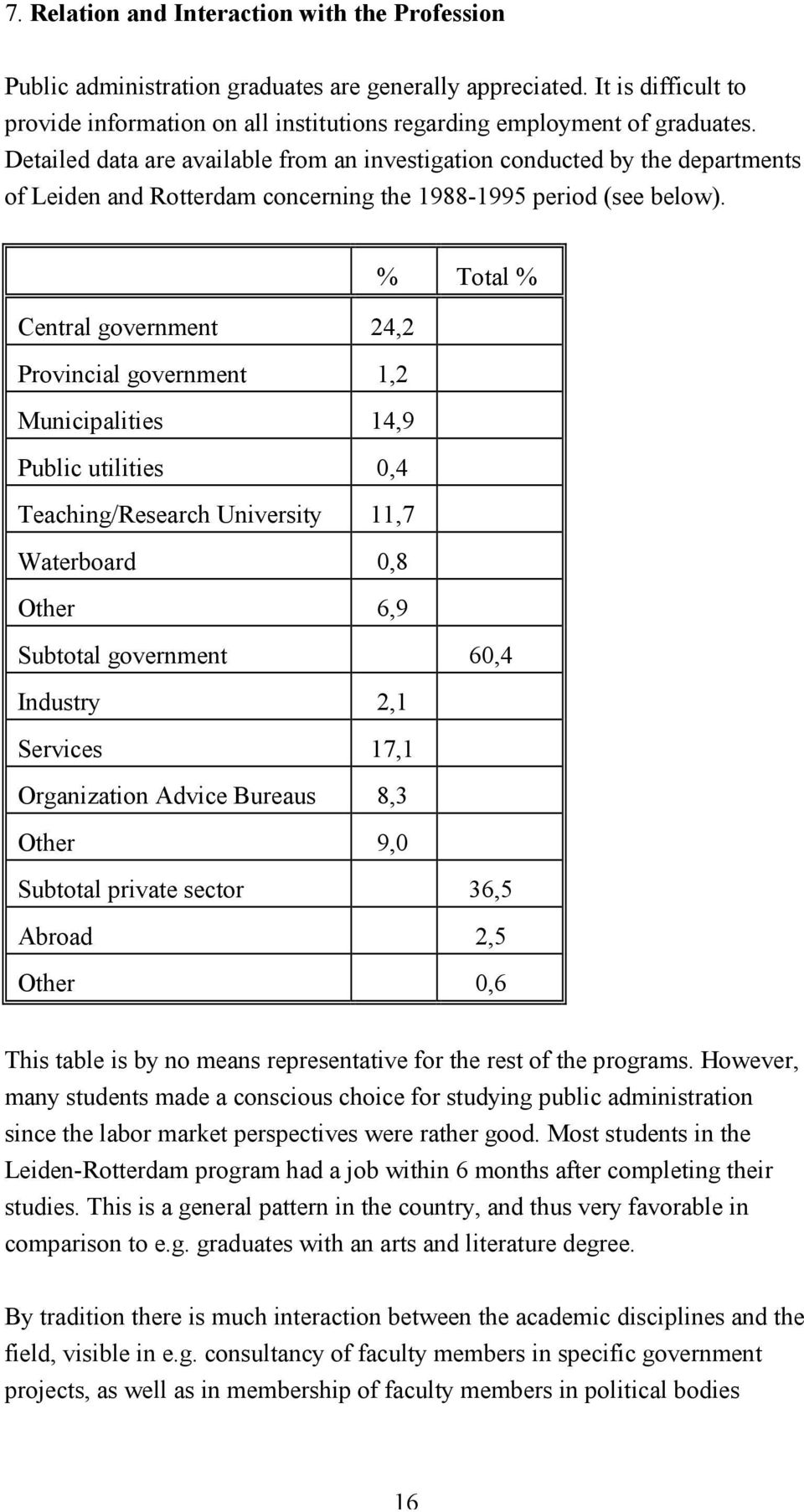
18 7. Relation and Interaction with the Profession Public administration graduates are generally appreciated. It is difficult to provide information on all institutions regarding employment of graduates. Detailed data are available from an investigation conducted by the departments of Leiden and Rotterdam concerning the period (see below). % Total % Central government 24,2 Provincial government 1,2 Municipalities 14,9 Public utilities 0,4 Teaching/Research University 11,7 Waterboard 0,8 Other 6,9 Subtotal government 60,4 Industry 2,1 Services 17,1 Organization Advice Bureaus 8,3 Other 9,0 Subtotal private sector 36,5 Abroad 2,5 Other 0,6 This table is by no means representative for the rest of the programs. However, many students made a conscious choice for studying public administration since the labor market perspectives were rather good. Most students in the Leiden-Rotterdam program had a job within 6 months after completing their studies. This is a general pattern in the country, and thus very favorable in comparison to e.g. graduates with an arts and literature degree. By tradition there is much interaction between the academic disciplines and the field, visible in e.g. consultancy of faculty members in specific government projects, as well as in membership of faculty members in political bodies 16
19 (municipal council, provincial council, Member of Parliament, undersecretary of state) and/or in advisory councils (social-economic council, scientific council for government policy; council for home affairs etc.). Every department has faculty members involved in consultancy activities for government. Together they cover a wide variety of subjects: local amalgamation, European integration and home affairs, social welfare state, fire protection, disaster management, police reorganization, reorganization of government departments, reorganization at subnational government etc. 17
20 8. In-service Training and Staff Development In the course of the 20th century the need for post-entry training for local and provincial civil servants was provided by the Public Administration Academies (Bestuursacademies) that were situated in almost every province. For both central as well as subnational governments courses were provided by the National Training Institute (NTI) (Rijksopleidingsinstituut, ROI). The NTI offers a wide range of courses, including on Europe. Special training programs were developed for graduates of law who aspired a career in the judiciary (Rechterlijk Ambtenaar in Opleiding) and for those who aspired a diplomatic career (courses offered by the Ministry of Foreign Affairs in cooperation with the International Institute Clingendael). Special programs and schools were also established for the military and the police. Some programs offer post entry pre-service training (in the case of the judiciary and the diplomatic service), others provide in-service training (the P.A. Academies, the NTI, the military programs). In the case of the police the various institutions together offer post entry pre-service as well as in-service training. In the 1980s the number of training programs proliferated. Also, at least two new independent institutions were created, the Netherlands School of Government in The Hague (Nederlandse School voor Openbaar Bestuur) and the Master of Business Administration program at the University of Rotterdam. Both these institutions provide in-service training to mid-career professionals. The public administration element in the programs offered ranges from general introductions into public administration to highly specialized courses in human resource development, computerization, management development, personal skills (e.g. negotiating, coordinating), financial management, administrative law, policy analysis etc. Many of these programs are focused on the practice in the field and prepare participants for particular positions and/or are focused on enhancing general capabilities. It is only since the 1990s that courses have been developed with a focus on European integration (especially at the NTI). Government in The Netherlands is increasingly purchasing particular courses from academic institutions. Thus, by way of example, the Leiden Department of Public Administration has increasingly been involved in the development and teaching of programs for national and foreign civil servants (see annex 5). 18
21 9. Conclusion Rooted in the study of state and administrative law, attention for public administration shifted was supplemented with a social scientific approach from the 1950s onward. At first this was embedded in sociology and political science programs, but from the middle of the 1970s independent departments were created. Public administration in The Netherlands is generally approached as a multidisciplinary field of inquiry, especially in the social sciences. Some schools attempt a more integrating approach preserving the integrity of Public Administration as an academic discipline. Its focus is 1) on mainstream public administration (theories, models etc. on policy- and decision making, organization, human resource management) and on insights from other disciplines that also have an interest in the study of government such as political science, sociology, law and economics, and 2) on the structure and functioning of Dutch government at large. Next to serving the regular student body (full-time and day-time students) special evening programs and special streams have been developed. The comparative and European angle in the curricula is mainly developed from the 1980s onward, and is especially elaborated in the programs of the departments in Leiden, Twente and the Open University. With respect to research, the number of studies is growing (especially in the 1990s) but could certainly be expanded. The interest in European administration, particularly the comparative component (i.e. cross-national analysis of administrative systems in the member states) and the implementation and enforcement of European policies at the grass-roots level should attract much more attention. 19
22 Literature Coolsma, J.C., J.A.W. de Bruin, G.H. Hagelstein, R. Hulst, M. Tuurenhout, A. van der Veen (1995). Een indicatief minimumpakket. Rapport en diskussievoorstel van de subwerkgroepn Minimumpakket Universitaire Bestuurskunde van de Werkgroep Bestuurskundig Onderwijs. Hoogerwerf-committee (1996). Research in Political Science, Public Administration and Communication Science in The Netherlands Vereniging van Samenwerkende Nederlandse Universiteiten. Kickert, Walter J.M. (1996). Expansion and Diversification of Public Administration in the Post Welfare State: The Case of The Netherlands. In Public Administration Review, vol.56 no.1, Meer, Frits M. van der (1997). Training for the Dutch civil service. Paper for the OECD-Sigma, presented in Paris, October. Möhring, W.J., P.J. Plug (1997). Onderzoek naar de stand van het bestuurskundig onderzoek in Nederland. Onderzoek verricht in opdracht van het Ministerie van Sociale Zaken en Werkgelegenheid door bureau Berenschot te Utrecht. Netherlands Institute of Government (1995). Government Institutions: effects, changes, and formation. Research program of the Netherlands Institute of Government. Raadschelders, Jos C.N. (1998). Vijftig jaar Bestuurswetenschappen, In H.M. de Jong (ed.), Bestuurswetenschappen. Een analyse van 50 jaar bestuurswetenschappen. Den Haag: VNG-Uitgeverij, pp Thomassen, Jacques (1996). Political Science in The Netherlands. In Les Science Politique en Europe: formation, cooperation, perspectives. Brussels: DG XXII. 20
23 Annex 1. Public Administration Programs 1. Department of Public Administration, University of Leiden P.O. Box RB Leiden tel.: fax: Department of Public Administration, Erasmus University Rotterdam P.O. Box DR Rotterdam tel: fax: Department of Public Administration and Management Science, Catholic University of Nijmegen Thomas van Aquinostraat GD Nijmegen tel: fax: Faculty of Public Administration, University of Twente P.O. Box AE Enschede tel: fax: Section Public Administration in Department of Political Science, University of Amsterdam Oude Zijds Achterburgwal DL Amsterdam tel: fax: Department of Political Science and Public Administration, Free University Amsterdam De Boelelaan 1081c 1081 HV Amsterdam 21
24 tel: fax: 7. Faculty of Technical Public Administration, Technological University of Delft Jaffalaan BX Delft tel: fax: Department of Administrative Law and Public Administration, Catholic University Brabant Warandelaan AB Tilburg tel: fax: Public Administration, Open Universiteit Valkenburgerweg AT Heerlen tel: fax: Center for Policy and Management, University of Utrecht Muntstraat 2a 3512 EV Utrecht tel: fax: Department of Administrative Law and Public Administration, University of Groningen Oude Kijk in 't Jatstraat EK Groningen tel: fax: Department of Policy, Economics and Organization of Care, University of 22
25 Maastricht Universiteitssingel ER Maastricht tel: fax:
26 Annex 2. Public Administration Courses 1. University of Leiden - Public Administration First Year - Introduction to Public Administration 1 - Introduction to Public Administration 2 - Introduction to Public Administration 3 - Introduction to Political Science - Introduction to Sociology - Methods of Social Research 1 - Methods of Social Research 2 (statistics) - Introduction to Economics - Introduction to Law - Introduction to Statistics Second Year - Foundations of Public Administration - Organization of Government - Methods of Social Research in Practice - Policy Sciences 1 - Comparative Analysis of Political Systems - History of Political Theories - Sociology of Social Change - Constitutional and Administrative Law - Public Finance Political Administrative Studies of Europe - European History - Comparative Public Administration: The Netherlands - Europe Third Year - Methods of Social Research: Knowledge, Research, and Policy - Introduction to Informatics - Administrative Informatics - Policy Sciences 2 - Public Management and Governmental Steering - Comparative Public Administration - Organizations in Comparative Perspective 24
27 - Law and Policy - Social Security: (initial) Development, Problems, and Modernization - Public Finance: Economics of the Public Sector - Tolerance and the Multicultural Society - Genderdilemma's in the Welfare State Political Administrative Studies of Europe - Introduction to European Integration - European Union Law - National Government and the European Community Final Year - Internship - MA-thesis - Specialization Organization and Management a) Strategic Management b) Management of Change c) Labor Relations and Human Resource Management d) Literature-Module e) Macro-theories of Organization and Administration f) Economical Aspects of Public Management g) Health Care Systems in International Perspective - Specialization Political Administrative Management a) Political Administrative Management b) Crisismanagement c) Media, Information Service and Public Management d) Security Management e) Decision making in the Corporative Economy f) Toplevel Bureaucrats in Privatized Public Services g) Police and Judicial Authorities: Accountability and Supervision h) Literature-Module - Specialization Administrative Relations a) Domestic Public Administration: Parts and Systems b) The Relation Citizen - Government c) Literature-Module - Specialization Comparative and International Administration a) Administrative Systems in International and Comparative Perspective b) European Integration: Administration and Policy c) Administration in Developing Countries d) Administration in Non-Western Areas 25
28 e) Literature Module Political Administrative Studies of Europe - Comparative and European Administration seminar 1 - Comparative and European Administration seminar 2 2. Erasmus University Rotterdam First Year - Introduction to the Science of Public Administration 1 - Introduction to the Science of Public Administration 2 - Introduction to Sociology - Introduction to the Science of Law - Methods of Social Research 1 - Methods of Social Research 2 - Micro-Economics - Macro-Economics and Public Finance - Political Science - European Politics - Mathematics Second Year - Administrative Informatics - Organization Theory - Political Theories - Economics of the Public Sector - Integral Policy Administration - Practical Experience Weeks - Constitutional and Administrative Law - Policy and Politics - Proto Policy Workshop - Decision Making and Collective Action - Social Dynamics and Political Steering in the Classical Administrative Thought - Public Private Management - Market, Hierarchy and Interdependency - Public Private Management - Operations Management Third Year 26
29 - Policy and Management - Policy and Politics - Argumentation in Policy - Regulation, Allocation and Distribution - Policy Workshop - Public Private Management - Module Interdependency - Strategy and Strategic Alliances - Public Partnership - Module Management - Information Management - Financial Management - Business Administration Courses - Marketing - Quality Management Final Year - Public Administration in Practice - Main Subject Policy and Politics - Social Dynamics and Policy Programs - The Citizen, Social Connections and the State - Rhetorics and Symbolics of Policy - Policy Workshop (incl. Internship and MA thesis) - Public Private Management - Module Interdependency - Private Performance of Public Tasks - Public Private Partnership Projects - Module Management - HRM and Organization Development - Public Accountability - Internship - MA thesis 3. Catholic University Nijmegen - Administrative and Organization Sciences First Year - Policy: System and Process - Introduction to the Science of Administration and Organization - Research and Intervention Methodology - Philosophy 27
30 - Communicative Skills, incl. Computer Application - Organization and Decision Making - Administration: Organization and Functioning of Public Management - Statistics - Organization: Management-Issues Second Year - Introduction to Law - Introduction to the Philosophy of Science - Inductive Statistics - Introduction to Policy-Oriented Economy - Science of Public Administration 1: Main Subjects and Themes - Research-design - Introduction to Political Science: National Politics - Organization Science 1: Main Subjects and Themes - Analysis and Design of Policy - Introduction to Sociology - Administrative Dynamics: Local and Regional Authorities - Integration-Seminar 1: - Management-Issues in Policy-Arena Third Year - Constitutional and Administrative Law - Public Management - Methods of Policy Analysis - Organization Science 2: Strategy - Methods of Administrative and Organization Science - Financial Management of Public Organizations - Science of Public Administration 2: Policy Networks - Administrative Dynamics 2: Informatization and Public Administration - Administrative Ethics - Integration-Seminar 2: Advise and Intervention Final Year - Administrative Dynamics 3: Internationalization and Public Administration - Excursion - Integration-Seminar 3: Preparation Graduate Project - Internship - MA-thesis 28
31 4. University of Twente - Public Administration First Year - Introduction to Law - Law, Politics and Society - Methods of Social Research 1 - General Administrative Sociology 1 - Political Science 1 - Constitutional and Administrative Law 1 - General Economics 1 - Statistics 1 - Policy Processes 1 - Management/Steering - Organization Sociology 1 - Public Finance 1 - Quantitative Methods 1 - Orientation Course Public Administration - Technical Public Administration a) Orientation Course Technical Public Administration - European Public Administration a) German Language Course b) Orientation Course European Public Administration - Applied Communication Science a) Applied Communication Science b) Language and Communication Second Year - Policy Processes 2 - Methods of Social Research 2a - Constitutional and Administrative Law 2 - General Economics 2 - Political Science 2 - Introduction to Law - General Administrative Sociology 2 - Public Finance 2 - Organization Sociology 2 - Quantitative Methods 2 - Written Communication for Public Administration - Methods of Social Research 2b (statistics) - Project Public Administration 29
32 - Informatics - European Public Administration - Social Economic Developments of Europe - French Language Course - Political and Juridical Developments of Europe - Project European Public Administration - Technical Public Administration - Ecological Design Studies - Cost-Benefit and Decision Analysis - Database Design - Environment Technology - Informatics - Quantitative Methods 3 - Project Informatization - Tele-informatics - Project Environment Third and Fourth Year - Philosophy - General Methodology - Internship - MA thesis - 9 specializations: a) Structure of Government b) Policy Studies c) Organization and Financial Management d) Public Administration Research and Theory e) National Government and European Integration f) International Relations and European Integration g) Infrastructure h) Environmental Studies i) Informatization Courses in these Specializations: - Economical Organization Theory - Political Science and Administrative Organizations - Administrative Organization Law - Reorganization Domestic Administration - Regional Economics - Legitimacy of Democracy - Comparative Public Law 30
33 - Institutional Reform of the Public Sector - Economical Theories of Political Decision Making - Budgetpolicy and Budget Cycle - Government and Citizen in the Welfare State - History of Political Theories - Artificial Persons Law - Law and Regulation - Economical Policy and Budgetpolicy - Policy Conceptions - Methods of Policy Analysis - Policy Law - Industry and Technology Policy - Workshop Policy Analysis - Organization, Policy and Regulation - Environment Law - Institutional Law Theory - Economics of Social Security Systems in Europe - Environment Policy - EU-policy - Higher Education Policy - International Public Law - Comparative Public Law - Organization and Functioning of the Health Care System - Business-Economics of the Public Sector - Public Management - Financial Management in the Public and Non-Profit Sector - Organization Theory and Management Models - Informatization and Public Administration - Organization Problems: Diagnosis and Analysis - Supportive Systems for Decision making - Methods of Empirical Research - Research Workshop - Institutional Law Theory - Introduction to Multivariate Analysis - Specific Methods of Science of Public Administration - Public Finance and European Integration - International Relations Studies - EU-Law - Welfare States and Social Policy - International Economical Relations and the European Union 31
34 - Transformation Processes in Central and East European Countries - Aspects of the Science of Public Administration in Developmental Issues - Political Science of the European Cooperation - Mechanics - Information Providing in Bureaucratic Organizations - Economics of the Infrastructure - Constructionwork - Traffic - Water - Introduction to Logistic Science - Dynamic Traffic Management - Civil Environment Technics - Operations Research - Production Management - Fluid Mechanics - Technology-Assessment - Environmental Economics - Foundations Clean Technology - Corporate Environment Care - Energy Technology - Public Management - Financial Management - Government Computerization from an Economical Perspective - Government Computerization from an Juridical Perspective - Government Computerization from an Sociological Perspective - Integration Project Administrative Informatization - Financial Information Systems - Applications Information Technology - Workshop Informatization Problems - Information Retrieval and Knowledge Management - Philosophy of Administration - Governability - Criminal Justice 1 - Criminal and Procedural Law - Police-Studies - Risk Management - Communication in Organizations - Criminal Justice 2 - Social Psychology 32
35 8. Catholic University Brabant: Policy and Organization Sciences First Year - Introduction to the Science of Organization - Social Geography of the Netherlands - Introduction to the Methods of Scientific Research - Introduction to the Empirical-Theoretical Sociology - Introduction to the Social Philosophy - Strategic Management - Introduction to General Economics - Statistics - Introduction to Social Psychology - Trainingproject incl. Computer Practical Second Year - Policy Science: Theory and Practice - Sociology of Labor and Organization - Epistemology/Philosophy of Science - Workshop Communicative Skills - Workshop Strategic Policy Analysis - Workshop Organization-Research - Methods of Practical Research - Causal Analysis Third Year - Enterprising in a Social Context - Management of Change in Organizations - Public Service in a Social Context - Strategic Decision making - Policy Specialization: a) Workshop Policy Evaluation b) Exploring the Future of Policy c) Policy Communication d) Foundations of Policy Science e) Workshop Policy and Strategy Development - Organization Specialization a) Computerization and Organizing b) Labor, Technology and Employment c) Relations and Networks of Organizations d) Ethics and Enterprising 33
36 e) Workshop Planning/Designing Organizations Final Year - Management of Change in Organizations - Government specialization a) Workshop Policy Planning and Implementation b) Graduate Project - Enterprise Specialization a) Internationalization of the Entrepreneurship b) Graduate Project 9. Open University First Year - Introduction to Dutch economics - Introduction to Political Science - Policy Science - Statistics 1 - Government in the Netherlands in Comparative Perspective - Methods of Social Research 1 - Introduction to Law Second and Third Year - Economics of the Public Sector - Local Government Studies - Government and Enterprise - International Political Relations - Public Sector Management - Introduction to Constitutional law - Introduction to Administrative law - Argumentation and Public Administration - Group Decision Making in Management and Administration - Europe Studies - Methods of Social Research 2 - Statistics 2 - Project Management - Epistemology - Classics of Public Administration - Policy documents 34
37 Final Year - Management Game - Public-Oriented Writing and Speaking - Introduction into Philosophy - MA thesis Electives: - Law and Public Administration - European Law - Sociology of Law - Philosophy of Law - History of Law - Administrative Law - Constitutional Law Central Government - Decentralization - Economics and Public administration - Economics of the Public Sector - The Working of the Dutch Economy: Analysis and Prognosis - Macro-Economics: Learning by Doing - Market-Economics: Types of Economical Organization - Monetary Economy and Monetary Policy - Balance, Profit-and-Loss-Account, and Administrative Processes - International Economic Institutions - Balance, Profit-and-Loss-Account and Internal Reporting - Balance, Profit-and-Loss-Account and External Reporting - Organization, Management and Public Administration - Steering of Change - Management of Environmental Conflicts - Organization Diagnosis - Future Exploration in Organizations - Leadership in Labor-Organizations - Organization-Design - Personnel Management - Introduction to Industrial and Organizational Psychology - Individual and Organization - International Aspects of Public Administration - The Dutch Foreign/International Policy - Changing Borders: Nationalism in Europe Introduction in International Economics 35
38 - European Law - Environmental Policy in an International Context (2 modules) - International Economic Institutions - Introduction to International Law - European Economic Integration 36
39 Annex 3. International and Comparative Courses 1. University of Leiden Comparative Analysis of Political Systems This course is an introduction to comparative political science focused on the political systems of Italy, France, the UK, Germany and the United States. Attention is paid to democratic mechanisms and structures, such as party-systems, coalitions, elections, cleavages, parliaments and governments. The course is part of the regular program in the second year. European History This course concentrates on the history of Europe since It aims to develop understanding of current changes and developments of European states by studying their previous history, cultures and political systems. Attention is paid to the social, economical, cultural and political dynamics of the various states in relation to each other. This course is part of a specialization program, called Political Administrative Studies of Europe starting in the second year of the Public Administration study. Many courses of this specialization have a political science signature and can be followed instead of certain regular Public Administration courses. Comparative Public Administration This course is focused on comparative analysis of various administrative systems in Western Europe. It concentrates on differences and similarities of institutional structures, strengths and weaknesses in relation to the process of European integration, reorganizations and public sector reform in comparative perspective. This is a regular course in the third year. Comparative Public Administration: the Netherlands - Europe Students doing the Political Administrative Studies of Europe-program have to follow the same course as the regular one described above, plus a workshop on the theme 'The Netherlands - Europe'. They also have to write a special paper. Introduction to European Integration This course is focused on European administrative and political integration, manifest in EU-policy and institutions. The course highlights the following themes: political dynamics and history of European integration, role and power of the EU-institutions, administration and policy of the European Union and political and administrative theories of integration. The course is part of the Political 37
40 Administrative Studies of Europe-specialization in the third year of the Public Administration study. European Union Law This course concentrates on the foundations of the European Law, the Treaties, and the decisions based upon these Treaties. The special juridical structure of the European Communities is examined, the competencies of the EU governmental institutions and the impact of European Law on the politics and administration of the Member States. This course is also part of the Political Administrative Studies of Europe-program in the third year. National Government and the European Economy The course focuses on the economical-political aspects of governmental policy in the European Union, especially on policy objectives and pre-conditions, costbenefits analysis of integration, EMU and EU public finance. This course is also part of the third year Political Administrative Studies of Europe-program. Health Care Systems in International Perspective This course studies trends of convergence of health care systems in Europe in the direction of macro- and micro efficiency, against the background of social security systems reform and developments in many western countries. The study also pays attention to the objectives of the European Union regarding health care and social security and the principle of subsidiarity for implementation of the directives. This course is an elective in the final year of the Public Administration Study and part of the Organisation and Management-specialization. Administrative Systems in International and Comparative Perspective This course creates a basis for comparative analysis of administrative systems in a Public Administration perspective as well as knowledge of the developments of European integration. It will pay attention to the legitimation of comparative science and analysis and to the beginning and development of the European cooperation in the 20th century. This course is an elective, part of the Comparative and International Administration-specialization, in the final year of the Public Administration Study. This specialization seminar is mandatory for students of the Political Administrative Studies of Europe-program. European Integration: Administration and Policy This course examines the administrative systems of the EU-Member States, the various European Institutions and their external organizations. Attention is paid to cross-border relations of national and sub-national governments and to the role and 38
41 position of European institutions in the European Administrative Network. This course is an elective in the final year of the Public Administration Study, as part of the Comparative and International Administration-specialization. This specialization seminar is also mandatory for students of the Political Administrative Studies of Europe-program. 2. Erasmus University Rotterdam European Politics This course focuses on organizational geography of the EU, the decision making processes, the backgrounds and developments and the meaning of the European Union for a national society such as the Netherlands. This course has a comparative dimension, but concentrates exclusively on Europe. This is a first year regular course. 3. Catholic University Nijmegen Administrative Dynamics : Internationalization and Public Administration This course pays attention to: a) internationalization: integration theories and development of international organizations; regional-economical development and the cultural and Public Administration dimension; b) Globalization: recent theories about this process; c) Europeanization: political and juridical organization of the EU; local governments and Europe; EU-regions, regionalization of Europe. The course has a comparative dimension, and concentrates predominantly on Europe from a public administration perspective. This is a regular course in the final year of the program. 4. University of Twente Orientation Course European Public Administration This multi-disciplinary course concentrates on the unity as well as the diversity of the developments of the public sector in several West-European States. Attention is paid to the comparative methodology, the European 'meta-structures', the relation to the national systems, the similarities and differences of the various constitutions and political systems in Europe, and the relations between the various authorities. This is a first year course aimed at acquainting students with the basics of the European Public Administration specialization. Social Economic Development of Europe 39
42 This course pays attention to an economical and a sociological approach of European Integration. In the economical approach the economical effects of the European integration will be examined from a neo-classical perspective. In the sociological approach there are two central questions. Is it possible to create one European social-economic policy, given the specific institutional specifics of each European country? Second, which specific institutional pattern on European level has to be developed for integrated social economic policy making? Two different perspectives, pluralism and corporatism, are studied. This is a second year course preparing students for the European Public Administration specialization. Political and Juridical Development of Europe This course concentrates on the outlines of the history of European cooperation and integration since 1945 from a political science and juridical perspective. The objectives of the course are to discuss the interaction between law and politics at the creation of the EU, and to explain the integration by studying the doctrine of international relations and the principles of international law. This is also a second year course preparing students for the European Public Administration specialization. Project European Public Administration This is an interdisciplinary project with a five-day excursion to several European Institutions (differs each year). Based on the excursion and the prescribed literature two additional essay-questions will be given at the exam of the course 'Political and Juridical Development of Europe'. This is a second year project preparing students for the European Public Administration specialization. Economics of Social Security Systems in Europe This course concentrates on the economic aspects of the health care system in the Netherlands, compared to those of other West- and Eastern European Countries. This course is a specialization elective in the two final years. EU-policy This course aims to provide insight into the realization of EU-policy and to train students in design and negotiations on EU-policy and to examine a part of the EUpolicy and its implementation in a member state. This course is also a specialization elective in the two final years. International Public Law This course pays attention to some important aspects of International Public Law: territory acquisition, treaty law, sources of international public law, human rights, 40
43 state responsibility and use of violence by National Stares and the United Nations. Thus an attempt is made to bridge the gap between theory and the practice of international law. The course is also a specialization elective in the two final years. Comparative International Law This course follows the course 'Public Organisation Law' and concentrates on the choices which are made in the design of the Dutch decentralized-unitary state, compares the similarities and differences with other systems. This course is also a specialization elective in the two final years. Public Finance and European Integration This course aims to acquire knowledge of the public finance in various European countries and the EU-finance in Brussels. It pays attention to economic integration, financial relations between member states and Brussels, institutional aspects of the EU-budget, national and regional doctrines on public finance, decision making and regulation aspects. This course is also a specialization elective in the two final years. International Relations Studies This course concentrates on the framing of theories on International Relations, concrete examples and historical context. Central theme is how, by means of international authority, the role of the use of violence in international politics could be reduced. This course is also a specialization elective in the two final years. EU-Law This course is a sequel to the courses 'Constitutional and Administrative Law' and 'Political and Juridical Developments of Europe'. The knowledge acquired in these courses will be studied in depth and, from a juridical-theoretical and constitutional perspective, attention will be paid to the legal order of the European Union. This course is also a specialization elective in the two final years. International Economical Relations and the European Union This course concentrates on the monetary aspects of European integration. Attention will be paid to various sectors of EU-policy, the developments of the EMU and the Dutch points of view on this. This course is also a specialization elective in the two final years. Transformation processes in Central and East European Countries 41
44 This course examines the economical, juridical, political and sociological aspects of the transformation processes from statism to market economy. Attention will be paid to: structural conditions for the creation of a market-economy, institutional coherence between the development of the democratic system and the organization of the market economy, role of the state during and after the transformation process from a public administration perspective, relation between peace and security on the one hand and integration of CEEC's in the international political and economical system on the other hand and the role of the international financial institutions (OESO, IMF, EG, EIB, etc.) in the transformation process. This course is also a specialization elective in the two final years. Political Science of the European Cooperation This course aims to analyse the current cooperation problems and conflicts in Europe, with attention to the empirical and potential role of EU-policy to this. The course also concentrates on specific context, structural factors of decision making processes, theoretical frames, various points of view on political cooperation and security issues and the network of international organizations where these points of view are being debated. This course is also a specialization elective in the two final years. 8. Catholic University Brabant Internationalization of the Entrepreneurship This course has an economical-sociological and an organization-scientific signature. The study concentrates on the border-crossing processes, European and world-wide, of economical and technological development, the initial development of international business systems and the social and societal conditions and effects. The course only partly has a comparative dimension (it explores the context of social and political diversity of enterprises by comparative analysis) and is also only partly oriented on Europe. The course is part of the Enterprise-specialization in the programs final year. 9. Open University Government in the Netherlands in Comparative Perspective This course offers an introduction to the various aspects of the Dutch political system by placing it in comparative perspective. Comparing the Dutch governmental system to Germany, France, Great Britain and the United States, the course concentrates on subjects as decentralization, democratic principles, the Welfare 42
45 State, the civil service, relations to citizens and interest groups. This is a first year regular course. International Political Relations This course aims to acquire insight in the history and development of international political relations, analysis of international interests, and the expansion and meaning of international institutions like the European Union. The study is divided in three periods: , and 1989 until now. The course is a regular part of the second and third year of the program. Europe Studies This course is an introduction to the formal-juridical and political-administrative aspects of European integration. It is focused on the backgrounds of the European unification, the rules of the European Institutional Law and the dynamics of the Communautarian decision making. This course is also a regular part of the second and third year of the program. European Law The impact of the supra-national European Law on the National Law is increasing. This course is an introduction to European Law and provides a base for acquiring knowledge on the effects of the European decision making on the national law. This course is a part of the Law and Public Administration-specialization in the final year. International Economic Institutions This course concentrates on the history, functioning, position, competencies, objectives, future and importance of various international economic institutions, like the Bretton-Woods system, the GATT, the IMF, the World Bank, etc. Attention is paid to the effects of these institutions on trade, financial markets, and political relations of governments and companies. This is a seminar of the Economics and Public Administration-specialization in the final year. The Dutch Foreign/International Policy This course aims to provide understanding of the interests and values which the Dutch government tries to defend in the international political system and the supportive and interfering factors to this. In concentrates on the outlines of the Dutch foreign policy and the developments that influenced it. The course is part of the International Aspects of Public Administration-specialization in the final year. Changing Borders: Nationalism in Europe
46 This course studies the developments of nationalism between the two World Wars, the extremism in Germany and Italy until the end of the Second World War, the Cold War, and since the end of the 1980s the desintegration of the Sovjet Union and countries in Eastern Europe and the extensive supra-national cooperation in Western Europe. The course is part of the International Aspects of Public Administration-specialization in the final year. Introduction in International Economics This course seeks to provide insight in the economical aspects of internationalization. Attention is paid to: international trade theories, trade politics, stabilisation problematics, functioning of WTO and other international trade agreements, the European integration, the international monetary fund, etc. This course is part of the International Aspects of Public Administration-specialization in the final year. Environmental Policy in an International Context (2 modules) This course concentrates on environmental problems in international perspective to discuss possibilities for a world wide approach. The concept of enduring development is a strategy for change. The course also pays attention to environmental problems as a source of conflict between interests of different nations or economical sectors and to the restrictions and possibilities of managing environmental problems at an international level. This course is part of the International Aspects of Public Administration-specialization in the final year. Introduction to International Law This course is an introduction to the juridical organization of the international community. It examines the role, function and realization of international law in this community. Also the history of the international law and the position of the international organization and the individual in it are examined. This course is part of the International Aspects of Public Administration-specialization in the final year. European Economic Integration This course examines the history of European economic cooperation starting with the Rome Treaty of 1956, the developments leading to the Maastricht Treaty of 1992 and the most recent developments. It studies several economic integration theories, with attention to the institutional aspects of integration as well as the economic analysis of it, the consequences of the integrated European economic policies and the conditions for the success of a PanEuropean integration with the constitution of the EMU as its first step. This course is also part of the Interna- 44
47 tional Aspects of Public Administration-specialization in the final year. 45
48 Annex 4. Academics in Research 1. Department of Public Administration, University of Leiden Mr.dr. G.S.A. Dijkstra Dr. B.J.S. Hoetjes Dr. F.M. van der Meer Prof.dr. Th.A.J. Toonen Dr. J. de Vries 2. Department of Public Administration, Erasmus University Rotterdam Prof.dr. W.J.M. Kickert Prof.dr. A.B. Ringeling 3. Department of Public Administration and Management Science, Catholic University of Nijmegen Mrs. Prof.dr. M.L. Bemelmans-Videc Mrs.dr. I. Tömmel 4. Faculty of Public Administration, University of Twente Prof.mr. D.W.P. Ruiter Prof.dr. J.M.A. Thomassen Prof.dr. F.A. van Vught 5. Section Public Administration in Department of Political Science, University of Amsterdam Dr. H. de Graaf 6. Department of Political Science and Public Administration, Free University Amsterdam Prof.dr. F. Fleurke 7. Faculty of Technical Public Administration, Technological University of Delft Prof.dr.mr. E.F. ten Heuvelhof 8. Department of Administrative Law and Public Administration, Catholic University Brabant Dr. V.J.J.M. Bekkers Prof.dr. P.H.A. Frissen Dr. F. Hendriks 46
49 9. Public Administration, Open Universiteit Prof.dr. A.F.A. Korsten 10. Center for Policy and Management, University of Utrecht Prof.dr. Ph.A. Idenburg Prof.dr. B.F. van Waarden 11. Department of Administrative Law and Public Administration, University of Groningen Prof.dr. M. Herweijer 12. Department of Policy, Economics and Organization of Care, University of Maastricht Prof.dr. J.A.M. Maarse 47
50 Annex 5. Special Programs for Higher Civil Servants, Leiden Department The following programs have been developed by the Department of Public Administration of the University of Leiden: Netherlands School of Government; Curriculum for civil servants of the Ministry of Defense; Curriculum for civil servants of the Ministry of Home Affairs; Curriculum for the Swedish Agency of Government Employees; Curriculum for personnel of the Army; Higher Military Academy; Masters of European Public Administration. In all of these programs faculty of the department of public administration in Leiden teach courses and/or have been involved in the development of one or more programs. It is not possible to provide information on faculty involved per program, since that varies from year to year. All of these programs, though, are continuous. Netherlands School of Government: The Hague Started in 1989 as an activity of the combined departments of public administration in Leiden and Rotterdam upon request of the Dutch central government. The NSG offers a two-year MPA-curriculum in public administration for civil servants with an academic background and at least five years of experience in the public service. Of those selected to participate in this program (20 students per year) it is expected that they will proceed into the top civil service. As a consequence of the success of this program the NSG has also developed special streams programs upon requests of various ministries, for instance for the Ministries of Economic Affairs, of Home Affairs, and of General Affairs (the department of the prime minister). These special stream programs range from 3 to 15 days. So far 150 students have graduated in this program. Curriculum for civil servants of the Ministry of Defense: The Hague This program started in September 1996 upon request of the Royal Army as an incompany training facility. It comprises an eight-month program covering such issues as political-administrative relationships, decision-making, policy evaluation, and administrative skills. The program is intended for both the higher military and civil personnel employed by the Ministry of Defense. The program is based on the high-interactive education concept and is open to 15 participants per annum. Curriculum for civil servants of the Ministry of Home Affairs: Leiden Started in 1994 as an activity of the department of public administration in Leiden upon request of the Ministry of Home Affairs. This program consists of a one-year curriculum in public administration for higher civil servants in the Ministry. So far 48
51 30 civil servants have graduated from this program. Curriculum for the Swedish Agency of Government Employees: Leiden Started in October 1997 as an activity of the department of public administration in Leiden upon request of the Swedish central government. The Leiden department offers a two-week course in Public Administration and European Integration for Swedish top civil servants with an academic degree and a minimum experience of 5 years in the public service. This course fits in a two-year program that is coordinated by the University of Lund. The Leiden department also offers a four-week program (together with the European Institute of Public Administration in Maastricht) as part of a two-year program for higher civil servants (coordinated by the Stockholm Centre for Organizational Research). Each of these two programs are attended by some 30 participants. Higher Military Academy: Leiden Started in 1991 as an activity of the department of public administration in Leiden upon request of the Royal Army. This program consists of a two-year MPAcurriculum for officers in the Dutch army, in order to enhance the administrative sensitivity of these professionals. So far 80 officers have enrolled in this program and 40 have graduated. Masters of European Public Administration: Leiden/Leuven/Speyer This is a joint program of the Department of Public Administration in Leiden, the Department of Public Administration in Leuven (Belgium), and the Hochschule für Verwaltungswissenschaft in Speyer (Germany). It started in 1990 and has been completely remodeled in 1996 (before 1996 it was known as EMPA). This program is open to graduates with an MA-diploma in the social sciences, who wish to enlarge their knowledge and skills in the field of public administration, and is open to participants from both the European Union and from the rest of the world. So far 105 students have graduated from the EMPA-program. 49
European Public Administration
 European Public Administration PROGRAM FOR TODAY 1. What is (European) public administration? Prof. dr. René Torenvlied, Programme director Approach Programme Twente educational model (TOM) Practical issues
Master s Programme in International Administration and Global Governance
 Programme syllabus for the Master s Programme in International Administration and Global Governance 120 higher education credits Second Cycle Confirmed by the Faculty Board of Social Sciences 2015-05-11
Description of the program
 Study program Faculty Cycle Public Administration Public Administration and Political Sciences Undergraduate ECTS 180 Offered in Tetovo and Skopje Description of the program The program for Public Administration
POLITICAL SCIENCE. Department of Law and Politics. BACHELOR OF ARTS (General) POLITICAL SCIENCE. Please refer to the general regulations
 FACULTY PROFESSOR(S) R. M. Myers, B.A. (Hons), M. A., Ph.D. (Toronto) ASSOCIATE PROFESSOR(S) D. A. Jackson, B.A. (Hons), M.A. (Toronto) ASSISTANT PROFESSOR(S) N. Cruickshank, B.A. (Hons), M.A. (Wilfrid
The Netherlands ICT R&D
 The Netherlands ICT R&D In 2009, business expenditure on R&D (BERD) in the ICT sectors amounted to 672M, down from 674M the year before, resulting in a slightly increased R&D intensity of 2.7% of sectoral
Study Program Handbook Global Economics and Management
 Study Program Handbook Global Economics and Management Bachelor of Arts Jacobs University Undergraduate Handbook GEM - Matriculation Fall 2015 Page: ii Contents 1 The Global Economics and Management (GEM)
The Netherlands: ICT R&D and participation to FP7
 The Netherlands: ICT R&D and participation to FP7 Research & Development expenditure in ICT In 2011, public support for ICT R&D (ICT GBAORD) in the Netherlands was 6.6% of total public funding for R&D,
FACULTY OF SOCIAL AND POLITICAL SCIENCES
 The Faculty of Social and Political Sciences is one of Indonesia s leading faculties in social subjects constituting of 7 Departments: Communication Studies, Criminology, International Relations, Political
Faculty of Humanities, Utrecht University Chair Ancient and Medieval Philosophy Structure, goals and context
 Faculty of Humanities, Utrecht University Chair Ancient and Medieval Philosophy Structure, goals and context 1. General The chair Ancient and Medieval Philosophy (Antieke en Middeleeuwse Filosofie, AMF)
Education and Examination Regulations
 Education and Examination Regulations 2013-2014 Master s Degree Programmes * Legal Research * Multidisciplinary Economics * Research in Public Administration and Organizational Science TABLE OF CONTENTS
Department of Public Administration
 The University of Texas at San Antonio 1 Department of Public Administration The Department of Public Administration offers the Master of Public Administration, as well as the Graduate Certificate in Nonprofit
Programme Specifications for Bachelor of Science in Urban Planning and Architectural Design
 Programme Specifications for Bachelor of Science in Urban Planning and Architectural Design 1 Name of Degree Bachelor of Science (B.Sc.) in Urban Planning and Architectural Design Background and Rationale
Netherlands School of Public Administration
 Netherlands School of Public Administration A welcome from our deans The Netherlands School of Public Administration (NSOB) seeks to make sense of what is happening in government by reflecting on politics
Meeting the degree requirements is the student s responsibility.
 ACADEMIC REQUIREMENTS Please note that these requirements apply to students entering Vesalius College during the academic year 2014/15. Students who entered in previous years are bound by the requirements
Faculty of Economics and Business University of Zagreb POSTGRADUATE (DOCTORAL) PROGRAMMES IN BUSINESS STUDIES AND ECONOMICS
 Faculty of Economics and Business University of Zagreb POSTGRADUATE (DOCTORAL) PROGRAMMES IN BUSINESS STUDIES AND ECONOMICS 1. INTRODUCTION 1.1. Reasons for establishing the studies Doctoral studies represent
When students complete the Master of Arts in Political Science program, they should have:
 Political Science (M.A.) Political Science Admission Criteria and Degree Requirements The JMU graduate school requires that prospective students submit official transcripts of all undergraduate and graduate
Department of Political Science
 Colorado State University 1 Department of Political Science Office in Clark Building, Room C346 (970) 491-5156 polisci.colostate.edu (http://polisci.colostate.edu) Professor Michele Betsill, Chair Undergraduate
www.civitas.edu.pl/english
 www.civitas.edu.pl/english Admissions Office address: Palace of Culture and Science, 12th floor Plac Defilad 1 00-901 Warsaw, Poland tel: (48) (22) 656 71 89 fax: (48) (22) 656 71 75 e-mail: [email protected]
Appendix 2: Intended learning outcomes of the Bachelor IBA
 Appendix 2: Intended learning outcomes of the Bachelor IBA Intended international & intercultural learning outcomes are presented in bold. Content related aspects Have knowledge of business administrative
Study Program Handbook Integrated Social Sciences
 Study Program Handbook Integrated Social Sciences Bachelor of Arts Jacobs University Undergraduate Handbook ISS - Matriculation Fall 2015 Page: ii Contents 1 The Integrated Social Sciences (ISS) Study
MASTER OF ARTS WITH A MAJOR IN ECONOMICS (MANAGERIAL EMPHASIS)
 MASTER OF ARTS WITH A MAJOR IN ECONOMICS (MANAGERIAL EMPHASIS) The Master of Arts with a major in Economics requires 32 semester hours of graduate work. What You Can Do with this Degree Students from the
How To Study Political Science At Pcj.Edu
 Political Science Courses-1 American Politics POL 110/American Government Examines the strengths and weaknesses, problems and promise of representative democracy in the United States. Surveys the relationships
PUBLIC POLICY AND ADMINISTRATION
 PUBLIC POLICY AND ADMINISTRATION CURRICULUM Master of Arts DEGREE REQUIREMENTS Credits PA8100 Public Admin & Governance 1 PA8101 Policy Analysis and Challenges 1 PA8102 The State & the Economy 1 PA8103
The Education System in The Netherlands
 The System in The Netherlands PRIMARY AND SECONDARY EDUCATION Children are allowed to begin school at the age of 4, but are not legally required to do so until the age of 5. Primary education lasts 8 years,
School of Public Administration. School of Business Administration. School of Social Management. School of PhD Studies
 1924 School of Public Administration School of Business Administration School of Social Management School of PhD Studies Contents: Message from the Rector Introduction Faculty Academic Programs Student
Study Program Handbook International Business Administration
 Study Program Handbook International Business Administration Bachelor of Arts Jacobs University Undergraduate Handbook IBA - Matriculation Fall 2015 Page: ii Contents 1 The International Business Administration
Jolien Grandia MA MSc
 Jolien Grandia MA MSc Curriculum Vitae Jolien Grandia Address: E-mail: Website: Erasmus University Rotterdam Burgemeester Oudlaan 50 3062 PA Rotterdam The Netherlands [email protected] www.joliengrandia.com
Study Program Handbook International Business Administration
 Study Program Handbook International Business Administration Bachelor of Arts Jacobs University Undergraduate Handbook IBA - Matriculation Fall 2015 Page: ii Contents 1 The International Business Administration
National Awarding Committee (NAC) for EuroPsy in The Netherlands: Overview
 National Awarding Committee (NAC) for EuroPsy in The Netherlands: Overview Introduction Each NAC is requested by the EAC to complete the following overview and submit this to the EFPA Office in Brussels
School of Domestic and International Business, Banking and Finance
 ROMANIAN-AMERICAN UNIVERSITY School of Domestic and International Business, Banking and Finance Bachelor in International Business TAUGHT IN ENGLISH The primary task undertaken by the International Business
Business Administration Economics Economics in International Development BUSINESS
 Business Administration Economics Economics in International Development BUSINESS TABLE OF CONTENTS Page Number Business Administration Master s Economics Master s Economics in International Development
Arts, Humanities and Social Science Faculty
 MA in Public Policy (full-time) For students entering in 2014/5 Awarding Institution: Teaching Institution: Relevant QAA subject Benchmarking group(s): Faculty: Programme length: Date of specification:
REGULATIONS FOR THE DEGREE OF MASTER OF PUBLIC ADMINISTRATION (MPA)
 635 REGULATIONS FOR THE DEGREE OF MASTER OF PUBLIC ADMINISTRATION (MPA) (See also General Regulations) Any publication based on work approved for a higher degree should contain a reference to the effect
Department of Public. Administration. Faculty 412 YONSEI UNIVERSITY
 Department of Public Faculty Professors Pyung-Gil Chay, Ph.D. (Syracuse Univ. 1975) Professor Pyung-Gil Chay graduated from the Department of Public, Yonsei University, Seoul (B.A.) with Sigma Cum Laude
Jolien Grandia MA MSc
 Jolien Grandia MA MSc Curriculum Vitae Jolien Grandia MA MSC Address: E- mail: Faculty of Social Science Department of public Administration P.O. Box 1738, room T17-45 3000 DR Rotterdam The Netherlands
College of Arts and Sciences: Social Science and Humanities Outcomes
 College of Arts and Sciences: Social Science and Humanities Outcomes Communication Information Mgt/ Quantitative Skills Valuing/Ethics/ Integrity Critical Thinking Content Knowledge Application/ Internship
Programme curriculum for THE BACHELOR PROGRAMME IN POLITICAL SCIENCE, THE 2015 CURRICULUM, VALID FROM 1 SEPTEMBER 2015
 Programme curriculum for THE BACHELOR PROGRAMME IN POLITICAL SCIENCE, THE 2015 CURRICULUM, VALID FROM 1 SEPTEMBER 2015 Contents 1. Preamble... 3 2. Title and affiliation... 3 3. Objectives and competency
Curriculum Development for Doctoral Studies in Education
 Curriculum Development for Doctoral Studies in Education Irine BAKHTADZE * Abstract Profound changes in high education which started in 1996 in Georgia have to be continued. We have to explore potentially
How To Get A Phd In Philosophy And Technology
 MSc AND PhD TWENTE GRADUATE SCHOOL ETHICS AND TECHNOLOGY GRADUATE SCHOOL TWENTE GRADUATE SCHOOL - ETHICS AND TECHNOLOGY GRADUATE SCHOOL 2 TWENTE GRADUATE SCHOOL TWENTE GRADUATE SCHOOL OFFERS HIGH-QUALITY
Welcome! Dr. Bas van Groezen Academic Director BSc Economics, Teacher & Researcher
 Information session Bachelor Economics October 24, 2014 Welcome! Dr. Bas van Groezen Academic Director BSc Economics, Teacher & Researcher Drs. Linda van Klink Program Coordinator BSc Economics, Student
TILBURG LAW SCHOOL TEACHING AND EXAMINATION REGULATIONS OF THE ONE- YEAR MASTER S PROGRAMS AT TILBURG LAW SCHOOL
 TILBURG LAW SCHOOL TEACHING AND EXAMINATION REGULATIONS OF THE ONE- YEAR MASTER S PROGRAMS AT TILBURG LAW SCHOOL 2015-2016 ACADEMIC YEAR Teaching and Examination Regulations Master s Programs TLS 2015-2016
National College of Public Administration and Governance University of the Philippines Tel. No. 9279085, 9253851
 National College of Public Administration and Governance University of the Philippines Tel. No. 9279085, 9253851 Diploma in Public Management Dip PM Master of Public Administration (MPA) As of 21 Jan 2011
Master of Arts in Employment and Labor Relations (MAELR) http://www.clas.wayne.edu/maelr/ Labor @ Wayne
 Master of Arts in Employment and Labor Relations (MAELR) http://www.clas.wayne.edu/maelr/ Labor @ Wayne Director, Dr. Marick Masters Academic Advisors: Frank Koscielski/ [email protected] Linda J. Johnson/
The Bachelor's Degree Programme in Public Administration. (Professionsbachelor i Offentlig Administration) Curriculum
 The Bachelor's Degree Programme in Public Administration (Professionsbachelor i Offentlig Administration) Curriculum 2013 1 Contents 1 Preface... 3 2 National curriculum... 3 2.1 Aim... 3 2.2 Duration
International Business Programme, Bachelor Course Descriptions 2015-2016
 International Business Programme, Bachelor Course Descriptions 2015-2016 The following course descriptions briefly describe the course contents, how many credits the course is worth, if the course is given
Master in Economics. Marianne Snakers
 Master in Economics R The of Key success factors A position of excellence through the production of original intellectual work that creates a difference in teaching and expertise, recognized for and by
Public Governance across Borders. bachelor.utwente.nl
 Public Governance across Borders bachelor.utwente.nl Today s overview Bsc Public Governance across Borders (From Double Degree to Joint Degree) Studying at the University of Twente Student-life in Enschede
International Master on Public Administration and the Coordination of Transition (IMPACT)
 International Master on Public Administration and the Coordination of Transition (IMPACT) Final Report Public Part Project information Project acronym: Project title: Project number: Sub-programme or KA:
REGULATIONS FOR THE DEGREE OF MASTER OF EDUCATION (MEd)
 215 REGULATIONS FOR THE DEGREE OF MASTER OF EDUCATION (MEd) (See also General Regulations) Any publication based on work approved for a higher degree should contain a reference to the effect that the work
Philosophy of Science, Technology and Society
 master s degree Philosophy of Science, Technology and Society Welcome to the Faculty of Behavioural Sciences! The Faculty of Behavioural Sciences provides specialized Master s programmes in the disciplines
2015-2016 Academic Catalog
 2015-2016 Academic Catalog International Relations Director: Fukuoka Committee on International Relations Major: Baglione(POL), Balasubramaniam (ECN), Carter(HIS), Chakars(HIS), Fukuoka(POL), Pardo(ECN),
COMPARATIVE RESEARCH ON PROJECT MANAGEMENT APPROACH IN THE EUROPEAN EDUCATIONAL INSTITUTIONS
 COMPARATIVE RESEARCH ON PROJECT MANAGEMENT APPROACH IN THE EUROPEAN EDUCATIONAL Armenia ANDRONICEANU The Bucharest University of Economic Studies, Bucharest, Romania [email protected] Bianca
Bachelor of Public Administration Curriculum
 2010 Bachelor of Public Administration Curriculum From the beginning of the academic year 2010 1 Contents Preamble 1. Aims and scope of the degree programme 1.1. Aims 1.2. ECTS credits 1.3. Titles 1.4.
Curriculum for Business Economics and Information Technology
 Curriculum for Business Economics and Information Technology Copenhagen School of Design and Technology August 2012 1 General regulations for all institutions providing the programme Curriculum Applicable
KOREA UNIVERSITY Graduate School of International Studies
 KOREA UNIVERSITY Graduate School of International Studies KOREA UNIVERSITY Korea University, founded in 1905, is widely acknowledged as one of the oldest, largest and top-ranked universities in Korea.
GENERAL INFORMATION. University College Ghent Faculty of Business and Public Administration ERASMUS Code
 GENERAL INFORMATION Name of the institution : University College Ghent Faculty of Business and Public Administration ERASMUS Code B GENT25 Address : Kortrijksesteenweg 14 Post code, City 9000 Ghent, Belgium
Ph.D. in Educational Theory and Practice. Emphasis Areas
 In addition to the shared core courses, doctoral students in ETAP choose an emphasis area. Emphasis areas are overlapping, of course, and should not be considered as exclusive. While the ETAP core provides
The 10 Best Graduate Programs In Urban And Regional Planning
 Page 1 of 8 About Contact Home Degrees Colleges Rankings The 10 Best Graduate Programs In Urban And Regional Planning Select a Degree Select a Category Select a Subject Top College Rankings The 25 Best
REGULATIONS FOR THE DEGREE OF MASTER OF PUBLIC ADMINISTRATION (INTERNATIONAL) (IMPA)
 525 REGULATIONS FOR THE DEGREE OF MASTER OF PUBLIC ADMINISTRATION (INTERNATIONAL) (IMPA) (See also General Regulations) Any publication based on work approved for a higher degree should contain a reference
Public Administration
 University of Illinois at Chicago 1 Public Administration Mailing Address: Department of Public Administration (MC 278) 412 South Peoria Street, Room 160 Chicago, IL 60607-7064 Contact Information: Campus
Curriculum Vitae. Qualifications. Research
 Curriculum Vitae Name Marijke C. Leliveld Address Leiden University Dept. of Social & Organizational Psychology P.O. Box 9555 2300 RB Leiden, the Netherlands Phone +31 (0)71-5273857 E-mail [email protected]
2. Development of the EMPA programme
 Building better European programmes: experiences from a European Master of Public Administration programme Granada, Thematic Network Public Administration, 14-15 June 2002 Dr. Marleen Brans Christophe
Political Science. 222 2014-2016 Haigazian University
 Political Science Coordinator: Maximilian Felsch, Ph.D. The Faculty of Social and Behavioral Sciences offers the Bachelor of Arts (B.A.) degree in Political Science. On completion of the degree in Political
Bachelor s degree study program Business Administration
 Bachelor s degree study program Business Administration The aim of the Business Administration Bachelor s degree study program is to provide students with academic education and higher level professional
REGULATIONS FOR THE DEGREE OF MASTER OF EDUCATION (MEd)
 247 REGULATIONS FOR THE DEGREE OF MASTER OF EDUCATION (MEd) (See also General Regulations) Any publication based on work approved for a higher degree should contain a reference to the effect that the work
POLITICAL SCIENCE Chair: Kevin S. Freeman
 Political Science 243 POLITICAL SCIENCE Chair: Kevin S. Freeman Nicholas A. Giannatasio Carole Graham Emily A. Neff-Sharum Elizabeth L. Normandy Martin Slann Junfeng Wang Political Science is the systematic
Public Administration Programmes in Sweden
 UMEÅ UNIVERSITY Department of Political Science SE-901 87 Umeå 14 Public Administration Programmes in Sweden Dr Kerstin Kolam, assisted by Ms Kristina Lannto and Ms Maud Lantto 14.1 INTRODUCTION Defining
Complete version from 1 October 2015 Curriculum for the Diploma Programme Law at the Faculty of Law of the University of Innsbruck
 Note: The following curriculum is a consolidated version. It is legally non-binding and for informational purposes only. The legally binding versions are found in the respective issues of the University
Workshop on Interest Representation and Intercultural Communication in the Public Administration
 Workshop on Interest Representation and Intercultural Communication in the Public Administration Danilovgrad (Montenegro) 17-20 January 2012 PROVISIONAL PROGRAMME Background In a four day high intensive
Master of Arts in Criminal Justice
 Mission The mission of the Curry College Master of Arts in (MACJ) program is to provide students with the intellectual and pragmatic skills needed to become effective leaders, reflective practitioners,
National Background: Netherlands 2015
 Date of issue: March 2015 National Background: Netherlands 2015 André Bouwman (Universitaire Bibliotheken Leiden) This report has been compiled with the kind assistance of Ad Leerintveld (Koninklijke Bibliotheek)
Master in Management. Marianne Snakers
 Master in R The of Key success factors A position of excellence through the production of original intellectual work that creates a difference in teaching and expertise, recognized for and by businesses
Assessment of the degree programmes in Public Administration at Leiden University
 Assessment of the degree programmes in Public Administration at Leiden University QANU & EAPAA / Public Administration, Leiden University / March 2011 / Q252 Quality Assurance Netherlands Universities
Political Science/Public Administration
 166 College of Arts and Sciences Political Science/Public Administration James B. Hogan, PhD, Chair Objectives Politics is essential to the human condition. It is expressed in patterns of influence among
Master of Science in Business Administration
 BRUSSELS t Master of Science in Business Administration Majors: International Business Management Business Information Management International Relations Faculty of Economics and Business Campus Brussels
at Cologne Business School
 www.cbs.de/en MBA and EMBA Programmes at Cologne Business School Academic excellence Cologne Business School Who we are The Hallmarks of a CBS Education CBS offrers students a rigorous and forward-minded
Master of Public Administration
 Master of Public Administration Administrative Unit The program is administered by the Office of Graduate Studies and Research through the faculty of Leadership Studies, Department of Social Sciences,
Advanced international graduate education
 BEYOND BORDERS Internationally competitive legal education Advanced international graduate education Postgraduate programme in cooperation with University of Copenhagen Interdisciplinary approach with
How To Learn About Politics At Sacred Heart University
 SACRED HEART UNIVERSITY UNDERGRADUATE CATALOG 2012-2013 POLITICAL SCIENCE The Political Science major seeks to awaken in students an appreciation and an understanding of politics and government in the
FIRST SEMESTER. SHF 101 Introduction to Social Work Profession 3 0 3 / 10
 GEDİZ UNIVERSITY FACULTY OF HEALTH SCIENCES DEPARTMENT OF SOCIAL WORK UNDERGRADUATE PROGRAM FIRST DEGREE COURSE CONTENT FIRST SEMESTER SHF 101 Introduction to Social Work Profession 3 0 3 / 10 The course
Study Program Handbook International Relations: Politics and History
 Study Program Handbook International Relations: Politics and History Bachelor of Arts Jacobs University Undergraduate Handbook IRPH - Matriculation Fall 2015 Page: ii Contents 1 The International Relations:
PhD School. Bocconi University Contact Center 02 5836.3434 (from Italy) +39 02 5836.3535 (from abroad) Skype: www.unibocconi.
 Bocconi University Contact Center 02 5836.3434 (from Italy) +39 02 5836.3535 (from abroad) Skype: www.unibocconi.eu/contactcenter PhD School Office via Röntgen 1 20136 Milan, Italy Administrative Assistant:
Double Degree Track in Neuroscience &International Public Policy at the University of Wisconsin-Madison
 Double Degree Track in Neuroscience &International Public Policy at the University of Wisconsin-Madison Purpose: The Neuroscience and Public Policy Program offers a double degree track that leads to the
Screening report Turkey
 13 February 2006 Screening report Turkey Chapter 26 Education and Culture Date of screening meetings: Explanatory meeting: 26 October 2005 Bilateral meeting: 16 November 2005 1 I. CHAPTER CONTENT The areas
REGULATIONS FOR THE DEGREE OF MASTER OF PUBLIC ADMINISTRATION (MPA)
 632 REGULATIONS FOR THE DEGREE OF MASTER OF PUBLIC ADMINISTRATION (MPA) (See also General Regulations) Any publication based on work approved for a higher degree should contain a reference to the effect
Ph.D. PROGRAM IN HIGHER EDUCATION School of Education Indiana University
 Ph.D. PROGRAM IN HIGHER EDUCATION School of Education Indiana University The Ph.D. program prepares students for careers in higher education emphasizing research and related scholarly activities. Toward
Masters Intellectual Property Law and Knowledge Management. LLM/MSc
 Masters Intellectual Property Law and Knowledge Management LLM/MSc 2 Masters Intellectual Property Law and Knowledge Management (LLM/MSc) 2008 LLM and MSc in Intellectual Property Law and Knowledge Management