
Parallels Plesk Panel
|
|
|
- Asher Harrell
- 10 years ago
- Views:
Transcription
1 Parallels Plesk Panel
2 Copyright Notice ISBN: N/A Parallels 660 SW 39 th Street Suite 205 Renton, Washington USA Phone: +1 (425) Fax: +1 (425) Copyright , Parallels, Inc. All rights reserved Distribution of this work or derivative of this work in any form is prohibited unless prior written permission is obtained from the copyright holder. Patented technology protected by U.S.Patents 7,328,225; 7,325,017; 7,293,033; 7,099,948; 7,076,633. Patents pending in the U.S. Product and service names mentioned herein are the trademarks of their respective owners.
3 Contents Preface 6 Typographical Conventions... 6 Feedback... 7 Administering Security Settings 8 Configuring Firewall... 9 Configuring SELinux Policy for Your Parallels Plesk Panel Server Securing the /tmp Partition Achieving Compliance with Payment Card Industry Data Security Standard 12 Using Event Tracking Mechanism 18 Adding Event Handlers Removing Event Handlers Event s Passed by Event Handlers Session (Login) Settings Event Desktop Preset Event Client Account Event Client Status Event Disk Space Limit Event for Client Traffic Usage Limit Event for Client Client Limits Event Client s Event Client Preferences Event Client s GUID Event Clients Template Event Client s IP Pool Event Client s Site Application Package Event Domain Event Domain Limits Event Domain Status Event Domain s GUID Event Domains Template Event DNS Zone Event for Domain Disk Space Limit Event for Domain Traffic Usage Limit Event for Domain Domain Owner Change Event Subdomain Event Domain Alias Event Domain Alias, DNS Zone Event Physical Hosting Event Mail Account Event Web User Event Mailing List Event Parallels Plesk Panel User Event Domain Administrator Account Event Domain Administrator s s Event... 41

4 Preface 4 Site Application Event Service Event IP Address Event Forwarding Event Administrator Information Event Database Server Event Parallels Plesk Panel Component Event Database Event Database User Account Event License Key Event Reseller Account Event Reseller Status Event Disk Space Limit Event for Reseller Traffic Usage Limit Event for Reseller Reseller Limits Event Reseller s Event Reseller Preferences Event Reseller s GUID Event Resellers Template Event Reseller s IP Pool Event Reseller s Site Application Package Event Configuring Apache Server 55 Getting Familiar with Virtual Host Structure and s Enabling Piped Logs for Web Server to Reduce the Risk of Web Service Disruption Recompiling Apache With More File Descriptors Recompiling Apache With More File Descriptors on RedHat-like System Recompiling Apache With More File Descriptors on Debian System Recompiling Apache With More File Descriptors on FreeBSD System Including Directives into Web Server Configuration File Customizing httpd.include for Domains Preventing Graphics Hotlinking on a Web Site Apache Port Change Example of Web Server Configuration File Example of Domain Configuration File Example of Subdomain Configuration File Example of Webmail Configuration File Example of Mailman Configuration File Configuring Sitebuilder for Work With Changed Apache Port Changing Tomcat Java Connector Ports 78 Configuring Mail 79 Configuring a Mailing List Where Only Members are Allowed to Post to Importing a List of Addresses into a Mailing List Limiting the Number of Recipients of a Mail Message Training SpamAssassin for All Mail Accounts on the Server Limiting the Maximum Number of Child Processes for spamd Fighting Against Spam on Qmail Mail Server Restoring Mail Configuration Installing Custom SSL Certificates for Qmail or Courier-IMAP Mail Servers Installing SSL Certificate for Qmail Installing SSL Certificates for Courier-IMAP Mail Server... 90
5 Preface 5 Installing Adobe ColdFusion 91 Using Open Relay Option for Your Mail Server 94 Configuring APS Applications Catalog 95 Checking Free Disk Space Before Starting the Backup Process 97
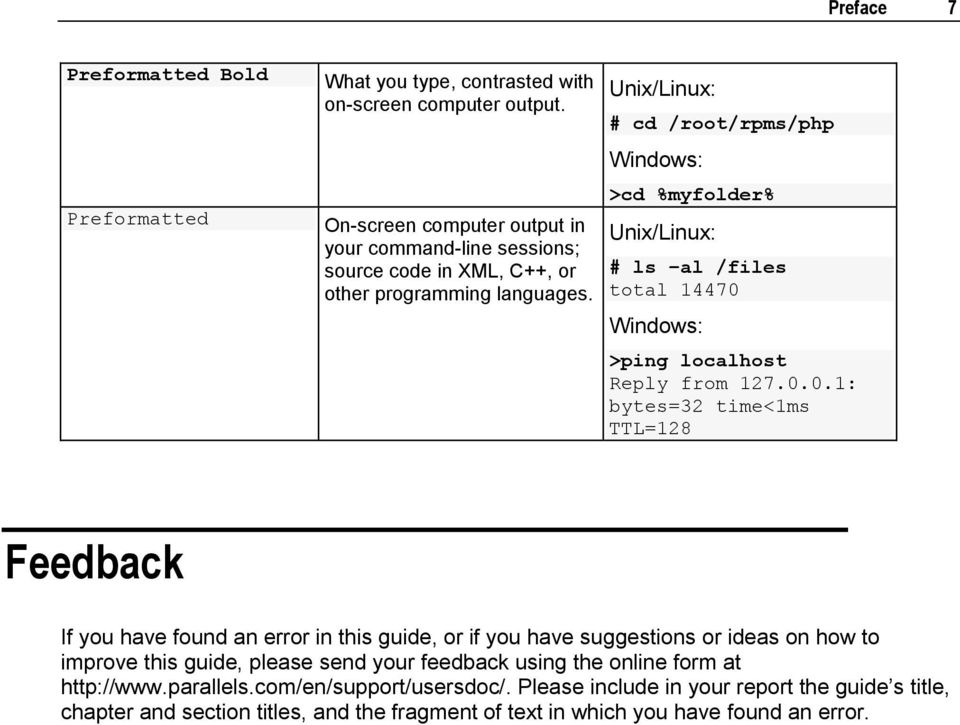
6 6 Preface Preface In this section: Typographical Conventions... 6 Feedback... 7 Typographical Conventions The following kinds of formatting in the text identify special information. Formatting convention Type of Information Example Special Bold Italics Monospace Items you must select, such as menu options, command buttons, or items in a list. Titles of chapters, sections, and subsections. Used to emphasize the importance of a point, to introduce a term or to designate a command line placeholder, which is to be replaced with a real name or value. The names of style sheet selectors, files and directories, and CSS fragments. Go to the QoS tab. Read the Basic Administration chapter. The system supports the so called wildcard character search. The license file is called license.key.

7 Preface 7 Preformatted Bold Preformatted What you type, contrasted with on-screen computer output. On-screen computer output in your command-line sessions; source code in XML, C++, or other programming languages. Unix/Linux: # cd /root/rpms/php Windows: >cd %myfolder% Unix/Linux: # ls al /files total Windows: >ping localhost Reply from : bytes=32 time<1ms TTL=128 Feedback If you have found an error in this guide, or if you have suggestions or ideas on how to improve this guide, please send your feedback using the online form at Please include in your report the guide s title, chapter and section titles, and the fragment of text in which you have found an error.
8 C H A P T E R 1 Administering Security Settings In this chapter: Configuring Firewall... 9 Configuring SELinux Policy for Your Parallels Plesk Panel Server Securing the /tmp Partition... 11

9 Administering Security Settings 9 Configuring Firewall Make sure these ports are opened for all Parallels Plesk Panel services to work with a firewall: 20 for ftp-data; 21 for ftp; 22 for ssh; 25 for smtp; 53 for dns (TCP and UDP); 80 for http (web server and Parallels Plesk Panel updater); 106 for poppassd (for localhost only); 110 for pop3; 113 for auth; 143 for imap; 443 for https; 465 for smtps; 587 for mail message submission; 990 for ftps; 993 for imaps; 995 for pop3s; 3306 for mysql; 5224 for (outgoing connections only) plesk-license-update; 5432 for postgres; 8443 for plesk-https; 8880 for plesk-http; 9080 for tomcat; 5224 for license updates.

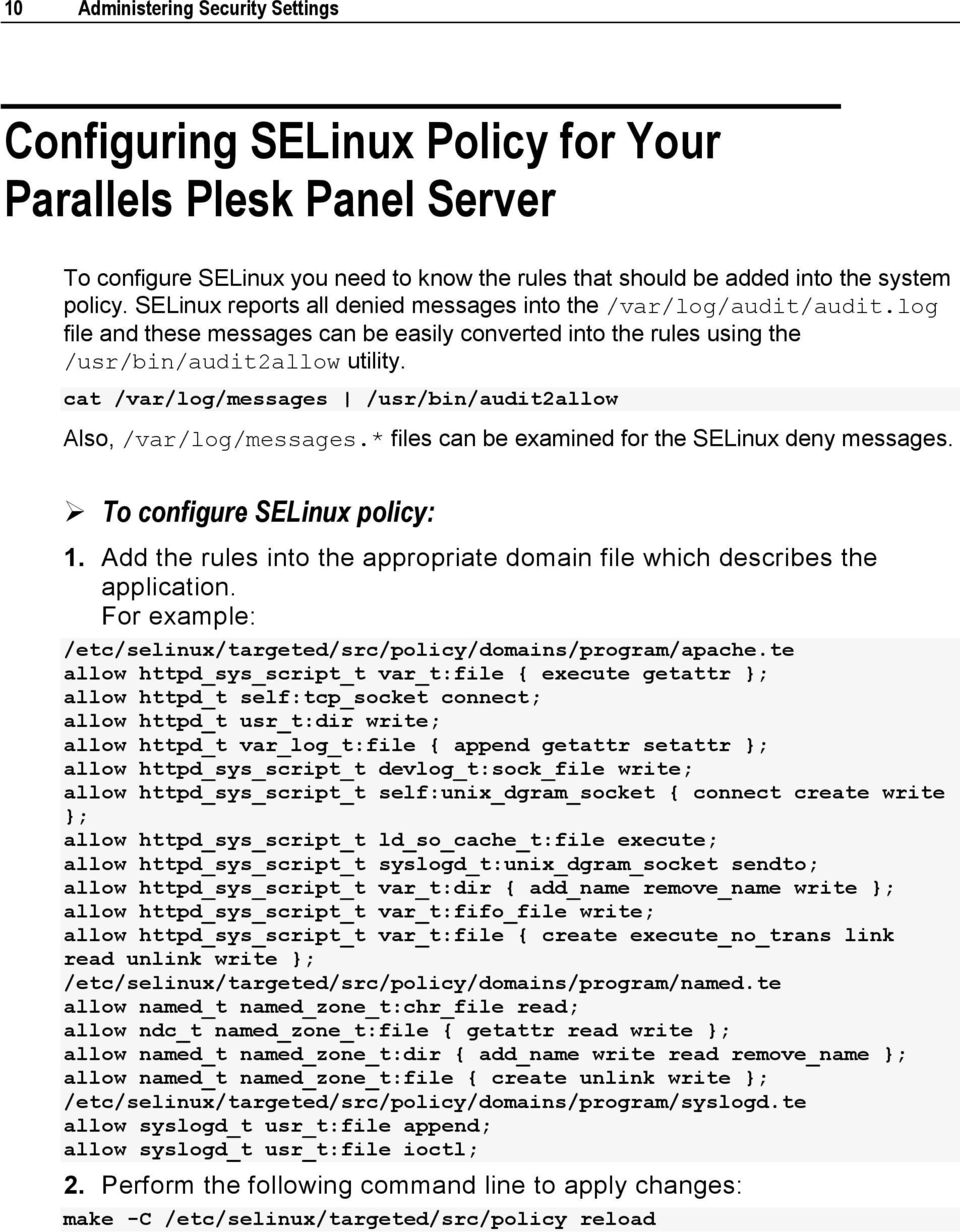
10 10 Administering Security Settings Configuring SELinux Policy for Your Parallels Plesk Panel Server To configure SELinux you need to know the rules that should be added into the system policy. SELinux reports all denied messages into the /var/log/audit/audit.log file and these messages can be easily converted into the rules using the /usr/bin/audit2allow utility. cat /var/log/messages /usr/bin/audit2allow Also, /var/log/messages.* files can be examined for the SELinux deny messages. To configure SELinux policy: 1. Add the rules into the appropriate domain file which describes the application. For example: /etc/selinux/targeted/src/policy/domains/program/apache.te allow httpd_sys_script_t var_t:file { execute getattr }; allow httpd_t self:tcp_socket connect; allow httpd_t usr_t:dir write; allow httpd_t var_log_t:file { append getattr setattr }; allow httpd_sys_script_t devlog_t:sock_file write; allow httpd_sys_script_t self:unix_dgram_socket { connect create write }; allow httpd_sys_script_t ld_so_cache_t:file execute; allow httpd_sys_script_t syslogd_t:unix_dgram_socket sendto; allow httpd_sys_script_t var_t:dir { add_name remove_name write }; allow httpd_sys_script_t var_t:fifo_file write; allow httpd_sys_script_t var_t:file { create execute_no_trans link read unlink write }; /etc/selinux/targeted/src/policy/domains/program/named.te allow named_t named_zone_t:chr_file read; allow ndc_t named_zone_t:file { getattr read write }; allow named_t named_zone_t:dir { add_name write read remove_name }; allow named_t named_zone_t:file { create unlink write }; /etc/selinux/targeted/src/policy/domains/program/syslogd.te allow syslogd_t usr_t:file append; allow syslogd_t usr_t:file ioctl; 2. Perform the following command line to apply changes: make -C /etc/selinux/targeted/src/policy reload
11 Administering Security Settings 11 Securing the /tmp Partition It is recommended to create /tmp as separate partition and mount it with the noexec and nosuid options. The noexec option disables the executable file attribute within an entire file system, effectively preventing any files within that file system from being executed. The nosuid option disables the SUID file-attribute within an entire file system. This prevents SUID attacks on, say, the /tmp file system. To secure the /tmp partition of your Parallels Plesk Panel server: If /tmp is a separate partition on the server, you only need to edit /etc/fstab and add the noexec and nosuid options for /tmp. Then remount the partition. If the /tmp directory resides on the / partition: a. Create a new partition for /tmp, for example with size 512 MB: # mkdir /filesystems # dd if=/dev/zero of=/filesystems/tmp_fs seek=512 count=512 bs=1m # mkfs.ext3 /filesystems/tmp_fs b. Add the string into /etc/fstab: /filesystems/tmp_fs /tmp ext3 noexec,nosuid,loop 1 1 c. Move current /tmp directory content to another location. d. Mount new /tmpp partition: # mount /tmp e. Move content from old /tmp directory to the new one.

12 C H A P T E R 2 Achieving Compliance with Payment Card Industry Data Security Standard To reduce the risk of compromising sensitive data hosted on your server, you might want to implement special security measures that comply with the Payment Card Industry Data Security Standard (PCI DSS). The standard is intended to help organizations protect customer account data. For detailed information about the standard, refer to This chapter describes the steps required to achieve PCI compliance on Linux and FreeBSD-based systems. You first need to run the PCI Compliance Resolver utility available from the Plesk Control Panel installation directory. It will disable weak SSL ciphers and protocols for Web and servers operated by Plesk Control Panel. To run the utility: 1. Log in to the server shell. 2. Issue the following command: /usr/local/psa/admin/bin/pci_compliance_resolver enable all The following table describes all options supported by the utility. Option Description -- enable all --disable all The option enable all switches off weak SSL ciphers and protocols for Web and servers. The option disable all reverts all changes made by the utility and restores original configuration files, thereby allowing weak SSL ciphers and protocols for connections to Web and servers. -- enable courier --disable courier -- enable apache --disable apache Switches off or switches on weak SSL ciphers and protocols for connections to Courier IMAP mail server. Switches off or switches on weak SSL ciphers and protocols for connections to the Apache Web server that serves users sites. -- enable panel --disable panel Switches off or switches on weak SSL ciphers and protocols for connections to Parallels Plesk Panel.

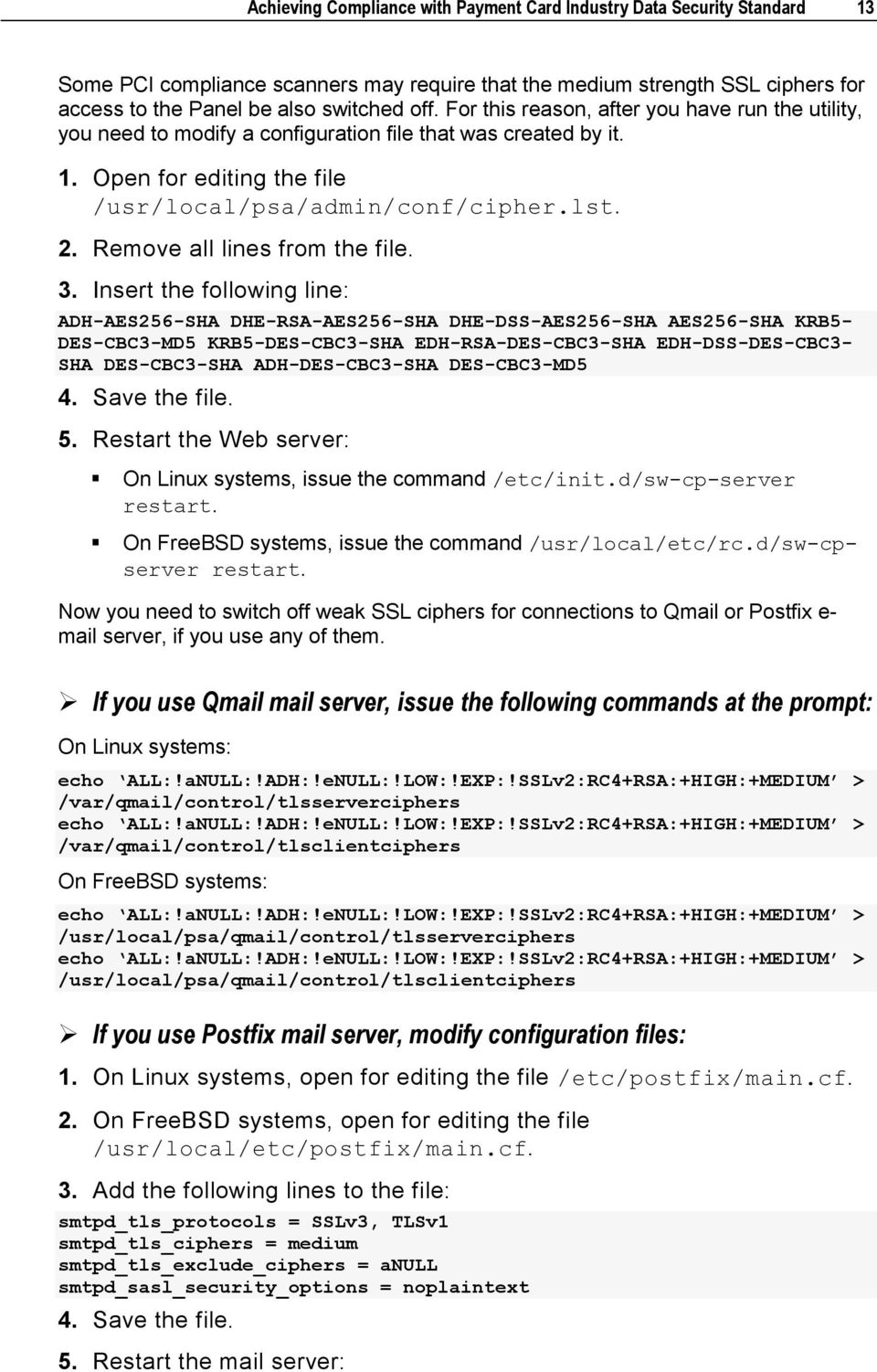
13 Achieving Compliance with Payment Card Industry Data Security Standard 13 Some PCI compliance scanners may require that the medium strength SSL ciphers for access to the Panel be also switched off. For this reason, after you have run the utility, you need to modify a configuration file that was created by it. 1. Open for editing the file /usr/local/psa/admin/conf/cipher.lst. 2. Remove all lines from the file. 3. Insert the following line: ADH-AES256-SHA DHE-RSA-AES256-SHA DHE-DSS-AES256-SHA AES256-SHA KRB5- DES-CBC3-MD5 KRB5-DES-CBC3-SHA EDH-RSA-DES-CBC3-SHA EDH-DSS-DES-CBC3- SHA DES-CBC3-SHA ADH-DES-CBC3-SHA DES-CBC3-MD5 4. Save the file. 5. Restart the Web server: On Linux systems, issue the command /etc/init.d/sw-cp-server restart. On FreeBSD systems, issue the command /usr/local/etc/rc.d/sw-cpserver restart. Now you need to switch off weak SSL ciphers for connections to Qmail or Postfix e- mail server, if you use any of them. If you use Qmail mail server, issue the following commands at the prompt: On Linux systems: echo ALL:!aNULL:!ADH:!eNULL:!LOW:!EXP:!SSLv2:RC4+RSA:+HIGH:+MEDIUM > /var/qmail/control/tlsserverciphers echo ALL:!aNULL:!ADH:!eNULL:!LOW:!EXP:!SSLv2:RC4+RSA:+HIGH:+MEDIUM > /var/qmail/control/tlsclientciphers On FreeBSD systems: echo ALL:!aNULL:!ADH:!eNULL:!LOW:!EXP:!SSLv2:RC4+RSA:+HIGH:+MEDIUM > /usr/local/psa/qmail/control/tlsserverciphers echo ALL:!aNULL:!ADH:!eNULL:!LOW:!EXP:!SSLv2:RC4+RSA:+HIGH:+MEDIUM > /usr/local/psa/qmail/control/tlsclientciphers If you use Postfix mail server, modify configuration files: 1. On Linux systems, open for editing the file /etc/postfix/main.cf. 2. On FreeBSD systems, open for editing the file /usr/local/etc/postfix/main.cf. 3. Add the following lines to the file: smtpd_tls_protocols = SSLv3, TLSv1 smtpd_tls_ciphers = medium smtpd_tls_exclude_ciphers = anull smtpd_sasl_security_options = noplaintext 4. Save the file. 5. Restart the mail server:
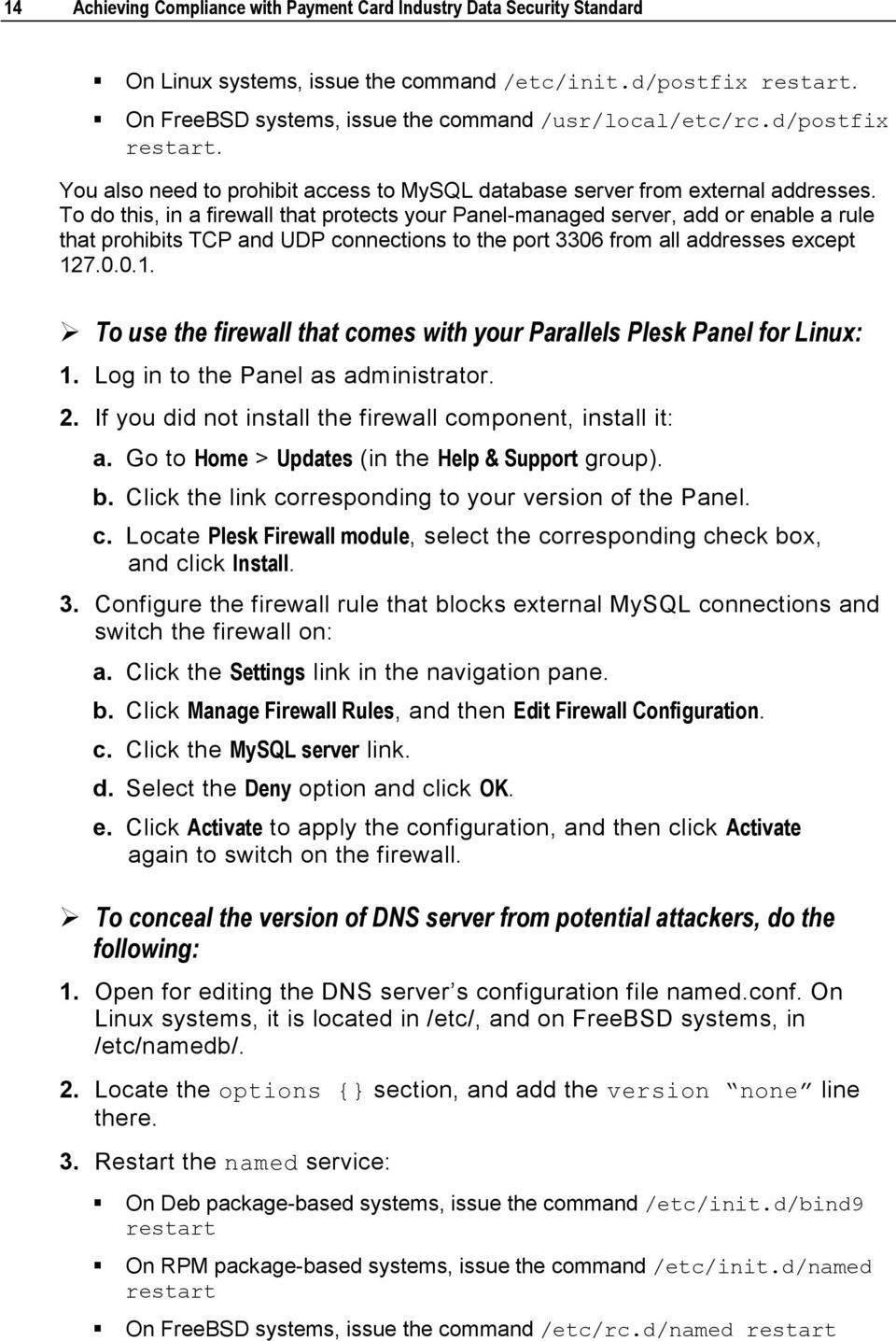
14 14 Achieving Compliance with Payment Card Industry Data Security Standard On Linux systems, issue the command /etc/init.d/postfix restart. On FreeBSD systems, issue the command /usr/local/etc/rc.d/postfix restart. You also need to prohibit access to MySQL database server from external addresses. To do this, in a firewall that protects your Panel-managed server, add or enable a rule that prohibits TCP and UDP connections to the port 3306 from all addresses except To use the firewall that comes with your Parallels Plesk Panel for Linux: 1. Log in to the Panel as administrator. 2. If you did not install the firewall component, install it: a. Go to Home > Updates (in the Help & Support group). b. Click the link corresponding to your version of the Panel. c. Locate Plesk Firewall module, select the corresponding check box, and click Install. 3. Configure the firewall rule that blocks external MySQL connections and switch the firewall on: a. Click the Settings link in the navigation pane. b. Click Manage Firewall Rules, and then Edit Firewall Configuration. c. Click the MySQL server link. d. Select the Deny option and click OK. e. Click Activate to apply the configuration, and then click Activate again to switch on the firewall. To conceal the version of DNS server from potential attackers, do the following: 1. Open for editing the DNS server s configuration file named.conf. On Linux systems, it is located in /etc/, and on FreeBSD systems, in /etc/namedb/. 2. Locate the options {} section, and add the version none line there. 3. Restart the named service: On Deb package-based systems, issue the command /etc/init.d/bind9 restart On RPM package-based systems, issue the command /etc/init.d/named restart On FreeBSD systems, issue the command /etc/rc.d/named restart
15 Achieving Compliance with Payment Card Industry Data Security Standard 15 To conceal the version of the Apache Web server from potential attackers, do the following: 1. Open for editing the Web server s configuration file. On Debian, Ubuntu, and SuSE Linux, it is located at /etc/apache2/apache2.conf. On other distributions of Linux, it is located at /etc/httpd/conf/httpd.conf. On FreeBSD, it is located at /usr/local/etc/apache2/httpd.conf. 2. Add the following lines: ServerTokens ProductOnly TraceEnable OFF 3. Save the file. 4. Restart the Web server. On Deb package-based systems, issue the command /etc/init.d/apache2 restart On RPM package-based systems, issue the command /etc/init.d/httpd restart On FreeBSD systems, issue the command /usr/local/etc/rc.d/apache2 restart If you have Single Sign-On v.2.2 components installed, then you need to disable SSL v.2 and weak SSL ciphers for the single sign-on service: 1. Open for editing the file /etc/sw-cpserver/applications.d/sso-cpserver.conf. 2. Locate the two lines ssl.engine = enable. 3. After each of these lines, add the following: ssl.cipher-list = ADH-AES256-SHA:DHE-RSA-AES256-SHA:DHE-DSS-AES256- SHA:AES256-SHA:ADH-AES128-SHA:DHE-RSA-AES128-SHA:DHE-DSS-AES128- SHA:AES128-SHA:KRB5-DES-CBC3-MD5:KRB5-DES-CBC3-SHA:ADH-DES-CBC3- SHA:EDH-RSA-DES-CBC3-SHA:EDH-DSS-DES-CBC3-SHA:DES-CBC3-SHA:DES-CBC3- MD5:DHE-DSS-RC4-SHA:KRB5-RC4-MD5:KRB5-RC4-SHA:ADH-RC4-MD5:RC4-SHA:RC4- MD5:RC2-CBC-MD5:RC4-MD5 ssl.use-sslv2 = disable 4. Save the file. 5. Restart the service: On Linux systems, issue the command /etc/init.d/sw-cp-server restart. On FreeBSD systems, issue the command /usr/local/etc/rc.d/sw-cpserver restart.

16 16 Achieving Compliance with Payment Card Industry Data Security Standard To conceal the version of PHP installed on the server: 1. Create a file with name php.ini in the following directory On Linux systems, /etc/sw-cp-server/ On FreeBSD systems, /usr/local/etc/sw-cp-server/ 2. Add to this file the line expose_php = Off. 3. Save the file. 4. Open for editing the following file: On Linux systems, /etc/sw-cp-server/applications.d/ssocpserver.conf. On FreeBSD systems, /usr/local/etc/sw-cpserver/applications.d/sso-cpserver.conf. 5. Locate the following line: On Linux systems, var.intertpreter = /usr/bin/sw-engine-cgi. On a FreeBSD system, var.intertpreter = /usr/local/bin/swengine-cgi. 6. Replace it with the following line: On Linux systems, var.intertpreter = /usr/bin/sw-engine-cgi -c /etc/sw-cp-server/php.ini. On a FreeBSD system, var.intertpreter = /usr/local/bin/swengine-cgi -c /usr/local/etc/sw-cp-server/php.ini. 7. Save the file. 8. Restart the Web server: On Linux systems, issue the command /etc/init.d/sw-cp-server restart. On FreeBSD systems, issue the command /usr/local/etc/rc.d/sw-cpserver restart. To alleviate security risks arising from disclosure of information about files and their properties by Apache Web server, configure the FileETag directive in the Web server configuration file. To do this: 1. Open for editing the Web server s configuration file. On Debian, Ubuntu, and SuSE Linux, it is located at /etc/apache2/apache2.conf. On other distributions of Linux, it is located at /etc/httpd/conf/httpd.conf. On FreeBSD, it is located at /usr/local/etc/apache2/httpd.conf.

17 Achieving Compliance with Payment Card Industry Data Security Standard Locate the line FileETag INode MTime Size and remove the INode keyword from this line. 3. Save the file. 4. Restart the Web server. On Deb package-based systems, issue the command /etc/init.d/apache2 restart On RPM package-based systems, issue the command /etc/init.d/httpd restart On FreeBSD systems, issue the command /usr/local/etc/rc.d/apache2 restart

18 C H A P T E R 3 Using Event Tracking Mechanism The Event Manager is designed to help you organize data interchange between Parallels Plesk Panel and external systems. It works the following way: you create a script to be executed upon a certain Parallels Plesk Panel event, and then create an event handler that triggers the event processing. You can assign several handlers to a single event. Important: The Parallels Plesk Panel administrator can create the event handlers that will trigger scripts running on the server on behalf of the root user. If you wish to restrict usage of the root account, create an empty file with name root.event_handler.lock in the location /plesk_installation_directory/var/. In this chapter: Adding Event Handlers Removing Event Handlers Event s Passed by Event Handlers... 21
19 Using Event Tracking Mechanism 19 Adding Event Handlers Let s, for example, create an event handler for the client account creation event. The handler will accept a client the client s login from environment variables. For simplicity we will use a shell-script called test-handler.sh that looks as follows: #!/bin/bash echo >> /tmp/event_handler.log /bin/date >> /tmp/event_handler.log # information on the event date and time /usr/bin/id >> /tmp/event_handler.log # information on the user, on behalf of which the script was executed (to ensure control) echo client created >> /tmp/event_handler.log # information on the created client account echo name: ${NEW_CONTACT_NAME} >> /tmp/event_handler.log # client s name echo login: ${NEW_LOGIN_NAME} >> /tmp/event_handler.log # client s login echo >> /tmp/event_handler.log This script prints some information to a file so that we could control its execution (we cannot output information to stdout/stderr, as the script is executed in the background mode). Suppose, that our script is located in the directory /plesk_installation_directory/bin (for instance). Let s register it by creating an event handler via Parallels Plesk Panel. To add an event handler via Parallels Plesk Panel: 1. Go to Home > Event Manager. 2. Click Add New Event Handler. The event handler setup page appears. 3. Select the event, you wish to assign a handler to in the Event menu. 4. Select the priority for handler execution, or specify a custom value. To do this, select custom in the Priority menu and type in the value. When assigning several handlers to a single event you can specify the handler execution sequence, setting different priorities (higher value corresponds to a higher priority).

20 20 Using Event Tracking Mechanism 5. Select the system user, on behalf of which the handler will be executed ( root user, for example). 6. In the Command input field, specify a command to be executed upon the selected event. In our example it is /usr/local/psa/bin/testhandler.sh. 7. Click OK. Note: In the script, we have specified the variables $NEW_CONTACT_NAME and $NEW_LOGIN_NAME. During execution of the handler, they will be replaced with login of the created client respectively. The entire list of available variables is provided in the following section. You should keep in mind that with the removal operations, the variables of type $NEW_xxx are not set. And with creation operations the parameters of type $OLD_xxx are not set. Now if you login to your Parallels Plesk Panel and create a new client, specifying the value Some Client in the Contact name field, and some_client in the field Login, the handler will be invoked, and the following records will be added to the /tmp/event_handler.log: Fri Mar 16 15:57:25 NOVT 2007 uid=0(root) gid=0(root) groups=0(root) client created name: Some client login: some_client The parameter templates that can be used when setting up an event handler are presented in the Event s Passed by Event Handlers (see page 21) section. Removing Event Handlers To remove an event handler: 1. Go to Server > Event Manager. 2. Select the corresponding check boxes in the list of handlers and click Remove Selected.

21 Event s Passed by Event Handlers Using Event Tracking Mechanism 21
22 22 Using Event Tracking Mechanism In this section: Session (Login) Settings Event Desktop Preset Event Client Account Event Client Status Event Disk Space Limit Event for Client Traffic Usage Limit Event for Client Client Limits Event Client s Event Client Preferences Event Client s GUID Event Clients Template Event Client s IP Pool Event Client s Site Application Package Event Domain Event Domain Limits Event Domain Status Event Domain s GUID Event Domains Template Event DNS Zone Event for Domain Disk Space Limit Event for Domain Traffic Usage Limit Event for Domain Domain Owner Change Event Subdomain Event Domain Alias Event Domain Alias, DNS Zone Event Physical Hosting Event Mail Account Event Web User Event Mailing List Event Parallels Plesk Panel User Event Domain Administrator Account Event Domain Administrator s s Event Site Application Event Service Event IP Address Event Forwarding Event Administrator Information Event Database Server Event Parallels Plesk Panel Component Event Database Event Database User Account Event License Key Event Reseller Account Event Reseller Status Event Disk Space Limit Event for Reseller Traffic Usage Limit Event for Reseller Reseller Limits Event Reseller s Event Reseller Preferences Event Reseller s GUID Event Resellers Template Event Reseller s IP Pool Event Reseller s Site Application Package Event... 54
23 Using Event Tracking Mechanism 23 Session (Login) Settings Event For the event Session (login) settings changed Allowed period of inactivity for all Parallels Plesk Panel users OLD_SESSION_IDLE_TI ME NEW_SESSION_IDLE_TIME Desktop Preset Event For the events Desktop preset created, modified, deleted Unique identification number of a desktop preset OLD_DESKTOP_PRESET_I D Type of OLD_DESKTOP_PRESET_T desktop YPE preset (default preset for administrator s desktop, client s desktop, domain administrator s desktop, or a user s custom preset) Desktop preset name OLD_DESKTOP_PRESET_N AME NEW_DESKTOP_PRESET_I D NEW_DESKTOP_PRESET_T YPE NEW_DESKTOP_PRESET_N AME
24 24 Using Event Tracking Mechanism Client Account Event For the events Client account created, Client account updated, Client account removed Login name OLD_LOGIN_NAME NEW_LOGIN_NAME Required Contact name OLD_CONTACT_NAME NEW_CONTACT_NAME Required Password OLD_PASSWORD NEW_PASSWORD Company name OLD_COMPANY_NAME NEW_COMPANY_NAME Phone OLD_PHONE NEW_PHONE Fax OLD_FAX NEW_FAX E- mail OLD_ NEW_ Address OLD_ADDRESS NEW_ADDRESS City OLD_CITY NEW_CITY State/provinc e Postal/zip code OLD_STATE_PROVINCE NEW_STATE_PROVINCE OLD_POSTAL_ZIP_CODE NEW_POSTAL_ZIP_CODE Country OLD_COUNTRY NEW_COUNTRY Client Status Event For the events Client status updated Contact name OLD_CONTACT_NAME NEW_CONTACT_NAME Required Login name OLD_LOGIN_NAME NEW_LOGIN_NAME Required Status OLD_STATUS NEW_STATUS
25 Using Event Tracking Mechanism 25 Disk Space Limit Event for Client For the event Limit on disk space was reached for the client account Contact name Disk space limit OLD_CONTACT_NAME NEW_CONTACT_NAME Required OLD_MAXIMUM_DISK_SP ACE NEW_MAXIMUM_DISK_SPAC E Required Traffic Usage Limit Event for Client For the events Limit on traffic usage was reached for the client account Contact name Traffic limit OLD_CONTACT_NAME NEW_CONTACT_NAME Required OLD_MAXIMUM_TRAFFIC NEW_MAXIMUM_TRAFFIC Client Limits Event For the event Client limits changed Contact name Maximum number of domains Maximum amount of disk space Maximum amount of traffic OLD_CONTACT_NAME NEW_CONTACT_NAME Required OLD_MAXIMUM_DOMAINS NEW_MAXIMUM_DOMAINS OLD_MAXIMUM_DISK_SP ACE NEW_MAXIMUM_DISK_SPAC E OLD_MAXIMUM_TRAFFIC NEW_MAXIMUM_TRAFFIC
26 26 Using Event Tracking Mechanism Maximum number of Web users Maximum number of databases Maximum number of mailboxes Mailbox quota Maximum number of mail redirects Maximum number of mail groups Maximum number of mail autorespond ers Maximum number of mailing lists Maximum number of Java applications Account expiration date OLD_MAXIMUM_WEBUSER S OLD_MAXIMUM_DATABAS ES OLD_MAXIMUM_MAILBOX ES OLD_MAXIMUM_MAILBOX _QUOTA OLD_MAXIMUM_MAIL_RE DIRECTS OLD_MAXIMUM_MAIL_GR OUPS OLD_MAXIMUM_MAIL_AU TORESPONDERS OLD_MAXIMUM_MAIL_LI STS OLD_MAXIMUM_TOMCAT_ WEB_APPLICATIONS NEW_MAXIMUM_WEBUSERS NEW_MAXIMUM_DATABASES NEW_MAXIMUM_MAILBOXES NEW_MAXIMUM_MAILBOX_Q UOTA NEW_MAXIMUM_MAIL_REDI RECTS NEW_MAXIMUM_MAIL_GROU PS NEW_MAXIMUM_MAIL_AUTO RESPONDERS NEW_MAXIMUM_MAIL_LIST S NEW_MAXIMUM_TOMCAT_WE B_APPLICATIONS OLD_EXPIRATION_DATE NEW_EXPIRATION_DATE Client s Event For the event Client s permissions changed Login name OLD_LOGIN_NAME NEW_LOGIN_NAME to use the Parallels Plesk Panel OLD_CP_ACCESS NEW_CP_ACCESS
27 Using Event Tracking Mechanism 27 to manage Web site hosting account to switch PHP_safe mode off and on to assign hard quotas on disk space to manage subdomains to manage domain aliases OLD_PHYSICAL_HOSTIN G_MANAGEMENT OLD_PHP_SAFE_MODE_M ANAGEMENT OLD_HARD_DISK_QUOTA _ASSIGNMENT OLD_SUBDOMAINS_MANA GEMENT OLD_DOMAIN_ALIASES_ MANAGEMENT OLD_LIMITS_ADJUSTME to change NT the resource allotments for the user s Web sites to manage DNS zones for domains to adjust log recycling to schedule tasks and automate execution of scripts to manage anonymous FTP service to manage Java Web applications and Java Web service OLD_DNS_ZONE_MANAGE MENT OLD_LOG_ROTATION_MA NAGEMENT OLD_CRONTAB_MANAGEM ENT OLD_ANONYMOUS_FTP_M ANAGEMENT OLD_WEB_APPLICATION S_MANAGEMENT NEW_PHYSICAL_HOSTING_ MANAGEMENT NEW_PHP_SAFE_MODE_MAN AGEMENT NEW_HARD_DISK_QUOTA_A SSIGNMENT NEW_SUBDOMAINS_MANAGE MENT NEW_DOMAIN_ALIASES_MA NAGEMENT NEW_LIMITS_ADJUSTMENT NEW_DNS_ZONE_MANAGEME NT NEW_LOG_ROTATION_MANA GEMENT NEW_CRONTAB_MANAGEMEN T NEW_ANONYMOUS_FTP_MAN AGEMENT NEW_WEB_APPLICATIONS_ MANAGEMENT
28 28 Using Event Tracking Mechanism to manage Web statistics (switch between statistics programs) to manage access to the server shell over SSH OLD_WEB_STATISTICS_ MANAGEMENT OLD_SYSTEM_ACCESS_M ANAGEMENT OLD_NON_CHROOTED_SH to manage ELL_MANAGEMENT access to the server shell in chrooted environments over SSH to manage mailing lists to back up and restore data through the Parallels Plesk Panel and use the backup repository on the server to back up and restore data through the Parallels Plesk Panel and use backup repositories on thirdparty FTP servers to use the XML API for Web site management to use the Desktop interface OLD_MAILING_LISTS_M ANAGEMENT OLD_BACKUP_RESTORE_ FUNCTIONS_USE_LOCAL _REPOSITORY OLD_BACKUP_RESTORE_ FUNCTIONS_USE_FTP_R EPOSITORY OLD_ABILITY_TO_USE_ REMOTE_XML_INTERFAC E OLD_ABILITY_TO_USE_ DASHBOARD_INTERFACE NEW_WEB_STATISTICS_MA NAGEMENT NEW_SYSTEM_ACCESS_MAN AGEMENT NEW_NON_CHROOTED_SHEL L_MANAGEMENT NEW_MAILING_LISTS_MAN AGEMENT NEW_BACKUP_RESTORE_FU NCTIONS_USE_LOCAL_REP OSITORY NEW_BACKUP_RESTORE_FU NCTIONS_USE_FTP_REPOS ITORY NEW_ABILITY_TO_USE_RE MOTE_XML_INTERFACE NEW_ABILITY_TO_USE_DA SHBOARD_INTERFACE
29 Using Event Tracking Mechanism 29 to use the standard Parallels Plesk Panel interface to customize Desktop OLD_ABILITY_TO_USE_ STANDARD_INTERFACE OLD_ABILITY_TO_MANA GE_DASHBOARD OLD_ABILITY_TO_MANA to manage GE_SPAMFILTER spam filtering settings to manage antivirus settings OLD_ABILITY_TO_MAN AGE_VIRUSFILTER NEW_ABILITY_TO_USE_ST ANDARD_INTERFACE NEW_ABILITY_TO_MANAGE _DASHBOARD NEW_ABILITY_TO_MANAGE _SPAMFILTER NEW_ABILITY_TO_MANA GE_VIRUSFILTER Client Preferences Event For the events Client preferences updated Contact name OLD_CONTACT_NAME NEW_CONTACT_NAME Required Login name OLD_LOGIN_NAME NEW_LOGIN_NAME Required Page size OLD_LINES_PER_PAGE NEW_LINES_PER_PAGE Interface skin OLD_INTERFACE_SKIN NEW_INTERFACE_SKIN Client s GUID Event For the Client s GUID updated event Globally unique identifier (GUID) OLD_GUID NEW_GUID Required
30 30 Using Event Tracking Mechanism Clients Template Event For the Template for clients created, Template for clients updated, Template for clients removed events Reseller template ID OLD_TEMPLATE_ID NEW_TEMPLATE_ID Required Client s IP Pool Event For the event Client s IP pool changed Contact name OLD_CONTACT_NAME NEW_CONTACT_NAME Required IP address OLD_IP_ADDRESS NEW_IP_ADDRESS Required Status OLD_STATUS NEW_STATUS Client s Site Application Package Event For the events Site application package added to client s pool, Site application package removed from client s pool Login name OLD_LOGIN_NAME NEW_LOGIN_NAME Package name OLD_PACKAGE_NAME NEW_PACKAGE_NAME
31 Using Event Tracking Mechanism 31 Domain Event For the events Domain created, Domain updated, Domain deleted Domain Name OLD_DOMAIN_NAME NEW_DOMAIN_NAME Required Domain Limits Event For the event Domain limits updated Domain name Maximum amount of disk space Maximum amount of traffic Maximum number of web users Maximum number of databases Maximum number of mailboxes Mailbox quota Maximum number of mail redirects Maximum number of mail groups OLD_DOMAIN_NAME NEW_DOMAIN_NAME Required OLD_MAXIMUM_DISK_SP ACE NEW_MAXIMUM_DISK_SPAC E OLD_MAXIMUM_TRAFFIC NEW_MAXIMUM_TRAFFIC OLD_MAXIMUM_WEBUSER S OLD_MAXIMUM_DATABAS ES OLD_MAXIMUM_MAILBOX ES OLD_MAXIMUM_MAILBOX _QUOTA OLD_MAXIMUM_MAIL_RE DIRECTS OLD_MAXIMUM_MAIL_GR OUPS NEW_MAXIMUM_WEBUSERS NEW_MAXIMUM_DATABASES NEW_MAXIMUM_MAILBOXES NEW_MAXIMUM_MAILBOX_Q UOTA NEW_MAXIMUM_MAIL_REDI RECTS NEW_MAXIMUM_MAIL_GROU PS
32 32 Using Event Tracking Mechanism Maximum number of mail autorespond ers Maximum number of mailing lists Maximum number of java applications Expiration date OLD_MAXIMUM_MAIL_AU TORESPONDERS OLD_MAXIMUM_MAIL_LI STS OLD_MAXIMUM_TOMCAT_ WEB_APPLICATIONS NEW_MAXIMUM_MAIL_AUTO RESPONDERS NEW_MAXIMUM_MAIL_LIST S NEW_MAXIMUM_TOMCAT_WE B_APPLICATIONS OLD_EXPIRATION_DATE NEW_EXPIRATION_DATE Domain Status Event For the events Domain status changed Domain name Domain status OLD_DOMAIN_NAME NEW_DOMAIN_NAME Required OLD_STATUS NEW_STATUS Domain s GUID Event For the Domain s GUID updated events Globally unique identifier (GUID) OLD_GUID NEW_GUID Required
33 Using Event Tracking Mechanism 33 Domains Template Event For the Template for domains created, Template for domains updated, Template for domains removed events Reseller template ID OLD_TEMPLATE_ID NEW_TEMPLATE_ID Required DNS Zone Event for Domain For the event DNS zone updated for domain Domain name OLD_DOMAIN_NAME NEW_DOMAIN_NAME Required Disk Space Limit Event for Domain For the event Limit on disk space reached for domain Domain name Disk space limit OLD_DOMAIN_NAME NEW_DOMAIN_NAME Required OLD_MAXIMUM_DISK_SP ACE NEW_MAXIMUM_DISK_SPAC E Traffic Usage Limit Event for Domain
34 34 Using Event Tracking Mechanism For the event Limit on traffic usage reached for domain Domain name Traffic limit OLD_DOMAIN_NAME NEW_DOMAIN_NAME Required OLD_MAXIMUM_TRAFFIC NEW_MAXIMUM_TRAFFIC Domain Owner Change Event For the Domain owner changed event Domain name OLD_DOMAIN_NAME NEW_DOMAIN_NAME Login name OLD_LOGIN_NAME NEW_LOGIN_NAME Subdomain Event For the events Subdomain created, Subdomain updated, Subdomain deleted Subdomain Name Parent domain name OLD_SUBDOMAIN_NAME NEW_SUBDOMAIN_NAME Required OLD_DOMAIN_NAME NEW_DOMAIN_NAME Required FTP account OLD_SYSTEM_USER_TYP E Subdomain OLD_SYSTEM_USER administrator s login name Hard disk quota NEW_SYSTEM_USER_TYPE NEW_SYSTEM_USER OLD_HARD_DISK_QUOTA NEW_HARD_DISK_QUOTA SSI support OLD_SSI_SUPPORT NEW_SSI_SUPPORT PHP support OLD_PHP_SUPPORT CGI support OLD_CGI_SUPPORT Perl support OLD_MOD_PERL_SUPPOR T NEW_PHP_SUPPORT NEW_CGI_SUPPORT NEW_MOD_PERL_SUPPORT
35 Using Event Tracking Mechanism 35 Python support ColdFusion support Apache::ASP support OLD_MOD_PYTHON_SUPP ORT OLD_COLDFUSION_SUPP ORT OLD_APACHE_ASP_SUPP ORT SSL support OLD_SSL_SUPPORT NEW_MOD_PYTHON_SUPPOR T NEW_COLDFUSION_SUPPOR T NEW_APACHE_ASP_SUPPOR T NEW_SSL_SUPPORT Domain Alias Event For the events Domain alias created, updated, deleted, DNS zone modified Domain alias name Domain alias switched on or off Web service for domain alias is on or off Mail service for domain alias is on or off OLD_DOMAIN_ALIAS_NAM E OLD_STATUS NEW_DOMAIN_ALIAS_NAM E NEW_STATUS OLD_DOMAIN_ALIAS_WEB NEW_DOMAIN_ALIAS_WEB OLD_DOMAIN_ALIAS_MAI L Support for OLD_DOMAIN_ALIAS_TOM accessing CAT web applications in Java for domain alias visitors (on or off) NEW_DOMAIN_ALIAS_MAI L NEW_DOMAIN_ALIAS_TOM CAT Required Domain Alias, DNS Zone Event
36 36 Using Event Tracking Mechanism For the events Domain alias created, updated, deleted, DNS zone modified Domain name OLD_DOMAIN_NAME NEW_DOMAIN_NAME Required IP address OLD_IP_ADDRESS NEW_IP_ADDRESS IP type OLD_IP_TYPE NEW_IP_TYPE System user OLD_SYSTEM_USER System user s password OLD_SYSTEM_USER_PAS SWORD Shell access OLD_SYSTEM_SHELL NEW_SYSTEM_USER NEW_SYSTEM_USER_PASSW ORD NEW_SYSTEM_SHELL FP support OLD_FP_SUPPORT NEW_FP_SUPPORT FP- SSL support OLD_FPSSL_SUPPORT FP authoring OLD_FP_AUTHORING FP admin login FP admin password NEW_FPSSL_SUPPORT NEW_FP_AUTHORING OLD_FP_ADMIN_LOGIN NEW_FP_ADMIN_LOGIN OLD_FP_ADMIN_PASSWO RD NEW_FP_ADMIN_PASSWORD SSI support OLD_SSI_SUPPORT NEW_SSI_SUPPORT PHP support OLD_PHP_SUPPORT CGI support OLD_CGI_SUPPORT Perl support OLD_MOD_PERL_SUPPOR T Apache ASP support OLD_APACHE_ASP_SUPP ORT SSL support OLD_SSL_SUPPORT Web statistics Custom error documents Hard disk quota NEW_PHP_SUPPORT NEW_CGI_SUPPORT NEW_MOD_PERL_SUPPORT NEW_APACHE_ASP_SUPPOR T NEW_SSL_SUPPORT OLD_WEB_STATISTICS NEW_WEB_STATISTICS OLD_APACHE_ERROR_DO CUMENTS NEW_APACHE_ERROR_DOCU MENTS OLD_HARD_DISK_QUOTA NEW_HARD_DISK_QUOTA Physical Hosting Event For the events Physical hosting created, Physical hosting updated Domain name OLD_DOMAIN_NAME NEW_DOMAIN_NAME Required IP address OLD_IP_ADDRESS NEW_IP_ADDRESS IP type OLD_IP_TYPE NEW_IP_TYPE
37 Using Event Tracking Mechanism 37 System user System user s password Shell access OLD_SYSTEM_USER OLD_SYSTEM_USER_PA SSWORD OLD_SYSTEM_SHELL FP support OLD_FP_SUPPORT FP- SSL support FP authoring FP admin login FP admin password SSI support PHP support CGI support Perl support Apache ASP support SSL support Web statistics Custom error documents Hard disk quota OLD_FPSSL_SUPPORT OLD_FP_AUTHORING OLD_FP_ADMIN_LOGIN OLD_FP_ADMIN_PASSW ORD OLD_SSI_SUPPORT OLD_PHP_SUPPORT OLD_CGI_SUPPORT OLD_MOD_PERL_SUPPO RT OLD_APACHE_ASP_SUPP ORT OLD_SSL_SUPPORT OLD_WEB_STATISTICS OLD_APACHE_ERROR_D OCUMENTS NEW_SYSTEM_USER NEW_SYSTEM_USER_PA SSWORD NEW_SYSTEM_SHELL NEW_FP_SUPPORT NEW_FPSSL_SUPPORT NEW_FP_AUTHORING NEW_FP_ADMIN_LOGIN NEW_FP_ADMIN_PASSW ORD NEW_SSI_SUPPORT NEW_PHP_SUPPORT NEW_CGI_SUPPORT NEW_MOD_PERL_SUPPO RT NEW_APACHE_ASP_SUP PORT NEW_SSL_SUPPORT NEW_WEB_STATISTICS NEW_APACHE_ERROR_D OCUMENTS OLD_HARD_DISK_QUOTA NEW_HARD_DISK_QUOT A For the event Physical hosting deleted Domain name OLD_DOMAIN_NAME NEW_DOMAIN_NAME Required
38 38 Using Event Tracking Mechanism Mail Account Event For the events Mail account created, Mail account deleted address OLD_MAILNAME NEW_MAILNAME Required (in the format of mailnam in) For the event Mail account updated address OLD_MAILNAME NEW_MAILNAME Required (in the format mailnam in) Mailbox OLD_MAILBOX NEW_MAILBOX Password OLD_PASSWORD NEW_PASSWORD Mailbox quota OLD_MAILBOX_QUOTA NEW_MAILBOX_QUOTA Redirect OLD_REDIRECT NEW_REDIRECT Redirect address OLD_REDIRECT_ADDRES S NEW_REDIRECT_ADDRESS Mail group OLD_MAIL_GROUP NEW_MAIL_GROUP Autorespond ers Access to Parallels Plesk Panel for user OLD_AUTORESPONDERS OLD_MAIL_CONTROLPAN EL_ACCESS NEW_AUTORESPONDERS NEW_MAIL_CONTROLPANEL _ACCESS
39 Using Event Tracking Mechanism 39 Web User Event For the event Web user deleted Domain name Web user name OLD_DOMAIN_NAME NEW_DOMAIN_NAME Required OLD_WEBUSER_NAME NEW_WEBUSER_NAME Required For the events Web user created, Web user updated Domain name Web user name Web user s password OLD_DOMAIN_NAME NEW_DOMAIN_NAME Required OLD_WEBUSER_NAME NEW_WEBUSER_NAME Required OLD_WEBUSER_PASSWOR D NEW_WEBUSER_PASSWORD SSI support OLD_SSI_SUPPORT NEW_SSI_SUPPORT PHP support OLD_PHP_SUPPORT CGI support OLD_CGI_SUPPORT Perl support OLD_MOD_PERL_SUPPOR T Python support Apache ASP support Hard disk quota OLD_MOD_PYTHON_SUPP ORT OLD_APACHE_ASP_SUPP ORT NEW_PHP_SUPPORT NEW_CGI_SUPPORT NEW_MOD_PERL_SUPPORT NEW_MOD_PYTHON_SUPPOR T NEW_APACHE_ASP_SUPPOR T OLD_HARD_DISK_QUOTA NEW_HARD_DISK_QUOTA Mailing List Event
40 40 Using Event Tracking Mechanism For the events Mailing list created, Mailing list updated, Mailing list deleted Domain name Mailing list name Mailing list enabled OLD_DOMAIN_NAME NEW_DOMAIN_NAME Required OLD_MAIL_LIST_NAME NEW_MAIL_LIST_NAME OLD_MAIL_LIST_ENABL ED NEW_MAIL_LIST_ENABLED Required Parallels Plesk Panel User Event For the events Parallels Plesk Panel user logged in, Parallels Plesk Panel user logged out Contact name OLD_CONTACT_NAME NEW_CONTACT_NAME Domain Administrator Account Event For the event Domain administrator account updated Allow domain administrator access OLD_ALLOW_DOMAIN_US ER_ACCESS NEW_ALLOW_DOMAIN_USER _ACCESS Login name OLD_LOGIN_NAME NEW_LOGIN_NAME Required Domain name Contact name OLD_DOMAIN_NAME NEW_DOMAIN_NAME Required OLD_CONTACT_NAME NEW_CONTACT_NAME Password OLD_PASSWORD NEW_PASSWORD Company name OLD_COMPANY_NAME NEW_COMPANY_NAME Phone OLD_PHONE NEW_PHONE Fax OLD_FAX NEW_FAX E- mail OLD_ NEW_ Address OLD_ADDRESS NEW_ADDRESS
41 Using Event Tracking Mechanism 41 City OLD_CITY NEW_CITY State/Provinc e Postal/ZIP code OLD_STATE_PROVINCE NEW_STATE_PROVINCE OLD_POSTAL_ZIP_CODE NEW_POSTAL_ZIP_CODE Country OLD_COUNTRY NEW_COUNTRY Domain Administrator s s Event For the event Domain administrator s permissions changed Login name OLD_LOGIN_NAME NEW_LOGIN_NAME Domain name to manage Web site hosting account to change FTP password to assign hard quotas on disk space to manage subdomains to manage domain aliases OLD_DOMAIN_NAME OLD_PHYSICAL_HOSTIN G_MANAGEMENT OLD_MANAGE_FTP_PASS WORD OLD_HARD_DISK_QUOTA _ASSIGNMENT OLD_SUBDOMAINS_MANA GEMENT OLD_DOMAIN_ALIASES_ MANAGEMENT OLD_DNS_ZONE_MANAGE to manage MENT DNS zone for the Web site to adjust log recycling OLD_LOG_ROTATION_MA NAGEMENT NEW_DOMAIN_NAME NEW_PHYSICAL_HOSTING_ MANAGEMENT NEW_MANAGE_FTP_PASSWO RD NEW_HARD_DISK_QUOTA_A SSIGNMENT NEW_SUBDOMAINS_MANAGE MENT NEW_DOMAIN_ALIASES_MA NAGEMENT NEW_DNS_ZONE_MANAGEME NT NEW_LOG_ROTATION_MANA GEMENT
42 42 Using Event Tracking Mechanism to schedule tasks and automate execution of scripts to manage anonymous FTP service to manage Java Web applications and Java Web service to manage Web statistics (switch between statistics programs) to manage access to the server shell over SSH to manage access to the server shell in chrooted environment over SSH to manage mailing lists to back up and restore data through the Parallels Plesk Panel and use the backup repository on the server OLD_CRONTAB_MANAGEM ENT OLD_ANONYMOUS_FTP_M ANAGEMENT OLD_WEB_APPLICATION S_MANAGEMENT OLD_WEB_STATISTICS_ MANAGEMENT OLD_SYSTEM_ACCESS_M ANAGEMENT OLD_NON_CHROOTED_SH ELL_MANAGEMENT OLD_MAILING_LISTS_M ANAGEMENT OLD_BACKUP_RESTORE_ FUNCTIONS_USE_LOCAL _REPOSITORY NEW_CRONTAB_MANAGEMEN T NEW_ANONYMOUS_FTP_MAN AGEMENT NEW_WEB_APPLICATIONS_ MANAGEMENT NEW_WEB_STATISTICS_MA NAGEMENT NEW_SYSTEM_ACCESS_MAN AGEMENT NEW_NON_CHROOTED_SHEL L_MANAGEMENT NEW_MAILING_LISTS_MAN AGEMENT NEW_BACKUP_RESTORE_FU NCTIONS_USE_LOCAL_REP OSITORY
43 Using Event Tracking Mechanism 43 to back up and restore data through the Parallels Plesk Panel and use backup repositories on thirdparty FTP servers to use the XML API for Web site management to use the Desktop interface to use the standard Parallels Plesk Panel interface to customize Desktop OLD_BACKUP_RESTORE_ FUNCTIONS_USE_FTP_R EPOSITORY OLD_ABILITY_TO_USE_ REMOTE_XML_INTERFAC E OLD_ABILITY_TO_USE_ DASHBOARD_INTERFACE OLD_ABILITY_TO_USE_ STANDARD_INTERFACE OLD_ABILITY_TO_MANA GE_DASHBOARD OLD_ABILITY_TO_MANA to manage GE_SPAMFILTER spam filtering settings to manage antivirus settings OLD_ABILITY_TO_MANA GE_VIRUSFILTER NEW_BACKUP_RESTORE_FU NCTIONS_USE_FTP_REPOS ITORY NEW_ABILITY_TO_USE_RE MOTE_XML_INTERFACE NEW_ABILITY_TO_USE_DA SHBOARD_INTERFACE NEW_ABILITY_TO_USE_ST ANDARD_INTERFACE NEW_ABILITY_TO_MANAGE _DASHBOARD NEW_ABILITY_TO_MANAGE _SPAMFILTER NEW_ABILITY_TO_MANAGE _VIRUSFILTER Site Application Event
44 44 Using Event Tracking Mechanism For the events Site application installed, Site application reconfigured, Site application uninstalled Site application package name Domain type (domain or subdomain) Installation path (httpdocs or httpsdocs) Installation path within the destination directory OLD_PACKAGE_NAME NEW_PACKAGE_NAME Required OLD_DOMAIN_TYPE NEW_DOMAIN_TYPE Required OLD_DIRECTORY NEW_DIRECTORY Required OLD_INSTALLATION_PR EFIX NEW_INSTALLATION_PREF IX Required Service Event For the events Service stopped, started, or restarted Service OLD_SERVICE NEW_SERVICE Required IP Address Event For the events IP address created, changed, or deleted IP address OLD_IP_ADDRESS NEW_IP_ADDRESS Required IP mask OLD_IP_MASK NEW_IP_MASK Interface OLD_INTERFACE NEW_INTERFACE IP type OLD_IP_TYPE NEW_IP_TYPE
45 Using Event Tracking Mechanism 45 Forwarding Event For the events Forwarding created, changed, deleted Domain name Forwarding type OLD_DOMAIN_NAME NEW_DOMAIN_NAME Required OLD_FORWARDING_TYPE NEW_FORWARDING_TYPE URL OLD_URL NEW_URL Administrator Information Event For the event Administrator information changed Login name OLD_LOGIN_NAME NEW_LOGIN_NAME Required Contact name Company name Phone number OLD_CONTACT_NAME OLD_COMPANY_NAME OLD_PHONE NEW_CONTACT_NAME NEW_COMPANY_NAME NEW_PHONE Fax OLD_FAX NEW_FAX E- mail OLD_ NEW_ Address OLD_ADDRESS NEW_ADDRESS CIty OLD_CITY NEW_CITY State/Provinc e Postal/Zip code OLD_STATE_PROVINCE NEW_STATE_PROVINCE OLD_POSTAL_ZIP_CODE NEW_POSTAL_ZIP_CODE Country OLD_COUNTRY NEW_COUNTRY
46 46 Using Event Tracking Mechanism Database Server Event For the events Database server created, modified, deleted Database server s IP address OLD_DATABASE_SERVER NEW_DATABASE_SERVER Parallels Plesk Panel Component Event For the event Parallels Plesk Panel component upgraded Parallels Plesk Panel component name OLD_PLESK_COMPONENT _NAME NEW_PLESK_COMPONENT_N AME Database Event For the events Database created, deleted Database server s IP address Database name OLD_DATABASE_SERVER NEW_DATABASE_SERVER OLD_DATABASE_NAME NEW_DATABASE_NAME
47 Using Event Tracking Mechanism 47 Database User Account Event For the events Database user account created, changed, deleted Database server s IP address Database identification number Database user name Database user password OLD_DATABASE_SERVER NEW_DATABASE_SERVER OLD_DATABASE_ID OLD_DATABASE_USER_N AME OLD_DATABASE_USER_P ASSWORD NEW_DATABASE_ID NEW_DATABASE_USER_NAM E NEW_DATABASE_USER_PAS SWORD License Key Event For the event License key upd License key number License key type (Parallels Plesk Panel, additional) License key name (for additional keys) OLD_LICENSE NEW_LICENSE Required OLD_LICENSE_TYPE OLD_LICENSE_NAME NEW_LICENSE_TYPE NEW_LICENSE_NAME Reseller Account Event
48 48 Using Event Tracking Mechanism For the events Reseller account created, Reseller account updated, Reseller account removed Login name OLD_LOGIN_NAME NEW_LOGIN_NAME Required Contact name OLD_CONTACT_NAME NEW_CONTACT_NAME Required Password OLD_PASSWORD NEW_PASSWORD Company name OLD_COMPANY_NAME NEW_COMPANY_NAME Phone OLD_PHONE NEW_PHONE Fax OLD_FAX NEW_FAX E- mail OLD_ NEW_ Address OLD_ADDRESS NEW_ADDRESS City OLD_CITY NEW_CITY State/provinc e Postal/zip code OLD_STATE_PROVINCE NEW_STATE_PROVINCE OLD_POSTAL_ZIP_CODE NEW_POSTAL_ZIP_CODE Country OLD_COUNTRY NEW_COUNTRY Reseller Status Event For the events Reseller status updated Contact name OLD_CONTACT_NAME NEW_CONTACT_NAME Required Login name OLD_LOGIN_NAME NEW_LOGIN_NAME Required Status OLD_STATUS NEW_STATUS Disk Space Limit Event for Reseller
49 Using Event Tracking Mechanism 49 For the event Limit on disk space was reached for the reseller account Contact name Disk space limit OLD_CONTACT_NAME NEW_CONTACT_NAME Required OLD_MAXIMUM_DISK_SP ACE NEW_MAXIMUM_DISK_SPAC E Required Traffic Usage Limit Event for Reseller For the events Limit on traffic usage was reached for the reseller account Contact name Traffic limit OLD_CONTACT_NAME NEW_CONTACT_NAME Required OLD_MAXIMUM_TRAFFIC NEW_MAXIMUM_TRAFFIC Reseller Limits Event For the event Reseller limits changed Contact name Maximum number of domains Maximum amount of disk space Maximum amount of traffic Maximum number of Web users Maximum number of databases OLD_CONTACT_NAME NEW_CONTACT_NAME Required OLD_MAXIMUM_DOMAINS NEW_MAXIMUM_DOMAINS OLD_MAXIMUM_DISK_SP ACE NEW_MAXIMUM_DISK_SPAC E OLD_MAXIMUM_TRAFFIC NEW_MAXIMUM_TRAFFIC OLD_MAXIMUM_WEBUSER S OLD_MAXIMUM_DATABAS ES NEW_MAXIMUM_WEBUSERS NEW_MAXIMUM_DATABASES
50 50 Using Event Tracking Mechanism Maximum number of mailboxes Mailbox quota Maximum number of mail redirects Maximum number of mail groups Maximum number of mail autorespond ers Maximum number of mailing lists Maximum number of Java applications Account expiration date OLD_MAXIMUM_MAILBOX ES OLD_MAXIMUM_MAILBOX _QUOTA OLD_MAXIMUM_MAIL_RE DIRECTS OLD_MAXIMUM_MAIL_GR OUPS OLD_MAXIMUM_MAIL_AU TORESPONDERS OLD_MAXIMUM_MAIL_LI STS OLD_MAXIMUM_TOMCAT_ WEB_APPLICATIONS NEW_MAXIMUM_MAILBOXES NEW_MAXIMUM_MAILBOX_Q UOTA NEW_MAXIMUM_MAIL_REDI RECTS NEW_MAXIMUM_MAIL_GROU PS NEW_MAXIMUM_MAIL_AUTO RESPONDERS NEW_MAXIMUM_MAIL_LIST S NEW_MAXIMUM_TOMCAT_WE B_APPLICATIONS OLD_EXPIRATION_DATE NEW_EXPIRATION_DATE Reseller s Event For the event Reseller s permissions changed Login name OLD_LOGIN_NAME NEW_LOGIN_NAME to use the Parallels Plesk Panel to manage Web site hosting account OLD_CP_ACCESS OLD_PHYSICAL_HOSTIN G_MANAGEMENT NEW_CP_ACCESS NEW_PHYSICAL_HOSTING_ MANAGEMENT
51 Using Event Tracking Mechanism 51 to switch PHP_safe mode off and on to assign hard quotas on disk space to manage subdomains to manage domain aliases OLD_PHP_SAFE_MODE_M ANAGEMENT OLD_HARD_DISK_QUOTA _ASSIGNMENT OLD_SUBDOMAINS_MANA GEMENT OLD_DOMAIN_ALIASES_ MANAGEMENT OLD_LIMITS_ADJUSTME to change NT the resource allotments for the user s Web sites to manage DNS zones for domains to adjust log recycling to schedule tasks and automate execution of scripts to manage anonymous FTP service to manage Java Web applications and Java Web service OLD_DNS_ZONE_MANAGE MENT OLD_LOG_ROTATION_MA NAGEMENT OLD_CRONTAB_MANAGEM ENT OLD_ANONYMOUS_FTP_M ANAGEMENT OLD_WEB_APPLICATION S_MANAGEMENT NEW_PHP_SAFE_MODE_MAN AGEMENT NEW_HARD_DISK_QUOTA_A SSIGNMENT NEW_SUBDOMAINS_MANAGE MENT NEW_DOMAIN_ALIASES_MA NAGEMENT NEW_LIMITS_ADJUSTMENT NEW_DNS_ZONE_MANAGEME NT NEW_LOG_ROTATION_MANA GEMENT NEW_CRONTAB_MANAGEMEN T NEW_ANONYMOUS_FTP_MAN AGEMENT NEW_WEB_APPLICATIONS_ MANAGEMENT
52 52 Using Event Tracking Mechanism to manage Web statistics (switch between statistics programs) to manage access to the server shell over SSH OLD_WEB_STATISTICS_ MANAGEMENT OLD_SYSTEM_ACCESS_M ANAGEMENT OLD_NON_CHROOTED_SH to manage ELL_MANAGEMENT access to the server shell in chrooted environments over SSH to manage mailing lists to back up and restore data through the Parallels Plesk Panel and use the backup repository on the server to back up and restore data through the Parallels Plesk Panel and use backup repositories on thirdparty FTP servers to use the XML API for Web site management to use the Desktop interface OLD_MAILING_LISTS_M ANAGEMENT OLD_BACKUP_RESTORE_ FUNCTIONS_USE_LOCAL _REPOSITORY OLD_BACKUP_RESTORE_ FUNCTIONS_USE_FTP_R EPOSITORY OLD_ABILITY_TO_USE_ REMOTE_XML_INTERFAC E OLD_ABILITY_TO_USE_ DASHBOARD_INTERFACE NEW_WEB_STATISTICS_MA NAGEMENT NEW_SYSTEM_ACCESS_MAN AGEMENT NEW_NON_CHROOTED_SHEL L_MANAGEMENT NEW_MAILING_LISTS_MAN AGEMENT NEW_BACKUP_RESTORE_FU NCTIONS_USE_LOCAL_REP OSITORY NEW_BACKUP_RESTORE_FU NCTIONS_USE_FTP_REPOS ITORY NEW_ABILITY_TO_USE_RE MOTE_XML_INTERFACE NEW_ABILITY_TO_USE_DA SHBOARD_INTERFACE
53 Using Event Tracking Mechanism 53 to use the standard Parallels Plesk Panel interface to customize Desktop OLD_ABILITY_TO_USE_ STANDARD_INTERFACE OLD_ABILITY_TO_MANA GE_DASHBOARD OLD_ABILITY_TO_MANA to manage GE_SPAMFILTER spam filtering settings to manage antivirus settings OLD_ABILITY_TO_MAN AGE_VIRUSFILTER NEW_ABILITY_TO_USE_ST ANDARD_INTERFACE NEW_ABILITY_TO_MANAGE _DASHBOARD NEW_ABILITY_TO_MANAGE _SPAMFILTER NEW_ABILITY_TO_MANA GE_VIRUSFILTER Reseller Preferences Event For the events Reseller preferences updated Contact name OLD_CONTACT_NAME NEW_CONTACT_NAME Required Login name OLD_LOGIN_NAME NEW_LOGIN_NAME Required Page size OLD_LINES_PER_PAGE NEW_LINES_PER_PAGE Interface skin OLD_INTERFACE_SKIN NEW_INTERFACE_SKIN Reseller s GUID Event For the Reseller s GUID updated events Globally unique identifier (GUID) OLD_GUID NEW_GUID Required
54 54 Using Event Tracking Mechanism Resellers Template Event For the Template for resellers created, Template for resellers updated, Template for resellers removed events Reseller template ID OLD_TEMPLATE_ID NEW_TEMPLATE_ID Required Reseller s IP Pool Event For the event Reseller s IP pool changed Contact name OLD_CONTACT_NAME NEW_CONTACT_NAME Required IP address OLD_IP_ADDRESS NEW_IP_ADDRESS Required Status OLD_STATUS NEW_STATUS Reseller s Site Application Package Event For the events Site application package added to reseller s pool, Site application package removed from reseller s pool Login name OLD_LOGIN_NAME NEW_LOGIN_NAME Package name OLD_PACKAGE_NAME NEW_PACKAGE_NAME
55 C H A P T E R 4 Configuring Apache Server You can modify global setting for the Apache server in the main Apache configuration file: /etc/httpd/conf/httpd.conf for RedHat-based systems; /etc/apache2/apache2.conf (or a corresponding file from /etc/apache2/conf.d/ /etc/apache2/sites-enabled/) for Debian-based systems; /etc/apache2/httpd.con (or /etc/apache2/vhosts.d/*) for SuSE; In this chapter: Getting Familiar with Virtual Host Structure and s Enabling Piped Logs for Web Server to Reduce the Risk of Web Service Disruption Recompiling Apache With More File Descriptors Including Directives into Web Server Configuration File Customizing httpd.include for Domains Preventing Graphics Hotlinking on a Web Site Apache Port Change... 67
56 56 Configuring Apache Server Getting Familiar with Virtual Host Structure and s Vhost permissions should satisfy the following conditions: Home directory should be readable by apache, psaadm and psaftp. The user cannot change some catalogues of their directories. Other users should not have access to the user s home directory. The following table shows the virtual host structure and permissions set to the vhost catalogue: Directories Tree User Group Perms Description /<VHOST > root root 755 /anon_ftp user psaserv 750 Anonymous FTP files /cgi-bin user psaserv 750 CGI scripts /conf root psaserv 755 /error_docs root psaserv 755 <doc>.html user psaserv 755 /etc root root 755 /httpdocs user psaserv 750 /httpsdocs user psaserv 750 /pd root psaserv 750 d..<dir1>@<dir2> apache apache 400 /private user root 700 /statistics root psaserv 550 Configuratio n files Error messages files Chroot environment catalogue HTTP documents HTTPS documents Passwords to protected directories User s private storage Statistics directory
57 Configuring Apache Server 57 /anon_ftpstat root root 755 /ftpstat root root 755 /logs root root 755 /webstat root root 755 /webstat-ssl root root 755 /usr root root 755 /web_users root psaserv 755 /<web_user> web_user psaserv 750 /subdomains root psaserv 755 /<subdomain> root root 755 /cgi-bin sub_user psaserv 750 /conf root psaserv 750 /error_docs root root 755 /httpdocs sub_user psaserv 750 /httpsdocs sub_user psaserv 750 Anonymous FTP statistics FTP user statistics Virtual host logs HTTP user statistics HTTPS user statistics Chroot environment catalogue Web users catalogue Subdomains catalogue Tip: Microsoft FrontPage Server Extensions are no longer shipped with Parallels Plesk Panel, thought if you want to use Microsoft Frontpage Server Extensions, modify the vhost permissions. Assign the psaserv group to http(s)docs/_vti_* files recursively and to the http(s)docs/.htaccess file in the http(s)docs catalogue, and set the 751 permission to the http(s)docs catalogue.
58 58 Configuring Apache Server Enabling Piped Logs for Web Server to Reduce the Risk of Web Service Disruption If you are going to host more than 300 domains or web sites on your server, you should switch on support for piped logs in the Apache Web Server. To enable piped logs: 1. Log in to the server shell. 2. Issue the command mysql -uadmin -p cat /etc/psa/.psa.shadow -D psa -e replace into misc (param,val) values ( apache_pipelog, true ); 3. Rebuild Apache configuration by issuing the command /usr/local/psa/admin/sbin/websrvmng -a -v This will allow to host about 900 domains/web sites. If you need to host more than 900 domains/web sites, then you will need to recompile Apache and some other system packages, as described in the Recompiling Apache With More File Descriptors (see page 59) section.
59 Configuring Apache Server 59 Recompiling Apache With More File Descriptors If you are going to host a large number of web sites on the Parallels Plesk Panel server, Apache may fail to work because of a problem with the file descriptors limit. Note: Since Parallels Plesk Panel up to 900 domains can be hosted on the OS vendor Apache build without system packages recompilation described in this section, if Piped Logs feature is enabled on the Parallels Plesk Panel server (see page 58). In this section: Recompiling Apache With More File Descriptors on RedHat-like System Recompiling Apache With More File Descriptors on Debian System Recompiling Apache With More File Descriptors on FreeBSD System... 63
60 60 Configuring Apache Server Recompiling Apache With More File Descriptors on RedHat-like System Parallels Plesk Panel requires, closely depends on and uses many server applications which are not part of Parallels Plesk Panel software actually. For example, apache web server, mysql server, php module and binaries and many others are not provided or compiled by Parallels, but standard system RPM packages from operating system vendor are used by Parallels Plesk Panel and they are used as is. This allows to upgrade and recompile such packages with the options the Parallels Plesk Panel administrator wants. To recompile related applications and libraries, such as openssl, apache, imap, PHP etc from source RPMs with increased FD_SETSIZE value, perform the following steps: 1. Make sure that the system allows to open enough files: # /sbin/sysctl fs.file-max fs.file-max = If fs.file-max is quite small (several thousands or so), change it in the following way: a. Add the following line to /etc/sysctl.conf: fs.file-max = b. Running the shell command: # /sbin/sysctl -w fs.file-max= Note: If you are running Virtuozzo, you have to adjust the fs.file-max on the hardware node and it will be applied to all VEs. 2. Make sure you have the glibc-kernheaders and glibc-headers packages installed. They can be taken from the operating system distributive CD or from your operating system download sites. 3. Edit the FD_SETSIZE value in typesizes.h and posix_types.h files: To find the typesizes.h file, run: # find /usr/include/ -name typesizes.h To find the posix_types.h file, run: # find /usr/include/ -name posix_types.h To edit the FD_SETSIZE value in a file, run: #define FD_SETSIZE Download the following source RPMs that can be found on your operating system download sites or similar places, you may use RPM search engines such as or openssl-*.src.rpm httpd-*.src.rpm imap-*.src.rpm
61 Configuring Apache Server 61 php-*.src.rpm libc-client-devel-*.src.rpm (if such RPM is installed) curl-*.src.rpm 5. Recompile openssl first. For example: # /usr/bin/rpmbuild rebuild openssl-0.9.7a-35.src.rpm 6. Install the compiled openssl RPM with the following command line: # rpm -Uvh force /usr/src/redhat/rpms/i386/openssl-0.9.7a-35.i386.rpm 7. Recompile and install curl in the same way. 8. Recompile and install apache: # rpmbuild rebuild httpd src.rpm # rpm -Uvh force /usr/src/redhat/rpms/i386/httpd i386.rpm # rpm -Uvh force /usr/src/redhat/rpms/i386/httpd-devel i386.rpm # rpm -Uvh force /usr/src/redhat/rpms/i386/mod_ssl i386.rpm 9. Recompile and install the libc-client library which is provided by the imap or libc-client-devel packages (depending on the OS). Recompile the one that is installed in the system, for example: # /usr/bin/rpmbuild rebuild imap-2002d-3.src.rpm # rpm -Uvh force /usr/src/redhat/rpms/i386/imap-devel-2002d-3.i386.rpm or # /usr/bin/rpmbuild rebuild libc-client-devel.src.rpm # rpm -Uvh force /usr/src/redhat/rpms/i386/libc-client-devel.rpm 10. Recompile and install PHP, for example: # rpmbuild rebuild php src.rpm # rpm -Uvh force /usr/src/redhat/rpms/i386/php-* 11. Add the following command to /etc/rc.d/init.d/httpd and /usr/sbin/apachectl startup scripts of apache before other commands: ulimit -n Replace the /usr/sbin/suexec with the one from Parallels Plesk Panel: # cp /usr/local/psa/suexec/psa-suexec /usr/sbin/suexec # /etc/init.d/httpd restart For Parallels Plesk Panel versions earlier than 7.5: # cp /usr/local/psa/suexec/psa-suexec /usr/sbin/suexec # chown root:apache /usr/sbin/suexec # chmod 4510 /usr/sbin/suexec # /etc/init.d/httpd restart
62 62 Configuring Apache Server Recompiling Apache With More File Descriptors on Debian System To recompile Apache, PHP and IMAP with increased value of file descriptors larger than FD_SETSIZE (1024) on Debian system: 1. Add the following line to /etc/sysctl.conf: fs.file-max = Run the following shell command: /sbin/sysctl -w fs.file-max=65536 Note that the value fs.file-max can be equal up to 220= ). 3. Add the following line to beginning of /etc/init.d/apache2 and /usr/sbin/apache2ctl: ulimit -n cat /proc/sys/fs/file-max 4. Change FD_SETSIZE value in /usr/include/bits/typesizes.h and /usr/include/nptl/bits/typesizes.h files. It should be like: #define FD_SETSIZE Download and rebuild packages: # apt-get install apt-src # apt-src build install openssl # dpkg -i libssl*.deb openssl*.deb # apt-src build install apache2 # dpkg -i libapr*.deb apache2_*.deb apache2-common*.deb apache2-mpmprefork*.deb apache2-utils*.deb # cp /opt/psa/suexec/psa-suexec2 /usr/lib/apache2/suexec2 /etc/init.d/apache2 restart # apt-src build install libc-client2002edebian # dpkg -i libc-client-dev_2002edebian1-*.deb libc-client2002edebian*.deb mlock*.deb # apt-src build install php4 # dpkg -i ls *deb grep php4 grep -v apache-mod
63 Configuring Apache Server 63 Recompiling Apache With More File Descriptors on FreeBSD System Apache and apache modules come with Parallels Plesk Panel for FreeBSD versions or earlier and are already compiled with FD_SETSIZE = and if you have problem with file descriptors lack then the reason is in some non-plesk system application. The most probably it is related to standard system OpenSSL libraries which are dynamically loaded by Parallels Plesk Panel s apache. To have the system OpenSSL library files be recompiled with increased FD_SETSIZE value, please do the following. To recompile OpenSSL with increased value of file descriptors larger than FD_SETSIZE (1024) on FreeBSD system, perform the following steps: 1. Obtain FreeBSD sources for your FreeBSD version, for example using the cvsup utility. See Obtaining FreeBSD in the FreeBSD HandBook for details. We would recommend that you obtain not original sources for exactly the same FreeBSD release that you are currently running, but updated sources from a stable branch for your FreeBSD version. 2. Edit the /usr/src/sys/sys/select.h and /usr/include/sys/select.h files and modify there FD_SETSIZE value from 1024U to 16384U: # ifndef FD_SETSIZE # define FD_SETSIZE 16384U 3. Run the following commands to recompile all the system files including OpenSSL libraries: # rm -rf /usr/obj/usr # cd /usr/src # make clean ; make cleandepend # make buildworld You can update not only OpenSSL libraries but also system binaries and libraries and also update or modify the kernel. To do this and continue with system/kernel update, please follow The Cutting Edge chapter in FreeBSD HandBook for details. 4. If your system/kernel is up-to-date or you don t need to update anything except OpenSSL libraries for other reason, you can find what files are used by apache and replace them manually with new copies. Below is example for FreeBSD 6.0: # ldd /usr/local/psa/apache/bin/httpd # /usr/local/psa/apache/bin/httpd: # libaprutil-0.so.9 => /usr/local/psa/apache/lib/libaprutil-0.so.9 (0x281cb000) # libapr-0.so.9 => /usr/local/psa/apache/lib/libapr-0.so.9 (0x281dd000) # libm.so.4 => /lib/libm.so.4 (0x281f8000) # libcrypt.so.3 => /lib/libcrypt.so.3 (0x ) # libssl.so.4 => /usr/lib/libssl.so.4 (0x ) # libcrypto.so.4 => /lib/libcrypto.so.4 (0x ) # libz.so.3 => /lib/libz.so.3 (0x2834e000) # libc.so.6 => /lib/libc.so.6 (0x2835e000) In our FreeBSD 6.0 case these files are:
64 64 Configuring Apache Server /lib/libcrypt.so.3 /lib/libcrypto.so.4 /usr/lib/libssl.so.4 5. Make backup copies of these files just in case: # cp -p /lib/libcrypt.so.3 /lib/libcrypt.so.3.back ; \ # cp -p /lib/libcrypto.so.4 /lib/libcrypto.so.4.back ; \ # cp -p /usr/lib/libssl.so.4 /usr/lib/libssl.so.4.back 6. Replace these files with newly compiled copies (they are located in /usr/obj/usr/src/ subfolders). If you use remote connection to server console, execute the below commands as a single command as shown in the example below: # cd /usr/obj/usr/src/ ; \ # cp./secure/lib/libcrypto/libcrypto.so.4 /lib/libcrypto.so.4 ; \ # cp./secure/lib/libssl/libssl.so.4 /usr/lib/libssl.so.4 ; \ # chflags noschg /lib/libcrypt.so.3 ; \ # cp./lib/libcrypt/libcrypt.so.3 /lib/libcrypt.so.3 ; \ # chflags schg /lib/libcrypt.so.3 7. Reboot the server.
65 Configuring Apache Server 65 Including Directives into Web Server Configuration File You can include domain-specific Apache configuration directives into web server configuration file. In Parallels Plesk Panel each domain has virtual hosts configuration stored in a separate file httpd.include. On all Linux systems, this file is located in the directory /var/www/vhosts/<domainname>/conf/. If you upgraded from Parallels Plesk Panel version or earlier, try looking for this file in the directory <VIRTUAL_HOSTS_D>/<domain-name>/conf/. Check the HTTPD_VHOSTS_D variable in /etc/psa/psa.conf. Note: You can change the location of virtual host directories using the transvhosts.pl utility, which is located either in /usr/local/psa/bin/ or /opt/psa/bin/ directory, depending on your operating system. This file is overwritten each time the virtual host configuration is changed, thus any manual alterations made to the file are discarded. To use custom directives or redefine those inserted by Parallels Plesk Panel, you need to create the files vhost.conf and/or vhost_ssl.conf with necessary directives in the directory <VIRTUAL_HOSTS_D>/<domain-name>/conf/ for a domain, and <VIRTUAL_HOSTS_D>/<domain-name>/subdomains/<subdomain-name>/conf/ for a subdomain. If any of these files exist by the time the main configuration file is generated, Parallels Plesk Panel inserts the appropriate Include directive into the HTTP and/or HTTPS virtual host context respectively. For security reasons, only root can create the vhost.conf and vhost_ssl.conf files. For the changes to take effect, you need to run the following command: On FreeBSD systems, this file is located in the directory <VIRTUAL_HOSTS_D>/<domainname>/conf/. /plesk_installation_directory/admin/sbin/websrvmng reconfigure-vhost vhostname=<domain_name> Important: Note that modification of httpsd.conf and php.ini files can result in improper Parallels Plesk Panel functioning or failure, cause damage and loss of data. it is highly recommended that you do not modify these files or any part of them. If you require custom modifications to be applied to the configuration, please perform them in the following files: # /var/www/vhosts/<domain-name>/conf/vhost.conf # /var/www/vhosts/<domain-name>/conf/vhost_ssl.conf # /var/www/vhosts/<domain-name>/subdomains/<subdomainname>/conf/vhost.conf
66 66 Configuring Apache Server Customizing httpd.include for Domains In Parallels Plesk Panel each domain has virtual hosts configuration stored in a separate file: <VIRTUAL_HOSTS_D>/<domain-name>/conf/httpd.include When you need to use some specific configurations for a domain or a subdomain, it s not a good idea to include them directly in httpd.include file. This file is overwritten each time the virtual host configuration is changed, thus any manual alterations made to the file are discarded. To use custom directives or redefine those inserted by Parallels Plesk Panel, do the following: 1. Create the files vhost.conf and/or vhost_ssl.conf with necessary directives in the <VIRTUAL_HOSTS_D>/<domain-name>/conf/ directory. If any (or both) of these files exist by the time the main configuration file is generated, Parallels Plesk Panel inserts the appropriate directive: Include <VIRTUAL_HOSTS_D>/<domain-name>/conf/vhost.conf or Include <VIRTUAL_HOSTS_D>/<domain-name>/conf/vhost_ssl.conf into the HTTP and/or HTTPS virtual host context respectively. For security reasons, only root can create the vhost.conf and vhost_ssl.conf files. 2. For the changes to take effect, run the following: # /usr/local/psa/admin/sbin/websrvmng reconfigure-vhost vhostname=<domain_name> For the changes to be implemented for all domains, run the following: # /usr/local/psa/admin/bin/websrvmng -a Preventing Graphics Hotlinking on a Web Site Bandwidth theft or hotlinking is a direct linking to web site s files (images, video, etc.). It can be prevented with the mod_rewrite module. Place rules like below into the vhost.conf or.htaccess files for the domain (for example RewriteEngine on RewriteCond %!^$ RewriteCond %!^ [NC] RewriteRule \.(gif jpg jpeg png swf)$ - [NC,F]
67 Configuring Apache Server 67 Apache Port Change You can change Apache web server port to use a lightweight high-performance web server, such as nginx, as a front-end web server, and move Apache web server to back-end. To change Apache web server port, use the websrvmng utility with the following options: --set-http-port - set a custom http port; --get-http-port - get a custom http port; --set-https-port - set a custom https port; --get-https-port - get a custom https port. Note: The default port values in Parallels Plesk Panel are 80 for http and 443 for https. Examples To change Apache web server http port to 8080, issue the following command: # /usr/local/psa/admin/sbin/websrvmng set-http-port port=8080 # /usr/local/psa/admin/sbin/websrvmng reconfigure-all # /usr/local/psa/admin/sbin/webmailmng disable name=horde # /usr/local/psa/admin/sbin/webmailmng enable name=horde # /usr/local/psa/admin/sbin/webmailmng disable name=atmail # /usr/local/psa/admin/sbin/webmailmng enable name=atmail # /usr/local/psa/admin/sbin/webmailmng disable name=atmailcom # /usr/local/psa/admin/sbin/webmailmng enable name=atmailcom To get a custom Apache web server http port, issue the following command: # /usr/local/psa/admin/sbin/websrvmng get-http-port Examples of configuration files for nginx web server on Debian 5 Web server configuration (on page 69) Domains configuration (on page 70) Subdomains configuration (on page 72) Webmail configuration (on page 74) Mailman configuration (on page 75) When you use Sitebuilder with Parallels Plesk Panel and change Apache web server port, you should reconfigure Sitebuilder (on page 76) to provide integration with the changed port. Known issues When nginx is installed as a front-end web server and Apache is moved to back-end, the following Parallels Plesk Panel components are not working: Publishing dynamic content in Sitebuilder Server s default page Tomcat via Apache Statistics for cached static content is not calculated
68 68 Configuring Apache Server In this section: Example of Web Server Configuration File Example of Domain Configuration File Example of Subdomain Configuration File Example of Webmail Configuration File Example of Mailman Configuration File Configuring Sitebuilder for Work With Changed Apache Port... 76
69 Configuring Apache Server 69 Example of Web Server Configuration File The following is the example of configuration file for the nginx web server on Debian 5: # cat /etc/nginx/nginx.conf user www-data; worker_processes 8; timer_resolution 100ms; worker_rlimit_nofile 8192; worker_priority -5; error_log /var/log/nginx/nginx.error.log; events { worker_connections 1024; use epoll; } http { include /etc/nginx/mime.types; default_type application/octet-stream; log_format main $remote_addr - $remote_user [$time_local] $request $status $bytes_sent $http_referer $http_user_agent $gzip_ratio ; log_format download $remote_addr - $remote_user [$time_local] $request $status $bytes_sent $http_referer $http_user_agent $http_range $sent_http_content_range ; client_header_timeout 10m; client_body_timeout 10m; send_timeout 10m; proxy_read_timeout 10m; proxy_connect_timeout 75; proxy_send_timeout 10m; connection_pool_size 256; client_header_buffer_size 1k; large_client_header_buffers 4 2k; request_pool_size 4k; gzip on; gzip_min_length 1100; gzip_buffers 4 8k; gzip_http_version 1.1; gzip_proxied any; gzip_types text/plain application/xml application/x-javascript text/css; output_buffers 1 32k; postpone_output 1460; sendfile on; tcp_nopush on; tcp_nodelay on; keepalive_timeout 5 20; ignore_invalid_headers on; resolver ;
70 70 Configuring Apache Server include /etc/nginx/sites-enabled/*; } Example of Domain Configuration File The following is the example of configuration file for a domain in Parallels Plesk Panel on Debian 5: Note: Each domain created in Parallels Plesk Panel should be configured separately. Note: In this example replace <domain.name> with your domain name. In the server_name line, include the domain all domain aliases separated by spaces. # cat /etc/nginx/vhost.template server { listen 80; server_name <domain.name> access_log /var/log/nginx/<domain.name>.access.log main; #Main location location / { proxy_pass proxy_redirect default; proxy_set_header Host $host; proxy_set_header X-Real-IP $remote_addr; proxy_set_header X-Forwarded-For $proxy_add_x_forwarded_for; client_max_body_size 10m; client_body_buffer_size 128k; proxy_connect_timeout 90; proxy_send_timeout 90; proxy_read_timeout 90; proxy_buffer_size 4k; proxy_buffers 4 32k; proxy_busy_buffers_size 64k; proxy_temp_file_write_size 64k; open_file_cache max=1024 inactive=600s; open_file_cache_valid 2000s; open_file_cache_min_uses 1; open_file_cache_errors on; } # Static files location location ~* ^.+\.(jpg jpeg gif png css zip tgz gz rar bz2 doc xls exe pdf ppt txt tar w av bmp rtf js ico swf)$ { root /var/www/vhosts/<domain.name>/httpdocs; expires 30d; } } To automate domains configuration files generation, use Home > Event Manager. Create an Event Handler for the Physical hosting created event with normal priority executed by the root user with the command:
71 Configuring Apache Server 71 /bin/bash /root/domain_create.sh where /root/domain_create.sh is the following: # cat /root/domain_create.sh #!/bin/bash echo >> /tmp/event_handler.log /bin/date >> /tmp/event_handler.log # information on the event date and time /usr/bin/id >> /tmp/event_handler.log # information on the user, on behalf of which the script was executed (to ensure control) /bin/echo Domain created ${NEW_DOMAIN_NAME} >> /tmp/event_handler.log # Domain s name /bin/cat /etc/nginx/vhost.template /bin/sed -e s/<domain.name>/${new_domain_name}/g > /etc/nginx/sitesavailable/${new_domain_name} /bin/echo Result of domain config creation is $? >> /tmp/event_handler.log /bin/ln -s /etc/nginx/sites-available/${new_domain_name} /etc/nginx/sitesenabled/${new_domain_name} /bin/echo Result of domain config enabling is $? >> /tmp/event_handler.log /etc/init.d/nginx reload /bin/echo Result of nginx reloading is $? >> /tmp/event_handler.log
72 72 Configuring Apache Server Example of Subdomain Configuration File The following is the example of configuration file for a subdomain in Parallels Plesk Panel on Debian 5: Note: Each subdomain created in Parallels Plesk Panel should be configured separately. Note: In this example replace <subdomain> and <domain.name> with your subdomain and domain names respectively. # cat /etc/nginx/subdomain.template server { listen 80; server_name <subdomain>.<domain.name>; access_log /var/log/nginx/<domain.name>.access.log main; #Main location location / { proxy_pass proxy_redirect default; proxy_set_header Host $host; proxy_set_header X-Real-IP $remote_addr; proxy_set_header X-Forwarded-For $proxy_add_x_forwarded_for; client_max_body_size 10m; client_body_buffer_size 128k; proxy_connect_timeout 90; proxy_send_timeout 90; proxy_read_timeout 90; proxy_buffer_size 4k; proxy_buffers 4 32k; proxy_busy_buffers_size 64k; proxy_temp_file_write_size 64k; open_file_cache max=1024 inactive=600s; open_file_cache_valid 2000s; open_file_cache_min_uses 1; open_file_cache_errors on; } # Static files location location ~* ^.+\.(jpg jpeg gif png css zip tgz gz rar bz2 doc xls exe pdf ppt txt tar w av bmp rtf js ico swf)$ { root /var/www/vhosts/<domain.name>/subdomains/<subdomain>/httpdocs; expires 30d; } } To automate subdomains configuration files generation, use Home > Event Manager. Create an Event Handler for the Subdomain created event with normal priority executed by the root user with the command: /bin/bash /root/subdomain_create.sh where /root/subdomain_create.sh is the following:
73 Configuring Apache Server 73 # cat /root/subdomain_create.sh #!/bin/bash echo >> /tmp/event_handler.log /bin/date >> /tmp/event_handler.log # information on the event date and time /usr/bin/id >> /tmp/event_handler.log # information on the user, on behalf of which the script was executed (to ensure control) /bin/echo Subdomain ${NEW_SUBDOMAIN_NAME} for domain ${NEW_DOMAIN_NAME} created >> /tmp/event_handler.log # Subdomain s name /bin/cat /etc/nginx/subdomain.template /bin/sed -e s/<domain.name>/${new_domain_name}/g /bin/sed -e s/<subdomain>/${new_subdomain_name}/g > /etc/nginx/sitesavailable/${new_subdomain_name}.${new_domain_name} /bin/echo Result of subdomain config creation is $? >> /tmp/event_handler.log /bin/ln -s /etc/nginx/sitesavailable/${new_subdomain_name}.${new_domain_name} /etc/nginx/sitesenabled/${new_subdomain_name}.${new_domain_name} /bin/echo Result of subdomain config enabling is $? >> /tmp/event_handler.log /etc/init.d/nginx reload /bin/echo Result of nginx reloading is $? >> /tmp/event_handler.log
74 74 Configuring Apache Server Example of Webmail Configuration File The following is the example of configuration file for webmail clients on Debian 5: Note: You can create one configuration file for all webmail clients. Note: In this example replace <IP-address> with your IP address. server { listen 80; server_name webmail.*; access_log /var/log/nginx/webmail.log main; #Main location location / { proxy_pass proxy_redirect default; proxy_set_header Host $host; proxy_set_header X-Real-IP $remote_addr; proxy_set_header X-Forwarded-For $proxy_add_x_forwarded_for; client_max_body_size 10m; client_body_buffer_size 128k; proxy_connect_timeout 90; proxy_send_timeout 90; proxy_read_timeout 90; proxy_buffer_size 4k; proxy_buffers 4 32k; proxy_busy_buffers_size 64k; proxy_temp_file_write_size 64k; open_file_cache max=1024 inactive=600s; open_file_cache_valid 2000s; open_file_cache_min_uses 1; open_file_cache_errors on; } }
75 Configuring Apache Server 75 Example of Mailman Configuration File The following is the example of configuration file for Mailman on Debian 5: Note: In this example replace <IP-address> with your IP address. server { listen 80; server_name lists.*; access_log /var/log/nginx/lists.log main; #Main location location / { proxy_pass proxy_redirect default; proxy_set_header Host $host; proxy_set_header X-Real-IP $remote_addr; proxy_set_header X-Forwarded-For $proxy_add_x_forwarded_for; client_max_body_size 10m; client_body_buffer_size 128k; proxy_connect_timeout 90; proxy_send_timeout 90; proxy_read_timeout 90; proxy_buffer_size 4k; proxy_buffers 4 32k; proxy_busy_buffers_size 64k; proxy_temp_file_write_size 64k; open_file_cache max=1024 inactive=600s; open_file_cache_valid 2000s; open_file_cache_min_uses 1; open_file_cache_errors on; } }
76 76 Configuring Apache Server Configuring Sitebuilder for Work With Changed Apache Port When you use Sitebuilder with Parallels Plesk Panel and change Apache web server port, you should reconfigure Sitebuilder to provide integration with the changed port. To configure Sitebuilder: Note: In the commands below, replace <hostname> with your hostname. These commands are an example for Debian Change vhost for Sitebuilder in conf.d/ of Apache web server: /opt/sitebuilder/utils/configure httpd_port Change the application_url parameter in Sitebuilder configuration file: host# grep application_url /opt/sitebuilder/config application_url = 3. Change link to Sitebuilder in Parallels Plesk Panel database: # echo select * from SBConfig where param_name= url ; mysql -uadmin - p cat /etc/psa/.psa.shadow psa param_name param_value url echo update SBConfig SET param_value= where param_name= url ; mysql -uadmin -p cat /etc/psa/.psa.shadow psa The following is the example of configuration file for Sitebuilder on Debian 5: Note: In this example replace <IP-address> with your IP address. server { listen 80; server_name sitebuilder.*; access_log /var/log/nginx/sitebuilder.log main; #Main location location / { proxy_pass proxy_redirect default; proxy_set_header Host $host; proxy_set_header X-Real-IP $remote_addr; proxy_set_header X-Forwarded-For $proxy_add_x_forwarded_for; client_max_body_size 10m; client_body_buffer_size 128k; proxy_connect_timeout 90; proxy_send_timeout 90; proxy_read_timeout 90; proxy_buffer_size 4k; proxy_buffers 4 32k; proxy_busy_buffers_size 64k; proxy_temp_file_write_size 64k;
77 open_file_cache max=1024 inactive=600s; open_file_cache_valid 2000s; open_file_cache_min_uses 1; open_file_cache_errors on; } } Configuring Apache Server 77
78 C H A P T E R 5 Changing Tomcat Java Connector Ports The default port numbers for Coyote and Warp connectors in Parallels Plesk Panel are 9080 and If you want Tomcat Java to work on other ports (e.g and 8009), you should connect to the Parallels Plesk Panel database and add two parameters to the database as in the following example: insert into misc (param,val) values ( coyote_connector_port, 8090 ); insert into misc (param,val) values ( warp_connector_port, 8009 ); Alternatively, you can use the dbclient.exe utility to add the information to the Parallels Plesk Panel database. For information about using the dbclient.exe utility, consult Parallels Plesk Panel for Windows Command Line Interface Reference. Note: It is recommended that you change the Tomcat Java ports right after Parallels Plesk Panel is installed on server, or prior to enabling the Tomcat Java service for your domains.
79 C H A P T E R 6 Configuring Mail In this chapter: Configuring a Mailing List Where Only Members are Allowed to Post to Importing a List of Addresses into a Mailing List Limiting the Number of Recipients of a Mail Message Training SpamAssassin for All Mail Accounts on the Server Limiting the Maximum Number of Child Processes for spamd Fighting Against Spam on Qmail Mail Server Restoring Mail Configuration Installing Custom SSL Certificates for Qmail or Courier-IMAP Mail Servers... 87
80 80 Configuring Mail Configuring a Mailing List Where Only Members are Allowed to Post to By default, when you create a mailing list, everyone may send correspondence to this list. If you need to configure a mailing list where only members are allowed to send mail to, you can do this through the WEB Mailman interface. To configure a mailing list where only members are allowed to post to: 1. Log in to the WEB Mailman interface as the list administrator. 2. Enable the Restrict posting privilege to list members option. Note: By default a mailing list is created with the Posts must be approved by an administrator option enabled. That means all messages must be approved by the moderator before they are posted to the list. So, if this option is disable and unwanted mail is posted to the list, you may enable it back and moderate incoming messages. Please see Mailman documentation for more information at Importing a List of Addresses into a Mailing List If you need to import a number of addresses into a mailing list, adding them one at a time can take a long time. To automate this task you can use Parallels Plesk Panel creation utilities. To add several addresses to the mailing list, run the following command: # /usr/local/psa/bin/maillist.sh update <mailing list> -members add:< 1>[,< 2>,...,< N>]
81 Configuring Mail 81 Limiting the Number of Recipients of a Mail Message Since Parallels Plesk Panel 8.4 version it is possible to limit maximum number of recipients for an message. To prevent your users from sending mass 1. Create a file named maxrcpt in the directory $QMAIL_ROOT_D/qmail/control/, where $QMAIL_ROOT_D is the location defined in the /etc/psa/psa.conf file. 2. Type the number of allowed recipients in this file and save it. Note: The number defined in the maxrcpt file also affects sending messages to mailing list or mail group subscribers. That is, if you set the value to 100, then only 100 subscribers will receive the message sent to a mailing list or a mail group. When you no longer need to restrict the number of recipients, delete the maxrcpt file.
82 82 Configuring Mail Training SpamAssassin for All Mail Accounts on the Server You can manually train SpamAssassin for all mail accounts on the server from the command line. To train SpamAssassin for all mail names on the server: 1. Store spam and ham (non-spam) messages in two different folders, for example spam_mails and ham_mails. 2. Train SpamAssassin for one mailbox using the messages from these folders: # cd /path/to/spam_mail/ # for message in * ; do /usr/local/psa/admin/sbin/spammng bayes [email protected] spam=$message ; done # cd /path/to/ham_mail/ # for message in * ; do /usr/local/psa/admin/sbin/spammng bayes [email protected] ham=$message ; done 3. Repeat this command for every mailbox on the server or just copy bayes bases (./domain.com/mailname/.spamassassin/bayes_*) from this mailbox to other mailboxes with the following command: # find /var/qmail/mailnames/ -mindepth 2 -maxdepth 2 -type d -exec /bin/cp -f /var/qmail/mailnames/domain.com/mailname/.spamassassin/bayes_* {}/.spamassassin/ \; where domain.com and mailname should be replaced with the real domain mail name.
83 Configuring Mail 83 Limiting the Maximum Number of Child Processes for spamd If there is a large spam attack, then too many processes are started by spam deferral daemon spamd and the system can run out of resources. In Parallels Plesk Panel 7.5 and Parallels Plesk Panel 8.0 you can limit the number of simultaneously running SpamAssassin processes with the SPAMASSASSIN_MAX_CHILDREN option in /etc/psa/psa.conf: SPAMASSASSIN_MAX_CHILDREN 5 Specify a desired value and restart psa-spamassassin. If the line is omitted then the default value for SpamAssassin 3.x is 5. Since Parallels Plesk Panel 8.1 this value can be managed through Parallels Plesk Panel. Use the The maximum number of worker spamd processes to run (1-5) option on the Server > Settings > SpamFilter page in Parallels Plesk Panel 8.x,. The value is stored in the misc table of the psa database: # mysql -uadmin -p cat /etc/psa/.psa.shadow psa -e select * from misc where param= spamfilter_max_children param val spamfilter_max_children
84 84 Configuring Mail Fighting Against Spam on Qmail Mail Server When unsolicited s, or spam, are simultaneously sent indiscriminately to multiple mail boxes on your server, there can be too many messages in the queue. Then the server is overloaded with spam, the mail is delivered slowly. To get rid of spam on your Qmail mail server: 1. Make sure that all domains have the Mail to nonexistent user option set to Reject. This option is available since Parallels Plesk Panel and can be changed for all the domains using group operations: select the domains, click Modify Selected, in the Preferences section select Switch on for the Mail to nonexistent user option and select the Reject value for it. 2. Make sure that there are no untrusted IP addresses or networks in the white list. To do this, go to Home > Mail Server Settings > White List tab. To remove untrusted IP addresses or networks, select them in the list and click Remove Selected. 3. Check how many messages there are in the Qmail queue with: # /var/qmail/bin/qmail-qstat messages in queue: messages in queue but not yet preprocessed: 82 If there are too many messages in the queue, try to find out where the spam is coming from. If the mail is being sent by an authorized user, but not from a PHP script, you can find out which user sent most of the messages with the following command: # cat /usr/local/psa/var/log/maillog grep -I smtp_auth grep -I user awk {print $11} sort uniq -c sort -n Note that the SMTP authorization option should be enabled on the server to see these records. The path to maillog may be different depending the OS you use. 4. Use the qmail-qread utility to read the messages headers: # /var/qmail/bin/qmail-qread 18 Jul :03:07 GMT # <[email protected]> bouncing done remote [email protected] done remote [email protected] done remote [email protected]... The qmail-qread utility shows messages senders and recipients. If a message has too many recipients, then it is most probably spam. 5. Try to find the message in the queue by it s ID (for example, the message ID is # ): # find /var/qmail/queue/mess/ -name Look into the message and find the first from the end Received line. It is where the message was initially sent from. If you find something like:
85 Configuring Mail 85 Received: (qmail invoked by uid 12345); 10 Sep :48: it means that this message was sent via a CGI script by user with UID Use this UID to find a corresponding domain: # grep /etc/passwd Received lines like: Received: (qmail invoked from network); 10 Sep :52: Received: from external_domain.com ( ) mean that the message was accepted for delivery via SMTP and the sender is an authorized mail user. If Received line contains an UID of an apache user (for example invoked by uid 48), it means that the spam was sent via an PHP script. In this case you can try to find the spammer using information from the spam s (from/to addresses, subjects, etc). But usually to find the spam source is very hard in this case. If you are sure that some script is sending spam at the current moment (the queue grows very fast), you can use this little script to find out what PHP scripts are running in real-time: # lsof +r 1 -p ps axww grep httpd grep -v grep awk { if(!str) { str=$1 } else { str=str, $1}}END{print str} grep vhosts grep php To try to find out from what folder the PHP script that sends mail was run, create /var/qmail/bin/sendmail-wrapper script with the following content: #!/bin/sh (echo X-Additional-Header: $PWD ;cat) tee -a /var/tmp/mail.send /var/qmail/bin/sendmail-qmail $@ Note, the paths can slightly differ depending on your OS and Parallels Plesk Panel version. Create a log file /var/tmp/mail.send and grant it a+rw rights, make the wrapper executable, rename old sendmail and link it to the new wrapper: # touch /var/tmp/mail.send # chmod a+rw /var/tmp/mail.send # chmod a+x /var/qmail/bin/sendmail-wrapper # mv /var/qmail/bin/sendmail /var/qmail/bin/sendmail-qmail # ln -s /var/qmail/bin/sendmail-wrapper /var/qmail/bin/sendmail Wait for about an hour and revert sendmail back: # rm -f /var/qmail/bin/sendmail # ln -s /var/qmail/bin/sendmail-qmail /var/qmail/bin/sendmail Examine the /var/tmp/mail.send file. There should be lines starting with X- Additional-Header pointing out to domains folders where the script that sends the mail is located. You can see all the folders where mail PHP scripts were run from with the following command: # grep X-Additional /var/tmp/mail.send grep cat /etc/psa/psa.conf grep HTTPD_VHOSTS_D sed -e s/httpd_vhosts_d//
86 86 Configuring Mail If you see no output from the command above, it means that no mail was sent using PHP mail() function from the Parallels Plesk Panel virtual hosts directory. Restoring Mail Configuration Sometimes, Parallels Plesk Panel mail server configuration becomes corrupt and it is necessary to restore it. The restoration is carried out by internal mchk utility, intended for use by Parallels Plesk Panel. However, as the administrator, you can use it for restoring the Qmail and Courier-imap configuration when needed. By default mchk is running in the background mode. To execute it in the foreground, use the -v option. For example: /usr/local/psa/admin/sbin/mchk -v Note: You may not wish to restore SpamAssassin settings for mail accounts, as it requires running Perl interpreter. To speed up restoring use the without-spam option.
87 Configuring Mail 87 Installing Custom SSL Certificates for Qmail or Courier-IMAP Mail Servers To securely exchange mail data with Parallels Plesk Panel server, you may need to install custom SSL certificates on the Parallels Plesk Panel server. Specifically, SSL certificates can be installed for the Qmail mail transfer agent and the Courier-IMAP mail server that supports the IMAP and POP3 protocols. To install custom SSL certificates, you need to download the certificates to the Parallels Plesk Panel server and then replace the installed default SSL certificates for Qmail and Courier-IMAP servers with the downloaded custom certificates. This section describes procedures for installing custom SSL certificates for Qmail and Courier-IMAP servers. In this section: Installing SSL Certificate for Qmail Installing SSL Certificates for Courier-IMAP Mail Server... 90
88 88 Configuring Mail Installing SSL Certificate for Qmail To install a custom SSL certificate for Qmail on a Parallels Plesk Panel server: 1. Create a combined.pem certificate file. To create a combined.pem certificate file, start your favorite text editor and paste the contents of each certificate file and the private key in the file in the following order: a. The private key b. The primary certificate c. The intermediate certificate d. The root certificate Make sure that you include the begin and end tags of the key and each certificate including the dash lines. The resulting text should look like this: -----BEGIN RSA PRIVATE KEY (Your Private Key here) END RSA PRIVATE KEY BEGIN CERTIFICATE (Your Primary SSL certificate here) END CERTIFICATE BEGIN CERTIFICATE (Your Intermediate certificate here) END CERTIFICATE BEGIN CERTIFICATE (Your Root certificate here) END CERTIFICATE Save the combined certificate file as plesk.pem. 3. Log in to a Parallels Plesk Panel server through SSH as a root user. 4. Download the combined certificate file plesk.pem. 5. Make a backup copy of the existing default SSL certificate for Qmail. For example for RedHat or Fedora operating systems, the SSL certificate file that you need to back up is var/qmail/control/servercert.pem.
89 Configuring Mail 89 Note: For other operating systems, the default certificate file location may be different. 6. Open the default certificate file /var/qmail/control/servercert.pem by using your favorite text editor and replace the contents of the file with the content of the combined certificate file plesk.pem. 7. Save and close the file. 8. To finish the certificate installation, restart Qmail.
90 90 Configuring Mail Installing SSL Certificates for Courier-IMAP Mail Server To install a custom SSL certificate for the Courier-IMAP (IMAP/POP3) mail server on a Parallels Plesk Panel server: 1. Log in to a Parallels Plesk Panel server through SSH as a root user. 2. Download one or more SSL certificate files that you want to install. Note: IMAP and POP3 each require separate certificate files, but both files can contain same certificate. 3. Make a backup copy of the existing default SSL certificate for the Courier- IMAP mail server. For example for RedHat or Fedora operating systems, you need to back up the following default SSL certificate files: /usr/share/courier-imap/imapd.pem - the certificate enables secure data transfers through IMAP protocol. /usr/share/courier-imap/pop3d.pem - the certificate enables secure data transfers through POP3 protocol. Note: For other operating systems, the default certificate file locations may be different. 4. Open a default certificate file by using your favorite text editor and replace the contents of the file, with the content of the SSL certificate file that you want to install. For example, the content to be copied from a custom SSL certificate and pasted in lieu of a default certificate file body should look like this: -----BEGIN CERTIFICATE----- MIIB8TCCAZsCBEUpHKkwDQYJKoZIhvcNAQEEBQAwgYExCzAJBgNVBAYTAlJPMQww enpaief34uctlchkzjgik6b9gktm -----END CERTIFICATE BEGIN RSA PRIVATE KEY----- MIICXgIBAAKBgQDv6i/mxtS2B2PjShArtOAmdRoEcCWa/LH1GcrbW14zdbmIqrxb faxrhcg37tkvgluz3wgy6ekuyrdi5gkwv8wauaonct5j5w== -----END RSA PRIVATE KEY Save and close the file. 6. To finish the certificate installation, restart Courier-IMAP.
91 C H A P T E R 7 Installing Adobe ColdFusion To install Adobe ColdFusion: 1. Once you have purchased a ColdFusion distribution package, copy it to your Parallels Plesk Panel server. 2. Login as root to the server and run the coldfusion-70-lin.bin installation file. 3. Choose your language: type the appropriate number and press ENTER. 4. Read the Introduction and press ENTER to continue. 5. Read carefully the end user license agreement and accept it by typing y and pressing ENTER. A pre-installation check will be performed. 6. To continue with installation, press ENTER. 7. Choose installation type. Select the Install new version of ColdFusion MX with a serial number option: type 1 and press ENTER, and then type in the serial number. Press ENTER. 8. Select the type of installation. To install ColdFusion on the server, leave the Server configuration option selected: type 1 and press ENTER. 9. Type 2 and then press ENTER to confirm that you do not yet have Adobe ColdFusion installed. 10. To continue with installation, type 4 and press ENTER. 11. Specify an absolute path to the installation folder. The default installation folder is /opt/coldfusionmx7. Press ENTER. 12. If you had earlier versions of ColdFusion installed, you can choose to migrate your settings. Otherwise press ENTER to continue. 13. Type 2 and press ENTER to continue with installation. 14. Leave the Runtime user name field blank. Press ENTER. 15. Specify the password that you will use to control access to the ColdFusion MX Administrator. 16. Disable the ColdFusion Remote Development Service (RDS): type n and press ENTER. 17. To continue with installation, press ENTER. 18. Once the installation is completed, press ENTER to exit the installer.
92 92 Installing Adobe ColdFusion 19. If your server is running Linux for 64-bit platforms, modify the files /etc/init.d/coldfusionmx7 and [path_to_coldfusion_installation]/bin/coldfusion comment out the following lines (that is, put a # symbol in the beginning of each of the following lines): SUSEFLAG= grep SuSE Linux 8.1\ UnitedLinux 1.0 /etc/suserelease /etc/unitedlinux-release /etc/unitedlinux-release 2> /dev/null if [! $SUSEFLAG ]; then LD_ASSUME_KERNEL=2.2.9 export LD_ASSUME_KERNEL fi 20. Login to Parallels Plesk Panel as the administrator. 21. Go to Home > Updates. 22. Click a link corresponding to the appropriate release version. 23. Select the check box corresponding to the ColdFusion support for Plesk item, and click Install. Confirm the installation when prompted. 24. Once the selected components are installed, click the ColdFusion Settings icon. 25. Specify the path to ColdFusion installation directory and click OK. Note: JRun for ColdFusion 8 can resolve localhost to IPv6, while Apache resolves it to IPv4. To make ColdFusion work, switch it to IPv4 in the /etc/hosts file. To do this, in the /etc/hosts file find the entry: ::1 yourdomain.yourhostname.com yourdomain localhost.localdomain localhost and remove localhost.localdomain and localhost. Then restart Apache. To uninstall Adobe ColdFusion from your server: 1. Log in as root. 2. Issue the following command at the prompt: /opt/coldfusionmx7/uninstall/uninstall 3. To confirm deinstalling, press ENTER. 4. When the program completes, remove any remaining files and directories in the /opt/coldfusionmx7/ directory. 5. Log in to Parallels Plesk Panel as the administrator, go to Home > Server Components.
93 Installing Adobe ColdFusion Click the Refresh icon. The list of installed components will be updated. Your control panel will find out that you deinstalled ColdFusion and will remove the ColdFusion related controls from the control panel screens or will make them unselectable and mark them with the (component is not installed) comment. 7. Issue the command at the server shell: /usr/local/psa/admin/bin/websrvmng -a For Debian and Ubuntu systems, issue the command: /opt/psa/admin/bin/websrvmng -a
94 C H A P T E R 8 Using Open Relay Option for Your Mail Server By default, the open relay option for the mail server is disabled in Parallels Plesk Panel. You can enable it by using the root.controls.lock file located in PRODUCT_DATA_D\var directory. However we do not recommend enabling this option because an open relay can make it possible for an unscrupulous senders to route large volumes of spam. To enable open relay, follow these steps: 1. Open the root.controls.lock file. 2. Remove the /server/mail.php3:relay_open line and save the file.
95 C H A P T E R 9 Configuring APS Applications Catalog When you log in to Parallels Plesk Panel as administrator and click the Applications shortcut in the navigation pane, you are taken to the Application Vault screen, which provides links for downloading and installing applications on the server. There is the Add Applications from APS Catalog link for downloading individual applications from the APS Catalog, and there are links for downloading application bundles, where all applications are categorized and sorted by popularity. There are three predefined application bundles: 50 most popular applications, next 50 most popular applications, and all applications. You can do the following: Redefine the set of applications included into each bundle, or remove the links for downloading application bundles from the user interface. Specify what applications and application categories should be presented in the APS catalog. To remove all links for downloading application bundles from the user interface: On the server file system, go to the directory <parallels_plesk_panel_installation_directory>\etc and create there an empty file named apscatalog_presets.conf. To redefine the set of application bundles and to specify what applications should be included into each bundle: 1. On the server file system, go to the directory <parallels_plesk_panel_installation_directory>\etc\ and create a text file named apscatalog_presets.conf. 2. Add the required entries to the file. You should first add a bundle s name in brackets, up to three entries, which can be [mostused], [lessused], and [all]. Then you should type the names of applications to be included into the corresponding bundle, one application name per line. The resulting text file should look like in the following example: [mostused] joomla WordPress Drupal
96 96 Configuring APS Applications Catalog [lessused] VideoDB phpmychatplus [all] joomla WordPress Drupal movabletype SugarCRM VideoDB phpmychatplus 3. Save the file. To specify what applications and application categories should be presented in the APS catalog: 1. On the server file system, go to the directory <parallels_plesk_panel_installation_directory>\etc\ and create a text file named apscatalog_categories.conf. 2. Add the required entries to the file. You should first add a top-level category name in brackets, like [Web]. Then, you should add a name of a nested sub-category, for example, [Web/Blog]. After that, you can type the names of applications that belong to that category, one name per line. Also, to be sure that no other applications (except for those that you specified) are shown in the server s APS Catalog and application vaults of other users, you can add to the file the line otherapplicationspolicy = hide, and in the next line, add the line hidelevel = admin. If you want to hide other applications only from your customers, but not from your own application vault, then use the line hidelevel = client. The resulting text file should look like in the following example: otherapplicationspolicy = hide hidelevel = admin [Web] [Web/Blog] joomla WordPress Drupal [Web/Gallery] phpgallery
97 Checking Free Disk Space Before Starting the Backup Process 97 VideoDB 3. Save the file. Checking Free Disk Space Before Starting the Backup Process It is recommended that you make sure there is enough free disk space before starting the backup process. By default, the amount of free disk space is not checked. If the backup task is started and there is not enough disk space, the task is stalled in the GUI and processes. To enable the free disk space checking, open for editing the pmmcli configuration file located on Parallels Plesk Panel server at %PLESK_DIR%/admin/share/pmmcli/pmmcli-rc and set the CHECK_BACKUP_DISK_SPACE option value to 1: CHECK_BACKUP_DISK_SPACE 1 When this option is turned on, free disk space is checked prior to starting the backup process. The free disk space is checked only for the local repository on Plesk server, repository location is specified by the DUMP_D variable defined in the /etc/psa/psa.conf configuration file. If there is not enough disk space, the backup process is not started and the following error message is displayed: Not enough free disk space to backup selected objects. At least <estimated-backup-size> free disk space is required. Note: The free disc space will be checked only before starting the backup process. Thus, this option will not be effective, if the free disc space is occupied during the backup process by other processes, such as a simultaneous upload. Note: The backup size estimation does not consider possible content compression. Actual size of a backup is usually less than its estimated size.
Parallels Panel. Achieving PCI Compliance for Servers Managed by Parallels Small Business Panel 10.2. Revision 1.0
 Parallels Panel Achieving PCI Compliance for Servers Managed by Parallels Small Business Panel 10.2 Revision 1.0 Contents Preface 3 Typographical Conventions... 3 Feedback... 4 Securing Servers in Compliance
Securing Servers in Compliance with PCI Data Security Standard 4
 Parallels Panel Copyright Notice Parallels Holdings, Ltd. c/o Parallels International GMbH Vordergasse 49 CH8200 Schaffhausen Switzerland Phone: +49 (6151) 42996-0 Fax: +49 (6151) 42996-255 Copyright 1999-2010
Contents. Securing Servers in Compliance with PCI Data Security Standard 4
 Parallels Panel Copyright Notice Parallels Holdings, Ltd. c/o Parallels International GmbH Vordergasse 59 CH-Schaffhausen Switzerland Phone: +41-526320-411 Fax: +41-52672-2010 Copyright 1999-2011 Parallels
Parallels Plesk Panel
 Parallels Plesk Panel Copyright Notice Parallels Holdings, Ltd. c/o Parallels International GmbH Vordergasse 59 CH-Schaffhausen Switzerland Phone: +41-526320-411 Fax: +41-52672-2010 Copyright 1999-2011
Parallels Plesk Control Panel
 Parallels Plesk Control Panel Copyright Notice ISBN: N/A Parallels 660 SW 39 th Street Suite 205 Renton, Washington 98057 USA Phone: +1 (425) 282 6400 Fax: +1 (425) 282 6444 Copyright 1999-2008, Parallels,
Parallels Plesk Panel
 Parallels Plesk Panel Copyright Notice ISBN: N/A Parallels 660 SW 39th Street Suite 205 Renton, Washington 98057 USA Phone: +1 (425) 282 6400 Fax: +1 (425) 282 6444 Copyright 1999-2009, Parallels, Inc.
How To Back Up Your Pplsk Data On A Pc Or Mac Or Mac With A Backup Utility (For A Premium) On A Computer Or Mac (For Free) On Your Pc Or Ipad Or Mac On A Mac Or Pc Or
 Parallels Plesk Control Panel Copyright Notice ISBN: N/A Parallels 660 SW 39 th Street Suite 205 Renton, Washington 98057 USA Phone: +1 (425) 282 6400 Fax: +1 (425) 282 6444 Copyright 1999-2008, Parallels,
Parallels Plesk Panel
 Parallels Plesk Panel Copyright Notice ISBN: N/A Parallels 660 SW 39th Street Suite 205 Renton, Washington 98057 USA Phone: +1 (425) 282 6400 Fax: +1 (425) 282 6444 Copyright 1999-2010, Parallels, Inc.
Parallels Plesk Panel
 Parallels Plesk Panel Copyright Notice ISBN: N/A Parallels 660 SW 39th Street Suite 205 Renton, Washington 98057 USA Phone: +1 (425) 282 6400 Fax: +1 (425) 282 6444 Copyright 1999-2009, Parallels, Inc.
Parallels Plesk Panel
 Parallels Plesk Panel Copyright Notice ISBN: N/A Parallels 660 SW 39th Street Suite 205 Renton, Washington 98057 USA Phone: +1 (425) 282 6400 Fax: +1 (425) 282 6444 Copyright 1999-2009, Parallels, Inc.
Parallels Plesk Panel
 Parallels Plesk Panel Copyright Notice ISBN: N/A Parallels 660 SW 39th Street Suite 205 Renton, Washington 98057 USA Phone: +1 (425) 282 6400 Fax: +1 (425) 282 6444 Copyright 1999-2009, Parallels, Inc.
Plesk for Windows Copyright Notice
 2 Plesk for Windows Copyright Notice ISBN: N/A SWsoft. 13755 Sunrise Valley Drive Suite 325 Herndon VA 20171 USA Phone: +1 (703) 815 5670 Fax: +1 (703) 815 5675 Copyright 1999-2007, SWsoft Holdings, Ltd.
Parallels Plesk Panel
 Parallels Plesk Panel Copyright Notice ISBN: N/A Parallels 660 SW 39th Street Suite 205 Renton, Washington 98057 USA Phone: +1 (425) 282 6400 Fax: +1 (425) 282 6444 Copyright 1999-2009, Parallels, Inc.
Parallels Plesk Panel
 Parallels Plesk Panel Copyright Notice ISBN: N/A Parallels 660 SW 39th Street Suite 205 Renton, Washington 98057 USA Phone: +1 (425) 282 6400 Fax: +1 (425) 282 6444 Copyright 1999-2010, Parallels, Inc.
Parallels Plesk Control Panel
 Parallels Plesk Control Panel Copyright Notice ISBN: N/A Parallels 660 SW 39 th Street Suite 205 Renton, Washington 98057 USA Phone: +1 (425) 282 6400 Fax: +1 (425) 282 6444 Copyright 1999-2008, Parallels,
Plesk for Windows Copyright Notice
 2 Plesk for Windows Copyright Notice ISBN: N/A SWsoft. 13755 Sunrise Valley Drive Suite 325 Herndon VA 20171 USA Phone: +1 (703) 815 5670 Fax: +1 (703) 815 5675 Copyright 1999-2007, SWsoft Holdings, Ltd.
Parallels Panel. Parallels Small Business Panel 10.2: User's Guide. Revision 1.0
 Parallels Panel Parallels Small Business Panel 10.2: User's Guide Revision 1.0 Copyright Notice ISBN: N/A Parallels 660 SW 39 th Street Suite 205 Renton, Washington 98057 USA Phone: +1 (425) 282 6400 Fax:
Parallels Plesk Control Panel
 Parallels Plesk Control Panel Copyright Notice ISBN: N/A Parallels 660 SW 39 th Street Suite 205 Renton, Washington 98057 USA Phone: +1 (425) 282 6400 Fax: +1 (425) 282 6444 Copyright 1999-2008, Parallels,
Parallels Plesk Control Panel. Plesk 8.3 for Windows Advanced Administration Guide. Revision 1.0
 Parallels Plesk Control Panel Plesk 8.3 for Windows Advanced Administration Guide Revision 1.0 Contents Preface 5 Documentation Conventions... 5 Typographical Conventions... 5 Feedback... 6 About This
Parallels Plesk Control Panel
 Parallels Plesk Control Panel Copyright Notice ISBN: N/A Parallels 660 SW 39 th Street Suite 205 Renton, Washington 98057 USA Phone: +1 (425) 282 6400 Fax: +1 (425) 282 6444 Copyright 1999-2008, Parallels,
Patented hosting technology protected by U.S.Patents 7,0909,948; 7,076,633. Patents pending in the U.S.
 Copyright Notice ISBN: N/A SWsoft. 13755 Sunrise Valley Drive Suite 600 Herndon VA 20171 USA Phone: +1 (703) 815 5670 Fax: +1 (703) 815 5675 Copyright 1999-2007, SWsoft Holdings, Ltd. All rights reserved
Legal and Copyright Notice
 Parallels Helm Legal and Copyright Notice ISBN: N/A Parallels 660 SW 39 th Street Suite 205 Renton, Washington 98057 USA Phone: +1 (425) 282 6400 Fax: +1 (425) 282 6444 Copyright 2008, Parallels, Inc.
Parallels Plesk Control Panel
 Parallels Plesk Control Panel Copyright Notice ISBN: N/A Parallels 660 SW 39 th Street Suite 205 Renton, Washington 98057 USA Phone: +1 (425) 282 6400 Fax: +1 (425) 282 6444 Copyright 1999-2008, Parallels,
Plesk for Windows Copyright Notice
 2 Plesk for Windows Copyright Notice ISBN: N/A SWsoft. 13755 Sunrise Valley Drive Suite 325 Herndon VA 20171 USA Phone: +1 (703) 815 5670 Fax: +1 (703) 815 5675 Copyright 1999-2007, SWsoft Holdings, Ltd.
Parallels Plesk Panel
 Parallels Plesk Panel Copyright Notice ISBN: N/A Parallels 660 SW 39th Street Suite 205 Renton, Washington 98057 USA Phone: +1 (425) 282 6400 Fax: +1 (425) 282 6444 Copyright 1999-2010, Parallels, Inc.
Parallels Plesk Panel
 Parallels Plesk Panel Contents Introduction 3 Tune Panel to Meet PCI DSS 5 Linux-based Servers... 6 Microsoft Windows-based Servers... 10 Tune Business Manager to Meet PCI DSS 13 Remove Unprotected Sensitive
SWsoft, Inc. Plesk Firewall. Administrator's Guide
 SWsoft, Inc. Plesk Firewall Administrator's Guide (c) 1999-2004 ISBN: N/A SWsoft Inc 13800 Coppermine Drive Suite 112 Herndon VA 20171 USA Tel: +1 (703) 815 5670 Fax: +1 (703) 815 5675 Copyright 1999-2004
Plesk 8.3 for Linux/Unix System Monitoring Module Administrator's Guide
 Plesk 8.3 for Linux/Unix System Monitoring Module Administrator's Guide Revision 1.0 Copyright Notice ISBN: N/A SWsoft. 13755 Sunrise Valley Drive Suite 600 Herndon VA 20171 USA Phone: +1 (703) 815 5670
SWsoft Plesk 8.2 for Linux/Unix Backup and Restore Utilities. Administrator's Guide
 SWsoft Plesk 8.2 for Linux/Unix Backup and Restore Utilities Administrator's Guide 2 Copyright Notice ISBN: N/A SWsoft. 13755 Sunrise Valley Drive Suite 325 Herndon VA 20171 USA Phone: +1 (703) 815 5670
Parallels Plesk Panel. Parallels Plesk Panel 9.5 Quick Start Guide. Revision 1.2
 Parallels Plesk Panel Parallels Plesk Panel 9.5 Quick Start Guide Revision 1.2 Copyright Notice ISBN: N/A Parallels 660 SW 39th Street Suite 205 Renton, Washington 98057 USA Phone: +1 (425) 282 6400 Fax:
Legal and Copyright Notice
 Parallels Confixx Legal and Copyright Notice ISBN: N/A Parallels 660 SW 39 th Street Suite 205 Renton, Washington 98057 USA Phone: +1 (425) 282 6400 Fax: +1 (425) 282 6444 Copyright 2008, Parallels GmbH
Parallels Plesk Control Panel 8.4 for Linux/Unix Administrator's Guide
 Parallels Plesk Control Panel Parallels Plesk Control Panel 8.4 for Linux/Unix Administrator's Guide (Revision 1.0) Revision 1.0 Copyright Notice ISBN: N/A Parallels 660 SW 39th Street Suite 205 Renton,
Preface 5. Typographical Conventions... 5 Feedback... 6. Overview of the Main Changes in the Panel 7
 Parallels Panel Copyright Notice Parallels Holdings, Ltd. c/o Parallels International GMbH Vordergasse 49 CH8200 Schaffhausen Switzerland Phone: +41 526320 411 Fax: +41 52672 2010 Copyright 1999-2011 Parallels
Plesk 8.3 for Linux/Unix Acronis True Image Server Module Administrator's Guide
 Plesk 8.3 for Linux/Unix Acronis True Image Server Module Administrator's Guide Revision 1.0 Copyright Notice ISBN: N/A SWsoft. 13755 Sunrise Valley Drive Suite 600 Herndon VA 20171 USA Phone: +1 (703)
Parallels Plesk Panel
 Parallels Plesk Panel Copyright Notice Parallels Holdings, Ltd. c/o Parallels International GMbH Vordergasse 49 CH8200 Schaffhausen Switzerland Phone: +41 526320 411 Fax: +41 52672 2010 Copyright 1999-2011
Plesk 7.6 For Windows E-mail User Guide
 SWsoft, Inc. Plesk 7.6 For Windows E-mail User Guide (Revision 1.0) (c) 1999-2006 ISBN: N/A SWsoft, Inc. 13755 Sunrise Valley Drive Suite 325 Herndon VA 20171 USA Phone: +1 (703) 815 5670 Fax: +1 (703)
Plesk 8.3 for Linux/Unix Domain Administrator's Guide
 Plesk 8.3 for Linux/Unix Domain Administrator's Guide Revision 1.0 Copyright Notice ISBN: N/A SWsoft. 13755 Sunrise Valley Drive Suite 600 Herndon VA 20171 USA Phone: +1 (703) 815 5670 Fax: +1 (703) 815
Parallels Plesk Automation. Customer s Guide. Parallels Plesk Automation 11.5
 Parallels Plesk Automation Customer s Guide Parallels Plesk Automation 11.5 Last updated: 17 March 2015 Contents Quick Start with Hosting Panel 4 Set Up Your First Website... 4 1. Create Your Site... 5
42goISP Documentation
 42goISP Documentation 42goISP Documentation I Table of Contents General...1 1 What is 42goISP?...1 2 Terms and structure of the manual...1 3 Installation/Upgrade/Deinstallation...1 3.1 Installation...1
Plesk 8.3 for Linux/Unix Administrator's Guide
 Plesk 8.3 for Linux/Unix Administrator's Guide Revision 1.0 Copyright Notice ISBN: N/A SWsoft. 13755 Sunrise Valley Drive Suite 600 Herndon VA 20171 USA Phone: +1 (703) 815 5670 Fax: +1 (703) 815 5675
Plesk 11 Manual. Fasthosts Customer Support
 Fasthosts Customer Support Plesk 11 Manual This guide covers everything you need to know in order to get started with the Parallels Plesk 11 control panel. Contents Introduction... 3 Before you begin...
Plesk for Windows Copyright Notice
 2 Plesk for Windows Copyright Notice ISBN: N/A SWsoft. 13755 Sunrise Valley Drive Suite 325 Herndon VA 20171 USA Phone: +1 (703) 815 5670 Fax: +1 (703) 815 5675 Copyright 1999-2007, SWsoft Holdings, Ltd.
Parallels Plesk Panel
 Parallels Plesk Panel Contents Preface 5 Typographical Conventions... 5 Feedback... 6 Getting Started after Migration from Small Business Panel 7 Differences between SBP and Panel 10... 7 Extended User
Parallels Plesk Panel
 Parallels Plesk Panel Copyright Notice Parallels Holdings, Ltd. c/o Parallels International GmbH Vordergasse 59 CH-Schaffhausen Switzerland Phone: +41-526320-411 Fax: +41-52672-2010 Copyright 1999-2011
Plesk 8.3 for Linux/Unix E-Mail User's Guide
 Plesk 8.3 for Linux/Unix E-Mail User's Guide Revision 1.0 Copyright Notice ISBN: N/A SWsoft. 13755 Sunrise Valley Drive Suite 600 Herndon VA 20171 USA Phone: +1 (703) 815 5670 Fax: +1 (703) 815 5675 Copyright
SWsoft Plesk 8.3 for Linux/Unix Backup and Restore Utilities
 SWsoft Plesk 8.3 for Linux/Unix Backup and Restore Utilities Administrator's Guide Revision 1.0 Copyright Notice ISBN: N/A SWsoft. 13755 Sunrise Valley Drive Suite 600 Herndon VA 20171 USA Phone: +1 (703)
Parallels Plesk Automation
 Parallels Plesk Automation Contents Get Started 3 Infrastructure Configuration... 4 Network Configuration... 6 Installing Parallels Plesk Automation 7 Deploying Infrastructure 9 Installing License Keys
Getting Started With Your Virtual Dedicated Server. Getting Started Guide
 Getting Started Guide Getting Started With Your Virtual Dedicated Server Setting up and hosting a domain on your Linux Virtual Dedicated Server using Plesk 8.0. Getting Started with Your Virtual Dedicated
Parallels Plesk Panel 11 for your Linux server
 Getting Started Guide Parallels Plesk Panel 11 for your Linux server Getting Started Guide Page 1 Getting Started Guide: Parallels Plesk Panel 11, Linux Server Version 1.1 (11.1.2012) Copyright 2012. All
ISPConfig Documentation
 ISPConfig Documentation ISPConfig Documentation I Table of Contents General...1 1 What is ISPConfig?...1 2 Terms and structure of the manual...1 3 Installation/Upgrade/Deinstallation...1 3.1 Installation...1
Parallels Plesk Panel
 Parallels Plesk Panel Copyright Notice Parallels Holdings, Ltd. c/o Parallels International GmbH Vordergasse 59 CH-Schaffhausen Switzerland Phone: +41-526320-411 Fax: +41-52672-2010 Copyright 1999-2011
Getting Started Guide. Getting Started With Your Dedicated Server. Setting up and hosting a domain on your Linux Dedicated Server using Plesk 8.0.
 Getting Started Guide Getting Started With Your Dedicated Server Setting up and hosting a domain on your Linux Dedicated Server using Plesk 8.0. Getting Started with Your Dedicated Server Plesk 8.0 Version
Copyright Notice. ISBN: N/A Parallels 660 SW 39th Street Suite 205 Renton, Washington 98057 USA Phone: +1 (425) 282 6400 Fax: +1 (425) 282 6444
 Parallels Panel Copyright Notice ISBN: N/A Parallels 660 SW 39th Street Suite 205 Renton, Washington 98057 USA Phone: +1 (425) 282 6400 Fax: +1 (425) 282 6444 Copyright 1999-2009, Parallels, Inc. All rights
Plesk Panel HEAnet Customer Guide
 Plesk Panel HEAnet Customer Guide Version 1.7 September 2013 HEAnet has migrated its Webhosting Service from the old Linux/Apache/MySQL/PHP (LAMP) set up to a control panel environment based on Parallel
Parallels Plesk Panel 11 for your Windows Server
 Getting Started Guide Parallels Plesk Panel 11 for your Windows Server Getting Started Guide Page 1 Getting Started Guide: Parallels Plesk Panel 11, Windows Server Version 1.1 (11.1.2012) Copyright 2012.
Plesk 8.2 for Linux/Unix Client's Guide
 Plesk 8.2 for Linux/Unix Client's Guide 2 Copyright Notice ISBN: N/A SWsoft. 13755 Sunrise Valley Drive Suite 325 Herndon VA 20171 USA Phone: +1 (703) 815 5670 Fax: +1 (703) 815 5675 Copyright 1999-2007,
Linux VPS with cpanel. Getting Started Guide
 Linux VPS with cpanel Getting Started Guide First Edition October 2010 Table of Contents Introduction...1 cpanel Documentation...1 Accessing your Server...2 cpanel Users...2 WHM Interface...3 cpanel Interface...3
Plesk 8.0 for Linux/UNIX Backup and Restore Utilities
 SWsoft, Inc. Plesk 8.0 for Linux/UNIX Backup and Restore Utilities Administrator s Guide Revision 1.1 (31 May 2006) (c) 1999-2006 ISBN: N/A SWsoft, Inc. 13755 Sunrise Valley Drive Suite 325 Herndon VA
Moving to Plesk Automation 11.5
 Moving to Plesk Automation 11.5 Last updated: 2 June 2015 Contents About This Document 4 Introduction 5 Preparing for the Move 7 1. Install the PA Moving Tool... 8 2. Install Mail Sync Software (Windows
Provider's Guide to Integrating Parallels Presence Builder 12 with Parallels Automation
 Parallels Automation Provider's Guide to Integrating Parallels Presence Builder 12 with Parallels Automation Last updated: 23 January 2015 Copyright 1999-2015 Parallels IP Holdings GmbH and its affiliates.
Plesk 8.0 for Linux/UNIX
 SWsoft, Inc. Plesk 8.0 for Linux/UNIX Domain Administrator s Guide Revision 1.1 (31 May 2006) (c) 1999-2006 ISBN: N/A SWsoft, Inc. 13755 Sunrise Valley Drive Suite 325 Herndon VA 20171 USA Phone: +1 (703)
Copyright Notice. Parallels IP Holdings GmbH Vordergasse 59 CH-Schaffhausen Switzerland Phone: +41 526320 411 Fax: +41 52672 2010
 Parallels Panel Copyright Notice Parallels IP Holdings GmbH Vordergasse 59 CH-Schaffhausen Switzerland Phone: +41 526320 411 Fax: +41 52672 2010 Global Headquarters 500 SW 39 th Street, Suite 200 Renton,
WEB2CS INSTALLATION GUIDE
 WEB2CS INSTALLATION GUIDE FOR PARALLELS / POA HTTP://WWW.XANDMAIL.COM XandMail 32, rue de Cambrai 75019 PARIS - FRANCE Tel : +33 (0)1 40 388 700 - http://www.xandmail.com TABLE OF CONTENTS 1. INSTALLING
Getting Started With Your Dedicated Server. Getting Started Guide
 Getting Started Guide Getting Started With Your Dedicated Server Setting up and hosting a domain on your Windows Server 2003 Dedicated Server using Plesk. Getting Started with Your Dedicated Server Version
Web24 Web Hosting Guide
 Web24 Web Hosting Guide Welcome Dear Web24 customer, We would like to thank you for choosing Web24 as your preferred web hosting provider. To make your experience as enjoyable as possible, we have prepared
Plesk 8.1 for Linux/UNIX
 SWsoft Plesk 8.1 for Linux/UNIX Administrator's Guide Revision 1.4 (28 November 2006) (c) 1999-2007 ISBN: N/A SWsoft. 13755 Sunrise Valley Drive Suite 325 Herndon VA 20171 USA Phone: +1 (703) 815 5670
SWsoft, Inc. Plesk File Server. Administrator's Guide. Plesk 7.5 Reloaded
 SWsoft, Inc. Plesk File Server Administrator's Guide Plesk 7.5 Reloaded (c) 1999-2005 ISBN: N/A SWsoft Inc 13755 Sunrise Valley Drive Suite 325 Herndon VA 20171 USA Tel: +1 (703) 815 5670 Fax: +1 (703)
Parallels Plesk Panel
 Parallels Plesk Panel Copyright Notice ISBN: N/A Parallels 660 SW 39th Street Suite 205 Renton, Washington 98057 USA Phone: +1 (425) 282 6400 Fax: +1 (425) 282 6444 Copyright 1999-2009, Parallels, Inc.