
SOUTH HADLEY PUBLIC LIBRARY
|
|
|
- Dominic Davidson
- 10 years ago
- Views:
Transcription
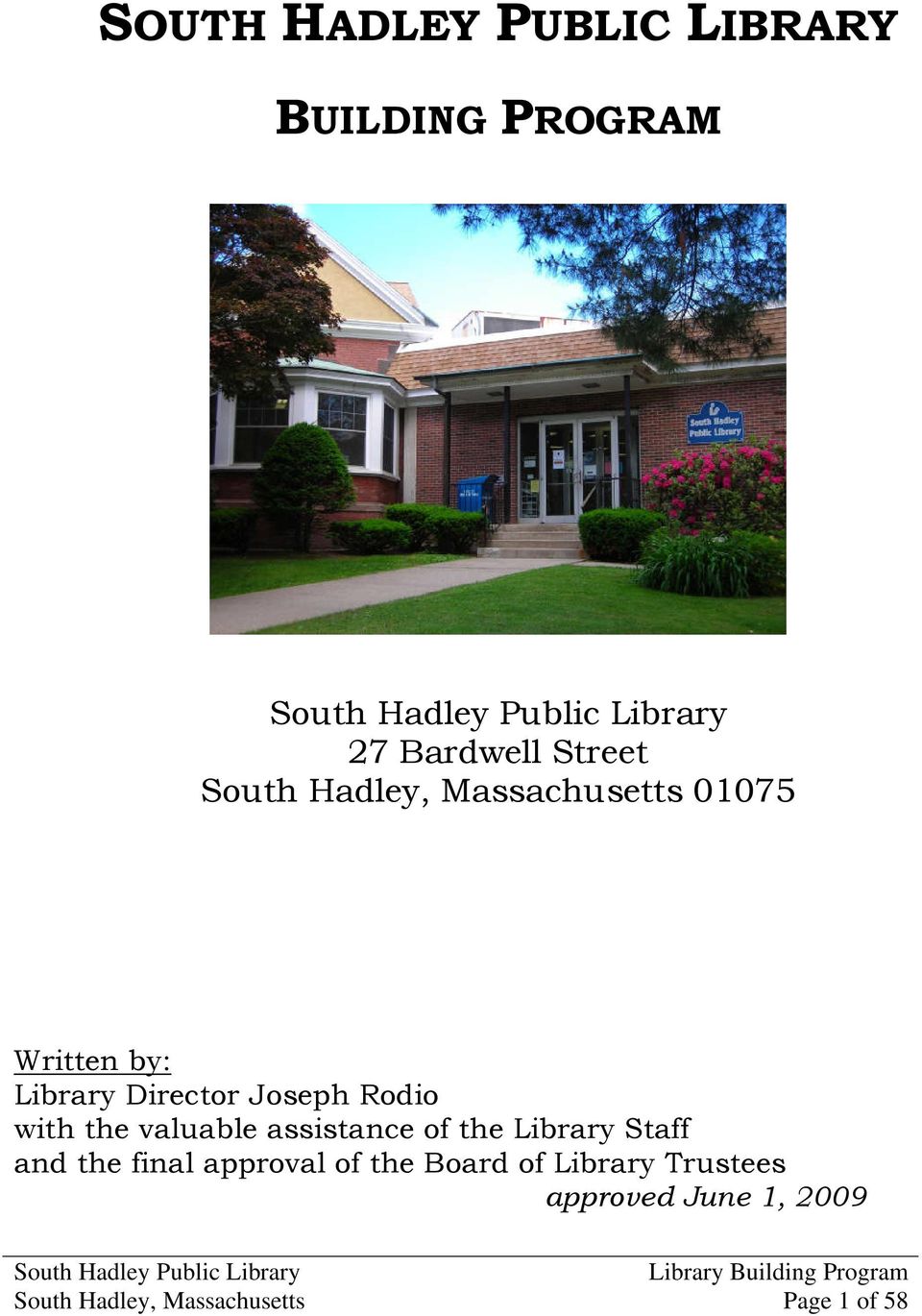
1 SOUTH HADLEY PUBLIC LIBRARY BUILDING PROGRAM 27 Bardwell Street Written by: Library Director Joseph Rodio with the valuable assistance of the Library Staff and the final approval of the Board of Library Trustees approved June 1, 2009 Page 1 of 58
2 Table of Contents Executive Summary 4 Community Description & Demographics 6 Library History 7 Mission Statement 7 Assessment of Current Building 8 Collection Analysis 14 Vision for A New Facility 17 Collection Projection 19 Public Seating Allotment 20 Functional Area Descriptions Summary 22 Functional Areas Entrance/Lobby 23 Circulation Desk 24 Circulation Work Area/Office 25 Technical Services 26 Inter-Library Loan Processing 27 Book Return Room 28 Browsing & New Materials 29 Non-print Media 30 Periodicals Adult 31 Reference Desk & Office 32 Reference & Research Room 33 Local History 34 Copier/Business Area 35 Technology Commons 36 Adult Non-Fiction 37 Adult Fiction 38 Quiet Study 39 Teen Area 40 Youth Technology Commons 41 Children s Common Area 42 Children s Preschool Area 43 Children s Student Area 44 Youth Desk & Work Area 45 Storytime & Crafts Room 46 Meeting Room 47 Conference Room 48 continued on next page Page 2 of 58

3 Technology Equipment Room 49 Director s Office 50 Administrative Assistant 51 Staff Room 52 Library Storage 53 Custodian Work Area 54 Restrooms 55 Parking 56 Landscaping 57 Acknowledgements & Bibliography 58 Additional Information Community Profile Strategic Plan Energy Audit of Current Library Page 3 of 58

4 Executive Summary For over a century, the has remained a vital community resource that serves to enrich and unite the community through resources that inform, entertain, and connect our residents to a world of ideas and information. In 1906, Andrew Carnegie donated $10,000 for the town to construct a public library building in the Falls section of town. The original 3,200 square foot building was expanded in 1974 with a single-level addition of 5,100 square feet. Because of financial constraints at the time, the original design of this addition was curtailed to meet the projected 10-year needs of the town. Thirty-five years later the current facility does not allow for the necessary growth of services and materials required to meet community needs: The building and grounds are not handicap accessible. Children, students, and teens share a cramped portion of the 1906 building. Storytime, public speakers, concerts, the historical collection, community meetings, a used book sale, voting, the staff break area, and quiet study seating share space and often clash in the Multi-Purpose Room. All adult services and materials exist in one large area, creating conflict between computer users, teens, seniors, researchers, recreational readers, and those seeking quiet space. Lack of shelf space has required many books, movies, and other materials to be discarded in order to make room for new acquisitions. Only eight dedicated parking spaces and limited on-street parking further hinder access to services; the single handicap parking space does not meet ADA requirements and is not convenient to the handicap entrance. Using the nationally recognized Wisconsin Public Library Standards, the current building fails to meet most basic service levels. The future envisioned in this Building Program will be a center of community services that reflects the diverse needs of all ages and interests. The library will build on past achievements, current strengths, and future aspirations to develop a library capable of meeting the next century of public library service. The library will use green and sustainable design solutions to build a library that has environmental, economic, and health benefits to the community. Access to technology will be available throughout the building through planned network connections, wireless routers, electrical supply, and cable channeling. Clear sightlines from public service desks will give maximum supervision and greater security of the library space with minimal staffing. Page 4 of 58

5 The building will be universally accessible so people of all physical abilities will have full and equal access to services and programs. Flexibility for future trends in library resources and technology will be figured into the design. Historical materials will be kept in a dedicated room with climate controls that meet archival standards and allow for future growth and collaboration in documenting and preserving local history. The children and teen areas will be an autonomous part of the library that functions as a self-contained youth library. A library is much more than a building, much more than the sum of its parts. This building program outlines the services and the spaces needed to provide modern and progressive library service to South Hadley for at least the next twenty years. Some of the specific recommendations in the program include: Building a children s book collection that meets the critical literacy needs of early readers; the collection will grow from 10,197 to 18,000 titles. Creating a Local History room that can accommodate 2,500 materials of different formats (book, photograph, map, etc.) Increasing the overall size of the collection to 81,180 items to meet the basic level of service as set by national standards Defining separate areas where young children, teens, professionals, families, and seniors can use the library in a way that meets their specific needs Providing a true meeting room for 100 people where community groups can gather during or after library hours Effectively distributing 118 seating spaces throughout the building in comfortable and convenient areas Planning for off-street parking, outside book returns, and building entrances that maximize accessibility and convenience Realizing the potential for future community growth and designing a library of 22,074 square feet that will serve future generations. While the communities population has remained relatively stable around 17,000 over the past three decades, the information needs and resources people rely upon have changed greatly. Further details and justifications are found in the full Building Program, which uses a twenty-year planning horizon as required by the Massachusetts Public Library Construction Program. While much discussion will take place between the library s building committee and an architect to design a library that meets our specific community needs, the goal of this plan is to provide South Hadley with a public library that brings together differing ages, backgrounds, and points of view in a vibrant, comfortable, and welcoming environment. Page 5 of 58
6 Community Description & Demographics The Town of South Hadley is a medium size community located in southern Hampshire County in western Massachusetts. It is located on the east bank of the Connecticut River, adjacent to the Holyoke Dam. In 1795 the first navigable canal in the United States began operating in Falls Village. The library is located in this same part of town, now commonly referred to as South Hadley Falls or simply The Falls. The town has two distinct areas: The Falls is the area closer to the Connecticut River and harkens back to the town s industrial age of mills and industry fueled by water power; The Center is identified with Mount Holyoke College and traces its roots to the farming community and academic campus. At the Center is an independent public library, the Gaylord Memorial Library, which provides limited services on a sparse budget. The community surrounding Mount Holyoke College contributes to South Hadley s educational levels exceeding the state and national averages for higher education: based on 2000 Census South Hadley Massachusetts U.S. High School Graduate or higher 89.4 % 84.8 % 80.4 % College Graduate or higher 32.9 % 33.2 % 24.4 % While the town population has remained stable at around 17,000 over the past 30 years, the community has become more diverse. Much of the housing in the Falls consists of multi-family units and mill housing built a century ago, attracting residents who are new to the country and/or have limited income. The Center has seen more growth of newer upscale homes as family farms have become residential subdivisions. In addition to serving our own town, the library serves a large group of non-residents (mainly from Chicopee, Granby, and Holyoke) who enjoy our quality collection and service. Non-residents make up 24% of our total circulation. For the purposes of the Massachusetts Public Library Construction Program, this program reflects a twenty-year planning horizon. Page 6 of 58

7 Library History South Hadley has a long history associated with libraries, beginning in 1802 with Ye Social Library of So. Hadley. In 1897 the town established a free public library with depositories located at the Center Village and South Hadley Falls. Permanent buildings were constructed in the two villages at the turn of the 20 th -century. A private library foundation, the Gaylord Memorial Library Association, was established in 1902 to receive a bequest from William H. Gaylord. That original building still stands at the Center Village and operates as an independent public library with limited services and hours. In 1906, Andrew Carnegie donated $10,000 for the town to construct a public library building in the Falls section of town. A Colonial Revival, red brick building was designed by resident William Skinner and the firm of Putnam & Cox. The building is located on a small point of land at a five-way intersection. The original building was expanded in 1974 with a single-level addition of 5,100 square feet. Because of financial constraints, the original design of this addition was curtailed to meet the projected 10-year needs of the town. From 1968 to 1995, the and Gaylord Memorial Library operated under a unified South Hadley Library System with the Gaylord functioning as a branch library. This association was dissolved when the town could no longer fully fund the staffing and maintenance of two library facilities. The Town of South Hadley continues to support the Gaylord Memorial Library through a small appropriation approved annually at Town Meeting. The two libraries continue to cooperate with joint sponsorship of programs. As the main public library for the Town of South Hadley, the South Hadley Public Library continues to meet the needs of citizens by providing a full range of library services. Our Mission The is a vital community resource where residents become enriched, entertained, informed, and connected to ideas and information. A dedicated library staff provides current collections, services, and technology for patrons of all ages to discover support in developing lifelong skills for personal and professional improvement. The library is a unifying force in the community, bringing together differing ages, backgrounds, and points of view in a vibrant, comfortable and welcoming environment. Page 7 of 58

8 Assessment of Current Building As the main public library for the Town of South Hadley, the South Hadley Public Library continues to meet the needs of citizens by providing a full range of library services. These services, however, are limited by the physical space in the current facility. The Multi-Purpose Room and Youth Services area occupy the public areas of the original 1906 Carnegie library building. There is a basement area that was once used as public space. However it is not handicap accessible and suffers from the musty smells, seasonal leakage, and other problems inherent in a 100-year old basement. The remaining service areas occupy the single-level 1974 addition. The 1974 addition added one large room with three office spaces to the original building. All public services for adults occupy this wide, open area. An assessment of the library in 2009 reveals the following needs and conditions: Multi-Purpose Room Lacking a designated meeting room, the main floor of the original building serves as a multi-purpose room for storytime, public programs, community meetings, general study space, etc. The room is also a local polling place used for all elections. The necessity of having this room available for public purposes prohibits circulating collections being housed there. However, the lack of available space means several library services overlap in this room: Because of space and security concerns, the local history collection is split between the multi-purpose room and the circulation desk. Oversize city directories and town reports are along one wall of the multi-purpose room while local history books and pamphlets are kept at the Circulation Desk. A small non-book collection is in the Library Director s office. Access is difficult for researchers and none of the areas meet archival standards for preservation. There is no private staff space for meals or break times. A small area of the multi-purpose room has been sectioned off with work carrel material but it does not prevent noise and is not secure from patrons walking in. There is no telephone service to this area and the haphazard collection of toaster oven, mini-refrigerator, and microwave offers limited options for staff meals. The creation of this space reduced the area of the room used for public services. With no separate Teen section, a small sitting area was created in the room to give young adults their own space to relax, read, and socialize. While giving them some privacy, it does not allow direct staff supervision and is not directly next to YA services, materials, or staff. With many children s programs held in this room, there is concern for how child safe it actually is. As the main floor of the original library, Page 8 of 58

9 there is access to the basement and two discontinued exits. The finish on the original wooden shelving may contain lead. It is also easy for children to wander into this area from the Youth Services area and be no longer visible to their parents. Access to this room is through the circulation area. Attendants at public programs, or voting, cause a disruption through the main area of the building. There is no separate access for use of the room after library hours. Youth Services The Youth Services area occupies the former children s room of the original library. There has been limited expansion of children s space since the original 1906 design and there is no designated storytime, craft, or activity space. The Youth Services Librarian does not have a private office. Her desk is located in the open book stacks of the collection and offers no security or privacy. The 2008 Summer Reading Program attracted 374 local children and teens. This annual library program stimulates interest in reading and strengthens literacy skills among students. Many programs in the multipurpose room are full to overflowing. The growth of the print collection has been severely limited by the amount of available space. Constant weeding is necessary to accommodate new titles and as new formats (e.g. graphic novels, audiobooks) grow in popularity; space must be taken from the existing collection. Seating is limited to two small tables. These are located in the walkway to the multi-purpose room and do not offer a quiet or comfortable area for study or reading. From young adult titles to picture books, the collection is so cramped and compressed that it is difficult for browsing. The close proximity of the materials often allows younger patrons to locate materials that are not always age appropriate. With almost all wall space covered with shelving, there is limited space for displays, public relations, and informational presentations. Youth craft and storytime materials are kept in the multi-purpose room. While locked cabinets give some security, this further takes space away from the area and lessens the ambiance of the Carnegie building. There is no room in the Youth Services area for a movie collection. Parents must visit the A/V area in the adult area of the building to view children s and family titles. Page 9 of 58
10 Circulation The Circulation Desk is the hub of the library, located near both main entrances. Standard checkout/check in procedures are done here, as are new library card registrations and periodical check-ins. In addition to the services offered, this area serves as the work/office space for the Circulation Supervisor, two Library Assistants, and library volunteers. The entire Circulation area is open to the public, separated only by counter space. This does not allow privacy or quiet for conversations. Staff work in an open fish bowl environment. What happens in the staff area is heard throughout the library and vice versa. The counter height is not ADA accessible, making it difficult for wheelchair users to reach. The built-in cabinets and shelves were designed for a paper-based circulation system and do not translate well for modern technology needs and storage. While offering good visual supervision of the main part of the building, the Youth area and multi-purpose room are well hidden behind it and up a ramp. Reference The Reference collection is located at the center of the main part of the library. This makes it easily accessible to the public but does not allow quiet space for study or research. There is no private work area for the Reference Librarian, his desk is located in the open stacks of the area and offers no security or privacy. There is also no dedicated work space to process Inter-library Loan deliveries, store book carts, meet privately with patrons, etc. Because of space issues the reference collection is behind the librarian s desk, making visual supervision of the area impossible. The Reference area has very limited seating, with much of the library s public seating being multi-purpose. Patrons wanting a quiet area can try their luck in the busy multi-purpose room or use other seating areas where casual readers, teens, and computer users congregate. There is no group study space in the building. Small groups may use the multi-purpose room, but their needs will always compete with the many other users of that area (teens, local history, staff, etc.) There are no reference computers. Patrons needing to conduct online research need to wait for a public computer to become available and then will work in an environment that can be noisy and congested. Page 10 of 58

11 Computers/Technology The library offers fourteen public Internet computers, one word-processing station, four public access catalogs, and a children s games computer. The library averages 251 public computer sessions per week for the Internet, more than 13,000 per year. The library also offers a wireless network for patrons who bring in their own laptops. Staff computers are located in their respective areas. The adult computer area is located directly across from the Circulation Desk and between the Reference collection and large print books. This close proximity can cause the perfect storm with younger computer users, families checking out materials, reference users, seniors looking for large print, and other patrons vying for basically the same area of the building. The rapid advancement of technology meant the library had to find ways to accommodate public computers. Network cables are fed through ceiling panels, electrical columns interrupt floor space, and extension cords are bundled as out of the way as possible. The open concept of the main area of the library does not allow a separate computer training area that can be used for in-house workshops and bibliographic instruction. The library runs two networks, with C/WMARS and cable broadband service coming into the building. All network equipment is housed in the custodian s closet, with wires and cables being bundled as best they can. Care has to be taken not to unplug a connection when removing the stepladder or other equipment from the closet. The proximity of this closet to the recycling storage area makes it difficult to keep the area clean. Technical Services The Technical Services workspace is occupied by two full-time staff who handle acquisitions, processing, withdrawals, repairs, and related duties. The area has built-in cabinets and a sink reminiscent of a 1970s-era kitchen. The large work table needed for processing tasks does not allow room for full-size desks for the two library staff. Each works at a compact computer workstation with no horizontal workspace. An exterior door serves as the library s delivery entrance, with packages being delivered and left in this area until they can be opened and moved to their proper location. Boxes left on the floor effectively block the only handicap-accessible entrance to the building. The delivery entrance also brings the delivery of ILL bins from the Western Massachusetts Regional Library System. Up to seven large bins arrive and depart each day, taking up one full wall of counter space. From 2007 to 2009, ILL activity grew by 64%, with additional growth Page 11 of 58

12 projected in the coming years as technology makes it easier for patrons to manage their own requests. Because the exterior door is the only entrance that does not require steps, it serves as the library s handicap entrance. A doorbell is rung and staff need to assist patrons in navigating the congested Technical Services area to access the public area of the building. All of the available cabinets and shelves are being used for processing supplies, books in need of repairs, materials in process, etc. Because there is no private area for staff breaks, people often use the worktable as an area to drink coffee and eat their meals. While this is the quietest space available to staff, it can interfere with the work of the Technical Services staff. Administration Two private offices are for the Administrative Assistant and Library Director. These offices are connected by interior doors to the Technical Services Area and also have doors that open to the public area of the building. With very little storage space for supplies, the Administrative Assistant s area is cramped with office supplies, a water cooler, the fax machine, computer toner, and copy paper. The Library Director s office also overflows with equipment that has no better place to be. In addition to the historical materials mentioned earlier, the office includes printer cables, network equipment, and other items too sensitive to be left in the musty basement. Storage/Facility/Parking Issues A small utility closet serves as the headquarters for the library s custodial and maintenance services, along with the library s computer network routers. This area is not handicap accessible and does not give adequate room for equipment and supplies. There is an exterior door from this area. The vacuum cleaner must be kept in the hallway because there is no space to store it in the custodial closet. Lack of space means some supplies must be kept in the basement where they quickly acquire a musty smell and can become moldy with longterm storage. The storage of supplies in the corridor to the closet poses a potential fire hazard as it blocks access to the exterior door. The public restrooms are not ADA compliant and the women s room door is located beyond the library s security gate, giving the impression one is leaving the building to get to the restroom. The library has eight dedicated parking spaces, including one handicap space. This is only slightly more than a third of the standard established by the MBLC public library construction program. These spaces are full Page 12 of 58
13 the entire day, with most patrons seeking on-street parking around the library. This can cause extended walks for seniors, and has caused patrons to simply circle the building and leave because of no available convenient parking. The Town of South Hadley s snow parking ban limits on-street parking on one of the adjacent side streets. The whole is greater than the sum of its parts The issues raised in each area of the building contribute to issues that affect the entire flow of the library. The close proximity of Reference, Computers, Circulation, Large Print, as well as the adult print and A/V materials causes congestion in the building and does not allow easy browsing of the collection. The open concept of the 1974 addition causes noise to travel between service areas and staff work zones. Noise complaints are heard on different levels: the public is bothered by the noise at the busy Circulation desk, while the staff find it hard to work at the Circulation or Reference desks situated in the middle of the public area. According to the MPLCP Guidelines for Seating (605 CMR 6.08(2)(b), the current library offers less than a third of the standard for number of seats for a community of over 15,000. Universal access is a major concern, as the lone handicap parking spot still requires some travel to the Technical Services door. On average, the aisles between book stacks falls slightly below 30, well below the ADA Accessibility Guidelines for Buildings and Facilities recommended clearance of 42. The cramped space of the library shelves is also a barrier to patrons with walkers, parents with strollers, or simply two people wanting to be in the same area at once. The design of the library addition was state of the art in 1974 but falls far short of meeting current programs and services. With the library working to engage the community and encourage participation in public programs, there are severe limitations to the space that can be devoted to regular programs, clubs, or other group meetings. The library s Strategic Plan has several stated goals that may be hindered by an antiquated facility, such as: The library will provide state-of-the-art technology to meet the information and personal needs of the community. Patrons will enjoy a library collection that is current, relevant, and meets their personal needs and interests. Patrons will enjoy the library as a destination for recreational programs. Page 13 of 58

14 Collection Analysis The focus of the collection has long been a popular materials library. In the 35 years since the library addition, new and popular formats have become staples of modern library service. South Hadley has earned a reputation as a local leader in providing popular titles in media formats. Our collection of audiobooks is used heavily by residents and those of surrounding communities, with new PlayAway digital book players added in the past year. These materials, along with a dwindling number of VHS tapes and growing collection of DVDs, have used the last available space in the library for collection expansion and additional shelving. There is no open floor space; there is no exposed wall space. According to the library s Materials Selection Policy, staff knowledge of community needs and interests and their professional training shall serve as the main criteria in appraising the collection for purchasing, replacing, or weeding. In recent years, available space has become an unfortunate additional factor. Because the shelves are at capacity, the library needs to approach weeding as one book in, one book out. With the growth in popularity of A/V media materials in the last decade, the amount of space dedicated to the print collection was reduced. The size of the book collection decreased more than 20% in the last decade. Many of these books were weeded to make room for new media acquisitions and not because they failed to meet a community need. In FY07 the Library Director curtailed several standing order programs for audiobooks and large print books. Again, this was not because of unpopularity but a simple lack of space to handle regular, large amounts of new acquisitions. Standing orders are reviewed on an annual basis in light of changing patron needs and limited shelf space for additional growth. Even at full capacity, the current library facility is not able to meet the basic needs of the community. Using the Wisconsin Public Library Standards as a tool, the library falls below most Basic Level Service Targets for a community with a population of 17,034: (see next page for chart) Page 14 of 58

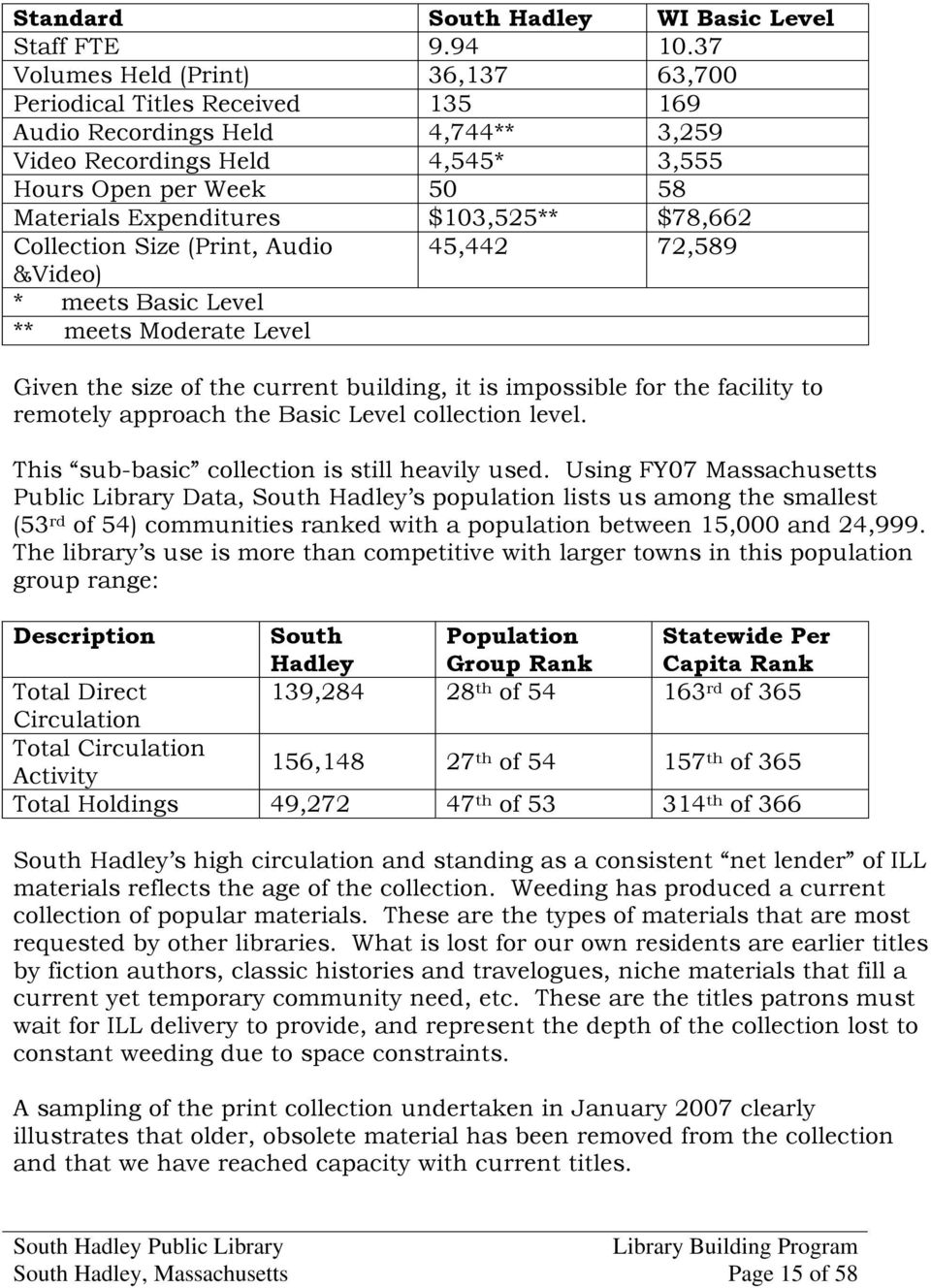
15 Standard South Hadley WI Basic Level Staff FTE Volumes Held (Print) 36,137 63,700 Periodical Titles Received Audio Recordings Held 4,744** 3,259 Video Recordings Held 4,545* 3,555 Hours Open per Week Materials Expenditures $103,525** $78,662 Collection Size (Print, Audio 45,442 72,589 &Video) * meets Basic Level ** meets Moderate Level Given the size of the current building, it is impossible for the facility to remotely approach the Basic Level collection level. This sub-basic collection is still heavily used. Using FY07 Massachusetts Public Library Data, South Hadley s population lists us among the smallest (53 rd of 54) communities ranked with a population between 15,000 and 24,999. The library s use is more than competitive with larger towns in this population group range: Description South Hadley Population Group Rank Statewide Per Capita Rank Total Direct 139, th of rd of 365 Circulation Total Circulation Activity 156, th of th of 365 Total Holdings 49, th of th of 366 South Hadley s high circulation and standing as a consistent net lender of ILL materials reflects the age of the collection. Weeding has produced a current collection of popular materials. These are the types of materials that are most requested by other libraries. What is lost for our own residents are earlier titles by fiction authors, classic histories and travelogues, niche materials that fill a current yet temporary community need, etc. These are the titles patrons must wait for ILL delivery to provide, and represent the depth of the collection lost to constant weeding due to space constraints. A sampling of the print collection undertaken in January 2007 clearly illustrates that older, obsolete material has been removed from the collection and that we have reached capacity with current titles. Page 15 of 58
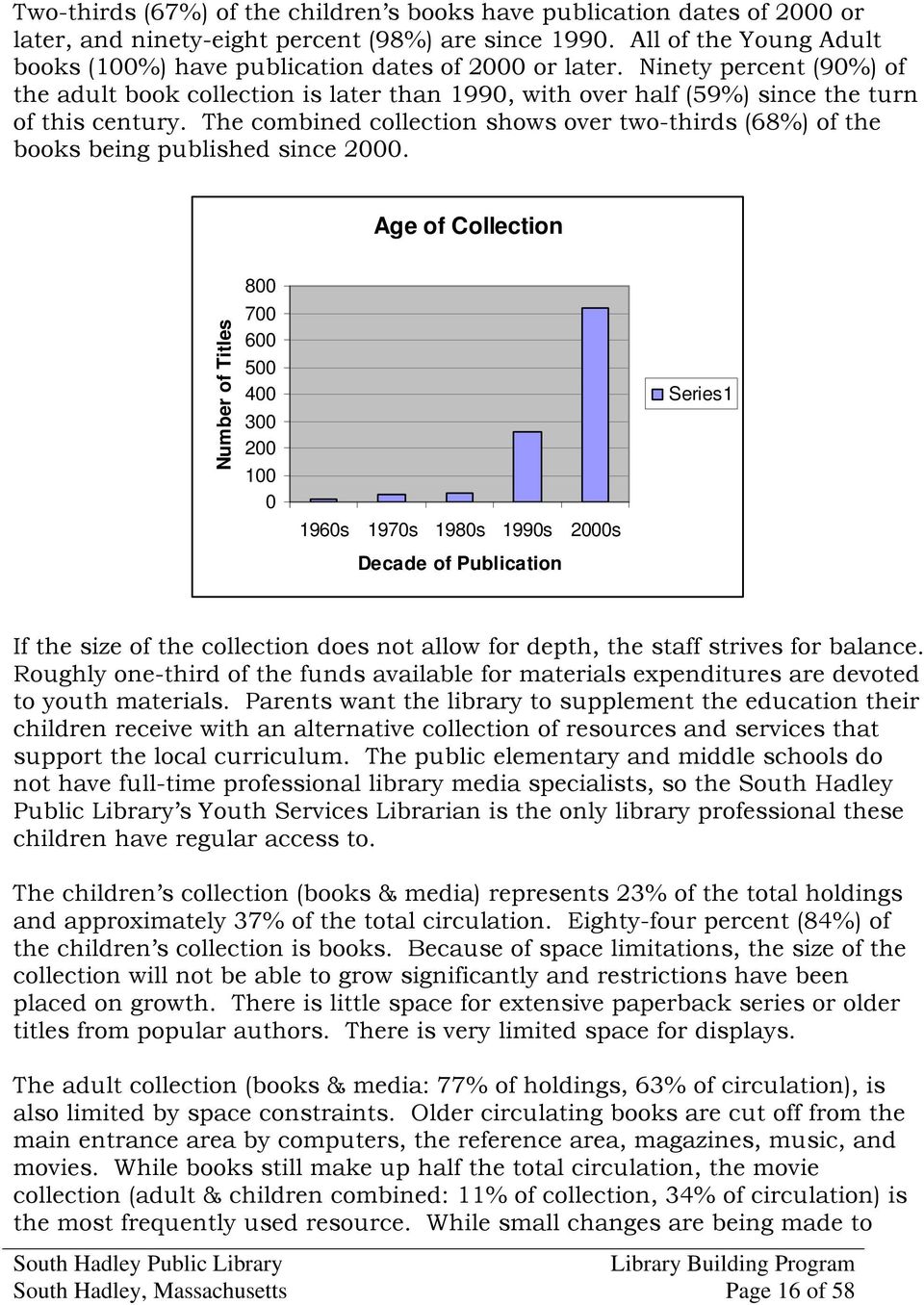
16 Two-thirds (67%) of the children s books have publication dates of 2000 or later, and ninety-eight percent (98%) are since All of the Young Adult books (100%) have publication dates of 2000 or later. Ninety percent (90%) of the adult book collection is later than 1990, with over half (59%) since the turn of this century. The combined collection shows over two-thirds (68%) of the books being published since Age of Collection Number of Titles s 1970s 1980s 1990s 2000s Decade of Publication Series1 If the size of the collection does not allow for depth, the staff strives for balance. Roughly one-third of the funds available for materials expenditures are devoted to youth materials. Parents want the library to supplement the education their children receive with an alternative collection of resources and services that support the local curriculum. The public elementary and middle schools do not have full-time professional library media specialists, so the South Hadley Public Library s Youth Services Librarian is the only library professional these children have regular access to. The children s collection (books & media) represents 23% of the total holdings and approximately 37% of the total circulation. Eighty-four percent (84%) of the children s collection is books. Because of space limitations, the size of the collection will not be able to grow significantly and restrictions have been placed on growth. There is little space for extensive paperback series or older titles from popular authors. There is very limited space for displays. The adult collection (books & media: 77% of holdings, 63% of circulation), is also limited by space constraints. Older circulating books are cut off from the main entrance area by computers, the reference area, magazines, music, and movies. While books still make up half the total circulation, the movie collection (adult & children combined: 11% of collection, 34% of circulation) is the most frequently used resource. While small changes are being made to Page 16 of 58
17 better integrate all of the collection, print and A/V, the building does not have the space to make things flow properly to allow a pleasant browsing experience. The library offers 20 public computers for purposes such as public Internet access, word-processing, the online catalog, and children s games. While this meets the Wisconsin Public Library Standards for recommended number of terminals, it fails the standard of being a sufficient number of workstations to accommodate patrons with minimal wait times for access. The library has a policy of allowing up to one hour of Internet access on a first come/first served basis. If no one is waiting, patrons can get up to two hours (four fifteen-minute extensions). The Library reserves the right to limit Internet access at certain peak usage periods (e.g., after-school, vacations, summer months), or grant additional time, in order to provide fair and equal access to all. Indeed, the library regularly limits computer time during those peak periods when a waiting list forms for the public computers. Vision for a New Building In addition to the Functional Area Sheets, there are several general concepts we envision and endorse for a future : The library will use green and sustainable design solutions, recognizing that a green building has environmental, economic, and health benefits to the community. Any future library design should result in a facility that meets the criteria for LEED certification (Leadership in Energy and Environmental Design) as developed by the United States Green Building Council. In embracing the latest advancements in technology and public service, the building will look and feel like a traditional library, with woodwork and natural light throughout all spaces. Wayfinding is the way that people orient themselves and navigate within a physical space. The building layout, graphics and signage will allow the patron experience within the building to be essentially self-service in finding areas, services, and materials. Most functional areas address specific technology needs, but access to technology should be available throughout the building through planned network connections, wireless routers, electrical supply, and cable channeling. The design should include clear sightlines from public service desks that give maximum supervision of the library space with minimal staffing. The building will be universally accessible, as defined by the Massachusetts Architectural Access Board and Americans with Disabilities Act. All services and amenities will be equally accessible to all patrons of varying abilities. The overall design should retain a reasonable amount of flexibility that allows adaptation for future trends in library resources and technology. Page 17 of 58

18 The HVAC system will allow for flexible zoning and climate control. Historical materials will be kept in a room with climate controls that meet archival standards. A programmable thermostat will regulate temperatures for each day and time, but allow staff to override settings for individual areas of the building. Security should be addressed concerning (1) the safety of staff and ability to seek assistance in an emergency, (2) the safety of patrons, especially young children, and (3) the security of the collection to protect it from theft. From young children to seniors, patrons of all ages will all be able to find an area of the library that provides a welcoming environment suited to their individual needs. The children and teen areas will be an autonomous part of the library that functions as a self-contained youth library. Staff office areas will include natural light and windows that allow for fresh air. Maintained lighting intensity will be measured at: Public service desks 50 foot candles measured horizontally at the counter top Staff areas 50 foot candles Conference Room foot candles with dimmers Meeting room 40 foot candles average with zoned lighting on dimmers Reading areas foot candles Lighting Standards from Lushington, Libraries Designed for Users The building exterior should include illuminated signage, low maintenance and durable finishes, universally accessible grounds and walkways, and look like a library. Page 18 of 58

19 Collection Projection Area Current Future Notes Teen Child JJ Child J Periodical Subs Adult 130, Teen 20, Youth 30 Movies Adult 4000, Youth 3000 AudioCassette AudioBooks Adult 2000, Youth 1300 Software Adult 500, Youth 500 Music Adult 3000, Youth 1000 Large Print Adult Ref Adult NF Adult Fiction Local History Total 46,458 81,180 The collection service targets listed below are based on quantitative standards included in the Wisconsin Public Library Standards. Reported for each standard is the effort required to achieve basic, moderate, enhanced, or excellent levels of service in a library with a service population of 18,606 people: Basic Moderate Enhanced Excellent Level Level Level Level Volumes Held (Print) 53,957 63,260 74,424 93,030 Periodical Titles Received Audio Recordings Held 2,419 2,977 4,279 5,954 Video Recordings Held 3,349 4,093 5,210 6,512 Hours Open per Week Materials Expenditures $66,982 $83,727 $93,960 $115,543 Collection Size (Print, Audio & Video) 61,400 70,703 83, ,333 Under these standards, the projected future collection would meet a moderate-enhanced level of services for South Hadley s projected 20-year growth in population. Page 19 of 58

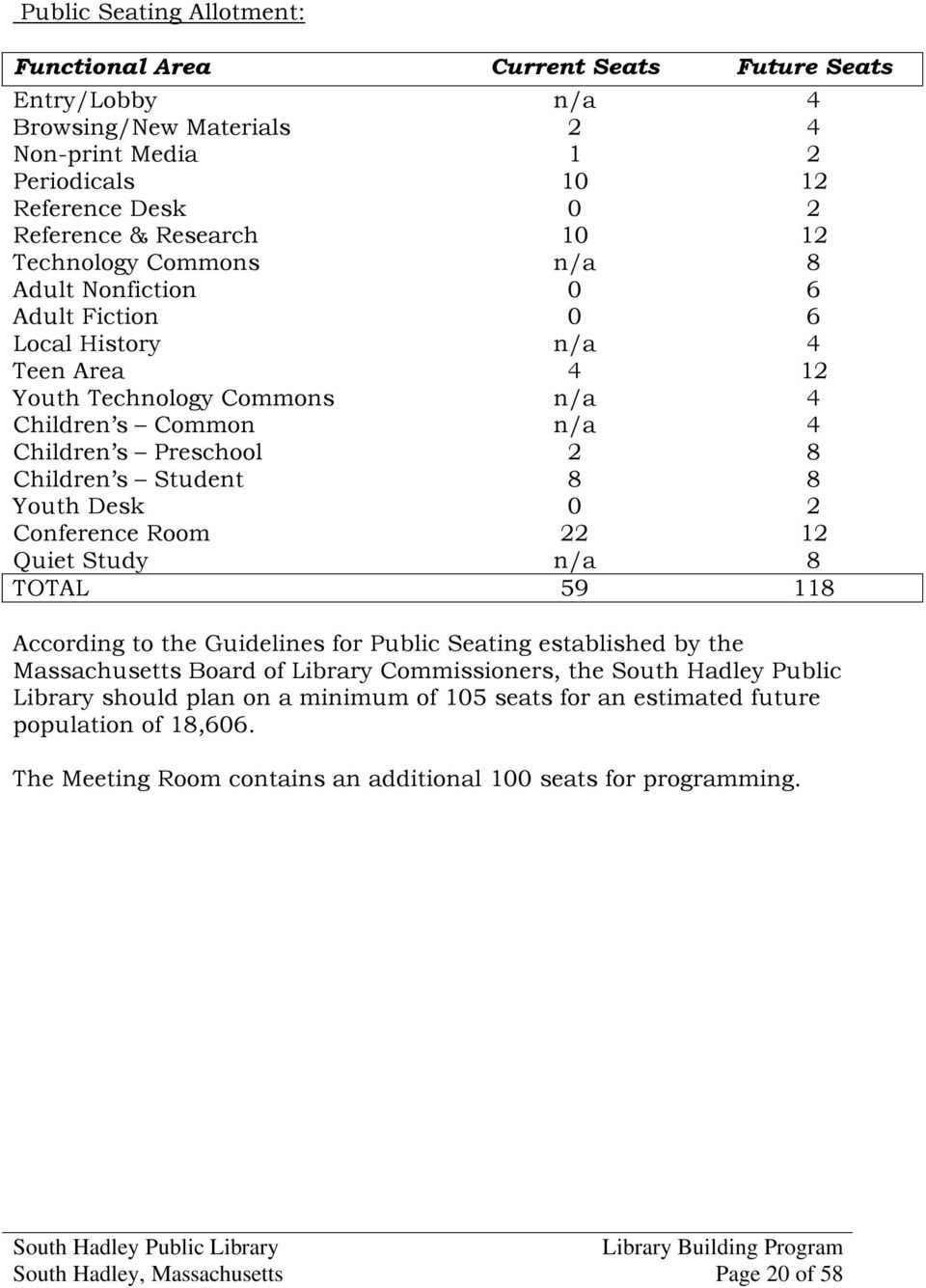
20 Public Seating Allotment: Functional Area Current Seats Future Seats Entry/Lobby 4 Browsing/New Materials 2 4 Non-print Media 1 2 Periodicals Reference Desk 0 2 Reference & Research Technology Commons 8 Adult Nonfiction 0 6 Adult Fiction 0 6 Local History 4 Teen Area 4 12 Youth Technology Commons 4 Children s Common 4 Children s Preschool 2 8 Children s Student 8 8 Youth Desk 0 2 Conference Room Quiet Study 8 TOTAL According to the Guidelines for Public Seating established by the Massachusetts Board of Library Commissioners, the South Hadley Public Library should plan on a minimum of 105 seats for an estimated future population of 18,606. The Meeting Room contains an additional 100 seats for programming. Page 20 of 58
21 Functional Area Descriptions Each service area of the building has been identified for its own unique space needs. Functional areas may be combined into common areas or exist as their own distinct space to best meet and maximize library services. Page 21 of 58
22 Functional Area Space, Computer & Seating Summary Service Area Sq Ft Materials Staff Computers Public Computers Public Seats Entrance/Lobby Circulation Desk Circulation Work Area Technical Services Inter-Library Loan Book Return Room 80 Browsing/New Materials Non-Print Media Periodicals-Adult Reference Desk Reference/Research Room Local History Copier/Business Area 80 Technology Commons Adult Non-Fiction Adult Fiction Quiet Study Rooms Adult Totals Teen Area Youth Technology Children's-Common Children's-Preschool Children's-Students Youth Desk Youth Totals Story-time/Crafts 600 *30 Meeting Room 1275 *100 Conference Room Meeting Space Technology Room 175 Director's Office Administrative Assistant Staff Room 300 Library Storage 400 Custodian Area 150 Administration Subtotals * program seats 30% Net Factor 5094 Estimated Grand Total Page 22 of 58
23 Entrance & Lobby 225 sq. ft. Main entry/exit point to the building; place where people can informally congregate 12 people 4 seats wall-mounted bulletin boards for public notices; built-in display case for arts and crafts; display rack for brochures; two 2- seat benches Security gates for system; automatic door for universal access Visual supervision from Circulation Desk Close to Circulation Desk from which most services extend; away from Reference, Local History, or other quiet areas Acoustic controls for noise; versatile materials for heavy use; floor mats at entryway to collect dirt/rain from foot traffic; lots of natural light flowing in from entryway; sensor activated airlock doors for accessibility and climate control; should have clear sightline to public transportation stop Page 23 of 58
24 Circulation Desk 375 sq. ft. The major service point and hub of the library; check in/out materials; register new patrons; answer questions 3 staff with room for 12 patrons around general work area Circulation desk for public service; 3 adjustable stools with backs for sitting at counter height; 4 book trucks 3 computer workstations at desk for use in public transactions; networked printer; wireless telephone; network connections; self-checkout workstation 50 professional titles and manuals 66 steel shelving for 600 on hold items located close to checkout area; storage for library supplies; parking area for book trucks Visual lines to most public walkways; in clear sight of main entrance Adjacent to Circulation Work Area/Office; Close to main entrance; Away from Reference and Local History Desk should be of multiple heights to handle standing/wheelchair or adult/children transactions; knee space under counter for wheelchair access; design should accommodate space and wiring for future self check-out technology; desk should have slot for returns into portable bin; floor covering behind desk designed for ergonomics; floor covering in front of desk to minimize noise; built in display fixtures will allow efficient arrangement of brochures, fliers, bookmarks, etc. Page 24 of 58
25 Circulation Work Area/Office 450 sq. ft. Work space for circulation staff to process materials and registrations; work on special projects; access computer resources 3 Staff 1 workstation for Circulation Coordinator; 2 staff workstations with room for 4 book trucks; large flat work surface 3 computers with networked printer; 2 telephones; network connections Shelving for 100 in process items; storage for circulation and office supplies; closet for personal affects Clear sight of Circulation Desk An extension of workflow from Circulation Desk An enclosed area that gives both privacy from and supervision of public circulation area; security mirror or monitor for viewing activity at circulation desk; carpeted floor Page 25 of 58
26 Technical Services 250 sq. ft. New materials are received, processed, and made shelf-ready for the library collection 1 staff 1 computer workstations; large worktable and counter space; closet for personal effects and supplies; wall shelving for frequently used supplies; 4 book trucks 1 computer workstation with networked printer; telephone 25 professional titles, 200 in process titles ample wall shelving for supplies and book processing materials; designated parking area for book trucks Adjacent to Circulation work area An open workspace where staff can coordinate new acquisitions and discards for processing Page 26 of 58
27 Inter-Library Loan Processing 150 sq. ft. Incoming & outgoing inter-library loan materials are processed for delivery 1 staff 4 book trucks; 10 large storage bins for delivery 1 computer workstation for processing materials Large countertop or shelving for ergonomic storage of delivery bins; space underneath counter for storage of empty bins Convenient to delivery entrance; close to Circulation work area Space and flooring should be ergonomically designed to maximize efficiency and comfort in the handling of a large volume of delivery bins and library materials Page 27 of 58
28 Book Return Room 80 sq. ft. For public convenience: two return slots in exterior wall (one for print, one for media) lead to fireproof room where cushioned return bins are located; patrons walk up to these return slots to deposit library materials 2 mobile cushioned return bins Sprinkler or other fire suppression system; connected to HVAC for environmental control; overhead light Return bins should have a capacity of 100 items each; small shelf; paper towel rack for handling wet materials Close to Circulation Work Area Fireproof construction; vandal-proof exterior return slots; locking steel doors; position of exterior slots should allow safe access for walk-up returns and convenient, nearby parking for automobile access; drive-up access for material returns Page 28 of 58
29 Browsing & New Materials 825 sq. ft. A space for people to browse new materials and displays of popular topics; comfortable lounge seating will invite people to preview books before checkout or chat with fellow patrons 12 patrons 4 seats Four lounge chairs; kiosk display fixtures for popular topics; small side table; discreet coat hooks 2 online catalog stations; flat panel TV for library presentation or popular programs 2000 mixed media materials (print & A/V) highlighting new additions to collection 66 Bookstore-style tilted shelving with end panel displays; shelving design should be adjustable to handle different configurations for multiple media formats Within view of Lobby; visual supervision from Circulation desk Close to Circulation; away from quiet areas such as Reference and Local History A comfortable and welcoming space, suitable for a quick visit or extended stay; people should be able to talk in normal voices without disturbing other library users; clear signage for both the entire area and specific media formats; direct lighting on materials to highlight selections and draw attention, indirect lighting for reading and browsing Page 29 of 58
30 Non-Print Media 835 sq. ft. Area for collection of non-print media such as movies, audiobooks, music, and circulating hardware/software 10 patrons 2 seats Flexible shelving to accommodate different shapes and styles of cases; lots of face out displays for cover art; two lounge chairs 2 media viewing stations for patrons to preview materials 16,300 items (7000 Movies, 4000 Music, 4300 Audiobooks, 1000 Software) 66 high, 36 wide, 10 depth steel shelving with 42 aisle widths between Circulation Desk Close to Browsing & New Materials A popular media area that should reflect new and future trends in non-print library materials; flexibility to handle new formats; direct lighting on materials to highlight selections and draw attention, indirect lighting for reading and browsing Page 30 of 58
31 Periodical Collection - Adult 450 sq. ft. Quiet area for magazine and newspaper browsing and reading 10 patrons 12 seats 2 four seat tables; 4 lounge chairs; discreet coat hooks Network connections and outlets to handle personal laptop computer use 66 high, 36 wide, 12 depth steel shelving with 42 aisle widths between for 130 periodical titles with one year of back issue storage; sloping display for current issue with storage underneath for back issues From Reference or Circulation area Close to Reference or Circulation; away from Youth areas A well lit area for patrons to spend a few minutes or a few hours looking at periodicals; area is also used by patrons wanting a quiet space to read or use laptop computers; direct lighting on materials to highlight selections and draw attention, indirect lighting for reading and browsing Page 31 of 58
32 Reference Desk & Office 350 sq. ft. Place for patrons to ask questions to Reference staff; work area for Reference staff and office space 4 public around desk; 2 staff 2 chairs that can be pulled up to desk or set aside as general seating Reference Desk for public service; wide counter space behind desk for computer and general office work; private office space with two desks and work areas 1 computer workstation at Reference Desk; 1 computer workstation in office area; networked printer; wireless telephone 100 ready reference materials Shelving for Ready Reference collection of 100 items; closet for personal effects; three drawer lateral file; Visual supervision of Reference Room Close to Reference Room; near Local History room Office area should have windows so that staff can supervise Reference Room from both the desk and office space; desk should be of multiple heights to handle standing/wheelchair or adult/children transactions; knee space under counter for wheelchair access; floor covering behind desk designed for ergonomics; floor covering in front of desk to minimize noise Page 32 of 58
33 Reference & Research Room 900 sq. ft. Reference collection of non-circulating materials; area for people to conduct research, do homework, and study in a quiet and controlled environment 20 patrons 12 seats 3 four person tables; 1 three drawer lateral file; atlas stand; dictionary stand; map case; workstation for visually handicapped; community information display area; double sided book truck; discreet coat hooks 2 online catalog stations; 1 workstation for visually handicapped; 4 general computer workstations connected to library network; networked printer; network connections and outlets for personal laptop use; coin operated photocopier 1,200 books 66 high, 36 wide, 10 depth steel shelving with 42 aisle widths between Visual supervision from Reference Desk Close to Reference Desk; Near Local History; away from Youth areas; away from New Materials Classic features give this area a more traditional feel; acoustic controls for noise; community information display area should be flexible to handle changing needs (tax forms, public information, etc.); direct lighting on materials to highlight selections and draw attention, indirect lighting for reading and browsing Page 33 of 58
34 Local History Room 500 sq. ft. Securable reference room for local history and genealogy research 4 patrons, 1 staff 4 seats large four-seat table and chairs; map case; 4-drawer lateral file; microfilm reader/printer; computer workstation Computer workstation with network connections; wireless access to network 2,500 books 66 high, 36 wide, 10 depth steel shelving with lockable, ventilated grill door coverings Supervision from Reference Work Area Close to Reference; away from noisy areas A quiet room for research; lockable doors for security; archival temperate controls on separate thermostat; archival filters on lighting to minimize degradation of materials; interior windows give supervision of room when doors are closed Page 34 of 58
35 Copier & Personal Business Area 80 sq. ft. A public and small business area where patrons can make copies, scan materials, send faxes, staple, collate, and perform small office jobs 2 patrons Flat counter space for organizing materials Commercial photocopier/fax/scanner connected to telecommunications network Cubbies or shelves for work items such as stapler, 3-hole punch, etc.; lockable cabinets for storing paper, toner, and supplies From Circulation or Reference Close to Circulation or Reference; away from Youth areas A quick stop area for small or homebased businesses and patron to conduct small scale business operations Page 35 of 58
36 Technology Commons Adult 840 sq. ft. An information garden where patrons can make use of library computers and technology, or bring their own personal devices; a place for computer training sessions 20 patrons 8 Seats (4 for waiting, 1 table for offline tasks) Media projector and screen for presentations; bulletin board for announcements and fliers; counter for collating materials; coat hooks; 4 lounge chairs for people waiting for computers; 1 four-seat table 16 personal computer workstations; networked printers (color/b&w); network connections and obvious electrical outlets Locking closet for media supplies, printer paper, etc. Visual supervision from Reference Desk Close to Reference Area; near Small Business area; Away from Youth areas A collaborative work area where people can gather to use the latest technology; flexible furnishings to handle emerging media and technology; lighting designed to reduce glare on monitor screens Page 36 of 58
37 Adult Non-Fiction 875 sq. ft. Browsing area for circulating books with occasional seating for reading 12 patrons; 1 staff 6 seats 6 lounge chairs; slat wall end panels for display; book truck for unwanted items; library stools 1 Public access catalog station 15,000 books 84 high, 36 wide, 10 depth steel shelving with 36 aisle widths between Sight supervision from a public service desk Close to Reference or Circulation Direct lighting on materials to highlight selections and draw attention, indirect lighting for reading and browsing; convenient for a quick pick or prolonged browsing; abundant signage Page 37 of 58
38 Adult Fiction 1,105 sq. ft. Browsing area for circulating books with occasional seating for reading; Large Print books 12 adults, 1 staff 6 seats 6 lounge chairs; slat wall end panels for display; book truck for unwanted items; library stools; display kiosk for topical displays 1 Public access catalog station 18,000 books 84 high, 36 wide, 10 depth steel shelving with 36 aisle widths between Sight supervision from a public service desk Close to Reference or Circulation Direct lighting on materials to highlight selections and draw attention, indirect lighting for reading and browsing; convenient for a quick pick or prolonged browsing; Signage on individual end panels for collection identification Page 38 of 58
39 Quiet Study Rooms (2) 300 sq. ft. (150 x 2) Semi-private rooms for individual or group study 8 patrons 8 seats Each room includes a four-seat table; whiteboard and supplies Network connection available Visual supervision from Reference or Circulation desk Adult service desk such as Reference or Circulation Windows on doors and/or walls for staff supervision; doors may be locked by staff (with key) to limit access patrons are not able to lock doors Page 39 of 58
40 Teen Area 900 sq. ft. Teenagers browse popular materials, relax socially, and engage in group activities such as games and homework 12 patrons, 1 staff 12 seats 4 lounge chairs; 2 diner/restaurant style booths with seating for 4 people each 6 Internet workstations with networked printer 5000 books and popular materials 66 high, 36 wide, 10 depth steel shelving with 42 aisle widths between Visual supervision from a public service desk Located in proximity to both Youth and Adult services to create bridge between collections; away from quiet areas Acoustic controls to minimize noise; a bright & contemporary area that draws in teens; semi-private with ability of staff to supervise and intervene when necessary; direct lighting on materials to highlight selections and draw attention, indirect lighting for reading and browsing; this is a hanging out area that encourages the productive use of library resources in a welcoming environment Page 40 of 58
41 Youth Technology Commons 450 sq. ft. An age appropriate area where students and teens can make use of library technology for educational and recreational interests 18 patrons 4 Seats 4 lounge chairs for people waiting for computers 6 personal computer workstations; networked printers (color/b&w); network connections and obvious electrical outlets Locking closet or cabinet for media supplies, printer paper, etc. Visual supervision from Youth Services Desk Closer to Youth Services desk, further from preschool area and storytime room Youth-friendly technology area where kids can be kids to pursue their own unique interests Page 41 of 58
42 Children s Room (Common Area) 300 sq. ft. The gateway to youth services; a common area for relaxing (child & parents), searching the catalog; displays of new and topical materials 10 patrons, 1 staff 4 seats 4 lounge chairs; display kiosk; bulletin board for family notices; display case for children s crafts 1 public access catalog workstation rotating displays of materials in a flexible arrangement; 30 periodical titles flexible shelving through display kiosks Direct supervision from Youth Work Area Close to Children s collections and Youth Work area; away from Reference, Local History, and other quiet areas A welcoming area for children and their caregivers that allows promotion of periodicals, new materials, and topical displays such as holidays; good signage directs patrons; this area can also be a supervision point for caregivers as their children use the library independently ; direct lighting on materials to highlight selections and draw attention, indirect lighting for reading and browsing; area will include family restrooms with changing tables Page 42 of 58
43 Children s Room (Preschool Area) 1600 sq. ft. Young children and parents browse, select, and read materials together; includes an activity area where kids can be kids 12 patrons, 1 staff 8 seats Manipulative games on end panels; 4 oversize lounge chairs for parent/child reading; 4 beanbag or similar child-safe chairs; display kiosk; catalog workstation; 2 book trucks; storage and display for 100 puppets; wall display case for children s creations Catalog workstation; educational games computer 9,000 books; misc. puppets 48 high, 36 wide, 12 depth steel shelving with 48 aisle widths between Direct visual supervision from Youth Services desk Adjacent to Youth Services; close to Children s Common Area; Away from Reference, Local History, and other quiet areas Direct lighting on materials to highlight selections and draw attention, indirect lighting for reading and browsing; in many ways, this area is a child s introduction to the library and should be friendly, welcoming, and both very child-friendly and child-safe. Page 43 of 58
44 Children s Room (Students Area) 1070 sq. ft. Independent readers browse and select materials for personal and educational interests; gaming computers and internet access available 12 patrons, 1 staff 8 seats 1 four-seat student table; 4 lounge chairs; display kiosk; magazine display and shelving for 30 subscriptions; book truck 9,000 books and other items 66 high, 36 wide, 10 depth steel shelving with 48 aisle widths between Direct visual supervision from Youth Services desk Adjacent to Youth Services; close to Children s Common Area; Away from Reference, Local History, and other quiet areas Layout should facilitate primary grade students being able to independently find materials within the collection Page 44 of 58
45 Youth Desk & Work Area 570 sq. ft. Reference and readers advisory services to children and their caregivers; work space for youth services staff 4 public around desk; 3 staff 2 seats 2 chairs that can be pulled up to desk or set aside as general seating; large desk for public service; wide counter space behind desk for computer and general office work; private office space with two desks and work areas; 2 storage closets for supplies; Ellison die cut machine and supplies; 1 computer workstation at Youth Desk; computer workstations in office area; networked printer 100 ready reference items Shelving for professional collection of 100 items; closet for personal effects; three drawer lateral file Visual supervision of all children s areas Close to Children s areas Office area should have windows so that staff can supervise teen and children s areas from both the desk and office space; desk should be of multiple heights to handle standing/wheelchair or adult/children transactions; knee space under counter for wheelchair access; floor covering behind desk designed for ergonomics; floor covering in front of desk to minimize noise Page 45 of 58
46 Story-time/Crafts Room 600 sq. ft. Story-time, craft programs, and related children s activities 30 patrons, 1 staff 30 floor/table seats 4 moveable eight-seat height adjustable children s craft tables; 30 floor seating pads; counter and sink for cleanup; wall pegs for coats; storage closet for tables and chairs craft supplies and materials Large (10 x10 ) storage closet for craft supplies; wall shelving and lockable cabinets at sink area Visual supervision from Youth services desk Close to Children s Preschool area and family restrooms Chairs are stackable and tables are foldable for portability and storage; floor is vinyl or other easy cleaning finish with floor drain; door can be locked to limit access when not in use Page 46 of 58
47 Meeting Room 1275 sq. ft. Space for meetings, lectures, concerts, community events, voting, art exhibits, and public programs for all ages 100 patrons; 2 staff 100 seats 100 stackable chairs; 8 folding tables; galley kitchen area with counter, sink, refrigerator and cabinet storage; podium; wall rail for hanging picture frames microphone and sound system for presentations; room darkening window coverings; dimmable lights; network connections; cable TV access; ceiling mounted retractable projection screen; multi-media projector Large (14 x14 ) lockable closet for chairs, tables and A/V equipment; coat room or wall pegs Visual supervision from public service desk Close to public restrooms; Away from youth areas Two entrances: one from library and one from outside that can be used after library hours; access between meeting room and library can be secured and locked down when library is closed; restrooms are available for use when meetings are held outside of library hours Page 47 of 58
48 Conference Room 250 sq. ft. Small group meetings; community presentations 12 patrons 12 seats Large conference table with 12 seats or flexible configuration of modular tables to same effect; coat hooks; dry erase board; mounted projection screen; room darkening window coverings; dimmable lights; wall rail for hanging picture frames Network connections; cable TV access; multi-media projector Storage closet From public service desk Close to Meeting Room; close to public restrooms Two entrances: one from library and one from outside that can be used after library hours; access between conference room and library can be secured and locked down when library is closed; restrooms are available for use when meetings are held outside of library hours Page 48 of 58
49 Technology Equipment Room 175 sq. ft. Library network center where servers, routers, alarm panels, and telecommunications equipment are housed and serviced 1 staff Rack shelving for telecommunications equipment; 3-drawer file cabinet for equipment manuals and small equipment storage; small table for laptop use Routers, servers, and related equipment needed to run library network services; telephone; network access for online troubleshooting of systems Rack shelving Close to Technology Commons and Reference Work area Separate zone on HVAC system for cooling equipment; uninterruptible power supply Page 49 of 58
50 Director s Office 200 sq. ft. Administrative area used for managing all aspects of library; meetings with up to 3 people 1 staff Desk with computer workstation; four drawer lateral file; bulletin board; coat closet; three visitor chairs Computer with networked printer, telephone 200 professional titles 2 five shelf bookcases with adjustable shelves Adjacent to Administrative Assistant; close to other staff offices; Away from youth services Soundproofing for confidential business; exterior window Page 50 of 58
51 Administrative Assistant 150 sq. ft. Administrative tasks such as payroll, accounts payable & receivable, answering the telephone, general office work 1 staff Desk, four drawer lateral file, closet for storage Computer workstation; telephone; networked printer; commercial fax/copier/scanner; bulletin board five shelf bookcase for professional materials; storage cabinet for frequently used supplies Adjacent to Library Director s office Flexible arrangement for changing work needs; exterior window; ability for space to be closed off for private/confidential business Page 51 of 58
52 Staff Room 300 sq. ft. Space for staff to take breaks, eat meals; store personal items; have privacy 6 staff 1 six-seat table; 2 lounge chairs; sink with counter; refrigerator; microwave oven; bulletin board wireless telephone cabinets for utensil storage; closet for coats; 12 storage lockers for personal belongings Away from public areas Area should include a unisex restroom for staff use; natural sunlight with windows that open for fresh air Page 52 of 58
53 Library Storage 400 sq. ft. General purpose storage of supplies, furnishings, book sale donations 1 staff wall shelving Away from public areas A room for stuff that needs to be cleared from public and work areas Page 53 of 58
54 Custodian Work Area 150 sq. ft. Small repairs; storage of cleaning supplies; routine maintenance tools and equipment 1 staff Workbench; adjustable stool; slop sink; vacuum cleaner; wet/dry vacuum; snow shovels and yard rakes; lockable supply cabinet; floor tub with handheld hose & nozzle to rinse/clean heavier buckets, etc. 2 five shelf utility shelving units for supplies; storage rack for hanging shovels, rakes, brooms, etc. Close to delivery entrance Exterior access door; floor drain; waterproof flooring and durable wall coverings; good task lighting Page 54 of 58
55 Public Rest Rooms TBD Public restrooms should be located convenient to: Main Lobby Meeting Room Children s Area (family restroom) Staff Room (unisex) All public restrooms should include changing tables; children s restroom should include child-size amenities Floor drains; low maintenance floor and wall coverings; large capacity dispensers for soap and toilet paper; touchless hand dryers and soap dispensers for efficiency and hygiene All restrooms should be within sight of a staff area see above All restrooms should offer universal access design that meets state and federal guidelines Page 55 of 58
56 Parking 57 general parking spaces 3 handicapped parking spaces Patrons should be able to find convenient off-street parking in a safe and well-lit parking lot; handicap spaces should be adjacent to building; 6 parking spaces should be designated for library staff. Main library entrance Landscaping should make parking areas an extension of library grounds; solar-powered energy efficient lights; MBLC guidelines for parking (605 CMR 6.08(5)(e)) requires projects to meet or exceed the standard of one parking space for every 400 square feet of building or show that the appropriate local board has approved an alternative parking plan. Handicapped parking shall be in addition to this requirement. Page 56 of 58
57 Landscaping A courtyard will be incorporated into the landscaping providing a venue for outdoor library programs or general recreational use Durable benches with backs where patrons can rest or read Flagpole Outdoor lighting for walkways and to illuminate building; fixtures to minimize light pollution Native and/or adaptive plants that will not require an irrigation system Plantings will complement grounds without providing hidden areas that can not be supervised Library grounds should complement the building design and encourage short stays while discouraging loitering Page 57 of 58
58 Acknowledgements & Bibliography A special thank you to the library staff: Meg Clancy, Jennifer Comeau, Lorraine Ensor, Liz Frosch-Dratfield, Jeanne Hebert, Jeff Lachowetz, Linda Manijak, Desiree Smelcer, Rena Stromgren, and Bob Williford. They reviewed this plan and offered much in the way of thoughtful insight and suggestions. The staff also visited 24 libraries across Massachusetts to investigate what works well (and sometimes doesn t) in library construction projects. We hope the lessons learned in other communities are reflected in this program. The library is grateful to Emily Bader of the Springfield City Library and Christine Bergquist of the Wilbraham Public Library who took the time to review and comment on a draft of this document. The following resources were used in developing this program: Jackson, Patience Kenney. A Workbook. Boston, Mass.: The Author, Library Administration and Management Association. Building Blocks for Planning Functional Library Space. Lanham, Md: Scarecrow, Lushington, Nolan. Libraries Designed for Kids. New York: Neal-Schuman Publishers, Lushington, Nolan. Libraries Designed for Users: A 21st Century Guide. New York: Neal-Schuman Publishers, Sannwald, William W. Checklist of Library Building Design Considerations. Chicago: American Library Association, Wisconsin. Wisconsin Public Library Standards. Madison, Wis: Wisconsin Dept. of Public Instruction, Page 58 of 58
Students were surveyed by Brailsford & Dunlavey in the fall of 2000 to determine their priorities for Commons program spaces.
 I-1 2.0 INTRODUCTION 2.1 BACKGROUND Located in the rapidly growing Inland Empire area of Southern California (Riverside and San Bernardino Counties), the University of California, Riverside is well positioned
THE LIBRARY RENOVATION PROJECT: TO BETTER SERVE OUR COMMUNITY
 THE LIBRARY RENOVATION PROJECT: TO BETTER SERVE OUR COMMUNITY A PUBLIC/PRIVATE PARTNERSHIP TO REORGANIZE AND ENHANCE THE SERVICES OF THE WILBRAHAM PUBLIC LIBRARY Wilbraham Public Library 25 Crane Park
Designing a Facility: Making It a Place Where Every Student Succeeds
 American Association of School Librarians 12th National Conference and Exhibition October 6-9, 2005 Pittsburgh, Pennsylvania Designing a Facility: Making It a Place Where Every Student Succeeds Gail Formanack
Thomas Cooper Library Self Guided Tour
 Thomas Cooper Library Self Guided Tour Welcome to the Thomas Cooper Library, the main library of the University of South Carolina. We have more than 3 million volumes and approximately 2 million microforms
ADULT PROGRAMS The library offers book discussion groups, special interest programs and a summer reading program for our adult patrons.
 A ADULT PROGRAMS The library offers book discussion groups, special interest programs and a summer reading program for our adult patrons. ARIZONA COLLECTION The library has a special collection of books
Standard Seven: Library and Other Information Resources
 Standard Seven: Library and Other Information Resources The institution demonstrates sufficient and appropriate information resources and services and instructional and information technology and utilizes
VERONA PUBLIC LIBRARY STRATEGIC PLAN 2015-2016. Strategic Planning Committee
 VERONA PUBLIC LIBRARY STRATEGIC PLAN 2015-2016 Strategic Planning Committee Elizabeth Giblin, President-Library Board of Trustees Anthony Gardner, Library Board of Trustees Carol Stafford, Library Board
BEVERLY PUBLIC LIBRARY LONG RANGE PLAN
 BEVERLY PUBLIC LIBRARY LONG RANGE PLAN FY 2013 2018 Mission Statement The Beverly Public Library provides services, programs and materials that enrich people's lives, foster a love of reading and provide
Part 2 Definitions for this Policy 2.1. ADA / TAS the Americans with Disabilities Act / Texas Accessibility Standards.
 Office of Space Management Page 1 of 6 Part 1 Purpose 1.1. This policy establishes space allocation and space use guidelines for UTSA entities occupying space in UTSA-owned and UTSA-leased facilities.
ADA HOTEL SITE INSPECTION CHECKLIST
 ADA HOTEL SITE INSPECTION CHECKLIST Name of Property: Location/City: Anticipated dates(s) for event: Public Spaces Hotel Accessibility Front lobby registration desk accessible counter? Y/N If no, what
Construction of 86 Dummer Street: Questions and Answers for Trustman Residents
 Construction of 86 Dummer Street: Questions and Answers for Trustman Residents July, 2014 Introduction The Brookline Housing Authority (BHA) realized five years ago that the Trustman parking lot is large
ORANGE UNIFIED SCHOOL DISTRICT SCHOOL FACILITIES MASTER PLAN NEEDS ASSESSMENT
 1. SAFETY, HEALTH, CODE 1.1 Structural Requirements, Seismic Stability 1.1.1 Primary Structure 1.1.2 Ceilings 1.1.3 Cabinets, Equipment 1.1.4 Portables 1.2 Fire / Life Safety 1.2.1 Corridor, Separation
MUEHL PUBLIC LIBRARY STRATEGIC PLAN 2014-2019. An addendum is attached with Service Responses. SR and numbers indicate which ones are applicable.
 MUEHL PUBLIC LIBRARY STRATEGIC PLAN 2014-2019 An addendum is attached with Service Responses. SR and numbers indicate which ones are applicable. MISSION STATEMENT (SR 4, 7, 10, 11, and 12) The Muehl Public
Planning a Nurse Station for Clinical Function
 Planning a Nurse Station for Clinical Function Most of what has been written about planning nurse stations has to do with access, traffic flow, aesthetics, and privacy for patients. That s because nurse
McConnell Library Strategic Plan April 2011
 McConnell Library Strategic Plan April 2011 The resources and services you seek in the place you want to be! 1 McConnell Library: A Brief Overview From the moment that students first attended classes at
City of Wichita, Kansas Americans with Disabilities Act Transition Plan Main Library Address
 City of Wichita, Kansas Americans with Disabilities Act Transition Plan Main Library Address July 005 Prepared by DMCG Disability Management Consulting Group L.L.C. 801 Jonquil Place Columbia, MO 650 In
Franklin Public Library Strategic Plan 2014-2019
 Franklin Public Library Strategic Plan 2014-2019 Approved January 27th, 2014 Introduction In 2013, the Library Board of Directors initiated a strategic planning process to assess community needs. From
DESIGN REVIEW CHECKLIST Chapter 6 Special Consideration Design Guidelines
 DESIGN REVIEW CHECKLIST Chapter 6 Special Consideration Design Guidelines A. Offices a. Office buildings should be built to the minimum required setback. b. Surface parking should be located towards the
ORANGE UNIFIED SCHOOL DISTRICT SCHOOL FACILITIES MASTER PLAN NEEDS ASSESSMENT
 1. SAFETY, HEALTH, CODE 1.1 Structural Requirements, Seismic Stability 1.1.1 Primary Structure 1.1.2 Ceilings 1.1.2 Water damage in many classrooms. Replace tiles. 1.1.3 Cabinets, Equipment 1.1.4 Portables
2015-2016 Design Scenario Interior Design STAR Event
 2015-2016 Design Scenario Interior Design STAR Event The Pocono s Children s Camp Developed with input by professional members of The American Society of Interior Designers (ASID) Project Overview and
Recycling Infrastructure Guidelines for UBC Buildings
 Recycling Infrastructure Guidelines for UBC Buildings Updated March 2, 2015 Contents 1. Background... 2 2. Overview of Requirements... 2 2.1. New Buildings Serviced by UBC Building Operations... 2 2.2.
Swansea University Library (LIC): an Accessible Guide
 1 Swansea University Library (LIC): an Accessible Guide When to Visit The library is open 24 hours. The Library service desk opening hours are on our website when the Library Desk is closed, there are
17,280 square feet Overview:
 CENTRAL OFFICE Located at 167 Boston Post Road, East Lyme, Connecticut, the Central Office was built in 1916 as the original Flanders Elementary School and remains connected to the current school. The
R432. Health, Health Systems Improvement, Licensing. R432-5. Nursing Facility Construction. R432-5-1. Legal Authority. R432-5-2. Purpose.
 R432. Health, Health Systems Improvement, Licensing. R432-5. Nursing Facility Construction. R432-5-1. Legal Authority. This rule is promulgated pursuant to Title 26, Chapter 21. R432-5-2. Purpose. The
Damage Charge Lists. FLOORING Replace Repair Carpet per square foot (Mohwak heat carpet tile)
 American River Courtyard Charge List Damage Charge Lists LIVING ROOM FURNITURE Replace Repair Coffee Table $164.00 Sectional sofa corner section $457.00 Sectional sofa two seat section $525.00 Sectional
MANAGING A LIBRARY S M DHAWAN
 16 MANAGING A LIBRARY S M DHAWAN MANAGING A LIBRARY Structure 16.1 Introduction 16.2 Library Objectives 16.3 How to Manage a Library 16.3.1 Step 1: Library Policies and Programs for Collection Development
OWASSO. Conference Center
 OWASSO Conference Center The primary purpose of Tulsa Tech s Owasso Conference Center is to provide students in our hospitality programs with workplace experience. We also encourage the use of the facility
Building on the Past. A Proud History Dating Back to 1864
 STRATEGIC PLAN 2012-2016 1 Introduction The Oshawa Public Libraries is committed to providing innovative and responsive library service to the people of Oshawa. We have created this strategic plan to guide
Workplace Health, Safety & Welfare
 Relevant Legislation Workplace (Health, Safety and Welfare) Regulations 1992 Construction (Design & Management) Regulations 2015 Provision & Use of Work Equipment Regulations 1998 (PUWER) Lifting Operations
REQUIREMENT 5. Light Switches, Electrical Outlets, Thermostats, and Other Environmental Controls in Accessible Locations
 Chapter Five: REQUIREMENT 5 Light Switches, Electrical Outlets, Thermostats, and Other Environmental Controls in Accessible Locations 5...covered multifamily dwellings with a building entrance on an accessible
Evanston Main Street Station TOD Plan and Study. Appendix A.1: Station Area Existing Conditions
 Evanston Main Street Station TOD Plan and Study Appendix A.1: Station Area Existing Conditions EvanstonMainStreetStation TODPlanandStudy A 1 AppendixA.1: ExistingConditions Table of Contents Station Locations
Butler Library: Self-Guided Tour
 Butler Library: Self-Guided Tour Welcome to Butler Library, Columbia s library for history and the humanities. Built in 1934, it is one of 25 libraries at Columbia. This guide will describe some of Butler
Expanding Your Market
 U.S. Department of Justice Civil Rights Division Disability Rights Section Expanding Your Market Maintaining Accessible Features in Retail Establishments Introduction More than 50 million Americans with
Library Tour Script 2014 Pages 1-3: Short Tour (15-20 minutes); Pages 4-7: Extended Tour (30 minutes) Library Tour Script Short Tour (15-20 minutes)
 Library Tour Script 2014 Pages 1-3: Short Tour (15-20 minutes); Pages 4-7: Extended Tour (30 minutes) Library Tour Script Short Tour (15-20 minutes) First Floor Welcome to Randall Library! The library
Page 1 of 6 COMPLIANCE CHECKLIST. > Long Term Care Facility - Nursing Unit
 COMPLIANCE CHECKLIST Page 1 of 6 > Long Term Care Facility - Nursing Unit The following checklist is for plan review of new long-term care facilities and new additions to existing long-term care facilities.
Community Center HANDBOOK
 Community Center HANDBOOK HANDBOOK CONTENT Page 3...Handbook Introduction Page 4...Floor Plan and Room Descriptions Page 5...Daily Access and Availability Page 6...Rules for Scheduling Page 7...Rules of
Kitchen Planning Guidelines With Access Standards
 Kitchen Planning Guidelines With s 1: Door/Entry The clear opening of a doorway should be at least 32 wide. This would require a minimum 2-10 door. The clear opening of a doorway should be at least 34.
ESSENTIAL COMPONENTS OF AN EFFICIENT RECORDS STORAGE FACILITY
 ESSENTIAL COMPONENTS OF AN EFFICIENT RECORDS STORAGE FACILITY New York State Unified Court System Division of Court Operations Office of Records Management June 2003 TABLE OF CONTENTS PURPOSE OF THIS PAMPHLET...
ADA Checklist for Polling Places
 U.S. Department of Justice Civil Rights Division Disability Rights Section Americans with Disabilities Act ADA Checklist for Polling Places February 2004 Reproduction Reproduction of this document is encouraged.
ELECTRONIC HEALTH RECORDS AND WRITING SURFACES
 ELECTRONIC HEALTH RECORDS AND WRITING SURFACES Author: Bill Zellmer AIA, CASp Issue Date: January 9, 2015 Sutter Health - Physical Access Compliance Sutter PAC Group Revisions: May 8, 2015 Barrier Interpretation
ORGANIZATIONAL CHART
 LIBRARY ORGANIZATIONAL CHART City Librarian Graphics Technician Secretary Principal Librarian Clerk Librarian II Reference Librarian II Circulation Librarian III Children's Technician Librarian I Clerk
Library Tour Script 2015
 Library Tour Script 2015 If you would like to lead a tour of Randall Library, the following script provides current information. This script was designed for First Year Seminar students. Pages 1-3: Short
Facilities Operations Customer Service Standards WORK ORDER PRIORITIES
 Facilities Operations Customer Service Standards WORK ORDER PRIORITIES In order to provide fair and consistent maintenance service to all University faculty, staff and students, a work priority system
PUBLIC RESTROOMS, DESIGN INTENT
 PUBLIC RESTROOMS, DESIGN INTENT 1.01 STRUCTURAL A. Where feasible, metal stud partitions will be constructed on a 6 high concrete curb. 1.02 MECHANICAL A. Restrooms will have a minimum of 15 air changes
4. (Visit A Comfortable Place) The library will provide safe, comfortable and welcoming places for members of the community.
 Approved May 18, 2000, Revised 1/20/05 Revised September 16, 2010 and effective September 17, 2010 Revised and effective November 19, 2015 MISSION AND GOALS Mission Statement: The mission of the Cumberland
Room Layout Guide. Updated August 2014. miami.edu/housing
 Updated miami.edu/housing TABLE OF CONTENTS 1.0 Introduction 1.1 How to Use This Document 1.2 ADA Statement 1.3 Full Table of Dimension 2.0 Community Style Rooms (Hecht, & Stanford Residential Colleges)
Access to libraries for persons with disabilities - CHECKLIST
 International Federation of Library Associations and Institutions IFLA Professional Reports, No. 89 Access to libraries for persons with disabilities - CHECKLIST By Birgitta Irvall and Gyda Skat Nielsen
Hotel Accessibility Pack
 Thank you for considering the Hilton Garden Inn, Aberdeen City Centre. We are pleased to give you some information about our hotel that you may find useful when planning your visit. Arriving at the hotel
Use of Meeting Rooms. Goodnow Library Policy Manual Policy #4-7
 Use of Meeting Rooms When not needed by the Library or the Town, the Goodnow Library Meeting Rooms are available to local groups and organizations for educational, cultural, philanthropic or civic uses.
The Fully Integrated Home
 The Fully Integrated Home Adding Safety and Convenience to the Home 2008 National Association of Home Builders International Builders Show Introduction Josh Christian Marketing VP of DSI Entertainment
Goal A: The Library will serve as a resource to assist in meeting the literacy needs of the community. (Literacy)
 2013 Goals and Objectives with Monthly Activities Goal A: The Library will serve as a resource to assist in meeting the literacy needs of the community. (Literacy) 1. Make available and market library
Walking and Working Surface Checklist:
 Walking and Working Surfaces Purpose: This information is presented to improve the level of safety in our operations, and to inform you that we will comply with the OSHA Standard 29 CFR 1910.23. Responsibility:
SECTION XI OPINION OF PROBABLE COST
 SECTION XI OPINION OF PROBABLE COST OPINION OF PROPABLE COSTS HARBOR ISLAND THE PAVILION 1) Provide a sprinkler system for the entire building. 8000 SF X $15/SF $120,000 2) Remove and replace existing
Strategic Plan for the Edgecombe Community College Library 2014-2019
 Strategic Plan for the Edgecombe Community College Library 2014-2019 RB Software & Consulting, Inc. http://www.rburgin.com April 2014 Edgecombe Community College Library 1 Table of Contents Executive Summary...
HOME OF THE FUTURE. February 9, 2007 Orlando, FL. Presented at IBS 2007 by GOPAL AHLUWALIA
 HOME OF THE FUTURE February 9, 2007 Orlando, FL Presented at IBS 2007 by GOPAL AHLUWALIA Staff Vice President - Research Economics Group National Association of Home Builders www.nahb.org 1 Demographic
62% 40% 96% 90% 77% 40%
 Space Typologies 150 BACKGROUND BACKGROUND DATA + PROCESS The development of the Academic Building Components was an integrated and comprehensive process which gathered information from multiple users,
MIDDLE SCHOOL INSTRUCTIONAL FORM. 1. To understand that music is and always has been an integral part of the human experience.
 MIDDLE SCHOOL INSTRUCTIONAL FORM Area: Music Kathleen Sanz (Chairman) I. PROGRAM PHILOSOPHY See District Philosophy II. PROGRAM GOALS 1. To understand that music is and always has been an integral part
Restaurant & café guide
 'Helping our customers stay in business by reducing risk' NZI Risk Solutions TM About NZI Risk Solutions NZI has extensive experience in providing expert risk management advice to help our commercial customers
D E F I N E V E L O D O. Telemedicine Room Design PROGRAM GUIDE. CTEConline.org
 L O D E F I N E D E V E P D O Telemedicine Room Design PROGRAM GUIDE CTEConline.org Telemedicine Room Design Program Guide A Publication of: California Telemedicine and ehealth Center Christine Martin,
BRANCH SECURITY REVIEW CHECKLIST
 BRANCH: Date: Section 1 Physical Vulnerability 1. Do all office windows permit an unobstructed view of the bank s interior? 2. Are all exterior doors and windows equipped with tamper-resistant locks? 3.
The Call Center: Not Just Another Office
 The Call Center: Not Just Another Office (Originally presented May 2000) Judy Voss David Fik, Jennifer Hohne Haworth, Inc. One Haworth Center Holland, Michigan, USA 49423 www.haworth.com The Call Center
Your Basement Remodeling Specialist LLC
 Your Basement Remodeling Specialist LLC Contents Introduction 3 Remodel Details 4 Basement Bid Scope 5 Financial Arrangements 6 Homeowners Shopping Guide 7 The following is provided with your actual quote:
Snead State Community College Library Policies and Procedures
 Snead State Community College Library Policies and Procedures Snead State Community College s Library Services are an integral part of the educational foundation of the school. Even though the library
Building Condition Assessment Report
 C2 - Nurses Resident (aka Administration) Building Condition Assessment Report Asset Address Address Construction Year Size (Gross Floor Area) Asset Type Floors Above Ground Inspection Date C2 - Nurses
Mission Statement of the DeKalb County Public School System. Mission Statement of the Plainview School Library Media Program
 Purpose The purpose of the policy and procedures manual is to provide a guide for the operation of the Plainview School Library Media Center. The manual will be updated as changes are made in the library
Hotel Accessibility Pack
 Hotel Accessibility Pack Thank you for considering the Hilton Dublin City. We are pleased to provide you with some information regarding our hotel that you may find useful when planning your visit to our
JSP 315 SCALE 45 1 OFFICES
 SCALE 45 OFFICES JSP 315 1 This scale is to be read in conjunction with Scale 1 and 47. Reference should also be made to Scale 9 (Civilian Staff Catering Facilities), and Scale 17 (Car Parking). It applies
REFERENCES-COMMERCIAL. Montgomery County Community College. 60,000 Sq. Ft. Montgomery County Community College 12,000 Sq. Ft.
 Montgomery County Community College West Campus Expansion 60,000 Sq. Ft. Warehouse adaptive reuse of the former Vaughn Knitting Mill, a major architectural component of Pottstown s Industrial Heritage.
ACCESS AUDIT OF WESTPORT HOUSE
 ACCESS AUDIT OF WESTPORT HOUSE Large sign on the highway to indicate the entrance to Purbeck District Council Large and wide entrance Entrance showing sign for opening times Entrance sign Main entrance
Florida Gulf Coast University, Library Services
 Florida Gulf Coast University, Library Services Title: Library Collection Development Policy Policy #: 2014-01 Approved: 01/27/2014 Responsible Administrator: Dean, Library Services Libraries provide access
Conference Room Reservation Policy Packet
 Conference Room Reservation Policy Packet Opening Our Doors to the Community 185 Oakes Street SW Grand Rapids, MI 49503 616.454.1751 Phone 616.454.6455 Fax www.grfoundation.org Policies and Procedures
Staffing Analysis and Planning Clinic
 Staffing Analysis and Planning Clinic Staffing Analysis and Planning Clinic Southern Ontario Library Service 111, rue Peter Street Suite/bureau 902 Toronto, ON M5V 2H1 416-961-1669 1-800-387-5765 416-961-5122
Thinix ipad Kiosk Hardware and Accessories
 ipad Kiosk Hardware and Accessories ipad Kiosk Overview ipad kiosks are now used in a variety of industry ranging from hospitality to retail, healthcare, and restaurant. Creating secure tablet-based solutions
PEOPLE FIRST. How to Plan Events Everyone Can Attend. Braille Accessible Print Assistive Listening Systems
 PEOPLE FIRST How to Plan Events Everyone Can Attend Braille Accessible Print Assistive Listening Systems Closed Captioning Accessibility Sign Language Interpretation Information Telephone Typewriter (TTY
NEW YORK. Downloaded 01.15.11
 Nurses Station & Resident Call System PRE 1975: NEW YORK Downloaded 01.15.11 713 1.3 Nursing units. Each nursing unit shall include the following service areas and shall meet the following minimum requirements:
Challenger Learning Center of Tallahassee
 Challenger Learning Center of Tallahassee College of Engineering Florida A&M University-Florida State University 200 South Duval Street Tallahassee, FL 32301 Voice: (850) 645-7827 Fax: (850) 645-7784 www.challengertlh.com
Best Practices for the Customer-Focused Library
 Best Practices for the Customer-Focused Library Best Practices Summary This Customer Focused Library grant was designed to study library services and service attitudes from a retail perspective. Best
WELLINGTON E. WEBB MUNICIPAL OFFICE BUILDING DIVISIONS OF FACILITIES MANAGEMENT AND REAL ESTATE. Space Allocation and Furniture Standards
 WELLINGTON E. WEBB MUNICIPAL OFFICE BUILDING DIVISIONS OF FACILITIES MANAGEMENT AND REAL ESTATE Space Allocation and Furniture Standards WELLINGTON E. WEBB MUNICIPAL OFFICE BUILDING Space Allocation and