
Troubleshooting Manual
|
|
|
- Franklin Lyons
- 10 years ago
- Views:
Transcription
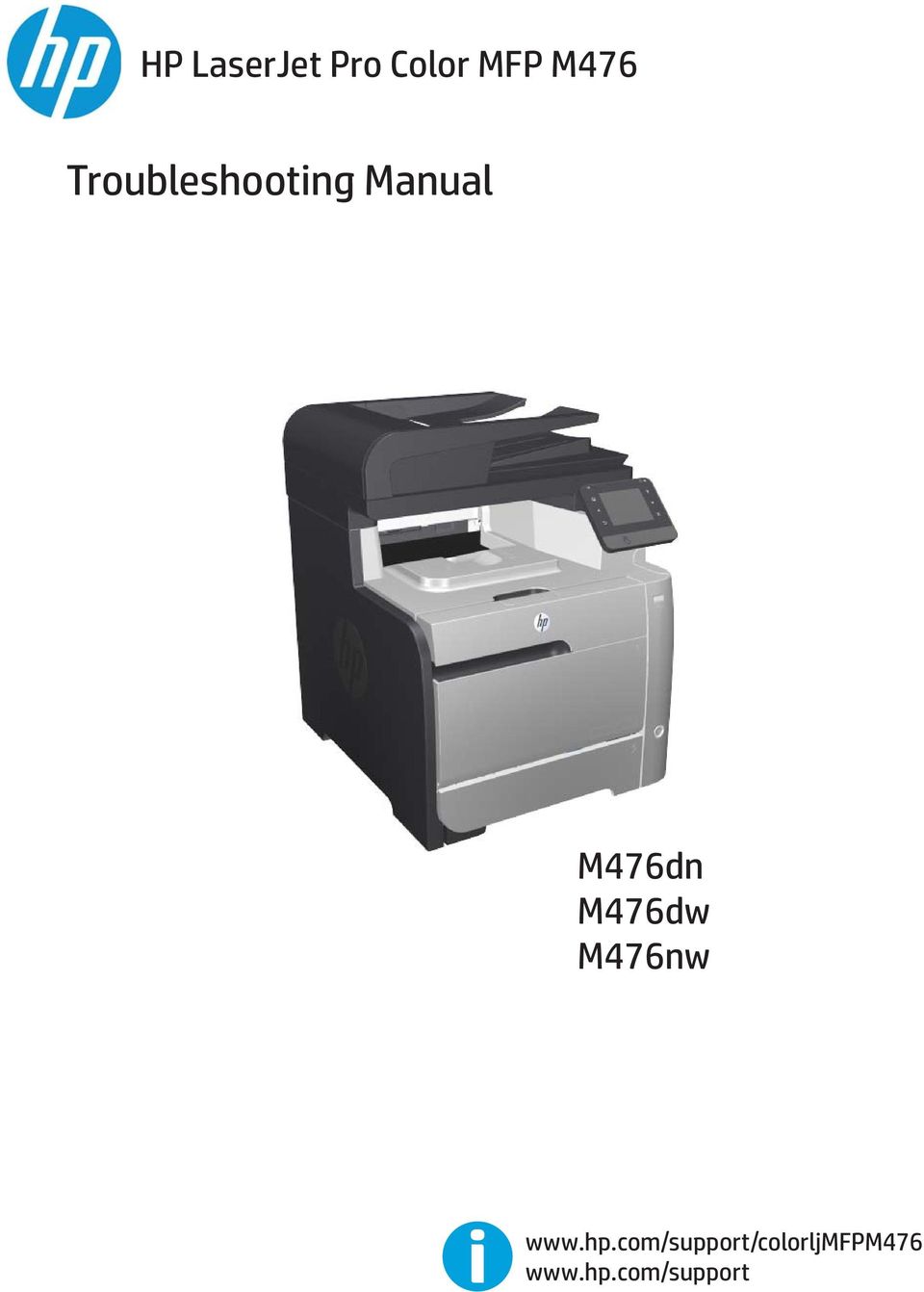
1 HP LaserJet Pro Color MFP M476 Troubleshooting Manual M476dn M476dw M476nw
2

3 HP LaserJet Pro Color MFP M476 Printer Troubleshooting Manual

4 Copyright and License 04 Copyright Hewlett-Packard Development Company, L.P. Reproduction, adaptation, or translation without prior written permission is prohibited, except as allowed under the copyright laws. The information contained herein is subject to change without notice. Trademark Credits Microsoft, Windows, Windows XP, Windows Vista, Windows 7, Windows 8, and Windows 8. are U.S. registered trademarks of Microsoft Corporation. ENERGY STAR and the ENERGY STAR mark are registered U.S. marks. The only warranties for HP products and services are set forth in the express warranty statements accompanying such products and services. Nothing herein should be construed as constituting an additional warranty. HP shall not be liable for technical or editorial errors or omissions contained herein. Edition, 4/04

5 Conventions used in this guide TIP: NOTE: Tips provide helpful hints or shortcuts. Notes provide important information to explain a concept or to complete a task. CAUTION: product. Cautions indicate procedures that you should follow to avoid losing data or damaging the WARNING! Warnings alert you to specific procedures that you should follow to avoid personal injury, catastrophic loss of data, or extensive damage to the product. ENWW iii

6 iv Conventions used in this guide ENWW

7 Table of contents Theory of operation... Basic operation... Major systems... Product components... Sequence of operation... 3 Formatter-control system... 4 Sleep Delay... 4 Input/output... 4 USB /00 networking... 4 Fax... 4 USB hosts... 5 Memory... 5 Flash memory... 5 Random access memory... 5 Nonvolatile memory... 5 Memory Enhancement technology... 5 Wireless radio... 5 PJL overview... 5 LEDM overview... 6 ACL overview... 6 PML... 6 Control panel... 6 NFC... 6 Engine control system... 7 DC controller... 8 Power supply... 9 Protective function... 9 Power saving... 0 Fuser control... 0 Fuser control circuit... Fuser protective function... ENWW v

8 Fuser failure detection... 3 High-voltage power supply... 4 Laser/scanner system... 5 Laser failure detection... 5 Image-formation system... 6 Image-formation process... 6 Overview... 6 Latent-image formation stage... 7 Step : primary charging... 7 Step : laser-beam exposure... 8 Developing stage... 8 Step 3: development... 8 Transfer stage... 9 Step 4: primary transfer... 9 Step 5: secondary transfer... 9 Step 6: separation from the drum... 0 Fusing stage... 0 Step 7: fusing... 0 ITB cleaning stage... Step 8: ITB cleaning... Drum cleaning stage... Step 9: drum cleaning... Developing roller engagement/disengagement control... Pickup-and-feed system... 3 Jam detection... 5 Pad transfer... 5 Multiple-feed prevention... 6 Scanning and image capture system... 7 Scanner power-on sequence of events... 7 Copy or scan sequence of events... 8 Scanner operation... 8 ADF operation ADF duplex operation ADF paper path and ADF sensors ADF jam detection... 3 ADF jam clearance... 3 Fax functions and operation Computer and network security features PSTN operation Receive faxes when you hear fax tones Distinctive ring function vi ENWW

9 Fax by using Voice over IP services The fax subsystem Fax card in the fax subsystem Safety isolation Safety-protection circuitry Data path Hook state Downstream current detection Hook switch control Ring detect Line current control Billing- (metering-) tone filters Fax page storage in flash memory Stored fax pages Advantages of flash memory storage USB flash drive Solve problems Solve problems checklist Menu structure... 4 Configuration report Troubleshooting process Determine the problem source Power subsystem Power-on checks Control-panel checks Tools for troubleshooting Individual component diagnostics Tools for troubleshooting: LED diagnostics Network LEDs Control panel LEDs Tools for troubleshooting: Engine diagnostics Engine-test button Drum rotational check Half self-test functional check Diagrams Diagrams: Formatter connections Diagrams: Location of major components Major components Motors and fans... 5 Rollers ENWW vii

10 PCAs Optional 50-sheet cassette Diagrams: General timing chart Diagrams: Circuit diagram Diagrams: CPU/ASIC diagrams Diagrams: HVT/Toner EMP diagram Diagrams: Driver PCA diagram... 6 Diagrams: Duplexer PCA diagram... 6 Diagrams: FSR diagram Print-quality troubleshooting tools Print-quality troubleshooting tools: Repetitive defects ruler Tools for troubleshooting: Control panel menus Setup menu HP Web Services menu Reports menu Self Diagnostics menu Fax Setup menu System Setup menu Service menu... 7 Network Setup menu Quick Forms menu Fax Menu Copy Menu Tools for troubleshooting: Interpret control panel messages Control panel message types Control panel messages X Supply Memory Error XXXX Scanner Error Error, Turn off then on XXXX Fuser Error XX and 5.XX Error To continue turn off then on Error DC controller Memory Error Fan Error, Turn off then on Error Turn off then on XXXX Error Turn off then on XXXX Error Turn off then on Error Turn off then on Device is busy. Try again later Document feeder mispick. Reload Document feeder jam. Clear and reload viii ENWW

11 Fax is busy. Canceled send Fax receive error Fax Send error Fax storage is full. Canceling the fax send/receive Front door open Jam in Tray, Clear jam and then press OK Jam in Tray, Clear jam and then press OK Jam in Tray 3, Clear jam and then press OK Load paper Load Tray <TYPE> <SIZE>, Press OK to use available media Load Tray, <PLAIN> <SIZE> / Cleaning mode, OK to start Load tray <X> Press [OK] for available media No dial tone No fax detected The product is unable to calibrate. Close the lid and remove paper from the document feeder Unexpected size in tray # Load <size> Press [OK]... 9 Tools for troubleshooting: Event-log messages... 9 Print the event log... 9 Event log messages... 9 Clear jams Jam locations Experiencing frequent or recurring paper jams? Clear jams in the document feeder Clear jams in Tray Clear jams in Tray Clear jams in Tray 3 (accessory)... 0 Clear jams in the duplexer Clear jams in the output bin Paper feeds incorrectly or becomes jammed The product does not pick up paper The product picks up multiple sheets of paper Solve image-quality problems Solve image quality problems: Image defects table Improve print quality... Print from a different software program... 3 Check the paper-type setting for the print job... 3 Check the paper type setting (Windows)... 3 Check the paper type setting (Mac OS X)... 3 Check toner-cartridge status... 3 Print and interpret the print quality page... 4 ENWW ix
![.. 90 Load Tray <TYPE> <SIZE>, Press OK to use available media... 90 Load Tray, <PLAIN> <SIZE> / Cleaning mode, OK to start... 90 Load tray <X> Press [OK] for available media... 90 No dial tone.](/docs-images/40/11415851/images/page_11.jpg "... 9 No fax detected.... 9 The product is unable to calibrate. Close the lid and remove paper from the document feeder.... 9 Unexpected size in tray # Load <size> Press [OK].")
12 Clean the product... 5 Print a cleaning page... 5 Check the scanner glass for dirt and smudges... 5 Visually inspect the toner cartridge... 6 Check paper and the printing environment... 6 Step one: Use paper that meets HP specifications... 6 Step two: Check the environment... 6 Calibrate the product to align the colors... 7 Check other print job settings... 7 Check the EconoMode settings... 7 Adjust color settings (Windows)... 8 Try a different print driver... 9 General print-quality issues... 0 Solve paper-handling problems... 5 Product feeds incorrect page size... 5 Product pulls from incorrect tray... 5 Paper does not feed automatically... 5 Paper does not feed from Tray or Output is curled or wrinkled... 6 Product will not duplex or duplexes incorrectly... 7 Clean the product... 8 Clean the pickup and separation rollers... 8 Clean the paper path... 8 Clean the scanner glass strip and platen... 8 Clean the document feeder pickup rollers and separation pad... 9 Clean the touchscreen Solve performance problems... 3 Factors affecting print performance... 3 Print speeds... 3 The product does not print or it prints slowly... 3 The product does not print... 3 The product prints slowly Solve connectivity problems Solve USB connection problems Solve wired network problems Poor physical connection The computer is using the incorrect IP address for the product The computer is unable to communicate with the product The product is using incorrect link and duplex settings for the network New software programs might be causing compatibility problems The computer or workstation might be set up incorrectly x ENWW

13 The product is disabled, or other network settings are incorrect Solve wireless network problems Wireless connectivity checklist The product does not print after the wireless configuration completes The product does not print, and the computer has a third-party firewall installed The wireless connection does not work after moving the wireless router or product Cannot connect more computers to the wireless product The wireless product loses communication when connected to a VPN The network does not appear in the wireless networks list The wireless network is not functioning Perform a wireless network diagnostic test Reduce interference on a wireless network Solve fax problems Checklist for solving fax problems Perform a fax diagnostic test Solve general fax problems Faxes are sending slowly Fax quality is poor... 4 Fax cuts off or prints on two pages... 4 Solve problems receiving faxes... 4 The fax does not respond The fax has a dedicated phone line An answering machine is connected to the product The Answer Mode setting is set to the Manual setting Voice mail is available on the fax line The product is connected to a DSL phone service The product uses a fax over IP or VoIP phone service An error message displays on the control panel The No Fax Detected message displays The Communication Error message appears The Fax storage is full. message appears The Fax is busy. message appears A fax is received but does not print The Private Receive feature is on Sender receives a busy signal A handset is connected to the product A phone line splitter is being used No dial tone Cannot send or receive a fax on a PBX line Solve problems sending faxes ENWW xi

14 An error message displays on the control panel The Communication Error message appears No dial tone The Fax is busy. message appears The No fax answer. message appears Document feeder paper jam The Fax storage is full. message appears Scanner error The control panel displays a Ready message with no attempt to send the fax The control panel displays the message "Storing page " and does not progress beyond that message... 5 Faxes can be received, but not sent... 5 Product is password protected... 5 Unable to use fax functions from the control panel... 5 Unable to use speed dials... 5 Unable to use group dials... 5 Receive a recorded error message from the phone company when trying to send a fax... 5 Unable to send a fax when a phone is connected to the product Fax trace report Fax error report printing Print all fax reports Print individual fax reports Set the fax error report Set the fax-error-correction mode Change the fax speed Solve problems Cannot connect to the server The failed Unable to scan Validate LDAP gateway Access control for LaserJet Pro devices Product resets Restore the factory-set defaults NVRAM initialization Super NVRAM initialization Firmware upgrades Appendix A Product specifications... 6 Product dimensions... 6 Power consumption, electrical specifications, and acoustic emissions... 6 xii ENWW

15 Environmental specifications... 6 Certificate of Volatility Index ENWW xiii

16 xiv ENWW

17 List of tables Table - Sequence of operation... 3 Table - Basic problem solving Table - Major components Table -3 Solenoid, sensors, and motors... 5 Table -4 Rollers Table -5 PCAs Table -6 Optional 50-sheet cassette Table -7 Repetitive defects Table -8 HP Web Services menu Table -9 Reports menu Table -0 Self Diagnostics menu Table - Fax Setup menu Table - System Setup menu Table -3 Service menu... 7 Table -4 Network Setup menu Table -5 Quick Forms Menu Table -6 Fax Menu Table -7 Copy Menu Table -8 Event-log messages... 9 Table -9 Event-log-only messages Table -0 Image defects table Table - General print-quality issues... 0 Table - Factors affecting print performance... 3 Table A- Physical specifications... 6 Table A- Operating-environment specifications... 6 ENWW xv

18 xvi ENWW

19 List of figures Figure - Product components... Figure - Engine control system components... 7 Figure -3 DC controller circuit diagram... 8 Figure -4 Low-voltage power supply... 9 Figure -5 Fuser block diagram... 0 Figure -6 Fuser control circuit... Figure -7 High-voltage power supply... 4 Figure -8 Laser/scanner system... 5 Figure -9 Image-formation system... 6 Figure -0 Image-formation process... 7 Figure - Primary charging... 7 Figure - Laser-beam exposure... 8 Figure -3 Development... 8 Figure -4 Primary transfer... 9 Figure -5 Secondary transfer... 9 Figure -6 Separation from the drum... 0 Figure -7 Fusing... 0 Figure -8 ITB cleaning... Figure -9 Drum cleaning... Figure -0 Pickup-and-feed system... 3 Figure - Multiple-feed prevention... 6 Figure - ADF paper path... 3 Figure -3 ADF jam clearance... 3 Figure - Control-panel ndary Service test access buttons Figure - Engine test button access Figure -3 Major components Figure -4 Motors and fans... 5 Figure -5 Rollers Figure -6 PCAs Figure -7 Optional 50-sheet cassette Figure -8 Timing diagram Figure -9 Circuit diagram ENWW xvii

20 Figure -0 CPU diagram Figure - ASIC diagram Figure - HVT/Toner EMP diagram Figure -3 Driver PCA diagram... 6 Figure -4 Duplexer PCA diagram... 6 Figure -5 FSR diagram Figure A- Certificate of Volatility ( of ) Figure A- Certificate of Volatility ( of ) xviii ENWW

21 Theory of operation This chapter presents an overview of the major components of the product, and includes a detailed discussion of the image-formation system. Basic operation Formatter-control system Engine control system Laser/scanner system Image-formation system Pickup-and-feed system Scanning and image capture system ADF operation Fax functions and operation USB flash drive ENWW
22 Basic operation Major systems The product includes the following systems: Engine control system Laser/scanner system Image-formation system Pickup-and-feed system Document feeder system Product components Figure - Product components Item Description Item Description Fuser unit 8 Pickup roller Delivery roller 9 Separation roller 3 Print cartridge 0 Registration roller 4 Laser/scanner unit Secondary transfer roller 5 Photosensitive drum Fusing film Chapter Theory of operation ENWW
23 Item Description Item Description 6 Primary transfer pad 3 Pressure roller 7 Intermediate transfer belt (ITB) Sequence of operation Table - Sequence of operation Period Duration Purpose Remarks WAIT From the time the power is turned on or the door is closed until the drum-phase adjustment is complete Clears the potential from the drum surface, adjusts the drum phase, and cleans the ETB Detects the toner level, cartridge presence, and environment; completes any required calibration (color registration control and image stability) STBY (Standby period) From end of the WAIT or LSTR period until either the print command is received from the formatter or the power is turned off Maintains the product in readiness for a print command The product enters sleep mode when the formatter sends a sleep command, and performs color registration and the image stability control when the formatter sends those commands INTR (Initial rotation) From the time the print command is received until the media is picked up Prepares the photosensitive drum for printing PRINT From the end of INTR period until the fuser paper sensor detects the trailing edge of paper Forms the images on the photosensitive drum and transfers the toner image to the print media Performs image stabilization at a specified print interval or at specified times LSTR (Last rotation) From the end of the PRINT period until the delivery motor stops rotating Moves the printed sheet out of the product The product enters the INTR period as soon as the formatter sends another print command ENWW Basic operation 3
24 Formatter-control system The formatter is involved in the following procedures. Controlling the Sleep Delay function Receiving and processing print data from the various product inputs Monitoring control-panel functions and relaying product status information (through the control panel and the bidirectional input/output) Developing and coordinating data placement and timing with the DC controller PCA Storing font information Communicating with the host computer through the bidirectional interface Sleep Delay The formatter receives a print job from the bidirectional interface and separates it into image information and instructions that control the printing process. The dc controller PCA synchronizes the image-formation system with the paper-input and -output systems, and then signals the formatter to send the print-image data. When the product is in Sleep Delay, the control-panel backlight is turned off, but the product retains all product settings, downloaded fonts, and macros. The default setting is a 5-minute idle time. Sleep Delay can be turned off from the System Setup menu on the control panel. The product exits Sleep Delay and enters the warm-up cycle when any of the following occurs. A print job, valid data, or a PML or PJL command is received at the serial port. The control panel is touched. A document is loaded in the document feeder or the scanner lid is opened. A tray is opened. The engine-test button is pressed. Input/output TIP: Error messages override the Sleep Delay message. The product enters Sleep mode at the appropriate time, but the error message continues to appear. The following sections discuss the input and output features of the product. USB The product includes a universal serial bus (USB).0 connection. 0/00 networking The product includes a 0/00 network connection. Fax The product includes a fax phone line connection. 4 Chapter Theory of operation ENWW
25 USB hosts Memory Flash memory The product includes USB hosts for USB flash drive and wireless communication control. If the product encounters a problem when managing available memory, a clearable warning message appears on the control panel. NOR: Stores microprocessor control programs and internal character sets (fonts). NAND: Stores fax memory and driver installation software. Random access memory All models come with 9 MB of memory installed. The formatter has 56MB NAND Flash. Nonvolatile memory The product uses nonvolatile memory (NVRAM) to store I/O and information about the print environment configuration. The contents of NVRAM are retained when the product is turned off or disconnected. Memory Enhancement technology The HP Memory Enhancement technology (MEt) effectively doubles the standard memory through a variety of font- and data-compression methods. NOTE: The MEt is available only in PCL mode; it is not functional when printing in PS mode. Wireless radio PJL overview Wireless products contain a wireless card to enable 80.b/g/n wireless communication. Printer job language (PJL) is an integral part of configuration, in addition to the standard printer command language (PCL). With standard cabling, use PJL to perform a variety of functions. Dynamic I/O switching. The product can be configured with a host on each I/O by using dynamic I/O switching. Even when the product is offline, it can receive data from more than onei/o simultaneously, until the I/O buffer is full. Context-sensitive switching. The product can automatically recognize the personality (PS or PCL) of each job and configure itself in that personality. Isolation of print environment settings from one print job to the next. For example, if a print job is sent to the product in landscape mode, the subsequent print jobs are printed in landscape mode only if they are formatted for it. ENWW Formatter-control system 5
26 LEDM overview ACL overview PML Control panel NFC The low-end data model (LEDM) provides one consistent data representation method and defines the dynamic and capabilities tickets shared between clients and devices, as well as the access protocol, event, security, and discovery methods. The advanced control language (ACL) is a language that supports product control and firmware downloads in printers that support both PJL/PCL and host-based printing. Each sequence of ACL commands must be preceded by a unified exit command (UEL) and ENTER LANGUAGE=ACL command. The ACL sequence is always followed by a UEL. Any number of commands can be placed between the UELs. The only exception to these rules is the download command. If a firmware download is done, the download command must be the last command in the sequence. It will not be followed by a UEL. The firmware searches for the UEL sequence when parsing commands. However, while downloading binary data such as host-based code or NVRAM data the firmware suspends UEL parsing. To handle hosts that disappear during binary sequences, the firmware times out all ACL command sessions. If a timeout occurs during a non-download command sequence, it is treated as the receipt of a UEL. If a timeout occurs during firmware download the product resets. The printer management language (PML) allows remote configuration and status monitoring through the I/O ports. The formatter sends and receives product status and command data to and from a touch-screen control panel. (Wireless bundles only) This product supports near field communication (NFC) capabilities. NFC enables an easy one-to-one HP wireless direct print connection using a simple device-to-device touch. Mobile device users can quickly connect to the printer and print documents and images from a mobile device, such as a smartphone or tablet, by touching the device to the NFC icon on the bottom of the control panel. 6 Chapter Theory of operation ENWW
27 Engine control system The engine control system coordinates all product functions and drives the other three systems. The engine control system contains the DC controller, high-voltage power supply PCA, and low-voltage power supply/fuser power supply unit. Figure - Engine control system components LASER/SCANNER SYSTEM ENGINE CONTROL SYSTEM IMAGE-FORMA TION SYSTEM PICKUP-AND-FEED SYSTEM DOCUMENT FEEDER SYSTEM ENWW Engine control system 7
28 DC controller The DC controller PCA controls the operation of the product and its components. The DC controller PCA starts product operation when the power is turned on and the power supply sends DC voltage to the DC controller PCA. After the product enters the standby sequence, the DC controller PCA sends out various signals to operate motors, solenoids, and other components based on the print command and image data that the host computer sends. Figure -3 DC controller circuit diagram Walk up USB 8 Chapter Theory of operation ENWW
29 Power supply The low-voltage power supply and the fuser power supply convert AC power from the power receptacle into DC power to cover the DC loads. Figure -4 Low-voltage power supply AC input Fuse FU90 Fuser power supply Fuse FU80 Noise filter Fuser control circuit Noise filter Protection circuit Zero crossing circuit ZEROX +3.3V generation circuit +3.3V DC controller Power switch control circuit Power switch SW300 PSREM4V Rectifying circuit +4V generation circuit Low-voltage power supply Power supply unit +4V Protective function The power supply unit has a protective function against overcurrent and overvoltage to prevent failures in the power supply circuit. If an overcurrent or overvoltage instance occurs, the system automatically cuts off the output voltage. If the DC voltage is not being supplied from the power supply unit, the protective function might be running. If that is the case, turn off the power switch and unplug the power cord. Do not plug in the power cord and do not turn the power switch on again until the root cause is found. In addition, a fuse protects against overcurrent instances. If an overcurrent instance flows into the AC line, the fuse deactivates and cuts off the power distribution. ENWW Engine control system 9
30 Power saving Fuser control The Sleep Delay feature reduces power consumption when the product has been inactive for an extended period. You can set the length of time before the product enters sleep mode. See Sleep Delay on page 4. The Auto Power Down feature turns the product off after a certain length of time. You can adjust this time setting. The power supply unit controls the temperature in the fuser unit. The product uses an on-demand fusing method. Figure -5 Fuser block diagram TH80 Fuser sleeve TH80 H0/H0 Power supply unit DC controller TH803 FU FUSER HEATER CONTROL signal FUSER TEMPERATURE signal Fuser control circuit Fuser heater safety circuit Pressure roller The fuser is composed of the following components. Heater (00V model: H0 00V model: H0): Heats the fuser sleeve Thermistors Main thermistor (TH80): Detects the center temperature of the fuser heater (contact type) Sub thermistor (TH80): Detects the right side temperature of the fuser heater (contact type) Sub thermistor (TH803): Detects the left side temperature of the fuser heater (contact type) Thermal fuse (FU): Prevents an abnormal temperature rise of the fuser heater These fuser temperature controls are performed by the fuser control circuit and the fuser heater safety circuit, which receive commands from the DC controller. 0 Chapter Theory of operation ENWW
31 Fuser control circuit The fuser control circuit maintains the temperature of the fuser heater at its targeted temperature. The DC controller monitors the fuser temperature (MAINTH, SUBTH and SUBTH) signals and sends the fuser heater control (FSRD) signal according to the detected temperature. The fuser heater control circuit controls the fuser heater depending on the signal so that the heater remains at the targeted temperature. Figure -6 Fuser control circuit Fuser unit DC controller Zero crossing circuit ZEROX FU90 Fuser sleeve RL90 Relay drive circuit /RLD+ RLD- TH803 TH80 TH80 RL Pressure roller Fuser heater (H0/H0) Sub power supply FU: Thermal fuse TH80: Main thermistor TH80: Sub thermistor TH803: Sub thermistor Fuser heater control circuit Fuser control circuit Fuser power supply FSRD MAINTH SUBTH SUBTH Fuser heater safety circuit ENWW Engine control system
32 Fuser protective function The protective function detects an abnormal temperature rise of the fuser and interrupts power supply to the fuser heater. The following protective components prevent an abnormal temperature rise of the fuser heater. DC controller The DC controller monitors the detected temperature of the thermistors. It deactivates the fuser heater control signal and releases the relay to interrupt the power supply to the fuser heater under the following conditions. Main thermistor: 53 C (487.4 F) or higher Sub thermistor : 73 C (53.4 F) or higher Sub thermistor : 73 C (53.4 F) or higher Fuser heater safety circuit The fuser heater safety circuit monitors the detected temperature of the thermistors. It releases the relay to interrupt the power supply to the fuser heater under the following conditions. Main thermistor: 30 C (608 F) or higher Sub thermistor : 95 C (563 F) or higher Sub thermistor : 95 C (563 F) or higher Thermal fuse The thermal fuse blows to interrupt power supply to the fuser heater if the thermal fuse temperature reaches 8 C (44 F) or higher. Chapter Theory of operation ENWW
33 Fuser failure detection The DC controller determines a fuser unit failure, deactivates the fuser heater control signal, releases the relay to interrupt power supply to the fuser heater, and then notifies the formatter of a failure state when it encounters the following conditions. Start-up failure conditions The main thermistor temperature does not reach 50 C ( F) within a specified period of heater startup during the wait period. The main thermistor temperature does not reach the targeted temperature within a specified period after the temperature once reaches 50 C ( F) from the heater startup during the wait period. The main thermistor temperature does not reach the targeted temperature within a specified period under the heater temperature control during the initial rotation period. Abnormal low temperature conditions The main thermistor temperature remains at 00 C ( F) or lower for a specified period under the heater temperature control during the print period. Abnormal high temperature conditions The main thermistor temperature remains at 35 C (487 F) or higher for a specified period. The temperature of either one of the sub thermistors remains at 73 C (53 F) or higher for a specified period. Fuser heater drive circuit failure The specified count of the zero crossing signal is not detected within a specified period after the product is turned on. The frequency is out of the specified range (40 to 70 Hz). ENWW Engine control system 3
34 High-voltage power supply The DC controller controls the high-voltage power supply to generate high-voltage biases. The high-voltage power supply generates the high-voltage biases that are applied to the primary charging roller, developing roller, primary transfer pad, secondary transfer roller, and ITB cleaning unit. Figure -7 High-voltage power supply Primary charging bias circuit Developing bias circuit Blade bias circuit PRI DEV DEV DEV3 DEV4 BLD BLD BLD3 BLD4 Cartridge Photosensitive drum Primary transfer pad ICLB ICLR Y M C K ITB cleaning unit ITB TR Secondary transfer roller TR_ TR_3 TR_3 TR_4 ITB cleaning brush bias circuit ITB cleaning roller bias circuit Secondary transfer bias circuit Primary transfer bias circuit High-voltage power supply DC controller 4 Chapter Theory of operation ENWW
35 Laser/scanner system The formatter sends video signals to the DC controller, which controls the laser/scanner. When the laser/ scanner system receives those signals, it converts them to latent images on the photosensitive drum. Figure -8 Laser/scanner system Laser failure detection The optical unit failure detection sensor manages the laser/scanner unit failure-detection functions. The DC controller identifies the laser/scanner unit failure and notifies the formatter if the laser/scanner unit encounters the following conditions: Scanner motor failure BD failure ENWW Laser/scanner system 5
36 Image-formation system The image-formation system forms a toner image on media. The product includes four print cartridges that contain the toner that is used to create the image on the media. Toner is applied in the following order, using only the colors necessary for a specific image: yellow (Y), magenta (M), cyan (C), and black (Bk). Figure -9 Image-formation system Fuser unit Laser/scanner unit Laser beam Cartridge Photosensitive drum ITB cleaning unit Primary transfer pad Secondary transfer roller ITB High-voltage power supply DC controller Image-formation process Overview Laser printing requires the interaction of several different technologies including electronics, optics, and electrographics to provide a printed page. Each process functions independently and must be coordinated with the other processes. Image formation consists of the following processes: These processes are divided into nine steps and described in the following sections. Latent-image formation Primary charging Laser beam exposure Development Transfer Primary transfer Secondary transfer Separation Fuser 6 Chapter Theory of operation ENWW
37 ITB cleaning Drum cleaning Figure -0 Image-formation process : Media path : Direction of drum rotation Delivery : Block 7. Fusing Fuser Latent image formation. Laser beam exposure. Primary charging : Step 3. Development Development Transfer 6. Separation Photosensitive drum cleaning 9. Drum cleaning 5. Secondary transfer Registration 4. Primary transfer 8. ITB cleaning ITB cleaning Pickup Latent-image formation stage During the steps that comprise this stage, a latent image is formed by applying a negative charge to the photosensitive drum. You cannot see this image on the drum. Step : primary charging A high-voltage DC bias is applied to the primary charging roller, which is made of conductive rubber and is in contact with the drum surface. As the roller moves across the drum, it applies the negative charge to that surface. Figure - Primary charging Primary charging roller Photosensitive drum DC bias ENWW Image-formation system 7
38 Step : laser-beam exposure The laser beam scans the photosensitive drum to neutralize the negative charge on portions of the drum surface. An electrostatic latent image is formed where the negative charge was neutralized. Figure - Laser-beam exposure Laser beam Unexposed area Exposed area Developing stage The developing cylinder comes in contact with the photosensitive drum and deposits toner on the electrostatic latent image. Step 3: development Toner acquires a negative charge as a result of the friction from the developing cylinder rotating against the developing blade. When the negatively charged toner comes in contact with the drum, it adheres to the electrostatic latent image. When the toner is on the drum, the image becomes visible. Figure -3 Development Developing blade Developing cylinder Unexposed area Exposed area Unexposed area Exposed area DC negative bias Photosensitive drum 8 Chapter Theory of operation ENWW
39 Transfer stage Step 4: primary transfer The toner image on the photosensitive drum is transferred to the ITB. The DC positive bias is applied to the primary transfer pad. The negatively charged toner transfers to the ITB from the drum surface. Figure -4 Primary transfer Photosensitive drum ITB Primary transfer pad DC bias Step 5: secondary transfer The toner image on the ITB is transferred to the print media. The DC positive bias is applied to the secondary transfer roller. As the media passes between the secondary transfer roller and the ITB, the toner image is transferred to the media. Figure -5 Secondary transfer Media ITB ITB drive roller Secondary transfer roller DC bias ENWW Image-formation system 9
40 Step 6: separation from the drum The elasticity of the print media and the curvature of the ITB drive roller cause the media to separate from the ITB. Figure -6 Separation from the drum Media ITB ITB drive roller Secondary transfer roller Fusing stage Step 7: fusing Until the fusing stage is complete, the image is not permanently affixed to the print media. The toner can be easily smudged until the heat and pressure of the fusing process fix the image to the sheet. The product uses an on-demand fusing method to fuse the toner image onto the media. The toner image is permanently affixed to the print media by the heat and pressure. Figure -7 Fusing Pressure roller Fuser film Fuser heater Toner Media 0 Chapter Theory of operation ENWW
41 ITB cleaning stage Step 8: ITB cleaning The ITB cleaning roller and the cleaning brush are applied with DC positive bias to charge the residual toner positive. Because the primary transfer pad is also applied with DC positive bias, the positively charged residual toner is reverse-transferred to the photosensitive drum from the ITB surface. Figure -8 ITB cleaning Positive potential waste toner Negative potential waste toner Cartridge Photosensitive drum Partition sheet ITB cleaning roller ITB cleaning brush ITB Sweeper strip DC bias DC bias ENWW Image-formation system
42 Drum cleaning stage Not all of the toner is removed from the photosensitive drum during the transfer stage. During the cleaning stage, the residual, or waste, toner is cleared from the drum surface to prepare the surface for the next latent-image formation. Step 9: drum cleaning The cleaning blade scrapes the residual toner off the surface of the photosensitive drum and deposits it in the waste-toner container. The drum is now clear, and is ready for the next image-formation process. Figure -9 Drum cleaning Cleaning blade Photosensitive drum Waste toner container Sweeper strip Developing roller engagement/disengagement control The developing roller engagement/disengagement control engages the required developing roller with the photosensitive drum according to the print mode full-color mode or monochrome mode. The necessary developing roller is engaged with the photosensitive drum only when required, preventing a deterioration of the drums and making maximum use of the life. The engagement/disengagement of the developing roller is controlled by the DC controller rotating the main motor and changing the direction of the developing disengagement cam. The DC controller controls the developing roller state, whether engaged or disengaged, by counting the main motor rotation after it detects the signal from the developing homeposition sensor. All four color developing rollers disengage from the photosensitive drums when the product is turned on and when a print operation is completed. The color developing rollers engage with the photosensitive drums when the full-color mode is designated. Only the black developing roller engages with the photosensitive drum when the monochrome mode is designated. The DC controller determines an abnormality of the developing roller engagement/disengagement function and notifies the formatter when it does not sense the signal from the developing home-position sensor for a specified period during the developing roller engagement/disengagement operation. Chapter Theory of operation ENWW
43 Pickup-and-feed system The pickup-and-feed system picks up and feeds the print media. It consists of several types of feed rollers. Figure -0 Pickup-and-feed system Y M C K Y M C K Number Description Number Description SR Paper feeder pre-registration sensor M Drum motor SR4 Registration sensor M3 Registration motor SR7 Multipurpose tray pre-registration sensor M4 Fuser motor SR8 Fuser delivery sensor M5 Pickup motor ENWW Pickup-and-feed system 3
44 Number Description Number Description SR0 Loop sensor SL Multipurpose tray pickup solenoid SR Pre-registration sensor SL Cassette pickup solenoid SR3 Cassette media-presence sensor SL5 Duplex reverse solenoid SR4 Multipurpose tray media-presence sensor Cl Multipurpose tray feed clutch SR5 Output bin media full sensor Cl Duplex feed clutch 4 Chapter Theory of operation ENWW
45 Jam detection The product uses the following sensors to detect the presence of media and to check whether media is being fed correctly or has jammed: Registration sensor Multipurpose tray pre-registration sensor Fuser delivery sensor Loop sensor Pre-registration sensor Cassette media-presence sensor Multipurpose tray media-presence sensor Output bin media full sensor Paper feeder pre-registration sensor The product detects the following jams: Pickup delay jam Pickup stationary jam Delivery delay jam Delivery stationary jam Fuser wrapping jam Residual media jam Duplex re-pickup unit jam Pad transfer The product uses a pad transfer method for the primary transfer operation. The pad transfer method stabilizes an image compared to the conventional separation roller method. The wider nip width between the transfer pad and the photosensitive drum improves the transfer performance. ENWW Pickup-and-feed system 5
46 Multiple-feed prevention The product uses a separation roller to prevent multiple sheets of media from entering the product. The paper separation roller follows the rotational direction of the pickup roller because it does not have its own driving force. Normal-feed: The separation roller is driven by the pickup roller through a sheet of print media. That is, the separation roller rotates in the media feed direction. Multiple-feed: The low friction force between the sheets weakens the rotational force from the pickup roller. The separation roller is limited in its rotational force and it does not rotate with such a weak driving force from the pickup roller. Since the separation roller does not rotate, the multiple sheets do not feed into the product. The following figure illustrates the mechanism of the multiple-feed prevention. Figure - Multiple-feed prevention 6 Chapter Theory of operation ENWW
47 Scanning and image capture system The flatbed image scanner captures an electronic image of the document on the glass. The scanner does this by illuminating the document with LEDs (red, green, and blue) and capturing the image in the image sensor to create an electronic format of the document. The flatbed scanner consists of three main elements. CIS scanner The CIS (contact image sensor) scanner captures an image using the product's optical path. Red, green, and blue LEDs sequentially illuminate a small strip of the document (often called a raster line), and the optical system captures each color in a single row of CCD sensors that cover the entire page width. Because only one color is captured for each line per exposure, the three colors are recombined electronically to create the full color image. For monochromatic scans or copies, all three LEDs are illuminated to create a white light for the scan so the raster line can be captured in one exposure. Mechanical drive system The drive system moves the CIS scanner along the document length to create the image. In this product, the drive system consists of a small DC motor with an optical encoder, a drive belt, and a guide rod. The speed of the drive system is proportional to the scan resolution (300 ppi is much faster than 00 ppi) and also proportional to the type of scan (color scans are slower than monochromatic scans). The carriage drive moves the CIS scan head along the document length to create the image. In this product, a small DC motor with an optical encoder creates this motion. The speed of the carriage drive is proportional to the scan resolution (300 ppi is much faster than 600 ppi) and also proportional to the type of scan (color scans are three-times slower than monochromatic scans). Image processing system (formatter) The formatter processes the scanner data into either a copy or a scan to the computer. For copies, the image data is sent directly to the product without being transmitted to the computer. Depending on user selections for the copy settings, the formatter enhances the scanner data significantly before sending it to the product. Image data is captured at 300 ppi for copies and is user selectable for scans to the computer. Each pixel is represented by 8 bits for each of the three colors (56 levels for each color), for a total of 4 bits per pixel (4-bit color). Scanner power-on sequence of events When the product is turned on, it performs the following tests: Motor test. The product moves the motor left and right to confirm operation. It reports a scanner error if no motion is detected in the motor encoder system. Wall find. The scan carriage moves slowly to the left while watching an encoder on the carriage motor to determine when the carriage has found the side wall or stop. This enables the product to identify the document origin (position of the original). If the document origin cannot be located, a default position is used instead. LED check. The product moves the carriage to the white calibration label under the left side of the flatbed image scanner, and it verifies that the minimum and maximum response is acceptable. It reports a scanner error 4 if the response is unacceptable. Home find. The scan carriage uses the optical scanner to find physical reference features that relate to the document origin at the left side of the image glass. This process ensures accurate location of the ENWW Scanning and image capture system 7
48 first document pixels so that the user documents will have an accurate placement of the image on scans and copies. It reports a scanner error 6 message if the reference features are not found. Calibration. This test, also known as scanner color calibration, enables the product to identify the black and white on every pixel in the CCD. Calibration occurs in two major processes: a broad (analog) adjustment of all pixels to bring them into the target output range, and a pixel-by-pixel adjustment (digital) to fine tune the actual black and white response. The calibration process occurs under the left side of flatbed image scanner where there is a special white calibration label. Calibration is the most important step in creating a high quality image. Calibration problems can include color inaccuracies, brightness inaccuracies, and vertical streaks through the image. The calibration process identifies any bad pixels and enables the image formatter to recreate the lost information from adjacent pixels. Extreme cases of this problem can appear as large vertical streaks or image smears. The user has no control over the calibration process itself or this pixel-replacement process. Copy or scan sequence of events To create an accurate rendition of a document, the scanner must be calibrated for the requested operation. If the user selects a scan at 600 ppi color, the flatbed image scanner calibrates for that specific operational mode. Subsequently, the flatbed image scanner automatically re-calibrates for the next requested operation. Calibration does not occur for every new copy request. Normal sequence of operation for a flatbed copy or scan job includes the following.. LEDs illuminate.. Carriage motion begins moving the CIS scanner toward the right. 3. Image capture continues for the entire page or length requested in a scan operation. 4. Carriage returns to the home position on the left. Scanner operation At power-on, the CIS scanner moves slowly to the left. The motor encoder is monitored to determine when the scanner has found the left side wall. The scanner then moves to the right and identifies the document origin (position of the original). If the document origin cannot be located, a default position is used. 8 Chapter Theory of operation ENWW
49 When a copy/scan is initiated, the product first checks to determine if a document is present in the ADF. If an ADF document is detected, the scanner moves to the left side of the scan tub and scans the image as the document is fed through the ADF. If no document is detected in the ADF, the scanner acquires the image from the flatbed by scanning while moving from left to right across the flatbed glass. ENWW Scanning and image capture system 9
50 ADF operation The ADF will not function when the ADF cover is open. The paper path is incomplete if the ADF cover is lifted from the glass. When the product duplexes from the ADF, the paper moves through one time, because the ADF has a CIS scanner for side two which is scanned simultaneously with side one. The standard operation of the ADF consists of the standby (paper loading) mode, pick, feed, and lift steps: Standby (paper-loading) mode In standby mode, the lift plate is in the down position. When a document is loaded into the input tray, the paper-present sensor detects its presence. When a copy/scan is initiated, the ADF motor engages the gear train and raises the lift plate until the document makes contact with the pick roller. The ADF then begins the pick, feed, and lower sequence: Pick The pick roller rotates and moves one or more sheets forward into the ADF where the sheets engage with the separation roller. The separation roller contacts the ADF separation pad, which separates multiple sheets into a single sheet. Feed The single sheet continues through the ADF paper path (aided by the pre-scan rollers) until the leading edge of the page activates the top-of-form sensor. Activation of this sensor initiates the scan process, and the scanner acquires the image as the document moves over the ADF glass. The post-scan rollers then eject the sheet into the output area. The pick and feed steps are repeated as long as paper is detected by the paper-present sensor. Home When the form sensor detects the trailing edge of the last page, the last sheet is ejected and the motor turns on a sequence that rests the separation floor back down in standby mode, which allows it to detect when more media is loaded. Note that the ADF will not function when the ADF door is open. ADF duplex operation The ADF on this product is equipped with a duplex image scanner to facilitate fast and efficient duplex copies and scans. When a duplex copy/scan is initiated, the duplex image scanner acquires the image from the back side of the document while the flatbed image scanner simultaneously acquires the image from the front side of the document. ADF paper path and ADF sensors The paper-present sensor determines if paper is in the ADF. The form sensor detects the top and bottom edges of the document. One other sensor detects an open ADF door. 30 Chapter Theory of operation ENWW
51 The following diagram shows the ADF paper path. Figure - ADF paper path The paper-present sensor determines if paper has been loaded in the ADF. The top-of-form sensor detects the top and bottom edges of the document. The door open sensor detects when the ADF door is open. ADF jam detection The ADF uses two sensors to determine if a jam has occurred. The paper-present sensor detects the presence of media in the ADF input tray. The top-of-form sensor detects media moving through the ADF. A jam can be detected under any of the following conditions: Document feeder mispick When a document is detected in the ADF input tray and a command to copy/scan is received, the ADF attempts to pick the page from the input tray. If the page is not picked is not successfully, the ADF will pulse the motor and cycle the lift plate in an attempt to dislodge the stuck page. Three attempts are made to advance the paper to the form sensor. If the paper does not advance, a Document feeder mispick message will appear on the control panel display. Long-document jam If a page is picked and advanced to the top-of-form sensor, but the trailing edge of the page is not detected within the time allowed for a 38-mm (5-inch) document (the maximum allowable page length for the ADF), a Document feeder jam message will appear on the control panel display. Stall jam When a page that is less than 38 mm (5 inches) long has advanced to the top-of-form sensor but has not left it within the expected period of time, the page has probably stalled or jammed, and a Document feeder jam message will appear on the control panel display. When a jam is detected, the ADF stops feeding paper, lowers the lift plate, and displays a jam message on the control-panel display. ENWW ADF operation 3
52 ADF jam clearance Paper that has become jammed in the ADF can be retrieved at any of three access points: the input area, the scan area, or the output area. Figure -3 ADF jam clearance 3 Chapter Theory of operation ENWW
53 Fax functions and operation The following sections describe the product fax capabilities. Computer and network security features The product can send and receive fax data over telephone lines that conform to public switch telephone network (PSTN) standards. The secure fax protocols make it impossible for computer viruses to be transferred from the telephone line to a computer or network. The following product features prevent virus transmission: No direct connection exists between the fax line and any devices that are connected to the USB or Ethernet ports. The internal firmware cannot be modified through the fax connection. All fax communications go through the fax subsystem, which does not use Internet data-exchange protocols. PSTN operation The PSTN operates through a central office (CO) that generates a constant voltage on the TIP and RING wires (48 V, usually). A device goes on-hook by connecting impedance (such as 600 ohms for the U.S.) across the TIP and RING so that a line current can flow. The CO can detect this current and can send impulses like dial tones. The product generates more signaling tones, such as dialing digits, to tell the CO how to connect the call. The product can also detect tones, such as a busy tone from the CO, that tell it how to behave. When the call is finally connected, the CO behaves like a piece of wire connecting the sender and receiver. This is the period during which all of the fax signaling and data transfer occurs. When a call is completed, the circuit opens again and the line-current flow ceases, removing the CO connection from both the sender and the receiver. On most phone systems, the TIP and RING wires appear on pins 3 and 4 of the RJ- modular jack (the one on the fax card). These two wires do not have to be polarized because all the equipment works with either TIP or RING on pin 3 and the other wire on pin 4. This means that cables of either polarity can interconnect and will still work. These basic functions of PSTN operation are assumed in the design of the fax subsystem. The product generates and detects the signaling tones, currents, and data signals that are required to transmit and receive faxes on the PSTN. Receive faxes when you hear fax tones In general, incoming faxes to the product are automatically received. However, if other devices are connected to the same phone line, the product might not be set to answer automatically. If the product is connected to a phone line that receives both fax and phone calls, and you hear fax tones when you answer the extension phone, receive the fax in one of two ways: If you are near the product, press Start Fax on the control panel. Press --3 in sequence on the extension phone keypad, listen for fax transmission sounds, and then hang up. NOTE: In order for the second method to work, the Extension Phone setting must be set to Yes. ENWW Fax functions and operation 33
54 Distinctive ring function Ring-pattern or distinctive-ring service is available through some local telephone companies. The service allows you to have more than one telephone number on a single line. Each telephone number has a unique ring pattern, so that you can answer voice calls and the product can answer fax calls. If you subscribe to a ring-pattern service with a telephone company, you must set the product to answer the correct ring pattern. Not all countries/regions support unique ring patterns. Contact the telephone company to determine if this service is available in your country/region. NOTE: If you do not have ring-pattern service and you change the ring-pattern settings to something other than the default, All Rings, the product might not be able to receive faxes. The settings are as follows: All Rings: The product answers any calls that come through the telephone line. Single: The product answers any calls that produce a single-ring pattern. Double: The product answers any calls that produce a double-ring pattern. Triple: The product answers any calls that produce a triple-ring pattern. Double and Triple: The product answers any calls that produce a double-ring or triple-ring pattern. Set up the distinctive ring function. From the Home screen, touch the Setup button.. Touch the Fax Setup menu. 3. Touch the Basic Setup menu. 4. Touch the Distinctive Ring, and then touch the name of an option. Fax by using Voice over IP services Voice over IP (VoIP) services provide normal telephone service, including long distance service through a broadband Internet connection. These services use packets to break up the voice signal on a telephone line and transmit it digitally to the receiver, where the packets are reassembled. The VoIP services are often not compatible with fax machines. The VoIP provider must state the service supports fax over IP services. Because the installation process varies, the VoIP service provider will have to assist in installing the product fax component. Although a fax might work on a VoIP network, it can fail when the following events occur: Internet traffic becomes heavy and packets are lost. Latency (the time it takes for a packet to travel from its point of origin to its point of destination) becomes excessive. If you experience problems using the fax feature on a VoIP network, ensure that all of the product cables and settings are correct. Configuring the Fax Speed setting to Medium(V.7) or Slow(V.9) can also improve your ability to send a fax over a VoIP network. If you continue to have problems faxing, contact your VoIP provider. 34 Chapter Theory of operation ENWW
55 The fax subsystem The formatter, fax card, firmware, and software all contribute to the fax functionality. The designs of the formatter and fax card, along with parameters in the firmware, determine the majority of the regulatory requirements for telephony on the product. The fax subsystem is designed to support V.34 fax transmission, lower speeds (such as V.7 fax), and older fax machines. Fax card in the fax subsystem Safety isolation Two versions of the fax card are used in the product. One is used in the North American, South American, and Asia Pacific countries/regions. The other is used primarily in European countries/regions. The fax card contains the modem chipset (DSP and CODEC) that controls the basic fax functions of tone generation and detection, along with channel control for fax transmissions. The CODEC and its associated circuitry act as the third-generation silicon data access arrangement (DAA) to comply with worldwide regulatory requirements. The only difference between the two versions is that each version is compliant with the /4-wire phone jack system from the respective country/region. The most important function of the fax card is the safety isolation between the high-voltage, transient-prone environment of the telephone network (TNV [telephone network voltage]) and the low-voltage analog and digital circuitry of the formatter (SELV [secondary extra-low voltage]). This safety isolation provides both customer safety and product reliability in the telecom environment. Any signals that cross the isolation barrier do so magnetically. The breakdown voltage rating of barriercritical components is greater than 5 kv. Safety-protection circuitry Data path In addition to the safety barrier, the fax card protects against over-voltage and over-current events. Telephone over-voltage events can be either differential mode or common mode. The event can be transient in nature (a lightning-induced surge or ESD) or continuous (a power line crossed with a phone line). The fax card protection circuitry provides margin against combinations of over-voltage and over-current events. Common mode protection is provided by the selection of high-voltage-barrier critical components (transformer and relay). The safety barrier of the fax card PCB traces and the clearance between the fax card and surrounding components also contribute to common mode protection. A voltage suppressor (a crowbar-type SIDACTOR) provides differential protection. This product becomes low impedance at approximately 300 V differential, and crowbars to a low voltage. A series thermal switch works in conjunction with the crowbar for continuous telephone line events, such as crossed power lines. All communications cross the isolation barrier magnetically. The breakdown voltage rating of barrier-critical components is greater than 5 kv. TIP and RING are the two-wire paths for all signals from the telephone network. All signaling and data information comes across them, including fax tones and fax data. ENWW Fax functions and operation 35
56 Hook state The telephone network uses DC current to determine the hook state of the telephone, so line current must be present during a call. The silicon DAA provides a DC holding circuit to keep the line current constant during a fax call. The silicon DAA converts the analog signal to a digital signal for DSP processing, and also converts the digital signal to an analog signal for transmitting data through a telephone line. The magnetically coupled signals that cross the isolation barrier go either through a transformer or a relay. The DSP in the fax card communicates with the ASIC in the formatter using the high-speed serial interface. Another magnetically coupled signal is the control signal that disconnects the downstream telephone devices (such as a phone or answering machine). A control signal originating on the DSP can change the relay state, causing the auxiliary jack (downstream jack) to be disconnected from the telephone circuit. The product takes control of calls that it recognizes as fax calls. If the product does not directly pick up the call, it monitors incoming calls for the fax tone or for the user to direct it to receive a fax. This idle mode is also called eavesdropping. This mode is active when the product is on-hook but current exists in the downstream phone line because another device is off-hook. During eavesdropping, the receive circuit is enabled but has a different gain from the current that is generated during normal fax transmissions. The product does not take control of the line unless it detects a fax tone or the user causes it to connect manually. This feature allows the user to make voice calls from a phone that is connected to the product without being cut off if a fax is not being received. Downstream current detection The line voltage monitoring module of the silicon DAA can detect the line state as well as the downstream device. It tells DSP via DIB that an active device (telephone, modem, or answering machine) is connected to the auxiliary port on the product (the right side of the RJ- jack). The DSP uses the signal to ensure that the product does not go off-hook (and disconnect a downstream call) until it has been authorized to do so (by a manual fax start or the detection of the appropriate tones). Hook switch control Ring detect In the silicon DAA the CODEC controls the hook switch directly. The CODEC is activated when it receives commands from the DSP. When the circuit is drawing DC current from the central office it is considered offhook. When no DC current flows the state is considered on-hook. Ring detect is performed by the line voltage monitoring module of the silicon DAA, and is a combination of voltage levels and cadence (time on and time off). Both must be present to detect a valid ring. The CODEC works with DSP as well as the firmware to determine if an incoming signal is an answerable ring. Line current control The DC current from the CO needs to have a path to flow from TIP to RING. The DC impedance emulation line modulator and DC terminations modules in the silicon DAA act as a DC holding circuit, and works with the firmware to achieve the voltage-current characteristic between TIP and RING. The impedance (the currentvoltage characteristic) changes corresponding to certain special events, such as pulse dialing or when the product goes on-hook. 36 Chapter Theory of operation ENWW
57 Billing- (metering-) tone filters Switzerland and Germany provide high-frequency AC signals on the phone line in order to bill customers. A filter in a special fax cable (for certain countries/regions), can filter these signals. Because these billing signals are not used in the U.S., these filters are not present in the U.S. fax cable. To obtain a special fax cable, contact your local telephone service provider. Fax page storage in flash memory Stored fax pages Fax pages are the electronic images of the document page. They can be created in any of three ways: scanned to be sent to another fax machine, generated to be sent by the computer, or received from a fax machine to be printed. The product stores all fax pages in flash memory automatically. After these pages are written into flash memory, they are stored until the pages are sent to another fax machine, printed on the product, transmitted to the computer, or erased by the user. These pages are stored in flash memory, which is the nonvolatile memory that can be repeatedly read from, written to, and erased. The product has 8 MB of flash memory, of which 7.5 MB is available for fax storage. The remaining 0.5 MB is used for the file system and reclamation. Adding RAM does not affect the fax page storage because the product does not use RAM for storing fax pages. The user can reprint stored fax receive pages in case of errors. For a fax send, the product will resend the fax in case of errors. The product will resend stored fax pages after a busy signal, communication error, no answer, or power failure. Other fax devices store fax pages in either normal RAM or short-term RAM. Normal RAM immediately loses its data when power is lost, while short-term RAM loses its data about 60 minutes after power failure. Flash memory maintains its data for years without any applied power. Advantages of flash memory storage Fax pages that are stored in flash memory are persistent. They are not lost as a result of a power failure, no matter how long the power is off. Users can reprint faxes in case the print cartridge runs out of toner or the product experiences other errors while printing faxes. The product also has scan-ahead functionality that makes use of flash memory. Scan-ahead automatically scans pages into flash memory before a fax job is sent. This allows the sender to pick up the original document immediately after it is scanned, eliminating the need to wait until the fax is transmission is complete. Because fax pages are stored in flash memory rather than RAM, more RAM is available to handle larger and more complicated copy and print jobs. ENWW Fax functions and operation 37
58 USB flash drive This product features printing from a USB flash drive. This product supports printing the following types of files from the USB flash drive. PDF RGB JPEG When a USB flash drive is inserted into the front of the product, the control panel will display the USB Flash Drive menu. The files present on the USB flash drive can be accessed from the control panel using the touch screen. Any RGB jpeg or pdf files on the USB flash drive can be printed directly from the product control panel. Pages also can be scanned and saved to the USB flash drive from the control panel. 38 Chapter Theory of operation ENWW
59 Solve problems NOTE: To perform diagnostic and configuration procedures (for example, resetting page counts) for the product, you must install the CP0 Service Config Tool (available at your HP authorized repair center). Solve problems checklist Menu structure Configuration report Troubleshooting process Tools for troubleshooting Clear jams Paper feeds incorrectly or becomes jammed Solve image-quality problems Solve paper-handling problems Clean the product Solve performance problems Solve connectivity problems Solve fax problems Solve problems Validate LDAP gateway Product resets Firmware upgrades ENWW 39
60 Solve problems checklist Table - Basic problem solving Problem Cause Solution When the product is connected to a correctly grounded power source, the control panel does not illuminate and the main motor does not rotate. No power to the product.. Verify that the power switch is turned on.. Verify that the power cable is correctly connected to the outlet and the product. 3. Verify that the power outlet has the correct voltage. When turned on, the control panel illuminates, but the main motor does not rotate. The product turns on and the motor rotates, but the control-panel lights do not illuminate. The product is on, but the control-panel indicates that the product is not in the "ready" state. The product has an internal power failure. The formatter is defective. The Low Voltage Power Supply is defective. The High Voltage Power Supply is defective. The engine controller PCA is defective. The toner-cartridge door is open. A page is jammed in the paper path. The cable is not connected correctly. The motor is not mounted correctly in the product chassis. The engine controller PCA is defective. The feed motor is defective. The control panel is disconnected, or the connection is not secure. The product firmware is out of date or corrupted. The control panel is defective. The formatter is defective. The product has an internal error that was detected during the Power-On Self-Test sequence. Check the internal cable connections for loose connections. Replace the formatter. Replace the Low Voltage Power Supply. Replace the High Voltage Power Supply. Replace the engine controller PCA. Close the toner-cartridge door. Clear all paper from the paper path, and make sure that all sensors are working correctly. Reconnect the motor cable. Verify that the motor is connected correctly and that it rotates freely. Replace the engine controller PCA. Replace the motor. Verify that the control panel USB cable is connected to the formatter. Update the product firmware. Replace the control panel. Replace the formatter. Consult the list of control-panel messages to identify and correct the error. 40 Chapter Solve problems ENWW
61 Table - Basic problem solving (continued) Problem Cause Solution The product prints the engine test and the Demo page, but does not print jobs from a computer. The network or USB cable is not connected correctly. An incorrect driver is selected. The print driver is not installed correctly. Other devices are connected to the product (for example, through a switch or hub) that are interfering with the computer-product communications. There is a computer-port communications problem. The formatter is defective. Reconnect the cable. TIP: Try using a new USB cable that is 3 m (0 ft) or less in length. Select the correct print driver. Remove and then reinstall the product software. Make sure that you use the correct procedure and port setting. Disconnect the other devices, switches, or hubs. Reset the computer port settings (see the computer user guide for more information). Replace the formatter. ENWW Solve problems checklist 4
62 Menu structure To enable you to more easily navigate to individual settings, you can print a report of the complete menu structure:. From the Home screen on the product control panel, touch Service.. Touch Reports. 3. Touch Menu Structure. The product prints the menu structure report. 4. To return to the Home screen, touch the Home button. 4 Chapter Solve problems ENWW
63 Configuration report The configuration report provides a list of the user-configurable settings. This report might be useful in the troubleshooting process. To print the configuration report:. From the Home screen on the product control panel, touch Service.. Touch Reports. 3. Touch Configuration Report. The product prints the configuration report. 4. To return to the Home screen, touch the Home button. ENWW Configuration report 43
64 Troubleshooting process Determine the problem source The following table includes basic questions to ask the customer to quickly help define the problem. General topic Questions Environment Is the product installed on a solid, level surface (± )? Is the power-supply voltage within ± 0 volts of the specified power source? Is the power-supply plug inserted in the product and the outlet? Is the operating environment within the specified parameters? Is the product exposed to ammonia gas, such as that produced by diazo copiers or office cleaning materials? NOTE: Diazo copiers produce ammonia gas as part of the copying processes. Ammonia gas (from cleaning supplies or a diazo copier) can have an adverse affect on some product components (for example, the toner-cartridge imaging drum). Is the product exposed to direct sunlight? Paper Does the customer use only supported paper? Is the paper in good condition (no curls, folds, or distortion)? Is the paper stored correctly and within environmental limits? Input trays Is the amount of paper in the tray within specifications? Is the paper correctly placed in the tray? Are the paper guides aligned with the stack? Toner cartridge Is the toner cartridge installed correctly? NOTE: Check for an empty, refilled, or cloned toner cartridge. Transfer roller and fuser Are the transfer roller and fuser installed correctly? NOTE: Check for fuser film damage or a contaminated or dirty transfer roller. Toner-cartridge door Is the toner-cartridge door closed? NOTE: Check for a damaged door interlock switch or cabling. Condensation Does condensation occur following a temperature change (particularly in winter following cold storage)? If so, wipe affected parts dry or leave the product on for 0 to 0 minutes. Was a toner cartridge opened soon after being moved from a cold to a warm room? If so, allow the toner cartridge to sit at room temperature for to hours. Miscellaneous Check for and remove any non-hp components (for example, a toner cartridge) from the product. Remove the product from the network and make sure that the failure is with the product before beginning troubleshooting. 44 Chapter Solve problems ENWW
65 Power subsystem Power-on checks Turn on the power. If the control panel does not illuminate, perform the power-on checks to find the cause of the problem.. Verify that the product is plugged into an active electrical outlet that delivers the correct voltage.. Verify that the power switch is in the on position. 3. Make sure that the product makes the expected start up sounds. Control-panel checks NOTE: The over-current/over-voltage protection circuit in the low-voltage power supply unit might be functioning. Turn the product off, unplug the power cord, and turn the product on. If the product does not function, the fuse melts, or the power supply is malfunctioning, replace the engine controller unit. Use the product control panel to conduct tests on the control panel LEDs, display, or buttons. NOTE: When the menus are accessed, some of the touchscreen buttons located along the sides of the control-panel display are not illuminated. Use the figure below to locate the Cancel button and the left arrow button to access the control-panel tests. Figure - Control-panel ndary Service test access buttons. From the Home screen on the product control panel, touch the Setup button.. From the Setup Menu screen, simultaneously touch the non-illuminated left arrow button and the Cancel. This will activate the ndary Service Menu. 3. After touching both buttons, the Home screen appears. Touch the Setup Menu icon to access the ndary Service Menu bar. 4. From the Service Menu, touch the ndary Service menu bar. ENWW Troubleshooting process 45
66 Tools for troubleshooting The section describes the tools that can help you solve problems with your product. Individual component diagnostics Tools for troubleshooting: LED diagnostics Network LEDs The onboard network solution has two network port LEDs. When the product is connected to a properly working network through a network cable, the yellow LED indicates network activity, and the green LED indicates the link status. A blinking yellow LED indicates network traffic. If the green LED is off, a link has failed. For link failures, check all of the network cable connections. In addition, you can try to manually configure the network card link speed setting by using the product control-panel. Troubleshooting tools: Change the Link Speed setting Control panel LEDs. From the Home screen on the product control panel, touch the Setup button.. Scroll to, and then touch the Network Setup menu. 3. Scroll to, and then touch Link Speed item. 4. Touch the appropriate link speed. The state of the Ready light and Attention light on the product signal the product status. The following table outlines the possible control-panel light states. Product state Ready light state Attention light state Initializing Blinking Blinking Ready On Off Receiving data/processing job or cancelling job Blinking Off Error message Off Blinking Fatal error (49 or 79 error) On On The product will power off and then power on after one of these errors occurs. 46 Chapter Solve problems ENWW
67 Tools for troubleshooting: Engine diagnostics Engine-test button The engine test produces a single-sided sheet with horizontal lines when you perform the engine test. To perform the test, use a small-pointed object, for example a straightened paper clip, to push the engine test button (accessed through a small hole in the rear cover). If the engine is functioning properly, the product will initialize and then print the test page. Figure - Engine test button access Drum rotational check The photosensitive drum, located in the toner cartridge, must rotate for the print process to work. The photosensitive drum receives its drive from the main drive assembly. NOTE: This test is especially important if refilled toner cartridges have been used.. Open the toner-cartridge door.. Remove the toner cartridge. 3. Mark the drive gear on the cartridge with a felt-tipped marker. Note the position of the mark. 4. Replace the toner cartridge and close the toner-cartridge door. The startup sequence should rotate the drum enough to move the mark. 5. Open the toner-cartridge door and inspect the gear that was marked in step 3. Verify that the mark moved. ENWW Tools for troubleshooting 47
68 If the mark did not move, inspect the main drive assembly to make sure that it is meshing with the tonercartridge gears. If the drive gears appear functional and the drum does not move, replace the toner cartridge. Half self-test functional check The half self-test check determines which printing process is malfunctioning. This process requires you to stop the product while it is in the process of printing a page.. Print a Configuration page. a. From the Home screen on the product control panel, touch the Setup Setup button. b. Touch Reports. c. Touch Configuration Report to begin printing the report.. Open the toner-cartridge-door after the paper advances halfway through the product (about five seconds after the motor begins rotating). The leading edge of the paper should have advanced past the toner cartridge. 3. Remove the toner cartridge. 4. Open the toner-cartridge drum shield to view the drum surface. If a dark and distinct toner image is present on the drum surface, assume that the first two functions of the electrophotographic process are functioning (image formation and development). Troubleshoot the failure as a transfer or fusing problem. If there is no image on the photosensitive drum, perform these checks:. Make sure you removed the entire length of the sealing tape from the toner cartridge before you installed the cartridge.. Perform a drum rotation functional check to make sure that the drum is rotating. 3. Make sure that the high-voltage contacts are clean and not damaged. 48 Chapter Solve problems ENWW
69 Diagrams Diagrams: Formatter connections Telephone line out port for attaching an extension phone, answering machine, or other device Fax line in port for attaching fax line to product 3 Network port 4 Hi-Speed USB.0 port ENWW Tools for troubleshooting 49
70 Diagrams: Location of major components Major components Figure -3 Major components Table - Major components 50 Item Description Duplex feed assembly Rear door rib assembly 3 Power supply assembly 4 Duplex reverse drive assembly 5 ITB assembly 6 Delivery assembly 7 Registration assembly 8 Fuser assembly 9 Secondary transfer feed assembly 0 Cassette pickup assembly Duplex re-pickup guide assembly Multipurpose tray pickup assembly Chapter Solve problems ENWW
71 Table - Major components (continued) Item Description 3 Drive assembly 4 Color misregistration and density sensor ENWW Tools for troubleshooting 5
72 Motors and fans Figure -4 Motors and fans Table -3 Solenoid, sensors, and motors Item Description Fuser motor Drum motor (M) 3 Developing motor (M) 4 Fan 5 Fan 6 Pickup motor 5 Chapter Solve problems ENWW
73 Rollers Figure -5 Rollers 3 4 Table -4 Rollers Item Description Cassette pickup roller Multipurpose tray pickup roller 3 Multipurpose tray separation pad 4 Cassette separation roller ENWW Tools for troubleshooting 53
74 PCAs Figure -6 PCAs Table -5 PCAs Item Description High-voltage power supply PCA Formatter 3 Sub-power supply PCA 4 Fax PCA 5 DC controller PCA 6 Connector PCA 7 Driver PCA 8 Wireless PCA 54 Chapter Solve problems ENWW
75 Optional 50-sheet cassette Figure -7 Optional 50-sheet cassette 4 3 Table -6 Optional 50-sheet cassette Item Description Paper feeder pickup assembly Paper feeder connector PCA 3 Paper feeder separation roller 4 Paper feeder pickup roller ENWW Tools for troubleshooting 55
76 Diagrams: General timing chart Approximate timing in seconds. Figure -8 Timing diagram Fuser Fuser Fuser 56 Chapter Solve problems ENWW
77 Diagrams: Circuit diagram Figure -9 Circuit diagram PCA Fuser PCA PCA PCA Fuser PCA PCA PCA PCA PCA Fuser PCA PCA PCA PCA ENWW Tools for troubleshooting 57
78 J5P 5 J5P 4 J J5P 3 J5P J5P J4P J4P 3 J4P J J4P J JP check check check check check check N.C. check Diagrams: CPU/ASIC diagrams Figure -0 CPU diagram K,0.063W J R4 KSHS636AT TCK K,0.063W J J R9 TESTPRT K,0.063W P80 P8 P8 JNT R8 K,0.063W << TEST PRINT SW >> SW B A D C 0K,0.063W R305 R304 0K,0.063W J MODE R6 +3.3VA K,0.063W J R7 CHG REX4004ASAS0A MODE0 << M-CPU Writer >> +3.3VA ON ON ON +3.3VB ON OFF OFF : CPU GND SDA A SCL Stand-by Sleep OFF K,0.063W A WP C5 0.U,5V J0 IOTT A0 VCC.7K,0.W 3 R3 IC4 R530.7K,0.W +3.3VA (A505) (A504) R3 (A504) 0,A 47K,0.063W R53 R DA DAN7U/NOTMNT 47K,0.063W +4A: always alive +4B: Shutdowned by interlock SW EEPROM MODE R6 6: FSR +3.3VA +3.3VA MODE0 +3.3VA DEVSL J0 RLD REGIMB REGIMA (A504) 5: FSR, LVT, DUP, OPT, ENV K,0.063W (A503) (A503) (A503) (A505) P80 4: DRIVER PCA, SENSOR (A506) (A505) (A505) (A503) (A504) REGS 3: VIF, LSR, SCN, HVT,TG R59 R5 0.U,5V ITBLS J0 3 R3 : ASIC J0 +3.3VA DA DAN7U/NOTMNT 0K,0.063W IOTR R30 R64 JNT 0,A C : CPU +3.3VA JNT3 +3.3VA (A504) << CPU >> << IOT >> TCK PREGS 00,0.063W 00,0.063W TNR3 TNR TNR ASICOFF SUBTH MAINTH SUBTH TNR4 LC--G-WHT/NOTMNT Check Pin J IOTT IOTR check Check Pad K,0.063W CP FCT 5 5 R (A505) DUPFANON 4 5 REGIMI0B REGIMIB << Function Check >> (A504) R 00,0.063W R 47K,0.063W OPTPREGS 3 53 R63 00,0.063W R6 00,0.063W R98 00,0.063W REGIMIA 54 R56 00,0.063W (A504) (A504) (A504) (A504) (A505) +3.3VA 55 (A504) REGIMI0A ZEROX 0.0U,50V 0 56 FDOORS R35 3.3K,0.W C06 (A504) (A504) 9 57 DEVHPS MPTPREGS CSTPS ALIVE 7 59 FEEDMIA FEEDMI0B FEEDMIB (A505) 6 60 R8 00,0.063W R34 00,0.063W R9 00,0.063W R 00,0.063W (A505) 5 6 (A504) R46 OPTPKSL OPTPS 00,0.063W FEEDMI0A RSLED 4 IC 6 4K,0.W (A504) 3 63 R54 ITBTS MPTPS RDSCPR (A503) CPU (A504) (A504) (A504) (A504) (A504) (A504) (A504) (A504) (A504) RDOORS 00,0.063W 64 +4VA (A504) (A504) RBLSGAIN 65 FEEDMA FEEDMB RSCPR (A504) R50 00,0.063W R7 00,0.063W R99 00,0.063W RBLSGAIN (A505) R65 PWRSWON C8 0.U,5V (A504) (A504) 67 R95 3.3K,0.063W ASICRST (ASIC-6p) (A504) RDSLED ITBLLED RDSGAIN0 RDSGAIN 68 R9 33,0.063W R49 00,0.063W R48 00,0.063W 69 R8 33,0.063W 70 WR RD ALE (ASIC-p) (ASIC-p) (ASIC-3p) 00P,50V/NOTMNT R7 33,0.063W 00P,50V/NOTMNT (A503) (A504) 7 FSRD (A505) C69 C74 TNRRSPWM 7 R69 00,0.063W VCTRLOFF (ASIC-6p) ASICCLK FB 73 CCRT NF0 R0 430,0.W (A505) FSRPRSS 74 (A503) (A503) (A505) WAKEENG (A505) POUTS 75 RESET RESET IC (A505) (ASIC-8p) CP8 CP3 CP7 CP C0 0.U,5V/NOTMNT NJU7704F9A-@-#ZZZB PFULLS PLLENBL R60 3.3K,0.063W CP4 CP5 CP6 P,50V MR VOUT C7 0.U,5V C9 C4 0.U,5V VSS K,0.063W CD VDD C 0.U,5V X50 R6 +3.3VA 0.U,5V WAKEVC R3 3.3K,0.W C3 P,50V R5 K,0.063W IC7 ADB9 ADB8 ADB7 ADB6 ADB5 ADB4 ADB3 ADB ADB ADB0 C3 (ASIC-p) (ASIC-p) (ASIC-3p) (ASIC-4p) (ASIC-5p) (ASIC-6p) (ASIC-7p) (ASIC-8p) (ASIC-9p) (ASIC-0p) R4 50,0.W/NOTMNT +3.3VA (A503) +3.3VA F E D C B A CD-3 58 Chapter Solve problems ENWW
79 Figure - ASIC diagram CD-4 A B 4 3 C D E F FB FB FB FB check check check check (A503) (A503) (A503) (A503) (A503) (A503) (A503) (A503) (A503) (A503) (A503) (A503) (A503) (A503) (A503) (A503) (A503) (A503) (A503) (A503) (A503) (A503) (A503) (A503) (A503) (A503) (A503) (A503) (A503) (A503) (A503) (A503) (A503) (A503) (A503) (A505) (A505) (A505) (A504) (A504) (A504) (A504) (A504) (A504) (A504) (A504) (A504) (A504) (A504) (A504) (A504) (A503) (A503) (A50) (A50) (A50) (A50) (A50) (A50) (A50) (A50) (A50) (A50) (A50) (A50) (A50) (A50) OGND VSS HOGND OVDD HOVDD VDD (A50) (A50) (A505) (A505) (A505) (A503) (A503) (A505) (A505) (A504) (A505) (A504) (A505) (A503) (A505) (A503) (A503) (A503) : ASIC ALE ADB7 ADB8 0K,0.063W R40 MFANPWM FSRMDEC FSRMACC C79 0.0U,50V 75,0.063W R7 ADB TRS DUPSWBKSL SCLK LDCTRL4 LDCTRL40 LDCTRL30 TGRD TGSD HVOUTEN HVDALD 00,0.063W R77 TRPWM TRCLK SCNDEC TGEN3 R86 0,0.063W HVDACLK TGEN4 HVDATA TNRRSCLK 0,0.063W R38 R76 00,0.063W R84 00,0.063W R8 00,0.063W 00,0.W R73 BDI TGEN C80 0.U,5V MFANLK IC CP0 CP CP9 C8 0.U,5V ASICCLK C7 0.U,5V C0 0.U,5V 33,0.063W R93 33,0.063W R95 ADB9 C86 0.U,5V 0K,0.063W R39 3.3K,0.063W R36 33,0.063W R9 SCO RSSRA C09 U,0V CP C0 0.U,5V C8 0.U,5V C77 0.U,5V DUPSWBKCL VDOO VDOO FSRMFG DEVMFG DRMMFG C9 0.0U,50V K,0.W R64 8K,0.W R3.K,0.W R7 00,0.063W R0 VDO VDO C87 0.U,5V C85 0.U,5V C83 0.U,5V C8 0.U,5V C76 0.U,5V C75 0.U,5V 0K,0.063W R3 +3.3VB NF3 NF LDCTRL0 00,0.W R39 SCNACC 00,0.063W R83 00,0.063W R78 00,0.063W R75 0,0.063W R87 0,0.063W R85 ADB 3.3K,0.063W R74 R5 00,0.063W R 00,0.063W 390,0.063W R79 00,0.063W R8 R9 00,0.063W R8 00,0.063W R04 00,0.063W R08 00,0.063W PSREM4V R00 00,0.063W DEVMACC DEVMDEC 00,0.063W R3 00,0.063W R R 00,0.063W 3.3K,0.063W R39 00,0.063W R6 R5 00,0.063W R33 3.3K,0.063W 3.3K,0.063W R47 3.3K,0.063W R40 R0 00,0.063W 00,0.063W R0 R03 00,0.063W R05 00,0.063W R06 00,0.063W R90 33,0.063W 33,0.063W R89 R88 33,0.063W 33,0.063W R97 R96 33,0.063W R94 33,0.063W R9 33,0.063W R 00,0.063W DEVSL CSTPKSL MPTCLCH ADB0 ADB3 ADB4 ADB5 ADB6 TOP BDO FSRMREV MPTPKSL DRMMACC DRMMDEC VDO VDO VDO3 VDO3 VDO4 VDO4 LOOPS SCI DUPFANLK ICLBSNS ICLRSNS TRS ENVHUM ENVTEMP RDSDR RDSSRA RD WR TGEN LDCTRL0 LDCTRL3 LDCTRL LDCTRL NF NF4 C 0.U,5V PLLENBL ASICRST ENWW Tools for troubleshooting 59
80 Diagrams: HVT/Toner EMP diagram Figure - HVT/Toner EMP diagram CD-5 J9P J9P J5P J5P J5P J5P J5P J5P J5P J5P J5P J5P J5P J5P J5P J5P J5P J5P J5P J5P J5P J5P J5P J5P J5P J4P J4P J4P A 4 3 C B D E F J5P J3P J3P J3P J3P J3P J3P J3P J3P J3P J3P J3P J3P J3P J3P J3P J3P J3P J3P J9P J9P J9P J9P J9P J9P J9P J9P J9P J9P J9P J9P J9P J9P J9P J9P J9P J9P J9P J9P J9P J9P J9P J9P J9P J9P J3P J3P J3P J4P J3P J3P J5P J9P << LASER(-N) >> << SCANNER MOTOR >> (CPU-73p) (ASIC-70p) (ASIC-7p) (ASIC-7p) (ASIC-74p) (CPU-74p) (CPU-76p) (ASIC-73p) (ASIC-83p) (ASIC-84p) (ASIC-85p) (ASIC-86p) (ASIC-87p) (ASIC-88p) (ASIC-90p) (ASIC-89p) (ASIC-4p) (ASIC-3p) (ASIC-99p) (ASIC-00p) (ASIC-0p) (ASIC-9p) (ASIC-93p) (ASIC-03p) (ASIC-0p) (ASIC-05p) (ASIC-06p) (ASIC-07p) (CPU-4p) (ASIC-7p) (ASIC-8p) (ASIC-6p) (ASIC-9p) (ASIC-p) (ASIC-p) (ASIC-0p) (CPU-4p) (CPU-39p) (ASIC-04p) (ASIC-4p) (ASIC-40p) (ASIC-39p) (ASIC-38p) (ASIC-0p) (ASIC-p) (ASIC-3p) (ASIC-4p) (ASIC-5p) (CPU-p) << HVT / TONER_EMP << VIDEO I/F (-N)>> (CPU-43p) (CPU-4p) (ASIC-p) 3: VIF, LSR, SCN, HVT,TG /TG (-)>> JP RK73ZJT/NOTMNT LDCTRL4 LDCTRL40 LDCTRL0 LDCTRL C65 00P,50V C6 00P,50V RDOORS ICLRSNS TNRRSCLK +3.3VB +3.3VB 00,0.063W/NOTMNT R53 0 J33 965S-9A-PP-A VS S-5A-PP-A VS J3 3 VS S-3A-PP-A J30 J30 4 J3 VS C0 0.U,5V/NOTMNT C78 00P,50V/NOTMNT +3.3VA +4VB +4VA +4VS WAKEVC BDO CCRT R4 330,0.063W R4 K,0.063W 00,0.W R4 +3.3VB 3 RB75F DA6 +3.3VB TRS TRS 3.3K,0.063W R07 3.3K,0.063W R8 3 RB75F/NOTMNT DA4 3 RB75F/NOTMNT DA5 3 RB75F DA3 SCO SCI R43 00,0.063W.K,0.063W R44 8 J30 VDO4 C4 0.0U,50V 9 J30 00,0.063W R80 0 J30 WAKEENG 33K,0.063W R4 TNRRSPWM D SS388(F)/NOTMNT D3 SS388(F)/NOTMNT D SS388(F)/NOTMNT TOP 00,0.063W R35 C53 00P,50V/NOTMNT 4 J33 J33 J33 J33 4 J33 5 J33 6 J33 7 J33 8 J33 9 J33 3 J33 J33 J33 4 J33 5 J33 6 J33 7 J33 8 J33 9 J33 0 J33 J33 3 J33 6 J33 7 J33 8 J33 9 J33 C7 68P,50V/NOTMNT R30 3.3K,0.063W ICLBSNS 3.3K,0.063W R38 VDOEN J30 0 J30 9 J30 8 J30 7 J30 6 J30 5 J30 4 J30 3 J30 J30 7 J30 6 J30 5 J30 4 J30 3 J30 J30 J30 0K,0.063W R5 0K,0.063W/NOTMNT R58 K,0.063W R VB +3.3VB +3.3VB 33K,0.063W R4 +3.3VB +3.3VB 4K,0.W R3 3.3K,0.W R7 VDO J30 3.3K,0.063W R4 3.3K,0.063W R J3 SCNACC TRPWM HVDATA HVOUTEN TNR TNR4 TNR3 3 Q7 RTN436M-@ C7 47P,50V/NOTMNT C 68P,50V/NOTMNT C5 00P,50V 3 J3 J3 J3 C8 00P,50V/NOTMNT C6 47P,50V/NOTMNT VDO VDO VDO VDO3 VDO3 VDO4 SCLK SCNDEC 3 J3 J3 0 J3 8 J3 9 J3 5 J3 4 J3 J3 J3 4 J3 7 J3 6 J3 5 J3 4 J3 3 J3 J3 0 J3 9 J3 8 J3 7 J3 6 J3 3 J3 J3 C 00P,50V/NOTMNT 00,0.063W R57 VDO3 VDO3 VDO VDO VDOO VDOO BDI VDO4 VDO4 0P,50V C9 C0 00P,50V/NOTMNT 0.0U,50V C6 0.0U,50V C 0.0U,50V C64 0.0U,50V C6 0.0U,50V C60 0.0U,50V C5 C3 0.0U,50V 0.0U,50V C5 C30 0.0U,50V 00P,50V/NOTMNT C 00P,50V/NOTMNT C9 C8 00P,50V/NOTMNT 00P,50V/NOTMNT C6 C5 00P,50V/NOTMNT 3.3K,0.063W R6 K,0.W R6 C55 00P,50V/NOTMNT C54 00P,50V/NOTMNT 3.3K,0.063W R9 00P,50V/NOTMNT C4 C5 00P,50V/NOTMNT 00P,50V/NOTMNT C9 TGEN TNR HVDALD TGEN4 TGEN3 TGEN TGSD TRCLK TGRD +3.3VB +3.3VB +3.3VB +3.3VB +3.3VB 3 J33 C59 00P,50V HVDACLK 5 J VB +3.3VRTC LDCTRL0 C84 00P,50V LDCTRL C05 00P,50V C08 00P,50V C 00P,50V LDCTRL3 C3 00P,50V LDCTRL30 C4 00P,50V C 00P,50V 60 Chapter Solve problems ENWW
81 Diagrams: Driver PCA diagram Figure -3 Driver PCA diagram CD-6 J6P J7P J7P J3P J3P J3P J6P J6P J6P J7P J7P A 4 3 C B D E F J6P J7P V J7P J7P J4P V J4P J7P J7P J7P J7P J7P J7P J7P J7P J7P J7P J7P J7P J7P J7P J7P JP J4P J4P J9P J9P J9P J9P J9P J9P J9P J9P J9P J9P J9P J9P J9P J9P J9P J9P J9P J9P J9P J9P J9P J9P J9P J9P J9P J9P J9P J9P J6P J9P J7P J4P J4P J3P J3P J3P J4P J4P JP J7P For CPU WRITER <RDS> (CPU-65p) (CPU-64p) (CPU-60p) (CPU-59p) (CPU-58p) (CPU-57p) (CPU-30p) (CPU-9p) (CPU-54p) (CPU-53p) (CPU-5p) (CPU-5p) (ASIC-67p) (ASIC-63p) (ASIC-66p) (ASIC-65p) (ASIC-56p) (ASIC-60p) (ASIC-6p) (ASIC-49p) (ASIC-5p) (ASIC-50p) (ASIC-55p) (ASIC-54p) (ASIC-44p) (CPU-7p) (CPU-8p) (CPU-5p) (CPU-6p) (CPU-P6) (ASIC-45p) (ASIC-46p) (CPU-p) (CPU-0p) (CPU-9p) (CPU-3p) (CPU-7p) (CPU-6p) (CPU-63p) (CPU-56p) (CPU-3p) (CPU-4p) (CPU-50p) (CPU-45p) (ASIC-53p) (ASIC-57p) (ASIC-6p) For CPU WRITER <<DRIVER PCA(-)>> (CPU-0p) (CPU-8p) 4: DRIVER PCA, SENSOR +3.3VB MFANLK MFANPWM 7 J67 VS J VS J VS J VS J VS J63 3 J63 3 J6 VS J6 7 J6 VS J40 965S-9A-PP-A VS FSRMFG 6 J65 VS VA +4VA +4VA R43 00,0.063W R4 3.3K,0.063W 8 J40 FSRMREV J40 DEVMFG 7 J40 J40 6 J40 5 J40 DRMMACC +3.3VA C93 00P,50V/NOTMNT DRMMFG 7 J40 REGIMIB CSTPKSL REGIMA FEEDMA REGIMI0B REGIMIA REGIMI0A REGIMB FEEDMIB FEEDMB FEEDMI0B FEEDMI0A FEEDMIA 9 J40 8 J40 7 J40 6 J40 5 J40 4 J40 3 J40 J40 J40 0 J40 9 J40 8 J40 6 J40 5 J40 4 J40 3 J40 J40 0 J40 9 J40 4 J40 3 J VB J66 J66 J68 DEVMDEC DEVMACC DRMMDEC 6 J6 5 J6 4 J6 3 J6 J6 J6 0 J6 8 J6 7 J6 6 J6 5 J6 4 J6 3 J6 J6 J6 +3.3VB +3.3VB MPTCLCH MPTPKSL +3.3VB +3.3VB 3 DA7 RB75F RDSSRA RDSDR RSSRA +3.3VB R67 K,0.063W MPTPS R65 K,0.063W ITBTS K,0.063W R VB +3.3VB +3.3VB +3.3VB +3.3VB +3.3VB +3.3VB J6 +3.3VB LM339EDT IC3 J6 RDSGAIN0 6 J67 3 J67 K,0.063W R IC3 LM339EDT DEVHPS 0K,0.063W R66 C98 0.0U,50V/NOTMNT RSCPR RDSCPR RBLSGAIN0 RSLED RDSLED K,0.063W R44 R49 00,0.063W R46 00,0.063W 3 RB75F DA8 3.3K,0.063W R74 000P,50V/NOTMNT C4 C96 0.0U,50V MPTPREGS RBLSGAIN C45 000P,50V/NOTMNT 000P,50V/NOTMNT C46 K,0.063W R5 C37 000P,50V/NOTMNT RSSR RDSSR C90 0.U,5V 0.U,5V C88 RDSGAIN C00 0.U,5V 0.U,5V C99 R86 K,0.063W K,0.063W R85 0.0U,50V/NOTMNT C97 R84 00K,0.063W 390,0.063W R83 R8 390,0.063W 4.7K,0.063W R8 R80 K,0.063W R79.8K,0.063W R78 4.7K,0.063W C95 00P,50V/NOTMNT 00P,50V/NOTMNT C94 00K,0.063W R77 R75 3.3K,0.W 3.3K,0.W R63 C33 0.U,5V R37 3.3K,0.W 3.3K,0.W R38 0.U,5V C34 K,0.063W R45 R47 3.3K,0.063W R50 3.3K,0.063W K,0.063W R87 R53 K,0.063W R5 K,0.063W K,0.063W R55 K,0.063W R54 R57 K,0.063W R56 K,0.063W K,0.063W R58 R6 K,0.063W R68 K,0.063W K,0.063W R7 000P,50V/NOTMNT C38 C39 000P,50V/NOTMNT 000P,50V/NOTMNT C40 C4 000P,50V/NOTMNT C43 000P,50V/NOTMNT 000P,50V/NOTMNT C48 C49 00P,50V 00P,50V C50 FDOORS ITBLLED ITBLS OPTPREGS CSTPS REGS PREGS.5K,0.063W R5 C3 00P,50V/NOTMNT 3 SC305-@-@G Q C3 U,0V R33.0,0.5W R5.K,0.063W.K,0.063W R09.0,0.5W R99 U,0V C36 3 Q SC305-@-@G 00P,50V/NOTMNT C35 R7.5K,0.063W.5K,0.063W R7 C89 00P,50V/NOTMNT 3 SC305-@-@G Q4 C63 U,0V R.0,0.5W R0.K,0.W 9 J6 3 J65 R37 60,0.W +3.3VB +3.3VB 60,0.5W R73 60,0.W R69 R48 60,0.W R7 60,0.5W R6 60,0.W 60,0.W R60 60,0.5W R40 4 J67 J67 5 J65 J65 J65 J64 J64 J63 J67 5 J67 4 J VB +3.3VB +3.3VB +3.3VB +3.3VB RSSR RDSSR +3.3VB +3.3VB C47 00P,50V/NOTMNT FSRMDEC FSRMACC +3.3VB 00P,50V C6 +3.3VA +3.3VB +3.3VB ENWW Tools for troubleshooting 6
82 J J0P J8P J8P J0P 9 J8P J6P 6 J6P J8P J0P 5 8 J6P 4 J8P J6P 3 J6P J0P J8P 7 J6P J8P J0P 6 J8P J6P R4 J0P 5 J8P J0P J6P 4 J8P 9 J6P J8P 3 J0P 8 3 J8P J6P JP 3 4 J8P 6 J6P JP 5 J6P 6 C7 J0P J8P 5 J8P 4 J0P J4P 4 9 J4P 3 8 J8P J4P 3 J8P J4P J8P Diagrams: Duplexer PCA diagram Figure -4 Duplexer PCA diagram CD-7 VS << FUSER >> << LVT >> for HVT VS C57 00P,50V Zebra pattern check A K,0.063W CP900 JNT4 R903 0,AW/NOTMNT J50 0 LOOPS (ASIC-77p) R93 K,0.063W R9 J5 5: FSR, LVT, DUP, OPT, ENV, DEVSL VB HVT J5 7 C56 000P,50V/NOTMNT +4VS (CPU-5p) OPTPKSL K,0.063W R703 47K,0.063W J50 FSRPRSS U,50V/NOTMNT << OPTION PCA >> R90 K,0.063W R9 J VB C67 OPTPS (CPU-6p) C P,50V/NOTMNT VS K,0.063W +3.3VB C5 000P,50V/NOTMNT R70 B C7 0.U,50V/NOTMNT J55 R700 K,0.063W K,0.063W J55 J50 (CPU-p) J5 POUTS VB R76 30K,0.063W R88 +4VA J55 J5 4 J VB J55 J50 J5 (CHKGND) 3 +4VA +3.3VB (00V/00V Detect) (CHK4V) J55 0.U,5V C44 J5 (ASIC-5p) PSREM4V << DUPLEX PCA>> K,0.063W C73 000P,50V/NOTMNT J50 (CPU-00p) (CPU-p) (CPU-66p) PFULLS K,0.063W R70 K,0.063W R68 J5 PWRSWON R34 K,0.063W R3 VS P,50V/NOTMNT C.K,0.063W C66 (ASIC-36p) +3.3VB R98 J5.3K,0.063W 3 LM339EDT R0 K,0.W DUPFANLK +3.3VA J50 V 3 R0 K,0.W +3.3VB 0 IC3 J5 (A506) 0 FSRRLD +3.3VB +3.3VB J50 FSRPRSS 50,0.063W J5 (ASIC-3p) C8 0.U,5V J5 DUPSWBKSL (CPU-38p) FSRRLD 0K,0.063W.7K,0.W R86 SUBTH R87 R85 (CPU-8p) C58 000P,50V D80 SS355@ K,0.W RLD J5 DUPFANON (CPU-4p) (Dup_unit Detect) (A506) J5 J50 00,0.063W R84 J5 (CPU-55p) << DEV SL >> D ZEROX R66 +4VB R6 47K,0.W C83 0.0U,50V 4 IC83 LM393EDT R83 4.7K,0.W (A506) K,0.063W R97 VS VB V +3.3VB 0.U,5V/NOTMNT 8 C870 0.U,5V SUPRT SD VA (ASIC-68p) (ASIC-35p) J54 DEVSL J5 DUPSWBKCL C84 Q R8 K,0.063W J5 (CPU-7p) VCTRLOFF (CPU-44p) J5 J54 6.8K,0.063W R8 +3.3VD ASICOFF J5 0.U,5V/NOTMNT +4VA +4VA +3.3VD 00P,50V C << ENVIRONMENT SENSOR >> E J50 00K,0.063W C8 0.U,5V K,0.063W R K,0.W/NOTMNT VS B4B-PH-KBL-H(LF) (CPU-37p) K,0.063W J5 R5 3 R45 J5 0.U,5V MAINTH RTR030P0 R85 C0 K,0.W Q0 J50 0.U,5V J53 R VA 0U,6.3V C9 0.U,5V/NOTMNT (ASIC-4p) V C68 47U,35V/NOTMNT C04 R83 4.7K,0.W LM339EDT +3.3VB 00,0.063W 3.3K,0.063W C83 0.0U,50V/NOTMNT 4 J53 ENVHUM R86 R503 C70 3 IC3 +3.3VA J5 J53 0.U,5V C07 0.U,5V C03 R8 80,0.063W (CPU-7p) J5 3.3K,0.063W K,0.063W J53 (ASIC-43p) ENVTEMP F FSRD +3.3VB J5 R50 5K,0.W R50 R88 3.9K,0.063W R8 +3.3VB +4VB +3.3VB Chapter Solve problems ENWW
83 JP JP.K,0.W 3 3 J J Diagrams: FSR diagram Figure -5 FSR diagram R83 4.7K,0.063W R K,0.063W check CP VD RK73ZJT/NOTMNT JP6 JP7 6: FSR RK73ZJT +3.3VA +3.3VB RK73ZJT/NOTMNT JP3 R K,0.063W C85 0.U,5V/NOTMNT 4 0.U,5V/NOTMNT R857 50,0.063W 47U,35V C85 C87.K,0.W IC84 LM393EDT V 8 8.K,0.063W Q85 RTN436M-@ R85 4.7K,0.063W R K,0.W R K,0.W R VD +3.3VD R VD C84 0.U,5V 4.7K,0.W (CPU-36p) 0K,0.063W R86 J57 SUBTH J J 3.3K,0.W R845 DA84 RB558W@ 3 Q863 SC364-@-A JNT80 JNT5 R863 K,0.W J57 R844 JP4 RK73ZET/NOTMNT (A505) FSRRLD R K,0.W C U,50V V 4 8 IC84 LM393EDT 0.U,5V/NOTMNT +3.3VA C844 C84 0.U,5V R84 K,0.063W +3.3VD 3.3K,0.063W R K,0.063W RK73ZJT/NOTMNT R VD JP5 750,0.W +3.3VD R86 C83 0.U,5V/NOTMNT 0.U,5V/NOTMNT 750,0.W R860 C IC83 LM393EDT 47U,35V C83 50,0.063W V 8.K,0.063W R834 R837 Q83 RTN436M-@ +3.3VD +3.3VD +3.3VD 4.7K,0.W R83 R865 0K,0.W R K,0.063W 3.3K,0.W DA8 RB558W@ R869 JP RK73ZET/NOTMNT JNT80 R864 JNT803 0K,0.W Q86 SC7-Y(F) R K,0.063W R868 Q86 SC7-Y(F) (A505) 0K,0.W +3.3VD SUPRT R K,0.063W R866 (A505) FSRRLD +3.3VD +3.3VD F E D C B A CD-8 ENWW Tools for troubleshooting 63
84 Print-quality troubleshooting tools Print-quality troubleshooting tools: Repetitive defects ruler Defects on product rollers can cause image defects to appear at regular intervals on the page, corresponding to the circumference of the roller that is causing the defect. Measure the distance between defects that recur on a page. Use the following table or the repetitive-defect ruler to determine which roller is causing the defect. To resolve the problem, try cleaning the roller first. If the roller remains dirty after cleaning or if it is damaged, replace the part that is indicated in Table -7 Repetitive defects on page 64. CAUTION: Do not use solvents or oils to clean rollers. Instead, rub the roller with lint-free paper. If dirt is difficult to remove, rub the roller with lint-free paper that has been dampened with water. NOTE: The following table replaces the graphical repetitive defect ruler. You can make your own ruler by using these measurements. For the most accurate results, use a metric ruler. Table -7 Repetitive defects Component Primary charging roller Transfer roller Developer roller Registration roller Fuser film Pressure roller Photosensitive drum Distance between defects 38 mm (.5 in) 39 mm (.54 in) 4 mm (.65 in) 43 mm (.69 in) 57 mm (.4 in) 63 mm (.48 in) 75 mm (.95 in) 64 Chapter Solve problems ENWW
85 Tools for troubleshooting: Control panel menus Setup menu To open this menu, touch the Setup button. The following sub-menus are available: HP Web Services Reports Self Diagnostics Fax Setup System Setup Service Network Setup Quick Forms HP Web Services menu NOTE: This menu is also available by touching the Web Services button on the Home screen. Table -8 HP Web Services menu Menu item Enable Web Services Description If no wired or wireless network connection is available or if Web Services is disabled, use Enable Web Services to set up Web Services on the product. NOTE: You must be connected to a network to enable HP Web Services. Display Address Print Information Sheet Turn eprint On/Off Turn Apps On/Off Remove Web Services Proxy Settings If Web Services is enabled, this option displays the product eprint address. If Web Services is enabled, this option prints the HP eprint mobile printing report. Use this report to setup eprint in eprint Center. If Web Services is enabled, use this option to turn the eprint function on or off. If Web Services is enabled, use this option to turn apps on or off. If Web Services is enabled, use this option to disable Web Services and remove the eprint address. The Proxy Settings sub-menu includes the following: Proxy Server Proxy Port User Name Password ENWW Tools for troubleshooting 65
86 Reports menu Table -9 Reports menu Menu item Demo Page Fax Reports Description Prints a page that demonstrates print quality. Prints various fax reports. Report options include the following: Fax Activity Report Phone Book Menu Structure Configuration Report Supplies Status Prints a map of the control panel-menu layout. The active settings for each menu are listed. Prints a list of all the product settings. Includes basic network information when the product is connected to a network. Prints the status for each toner cartridge, including the following information: Estimated percentage of cartridge life remaining Approximate pages remaining Part numbers for HP toner cartridges Number of pages printed Network Summary Usage Page PCL Font List PS Font List PCL6 Font List Color Usage Log Service Page Diagnostics Page Print Quality Page Default Info Page Prints a list of all product network settings Prints a page that lists PCL pages, PCL 6 pages, PS pages, pages that were jammed or mispicked in the product, monochrome (black and white) or color pages; and reports the page count Prints a list of all the PCL fonts that are installed Prints a list of all the PostScript (PS) fonts that are installed Prints a list of all the PCL6 fonts that are installed Prints a report that shows the user name, application name, and color usage information on a job-by-job basis Prints the service report Prints the calibration and color diagnostics pages Prints a page that helps solve problems with print quality Prints a page that lists the default settings for the product. Self Diagnostics menu Table -0 Self Diagnostics menu Menu item Run Wireless Test Run Fax test Description Performs a wireless network test and prints the results. Performs a fax connectivity test and prints the results. 66 Chapter Solve problems ENWW
87 Fax Setup menu In the following table, items that have an asterisk (*) indicate the factory default setting. Table - Fax Setup menu Menu item Sub-menu item Sub-menu item Description Fax Set-Up Utility This is a tool for configuring the fax settings. Follow the on-screen prompts and select the appropriate response for each question. Basic Setup Time/Date Hour Sets the time and date setting for the product. 4 Hour Fax Header Sets the identifying information that is sent to the receiving product. Answer Mode Automatic* Manual TAM Fax/Tel Sets the type of answer mode. The following options are available: Automatic: The product automatically answers an incoming call on the configured number of rings. Manual: The user must touch the Start Fax button or use an extension phone number to make the product answer the incoming call. TAM: A telephone answering machine (TAM) is attached to the Auxiliary phone port of the product. The product will not pick up any incoming call, but will listen for fax tones after the answering machine has picked up the call. Fax/Tel: The product must automatically pick up the call and determine if the call is a voice or fax call. If the call is a fax call, the product handles the call as usual. If the call is a voice call, an audible synthesized ring is generated to alert the user of an incoming voice call. Rings to Answer Sets the number of rings that must occur before the fax modem answers. The default setting is 5. Distinctive Ring All Rings* Single If you have distinctive ring phone service, use this item to configure how the product responds to incoming calls. Double Triple Double and Triple All Rings: The product answers any calls that come through the telephone line. Single: The product answers any calls that produce a single-ring pattern. Double: The product answers any calls that produce a double-ring pattern. Triple: The product answers any calls that produce a triple-ring pattern. Double and Triple: The product answers any calls that produce a double-ring or triple-ring pattern. ENWW Tools for troubleshooting 67
88 Table - Fax Setup menu (continued) Menu item Sub-menu item Sub-menu item Description Dial prefix On Off* Specifies a prefix number that must be dialed when sending faxes from the product. Advanced setup Fax Resolution Standard Fine* Superfine Photo Sets the resolution for sent documents. Higher resolution images have more dots per inch (dpi), so they show more detail. Lower resolution images have fewer dots per inch and show less detail, but the file size is smaller and the fax takes less time to transmit. Lighter/Darker Sets the darkness for outgoing faxes. Fit to Page Glass Size Dialing Mode Redial if Busy Redial if No Answer Redial if Comm. Error Detect Dial Tone Extension Phone Stamp Faxes Private Receive On* Off Letter* A4 Tone* Pulse On* Off On Off* On* Off On* Off On* Off On Off* On Print faxes Shrinks incoming faxes that are larger than the paper size set for the tray. Sets the default paper size for documents being scanned from the flatbed scanner. NOTE: The default setting is determined by the choice of location during the initial product setup. Sets whether the product should use tone or pulse dialing. Sets whether the product should attempt to redial if the line is busy. Sets whether the product should attempt to redial if the recipient fax number does not answer. Sets whether the product should attempt to redial the recipient fax number if a communication error occurs. Sets whether the product should check for a dial tone before sending a fax. When this feature is enabled, the --3 buttons on the extension phone may be pressed to cause the product to answer an incoming fax call. Sets the product to print the date, time, sender's phone number, and page number on each page of incoming faxes. Setting Private Receive to On requires you to set a product password. After setting the password, the following options are set: Off* Private Receive is turned on. All old faxes are deleted from memory. Fax forwarding is set to Off and is not allowed to be changed. All incoming faxes are stored in memory. 68 Chapter Solve problems ENWW
89 Table - Fax Setup menu (continued) Menu item Sub-menu item Sub-menu item Description Allow Fax Reprint On* Off Sets whether incoming faxes are stored in memory for reprinting later. Fax/Tel Ring Time Sets the time, in seconds, after which the product should stop sounding the Fax/Tel audible ring to notify the user of an incoming voice call. The default setting is 0 seconds. Fax Speed Fast(V.34)* Medium(V.7) Slow(V.9) Sets the allowed fax communication speed. System Setup menu In the following table, items that have an asterisk (*) indicate the factory default setting. Table - System Setup menu Menu item Sub-menu item Sub-menu item Description Language (Lists available controlpanel display languages.) Sets the language in which the control panel displays messages and product reports. Paper Setup Paper Size Letter A4 Legal Sets the size for printing internal reports, faxes, or any print job that does not specify a size. NOTE: The default setting is determined by the choice of location during the initial product setup. Paper Type (Lists available paper types.) Sets the type for printing internal reports, faxes, or any print job that does not specify a type. Print Density Determines how much toner to apply to thicken lines and edges. Energy Settings Sleep/Auto Off After 5 Minutes 5 Minutes Specifies the amount of idle time before the product enters sleep mode. Wake/Auto On Events 30 Minutes 60 Minutes Control Panel Touch USB Job LAN Job Wireless Job Fax Select the events that bring the product out of sleep mode. ENWW Tools for troubleshooting 69
90 Table - System Setup menu (continued) Menu item Sub-menu item Sub-menu item Description Auto Off/Manual On After Never Hours 4 Hours 8 Hours Set the amount of elapsed time before the product turns itself off. Supply Settings Black Cartridge Color Cartridges Very Low Setting Stop: The product stops printing until you replace the toner cartridge. Prompt: The product stops printing and prompts you to replace the toner cartridge. You can acknowledge the prompt and continue printing. Continue* The product alerts you that the toner cartridge is very low, but it continues printing. Store Usage Data Low Threshold Not on Supplies* On Supplies Enter a percentage for the low threshold setting. Select where to store the product's usage data, either on the supplies or not on the supplies. Volume Settings Alarm Volume Ring Volume Key-Press Volume Phone Line Volume Set the volume levels for the product. The following options are available for each volume setting: Off Soft* Medium Loud Time/Date Hour 4 Hour Sets the time and date setting for the product. Administration Product Security On Enable or disable the password feature. Off* USB Flash Drive On* Enable or disable the USB Flash Drive feature. Off Disable Fax On Enable or disable the fax feature. Off* Scan to Network Folder On* Off Scan to On* Enable or disable the Scan to Network Folder feature. Enable or disable the Scan to feature. Off Color Copy On* Enable or disable color copying. Off 70 Chapter Solve problems ENWW
91 Table - System Setup menu (continued) Menu item Sub-menu item Sub-menu item Description Inactivity Timer Enable or disable the inactivity timer. (If a user is signed in and walks away, the inactivity timer automatically signs the user out.) Courier Font Adjust the display font contrast. ENWW Tools for troubleshooting 7
92 Service menu In the following table, items that have an asterisk (*) indicate the factory default setting. Table -3 Service menu Menu item Sub-menu item Sub-menu item Description Fax Service Clear Saved Faxes Clears all faxes in memory. Run Fax Test Performs a fax test to verify that the phone cord is plugged in the correct outlet and that there is a signal on the phone line. A fax test report is printed indicating the results. Print T.30 Trace Prints or schedules a report that is used to troubleshoot fax transmission issues. Schedule options include the following: Now Never* If Error At End of Call Error Correction The error correction mode allows the sending device to re-transmit data if it detects an error signal. Fax Service Log The fax service log prints out the last 40 entries in the fax log. Cleaning Page Cleans the product when specks or other marks appear on printed output. The cleaning process removes dust and excess toner from the paper path. When selected, the product prompts you to load plain Letter or A4 paper in Tray. Touch the OK button to begin the cleaning process. Wait until the process completes. Discard the page that prints. USB Speed High* Full Sets the USB speed for the USB connection to the computer. For the product to actually operate at high speed, it must have high speed enabled and be connected to an EHCI host controller that is also operating at high speed. This menu item does not reflect the current operating speed of the product. Less Paper Curl When printed pages are consistently curled, this option sets the product to a mode that reduces curl. Archive Print When printing pages that will be stored for a long time, this option sets the product to a mode that reduces toner smearing and dusting. Firmware Date Code Displays the firmware date code. Restore Defaults Sets all settings to the factory default values. Signature Check Cancel if Invalid Prompt if Invalid Validates HP firmware downloads. 7 Chapter Solve problems ENWW
93 Table -3 Service menu (continued) Menu item Sub-menu item Sub-menu item Description LaserJet Update Check for Updates Checks for new firmware updates using the network (wired or wireless). Manage Updates Allow Downgrade Allows installing a lower firmware version than is currently installed. The following options are available: Yes No Check Automatically Enables or disables the function to periodically check for firmware updates. The following options are available: On Off Prompt Before Install When an update is ready, displays a control panel message for confirmation before installing. The following options are available: Install Automatically Always Prompt Allow Updates Enables or disables firmware updates. The following options are available: Yes No ENWW Tools for troubleshooting 73
94 Network Setup menu In the following table, items that have an asterisk (*) indicate the factory default setting. Table -4 Network Setup menu Menu item Sub-menu item Description Wireless Menu Wireless Direct Settings Manage the product's wireless direct settings. Wireless Setup Wizard Wi-Fi Protected Setup Run Wireless Test Turn Wireless On/Off Guides you through the steps to set up the product on a wireless network. If your wireless router supports this feature, use this method to set up the product on a wireless network. This is the simplest method. Tests the wireless network and prints a report with the results. Enables or disables the wireless network feature. TCP/IP Config Automatic* IPv4 Config Method Network Services Link Speed Manual DHCP* BootP Auto IP Manual IPv4 IPv6 Automatic* 0T Full 0T Half 00TX Full 00TX Half DHCP: The product automatically configures all the TCP/IP settings via DHCP. BootP: The product automatically configures all the TCP/IP settings via BootP. Auto IP: The product automatically configures all the TCP/IP settings via Auto IP. Manual: You can manually configure the IP address, subnet mask, and default gateway. The control panel prompts you to specify values for each address section. As each address is completed, the product prompts for address confirmation before moving to the next one. After all three addresses are set, the network reinitializes. Enable or disable the IPv4 and IPv6 protocols. By default, each protocol is enabled. Sets the link speed manually if needed. After setting the link speed, the product automatically restarts. Security Product Security Set product security options. If enabled, the product prompts you to set a password. After it is set, the password is required to change product settings. The following options are available: On Off* 74 Chapter Solve problems ENWW
95 Table -4 Network Setup menu (continued) Menu item Sub-menu item Description HTTPS Enforcement Sets the product so that it communicates only with Web sites that use hypertext transfer protocol secure (HTTPS). The following options are available: Yes No* Firewall Access Control List Enable, disable, or reset the product firewall. Enable, disable, or reset the network access control list. 80.X Enable, disable, or reset the 80.x wireless authentication protocol. Reset All Security Reset the security settings to the factory-set default values. Restore Defaults Resets all network configurations to their factory defaults. Quick Forms menu Table -5 Quick Forms Menu Menu item Sub-menu item Description Notebook Paper Graph Paper Checklist Music Paper Narrow Rule Wide Rule Child Rule /8 inch 5 mm -Column -Column Portrait Landscape Prints pages that have preprinted lines. Prints pages that have preprinted graph lines. Prints pages that have preprinted lines with check boxes. Prints pages that have preprinted lines for writing music. Fax Menu In the following table, items that have an asterisk (*) indicate the factory default setting. Table -6 Fax Menu Menu item Sub-menu item Sub-menu item Description Fax Reports Fax Confirmation On Every Fax On Send Fax Only Sets whether the product prints a confirmation report after a successful fax job. On Receive Fax Only Never* ENWW Tools for troubleshooting 75
96 Table -6 Fax Menu (continued) Menu item Sub-menu item Sub-menu item Description Include First Page Fax Error Report Print Last Call Report Fax Activity Log On* Off On Every Error* On Send Error On Receive Error Never On* Off Print Log Now Auto Log Print Sets whether the product includes a thumbnail image of the first page of the fax on the report. Sets whether the product prints a report after a failed fax job. Prints a detailed report of the last fax operation, either sent or received. Print Log Now: Prints a list of the faxes that have been sent from or received by this product. Auto Log Print: Automatically prints a report after every fax job. Print Phone Book Prints a list of the speed dials that have been set up for this product. Print Junk Fax List Prints a list of phone numbers that are blocked from sending faxes to this product. Print All Fax Reports Prints all fax-related reports. Send Options Send Fax Later Send Fax time Allows a fax to be sent at a later time and date. Send Fax date Broadcast Fax Sends a fax to multiple recipients. Fax Job Status Displays pending fax jobs, and allows you to cancel pending fax jobs. Fax Resolution Standard Fine* Superfine Photo Sets the resolution for sent documents. Higher resolution images have more dots per inch (dpi), so they show more detail. Lower resolution images have fewer dots per inch and show less detail, but the file size is smaller. Receive Options Block Junk Faxes Add Number Delete Number Delete All Numbers Print Junk Fax List Modifies the junk fax list. The junk fax list can contain up to 30 numbers. When the product receives a call from one of the junk fax numbers, it deletes the incoming fax. It also logs the junk fax in the activity log along with job accounting information. Reprint Faxes Prints the received faxes stored in available memory. This item is available only if you have turned on the Allow Fax Reprint feature in the Fax Setup menu. Forward Fax On Off* Sets product to send all received faxes to another fax machine. 76 Chapter Solve problems ENWW
97 Table -6 Fax Menu (continued) Menu item Sub-menu item Sub-menu item Description Polling Receive Allows the product to call another fax machine that has polling send enabled. Phone Book Setup Individual Setup Edits the fax phone book speed dial entries. Group Setup Edits the fax phone book groups. Delete Entry Deletes a specific phone book entry. Delete All Entries Deletes all entries in the phone book. Print Report Prints a list of all the individual dial entries in the phone book. Change Defaults Fax Setup Utility Opens the Fax Setup menu. Copy Menu To open this menu, touch the Copy button on the Home screen, and then touch the Settings button. In the following table, items that have an asterisk (*) indicate the factory default setting. Table -7 Copy Menu Menu item Sub-menu item Description Number of Copies Specifies the number of copies. Reduce/Enlarge Original=00%* Legal to letter= 77% Legal to A4=8% A4 to Letter=9% Letter to A4=97% Full Page=9% Fit to Page Pages per Sheet 4 Pages per Sheet Custom: 5 to 400% Specifies the size of the copy. Lighter/Darker Specifies the contrast of the copy. Optimize Auto-select* Mixed Text Picture Specifies the type of content in the original document, so the copy is the best match for the original. ENWW Tools for troubleshooting 77
98 Table -7 Copy Menu (continued) Menu item Sub-menu item Description Paper Multi-Page Copy Letter Legal A4 Off* On Specifies the paper size. NOTE: The default paper size setting is determined by the choice of location during the initial product setup. When this feature is enabled, the product prompts you to load another page onto the scanner glass or to indicate that the job is complete. Tray Select Tray Specifies which tray to use for copies. Tray Tray 3 Two Sided to * Specifies the duplex setting for copies. to to to NOTE: This item is available for duplex models only. Draft Mode Image Adjustment Collation Off* On Lightness Contrast Sharpen Background Removal Color balance Sharpness Grayness On Off* Specifies whether to use draft- quality printing for copies. Adjusts the image quality settings for copies. Specifies whether to collate copy jobs. Set as New Defaults Saves any changes you have made to this menu as the new defaults. Restore Defaults Restores the factory defaults for this menu. Tools for troubleshooting: Interpret control panel messages Control panel message types Alert and warning messages appear temporarily and might require you to acknowledge the message by pressing the OK button to resume or by pressing the CANCEL <X> button to cancel the job. With certain warnings, the job might not complete or the print quality might be affected. If the alert or warning 78 Chapter Solve problems ENWW
99 message is related to printing and the auto-continue feature is on, the product will attempt to resume the printing job after the warning has appeared for 0 seconds without acknowledgement. Critical error messages can indicate some kind of failure. Turning off and then turning on the power might fix the problem. If a critical error persists, the product might require service. The control panel messages indicate the current product status or situations that might require action. Alert and warning messages appear temporarily and might require you to acknowledge the message by pressing the OK button to resume or by pressing the CANCEL <X> button to cancel the job. With certain warnings, the job might not complete or the print quality might be affected. If the alert or warning message is related to printing and the auto-continue feature is on, the product will attempt to resume the printing job after the warning has appeared for 0 seconds without acknowledgement. Critical error messages can indicate some kind of failure. Turning off and then turning on the power might fix the problem. If a critical error persists, the product might require service. NOTE: Part numbers can change without notice. Always verify part numbers in HP PartSurfer. Control panel messages 0.00X Supply Memory Error Description A specific toner cartridge has a faulty or missing memory chip: = black cartridge 0.00 = cyan cartridge 0.00 = magenta cartridge = yellow cartridge Recommended action. If non HP toner cartridges are in use, advise the customer to replace the cartridges with HP original supplies.to indentify HP original supplies refer to: HP Color LaserJet and LaserJet Printers - How to Identify HP Original Cartridges (c ) (in English) available in Service Access Workbench (SAW) or Channel Service Network (CSN).. Check the memory chip. If it is broken or damaged, replace the cartridge. 3. If the error persists, turn the printer off and remove all the toner cartridgess. Turn the printer on, then reinstall the cartridges in the correct slots. 4. If the error persists, swap the specific cartridge that the error refers to, with a different color cartridge, to determine whether if the error is caused by the cartridge or the cartridge slot. For example, insert the yellow cartridge in the magenta slot: If a different 0.00X message appears, replace the cartridge that the original message referred to. If the same message appears, replace the product. ENWW Tools for troubleshooting 79
100 30.XXXX Scanner Error Description The flatbed or ADF scanner is failing to initialize for the following reasons: = Scanner failed to find home = Scan sensor communication error = Scan motor exceeded max position error = ADF scanner calibration error Recommended action. Verify that the product has the most recent firmware from hp.com.. Run the S calibration (especially for errors). Follow the calibration instructions in this document: HP LaserJet Pro MFP M45, M476, M5 and M570 - Control panel error: "The product is unable to calibrate" and/or vertical streaks on back side of duplex scan or copy (c ) (in English) available in Service Access Workbench (SAW) or Channel Service Network (CSN). 3. Verify that the (flat flexible cables (FFC s) are seated correctly on the formatter board. 4. If the error persists, replace the Scanner/ADF Assembly (HP Part #: CF ). 5. If the error persists, escalate to Level 3 so that Technical Marketing has visibility to the problem. 49 Error, Turn off then on Description The product has experienced an internal embedded software error. Under most conditions, the product automatically restarts. Recommended action. Reset the printer: a. Turn off the power by using the power switch, and then wait at least 30 seconds. b. Turn on the power and wait for the product to initialize.. If you are using a surge protector: a. Power off the printer. b. Remove the surge protector. c. Plug the product directly into the wall socket and turn the product power on. 3. If the error persists, disconnect any network or USB cables and power cycle. If the product returns to Ready, check the FW version and update if a newer version is available. 4. If the error persists, print a Service Page from the Reports menu. Also, print an Error Report from the ndary Service Menu. On the Service Page, look at the xxxx portion of the 49.xxxx errors listed: 80 Chapter Solve problems ENWW
101 If the numbers are all or mostly different, then power quality is a possible problem; try a different wall socket. If the xxxx portion of 49.xxxx contain repeats of the same numbers or groups of numbers, then check the ndary Service Error Report printed earlier for indications of a failure in a particular area. The report may indicate whether the error is caused by a network problem or a problem with the job. 50.XXXX Fuser Error 5. If the error persists, replace the product. NOTE: If the 49 Error is caused by the network or a specific file, do not replace the product; it will not resolve the issue. Instead, attempt to isolate the issue in a way that demonstrates the error is caused by something in the environment. 6. If the error persists after product replacement, escalate to Level 3 so that Technical Marketing has visibility to the problem. Description The product has experienced an internal fuser hardware error: = Generic Fuser error = Low Fuser temperature error = High sub thermistor area 3 fuser error = Low sub thermistor area 3 fuser error = Slow fuser error = High fuser temperature error = Fuser drive circuit error = Fuser open error = Low sub thermistor fuser error = High sub thermistor fuser error Recommended action. Reset the printer: a. Turn off the power by using the power switch, and then wait at least 30 seconds. b. Turn on the power and wait for the product to initialize.. If you are using a surge protector: a. Power off the printer. b. Remove the surge protector. c. Plug the product directly into the wall socket and turn the product power on. 3. If the error persists, replace the Fusing Assembly: ENWW Tools for troubleshooting 8
102 Fusing assembly - For 0 VAC, (HP Part #: RM CN). Fusing assembly - For 0 VAC, (HP Part #: RM CN). 4. If the error persists, replace the product. 5.XX and 5.XX Error To continue turn off then on Description An error with the laser/scanner assembly has occurred in the product. XX = 00-3: Laser Scanner malfunction Recommended action. Reset the printer: a. Turn off the power by using the power switch, and then wait at least 30 seconds. b. Turn on the power and wait for the product to initialize.. If you are using a surge protector: a. Power off the printer. b. Remove the surge protector. c. Plug the product directly into the wall socket and turn the product power on. 3. If the error persists, replace the product Error Description The Color Plane Registration Sensor has experienced an error. Recommended action. Reset the printer: a. Turn off the power by using the power switch, and then wait at least 30 seconds. b. Turn on the power and wait for the product to initialize.. If you are using a surge protector: a. Power off the printer. b. Remove the surge protector. c. Plug the product directly into the wall socket and turn the product power on. 3. Reseat sensor connections on the DC Controller. 4. If the error persists, replace the Color Plane Registration Sensor Assembly (HP Part #: RM CN). 5. If the error persists, replace the product. 8 Chapter Solve problems ENWW
103 55. DC controller Memory Error Description The DC controller experienced a communication error. Recommended action. Reset the printer: a. Turn off the power by using the power switch, and then wait at least 30 seconds. b. Turn on the power and wait for the product to initialize.. If you are using a surge protector: a. Power off the printer. b. Remove the surge protector. c. Plug the product directly into the wall socket and turn the product power on. 3. If the error persists, replace the DC controller PC Board Assembly (HP Part #: RM CN). 57 Fan Error, Turn off then on Description The product has experienced a problem with its internal cooling fan. Recommended action. Reset the printer: a. Turn off the power by using the power switch, and then wait at least 30 seconds. b. Turn on the power and wait for the product to initialize.. If you are using a surge protector: a. Power off the printer. b. Remove the surge protector. c. Plug the product directly into the wall socket and turn the product power on. 3. If the error persists, replace the internal cooling fan (HP Part #: RK CN) Error Turn off then on Description The low voltage power supply has experienced an error. Recommended action. Reset the printer: ENWW Tools for troubleshooting 83
104 a. Turn off the power by using the power switch, and then wait at least 30 seconds. b. Turn on the power and wait for the product to initialize.. If you are using a surge protector: a. Power off the printer. b. Remove the surge protector. c. Plug the product directly into the wall socket and turn the product power on. 3. Check the voltage label on the back of the product. If the product is rated 0V and is plugged into a 0V outlet, this error might occur. In most cases, no damage is caused to the product. If a power transformer is used to convert 0V power to 0V, verify that the transformer power rating is sufficient to operate the product. 4. If the error persists, replace the Low Voltage Power Supply: 59.XXXX Error Turn off then on Low voltage power supply PC board assembly - Input voltage 0VAC-7VAC, (HP Part #: RM CN). Low voltage power supply PC board assembly - Input voltage 0VAC-40VAC, (HP Part #: RM CN). Description The product has experienced an internal motor error: 59.3XXX = Feed motor start error 59.4XXX = Feed motor rotation error = Drum motor start error = Developer motor start error Recommended action. Reset the printer: a. Turn off the power by using the power switch, and then wait at least 30 seconds. b. Turn on the power and wait for the product to initialize.. If you are using a surge protector: a. Power off the printer. b. Remove the surge protector. c. Plug the product directly into the wall socket and turn the product power on. 3. If the error persists, replace the appropriate motor depending on the error code: 84 Chapter Solve problems ENWW
105 For 59.3XXX and 59.4XXX errors replace the Feed Motor Assy (HP Part #: RM CN). For errors replace the Drum Motor, DC (HP Part #:RL CN). For errors the Developer Motor, DC (HP Part #: RL CN). 4. If the error persists, replace the Driver PCA Assembly (HP Part #: RM CN). 5. If the error persists, replace the DC controller (HP Part #: RM CN). 6. If the error persists, replace the product. 60.XXXX Error Turn off then on Description One of the trays has experienced a tray lift error: = Tray lift error = Tray 3 lift error Recommended action. Reset the printer: a. Turn off the power by using the power switch, and then wait at least 30 seconds. b. Turn on the power and wait for the product to initialize.. If you are using a surge protector: a. Power off the printer. b. Remove the surge protector. c. Plug the product directly into the wall socket and turn the product power on. 3. If the error persists, replace parts as follows: For error, replace the Tray Paper Cassette (HP Part #: RM CN). For error, replace the 3rd Paper Tray Main Body (HP Part #: CE ). 4. If the error persists, replace the Paper Pick-up Assembly (HP Part #: RM CN). 79 Error Turn off then on Description The product has experienced an internal firmware error. Under most conditions, the product automatically restarts. Recommended action. Reset the printer: a. Turn off the power by using the power switch, and then wait at least 30 seconds. b. Turn on the power and wait for the product to initialize.. If you are using a surge protector: ENWW Tools for troubleshooting 85
106 a. Power off the printer. b. Remove the surge protector. c. Plug the product directly into the wall socket and turn the product power on. 3. If the error is intermittent, attempt to isolate the issue to something specific in the customers environment. NOTE: If the 79 Error is caused by the network or a specific file, do not replace the formatter; it will not resolve the issue. Instead, attempt to isolate the issue in a way that demonstrates the error is caused by something in the environment. 4. If the error is persistent, replace the Formatter PCA: Formatter PCA M476 nw (HP Part #: CF ). Formatter PCA M476 dn (HP Part #: CF ). Formatter PCA M476 dw (HP Part #: CF ). Formatter PCA M476 nw CHINA ONLY (HP Part #: CF ). Formatter PCA M476 dn CHINA ONLY (HP Part #: CF ). Formatter PCA M476 dw CHINA ONLY (HP Part #: CF ). Device is busy. Try again later. Description The product is currently in use. Recommended action. Wait for the product to finish the current job, or to finish initializing.. Turn the product off, then on, to see whether it comes to a Ready state. 3. Restore the device to the factory default settings. (Setup Menu -> Service Menu -> Restore Defaults) 4. If the issue persists, upgrade to the latest firmware version. Document feeder mispick. Reload. Description The product did not pick up the paper in the document feeder. Recommended action. Remove the paper from the document feeder tray, and then reload it.. Verify there are no staples or paper clips on the stack of originals. Verify the originals are straightened out from previous folds or curl. 3. If the control panel displays Document Feeder Loaded when the originals are not in the input tray of the document feeder, the sensor on the document feeder might be malfunctioning. Replace the Scanner/ADF Assembly (HP Part #: CF ). 86 Chapter Solve problems ENWW
107 Document feeder jam. Clear and reload. Description Paper is jammed in the document feeder tray or a sensor has incorrectly detected media in the document feeder paper path. Recommended action. Remove the paper from the document feeder. If the paper rips, use a thick piece of paper (such as a business card) to clean the paper path.. Reset the printer: a. Turn off the power by using the power switch, and then wait at least 30 seconds. b. Turn on the power and wait for the product to initialize. 3. If the error persists, replace the Scanner/ADF Assembly (HP Part #: CF ). Fax is busy. Canceled send. Description Fax receive error. The fax line to which you were sending a fax was busy. The product has canceled sending the fax. Recommended action. Call the recipient to ensure that the fax machine is on and ready.. Verify that the fax number is correct. 3. Verify that the Redial if Busy option is enabled. 4. Open the Service menu, and then touch the Fax Service button. Touch the Run Fax Test button. This test verifies that the phone cord is connected to the correct port and that the phone line has a signal. The product prints a report with the results. 5. For more information about troubleshooting problems with sending or receiving faxes, see HP LaserJet Pro MFP M45, MFP M35/M45, MFP M375/M475, M476, MFP M5 and MFP M570 - Solve problems sending or receiving faxes (includes fax error messages)(c ) (in English) available in Service Access Workbench (SAW) or Channel Service Network (CSN). Description An error occurred while trying to receive a fax. Recommended action. Ask the sender to resend the fax.. To verify that the telephone cord is securely connected, disconnect and reconnect the telephone cord. 3. Verify that you are using the telephone cord that came with the product. 4. Open the Service menu, and touch the Fax Service button. Touch the Run Fax Test button. This test verifies that the phone cord is connected to the correct port and that the phone line has a signal. The product prints a report with the results. ENWW Tools for troubleshooting 87
108 5. Decrease the fax speed. Ask the sender to resend the fax. 6. Turn off error-correction mode. Ask the sender to resend the fax. NOTE: Turning off error-correction mode might reduce the quality of the fax image. Fax Send error. 7. Connect the product to a different phone line. 8. For more information about troubleshooting problems with sending or receiving faxes, see HP LaserJet Pro MFP M45, MFP M35/M45, MFP M375/M475, M476, MFP M5 and MFP M570 - Solve problems sending or receiving faxes (includes fax error messages) (c ) (in English) available in Service Access Workbench (SAW) or Channel Service Network (CSN). Additional fax sending/receiving troubleshooting can be found in this document: HP LaserJet Pro MFP M45, MFP M35/M45, MFP M375/M475, M476, MFP M5 and MFP M570 - Solve problems sending or receiving faxes (includes fax error messages)(c ) (in English) available in Service Access Workbench (SAW) or Channel Service Network (CSN). Description An error occurred while trying to send a fax. Recommended action. Resend the fax.. Try faxing to another fax number. 3. To verify that the telephone cord is securely connected, disconnect and reconnect the telephone cord. Check that the telephone cord is securely connected by unplugging and replugging the cord. 4. Verify that you are using the telephone cord that came with the product. 5. Open the Service menu, and touch the Fax Service button. Touch the Run Fax Test button. This test verifies that the phone cord is connected to the correct port and that the phone line has a signal. The product prints a report with the results. 6. Connect the product to a different phone line. 7. Set the fax resolution to Standard instead of the default of Fine. 8. For more information about troubleshooting problems with sending or receiving faxes, see HP LaserJet Pro MFP M45, MFP M35/M45, MFP M375/M475, M476, MFP M5 and MFP M570 - Solve problems sending or receiving faxes (includes fax error messages) (c ) (in English) available in Service Access Workbench (SAW) or Channel Service Network (CSN). Additional fax sending/receiving troubleshooting can be found in this document: HP LaserJet Pro MFP M45, MFP M35/M45, MFP M375/M475, M476, MFP M5 and MFP M570 - Solve problems sending or receiving faxes (includes fax error messages)(c ) (in English) available in Service Access Workbench (SAW) or Channel Service Network (CSN). Fax storage is full. Canceling the fax send/receive. Description The amount of available memory for storing faxes is insufficient to store an incoming fax. 88 Chapter Solve problems ENWW
109 Front door open. Recommended action. If you are using the Private Receive feature, print all received faxes to regain some memory.. If the issue persists, clear faxes from memory: a. Open the Service menu. b. Touch the Fax Service button. c. Touch the Clear Saved Faxes menu item. Description The toner cartridge door is open. Recommended action. Close the toner cartridge door.. If the issue persists, open the toner cartridge door and locate the door open switch in the upper right hand corner of the opening. Manually activate the switch: a. If the Front door open message disappears, check for a broken flag on the corresponding part of the front door assembly. If the flag is broken replace the front door assembly (HP Part #: RM CN). b. If manually activating the switch does not clear the message, replace the product. (The door switch is not an orderable part.) Jam in Tray, Clear jam and then press OK Description The product has detected a jam in Tray. Recommended action. Clear the jam from the area indicated on the product control panel, and then follow the control panel instructions.. Make sure the paper guides in the tray are adjusted correctly for the size of paper. 3. If the jam persist, replace the Tray pick-up roller (HP Part #: RL CN). Jam in Tray, Clear jam and then press OK Description The product has detected a jam in Tray. Recommended action. Clear the jam from the area indicated on the product control panel, and then follow the control panel instructions.. Make sure the paper guides in the tray are adjusted correctly for the size of paper. 3. If the jam persist, replace the Tray pick-up roller (HP Part #: RM CN). ENWW Tools for troubleshooting 89
110 Jam in Tray 3, Clear jam and then press OK Load paper Description The product has detected a jam in Tray 3. Recommended action. Clear the jam from the area indicated on the product control panel, and then follow the control panel instructions.. Make sure the paper guides in the tray are adjusted correctly for the size of paper. 3. If the jam persist, replace the Tray 3 pick-up roller (HP Part #: RM CN). Description The tray is empty. Recommended action Load paper in the tray. Load Tray <TYPE> <SIZE>, Press OK to use available media Description Device is processing a job, but no trays match. Recommended action. Load paper in the correct orientation.. Touch the OK button to use existing tray settings. Load Tray, <PLAIN> <SIZE> / Cleaning mode, OK to start Description Cleaning mode paper prompt. Recommended action Load a clean sheet of paper in the correct orientation, then touch the OK button to begin the cleaning procedures. Load tray <X> Press [OK] for available media Description The tray is empty. Recommended action Load paper into the tray to continue printing. Press the OK button to select a different tray. 90 Chapter Solve problems ENWW
111 No dial tone. No fax detected. Description The product could not detect a dial tone. Recommended action. Check for a dial tone on the phone line by touching the Start Fax button.. Unplug the telephone cord from both the product and the wall and replug the cord. 3. Verify that you are using the telephone cord that came with the product. 4. Open the Service menu, and touch the Fax Service button. Touch the Run Fax Test button. This test verifies that the phone cord is connected to the correct port and that the phone line has a signal. The product prints a report with the results. 5. For more information about troubleshooting problems with sending or receiving faxes, see HP LaserJet Pro MFP M45, MFP M35/M45, MFP M375/M475, M476, MFP M5 and MFP M570 - Solve problems sending or receiving faxes (includes fax error messages) (c ) (in English) available in Service Access Workbench (SAW) or Channel Service Network (CSN). Additional fax sending/receiving troubleshooting can be found in this document: HP LaserJet Pro MFP M45, MFP M35/M45, MFP M375/M475, M476, MFP M5 and MFP M570 - Solve problems sending or receiving faxes (includes fax error messages)(c ) (in English) available in Service Access Workbench (SAW) or Channel Service Network (CSN). Description The product answered the incoming call but did not detect that a fax machine was calling. Recommended action. Open the Service menu, and touch the Fax Service button. Touch the Run Fax Test button. This test verifies that the phone cord is connected to the correct port and that the phone line has a signal. The product prints a report with the results.. For more information about troubleshooting problems with sending or receiving faxes, see HP LaserJet Pro MFP M45, MFP M35/M45, MFP M375/M475, M476, MFP M5 and MFP M570 - Solve problems sending or receiving faxes (includes fax error messages) (c ) (in English) available in Service Access Workbench (SAW) or Channel Service Network (CSN). Additional fax sending/receiving troubleshooting can be found in this document: HP LaserJet Pro MFP M45, MFP M35/M45, MFP M375/M475, M476, MFP M5 and MFP M570 - Solve problems sending or receiving faxes (includes fax error messages)(c ) (in English) available in Service Access Workbench (SAW) or Channel Service Network (CSN). The product is unable to calibrate. Close the lid and remove paper from the document feeder. Description The default calibration values for the ADF side scan head are failing to help the unit initialize. ENWW Tools for troubleshooting 9
112 Recommended action. Follow the calibration instructions in this document: HP LaserJet Pro MFP M45, M476, M5 and M570 - Control panel error: "The product is unable to calibrate" and/or vertical streaks on back side of duplex scan or copy (c ) (in English) available in Service Access Workbench (SAW) or Channel Service Network (CSN).. If the error persists, replace the scanner/adf Assembly (HP Part #: CF ). 3. If the error persists after part replacement, escalate the customer to Level 3 so that Technical Marketing has visibility to the problem. Unexpected size in tray # Load <size> Press [OK] Description The product has detected paper in the tray that does not match the configuration for the tray. Recommended action Load the correct paper into the tray, or configure the tray for the size that you have loaded. Tools for troubleshooting: Event-log messages The following table contains all the event log codes for this product. Many event log codes correspond to a control panel error message. Print the event log. Make sure the product is in the Ready state.. Touch the Setup button. 3. Simultaneously touch the Left Arrow button and the Cancel button. 4. Touch the Setup button. 5. Open the Secondary Service menu. 6. Open the Service Reports menu. 7. Touch the Error Report item. Event log messages The following table contains all event log codes for this product. Many event log codes correspond to a control-panel error message. Some product events do not produce a message that displays on the control panel. Instead, they are only recorded in the event log. Table -8 Event-log messages Event code Description Paper jam Unexpected size 9 Chapter Solve problems ENWW
113 Table -8 Event-log messages (continued) Event code Description Low fuser temperature error Slow fuser error High fuser temperature error Fuser drive circuit error Fuser open error Low sub-thermistor fuser error High sub-thermistor fuser error Black scanner laser error (inline devices only) 5.00 Cyan scanner laser error (inline devices only) 5.00 Magenta scanner laser error (inline devices only) Yellow scanner laser error (inline devices only) Environmental sensor error Density sensor error Black density out of range 54.0 Cyan density out of range 54.0 Magenta density out of range Yellow density out of range Black density measurement abnormality 54.0 Cyan density measurement abnormality 54.0 Magenta density measurement abnormality Yellow density measurement abnormality Color plane registration sensor error (inline devices only) Black CPR pattern cannot be read Cyan CPR pattern cannot be read Magenta CPR pattern cannot be read Yellow CPR pattern cannot be read Yellow toner level sensor error Magenta toner level sensor error Cyan toner level sensor error Black toner level sensor error Bad top-of-page (TOP) sensor Beam detect (BD) error Top-of-page sensor error ENWW Tools for troubleshooting 93
114 Table -8 Event-log messages (continued) Event code Description Engine internal communication error DC controller NVRAM data error DC controller NVRAM access error DC controller memory error Fan motor error Fan error ITB or main motor rotation error (59.A0) Developer motor rotation error (59.C0) Transfer alienation failure (59.F0) Fuser motor startup error Fuser motor error Table -9 Event-log-only messages Event code Description Beam detect (BD) error Top-of-page sensor error Engine time out warning DCC NVRAM restore 94 Chapter Solve problems ENWW
115 Clear jams Jam locations Use this illustration to identify locations of jams. In addition, instructions display on the control panel to direct you to the location of jammed paper and how to clear it. NOTE: Internal areas of the product that might need to be opened to clear jams have green handles or green labels. Document feeder Duplexer 3 Output bin 4 Tray 5 Tray 6 Tray 3 Loose toner might remain in the product after a jam. This problem typically resolves itself after a few sheets have been printed. Experiencing frequent or recurring paper jams? To reduce the number of paper jams, try these solutions.. Use only paper that meets HP specifications for this product.. Use paper that is not wrinkled, folded, or damaged. If necessary, use paper from a different package. 3. Use paper that has not previously been printed or copied on. 4. Make sure the tray is not overfilled. If it is, remove the entire stack of paper from the tray, straighten the stack, and then return some of the paper to the tray. 5. Make sure the paper guides in the tray are adjusted correctly for the size of paper. Adjust the guides so they are touching the paper stack without bending it. ENWW Clear jams 95
116 6. Make sure that the tray is fully inserted in the product. 7. If you are printing on heavy, embossed, or perforated paper, use the manual feed feature and feed sheets one at a time. 8. From the Home screen on the product control panel, scroll to and touch the Trays button. Verify that the tray is configured correctly for the paper type and size. 9. Make sure the printing environment is within recommended specifications. 96 Chapter Solve problems ENWW
117 Clear jams in the document feeder. Open the document-feeder cover.. Gently pull the jammed paper out. ENWW Clear jams 97
118 3. Close the document-feeder cover. 4. Open the scanner lid. If paper is jammed in the scanner lid, gently pull it out. Clear jams in Tray. Pull the jammed sheet from tray. NOTE: If the sheet tears, make sure that all of the fragments are removed before you resume printing. If most of the sheet of paper has been pulled inside the product or no paper is visible, continue with the following steps. 98 Chapter Solve problems ENWW
119 . Pull out tray and place it on a flat surface. 3. Lower the jam-access tray. 4. Remove the jammed sheet by pulling it straight out. 5. Push the jam-access tray up to close it and then replace tray. ENWW Clear jams 99
120 NOTE: only. To close the tray, push in the middle or with even pressure on both sides. Avoid pushing on one side Clear jams in Tray. Open tray.. Remove the jammed sheet by pulling it straight out. 3. Close tray. 00 Chapter Solve problems ENWW
121 Clear jams in Tray 3 (accessory). Open tray 3.. Remove the jammed sheet by pulling it out. 3. Close tray 3. ENWW Clear jams 0
122 4. Open the rear door. CAUTION: The fuser, located in the back of the product, is hot. Wait for the fuser to cool before continuing. 5. Remove any visible paper from the product. 6. Close the rear door. 0 Chapter Solve problems ENWW
123 Clear jams in the duplexer. Open the rear door. CAUTION: The fuser, located in the back of the product, is hot. Wait for the fuser to cool before continuing.. If necessary, pull the guide () and remove any visible paper () from the bottom of the delivery area. 3. If necessary, remove any visible paper from bottom side of the duplexing unit. ENWW Clear jams 03
124 4. If you can not see any jammed paper, lift the duplexing unit using the tab on the side of the duplexing unit. 5. If you can see the trailing edge of the paper, remove the paper from the product. 6. If you can see the leading edge of the paper, remove it from the product. 7. Close the rear door. 04 Chapter Solve problems ENWW
125 Clear jams in the output bin. If paper is visible in the output bin, grasp the leading edge with both hands and slowly remove it.. Open the rear door to check for jammed paper. 3. Remove any jammed paper. Use both hands to pull out the paper to avoid tearing. 4. Close the rear door. ENWW Clear jams 05
126 Paper feeds incorrectly or becomes jammed The product does not pick up paper If the product does not pick up paper from the tray, try these solutions.. Open the product and remove any jammed sheets of paper.. Load the tray with the correct size of paper for your job. 3. Make sure the paper size and type are set correctly on the product control panel. 4. Make sure the paper guides in the tray are adjusted correctly for the size of paper. Adjust the guides to the appropriate indentation in the tray. 5. Check the product control panel to see if the product is waiting for you to acknowledge a prompt to feed the paper manually. Load paper, and continue. 6. The pickup roller and separation pad might be contaminated. The product picks up multiple sheets of paper If the product picks up multiple sheets of paper from the tray, try these solutions.. Remove the stack of paper from the tray and flex it, rotate it 80 degrees, and flip it over. Do not fan the paper. Return the stack of paper to the tray.. Use only paper that meets HP specifications for this product. 3. Use paper that is not wrinkled, folded, or damaged. If necessary, use paper from a different package. 4. Make sure the tray is not overfilled. If it is, remove the entire stack of paper from the tray, straighten the stack, and then return some of the paper to the tray. 5. Make sure the paper guides in the tray are adjusted correctly for the size of paper. Adjust the guides to the appropriate indentation in the tray. 6. Make sure the printing environment is within recommended specifications. 7. If the multi-feed occurred when pulling paper from Tray, you can try loading the paper into Tray. The paper feed angle is reduced when printing from Tray. 06 Chapter Solve problems ENWW
127 Solve image-quality problems Solve image quality problems: Image defects table The following examples depict letter-size paper that has passed through the product short-edge first. These examples illustrate problems that would affect all the pages that you print, whether you print in color or in black only. Table -0 Image defects table Problem Sample Cause Solution Print is light or faded on entire page. Print is light or faded in a particular color. Poor contacts exist on the ITB unit and the product grounding unit. Poor secondary transfer contacts exist on the secondary transfer roller and the ITB. Poor primary transfer bias contacts on the ITB unit and product. Poor primary charging bias contacts with the toner cartridge and product. Poor developing bias contacts with the toner cartridge and product. Clean the grounding contacts. If the problem remains after cleaning, check the contacts for damage. Replace any deformed or damaged parts. Clean the contacts. If the problem remains after cleaning, check the contacts for damage. Replace any deformed or damaged parts. Clean the contacts of the color that produces the light print. If the problem remains after cleaning, check the contacts for damage. Replace any deformed or damaged parts. Image is too dark. The RD sensor is defective. Replace the RD sensor. Page is blank. The high-voltage power-supply lower is defective (no developing bias output). Replace the high-voltage powersupply lower. ENWW Solve image-quality problems 07
128 Table -0 Image defects table (continued) Problem Sample Cause Solution The page is all black or a solid color. Poor contact exists in the primary charging bias or developing bias contacts between the toner cartridge and the product. Clean each contact of the color that produces the all black or solid color. If the problem remains after cleaning, check the contacts for damage. Replace any deformed or damaged parts. Replace the affected toner cartridge. A color is missing from the image. The toner cartridge might not be seated properly. Open the toner cartridge drawer and re-seat the toner cartridge. White spots appear in an image The primary transfer roller is deformed or has deteriorated. The secondary transfer roller is deformed or has deteriorated. Replace the ITB. Replace the secondary-transfer-roller. The back of the page is dirty. The secondary transfer roller is dirty. The fuser inlet guide or separation guide is dirty. The pressure roller is dirty. Replace the secondary transfer roller. Clean the dirty parts. If the dirt does not come off, replace the guide. Run the cleaning page several times. If the issue persists, replace the fuser. 08 Chapter Solve problems ENWW
129 Table -0 Image defects table (continued) Problem Sample Cause Solution Vertical streaks or bands appear on the page. Vertical white lines appear in a particular color. Vertical white lines appear in all colors. Horizontal lines appear on the page. Scratches are present on the circumference of the photosensitive drum. Scratches are present on the circumference of the fuser roller. Scratches are present on the circumference of the ITB. The ITB drive roller is deformed or has deteriorated. The ITB cleaning mechanism is malfunctioning. The laser beam window is dirty. Scratches are present on the circumference of the developing cylinder or photosensitive drum. White scratch down the page could mean the scanner glass needs to be cleaned. The laser/scanner-unit mirror is dirty. Horizontal scratches on the fuser roller. Scratches are present on the circumference of the ITB. White scratch down the page could mean the scanner glass needs to be cleaned. Repetitive horizontal lines appear. Horizontal scratches are present on the photosensitive drum. Horizontal scratches are present on the fuser roller. Replace the toner cartridge of the color that matches the defect. Replace the fuser. Replace the ITB. Clean the window and remove any foreign substances. Remove the affected toner cartridge and re-install it. The PGCs will clean the glass. If the problem persists, replace the affected toner cartridge. Replace the laser/scanner assembly. Replace the fuser. Remove the affected toner cartridge and re-install it. The PGCs will clean the glass. Replace the ITB. Use the repetitive defects ruler to identify the dirty roller. Clean the roller. If the roller cannot be cleaned, replace the fuser. Replace the toner cartridge of the color that matches the defect. Replace the fuser. ENWW Solve image-quality problems 09
130 Table -0 Image defects table (continued) Problem Sample Cause Solution A horizontal white line displays on the page. Image in a particular color does not print in the correct color. Dropouts appear. The toner is not fully fused to the paper. Repetitive horizontal white lines appear. Horizontal scratches are present on the photosensitive drum. Scratches are present on the circumference of the ITB. Poor contact exists in the primary charging bias or developing bias contacts between the toner cartridge and the product. The toner cartridge (primary charging roller, developing roller, or photosensitive drum) is defective. The high-voltage power-supply lower is defective (no primary charging bias or developing bias output). The laser/scanner unit is defective. The secondary transfer roller is deformed or has deteriorated. The primary charging roller, developing roller, or photosensitive drum is deformed or has deteriorated. The fuser roller is deformed or has deteriorated. The high-voltage power-supply T PCA is defective (no transfer bias output). The fuser roller or pressure roller is scarred or deformed. Use the repetitive defects ruler to identify the dirty roller. Clean the roller. If the roller cannot be cleaned, replace the roller. Replace the toner cartridge of the color that matches the defect. Replace the ITB. Clean each contact of the color that produces the missing color. If the problem remains after cleaning, check the contacts for damage. Replace any deformed or damaged parts. Replace the toner cartridge of the color that matches the defect. Replace the high-voltage powersupply lower. Replace the laser/scanner assembly. Replace the secondary-transfer-roller. Replace the toner cartridge of the color that matches the defect. Replace the fuser. Replace the high-voltage powersupply upper. Replace the fuser. The thermistor is defective. Replace the fuser. The fuser heater is defective. 0 Chapter Solve problems ENWW
131 Table -0 Image defects table (continued) Problem Sample Cause Solution Some color is misregistered. The product is incorrectly calibrated. The ITB unit is defective. The drive gear of the ITB motor is worn or chipped. The RD sensor is defective. The laser/scanner unit is defective. The toner cartridge is defective. Calibrate the product. If the ITB does not rotate smoothly or a cleaning malfunction occurs (ITB is dirty), replace the ITB. Check each drive gear between the ITB drive roller and the ITB motor. If the gear is worn or chipped, replace the drive unit. Open and close the front door several times to clean the RD sensor. If the problem persists, replace the RD sensor. Replace the laser/scanner assembly. Replace the toner cartridge of the affected color. Toner smears appear on the paper. The product has residual paper. Remove the residual paper. The fuser inlet guide is dirty. Clean the fuser inlet guide. The printed page contains misformed characters. The product is experiencing page skew. The laser/scanner unit is defective. See the Text or graphics are skewed on the printed page row in this table. Replace the laser/scanner assembly. Text or graphics are skewed on the printed page. The registration shutter spring is unhooked. The registration shutter spring is deformed. Check the spring and place it in the correct position. Replace the secondary transfer assembly. The printed page contains wrinkles or creases. The roller or paper feed guide is dirty. A feed roller is deformed or has deteriorated. The paper feed guide is damaged. Clean any dirty components. Replace any deformed or deteriorated rollers. Replace the paper-feed-guide unit. ENWW Solve image-quality problems
132 Table -0 Image defects table (continued) Problem Sample Cause Solution The front of the page is dirty. The photosensitive drum is dirty. The fuser roller or pressure roller is dirty. Replace the toner cartridge. Execute a Pressure roller clean mode procedure. If the dirt does not come off, replace the fuser. NOTE: Cleaning the fuser with HP tough paper provides better results than with plain paper. You might need to execute the cleaning process several times to remove all contaminants on the fuser. Repetitive horizontal lines See repetitive image defect ruler. Clean the indicated roller. If the contaminant does not come off, replace appropriate roller or assembly. Pages have flecks of toner Execute a cleaning page to clean the contaminant off the fuser. The cleaning page might need to be run several time to clean the fuser. Do not replace the fuser. NOTE: Cleaning the fuser with HP tough paper provides better results than with plain paper. You might need to execute the cleaning process several times to remove all contaminants on the fuser. Pages have one or more skewed color planes (can appear on the right or left side of the page) Remove, and then reinstall the toner cartridge associated with the defect. Improve print quality If the product is having print-quality problems, try the following solutions in the order presented to resolve the issue. If the product is having scan, fax, or copy quality problems, try the following solutions and also see Improve scan quality, Improve fax quality, or Improve copy quality for further solutions. Print from a different software program Check the paper-type setting for the print job Check toner-cartridge status Chapter Solve problems ENWW
133 Print and interpret the print quality page Clean the product Visually inspect the toner cartridge Check paper and the printing environment Calibrate the product to align the colors Check other print job settings Try a different print driver Print from a different software program Try printing from a different software program. If the page prints correctly, the problem is with the software program from which you were printing. Check the paper-type setting for the print job Check the paper type setting when printing from a software program and the printed pages have smears, fuzzy or dark print, curled paper, scattered dots of toner, loose toner, or small areas of missing toner. Check the paper type setting (Windows). From the software program, select the Print option.. Select the product, and then click the Properties or Preferences button. 3. Click the Paper/Quality tab. 4. From the Paper Type drop-down list, click the More... option. 5. Expand the list of Type is: options. 6. Expand the category of paper types that best describes your paper. 7. Select the option for the type of paper you are using, and click the OK button. 8. Click the OK button to close the Document Properties dialog box. In the Print dialog box, click the OK button to print the job. Check the paper type setting (Mac OS X). Click the File menu, and then click the Print option.. In the Printer menu, select the product. 3. By default, the print driver displays the Copies & Pages menu. Open the menus drop-down list, and then click the Finishing menu. 4. Select a type from the Media Type drop-down list. 5. Click the Print button. Check toner-cartridge status Check the supplies status page for the following information: ENWW Solve image-quality problems 3
134 Estimated percentage of cartridge life remaining Approximate pages remaining Part numbers for HP toner cartridges Number of pages printed Use the following procedure to print the supplies status page:. From the Home screen on the product control panel, touch the Supplies button.. Touch the Report button to print the supplies status page. 3. Check the percent of life remaining for the toner cartridges and if applicable, the status of other replaceable maintenance parts. Print quality problems can occur when using a toner cartridge that is at its estimated end of life. The supplies status page indicates when a supply level is very low. After an HP supply has reached the very low threshold, HP s premium protection warranty on that supply has ended. The toner cartridge does not need to be replaced now unless the print quality is no longer acceptable. Consider having a replacement available to install when print quality is no longer acceptable. If you determine that you need to replace a toner cartridge or other replaceable maintenance parts, the supplies status page lists the genuine HP part numbers. 4. Check to see if you are using a genuine HP cartridge. A genuine HP toner cartridge has the words HP or Hewlett-Packard on it, or has the HP logo on it. For more information on identifying HP cartridges go to Hewlett Packard cannot recommend the use of non-hp supplies, either new or remanufactured. Because they are not HP products, HP cannot influence their design or control their quality. If you are using a refilled or remanufactured toner cartridge and are not satisfied with the print quality, replace the toner cartridge with a genuine HP toner cartridge. Print and interpret the print quality page. From the Home screen, touch the Setup button.. Touch the Reports button. 3. Touch the Print Quality Page button. This page contains five bands of color, which are divided into four groups as indicated in the following illustration. By examining each group, you can isolate the problem to a particular toner cartridge. 4 Chapter Solve problems ENWW
135 Section Toner cartridge Yellow Cyan 3 Black 4 Magenta If dots or streaks appear in only one of the groups, replace the toner cartridge that correlates with that group. If dots appear in more than one group, print a cleaning page. If this does not solve the problem, determine if the dots are always the same color; for example, if magenta dots appear in all five color bands. If the dots are all the same color, replace that toner cartridge. If streaks appear in multiple color bands, contact HP. A component other than the toner cartridge is probably causing the problem. Clean the product Print a cleaning page During the printing process paper, toner, and dust particles can accumulate inside the product and can cause print-quality issues such as toner specks or spatter, smears, streaks, lines, or repeating marks. Use the following procedure to print a cleaning page.. From the Home screen on the product control panel, touch the Setup button.. Touch the Service menu. 3. Touch the Cleaning Page button. 4. Load plain letter or A4 paper when you are prompted. 5. Touch the OK button to begin the cleaning process. The product prints the first side and then prompts you to remove the page from the output bin and reload it in Tray, keeping the same orientation. Wait until the process is complete. Discard the page that prints. Check the scanner glass for dirt and smudges Over time, specks of debris might collect on the scanner glass and white plastic backing, which can affect performance. Use the following procedure to clean the scanner. ENWW Solve image-quality problems 5
136 . Press the power button to turn the product off, and then disconnect the power cable from the electrical outlet.. Open the scanner lid. 3. Clean the scanner glass and the white plastic backing underneath the scanner lid with a soft cloth or sponge that has been moistened with nonabrasive glass cleaner. CAUTION: Do not use abrasives, acetone, benzene, ammonia, ethyl alcohol, or carbon tetrachloride on any part of the product; these can damage the product. Do not place liquids directly on the glass or platen. They might seep and damage the product. 4. Dry the glass and white plastic parts with a chamois or a cellulose sponge to prevent spotting. 5. Connect the power cable to an outlet, and then press the power button to turn the product on. Visually inspect the toner cartridge. Remove the toner cartridge from the product, and verify that the sealing tape has been removed.. Check the memory chip for damage. 3. Examine the surface of the imaging drum on the toner cartridge. CAUTION: Do not touch the roller (imaging drum) on the cartridge. Fingerprints on the imaging drum can cause print-quality problems. 4. If you see any scratches, fingerprints, or other damage on the imaging drum, replace the toner cartridge. 5. If the imaging drum does not appear to be damaged, rock the toner cartridge gently several times and reinstall it. Print a few pages to see if the problem has resolved. Check paper and the printing environment Step one: Use paper that meets HP specifications Some print-quality problems arise from using paper that does not meet HP specifications. Always use a paper type and weight that this product supports. Use paper that is of good quality and free of cuts, nicks, tears, spots, loose particles, dust, wrinkles, voids, staples, and curled or bent edges. Use paper that has not been previously printed on. Use paper that does not contain metallic material, such as glitter. Use paper that is designed for use in laser printers. Do not use paper that is designed only for use in Inkjet printers. Use paper that is not too rough. Using smoother paper generally results in better print quality. Step two: Check the environment The environment can directly affect print quality and is a common cause for print-quality or paper-feeding issues. Try the following solutions: 6 Chapter Solve problems ENWW
137 Move the product away from drafty locations, such as open windows or doors, or air-conditioning vents. Make sure the product is not exposed to temperatures or humidity outside of product specifications. Do not place the product in a confined space, such as a cabinet. Place the product on a sturdy, level surface. Remove anything that is blocking the vents on the product. The product requires good air flow on all sides, including the top. Protect the product from airborne debris, dust, steam, grease, or other elements that can leave residue inside the product. Calibrate the product to align the colors Calibration is a product function that optimizes print quality. Follow these steps to resolve print print-quality problems such as misaligned color, colored shadows, blurry graphics, or other print-quality issues.. On the product control panel, touch the Setup button.. Open the following menus: System Setup Print Quality Color Calibration Calibrate Now 3. A Calibrating message will display on the product control panel. The calibration process takes a few minutes to complete. Do not turn the product off until the calibration process has finished. 4. Wait while the product calibrates, and then try printing again. Check other print job settings When printing from a software program, follow these steps to try to resolve the issue by adjusting other print-driver settings. Check the EconoMode settings HP does not recommend the full-time use of EconoMode. If EconoMode is used full-time, the toner supply might outlast the mechanical parts in the toner cartridge. If print quality begins to degrade and is no longer acceptable, consider replacing the toner cartridge. NOTE: This feature is available with the PCL 6 print driver for Windows. If you are not using that driver, you can enable the feature by using the HP Embedded Web Server. Follow these steps if the entire page is too dark or too light.. From the software program, select the Print option.. Select the product, and then click the Properties or Preferences button. 3. Click the Paper/Quality tab, and locate the Print Quality area. ENWW Solve image-quality problems 7
138 4. If the entire page is too dark, use these settings: Select the 600 dpi option. Select the EconoMode check box to enable it. If the entire page is too light, use these settings: Select the FastRes 00 option. Clear the EconoMode check box to disable it. 5. Click the OK button to close the Document Properties dialog box. In the Print dialog, click the OK button to print the job. Adjust color settings (Windows) Follow these steps if colors on the printed page to not match colors on the computer screen, or if the colors on the printed page are not satisfactory. Change the color theme. From the software program, select the Print option.. Select the product, and then click the Properties or Preferences button. 3. Click the Color tab. 4. Select the HP EasyColor check box to clear it. 5. Select a color theme from the Color Themes drop-down list. Default (srgb): This theme sets the product to print RGB data in raw device mode. When using this theme, manage color in the software program or in the operating system for correct rendering. Vivid (srgb): The product increases the color saturation in the midtones. Use this theme when printing business graphics. Photo (srgb): The product interprets RGB color as if it were printed as a photograph using a digital mini lab. The product renders deeper, more saturated colors differently than with the Default (srbg) theme. Use this theme when printing photos. Photo (Adobe RGB 998): Use this theme with printing digital photos that use the AdobeRGB color space rather than srgb. Turn off color management in the software program when using this theme. None: No color theme is used. Custom Profile: Select this option to use a custom input profile to accurately control color output (for example, to emulate a specific HP Color LaserJet product). Download custom profiles from 6. Click the OK button to close the Document Properties dialog box. In the Print dialog box, click the OK button to print the job. Change the color options. From the software program, select the Print option.. Select the product, and then click the Properties or Preferences button. 8 Chapter Solve problems ENWW
139 3. Click the Color tab. 4. Select the HP EasyColor check box to clear it. 5. Click the Automatic or Manual setting. Automatic setting: Select this setting for most color print jobs Manual setting: Select this setting to adjust the color settings independently from other settings. Click the Settings button to open the manual color-adjusment window. NOTE: Changing color settings manually can impact output. HP recommends that only color graphics experts change these settings. 6. Click the Print in Grayscale option to print a color document in black and shades of gray. Use this option to print color documents for photocopying or faxing. Also use this option to print draft copies or to save color toner. 7. Click the OK button to close the Document Properties dialog box. In the Print dialog box, click the OK button to print the job. Try a different print driver You might need to use a different print driver when printing from a software program and the printed pages have unexpected lines in graphics, missing text, missing graphics, incorrect formatting, or substituted fonts. Download any of the following drivers from the HP Web site. In the US, go to colorljmfpm476. Outside the US, go to Select your country/region. Click Download Drivers & Software. Enter the product name, and then select Search. HP PCL 6 driver Provided as the default driver on the product CD. This driver is automatically installed unless you select a different one. Recommended for all Windows environments Provides the overall best speed, print quality, and product-feature support for most users Developed to align with the Windows Graphic Device Interface (GDI) for the best speed in Windows environments Might not be fully compatible with third-party and custom software programs that are based on PCL 5 HP UPD PS driver Recommended for printing with Adobe software programs or with other highly graphics-intensive software programs Provides support for printing from postscript emulation needs, or for postscript flash font support ENWW Solve image-quality problems 9
140 HP UPD PCL 5 Recommended for general office printing in Windows environments Compatible with previous PCL versions and older HP LaserJet products The best choice for printing from third-party or custom software programs The best choice when operating with mixed environments, which require the product to be set to PCL 5 (UNIX, Linux, mainframe) Designed for use in corporate Windows environments to provide a single driver for use with multiple product models Preferred when printing to multiple product models from a mobile Windows computer HP UPD PCL 6 Recommended for printing in all Windows environments Provides the overall best speed, print quality, and printer feature support for most users Developed to align with Windows Graphic Device Interface (GDI) for best speed in Windows environments Might not be fully compatible with third-party and custom software programs that are based on PCL 5 General print-quality issues The following examples depict letter-size paper that has passed through the product short-edge-first. These examples illustrate problems that would affect all of the pages that you print. The topics that follow list the typical cause and solution for each of these examples. Table - General print-quality issues Problem Cause Solution Print is light or faded. The paper might not meet HP specifications. Use paper that meets HP specifications. The toner cartridge might be defective or low. If you use a non-hp toner cartridge, no messages appear on the product control panel. If the whole page is light, the print density adjustment is too light or EconoMode might be turned on. Replace the toner cartridge. If the toner cartridge is not low or empty, inspect the toner roller to see if the roller is damaged. If it is, replace the toner cartridge. Adjust the print density, and disable EconoMode in the print driver. Toner specks appear. The paper might not meet HP specifications. Use paper that meets HP specifications. The paper path might need cleaning. Clean the paper path. 0 Chapter Solve problems ENWW
141 Table - General print-quality issues (continued) Problem Cause Solution Dropouts appear. A single sheet of paper might be defective. Try reprinting the job. The moisture content of the paper is uneven or the paper has moist spots on its surface. Try different paper, such as high-quality paper that is intended for laser printers. The paper lot is flawed. The manufacturing processes can cause some areas to reject toner. The toner cartridge might be defective or low. Replace the toner cartridge. Vertical streaks or bands appear on the page. The toner cartridge might be defective. Replace the toner cartridge. AaBbCc AaBbCc AaBbCc AaBbCc AaBbCc The amount of background toner shading becomes unacceptable. The paper might not meet HP specifications. The print-density setting is too high. Very dry (low humidity) conditions can increase the amount of background shading. The toner cartridge might be defective or low. Use a different paper with a lighter basis weight. Decrease the print-density setting. This decreases the amount of background shading. Check the product environment. Replace the toner cartridge. Toner smears appear on the paper. The paper might not meet HP specifications. Use paper that meets HP specifications. If toner smears appear on the leading edge of the paper, the paper guides are dirty, or debris has accumulated in the print path. The toner cartridge might be defective. The fuser temperature might be too low. Clean the paper guides and the paper path. Replace the toner cartridge. In the print driver, make sure the appropriate paper type is selected. ENWW Solve image-quality problems
142 Table - General print-quality issues (continued) Problem Cause Solution The toner smears easily when touched. Marks repeatedly appear at even intervals on the page. The product is not set to print on the type of paper on which you want to print. The paper might not meet HP specifications. The paper path might need cleaning. The power source might be defective. The fuser temperature might be too low. The product is not set to print on the type of paper on which you want to print. Internal parts might have toner on them. The paper path might need cleaning. A component might be damaged. In the print driver, select the Paper/Quality tab and set Paper Type to match the type of paper on which you are printing. Print speed might be slower if you are using heavy paper. Use paper that meets HP specifications. Clean the paper path. Plug the product directly into an AC outlet instead of into a power strip. In the print driver, make sure the appropriate paper type is selected. In the print driver, select the Paper/Quality tab and set Paper Type to match the type of paper on which you are printing. Print speed might be slower if you are using heavy paper. The problem typically corrects itself after a few more pages. Clean the paper path. Use the repetitive defect ruler table to determine the problem. The printed page contains misformed characters. The paper might not meet HP specifications. If characters are incorrectly formed so that they produce a wavy effect, the laser/scanner might need service. Use a different paper, such as high-quality paper that is intended for laser printers. Replace the laser/scanner. Chapter Solve problems ENWW
143 Table - General print-quality issues (continued) Problem Cause Solution The printed page is curled or wavy. Text or graphics are skewed on the printed page. The product is not set to print on the type of paper on which you want to print. The paper might have been in the input tray too long. The paper might not meet HP specifications. Both high temperature and humidity can cause paper curl. The fuser temperature might be curling the paper. The paper might be loaded incorrectly or the input tray might be too full. The paper might not meet HP specifications. In the print driver, select the Paper/Quality tab and set Paper Type to match the type of paper on which you are printing. Print speed might be slower if you are using heavy paper. If the problem persists, select a paper type that uses a lower fuser temperature, such as transparencies or light paper. Turn over the stack of paper in the tray. Also, try rotating the paper 80 in the input tray. Use a different paper, such as high-quality paper that is intended for laser printers. Check the product environment. Select a paper type that uses a lower fuser temperature, such as transparencies or light paper. At the product control panel, turn on the Less paper curl setting in the Service menu. Verify that the paper is loaded correctly and that the paper guides are not too tight or too loose against the stack. Use a different paper, such as high-quality paper that is intended for laser printers. The printed page contains wrinkles or creases. The paper might be loaded incorrectly or the input tray might be too full. There might be a jam in the paper path. The paper might not meet HP specifications. Air pockets inside envelopes can cause them to wrinkle. Turn over the stack of paper in the input tray, or try rotating the paper 80 in the input tray. Verify that the paper is loaded correctly and that the paper guides are not too tight or too loose against the stack. Clear any jams in the product. Use a different paper, such as high-quality paper that is intended for laser printers. Remove the envelope, flatten it, and try printing again. ENWW Solve image-quality problems 3
144 Table - General print-quality issues (continued) Problem Cause Solution Toner appears around the printed characters. The paper might be loaded incorrectly. If large amounts of toner have scattered around the characters, the paper might have high resistivity. Turn over the stack of paper in the tray. Use a different paper, such as high-quality paper that is intended for laser printers. An image that appears at the top of the page (in solid black) repeats farther down the page (in a gray field). Software settings might affect image printing. The order of images printed might affect printing. A power surge might have affected the product. In your software program, change the tone (darkness) of the field in which the repeated image appears. In your software program, rotate the whole page 80 to print the lighter image first. Change the order in which the images are printed. For example, have the lighter image at the top of the page, and the darker image farther down the page. If the defect occurs later in a print job, turn the product off for 0 minutes, and then turn on the product to restart the print job. 4 Chapter Solve problems ENWW
145 Solve paper-handling problems Product feeds incorrect page size Product feeds incorrect page size Cause The correct size paper is not loaded in the tray. The correct size paper is not selected in the software program or printer driver. The correct size paper for the tray is not selected in the product control panel. The paper size is not configured correctly for the tray. The guides in the tray are not against the paper. Solution Load the correct size paper in the tray. Confirm that the settings in the software program and printer driver are correct, because the software program settings override the printer driver and control panel settings, and the printer driver settings override the control panel settings. From the control panel, select the correct size paper for the tray. Print a configuration page or use the control panel to determine the paper size for which the tray is configured. Verify that the paper guides are touching the paper. Product pulls from incorrect tray Product pulls from incorrect tray Cause You are using a driver for a different product. The specified tray is empty. The paper size is not configured correctly for the input tray. The guides in the tray are not against the paper. Solution Use a driver for this product. Load paper in the specified tray. Print a configuration page or use the control panel to determine the paper size for which the tray is configured. Verify that the guides are touching the paper. Paper does not feed automatically Paper does not feed automatically Cause Manual feed is selected in the software program. The correct size paper is not loaded. The input tray is empty. Paper from a previous jam has not been completely removed. The paper size is not configured correctly for the input tray. The guides in the tray are not against the paper. Solution Load Tray with paper, or, if the paper is loaded, press the OK button. Load the correct size paper. Load paper into the input tray. Open the product and remove any paper in the paper path. Print a configuration page or use the control panel to determine the paper size for which the tray is configured. Verify that the rear and width paper guides are touching the paper. ENWW Solve paper-handling problems 5
146 Paper does not feed automatically Cause The Manually Feed Prompt item is set to Always. The product always prompts for manual feed, even if the tray is loaded. The Use Requested Tray setting on the product is set to Exclusively, and the requested tray is empty. The product will not use another tray. Solution Open the tray, reload the media, and then close the tray. Or, change the Manually Feed Prompt setting to Unless loaded, so that the product prompts for manual feed only when the tray is empty. Load the requested tray. Or, change the setting from Exclusively to First on the Manage Trays menu. The product can use other trays if no media is loaded in the specified tray. Paper does not feed from Tray or 3 Paper does not feed from Tray or 3 Cause The correct size paper is not loaded. The input tray is empty. The correct paper type for the input tray is not selected in the product control panel. Paper from a previous jam has not been completely removed. None of the optional trays appear as input tray options. An optional tray is incorrectly installed. The paper size is not configured correctly for the input tray. The guides in the tray are not against the paper. Solution Load the correct size paper. Load paper in the input tray. From the product control panel, select the correct paper type for the input tray. Trays configured for a paper type with a specific weight range will not match a print job that specifies an exact weight, even if the specified weight is within the weight range. Open the product and remove any paper in the paper path. Closely inspect the fuser area for jams. The optional trays only display as available if they are installed. Verify that any optional trays are correctly installed. Verify that the printer driver has been configured to recognize the optional trays. Print a configuration page to confirm that the optional tray is installed. If not, verify that the tray is correctly attached to the product. Print a configuration page or use the control panel to determine the paper size for which the tray is configured. Verify that the guides are touching the paper. Output is curled or wrinkled Output is curled or wrinkled Cause Paper does not meet the specifications for this product. Paper is damaged or in poor condition. Solution Use only paper that meets the HP paper specifications for this product. Remove paper from the input tray and load paper that is in good condition. 6 Chapter Solve problems ENWW
147 Output is curled or wrinkled Cause Product is operating in an excessively humid environment. You are printing large, solid-filled areas. Paper used was not stored correctly and might have absorbed moisture. Paper has poorly cut edges. The specific paper type was not configured for the tray or selected in the software. The paper has previously been used for a print job. Solution Verify that the printing environment is within humidity specifications. Large, solid-filled areas can cause excessive curl. Try using a different pattern. Remove paper and replace it with paper from a fresh, unopened package. Remove paper, flex it, rotate it 80 degrees or turn it over, and then reload it into the input tray. Do not fan paper. If the problem persists, replace the paper. Configure the software for the paper (see the software documentation). Configure the tray for the paper. Do not re-use paper. Product will not duplex or duplexes incorrectly Product will not duplex (print -sided jobs) or duplexes incorrectly Cause You are trying to duplex on unsupported paper. The printer driver is not set up for duplex printing. The first page is printing on the back of preprinted forms or letterhead. The product model does not support automatic -sided printing. The product configuration is not set for duplexing. Solution Verify that the paper is supported for duplex printing. Set up the printer driver to enable duplex printing. Load preprinted forms and letterhead in Tray with the letterhead or printed side down, with the top of the page leading into the product. For Tray and 3, load the paper printed side up with the top of the page toward the right of the product. The product model does not support automatic -sided printing. In Windows, run the automatic configuration feature:. Click the Start button, point to Settings, and then click Printers (for Windows 000) or Printers and Faxes (for Windows XP).. Right-click the HP product icon, and then click Properties or Printing Preferences. 3. Click the Device Settings tab. 4. Under Installable Options, click Update Now in the Automatic Configuration list. ENWW Solve paper-handling problems 7
148 Clean the product Clean the pickup and separation rollers. Turn off the product, unplug the power cable from the product, and then remove the rollers.. Dab a lint-free cloth in isopropyl alcohol, and then scrub the roller. WARNING! Alcohol is flammable. Keep the alcohol and cloth away from an open flame. Before you close the product and connect the power cable, allow the alcohol to dry completely. NOTE: In certain areas of California (USA), air pollution control regulations restrict the use of liquid isopropyl alcohol (IPA) as a cleaning agent. In those areas of California, please disregard the previous recommendations and use a dry, lint free cloth, moistened with water, to clean the pickup roller. 3. Use a dry, lint free cloth, to wipe the rollers and remove loose dirt. Clean the paper path During the printing process, paper, toner, and dust particles can accumulate inside the product. Over time, this buildup can cause print-quality problems such as toner specks or smearing. This product has a cleaning mode that can correct and prevent these types of problems.. From the Home screen on the product control panel, touch the Setup button.. Touch the Service menu. 3. Touch the Cleaning Page button. 4. Load plain letter or A4 paper when you are prompted. 5. Touch the OK button to begin the cleaning process. Wait until the process is complete. Discard the page that prints. Clean the scanner glass strip and platen Over time, specks of debris might collect on the scanner glass and white plastic backing, which can affect performance. Use the following procedure to clean the scanner glass and white plastic backing.. Use the power switch to turn off the product, and then unplug the power cable from the electrical socket.. Open the scanner lid. 8 Chapter Solve problems ENWW
149 3. Clean the scanner glass and the white plastic backing with a soft cloth or sponge that has been moistened with nonabrasive glass cleaner. CAUTION: Do not use abrasives, acetone, benzene, ammonia, ethyl alcohol, or carbon tetrachloride on any part of the product; these can damage the product. Do not place liquids directly on the glass or platen. They might seep and damage the product. 4. Dry the glass and white plastic backing with a chamois or a cellulose sponge to prevent spotting. 5. Connect the product, and then use the power switch to turn on the product. Clean the document feeder pickup rollers and separation pad If the product document feeder experiences paper-handling problems, such as jams or multiple-page feeds, clean the document feeder rollers and separation pad.. Open the document feeder cover. ENWW Clean the product 9
150 . Use a moist, lint-free cloth to wipe both pickup rollers and the separation pad to remove dirt. 3. Close the document feeder cover. Clean the touchscreen Clean the touchscreen whenever it is necessary to remove fingerprints or dust. Wipe the touchscreen gently with a clean, water-dampened, lint-free cloth. CAUTION: Use water only. Solvents or cleaners can damage the touch screen. Do not pour or spray water directly onto the touchscreen. 30 Chapter Solve problems ENWW
151 Solve performance problems Factors affecting print performance Table - Factors affecting print performance Problem Cause Solution Pages print but, are totally blank. Pages print very slowly. NOTE: The product print speed is effected by various factors (for example, media size or page complexity). Pages did not print. The sealing tape might still be in the toner cartridges. The document might contain blank pages. The product might be malfunctioning. Heavier media types can slow the print job. Complex pages can print slowly. Paper type not set correctly. The product might not be pulling media correctly. The media is jamming in the product. Verify that the sealing tape has been completely removed from the toner cartridges. Check the document that you are printing to see if content appears on all of the pages. To check the product, print a Configuration page. Print on a different type of media. Proper fusing might require a slower print speed to ensure the best print quality. Select the type to match the paper. Ensure paper is loaded in the tray correctly. If the problem persists, you might need to replace the pickup rollers and the separation pad. Clear the jam. The USB cable might be defective or incorrectly connected. Disconnect the USB cable at both ends and reconnect it. Try printing a job that has printed in the past. Try using a different USB cable. Other devices are running on your computer. The product might not share a USB port. If you have an external hard drive or network switchbox that is connected to the same port as the product, the other device might be interfering. To connect and use the product, you must disconnect the other device or you must use two USB ports on the computer. Print speeds Print speed is the number of pages that print in one minute. Print speed depends on different engine-process speeds or operational pauses between printed pages during normal product operation. Factors that determine the print speed of the product include the following: Page formatting time ENWW Solve performance problems 3
152 The product must pause for each page to be formatted before it prints. Complex pages take more time to format, resulting in reduced print speed. However, most jobs print at full engine speed (35 ppm on Letter-size media or 33 ppm on A4-size media). Media size Legal-size media reduces print speed because it is longer than the standard Letter- or A4 size media. A reduce print speed is used when printing on narrow media to prevent the edges of the fuser from overheating. Media mode Some media types require a reduced print speed to achieve maximum print quality on that media. For example, glossy, heavy, and specialty media (for example, envelopes or photos) require a reduced print speed. To maximize the print speed for special media types, ensure that you select the correct media type in the print driver. Product temperature To prevent product damage, print speed is reduced if the product reaches a specific internal temperature (thermal slow down). The starting temperature of the product, ambient environment temperature, and the print job size effect the number of pages that can be printed before the product reduces the print speed. Thermal slow down reduces print speed by printing four pages and then pausing for an amount of time before printing continues. Other print speed reduction factors Other factors (especially during large print jobs) that can cause reduced print speeds include: Density control sequence; occurs every 50 pages and takes about 0 seconds. The product does not print or it prints slowly The product does not print If the product does not print at all, try the following solutions.. Make sure the product is turned on and that the control panel indicates it is ready. If the control panel does not indicate the product is ready, turn the product off and then on again. If the control panel indicates the product is ready, try sending the job again.. If the control panel indicates the product has an error, resolve the error and then try sending the job again. 3. Make sure the cables are all connected correctly. If the product is connected to a network, check the following items: Check the light next to the network connection on the product. If the network is active, the light is green. Make sure that you are using a network cable and not a phone cord to connect to the network. Make sure the network router, hub, or switch is turned on and that it is working correctly. 4. Install the HP software from the CD that came with the product. Using generic printer drivers can cause delays clearing jobs from the print queue. 3 Chapter Solve problems ENWW
153 5. From the list of printers on your computer, right-click the name of this product, click Properties, and open the Ports tab. If you are using a network cable to connect to the network, make sure the printer name listed on the Ports tab matches the product name on the product configuration page. If you are using a USB cable and are connecting to a wireless network, make sure the box is checked next to Virtual printer port for USB. 6. If you are using a personal firewall system on the computer, it might be blocking communication with the product. Try temporarily disabling the firewall to see if it is the source of the problem. 7. If your computer or the product is connected to a wireless network, low signal quality or interference might be delaying print jobs. The product prints slowly If the product prints, but it seems slow, try the following solutions.. Make sure the computer meets the minimum specifications for this product. For a list of specifications, go to this Web site: When you configure the product to print on some paper types, such as heavy paper, the product prints more slowly so it can correctly fuse the toner to the paper. If the paper type setting is not correct for the type of paper you are using, change the setting to the correct paper type. 3. If your computer or the product is connected to a wireless network, low signal quality or interference might be delaying print jobs. ENWW Solve performance problems 33
154 Solve connectivity problems Solve USB connection problems If you have connected the product directly to a computer, check the cable. Verify that the cable is connected to the computer and to the product. Verify that the cable is not longer than 5 m (6.4 ft). Try using a shorter cable. Verify that the cable is working correctly by connecting it to another product. Replace the cable if necessary. Solve wired network problems Check the following items to verify that the product is communicating with the network. Before beginning, print a configuration page from the product control panel and locate the product IP address that is listed on this page. Poor physical connection The computer is using the incorrect IP address for the product The computer is unable to communicate with the product The product is using incorrect link and duplex settings for the network New software programs might be causing compatibility problems The computer or workstation might be set up incorrectly The product is disabled, or other network settings are incorrect NOTE: HP does not support peer-to-peer networking, as the feature is a function of Microsoft operating systems and not of the HP print drivers. For more information, go to Microsoft at Poor physical connection. Verify that the product is attached to the correct network port using a cable of the correct length.. Verify that cable connections are secure. 3. Look at the network port connection on the back of the product, and verify that the amber activity light and the green link-status light are lit. 4. If the problem continues, try a different cable or port on the hub. The computer is using the incorrect IP address for the product. Open the printer properties and click the Ports tab. Verify that the current IP address for the product is selected. The product IP address is listed on the product configuration page.. If you installed the product using the HP standard TCP/IP port, select the box labeled Always print to this printer, even if its IP address changes. 34 Chapter Solve problems ENWW
155 3. If you installed the product using a Microsoft standard TCP/IP port, use the hostname instead of the IP address. 4. If the IP address is correct, delete the product and then add it again. The computer is unable to communicate with the product. Test network communication by pinging the network. a. Open a command-line prompt on your computer. For Windows, click Start, click Run, type cmd, and then press Enter. b. Type ping followed by the IP address for your product. For Mac OS X, open the Network Utility, and then supply the IP address in the correct field in the Ping pane. c. If the window displays round-trip times, the network is working.. If the ping command failed, verify that the network hubs are on, and then verify that the network settings, the product, and the computer are all configured for the same network. The product is using incorrect link and duplex settings for the network Hewlett-Packard recommends leaving this setting in automatic mode (the default setting). If you change these settings, you must also change them for your network. New software programs might be causing compatibility problems Verify that any new software programs are correctly installed and that they use the correct print driver. The computer or workstation might be set up incorrectly. Check the network drivers, print drivers, and the network redirection.. Verify that the operating system is configured correctly. The product is disabled, or other network settings are incorrect. Review the configuration page to check the status of the network protocol. Enable it if necessary.. Reconfigure the network settings if necessary. Solve wireless network problems Wireless connectivity checklist The product does not print after the wireless configuration completes The product does not print, and the computer has a third-party firewall installed The wireless connection does not work after moving the wireless router or product Cannot connect more computers to the wireless product The wireless product loses communication when connected to a VPN The network does not appear in the wireless networks list ENWW Solve connectivity problems 35
156 The wireless network is not functioning Perform a wireless network diagnostic test Reduce interference on a wireless network Wireless connectivity checklist Verify that the network cable is not connected. Verify that the product and the wireless router are turned on and have power. Also make sure that the wireless radio in the product is turned on. Verify that the service set identifier (SSID) is correct. Print a configuration page to determine the SSID. If you are not sure the SSID is correct, run the wireless setup again. With secured networks, verify that the security information is correct. If the security information is incorrect, run the wireless setup again. If the wireless network is working correctly, try accessing other computers on the wireless network. If the network has Internet access, try connecting to the Internet over a wireless connection. Verify that the encryption method (AES or TKIP) is the same for the product as it is for the wireless access point (on networks using WPA/WPA security). Verify that the product is within the range of the wireless network. For most networks, the product must be within 30 m (00 ft) of the wireless access point (wireless router). Verify that obstacles do not block the wireless signal. Remove any large metal objects between the access point and the product. Make sure poles, walls, or support columns containing metal or concrete do not separate the product and wireless access point. Verify that the product is located away from electronic devices that might interfere with the wireless signal. Many devices can interfere with the wireless signal including motors, cordless phones, security system cameras, other wireless networks, and some Bluetooth devices. Verify that the print driver is installed on the computer. Verify that you have selected the correct printer port. Verify that the computer and product connect to the same wireless network. For Mac OS X, verify that the wireless router supports Bonjour. The product does not print after the wireless configuration completes. Make sure that the product is turned on and in the ready state.. Turn off any third-party firewalls on your computer. 3. Make sure that the wireless network is working correctly. 4. Make sure that your computer is working correctly. If necessary, restart the computer. 5. Verify that you can open the product HP Embedded Web Server from a computer on the network. 36 Chapter Solve problems ENWW
157 The product does not print, and the computer has a third-party firewall installed. Update the firewall with the most recent update available from the manufacturer.. If programs request firewall access when you install the product or try to print, make sure you allow the programs to run. 3. Temporarily turn off the firewall, and then install the wireless product on the computer. Enable the firewall when you have completed the wireless installation. The wireless connection does not work after moving the wireless router or product. Make sure that the router or product connects to the same network that your computer connects to.. Print a configuration page. 3. Compare the service set identifier (SSID) on the configuration page to the SSID in the product configuration for the computer. 4. If the numbers are not the same, the devices are not connecting to the same network. Reconfigure the wireless setup for the product. Cannot connect more computers to the wireless product. Make sure that the other computers are within the wireless range and that no obstacles block the signal. For most networks, the wireless range is within 30 m (00 ft) of the wireless access point.. Make sure that the product is turned on and in the ready state. 3. Turn off any third-party firewalls on your computer. 4. Make sure that the wireless network is working correctly. 5. Make sure that your computer is working correctly. If necessary, restart the computer. The wireless product loses communication when connected to a VPN Typically, you cannot connect to a VPN and other networks at the same time. The network does not appear in the wireless networks list Make sure the wireless router is turned on and has power. The network might be hidden. However, you can still connect to a hidden network. The wireless network is not functioning. Make sure that the network cable is not connected.. To verify if the network has lost communication, try connecting other devices to the network. 3. Test network communication by pinging the network. ENWW Solve connectivity problems 37
158 a. Open a command-line prompt on your computer. For Windows, click Start, click Run, type cmd, and then press Enter. b. Type ping followed by the router IP address. For Mac OS X, open the Network Utility, and then supply the IP address in the correct field in the Ping pane. c. If the window displays round-trip times, the network is working. 4. Make sure that the router or product connects to the same network that the computer connects to. a. Print a configuration page. b. Compare the service set identifier (SSID) on the configuration report to the SSID in the product configuration for the computer. c. If the numbers are not the same, the devices are not connecting to the same network. Reconfigure the wireless setup for the product. Perform a wireless network diagnostic test From the product control panel, you can run a diagnostic test that provides information about the wireless network settings.. From the Home screen on the product control panel, touch the Setup button.. Open the Self Diagnostics menu. 3. Touch the Run Wireless Test button to start the test. The product prints a test page that shows test results. Reduce interference on a wireless network The following tips can reduce interference in a wireless network: Keep the wireless devices away from large metal objects, such as filing cabinets, and other electromagnetic devices, such as microwaves and cordless telephones. These objects can disrupt radio signals. Keep the wireless devices away from large masonry structures and other building structures. These objects can absorb radio waves and lower signal strength. Position the wireless router in a central location in line of sight with the wireless products on the network. 38 Chapter Solve problems ENWW
159 Solve fax problems This section will discuss the following: The product does not pick up paper The product picks up multiple sheets of paper The document feeder jams, skews, or picks up multiple sheets of paper Prevent paper jams from the paper trays Checklist for solving fax problems Several possible fixes are available. After each recommended action, retry faxing to see if the problem is resolved. For best results during fax problem solving, make sure the line from the product is connected directly to the wall phone port. Disconnect all other devices that are connected to the product.. Verify that the telephone cord is connected to the correct port on the back of the product.. Check the phone line by using the fax test: a. From the Home screen on the product control panel, touch the Setup button, and then touch the Service menu. b. Select the Self Diagnostics menu. c. Select the Run Fax Test option. The product prints a fax test report. The report contains the following possible results: Pass: The report contains all of the current fax settings for review. Fail: The report indicates the nature of the error and contains suggestions for how to resolve the issue. 3. Verify that the product firmware is current: a. Print a configuration page from the control panel Reports menu to obtain the current firmware date code. b. Go to Click the Support & Drivers link.. Click the Download drivers and software (and firmware) link option. 3. In the For product box, enter the product model number, and then click the Go button. 4. Click the link for your operating system. 5. Scroll to the Firmware section of the table. ENWW Solve fax problems 39
160 If the listed version matches the version on the configuration page, you have the most current version. If the versions are different, download the firmware upgrade file and upgrade the firmware on the product following the on-screen instructions. NOTE: The product must be connected to a computer with internet access to upgrade firmware. Resend the fax. 4. Verify that the fax was set up when the product software was installed. From the computer, in the HP program folder, run the Fax Setup Utility. 5. Verify that the telephone service supports analog fax. If using ISDN or digital PBX, contact your service provider for information about configuring to an analog fax line. If using a VoIP service, change the Fax Speed setting to Slow(V.9) from the control panel. Ask if your service provider supports fax and for the recommended fax modem speed. Some companies might require an adapter. If you are using a DSL service, make sure that a filter is included on the phone-line connection to the product. Contact the DSL service provider, or purchase a DSL filter if you do not have one. If a DSL filter is installed, try another filter because filters can be defective. 6. If the error persists, find more detailed problem-solving solutions in the sections that follow this one. Perform a fax diagnostic test From the product control panel, you can run a diagnostic test that provides information about the product fax settings.. From the Home screen on the product control panel, touch the Setup button.. Open the following menus: Service Fax Service 3. Touch the Run Fax Test button to start the test. The product prints a test page that shows test results. Solve general fax problems This section will discuss the following: Faxes are sending slowly Fax quality is poor Fax cuts off or prints on two pages Faxes are sending slowly The product is experiencing poor phone line quality. 40 Chapter Solve problems ENWW
161 Retry sending the fax when the line conditions have improved. Check with the phone service provider that the line supports fax. Turn off the Error Correction setting. a. Open the Setup Menu menu. b. Open the Service menu. c. Open the Fax Service menu. d. Open the Error Correction menu. e. Select the Off setting. NOTE: This can reduce image quality. Use white paper for the original. Do not use colors such as gray, yellow, or pink. Increase the Fax Speed setting. a. Open the Setup Menu menu. b. Open the Fax Setup menu. c. Open the Advanced Setup menu. d. Open the Fax Speed menu. e. Select the correct setting. Divide large fax jobs into smaller sections, and then fax them individually. Change the fax settings on the control panel to a lower resolution. a. Open the Setup Menu menu. b. Open the Fax Setup menu. c. Open the Advanced Setup menu. d. Open the Fax Resolution menu. e. Select the correct setting. Fax quality is poor Fax is blurry or light. Increase fax resolution when sending faxes. Resolution does not affect received faxes. a. Open the Setup Menu menu. b. Open the Fax Setup menu. c. Open the Advanced Setup menu. d. Open the Fax Resolution menu. e. Select the correct setting. ENWW Solve fax problems 4
162 NOTE: Increasing resolution slows transmission speed. Turn on the Error Correction setting from the control panel. a. Open the Setup Menu menu. b. Open the Service menu. c. Open the Fax Service menu. d. Open the Error Correction menu. e. Select the On setting. Check the toner cartridges and replace if necessary. Ask the sender to darken the contrast setting on the sending fax machine, and then resend the fax. Fax cuts off or prints on two pages Set the Default Paper Size setting. Faxes print on a single size of paper based on the Default Paper Size settings. a. Open the Setup Menu menu. b. Open the System Setup menu. c. Open the Paper Setup menu. d. Open the Default Paper Size menu. e. Select the correct setting. Set the paper type and size for the tray used for faxes. Turn on the Fit to Page setting to print longer length faxes on letter or A4 size paper. a. Open the Setup Menu menu. b. Open the Fax Setup menu. c. Open the Advanced Setup menu. d. Open the Fit to Page menu. e. Select the On setting. NOTE: If the Fit to Page setting is off and the Default Paper Size setting is set to letter, a legal size original prints on two pages. Solve problems receiving faxes The fax does not respond An error message displays on the control panel A fax is received but does not print Sender receives a busy signal 4 Chapter Solve problems ENWW
163 No dial tone Cannot send or receive a fax on a PBX line The fax does not respond The fax has a dedicated phone line Set the Answer Mode option to the Automatic setting from the control panel. a. From the Home screen on the product control panel, touch the Setup button. b. Open the Fax Setup menu. c. Open the Basic Setup menu. d. Open the Answer Mode menu. e. Select the Automatic setting. An answering machine is connected to the product Set the Answer Mode option to the TAM setting and connect the answering machine to the telephone port. a. From the Home screen on the product control panel, touch the Setup button. b. Open the Fax Setup menu. c. Open the Basic Setup menu. d. Open the Answer Mode menu. e. Select the TAM setting. If the TAM setting is unavailable, set the Answer Mode option to the Automatic setting. Set the Rings to Answer setting to at least one ring more than the number of rings for which the answering machine is set. a. From the Home screen on the product control panel, touch the Setup button. b. Open the Fax Setup menu. c. Open the Basic Setup menu. d. Open the Rings to Answer menu. e. Select the correct setting. Connect the answering machine to the telephone port. If the product has a telephone handset connected, set the Answer Mode option to the Fax/Tel setting to route calls to the correct device. When detecting a voice call, the product generates a ring tone that alerts you to pick up the telephone handset. a. From the Home screen on the product control panel, touch the Setup button. b. Open the Fax Setup menu. ENWW Solve fax problems 43
164 c. Open the Basic Setup menu. d. Open the Answer Mode menu. e. Select the Fax/Tel setting. The Answer Mode setting is set to the Manual setting Touch the Start Fax button on the product control panel. Voice mail is available on the fax line Add a distinctive ring service to your telephone line and change the Distinctive Ring setting on the product to match the ring pattern supplied by the telephone company. Contact your telephone company for information. a. From the Home screen on the product control panel, touch the Setup button. b. Open the Fax Setup menu. c. Open the Basic Setup menu. d. Open the Distinctive Ring menu. e. Select the correct setting. Buy a dedicated line for faxing. Set the Answer Mode option to the Manual setting. a. From the Home screen on the product control panel, touch the Setup button. b. Open the Fax Setup menu. c. Open the Basic Setup menu. d. Open the Answer Mode menu. e. Select the Manual setting. NOTE: You must be present to receive faxes. The product is connected to a DSL phone service Check the installation and features. A DSL modem requires a high-pass filter on the phone line connection to the product. Contact your DSL service provider for a filter or buy a filter. Verify that the filter is connected. Replace the existing filter to make sure that it is not defective. The product uses a fax over IP or VoIP phone service Set the Fax Speed option to the Slow(V.9) or Medium(V.7) setting. a. From the Home screen on the product control panel, touch the Setup button. b. Open the Fax Setup menu. 44 Chapter Solve problems ENWW
165 c. Open the Advanced Setup menu. d. Open the Fax Speed menu. e. Select the correct setting. Contact your service provider to make sure that fax is supported and for a recommended fax speed settings. Some companies might require an adapter. An error message displays on the control panel The No Fax Detected message displays NOTE: This error does not always refer to a missed fax. If a voice call is made to a fax number by mistake and the caller hangs up, the No Fax Detected message displays on the control panel. Ask the sender to resend the fax. Make sure that the telephone cord from the product is connected to the wall telephone jack. Try a different phone cord. Connect the product phone cord to a jack for another phone line. Make sure the telephone line and phone wall jack are active by connecting a telephone and checking for a dial tone. Make sure that the telephone cord is connected to the line port on the product. Check the phone line by running a fax test from the control panel. If the error persists, contact HP. See or the support flyer that came in the product box. The Communication Error message appears Ask the sender to send the fax again or send at a later time when line conditions have improved. Disconnect the product telephone cord from the wall, connect a telephone to the phone jack on the wall, and try making a call. Plug the product phone cord into a jack for another phone line. Try a different phone cord. Set the Fax Speed option to the Slow(V.9) or Medium(V.7) setting. a. From the Home screen on the product control panel, touch the Setup button. b. Open the Fax Setup menu. c. Open the Advanced Setup menu. d. Open the Fax Speed menu. e. Select the correct setting. Turn off the Error Correction feature to prevent automatic error correction. NOTE: Turning off the Error Correction feature can reduce image quality. ENWW Solve fax problems 45
166 a. From the Home screen on the product control panel, touch the Setup button. b. Open the Service menu. c. Open the Fax Service menu. d. Open the Error Correction menu. e. Select the Off setting. Print the Fax Activity Log report from the control panel to determine if the error occurs with a specific fax number. a. Touch the Fax button, and then touch the Fax Menu button. b. Open the Fax Reports menu. c. Open the Fax Activity Log menu. d. Select the Print Log Now option. If the error persists, contact HP. See or the support flyer that came in the product box. The Fax storage is full. message appears Turn the product off then on. Print all of the faxes, and then have the sender resend the fax. Ask the sender to divide a large fax job into smaller sections, and then fax them individually. Make sure that the resolution of the sending fax machine is not set to the Photo setting or the Superfine setting. a. From the Home screen on the product control panel, touch the Setup button. b. Open the Fax Setup menu. c. Open the Advanced Setup menu. d. Open the Fax Resolution menu. e. Select the correct setting. Cancel all fax jobs or clear the faxes from memory. The Fax is busy. message appears The product cannot receive a fax while attempting to send one. Cancel the fax send and try sending at a later time. Allow the product to try sending the fax again. 46 Chapter Solve problems ENWW
167 A fax is received but does not print The Private Receive feature is on When the Private Receive feature is activated, received faxes are stored in memory. A password is required to print the stored faxes. Enter the password to print the fax. If you do not know the password, contact the product administrator. NOTE: full. Memory errors might occur if the faxes are not printed. The product will not answer if the memory is Sender receives a busy signal A handset is connected to the product Make sure the phone is hung up. Change the Answer Mode option to match the product setup. a. From the Home screen on the product control panel, touch the Setup button. b. Open the Fax Setup menu. c. Open the Basic Setup menu. d. Open the Answer Mode menu. e. Select the setting that matches the product setup. A phone line splitter is being used Set the Answer Mode option to the Fax/Tel setting to automatically receive faxes. The Fax/Tel setting automatically detects whether the incoming transmission is a fax or a voice call and routes the call to the appropriate device. If you are using a phone line splitter, remove the splitter and set up the phone as a downstream phone. Make sure the phone is hung up. Make sure the phone is not being used for a voice call when faxing. No dial tone If using a phone line splitter, remove the phone line splitter and set up the phone as a downstream phone. Cannot send or receive a fax on a PBX line If you are using a PBX phone line, contact your PBX administrator to configure an analog fax line for your product. Solve problems sending faxes This section will discuss the following: ENWW Solve fax problems 47
168 An error message displays on the control panel The control panel displays a Ready message with no attempt to send the fax The control panel displays the message "Storing page " and does not progress beyond that message Faxes can be received, but not sent Product is password protected Unable to use fax functions from the control panel Unable to use speed dials Unable to use group dials Receive a recorded error message from the phone company when trying to send a fax Unable to send a fax when a phone is connected to the product An error message displays on the control panel The Communication Error message appears Allow the product to retry sending the fax. Re-sending temporarily reduces the fax speed. Disconnect the product telephone cord from the wall, connect a telephone to the phone jack on the wall, and try making a call. Connect the product phone cord to a jack for another phone line. Try a different phone cord. From the control panel, change the Fax Speed option to the Medium(V.7) setting or Slow(V.9) setting. a. From the Home screen on the product control panel, touch the Setup button. b. Open the Fax Setup menu. c. Open the Advanced Setup menu. d. Open the Fax Speed menu. e. Select the correct setting. Turn off the Error Correction option. a. From the Home screen on the product control panel, touch the Setup button. b. Open the Service menu. c. Open the Fax Service menu. d. Open the Error Correction menu. e. Select the Off setting. NOTE: Turning off the Error Correction option can reduce image quality. If the error persists, contact HP. See or the support flyer that came in the product box. 48 Chapter Solve problems ENWW
169 No dial tone. Make sure that the telephone cord is connected to the correct port on the product. Make sure that the telephone cord from the product is connected directly to the wall telephone jack. Check for a dial tone on the phone line by using the Start Fax button. Disconnect the product telephone cord from the wall, connect a telephone to the phone jack on the wall, and try making a voice call. Disconnect the telephone cord from both the product and the wall and reconnect the cord. Make sure that you are using the telephone cord that came with the product. Connect the product phone cord to a jack for another phone line. Check the phone line by using the Run Fax Test option from the Service menu on the control panel. a. From the Home screen on the product control panel, touch the Setup button. b. Open the Service menu. c. Open the Fax Service menu. d. Select the Run Fax Test item. The Fax is busy. message appears Try sending the fax again. Call the recipient to ensure that the fax machine is on and ready. Check that you are dialing the correct fax number. Check for a dial tone on the phone line by using the Start Fax button. Make sure that the phone line is working by disconnecting the product, connecting a telephone to the phone line, and making a voice call. Connect the product phone cord to a jack for another phone line, and try sending the fax again. Try a different phone cord. Send the fax at a later time. If the error persists, contact HP. See or the support flyer that came in the product box. The No fax answer. message appears Try to resend the fax. Call the recipient to ensure that the fax machine is on and ready. Check that you are dialing the correct fax number. Disconnect the product telephone cord from the wall, connect a telephone to the phone jack on the wall, and try making a voice call. Connect the product phone cord to a jack for another phone line. ENWW Solve fax problems 49
170 Try a different phone cord. Make sure that the phone cord from the wall telephone jack is connected to the line port. Check the phone line by using the Run Fax Test option from the Service menu on the control panel. a. From the Home screen on the product control panel, touch the Setup button. b. Open the Service menu. c. Open the Fax Service menu. d. Select the Run Fax Test item. If the error persists, contact HP. See or the support flyer that came in the product box. Document feeder paper jam Verify that the paper meets product size requirements. The product does not support pages longer than 38 mm (5 in) for faxing. Copy or print the original to letter, A4, or legal size paper, and then resend the fax. The Fax storage is full. message appears Turn the product off then on. Print stored faxes that have not been printed. a. Touch the Fax button, and then touch the Fax Menu button. b. Open the Receive Options menu. c. Select the Print Private Faxes item. d. Provide the password when the product prompts you. Delete stored faxes from memory. a. From the Home screen on the product control panel, touch the Setup button. b. Open the Service menu. c. Open the Fax Service menu. d. Select the Clear Saved Faxes item. Divide the large fax job into smaller sections, and then fax them individually. Scanner error Verify that the paper meets product size requirements. The product does not support pages longer than 38 mm (5 in) for faxing. Copy or print the original onto letter, A4, or legal size paper and then resend the fax. The control panel displays a Ready message with no attempt to send the fax Check the fax activity log for errors. 50 Chapter Solve problems ENWW
171 a. Touch the Fax button, and then touch the Fax Menu button. b. Open the Fax Reports menu. c. Open the Fax Activity Log menu. d. Select the Print Log Now option. If a phone is connected to the product, make sure that the phone is hung up. Disconnect all other lines between the fax and the product. Connect the product directly into the wall telephone jack and resend the fax. The control panel displays the message "Storing page " and does not progress beyond that message Delete stored faxes from memory. a. From the Home screen on the product control panel, touch the Setup button. b. Open the Service menu. c. Open the Fax Service menu. d. Select the Clear Saved Faxes item. Faxes can be received, but not sent Send fax and nothing happens.. Check for a dial tone on the phone line by using the Start Fax button.. Turn the product off then on. 3. Use the control panel or the HP Fax Setup Wizard to configure the fax time, date, and fax header information. a. From the Home screen on the product control panel, touch the Setup button. b. Open the Fax Setup menu. c. Open the Basic Setup menu. d. Open the Fax Header menu. e. Enter the correct settings. 4. Verify that any extension phones on the line are hung up. 5. If using a DSL service, make sure that the phone line connection to the product includes a high-pass filter. Product is password protected If a network administrator has set a product password, then you must obtain the password in order to use the product fax features. ENWW Solve fax problems 5
172 Unable to use fax functions from the control panel The product might be password protected. Use the HP Embedded Web Server, HP Toolbox software, or the control panel to set a password. If you do not know the password for the product, contact your system administrator. Verify with the system administrator that the fax functionality has not been disabled. Unable to use speed dials Make sure that the fax number is valid. If an outside line requires a prefix, turn on the Dial Prefix option or include the prefix in the speed dial number. a. From the Home screen on the product control panel, touch the Setup button. b. Open the Fax Setup menu. c. Open the Basic Setup menu. d. Open the Dial Prefix menu. e. Select the On setting. Unable to use group dials Make sure that the fax number is valid. If an outside line requires a prefix, turn on the Dial Prefix option or include the prefix in the speed dial number. a. From the Home screen on the product control panel, touch the Setup button. b. Open the Fax Setup menu. c. Open the Basic Setup menu. d. Open the Dial Prefix menu. e. Select the On setting. Set up all entries in the group with speed dial entries. a. Open an unused speed dial entry. b. Enter the fax number for the speed dial. c. Touch the OK button to save the speed dial. Receive a recorded error message from the phone company when trying to send a fax Make sure you dial the fax number correctly, and make sure that the phone service is not blocked. For example, some phone services might prevent long distance calling. If an outside line requires a prefix, turn on the Dial Prefix option or include the prefix in the speed dial number. 5 Chapter Solve problems ENWW
173 a. From the Home screen on the product control panel, touch the Setup button. b. Open the Fax Setup menu. c. Open the Basic Setup menu. d. Open the Dial Prefix menu. e. Select the On setting. NOTE: To send a fax without a prefix, when the Dial Prefix option is turned on, send the fax manually. Send a fax to an international number a. If a prefix is required, manually dial the telephone number with the prefix. b. Enter the country/region code before dialing the phone number. c. Wait for pauses as you hear the tones on the phone. d. Send the fax manually from the control panel. Unable to send a fax when a phone is connected to the product Make sure that the telephone is hung up. Make sure that the telephone is not being used for a voice call when faxing. Disconnect the phone from the line, and then try sending the fax. ENWW Solve fax problems 53
174 Fax trace report A fax T.30 trace report has information that can help resolve fax transmission problems. If you call HP for help in resolving these problems, print a T.30 trace report before you call.. From the Home screen on the product control panel, touch the Setup button.. Touch the Service menu. 3. Touch the Fax Service menu. 4. Touch the Print T.30 Trace button, and then touch the Now button. NOTE: This procedure prints a report for the last fax job, successful or not. To generate a report for each unsuccessful fax job, select the If Error setting. To generate a report for each fax job, select the At End of Call setting. Fax error report printing Use the following instructions to print fax logs and reports: Print all fax reports Use this procedure to print all of the following reports at one time: Last Call Report Fax Activity Log Phone Book Report Junk Fax List Billing Report (when Billing Codes are turned on) Configuration Report Usage Page. From the Home screen on the product control panel, touch the Fax button.. Touch the Fax Menu button. 3. Touch the Fax Reports button. 4. Touch the Print All fax Reports button. Print individual fax reports. From the Home screen on the product control panel, touch the Fax button.. Touch the Fax Menu button. 3. Touch the Fax Reports button. 4. Touch the name of the report that you want to print. 54 Chapter Solve problems ENWW
175 Set the fax error report A fax error report is a brief report that indicates the product experienced a fax job error. You can set it to print after the following events: Every fax error (the factory-set default) Send fax error Receive fax error Never NOTE: With this option, you will have no indication that a fax failed to be transmitted unless you print a fax activity log.. From the Home screen on the product control panel, touch the Fax button.. Touch the Fax Menu button. 3. Touch the Fax Reports button. 4. Touch the Fax Error Report button, and then touch the printing option that you want to use. Set the fax-error-correction mode Usually, the product monitors the signals on the telephone line while it is sending or receiving a fax. If the product detects an error during the transmission and the error-correction setting is On, the product can request that the portion of the fax be resent. The factory-set default for error correction is On. You should turn off error correction only if you are having trouble sending or receiving a fax, and you are willing to accept the errors in the transmission. Turning off the setting might be useful when you are trying to send a fax overseas or receive one from overseas, or if you are using a satellite telephone connection.. From the Home screen on the product control panel, touch the Setup button.. Touch the Service menu. 3. Touch the Fax Service menu. 4. Touch the Error Correction button, and then touch the On button. Change the fax speed The fax-speed setting is the modem protocol that the product uses to send faxes. It is the worldwide standard for full-duplex modems that send and receive data across telephone lines at up to 33,600 bits per second (bps). The factory-set default for the fax-speed setting is Fast(V.34). You should change the setting only if you are having trouble sending a fax to or receiving a fax from a particular device. Decreasing the fax speed might be useful when you are trying to send a fax overseas, or receive one from overseas, or if you are using a satellite telephone connection.. From the Home screen on the product control panel, touch the Setup button.. Touch the Fax Setup menu. 3. Touch the Advanced Setup menu. 4. Scroll to and touch the Fax Speed button, and then touch the speed setting that you want to use. ENWW Solve fax problems 55
176 Solve problems If Scan to problems occur, try these solutions: Make sure this feature has been set up. If this feature has not been set up, use the setup wizard in the HP Device Toolbox (Windows) or HP Utility for Mac OS X software to set it up. Make sure the Scan to feature is enabled. If it has been disabled, enable the feature through the HP Device Toolbox (Windows) or HP Utility for Mac OS X software. Make sure the product is connected to a computer or to a network. Cannot connect to the server Make sure the SMTP server name is correct. Check this setting with your system administrator or Internet Service Provider. If the product cannot establish a secure connection to the SMTP server, try without the secure connection or try a different server or port. Check this setting with your system administrator or Internet Service Provider. If the SMTP server requires authentication, make sure a valid user name and password are used. If the SMTP server uses an authentication method that is not supported, try a different server. Check this setting with your system administrator or Internet Service Provider. The failed Verify that addresses entered are correct. If the size of the was too large, send fewer pages or reduce the scan resolution. Unable to scan If you are prompted for a PIN, enter the correct PIN for the outgoing profile. Make sure at least one address is selected in the To field. 56 Chapter Solve problems ENWW
177 Validate LDAP gateway The LDAP implementation enables an administrator to configure and setup the LDAP feature using the product s Embedded Web Server or Web JetAdmin. There are no provisions for configuring LDAP using the product control panel, Telnet, or PMS/SNMP. Access control for LaserJet Pro devices The concepts of Authentication versus Authorization are linked yet distinct. You can't have one without the other. Authentication is the act of determining who is standing at the control panel. Authorization is the act of enforcing what that person is allowed to do. The HP LaserJet Pro LDAP solution brings both, and together the set provides Access Control to the device. The HP LaserJet Pro LDAP feature provides both and yet is a subset of what the HP LaserJet Enterprise devices offer. The HP LaserJet Pro solution can allow up to 8 functions to be restricted from public access. Each restricted function will allow a user to sign in with either their network user name and password, or sign in with the single 4- to 8-digit access code assigned to the device. ENWW Validate LDAP gateway 57
178 Product resets Restore the factory-set defaults Restoring the factory-set defaults returns most of the settings to the factory defaults. It will not reset the page count or tray size, but it might reset the language. To restore the product to the factory-default settings, follow these steps.. Touchscreen control panels: Touch the Setup Setup button to open the Setup menu.. Open the Service menu. 3. Select the Restore defaults item, and then press the OK button. NVRAM initialization The product automatically restarts. CAUTION: All HP Jetdirect settings are also reset. Be sure to print a configuration page before performing an NVRAM initialization. Make note of the IP address that is listed on the Jetdirect configuration page. You need to restore the IP address after performing an NVRAM initialization. An NVRAM initialization erases all data stored in the unprotected NVRAM sections. Performing an NVRAM initialization resets the following settings and information: All menu settings are reset to factory default values. All localization settings, including language and country/region, are reset. After performing an NVRAM initialization, reconfigure any computers that print to this product so that the computers can recognize the product.. Turn the product off.. Press and hold the lower right quadrant of the touchscreen. Keep the quadrant depressed as you turn the product on. 3. When the Permanent Storage Init. message appears on the display, release the buttons. 4. When the product has finished the NVRAM initialization, it returns to the Ready state. Super NVRAM initialization A super NVRAM initialization restores the product to the generic product mode in which it arrived from the factory. This means that you will have to reset the language and country/region settings when the product starts after the initialization. A super NVRAM initialization erases all data stored in the protected and unprotected NVRAM sections.. Turn the product off.. Press and hold the lower left quadrant of the touchscreen. Keep the quadrant depressed as you turn the product on. 3. When the Permanent Storage Init. message appears on the display, release the buttons. 4. When the super NVRAM initialization has been completed, the product enters the generic product mode. 58 Chapter Solve problems ENWW
179 Firmware upgrades Use the following references to update the product firmware, depending on your configuration: HP LaserJet Enterprise and HP LaserJet Enterprise MFP - Update firmware using a USB flash drive or the Embedded Web Server (EWS) (Ref: c ) HP LaserJet Enterprise Printers and MFPs - Update firmware using Web Jetadmin (Ref: c ) ENWW Firmware upgrades 59
180 60 Chapter Solve problems ENWW
181 A Product specifications Product dimensions Power consumption, electrical specifications, and acoustic emissions Environmental specifications Certificate of Volatility ENWW 6
182 Product dimensions Table A- Physical specifications Product Height Depth Width Weight M476nw 499 mm (9.6 in) 470 mm (8.5 in) 40 mm (6.5 in) 8. kg (6 lb) M476dw, M476dn 499 mm (9.6 in) 484 mm (9. in) 40 mm (6.5 in) 9.3 kg (64.5 lb) Power consumption, electrical specifications, and acoustic emissions See or lj400mfpm476dn_regulatory-environmental for current information. CAUTION: Power requirements are based on the country/region where the product is sold. Do not convert operating voltages. This will damage the product and void the product warranty. Environmental specifications Table A- Operating-environment specifications Environment Recommended Allowed Temperature 7 to 5 C (6.6 to 77 F) 5 to 30 C (59 to 86 F) Relative humidity 30% to 70% relative humidity (RH) 0% to 80% RH Altitude Not applicable 0 to 3048 m (0 to 0,000 ft) 6 Appendix A Product specifications ENWW
183 Certificate of Volatility Figure A- Certificate of Volatility ( of ) Hewlett-Packard Certificate of Volatility Model: Part Number: Address: HP Color LaserJet Pro MFP M476 Printer series M476nw CF385A M476dn CF386A M476dw CF387A Volatile Memory Does the device contain volatile memory (Memory whose contents are lost when power is removed)? Yes No If Yes please describe the type, size, function, and steps to clear the memory below Hewlett Packard Company 3 Chinden Blvd Boise, ID 8374 Type (SRAM, DRAM, etc): Size: User Modifiable: Function: Steps to clear memory: DDR 56 MB Yes No Used for temporary storage during the process of jobs, and When the printer is powered off, the memory is erased. for applications that are running on the OS. Type (SRAM, DRAM, etc): Size: User Modifiable: Function: Steps to clear memory: Yes No Type (SRAM, DRAM, etc): Size: User Modifiable: Function: Steps to clear memory: Yes No Non-Volatile Memory Does the device contain non-volatile memory (Memory whose contents are retained when power is removed)? Yes No If Yes please describe the type, size, function, and steps to clear the memory below Type (Flash, EEPROM, etc): Size: User Modifiable: Function: Steps to clear memory: EEPROM 8kb Yes No Device configuration, page n/a statistics. Type (Flash, EEPROM, etc): Size: User Modifiable: Function: Steps to clear memory: Flash Gb Yes No Device FW, fax file system n/a Type (Flash, EEPROM, etc): Size: User Modifiable: Function: Steps to clear memory: None Yes No Mass Storage Does the device contain mass storage memory (Hard Disk Drive, Tape Backup)? Yes No If Yes please describe the type, size, function, and steps to clear the memory below Type (HDD, Tape, etc): Size: User Modifiable: Function: Steps to clear memory: Yes No ENWW Certificate of Volatility 63
184 Figure A- Certificate of Volatility ( of ) Type (HDD, Tape, etc): Size: User Modifiable: Function: Steps to clear memory: Yes No USB Does the item accept USB input and if so, for what purpose (i.e Print Jobs, device firmware updates, scan upload)? Yes No If Yes please describe below Description: Print jobs, scan to USB thumb drive, device firmware updates. USB can be disabled. Can any data other than scan upload be sent to the USB device)? Yes No If Yes please describe below RF/RFID Does the item use RF or RFID for receive or transmit of any data including remote diagnostics. (e.g. Cellular phone, Bluetooth) Yes No If Yes please describe below Purpose: Wireless information string. Frequency: 3.56 MHz Modulation: 7-30% Specifications: Bandwidth: kbps Effective Radiate Power (ERP): Not an intentional radiator. Load modulation as passive tag emulation. Other Transmission Capabilities Does the device employ any other methods of non-wired access to transmit or receive any data whatsoever (e.g. anything other than standard hard wired TCP/IP, direct USB, or parallel connections)? Yes No If Yes please describe below: Purpose: Wirelss network connectivity Frequency:.4 GHz Bandwidth: 80.n 0 Mhz Modulation: Effective Radiate Power (ERP): 80.n 5+-.5dBm Specifications: 80.n/a/b/g Other Capabilities Does the device employ any other method of communications such as a Modem to transmit or receive any data whatsoever? Yes No If Yes please describe below: Purpose: Fax modem for receipt and sending of faxes Specifications: 33.6 kbs Author Information Name: Title: Business Unit: Debbie Tuckness Technical Marketing Engineer [email protected] IPG Date Prepared: Appendix A Product specifications ENWW
185 Index A ACL (advanced control language) 6 acoustic specifications 6 ADF duplex operation 30 jam 3 jam clearance 3 jam detection 3 operation 30 paper path 30 paper-present sensor 30, 3 sensors 30 advanced control language (ACL) 6 B background shading, troubleshooting bands and streaks, troubleshooting bands, troubleshooting 09 billing filters fax 37 tone 37 blank pages, troubleshooting 07, 3 C cables USB, troubleshooting 3 calibrate colors 7 cartridges drum rotation check 47 image-formation system 6 supplies status page 66 cautions iii characters, troubleshooting, checklist fax troubleshooting 39 problem source 44 wireless connectivity 36 checks drum rotation 47 half self-test 48 circuit diagram 57 clean touchscreen 30 cleaning glass 5, 8 paper path 5, 8 cleaning stage drum ITB CO operations 33 color troubleshooting 0 color options changing, Windows 8 color theme changing, Windows 8 color usage log 66 colors calibrate 7 components diagram 50 configuration page 46, 66 configuration report 43 control panel clean touchscreen 30 cleaning page, printing 8 Copy menu 77 demo page, printing 66 doesn't illuminate 40 Fax menu 75 fax reports, printing 66 Fax Setup menu 67 HP Web Services menu 65 menu map, printing 66 menus 65 message types 78 messages, troubleshooting 79 Network Setup menu 74 Quick Forms menu 75 Reports menu 66 Self Diagnostics menu 66 Service menu 7 Setup menu 65 System Setup menu 69 controls hook switch control 36 conventions, document iii Copy menu control panel 77 copying sequence 8 creases, troubleshooting, 3 crooked pages 3 troubleshooting curled paper 3 current control, fax line 36 D dark image, troubleshooting 07 data path fax 35 DC controller engine control system 7 laser/scanner system operations 5 pickup-and-feed system operations 3 default settings, restoring NVRAM initialization 58 defaults restoring 58 ENWW Index 65
186 demo page 46 developing stage 8 device downstream detection, fax 36 diagrams troubleshooting 50 dialing pulse 36 distinctive ring 34 document conventions iii document feeder jams 97 dots, troubleshooting 0 downstream device detection fax 36 drive components diagrams 50 drivers usage page 66 drum rotation functional check 47 drum, image formation operations 7 E EconoMode setting 7 electrical specifications 6 engine control DC controller 8 error messages control panel 79 error report 9 event log 9 error messages, fax 4, 47 error report, fax printing 55 error-correction setting, fax 55 event log 46 F factory defaults, restoring NVRAM initialization 58 faded print 07, 0 fans location 5 fax billing (metering) tone filters 37 card 35 data path 35 distinctive ring 34 downstream current detection 36 error report, printing 55 error-correction 55 flash memory storage 37 functions 33 hook state 36 hook switch control 36 line current control 36 operations 33 page storage 37 PSTN operations 33 pulse dialing 36 receiving 33 reports, printing all 54 ring detect 36 safety isolation 35 safety protection circuitry 35 solve general problems 40 subsystem 35 unable to receive 4 unable to send 47 V.34 setting 55 voice over IP (VoIP) services 34 fax card CODEC 35 DSP 35 fax subsystem 35 hook switch control 36 pulse dialing 36 regional versions 35 ring detect 36 Fax menu control panel 75 fax ports, locating 49 fax security security features, computer 33 security features, network 33 Fax Setup menu control panel 67 fax subsystem fax card 35 operations 35 fax troubleshooting checklist 39 flash memory, fax 37 fonts lists, printing 66 formatter connections locating 49 fuser assembly diagrams 50 fuser control 0 fusing stage 0 G glass, cleaning 5, 8 gray background, troubleshooting H half self-test check 48 high-voltage power supply 4 hook state fax 36 hook switch control 36 HP Jetdirect print server NVRAM initialization 58 HP Web Services menu control panel 65 I image formation cleaning stage developing stage 8 fusing stage 0 latent-image stage 7 process 6 systems 6 transfer stage 9 image quality troubleshooting defects 64 image quality issues examples and solutions 07 image transfer stage 9 image-formation system testing 48 initialization NVRAM 58 interface ports locating 49 ITB assembly diagrams 50 J jam detection detection operations 5 jams causes of 95 document feeder, clearing 97 tracking number of Index ENWW
187 Jetdirect print server NVRAM initialization 58 L laser -beam exposure stage 8 scanner system operations 5 latent-image formation stage 7 LDAP gateway validating 57 LEDM (low-end data model) 6 LEDs, troubleshooting 46 light print, troubleshooting 07, 0 lightness faded print, troubleshooting 0 line current control, fax 36 lines, troubleshooting 09, printed pages logs, fax error 55 printing all 54 loose toner, troubleshooting 0, low-end data model (LEDM) 6 M media feed stage 9 jam detection operations 5 memory flash, fax 37 NVRAM initialization 58 menu structure printing 4 menus, control panel demo page, printing 66 fax reports, printing 66 map, printing 66 messages control panel 79 motors doesn't rotate 40 location 5 N network configuring 74 network port locating 49 Network Setup menu control panel 74 networks configuration page 66 security features 33 settings report 66 notes iii NVRAM initialization 58 O off-hook 36 on-hook 36 operations engine control system 3 fax 33 fax card in subsystem 35 fax subsystem 35 fax, PSTN 33 image-formation system 6 jam detection 5 laser/scanner system 5 pickup-and-feed system 3 product systems 7 PSTN 33 scanning and image capture system 7 sequence of 3 P page count 66 pages blank 3 not printing 3 printing slowly 3 skewed, 3 paper curled, troubleshooting 3 jam detection operations 5 jams 95 selecting 6 wrinkled, 3 paper jams. See jams paper pickup problems solving 06 PCAs, diagrams 54 PCL font list 66 photosensitive drum image formation operations 7 rotation functional checks 47 pickup roller locating 53 pickup-and-feed system operations 3 ports locating 49 power consumption 6 fax line current control 36 supplies diagrams 50 troubleshooting 40 power failiure 40 power saving 0 power supply 9 protective function 9 power-on scanner sequence 7 power-on checks 45 primary charging stage 7 print cartridges image-formation system 6 print quality troubleshooting tools image defects table 07 repetitive image defect ruler 64 printing troubleshooting 3 problem-solving no response 3 slow response 33 product fax, functions 33 operation sequence 3, 8 protocol settings, fax 55 PS font list 66 PSTN operations 33 pulse dialing 36 Q quality troubleshooting repetitive image defects 64 quick forms printing 75 Quick Forms menu control panel 75 R receiving faxes 33 distinctive ring 34 error report, printing 55 ENWW Index 67
188 regional versions fax card 35 repetitive defects, troubleshooting 64, 4 reports color usage log 66 configuration report 43, 66 default info page 66 Demo Page 66 diagnostics page 66 error 9 fax 66 menu structure 66 network summary 66 PCL font list 66 PCL6 font list 66 print quality page 66 PS font list 66 service page 66 supplies status 66 usage page 66 Reports menu control panel 66 reports, fax error 55 printing all 54 resets NVRAM initialization 58 restoring factory defaults 58 restoring default settings NVRAM initialization 58 ring detect fax card 36 RING operations 33 rollers image formation operations 7 locating 53 rotation check, drum 47 S safety -protection circuitry, fax 35 isolation, fax 35 scanner glass cleaning 5, 8 scanner operation 8 scatter, troubleshooting 4 security features computer 33 network 33 Self Diagnostics menu control panel 66 sending faxes error report, printing 55 sensors jam detection 5 separation rollers locating 53 separation stage, image formation 0 sequence of operations 3 Service menu control panel 7 service page 66 settings network report 66 Setup menu accessing 65 skewed pages 3 troubleshooting smeared toner, troubleshooting, solve fax problems 47 solve problems 39 fax 40 specifications electrical and acoustic 6 specks, troubleshooting 0 spots, troubleshooting 0 status supplies, printing report 66 status page 46 storing fax pages in flash memory 37 streaks, troubleshooting 09, supplies status 3 supplies status page 66 System Setup menu control panel 69 systems 7 major T table, repetitive defect 64 tests drum rotation 47 half self-test check 48 text, troubleshooting, timing diagram 56 TIP operations 33 tips iii toner loose, troubleshooting 0, scatter, troubleshooting 4 smeared, troubleshooting, specks, troubleshooting 0 toner cartridge checking for damage 6 toner cartridges supplies status page 66 toner-cartridge status 3 touchscreen, clean 30 transfer stage 9 Tray clear jams 98 Tray clear jams 00 Tray 3 clear jams 0 troubleshooting 39 basic steps 40 blank pages 3 checklist 40 configuration page 46 configuration report 43 control panel messages 79 control-panel checks 45 curled paper 3 demo page 46 diagrams 50 drum rotation check 47 duplexing 7 event log 46 faded print 0 fax error-correction setting 55 faxes 39 half self-test 48 image formation 48 jams 95 LED diagnostics 46 lines, printed pages 09, loose toner network problems Index ENWW
189 NVRAM initialization 58 pages not printing 3 pages printing slowly 3 power 40 problem source 44 receive fax 4 repetitive defects 4 reports and tools 46 send fax 47 skewed pages, 3 status page 46 text, toner scatter 4 toner smear, toner specks 0 USB cables 3 USB connection 34 wired network 34 wireless network 35 wrinkles, 3 troubleshooting tools control panel LEDs 46 drum rotational check 47 Engine diagnostics 47 half self-test check 48 network LEDs 46 U usage page 66 USB connection troubleshooting 34 USB port locating 49 troubleshooting 3 V V.34 setting 55 vertical lines, troubleshooting 09, voice over IP (VoIP) services 34 W warnings iii wavy paper, troubleshooting 3 Web Services menu control panel 65 white spots, troubleshooting 08 wireless network troubleshooting 35 wireless network interference 38 wrinkles, troubleshooting, 3 ENWW Index 69
190 70 Index ENWW
191
192 04 Hewlett-Packard Development Company, L.P.
LASERJET PRO 400. Troubleshooting Manual M401
 LASERJET PRO 400 Troubleshooting Manual M401 HP LaserJet Pro 400 M401 Printer Series Troubleshooting Manual Copyright and License 2012 Copyright Hewlett-Packard Development Company, L.P. Reproduction,
hp embedded web server for hp LaserJet printers
 hp embedded web server for hp LaserJet printers user guide Trademark Credits Microsoft is a U.S. registered trademark of Microsoft Corporation. Netscape is a U.S. trademark of Netscape Communications Corporation.
LASERJET PRO 400. User Guide M401
 LASERJET PRO 400 User Guide M401 HP LaserJet Pro 400 M401 Printer Series User Guide Copyright and License 2012 Copyright Hewlett-Packard Development Company, L.P. Reproduction, adaptation, or translation
LASERJET PRO 400 MFP. User Guide M425
 LASERJET PRO 400 MFP User Guide M425 HP LaserJet Pro 400 MFP M425 Series User Guide Copyright and License 2012 Copyright Hewlett-Packard Development Company, L.P. Reproduction, adaptation, or translation
hp LaserJet quick reference service guide
 hp LaserJet quick reference service guide color service volume III hp color LaserJet quick reference service guide volume III March 2004 edition 2004 Copyright Hewlett-Packard Development Company, LP
Troubleshooting. Chapter contents
 Troubleshooting To better help our customers - this HP Laserjet P3005 series troubleshooting page is simply a guide / additional information for your convenience, as you search for assistance in repairing
How To Set Up An Hp Print Printer
 LASERJET PRO 400 MFP User Guide M425 HP LaserJet Pro 400 MFP M425 Series User Guide Copyright and License 2014 Copyright Hewlett-Packard Development Company, L.P. Reproduction, adaptation, or translation
LASERJET PRO 200 COLOR MFP
 LASERJET PRO 200 COLOR MFP User Guide M276 HP LaserJet Pro 200 color MFP M276 Series User Guide Copyright and License 2014 Copyright Hewlett-Packard Development Company, L.P. Reproduction, adaptation,
Lexmark T64x Troubleshooting Guide
 Lexmark T64x Troubleshooting Guide Online technical support Technical support is available on our Lexmark Web site at www.lexmark.com. Checking an unresponsive printer If the printer is not responding,
HP LaserJet MFP Analog Fax Accessory 300 Send Fax Driver Guide
 HP LaserJet MFP Analog Fax Accessory 300 Send Fax Driver Guide Copyright and License 2008 Copyright Hewlett-Packard Development Company, L.P. Reproduction, adaptation, or translation without prior written
Message Meaning Suggested Solutions
 BOOTP problem BOOTP has a problem. Reconfigure DHCP/static IP BOOTP problem BOOTP has a problem. Switching to Auto IP There is a problem with network. There is a problem with network. Check your network
Solving printing problems 1
 Solving printing problems 1 Some printer problems are very easy to solve. If your printer is not responding, first make sure: The printer cable is securely attached to the printer and the host computer.
HP Advanced Wireless Docking Station. User Guide
 HP Advanced Wireless Docking Station User Guide Copyright 2014, 2015 Hewlett-Packard Development Company, L.P. Intel is a trademark of Intel Corporation in the U.S. and other countries. Windows and Windows
HP Color LaserJet 3000/3600/3800 Series printers. Service Manual
 HP Color LaserJet 3000/3600/3800 Series printers Service Manual HP Color LaserJet 3000/3600/3800 Series printers Service Manual Copyright and license 2005 Copyright Hewlett-Packard Development Company,
use hp color LaserJet 5500 hp LaserJet 4100mfp hp embedded web server hp color LaserJet 4600 hp LaserJet 4300 hp LaserJet 9000mfp
 use hp embedded web server hp LaserJet 00 hp color LaserJet 500 hp LaserJet 400mfp hp LaserJet 400 hp LaserJet 400 hp color LaserJet 4600 hp color LaserJet 5500 hp LaserJet 9000mfp hp embedded web server
Common Error Codes of HP Printers
 Common Error Codes of HP Printers Error Code On Screen Description Solution 12 Printer open The printer top cover is open. 13.1 paper jam or 13.2 paper jam Paper jam at paperfeed area 13.5 paper jam or
Fax Getting Started Guide
 Fax Getting Started Guide April 2009 www.lexmark.com Contents IMPORTANT SAFETY INSTRUCTIONS...3 Getting started...4 Finding more information about the printer...4 Navigating menus using the printer control
Print-Quality and Copy-Quality Problems
 Print-Quality and Copy-Quality Problems Topics Covered: Print-quality checklist...................... Page 1 Image defect examples: Light print (partial page)................... Page 2 Light print (entire
3 Parts and diagrams. Order parts by authorized service providers. How to use the parts lists and diagrams. Assembly locations.
 3 Parts and diagrams Order parts by authorized service providers How to use the parts lists and diagrams Assembly locations Covers Internal assemblies PCAs Scanner and document feeder (ADF) main assemblies
500/600/1000. User Manual June 2011 Rev. 061311. 1 v061311
 500/600/1000 User Manual June 2011 Rev. 061311 1 v061311 http://shopping.netsuite.com/digitalcheck TABLE OF CONTENTS Contents Radio Frequency Interference... 3 About the SB Scanner... 3 SB Scanner Equipment...
HP Accessibility Guide
 HP Accessibility Guide At HP, we re committed to improving our customers experience with products, information and services that are easier to access and simpler to use. We consider the needs of all our
HP Color LaserJet CP1210 and CP1510 Series Printers. Service Manual
 HP Color LaserJet CP1210 and CP1510 Series Printers Service Manual HP Color LaserJet CP1210 and HP Color Laserjet CP1510 Series MFP Series Printers Service Manual Copyright information 2008 Copyright
Designjet T2500 emultifunction Series
 Designjet T2500 emultifunction Series What is it? Your printer is a color inkjet multifunction printer designed for printing, scanning, and copying large, high-quality images. This introductory document
HP Photosmart Wireless series - B109
 HP Photosmart Wireless series - B109 Apply sticker to printer Important! Do NOT connect the USB cable until prompted by the software (Windows users only) 1 Verify box contents 2 Insert the CD for guided
Professional color. without compromise. Samsung Color Laser Printers CLP-620ND and CLP-670ND. Color Xpression
 Professional color without compromise. Color Xpression Samsung Color Laser Printers CLP-620ND and CLP-670ND Efficient color printing for maximum productivity. How will your business benefit from a color
HP LaserJet Pro Color MFP M476. Repair Manual. M476dn M476dw M476nw. www.hp.com/support/colorljmfpm476 www.hp.com/support
 HP LaserJet Pro Color MFP M476 Repair Manual M476dn M476dw M476nw www.hp.com/support/colorljmfpm476 www.hp.com/support HP Color LaserJet Pro MFP M476 Replace and Repair Manual Copyright and License 2014
SMART INSTALL CONTENTS. Questions and answers
 SMART INSTALL Questions and answers CONTENTS Frequently asked questions...2 Compatibility...3 USB connection...3 Wired or wireless network connection...4 Software CD...5 After installation...6 Software
Getting Started. rp5800, rp5700 and rp3000 Models
 Getting Started rp5800, rp5700 and rp3000 Models Copyright 2011 Hewlett-Packard Development Company, L.P. The information contained herein is subject to change without notice. Microsoft, Windows, and Windows
HP LaserJet Printer Family - 13.x Paper Jams, Troubleshooting, and Definitions
 HP LaserJet Printer Family - 13.x Paper Jams, Troubleshooting, and Definitions In this document: Introduction Interpreting the event log Clearing jams from the HP Print to Mail accessory Jam recovery for
XEROX. WorkCentre Pro 665, 685, 765, 785 System Administrator s Guide
 XEROX WorkCentre Pro 665, 685, 765, 785 System Administrator s Guide Xerox Limited, Global knowledge and Language Services, Enterprise Centre, Bessemer Road, WELWYN GARDEN CITY, AL7 1HL United Kingdom
Color LaserJet Pro MFP M476
 Color LaserJet Pro MFP M476 HP Color LaserJet Pro MFP M476 User Guide Copyright and License 2014 Copyright Hewlett-Packard Development Company, L.P. Reproduction, adaptation, or translation without prior
Networking. General networking. Networking overview. Common home network configurations. Wired network example. Wireless network examples
 Networking General networking Networking overview A network is a collection of devices such as computers, printers, Ethernet hubs, wireless access points, and routers connected together for communication
LaserJet Pro MFP M426, M427
 LaserJet Pro MFP M426, M427 User Guide 1 2 M426dw M426fdn M426fdw M427dw M427fdn M427fdw www.hp.com/support/ljm426mfp www.hp.com/support/ljm427mfp HP LaserJet Pro MFP M426, M427 User Guide Copyright and
Color LaserJet Pro MFP M277 User Guide
 Color LaserJet Pro MFP M277 User Guide www.hp.com/support/colorljmfpm277 HP Color LaserJet Pro MFP M277 User Guide Copyright and License 2015 Copyright Hewlett-Packard Development Company, L.P. Reproduction,
Xerox 700 Digital Color Press with Integrated Fiery Color Server. Utilities
 Xerox 700 Digital Color Press with Integrated Fiery Color Server Utilities 2008 Electronics for Imaging, Inc. The information in this publication is covered under Legal Notices for this product. 45072726
eprint SOFTWARE User Guide
 eprint SOFTWARE User Guide HP eprint software User Guide Copyright and License 2012 Copyright Hewlett-Packard Development Company, L.P. Reproduction, adaptation, or translation without prior written permission
Basic Specifications. Electrical. EPSON Perfection 3170. Color EPSON MatrixCCD TM line sensor. device Effective pixels
 Scanner Parts Document table Power cord Document cover Transparency unit (TPU) under lid Web Transparency unit (TPU) connector TPU indicator light e-mail Carriage and lamp (in the home position) USB port
HP Laser Jet 4200/4240/4250/4300/4350 Swing Plate
 HP Laser Jet 4200/4240/4250/4300/4350 Swing Plate 1 Swing Plate Assembly-RM1-0043 1 Swing Plate Kit-5851-2766 (RM1-0043 plus RM1-1091 gear) CAUTION: Fuser may be hot. Turn off printer, unplug it and allow
NETWORK PRINT MONITOR User Guide
 NETWORK PRINT MONITOR User Guide Legal Notes Unauthorized reproduction of all or part of this guide is prohibited. The information in this guide is subject to change without notice. We cannot be held liable
HP Color LaserJet CM6040/CM6030 MFP Series Analog Fax Accessory 300 Fax Guide
 HP Color LaserJet CM6040/CM6030 MFP Series Analog Fax Accessory 300 Fax Guide Copyright and License 2008 Copyright Hewlett-Packard Development Company, L.P. Reproduction, adaptation, or translation without
II. Monochrome Image Quality Problems
 I. Introduction Summary of Assumptions of This Document II. Monochrome Image Quality Problems Blank Print... 1 Light Print... 2 Backgrounding... 3 Black Print (edge to edge)... 4 Fine Vertical (black)
Features Reference. About Unified Communication System. Before Using This Machine. Starting a Meeting. What You Can Do During the Meeting
 Features Reference About Unified Communication System Before Using This Machine Starting a Meeting What You Can Do During the Meeting Leaving a Meeting Managing Address Book Changing Network Configuration
Personal VoIP Gateway SKG-300 User Manual
 Personal VoIP Gateway SKG-300 User Manual 1 Copyright Copyright (C) 2005 PLANET Technology Corp. All rights reserved. The products and programs described in this User s Manual are licensed products of
HP LaserJet - COMMON ERROR CODES. Page 1 - () page1. Your One Source Solution distributor-manufacturer of printer parts & supplies
 HP LaserJet - COMMON ERROR CODES 02 WARMING UP MODE HP 2, 3, 2D, 3D I/O Cable is bad or hooked up incorrectly Communication problem between computer and printer Bad DC Controller Bad Fuser Assembly Bad
Network Interface Panel User s Guide NPD4747-01 EN
 User s Guide NPD4747-01 EN Contents Contents Copyright and Trademarks Safety Instructions Important Safety Instructions... 4 Cautions and Notes... 4 Getting to Know Your Network Interface Panel Package
use hp embedded web server hp LaserJet 4345mfp
 use hp embedded web server hp LaserJet 5mfp HP Embedded Web Server User Guide Copyright 00 Copyright Hewlett-Packard Development Company, L.P. Reproduction, adaptation or translation without prior written
HP Photosmart C4700 series
 HP Photosmart C4700 series 1 Unpack Important! Do NOT connect the USB cable until prompted by the software! 2 Set up Insert the software CD to start the software installation. For computers without a CD/DVD
Modem and Local Area Network
 Modem and Local Area Network User Guide Copyright 2007 Hewlett-Packard Development Company, L.P. The information contained herein is subject to change without notice. The only warranties for HP products
4.2.2 Error Message and Troubleshooting
 4.2.2 Error Message and Troubleshooting Messages appear on the Smart Panel program window or on the control panel to indicate machine status or errors. Refer to the tables below to correct the problem.
Color LaserJet Enterprise M552 Color LaserJet Enterprise M553
 Color LaserJet Enterprise M552 Color LaserJet Enterprise M553 User Guide M553n M552dn M553dn M553x www.hp.com/support/colorljm552 www.hp.com/support/colorljm553 HP Color LaserJet Enterprise M552, M553
LASERJET PRO 200 COLOR. User Guide
 LASERJET PRO 200 COLOR User Guide M251n M251nw HP LaserJet Pro 200 color M251 Series Printer User Guide Copyright and License 2012 Copyright Hewlett-Packard Development Company, L.P. Reproduction, adaptation,
EasyMP Monitor Operation Guide Ver.4.40
 EasyMP Monitor Operation Guide Ver.4.40 2 Notations Used in This Guide The following table shows the symbols used in this manual, along with descriptions of what they mean. Caution q s Indicates procedures
Understanding the home screen
 Quick Reference Learning about the printer Using the printer control panel 1 2 3 4 5 6 Understanding the home screen When the printer is turned on, the display shows a basic screen, referred to as the
N600 WiFi USB Adapter
 Model WNDA3100v3 User Manual December 2014 202-11470-01 350 East Plumeria Drive San Jose, CA 95134 USA Support Thank you for selecting NETGEAR products. After installing your device, locate the serial
Plain-paper digital Fax/Copier/Printer/Scanner Scanner and Fax Guide
 Plain-paper digital Fax/Copier/Printer/Scanner Scanner and Fax Guide Please read this guide before operating this machine. After you finish reading this guide, keep it handy for easy reference. Chapter
HP Color LaserJet 4700 HP Embedded Web Server User Guide
 HP Color LaserJet 4700 HP Embedded Web Server User Guide HP Embedded Web Server User Guide Copyright and Warranty 2005 Copyright Hewlett-Packard Development Company, L.P. Reproduction, adaptation or translation
LASERJET PRO MFP. User Guide M125-126 M125-126 M127-128 M127-128
 LASERJET PRO MFP User Guide M125-126 M125-126 M127-128 M127-128 HP LaserJet Pro MFP M125, M126, M127, M128 User Guide Copyright and License 2014 Copyright Hewlett-Packard Development Company, L.P. Reproduction,
LASERJET PRO 100 COLOR MFP M175. Quick Reference Guide
 LASERJET PRO 100 COLOR MFP M175 Quick Reference Guide HP Smart Install installation The product includes the HP Smart Install installation software for Windows operating systems. The software uses the
Phone Adapter. with 2 Ports for Voice-over-IP. Installation and Troubleshooting Guide. Model No. PAP2 Ver. 2. Voice
 Phone Adapter with 2 Ports for Voice-over-IP Voice Installation and Troubleshooting Guide Model No. PAP2 Ver. 2 Copyright and Trademarks Specifications are subject to change without notice. Linksys is
HP LaserJet P3005 Series printers HP Embedded Web Server User Guide
 HP LaserJet P005 Series printers HP Embedded Web Server User Guide HP Embedded Web Server User Guide Copyright 005 Copyright Hewlett-Packard Development Company, L.P. Reproduction, adaptation or translation
Checking the Package Contents. Installing the Printer Software. Connecting. Unpacking the. the Printer. Printer. Attaching
 Installing the Printer Software Checking the Package Contents Connecting the Printer Unpacking the Printer Installing the Ink Cartridges Plugging in the Printer Attaching the Printer Parts 4032216-00 EUL
HP Color LaserJet 3000/3800 Series printers HP Embedded Web Server User Guide
 HP Color LaserJet 3000/3800 Series printers HP Embedded Web Server User Guide HP Embedded Web Server User Guide Copyright and Warranty 2005 Copyright Hewlett-Packard Development Company, L.P. Reproduction,
HP LaserJet MFP Analog Fax Accessory 300 Fax Guide
 HP LaserJet MFP Analog Fax Accessory 300 Fax Guide Copyright and License 2008 Copyright Hewlett-Packard Development Company, L.P. Reproduction, adaptation, or translation without prior written permission
Color LaserJet Pro M252 User Guide
 Color LaserJet Pro M252 User Guide M252n M252dw www.hp.com/support/colorljm252 HP Color LaserJet Pro M252 User Guide Copyright and License 2015 Copyright Hewlett-Packard Development Company, L.P. Reproduction,
EPSON Scan Server & EPSON TWAIN Pro Network
 EPSON Scan Server & EPSON TWAIN Pro Network EPSON Scan Server & EPSON TWAIN Pro Network SCANNER UTILITY PROGRAMS All rights reserved. No part of this publication may be reproduced, stored in a retrieval
HP LaserJet 1160, 1320, 1320n, 1320tn, 1320nw. Use
 HP LaserJet 1160, 1320, 1320n, 1320tn, 1320nw Use hp LaserJet 1160 and hp LaserJet 1320 series printer User Guide Copyright information 2004 Copyright Hewlett-Packard Development Company, L.P. Reproduction,
Advanced User s Guide
 Advanced User s Guide MFC-J650DW MFC-J870DW DCP-J552DW DCP-J752DW Version 0 UK/IRE/GEN User's Guides and where do I find them? Which Guide? What's in it? Where is it? Product Safety Guide Quick Setup Guide
Daker DK 1, 2, 3 kva. Manuel d installation Installation manual. Part. LE05334AC-07/13-01 GF
 Daker DK 1, 2, 3 kva Manuel d installation Installation manual Part. LE05334AC-07/13-01 GF Daker DK 1, 2, 3 kva Index 1 Introduction 24 2 Conditions of use 24 3 LCD Panel 25 4 Installation 28 5 UPS communicator
Linksys Gateway SPA2100-SU Manual
 Linksys Gateway SPA2100-SU Manual Manuel de l'utilisateur Table of Contents Looking for Basic Setup Instructions?... 3 Most Recent Version of this Manual... 3 Advanced Setup Instructions... 4 Wiring Your
EasyMP Monitor Operation Guide Ver.4.53
 EasyMP Monitor Operation Guide Ver.4.53 2 Notations Used in This Guide The following table shows the symbols used in this manual, along with descriptions of what they mean. q s Indicates additional information
Legal Notes. Regarding Trademarks. Model supported by the KX printer driver. 2010 KYOCERA MITA Corporation
 Legal Notes Unauthorized reproduction of all or part of this guide is prohibited. The information in this guide is subject to change for improvement without notice. We cannot be held liable for any problems
HP Color LaserJet CM2320 MFP Series Paper and Print Media Guide
 HP Color LaserJet CM2320 MFP Series Paper and Print Media Guide Copyright and License 2008 Copyright Hewlett-Packard Development Company, L.P. Reproduction, adaptation, or translation without prior written
Legal Notes. Regarding Trademarks. 2012 KYOCERA Document Solutions Inc.
 Legal Notes Unauthorized reproduction of all or part of this guide is prohibited. The information in this guide is subject to change without notice. We cannot be held liable for any problems arising from
HP Scanjet N6350. User Guide
 HP Scanjet N6350 User Guide Contents 1 Use the scanner HP scanning software overview...4 Scanner overview...5 Scanner control panel...6 Automatic document feeder (ADF)...7 Transparent materials adapter
Fading Red Tones on Color LaserJet 2600s
 Procedures Fading Red Tones on Color LaserJet 2600s HP Color LaserJets 2600n, 1600, and 2605 share the same basic Canon engine design. One aspect of the design brings the common problem of scanner optic
HP UPS R1500 Generation 3
 HP UPS R1500 Generation 3 Installation Instructions Part Number 650952-001 NOTE: The rating label on the device provides the class (A or B) of the equipment. Class B devices have a Federal Communications
DIGITAL MULTIFUNCTIONAL SYSTEM
 MODEL: MX-M283N MX-M363N MX-M453N MX-M503N DIGITAL MULTIFUNCTIONAL SYSTEM Software Setup Guide BEFORE INSTALLING THE SOFTWARE SETUP IN A WINDOWS ENVIRONMENT SETUP IN A MACINTOSH ENVIRONMENT TROUBLESHOOTING
DDST Unit Type A / Type B. Printer / Scanner Reference. Operating Instructions
 DDST Unit Type A / Type B Operating Instructions Printer / Scanner Reference 1 2 3 4 5 6 Getting Started Installing the Software Using the Printer Function Using the TWAIN Scanner Function Troubleshooting
The six steps of Printing 1. Cleaning
 The Printer Laser Printers Laser Printers Ink-Jet printers Dot Matrix Printers Advantages/Disadvantages Laser Printers Advantages Fast Good image Quality Reliable Durable water resistant image Excellent
EasyMP Monitor Operation Guide Ver.4.50
 EasyMP Monitor Operation Guide Ver.4.50 Notations Used in This Guide The following table shows the symbols used in this manual, along with descriptions of what they mean. Attention s Indicates procedures
WF-R5690 User's Guide
 WF-R5690 User's Guide Contents WF-R5690 User's Guide... 15 Product Basics... 16 Using the Control Panel... 16 Control Panel Buttons and Lights... 17 Status Icon Information... 18 Status Button Information...
LBP-1210 Laser Printer
 LBP-1210 Laser Printer Getting Started Guide IMPORTANT: Read this manual carefully before using your printer. Save this manual for future reference. Copyright Copyright 2002 Canon Inc. All information
How To Use An Easymp Network Projector On A Computer Or Network Projection On A Network Or Network On A Pc Or Mac Or Ipnet On A Laptop Or Ipro Or Ipo On A Powerbook On A Microsoft Computer On A Mini
 EasyMP Network Projection Operation Guide Contents 2 Before Use Functions of EasyMP Network Projection....................... 5 Sharing the Projector....................................................
P3000 Printer Guide. 566372-001 Rev A. January 2006
 P3000 Printer Guide 566372-001 Rev A January 2006 Information resources for the P3000 ID Card Printer Installation Message Help To install one printer to a PC using a USB cable, see the Installation Map,
HP Color LaserJet CM1312 MFP Series Paper and Print Media Guide
 HP Color LaserJet CM1312 MFP Series Paper and Print Media Guide HP Color LaserJet CM1312 MFP Series Paper and Print Media Guide Copyright and License 2008 Copyright Hewlett-Packard Development Company,
Features of Your Cisco Unified IP Phone
 Cisco Unified IP Phone 8961, page 1 Cisco Unified IP Phone 9951, page 9 Cisco Unified IP Phone 9971, page 18 General Phone Information, page 27 Cisco Unified IP Phone 8961 The following sections describe
NELSON VOLTAGE MONITOR INSTALLATION & PROGRAMMING MANUAL
 NELSON VOLTAGE MONITOR INSTALLATION & PROGRAMMING MANUAL CONTENTS GENERAL INFORMATION...3 INSTALLATION...3 FIELD WIRING...4 PROGRAMMING...4 Circuit Monitor Options...5 Power Frequency...5 Alarm Silence
Firmware version: 1.10 Issue: 7 AUTODIALER GD30.2. Instruction Manual
 Firmware version: 1.10 Issue: 7 AUTODIALER GD30.2 Instruction Manual Firmware version: 2.0.1 Issue: 0.6 Version of the GPRS transmitters configurator: 1.3.6.3 Date of issue: 07.03.2012 TABLE OF CONTENTS
Welcome. Unleash Your Phone
 User Manual Welcome Unleash Your Phone For assistance with installation or troubleshooting common problems, please refer to this User Manual or Quick Installation Guide. Please visit www.vonage.com/vta
COLOR LASERJET PRO MFP. User Guide
 OK COLOR LASERJET PRO MFP User Guide X M176 M177 HP Color LaserJet Pro MFP M176, M177 User Guide Copyright and License 2014 Copyright Hewlett-Packard Development Company, L.P. Reproduction, adaptation,
FCC COMPLIANCE STATEMENT FOR AMERICAN USERS
 FCC COMPLIANCE STATEMENT FOR AMERICAN USERS This equipment has been tested and found to comply with the limits for a CLASS A digital device, pursuant to Part 15 of the FCC Rules. These limits are designed
Start Here USB. (802.11) (Ethernet)
 Start Here 1 USB 802.11 Ethernet USB cable users: Do not connect the USB cable until Section A. USB A USB Wireless (802.11) or wired (Ethernet) network users : you must follow the instructions in this
NETWORK USER S GUIDE MFC-9460CDN MFC-9465CDN MFC-9560CDW. Internet Fax and Fax to Server features
 Internet Fax and Fax to Server features NETWORK USER S GUIDE MFC-9460CDN MFC-9465CDN MFC-9560CDW To find basic information about network and advanced network features of your Brother machine, see the Network
NEC Express5800 Series NEC ESMPRO AlertManager User's Guide
 NEC Express5800 Series NEC ESMPRO AlertManager User's Guide 7-2006 ONL-4152aN-COMMON-128-99-0606 PROPRIETARY NOTICE AND LIABILITY DISCLAIMER The information disclosed in this document, including all designs
HP Scanjet Professional 1000 Mobile Scanner. User Guide
 HP Scanjet Professional 1000 Mobile Scanner User Guide ii Contents 1 Scanner overview... 3 Scanner hardware... 3 Scanner front panel buttons... 3 Scanner software... 4 How to scan with the HP Scanjet 1000
How To Use An Hp Laserjet
 HP LaserJet M1522 MFP Series Service Manual HP LaserJet M1522 MFP Series Service Manual Copyright and License 2008 Copyright Hewlett-Packard Development Company, L.P. Reproduction, adaptation, or translation
LASERJET PRO CP1520 COLOR PRINTER SERIES. Service Manual
 LASERJET PRO CP1520 COLOR PRINTER SERIES Service Manual HP LaserJet Pro CP1520 Color Printer series Service Manual Copyright and License 2010 Copyright Hewlett-Packard Development Company, L.P. Reproduction,
Understanding the home screen
 Quick Reference Learning about the printer Using the printer control panel 1 2 3 4 5 6 Understanding the home screen When the printer is turned on, the display shows a basic screen, referred to as the
Wireless Router Setup Manual
 Wireless Router Setup Manual NETGEAR, Inc. 4500 Great America Parkway Santa Clara, CA 95054 USA 208-10082-02 2006-04 2006 by NETGEAR, Inc. All rights reserved. Trademarks NETGEAR is a trademark of Netgear,