
Operating Instructions VLT HVAC Drive FC 102
|
|
|
- Betty Preston
- 10 years ago
- Views:
Transcription
1 MAKING MODERN LIVING POSSIBLE Operating Instructions VLT HVAC Drive FC kw

2

3 Contents Contents 1 Introduction Purpose of the Manual Additional Resources Document and Software Version Intended Use Block Diagram of the Frequency Converter Enclosure Types and Power Ratings Approvals and Certifications Disposal Instruction 4 2 Safety Safety Symbols Qualified Personnel Safety Precautions 5 3 Mechanical Installation Unpacking Installation Environments Mounting 10 4 Electrical Installation Safety Instructions EMC Compliant Installation Grounding Wiring Schematic Access Motor Connection AC Mains Connection Control Wiring Control Terminal Types Wiring to Control Terminals Enabling Motor Operation (Terminal 27) Voltage/Current Input Selection (Switches) Safe Torque Off (STO) RS-485 Serial Communication Installation Check List 20 5 Commissioning Safety Instructions Applying Power 21 MG11AJ02 - Rev

4 Contents 5.3 Local Control Panel Operation Basic Programming Commissioning with SmartStart Commissioning via [Main Menu] Asynchronous Motor Setup Permanent Magnet Motor Setup Automatic Energy Optimization (AEO) Automatic Motor Adaptation (AMA) Checking Motor Rotation Local-control Test System Start-up Maintenance 27 6 Application Set-up Examples 28 7 Diagnostics and Troubleshooting Status Messages Warning and Alarm Types List of Warnings and Alarms Troubleshooting 41 8 Specifications Electrical Data Mains Supply 3x V AC Mains Supply 3x V AC Mains Supply 3x V AC Mains Supply 3x V AC Mains Supply Motor Output and Motor Data Ambient Conditions Cable Specifications Control Input/Output and Control Data Connection Tightening Torques Fuse Specifications Power Ratings, Weight and Dimensions 62 9 Appendix Symbols and Abbreviations Parameter Menu Structure 63 Index 68 2 MG11AJ02 - Rev

5 Introduction 1 Introduction Purpose of the Manual These operating instructions provide information for safe installation and commissioning of the frequency converter. The operating instructions are intended for use by qualified personnel. Read and follow the operating instructions in order to use the frequency converter safely and professionally, and pay particular attention to the safety instructions and general warnings. Keep these operating instructions available with the frequency converter at all times. 1.2 Additional Resources Other resources are available to understand advanced frequency converter functions and programming. The VLT Programming Guide provides greater detail on working with parameters and many application examples. The VLT Design Guide provides detailed information about capabilities and functionality to design motor control systems. Instructions for operation with optional equipment. Supplementary publications and manuals are available from Danfoss. See for listings. 1.4 Intended Use The frequency converter is an electronic motor controller that regulates motor speed in response to system feedback or to remote commands from external controllers. A power drive system consists of the frequency converter, the motor and equipment driven by the motor. monitors aspects of system and motor status. can be used for motor protection. Depending on configuration, the frequency converter can be used in standalone applications or form part of a larger appliance or installation. The frequency converter is intended for use in residential, industrial and commercial environments in accordance with local laws and standards. Do not use the frequency converter in applications that do not comply with specified designated operating conditions and environments. NOTICE In a residential environment this product may cause radio interference, in which case supplementary mitigation measures may be required. Disclosure, duplication and sale of this document, as well as communication of its content, are prohibited unless explicitly permitted. Infringement of this prohibition incurs liability for damages. All rights reserved with regard to patents, utility patents and registered designs. VLT is a registered trademark. 1.3 Document and Software Version This manual is regularly reviewed and updated. All suggestions for improvement are welcome. Table 1.1 shows the document version and the corresponding software version. Edition Remarks Software version MG11AJxx Replaces MG11AIxx 3.92 Table 1.1 Document and Software Version MG11AJ02 - Rev

6 Introduction Block Diagram of the Frequency Converter Illustration 1.1 is a block diagram of the frequency converter's internal components. See Table 1.2 for their functions. Area Title Functions Input power, internal processing, output, and motor 8 Control circuitry current are monitored to provide efficient operation and control User interface and external commands are monitored and performed Status output and control can be provided Table 1.2 Legend to Illustration 1.1 Illustration 1.1 Frequency Converter Block Diagram Area Title Functions 1 Mains input 3-phase AC mains power supply to the frequency converter 1.6 Enclosure Types and Power Ratings For enclosure types and power ratings of the frequency converters, refer to 8.9 Power Ratings, Weight and Dimensions. 1.7 Approvals and Certifications 2 Rectifier 3 DC bus 4 DC reactors 5 Capacitor bank 6 Inverter 7 Output to motor The rectifier bridge converts the AC input to DC current to supply inverter power Intermediate DC-bus circuit handles the DC current Filter the intermediate DC circuit voltage Prove line transient protection Reduce RMS current Raise the power factor reflected back to the line Reduce harmonics on the AC input Stores the DC power Provides ride-through protection for short power losses Converts the DC into a controlled PWM AC waveform for a controlled variable output to the motor Regulated 3-phase output power to the motor Table 1.3 Approvals and Certifications More approvals and certifications are available. Contact local Danfoss partner. The T7 ( V) frequency converters are not certified for UL. The frequency converter complies with UL508C thermal memory retention requirements. For more information refer to the section Motor Thermal Protection in the Design Guide. For compliance with the European Agreement concerning International Carriage of Dangerous Goods by Inland Waterways (ADN), refer to ADN-compliant Installation in the Design Guide. 1.8 Disposal Instruction Do not dispose of equipment containing electrical components together with domestic waste. Collect it separately in accordance with local and currently valid legislation. Table 1.4 Disposal Instruction 4 MG11AJ02 - Rev

7 Safety 2 Safety 2.1 Safety Symbols The following symbols are used in this document. WARNING Indicates a potentially hazardous situation which could result in death or serious injury. CAUTION Indicates a potentially hazardous situation which could result in minor or moderate injury. It may also be used to alert against unsafe practices. NOTICE Indicates important information, including situations that may result in damage to equipment or property. 2.2 Qualified Personnel Correct and reliable transport, storage, installation, operation and maintenance are required for the troublefree and safe operation of the frequency converter. Only qualified personnel is allowed to install or operate this equipment. Qualified personnel is defined as trained staff, who are authorised to install, commission, and maintain equipment, systems and circuits in accordance with pertinent laws and regulations. Additionally, the personnel must be familiar with the instructions and safety measures described in this document. 2.3 Safety Precautions WARNING HIGH VOLTAGE! Frequency converters contain high voltage when connected to AC mains input power. Installation, startup, and maintenance must be performed by qualified personnel only. Failure to perform installation, start-up, and maintenance by qualified personnel could result in death or serious injury. WARNING UNINTENDED START! When the frequency converter is connected to AC mains, the motor may start at any time. The frequency converter, motor, and any driven equipment must be in operational readiness. Failure to be in operational readiness when the frequency converter is connected to AC mains could result in death, serious injury, equipment or property damage. WARNING DISCHARGE TIME! Frequency converters contain DC-link capacitors that can remain charged even when the frequency converter is not powered. To avoid electrical hazards, disconnect AC mains, any permanent magnet type motors, and any remote DC-link power supplies, including battery backups, UPS and DC-link connections to other frequency converters. Wait for the capacitors to discharge completely before performing any service or repair work. The amount of waiting time is listed in Table 2.1. Failure to wait the specified time after power has been removed before doing service or repair could result in death or serious injury. Voltage [V] Minimum waiting time [minutes] kw kw kw kw kw kw kw kw High voltage may be present even when the warning LED indicator lights are off. Table 2.1 Discharge Time WARNING LEAKAGE CURRENT HAZARD! Leakage currents are higher than 3.5 ma. It is the responsibility of the user or certified electrical installer to ensure correct grounding of the equipment. Failure to ground the frequency converter properly could result in death or serious injury. 2 2 MG11AJ02 - Rev

8 Safety 2 WARNING EQUIPMENT HAZARD! Rotating shafts and electrical equipment can be hazardous. All electrical work must conform to national and local electrical codes. Installation, start-up, and maintenance are performed only by trained and qualified personnel. Failure to follow these guidelines could result in death or serious injury. WARNING WINDMILLING! Unintended rotation of permanent magnet motors causes a risk of personal injury and equipment damage. Ensure permanent magnet motors are blocked to prevent unintended rotation. CAUTION POTENTIAL HAZAR THE EVENT OF INTERNAL FAILURE! Risk of personal injury when the frequency converter is not properly closed. Before applying power, ensure all safety covers are in place and securely fastened. 6 MG11AJ02 - Rev

9 Mechanical Installation 3 Mechanical Installation 3.1 Unpacking Items Supplied Check the packaging and the frequency converter visually for damage caused by inappropriate handling during shipment. File any claim for damage with the carrier. Retain damaged parts for clarification. Make sure the items supplied and the information on the nameplate correspond to the order confirmation. VLT R P/N: 131U3930 S/N: G kW(400V) / 4.0HP(460V) IN: 3x V 50/60Hz 6.5/5.7A OUT: 3x0-Vin 0-590Hz 7.2/6.3A o o Type 12 / IP55 Tamb.45 C/113 F HVAC Drive T/C: FC-102P3K0T4Z55H1UGCXXXSXXXXAXBXCXXXXDX * U G * Listed 76X1 E Ind. Contr. Eq MADE IN DENMARK 130BD Type code 2 Order number 3 Power rating 4 5 Input voltage, frequency and current (at low/high voltages) Output voltage, frequency and current (at low/high voltages) 6 Enclosure type and IP rating 7 Maximum ambient temperature 8 Certifications 9 Discharge time (Warning) 10 Serial number Table 3.1 Legend to Illustration 3.1 NOTICE Do not remove the nameplate from the frequency converter (loss of warranty) Storage Ensure that requirements for storage are fulfilled. Refer to 8.4 Ambient Conditions for further details CAUTION: See manual for special condition/mains fuse voir manual de conditions speclales/fusibles WARNING: Stored charge, wait 4 min. Charge residuelle, attendez 4 min. ` ` Illustration 3.1 Product Nameplate (Example) MG11AJ02 - Rev

10 Mechanical Installation Product Overview BB Illustration 3.2 Exploded View Enclosure Type A, IP20 1 Local control panel (LCP) 10 Motor output terminals 96 (U), 97 (V), 98 (W) 2 RS-485 serial bus connector (+68, -69) 11 Relay 2 (01, 02, 03) 3 Analog I/O connector 12 Relay 1 (04, 05, 06) 4 LCP input plug 13 Brake (-81, +82) and load sharing (-88, +89) terminals 5 Analog switches (A53), (A54) 14 Mains input terminals 91 (L1), 92 (L2), 93 (L3) 6 Cable screen connector 15 USB connector 7 Decoupling plate 16 Serial bus terminal switch 8 Grounding clamp (PE) 17 Digital I/O and 24 V power supply 9 Shielded cable grounding clamp and strain relief 18 Cover Table 3.2 Legend to Illustration MG11AJ02 - Rev

11 61 68 Remove jumper to activate Safe Stop Max. 24 Volt! QDF-30 Mechanical Installation DC- DC BB FAN MOUNTING Illustration 3.3 Exploded View Enclosure Types B and C, IP55 and IP Local control panel (LCP) 11 Relay 2 (04, 05, 06) 2 Cover 12 Lifting ring 3 RS-485 serial bus connector 13 Mounting slot 4 Digital I/O and 24 V power supply 14 Grounding clamp (PE) 5 Analog I/O connector 15 Cable screen connector 6 Cable screen connector 16 Brake terminal (-81, +82) 7 USB connector 17 Load sharing terminal (DC bus) (-88, +89) 8 Serial bus terminal switch 18 Motor output terminals 96 (U), 97 (V), 98 (W) 9 Analog switches (A53), (A54) 19 Mains input terminals 91 (L1), 92 (L2), 93 (L3) 10 Relay 1 (01, 02, 03) Table 3.3 Legend to Illustration 3.3 MG11AJ02 - Rev

12 Mechanical Installation Installation Environments NOTICE In environments with airborne liquids, particles, or corrosive gases, ensure that the IP/Type rating of the equipment matches the installation environment. Failure to meet requirements for ambient conditions can reduce lifetime of the frequency converter. Ensure that requirements for air humidity, temperature and altitude are met. Vibration and Shock The frequency converter complies with requirements for units mounted on the walls and floors of production premises, as well as in panels bolted to walls or floors. For detailed ambient conditions specifications, refer to 8.4 Ambient Conditions. 3.3 Mounting NOTICE Improper mounting can result in overheating and reduced performance. Cooling Ensure that top and bottom clearance for air cooling is provided. See Illustration 3.4 for clearance requirements. a 130BD Enclosure A2-A5 B1-B4 C1, C3 C2, C4 a (mm) Table 3.4 Minimum Airflow Clearance Requirements Lifting To determine a safe lifting method, check the weight of the unit, see 8.9 Power Ratings, Weight and Dimensions. Ensure that the lifting device is suitable for the task. If necessary, plan for a hoist, crane, or forklift with the appropriate rating to move the unit. For lifting, use hoist rings on the unit, when provided. Mounting 1. Ensure that the strength of the mounting location supports the unit weight. The frequency converter allows side-by-side installation. 2. Mount the unit vertically on a solid flat surface or on the optional back plate. 3. Use the slotted mounting holes on the unit for wall mounting, when provided. Mounting with back plate and railings 130BD Illustration 3.5 Proper Mounting with Back Plate NOTICE Back plate is required when mounted on railings. a Illustration 3.4 Top and Bottom Cooling Clearance 10 MG11AJ02 - Rev

13 Electrical Installation 4 Electrical Installation 4.1 Safety Instructions See 2 Safety for general safety instructions. WARNING INDUCED VOLTAGE! Induced voltage from output motor cables that run together can charge equipment capacitors even with the equipment turned off and locked out. Failure to run output motor cables separately or use screened cables could result in death or serious injury. CAUTION DC CURRENT HAZARD! A DC current in the protective grounding conductor can be caused by the frequency converters. When a residual current-operated protective or monitoring device (RCD/ RCM) is used for protection, only an RCD or RCM of Type B is allowed. Over-current Protection Additional protective equipment such as shortcircuit protection or motor thermal protection between frequency converter and motor is required for applications with multiple motors. Input fusing is required to provide short-circuit and over-current protection. If not factorysupplied, fuses must be provided by the installer. See maximum fuse ratings in 8.8 Fuse Specifications. Wire Type and Ratings All wiring must comply with local and national regulations regarding cross-section and ambient temperature requirements. Power connection wire recommendation: minimum 75 C rated copper wire. See 8.1 Electrical Data and 8.5 Cable Specifications for recommended wire sizes and types. 4.2 EMC Compliant Installation To obtain an EMC compliant installation, follow the instructions provided in 4.3 Grounding, 4.4 Wiring Schematic, 4.6 Motor Connection and 4.8 Control Wiring. 4.3 Grounding WARNING LEAKAGE CURRENT HAZARD! Leakage currents are higher than 3.5 ma. It is the responsibility of the user or certified electrical installer to ensure correct grounding of the equipment. Failure to ground the frequency converter properly could result in death or serious injury. For electrical safety Ground the frequency converter properly in accordance with applicable standards and directives. Use a dedicated ground wire for input power, motor power and control wiring. Do not ground one frequency converter to another in a daisy chain fashion. Keep the ground wire connections as short as possible. Do not use pigtails. Follow motor manufacturer wiring requirements. Minimum cable cross-section: 10 mm 2 (or 2 rated earth wires terminated separately). For EMC compliant installation Establish electrical contact between cable shield and frequency converter enclosure by using metal cable glands or by using the clamps provided on the equipment. Use high-strand wire to reduce electrical interference. NOTICE POTENTIAL EQUALISATION! Electrical interference risks disturbing the entire installation, when the ground potential between the frequency converter and the system is different. To avoid electrical interference, install equalising cables between the system components. Recommended cable crosssection: 16 mm MG11AJ02 - Rev
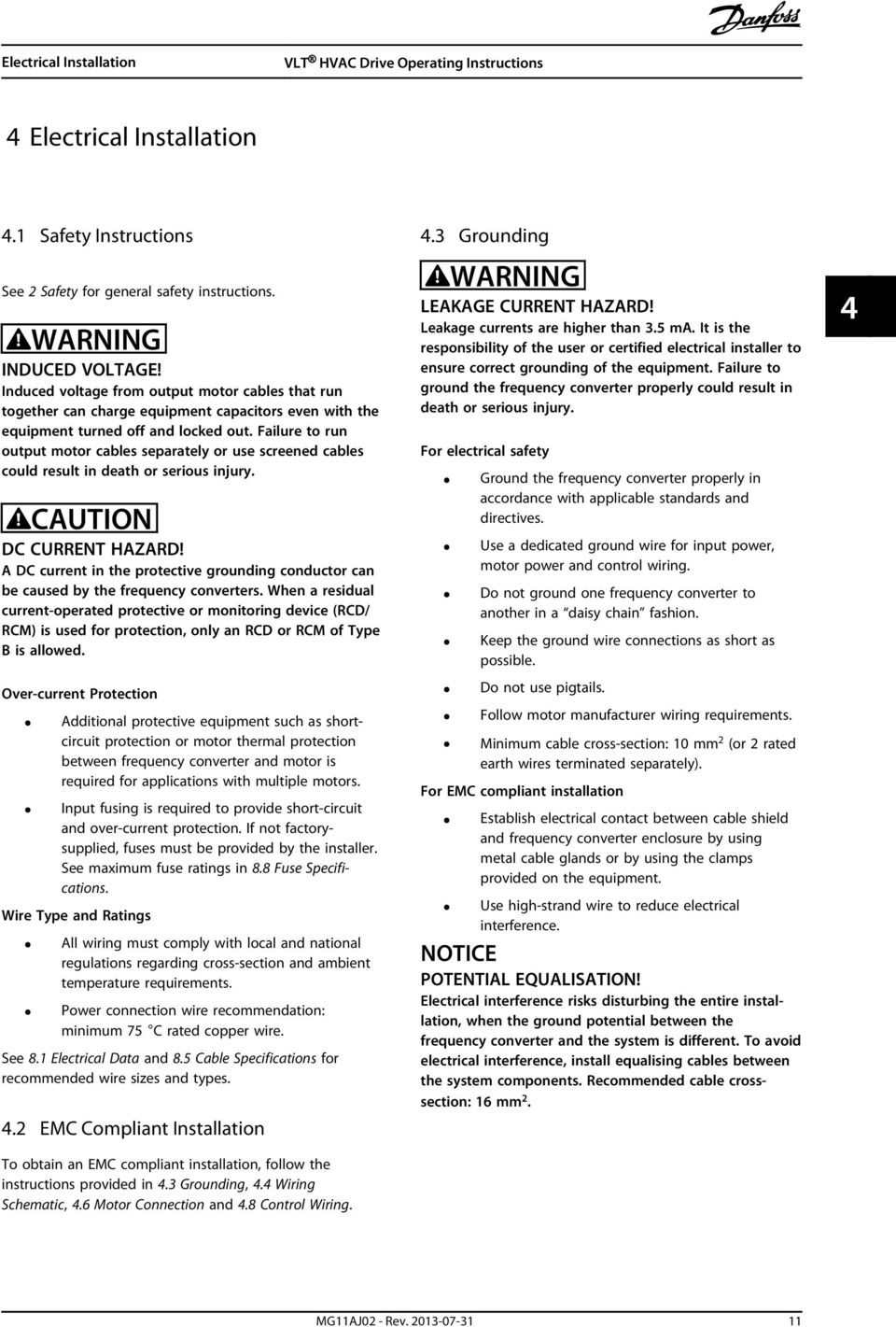
14 Electrical Installation 4.4 Wiring Schematic 4 3-phase power input DC bus +10 V DC 0/-10 V DC- +10 V DC 0/4-20 ma 0/-10 V DC V DC 0/4-20 ma 91 (L1) 92 (L2) 93 (L3) 95 PE 88 (-) 89 (+) 50 (+10 V OUT) 53 (A IN) 54 (A IN) 55 (COM A IN) 12 (+24 V OUT) 13 (+24 V OUT) 18 () S S ON ON ON=0/4-20 ma OFF=0/-10 V DC V DC P 5-00 Switch Mode Power Supply 10 V DC 24 V DC 15 ma 130/200 ma V (NPN) 0 V (PNP) relay1 03 relay2 (U) 96 (V) 97 (W) 98 (PE) 99 (R+) 82 (R-) Brake resistor 240 V AC, 2 A Motor 240 V AC, 2 A 400 V AC, 2 A 130BD () 20 (COM ) 27 (/OUT) 24 V 24 V (NPN) 0 V (PNP) 24 V (NPN) 0 V (PNP) S ON (COM A OUT) 39 (A OUT) 42 ON=Terminated OFF=Open Analog Output 0/4-20 ma 29 (/OUT) 0 V 24 V 24 V (NPN) 0 V (PNP) 5V S801 0 V 32 () 33 () 0 V 24 V (NPN) 0 V (PNP) 24 V (NPN) 0 V (PNP) RS-485 Interface (N RS-485) 69 (P RS-485) 68 (COM RS-485) 61 ** RS-485 : Chassis * 37 () : Ground Illustration 4.1 Basic Wiring Schematic A=Analog, D=Digital *Terminal 37 (optional) is used for Safe Torque Off. For Safe Torque Off installation instructions, refer to the Safe Torque Off Operating Instructions for Danfoss VLT Frequency Converters. **Do not connect cable screen. 12 MG11AJ02 - Rev
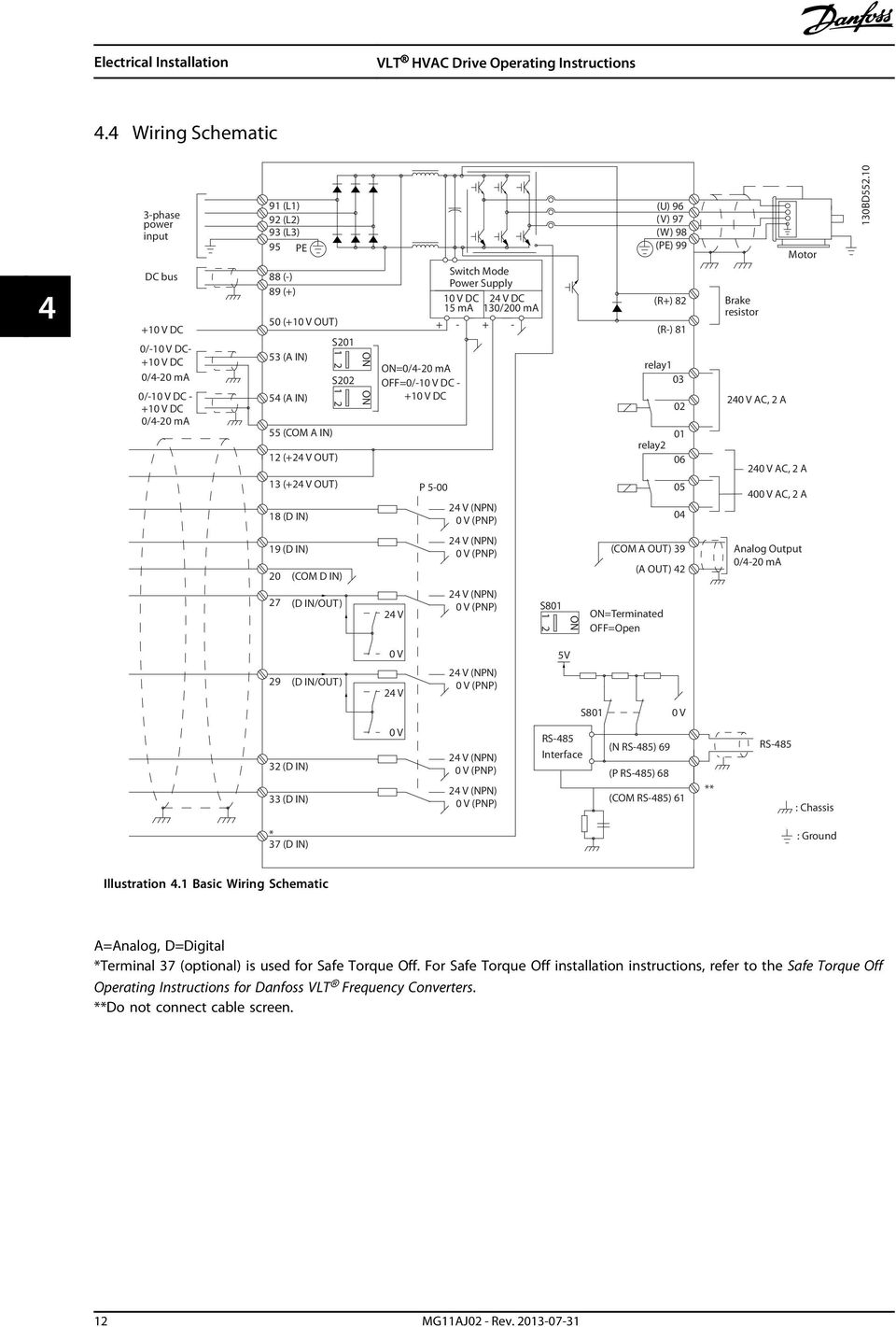
15 Electrical Installation BD L1 L2 L3 PE U V W PE 8 7 Illustration 4.2 EMC-correct Electrical Connection 1 PLC 6 Shielded cable 2 Frequency converter 7 Motor, 3-phase and PE 3 Output contactor 8 Mains, 3-phase and reinforced PE 4 Grounding rail (PE) 9 Control wiring 5 Cable insulation (stripped) 10 Equalising min. 16 mm 2 (0.025 in) Table 4.1 Legend to Illustration 4.2 NOTICE EMC INTERFERENCE! Use separated shielded cables for input power, motor wiring and control wiring, or run cables in 3 separate metallic conduits. Failure to isolate power, motor and control wiring can result in unintended behaviour or reduced performance. Minimum 200 mm (7.9 in) clearance between control cables, motor and mains. MG11AJ02 - Rev
16 Electrical Installation Access Remove cover with a screw driver (See Illustration 4.3) or by loosening attaching screws (See Illustration 4.4). 130BT Motor Connection WARNING INDUCED VOLTAGE! Induced voltage from output motor cables that run together can charge equipment capacitors even with the equipment turned off and locked out. Failure to run output motor cables separately or use screened cables could result in death or serious injury. Illustration 4.3 Access to Wiring for IP20 and IP21 Enclosures Illustration 4.4 Access to Wiring for IP55 and IP66 Enclosures 130BT Comply with local and national electrical codes for cable sizes. For maximum wire sizes see 8.1 Electrical Data. Follow motor manufacturer wiring requirements. Motor wiring knockouts or access panels are provided at the base of IP21 (NEMA1/12) and higher units. Do not wire a starting or pole-changing device (e.g. Dahlander motor or slip ring induction motor) between the frequency converter and the motor. Procedure 1. Strip a section of the outer cable insulation. 2. Position the stripped wire under the cable clamp to establish mechanical fixation and electrical contact between cable shield and ground. 3. Connect ground wire to the nearest grounding terminal in accordance with grounding instructions provided in 4.3 Grounding, see Illustration Connect the 3-phase motor wiring to terminals 96 (U), 97 (V), and 98 (W), see Illustration Tighten terminals in accordance with the information provided in 8.7 Connection Tightening Torques. See Table 4.2 before tightening the covers. Enclosure IP55 IP66 A4/A5 2 2 B1/B C1/C No screws to tighten for A2/A3/B3/B4/C3/C4. Table 4.2 Tightening Torques for Covers [Nm] 14 MG11AJ02 - Rev

17 4 4 Electrical Installation U V W BD Illustration 4.5 Motor Connection Illustration 4.6, Illustration 4.7 and Illustration 4.8 represent mains input, motor, and grounding for basic frequency converters. Actual configurations vary with unit types and optional equipment. L1 L2 L M A I N S RELAY 1 RELAY 2 130BD BD U V W Illustration 4.7 Motor, Mains and Ground Wiring for Enclosure Types A4 and A5 88 DC- 89 DC+ 81 R- 8 R+ 130BA L1 92 L2 93 L3 96 U 97 V 98 W DC BR- B 99 MOTOR U V W Illustration 4.8 Motor, Mains and Ground Wiring for Enclosure Types B and C Using Shielded Cable 4.7 AC Mains Connection Illustration 4.6 Motor, Mains and Ground Wiring for Enclosure Types A2 and A3 Size wiring based upon the input current of the frequency converter. For maximum wire sizes see 8.1 Electrical Data. Comply with local and national electrical codes for cable sizes. Procedure 1. Connect 3-phase AC input power wiring to terminals L1, L2, and L3 (see Illustration 4.9). 2. Depending on the configuration of the equipment, input power will be connected to the mains input terminals or the input disconnect. MG11AJ02 - Rev

18 Electrical Installation 4 3. Ground the cable in accordance with grounding instructions provided in 4.3 Grounding. 4. When supplied from an isolated mains source (IT mains or floating delta) or TT/TN-S mains with a grounded leg (grounded delta), ensure that RFI Filter is set to OFF to avoid damage to the intermediate circuit and to reduce earth capacity currents in accordance with IEC L 1 L 2 L BT Control Terminal Types Illustration 4.10 shows the removable frequency converter connectors. Terminal functions and default settings are summarised in Table BB Illustration 4.10 Control Terminal Locations Illustration 4.9 Connecting to AC Mains BB Control Wiring Isolate control wiring from high power components in the frequency converter. When the frequency converter is connected to a thermistor, ensure that the thermistor control wiring is screened and reinforced/double insulated. A 24 V DC supply voltage is recommended. Illustration 4.11 Terminal Numbers Connector 1 provides four programmable digital inputs terminals, two additional digital terminals programmable as either input or output, a 24 V DC terminal supply voltage, and a common for optional customer supplied 24 V DC voltage. Connector 2 terminals (+)68 and (-)69 are for an RS-485 serial communications connection Connector 3 provides two analog inputs, one analog output, 10 V DC supply voltage, and commons for the inputs and output Connector 4 is a USB port available for use with the MCT 10 Set-up Software 16 MG11AJ02 - Rev

19 Electrical Installation Terminal description Default Terminal Parameter Setting Description Digital Inputs/Outputs 12, V DC 24 V DC supply voltage. Maximum output current is 200 ma total for all 24 V loads. Usable for digital inputs and external transducers [8] Start [0] No operation [0] No operation Digital inputs [0] No operation [2] Coast inverse [14] JOG Selectable for digital input and output. Default setting is input Common for digital inputs and 0 V potential for 24 V supply Safe Torque Off (STO) Safe input (optional). Used for STO. Analog Inputs/Outputs 39 - Common for analog output Speed 0 - High Limit Programmable analog output. The analog signal is 0-20 ma or 4-20 ma at a maximum of 500 Ω V DC 10 V DC analog supply voltage. 15 ma maximum commonly used for potentiometer or thermistor Reference Analog input Feedback Selectable for voltage or current. Switches A53 and A54 select ma or V Common for analog input Serial Communication 61 - Integrated RC-Filter for cable screen. ONLY for connecting the screen when experiencing EMC problems. 68 (+) 8-3 RS-485 Interface. A 69 (-) 8-3 Relays control card switch is provided for termination resistance. 01, 02, [0] [0] Alarm Form C relay output. 04, 05, [1] [0] Running Table 4.3 Terminal Description Usable for AC or DC voltage and resistive or inductive loads. Additional terminals: 2 form C relay outputs. Location of the outputs depends on frequency converter configuration. Terminals located on built-in optional equipment. See the manual provided with the equipment option Wiring to Control Terminals Control terminal connectors can be unplugged from the frequency converter for ease of installation, as shown in Illustration NOTICE Keep control wires as short as possible and separate from high power cables to minimise interference. 1. Open the contact by inserting a small screw driver into the slot above the contact and push the screw driver slightly upwards mm Illustration 4.12 Connecting Control Wires 2 130BD MG11AJ02 - Rev
![33 5-15 [0] No operation 27 29 5-12 5-13 [2] Coast inverse [14] JOG Selectable for digital input and output. Default setting is input. 20 - Common for digital inputs and 0 V potential for 24 V supply.](/docs-images/40/11149479/images/page_19.jpg "37 - Safe Torque Off (STO) Safe input (optional). Used for STO. Analog Inputs/Outputs 39 - Common for analog output 42 6-50 Speed 0 - High Limit Programmable analog output.")
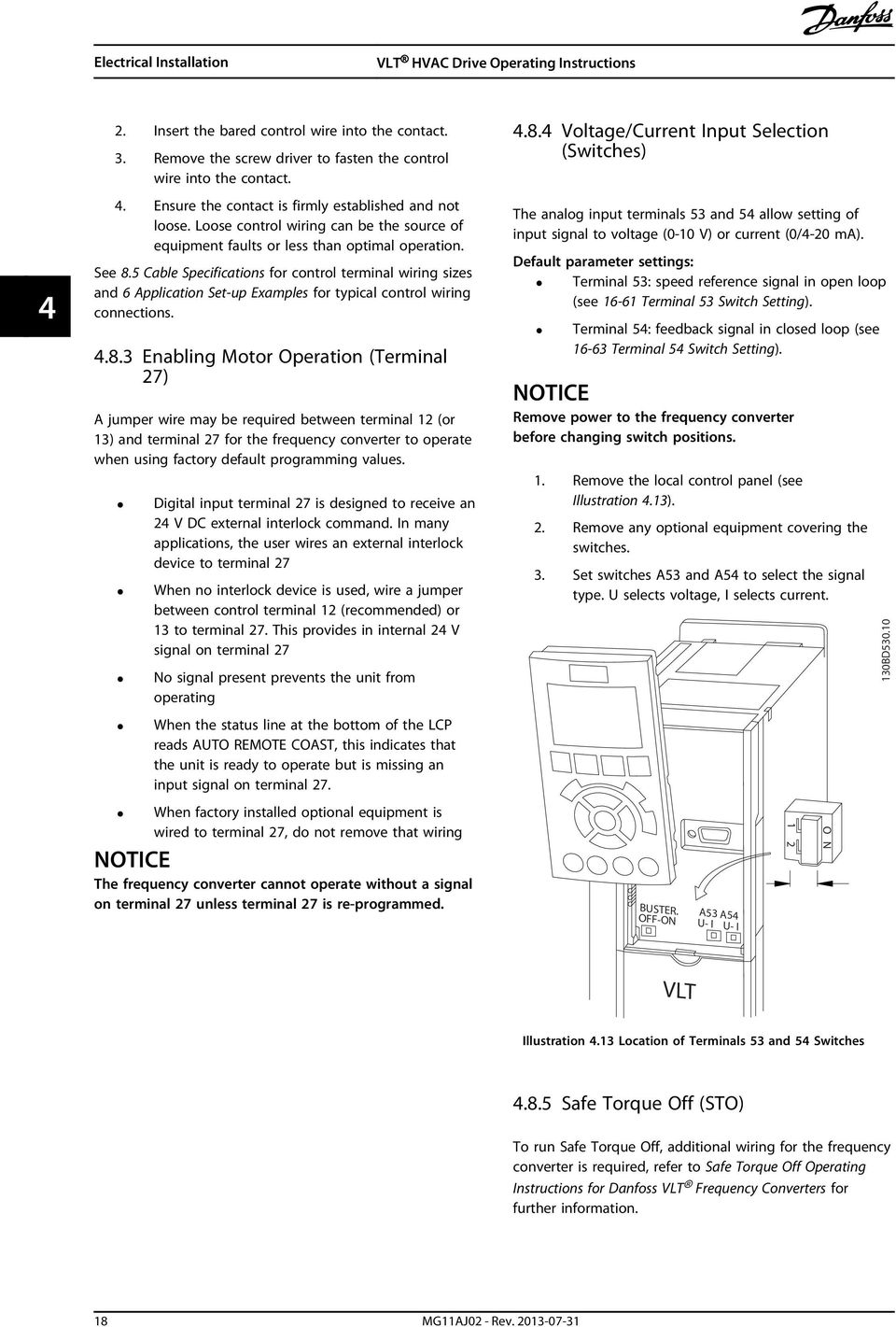
20 Electrical Installation 4 2. Insert the bared control wire into the contact. 3. Remove the screw driver to fasten the control wire into the contact. 4. Ensure the contact is firmly established and not loose. Loose control wiring can be the source of equipment faults or less than optimal operation. See 8.5 Cable Specifications for control terminal wiring sizes and 6 Application Set-up Examples for typical control wiring connections Enabling Motor Operation (Terminal 27) A jumper wire may be required between terminal 12 (or 13) and terminal 27 for the frequency converter to operate when using factory default programming values. Digital input terminal 27 is designed to receive an 24 V DC external interlock command. In many applications, the user wires an external interlock device to terminal 27 When no interlock device is used, wire a jumper between control terminal 12 (recommended) or 13 to terminal 27. This provides in internal 24 V signal on terminal 27 No signal present prevents the unit from operating When the status line at the bottom of the LCP reads AUTO REMOTE COAST, this indicates that the unit is ready to operate but is missing an input signal on terminal 27. When factory installed optional equipment is wired to terminal 27, do not remove that wiring NOTICE The frequency converter cannot operate without a signal on terminal 27 unless terminal 27 is re-programmed Voltage/Current Input Selection (Switches) The analog input terminals 53 and 54 allow setting of input signal to voltage (0-10 V) or current (0/4-20 ma). Default parameter settings: Terminal 53: speed reference signal in open loop (see Terminal 53 Switch Setting). Terminal 54: feedback signal in closed loop (see Terminal 54 Switch Setting). NOTICE Remove power to the frequency converter before changing switch positions. 1. Remove the local control panel (see Illustration 4.13). 2. Remove any optional equipment covering the switches. 3. Set switches A53 and A54 to select the signal type. U selects voltage, I selects current. BUSTER. OFF-ON A53 A54 U- I U- I 1 2 N O 130BD VLT Illustration 4.13 Location of Terminals 53 and 54 Switches Safe Torque Off (STO) To run Safe Torque Off, additional wiring for the frequency converter is required, refer to Safe Torque Off Operating Instructions for Danfoss VLT Frequency Converters for further information. 18 MG11AJ02 - Rev
21 Electrical Installation RS-485 Serial Communication Up to 32 nodes can be connected as a bus, or via drop cables from a common trunk line to 1 network segment. Repeaters can divide network segments. Each repeater functions as a node within the segment in which it is installed. Each node connected within a given network must have a unique node address, across all segments. Connect RS-485 serial communication wiring to terminals (+)68 and (-)69. Terminate each segment at both ends, using either the termination switch (bus term on/off, see Illustration 4.13) on the frequency converters, or a biased termination resistor network. Connect a large surface of the screen to ground, for example with a cable clamp or a conductive cable gland. Apply potential-equalising cables to maintain the same ground potential throughout the network. Use the same type of cable throughout the entire network to prevent impedance mismatch. 4 4 Cable Impedance Max. cable length [m] Screened twisted pair (STP) 120 Ω 1200 (including drop lines) 500 station-to-station Table 4.4 Cable Information MG11AJ02 - Rev
22 Electrical Installation 4.9 Installation Check List Before completing installation of the unit, inspect the entire installation as detailed in Table 4.5. Check and mark the items when completed. 4 Inspect for Description Auxiliary equipment Look for auxiliary equipment, switches, disconnects, or input fuses/circuit breakers that may reside on the input power side of the frequency converter or output side to the motor. Ensure that they are ready for Cable routing full-speed operation Check function and installation of any sensors used for feedback to the frequency converter Remove any power factor correction caps on motor(s) Adjust any power factor correction caps on the mains side and ensure that they are dampened Ensure that motor wiring and control wiring are separated or screened or in 3 separate metallic conduits for high-frequency interference isolation Control wiring Cooling clearance Check for broken or damaged wires and loose connections Check that control wiring is isolated from power and motor wiring for noise immunity Check the voltage source of the signals, if necessary The use of shielded cable or twisted pair is recommended. Ensure that the shield is terminated correctly Measure that top and bottom clearance is adequate to ensure proper air flow for cooling, see 3.3 Mounting Ambient conditions Check that requirements for ambient conditions are met Fusing and circuit breakers Check for proper fusing or circuit breakers Check that all fuses are inserted firmly and are in operational condition and that all circuit breakers are in the open position Grounding Input and output power wiring Panel interior Check for good ground connections that are tight and free of oxidation Grounding to conduit, or mounting the back panel to a metal surface, is not a suitable grounding Check for loose connections Check that motor and mains are in separate conduit or separated screened cables Inspect that the unit interior is free of dirt, metal chips, moisture, and corrosion Check that the unit is mounted on an unpainted, metal surface Switches Ensure that all switch and disconnect settings are in the proper positions Vibration Check that the unit is mounted solidly, or that shock mounts are used, as necessary Check for an unusual amount of vibration Table 4.5 Installation Check List CAUTION POTENTIAL HAZAR THE EVENT OF INTERNAL FAILURE! Risk of personal injury when the frequency converter is not properly closed. Before applying power, ensure all safety covers are in place and securely fastened. 20 MG11AJ02 - Rev
23 Commissioning 5 Commissioning 5.1 Safety Instructions See 2 Safety for general safety instructions. WARNING HIGH VOLTAGE! Frequency converters contain high voltage when connected to AC mains input power. Installation, startup, and maintenance must be performed by qualified personnel only. Failure to perform installation, start-up, and maintenance by qualified personnel could result in death or serious injury. Before applying power: 1. Close cover properly. 2. Check that all cable glands are firmly tightened. 3. Ensure that input power to the unit is OFF and locked out. Do not rely on the frequency converter disconnect switches for input power isolation. 4. Verify that there is no voltage on input terminals L1 (91), L2 (92), and L3 (93), phase-to-phase and phase-to-ground. 5. Verify that there is no voltage on output terminals 96 (U), 97 (V), and 98 (W), phase-tophase and phase-to-ground. 6. Confirm continuity of the motor by measuring ohm values on U-V (96-97), V-W (97-98), and W-U (98-96). 7. Check for proper grounding of the frequency converter as well as the motor. 8. Inspect the frequency converter for loose connections on terminals. 9. Confirm that the supply voltage matches voltage of frequency converter and motor. 5.2 Applying Power WARNING UNINTENDED START! When the frequency converter is connected to AC mains, the motor may start at any time. The frequency converter, motor, and any driven equipment must be in operational readiness. Failure to be in operational readiness when the frequency converter is connected to AC mains could result in death, serious injury, equipment or property damage. 1. Confirm that the input voltage is balanced within 3%. If not, correct input voltage imbalance before proceeding. Repeat this procedure after the voltage correction. 2. Ensure that optional equipment wiring, if present, matches the installation application. 3. Ensure that all operator devices are in the OFF position. Panel doors must be closed or cover mounted. 4. Apply power to the unit. DO NOT start the frequency converter at this time. For units with a disconnect switch, turn to the ON position to apply power to the frequency converter. NOTICE If the status line at the bottom of the LCP reads AUTO REMOTE COASTING or Alarm 60 External Interlock is displayed, this indicates that the unit is ready to operate but is missing an input signal on terminal 27. See Enabling Motor Operation (Terminal 27) for details. 5.3 Local Control Panel Operation Local Control Panel The local control panel (LCP) is the combined display and keypad on the front of the unit. The LCP has several user functions: Start, stop, and control speed when in local control Display operational data, status, warnings and cautions Programming frequency converter functions Manually reset the frequency converter after a fault when auto-reset is inactive An optional numeric LCP (NLCP) is also available. The NLCP operates in a manner similar to the LCP. See the Programming Guide for details on use of the NLCP. NOTICE For commissioning via PC, install MCT 10 Set-up Software. The software is available for downloading at (basic version) or for ordering (advanced version, order number 130B1000). 5 5 MG11AJ02 - Rev
24 Info Commissioning LCP Layout The LCP is divided into 4 functional groups (see Illustration 5.1). B. Display Menu Keys Menu keys are used for menu access for parameter set-up, toggling through status display modes during normal operation, and viewing fault log data. A. Display area B. Display menu keys Key Function 6 Status Shows operational information. 7 Quick Menu Allows access to programming parameters C. Navigation keys and indicator lights (LEDs) D. Operation keys and reset for initial set-up instructions and many detailed application instructions. 8 Main Menu Allows access to all programming 5 1 Status 1(1) 0.0 % 0.00 A 0.00 kw 3 130BD parameters. 9 Alarm Log Displays a list of current warnings, the last 10 alarms, and the maintenance log A B Off Remote Stop Status Quick Menu 0.0Hz 2605 kwh Main Menu Alarm Log 5 9 Table 5.2 Legend to Illustration 5.1, Display Menu Keys C. Navigation Keys and Indicator Lights (LEDs) Navigation keys are used for programming functions and moving the display cursor. The navigation keys also provide speed control in local (hand) operation. There are also 3 frequency converter status indicator lights in this area C On Back OK Cancel Key Function 10 Back Reverts to the previous step or list in the menu structure. 11 Cancel Cancels the last change or command as long as the display mode has not changed Warn. Alarm Info Press for a definition of the function being displayed. 13 Navigation Use the 4 navigation keys to move between 17 Keys items in the menu. D Hand on Off Auto on Reset OK Use to access parameter groups or to enable a choice Illustration 5.1 Local Control Panel (LCP) Table 5.3 Legend to Illustration 5.1, Navigation Keys Indicator Light Function A. Display Area The display area is activated when the frequency converter receives power from mains voltage, a DC bus terminal, or an external 24 V DC supply. The information displayed on the LCP can be customized for user application. Select options in the Quick Menu Q3-13 Display Settings. Display Parameter number Default setting Reference % Motor current Power [kw] Frequency kwh counter 15 ON Green The ON light activates when the frequency converter receives power from mains voltage, a DC bus terminal, or an external 24 V supply. 16 WARN Yellow When warning conditions are met, the yellow WARN light comes on and text appears in the display area identifying the problem. 17 ALARM Red A fault condition causes the red alarm light to flash and an alarm text is displayed. Table 5.4 Legend to Illustration 5.1, Indicator Lights (LEDs) Table 5.1 Legend to Illustration 5.1, Display Area 22 MG11AJ02 - Rev
25 Commissioning D. Operation Keys and Reset Operation keys are located at the bottom of the LCP. Key Function 18 Hand On Starts the frequency converter in local control. An external stop signal by control input or serial communication overrides the local hand on 19 Off Stops the motor but does not remove power to the frequency converter. 20 Auto On Puts the system in remote operational mode. Responds to an external start command by control terminals or serial communication 21 Reset Resets the frequency converter manually after a fault has been cleared. Table 5.5 Legend to Illustration 5.1, Operation Keys and Reset NOTICE The display contrast can be adjusted by pressing [Status] and [ ]/[ ] keys Parameter Settings Establishing the correct programming for applications often requires setting functions in several related parameters. Details for parameters are provided in 9.2 Parameter Menu Structure. Programming data are stored internally in the frequency converter. For backup, upload data into the LCP memory To download data to another frequency converter, connect the LCP to that unit and download the stored settings Restoring factory default settings does not change data stored in the LCP memory Uploading/Downloading Data to/from the LCP 1. Press [Off] to stop the motor before uploading or downloading data. 2. Go to [Main Menu] 0-50 LCP Copy and Press [OK]. 3. Select All to LCP to upload data to LCP or select All from LCP to download data from the LCP. 4. Press [OK]. A progress bar shows the uploading or downloading process. 5. Press [Hand On] or [Auto On] to return to normal operation Changing Parameter Settings View Changes Quick Menu Q5 - Changes Made lists all parameters changed from default settings. The list shows only parameters which have been changed in the current edit-setup. Parameters which have been reset to default values are not listed. The message 'Empty' indicates that no parameters have been changed. Changing Settings Parameter settings can be accessed and changed from the [Quick Menu] or from the [Main Menu]. The [Quick Menu] only gives access to a limited number of parameters. 1. Press [Quick Menu] or [Main Menu] on the LCP. 2. Press [ ] [ ] to browse through the parameter groups, press [OK] to select a parameter group. 3. Press [ ] [ ] to browse through the parameters, press [OK] to select a parameter. 4. Press [ ] [ ] to change the value of a parameter setting. 5. Press [ ] [ ] to shift digit when a decimal parameter is in the editing state. 6. Press [OK] to accept the change. 7. Press either [Back] twice to enter Status, or press [Main Menu] once to enter Main Menu Restoring Default Settings NOTICE Initialisation restores the unit to factory default settings. Any programming, motor data, localisation, and monitoring records will be lost. Uploading data to the LCP provides a backup before initialisation. Restoring the frequency converter parameter settings back to default values is done by initialisation of the frequency converter. Initialisation can be carried out through Operation Mode (recommended) or manually. Initialisation using Operation Mode does not reset frequency converter settings such as operating hours, serial communication selections, personal menu settings, fault log, alarm log, and other monitoring functions. Manual initialisation erases all motor, programming, localization, and monitoring data and restores factory default settings. 5 5 MG11AJ02 - Rev
26 Commissioning 5 Recommended Initialisation Procedure, via Operation Mode 1. Press [Main Menu] twice to access parameters. 2. Scroll to Operation Mode and press [OK]. 3. Scroll to Initialisation and press [OK]. 4. Remove power to the unit and wait for the display to turn off. 5. Apply power to the unit. Default parameter settings are restored during start-up. This may take slightly longer than normal. 6. Alarm 80 is displayed. 7. Press [Reset] to return to operation mode. Manual Initialisation Procedure 1. Remove power to the unit and wait for the display to turn off. 2. Press and hold [Status], [Main Menu], and [OK] at the same time while applying power to the unit (approximately 5 s or until audible click and fan starts). Factory default parameter settings are restored during start-up. This may take slightly longer than normal. Manual initialisation does not reset the following frequency converter information Operating hours Power Up's Over Temp's Over Volt's 5.4 Basic Programming Commissioning with SmartStart The SmartStart wizard enables fast configuration of basic motor and application parameters. At first power up or after initialisation of the frequency converter, SmartStart starts by itself. Follow on-screen instructions to complete commssioning of the frequency converter. SmartStart can always be re-activiated by selecting Quick Menu Q4 - SmartStart. For commissioning without use of the SmartStart wizard, refer to Commissioning via [Main Menu] or the Programming Guide. NOTICE Motor data are required for the SmartStart setup. The required data are normally available on the motor nameplate Commissioning via [Main Menu] Recommended parameter settings are intended for startup and checkout purposes. Application settings may vary. Enter data with power ON, but before operating the frequency converter. 1. Press [Main Menu] on the LCP. 2. Use the navigation keys to scroll to parameter group 0-** Operation/Display and press [OK] RPM Main menu Illustration 5.2 Main Menu 0 - ** Operation/Display 1 - ** Load/Motor 2 - ** Brakes 3 - ** Reference / Ramps 3.84 A 1 (1) 3. Use navigation keys to scroll to parameter group 0-0* Basic Settings and press [OK]. 0.0% Operation / Display 0-0 * Basic Settings 0-1 * Set-up Opperations 0-2 * LCP Display 0-3 * LCP Custom Readout Illustration 5.3 Operation/Display 0.00A 1(1) 0- ** 4. Use navigation keys to scroll to 0-03 Regional Settings and press [OK]. 0.0% Basic Settings 0-03 Regional Settings [0] International Illustration 5.4 Basic Settings 0.00A 1(1) 0-0 * 5. Use navigation keys to select [0] International or [1] North America as appropriate and press [OK]. (This changes the default settings for a number of basic parameters). 6. Press [Main Menu] on the LCP. 130BP BP BP MG11AJ02 - Rev
27 Commissioning 7. Use the navigation keys to scroll to 0-01 Language. 8. Select language and press [OK]. 9. If a jumper wire is in place between control terminals 12 and 27, leave 5-12 Terminal 27 Digital Input at factory default. Otherwise, No Operation should be selected in 5-12 Terminal 27 Digital Input. For frequency converters with an optional bypass, no jumper wire is required between control terminals 12 and Minimum Reference Maximum Reference Ramp 1 Ramp Up Time Ramp 1 Ramp Down Time Reference Site. Linked to Hand/Auto Local Remote Asynchronous Motor Setup Enter the motor data in parameters 1-20 or 1-21 to The information can be found on the motor nameplate Motor Power [kw] or 1-21 Motor Power [HP] Motor Voltage Motor Frequency Motor Current Motor Nominal Speed Permanent Magnet Motor Setup NOTICE Only use permanent magnet (PM) motor with fans and pumps. Initial Programming Steps 1. Activate PM motor operation 1-10 Motor Construction, select (1) PM, non salient SPM 2. Set 0-02 Motor Speed Unit to [0] RPM Programming motor data After selecting PM motor in 1-10 Motor Construction, the PM motor-related parameters in parameter groups 1-2* Motor Data, 1-3* Adv. Motor Data and 1-4* are active. The necessary data can be found on the motor nameplate and in the motor data sheet. Program the following parameters in the listed order Motor Current Motor Cont. Rated Torque Motor Nominal Speed Motor Poles Stator Resistance (Rs) Enter line to common stator winding resistance (Rs). If only line-line data are available, divide the line-line value with 2 to achieve the line to common (starpoint) value. It is also possible to measure the value with an ohmmeter, which will also take the resistance of the cable into account. Divide the measured value by 2 and enter the result d-axis Inductance (Ld) Enter line to common direct axis inductance of the PM motor. If only line-line data are available, divide the lineline value with 2 to achieve the line-common (starpoint) value. It is also possible to measure the value with an inductancemeter, which will also take the inductance of the cable into account. Divide the measured value by 2 and enter the result Back EMF at 1000 RPM Enter line to line back EMF of PM Motor at 1000 RPM mechanical speed (RMS value). Back EMF is the voltage generated by a PM motor when no drive is connected and the shaft is turned externally. Back EMF is normally specified for nominal motor speed or for 1000 RPM measured between two lines. If the value is not available for a motor speed of 1000 RPM, calculate the correct value as follows: If back EMF is e.g. 320 V at 1800 RPM, it can be calculated at 1000 RPM as follows: Back EMF = (Voltage / RPM)*1000 = (320/1800)*1000 = 178. This is the value that must be programmed for 1-40 Back EMF at 1000 RPM. Test Motor Operation 1. Start the motor at low speed (100 to 200 RPM). If the motor does not turn, check installation, general programming and motor data. 2. Check if start function in 1-70 PM Start Mode fits the application requirements. Rotor detection This function is the recommended choice for applications where the motor starts from standstill, e.g. pumps or conveyors. On some motors, an acoustic sound is heard when the impulse is sent out. This does not harm the motor. Parking This function is the recommended choice for applications where the motor is rotating at slow speed eg. windmilling in fan applications Parking Current and 2-07 Parking Time can be adjusted. Increase the factory setting of these parameters for applications with high inertia. 5 5 MG11AJ02 - Rev
28 Commissioning 5 Start the motor at nominal speed. If the application does not run well, check the VVC plus PM settings. Recommendations in different applications can be seen in Table 5.6. Application Low inertia applications ILoad/IMotor <5 Low inertia applications 50>ILoad/IMotor >5 High inertia applications ILoad/IMotor > 50 High load at low speed <30% (rated speed) Settings 1-17 Voltage filter time const. to be increased by factor 5 to Damping Gain should be reduced 1-66 Min. Current at Low Speed should be reduced (<100%) Keep calculated values 1-14 Damping Gain, 1-15 Low Speed Filter Time Const. and 1-16 High Speed Filter Time Const. should be increased 1-17 Voltage filter time const. should be increased 1-66 Min. Current at Low Speed should be increased (>100% for a prolonged time can overheat the motor) Table 5.6 Recommendations in Different Applications If the motor starts oscillating at a certain speed, increase 1-14 Damping Gain. Increase the value in small steps. Depending on the motor, a good value for this parameter can be 10% or 100% higher than the default value. Starting torque can be adjusted in 1-66 Min. Current at Low Speed. 100% provides nominal torque as starting torque Automatic Energy Optimization (AEO) NOTICE AEO is not relevant for permanent magnet motors. Automatic Energy Optimization (AEO) is recommended for Automatic compensation for oversized motors Automatic compensation for slow system load change Automatic compensation for seasonal changes Automatic compensation for low motor loading Reduced energy consumption Reduced motor heating Reduced motor noise To activate AEO, set parameter 1-03 Torque Characteristics to [2] Auto Energy Optim. CT or [3] Auto Energy Optim. VT Automatic Motor Adaptation (AMA) NOTICE AMA is not relevant for permanent magnet motors. Automatic motor adaptation (AMA) is a procedure that optimizes compatibility between the frequency converter and the motor. The frequency converter builds a mathematical model of the motor for regulating output motor current. The procedure also tests the input phase balance of electrical power. It compares the motor characteristics with the data entered in parameters 1-20 to 1-25 The motor shaft does not turn and no harm is done to the motor while running the AMA Some motors may be unable to run the complete version of the test. In that case, select [2] Enable reduced AMA If an output filter is connected to the motor, select Enable reduced AMA If warnings or alarms occur, see 7.3 List of Warnings and Alarms Run this procedure on a cold motor for best results To run AMA 1. Press [Main Menu] to access parameters. 2. Scroll to parameter group 1-** Load and Motor and press [OK]. 3. Scroll to parameter group 1-2* Motor Data and press [OK]. 4. Scroll to 1-29 Automatic Motor Adaptation (AMA) and press [OK]. 5. Select [1] Enable complete AMA and press [OK]. 6. Follow on-screen instructions. 7. The test will run automatically and indicate when it is complete. 26 MG11AJ02 - Rev
29 Commissioning 5.5 Checking Motor Rotation WARNING MOTOR START! Ensure that the motor, system, and any attached equipment are ready for start. It is the responsibility of the user to ensure safe operation under any condition. Failure to ensure that the motor, system, and any attached equipment is ready for start could result in personal injury or equipment damage. NOTICE Risk of damage to pumps/compressors caused by motor running in wrong direction. Before running the frequency converter, check the motor rotation. The motor will run briefly at 5 Hz or the minimum frequency set in 4-12 Motor Speed Low Limit [Hz]. 1. Press [Main Menu]. 2. Scroll to 1-28 Motor Rotation Check and press [OK]. 3. Scroll to [1] Enable. The following text will appear: Note! Motor may run in wrong direction. 4. Press [OK]. 5. Follow the on-screen instructions. NOTICE To change the direction of rotation, remove power to the frequency converter and wait for power to discharge. Reverse the connection of any 2 of the 3 motor wires on the motor or frequency converter side of the connection. 5.6 Local-control Test WARNING MOTOR START! Ensure that the motor, system,e and any attached equipment are ready for start. It is the responsibility of the user to ensure safe operation under any condition. Failure to ensure that the motor, system, and any attached equipment is ready for start could result in personal injury or equipment damage. 1. Press [Hand On] to provide a local start command to the frequency converter. 2. Accelerate the frequency converter by pressing [ ] to full speed. Moving the cursor left of the decimal point provides quicker input changes. 3. Note any acceleration problems. 4. Press [Off]. Note any deceleration problems. In the event of acceleration or deceleration problems, see 7.4 Troubleshooting. See 7.3 List of Warnings and Alarms for resetting the frequency converter after a trip. 5.7 System Start-up The procedure in this section requires user-wiring and application programming to be completed. The following procedure is recommended after application set-up is completed. WARNING MOTOR START! Ensure that the motor, system, and any attached equipment are ready for start. It is the responsibility of the user to ensure safe operation under any condition. Failure to ensure that the motor, system, and any attached equipment is ready for start could result in personal injury or equipment damage. 1. Press [Auto On]. 2. Apply an external run command. 3. Adjust the speed reference throughout the speed range. 4. Remove the external run command. 5. Check sound and vibration level of the motor to ensure that the system is working as intended. If warnings or alarms occur, see 7.3 List of Warnings and Alarms. 5.8 Maintenance Under normal operating conditions and load profiles, the frequency converter is maintenance-free throughout its designed lifetime. To prevent breakdown, danger, and damage, examine the frequency converter at regular intervals depending on the operating conditions. Replace worn or damaged parts with original spare parts or standard parts. For service and support, refer to CAUTION Risk of personal injury or equipment damage exists. Repair and service must be carried out by Danfoss authorized personnel only. 5 5 MG11AJ02 - Rev
30 Application Set-up Examples 6 Application Set-up Examples 6 The examples in this section are intended as a quick reference for common applications. Parameter settings are the regional default values unless otherwise indicated (selected in 0-03 Regional Settings) Parameters associated with the terminals and their settings are shown next to the drawings Where switch settings for analog terminals A53 or A54 are required, these are also shown NOTICE When the optional Safe Torque Off feature is used, a jumper wire may be required between terminal 12 (or 13) and terminal 37 for the frequency converter to operate when using factory default programming values. 6.1 Application Examples +24 V +24 V COM +10 V A IN A IN COM A OUT COM FC BB Parameters Function Setting 6-12 Terminal 53 4 ma* Low Current 6-13 Terminal ma* High Current 6-14 Terminal 53 0 Hz Low Ref./Feedb. Value 6-15 Terminal Hz High Ref./Feedb. Value + * = Default Value Notes/comments: 37 is an option mA Speed U - I A53 Parameters Table 6.2 Analog Speed Reference (Current) +24 V +24 V COM +10 V A IN A IN COM A OUT COM FC U - I BB Function Setting 6-10 Terminal 53 Low Voltage 0.07 V* 6-11 Terminal V* High Voltage 6-14 Terminal 53 0 Hz Low Ref./Feedb. Value 6-15 Terminal Hz High Ref./Feedb. Value + * = Default Value Notes/comments: 37 is an option V FC +24 V +24 V COM +10 V A IN A IN COM A OUT COM BB Function Parameters Setting 6-10 Terminal 53 Low Voltage 0.07 V* 6-11 Terminal V* High Voltage 6-14 Terminal 53 0 Hz Low Ref./Feedb. Value 6-15 Terminal Hz High Ref./Feedb. Value 5kΩ * = Default Value Notes/comments: 37 is an option. A53 U - I Table 6.1 Analog Speed Reference (Voltage) A53 Table 6.3 Speed Reference (Using a Manual Potentiometer) 28 MG11AJ02 - Rev
31 Application Set-up Examples FC +24 V +24 V COM +10 V A IN A IN COM A OUT COM BB Parameters Function Setting 5-10 Terminal 18 [8] Start* Digital Input 5-12 Terminal 27 [19] Freeze Digital Input Reference 5-13 Terminal 29 [21] Speed Digital Input Up 5-14 Terminal 32 [22] Speed Digital Input Down * = Default Value Notes/comments: 37 is an option Start/Stop FC +24 V V COM A IN 53 A IN 54 COM BB Parameters Function Setting 5-10 Terminal 18 [8] Start* Digital Input 5-12 Terminal 27 [0] No Digital Input operation 5-19 Terminal 37 [1] Safe Stop Safe Stop Alarm * = Default Value Notes/comments: If 5-12 Terminal 27 Digital Input is set to [0] No operation, a jumper wire to terminal 27 is not needed. 37 is an option. 6 6 A OUT 42 COM 39 Table 6.5 Start/Stop Command with Safe Stop Option Table 6.4 Speed Up/Down Speed 130BB S p e e d R e f e r e n c e 130BB Start (18) Illustration 6.2 Start/Stop Command with Safe Stop S t a r t ( 1 8 ) F r e e z e r e f ( 2 7 ) S p e e d u p ( 2 9 ) S p e e d d o w n ( 3 2 ) Illustration 6.1 Speed Up/Down MG11AJ02 - Rev
32 Application Set-up Examples Parameters Parameters FC +24 V +24 V BB Function 5-10 Terminal 18 Digital Input Setting [9] Latched Start FC +24 V +24 V BB Function 5-10 Terminal 18 Digital Input Setting [8] Start 6 COM +10 V A IN A IN COM A OUT COM Terminal 27 [6] Stop Digital Input Inverse * = Default Value Notes/comments: If 5-12 Terminal 27 Digital Input is set to [0] No operation, a jumper wire to terminal 27 is not needed. 37 is an option. COM +10 V A IN A IN COM A OUT COM Terminal 19 Digital Input 5-12 Terminal 27 Digital Input 5-14 Terminal 32 Digital Input 5-15 Terminal 33 Digital Input 3-10 Preset Reference Preset ref. 0 Preset ref. 1 [10] Reversing* [0] No operation [16] Preset ref bit 0 [17] Preset ref bit 1 25% 50% Preset ref. 2 75% Preset ref % Table 6.6 Pulse Start/Stop * = Default Value Notes/comments: 37 is an option. Speed 130BB Table 6.7 Start/Stop with Reversing and 4 Preset Speeds External Alarm Reset Latched Start (18) Parameters Stop Inverse (27) Illustration 6.3 Latched Start/Stop Inverse FC +24 V +24 V BB Function 5-11 Terminal 19 Digital Input Setting [1] Reset 19 * = Default Value COM Notes/comments: 37 is an option V A IN A IN COM A OUT COM Table 6.8 External Alarm Reset 30 MG11AJ02 - Rev
33 Application Set-up Examples RS Motor Thermistor +24 V +24 V COM +10 V A IN A IN COM A OUT COM R1 FC BB Parameters Function Setting 8-30 Protocol FC* 8-31 Address 1* 8-32 Baud Rate 9600* * = Default Value Notes/comments: Select protocol, address and baud rate in the above mentioned parameters. 37 is an option. CAUTION Use only thermistors with reinforced or double insulation to meet PELV insulation requirements. +24 V +24 V COM VLT V A IN A IN COM A OUT COM BB Function 1-90 Motor Thermal Protection 1-93 Thermistor Source Parameters * = Default Value Notes/comments: [2] Setting Thermistor trip [1] Analog input 53 If only a warning is desired, 1-90 Motor Thermal Protection should be set to [1] Thermistor warning. 37 is an option. 6 6 R RS-485 U - I A53 Table 6.10 Motor Thermistor Table 6.9 RS-485 Network Connection MG11AJ02 - Rev
34 Diagnostics and Troubleshoo... 7 Diagnostics and Troubleshooting 7 This chapter describes the status messages, warnings and alarms and basic troubleshooting. 7.1 Status Messages When the frequency converter is in status mode, status messages are generated automatically and appear in the bottom line of the display (see Illustration 7.1.) Status 1(1) 799RPM 7.83A 36.4kW Auto Hand Off Illustration 7.1 Status Display Remote Local % Ramping Stop Running Jogging... Stand by BB Remote Local Table 7.3 Reference Site AC Brake AMA finish OK AMA ready AMA running Braking Braking max. Coast The speed reference is given from external signals, serial communication, or internal preset references. The frequency converter uses [Hand On] control or reference values from the LCP. AC Brake was selected in 2-10 Brake Function. The AC brake over-magnetizes the motor to achieve a controlled slow-down. Automatic motor adaptation (AMA) was carried out successfully. AMA is ready to start. Press [Hand On] to start. AMA process is in progress. The brake chopper is in operation. Generative energy is absorbed by the brake resistor. The brake chopper is in operation. The power limit for the brake resistor defined in 2-12 Brake Power Limit (kw) has been reached. Coast inverse was selected as a function for a digital input (parameter group 5-1* Digital Inputs). The corresponding terminal is not connected. 1 Operation Mode (see Table 7.2) 2 Reference Site (see Table 7.3) 3 Operation Status (see Table 7.4) Table 7.1 Legend to Illustration 7.1 Table 7.2 to Table 7.4 describe the displayed status messages. Off Auto On Hand On The frequency converter does not react to any control signal until [Auto On] or [Hand On] is pressed. The frequency converter is controlled from the control terminals and/or the serial communication. The frequency converter can be controlled by the navigation keys on the LCP. Stop commands, reset, reversing, DC brake, and other signals applied to the control terminals can override local control. Ctrl. Ramp-down Current High Current Low DC Hold Coast activated by serial communication Control Ramp-down was selected in Mains Failure. The mains voltage is below the value set in Mains Voltage at Mains Fault at mains fault The frequency converter ramps down the motor using a controlled ramp down The frequency converter output current is above the limit set in 4-51 Warning Current High. The frequency converter output current is below the limit set in 4-52 Warning Speed Low DC hold is selected in 1-80 Function at Stop and a stop command is active. The motor is held by a DC current set in 2-00 DC Hold/ Preheat Current. Table 7.2 Operation Mode 32 MG11AJ02 - Rev
35 Diagnostics and Troubleshoo... DC Stop Feedback high Feedback low Freeze output The motor is held with a DC current (2-01 DC Brake Current) for a specified time (2-02 DC Braking Time). DC Brake is activated in 2-03 DC Brake Cut In Speed [RPM] and a stop command is active. DC Brake (inverse) is selected as a function for a digital input (parameter group 5-1* Digital Inputs). The corresponding terminal is not active. The DC Brake is activated via serial communication. The sum of all active feedbacks is above the feedback limit set in 4-57 Warning Feedback High. The sum of all active feedbacks is below the feedback limit set in 4-56 Warning Feedback Low. The remote reference is active, which holds the present speed. Freeze output was selected as a function for a digital input (parameter group 5-1* Digital Inputs). The corresponding terminal is active. Speed control is only possible via the terminal functions Speed Up and Speed Down. Motor check OVC control PowerUnit Off Protection md In 1-80 Function at Stop, Motor Check was selected. A stop command is active. To ensure that a motor is connected to the frequency converter, a permanent test current is applied to the motor. Overvoltage control was activated in 2-17 Overvoltage Control, [2] Enabled. The connected motor is supplying the frequency converter with generative energy. The overvoltage control adjusts the V/Hz ratio to run the motor in controlled mode and to prevent the frequency converter from tripping. (Only frequency converters with an external 24 V power supply installed). Mains supply to the frequency converter is removed, but the control card is supplied by the external 24 V. Protection mode is active. The unit has detected a critical status (an overcurrent or overvoltage). To avoid tripping, switching frequency is reduced to 4 khz. If possible, protection mode ends after approximately 10 s Protection mode can be restricted in Trip Delay at Inverter Fault 7 7 Freeze output request Freeze ref. Hold ramp is activated via serial communication. A freeze output command has been given, but the motor will remain stopped until a run permissive signal is received. Freeze Reference was chosen as a function for a digital input (parameter group 5-1* Digital Inputs). The corresponding terminal is active. The frequency converter saves the actual reference. Changing the reference is now only possible via terminal functions Speed Up and Speed Down. QStop Ramping The motor is decelerating using 3-81 Quick Stop Ramp Time. Quick stop inverse was chosen as a function for a digital input (parameter group 5-1* Digital Inputs). The corresponding terminal is not active. The quick stop function was activated via serial communication. The motor is accelerating/decelerating using the active Ramp Up/Down. The reference, a limit value, or a standstill is not yet reached. Jog request A jog command has been given, but the motor remains stopped until a run permissive signal is received via a digital input. Ref. high The sum of all active references is above the reference limit set in 4-55 Warning Reference High. Jogging The motor is running as programmed in 3-19 Jog Speed [RPM]. Jog was selected as function for a digital input (parameter group 5-1* Digital Inputs). The corresponding terminal (e.g. Terminal 29) is active. Ref. low Run on ref. The sum of all active references is below the reference limit set in 4-54 Warning Reference Low. The frequency converter is running in the reference range. The feedback value matches the setpoint value. The Jog function is activated via the serial communication. The Jog function was selected as a reaction for a monitoring function (e.g. No signal). The monitoring function is active. Run request Running A start command has been given, but the motor is stopped until a run permissive signal is received via digital input. The motor is driven by the frequency converter. MG11AJ02 - Rev
36 Info Diagnostics and Troubleshoo... 7 Sleep Mode Speed high Speed low Standby Start delay Start fwd/rev Stop Trip Trip lock The energy-saving function is enabled. This means that at present the motor has stopped, but it will restart automatically when required. Motor speed is above the value set in 4-53 Warning Speed High. Motor speed is below the value set in 4-52 Warning Speed Low. In Auto On mode, the frequency converter will start the motor with a start signal from a digital input or serial communication. In 1-71 Start Delay, a delay starting time was set. A start command is activated and the motor will start after the start delay time expires. Start forward and start reverse were selected as functions for 2 different digital inputs (parameter group 5-1* Digital Inputs). The motor will start in forward or reverse depending on which corresponding terminal is activated. The frequency converter has received a stop command from the LCP, digital input or serial communication. An alarm occurred and the motor is stopped. Once the cause of the alarm is cleared, the frequency converter can be reset manually by pressing [Reset] or remotely by control terminals or serial communication. An alarm occurred and the motor is stopped. Once the cause of the alarm is cleared, power must be cycled to the frequency converter. The frequency converter can then be reset manually by pressing [Reset] or remotely by control terminals or serial communication. condition is remedied, the frequency converter can be reset. It will then be ready to start operation again. Resetting the frequency converter after trip/trip lock A trip can be reset in any of 4 ways: Press [Reset] on the LCP Digital reset input command Serial communication reset input command Auto reset Trip lock Input power is cycled. The motor coasts to a stop. The frequency converter continues to monitor the frequency converter status. Remove input power to the frequency converter, correct the cause of the fault, and reset the frequency converter. Warning and Alarm Displays A warning is displayed in the LCP along with the warning number. An alarm flashes along with the alarm number. Status 0.0Hz 0.000kW 1(1) 0.00A 0.0Hz 0 Earth Fault [A14] Auto Remote Trip Illustration 7.2 Alarm Display Example In addition to the text and alarm code on the LCP of the frequency converter, there are 3 status indicator lights. 130BP Table 7.4 Operation Status NOTICE In auto/remote mode, the frequency converter requires external commands to execute functions. Back Cancel 130BB Warning and Alarm Types Warnings A warning is issued when an alarm condition is impending or when an abnormal operating condition is present and may result in the frequency converter issuing an alarm. A warning clears by itself when the abnormal condition is removed. On Warn. Alarm Hand on Off OK Auto on Reset Alarms Trip An alarm is issued when the frequency converter is tripped, which means that the frequency converter suspends operation to prevent frequency converter or system damage. The motor will coast to a stop. The frequency converter logic will continue to operate and monitor the frequency converter status. After the fault Illustration 7.3 Status Indicator Lights 34 MG11AJ02 - Rev
37 Diagnostics and Troubleshoo... Warning LED Alarm LED Warning On Off Alarm Off On (Flashing) Trip-Lock On On (Flashing) Table 7.5 Status Indicator Lights Explanations 7.3 List of Warnings and Alarms The warning/alarm information below defines each warning/alarm condition, provides the probable cause for the condition, and details a remedy or troubleshooting procedure. WARNING 1, 10 Volts low The control card voltage is below 10 V from terminal 50. Remove some of the load from terminal 50, as the 10 V supply is overloaded. Max. 15 ma or minimum 590 Ω. A short circuit in a connected potentiometer or improper wiring of the potentiometer can cause this condition. Troubleshooting Remove the wiring from terminal 50. If the warning clears, the problem is with the wiring. If the warning does not clear, replace the control card. WARNING/ALARM 2, Live zero error This warning or alarm only appears if programmed in 6-01 Live Zero Timeout Function. The signal on one of the analog inputs is less than 50% of the minimum value programmed for that input. Broken wiring or faulty device sending the signal can cause this condition. Troubleshooting Check connections on all the analog input terminals. Control card terminals 53 and 54 for signals, terminal 55 common. MCB 101 terminals 11 and 12 for signals, terminal 10 common. MCB 109 terminals 1, 3, 5 for signals, terminals 2, 4, 6 common). Check that the frequency converter programming and switch settings match the analog signal type. Perform Input Terminal Signal Test. WARNING/ALARM 4, Mains phase loss A phase is missing on the supply side, or the mains voltage imbalance is too high. This message also appears for a fault in the input rectifier on the frequency converter. Options are programmed at Function at Mains Imbalance. Troubleshooting Check the supply voltage and supply currents to the frequency converter. WARNING 5, DC link voltage high The intermediate circuit voltage (DC) is higher than the high-voltage warning limit. The limit is dependent on the frequency converter voltage rating. The unit is still active. WARNING 6, DC link voltage low The intermediate circuit voltage (DC) is lower than the lowvoltage warning limit. The limit is dependent on the frequency converter voltage rating. The unit is still active. WARNING/ALARM 7, DC overvoltage If the intermediate circuit voltage exceeds the limit, the frequency converter trips after a time. Troubleshooting Connect a brake resistor Extend the ramp time Change the ramp type Activate the functions in 2-10 Brake Function Increase Trip Delay at Inverter Fault If the alarm/warning occurs during a power sag, use kinetic back-up (14-10 Mains Failure) WARNING/ALARM 8, DC under voltage If the intermediate circuit voltage (DC link) drops below the under voltage limit, the frequency converter checks if a 24 V DC back-up supply is connected. If no 24 V DC backup supply is connected, the frequency converter trips after a fixed time delay. The time delay varies with unit size. Troubleshooting Check that the supply voltage matches the frequency converter voltage. Perform input voltage test. Perform soft charge circuit test. WARNING/ALARM 9, Inverter overload The frequency converter is about to cut out because of an overload (too high current for too long). The counter for electronic, thermal inverter protection issues a warning at 98% and trips at 100%, while giving an alarm. The frequency converter cannot be reset until the counter is below 90%. The fault is that the frequency converter has run with more than 100% overload for too long. Troubleshooting Compare the output current shown on the LCP with the frequency converter rated current. Compare the output current shown on the LCP with measured motor current. Display the Thermal Drive Load on the LCP and monitor the value. When running above the frequency converter continuous current rating, the counter increases. When running below the frequency converter continuous current rating, the counter decreases. 7 7 MG11AJ02 - Rev
38 Diagnostics and Troubleshoo... 7 WARNING/ALARM 10, Motor overload temperature According to the electronic thermal protection (ETR), the motor is too hot. Select whether the frequency converter issues a warning or an alarm when the counter reaches 100% in 1-90 Motor Thermal Protection. The fault occurs when the motor runs with more than 100% overload for too long. Troubleshooting Check for motor overheating. Check if the motor is mechanically overloaded Check that the motor current set in 1-24 Motor Current is correct. Ensure that Motor data in parameters 1-20 to 1-25 are set correctly. If an external fan is in use, check in 1-91 Motor External Fan that it is selected. Running AMA in 1-29 Automatic Motor Adaptation (AMA) tunes the frequency converter to the motor more accurately and reduces thermal loading. WARNING/ALARM 11, Motor thermistor over temp Check whether the thermistor is disconnected. Select whether the frequency converter issues a warning or an alarm in 1-90 Motor Thermal Protection. Troubleshooting Check for motor overheating. Check if the motor is mechanically overloaded. When using terminal 53 or 54, check that the thermistor is connected correctly between either terminal 53 or 54 (analog voltage input) and terminal 50 (+10 V supply). Also check that the terminal switch for 53 or 54 is set for voltage. Check 1-93 Thermistor Source selects terminal 53 or 54. When using digital inputs 18 or 19, check that the thermistor is connected correctly between either terminal 18 or 19 (digital input PNP only) and terminal 50. Check 1-93 Thermistor Source selects terminal 18 or 19. WARNING/ALARM 12, Torque limit The torque has exceeded the value in 4-16 Torque Limit Motor Mode or the value in 4-17 Torque Limit Generator Mode Trip Delay at Torque Limit can change this warning from a warning-only condition to a warning followed by an alarm. Troubleshooting If the motor torque limit is exceeded during ramp up, extend the ramp up time. If the generator torque limit is exceeded during ramp down, extend the ramp down time. If torque limit occurs while running, possibly increase the torque limit. Make sure that the system can operate safely at a higher torque. Check the application for excessive current draw on the motor. WARNING/ALARM 13, Over current The inverter peak current limit (approximately 200% of the rated current) is exceeded. The warning lasts about 1.5 s, then the frequency converter trips and issues an alarm. Shock loading or quick acceleration with high inertia loads can cause this fault. It can also appear after kinetic backup, if the acceleration during ramp up is quick. If extended mechanical brake control is selected, trip can be reset externally. Troubleshooting Remove power and check if the motor shaft can be turned. Check that the motor size matches the frequency converter. Check parameters 1-20 to 1-25 for correct motor data. ALARM 14, Earth (ground) fault There is current from the output phases to earth, either in the cable between the frequency converter and the motor or in the motor itself. Troubleshooting Remove power to the frequency converter and repair the earth fault. Check for earth faults in the motor by measuring the resistance to ground of the motor leads and the motor with a megohmmeter. ALARM 15, Hardware mismatch A fitted option is not operational with the present control board hardware or software. Record the value of the following parameters and contact your Danfoss supplier: FC Type Power Section Voltage Software Version Actual Typecode String SW ID Control Card SW ID Power Card Option Mounted Option SW Version (for each option slot) ALARM 16, Short circuit There is short-circuiting in the motor or motor wiring. Remove power to the frequency converter and repair the short circuit. 36 MG11AJ02 - Rev
39 Diagnostics and Troubleshoo... WARNING/ALARM 17, Control word timeout There is no communication to the frequency converter. The warning is only active when 8-04 Control Word Timeout Function is NOT set to [0] Off. If 8-04 Control Word Timeout Function is set to [5] Stop and Trip, a warning appears and the frequency converter ramps down until it stops then displays an alarm. Troubleshooting Check connections on the serial communication cable. Increase 8-03 Control Word Timeout Time Check the operation of the communication equipment. Verify a proper installation based on EMC requirements. ALARM 18, Start failed The speed has not been able to exceed 1-77 Compressor Start Max Speed [RPM] during start within the allowed time. (set in 1-79 Compressor Start Max Time to Trip). This may be caused by a blocked motor. WARNING 23, Internal fan fault The fan warning function is an extra protective function that checks if the fan is running/mounted. The fan warning can be disabled in Fan Monitor ([0] Disabled). For the D, E, and F Frame filters, the regulated voltage to the fans is monitored. Troubleshooting Check for proper fan operation. Cycle power to the frequency converter and check that the fan operates briefly at start-up. Check the sensors on the heatsink and control card. WARNING 24, External fan fault The fan warning function is an extra protective function that checks if the fan is running/mounted. The fan warning can be disabled in Fan Monitor ([0] Disabled). Troubleshooting Check for proper fan operation. Cycle power to the frequency converter and check that the fan operates briefly at start-up. Check the sensors on the heatsink and control card. WARNING 25, Brake resistor short circuit The brake resistor is monitored during operation. If a short circuit occurs, the brake function is disabled and the warning appears. The frequency converter is still operational but without the brake function. Remove power to the frequency converter and replace the brake resistor (see 2-15 Brake Check). WARNING/ALARM 26, Brake resistor power limit The power transmitted to the brake resistor is calculated as a mean value over the last 120 seconds of run time. The calculation is based on the intermediate circuit voltage and the brake resistance value set in 2-16 AC brake Max. Current. The warning is active when the dissipated braking power is higher than 90% of the brake resistance power. If [2] Trip is selected in 2-13 Brake Power Monitoring, the frequency converter trips when the dissipated braking power reaches 100%. WARNING/ALARM 27, Brake chopper fault The brake transistor is monitored during operation and if a short circuit occurs, the brake function is disabled and a warning is issued. The frequency converter is still operational but, since the brake transistor has shortcircuited, substantial power is transmitted to the brake resistor, even if it is inactive. Remove power to the frequency converter and remove the brake resistor. WARNING/ALARM 28, Brake check failed The brake resistor is not connected or not working. Check 2-15 Brake Check. ALARM 29, Heatsink temp The maximum temperature of the heatsink has been exceeded. The temperature fault will not reset until the temperature falls below a defined heatsink temperature. The trip and reset points are different based on the frequency converter power size. Troubleshooting Check for the following conditions. Ambient temperature too high. Motor cable too long. Incorrect airflow clearance above and below the frequency converter. Blocked airflow around the frequency converter. Damaged heatsink fan. Dirty heatsink. ALARM 30, Motor phase U missing Motor phase U between the frequency converter and the motor is missing. Remove power from the frequency converter and check motor phase U. ALARM 31, Motor phase V missing Motor phase V between the frequency converter and the motor is missing. Remove power from the frequency converter and check motor phase V. ALARM 32, Motor phase W missing Motor phase W between the frequency converter and the motor is missing. Remove power from the frequency converter and check motor phase W. 7 7 MG11AJ02 - Rev
40 Diagnostics and Troubleshoo... 7 ALARM 33, Inrush fault Too many power-ups have occurred within a short time period. Let the unit cool to operating temperature. WARNING/ALARM 34, Fieldbus communication fault The fieldbus on the communication option card is not working. WARNING/ALARM 36, Mains failure This warning/alarm is only active if the supply voltage to the frequency converter is lost and Mains Failure is NOT set to [0] No Function. Check the fuses to the frequency converter and mains supply to the unit. ALARM 38, Internal fault When an internal fault occurs, a code number defined in Table 7.6 is displayed. Troubleshooting Cycle power Check that the option is properly installed Check for loose or missing wiring It may be necessary to contact your Danfoss supplier or service department. Note the code number for further troubleshooting directions. No. Text 0 Serial port cannot be initialised. Contact your Danfoss supplier or Danfoss Service Department Power EEPROM data is defective or too old. Replace power card Internal fault. Contact your Danfoss supplier or Danfoss Service Department. 783 Parameter value outside of min/max limits Internal fault. Contact your Danfoss supplier or the Danfoss Service Department Option SW in slot A is too old 1300 Option SW in slot B is too old 1315 Option SW in slot A is not supported (not allowed) 1316 Option SW in slot B is not supported (not allowed) Internal fault. Contact your Danfoss supplier or Danfoss Service Department Replace control card 2820 LCP stack overflow 2821 Serial port overflow 2822 USB port overflow Parameter value is outside its limits 5123 Option in slot A: Hardware incompatible with control board hardware 5124 Option in slot B: Hardware incompatible with control board hardware Internal fault. Contact your Danfoss supplier or Danfoss Service Department. Table 7.6 Internal Fault Codes ALARM 39, Heatsink sensor No feedback from the heatsink temperature sensor. The signal from the IGBT thermal sensor is not available on the power card. The problem could be on the power card, on the gate drive card, or the ribbon cable between the power card and gate drive card. WARNING 40, Overload of digital output terminal 27 Check the load connected to terminal 27 or remove shortcircuit connection. Check 5-00 Digital I/O Mode and 5-01 Terminal 27 Mode. WARNING 41, Overload of digital output terminal 29 Check the load connected to terminal 29 or remove shortcircuit connection. Check 5-00 Digital I/O Mode and 5-02 Terminal 29 Mode. WARNING 42, Overload of digital output on X30/6 or overload of digital output on X30/7 For X30/6, check the load connected to X30/6 or remove the short-circuit connection. Check 5-32 Term X30/6 Digi Out (MCB 101). For X30/7, check the load connected to X30/7 or remove the short-circuit connection. Check 5-33 Term X30/7 Digi Out (MCB 101). ALARM 45, Earth fault 2 Earth (ground) fault on start-up. Troubleshooting Check for proper earthing (grounding) and loose connections. Check for proper wire size. Check motor cables for short-circuits or leakage currents. ALARM 46, Power card supply The supply on the power card is out of range. There are three power supplies generated by the switch mode power supply (SMPS) on the power card: 24 V, 5 V, ±18 V. When powered with 24 V DC with the MCB 107 option, only the 24 V and 5 V supplies are monitored. When powered with three phase mains voltage, all three supplies are monitored. Troubleshooting Check for a defective power card. Check for a defective control card. Check for a defective option card. If a 24 V DC power supply is used, verify proper supply power. WARNING 47, 24 V supply low The 24 V DC is measured on the control card. The external 24 V DC back-up power supply may be overloaded, otherwise contact the Danfoss supplier. 38 MG11AJ02 - Rev
41 Diagnostics and Troubleshoo... WARNING 48, 1.8 V supply low The 1.8 V DC supply used on the control card is outside of allowable limits. The power supply is measured on the control card. Check for a defective control card. If an option card is present, check for an overvoltage condition. WARNING 49, Speed limit When the speed is not within the specified range in 4-11 Motor Speed Low Limit [RPM] and 4-13 Motor Speed High Limit [RPM], the frequency converter shows a warning. When the speed is below the specified limit in 1-86 Trip Speed Low [RPM] (except when starting or stopping), the frequency converter trips. ALARM 50, AMA calibration failed Contact your Danfoss supplier or Danfoss Service Department. ALARM 51, AMA check Unom and Inom The settings for motor voltage, motor current and motor power are wrong. Check the settings in parameters 1-20 to ALARM 52, AMA low Inom The motor current is too low. Check the settings. ALARM 53, AMA motor too big The motor is too big for the AMA to operate. ALARM 54, AMA motor too small The motor is too small for the AMA to operate. ALARM 55, AMA parameter out of range The parameter values of the motor are outside of the acceptable range. AMA cannot run. ALARM 56, AMA interrupted by user The user has interrupted the AMA. ALARM 57, AMA internal fault Try to restart AMA again. Repeated restarts can over heat the motor. ALARM 58, AMA Internal fault Contact your Danfoss supplier. WARNING 59, Current limit The current is higher than the value in 4-18 Current Limit. Ensure that Motor data in parameters 1-20 to 1-25 are set correctly. Possibly increase the current limit. Be sure that the system can operate safely at a higher limit. WARNING 60, External interlock A digital input signal is indicating a fault condition external to the frequency converter. An external interlock has commanded the frequency converter to trip. Clear the external fault condition. To resume normal operation, apply 24 V DC to the terminal programmed for external interlock. Reset the frequency converter. WARNING 62, Output frequency at maximum limit The output frequency has reached the value set in 4-19 Max Output Frequency. Check the application to determine the cause. Possibly increase the output frequency limit. Be sure the system can operate safely at a higher output frequency. The warning will clear when the output drops below the maximum limit. WARNING/ALARM 65, Control card over temperature The cut-out temperature of the control card is 80 C. Troubleshooting Check that the ambient operating temperature is within limits Check for clogged filters Check fan operation Check the control card WARNING 66, Heatsink temperature low The frequency converter is too cold to operate. This warning is based on the temperature sensor in the IGBT module. Increase the ambient temperature of the unit. Also, a trickle amount of current can be supplied to the frequency converter whenever the motor is stopped by setting 2-00 DC Hold/Preheat Current at 5% and 1-80 Function at Stop ALARM 67, Option module configuration has changed One or more options have either been added or removed since the last power-down. Check that the configuration change is intentional and reset the unit. ALARM 68, Safe Stop activated Safe stop has been activated. To resume normal operation, apply 24 V DC to terminal 37, then send a reset signal (via Bus, Digital I/O, or by pressing the reset key). ALARM 69, Power card temperature The temperature sensor on the power card is either too hot or too cold. Troubleshooting Check that the ambient operating temperature is within limits. Check for clogged filters. Check fan operation. Check the power card. ALARM 70, Illegal FC configuration The control card and power card are incompatible. To check compatibility, contact your supplier with the type code of the unit from the nameplate and the part numbers of the cards. ALARM 80, Drive initialised to default value Parameter settings are initialised to default settings after a manual reset. To clear the alarm, reset the unit. ALARM 92, No flow A no-flow condition has been detected in the system No-Flow Function is set for alarm. Troubleshoot the system and reset the frequency converter after the fault has been cleared. 7 7 MG11AJ02 - Rev
42 Diagnostics and Troubleshoo... 7 ALARM 93, Dry pump A no-flow condition in the system with the frequency converter operating at high speed may indicate a dry pump Dry Pump Function is set for alarm. Troubleshoot the system and reset the frequency converter after the fault has been cleared. ALARM 94, End of curve Feedback is lower than the set point. This may indicate leakage in the system End of Curve Function is set for alarm. Troubleshoot the system and reset the frequency converter after the fault has been cleared. ALARM 95, Broken belt Torque is below the torque level set for no load, indicating a broken belt Broken Belt Function is set for alarm. Troubleshoot the system and reset the frequency converter after the fault has been cleared. ALARM 96, Start delayed Motor start has been delayed due to short-cycle protection Interval between Starts is enabled. Troubleshoot the system and reset the frequency converter after the fault has been cleared. WARNING 97, Stop delayed Stopping the motor has been delayed due to short cycle protection Interval between Starts is enabled. Troubleshoot the system and reset the frequency converter after the fault has been cleared. WARNING 98, Clock fault Time is not set or the RTC clock has failed. Reset the clock in 0-70 Date and Time. WARNING 200, Fire mode This warning indicates the frequency converter is operating in fire mode. The warning clears when fire mode is removed. See the fire mode data in the alarm log. WARNING 201, Fire mode was active This indicates the frequency converter had entered fire mode. Cycle power to the unit to remove the warning. See the fire mode data in the alarm log. WARNING 202, Fire mode limits exceeded While operating in fire mode one or more alarm conditions have been ignored which would normally trip the unit. Operating in this condition voids unit warranty. Cycle power to the unit to remove the warning. See the fire mode data in the alarm log. WARNING 203, Missing motor With a frequency converter operating multi-motors, an under-load condition was detected. This could indicate a missing motor. Inspect the system for proper operation. WARNING 204, Locked rotor With a frequency converter operating multi-motors, an overload condition was detected. This could indicate a locked rotor. Inspect the motor for proper operation. WARNING 250, New spare part A component in the frequency converter has been replaced. Reset the frequency converter for normal operation. WARNING 251, New typecode The power card or other components have been replaced and the typecode changed. Reset to remove the warning and resume normal operation. 40 MG11AJ02 - Rev
43 Diagnostics and Troubleshoo Troubleshooting Symptom Possible cause Test Solution Missing input power See Table 4.5 Check the input power source. Missing or open fuses or circuit See open fuses and tripped circuit breaker Follow the recommendations provided. breaker tripped in this table for possible causes No power to the LCP Check the LCP cable for proper connection Replace the faulty LCP or connection cable. or damage Shortcut on control voltage Check the 24 V control voltage supply for Wire the terminals properly. (terminal 12 or 50) or at control terminals 12/13 to or 10 V supply for Display terminals terminals 50 to 55 dark/no Wrong LCP (LCP from VLT Use only LCP 101 (P/N 130B1124) or LCP function 2800 or 5000/6000/8000/ FCD 102 (P/N 130B1107). or FCM) Wrong contrast setting Press [Status] + [ ]/[ ] to adjust the contrast. Display (LCP) is defective Test using a different LCP Replace the faulty LCP or connection cable. Internal voltage supply fault or Contact supplier. SMPS is defective Overloaded power supply To rule out a problem in the control wiring, If the display stays lit, then the problem is (SMPS) due to improper control disconnect all control wiring by removing in the control wiring. Check the wiring for Intermittent wiring or a fault within the the terminal blocks. short circuits or incorrect connections. If display frequency converter the display continues to cut out, follow the procedure for display dark. Service switch open or missing motor connection Check if the motor is connected and the connection is not interrupted (by a service Connect the motor and check the service switch. switch or other device). No mains power with 24 V DC If the display is functioning but no output, Apply mains power to run the unit. option card check that mains power is applied to the frequency converter. LCP Stop Check if [Off] has been pressed Press [Auto On] or [Hand On] (depending on operation mode) to run the motor. Motor not running Missing start signal (Standby) Check 5-10 Terminal 18 Digital Input for correct setting for terminal 18 (use default Apply a valid start signal to start the motor. setting) Motor coast signal active (Coasting) Check 5-12 Coast inv. for correct setting for terminal 27 (use default setting).. Apply 24 V on terminal 27 or program this terminal to No operation. Wrong reference signal source Check reference signal: Local, remote or bus reference? Preset reference active? Terminal connection correct? Scaling of terminals correct? Reference signal available? Program correct settings. Check 3-13 Reference Site. Set preset reference active in parameter group 3-1* References. Check for correct wiring. Check scaling of terminals. Check reference signal. Motor rotation limit Check that 4-10 Motor Speed Direction is Program correct settings. programmed correctly. Motor running Active reversing signal Check if a reversing command is Deactivate reversing signal. in wrong programmed for the terminal in parameter direction group 5-1* Digital inputs.. Wrong motor phase connection See 5.5 Checking Motor Rotation. Frequency limits set wrong Check output limits in 4-13 Motor Speed Program correct limits. High Limit [RPM], 4-14 Motor Speed High Motor is not Limit [Hz] and 4-19 Max Output Frequency. reaching Reference input signal not Check reference input signal scaling in 6-0* maximum scaled correctly Analog I/O Mode and parameter group 3-1* speed References. Reference limits in parameter Program correct settings. group 3-0* Reference Limit. 7 7 MG11AJ02 - Rev
44 Diagnostics and Troubleshoo... 7 Symptom Possible cause Test Solution Motor speed unstable Possible incorrect parameter settings Check the settings of all motor parameters, including all motor compensation settings. For closed-loop operation, check PID settings. Check settings in parameter group 1-6* Analog I/O mode. For closed-loop operation, check settings in parameter group 20-0* Feedback. Possible over-magnetisation Check for incorrect motor settings in all Check motor settings in parameter groups Motor runs motor parameters 1-2* Motor Data, 1-3* Adv Motor Data, and rough 1-5* Load Indep. Setting.. Possible incorrect settings in Check brake parameters. Check ramp-time Check parameter group 2-0* DC Brake and Motor will not the brake parameters. Possible settings 3-0* Reference Limits. brake too short ramp-down times Phase to phase short Motor or panel has a short phase to phase. Eliminate any short circuits detected. Check motor and panel phase for shorts Motor overload Motor is overloaded for the application Perform startup test and verify motor current is within specifications. If motor Open power current is exceeding nameplate full load fuses or circuit current, motor may run only with reduced breaker trip load. Review the specifications for the application. Loose connections Perform pre-startup check for loose Tighten loose connections. connections Mains current imbalance Problem with mains power (See Alarm 4 Mains phase loss description) Rotate input power leads into the frequency converter 1 position: A to B, B to C, C to A. If imbalanced leg follows the wire, it is a power problem. Check mains power supply. greater than 3% Problem with the frequency converter Rotate input power leads into the frequency converter 1 position: A to B, B to C, C to A. If imbalance leg stays on same input terminal, it is a problem with the unit. Contact the supplier. Motor current imbalance Problem with motor or motor wiring Rotate output motor leads 1 position: U to V, V to W, W to U. If imbalanced leg follows the wire, the problem is in the motor or motor wiring. Check motor and motor wiring. greater than 3% Problem with the frequency converters Rotate output motor leads 1 position: U to V, V to W, W to U. If imbalance leg stays on same output terminal, it is a problem with the unit. Contact the supplier. Frequency converter Motor data are entered incorrectly If warnings or alarms occur, see 7.3 List of Warnings and Alarms Increase the ramp-up time in 3-41 Ramp 1 Ramp Up Time. Increase current limit in acceleration problems Check that motor data are entered correctly 4-18 Current Limit. Increase torque limit in 4-16 Torque Limit Motor Mode. Frequency converter Motor data are entered incorrectly If warnings or alarms occur, see 7.3 List of Warnings and Alarms Increase the ramp-down time in 3-42 Ramp 1 Ramp Down Time. Enable overvoltage deceleration Check that motor data are entered correctly control in 2-17 Over-voltage Control. problems Bypass critical frequencies by using Acoustic noise parameters in parameter group 4-6* Speed or vibration Bypass (e.g. a fan Turn off over-modulation in Overmodulation blade is Resonances, e.g. in the Check if noise and/or vibration have been making noise motor/fan system reduced to an acceptable limit. Change switching pattern and frequency in or vibrations parameter group 14-0* Inverter Switching at certain Increase Resonance Dampening in frequencies) 1-64 Resonance Dampening Table 7.7 Troubleshooting 42 MG11AJ02 - Rev
45 Specifications 8 Specifications 8.1 Electrical Data Mains Supply 3x V AC Type Designation P1K1 P1K5 P2K2 P3K0 P3K7 Typical Shaft Output [kw] Typical Shaft Output [HP] at 208 V IP20/Chassis 6) A2 A2 A2 A3 A3 IP55/Type 12 A4/A5 A4/A5 A4/A5 A5 A5 IP66/NEMA 4X A4/A5 A4/A5 A4/A5 A5 A5 Output current Continuous (3x V) [A] Intermittent (3x V) [A] Continuous kva (208 V AC) [kva] Max. input current Continuous (3x V) [A] Intermittent (3x V) [A] Additional specifications Estimated power loss at rated max. load [W] 4) IP20, IP21 max. cable cross-section (mains, motor, brake and load sharing) [mm 2 /(AWG)] 4, 4, 4 (12, 12, 12) (min. 0.2 (24)) IP55, IP66 max. cable cross-section (mains, motor, brake and load 4, 4, 4 (12, 12, 12) sharing) [mm 2 /(AWG)] Max. cable cross-section with disconnect 6, 4, 4 (10, 12, 12) Efficiency 3) Table 8.1 Mains Supply 3x V AC - Normal overload 110% for 1 minute, P1K1-P3K7 MG11AJ02 - Rev
46 Specifications 8 Type Designation P5K5 P7K5 P11K P15K P18K P22K P30K P37K P45K Typical Shaft Output [kw] Typical Shaft Output [HP] at 208 V IP20/Chassis 7) B3 B3 B3 B4 B4 C3 C3 C4 C4 IP21/NEMA 1 B1 B1 B1 B2 C1 C1 C1 C2 C2 IP55/Type 12 B1 B1 B1 B2 C1 C1 C1 C2 C2 IP66/NEMA 4X B1 B1 B1 B2 C1 C1 C1 C2 C2 Output current Continuous (3x V) [A] Intermittent (3x V) [A] Continuous kva (208 V AC) [kva] Max. input current Continuous (3x V) [A] Intermittent (3x V) [A] Additional Specifications Estimated power loss at rated max. load [W] 4) IP20 max. cable cross-section (mains, brake, 10, 10 (8,8,-) 35,-,-(2,-,-) 35 (2) 50 (1) 150 (300MCM) motor and load sharing) 35, 25, 25 (2, 4, 50 (1) 150 (300MCM) 4) IP21, IP55, IP66 max. cable cross-section 10, 10 (8,8,-) (mains, motor) [mm 2 /(AWG)] IP21, IP55, IP66 max. cable cross-section 16, 10, 16 (6, 8, 6) 35,-,-(2,-,-) 50 (1) 95 (3/0) (brake, load sharing) [mm 2 /(AWG)] Efficiency 3) Table 8.2 Mains Supply 3x V AC - Normal overload 110% for 1 minute, P5K5-P45K 44 MG11AJ02 - Rev
47 Specifications Mains Supply 3x V AC Type Designation P1K1 P1K5 P2K2 P3K0 P4K0 P5K5 P7K5 Typical Shaft Output [kw] Typical Shaft Output [HP] at 460 V IP20/Chassis 6) A2 A2 A2 A2 A2 A3 A3 IP55/Type 12 A4/A5 A4/A5 A4/A5 A4/A5 A4/A5 A5 A5 IP66/NEMA 4X A4/A5 A4/A5 A4/A5 A4/A5 A4/A5 A5 A5 Output current Continuous (3x V) [A] Intermittent (3x V) [A] Continuous (3x V) [A] Intermittent (3x V) [A] Continuous kva (400 V AC) [kva] Continuous kva (460 V AC) [kva] Max. input current Continuous (3x V) [A] Intermittent (3x V) [A] Continuous (3x V) [A] Intermittent (3x V) [A] Additional specifications Estimated power loss at rated max. load [W] 4) IP20, IP21 max. cable cross-section (mains, motor, brake and load sharing) [mm 2 /(AWG)] 2) IP55, IP66 max. cable cross-section 4, 4, 4 (12, 12, 12) (min. 0.2 (24)) (mains, motor, brake and load sharing) [mm 2 /(AWG)] 2) 4, 4, 4 (12, 12, 12) Max. cable cross-section with disconnect 6, 4, 4 (10, 12, 12) Efficiency 3) Table 8.3 Mains Supply 3x V AC - Normal overload 110% for 1 minute, P1K1-P7K5 MG11AJ02 - Rev
48 Specifications 8 Type Designation P11K P15K P18K P22K P30K P37K P45K P55K P75K P90K Typical Shaft Output [kw] Typical Shaft Output [HP] at 460 V IP20/Chassis 7) B3 B3 B3 B4 B4 B4 C3 C3 C4 C4 IP21/NEMA 1 B1 B1 B1 B2 B2 C1 C1 C1 C2 C2 IP55/Type 12 B1 B1 B1 B2 B2 C1 C1 C1 C2 C2 IP66/NEMA 4X B1 B1 B1 B2 B2 C1 C1 C1 C2 C2 Output current Continuous (3x V) [A] Intermittent (3x V) [A] Continuous (3x V) [A] Intermittent (3x V) [A] Continuous kva (400 V AC) [kva] Continuous kva (460 V AC) [kva] Max. input current Continuous (3x V) [A] Intermittent (3x V) [A] Continuous (3x V) [A] Intermittent (3x V) [A] Additional specifications Estimated power loss at rated max. load [W] 4) IP20 max. cable cross-section (mains, 16, 10, - (8, 8, -) 35, -, - (2, -, -) 35 (2) 50 (1) 150 (300 MCM) brake, motor and load sharing) IP21, IP55, IP66 max. cable cross-section 10, 10, 16 (6, 8, 6) 35, 25, 25 (2, 4, 4) 50 (1) 150 (300 MCM) (mains, motor) [mm 2 /(AWG)] IP21, IP55, IP66 max. cable cross-section 10, 10, - (8, 8, -) 35, -, - (2, -, -) 50 (1) 95 (3/0) (brake, load sharing) [mm 2 /(AWG)] With mains disconnect switch included: 16/6 35/2 35/2 70/3/0 185/kcmil350 Efficiency 3) Table 8.4 Mains Supply 3x V AC - Normal overload 110% for 1 minute, P11K-P90K 46 MG11AJ02 - Rev
49 Specifications Mains Supply 3x V AC Type Designation P1K1 P1K5 P2K2 P3K0 P3K7 P4K0 P5K5 P7K5 Typical Shaft Output [kw] IP20/Chassis A3 A3 A3 A3 A2 A3 A3 A3 IP21/NEMA 1 A3 A3 A3 A3 A2 A3 A3 A3 IP55/Type 12 A5 A5 A5 A5 A5 A5 A5 A5 IP66/NEMA 4X A5 A5 A5 A5 A5 A5 A5 A5 Output current Continuous (3x V) [A] Intermittent (3x V) [A] Continuous (3x V) [A] Intermittent (3x V) [A] Continuous kva (525 V AC) [kva] Continuous kva (575 V AC) [kva] Max. input current Continuous (3x V) [A] Intermittent (3x V) [A] Additional specifications Estimated power loss at rated max. load [W] 4) IP20 max. cable cross-section 5) (mains, motor, brake and load sharing) [mm 2 /(AWG)] IP55, IP 66 max. cable cross-section 5) (mains, motor, brake and load sharing) [mm 2 /(AWG)] Max. cable cross-section with disconnect 4, 4, 4 (12, 12, 12) (min. 0.2 (24)) 4, 4, 4 (12, 12, 12) (min. 0.2 (24)) 6, 4, 4 (12, 12, 12) Mains disconnect switch included: 4/12 Efficiency 3) Table 8.5 Mains Supply 3x V AC - Normal overload 110% for 1 minute, P1K1-P7K5 MG11AJ02 - Rev
50 Specifications 8 Type Designation P11K1 P15K P18K P22K P30K P37K P45K P55K P75K P90K Typical Shaft Output [kw] IP20/Chassis B3 B3 B3 B4 B4 B4 C3 C3 C4 C4 IP21/NEMA 1 B1 B1 B1 B2 B2 C1 C1 C1 C2 C2 IP55/Type 12 B1 B1 B1 B2 B2 C1 C1 C1 C2 C2 IP66/NEMA 4X B1 B1 B1 B2 B2 C1 C1 C1 C2 C2 Output current Continuous (3x V) [A] Intermittent (3x V) [A] Continuous (3x V) [A] Intermittent (3x V) [A] Continuous kva (525 V AC) [kva] Continuous kva (575 V AC) [kva] Max. input current Continuous (3x V) [A] Intermittent (3x V) [A] Additional specifications Estimated power loss at rated max. load [W] 4) IP21, IP55, IP66 max. cable crosssection (mains, brake and load 16, 10, 10 (6, 8, 8) 35,-,-(2,-,-) 50,-,- (1,-,-) 95 (4/0) sharing) [mm 2 /(AWG)] IP21, IP55, IP66 max. cable crosssection 10, 10, - (8, 8, -) 35, 25, 25 (2, 4, 4) 50,-,- (1,-,-) 150 (300 MCM) (motor) [mm 2 /(AWG)] IP20 max. cable cross-section (mains, brake and load sharing) [mm 2 /(AWG)] 10, 10, - (8, 8, -) 35, -, - (2, -, -) 50,-,- (1,-,-) 150 (300 MCM) 95, 70, , 150, 120 (350 MCM, 300 MCM, 4/0) (3/0, 2/0, 2/0) Max. cable cross-section with 16, 10, 10 (6, 8, 8) 50, 35, 35 (1, 2, 2) disconnect Mains disconnect switch included: 16/6 35/2 70/3/0 185/kcmil350 Efficiency 3) Table 8.6 Mains supply 3x V AC - Normal overload 110% for 1 minute, P11K-P90K 48 MG11AJ02 - Rev
51 Specifications Mains Supply 3x V AC Type Designation P1K1 P1K5 P2K2 P3K0 P4K0 P5K5 P7K5 Typical Shaft Output [kw] Enclosure IP20 (only) A3 A3 A3 A3 A3 A3 A3 Output current Continuous (3x V) [A] Intermittent (3x V) [A] Continuous kva (3x V) [A] Intermittent kva (3x V) [A] Continuous kva 525 V AC Continuous kva 690 V AC Max. input current Continuous (3x V) [A] Intermittent (3x V) [A] Continuous kva (3x V) [A] Intermittent kva (3x V) [A] Additional specifications Estimated power loss at rated max. load [W] 4) Max. cable cross section 5) (mains, motor, brake and load sharing) [mm 2 ]/(AWG) 6, 4, 4 (10, 12, 12) (min. 0.2 (24)) Max. cable cross-section with disconnect 6, 4, 4 (10, 12, 12) Efficiency 3) Table 8.7 Mains Supply 3x V AC - Normal overload 110% for 1 minute, P1K1-P7K5 Type Designation P11K P15K P18K P22K P30K High/Normal Load NO NO NO NO NO Typical Shaft Output at 550 V [kw] Typical Shaft Output at 690 V [kw] IP20/Chassis B4 B4 B4 B4 B4 IP21/NEMA 1 B2 B2 B2 B2 B2 IP55/NEMA 12 B2 B2 B2 B2 B2 Output current Continuous (3 x V) [A] Intermittent (60 s overload) (3 x V) [A] Continuous (3 x V) [A] Intermittent (60 s overload) (3 x V) [A] Continuous kva (550 V AC) [kva] Continuous kva (690 V AC) [kva] Max. input current Continuous (at 550 V) [A] Intermittent (60 s overload) (at 550 V) [A] Continuous (at 690 V) [A] Intermittent (60 s overload) (at 690 V) [A] Max. pre-fuses 1) [A] Additional specifications Estimated power loss at rated max. load [W] 4) Max. cable cross-section (mains/motor, load sharing and brake) [mm 2 ]/(AWG) 2) 35, 25, 25 (2, 4, 4) Max. cable size with mains disconnect [mm 2 ]/(AWG) 2) 16, 10, 10 (6, 8, 8) Efficiency 3) Table 8.8 Mains Supply 3 x V AC - Normal overload 110% for 1 minute, P11K-P30K MG11AJ02 - Rev
52 Specifications Type Designation P37K P45K P55K P75K P90K High/Normal Load NO NO NO NO NO Typical Shaft Output at 550 V [kw] Typical Shaft Output at 690 V [kw] IP20/Chassis B4 C3 C3 D3h D3h IP21/NEMA 1 C2 C2 C2 C2 C2 IP55/NEMA 12 C2 C2 C2 C2 C2 Output current Continuous (3 x V) [A] Intermittent (60 s overload) (3 x V) [A] Continuous (3 x V) [A] Intermittent (60 s overload) (3 x V) [A] Continuous kva (550 V AC) [kva] Continuous kva (690 V AC) [kva] Max. input current Continuous (at 550 V) [A] Intermittent (60 s overload) (at 550 V) [A] Continuous (at 690 V) [A] Intermittent (60 s overload) (at 690 V) [A] Max. pre-fuses 1) [A] Additional specifications Estimated power loss at rated max. load [W] 4) Max. cable cross-section (mains and motor) [mm 2 ]/(AWG) 2) 150 (300 MCM) Max. cable cross-section (load sharing and brake) [mm 2 ]/(AWG) 2) 95 (3/0) Max. cable size with mains disconnect [mm 2 ]/(AWG) 2) 95, 70, 70 (3/0, 2/0, 2/0) 185, 150, 120 (350 MCM, 300 MCM, 4/0) Efficiency 3) Table 8.9 Mains Supply 3 x V - Normal overload 110% for 1 minute, P37K-P90K 1) For type of fuse see 8.8 Fuse Specifications. 2) American Wire Gauge. 3) Measured using 5 m screened motor cables at rated load and rated frequency. 4) The typical power loss is at normal load conditions and expected to be within ±15% (tolerance relates to variety in voltage and cable conditions). Values are based on a typical motor efficiency. Lower efficiency motors will also add to the power loss in the frequency converter and vice versa. If the switching frequency is raised from nominal, the power losses may rise significantly. LCP and typical control card power consumptions are included. Further options and customer load may add up to 30 W to the losses. (Though typically only 4 W extra for a fully-loaded control card or options for slot A or slot B, each). Although measurements are made with state-of-the-art equipment, some measurement inaccuracy must be allowed for (±5%). 5) The three values for the max. cable cross section are for single core, flexible wire and flexible wire with sleeve, respectively. Motor and mains cable: 300 MCM/150 mm 2. 6) A2+A3 may be converted to IP21 using a conversion kit. See also Mechanical mounting and IP21/Type 1 Enclosure kit in the Design Guide. 7) B3+4 and C3+4 may be converted to IP21 using a conversion kit. See also Mechanical mounting and IP21/Type 1 Enclosure kit in the Design Guide. 50 MG11AJ02 - Rev
53 Specifications 8.2 Mains Supply Mains supply Supply Terminals L1, L2, L3 Supply voltage V ±10% Supply voltage V/ V ±10% Supply voltage V ±10% Mains voltage low/mains drop-out: During low mains voltage or a mains drop-out, the frequency converter continues until the intermediate circuit voltage drops below the minimum stop level, which corresponds typically to 15% below the frequency converter's lowest rated supply voltage. Power-up and full torque cannot be expected at mains voltage lower than 10% below the frequency converter's lowest rated supply voltage. Supply frequency 50/60 Hz ±5% Max. imbalance temporary between mains phases 3.0 % of rated supply voltage True Power Factor (λ) 0.9 nominal at rated load Displacement Power Factor (cos ϕ) near unity (> 0.98) Switching on input supply L1, L2, L3 (power-ups) 7.5 kw maximum 2 times/min. Switching on input supply L1, L2, L3 (power-ups) kw maximum 1 time/min. Environment according to EN overvoltage category III/pollution degree 2 The unit is suitable for use on a circuit capable of delivering not more than 100,000 RMS symmetrical Amperes, 240/500/600/690 V maximum Motor Output and Motor Data Motor output (U, V, W) Output voltage Output frequency ( kw) Switching on output Ramp times 0-100% of supply voltage ) Hz Unlimited s 1) From software version 3.92 the output frequency of the frequency converter is limited to 590 Hz. Contact local Danfoss partner for further information. Torque characteristics Starting torque (Constant torque) maximum 110% for 60 s 1) Starting torque maximum 135% up to 0.5 s 1) Overload torque (Constant torque) maximum 110% for 60 s 1) Starting torque (Variable torque) maximum 110% for 60 s 1) Overload torque (Variable torque) maximum 110% for 60 s Torque rise time in VVC plus (independent of fsw) 10 ms 1) Percentage relates to the nominal torque. 2) The torque response time depends on application and load but as a general rule, the torque step from 0 to reference is 4-5 x torque rise time. 8.4 Ambient Conditions Environment IP rating IP00/Chassis, IP20 1) /Chassis, IP21 2) /Type 1, IP54/Type 12, IP55/Type 12, IP66/Type 4X Vibration test 1.0 g Max. relative humidity 5% - 93% (IEC ; Class 3K3 (non-condensing) during operation Aggressive environment (IEC ) H2S test class Kd MG11AJ02 - Rev
54 Specifications Ambient temperature 3) Max. 50 C (24-hour average maximum 45 C) Minimum ambient temperature during full-scale operation 0 C Minimum ambient temperature at reduced performance - 10 C Temperature during storage/transport -25 to +65/70 C Maximum altitude above sea level without derating 1000 m Derating for high altitude, see special conditions in the Design Guide EMC standards, Emission EN , EN /4, EN EN , EN /2, EMC standards, Immunity EN , EN , EN , EN , EN See section on special conditions in the Design Guide. 1) Only for 3.7 kw ( V), 7.5 kw ( V) 2) As enclosure kit for 3.7 kw ( V), 7.5 kw ( V) 3) Derating for high ambient temperature, see special conditions in the Design Guide 8.5 Cable Specifications 8 Cable lengths and cross-sections for control cables 1) Max. motor cable length, screened Max. motor cable length, unscreened Maximum cross section to control terminals, flexible/ rigid wire without cable end sleeves Maximum cross section to control terminals, flexible wire with cable end sleeves Maximum cross section to control terminals, flexible wire with cable end sleeves with collar Minimum cross section to control terminals 1) For power cables, see electrical data tables in 8.1 Electrical Data. 150 m 300 m 1.5 mm 2 /16 AWG 1 mm 2 /18 AWG 0.5 mm 2 /20 AWG 0.25 mm 2 /24AWG 8.6 Control Input/Output and Control Data Digital inputs Programmable digital inputs 4 (6) 1) Terminal number 18, 19, 27 1), 29 1), 32, 33, Logic PNP or NPN Voltage level 0-24 V DC Voltage level, logic'0' PNP <5 V DC Voltage level, logic'1' PNP >10 V DC Voltage level, logic '0' NPN 2) >19 V DC Voltage level, logic '1' NPN 2) <14 V DC Maximum voltage on input 28 V DC Pulse frequency range khz (Duty cycle) Min. pulse width 4.5 ms Input resistance, Ri approx. 4 kω Safe Torque Off Terminal 37 3, 4) (Terminal 37 is fixed PNP logic) Voltage level Voltage level, logic'0' PNP Voltage level, logic'1' PNP Maximum voltage on input Typical input current at 24 V Typical input current at 20 V Input capacitance All digital inputs are galvanically isolated from the supply voltage (PELV) and other high-voltage terminals. 1) Terminals 27 and 29 can also be programmed as output V DC <4 V DC >20 V DC 28 V DC 50 ma rms 60 ma rms 400 nf 52 MG11AJ02 - Rev
55 Specifications 2) Except Safe Torque Off input Terminal 37. 3) See for further information about terminal 37 and Safe Torque Off. 4) When using a contactor with a DC coil inside in combination with Safe Torque Off, it is important to make a return way for the current from the coil when turning it off. This can be done by using a freewheel diode (or, alternatively, a 30 or 50 V MOV for quicker response time) across the coil. Typical contactors can be bought with this diode. Analog inputs Number of analog inputs 2 Terminal number 53, 54 Modes Voltage or current Mode select Switch S201 and switch S202 Voltage mode Switch S201/switch S202 = OFF (U) Voltage level -10 to +10 V (scalable) Input resistance, Ri approx. 10 kω Max. voltage ±20 V Current mode Switch S201/switch S202 = ON (I) Current level 0/4 to 20 ma (scalable) Input resistance, Ri approx. 200 Ω Max. current 30 ma Resolution for analog inputs 10 bit (+ sign) Accuracy of analog inputs Max. error 0.5% of full scale Bandwidth 20 Hz/100 Hz The analog inputs are galvanically isolated from the supply voltage (PELV) and other high-voltage terminals V 18 Control PELV isolation Mains 130BA Functional isolation RS High voltage Motor DC-Bus Illustration 8.1 PELV Isolation Pulse Programmable pulse 2/1 Terminal number pulse 29 1), 33 2) / 33 3) Max. frequency at terminal 29, khz (Push-pull driven) Max. frequency at terminal 29, 33 5 khz (open collector) Min. frequency at terminal 29, 33 4 Hz Voltage level see Digital Inputs Maximum voltage on input 28 V DC Input resistance, Ri approx. 4 kω Pulse input accuracy (0.1-1 khz) Max. error: 0.1% of full scale Encoder input accuracy (1-11 khz) Max. error: 0.05 % of full scale The pulse and encoder inputs (terminals 29, 32, 33) are galvanically isolated from the supply voltage (PELV) and other highvoltage terminals. 1) FC 302 only 2) Pulse inputs are 29 and 33 Analog output Number of programmable analog outputs 1 Terminal number 42 Current range at analog output 0/4-20 ma MG11AJ02 - Rev
56 Specifications Max. load GND - analog output Accuracy on analog output Resolution on analog output The analog output is galvanically isolated from the supply voltage (PELV) and other high-voltage terminals. 500 Ω Max. error: 0.5% of full scale 12 bit Control card, RS-485 serial communication Terminal number 68 (P,TX+, RX+), 69 (N,TX-, RX-) Terminal number 61 Common for terminals 68 and 69 The RS-485 serial communication circuit is functionally separated from other central circuits and galvanically isolated from the supply voltage (PELV). 8 Digital output Programmable digital/pulse outputs 2 Terminal number 27, 29 1) Voltage level at digital/frequency output 0-24 V Max. output current (sink or source) 40 ma Max. load at frequency output 1 kω Max. capacitive load at frequency output 10 nf Minimum output frequency at frequency output 0 Hz Maximum output frequency at frequency output 32 khz Accuracy of frequency output Max. error: 0.1 % of full scale Resolution of frequency outputs 12 bit 1) Terminal 27 and 29 can also be programmed as input. The digital output is galvanically isolated from the supply voltage (PELV) and other high-voltage terminals. Control card, 24 V DC output Terminal number 12, 13 Output voltage 24 V +1, -3 V Max. load 200 ma The 24 V DC supply is galvanically isolated from the supply voltage (PELV), but has the same potential as the analog and digital inputs and outputs. Relay outputs Programmable relay outputs 2 Relay 01 Terminal number 1-3 (break), 1-2 (make) Max. terminal load (AC-1) 1) on 1-3 (NC), 1-2 (NO) (Resistive load) 240 V AC, 2 A Max. terminal load (AC-15) 1) (Inductive cosφ 0.4) 240 V AC, 0.2 A Max. terminal load (DC-1) 1) on 1-2 (NO), 1-3 (NC) (Resistive load) 60 V DC, 1 A Max. terminal load (DC-13) 1) (Inductive load) 24 V DC, 0.1 A Relay 02 (FC 302 only) Terminal number 4-6 (break), 4-5 (make) Max. terminal load (AC-1) 1) on 4-5 (NO) (Resistive load) 2)3) Overvoltage cat. II 400 V AC, 2 A Max. terminal load (AC-15) 1) on 4-5 (NO) (Inductive cosφ 0.4) 240 V AC, 0.2 A Max. terminal load (DC-1) 1) on 4-5 (NO) (Resistive load) 80 V DC, 2 A Max. terminal load (DC-13) 1) on 4-5 (NO) (Inductive load) 24 V DC, 0.1 A Max. terminal load (AC-1) 1) on 4-6 (NC) (Resistive load) 240 V AC, 2 A Max. terminal load (AC-15) 1) on 4-6 (NC) (Inductive cosφ 0.4) 240 V AC, 0.2 A Max. terminal load (DC-1) 1) on 4-6 (NC) (Resistive load) 50 V DC, 2 A Max. terminal load (DC-13) 1) on 4-6 (NC) (Inductive load) 24 V DC, 0.1 A Min. terminal load on 1-3 (NC), 1-2 (NO), 4-6 (NC), 4-5 (NO) 24 V DC 10 ma, 24 V AC 20 ma Environment according to EN overvoltage category III/pollution degree 2 1) IEC part 4 and 5 The relay contacts are galvanically isolated from the rest of the circuit by reinforced isolation (PELV). 2) Overvoltage Category II 3) UL applications 300 V AC 2A 54 MG11AJ02 - Rev
57 Specifications Control card, 10 V DC output Terminal number 50 Output voltage 10.5 V ±0.5 V Max. load 15 ma The 10 V DC supply is galvanically isolated from the supply voltage (PELV) and other high-voltage terminals. Control characteristics Resolution of output frequency at Hz Repeat accuracy of Precise start/stop (terminals 18, 19) System response time (terminals 18, 19, 27, 29, 32, 33) Speed control range (open loop) Speed control range (closed loop) Speed accuracy (open loop) Speed accuracy (closed loop), depending on resolution of feedback device All control characteristics are based on a 4-pole asynchronous motor Control card performance Scan interval ± Hz ± 0.1 ms 2 ms 1:100 of synchronous speed 1:1000 of synchronous speed rpm: error ±8 rpm rpm: error ±0.15 rpm 1 ms Control card, USB serial communication USB standard USB plug 1.1 (Full speed) USB type B device plug Connection to PC is carried out via a standard host/device USB cable. The USB connection is galvanically isolated from the supply voltage (PELV) and other high-voltage terminals. The USB ground connection is not galvanically isolated from protection earth. Use only an isolated laptop as PC connection to the USB connector on the frequency converter Connection Tightening Torques Power [kw] Torque [Nm] Enclosure connection DC V /500 V V V Mains Motor Brake Earth Relay A A A A B B B B C C /24 1) 14/24 1) C C /24 1) 14/24 1) Table 8.10 Tightening of Terminals 1) For different cable dimensions x/y, where x 95 mm 2 and y 95 mm 2. MG11AJ02 - Rev
58 Specifications 8.8 Fuse Specifications It is recommended to use fuses and/or circuit breakers on the supply side as protection in case of component break-down inside the frequency converter (first fault). NOTICE This is mandatory in order to ensure compliance with IEC for CE or NEC 2009 for UL. The fuses below are suitable for use on a circuit capable of delivering 100,000 Arms (symmetrical), depending on the frequency converter voltage rating. With the proper fusing the frequency converter Short Circuit Current Rating (SCCR) is 100,000 Arms CE Compliance V Enclosure Power [kw] Recommended Recommended Recommended circuit Max. trip level [A] type fuse size Max. fuse size breaker (Moeller) A gg-10 ( ) gg-25 PKZM gg-16 (2.2) A gg-16 (3) gg-32 PKZM gg-20 (3.7) B gg-25 ( ) gg-63 PKZM gg-32 (11) B gg-50 (15) gg-125 NZMB1-A gg-63 (18) C gg-80 (22) gg-150 (22) NZMB2-A ar-125 (30) ar-160 (30) C ar-160 (37) ar-200 (37) NZMB2-A ar-200 (45) ar-250 (45) A gg-10 ( ) gg-32 PKZM gg-16 (2.2) A gg-10 ( ) gg-32 PKZM gg-16 (2.2-3) gg-20 (3.7) B gg-25 (5.5) gg-80 PKZM gg-32 (7.5-11) B2 15 gg-50 gg-100 NZMB1-A C gg-63 (18.5) gg-160 ( ) NZMB2-A gg-80 (22) gg-100 (30) ar-160 (30) C ar-160 (37) ar-200 (45) ar-200 (37) ar-250 (45) NZMB2-A Table V, Enclosure Types A, B and C 56 MG11AJ02 - Rev
59 Specifications V Enclosure Power [kw] Recommended Recommended Recommended circuit Max. trip level [A] type fuse size Max. fuse size breaker (Moeller) A gg-10 (1.1-3) gg-25 PKZM gg-16 (4) A gg-16 gg-32 PKZM B gg-40 gg-63 PKZM B gg-50 (22) gg-125 NZMB1-A gg-63 (30) gg-80 (37) C gg-100 (45) gg-150 (45) NZMB2-A gg-160 (55) gg-160 (55) C ar-200 (75) ar-250 NZMB2-A ar-250 (90) A gg-10 (1.1-3) gg-32 PKZM gg-16 (4) A gg-10 (1.1-3) gg-32 PKZM gg-16 (4-7.5) B gg-40 gg-80 PKZM B gg-50 (22) gg-100 NZMB1-A gg-63 (30) C gg-80 (37) gg-160 NZMB2-A gg-100 (45) gg-160 (55) C ar-200 (75) ar-250 (90) ar-250 NZMB2-A Table V, Enclosure Types A, B and C V Enclosure Power [kw] Recommended Recommended Recommended circuit Max. trip level [A] type fuse size Max. fuse size breaker (Moeller) A gg-10 (5.5) gg-32 PKZM gg-16 (7.5) B gg-25 (11) gg-63 PKZM gg-32 (15-18) B gg-40 (22) gg-125 NZMB1-A gg-50 (30) gg-63 (37) C gg-63 (45) gg-150 NZMB2-A gg-100 (55) C ar-160 (75) ar-250 NZMB2-A ar-200 (90) A gg-10 ( ) gg-32 PKZM gg-16 (7.5) B gg-25 (11) gg-80 PKZM gg-32 (15) gg-40 (18.5) B gg-50 (22) gg-100 NZMB1-A gg-63 (30) C gg-63 (37) gg-160 (37-45) NZMB2-A gg-100 (45) ar-160 (55) ar-250 (55) C ar-200 (75-90) ar-250 NZMB2-A Table V, Enclosure Types A, B and C MG11AJ02 - Rev
60 Specifications V Enclosure Power [kw] Recommended Recommended Recommended circuit Max. trip level [A] type fuse size Max. fuse size breaker (Moeller) A3 1.1 gg-6 gg gg-6 gg-6 gg-10 gg-10 gg-16 gg-16 gg-25 gg-25 gg-25 gg-25 gg-25 gg-25 B2/B4 11 gg-25 (11) gg gg-32 (15) gg-32 (18) gg-40 (22) B4/C2 30 gg-63 (30) gg-80 (30) C2/C3 37 gg-63 (37) gg-100 (37) gg-80 (45) gg-125 (45) C gg-100 (55) gg-125 (75) gg-160 (55-75) Table V, Enclosure Types A, B and C UL Compliance 3x V Recommended max. fuse Power [kw] Bussmann Type RK1 1) Bussmann Type J Bussmann Type T Bussmann Type CC Bussmann Type CC Bussmann Type CC 1.1 KTN-R-10 JKS-10 JJN-10 FNQ-R-10 KTK-R-10 LP-CC KTN-R-15 JKS-15 JJN-15 FNQ-R-15 KTK-R-15 LP-CC KTN-R-20 JKS-20 JJN-20 FNQ-R-20 KTK-R-20 LP-CC KTN-R-25 JKS-25 JJN-25 FNQ-R-25 KTK-R-25 LP-CC KTN-R-30 JKS-30 JJN-30 FNQ-R-30 KTK-R-30 LP-CC KTN-R-50 KS-50 JJN KTN-R-60 JKS-60 JJN KTN-R-80 JKS-80 JJN KTN-R-125 JKS-125 JJN KTN-R-150 JKS-150 JJN KTN-R-200 JKS-200 JJN KTN-R-250 JKS-250 JJN Table x V, Enclosure Types A, B and C 58 MG11AJ02 - Rev
61 Specifications Recommended max. fuse Power Ferraz- Ferraz- Ferraz- Ferraz- SIBA Littel fuse Bussmann Littel fuse [kw] Shawmut Shawmut Shawmut Shawmut Type RK1 Type RK1 Type JFHR2 2) JFHR2 Type CC Type RK1 3) JFHR2 4) J KLN-R-10 ATM-R-10 A2K-10-R FWX HSJ KLN-R-15 ATM-R-15 A2K-15-R FWX HSJ KLN-R-20 ATM-R-20 A2K-20-R FWX HSJ KLN-R-25 ATM-R-25 A2K-25-R FWX HSJ KLN-R-30 ATM-R-30 A2K-30-R FWX HSJ KLN-R-50 - A2K-50-R FWX HSJ KLN-R-60 - A2K-60-R FWX HSJ KLN-R-80 - A2K-80-R FWX HSJ KLN-R A2K-125-R FWX HSJ KLN-R A2K-150-R FWX-150 L25S-150 A25X-150 HSJ KLN-R A2K-200-R FWX-200 L25S-200 A25X-200 HSJ KLN-R A2K-250-R FWX-250 L25S-250 A25X-250 HSJ-250 Table x V, Enclosure Types A, B and C 1) KTS-fuses from Bussmann may substitute KTN for 240 V frequency converters. 2) FWH-fuses from Bussmann may substitute FWX for 240 V frequency converters. 3) A6KR fuses from FERRAZ SHAWMUT may substitute A2KR for 240 V frequency converters ) A50X fuses from FERRAZ SHAWMUT may substitute A25X for 240 V frequency converters. 3x V Recommended max. fuse Power [kw] Bussmann Type RK1 Bussmann Type J Bussmann Type T Bussmann Type CC Bussmann Type CC Bussmann Type CC 1.1 KTS-R-6 JKS-6 JJS-6 FNQ-R-6 KTK-R-6 LP-CC KTS-R-10 JKS-10 JJS-10 FNQ-R-10 KTK-R-10 LP-CC-10 3 KTS-R-15 JKS-15 JJS-15 FNQ-R-15 KTK-R-15 LP-CC-15 4 KTS-R-20 JKS-20 JJS-20 FNQ-R-20 KTK-R-20 LP-CC KTS-R-25 JKS-25 JJS-25 FNQ-R-25 KTK-R-25 LP-CC KTS-R-30 JKS-30 JJS-30 FNQ-R-30 KTK-R-30 LP-CC KTS-R-40 JKS-40 JJS KTS-R-50 JKS-50 JJS KTS-R-60 JKS-60 JJS KTS-R-80 JKS-80 JJS KTS-R-100 JKS-100 JJS KTS-R-125 JKS-125 JJS KTS-R-150 JKS-150 JJS KTS-R-200 JKS-200 JJS KTS-R-250 JKS-250 JJS Table x V, Enclosure Types A, B and C MG11AJ02 - Rev
62 Specifications 8 Table x V, Enclosure Types A, B and C 1) Ferraz-Shawmut A50QS fuses may substitute A50P fuses. Recommended max. fuse Ferraz- Ferraz- Ferraz- Ferraz- Power SIBA Littel fuse Bussmann Littel fuse Shawmut Shawmut Shawmut Shawmut [kw] Type RK1 Type RK1 JFHR2 JFHR2 Type CC Type RK1 J JFHR2 1) KLS-R-6 ATM-R-6 A6K-6-R FWH-6 HSJ KLS-R-10 ATM-R-10 A6K-10-R FWH-10 HSJ KLS-R-15 ATM-R-15 A6K-15-R FWH-15 HSJ KLS-R-20 ATM-R-20 A6K-20-R FWH-20 HSJ KLS-R-25 ATM-R-25 A6K-25-R FWH-25 HSJ KLS-R-30 ATM-R-30 A6K-30-R FWH-30 HSJ KLS-R-40 - A6K-40-R FWH-40 HSJ KLS-R-50 - A6K-50-R FWH-50 HSJ KLS-R-60 - A6K-60-R FWH-60 HSJ KLS-R-80 - A6K-80-R FWH-80 HSJ KLS-R A6K-100-R FWH-100 HSJ KLS-R A6K-125-R FWH-125 HSJ KLS-R A6K-150-R FWH-150 HSJ KLS-R A6K-200-R FWH-200 HSJ-200 A50-P-225 L50-S KLS-R A6K-250-R FWH-250 HSJ-250 A50-P-250 L50-S-250 3x V Recommended max. fuse Bussman Ferraz- Ferraz- Power Bussmann Bussmann Bussmann Bussmann Bussmann SIBA Littel fuse n Shawmut Shawmut [kw] Type J Type T Type CC Type CC Type CC Type RK1 Type RK1 Type RK1 Type RK1 J 1.1 KTS-R-5 JKS-5 JJS-6 FNQ-R-5 KTK-R-5 LP-CC KLS-R-005 A6K-5-R HSJ KTS-R-10 JKS-10 JJS-10 FNQ-R-10 KTK-R-10 LP-CC KLS-R-010 A6K-10-R HSJ-10 3 KTS-R15 JKS-15 JJS-15 FNQ-R-15 KTK-R-15 LP-CC KLS-R-015 A6K-15-R HSJ-15 4 KTS-R20 JKS-20 JJS-20 FNQ-R-20 KTK-R-20 LP-CC KLS-R-020 A6K-20-R HSJ KTS-R-25 JKS-25 JJS-25 FNQ-R-25 KTK-R-25 LP-CC KLS-R-025 A6K-25-R HSJ KTS-R-30 JKS-30 JJS-30 FNQ-R-30 KTK-R-30 LP-CC KLS-R-030 A6K-30-R HSJ KTS-R-35 JKS-35 JJS KLS-R-035 A6K-35-R HSJ KTS-R-45 JKS-45 JJS KLS-R-045 A6K-45-R HSJ KTS-R-50 JKS-50 JJS KLS-R-050 A6K-50-R HSJ KTS-R-60 JKS-60 JJS KLS-R-060 A6K-60-R HSJ KTS-R-80 JKS-80 JJS KLS-R-075 A6K-80-R HSJ KTS-R-100 JKS-100 JJS KLS-R-100 A6K-100-R HSJ KTS-R-125 JKS-125 JJS KLS-R-125 A6K-125-R HSJ KTS-R-150 JKS-150 JJS KLS-R-150 A6K-150-R HSJ KTS-R-175 JKS-175 JJS KLS-R-175 A6K-175-R HSJ-175 Table x V, Enclosure Types A, B and C 60 MG11AJ02 - Rev
63 Specifications 3x V Recommended max. fuse Power [kw] Bussmann Type RK1 Bussmann Type J Bussmann Type T Bussmann Type CC Bussmann Type CC Bussmann Type CC [kw] 1.1 KTS-R-5 JKS-5 JJS-6 FNQ-R-5 KTK-R-5 LP-CC KTS-R-10 JKS-10 JJS-10 FNQ-R-10 KTK-R-10 LP-CC-10 3 KTS-R15 JKS-15 JJS-15 FNQ-R-15 KTK-R-15 LP-CC-15 4 KTS-R20 JKS-20 JJS-20 FNQ-R-20 KTK-R-20 LP-CC KTS-R-25 JKS-25 JJS-25 FNQ-R-25 KTK-R-25 LP-CC KTS-R-30 JKS-30 JJS-30 FNQ-R-30 KTK-R-30 LP-CC KTS-R-35 JKS-35 JJS KTS-R-45 JKS-45 JJS KTS-R-50 JKS-50 JJS KTS-R-60 JKS-60 JJS KTS-R-80 JKS-80 JJS KTS-R-100 JKS-100 JJS KTS-R-125 JKS-125 JJS KTS-R-150 JKS-150 JJS KTS-R-175 JKS-175 JJS Table x V, Enclosure Types A, B and C 8 8 Recommended max. fuse Ferraz- Ferraz- Bussmann Bussmann Bussmann SIBA LittelFuse Power Max. Shawmut Shawmut E52273 E4273 E4273 E E81895 [kw] prefuse E163267/E2137 E2137 RK1/JDDZ J/JDDZ T/JDDZ RK1/JDDZ RK1/JDDZ RK1/JDDZ J/HSJ A KTS-R-30 JKS-30 JKJS KLS-R-030 A6K-30-R HST A KTS-R-45 JKS-45 JJS KLS-R-045 A6K-45-R HST A KTS-R-60 JKS-60 JJS KLS-R-060 A6K-60-R HST A KTS-R-80 JKS-80 JJS KLS-R-075 A6K-80-R HST A KTS-R-90 JKS-90 JJS KLS-R-090 A6K-90-R HST A KTS-R-100 JKS-100 JJS KLS-R-100 A6K-100-R HST A KTS-R-125 JKS-125 JJS KLS-150 A6K-125-R HST A KTS-R-150 JKS-150 JJS KLS-175 A6K-150-R HST-150 Table x V, Enclosure Types B and C MG11AJ02 - Rev
64 Specifications 8.9 Power Ratings, Weight and Dimensions 8 Enclosure Type A2 A3 A4 A5 B1 B2 B3 B4 C1 C2 C3 C V /500V V V Chassis 20 Chassis 21/55/66 Type 1/ Type 12 21/55/66 Type 1/ Type Chassis 20 Chassis 21/55/66 Type 1/ Type 12 21/ 55/66 Type 1/ Type 12 55/66 Type 12 55/66 Type Type 1 20 Chassis 21 Type 1 20 Chassis Rated Power [kw] IP NEMA Height [mm] Height of back plate A Height with de-coupling A plate for Fieldbus cables Distance between a mounting holes Width [mm] Width of back plate B Width of back plate with B one C option Width of back plate with B two C options [mm] Distance between b mounting holes Depth [mm] Depth without option C A/B With option A/B C Screw holes [mm] c d ø11 ø11 ø11 ø11 ø12 ø12 ø19 ø19 12 ø19 ø19 e ø5.5 ø5.5 ø5.5 ø5.5 ø6.5 ø6.5 ø9 ø ø9 ø f Max. weight [kg] / Front cover tightening torque [Nm] Plastic cover (low IP) Click Click - - Click Click Click Click Click Click Metal cover (IP55/66) Table 8.22 Power Ratings, Weight and Dimensions 62 MG11AJ02 - Rev
65 Appendix 9 Appendix 9.1 Symbols and Abbreviations AC Alternating Current AEO Automatic Energy Optimization AWG American Wire Gauge AMA Automatic Motor Adaptation C Degrees Celsius DC Direct Current EMC Electro Magnetic Compatibility ETR Electronic Thermal Relay FC Frequency Converter LCP Local Control Panel MCT Motion Control Tool IP Ingress Protection IM,N fm,n PM,N UM,N PM Motor PELV PCB ILIM IINV RPM Regen ns TLIM IVLT,MAX IVLT,N Nominal Motor Current Nominal Motor Frequency Nominal Motor Power Nominal Motor Voltage Permanent Magnet Motor Protective Extra Low Voltage Printed Circuit Board Current Limit Rated Inverter Output Current Revolutions Per Minute Regenerative Terminals Synchronous Motor Speed Torque Limit The Maximum Output Current The Rated Output Current Supplied by the Frequency Converter 9 9 Table 9.1 Symbols and Abbreviations 9.2 Parameter Menu Structure MG11AJ02 - Rev
66 Appendix 0-** Operation / Display 0-0* Basic Settings 0-01 Language 0-02 Motor Speed Unit 0-03 Regional Settings 0-04 Operating State at Power-up 0-05 Local Mode Unit 0-1* Set-up Operations 0-10 Active Set-up 0-11 Programming Set-up 0-12 This Set-up Linked to 0-13 Readout: Linked Set-ups 0-14 Readout: Prog. Set-ups / Channel 0-2* LCP Display 0-20 Display Line 1.1 Small 0-21 Display Line 1.2 Small 0-22 Display Line 1.3 Small 0-23 Display Line 2 Large 0-24 Display Line 3 Large 0-25 My Personal Menu 0-3* LCP Custom Readout 0-30 Custom Readout Unit 0-31 Custom Readout Min Value 0-32 Custom Readout Max Value 0-37 Display Text Display Text Display Text 3 0-4* LCP Keypad 0-40 [Hand on] Key on LCP 0-41 [Off] Key on LCP 0-42 [Auto on] Key on LCP 0-43 [Reset] Key on LCP 0-44 [Off/Reset] Key on LCP 0-45 [Drive Bypass] Key on LCP 0-5* Copy/Save 0-50 LCP Copy 0-51 Set-up Copy 0-6* Password 0-60 Main Menu Password 0-61 Access to Main Menu w/o Password 0-65 Personal Menu Password 0-66 Access to Personal Menu w/o Password 0-67 Bus Access Password 0-7* Clock Settings 0-70 Date and Time 0-71 Date Format 0-72 Time Format 0-74 DST/Summertime 0-76 DST/Summertime Start 0-77 DST/Summertime End 0-79 Clock Fault 0-81 Working Days 0-82 Additional Working Days 0-83 Additional Non-Working Days 0-89 Date and Time Readout 1-** Load and Motor 1-0* General Settings 1-00 Configuration Mode 1-03 Torque Characteristics 1-06 Clockwise Direction 1-1* Motor Selection 1-10 Motor Construction 1-1* VVC+ PM 1-14 Damping Gain 1-15 Low Speed Filter Time Const High Speed Filter Time Const Voltage filter time const. 1-2* Motor Data 1-20 Motor Power [kw] 1-21 Motor Power [HP] 1-22 Motor Voltage 1-23 Motor Frequency 1-24 Motor Current 1-25 Motor Nominal Speed 1-26 Motor Cont. Rated Torque 1-28 Motor Rotation Check 1-29 Automatic Motor Adaptation (AMA) 1-3* Adv. Motor Data 1-30 Stator Resistance (Rs) 1-31 Rotor Resistance (Rr) 1-35 Main Reactance (Xh) 1-36 Iron Loss Resistance (Rfe) 1-37 d-axis Inductance (Ld) 1-39 Motor Poles 1-40 Back EMF at 1000 RPM 1-46 Position Detection Gain 1-5* Load Indep. Setting 1-50 Motor Magnetisation at Zero Speed 1-51 Min Speed Normal Magnetising [RPM] 1-52 Min Speed Normal Magnetising [Hz] 1-58 Flystart Test Pulses Current 1-59 Flystart Test Pulses Frequency 1-6* Load Depen. Setting 1-60 Low Speed Load Compensation 1-61 High Speed Load Compensation 1-62 Slip Compensation 1-63 Slip Compensation Time Constant 1-64 Resonance Dampening 1-65 Resonance Dampening Time Constant 1-66 Min. Current at Low Speed 1-7* Start Adjustments 1-70 PM Start Mode 1-71 Start Delay 1-72 Start Function 1-73 Flying Start 1-77 Compressor Start Max Speed [RPM] 1-78 Compressor Start Max Speed [Hz] 1-79 Compressor Start Max Time to Trip 1-8* Stop Adjustments 1-80 Function at Stop 1-81 Min Speed for Function at Stop [RPM] 1-82 Min Speed for Function at Stop [Hz] 1-86 Trip Speed Low [RPM] 1-87 Trip Speed Low [Hz] 1-9* Motor Temperature 1-90 Motor Thermal Protection 1-91 Motor External Fan 4-19 Max Output Frequency 4-5* Adj. Warnings 4-50 Warning Current Low 4-51 Warning Current High 4-52 Warning Speed Low 4-53 Warning Speed High 4-54 Warning Reference Low 4-55 Warning Reference High 4-56 Warning Feedback Low 4-57 Warning Feedback High 4-58 Missing Motor Phase Function 4-6* Speed Bypass 4-60 Bypass Speed From [RPM] 4-61 Bypass Speed From [Hz] 4-62 Bypass Speed To [RPM] 4-63 Bypass Speed To [Hz] 4-64 Semi-Auto Bypass Set-up 5-** Digital In/Out 5-0* Digital I/O mode 5-00 Digital I/O Mode 5-01 Terminal 27 Mode 5-02 Terminal 29 Mode 5-1* Digital Inputs 5-10 Terminal 18 Digital Input 5-11 Terminal 19 Digital Input 5-12 Terminal 27 Digital Input 5-13 Terminal 29 Digital Input 5-14 Terminal 32 Digital Input 5-15 Terminal 33 Digital Input 5-16 Terminal X30/2 Digital Input 5-17 Terminal X30/3 Digital Input 5-18 Terminal X30/4 Digital Input 5-19 Terminal 37 Safe Stop 5-3* Digital Outputs 5-30 Terminal 27 Digital Output 5-31 Terminal 29 Digital Output 5-32 Term X30/6 Digi Out (MCB 101) 5-33 Term X30/7 Digi Out (MCB 101) 5-4* Relays 5-40 Function Relay 5-41 On Delay, Relay 5-42 Off Delay, Relay 5-5* Pulse Input 5-50 Term. 29 Low Frequency 5-51 Term. 29 High Frequency 5-52 Term. 29 Low Ref./Feedb. Value 5-53 Term. 29 High Ref./Feedb. Value 5-54 Pulse Filter Time Constant # Term. 33 Low Frequency 5-56 Term. 33 High Frequency 5-57 Term. 33 Low Ref./Feedb. Value 5-58 Term. 33 High Ref./Feedb. Value 5-59 Pulse Filter Time Constant #33 5-6* Pulse Output 5-60 Terminal 27 Pulse Output Variable 5-62 Pulse Output Max Freq # Terminal 29 Pulse Output Variable 5-65 Pulse Output Max Freq # Terminal X30/6 Pulse Output Variable 5-68 Pulse Output Max Freq #X30/6 5-8* I/O Options 5-80 AHF Cap Reconnect Delay 5-9* Bus Controlled 5-90 Digital & Relay Bus Control 5-93 Pulse Out #27 Bus Control 5-94 Pulse Out #27 Timeout Preset 5-95 Pulse Out #29 Bus Control 5-96 Pulse Out #29 Timeout Preset 5-97 Pulse Out #X30/6 Bus Control 5-98 Pulse Out #X30/6 Timeout Preset 6-** Analog In/Out 6-0* Analog I/O Mode 6-00 Live Zero Timeout Time 6-01 Live Zero Timeout Function 6-02 Fire Mode Live Zero Timeout Function 6-1* Analog Input Terminal 53 Low Voltage 6-11 Terminal 53 High Voltage 6-12 Terminal 53 Low Current 6-13 Terminal 53 High Current 6-14 Terminal 53 Low Ref./Feedb. Value 6-15 Terminal 53 High Ref./Feedb. Value 6-16 Terminal 53 Filter Time Constant 6-17 Terminal 53 Live Zero 6-2* Analog Input Terminal 54 Low Voltage 6-21 Terminal 54 High Voltage 6-22 Terminal 54 Low Current 6-23 Terminal 54 High Current 6-24 Terminal 54 Low Ref./Feedb. Value 6-25 Terminal 54 High Ref./Feedb. Value 6-26 Terminal 54 Filter Time Constant 6-27 Terminal 54 Live Zero 6-3* Analog Input X30/ Terminal X30/11 Low Voltage 6-31 Terminal X30/11 High Voltage 6-34 Term. X30/11 Low Ref./Feedb. Value 6-35 Term. X30/11 High Ref./Feedb. Value 6-36 Term. X30/11 Filter Time Constant 6-37 Term. X30/11 Live Zero 6-4* Analog Input X30/ Terminal X30/12 Low Voltage 6-41 Terminal X30/12 High Voltage 6-44 Term. X30/12 Low Ref./Feedb. Value 6-45 Term. X30/12 High Ref./Feedb. Value 6-46 Term. X30/12 Filter Time Constant 6-47 Term. X30/12 Live Zero 6-5* Analog Output Terminal 42 Output 6-51 Terminal 42 Output Min Scale 6-52 Terminal 42 Output Max Scale 6-53 Terminal 42 Output Bus Control 6-54 Terminal 42 Output Timeout Preset 6-55 Analog Output Filter 6-6* Analog Output X30/ Terminal X30/8 Output 6-61 Terminal X30/8 Min. Scale 6-62 Terminal X30/8 Max. Scale Thermistor Source 2-** Brakes 2-0* DC-Brake 2-00 DC Hold/Preheat Current 2-01 DC Brake Current 2-02 DC Braking Time 2-03 DC Brake Cut In Speed [RPM] 2-04 DC Brake Cut In Speed [Hz] 2-06 Parking Current 2-07 Parking Time 2-1* Brake Energy Funct Brake Function 2-11 Brake Resistor (ohm) 2-12 Brake Power Limit (kw) 2-13 Brake Power Monitoring 2-15 Brake Check 2-16 AC brake Max. Current 2-17 Over-voltage Control 3-** Reference / Ramps 3-0* Reference Limits 3-02 Minimum Reference 3-03 Maximum Reference 3-04 Reference Function 3-1* References 3-10 Preset Reference 3-11 Jog Speed [Hz] 3-13 Reference Site 3-14 Preset Relative Reference 3-15 Reference 1 Source 3-16 Reference 2 Source 3-17 Reference 3 Source 3-19 Jog Speed [RPM] 3-4* Ramp Ramp 1 Ramp Up Time 3-42 Ramp 1 Ramp Down Time 3-5* Ramp Ramp 2 Ramp Up Time 3-52 Ramp 2 Ramp Down Time 3-8* Other Ramps 3-80 Jog Ramp Time 3-81 Quick Stop Ramp Time 3-82 Starting Ramp Up Time 3-9* Digital Pot.Meter 3-90 Step Size 3-91 Ramp Time 3-92 Power Restore 3-93 Maximum Limit 3-94 Minimum Limit 3-95 Ramp Delay 4-** Limits / Warnings 4-1* Motor Limits 4-10 Motor Speed Direction 4-11 Motor Speed Low Limit [RPM] 4-12 Motor Speed Low Limit [Hz] 4-13 Motor Speed High Limit [RPM] 4-14 Motor Speed High Limit [Hz] 4-16 Torque Limit Motor Mode 4-17 Torque Limit Generator Mode 4-18 Current Limit 64 MG11AJ02 - Rev
67 Appendix 12-2* Process Data Control Instance Process Data Config Write Process Data Config Read Primary Master Store Data Values Store Always 12-3* EtherNet/IP Warning Parameter Net Reference Net Control CIP Revision CIP Product Code EDS Parameter COS Inhibit Timer COS Filter 12-4* Modbus TCP Status Parameter Slave Message Count Slave Exception Message Count 12-8* Other Ethernet Services FTP Server HTTP Server SMTP Service Transparent Socket Channel Port 12-9* Advanced Ethernet Services Cable Diagnostic Auto Cross Over IGMP Snooping Cable Error Length Broadcast Storm Protection Broadcast Storm Filter Port Config Interface Counters Media Counters 13-** Smart Logic 13-0* SLC Settings SL Controller Mode Start Event Stop Event Reset SLC 13-1* Comparators Comparator Operand Comparator Operator Comparator Value 13-2* Timers SL Controller Timer 13-4* Logic Rules Logic Rule Boolean Logic Rule Operator Logic Rule Boolean Logic Rule Operator Logic Rule Boolean * States SL Controller Event SL Controller Action 14-** Special Functions 14-0* Inverter Switching Switching Pattern 6-63 Terminal X30/8 Output Bus Control 6-64 Terminal X30/8 Output Timeout Preset 8-** Comm. and Options 8-0* General Settings 8-01 Control Site 8-02 Control Source 8-03 Control Timeout Time 8-04 Control Timeout Function 8-05 End-of-Timeout Function 8-06 Reset Control Timeout 8-07 Diagnosis Trigger 8-08 Readout Filtering 8-09 Communication Charset 8-1* Control Settings 8-10 Control Profile 8-13 Configurable Status Word STW 8-3* FC Port Settings 8-30 Protocol 8-31 Address 8-32 Baud Rate 8-33 Parity / Stop Bits 8-34 Estimated cycle time 8-35 Minimum Response Delay 8-36 Maximum Response Delay 8-37 Maximum Inter-Char Delay 8-4* FC MC protocol set 8-40 Telegram Selection 8-42 PCD Write Configuration 8-43 PCD Read Configuration 8-5* Digital/Bus 8-50 Coasting Select 8-52 DC Brake Select 8-53 Start Select 8-54 Reversing Select 8-55 Set-up Select 8-56 Preset Reference Select 8-7* BACnet 8-70 BACnet Device Instance 8-72 MS/TP Max Masters 8-73 MS/TP Max Info Frames 8-74 "I-Am" Service 8-75 Initialisation Password 8-8* FC Port Diagnostics 8-80 Bus Message Count 8-81 Bus Error Count 8-82 Slave Messages Rcvd 8-83 Slave Error Count 8-84 Slave Messages Sent 8-85 Slave Timeout Errors 8-89 Diagnostics Count 8-9* Bus Jog / Feedback 8-90 Bus Jog 1 Speed 8-91 Bus Jog 2 Speed 8-94 Bus Feedback Bus Feedback Bus Feedback 3 9-** Profibus 9-00 Setpoint 9-07 Actual Value 9-15 PCD Write Configuration 9-16 PCD Read Configuration 9-18 Node Address 9-22 Telegram Selection 9-23 Parameters for Signals 9-27 Parameter Edit 9-28 Process Control 9-44 Fault Message Counter 9-45 Fault Code 9-47 Fault Number 9-52 Fault Situation Counter 9-53 Profibus Warning Word 9-63 Actual Baud Rate 9-64 Device Identification 9-65 Profile Number 9-67 Control Word Status Word Profibus Save Data Values 9-72 ProfibusDriveReset 9-75 DO Identification 9-80 Defined Parameters (1) 9-81 Defined Parameters (2) 9-82 Defined Parameters (3) 9-83 Defined Parameters (4) 9-84 Defined Parameters (5) 9-90 Changed Parameters (1) 9-91 Changed Parameters (2) 9-92 Changed Parameters (3) 9-93 Changed Parameters (4) 9-94 Changed Parameters (5) 9-99 Profibus Revision Counter 11-** LonWorks 11-0* LonWorks ID Neuron ID 11-1* LON Functions Drive Profile LON Warning Word XIF Revision LonWorks Revision 11-2* LON Param. Access Store Data Values 12-** Ethernet 12-0* IP Settings IP Address Assignment IP Address Subnet Mask Default Gateway DHCP Server Lease Expires Name Servers Domain Name Host Name Physical Address 12-1* Ethernet Link Parameters Link Status Link Duration Auto Negotiation Link Speed Link Duplex Switching Frequency Overmodulation PWM Random 14-1* Mains On/Off Mains Failure Mains Voltage at Mains Fault Function at Mains Imbalance 14-2* Reset Functions Reset Mode Automatic Restart Time Operation Mode Typecode Setting Trip Delay at Torque Limit Trip Delay at Inverter Fault Production Settings Service Code 14-3* Current Limit Ctrl Current Lim Ctrl, Proportional Gain Current Lim Ctrl, Integration Time Current Lim Ctrl, Filter Time 14-4* Energy Optimising VT Level AEO Minimum Magnetisation Minimum AEO Frequency Motor Cosphi 14-5* Environment RFI Filter DC Link Compensation Fan Control Fan Monitor Output Filter Actual Number of Inverter Units 14-6* Auto Derate Function at Over Temperature Function at Inverter Overload Inv. Overload Derate Current 14-9* Fault Settings Fault Level 15-** Drive Information 15-0* Operating Data Operating hours Running Hours kwh Counter Power Up's Over Temp's Over Volt's Reset kwh Counter Reset Running Hours Counter Number of Starts 15-1* Data Log Settings Logging Source Logging Interval Trigger Event Logging Mode Samples Before Trigger 15-2* Historic Log Historic Log: Event Historic Log: Value Historic Log: Time Historic log: Date and Time 15-3* Alarm Log Alarm Log: Error Code Alarm Log: Value Alarm Log: Time Alarm Log: Date and Time 15-4* Drive Identification FC Type Power Section Voltage Software Version Ordered Typecode String Actual Typecode String Frequency Converter Ordering No Power Card Ordering No LCP Id No SW ID Control Card SW ID Power Card Frequency Converter Serial Number Power Card Serial Number Vendor URL Vendor Name CSIV Filename 15-6* Option Ident Option Mounted Option SW Version Option Ordering No Option Serial No Option in Slot A Slot A Option SW Version Option in Slot B Slot B Option SW Version 15-8* Operating Data II Fan Running Hours Preset Fan Running Hours 15-9* Parameter Info Defined Parameters Modified Parameters Drive Identification Parameter Metadata 16-** Data Readouts 16-0* General Status Control Word Reference [Unit] Reference [%] Status Word Main Actual Value [%] Custom Readout 16-1* Motor Status Power [kw] Power [hp] Motor Voltage Frequency Motor current Frequency [%] Torque [Nm] Speed [RPM] Motor Thermal Motor Angle 9 9 MG11AJ02 - Rev
68 Appendix Torque [%] Power Filtered [kw] Power Filtered [hp] 16-3* Drive Status DC Link Voltage Brake Energy /s Brake Energy /2 min Heatsink Temp Inverter Thermal Inv. Nom. Current Inv. Max. Current SL Controller State Control Card Temp Logging Buffer Full Logging Buffer Full Timed Actions Status Current Fault Source 16-5* Ref. & Feedb External Reference Feedback[Unit] Digi Pot Reference Feedback 1 [Unit] Feedback 2 [Unit] Feedback 3 [Unit] PID Output [%] 16-6* Inputs & Outputs Digital Input Terminal 53 Switch Setting Analog Input Terminal 54 Switch Setting Analog Input Analog Output 42 [ma] Digital Output [bin] Pulse Input #29 [Hz] Pulse Input #33 [Hz] Pulse Output #27 [Hz] Pulse Output #29 [Hz] Relay Output [bin] Counter A Counter B Analog In X30/ Analog In X30/ Analog Out X30/8 [ma] 16-8* Fieldbus & FC Port Fieldbus CTW Fieldbus REF Comm. Option STW FC Port CTW FC Port REF * Diagnosis Readouts Alarm Word Alarm Word Warning Word Warning Word Ext. Status Word Ext. Status Word Maintenance Word 18-** Info & Readouts 18-0* Maintenance Log Maintenance Log: Item Maintenance Log: Action Maintenance Log: Time Maintenance Log: Date and Time 18-1* Fire Mode Log FireMode Log:Event Fire Mode Log: Time Fire Mode Log: Date and Time 18-3* Inputs & Outputs Analog Input X42/ Analog Input X42/ Analog Input X42/ Analog Out X42/7 [V] Analog Out X42/9 [V] Analog Out X42/11 [V] Analog Input X48/2 [ma] Temp. Input X48/ Temp. Input X48/ Temp. Input X48/ * Ref. & Feedb Sensorless Readout [unit] 20-** Drive Closed Loop 20-0* Feedback Feedback 1 Source Feedback 1 Conversion Feedback 1 Source Unit Feedback 2 Source Feedback 2 Conversion Feedback 2 Source Unit Feedback 3 Source Feedback 3 Conversion Feedback 3 Source Unit Reference/Feedback Unit Minimum Reference/Feedb Maximum Reference/Feedb. 20-2* Feedback/Setpoint Feedback Function Setpoint Setpoint Setpoint * Feedb. Adv. Conv Refrigerant User Defined Refrigerant A User Defined Refrigerant A User Defined Refrigerant A Duct 1 Area [m2] Duct 1 Area [in2] Duct 2 Area [m2] Duct 2 Area [in2] Air Density Factor [%] 20-6* Sensorless Sensorless Unit Sensorless Information 20-7* PID Autotuning Closed Loop Type PID Performance PID Output Change Minimum Feedback Level Maximum Feedback Level Ext. 3 Reference [Unit] Ext. 3 Feedback [Unit] Ext. 3 Output [%] 21-6* Ext. CL 3 PID Ext. 3 Normal/Inverse Control Ext. 3 Proportional Gain Ext. 3 Integral Time Ext. 3 Differentation Time Ext. 3 Dif. Gain Limit 22-** Appl. Functions 22-0* Miscellaneous External Interlock Delay Power Filter Time 22-2* No-Flow Detection Low Power Auto Set-up Low Power Detection Low Speed Detection No-Flow Function No-Flow Delay Dry Pump Function Dry Pump Delay 22-3* No-Flow Power Tuning No-Flow Power Power Correction Factor Low Speed [RPM] Low Speed [Hz] Low Speed Power [kw] Low Speed Power [HP] High Speed [RPM] High Speed [Hz] High Speed Power [kw] High Speed Power [HP] 22-4* Sleep Mode Minimum Run Time Minimum Sleep Time Wake-up Speed [RPM] Wake-up Speed [Hz] Wake-up Ref./FB Difference Setpoint Boost Maximum Boost Time 22-5* End of Curve End of Curve Function End of Curve Delay 22-6* Broken Belt Detection Broken Belt Function Broken Belt Torque Broken Belt Delay 22-7* Short Cycle Protection Short Cycle Protection Interval between Starts Minimum Run Time Minimum Run Time Override Minimum Run Time Override Value 22-8* Flow Compensation Flow Compensation Square-linear Curve Approximation Work Point Calculation Speed at No-Flow [RPM] Speed at No-Flow [Hz] Speed at Design Point [RPM] Speed at Design Point [Hz] Pressure at No-Flow Speed Pressure at Rated Speed Flow at Design Point Flow at Rated Speed 23-** Time-based Functions 23-0* Timed Actions ON Time ON Action OFF Time OFF Action Occurrence 23-0* Timed Actions Settings Timed Actions Mode Timed Actions Reactivation 23-1* Maintenance Maintenance Item Maintenance Action Maintenance Time Base Maintenance Time Interval Maintenance Date and Time 23-1* Maintenance Reset Reset Maintenance Word Maintenance Text 23-5* Energy Log Energy Log Resolution Period Start Energy Log Reset Energy Log 23-6* Trending Trend Variable Continuous Bin Data Timed Bin Data Timed Period Start Timed Period Stop Minimum Bin Value Reset Continuous Bin Data Reset Timed Bin Data 23-8* Payback Counter Power Reference Factor Energy Cost Investment Energy Savings Cost Savings 24-** Appl. Functions * Fire Mode Fire Mode Function Fire Mode Configuration Fire Mode Unit Fire Mode Min Reference Fire Mode Max Reference Fire Mode Preset Reference Fire Mode Reference Source Fire Mode Feedback Source Fire Mode Alarm Handling 24-1* Drive Bypass Drive Bypass Function Drive Bypass Delay Time PID Autotuning 20-8* PID Basic Settings PID Normal/ Inverse Control PID Start Speed [RPM] PID Start Speed [Hz] On Reference Bandwidth 20-9* PID Controller PID Anti Windup PID Proportional Gain PID Integral Time PID Differentiation Time PID Diff. Gain Limit 21-** Ext. Closed Loop 21-0* Ext. CL Autotuning Closed Loop Type PID Performance PID Output Change Minimum Feedback Level Maximum Feedback Level PID Autotuning 21-1* Ext. CL 1 Ref./Fb Ext. 1 Ref./Feedback Unit Ext. 1 Minimum Reference Ext. 1 Maximum Reference Ext. 1 Reference Source Ext. 1 Feedback Source Ext. 1 Setpoint Ext. 1 Reference [Unit] Ext. 1 Feedback [Unit] Ext. 1 Output [%] 21-2* Ext. CL 1 PID Ext. 1 Normal/Inverse Control Ext. 1 Proportional Gain Ext. 1 Integral Time Ext. 1 Differentation Time Ext. 1 Dif. Gain Limit 21-3* Ext. CL 2 Ref./Fb Ext. 2 Ref./Feedback Unit Ext. 2 Minimum Reference Ext. 2 Maximum Reference Ext. 2 Reference Source Ext. 2 Feedback Source Ext. 2 Setpoint Ext. 2 Reference [Unit] Ext. 2 Feedback [Unit] Ext. 2 Output [%] 21-4* Ext. CL 2 PID Ext. 2 Normal/Inverse Control Ext. 2 Proportional Gain Ext. 2 Integral Time Ext. 2 Differentation Time Ext. 2 Dif. Gain Limit 21-5* Ext. CL 3 Ref./Fb Ext. 3 Ref./Feedback Unit Ext. 3 Minimum Reference Ext. 3 Maximum Reference Ext. 3 Reference Source Ext. 3 Feedback Source Ext. 3 Setpoint 66 MG11AJ02 - Rev
69 Appendix 24-9* Multi-Motor Funct Missing Motor Function Missing Motor Coefficient Missing Motor Coefficient Missing Motor Coefficient Missing Motor Coefficient Locked Rotor Function Locked Rotor Coefficient Locked Rotor Coefficient Locked Rotor Coefficient Locked Rotor Coefficient 4 25-** Cascade Controller 25-0* System Settings Cascade Controller Motor Start Pump Cycling Fixed Lead Pump Number of Pumps 25-2* Bandwidth Settings Staging Bandwidth Override Bandwidth Fixed Speed Bandwidth SBW Staging Delay SBW Destaging Delay OBW Time Destage At No-Flow Stage Function Stage Function Time Destage Function Destage Function Time 25-4* Staging Settings Ramp Down Delay Ramp Up Delay Staging Threshold Destaging Threshold Staging Speed [RPM] Staging Speed [Hz] Destaging Speed [RPM] Destaging Speed [Hz] 25-5* Alternation Settings Lead Pump Alternation Alternation Event Alternation Time Interval Alternation Timer Value Alternation Predefined Time Alternate if Load < 50% Staging Mode at Alternation Run Next Pump Delay Run on Mains Delay 25-8* Status Cascade Status Pump Status Lead Pump Relay Status Pump ON Time Relay ON Time Reset Relay Counters 25-9* Service Pump Interlock Manual Alternation 26-** Analog I/O Option 26-0* Analog I/O Mode Terminal X42/1 Mode Terminal X42/3 Mode Terminal X42/5 Mode 26-1* Analog Input X42/ Terminal X42/1 Low Voltage Terminal X42/1 High Voltage Term. X42/1 Low Ref./Feedb. Value Term. X42/1 High Ref./Feedb. Value Term. X42/1 Filter Time Constant Term. X42/1 Live Zero 26-2* Analog Input X42/ Terminal X42/3 Low Voltage Terminal X42/3 High Voltage Term. X42/3 Low Ref./Feedb. Value Term. X42/3 High Ref./Feedb. Value Term. X42/3 Filter Time Constant Term. X42/3 Live Zero 26-3* Analog Input X42/ Terminal X42/5 Low Voltage Terminal X42/5 High Voltage Term. X42/5 Low Ref./Feedb. Value Term. X42/5 High Ref./Feedb. Value Term. X42/5 Filter Time Constant Term. X42/5 Live Zero 26-4* Analog Out X42/ Terminal X42/7 Output Terminal X42/7 Min. Scale Terminal X42/7 Max. Scale Terminal X42/7 Bus Control Terminal X42/7 Timeout Preset 26-5* Analog Out X42/ Terminal X42/9 Output Terminal X42/9 Min. Scale Terminal X42/9 Max. Scale Terminal X42/9 Bus Control Terminal X42/9 Timeout Preset 26-6* Analog Out X42/ Terminal X42/11 Output Terminal X42/11 Min. Scale Terminal X42/11 Max. Scale Terminal X42/11 Bus Control Terminal X42/11 Timeout Preset 30-** Special Features 30-2* Adv. Start Adjust Locked Rotor Detection Locked Rotor Detection Time [s] 31-** Bypass Option Bypass Mode Bypass Start Time Delay Bypass Trip Time Delay Test Mode Activation Bypass Status Word Bypass Running Hours Remote Bypass Activation 35-** Sensor Input Option 35-0* Temp. Input Mode 99-2* Platform Readouts Platform Version 99-4* Software Control StartupWizardState 99-5* PC Debug PC Debug Selection PC Debug PC Debug PC Debug PC Debug PC Debug Fan 1 Feedback Fan 2 Feedback PC Auxiliary Temp Power Card Temp. 99-9* Internal Values Options present Motor Power Internal Motor Voltage Internal Motor Frequency Internal Imbalance derate [%] Temperature derate [%] Overload derate [%] Term. X48/4 Temperature Unit Term. X48/4 Input Type Term. X48/7 Temperature Unit Term. X48/7 Input Type Term. X48/10 Temperature Unit Term. X48/10 Input Type Temperature Sensor Alarm Function 35-1* Temp. Input X48/ Term. X48/4 Filter Time Constant Term. X48/4 Temp. Monitor Term. X48/4 Low Temp. Limit Term. X48/4 High Temp. Limit 35-2* Temp. Input X48/ Term. X48/7 Filter Time Constant Term. X48/7 Temp. Monitor Term. X48/7 Low Temp. Limit Term. X48/7 High Temp. Limit 35-3* Temp. Input X48/ Term. X48/10 Filter Time Constant Term. X48/10 Temp. Monitor Term. X48/10 Low Temp. Limit Term. X48/10 High Temp. Limit 35-4* Analog Input X48/ Term. X48/2 Low Current Term. X48/2 High Current Term. X48/2 Low Ref./Feedb. Value Term. X48/2 High Ref./Feedb. Value Term. X48/2 Filter Time Constant Term. X48/2 Live Zero 99-* Devel support 99-0* DSP Debug DAC 1 selection DAC 2 selection DAC 3 selection DAC 4 selection DAC 1 scale DAC 2 scale DAC 3 scale DAC 4 scale Test param Test param DAC Option Slot 99-1* Hardware Control RFI Fan 99-1* Software Readouts Idle time Paramdb requests in queue Secondary Timer at Inverter Fault No of Current Sensors 99-2* Heatsink Readouts HS Temp. (PC1) HS Temp. (PC2) HS Temp. (PC3) HS Temp. (PC4) HS Temp. (PC5) HS Temp. (PC6) HS Temp. (PC7) HS Temp. (PC8) 9 9 MG11AJ02 - Rev
70 Index Index A Abbreviations AC Input... 4, 15 Mains... 4, 15 Waveform... 4 Additional Resources... 3 AEO Alarm Log Alarms AMA... 26, 32, 36, 39 Ambient Conditions Analog Input... 16, 17, 35 Output... 16, 17 Signal Speed Reference Approvals... 4 Auto On... 23, 27, 32, 34 Auto-reset B Back Plate Braking... 37, 32 Default Settings Digital Input... 17, 33, 36, 18 Dimensions Discharge Time... 5 Disconnect Switch Disposal Instruction... 4 E Earth Wire Electrical Interference EMC EMC Interference Exploded View... 8 External Alarm Reset Commands... 4, 34 Controllers... 3 Interlock F Fault Log Feedback... 18, 20, 38, 33, 40 Floating Delta Front Cover Tightening Torque Fuses... 11, 20, 38, 41 C Certifications... 4 Circuit Breakers Clearance Requirements Closed Loop Communication Option Conduit Control Card Card, USB Serial Communication Signal Terminals... 25, 32, 34, 23 Wiring... 11, 13, 18, 20 Cooling Cooling Clearance Current Limit Rating D DC Current... 4, 32 Link G Ground Connections Wire Grounded Delta Grounding... 14, 16, 21, 20 H Hand On... 23, 27, 32 Harmonics... 4 High Voltage... 5 I IEC Initialisation Input Current Disconnect Power... 11, 13, 15, 20, 21, 34, 41, 4 Signal Terminal... 15, 18, 21, 35 Voltage MG11AJ02 - Rev
71 Index Installation Installation... 17, 20 Environments Intended Use... 3 Interference Isolation Isolated Mains Items Supplied... 7 J Jumper L Leakage Current... 5 Lifting Local Control... 21, 32, 23 Control Panel Start M Main Menu Mains Voltage... 22, 32 Maintenance Manual Initialisation Menu Keys Structure Motor Cables... 11, 14 Current... 4, 26, 39, 22 Data... 25, 36, 42, 39, 26 Output Power... 11, 39, 22 Protection... 3 Rotation Speeds Status... 3 Thermistor Wiring... 13, 20 Mounting... 10, 20 Multiple Frequency Converters... 11, 14 Output Current... 32, 35 Terminal Over-current Protection Overvoltage... 42, 33 P Parameter Menu Structure PELV Phase Loss Potential Equalisation Power Connection Factor... 4, 20 Ratings Programming... 18, 23, 35, 21, 22 Pulse Start/stop Q Qualified Personnel... 5 Quick Menu R Ramp-down Time Ramp-up Time Reference... 28, 32, 33, 22 Relays Remote Commands... 3 Reference Reset... 21, 34, 35, 39, 22, 23, 24 RFI Filter RMS Current... 4 RS-485 RS Network Connection Run Command Permissive N Nameplate... 7 Navigation Keys... 24, 32, 22 O Open Loop Operation Keys Optional Equipment... 18, 21 S Safe Torque Off Screened Twisted Pair (STP) Serial Communication... 16, 17, 32, 33, 34, 23 Setpoint Set-up... 27, 22 Shielded Cable... 13, 20 Shock Short Circuit MG11AJ02 - Rev
72 Index Sleep Mode Speed Reference... 18, 27, 28, 32 Start Up Start/stop Command Status Mode Storage... 7 Supply Voltage... 16, 17, 21, 38 Switching Frequency Symbols System Feedback... 3 T Terminal Thermal Protection... 4 Thermistor Thermistor... 16, 31 Control Wiring Tightening Of Terminals Torque Limit Transient Protection... 4 Trip Trip Lock U Unintended Start... 5 V Vibration Voltage Imbalance Level VVCplus W Warnings Weight Windmilling... 6 Wire Sizes... 11, 14 Wiring Schematic MG11AJ02 - Rev
73 Index MG11AJ02 - Rev
74 Danfoss Power Electronics A/S Ulsnaes Graasten Denmark 130R0083 MG11AJ02 Rev *MG11AJ02*
Operating Instructions. VLT HVAC Drive FC 102, 1.1-90 kw
 MAKING MODERN LIVING POSSIBLE Operating Instructions VLT HVAC Drive FC 102, 1.1-90 kw Safety Safety WARNING HIGH VOLTAGE! Frequency converters contain high voltage when connected to AC mains input power.
VLT Series 3500 Adjustable Frequency Drive Instruction Manual
 Adjustable Frequency Drive Instruction Manual VLT Series 3500 Instruction Manual 175R5237 - Document Version 5.00 This manual applies to all VLT Series 3502-3800 Adjustable Frequency Drives with software
Installation, Operation and Maintenance Manual
 Installation, Operation and Maintenance Manual VLT 6000 Series Adjustable Frequency Drive 12/01 23-6108-00 Revision K Rotating shafts and electrical equipment can be hazardous. Therefore, it is strongly
A1000 Cheat Sheet (Open Loop Vector)
 A1000 Cheat Sheet (Open Loop Vector) The following procedure is a supplement to supplied with this equipment and will guide the user in properly wiring the A1000 and. It will also show the user how to
MCR1900 Media Converter 19-Slot Chassis
 MCR1900 Media Converter 19-Slot Chassis Installation Guide Part #5500304-11 Copyright Statement This document must not be reproduced in any way whatsoever, either printed or electronically, without the
VLT 6000 HVAC. Contents
 Contents Introduction Safety...3 Safety Guidelines...3 Warnings Against Unintended Start...3 Introduction...4 About this manual...4 Assumptions...4 References...4 Trademarks...5 Programming the VLT 6000
MTE SERIES RLW. World REACTORS USER MANUAL PART NO. INSTR 030 REL. 090930. 2009 MTE Corporation
 MTE SERIES RLW World REACTORS USER MANUAL PART NO. INSTR 030 REL. 090930 2009 MTE Corporation IMPORTANT USER INFORMATION NOTICE MTE Series RLW reactors are components designed to improve the reliability
NX Series Inverters. HVAC Pocket Programming Guide
 NX Series Inverters HVAC Pocket Programming Guide HVAC Pocket Programming Guide HVAC Pocket Programming Guide / Contents This guide provides a single reference document for the user of NXL HVAC (product
Specifying a Variable Frequency Drive s
 Specifying a Variable Frequency Drive s Put on by Bruce Reeves and Jeremy Gonzales Dykman Electrical Covering the Western US For all of your VFD and Soft Start and Motor Needs How To Specify a Variable
Daker DK 1, 2, 3 kva. Manuel d installation Installation manual. Part. LE05334AC-07/13-01 GF
 Daker DK 1, 2, 3 kva Manuel d installation Installation manual Part. LE05334AC-07/13-01 GF Daker DK 1, 2, 3 kva Index 1 Introduction 24 2 Conditions of use 24 3 LCD Panel 25 4 Installation 28 5 UPS communicator
ETC TWO STAGE ELECTRONIC TEMPERATURE CONTROL
 RANCO INSTALLATION INSTRUCTIONS ETC TWO STAGE ELECTRONIC TEMPERATURE CONTROL Relay Electrical Ratings PRODUCT DESCRIPTION The Ranco ETC is a microprocessor-based family of electronic temperature controls,
Square D Clipsal DIN-Rail Four-Channel Auxiliary Input Unit
 Square D Clipsal DIN-Rail Four-Channel Auxiliary Input Unit SLCLE5504AUX for Use with Wired C-Bus Networks Instruction Bulletin Retain for future use. Square D Clipsal DIN-Rail Four-Channel Auxiliary Input
1. How to Read these Operating Instructions 3. 2. Safety Instructions and General Warning 7
 VLT Automation Drive FC 300 Contents Contents 1. How to Read these Operating Instructions 3 How to Read these Operating Instructions 3 Approvals 4 Symbols 4 Abbreviations 5 2. Safety Instructions and General
Installation and safety instructions for AC/DC built-in devices
 The device type and date of manufacture (week/year) can be found on the device rating plate. In the event of any queries about the device, please quote all the details given on the rating plate. For further
VSD Series Drives. November 2009 Supersedes September 2006. Powered by Eaton Technology. User Manual
 Powered by Eaton Technology VSD Series Drives User Manual Supersedes September 2006 LIT-1201828 For more information visit: www.johnsoncontrols.com Powered by Eaton Technology VSD Series Drives User Manual
ABB Drives. User s Manual. Pulse Encoder Interface Module RTAC-01
 ABB Drives User s Manual Pulse Encoder Interface Module RTAC-0 Pulse Encoder Interface Module RTAC-0 User s Manual 3AFE 64486853 REV A EN EFFECTIVE:.5.00 00 ABB Oy. All Rights Reserved. Safety instructions
33.6W Power over Ethernet Waterproof Adapter PoE Plus Single Port Injector for Outdoor Application
 33.6W Power over Ethernet Waterproof Adapter PoE Plus Single Port Injector for Outdoor Application Features Compliant with the IEEE802.3at Standard -40 to +60 C Temperature Range Diagnostic LEDs Full Protection
Outdoor 33.6W Dual Port Passive Power-over-Ethernet Midspan For External Security Cameras and Wireless Access Points
 Outdoor 33.6W Dual Port Passive Power-over-Ethernet Midspan For External Security Cameras and Wireless Access Points Features SELV Compliant No Detection Passive Injector Gigabit Compatible Full Protection
MAKING MODERN LIVING POSSIBLE. AK-SC255 On-Site Installation Guide DANFOSS ELECTRONIC CONTROLS & SENSORS
 MAKING MODERN LIVING POSSIBLE AK-SC255 On-Site Installation Guide DANFOSS ELECTRONIC CONTROLS & SENSORS How to Use This Guide Read this Guide completely as you install and start up your new AK-SC 255 controller.
Product Description Full Voltage Starting Electric Fire Pump Controllers FTA1000
 Product Description Full Voltage Starting Electric Fire Pump Controllers FTA1000 Description Firetrol FTA1000 Full Voltage Fire Pump Controllers are intended for use with electric motor driven fi re pumps
BT300 HVAC Drives Conventional Bypass (C-Bypass) Options
 BT300 HVAC Drives Conventional Bypass (C-Bypass) Options Description The BT300 Conventional Bypass is a companion package for the family of BT300 HVAC Drives. For information on the family of BT300 HVAC
CAUTION! THE 7I29 USES VOLTAGE AND POWER LEVELS THAT REPRESENT A HAZARD TO LIFE AND LIMB.
 7I29 MANUAL Rev 1.5 CAUTION! THE 7I29 USES VOLTAGE AND POWER LEVELS THAT REPRESENT A HAZARD TO LIFE AND LIMB. THE 7I29 IS INTENDED FOR USE BY OEMS THAT WILL INTEGRATE IT INTO A SYSTEM WITH INTERLOCKS AND
TMS TANK MANAGEMENT SYSTEM
 TMS TANK MANAGEMENT SYSTEM Page 1 of 9 Operating Instructions GENERAL The Tank Management System is a bespoke design to control, monitor and accommodate efficient storage and dispensing of TMS. FUNCTIONS
Service manual. Website: www.andico.com.au CAUTION - BEFORE SERVICING THE UNIT, READ THE SAFETY - PRECAUTIONS IN THIS MANUAL.
 Website: www.andico.com.au Service manual CAUTION - BEFORE SERVICING THE UNIT, READ THE SAFETY - PRECAUTIONS IN THIS MANUAL. - ONLY FOR AUTHORISED SERVICE PERSONNEL. MODELS: MPK1-09CR-QB8 MPK1-12ER-QB6
Oil and Coolant Circulating Heating System. Model - OCSM
 Oil and Coolant Circulating Heating System Model - OCSM Installation & Operation Manual 216280-000 REV 2 Identifying Your System The HOTSTART heating system is designed to heat fluids for use in marine
DRM75A 230V 20/100A DIN rail single phase two wire energy meter
 DRM75A 230V 20/100A DIN rail single phase two wire energy meter 1.1 Safety instruction 1.2 Foreword 1.3 Performance criteria 1.4 Specifications 1.5 Basic errors 1.6 Description 1.7 Dimensions 1.8 Installation
Addendum to the Operating Instructions
 Drive Technology \ Drive Automation \ System Integration \ Services Addendum to the Operating Instructions MOVIMOT with AS-Interface and AC Motor DT/DV Unit Replacement MOVIMOT MM..C -> MM..D with MLK3A
How To Use A Power Supply Unit (Upu)
 BRAVER UPS (Uninterruptible Power System) User s Manual Safety CAUTION! This UPS utilizes voltages that may be hazardous. Do not attempt to disassemble the unit. The unit contains no user replaceable parts.
Online UPS. PowerWalker VFI 1000R/1U
 Online UPS PowerWalker VFI 1000R/1U Manual Uninterruptible Power Supply System Table of Contents 1. Important Safety Warning... 1 1-1. Transportation... 1 1-2. Preparation... 1 1-3. Installation... 1 1-4.
CONSTRUCTION STANDARDS DIVISION 23 HEATING VENTILATING AND AIR CONDITIONING
 PART 1-GENERAL 1.01 DESCRIPTION A. This specification is to cover a complete Variable Frequency motor Drive (VFD) consisting of a pulse width modulated (PWM) inverter designed for use on a standard NEMA
ARCO Electric Products Installation and Maintenance Manual Low Voltage Automatic Power Factor Correction Capacitor Systems 2013
 ARCO Electric Products Installation and Maintenance Manual Low Voltage Automatic Power Factor Correction Capacitor Systems 2013 READ CAREFULLY These instructions are intended to cover good practices in
DLP-PU/E Instruction Manual
 Instruction Manual BEFORE USING THE POWER SUPPLY UNIT Pay attention to all warnings and cautions before using the unit. Incorrect usage could lead to an electrical shock, damage to the unit or a fire hazard.
ABB Drives. User s Manual HTL Encoder Interface FEN-31
 ABB Drives User s Manual HTL Encoder Interface FEN-31 HTL Encoder Interface FEN-31 User s Manual 3AUA0000031044 Rev B EN EFFECTIVE: 2010-04-06 2010 ABB Oy. All Rights Reserved. 5 Safety instructions
Brake module AX5021. Documentation. Please read this document carefully before installing and commissioning the brake module!
 Documentation Brake module AX5021 Please read this document carefully before installing and commissioning the brake module! Version : 1.2 : 2012.03.05 Date Article-no. : TDmlAX-5021-0000-0200 Page 2/8
Drayton Digistat +2RF/+3RF
 /+3RF Programmable Room Thermostat Wireless Model: RF700/22090 Model: RF701/22092 Power Supply: Battery - Thermostat Mains - Digistat SCR Invensys Controls Europe Customer Service Tel: 0845 130 5522 Customer
GPD 506/P5 Start-up Procedure and Checklist
 GPD 506/P5 Start-up Procedure and Checklist Preparation for GPD506/P5 Drive Start-Up...2 HVAC Start-Up Procedure for GPD 506/P5 WITH Bypass Option:...4 HVAC Start-Up Procedure for GPD 506/P5 WITHOUT Bypass
Technical Description. Transistor D.C. Chopper Controller Type GS 24 S
 Technical Description Transistor D.C. Chopper Controller Type GS 24 S Table of contents 1. Getting started guide 2. General information 2.1. Characteristics 2.2. Accessories 3. Information about the Machine
AC-115 Compact Networked Single Door Controller. Installation and User Manual
 AC-115 Compact Networked Single Controller Installation and User Manual December 2007 Table of Contents Table of Contents 1. Introduction...5 1.1 Key Features... 6 1.2 Technical Specifications... 7 2.
Installation and Operating Instructions. AC Variable Speed Drive 0.75kW - 160kW 200-480 Volt 1 & 3 Phase
 Installation and Operating Instructions AC Variable Speed Drive 0.75kW - 160kW 200-480 Volt 1 & 3 Phase Easy Start Up Guide: QD:HVAC IP55 Mechanical Mounting Information can be found on page 12 HVAC Display
LIEBERT VNSA Installation Sheet
 LIEBERT VNSA Installation Sheet Description The Liebert vnsa network switch is designed for connecting multiple Ethernet-ready devices and comes in various models. The unit may have: A Liebert icom display
Instruction Manual. Cascade Controller Option VLT 6000 HVAC VLT 8000 AQUA
 Instruction Manual Cascade Controller Option VLT 6000 HVAC VLT 8000 AQUA Contents Safety and precautions... 3 Safety regulations... 4 Warning against unintended start... 4 Operation modes... 6 Cascade
MOUNTING AND OPERATING INSTRUCTIONS
 MOUNTING AND OPERATING INSTRUCTIONS CF 51/55 1. Delivery CF 51/55-1 calculator with battery (optionally with mains power supply) - 1 wall mounting bracket - package with material for sealing, screws, wall
VLT AutomationDrive for Marine winch applications
 MAKING MODERN LIVING POSSIBLE VLT APPLICATION NOTE VLT AutomationDrive for Marine winch applications This Application note is meant to be a guideline for using Danfoss VLT AutomationDrive in winch applications.
Product and functional description
 Product and functional description The KNX / DALI gateway N 141/02 is a 4 MU wide, DINrail mounted KNX device with one DALI interface to which up to 64 DALI actuators (e.g. DALI ballasts) can be connected
ADM1TE 5/30A DIN rail single phase two wire energy meter
 ADMTE 5/30A DIN rail single phase two wire energy meter. Safety instruction.2 Foreword.3 Performance criteria.4 Specifications.5 Basic errors.6 Description.7 Dimensions.8 Installation.9 Operating.0 Troubleshooting.
Instruction Manual Copy Adapter "CPAD-C1A" "CP Fuji Electric Systems Co., Ltd. INR-SI47-0886a-EU Rev 052010
 Instruction n Manual Copy Adapter "CPAD-C1A" Thank you for purchasing our Copy Adapter CPAD-C1A. This product is designed to copy function codes and their data, which are stored in the FRENIC-Mini series
AXIS 291 1U Video Server Rack Installation Guide
 AXIS 291 1U Video Server Rack Installation Guide About This Document This document describes how to install Axis blade video servers in the AXIS 291 1U Video Server Rack. Updated versions of this document
OPTICAL HEADEND PLATFORM OTOHP-NMS NETWORK MONITORING MODULE INSTRUCTION MANUAL
 OPTICAL HEADEND PLATFORM OTOHP-NMS NETWORK MONITORING MODULE INSTRUCTION MANUAL Phone: (209) 586-1022 (800) 545-1022 Fax: (209) 586-1026 OTOHP-NMS Rev. X1 E-Mail: [email protected] www.olsontech.com
Options for ABB drives, converters and inverters. User s manual FDPI-02 diagnostics and panel interface
 Options for ABB drives, converters and inverters User s manual FDPI-02 diagnostics and panel interface Table of contents Table of contents 3 1. FDPI-02 diagnostics and panel interface Safety..............................................
When any of the following symbols appear, read the associated information carefully. Symbol Meaning Description
 Samba OPLC SM35-J-R20 Installation Guide The Unitronics SM35-J-R20 offers the following onboard I/Os: 12 Digital Inputs, configurable via wiring to include: 1 HSC/Shaft-encoder Input, 2 Analog inputs (only
How To Power A Power Control On An Ip40 (Ipl) With A Power Supply (Iplug) With An Ip20 Controller (Iphones) With Power Control (Power Control) With No Antenna) With The Ip20 (Power)
 MODEL NUMBER: ISC910-1-0-GB-XX ISC911-5-0-GB-XX IXP20 CONTROLLER SPECIFICATIONS Working Environment Plastic Housing... Power ImproX IXP20 Controller INSTALLATION MANUAL Designed to work in an indoor (dry)
543-0032-00, 943-0032-00. User s Manual
 543-0032-00, 943-0032-00 User s Manual 1 Comfort Alert Diagnostics Faster Service And Improved Accuracy The Comfort Alert diagnostics module is a breakthrough innovation for troubleshooting heat pump and
Parallel Redundant Uninterruptible Power Supply
 9 315 Parallel Redundant Uninterruptible Power Supply Installation/Operation Manual 164202013 Rev. D ------------------------------------------------------------------------ ------------------------------------------------------------------------
Uninterruptible Power Supply. 500 kva - 750 kva
 9 315 Uninterruptible Power Supply 500 kva - 750 kva T1 and T3 Installation Addendum 164201244-001 Rev. A ------------------------------------------------------------------------ ------------------------------------------------------------------------
User Manual. Hybrid 1KW-5KW INVERTER / CHARGER. Version: 1.1
 User Manual Hybrid 1KW-5KW INVERTER / CHARGER Version: 1.1 Table of Contents ABOUT THIS MANUAL... 1 Purpose... 1 Scope... 1 SAFETY INSTRUCTIONS... 1 INTRODUCTION... 2 Product Overview... 3 INSTALLATION...
Master Time Clock MTC-200 MTC-400 MTC-600. Users Manual
 Master Time Clock MTC-200 MTC-400 MTC-600 Users Manual Toll Free (888)713-0373 Phone (972)987-4408 FAX (877)720-9291 www.midwest-time.com [email protected] TABLE OF CONTENTS TOPIC PAGE GENERAL DESCRIPTION
CompactLogix Power Supplies Specifications
 Technical Data CompactLogix Power Supplies Specifications 1768 CompactLogix Power Supplies Catalog Numbers 1768-PA3, 1768-PB3 1769 Compact I/O Power Supplies Catalog Numbers 1769-PA2, 1769-PB2, 1769-PA4,
MILLENIUM INSTALLATION MANUAL NTR 735 A. Simple Automation Control Module (MAS)
 MILLENIUM Table of contents 1. INTRODUCTION 1 2. HARDWARE DESCRIPTION 2 3. INSTALLATION 5 4. CONNECTION 6 5. USER SAFETY AND PROTECTION OF EQUIPMENT 8 1. Introduction The MILLENIUM series has been designed
************* OWNER'S MANUAL BAMF800/2 BAMF1250/2 BAMF1800/2 BAMF2200/2 BAMF2600/2 BAMF1200/4 BAMF1600/4 BAMF2000/1D BAMF4000/1D BAMF5500/1D
 ************* OWNER'S MANUAL BAMF800/2 BAMF1250/2 BAMF1800/2 BAMF2200/2 BAMF2600/2 BAMF1200/4 BAMF1600/4 BAMF2000/1D BAMF4000/1D BAMF5500/1D INTRODUCTION Power Acoustik amplifiers provide high-performance
OPL BASIC. Dosing System for Professional Laundry machines. Contents
 OPL BASIC Dosing System for Professional Laundry machines Contents 1 Getting Started. Page 2 2 Installation. Page 4 3 Set Up & Operation. Page 8 4 Maintenance & Accessories. Page 10 5 Troubleshooting Page
Keysight N4877A Clock Data Recovery and Demultiplexer 1:2
 Keysight N4877A Clock Data Recovery and Demultiplexer 1:2 Getting Started Getting Started with the Keysight N4877A Clock Data Recovery and Demultiplexer 1:2 You only need a few minutes to get started
CAUTION OPC-LM1-IL. Option Card for Encoder of Line Driver Output. Instruction Manual
 Instruction Manual OPC-LM1-IL Option Card for Encoder of Line Driver Output CAUTION Deliver this instruction manual without fail to those who actually operate the equipment. Read this operation manual
Single Phase Soft Starter
 Single Phase Soft Starter Installation & Operating Manual 6/02 Table of Contents Section 1 General Information................................................... 1 1 General Description................................................
FlexPak 3000 Digital DC Drive Software Reference Manual Version 4.3
 FlexPak 3000 Digital DC Drive Software Reference Manual Version 4.3 Instruction Manual D2-3405-2 The information in this manual is subject to change without notice. Throughout this manual, the following
Solid Core and Split Core Adjustable Current Status Switches CSS-O, CSS-C; CSP-O, CSP-C
 Solid Core and Split Core Adjustable Current Status Switches CSS-O, CSS-C; CSP-O, CSP-C DESCRIPTION FEATURES PRODUCT DATA Very low operating trip points LED status indication Integral DIN rail mounting
Installation. Smart-UPS VT MGE Galaxy 3500. Maintenance Bypass Panel. 10-40 kva 400 V
 Installation Smart-UPS VT MGE Galaxy 3500 Maintenance Bypass Panel 10-40 kva 400 V Contents Safety.................................................. 1 Save these instructions...................................
Install the DeviceNet Module using the following procedure:
 Installation INSTALLATION INSTRUCTIONS: MCD DEVICENET MODULE Order Code: 175G9002 1. Installation Install the DeviceNet Module using the following procedure: 1. Remove control power and mains supply from
How To Set Up An Inverter
 MAKING MODERN LIVING POSSIBLE SOLAR INVERTERS Installation Guide GSM Option Kit FLX series www.danfoss.com/solar Safety Safety Safety Message Types WARNING Safety information important for human safety.
TECHNICAL DATA & SERVICE MANUAL SPLIT SYSTEM AIR CONDITIONER INDOOR UNIT: AW52AL AW64AL AW52AL 387030095 AW64AL 0.8180.463.0 07/05
 TECHNICAL DATA & SERVICE MANUAL INDOOR UNIT: AW52AL AW64AL SPLIT SYSTEM AIR CONDITIONER Model No. Product Code No. AW52AL 387030095 AW64AL 387030096 0.8180.463.0 07/05 IMPORTANT! Please read before installation
INSTALLATION GUIDE. Card Reader & Controller with KIM Swipe Reader for Solitaire 850 / 950 / 850L Learnlok PK2930
 INSTALLATION GUIDE Card Reader & Controller with KIM Swipe Reader for Solitaire 850 / 950 / 850L Learnlok PK2930 Card Reader and Controller Model 3.5 with KIM Swipe Reader Table of Contents 1. Features..................................
AMFA-27 AMFA-29. Operator s Manual & Installation Instructions. Rev. 2.5
 AMFA-27 AMFA-29 Operator s Manual & Installation Instructions Rev. 2.5 Date: 17 July, 2010 Permanently-connected, utility Interactive, single-phase, inverters Model AMFA-27 WIND TURBINE INVERTER (240 VAC
..OR How To Protect your 3-Phase Equipment Investment with 3-Phase Monitors from Time Mark...
 ..OR How To Protect your 3-Phase Equipment Investment with 3-Phase Monitors from Time Mark... TIME MARK CORPORATION 11440 EAST PINE STREET TULSA, OK 74116 USA tel 918 438-1220 fax 918 437-7584 www.time-mark.com
HVAC DRIVE H300 HVAC Drive for Building Automation
 HVAC DRIVE H300 HVAC Drive for Building Automation 1.0 hp - 450 hp (0.75 kw - 336 kw) 208 V - 230 V 400 V 575 V EMERSON Leading the world in climate technologies CONSIDER IT SOLVED. Emerson s promise to
Whale 3. User Manual and Installation Guide. DC Servo drive. Contents. 1. Safety, policy and warranty. 1.1. Safety notes. 1.2. Policy. 1.3. Warranty.
 Whale 3 DC Servo drive User Manual and Installation Guide Contents 1. Safety, policy and warranty. 1.1. Safety notes. 1.2. Policy. 1.3. Warranty. 2. Electric specifications. 2.1.Operation ranges. 3. Connections
LIFT CONTROL SYSTEMS CATALOGUE 2007
 LIFT CONTROL SYSTEMS CATALOGUE 2007 All Your Needs For Elevators INDEX 1. Lift Control Cards... 3 2. Speed Control Units... 7 3. Emergency Rescue Cards... 8 4. Lift Control Panels... 10 5. Photocells...
ZC-24DO CANopen I/O Module: 24 Digital Outputs
 Z-PC Line EN ZC-24DO CANopen I/O Module: 24 Digital Outputs Installation Manual Contents: - General Specifications - Technical Specifications - Installation Rules - Electrical connections - DIP-switches
Bulletin 150 Smart Motor Controllers SMC-3 Smart Motor Controller
 Overview/Modes of Operation Bulletin 150 Smart Motor Controller The SMC-3 is a compact, simple to use, solid-state motor controller designed to operate 3-phase motors. It features a built-in overload relay
Current valve. for AC 24 V pulse/pause control of electrical loads up to 30 kw
 4 937 DESIO Current valve for AC 24 V pulse/pause control of electrical loads up to 30 kw SEA45.1 Use The current valve is used for the control of electric heating elements in heating, ventilation and
VCM Installation and Operations Manual. Table of Contents
 Table of Contents VCM Installation and Operations Manual 1.0 Introduction... 1 2.0 Product Inspection... 2 2.1 Nameplate Layout... 2 3.0 Operating Precautions... 3 3.1 Before Power up... 3 3.2 During Power
9000X AF Drives. User Manual. May 2011 Supersedes June 2009
 9000X AF Drives User Manual May 2011 Supersedes June 2009 9000X AF Drives Disclaimer of Warranties and Limitation of Liability The information, recommendations, descriptions, and safety notations in this
LTR Series Uninterruptible Power Systems 700 VA - 2.1 KVA. General Specification
 08/17/12 Rev2 LTR Series General Specification 700 VA to 2.1 KVA 1.0 General LTR Series Uninterruptible Power Systems 700 VA - 2.1 KVA General Specification This specification describes the features and
PowerFlex 700S and 700H Frame 12 DC Bus Connector Kit
 PowerFlex 700S and 700H Frame 12 DC Bus Connector Kit Installation Instructions This document provides instructions for the installation of a DC bus connector kit for PowerFlex 700S and 700H frame 12 drives
Advantium 2 Plus Alarm
 ADI 9510-B Advantium 2 Plus Alarm INSTALLATION AND OPERATING INSTRUCTIONS Carefully Read These Instructions Before Operating Carefully Read These Controls Corporation of America 1501 Harpers Road Virginia
HM-W536 Install Guide
 HM-W536 Install Guide 9/13/2013 IMPORTANT SAFETY INSTRUCTIONS Warning - When using electrical devices, basic safety precautions should be followed to reduce the risk of fire, electrical shock or injury.
LIFT CONTROL SYSTEMS CATALOGUE 2007
 LIFT CONTROL SYSTEMS CATALOGUE 2007 All Your Needs For Elevators INDEX 1. Lift Control Cards... 3 2. Speed Control Units... 7 3. Emergency Rescue Cards... 8 4. Lift Control Panels... 10 5. Photocells...
SECTION 26 29 23 VARIABLE FREQUENCY DRIVES
 SECTION 26 29 23 VARIABLE FREQUENCY DRIVES PART 1 GENERAL 1.01 SCOPE A. Furnish and install individual freestanding variable frequency AC drives (VFD) as shown on the Drawings and specified herein. 1.02
650W Single Output Power Supply 15V 24V. 27V 48V Rated Current. 0 ~ 100A 0 ~ 50A 0 ~ 40A 0 ~ 27A 0 ~ 24A 0 ~ 13.6A Rated Power
 Features: Universal AC input / Full range Programmable output Voltage (0% ~ 05%) Programmable output Current (% ~ 05%) + / 0.5A auxiliary output Forced current sharing at parallel operation Power OK signal
* DISCLAIMER: Contents. How to Use This Guide: COMMERCIAL INSTALL GUIDE 2
 COMMERCIAL INSTALL GUIDE 2 Contents How to Use This Guide: The first section of this guide is designed to assist you with the installation of your DECK Monitoring hardware. The revenue grade meter and
Uninterruptible Power Supply ERA LED 1.5 ERA LED 2.0 ERA LED 2.6. User s manual
 Uninterruptible Power Supply ERA LED 1.5 ERA LED 2.0 ERA LED 2.6 User s manual Index Safety Warnings... 2 1 Introduction... 3 2 General Characteristics... 4 3 Receipt and site selection... 4 4 EXTERNAL
Safety Manual BT50(T) Safety relay / Expansion relay
 Safety Manual BT50(T) Safety relay / Expansion relay ABB Jokab Safety Varlabergsvägen 11, SE-434 39, Sweden www.abb.com/jokabsafety Read and understand this document Please read and understand this document
LG Air Conditioning Multi F(DX) Fault Codes Sheet. Multi Split Units
 Multi Split Units If there is a fault on any LG Multi unit, an Error mark is indicated on the display window of the indoor unit, wired-remote controller, and LED s of outdoor unit control board. A two
USER S MANUAL. MaxPower 400-600 UPS. Uninterruptible Power System 28-2MAXPO0018
 USER S MANUAL MaxPower 400-600 UPS Uninterruptible Power System 28-2MAXPO0018 IMPORTANT SAFETY INSTRUCTIONS SAVE THESE INSTRUCTIONS This manual contains important instructions for models MaxPower 400 and
Bulletin 150 SMC Flex Smart Motor Controller Specifications
 Specifications Specifications Standard Features Optional Features Installation Setup Communications Power Wiring Control Wiring Keypad Software Starting and Stopping Modes Protection and Diagnostics Metering
1000W Single Output Power Supply 15V 24V. Protection type: Total Power limit, Latch-style (Recovery after reset AC power ON or inhibit)
 000W Single Output Power Supply AK-000 series Features: Universal AC input / Full range Programmable output Voltage (0% ~ 05%) Programmable output Current (% ~ 05%) + / 0.5A auxiliary output U profile,
Digi-Motor Installation Guide
 Digi-Motor Installation Guide Installation Video...located at marsdelivers.com Digi-Motor Installation Guide Digi-Motor For technical assistance with your Azure Digi-Motor, call the MARS technical support
Wiser Panel Meter, Model Number WISERCTPM200 Installer s Guide
 Instruction Bulletin EAV85226 08/2014 Wiser Panel Meter, Model Number WISERCTPM200 Installer s Guide Retain for future use. Product Description Kit Contents The Wiser Panel Meter is for use in energy management
MODEL 2202IQ (1991-MSRP $549.00)
 F O R T H E L O V E O F M U S I C F O R T H E L O V E O F M U S I C MODEL 2202IQ (1991-MSRP $549.00) OWNER'S MANUAL AND INSTALLATION GUIDE INTRODUCTION Congratulations on your decision to purchase a LINEAR
HP UPS R1500 Generation 3
 HP UPS R1500 Generation 3 Installation Instructions Part Number 650952-001 NOTE: The rating label on the device provides the class (A or B) of the equipment. Class B devices have a Federal Communications