
Billing for Performance: Determining Billing Methods that Encourage Performance in Community Transportation
|
|
|
- Julianna Phelps
- 10 years ago
- Views:
Transcription
1 Monast and Downs 1 Billing for Performance: Determining Billing Methods that Encourage Performance in Community Transportation Kai Monast Institute for Transportation Research and Education North Carolina State University Centennial Campus Box 8601 Raleigh NC Phone: Fax: [email protected] Darcy Downs Institute for Transportation Research and Education North Carolina State University Centennial Campus Box 8601 Raleigh NC Phone: Fax: [email protected] Submission Date: 07/31/08 Word Count: 3,877

2 Monast and Downs 2 ABSTRACT The purpose of this research is to determine whether different billing methods impact the performance of community transportation systems not using automated scheduling software. A scheduler aware of the dominant billing method on a run can create a schedule that positively affects the performance and income of their community transportation system by determining the assigned run, the miles each passenger rides, and the order of pickups and drop offs. The hypothesis is that billing methods have an impact on productivity with the expectation that runs dominated by flat rate billing will have better performance statistics than revenue mile billing, which will outperform service mile billing. This analysis looked at run level data for 10 North Carolina community transportation systems to determine how runs with a majority of clients assigned to one billing method perform compared to the average performance of the transportation systems. The analysis proves the hypothesis, with flat rate billing significantly outperforming the average performance of transportation systems using flat rate billing. Service mile billing has the weakest performance, with mixed billing methods and revenue mile billing in the middle, close to the average performance. This research proves that community transportation systems primarily concerned with performance should not use service mile billing.

3 Monast and Downs 3 INTRODUCTION The purpose of this research is to determine whether different billing methods impact the performance of community transportation systems not using automated scheduling software. These billing methods are commonly based on time, miles traveled, passenger miles and/or passenger boardings. A scheduler aware of the dominant billing method on a run can create a schedule that positively affects the performance and income of their community transportation system by determining the assigned run, the miles each passenger rides, and the order of pickups and drop offs. Systems with automatic scheduling software were excluded from the analysis because optimization algorithms typically do not have the ability to consider characteristics of the dominant billing methods when creating the schedules. When scheduling manually, a run consisting entirely of clients using revenue mile billing methods, for instance, should be designed to minimize deadhead miles because the transit system receives no income for deadhead miles. A run consisting entirely of service mile billing methods is not as concerned with minimizing deadhead miles or revenue miles since the transportation agency receives additional money for each mile traveled. Revenue and service mile runs will not be concerned with the number of passengers because the miles are shared and additional passengers do not result in additional income. However, a run consisting of clients using flat rate billing methods should be scheduled to minimize all miles traveled and maximize the number of passengers because the transit system receives extra income for passengers, but not for miles. We hypothesize that billing methods have an impact on productivity at community transportation systems that do not have automated scheduling software with the expectation that runs dominated by flat rate billing will have better performance statistics than revenue mile billing, which will outperform service mile billing. The definition of each billing method and its expected effect on productivity are listed in Table 1. TABLE 1 Definitions of Billing Methods with Expected Effects on Productivity Billing Method Definition Expected Effects on Productivity Flat rate A set fee charged per passenger boarding regardless of the miles or hours the passenger travels. Encourages the scheduler to be more efficient than revenue mile and service mile billing methods because the transit agency receives no monetary benefit for driving more miles or hours and adding passengers increases income. Revenue mile Service miles revenue miles (first pickup to last drop off) are divided equally among the passengers on the run and each passenger s share of miles are multiplied by the rate. revenue miles (depot pull out to pull in) divided equally among the passengers on the run and each passenger s share of miles are multiplied by the rate. Encourages better passenger per service mile statistics than service mile billing because the agency is not receiving money for the non-revenue portion of the service miles. This billing type does not have a monetary reward for booking additional passengers on a run. Should have the lowest performance of the billing methods because the transit system receives income for all miles traveled, regardless of number of passengers.

4 Monast and Downs 4 LITERATURE REVIEW Many studies have covered factors that influence efficiency in community transportation. However, most of the variables examined are based on operating conditions, use of technology or management and do not discuss or study the impact of client billing methods on community transportation operations and performance. The authors found no research on community transportation that correlates billing methods and performance. In Analytic Model for Paratransit Capacity and Quality-of-Service, fleet size and travel demand are used as the primary determining factors in describing performance of paratransit systems. Using simulation models, this paper attempts to explain the relationship between fleet size and efficiency, as well as the minimal fleet size for delivery of services at a certain level of performance (1). In one of many papers written on the influence of technology in this area of transit, Impacts of Management Practices and Advanced Technologies on Demand Responsive Transit Systems, demand-response based transit systems were studied to quantify the effects of advanced technology on performance. The researchers found that the use of paratransit computer aided dispatching (CAD) systems and agency service delivery provide a productivity benefit (2) and use of such technologies could have a great impact on the number of passenger miles per vehicle. The research in this paper applies only to transportation systems that do not have automated scheduling software. Factors Influencing Productivity and Operating Costs of Demand Response Transit discusses some financial factors that may affect productivity, the relationship between productivity and operating costs, the use of no-show charges and the relationship between productivity and other operational characteristics. In one analysis, this paper separated transit systems based on how whether they paid contractors by hour or by mile. The systems paying contractors by hour had higher mean operating expenses per trip, and the researchers conclude that this occurs because drivers are paid for idle time (3). METHODOLOGY Client reservation and run level data was available for 13 small North Carolina community transportation systems without automated scheduling software. Three of the datasets used one billing type for all passengers and had to be excluded because no internal differences in performance could be measured. The remaining 10 datasets with at least two billing methods were comprised of six months of data for each system during Fiscal Year Table 2 contains descriptive statistics for each transit system for the collection period and the passengers per service and passengers per revenue mile. These performance statistics were created by dividing the total number of service or revenue miles by the total number of passenger trips. Passengers per service and revenue hour were not used because the billing types were primarily mileage based and a direct 1:1 ratio between mile and hour efficiency is not a given. High passengers per revenue mile compared to low passengers per service mile indicate high deadhead miles. The transportations systems in this study have a large variation in passengers, service miles, revenue miles, and performance.

5 Monast and Downs 5 TABLE 2 Descriptive Statistics and Performance by System System Passenger Trips Service Miles Revenue Miles Passengers Per Service Mile Passengers Per Revenue Mile A 11,102 89,475 70, B 24, , , C 34, , , D 29, , , E 3,788 45,399 32, F 9,248 90,286 72, G 28, , , H 25, , , I 35, , , J 17, ,676 80, Mean 22, , , Median 25, , , Maximum 35, , , Minimum 3,788 45,399 32, To compare performance for each billing type, run level statistics were calculated and the runs were coded as flat rate, revenue mile, service mile, or mixed. Other billing methods were not available for analysis because they did not regularly occur in the datasets. If 60% or more of the passengers on the run were one billing method, the run was coded for that billing method. If no billing method represented 60% of the passengers, runs were coded as mixed. Sixty percent was used as the cutoff because it was assumed that the run could be scheduled according to the efficiencies encouraged by the dominant billing type. If there was no dominant billing type, it was assumed that the scheduler could not create a schedule based on the characteristics of any single billing method. The calculations were also made with an 80% cut off for coding runs by billing type, but this more stringent requirement did not have a significant impact on the final results except for increasing the runs coded as mixed. Because subscription trips are typically more efficient than demand response trips, it was verified that the percent subscription trips for each billing type was consistent with the overall percent subscription trips for the transportation system. In addition, it was verified that wheelchair trips were consistent for each billing type within a transportation system since wheelchair trips tend to reduce vehicle capacity. The descriptive statistics for each billing method and calculated performance are shown in Table 3, ordered by passengers per service mile. Using this calculation method, the results generally prove the hypothesis that flat rate billing has the highest passenger per service mile, followed by revenue mile, mixed, and service mile billing. In this analysis, however, revenue mile billing has a slight advantage in passengers per revenue miles to flat rate. However, the kind of analysis shown in Table 3 weighs systems with more passengers and miles greater than smaller systems because it aggregates passengers and miles.
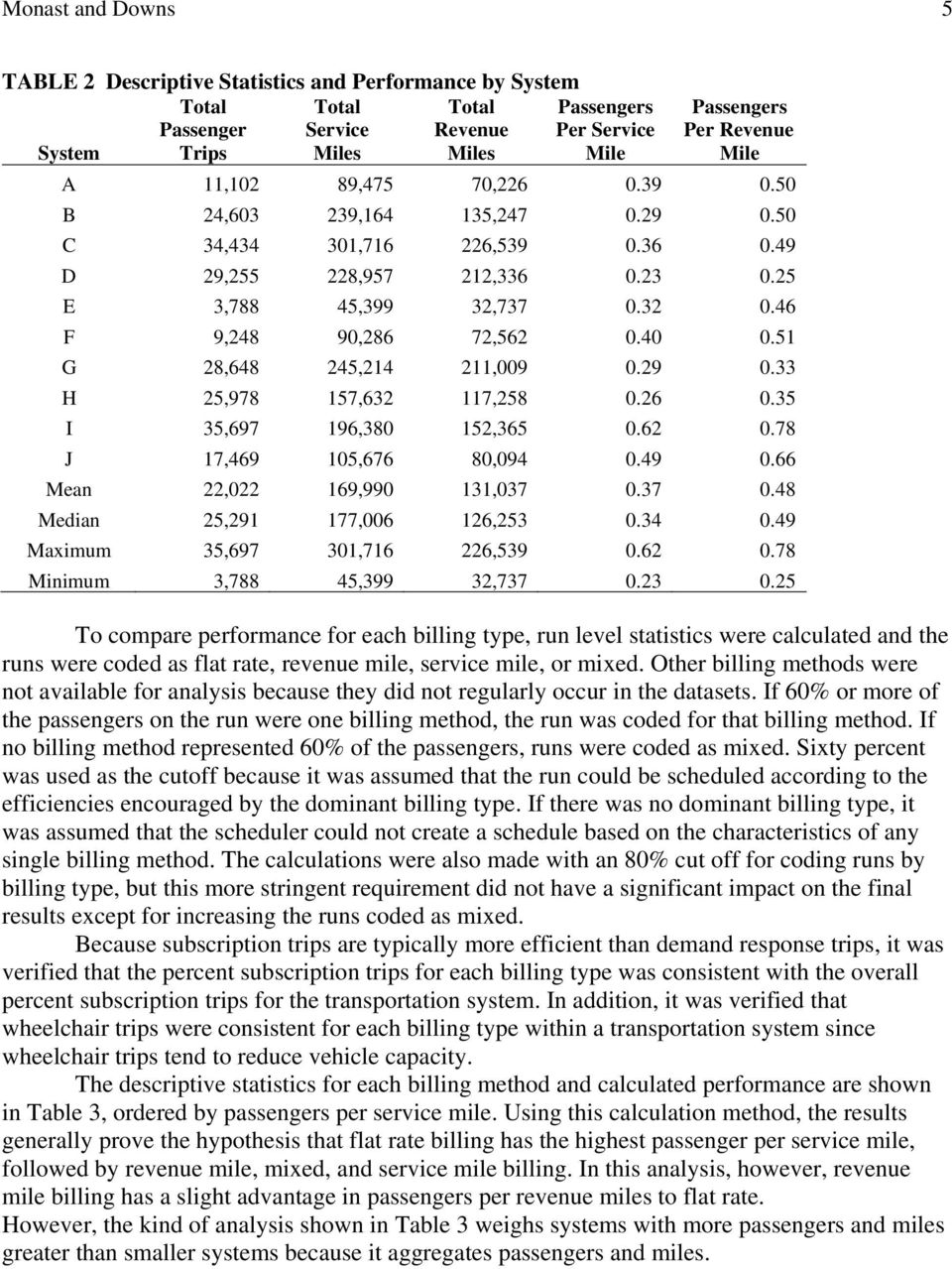
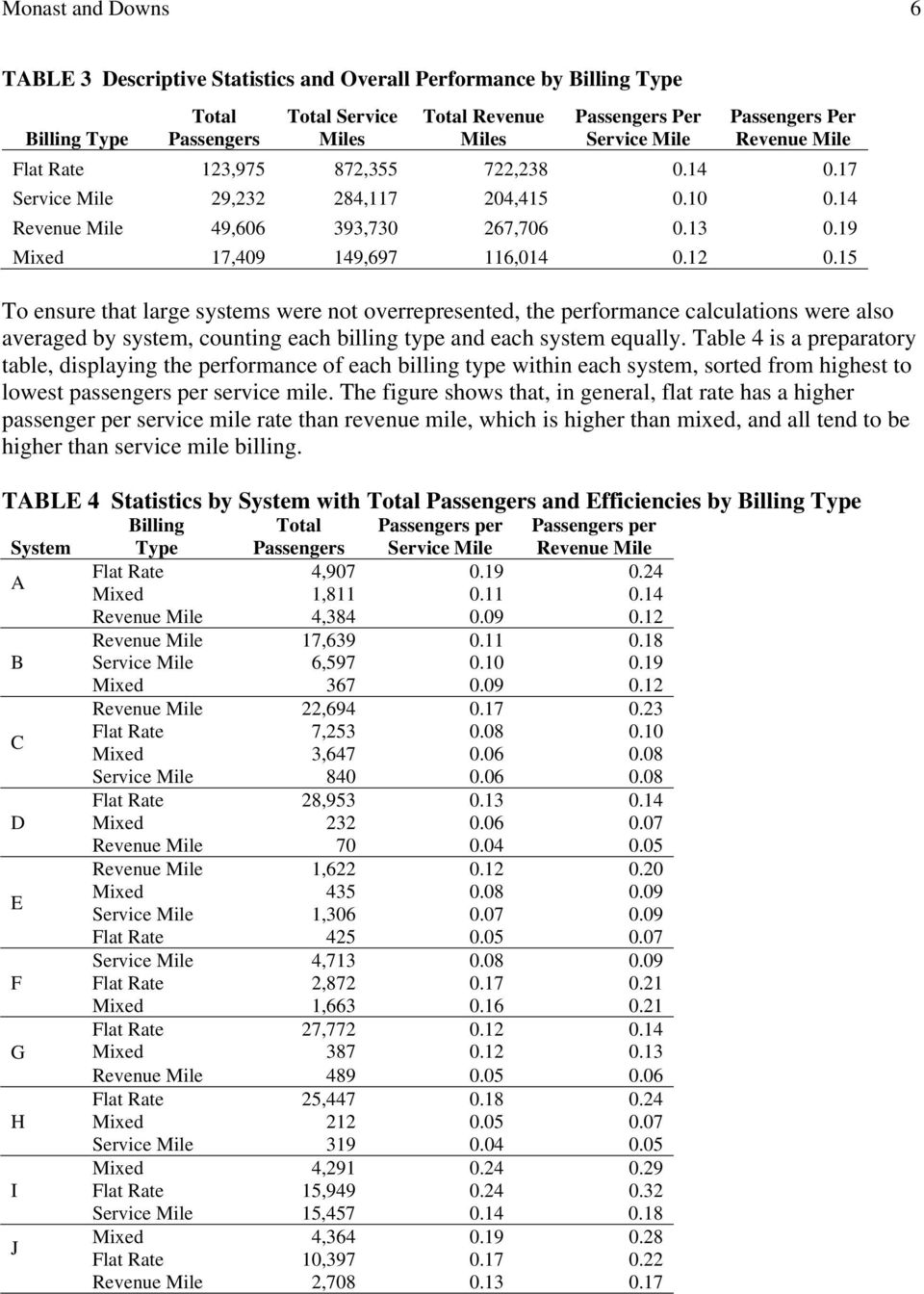
6 Monast and Downs 6 TABLE 3 Descriptive Statistics and Overall Performance by Billing Type Billing Type Passengers Service Miles Revenue Miles Passengers Per Service Mile Passengers Per Revenue Mile Flat Rate 123, , , Service Mile 29, , , Revenue Mile 49, , , Mixed 17, , , To ensure that large systems were not overrepresented, the performance calculations were also averaged by system, counting each billing type and each system equally. Table 4 is a preparatory table, displaying the performance of each billing type within each system, sorted from highest to lowest passengers per service mile. The figure shows that, in general, flat rate has a higher passenger per service mile rate than revenue mile, which is higher than mixed, and all tend to be higher than service mile billing. TABLE 4 Statistics by System with Passengers and Efficiencies by Billing Type System Billing Type Passengers Passengers per Service Mile Passengers per Revenue Mile A Flat Rate 4, Mixed 1, Revenue Mile 4, Revenue Mile 17, B Service Mile 6, Mixed Revenue Mile 22, C Flat Rate 7, Mixed 3, Service Mile Flat Rate 28, D Mixed Revenue Mile Revenue Mile 1, E Mixed Service Mile 1, Flat Rate Service Mile 4, F Flat Rate 2, Mixed 1, Flat Rate 27, G Mixed Revenue Mile Flat Rate 25, H Mixed Service Mile Mixed 4, I Flat Rate 15, Service Mile 15, J Mixed 4, Flat Rate 10, Revenue Mile 2,
7 Monast and Downs 7 The passengers per service and revenue mile statistics in Table 4 were averaged by billing method to create billing method performance. Figures 1 and 2 illustrate that, when using billing method performance, runs dominated by the flat rate billing method outperform the other billing methods in both passengers per service mile and passengers per revenue mile, proving the hypothesis. Revenue mile billing has the next highest passengers per service mile and passengers per revenue mile for runs with a dominant billing method, with service mile billing performing the worst. Mixed runs, as expected by their varied composition, have performance measures that fall between the other billing methods Passengers per Service Mile Billing Method Performance Average System Performance 0.00 Flat Rate Mixed Revenue Miles Service Miles FIGURE 1 Billing Method and Average System Performance- Passengers per Service Mile 0.20 Passengers per Revenue Mile Billing Method Performance Average System Performance 0.00 Flat Rate Mixed Revenue Miles Service Miles FIGURE 2 Billing Method and Average System Performance- Passengers per Revenue Mile

8 Monast and Downs 8 In Figures 1 and 2, the billing method performances are compared to the average system performances for systems using that billing method. The average system performance is calculated by averaging the passengers per service and revenue miles for the systems that utilize the particular billing method. The service mile billing method, for instance, averages the passengers per service and revenue mile statistics for all billing methods for only systems B, C, E, F, H, and I, because the other systems do not use service mile billing. The resulting statistic allows us to compare the performance of a billing method to the average overall performance of the systems utilizing that billing method. The comparison between billing method performance and average system performance in Figures 1 and 2 definitively proves the hypothesis as true. Systems using flat rate billing have a billing method performance of 0.15 passengers per service mile, 25% higher than the average system performance of 0.12, demonstrating that using flat rate billing encourages higher performance. Service mile billing, meanwhile, is outperformed by the average system performance by 50% for passengers per service mile (Figure 1) and by 45% for passengers per revenue mile (Figure 2). Revenue mile and mixed billing tend to perform close to the average system performance, as expected. CONCLUSIONS This research proves that flat rate billing is more effective at encouraging higher performance than revenue or service mile billing in community transportation systems without automated scheduling software. Runs that were predominately billed by flat rate had significantly better performance, followed by mixed and revenue mile, with service mile performing the worst. Flat rate performs best, as hypothesized, because it has monetary incentives for a higher number of passengers on each run and less miles. Revenue mile billing does not have the incentive to maximize passengers nor does it have an incentive to minimize revenue miles. However, revenue mile billing does have better performance than service mile billing because the transit system is encouraged to minimize deadhead miles, increasing passengers per service mile. Service mile billing has no incentive to minimize miles or maximize passengers, resulting in the weakest performance of the billing types studied. This research does not suggest that flat rate billing is the most efficient method to recover costs. Nor does this paper attempt to understand the impacts of different rates within billing methods. This paper does prove, however, that the use of service mile billing should be discouraged where community transportation system performance is paramount. FUTURE RESEARCH A clear connection between billing method and community transportation performance has been established in this research. Further exploration of this topic is encouraged so that the relationship can be better understood. In particular, additional billing methods, including passenger miles, hourly rates, and zoned-based fares, should be included in future research projects so that a better comparison of performance can be made. Another question that this research elicits is whether billing types do not determine efficiency, but efficiency determines the billing type. Do transportation systems, for instance, tend to bill easy to provide, efficient trips as flat rate and hard to provide trips as service mile? Care has been taken to ensure that the billing types are as equivalent as possible in the analysis, but there could be factors that were not considered.

9 Monast and Downs 9 Identifying the occurrences of different billing methods among community transportation systems may also reveal interesting information. If a particular billing method is dominant but does not encourage efficiency, the reasons behind its continued use may illuminate other aspects of community transportation not considered in this paper. A survey of schedulers as to their work flow and the decision making process could yield a wealth of knowledge on this subject. Transportation researchers and practitioners should work with automated scheduling software vendors to incorporate billing method considerations into the scheduling logic of these software packages. Many of these software packages are able to optimize one or two variables. Sometimes, these variables are not the most important ones to the transportation system. A transportation system billing by revenue mile, for instance, may need to minimize deadhead miles and the software package may not be able to optimize in this way. Transportation providers using automated scheduling software may want to consider changing their billing methods to match the variables that the software attempts to optimize. Finally, further research could be also be performed via surveys to determine if community transportation systems that have automated scheduling software but do not use the schedule optimization feature refuse to do so because the most important variables to the transportation system are not being optimized. REFERENCES 1. Liping, F. Analytical Model for Paratransit Capacity and Quality-of-Service Analysis. In Transportation Research Record: Journal of the Transportation Research Board, No. 1841, Transportation Research Board of the National Academies, Washington, D.C., 2003, pp Palmer, K., M. Dessouky, and T. Abdelmaguid. Impacts of Management Practices and Advanced Technologies on Demand Responsive Transit Systems. Transportation Research Part A Vol. 38, 2004, pp Palmer, K., M. Dessouky, and Z. Zhiqiang. Factors Influencing Productivity and Operating Costs of Demand Responsive Transit. Transportation Research Part A Vol. 42, 2008, pp
Fleet Size and Mix Optimization for Paratransit Services
 Fleet Size and Mix Optimization for Paratransit Services Liping Fu and Gary Ishkhanov Most paratransit agencies use a mix of different types of vehicles ranging from small sedans to large converted vans
Applying Fixed Route Principles To Improve Paratransit Runcutting. Keith Forstall
 Applying Fixed Route Principles To Improve Paratransit Runcutting Keith Forstall Why is runcutting important? Scheduling algorithms are designed to schedule trips efficiently They depend on vehicle capacity
Reveal Management Services, Inc. Case Study / Rhode Island Public Transit Authority (RIPTA) This Case Study has been client approved as published.
 Reveal Management Services, Inc. Case Study / Rhode Island Public Transit Authority (RIPTA) This Case Study has been client approved as published. Customer Profile The Rhode Island Public Transit Authority
Transportation Research Forum
 Transportation Research Forum An Evaluation of RouteMatch Software in the Billings, MT, Special Transit System Author(s): David Kack and Deepu Philip Source: Journal of the Transportation Research Forum,
Department Of Human Services. Medical Assistance Transportation Program. Request for Information (RFI)
 Department Of Human Services Medical Assistance Transportation Program Request for Information (RFI) Date: October 21, 2015 Table of Contents PART 1: GENERAL INFORMATION... 3 1.1 Purpose of this Request
CHAPTER 7 DEMAND-RESPONSIVE TRANSIT
 I Transit Capacity and Quality of Service Manual, 3rd Edition CHAPTER 7 DEMAND-RESPONSIVE TRANSIT 1. User's Guide 2. Mode and Service Concepts 3. Operations Concepts 4. Quality of Service Concepts 5. Quality
Reveal Management Services, Inc. Case Study / Johnson County Transit (JCT) This Case Study has been client approved as published.
 Reveal Management Services, Inc. Case Study / Johnson County Transit (JCT) This Case Study has been client approved as published. Customer Profile Johnson County Transit (JCT) is a department of Johnson
Paratransit Handbook for the Clinton County Public Transit System
 Paratransit Handbook for the Clinton County Public Transit System Updated: July 16, 2015 1 This is an informational handbook regarding Clinton County Public Transit s (CCPT) policies related to Paratransit
REQUEST for PROPOSALS. Scheduling and Dispatch Software. City of Ionia Dial-A-Ride (IDART) 251 E. Adams Street Ionia, Michigan 48846.
 REQUEST for PROPOSALS Scheduling and Dispatch Software City of Ionia Dial-A-Ride (IDART) 251 E. Adams Street Ionia, Michigan 48846 Proposals Due: November 18, 2013 12:00 p.m. Table of Contents PART I Instructions
BUYER S GUIDE NEMT Software:
 BUYER S GUIDE NEMT Software: Choosing the Right Software Platform Why NEMT Software? Before you start fielding quotes from NEMT software vendors, consider what you truly want and need in terms of software
GA as a Data Optimization Tool for Predictive Analytics
 GA as a Data Optimization Tool for Predictive Analytics Chandra.J 1, Dr.Nachamai.M 2,Dr.Anitha.S.Pillai 3 1Assistant Professor, Department of computer Science, Christ University, Bangalore,India, [email protected]
Shared Mobility Systems. Prof. Ing. Adrian Muscat, University of Malta D-Air Seminar, Intercontinental, St. Julians, Malta
 Shared Mobility Systems D-Air Seminar, Intercontinental, St. Julians, Malta Shared Mobility Making better use of available resources For a better quality of life Transport is a discrete-event on-demand
VEHICLE SURVIVABILITY AND TRAVEL MILEAGE SCHEDULES
 DOT HS 809 952 January 2006 Technical Report VEHICLE SURVIVABILITY AND TRAVEL MILEAGE SCHEDULES Published By: NHTSA s National Center for Statistics and Analysis This document is available to the public
GLOSSARY of Paratransit Terms
 Innovation in Transit GLOSSARY of Paratransit Terms January 2007 FORWARD: ABOUT PACE PARATRANSIT SERVICES Pace provides a variety of public transportation services. ADA Paratransit, which operates in the
Vol 2_v9final 1/24/05 12:22 PM Page 1. Lift-Van & ADA Access Services G U I D E
 Vol 2_v9final 1/24/05 12:22 PM Page 1 Lift-Van & ADA Access Services G U I D E 2 Vol 2_v9final 1/24/05 12:22 PM Page 2 This Guide is available in accessible formats. Please contact S.F. Paratransit at
ebook best practices Managing Fuel Costs with Networkfleet
 ebook best practices Managing Fuel Costs with Networkfleet The Networkfleet Advantage With all indications pointing to persistent higher future fuel prices, a telematics solution that helps you better
Single Source Call Center Plan For Kent County Paratransit Providers
 Kent County Emergency Needs Task Force Transportation Subcommittee Working to ensure economical, easily available transportation to meet basic needs Single Source Call Center Plan For Kent County Paratransit
AWARD OF NEW PARATRANSIT SERVICES CONTRACT
 September 22, 2005 Department of Customer Contract Services Purpose To recommend award of the paratransit services contract to MV Transportation, Inc. in the amount of $203,542,817 for a contract period
Living After Stroke: Mobility and Transportation Options After Stroke. The Family of Community Transportation Options
 Living After Stroke: Mobility and Transportation Options After Stroke Karen Wolf-Branigin, MSW National Center on Senior Transportation Washington, DC The Family of Community Transportation Options This
Office of Fleet and Asset Management (OFAM) www.dgs.ca.gov/ofam (Reserve a State Vehicle) Online Vehicle Reservation Instructions
 Office of Fleet and Asset Management (OFAM) www.dgs.ca.gov/ofam (Reserve a State Vehicle) Online Vehicle Reservation Instructions Revised March 2, 2012 1 You must be an active California State Employee
Reveal Management Services, Inc.
 Reveal Management Services, Inc. Case Study / Kansas City Area Transportation Authority (KCATA) This Case Study has been client approved as published. Customer Profile Kansas City (also referred to as
Fleet Profitability. April 15th, 2008 David Mook - COO, TMW Systems Dennis Morgan - COO, Cowan Systems
 Fleet Profitability April 15th, 2008 David Mook - COO, TMW Systems Dennis Morgan - COO, Cowan Systems Agenda About TMW Systems The Fleet Profitability Problem Cost Drivers & Cost Levers Markets & Revenue
PtMS Mobile. PtMS Mobile connects the PtMS Scheduling and Dispatching Software system with Mobile Data Terminals in vehicles.
 connects the PtMS Scheduling and Dispatching Software system with Mobile Data Terminals in vehicles. utilizes the API (Application Programming Interface) and Web Gateway service provided by the MDT Vendor
Transit in the United States 3. Operating Costs and Performance Measures 13. Quality of Transit Service 19. ADA Compliance Bus 28
 1999 National Transit Summaries and Trends Introduction 1 Introduces the transit modes discussed throughout the NTST. Transit in the United States 3 National statistics and trends in ridership, miles of
Corporate Account Package and Corporate Credit Card Authorization
 SFRR San Francisco Reliable Rides Tel. 415-816-1570 P.O.Box 4476 Fax. 650-552-9296 Burlingame CA 94011 Corporate Account Package and Corporate Credit Card Authorization Why use San Francisco Reliable Rides
THE ADA AND ITS COMPLEMENTARY PARATRANSIT REQUIREMENTS
 Section 1: Entity Submitting the Plan Charles County Department of Community Services VanGO Transportation 8190 Port Tobacco Road Port Tobacco, Maryland 20677 Contact: Ms. Lisa M. Quill Chief of Housing
MEDICAL ASSISTANCE TRANSPORTATION PROGRAM GUIDELINES
 MEDICAL ASSISTANCE TRANSPORTATION PROGRAM GUIDELINES 2 MEDICAL ASSISTANCE TRANSPORTATION PROGRAM GUIDELINES BERKS AREA REGIONAL TRANSPORTATION AUTHORITY 1700 NORTH 11 TH STREET READING, PA 19604 PHONE
RouteMatch Demand. Route and Optimize
 RouteMatch Demand Monitor And Track Route and Optimize INTEGRATE AND SAVE About RouteMatch One Platform. Solving Many Challenges. RouteMatch s multi-modal technology platform lets organizations take advantage
HVMA: Mitigating the Effects of Patient No-shows
 HVMA: Mitigating the Effects of Patient No-shows Project Team Kelli Crosby, Bryan Gillan, Artem Golyshkin, John Griffith, Amanda Price Project Advisor Prof. James Benneyan Abstract The objective of this
ECO-DRIVING: STRATEGIC, TACTICAL, AND OPERATIONAL DECISIONS OF THE DRIVER THAT IMPROVE VEHICLE FUEL ECONOMY
 UMTRI-2011-34 AUGUST 2011 ECO-DRIVING: STRATEGIC, TACTICAL, AND OPERATIONAL DECISIONS OF THE DRIVER THAT IMPROVE VEHICLE FUEL ECONOMY MICHAEL SIVAK BRANDON SCHOETTLE ECO-DRIVING: STRATEGIC, TACTICAL, AND
Applying for Access. Access Services. What is Access?
 Access Services Applying for Access > Access Services overview > Eligibility criteria > Other transportation options > How to get Access What is Access? Access Services is a public transit agency dedicated
Office of Program Policy Analysis And Government Accountability
 THE FLORIDA LEGISLATURE Report No. 97-44 Office of Program Policy Analysis And Government Accountability John W. Turcotte, Director February 1998 Review of the Potential for Privatizing Student Transportation
Transportation Guide for Older Adults
 2015 Transportation Guide for Older Adults A guide to transportation resources for older adults. Contents Orange County Department on Aging - Mobility Manager... 2 ORANGE COUNTY TRANSPORTATION PROVIDERS...
Riding Program - Feasibility and Insurance Options
 Feasibility and Insurance Options for Ride Programs propriate McNair Illustration Here POTENTIAL USE OF RIDE PROGRAM WILL BE DETERMINED BY: Numbers of seniors in the catchment area Alternatives available
Taxi Access Program (TAP) Customer Guide November 1, 2015
 Taxi Access Program (TAP) Customer Guide November 1, 2015 What is TAP? Pace and the City of Chicago provide an innovative program offering customers with disabilities a flexible option to Pace s ADA Paratransit
1004 VEHICLE AND FLEET SERVICE POLICY. I. Legislative Authority:
 1004 VEHICLE AND FLEET SERVICE POLICY I. Legislative Authority: This policy is written in accordance with legislation passed by the Arkansas General Assembly, (Arkansas Code: 19-4-902, 19-4-905, 19-4-907,
International Fuel Tax Agreement & International Registration Plan. Recordkeeping
 International Fuel Tax Agreement & International Registration Plan Recordkeeping Recordkeeping Reminders Keep IFTA records for four years Keep IRP records for three years Save fuel receipts Save time and
Non-Emergency Medical Transportation Reviews
 Table of Contents Non-Emergency Medical Transportation Reviews Focusing on Compliance OIG 99-0269 BACKGROUND................................Pg 1 Non-emergency medical transportation expenditures have increased
Chapter 10: TRANSPORTATION SAFETY
 Chapter 10: TRANSPORTATION SAFETY Purpose Of These Requirements Transporting children in child care is a high risk activity. Child care operators, staff, and parents need to be aware that transporting
ATTACHMENT K 5310 ELIGIBLE COST
 ATTACHMENT K 5310 ELIGIBLE COST Attachment K - Traditional 5310 Eligible Cost a. Rolling stock and related activities for Section 5310-funded vehicles (1) Acquisition of expansion or replacement buses
(Adopted October 9, 2007)
 TAXICAB COMPANY STANDARDS RECOMMENDED FOR METROPOLITAN AREAS OF GREATER THAN ONE MILLION POPULATION BY THE TAXICAB, LIMOUSINE & PARATRANSIT ASSOCIATION (Adopted ) Introduction The Taxicab Company Standards
TRANSPORTATION ROUTING MANAGEMENT SOFTWARE REQUEST FOR PROPOSAL SPECIFICATIONS SPECIFICATION DESCRIPTION YES NO COMMENTS
 GENERAL SYSTEM CHARACTERISTICS The software should be a true Windows Client/Server program. The software should be currently installed and operational under any Microsoft supported Windows operating system.
Sensor Sensibility Building the Business Case for Incorporating External Sensors as Part of Your Automatic Vehicle Location Solution
 Sensor Sensibility Building the Business Case for Incorporating External Sensors as Part of Your Automatic Vehicle Location Solution The Challenge When organizations invest in an AVL solution, it is most
UBER PARTNER REPORTING GUIDE
 Required to File a Return? In most cases, you will be required to file a Form 1040 and attach Schedule C and Schedule SE to report your earnings from being an Uber partner. If you have net earnings (not
TECHNICAL APPENDIX ESTIMATING THE OPTIMUM MILEAGE FOR VEHICLE RETIREMENT
 TECHNICAL APPENDIX ESTIMATING THE OPTIMUM MILEAGE FOR VEHICLE RETIREMENT Regression analysis calculus provide convenient tools for estimating the optimum point for retiring vehicles from a large fleet.
WASHINGTON COUNTY TRANSIT POLICIES AND PROCEDURES MANUAL
 WASHINGTON COUNTY TRANSIT POLICIES AND PROCEDURES MANUAL 1. INTRODUCTION These policies and procedures are guides to assist in the governance of the Washington County Commute Express service and the Washington
FATALITIES AND INJURIES IN MOTOR VEHICLE BACKING CRASHES
 DOT HS 811 144 November 2008 FATALITIES AND INJURIES IN MOTOR VEHICLE BACKING CRASHES Required Under The Safe, Accountable, Flexible, Efficient Transportation Equity Act: A Legacy for Users (SAFETEA-LU)
Policy Manual for RideLink Providers
 Policy Manual for RideLink Providers February 2011 Who can ride on RideLink? Any resident of Kent County over the age of 60 is eligible to ride on RideLink. All trips in RideLink will include both subscription
Transportation for health care appointments just got easier with
 Transportation for health care appointments just got easier with Molina Medicare! With Molina Medicare Options Plus HMO SNP Plan, we offer the added benefit of non-emergency transportation to get you to
State of Arkansas Barber and Beauty Shops Survey August 1998
 State of Arkansas Barber and Beauty Shops Survey August 1998 U.S. Department of Labor Bureau of Labor Statistics June 1999 T his summary provides results of an August 1998 survey of occupational pay in
Benefits of AVL/CAD from Research and Innovative Technology Administration (RITA)
 Benefits of AVL/CAD from Research and Innovative Technology Administration (RITA) Joint deployment of scheduling software and Automatic Vehicle Location/Mobile Data Terminals (AVL/MDT) increased ridership
Corporate Travel Policy. Proposed January 30, 2010
 Corporate Travel Policy Proposed January 30, 2010 TABLE OF CONTENTS Statement of Purpose... 1 JRC-DMS Travel Policies... 1 Responsibilities and Enforcement... 1 Travel Arrangements... 2 Air Travel... 2
GENERAL SERVICES ADMINISTRATION Washington, DC 20417 August 22, 2011 GSA BULLETIN FMR B-30 MOTOR VEHICLE MANAGEMENT
 GENERAL SERVICES ADMINISTRATION Washington, DC 20417 August 22, 2011 TO: Heads of Executive agencies GSA BULLETIN FMR B-30 MOTOR VEHICLE MANAGEMENT SUBJECT: Vehicle Allocation Methodology for Agency Fleets
Vehicle Maintenance Policies and Procedures
 Vehicle Maintenance Policies and Procedures Adopted: 09/20/2011 1 Table of Contents Introduction:... 4 Goals and objectives:... 5 Goals:... 5 Objectives:... 5 Preventative Maintenance:... 6 Daily... 6
Iowa Legislative Fiscal Bureau. State Vehicle Fleet - Vehicle Dispatcher Division
 Iowa Legislative Fiscal Bureau I S S U E Dennis Prouty State Capitol (515) 281-5279 Des Moines, IA 50319 FAX 281-8451 August 24, 1993 ISSUE State Vehicle Fleet - Vehicle Dispatcher Division The Vehicle
The Transit Industry s Information Management Solution Better Data. Better Decisions.
 The Transit Industry s Information Management Solution Better Data. Better Decisions. What Our Clients Are Saying Your product allows Montebello Bus Lines to efficiently consolidate and more accurately
REQUEST FOR PROPOSALS (NO. #RFP-05-003H)
 ARKANSAS STATE HIGHWAY AND TRANSPORTATION DEPARTMENT Public Transportation Programs Section REQUEST FOR PROPOSALS (NO. #RFP-05-003H) For The Design and Installation Of A Paratransit Software Scheduling,
Passenger Vehicle Occupant Fatality Rates by Type and Size of Vehicle
 DOT HS 809 979 January 2006 Passenger Vehicle Occupant Fatality Rates by Type and Size of Vehicle By Rajesh Subramanian * Summary The National Highway Traffic Safety Administration (NHTSA) has routinely
Overview of the Connecticut Non-Emergency Medical Transportation Program
 Supplement 4 to page 9(e) of ATTACHMENT 3.1-A Page 1 SERVICES PROVIDED TO THE CATEGORICALLY NEEDY Overview of the Connecticut Non-Emergency Medical Transportation Program 1. Introduction The Department
Call Today For a Free Quote 800.279.0035. GPS Tracking Software 2015 Buyer s Guide
 Call Today For a Free Quote 800.279.0035 GPS Tracking Software Table of Contents Why GPS Tracking... 2 Benefits... 3 Features... 4 Industries Benefitting From GPS Tracking... 5 Choosing The Right GPS Tracking
LSU Business Manager Meeting. Donna K. Torres, CPA Associate Vice President for Accounting Services
 LSU Business Manager Meeting Donna K. Torres, CPA Associate Vice President for Accounting Services TOPICS Required Training for Supervisors of Student Employees Travel Changes Update FuelTrac Policy Update
How to Supplement Traditional Paratransit Programs with Taxis: A Case Study. International Conference on Paratransit 10/31/14
 How to Supplement Traditional Paratransit Programs with Taxis: A Case Study International Conference on Paratransit 10/31/14 SFMTA Overview Eighth largest transit system in United States 49 square miles
TELEMATICS ESSENTIALS THE TOP LINE
 ESSENTIALS THE TOP LINE LeasePlan s Telematics Essentials is the ideal solution for a business keen to manage the core fleet cost: mileage. It s the easiest way to get accurate, HMRC compliant reports
American Public Transit Association Bus & Paratransit Conference
 American Public Transit Association Bus & Paratransit Conference Intelligent Transportation Systems Integrating Technologies for Mobility Management & Transportation Coordination May 24, 2011 RouteMatch
AUSTIN INDEPENDENT SCHOOL DISTRICT INTERNAL AUDIT DEPARTMENT TRANSPORTATION AUDIT PROGRAM
 TRANSPORTATION GENERAL: The Transportation Department provides transportation of students to and from school and other special trips. The aim of an effective transportation service delivery system must
Cost Models for Vehicle Routing Problems. 8850 Stanford Boulevard, Suite 260 R. H. Smith School of Business
 0-7695-1435-9/02 $17.00 (c) 2002 IEEE 1 Cost Models for Vehicle Routing Problems John Sniezek Lawerence Bodin RouteSmart Technologies Decision and Information Technologies 8850 Stanford Boulevard, Suite
Transit Cost Analysis
 Transit Cost Analysis Types of Costs Fixed Cost: does not vary with the amount of service provided in the short run. Variable Costs: change with the amount of service provided. Variable Cost Fixed Level
Creative Ways to Manage Paratransit Costs
 Project #BD549-28 FINAL REPORT Prepared for the Florida Department of Transportation Research Center Prepared by the Center for Urban Transportation Research University of South Florida July 2008 Disclaimer
METROPOLITAN TRANSIT AUTHORITY OF HARRIS COUNTY, TEXAS. Independent Accountants Report on Applying Agreed-Upon Procedures
 METROPOLITAN TRANSIT AUTHORITY OF HARRIS COUNTY, TEXAS Independent Accountants Report on Applying Agreed-Upon Procedures Year ended September 30, 2014 KPMG LLP 811 Main Street Houston, TX 77002 Independent
Learning and Academic Analytics in the Realize it System
 Learning and Academic Analytics in the Realize it System Colm Howlin CCKF Limited Dublin, Ireland [email protected] Danny Lynch CCKF Limited Dublin, Ireland [email protected] Abstract: Analytics