
Source Water Assessments
|
|
|
- Barrie Bridges
- 5 years ago
- Views:
Transcription
1 Table of Contents. Introduction.... Introduction....2 Background.... Approach....4 Purpose of Report Overview of Methodology Identification Delineation Intrinsic Characteristics, Aquifer / Watershed Properties Non-point Source Point Source Area of Primary Influence Contaminant Occurrence Susceptibility Summary Assessment Results.... Purchase Water Assessments How to Use Assessment Information Consumer Confidence Reports Acknowledgments References Definitions Acronyms Tables Table 2. Potential Sources of Contamination assembled for use in assessments. Appendices Appendix A Appendix B Appendix C Appendix D Appendix E Appendix F Appendix G Appendix H Appendix I List of Assessed Contaminants Description of the Public Drinking Water System and Water Supply Sources PWS System Susceptibility Summary Contaminants with High Susceptibility PWS System Susceptibility Summary Contaminants with Medium Susceptibility High Susceptibility Contaminants by Source Medium Susceptibility Contaminants by Source Counts of Potential Sources of Contamination by Source Map Legend Water Source and Potential Sources of Contaminants Map(s) DISCLAIMER: The Texas Commission on Environmental Quality (TCEQ) incorporated data from multiple sources and therefore makes no claim to the accuracy or completeness of all the data contained within this assessment report. The data contained herein was retrieved, or created, solely for the development of this assessment report. The user assumes all liability for any other applications of this information beyond those identified by the Source Water Assessment & Protection program.
2 . Introduction. Introduction Source water assessments are designed to provide information unique to each public water system (PWS) regarding the susceptibility of their source waters to contamination. Public water systems should review their assessment report thoroughly, paying close attention to any contaminants that the PWS has received a high and medium susceptibility rating. By using the information on contaminant susceptibility contained within this source water assessment report, the PWS can target source water protection efforts toward specific potential sources of contamination (PSOC). Information on how to obtain source water assessment reports and a system susceptibility summary may be made available to the public through consumer confidence reports to assist communities in understanding the source of their water, potential chemical and/or microbiological impacts to the source water, and support best management practices (BMPs) needed to protect source waters. In addition, the results of the source water assessments may be used to adjust chemical and microbiological monitoring sample schedules, potentially reducing monitoring costs by identifying contaminants of concern. Note: A high susceptibility does not mean there is a health threat or a maximum contaminant level (MCL) violation. The assessments are designed to identify the activities and the related contaminants that may affect the water system. A MCL violation will result in a high susceptibility score because that contaminant has already been found in the drinking water and the public will have already been made aware through required reporting procedures..2 Background Source water assessments are mandated through Section 45 of the 996 Amendments to the Safe Drinking Water Act (SDWA). The 996 SDWA Amendments require each state to develop Source Water Assessment and Protection (SWAP) Programs to:! Delineate boundaries of areas providing source waters for all public drinking water systems.! Inventory origins of regulated and unregulated drinking water contaminants within the delineated area.! Determine the public water system s susceptibility to contamination.! Inform the public of the results of the assessment. The draft State program document, The State of Texas Source Water Assessment and Protection Program Strategy, was submitted to EPA in February 999 and was created through a series of Public Forum and Technical Steering Committee meetings. After incorporation of public comment, EPA approved the TCEQ SWAP strategy on November 6, Approach In a cooperative effort with the United States Geological Survey (USGS), the Texas Commission on Environmental Quality (TCEQ) produced a scientifically defensible method for assessing the susceptibility of Texas 6700 public water systems to 227 drinking water contaminants. The source water assessments are based on six major components: () identification of the source of water (and structural integrity of ground water wells), (2) delineation of the contributing area, () determination of the degree to which naturally occurring aquifer / watershed properties of the delineated area contribute to source water

3 susceptibility, (4) evaluation of non-point source contaminant susceptibility, (5) evaluation of point source susceptibility (and for ground waters, the attenuation of susceptibility related to longer contaminant transport rates and selected properties of aquifers), (6) evaluation of the activities within 000 feet of a surface water body, called the Area of Primary Influence, and (7) incorporation of contaminant detections above TCEQ threshold concentrations from water quality monitoring activities. Component susceptibility ratings from each water source, for each contaminant, are combined into an overall susceptibility rating for each contaminant for the PWS system. Under each of the assessment components (with the exception of the delineation component), a relative susceptibility rating of high, medium, and low is produced. The rating scale under each component is derived from observed statistical breaks in the frequency distribution of statewide attributes or by best professional judgement. A component-based approach using software developed specifically for the assessments was used given the large number of public water systems, sources, data sets, attributes, and decision rules required to produce a comprehensive susceptibility assessment for a PWS. The software also enables TCEQ staff to re-run assessments in the future as data sets are updated or data accuracy improved. A more detailed explanation of the methodology used to assess source waters for their potential to become contaminated may be found in Section..4 Purpose of Report The purpose of this document is to present the results of the source water assessment to the public water system. This assessment report includes:! An introduction and overview of the source water assessment methodology.! Information on the public drinking water system and its drinking water source(s).! A brief summary of the assessment results listing the contaminants for which the system has been determined to have a high or medium susceptibility rating.! Detailed results of the assessments including component scores for contaminants with high or medium susceptibility ratings for each source of drinking water for the system.! Maps of drinking water sources and potential sources of contaminants (PSOCs) identified within and around the delineated assessment areas.! A list of the 227 identified drinking water contaminants used within this assessment.! Count of PSOCs located within the assessment area.! Information on how to use the assessment results through the TCEQ s Source Water Protection Program. The results of the report can serve a number of purposes:! The TCEQ may be able to use the assessment results to reduce or modify the chemical and/or bacteriological samples.! The water system may take this information and develop a better understanding of the environmental factors that may be affecting their source waters. This can then lead to targeted source water protection activities to address areas of greatest concern.! This detailed report is intended for use by the water system, however, a condensed summary of the results will be required by the Consumer Confidence Reports (CCR) and may be part of the 2004 template. There will be no specific source location information required in the CCRs, only a reference to source aquifer or water body. 2

4 2. Overview of Methodology Susceptibility, in this report, is defined as the potential for a public water supply to withdraw water which has been exposed to a listed contaminant at a concentration that could pose a public health concern. Susceptibility of a water supply to contamination is related to ) the physical integrity of the ground water well or surface water intake, 2) the physical, geologic, hydrologic, chemical and biological characteristics of the contributing area to the well or intake, ) the type and number of potential sources of contamination (PSOCs) and land use within the contributing area, and 4) the nature and quantity of contaminants that have been or potentially could be released within the source area. The TCEQ SWAP program has assembled over 00 data sets of potential sources of contamination (PSOCs) from existing TCEQ databases such as the industrial hazardous waste, municipal solid waste, and wastewater permitting program areas; from source water protection inventories and PWS set-back inspections, and databases from other state and federal agencies. Each PSOC is associated with chemical or biological contaminants from the list of 227 drinking water contaminants (Appendix A). Contaminants were assigned to each PSOC based on site-specific information contained within agency documents or from information on contaminants historically associated with various types of activities or processes using references such as Shineldecker (992). Using Geographic Information Systems (GIS) supported software and extensive databases, source water assessments integrate the results of six assessment components into one susceptibility summary component that produces a susceptibility rating for 227 identified contaminants for the public drinking water system. This process is completed through a software system designed in partnership with the USGS. The identification and delineation components are concerned with assembling data for use in other components. Five of the components (Intrinsic Susceptibility, Non-point Source, Point Source, Area of Primary Influence for surface water only, and Contaminant Occurrence) result in susceptibility ratings that are used in the Susceptibility Summary component to calculate the overall susceptibility assessment ratings. In addition to compiling PSOC data sets, the SWAP program has assembled information on each water well and intake operated by a PWS systems. Information gathered by TCEQ PWS inspections, well log review, file research, and chemical and microbiological sampling was entered into a database. The assessment software relies upon detailed water well and surface water intake locations, water well construction details, site-specific geology, and well production information. Comprehensive spatial data sets assembled by the USGS in support of the SWSA include: major and minor aquifers and their hydrologic properties; land use; soil type; climate; slope; elevation; surface water flow analysis; TCEQ, USGS and Texas Water Development Board (TWDB) chemical and microbiological monitoring analysis; non-point source statistical analysis for specific chemical constituents for surface water and ground waters; automated watershed delineation; and automated ground water capture zone delineation. 2. Identification Only water wells and surface water intakes with a status of operational, demand, emergency or test (wells under development) are assessed. The first step in the assessment process is the identification of the location and structural integrity information for each water source (either water well or surface water intake) and its associated hydrographic data. Structural integrity refers to those mandatory properties for groundwater wells or surface water intakes defined in the Rules and Regulations for Public Water Systems 0 TAC Chapter 290 Subchapter D If data on location or structural integrity is lacking, the system

5 may receive a high susceptibility to all contaminants since default conservative assumptions are used. Every effort was made by TCEQ staff to obtain missing locational and integrity data from the public water supply prior to commencement of assessments. Hydrogeologic data collected for groundwater wells includes the major aquifer the well screen is in as well as properties of that aquifer for later use in the delineation and intrinsic characteristics components. Aquifer properties include the three-dimensional extent of the aquifer, hydraulic conductivity, porosity, regional potentiometric surface, saturated thickness, and transmissivity. Hydrographic data collected for surface water intakes includes major river basin name, hydrologic region, and hydrologic unit. Under the identification component, a susceptibility rating is produced for ground water sources only and is based on well structural integrity. 2.2 Delineation Once the location and hydrologic properties are obtained in the identification component of the assessments, the area that contributes water to the well or intake is delineated. For wells, delineation of a capture zone will determine the time-of-travel of water to the well. Time-of-travel is the time (in years) that it would take a molecule of water (and therefore any associated contaminant) in a specific location to travel to the water well. Time-of-travel capture zones are expressed in increments of 2, 5, 0, 20 and 00 years (these-time-of travel zones can be found in appendix I). In some cases, such as in unconfined aquifers, capture zones may not extend to 00 years. Delineations of water wells are produced in one of four ways, depending on aquifer type. The five major aquifer categories used in the source water susceptibility assessments include unconfined isotropic aquifers, confined isotropic aquifers, alluvial aquifers along rivers, anisotropic karst aquifers, and a final category of unknown for water wells that do not obtain water from the mapped major and minor aquifer systems, or that obtain water where an aquifer determination cannot be made. If no aquifer type is available, a fixed radius of one half mile is applied. This will be shown in the appendix I maps as a violet circle around the well without any time-of-travel zones. Since stream flow is an over-riding influence on alluvial aquifers, water wells located within these alluvial aquifers are assessed using a surface water approach. A watershed is generated for each alluvial well. Flow-net analysis was used to delineate capture zones for unconfined and confined aquifers. Using specially-developed GIS software, the portion of the flow net that defines the contributing area for the water supply well was identified and a determination of the time-of-travel to the well for all aquifer categories was made (with the exception of the Edwards Aquifer where data from the USGS flowpath investigations for the Edwards Aquifer were used). Using this approach, the characterization of the aquifer is such that the vertical movement of water to the water table is not approximated; only the horizontal movement. The assumption is that the contributing area to a well in an unconfined system is the area directly above the flowpaths for a specified end time (2, 5, 0, 20, and 00 years). In a confined system, the contributing area is that area within specified end times or terminating in the outcrop of the aquifer for similarly specified end times. Travel times for potential contaminants vary greatly in Karst systems such as the Edwards aquifer. As water levels rise or fall in the Edwards aquifer there are potentially more or fewer conduits to transmit the flow; therefore travel times for potential contaminants may vary for a given area depending on the water levels in the aquifer. Travel times in the Edwards aquifer can potentially be much shorter in many areas than for a typical aquifer composed of sand and gravel. For these reasons, the time-of-travel approach was not used for assessing the Edwards aquifer. A more conservative approach using flowpath information was selected. The USGS has conducted numerous investigations on the Edwards aquifer and has delineated flowpaths within the system using hydrologic, geologic, geochemical, and numerical information. The assessment for a well is conducted by first determining the corresponding aquifer flowpath for the well. The flowpath is then delineated upgradient from the well back to the area where recharge enters the aquifer from 4

6 the surface. Along this flowpath, where the aquifer is confined, a confined assessment is conducted; where the aquifer is unconfined, an unconfined assessment is conducted. Most of the recharge to the Edwards aquifer is by streams that cross the outcrop area (recharge zone); therefore, where the flowpath for the assessed well intersects the outcrop area, a surface water assessment is conducted for the corresponding stream(s). The assessments require the delineation of the contributing areas for surface water intakes, each intake receives a delineation of three watershed types:! Total Watershed Area the entire watershed upstream from the PWS intake on a stream or the entire watershed for the reservoir on which the PWS intake is located.! Contributing Watershed Area the watershed for the reservoir on which the surface water intake is located or the watershed upstream of a surface water intake located on a stream excluding all non-pws reservoirs with normal storage capacity greater than,000 acrefeet.! Area of Primary Influence the area within,000 feet of a reservoir, and for all streams discharging directly to the reservoir, the area within,000 feet of the center of the stream channel for an estimated 2 hour time-of-travel immediately upstream of the reservoir. For intakes on streams, the area of primary influence is the area within,000 feet of the estimated 2 hour time-of-travel upstream from the intake. Contaminants located within the area of primary influence are those that the PWS may be most susceptible to due to their proximity to the intake. Watersheds were delineated using specially developed software using a statewide, seamless 0 meter digital elevation model re-sampled to a 60 meter resolution by the USGS; flow accumulation and flow direction datasets; and hydrography datasets (stream and reservoir boundaries). The delineation of watersheds for intakes on canals lacking flow data was accomplished by generating a one half mile buffer around the intake location. In addition, watersheds were delineated for all monitoring stations and were used in the development of equations for the non-point source component. 2. Intrinsic Characteristics, Aquifer / Watershed Properties Intrinsic characteristics are those natural features of the landscape and climate that contribute to the contamination susceptibility of ground or surface water. Intrinsic characteristics include land surface slope, soil characteristics (erodibility of soil, clay content, leakance), precipitation, runoff, reservoir depth, reservoir storage and watershed area. Intrinsic characteristics for ground water sources are mainly related to unconfined aquifers. Higher leakance values for unconfined aquifers indicate the source is more susceptible to contamination due to increased contaminant transport rates through soil. A low land surface slope value indicates a source in an unconfined aquifer is more susceptible since runoff has longer residence times on low land surface slopes, allowing higher recharge. Surface waters are susceptible to the following area-weighted intrinsic characteristics: high runoff to precipitation ratios (increases contaminant transport rates), high soil erodibility values (erodible soils carry contaminants adsorbed to their surface), low mean reservoir depth to mean annual runoff ratios (contaminant is likely to travel through reservoir in a short amount of time or may be easily re-suspended into the water column from the sediments), low total reservoir storage to mean annual runoff ratios (contaminant is likely to travel through reservoir in a short amount of time), and low watershed area to slope ratios (increases contaminant transport rates by lowering the time of travel of the contaminant). 5

7 2.4 Non-point Source For surface water assessment, equations were developed for 6 of the 227 contaminants using logistic regression statistical analysis to predict the probability of detection of a contaminant above TCEQ established thresholds (see Appendix A) by basin characteristics including land use class, soil type, population density, agricultural chemical use, manure production and land and stream physiography. During the assessment, the delineated assessment area for the water source was overlaid on a land use spatial data layer and percentages of each basin characteristic within that area were tallied. Using the developed predictive equations, the probability of detecting selected contaminants above the threshold value was calculated. A non-point source susceptibility rating was then assigned to those contaminants based on probability of detection. For groundwater, the non-point source component statistical models were able to be developed for Aluminum, Manganese, Nitrate, Nitrite, Nitrate+Nitrite and Sulfate. For the 64 contaminants that were not statistically modeled due to lack of sufficient monitoring data, a statewide probability of occurrence from non-point sources was assigned to each based on the relative frequency of detection based on sample data. When an unconfined well is assessed and there is a high percentage of land uses that have contaminants associated with them (e.g. urban and agricultural) or there is a high density of transportation and/or pipelines, sources may be highly susceptible to many different contaminants. 2.5 Point Source In order to determine a susceptibility rating to contamination from potential sources of contamination (PSOC) that are point sources, SWAP staff developed a database of over 800,000 PSOC locations and their associated contaminants for the state of Texas. Potential sources of contamination (Table 2.) are categorized by type and subtype. Contaminants were assigned to each PSOC using two techniques: ) contaminants were assigned based on known sampling or reporting of contaminants at a specific site or 2) contaminants were assigned based on established contaminant relationships to PSOC subtype (Shineldecker, 992). An important factor in determining the susceptibility to point sources for ground water is if the PSOC is known to penetrate the confining unit or if the PSOC is located at a depth below the confining unit or the soils zone. Potential sources of contamination occurring at the ground surface that overly a confined aquifer protected by at least 0 feet of clay or shale, are not assumed to present a contamination threat to a water well. If the PSOC penetrates the confining unit (clay layer) of the aquifer, then the contaminants associated with that PSOC are assumed to enter the aquifer with no vertical attenuation. However, since contaminants released from point sources entering ground water as solutes may undergo physical, chemical, and biochemical processes that lower their concentrations, an attenuation factor for those contaminants is applied depending on contaminant occurrence in the soil zone, vadose zone or aquifer matrix and time of travel from contaminant source to the water well. The attenuation factor is based on a model of physical contaminant attenuation using first order decay equations (the rate of decrease of the contaminant is proportional to the concentration of the contaminant) and selected aquifer properties related to the physical processes of sorption, decay, volatilization, advection, dispersion or dilution. Once applied, the attenuation factor may reduce the ground water point source susceptibility rating from a high to a medium or low susceptibility rating. The proximity of a surface water intake to PSOCs, point source discharges, potentially threatening land usages, major transportation corridors or pipelines can result in the source water being susceptible to contamination. The relatively short time of travel of a chemical spill, continuous release, or runoff to the 6

8 intake minimizes the opportunity for reducing a contaminant s concentration or converting or degrading a contaminant to a less threatening form. Point source susceptibility ratings are applied for a surface water source based on () the presence and density of contaminants associated to PSOCs and potentially threatening land usage areas within the area-of-primary influence (API) and (2) point sources from permitted dischargers upstream of the intake. An API-based point source susceptibility rating is determined by calculating the density of PSOCs and potentially threatening land use activities within the API. For contaminants from permitted dischargers, a point source susceptibility rating is determined using the mean two-year flood velocity time of travel to the PWS intake and an estimated in-stream contaminant decay rate. 2.6 Area of Primary Influence The Area Of Primary Influence (API) component applies to surface water systems. This procedure determines the density or count of threatening activities and associated contaminants within the 2 hour upstream time of travel and 000 foot buffer area around the water source. The API watershed is delineated using regional equations to predict time of travel at the estimated 2-year flood velocity along the main channel based on observations at USGS gaging stations. The relative susceptibility of the PWS to contaminants associated with activities within the API is determined based on human and domestic animal population density, pipeline density, oil/gas well density, transportation density, the count of permitted effluent discharge sites, and the density of PSOCs. The proximity of a surface-water intake to a point source discharge, threatening land usage, transportation corridor, or pipeline can result in the source water being susceptible to contamination. The relatively short time-of-travel of a chemical spill, continuous release, or runoff to the intake minimizes the opportunity for reducing a contaminant s concentration or converting or degrading a contaminant to a less threatening form. Activity density or counts are used to determine the rating for associated contaminants under this component. Higher density or counts indicate increased susceptibility to activity-associated contaminants. 2.7 Contaminant Occurrence Any detection above threshold values (see appendix A or the list of contaminants and the threshold values) from chemical monitoring stations located at or near the PWS source indicates the PWS is susceptible to that contaminant. Water quality data from monitoring wells within the well s capture zone and screened within the same unit as the assessed PWS water well or water quality data from monitoring stations within the contributing watershed area of a surface water intake are checked to determine if contaminants have been detected above threshold values (see Appendix A). If the contaminant has been detected, then the well or surface water source is susceptible to the contaminant regardless of the results of other assessment components. This analysis is critical in the evaluation of susceptibility since many natural, historical, or undocumented sources of contamination may not exist in the PSOC data sets. Table 2. Potential Sources of Contamination (PSOCs) are classified as a general type and a specific subtype. A list of chemicals assigned to each subtype is too extensive to be included in this report. 7

9 Table 2. Potential Sources of Contamination PSOC TYPE PSOC SUBTYPE BUSINESS AUTO PARTS BUSINESS; AUTO REPAIR, SALES, SALVAGE, TOWING; BATTERY MFG., SALES; BOAT STORAGE; COTTON GIN; DRY CLEANER; FERTILIZER MFG, SALE, APPLICATION; FIREWORKS BUSINESS; GOLF COURSE; GRAIN ELEVATOR; INORGANIC CHEMICAL INDUSTRY; METAL PLATING BUSINESS; MILITARY ARMORY; NEW OR USED OIL SITE; NUCLEAR POWER PLANT; OIL AND GAS PRODUCTION TANKS; ORGANIC CHEMICAL INDUSTRY; PAINT SHOP; PESTICIDE MFG, SALE, APPLICATION; PESTICIDE, FERTILIZER MFG, SALE, APPLICATION; PETROLEUM CHEMICAL INDUSTRY; PETROLEUM STORAGE TANK; PHOTO PROCESS BUSINESS; PLASTIC MFG, SALE; PULP OR PAPER MILL; RADIOCHEMICAL SITE; SUGAR REFINING; TIRE SALES, REPAIR BUSINESS; WOOD PRESERVING CEMETERY CEMETERY CHEMICAL PIPELINE CHEMICAL STORAGE CLASS I INJECTION WELL CLASS II INJECTION WELL CLASS III INJECTION WELL CLASS V INJECTION WELL GUN RANGE CRUDE OIL; HIGHLY VOLATILE LIQUIDS; NATURAL GAS LIQUIDS; PETROLEUM PUMP STATION; PIPELINE; CHEMICAL MIXING SITE; CHEMICAL STORAGE; CLASS INJECTION WELL CLASS 2 INJECTION WELL BRINE; CLASS INJECTION WELL; AGRICULTURAL DRAINAGE; AUTO REPAIR FLOOR DRAIN; CESSPOOL; CLASS 5 INJECTION WELL; SEPTIC DRAIN FIELD; GUN RANGE; MILITARY; PUBLIC OR PRIVATE PRODUCT - GASOLINE, DIESEL, JET FUEL DRUM, SMALL CONTAINERS, BAGS; TRANSFORMER SODIUM SULPHATE; SULFUR; URANIUM SEPTIC UNDIFFERENTIATED; STORM DRAINAGE; TRASH BURNING WELL; UNTREATED SEWAGE NATURAL RESOURCE PRODUCTION MINED LAND: ACTIVE OR ABANDONED; MINERAL EXPLORATION HOLE: ABANDONED; NATURAL RESOURCE PRODUCTION; OIL OR GAS WELL - ABANDONED; OIL OR GAS WELL - PLUGGED; OIL OR GAS WELL - PRODUCTION; OIL OR GAS WELL - UNDERGROUND STORAGE; WATER WELL; WATER WELL: ABANDONED TRANSPORTATION AIRPORT; BOAT RAMP; HELIPORT; HIGHWAY; LANDING STRIP; MARINA; MILITARY AIR BASE; RAILROAD; TRANSPORTATION WASTE CARBAMATE SITE; CATTLE DIPPING VAT; COKING TAR SLUDGE SITE; CONFINED ANIMAL GROUNDWATER CONTAMINATION SITE; INDUSTRIAL HAZARDOUS WASTE OILFIELD SLUDGE DISPOSAL; PERCHLORATE SITE; RECYCLING FACILITY; TOXIC RELEASE INVENTORY; TRANSFER STATION; FEEDING OPERATION; CORRECTIVE ACTION SITE - TCEQ; DOMESTIC TRASH OR BURN PILE; TSD; LIVESTOCK OR ANIMAL PENS; MUNICIPAL SOLID WASTE - ABANDONED OR ACTIVE; SALT WATER DISPOSAL PIT; SITE DISCOVERY - TCEQ; SOLVENT SITE; SUPERFUND SITE - TCEQ; VOLUNTARY CLEANUP - TCEQ; WASTE; WASTE REGISTRATION - TCEQ WASTEWATER AGRICULTURAL WASTEWATER OUTFALL; CESSPOOL; HOLDING POND; HOLDING TANK; INDUSTRIAL WASTEWATER OUTFALL; LAND APPLICATION SLUDGE; LIFT STATION; MUNICIPAL WASTEWATER OUTFALL; PIPELINE; PRIVATE WASTEWATER OUTFALL; SEPTIC SYSTEM; TREATMENT PLANT; WASTEWATER 2.8 Susceptibility Summary The source water susceptibility assessments (SWSA) produce both a source susceptibility summary and a system susceptibility summary. For PWS systems with one source, the source and system susceptibility 8

10 summary results are identical. Numerical susceptibility ratings are generated for each contaminant under each of the assessment components. Refer to Sections for more detailed information on each of the assessment components. Numerical susceptibility ratings range from 0 to and are interpreted as follows: low if rating is #.66; medium if rating is >.66 and < 2.; and high if rating is $2.. Raw scores for each of the assessment components are not presented within this report. For PWS systems with multiple sources, individual water source scores (with the exception of the contaminant occurrence component) are weighted by the capacity (pumpage) of each source and then summed to obtain the numerical susceptibility ratings for the entire system. This capacity weighting for multiple sources takes into account the relative contribution to the system from each water source. When no capacity is available for water sources, individual component scores for each source are averaged to obtain the system component susceptibility ratings. In this case, each source carries equal weight. Components are included in the summary rating only if applicable. The structural integrity component requires compliance with 0 TAC Chapter 290 Subchapter D rules, a cemented casing for a well, and no PSOCs penetrating the ground surface within the capture zone. For sources that meet the structural integrity requirements, the structural integrity column in the source summary will not include susceptibility ratings for any contaminant. For wells screened within confined aquifers, the intrinsic and non-point source components are not applicable since it is assumed the well is isolated from the influence of surface contaminants by the very nature of the aquifer. Components may also lack ratings when a contaminant is not associated with the component or there is insufficient information about a contaminant s susceptibility for that component. Both the source and system susceptibility summary ratings are calculated by taking the maximum susceptibility rating from each applicable component. Because some components are not applicable in certain situations, several equations are used to determine susceptibility summary (SS) ratings. Note that if a contaminant has been detected under the source contaminant occurrence component, then the source will be rated highly susceptible to that contaminant, regardless of any other component susceptibility rating. Source Susceptibility Summary Equations For groundwater sources screened within an unconfined or unknown aquifer, where structural integrity requirements are not met, and where there is no contaminant occurrence, then the source susceptibility summary (SS) rating for each contaminant is equal to the highest value of the following two equations: SS Rating = (Structural Integrity Rating + Intrinsic Rating + Non-point Source Rating) / 2 OR SS Rating = (Structural Integrity Rating + Intrinsic Rating + Point Source Rating) / 2 For groundwater sources screened within an unconfined or unknown aquifer, where structural integrity requirements are not met, and where there is no contaminant occurrence, then the source susceptibility summary (SS) rating for each contaminant is equal to the highest value of the following two equations: SS Rating = (Intrinsic Rating + Non-point Source Rating) / 2 OR SS Rating = (Intrinsic Rating + Point Source Rating) / 2 For groundwater sources screened within a confined aquifer setting and where there is no contaminant occurrence, only the structural integrity and point source components are applicable. The source susceptibility summary (SS) rating is: 9
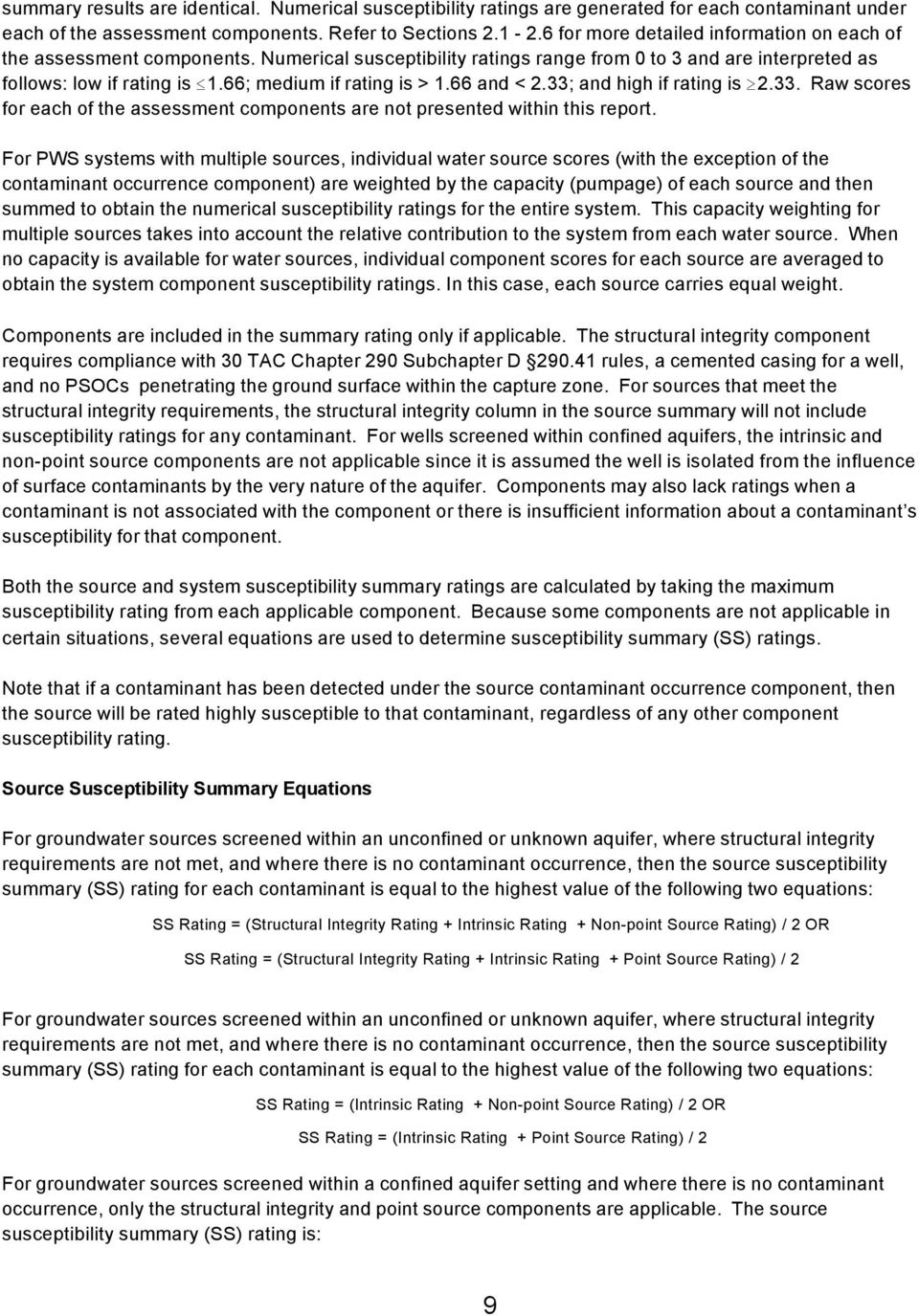
11 SS Rating = Structural Integrity Rating + Point Source Rating For surface water sources, where intake integrity requirements are not met and where there is no contaminant occurrence, then the source susceptibility summary (SS) rating for each contaminant is equal to the highest value of the following three equations: SS Rating = (Intake Integrity Rating + Intrinsic Rating + Non-point Source Rating) / 2 OR SS Rating = (Intake Integrity Rating + Intrinsic Rating + Point Source Rating) / 2 OR SS Rating = (Intake Integrity + Intrinsic Rating + Area of Primary Influence Rating) / 2 For surface water sources, where intake integrity requirements are met and where there is no contaminant occurrence, then the source susceptibility summary (SS) rating is equal to the highest value of the following three equations: SS Rating = (Intrinsic Rating + Non-point Source Rating) / 2 OR SS Rating = (Intrinsic Rating + Point Source Rating) / 2 OR SS Rating = (Intrinsic Rating + Area of Primary Influence Rating) / 2 System Susceptibility Summary Equations The system susceptibility summary component determines the system susceptibility to contamination, based on the ratings from all assessed sources. The system susceptibility summary is calculated by weighting each assessment component, with the exception of the contaminant occurrence component, by a capacity or pumpage factor (in gallons per minute). This methodology allows the system to account for the relative proportion of water from each source. Where the capacity (pumpage) is unknown, then the system susceptibility summary is calculated by averaging the individual source component ratings, with the exception of the contaminant occurrence component. Note that if a contaminant has been detected under the contaminant occurrence component of any source, then the system susceptibility summary rating will always default to high, regardless of any other system component susceptibility rating. The capacity factor (CF) is calculated as follows: CF = Individual source capacity (pumpage) in gallons per minute (GPM) Overall capacity of system (GPM) Weighted source component rating = (source component numerical rating)(cf) For example, in a system with two sources: Well A with a capacity of 80 GPM and Well B with a capacity of 20 GPM, the capacity factors are 0.80 and 0.20, respectively: CF Well A = 80/00 = 0.80 CF Well B = 20/00 = 0.20 The weighted component susceptibility ratings are then summed for system component ratings. The summary is then determined as the maximum value among all applicable components. 0
12 . Assessment Results First, a high susceptibility does not mean there is a health threat or a maximum contaminant level (MCL) violation. The assessments are designed to identify the activities and the related contaminants that may affect the water system. A MCL violation will result in a high susceptibility score because that contaminant has already been found in the drinking water and the public should have already been made aware through required reporting procedures and the CCRs. A description of all the 227 contaminants and the threshold values used by the assessment can be found in Appendix A. Some of these contaminants are identified as being related to the treatment process or distribution system. Appendix A is standard for all water systems receiving an assessment. A description of the specific PWS system and water sources is given in Appendix B. Water wells require certain information in order to be accurately assessed. If one or more critical elements (well location, screened interval, or pump rate) is lacking, wells are assessed using conservative assumptions and the well may receive a high susceptibility rating for each contaminant. Refer to of TCEQ s Rules and Regulations for Public Water Systems 0 TAC Chapter 290 Subchapter D for ground water source requirements. The rules and regulations may be obtained by contacting the Public Drinking Water Section of TCEQ or viewed over the internet from the Texas Administrative Code website: by navigating to Title 0, Part, Chapter 290, Subchapter D. The results of the source water susceptibility assessments are contained within Appendices C through I. Listed within Appendices C and D are contaminants for which the PWS system has received an overall susceptibility rating of high and medium, respectively, along with values of low, medium and high for each assessment component. The overall susceptibility rating is an average of the susceptibility ratings for all water sources for a system and is given for each of the 227 drinking water contaminants listed in Appendix A. Refer to Section 2.7 for the equation used to calculate summary susceptibility ratings from component susceptibility ratings. Appendices E and F include raw scores for component and summary susceptibility ratings for each of the PWS system s water sources for high (Appendix E) and medium (Appendix F) susceptibility rated contaminants. These appendices may be used to identify which of the water sources may be more susceptible to identified contaminants. If there is no rating under an assessment component heading within appendices C through F, the component was not used in the assessment and therefore no data was generated. Susceptibility ratings are not generated for the intrinsic (aquifer / watershed properties) and non-point source components for confined aquifers since the confining unit (clay layer) presents a barrier to the transport of contaminants. A high susceptibility rating for a contaminant means that there is a contaminant source located in close proximity to the water source and that the intrinsic characteristics of the watershed or ground water capture zone are such that if the contaminant were released into the environment, there is a high potential for the water source to become contaminated. A high susceptibility rating does not, however, imply there is an immediate threat to the water system. Contaminants identified as having a high, medium or low susceptibility within this assessment were generated based on the presence of PSOCs within the assessment area or a detection of contaminants

13 above threshold concentrations (see appendix A, for threshold values) under the contaminant occurrence component. The number of each PSOC type located within the various times of travel zones for water wells or located within the API and watershed of surface water sources are listed within Appendix G. Each of the 227 contaminants listed in Appendix A may be associated with multiple PSOC types. By referring to Appendix I, which includes maps of each source and PSOCs located within the assessment area, the approximate source of the high or medium rated contaminant may be identified (refer to Appendix H for map legend and topographic map symbology). For ground water sources, the various times of travel may assist in identifying the PSOCs that generated the high or medium susceptibility, keeping in mind that the closer a PSOC is to a source, the shorter the time of travel of a contaminant. Due to the properties of ground water systems that may attenuate contaminants, many of the contaminants associated with PSOCs will be attenuated. The shorter the distance between source and PSOC, the less likely attenuation will be effective in lowering the concentration of the contaminant to below TCEQ threshold levels. If no PSOCs or potentially threatening land uses associated with high or medium susceptibility rated contaminants are located within the assessment area, the contaminant received a high or medium susceptibility rating from the contaminant occurrence component. The presence of a contaminant and lack of an associated PSOC within the assessment area may indicate one of three possibilities: ) the contaminant is naturally occurring in the assessment area; 2) there is a PSOC within the assessment area that is unidentified within the database used in the assessments; or ) the contaminant resulted as a part of the water treatment process (as may be the case for Aluminum in Aluminum-lined storage tanks).. Purchase Water Assessments It should be noted that any purchased treated water contracts that a system may have are not part of this source water assessment. The assessments are based solely on the raw water sources that the public water system maintains as part of their regular water supply. The assessments are based on sources owned and operated by the system identified as operational, demand, emergency, or test. Any treated water purchased from another water system is not included in this assessment. Contact the system from which the treated water is purchased in order to receive the results of their assessment or contact the TCEQ Source Water Assessment & Protection program to receive a copy of the results from the system selling the treated water. There has been an effort, however, to include raw water purchases in the source water assessments. In cases where a water system takes water from a canal, an assessment will be calculated at the point water enters the canal system even though the pumps at this location is not directly owned by the water system. 2

14 4. How to Use Assessment Information The source water assessments are designed to assist water systems manage their source water resources and inform the system and the public of activities near their source waters that may affect drinking water quality. Results of the assessments may help the system make treatment decisions or plan for new treatment options for the future. Some systems have already independently developed local ordinances or other activities to better protect their source waters. With this new source water assessment information, these protective measures will be more informed and better applied to the potential concerns. Some ideas for interpreting and prioritizing the results are:. Determine which contaminants are not potential health concerns such as TDS and inorganic compounds such as sulfate. These contaminants may be related to naturally occurring compounds and there may be very little a system can do other than modify treatment or use different sources. 2. Determine the contaminants that received a high susceptibility score based on the Point Source component. Water systems should verify the locations of these point sources and determine their operational status (i.e. is an oil well operational or is it plugged). If the location or the status is different than reflected in the report, notify the SWAP program in writing, of the changes.. Determine if the highly susceptible contaminants associated with the Point Source component have also been detected in the Contaminant Occurrence component of the report. This indicates that there are point sources that could be contributing a contaminant and there has been a detect of that contaminant in the source water. This scenario should be considered a strong candidate for additional research of the point sources and possible source water protection measures. 4. Determine which contaminants originate from the Nonpoint Source (NPS) component. These are important possible contaminants but the nature of this component can lead to a larger number of highly susceptible contaminants than the Point Source component. When possible the NPS component uses statistical equations to determine susceptibility. When there is insufficient data for equations, statewide probability of occurrence from nonpoint sources was assigned to each based on the relative frequency of detection based on sample data. Additional tools and ideas for source water protection are available through the TCEQ. This is a voluntary program with many resources available for interested water systems and communities. Some of these resources include more detail relating to the results of the assessments that could not be included in this report. Many PWS systems are already enrolled in TCEQ s source water protection (SWP) program, which provides water systems with the tools necessary to effectively protect their source water from contamination. Visit our website for current information and additional protection ideas and best management practices (BMPs)

15 Historically, there were four steps to complete in order to become enrolled members of the source water protection program: ) delineation of the source water protection zone, 2) a physical inventory of the protection zone for PSOCs, ) production of a source water protection report (reporting the results of the delineation and the inventory) and 4) documentation of possible best management practices within the source water protection zone for identified PSOCs. With the completion of the source water assessments, all public water systems have a delineated source water protection area and a list of potential sources of contaminants. All that is required of the system to participate in the source water protection program now consists of determining the accuracy of PSOC locations, documenting existing protection measures or best management practices (BMPs), and locating new PSOCs which may not have been included in the source water assessment. All of this is done through a ground inventory of the capture zone or watershed/api which are also the source water protection areas. In order for a PWS system to protect their source waters and complete the requirements to become a member of source water protection, the SWAP program must be contacted. The SWAP program will provide the Source Water Protection guidance document to assist in the inventory, report writing and BMP establishment portions of the project. Once the PWS has submitted all required documents to the SWAP program, the PWS is considered a member of the SWP program and will be eligible for Drinking Water State Revolving Funds for implementation of protective measures known as best management practices (BMPs). Best management practices are established for most of the PSOCs and threatening land uses identified, and are included in the source water protection guidance document. In order to facilitate BMP implementation, funds are available through the Drinking Water State Revolving Fund (DWSRF). The DWSRF funds are available as low-interest loans and may be used to implement BMPs within the protection zone, make land purchases, and/or modify or improve PWS infrastructure. Incentives for a PWS to establish a source water protection program and have a current membership in the TCEQ SWP program include:! Prevention of increased treatment costs associated with source water contamination. Contamination of source waters is a serious matter that may affect public health. Once a source water is contaminated it is difficult or impossible to remediate. Prevention of source water contamination is far easier and less expensive than acquiring specialized treatment equipment or new sources of water that will increase costs for the PWS.! Public relations. Systems who have completed all the requirements for membership in the SWP program may advertise their membership by posting signs along roadways and in printed text on the consumer confidence reports (CCRs).! Best management practices implemented may modify the susceptibility rating of the PWS. Future assessments may incorporate data obtained in source water protection efforts. Future assessments may consider the positive effects of BMPs for the PSOCs identified in initial assessments, potentially lowering the susceptibility ratings for many of the contaminants. PWS systems must first identify or implement BMPs for PSOCs identified within their protection zones. 4

16 ! Ground truth data used in the SWSA. Systems who choose to participate in the SWP program conduct an inventory of the assessment area and in the process may find additional sources of contaminants, and verify or correct the locations of PSOCs or water source locations (water wells or surface water intakes) identified in this source water assessment. Improving the quality of data will improve the quality of future source water susceptibility assessments.! Access to funds to implement best management practices, acquire land, and modify infrastructure. As mentioned previously, funds are available through the Drinking Water State Revolving Fund (DWSRF) for land acquisitions or construction of BMPs within source water contributing areas or to make PWS infrastructure improvements. In addition, grant monies are also available through state and federal programs, particularly for non-point source pollutant management (For example, Clean Water Act Section 9(h) funds are provided only to designated state and tribal agencies to implement their approved non-point source management programs). 4. Consumer Confidence Reports (CCR) As required by rule, requirements for reporting the results of the source water assessments in the Consumer Confidence Reports will be included in the CCR template and guidance beginning in the spring/summer of The requirement for 200 will consist of notifying consumers that a source water assessment has been completed and provided to the system in May 200. Additional guidance on how to summarize the information in the assessments will follow in Through open records requests, consumers will have access to the full information of the source water assessments except for the detailed locations of well or intake locations in order to protect drinking water sources from malicious intent. As mentioned before, using the CCRs to report the assessment results is ideal because consumers can compare the results of the assessments with the monitoring results of the system. The water system should be familiar with the results of the source water assessment and be able to provide additional information to consumers. Systems involved in source water protection activities should also be prepared to share with consumers the efforts that are planned, or are in place, to protect the source waters of the system. Source Water Protection Contact Information: Texas Commission on Environmental Quality Source Water Assessment and Protection Program P. O. Box 087 MC - 55 Austin, Texas
17 5. Acknowledgments The Texas Commission on Environmental Quality (TCEQ) extends its gratitude to the United States Environmental Protection Agency (EPA) for its guidance during the development of the TCEQ Source Water Assessment and Protection (SWAP) Program and for the Drinking Water State Revolving Fund allocation that made this project possible. The TCEQ would also like to express it s appreciation to the United States Geological Survey, Texas District, for their partnership in the technical development of the program. In addition, TCEQ would like to express its thanks to the Railroad Commission of Texas, Texas Department of Health, Texas State Soil and Water Conservation Board, Texas Agricultural Extension Service, Texas Rural Water Association, Texas Department of Agriculture, Texas State Comptroller of Public Accounts, United States Geological Survey (USGS) Earth Resource Observation Systems Data Center, Texas Department of Transportation, Texas Natural Resource Information System, Texas Water Development Board, United States Department of Agriculture, United States Department of Census, University of Texas at Austin, and USGS for providing many of the data sets used in the source water susceptibility assessments. This project could not have been completed without the dedicated effort of USGS and TCEQ SWAP project staff. 6. References ESRI, 992. Understanding GIS: The ARC/INFO Way. Environmental Systems Research Institute, Redlands, CA. 57 pp. Heath, R. C Basic Ground-Water Hydrology. U. S. Geological Survey. Water Supply Paper pp. Seaber P.R., F. P. Kapinos, & G. L. Knapp Hydrologic Unit Maps. U. S. Geological Survey. Water Supply Paper pp Shineldecker, C. L Handbook of Environmental Contaminants. Lewis Publishers, Inc. 7 pp. Ulery, R. L Source Water Susceptibility Assessments Texas Public Water Systems Approach and Methodology. U. S. Geological Survey Draft Document. 57 pp. 6

18 7. Definitions Acre-foot Adsorption Alluvium Aquifer A volume of water that covers one acre to a depth of one foot, or 4,560 cubic feet (2.5 cubic meters). The process by which chemicals are held on the surface of a mineral or soil particle. Sediments deposited by flowing rivers. A rock unit that will yield water in a usable quantity to a well or spring. Area of Primary Influence The area within,000 feet of a reservoir, and for all streams discharging directly to the reservoir, the area within,000 feet of the center of the stream channel for an estimated 2 hour time-of-travel immediately upstream of the reservoir. For intakes on streams, the area of primary influence is the area within,000 feet of the estimated 2 hour time-of-travel upstream from the intake. Contaminants located within the area of primary influence are those that the PWS may be most susceptible to due to their proximity to the intake. Available Water Content (AWC) The available water content of a soil, a function of total pore space and pore size distribution. Available water content is an attribute in the SWSA ground water intrinsic component and is expressed as a volume fraction in inches per inch of soil, for example, if the available water content has a value of 0.20, a 0 inch zone then contains 2 inches of available water. Best Management Practices (BMPs) Capture Zone The most effective practice or combinations of practices to control point or nonpoint source pollution. Best management practices (BMPs) may either be structural or nonstructural. Structural BMPs are designed to capture surface runoff and remove pollutants through settling or other processes including, but not limited to, water diversions, retention devices, detention basins, or filter systems. Nonstructural BMPs take advantage of land s natural features to remove pollutants, nonstructural BMPs might include wetlands, grassed waterways and buffer zones. The delineated ground water contributing area characterized such that only the horizontal movement of water to the well is approximated assuming the contributing area to the well in an unconfined aquifer is the area directly above the flowpaths for a specified time of travel (2, 5, 0, 20 and 00 years). In a confined aquifer, the contributing area is that area within the aforementioned times of travel or terminating at the outcrop of the aquifer. Chemical Abstracts Service (CAS) Registration Number Chloramines A number assigned by the Chemical Abstracts Service to identify a chemical. Compounds formed by the reaction of hypochlorous acid (or aqueous chlorine) with ammonia. 7

19 Clay One type of soil particle with a diameter of approximately one ten-thousandth of an inch. Coliform Organism Microorganisms found in the intestinal tract of humans and animals, their presence in water indicates fecal pollution and potentially dangerous contamination by disease-causing microorganisms. Community Water System A public water system which has a potential to serve at least 5 residential service connections on a year-round basis or serves at least 25 residents on a year-round basis. Confined Aquifer Confining Bed Connection Contaminant An aquifer overlain by a confining bed and under pressure that is significantly greater than atmospheric pressure. Also known as an artesian aquifer. A rock unit having a very low hydraulic conductivity that restricts the movement of ground water either into or out of adjacent aquifers. A single family residential unit or each commercial or industrial establishment to which drinking water is supplied from the system. See 290.8(9) of TCEQ s Rules and Regulations for Public Water Systems 0 TAC Chapter 290 Subchapter D for a more detailed definition. The rules and regulations may be obtained by contacting the Public Drinking Water Section of TCEQ or viewed over the internet from the Texas Administrative Code website: by navigating to Title 0, Part, Chapter 290, Subchapter D. Any physical, chemical, biological, or radiological substance or matter that has an adverse effect on air, water, or soil. For TCEQ susceptibility assessment purposes a contaminant is any of the 227 substances listed in Appendix A that may pollute drinking water sources. Contributing Watershed Area Drinking Water Drainage Basin The watershed for the reservoir on which a surface water intake is located or the watershed upstream of a surface water intake located on a stream excluding all non-pws reservoirs with normal storage capacity greater than,000 acre-feet. All water distributed by any agency or individual, public or private, for the purpose of human consumption or which may be used in the preparation of foods or beverages or for the cleaning of any utensil or article used in the course of preparation or consumption of food or beverages for human beings. The term Drinking Water shall also include all water supplied for human consumption or used by any institution catering to the public. This is another term commonly used to describe a watershed. 8

20 Effluent Entry Point (EP) Water or some other liquid raw, partially or completely treated flowing from a reservoir, basin, treatment process or treatment plant. An entry point to the distribution of a public water supply, it is any point where freshly treated water enters the distribution system. Entry points to the the distribution system may include points where chlorinated well water, treated surface water, rechlorinated water from storage, or water purchased from another supplier enters the distribution system. Geographic Information System (GIS) Ground Water Heavy Metals Herbicide An organized collection of computer hardware, software, geographic data and personnel designed to efficiently capture, store, update, manipulate, analyze, and display all forms of geographically referenced information. Water in that area below land surface in which all pore spaces and voids are filled with water (called the zone of saturation) and from which wells, springs, and seeps are supplied. Metallic elements with high atomic weights, e.g., mercury, chromium, cadmium, arsenic, and lead. They can damage living organisms at low concentrations and tend to accumulate in the food chain. A compound, usually a man-made organic chemical, used to kill or control plant growth. Hydraulic Conductivity Hydrology Hydrogeology A coefficient of proportionality describing the rate at which water can move through a permeable medium. Clay usually has a hydraulic conductivity of less than cm/sec while the hydraulic conductivity of gravel may range from to 00 cm/sec. The study of the occurrence, distribution, and chemistry of waters of the Earth. The geology of ground water, with particular emphasis on the chemistry and movement of water. Hydrologic Region The largest hydrologic unit classification, identified by a two digit hydrologic unit code (HUC). The code identifies one of twenty one major geographic areas, or regions that contain either the drainage of a major river or series of rivers. Texas falls within three hydrologic regions, region (Arkansas-White-Red Region) including the drainage of the Red River basin in Texas, region 2 (Texas Gulf Region) includes the drainage that discharges into the Gulf of Mexico from Sabine Pass to the Rio Grande Basin boundary, and region (Rio Grande Region) which includes the Rio Grande River drainage. (Seaber, Kapinos, & Knapp, 987) Hydrologic Unit Code (HUC) A two to eight digit unique code based on four levels of classification within the hydrologic unit system (divisions and subdivisions of the United States into successively smaller hydrologic units: regions, sub-regions, accounting units, and cataloging units). An eight-digit code uniquely 9

21 Insecticide identifies each of the four levels of classification within four two-digit fields. The first two digits identify the region; the first four digits identify the sub-region; the first six digits identify the accounting unit, and the addition of two more digits for the cataloging unit completes the eight-digit code. (Seaber, Kapinos, & Knapp, 987) Any substance or chemical formulated to kill or control insects. Inorganic Karst Leakance Material such as sand, salt, iron, calcium salts and other mineral materials. Inorganic substances are of mineral origin, whereas organic substances are usually of animal or plant origin. See Organic. A region made up of porous limestone containing deep fissures and sinkholes and characterized by underground caves and streams. Ratio of soil permeability to soil thickness. Maximum Contaminant Level (MCL) The maximum permissible level of a contaminant in water which is delivered to any user of a public water system. Noncommunity Water System Any public water system which is not a community system. Non-point Source Pollution sources without a specific point of origin, usually due to storm water runoff from urban areas or agriculture/rangeland. Nontransient Noncommunity Water System A public water system that is not a community water system and regularly serves at least 25 of the same persons at least six months out of the year. Operational Status Code Organic Pathogen A code assigned to each PWS water source indicating its use or status by the system. Water source operational statuses codes are: A (abandoned source), C (capped water well), D (demand, source used only for peak demand periods), E (emergency, used only for emergencies), F (former PWS source, not used by the system), N (well used for non-drinking water uses), O (Operational), P (plugged water well), T (test, well in development). Substances that come from animal or plant sources or man-made chemical compounds containing carbon. Organic substances always contain carbon. Any organism able to cause a disease such as bacteria, viruses and the protozoans Cryptosporidium parvum and Giardia lamblia. 20
22 Pesticide Point Source Porosity Any substance or chemical designed or formulated to kill or control weeds or animal pests. Also see herbicide, insecticide. A stationery location or fixed facility from which pollutants might be discharged or emitted. The ratio of openings (voids) to the total volume of a soil or rock. Porosity is an indication of the capacity of the material to hold water. Expressed as percentages, clays have a porosity of 50% while gravels have a porosity of 20% Potential Source of Contamination (PSOC) A point source from which contaminants may leak or be discharged. Potentiometric Surface Precipitation A surface that represents the level to which water will rise in tightly cased wells in a confined aquifer. In an unconfined aquifer, the potentiometric surface is the water table. ) The process by which atmospheric moisture falls onto a land or water surface as rain, snow, hail, or other forms of moisture. 2) The chemical transformation of a substance in solution into an insoluble form (precipitate). Public Water System (PWS) A system for the provision to the public of water for human consumption through pipes or other constructed conveyances, which includes all uses described under the definition for drinking water. Such a system must have at least 5 service connections or serve at least 25 individuals at least 60 days out of the year. This term includes: any collection, treatment, storage, and distribution facilities under the control of the operator of such system and used primarily in connection with such system, and any collection or pretreatment storage facilities not under such control which are used primarily in connection with such system. Two or more systems with each having a potential to serve less than 5 connections or less than 25 individuals but owned by the same person, firm, or corporation and located on adjacent land will be considered a public water system when the total potential service connections in the combined systems are 5 or greater or if the total number of individuals served by the combined systems total 25 or greater at least 60 days out of the year. Without excluding other means of the terms individual or served, an individual shall be deemed to be served by a water system if he lives in, uses as his place of employment, or works in a place to which drinking water is supplied from the system. Public Water System Identification Number (PWS ID) Radionuclide Reservoir A unique seven digit identification number assigned to each public water supply system in Texas. Any man-made or natural element that emits radiation in the form of alpha or beta particles, or as gamma rays. Any natural or artificial holding area used to store, regulate or control water. 2
23 Reservoir Depth : Mean Annual Runoff Ratio River Basin Runoff An attribute used in calculating surface water intrinsic susceptibility to contamination. Contaminant movement in an aqueous environment will be higher when reservoir depth : annual runoff ratios are low since the potential for resuspension of contaminants is higher in shallow reservoirs and time of travel of a contaminant through the reservoir would be shorter. The entire land area drained by a river, also known as a watershed. That part of precipitation, snow melt, or irrigation water that runs off the land into streams or other surface water. It can carry pollutants from the air and land into surface waters. Runoff : Precipitation Ratio An attribute used in calculating surface water intrinsic susceptibility to contamination. Contaminant movement in an aqueous environment will be higher when runoff : precipitation ratios are high. For example, when runoff is high in relation to the amount of precipitation falling on the watershed, contaminants will be more likely to be carried to the receiving water body than when runoff is low in relation to precipitation. Safe Drinking Water Act (SDWA) Saturated Zone A statute enacted by the U.S. Congress in 974. The Act establishes a cooperative program among local, State and Federal agencies to insure safe drinking water for consumers. The zone in a soil profile or geologic formation in which all pore spaces are filled with water. Saturated Thickness The height or thickness of the saturated zone. Screened Interval Slope That part of a completed water well with openings which allow water to enter the well bore. The screened interval includes the zone completed as an open hole in a competent geologic unit such as limestone or dolomite. The inclination of the land surface from the horizontal. The percentage of slope is the vertical distance divided by the horizontal distance, for example, a slope of 20 % is a drop of 20 feet in 00 feet of horizontal distance. Percent land surface slope is an attribute used to determine susceptibility under the ground water intrinsic component. A low percent slope indicates water is more likely to recharge into ground water rather than becoming runoff. Soil Bulk Density A ratio of the mass of soil to its total volume (solids and pores together). Mean soil bulk density is an attribute used in determining the susceptibility in the ground water intrinsic component. Soil Clay Content Percent of clays in soil. Mean soil clay content is an attribute used to determine susceptibility in the ground water intrinsic component. Water does not move easily through clay deposits, 22
24 Soil Erodibility therefore, the higher the percentage of clay, the less likely contaminants will be able move through the aquifer matrix. A measure of the soil s susceptibility to raindrop impact, runoff and other erosional processes. Soil erodibility is an attribute used in calculating surface water intrinsic susceptibility to contamination. Contaminants may adsorb to soils, where soil erodibility is high, contaminants-adsorbed soils may be transported into receiving waters during rainfall events. Soil Hydrologic Group (HSG) A classification of soils based on similarities in runoff potential under similar storm and cover conditions. Soils within the United States are placed into four groups (A, B, C and D) and three dual classes (A/D, B/D, and C/D). Class A soils have a high infiltration rate (rate at which water enters the soil) and high rate of transmission (rate at which water moves in the soil) and therefore a low runoff potential; Class B soils have a moderate infiltration rate and rate of water transmission; Class C soils have a slow infiltration rate and rate of water transmission; Class D soils have a very slow infiltration rate and water transmission and therefore a high runoff potential. Dual hydrologic groups are given for certain wet soils that can be adequately drained, the first letter applies to the drained condition, the second to the undrained. The mean soil hydrologic group is an attribute in the ground water intrinsic component, soil hydrologic groups were classified using the Natural Resource Conservation Service s Curve Number Method where class placement is based on the minimum annual steady ponded infiltration rate for a bare ground surface. Soil Total Organic Materials Soil Zone Percent organic matter (plant and animal residue in various stages of decomposition) contained within soils. Organic matter adsorbs most chemicals, therefore the higher the organic matter of the soil, the less mobile contaminants would be. Mean soil total organic materials is an attribute used in determining susceptibility under the ground water intrinsic component. Extends from the land surface to a maximum depth of a meter or two and is the zone that supports plant growth. The porosity and permeability of the soils zone tends to be higher than those of the underlying materials. Source Water Assessment and Protection (SWAP) Spring Surface Water Susceptibility Established in 997 after the TCEQ s Wellhead Protection and Vulnerability Assessment Programs were merged. SWAP assists local communities in developing drinking water protection programs and assesses susceptibility of the state s public drinking water supply sources. A surface water body created by the natural emergence of ground water to the Earth s surface. Water which remains on the land surface and contributes to lakes, streams and reservoirs. The quality or state of being easily affected or influenced. For assessment purposes, susceptibility is defined as the potential for a PWS to withdraw water which has been exposed to a listed contaminant(s) at a concentration that would pose a health concern. 2
25 Time of Travel The distance a molecule of water (and therefore any associated contaminant) could travel within a specified time period or the time a molecule of water would travel within a particular distance. For surface water sources, a 2 hour time of travel is the distance a molecule of water would travel within 2 hours under the average flow conditions of the stream. Ground water capture zones include time of travel zones, each specifying a distance a molecule of water may travel in 2, 5, 0, 20 and 00 years. Total Reservoir Storage : Mean Annual Runoff Ratio Toxic Transmissivity An attribute used in calculating surface water intrinsic susceptibility to contamination. Contaminant movement in an aqueous environment will be higher when total reservoir storage : mean annual runoff ratios are low since the travel time of the contaminant to the surface water intake would be shorter and natural attenuation rates (biological, chemical or sedimentary) would be lower as well. A substance that is poisonous to an organism. A measure of the rate at which water will move through an aquifer. Transmissivity incorporates the hydraulic conductivity of the aquifer, aquifer thickness, water temperature and fluid properties to describe water movement. Transient Noncommunity Water System A public water system that is not a community water system and serves at least 25 persons at least 60 days out of the year, yet by its characteristics, does not meet the definition of a nontransient noncommunity water system. Trihalomethane (THM) One of a family of organic compounds named as derivatives of methane. THMs are generally the by-product from chlorination of drinking water that contains organic material. The resulting compounds (THMs) are suspected of causing cancer. Unconfined Aquifer Vadose Zone Volatile Where water only partly fills an aquifer, the upper surface of the saturated zone is free to rise and decline. Unconfined aquifers are also referred to as water-table aquifers. The unsaturated zone between the ground surface and the fully saturated zone. Readily vaporizable at a relatively low temperature. Water Source Code A unique code that TCEQ uses to distinguish between sources of drinking water. The first letter of the TCEQ source identification number specifies the type of source, the letter G indicates a groundwater well while the letter S is used to indicate a surface water intake, the following 7 digits are the PWS system identification number, while the last one or two letters of the water source code specifies the order the well or intake came online or was entered into the TCEQ database. Example: G05008AC. 24
26 Water Table Watershed Level of ground water; the upper surface of the zone of saturation of ground water above an impermeable layer of soil or rock (through which water cannot move) as in an unconfined aquifer. This level can be very near the surface of the ground or far below it. Mean seasonal high water table depth is an attribute within the ground water intrinsic component of the SWSA. The land area that drains into a stream. An area of land that contributes runoff to one specific delivery point. Watershed Slope : Watershed Area Ratio An attribute used in calculating surface water intrinsic susceptibility to contamination. Contaminant movement will be higher when watershed slope : watershed area ratios are low since the time of travel of a contaminant through a larger watershed with a low slope is longer than a similarly sized watershed with a higher slope. The longer time of travel allows for natural attenuation of the contaminant before reaching the surface water intake. 25
27 8. Acronyms API BMP CAS CCR DEM GIS GPM HUC MCL NPS PAH PDW PSOC PWS SDWA SOC SWAP SWSA TAMU TEEX TCEQ TWDB USEPA USGS VOC Area of Primary Influence Best Management Practice Chemical Abstracts Service Consumer Confidence Report Digital Elevation Model Geographic Information System Gallons Per Minute Hydrologic Unit Code Maximum Contaminant Level Non-Point Source Polycyclic Aromatic Hydrocarbons Public Drinking Water Potential Source of Contamination Public Water Supply Safe Drinking Water Act Synthetic Organic Chemicals Source Water Assessment and Protection Source Water Susceptibility Assessment Texas A&M University Texas Engineering Extension Service Texas Commission on Environmental Quality Texas Water Development Board United States Environmental Protection Agency United States Geological Survey Volatile Organic Compound 26
28 Appendix A Contaminant List List of regulated and unregulated assessed contaminants grouped by contaminant class. TCEQ Chapter 290 Subchapter F rules are cited for each drinking water standard (secondary drinking water standards are italicized). The TCEQ threshold limit is the concentration used within the contaminant occurrence component to determine if a detection of the chemical was found during water quality monitoring activities. The chemical abstract service (CAS) number is a unique identifier for each chemical. Numbers above contaminants indicate the general uses of each contaminant: Agricultural cropland; 2 Agricultural (livestock, feedlots); Industrial; 4 Domestic Effluent; 5 Pipeline Associated; 6 Transportation; 7 Human density; 8 Water Contaminant; 9 No Longer Produced. Inorganics: Regulated Contaminant Drinking Water Standard PWS Rule TCEQ Threshold CAS Number,4,7 ALUMINUM ANTIMONY ARSENIC 4,7 ASBESTOS,5 BARIUM BERYLLIUM CADMIUM CHLORIDE CHROMIUM,6,7 COPPER CYANIDE 7 FLUORIDE 7 HYDROGEN SULFIDE IRON,7 LEAD,7 MANGANESE,7 MERCURY NITRATE 0.05 MG/L MG/L 0.05 MG/L 7 MF/L 2 MG/L MG/L 00 MG/L 0. MG/L MG/L 0.2 MG/L 2 MG/L 0.05 MG/L 0. MG/L 0.05 MG/L MG/L 0 MG/L MG/L MG/L MG/L MF/L MG/L MG/L MG/L MG/L MG/L MG/L MG/L MG/L MG/L MG/L MG/L MG/L MG/L MG/L Appendix A: Page of 5/8/200
29 ,7 NITRATE+NITRITE 7 NITRITE,7 SELENIUM,4,7 SILVER,7 SULFATE 0 MG/L MG/L 0.05 MG/L 0. MG/L 00 MG/L MG/L MG/L MG/L MG/L MG/L TDS 000 MG/L MG/L THALLIUM,7 ZINC MG/L 5 MG/L MG/L MG/L Inorganics: Un-Regulated Contaminant Drinking Water Standard PWS Rule TCEQ Threshold CAS Number ALKALINITY BICARBONATE 000 MG/L BORON BROMIDE CALCIUM 0.0 MG/L 50 MG/L 000 MG/L CARBONATE 000 MG/L ,7 MAGNESIUM NICKEL PERCHLORATE SODIUM 000 MG/L 0.00 MG/L 0.00 MG/L 000 MG/L Radiochemical: Regulated Contaminant Drinking Water Standard PWS Rule TCEQ Threshold CAS Number GROSS ALPHA 5 PCI/L PCI/L GROSS BETA 4 MREM PCI/L,7 RADIUM PCI/L PCI/L Appendix A: Page 2 of 5/8/200
30 ,7 RADIUM-228 STRONTIUM-90 TRITIUM 5 PCI/L 4 MREM 4 MREM PCI/L PCI/L PCI/L Radiochemical: Un-Regulated Contaminant RADON STRONTIUM-89,7 TOTAL ALPHA EMITTING RADIUM URANIUM Drinking Water Standard PWS Rule TCEQ Threshold CAS Number 0.5 PCI/L PCI/L PCI/L MG/L Volatile Organic Contaminant: Regulated Drinking Water Contaminant Standard PWS Rule TCEQ Threshold CAS Number,2,7,,-TRICHLOROETHANE,2,7,,2-TRICHLOROETHANE,,-DICHLOROETHYLENE,,4,7,8,2,4-TRICHLOROBENZENE,,2-DICHLOROETHANE,5,2-DICHLOROPROPANE,5,6,7 BENZENE,5 CARBON TETRACHLORIDE CIS-,2-DICHLOROETHYLENE DICHLOROMETHANE,4,5,7 ETHYLBENZENE MONOCHLOROBENZENE (CHLOROBENZENE),7 ORTHO-,2-DICHLOROBENZENE,4,7 PARA-,4-DICHLOROBENZENE 0.2 MG/L MG/L 0.07 MG/L 0.07 MG/L 0.7 MG/L 0. MG/L 0.6 MG/L MG/L (b)(2) (b)(2) (b)(2) (b)(2) (b)(2) (b)(2) (b)(2) (b)(2) (b)(2) (b)(2) (b)(2) (b)(2) (b)(2) (b)(2) Appendix A: Page of 5/8/200
31 ,7 STYRENE,7 TETRACHLOROETHYLENE,5,6,7 TOLUENE TRANS-,2-DICHLOROETHYLENE 0. MG/L MG/L 0. MG/L (b)(2) (b)(2) (b)(2) (b)(2) ,7 TRICHLOROETHYLENE VINYL CHLORIDE MG/L (b)(2) ,5,6,7 XYLENES (TOTAL) 0 MG/L (b)(2) Volatile Organic Contaminant: Un-Regulated Drinking Water Contaminant Standard PWS Rule TCEQ Threshold CAS Number 4,7,,,2-TETRACHLOROETHANE 4,7,,2,2-TETRACHLOROETHANE,-DICHLOROETHANE 2,,-DICHLOROPROPENE,2,-TRICHLOROBENZENE,2,-TRICHLOROPROPANE,4,5,2,4-TRIMETHYLBENZENE,2-DIPHENYLHYDRAZINE,4,,5-TRIMETHYLBENZENE,4,7,-DICHLOROBENZENE,-DICHLOROPROPANE,,-DICHLOROPROPENE ,2-DICHLOROPROPANE ,4,6-TRICHLOROPHENOL, 2,4-DICHLOROPHENOL 2,4-DINITROPHENOL 0.02 MG/L 0.02 MG/L 0.02 MG/L Appendix A: Page 4 of 5/8/200
32 2,4-DINITROTOLUENE 2,6-DINITROTOLUENE 2-CHLOROTOLUENE 2-HEXANONE,4 2-METHYLPHENOL 4-CHLOROTOLUENE,5,7 4-ISOPROPYLTOLUENE,4,7 4-METHYL-2-PENTANONE (MIBK) ACETOCHLOR,4,7 ACETONE,4 ACRYLONITRILE MG/L 0.7 MG/L BROMOBENZENE ,,4,7 CARBON DISULFIDE,4,7 CHLOROETHANE CHLOROMETHANE, CIS-,-DICHLOROPROPENE,7 DIBROMOMETHANE DICHLORODIFLUOROMETHANE ETHYL METHACRYLATE,7 HEXACHLOROBUTADIENE ISOPROPYLBENZENE,4,5,6,7 M + P XYLENE,7 METHYL ETHYL KETONE METHYL IODIDE (IODOMETHANE) METHYL METHACRYLATE Appendix A: Page 5 of 5/8/200
33 ,5,7 METHYL-T-BUTYL ETHER,5,7 M-XYLENE,5,6,7 NAPHTHALENE N-BUTYLBENZENE ,5,7 NITROBENZENE 5 N-PROPYLBENZENE ORGANOTINS,5,6,7 O-XYLENE,5,6,7 P-XYLENE,5,6,7 S-BUTYLBENZENE 5 T-BUTYLBENZENE TETRAHYDROFURAN, TRANS-,-DICHLOROPROPENE,7 TRICHLOROFLUOROMETHANE VINYL ACETATE 0 MG/L Synthetic Organic Contaminant: Regulated Drinking Water Contaminant Standard PWS Rule TCEQ Threshold CAS Number 6 2,,7,8-TCDD,8 2,4,5-TP,6 2,4-D ALACHLOR ATRAZINE,6 BENZO(A)PYRENE CARBOFURAN,7 CHLORDANE E-08 MG/L 0.05 MG/L 0.07 MG/L MG/L 0.00 MG/L MG/L 0.04 MG/L MG/L (b)() (b)() MG/L (b)() MG/L (b)() MG/L (b)() MG/L (b)() MG/L (b)() MG/L (b)() Appendix A: Page 6 of 5/8/200
34 ,7 DALAPON DI-(2-ETHYLHEXYL)ADIPATE DI-(2-ETHYLHEXYL)PHTHALATE DIBROMOCHLOROPROPANE DINOSEB DIQUAT ENDOTHALL ENDRIN 5,6,7 ETHYLENE DIBROMIDE,7 GLYPHOSATE 7 HEPTACHLOR 7 HEPTACHLOR EPOXIDE,,9 HEXACHLOROBENZENE, HEXACHLOROCYCLOPENTADIENE,7 LINDANE METHOXYCHLOR OXAMYL 6,7 PCBs 6,7 PENTACHLOROPHENOL PICLORAM,2 SIMAZINE,9 TOXAPHENE 0.2 MG/L 0.4 MG/L MG/L MG/L MG/L 0.02 MG/L 0. MG/L MG/L MG/L 0.7 MG/L MG/L MG/L 0.00 MG/L 0.05 MG/L MG/L 0.04 MG/L 0.2 MG/L MG/L 0.00 MG/L 0.5 MG/L MG/L 0.00 MG/L (b)() MG/L (b)() (b)() (b)() (b)() MG/L (b)() MG/L (b)() MG/L (b)() MG/L (b)() MG/L (b)() MG/L (b)() (b)() (b)() 0.00 MG/L (b)() (b)() MG/L (b)() MG/L (b)() MG/L (b)() (b)() 0.0 MG/L (b)() MG/L (b)() MG/L (b)() MG/L Synthetic Organic Contaminant: Un-Regulated Drinking Water Contaminant Standard PWS Rule TCEQ Threshold CAS Number 2,4,5-T MG/L Appendix A: Page 7 of 5/8/200
35 -HYDROXYCARBOFURAN MG/L ,,5 ACENAPHTHENE,6 ACENAPHTHYLENE ALDICARB ALDICARB SULFONE ALDICARB SULFOXIDE ALDRIN ANTHRACENE MG/L MG/L AROCLOR (PCB) MG/L BENTAZON 7 BENZO[A]ANTHRACENE BENZO[B]FLUORANTHENE,5,6,7 BENZO[G,H,I]PERYLENE 7 BENZO[K]FLUORANTHENE 7 BROMACIL BUTACHLOR BUTYL BENZYL PHTHALATE,2 CARBARYL,7 CHLORDANE (ALPHA-CHLORDANE),7 CHLORDANE (GAMMA-CHLORDANE),7 CHLORDANE (TRANS-NONACHLOR),7 CHRYSENE,7 CYANAZINE MG/L 0.0 MG/L 0.0 MG/L 0.0 MG/L 0.0 MG/L MG/L MG/L MG/L MG/L DCPA DI-ACID DEGRADATE MG/L DCPA MONO-ACID DEGRADATE MG/L Appendix A: Page 8 of 5/8/200
36 ,9 DDE DIAZINON 5,6 DIBENZ[A,H]ANTHRACENE DICAMBA DIELDRIN,7 DIETHYL PHTHALATE DIMETHYL PHTHALATE DI-N-BUTYL PHTHALATE DISULFOTON DIURON EPTC FLUORENE,4,7 FONOFOS 5,7 INDENO[,2,,CD]PYRENE LAMBAST LINURON METHIOCARB METHOMYL METOLACHLOR METRIBUZIN MOLINATE,5 PHENANTHRENE 6,7 PROMETON PROPACHLOR PROPAZINE MG/L MG/L 0.0 MG/L MG/L MG/L MG/L MG/L MG/L MG/L 0.0 MG/L MG/L MG/L MG/L MG/L MG/L MG/L MG/L MG/L MG/L MG/L Appendix A: Page 9 of 5/8/200
37 PYRENE RDX,7 TERBACIL TERBUFOS TRIAZINES,7 TRIFLURALIN MG/L MG/L 0 MG/L MG/L Physical Parameter: Regulated Contaminant Drinking Water Standard PWS Rule TCEQ Threshold CAS Number ph Physical Parameter: Un-Regulated Contaminant Drinking Water Standard PWS Rule TCEQ Threshold CAS Number HARDNESS P-ALKALINITY SPECIFIC CONDUCTANCE Disinfection By-Product: Regulated Contaminant Drinking Water Standard PWS Rule TCEQ Threshold CAS Number 7 TOTAL TRIHALOMETHANE 0.08 MG/L MG/L Disinfection By-Product: Un-Regulated Drinking Water Contaminant Standard PWS Rule TCEQ Threshold CAS Number 7 BROMOCHLOROMETHANE 4,7 BROMODICHLOROMETHANE,4,7 BROMOFORM,7 BROMOMETHANE CHLOROFORM 4,7 DIBROMOCHLOROMETHANE 0.08 MG/L 0.08 MG/L 0.08 MG/L 0.08 MG/L 0.08 MG/L 0.08 MG/L Appendix A: Page 0 of 5/8/200
38 Microbial Organism: Regulated Contaminant,7 TOTAL COLIFORM Microbial Organism: Un-Regulated Contaminant 2 CRYPTOSPORIDIUM PARVUM 2 ESCHERICHIA COLI 2 FECAL VIRUSES 4 GIARDIA LAMBLIA Drinking Water Standard PWS Rule TCEQ Threshold CAS Number Drinking Water Standard PWS Rule TCEQ Threshold CAS Number 290. OOCYST Appendix A: Page of 5/8/200
Map Legend. ! 30. Hospital or Clinic
 Potential Sources of Contamination (PSOC) Type and Subtype Key: Simple Symbol ) Complex Symbol Type 1, Subtype (1-35) ) r 1. Auto Parts (New or Used) ) [ 2. Auto Repair, Sales, Salvage ) 3. Cotton Gin
Source Water Assessment Report
 Source Water Assessment Report Public Water Supply: TROY, CITY OF Assessment Areas Include: 516, 517 Kansas Department of Health and Environment Bureau of Water Watershed Management Section 1000 SW Jackson
Source Water Assessment Report
 Source Water Assessment Report Public Water Supply: MORRIS CO RWD 1 Assessment Areas Include: 893 Kansas Department of Health and Environment Bureau of Water Watershed Management Section 1000 SW Jackson
STATE OF VERMONT AGENCY OF NATURAL RESOURCES DEPARTMENT OF ENVIRONMENTAL CONSERVATION WASTE MANAGEMENT DIVISION SOLID WASTE MANAGEMENT PROGRAM
 STATE OF VERMONT AGENCY OF NATURAL RESOURCES DEPARTMENT OF ENVIRONMENTAL CONSERVATION WASTE MANAGEMENT DIVISION SOLID WASTE MANAGEMENT PROGRAM Solid Waste Management Program Waste Management Division 103
Travel Centers of America 1003300
 Travel Centers of America 1003300 Source Water Assessment Report A State Assessment of Your Drinking Water Source s Vulnerability As a requirement of the 1996 Amendments to the Federal Safe Drinking Water
Title 27A. Environment and Natural Resources Chapter 1 - Oklahoma Environmental Quality Act Article III - Jurisdiction of Environmental Agencies
 ODAFF AEMS Reference Date March 1, 2014 Title 27A. Environment and Natural Resources Chapter 1 - Oklahoma Environmental Quality Act Article III - Jurisdiction of Environmental Agencies 1-3-101. Responsibilities
NAPA COUNTY WATERSHED SYMPOSIUM
 Planning, Building, and Environmental Services NAPA VALLEY GROWTH NAPA COUNTY WATERSHED SYMPOSIUM Plunging Forward May 15, 2015 1 YOU CAN T CROSS THE SEA MERELY BY STANDING AND STARING AT THE WATER. Rabindranath
6 Chemicals from human settlements
 6 Chemicals from human settlements 6.1 Introduction The world is becoming increasingly urban, particularly in developing countries. The transition of people from rural areas to cities represents a major,
Compliance Guidance for Motor Vehicle Waste Disposal Wells in Oregon September 2015
 Compliance Guidance for Motor Vehicle Waste Disposal Wells in Oregon September 2015 Underground Injection Control Program 700 NE Multnomah Street Suite 600 Portland, OR 97232 Phone: 503-229-6371 800-452-4011
Chapter 2 Stormwater Pollution Prevention Plan (SWPPP) for Park Operations
 SWPPP for Park Operations 2 Chapter 2 Stormwater Pollution Prevention Plan (SWPPP) for Park Operations Bordered by Lake Washington & Lake Sammamish, the City of Bellevue has more than 60 miles of streams,
New York State Department of Environmental Conservation 625 Broadway, Albany, NY 12233 www.dec.ny.gov. Environmental Self Audit For Small Businesses
 New York State Department of Environmental Conservation 625 Broadway, Albany, NY 12233 www.dec.ny.gov Environmental Self Audit For Small Businesses Disclaimer The materials in this document are intended
Source Water Protection Practices Bulletin Managing Sanitary Sewer Overflows and Combined Sewer Overflows to Prevent Contamination of Drinking Water
 United States Office of Water EPA 916-F-01-032 Environmental Protection (4606) July 2001 Agency Source Water Protection Practices Bulletin Managing Sanitary Sewer Overflows and Combined Sewer Overflows
Florida Department of Environmental Protection
 Florida Department of Environmental Protection Background Mobile vehicle and equipment washing involves washing at a location where vehicles are based (such as a trucking company, warehouse, bus station,
4.7 HAZARDS AND HAZARDOUS MATERIALS
 LSA ASSOCIATES, INC. MARCH 2008 FINAL ENVIRONMENTAL IMPACT REPORT YUCCA VALLEY RETAIL SPECIFIC PLAN The State defines hazardous material as any material that, because of its quantity, concentration, or
STATE OF TENNESSEE DEPARTMENT OF ENVIRONMENT AND CONSERVATION DIVISION OF UNDERGROUND STORAGE TANKS TECHNICAL GUIDANCE DOCUMENT - 008
 STATE OF TENNESSEE DEPARTMENT OF ENVIRONMENT AND CONSERVATION DIVISION OF UNDERGROUND STORAGE TANKS TECHNICAL GUIDANCE DOCUMENT - 008 Effective Date - January 13, 1992 Revised Date - November 19, 1993
POLLUTION PREVENTION FACT SHEET: AUTOMOBILE MAINTENANCE
 POLLUTION PREVENTION FACT SHEET: AUTOMOBILE MAINTENANCE Description This pollution prevention measure involves creating a program of targeted outreach and training for businesses involved in automobile
COST AND PERFORMANCE REPORT
 COST AND PERFORMANCE REPORT Pump and Treat of Contaminated Groundwater at the United Chrome Superfund Site Corvallis, Oregon September 1998 Prepared by: SITE INFORMATION Identifying Information: United
Critical Regulations SUMMARY OF. Stormwater Management Regulations (National Pollutant Discharge Elimination System or "NPDES ) 40 CFR 122.
 SUMMARY OF Critical Regulations Stormwater Management Regulations (National Pollutant Discharge Elimination System or "NPDES ) 40 CFR 122.26 Spill Prevention, Control, and Countermeasures Rule (SPCC) 40
LOW INTEREST LOANS FOR AGRICULTURAL CONSERVATION
 LOW INTEREST LOANS FOR AGRICULTURAL CONSERVATION LILAC MANUAL LOW INTEREST LOANS FOR AGRICULTURAL CONSERVATION TABLE OF CONTENTS Introduction... 3 General Eligibility... 4 Specific Eligibility Criteria
Revised April (May) 2015
 Section 19.0 Cross Connection Control Policy 19.1 Responsibility 19.1.1 The Elkhart Water Utility has the responsibility to supply safe, potable water from the source to the point of delivery defined as
Unauthorized Discharges and Sanitary Sewer Overflows
 TCEQ REGULATORY GUIDANCE Field Operations Support Division RG-395 Revised April 2011 Unauthorized Discharges and Sanitary Sewer Overflows What does this document cover? The Texas Commission on Environmental
Characterizing Beauty Salon Wastewater for the Purpose of Regulating Onsite Disposal Systems
 Characterizing Beauty Salon Wastewater for the Purpose of Regulating Onsite Disposal Systems Fred Bowers 1,2, Ph.D. New Jersey Department of Environmental Protection Division of Water Quality August 14,
Evaluation of Site-Specific Criteria for Determining Potability
 Evaluation of Site-Specific Criteria for Determining Potability and Cleanup Goals for Impacted Groundwater This paper presents considerations used to evaluate site-specific criteria for determining groundwater
Low Impact Development Checklist
 New Jersey Stormwater Best Management Practices Manual February 2004 A P P E N D I X A Low Impact Development Checklist A checklist for identifying nonstructural stormwater management strategies incorporated
Oil and Gas Exploration and Production Oil and gas exploration and production... 22a-472-1
 Department of Environmental Protection Sec. 22a-472 page 1 (4-97) TABLE OF CONTENTS Oil and Gas Exploration and Production Oil and gas exploration and production... 22a-472-1 Department of Environmental
DESCRIPTION OF STORMWATER STRUCTURAL CONTROLS IN MS4 PERMITS
 DESCRIPTION OF STORMWATER STRUCTURAL CONTROLS IN MS4 PERMITS Phase I MS4 permits require continuous updating of the stormwater system inventory owned and operated by the MS4. They also include inspection
5.14 Floodplains and Drainage/Hydrology
 I-70 East Final EIS 5.14 Floodplains and Drainage/Hydrology 5.14 Floodplains and Drainage/Hydrology This section discusses floodplain and drainage/hydrology resources and explains why they are important
Improper storage of potential pollutants will increase the risk of water pollution that may occur because of spills.
 WQ-3 Best Management Practice (BMP) Water Quality Protection Guideline Secondary Containment Design and Operation Standards Section 1. Introduction According to the EPA, the majority of water pollution
Improper storage of fuel on construction sites will increase the risk of water pollution that may occur as a result of leaks or spills.
 WQ-10 Best Management Practice (BMP) Water Quality Protection Guideline Secondary Containment Design Standards Fuel Storage on Construction Sites According to the EPA, the majority of water pollution in
ENVIRONMENTAL REVIEW SCREENING QUESTIONS
 ENVIRONMENTAL REVIEW SCREENING QUESTIONS All applications to WHEDA are required to meet the Department of Housing and Urban Development s environmental compliance standards listed in 24 CFR Part 58. Your
How To Know If Your Well Water Is Safe
 Bernalillo County Office of Environmental Health A comprehensive guide to help maintain your well and keep your drinking water safe Bernalillo County Office of Environmental Health Bernalillo County Commission
Pollution Prevention And Best Management Practices For Dry Cleaners Operating In Broward County
 FORWARD In 1991, the Broward County Environmental Protection and Growth Management Department, who was then known as the Department of Natural Resource Protection (DNRP), initiated the development of Pollution
INFORMATION SHEET ORDER NO. R5-2011-XXXX TRIANGLE ROCK PRODUCTS, INC. FLORIN ROAD AGGREGATE PLANT SACRAMENTO COUNTY
 ORDER NO. R5-2011-XXXX INFORMATION SHEET Background Triangle Rock, Inc. (Discharger) submitted a Report of Waste Discharge (RWD) on 23 August 2010. The Discharger is expanding the mining operations at
2006 Standard Application Processing Time. 10 months. 14 months
 Air and Radiation Management Administration General Permit to Construct - without expanded public review Air Quality Permit to Construct - with expanded public review but limited public interest 11 months
GUIDELINES FOR LEACHATE CONTROL
 GUIDELINES FOR LEACHATE CONTROL The term leachate refers to liquids that migrate from the waste carrying dissolved or suspended contaminants. Leachate results from precipitation entering the landfill and
(1) Discuss the determination of the need for public visitation. Visitor center density within 100 miles.
 Chapter 4 Specifications Designs 3. Visitors Centers 3. Visitors Centers. The Introduction (Chapter 1) for these design data collection guidelines contains additional information concerning: preparing
1.7.0 Floodplain Modification Criteria
 1.7.0 Floodplain Modification Criteria 1.7.1 Introduction These guidelines set out standards for evaluating and processing proposed modifications of the 100- year floodplain with the following objectives:
MASSACHUSETTS COASTAL NONPOINT PROGRAM NOAA/EPA DECISIONS ON CONDITIONS OF APPROVAL
 MASSACHUSETTS COASTAL NONPOINT PROGRAM NOAA/EPA DECISIONS ON CONDITIONS OF APPROVAL FOREWORD This document contains the basis for NOAA and EPA s decision to fully approve Massachusetts Coastal Nonpoint
Soil Cleanup Goals. Minnesota Department of Agriculture Pesticide and Fertilizer Management Division. Guidance Document 19
 This document is made available electronically by the Minnesota Legislative Reference Library as part of an ongoing digital archiving project. http://www.leg.state.mn.us/lrl/lrl.asp Minnesota Department
Parts per million (ppm) or Milligrams per liter (mg/l): one part by weight of analyte to 1 million parts by weight of the water sample.
 2015 Annual Drinking Water Quality Report St. Johns County Utility CR 214 Mainland We're pleased to present to you this year's Annual Water Quality Report. This report is designed to inform you about the
AGENCY SUMMARY NARRATIVE
 AGENCY SUMMARY Mission Statement and Statutory Authority DEQ s mission is to be a leader in restoring, maintaining and enhancing the quality of Oregon s air, water and land. The Department of Environmental
SPILL PREVENTION, CONTROL, AND COUNTER MEASURES PLAN (SPCC)
 SPILL PREVENTION, CONTROL, AND COUNTER MEASURES PLAN (SPCC) UNIVERSITY RISK MANAGEMENT Occupational and Health Programs 19 Hagood Avenue, Suite 908 Charleston SC 29425 843-792-3604 Revised: June 2015 Spill
CHECKLIST FOR FILING AN APPLICATION FOR A GROUND AND/OR SURFACE WATER WITHDRAWAL PROJECT IN THE DELAWARE RIVER BASIN
 CHECKLIST FOR FILING AN APPLICATION FOR A GROUND AND/OR SURFACE WATER WITHDRAWAL PROJECT IN THE DELAWARE RIVER BASIN PLEASE COMPLETE CHECKLIST AND ENCLOSE WITH THE APPLICATION. If you need assistance,
WATER SUPPLY WELL RECEPTOR SURVEY GUIDANCE DOCUMENT
 STATE OF CONNECTICUT DEPARTMENT OF ENERGY AND ENVIRONMENTAL PROTECTION WATER SUPPLY WELL RECEPTOR SURVEY GUIDANCE DOCUMENT Bureau of Water Protection and Land Reuse Remediation Division September 2009
GAS WELL/WATER WELL SUBSURFACE CONTAMINATION
 GAS WELL/WATER WELL SUBSURFACE CONTAMINATION Rick Railsback Professional Geoscientist CURA Environmental & Emergency Services [email protected] And ye shall know the truth and the truth shall make you free.
CONTAMINANT SOURCES. JUNE 1998 Printed on recycled paper
 Rural Wellhead Protection Protection Fact Sheet Fact Sheet CONTAMINANT SOURCES JUNE 1998 Printed on recycled paper INTRODUCTION More than 75 percent of Wyoming s population relies on groundwater for part
OIL POLLUTION PREVENTION REGULATIONS
 OIL POLLUTION PREVENTION REGULATIONS The Newly Revised SPCC Rules Spill Prevention Control and Countermeasure NON-TRANSPORTATION RELATED ONSHORE AND OFFSHORE FACILITIES Code of Federal Regulations Title
Retention/Irrigation. Design Considerations. Soil for Infiltration Area Required Slope Environmental Side-effects
 Description Retention/irrigation refers to the capture of stormwater runoff in a holding pond and subsequent use of the captured volume for irrigation of landscape of natural pervious areas. This technology
CHAPTER 372-68 WAC WATER POLLUTION CONTROL AND ABATEMENT PLANS FOR SEWAGE DRAINAGE BASINS
 CHAPTER 372-68 WAC WATER POLLUTION CONTROL AND ABATEMENT PLANS FOR SEWAGE DRAINAGE BASINS Last Update: 6/8/88 WAC 372-68-010 Authority. 372-68-020 Purpose. 372-68-030 Definitions. 372-68-040 Planning guide.
A HYDROLOGIC NETWORK SUPPORTING SPATIALLY REFERENCED REGRESSION MODELING IN THE CHESAPEAKE BAY WATERSHED
 A HYDROLOGIC NETWORK SUPPORTING SPATIALLY REFERENCED REGRESSION MODELING IN THE CHESAPEAKE BAY WATERSHED JOHN W. BRAKEBILL 1* AND STEPHEN D. PRESTON 2 1 U.S. Geological Survey, Baltimore, MD, USA; 2 U.S.
RECOMMENDED PROGRAM FOR WELL AND SEPTIC SYSTEM REAL ESTATE TRANSACTION INSPECTIONS
 Contra Costa Environmental Health 2120 Diamond Blvd., Suite 200 Concord, CA 94520 Phone: (925) 692-2500 Fax: (925) 692-2504 www.cchealth.org/eh/ RECOMMENDED PROGRAM FOR WELL AND SEPTIC SYSTEM REAL ESTATE
Chapter 1 Introduction
 Chapter 1 Section 1421 of SDWA tasks EPA with protecting USDWs for all current and future drinking water supplies across the country (see section 1.3 for the complete definition of a USDW). EPA s UIC Program
Protecting your private water supplies. The possible causes of contamination and their remediation to prevent this risk.
 Protecting your private water supplies The possible causes of contamination and their remediation to prevent this risk. Contamination from a variety of sources can occur potentially at any point throughout
IC24. DISPOSAL OF WASTEWATER GENERATED BY MOBILE BUSINESSES AND OUTDOOR ACTIVITIES
 IC24. DISPOSAL OF WASTEWATER GENERATED BY MOBILE BUSINESSES AND OUTDOOR ACTIVITIES BEST MANAGEMENT PRACTICES (BMP) A BMP is a technique, measure, or structural control that is used for a given set of conditions
Chapter 14 Quiz. Multiple Choice Identify the choice that best completes the statement or answers the question.
 Chapter 14 Quiz Multiple Choice Identify the choice that best completes the statement or answers the question. 1. Which of the following is NOT true regarding the Chesapeake Bay? a. it is one of many small
4. Environmental Impacts Assessment and Remediation Targets
 4. Environmental Impacts Assessment and Remediation Targets 4.1 Environmental Impacts Significant additional development in the Alder Creek watershed is not anticipated at this time; however, there are
ALLEGANY WIND POWER PROJECT CONSTRUCTION SPILL PREVENTION PLAN
 ALLEGANY WIND POWER PROJECT CONSTRUCTION SPILL PREVENTION PLAN Best Management Practices (BMPs) will be implemented during construction of the Allegany Wind Power Project to prevent and contain spills.
CHAPTER 13 LAND DISPOSAL
 CHAPTER 13 LAND DISPOSAL Supplemental Questions: Which of Shakespeare's plays is the source of the opening quote? The Tempest [1611-1612],Act: I, Scene: i, Line: 70. 13-1. Cite four reasons landfills remain
Contact Person Sarah Morris-Benavides Revision 1.1 Document Plan 10200.037 Effective Date 07/01/2014 Review Date 03/15/2017.
 Ames Laboratory Federal SPCC regulations (40 CFR Part 112) were created under the authority of the Clean Water Act. The stated purpose is " to prevent oil discharges from reaching navigable waters of the
WASTEWATER TREATMENT OBJECTIVES
 WASTEWATER TREATMENT OBJECTIVES The student will do the following: 1. Define wastewater and list components of wastewater. 2. Describe the function of a wastewater treatment plant. 3. Create a wastewater
Best Management Practices
 for The City of Paso Robles is required to implement a Phase II Municipal Water Program in order to reduce or eliminate the pollutants that enter our waterways from both storm water and non-storm water
MEMORANDUM. Further discussion regarding the Community s solid waste facility is described further in this memorandum.
 MEMORANDUM File: Sanikiluaq Improvement of the Existing Wastewater Treatment Facility To: Government of Nunavut Department of Community and Government Services Attention: Mr. Grigor Hope,, Project Officer
How To Get A Stormwater Discharge Permit In A City Of Scottsdale
 Environmental Regulations Guide Section 4 Pollution Prevention 4. 0 Pollution Prevention The Pollution Prevention Act (PPA) focuses on source reduction, i.e. on reducing the amount of pollution through
City of Paso Robles Community Development Department Construction Site Storm Water Quality Requirements
 City of Paso Robles Community Development Department Construction Site Storm Water Quality Requirements Overview of the City s Construction Storm Water Program The City of Paso Robles is committed to protecting
Ground-Water-Level Monitoring and the Importance of Long-Term Water-Level Data U.S. Geological Survey Circular 1217
 Ground-Water-Level Monitoring and the Importance of Long-Term Water-Level Data U.S. Geological Survey Circular 1217 by Charles J. Taylor William M. Alley Denver, Colorado 2001 U.S. DEPARTMENT OF THE INTERIOR
Spill Prevention, Control & Cleanup SC-11
 Objectives Cover Contain Educate Reduce/Minimize Product Substitution Description Spills and leaks, if not properly controlled, can adversely impact the storm drain system and receiving waters. Due to
Susceptibility of Your Drinking Water Source to Contamination
 Susceptibility of Your Drinking Water Source to Contamination The aquifer that supplies drinking water to ICASI Culinary School has a moderate susceptibility because of the following reasons: < Available
Georgia Department of Public Health. Georgia Onsite Sewage Management Systems. Background and Use of Onsite Wastewater Treatment Systems in Georgia
 Georgia Department of Public Health Georgia Onsite Sewage Management Systems Background and Use of Onsite Wastewater Treatment Systems in Georgia Background On-site sewage management systems are designed
COMMERCIAL BUSINESS LICENSE APPLICATION
 COMMUNITY DEVELOPMENT DEPARTMENT Code Administration Division 129 North Second Street, 2nd Floor Yakima, Washington 98901 (509) 575-6126 Fax (509) 576-6576 [email protected] www.buildingyakima.com COMMERCIAL
FUELING AND FUEL STORAGE
 FUELING AND FUEL STORAGE BENCHMARK Implement spill prevention measures whenever fuel is handled or stored. Report, minimize, contain and clean up spills that do occur. FUELING BMPS Spills of diesel, oil,
Appendix C3: Response Plan for Investigations of Illegal Discharges, 2016
 Appendix C3: Response Plan for Investigations of Illegal Discharges, 2016 Response Plan for Investigations For the City and County of Honolulu Municipal Separate Storm Sewer System National Pollutant Discharge
Use of Alternate Concentration Limits (ACLs) to Determine Cleanup or Regulatory Levels Under RCRA and CERCLA
 U.S. Department of Energy Office of Environmental Policy and Assistance ACL Information Brief DOE/EH-413-9912 (December 1999) DEPARTMENT OF ENERGY UN ITED STATES OF AMERICA Use of Alternate Concentration
Assessing Your Septic System
 THE UNIVERSITY OF TENNESSEE AGRICULTURAL EXTENSION SERVICE SP508 D TENNESSEE Home A Syst Assessing Your Septic System George F. Smith, Professor, Agricultural Economics & Resource Development Martha W.
Waste Oil Collection / Storage
 ENVIRONMENTAL & REGULATORY SERVICES Storage Tank Regulation Section P. O. Box 7837 Madison, Wisconsin 53707-7837 TDD #: (608) 264-8777 http://www.commerce.state.wi.us http://www.wisconsin.gov Jim Doyle,
Bioremediation of contaminated soil. Dr. Piyapawn Somsamak Department of Environmental Science Kasetsart University
 Bioremediation of contaminated soil Dr. Piyapawn Somsamak Department of Environmental Science Kasetsart University Outline Process description In situ vs ex situ bioremediation Intrinsic biodegradation
Sample DEQ Plan Submitter s Checklist for Stormwater Management Plans
 APPENDIX IV Version: February 2, 2015 Sample DEQ Plan Submitter s Checklist for Stormwater Management Plans Please fill in all blanks and please reference the plan sheets/pages where the information may
Package Treatment Plant Policy and Procedure
 Package Treatment Plant Policy and Procedure PURPOSE There has been increased interest in the use of package treatment plants for new development proposals in the County. Current review procedures are
Can I Recycle Some of My Industrial or Hazardous Wastes?
 TCEQ REGULATORY GUIDANCE Waste Permits Division RG-240 August 2006 Can I Recycle Some of My Industrial or Hazardous Wastes? Purpose. The purpose of this document is to assist those who recycle industrial
ENVIRONMENTAL QUESTIONNAIRE - REAL ESTATE SECURED LOANS
 ENVIRONMENTAL QUESTIONNAIRE - REAL ESTATE SECURED LOANS Borrower: Property Known As: Property Address: City State NC Zip Code INSTRUCTIONS: For all loans, complete pages 1-3, answering all questions. If
A Geospatial Solution for Minimizing Risk. Pipeline Hazard Categorization
 A Geospatial Solution for Minimizing Risk Pipeline Hazard Categorization 1 Agenda 1. At stake: corporate value and reputation 2. Contributing Pipeline Segments: a building block for risk prioritization
YOUR SEPTIC SYSTEM UNCOVERED
 YOUR SEPTIC SYSTEM UNCOVERED By Raymond King District Director of Environmental Health It s underground where you can t see it. You don t really understand how it works. When it doesn t work your toilets
Texas Commission on Environmental Quality Page 1 Chapter 217 - Design Criteria for Domestic Wastewater Systems
 Texas Commission on Environmental Quality Page 1 217.31. Applicability. SUBCHAPTER B: TREATMENT FACILITY DESIGN REQUIREMENTS 217.31-217.39 Effective August 28, 2008 This subchapter details the design values
Q 4/17/13: Thank you for your quick response to our email dated April 10, 2013. In looking over your comments, we have a few clarifying remarks.
 Q & A Q 4/10/13: In anticipation of the DEM action plan implementation in the next few days, Citizens Advocating for a Safe Environment (CASE) would like to bring a few concerns to your attention. Some
On Site Sewage System Maintenance Inspections. March 2011. Building and Development Branch Ministry of Municipal Affairs and Housing
 On Site Sewage System Maintenance Inspections March 2011 Building and Development Branch Ministry of Municipal Affairs and Housing Introduction The Building Code Act, 1992 and Building Code (Ontario Regulation
Flash Flood Science. Chapter 2. What Is in This Chapter? Flash Flood Processes
 Chapter 2 Flash Flood Science A flash flood is generally defined as a rapid onset flood of short duration with a relatively high peak discharge (World Meteorological Organization). The American Meteorological
ROSE CREEK WATERSHED HYDROLOGIC, HYDRAULIC, SEDIMENT TRANSPORT, AND GEOMORPHIC ANALYSES TASK 1 EXISTING DATA AND INFORMATION SUMMARY REPORT BACKGROUND
 ROSE CREEK WATERSHED HYDROLOGIC, HYDRAULIC, SEDIMENT TRANSPORT, AND GEOMORPHIC ANALYSES TASK 1 EXISTING DATA AND INFORMATION SUMMARY REPORT BACKGROUND The Rose Creek Watershed (RCW) consists of three planning
GUIDELINE FOR MUNICIPAL MANAGEMENT PRACTICES FOR STREET SWEEPINGS & CATCH BASIN CLEANINGS
 GUIDELINE FOR MUNICIPAL MANAGEMENT PRACTICES FOR STREET SWEEPINGS & CATCH BASIN CLEANINGS STATE OF CONNECTICUT August 2007 DEPARTMENT OF ENVIRONMENTAL PROTECTION 79 Elm Street, Hartford, CT 06106-5127
COMPREHENSIVE PLAN SECTION B, ELEMENT 4 WATER RESOURCES. April 20, 2010 EXHIBIT 1
 COMPREHENSIVE PLAN SECTION B, ELEMENT 4 WATER RESOURCES April 20, 2010 EXHIBIT 1 ELEMENT 4 WATER RESOURCES TABLE OF CONTENTS 4.1 INTRODUCTION 4.2 GOALS AND POLICIES 4.2.A General Goals and Policies 1 4.2.B
Section 4 General Strategies and Tools
 Section 4 General Strategies and Tools Key planning issues for WRIA 35 have been identified in Sections 5 and 6 in the areas of water supply, instream flow, water quality, and aquatic habitat. General
CHAPTER 17. Sewers and Sewage
 Sec. 17-1. Industrial Wastes in Rivers and Streams; Treatment. Sec. 17-4. Discharging Water or Waste Onto Sidewalks. CHAPTER 17. SEWERS AND SEWAGE ARTICLE 1 GENERALLY Sec. 17-1. Industrial Wastes in Rivers
3.4 DRAINAGE PLAN. 3.4.1 Characteristics of Existing Drainages. 3.4.2 Master Drainage System. Section 3: Development Plan BUTTERFIELD SPECIFIC PLAN
 3.4 DRAINAGE PLAN This section describes the existing onsite drainage characteristics and improvements proposed within this Specific Plan. Following this description, drainage plan development standards
Water Recycles poster
 Water Recycles poster The "Water ReCycles" poster is designed for students of all ages. It shows the natural water cycle and humans influence on water resources. Raincloud illustration The raincloud in
Review of Groundwater Vulnerability Assessment Methods Unsaturated Zone. Dept. of Earth Sciences University of the Western Cape
 Review of Groundwater Vulnerability Assessment Methods Unsaturated Zone Dept. of Earth Sciences University of the Western Cape Background Sililo et al. (2001) Groundwater contamination depends on: Intrinsic
Reclamation Plants, Separation Facilities & Stationary Treatment Facilities
 RAILROAD COMMISSION OF TEXAS Reclamation Plants, Separation Facilities & Stationary Treatment Facilities Grant Chambless, P.G. Manager, Environmental Permits & Support Oil & Gas Division 1 Disclaimer These
Operations and Maintenance Plan The Residences at Johnson Farm 189 Landham Road Sudbury, Massachusetts. Submitted to: Town of Sudbury
 Operations and Maintenance Plan The Residences at Johnson Farm 189 Landham Road Sudbury, Massachusetts Submitted to: Town of Sudbury December 2011 Table of Contents 1.0 Introduction... 1 1.1 Responsibility...
Spill Prevention, Control and Countermeasure (SPCC) Rule
 Spill Prevention, Control and Countermeasure (SPCC) Rule Code of Federal Regulations Title 40 CFR Part 112 Training Guide for Oil and Fuel handlers on Farms 1 Purpose of SPCC Rule To prevent oil discharges