
Management for Lawyers
|
|
|
- Cody Bradford
- 10 years ago
- Views:
Transcription
1 Management for Lawyers Barron K. Henley, Esq. Affinity Consulting Group, LLC 1405 Dublin Road, Suite 100 Columbus, OH Affinity Consulting Group, LLC

2 Management for Lawyers I. Overload... 1 II. Main Problems... 1 A. Torrent of Interruptions Interruption Survey Other Questions To Ask Yourself... 2 B. Storage... 2 C. Too Much Legitimate To Deal With Effectively... 2 D. No Expectation of Privacy... 2 E. Spam Getting Through... 3 F. Are You Using Outlook Effectively?... 3 III. Storage... 3 A. Main Storage Problems Disorganization Storage Space Limitations No One Else Can See Your But You Difficulties Searching... 3 B. Start By Organizing Outlook How To Set Up a New Folder Outlook Rules Sample Rule - Delay Sent Mail By One Minute Sample Rule - Keep Track of Delegated C. Outlook Add-On Programs To Help You Sort and Store Your SpeedFiler by Claritude SimplyFile by TechHit Xobni QuickFile4Outlook - Lawyers Edition... 7 D. Archiving Old Outlook Turn AutoArchive On or Off Control the Archive Settings of a Specific Folder... 8 E. Saving Messages Outside of Outlook Saving As A Document Saving By Dragging Into a Windows Explorer Folder Saving With Document Management Programs (DMS) Worldox Example...10 a. Save From Within Outlook - Drag and Drop b. Save From Within Outlook Using Worldox - Copy or Move Buttons c. Save From Within Worldox Saving Using a Case/Practice Management Program...12 Page 1

3 6. Amicus Attorney Example Saving as PDF Files...14 a. Acrobat - Creating PDFs from Individual s or Entire Folders b. Acrobat - Adding Subsequent s to Existing PDFs c. Acrobat - Note About PDF Packages d. Acrobat - Automatic Archival e. Saving PDFs Without Acrobat F. Storage Tips Store With Other Related Files Delete or Archive Once Stored Always Separately Save Attached Documents Stop Copying and Pasting Stop Printing G. Benefits of Storing Outside of Outlook No Worry About Storage Limitations Everyone Else Can Find Them Too Searchable Like All Other Documents...17 IV. Dealing With The Overload - Your Game Plan A. Deal with at Set Times B. Turn Off Outlook's Notifications About C. Treat Inbox like you U.S. Mail Box Keep it Empty! D. Delete Whatever You Can Immediately! E. If You Can Deal With It In Under 3 Minutes, Do It Now F. Delegate If Appropriate G. Delay If Necessary H. Outlook Techniques Which Will Help See More In One Screen...21 a. Turn Off Viewing Pane b. Turn Off Date Grouping Quickly Convert to Appointments or Tasks Tasks in Outlook Use Outlook 2007/10 Categories...23 V. Other Outlook Tips and Tricks A. Fix Outlook's Fonts B. Create Contacts from C. Right-Click for All Possible Options D. Rules Creating Flags and Alerts E. Out of Office Assistant F. Saving Attachments to Page 2

4 1. One At A Time In Bulk...25 G. Set up your Signature Block: H. Distribution Lists (Outlook 2007)/Contact Groups (Outlook 2010) I. Find Contacts Super-Fast J. Edit The Auto-Complete List K. Use Rules and Alerts L. Mailbox Cleanup M. Advanced Search Capability N. Quick Search in Outlook O. Junk Mail Settings P. Block Senders Q. Flags R. Make Outlook Show You Names Last Name First S. Default Outlook To Your Contacts Address Book VI. General Tips and Netiquette: A. Spelling and Grammar B. Don t Be Rude C. Never Send an Angry D. Use a Subject Line E. Don t Put the Whole Message In the Subject Line F. Is Often Misinterpreted G. Beware of Forwarding H. Be Cautious About Blind Copying I. Avoid Large Attachments J. Only Copy People Who NEED To See It K. Don t Forward Junk L. No Caps M. Don't Forward Virus Warnings VII. Encryption A. To Encrypt or Not to Encrypt? B. Comment 17 to the ABA Model Rule C. Opinions Regarding Requirement to Encrypt Page 3
5 D. Is There A Duty to Do More? E. Best Practices F. Retracting Sent s G. Encryption Options VIII. Ethical and Malpractice Considerations IX. Metadata Pitfall A. Metadata Example The Bad News The Good News...37 B. Metadata Is it really a Nightmare What is Metadata? Why Have Metadata If It Is So Bad?...39 C. What You Can Do About Metadata Learn the Security Settings within Microsoft Word 2003 or Prior Download Microsoft s Free Metadata Removal Tool for Word Learn The Security Settings in Word 2007 & Learn About Tracked Changes in Word Use a Metadata Remover Exchange PDF Documents...42 D. WordPerfect Also Contains Meta Data X. Spam A. Software for your Desktop Computer B. Challenge/Response SPAM Avoidance Systems C. Spam Screening Services D. Spam Appliances XI. Keeping Information Safe from Disaster, Accidental Loss, Theft, Viruses and Malicious Intruders A. ABA Model Rule B. Opinions Regarding Safeguarding Data C. Steps You Should Take Page 4
6 Management for Lawyers I. OVERLOAD Most current studies indicate that lawyers process around 100 s per day. 1 Without question, is one of the most important technological communication advancements of the past 100 years. It has fundamentally changed the way we communicate with clients and do business. Major corporations and law firms are run via communication instead of face-to-face communication. For lawyers, s present a wide array of issues that most of the business world and ordinary consumers will never face. In this seminar, we will discuss these issues and teach you how best to deal with them. These issues or problems range from ethical considerations to overload and timemanagement. While there is no perfect solution, there are many methods to effectively handle . The first step to any problem is to understand the problems that exist. We must get our arms around all the issues that face lawyers. The second step is to isolate each problem and tackle each problem, without forgetting how that might affect other problems. For instance, controlling spam may prevent you from getting an important from a client if your spam filter inadvertently catches an from a client. In other words, when you solve one problem, it may open up a different can or worms. II. MAIN PROBLEMS A. Torrent of Interruptions: In an eight (8) hour work day, if we receive 100 s, that equates to receiving one every 4.8 minutes. Sound familiar? It should, because that is the world most of us live in. Combine that with instant messages, phone calls and what I call curiosity interruptions, that equates to one interruption every 2-3 minutes! What can you do to minimize the distraction? 1 In 2005, a study by the Radicati Group found that Americans process 76 s each day, and by 2007, Americans will be sending and receiving an average of 100 messages per day. Page 1
7 Take the following quick survey: 1. Interruption Survey: Average number of s you get per day:... Average number of Instant messages per day:... Average number of phone calls you get each day:... Average number of curiosity or internet breaks each day:... Total Interruptions Per Day Other Questions To Ask Yourself: How many times do you look at your each day?... What percentage of interruptions really need immediate attention?... Has technology simplified your life? Yes No Is Technology the Slave or the Master? Yes No B. Storage: What do we do with all of this ? There are several problems related to this: How should you archive old ? How do you deal with attachments and keep from losing them? How do you search for old conversations quickly and efficiently? How do you keep your but not run out of server space? Why does the IT person keep telling you that you have too much in your inbox and you're clogging up the server? C. Too Much Legitimate To Deal With Effectively: Many people simply receive more than they can read and keep up with. How do you sort, store and track all of this ? D. No Expectation of Privacy: The old saying goes: You should never send an that would embarrass you were it to appear on the front page of tomorrow's paper. Is there anything you can do to create an expectation of privacy? Page 2

8 E. Spam Getting Through: There are lots of ways to avoid SPAM, and yet it still manages to get into our mailboxes. What can you do about it? F. Are You Using Outlook Effectively? Probably not. Although millions of people use Outlook, most do not use all of its functionality to their advantage. In this seminar, we'll give you some great tips for making better use of Outlook. III. STORAGE A. Main Storage Problems: 1. Disorganization: Most people have hundreds or thousands of unrelated messages in their inboxes. This is equivalent to taking all of the paper out of your files and throwing it on the floor of the file room. The point is, if it's not organized, then it's mostly useless. 2. Storage Space Limitations: You may have been scolded by your IT folks about this. If you're using Microsoft Exchange on your server, then it can get overloaded with the quantity of s and attachments you keep in your inbox and Outlook folder structures. If you don't have Exchange, then all of those s (and contacts, and appointments and tasks) are stored in a PST file on your hard drive or the server. The bigger that database, the slower your computer will run. Of course, the database can also over-run your storage capacity. 3. No One Else Can See Your But You: In most cases, if you have an important client communication in Outlook, no one else in your office can see it. In many cases, lawyers want to share this information, but don't know how to do it. 4. Difficulties Searching: Many people complain that it's nearly impossible to efficiently search old s for a particular conversation. What can you do to make this task easier? Page 3
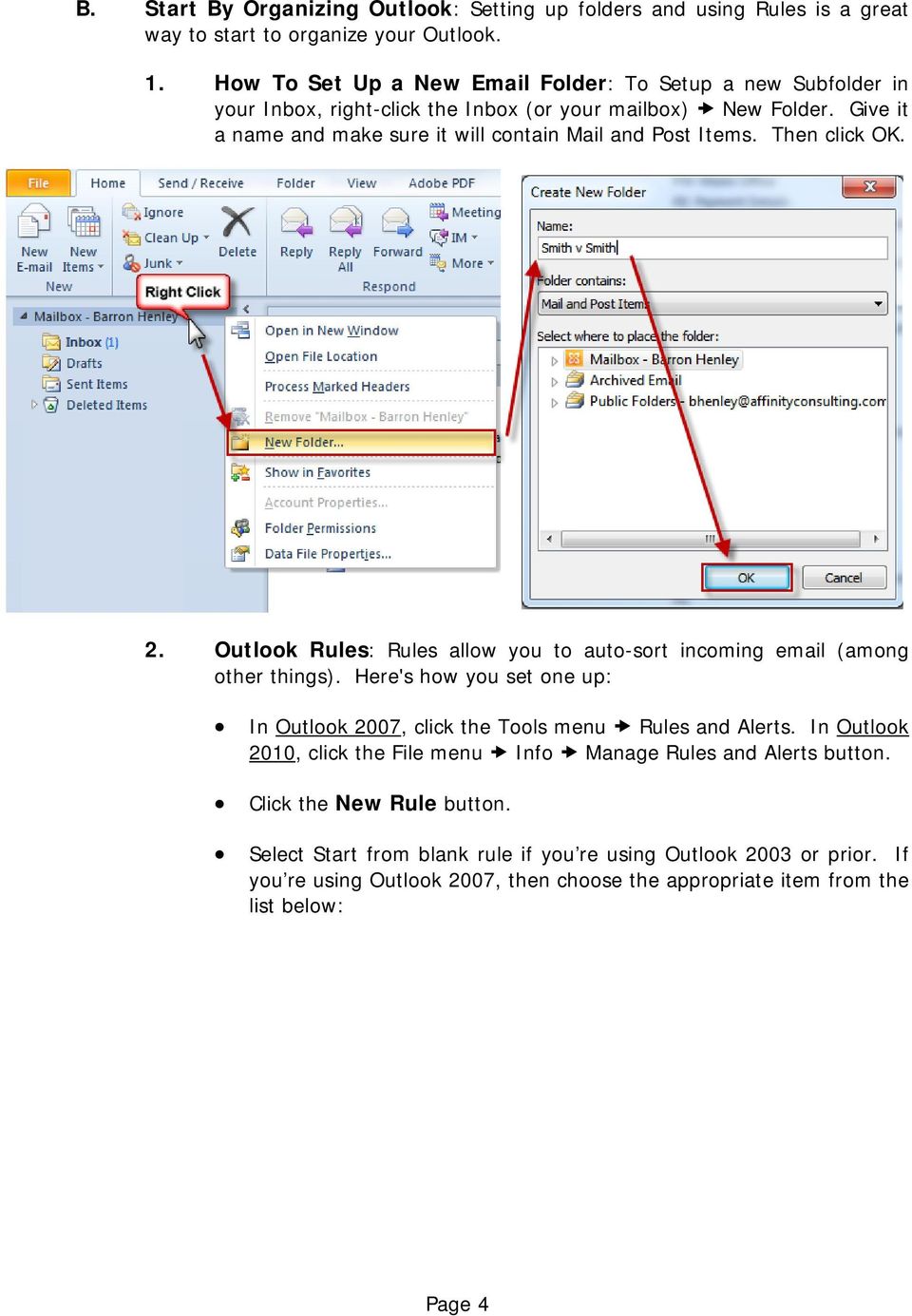
9 B. Start By Organizing Outlook: Setting up folders and using Rules is a great way to start to organize your Outlook. 1. How To Set Up a New Folder: To Setup a new Subfolder in your Inbox, right-click the Inbox (or your mailbox) New Folder. Give it a name and make sure it will contain Mail and Post Items. Then click OK. 2. Outlook Rules: Rules allow you to auto-sort incoming (among other things). Here's how you set one up: In Outlook 2007, click the Tools menu Rules and Alerts. In Outlook 2010, click the File menu Info Manage Rules and Alerts button. Click the New Rule button. Select Start from blank rule if you re using Outlook 2003 or prior. If you re using Outlook 2007, then choose the appropriate item from the list below: Page 4
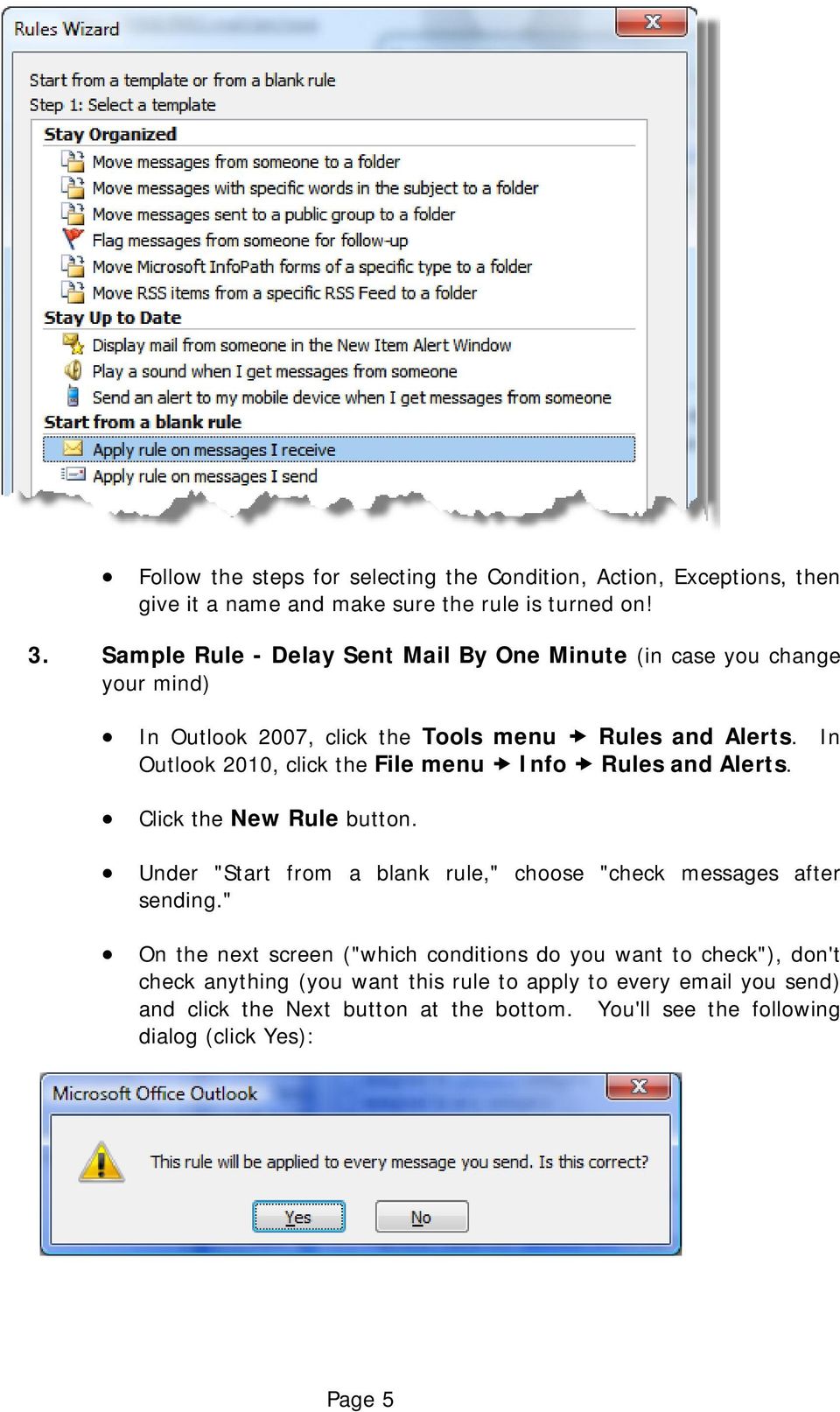
10 Follow the steps for selecting the Condition, Action, Exceptions, then give it a name and make sure the rule is turned on! 3. Sample Rule - Delay Sent Mail By One Minute (in case you change your mind) In Outlook 2007, click the Tools menu Rules and Alerts. In Outlook 2010, click the File menu Info Rules and Alerts. Click the New Rule button. Under "Start from a blank rule," choose "check messages after sending." On the next screen ("which conditions do you want to check"), don't check anything (you want this rule to apply to every you send) and click the Next button at the bottom. You'll see the following dialog (click Yes): Page 5
11 In the next screen, check "defer delivery by a number of minutes," and then click the hyperlink for "a number of" at the bottom of the screen and enter the number of minutes you want to delay your . Click Next and add any exceptions (for people you don't want to delay to). Click Next, name your rule Delay and click Finish. 4. Sample Rule - Keep Track of Delegated Many people forward to others to deal with but have a difficult time remembering what they delegated for follow up purposes. Here's a rule that will help. First, create a folder in Outlook called Delegated . In Outlook 2007, click the Tools menu Rules and Alerts. In Outlook 2010, click the File menu Info Rules and Alerts. Click the New Rule button. Under "start from a blank rule," choose "check messages when they arrive" and click Next at the bottom of the dialog. Page 6

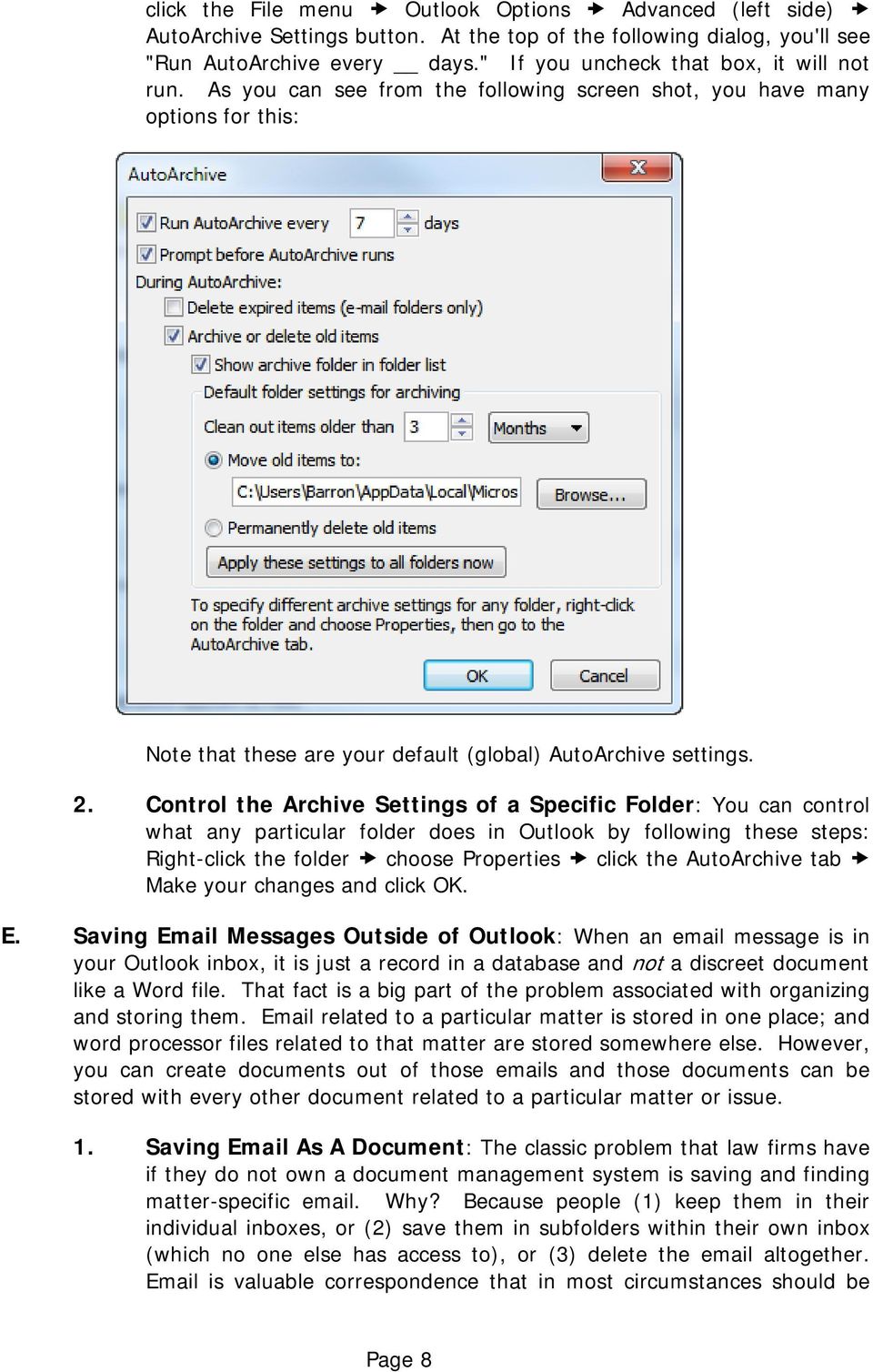
12 Under "check which conditions do you want to check," check BOTH "from people or distribution list" and "where my name is in the CC box." At the bottom of the dialog, click the hyperlink for "people or distribution list" and add your address. We're basically creating a rule that will look for s from you and copied to you. Click Next. Under "what do you want to do with the message," choose "move it to the specified folder." Make the specified folder your Delegated Mail folder. Click Next and add any exceptions. Click Next, name it and click Finish. C. Outlook Add-On Programs To Help You Sort and Store Your There are many third-party programs that integrate with Outlook which can help you organize, sort and store your (both incoming and outgoing). Here are a few to consider: 1. SpeedFiler by Claritude: See This program will auto file incoming and outgoing messages and has sophisticated search functions. It has a 30 day free trial, and it's $25/$40 to buy. 2. SimplyFile by TechHit: See This program will auto file incoming and outgoing messages. It has a 30 day free trial, and it's $40 to buy. TechHit also sells a program called EZDetach which helps you manage attachments to and it will work in conjunction with SimplyFile. 3. Xobni: See find people, & attachments instantly; it's FREE. 4. QuickFile4Outlook - Lawyers Edition: See Full filing system, 30 day free trial, $97 to buy. D. Archiving Old Outlook Many Outlook users end up with an enormous accumulation of in their Sent Mail and Deleted Mail folders. Furthermore, some mail is sorted into subfolders and forgotten about. All of this will start to bog down servers and PCs as those databases of s get larger and larger. Thankfully, Outlook has an excellent way to dealing with this problem - AutoArchive. In a nutshell, AutoArchive will allow you to a) permanently delete expired items; b) delete or c) archive old items to an archive file (archived database). Conveniently, the first time AutoArchive runs, it creates the archive database for you. It is stored on the C:\ by default so you'll either want to move it to a server folder or back it up directly from your C:\. Once it has established itself, you'll see the Archive folder in your Outlook Folder List. There are two sets of AutoArchive settings: global settings and per-folder settings. 1. Turn AutoArchive On or Off. In Outlook 2007, click the Tools menu Options Other tab click the AutoArchive button. In Outlook 2010, Page 7

13 click the File menu Outlook Options Advanced (left side) AutoArchive Settings button. At the top of the following dialog, you'll see "Run AutoArchive every days." If you uncheck that box, it will not run. As you can see from the following screen shot, you have many options for this: Note that these are your default (global) AutoArchive settings. 2. Control the Archive Settings of a Specific Folder: You can control what any particular folder does in Outlook by following these steps: Right-click the folder choose Properties click the AutoArchive tab Make your changes and click OK. E. Saving Messages Outside of Outlook: When an message is in your Outlook inbox, it is just a record in a database and not a discreet document like a Word file. That fact is a big part of the problem associated with organizing and storing them. related to a particular matter is stored in one place; and word processor files related to that matter are stored somewhere else. However, you can create documents out of those s and those documents can be stored with every other document related to a particular matter or issue. 1. Saving As A Document: The classic problem that law firms have if they do not own a document management system is saving and finding matter-specific . Why? Because people (1) keep them in their individual inboxes, or (2) save them in subfolders within their own inbox (which no one else has access to), or (3) delete the altogether. is valuable correspondence that in most circumstances should be Page 8
14 saved. However, in a law firm or legal department, it should not be saved within one's own individual inbox. As it turns out, you can save much like you save a Microsoft Word document clicking the File menu Save As (Outlook 2003 & 2010) OR Office Button Save As (Outlook 2007). We recommend that you save as Outlook Message Format - Unicode (*.msg). If you re using Outlook 2003, it will default to HTML but you can switch to MSG. If you re using Outlook 2007 or 2010, it will default to MSG. You may notice that you have a choice of Outlook Message Format and Outlook Message Format - Unicode. The Unicode format is the current standard for Outlook and holds support for international characters. The non-unicode one saves msg-files in the ANSI format. The ANSI format is the only format that Outlook 2002 and previous can read. Outlook 2003 and later can read ANSI formatted and Unicode formatted msg-files. Dragging and dropping messages out of Outlook into an Explorer folder will by default save it in the Unicode format. You can also save as Text Only although you'll lose any formatting that was in the . Saving as an MSG file will retain the original formatting, look and feel of the . Page 9

15 2. Saving By Dragging Into a Windows Explorer Folder: You can clean out your inbox or subfolders under your inbox by cascading the windows and simply dragging and dropping all of them into the desired folder. This will COPY the s over into that folder, saving them automatically as MSG (native Outlook Message Format) files, which preserves the metadata and all attachments. 3. Saving With Document Management Programs (DMS): While document management programs (Worldox, Interwoven Worksite, NetDocuments, etc.) were originally thought of as only word processing document repositories, that is no longer true. They can now hold just about any type of computer file (word processor, PDF, TIF, , JPG, etc.). 4. Worldox Example: Using Worldox as an example, it provides 3 different ways to save s (see below). Once profiled and saved, the s are stored within the client/matter structure and easily searchable and accessible by anyone who uses the document management system (Worldox, in this case).. It's also important to note that you can save them one-at-a-time or large quantities of them all at once. Page 10

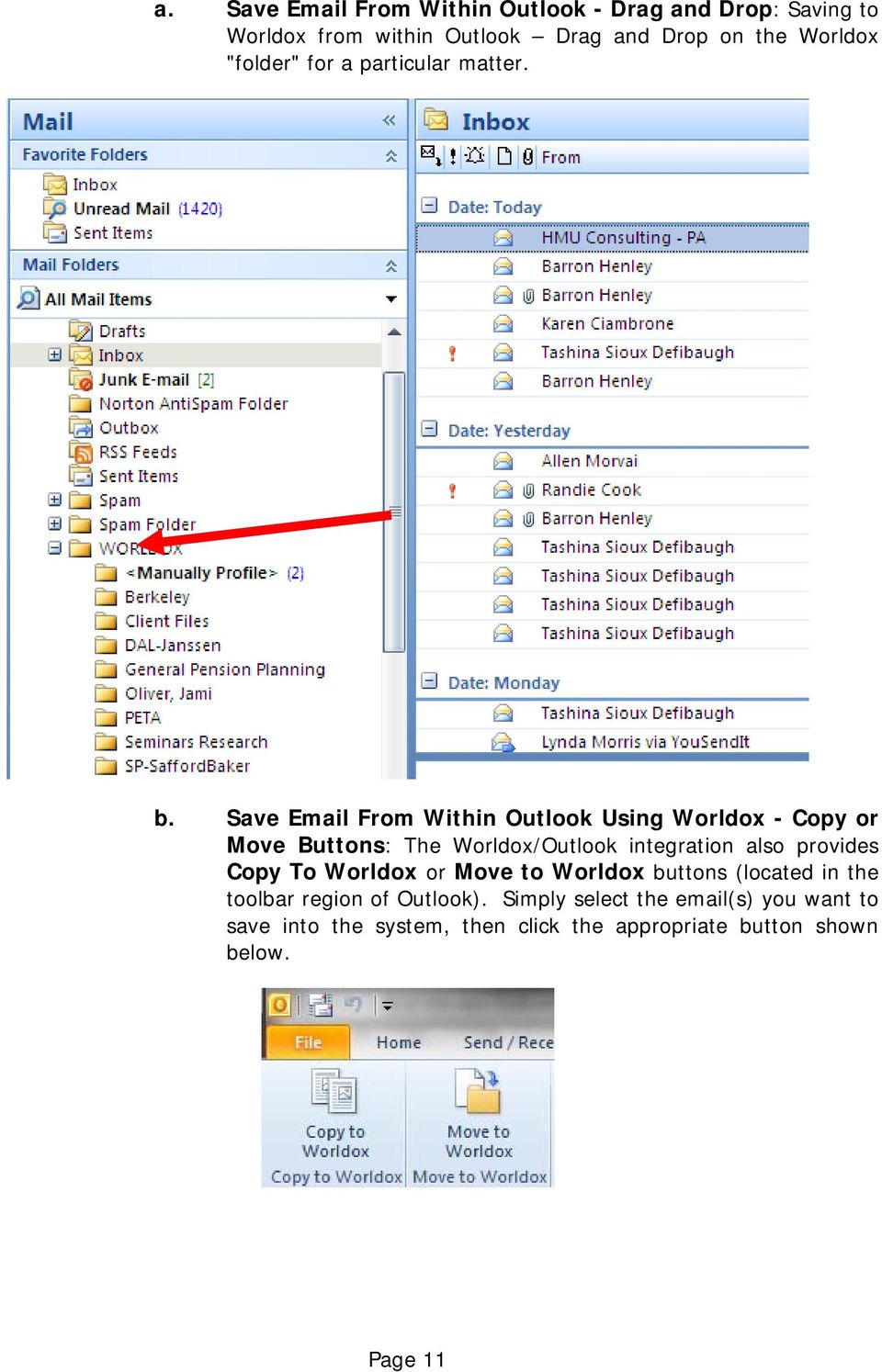
16 a. Save From Within Outlook - Drag and Drop: Saving to Worldox from within Outlook Drag and Drop on the Worldox "folder" for a particular matter. b. Save From Within Outlook Using Worldox - Copy or Move Buttons: The Worldox/Outlook integration also provides Copy To Worldox or Move to Worldox buttons (located in the toolbar region of Outlook). Simply select the (s) you want to save into the system, then click the appropriate button shown below. Page 11
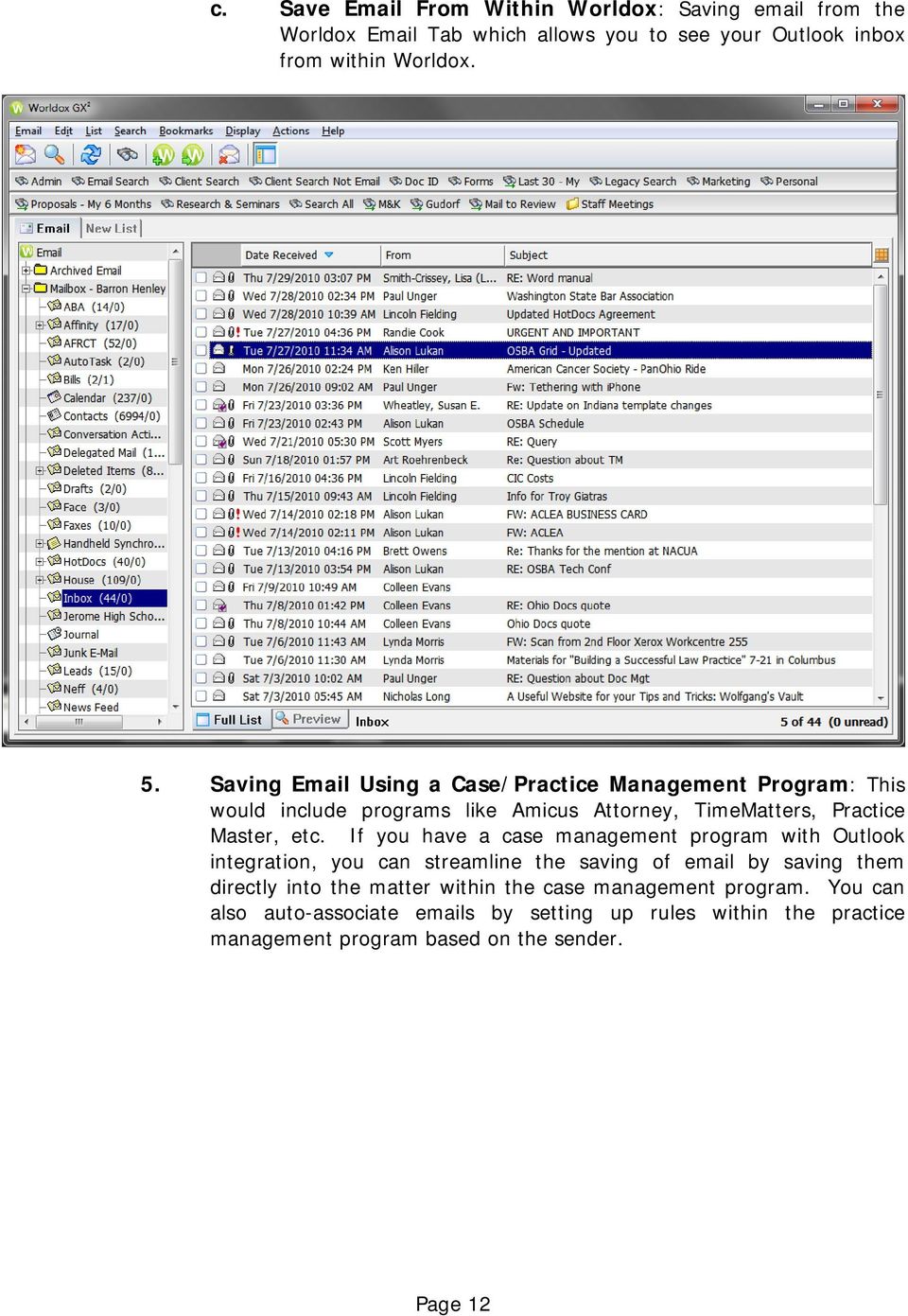
17 c. Save From Within Worldox: Saving from the Worldox Tab which allows you to see your Outlook inbox from within Worldox. 5. Saving Using a Case/Practice Management Program: This would include programs like Amicus Attorney, TimeMatters, Practice Master, etc. If you have a case management program with Outlook integration, you can streamline the saving of by saving them directly into the matter within the case management program. You can also auto-associate s by setting up rules within the practice management program based on the sender. Page 12
18 6. Amicus Attorney Example: The following is an example of the Amicus Attorney Communications area which allows you to save and manage , messages and telephone slips: Page 13

19 This is the Outlook view from within Amicus Attorney. From this view, you can select an and click on the Save and Make Associations button and it will save the in the designated client/matter folder or contact card. The huge benefit to this is that you can see all relevant client information, documents and s from ONE program. It is a very nice luxury. 7. Saving as PDF Files: If you have Adobe Acrobat version 7, 8 or 9, it installs a few buttons and one additional menu in Microsoft Outlook 2007 and prior. For those that wish they had a good way to archive and store s and attachments, this integration can be a life-saver. a. Acrobat - Creating PDFs from Individual s or Entire Folders: Simply select individual s (Ctrl + left click) or select entire folders; then click the Adobe PDF menu Convert Selected Page 14

20 Messages Create New PDF. This will create a single PDF which contains all of the s you ve selected and all of the attachments thereto. b. Acrobat - Adding Subsequent s to Existing PDFs: If you receive additional s which need to be added to an existing PDF archive, simply choose Convert Selected Messages Append to Existing Adobe PDF. c. Acrobat - Note About PDF Packages: By default Acrobat, will create a "PDF package" containing all s that you selected in when you converted the to PDF. Some programs like Copernic cannot index PDF Packages. If you want to turn that off, select Adobe PDF from the menu bar and then Change Conversion Settings. Deselect Output Adobe PDF Package creating a new PDF file. Page 15
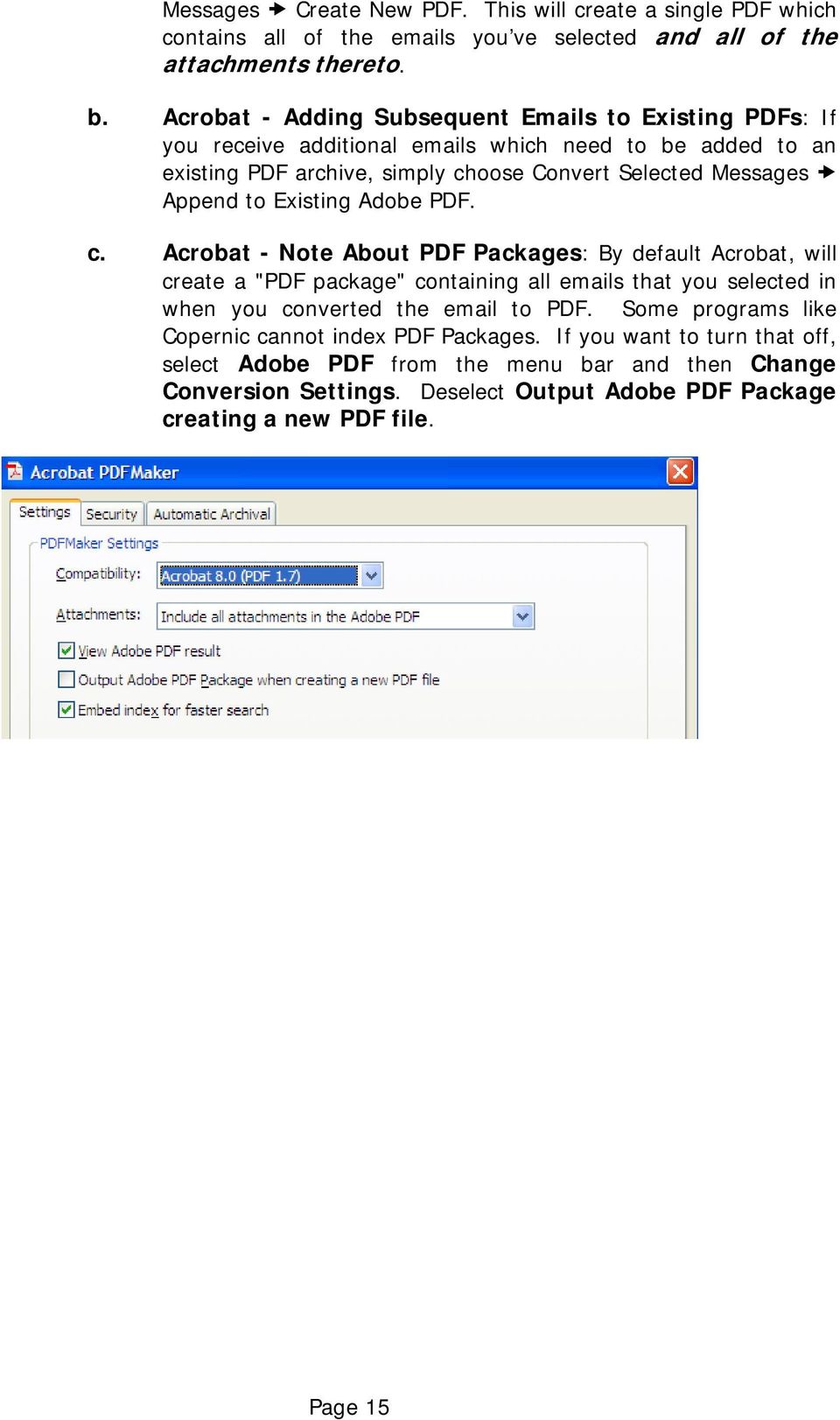
21 d. Acrobat - Automatic Archival: As you can see from the screen shot, you can also setup folders to automatically archive themselves. This would be particularly useful if you have setup Outlook rules to automatically sort your into specific folders and then use Acrobat to automatically archive it. e. Saving PDFs Without Acrobat: If you don't have Acrobat, you can still save as PDFs. You're not going to get the slick Outlook integration buttons and menus, but you can certainly open an and create a PDF from it using any PDF creator program, several of which are free. For example, I would recommend either of the following free PDF makers. PDF995 - free - PDFCreator - free - Page 16
22 F. Storage Tips: 1. Store With Other Related Files: Store the in the same location as other electronic files related to any particular matter. Any system that requires you to save separately from other electronic files related to a matter is inadequate. 2. Delete or Archive Once Stored: After an is stored into a folder or a document management system, delete or archive it. Keep Outlook as clean as possible. 3. Always Separately Save Attached Documents: Outlook is NOT a document management system and should not be used as a document repository. Documents attached to Outlook s are actually stored in a temporary folder structure that is incredibly convoluted and is normally hidden. For example, the attachment to an I just opened is stored in my hard drive under this folder: C:\Users\barron\AppData\Local\Microsoft\Windows\Temporary Internet Files\Content.Outlook\O0T0A5E5 For the record, that's 8 folders deep and the structure from \Temporary Internet Files down is not even visible in Windows Explorer. The point is, it is incredibly easy to lose attached documents that aren't saved separately (unless you have a document management system that saves attachments at the same time the itself is saved). 4. Stop Copying and Pasting If you're doing this into Word or WordPerfect documents, please stop immediately. There are obviously much easier ways to save (see above). You're just wasting time. 5. Stop Printing If you've saved digitally, then they're easily searchable and printing them to throw in paper files only makes your paper files fatter, harder to manage and harder to search. G. Benefits of Storing Outside of Outlook: 1. No Worry About Storage Limitations: If you offload the in your Outlook folder structure and save them as separate files or in other programs, then you can get them out of Outlook. As such, the IT folks will stop complaining that you're overloading the Exchange server and your computer will operate faster. 2. Everyone Else Can Find Them Too: Once saved as separate files, others in your office will be able to find these important client communications. You're on your way to building a complete digital file. 3. Searchable Like All Other Documents: If you're saving into a document management system, then the content of all stored Page 17
23 therein is searchable. If the is stored as separate files (PDFs, MSG files), then there are free or very inexpensive search programs that can help you find any of them by the words contained inside them. IV. DEALING WITH THE OVERLOAD - YOUR GAME PLAN A. Deal with at Set Times: The first problem that we want to deal with is the reduction of interruptions so one can be more focused and productive. After all, how on earth can anyone get anything done with an interruption every 2-3 minutes? Ask yourself the following question: 10 years ago, would you have let someone walk in your office every 2-3 minutes offering to sell you a sexual enhancement product or asking you for a favor? Of course you wouldn't! So, why do you let it happen now with your ? Why do you drop everything that you are doing to read and/or respond to that that just arrived?! You have invested thousands of dollars in this wonderful technology that is supposed to make you more efficient, but instead it has created an interruption hotline going straight to your brain. Some time management experts suggest checking 2 times a day. While this may sound like a good plan, it is probably unrealistic. When was just becoming popular, there wasn't an expectation of that would be dealt with immediately, so 2 times per day was probably okay. However, in today's age that has changed to some degree. Entire companies communicate via it s a way of life and the way everyone communicates. Checking twice a day isn't enough. I think 3-5 times a day is more realistic more satisfying to senders and just as important, will make it easier for you to prevent your inbox from growing out of control. A good way to handle this is deal with at the same time every day. For example, you could following this schedule and limit yourself to minutes. 1 Upon arrival at the office: 8:00 am 2 Mid morning: 10:30 am 3 After lunch: 12:30 pm 4 Afternoon: 3:30 pm 5 End of day: 5:00 pm B. Turn Off Outlook's Notifications About You see that little envelope in the bottom, right corner of your screen and you can almost hear it saying, "read me!" The constant notifications of new are one of the primary distractions for most people. So turn them off! It's amazing how more focused Page 18
24 you can be when your computer isn't announcing incoming every few minutes (or seconds). To do this in Outlook 2007,. click the Tools menu Options Preferences tab Options button Advanced Options button and uncheck the boxes you find there. In Outlook 2010, click the File menu Options button Mail tab (left side) scroll down to Message Arrival and clear the boxes below it. Page 19
25 C. Treat Inbox like you U.S. Mail Box Keep it Empty! Would you ever keep your U.S. Mailbox in this condition? Of course you wouldn't. So don t let your inbox get that way! However, for most people, maintaining is the weakest link in their system of organization primarily because of volume and frequency. They use it as a holding bucket for undecided and unresolved tasks. The key to mastering your inbox is to keep it empty or under 20. You certainly don't need to keep it at zero. In fact, if you tried, you would probably be wasting time, not saving time. Not to mention, you will also be developing bad obsessive/compulsive habits. Every time an landed in your inbox, you would drop everything and try to deal with it. That would be horribly inefficient. The truth is that in order to process efficiently, you must be able to see your s in a single screen (or close to it). It is very difficult and overwhelming to process s and tasks when you are staring at a screen with 500 s. So what do you do with your U.S. Mailbox? One of the best time management/organization tips that I learned and implemented nearly ten years ago is this: Throw away your (U.S.) junk mail and advertisements before you get into the house. Only bring mail into your house that you intend to do something with! D. Delete Whatever You Can Immediately! Learn how to use the DELETE key. That could be the first thing that you do before you start dealing with just like not bringing junk mail and annoying advertising into your home. Delete the following: All the that gets past your SPAM filter. Interoffice SPAM that is irrelevant to you. Jokes from annoying friends and c-workers. from people you don't like (unless it's important, of course) TIP: Sort based on the From field (by hitting the From column header). You can often get rid of tons of sent from the same person. Remember that you can select a chunk of by single left clicking on the first holding the Shift-key down and single left click on the last . E. If You Can Deal With It In Under 3 Minutes, Do It Now: The 3-minute rule is gold! Any that can be responded to or dealt with (saved in a client file, forwarded, deleted, etc.) within 3 minutes should be dealt with immediately the first time you lay eyes on it. This rule is based on the premise that the 2 nd time you have to deal with the , it will take you longer than 3 minutes navigate to it, open it, read it, comprehend it, re-familiarize yourself with the topic and then handle it. So, why not just respond to it if you have the 3 minutes to deal with it! Page 20
26 TIP: Don't forget that you may be able to deal with it more quickly by picking up the phone or walking around the corner. Remember, you are still supposed to be handling these s only at scheduled/set times during the day! This will be a difficult temptation to overcome especially if you have notification turned on and see an that you can dispose of quickly. Finally, if it is an that is going to take a while, you should dispose of it in under 3 minutes by adding it to your task list (or calendar) and then saving it into the appropriate client/matter file. F. Delegate If Appropriate: If someone else should be handling the task or issue in the , then hand it off appropriately. Don't let someone else put the monkey back on you, in the words of The One Minute Manager Meets the Monkey by Kenneth Blanchard. Do this immediately unless it is going to take you more than 3 minutes to delegate. You can make this easy to track by setting up the Delegated rule described in paragraph III.B.4 above (page 6). G. Delay If Necessary: Already mentioned in the 3-minute rule above, if it is an that is going to take a while, you should simply dispose of it in under 3 minutes by adding it to your task list (or calendar) and then saving it into the appropriate client/matter file. Do not use Outlook as your to-do list by leaving unresolved in your inbox. If you keep a paper-based task list, simply write it in and save the in appropriate place. If you use Outlook to manage your task list, simply drag it over to your Task button in the Outlook navigator. In some circumstances, it is okay to set up subfolders under your inbox. Clean them out on a weekly basis. If you schedule your tasks as appointments, add it to your calendar. H. Outlook Techniques Which Will Help: 1. See More In One Screen: a. Turn Off Viewing Pane: This occupies a lot of screen space that could otherwise be displaying . To turn it off, click the View menu Reading Pane Off. b. Turn Off Date Grouping: By default, Outlook groups your by date received. The date categories just occupy space and Page 21
27 prevent you from seeing all of your on one screen. To turn it off, click the View menu Arrange By uncheck Show in Groups. 2. Quickly Convert to Appointments or Tasks: You can simply drag onto your calendar or tasks button in Outlook and it will make an appointment or task out of it (but it leaves your original where it was). 3. Tasks in Outlook: Name your tasks based on Project first, and then a hyphen followed by a description of the work. Then modify your task list to show only active tasks (not completed). To do this, select Active Tasks and then Customize Current View. Next, select Sort items by Subject and then answer No to showing the field. Page 22
28 4. Use Outlook 2007/10 Categories: This is a new feature in Outlook 2007 and is extremely useful for flagging . Page 23
29 V. OTHER OUTLOOK TIPS AND TRICKS A. Fix Outlook's Fonts: In Outlook 2007, click the Tools menu Options Mail Format tab Stationery and Fonts. In Outlook 2010, click the File menu Options button Mail tab (left side) Stationery and Fonts button. Now make them all the same (they're not the same by default): B. Create Contacts from Drag and drop an to the Contacts button and Outlook will create a new contact card for that sender. Page 24
30 C. Right-Click for All Possible Options: Also known as alternate clicking, this feature will present very handy functions such as Open, Reply, Print, Forward, etc. D. Rules Creating Flags and Alerts: You can manage multiple accounts or large numbers of s from an important client by setting up a Rule that tags the with a colored flag/alert or plays a special sound upon arrival. This will enable you to quickly view and group s from a particular source. E. Out of Office Assistant: If you're going to be out of the office, this is a way to automatically notify people who send you . However, if you're receiving from a listserv, this may be a problem because every time someone sends a post to the listserv, everyone on the listserv is going to get your out of office message. In any event, to turn on this feature, click the Tools menu Out of Office Assistant Send Out of Office auto-replies and set it up. F. Saving Attachments to 1. One At A Time: Open the , right click the attachment and choose Save As. 2. In Bulk: Outlook File menu Save Attachments Outlook 2007 Office button Save As Save Attachments Outlook 2003 File menu Save Attachments All Attachments Page 25
31 G. Set up your Signature Block: In Outlook 2007, click the Tools menu Options Mail Format tab Signatures button. In Outlook 2010, click the File menu Options button Mail tab (left side) Signatures button. H. Distribution Lists (Outlook 2007)/Contact Groups (Outlook 2010): If you routinely send to a group of people, you can create a distribution list or contact group which will make it much easier. For example, I have a Contact Group called Affinity which automatically sends the to 5 other people. All I have to type in the TO box is Affinity. To create one in Outlook 2007, just click the File menu New Distribution List name the distribution list and add the addresses of the people you want to include. In Outlook 2010, go to your Contacts in Outlook New Contact Group button (Home ribbon) name the group and add the appropriate addresses. I. Find Contacts Super-Fast: For the Quick Contact Search, just hit the F11 key and type in a first or last name. J. Edit The Auto-Complete List: If you send an to a person one time, then Outlook will remember their address the next time you start typing anything that begins with the first letters of that person's address. This has resulted in lots of being sent to the wrong person. Outlook autocompletes an address and it's the wrong one. In Outlook 2007, if you want to get rid of that person from auto complete you only sent one to, start typing a name in the TO box of a new . When the list appears, use Page 26
32 your arrow keys to highlight the one you want to delete, then hit your delete key. They've made this process easier in Outlook Just start typing a name and when the auto-complete list of names appears, you can hover over the one you want to remove with your mouse and click the X that appears on the right side of each name: K. Use Rules and Alerts: To help you keep your Inbox to a manageable size, use the Rules feature to automatically forward, move to another folder, or delete incoming messages, especially those from lists. In Outlook 2007, Tools menu Rules Wizard create a new Rule. In Outlook 2010, File menu Manage Rules and Alerts button. For more information on this, see paragraph III.B.2. on page 4 above. This is especially helpful if you do not have a good SPAM filter. Rules are also great for managing from Listserves. L. Mailbox Cleanup: This is an extremely useful tool. In Outlook 2007, you access it by clicking Tools menu Mailbox Cleanup. In Outlook 2010, you access it by clicking File menu Info tab (left side) Cleanup Tools button. See below for all of the options it provides: Page 27
33 M. Advanced Search Capability: This feature gives you a tremendous number of options for searching through Outlook. Simply hit Ctrl + Shift + F. Page 28
34 N. Quick Search in Outlook 2010: At the top of each mail folder, you'll see a box like the one below: This will search for words you type in the address or body of any contained in that folder and it's very fast. O. Junk Mail Settings: In Outlook 2007, click the Tools menu Options Preferences tab Junk button to see all of the settings for this. You can get to the same dialog in Outlook 2010 by clicking on Mail Junk button in the Delete group of the Home ribbon Junk Options. P. Block Senders: The easiest way to do this is to right-click an from a sender you want to block in the future. In Outlook 2007, choose Junk Add Sender to Blocked Senders List. In Outlook 2010, right-click the , choose Junk Block Sender. Page 29
35 Q. Flags: Flags are a great way to alert you to follow up on an important , especially if your plan is to delay action with the for a day or so. Simply right-click on the desired and select Follow Up and then select the desired follow-up flag. You can set a custom date as well. Outlook will notify alert you on the date and time specified. R. Make Outlook Show You Names Last Name First: Outlook will annoyingly show you lists of contacts first name first. So if you want to send an to someone and click the TO: button, you'll see the names are sorted by first name. Page 30
36 To fix this, go into Control Panel in Windows Mail icon Accounts button Address Books tab single click on Outlook Address Book Change button above make the change shown below: S. Default Outlook To Your Contacts Address Book: When you click the TO button in a new Outlook , if you have Microsoft Exchange, it defaults to Global Address List which is your internal contact list. This forces you to switch to "Contacts" from the drop-down list every time in order to search your Outlook contacts for an address. Here's how you change the default in Outlook 2010: Click Mail in Outlook on the Home ribbon, click the Address Book button Tools menu Options select "Start with contact folders"; and change the drop down at the bottom of the dialog to Contacts. VI. GENERAL TIPS AND NETIQUETTE: A. Spelling and Grammar: Use proper spelling and grammar. s that have proper spelling and grammar are more professional and easier to read. It will also reduce the risk of misunderstanding, which is quite common with communication. B. Don t Be Rude: Remember there is a human being on the other end of the . It is easy to forget in this age of electronic communication. It is pretty easy to be rude when you aren't looking at them in the face. Page 31
37 C. Never Send an Angry Never send an if you are angry or frustrated. Wait 10 minutes, an hour, or even overnight if necessary. D. Use a Subject Line: Clearly describe the message contents in the Subject line. A clear and concise description helps everyone organize their Inbox. E. Don t Put the Whole Message In the Subject Line: Contrary to some advice, do not start typing your message in the Subject line. I know some have recommended this as a time-saver. It can be, but it is also more difficult to organize and find drafted in that manner. F. Is Often Misinterpreted: There are many studies which indicate that 50% or higher of s are misinterpreted regarding tone. The problem is illustrated by the following passage. "Don't work too hard," wrote a colleague in an today. Was she sincere or sarcastic? I think I know (sarcastic), but I'm probably wrong. According to recent research published in the Journal of Personality and Social Psychology, I've only a chance of ascertaining the tone of any message. The study also shows that people think they've correctly interpreted the tone of s they receive 90 percent of the time. "That's how flame wars get started," says psychologist Nicholas Epley of the University of Chicago, who conducted the research with Justin Kruger of New York University. "People in our study were convinced they've accurately understood the tone of an message when in fact their odds are no better than chance," says Epley. 2 Therefore, it is imperative that (and instant messages, for that matter) are carefully worded. When appropriate, you should also consider using emoticons in order to clearly convey tone - ;) G. Beware of Forwarding Be cautious of forwarding s. Read the entire first. There may be derogatory statements from others deep in the string. H. Be Cautious About Blind Copying: You can't trust the recipient to not hit REPLY TO ALL! You are probably better off sending the original and then forwarding a copy to desired party. I. Avoid Large Attachments: Be cognizant of sending large attachments to people. Use services like Whal .com or Yousendit.com to send attachments to people who may have a file size limitation or slow internet connection. J. Only Copy People Who NEED To See It: Don't CC people or Reply to All unless it is absolutely necessary. You know how many unnecessary s you receive a day. Don't be part of the problem be part of the solution. 2 The Secret Cause of Flame Wars by Stephen Leahy, Wired Magazine, February 13, See Page 32
38 K. Don t Forward Junk: Don't forward jokes, spam or chain messages. L. No Caps: Don't type everything in CAPITALS. In web-speak, this is equivalent to SHOUTING! If someone does this to you, it probably means he/she thinks you are an idiot. M. Don't Forward Virus Warnings: 99.9% are hoaxes. If you are worried about a virus rumor and want to check, go to to verify if the warning is legitimate. VII. ENCRYPTION A. To Encrypt or Not to Encrypt? According to most jurisdictions, a lawyer does not violate the duty to preserve confidences and secrets if an is sent without encryption technology. B. Comment 17 to the ABA Model Rule 1.6: When transmitting a communication that includes information relating to the representation of a client, the lawyer must take reasonable precautions to prevent the information from coming into the hands of unintended recipients. This duty, however, does not require that the lawyer use special security measures if the method of communication affords a reasonable expectation of privacy. Special circumstances, however, may warrant special precautions. Factors to be considered in determining the reasonableness of the lawyer's expectation of confidentiality include the sensitivity of the information and the extent to which the privacy of the communication is protected by law or by a confidentiality agreement. A client may require the lawyer to implement special security measures not required by this Rule or may give informed consent to the use of a means of communication that would otherwise be prohibited by this Rule. C. Opinions Regarding Requirement to Encrypt: The trend among advisory bodies in other states (and the District of Columbia) is that electronic mail without encryption is ethically proper under most circumstances. In Ohio, Ethics Opinion 99-2 issued April 9, 1999, states that a lawyer does not violate the duty to preserve confidences and secrets if an is sent without encryption technology citing DR of the Ohio Code of Professional Responsibility. An attorney must use his or her professional judgment in choosing the appropriate method of each attorney-client communication. The opinion contains an important caveat that should not be ignored: The conclusions reached in this opinion do not diminish a lawyer s obligation to consider with her client the sensitivity of the communication, the costs of its disclosure, and the relative security of the contemplated media of communication. Particularly strong protection measures are warranted to guard against the disclosure of highly sensitive matters. Those measures might include the Page 33
39 avoidance of , just as they would warrant the avoidance of the telephone, fax and mail. In the District of Columbia, [i]n most circumstances, transmission of confidential information by unencrypted electronic mail does not per se violate the confidentiality rules of the legal profession. However, individual circumstances may require greater means of security. District of Columbia Bar, Op. 281 (1998). In Illinois, [l]awyers may use electronic mail services, including the Internet, without encryption to communicate with clients unless unusual circumstances require enhanced security measures. Illinois State Bar Ass'n, Op (1997). In New York, the state bar association advised that lawyers may in ordinary circumstances utilize unencrypted Internet to transmit confidential information without breaching their duties of confidentiality under Canon 4 to their clients, as the technology is in use today. Despite this general conclusion, lawyers must always act reasonably in choosing to use for confidential communications, as with any other means of communication. Thus, in circumstances in which a lawyer is on notice for a specific reason that a particular transmission is at heightened risk of interception, or where the confidential information at issue is of such an extraordinarily sensitive nature that it is reasonable to use only a means of communication that is completely under the lawyer's control, the lawyer must select a more secure means of communication than unencrypted Internet . New York State Bar Ass'n, Op. 709 (1998). The city bar association advised that [a] law firm need not encrypt all communications containing confidential client information, but should advise its clients and prospective clients communicating with the firm by that security of communications over the Internet is not as secure as other forms of communication. Ass'n of the Bar of the City of New York, Formal Op (1998). In North Dakota, Rule 1.6 of the North Dakota Rules of Professional Conduct is not violated by a lawyer who communicates routine matters with clients, and/or other lawyers jointly representing clients, via unencrypted electronic mail ( ) transmitted over commercial services (such as America Online or MCI Mail) or the Internet unless unusual circumstances require enhanced security measures. State Bar Ass'n of North Dakota, Op (1997). In Vermont, [a] lawyer does not violate DR by communicating with a client by , including the Internet, without encryption. Vermont Bar Ass'n, Op One state is reticent in its advice regarding unencrypted electronic communication with clients. In Arizona, the state bar responded Maybe to the question Should lawyers communicate with existing clients, via , about confidential matters? They advised it is not unethical to communicate Page 34
40 with a client via even if the is not encrypted but suggested it is preferable to protect the attorney/client communications to the extent it is practical. The committee suggested using a password known only to the lawyer or client, using encryption software, or at a minimum using a cautionary statement such as confidential and Attorney/Client Privileged either in the re line or beginning the communication. An additional suggestion was to caution clients about transmitting highly sensitive information via if the is not encrypted or otherwise secure from unwanted interception. Attorneys were reminded that e- mail records may be discoverable. State Bar of Arizona, Op (1997). Several states have reconsidered their initial views on the issue. In South Carolina, the bar association first advised that unless certainty can be obtained regarding the confidentiality of communications via electronic media, that representation of a client, or communication with a client, via electronic media, may violate Rule 1.6, absent an express waiver by the client. South Carolina Bar, Op (1995). Later, the bar advised that [t]here [now] exists a reasonable expectation of privacy when sending confidential information through electronic mail (whether direct link, commercial service, or Internet). Use of electronic mail will not affect the confidentiality of client communications under South Carolina Rule of Professional Conduct 1.6. South Carolina Bar, Op (1997). In Iowa, the bar association rescinded Formal Op and replaced it with Formal Op advising that with sensitive material to be transmitted on counsel must have written acknowledgment by client of the risk of violation of DR which acknowledgment includes consent for the communication thereof on the Internet or non-secure Intranet or other forms of proprietary networks, or it must be encrypted or protected by password/firewall or other generally accepted equivalent security system. Iowa State Bar Ass'n, Op (1996). See also Iowa State Bar Ass'n Op (1997). Later, the bar association amended Opinions 96-1 and by advising that with sensitive material to be transmitted on counsel must have written acknowledgment by client of the risk of violation of DR which acknowledgement includes consent for communication thereof on the Internet or non- secure Intranet or other forms of proprietary networks to be protected as agreed between counsel and client. Iowa Bar Ass'n, Op (1997). D. Is There A Duty to Do More? Some Say Yes: Pennsylvania and New Jersey have adopted the same rule, but added a little more stringency to it. In Pennsylvania, Informal Opinion , issued September 26, 1997, concluded: A lawyer may use to communicate with or about a client without encryption; A lawyer should advise a client concerning the risks associated with the use of and obtain the client s consent either orally or in writing; Page 35
41 A lawyer should not use unencrypted to communicate information concerning the representation, the interception of which would be damaging to the client, absent the client s consent after consultation; A lawyer may, but is not required to, place a notice on client warning that it is a privileged and confidential communication; and, If the is about the lawyer or the lawyer s services and is intended to solicit new clients, it is lawyer advertising similar to targeted, direct mail and is subject to the same restrictions under the Rules of Professional Conduct. The New Jersey Advisory Committee on Professional Ethics, in Opinion 701, issued in April 2006, states in a footnote that confidential documents sent over the Internet should be password protected. E. Best Practices: While you may not be bound by the Pennsylvania rules above, I recommend them as best practices to follow. In conclusion, in light of evolving technology and rules, it is my recommendation that attorneys (1) should advise clients verbally and in their engagement letter about , as described in the Pennsylvania opinion, and (2) should have encryption available for use in appropriate circumstances (see below for an inexpensive and easy solution). F. Retracting Sent s: Are there times when you wish that you could UNSEND something? This is actually something that can be done to prevent a known ethical violation where it may not be possible with ordinary U.S. Mail. With U.S. Mail, once the mail is in the post box, good luck getting it back! I have 2 suggestions in this regard: If your firm uses Exchange Server, be sure to tell your system administrator to set a 5 minute delay before the is actually sent from your server. This may give a user in your office enough time to catch it before it goes out. You may want to try out which is an verification program, but also allows retraction so long as it hasn't been retrieved by the recipient. You can also encrypt s and attachments, requiring recipients to use passwords to open. The cost is $150 per year. G. Encryption Options: There are many options for encryption. A few to consider: Mail It Safe PGP Desktop or Universal Gateway MessageGuard YouSendIt Pro Plus or Corporate Suite options include encryption of attachments Page 36
42 VIII. ETHICAL AND MALPRACTICE CONSIDERATIONS Protection of client information, confidences and secrets is one of the most sacred characteristics of the relationship between attorneys and their clients. Without a proper understanding of technology, you may be compromising that relationship. Computers, networks, viruses, worms, spyware, metadata, electronic court filings, just to name a few, may already be compromising that relationship without you even knowing it. Under ABA Model Rule 1.6 (which many states have adopted), Attorneys have a broad obligation to act competently and reasonably protect client information and confidences. IX. METADATA PITFALL A. Metadata Example: You just hit the SEND button. You start to sweat and suddenly experience a panic attack. You and your associate were revising a contract for a client. Before sending it on to your client, you forgot to accept or reject tracked changes and remove all the hidden text from the word processing document. You also forgot to remove any other metadata before sending it. Anyone who receives the file can easily find out the following information: All the people who authored any part of the document including the original author who happens to be a managing partner at a competing law firm The hidden text that states the client is a moron! The suggested changes made by a 1 st year associate in your office (half of which were not well thought out) The total time you spent revising the document 4 hours (even though you billed the client 8 hours which is a big ethical problem of its own!) This story is not fictional. It actually happened. This is just one of many bad messes that you can get yourself into if you are not using technology correctly. 1. The Bad News: Say goodbye to the days when you could simply draft and send a word processing document to opposing counsel or your client without a second thought. 2. The Good News: Most technology-created pitfalls are easily avoidable if reasonable steps are taken. B. Metadata Is it really a Nightmare? 1. What is Metadata? Literally, metadata means data about data. In the personal & business computing world, it is the hidden or invisible information contained within computer files. Most notably in the legal technology field, lawyers worry about metadata found in Microsoft Word, PowerPoint, Excel, Corel WordPerfect and Adobe Acrobat files. Page 37
43 The kind of information that can be found under the surface a Word document, for example, might be: Last 10 authors Firm name File locations Tracked changes Hidden text Deleted document comments Routing slip information Document versions Revision time Document properties (file size, modification date, etc.) Fast saves Hyperlinks Linked objects As an example, below is part of a report showing metadata using a widely-used metadata remover called Metadata Assistant created Payne Consulting Group. Page 38
44 2. Why Have Metadata If It Is So Bad? Well, quite frankly because it is really useful information and it was never intended to be bad. Microsoft designed its programs to store metadata for a variety of reasons, one of which was for document management before Document Management Systems (DMS) existed. As a very simple example, if one wanted to find all documents created or modified between December 1, 2005 and December 31, 2005 as a way to verify that you created timesheets for all your billable time in December, you would perform a search using a Microsoft Find Files or Folders utility or a third-party program like dtsearch that searches yes metadata. If you exchange electronic word processing files with anyone outside your office and do nothing to remove metadata it can result in a nightmare if the file contains metadata that was intended to be confidential. So, yes, it can indeed be a nightmare as many legal technologists claim. However, if you are not careless, these problems are not a nightmare at all. You just need to know what to do. Below is a list of what you need to do to avoid the word processing so-called metadata nightmare. C. What You Can Do About Metadata: 1. Learn the Security Settings within Microsoft Word 2003 or Prior: Much of the dangerous metadata contained in Microsoft Word Page 39
45 documents can be prevented from transmission if certain security features are turned on. Open Word and select Tools and then Options and select the Security tab: Check Remove personal information from file properties on save Check Warn before printing, saving or sending a file that contains tracked changes or comments Check Make hidden markup visible when opening or saving 2. Download Microsoft s Free Metadata Removal Tool for Word 2003: You can also download and install a free add-in from Microsoft - Office 2003/XP Add-in: Remove Hidden Data. CAUTION: This will not remove all metadata. Metadata still exists. The question is whether it is benign or damaging metadata. The tool can be downloaded at this URL: Page 40
46 3. Learn The Security Settings in Word 2007 & 2010: Click the Office Button Word Options Trust Center Privacy Options. Make sure the 3 boxes with a square round them in the screen shot below are checked. 4. Learn About Tracked Changes in Word: Track Changes is a fantastic feature available in Microsoft Word that allows multiple reviewers of a document to literally track changes or compare documents electronically to see what edits have been made to a document. My first suggestion is to start using it if you have the need for that type of feature. My second suggestion is to learn how to use it correctly so those internally tracked changes do not end up in the hands of opposing counsel or even your own client. The first big mistake that people make is not accepting or rejecting all changes before sending the document on to opposing counsel for their review. It is imperative that you go through the entire document and accept or reject all the changes made in the document. Changes that were made between versions that are not accepted or rejected will show up in a metadata analysis. This may expose your thought process or a weakness that you knew about, but the other side didn t think of at least until now! The second critical thing that you do is make sure that you can see the tracked changes (the marked up or redlined version). Be sure that you select Final Showing Markup in the reviewing toolbar in Word 2003; or the Review ribbon in Word Otherwise, you may not even realize that there are tracked changes in the document. Also remember in the security settings (discussed above) there is an option that will warn you before printing, saving or sending a document that has tracked changes. Page 41
47 5. Use a Metadata Remover: Another option which I generally favor is investing in a metadata removal tool. These are programs that strip the metadata out of electronic documents before you send it to another party. You can either run the cleaner manually on a document OR intercept, evaluate and clean all attached documents when you are ing it to the outside world. This makes the process much easier and requires no working knowledge of how tracked changes work or security settings within the program. I suggest a metadata remover for those people who actually exchange electronic documents containing potentially harmful metadata. Many attorneys don t do this. If you do not exchange documents, don t spend the money. NOTE: Office 2007 & 2010 (and Word 2007) have a built-in metadata removal tool. In Word 2007, you access it by clicking the Office Button Prepare Inspect Document. In Word 2010, you access it by clicking the File menu Info tab (left side) Check for Issues button Inspect document. Other metadata removal tools to consider: Metadata Assistant (Payne Consulting Group Cost is $79 per license. Workshare Protect ( Cost is $29.95 per year. iscrub by Esquire Innovations ( Out-of-Sight by SoftWise ( Cost is $30 per user. ezclean by KKL Software ( You must buy at least 20 licenses at $20 per license. 6. Exchange PDF Documents: Although PDF documents do contain some metadata, they do not contain as much, and Adobe Acrobat Standard and Professional version 8 contains a metadata removal tool to eliminate all of it. In Acrobat, just click the Document menu Inspect Document. Page 42
48 Tracked changes can indeed be passed on from a Word document to PDF, but you would have to do it one of two ways. First, the person converting the document would have to attach the Word file into the PDF in its native format (Acrobat allows you to attach files into a PDF document). While possible, I know of no one who uses that function. So just don t do it that way. A second way is if you have the tracked changes visible when you convert to PDF. That would create a PDF with the tracked changes blatantly showing. You would have to be extremely careless not to see the tracked changes in the Word document and the resulting PDF. Also, if you have your printing configuration in Word set to print 'tracked changes' along with the document. In this instance, again, you would have to be blind and 100% careless by failing to review the newly created PDF before sending it. Another benefit sending a PDF is that PDF documents are less editable, especially if you are using Acrobat version 7or 8 and you have security turned on. This has less to do with metadata, but it is a nice benefit if you send a PDF to a client, for instance, and tell them to print and sign the attached. If the document is editable, the client could change the text using Adobe Acrobat and then sign it (and not tell you). If the PDF document is secure, the signing party would have to go to greater lengths to make a deceptive change that is not noticeable. D. WordPerfect Also Contains Meta Data: Contrary to popular belief, WordPerfect also contains metadata. Examples of metadata stored in WordPerfect documents include: Authors Tracked changes Comments and hidden text Document revision annotations Undo/Redo history User names, initials and company Document summary information Header/Footer information Hyperlinks Like Microsoft, Corel also made available a metadata removal tool which is available on their website. With WordPerfect X4 (latest version), includes a metadata removal tool just like Word 2007 does. Also check Page 43
49 WordPerfect Universe ( which offers a metadata removal tool for WordPerfect. X. SPAM A. Software for your Desktop Computer: All of the main antivirus makers also offer anti-spam software. Most of them work by examining income to determine if it is spam. If so, the is quarantined to a separate junk mail folder. Cloudmark Desktop - $39.95, $39.95/yr. thereafter - vqme by V@nquish Labs - $ Instead of blocking supposed spam, vqme blocks everything except mail you want, like mail from friends and from nonspammer humans who respond to a challenge. vqme handles situations that most whitelist and challenge/response products don't. The unusual bonded sender feature may be the wave of the future. ihatespam by Sunbelt Software - $20, $20/yr. thereafter - Norton Internet Security by Symantec - $65 from more info at CA Anti-Spam Plus - $49.95/yr. - Spam Monitor by PC Tools - $30, $10/yr. thereafter - Spam Sleuth by Blue Squirrel - $ SpamCatcher by Allume Systems - $ McAfee Internet Security Suite- $50, - Trend Micro Internet Security - $ B. Challenge/Response SPAM Avoidance Systems: Some SPAM avoidance services reject all incoming and automatically send an back to the sender asking them to verify that they sent the original . Once a sender is verified, then their future gets through automatically. See for an example. While this is generally effective, be advised that people have strong reactions to it. For example, Neil J. Squillante says, "Challenge response software is far worse than spam. It's like making your guests do the dishes after your dinner party. Which makes it unlikely you'll ever hear from them again. If I received such a message from a lawyer I just hired, I would be pretty annoyed. It's so rude to pawn off Page 44
50 your spam problem on your clients, friends, and other legitimate contacts. That's why this technology is not the answer. From your perspective, do you really want to miss out on a case or deal that could change your firm's fortunes or at least add up to a nice chunk of change because your challenge response filter annoyed a prospective client?" I would tend to agree. I hate challenge/response personally and feel like the challenge is just more SPAM for me to deal with. C. Spam Screening Services: With these types of services, your is routed through them first, filtered and then forwarded to your inbox. Postini $3/month per mailbox. This is the best, in my humble opinion. ClearMyMail your flows through clearmymail first, is cleaned and only valid comes to you. Only $29/year or $3.50/month. OnlyMy Personal - $4/month - Personal version provides Filtering & Unification for 2 addresses, works with POP3 & SMTP access, includes Spam and Virus blocking. They also offer corporate accounts. MailWasherPro - $40/year - D. Spam Appliances: You can also buy hardware appliances that will filter out spam. A few examples are shown below and you'll find that most of them are very expensive: SonicWall Anti-Spam Security Appliances. They have many models; see for a list. Barracuda Spam & Virus Firewall Appliances: They have many models; see for a list. XI. KEEPING INFORMATION SAFE FROM DISASTER, ACCIDENTAL LOSS, THEFT, VIRUSES AND MALICIOUS INTRUDERS A. ABA Model Rule 1.6: Rule 1.6: Confidentiality of Information (a) A lawyer shall not reveal information relating to the representation of a client unless the client gives informed consent, the disclosure is impliedly authorized in order to carry out the representation or the disclosure is permitted by paragraph (b). Page 45
51 (b) A lawyer may reveal information relating to the representation of a client to the extent the lawyer reasonably believes necessary: (1) to prevent reasonably certain death or substantial bodily harm; (2) to prevent the client from committing a crime or fraud that is reasonably certain to result in substantial injury to the financial interests or property of another and in furtherance of which the client has used or is using the lawyer's services; (3) to prevent, mitigate or rectify substantial injury to the financial interests or property of another that is reasonably certain to result or has resulted from the client's commission of a crime or fraud in furtherance of which the client has used the lawyer's services; (4) to secure legal advice about the lawyer's compliance with these Rules; (5) to establish a claim or defense on behalf of the lawyer in a controversy between the lawyer and the client, to establish a defense to a criminal charge or civil claim against the lawyer based upon conduct in which the client was involved, or to respond to allegations in any proceeding concerning the lawyer's representation of the client; or (6) to comply with other law or a court order. B. Opinions Regarding Safeguarding Data: The State Bar of Arizona issued an opinion in response to an inquiry about the steps a law firm must take to safeguard data from hackers and viruses. They stated: ER s 1.6 and 1.1 require that an attorney act competently to safeguard client information and confidences. It is not unethical to store such electronic information on computer systems whether or not those same systems are used to connect to the internet. However, to comply with these ethical rules as they relate to the client s electronic files or communications, an attorney or law firm is obligated to take competent and reasonable steps to as-sure that the client s confidences are not disclosed to third parties through theft or inadvertence. In addition, an attorney or law firm is obligated to take reasonable and competent steps to assure that the client s electronic information is not lost or destroyed. In order to do that, an attorney must either have the competence to evaluate the nature of the potential threat to the client s electronic files and to evaluate and deploy appropriate computer hardware and software to accomplish that end, or if the attorney lacks or cannot reasonably obtain that competence, to Page 46
52 retain an expert consultant who does have such competence. (Emphasis added.) State Bar of Arizona, Opinion No 05-04, July, The ABA Standing Committee on Ethics and Professional Responsibility has stated something similarly. In Opinion , they concluded [a] lawyer who gives a computer maintenance company access to information in client files must make reasonable efforts to ensure that the company has in place, or will establish, reasonable procedures to protect the confidentiality of the client information. In 2006, Nevada spoke to a similar issue relating to offsite storage of data and reached a consistent conclusion. They stated that a lawyer may store confidential information electronically with a third party to the same extent and subject to the same standards as storing confidential paper in a third party warehouse. In doing so, the lawyer must act competently and reasonably to ensure the confidentiality of the information. Opinion 33 (February 9, 2006), Nevada Standing Commission on Ethics and Professional Responsibility. C. Steps You Should Take: David Reis, a partner with Thorp, Reed & Armstrong, LLP in Pittsburgh, PA, and a colleague legal technologist suggests the following basic steps: Keep your operating systems patched. Install and use anti-virus and spyware protection on all computers (and keep them all current with updates). Use care with attachments and embedded Links. Make backups of important files and folders. Use strong passwords or other authentication (combine numbers and characters). Use care when downloading and installing programs. Install and use a hardware firewall. Install and use a file encryption program. Additionally, I recommend: Apply the above principles to laptops and PCs that are used at home for business purposes. Have a secondary backup system (consider an online backup services). Page 47
53 Encrypt laptops and external hard drives or flash drives where you store or transfer client information. Use Adobe Acrobat 8 Pro to redact important client information (social security numbers, billing information, etc.) contained in documents that you may have to file with the court electronically. Page 48
WHAT S NEW IN OUTLOOK 2010 & HOW TO CUSTOMIZE IT
 WHAT S NEW IN OUTLOOK 2010 & HOW TO CUSTOMIZE IT THE RIBBON... 2 CONTEXTUAL TABS... 4 THE FILE TAB... 4 DIALOG BOXES... 5 MINIMIZING THE RIBBON... 5 CUSTOMIZING THE RIBBON... 6 CUSTOMIZING THE QUICK ACCESS
Module One: Getting Started... 6. Opening Outlook... 6. Setting Up Outlook for the First Time... 7. Understanding the Interface...
 2 CONTENTS Module One: Getting Started... 6 Opening Outlook... 6 Setting Up Outlook for the First Time... 7 Understanding the Interface...12 Using Backstage View...14 Viewing Your Inbox...15 Closing Outlook...17
REDUCING YOUR MICROSOFT OUTLOOK MAILBOX SIZE
 There are several ways to eliminate having too much email on the Exchange mail server. To reduce your mailbox size it is recommended that you practice the following tasks: Delete items from your Mailbox:
Microsoft Outlook. KNOW HOW: Outlook. Using. Guide for using E-mail, Contacts, Personal Distribution Lists, Signatures and Archives
 Trust Library Services http://www.mtwlibrary.nhs.uk http://mtwweb/cgt/library/default.htm http://mtwlibrary.blogspot.com KNOW HOW: Outlook Using Microsoft Outlook Guide for using E-mail, Contacts, Personal
CITY OF BURLINGTON PUBLIC SCHOOLS MICROSOFT EXCHANGE 2010 OUTLOOK WEB APP USERS GUIDE
 CITY OF BURLINGTON PUBLIC SCHOOLS MICROSOFT EXCHANGE 2010 OUTLOOK WEB APP USERS GUIDE INTRODUCTION You can access your email account from any workstation at your school using Outlook Web Access (OWA),
Email at Bradford - Outlook
 This document provides guidance for staff using Office 365 with Microsoft Outlook 2010 for email at the University of Bradford. The University of Bradford retains copyright for this material, which may
Using Outlook WebAccess
 Using Outlook WebAccess Outlook Toolbars - Terminology Update all folders New Move/Copy Reply Forward Check for New Messages Help Show/Hide Folders Delete Reply to All Show/Hide Reading Pain Search Address
Outlook Email. User Guide IS TRAINING CENTER. 833 Chestnut St, Suite 600. Philadelphia, PA 19107 215-503-7500
 Outlook Email User Guide IS TRAINING CENTER 833 Chestnut St, Suite 600 Philadelphia, PA 19107 215-503-7500 This page intentionally left blank. TABLE OF CONTENTS Getting Started... 3 Opening Outlook...
Outlook Managing Your Items
 Course Description Managing your items is essential if you want Outlook to run as efficiently and effectively as possible. As with any filing system the longer you put off doing anything the larger the
Refer to the Information Technology E-mail Retention Policy.
 Email Management Information Technology Email Retention Policy Save email and attachments to Adobe pdf file Sorting Search Option Mailbox Clean Up Tool Clean-up process: o Deleted items o Sent items o
Archiving and Managing Your Mailbox
 Archiving and Managing Your Mailbox We Need You to Do Your Part We ask everyone to participate in routinely cleaning out their mailbox. Large mailboxes with thousands of messages impact backups and may
The online email environment
 The online email environment These are the options for the selected application. Navigation Pane is comprised of a folders list and oneclick access to your Inbox, Calendar, Contacts, and Tasks folders
Outlook 2010 Essentials
 Outlook 2010 Essentials Training Manual SD35 Langley Page 1 TABLE OF CONTENTS Module One: Opening and Logging in to Outlook...1 Opening Outlook... 1 Understanding the Interface... 2 Using Backstage View...
Core Essentials. Outlook 2010. Module 1. Diocese of St. Petersburg Office of Training [email protected]
 Core Essentials Outlook 2010 Module 1 Diocese of St. Petersburg Office of Training [email protected] TABLE OF CONTENTS Topic One: Getting Started... 1 Workshop Objectives... 2 Topic Two: Opening and Closing
Outlook Web App OWA Quick Guide. Getting you up to speed quickly.
 Outlook Web App OWA Quick Guide Getting you up to speed quickly. Information Services 8-1-2014 Contents Exploring the OWA (Outlook Web App) User Interface... 2 Getting Started... 2 Mail... 6 Creating and
A Presentation of TeachUcomp Incorporated. Copyright TeachUcomp, Inc. 2013. Mastering Outlook Made Easy for Lawyers CPE Edition v.2.
 A Presentation of TeachUcomp Incorporated. Copyright TeachUcomp, Inc. 2013 Mastering Outlook Made Easy for Lawyers CPE Edition v.2.0 TeachUcomp, Inc. it s all about you Copyright: Copyright 2013 by TeachUcomp,
Microsoft Outlook 2010 Hints & Tips
 IT Services Microsoft Outlook 2010 Hints & Tips Contents Introduction... 1 What Outlook Starts Up In... 1 Sending Email Hints... 2 Tracking a Message... 2 Saving a Sent Item... 3 Delay Delivery of a Single
How to Manage Email. Guidance for staff
 How to Manage Email Guidance for staff 1 Executive Summary Aimed at Note Purpose Benefits staff Necessary skills to All staff who use email This guidance does NOT cover basic IT literacy skills. Staff
Microsoft Outlook 2013 -And- Outlook Web App (OWA) Using Office 365
 1 C H A P T E R Microsoft Outlook 2013 -And- Outlook Web App (OWA) Using Office 365 1 MICROSOFT OUTLOOK 2013 AND OUTLOOK WEB ACCESS (OWA) Table of Contents Chapter 1: Signing Into the Microsoft Email System...
Microsoft Outlook 2010. Reference Guide for Lotus Notes Users
 Microsoft Outlook 2010 Reference Guide for Lotus Notes Users ContentsWelcome to Office Outlook 2010... 2 Mail... 3 Viewing Messages... 4 Working with Messages... 7 Responding to Messages... 11 Organizing
Outlook 2010. Mail, Calendar, Contacts, Notes & Tasks. User Guide
 User Guide Outlook 2010 Mail, Calendar, Contacts, Notes & Tasks IT Training (818) 677-1700 [email protected] www.csun.edu/it/training CSUN IT Training YouTube Channel http://www.youtube.com/user/csuninfotech
Microsoft Outlook 2013 Part 1: Introduction to Outlook
 CALIFORNIA STATE UNIVERSITY, LOS ANGELES INFORMATION TECHNOLOGY SERVICES Microsoft Outlook 2013 Part 1: Introduction to Outlook Fall 2014, Version 1.0 Table of Contents Introduction...3 Starting Outlook...3
EMAIL QUICK START GUIDE
 IT Services Microsoft Outlook 2010 EMAIL QUICK START GUIDE Contents What is Outlook?...2 Quick Guide to Email...2 Create a new e-mail message...2 Forward or reply to an e-mail message...2 Creating new
MICROSOFT OUTLOOK 2010
 MICROSOFT OUTLOOK 2010 George W. Rumsey Computer Resource Center 1525 East 53rd, Suite 906 Chicago, IL 60615 (773) 955-4455 www.computer-resource.com [email protected] What Is Outlook?... 1 Folders... 2
Outlook XP Email Only
 Outlook XP Email Only Table of Contents OUTLOOK XP EMAIL 5 HOW EMAIL WORKS: 5 POP AND SMTP: 5 TO SET UP THE POP AND SMTP ADDRESSES: 6 TO SET THE DELIVERY PROPERTY: 8 STARTING OUTLOOK: 10 THE OUTLOOK BAR:
Produced by: Flinders University Centre for Educational ICT
 Produced by: Flinders University Centre for Educational ICT Introduction to Outlook 2010 Contents Microsoft Online Services Sign-in to Outlook/Exchange... 2 Key Features... 3 Outlook Screen... 4 To-Do
Using Microsoft Office 2013: Outlook. Gerry Kruyer
 Using Microsoft Office 2013: Outlook Table of Contents Outlook 2013 Ribbon... 4 Viewing Inbox... 4 Folders... 4 Home Tab... 5 Background Colour and Themes... 5 Inbox... 6 Reading Pane... 6 Turn off/on
Outlook Web App McKinney ISD 5/27/2011
 Outlook Web App McKinney ISD 5/27/2011 Outlook Web App Tutorial Outlook Web Access allows you to gain access to your messages, calendars, contacts, tasks and public folders from any computer with internet
Student Office 365 Outlook Web App OWA Quick Guide. Getting you up to speed quickly.
 Student Office 365 Outlook Web App OWA Quick Guide Getting you up to speed quickly. Information Services 9-5-2014 Contents Logging into the CWU Student Outlook Web App... 3 Getting Started with Office
Microsoft Outlook 2010 Part 1: Introduction to Outlook
 CALIFORNIA STATE UNIVERSITY, LOS ANGELES INFORMATION TECHNOLOGY SERVICES Microsoft Outlook 2010 Part 1: Introduction to Outlook Spring 2015, Version 1.4 Table of Contents Introduction...3 Starting Outlook...3
Mail tips. Set a reminder to reply to a message. Right-click the message you want to set the reminder for, point
 Mail tips Set a reminder to reply to a message Right-click the message you want to set the reminder for, point to Follow Up, and then click Add Reminder. In the Due By list, click the date when you have
Division of Student Affairs Email Quota Practices / Guidelines
 Division of Student Affairs Email Quota Practices / Guidelines Table of Contents Quota Rules:... 1 Mailbox Organization:... 2 Mailbox Folders... 2 Mailbox Rules... 2 Mailbox Size Monitoring:... 3 Using
Using Outlook 2010 for Email
 Using Outlook 2010 for Email Workbook Edition 1 June 2013 Document Reference: 3774 Contents Using Outlook 2010 for Email 1. Introduction Microsoft Outlook... 1 Outlook Basics... 1 2. The Ribbon Mail, Contacts
WINDOWS LIVE MAIL FEATURES
 WINDOWS LIVE MAIL Windows Live Mail brings a free, full-featured email program to Windows XP, Windows Vista and Windows 7 users. It combines in one package the best that both Outlook Express and Windows
Outlook Web Access (OWA) User Guide
 Outlook Web Access (OWA) User Guide September 2010 TABLE OF CONTENTS TABLE OF CONTENTS... 2 1.0 INTRODUCTION... 4 1.1 OUTLOOK WEB ACCESS SECURITY CONSIDERATIONS... 4 2.0 GETTING STARTED... 5 2.1 LOGGING
Email Basics. For more information on the Library and programs, visit www.bcpls.org BCPLS 08/10/2010 PEMA
 Email Basics Email, short for Electronic Mail, consists of messages which are sent and received using the Internet. There are many different email services available that allow you to create an email account
Microsoft Outlook Quick Reference Sheet
 Microsoft Outlook is an incredibly powerful e-mail and personal information management application. Its features and capabilities are extensive. Refer to this handout whenever you require quick reminders
OUTLOOK 2010 TIPS TABLE OF CONTENTS 1. SEND A BLIND CARBON COPY MARQUETTE UNIVERSITY IT SERVICES
 OUTLOOK 2010 TIPS TABLE OF CONTENTS 1.Send a Blind Carbon Copy... 1 2. Change the view of the Outlook window... 2 3. Use Out of Office Assistant... 2 4. Create Rules... 4 5. Use Autocomplete... 5 6. Request
Managing Mailbox Space and Personal Folders
 Managing Mailbox space and Using Personal Folders Based on documentation developed at the University of Iowa Revised for Iowa State University Extension August, 2005 ISU 100 EIT Bldg Iowa State University
Email Blitz! Finding your inbox unmanageable? Follow the tips in this document to take back control.
 Finding your inbox unmanageable? Follow the tips in this document to take back control. Turn on reading pane to speed up checking When having a clear out, the reading pane lets you check the content of
Outlook Web Access (OWA or WebMail) Frequently Asked Questions
 Outlook Web Access (OWA or WebMail) Frequently Asked Questions If you are a part-time staff member, adjunct faculty member, or Villanova student, you will access your Villanova email using a program called
Connecting to LUA s webmail
 Connecting to LUA s webmail Effective immediately, the Company has enhanced employee remote access to email (Outlook). By utilizing almost any browser you will have access to your Company e-mail as well
Changes to Skillnet Group Emails. Outlook and Outlook Express Users
 Changes to Skillnet Group Emails Skillnet Group emails are moving from the current provider to our own exchange mail server. This will mean that you will have a much improved web-mail system and almost
Outlook 2011 Window. [Day], [Work Week], [Full [Home]. Schedule and plan: Click the [New
![Outlook 2011 Window. [Day], [Work Week], [Full [Home]. Schedule and plan: Click the [New](/thumbs/27/11891778.jpg "Outlook 2011 Window. [Day], [Work Week], [Full [Home]. Schedule and plan: Click the [New") MS Outlook 2011 Quick Reference for Macintosh The Ribbon consists a series of tabs giving access to buttons, menus, and dialog boxes in various groups to facilitate locating the tools required for a particular
MS Outlook 2011 Quick Reference for Macintosh The Ribbon consists a series of tabs giving access to buttons, menus, and dialog boxes in various groups to facilitate locating the tools required for a particular
Outlook Today. Microsoft Outlook a different way to look at E-MailE. By Microsoft.com
 Outlook Today Microsoft Outlook a different way to look at E-MailE By Microsoft.com What to do, What to do How many times have you received a message from your system administrator telling you that you're
Microsoft Outlook 2010 Part 1: Introduction to Outlook
 CALIFORNIA STATE UNIVERSITY, LOS ANGELES INFORMATION TECHNOLOGY SERVICES Microsoft Outlook 2010 Part 1: Introduction to Outlook Spring 2012, Version 1.0 Table of Contents Introduction...3 Starting the
MS Visio Org Charts and Diagrams. The Essentials. Janet W. Lee Technology Training Coordinator Loyola Marymount University, Los Angeles
 MS Visio Org Charts and Diagrams 2 Outlook Desktop: The Essentials Janet W. Lee Technology Training Coordinator Loyola Marymount University, Los Angeles http://its.lmu.edu/training February 2014 Compiled
Microsoft Outlook 2010
 Microsoft Outlook 2010 Prepared by Computing Services at the Eastman School of Music July 2010 Contents Microsoft Office Interface... 4 File Ribbon Tab... 5 Microsoft Office Quick Access Toolbar... 6 Appearance
USING MICROSOFT OUTLOOK 2013
 USING MICROSOFT OUTLOOK 2013 Staff Development Technology 0 P a g e TABLE OF CONTENTS Outlook 2013 Ribbon... 1 Viewing Inbox... 1 Background Color and Themes... 2 INBOX... 3 Reading Pane... 3 Turn off/on
Microsoft Outlook 2003 Basic Guide
 Microsoft Outlook 2003 Basic Guide Table of Contents Introduction... 2 Getting Help... 2 Exploring Outlook... 3 Drop-Down Menus... 3 Navigation Pane... 4 Folder Pane... 7 Reading Pane... 7 Toolbars...
Outlook 2013 ~ e Mail Quick Tips
 The Ribbon: Home tab New Email to send a new mail New Items to send a new mail, a new appointment, a new meeting, a new contact, a new task, a new Lync Meeting Ignore to ignore a request Clean Up to clean
Basics of Microsoft Outlook/Email. Microsoft Outlook
 Basics of Microsoft Outlook/Email Microsoft Outlook Workshop Outline for Improve Your Outlook Microsoft Outlook Contents Starting the application... 3 The Outlook 2010 window... 3 Expanding and minimizing
Google Apps Migration
 Academic Technology Services Google Apps Migration Getting Started 1 Table of Contents How to Use This Guide... 4 How to Get Help... 4 Login to Google Apps:... 5 Import Data from Microsoft Outlook:...
A Presentation of TeachUcomp Incorporated. Copyright TeachUcomp, Inc. 2015. Mastering Outlook Made Easy for Lawyers CPE Edition v.3.
 A Presentation of TeachUcomp Incorporated. Copyright TeachUcomp, Inc. 2015 Mastering Outlook Made Easy for Lawyers CPE Edition v.3.0 TeachUcomp, Inc. it s all about you Copyright: Copyright 2015 by TeachUcomp,
Lotus Notes Client Version 8.5 Reference Guide
 Lotus Notes Client Version 8.5 Reference Guide rev. 11/19/2009 1 Lotus Notes Client Version 8.5 Reference Guide Accessing the Lotus Notes Client From your desktop, double click the Lotus Notes icon. Logging
Outlook 2007 - Exchange
 Information Technology MS Office Outlook 2007 Users Guide Outlook 2007 - Exchange Mail, Calendar, Contacts, Notes & Tasks Folders IT Training & Development 677-1700 [email protected] TABLE OF CONTENTS
Focus On echalk Email. Introduction. In This Guide. Contents:
 Focus On echalk Email Introduction Email can be very useful in a school setting. For instance, instead of writing out a memo and delivering it to everyone s mailbox in the main office, you can simply send
Outlook 2010 Desk Reference Guide
 Outlook 2010 Desk Reference Guide Version 1.0 Developed by OR/WA IRM Please remember to print back-to-back. July 12, 2011 Microsoft Outlook 2010 This document has been developed by OR/WA IRM staff to provide
1 P age. Outlook Set Up Options
 Outlook Set Up Options 1. Layout: Six Main Areas On The Main Screen: Menus, Toolbars, Navigation Pane/Folder List, Information Viewer, Reading Pane, To-Do Bar/Pane 2. Interface: Once an Item Is Opened
Microsoft Outlook 2013 Workshop
 Microsoft Outlook 2013 Workshop Course objectives: Manage correspondence and contacts efficiently Use the calendar effectively for appointments, meetings and events Customise Outlook settings View and
Microsoft Outlook 2010 The Essentials
 2010 The Essentials Training User Guide Sue Pejic Training Coordinator Information Technology Services Email : [email protected] Mobile : 0419 891 113 Table of Contents What is Outlook?... 4 The Ribbon...
O UTLOOK 2003 HELP SHEET MAIL. Opening the program. Mail
 O UTLOOK 2003 HELP SHEET MAIL Opening the program At Work Double-click the icon on your desktop. Or click the Start button. If this icon is displayed, click on it. If it is not displayed, click Start,
Chapter 3 ADDRESS BOOK, CONTACTS, AND DISTRIBUTION LISTS
 Chapter 3 ADDRESS BOOK, CONTACTS, AND DISTRIBUTION LISTS 03Archer.indd 71 8/4/05 9:13:59 AM Address Book 3.1 What Is the Address Book The Address Book in Outlook is actually a collection of address books
CONTENTS. Introduction... 3. Outlook at a glance... 3. Configure Outlook 2010 on-campus... 3. Creating Folders... 4. Sorting Emails...
 OFFICE OF INFORMATION TECHNOLOGY Academic Technology Unit Microsoft Outlook 2010 Basics Workbook CONTENTS Introduction... 3 Outlook at a glance... 3 Configure Outlook 2010 on-campus... 3 Creating Folders...
Outlook. Getting Started Outlook vs. Outlook Express Setting up a profile Outlook Today screen Navigation Pane
 Outlook Getting Started Outlook vs. Outlook Express Setting up a profile Outlook Today screen Navigation Pane Composing & Sending Email Reading & Sending Mail Messages Set message options Organizing Items
OUTLOOK 2007 2010 TIPS FOR BEGINNERS
 OUTLOOK 2007 2010 TIPS FOR BEGINNERS GINI COURTER, PARTNER, TRIAD CONSULTING In this session you ll learn how to manage your calendar, email, and tasks (basically, your work life) using Microsoft Outlook.
SPAM UNDERSTANDING & AVOIDING
 SPAM UNDERSTANDING & AVOIDING Modified: September 28, 2006 SPAM UNDERSTANDING & AVOIDING...5 What is Spam?...6 How to avoid Spam...6 How to view message headers...8 Setting up a spam rule...10 Checking
Email Blitz! Finding your inbox unmanageable? Follow the tips in this document to take back control.
 Finding your inbox unmanageable? Follow the tips in this document to take back control. Turn on reading pane to speed up checking When having a clear out, the reading pane lets you check the content of
GroupWise to MS Outlook 2007
 GroupWise to MS Outlook 2007 "GroupWise to MS Outlook 2007" The following is a list of GroupWise features with the equivalent names and brief instructions for performing similar actions in Microsoft Outlook.
OWA User Guide. Table of Contents
 OWA User Guide Table of Contents 1. Basic Functionality of Outlook Web Access... 2 How to Login to Outlook Web Access (OWA)... 2 Change Password... 3 Mail... 3 Composing Mail... 5 Attachments - Web Ready
v1.5, updated 05 September 2012 IHS-IT Workshop Outlook 2010 Ilse Herzinger / Daniela Rader, June 2012
 v1.5, updated 05 September 2012 IHS-IT Workshop Outlook 2010 Ilse Herzinger / Daniela Rader, June 2012 Warning IHS-IT will never ever ask for your password! E-Mails asking for some kind of account verification
Quick Reference Guide Outlook 2010 for Windows: Outside the Mailbox Outlook Data Management
 Quick Reference Guide Outlook 2010 for Windows: Outside the Mailbox Outlook Data Management There are ramifications for having a Large Outlook mailbox and/or Large Outlook main folders. You may experience
Lesson 7: Maintenance
 Lesson 7: Maintenance This lesson introduces you to processes that will help you with the overall maintenance of Outlook 2007. The processes outlined in this section are: Mailbox Cleanup: Helps you focus
Outlook Web Access (OWA) 2010 Email Cheat Sheet
 June 9, 2014 Outlook Web Access (OWA) 2010 Email Cheat Sheet Outlook Web Access 2010 allows you to gain access to your messages, calendars, contacts, tasks and public folders from any computer with internet
Outlook 2007 EXPLORE THE OUTLOOK USER INTERFACE. Microsoft. Basic Tasks
 Microsoft Outlook 2007 Basic Tasks EXPLORE THE OUTLOOK USER INTERFACE 1. Instant Search box: Helps you quickly find items in Microsoft Outlook. The Instant Search pane is always available in all of your
Outlook 2010 Essentials Power Point Slides Corporate Training Materials
 Evaluation Copy Only Not For Training Outlook 2010 Essentials Power Point Slides Corporate Training Materials Module One: Getting Started Welcome to the Microsoft Outlook2010 Essentials workshop. Outlook
Catholic Archdiocese of Atlanta Outlook 2003 Training
 Catholic Archdiocese of Atlanta Outlook 2003 Training Information Technology Department of the Archdiocese of Atlanta Table of Contents BARRACUDA SPAM FILTER... 3 WHAT IS THE SPAM FILTER MS OUTLOOK PLUG-IN?...
New Features in Outlook Web Access
 New Features in Feature and functionality Logon Screen Navigation Description User logon screen for Navigation in resembles navigation in Microsoft Office Outlook 2007. Drag-and-Drop Move items by dragging
Outlook 2010 basics quick reference sheet
 Outlook 2010 basics Microsoft Outlook 2010 is the world s leading personal information management and communications application. Outlook 2010 delivers complete e-mail, contact, calendar, and task functionality.
BCSD WebMail Documentation
 BCSD WebMail Documentation Outlook Web Access is available to all BCSD account holders! Outlook Web Access provides Webbased access to your e-mail, your calendar, your contacts, and the global address
Outlook 2007: Managing your mailbox
 Outlook 2007: Managing your mailbox Find its size and trim it down Use Mailbox Cleanup On the Tools menu, click Mailbox Cleanup. You can do any of the following from this one location: View the size of
Migrating to Microsoft Exchange with Outlook 2007 and Outlook Web Access
 Migrating to Microsoft Exchange with Outlook 2007 and Outlook Web Access Jeff Pankin Information Services and Technology This document will focus on key differences when moving to Exchange using Outlook
The Archive Feature in Outlook 2003
 The Archive Feature in Outlook 2003 Table of Contents Clogged Mailboxes... 1 Empty Deleted Items folder upon exiting... 1 Mailbox Size Properties... 2 View Mailbox Size... 3 Archiving... 4 Folder structure...
Basic E- mail Skills. Google s Gmail. www.netliteracy.org
 Email it s convenient, free and easy. Today, it is the most rapidly growing means of communication. This is a basic introduction to email and we use a conversational non- technical style to explain how
What is e-mail? (using Outlook Express)
 What is e-mail? (using Outlook Express) 1. When you want to send a letter to a friend you write it, put it in an envelope, stamp it and put it in the post box. From there the postman picks it up, takes
WORKING REMOTELY USING OUTLOOK WEB APP
 WORKING REMOTELY USING OUTLOOK WEB APP Allen & Overy LLP 0090001-0000001 TSG:4829238.7 CONTENTS Section Page 1. What is Outlook Web App?...1 1.1 When Should it be Used?...1 1.2 What is Important to Know?...1
INTRODUCTION TO EMAIL: & BASICS
 University of North Carolina at Chapel Hill Libraries Chapel Hill Public Library Carrboro Branch Library Carrboro Cybrary Durham Public Library INTRODUCTION TO EMAIL: & BASICS Getting Started Page 02 Prerequisites
MS Word 2007. Microsoft Outlook 2010 Mailbox Maintenance
 MS Word 2007 Microsoft Outlook 2010 Mailbox Maintenance INTRODUCTION... 1 Understanding the MS Outlook Mailbox... 1 BASIC MAILBOX MAINTENANCE... 1 Mailbox Cleanup... 1 Check Your Mailbox Size... 1 AutoDelete
GroupWise 6.5 Introduction
 Technology Education Program GroupWise 6.5 Introduction Richland School District Two Revised September 2003 GroupWise 6.5 - Introduction Description: Participants will become familiar with GroupWise 6.5
Web Mail Guide... Error! Bookmark not defined. 1 Introduction to Web Mail... 4. 2 Your Web Mail Home Page... 5. 3 Using the Inbox...
 Powered by Table of Contents Web Mail Guide... Error! Bookmark not defined. 1 Introduction to Web Mail... 4 1.1 Requirements... 4 1.2 Recommendations for using Web Mail... 4 1.3 Accessing your Web Mail...
Microsoft Office Outlook 2013
 Microsoft Office Outlook 2013 Navigating the Outlook Interface The Components of the Outlook 2013 Interface Component Title bar Quick Access Toolbar The ribbon Ribbon tabs Folder pane Content pane Sort
Lesson 3 Using Microsoft Outlook 2010. Using Microsoft Outlook 2010
 Lesson 3 Using Microsoft Outlook 2010 Objectives In this lesson, you will work with Outlook to send and receive messages and enter contacts. On completion, you will be familiar with: what Microsoft Outlook
Microsoft Office 365 Outlook Web App (OWA)
 CALIFORNIA STATE UNIVERSITY, LOS ANGELES INFORMATION TECHNOLOGY SERVICES Microsoft Office 365 Outlook Web App (OWA) Spring 2013, Version 1.0 Table of Contents Introduction...3 Signing In...3 Navigation
Outlook Web App (OWA) To create a new message:
 What you ll see in Mail 1. Create a new message by clicking New mail. 2. Folder list. The folder list includes the folders in your mailbox. It may include other folders, such as Favorites and archive folders.
Sample- for evaluation purposes only! Advanced Outlook. TeachUcomp, Inc. A Presentation of TeachUcomp Incorporated. Copyright TeachUcomp, Inc.
 A Presentation of TeachUcomp Incorporated. Copyright TeachUcomp, Inc. 2012 Advanced Outlook TeachUcomp, Inc. it s all about you Copyright: TeachUcomp, Inc. Phone: (877) 925-8080 Web: http://www.teachucomp.com