
Consolidated Financial Statements
|
|
|
- Robyn Cox
- 10 years ago
- Views:
Transcription
1 Consolidated Financial Statements Reports 111 Management s responsibility for financial reporting 111 Report of Independent Registered Chartered Accountants 112 Management s report on internal control over financial reporting 112 Report of Independent Registered Chartered Accountants 113 Consolidated Balance Sheets 114 Consolidated Statements of Income 115 Consolidated Statements of Comprehensive Income 115 Consolidated Statements of Changes in Shareholders Equity 116 Consolidated Statements of Cash Flows Notes to the 117 Note 1 Significant accounting policies and estimates 124 Note 2 Fair value of financial instruments 127 Note 3 Securities 129 Note 4 Loans 130 Note 5 Securitizations 132 Note 6 Variable interest entities (VIEs) 133 Note 7 Derivative financial instruments and hedging activities 137 Note 8 Premises and equipment 137 Note 9 RBC Dexia Investor Services joint venture 138 Note 10 Goodwill and other intangibles 139 Note 11 Significant acquisitions and dispositions 140 Note 12 Other assets 141 Note 13 Deposits 142 Note 14 Insurance 142 Note 15 Other liabilities 143 Note 16 Subordinated debentures 144 Note 17 Trust capital securities 145 Note 18 Preferred share liabilities and share capital 147 Note 19 Non-controlling interest in subsidiaries 148 Note 20 Pensions and other post-employment benefits 150 Note 21 Stock-based compensation 153 Note 22 Trading revenue 153 Note 23 Business realignment charges 154 Note 24 Income taxes 155 Note 25 Earnings per share 156 Note 26 Concentrations of credit risk 156 Note 27 Guarantees, commitments and contingencies 159 Note 28 Contractual repricing and maturity schedule 160 Note 29 Related party transactions 161 Note 30 Results by business and geographic segment 163 Note 31 Reconciliation of the application of Canadian and United States generally accepted accounting principles 175 Note 32 Parent company information 110 Royal Bank of Canada: Annual Report 2007

2 Management s responsibility for financial reporting The accompanying consolidated financial statements of Royal Bank of Canada (RBC) were prepared by management, which is responsible for the integrity and fairness of the information presented, including the many amounts that must of necessity be based on estimates and judgments. These consolidated financial statements were prepared in accordance with Canadian generally accepted accounting principles (GAAP) pursuant to Subsection 308 of the Bank Act (Canada), which states that, except as otherwise specified by the Superintendent of Financial Institutions Canada, the financial statements are to be prepared in accordance with Canadian GAAP. Financial information appearing throughout our management s discussion and analysis is consistent with these consolidated financial statements. In discharging our responsibility for the integrity and fairness of the consolidated financial statements and for the accounting systems from which they are derived, we maintain the necessary system of internal controls designed to ensure that transactions are authorized, assets are safeguarded and proper records are maintained. These controls include quality standards in hiring and training of employees, policies and procedures manuals, a corporate code of conduct and accountability for performance within appropriate and well-defined areas of responsibility. The system of internal controls is further supported by a compliance function, which is designed to ensure that we and our employees comply with securities legislation and conflict of interest rules, and by an internal audit staff, which conducts periodic audits of all aspects of our operations. The Board of Directors oversees management s responsibilities for financial reporting through an Audit Committee, which is composed entirely of directors who are neither officers nor employees of RBC. This Committee reviews our consolidated financial statements and recommends them to the Board for approval. Other key responsibilities of the Audit Committee include reviewing our existing internal control procedures and planned revisions to those procedures, and advising the directors on auditing matters and financial reporting issues. Our Compliance Officer and Chief Internal Auditor have full and unrestricted access to the Audit Committee. The Office of the Superintendent of Financial Institutions, Canada (OSFI) examines and inquires into the business and affairs of RBC as deemed necessary to determine whether the provisions of the Bank Act are being complied with, and that RBC is in sound financial condition. In carrying out its mandate, OSFI strives to protect the rights and interests of depositors and creditors of RBC. Deloitte & Touche LLP, Independent Registered Chartered Accountants appointed by the shareholders of RBC upon the recommendation of the Audit Committee and Board, have performed an independent audit of the consolidated financial statements and their report follows. The auditors have full and unrestricted access to the Audit Committee to discuss their audit and related findings. Gordon M. Nixon President and Chief Executive Officer Janice R. Fukakusa Chief Financial Officer Toronto, November 29, 2007 Report of Independent Registered Chartered Accountants To the Shareholders of Royal Bank of Canada We have audited the consolidated balance sheets of Royal Bank of Canada (the Bank ) as at October 31, 2007 and 2006 and the consolidated statements of income, comprehensive income, changes in shareholders equity and cash flows for each of the three years in the period ended October 31, These financial statements are the responsibility of the Bank s management. Our responsibility is to express an opinion on these financial statements based on our audits. With respect to the consolidated financial statements as at and for the years ended October 31, 2007 and 2006, we conducted our audits in accordance with Canadian generally accepted auditing standards and the standards of the Public Company Accounting Oversight Board (United States). With respect to the consolidated financial statements as at and for the year ended October 31, 2005, we conducted our audit in accordance with Canadian generally accepted auditing standards. These standards require that we plan and perform an audit to obtain reasonable assurance whether the financial statements are free of material misstatement. An audit includes examining, on a test basis, evidence supporting the amounts and disclosures in the financial statements. An audit also includes assessing the accounting principles used and significant estimates made by management, as well as evaluating the overall financial statement presentation. We believe that our audits provide a reasonable basis for our opinion. In our opinion, these consolidated financial statements present fairly, in all material respects, the financial position of the Bank as at October 31, 2007 and 2006 and the results of its operations and its cash flows for each of the three years in the period ended October 31, 2007 in accordance with Canadian generally accepted accounting principles. We have also audited, in accordance with the standards of the Public Company Accounting Oversight Board (United States), the Bank s internal control over financial reporting as of October 31, 2007 based on criteria established in Internal Control Integrated Framework issued by the Committee of Sponsoring Organizations of the Treadway Commission and our report dated November 29, 2007 expressed an unqualified opinion on the Bank s internal control over financial reporting. Deloitte & Touche LLP Independent Registered Chartered Accountants Licensed Public Accountants Toronto, Canada November 29, 2007 Royal Bank of Canada: Annual Report

3 Management s report on internal control over financial reporting Management of Royal Bank of Canada (RBC) is responsible for establishing and maintaining adequate internal control over financial reporting. Internal control over financial reporting is a process designed by, or under the supervision of, the President and Chief Executive Officer and the Chief Financial Officer and effected by the Board of Directors, management and other personnel to provide reasonable assurance regarding the reliability of financial reporting and the preparation of financial statements for external purposes in accordance with generally accepted accounting principles. It includes those policies and procedures that: pertain to the maintenance of records that accurately and fairly reflect, in reasonable detail, the transactions related to and dispositions of RBC s assets provide reasonable assurance that transactions are recorded as necessary to permit preparation of financial statements in accordance with generally accepted accounting principles, and RBC receipts and expenditures are made only in accordance with authorizations of management and RBC s directors provide reasonable assurance regarding prevention or timely detection of unauthorized acquisition, use, or disposition of RBC assets that could have a material effect on RBC s financial statements. Due to its inherent limitations, internal control over financial reporting may not prevent or detect misstatements on a timely basis. Also, projections of any evaluation of the effectiveness of internal control over financial reporting to future periods are subject to the risk that the controls may become inadequate because of changes in conditions, or that the degree of compliance with the policies or procedures may deteriorate. Management assessed the effectiveness of RBC s internal control over financial reporting as of October 31, 2007, based on the criteria set forth in Internal Control Integrated Framework issued by the Committee of Sponsoring Organizations of the Treadway Commission. Based on this assessment, management concluded that, as of October 31, 2007, RBC s internal control over financial reporting is effective. Also, management determined that there were no material weaknesses in RBC s internal control over financial reporting as of October 31, RBC s internal control over financial reporting as of October 31, 2007 has been audited by Deloitte & Touche LLP, Independent Registered Chartered Accountants, who also audited RBC s Consolidated Financial Statements for the year ended October 31, 2007, as stated in the Report of Independent Registered Chartered Accountants, which report expressed an unqualified opinion on the effectiveness of RBC s internal control over financial reporting. Gordon M. Nixon President and Chief Executive Officer Janice R. Fukakusa Chief Financial Officer Toronto, November 29, 2007 Report of Independent Registered Chartered Accountants To the Shareholders of Royal Bank of Canada We have audited the internal control over financial reporting of Royal Bank of Canada (the Bank ) as of October 31, 2007 based on criteria established in Internal Control Integrated Framework issued by the Committee of Sponsoring Organizations of the Treadway Commission. The Bank s management is responsible for maintaining effective internal control over financial reporting and for its assessment of the effectiveness of internal control over financial reporting, included in the accompanying Management s Report on Internal Control over Financial Reporting. Our responsibility is to express an opinion on the Bank s internal control over financial reporting based on our audit. We conducted our audit in accordance with the standards of the Public Company Accounting Oversight Board (United States). Those standards require that we plan and perform the audit to obtain reasonable assurance about whether effective internal control over financial reporting was maintained in all material respects. Our audit included obtaining an understanding of internal control over financial reporting, assessing the risk that a material weakness exists, testing and evaluating the design and operating effectiveness of internal control based on the assessed risk, and performing such other procedures as we considered necessary in the circumstances. We believe that our audit provides a reasonable basis for our opinion. A company s internal control over financial reporting is a process designed by, or under the supervision of, the company s principal executive and principal financial officers, or persons performing similar functions, and effected by the company s board of directors, management, and other personnel to provide reasonable assurance regarding the reliability of financial reporting and the preparation of financial statements for external purposes in accordance with generally accepted accounting principles. A company s internal control over financial reporting includes those policies and procedures that (1) pertain to the maintenance of records that, in reasonable detail, accurately and fairly reflect the transactions and dispositions of the assets of the company; (2) provide reasonable assurance that transactions are recorded as 112 Royal Bank of Canada: Annual Report 2007 necessary to permit preparation of financial statements in accordance with generally accepted accounting principles and that receipts and expenditures of the company are being made only in accordance with authorizations of management and directors of the company; and (3) provide reasonable assurance regarding prevention or timely detection of unauthorized acquisition, use or disposition of the company s assets that could have a material effect on the financial statements. Because of the inherent limitations of internal control over financial reporting, including the possibility of collusion or improper management override of controls, material misstatements due to error or fraud may not be prevented or detected on a timely basis. Also, projections of any evaluation of the effectiveness of the internal control over financial reporting to future periods are subject to the risk that the controls may become inadequate because of changes in conditions, or that the degree of compliance with the policies or procedures may deteriorate. In our opinion, the Bank maintained, in all material respects, effective internal control over financial reporting as of October 31, 2007 based on the criteria established in Internal Control Integrated Framework issued by the Committee of Sponsoring Organizations of the Treadway Commission. We have also audited, in accordance with Canadian generally accepted auditing standards and the standards of the Public Company Accounting Oversight Board (United States), the consolidated financial statements as at and for the year ended October 31, 2007 of the Bank and our report dated November 29, 2007 expressed an unqualified opinion on those consolidated financial statements. Deloitte & Touche LLP Independent Registered Chartered Accountants Licensed Public Accountants Toronto, Canada November 29, 2007
4 Consolidated Balance Sheets As at October 31 (C$ millions) Assets Cash and due from banks $ 4,226 $ 4,401 Interest-bearing deposits with banks 11,881 10,502 Securities (Note 3) Trading 148, ,237 Available-for-sale 30,009 Investments 37, , ,869 Assets purchased under reverse repurchase agreements and securities borrowed 64,313 59,378 Loans (Notes 4 and 5) Retail 169, ,050 Wholesale 69,967 58,889 Allowance for loan losses 239, ,939 (1,493) (1,409) 237, ,530 Other Customers liability under acceptances 11,786 9,108 Derivatives (Note 7) 66,585 37,729 Premises and equipment, net (Note 8) 2,131 1,818 Goodwill (Note 10) 4,752 4,304 Other intangibles (Note 10) Assets of operations held for sale 82 Other assets (Note 12) 17,853 15,417 Liabilities and shareholders equity 103,735 69,100 $ 600,346 $ 536,780 Deposits (Note 13) Personal $ 116,557 $ 114,040 Business and government 219, ,140 Bank 28,762 40, , ,523 Other Acceptances 11,786 9,108 Obligations related to securities sold short 44,689 38,252 Obligations related to assets sold under repurchase agreements and securities loaned 37,033 41,103 Derivatives (Note 7) 72,010 42,094 Insurance claims and policy benefit liabilities (Note 14) 7,283 7,337 Liabilities of operations held for sale 32 Other liabilities (Note 15) 28,483 22, , ,575 Subordinated debentures (Note 16) 6,235 7,103 Trust capital securities (Note 17) 1,400 1,383 Preferred share liabilities (Note 18) Non-controlling interest in subsidiaries (Note 19) 1,483 1,775 Shareholders equity (Note 18) Preferred shares 2,050 1,050 Common shares (shares issued 1,276,260,033 and 1,280,889,745) 7,300 7,196 Contributed surplus Treasury shares preferred (shares held 248,800 and 93,700) (6) (2) common (shares held 2,444,320 and 5,486,072) (101) (180) Retained earnings 18,167 15,771 Accumulated other comprehensive income (loss) (3,206) (2,004) 24,439 22,123 $ 600,346 $ 536,780 Gordon M. Nixon President and Chief Executive Officer Robert B. Peterson Director Royal Bank of Canada: Annual Report

5 Consolidated Statements of Income For the year ended October 31 (C$ millions) Interest income Loans $ 14,724 $ 12,708 $ 10,790 Securities 7,665 6,189 4,606 Assets purchased under reverse repurchase agreements and securities borrowed 3,450 2,827 1,354 Deposits with banks ,377 22,204 16,981 Interest expense Deposits 13,770 10,708 6,946 Other liabilities 4,737 4,281 2,800 Subordinated debentures ,845 15,408 10,188 Net interest income 7,532 6,796 6,793 Non-interest income Insurance premiums, investment and fee income 3,152 3,348 3,270 Trading revenue 2,261 2,574 1,594 Investment management and custodial fees 1,579 1,301 1,232 Mutual fund revenue 1,473 1, Securities brokerage commissions 1,353 1,243 1,163 Service charges 1,303 1,216 1,153 Underwriting and other advisory fees 1,217 1,024 1,026 Foreign exchange revenue, other than trading Card service revenue Credit fees Securitization revenue (Note 5) Net gain on sale of available-for-sale securities (Note 3) 63 Net gain on sale of investment securities Other Non-interest income 14,930 13,841 12,391 Total revenue 22,462 20,637 19,184 Provision for credit losses (Note 4) Insurance policyholder benefits, claims and acquisition expense 2,173 2,509 2,625 Non-interest expense Human resources (Notes 20 and 21) 7,860 7,268 6,682 Equipment 1, Occupancy Communications Professional fees Outsourced item processing Amortization of other intangibles (Note 10) Other 1, ,488 12,473 11,495 11,357 Business realignment charges (Note 23) 45 Income from continuing operations before income taxes 7,025 6,204 4,702 Income taxes (Note 24) 1,392 1,403 1,278 Net income before non-controlling interest 5,633 4,801 3,424 Non-controlling interest in net income of subsidiaries (13) Net income from continuing operations 5,492 4,757 3,437 Net loss from discontinued operations (29) (50) Net income $ 5,492 $ 4,728 $ 3,387 Preferred dividends (Note 18) (88) (60) (42) Net gain on redemption of preferred shares 4 Net income available to common shareholders $ 5,404 $ 4,668 $ 3,349 Average number of common shares (in thousands) (Note 25) 1,273,185 1,279,956 1,283,433 Basic earnings per share (in dollars) $ 4.24 $ 3.65 $ 2.61 Basic earnings per share from continuing operations (in dollars) $ 4.24 $ 3.67 $ 2.65 Basic earnings (loss) per share from discontinued operations (in dollars) $ $ (.02) $ (.04) Average number of diluted common shares (in thousands) (Note 25) 1,289,314 1,299,785 1,304,680 Diluted earnings per share (in dollars) $ 4.19 $ 3.59 $ 2.57 Diluted earnings per share from continuing operations (in dollars) $ 4.19 $ 3.61 $ 2.61 Diluted earnings (loss) per share from discontinued operations (in dollars) $ $ (.02) $ (.04) Dividends per share (in dollars) $ 1.82 $ 1.44 $ Royal Bank of Canada: Annual Report 2007

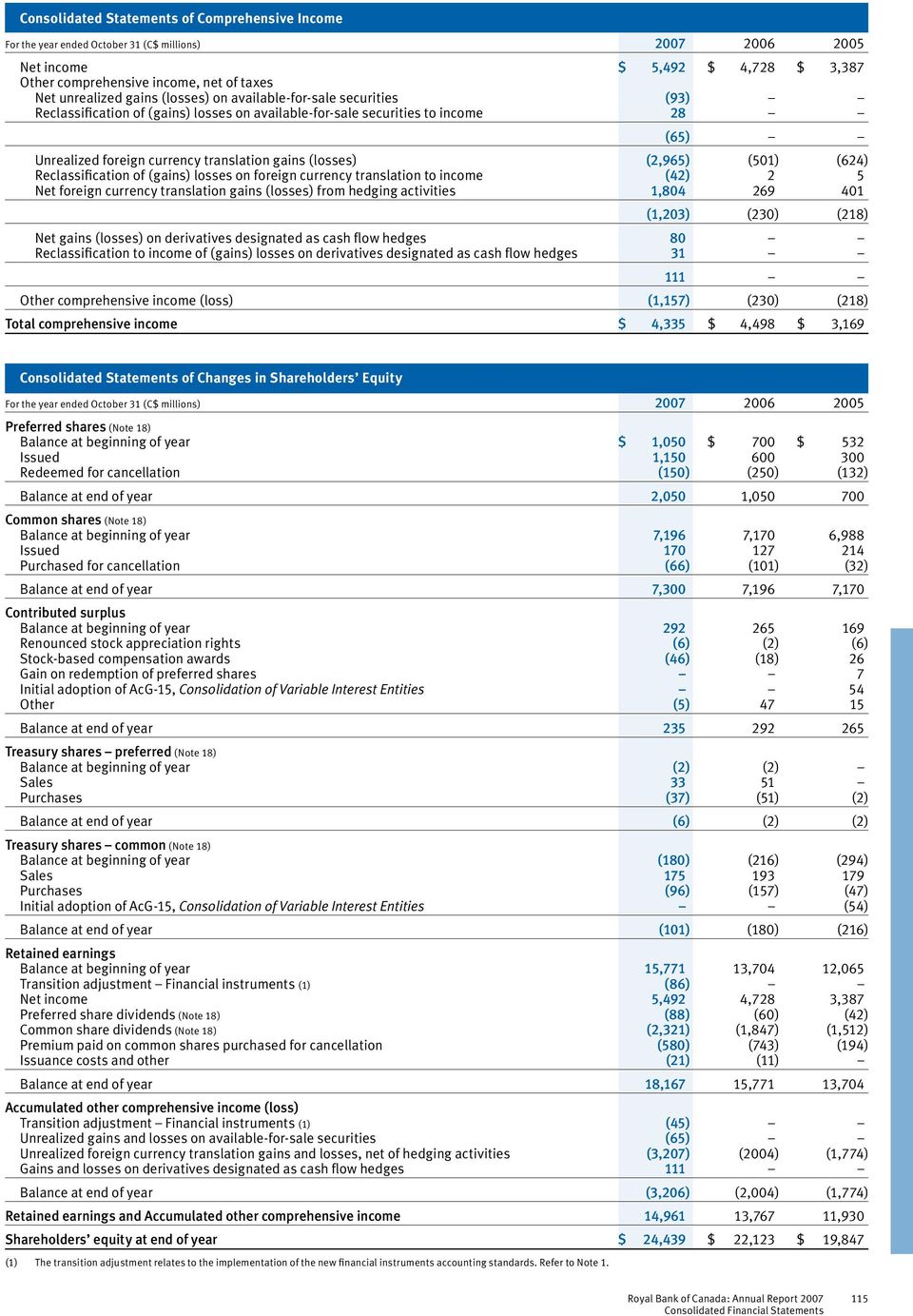
6 Consolidated Statements of Comprehensive Income For the year ended October 31 (C$ millions) Net income $ 5,492 $ 4,728 $ 3,387 Other comprehensive income, net of taxes Net unrealized gains (losses) on available-for-sale securities (93) Reclassification of (gains) losses on available-for-sale securities to income 28 (65) Unrealized foreign currency translation gains (losses) (2,965) (501) (624) Reclassification of (gains) losses on foreign currency translation to income (42) 2 5 Net foreign currency translation gains (losses) from hedging activities 1, (1,203) (230) (218) Net gains (losses) on derivatives designated as cash flow hedges 80 Reclassification to income of (gains) losses on derivatives designated as cash flow hedges Other comprehensive income (loss) (1,157) (230) (218) Total comprehensive income $ 4,335 $ 4,498 $ 3,169 Consolidated Statements of Changes in Shareholders Equity For the year ended October 31 (C$ millions) Preferred shares (Note 18) Balance at beginning of year $ 1,050 $ 700 $ 532 Issued 1, Redeemed for cancellation (150) (250) (132) Balance at end of year 2,050 1, Common shares (Note 18) Balance at beginning of year 7,196 7,170 6,988 Issued Purchased for cancellation (66) (101) (32) Balance at end of year 7,300 7,196 7,170 Contributed surplus Balance at beginning of year Renounced stock appreciation rights (6) (2) (6) Stock-based compensation awards (46) (18) 26 Gain on redemption of preferred shares 7 Initial adoption of AcG-15, Consolidation of Variable Interest Entities 54 Other (5) Balance at end of year Treasury shares preferred (Note 18) Balance at beginning of year (2) (2) Sales Purchases (37) (51) (2) Balance at end of year (6) (2) (2) Treasury shares common (Note 18) Balance at beginning of year (180) (216) (294) Sales Purchases (96) (157) (47) Initial adoption of AcG-15, Consolidation of Variable Interest Entities (54) Balance at end of year (101) (180) (216) Retained earnings Balance at beginning of year 15,771 13,704 12,065 Transition adjustment Financial instruments (1) (86) Net income 5,492 4,728 3,387 Preferred share dividends (Note 18) (88) (60) (42) Common share dividends (Note 18) (2,321) (1,847) (1,512) Premium paid on common shares purchased for cancellation (580) (743) (194) Issuance costs and other (21) (11) Balance at end of year 18,167 15,771 13,704 Accumulated other comprehensive income (loss) Transition adjustment Financial instruments (1) (45) Unrealized gains and losses on available-for-sale securities (65) Unrealized foreign currency translation gains and losses, net of hedging activities (3,207) (2004) (1,774) Gains and losses on derivatives designated as cash flow hedges 111 Balance at end of year (3,206) (2,004) (1,774) Retained earnings and Accumulated other comprehensive income 14,961 13,767 11,930 Shareholders equity at end of year $ 24,439 $ 22,123 $ 19,847 (1) The transition adjustment relates to the implementation of the new financial instruments accounting standards. Refer to Note 1. Royal Bank of Canada: Annual Report
7 Consolidated Statements of Cash Flows For the year ended October 31 (C$ millions) Cash flows from operating activities Net income from continuing operations $ 5,492 $ 4,757 $ 3,437 Adjustments to determine net cash from (used in) operating activities Provision for credit losses Depreciation Business realignment payments (38) (74) (94) Future income taxes (147) 144 (482) Amortization of other intangibles (Gain) loss on sale of premises and equipment (16) (16) (21) (Gain) loss on loan securitizations (41) (16) (101) (Gain) loss on sale of available-for-sale securities (63) (Gain) loss on sale of investment securities (88) (85) Changes in operating assets and liabilities Insurance claims and policy benefit liabilities (54) Net change in accrued interest receivable and payable (28) 217 (5) Current income taxes 1,034 (203) (9) Derivative assets (28,856) 1, Derivative liabilities 29,916 (498) 391 Trading securities 9,623 (21,477) (36,438) Net change in brokers and dealers receivable and payable (317) (1,017) 1,334 Other 1,647 1, Net cash from (used in) operating activities from continuing operations 19,473 (15,000) (29,622) Net cash from (used in) operating activities from discontinued operations 4 95 Net cash from (used in) operating activities 19,473 (14,996) (29,527) Cash flows from investing activities Change in interest-bearing deposits with banks (1,379) (5,265) 1,030 Change in loans, net of loan securitizations (39,569) (33,534) (27,670) Proceeds from loan securitizations 8,020 8,139 5,607 Proceeds from sale of available-for-sale securities 7,565 Proceeds from sale of investment securities 14,709 25,628 Proceeds from maturity of available-for-sale securities 18,784 Proceeds from maturity of investment securities 28,222 18,431 Purchases of available-for-sale securities (24,097) Purchases of investment securities (38,474) (36,373) Net acquisitions of premises and equipment (706) (511) (383) Change in assets purchased under reverse repurchase agreements and securities borrowed (4,935) (16,405) 3,976 Net cash from (used in) acquisitions (373) (256) Net cash from (used in) investing activities from continuing operations (36,690) (43,375) (9,754) Net cash from (used in) investing activities from discontinued operations 140 2,027 Net cash from (used in) investing activities (36,690) (43,235) (7,727) Cash flows from financing activities Change in deposits 17,831 36,663 35,001 Issue of RBC Trust Capital Securities 1,200 Issue of subordinated debentures Repayment of subordinated debentures (989) (953) (786) Issue of preferred shares 1, Redemption of preferred shares for cancellation (150) (250) (132) Issuance costs (23) (6) (3) Issue of common shares Purchase of common shares for cancellation (646) (844) (226) Sales of treasury shares Purchase of treasury shares (133) (208) (49) Dividends paid (2,278) (1,807) (1,469) Dividends/distributions paid by subsidiaries to non-controlling interests (59) (47) (13) Change in obligations related to assets sold under repurchase agreements and securities loaned (4,070) 17,722 (3,092) Change in obligations related to securities sold short 6,436 5,861 7,386 Change in short-term borrowings of subsidiaries (145) 620 (628) Net cash from (used in) financing activities from continuing operations 17,374 57,711 38,666 Net cash from (used in) financing activities 17,374 57,711 38,666 Effect of exchange rate changes on cash and due from banks (332) (80) (122) Net change in cash and due from banks (175) (600) 1,290 Cash and due from banks at beginning of year 4,401 5,001 3,711 Cash and due from banks at end of year $ 4,226 $ 4,401 $ 5,001 Supplemental disclosure of cash flow information Amount of interest paid in year $ 18,494 $ 14,678 $ 10,109 Amount of income taxes paid in year $ 1,352 $ 1,682 $ 1, Royal Bank of Canada: Annual Report 2007

8 (all tabular amounts are in millions of Canadian dollars, except per share amounts) Note 1 Significant accounting policies and estimates The accompanying have been prepared in accordance with Subsection 308 of the Bank Act (Canada) (the Act), which states that, except as otherwise specified by the Office of the Superintendent of Financial Institutions Canada (OSFI), our are to be prepared in accordance with Canadian generally accepted accounting principles (GAAP). The significant accounting policies used in the preparation of these financial statements, including the accounting requirements of the OSFI, are summarized below. These accounting policies conform, in all material respects, to Canadian GAAP. Basis of consolidation Our include the assets and liabilities and results of operations of all subsidiaries and variable interest entities (VIEs) where we are the Primary Beneficiary after elimination of intercompany transactions and balances. The equity method is used to account for investments in associated corporations and limited partnerships in which we have significant influence. These investments are reported in Other assets. Our share of earnings, gains and losses realized on dispositions and writedowns to reflect other-thantemporary impairment in the value of these investments are included in Non-interest income. The proportionate consolidation method is used to account for investments in joint ventures in which we exercise joint control, whereby our pro rata share of assets, liabilities, income and expenses is consolidated. Significant accounting changes Financial Instruments On November 1, 2006, we adopted three new financial instruments accounting standards that were issued by the Canadian Institute of Chartered Accountants (CICA): Handbook Section 1530, Comprehen sive Income (Section 1530), Handbook Section 3855, Financial Instruments Recognition and Measurement (Section 3855), and Handbook Section 3865, Hedges (Section 3865). Comparative amounts for prior periods have not been restated. Comprehensive Income Section 1530 introduces Comprehensive Income, which consists of Net income and Other comprehensive income (OCI). OCI represents changes in Shareholders equity during a period arising from transactions and other events with non-owner sources and includes unrealized gains and losses on financial assets classified as availablefor-sale, unrealized foreign currency translation gains or losses arising from self-sustaining foreign operations, net of hedging activities, and changes in the fair value of the effective portion of cash flow hedging instruments. We have included in our Consolidated Financial Statements a Consolidated Statement of Comprehensive Income for the changes in these items, net of taxes, since November 1, 2006, while the cumulative changes in OCI are included in Accumulated other comprehensive income (loss) (AOCI), which is presented as a new category of Shareholders equity on our Consolidated Balance Sheets. Financial Instruments Recognition and Measurement Section 3855 establishes standards for recognizing and measuring financial assets, financial liabilities and non-financial derivatives. It requires that financial assets and financial liabilities, including derivatives, be recognized on our Consolidated Balance Sheets when we become a party to the contractual provisions of a financial instrument or non-financial derivative contract. Under this standard, all financial instruments are required to be measured at fair value on initial recognition except for certain related party transactions. Measurement in subsequent periods depends on whether the financial instrument has been classified as held-for-trading, available-for-sale, held-to-maturity, loans and receivables, or other financial liabilities. Transaction costs are expensed as incurred for financial instruments classified or designated as held-for-trading. For other financial instruments, transaction costs are capitalized on initial recognition. Financial assets and financial liabilities held-for-trading are measured at fair value with changes in those fair values recognized in Non-interest income. Financial assets held-to-maturity, loans and receivables, and other financial liabilities are measured at amortized cost using the effective interest method. Available-for-sale financial assets, which include loan substitute securities, are measured at fair value with unrealized gains and losses, including changes in foreign exchange rates, being recognized in OCI. Investments in equity instruments classified as available-for-sale that do not have a quoted market price in an active market are measured at cost. Derivative instruments are recorded on our Consolidated Balance Sheets at fair value, including those derivatives that are embedded in financial or non-financial contracts that are not closely related to the host contracts. Changes in the fair values of derivative instruments are recognized in Net income except for derivatives designated as effective cash flow hedges or hedges of foreign currency exposure of a net investment in a self-sustaining foreign operation, the changes in fair value of which are recognized in OCI. Section 3855 also provides an entity the option to designate a financial instrument as held-for-trading (the fair value option) on its initial recognition or upon adoption of the standard, even if the financial instrument was not acquired or incurred principally for the purpose of selling or repurchasing it in the near term. An instrument that is classified as held-for-trading by way of this fair value option must have a reliable fair value and satisfy one of the following criteria established by the OSFI: (i) when doing so eliminates or significantly reduces a measurement or recognition inconsistency that would otherwise arise from measuring assets or liabilities, or recognizing gains and losses on them on a different basis; (ii) it belongs to a group of financial assets or financial liabilities or both that are managed and evaluated on a fair value basis in accordance with our risk management or investment strategy, and are reported to senior management, on that basis; or (iii) it is an embedded derivative in a financial or nonfinancial host contract and the derivative is not closely related to the host contract. The principal categories of our financial assets that we designated as held-for-trading using the fair value option include (i) investments supporting the policy benefit liabilities on life and health insurance contracts issued by our insurance operations; (ii) investments used to offset exposures under derivative contracts in relation to our sales and trading activities; (iii) certain loans to customers whose related hedging derivatives are measured at fair value; and (iv) assets purchased under reverse repurchase agreements that form part of our trading portfolio which is managed and evaluated on a fair value basis. Financial liabilities designated as held-for-trading include (i) deposits and structured notes with embedded derivatives that are not closely related to the host contracts; (ii) assets sold under repurchase agreements that form part of our trading portfolio which is managed and evaluated on a fair value basis; and (iii) certain deposits to offset the impact of related hedging derivatives measured at fair value. Fair value designation for these financial assets and financial liabilities significantly reduces the measurement inconsistencies. Other significant accounting implications arising upon the adoption of Section 3855 include the use of the effective interest method for any transaction costs or fees, premiums or discounts earned on financial instruments measured at amortized cost, and the recognition of the inception fair value of the obligation undertaken in issuing a guarantee that meets the definition of a guarantee pursuant to CICA Accounting Guideline 14, Disclosure of Guarantees (AcG-14). Royal Bank of Canada: Annual Report
9 Note 1 Significant accounting policies and estimates (continued) Subsequent remeasurement at fair value is not required unless the financial guarantee also meets the definition of a derivative. These guarantees are remeasured at fair value at each balance sheet date and reported as a derivative in Other assets or Other liabilities, as appropriate. Hedges Section 3865 specifies the criteria that must be satisfied in order for hedge accounting to be applied and the accounting for each of the permitted hedging strategies. We use derivatives and non-derivative financial instruments in our hedging strategies to manage our exposures to interest, currency, credit and other market risks. When derivatives are used to manage our own exposures, we determine for each derivative whether hedge accounting can be applied. Where hedge accounting can be applied, a hedging relationship is designated as a fair value hedge, a cash flow hedge or a hedge of foreign currency exposure of a net investment in a self-sustaining foreign operation. For our detailed accounting policy on hedge accounting refer to the Derivatives section below in Note 1. Impact upon adoption of Sections 1530, 3855 and 3865 The transition adjustments attributable to the remeasurement of financial assets and financial liabilities at fair value, other than financial assets classified as available-for-sale and hedging instruments designated as cash flow hedges or hedges of foreign currency exposure of net investment in self-sustaining foreign operations, were recognized in opening Retained earnings as at November 1, Adjustments arising from remeasuring financial assets classified as available-forsale at fair value were recognized in opening AOCI as at that date. For hedging relationships existing prior to adopting Section 3865 that continue to qualify for hedge accounting under the new standard, the transition accounting is as follows: (i) Fair value hedges any gain or loss on the hedging instrument was recognized in opening Retained earnings and the carrying amount of the hedged item was adjusted by the cumulative change in fair value attributable to the designated hedged risk and was also included in opening Retained earnings; (ii) Cash flow hedges and hedges of net investments in self-sustaining foreign operations the effective portion of any gain or loss on the hedging instrument was recognized in AOCI and the cumulative ineffective portion was included in opening Retained earnings. We recorded the following transition adjustments in our : (i) a reduction of $86 million, net of taxes, to our opening Retained earnings, representing changes made to the value of certain financial instruments and the ineffective portion of qualifying hedges, in compliance with the measurement basis under the new standards including those related to the use of fair value option; and (ii) recognition in AOCI of $45 million, net of taxes, related to the net losses for available-for-sale financial assets and cumulative losses on the effective portion of our cash flow hedges that are now required to be recognized under Sections 3855 and In addition, we have reclassified to AOCI $2,004 million of net unrealized foreign currency losses on net investments in self-sustaining foreign operations that were previously presented as a separate item in Shareholders equity. Variable Interest Entities On February 1, 2007, we adopted CICA Emerging Issues Committee Abstract No. 163, Determining the Variability to be Considered in Applying AcG-15 (EIC-163). EIC-163 provides additional clarification on how to analyze and consolidate VIEs. The implementation of EIC-163 resulted in the deconsolidation of certain investment funds; however, the impact was not material to our consolidated financial position or results of operations. Convertible and Other Debt Instruments with Embedded Derivatives On August 1, 2007, we adopted CICA Emerging Issues Committee Abstract No. 164, Convertible and Other Debt Instruments with Embedded Derivatives (EIC-164). EIC-164 provides clarification regarding the accounting treatment for certain types of convertible debt instruments, their classification as liabilities or equity, and the implications on earnings per share. It also provides guidance on whether these instruments contain any embedded derivatives that are required to be accounted for separately. The adoption of EIC-164 was not material to our consolidated financial position or results of operations. Accounting Policy Choice for Transaction Costs On June 1, 2007, CICA Emerging Issues Committee issued Abstract No. 166, Accounting Policy Choice for Transaction Costs (EIC-166). This EIC addresses the accounting policy choice of expensing or adding transaction costs related to the acquisition of financial assets and financial liabilities that are classified as other than held-for-trading. Specifically, it requires the same accounting policy choice be applied to all similar financial instruments classified as other than held-fortrading, but permits a different policy choice for financial instruments that are not similar. EIC-166 became effective for us on September 30, 2007 and requires retroactive application to all transaction costs accounted for in accordance with Section Our current recognition policy for transaction costs, which was adopted on November 1, 2006, is consistent with this guidance. The accounting policies described below have been updated to reflect the requirements under the new financial instruments accounting standards, and where applicable, include a discussion on the policies used in the prior periods for comparative purposes. Translation of foreign currencies Monetary assets and liabilities denominated in foreign currencies are translated into Canadian dollars at rates prevailing at the balance sheet date. Non-monetary assets and liabilities are translated into Canadian dollars at historical rates. Income and expenses denominated in foreign currencies are translated at average rates of exchange for the year. Assets and liabilities of our self-sustaining operations with functional currencies other than the Canadian dollar are translated into Canadian dollars at rates prevailing at the balance sheet date, and income and expenses of these foreign operations are translated at average rates of exchange for the year. Unrealized gains or losses arising as a result of the translation of our foreign self-sustaining operations along with the effective portion of related hedges are reported as a component of OCI on an after-tax basis. Prior to November 1, 2006, these amounts were included in Shareholders equity. Upon disposal or dilution of our interest in such investments, an appropriate portion of the accumulated net translation gains or losses is included in Non-interest income. Other foreign currency translation gains and losses are included in Non-interest income. Securities Securities are classified, based on management s intentions, as held-for-trading, available-for-sale or held-to-maturity. Held-for-trading securities include securities purchased for sale in the near term and securities designated as held-for-trading under the fair value option are reported at fair value. Obligations to deliver Trading securities sold but not yet purchased are recorded as liabilities and carried at fair value. Realized and unrealized gains and losses on these securities are recorded as Trading revenue in Non-interest income. Dividend and interest income accruing on Trading securities is recorded in Interest income. Interest and dividends accrued on interestbearing and equity securities sold short are recorded in Interest expense. 118 Royal Bank of Canada: Annual Report 2007
10 Available-for-sale securities include (i) securities which may be sold in response to or in anticipation of changes in interest rates and resulting prepayment risk, changes in foreign currency risk, changes in funding sources or terms, or to meet liquidity needs; and (ii) loan substitute securities which are client financings that have been structured as after-tax investments rather than conventional loans in order to provide the clients with a borrowing rate advantage. Available-for-sale securities are measured at fair value with unrealized gains and losses, including changes in foreign exchange rates, recognized in OCI net of tax. Purchase premiums or discounts on available-for-sale securities are amortized over the life of the security using the effective interest method and are recognized in Net interest income. Investments in equity instruments classified as Available-for-sale that do not have a quoted market price in an active market are measured at cost. Held-to-maturity securities are debt securities where we have the intention and ability to hold the investment until its maturity date. These securities are carried at amortized cost using the effective interest method. Dividends, interest income and amortization of premiums and discounts on debt securities are recorded in Net interest income. We hold a nominal amount of held-to-maturity securities in our normal course of business. All held-to-maturity securities have been included with Available-for-sale securities on our Consolidated Balance Sheets. Gains and losses realized on disposal of available-for-sale securities are included in Gain on sale of securities in Non-interest income. Both available-for-sale and held-to-maturity securities are subject to periodic impairment review. Prior to November 1, 2006, all investment securities, other than Trading securities, were recorded on our Consolidated Balance Sheets as Investment securities at amortized cost, and loan substitute securities were accorded the accounting treatment applicable to loans and, where required, reduced by an allowance for credit losses. We account for all our securities using settlement date accounting except that changes in fair value between the trade date and settlement date are reflected in income for securities classified or designated as held-for-trading while changes in the fair value of available-for-sale securities between the trade and settlement dates are recorded in OCI. Assets purchased under reverse repurchase agreements and sold under repurchase agreements We purchase securities under agreements to resell (reverse repurchase agreements) and take possession of these securities. Reverse repurchase agreements are treated as collateralized lending transactions whereby we monitor the market value of the securities purchased and additional collateral is obtained when appropriate. We also have the right to liquidate the collateral held in the event of counterparty default. We also sell securities under agreements to repurchase (repurchase agreements), which are treated as collateralized borrowing transactions. Reverse repurchase agreements and repurchase agreements are carried on our Consolidated Balance Sheets at the amounts at which the securities were initially acquired or sold plus accrued interest, respectively, except when they are designated using the fair value option as held-for-trading and are recorded at fair value. Interest earned on reverse repurchase agreements is included in Interest income in our Consolidated Statements of Income, and interest incurred on repurchase agreements is included in Interest expenses in our Consolidated Statements of Income. Changes in fair value for reverse repurchase agreements and repurchase agreements carried at fair value under the fair value option are included in Trading revenue in Non-interest income. Prior to November 1, 2006, all reverse repurchase agreements and repurchase agreements were carried on our Consolidated Balance Sheets at the amounts at which the securities were initially acquired or sold, respectively, plus accrued interest on interest-bearing securities. Interest earned on reverse repurchase agreements was included in Interest income, and interest incurred on repurchase agreements was included in Interest expense, in our Consolidated Statements of Income. Loans Loans are recorded at amortized cost unless they have been designated as held-for-trading using the fair value option. Loans recorded at amortized cost are net of an Allowance for loan losses and unearned income which comprises unearned interest and unamortized loan fees. Loans designated as held-for-trading are carried at fair value. Prior to November 1, 2006, all loans were presented at amortized cost net of an Allowance for loan losses and unearned income. Loans stated at amortized cost are subject to periodic impairment review and are classified as impaired when, in management s opinion, there is no longer reasonable assurance of the timely collection of the full amount of principal or interest. Whenever a payment is 90 days past due, loans other than credit card balances and loans guaranteed or insured by a Canadian government (federal or provincial) or a Canadian government agency (collectively Canadian government ) are classified as impaired unless they are fully secured and collection efforts are reasonably expected to result in repayment of debt within 180 days past due. Credit card balances are written off when a payment is 180 days in arrears. Loans guaranteed by a Canadian government are classified as impaired when the loan is contractually 365 days in arrears. When a loan is identified as impaired, the accrual of interest is discontinued and any previously accrued but unpaid interest on the loan is charged to the Provision for credit losses. Interest received on impaired loans is credited to the Provision for credit losses. Impaired loans are returned to performing status when all past due amounts, including interest, have been collected, loan impairment charges have been reversed, and the credit quality has improved such that timely collection of principal and interest is reasonably assured. When an impaired loan is identified, the carrying amount of the loan is reduced to its estimated realizable amount, measured by discounting the expected future cash flows at the effective interest rate inherent in the loan. In subsequent periods, recoveries of amounts previously written off and any increase in the carrying value of the loan are credited to the Allowance for credit losses on our Consolidated Balance Sheets. Where a portion of a loan is written off and the remaining balance is restructured, the new loan is carried on an accrual basis when there is no longer any reasonable doubt regarding the collectibility of principal or interest, and payments are not 90 days past due. Assets acquired in respect of problem loans are recorded at their fair value less costs of disposition. Fair value is determined based on either current market value where available or discounted cash flows. Any excess of the carrying value of the loan over the recorded fair value of the assets acquired is recognized by a charge to the Provision for credit losses. Fees that relate to activities such as originating, restructuring or renegotiating loans are deferred and recognized as Interest income over the expected term of such loans using the effective interest method. Where there is reasonable expectation that a loan will result, commitment and standby fees are also recognized as Interest income over the expected term of the resulting loan using the effective interest method. Otherwise, such fees are recorded as Other liabilities and amortized to Non-interest income over the commitment or standby period. Allowance for credit losses The Allowance for credit losses is maintained at levels that management considers appropriate to cover estimated identified credit related losses in the portfolio as well as losses that have been incurred, but are not yet identifiable as at the balance sheet date. The allowance relates to on-balance sheet exposures, such as loans and acceptances, and off-balance sheet items such as letters of credit, guarantees and unfunded commitments. The allowance is increased by a charge to the Provision for credit losses and decreased by the amount of write-offs, net of recoveries. The Allowance for credit losses for on-balance sheet items is included as a reduction to assets, and the allowance relating to off-balance sheet items is included in Other liabilities. Royal Bank of Canada: Annual Report
11 Note 1 Significant accounting policies and estimates (continued) The allowance is determined based on management s identification and evaluation of problem accounts on estimated losses that exist on the remaining portfolio, and on other factors including the composition and credit quality of the portfolio, and changes in economic and business conditions. The Allowance for credit losses consists of Specific allowances and the General allowance. Specific allowances Specific allowances are recorded to recognize estimated losses on both retail and wholesale loans that have become impaired. The losses relating to wholesale borrowers including small business loans individually managed are estimated using management s judgment relating to the timing of future cash flow amounts that can be reasonably expected from the borrowers, financially responsible guarantors and the realization of collateral. The amounts expected to be recovered are reduced by estimated collection costs and discounted at the effective interest rate of the obligation. The losses relating to retail portfolios, including residential mortgages, and personal and small business loans managed on a pooled basis are based on net write-off experience. For credit cards, no specific allowance is maintained as balances are written off when a payment is 180 days in arrears. Personal loans are generally written off at 150 days past due. Write-offs for other loans are generally recorded when there is no realistic prospect of full recovery. General allowance A general allowance is established to cover estimated credit losses incurred in the lending portfolio that have not yet been specifically identified as impaired. For heterogeneous loans (wholesale loans including small business loans individually managed), the determination of the general allowance is based on the application of estimated probability of default, gross exposure at default and loss factors, which are determined by historical loss experience and delineated by loan type and rating. For homogeneous portfolios (retail loans) including residential mortgages, credit cards, as well as personal and small business loans that are managed on a pooled basis, the determination of the general allowance is based on the application of historical loss rates. In determining the general allowance level, management also considers the current portfolio credit quality trends, business and economic conditions, the impact of policy and process changes, and other supporting factors. In addition, the general allowance includes a component for the model limitations and imprecision inherent in the allowance methodologies. Acceptances Acceptances are short-term negotiable instruments issued by our clients to third parties which we guarantee. The potential liability under acceptances is reported in Liabilities Other on our Consolidated Balance Sheets. The recourse against our clients in the case of a call on these commitments is reported as a corresponding asset of the same amount in Assets Other. Fees earned are reported in Non-interest income. Derivatives Derivatives are primarily used in sales and trading activities. Derivatives are also used to manage our exposures to interest, currency, credit and other market risks. The most frequently used derivative products are interest rate swaps, interest rate futures, forward rate agreements, interest rate options, foreign exchange forward contracts, currency swaps, foreign currency futures, foreign currency options and credit derivatives. All derivative instruments are recorded on our Consolidated Balance Sheets at fair value, including those derivatives that are embedded in financial or non-financial contracts that are not closely related to the host contracts. When derivatives are used in sales and trading activities, the realized and unrealized gains and losses on derivatives are recognized in Non-interest income Trading revenue. Derivatives with a positive fair value are reported as Derivative assets and derivatives with a negative fair value are reported as Derivative liabilities. Where we have both the legal right and intent to settle derivative assets and liabilities simultaneously with a counterparty, the net fair value of the derivative positions is reported as an asset or liability, as appropriate. Margin requirements and premiums paid are also included in Derivative assets, while premiums received are shown in Derivative liabilities. When derivatives are used to manage our own exposures, we determine for each derivative whether hedge accounting can be applied, as discussed below. Hedge accounting We use derivatives and non-derivatives in our hedging strategies to manage our exposure to interest, currency, credit and other market risks. Where hedge accounting can be applied, a hedge relationship is designated and documented at inception to detail the particular risk management objective and the strategy for undertaking the hedge transaction. The documentation identifies the specific asset, liability or anticipated cash flows being hedged, the risk that is being hedged, the type of hedging instrument used and how effectiveness will be assessed. The hedging instrument must be highly effective in accomplishing the objective of offsetting either changes in the fair value or anticipated cash flows attributable to the risk being hedged both at inception and throughout the life of the hedge. Hedge accounting is discontinued prospectively when it is determined that the hedging instrument is no longer effective as a hedge, the hedging instrument is terminated or sold, or upon the sale or early termination of the hedged item. Refer to Note 2 for the fair value of the derivatives and non-derivative financial instruments categorized by their hedging relationships, as well as derivatives that are not designated in hedging relationships. Fair value hedges In a fair value hedging relationship, the carrying value of the hedged item is adjusted for changes in fair value attributable to the hedged risk and recognized in Non-interest income. Changes in the fair value of the hedged item, to the extent that the hedging relationship is effective, are offset by changes in the fair value of the hedging derivative, which are also recognized in Non-interest income. When hedge accounting is discontinued, the carrying value of the hedged item is no longer adjusted and the cumulative fair value adjustments to the carrying value of the hedged items are amortized to Net income over the remaining term of the original hedging relationship. We predominantly use interest rate swaps to hedge our exposure to the changes in a fixed interest rate instrument s fair value caused by changes in interest rates. We also use, in limited circumstances, certain cash instruments to hedge our exposure to the changes in fair value of monetary assets attributable to changes in foreign currency exchange rates. Cash flow hedges In a cash flow hedging relationship, the effective portion of the change in the fair value of the hedging derivative, net of taxes, is recognized in OCI while the ineffective portion is recognized in Non-interest income. When hedge accounting is discontinued, the amounts previously recognized in AOCI are reclassified to Net interest income during the periods when the variability in the cash flows of the hedged item affects Net interest income. Gains and losses on derivatives are reclassified immediately to Net income when the hedged item is sold or terminated early. We predominantly use interest rate swaps to hedge the variability in cash flows related to a variable rate asset or liability. 120 Royal Bank of Canada: Annual Report 2007
12 Prior to November 1, 2006, when a derivative was designated and qualified as an effective hedging instrument in a fair value or cash flow hedge, the income or expense of that derivative was recognized as an adjustment to Interest income or Interest expense of the hedged item in the same period. When hedge accounting was discontinued prospectively, the fair value of the derivative was recognized in Derivative assets or liabilities at that time and the gain or loss was deferred and recognized in Net interest income in the periods in which the hedged item affects income. When hedge accounting was discontinued due to the sale or early termination of the hedged item, the fair value of the derivative was recognized in Derivative assets or liabilities at that time and the unrealized gain or loss is recognized in Non-interest income. Net investment hedges In hedging a foreign currency exposure of a net investment in a selfsustaining foreign operation, the effective portion of foreign exchange gains and losses on the hedging instruments, net of applicable taxes, is recognized in OCI and the ineffective portion is recognized in Non-interest income. The amounts previously recognized in AOCI are recognized in Net income when there is a reduction in the hedged net investment as a result of a dilution or sale of the net investment, or reduction in equity of the foreign operation as a result of dividend distributions. We use foreign exchange contracts and foreign currencydenominated liabilities to manage our foreign currency exposures to net investments in self-sustaining foreign operations having a functional currency other than the Canadian dollar. Prior to November 1, 2006, foreign exchange gains and losses on these hedging instruments, net of tax, were recorded in Net foreign currency translation adjustments in our Consolidated Statements of Changes in Shareholders Equity. Premises and equipment Premises and equipment are stated at cost less accumulated depreciation. Depreciation is recorded principally on a straight-line basis over the estimated useful lives of the assets, which are 25 to 50 years for buildings, 3 to 10 years for computer equipment, and 7 to 10 years for furniture, fixtures and other equipment. The amortization period for leasehold improvements is the lesser of the useful life of the leasehold improvements or the lease term plus the first renewal period, if reasonably assured of renewal, up to a maximum of 10 years. Gains and losses on disposal are recorded in Non-interest income. Business combinations, goodwill and other intangibles All business combinations are accounted for using the purchase method. Identifiable intangible assets are recognized separately from Goodwill and included in Other intangibles. Goodwill represents the excess of the price paid for the business acquired over the fair value of the net identifiable assets acquired, and is assigned to reporting units of a business segment. A reporting unit comprises business operations with similar economic characteristics and strategies, and is defined by GAAP as the level of reporting at which goodwill is tested for impairment and is either a business segment or one level below. Upon disposal of a portion of a reporting unit, goodwill is allocated to the disposed portion based on the fair value of that portion relative to the total reporting unit. Goodwill is evaluated for impairment annually as at August 1 or more often if events or circumstances indicate there may be an impairment. If the carrying value of a reporting unit, including the allocated goodwill, exceeds its fair value, goodwill impairment is measured as the excess of the carrying amount of the reporting unit s allocated goodwill over the implied fair value of the goodwill, based on the fair value of the assets and liabilities of the reporting unit. Any goodwill impairment is charged to income in the period in which the impairment is identified. Subsequent reversals of impairment are prohibited. Other intangibles with a finite life are amortized on a straight-line basis over their estimated useful lives, generally not exceeding 20 years, and are also tested for impairment when conditions exist which may indicate that the estimated future net cash flows from the asset will be insufficient to recover its carrying amount. Income taxes We use the asset and liability method whereby income taxes reflect the expected future tax consequences of temporary differences between the carrying amounts of assets or liabilities for accounting purposes compared with tax purposes. A future income tax asset or liability is determined for each temporary difference based on the tax rates that are expected to be in effect when the underlying items of income and expense are expected to be realized, except for earnings related to our foreign operations where repatriation of such amounts is not contemplated in the foreseeable future. Income taxes reported in our Consolidated Statements of Income include the current and future portions of the expense. Income taxes applicable to items charged or credited to Shareholders equity are netted with such items. Changes in future income taxes related to a change in tax rates are recognized in the period when the tax rate change is substantively enacted. Net future income taxes accumulated as a result of temporary differences are included in Other assets. A valuation allowance is established to reduce future income tax assets to the amount more likely than not to be realized. In addition, our Consolidated Statements of Income contain items that are non-taxable or non-deductible for income tax purposes and, accordingly, cause the income tax provision to be different from what it would be if based on statutory rates. Pensions and other post-employment benefits We offer a number of benefit plans, which provide pension and other benefits to eligible employees (as described in Note 20). These plans include registered defined benefit pension plans, supplemental pension plans, defined contribution plans and health, dental, disability and life insurance plans. Investments held by the pension funds primarily comprise equity and fixed income securities. Pension fund assets are valued at fair value. For the principal defined benefit plans, the expected return on plan assets, which is reflected in the pension benefit expense, is calculated using a market-related value approach. Under this approach, assets are valued at an adjusted market value, whereby realized and unrealized capital gains and losses are amortized over three years on a straight-line basis. For the majority of the non-principal and supplemental defined benefit pension plans, the expected return on plan assets is calculated based on fair value of assets. Actuarial valuations for the defined benefit plans are performed on a regular basis to determine the present value of the accrued pension and other post-employment benefits, based on projections of employees compensation levels to the time of retirement and the costs of health, dental, disability and life insurance. Our defined benefit pension expense, which is included in Non-interest expenses Human resources, consists of the cost of employee pension benefits for the current year s service, interest cost on the liability, expected investment return on the market-related value or market value of plan assets and the amortization of prior service costs, net actuarial gains or losses and transitional assets or obligations. For some of our defined benefit plans, including the principal defined benefit plans, actuarial gains or losses are determined each year and amortized over the expected average remaining service life of employee groups covered by the plan. For the remaining defined benefit plans, net actuarial gains or losses in excess of the greater of 10% of the plan assets or the benefit obligation at the beginning of the year are amortized over the expected average remaining service life of employee groups covered by the plan. Gains and losses on settlements of defined benefit plans are recognized in income when settlement occurs. Curtailment gains and losses are recognized in the period when the curtailment becomes probable and the impact can be reasonably estimated. Our defined contribution plan expense is included in Non-interest expense Human resources for services rendered by employees during the period. Royal Bank of Canada: Annual Report
13 Note 1 Significant accounting policies and estimates (continued) The cumulative excess of pension fund contributions over the amounts recorded as expenses is reported as a Prepaid pension benefit cost in Other assets. The cumulative excess of expense over fund contributions is reported as Accrued pension and other postemployment benefit expense in Other liabilities. Stock-based compensation We offer stock-based compensation plans to certain key employees and to our non-employee directors as described in Note 21. We use the fair value method to account for stock options granted to employees whereby compensation expense is recognized over the applicable vesting period with a corresponding increase in Contributed surplus. When the options are exercised, the exercise price proceeds together with the amount initially recorded in Contributed surplus are credited to Common shares. Stock options granted prior to November 1, 2002, were accounted for using the intrinsic value method, and accordingly no expense was recognized for these options since the exercise price for such grants was equal to the closing price on the day before the stock options were granted. These awards fully vested during When these stock options are exercised, the proceeds will be recorded as Common shares. Options granted between November 29, 1999, and June 5, 2001, were accompanied by tandem stock appreciation rights (SARs), which gave participants the option to receive cash payments equal to the excess of the current market price of our shares over the options exercise price. SARs obligations are now fully vested and give rise to compensation expense as a result of changes in the market price of our common shares. These expenses, net of related hedges, are recorded as Non-interest expense Human resources in our Consolidated Statements of Income with a corresponding increase in Other liabilities on our Consolidated Balance Sheets. Our other compensation plans include performance deferred share plans and deferred share unit plans for key employees (the Plans). The deferred share plans are settled in our common shares or cash, and the deferred share unit plans are settled in cash. The obligations for the Plans are accrued over their vesting period. For share-settled awards, our accrued obligations are based on the market price of our common shares at the date of grant. For cashsettled awards, our accrued obligations are periodically adjusted for fluctuations in the market price of our common shares and dividends accrued. Changes in our obligations under the Plans, net of related hedges, are recorded as Non-interest expense Human resources in our Consolidated Statements of Income with a corresponding increase in Other liabilities or Contributed surplus on our Consolidated Balance Sheets. The compensation cost attributable to options and awards, granted to employees who are eligible to retire or will become eligible to retire during the vesting period, is recognized immediately if the employee is eligible to retire on the grant date or over the period between the grant date and the date the employee becomes eligible to retire. Our contributions to the employee savings and share ownership plans are expensed as incurred. Loan securitization We periodically securitize loans by selling loans or packaged loans in the form of mortgage-backed securities (MBS) to independent special purpose entities (SPEs) or trusts that issue securities to investors. These transactions are accounted for as sales and the transferred assets are removed from our Consolidated Balance Sheets when we are deemed to have surrendered control over such assets and have received consideration other than beneficial interests in these transferred loans. For control to be surrendered, all of the following must occur: (i) the transferred loans must be isolated from the seller, even in bankruptcy or other receivership; (ii) the purchaser must have the legal right to sell or pledge the transferred loans or, if the purchaser is a Qualifying Special Purpose Entity (QSPE) as described in the CICA Accounting Guideline 12, Transfers of Receivables (AcG-12), its investors have the right to sell or pledge their ownership interest in the entity; and (iii) the seller must not continue to control the transferred loans through an agreement to repurchase them or have a right to cause the loans to be returned. If any one of these conditions is not met, the transfer is considered to be a secured borrowing, the loans remain on our Consolidated Balance Sheets, and the proceeds are recognized as a liability. When MBS are created, we reclassify the loans at their carrying costs into MBS and retained interests on our Consolidated Balance Sheets. The retained interest represents the excess spread of loan interest over the MBS rate of return. The initial carrying value of the MBS and the related retained interests are determined based on their relative fair value on the date of securitization. MBS are classified as trading account securities or available-for-sale securities, based on management s intent. Retained interests are classified as availablefor-sale. Both MBS and the retained interests are subject to periodic impairment review. Prior to November 1, 2006, retained interests in securitizations that could be contractually prepaid or otherwise settled in such a way that we would not recover substantially all of our recorded investment were classified as Investment account securities at amortized cost. Gains on the sale of loans or MBS are recognized in Non-interest income and are dependent on the previous carrying amount of the loans or MBS involved in the transfer. To obtain fair values, quoted market prices are used, if available. When quotes are not available for retained interests, we generally determine fair value based on the present value of expected future cash flows using management s best estimates of key assumptions such as payment rates, weighted average life of the prepayable receivables, excess spread, expected credit losses and discount rates commensurate with the risks involved. For each securitization transaction where we have retained the servicing rights, we assess whether the benefits of servicing represent adequate compensation. When the benefits of servicing are more than adequate, a servicing asset is recognized in Other assets. When the benefits of servicing are not expected to be adequate, we recognize a servicing liability in Other liabilities. Neither an asset nor a liability is recognized when we have received adequate compensation. A servicing asset or liability is amortized in proportion to and over the period of estimated net servicing income. Insurance Premiums from long-duration contracts, primarily life insurance, are recognized when due in Non-interest income Insurance premiums, investment and fee income. Premiums from short-duration contracts, primarily property and casualty, and fees for administrative services are recognized in Insurance premiums, investment and fee income over the related contract period. Unearned premiums of the shortduration contracts, representing the unexpired portion of premiums, are reported in Other liabilities. Investments made by our insurance operations are classified as available-for-sale or loans and receivables, except for investments supporting the policy benefit liabilities on life and health insurance contracts which are designated as held-fortrading under the fair value option with changes in fair value reported in Insurance premiums, investment and fee income. Insurance claims and policy benefit liabilities represent current claims and estimates for future insurance policy benefits. Liabilities for life insurance contracts are determined using the Canadian Asset Liability Method (CALM), which incorporates assumptions for mortality, 122 Royal Bank of Canada: Annual Report 2007

14 morbidity, policy lapses and surrenders, investment yields, policy dividends, operating and policy maintenance expenses, and provisions for adverse deviation. These assumptions are reviewed at least annually and updated in response to actual experience and market conditions. Liabilities for property and casualty insurance represent estimated provisions for reported and unreported claims. Liabilities for life and property and casualty insurance are included in Insurance claims and policy benefit liabilities. Acquisition costs for new insurance business consist of commissions, premium taxes, certain underwriting costs and other costs that vary with the acquisition of new business. Deferred acquisition costs for life insurance products are implicitly recognized in Insurance claims and policy benefit liabilities by CALM. For property and casualty insurance, these costs are classified as Other assets and amortized over the policy term. Segregated funds are lines of business in which we issue a contract where the benefit amount is directly linked to the market value of the investments held in the underlying fund. The contractual arrangement is such that the underlying assets are registered in our name but the segregated fund policyholders bear the risk and rewards of the fund s investment performance. We provide minimum death benefit and maturity value guarantees on segregated funds. The liability associated with these minimum guarantees is recorded in Insurance claims and policy benefit liabilities. Segregated funds are not included in our. We derive only fee income from segregated funds, which is reflected in Insurance premiums, investment and fee income. Fee income includes management fees, mortality, policy, administration and surrender charges. Prior to November 1, 2006, investments made by our insurance operations were included in Investment account securities. Realized gains and losses on disposal of fixed income investments that support life insurance liabilities were deferred and amortized to Insurance premiums, investment and fee income over the remaining term to maturity of the investments sold, up to a maximum period of 20 years. For equities that were held to support non-universal life insurance products, the realized gains and losses were deferred and amortized into Insurance premiums, investment and fee income at the quarterly rate of 5% of unamortized deferred gains and losses. The differences between the market value and adjusted carrying cost of these equities were reduced quarterly by 5%. Equities held to support universal life insurance products were carried at market value. Realized and unrealized gains or losses on these equities were included in Insurance premiums, investment and fee income. Specific investments were written down to market value or the net realizable value if it was determined that any impairment in value was other-than-temporary. The write down was recorded against Insurance premiums, investment and fee income in the period the impairment is recognized. Liabilities and equity Financial instruments that will be settled by a variable number of our common shares upon their conversion by the holders as well as the related accrued distributions are classified as liabilities on our Consolidated Balance Sheets. Dividends and yield distributions on these instruments are classified as Interest expense in our Consolidated Statements of Income. Earnings per share Earnings per share is computed by dividing Net income available to common shareholders by the weighted average number of common shares outstanding for the period, net of Treasury shares. Net income available to common shareholders is determined after deducting dividend entitlements of preferred shareholders and any gain (loss) on redemption of preferred shares net of related income taxes. Diluted earnings per share reflects the potential dilution that could occur if additional common shares are assumed to be issued under securities or contracts that entitle their holders to obtain common shares in the future, to the extent such entitlement is not subject to unresolved contingencies. The number of additional shares for inclusion in diluted earnings per share calculations is determined using the treasury stock method. Under this method, stock options whose exercise price is less than the average market price of our common shares are assumed to be exercised and the proceeds are used to repurchase common shares at the average market price for the period. The incremental number of common shares issued under stock options and repurchased from proceeds is included in the calculation of diluted earnings per share. Use of estimates and assumptions In preparing our in conformity with GAAP, management is required to make estimates and assumptions that affect the reported amounts of assets, liabilities, net income and related disclosures. Certain estimates, including the allowance for credit losses, the fair value of financial instruments, accounting for securitizations, litigation provisions, variable interest entities, insurance claims and policy benefit liabilities, pensions and other post-employment benefits, the carrying value of goodwill, credit card customer loyalty reward program liability and income taxes, require management to make subjective or complex judgments. Accordingly, actual results could differ from these and other estimates thereby impacting our. Change in accounting estimate During the year, we adjusted the liability associated with our credit card customer loyalty reward program by $121 million in order to reflect higher program costs. This change in estimate is reflected as an increase in Other Other liabilities on our Consolidated Balance Sheets and as a decrease in Non-interest income Card service revenue in our Consolidated Statements of Income. Change in financial statement presentation On November 1, 2007, we implemented the International Convergence of Capital Measurement and Capital Standards: A Revised Framework, known as Basel II. In preparation for this implementation, we reclassified our loans and credit quality information as either Retail or Wholesale. During the year, we revisited our presentation of certain assets, liabilities, revenues and expenses for previous periods to better reflect the nature of these items. Accordingly, certain comparative amounts have been reclassified to conform with the current year s presentation. These reclassifications did not materially impact our consolidated financial position or results of operations. Future accounting changes Capital Disclosures and Financial Instruments Disclosures and Presentation On December 1, 2006, the CICA issued three new accounting standards: Handbook Section 1535, Capital Disclosures (Section 1535), Handbook Section 3862, Financial Instruments Disclosures (Section 3862), and Handbook Section 3863, Financial Instruments Presentation (Section 3863). These new standards became effective for us on November 1, Section 1535 specifies the disclosure of (i) an entity s objectives, policies and processes for managing capital; (ii) quantitative data about what the entity regards as capital; (iii) whether the entity has complied with any capital requirements; and (iv) if it has not complied, the consequences of such non-compliance. Sections 3862 and 3863 replace Handbook Section 3861, Financial Instruments Disclosure and Presentation, revising and enhancing its disclosure requirements, and carrying forward unchanged its presentation requirements. These new sections place increased emphasis on disclosures about the nature and extent of risks arising from financial instruments and how the entity manages those risks. Royal Bank of Canada: Annual Report
15 Note 2 Fair value of financial instruments The fair value of a financial instrument is the amount at which the financial instrument could be exchanged in an arm s-length transaction between knowledgeable and willing parties under no compulsion to act. Fair values are determined by reference to quoted bid or ask prices, as appropriate, in the most advantageous active market for that instrument to which we have immediate access. Where bid and ask prices are unavailable, we use the closing price of the most recent transaction of that instrument subject to the liquidation adjustments referred to below. In the absence of an active market, we determine fair values based on prevailing market rates (bid and ask prices, as appropriate) for instruments with similar characteristics and risk profiles or internal or external valuation models, such as option pricing models and discounted cash flow analysis, using observable marketbased inputs. Fair values determined using valuation models require the use of assumptions concerning the amount and timing of estimated future cash flows and discount rates. In determining those assumptions, we look primarily to external readily observable market inputs including factors such as interest rate yield curves, currency rates, and price and rate volatilities, as applicable. In limited circumstances, we use input parameters that are not based on observable market data with an adjustment to reflect the uncertainty and to ensure that financial instruments are reported at fair values. Based on our assessment we believe that using possible alternative assumptions to fair value such financial instruments will not result in significantly different fair values. Liquidity adjustments are calculated when market prices are not observable due to insufficient trading volume or a lack of recent trades in a less active or inactive market. Liquidity adjustments are also calculated to reflect the cost of unwinding a larger than normal market size risk position. All of our derivatives transactions are accounted for on a fair value basis. We record valuation adjustments that represent the fair value of the credit risk of our derivative portfolios. These adjustments take into account the creditworthiness of our counterparties, the current and potential future mark-to-market of the transactions, and the effects of credit mitigants such as master netting agreements and collateral agreements. Credit valuation adjustments are recalculated regularly for all of our derivative portfolios. Changes to credit valuation adjustments are recorded in current period income. We have documented internal policies that detail our processes for determining fair value, including the methodologies used in establishing our valuation adjustments. These methodologies are consistently applied and periodically reviewed by our Risk Management group. Carrying value and fair value of selected financial instruments As a result of adopting the new financial instruments accounting standards, certain financial instruments are now measured at fair value which were previously reported at cost or amortized cost. This is primarily due to the reclassification of certain securities as Trading securities, which includes securities designated as held-for-trading using the fair value option. The following table provides a comparison of carrying and fair values as at October 31, 2007 and October 31, 2006, for selected financial instruments: Carrying Carrying value and fair value of value Fair value October 31, October 31, Financial instruments Financial Available- Loans and Loans and Availablerequired to instruments for-sale receivables receivables for-sale be classified designated instruments and and instruments Total Total Total as held- as held- measured non-trading non-trading measured carrying fair fair for-trading for-trading at fair value liabilities liabilities at cost amount value value Financial assets Securities Trading $ 129,408 $ 18,838 $ $ $ $ $ 148,246 $ 148,246 Available-for-sale (1) 28,811 1,198 30,009 30,009 Total securities $ 129,408 $ 18,838 $ 28,811 $ $ $ 1,198 $ 178,255 $ 178,255 $ 185,239 Assets purchased under reverse repurchase agreements and securities borrowed $ $ 25,522 $ $ 38,791 $ 38,791 $ $ 64,313 $ 64,313 $ 59,378 Loans Retail $ $ $ $ 168,782 $ 168,375 $ $ 168,782 $ 168,375 Wholesale 3,235 65,919 65,910 69,154 69,145 Total loans $ $ 3,235 $ $ 234,701 $ 234,285 $ $ 237,936 $ 237,520 $ 208,638 Other Derivatives $ 66,585 $ $ $ $ $ $ 66,585 $ 66,585 $ 37,682 Other assets ,653 24,653 24,817 24,817 22,660 Financial liabilities Deposits Personal $ $ 851 $ $ 115,706 $ 115,609 $ $ 116,557 $ 116,460 Business and government 1,639 56, , , , ,607 Bank 5,668 23,094 23,095 28,762 28,763 Total deposits $ 1,639 $ 63,270 $ $ 300,296 $ 299,921 $ $ 365,205 $ 364,830 $ 343,312 Other Obligations related to securities sold short $ 44,689 $ $ $ $ $ $ 44,689 $ 44,689 $ 38,252 Obligations related to assets sold under repurchase agreements and securities loaned 24,086 12,947 12,947 37,033 37,033 41,103 Derivatives 72,010 72,010 72,010 42,108 Other liabilities 36,232 36,262 36,232 36,262 28,736 Subordinated debentures 77 6,158 6,427 6,235 6,504 7,384 Trust capital securities 1,400 1,476 1,400 1,476 1,532 Preferred share liabilities (1) Available-for-sale securities, including loan substitutes, are carried at fair value and held-to-maturity securities are carried at amortized cost. Prior to November 1, 2006, both availablefor-sale and held-to-maturity securities were classified as Investment securities and were carried at amortized cost. The prior period comparative amounts have not been restated. 124 Royal Bank of Canada: Annual Report 2007

16 The purpose of the table below is to present the carrying value of those financial instruments that were classified upon adoption as held-for-trading or available-for-sale or designated as held-for-trading using the fair value option. October 31, 2006 Carrying value Required to be Classified classified Designated as as held-for- as held-for- availabletrading trading for-sale Financial assets Securities Trading $ 139,491 $ 18,412 $ Investments (1) 26,966 Total securities $ 139,491 $ 18,412 $ 26,966 Assets purchased under reverse repurchase agreements and securities borrowed $ $ 40,535 $ Loans 2,686 Other Derivatives 37,733 Other assets 527 Financial liabilities Deposits $ 1,651 $ 60,859 $ Other Obligations related to securities sold short 38,252 Obligations related to assets sold under repurchase agreements and securities loaned 27,494 Derivatives 42,340 (1) Includes the value of loan substitutes, which is nominal. During the year, the fair value of our net financial assets classified as held-for-trading increased by $2,115 million. The fair value of our net financial assets designated as held-for-trading increased by $80 million; substantially all of this increase was economically hedged. The fair value of financial liabilities that we designated as held-for-trading decreased by $88 million due to changes in our own credit risk. The following table presents the carrying values of the derivative and non-derivative financial instruments designated as hedging instruments categorized by their hedging relationships, as well as derivatives that are not designated in hedging relationships. As at October 31, 2007 Designated as hedging instruments in hedging relationships Not designated Cash flow Fair value Net investment in a hedging Derivatives and non-derivative financial instruments hedges hedges hedges relationship Financial assets Derivative financial instruments (1) $ 390 $ 268 $ 856 $ 65,071 Financial liabilities Derivative financial instruments (1) $ 206 $ 166 $ 5 $ 71,633 Non-derivative financial instruments (2) 472 4,307 n.a. (1) All derivative instruments are carried at fair value. (2) Non-derivative financial instruments are carried at amortized cost. n.a. not applicable Royal Bank of Canada: Annual Report
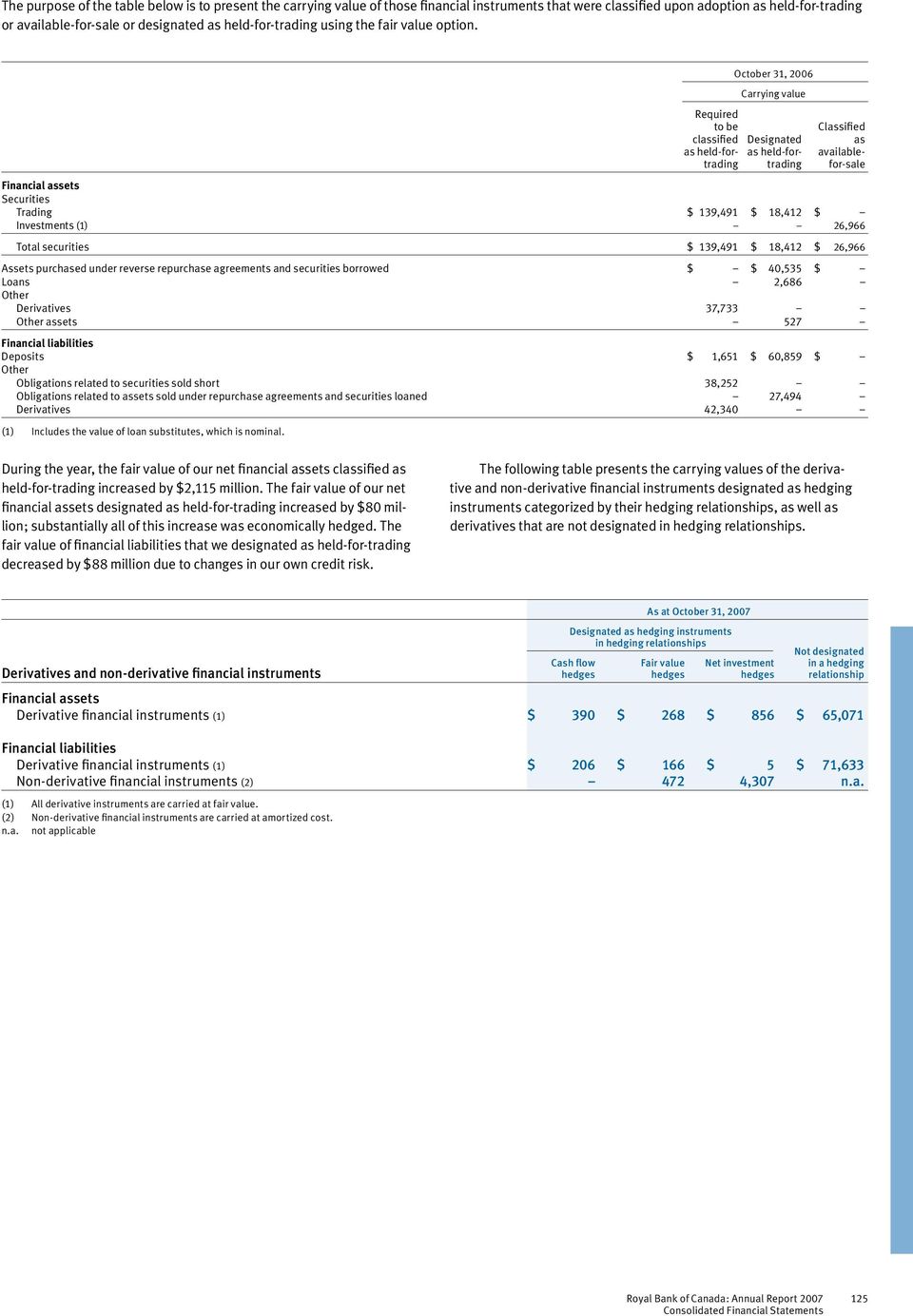
17 Note 2 Fair value of financial instruments (continued) The following table presents the changes in fair value of the financial liabilities designated as held-for-trading using the fair value option as well as their contractual maturity and carrying amounts. October 31, 2007 Difference Change in fair between value since carrying November 1, 2006 amount and attributable Contractual contractual to changes maturity Carrying maturity in RBC s Liabilities designated as held-for-trading amount amount amount credit spread Term deposits Personal $ 890 $ 851 $ (39) $ (6) Business and government 56,741 56, (74) Bank 5,668 5,668 (1) Total term deposits $ 63,299 $ 63,270 $ (29) $ (81) Obligations related to assets sold under repurchase agreements and securities loaned $ 24,087 $ 24,086 $ (1) $ Subordinated debentures (5) (7) Tot al $ 87,468 $ 87,433 $ (35) $ (88) The following table presents information on loans and receivables designated as held-for-trading using the fair value option, the maximum exposure to credit risk, the extent to which the risk is mitigated by credit derivatives and similar instruments, and changes in the fair value of these assets as at October 31, 2007: Change in Cumulative change in fair Change Cumulative fair value value of credit Carrying in fair change in Extent to of credit derivatives amount of value since fair value which credit derivatives or similar loans and November 1, since initial derivatives or similar instruments receivables 2006 recognition or similar instruments since designated Maximum attributable attributable to instruments since designation Loans and receivables designated as held-for-trading as held- exposure to to changes in changes in mitigate November 1, of asset for-trading credit risk credit risk credit risk credit risk 2006 at fair value Interest-bearing deposits with banks $ 4,821 $ 4,821 $ $ $ $ $ Assets purchased under reverse repurchase agreements and securities borrowed 25,522 25,522 Loans 3,235 3,164 (42) (21) 1, Tot al $ 33,578 $ 33,507 $ (42) $ (21) $ 1,106 $ 18 $ 126 Royal Bank of Canada: Annual Report 2007
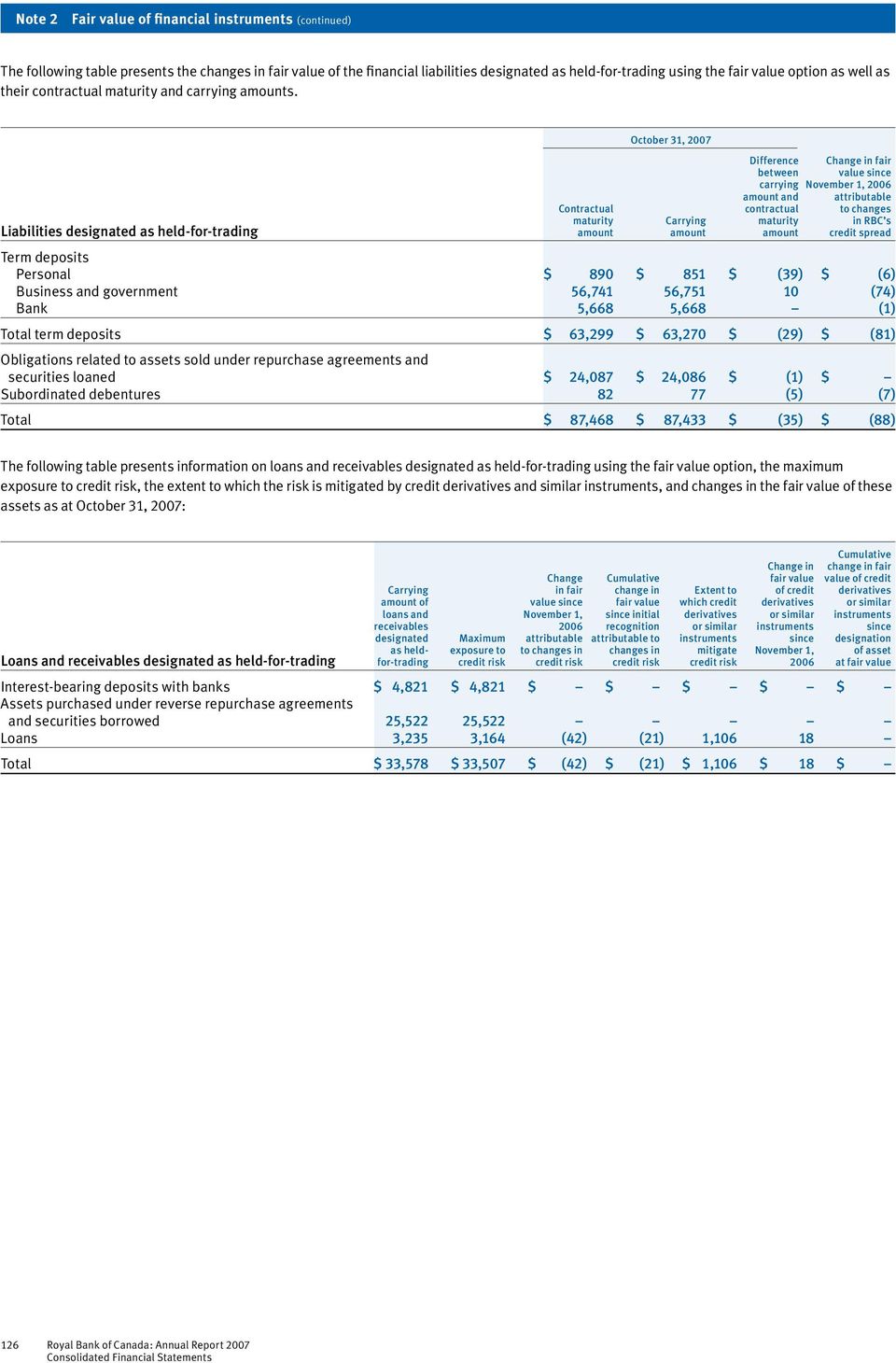
18 Note 3 Securities (1) Term to maturity (2) With no Within 3 3 months 1 to 5 Over 5 years Over specific months to 1 year years to 10 years 10 years maturity Total Total Total Trading account Canadian government debt $ 1,683 $ 3,046 $ 5,106 $ 1,383 $ 2,853 $ $ 14,071 $ 13,900 $ 11,814 U.S. government debt 384 1,066 2, ,106 9,017 7,793 7,281 Other OECD government debt (3) 1,429 2, ,236 4,658 6,476 Mortgage-backed securities ,200 1,176 3,099 5,644 3,841 2,281 Asset-backed securities , ,634 9,064 8,781 Corporate debt and other debt Bankers acceptances Certificates of deposit 704 3, ,712 5,245 8,705 Other 5,189 4,011 24,468 2,220 4,986 1,564 42,438 44,139 33,714 Equities 60,120 60,120 57,831 45,710 8,674 13,184 42,513 5,360 16,831 61, , , ,760 Available-for-sale securities (1) Canadian government debt Federal Amortized cost , ,665 3,649 6,214 Fair value , ,676 3,677 6,205 Yield (4) 3.5% 4.7% 4.4% 4.5% 4.4% 4.2% 3.6% Provincial and municipal Amortized cost ,687 2,035 Fair value ,935 2,229 Yield (4) 4.0% 4.5% 4.2% 5.4% 4.9% U.S. government debt Federal Amortized cost Fair value Yield (4) 4.5% 2.2% State, municipal and agencies Amortized cost , ,039 1,678 2,199 Fair value , ,001 1,648 2,139 Yield (4) 5.3% 5.1% 5.0% 5.6% 5.1% 3.6% 2.5% Other OECD government debt (3) Amortized cost ,595 Fair value ,599 Yield (4) 3.6%.5% 4.2% 4.6% 4.9% 1.4% 2.6% 1.9% Mortgage-backed securities Amortized cost , ,573 9,002 11,805 8,254 Fair value , ,522 8,972 11,692 8,183 Yield (4) 5.2% 4.7% 4.6% 5.2% 5.0% 4.8% 4.5% 4.4% Asset-backed securities Amortized cost ,004 3,164 1,442 Fair value ,939 3,171 1,445 Yield (4) 6.0% 4.2% 4.7% 5.2% 5.3% 5.4% 5.0% 4.2% Corporate debt and other debt Amortized cost 2,563 2,779 3, ,850 11,162 10,676 Fair value 2,554 2,850 3, ,794 11,360 10,839 Yield (4) 4.8% 5.2% 4.5% 5.2% 4.4% 4.8% 4.8% 3.7% Equities (5) Cost 2,715 2,715 2,537 1,012 Fair value 2,874 2,874 2, Loan substitute Cost Fair value Yield (4) 4.6% 5.3% 4.9% 4.8% 3.7% Amortized cost 3,545 4,070 11, 861 2,101 5,481 2,971 30,029 37,632 34,735 Fair value 3,536 4,142 11,749 2,090 5,361 3,126 30,004 38,002 34,924 Held-to-maturity securities (1) Amortized cost Fair value Total carrying value of securities (1) $ 12,210 $ 17,329 $ 54,262 $ 7,450 $ 22,194 $ 64,810 $ 178,255 $184,869 $16 0, 49 5 (1) Available-for-sale securities, including loan substitutes, are carried at fair value and held-to-maturity securities are carried at amortized cost. Prior to November 1, 2006, both availablefor-sale and held-to-maturity securities were classified as Investment securities and were carried at amortized cost. The prior period comparative amounts have not been restated. (2) Actual maturities may differ from contractual maturities shown above, since borrowers may have the right to prepay obligations with or without prepayment penalties. (3) OECD stands for Organisation for Economic Co-operation and Development. (4) The weighted average yield is based on the carrying value at the end of the year for the respective securities. (5) Includes the value of the shares received upon the restructuring of Visa Inc. Refer to Note 30. Royal Bank of Canada: Annual Report

19 Note 3 Securities (continued) Unrealized gains and losses on Available-for-sale securities (1), (2) Realized gains and losses on sale of Available-for-sale securities (1) Gross Gross Gross Gross Amortized unrealized unrealized Fair Amortized unrealized unrealized Fair cost gains losses value cost gains losses value Canadian government debt Federal $ 2,665 $ 12 $ (1) $ 2,676 $ 3,649 $ 29 $ (1) $ 3,677 Provincial and municipal 279 (1) 278 1, ,935 U.S. government debt Federal 536 (28) 508 State, municipal and agencies 2, (48) 2,001 1,678 5 (35) 1,648 Other OECD government debt (2) (1) 761 Mortgage-backed securities 9, (60) 8,972 11, (130) 11,692 Asset-backed securities 2,004 2 (67) 1,939 3, (4) 3,171 Corporate debt and other debt 9, (101) 9,799 11, (40) 11,360 Equities 2, (32) 2,874 2, (55) 2,592 Loan substitute securities 656 (4) $ 30,034 $ 291 $ (316) $ 30,009 $ 37,632 $ 664 $ (294) $ 38,002 (1) Available-for-sale securities, including loan substitutes, are carried at fair value and held-to-maturity securities are carried at amortized cost. Prior to November 1, 2006, both availablefor-sale and held-to-maturity securities were classified as Investment securities and were carried at amortized cost. The prior period comparative amounts have not been restated. (2) Includes $5 million held-to-maturity securities Realized gains $ 187 $ 177 $ 141 Realized losses and writedowns (124) (89) (56) Net gain on sale of Available-for-sale securities $ 63 $ 88 $ 85 (1) Available-for-sale securities, including loan substitutes, are carried at fair value and held-to-maturity securities are carried at amortized cost. Prior to November 1, 2006, both availablefor-sale and held-to-maturity securities were classified as Investment securities and were carried at amortized cost. The prior period comparative amounts have not been restated. Fair value and unrealized losses position for Available-for-sale securities as at October 31, 2007 Less than 12 months 12 months or more Total Fair value Unrealized losses Fair value Unrealized losses Fair value Unrealized losses Canadian government debt Federal $ 1,231 $ 1 $ $ $ 1,231 $ 1 Provincial and municipal U.S. government debt Federal State, municipal and agencies Other OECD government debt Mortgage-backed securities , Asset-backed securities , Corporate debt and other debt 2, , Equities Total temporarily impaired securities $ 5,876 $ 110 $ 2,197 $ 206 $ 8,073 $ 316 The unrealized losses for Canadian government debt and U.S. government debt were caused by increases in interest rates and appreciation of the Canadian dollar against the U.S. dollar. The contractual terms of some of these investments either do not permit the issuer to settle the securities at a price less than the amortized cost of the investment, or permit prepayment of contractual amounts owing only with prepayment penalties assessed to recover interest foregone. As a result, it is not expected that these investments would be settled at a price less than the amortized cost. Further, a substantial amount of the U.S. dollar-denominated debt is hedged against the foreign currency risk and, accordingly, the unrealized losses are not considered to be otherthan-temporarily impaired as at October 31, Unrealized losses for mortgage-backed securities, asset-backed securities, corporate debt and other debt were due to interest rate changes and widening credit spreads caused by the recent disruption in the financial markets, the weakening of the U.S. housing market, credit rating downgrades of certain securities in the marketplace, and appreciation of the Canadian dollar against the U.S. dollar. However, given that a substantial portion of these securities are investmentgrade securities and we have the ability and intent to hold these investments until there is a recovery of fair value, which may be at maturity, we believe it is probable that we will be able to collect the principal amount of these securities according to the contractual terms of the investments. Accordingly, we do not consider these investments to be other-than-temporarily impaired as at October 31, Unrealized losses on equity securities are primarily due to the timing of the market prices, foreign exchange movements, or the early years in the business cycle of the investees for certain investments. We do not consider these investments to be other-than-temporarily impaired as at October 31, 2007, as we have the ability and intent to hold them for a reasonable period of time until they recover their fair value. 128 Royal Bank of Canada: Annual Report 2007

20 The following table presents interest and dividends on Available-for-sale and Held-to-maturity securities: Interest and dividends on Available-for-sale and Held-to-maturity securities (1) Taxable interest income $ 968 $ 1,087 $ 862 Non-taxable interest income Dividends $ 1,044 $ 1,133 $ 895 (1) Available-for-sale securities, including loan substitutes, are carried at fair value and held-to-maturity securities are carried at amortized cost. Prior to November 1, 2006, both availablefor-sale and held-to-maturity securities were classified as Investment securities and were carried at amortized cost. The prior period comparative amounts have not been restated. Note 4 Loans Other Other Canada United States International Total Canada United States International Total Retail (1) Residential mortgages $ 107,453 $ 1,402 $ 890 $ 109,745 $ 94,272 $ 1,518 $ 885 $ 96,675 Personal 42,506 5, ,743 37,946 6, ,902 Credit cards 8, ,322 6, ,155 Small business (2) 2,652 2,652 2,318 2, ,753 6,804 1, , ,502 7,652 1, ,050 Wholesale (1) Business (3), (4) 39,877 17,741 6,239 63,857 35,245 13,611 5,894 54,750 Bank 3, ,547 5,347 2, ,252 Sovereign (5) ,407 18,427 8,133 69,967 37,829 13,847 7,213 58,889 Total loans (6) 204,160 25,231 10, , ,331 21,499 9, ,939 Allowance for loan losses (1,101) (321) (71) (1,493) (1,086) (266) (57) (1,409) Total loans net of allowance for loan losses $ 203,059 $ 24,910 $ 9,967 $ 237,936 $ 178,245 $ 21,233 $ 9,052 $ 208,530 (1) Geographic information is based on residence of borrower. (2) Includes small business exposure managed on a pooled basis. (3) Includes small business exposure managed on an individual client basis. (4) Included under Canada for 2007 are loans totalling $1,202 million to a variable interest entity administered by us. (5) Sovereign refers to all central governments and agencies, central banks, as well as other qualifying public sector entities and multilateral development banks. (6) Loans are net of unearned income of $113 million (2006 $62 million). Loan maturities and rate sensitivity Maturity term (1) Rate sensitivity Under 1 to 5 Over 5 Fixed Non-rate- As at October 31, year years years (2) Total Floating rate sensitive Total Retail $ 63,737 $ 92,337 $ 13,388 $ 169,462 $ 66,256 $ 101,496 $ 1,710 $ 169,462 Wholesale 39,908 22,269 7,790 69,967 48,625 21,342 69,967 Total loans $ 103,645 $ 114,606 $ 21,178 $ 239,429 $ 114,881 $ 122,838 $ 1,710 $ 239,429 Allowance for loan losses (1,493) (1,493) Total loans net of allowance for loan losses $ 103,645 $ 114,606 $ 21,178 $ 237,936 $ 114,881 $ 122,838 $ 1,710 $ 237,936 (1) Based on the earlier of contractual repricing or maturity date. (2) Included in Wholesale are loans totalling $1,202 million to a variable interest entity administered by us, with maturity terms exceeding five years. Impaired loans (1), (2) Specific Gross allowances Net Net Retail Residential mortgages $ 210 $ (23) $ 187 $ 152 Personal 189 (96) Small business (3) 19 (9) 10 4 $ 418 $ (128) $ 290 $ 260 Wholesale Business (4) $ 722 $ (223) $ 499 $ 311 Bank Sovereign (5) $ 722 $ (223) $ 499 $ 311 Tot al $ 1,140 $ (351) $ 789 $ 571 (1) There are $353 million (2006 $305 million) of loans that are contractually 90 days past due but are not considered impaired. (2) Average balance of gross impaired loans was $959 million (2006 $805 million). (3) Includes small business exposure managed on a pooled basis. (4) Includes small business exposure managed on an individual client basis. (5) Sovereign refers to all central governments and agencies, central banks, as well as other qualifying public sector entities and multilateral development banks. Royal Bank of Canada: Annual Report

21 Note 4 Loans (continued) Allowance for loan losses Balance at Provision Balance Balance beginning for credit Other at end at end of year Write-offs Recoveries losses adjustments (1) of year of year Retail Residential mortgages $ 13 $ (5) $ 1 $ 13 $ 1 $ 23 $ 13 Personal 101 (444) Credit cards (268) (1) Small business (2) 9 (42) (759) $ 123 Wholesale Business (3) $ 140 $ (109) $ 42 $ 148 $ 2 $ 223 $ 140 Bank Sovereign (4) Specific allowances $ 263 $ (868) $ 170 $ 782 $ 4 $ 351 $ 263 General allowance (5) 1,223 9 (11) 1,221 1,223 Total allowance for credit losses $ 1,486 $ (868) $ 170 $ 791 $ (7) $ 1,572 $ 1,486 Allowance for off-balance sheet and other items (6) (77) (2) (79) Total allowance for loan losses $ 1,409 $ (868) $ 170 $ 789 $ (7) $ 1,493 $ 1,486 (1) Primarily represent the translation impact of foreign currency-denominated allowance for loan losses. (2) Includes small business exposure managed on a pooled basis. (3) Includes small business exposure managed on an individual client basis. (4) Sovereign refers to all central governments and agencies, central banks, as well as other qualifying public sector entities and multilateral development banks. (5) Includes $79 million (2006 $77 million) related to off-balance sheet and other items. (6) The allowance for off-balance sheet and other items is reported separately under Other liabilities. During the year ended October 31, 2007, assets acquired in respect of problem loans amounted to $36 million (2006 $9 million). Net interest income after provision for credit losses Net interest income $ 7,532 $ 6,796 $ 6,793 Provision for credit losses Net interest income after provision for credit losses $ 6,741 $ 6,367 $ 6,338 Note 5 Securitizations The following table summarizes our securitization activities for 2007, 2006 and 2005: 2007 (1) Canadian Canadian Canadian residential Commercial Credit residential Commercial Credit residential Commercial mortgage mortgage card mortgage mortgage card mortgage mortgage loans (2), (3) loans (4) loans (5) loans (2), (3) loans loans (5) loans (2), (3) loans Securitized and sold $ 6,188 $ 1,937 $ 1,200 $ 6,329 $ 718 $ 1,200 $ 3,752 $ 655 Net cash proceeds received 6,097 1, , , Asset-backed securities purchased Retained rights to future excess interest Pre-tax gain (loss) on sale 55 (14) (1) We did not securitize any credit card loans during the year. (2) All Canadian residential mortgage loans securitized are insured. (3) Canadian insured residential mortgage loans securitized during the year through the creation of mortgage-backed securities and retained as at October 31, 2007 were $3,110 million (2006 $4,869 million, 2005 $1,050 million). These securities are carried at fair value; prior to November 1, 2006, these securities were carried at amortized cost. (4) The net cash proceeds received represent gross proceeds of $1,923 million less funds used to purchase notes of $47 million (principal value of $48 million). We did not purchase any notes as part of our securitization activities in 2006 or (5) The net cash proceeds received represent gross proceeds of $1,200 million in 2006 (2005 $1,200 million) less funds used to purchase notes issued by Golden Credit Card Trust with a principal value of $800 million in 2006 (2005 $600 million). In addition to the above securitization transactions, we sold $815 million of residential mortgage loans in 2006, resulting in a pre-tax loss of $3 million. None were sold in Royal Bank of Canada: Annual Report 2007
22 Cash flows from securitizations (1) Canadian residential Canadian residential Canadian residential Credit mortgage loans Credit mortgage loans Credit mortgage loans card card card loans Variable rate Fixed rate loans Variable rate Fixed rate loans Variable rate Fixed rate Proceeds reinvested in revolving securitizations $ 15,684 $ 1,043 $ 3,559 $ 17,107 $ 466 $ 2,251 $ 12,076 $ 419 $ 1,520 Cash flows from excess spread (2) (1) This analysis is not applicable for commercial mortgage loans securitizations as we have not retained rights to future excess spread in these transactions. (2) Includes servicing fees received. The key assumptions used to value the retained interests at the date of the securitization activities are as follows: Key assumptions (1), (2) 2007 (3) Canadian residential Canadian residential Canadian residential mortgage loans Credit mortgage loans Credit mortgage loans card card Variable rate Fixed rate loans Variable rate Fixed rate loans Variable rate Fixed rate Expected weighted average life of prepayable receivables (in years) Payment rate 29.20% 14.38% % % % % % % Excess spread, net of credit losses Expected credit losses Discount rate 4.71% 4.80% (1) All rates are annualized except the payment rate for credit card loans which is monthly. (2) This analysis is not applicable for commercial mortgage loans securitizations as we have not retained rights to future excess spread in these transactions. (3) We did not securitize any credit card loans during the year. Static pool credit losses include actual incurred and projected credit losses divided by the original balance of the loans securitized. The expected static pool credit loss ratio for securitized credit card loans at October 31, 2007 was.52%. Static credit pool losses are not applicable to residential mortgages as substantially all the mortgages are government guaranteed. The following table summarizes the loan principal, past due and net write-offs for total loans reported on our Consolidated Balance Sheets and securitized loans that we manage as at October 31, 2007 and 2006: Loans managed Loan principal Past due (1) Net write-offs Loan principal Past due (1) Net write-offs Retail $ 192,633 $ 754 $ 718 $ 172,118 $ 654 $ 597 Wholesale 69, , (4) Total loans managed (2) 262,600 1, ,007 1, Less: Loans securitized and managed Credit card loans 3, , Canadian residential mortgage-backed securities created and sold 14,239 12,186 Canadian residential mortgage-backed securities created and retained 5,282 5,232 Total loans reported on the Consolidated Balance Sheets $ 239,429 $ 1,493 $ 698 $ 209,939 $ 1,139 $ 508 (1) Includes impaired loans as well as loans that are contractually 90 days past due but are not considered impaired. (2) Excludes any assets we have temporarily acquired with the intent at acquisition to sell to SPEs. Royal Bank of Canada: Annual Report
23 Note 5 Securitizations (continued) Sensitivity of key assumptions Key assumptions are used to determine the fair value of our retained interests. The following table is a summary of the key assumptions used as at October 31, 2007 and the sensitivity of the current fair value of our retained interests to immediate 10% and 20% adverse changes in these key assumptions. Increase (decrease) in fair value of retained interests due to adverse changes in key assumptions (1), (2) 2007 Canadian residential Credit mortgage loans card loans Variable rate Fixed rate Fair value of retained interests $ 27.5 $ 27.9 $ Weighted average remaining service life (in years) Payment rate 37.39% % % Impact on fair value of 10% adverse change $ (1.6) $ (.8) $ (9.4) Impact on fair value of 20% adverse change (3.2) (1.5) (18.6) Excess spread, net of credit losses 5.72%.68.88%.84.89% Impact on fair value of 10% adverse change $ (5.0) $ (14.0) $ (37.1) Impact on fair value of 20% adverse change (10.0) (28.0) 74.3 Expected credit losses 2.18% % % Impact on fair value of 10% adverse change $ (1.2) $ $ Impact on fair value of 20% adverse change (2.3) Discount rate 10.00% % % Impact on fair value of 10% adverse change $ $ (.2) $ (2.3) Impact on fair value of 20% adverse change (.1) (.3) (4.5) (1) All rates are annualized except for the credit card loans payment rate which is monthly. (2) This analysis is not applicable for commercial mortgage loans securitizations as we have not retained rights to future excess spread in these transactions. These sensitivities are hypothetical and should be used with caution. Changes in fair value based on a variation in assumptions generally cannot be extrapolated because the relationship of the change in assumptions to the change in fair value may not be linear. The effect of a variation in a particular assumption on the fair value of the retained interests is calculated without changing any other assumptions. Generally, the changes in one factor may result in changes in another, which may magnify or counteract the sensitivity. Note 6 Variable interest entities (VIEs) The following table provides information about VIEs as at October 31, 2007 and 2006, in which we have significant variable interests, and those we consolidate under CICA Accounting Guideline 15, Consolidation of Variable Interest Entities (AcG-15), because we are the Primary Beneficiary. 132 Royal Bank of Canada: Annual Report 2007 Maximum exposure Maximum exposure Total assets as at to loss as at Total assets as at to loss as at October 31, 2007 October 31, 2007 October 31, 2006 October 31, 2006 Unconsolidated VIEs in which we have significant variable interests (1): Multi-seller conduits (2) $ 41,785 $ 42,912 $ 34,258 $ 35,031 Third-party conduits 4,264 1,625 2,697 1,018 Credit investment product VIEs 2,676 1,733 Investment funds 1, , Structured finance VIEs ,592 1,465 Other $ 50,709 $ 47,081 $ 43,065 $ 37,901 Consolidated VIEs (3), (4): Investment funds (5) $ 995 $ 1,851 Structured finance VIEs Credit investment product VIEs Compensation vehicles Other $ 2,058 $ 3,455 (1) The maximum exposure to loss resulting from our significant variable interests in these VIEs consists mostly of investments, loans, liquidity facilities and fair value of derivatives. We have recognized $2,165 million (2006 $2,130 million) of this exposure on our Consolidated Balance Sheets. (2) Total assets represent maximum assets that may have to be purchased by the conduits under purchase commitments outstanding as at October 31, Actual assets held by these conduits as at October 31, 2007, were $29,290 million (2006 $24,811 million). (3) The assets that support the obligations of the consolidated VIEs are reported on our Consolidated Balance Sheets primarily as follows: Interest-bearing deposits with banks of $75 million (2006 $120 million), Trading securities of $1,185 million (2006 $2,483 million), Available-for-sale securities of $315 million (2006 $409 million) and Other assets of $401 million (2006 $287 million). The compensation vehicles hold $83 million (2006 $156 million) of our common shares, which are reported as Treasury shares. The obligation to provide common shares to employees is recorded as an increase to Contributed surplus as the expense for the corresponding stock-based compensation plan is recognized. (4) Investors have recourse only to the assets of the related VIEs and do not have recourse to our general assets unless we breach our contractual obligations relating to those VIEs, provide liquidity facilities or credit enhancement facilities to, or enter into derivative transactions with, the VIEs. (5) The implementation of EIC-163 (refer to Note 1) resulted in the deconsolidation of certain investment funds during As at October 31, 2006, the total assets and maximum exposure to loss of these deconsolidated funds were $363 million and $36 million, respectively.
24 Multi-seller and third-party conduits We administer seven multi-seller asset-backed commercial paper conduit programs (multi-seller conduits). These conduits primarily purchase financial assets from clients and finance those purchases by issuing asset-backed commercial paper. Our clients primarily utilize multi-seller conduits to diversify their financing sources and to reduce funding costs. The multi-seller conduits also finance assets that are either in the form of securities including collateralized debt obligations or instruments that closely resemble securities such as credit-linked notes. In these situations, the multi-seller conduit is often one of many investors in the securities or security-like instruments. An unrelated third party (expected loss investor) absorbs credit losses, up to a maximum contractual amount, that may occur in the future on the assets in the multi-seller conduits (multi-seller conduit first-loss position) before the multi-seller conduits debt holders and us. In return for assuming this multi-seller conduit first-loss position, each multi-seller conduit pays the expected loss investor a return commensurate with its risk position. The expected loss investor absorbs a majority of each multi-seller conduit s expected losses, when compared to us; therefore, we are not the Primary Beneficiary and do not consolidate these conduits under AcG-15. However, we continue to hold a significant variable interest in these multi-seller conduits resulting from our provision of backstop liquidity facilities, partial credit enhancement and entitlement to residual fees. We hold significant variable interests in third-party asset-backed security conduits primarily through providing liquidity support and credit enhancement facilities. However we are not the Primary Beneficiary and do not consolidate these conduits under AcG-15. The liquidity and credit enhancement facilities are included and described in our disclosure on guarantees in Note 27. Investment funds We enter into derivatives with third parties including mutual funds, unit investment trusts and other investment funds to provide their investors with the desired exposure and hedge our exposure from these derivatives by investing in other funds. We are the Primary Beneficiary when our participation in the derivative or our investment in other funds exposes us to a majority of the respective expected losses. Structured finance VIEs We finance VIEs that are part of transactions structured to achieve a desired outcome such as limiting exposure to specific assets or risks, obtaining indirect exposure to financial assets, supporting an enhanced yield, funding specific assets and meeting client requirements. We consolidate structured finance VIEs in which our interests expose us to a majority of the expected losses. Creation of credit investment products We use VIEs to generally transform credit derivatives into cash instruments, to distribute credit risk and to create customized credit products to meet investors specific requirements. We enter into derivative contracts with these entities in order to convert various risk factors such as yield, currency or credit risk of underlying assets to meet the needs of the investors. We transfer assets to these VIEs as collateral for notes issued but the transfer of assets does not meet sale recognition criteria under AcG-12. In certain instances, we invest in the notes issued by these VIEs, which requires us to consolidate them when we are the Primary Beneficiary. Compensation vehicles We use compensation trusts, which primarily hold our own common shares, to economically hedge our obligation to certain employees under some of our stock-based compensation programs. We consolidate the trusts in which we are the Primary Beneficiary. Capital trusts RBC Subordinated Notes Trust (Trust III) was created in 2007 to issue $1 billion of innovative subordinated debentures and RBC Capital Trust II (Trust II) was created in 2003 to issue $900 million of innovative capital instruments. We issued senior deposit notes of the same amounts to Trust II, and a senior deposit note of $999.8 million to Trust III. Although we own the common equity and voting control of these trusts, we are not the Primary Beneficiary since we are not exposed to the majority of the expected losses, and we do not have a significant interest in these trusts. For details on our innovative capital instruments, refer to Note 17. Securitization of our financial assets We employ SPEs in the process of securitizing our assets, none of which are consolidated under AcG-15. One entity is a QSPE under AcG-12, which is specifically exempt from consolidation under AcG-15, and our level of participation in each of the remaining SPEs relative to others does not expose us to a majority of the expected losses. We also do not have significant interests in these SPEs. For details on our securitization activities, refer to Note 5. Note 7 Derivative financial instruments and hedging activities Derivative financial instruments are financial contracts whose value is derived from an underlying interest rate, foreign exchange rate, equity or commodity instrument or index. Types of derivatives Forwards and futures Forward contracts are effectively tailor-made agreements that are transacted between counterparties in the over-the-counter market, whereas futures are standardized contracts with respect to amounts and settlement dates, and are traded on regular future exchanges. Examples of forwards and futures are described below: Interest rate forwards (forward rate agreements) and futures are contractual obligations to buy or sell an interest-rate sensitive financial instrument on a predetermined future date at a specified price. Foreign exchange forwards and futures are contractual obligations to exchange one currency for another at a specified price for settlement at a predetermined future date. Equity forwards and futures are contractual obligations to buy or sell at a fixed value (the contracted price) of an equity index, a basket of stocks or a single stock at a predetermined future date. Swaps Swaps are over-the-counter contracts in which two counterparties exchange a series of cash flows based on agreed upon rates to a notional amount. The various swap agreements that we enter into are as follows: Interest rate swaps are agreements where two counterparties exchange a series of payments based on different interest rates applied to a notional amount in a single currency. Cross currency swaps involve the exchange of fixed payments in one currency for the receipt of fixed payments in another currency. Cross currency interest rate swaps involve the exchange of both interest and principal amounts in two different currencies. Equity swaps are contracts in which one counterparty agrees to pay or receive from the other cash flows based on changes in the value of an equity index, a basket of stocks or a single stock. Royal Bank of Canada: Annual Report
25 Note 7 Derivative financial instruments and hedging activities (continued) Options Options are contractual agreements under which the seller (writer) grants the purchaser the right, but not the obligation, either to buy (call option) or sell (put option), a security, exchange rate, interest rate, or other financial instrument or commodity at a predetermined price, at or by a specified future date. The seller (writer) of an option can also settle the contract by paying the cash settlement value of the purchaser s right. The seller (writer) receives a premium from the purchaser for this right. The various option agreements that we enter into include interest rate options, foreign currency options and equity options. Credit derivatives Credit derivatives are over-the-counter contracts that transfer credit risk related to an underlying financial instrument (referenced asset) from one counterparty to another. Examples of credit derivatives include credit default swaps, credit default baskets and total return swaps. Credit default swaps provide protection against the decline in value of the referenced asset as a result of specified credit events such as default or bankruptcy. It is similar in structure to an option whereby the purchaser pays a premium to the seller of the credit default swap in return for payment related to the deterioration in the value of the referenced asset. Credit default baskets are similar to credit default swaps except that the underlying referenced financial instrument is a group of assets instead of a single asset. Total return swaps are contracts where one counterparty agrees to pay or receive from the other cash flows based on changes in the value of the referenced asset. Other derivative products We also transact in other derivative products including precious metal and commodity derivative contracts in both the over-the-counter and exchange markets. Certain warrants and loan commitments that meet the definition of derivative are also included as derivative instruments. Derivatives issued for trading purposes Most of our derivative transactions relate to sales and trading activities. Sales activities include the structuring and marketing of derivative products to clients to enable them to transfer, modify or reduce current or expected risks. Trading involves market-making, positioning and arbitrage activities. Market-making involves quoting bid and offer prices to other market participants with the intention of generating revenue based on spread and volume. Positioning involves managing market risk positions with the expectation of profiting from favourable movements in prices, rates or indices. Arbitrage activities involve identifying and profiting from price differentials between markets and products. Derivatives issued for other than trading purposes We also use derivatives for purposes other than trading, primarily for hedging, in conjunction with the management of interest rate, credit and foreign exchange risk related to our own asset/liability management, funding and investment activities. Interest rate swaps are used to adjust exposure to interest rate risk by modifying the repricing or maturity characteristics of existing and/or anticipated assets and liabilities, including funding and investment activities. Purchased interest rate options are used to hedge redeemable deposits and other options embedded in consumer products. We manage our exposure to foreign currency risk with cross currency swaps and foreign exchange forward contracts. We use credit derivatives to manage our credit exposures and for risk diversification in our lending portfolio. Certain derivatives and cash instruments are specifically designated and qualify for hedge accounting. We apply hedge accounting to minimize significant unplanned fluctuations in earnings caused by changes in interest rates or foreign exchange rates. Interest rate and currency fluctuations will either cause assets and liabilities to appreciate or depreciate in market value or cause variability in anticipated cash flows. When a hedging instrument functions effectively, gains, losses, revenue and expenses of the hedging instrument will offset the gains, losses, revenue and expenses of the hedged item. When derivatives are designated as the hedging instrument, all components of each derivative s change in fair value are included in the assessment and measurement of hedge effectiveness. When cash instruments are designated for hedges of currency risks, only changes in their value due to currency risk are included in the assessment and measurement of hedge effectiveness. We did not apply hedge accounting to any anticipated transactions or firm commitments during the year. As at October 31, 2007, after-tax net unrealized gains of $24 million were recognized in AOCI, representing the cumulative effective portions of our cash flow hedges. The net amount of gains and losses reported in AOCI that is expected to be reclassified to Net interest income within the next 12 months is not estimated to be material. From time to time, we also enter into derivative transactions to economically hedge certain business strategies that do not otherwise qualify for hedge accounting, or where hedge accounting is not considered economically feasible to implement. In such circumstances, changes in fair value are reflected in Non-interest income. Hedge activities 2007 After-tax Net gains (losses) Net gains (losses) unrealized included in included in gains (losses) Non-interest income Net interest income included in OCI Fair value hedges Ineffective portion $ (14) $ n.a. $ n.a. Cash flow hedges Ineffective portion (9) n.a. n.a. Effective portion n.a. n.a. 80 Reclassified to income during the year (1) n.a. (47) n.a. Net investment hedges Foreign currency losses n.a. n.a. (2,965) Gains from hedges n.a. n.a. 1,804 (1) An after-tax equivalent amount of $31 million was reclassified from AOCI. n.a. not applicable 134 Royal Bank of Canada: Annual Report 2007
26 Notional amount of derivatives by term to maturity Term to maturity Within 1 to Over 5 Other than Other than 1 year 5 years years (1) Total Trading trading Trading trading Over-the-counter contracts Interest rate contracts Forward rate agreements $ 197,733 $ 4,120 $ $ 201,853 $ 201,853 $ $ 315,378 $ Swaps 896, , ,855 2,254,546 2,096, ,393 1,874, ,232 Options purchased 22,986 35,405 32,197 90,588 89,585 1,003 99, Options written 38,403 39,854 71, , , ,566 Foreign exchange contracts Forward contracts 706,342 21,149 14, , ,961 30, ,484 33,033 Cross currency swaps 2,648 7,978 7,521 18,147 17, ,553 1,072 Cross currency interest rate swaps 53, ,584 82, , ,319 36, ,090 20,707 Options purchased 28,961 7, ,763 36, , Options written 30,500 7, ,355 38,355 68, Credit derivatives (2) 18, , , , ,247 5, ,054 2,722 Other contracts (3) 22,614 20,129 31,203 73,946 73, , Exchange-traded contracts Interest rate contracts Futures long positions 68,553 8, ,364 77, , Futures short positions 112,912 19, , , , Options purchased 14, ,964 14,964 71,926 Options written 4,656 4,656 4, ,194 Foreign exchange contracts Futures long positions ,070 Futures short positions 9, ,689 9,689 26,088 Other contracts (3) 252,784 1, , , ,154 $ 2,482,840 $ 1,406,669 $ 887,167 $ 4,776,676 $ 4,542,886 $ 233,790 $ 4,513,409 $ 199,972 (1) Includes contracts maturing in over 10 years with a notional value of $205,976 million (2006 $135,951 million). The related gross positive replacement cost is $10,910 million (2006 $3,857 million). (2) Comprises credit default swaps, total return swaps and credit default baskets, including credit derivatives given guarantee treatment for the OSFI regulatory reporting purposes. Credit derivatives with a notional value of $5,530 million (2006 $2,116 million) are economic hedges. (3) Comprises precious metal, commodity and equity-linked derivative contracts other than embedded equity-linked contracts. The following table provides the fair value of our derivative financial instruments: Fair value of derivative instruments Average fair value Year-end Average fair value Year-end for year ended (1) fair value for year ended (1) fair value Positive Negative Positive Negative Positive Negative Positive Negative Held or issued for trading purposes Interest rate contracts Forward rate agreements $ 44 $ 49 $ 72 $ 25 $ 52 $ 50 $ 44 $ 60 Swaps 13,938 14,241 14,250 14,446 12,150 12,003 12,258 11,969 Options purchased Options written ,603 15,076 14,810 15,096 12,997 12,941 12,904 12,727 Foreign exchange contracts Forward contracts 8,342 8,508 14,503 14,410 6,740 6,969 5,493 5,758 Cross currency swaps 2,231 1,522 3,066 2,141 2,041 1,522 2,151 1,522 Cross currency interest rate swaps 8,987 9,419 13,634 14,250 7,010 8,275 6,703 8,319 Options purchased 1,044 1,221 1,571 1,055 Options written 1,028 1,302 1, ,604 20,477 32,424 32,103 17,362 18,348 15,402 16,593 Credit derivatives (2) 3,964 3,508 10,416 9,375 1, ,795 1,580 Other contracts (3) 6,096 9,537 4,925 10,317 5,623 8,803 5,798 9,221 $ 45,267 $ 48,598 $ 62,575 $ 66,891 $ 37,121 $ 41,067 $ 35,899 $ 40,121 Held or issued for other than trading purposes Interest rate contracts Swaps $ 1,110 $ 760 $ 1,100 $ 940 Options purchased 6 Options written 25 1, , Foreign exchange contracts Forward contracts Cross currency swaps Cross currency interest rate swaps 1,371 3, Options purchased 1 Options written 1 2,294 4, Credit derivatives (2) Other contracts (3) ,466 5,004 1,920 2,124 Total gross fair values before netting (4) 66,041 71,895 37,819 42,245 Impact of master netting agreements With intent to settle net or simultaneously (5) (473) (473) (137) (137) Without intent to settle net or simultaneously (6) (38,256) (38,256) (18,952) (18,952) Total $ 27,312 $ 33,166 $ 18,730 $ 23,156 (1) Average fair value amounts are calculated based on monthly balances. (2) Comprises credit default swaps, total return swaps and credit default baskets, including credit derivatives given guarantee treatment for the OSFI regulatory reporting purposes. (3) Comprises precious metal, commodity and equity-linked derivative contracts. Certain warrants and loan commitments that meet the definition of derivatives are also included. (4) The positive year-end fair value excludes margin requirements of $1,017 million (2006 $721 million) and the negative year-end fair value excludes market and credit valuation adjustments of $588 million (2006 $366 million). (5) Impact of offsetting credit exposures on contracts where we have both a legally enforceable master netting agreement in place and we intend to settle the contracts on either a net basis or simultaneously. (6) Additional impact of offsetting credit exposures on contracts where we have a legally enforceable master netting agreement in place but do not intend to settle the contracts on a net basis or simultaneously. Royal Bank of Canada: Annual Report
27 Note 7 Derivative financial instruments and hedging activities (continued) Derivative-related credit risk Credit risk from derivative transactions is generated by the potential for the counterparty to default on its contractual obligations when one or more transactions have a positive market value to us. Therefore, derivative-related credit risk is represented by the positive fair value of the instrument and is normally a small fraction of the contract s notional amount. We subject our derivative-related credit risk to the same credit approval, limit and monitoring standards that we use for managing other transactions that create credit exposure. This includes evaluating the creditworthiness of counterparties, and managing the size, diversification and maturity structure of the portfolio. Credit utilization for all products is compared with established limits on a continual basis and is subject to a standard exception reporting process. We utilize a single internal rating system for all credit risk exposure. In most cases, these internal ratings approximate the external risk ratings of public rating agencies. Netting is a technique that can reduce credit exposure from derivatives and is generally facilitated through the use of master netting agreements. The master netting agreement provides for a single net settlement of all financial instruments covered by the agreement in the event of default. However, credit risk is reduced only to the extent that our financial obligations to the same counterparty can be set off against obligations of the counterparty to us. The two main categories of netting are close-out netting and settlement netting. Under the close-out netting provision, if the counterparty defaults, we have the right to terminate all transactions covered by the master netting agreement at the then-prevailing market values and to sum the resulting market values, offsetting negative against positive values, to arrive at a single net amount owed by either the counterparty or us. Under the settlement netting provision, all payments and receipts in the same currency and due on the same day between specified branches are netted, generating a single payment in each currency, due either by us or the counterparty. We maximize the use of master netting agreements to reduce derivative-related credit exposure. Our overall exposure to credit risk that is reduced through master netting agreements may change substantially following the reporting date as the exposure is affected by each transaction subject to the agreement as well as by changes in underlying market rates. Measurement of our credit exposure arising out of derivative transactions is reduced to reflect the effects of netting in cases where the enforceability of that netting is supported by appropriate legal analysis as documented in our trading credit risk policies. The use of collateral is another significant credit mitigation technique for managing derivative-related counterparty credit risk. Marked-to-market provisions in our agreements with some counterparties, typically in the form of a Credit Support Annex, provide RBC with the right to request that the counter party pay down or collateralize the current market value of its derivatives positions when the value passes a specified threshold amount. During 2007, 2006 and 2005, neither our actual credit losses arising from derivative transactions nor the level of impaired derivative contracts were significant. The tables below show replacement cost, credit equivalent and risk-adjusted amounts of our derivatives both before and after the impact of netting. Replacement cost represents the total fair value of all outstanding contracts in a gain position, before factoring in the master netting agreements. The amounts in the table below exclude fair value of $955 million (2006 $734 million) relating to exchange-traded instruments as they are subject to daily margining and are deemed to have no credit risk. The credit equivalent amount is defined as the sum of the replacement cost plus an add-on amount for potential future credit exposure as defined by the OSFI. The risk-adjusted amount is determined by applying the standard OSFI-defined measures of counterparty risk to the credit equivalent amount. Derivative-related credit risk Replacement Credit equivalent Risk-adjusted Replacement Credit equivalent Risk-adjusted cost amount balance cost amount balance Interest rate contracts Forward rate agreements $ 72 $ 92 $ 22 $ 44 $ 109 $ 22 Swaps 15,360 23,484 5,213 13,358 21,031 4,452 Options purchased 364 1, , ,796 24,608 5,483 13,993 22,304 4,734 Foreign exchange contracts Forward contracts 15,424 22,222 5,674 5,595 12,413 3,310 Swaps 18,073 32,901 6,138 9,466 22,697 4,305 Options purchased 1,221 1, ,056 2, ,718 56,955 12,278 16,117 37,354 8,117 Credit derivatives (1) 10,416 35,026 8,465 1,795 6,975 2,009 Other contracts (2) 4,120 6,723 2,251 5,160 8,696 2,760 Derivatives before master netting agreements $ 65,050 $ 123,312 $ 28,477 $ 37,065 $ 75,329 $ 17,620 Impact of master netting agreements (38,729) (65,339) (14,020) (19,089) (31,831) (7,188) Total derivatives after master netting agreement (3) $ 26,321 $ 57,973 $ 14,457 $ 17,976 $ 43,498 $ 10,432 (1) Comprises credit default swaps, total return swaps and credit default baskets. The above excludes credit derivatives issued for other than trading purposes related to bought and sold protection with a replacement cost of $36 million (2006 $20 million). Credit derivatives issued for other than trading purposes related to sold protection with a replacement cost of $.4 million (2006 $20 million) had a credit equivalent amount of $447 million (2006 $283 million) and risk-adjusted asset amount of $447 million (2006 $283 million) which were given guarantee treatment per the OSFI guidance. (2) Comprises precious metal, commodity and equity-linked derivative contracts. (3) The total credit equivalent amount after netting includes collateral applied of $2,228 million (2006 $1,310 million). 136 Royal Bank of Canada: Annual Report 2007
28 Replacement cost of derivative financial instruments by risk rating and by counterparty type Risk rating (1) Counterparty type (2) BB or OECD As at October 31, 2007 AAA, AA A BBB lower Total Banks governments Other Total Gross positive replacement cost $ 42,142 $ 14,731 $ 6,149 $ 2,064 $ 65,086 $ 38,250 $ 8,188 $ 18,648 $ 65,086 Impact of master netting agreements (28,042) (8,047) (2,367) (273) (38,729) (31,193) (7,536) (38,729) Replacement cost (after netting agreements) (3) $ 14,100 $ 6,684 $ 3,782 $ 1,791 $ 26,357 $ 7,057 $ 8,188 $ 11,112 $ 26,357 Replacement cost (after netting agreements) 2006 (3) $ 8,573 $ 5,393 $ 2,270 $ 1,760 $ 17,996 $ 5,678 $ 5,891 $ 6,427 $ 17,996 (1) Our internal risk ratings for major counterparty types approximate those of public rating agencies. Ratings of AAA, AA, A and BBB represent investment grade ratings and ratings of BB or lower represent non-investment grade ratings. (2) Counterparty type is defined in accordance with the capital adequacy requirements of the OSFI. (3) Includes credit derivatives issued for other than trading purposes with a total replacement cost of $36 million (2006 $20 million). Note 8 Premises and equipment Accumulated Net book Accumulated Net book Cost depreciation value Cost depreciation value L a n d $ 133 $ $ 133 $ 134 $ $ 134 Buildings Computer equipment 3,049 1,986 1,063 2,462 1, Furniture, fixtures and other equipment 1, , Leasehold improvements 1, , $ 5,941 $ 3,810 $ 2,131 $ 5,246 $ 3,428 $ 1,818 The depreciation expense for premises and equipment for 2007 was $434 million (2006 $405 million; 2005 $414 million). Note 9 RBC Dexia Investor Services joint venture RBC Dexia Investor Services We operate our institutional and investor services business (IIS) through our joint venture, RBC Dexia Investor Services (RBC Dexia IS). During the year, RBC Dexia IS finalized the net assets contribution requirement outlined in the joint venture agreement. As a result, it was determined that we had contributed 27 million ($41 million) of net assets in excess of the amount required. This excess was settled by RBC Dexia IS in cash and recognized by us as a reduction in our investment in the joint venture. Assets and liabilities representing our interest in RBC Dexia IS and our proportionate share of its financial results before adjusting for related party transactions are presented in the following tables: As at October 31, October 31, Consolidated Balance Sheets Assets (1) $ 15,544 $ 12,354 Liabilities 14,533 11,396 (1) Includes $69 million (2006 $69 million) of goodwill and $179 million (2006 $208 million) of intangible assets. For the For the nine year ended months ended October 31, October 31, (1) Consolidated Statements of Income Net interest income $ 116 $ 75 Non-interest income Non-interest expense Net income Consolidated Statements of Cash Flows Cash flows from (used in) operating activities $ (546) $ (71) Cash flows from (used in) investing activities (2,299) (97) Cash flows from (used in) financing activities 2, (1) For the year ended October 31, 2006, we did not report our proportionate share of RBC Dexia IS results for our quarter ended January 31, 2006 as the joint venture was formed on January 2, 2006, and we report its results on a one-month lag basis. We provide certain services to RBC Dexia IS, which include administrative and technology support, human resources, and credit and banking facilities to support its operations. RBC Dexia IS also provides certain services to us, including custody and trusteeship, fund and investment administration, transfer agency and investor services. These services and facilities are provided by the respective parties in the normal course of operations on terms similar to those offered to non-related parties. The amount of income earned and expenses incurred by RBC Dexia IS related to transactions with RBC are as follows: For the For the nine year ended months ended October 31, October 31, (1) Net interest income $ 157 $ 99 Non-interest income Non-interest expense (1) For the year ended October 31, 2006, we did not report the amounts of income earned and expenses incurred by RBC Dexia IS related to transactions with RBC for our quarter ended January 31, 2006 as the joint venture was formed on January 2, 2006, and we report its results on a one-month lag basis. Royal Bank of Canada: Annual Report
29 Note 10 Goodwill and other intangibles Effective February 7, 2007, as discussed in Note 30, our previous three business segments were reorganized into four business segments. This reorganization resulted in the realignment of certain reporting units. Accordingly, we have reallocated our goodwill to the new reporting units using the relative fair value approach. The following table discloses the changes in goodwill during 2006 and 2007, including the reallocation of goodwill to the new reporting units: Goodwill RBC RBC U.S. and Canadian International RBC Personal and Personal and Capital Business Business Markets Total Balance at October 31, 2005 $ 2,419 $ 831 $ 953 $ 4,203 Goodwill acquired during the year Other adjustments (1), (2) 72 (17) (40) 15 Balance at October 31, 2006 $ 2,491 $ 900 $ 913 $ 4,304 Goodwill acquired between November 1, 2006 and January 31, Other adjustments (3) Balance at January 31, 2007 $ 2,500 $ 1,364 $ 1,068 $ 4,932 (1) Other adjustments in 2006 primarily include the impact of foreign exchange translations on foreign currency-denominated goodwill, changes in goodwill related to our IIS business with RBC Dexia IS (refer to Note 9), and the transfer of $6 million of housing tax credit syndication business goodwill from RBC U.S. and International Personal and Business to RBC Capital Markets. Refer to Note 30. (2) During 2006, we adjusted the foreign exchange translation of certain foreign currency-denominated goodwill of RBC Canadian Personal and Business to better align with the nature of the net assets supporting the segment. This resulted in an increase of $182 million of goodwill for RBC Canadian Personal and Business. A corresponding increase was made to Unrealized foreign currency translation adjustments on our Consolidated Statements of Changes in Shareholders Equity. (3) Other adjustments in the first quarter of 2007 primarily include the impact of foreign exchange translations on foreign currency-denominated goodwill. As a result of the application of the relative fair value approach for the business reorganization, goodwill as at January 31, 2007 has been reallocated as follows: Reallocation of goodwill Goodwill Goodwill balance before U.S. & balance after business Canadian Wealth International Capital business reorganization Banking Management Banking Markets reorganization RBC Canadian Personal and Business $ 2,500 $ 2,069 $ 431 $ $ $ 2,500 RBC U.S. and International Personal and Business 1, ,364 RBC Capital Markets 1, ,068 Balance at January 31, 2007 $ 4,932 $ 2,069 $ 1,014 $ 890 $ 959 $ 4,932 Goodwill acquired between February 1 and October 31, Other adjustments (1) (552) (19) (163) (217) (153) (552) Balance at October 31, 2007 $ 4,752 $ 2,050 $ 882 $ 996 $ 824 $ 4,752 (1) Other adjustments in the last three quarters of 2007 primarily include the impact of foreign exchange translations on foreign currency-denominated goodwill. We have also completed the annual assessment for goodwill impairment in all reporting units and have determined that there was no goodwill impairment for the year ended October 31, 2007 (2006 nil; 2005 nil). Other intangibles Gross carrying Accumulated Net carrying Gross carrying Accumulated Net carrying amount amortization (1) amount amount amortization (1) amount Core deposit intangibles $ 376 $ (170) $ 206 $ 324 $ (163) $ 161 Customer lists and relationships 605 (200) (156) 469 Mortgage servicing rights 47 (30) (32) 12 (1) Total amortization expense for 2007 was $96 million (2006 $76 million; 2005 $50 million). $ 1,028 $ (400) $ 628 $ 993 $ (351) $ 642 The projected amortization of Other intangibles for each of the years ending October 31, 2008 to October 31, 2012 is approximately $86 million. There were no writedowns of intangible assets due to impairment for the year ended October 31, 2007 (2006 nil; 2005 nil). 138 Royal Bank of Canada: Annual Report 2007
30 Note 11 Significant acquisitions and dispositions 2007 In December 2006, we completed the acquisition of Atlanta, Georgiabased Flag Financial Corporation (Flag) and its subsidiary, Flag Bank, and in March 2007, we completed the acquisition of 39 branches of AmSouth Bank in Alabama (AmSouth branches). Details of these acquisitions are as follows: Flag AmSouth branches (1) Acquisition date December 8, 2006 March 9, 2007 Business segment U.S. & International Banking U.S. & International Banking Percentage of shares acquired 100% n.a. Purchase consideration in the currency of the transaction Cash payment of US$435 Cash payment of US$343 Purchase consideration in Canadian dollar equivalent $ 498 $ 405 Fair value of tangible assets acquired $ 1,912 $ 2,368 Fair value of liabilities assumed (1,870) (2,369) Fair value of identifiable net assets acquired (net liabilities assumed) 42 (1) Core deposit intangibles and other intangibles (2), (3) Goodwill Total purchase consideration $ 498 $ 405 (1) The purchase price allocation for the AmSouth branches is preliminary; it will be finalized once the valuations of certain assets and liabilities are completed. (2) Core deposit intangibles are amortized on a straight-line basis over an estimated average useful life of seven years. (3) Included in the acquisition of Flag was $7 million of Other intangibles ($nil for AmSouth branches) which relates to non-compete agreements and are amortized over the term of the agreements for a maximum of three years. n.a. not applicable Other acquisitions Capital Markets During 2007, we completed three acquisitions for a total cost of US$150 million (C$170 million), which were paid in cash: (i) Ohiobased Seasongood & Mayer, LLC, a public finance firm and leading underwriter of municipal debt, and its wholly owned subsidiary, Seasongood Asset Management, an investment advisor to public funds clients, (ii) the broker-dealer business and certain other assets of the Carlin Financial Group, a New York-based broker-dealer, and (iii) Colorado-based Daniels & Associates, L.P., an M&A advisory firm specializing in the communications, media and entertainment, and technology sectors. These acquisitions are not material to Capital Markets and resulted in goodwill of $160 million. Wealth Management On May 18, 2007, we completed the acquisition of New Jersey-based J.B. Hanauer & Co., a privately held financial services firm which specializes in retail fixed income and wealth management services, for US$42 million (C$45 million) in cash. The acquisition is not material to Wealth Management and resulted in goodwill of $18 million. Pending acquisitions U.S. & International Banking On April 17, 2007, we announced our intention to acquire a 50% interest in Fidelity Merchant Bank & Trust Limited, the Bahamas-based wholly owned subsidiary of Fidelity Bank & Trust International Limited to form a joint venture to be called Royal Fidelity Merchant Bank & Trust Limited which will provide certain corporate finance and advisory, investment management, stock brokerage, share registrar and transfer agency, pension and mutual fund administration services. This transaction is expected to close in the first quarter of On September 6, 2007, RBC Centura Banks, Inc. announced the signing of a definitive merger agreement pursuant to which RBC Centura Banks, Inc. agreed to acquire Birmingham-based Alabama National BanCorporation (ANB), parent of 10 subsidiary banks and other affiliated businesses in Alabama, Florida and Georgia. Under the agreement, shareholders of ANB will receive US$80 per share payable in cash, RBC common shares or a combination of each, valuing the deal at approximately US$1.6 billion (C$1.5 billion as at October 31, 2007), with the total transaction consideration consisting of one-half cash and one-half RBC common shares. The acquisition is subject to customary closing conditions, including approval by U.S. and Canadian regulators and by ANB shareholders. The transaction is expected to close in early calendar year On October 2, 2007, we and the RBTT Financial Group (RBTT) announced an agreement to combine our Caribbean retail banking operations with RBTT s through the acquisition of RBTT for a total purchase price of TT$13.8 billion (C$2 billion as at October 31, 2007). RBTT is a Caribbean-owned banking and financial services group which offers a complete range of banking and financial intermed iate services to customers in Trinidad and Tobago and the Caribbean. Under the agreement, RBTT shareholders will receive per share consideration of TT$40 payable 60% in cash and 40% in RBC common shares. The number of RBC common shares to be received by RBTT shareholders is subject to a plus/minus 10% collar based on our share price of US$ The acquisition is subject to customary closing conditions, including approval by the Trinidad and Tobago and Canadian and other regulators and RBTT shareholders. This transaction is expected to close by the middle of calendar year Royal Bank of Canada: Annual Report
31 Note 11 Significant acquisitions and dispositions (continued) 2006 Acquisitions Wealth Management In November 2005, we completed the acquisition of operations of Abacus Financial Services Group Limited (Abacus) in London, Jersey, Guernsey, Edinburgh and Cheltenham. Abacus is based in Jersey, Channel Islands, and provides wealth management and fiduciary services to private and corporate clients primarily in the British Isles and Continental Europe. In October 2006, we completed the acquisition of American Guaranty & Trust (AG&T) which is based in Wilmington, Delaware, and offers complete personal trust and custody services through a unique strategic partnership with professional advisors. The details of these acquisitions are as follows: Acquisition date November 30, 2005 October 3, 2006 Business segment Wealth Management (1) Wealth Management (1) Percentage of shares acquired 100% 100% Purchase consideration in the currency of the transaction Cash payment of $105 (2) Cash payment of US$12.5 Purchase consideration in Canadian dollar equivalent $ 213 $ 14 Fair value of tangible assets acquired $ 43 $ 3 Fair value of liabilities assumed (23) Fair value of identifiable net tangible assets acquired 20 3 Customer lists and relationships (3) Goodwill 77 9 Total purchase consideration $ 213 $ 14 (1) These acquisitions, which were previously included in the operations of RBC U.S. and International Personal and Business segment, are included in the Wealth Management business segment effective February 2, 2007 upon reorganization of our business segments. Refer to Note 30. (2) Includes 20 million placed in an escrow account for future payments of claims as agreed to in the purchase agreement. Amounts remaining in the escrow account will be released to the vendors over a three-year period after completion of the acquisition. (3) Customer lists and relationships are amortized on a straight-line basis over an estimated average useful life of 15 years. Abacus AG&T Dispositions On September 2, 2005, we completed the sale of RBC Mortgage Company (RBC Mortgage) to New Century Mortgage Corporation and Home123 Corporation (Home123), pursuant to which Home123 acquired certain assets of RBC Mortgage including its branches, and hired substantially all of its employees. RBC Mortgage disposed of substantially all of its remaining assets and obligations by the end of 2006 and the residual balances of RBC Mortgage in 2007 are immaterial. These residual balances are no longer recorded separately in our for 2007 and changes in the amounts are now reported in Corporate Support. Prior to 2007, the results of RBC Mortgage are presented separately as discontinued operations. Note 12 Other assets Receivable from brokers, dealers and clients $ 4,048 $ 3,172 Accrued interest receivable 2,608 2,229 Investment in associated corporations and limited partnerships 1,420 1,614 Insurance-related assets (1) Net future income tax asset (refer to Note 24) 1,251 1,104 Prepaid pension benefit cost (2) (refer to Note 20) Cheques and other items in transit 489 Other 7,109 5,346 $ 17,853 $ 15,417 (1) Insurance-related assets include policy loan balances, premiums outstanding, amounts due from other insurers in respect of reinsurance contracts and pooling arrangements, and deferred acquisition costs. (2) Prepaid pension benefit cost represents the cumulative excess of pension fund contributions over pension benefit expense. 140 Royal Bank of Canada: Annual Report 2007
32 Note 13 Deposits The following table details our deposit liabilities: Demand (1) Notice (2) Term (3) Total Total Personal $ 14,022 $ 36,537 $ 65,998 $ 116,557 $ 114,040 Business and government (4), (5) 64,934 16, , , ,140 Bank 4, ,406 28,762 40,343 $ 83,091 $ 53,688 $ 228,426 $ 365,205 $ 343,523 Non-interest-bearing Canada $ 28,254 $ 19,088 United States 2,285 2,293 Other International 1,693 1,241 Interest-bearing Canada (4), (5) 155, ,170 United States 41,514 50,123 Other International 136,269 96,608 $ 365,205 $ 343,523 (1) Deposits payable on demand include all deposits for which we do not have the right to notice of withdrawal. These deposits are primarily chequing accounts. (2) Deposits payable after notice include all deposits for which we can legally require notice of withdrawal. These deposits are primarily savings accounts. (3) Term deposits include deposits payable on a fixed date. These deposits include term deposits, guaranteed investment certificates and similar instruments. At October 31, 2007, the balance of term deposits also includes senior deposit notes we have issued to provide long-term funding of $51.5 billion (2006 $33.4 billion). (4) The senior deposit note of $900 million issued to Trust II (refer to Note 17) is included in Business and government deposits. This senior deposit note bears interest at an annual rate of 5.812% and will mature on December 31, The note is redeemable at our option, in whole or in part, on and after December 31, 2008, subject to the approval of the OSFI. It may be redeemed earlier, at our option in certain specified circumstances, subject to the approval of the OSFI. Each $1,000 of the note principal is convertible at any time into 40 of our Noncumulative redeemable First Preferred Shares Series U at the option of Trust II. Trust II will exercise this conversion right in circumstances in which holders of RBC Trust Capital Securities Series 2013 (RBC TruCS 2013) exercise their holder exchange right. Refer to Note 17 for more information on RBC TruCS (5) Business and government deposits also include a senior deposit note of $999.8 million issued to RBC Subordinated Notes Trust (Trust III) (refer to Note 17). This senior deposit note bears interest at an annual rate of 4.72% and will mature on April 30, Subject to the OSFI s approval, the note is redeemable at our option, in whole or in part, on or after April 30, 2012, at the Redemption Price and may also be redeemed earlier at our option at the Early Redemption Price. The Redemption Price is an amount equal to $1,000 plus the unpaid distributions to the redemption date. The Early Redemption Price is an amount equal to the greater of (i) the Redemption Price, and (ii) the price calculated to provide an annual yield, equal to the yield on Government of Canada bonds from the redemption date to April 30, 2012, plus 11 basis points. The contractual maturities of the term deposits are as follows: Term deposits (1) 2007 Within 1 year $ 171,929 1 to 2 years 17,484 2 to 3 years 15,290 3 to 4 years 9,501 4 to 5 years 8,552 Over 5 years 5,670 Total $ 228,426 (1) The aggregate amount of term deposits in denominations of $100,000 or more as at October 31, 2007 was $186 billion. The following table presents the average deposit balances and average rates of interest paid during 2007 and 2006: Average deposit balances and rates Average balances Average rates Canada $ 190,754 $ 183, % 2.74% United States 54,812 48, Other International 122,910 91, $ 368,476 $ 323, % 3.31% Royal Bank of Canada: Annual Report
33 Note 14 Insurance Insurance claims and policy benefit liabilities Life and health $ 6,664 $ 6,655 Property and casualty Reinsurance Total $ 7,283 $ 7,337 Future policy benefit liabilities $ 6,610 $ 6,605 Claims liabilities Total $ 7,283 $ 7,337 The net decrease in Insurance claims and policy benefit liabilities over the prior year comprised: (i) the favourable impact of the stronger Canadian dollar on U.S. dollar-denominated liabilities, (ii) a net decrease in reinsurance liabilities reflecting claim payments related to hurricanes Katrina, Rita and Wilma, and (iii) the net increase in life and health and property and casualty liabilities attributable to business growth and market movements on assets backing life and health liabilities. Furthermore, the review of various actuarial assumptions and completion of certain actuarial experience studies resulted in a net decrease of $57 million life and $32 million health insurance liabilities. This was predominantly driven by the impact of ongoing experience studies, refinements to cash flow models and methods, investment portfolio changes and updated interest rate assumptions, and includes a cumulative valuation adjustment of $92 million relating to prior periods. The changes in the insurance claims and policy benefit liabilities are included in the Insurance policyholder benefits, claims and acquisition expense in our Consolidated Statement of Income in the period in which the estimates changed. Reinsurance In the ordinary course of business, our insurance operations reinsure risks to other insurance and reinsurance companies in order to provide greater diversification, limit loss exposure to large risks, and provide additional capacity for future growth. These ceding reinsurance arrangements do not relieve our insurance subsidiaries from their direct obligation to the insureds. We evaluate the financial condition of the reinsurers and monitor our concentrations of credit risks to minimize our exposure to losses from reinsurer insolvency. Reinsurance recoverables related to property and casualty insurance business, which are included in Other assets, include amounts related to paid benefits and unpaid claims. Reinsurance recoverables related to life insurance business are included in Insurance claims and policy benefit liabilities to offset the related liabilities. Reinsurance amounts (ceded premiums) included in Non-interest income for the years ended October 31 are shown in the table below: Net premiums Gross premiums $ 3,445 $ 3,405 $ 3,329 Ceded premiums (852) (810) (765) $ 2,593 $ 2,595 $ 2,564 Note 15 Other liabilities Short-term borrowings of subsidiaries $ 3,784 $ 3,929 Payable to brokers, dealers and clients 3,941 3,382 Accrued interest payable 2,908 2,556 Accrued pension and other post-employment benefit expense (1) (refer to Note 20) 1,266 1,250 Insurance-related liabilities Dividends payable Payroll and related compensation 3,960 3,551 Trade payables and related accounts 1, Taxes payable 1, Other 8,623 6,177 $ 28,483 $ 22,649 (1) Accrued pension and other post-employment benefit expense represents the cumulative excess of pension and other post-employment benefit expense over pension and other postemployment fund contributions. 142 Royal Bank of Canada: Annual Report 2007
34 Note 16 Subordinated debentures The debentures are unsecured obligations and are subordinated in right of payment to the claims of depositors and certain other creditors. All redemptions, cancellations and exchanges of subordinated debentures are subject to the consent and approval of the OSFI. All subordinated debentures are redeemable at our option. As a result of adopting the new financial instruments accounting standards effective November 1, 2006, Subordinated debentures are now presented on our Consolidated Balance Sheets net of deferred financing costs. Prior to November 1, 2006, deferred financing costs were recognized in Other assets. The prior period comparative amounts have not been restated. The amounts presented below are net of our holdings in these securities which have not been cancelled and are still outstanding. Interest Denominated in Maturity Earliest par value redemption date rate foreign currency March 15, % US$125 $ 118 $ 140 November 8, 2011 November 8, 2006 (1) US$ June 4, 2012 June 4, 2007 (1) 6.75% 483 January 22, 2013 January 22, 2008 (2) 6.10% (3) January 27, 2014 January 27, 2009 (4) 3.96% (3) June 1, 2014 June 1, 2009 (5) 4.18% (3) November 14, % January 25, 2015 January 25, 2010 (6) 7.10% (3) June 24, 2015 June 24, 2010 (4) 3.70% (3) April 12, 2016 April 12, 2011 (7) 6.30% (3) November 4, 2018 November 4, 2013 (8) 5.45% (3) 1, June 8, % June 26, 2037 June 26, 2017 (9) 2.86% (10 ) JPY 10, October 1, 2083 (11) (12) June 6, 2085 (11) (13) US$ June 18, 2103 June 18, 2009 (14) 5.95% (15) Deferred financing costs $ 6,241 $ 7,103 (6) $ 6,235 $ 7,103 The terms and conditions of the debentures are as follows: (1) Redeemed on the earliest par value redemption date at par value. (2) Redeemable at any time prior to the earliest par value redemption date at the greater of (i) the fair value of the subordinated debentures based on the yield on Government of Canada bonds plus 18 basis points and (ii) par value, and thereafter at any time at par value. (3) Interest at stated interest rate until earliest par value redemption date, and thereafter at a rate of 1.00% above the 90-day Bankers Acceptance rate. (4) Redeemable at any time prior to the earliest par value redemption date at the greater of (i) the fair value of the subordinated debentures based on the yield on Government of Canada bonds plus 8 basis points and (ii) par value, and thereafter at any time at par value. (5) Redeemable at any time prior to the earliest par value redemption date at the greater of (i) the fair value of the subordinated debentures based on the yield on Government of Canada bonds plus 9 basis points and (ii) par value, and thereafter at any time at par value. (6) Redeemable at any time prior to the earliest par value redemption date at the greater of (i) the fair value of the subordinated debentures based on the yield on Government of Canada bonds plus 12.5 basis points and (ii) par value, and thereafter at any time at par value. (7) Redeemable at any time prior to the earliest par value redemption date at the greater of (i) the fair value of the subordinated debentures based on the yield on Government of Canada bonds plus 22 basis points and (ii) par value, and thereafter at any time at par value. (8) Redeemable at any time prior to the earliest par value redemption date at the greater of (i) the fair value of the subordinated debentures based on the yield on Government of Canada bonds plus 14 basis points and (ii) par value, and thereafter at any time at par value. (9) Redeemable on or after June 26, 2017, at par value. (10) Fixed interest rate at 2.86% per annum, payable semi-annually. (11) Redeemable on any interest payment date at par value. (12) Interest at a rate of 40 basis points above the 30-day Bankers Acceptance rate. (13) Interest at a rate of 25 basis points above the U.S. dollar 3-month LIMEAN. In the event of a reduction of the annual dividend we declare on our common shares, the interest payable on the debentures is reduced pro rata to the dividend reduction and the interest reduction is payable with the proceeds from the sale of newly issued common shares. (14) Redeemable on June 18, 2009, or every fifth anniversary of such date at par value. Redeemable on any other date at the greater of par and the yield on a non-callable Government of Canada bond plus 21 basis points if redeemed prior to June 18, 2014, or 43 basis points if redeemed at any time after June 18, (15) Interest at a rate of 5.95% until earliest par value redemption date and every 5 years thereafter at the 5-year Government of Canada yield plus 172 basis points. Maturity schedule The aggregate maturities of subordinated debentures, based on the maturity dates under the terms of issue, are as follows: At October 31, 2007 Total Within 1 year $ 1 to 5 years to 10 years 3,890 Thereafter 2,233 $ 6,241 Royal Bank of Canada: Annual Report
35 Note 17 Trust capital securities We issue innovative capital instruments, RBC Trust Capital Securities (TruCS) and RBC Trust Subordinated Notes (TSNs), through three SPEs: RBC Capital Trust (Trust), RBC Capital Trust II (Trust II) and RBC Subordinated Notes Trust (Trust III). On April 30, 2007, we issued $1 billion innovative subordinated debentures, TSNs Series A, through Trust III. Trust III is a closed-end trust established under the laws of the Province of Ontario. The issue was priced at $ with a yield to April 30, 2012 of 4.584%. The proceeds were used to purchase a senior deposit note from us. Trust III is a VIE under AcG-15. We do not consolidate Trust III as we are not its Primary Beneficiary (refer to Note 6); therefore, the TSNs Series A issued by Trust III are not reported on our Consolidated Balance Sheet but the senior deposit note issued by us to Trust III is reported as a Business and government deposit liability (refer to Note 13). In prior years, we issued non-voting RBC Trust Capital Securities Series 2010, 2011 and 2015 (RBC TruCS 2010, 2011 and 2015) through our consolidated subsidiary RBC Capital Trust, a closed-end trust established under the laws of the Province of Ontario. RBC TruCS 2010 and 2011 are classified as Trust capital securities. The proceeds of the RBC TruCS 2010 and 2011 were used to fund the Trust s acquisition of trust assets. Holders of RBC TruCS 2010 and 2011 are eligible to receive semi-annual non-cumulative fixed cash distributions. Unlike the RBC TruCS 2010 and 2011, the holders of RBC TruCS 2015 do not have any conversion rights or any other redemption rights. As a result, upon consolidation of the Trust, RBC TruCS 2015 are classified as Non-controlling interest in subsidiaries (refer to Note 19). Holders of RBC TruCS 2015 are eligible to receive semi-annual non-cumulative fixed cash distributions until December 31, 2015 and a floating-rate cash distribution thereafter. Trust II, an open-end trust, has issued non-voting RBC TruCS 2013, the proceeds of which were used to purchase a senior deposit note from us. Trust II is a VIE under AcG-15 (refer to Note 6). We do not consolidate Trust II as we are not the Primary Beneficiary; therefore, the RBC TruCS 2013 issued by Trust II are not reported on our Consolidated Balance Sheets, but the senior deposit note is reported in Deposits (refer to Note 13). Holders of RBC TruCS 2013 are eligible to receive semi-annual non-cumulative fixed cash distributions. No cash distributions will be payable by the trusts on TruCS if we fail to declare regular dividends (i) on our preferred shares, or (ii) on our common shares if no preferred shares are then outstanding. In this case, the net distributable funds of the trusts will be distributed to us as holders of residual interest in the trusts. Should the trusts fail to pay the semi-annual distributions in full, we will not declare dividends of any kind on any of our preferred or common shares for a specified period of time. The table below presents the significant terms and conditions of TruCS and TSNs as at October 31, 2007 and 2006: Redemption date Conversion date Annual At the option of At the option Principal Principal Issuer Issuance date Distribution dates yield the issuer of the holder amount amount RBC Capital Trust (1), (2), (3), (4), (5), (6), (7) Included in Trust capital securities 650,000 Trust Capital Securities Series 2010 July 24, 2000 June 30, December % December 31, 2005 December 31, 2010 $ 650 $ ,000 Trust Capital Securities Series 2011 December 6, 2000 June 30, December % December 31, 2005 December 31, 2011 $ 750 $ 750 $ 1,400 $ 1,400 Included in Non-controlling interest in subsidiaries 1,200,000 Trust Capital Securities October 28, 2005 June 30, December % (8) December 31, 2010 Holder does not have $ 1,200 $ 1,200 Series 2015 conversion option $ 2,600 $ 2,600 RBC Capital Trust II (2), (3), (4), (6), (7), (9) 900,000 Trust Capital Securities Series 2013 July 23, 2003 June 30, December % December 31, 2008 Any time $ 900 $ 900 RBC Subordinated Notes Trust (3), (4), (6), (7), (10), (11) $1 billion 4.58% Trust Subordinated Notes April 30, 2007 April 30, October % Any time Holder does not have $ 1,000 $ Series A conversion option The significant terms and conditions of the TruCS and TSNs are as follows: (1) Subject to the approval of the OSFI, the Trust may, in whole (but not in part), on the Redemption date specified above, and on any Distribution date thereafter, redeem the RBC TruCS 2010, 2011 and 2015, without the consent of the holders. (2) Subject to the approval of the OSFI, upon occurrence of a special event as defined, prior to the Redemption date specified above, the trusts may redeem all, but not part of, RBC TruCS 2010, 2011, 2013 or 2015 without the consent of the holders. (3) Issuer Redemption Price: The RBC TruCS 2010 and 2011 may be redeemed for cash equivalent to (i) the Early Redemption Price if the redemption occurs earlier than six months prior to the conversion date specified above or (ii) the Redemption Price if the redemption occurs on or after the date that is six months prior to the conversion date as indicated above. The RBC TruCS 2013 and 2015 may be redeemed for cash equivalent to (i) the Early Redemption Price if the redemption occurs prior to December 31, 2013 and 2015, respectively, or (ii) the Redemption Price if the redemption occurs on or after December 31, 2013 and 2015, respectively. The TSNs Series A may be redeemed, in whole or in part, subject to the approval of the OSFI, for cash equivalent to (i) the Early Redemption Price if the notes are redeemed prior to April 30, 2012, or (ii) the Redemption Price if the notes are redeemed on or after April 30, Redemption Price refers to an amount equal to $1,000 plus the unpaid distributions to the Redemption date. Early Redemption Price refers to an amount equal to the greater of (i) the Redemption Price and (ii) the price calculated to provide an annual yield, equal to the yield on a Government of Canada bond issued on the Redemption date with a maturity date of June 30, 2010 and 2011, plus 33 basis points and 40 basis points, for RBC TruCS 2010 and 2011, respectively, and a maturity date of December 31, 2013 and 2015, plus 23 basis points and 19.5 basis points, for RBC TruCS 2013 and 2015, respectively; and a maturity date of April 30, 2012, plus 11 basis points for TSNs Series A. (4) Automatic Exchange Event: Without the consent of the holders, each RBC TruCS 2010, 2011, 2013 and 2015 will be exchanged automatically for 40 of our non-cumulative redeemable First Preferred Shares Series Q, R, T and Z, respectively, and each TSN Series A will be exchanged automatically for an equal principal amount of Bank Series 10 Subordinated Notes upon occurrence of any one of the following events: (i) proceedings are commenced for our winding-up; (ii) the OSFI takes control of us; (iii) we have Tier 1 capital ratio of less than 5% or Total capital ratio of less than 8%; or (iv) the OSFI has directed us to increase our capital or provide additional liquidity and we elect such automatic exchange or we fail to comply with such direction. The First Preferred Shares Series T and Z pay semi-annual non-cumulative cash dividends and Series T is convertible at the option of the holder into a variable number of common shares. (5) From time to time, we purchase some of the innovative capital instruments and hold them on a temporary basis. As at October 31, 2007, we held $nil of RBC TruCS 2011 (2006 $17 million) and $6 million of RBC TruCS 2015 (2006 $12 million) as treasury holdings which were deducted from regulatory capital. (6) Regulatory capital: According to the OSFI guidelines, innovative capital instruments can comprise up to 15% of net Tier 1 capital with an additional 5% eligible for Tier 2B capital. Any amount in excess of the 20% limitation is not recognized for regulatory capital purposes. TSN Series A qualifies as Tier 2B capital. As at October 31, 2007, $3,494 million (2006 $3,222 million) represents Tier 1 capital, $1,027 million (2006 $249 million) represents Tier 2B capital and $6 million (2006 $29 million) of our treasury holdings of innovative capital is deducted for regulatory capital purposes. As at October 31, 2007, none of our innovative capital instruments exceeds the OSFI s limit of 20% (2006 nil ). 144 Royal Bank of Canada: Annual Report 2007
36 (7) Holder Exchange Right: Holders of RBC TruCS 2010 and 2011 may exchange, on any Distribution date on or after the conversion date specified above, RBC TruCS 2010 and 2011 for 40 non-cumulative redeemable Bank First Preferred Shares, Series Q and Series R, respectively. Holders of RBC TruCS 2013 may, at any time, exchange all or part of their holdings for 40 non-cumulative redeemable First Preferred Shares Series U, for each RBC TruCS 2013 held. The First Preferred Shares Series Q, R and U pay semi-annual non-cumulative cash dividends as and when declared by our Board of Directors and are convertible at the option of the holder into a variable number of common shares. Holders of RBC TruCS 2015 and TSNs Series A do not have similar exchange rights. (8) The non-cumulative cash distribution on the RBC TruCS 2015 will be 4.87% paid semi-annually until December 31, 2015, and at one half of the sum of 180-day Bankers Acceptance rate plus 1.5%, thereafter. (9) Subject to the approval of the OSFI, Trust II may, in whole or in part, on the Redemption date specified above, and on any Distribution date thereafter, redeem any outstanding RBC TruCS 2013, without the consent of the holders. (10) The cash distribution on the TSNs Series A will be 4.58% paid semiannually until April 30, 2012, and at 90-day Bankers Acceptance rate plus 1% thereafter paid quarterly until their maturity on April 30, (11) We will guarantee the payment of principal, interest, the redemption price, if any, and any other amounts of the TSNs Series A when they become due and payable, whether at stated maturity, call for redemption, Automatic Exchange or otherwise according to the terms of the Bank Subordinated Guarantee and the Trust Indenture. Note 18 Preferred share liabilities and share capital Authorized share capital Preferred An unlimited number of First Preferred Shares and Second Preferred Shares without nominal or par value, issuable in series; the aggregate consideration for which all the First Preferred Shares and all the Second Preferred Shares that may be issued may not exceed $20 billion and $5 billion, respectively. Common An unlimited number of shares without nominal or par value may be issued. Issued and outstanding shares Number Dividends Number Dividends Number Dividends of shares declared of shares declared of shares declared (000s) Amount per share (000s) Amount per share (000s) Amount per share Preferred share liabilities First preferred Non-cumulative Series N 11,916 $ 298 $ ,000 $ 300 $ ,000 $ 300 $ 1.18 Treasury shares sales Treasury shares purchases (68) (2) (84) (2) Preferred share liabilities, net of treasury holdings 12,000 $ ,916 $ ,000 $ 300 Preferred shares First preferred Non-cumulative Series O (1) $ $ 6,000 $ 150 $ ,000 $ 150 $ 1.38 Non-cumulative Series S (2) , Non-cumulative Series W (3) 12, , , Non-cumulative Series AA (4) 12, , Non-cumulative Series AB (5) 12, , Non-cumulative Series AC (6) 8, Non-cumulative Series AD (7) 10, Non-cumulative Series AE (8) 10, Non-cumulative Series AF (9) 8, Non-cumulative Series AG (10) 10, $ 2,050 $ 1,050 $ 700 Common shares Balance at beginning of year 1,280,890 $ 7,196 1,293,502 $ 7,170 1,289,496 $ 6,988 Issued under the stock option plan (11) 7, , , Purchased for cancellation (11,845) (66) (18,229) (101) (5,911) (32) Balance at end of year 1,276,260 $ 7,300 $ ,280,890 $ 7,196 $ ,293,502 $ 7,170 $ 1.18 Treasury shares Preferred shares Balance at beginning of year (94) $ (2) (91) $ (2) $ Sales 1, , Purchases (1,500) (37) (2,085) (51) (91) (2) Balance at end of year (249) $ (6) (94) $ (2) (91) $ (2) Treasury shares Common shares Balance at beginning of year (5,486) $ (180) (7,053) $ (216) (9,726) $ (294) Sales 4, , , Purchases (1,714) (96) (3,530) (157) (1,326) (47) Initial adoption of AcG-15 (1,905) (54) Balance at end of year (2,444) $ (101) (5,486) $ (180) (7,053) $ (216) (1) On November 24, 2006, we redeemed Non-cumulative First Preferred Shares Series O. The excess of the redemption price over carrying value of $3 million was charged to retained earnings in preferred share dividends. (2) On October 6, 2006, we redeemed Non-cumulative First Preferred Shares Series S. The excess of the redemption price over carrying value of $10 million was charged to retained earnings in preferred share dividends. (3) On January 31, 2005, we issued 12 million Non-cumulative First Preferred Shares Series W at $25 per share. (4) On April 4, 2006, we issued 12 million Non-cumulative First Preferred Shares Series AA at $25 per share. (5) On July 20, 2006, we issued 12 million Non-cumulative First Preferred Shares Series AB at $25 per share. (6) On November 1, 2006, we issued 8 million Non-cumulative First Preferred Shares Series AC at $25 per share. (7) On December 13, 2006, we issued 10 million Non-cumulative First Preferred Shares Series AD at $25 per share. (8) On January 19, 2007, we issued 10 million Non-cumulative First Preferred Shares Series AE at $25 per share. (9) On March 14, 2007, we issued 8 million Non-cumulative First Preferred Shares Series AF at $25 per share. (10) On April 26, 2007, we issued 10 million Non-cumulative First Preferred Shares Series AG at $25 per share. (11) Includes the exercise of stock options from tandem stock appreciation rights (SARs) awards, resulting in a reversal of the accrued liability, net of related income taxes, of $10 million (2006 $8 million), and from renounced tandem SARs, net of related income taxes, of $6 million (2006 $2 million). Royal Bank of Canada: Annual Report
37 Note 18 Preferred share liabilities and share capital (continued) Terms of preferred share liabilities and preferred shares Conversion date Dividend Redemption Redemption At the option of At the option of per share (1) date (2) price (2), (3) the bank (2), (4) the holder (5) Preferred share liabilities First preferred Non-cumulative Series N $ August 24, 2003 $ August 24, 2003 August 24, 2008 Preferred shares First preferred Non-cumulative Series W $ February 24, 2010 $ February 24, 2010 Not convertible Non-cumulative Series AA May 24, Not convertible Not convertible Non-cumulative Series AB August 24, Not convertible Not convertible Non-cumulative Series AC November 24, Not convertible Not convertible Non-cumulative Series AD February 24, Not convertible Not convertible Non-cumulative Series AE February 24, Not convertible Not convertible Non-cumulative Series AF May 24, Not convertible Not convertible Non-cumulative Series AG May 24, Not convertible Not convertible (1) Non-cumulative preferential dividends on Series N, W, AA, AB, AC, AD, AE, AF and AG are payable quarterly, as and when declared by the Board of Directors, on or about the 24th day of February, May, August and November. (2) The redemption price represents the price as at October 31, 2007 or the contractual redemption price, whichever is applicable. Subject to the consent of the OSFI and the requirements of the Act, we may, on or after the dates specified above, redeem First Preferred Shares. These may be redeemed for cash, in the case of Series N at a price per share of $26, if redeemed during the 12 months commencing August 24, 2003, and decreasing by $.25 each 12-month period thereafter to a price per share of $25 if redeemed on or after August 24, 2007; and in the case of Series W, at a price per share of $26, if redeemed during the 12 months commencing February 24, 2010, and decreasing by $.25 each 12-month period thereafter to a price per share of $25 if redeemed on or after February 24, 2014; and in the case of Series AA, at a price per share of $26, if redeemed during the 12 months commencing May 24, 2011, and decreasing by $.25 each 12-month period thereafter to a price per share of $25 if redeemed on or after May 24, 2015; and in the case of Series AB, at a price per share of $26, if redeemed during the 12 months commencing August 24, 2011, and decreasing by $.25 each 12-month period thereafter to a price per share of $25 if redeemed on or after August 24, 2015; and in the case of Series AC, at a price per share of $26, if redeemed during the 12 months commencing November 24, 2011, and decreasing by $.25 each 12-month period thereafter to a price per share of $25 if redeemed on or after November 24, 2015; and in the case of Series AD, at a price per share of $26, if redeemed during the 12 months commencing February 24, 2012, and decreasing by $.25 each 12-month period thereafter to a price per share of $25 if redeemed on or after February 24, 2016; and in the case of Series AE, at a price per share of $26, if redeemed during the 12 months commencing February 24, 2012, and decreasing by $.25 each 12-month period thereafter to a price per share of $25 if redeemed on or after February 24, 2016; and in the case of Series AF, at a price per share of $26, if redeemed during the 12 months commencing May 24, 2012, and decreasing by $.25 each 12-month period thereafter to a price per share of $25 if redeemed on or after May 24, 2016; and in the case of Series AG, at a price per share of $26, if redeemed during the 12 months commencing May 24, 2012, and decreasing by $.25 each 12-month period thereafter to a price per share of $25 if redeemed on or after May 24, (3) Subject to the consent of the OSFI and the requirements of the Act, we may purchase the First Preferred Shares Series N, W, AA, AB, AC, AD, AE, AF and AG for cancellation at the lowest price or prices at which, in the opinion of the Board of Directors, such shares are obtainable. (4) Subject to the approval of the Toronto Stock Exchange, we may, on or after the dates specified above, convert First Preferred Shares Series N and W into our common shares. First Preferred Shares may be converted into that number of common shares determined by dividing the then-applicable redemption price by the greater of $2.50 and 95% of the weighted average trading price of common shares at such time. (5) Subject to our right to redeem or to find substitute purchasers, the holder may, on or after the dates specified above, convert First Preferred Shares into our common shares. Series N may be converted, quarterly, into that number of common shares determined by dividing the then-applicable redemption price by the greater of $2.50 and 95% of the weighted average trading price of common shares at such time. Restrictions on the payment of dividends We are prohibited by the Act from declaring any dividends on our preferred or common shares when we are, or would be placed as a result of the declaration, in contravention of the capital adequacy and liquidity regulations or any regulatory directives issued under the Act. We may not pay dividends on our common shares at any time unless all dividends to which preferred shareholders are then entitled have been declared and paid or set apart for payment. In addition, we may not declare or pay a dividend without the approval of the OSFI if, on the day the dividend is declared, the total of all dividends in that year would exceed the aggregate of our net income up to that day and of our retained net income for the preceding two years. We have agreed that if RBC Capital Trust or RBC Capital Trust II fail to pay any required distribution on the trust capital securities in full, we will not declare dividends of any kind on any of our preferred or common shares. Refer to Note 17. Currently, these limitations do not restrict the payment of dividends on our preferred or common shares. We have also agreed that if, on any day we report financial results for a quarter, (i) we report a cumulative consolidated net loss for the immediately preceding four quarters; and (ii) during the immediately preceding quarter we fail to declare any cash dividends on all of our outstanding preferred and common shares, we may defer payments of interest on the Series Reset Subordinated Notes (matures on June 18, 2103). During any period while interest is being deferred, (i) interest will accrue on these notes but will not compound; (ii) we may not declare or pay dividends (except by way of stock dividend) on, or redeem or repurchase, any of our preferred or common shares; and (iii) we may not make any payment of interest, principal or premium on any debt securities or indebtedness for borrowed money issued or incurred by us that rank subordinate to these notes. Regulatory capital We are subject to the regulatory capital requirements defined by the OSFI. Two measures of capital strength established by the OSFI, based on standards issued by the Bank for International Settlements, are risk-adjusted capital ratios and the assets-to-capital multiple. The OSFI requires Canadian banks to maintain a minimum Tier 1 and Total capital ratio of 4% and 8%, respectively. However, the OSFI has also formally established risk-based capital targets for deposittaking institutions in Canada. These targets are a Tier 1 capital ratio of 146 Royal Bank of Canada: Annual Report 2007
38 7% and a Total capital ratio of 10%. At October 31, 2007, our Tier 1 and Total capital ratios were 9.4% and 11.5%, respectively ( % and 11.9%, respectively). As at October 31, 2007, our assets-to-capital multiple was 19.9 ( ), which remains below the maximum ratio of 23 permitted by the OSFI. Dividend reinvestment plan Our dividend reinvestment plan (plan), which was announced on August 27, 2004, provides registered common shareholders with a means to automatically reinvest the cash dividends paid on their common shares in the purchase of additional common shares. The plan is only open to registered shareholders residing in Canada or the United States. Management has the flexibility to fund the plan through open market share purchases or treasury issuances. Shares available for future issuances As at October 31, 2007, 36.6 million common shares are available for future issue relating to our plan and potential exercise of stock options outstanding. Normal Course Issuer Bid Details of common shares repurchased under Normal Course Issuer Bids (NCIB) during 2007, 2006 and 2005 are given below. Number of Number of shares eligible shares Average for repurchase repurchased cost NCIB period (000s) (000s) per share Amount November 1, 2006 October 31, ,000 11,845 $ $ Pre-stock dividend Post-stock dividend Total Number of Number of Number of shares eligible shares Average shares Average for repurchase repurchased cost repurchased cost NCIB period (000s) (000s) per share Amount (000s) per share Amount June 26, 2006 October 31, ,000 $ $ 6,595 $ $ 311 $ 311 June 24, 2005 June 23, ,000 4, , ,387 $ $ 397 9,454 $ $ 447 $ 844 NCIB period 2005 (1) Number of Number of shares eligible shares Average for repurchase repurchased cost (000s) (000s) per share Amount June 24, 2005 June 23, ,000 1,950 $ $ 163 June 24, 2004 June 23, ,000 1, (1) The 2005 number of shares and average cost per share are pre-stock dividend. 2,955 $ $ 226 Note 19 Non-controlling interest in subsidiaries RBC Trust Capital Securities (TruCS) Series 2015 $ 1,214 $ 1,207 Consolidated VIEs Others $ 1,483 $ 1,775 We consolidate VIEs in which we are the Primary Beneficiary. These VIEs include structured finance VIEs, investment funds, credit investment product VIEs and compensation vehicles as described in Note 6. We issued RBC TruCS 2015 in 2005 which are reported as Noncontrolling interest in subsidiaries upon consolidation as discussed in Note 17. As at October 31, 2007, $20 million (2006 $19 million) of accrued interest net of $6 million (2006 $12 million) of treasury holdings was included in RBC Trust Capital Securities Series Royal Bank of Canada: Annual Report
39 Note 20 Pensions and other post-employment benefits We offer a number of defined benefit and defined contribution plans, which provide pension and post-employment benefits to eligible employees. Our defined benefit pension plans provide benefits based on years of service, contributions and average earnings at retirement. Our other post-employment benefit plans include health, dental, disability and life insurance coverage. During 2006, we changed our post-retirement benefit program in Canada. The changes reduced our benefit obligations by $505 million. We fund our registered defined benefit pension plans in accordance with actuarially determined amounts required to satisfy employee benefit obligations under current pension regulations. For our principal pension plans, the most recent actuarial valuation performed for funding purposes was completed on January 1, The next actuarial valuation for funding purposes will be completed on January 1, For 2007, total contributions to our pension and other postemployment benefit plans were $208 million and $57 million (2006 $594 million and $58 million), respectively. For 2008, total contributions to defined benefit pension plans and other post-employment benefit plans are expected to be approximately $128 million and $55 million, respectively. For financial reporting purposes, we measure our benefit obligations and pension plan assets as at September 30 each year. The following tables present financial information related to all of our material pension and other post-employment plans worldwide, including executive retirement arrangements: Plan assets, benefit obligation and funded status Pension plans (1) Other post-employment plans (2) Change in fair value of plan assets Opening fair value of plan assets $ 6,407 $ 5,719 $ 41 $ 29 Actual return on plan assets Company contributions Plan participant contributions Benefits paid (333) (323) (54) (56) Business acquisitions 21 Other (34) 2 Change in foreign currency exchange rate (65) 1 Closing fair value of plan assets $ 6,784 $ 6,407 $ 52 $ 41 Change in benefit obligation Opening benefit obligation $ 6,838 $ 6,524 $ 1,468 $ 1,891 Service cost Interest cost Plan participant contributions Actuarial (gain) loss (115) Benefits paid (333) (323) (54) (56) Plan amendments and curtailments (9) 24 (515) Business acquisitions Other (27) 5 Change in foreign currency exchange rate (78) (3) (12) (4) Closing benefit obligation $ 6,846 $ 6,838 $ 1,504 $ 1,468 Funded status Excess of benefit obligation over plan assets $ (62) $ (431) $ (1,452) $ (1,427) Unrecognized net actuarial loss Unrecognized transitional (asset) obligation (10) (12) 1 1 Unrecognized prior service cost (307) (330) Contributions between September 30 and October Prepaid asset (accrued liability) as at October 31 $ 513 $ 665 $ (1,189) $ (1,154) Amounts recognized in our Consolidated Balance Sheets consist of: Other assets $ 590 $ 761 $ $ Other liabilities (77) (96) (1,189) (1,154) Net amount recognized as at October 31 $ 513 $ 665 $ (1,189) $ (1,154) Weighted average assumptions to calculate benefit obligation Discount rate 5.60% 5.25% 5.62% 5.26% Rate of increase in future compensation (3) 3.30% 3.30% 3.30% 3.30% (1) For pension plans with funding deficits, the benefit obligations and fair values of plan assets totalled $5,850 million (2006 $6,156 million) and $5,687 million (2006 $5,665 million), respectively. (2) For our other post-employment plans, the assumed health care cost trend rates for the next year used to measure the expected cost of benefits covered by the post-employment health and life plans were 7.2% for medical decreasing to an ultimate rate of 5.0% in 2016 and 4.5% for dental. (3) The actual assumption for rate of increase in future compensation is an age-related scale. Although the underlying assumption has not been changed, we have revised our presentation of the disclosed equivalent single rate to be more consistent with the methodology used by other Canadian financial institutions. The following table presents our estimates of the benefit payments for defined benefit pension and other post-employment plans: Benefits payment projection Other post-employment Pension plans plans 2008 $ 318 $ , Royal Bank of Canada: Annual Report 2007
40 Composition of defined benefit pension plan assets The defined benefit pension plan assets are primarily composed of equity and fixed income securities. The equity securities include 1.5 million ( million) of our common shares having a fair value of $84 million (2006 $94 million). Dividends amounting to $2.6 million (2006 $2.5 million) were received on our common shares held in the plan assets during the year. The following table presents the allocation of the plan assets by securities category: Asset category Actual Equity securities 60% 60% Debt securities 40% 40% Total 100% 100% Investment policy and strategies Pension plan assets are invested prudently over the long term in order to meet pension obligations at a reasonable cost. The asset mix policy takes into consideration a number of factors including the following: (i) investment characteristics including expected returns, volatilities and correlations between plan assets and plan liabilities; (ii) the plan s tolerance for risk, which dictates the trade-off between increased short-term volatility and enhanced long-term expected returns; (iii) diversification of plan assets to minimize the risk of large losses; (iv) the liquidity of the portfolio relative to the anticipated cash flow requirements of the plan; and (v) actuarial factors such as membership demographics and future salary growth rates. Pension and other post-employment benefit expense The following tables present the composition of our pension benefit and other post-employment benefit expense: Pension benefit expense Service cost $ 178 $ 173 $ 138 Interest cost Expected return on plan assets (411) (364) (328) Amortization of transitional asset (2) (2) (2) Amortization of prior service cost Amortization of actuarial loss (gain) Other Defined benefit pension expense $ 292 $ 325 $ 277 Defined contribution pension expense Pension benefit expense $ 366 $ 390 $ 340 Weighted average assumptions to calculate pension benefit expense Discount rate 5.25% 5.25% 6.25% Assumed long-term rate of return on plan assets 7.00% 7.00% 7.00% Rate of increase in future compensation 3.30% 3.30% 3.30% Other post-employment benefit expense Service cost $ 19 $ 26 $ 49 Interest cost Expected return on plan assets (3) (2) (2) Amortization of transitional obligation 3 17 Amortization of actuarial loss (gain) Amortization of prior service cost (23) (20) 1 Curtailment gain (8) (1) Other post-employment benefit expense $ 104 $ 107 $ 195 Weighted average assumptions to calculate other post-employment benefit expense Discount rate 5.26% 5.41% 6.35% Rate of increase in future compensation (1) 3.30% 3.30% 3.30% (1) The actual assumption for rate of increase in future compensation is an age-related scale. Although the underlying assumption has not changed, we have revised our presentation of the disclosed equivalent single rate to be more consistent with the methodology used by other Canadian financial institutions. Significant assumptions Our methodologies to determine significant assumptions used in calculating the defined benefit pension and other post-employment expense are as follows: Overall expected long-term rate of return on assets The assumed expected rate of return on assets is determined by considering long-term expected returns on government bonds and a reasonable assumption for an equity risk premium. The expected longterm return for each asset class is then weighted based on the target asset allocation to develop the expected long-term rate of return on assets assumption for the portfolio. This resulted in the selection of an assumed expected rate of return of 7% for 2008 (7% for 2004 to 2007). Discount rate For the Canadian and U.S. pension and other post-employment plans, all future expected benefit payment cash flows at each measurement date are discounted at spot rates developed from a yield curve of AA corporate debt securities. It is assumed that spot rates beyond 30 years are equivalent to the 30-year spot rate. The discount rate is selected as the equivalent level rate that would produce the same discounted value as that determined by using the applicable spot rates. This methodology does not rely on assumptions regarding reinvestment rates. Royal Bank of Canada: Annual Report
41 Note 20 Pensions and other post-employment benefits (continued) Sensitivity analysis The following table presents the sensitivity analysis of certain key assumptions on defined benefit pension and post-employment obligation and expense: 2007 Sensitivity of key assumptions Pension Change in obligation Change in expense Impact of.25% change in discount rate assumption $ 229 $ 29 Impact of.25% change in rate of increase in future compensation assumption 23 6 Impact of.25% change in the long-term rate of return on plan assets assumption 15 Other post-employment Change in obligation Change in expense Impact of.25% change in discount rate assumption $ 55 $ 10 Impact of.25% change in rate of increase in future compensation assumption Impact of 1.00% increase in health care cost trend rates Impact of 1.00% decrease in health care cost trend rates (129) (7) Reconciliation of defined benefit expense recognized with defined benefit expense incurred The cost of pension and other post-employment benefits earned by employees is actuarially determined using the projected benefit method pro-rated on services. The cost is computed using the discount rate determined in accordance with the methodology described in significant assumptions, and is based on management s best estimate of expected plan investment performance, salary escalation, retirement ages of employees and costs of health, dental, disability and life insurance. Actuarial gains or losses arise over time due to differences in actual experience compared to actuarial assumptions. Prior service costs arise as a result of plan amendments. Adoption of CICA Handbook Section 3461, Employee Future Benefits, resulted in recognition of a transitional asset and obligation at the date of adoption. The actuarial gains or losses, prior service costs and transitional asset or obligation are amortized over the expected average remaining service lifetime of active members expected to receive benefits under the plan. The following tables show the impact on our annual benefit expense if we had recognized all costs and expenses as they arose. Defined benefit pension expense incurred Defined benefit pension expense recognized $ 292 $ 325 $ 277 Difference between expected and actual return on plan assets (227) (81) (423) Difference between actuarial losses (gains) amortized and actuarial losses (gains) arising (246) (100) 708 Difference between prior service costs amortized and prior service costs arising (38) (2) (31) Amortization of transitional asset Defined benefit pension expense incurred $ (217) $ 144 $ 533 Other post-employment benefit expense incurred Other post-employment benefit expense recognized $ 104 $ 107 $ 195 Difference between expected and actual return on plan assets (1) (1) (2) Difference between actuarial losses (gains) amortized and actuarial losses (gains) arising (33) Difference between prior service costs amortized and prior service costs arising 23 (485) (1) Amortization of transitional obligation (3) (17) Other post-employment benefit expense incurred $ 93 $ (375) $ 325 Note 21 Stock-based compensation We offer stock-based compensation to certain key employees and to our non-employee directors. We use derivatives and compensation trusts to manage our economic exposure to volatility in the price of our common shares under many of these plans. The stock-based compensation amounts recorded in Non-interest expense Human resources in our Consolidated Statements of Income are net of the impact of these derivatives. Stock option plans We have stock option plans for certain key employees and for nonemployee directors. On November 19, 2002, the Board of Directors discontinued all further grants of options under the non-employee directors plan. Under the employee stock option plan, options are periodically granted to purchase common shares. The exercise price for each grant is determined as the higher of the volume-weighted average of the trading prices per board lot (100 shares) of our common shares on the Toronto Stock Exchange (i) on the day preceding the day of grant; and (ii) the five consecutive trading days immediately preceding the day of grant. Stock options are normally granted at the end of the year, with the exercise price determined at least five business days after the release of the year-end financial results. The options vest over a four-year period for employees and are exercisable for a period not exceeding 10 years from the grant date. For options issued prior to November 1, 2002, that were not accompanied by tandem stock appreciation rights (SARs), no compensation expense was recognized as the option s exercise price was not less than the market price of the underlying stock on the day of grant. When the options are exercised, the proceeds received are credited to common shares. Between November 29, 1999 and June 5, 2001, grants of options under the employee stock option plan were accompanied by tandem SARs. With tandem SARs, participants could choose to exercise a SAR instead of the corresponding option. In such cases, the participants received a cash payment equal to the difference between the closing price of common shares on the day immediately preceding the day of exercise and the exercise price of the option. During the last quarter of 150 Royal Bank of Canada: Annual Report 2007
42 2002 and first quarter of 2003, certain executive participants voluntarily renounced their SARs while retaining the corresponding options. SARs obligations are now fully vested and give rise to compensation expense as a result of changes in the market price of our common shares. The compensation expense for these grants, which are accompanied by tandem SARs, was $19 million for the year ended October 31, 2007 (2006 $27 million; 2005 $42 million). A summary of our stock option activity and related information Number Weighted Number Weighted Number Weighted of options average of options average of options average (000s) exercise price (000s) exercise price (000s) exercise price Outstanding at beginning of year 32,243 $ ,481 $ ,744 $ Granted 1, , , Exercised Common shares (1), (2) (7,215) (5,617) (9,917) SARs (204) (143) (320) Cancelled (36) (234) (80) Outstanding at end of year 26,623 $ ,243 $ ,481 $ Exercisable at end of year 21,924 $ ,918 $ ,863 $ Available for grant 21,527 23,121 24,500 (1) Cash received for options exercised during the year was $152 million (2006 $115 million; 2005 $197 million). (2) New shares were issued for all options exercised in 2007, 2006 and Refer to Note 18. Options outstanding and options exercisable as at October 31, 2007 by range of exercise price Options outstanding Options exercisable Weighted Number Weighted average Number Weighted outstanding average remaining exercisable average (000s) exercise price contractual life (000s) exercise price $8.47 $8.91 (1) 393 $ $ 8.76 $15.00 $ , , $21.79 $ , , $26.10 $ , , $44.13 $ , Tot al 26,623 $ ,924 $ (1) The weighted average exercise prices have been revised to reflect the conversion of foreign currency-denominated options at the exchange rate as at our Consolidated Balance Sheet date. Fair value method CICA 3870 requires recognition of an expense for option awards using the fair value method of accounting. Under this method, the fair value of an award at the grant date is amortized over the applicable vesting period and recognized as compensation expense. We adopted the fair value method of accounting prospectively for new awards granted after November 1, The fair value compensation expense recorded for the year ended October 31, 2007, in respect of these plans was $13 million (2006 $13 million; 2005 $14 million). The compensation expenses related to non-vested awards were $14 million at October 31, 2007 (2006 $13 million; 2005 $16 million), to be recognized over the weighted average period of 2.2 years ( years; years). CICA 3870 permits the use of other recognition methods, including the intrinsic value method, provided pro forma disclosures of net income and earnings per share calculated in accordance with the fair value method are presented. For awards granted before November 1, 2002, pro forma net income and earnings per share are presented in the following table. As reported Pro forma (1), (2) Net income from continuing operations $ 5,492 $ 4,757 $ 3,437 $ 3,424 Net loss from discontinued operations (3) (29) (50) (50) Net income $ 5,492 $ 4,728 $ 3,387 $ 3,374 Basic earnings (loss) per share From continuing operations $ 4.24 $ 3.67 $ 2.65 $ 2.64 From discontinued operations (.02) (.04) (.04) Total $ 4.24 $ 3.65 $ 2.61 $ 2.60 Diluted earnings (loss) per share From continuing operations $ 4.19 $ 3.61 $ 2.61 $ 2.60 From discontinued operations (.02) (.04) (.04) Total $ 4.19 $ 3.59 $ 2.57 $ 2.56 (1) Compensation expense under the fair value method is recognized over the vesting period of the related stock options. Accordingly, the pro forma results of applying this method may not be indicative of future amounts. (2) During the first quarter of 2006, all awards granted prior to adopting the fair value method of accounting were fully vested and their fair values at the grant dates had been fully amortized; therefore, there are no pro forma results to disclose for the year ended October 31, 2007 and (3) Refer to Note 11. Royal Bank of Canada: Annual Report
43 Note 21 Stock-based compensation (continued) The weighted average fair value of options granted during 2007 was estimated at $7.84 (2006 $6.80; 2005 $4.66) using an option pricing model on the date of grant. The following assumptions were used: For the year ended October Weighted average assumptions Risk-free interest rate 3.82% 3.98% 3.75% Expected dividend yield 3.06% 3.16% 3.25% Expected share price volatility 16% 17% 17% Expected life of option 6 years 6 years 6 years Employee savings and share ownership plans We offer many employees an opportunity to own our shares through savings and share ownership plans. Under these plans, the employees can generally contribute between 1% and 10% of their annual salary or benefit base for commissioned employees. For each contribution between 1% and 6%, we will match 50% of the employee contributions in our common shares. For the RBC Dominion Securities Savings Plan our maximum annual contribution is $4,500 per employee. For the RBC U.K. Share Incentive Plan our maximum annual contribution is 1,500 per employee. In 2007, we contributed $64 million (2006 $60 million; 2005 $56 million), under the terms of these plans, towards the purchase of our common shares. As at October 31, 2007, an aggregate of 34.4 million common shares were held under these plans. Deferred share and other plans We offer deferred share unit plans to executives, non-employee directors and to certain key employees. Under these plans, the executives or directors may choose to receive all or a percentage of their annual variable short-term incentive bonus or directors fee in the form of deferred share units (DSUs). The executives or directors must elect to participate in the plan prior to the beginning of the year. DSUs earn dividend equivalents in the form of additional DSUs at the same rate as dividends on common shares. The participant is not allowed to convert the DSUs until retirement, permanent disability or termination of employment/directorship. The cash value of the DSUs is equivalent to the market value of common shares when conversion takes place. The value of the DSUs liability as at October 31, 2007, was $285 million (2006 $232 million; 2005 $172 million). The share price fluctuations and dividend equivalents compensation expense recorded for the year ended October 31, 2007, in respect of these plans was $37 million (2006 $45 million; 2005 $42 million). We have a deferred bonus plan for certain key employees within Capital Markets. Under this plan, a percentage of each employee s annual incentive bonus is deferred and accumulates dividend equivalents at the same rate as dividends on common shares. The employee will receive the deferred bonus in equal amounts paid within 90 days of the three following year-end dates. The value of the deferred bonus paid will be equivalent to the original deferred bonus adjusted for dividends and changes in the market value of common shares at the time the bonus is paid. The value of the deferred bonus liability as at October 31, 2007, was $490 million (2006 $401 million; 2005 $320 million). The share price fluctuations and dividend equivalents compensation expense for the year ended October 31, 2007, in respect of this plan was $62 million (2006 $51 million; 2005 $57 million). We offer performance deferred share award plans to certain key employees, all of which vest at the end of three years. Awards under the plans are deferred in the form of common shares which are held in trust until they fully vest or in the form of DSUs. A portion of the award under some plans can be increased or decreased up to 50%, depending on our total shareholder return compared to a defined peer group of North American financial institutions. The value of the award paid will be equivalent to the original award adjusted for dividends and changes in the market value of common shares at the time the award vests. The number of our common shares held in trust as at October 31, 2007, was 2.3 million ( million; million). The value of the DSUs liability as at October 31, 2007 was $250 million (2006 $153 million; 2005 $38 million). The compensation expense recorded for the year ended October 31, 2007, in respect of these plans was $168 million (2006 $148 million; 2005 $109 million). We maintain a non-qualified deferred compensation plan for key employees in the United States under an arrangement called the RBC U.S. Wealth Accumulation Plan. This plan allows eligible employees to make deferrals of a portion of their annual income and allocate the deferrals among various fund choices, which include a share unit fund that tracks the value of our common shares. Certain deferrals may also be eligible for matching contributions, all of which are allocated to the RBC share unit fund. Our liability for the RBC share units held under the plan as at October 31, 2007, was $285 million (2006 $289 million; 2005 $236 million). The compensation expense recorded for the year ended October 31, 2007, was $157 million (2006 $110 million; 2005 $90 million). For other stock-based plans, compensation expense of $9 million was recognized for the year ended October 31, 2007 (2006 $10 million; 2005 $8 million). The liability for the share units held under these plans as at October 31, 2007, was $21 million (2006 $4 million; 2005 $19 million). The number of our common shares held under these plans was.3 million ( million; million). 152 Royal Bank of Canada: Annual Report 2007
44 Note 22 Trading revenue Total trading revenue includes both trading-related Net interest income and trading revenue reported in Non-interest income. Net interest income arises from interest and dividends related to trading assets and liabilities and amortization of premiums and discounts arising on their acquisition or issuance. Non-interest income includes realized and unrealized gains and losses on trading securities and trading derivative financial instruments. Trading revenue Net interest income $ (390) $ (539) $ 21 Non-interest income 2,261 2,574 1,594 Total $ 1,871 $ 2,035 $ 1,615 By product line Interest rate and credit $ 693 $ 1,174 $ 1,025 Equities Foreign exchange and commodities (1) Total $ 1,871 $ 2,035 $ 1,615 (1) Includes precious metals. Note 23 Business realignment charges The following table sets out the changes in our business realignment charges since November 1, These charges are recorded in Other liabilities and include the income-protection payments for the 2,015 employees who have been terminated as of October 31, Although the majority of the initiatives were substantially completed during 2006, the associated income-protection payments to severed employees and certain lease obligations continue. Prior to 2007, the charges pertaining to RBC Mortgage were recorded in Liabilities of operations held for sale. These charges include the remaining lease obligations in connection with its former Chicago headquarters and 40 of its branches which we vacated but remain the lessee. Business realignment charges Continuing operations Balance at beginning of year $ 43 $ 118 $ 177 Employee-related charges (3) 40 Premises-related charges 3 Other adjustments including foreign exchange (1) (5) Cash payments (35) (74) (94) Balance at end of year $ 8 $ 43 $ 118 Discontinued operations Balance at beginning of year $ 14 $ 13 $ 15 Employee-related charges 1 Premises-related charges (4) 6 12 Cash payments (3) (5) (15) Balance at end of year $ 7 $ 14 $ 13 Employee-related $ 7 Premises-related 8 Total $ 15 Royal Bank of Canada: Annual Report
45 Note 24 Income taxes Income taxes in Consolidated Statements of Income Continuing operations Current Canada Federal $ 696 $ 506 $ 739 Provincial International ,434 1,272 1,648 Future Canada Federal (206) Provincial 3 31 (96) International (59) (4) (68) (42) 131 (370) Subtotal 1,392 1,403 1,278 Discontinued operations Current International (20) (35) Future International 2 3 Subtotal 1,392 1,385 1,246 Income taxes (recoveries) in Consolidated Statements of Comprehensive Income and Changes in Shareholders Equity Continuing operations Other comprehensive income (1) Net unrealized gains (losses) on available-for-sale securities (26) n.a. n.a. Reclassification of (gains) losses on available-for-sale securities to income 15 n.a. n.a. Net foreign currency translation gains (losses), net of hedging activities Net unrealized gains (losses) on derivatives designated as cash flow hedges 43 n.a. n.a. Reclassification to income of (gains) losses on derivatives designated as cash flow hedges 16 n.a. n.a. Issuance costs (12) (4) 2 Stock appreciation rights Wealth accumulation plan gains 7 Other (6) 6 2 Subtotal Total income taxes $ 2,338 $ 1,521 $ 1,466 (1) Other comprehensive income was introduced under GAAP upon the adoption of Section 1530 on November 1, 2006 (refer to Note 1). Accordingly, there are no comparative figures for prior periods, other than the figures related to foreign currency translation gains (losses), which are now included as part of OCI. n.a. not applicable Sources of future income taxes Future income tax asset Allowance for credit losses $ 460 $ 439 Deferred compensation Pension related Business realignment charges Tax loss carryforwards Deferred income Enron litigation provision Other (1) ,170 1,990 Valuation allowance (10) (10) 2,160 1,980 Future income tax liability Premises and equipment (245) (214) Deferred expense (138) (225) Other (1) (526) (437) (909) (876) Net future income tax asset $ 1,251 $ 1,104 (1) Includes deferred taxes from the transition adjustment and other comprehensive income as a result of the adoption of the new financial instruments accounting standards on November 1, Royal Bank of Canada: Annual Report 2007
46 Net future income tax assets are included in Other assets (refer to Note 12) and result from temporary differences between the tax basis of assets and liabilities and their carrying amounts on our Consolidated Balance Sheets. Included in the tax loss carryforwards amount is $91 million of future income tax assets related to losses in our Canadian, U.K. and U.S. operations (2006 $31 million) which expire starting in There is no tax asset related to capital losses in 2007 (2006 $27 million). We believe that, based on all available evidence, it is more likely than not that all of the future income tax assets, net of the valuation allowance, will be realized through a combination of future reversals of temporary differences and taxable income. Reconciliation to statutory tax rate Income taxes at Canadian statutory tax rate $ 2, % $ 2, % $ 1, % (Decrease) increase in income taxes resulting from Lower average tax rate applicable to subsidiaries (734) (10.4) (599) (9.6) (251) (5.3) Tax-exempt income from securities (272) (3.9) (184) (3.0) (85) (1.8) Tax rate change Other (63) (.9) 21.3 (18) (.4) Income taxes reported in Consolidated Statements of Income before discontinued operations and effective tax rate $ 1, % $ 1, % $ 1, % International earnings of certain subsidiaries would be taxed only upon their repatriation to Canada. We have not recognized a future income tax liability for these undistributed earnings as we do not currently expect them to be repatriated. Taxes that would be payable if all foreign subsidiaries accumulated unremitted earnings were repatriated are estimated at $843 million as at October 31, 2007 (2006 $822 million; 2005 $745 million). Note 25 Earnings per share Basic earnings per share Net income from continuing operations $ 5,492 $ 4,757 $ 3,437 Net loss from discontinued operations (1) (29) (50) Net income 5,492 4,728 3,387 Preferred share dividends (88) (60) (42) Net gain on redemption of preferred shares 4 Net income available to common shareholders $ 5,404 $ 4,668 $ 3,349 Average number of common shares (in thousands) 1,273,185 1,279,956 1,283,433 Basic earnings (loss) per share Continuing operations $ 4.24 $ 3.67 $ 2.65 Discontinued operations (.02) (.04) Total $ 4.24 $ 3.65 $ 2.61 Diluted earnings per share Net income available to common shareholders $ 5,404 $ 4,668 $ 3,349 Average number of common shares (in thousands) 1,273,185 1,279,956 1,283,433 Stock options (2) 13,254 14,573 13,686 Issuable under other stock-based compensation plans 2,875 5,256 7,561 Average number of diluted common shares (in thousands) 1,289,314 1,299,785 1,304,680 Diluted earnings (loss) per share Continuing operations $ 4.19 $ 3.61 $ 2.61 Discontinued operations (.02) (.04) Total $ 4.19 $ 3.59 $ 2.57 (1) Refer to Note 11. (2) The dilutive effect of stock options was calculated using the treasury stock method. For 2007, we excluded from the calculation of diluted earnings per share 16,224 average options outstanding with an exercise price of $57.90 as the exercise price of these options was greater than the average market price of our common shares. During 2006 and 2005, no option was outstanding with an exercise price exceeding the average market price of our common shares. Royal Bank of Canada: Annual Report
47 Note 26 Concentrations of credit risk Concentrations of credit risk exist if a number of clients are engaged in similar activities, or are located in the same geographic region or have comparable economic characteristics such that their ability to meet contractual obligations would be similarly affected by changes in economic, political or other conditions. Concentrations of credit risk indicate the relative sensitivity of our performance to developments affecting a particular industry or geographic location. The amounts of credit exposure associated with our on- and off-balance sheet financial instruments are summarized in the following table: Other Other United Inter- United Inter- Canada % States % Europe % national % Total Canada % States % Europe % national % Total On-balance sheet assets other than derivatives (1) $ 2 27,206 72% $ 41,518 13% $ 40,658 13% $ 6,146 2% $ 315,528 $ 204,488 73% $ 41,467 15% $ 27,358 10% $ 5,112 2% $ 278,425 Derivatives before master netting agreement (2), (3) 14, , , , ,050 9, , , , ,065 $241,896 64% $ 56,614 15% $ 70,159 18% $ 11,909 3% $ 380,578 $ 214,343 68% $ 50,368 16% $ 43,249 14% $ 7,260 2% $ 315,490 Off-balance sheet credit instruments (4) Committed and uncommitted (5) $ 81,251 55% $ 52,393 35% $ 12,725 9% $ 2,329 1% $ 148,698 $ 78,851 55% $ 51,224 35% $ 12,997 9% $ 1,802 1% $ 144,874 Other 31, , , ,925 28, , , ,640 $ 112,445 54% $ 65,811 32% $ 26,951 13% $ 2,416 1% $ 207,623 $ 107,414 52% $ 62,787 31% $ 32,773 16% $ 2,540 1% $ 205,514 (1) Includes assets purchased under reverse repurchase agreements and securities borrowed, loans and customers liability under acceptances. The largest concentrations in Canada are Ontario at 51% ( %), the Prairies at 16% ( %), British Columbia at 15% ( %) and Quebec at 14% ( %). No industry accounts for more than 10% of total on-balance sheet credit instruments. (2) The largest concentration of credit exposure by counterparty type is banks at 60% ( %). (3) Excludes credit derivatives classified as other than trading with a replacement cost of $36 million (2006 $20 million). (4) Represents financial instruments with contractual amounts representing credit risk. (5) Of the commitments to extend credit, the largest industry concentration relates to financial services of 40% ( %), mining and energy of 12% ( %), commercial real estate of 7% (2006 6%), government of 4% (2006 5%), wholesale of 4% (2006 5%), manufacturing of 4% (2006 4%) and transportation of 3% (2006 3%). Note 27 Guarantees, commitments and contingencies Guarantees In the normal course of our business, we enter into numerous agreements that may contain features that meet the definition of a guarantee pursuant to AcG-14. AcG-14 defines a guarantee to be a contract (including an indemnity) that contingently requires us to make payments (in cash, other assets, our own shares or provision of services) to a third party based on: (i) changes in an underlying interest rate, foreign exchange rate, equity or commodity instrument, index or other variable, that is related to an asset, a liability or an equity security of the counterparty; (ii) failure of another party to perform under an obligating agreement; or (iii) failure of another third party to pay its indebtedness when due. Effective November 1, 2006, a liability is now recognized on our Consolidated Balance Sheets at the inception of a guarantee for the fair value of the obligation undertaken in issuing the guarantee. No subsequent remeasurement at fair value is required unless the financial guarantee qualifies as a derivative. If the financial guarantee meets the definition of a derivative, it is remeasured at fair value at each balance sheet date and reported as a derivative in Other assets or Other liabilities as appropriate. As the carrying value of these financial guarantees is not indicative of the maximum potential amount of future payments, we continue to consider financial guarantees as off-balance sheet credit instruments. The maximum potential amount of future payments represents the maximum risk of loss if there was a total default by the guaranteed parties, without consideration of possible recoveries under recourse provisions, insurance policies or from collateral held or pledged. The table below summarizes significant guarantees we have provided to third parties: Maximum Maximum potential amount potential amount of future Carrying of future Carrying payments amount payments amount (1) Credit derivatives and written put options (2), (3) $ 70,242 $ 2,657 $ 54,723 $ 352 Backstop liquidity facilities 43, ,342 Stable value products (3) 17,369 16,098 Financial standby letters of credit and performance guarantees (4) 16, , Credit enhancements 4, ,155 Mortgage loans sold with recourse (1) For credit derivatives and written put options, the prior period comparatives represent the fair values of the derivatives; for financial standby letters of credit and performance guarantees, they represent unamortized premiums received. (2) The carrying amount is included in Other Derivatives on our Consolidated Balance Sheets. (3) The notional amount of these contracts approximates the maximum potential amount of future payments. (4) The carrying amount is included in Other Other liabilities on our Consolidated Balance Sheets. 156 Royal Bank of Canada: Annual Report 2007
48 In addition to the above guarantees, we transact substantially all of our securities lending activities in which we act as an agent for the owners of securities through our joint venture, RBC Dexia IS. As at October 31, 2007, RBC Dexia IS securities lending indemnifications totalled $63,462 million (2006 $45,614 million); we are exposed to 50% of this amount. Credit derivatives and written put options Our clients may enter into credit derivatives or written put options for speculative or hedging purposes. AcG-14 defines a guarantee to include derivative contracts that contingently require us to make payments to a guaranteed party based on changes in an underlying that is related to an asset, a liability or an equity security of a guaranteed party. We have only disclosed amounts for transactions where it would be probable, based on the information available to us, that the client would use the credit derivative or written put option to protect against changes in an underlying that is related to an asset, a liability or an equity security held by the client. We enter into written credit derivatives that are over-the-counter contractual agreements to compensate another party for its financial loss following the occurrence of a credit event in relation to a specified reference obligation, such as a bond or loan. The terms of these credit derivatives vary based on the contract and can range up to 15 years. We enter into written put options that are contractual agreements under which we grant the purchaser the right, but not the obligation to sell, by or at a set date, a specified amount of a financial instrument at a predetermined price. Written put options that typically qualify as guarantees include foreign exchange contracts, equity-based contracts and certain commodity-based contracts. The term of these options varies based on the contract and can range up to five years. Collateral we hold for credit derivatives and written put options is managed on a portfolio basis and may include cash, government T-bills and bonds. Backstop liquidity facilities Backstop liquidity facilities are provided to asset-backed commercial paper conduit programs (programs) administered by us and third parties, as an alternative source of financing in the event that such programs are unable to access commercial paper markets, or in limited circumstances, when predetermined performance measures of the financial assets owned by these programs are not met. We generally provide liquidity facilities for a term of one year. Backstop liquidity facilities are also provided to non-asset-backed programs such as variable rate demand notes issued by third parties. These standby facilities provide liquidity support to the issuer to buy the notes if the issuer is unable to remarket the notes, as long as the instrument and/or the issuer maintains the investment grade rating. The terms of the backstop liquidity facilities do not require us to advance money to these programs in the event of bankruptcy or to purchase non-performing or defaulted assets. None of the backstop liquidity facilities that we have provided have been drawn upon. Stable value products We sell stable value products that offer book value protection primarily to plan sponsors of Employee Retirement Income Security Act of 1974 (ERISA)-governed pension plans such as 401(k) plans and 457 plans. The book value protection is provided on portfolios of intermediate/short-term investment-grade fixed income securities and is intended to cover any shortfall in the event that plan participants withdraw funds when market value is below book value. We retain the option to exit the contract at any time. For stable value products, collateral we hold is managed on a portfolio basis and may include cash, government T-bills and bonds. Financial standby letters of credit and performance guarantees Financial standby letters of credit and performance guarantees represent irrevocable assurances that we will make payments in the event that a client cannot meet its obligations to third parties. The term of these guarantees can range up to eight years. Our policy for requiring collateral security with respect to these instruments and the types of collateral security held is generally the same as for loans. When collateral security is taken, it is determined on an account by account basis according to the risk of the borrower and the specifics of the transaction. Collateral security may include cash, securities and other assets pledged. Credit enhancements We provide partial credit enhancement to multi-seller programs administered by us to protect commercial paper investors in the event that the collection on the underlying assets, the transaction specific credit enhancement or the liquidity proves to be insufficient to pay for maturing commercial paper. Each of the asset pools is structured to achieve a high investment-grade credit profile through credit enhancement related to each transaction. The term of these credit facilities is between one and four years. Mortgage loans sold with recourse Through our various agreements with investors, we may be required to repurchase U.S. originated mortgage loans sold to an investor if the loans are uninsured for greater than one year, or refund any premium received where mortgage loans are prepaid or in default within 120 days. The mortgage loans are fully collateralized by residential properties. Securities lending indemnifications We generally transact securities lending transactions through our joint venture, RBC Dexia IS. In these transactions, RBC Dexia IS acts as an agent for the owner of a security, who agrees to lend the security to a borrower for a fee, under the terms of a pre-arranged contract. The borrower must fully collateralize the security loaned at all times. As part of this custodial business, an indemnification may be provided to securities lending customers to ensure that the fair value of securities loaned will be returned in the event that the borrower fails to return the borrowed securities and the collateral held is insufficient to cover the fair value of those securities. These indemnifications normally terminate without being drawn upon. The term of these indemnifications varies, as the securities loaned are recallable on demand. Collateral held for our securities lending transactions typically includes cash or securities that are issued or guaranteed by the Canadian government, U.S. government or other OECD countries. Indemnifications In the normal course of our operations, we provide indemnifications which are often standard contractual terms to counterparties in transactions such as purchase and sale contracts, service agreements, director/officer contracts and leasing transactions. These indemnification agreements may require us to compensate the counterparties for costs incurred as a result of changes in laws and regulations (including tax legislation) or as a result of litigation claims or statutory sanctions that may be suffered by the counterparty as a consequence of the transaction. The terms of these indemnification agreements will vary based on the contract. The nature of the indemnification agreements prevents us from making a reasonable estimate of the maximum potential amount we could be required to pay to counterparties. Historically, we have not made any significant payments under such indemnifications. Other off-balance sheet credit instruments In addition to financial guarantees, we utilize other off-balance sheet credit instruments to meet the financing needs of our clients. The contractual amounts of these credit instruments represent the maximum possible credit risk without taking into account the fair value of any collateral, in the event other parties fail to perform their obligations under these instruments. Our credit review process, our policy for requiring collateral security and the types of collateral security held Royal Bank of Canada: Annual Report
49 Note 27 Guarantees, commitments and contingencies (continued) are generally the same as for loans. Many of these instruments expire without being drawn upon. As a result, the contractual amounts may not necessarily represent our actual future credit risk exposure or cash flow requirements. Commitments to extend credit represent unused portions of authorizations to extend credit in the form of loans, bankers acceptances or letters of credit. In securities lending transactions, we lend our own or our clients securities to a borrower for a fee under the terms of a pre-arranged contract. The borrower must fully collateralize the security loaned at all times. Uncommitted amounts represent an amount for which we retain the option to extend credit to a borrower. Documentary and commercial letters of credit, which are written undertakings by us on behalf of a client authorizing a third party to draw drafts on us up to a stipulated amount under specific terms and conditions, are collateralized by the underlying shipment of goods to which they relate. A note issuance facility represents an underwriting agreement that enables a borrower to issue short-term debt securities. A revolving underwriting facility represents a renewable note issuance facility that can be accessed for a specified period of time. The following table summarizes the contractual amounts of our other off-balance sheet credit instruments: Other off-balance sheet credit instruments Commitments to extend credit (1) Original term to maturity of 1 year or less $ 55,281 $ 57,154 Original term to maturity of more than 1 year 46,307 42,222 Securities lending 36,187 38,185 Uncommitted amounts (2) 47,110 45,498 Documentary and commercial letters of credit Note issuances and revolving underwriting facilities 8 $ 185,386 $ 183,780 (1) Includes liquidity facilities. (2) Includes uncommitted liquidity loan facilities of $42.2 billion (2006 $34.6 billion) provided to RBC-administered multi-seller conduits. As at October 31, 2007, $758 million (2006 $nil) was drawn upon on these facilities and is included in Loans. Pledged assets In the ordinary course of business, we pledge assets recorded on our Consolidated Balance Sheets. Details of assets pledged against liabilities are shown in the following tables: Pledged assets Cash and due from banks $ 305 $ 100 Interest-bearing deposits with banks 3,443 1,936 Loans 1, Securities 51,695 56,580 Assets purchased under reverse repurchase agreements 40,698 36,788 Other assets 1, $ 99,006 $ 96, Assets pledged to: Foreign governments and central banks $ 1,981 $ 1,794 Clearing systems, payment systems and depositories 1,772 2,309 Assets pledged in relation to: Securities borrowing and lending 34,881 38,118 Obligations related to securities sold under repurchase agreements 48,479 44,651 Derivative transactions 8,502 6,547 Other 3,391 3,113 $ 99,006 $ 96, Royal Bank of Canada: Annual Report 2007
50 Collateral As at October 31, 2007, the approximate market value of collateral accepted that may be sold or repledged by us was $122.4 billion (2006 $109.1 billion). This collateral was received in connection with reverse repurchase agreements, securities borrowings and loans, and derivative transactions. Of this amount, $56.5 billion (2006 $48.0 billion) has been sold or repledged, generally as collateral under repurchase agreements or to cover short sales. Lease commitments Minimum future rental commitments for premises and equipment under long-term non-cancellable operating and capital leases for the next five years and thereafter are as follows: Lease commitments (1) 2008 $ Thereafter 1,224 (1) Substantially all of our lease commitments are related to operating leases. $ 3,161 Litigation Enron Corp. (Enron) litigation A purported class of purchasers of Enron who publicly traded equity and debt securities between January 9, 1999, and November 27, 2001, has named Royal Bank of Canada and certain related entities as defendants in an action entitled Regents of the University of California v. Royal Bank of Canada in the United States District Court, Southern District of Texas (Houston Division). In addition, Royal Bank of Canada and certain related entities have been named as defendants in several other Enron-related cases, which are filed in various courts in the U.S., asserting similar claims filed by purchasers of Enron securities. Royal Bank of Canada is also a third-party defendant in cases in which Enron s accountants, Arthur Andersen LLP, filed third-party claims against a number of parties, seeking contribution if Arthur Andersen LLP is found liable to plaintiffs in these actions. We review the status of these matters on an ongoing basis and will exercise our judgment in resolving them in such a manner as we believe to be in our best interests. As with any litigation, there are significant uncertainties surrounding the timing and outcome. Uncertainty is exacerbated as a result of the large number of cases, the multiple defendants in many of them, the novel issues presented, and the current difficult litigation environment. Although it is not possible to predict the ultimate outcome of these lawsuits, the timing of their resolution or our exposure, during the fourth quarter of 2005, we established a litigation provision of $591 million (US$500 million) or $326 million after-tax (US$276 million). We believe the ultimate resolution of these lawsuits and other proceedings, while not likely to have a material adverse effect on our consolidated financial position, may be material to our operating results for the particular period in which the resolution occurs, notwithstanding the provision established in the fourth quarter of We will continue to vigorously defend ourselves in these cases. Other Various other legal proceedings are pending that challenge certain of our practices or actions. We consider that the aggregate liability resulting from these other proceedings will not be material to our financial position or results of operations. Note 28 Contractual repricing and maturity schedule The following table details our exposure to interest rate risk as defined and prescribed by CICA Handbook Section 3861, Financial Instruments Disclosure and Presentation. On- and off-balance sheet financial instruments are reported based on the earlier of their contractual repricing date or maturity date. Effective interest rates have been disclosed where applicable. The effective rates shown represent historical rates for fixed-rate instruments carried at amortized cost and current market rates for floating-rate instruments or instruments carried at fair value. The following table does not incorporate management s expectation of future events where expected repricing or maturity dates differ significantly from the contractual dates. We incorporate these assumptions in the management of interest rate risk exposure. These assumptions include expected repricing of trading instruments and certain loans and deposits. Taking into account these assumptions on the consolidated contractual repricing and maturity schedule at October 31, 2007, would result in a change in the under-one-year gap from $(74.4) billion to $(53.3) billion (2006 $(79.8) billion to $(40.2) billion). Royal Bank of Canada: Annual Report
51 Note 28 Contractual repricing and maturity schedule (continued) Carrying amount by earlier of contractual repricing or maturity date Immediately interest Under 3 3 to 6 Over 6 to Over 1 to Over 5 Non-raterate-sensitive months months 12 months 5 years years sensitive Total Assets Cash and deposits with banks $ $ 14,317 $ $ $ $ $ 1,790 $ 16,107 Effective interest rate 4.71% Securities Trading 27,559 4,856 5,208 22,790 26,149 61, ,246 Effective interest rate 4.66% 4.74% 4.63% 4.71% 4.97% Available-for-sale 8,263 1,958 2,096 12,240 2,326 3,126 30,009 Effective interest rate 4.68% 4.84% 4.77% 4.78% 4.92% Assets purchased under reverse repurchase agreements and securities borrowed 62,393 1,920 64,313 Effective interest rate 4.81% 4.67% Loans (net of allowance for loan losses) (1) 101,692 25,664 8,079 14,071 80,795 7, ,936 Effective interest rate 5.46% 5.54% 5.31% 5.38% 6.04% Derivatives 28,591 2, ,508 66,585 Effective interest rate 4.79% 4.62% Other assets 37,150 37,150 $$ 130,283 $ 140,676 $ 16,813 $ 21,375 $ 115,831 $ 35,893 $ 139,475 $ 600,346 Liabilities Deposits $$ 148,072 $ 112,388 $ 23,461 $ 24,779 $ 49,219 $ 5,915 $ 1,371 $ 365,205 Effective interest rate 4.45% 4.42% 4.36% 4.18% 4.81% Obligations related to assets sold under repurchase agreements and securities loaned 34,748 1, ,033 Effective interest rate 4.77% 4.76% 4.79% Obligations related to securities sold short 1, ,892 11,097 20,386 44,689 Effective interest rate 4.72% 4.71% 4.59% 4.54% 4.87% Derivatives 29,346 4, ,243 72,010 Effective interest rate 4.80% 4.60% 4.96% Other liabilities ,060 47,552 Effective interest rate 4.82% 4.85% 4.64% 4.65% 5.10% Subordinated debentures 886 3,892 1,465 (8) 6,235 Effective interest rate 5.64% 5.01% 6.40% Trust capital securities 1,400 1,400 Effective interest rate 7.23% Preferred share liabilities Effective interest rate 4.72% Non-controlling interest in subsidiaries 1, ,483 Effective interest rate 4.87% Shareholders equity 2,050 22,389 24,439 Effective interest rate 4.14% $$ 177,418 $ 154,078 $ 25,721 $ 26,344 $ 67,256 $ 20,754 $ 128,775 $ 600,346 Total gap based on contractual repricing $$ (47,135) $ (13,402) $ (8,908) $ (4,969) $ 48,575 $ 15,139 $ 10,700 $ Canadian dollar (23,067) 9,417 11,450 (6,183) 22,680 (6,296) (8,000) 1 Foreign currency (24,068) (22,819) (20,358) 1,214 25,895 21,435 18,700 (1) Total gap $$ (47,135) $ (13,402) $ (8,908) $ (4,969) $ 48,575 $ 15,139 $ 10,700 $ Canadian dollar 2006 $ (26,367) $ (24,559) $ 5,204 $ (1,764) $ 52,937 $ 11,628 $ (17,083) $ (4) Foreign currency 2006 (18,902) 8,856 (19,898) (2,372) 14,282 21,917 (3,879) 4 Total gap 2006 $$ (45,269) $ (15,703) $ (14,694) $ (4,136) $ 67,219 $ 33,545 $ (20,962) $ (1) Includes loans totalling $1,202 million to a variable interest entity administered by us, with maturity terms exceeding five years. Note 29 Related party transactions In the ordinary course of business, we provide normal banking services and operational services, and enter into other transactions with associated and other related corporations, including our joint venture entities, on terms similar to those offered to non-related parties. Refer to Note 9 for more information regarding our joint venture, RBC Dexia IS. We grant loans to directors, officers and other employees at rates normally accorded to preferred clients. As at October 31, 2007, the aggregate indebtedness, excluding routine indebtedness, to RBC or its subsidiaries of current directors and executive officers was approximately $3.2 million. Routine indebtedness includes (i) loans made on terms no more favourable than loans to employees generally, but not exceeding $50,000 to any director or executive officer; (ii) loans to employees, fully secured against their residence and not exceeding their annual salary; (iii) loans, other than to employees, on substantially the same terms available to other customers with comparable credit ratings and involving no more than the usual risk of collectibility; and (iv) loans for purchases on usual trade terms, or for ordinary travel or expense advances, with usual commercial repayment arrangements. We also offer deferred share and other plans to nonemployee directors, executives and certain other key employees. Refer to Note Royal Bank of Canada: Annual Report 2007
52 Note 30 Results by business and geographic segment U.S. & Canadian Wealth International Capital Corporate Other 2007 Banking Management Banking Markets (1) Support (1) Total Canada United States International Net interest income $ 6,353 $ 427 $ 1,031 $ 453 $ (732) $ 7,532 $ 6,435 $ 412 $ 685 Non-interest income 6,168 3, , ,930 8,605 4,322 2,003 Total revenue 12,521 3,992 1,915 4,389 (355) 22,462 15,040 4,734 2,688 Provision for (recovery of) credit losses (22) (85) Insurance policyholder benefits, claims and acquisition expense 2,173 2,173 1, Non-interest expense 5,285 2,902 1,481 2, ,473 7,409 3,405 1,659 Net income (loss) before income taxes 4,275 1, ,642 (306) 7,025 5, Income taxes 1, (575) 1,392 1,705 (62) (251) Non-controlling interest Net income $ 2,987 $ 762 $ 242 $ 1,292 $ 209 $ 5,492 $ 3,917 $ 778 $ 797 Less: Preferred dividends Net income (loss) available to common shareholders $ 2,953 $ 753 $ 228 $ 1,272 $ 198 $ 5,404 $ 3,861 $ 754 $ 789 Average assets (2) $ 220,000 $ 16,600 $ 39,700 $ 311,200 $ (6,500) $ 581,000 $ 317,900 $ 135,100 $ 128,000 Total average assets $ 220,000 $ 16,600 $ 39,700 $ 311,200 $ (6,500) $ 581,000 $ 317,900 $ 135,100 $ 128,000 U.S. & 2006 Canadian Wealth International Capital Corporate Other Banking Management Banking Markets (1) Support (1) Total Canada United States International Net interest income $ 5,816 $ 397 $ 940 $ 131 $ (488) $ 6,796 $ 6,045 $ 108 $ 643 Non-interest income 5,880 3, , ,841 7,518 4, Total revenue 11,696 3,487 1,628 4,136 (310) 20,637 13,563 4,505 2,569 Provision for (recovery of) credit losses (115) (86) (28) 1 Insurance policyholder benefits, claims and acquisition expense 2,509 2,509 1, Non-interest expense 5,027 2,613 1,216 2, ,495 7,056 3,038 1,401 Business realignment charges 1 (1) Net income (loss) before income taxes 3, ,649 (260) 6,204 4, Income taxes 1, (429) 1,403 1, (69) Non-controlling interest 9 (23) (1) 8 Net income (loss) from continuing operations $ 2,426 $ 604 $ 261 $ 1,355 $ 111 $ 4,757 $ 3,177 $ 799 $ 781 Net loss from discontinued operations (29) (29) (29) Net income 2, , ,728 3, Less: Preferred dividends Net income (loss) available to common shareholders $ 2,402 $ 598 $ 225 $ 1,342 $ 101 $ 4,668 $ 3,137 $ 755 $ 776 Average assets from continuing operations (2) $ 199,200 $ 15,100 $ 32,600 $ 260,600 $ (5,400) $ 502,100 $ 287,200 $ 113,300 $ 101,600 Average assets from discontinued operations (2) Total average assets $ 199,200 $ 15,100 $ 32,800 $ 260,600 $ (5,400) $ 502,300 $ 287,200 $ 113,500 $ 101,600 U.S. & 2005 Canadian Wealth International Capital Corporate Other Banking Management Banking Markets (1) Support (1) Total Canada United States International Net interest income $ 5,233 $ 374 $ 923 $ 557 $ (294) $ 6,793 $ 5,628 $ 608 $ 557 Non-interest income 5,765 2, , ,391 6,878 3,955 1,558 Total revenue 10,998 3,151 1,577 3,562 (104) 19,184 12,506 4,563 2,115 Provision for (recovery of) credit losses (91) (47) (1) Insurance policyholder benefits, claims and acquisition expense 2,625 2,625 1, Non-interest expense 4,830 2,440 1,136 2, ,357 6,685 3,595 1,077 Business realignment charges 7 1 (3) Net income (loss) before income taxes 2, (157) 4,702 4, Income taxes (143) 1,278 1,329 (76) 25 Non-controlling interest 6 (19) (13) (30) 12 5 Net income (loss) from continuing operations 2, (14) 3,437 2, Net loss from discontinued operations (50) (50) (50) Net income (loss) $ 2,007 $ 502 $ 206 $ 686 $ (14) $ 3,387 $ 2,774 $ 150 $ 463 Less: Preferred dividends Net income (loss) available to common shareholders $ 1,992 $ 498 $ 201 $ 678 $ (20) $ 3,349 $ 2,749 $ 140 $ 460 Average assets from continuing operations (2) $ 181,100 $ 13,200 $ 25,900 $ 229,100 $ (4,000) $ 445,300 $ 263,200 $ 92,400 $ 89,700 Average assets from discontinued operations (2) 1,800 1,800 1,800 Total average assets $ 181,100 $ 13,200 $ 27,700 $ 229,100 $ (4,000) $ 447,100 $ 263,200 $ 94,200 $ 89,700 (1) Taxable equivalent basis. (2) Calculated using methods intended to approximate the average of the daily balances for the period. Royal Bank of Canada: Annual Report
53 Note 30 Results by business and geographic segment (continued) Revenue by business line Banking (1) $ 10,485 $ 9,418 $ 8,761 Wealth management 3,992 3,487 3,151 Global insurance 3,192 3,348 3,311 Global markets (2) 2,455 2,579 2,256 Global investment banking and equity markets (2), (3) 1,675 1,382 1,098 RBC Dexia IS (4) Other (5) (96) (135) 104 Total $ 22,462 $ 20,637 $ 19,184 (1) Includes cards and payment solutions. (2) Taxable equivalent basis. (3) Includes our National Clients business, which was transferred from our Other line of business in the second quarter of (4) The amount for 2006 includes two months of revenue from IIS and our 50% proportionate share of nine months of revenue from RBC Dexia IS for the year ended October 31, Comparative amounts for 2005 only represent revenue from IIS. (5) Consists of Global Credit and Research business, and includes the tax equivalent basis adjustment which is discussed below. Changes in 2007 Composition of business segments Effective February 7, 2007, our previous three business segments (RBC Canadian Personal and Business, RBC U.S. and International Personal and Business, and RBC Capital Markets) were reorganized into the following four business segments: Canadian Banking comprises our domestic, personal and business banking operations, certain retail investment businesses and our global insurance operations. Wealth Management comprises businesses that directly serve the growing wealth management needs of affluent and high net worth clients in Canada, the U.S. and outside North America, and businesses that provide asset management and trust products through RBC and external partners. U.S. & International Banking comprises our banking businesses outside Canada, including our banking operations in the U.S. and the Caribbean. In addition, this segment includes our 50% ownership in RBC Dexia IS. Capital Markets comprises our global wholesale banking business segment, which provides a wide range of corporate and investment banking, sales and trading, research and related products and services to corporate, public sector and institutional clients in North America, and specialized products and services in select global markets. The comparative results have been revised to conform to our new basis of segment presentation. All other enterprise level activities that are not allocated to these four business segments, such as enterprise funding securitization, net funding associated with unattributed capital, and consolidation adjustments, including the elimination of the taxable equivalent basis (teb) gross-up amounts, are included in Corporate Support. Teb adjustments gross up Net interest income from certain tax-advantaged sources (Canadian taxable corporate dividends) to their effective tax equivalent value with the corresponding offset recorded in the provision for income taxes. Management believes that these adjustments are necessary for Capital Markets to reflect how it is managed. The use of the teb adjustments enhances the comparability of revenue across our taxable and tax-advantaged sources. The use of teb adjustments and measures may not be comparable to similar GAAP measures or similarly adjusted amounts at other financial institutions. The teb adjustment for 2007 was $332 million (2006 $213 million, 2005 $109 million). During 2007, we also reclassified the following balances in reporting our business segments: (i) certain amounts reported in Capital Markets from Interest income to Interest expense with no impact on Net interest income; (ii) certain amounts related to interest settlements on swaps in fair value hedge relationships from Non-interest income to Net interest income which had no impact on the prior years results; (iii) certain deposits in Capital Markets and U.S. & International Banking related to RBC Dexia IS in accordance with the business realignment that occurred in the second quarter of 2007; (iv) expenses related to internally developed software from Non-interest expense Other to the more specific Non-interest expense lines. Only Corporate Support was impacted by this reclassification and there was no impact on total Non-interest expense; and (v) certain amounts related to trustee services within Canadian Banking have been reclassified from Noninterest income Investment management and custodial fees to Net interest income to reflect their nature. All comparative amounts have been revised to reflect these reclassifications. Visa restructuring In connection with the restructuring of Visa Inc., which was completed on October 3, 2007, RBC s membership interest in Visa Canada Association was exchanged for shares of Visa Inc., resulting in a gain of $326 million ($269 million net of taxes). The gain, which is based on an independent valuation of RBC s shares in Visa Inc., is included in Canadian Banking s Total revenue and recorded in Non-interest income Other in our Consolidated Statement of Income. The shares of Visa Inc. are classified as Available-for-sale securities. Refer to Note 3. Management reporting framework Our management reporting framework is intended to measure the performance of each business segment as if it was a stand-alone business and reflect the way that business segment is managed. This approach ensures our business segments results reflect all relevant revenue and expenses associated with the conduct of their business and depicts how management views those results. These items do not impact our consolidated results. The expenses in each business segment may include costs or services directly incurred or provided on their behalf at the enterprise level. For other costs not directly attributable to one of our business segments, we use a management reporting framework that uses assumptions, estimates and methodologies for allocating overhead costs and indirect expenses to our business segments and that assists in the attribution of capital and the transfer pricing of funds to our business segments in a manner that fairly and consistently measures and aligns the economic costs with the underlying benefits and risks of that specific business segment. Activities and business conducted between our business segments are generally at market rates. All other enterprise level activities that are not allocated to our four business segments are reported under Corporate Support. Our assumptions and methodologies used in our management reporting framework are periodically reviewed by management to ensure they remain valid. The capital attribution methodologies involve a number of assumptions and estimates that are revised periodically. Geographic segments For geographic reporting, our segments are grouped into Canada, United States and Other International. Transactions are primarily recorded in the location that best reflects the risk due to negative changes in economic conditions, and prospects for growth due to positive economic changes. This location frequently corresponds with the location of the legal entity through which the business is conducted and the location of our clients. Transactions are recorded in the local currency and are subject to foreign exchange rate fluctuations with respect to the movement in the Canadian dollar. 162 Royal Bank of Canada: Annual Report 2007
54 Note 31 Reconciliation of the application of Canadian and United States generally accepted accounting principles Our are prepared in accordance with Subsection 308 of the Bank Act (Canada), which states that except as otherwise specified by the OSFI, our are to be prepared in accordance with Canadian GAAP. As required by the U.S. Securities and Exchange Commission (SEC), material differences between Canadian and U.S. GAAP are quantified and described below. We adopted SEC Staff Accounting Bulletin No. 108 on November 1, Refer to the discussion under the Significant accounting changes section later in this note. Condensed Consolidated Balance Sheets Canadian GAAP Differences U.S. GAAP Canadian GAAP Differences U.S. GAAP Assets Cash and due from banks $ 4,226 $ (78) $ 4,148 $ 4,401 $ (101) $ 4,300 Interest-bearing deposits with banks 11,881 (4,436) 7,445 10,502 (4,223) 6,279 Securities Trading 148,246 (5,348) 142, ,237 (282) 146,955 Available-for-sale 30,009 6,326 36,335 Investments 37,632 (97) 37, , , ,869 (379) 184,490 Assets purchased under reverse repurchase agreements and securities borrowed 64,313 (2,263) 62,050 59,378 (2,148) 57,230 Loans (net of allowance for loan losses) 237,936 (2,188) 235, ,530 (111) 208,419 Other Customers liability under acceptances 11,786 11,786 9,108 9,108 Derivatives 66,585 (295) 66,290 37, ,446 Premises and equipment, net 2,131 (102) 2,029 1,818 (86) 1,732 Goodwill 4,752 (61) 4,691 4,304 (61) 4,243 Other intangibles 628 (180) (211) 431 Reinsurance recoverables 1,140 1,140 1,182 1,182 Separate account assets Assets of operations held for sale Other assets 17,853 30,590 48,443 15,417 24,893 40, ,735 31, ,941 69,100 26,545 95,645 $ 600,346 $ 23,219 $ 623,565 $ 536,780 $ 19,583 $ 556,363 Liabilities and shareholders equity Deposits $ 365,205 $ (12,276) $ 352,929 $ 343,523 $ (9,466) $ 334,057 Other Acceptances 11,786 11,786 9,108 9,108 Obligations related to securities sold short 44, ,518 38,252 (1,188) 37,064 Obligations related to assets sold under repurchase agreements and securities loaned 37,033 (1,290) 35,743 41,103 (1,141) 39,962 Derivatives 72,010 (312) 71,698 42, ,406 Insurance claims and policy benefit liabilities 7,283 2,530 9,813 7,337 2,686 10,023 Separate account liabilities Liabilities of operations held for sale Other liabilities 28,483 33,712 62,195 22,649 27,877 50, ,284 35, , ,575 28, ,232 Subordinated debentures 6, ,241 7, ,403 Trust capital securities 1,400 (1,400) 1,383 (1,383) Preferred share liabilities 300 (300) 298 (298) Non-controlling interest in subsidiaries 1,483 1,405 2,888 1,775 1,083 2,858 Shareholders equity (1) 24, ,640 22, ,813 $ 600,346 $ 23,219 $ 623,565 $ 536,780 $ 19,583 $ 556,363 (1) Included in our consolidated earnings as at October 31, 2007 was $407 million (2006 $293 million) of undistributed earnings of our joint ventures and investments accounted for using the equity method under U.S. GAAP. Royal Bank of Canada: Annual Report
55 Note 31 Reconciliation of the application of Canadian and United States generally accepted accounting principles (continued) Condensed Consolidated Statements of Income Net income from continuing operations, Canadian GAAP $ 5,492 $ 4,757 $ 3,437 Differences: Net interest income Derivative instruments and hedging activities (17) (22) 36 Joint ventures (115) (75) Liabilities and equity Non-interest income Insurance accounting (202) (544) (606) Derivative instruments and hedging activities 56 (31) 11 Reclassification of financial instruments (1) Variable interest entities 4 (10) Limited partnerships 60 (3) (9) Joint ventures (650) (458) (171) Reclassification of foreign currency translation (41) (4) Other (31) (29) (4) Provision for (recovery of) credit losses Joint ventures Other (8) Insurance policyholder benefits, claims and acquisition expense Insurance accounting Non-interest expense Stock appreciation rights Insurance accounting Joint ventures Variable interest entities 2 2 Other Income taxes and net difference in income taxes due to the above items (13) Non-controlling interest in net income of subsidiaries Variable interest entities (6) 8 Joint ventures 3 3 Liabilities and equity (101) (101) (101) Net income from continuing operations, U.S. GAAP $ 5,541 $ 4,750 $ 3,539 Net loss from discontinued operations, Canadian GAAP (2) $ $ (29) $ (50) Difference Other 5 Net loss from discontinued operations, U.S. GAAP (2) $ $ (29) $ (45) Net income, U.S. GAAP $ 5,541 $ 4,721 $ 3,494 Basic earnings per share (3) Canadian GAAP $ 4.24 $ 3.65 $ 2.61 U.S. GAAP $ 4.26 $ 3.62 $ 2.67 Basic earnings per share from continuing operations Canadian GAAP $ 4.24 $ 3.67 $ 2.65 U.S. GAAP $ 4.26 $ 3.64 $ 2.71 Basic earnings (loss) per share from discontinued operations (2) Canadian GAAP $ $ (.02) $ (.04) U.S. GAAP $ $ (.02) $ (.04) Diluted earnings per share (3) Canadian GAAP $ 4.19 $ 3.59 $ 2.57 U.S. GAAP $ 4.21 $ 3.57 $ 2.63 Diluted earnings per share from continuing operations Canadian GAAP $ 4.19 $ 3.61 $ 2.61 U.S. GAAP $ 4.21 $ 3.59 $ 2.67 Diluted earnings (loss) per share from discontinued operations (2) Canadian GAAP $ $ (.02) $ (.04) U.S. GAAP $ $ (.02) $ (.04) (1) Reclassification of financial instruments reflects differences in classification arising from the use of the fair value option and reclassification of securities. Prior to the adoption of the new financial instruments accounting standards on November 1, 2006, this item reflected the reclassification of securities only. Please refer to material differences between Canadian and U.S. GAAP for details of this reclassification of securities. (2) Refer to Note 11. (3) The impact of calculating earnings per share using the two-class method reduced U.S. GAAP basic and diluted earnings per share for all periods presented by less than one cent. Please refer to material differences between Canadian and U.S. GAAP for details of this two-class method. 164 Royal Bank of Canada: Annual Report 2007
56 Condensed Consolidated Statements of Cash Flows (1) Cash flows from (used in) operating activities, Canadian GAAP $ 19,473 $ (14,996) $ (29,527) U.S. GAAP adjustment for net income 49 (8) 102 Adjustments to determine net cash from (used in) operating activities Provision for credit losses 4 (2) (18) Depreciation (24) (20) (4) Future income taxes (416) 271 (135) Amortization of other intangibles (26) (20) Net gain on sale of investment securities 3 Changes in operating assets and liabilities Insurance claims and policy benefit liabilities (156) 43 (438) Net change in accrued interest receivable and payable 293 (120) (1) Current income taxes 64 Derivative assets 1, Derivative liabilities (624) (267) (90) Trading securities (5,546) (695) (710) Reinsurance recoverable (42) (8) (511) Net change in brokers and dealers receivable and payable 344 3,872 (2,504) Other (437) 2,446 2,099 Net cash from (used in) operating activities, U.S. GAAP 13,968 (9,064) (31,693) Cash flows from (used in) investing activities, Canadian GAAP (36,690) (43,235) (7,727) Change in interest-bearing deposits with banks 213 4, Change in loans, net of loan securitizations 2,084 1, Proceeds from sale of investment securities (7,565) (14,709) (25,628) Proceeds from maturity of investment securities (18,784) (28,203) (18,405) Purchases of investment securities 24,097 38,474 36,373 Proceeds from sale of available-for-sale securities 7,565 14,727 25,651 Proceeds from maturity of available-for-sale securities 18,784 28,185 18,379 Purchases of available-for-sale securities (19,964) (38,383) (36,130) Net acquisitions of premises and equipment Change in assets purchased under reverse repurchase agreements and securities borrowed 115 2,148 Net cash from (used in) investing activities, U.S. GAAP 30,105 (35,682) (7,399) Cash flows from financing activities, Canadian GAAP 17,374 57,711 38,666 Change in deposits (17,831) (36,663) (35,001) Change in deposits Canada (2,792) (299) 15,522 Change in deposits International 17,813 27,468 19,791 Issue of RBC Trust Capital Securities (1,200) Issue of preferred shares (16) (7) Redemption of preferred shares for cancellation 5 Issuance costs Issue of common shares (1) 1 (1) Sales of treasury shares 3 Purchase of treasury shares (1) (2) 7 Dividends paid (15) (13) (14) Change in obligations related to assets sold under repurchase agreements and securities loaned (149) (1,141) Dividends/distributions paid by subsidiaries to non-controlling interests (101) (102) (102) Change in obligations related to securities sold short 2,017 (2,835) 2,837 Change in short-term borrowings of subsidiaries (4) Net cash from financing activities, U.S. GAAP $ 16,317 $ 44,125 $ 40,504 Effect of exchange rate changes on cash and due from banks $ (332) $ (80) $ (122) Net change in cash and due from banks (152) (701) 1,290 Cash and due from banks at beginning of year $ 4,300 $ 5,001 $ 3,711 Cash and due from banks at end of year, U.S. GAAP $ 4,148 $ 4,300 $ 5,001 (1) We did not have any discontinued operations during Accumulated other comprehensive (loss), net of taxes (1) 2007 Canadian GAAP Differences U.S. GAAP 2006 (1) 2005 (1) Transition adjustment $ (45) $ 45 $ $ $ Unrealized (losses) gains on available-for-sale securities (65) Unrealized foreign currency translation gains (losses), net of hedging activities (3,207) (4) (3,211) (2,000) (1,768) Gains (losses) on derivatives designated as cash flow hedges 111 (91) 20 (52) (165) Additional pension obligation (541) (541) (62) (313) Accumulated other comprehensive income (loss), net of income taxes $ (3,206) $ (458) $ (3,664) $ (1,923) $ (2,163) (1) The concept of AOCI was introduced under Canadian GAAP upon the adoption of Section 1530 on November 1, 2006 (refer to Note 1). Accordingly, there is no reconciliation for the prior periods presented. Royal Bank of Canada: Annual Report
57 Note 31 Reconciliation of the application of Canadian and United States generally accepted accounting principles (continued) Consolidated Statements of Comprehensive Income 2007 Canadian GAAP Differences U.S. GAAP 2006 (1) 2005 (1) Net income $ 5,492 $ 49 $ 5,541 $ 4,721 $ 3,494 Other comprehensive income, net of taxes Net unrealized (losses) gains on available-for-sale securities, net of reclassification adjustments (65) (58) (123) 108 (95) Unrealized foreign currency translation gains (losses) (2,965) (49) (3,014) (507) (623) Reclassification of (gains) losses on foreign currency translation to income (42) 41 (1) 6 5 Net foreign currency translation gains (losses) from hedging activities 1,804 1, Net gains (losses) on derivatives designated as cash flow hedges (35) (97) Reclassification to income of (gains) losses on derivatives designated as cash flow hedges 31 (5) Additional pension obligation (246) Total comprehensive income $ 4,335 $ 29 $ 4,364 $ 4,961 $ 2,963 Income taxes (recovery) deducted from the above items: Net unrealized gains (losses) on available-for-sale securities $ (11) $ (37) $ (48) $ 57 $ (55) Net foreign currency translation gains (losses), net of hedging activities Net unrealized gains (losses) on derivatives designated as cash flow hedges (15) (51) Reclassification to income of (gains) losses on derivatives designated as cash flow hedges 16 (3) Additional pension obligation (132) Total income taxes (recovery) $ 959 $ (13) $ 946 $ 381 $ 32 (1) A new Consolidated Statement of Comprehensive Income was introduced under Canadian GAAP upon adoption of Section 1530 on November 1, 2006 (refer to Note 1). Accordingly, there is no reconciliation for the prior periods presented. Material balance sheet reconciling items The following tables present the increases or (decreases) in assets, liabilities and shareholders equity by material differences between Canadian and U.S. GAAP: As at October 31, 2007 Derivatives and hedging activities Variable interest entities Joint ventures Insurance accounting Reclassification of financial instruments (1) Assets Cash and due from banks $ (78) $ (78) Interest-bearing deposits with banks $ (4,436) $ (4,436) Securities $ (375) (875) (195) 2,422 1 $ 978 Assets purchased under reverse repurchase agreements and securities borrowed $ (2,262) (1) $ (2,263) Loans $ (2,931) (18) $ (2,188) Other assets $ (2) (4,818) 2, (23) (202) 13,995 18, $ 31,206 Liabilities and shareholders equity Deposits $ (8) (12,277) 13 (4) $ (12,276) Other liabilities $ 2 (2,594) 2,728 (14) (60) (34) ,417 18, (24) $ 35,583 Subordinated debentures $ 6 $ 6 Trust capital securities $ (1,400) $ (1,400) Preferred share liabilities $ (300) $ (300) Non-controlling interest in subsidiaries $ (29) 1,434 $ 1,405 Shareholders equity $ (26) (541) 163 $ 201 (1) Reclassification of financial instruments reflects differences in classification arising from the use of the fair value option and reclassification of securities. Prior to the adoption of the new financial instruments accounting standards on November 1, 2006, this column reflected the reclassification of securities only. Refer to the material differences between Canadian and U.S. GAAP for details of this reclassification of securities. (2) Other minor differences include cumulative translation adjustment of $41 million (2006 $4 million) and $8 million ($nil for 2006) related to loans held for sale which are recorded at the lower of cost or market under U.S. GAAP and recorded at amortized cost under Canadian GAAP. Limited partnerships Stock appreciation rights Liabilities and equity Additional pension obligation Trade date accounting Non-cash collateral Right of offset Guarantees, loan commitments and other minor items (2) Total 166 Royal Bank of Canada: Annual Report 2007
58 As at October 31, 2006 Derivatives and hedging activities Variable interest entities Joint ventures Insurance accounting Reclassification of securities (1) Assets Cash and due from banks $ (101) $ (101) Interest-bearing deposits with banks $ (33) (4,190) $ (4,223) Securities $ (342) (288) 369 (179) 60 1 $ (379) Assets purchased under reverse repurchase agreements and securities borrowed $ (2,148) $ (2,148) Loans $ 41 (1,004) 852 $ (111) Other assets $ 321 (2) (3,723) 2,890 (128) 164 (22) (25) 10,401 16, $ 26,545 Liabilities and shareholders equity Deposits $ 52 (9,518) $ (9,466) Other liabilities $ (77) (39) (1,907) 2,777 (58) (34) 37 10,461 16, $ 28,657 Subordinated debentures $ 300 $ 300 Trust capital securities $ (1,383) $ (1,383) Preferred share liabilities $ (298) $ (298) Non-controlling interest in subsidiaries $ (305) (29) 1,417 $ 1,083 Shareholders equity $ (15) (62) 25 $ 690 (1) Reclassification of financial instruments reflects differences in classification arising from the use of the fair value option and reclassification of securities. Prior to the adoption of the new financial instruments accounting standards on November 1, 2006, this column reflected the reclassification of securities only. Refer to the material differences between Canadian and U.S. GAAP for details of this reclassification of securities. Limited partnerships Stock appreciation rights Liabilities and equity Additional pension obligation Trade date accounting Non-cash collateral Right of offset Guarantees, loan commitments and other minor items Total Material differences between Canadian and U.S. GAAP No. Item U.S. GAAP Canadian GAAP 1 Variable interest entities We consolidate VIEs where we are the entity s Primary Beneficiary under Financial Accounting Standards Board (FASB) Interpretation No. 46, Consolidation of Variable Interest Entities (FIN 46R). VIEs are entities in which equity investors do not have the characteristics of a controlling financial interest or do not have sufficient equity at risk for the entity to finance its activities without additional subordinated financial support from other parties. The Primary Beneficiary is the party that has exposure to a majority of the expected losses and/or expected residual returns of the VIE. In the fourth quarter of 2006, we adopted FASB Staff Position FIN 46(R)-6, Determining the Variability to be Consolidated in Applying FASB Interpretation No. 46(R) (FSP FIN 46(R)-6). This guidance provides additional clarification on how to analyze VIEs and their consolidation requirements. Upon adoption of this guidance, we deconsolidated certain investment funds. The accounting for VIEs is consistent in all material aspects with U.S. GAAP. In the second quarter of 2007, we adopted EIC-163 which is substantially the same as FSP FIN 46(R)-6. Refer to Note 1. 2 Liabilities and equity Shares issued with conversion or conditional redemption features are classified as equity. Shares that are mandatorily redeemable because there is an unconditional obligation requiring the issuer to redeem the instrument by transferring its assets upon a specified date or upon an event that is certain to occur are classified as liabilities. Financial instruments that can be settled by a variable number of our common shares upon their conversion by the holder are classified as liabilities under Canadian GAAP. As a result, certain of our preferred shares and TruCS are classified as liabilities. Dividends and yield distributions on these instruments are included in Interest expense in our Consolidated Statements of Income. 3 Derivative instruments and hedging activities All derivatives are recorded on our Consolidated Balance Sheets at fair value, including certain derivatives embedded within hybrid instruments. For derivatives that do not qualify for hedge accounting, changes in their fair value are recorded in Non-interest income. For derivatives that are designated and qualify as cash flow hedges, changes in fair value related to the effective portion of the hedge are recorded in AOCI within Shareholders equity, and will be subsequently recognized in Net interest income in the same period when the cash flow of the hedged item affects earnings. The ineffective portion of the hedge is reported in Non-interest income. Prior to November 1, 2006, derivatives embedded within hybrid instruments generally were not separately accounted for except for those related to equity-linked deposit contracts. For derivatives that did not qualify for hedge accounting, changes in their fair value were recorded in Non-interest income. Non-trading derivatives where hedge accounting had not been applied upon adoption of Accounting Guideline 13, Hedging Relationships, were recorded at fair value with transition gains or losses being recognized in income as the original hedged item affects Net interest income. Where derivatives had been Royal Bank of Canada: Annual Report
59 Note 31 Reconciliation of the application of Canadian and United States generally accepted accounting principles (continued) Material differences between Canadian and U.S. GAAP (continued) No. Item U.S. GAAP Canadian GAAP 3 Derivative instruments and hedging activities (continued) For derivatives that are designated and qualify as fair value hedges, the carrying amount of the hedged item is adjusted by gains or losses attributable to the hedged risk and recorded in Non-interest income. This change in fair value of the hedged item is generally offset by changes in the fair value of the derivative. designated and qualified as effective hedges, they were accounted for on an accrual basis with gains or losses deferred and recognized over the life of the hedged assets or liabilities as adjustments to Net interest income. The ineffective portion of the hedge was not required to be recognized. Upon the adoption of Section 3855 and Section 3865 on November 1, 2006, Canadian GAAP is substantially harmonized with U.S. GAAP. Refer to Note 1. 4 Joint ventures Investments in joint ventures other than VIEs are accounted for using the equity method. Investments in joint ventures other than VIEs are proportionately consolidated. 5 Insurance accounting Fixed income and equity investments are included in Available-for-sale securities and are carried at estimated fair value. Unrealized gains and losses, net of income taxes, are reported in AOCI within Shareholders equity. Realized gains and losses are included in Non-interest income when realized. Prior to November 1, 2006, fixed income and equity investments were classified as Investment account securities. Fixed income investments were carried at amortized cost, and equity investments at cost except for those that support life insurance liabilities whose carrying values were adjusted quarterly by 5% of the difference between market value and previously adjusted carrying cost. Realized gains and losses on disposal of fixed income investments that support life insurance liabilities were deferred and amortized to Non-interest income over the remaining term to maturity of the investments sold to a maximum period of 20 years. Realized gains and losses on disposal of equity investments were deferred and recognized as Non-interest income at the quarterly rate of 5% of unamortized deferred gains and losses. Upon adoption of Section 3855 on November 1, 2006, fixed income and equity securities are classified as available-for-sale securities except for those supporting the policy benefit liabilities of life and health insurance contracts which are designated as held-for-trading using the fair value option, as described in Note 1. Insurance claims and policy benefit liabilities: Liabilities for life insurance contracts, except universal life and investmenttype contracts, are determined using the net level premium method, which includes assumptions for mortality, morbidity, policy lapses, surrenders, investment yields, policy dividends and direct operating expenses. These assumptions are not revised unless it is determined that existing deferred acquisition costs cannot be recovered. For universal life and investment-type contracts, liabilities represent policyholder account balances and include a net level premium reserve for some contracts. The account balances represent an accumulation of gross deposits received plus credited interest less withdrawals, expenses and mortality charges. Underlying reserve assumptions of these contracts are subject to review at least annually. Property and casualty claim liabilities represent the estimated amounts required to settle all unpaid claims, and are recorded on an undiscounted basis. Insurance claims and policy benefit liabilities: Liabilities for life insurance contracts are determined using the Canadian Asset Liability Method, which incorporates assumptions for mortality, morbidity, policy lapses, surrenders, investment yields, policy dividends and maintenance expenses. To recognize the uncertainty in the assumptions underlying the calculation of the liabilities, a margin (provision for adverse deviations) is added to each assumption. These assumptions are reviewed at least annually and updated in response to actual experience and market conditions. Property and casualty claim liabilities represent the estimated amounts required to settle all unpaid claims, and are recorded on a discounted basis. 168 Royal Bank of Canada: Annual Report 2007
60 Material differences between Canadian and U.S. GAAP (continued) No. Item U.S. GAAP Canadian GAAP 5 Insurance accounting (continued) Insurance revenue: Amounts received for universal life and other investment-type contracts are not included as revenue, but are reported as deposits to policyholders account balances in Insurance claims and policy benefit liabilities. Revenue from these contracts are limited to amounts assessed against policyholders account balances for mortality, policy administration and surrender charges, and are included in Non-interest income when earned. Payments upon maturity or surrender are reflected as reductions in the Insurance claims and policy benefit liabilities. Policy acquisition costs: Acquisition costs are deferred in Other assets. The amortization method of the acquisition costs is dependent on the product to which the costs are related. For long-duration contracts, they are amortized in proportion to premium revenue. For universal life and investment-type contracts, amortization is based on a constant percentage of estimated gross profits. Insurance revenue: Premiums for universal life and other investment-type contracts are recorded as Non-interest income, and a liability for future policy benefits is established as a charge to Insurance policyholder benefits, claims and acquisition expense. Policy acquisition costs: The costs of acquiring new life insurance and annuity business are implicitly recognized as a reduction in Insurance claims and policy benefit liabilities. Value of business acquired: The value of business acquired (VOBA) is determined at the acquisition date and recorded as an asset. The VOBA asset is amortized and charged to income using the same methodologies used for policy acquisition cost amortization but reflecting premiums or profit margins after the date of acquisition only. Value of business acquired: The value of life insurance inforce policies acquired in a business combination is implicitly recognized as a reduction in policy benefit liabilities. Reinsurance: Reinsurance recoverables are recorded as an asset on our Consolidated Balance Sheets. Separate accounts: Separate accounts are recognized on our Consolidated Balance Sheets. Reinsurance: Reinsurance recoverables of life insurance business related to the risks ceded to other insurance or reinsurance companies are recorded as an offset to Insurance claims and policy benefit liabilities. Separate accounts: Assets and liabilities of separate accounts (known as segregated funds in Canada) are not recognized on our Consolidated Balance Sheets. 6 Reclassification of securities and the application of the fair value option Securities are classified as Trading account or Available-forsale, and are carried on our Consolidated Balance Sheets at their estimated fair value. The net unrealized gain (loss) on Available-for-sale securities, net of related income taxes, is reported in AOCI within Shareholders equity except where the Available-for-sale securities qualify as hedged items in fair value hedges. These hedged unrealized gains (losses) are recorded in Non-interest income where they are generally offset by the changes in fair value of the hedging derivatives. Writedowns to reflect other-than-temporary impairment in the value of Available-for-sale securities are included in Noninterest income. Prior to November 1, 2006, securities were classified as Trading account (carried at estimated fair value), Investment account (carried at amortized cost) or Loan substitute. Writedowns to reflect other-than-temporary impairments in the value of Investment account securities were included in Non-interest income. Loan substitute securities were accorded the accounting treatment applicable to loans and, if required, were reduced by an allowance. On November 1, 2006, we adopted Financial Accounting Standards Board (FASB) Statement No. 155, Accounting for Certain Hybrid Financial Instruments an amendment of FASB Statements No. 133 and 140 (FAS 155). FAS 155 allows an entity to measure any hybrid financial instrument that contains an embedded derivative that requires bifurcation at its fair value, with changes in fair value recognized in earnings. On November 1, 2006, we also adopted FASB Statement No. 156, Accounting for Servicing of Financial Assets an amendment of FASB Statement No. 140 (FAS 156). Under FAS 156, an entity is required to initially measure its servicing rights at fair value and can elect to subsequently amortize its initial fair value over the term of the servicing rights, or remeasure them at fair value with changes recognized in With the adoption of Section 3855 on November 1, 2006, Canadian GAAP is substantially harmonized with U.S. GAAP. The significant difference subsequent to the adoption of this new Canadian standard primarily relates to the use of the fair value option. As described in Note 1, Section 3855 allows the designation of any financial instrument as held-for-trading on its initial recognition or upon adoption of the new standard. The fair value option can be applied to any financial instrument under Canadian GAAP (except for certain restrictions imposed by the OSFI) whereas U.S. GAAP only allows the use of the fair value option for servicing rights and certain hybrid financial instruments. The principal categories of financial instruments where we have applied the fair value option under Canadian GAAP are described in Note 1. Royal Bank of Canada: Annual Report
61 Note 31 Reconciliation of the application of Canadian and United States generally accepted accounting principles (continued) Material differences between Canadian and U.S. GAAP (continued) No. Item U.S. GAAP Canadian GAAP 6 Reclassification of securities and the application of the fair value option (continued) Net income. The ability to remeasure servicing rights at fair value through Net income eliminates the accounting mismatch between the servicing rights and the related derivatives that would otherwise result in the absence of hedge accounting. Upon adoption of FAS 155 and FAS 156, certain hybrid financial instruments and servicing rights are measured at fair value. The adoption of these standards did not materially impact our consolidated financial position or results of operations. 7 Limited partnerships The equity method is used to account for investments in limited partnerships that are non-vies or unconsolidated VIEs, if we own at least 3% of the total ownership interest. We use the equity method to account for investments in limited partnerships that are non-vies or unconsolidated VIEs, if we have the ability to exercise significant influence, generally indicated by an ownership interest of 20% or more. 8 Stock appreciation rights (SARs) Between November 29, 1999, and June 5, 2001, grants of options under the employee stock option plan were accompanied with tandem SARs, whereby participants could choose to exercise a SAR instead of the corresponding option. In such cases, the participants would receive a cash payment equal to the difference between the closing price of our common shares on the day immediately preceding the day of exercise and the exercise price of the option. For such a plan, compensation expense would be measured using estimates based on past experience of participants exercising SARs rather than the corresponding options. On November 1, 2005, we adopted FASB Statement No. 123 (revised 2004) Share-Based Payment (FAS 123(R )) and its related FASB Staff Positions (FSPs) prospectively for new awards and the unvested portion of existing awards. FAS 123(R) requires that the compensation expense should be measured assuming that all participants will exercise SARs. Under the transition guidelines of the new standard, the requirements of the new accounting standard are applicable to awards granted after the adoption of the new standard. Since these SARs were awarded prior to adoption of the new accounting standard, these will continue to be accounted for under the previous accounting standard. For such a plan, a liability is recorded for the potential cash payments to participants and compensation expense is measured assuming that all participants will exercise SARs. 9 Pension and other postemployment obligations On October 31, 2007, we adopted the recognition requirements of FASB Statement No. 158, Employers Accounting for Defined Benefit Pension and Other Post-retirement Plans an amendment of FASB Statements No. 87, 88, 106 and 132(R) (FAS 158), which require an entity to: (i) recognize the funded status of a benefit plan on the balance sheet; and (ii) recognize in OCI the existing unrecognized net actuarial gains and losses, prior service costs and credits, and net transitional assets or obligations. The measurement requirement of FAS 158, which requires an entity to measure defined benefit plan assets and obligations as at the year-end date, will be effective for us prospectively at the end of The impact of adopting FAS 158 is disclosed in the Pensions and other post-employment benefits section of this note. Prior to 2007, for defined benefit pension plans, an unfunded accumulated benefit obligation was recorded as an Canadian GAAP does not have the same requirements as FAS 158. For a defined benefit plan, the plan assets and the benefit obligations may be measured as of a date not more than three months prior to the year-end. We measure our benefit obligations and pension plan assets as at September 30 each year. 170 Royal Bank of Canada: Annual Report 2007
62 Material differences between Canadian and U.S. GAAP (continued) No. Item U.S. GAAP Canadian GAAP 9 Pension and other postemployment obligations (continued) additional minimum pension liability, an intangible asset was recorded up to the amount of unrecognized prior service cost, and the excess of unfunded accumulated benefit obligation over unrecognized prior service cost was recorded as a reduction in Other comprehensive income. 10 Trade date accounting For securities transactions, trade date basis of accounting is used for both our Consolidated Balance Sheets and our Consolidated Statements of Income. For securities transactions, settlement date basis of accounting is used for our Consolidated Balance Sheets whereas trade date basis of accounting is used for our Consolidated Statements of Income. 11 Non-cash collateral Non-cash collateral received in securities lending transactions is recorded on our Consolidated Balance Sheets as an asset and a corresponding obligation to return it is recorded as a liability, if we have the ability to sell or repledge it. Non-cash collateral received in securities lending transactions is not recognized on our Consolidated Balance Sheets. 12 Right of offset When financial assets and liabilities are subject to a legally enforceable right of offset and we intend to settle these assets and liabilities with the same party either on a net basis or simultaneously, the financial assets and liabilities may be presented on a net basis. Net presentation of financial assets and liabilities is required when the same criteria under U.S. GAAP are met. In addition, the netting criteria may be applied to a tri-party transaction. 13 Guarantees For guarantees issued or modified after December 31, 2002, a liability is recognized at the inception of a guarantee, for the fair value of the obligation undertaken in issuing the guarantee. Prior to November 1, 2006, Canadian GAAP only provides for disclosure requirements. Upon the adoption of Section 3855 on November 1, 2006, Canadian GAAP is substantially harmonized with U.S. GAAP. 14 Loan commitments For loan commitments entered into after March 31, 2004 and issued for loans that will be held for sale when funded, revenue associated with servicing assets embedded in these commitments should be recognized only when the servicing asset has been contractually separated from the underlying loans. Upon adoption of Section 3855, loan commitments that can be settled net or when there is a past practice of selling the assets resulting from the loan commitments shortly after origination can be treated as derivatives and such treatment applies to all loan commitments in the same class. In addition, loan commitments can be designated as held-for-trading on their initial recognition or upon adoption of the new standard using the fair value option (refer to Item No. 6 above). 15 Two-class method of calculating earnings per share When calculating earnings per share, we are required to give effect to securities or other instruments or contracts that entitle their holders to participate in undistributed earnings when such entitlement is nondiscretionary and objectively determinable. Canadian GAAP does not have such a requirement. 16 Income taxes In addition to the tax impact of the differences outlined above, the effects of changes in tax rates on deferred income taxes are recorded when the tax rate change has been passed into law. These effects are recorded when the tax rate change has been substantively enacted. Royal Bank of Canada: Annual Report
63 Note 31 Reconciliation of the application of Canadian and United States generally accepted accounting principles (continued) Restricted net assets Certain of our subsidiaries and joint ventures are subject to regulatory requirements of the jurisdictions in which they operate. When these subsidiaries and joint ventures are subject to such requirements, they may be restricted from transferring to us our share of their assets in the form of cash dividends, loans or advances. At October 31, 2007, restricted net assets of these subsidiaries were $10.3 billion (2006 $7.1 billion). Pensions and other post-employment benefits The following information on our defined benefit plans is in addition to that disclosed in Note 20. On October 31, 2007, we adopted the recognition and disclosure provisions of FAS 158 which require the recognition of a plan s over-funded or under-funded status as an asset or liability with an offsetting adjustment to AOCI net of tax. The adjustments to AOCI at adoption represent the net actuarial gains and losses, prior service costs or credits, and transitional assets or obligations that were previously unrecognized. These amounts will be subsequently recognized as pension expense as they are amortized over the expected average remaining service life of employee groups covered by the plans. Further, actuarial gains and losses that arise in subsequent periods and are not recognized as pension expense in the same periods will be recognized as a component of OCI. These amounts will be subsequently recognized as a component of pension expense on the same basis as the amounts recognized in AOCI on adoption of FAS 158. The incremental effects of adopting the provisions of FAS 158 on our Consolidated Balance Sheet at October 31, 2007 are presented in the following table, including the effect of recognizing the additional minimum liability of $30 million prior to adopting FAS 158. The incremental effects of adopting the provision of FAS 158 on our Consolidated Balance Sheet at October 31, 2007 had no effect on our Consolidated Statement of Income for the year ended October 31, 2007, or for any year presented Before application After application of FAS 158 Adjustments of FAS 158 Other assets Prepaid pension benefit cost (1) $ 578 $ (479) $ 99 Other liabilities Accrued pension and other post-employment benefit expense (2) 1, ,592 Accumulated other comprehensive loss (3) $ 18 $ 809 $ 827 (1) Includes the reversal of $12 million unrecognized prior service costs reported as intangible asset. (2) Includes the reversal of the additional minimum liability adjustment of $30 million. (3) Includes employee benefit plan adjustments of $549 million, net of tax, and the reversal of the additional minimum liability adjustment of $20 million, net of tax. The under-funded status of the pension plans and other postemployment plans of $52 million and $1,441 million, respectively, are recognized on our Consolidated Balance Sheet in Other liabilities. The accumulated benefit obligations for the pension plans is $6,299 million at October 31, 2007 (2006 $6,277 million). The pre-tax amounts included in AOCI at October 31, 2007 are as follows: 2007 Other post- Pension plans employment plans Net actuarial loss $ 484 $ 564 $ 1,048 Prior service cost (benefit) 95 (307) (212) Transitional (asset) obligation (10) 1 (9) Pre-tax amount recognized in Accumulated other comprehensive loss (1) $ 569 $ 258 $ 827 (1) Amount recognized in AOCI, net of tax is $541 million. Total 172 Royal Bank of Canada: Annual Report 2007
64 The estimated net actuarial loss and prior service cost for the pension plans that will be amortized from AOCI, on a pre-tax basis, into pension expense during 2008 are $94 million and $22 million, respectively, and pension expense will be reduced by $2 million relating to the amortization of transitional assets. The estimated net actuarial loss and transitional obligation for the Other postemployment plans that will be amortized from AOCI, on a pre-tax basis, into pension expense during 2008 are $37 million and $nil, respectively, and pension expense will be reduced by $23 million relating to the amortization of prior service benefit. Hedging activities Upon adoption of Section 3855 and Section 3865 on November 1, 2006, Canadian GAAP is substantially harmonized with U.S. GAAP. The criteria in applying hedge accounting and the accounting for each of the permitted hedging strategies are described in Note 1. Prior to November 1, 2006, there were material differences between Canadian and U.S. GAAP and such differences are quantified as follows: Fair value hedge For the year ended October 31, 2006, the ineffective portion recognized in Non-interest income amounted to a net unrealized gain of $11 million (2005 $4 million). All components of each derivative s change in fair value have been included in the assessment of fair value hedge effectiveness. We did not hedge any firm commitments for the year ended October 31, Cash flow hedge For the year ended October 31, 2006, a net unrealized gain of $1 million (2005 $97 million loss) was recorded in OCI for the effective portion of changes in fair value of derivatives designated as cash flow hedges. The amounts recognized in OCI are reclassified to Net interest income in the periods in which Net interest income is affected by the variability in cash flows of the hedged item. A net loss of $108 million (2005 $124 million loss) was reclassified to Net income during the year. A net loss of $26 million (2005 $111 million loss) deferred in AOCI as at October 31, 2006, is expected to be reclassified to Net income during the next 12 months. For the year ended October 31, 2006, a net unrealized loss of $23 million (2005 $3 million loss) was recognized in Non-interest income for the ineffective portion of cash flow hedges. All components of each derivative s change in fair value have been included in the assessment of cash flow hedge effectiveness. We did not hedge any forecasted transactions for the year ended October 31, Hedges of net investments in foreign operations For the year ended October 31, 2006, we experienced foreign currency losses of $507 million (2005 $623 million) related to our net investments in foreign operations, which were offset by gains of $269 million (2005 $401 million) related to derivative and non-derivative instruments designated as hedges for such foreign currency exposures. The net foreign currency gains (losses) are recorded as a component of OCI. Average assets, U.S. GAAP Average % of total Average % of total Average % of total assets average assets assets average assets assets average assets Canada $ 338,545 56% $ 297,740 57% $ 277,442 58% United States 139,569 23% 119,614 23% 97,002 20% Other International 125,743 21% 104,533 20% 101,961 22% $ 603, % $ 521, % $ 476, % Significant accounting changes Guidance for quantifying financial statement misstatements In September 2006, the SEC issued Staff Accounting Bulletin No. 108, Considering the Effects of Prior Year Misstatements when Quantifying Misstatements in Current Year Financial Statements (SAB 108). It provides guidance on how to evaluate prior period financial statement misstatements for the purpose of assessing their materiality in the current period. SAB 108 requires registrants to evaluate the materiality of identified adjusted errors using both of the follow methods: the rollover approach, which quantifies errors based on the amount of the errors originating in the current-year income statement without considering the effects of correcting the portion of the current-year balance sheet for misstatements that originated in prior years, and the iron curtain approach, which quantifies an error based on the effects of correcting the misstatement existing in the balance sheet at the end of the current year, irrespective of when it arose. SAB 108 permits companies to adjust for the cumulative effect of errors that the company previously determined to be immaterial by adjusting the carrying amount of assets and liabilities as of the beginning of the current year, with an offsetting adjustment to the opening balance of retained earnings. We adopted SAB 108 on November 1, 2006, and reduced our opening retained earnings and AOCI by $42 million and $35 million, respectively, and increased other liabilities by $77 million. These adjustments pertain to errors that arose between 2001 and 2006 when certain criteria were not met in order for hedge accounting to be achieved. We previously deemed these errors to be immaterial to our using the rollover method. Future accounting changes Guidance on accounting for income taxes FASB issued FASB Interpretation No. 48, Accounting for Uncertainty in Income Taxes an interpretation of FASB Statement No. 109 (FIN 48), on July 13, 2006, and its related Staff Position FIN 48-1, Definition of Settlement in FASB Interpretation No. 48 (FSP FIN 48-1), on May 2, FIN 48 and FSP FIN 48-1 provide additional guidance on how to recognize, measure and disclose income tax benefits. The cumulative effect of applying the provisions of FIN 48 will be reported as an adjustment to the opening balance of retained earnings. FIN 48 became effective for us on November 1, 2007, and is not expected to materially impact our consolidated financial position and results of operations. Accounting for deferred acquisition costs for insurance operations On September 19, 2005, the Accounting Standards Executive Committee of the American Institute of Certified Public Accountants (AICPA) issued Statement of Position (SOP) 05-1, Accounting by Insurance Enterprises for Deferred Acquisition Costs in Connection with Modifications or Exchanges of Insurance Contracts (SOP 05-1). SOP 05-1 provides guidance on accounting for deferred acquisition costs on internal replacements of insurance and investment contracts other than those specifically described in FASB Statement No. 97, Accounting and Reporting by Insurance Enterprises for Certain Long- Duration Contracts and for Realized Gains and Losses from the Sale of Investments. SOP 05-1 defines an internal replacement as a modification in product benefits, features, rights or coverages that occurs by the exchange of a contract for a new contract, by amendment or endorsement, rider to a contract, or by the election of a feature or coverage within a contract. A replacement contract that is substantially Royal Bank of Canada: Annual Report
65 Note 31 Reconciliation of the application of Canadian and United States generally accepted accounting principles (continued) changed from the replaced contract is accounted for as an extinguishment of the replaced contract, resulting in the unamortized deferred acquisition costs, unearned revenue liabilities, and deferred sales inducement assets from extinguished contracts being expensed. This SOP became effective for us on November 1, 2007 on a prospective basis, and is not expected to materially impact our consolidated financial position and results of operations. Guidance for written loan commitments recorded at fair value through earnings On November 5, 2007, the SEC issued Staff Accounting Bulletin No. 109, Written Loan Commitments Recorded at Fair Value Through Earnings (SAB 109). It requires that the expected net future cash flows related to the associated servicing of the loan should be included in the measurement of all written loan commitments that are accounted for at fair value through earnings. In addition, internally developed intangible assets should not be recorded as part of the fair value of a derivative loan commitment. SAB 109 is effective for us on February 1, We are currently assessing the impact that this SAB will have on our consolidated financial position and results of operations. Framework on fair value measurement On September 15, 2006, FASB issued FASB Statement No. 157, Fair Value Measurements (FAS 157), which establishes a framework for measuring fair value in U.S. GAAP, and is applicable to other accounting pronouncements where fair value is considered to be the relevant measurement attribute. FAS 157 also expands disclosures about fair value measurements and will be effective for us on November 1, We are currently assessing the impact of adopting this standard on our consolidated financial position and results of operations. Fair value option for financial assets and liabilities On February 15, 2007, FASB issued Statement No. 159, The Fair Value Option for Financial Assets and Liabilities (FAS 159). FAS 159 provides an entity the option to report selected financial assets and liabilities at fair value and establishes new disclosure requirements for assets and liabilities to which the fair value option is applied. FAS 159 will be effective for us on November 1, We are currently assessing the impact of adopting this standard on our consolidated financial position and results of operations. Offsetting of amounts related to certain contracts On April 30, 2007, FASB issued a Staff Position FIN 39-1, Amendment of FASB Interpretation No. 39 (FSP FIN 39-1), which amends certain aspects of FIN 39, Offsetting of Amounts Related to Certain Contracts, to permit a reporting entity to offset fair value amounts recognized for the right to reclaim cash collateral (a receivable) or the obligation to return cash collateral (a payable) against fair value amounts recognized for derivative instruments executed with the same counterparty under the same master netting agreement. FSP FIN 39-1 will be effective for us on November 1, We are currently assessing the impact of adopting this standard on our consolidated financial position and results of operations. Income tax benefits of dividends on share-based payment awards At the June 27, 2007 meeting, the FASB ratified the consensus reached by the Emerging Issues Task Force (EITF) on Issue 06-11, Accounting for Income Tax Benefits of Dividends on Share-Based Payment Awards (EITF 06-11), on realized tax benefits on dividend payments related to certain share-based payment arrangements which can be treated as deductible compensation expense for income tax purposes. Under EITF 06-11, a realized tax benefit from dividends or dividend equivalents that are charged to retained earnings and paid to employees for equity-classified non-vested equity shares, non-vested equity share units, and outstanding share options should be recognized as an increase to additional paid-in capital (APIC). Those tax benefits are considered excess tax benefits ( windfall ) under FAS 123(R). The EITF also reached a final consensus that if an entity s estimate of forfeitures increases (resulting in compensation expense), the amount of associated tax benefits that are reclassified from APIC to the income statement should be limited to the entity s pool of excess tax benefits. This EITF will be effective for us on November 1, We are currently assessing the impact of adopting this standard on our consolidated financial position and results of operations. 174 Royal Bank of Canada: Annual Report 2007
66 Note 32 Parent company information The following table presents information regarding the legal entity of Royal Bank of Canada with its subsidiaries presented on an equity accounted basis: Condensed Balance Sheets Assets Cash and due from banks $ 2,992 $ 2,924 Interest-bearing deposits with banks 5,154 2,920 Securities 94,603 90,076 Investments in bank subsidiaries and associated corporations 12,151 10,345 Investments in other subsidiaries and associated corporations 22,347 21,830 Assets purchased under reverse repurchase agreements 10,609 9,221 Loans, net of allowances 196, ,528 Net balances due from bank subsidiaries 18,194 24,750 Net balances due from other subsidiaries 9,078 10,845 Other assets 86,502 54,545 $ 458,044 $ 393,984 Liabilities and shareholders equity Deposits $ 306,123 $ 285,898 Other liabilities 121,065 78,699 $ 427,188 $ 364,597 Subordinated debentures $ 6,117 $ 6,966 Preferred share liabilities Shareholders equity 24,439 22,123 $ 458,044 $ 393,984 Condensed Statements of Income Interest income (1) $ 17,563 $ 14,007 $ 11,616 Interest expense 12,940 10,351 6,867 Net interest income 4,623 3,656 4,749 Non-interest income (2) 4,408 3,935 3,412 Total revenue 9,031 7,591 8,161 Provision for credit losses Non-interest expense 5,905 5,720 6,001 Business realignment charges 2 44 Income from continuing operations before income taxes 2,424 1,459 1,724 Income taxes Net income before equity in undistributed income of subsidiaries 1,970 1,035 1,196 Equity in undistributed income of subsidiaries (3) 3,522 3,693 2,191 Net income $ 5,492 $ 4,728 $ 3,387 (1) Includes dividend income from investments in subsidiaries and associated corporations of $420 million, $17 million and $20 million for 2007, 2006 and 2005, respectively. (2) Includes income from associated corporations of $4 million, $8 million and $49 million for 2007, 2006 and 2005, respectively. (3) Includes net loss from discontinued operations related to RBC Mortgage of $29 million and $50 million for 2006 and 2005, respectively. Refer to Note 11. Royal Bank of Canada: Annual Report
67 Note 32 Parent company information (continued) Condensed Statements of Cash Flows Cash flows from operating activities Net income $ 5,492 $ 4,728 $ 3,387 Adjustments to determine net cash from (used in) operating activities: Change in undistributed earnings of subsidiaries (3,522) (3,693) (2,191) Other operating activities, net 11,100 (7,397) (17,184) Net cash from (used in) operating activities 13,070 (6,362) (15,988) Cash flows from investing activities Change in interest-bearing deposits with banks (2,234) (1,192) 1,878 Change in loans, net of loan securitizations (38,896) (23,417) (23,439) Proceeds from loan securitizations 6,113 5,963 3,213 Proceeds from sale of available-for-sale securities 2,376 Proceeds from sale of investment securities 11,233 17,149 Proceeds from maturity of available-for-sale securities 4,891 Proceeds from maturity of investment securities 18,195 7,434 Purchase of available-for-sale securities (10,365) Purchase of investment securities (25,445) (16,374) Net acquisitions of premises and equipment (481) (401) (310) Change in assets purchased under reverse repurchase agreements and securities borrowed (1,388) (388) 516 Net cash from (used in) investments in subsidiaries (2,101) (946) (326) Change in net funding provided to subsidiaries 8,062 (8,734) (13,639) Net cash used in investing activities (34,023) (25,132) (23,898) Cash flows from financing activities Change in deposits 20,225 28,989 36,542 Issue of subordinated debentures Repayment of subordinated debentures (989) (953) (786) Issue of preferred shares 1, Redemption of preferred shares for cancellation (150) (250) (132) Issuance costs (23) (6) (3) Issue of common shares Purchase of common shares for cancellation (646) (844) (226) Sale of treasury shares Purchase of treasury shares (133) (208) (49) Dividends paid (2,278) (1,807) (1,469) Change in obligations related to assets sold under repurchase agreements and securities loaned (553) 3,955 1,137 Change in obligations related to securities sold short 3,968 1,059 3,658 Net cash from financing activities 21,021 30,895 40,149 Net change in cash and due from banks 68 (599) 263 Cash and due from banks at beginning of year 2,924 3,523 3,260 Cash and due from banks at end of year $ 2,992 $ 2,924 $ 3,523 Supplemental disclosure of cash flow information Amount of interest paid in year $ 13,061 $ 8,971 $ 6,540 Amount of income taxes (recovered) paid in year $ (165) $ 656 $ 1, Royal Bank of Canada: Annual Report 2007
Notes to Consolidated Financial Statements Note 1: Basis of Presentation
 NOTES TO CONSOLIDATED FINANCIAL STATEMENTS to Consolidated Financial Statements Note 1: Basis of Presentation Bank of Montreal ( the bank ) is a public company incorporated in Canada having its registered
Cathay Life Insurance Co., Ltd. Financial Statements As of December 31, 2006 and 2007 With Independent Auditors Report
 Financial Statements With Independent Auditors Report The reader is advised that these financial statements have been prepared originally in Chinese. These financial statements do not include additional
FUBON LIFE INSURANCE CO., LTD. AND SUBSIDIARIES. CONDENSED CONSOLIDATED INTERIM FINANCIAL STATEMENTS JUNE 30, 2013 and 2012
 FUBON LIFE INSURANCE CO., LTD. AND SUBSIDIARIES CONDENSED CONSOLIDATED INTERIM FINANCIAL STATEMENTS JUNE 30, 2013 and 2012 (with Independent Auditors Report Thereon) Address: 14F, No. 108, Sec. 1, Tun
ATS AUTOMATION TOOLING SYSTEMS INC. Annual Audited Consolidated Financial Statements
 Annual Audited Consolidated Financial Statements For the year ended March 31, 2014 MANAGEMENT S RESPONSIBILITY FOR FINANCIAL REPORTING The preparation and presentation of the Company s consolidated financial
INDUSTRIAL-ALLIANCE LIFE INSURANCE COMPANY. FIRST QUARTER 2000 Consolidated Financial Statements (Non audited)
 INDUSTRIAL-ALLIANCE LIFE INSURANCE COMPANY FIRST QUARTER 2000 Consolidated Financial Statements (Non audited) March 31,2000 TABLE OF CONTENTS CONSOLIDATED INCOME 2 CONSOLIDATED CONTINUITY OF EQUITY 3 CONSOLIDATED
Financial Results. George Weston Limited 2010 Annual Report 67
 Financial Results Management s Statement of Responsibility for Financial Reporting 68 Independent Auditors Report 69 Consolidated Financial Statements 70 Consolidated Statements of Earnings 70 Consolidated
CONSOLIDATED STATEMENTS OF OPERATIONS
 CONSOLIDATED STATEMENTS OF OPERATIONS For the years ended December 31, (in millions of Canadian dollars except for per share amounts) 2015 2014 Revenue Premiums Gross $ 16,824 $ 15,499 Less: Ceded 6,429
PART III. Consolidated Financial Statements of Hitachi, Ltd. and Subsidiaries: Independent Auditors Report 47
 PART III Item 17. Financial Statements Consolidated Financial Statements of Hitachi, Ltd. and Subsidiaries: Schedule: Page Number Independent Auditors Report 47 Consolidated Balance Sheets as of March
(Amounts in millions of Canadian dollars except for per share amounts and where otherwise stated. All amounts stated in US dollars are in millions.
 Notes to the Consolidated Financial Statements (Amounts in millions of Canadian dollars except for per share amounts and where otherwise stated. All amounts stated in US dollars are in millions.) 1. Significant
Notes to the Consolidated Financial Statements
 Deutsche Bank 2 Consolidated Financial Statements 289 Notes to the Consolidated Financial Statements 1 Significant Accounting Policies and Critical Accounting Estimates Notes to the Consolidated Financial
London Life Insurance Company ANNUAL REPORT
 London Life Insurance Company 2007 ANNUAL REPORT CAUTIONARY NOTE REGARDING FORWARD-LOOKING INFORMATION This report contains some forward-looking statements about the Company, including its business operations,
ASPE AT A GLANCE Section 3856 Financial Instruments
 ASPE AT A GLANCE Section 3856 Financial Instruments December 2014 Section 3856 Financial Instruments Effective Date Fiscal years beginning on or after January 1, 2011 1 SCOPE Applies to all financial instruments
AUDIOTECH HEALTHCARE CORPORATION
 Consolidated Financial Statements of AUDIOTECH HEALTHCARE CORPORATION Year ended September 30, 2008 1 CHARTERED ACCOUNTANTS MacKay LLP 1100 1177 West Hastings Street Vancouver, BC V6E 4T5 Tel: (604) 687-4511
Cathay Life Insurance Co., Ltd. Financial Statements For The Three Months Ended March 31, 2012 and 2011 With Independent Auditors Review Report
 Financial Statements For The Three Months Ended March 31, 2012 and 2011 With Independent Auditors Review Report The reader is advised that these financial statements have been prepared originally in Chinese.
VII. Consolidated financial statements Credit Suisse (Bank) 281 Report of the Group Auditors. 283 Consolidated statements of income
 VII Consolidated financial statements Credit Suisse (Bank) 281 Report of the Group Auditors 283 Consolidated statements of income 284 Consolidated balance sheets 286 Statements of changes in shareholder
Consolidated Financial Statements. FUJIFILM Holdings Corporation and Subsidiaries. March 31, 2015 with Report of Independent Auditors
 Consolidated Financial Statements FUJIFILM Holdings Corporation and Subsidiaries March 31, 2015 with Report of Independent Auditors Consolidated Financial Statements March 31, 2015 Contents Report of Independent
Dumfries Mutual Insurance Company Financial Statements For the year ended December 31, 2010
 Dumfries Mutual Insurance Company Financial Statements For the year ended December 31, 2010 Contents Independent Auditors' Report 2 Financial Statements Balance Sheet 3 Statement of Operations and Unappropriated
FUNDY MUTUAL INSURANCE COMPANY CONSOLIDATED FINANCIAL STATEMENTS
 CONSOLIDATED FINANCIAL STATEMENTS INDEX Page INDEPENDENT AUDITORS' REPORT 1-2 CONSOLIDATED FINANCIAL STATEMENTS Statement 1 - Consolidated Balance Sheet 3 Statement 2 - Consolidated General Reserve and
UTILITY SPLIT TRUST. Annual Financial Statements for the year ended December 31, 2011
 Annual Financial Statements for the year ended December 31, 2011 MANAGEMENT S RESPONSIBILITY FOR FINANCIAL REPORTING The accompanying financial statements of Utility Split Trust (the Fund ) are the responsibility
GENWORTH MI CANADA INC.
 Condensed Consolidated Interim Financial Statements (In Canadian dollars) GENWORTH MI CANADA INC. Three and six months ended June 30, 2015 and 2014 Condensed Consolidated Interim Statements of Financial
ENGINEERING.COM INCORPORATED 2002 FINANCIAL STATEMENTS
 ENGINEERING.COM INCORPORATED 2002 FINANCIAL STATEMENTS 2 MANAGEMENT S RESPONSIBILITY FOR FINANCIAL REPORTING To the Shareholders of ENGINEERING.com Incorporated: The consolidated financial statements and
UNITED STATES SECURITIES AND EXCHANGE COMMISSION Washington, D.C. 20549 FORM 10-Q
 UNITED STATES SECURITIES AND EXCHANGE COMMISSION Washington, D.C. 20549 FORM 10-Q È QUARTERLY REPORT PURSUANT TO SECTION 13 OR 15(d) OF THE SECURITIES EXCHANGE ACT OF 1934 For the quarterly period ended
CUNA Mutual Holding Company and Subsidiaries
 CUNA Mutual Holding Company and Subsidiaries Consolidated Financial Statements As of December 31, 2015 and 2014 and for the Three Years Ended December 31, 2015 And Independent Auditors Report Table of
136 ST ENGINEERING / ABOVE & BEYOND
 136 ST ENGINEERING / ABOVE & BEYOND Independent auditors report Members of the Company Singapore Technologies Engineering Ltd Report on the financial STATEMENTS We have audited the accompanying financial
FUBON LIFE INSURANCE CO., LTD. AND SUBSIDIARIES. CONSOLIDATED INTERIM FINANCIAL STATEMENTS June 30, 2014 and 2013
 CONSOLIDATED INTERIM FINANCIAL STATEMENTS 2014 and (with Independent Accountants Report Thereon) Address: 14F, No. 108, Sec. 1, Tun Hua S. Road, Taipei, Taiwan Telephone: 886-2-8771-6699 - 1 - 2014 and
Financial statements. Standardbred Canada (Incorporated under the Animal Pedigree Act) October 31, 2012
 Financial statements Standardbred Canada (Incorporated under the Animal Pedigree Act) (Incorporated under the Animal Pedigree Act) Contents Page Independent Auditors Report 1-2 Statement of operations
Consolidated financial statements
 Summary of significant accounting policies Basis of preparation DSM s consolidated financial statements have been prepared in accordance with International Financial Reporting Standards (IFRS) as adopted
GUARDIAN CANADIAN BOND FUND
 GUARDIAN CANADIAN BOND FUND FINANCIAL STATEMENTS DECEMBER 31, 2010 March 11, 2011 PricewaterhouseCoopers LLP Chartered Accountants PO Box 82 Royal Trust Tower, Suite 3000 Toronto-Dominion Centre Toronto,
Samsung Life Insurance Co., Ltd. Separate Financial Statements March 31, 2013 and 2012
 Separate Financial Statements Index Page(s) Report of Independent Auditors 1-2 Separate Financial Statements Statements of Financial Position 3 Statements of Comprehensive Income 4 5 Statements of Changes
Note 2 SIGNIFICANT ACCOUNTING
 Note 2 SIGNIFICANT ACCOUNTING POLICIES BASIS FOR THE PREPARATION OF THE FINANCIAL STATEMENTS The consolidated financial statements have been prepared in accordance with International Financial Reporting
KOREAN AIR LINES CO., LTD. AND SUBSIDIARIES. Consolidated Financial Statements
 Consolidated Financial Statements December 31, 2015 (With Independent Auditors Report Thereon) Contents Page Independent Auditors Report 1 Consolidated Statements of Financial Position 3 Consolidated Statements
Consolidated financial statements 2014. Zurich Insurance Group Annual Report 2014
 Consolidated financial statements 2014 Annual Report 2014 2 Annual results 2014 Consolidated financial statements Contents Consolidated income statements 3 Consolidated statements of comprehensive income
Laurentian Bank reports net income of $20.6 million for the first quarter of 2007
 FIRST QUARTER 2007 QUARTERLY REPORT FOR THE PERIOD ENDED JANUARY 31, 2007 REPORT TO SHAREHOLDERS Laurentian Bank reports net income of $20.6 million for the first quarter of 2007 SUMMARY RESULTS Laurentian
Consolidated Statement of Financial Position
 18 Consolidated Statement of Financial Position As at December 31, 2010 and 2009 Notes SAR 000 SAR 000 Assets Cash and balances with SAMA 4 11,997,395 10,457,455 Due from banks and other financial institutions
FINANCIAL STATEMENTS. As at May 31, 2013 and 2012
 FINANCIAL STATEMENTS As at May 31, 2013 and 2012 INDEPENDENT AUDITORS REPORT To the Shareholders of the Fonds de solidarité des travailleurs du Québec (F.T.Q.) We have audited the accompanying financial
FINANCIAL STATEMENTS AS AT NOVEMBER 30, 2014
 FINANCIAL STATEMENTS AS AT NOVEMBER 30, 2014 INDEPENDENT AUDITORS REPORT To the Shareholders of the Fonds de solidarité des travailleurs du Québec (F.T.Q.) We have audited the accompanying financial statements
THIRD QUARTER 2004 QUARTERLY REPORT FOR THE PERIOD ENDED JULY 31, 2004
 THIRD QUARTER 2004 QUARTERLY REPORT FOR THE PERIOD ENDED JULY 31, 2004 Report to shareholders Laurentian Bank of Canada reports net income of $13.7 million for the third quarter of 2004 SUMMARY RESULTS
NOTES TO THE FINANCIAL STATEMENTS
 1. Principal activities The Company is an investment holding company and its subsidiaries are principally engaged in the provision of banking and related financial services in Hong Kong. The Company is
FEDERAL DEPOSIT INSURANCE CORPORATION FORM 10-Q
 FEDERAL DEPOSIT INSURANCE CORPORATION Washington, D.C. 20429 FORM 10-Q QUARTERLY REPORT PURSUANT TO SECTION 13 OR 15(d) OF THE SECURITIES EXCHANGE ACT OF 1934 For the quarterly period ended March 31, 2016
CONSOLIDATED FINANCIAL STATEMENTS
 CONSOLIDATED FINANCIAL STATEMENTS TABLE OF CONTENTS MANAGEMENT S STATEMENT OF RESPONSIBILITY FOR FINANCIAL REPORTING 65 INDEPENDENT AUDITOR S REPORT 66 CONSOLIDATED FINANCIAL STATEMENTS 67 Consolidated
Antigonish Farmers Mutual Insurance Company. Consolidated financial statements. December 31, 2014
 Consolidated financial statements Contents Page Management s statement of responsibility for financial reporting 1 Independent auditor s report 2 Consolidated statement of financial position 3 Consolidated
Holloway Lodging Corporation. Interim Consolidated Condensed Financial Statements (Unaudited) June 30, 2015 (in thousands of Canadian dollars)
 Interim Consolidated Condensed Financial Statements August 12, Management s Report The accompanying unaudited interim consolidated condensed financial statements of Holloway Lodging Corporation (the Company
Arab National Bank Saudi Joint Stock Company
 CONSOLIDATED STATEMENT OF FINANCIAL POSITION As at December 31, 2013 and 2012 ASSETS Note 2013 SAR 000 2012 SAR 000 Cash and balances with SAMA 4 14,971,749 20,334,429 Due from banks and other financial
SinoPac Financial Holdings Company Limited and Subsidiaries
 SinoPac Financial Holdings Company Limited and Subsidiaries Consolidated Financial Statements for the Years Ended December 31, 2010 and 2009 and Independent Auditors Report INDEPENDENT AUDITORS REPORT
ASPE at a Glance. Standards Included in Topic
 ASPE AT A GLANCE ASPE AT A GLANCE This publication has been compiled to assist users in gaining a high level overview of Accounting Standards for Private Enterprises (ASPE) included in Part II of the CPA
Grenville Strategic Royalty Corp (formally Troon Ventures Ltd.) Consolidated Financial Statements For the Year Ended December 31, 2014
 Grenville Strategic Royalty Corp (formally Troon Ventures Ltd.) Consolidated Financial Statements For the Year Ended Contents Independent Auditors Report... 2 Consolidated Statements of Financial Position...
The Kansai Electric Power Company, Incorporated and Subsidiaries
 The Kansai Electric Power Company, Incorporated and Subsidiaries Consolidated Financial Statements for the Years Ended March 31, 2003 and 2002 and for the Six Months Ended September 30, 2003 and 2002 The
Fortis Financial Statements 2006
 Fortis Financial Statements 2006 Fortis Financial Statements 2006 Fortis Consolidated Financial Statements Report of the Board of Directors of Fortis SA/NV and Fortis N.V. Fortis SA/NV Financial Statements
Consolidated Balance Sheets
 Consolidated Balance Sheets March 31 2015 2014 2015 Assets: Current assets Cash and cash equivalents 726,888 604,571 $ 6,057,400 Marketable securities 19,033 16,635 158,608 Notes and accounts receivable:
Fonds - A Guide to Independent Valuation
 FINANCIAL STATEMENTS AS AT MAY 31, 2015 INDEPENDENT AUDITORS REPORT To the Shareholders of the Fonds de solidarité des travailleurs du Québec (F.T.Q.) We have audited the accompanying financial statements
Türkiye İş Bankası A.Ş. Separate Financial Statements As at and for the Year Ended 31 December 2015
 Türkiye İş Bankası A.Ş. Separate Financial Statements As at and for the Year Ended 2015 29 April 2016 This report includes 93 pages of separate financial statements together with their explanatory notes.
American International Group, Inc.
 Financial Supplement Fourth Quarter 2013 All financial information in this document is unaudited. This report should be read in conjunction with AIG s Annual Report on Form 10-K for the year ended December
Notes to the Consolidated Financial Statements
 Notes to the Consolidated Financial Statements Years ended September 30, 2007, 2006 and 2005 (tabular amounts only are in thousands of Canadian dollars, except share data) 1 Description of Business CGI
MATRIX IT LTD. AND ITS SUBSIDIARIES CONSOLIDATED FINANCIAL STATEMENTS
 CONSOLIDATED FINANCIAL STATEMENTS AS OF DECEMBER 31, 2013 CONSOLIDATED FINANCIAL STATEMENTS AS OF DECEMBER 31, 2013 NIS IN THOUSANDS INDEX Page Auditors' Reports 2-4 Consolidated Statements of Financial
Consolidated Balance Sheets March 31, 2001 and 2000
 Financial Statements SEIKAGAKU CORPORATION AND CONSOLIDATED SUBSIDIARIES Consolidated Balance Sheets March 31, 2001 and 2000 Assets Current assets: Cash and cash equivalents... Short-term investments (Note
G8 Education Limited ABN: 95 123 828 553. Accounting Policies
 G8 Education Limited ABN: 95 123 828 553 Accounting Policies Table of Contents Note 1: Summary of significant accounting policies... 3 (a) Basis of preparation... 3 (b) Principles of consolidation... 3
FINANCIAL STATEMENTS. Alberta Beverage Container Recycling Corporation. Contents
 1 FINANCIAL STATEMENTS Alberta Beverage Container Recycling Corporation Contents 2 Independent Auditor s Report 3 Statement of Operations and Changes in Net Assets 4 Statement of Financial Position 5 Statement
Financial Statements
 ATB INSURANCE ADVISORS INC. Financial Statements Year Ended March 31, 2015 Independent Auditor s Report.... 442 Statement of Financial Position..................... 443 Statement of Changes in Equity....
Investments and advances... 313,669
 Consolidated Financial Statements of the Company The consolidated balance sheet, statement of income, and statement of equity of the Company are as follows. Please note the Company s consolidated financial
QUINSAM CAPITAL CORPORATION INTERIM FINANCIAL STATEMENTS FOR THE THIRD QUARTER ENDED SEPTEMBER 30, 2015 (UNAUDITED AND EXPRESSED IN CANADIAN DOLLARS)
 INTERIM FINANCIAL STATEMENTS FOR THE THIRD QUARTER ENDED SEPTEMBER 30, (UNAUDITED AND EXPRESSED IN CANADIAN DOLLARS) NOTICE TO READER Under National Instrument 51-102, Part 4, subsection 4.3(3) (a), if
ACER INCORPORATED AND SUBSIDIARIES. Consolidated Balance Sheets
 Consolidated Balance Sheets June 30, 2015, December 31, 2014, and (June 30, 2015 and 2014 are reviewed, not audited) Assets 2015.6.30 2014.12.31 2014.6.30 Current assets: Cash and cash equivalents $ 36,400,657
Consolidated Financial Statements
 Consolidated Financial Statements March 19, 2015 Independent Auditor s Report To the Members of Assiniboine Credit Union Limited We have audited the accompanying consolidated financial statements of Assiniboine
(A Special Purpose Vehicle Consolidated by the Federal Reserve Bank of New York)
 (A Special Purpose Vehicle Consolidated by the Federal Reserve Bank of New York) Consolidated Financial Statements as of and for the Years Ended December 31, 2012 and 2011 and Independent Auditors Report
The Wawanesa Life Insurance Company. Financial Statements December 31, 2011
 The Wawanesa Life Insurance Company Financial Statements February 21, 2012 Appointed Actuary s Report To the Shareholder and Policyholders of The Wawanesa Life Insurance Company I have valued the insurance
ATS AUTOMATION TOOLING SYSTEMS INC.
 Interim Consolidated Financial Statements For the period ended June 29, 2014 (Unaudited) (Condensed) Interim Consolidated Statements of Financial Position (in thousands of Canadian dollars unaudited) June
UNITED STATES SECURITIES AND EXCHANGE COMMISSION Washington, D.C. 20549 FORM 10-Q
 UNITED STATES SECURITIES AND EXCHANGE COMMISSION Washington, D.C. 20549 FORM 10-Q (Mark One) QUARTERLY REPORT PURSUANT TO SECTION 13 OR 15(d) OF THE SECURITIES EXCHANGE ACT OF 1934 For the quarterly period
interim Consolidated financial statements For the nine months ended September 30, 2011 and 2010 (Unaudited)
 interim Consolidated financial statements For the nine months ended September 30, 2011 and 2010 (Unaudited) consolidated financial statements 2 Condensed Interim Consolidated Statements of Operations and
Condensed Consolidated Statement of Operations and Comprehensive Income (Loss) 3. Condensed Consolidated Balance Sheet 4
 CONSOLIDATED FINANCIAL STATEMENTS For the fiscal year ended March 31, 2014 INDEX Page Condensed Consolidated Statement of Operations and Comprehensive Income (Loss) 3 Condensed Consolidated Balance Sheet
UNITED STATES SECURITIES AND EXCHANGE COMMISSION WASHINGTON, DC 20549 FORM 10 - Q
 UNITED STATES SECURITIES AND EXCHANGE COMMISSION WASHINGTON, DC 20549 FORM 10 - Q QUARTERLY REPORT PURSUANT TO SECTION 13 or 15(d) OF THE SECURITIES EXCHANGE ACT OF 1934 FOR THE QUARTER ENDED JUNE 30,
Data Compilation Financial Data
 Data Compilation Financial Data CONTENTS 1. Transition of Significant Management Indicators, etc. Japan Post Group (Consolidated) 122 Japan Post Holdings Co., Ltd. (Non-consolidated) 122 Japan Post Co.,
MITSUI SUMITOMO INSURANCE COMPANY, LIMITED AND SUBSIDIARIES. CONSOLIDATED BALANCE SHEETS March 31, 2005 and 2006
 CONSOLIDATED BALANCE SHEETS March 31, 2005 and 2006 2005 2006 ASSETS Investments - other than investments in affiliates: Securities available for sale: Fixed maturities, at fair value 3,043,851 3,193,503
FINANCIAL STATEMENTS 2013
 452/green [A subsidiary of SaskPower] NorthPoint Energy Solutions Inc. FINANCIAL STATEMENTS 2013 711/red Report of Management The financial statements of NorthPoint Energy Solutions Inc. (NorthPoint)
Microfinance Organization Credo LLC Financial statements
 LLC Financial statements Year ended 31 December 2015, together with independent auditor s report Financial statements Contents Independent auditors report Financial statements Statement of financial position...
International Accounting Standard 39 Financial Instruments: Recognition and Measurement
 EC staff consolidated version as of 18 February 2011 FOR INFORMATION PURPOSES ONLY International Accounting Standard 39 Financial Instruments: Recognition and Measurement Objective 1 The objective of this
VANCOUVER COMMUNITY COLLEGE
 Financial Statements of VANCOUVER COMMUNITY COLLEGE KPMG Enterprise Metrotower II 4720 Kingsway, Suite 2400 Burnaby, BC V5H 4N2 Canada Telephone (604) 527-3600 Fax (604) 527-3636 Internet www.kpmg.ca/enterprise
$ 2,035,512 98,790 6,974,247 2,304,324 848,884 173,207 321,487 239,138 (117,125) 658,103
 FINANCIAL SECTION CONSOLIDATED BALANCE SHEETS Aioi Insurance Company, Limited (Formerly The Dai-Tokyo Fire and Marine Insurance Company, Limited) and March 31, and ASSETS Cash and cash equivalents... Money
CONSOLIDATED BALANCE SHEETS
 CONSOLIDATED FINANCIAL STATEMENTS CONSOLIDATED BALANCE SHEETS DECEMBER 31, 2013 DECEMBER 31, 2012 JANUARY 1, 2012 [IN MILLIONS OF CANADIAN DOLLARS] [RESTATED NOTE 3] ASSETS Cash and cash equivalents [Note
MASUPARIA GOLD CORPORATION
 CONDENSED CONSOLIDATED INTERIM FINANCIAL STATEMENTS THREE MONTHS ENDED DECEMBER 31, 2011 and 2010 (expressed in Canadian Dollars) NOTICE TO READERS Under National Instrument 51-102, Part 4.3 (3)(a), if
Financial Results. 46 2013 Annual Report - Financial Review
 Financial Results Managements Statement of Responsibility for Financial Reporting Independent Auditors Report Consolidated Financial Statements Consolidated Statements of Earnings Consolidated Statements
Audit Report of Independent Certified Public Accountants
 Audit Report of Independent Certified Public Accountants The Board of Directors Acer Incorporated: We have audited the non-consolidated balance sheets of Acer Incorporated (the Company ) as of June 30,
FINANCIAL STATEMENT 2010
 FINANCIAL STATEMENT 2010 CONTENTS Independent Auditors Report------------------------------ 2 Consolidated Balance Sheets ------------------------------ 3 Consolidated Statements of Operations ----------------
UNITED STATES SECURITIES AND EXCHANGE COMMISSION WASHINGTON, DC 20549 FORM 10 - Q
 UNITED STATES SECURITIES AND EXCHANGE COMMISSION WASHINGTON, DC 20549 FORM 10 - Q QUARTERLY REPORT PURSUANT TO SECTION 13 or 15(d) OF THE SECURITIES EXCHANGE ACT OF 1934 FOR THE QUARTER ENDED MARCH 31,
2014 ANNUAL REPORT. Consolidated Financial Statements Interaudi Bank and Subsidiaries INTERPERSONAL INTERNATIONAL INTERACTIVE
 2014 ANNUAL REPORT Consolidated Financial Statements Interaudi Bank and Subsidiaries INTERPERSONAL INTERNATIONAL INTERACTIVE CONSOLIDATED FINANCIAL STATEMENTS New York, New York TABLE OF CONTENTS 2014
The Wawanesa Mutual Insurance Company. Consolidated Financial Statements December 31, 2014
 The Wawanesa Mutual Insurance Company Consolidated Financial Statements February 19, 2015 Independent Auditor s Report To the Directors of The Wawanesa Mutual Insurance Company We have audited the accompanying