
CONSOLIDATED FINANCIAL STATEMENTS
|
|
|
- Chastity Simmons
- 9 years ago
- Views:
Transcription
1 CONSOLIDATED FINANCIAL STATEMENTS TABLE OF CONTENTS MANAGEMENT S STATEMENT OF RESPONSIBILITY FOR FINANCIAL REPORTING 65 INDEPENDENT AUDITOR S REPORT 66 CONSOLIDATED FINANCIAL STATEMENTS 67 Consolidated Balance Sheets 67 Consolidated Statements of Earnings 68 Consolidated Statements of Comprehensive Income 68 Consolidated Statements of Changes in Shareholders Equity 69 Consolidated Statements of Cash Flows 70 NOTES TO THE CONSOLIDATED FINANCIAL STATEMENTS 71 ELEVEN-YEAR REVIEW 128 GLOSSARY 130 SHAREHOLDER AND INVESTOR INFORMATION IBC 64 EMPIRE COMPANY LIMITED

2 MANAGEMENT S STATEMENT OF RESPONSIBILITY FOR FINANCIAL REPORTING CONSOLIDATED FINANCIAL STATEMENTS Preparation of the consolidated financial statements accompanying this annual report and the presentation of all other information in the report is the responsibility of management. The consolidated financial statements have been prepared in accordance with International Financial Reporting Standards or Generally Accepted Accounting Principles and reflect management s best estimates and judgments. All other financial information in the report is consistent with that contained in the consolidated financial statements. Management of the Company has established and maintains a system of internal control that provides reasonable assurance as to the integrity of the consolidated financial statements, the safeguarding of Company assets, and the prevention and detection of fraudulent financial reporting. The Board of Directors, through its Audit Committee, oversees management in carrying out its responsibilities for financial reporting and systems of internal control. The Audit Committee, which is chaired by and composed solely of directors who are unrelated to, and independent of, the Company, meet regularly with financial management and external auditors to satisfy itself as to reliability and integrity of financial information and the safeguarding of assets. The Audit Committee reports its findings to the Board of Directors for consideration in approving the annual consolidated financial statements to be issued to shareholders. The external auditors have full and free access to the Audit Committee. Paul D. Sobey Paul V. Beesley President and Executive Vice President and Chief Executive Officer Chief Financial Officer June 28, 2012 June 28, ANNUAL REPORT
3 CONSOLIDATED FINANCIAL STATEMENTS INDEPENDENT AUDITOR S REPORT To the shareholders of Empire Company Limited We have audited the accompanying consolidated financial statements of Empire Company Limited, which comprise the consolidated balance sheets as at May 5, 2012, May 7, 2011 and May 2, 2010, and the consolidated statements of earnings, comprehensive income, changes in shareholders equity, and cash flows for the 52 and 53 week fiscal years ended May 5, 2012 and May 7, 2011, and a summary of significant accounting policies and other explanatory information. Management s responsibility for the financial statements Management is responsible for the preparation and fair presentation of these consolidated financial statements in accordance with International Financial Reporting Standards, and for such internal control as management determines is necessary to enable the preparation of consolidated financial statements that are free from material misstatement, whether due to fraud or error. Auditor s responsibility Our responsibility is to express an opinion on these consolidated financial statements based on our audits. We conducted our audits in accordance with Canadian generally accepted auditing standards. Those standards require that we comply with ethical requirements and plan and perform the audit to obtain reasonable assurance about whether the consolidated financial statements are free from material misstatement. An audit involves performing procedures to obtain audit evidence about the amounts and disclosures in the consolidated financial statements. The procedures selected depend on the auditor s judgment, including the assessment of the risks of material misstatement of the consolidated financial statements, whether due to fraud or error. In making those risk assessments, the auditor considers internal control relevant to the entity s preparation and fair presentation of the consolidated financial statements in order to design audit procedures that are appropriate in the circumstances, but not for the purpose of expressing an opinion on the effectiveness of the entity s internal control. An audit also includes evaluating the appropriateness of accounting policies used and the reasonableness of accounting estimates made by management, as well as evaluating the overall presentation of the consolidated financial statements. We believe that the audit evidence we have obtained in our audits is sufficient and appropriate to provide a basis for our audit opinion. Opinion In our opinion, the consolidated financial statements present fairly, in all material respects, the consolidated financial position of Empire Company Limited as at May 5, 2012, May 7, 2011 and May 2, 2010, and its consolidated financial performance and its consolidated cash flows for the 52 and 53 week fiscal years ended May 5, 2012 and May 7, 2011, in accordance with International Financial Reporting Standards. Chartered accountants Halifax, Canada June 28, EMPIRE COMPANY LIMITED

4 CONSOLIDATED BALANCE SHEETS As At (in millions of Canadian dollars) May 5, 2012 May 7, 2011 May 2, 2010 Assets Current Cash and cash equivalents $ $ $ Receivables Inventories (Note 4) Prepaid expenses Loans and other receivables (Note 5) Income taxes receivable Assets held for sale , , ,712.8 Loans and other receivables (Note 5) Investments Investments, at equity (Note 6) Other assets (Note 7) Property and equipment (Note 8) 2, , ,315.2 Investment property (Note 9) Intangibles (Note 10) Goodwill (Note 11) 1, , ,214.2 Deferred tax assets (Note 12) $ 6,913.1 $ 6,518.6 $ 6,176.8 Liabilities Current Bank indebtedness (Note 13) $ 4.4 $ $ 4.1 Accounts payable and accrued liabilities 1, , ,578.3 Income taxes payable Provisions (Note 14) Long-term debt due within one year (Note 15) Derivative financial liabilities 2.1 Liabilities relating to assets held for sale , , ,025.1 Provisions (Note 14) Long-term debt (Note 15) , Other long-term liabilities (Note 16) Employee future benefits obligation (Note 17) Derivative financial liabilities Deferred tax liabilities (Note 12) , , ,309.7 Shareholders Equity Capital stock (Note 18) Contributed surplus Retained earnings 3, , ,527.5 Accumulated other comprehensive loss (10.8) (18.1) (25.8) 3, , ,832.9 Minority interest , , ,867.1 $ 6,913.1 $ 6,518.6 $ 6,176.8 CONSOLIDATED FINANCIAL STATEMENTS See accompanying notes to the consolidated financial statements. On Behalf of the Board Director Director ANNUAL REPORT

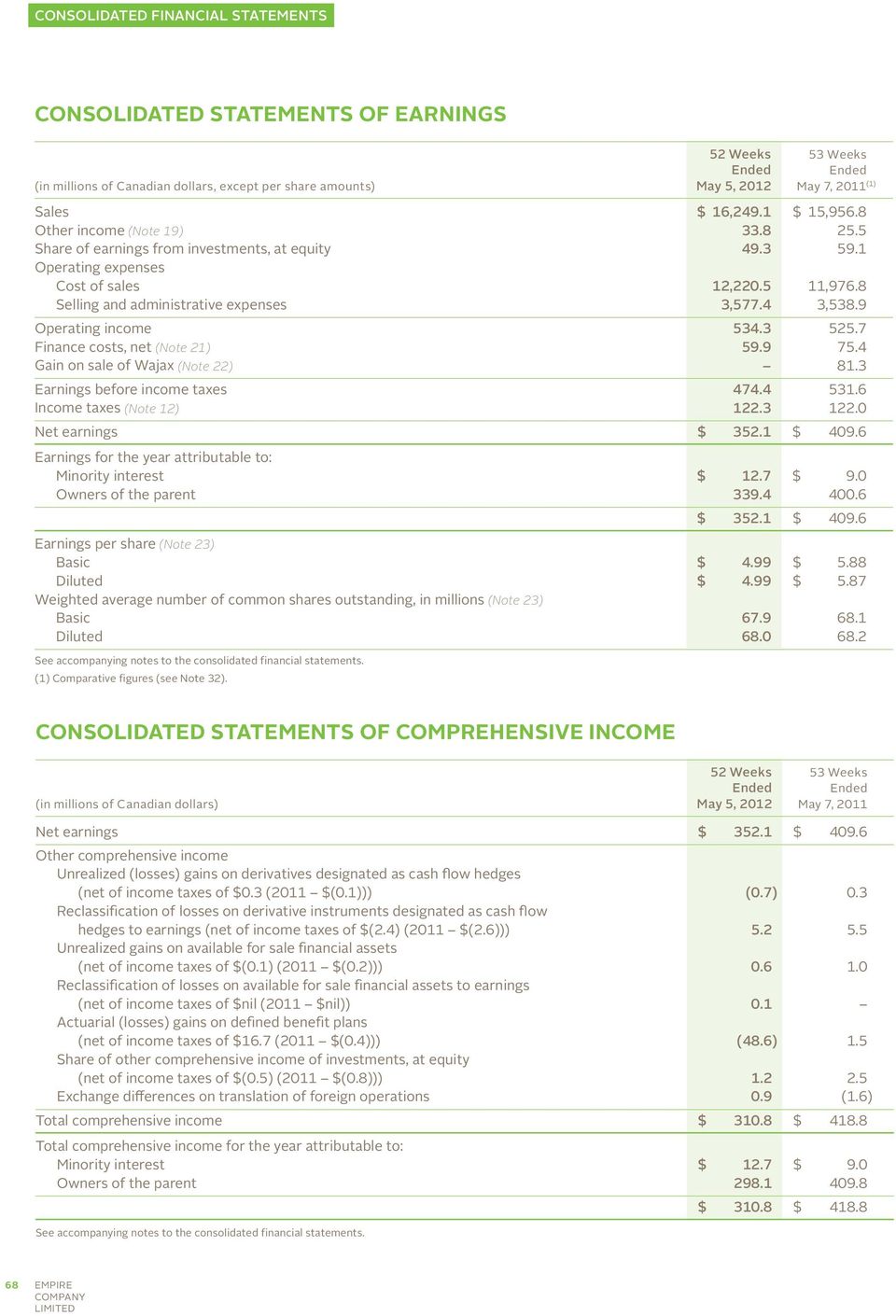
5 CONSOLIDATED FINANCIAL STATEMENTS CONSOLIDATED STATEMENTS OF EARNINGS 52 Weeks 53 Weeks Ended Ended (in millions of Canadian dollars, except per share amounts) May 5, 2012 May 7, 2011 (1) Sales $ 16,249.1 $ 15,956.8 Other income (Note 19) Share of earnings from investments, at equity Operating expenses Cost of sales 12, ,976.8 Selling and administrative expenses 3, ,538.9 Operating income Finance costs, net (Note 21) Gain on sale of Wajax (Note 22) 81.3 Earnings before income taxes Income taxes (Note 12) Net earnings $ $ Earnings for the year attributable to: Minority interest $ 12.7 $ 9.0 Owners of the parent $ $ CONSOLIDATED FINANCIAL STATEMENTS Earnings per share (Note 23) Basic $ 4.99 $ 5.88 Diluted $ 4.99 $ 5.87 Weighted average number of common shares outstanding, in millions (Note 23) Basic Diluted See accompanying notes to the consolidated financial statements. (1) Comparative figures (see Note 32). CONSOLIDATED STATEMENTS OF COMPREHENSIVE INCOME 52 Weeks 53 Weeks Ended Ended (in millions of Canadian dollars) May 5, 2012 May 7, 2011 Net earnings $ $ Other comprehensive income Unrealized (losses) gains on derivatives designated as cash flow hedges (net of income taxes of $0.3 (2011 $(0.1))) (0.7) 0.3 Reclassification of losses on derivative instruments designated as cash flow hedges to earnings (net of income taxes of $(2.4) (2011 $(2.6))) Unrealized gains on available for sale financial assets (net of income taxes of $(0.1) (2011 $(0.2))) Reclassification of losses on available for sale financial assets to earnings (net of income taxes of $nil (2011 $nil)) 0.1 Actuarial (losses) gains on defined benefit plans (net of income taxes of $16.7 (2011 $(0.4))) (48.6) 1.5 Share of other comprehensive income of investments, at equity (net of income taxes of $(0.5) (2011 $(0.8))) Exchange differences on translation of foreign operations 0.9 (1.6) Total comprehensive income $ $ Total comprehensive income for the year attributable to: Minority interest $ 12.7 $ 9.0 Owners of the parent See accompanying notes to the consolidated financial statements. $ $ EMPIRE COMPANY LIMITED
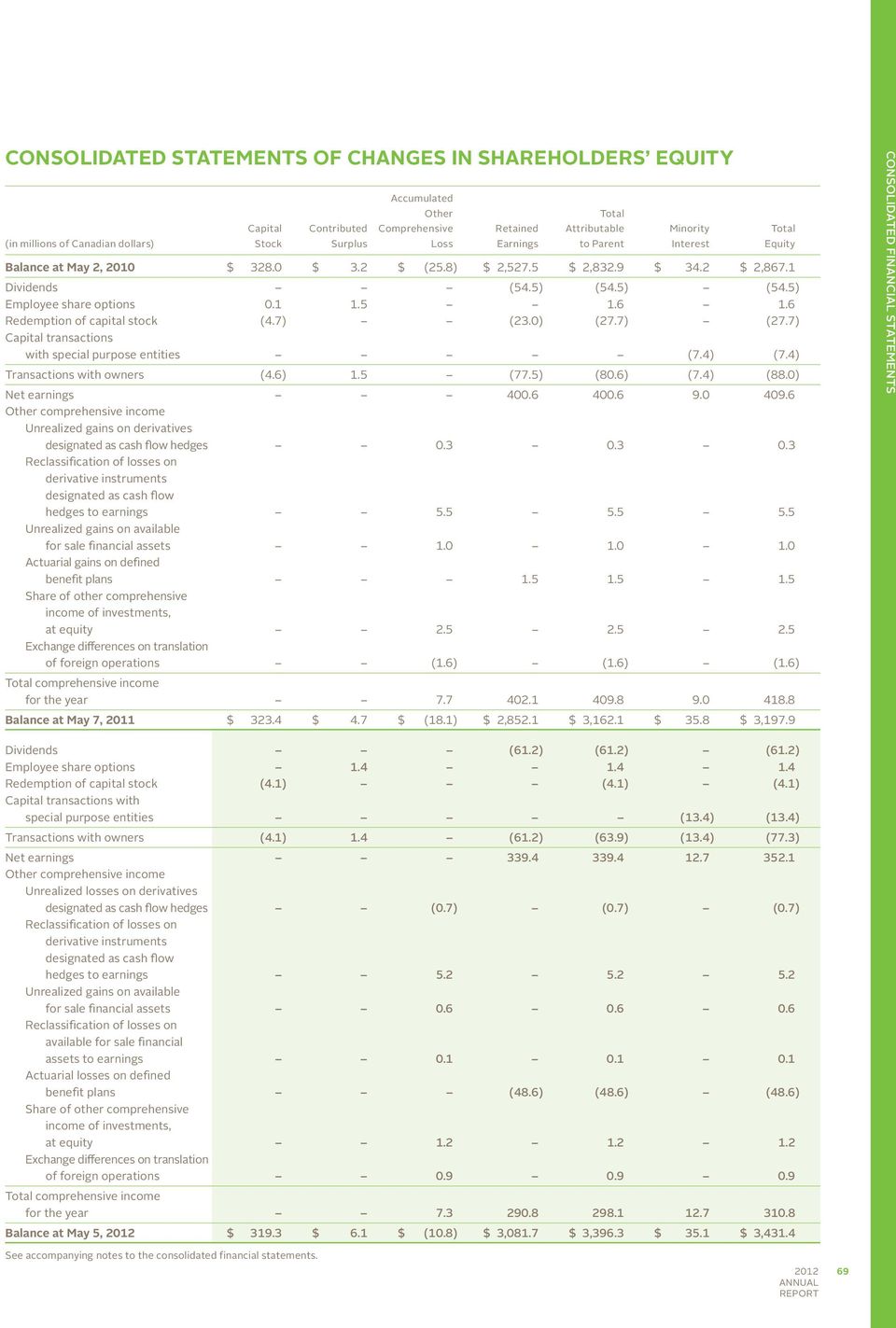
6 CONSOLIDATED STATEMENTS OF CHANGES IN SHAREHOLDERS EQUITY Accumulated Other Capital Contributed Comprehensive Retained Attributable Minority Total (in millions of Canadian dollars) Stock Surplus Loss Earnings to Parent Interest Equity Balance at May 2, 2010 $ $ 3.2 $ (25.8) $ 2,527.5 $ 2,832.9 $ 34.2 $ 2,867.1 Dividends (54.5) (54.5) (54.5) Employee share options Redemption of capital stock (4.7) (23.0) (27.7) (27.7) Capital transactions with special purpose entities (7.4) (7.4) Transactions with owners (4.6) 1.5 (77.5) (80.6) (7.4) (88.0) Net earnings Other comprehensive income Unrealized gains on derivatives designated as cash flow hedges Reclassification of losses on derivative instruments designated as cash flow hedges to earnings Unrealized gains on available for sale financial assets Actuarial gains on defined benefit plans Share of other comprehensive income of investments, at equity Exchange differences on translation of foreign operations (1.6) (1.6) (1.6) Total comprehensive income for the year Balance at May 7, 2011 $ $ 4.7 $ (18.1) $ 2,852.1 $ 3,162.1 $ 35.8 $ 3,197.9 Total CONSOLIDATED FINANCIAL STATEMENTS Dividends (61.2) (61.2) (61.2) Employee share options Redemption of capital stock (4.1) (4.1) (4.1) Capital transactions with special purpose entities (13.4) (13.4) Transactions with owners (4.1) 1.4 (61.2) (63.9) (13.4) (77.3) Net earnings Other comprehensive income Unrealized losses on derivatives designated as cash flow hedges (0.7) (0.7) (0.7) Reclassification of losses on derivative instruments designated as cash flow hedges to earnings Unrealized gains on available for sale financial assets Reclassification of losses on available for sale financial assets to earnings Actuarial losses on defined benefit plans (48.6) (48.6) (48.6) Share of other comprehensive income of investments, at equity Exchange differences on translation of foreign operations Total comprehensive income for the year Balance at May 5, 2012 $ $ 6.1 $ (10.8) $ 3,081.7 $ 3,396.3 $ 35.1 $ 3,431.4 See accompanying notes to the consolidated financial statements ANNUAL REPORT
7 CONSOLIDATED FINANCIAL STATEMENTS CONSOLIDATED STATEMENTS OF CASH FLOWS 52 Weeks 53 Weeks Ended Ended (in millions of Canadian dollars) May 5, 2012 May 7, 2011 Operations Net earnings $ $ Adjustments for: Depreciation Income taxes Finance costs, net (Note 21) Amortization of intangibles Gain on disposal of assets (Note 19) (32.6) (24.5) Impairment of non-financial assets (Notes 8, 9 and 10) Amortization of deferred items Equity in earnings of other entities, net of dividends received (1.6) 14.2 Employee future benefits obligation 3.4 (19.4) Increase in long-term lease obligation Increase in long-term provisions Stock-based compensation Gain on sale of Wajax (81.3) Net change in non-cash working capital 86.2 (7.2) Income taxes paid, net (131.1) (124.8) Dividends paid, preferred shares (0.1) (0.1) Cash flows from operating activities Investment Net increase in investments (87.1) (42.0) Net proceeds from sale of Wajax Property, equipment and investment property purchases (589.5) (552.4) Proceeds on disposal of property, equipment and investment property Additions to intangibles (29.1) (34.2) Loans and other receivables Other assets and other long-term liabilities (23.8) (8.3) Business acquisitions (Note 24) (247.7) (17.0) Interest received Decrease in minority interest (13.4) (7.4) Cash flows used in investing activities (768.3) (339.5) Financing Increase (decrease) in bank indebtedness 4.4 (4.1) Issue of long-term debt Repayment of long-term debt (133.3) (269.7) Redemption of preferred shares (4.1) (0.1) Repurchase of Non-Voting Class A shares (27.6) Interest paid (60.5) (66.6) Dividends paid, common shares (61.1) (54.4) Cash flows used in financing activities (152.0) (204.6) (Decrease) increase in cash and cash equivalents (105.7) Cash and cash equivalents, beginning of year Cash and cash equivalents, end of year $ $ CONSOLIDATED FINANCIAL STATEMENTS See accompanying notes to the consolidated financial statements. 70 EMPIRE COMPANY LIMITED

8 NOTES TO THE CONSOLIDATED FINANCIAL STATEMENTS May 5, 2012 (in millions of Canadian dollars, except per share amounts) 1. REPORTING ENTITY Empire Company Limited ( Empire or the Company ) is a diversified Canadian company whose key businesses include food retailing and corporate investment activities. The Company is incorporated in Canada and the address of its registered office of business is 115 King Street, Stellarton, Nova Scotia, B0K 1S0, Canada. The consolidated financial statements for the year ended May 5, 2012 include the accounts of Empire, all subsidiary companies, including 100 percent owned Sobeys Inc. ( Sobeys ), and certain enterprises considered special purpose entities ( SPEs ), where control is achieved on a basis other than through ownership of a majority of voting rights. Investments in which the Company has significant influence and investments in significant joint ventures are accounted for using the equity method. The Company s fiscal year ends on the first Saturday in May. As a result, the fiscal year is usually 52 weeks but results in a duration of 53 weeks every five to six years. NOTES TO THE CONSOLIDATED FINANCIAL STATEMENTS 2. BASIS OF PREPARATION Statement of compliance The consolidated financial statements have been prepared in accordance with International Financial Reporting Standards ( IFRS or GAAP ) as issued by the International Accounting Standards Board ( IASB ). These are the Company s first annual consolidated financial statements reported under IFRS for the 52 weeks ended May 5, 2012 with comparative financial information for the 53 weeks ended May 7, 2011 and IFRS 1, First-Time Adoption of International Financial Reporting Standards has been applied. An explanation of how the transition to IFRS from Canadian Generally Accepted Accounting Principles ( Canadian GAAP ) has affected the Company s reported consolidated balance sheets, consolidated statements of earnings, consolidated statements of comprehensive income and consolidated statements of cash flows is provided in Note 33. The consolidated financial statements were authorized for issue by the Board of Directors on June 28, Basis of measurement The consolidated financial statements are prepared on the historical cost basis, except the following assets and liabilities which are stated at their fair value: derivative financial instruments, financial instruments classified as fair value through profit and loss, customer loyalty and financial instruments classified as available for sale. Certain property, equipment and investment properties were restated to their fair value at May 2, 2010 when the Company elected to use fair value as deemed cost for certain assets as permitted by IFRS 1. Use of estimates and judgments The preparation of consolidated financial statements, in conformity with IFRS, requires management to make judgments, estimates and assumptions that affect the amounts reported in the consolidated financial statements and accompanying notes. Estimates and underlying assumptions are reviewed on an ongoing basis. Revisions to accounting estimates are recognized in the period in which the estimates are revised and in any future periods affected. The Company has applied judgment in its assessment of the appropriateness of consolidation of SPEs, the classification of leases and financial instruments, the level of componentization of property and equipment, the determination of cash generating units, the identification of indicators of impairment for property and equipment, investment property and intangible assets, the allocation of purchase price adjustments on business combinations, and the recognition of provisions ANNUAL REPORT

9 NOTES TO THE CONSOLIDATED FINANCIAL STATEMENTS Significant estimates include the valuation of inventories, goodwill, valuation of asset-backed commercial paper, provisions, impairments, employee future benefits, stock-based compensation, loyalty programs, useful lives of property and equipment and intangibles for purposes of depreciation and amortization and income taxes. Changes to these estimates could materially impact the financial statements. These estimates are based on management s best knowledge of current events and actions that the Company may undertake in the future. Actual results could differ from these estimates. 3. SUMMARY OF SIGNIFICANT ACCOUNTING POLICIES (a) Basis of consolidation The financial statements for the Company include the accounts of the Company and all of its subsidiary undertakings drawn up to the reporting date. Subsidiaries, including SPEs, are all entities over which the Company has the power to control the financial and operating policies so as to benefit from its activities. All subsidiaries have a reporting date within five weeks of the Company s reporting date. Where necessary, adjustments have been made to reflect transactions between the reporting dates of the Company and its subsidiaries. All intercompany transactions, balances, income and expenses are eliminated in preparing the consolidated financial statements. Earnings or losses and other comprehensive income of subsidiaries acquired or disposed of during the period are recognized from the effective date of acquisition, or up to the effective date of disposal, as applicable. Minority interest represents the portion of a subsidiary s earnings and losses and net assets that is not held by the Company. If losses in a subsidiary applicable to a minority interest exceed the minority interest in the subsidiary s equity, the excess is allocated to the minority interest except to the extent that the majority has a binding obligation and is able to cover the losses. (b) Business combinations Business combinations are accounted for by applying the acquisition method. The acquisition method involves the recognition of the acquiree s identifiable assets and liabilities, including contingent liabilities, regardless of whether they were recorded in the financial statements prior to acquisition. The acquiree s identifiable assets, liabilities and contingent liabilities that meet the conditions for recognition under IFRS 3, Business Combinations, are recognized at their fair value at the acquisition date, except for: (i) deferred tax assets or liabilities and liabilities or assets related to employee benefit arrangements which are recognized and measured in accordance with IAS 12, Income Taxes, and IAS 19, Employee Benefits, respectively; and (ii) assets (or disposal groups) that are classified as held for sale in accordance with IFRS 5, Non-Current Assets Held for Sale and Discontinued Operations, which are measured and recognized at fair value less costs to sell. Goodwill arising on acquisition is recognized as an asset and represents the excess of acquisition cost over the fair value of the identifiable net assets of the acquiree at the date of the acquisition. Any excess of identifiable net assets over the acquisition cost is recognized in net earnings or loss immediately after acquisition. Transaction costs related to the acquisition are expensed as they are incurred. In measuring the fair value of an acquiree s assets and liabilities management uses estimates about future cash flows and discount rates. Any measurement changes upon initial recognition would affect the measurement of goodwill, except for deferred taxes. (c) Foreign currency translation Assets and liabilities of foreign operations are translated at exchange rates in effect at the balance sheet date. The revenues and expenses are translated at average exchange rates for the period. Cumulative gains and losses on translation are shown in accumulated other comprehensive income or loss. Monetary assets and liabilities denominated in foreign currencies are translated into Canadian dollars at the foreign currency exchange rate in effect at each period end date. Non-monetary items are translated at the historical exchange rate at the date of transaction. Exchange gains or losses arising from the translation of these balances denominated in foreign currencies are recognized in operating income. Revenues and expenses denominated in foreign currencies are translated into Canadian dollars at the average foreign currency exchange rate for the period. (d) Cash and cash equivalents Cash and cash equivalents are defined as cash, and guaranteed investments with a maturity less than 90 days at date of acquisition. 72 EMPIRE COMPANY LIMITED

10 (e) Inventories Warehouse inventories are valued at the lower of cost and net realizable value with cost being determined on a weighted average cost basis. Retail inventories are valued at the lower of cost and net realizable value. Cost is determined using a weighted average cost using either the standard cost method or retail method. The retail method uses the anticipated selling price less normal profit margins, on a weighted average cost basis. The cost of inventories is comprised of directly attributable costs and includes the purchase price plus other costs incurred in bringing the inventories to their present location and condition, such as freight. The cost is reduced by the value of rebates and allowances received from vendors. The Company estimates net realizable value as the amount that inventories are expected to be sold taking into consideration fluctuations of retail price due to seasonality less estimated costs necessary to make the sale. Inventories are written down to net realizable value when the cost of inventories is not estimated to be recoverable due to obsolescence, damage or permanent declines in selling prices. When circumstances that previously caused inventories to be written down below cost no longer exist or when there is clear evidence of an increase in retail selling price, the amount of the write-down previously recorded is reversed. Costs that do not contribute to bringing inventories to their present location and condition, such as storage and administrative overheads, are specifically excluded from the cost of inventories and are expensed in the period incurred. (f) Income taxes Tax expense recognized in net earnings or loss comprises the sum of deferred income tax and current income tax not recognized in other comprehensive income. NOTES TO THE CONSOLIDATED FINANCIAL STATEMENTS Current income tax assets and liabilities are comprised of obligations to, or claims from, fiscal authorities relating to the current or prior reporting periods, that are unpaid at the reporting date. Current tax is payable on taxable earnings, which differs from net earnings or loss in the consolidated financial statements. The calculation of current income tax is based on tax rates and tax laws that have been enacted or substantively enacted at the end of the reporting period. Deferred income taxes are calculated using the asset and liability method on temporary differences between the carrying amounts of assets and liabilities and their related tax bases. However, deferred tax is not provided on the initial recognition of goodwill or on the initial recognition of an asset or liability unless the related transaction is a business combination or affects tax or accounting profit. The deferred tax assets and liabilities have been measured using substantively enacted tax rates that will be in effect when the amounts are expected to settle. Deferred tax assets are only recognized to the extent that it is probable that they will be able to be utilized against future taxable income. The assessment of the probability of future taxable income in which deferred tax assets can be utilized is based on the Company s latest approved forecast, which is adjusted for significant non-taxable income and expenses and specific limits to the use of any unused tax loss or credit. If a positive forecast of taxable income indicates the probable use of a deferred tax asset, especially when it can be used without a time limit, that deferred tax asset is usually recognized in full. The recognition of deferred tax assets that are subject to certain legal or economic limits or uncertainties are assessed individually by management based on the specific facts and circumstances. Deferred tax assets and liabilities are offset only when the Company has a right and intention to offset current tax assets and liabilities from the same taxation authority. Changes in deferred tax assets or liabilities are recognized as a component of income or expense in net earnings or loss, except where they relate to items that are recognized in other comprehensive income (such as the unrealized gains and losses on cash flow hedges) or directly in equity. (g) Assets held for sale Certain land and buildings have been listed for sale and reclassified as assets held for sale on the consolidated balance sheets. These assets are expected to be sold within a twelve month period and are no longer productive assets with no intent to develop them for future use. Assets held for sale are valued at the lower of carrying amount and fair value less cost of disposal. Liabilities assumed upon sale of assets or debts to be repaid as part of a sale transaction are also classified as liabilities relating to assets held for sale. (h) Investments in associates Associates are those entities over which the Company is able to exert significant influence but which are neither subsidiaries nor interests in a joint venture. Investments in associates are initially recognized at cost and subsequently accounted for using the equity method ANNUAL REPORT
11 NOTES TO THE CONSOLIDATED FINANCIAL STATEMENTS Acquired investments in associates are also subject to the acquisition method as explained above. However, any goodwill or fair value adjustment attributable to the Company s share in the associate is included in the amount recognized as investments in associates. All subsequent changes to the Company s share of interest in the equity of the associate are recognized in the carrying amount of the investment. Changes resulting from the earnings or losses generated by the associate are reported within share of earnings from investments, at equity on the Company s consolidated statements of earnings. These changes include subsequent depreciation, amortization or impairment of the fair value adjustments of assets and liabilities. Changes resulting from earnings of the associate or items recognized directly in the associate s equity are recognized in earnings or equity of the Company, as applicable. However, when the Company s share of losses in an associate equals or exceeds its interest in the associate, including any unsecured receivables, the Company does not recognize further losses, unless it has incurred legal or constructive obligations or made payments on behalf of the associate. If the associate subsequently reports earnings, the Company resumes recognizing its share of those earnings only after its share of the earnings exceeds the accumulated share of losses that had previously not been recognized. Unrealized gains and losses on transactions between the Company and its associates are eliminated to the extent of the Company s interest in those entities. Where unrealized losses are eliminated, the underlying asset is also tested for impairment losses from a Company perspective. (i) Investments in joint ventures The Company undertakes a number of business activities through joint ventures. Joint ventures are established through contractual arrangements that require the unanimous consent of each of the venturers regarding the strategic, financial and operating policies of the venture (joint control). The Company s joint ventures are of two types: Jointly controlled entities A jointly controlled entity is a corporation, partnership or other entity in which each participant holds an interest. A jointly controlled entity operates in the same way as other entities, controlling the assets of the joint venture, generating its own earnings and incurring its own liabilities and expenses. Interests in jointly controlled entities are accounted for using the equity method. Under the equity method, the investment in a jointly controlled entity is carried in the consolidated balance sheets at cost, plus post-acquisition changes in the Company s share of net assets of the jointly controlled entity, less distributions received and less any impairment in value of the investment. The share of jointly controlled entities results is recognized in the Company s consolidated financial statements from the date that joint control commences until the date at which it ceases. Jointly controlled assets and operations The Company has certain contractual arrangements with other participants to engage in joint activities that do not give rise to a jointly controlled entity. These arrangements involve the joint ownership of assets dedicated to the purposes of each venture but do not create a jointly controlled entity as the venturers directly derive the benefits of operation of their jointly owned assets, rather than deriving returns from an interest in a separate entity. Interests in jointly controlled assets and operations are accounted for using the proportionate consolidation method, whereby the Company s proportionate interest in the assets, liabilities, revenues, and expenses of jointly controlled entities are recognized within each applicable line item of the consolidated financial statements. All such amounts are measured in accordance with the terms of each arrangement, which are usually in proportion to the Company s interest in the jointly controlled assets. Unrealized gains and losses on transactions between the Company and joint ventures are eliminated to the extent of the Company s interest in those entities. Where unrealized losses are eliminated, the underlying asset is also tested for impairment losses from a Company perspective. 74 EMPIRE COMPANY LIMITED

12 (j) Financial instruments Financial instruments are recognized on the consolidated balance sheets when the Company becomes a party to the contractual provisions of a financial instrument. The Company is required to initially recognize all of its financial assets and liabilities, including derivatives and embedded derivatives in certain contracts, at fair value. Loans and receivables, held to maturity financial assets and other financial liabilities are subsequently measured at cost or amortized cost. Derivatives and non-financial derivatives must be recorded at fair value on the consolidated balance sheets unless they are exempt from derivative treatment based upon expected purchase, sale or usage requirements. The Company classifies financial assets and liabilities according to their characteristics and management s choices and intentions related thereto for the purpose of ongoing measurements. Classification choices for financial assets include: a) fair value through profit and loss ( FVTPL ) measured at fair value with changes in fair value recorded in net earnings; b) held to maturity recorded at amortized cost with gains and losses recognized in net earnings in the period that the asset is derecognized or impaired; c) available for sale measured at fair value with changes in fair value recognized in other comprehensive income for the current period until realized through disposal or impairment; and d) loans and receivables recorded at amortized cost with gains and losses recognized in net earnings in the period that the asset is no longer recognized or impaired. Classification choices for financial liabilities include: a) FVTPL measured at fair value with changes in fair value recorded in net earnings and b) other liabilities measured at amortized cost with gains and losses recognized in net earnings in the period that the liability is derecognized. Any financial asset or liability can be classified as FVTPL as long as its fair value is reliably determinable. NOTES TO THE CONSOLIDATED FINANCIAL STATEMENTS The Company s financial assets and liabilities are generally classified and measured as follows: Asset/Liability Classification Measurement Cash and cash equivalents FVTPL Fair value Receivables Loans and receivables Amortized cost Loans and other receivables Loans and receivables Amortized cost Investments Available for sale Fair value Derivative financial assets and liabilities FVTPL Fair value Non-derivative other assets and liabilities FVTPL Fair value Bank indebtedness Other liabilities Amortized cost Accounts payable and accrued liabilities Other liabilities Amortized cost Long-term debt Other liabilities Amortized cost Transaction costs other than those related to financial instruments classified as FVTPL, which are expensed as incurred, are added to or deducted from the fair value of the financial asset or financial liability, as appropriate, on initial recognition and amortized using the effective interest method. Fair value measurements are classified within a hierarchy that prioritizes the inputs to fair value measurement. The hierarchy gives highest priority to unadjusted quoted prices in active markets for identical assets or liabilities and the lowest priority to unobservable inputs. The three levels of the fair value hierarchy are: level 1 inputs that reflect unadjusted quoted prices in active markets for identical assets or liabilities; level 2 inputs, other than quoted prices, that are observable for the asset or liability either directly or indirectly, including inputs in markets that are not considered to be active; or level 3 inputs that are not based on observable market data. Inputs into the determination of the fair value require significant management judgment or estimation. If different levels of inputs are used to measure a financial instrument s fair value, the classification within the hierarchy is based on the lowest level of input that is significant to the fair value measurement. Changes to valuation methods may result in transfers into or out of an investment s assigned level. A financial asset is derecognized when the contractual rights to the cash flows from the financial asset expire or if the Company transfers the financial asset to another party without retaining control or substantially all the risks and rewards of ownership of the financial asset. A financial liability is derecognized when its contractual obligations are discharged, cancelled or expire ANNUAL REPORT

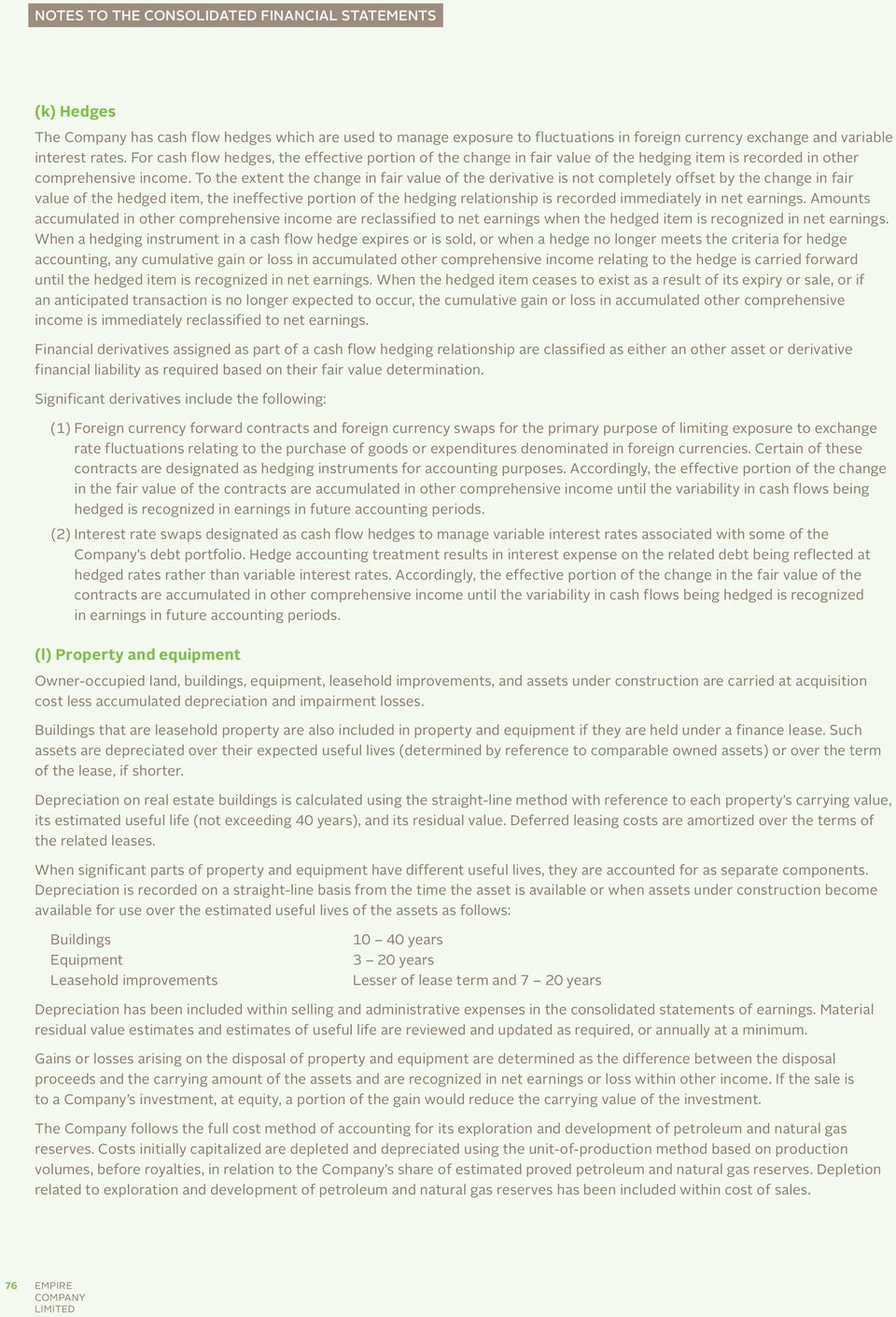
13 NOTES TO THE CONSOLIDATED FINANCIAL STATEMENTS (k) Hedges The Company has cash flow hedges which are used to manage exposure to fluctuations in foreign currency exchange and variable interest rates. For cash flow hedges, the effective portion of the change in fair value of the hedging item is recorded in other comprehensive income. To the extent the change in fair value of the derivative is not completely offset by the change in fair value of the hedged item, the ineffective portion of the hedging relationship is recorded immediately in net earnings. Amounts accumulated in other comprehensive income are reclassified to net earnings when the hedged item is recognized in net earnings. When a hedging instrument in a cash flow hedge expires or is sold, or when a hedge no longer meets the criteria for hedge accounting, any cumulative gain or loss in accumulated other comprehensive income relating to the hedge is carried forward until the hedged item is recognized in net earnings. When the hedged item ceases to exist as a result of its expiry or sale, or if an anticipated transaction is no longer expected to occur, the cumulative gain or loss in accumulated other comprehensive income is immediately reclassified to net earnings. Financial derivatives assigned as part of a cash flow hedging relationship are classified as either an other asset or derivative financial liability as required based on their fair value determination. Significant derivatives include the following: (1) Foreign currency forward contracts and foreign currency swaps for the primary purpose of limiting exposure to exchange rate fluctuations relating to the purchase of goods or expenditures denominated in foreign currencies. Certain of these contracts are designated as hedging instruments for accounting purposes. Accordingly, the effective portion of the change in the fair value of the contracts are accumulated in other comprehensive income until the variability in cash flows being hedged is recognized in earnings in future accounting periods. (2) Interest rate swaps designated as cash flow hedges to manage variable interest rates associated with some of the Company s debt portfolio. Hedge accounting treatment results in interest expense on the related debt being reflected at hedged rates rather than variable interest rates. Accordingly, the effective portion of the change in the fair value of the contracts are accumulated in other comprehensive income until the variability in cash flows being hedged is recognized in earnings in future accounting periods. (l) Property and equipment Owner-occupied land, buildings, equipment, leasehold improvements, and assets under construction are carried at acquisition cost less accumulated depreciation and impairment losses. Buildings that are leasehold property are also included in property and equipment if they are held under a finance lease. Such assets are depreciated over their expected useful lives (determined by reference to comparable owned assets) or over the term of the lease, if shorter. Depreciation on real estate buildings is calculated using the straight-line method with reference to each property s carrying value, its estimated useful life (not exceeding 40 years), and its residual value. Deferred leasing costs are amortized over the terms of the related leases. When significant parts of property and equipment have different useful lives, they are accounted for as separate components. Depreciation is recorded on a straight-line basis from the time the asset is available or when assets under construction become available for use over the estimated useful lives of the assets as follows: Buildings Equipment Leasehold improvements years 3 20 years Lesser of lease term and 7 20 years Depreciation has been included within selling and administrative expenses in the consolidated statements of earnings. Material residual value estimates and estimates of useful life are reviewed and updated as required, or annually at a minimum. Gains or losses arising on the disposal of property and equipment are determined as the difference between the disposal proceeds and the carrying amount of the assets and are recognized in net earnings or loss within other income. If the sale is to a Company s investment, at equity, a portion of the gain would reduce the carrying value of the investment. The Company follows the full cost method of accounting for its exploration and development of petroleum and natural gas reserves. Costs initially capitalized are depleted and depreciated using the unit-of-production method based on production volumes, before royalties, in relation to the Company s share of estimated proved petroleum and natural gas reserves. Depletion related to exploration and development of petroleum and natural gas reserves has been included within cost of sales. 76 EMPIRE COMPANY LIMITED
14 (m) Investment property Investment properties are properties which are held either to earn rental income or for capital appreciation or for both. Investment properties are accounted for using the cost model. The depreciation policies for investment property are consistent with those described for property and equipment. Any gain or loss arising from the sale of an investment property is immediately recognized in net earnings or loss, unless the sale is to an investment, at equity, in which case a portion of the gain would reduce the carrying value of the Company s investment. Rental income and operating expenses from investment property are reported within sales and selling and administrative expenses, respectively, in the consolidated statements of earnings. (n) Leases Leases are classified as finance leases whenever the terms of the lease transfer substantially all the risks and rewards of ownership to the lessee. All other leases are classified as operating leases. (i) The Company as lessor Rental income from operating leases is recognized on a straight-line basis over the term of the relevant lease. Initial direct costs incurred in negotiating and arranging an operating lease are added to the carrying amount of the leased asset and recognized on a straight-line basis over the lease term. NOTES TO THE CONSOLIDATED FINANCIAL STATEMENTS (ii) The Company as lessee Assets held under finance leases are initially recognized as assets of the Company at their fair value at the inception of the lease or, if lower, at the present value of the minimum lease payments. The corresponding liability to the lessor is included in the consolidated balance sheets as a finance lease obligation in long-term debt. Lease payments are apportioned between finance charges and reduction of the lease obligation to achieve a constant rate of interest on the remaining balance of the liability. Finance charges are recognized in net earnings or loss immediately. Contingent rentals are recognized as expenses in the periods in which they are incurred. Lease allowances and incentives are recognized as other long-term liabilities. The aggregate benefit of incentives is recognized as a reduction of rental expense on a straight-line basis over the term of the lease. Real estate lease expense is amortized on a straight-line basis over the entire term of the lease. (iii) Sale and leaseback transactions A sale and leaseback transaction involves the sale of an asset and the leasing back of the same asset. If a sale and leaseback transaction results in a finance lease for the Company, any excess of sales proceeds over the carrying amount is recognized as deferred revenue and amortized over the term of the new lease. Any profit or loss in a sale and leaseback transaction resulting in an operating lease that is transacted at fair value is recognized immediately. If the sale price is above fair value, the excess over fair value is deferred and amortized over the term of the new lease. (o) Intangibles Intangibles arise on the purchase of a new business, existing franchises, software, and the acquisition of pharmacy prescription files. They are accounted for using the cost model whereby capitalized costs are amortized on a straight-line basis over their estimated useful lives, as these assets are considered finite. Useful lives are reviewed annually and are subject to impairment testing. The following useful lives are applied: Deferred purchase agreements Franchise rights/agreements Lease rights Patient files Software Other 5 10 years 10 years 5 10 years 15 years 3 7 years 5 10 years Amortization has been included within selling and administrative expenses in the consolidated statements of earnings. Included in intangibles are brand names, the majority of which have indefinite useful lives. Any subsequent expenditures made by the Company on brand names are expensed as incurred. Intangibles with indefinite useful lives are not amortized ANNUAL REPORT

15 NOTES TO THE CONSOLIDATED FINANCIAL STATEMENTS (p) Goodwill Goodwill represents the excess of the purchase price of the business acquired over the fair value of the underlying net tangible and intangible assets acquired at the date of acquisition. (q) Impairment of non-financial assets Goodwill and intangibles with indefinite useful lives are reviewed for impairment at least annually by assessing the recoverable amount of each cash generating unit or groups of cash generating units to which the goodwill or the indefinite life intangible relates. The recoverable amount is the higher of fair value less costs to sell and value in use. When the recoverable amount of the cash generating units is less than the carrying amount an impairment loss is recognized immediately as selling and administrative expenses. Impairment losses related to goodwill cannot be reversed. Long-lived tangible and intangible assets are reviewed for impairment when events or changes in circumstances indicate that the carrying value of the assets may not be recoverable. If such an indication exists, the recoverable amount of the asset is estimated in order to determine the extent of the impairment loss (if any). The recoverable amount is the higher of fair value less costs to sell and value in use. Where the asset does not generate cash flows that are independent from other assets, the Company estimates the recoverable amount of the cash generating unit(s) to which the asset belongs. The Company has primarily determined a cash generating unit to be an individual store or theatre. Corporate assets such as head offices and distribution centres do not individually generate separate cash inflows and are therefore aggregated for testing with the locations they service. When the recoverable amount of an asset (or cash generating unit) is estimated to be less than its carrying amount, the carrying amount (or cash generating unit) is reduced to the recoverable amount. An impairment loss is recognized as selling and administrative expenses immediately in net earnings or loss. Where an impairment loss subsequently reverses, other than related to goodwill, the carrying amount of the asset (or cash generating unit) is increased to the revised estimate, but is limited to the carrying amount that would have been determined if no impairment loss had been recognized in prior years. A reversal of impairment loss is recognized immediately in net earnings or loss. In the process of measuring expected future cash flows, management makes assumptions about future growth of profits. These assumptions relate to future events and circumstances. The actual results may vary and may cause significant adjustments to the Company s assets in the subsequent financial years. (r) Customer loyalty programs A Club Sobeys loyalty card program (the Program ) was launched during fiscal The Program allows members to earn points on their purchases in certain Sobeys stores. As well, a Club Sobeys credit card entitles the customer to earn points for their purchases on the credit card. Members can redeem these points, in accordance with the Program rewards schedule, for discounts on future grocery purchases, purchase products or services, or elect to convert the points into Aeroplan miles which is a loyalty program run by a third party. During fiscal 2010, a loyalty card program, Club Thrifty Foods, was launched. It follows a similar point earning and redemption structure as the Club Sobeys loyalty card program. The fair value of loyalty points awarded is deferred until the awards are redeemed after adjustment for the number of points expected never to be redeemed based on the expected future activity. Fair value is determined by reference to the value for which the points can be redeemed. The program deferred revenue is included in accounts payable and accrued liabilities on the Company s consolidated balance sheets. An AIR MILES loyalty program is also used by the Company. AIR MILES are earned by certain Sobeys customers based on purchases in stores. The Company pays a per point fee under the terms of the agreement with AIR MILES. (s) Provisions Provisions are recognized when there is a present legal or constructive obligation as a result of a past event, for which it is probable that a transfer of economic benefits will be required to settle the obligation, and where a reliable estimate can be made of the amount of the obligation. Provisions are discounted using a pre-tax discount rate that reflects the current market assessments of the time value of money and the risks specific to the liability, if material. Where discounting is used, the increase in the provision due to passage of time ( unwinding of the discount ) is recognized within finance costs in the consolidated statements of earnings. 78 EMPIRE COMPANY LIMITED

16 (t) Borrowing costs Borrowing costs primarily comprise interest on the Company s debts. Borrowing costs directly attributable to the acquisition, construction or production of a qualifying asset are capitalized as a component of the cost of the asset to which it is related. All other borrowing costs are expensed in the period in which they are incurred and are reported within finance costs. (u) Deferred revenue Deferred revenue consists of long-term supplier purchase agreements and gains on sale and leaseback transactions relating to certain finance leases. Deferred revenue is included in other long-term liabilities and is taken into income on a straight-line basis over the term of the related agreements. (v) Employee benefits (i) Short-term employment benefits Short-term employee benefits include wages, salaries, compensated absences, profit-sharing and bonuses. Short-term employee benefits are measured on an undiscounted basis and are recorded as selling and administration expenses as the related service is provided. (ii) Post-employment benefits The cost of the Company s pension benefits for defined contribution plans are expensed at the time active employees are compensated. The cost of defined benefit pension plans and other benefit plans is accrued based on actuarial valuations, which are determined using the projected unit credit method pro-rated on service and management s best estimate of the expected long-term rate of return on plan assets, salary escalation, retirement ages, and expected growth rate of health care costs. NOTES TO THE CONSOLIDATED FINANCIAL STATEMENTS Current market values are used to value benefit plan assets. The obligation related to employee future benefits is measured using current market interest rates, assuming a portfolio of Corporate AA bonds with terms to maturity that, on average, match the terms of the obligation. The impact of plan amendments is recognized as an expense and amortized on a straight-line basis over the average period until the benefits are vested. To the extent that increases in the obligation related to past service have vested immediately following the changes in the original plan, the Company recognizes past service cost immediately. In measuring its defined benefit liability the Company will recognize all of its actuarial gains and losses immediately into other comprehensive income. (iii) Termination benefits When the Company has committed to a formalized plan to either terminate employment prior to normal retirement or to provide termination benefits as a result of offers made from the rationalization of business processes, termination benefits are recognized as an expense. (w) Revenue recognition Sales are recognized at the point-of-sale. Sales include revenues from customers through corporate stores and theatres operated by the Company and consolidated SPEs, and revenue from sales to non-spe franchised stores, affiliated stores and independent accounts. Revenue received from non-spe franchised stores, affiliated stores and independent accounts is mainly derived from the sale of product. The Company also collects franchise fees under two types of arrangements. Franchise fees contractually due based on the dollar value of product shipped are recorded as revenue when the product is shipped. Franchise fees contractually due based on the franchisee s retail sales are recorded as revenue weekly upon invoicing based on the franchisee s retail sales. (x) Vendor allowances The Company receives allowances from certain vendors whose products are purchased for resale. Included in these vendor programs are allowances for volume purchases, exclusivity allowances, listing fees, and other allowances. The Company recognizes these allowances as a reduction of cost of sales and related inventories. Certain allowances are contingent on the Company achieving minimum purchase levels and these allowances are recognized when it is probable that the minimum purchase level will be met, and the amount of allowance can be estimated ANNUAL REPORT

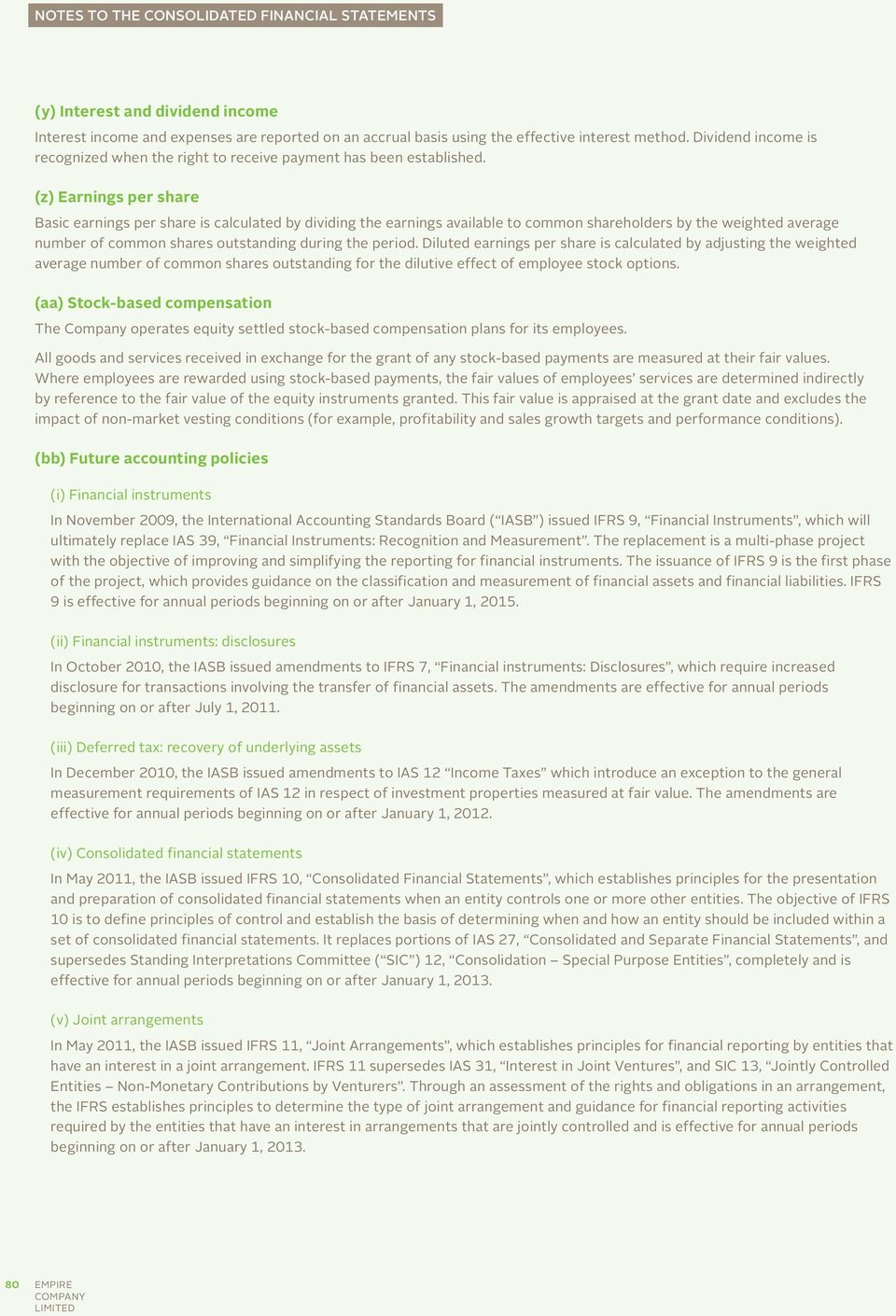
17 NOTES TO THE CONSOLIDATED FINANCIAL STATEMENTS (y) Interest and dividend income Interest income and expenses are reported on an accrual basis using the effective interest method. Dividend income is recognized when the right to receive payment has been established. (z) Earnings per share Basic earnings per share is calculated by dividing the earnings available to common shareholders by the weighted average number of common shares outstanding during the period. Diluted earnings per share is calculated by adjusting the weighted average number of common shares outstanding for the dilutive effect of employee stock options. (aa) Stock-based compensation The Company operates equity settled stock-based compensation plans for its employees. All goods and services received in exchange for the grant of any stock-based payments are measured at their fair values. Where employees are rewarded using stock-based payments, the fair values of employees services are determined indirectly by reference to the fair value of the equity instruments granted. This fair value is appraised at the grant date and excludes the impact of non-market vesting conditions (for example, profitability and sales growth targets and performance conditions). (bb) Future accounting policies (i) Financial instruments In November 2009, the International Accounting Standards Board ( IASB ) issued IFRS 9, Financial Instruments, which will ultimately replace IAS 39, Financial Instruments: Recognition and Measurement. The replacement is a multi-phase project with the objective of improving and simplifying the reporting for financial instruments. The issuance of IFRS 9 is the first phase of the project, which provides guidance on the classification and measurement of financial assets and financial liabilities. IFRS 9 is effective for annual periods beginning on or after January 1, (ii) Financial instruments: disclosures In October 2010, the IASB issued amendments to IFRS 7, Financial instruments: Disclosures, which require increased disclosure for transactions involving the transfer of financial assets. The amendments are effective for annual periods beginning on or after July 1, (iii) Deferred tax: recovery of underlying assets In December 2010, the IASB issued amendments to IAS 12 Income Taxes which introduce an exception to the general measurement requirements of IAS 12 in respect of investment properties measured at fair value. The amendments are effective for annual periods beginning on or after January 1, (iv) Consolidated financial statements In May 2011, the IASB issued IFRS 10, Consolidated Financial Statements, which establishes principles for the presentation and preparation of consolidated financial statements when an entity controls one or more other entities. The objective of IFRS 10 is to define principles of control and establish the basis of determining when and how an entity should be included within a set of consolidated financial statements. It replaces portions of IAS 27, Consolidated and Separate Financial Statements, and supersedes Standing Interpretations Committee ( SIC ) 12, Consolidation Special Purpose Entities, completely and is effective for annual periods beginning on or after January 1, (v) Joint arrangements In May 2011, the IASB issued IFRS 11, Joint Arrangements, which establishes principles for financial reporting by entities that have an interest in a joint arrangement. IFRS 11 supersedes IAS 31, Interest in Joint Ventures, and SIC 13, Jointly Controlled Entities Non-Monetary Contributions by Venturers. Through an assessment of the rights and obligations in an arrangement, the IFRS establishes principles to determine the type of joint arrangement and guidance for financial reporting activities required by the entities that have an interest in arrangements that are jointly controlled and is effective for annual periods beginning on or after January 1, EMPIRE COMPANY LIMITED
18 (vi) Disclosure of interests in other entities In May 2011, the IASB issued IFRS 12, Disclosure of Interests in Other Entities, which outlines disclosure requirements for an entity that has interests in a subsidiary, a joint arrangement, an associate and an unconsolidated structured entity. IFRS 12 requires an entity to disclose information that enables users of its financial statements to evaluate the nature of, and risks associated with, its interest in other entities and the effects of those interests on its financial position, financial performance and cash flows. It is effective for annual periods beginning on or after January 1, (vii) Fair value measurement In May 2011, the IASB issued IFRS 13, Fair Value Measurement, which defines fair value, sets out in a single IFRS a framework for measuring fair value and identifies required disclosures about fair value measurements. This IFRS is effective for annual periods beginning on or after January 1, (viii) Employee benefits In June 2011, the IASB issued amendments to IAS 19 Employee Benefits which eliminate the option to defer the recognition of actuarial gains and losses, streamline the presentation of changes in assets and liabilities arising from defined benefit plans to be presented in other comprehensive income and enhance disclosure requirements around the characteristics of the defined benefit plans and risks associated with participation in those plans. The amendments are effective for annual periods beginning on or after January 1, NOTES TO THE CONSOLIDATED FINANCIAL STATEMENTS The Company is currently evaluating the impact of these new standards and amendments on its consolidated financial statements. 4. INVENTORIES The cost of inventories recognized as an expense during the year was $12,159.7 (2011 $11,904.1). The Company has recorded during the year $13.1 (2011 $18.3) as expense for the write-down of inventories below cost to net realizable value for inventories on hand as at May 5, There were no reversals of inventories written down previously (2011 $nil). 5. LOANS AND OTHER RECEIVABLES May 5, 2012 May 7, 2011 May 2, 2010 Loans and mortgages receivable $ 81.3 $ 89.2 $ 95.9 Notes receivable and other Less amount due within one year Balance, end of year $ 60.6 $ 71.7 $ 85.0 Loans and mortgages receivable represent long-term financing to certain retail associates. These loans and mortgages are primarily secured by inventory, fixtures and equipment; bear various interest rates, and have repayment terms up to 10 years. The carrying amount of the loans and mortgages receivable approximates fair value based on the variable interest rates charged on the loans and the operating relationship of the associates with the Company. Loans receivable from officers and employees of $2.7 (2011 $2.9) under the Company s share purchase plan are classified as loans and mortgages receivable. Loan repayments will result in a corresponding decrease in loans and mortgages receivable. The loans are non-interest bearing and non-recourse, secured by 96,489 ( ,510) Non-Voting Class A shares. The market value of the shares at May 5, 2012 was $5.5 (2011 $5.5) ANNUAL REPORT

19 NOTES TO THE CONSOLIDATED FINANCIAL STATEMENTS 6. INVESTMENTS, AT EQUITY The carrying values of the investments, at equity are as follows: May 5, 2012 May 7, 2011 May 2, 2010 Investment in associates Wajax Income Fund $ $ $ 30.3 Crombie Real Estate Investment Trust ( Crombie REIT ) Investment in joint ventures Canadian real estate partnerships U.S. real estate partnerships Canadian Digital Cinema Partnership (Note 24) 7.2 Total $ $ $ The fair values of the investments based on a stock exchange are as follows: May 5, 2012 May 7, 2011 May 2, 2010 Wajax Income Fund $ $ $ Crombie REIT Total $ $ $ The Canadian and U.S. real estate partnerships and Canadian Digital Cinema Partnership are not publicly listed on a stock exchange and hence published price quotes are not available. The Company s carrying value of its investment in Wajax Income Fund was as follows: May 5, 2012 May 7, 2011 Balance, beginning of year $ $ 30.3 Equity earnings 8.6 Share of comprehensive loss 0.9 Distributions (5.9) Sale of interest in Wajax Income Fund (33.9) Balance, end of year $ $ The Company s carrying value of its investment in Crombie REIT is as follows: May 5, 2012 May 7, 2011 Balance, beginning of year $ 91.0 $ 82.0 Equity earnings Share of comprehensive income Distributions (28.2) (26.7) Deferral of gains on sale of property (10.3) (10.8) Interest acquired in Crombie REIT Dillution gain Balance, end of year $ $ EMPIRE COMPANY LIMITED
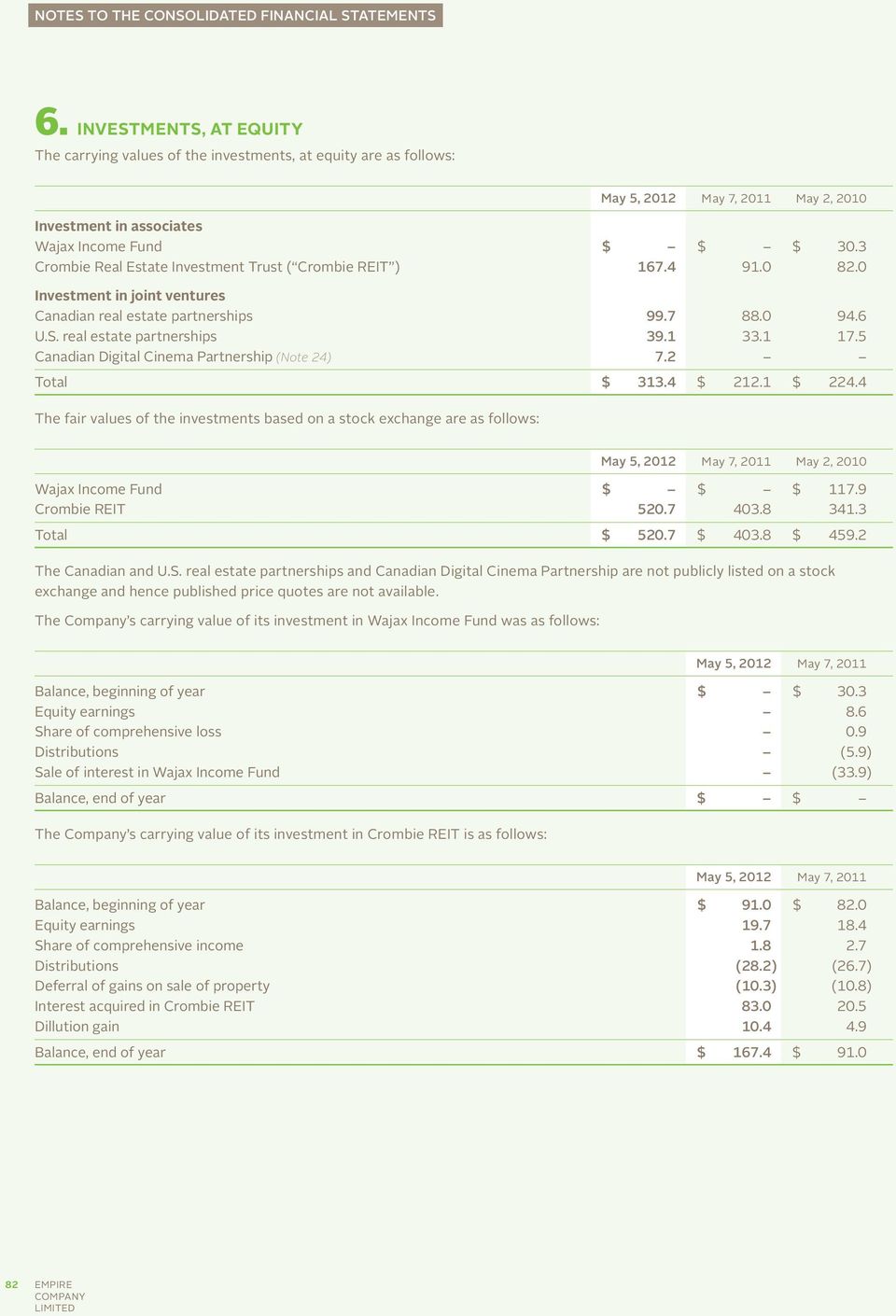
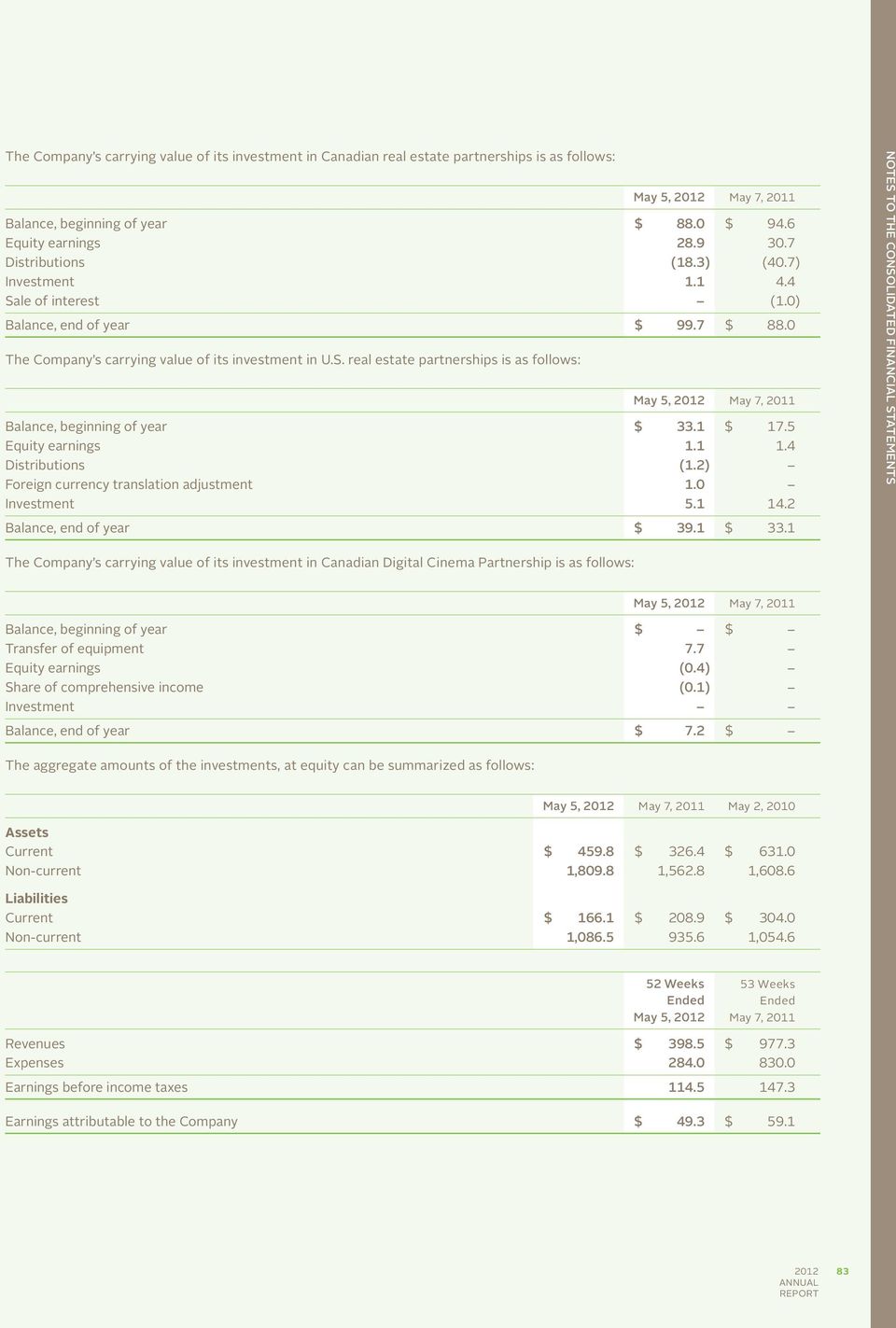
20 The Company s carrying value of its investment in Canadian real estate partnerships is as follows: May 5, 2012 May 7, 2011 Balance, beginning of year $ 88.0 $ 94.6 Equity earnings Distributions (18.3) (40.7) Investment Sale of interest (1.0) Balance, end of year $ 99.7 $ 88.0 The Company s carrying value of its investment in U.S. real estate partnerships is as follows: May 5, 2012 May 7, 2011 Balance, beginning of year $ 33.1 $ 17.5 Equity earnings Distributions (1.2) Foreign currency translation adjustment 1.0 Investment Balance, end of year $ 39.1 $ 33.1 NOTES TO THE CONSOLIDATED FINANCIAL STATEMENTS The Company s carrying value of its investment in Canadian Digital Cinema Partnership is as follows: May 5, 2012 May 7, 2011 Balance, beginning of year $ $ Transfer of equipment 7.7 Equity earnings (0.4) Share of comprehensive income (0.1) Investment Balance, end of year $ 7.2 $ The aggregate amounts of the investments, at equity can be summarized as follows: May 5, 2012 May 7, 2011 May 2, 2010 Assets Current $ $ $ Non-current 1, , ,608.6 Liabilities Current $ $ $ Non-current 1, , Weeks 53 Weeks Ended Ended May 5, 2012 May 7, 2011 Revenues $ $ Expenses Earnings before income taxes Earnings attributable to the Company $ 49.3 $ ANNUAL REPORT
21 NOTES TO THE CONSOLIDATED FINANCIAL STATEMENTS 7. OTHER ASSETS May 5, 2012 May 7, 2011 May 2, 2010 Accrued benefit asset $ $ 0.8 $ Asset-backed commercial paper Restricted cash Deferred lease assets Other Total $ 68.5 $ 55.3 $ PROPERTY AND EQUIPMENT Food Retailing Segment Assets May 5, 2012 Leasehold Under (52 weeks ended) Land Buildings Equipment Improvements Construction Total Cost Opening balance $ $ $ 2,182.2 $ $ $ 4,113.9 Additions Additions from business acquisitions Transfers (13.6) (13.6) Disposals (18.5) (58.1) (389.3) (91.0) (29.9) (586.8) Closing balance $ $ $ 2,006.0 $ $ $ 4,181.9 Accumulated depreciation and impairment losses Opening balance $ $ $ 1,312.2 $ $ $ 1,859.5 Disposals (31.4) (375.6) (88.4) (495.4) Transfers Depreciation Impairment losses Closing balance $ $ $ 1,145.6 $ $ $ 1,654.8 Net carrying value as at May 5, 2012 $ $ $ $ $ $ 2, EMPIRE COMPANY LIMITED
22 Investments and Other Operations Segment Assets Petroleum May 5, 2012 Leasehold Under and Natural (52 weeks ended) Land Buildings Equipment Improvements Construction Gas Total Cost Opening balance $ 6.9 $ 50.5 $ 91.5 $ 90.9 $ 4.7 $ 66.3 $ Additions Additions from business acquisitions Transfers (5.9) (5.9) Disposals (0.2) (9.7) (13.8) (23.7) Closing balance $ 6.7 $ 51.8 $ 95.1 $ $ 1.1 $ 70.5 $ Accumulated depreciation and impairment losses Opening balance $ $ 22.0 $ 58.6 $ 38.0 $ $ 48.5 $ Disposals (1.0) (1.0) Depreciation Impairment losses Reversal of impairment losses (0.1) (1.1) (0.1) (1.3) Closing balance $ $ 24.1 $ 62.5 $ 42.9 $ $ 52.6 $ Net carrying value as at May 5, 2012 $ 6.7 $ 27.7 $ 32.6 $ 66.1 $ 1.1 $ 17.9 $ NOTES TO THE CONSOLIDATED FINANCIAL STATEMENTS Food Retailing Segment Assets May 7, 2011 Leasehold Under (53 weeks ended) Land Buildings Equipment Improvements Construction Total Cost Opening balance $ $ $ 2,411.6 $ $ 84.5 $ 4,224.6 Additions Additions from business acquisitions Transfers (1.8) (2.3) (4.1) Disposals (39.0) (55.3) (489.7) (111.6) (695.6) Closing balance $ $ $ 2,182.2 $ $ $ 4,113.9 Accumulated depreciation and impairment losses Opening balance $ $ $ 1,569.7 $ $ $ 2,158.8 Disposals (17.1) (480.7) (105.9) (603.7) Transfers Depreciation Impairment losses Closing balance $ $ $ 1,312.2 $ $ $ 1,859.5 Net carrying value as at May 7, 2011 $ $ $ $ $ $ 2,254.4 Net carrying value as at May 2, 2010 $ $ $ $ $ 84.5 $ 2, ANNUAL REPORT
23 NOTES TO THE CONSOLIDATED FINANCIAL STATEMENTS Investments and Other Operations Segment Assets Petroleum May 7, 2011 Leasehold Under and Natural (53 weeks ended) Land Buildings Equipment Improvements Construction Gas Total Cost Opening balance $ 53.9 $ 49.1 $ 84.7 $ 78.7 $ 62.0 $ 63.3 $ Additions Transfers (18.1) Disposals (47.4) (0.6) (0.5) (0.7) (64.2) (113.4) Closing balance $ 6.9 $ 50.5 $ 91.5 $ 90.9 $ 4.7 $ 66.3 $ Accumulated depreciation and impairment losses Opening balance $ $ 19.7 $ 52.6 $ 34.5 $ $ 35.5 $ Disposals (0.5) (0.7) (1.2) Depreciation Impairment losses Reversal of impairment losses (0.3) (1.1) (1.4) Closing balance $ $ 22.0 $ 58.6 $ 38.0 $ $ 48.5 $ Net carrying value as at May 7, 2011 $ 6.9 $ 28.5 $ 32.9 $ 52.9 $ 4.7 $ 17.8 $ Net carrying value as at May 2, 2010 $ 53.9 $ 29.4 $ 32.1 $ 44.2 $ 62.0 $ 27.8 $ Consolidated property and equipment Net carrying value as at May 5, 2012 $ $ $ $ $ $ 17.9 $ 2,679.2 Net carrying value as at May 7, 2011 $ $ $ $ $ $ 17.8 $ 2,398.1 Net Carrying value as at May 2, 2010 $ $ $ $ $ $ 27.8 $ 2,315.2 Finance leases The Company has various property leases for store locations that are held under finance leases with a net carrying value of $4.6 as at May 5, 2012 (May 7, 2011 $4.9, May 2, 2010 $5.3). These leases are included in buildings. The Company has equipment leases under finance leases with a net carrying value of $30.3 as at May 5, 2012 (May 7, 2011 $39.6, May 2, 2010 $48.6). These leases are included in equipment. Assets under construction During the year the Company capitalized borrowing costs of $6.1 (2011 $1.6) on indebtedness related to property and equipment under construction. The Company used capitalization rates from 5.8% to 7.0% ( % to 7.0%). Security As at May 5, 2012 the net carrying value of property pledged as security for bank borrowings is $113.7 (May 7, 2011 $121.7, May 2, 2010 $126.6). Impairment of property and equipment Property and equipment is reviewed each reporting period for events or changes in circumstances which indicate that the carrying value of the assets may not be recoverable. The review is performed by assessing the recoverable amount of each cash generating unit or groups of cash generating units to which the property and equipment relates. The recoverable amount is the higher of fair value less costs to sell and value in use. When the recoverable amount of the cash generating units is less than the carrying amount an impairment loss is recognized. 86 EMPIRE COMPANY LIMITED
24 Recoverable amounts are based on value in use calculations, determined using three year cash flow projections from the Company s latest internal forecasts as presented to the Board of Directors. Key assumptions used in determining value in use include those regarding discount rates, growth rates, and expected changes in cash flows. Management estimates discount rates using pre-tax rates that reflect current market assessments of the time value of money and risks specific to the cash generating units. Forecasts are projected beyond three years based on long-term growth rates ranging from 3 to 5 percent. Discount rates are calculated on a pre-tax basis and range from 8 to 15 percent. Impairment losses arise when the carrying amount of the assets is higher than the greater of the present value of cash flows of a cash generating unit and its fair value less costs to sell. Impairment losses of $4.6 were recorded in the year ended May 5, 2012 (2011 $32.9). Impairment reversals of $1.3 were recorded in the year ended May 5, 2012 (2011 $1.4). 9. INVESTMENT PROPERTY Investment property is comprised primarily of commercial properties owned by the Company held for income generating purposes, rather than for the principal purpose of the Company s operating activities. NOTES TO THE CONSOLIDATED FINANCIAL STATEMENTS 52 Weeks 53 Weeks Ended Ended May 5, 2012 May 7, 2011 Cost Opening balance $ 90.2 $ Additions Transfers Assets held for sale (1.2) (18.3) Disposals (19.3) (8.8) Closing balance $ $ 90.2 Accumulated depreciation and impairment losses Opening balance $ 16.4 $ 19.1 Depreciation Transfers (3.2) Disposals (1.8) (3.3) Impairment losses 2.8 Closing balance $ 15.3 $ 16.4 Net carrying value $ 86.9 $ 73.8 Net carrying value Fair Value May 5, 2012 $ 86.9 $ May 7, 2011 $ 73.8 $ 98.1 May 2, 2010 $ 90.6 $ An external, independent valuation company, having appropriate recognized professional qualifications and experience assisted in determining the fair value of investment property at the date of transition to IFRS and at May 5, Additions to investment property through acquisition are transacted at fair value and therefore carrying value equals fair value. Properties reclassified from property and equipment are valued for disclosure purposes using comparable market information, internal valuation methodologies, or the use of an external independent valuation company. Rental income from investment property included in the consolidated statements of earnings amounted to $4.1 for the year ended May 5, 2012 (2011 $10.1). Direct operating expenses (including repairs and maintenance but excluding depreciation expense) arising from investment property that generated rental income amounted to $1.5 for the year ended May 5, 2012 (2011 $5.5). Direct operating expenses (including repairs and maintenance but excluding depreciation expense) arising from non-income producing investment property amounted to $1.7 for the year ended May 5, 2012 (2011 $1.5). All direct operating expenses for investment properties are included in selling and administrative expenses on the consolidated statements of earnings ANNUAL REPORT
25 NOTES TO THE CONSOLIDATED FINANCIAL STATEMENTS 10. INTANGIBLES Deferred Franchise May 5, 2012 Brand Purchase Rights/ Patient Lease Loyalty Private (52 weeks ended) Names Agreements Agreements Files Software Rights Programs Labels Other Total Cost Opening balance $ $ 62.2 $ 58.1 $ 32.3 $ $ 49.1 $ 11.4 $ 59.5 $ 29.5 $608.2 Additions, separately acquired Additions, internally developed Acquisition through business combination Disposals (0.8) (7.9) (0.1) (5.3) (0.6) (14.7) Closing balance $ $ 89.9 $ 51.0 $ 32.8 $ $ 49.7 $ 11.4 $ 59.5 $ 32.0 $ Accumulated amortization and impairment losses Opening balance $ 11.2 $ 19.6 $ 23.2 $ 14.0 $ 53.7 $ 19.8 $ $ $ 17.5 $ Amortization Impairment losses Disposals (0.8) (7.4) (0.1) (5.3) (0.2) (13.8) Closing balance $ 14.2 $ 25.5 $ 21.8 $ 18.0 $ 63.6 $ 22.8 $ $ $ 19.4 $ Net carrying value as at May 5, 2012 $ $ 64.4 $ 29.2 $ 14.8 $ 56.2 $ 26.9 $ 11.4 $ 59.5 $ 12.6 $ Deferred Franchise May 7, 2011 Brand Purchase Rights/ Patient Lease Loyalty Private (53 weeks ended) Names Agreements Agreements Files Software Rights Programs Labels Other Total Cost Opening balance $ $ 56.4 $ 57.9 $ 33.1 $ $ 45.0 $ 11.4 $ 59.5 $ 26.6 $ Additions, separately acquired Additions, internally developed Acquisition through business combination Disposals (6.5) (2.9) (0.8) (35.6) (1.6) (47.4) Closing balance $ $ 62.2 $ 58.1 $ 32.3 $ $ 49.1 $ 11.4 $ 59.5 $ 29.5 $ Accumulated amortization and impairment losses Opening balance $ 8.2 $ 18.4 $ 19.1 $ 12.5 $ 74.9 $ 18.9 $ $ $ 14.5 $ Amortization Disposals (4.8) (2.6) (0.7) (35.6) (1.6) (45.3) Closing balance $ 11.2 $ 19.6 $ 23.2 $ 14.0 $ 53.7 $ 19.8 $ $ $ 17.5 $ Net carrying value as at May 7, 2011 $ $ 42.6 $ 34.9 $ 18.3 $ 51.4 $ 29.3 $ 11.4 $ 59.5 $ 12.0 $ May 2, 2010 $ $ 38.0 $ 38.8 $ 20.6 $ 50.9 $ 26.1 $ 11.4 $ 59.5 $ 12.1 $ In addition to development costs capitalized related to software, the Company included in selling and administrative expenses $4.7 of research and development costs (2011 $7.8). Impairment of intangibles follows the same methodology as property and equipment (Note 8). Included in intangibles as at May 5, 2012, May 7, 2011 and May 2, 2010 are the following amounts with indefinite useful lives: Brand names $172.8; Loyalty programs $11.4; and Private labels $ EMPIRE COMPANY LIMITED
26 11. GOODWILL May 5, 2012 May 7, 2011 Opening balance $ 1,220.0 $ 1,214.2 Acquired through business combinations Closing balance $ 1,302.1 $ 1,220.0 Goodwill arising from business combinations is allocated at the lowest level within the organization at which it is monitored by management to make business decisions and should not be larger than an operating segment. Therefore, goodwill has been allocated to the following operating segments: May 5, 2012 May 7, 2011 May 2, 2010 Food retailing $ 1,260.9 $ 1,179.2 $ 1,173.4 Investments and other operations Total $ 1,302.1 $ 1,220.0 $ 1,214.2 NOTES TO THE CONSOLIDATED FINANCIAL STATEMENTS Impairment of goodwill Goodwill is subject to impairment testing on an annual basis. However, if indicators of impairment are present, the Company will review goodwill for impairment when such indicators arise. The Company performs an annual review during its first quarter and no impairment was recorded (2011 $nil, 2010 $nil). In performing the review, the Company determined the recoverable amount of goodwill based on fair value less any costs that would be incurred should the Company sell a cash generating unit to which goodwill would be apportioned from the operating segment. Key assumptions used by management to determine the fair value of the goodwill include industry earnings multiples and earnings multiples from previous Company acquisitions. 12. INCOME TAXES Income tax expense varies from the amount that would be computed by applying the combined federal and provincial statutory tax rate as a result of the following: 52 Weeks 53 Weeks Ended Ended May 5, 2012 May 7, 2011 Earnings before income taxes $ $ Effective combined statutory income tax rate 27.6% 28.9% Income tax expense according to combined statutory income tax rate Income taxes resulting from: Non-deductible amounts Capital items (3.2) (22.1) Impact of statutory income tax rate changes (1.0) Non-taxable amounts (0.5) (3.0) Other (6.1) (7.0) Total income taxes, combined effective tax rate of 25.8% ( %) $ $ ANNUAL REPORT
27 NOTES TO THE CONSOLIDATED FINANCIAL STATEMENTS Current year income tax expense attributable to net earnings consists of: 52 Weeks 53 Weeks Ended Ended May 5, 2012 May 7, 2011 Current tax expense $ $ Deferred tax expense: Origination and reversal of temporary differences Change in tax rate (1.5) Change in balance of unused tax losses (2.3) (1.1) Total $ $ Deferred taxes arising from temporary differences and unused tax losses can be summarized as follows: Recognized in: Other May 5, 2012 Opening Comprehensive Net Closing (52 weeks ended) Balance Income Earnings Balance Accounts payable and accrued liabilities $ 8.7 $ $ (6.7) $ 2.0 Current provisions 6.6 (0.3) 6.3 Long-term provisions Long-term debt Other long-term liabilities (2.7) 36.1 Employee future benefits obligation Derivative financial liabilities 3.0 (2.0) (0.2) 0.8 Inventories 2.8 (1.9) 0.9 Investments (16.1) (0.6) (2.2) (18.9) Other assets (3.1) 10.3 (0.7) 6.5 Property, equipment and investment property (88.4) 13.1 (75.3) Goodwill and intangibles (83.0) (3.4) (86.4) Other (57.8) (27.7) (85.5) $ (147.2) $ 14.0 $ (20.3) $ (153.5) Recognized as: Deferred tax assets $ 29.8 $ $ 6.7 $ 36.5 Deferred tax liabilities $ (177.0) $ 14.0 $ (27.0) $ (190.0) 90 EMPIRE COMPANY LIMITED
28 Recognized in: Other May 7, 2011 Opening Comprehensive Net Closing (53 weeks ended) Balance Income Earnings Balance Accounts payable and accrued liabilities $ 2.7 $ $ 6.0 $ 8.7 Current provisions Long-term provisions Long-term debt 2.2 (0.2) 2.0 Other long-term liabilities 41.2 (3.9) 37.3 Employee future benefits obligation (5.5) 32.5 Derivative financial liabilities 5.7 (2.5) (0.2) 3.0 Inventories 2.9 (0.1) 2.8 Investments (13.1) (1.0) (2.0) (16.1) Other assets (1.5) (2.8) 1.2 (3.1) Property, equipment and investment property (76.0) (12.4) (88.4) Goodwill and intangibles (82.3) (0.7) (83.0) Other (56.5) (1.3) (57.8) $ (128.1) $ (4.1) $ (15.0) $ (147.2) Recognized as: Deferred tax assets $ 31.9 $ (3.3) $ 1.2 $ 29.8 Deferred tax liabilities $ (160.0) $ (0.8) $ (16.2) $ (177.0) NOTES TO THE CONSOLIDATED FINANCIAL STATEMENTS All deferred tax assets (including tax losses and other tax credits) have been recognized in the consolidated balance sheets. The amount of deferred tax assets and deferred tax liabilities that are expected to be settled beyond the next 12 months is $ BANK INDEBTEDNESS As security for certain bank loans, the Company has provided an assignment of certain marketable securities and, in certain subsidiaries and joint ventures, general assignments of receivables and leases, first floating charge debentures on assets and the assignment of proceeds of fire insurance policies. 14. PROVISIONS The provisions carrying amounts are comprised of the following: May 5, 2012 Lease (52 Weeks Ended) Contracts Legal Environmental Other Total Opening balance $ 32.9 $ 7.1 $ 5.4 $ 18.8 $ 64.2 Assumed in business combination Provisions made Provisions used (10.5) (3.0) (0.3) (10.4) (24.2) Provisions reversed (9.3) (0.7) (2.0) (0.4) (12.4) Change due to discounting Closing balance $ 32.3 $ 6.9 $ 30.9 $ 19.7 $ 89.8 Current $ 12.5 $ 6.9 $ 0.9 $ 9.8 $ 30.1 Non-current Total $ 32.3 $ 6.9 $ 30.9 $ 19.7 $ ANNUAL REPORT
29 NOTES TO THE CONSOLIDATED FINANCIAL STATEMENTS May 7, 2011 Lease (53 Weeks Ended) Contracts Legal Environmental Other Total Opening balance $ 20.9 $ 10.8 $ 5.9 $ 10.7 $ 48.3 Provisions made Provisions used (6.1) (5.8) (1.0) (11.7) (24.6) Provisions reversed (3.9) (1.7) (1.5) (7.1) Change due to discounting Closing balance $ 32.9 $ 7.1 $ 5.4 $ 18.8 $ 64.2 Current $ 9.9 $ 7.1 $ 1.3 $ 11.6 $ 29.9 Non-current Total $ 32.9 $ 7.1 $ 5.4 $ 18.8 $ 64.2 Lease contracts Lease contract provisions are recorded when the expected benefits to be derived by the Company from a contract are lower than the unavoidable costs of meeting the obligations under the contract. The Company records onerous contract provisions for closed store and theatre locations where it has entered into a lease contract. The provision is measured at the lower of the expected cost to terminate the lease and the expected net cost of continuing the contract. The net cost is derived by considering both the lease payment and sublease income received. Once the store or theatre is closed, a liability is recorded to reflect the present value of the expected liability associated with any lease contract and other contractually obligated costs. Discounting of provisions resulting from lease contracts has been calculated using pre-tax discount rates ranging between 7 and 9 percent. Legal costs Legal provisions relate to claims of $6.9 that are outstanding as at May 5, 2012 (May 7, 2011 $7.1, May 2, 2010 $10.8) that arose in the ordinary course of business. Environmental costs In accordance with legal and environmental policy requirements the Company has recorded provisions for locations requiring environmental restoration. These provisions primarily relate to decommissioning liabilities recorded for gas station locations owned by the Company at the net present value of the estimated future remediation costs. Discounting of environmental related provisions has been calculated using pre-tax discount rates ranging between 4 and 15 percent. Other costs The Company continues to complete the rationalization of administration functions and has also begun to incur costs associated with the development of a new distribution centre in Terrebonne, Québec. These provisions relate mainly to severance costs. The Company has obligations to provide various forms of support to Crombie REIT pursuant to various agreements between the parties. These amounts are included in other provisions. 92 EMPIRE COMPANY LIMITED
30 15. LONG-TERM DEBT May 5, 2012 May 7, 2011 May 2, 2010 First mortgage loans, weighted average interest rate 8.02%, due $ 44.4 $ 47.6 $ 65.7 Medium term notes, Series C, interest rate 7.16%, due February 26, Medium term notes, Series D, interest rate 6.06%, due October 29, Medium term notes, Series E, interest rate 5.79%, due October 6, Medium term notes, Series F, interest rate 6.64%, due June 7, Sinking fund debentures, weighted average interest rate 9.31%, due Notes payable and other debt primarily at interest rates fluctuating with the prime rate Credit facility, due July 23, 2012, floating interest rate tied to bankers acceptance rates Credit facility, due June 30, 2014, floating interest rate tied to bankers acceptance rates , , ,150.2 Unamortized transaction costs (2.7) (3.3) (2.0) Finance lease obligations, weighted average interest rate 5.84%, due , , ,200.4 Less amount due within one year Balance, end of year $ $ 1,090.3 $ NOTES TO THE CONSOLIDATED FINANCIAL STATEMENTS First mortgage loans are secured by land, buildings and specific charges on certain assets. Finance lease obligations are secured by the related finance lease asset. Medium term notes are unsecured. Sobeys Group Inc., an indirect subsidiary of Sobeys, has provided its debenture holders with a floating charge over all its assets, subject to permitted encumbrances, a general assignment of book debts, and the assignment of proceeds of insurance policies. Sinking fund debenture payments are required on an annual basis. The proportionate share of related debt is retired with these repayments. On July 23, 2007, Sobeys established a new unsecured revolving term credit facility maturing July 23, Under the terms of the credit agreement entered into between Sobeys and a banking syndicate, a revolving term credit facility of $300.0 was established and increased by an additional $300.0, resulting in a total authorized credit facility of $ On February 14, 2012, Sobeys entered into an amended and restated credit agreement. The agreement provides for an unsecured revolving term credit facility of $450.0, and a $200.0 unsecured non-revolving term credit facility resulting in total authorized credit facilities of $ The revolving term credit facility matures on February 14, 2016, and the non-revolving term credit facility matures on July 23, At May 5, 2012, $200.0 (May 7, 2011 $200.0) of the non-revolving term credit facility had been drawn down and at year end was classified as long-term debt due within one year. The revolving term credit facility remains unutilized at year end. Interest payable on this facility fluctuates with changes in the bankers acceptance rate, Canadian prime rate or London InterBank Offered Rate ( LIBOR ). Interest on the non-revolving facility is hedged with a $200.0 interest rate swap maturing on July 23, 2012 at percent. Sobeys had also issued $52.7 in letters of credit against the facility at May 5, 2012 (May 7, 2011 $35.3). On November 8, 2007, Sobeys established a revolving credit facility of $75.0 that was unutilized at November 8, The interest rate was floating and fluctuated with changes in the bankers acceptance rate, Canadian prime rate or LIBOR. On November 8, 2010 the facility matured and was cancelled by Sobeys. On June 1, 2010, Sobeys filed a short form prospectus providing for the issuance of up to $500.0 of unsecured medium term notes. On June 7, 2010, Sobeys issued new medium term notes of $150.0, bearing an interest rate of 6.64 percent, maturing on June 7, On June 4, 2010, the Company renewed its credit facilities which were reduced from $650.0 to $ On August 22, 2011, the Company extended the term of its credit facilities to a maturity date of June 30, At May 5, 2012, the credit facilities had a balance outstanding of $129.0 (May 7, 2011 $118.0). The credit facilities are subject to certain financial covenants. Interest on the debt varies based on the designation of the loan (bankers acceptances ( BA ) rate loans, Canadian prime rate loans, U.S. base rate loans or LIBOR loans), fluctuations in the underlying rates, and in the case of the BA rate loans or LIBOR loans, the margin applicable to the financial covenants ANNUAL REPORT
31 NOTES TO THE CONSOLIDATED FINANCIAL STATEMENTS Principal debt retirement in each of the next five fiscal years is as follows: 2013 $ Thereafter Finance lease liabilities Finance lease liabilities are payable as follows: Future Present Value Minimum of Minimum Lease Lease Payments Interest Payments 2013 $ 11.5 $ 1.7 $ Thereafter Total $ 42.1 $ 9.4 $ 32.7 During fiscal 2012 the Company increased its finance lease obligation by $4.2 (2011 $5.4) with a similar increase in assets under finance leases. These additions are non-cash in nature, therefore have been excluded from the statements of cash flows. 16. OTHER LONG-TERM LIABILITIES May 5, 2012 May 7, 2011 May 2, 2010 Deferred lease obligation $ 88.8 $ 85.5 $ 75.7 Accrued benefit liability Deferred revenue Other Total $ $ $ EMPLOYEE FUTURE BENEFITS The Company has a number of defined benefit and defined contribution plans providing pension and other post-retirement benefits to most of its employees. Defined contribution pension plans The contributions required by the employee and the employer are specified. The employee s pension depends on what level of retirement income (for example, annuity purchase) that can be achieved with the combined total of employee and employer contributions and investment income over the period of plan membership, and the annuity purchase rates at the time of the employee s retirement. Other benefit plans The Company also offers certain employee post-retirement and post-employment benefit plans which are not funded and include health care, life insurance, and dental benefits. During the 53 weeks ended May 7, 2011, the post-retirement benefit program was modified for employees retiring after May 1, A closed group of individuals who met certain age and service criteria as of May 1, 2011 continue to maintain medical, drug, and life insurance coverage, while those individuals who did not meet the age and service criteria were offered critical illness coverage. The financial impact of these post-retirement benefit changes were taken into account and the one time impact of these changes for the 53 weeks ended May 7, 2011 resulted in a decrease in the employee future benefits obligation of $25.6, treated as a past service event. 94 EMPIRE COMPANY LIMITED
32 Defined benefit pension plans The ultimate retirement benefit is defined by a formula that provides a unit of benefit for each year of service. Employee contributions, if required, pay for part of the cost of the benefit, but the employer contributions fund the balance. The employer contributions are not specified or defined within the plan text, they are based on the result of actuarial valuations which determine the level of funding required to meet the total obligation as estimated at the time of the valuation. The Company uses April 30 as an actuarial valuation date and May 1 as a measurement date for accounting purposes, for its defined benefit pension plans. Most Recent Next Required Valuation Date Valuation Date Retirement Pension Plan May 1, 2011 May 1, 2014 Senior Management Pension Plan May 1, 2011 May 1, 2014 Other Benefit Plans May 1, 2010 May 1, 2013 Defined contribution plans The total expense, and cash contributions, for the Company s defined contribution plans was $25.3 for the year ended May 5, 2012 (2011 $23.9). NOTES TO THE CONSOLIDATED FINANCIAL STATEMENTS Defined benefit plans Information about the Company s defined benefit plans, in aggregate, is as follows: Pension Benefit Plans Other Benefit Plans May 5, 2012 May 7, 2011 May 5, 2012 May 7, 2011 Accrued benefit obligation Balance, beginning of year $ $ $ $ Current service cost, net of employee contributions Interest cost Employee contributions Benefits paid (19.7) (19.9) (4.5) (4.4) Past service costs (25.6) Actuarial losses included in other comprehensive income Balance, end of year $ $ $ $ Plan assets Market value, beginning of year $ $ $ $ Expected return on plan assets Employer contributions Employee contributions Benefits paid (19.7) (19.9) (4.5) (4.4) Actuarial (losses) gains included in other comprehensive income (10.7) 11.1 Market value, end of year $ $ $ $ ANNUAL REPORT
33 NOTES TO THE CONSOLIDATED FINANCIAL STATEMENTS Pension Benefit Plans Other Benefit Plans May 5, 2012 May 7, 2011 May 2, 2010 May 5, 2012 May 7, 2011 May 2, 2010 Funded status Total market value of plan assets $ $ $ $ $ $ Present value of unfunded obligations (42.7) (35.0) (33.5) (143.3) (122.3) (133.7) Present value of partially funded obligations (258.2) (233.5) (237.7) Deficit (70.0) (34.1) (49.3) (143.3) (122.3) (133.7) Unamortized past service cost Accrued benefit liabilities $ (69.1) $ (33.0) $ (48.0) $ (143.3) $ (122.3) $ (133.2) Classification of accrued benefit assets (liabilities) Other assets $ $ 0.8 $ $ $ $ Other long-term liabilities (69.1) (33.8) (48.0) Employee future benefits obligation (143.3) (122.3) (133.2) Accrued benefit liabilities $ (69.1) $ (33.0) $ (48.0) $ (143.3) $ (122.3) $ (133.2) Pension Benefit Plans Other Benefit Plans May 5, 2012 May 7, 2011 May 5, 2012 May 7, 2011 Expenses Current service cost, net of employee contributions $ 1.7 $ 2.4 $ 1.8 $ 3.1 Interest cost Expected return on plan assets (16.1) (15.0) Acturial (gain) loss recognized (0.4) 0.2 Past service costs (25.1) (Income) expense before adjustments $ (0.7) $ 1.5 $ 7.7 $ (15.0) Current and past service costs have been recognized within selling and administrative expenses, whereas interest costs and expected return on plan assets have been recognized within finance costs, net in the consolidated statements of earnings. Actuarial gains and losses recognized directly in equity: Actuarial (losses) gains recognized directly in other comprehensive income May 5, 2012 May 7, 2011 Cumulative amount, beginning of year $ 1.9 $ Recognized during the year (65.3) 1.9 Cumulative amount, end of year $ (63.4) $ 1.9 The significant actuarial assumptions adopted in measuring the Company s accrued benefit obligations are as follows (weightedaverage assumptions as of May 5, 2012): Pension Benefit Plans Other Benefit Plans May 5, 2012 May 7, 2011 May 5, 2012 May 7, 2011 Discount rate 4.25% 5.25% 4.25% 5.25% Expected long-term rate of return on plan assets 7.00% 7.00% Rate of compensation increase 4.00% 4.00% For measurement purposes, a 8.50 percent fiscal 2012 annual rate of increase in the per capita cost of covered health care benefits was assumed ( percent). The cumulative rate expectation to 2019 is 5.00 percent. 96 EMPIRE COMPANY LIMITED
34 These assumptions were developed by management under consideration of expert advice provided by independent actuarial appraisers. These assumptions have led to the amounts determined as the Company s accrued benefit obligations and should be regarded as management s best estimate. However, the actual outcome may vary. Estimation uncertainties exist especially in regards to medical cost trends, which may vary significantly in future appraisals of the Company s defined benefit and other benefit obligations. Expected return on plan assets is based on a weighted average of expected returns of the various assets in the plan and include an analysis of historical returns and predictions about future returns. The expected long-term rate of return is based on the portfolio as a whole and not the sum of the individual asset categories. Expected returns on plan assets are estimated by the independent actuaries in close co-ordination with plan administrators. The table below outlines the sensitivity of the fiscal 2012 key economic assumptions used in measuring the accrued benefit plan obligations and related expenses of the Company s pension and other benefit plans. The sensitivity of each key assumption has been calculated independently. Changes to more than one assumption simultaneously may amplify or reduce impact on the accrued benefit obligations or benefit plan expenses. Pension Benefit Plans Other Benefit Plans Benefit Benefit Benefit Benefit Obligations Cost (1) Obligations Cost (1) NOTES TO THE CONSOLIDATED FINANCIAL STATEMENTS Expected long-term rate of return on plan assets 7.00% Impact of: 1% increase $ (2.3) Impact of: 1% decrease $ 2.3 Discount rate (2) 4.25% 4.25% 4.25% 4.25% Impact of: 1% increase $ (34.1) $ 0.9 $ (18.7) $ (0.1) Impact of: 1% decrease $ 38.6 $ (1.3) $ 20.3 $ 0.1 Growth rate of health care costs (3) 8.50% 8.50% Impact of: 1% increase $ 18.8 $ 1.6 Impact of: 1% decrease $ (16.1) $ (1.3) (1) Reflects the impact on the current service cost, interest cost, and expected return on assets. (2) 4.25 percent for the Senior Management Plan, Oshawa Sobeys Employee Pension Plan, and Post-Retirement Benefits and 3.50 percent for the Post-Employment Benefits Plan. (3) Gradually decreasing to 5.00 percent in 2019 and remaining at that level thereafter. The asset mix of the defined benefit pension plans as at year end is as follows: May 5, 2012 May 7, 2011 May 2, 2010 Debt securities, cash and cash equivalents 25.0% 25.0% 25.0% Equity securities 75.0% 75.0% 75.0% Total investments 100.0% 100.0% 100.0% Within these securities are investments in Empire Non-Voting Class A shares. The market value of these shares at year end is as follows: % of Plan % of Plan % of Plan May 5, 2012 Assets May 7, 2011 Assets May 2, 2010 Assets Empire Company Limited Non-voting Class A shares $ % $ % $ % The actual return on plan assets was $5.4 for the year ended May 5, 2012 (2011 $26.1) ANNUAL REPORT
35 NOTES TO THE CONSOLIDATED FINANCIAL STATEMENTS The historical movement and history of experience gains and losses in the defined benefit pension plans and other benefit plans are as follows: May 5, 2012 May 7, 2011 May 2, 2010 Market value of plan assets $ $ $ Present value of accrued benefit obligations (444.2) (390.8) (404.9) Pension plan deficit $ (213.3) $ (156.4) $ (183.0) Experience adjustments arising on plan assets $ (10.7) $ 11.1 $ Experience adjustments arising on plan liabilities $ 0.6 $ 5.3 $ Management s best estimate of contributions expected to be paid to the defined benefit plans during the annual period beginning on May 6, 2012 and ending on May 4, 2013 is $ CAPITAL STOCK Number of Shares Authorized May 5, 2012 May 7, 2011 May 2, 2010 Preferred shares, par value of $25 each, issuable in series Series 2 cumulative, redeemable, rate of 75% of prime 2,664,900 2,668, Preferred shares, par value of $25 each, issuable in series 991,980, ,000, ,000,000 Non-Voting Class A shares, without par value 257,044, ,593, ,107,435 Class B common share, without par value, voting 40,800,000 40,800,000 40,800,000 Issued and outstanding: Number of Shares May 5, 2012 May 7, 2011 May 2, 2010 Preferred shares, Series 2 $ $ 4.1 $ 4.2 Non-Voting Class A 33,687, Class B common 34,260, Total $ $ $ The Series 2 Preferred shares were redeemable at par. During the year, the Company redeemed all of its Preferred shares, Series 2 at a cost of $4.1. During fiscal 2011, under a normal course issuer bid, the Company purchased for cancellation 513,579 Non-Voting Class A shares. The purchase price was $27.6 of which $23.0 of the purchase price (representing the premium on common shares purchased for cancellation) was charged to retained earnings. Under certain circumstances, where an offer (as defined in the share conditions) is made to purchase Class B common shares, the holders of the Non-Voting Class A shares shall be entitled to receive a follow-up offer at the highest price per share paid, pursuant to such offer to purchase Class B common shares. During fiscal 2012, the Company paid preferred dividends of $0.1 (May 7, 2011 $0.1) and common dividends of $61.1 (May 7, 2011 $54.4) to its equity holders. This represents a payment of 0.42 per share (May 7, per share) for preference shareholders, and 0.90 per share (May 7, per share) for common shareholders. 98 EMPIRE COMPANY LIMITED
36 19. OTHER INCOME 52 Weeks 53 Weeks Ended Ended May 5, 2012 May 7, 2011 Gain on disposal of assets $ 22.2 $ 19.6 Dilution gains Investment income Total $ 33.8 $ EMPLOYEE BENEFITS EXPENSE 52 Weeks 53 Weeks Ended Ended May 5, 2012 May 7, 2011 Wages, salaries and other short-term employment benefits $ 1,946.4 $ 1,926.3 Post-employment benefits Termination benefits Total $ 1,980.7 $ 1,938.1 NOTES TO THE CONSOLIDATED FINANCIAL STATEMENTS 21. FINANCE COSTS, NET Finance income and finance costs are reported on a net basis in the consolidated statements of earnings. 52 Weeks 53 Weeks Ended Ended May 5, 2012 May 7, 2011 Finance income Interest income from cash and cash equivalents $ 3.8 $ 2.8 Fair value gains on other financial assets Total finance income Finance costs Interest expense on financial liabilities measured at amortized cost Fair value losses on forward contracts 1.0 Fair value losses on cash flow hedges 0.5 Losses on cash flow hedges reclassified from other comprehensive income Net pension finance costs Total finance costs Finance costs, net $ 59.9 $ ANNUAL REPORT
37 NOTES TO THE CONSOLIDATED FINANCIAL STATEMENTS 22. SALE OF WAJAX INCOME FUND On October 5, 2010, the Company sold its 27.5 percent ownership interest in Wajax Income Fund ( Wajax ). Details of the sale are as follows: Net proceeds $ Book value 34.0 Gain before income taxes 81.3 Income taxes 5.1 Net gain $ EARNINGS PER SHARE Earnings applicable to common shares are comprised of the following: 52 Weeks 53 Weeks Ended Ended May 5, 2012 May 7, 2011 Earnings before net gain on sale of Wajax $ $ Gain on sale of Wajax (net of income taxes of $(5.1)) 76.2 Preferred share dividend (0.1) (0.1) Earnings applicable to common shares $ $ Earnings per share is comprised of the following: 52 Weeks 53 Weeks Ended Ended May 5, 2012 May 7, 2011 Earnings before net gain on sale of Wajax $ 4.99 $ 4.76 Net gain on sale of Wajax 1.12 Basic earnings per share $ 4.99 $ 5.88 Earnings before net gain on sale of Wajax Net gain on sale of Wajax 1.12 Diluted earnings per share $ 4.99 $ 5.87 The weighted average number of outstanding shares as at May 5, 2012 used for basic earnings per share amounted to 67,948,510 ( ,146,156) shares. The weighted average number of shares for the purpose of diluted earnings per share can be reconciled to the weighted average number of ordinary shares used in the calculation of basic earnings per share as follows: 52 Weeks 53 Weeks Ended Ended May 5, 2012 May 7, 2011 Weighted average number of shares used in basic earnings per share 67,948,510 68,146,156 Shares deemed to be issued for no consideration in respect of stock-based payments 111,477 68,768 Weighted average number of shares used in diluted earnings per share 68,059,987 68,214, EMPIRE COMPANY LIMITED
38 24. BUSINESS ACQUISITIONS AND FORMATIONS The Company acquired franchisee and non-franchisee stores, prescription files, retail gas locations and theatres. The results of these acquisitions have been included in the consolidated financial results of the Company since their acquisition dates, and were accounted for through the use of the acquisition method. Goodwill recorded on the acquisitions of franchise and non-franchise stores relate to the acquired work force and customer base of the existing store location, along with the synergies expected from combining the efforts of the acquired stores with existing stores. The following table represents the amounts of identifiable assets from resulting acquisitions for the respective periods: 52 Weeks 53 Weeks Ended Ended May 5, 2012 May 7, 2011 Stores, retail gas locations and theatres Inventories $ 11.6 $ 5.4 Property and equipment Intangibles Goodwill Provisions (22.6) Other assets and liabilities Prescription files Intangibles 0.6 Cash consideration $ $ 17.0 NOTES TO THE CONSOLIDATED FINANCIAL STATEMENTS The businesses acquired contributed sales of $201.5 and earnings of $0.2 for the year ended May 5, It is impracticable for the Company to determine the amounts of sales and net earnings or loss of the acquired assets in order to disclose proforma information as though the acquisitions had occurred as of May 8, 2011 due to the fact that data was not collected during this period in a manner that would be representative of the economic model of Empire. Canadian Digital Cinema Partnership During fiscal 2012, the Company formed Canadian Digital Cinema Partnership ( CDCP ), a joint venture with Cineplex Inc. ( Cineplex ). The costs of implementing digital projection systems in the venturers theatres will be funded by CDCP, through a separate credit facility, which is non-recourse to the venturers, and the collection of virtual print fees from distributors. Empire transferred digital projectors valued at $7.6 in exchange for a 21.8 percent interest in CDCP. Cineplex and Empire each have 50 percent of the voting rights of CDCP. Empire accounts for its investment in CDCP using the equity method. The digital projection systems leased from CDCP will replace most of Empire s remaining 35 millimeter projection systems and allow Empire to add additional 3D screens to the circuit. Shell Acquisition On March 15, 2012, the Company acquired 236 retail gas locations and related convenience store operations in Quebec and Atlantic Canada from Shell Canada for an amount of $ The network acquired includes corporate owned and dealer operated locations and is expected to have annual fuel volumes in excess of 1 billion litres. The acquisition of these retail gas locations complements the Company s convenience store operations. The total consideration of $214.9 was paid in cash. Acquisition costs of $3.9 relating to external legal, consulting, due diligence and other closing costs were incurred and have been included in selling and administrative expenses in the consolidated statements of earnings ANNUAL REPORT
39 NOTES TO THE CONSOLIDATED FINANCIAL STATEMENTS The fair value of the identifiable assets acquired and liabilities assumed as at the acquisition date are as follows: Inventories $ 8.0 Property and equipment Intangibles 22.3 Provisions (22.6) Other assets and liabilities 5.2 Total identifiable net assets $ Excess consideration paid over identifiable net assets acquired $ 64.0 The fair value of the identifiable net assets and goodwill have been determined provisionally and are subject to adjustment pending the finalization of the valuations and related accounting. Goodwill of $64.0 was recognized as the excess of the acquisition cost over the fair value of the identifiable net assets at the date of the acquisition. The goodwill recognized is attributable mainly to the expected synergies from various cross promotions, the expected future growth potential in the convenience store operations, and the customer base of the retail gas locations. The entire amount of goodwill is expected to be deductible for income tax purposes. 25. GUARANTEES, COMMITMENTS, AND CONTINGENT LIABILITIES Guarantees Franchise affiliates Sobeys has a guarantee contract under the terms of which, should franchise affiliates be unable to fulfill their lease obligations, Sobeys would be required to fund the greater of $7.0 or 9.9 percent (2011 $7.0 or 9.9 percent) of the authorized and outstanding obligation. The terms of the guarantee contract are reviewed annually each August. As at May 5, 2012, the amount of the guarantee was $7.0 (2011 $7.0). Sobeys has guaranteed certain equipment leases of its franchise affiliates. Under the terms of the guarantee should franchise affiliates be unable to fulfill their lease obligations, Sobeys would be required to fund the difference of the lease commitments up to a maximum of $70.0 on a cumulative basis. Sobeys approves each of the contracts. During fiscal 2009, Sobeys entered into an additional credit enhancement contract in the form of a standby letter of credit for certain independent franchisees for the purchase and installation of equipment. Under the terms of the contract should franchisee affiliates be unable to fulfill their lease obligations or other remedy, Sobeys would be required to fund the greater of $6.0 or 10.0 percent (2011 $4.0 or 10.0 percent) of the authorized and outstanding obligation annually. Under the terms of the contract, Sobeys is required to obtain a letter of credit in the amount of the outstanding guarantee, to be revisited each calendar year. This credit enhancement allows Sobeys to provide favourable financing terms to certain independent franchisees. The contract terms have been reviewed and Sobeys determined that there were no material implications with respect to the consolidation of SPEs. As at May 5, 2012 the amount of the guarantee was $6.0 (2011 $4.2). The aggregate, annual, minimum rent payable under the guaranteed operating equipment leases for fiscal 2013 is approximately $23.5. The guaranteed lease commitments over the next five years are: Third Parties 2013 $ Thereafter 102 EMPIRE COMPANY LIMITED
40 Other At May 5, 2012, the Company was contingently liable for letters of credit issued in the aggregate amount of $69.6 (2011 $52.3). Upon entering into the lease of its new Mississauga distribution centre, in March 2000, Sobeys guaranteed to the landlord the performance, by SERCA Foodservice Inc., of all of its obligations under the lease. The remaining term of the lease is 8 years with an aggregate obligation of $25.6 (2011 $28.6). At the time of the sale of assets of SERCA Foodservice Inc. to Sysco Corp., the lease of the Mississauga distribution centre was assigned to and assumed by the purchaser, and Sysco Corp. agreed to indemnify and hold Sobeys harmless from any liability it may incur pursuant to its guarantee. Commitments Operating leases, as lessee The Company leases various retail stores, distribution centers, theatres, offices, and equipment under non-cancellable operating leases. These leases have varying terms, escalation clauses, renewal options, and basis on which contingent rent is payable. The total net, future minimum rent payable under the Company s operating leases as of May 5, 2012 is approximately $2, This reflects a gross lease obligation of $3,595.0 reduced by expected sub-lease income of $ The net commitments over the next five fiscal years are: NOTES TO THE CONSOLIDATED FINANCIAL STATEMENTS Third Parties Related Parties Net Lease Gross Lease Net Lease Gross Lease Obligation Obligation Obligation Obligation 2013 $ $ $ 58.6 $ Thereafter , The Company recorded $411.6 (2011 $399.1) as an expense for minimum lease payments for the year ended May 5, 2012 in the consolidated statements of earnings. The expense was offset by sub-lease income of $118.3 (2011 $96.1), and a further $4.5 (2011 $5.1) of expense was recognized for contingent rent. Operating leases, as lessor The Company also leases most investment properties, which are leased by the Company under operating leases. These leases have varying terms, escalation clauses, renewal options and basis on which contingent rent is receivable. Rental income for the year ended May 5, 2012 was $41.7 (2011 $38.3) and was included in sales in the consolidated statements of earnings. In addition, the Company recognized $1.5 of contingent rent for the year ended May 5, 2012 (2011 $1.0). The lease payments expected to be received over the next five years are: Third Parties 2013 $ Thereafter ANNUAL REPORT
41 NOTES TO THE CONSOLIDATED FINANCIAL STATEMENTS Contingent liabilities On June 21, 2005, Sobeys received a notice of reassessment from Canada Revenue Agency ( CRA ) for fiscal years 1999 and 2000 related to the Goods and Service Tax ( GST ). CRA asserts that Sobeys was obliged to collect GST on sales of tobacco products to status Indians. The total tax, interest and penalties in the reassessment was $13.6. Sobeys has reviewed this matter, has received legal advice, and believes it was not required to collect GST. During the second quarter of fiscal 2006, Sobeys filed a Notice of Objection with CRA. Accordingly, Sobeys has not recorded in its statements of earnings any of the tax, interest or penalties in the notice of reassessment. Sobeys has deposited with CRA funds to cover the total tax, interest and penalties in the reassessment and has recorded this amount as an other long-term receivable from CRA pending resolution of the matter. There are various claims and litigation, which the Company is involved with, arising out of the ordinary course of business operations. The Company s management does not consider the exposure to such litigation to be material, although this cannot be predicted with certainty. In the ordinary course of business, the Company is subject to ongoing audits by tax authorities. While the Company believes that its tax filing positions are appropriate and supportable, from time to time certain matters are reviewed and challenged by the tax authorities. 26. FINANCIAL INSTRUMENTS Credit risk Credit risk is the risk of an unexpected loss if a customer or counterparty to a financial instrument fails to meet its contractual obligations. The Company s financial instruments that are exposed to concentrations of credit risk are primarily receivables, loans and other receivables, asset-backed commercial paper, derivative contracts and guarantees. The Company s maximum exposure to credit risk corresponds to the carrying amount for all loans and receivables, the fair market value of derivative contracts represented on the consolidated balance sheets, the carrying value of asset-backed commercial paper (Note 7) and guarantee contracts for franchise affiliates (Note 25). The Company mitigates credit risk associated with its trade receivables, mortgage and loans receivables through established credit approvals, limits and a regular monitoring process. The Company generally considers the credit quality of its financial assets that are neither past due or impaired to be solid. The Company regularly monitors collection performance and pledged security for all of its receivables and loans and other receivables to ensure adequate payments are being received and adequate security is available. Pledged security can vary by agreement, but generally includes inventory, fixed assets including land and/or building, as well as personal guarantees. Credit risk is further mitigated due to the large number of customers and their dispersion across geographic areas. The Company only enters into derivative contracts with counterparties that are dual rated and have a credit rating of A or better to minimize credit risk. Receivables are substantially comprised of balances due from independent accounts, franchisee or affiliate locations as well as rebates and allowances from vendors. The due date of these amounts can vary by agreement but in general balances over 30 days are considered past due. The aging of the receivables is as follows: May 5, 2012 May 7, 2011 May 2, days $ $ $ days Greater than 90 days Total receivables before allowance for credit losses Less: allowance for credit losses (21.8) (13.1) (17.3) Receivables $ $ $ Interest earned on past due accounts is recorded as a reduction to selling and administrative expenses in the consolidated statements of earnings. Loans and other receivables are all current as of May 5, EMPIRE COMPANY LIMITED
42 Allowance for credit losses is reviewed at each balance sheet date. An allowance is taken on receivables from independent accounts, as well as receivables, loans and other receivables from franchise or affiliate locations and is recorded as a reduction to its respective receivable account on the consolidated balance sheets. The Company updates its estimate for credit losses based on past due balances from independent accounts and based on an evaluation of recoverability net of security assigned for franchise or affiliate locations. Current and long-term receivables, loans and other receivables are reviewed on a regular basis and are written-off when collection is considered unlikely. The change in allowance for credit losses is recorded as selling and administrative expenses in the consolidated statements of earnings and is presented as follows: 52 Weeks 53 Weeks Ended Ended May 5, 2012 May 7, 2011 Allowance, beginning of year $ 13.1 $ 17.3 Provision for losses Recoveries (1.1) (0.1) Write-offs (4.6) (4.4) Allowance, end of year $ 21.8 $ 13.1 Liquidity risk Liquidity risk is the risk that the Company may not have cash available to satisfy financial liabilities as they come due. The Company actively maintains a committed credit facility to ensure that it has sufficient available funds to meet current and foreseeable future financial requirements at a reasonable cost. NOTES TO THE CONSOLIDATED FINANCIAL STATEMENTS The Company monitors capital markets and the related conditions, and monitors its cash flows in order to assist in optimizing its cash position and evaluate longer term cash and funding requirements. Market conditions allowing, the Company will access debt capital markets for various long-term debt maturities and as other liabilities come due or as assessed to be appropriate in order to minimize risk and optimize pricing. The following table summarizes the amount and the contractual maturities of both the interest and principal portion of significant financial liabilities on an undiscounted basis as at May 5, 2012: Thereafter Total Derivative financial liabilities Interest rate swaps payable (1) $ 2.5 $ $ $ $ $ $ 2.5 Foreign currency forward contracts Foreign currency swaps Non-derivative financial liabilities Bank indebtedness Accounts payable and accrued liabilities 1, ,729.8 Long-term debt , ,941.8 Total $ 2,064.6 $ $ $ 63.0 $ 53.6 $ 1,234.1 $ 3,725.4 (1) Represents the pay fixed interest (will be partially offset by the floating interest received) ANNUAL REPORT
43 NOTES TO THE CONSOLIDATED FINANCIAL STATEMENTS Fair value of financial instruments The fair value of a financial instrument is the estimated amount that the Company would receive or pay to settle the financial assets and financial liabilities as at the reporting date. The book value of cash and cash equivalents, receivables, loans and other receivables, and accounts payable and accrued liabilities approximate fair values at the balance sheet dates due to the short term maturity of these instruments. The book value of the long-term portion of loans and other receivables and financial assets included in other assets designated at FVTPL approximate fair values at the balance sheet dates due to the current market rates associated with these instruments. The fair value of the variable rate long-term debt is assumed to approximate its carrying amount. The fair value of fixed rate long-term debt has been estimated by discounting future cash flows at a rate offered for borrowings of similar maturities and credit quality. The fair value of derivative financial assets included in other assets at FVTPL and derivative financial liabilities are estimated using valuation models that utilize market based observable inputs. The following table summarizes the classification of the Company s financial instruments, as well as their carrying amounts and fair values: Other Total FVTPL FVTPL Available Loans and Financial Carrying May 5, 2012 (Required) (Designated) for Sale Receivables Liabilities Amount Fair Value Financial Assets Cash and cash equivalents $ $ $ $ $ $ $ Receivables Loans and other receivables Investments Other assets (1) Total financial assets $ $ $ 13.0 $ $ $ 1,033.6 $ 1,033.6 Fair value level 1 $ $ $ 13.0 $ Fair value level 2 Fair value level $ $ $ 13.0 $ Financial Liabilities Bank indebtedness $ $ $ $ $ (4.4) $ (4.4) $ (4.4) Accounts payable and accrued liabilities (1,729.8) (1,729.8) (1,729.8) Long-term debt (1,126.4) (1,126.4) (1,209.7) Derivative financial liabilities (2.8) (2.8) (2.8) Total financial liabilities $ (2.8) $ $ $ $ (2,860.6) $ (2,863.4) $ (2,946.7) Fair value level 1 $ $ $ $ Fair value level 2 (2.8) (2.8) Fair value level 3 $ (2.8) $ $ $ (2.8) (1) The total carrying value of financial assets included in other assets is $ EMPIRE COMPANY LIMITED
44 Other Total FVTPL FVTPL Available Loans and Financial Carrying May 7, 2011 (Required) (Designated) for Sale Receivables Liabilities Amount Fair Value Financial Assets Cash and cash equivalents $ $ $ $ $ $ $ Receivables Loans and other receivables Investments Other assets (1) Total financial assets $ 0.3 $ $ 14.3 $ $ $ 1,141.1 $ 1,141.1 Fair value level 1 $ $ $ 14.3 $ Fair value level Fair value level $ 0.3 $ $ 14.3 $ Financial Liabilities Bank indebtedness $ $ $ $ $ $ $ Accounts payable and accrued liabilities (1,629.1) (1,629.1) (1,629.1) Long-term debt (1,152.4) (1,152.4) (1,170.8) Derivative financial liabilities (9.6) (9.6) (9.6) Total financial liabilities $ (9.6) $ $ $ $ (2,781.5) $ (2,791.1) $ (2,809.5) NOTES TO THE CONSOLIDATED FINANCIAL STATEMENTS Fair value level 1 $ $ $ $ Fair value level 2 (9.6) (9.6) Fair value level 3 $ (9.6) $ $ $ (9.6) (1) The total carrying value of financial assets included in other assets is $39.9. Other Total FVTPL FVTPL Available Loans and Financial Carrying May 2, 2010 (Required) (Designated) for Sale Receivables Liabilities Amount Fair Value Financial Assets Cash and cash equivalents $ $ $ $ $ $ $ Receivables Loans and other receivables Investments Other assets (1) Total financial assets $ $ $ 10.9 $ $ $ $ Fair value level 1 $ $ $ 10.9 $ Fair value level 2 Fair value level $ $ $ 10.9 $ Financial Liabilities Bank indebtedness $ $ $ $ $ (4.1) $ (4.1) $ (4.1) Accounts payable and accrued liabilities (1,578.3) (1,578.3) (1,578.3) Long-term debt (1,200.4) (1,200.4) (1,225.5) Derivative financial liabilities (17.1) (17.1) (17.1) Total financial liabilities $ (17.1) $ $ $ $ (2,782.8) $ (2,799.9) $ (2,825.0) Fair value level 1 $ $ $ $ Fair value level 2 (17.1) (17.1) Fair value level 3 $ (17.1) $ $ $ (17.1) (1) The total carrying value of financial assets included in other assets is $ ANNUAL REPORT
45 NOTES TO THE CONSOLIDATED FINANCIAL STATEMENTS Derivative financial instruments Derivative financial instruments are recorded on the consolidated balance sheets at fair value unless the derivative instrument is a contract to buy or sell a non-financial item in accordance with the Company s expected purchase, sale or usage requirements, referred to as a normal purchase or normal sale. Changes in the fair values of derivative financial instruments are recognized in net earnings or loss unless it qualifies and is designated as an effective cash flow hedge or a normal purchase or normal sale. Normal purchases and normal sales are exempt from the application of the standard and are accounted for as executory contracts. Changes in fair value of a derivative financial instrument designated as a cash flow hedge are recorded in other assets and derivative financial liabilities with the effective portion recorded in other comprehensive income. Cash flow hedges The Company s cash flow hedges consists principally of interest rate swaps, foreign currency forward contracts, and foreign currency swaps. Interest rate swaps are used to protect against exposure to variability in future interest cash flows on nontrading assets and liabilities which bear interest at variable rates. Foreign exchange contracts are used to hedge future purchases or expenditures of foreign currency denominated goods or services. Gains and losses are initially recognized directly in equity and are transferred to net earnings or loss when the forecast cash flows affect income or expense for the year. As of May 5, 2012, the fair values of the outstanding derivatives designated as cash flow hedges of forecast transactions were assets of $nil (2011 $0.5) and liabilities of $2.8 (2011 $9.6). The outstanding derivative assets being acquired are included in other assets (Note 7). Cash flows from cash flow hedges are expected to flow over the next six years until fiscal 2018, and are expected to be recognized in net earnings over this period, and, in the case of foreign currency swaps, over the life of the related assets in which a portion of the initial cost is being hedged. The gains and losses on ineffective portions of such derivatives are recognized immediately in net earnings for the year. During the year, the Company recognized $nil (2011 ($0.5)) directly into net earnings as a result of ineffective hedging contracts. Interest rate risk Interest rate risk is the potential for financial loss arising from changes in interest rates. Financial instruments that potentially subject the Company to interest rate risk include financial liabilities with floating interest rates. The Company manages interest rate risk by monitoring market conditions and the impact of interest rate fluctuations on its debt. The Company utilizes interest rate swaps designated as cash flow hedges to manage variable interest rates associated with some of the Company s long-term debt. Hedge accounting treatment results in interest expense on the related borrowings being reflected at hedged rates rather than at variable interest rates. The majority of the Company s long-term debt is at fixed interest rates or hedged with interest rate swaps. Bank indebtedness and approximately 23.7 percent ( percent) of the Company s long-term debt is exposed to interest rate risk due to floating rates. Net earnings is sensitive to the impact of a change in interest rates on the average balance of interest bearing financial liabilities during the year. For the year ending May 5, 2012, the Company s average outstanding unhedged floating rate debt was $251.9 (2011 $276.8). An increase (decrease) of 25 basis points would have impacted net earnings by $0.4 ($0.4) (2011 $0.5 ($0.5)) and other comprehensive income by $0.1 ($0.1) (2011 $0.5 ($0.5)). Foreign currency exchange risk The Company conducts the vast majority of its business in Canadian dollars. The Company s foreign currency exchange risk principally relates to purchases made in U.S. dollars. In addition, the Company also uses forward contracts to fix the exchange rate on some of its expected requirements for Euros and U.S. dollars. Amounts received or paid related to instruments used to hedge foreign exchange, including any gains and losses, are recognized in the cost of purchases. The Company does not consider its exposure to foreign currency exchange risk to be material. The Company has entered into foreign currency forward contracts and foreign currency swaps for the primary purpose of limiting exposure to exchange rate fluctuations relating to expenditures denominated in foreign currencies. These contracts are designated as hedging instruments for accounting purposes. Accordingly, the effective portion of the change in the fair value of the forward contracts are accumulated in other comprehensive income until the variability in cash flows being hedged is recognized in net earnings in future accounting periods. 108 EMPIRE COMPANY LIMITED
46 The Company estimates that a 10 percent increase (decrease) in applicable foreign currency exchange rates would impact net earnings by $0.9 ($0.9) (2011 $nil ($nil)) and other comprehensive income by $1.2 ($1.2) (2011 $3.3 ($3.3)) for foreign currency derivatives in place at year end. Market risk Market risk is the risk that the fair value of investments will fluctuate as a result of changes in the price of the investment. The Company estimates that a 10 percent change in the market value of its investments that trade on a recognized stock exchange would impact other comprehensive income by $1.1 (2011 $1.2). 27. SEGMENTED INFORMATION The Board of Directors has determined that the primary segmental reporting format is by business segment, based on the Company s management and internal reporting structure. The Company operates principally in two business segments: food retailing and investments and other operations. The food segment consists of distribution of food products in Canada. Inter-segment transactions are carried out at market prices. Segment results and assets include items directly attributable to a segment as well as those that can be allocated on a reasonable basis. NOTES TO THE CONSOLIDATED FINANCIAL STATEMENTS Each of these operating segments is managed separately as each of these segments requires different technologies and other resources as well as marketing approaches. All inter-segment transfers are carried out at arm s length prices. The measurement policies the Company uses for segment reporting under IFRS 8, Operating Segments, are the same as those used in its consolidated financial statements. No asymmetrical allocations have been applied between segments. The sales and operating income generated by each of the group s business segments are summarized as follows: 52 Weeks 53 Weeks Ended Ended May 5, 2012 May 7, 2011 Segmented sales Food retailing $ 16,055.5 $ 15,762.4 Investments and other operations , ,963.8 Elimination of inter-segment Total $ 16,249.1 $ 15, Weeks 53 Weeks Ended (1) Ended (1) May 5, 2012 May 7, 2011 Segmented operating income Food retailing $ $ Investments and other operations Wajax 8.6 Crombie REIT Real estate partnerships Other operations, net of corporate expenses 8.8 (6.8) Total $ $ (1) Certain balances have been reclassified for changes to comparative figures (see Note 32) ANNUAL REPORT
47 NOTES TO THE CONSOLIDATED FINANCIAL STATEMENTS May 5, 2012 May 7, 2011 May 2, 2010 Total assets by segment Food retailing $ 6,327.7 $ 6,006.0 $ 5,557.0 Investments and other operations Total $ 6,913.1 $ 6,518.6 $ 6,176.8 Segment operating income can be reconciled to group profit as follows: 52 Weeks 53 Weeks Ended (1) Ended (1) May 5, 2012 May 7, 2011 Total operating income $ $ Finance costs, net Gain on sale of Wajax 81.3 Total $ $ (1) Certain balances have been reclassified for changes to comparative figures (see Note 32). The investments and other operations consists of the investments, at equity in Wajax, Crombie REIT, real estate partnerships, and various other corporate operations. 28. STOCK-BASED COMPENSATION Deferred stock units Members of the Board of Directors may elect to receive all or any portion of their fees in deferred stock units ( DSUs ) in lieu of cash. The number of DSUs received is determined by the market value of the Company s Non-Voting Class A shares on each directors fee payment date. Additional DSUs are received as dividend equivalents. DSUs cannot be redeemed for cash until the holder is no longer a director of the Company. The redemption value of a DSU equals the market value of an Empire Non-Voting Class A share at the time of redemption. On an ongoing basis, the Company values the DSU obligation at the current market value of a corresponding number of Non-Voting Class A shares and records any increase or decrease in the DSU obligation as selling and administrative expenses on the consolidated statements of earnings. At May 5, 2012 there were 120,093 (May 7, ,473) DSUs outstanding. During the 52 weeks ended May 5, 2012, the compensation expense was $1.4 (2011 $1.1). Stock option plan During fiscal 2012, the Company granted an additional 73,247 options under the stock option plan for employees of the Company whereby options are granted to purchase Non-Voting Class A shares. These options allow holders to purchase Non-Voting Class A shares at $54.40 per share and expire in June The options vest over four years. These options have been treated as stock-based compensation. The compensation cost relating to the 52 weeks ended May 5, 2012 was $1.4 (2011 $1.6) with amortization of the cost over the vesting period. The total increase in contributed surplus in relation to the stock option compensation cost was $1.4 (2011 $1.6). The compensation cost was calculated using the Black-Scholes model with the following assumptions: Expected life 5.25 years Risk-free interest rate 2.34% Expected volatility 20.0% Dividend yield 1.65% 110 EMPIRE COMPANY LIMITED
48 The outstanding options at May 5, 2012 were granted at prices between $40.26 and $54.40 and expire between June 2015 and June Stock option transactions during 2012 and 2011 were as follows: Weighted Weighted Average Average Number of Exercise Number of Exercise Options Price Options Price Balance, beginning of year 565,571 $ ,209 $ Granted 73, , Exercised (18,102) Balance, end of year 638,818 $ ,571 $ Stock options exercisable, end of year 329, ,658 The following table summarizes information about stock options outstanding at May 5, 2012: Options Outstanding Options Exercisable NOTES TO THE CONSOLIDATED FINANCIAL STATEMENTS Weighted Average Weighted Number Weighted Number of Remaining Average Exercisable Average Outstanding Contractual Exercise at Exercise Year Granted Options Life (1) Price May 5, 2012 Price , $ ,218 $ , , , , , , , Total 638, $ ,050 $ (1) Weighted average remaining contractual life is expressed in years. Share Purchase Plan The Company has a share purchase plan for employees of the Company whereby loans are granted to purchase Non-Voting Class A Shares. The Company s current practice is to use only the stock option plan to provide long-term incentive for employees. As a result, outstanding loans under the stock purchase plan will be repaid at the employees option, but no later than the expiry date of the loans which were originally set for 10 years. 29. RELATED PARTY TRANSACTIONS Related party transactions are with Crombie REIT and key management personnel. The Company holds a 44.3 percent ownership interest in Crombie REIT and accounts for its investment using the equity method. On October 20, 2011, Crombie REIT closed a bought-deal public offering of units at a price of $12.85 per unit. In satisfaction of its pre-emptive right with respect to the public offering, the Company subscribed for $30.0 of Class B units (which are convertible on a one for one basis into units of Crombie REIT). On March 29, 2012, Crombie REIT closed an additional boughtdeal public offering of units at a price of $14.50 per unit. Concurrent with this public offering, the Company subscribed for approximately $53.0 of Class B units. Consequently, as a result of the Company s subscriptions of Class B units and the conversion of Crombie REIT debentures throughout the year, the Company s interest in Crombie REIT was reduced from 46.4 to 44.3 percent ANNUAL REPORT
49 NOTES TO THE CONSOLIDATED FINANCIAL STATEMENTS During the year, the Company sold nine (2011 twelve) properties to Crombie REIT, seven (2011 twelve) of which were leased back. Cash consideration received for the properties was recorded at the exchange amount of $123.9 (2011 $104.0), resulting in a pre-tax gain of $12.4 (2011 $12.2), which has been recognized in the consolidated statements of earnings. The Company acquired a property from Crombie REIT for $5.0 (2011 $nil), which management believes is equal to the fair market value of the property. As the property was leased by the Company from Crombie REIT, an additional $2.0 (2011 $nil) was paid for the cancellation of the lease and recognized in the consolidated statements of earnings, with total cash consideration paid of $7.0 (2011 $nil). The Company rents premises from Crombie REIT, at amounts in management s opinion which approximate fair market value. Management has determined these amounts to be fair value due to the significant number of leases negotiated with third parties in each market it operates. During fiscal year 2012, the aggregate net payments under these leases, which are measured at exchange amounts, were $67.5 (2011 $61.7). In addition, Crombie REIT provides administrative and management services to the Company. The charges incurred for administrative and management services are on a cost recovery basis. At May 5, 2012, investments included $12.8 (May 7, $11.9) of Crombie REIT convertible unsecured subordinated debentures. During the year, fixed rate secured mortgages provided to Crombie REIT in the amount of $5.6 were repaid in their entirety. The Company received interest from Crombie REIT of $0.8 for the year ended May 5, 2012 ( $0.9). These amounts are included in other income in the consolidated statements of earnings. Key management personnel compensation Key management personnel include the Board of Directors and members of the Company s executive team that have authority and responsibility for planning, directing and controlling the activities of the Company. Key management personnel compensation was as follows: 52 Weeks 53 Weeks Ended Ended May 5, 2012 May 7, 2011 Salary, bonus and other short-term employee benefits $ 16.5 $ 15.6 Post-employment benefits Termination benefits 1.0 Share-based payments Total $ 20.7 $ 18.8 Indemnities The Company has agreed to indemnify its directors, officers and particular employees in accordance with the Company s policies. The Company maintains insurance policies that may provide coverage against certain claims. 30. CAPITAL MANAGEMENT The Company s objectives when managing capital are: i) ensure sufficient liquidity to support its financial obligations and execute its operating and strategic plans, ii) to minimize the cost of capital while taking into consideration current and future industry, market and economic risks and conditions, iii) to maintain an optimal capital structure that provides necessary financial flexibility while also ensuring compliance with any financial covenants, and; iv) to maintain an investment grade credit rating with each rating agency that assesses the credit worthiness of the Company. The Company monitors and makes adjustments to its capital structure, when necessary, in light of changes in economic conditions, the objectives of its shareholders, the cash requirements of the business and the condition of capital markets. 112 EMPIRE COMPANY LIMITED
50 The Company considers its total capitalization to include all interest bearing debt, including bank loans, long-term debt (including the current portion thereof) and shareholders equity, net of cash. The calculation is set out in the following table: May 5, 2012 May 7, 2011 May 2, 2010 Bank indebtedness $ 4.4 $ $ 4.1 Long-term debt due within one year Liabilities relating to assets held for sale 12.7 Long-term debt , Funded debt 1, , ,204.5 Less cash and cash equivalents (510.2) (615.9) (397.3) Net funded debt Shareholders equity, net of minority interest 3, , ,832.9 Capital under management $ 4,016.9 $ 3,698.6 $ 3,640.1 Although the Company does not include operating leases in its definition of capital, the Company does give consideration to its obligations under operating leases when assessing its total capitalization. The primary investments undertaken by the Company include additions to the selling square footage of its store network via the construction of new, relocated and expanded stores, including related leasehold improvements and features and the purchase of land bank sites for future store construction. The Company makes capital investments in information technology and its distribution capabilities to support an expanding store network. In addition, the Company makes capital expenditures in support of its investments and other operations. The Company largely relies on its cash flow from operations to fund its capital investment program and dividend distributions to its shareholders. The cash flow is supplemented, when necessary, through the borrowing of additional debt or the issuance of additional capital stock. No changes were made to these objectives in the current year. NOTES TO THE CONSOLIDATED FINANCIAL STATEMENTS Management monitors certain key ratios to effectively manage capital: May 5, 2012 May 7, 2011 Funded debt to total capital (1) 25.0% 26.7% Funded debt to EBITDA (2) 1.3x 1.3x EBITDA to interest expense (2) 14.4x 11.9x (1) Total capital is funded debt plus shareholders equity, net of minority interest. (2) EBITDA and interest expense are comprised of EBITDA and interest expense for each of the 52 or 53 weeks then ended. EBITDA (operating income plus depreciation and amortization of intangibles) and interest expense (interest expense on financial liabilities measured at amortized cost plus losses on cash flow hedges reclassified from other comprehensive income) are non-gaap financial measures. Non-GAAP financial measures do not have standardized meanings prescribed by GAAP and therefore may not be comparable to similar measures presented by other reporting issuers. As part of existing debt agreements, two financial covenants are monitored and communicated, as required by the terms of credit agreements, on a quarterly basis by management to ensure compliance with the agreements. The covenants are: i) adjusted total debt/ebitda calculated as net funded debt plus letters of credit, guarantees and commitments divided by EBITDA (as determined by the credit agreements and for the previous 52 or 53 weeks); and ii) debt service coverage ratio calculated as EBITDA divided by interest expense plus repayments of long-term debt (all amounts are based on previous 52 or 53 weeks). The Company was in compliance with these covenants during the year. 31. SUBSEQUENT EVENTS On June 12, 2012, the Company agreed to purchase $24.0 of convertible unsecured subordinated debentures (the Debentures ) from Crombie REIT, pursuant to a bought-deal prospectus offering for a total of $60.0. The Debentures have a maturity date of September 30, The Debentures have a coupon of 5.00% per annum and each $1,000 principal amount of Debenture is convertible into approximately units of Crombie REIT, at any time, at the option of the holder, based on a conversion price of $20.10 per unit ANNUAL REPORT
51 NOTES TO THE CONSOLIDATED FINANCIAL STATEMENTS 32. COMPARATIVE FIGURES During the second quarter of fiscal 2012, the Company undertook a review of its reporting of certain items of other income and expense, which it had historically reported in its consolidated statements of earnings as capital gains and other items, and has chosen to adopt a new presentation for these items. As a result of this change, the line items of other income and dividend and interest income have been combined and capital gains (losses) and other items has been removed. The impact of this change for the previously reported first quarter ended August 6, 2011 was the removal of capital losses and other items and the reclassification of $1.5, resulting in a decrease in other income of $0.6, and an increase in selling and administrative expenses of $0.9. For the 53 weeks ended May 7, 2011, $21.5 previously reported as store and distribution centre closure costs within capital gains (losses) and other items has been reclassified as selling and administrative expenses. The remaining amount of $81.3 related to a gain on sale of Wajax, a significant and non-recurring item. The change in presentation had no affect on previously reported net earnings or earnings per share. 33. EXPLANATION OF TRANSITION TO IFRS The Company s financial statements for the year ending May 5, 2012 are the first audited, annual consolidated financial statements prepared in accordance with IFRS. The significant accounting policies set out in Note 3 have been applied in preparing the consolidated financial statements for the 52 weeks ended May 5, 2012, the comparative information for the 53 weeks ended May 7, 2011 and the opening IFRS balance sheet at May 2, 2010 except for the changes to presentation as explained in Note 32. An explanation of how the transition from Canadian GAAP to IFRS has affected the Company s financial position and financial performance and cash flows is set out in the following tables and the accompanying notes. Reconciliations from Canadian GAAP to IFRS of the consolidated balance sheets, consolidated statements of earnings, and consolidated statements of comprehensive income for the respective periods begin on page 125. First time adoption exemptions applied Upon transition, IFRS 1 requires and permits certain exemptions from full retrospective application. The Company has applied certain mandatory and optional exemptions as follows: (1) Business combinations The Company has elected not to apply IFRS 3 retrospectively to business combinations that occurred before the date of transition (May 2, 2010). No adjustments were required at the date of transition to IFRS as a result of this exemption. (2) Employee future benefits The Company has elected to recognize all cumulative actuarial gains and losses for its defined benefit plans at the date of transition. The impact of taking this election is detailed under item (a) in the Explanatory notes for reconciliations below. Further, the Company has elected to use the exemption to not disclose the defined benefit plan surplus or deficit and experience adjustments before the date of transition. (3) Fair value as deemed cost The Company has elected to use fair value as deemed cost at the date of transition for some items of property and equipment and investment property. The impact of taking this election is detailed under items (b) and (c) in the Explanatory notes for reconciliations below. (4) Decommissioning liabilities The Company has elected to apply the requirements detailed under International Financial Reporting Interpretations Committee ( IFRIC ) 1, Changes in Existing Decommissioning, Restoration and Similar Liabilities, for liabilities prospectively from the date of transition to IFRS. 114 EMPIRE COMPANY LIMITED
52 (5) Use of estimates The Company has used estimates under IFRS that are consistent with those applied under Canadian GAAP and reflect the conditions at the date of transition, with adjustments for any accounting policy differences. (6) Hedge accounting The Company has applied hedge accounting under IFRS consistent with that applied under Canadian GAAP. Hedge documentation has been updated in accordance with IAS 39 upon transition to IFRS. (7) Derecognition of financial assets and financial liabilities The derecognition requirements under IFRS are applied prospectively for transactions occurring on or after transition. Any derecognition of non-derivative financial assets or non-derivative financial liabilities in accordance with Canadian GAAP as a result of transactions occurring prior to the transition date, are not required to be recognized again on transition to IFRS. No adjustments were required at the date of transition to IFRS as a result of this exemption. (8) Cumulative translation adjustments The Company has elected to write off the balance of its cumulative translation adjustments reported in accumulated other comprehensive loss under Canadian GAAP to retained earnings upon transition to IFRS. NOTES TO THE CONSOLIDATED FINANCIAL STATEMENTS (9) Share-based payment transactions The Company has elected not to apply IFRS 2 retrospectively to share-based payment transactions that were settled prior to the date of transition to IFRS (May 2, 2010). No adjustments were required at the date of transition to IFRS as a result of this exemption. IFRS 1 requires an entity to reconcile equity, net earnings, and comprehensive income from Canadian GAAP to IFRS for comparative prior periods. The following represents the reconciliations for the respective periods for equity, net earnings, and comprehensive income. Reconciliation of Equity Note May 7, 2011 May 2, 2010 Total equity, Canadian GAAP $ 3,249.0 $ 2,952.4 IFRS reclassifications Minority interest i Capital stock i Total IFRS reclassifications IFRS adjustments Employee future benefits a (45.2) (68.3) Fair value as deemed cost b, c (32.5) (35.4) Impairments d (74.4) (68.4) Provisions e (4.6) (5.6) Leases f Customer loyalty programs g (2.1) (1.4) Investments, at equity h (1.1) (1.5) Investment in Crombie REIT h Presentation changes and other adjustments i (11.5) (12.5) Financial instruments j Total IFRS adjustments (89.8) (123.8) Total equity, IFRS $ 3,197.9 $ 2, ANNUAL REPORT
53 NOTES TO THE CONSOLIDATED FINANCIAL STATEMENTS Reconciliation of Net Earnings 53 Weeks Ended Note May 7, 2011 Net earnings, Canadian GAAP $ IFRS reclassifications Minority interest i 9.0 IFRS adjustments Employee future benefits a 21.6 Fair value as deemed cost b, c 2.9 Impairments d (6.0) Provisions e 1.0 Leases f 23.1 Customer loyalty programs g (0.7) Investments, at equity h 0.4 Investment in Crombie REIT h (10.4) Presentation changes and other adjustments i (0.4) Financial instruments j (0.4) Total IFRS adjustments 31.1 Net earnings, IFRS $ Reconciliation of Comprehensive Income 53 Weeks Ended Note May 7, 2011 Comprehensive income, Canadian GAAP $ IFRS reclassifications 9.0 IFRS adjustments Adjustments to net earnings 31.1 Employee future benefits a 1.5 Total IFRS adjustments 32.6 Comprehensive income, IFRS $ Explanatory notes for reconciliations of equity, net earnings, comprehensive income, and balance sheet items (a) Employee future benefits Under Canadian GAAP, all past service costs are generally amortized on a straight-line basis over the average remaining service period of employees active at the date of the amendment, or a shorter period. Under IFRS, vested past service costs are to be immediately expensed while unvested past service costs are amortized on a straight-line basis until the benefits become vested. This change in accounting policy has resulted in a decrease to retained earnings of $0.1 at the IFRS transition date, May 2, 2010, to recognize vested past service costs. The Company has also opted to utilize an IFRS 1 election at May 2, 2010 to recognize in retained earnings all previously unrecognized cumulative actuarial gains and losses. As a result, retained earnings was further reduced by $68.2. As a direct result of the adjustments made at May 2, 2010 and the policy differences between Canadian GAAP and IFRS, the expense calculated for defined benefit pension plans was lower under IFRS for the 53 weeks ended May 7, EMPIRE COMPANY LIMITED
54 Subsequent to the IFRS transition date, the Company adopted the policy to recognize actuarial gains and losses directly into other comprehensive income as they occur. This has resulted in adjustments to comprehensive income for the 53 weeks ended May 7, The impact results in the following changes: Consolidated balance sheets May 7, 2011 May 2, 2010 Decrease in other assets $ (60.4) $ (60.4) Increase in deferred tax assets Increase in other long-term liabilities (7.0) (22.7) Decrease (increase) in employee future benefits obligation 7.7 (8.1) Decrease in deferred tax liabilities Net change in retained earnings and equity $ (45.2) $ (68.3) 53 Weeks Ended Consolidated statements of earnings May 7, 2011 Decrease in selling and administrative expenses $ 29.4 Increase in income taxes (7.8) Net change in earnings $ 21.6 NOTES TO THE CONSOLIDATED FINANCIAL STATEMENTS 53 Weeks Ended Consolidated statements of comprehensive income May 7, 2011 Net change in earnings $ 21.6 Actuarial gains on defined benefit pension plans 1.5 Net change in comprehensive income $ 23.1 (b) Property and equipment The Company has opted to utilize the IFRS 1 election to record certain property and equipment at a deemed cost equal to the asset s fair value. Additional adjustments to cost of sales and selling and administrative expenses were required for the 53 weeks ended May 7, 2011 to add back the depreciation taken under Canadian GAAP for assets that utilized the IFRS 1 election at May 2, The impact results in the following changes: Consolidated balance sheets May 7, 2011 May 2, 2010 Decrease in property and equipment $ (34.3) $ (37.9) Increase in deferred tax assets Decrease in deferred tax liabilities Net change in retained earnings and equity $ (26.8) $ (29.4) ANNUAL REPORT
55 NOTES TO THE CONSOLIDATED FINANCIAL STATEMENTS 53 Weeks Ended Consolidated statements of earnings May 7, 2011 Increase in other income $ 0.2 Decrease in cost of sales 3.3 Decrease in selling and administrative expenses 0.1 Increase in income taxes (1.0) Net change in earnings $ 2.6 (c) Investment property Under Canadian GAAP, all land and building assets are included within property and equipment on the balance sheet. Under IFRS, any property which is held to earn rental income or is held for capital appreciation is required to be classified separately. As a result, there were reclassifications between property and equipment and investment property of $80.8 as at May 7, 2011 and $97.9 as at May 2, The Company has also opted to utilize the IFRS 1 election to record certain investment properties at a deemed cost equal to the properties fair value. Additional adjustments to selling and administrative expenses were required for the 53 weeks ended May 7, 2011 to add back the depreciation taken under Canadian GAAP for assets that utilized the IFRS 1 election at May 2, The impact results in the following changes: Consolidated balance sheets May 7, 2011 May 2, 2010 Decrease in property and equipment $ (80.8) $ (97.9) Increase in investment property Decrease in deferred tax liabilities Net change in retained earnings and equity $ (5.7) $ (6.0) 53 Weeks Ended Consolidated statements of earnings May 7, 2011 Decrease in selling and administrative expenses $ 0.3 Net change in earnings $ 0.3 (d) Impairment Grouping of assets for impairment purposes are at a lower level under IFRS than under Canadian GAAP. IFRS tests asset groups for impairment at the independent cash generating unit level based on generation of cash inflows, which the Company has determined to be primarily an individual store or theatre. The change in level of impairment testing has resulted in an increase in the write down of assets at the date of transition to IFRS and for the 53 weeks ended May 7, Additional adjustments to selling and administrative expenses were required for the 53 weeks ended May 7, 2011 to add back the depreciation taken under Canadian GAAP for assets that are now impaired under IFRS. Empire completed a goodwill impairment analysis upon conversion to IFRS, May 2, 2010, and for the 53 weeks ended May 7, 2011 and no impairment was recorded. 118 EMPIRE COMPANY LIMITED
56 The impact results in the following changes: Consolidated balance sheets May 7, 2011 May 2, 2010 Decrease in income taxes receivable $ (2.4) $ Decrease in property and equipment (98.6) (92.1) Decrease in intangibles (4.5) (4.8) Increase in deferred tax assets Increase in income taxes payable (0.1) Decrease in other long-term liabilities Decrease in deferred tax liabilities Net change in retained earnings and equity $ (74.4) $ (68.4) 53 Weeks Ended Consolidated statements of earnings May 7, 2011 Increase in other income $ 3.9 Increase in cost of sales (9.6) Increase in selling and administrative expenses (1.1) Decrease in income taxes 0.8 Net change in earnings $ (6.0) NOTES TO THE CONSOLIDATED FINANCIAL STATEMENTS (e) Provisions Under IFRS, provisions must be separately classified on the consolidated balance sheets. As a result, provision line items have been added to the consolidated balance sheets for both current and non-current provisions. The Company has recorded provisions for any liabilities with uncertain timing and/or amounts for which it is probable that an outflow of resources will be required to settle the obligation. Provisions have been recorded and disclosed by category (Note 14). Provision adjustments were not significant to the consolidated statements of earnings throughout fiscal The impact results in the following changes: Consolidated balance sheets May 7, 2011 May 2, 2010 Increase in receivables $ $ 0.8 Decrease in property and equipment (0.4) (0.4) Increase in deferred tax assets Decrease in accounts payable and accrued liabilities Increase in current provisions (29.9) (28.6) Decrease in long-term debt due within one year Increase in non-current provisions (34.3) (19.7) Decrease in long-term debt Decrease in other long-term liabilities Decrease in deferred tax liabilities Net change in retained earnings and equity $ (4.6) $ (5.6) ANNUAL REPORT
57 NOTES TO THE CONSOLIDATED FINANCIAL STATEMENTS 53 Weeks Ended Consolidated statements of earnings May 7, 2011 Decrease in selling and administrative expenses $ 2.0 Increase in finance costs, net (0.6) Increase in income taxes (0.4) Net change in earnings $ 1.0 (f) Leases Under Canadian GAAP, operating leases of the Company that were sub-leased to a third party or non-spe franchisee were not recognized on a straight-line basis over the terms of the relevant leases. The rationale for not applying this methodology was that expenses and length of the lease were matched in the sub-lease income and term. Under IFRS, specific guidance exists for similar transactions and due to the legal requirement to pay and receive amounts separately and not settle simultaneously, these transactions must be recorded separately. As a result, a separate asset and liability has been recorded in the consolidated balance sheets as at May 7, 2011 and May 2, 2010 to reflect the lease asset to receive rental payments and lease obligation to make rental payments associated with the transaction. Transactions where the Company sells and then leases back a property are treated differently under IFRS than Canadian GAAP. Under Canadian GAAP the gains incurred on the sale of the asset are deferred and amortized over the life of the lease subsequently entered. Under IFRS any gains associated with the sale must be recognized immediately if the transaction occurs at fair value unless the sale is to an investment, at equity in which case a portion of the gains would reduce the carrying value of the Company s equity investment. As a result, such gains have been recognized and have reduced the carrying value of the investment, at equity as at the transition date to IFRS and during the 53 weeks ended May 7, Gains recognized at the transition date, May 2, 2010, resulted in an increase to retained earnings, while gains recognized during the 53 weeks ended May 7, 2011 resulted in an increase to net earnings in the consolidated statements of earnings. Adjustments were also required to selling and administrative expenses during the 53 weeks ended May 7, 2011 to reverse the amortized gains recognized under Canadian GAAP for gains which were recognized in full under IFRS. The impact results in the following changes: Consolidated balance sheets May 7, 2011 May 2, 2010 Increase in income taxes receivable $ 0.6 $ Increase in other assets Decrease in deferred tax assets (0.6) Decrease in income taxes payable 0.2 Decrease (increase) in other long-term liabilities 27.4 (2.7) Increase in deferred tax liabilities (9.0) (0.8) Net change in retained earnings and equity $ 27.5 $ Weeks Ended Consolidated statements of earnings May 7, 2011 Increase in other income $ 32.3 Increase in selling and administrative expenses (1.2) Increase in income taxes (8.0) Net change in earnings $ 23.1 (g) Customer loyalty programs IFRS requires a deferred revenue recognition approach for customer loyalty programs with the fair value of the award credits to be recognized as a separate component of the sales transaction. Under Canadian GAAP the Company accounted for customer loyalty programs as an expense, rather than using the deferred revenue recognition approach. 120 EMPIRE COMPANY LIMITED
58 The IFRS consolidated balance sheets have been adjusted to recognize deferred revenue at each reporting period for the Club Sobeys, Club Thrifty Foods and AIR MILES programs. Adjustments to the consolidated statements of earnings were also required for these programs to separately recognize the redemption costs of the award credits. The impact results in the following changes: Consolidated balance sheets May 7, 2011 May 2, 2010 Increase in income taxes receivable $ 0.8 $ Decrease in other assets (0.3) (0.4) Increase in accounts payable and accrued liabilities (2.9) (1.5) Decrease in income taxes payable Net change in retained earnings and equity $ (2.1) $ (1.4) 53 Weeks Ended Consolidated statements of earnings May 7, 2011 Decrease in sales $ (23.6) Decrease in cost of sales 4.2 Decrease in selling and administrative expenses 18.2 Decrease in income taxes 0.5 Net change in earnings $ (0.7) NOTES TO THE CONSOLIDATED FINANCIAL STATEMENTS (h) Investments, at equity Certain of the Company s real estate investments that were previously accounted for using the proportionate consolidation method are now accounted for using the equity method under IFRS. As a result of this change, the opening consolidated balance sheets impact was a decrease to cash and cash equivalents, inventories, prepaid expenses, loans and other receivables, property and equipment, bank indebtedness, accounts payable and accrued liabilities, and long-term debt. Other minor adjustments were made to ensure the impact of IFRS transitional adjustments for entities previously equity accounted are also reflected in these amounts. The impact results in the following changes: Consolidated balance sheets May 7, 2011 May 2, 2010 Decrease in cash and cash equivalents $ (1.0) $ (1.8) Decrease in inventories (83.1) (89.3) Decrease in prepaid expenses (0.3) (0.3) Decrease in current loans and other receivables (29.3) (31.3) Increase in non-current loans and other receivables 0.9 Increase in investments, at equity Decrease in property and equipment (0.1) (5.5) Increase in deferred tax assets 0.1 Decrease in bank indebtedness Decrease in accounts payable and accrued liabilities Decrease in long-term debt due within one year 0.4 Decrease in long-term debt Net change in retained earnings and equity $ (1.1) $ (1.5) ANNUAL REPORT
59 NOTES TO THE CONSOLIDATED FINANCIAL STATEMENTS 53 Weeks Ended Consolidated statements of earnings May 7, 2011 Decrease in sales $ (73.2) Decrease in cost of sales 41.7 Decrease in selling and administrative expenses 0.2 Increase in share of earnings from investments, at equity 30.6 Decrease in finance costs, net 0.7 Increase in capital gains and other items 0.5 Increase in income taxes (0.1) Net change in earnings $ 0.4 Investment in Crombie REIT and recognition of gains IFRS allows for the recognition of gains on sales to an investment, at equity equal to the percentage interest held by external investors at the time of each sale. This impacts Empire s investment in Crombie REIT. Previously, under Canadian GAAP the recognition of gains on sales to Crombie REIT were not included in net earnings. Rather the gain reduced the carrying value of the Company s equity investment in Crombie REIT. Under IFRS, only the portion of gains on sales to Crombie REIT equal to the Company s ownership interest is deferred and reduces the carrying value of the Company s investment. Included in the portion of gains recognized is the allowed percentage on gains arising from sale leaseback transactions described in (f) Leases above. Consolidated balance sheets May 7, 2011 May 2, 2010 Increase in investments, at equity $ 97.3 $ 73.6 Decrease in property and equipment (7.8) Increase in other long-term liabilities (28.2) Increase in deferred tax liabilities (8.1) (10.0) Net change in retained earnings and equity $ 53.2 $ Weeks Ended Consolidated statements of earnings May 7, 2011 Decrease in other income $ (13.8) Decrease in selling and administrative expenses 0.8 Decrease in share of earnings from investments, at equity (0.3) Decrease in income taxes 2.9 Net change in earnings $ (10.4) (i) Presentation changes and other adjustments Certain presentation differences exist between IFRS and Canadian GAAP. As a result, changes were required to the consolidated balance sheets, consolidated statements of earnings, and consolidated statements of cash flows. The Company also had other minor adjustments that impacted the consolidated balance sheets and consolidated statements of earnings. Consolidated balance sheets Under IFRS, the Company is not permitted to report income taxes receivable and payable and deferred tax assets and liabilities on a net basis except under certain circumstances. As a result, these line items have not been netted for IFRS reporting. These balances were previously netted under Canadian GAAP. Deferred tax assets and liabilities are classified as non-current under IFRS, whereas under Canadian GAAP a current and non-current portion was reported. 122 EMPIRE COMPANY LIMITED
60 The Company is required to disclose its derivative financial liabilities as a separate line item on the consolidated balance sheets under IFRS. As a result, derivative financial liabilities have been reclassified to its own line item for IFRS reporting out of other long-term liabilities where it was reported under Canadian GAAP. Under IFRS, the Company reports minority interest within the equity section of the consolidated balance sheets, whereas under Canadian GAAP it was reported within the liabilities section. Under IFRS, the Company reports loans receivable under the Company s share purchase plan as non-current loans and other receivables, whereas under Canadian GAAP it was reported as a reduction of capital stock. The impact of presentation changes and other adjustments results in the following: Consolidated opening balance sheets May 7, 2011 May 2, 2010 Decrease in cash and cash equivalents $ $ (1.9) Decrease in receivables (1.7) Decrease in inventories (1.2) Decrease in prepaid expenses (5.3) (5.4) Increase in income taxes receivable Increase in non-current loans and other receivables 2.0 Increase in goodwill Increase in property and equipment 0.3 Increase in deferred tax assets Increase in accounts payable and accrued liabilities (5.9) (4.6) Increase in income taxes payable (28.2) (14.2) Increase in current derivative financial liabilities (2.1) Decrease in current deferred tax liabilities Increase in long-term debt (0.1) Decrease in other long-term liabilities Increase in non-current derivative financial liabilities (9.6) (15.0) Increase in non-current deferred tax liabilities (100.6) (107.0) Net change in retained earnings and equity $ (11.5) $ (12.5) NOTES TO THE CONSOLIDATED FINANCIAL STATEMENTS Consolidated statements of earnings Other income is a new line item on the consolidated statements of earnings under IFRS. This line item reports the net gain (loss) on disposal of assets. Previously under Canadian GAAP these amounts were grouped with cost of sales, selling and administrative expenses. Under IFRS the Company is required to disclose cost of sales and selling and administrative expenses as separate line items on the consolidated statements of earnings. Cost of sales and selling and administrative expenses were reported as a single line item under Canadian GAAP. Finance costs, net is a new line item on the consolidated statements of earnings under IFRS. This line item includes both finance income and costs. Finance costs, net includes interest income from cash and cash equivalents, fair value gains and losses on other financial assets, interest expense on financial liabilities measured at amortized cost, fair value gains and losses on forward contracts, fair value losses on cash flow hedges, gains and losses on cash flow hedges reclassified from other comprehensive income, and net pension finance costs. Under IFRS minority interest is presented as an allocation of net earnings. Previously under Canadian GAAP minority interest was included in the calculation of net earnings ANNUAL REPORT
61 NOTES TO THE CONSOLIDATED FINANCIAL STATEMENTS The impact of presentation changes and other adjustments results in the following: 53 Weeks Ended Consolidated statements of earnings May 7, 2011 Increase in sales $ 24.4 Increase in other income 1.9 Increase in cost of sales (6.0) Increase in selling and administrative expenses (377.0) Decrease in depreciation Decrease in amortization of intangibles 38.1 Increase in finance costs, net (75.1) Decrease in interest expenses and other financing charges 71.3 Decrease in capital gains and other items (2.0) Net change in earnings $ (0.4) Consolidated statements of cash flows New line items were added to the consolidated statements of cash flows for interest received, interest paid, and income taxes paid. Changes to the consolidated statements of cash flows were not material as a result of IFRS. (j) Financial instruments Under IFRS, long-term liabilities must be discounted using a pre-tax discount rate. As a result, a non-interest bearing note payable has been adjusted to reflect this change. The impact results in the following changes: Consolidated opening balance sheet May 7, 2011 May 2, 2010 Increase in accounts payable and accrued liabilities $ (0.9) $ (0.9) Decrease in long-term debt Net change in retained earnings $ 0.9 $ Weeks Ended Consolidated statements of earnings May 7, 2011 Increase in finance costs, net $ (0.4) Net change in earnings $ (0.4) 124 EMPIRE COMPANY LIMITED
62 Restated Consolidated Balance Sheets Under IFRS May 7, 2011 May 2, 2010 Canadian IFRS IFRS Canadian IFRS IFRS GAAP Reclassifications Adjustments IFRS GAAP Reclassifications Adjustments IFRS ASSETS Current Cash and cash equivalents $ $ $ (1.0) $ $ $ $ (3.7) $ Receivables (0.9) Inventories (83.1) (90.5) Prepaid expenses 75.2 (5.6) (5.7) 64.4 Loans and other receivables 81.7 (29.3) (31.3) 74.5 Income taxes receivable (1.0) Assets held for sale , (120.0) 1, , (132.0) 1,712.8 Loans and other receivables Investments Investments, at equity Other assets (51.8) (52.9) 41.6 Property and equipment 2,620.1 (222.0) 2, ,548.7 (233.5) 2,315.2 Assets held for realization 59.4 (59.4) 36.5 (36.5) Investment property Intangibles (4.5) (4.8) Goodwill 1, , , ,214.2 Deferred tax assets $ 6,555.4 $ 42.2 $ (79.0) $ 6,518.6 $ 6,248.3 $ 32.0 $ (103.5) $ 6,176.8 NOTES TO THE CONSOLIDATED FINANCIAL STATEMENTS LIABILITIES Current Bank indebtedness $ 8.1 $ $ (8.1) $ $ 17.8 $ $ (13.7) $ 4.1 Accounts payable and accrued liabilities 1,689.0 (59.9) 1, ,621.6 (43.3) 1,578.3 Income taxes payable 28.1 (0.3) (0.5) 33.2 Provisions Long-term debt due within one year 49.7 (0.3) (0.6) Derivative financial liabilities Liabilities relating to assets held for sale Deferred tax liabilities 46.6 (46.6) 50.9 (50.9) 1,806.1 (18.5) (38.7) 1, ,089.2 (34.6) (29.5) 2,025.1 Provisions Long-term debt 1,095.4 (5.1) 1, (7.4) Other long-term liabilities (9.6) (17.1) Employee future benefits obligation (7.7) Derivative financial liabilities Deferred tax liabilities Minority interest 35.8 (35.8) 35.6 (35.6) 3, , ,295.9 (6.5) , ANNUAL REPORT
63 NOTES TO THE CONSOLIDATED FINANCIAL STATEMENTS Restated Consolidated Balance Sheets Under IFRS (continued) May 7, 2011 May 2, 2010 Canadian IFRS IFRS Canadian IFRS IFRS GAAP Reclassifications Adjustments IFRS GAAP Reclassifications Adjustments IFRS SHAREHOLDERS EQUITY Capital stock Contributed surplus Retained earnings 2,944.2 (92.1) 2, ,652.2 (124.7) 2,527.5 Accumulated other comprehensive loss (20.4) 2.3 (18.1) (28.1) 2.3 (25.8) 3, (89.8) 3, , (122.4) 2,832.9 Minority interest (1.4) , (89.8) 3, , (123.8) 2,867.1 $ 6,555.4 $ 42.2 $ (79.0) $ 6,518.6 $ 6,248.3 $ 32.0 $ (103.5) $ 6,176.8 Restated Consolidated Statements of Earnings Under IFRS 53 Weeks Ended May 7, 2011 Canadian IFRS IFRS GAAP (1) Reclassifications Adjustments IFRS Sales $ 16,029.2 $ 24.4 $ (96.8) $ 15,956.8 Other income Share of earnings from investments, at equity Operating expenses Cost of sales 12, (39.5) 11,976.8 Selling and administrative expenses 3, (48.7) 3,538.9 Depreciation (324.0) Amortization of intangibles 38.1 (38.1) Operating income Finance costs, net Interest expense and other financing charges 71.3 (71.3) Capital gains and other items (2) 82.8 (2.0) Earnings before income taxes and minority interest Income taxes Earnings before minority interest Minority interest 9.0 (9.0) Net earnings $ $ 9.0 $ 31.1 $ Earnings for the period attributable to: Minority interest $ $ 9.0 $ $ 9.0 Owners of the parent $ $ $ 31.1 $ Earnings per share Basic $ 5.43 $ 5.88 Diluted $ 5.42 $ 5.87 Weighted average number of common shares outstanding, in millions Basic Diluted (1) Certain balances have been reclassified for changes to presentation adopted during the current year (see Note 32). (2) Presented as Gain on sale of Wajax in the current consolidated statements of earnings. 126 EMPIRE COMPANY LIMITED
64 Restated Consolidated Statements of Comprehensive Income Under IFRS 53 Weeks Ended May 7, 2011 Canadian IFRS IFRS GAAP Reclassifications Adjustments IFRS Net earnings $ $ 9.0 $ 31.1 $ Other comprehensive income Unrealized gains on derivatives designated as cash flow hedges Reclassification of losses on derivative instruments designated as cash flow hedges to earnings Unrealized gains on available for sale financial assets Actuarial gains on defined benefit pension plans Share of other comprehensive income of investments, at equity Foreign currency translation adjustment (1.6) (1.6) Total comprehensive income $ $ 9.0 $ 32.6 $ Total comprehensive income for the period attributable to: Minority interest $ $ 9.0 $ $ 9.0 Owners of the parent $ $ 9.0 $ 32.6 $ NOTES TO THE CONSOLIDATED FINANCIAL STATEMENTS ANNUAL REPORT
Empire Company Limited Consolidated Financial Statements May 7, 2016
 Consolidated Financial Statements CONTENTS Independent Auditor s Report... 1-2 Consolidated Balance Sheets... 3 Consolidated Statements of (Loss) Earnings... 4 Consolidated Statements of Comprehensive
ATS AUTOMATION TOOLING SYSTEMS INC. Annual Audited Consolidated Financial Statements
 Annual Audited Consolidated Financial Statements For the year ended March 31, 2014 MANAGEMENT S RESPONSIBILITY FOR FINANCIAL REPORTING The preparation and presentation of the Company s consolidated financial
Financial Results. 46 2013 Annual Report - Financial Review
 Financial Results Managements Statement of Responsibility for Financial Reporting Independent Auditors Report Consolidated Financial Statements Consolidated Statements of Earnings Consolidated Statements
Consolidated financial statements of MTY Food Group Inc. November 30, 2015 and 2014
 Consolidated financial statements of MTY Food Group Inc. Independent auditor s report...1 2 Consolidated statements of income... 3 Consolidated statements of comprehensive income... 4 Consolidated statements
(Amounts in millions of Canadian dollars except for per share amounts and where otherwise stated. All amounts stated in US dollars are in millions.
 Notes to the Consolidated Financial Statements (Amounts in millions of Canadian dollars except for per share amounts and where otherwise stated. All amounts stated in US dollars are in millions.) 1. Significant
A&W Food Services of Canada Inc. Consolidated Financial Statements December 30, 2012 and January 1, 2012 (in thousands of dollars)
 A&W Food Services of Canada Inc. Consolidated Financial Statements December 30, and January 1, (in thousands of dollars) February 12, 2013 Independent Auditor s Report To the Shareholders of A&W Food Services
Acal plc. Accounting policies March 2006
 Acal plc Accounting policies March 2006 Basis of preparation The consolidated financial statements of Acal plc and all its subsidiaries have been prepared in accordance with International Financial Reporting
Note 2 SIGNIFICANT ACCOUNTING
 Note 2 SIGNIFICANT ACCOUNTING POLICIES BASIS FOR THE PREPARATION OF THE FINANCIAL STATEMENTS The consolidated financial statements have been prepared in accordance with International Financial Reporting
MATRIX IT LTD. AND ITS SUBSIDIARIES CONSOLIDATED FINANCIAL STATEMENTS
 CONSOLIDATED FINANCIAL STATEMENTS AS OF DECEMBER 31, 2013 CONSOLIDATED FINANCIAL STATEMENTS AS OF DECEMBER 31, 2013 NIS IN THOUSANDS INDEX Page Auditors' Reports 2-4 Consolidated Statements of Financial
Consolidated financial statements
 Summary of significant accounting policies Basis of preparation DSM s consolidated financial statements have been prepared in accordance with International Financial Reporting Standards (IFRS) as adopted
G8 Education Limited ABN: 95 123 828 553. Accounting Policies
 G8 Education Limited ABN: 95 123 828 553 Accounting Policies Table of Contents Note 1: Summary of significant accounting policies... 3 (a) Basis of preparation... 3 (b) Principles of consolidation... 3
Consolidated Financial Statements of. Years ended September 30, 2015 and 2014
 Consolidated Financial Statements of Years ended September 30, 2015 and 2014 1 KPMG LLP Telephone 519-747-8800 115 King Street South, 2 nd Floor Fax 519-747-8830 Waterloo ON N2J 5A3 Internet www.kpmg.ca
Condensed Consolidated Statement of Operations and Comprehensive Income (Loss) 3. Condensed Consolidated Balance Sheet 4
 CONSOLIDATED FINANCIAL STATEMENTS For the fiscal year ended March 31, 2014 INDEX Page Condensed Consolidated Statement of Operations and Comprehensive Income (Loss) 3 Condensed Consolidated Balance Sheet
SIGNIFICANT GROUP ACCOUNTING POLICIES
 SIGNIFICANT GROUP ACCOUNTING POLICIES Basis of consolidation Subsidiaries Subsidiaries are all entities over which the Group has the sole right to exercise control over the operations and govern the financial
Starrex International Ltd.
 Consolidated Financial Statements Table of Contents Independent Auditor s Report 1 Consolidated Financial Statements Consolidated Statements of Financial Position 2 Consolidated Statements of Comprehensive
Consolidated Statement of Financial Position Sumitomo Corporation and Subsidiaries As of March 31, 2016 and 2015. Millions of U.S.
 Consolidated Statement of Financial Position Sumitomo Corporation and Subsidiaries As of March 31, 2016 and 2015 ASSETS Current assets: Cash and cash equivalents 868,755 895,875 $ 7,757 Time deposits 11,930
Principal Accounting Policies
 1. Basis of Preparation The accounts have been prepared in accordance with Hong Kong Financial Reporting Standards ( HKFRS ). The accounts have been prepared under the historical cost convention as modified
Mood Media Corporation
 Consolidated Financial Statements Mood Media Corporation For the year ended 1 INDEPENDENT AUDITORS REPORT To the Shareholders of Mood Media Corporation We have audited the accompanying consolidated financial
FINANCIAL STATEMENTS. Alberta Beverage Container Recycling Corporation. Contents
 1 FINANCIAL STATEMENTS Alberta Beverage Container Recycling Corporation Contents 2 Independent Auditor s Report 3 Statement of Operations and Changes in Net Assets 4 Statement of Financial Position 5 Statement
Financial Results. George Weston Limited 2010 Annual Report 67
 Financial Results Management s Statement of Responsibility for Financial Reporting 68 Independent Auditors Report 69 Consolidated Financial Statements 70 Consolidated Statements of Earnings 70 Consolidated
Summary of Significant Accounting Policies FOR THE FINANCIAL YEAR ENDED 31 MARCH 2014
 46 Unless otherwise stated, the following accounting policies have been applied consistently in dealing with items which are considered material in relation to the financial statements. The Company and
Grenville Strategic Royalty Corp (formally Troon Ventures Ltd.) Consolidated Financial Statements For the Year Ended December 31, 2014
 Grenville Strategic Royalty Corp (formally Troon Ventures Ltd.) Consolidated Financial Statements For the Year Ended Contents Independent Auditors Report... 2 Consolidated Statements of Financial Position...
Financials. Ahold Annual Report 2014 63. Financials
 at a glance Financials Annual Report 2014 63 Financials Financial statements 64 Consolidated income statement 65 Consolidated statement of comprehensive income 66 Consolidated balance sheet 67 Consolidated
Interim report to the shareholders for the six months ended March 31, 2012
 Interim report to the shareholders for the six months ended March 31, 2012 CASTING AND EXTRUSION AUTOMOTIVE SOLUTIONS NOTICE TO READER The attached consolidated financial statements have been prepared
Consolidated Financial Statements
 Consolidated Financial Statements March 19, 2015 Independent Auditor s Report To the Members of Assiniboine Credit Union Limited We have audited the accompanying consolidated financial statements of Assiniboine
ANNUAL FINANCIAL RESULTS
 ANNUAL FINANCIAL RESULTS For the year ended 31 July 2013 ANNUAL FINANCIAL RESULTS 2013 FONTERRA CO-OPERATIVE GROUP LIMITED Contents: DIRECTORS STATEMENT... 1 INCOME STATEMENT... 2 STATEMENT OF COMPREHENSIVE
Consolidated Financial Statements Notes to the Consolidated Financial Statements for Fiscal Year 2014
 171 The most important exchange rates applied in the consolidated financial statements developed as follows in relation to the euro: Currency Average rate Closing rate Country 1 EUR = 2014 2013 2014 2013
FEDERATED CO-OPERATIVES LIMITED CONSOLIDATED STATEMENT OF COMPREHENSIVE INCOME year ended October 31, 2012
 CONSOLIDATED Financial Statements Federated Co-operatives Limited / OCTOBER 31, 2012 In Millions of CAD $ FEDERATED CO-OPERATIVES LIMITED CONSOLIDATED STATEMENT OF COMPREHENSIVE INCOME year ended October
Residual carrying amounts and expected useful lives are reviewed at each reporting date and adjusted if necessary.
 87 Accounting Policies Intangible assets a) Goodwill Goodwill represents the excess of the cost of an acquisition over the fair value of identifiable net assets and liabilities of the acquired company
Management s Statement of Responsibility for Financial Reporting 41. Independent Auditors Report 42
 Financial Results Management s Statement of Responsibility for Financial Reporting 41 Independent Auditors Report 42 Consolidated Financial Statements Consolidated Statements of Earnings 43 Consolidated
MOUNTAIN EQUIPMENT CO-OPERATIVE
 Consolidated Financial Statements of MOUNTAIN EQUIPMENT CO-OPERATIVE KPMG LLP PO Box 10426 777 Dunsmuir Street Vancouver BC V7Y 1K3 Canada Telephone (604) 691-3000 Fax (604) 691-3031 Internet www.kpmg.ca
Consolidated Financial Statements (In Canadian dollars) ACUITYADS INC. Years ended December 31, 2013, 2012 and 2011
 Consolidated Financial Statements ACUITYADS INC. KPMG LLP Telephone (416) 228-7000 Yonge Corporate Centre Fax (416) 228-7123 4100 Yonge Street Suite 200 Internet www.kpmg.ca Toronto ON M2P 2H3 Canada To
SAMPLE MANUFACTURING COMPANY LIMITED CONSOLIDATED FINANCIAL STATEMENTS. Year ended December 31, 2011
 SAMPLE MANUFACTURING COMPANY LIMITED CONSOLIDATED FINANCIAL STATEMENTS Year ended SAMPLE MANUFACTURING COMPANY LIMITED CONSOLIDATED FINANCIAL STATEMENTS For the year ended The information contained in
CONSOLIDATED FINANCIAL STATEMENTS CERF INCORPORATED FOR THE YEARS ENDED DECEMBER 31, 2014 AND 2013
 CONSOLIDATED FINANCIAL STATEMENTS CERF INCORPORATED KPMG LLP Telephone (403) 691-8000 205-5 th Avenue SW Fax (403) 691-8008 Suite 2700, Bow Valley Square 2 www.kpmg.ca Calgary AB T2P 4B9 INDEPENDENT AUDITORS
The consolidated financial statements of
 Our 2014 financial statements The consolidated financial statements of plc and its subsidiaries (the Group) for the year ended 31 December 2014 have been prepared in accordance with International Financial
ACCOUNTING POLICIES. for the year ended 30 June 2014
 ACCOUNTING POLICIES REPORTING ENTITIES City Lodge Hotels Limited (the company) is a company domiciled in South Africa. The group financial statements of the company as at and comprise the company and its
Ahold Annual Report 2012 73 Ahold at a glance Our strategy Our performance Governance Financials Investors
 Ahold Annual Report 73 Ahold at a glance Our strategy Our performance Governance Financials Investors Consolidated income statement Consolidated statement of comprehensive income Consolidated balance sheet
ANNUAL FINANCIAL RESULTS FOR THE YEAR ENDED 31 JULY 2014 FONTERRA ANNUAL FINANCIAL RESULTS 2014 A
 ANNUAL FINANCIAL RESULTS FOR THE YEAR ENDED 31 JULY 2014 FONTERRA ANNUAL FINANCIAL RESULTS 2014 A CONTENTS DIRECTORS STATEMENT 1 INCOME STATEMENT 2 STATEMENT OF COMPREHENSIVE INCOME 3 STATEMENT OF FINANCIAL
Condensed Consolidated Interim Financial Statements
 Condensed Consolidated Interim Financial Statements As at December 31, 2011 and for the three months ended December 31, 2011 and 2010 NOTICE OF NO AUDITOR REVIEW OF INTERIM FINANCIAL STATEMENTS Under National
EXPLANATORY NOTES. 1. Summary of accounting policies
 1. Summary of accounting policies Reporting Entity Taranaki Regional Council is a regional local authority governed by the Local Government Act 2002. The Taranaki Regional Council group (TRC) consists
Antigonish Farmers Mutual Insurance Company. Consolidated financial statements. December 31, 2014
 Consolidated financial statements Contents Page Management s statement of responsibility for financial reporting 1 Independent auditor s report 2 Consolidated statement of financial position 3 Consolidated
Preliminary Final report
 Appendix 4E Rule 4.3A Preliminary Final report AMCOR LIMITED ABN 62 000 017 372 1. Details of the reporting period and the previous corresponding period Reporting Period: Year Ended Previous Corresponding
QUINSAM CAPITAL CORPORATION INTERIM FINANCIAL STATEMENTS FOR THE THIRD QUARTER ENDED SEPTEMBER 30, 2015 (UNAUDITED AND EXPRESSED IN CANADIAN DOLLARS)
 INTERIM FINANCIAL STATEMENTS FOR THE THIRD QUARTER ENDED SEPTEMBER 30, (UNAUDITED AND EXPRESSED IN CANADIAN DOLLARS) NOTICE TO READER Under National Instrument 51-102, Part 4, subsection 4.3(3) (a), if
NOTES TO THE FINANCIAL STATEMENTS
 NOTES TO THE FINANCIAL STATEMENTS 1 SIGNIFICANT ACCOUNTING POLICIES (a) Statement of compliance These financial statements have been prepared in accordance with all applicable Hong Kong Financial Reporting
How To Account For A Financial Adjustment In The Year Ending March 31, 2015
 Notes Notes to to Consolidated Consolidated Financial Financial Statements Statements Mitsubishi Corporation FINANCIAL SECTION 1. REPORTING ENTITY Mitsubishi Corporation
Expressed in Canadian Dollars - Unaudited
 Hatch Interactive Technologies Corp. (Formerly Tosca Resources Corp.) Consolidated Interim Financial Report For the three and nine month periods ended August 31, 2015 Expressed in Canadian Dollars - Unaudited
Transition to International Financial Reporting Standards
 Transition to International Financial Reporting Standards Topps Tiles Plc In accordance with IFRS 1, First-time adoption of International Financial Reporting Standards ( IFRS ), Topps Tiles Plc, ( Topps
Summary of significant accounting policies
 1 (14) Summary of significant accounting policies The principal accounting policies applied in the preparation of Neste's consolidated financial statements are set out below. These policies have been consistently
PART III. Consolidated Financial Statements of Hitachi, Ltd. and Subsidiaries: Independent Auditors Report 47
 PART III Item 17. Financial Statements Consolidated Financial Statements of Hitachi, Ltd. and Subsidiaries: Schedule: Page Number Independent Auditors Report 47 Consolidated Balance Sheets as of March
Brussels, March 2014 Summary of significant accounting policies
 Brussels, March 2014 Summary of significant accounting policies Tessenderlo Chemie NV (hereafter referred to as the "company"), the parent company, is domiciled in Belgium. The consolidated financial statements
The statements are presented in pounds sterling and have been prepared under IFRS using the historical cost convention.
 Note 1 to the financial information Basis of accounting ITE Group Plc is a UK listed company and together with its subsidiary operations is hereafter referred to as the Company. The Company is required
ANNUAL FINANCIAL RESULTS
 ANNUAL FINANCIAL RESULTS Directors Statement The directors of Air New Zealand Limited are pleased to present to shareholders the Annual Report* and financial statements for Air New Zealand and its controlled
NOTES TO THE COMPANY FINANCIAL STATEMENTS
 FINANCIAL S 78 79 80 81 82 CONSOLIDATED INCOME CONSOLIDATED OF COMPREHENSIVE INCOME CONSOLIDATED OF FINANCIAL POSITION CONSOLIDATED OF CONSOLIDATED OF CHANGES IN EQUITY 83 NOTES TO THE CONSOLIDATED FINANCIAL
Shin Kong Investment Trust Co., Ltd. Financial Statements for the Years Ended December 31, 2014 and 2013 and Independent Auditors Report
 Shin Kong Investment Trust Co., Ltd. Financial Statements for the Years Ended, 2014 and 2013 and Independent Auditors Report INDEPENDENT AUDITORS REPORT The Board of Directors and stockholder Shin Kong
Accounting policies. General information. Comparatives for 2011. Summary of significant accounting policies. Changes in accounting policies
 Accounting policies General information This document constitutes the Annual Report and Financial Statements in accordance with UK Listing Rules requirements and the Annual Report on Form 20-F in accordance
ASPE at a Glance. Standards Included in Topic
 ASPE AT A GLANCE ASPE AT A GLANCE This publication has been compiled to assist users in gaining a high level overview of Accounting Standards for Private Enterprises (ASPE) included in Part II of the CPA
FINANCIAL STATEMENTS AS AT NOVEMBER 30, 2014
 FINANCIAL STATEMENTS AS AT NOVEMBER 30, 2014 INDEPENDENT AUDITORS REPORT To the Shareholders of the Fonds de solidarité des travailleurs du Québec (F.T.Q.) We have audited the accompanying financial statements
BRISIO INNOVATIONS INC.
 Unaudited Condensed Interim Consolidated Financial Statements (Expressed in Canadian dollars) Index Notice of No Auditor Review of Interim Financial Statements Condensed Interim Consolidated Financial
ENGINEERING.COM INCORPORATED 2002 FINANCIAL STATEMENTS
 ENGINEERING.COM INCORPORATED 2002 FINANCIAL STATEMENTS 2 MANAGEMENT S RESPONSIBILITY FOR FINANCIAL REPORTING To the Shareholders of ENGINEERING.com Incorporated: The consolidated financial statements and
Germania Mutual Insurance Company Financial Statements For the year ended December 31, 2014
 Germania Mutual Insurance Company Financial Statements For the year ended Financial Statements For the year ended Table of Contents Page Independent Auditor's Report 2 Statement of Financial Position 3
Financial statements. Standardbred Canada (Incorporated under the Animal Pedigree Act) October 31, 2012
 Financial statements Standardbred Canada (Incorporated under the Animal Pedigree Act) (Incorporated under the Animal Pedigree Act) Contents Page Independent Auditors Report 1-2 Statement of operations
TCS Financial Solutions Australia (Holdings) Pty Limited. ABN 61 003 653 549 Financial Statements for the year ended 31 March 2015
 TCS Financial Solutions Australia (Holdings) Pty Limited ABN 61 003 653 549 Financial Statements for the year ended 31 March 2015 Contents Page Directors' report 3 Statement of profit or loss and other
Samsung Life Insurance Co., Ltd. Separate Financial Statements March 31, 2013 and 2012
 Separate Financial Statements Index Page(s) Report of Independent Auditors 1-2 Separate Financial Statements Statements of Financial Position 3 Statements of Comprehensive Income 4 5 Statements of Changes
KOREAN AIR LINES CO., LTD. AND SUBSIDIARIES. Consolidated Financial Statements
 Consolidated Financial Statements December 31, 2015 (With Independent Auditors Report Thereon) Contents Page Independent Auditors Report 1 Consolidated Statements of Financial Position 3 Consolidated Statements
Microfinance Organization Credo LLC Financial statements
 LLC Financial statements Year ended 31 December 2015, together with independent auditor s report Financial statements Contents Independent auditors report Financial statements Statement of financial position...
Notes to Consolidated Financial Statements Note 1: Basis of Presentation
 NOTES TO CONSOLIDATED FINANCIAL STATEMENTS to Consolidated Financial Statements Note 1: Basis of Presentation Bank of Montreal ( the bank ) is a public company incorporated in Canada having its registered
2 This Standard shall be applied by all entities that are investors with joint control of, or significant influence over, an investee.
 International Accounting Standard 28 Investments in Associates and Joint Ventures Objective 1 The objective of this Standard is to prescribe the accounting for investments in associates and to set out
Consolidated financial statements
 Rexam Annual Report 83 Consolidated financial statements Consolidated financial statements: Independent auditors report to the members of Rexam PLC 84 Consolidated income statement 87 Consolidated statement
Consolidated Financial Statements. FUJIFILM Holdings Corporation and Subsidiaries. March 31, 2015 with Report of Independent Auditors
 Consolidated Financial Statements FUJIFILM Holdings Corporation and Subsidiaries March 31, 2015 with Report of Independent Auditors Consolidated Financial Statements March 31, 2015 Contents Report of Independent
AUDIOTECH HEALTHCARE CORPORATION
 Consolidated Financial Statements of AUDIOTECH HEALTHCARE CORPORATION Year ended September 30, 2008 1 CHARTERED ACCOUNTANTS MacKay LLP 1100 1177 West Hastings Street Vancouver, BC V6E 4T5 Tel: (604) 687-4511
THE YARMOUTH MUTUAL FIRE INSURANCE COMPANY Financial Statements For the year ended December 31, 2014
 Financial Statements For the year ended Financial Statements For the year ended Table of Contents Page Independent Auditor's Report 2 Statement of Financial Position 3 Statement of Comprehensive Income
FOR THE YEARS ENDED 31 DECEMBER 2010 AND 2009
 IFRS CONSOLIDATED FINANCIAL STATEMENTS AND INDEPENDENT AUDITOR S REPORT FOR THE YEARS ENDED 31 DECEMBER 2010 AND 2009 CONTENTS Page Independent Auditor s Report 3 Consolidated Statement of Financial Position
Summary of Certain Differences between SFRS and US GAAP
 Summary of Certain Differences between and SUMMARY OF CERTAIN DIFFERENCES BETWEEN AND The combined financial statements and the pro forma consolidated financial information of our Group included in this
interim Consolidated financial statements For the nine months ended September 30, 2011 and 2010 (Unaudited)
 interim Consolidated financial statements For the nine months ended September 30, 2011 and 2010 (Unaudited) consolidated financial statements 2 Condensed Interim Consolidated Statements of Operations and
TURKISH BANK A.Ş. CONSOLIDATED FINANCIAL STATEMENTS FOR THE YEAR ENDED 31 DECEMBER 2008
 CONSOLIDATED FINANCIAL STATEMENTS FOR THE YEAR ENDED 31 DECEMBER 2008 To the Board of Directors of Turkish Bank A.Ş. Đstanbul INDEPENDENT AUDITOR S REPORT We have audited the accompanying consolidated
Holloway Lodging Corporation. Interim Consolidated Condensed Financial Statements (Unaudited) June 30, 2015 (in thousands of Canadian dollars)
 Interim Consolidated Condensed Financial Statements August 12, Management s Report The accompanying unaudited interim consolidated condensed financial statements of Holloway Lodging Corporation (the Company
In addition, Outokumpu has adopted the following amended standards as of January 1, 2009:
 1. Corporate information Outokumpu Oyj is a Finnish public limited liability company organised under the laws of Finland and domiciled in Espoo. The parent company, Outokumpu Oyj, has been listed on the
Accounting policies for the year ended 31 March 2009
 Accounting policies for the year ended 31 March 2009 A. Basis of preparation of consolidated financial statements under IFRS National Grid s principal activities involve the transmission and distribution
WWW.SIEMENS.COM/AR/CONSOLIDATED- FINANCIAL-STATEMENTS
 The Consolidated Financial Statements are prepared in accordance with International Financial Reporting Standards (IFRS) as adopted by the European Union (EU), the supplementary requirements of German
Fonds - A Guide to Independent Valuation
 FINANCIAL STATEMENTS AS AT MAY 31, 2015 INDEPENDENT AUDITORS REPORT To the Shareholders of the Fonds de solidarité des travailleurs du Québec (F.T.Q.) We have audited the accompanying financial statements
NOTES TO THE FINANCIAL STATEMENTS For the financial year ended 31 March 2012
 For the financial year ended 31 March These notes form an integral part of and should be read in conjunction with the accompanying financial statements. 1. GENERAL The Company, Singapore Telecommunications
VANCOUVER COMMUNITY COLLEGE
 Financial Statements of VANCOUVER COMMUNITY COLLEGE KPMG Enterprise Metrotower II 4720 Kingsway, Suite 2400 Burnaby, BC V5H 4N2 Canada Telephone (604) 527-3600 Fax (604) 527-3636 Internet www.kpmg.ca/enterprise
Financial Statements of
 Financial Statements of For the year ended March 31, 2015 KPMG LLP Chartered Accountants Telephone (604) 854-2200 32575 Simon Avenue Fax (604) 853-2756 Abbotsford BC V2T 4W6 Internet www.kpmg.ca Canada
Condensed Interim Financial Statements of MANITOU GOLD INC. Three months ended March 31, 2011 (Unaudited prepared by management)
 Condensed Interim Financial Statements of MANITOU GOLD INC. (Unaudited prepared by management) NOTICE TO READER The condensed interim balance sheets of Manitou Gold Inc. as at March 31, 2011 and December
The Wawanesa Life Insurance Company. Financial Statements December 31, 2011
 The Wawanesa Life Insurance Company Financial Statements February 21, 2012 Appointed Actuary s Report To the Shareholder and Policyholders of The Wawanesa Life Insurance Company I have valued the insurance
Investments and advances... 313,669
 Consolidated Financial Statements of the Company The consolidated balance sheet, statement of income, and statement of equity of the Company are as follows. Please note the Company s consolidated financial
Financial Statements
 ATB INVESTMENT MANAGEMENT INC. Financial Statements Year Ended March 31, 2015 Independent Auditor s Report.... 462 Statement of Financial Position.... 464 Statement of Changes in Equity... 465 Statement