
Fortis Financial Statements 2006
|
|
|
- Felix Davidson
- 10 years ago
- Views:
Transcription
1 Fortis Financial Statements 2006 Fortis Financial Statements 2006 Fortis Consolidated Financial Statements Report of the Board of Directors of Fortis SA/NV and Fortis N.V. Fortis SA/NV Financial Statements Fortis N.V. Financial Statements

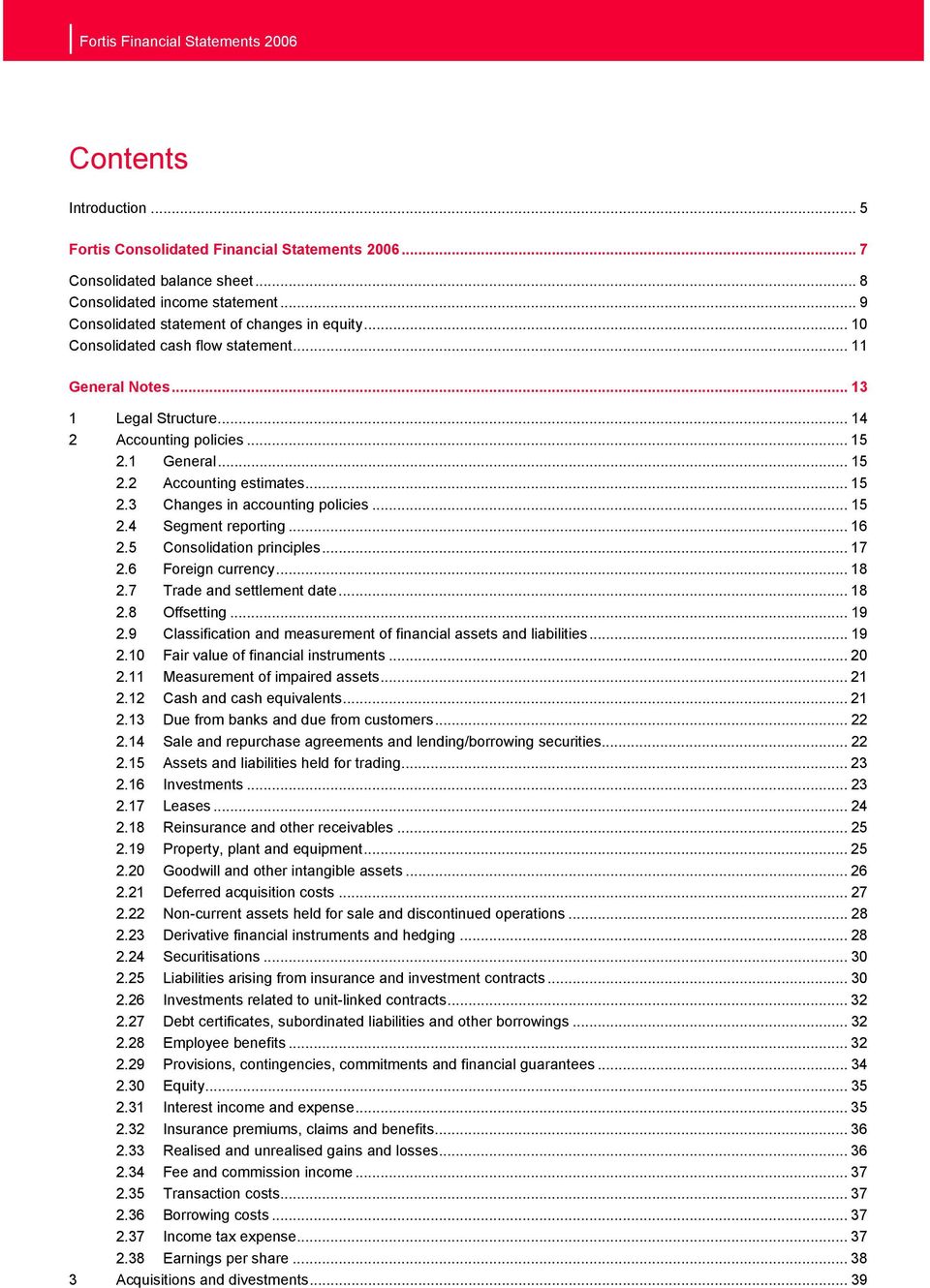
2 Fortis Financial Statements 2006 Contents Introduction... 5 Fortis Consolidated Financial Statements Consolidated balance sheet... 8 Consolidated income statement... 9 Consolidated statement of changes in equity Consolidated cash flow statement General Notes Legal Structure Accounting policies General Accounting estimates Changes in accounting policies Segment reporting Consolidation principles Foreign currency Trade and settlement date Offsetting Classification and measurement of financial assets and liabilities Fair value of financial instruments Measurement of impaired assets Cash and cash equivalents Due from banks and due from customers Sale and repurchase agreements and lending/borrowing securities Assets and liabilities held for trading Investments Leases Reinsurance and other receivables Property, plant and equipment Goodwill and other intangible assets Deferred acquisition costs Non-current assets held for sale and discontinued operations Derivative financial instruments and hedging Securitisations Liabilities arising from insurance and investment contracts Investments related to unit-linked contracts Debt certificates, subordinated liabilities and other borrowings Employee benefits Provisions, contingencies, commitments and financial guarantees Equity Interest income and expense Insurance premiums, claims and benefits Realised and unrealised gains and losses Fee and commission income Transaction costs Borrowing costs Income tax expense Earnings per share Acquisitions and divestments... 39
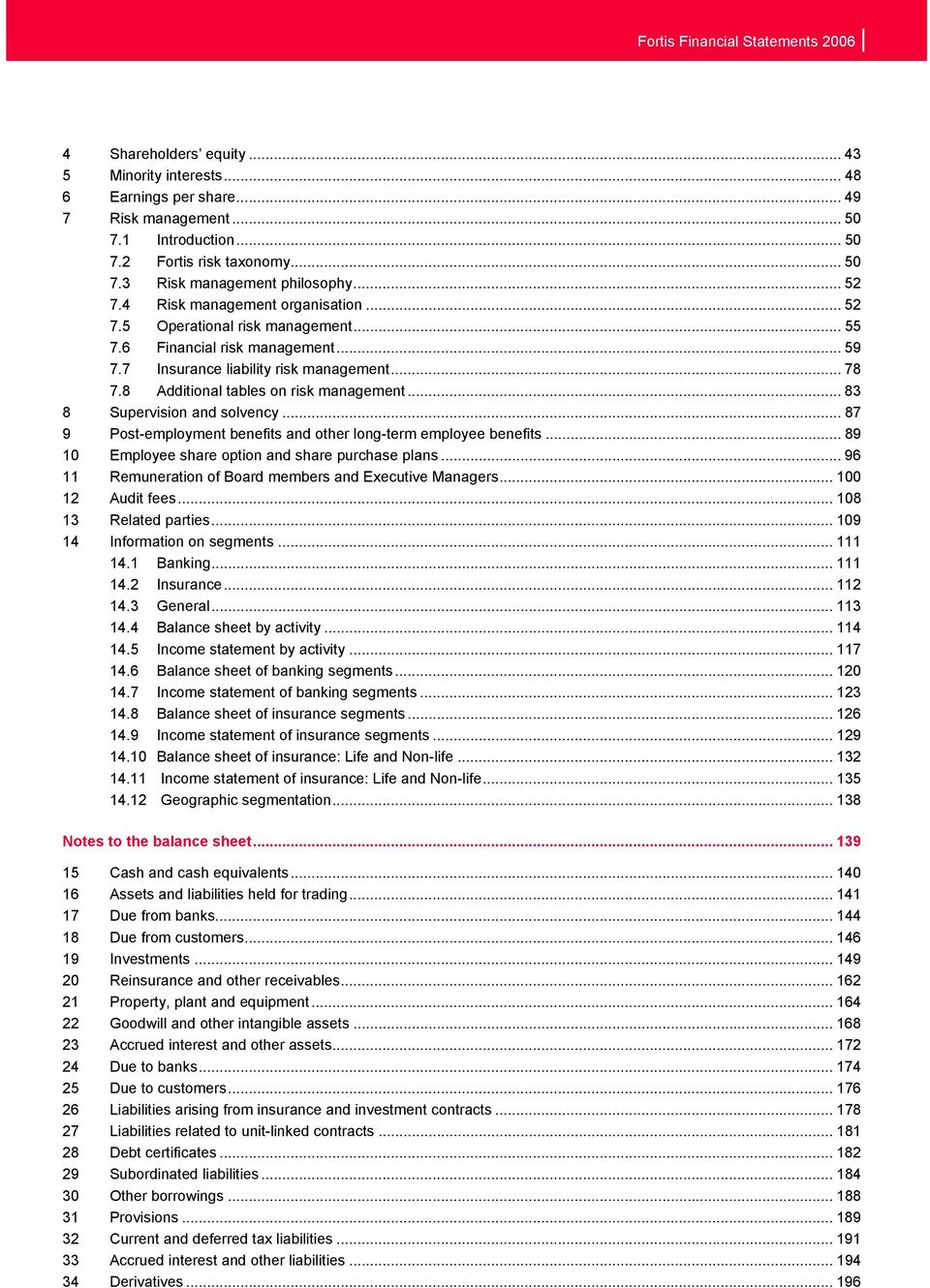
3 Fortis Financial Statements Shareholders equity Minority interests Earnings per share Risk management Introduction Fortis risk taxonomy Risk management philosophy Risk management organisation Operational risk management Financial risk management Insurance liability risk management Additional tables on risk management Supervision and solvency Post-employment benefits and other long-term employee benefits Employee share option and share purchase plans Remuneration of Board members and Executive Managers Audit fees Related parties Information on segments Banking Insurance General Balance sheet by activity Income statement by activity Balance sheet of banking segments Income statement of banking segments Balance sheet of insurance segments Income statement of insurance segments Balance sheet of insurance: Life and Non-life Income statement of insurance: Life and Non-life Geographic segmentation Notes to the balance sheet Cash and cash equivalents Assets and liabilities held for trading Due from banks Due from customers Investments Reinsurance and other receivables Property, plant and equipment Goodwill and other intangible assets Accrued interest and other assets Due to banks Due to customers Liabilities arising from insurance and investment contracts Liabilities related to unit-linked contracts Debt certificates Subordinated liabilities Other borrowings Provisions Current and deferred tax liabilities Accrued interest and other liabilities Derivatives
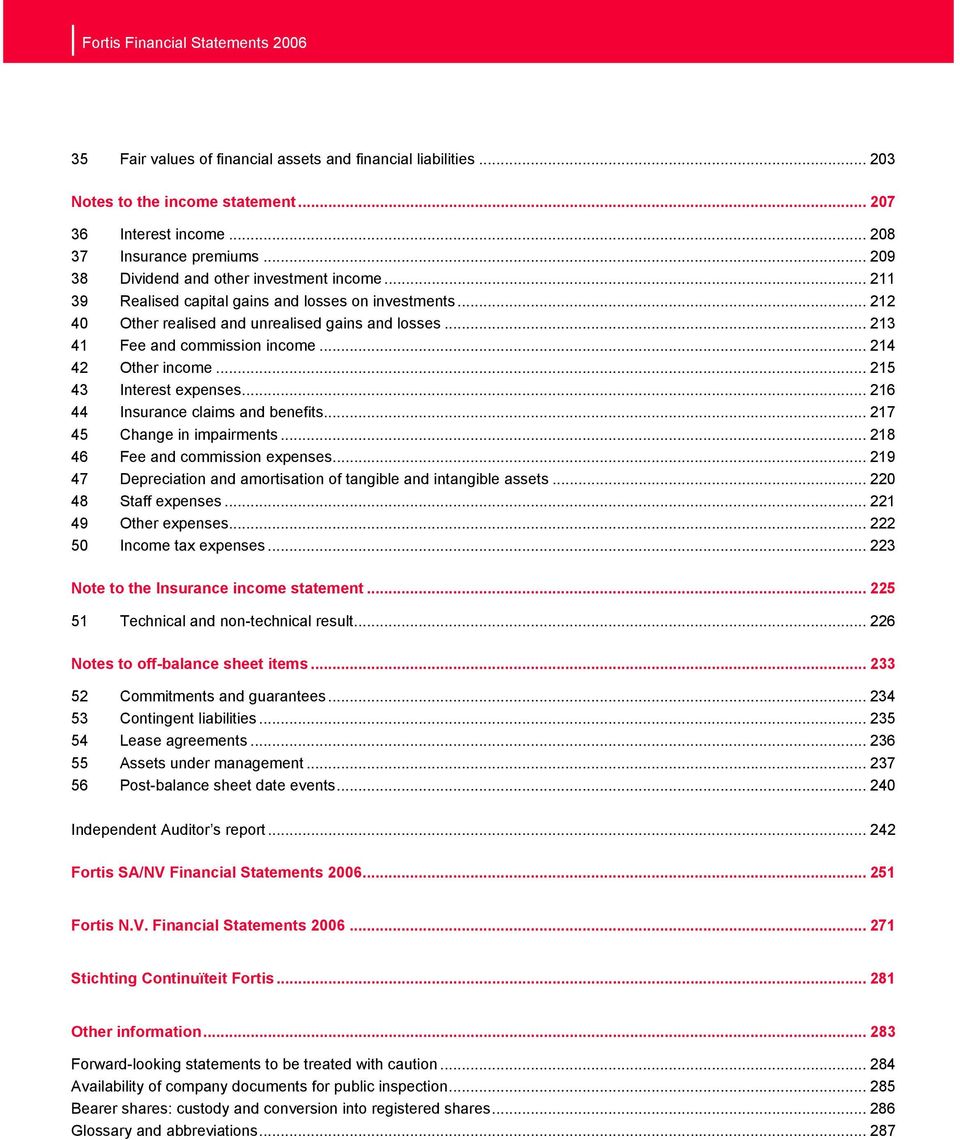
4 Fortis Financial Statements Fair values of financial assets and financial liabilities Notes to the income statement Interest income Insurance premiums Dividend and other investment income Realised capital gains and losses on investments Other realised and unrealised gains and losses Fee and commission income Other income Interest expenses Insurance claims and benefits Change in impairments Fee and commission expenses Depreciation and amortisation of tangible and intangible assets Staff expenses Other expenses Income tax expenses Note to the Insurance income statement Technical and non-technical result Notes to off-balance sheet items Commitments and guarantees Contingent liabilities Lease agreements Assets under management Post-balance sheet date events Independent Auditor s report Fortis SA/NV Financial Statements Fortis N.V. Financial Statements Stichting Continuïteit Fortis Other information Forward-looking statements to be treated with caution Availability of company documents for public inspection Bearer shares: custody and conversion into registered shares Glossary and abbreviations
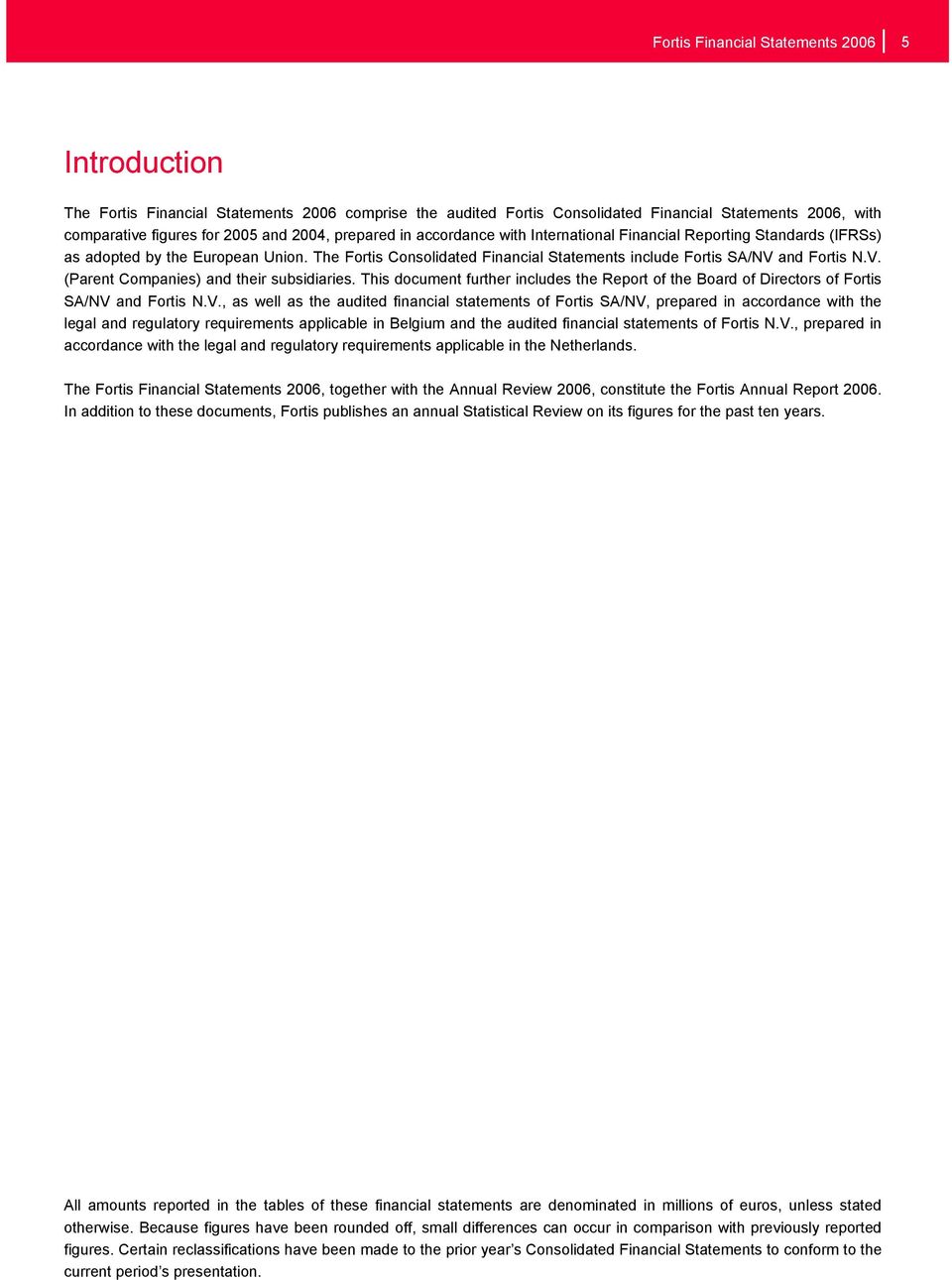
5 Fortis Financial Statements Introduction The Fortis Financial Statements 2006 comprise the audited Fortis Consolidated Financial Statements 2006, with comparative figures for 2005 and 2004, prepared in accordance with International Financial Reporting Standards (IFRSs) as adopted by the European Union. The Fortis Consolidated Financial Statements include Fortis SA/NV and Fortis N.V. (Parent Companies) and their subsidiaries. This document further includes the Report of the Board of Directors of Fortis SA/NV and Fortis N.V., as well as the audited financial statements of Fortis SA/NV, prepared in accordance with the legal and regulatory requirements applicable in Belgium and the audited financial statements of Fortis N.V., prepared in accordance with the legal and regulatory requirements applicable in the Netherlands. The Fortis Financial Statements 2006, together with the Annual Review 2006, constitute the Fortis Annual Report In addition to these documents, Fortis publishes an annual Statistical Review on its figures for the past ten years. All amounts reported in the tables of these financial statements are denominated in millions of euros, unless stated otherwise. Because figures have been rounded off, small differences can occur in comparison with previously reported figures. Certain reclassifications have been made to the prior year s Consolidated Financial Statements to conform to the current period s presentation.
6 Fortis Financial Statements 2006

7 Fortis Consolidated Financial Statements Fortis Consolidated Financial Statements 2006
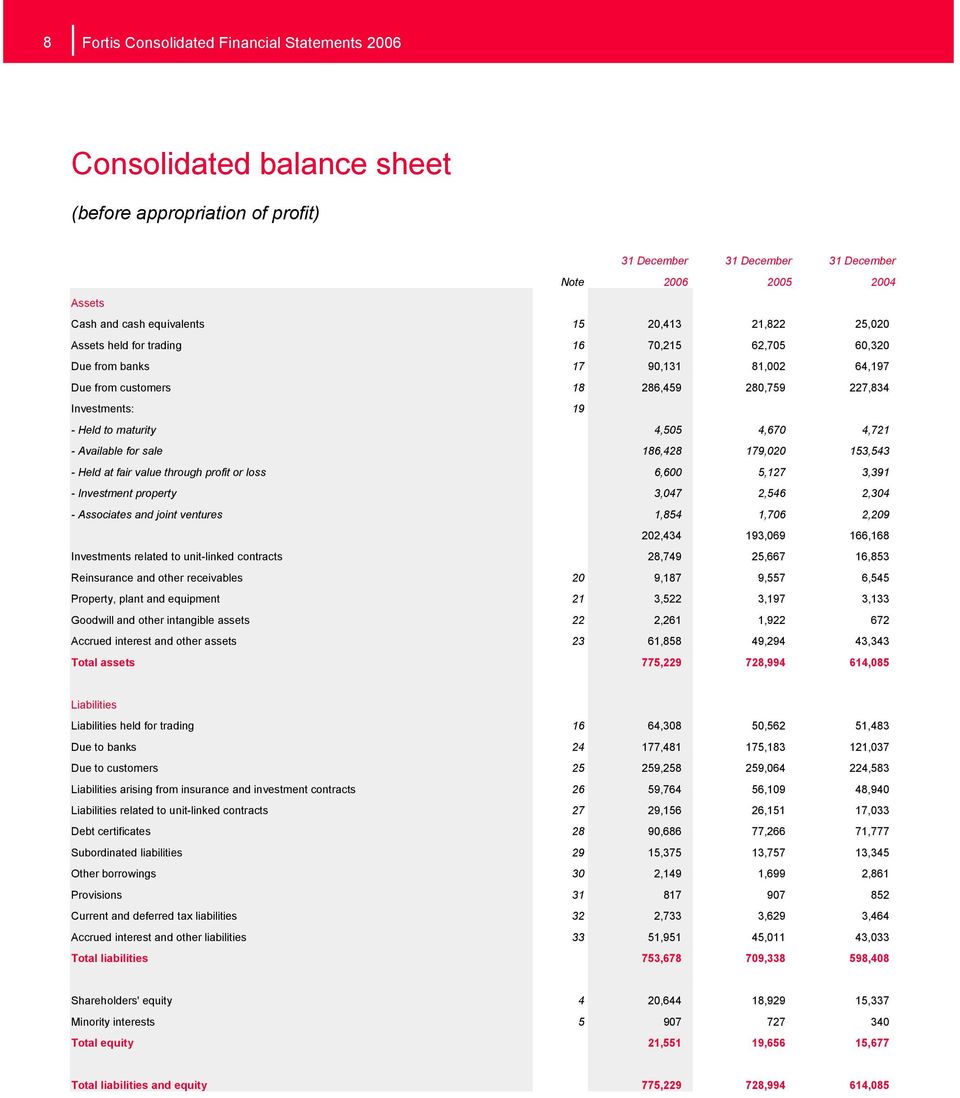
8 8 Fortis Consolidated Financial Statements 2006 Consolidated balance sheet (before appropriation of profit) 31 December 31 December 31 December Note Assets Cash and cash equivalents 15 20,413 21,822 25,020 Assets held for trading 16 70,215 62,705 60,320 Due from banks 17 90,131 81,002 64,197 Due from customers , , ,834 Investments: 19 - Held to maturity 4,505 4,670 4,721 - Available for sale 186, , ,543 - Held at fair value through profit or loss 6,600 5,127 3,391 - Investment property 3,047 2,546 2,304 - Associates and joint ventures 1,854 1,706 2, , , ,168 Investments related to unit-linked contracts 28,749 25,667 16,853 Reinsurance and other receivables 20 9,187 9,557 6,545 Property, plant and equipment 21 3,522 3,197 3,133 Goodwill and other intangible assets 22 2,261 1, Accrued interest and other assets 23 61,858 49,294 43,343 Total assets 775, , ,085 Liabilities Liabilities held for trading 16 64,308 50,562 51,483 Due to banks , , ,037 Due to customers , , ,583 Liabilities arising from insurance and investment contracts 26 59,764 56,109 48,940 Liabilities related to unit-linked contracts 27 29,156 26,151 17,033 Debt certificates 28 90,686 77,266 71,777 Subordinated liabilities 29 15,375 13,757 13,345 Other borrowings 30 2,149 1,699 2,861 Provisions Current and deferred tax liabilities 32 2,733 3,629 3,464 Accrued interest and other liabilities 33 51,951 45,011 43,033 Total liabilities 753, , ,408 Shareholders' equity 4 20,644 18,929 15,337 Minority interests Total equity 21,551 19,656 15,677 Total liabilities and equity 775, , ,085
9 Fortis Consolidated Financial Statements Consolidated income statement Note Income Interest income 36 72,583 66,845 54,223 Insurance premiums 37 13,984 12,919 11,576 Dividend and other investment income Share in result of associates and joint ventures Realised capital gains (losses) on investments 39 1,137 1,642 1,580 Other realised and unrealised gains and losses 40 1, ( 940 ) Fee and commission income 41 3,734 3,124 2,733 Income related to investments for unit-linked contracts 1,929 3,224 1,129 Other income Total income 96,602 90,419 71,927 Expenses Interest expense 43 ( 65,121 ) ( 60,227 ) ( 47,966 ) Insurance claims and benefits 44 ( 13,151 ) ( 11,788 ) ( 10,721 ) Charges related to unit-linked contracts ( 2,374 ) ( 3,709 ) ( 1,092 ) Change in impairments 45 ( 194 ) ( 235 ) ( 380 ) Fee and commission expense 46 ( 1,922 ) ( 1,615 ) ( 1,516 ) Depreciation and amortisation of tangible and intangible assets 47 ( 576 ) ( 548 ) ( 469 ) Staff expenses 48 ( 4,485 ) ( 4,291 ) ( 3,778 ) Other expenses 49 ( 3,336 ) ( 2,856 ) ( 3,116 ) Total expenses ( 91,159 ) ( 85,269 ) ( 69,038 ) Profit before taxation 5,443 5,150 2,889 Income tax expense 50 ( 1,030 ) ( 1,164 ) ( 510 ) Net profit for the period 4,413 3,986 2,379 Net profit attributable to minority interests Net profit attributable to shareholders 4,351 3,941 2,353 Per share data (EUR) 6 Basic earnings per share Diluted earnings per share

10 10 Fortis Consolidated Financial Statements 2006 Consolidated statement of changes in equity Share Currency Net profit Unrealised Share Premium Other translation attributable to gains Shareholders' Minority Capital reserve reserves reserve shareholders and losses equity interests Total Balance at 1 January ,307 11,708 ( 8,622 ) ( 100 ) 2,353 3,691 15, ,677 Net profit for the period 3,941 3, ,986 Revaluation of investments 1,402 1, ,411 Foreign exchange differences Other non-owner changes in equity Total non-owner changes in equity ,941 1,456 5, ,598 Transfer 2,353 ( 2,353 ) Dividend ( 2,012 ) ( 2,012 ) ( 20 ) ( 2,032 ) Increase of capital Treasury shares Other changes in equity Balance at 31 December ,307 11,718 ( 8,206 ) 22 3,941 5,147 18, ,656 Net profit for the period 4,351 4, ,413 Revaluation of investments ( 1,103 ) ( 1,103 ) ( 13 ) ( 1,116 ) Foreign exchange differences ( 168 ) ( 15 ) ( 183 ) ( 7 ) ( 190 ) Other non-owner changes in equity ( 20 ) ( 20 ) ( 20 ) Total non-owner changes in equity ( 20 ) ( 168 ) 4,351 ( 1,118 ) 3, ,087 Transfer 3,941 ( 3,941 ) Dividend ( 1,574 ) ( 1,574 ) ( 36 ) ( 1,610 ) Increase of capital Treasury shares Other changes in equity Balance at 31 December ,316 11,783 ( 5,689 ) ( 146 ) 4,351 4,029 20, ,551 The impact of acquisitions and divestments on Minority interests is included in the line Other changes in equity. Changes in equity are described in greater detail in note 4 and note 5.

11 Fortis Consolidated Financial Statements Consolidated cash flow statement Cash and cash equivalents at 1 January 21,822 25,020 21,535 Profit before taxation 5,443 5,150 2,889 Adjustment to reconcile profit to cash generated by operating activities: Net realised (gains) losses on sales ( 1,272 ) ( 1,701 ) ( 1,538 ) Net (un)realised (gains) losses ( 1,293 ) ( 262 ) ( 177 ) Income of associates and joint ventures (net of dividends received) ( 117 ) ( 97 ) ( 140 ) Depreciation and amortisation Provisions and impairments Share based compensation expense Changes in operating assets and liabilities: Assets and liabilities held for trading 6,601 ( 3,605 ) ( 4,288 ) Due from banks ( 9,116 ) ( 16,593 ) 17,824 Due from customers ( 8,160 ) ( 46,043 ) ( 46,694 ) Reinsurance and other receivables 315 ( 2,457 ) 5,172 Due to banks 1,827 52,560 2,392 Due to customers 1,347 27,476 26,446 Liabilities related to insurance and investment contracts 3,521 4,493 2,646 Net changes in all other operational assets and liabilities ( 2,068 ) ( 7,022 ) 2,180 Income tax paid ( 905 ) ( 1,023 ) ( 554 ) Cash flow from operating activities ( 2,838 ) 12,254 7,444 Purchase of investments ( 103,299 ) ( 73,732 ) ( 62,236 ) Proceeds from sales and redemptions of investments 89,520 56,848 50,937 Purchases of investment property ( 1,094 ) ( 387 ) ( 350 ) Proceeds from sales of investment property Investments in associates and joint ventures ( 241 ) ( 137 ) ( 407 ) Proceeds from sales of associates and joint ventures 104 1, Purchases of property, plant and equipment ( 605 ) ( 369 ) ( 410 ) Proceeds from sales of property, plant and equipment Acquisition of subsidiaries, net of cash acquired ( 340 ) ( 1,112 ) ( 50 ) Divestments of subsidiaries, net of cash sold 11 1,470 Purchase of intangible assets ( 136 ) ( 142 ) ( 80 ) Proceeds from sales of intangible assets 6 1 Cash flow from investing activities ( 15,397 ) ( 17,478 ) ( 10,768 ) Proceeds from the issuance of debt certificates 61,592 60,794 45,514 Payment of debt certificates ( 45,234 ) ( 57,663 ) ( 38,012 ) Proceeds from the issuance of subordinated liabilities 3,175 2,081 2,189 Payment of subordinated liabilities ( 1,791 ) ( 1,546 ) ( 1,323 ) Proceeds from the issuance of other borrowings 1,687 1,148 7,293 Payment of other borrowings ( 1,247 ) ( 962 ) ( 7,736 ) Proceeds from the issuance of shares (including minority interests) Purchases of treasury shares ( 931 ) ( 751 ) ( 878 ) Sales of treasury shares 1, ,114 Dividends paid ( 1,605 ) ( 2,006 ) ( 1,175 ) Repayment of capital (including minority interests) ( 200 ) Cash flow from financing activities 16,976 1,903 6,831 Foreign exchange differences on cash and cash equivalents ( 150 ) 123 ( 22 ) Cash and cash equivalents at 31 December 20,413 21,822 25,020 Supplementary disclosure of operating cash flow information Interest received 67,321 65,269 47,129 Dividend received Interest paid ( 59,981 ) ( 59,305 ) ( 41,479 )

12 12 Fortis Consolidated Financial Statements 2006

13 Fortis Consolidated Financial Statements General Notes

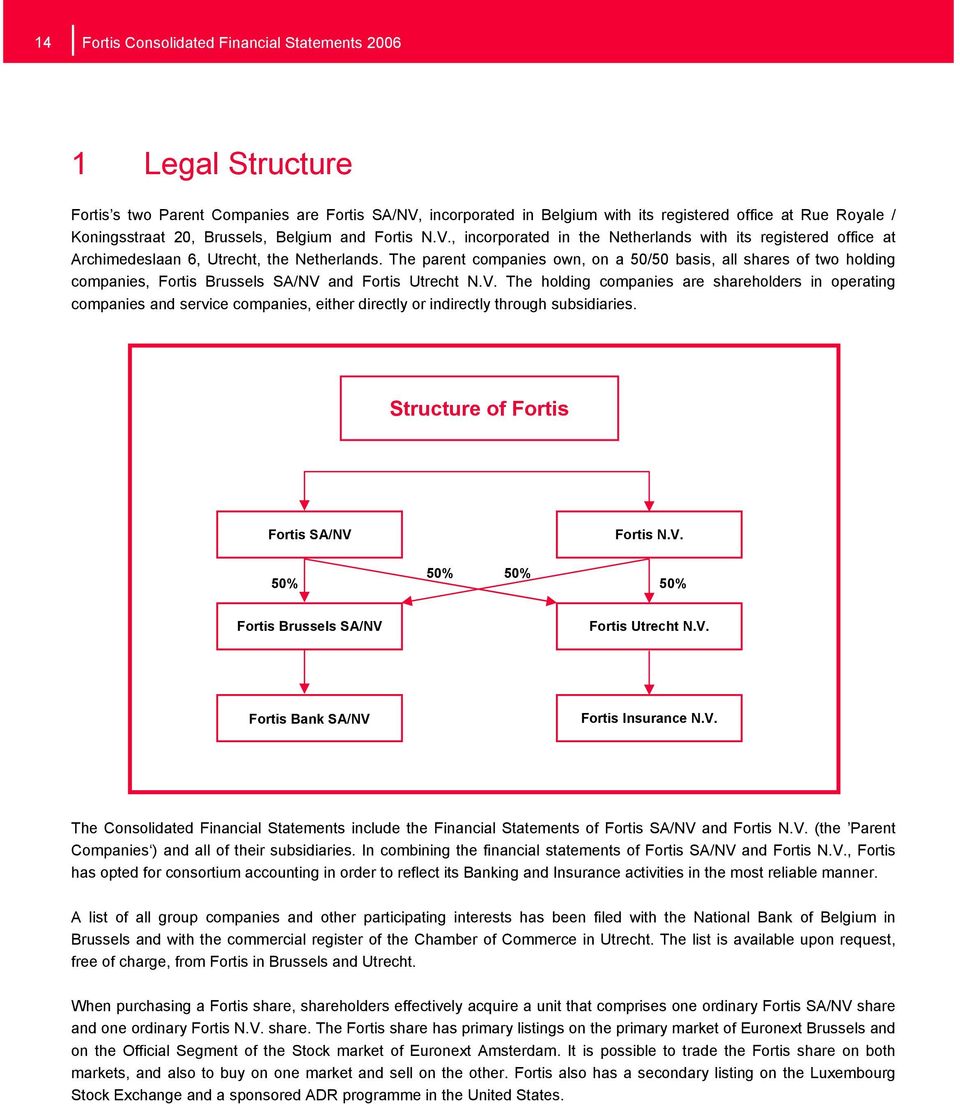
14 14 Fortis Consolidated Financial Statements Legal Structure Fortis s two Parent Companies are Fortis SA/NV, incorporated in Belgium with its registered office at Rue Royale / Koningsstraat 20, Brussels, Belgium and Fortis N.V., incorporated in the Netherlands with its registered office at Archimedeslaan 6, Utrecht, the Netherlands. The parent companies own, on a 50/50 basis, all shares of two holding companies, Fortis Brussels SA/NV and Fortis Utrecht N.V. The holding companies are shareholders in operating companies and service companies, either directly or indirectly through subsidiaries. Structure of Fortis Fortis SA/NV Fortis N.V. 50% 50% 50% 50% Fortis Brussels SA/NV Fortis Utrecht N.V. Fortis Bank SA/NV Fortis Insurance N.V. The Consolidated Financial Statements include the Financial Statements of Fortis SA/NV and Fortis N.V. (the Parent Companies ) and all of their subsidiaries. In combining the financial statements of Fortis SA/NV and Fortis N.V., Fortis has opted for consortium accounting in order to reflect its Banking and Insurance activities in the most reliable manner. A list of all group companies and other participating interests has been filed with the National Bank of Belgium in Brussels and with the commercial register of the Chamber of Commerce in Utrecht. The list is available upon request, free of charge, from Fortis in Brussels and Utrecht. When purchasing a Fortis share, shareholders effectively acquire a unit that comprises one ordinary Fortis SA/NV share and one ordinary Fortis N.V. share. The Fortis share has primary listings on the primary market of Euronext Brussels and on the Official Segment of the Stock market of Euronext Amsterdam. It is possible to trade the Fortis share on both markets, and also to buy on one market and sell on the other. Fortis also has a secondary listing on the Luxembourg Stock Exchange and a sponsored ADR programme in the United States.
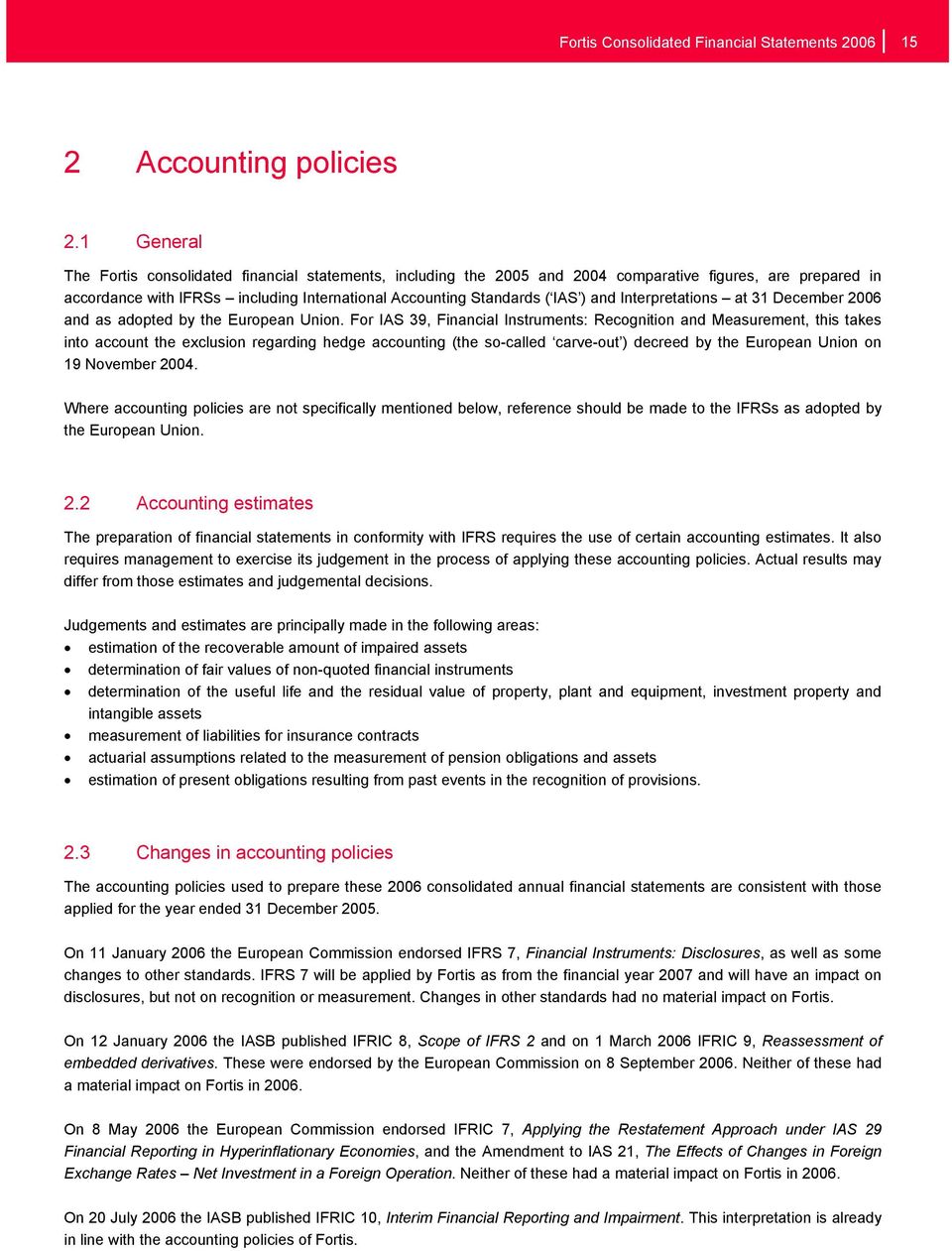
15 Fortis Consolidated Financial Statements Accounting policies 2.1 General The Fortis consolidated financial statements, including the 2005 and 2004 comparative figures, are prepared in accordance with IFRSs including International Accounting Standards ( IAS ) and Interpretations at 31 December 2006 and as adopted by the European Union. For IAS 39, Financial Instruments: Recognition and Measurement, this takes into account the exclusion regarding hedge accounting (the so-called carve-out ) decreed by the European Union on 19 November Where accounting policies are not specifically mentioned below, reference should be made to the IFRSs as adopted by the European Union. 2.2 Accounting estimates The preparation of financial statements in conformity with IFRS requires the use of certain accounting estimates. It also requires management to exercise its judgement in the process of applying these accounting policies. Actual results may differ from those estimates and judgemental decisions. Judgements and estimates are principally made in the following areas: estimation of the recoverable amount of impaired assets determination of fair values of non-quoted financial instruments determination of the useful life and the residual value of property, plant and equipment, investment property and intangible assets measurement of liabilities for insurance contracts actuarial assumptions related to the measurement of pension obligations and assets estimation of present obligations resulting from past events in the recognition of provisions. 2.3 Changes in accounting policies The accounting policies used to prepare these 2006 consolidated annual financial statements are consistent with those applied for the year ended 31 December On 11 January 2006 the European Commission endorsed IFRS 7, Financial Instruments: Disclosures, as well as some changes to other standards. IFRS 7 will be applied by Fortis as from the financial year 2007 and will have an impact on disclosures, but not on recognition or measurement. Changes in other standards had no material impact on Fortis. On 12 January 2006 the IASB published IFRIC 8, Scope of IFRS 2 and on 1 March 2006 IFRIC 9, Reassessment of embedded derivatives. These were endorsed by the European Commission on 8 September Neither of these had a material impact on Fortis in On 8 May 2006 the European Commission endorsed IFRIC 7, Applying the Restatement Approach under IAS 29 Financial Reporting in Hyperinflationary Economies, and the Amendment to IAS 21, The Effects of Changes in Foreign Exchange Rates Net Investment in a Foreign Operation. Neither of these had a material impact on Fortis in On 20 July 2006 the IASB published IFRIC 10, Interim Financial Reporting and Impairment. This interpretation is already in line with the accounting policies of Fortis.
16 16 Fortis Consolidated Financial Statements 2006 The IASB has also published two IFRICs and an IFRS that will only be applicable as from 2008/2009: IFRIC 11, IFRS 2: Group and Treasury Share Transactions, published on 2 November 2006, applicable as from the financial year IFRIC 12, Service Concession Agreements, published on 30 November 2006, applicable as from the financial year IFRS 8, Operating Segments, published on 30 November 2006, applicable as from the financial year Segment reporting Primary reporting format business segments The primary format for reporting segment information is based on business segments. Fortis s reportable business segments represent groups of assets and operations engaged in providing financial products or services, which are subject to differing risks and returns. Fortis's core activities are banking and insurance. As such, Fortis was organised on a world-wide basis into six business segments: Retail Banking Merchant Banking Commercial & Private Banking Insurance Belgium Insurance Netherlands Insurance International. Activities not related to banking or insurance and elimination differences are reported separately from the banking and Insurance activities. Transactions or transfers between the business segments are entered into under normal commercial terms and conditions that would be available to unrelated third parties. On 12 October 2006 Fortis announced that it would implement organisational changes to support the evolution of its growth strategy. The modified organisation is fully operational as of 1 January Fortis will start to report according to the new organisational structure as of the first quarter of Secondary reporting format geographical segments A geographical segment is engaged in providing products or services within a particular economic environment subject to risks and returns that are different from those of segments operating in other economic environments. Fortis s geographical segments for reporting purposes are as follows: Benelux (Belgium, the Netherlands, Luxembourg) Other European Countries North America Asia Other.
17 Fortis Consolidated Financial Statements Consolidation principles Subsidiaries The consolidated financial statements include those of Fortis SA/NV and Fortis N.V. (the Parent Companies ) and their subsidiaries. Subsidiaries are those companies, of which Fortis, either directly or indirectly, has the power to govern the financial and operating policies so as to obtain benefits from its activities ( control ). Subsidiaries are consolidated from the date on which effective control is transferred to Fortis and are no longer consolidated from the date that control ceases. Subsidiaries acquired exclusively with a view to resale are accounted for as non-current assets held for sale (see 2.22). In combining the financial statements of Fortis SA/NV and Fortis N.V., Fortis has opted for consortium accounting in order to reflect its Banking and Insurance activities in the most reliable manner. The EU 7 th directive dated 13 June 1983 (83/349/EEC), states that a Member State may require to draw up consolidated financial statements if the relevant entities are managed on a unified basis or the administrative, management or supervisory bodies of the entities concerned consist for the major part of the same persons in office during the year. This is required in Belgium under art. 111 of the Belgian Company Act and in the Netherlands under the Dutch Civil Code, Part 9, Book 2, article Fortis sponsors the formation of Special Purpose Entities ( SPEs ) primarily for the purpose of asset securitisation transactions, structured debt issuance, or to accomplish another well-defined objective. Some of the SPEs are bankruptcy-remote companies whose assets are not available to settle the claims of Fortis. SPEs are consolidated if in substance they are controlled by Fortis. Intercompany transactions, balances and gains and losses on transactions between the Fortis companies are eliminated. Minority interests in the net assets and net results of consolidated subsidiaries are shown separately on the balance sheet and income statement. Minority interests are stated at the fair value of the net assets at the date of acquisition. Subsequent to the date of acquisition, minority interests comprise the amount calculated at the date of acquisition and the minority s share of changes in equity since the date of acquisition. The existence and effect of potential voting rights that are presently exercisable or presently convertible are considered when assessing whether Fortis controls another entity. Joint ventures Investments in joint ventures are accounted for using the equity method. Joint ventures are contractual agreements whereby Fortis and other parties undertake an economic activity that is subject to joint control. Associates Investments in associates are accounted for using the equity method. These are investments where Fortis has significant influence, but which it does not control. The investment is recorded at the Fortis s share of the net assets of the associate. The ownership share of net income for the year is recognised as investment income and Fortis s share in the investment s post-acquisition direct equity movements are recognised in equity. Gains on transactions between Fortis and investments accounted for using the equity method are eliminated to the extent of Fortis s interest. Losses are also eliminated unless the transaction provides evidence of an impairment of the asset transferred. Adjustments are made to the financial statements of the associates to ensure consistent accounting policies across Fortis. Losses are recognised until the carrying amount of the investment is reduced to nil and further losses are only recognised to the extent that Fortis has incurred legal or constructive obligations or made payments on behalf of an associate.
18 18 Fortis Consolidated Financial Statements Foreign currency The consolidated financial statements are stated in euros, which is the functional currency of the Parent Companies of Fortis. Foreign currency transactions For individual entities of Fortis, foreign currency transactions are accounted for using the exchange rate at the date of the transaction. Outstanding balances in foreign currencies at year end are translated at year end exchange rates for monetary items. Translation of non-monetary items depends on whether the non-monetary items are carried at historical cost or at fair value. Non-monetary items carried at historical cost are translated using the historical exchange rate that existed at the date of the transaction. Non-monetary items that are carried at fair value are translated using the exchange rate on the date that the fair values are determined. The resulting exchange differences are recorded in the income statement as foreign currency gains (losses), except for those non-monetary items whose fair value change is recorded as a component of equity. The distinction between exchange differences (recognised in the income statement) and unrealised fair value results (recognised in equity) on available-for-sale financial assets is determined according to the following rules: the exchange differences are determined based on the evolution of the exchange rate calculated on the previous balances in foreign currency the unrealised (fair value) results are determined based on the difference between the balances in euros of the previous and the new period, converted at the new exchange rate. Foreign currency translation On consolidation, the income statement and cash flow statement of entities whose functional currency is not denominated in euros are translated into the presentation currency of Fortis (euros), at average daily exchange rates for the current year (or exceptionally at the exchange rate at the date of the transaction if exchange rates fluctuate significantly) and their balance sheets are translated using the exchange rates prevailing at the balance sheet date. Translation exchange differences are recognised in equity under the heading 'currency translation reserve'. On disposal of a foreign entity, such exchange differences are recognised in the income statement as part of the gain or loss on the sale. Exchange differences arising on monetary items, borrowings and other currency instruments, designated as hedges of a net investment in a foreign entity are recorded in equity (under 'currency translation reserve') in the consolidated financial statements, until the disposal of the net investment, except for any hedge ineffectiveness that is immediately recognised in the income statement. Goodwill and fair value adjustments arising on the acquisition of a foreign entity are treated as assets and liabilities of the foreign entity and are translated at the closing exchange rate on the balance sheet date. All resulting differences are recognised in equity under the heading currency translation reserve until disposal of the foreign entity when a recycling to the income statement takes place. 2.7 Trade and settlement date All purchases and sales of financial assets requiring delivery within the time frame established by regulation or market convention are recognised on the trade date, which is the date when Fortis becomes a party to the contractual provisions of the financial assets. Forward purchases and sales other than those requiring delivery within the time frame established by regulation or market convention are recognised as derivative forward transactions until settlement.

19 Fortis Consolidated Financial Statements Offsetting Financial assets and liabilities are offset and the net amount reported on the balance sheet if there is a legally enforceable right to set off the recognised amounts and there is an intention to settle on a net basis, or realise the asset and settle the liability simultaneously. 2.9 Classification and measurement of financial assets and liabilities Fortis classifies financial assets and liabilities based on the business purpose of entering into these transactions. Financial assets Consequently, financial assets are classified as assets held for trading, investments, due from banks and due from customers. The measurement and income recognition in the income statement depend on the IFRS classification of the financial assets, being: (a) loans and receivables; (b) held-to-maturity investments; (c) financial assets at fair value through profit or loss and (d) available-for-sale financial assets. This IFRS classification determines the measurement and recognition as follows: a) Loans and receivables are initially measured at fair value (including transaction costs) and subsequently measured at amortised cost using the effective interest method, with the periodic amortisation in the income statement. b) Held-to-maturity investments consist of instruments with fixed or determinable payments and fixed maturity for which the positive intent and ability to hold to maturity is demonstrated. They are initially measured at fair value (including transaction costs) and subsequently measured at amortised cost using the effective interest method, with the periodic amortisation recorded in the income statement. c) Financial assets at fair value through profit or loss include: (i) financial assets held for trading, including derivative instruments that do not qualify for hedge accounting (ii) financial assets that Fortis has irrevocably designated at initial recognition or first-time adoption of IFRS as held at fair value through profit or loss, because: the host contract includes an embedded derivative that would otherwise require separation it eliminates or significantly reduces a measurement or recognition inconsistency ( accounting mismatch ) it relates to a portfolio of financial assets and/or liabilities that are managed and evaluated on a fair value basis. d) Available-for-sale financial assets are those that are otherwise not classified as loans and receivables, held-tomaturity investments, or financial assets designated at fair value through profit or loss. Available-for-sale financial assets are initially measured at fair value (including transaction costs), and are subsequently measured at fair value with unrealised gains or losses from fair value changes reported in equity. Financial liabilities Financial liabilities are classified as liabilities held for trading, due to banks, due to customers, debt certificates, subordinated liabilities and other borrowings.
20 20 Fortis Consolidated Financial Statements 2006 The measurement and recognition in the income statement depends on the IFRS classification of the financial liabilities, being: (a) financial liabilities at fair value through profit or loss, and (b) other financial liabilities. This IFRS classification determines the measurement and recognition in the income statement as follows: a) Financial liabilities at fair value through profit or loss include: (i) financial liabilities held for trading, including derivative instruments that do not qualify for hedge accounting (ii) financial liabilities that Fortis has irrevocably designated at initial recognition or first-time adoption of IFRS as held at fair value through profit or loss, because the host contract includes an embedded derivative that would otherwise require separation it eliminates or significantly reduces a measurement or recognition inconsistency ( accounting mismatch ) it relates to a portfolio of financial assets and/or liabilities that are managed and evaluated on a fair value basis. b) Other financial liabilities are initially recognised at fair value (including transaction costs) and subsequently measured at amortised cost using the effective interest method, with the periodic amortisation recorded in the income statement Fair value of financial instruments The fair value of a financial instrument is determined based on quoted prices in active markets. When quoted prices in active markets are not available, valuation techniques are used. Valuation techniques make maximum use of market inputs but are affected by the assumptions used, including discount rates and estimates of future cash flows. Such techniques include market prices of comparable investments, discounted cash flows, option pricing models and market multiples valuation methods. In the rare case where it is not possible to determine the fair value of a financial instrument, it is accounted for at cost. On initial recognition, the fair value of a financial instrument is the transaction price, unless the fair value is evidenced by observable current market transactions in the same instrument, or is based on a valuation technique that includes inputs only from observable markets. The principal methods and assumptions used by Fortis in determining the fair value of financial instruments are: Fair values for securities available for sale or at fair value through profit or loss are determined using market prices from active markets. If no quoted prices are available from an active market, the fair value is determined using discounted cash flow models. Discount factors are based on the swap curve plus a spread reflecting the risk characteristics of the instrument. Fair values for securities held to maturity (only necessary for disclosures) are determined in the same way. Fair values for derivative financial instruments are obtained from active markets or determined using, as appropriate, discounted cash flow models and option pricing models. Fair values for unquoted private equity investments are estimated using applicable market multiples (e.g. price/earnings or price/cash flow ratios) refined to reflect the specific circumstances of the issuer. Fair values for loans are determined using discounted cash flow models based upon Fortis s current incremental lending rates for similar type loans. For variable-rate loans that re-price frequently and have no significant change in credit risk, fair values are approximated by the carrying amount. Option pricing models are used for valuing caps and prepayment options embedded in loans that have been separated according to IFRS. Off-balance-sheet commitments or guarantees are fair valued based on fees currently charged to enter into similar agreements, taking into account the remaining terms of the agreements and the counterparties credit standings. For short-term payables and receivables, the carrying amounts are considered to approximate fair values.
21 Fortis Consolidated Financial Statements Measurement of impaired assets An asset is impaired when its carrying amount exceeds its recoverable amount. Fortis reviews all of its assets at each reporting date for objective evidence of impairment. The carrying amount of impaired assets is reduced to its estimated recoverable amount and the amount of the change in the current year is recognised in the income statement. Recoveries, write-offs and reversals of impairment are included in the income statement as part of change in impairment. If in a subsequent period the amount of the impairment on assets other than goodwill or available-for-sale equity instruments decreases, due to an event occurring after the write-down, the amount is reversed by adjusting the impairment and is recognised in the income statement. Financial assets A financial asset (or group of financial assets) is impaired if there is objective evidence of impairment as a result of one or more events that occurred after the initial recognition of the asset and that loss event (or events) has an impact on the estimated future cash flows of the financial asset (or group of financial assets) that can be reliably estimated. For equity securities, the triggers used to determine whether there is objective evidence of impairment include, amongst others, the consideration whether the fair value is substantially below cost at the balance sheet date, or has been below cost for a prolonged period at the balance sheet date. Depending on the type of financial asset, the recoverable amount can be estimated as follows: the fair value using an observable market price present value of expected future cash flows discounted at the instrument s original effective interest rate (for financial assets carried at amortised cost) based on the fair value of the collateral. Impairments to available-for-sale equity instruments cannot be reversed through the income statement in subsequent periods. Goodwill and other intangible assets See 2.20: Goodwill and other intangible assets. Other assets For non-financial assets, the recoverable amount is measured as the higher of the fair value less cost to sell and the value in use. Fair value less cost to sell is the amount obtainable from the sale of an asset in an arm s length transaction between knowledgeable, willing parties, after deducting any direct incremental disposal costs. Value in use is the present value of estimated future cash flows expected to arise from continuing use of an asset and from its disposal at the end of its useful life Cash and cash equivalents Content Cash and cash equivalents comprise cash on hand, freely available balances with central banks and other financial instruments with less than three months maturity from the date of acquisition. Cash flow statement Fortis reports cash flows from operating activities using the indirect method, whereby the net result is adjusted for the effects of transactions of a non-cash nature, any deferrals or accruals of past or future operating cash receipts or payments, and items of income or expense associated with investing or financing cash flows.
22 22 Fortis Consolidated Financial Statements 2006 Interest received and interest paid are presented as cash flows from operating activities in the cash flow statement. Dividends received are classified as cash flows from operating activities. Dividends paid are classified as cash flows from financing activities Due from banks and due from customers Classification Due from banks and due from customers include loans originated by Fortis by providing money directly to the borrower or to a sub-participation agent and loans purchased from third parties that are carried at amortised cost. Debt securities acquired on the primary market directly from the issuer are recorded as loans, provided there is no active market for those securities. Loans that are originated or purchased with the intent to be sold or securitised in the short-term are classified as assets held for trading. Loans that are designated as held at fair value through profit or loss or available for sale are classified as such at initial recognition. Measurement Incremental costs incurred and loan origination fees earned in securing a loan are deferred and amortised over the life of the loan as an adjustment to the yield. Impairment A credit risk for specific loan impairment is established if there is objective evidence that Fortis will not be able to collect all amounts due in accordance with contractual terms. The amount of the provision is the difference between the carrying amount and the recoverable amount, being the present value of expected cash flows or, alternatively, the collateral value less costs to sell if the loan is secured. An incurred but not reported (IBNR) impairment on loans is recorded when there is objective evidence that incurred losses are present in components of the loan portfolio, without having specifically identified impaired loans. This impairment is estimated based upon historical patterns of losses in each component, reflecting the current economic climate in which the borrowers operate and taking into account the risk of difficulties in servicing external debt in some foreign countries based on an assessment of the political and economic situation. Impairments are recorded as a decrease in the carrying value of due from banks and due from customers. When a specific loan is identified as uncollectible and all legal and procedural actions have been exhausted, the loan is written off against the related charge for impairment; subsequent recoveries are credited to change in impairment in the income statement Sale and repurchase agreements and lending/borrowing securities Securities subject to a repurchase agreement ( repos ) are not derecognised from the balance sheet. The liability resulting from the obligation to repurchase the assets is included in due to banks or due to customers depending on the type of counterparty. Securities purchased under agreements to resell ( reverse repos ) are not recognised on the balance sheet. The right to receive cash from the counterparty is recorded as due from banks or due from customers depending on the type of counterparty. The difference between the sale and repurchase price is treated as interest and accrued over the life of the agreements using the effective interest method. Securities lent to counterparties remain on the balance sheet. Similarly, securities borrowed are not recognised on the balance sheet. If borrowed securities are sold to third parties, the proceeds from the sale and a liability for the obligation to return the collateral are recorded. The obligation to return the collateral is measured at fair value through profit or loss and is classified as a liability held for trading. Cash advanced or received related to securities borrowing or lending transactions is recorded as due from banks/due from customers or due to banks/due to customers.
23 Fortis Consolidated Financial Statements Assets and liabilities held for trading A financial asset or financial liability is classified as held for trading if it is: acquired or incurred principally for the purpose of selling or repurchasing it in the near term part of a portfolio of identified financial instruments that are managed together and for which there is evidence of a recent actual pattern of short-term profit taking a derivative (except for a derivative that is a designated and effective hedging instrument). Assets and liabilities held for trading are initially recognised and subsequently measured at fair value through profit or loss. The (realised and unrealised) results are included in other realised and unrealised gains and losses. Interest received (paid) on assets (liabilities) held for trading is reported as interest income (expense). Dividends received are included in dividend and other investment income Investments Management determines the appropriate classification of its investment securities at the time of the purchase. Investment securities with a fixed maturity where management has both the intent and the ability to hold to maturity are classified as held to maturity. Investment securities to be held for an indefinite period of time, which may be sold in response to needs for liquidity or changes in interest rates, exchange rates or equity prices, are classified as available for sale. Investment securities that are acquired for the purpose of generating short-term profits are considered to be held for trading. Any investment, other than investments in equity instruments without a quoted market price in an active market, may be designated on initial recognition as a financial instrument at fair value through profit or loss. Once an asset has been designated as held at fair value through profit or loss it cannot be transferred to a different category. Held-to-maturity investments are carried at amortised cost less any impairment changes. Any difference between the initial recognition amount resulting from transaction costs, initial premiums or discounts is amortised over the life of the investment using the effective interest method. If a held-to-maturity investment is determined to be impaired, the impairment is recognised in the income statement. Available-for-sale investment securities are held at fair value. Changes in the fair value are recognised directly in equity until the asset is sold unless the asset is hedged by a derivative. If an investment is determined to be impaired, the impairment is recognised in the income statement. For impaired available-for-sale investments, unrealised losses previously recognised in equity are transferred to the income statement when the impairment occurs. If, in a subsequent period, the fair value of a debt instrument classified as available for sale increases and the increase can be objectively related to an event occurring after the impairment was recognised in the income statement, the impairment is reversed, with the amount of the reversal recognised in the income statement. Impairments recognised in the income statement for an investment in an equity instrument classified as available for sale are not reversed through the income statement. Available-for-sale investment securities that are hedged by a derivative are carried at fair value with movements in fair value recognised through the income statement for the part attributable to the hedged risk and through equity for the remaining part. Held-for-trading assets and assets designated as held at fair value through profit or loss are carried at fair value. Changes in the fair value are recognised in the income statement. Investment property Investment properties are those properties held to earn rental income or for capital appreciation. Fortis may also use certain investment properties for its own use. If the own use portions can be sold separately or leased out separately under a finance lease, these portions are accounted for as property, plant and equipment. If the own use portions cannot be sold separately, the property is treated as investment property only if Fortis holds an insignificant portion for its own use.
24 24 Fortis Consolidated Financial Statements 2006 Investment property is measured at cost less accumulated depreciation and any accumulated impairment losses. Depreciation is calculated using the straight-line method to write down the cost of such assets to their residual values over their estimated useful lives. The residual value and the useful life of investment property are determined for each significant part separately (component approach) and are reviewed at each year end. Fortis rents its investment property under various non-cancellable rental contracts. Certain contracts contain renewal options for various periods of time; the rental income associated with these contracts is recognised on a straight-line basis over the rental term as investment income. Transfers to, or from, investment property are only made when there is a change of use: into investment property at the end of owner-occupation, or at the start of an operating lease to a another party, or at the end of construction or development out of investment property at the commencement of owner-occupation, or start of development with a view to sale. When the outcome of a construction contract can be estimated reliably, contract revenue and contract costs associated with the construction contract are recognised as revenue and expenses respectively by reference to the stage of completion of the contract activity at the balance sheet date. When it is probable that total contract costs will exceed total contract revenue, the expected loss is recognised as an expense immediately Leases Fortis as a lessor Assets leased under operating leases are included in the consolidated balance sheet (1) under investment property (buildings), and (2) under property, plant and equipment (equipment and motor vehicles). They are recorded at cost less accumulated depreciation. Rental income, net of any incentives given to lessees, is recognised on a straight-line basis over the lease term. Initial direct costs incurred by Fortis are added to the carrying amount of the leased asset and recognised as an expense over the lease term on the same basis as the rental income. Fortis has also entered into finance leases, in which substantially all the risks and rewards related to ownership of the leased asset, other than legal title, are transferred to the customer. When assets held are subject to a finance lease, the present value of the lease payments and any guaranteed residual value is recognised as a receivable. The difference between the gross receivable and the present value of the receivable is recognised as unearned finance income. Lease interest income is recognised over the term of the lease based on a pattern reflecting a constant periodic rate of return on the net investment outstanding in respect of finance leases. Initial direct costs incurred by Fortis are included in the finance lease receivable and allocated against lease interest income over the lease term. Fortis as a lessee Fortis principally enters into operating leases for the rental of equipment and land and buildings. Payments made under such leases are typically charged to the income statement principally on a straight-line basis over the period of the lease. When an operating lease is terminated before the lease period has expired, any payment required to be made to the lessor by way of penalty is recognised as an expense in the period in which termination takes place. Any incentives received from the lessor in relation to operating leases are recognised as a reduction of rental expense over the lease term on a straight-line basis.
25 Fortis Consolidated Financial Statements If the lease agreement transfers substantially all the risk and rewards incident to ownership of the asset, the lease is recorded as a finance lease and the related asset is capitalised. At inception, the asset is recorded at the lower of the present value of the minimum lease payments or fair value and depreciated over the shorter of its estimated useful life or the lease term. The corresponding lease obligation, net of finance charges, is recorded as borrowings. The interest element of the finance cost is charged to the income statement over the lease term so as to produce a constant periodic rate of interest on the remaining balance of the obligation for each period Reinsurance and other receivables Reinsurance Fortis assumes and/or cedes reinsurance in the normal course of business. Reinsurance receivables principally include balances due from both insurance and reinsurance companies for ceded insurance liabilities. Amounts recoverable from or due to reinsurers are estimated in a manner consistent with the amounts associated with the reinsured policies and in accordance with the reinsurance contract. Reinsurance is presented on the balance sheet on a gross basis unless a right of offset exists. Contracts that transfer significant insurance risk are classified as reinsurance contracts. Investment contracts are those contracts that transfer financial risk without transferring significant insurance risk. Reinsurance contracts are reviewed to determine if significant insurance risk is transferred within the contract. Reinsurance contracts that do not transfer significant insurance risk are accounted for using the deposit method and included in loans or borrowings as a reinsurance financial asset or liability. A reinsurance financial asset or liability is recognised based on the consideration paid or received less any explicitly identified premiums or fees to be retained by the reinsured. Amounts received or paid under these contracts are accounted for as deposits using the effective interest method. Other receivables Other receivables arising from the normal course of business and originated by Fortis are initially recorded at fair value and subsequently measured at amortised cost using the effective interest method, less impairments Property, plant and equipment All real estate held for own use and fixed assets are stated at cost less accumulated depreciation (except for land that is not depreciated) and any accumulated impairment losses. Cost is the amount of cash or cash equivalents paid or the fair value of the other consideration given to acquire an asset at the time of its acquisition or construction. Generally, depreciation is calculated using the straight-line method to write down the cost of such assets to their residual values over their estimated useful lives. The residual value and the useful life of property, plant and equipment are determined for each significant part separately (component approach) and are reviewed at each year end. Repairs and maintenance expenses are charged to the income statement when the expenditure is incurred. Expenditures that enhance or extend the benefits of real estate or fixed assets beyond their original use are capitalised and subsequently depreciated. For borrowing costs to finance the construction of property, plant and equipment: see 2.36 Borrowing costs.
26 26 Fortis Consolidated Financial Statements Goodwill and other intangible assets Goodwill Acquisitions of companies are accounted for using the purchase method of accounting. Goodwill represents the excess of the fair value of the assets given, liabilities incurred or assumed, and equity instruments issued, plus any costs directly attributable to the business combination over Fortis s interest in the fair value of assets acquired and liabilities and contingent liabilities assumed. Goodwill arising on the acquisition of a subsidiary is reported on the balance sheet as an intangible asset. Goodwill arising on business combinations before 1 January 2004 is deducted from equity and is not restated under IFRS. At acquisition date, it is allocated to those cash-generating units that are expected to benefit from the synergies of the business combination. It is not amortised, but instead is tested for impairment. Goodwill arising on the acquisition of an associate is presented as part of the investment in the associate. Any excess of the acquired interest in the net fair value of the acquiree s assets, liabilities and contingent liabilities over the acquisition cost is recognised immediately in the income statement. Fortis assesses the carrying value of goodwill annually or, more frequently, if events or changes in circumstances indicate that such carrying value may not be recoverable. If such indication exists, the recoverable amount is determined for the cash-generating unit to which goodwill belongs. This amount is then compared to the carrying amount of the cashgenerating unit and an impairment loss is recognised if the recoverable amount is less than the carrying amount. Impairment losses are recognised immediately in the income statement. Fortis first reduces the carrying amount of goodwill allocated to the cash generating unit and then reduces the other assets in the cash-generating unit pro rata on the basis of the carrying amount of each asset in the cash generating unit. Previously recognised impairment losses relating to goodwill are not reversed. Fortis may obtain control of a subsidiary in more than one transaction. When this occurs, each exchange transaction is treated separately by Fortis. The cost of each transaction is compared to the fair value of each transaction to determine the amount of goodwill associated with that individual transaction. Before Fortis obtains control of the entity, the transaction may qualify as an investment in an associate and be accounted for using the equity method. If so, the fair value of the investee s identifiable net assets at the date of each earlier transaction will have been determined in applying the equity method to the investment. Other intangible assets An intangible asset is an identifiable non-monetary asset and is recognised at cost if and only if it will generate future economic benefits and if the cost of the asset can be measured reliably. Value of business acquired (VOBA) represents the difference between the fair value at acquisition date and the subsequent carrying value of a portfolio of contracts acquired in a business or portfolio acquisition. VOBA is recognised as an intangible asset and amortised over the income recognition period of the portfolio of contracts acquired. Internally generated intangible assets are capitalised when Fortis can demonstrate all of the following: the technical feasibility of completing the intangible asset so that it will be available for use or sale its intention to complete the intangible asset and use or sell it its ability to use or sell the intangible asset how the intangible asset will generate probable future economic benefits the availability of adequate technical, financial and other resources to complete the development and to use or sell the intangible asset its ability to measure reliably the expenditure attributable to the intangible asset during its development. Intangible assets arising from research and internally generated goodwill are not capitalised.
27 Fortis Consolidated Financial Statements Software for computer hardware that cannot operate without that specific software, such as the operating system, is an integral part of the related hardware and it is treated as property, plant and equipment. If the software is not an integral part of the related hardware, the costs incurred during the development phase for which Fortis can demonstrate all of the above-mentioned criteria are capitalised as an intangible asset and amortised using the straight-line method over the estimated useful life. Other intangible assets include intangible assets with definite lives, such as trademarks and licenses that are generally amortised over their useful lives using the straight-line method. Intangible assets with finite lives are reviewed at each reporting date for indicators of impairment. Indefinite-life intangible assets, which are not amortised, are instead tested for impairment at least annually. Any impairment loss identified is recognised in the income statement. Intangibles are recorded on the balance sheet at cost less any accumulated amortisation and any accumulated impairment losses. The residual value and the useful life of intangible assets are reviewed at each year end Deferred acquisition costs The costs of new and renewed insurance business, principally commissions, underwriting, agency and policy issue expenses, all of which vary with and primarily are related to the production of new business, are deferred and amortised. Deferred acquisition costs ( DAC ) are periodically reviewed to ensure they are recoverable based on estimates of future profits of the underlying contracts. For insurance life products and investment life products, both with discretionary participating features, DAC is amortised over the expected life of the contracts based on the present value of the estimated gross margin or profit amounts using the expected investment yield. Estimated gross margin includes anticipated premiums and investment results less benefits and administrative expenses, changes in the net level premium reserve and expected policyholder dividends, as appropriate. Deviations of actual results from estimated experience are reflected in the income statement in the period in which such deviations occur. DAC is adjusted for the amortisation effect of unrealised gains (losses) recorded in equity as if they were realised with the related adjustment to unrealised gains (losses) in equity. For insurance life products and investment life products, both without discretionary participating features, DAC is amortised in proportion to anticipated premiums. Assumptions as to anticipated premiums are estimated at the date of policy issuance and are consistently applied during the life of the contracts. Deviations from estimated experience are reflected in the income statement in the period such deviations occur. For these contracts, the amortisation periods generally are for the total life of the policy. For short duration contracts, DAC is amortised over the period in which the related premiums written are earned. Future investment income, at a risk-free rate of return, is considered in assessing the recoverability of DAC. Some investment contracts without discretionary participation features issued by insurance entities involve both the origination of a financial instrument and the provision of investment management services. Where clearly identifiable, the incremental costs relating to the right to provide investment management services are recognised as an asset and are amortised as the entities recognise the related revenues. The related intangible asset is tested for recoverability at each reporting date. Fee charges for managing investments on these contracts are recognised as revenue as the services are provided.
28 28 Fortis Consolidated Financial Statements Non-current assets held for sale and discontinued operations Non-current assets or a group of assets and liabilities are those for which Fortis will recover the carrying amount from a sale transaction that is expected to qualify as a sale within a year, instead of through continuing use. A discontinued operation is a part of Fortis that has been disposed of or is classified as held for sale and meets the following criteria: represents a separate major line of business or geographical area of operations is part of a single co-ordinated plan to dispose of a separate major line of business or geographical area of operations is a subsidiary acquired exclusively with a view to resale. Non-current assets held for sale (and disposal groups) are not depreciated but measured at the lower of its carrying amount and fair value less costs to sell, and are separately presented on the balance sheet. Results on discontinued operations are presented separately in the income statement Derivative financial instruments and hedging Recognition and classification Derivatives are financial instruments such as swaps, forward and future contracts, and options (both written and purchased). These financial instruments have values that change in response to change in various underlying variables, require little or no net initial investment, and are settled at a future date. All derivatives are recognised on the balance sheet at fair value on the trade date: derivatives held for trading in assets held for trading and liabilities held for trading derivatives that qualify for hedge accounting in accrued interest and other assets and accrued interest and other liabilities. Subsequent changes in the clean fair value (i.e. excluding the interest accruals) of derivatives are reported in the income statement under other realised and unrealised gains and losses. Financial assets or liabilities can include embedded derivatives. Such financial instruments are often referred to as hybrid financial instruments. Hybrid financial instruments include reverse convertible bonds (bonds whose repayment may take the form of equities) or bonds with indexed interest payments. If the host contract is not carried at fair value through profit or loss and the characteristics and risks of the embedded derivative are not closely related to those of the host contract, the embedded derivative should be separated from the host contract and measured at fair value as a stand-alone derivative. Changes in the fair value are recorded in the income statement. The host contract is accounted for and measured applying the rules of the relevant category of the financial instrument. However, if the host contract is carried at fair value through profit or loss or if the characteristics and risks of the embedded derivative are closely linked to those of the host contract, the embedded derivative is not separated and the hybrid financial instrument is measured as one instrument. Embedded derivatives requiring separation are reported as hedging derivatives or derivatives held for trading as appropriate.
29 Fortis Consolidated Financial Statements Hedging On the date a derivative contract is entered into, Fortis may designate this contract as either (1) a hedge of the fair value of a recognised asset or liability (fair value hedge); (2) a hedge of a net investment in a foreign entity or; (3) a hedge of future cash flows attributable to a recognised asset or liability or a forecasted transaction (cash flow hedge). Hedges of firm commitments are fair value hedges, except for hedges of foreign exchange risk, which are accounted for as cash flow hedges. At the start of the transaction, Fortis documents the relationship between hedging instruments and hedged items, as well as its risk management objective and strategy for undertaking various hedge transactions. Fortis also documents its assessment - both at the start of the hedge and on an ongoing basis - of whether the derivatives that are used in hedging transactions are highly effective in offsetting changes in fair values or cash flows of hedged items. Only assets, liabilities, firm commitments or highly probable forecast transactions that involve a party external to Fortis are designated as hedged items. The change in fair value of a hedged asset or liability that is attributable to the hedged risk and the change in the fair value of the hedging instrument in a fair value hedge are recognised in the income statement. The change in the fair value of interest-bearing derivative instruments is presented separately from interest accruals. If the hedge no longer meets the criteria for hedge accounting or is otherwise discontinued, the adjustment to the carrying amount of a hedged interest-bearing financial instrument that results from hedge accounting is amortised using the new effective interest rate calculated on the hedge discontinuance date. Fair value hedge accounting is applied as from 1 January 2005 for portfolio hedges of interest rate risk ( macro hedging ). Macro hedging implies that a group of derivatives (or proportions) are viewed in combination and jointly designated as the hedging instrument. Although the portfolio may, for risk management purposes, include assets and liabilities, the amount designated is an amount of assets or an amount of liabilities. In this context, the starting difference between the fair value and the carrying value of the hedged item at designation of the hedging relationship is amortised over the remaining life of the hedged item. For macro hedges, Fortis uses the carved out version of IAS 39 adopted by the European Union which removes some of the limitations on fair value hedges and the strict requirements on the effectiveness of those hedges. Under this version, the impact of the changes in the estimates of the repricing dates is only considered ineffective if it leads to under hedging. Changes in the fair value of derivatives that are designated and qualify as cash flow hedges are recognised in equity under the caption unrealised gains and losses. Any hedge ineffectiveness is immediately recognised in the income statement. When the hedge of a forecasted transaction or firm commitment results in the recognition of a non-financial asset or of a non-financial liability, the gains and losses previously deferred in equity are transferred from equity and included in the initial measurement of that non-financial asset or liability. Otherwise, amounts deferred in equity are transferred to the income statement and classified as profit or loss in the periods during which the hedged firm commitment or forecasted transaction affects the income statement. This also applies if the hedge no longer meets the criteria for hedge accounting or is otherwise discontinued, but the hedged forecasted transactions or firm commitments are still expected to occur. If the hedged forecasted transactions or firm commitments are no longer expected to occur, the amounts deferred in equity are transferred to the income statement directly. For net investment hedges: see 2.6 Foreign currency.
30 30 Fortis Consolidated Financial Statements Securitisations Fortis securitises various consumer and commercial financial assets. These securitisations may take the form of a sale of the related assets or a credit risk transfer through the use of funded credit derivatives to special purpose entities. These special purpose entities then issue various security tranches to investors. The financial assets included in a securitisation are fully or partially derecognised when Fortis transfers substantially all risks and rewards of the assets or portions thereof or when Fortis neither transfers nor retains substantially all risks and rewards but does not retain control over the financial assets transferred Liabilities arising from insurance and investment contracts Classification Fortis issues contracts that transfer insurance risk or financial risk or both. Contracts that transfer significant insurance risk are classified as insurance contracts and reinsurance contracts. These contracts can also transfer financial risk. Investment contracts are those contracts that transfer financial risk without transferring significant insurance risk. Most life insurance or investment contracts contain a guaranteed benefit. Some of them may also contain a discretionary participation feature. This feature entitles the holder of the contract to receive, as a supplement to guaranteed benefits, additional benefits or bonuses: that are likely to be a significant portion of the total contractual benefits whose amount or timing is contractually at the discretion of Fortis that are contractually based on: the performance of a specified pool of contracts or a specified type of contract realised and/or unrealised investment returns on a specified pool of assets held by Fortis the income statement of Fortis, fund or other entity that issues the contract. Liabilities arising from insurance contracts and investment contracts For life insurance contracts, future policy benefit liabilities are calculated using a net level premium method (present value of future net cash flows) on the basis of actuarial assumptions as determined by historical experience and industry standards. Participating policies include any additional liabilities relating to any contractual dividends or participation features. For some designated contracts, the future policy benefit liabilities have been re-measured to reflect current market interest rates. For life insurance contracts with minimum guaranteed returns, additional liabilities have been set up to reflect expected long-term interest rates. The liabilities relating to annuity policies during the accumulation period are equal to accumulated policyholder balances. After the accumulation period, the liabilities are equal to the present value of expected future payments. Changes in mortality tables that occurred in previous years are fully reflected in these liabilities. Embedded derivatives not closely related to the host contracts are separated from the host contracts and measured at fair value through profit or loss. Actuarial assumptions are revised at each reporting date with the resulting impact recognised in the income statement. The adequacy of the liability is tested at each reporting date on the level of homogeneous product groups. If the liabilities are not adequate to provide for future cash flows, including cash flows such as maintenance costs, as well as cash flows resulting from embedded options and guarantees and amortisation of the deferred acquisition costs ( DAC ), the DAC is written off and/or additional liabilities are established based on best estimate assumptions. Any recognised deficiency is immediately recorded in the income statement.
31 Fortis Consolidated Financial Statements Claims and claim adjustment expenses are charged to the income statement as incurred. Unpaid claims and claim adjustment expenses include estimates for reported claims and provisions for claims incurred but not reported. Estimates of claims incurred but not reported are developed using past experience, current claim trends and the prevailing social, economic and legal environments. The liability for Non-life insurance claims and claim adjustment expenses is based on estimates of expected losses (after taking into account reimbursements, recoveries, salvage and subrogation) and takes into consideration management s judgement on anticipated levels of inflation, claim handling costs, legal risks and the trends in claims. Non-life liabilities for workers compensation business are presented at their net present value. The liabilities established are adequate to cover the ultimate costs of claims and claim adjustment expenses. Resulting adjustments are recorded in the income statement. Fortis does not discount its liabilities for claims other than for claims with determinable and fixed payment terms. Investment contracts without DPF are valued at amortised cost and reported under deposit accounts. For Life insurance contracts and investment contracts with discretionary participating features, current policyholder dividends are accrued based on the contractual amount due based on statutory net income, restrictions and payment terms. An additional deferred profit sharing liability ( DPL ) is accrued based on a constructive obligation or the amount legally required to be paid on differences between statutory and IFRS income and unrealised gains or losses recorded in equity. Investment contracts without discretionary participation features are valued at amortised cost and accounted for as a deposit liability. In some of Fortis s accounting models, realised gains or losses on assets have a direct effect on all or part of the measurement of its insurance liabilities and related deferred acquisition costs. Fortis applies shadow accounting to the changes in fair value of the investments and assets and liabilities held for trading that are linked to and therefore affect the measurement of the insurance liabilities. These changes in fair value will therefore not be part of equity. The whole of the remaining unrealised changes in fair value of the available-for-sale portfolio after application of shadow accounting that are subject to discretionary participation features are classified as a separate component of equity. Fortis s non-participating investment contracts are primarily unit-linked contracts where the investments are held on behalf of the policyholder. Unit-linked contracts are a specific type of life insurance contracts governed by Article 25 of EU Directive 2002/83/EC, where the benefits are linked to UCITS ( Undertakings for Collective Investment in Transferable Securities ), a share basket or a reference value, or to a combination of these values, or units, laid down in the contract. The liabilities for such contracts are measured at unit value (i.e. fair value of the fund in which the unit-linked contracts are invested divided by the number of units of the fund). Reinsurance liabilities Liabilities relating to accepted or ceded reinsurance business that do not transfer significant insurance risk may be considered to be financial liabilities and the liabilities are accounted for in the same way as other financial liabilities. The accounting requirements for liabilities related to accepted reinsurance contracts with significant insurance risk are the same as those that apply to direct written insurance contracts. Deposits from reinsurers under ceded reinsurance that transfer significant insurance risk equal the amount due at the balance sheet date.
32 32 Fortis Consolidated Financial Statements Investments related to unit-linked contracts Investments related to unit-linked contracts represent funds maintained to meet specific investment objectives of third parties that bear the investment risk. Certain products may contain guarantees, in which case the assets are segregated and recorded at fair value with the change in fair value recognised in the income statement and the liabilities are reported at amounts owed to the policyholders at the balance sheet date, including any guarantees or embedded derivatives. Treasury shares held on behalf of policyholders are eliminated. The fees for managing investments related to unit-linked contracts are recorded on an accrual basis and recognised as fee income when the services are provided Debt certificates, subordinated liabilities and other borrowings Debt certificates, subordinated liabilities and other borrowings are initially recognised at fair value net of direct transaction costs incurred. Subsequently, they are measured at amortised cost and any difference between net proceeds and the redemption value is recognised in the income statement over the period of the borrowing using the effective interest method. Debt that can be converted into Fortis s own shares is separated into two components on initial recognition: (a) a liability instrument and, (b) an equity instrument. The liability component is first determined by measuring the fair value of a similar liability (including any embedded non-equity derivative features) that does not have an associated equity component. The carrying amount of the equity instrument represented by the option to convert the instrument into common shares is then determined by deducting the carrying amount of the financial liability from the amount of the compound instrument as a whole. Preference shares, which carry a mandatory coupon, or are redeemable on a specific date or at the option of the shareholder, including those preferred shares that establish such a contractual obligation indirectly through their terms and conditions are classified as borrowings. The dividends on these preference shares are recognised in the income statement as interest expense on an amortised cost basis using the effective interest method. If Fortis purchases its own debt, it is removed from the balance sheet and the difference between the carrying amount of the liability and the consideration paid is included in the income statement. In determining whether preference shares are classified as a financial liability or as an equity instrument, Fortis assesses the particular rights attached to the shares to determine whether they exhibit the fundamental characteristic of a financial liability Employee benefits Pension liabilities Fortis operates a number of defined benefit and defined contribution plans throughout its global activities, in accordance with local conditions or industry practices. The pension plans are generally funded through payments to insurance companies or trustee administered plans, determined by periodic actuarial calculations. A defined benefit plan is a pension plan that defines an amount of pension benefit that an employee will receive on retirement, usually dependant on one or more factors such as age and years of service. A defined contribution plan is a pension plan under which Fortis pays fixed contributions. Qualified actuaries calculate the pension assets and liabilities at least annually.
33 Fortis Consolidated Financial Statements For defined benefit plans, the pension costs and related pension assets or liabilities are estimated using the projected unit credit method. This method sees each period of service as giving rise to an additional unit of benefit entitlement and measures each unit separately to build up the final liability. Under this method, the cost of providing these benefits is charged to the income statement to spread the pension cost over the service lives of employees. The pension liability is measured at the present value of the estimated future cash outflows using interest rates determined by reference to market yields on high quality corporate bonds that have terms to maturity approximating the terms of the related liability. Net cumulative unrecognised actuarial gains and losses for defined benefit plans exceeding the corridor (greater than 10% of the present value of the defined benefit obligation or 10% of the fair value of any plan assets) are recognised in the income statement over the average remaining service lives of the employees. Past-service costs are recognised immediately in the income statement, unless the changes to the pension plan are conditional on the employees remaining in service for a specified period of time (the vesting period). In this case, the past-service costs are amortised on a straight-line basis over the vesting period. Assets that support the pension liabilities of an entity, must meet certain criteria in order to be classified as qualifying pension plan assets. These criteria relate to the fact that the assets should be legally separate from Fortis or its creditors. If these criteria are not met, the assets are included in the relevant item on the balance sheet (such as investments, property, plant and equipment). If the assets meet the criteria, they are netted against the pension liability. When the fair value of the plan assets is netted against the present value of the obligation of a defined benefit plan, the resulting amount could be negative (an asset). In this case, the recognised asset cannot exceed the total of any cumulative unrecognised net actuarial losses and past service costs, and the present value of any economic benefits available in the form of refunds from the plan or reductions in future contributions to the plan. Benefit plans that provide long-term service benefits, but are not pension plans, are measured at present value using the projected unit credit method. Fortis s contributions to defined contribution pension plans are charged to the income statement in the year to which they relate. Other post-retirement liabilities Some of the Fortis companies provide post-retirement employee benefits to retirees such as preferential interest rate loans and health care insurance. Entitlement to these benefits is usually based on the employee remaining in service up to retirement age and the completion of a minimum service period. Expected costs of these benefits are accrued over the period of employment, using a methodology similar to that for defined benefit pension plans. These liabilities are determined based on actuarial calculations. Equity compensation benefits (or equity participation plans) Share options and restricted shares are granted to directors and to employees for services received. The fair value of the services received is determined by reference to the fair value of the share options and restricted shares granted. Compensation expense is measured on the grant date based on the fair value of the options and restricted shares and is recognised over the vesting period of the options and restricted shares. The fair value of the share options is determined using an option-pricing model that takes into account the stock price at the grant date, the exercise price, the expected life of the option, the expected volatility of the underlying stock and the expected dividends on it, and the risk-free interest rate over the expected life of the option. When the options are exercised and new shares are issued, the proceeds received net of any transaction costs are credited to share capital (par value) and the surplus to share premium. If for this purpose own shares have been repurchased, they will be eliminated from treasury stock.
34 34 Fortis Consolidated Financial Statements 2006 Loans granted at preferential rates Loans are sometimes provided to employees at an interest rate which is lower than the market rate. The terms of the loans granted at preferential rates state that employees lose the benefit of receiving a preferential rate upon termination of employment, at which time the interest rate on the loan is adjusted to the current market rate. However, some Fortis entities allow their employees to keep the preferential rate subsequent to retirement. For the first category, the difference between the net present value of the loans at preferential rate and the net present value at the prevailing market rate is recognised in the balance sheet as a deferred compensation expense and recorded under operating and administrative expenses over the period that the employee obtains the benefit. Likewise, interest income is corrected to show the loans at market rate. When loans continue after retirement and the former employees continue to benefit from preferential rates due to their past service at Fortis, this benefit is taken into account in determining post-retirement benefits other than pensions. Employee entitlements Employee entitlements to annual leave and long-service leave are recognised when they accrue to employees. A provision is made for the estimated liability for annual leave and long-service leave as a result of services rendered by employees up to the balance sheet date Provisions, contingencies, commitments and financial guarantees Provisions Provisions are liabilities involving uncertainties in the amount or timing of payments. Provisions are recognised if there is a present obligation to transfer economic benefits, such as cash flows, as a result of past events and a reliable estimate can be made at the balance sheet date. Provisions are established for certain guarantee contracts for which Fortis is responsible to pay upon default of payment. Provisions are estimated based on all relevant factors and information existing at the balance sheet date, and typically are discounted at the risk-free rate. Contingencies Contingencies are those uncertainties where an amount cannot be reasonably estimated or when it is not probable that payment will be required to settle the obligation. Commitments Loan commitments that allow for draw down of a loan within the timeframe generally established by regulation or convention in the market place are not recognised as derivative financial instruments. Loan commitments that are designated as at fair value through profit or loss or where Fortis has a past practice of selling the assets resulting from its loan commitments are recognised on the balance sheet at fair value with the resulting change recognised in the income statement. Acceptances comprise undertakings by Fortis to pay bills of exchange drawn on customers. Fortis expects most acceptances to be settled simultaneously with the reimbursement from customers. Acceptances are not recognised in the balance sheet and are disclosed as commitments. Financial guarantees Financial guarantee contracts that require payments to be made in response to changes in a specified interest rate, financial instrument price, commodity price, foreign exchange rate, index of prices or rates, credit rating or credit index, or other variable, and non-financial variables which are not specific to a party to the contract, are accounted for as derivatives. Financial guarantee contracts requiring Fortis to make specified payments to reimburse the holder for a loss it incurs because a specified debtor fails to make payment when due, are accounted for as insurance contracts if significant insurance risk is transferred to Fortis.
35 Fortis Consolidated Financial Statements Equity Share capital and treasury shares Share issue costs Incremental costs directly attributable to the issue of new shares or share options, other than on a business combination, are deducted from equity net of any related income taxes. Preference shares Preference shares which are non-redeemable and upon which dividends are declared at the discretion of the directors are classified as equity. Treasury shares When the Parent Companies or their subsidiaries purchase Fortis share capital or obtain rights to purchase their share capital, the consideration paid including any attributable transaction costs, net of income taxes, is shown as a deduction from equity. Dividends paid on treasury shares that are held by Fortis companies are eliminated when preparing the consolidated financial statements. Fortis shares held by Fortfinlux S.A. in the framework of FRESH capital securities are also not entitled to dividend or capital. In calculating dividend, net profit and equity per share, these shares are eliminated. The cost price of the shares is deducted from equity. Compound financial instruments Components of compound financial instruments (liability and equity parts) are classified in their respective area of the balance sheet. Other equity components Other elements recorded in equity are related to: direct equity movements associates (see 2.5) foreign currency (see 2.6) available-for-sale investments (see 2.16) cash flow hedges (see 2.23) discretionary participation features (see 2.25) Interest income and expense Interest income and interest expense are recognised in the income statement for all interest-bearing instruments (whether classified as held to maturity, available for sale, held at fair value through profit or loss or derivatives) on an accrual basis using the effective interest method based on the actual purchase price including direct transaction costs. Interest income includes coupons earned on fixed and floating rate income instruments and the accretion or amortisation of the discount or premium. Once a financial asset has been written down to its estimated recoverable amount, interest income is thereafter recognised based on the effective interest rate that was used to discount the future cash flows for the purpose of measuring the recoverable amount.
36 36 Fortis Consolidated Financial Statements Insurance premiums, claims and benefits A short-duration insurance contract is a contract that provides insurance protection for a fixed period of short duration and enables the insurer to cancel the contract or to adjust the terms of the contract at the end of any contract period. A long-duration contract is a contract that generally is not subject to unilateral changes in its terms, such as a noncancellable or guaranteed renewable contract, and requires the performance of various functions and services (including insurance protection) for an extended period. Premiums from Life insurance policies and investment contracts with discretionary participation features and that are considered long duration type contracts are recognised as revenue when due from the policyholder. Estimated future benefits and expenses are provided against such revenue to recognise profits over the estimated life of the policies. This matching is accomplished by the establishment of liabilities of the insurance policies and investment contracts with discretionary participation features and the deferral and subsequent amortisation of policy acquisition costs. For contracts with premium payments due over a significantly shorter period than the benefit period, revenues are deferred and recognised in the income statement in proportion to the duration of insurance coverage. For short duration type contracts (principally non-life), premiums are recorded as written upon inception of the contract. Premiums are recognised in the income statement as earned on a pro rata basis over the term of the related policy coverage. The unearned premium reserve represents the portion of the premiums written relating to the unexpired terms of the coverage. Revenues from investment contracts without discretionary participation features consist of fees for the cost of insurance, administration fees and surrender charges. Expenses include mortality claims and interest credited Realised and unrealised gains and losses For financial instruments classified as available for sale, realised gains or losses on sales and divestments represent the difference between the proceeds received and the initial book value of the asset or liability sold, minus any impairment losses recognised in the income statement after adjusting for the impact of any fair value hedge accounting adjustments. Realised gains and losses on sales are included in the income statement in the caption realised capital gains (losses) on investments. For financial instruments carried at fair value through profit or loss, the difference between the carrying value at the end of the current reporting period and the previous reporting period is included in other realised and unrealised gains and losses. For derivatives, the difference between the carrying clean fair value (i.e. excluding the unrealised portion of the interest accruals) at the end of the current reporting period and the previous reporting period is included in other realised and unrealised gains and losses. Previously recognised unrealised gains and losses recorded directly into equity are transferred to the income statement upon derecognition or upon the financial asset becoming impaired.
37 Fortis Consolidated Financial Statements Fee and commission income Fees that are an integral part of the effective interest rate of a financial instrument are generally treated as an adjustment to the effective interest rate. This is the case for origination fees, received as compensation for activities such as evaluating the borrower s financial condition, evaluating and recording guarantees, etc., and also for origination fees received on issuing financial liabilities measured at amortised cost. Both types of fees are deferred and recognised as an adjustment to the effective interest rate. However, when the financial instrument is measured at fair value through profit or loss, the fees are recognised as revenue when the instrument is initially recognised. Fees are generally recognised as revenue as the services are provided. If it is unlikely that a specific lending arrangement will be entered into and the loan commitment is not considered a derivative, the commitment fee is recognised as revenue on a time proportion basis over the commitment period. Fees arising from negotiating or participating in the negotiation of a transaction for a third party, are recognised upon completion of the underlying transaction. Commission revenue is recognised when the performance obligation is complete. Loan syndication fees are recognised as revenue when the syndication has been completed Transaction costs Transaction costs are included in the initial measurement of financial assets and liabilities other than those measured at fair value through profit or loss. Transaction costs refer to incremental costs directly attributable to the acquisition or disposal of a financial asset or liability. They include fees and commissions paid to agents, advisers, brokers and dealers, levies by regulatory agencies and securities exchanges, and transfer taxes and duties Borrowing costs Borrowing costs are generally expensed as incurred. Borrowing costs that are directly attributable to the acquisition or construction of an asset are capitalised while the asset is being constructed as part of the cost of that asset. Capitalisation of borrowing costs should commence when: expenditures for the asset and borrowing costs are being incurred activities necessary to prepare the asset for its intended use or sale are in progress. Capitalisation ceases when the asset is substantially ready for its intended use or sale. If active development is interrupted for an extended period, capitalisation is suspended. Where construction occurs piecemeal and use of each part is possible as construction continues, capitalisation for each part ceases upon substantial completion of that part. For borrowing associated with a specific asset, the actual rate on that borrowing is used. Otherwise, a weighted average cost of borrowings is used Income tax expense Income tax payable on profits is recognised as an expense based on the applicable tax laws in each jurisdiction in the period in which profits arise. The tax effects of income tax losses available for carry-forward are recognised as a deferred tax asset if it is probable that future taxable profit will be available against which those losses can be utilised. Deferred tax is provided in full, using the balance sheet liability method, on temporary differences arising between the tax bases of assets and liabilities and their carrying amounts in the consolidated financial statements. The rates enacted or substantively enacted at the balance sheet date are used to determine deferred taxes.
38 38 Fortis Consolidated Financial Statements 2006 Deferred tax assets are recognised to the extent that it is probable that sufficient future taxable profit will be available to allow the benefit of part or the entire deferred tax asset to be utilised. Deferred tax liabilities are provided on taxable temporary differences arising from investments in subsidiaries, associates, and joint ventures, except where the timing of the reversal of the temporary difference can be controlled and it is probable that the difference will not reverse in the foreseeable future. Current and deferred tax related to fair value re-measurement of available-for-sale investments and cash flow hedges which are charged or credited directly to equity is also credited or charged directly to equity and is subsequently recognised in the income statement together with the deferred gain or loss Earnings per share Basic earnings per share is calculated by dividing net income available to ordinary shareholders by the weighted average number of ordinary shares in issue during the year, excluding the average number of ordinary shares purchased by Fortis and held as treasury shares. For the diluted earnings per share, the weighted average number of ordinary shares in issue is adjusted to assume conversion of all dilutive potential ordinary shares, such as convertible debt, preferred shares, share options and restricted shares granted to employees. Potential or contingent share issuances are treated as dilutive when their conversion to shares would decrease net earnings per share.
39 Fortis Consolidated Financial Statements Acquisitions and divestments Major and material acquisitions and divestments made Fortis in 2006, 2005 and 2004 are reported below. Fortis s acquisition in 2006 of Fortis Energy Marketing & Trading and FB Energy Canada, Corp. and the acquisition of a majority stake in a new asset management company in the U.S., trade name Cadogan, are described in more detail below. There were no major divestments in Fortis Energy Marketing & Trading and FB Energy Canada, Corp. Fortis completed the acquisition of Cinergy Marketing & Trading, and Cinergy Canada, Inc., from Duke Energy early October Previously, both companies were together referred to as CMT. CMT was a Houston, Texas based marketing and trading platform operating in all key North American energy markets. Fortis renamed the new trading entities to Fortis Energy Marketing & Trading (FEMT) in the U.S. and FB Energy Canada, Corp. (FBECC) in Canada. FEMT s and FBECC s power and natural gas trading activities are organised into regional desks across the USA and Canada. FEMT and FBECC employ 200 people, in their Houston based headquarters and 25 people in Calgary. FEMT and FBECC results will be reported within the Merchant Banking segment. The purchase price was EUR 356 million (USD 451 million), which includes the base purchase price and the value of the current trading portfolio. The total cash paid includes CMT s estimated net working capital at the time of closure. The primary factors contributing to the recognition of goodwill (EUR 138 million) include proprietary and customised integrated systems for physical and financial commodities trading, proven and established front/back-office platform and infrastructure, and trading expertise in the financial and physical commodity trading industry. The impact of the acquisition of FEMT and FBECC on Fortis s consolidated balance sheet was at acquisition date as follows: Assets Liabilities Cash and cash equivalents 242 Liabilities held for trading 417 Assets held for trading 579 Due to banks 149 Due from banks 27 Due to customers 351 Due from customers 31 Other borrowings 88 Intangible assets 138 Total liabilities 1,005 Accrued interest and other assets 344 Cost price 356 Total assets 1,361 Total liabilities and minority interests 1,361 An amount of EUR 138 million is recognised in the balance sheet upon acquisition and included in Intangible assets as goodwill. Accrued interest and other assets relate to accrued revenues for the physical gas and power trading activities due from the FEMT/FBECC client base. During the fourth quarter of 2006 FEMT and FBECC contributed EUR 2 million to the net profit attributable to shareholders of Fortis. 3.2 Cadogan On 10 November 2006, Fortis Investment Management, Inc. and Cadogan Management, LLC announced that they had entered into an agreement to combine their respective Fund of Hedge Funds activities into a new stand-alone asset management company. The new business will trade under the name Cadogan, with Fortis Investments as the majority shareholder, holding 70% of the shares. The acquisition was completed at the end of December Cadogan results will be reported within the Retail Banking segment.
40 40 Fortis Consolidated Financial Statements 2006 The purchase price was EUR 119 million (USD 157 million) and the goodwill recognised in the balance sheet as Intangible assets upon acquisition was EUR 116 million. The primary factors contributing to the recognition of goodwill were the know-how of the Cadogan employees and their ability to leverage the new Fund of Hedge Funds capabilities and to generate future revenues. The impact of the acquisition of Cadogan on Fortis s consolidated balance sheet at the acquisition date was as follows: Assets Liabilities Cash and cash equivalents 1 Other liabilities 10 Assets held for trading 2 Total liabilities 10 Intangible assets 116 Minority interests 2 Accrued interest and other assets 12 Cost price 119 Total assets 131 Total liabilities and minority interests 131 Accrued interest and other assets are fees charged to clients for asset management. Cadogan did not contribute to the net profit attributable to shareholders in 2006 as the acquisition was not completed until the end of December Other Acquisitions In addition to the transactions above, Fortis made the following material acquisitions in 2006, 2005 and Capitalised Goodwill/ Quarter of Acquisition Percentage intangible (negative Acquired company acquisition amount acquired assets goodwill) Segment Muang Thai Q Insurance International Centrapriv Q C&P Banking Fortis Lease SPA Q C&P Banking Millenniumbcp Fortis Q Insurance International Able Brookers Q Insurance International Dişbank Q Multisegment Banking Atradius Q C&P Banking Dryden Q ( 17 ) C&P Banking Dreieck Industrie Leasing AG Q C&P Banking O'Connor & Company Q Merchant Banking Von Essen KG Bankgesellschaft Q Retail Banking William Properties Q Insurance Netherlands The intangible assets and the goodwill (negative goodwill) presented above are the initial amounts, converted to euros and taking into account changes that were necessary because the accounting for a business combination was only determined provisionally by the end of the period in which the combination was effected, but excluding subsequent changes due to net exchange differences and other changes. Except for the acquisitions of Milleniumbcp Fortis and Dişbank, the acquisitions did not have a substantial impact on Fortis s financial position and performance. Detailed information on the acquisition of Milleniumbcp Fortis and Dişbank is provided in the Fortis consolidated financial statements Although Dişbank, renamed Fortis Bank AS (Turkey), is active in all banking business segments of Fortis, all activities of Dişbank were reported during 2005 in the Fortis segment information as Other Banking. Beginning in 2006 Fortis Bank AS (Turkey) is reported within all relevant banking business segments.
41 Fortis Consolidated Financial Statements Divestments In 2006 Fortis made no major divestments. In February 2004 Fortis reduced its stake in Assurant, Inc. from 100% to 35% because Fortis no longer considered Assurant, Inc. to be a strategic part of its core business. The shares of Assurant, Inc. were sold through an initial public offer (IPO). The gain resulting from the IPO, after recapitalisation of Assurant, Inc., amounted to EUR 422 million. In 2004 Assurant, Inc. was fully consolidated for one month. The 35% shareholding was recorded as a participating interest and measured under the equity method during the period from February 2004 to January In January 2004 Assurant, Inc. contributed EUR 490 million to Fortis s total income and a loss of EUR 17 million to net profit. Under the equity method, Assurant, Inc. contributed EUR 91 million to Fortis s net profit for the period from February 2004 to December In the first quarter of 2005 Fortis reduced its remaining stake in Assurant, Inc. from 35% to 15% by selling its shares on the New York Stock Exchange, at a price of USD A gain of EUR 230 million was recognised on this transaction. As a result of this sale, Fortis owns 15% of Assurant, Inc., which is recorded at fair value with value adjustment through profit or loss. Reclassification of the 15% stake has resulted in an unrealised gain of EUR 212 million in On the same date of the sale, Fortis issued mandatory exchangeable bonds for the remaining shares in Assurant, Inc. The bonds will be redeemed on 26 January Fortis sold its Spanish insurance company Seguros Bilbao to Grupo Catalana Occidente in early The sale price was EUR 255 million, resulting in a gain of EUR 145 million. Fortis sold Fortis Bank Asia in the second quarter of 2004, resulting in a gain of EUR 18 million. IFRS 5, Non-current Assets Held for Sale and Discontinued Operations, is effective as from 1 January At 31 December 2006 and 31 December 2005, Fortis had no assets or operations to which IFRS 5 applied.
42 42 Fortis Consolidated Financial Statements Assets and liabilities of acquisitions and divestments The table below provides details on the assets and liabilities resulting from the acquisitions or divestments of subsidiaries at the date of acquisition or divestment Acquisitions Divestments Acquisitions Divestments Acquisitions Divestments Assets and liabilities of acquisitions and divestments Cash and cash equivalents 460 ( 71 ) ( 949 ) Assets held for trading ( 9 ) Due from banks 159 ( 2 ) 541 ( 227 ) Due from customers 1,491 3,088 2,009 ( 2,552 ) Investments 271 ( 15 ) 3,768 1,439 ( 9,466 ) Investments related to unit-linked contracts 11 4,126 ( 3,091 ) Reinsurance and other receivables 105 ( 27 ) ( 3,518 ) Property, plant and equipment 84 ( 2 ) 90 ( 264 ) Goodwill and other intangible assets 425 1,193 ( 46 ) Accrued interest and other assets ( 2,801 ) Liabilities held for trading ( 6 ) Due to banks 652 2, ( 1,101 ) Due to customers 1,657 2,560 2,882 ( 2,346 ) Liabilities arising from insurance and investment contracts 27 2,702 ( 11,134 ) Liabilities related to unit-linked contracts 11 4,130 ( 3,090 ) Debt certificates 1 Subordinated liabilities 35 ( 156 ) Provisions 58 ( 5 ) Current and deferred tax liabilities 29 ( 21 ) ( 614 ) Accrued interest and other liabilities 327 ( 14 ) ( 1,998 ) Minority interests ( 22 ) Net assets acquired / Net assets divested 800 ( 82 ) 1, ( 2,451 ) Negative goodwill 22 1 Gain (loss) on disposal net of taxes 585 Cash used for acquisitions / received from divestments: Total purchase consideration / Proceeds from sale ( 800 ) 82 ( 1,690 ) ( 57 ) 3,036 Less: Cash and cash equivalents acquired / divested 460 ( 71 ) ( 949 ) Less: Non-cash consideration ( 617 ) Cash used for acquisitions / received for divestments ( 340 ) 11 ( 1,112 ) ( 50 ) 1,470 The acquisitions in 2006 did not have a material impact on the consolidated income statement regardless the timing of the transactions.
43 Fortis Consolidated Financial Statements Shareholders equity The following table shows the composition of Shareholders equity at 31 December Share capital - Ordinary shares: 1,342,815,545 shares issued consisting of one share of Fortis N.V. nominal value EUR 0.42 and one share of Fortis SA/NV par value EUR ,316 - Cumulative preference shares Fortis N.V. nominal value EUR 0.42; 1,820 million shares authorised; no shares issued Share premium reserve 11,783 Other reserves ( 5,689 ) Currency translation reserve ( 146 ) Net profit attributable to shareholders 4,351 Unrealised gains and losses 4,029 Shareholders' equity 20, Ordinary shares Shares issued and potential number of shares In addition to the shares already outstanding, Fortis issued options or instruments containing option features, which could upon exercise lead to an increase in the number of outstanding shares. The table below shows an overview of the shares issued and the potential number of shares at 31 December Number of shares at 31 December ,342,815,545 Shares that may be issued: - in connection with option plans, including warrants (see note 10) 31,000,126 - in connection with convertible notes 1,526 Total potential number of shares at 31 December ,373,817,197 Treasury shares Treasury shares are ordinary shares reacquired by Fortis. The shares are deducted from Shareholders equity under the heading Other reserves. No gain or loss is recognised on the purchase or sale of treasury shares, nor on rights obtained to buy or sell such shares. Consideration paid or received, including after tax transaction costs, is recognised directly in Shareholders equity.
44 44 Fortis Consolidated Financial Statements 2006 Outstanding shares The following table shows the number of outstanding shares: Shares Treasury Shares issued shares outstanding Number of shares at 1 January ,340,786,545 ( 59,946,438 ) 1,280,840,107 Issued related to option plans 36,000 36,000 Balance (acquired) / sold 2,734,255 2,734,255 Number of shares at 31 December ,340,822,545 ( 57,212,183 ) 1,283,610,362 Issued related to option plans 1,993,000 1,993,000 Balance (acquired) / sold 6,513,729 6,513,729 Number of shares at 31 December ,342,815,545 ( 50,698,454 ) 1,292,117,091 The following table provides a specification of the treasury shares at 31 December Number Value Number Value Number Value Held in trading portfolio 4,969, ,574, ,004, Held in investment portfolio AFS 42,979,979 1,137 45,220,942 1,180 46,298,692 1,167 Held in other assets for option plans 1,072, ,388, ,508, Held for unit-linked contracts 1,258, ,142, ,034, Held by Associates 418, , ,099, Balance at 31 December 50,698,454 1,369 57,212,183 1,487 59,946,438 1, Cumulative preference shares Fortis N.V. None of Fortis s 1,820 million authorised cumulative preference shares with a nominal value of EUR 0.42 have been issued or are outstanding. However, Fortis N.V. has granted to Stichting Continuïteit Fortis (see separate section on Stichting Continuïteit Fortis) an option to acquire a number of cumulative preference shares of Fortis N.V. not exceeding the number of ordinary (twinned) shares issued at that time. Issued cumulative preference shares have the same voting rights as issued ordinary shares. The exercise price of the options is EUR 0.42 per cumulative preference share. Upon exercise, however, only 25% of the nominal value would need to be paid. Stichting Continuïteit Fortis would be required to pay the additional 75% of the nominal value per cumulative preference share only upon the request of Fortis N.V. following a resolution by the Board of Directors. If cumulative preference shares are issued, a General Meeting of Shareholders will be convened within two years of the date on which the cumulative preference shares are issued so that a decision can be taken regarding the repurchase or cancellation of these issued cumulative preference shares. If the General Meeting of Shareholders does not resolve to repurchase or cancel the cumulative preference shares, subsequent General Meetings of Shareholders will be convened and held in each case within two years of the previous meeting. A resolution concerning repurchase or cancellation of the cumulative preference shares will be on the agenda of these meetings for as long as there are cumulative preference shares outstanding.
45 Fortis Consolidated Financial Statements Any dividend from Fortis N.V. s profits will first be paid out to holders of cumulative preference shares before being paid to holders of ordinary shares. The dividend to be paid will be equal to the average Euribor for a term of one year, as published by the European Central Bank during the year for which the dividend is to be paid, increased by 1.5%. The dividend will be calculated as a percentage of the amount paid to Fortis N.V. on such shares and pro rata to the period outstanding. Cumulative preference shares have a liquidation value equal to the amount paid to Fortis N.V. on such shares plus any accumulated but unpaid dividends. Cumulative preference shares have priority over ordinary shares in the case of liquidation. Issued preference shares can be transferred only with the Board s consent. If the Stichting Continuïteit Fortis is dissolved or declared bankrupt, or merges with any other entity, the allowable transfer of preference shares will be designated by the Fortis Board. 4.3 Other reserves The negative amount in Other reserves is mainly related to the accounting principles Fortis applied to prior the introduction of IFRS as well as the application of exemptions provided for in IFRS 1, First-time Adoption of International Financial Reporting Standards. IFRS 1 requires the retrospective application of IFRS at the time of first adoption. However, to ease the impact of implementation of IFRS, the standard provides entities with optional exemptions. Fortis has opted to utilise some of these exemptions. The exemptions relating to business combinations and employee benefits had a significant impact on equity (Other reserves). The exemptions concerning business combinations allows entities not to apply IFRS 3, Business Combinations, retrospectively to past business combinations. Fortis applies the provisions of IFRS 3, to all business combinations occurring on or after 1 January Accordingly, business combinations that occurred prior to 1 January 2004 and the goodwill that was included in equity are not restated under IFRS. As a result, the previously recorded goodwill included in Other reserves remains in Shareholders equity. Under the exemption in IFRS 1 concerning employee benefits, entities may elect to add or charge to equity in full, all cumulative actuarial gains and losses that have not been recognised in the income statement prior to 1 January Fortis has decided to take advantage of this exemption and therefore does not apply IAS 19 retrospectively. Fortis recognised all actuarial gains and losses in the opening balance sheet on 1 January 2004, leading to a decrease in equity (Other reserves). Treasury shares, i.e. ordinary shares reacquired by Fortis, are adjusted to Shareholders equity and reported in Other reserves. An amount of EUR 266 million (2005: EUR 266 million; 2004: EUR 266 million) is included in Other reserves and relates to the equity component of convertible loans (see note 29.1). 4.4 Currency translation reserve The Currency translation reserve is a separate component of Equity in which the exchange differences are reported, arising from translation of the results and financial positions of foreign operations that are included in the Fortis Consolidated Financial Statements.
46 46 Fortis Consolidated Financial Statements 2006 Fortis applies hedging of net investments in foreign operations. The net investment in a foreign operation is the interest of Fortis in the net assets of that operation. Exchange differences arising on borrowings and other currency instruments designated as hedging instruments of such investments are also recorded in equity (under the heading Currency translation reserve) until the disposal of the net investment, except for any hedge ineffectiveness that is immediately recognised in the income statement. On disposal of a foreign entity, such exchange differences are recognised in the income statement as part of the gain or loss on the sale. Until the reporting of 2005, the exchange differences arising on borrowings and other currency instruments designated as hedging instruments of investments in foreign operations, were reported under Unrealised gains and losses and not under Currency translation reserve. All previous periods have been changed for comparison purposes. 4.5 Unrealised gains and losses included in Shareholders equity The table below shows changes in Unrealised gains and losses included in Shareholders equity. Available Revaluation for sale of Cash flow DPF investments associates hedges component Total 31 December 2006 Gross 4, ,945 Related tax ( 672 ) ( 672 ) Shadow accounting ( 321 ) ( 321 ) Related tax Minority interests ( 2 ) ( 2 ) Discretionary Participation Feature (DPF) ( 79 ) 79 Total 3, , December 2005 Gross 7, ,660 Related tax ( 1,811 ) ( 1,811 ) Shadow accounting ( 948 ) ( 948 ) Related tax Minority interests ( 10 ) ( 10 ) Discretionary Participation Feature (DPF) ( 99 ) 99 Total 4, , December 2004 Gross 5, ( 1 ) 6,020 Related tax ( 1,778 ) ( 1,778 ) Shadow accounting ( 680 ) ( 680 ) Related tax Minority interests ( 5 ) ( 5 ) Discretionary Participation Feature (DPF) ( 57 ) 57 Total 3, ( 1 ) 57 3,691 The unrealised gains and losses in Available for sale investments are discussed in detail in note Changes in the fair value of derivatives that are designated and qualify as cash flow hedged are recognised as an unrealised gain or loss in Shareholders equity. Any hedge ineffectiveness is immediately recognised in the income statement. Fortis enters into insurance contracts with, in addition to the guaranteed part, benefit features for which the amounts and timing of declaration and payment are solely at the discretion of Fortis. Depending on the contractual and statutory terms and conditions, unrealised changes in the fair value of the asset mix related to such contracts are after the application of shadow accounting, reported as part of Shareholders equity under separate discretionary participation features (DPF) and in Unrealised gains and losses related to Available for sale investments.
47 Fortis Consolidated Financial Statements The table below shows changes in gross Unrealised gains and losses included in Shareholders equity for 2006 and Available Revaluation for sale of Cashflow DPFinvestments associates hedges component Total Gross unrealised gains (losses) at 1 January , ( 1 ) 6,020 Changes in unrealised gains (losses) during the year 2, ,472 Reversal unrealised gains (losses) because of sales ( 756 ) ( 10 ) ( 766 ) Foreign exchange differences ( 3 ) 7 4 Divestments of associates ( 1 ) ( 120 ) ( 121 ) Other Gross unrealised gains (losses) at 31 December , ,660 Changes in unrealised gains (losses) during the year ( 1,691 ) ( 78 ) ( 8 ) ( 1,777 ) Reversal unrealised gains (losses) because of sales ( 885 ) ( 885 ) Foreign exchange differences ( 6 ) ( 9 ) ( 15 ) Divestments of associates ( 36 ) ( 36 ) Other 6 ( 8 ) ( 2 ) Gross unrealised gains (losses) at 31 December , , Dividend When a dividend is announced, shareholders may choose to receive the dividend from Fortis SA/NV (Belgium) or from Fortis N.V. (the Netherlands). The dividend of Fortis SA/NV is equal to the dividend of Fortis N.V. If a shareholder does not elect to receive dividend from one of the above, a default procedure will apply based primarily on the domicile of the shareholder (for registered shares) or of the Central Securities Depository with which the shareholders bank has deposited the shares (in the case of shares held in securities account), with Belgian residents receiving solely Belgian dividends and Dutch residents receiving solely Dutch dividends. Shareholders domiciled in neither Belgium nor the Netherlands will receive a Belgian and Dutch dividend in equal proportion. Holders of physical bearer shares who do not specify the source of their dividend will receive a wholly Belgian dividend. The companies comprising Fortis are subject to legal restrictions regarding the amount of dividend they may pay to their shareholders. The Netherlands Civil Code stipulates that dividends may be paid out by a Dutch company only if the net equity of the company exceeds the total of the paid-up and called-up capital and the reserves required by law or by the company s Articles of Association. Under the Belgian Companies Code, 5% of a company s annual net profit must be placed in a reserve fund until this fund reaches 10% of the share capital. No dividends may be paid if the value of the company s net assets falls below, or following payment of dividend would fall below, the sum of its paid-up capital and non-distributable reserves. The Belgian and Dutch subsidiaries are also subject to dividend restrictions arising from minimum capital and solvency requirements imposed by regulators in the countries in which subsidiaries operate. Proposed dividend for 2006 The Board of Directors will propose to the Annual General Meetings of Shareholders on 23 May 2007 a total cash dividend of EUR 1.40 per share, an increase of 21% on the EUR 1.16 paid for As an interim dividend of EUR 0.58 per share was paid on 7 September 2006, the final dividend will amount to EUR 0.82 per share and will be payable on 14 June 2007.
48 48 Fortis Consolidated Financial Statements Minority interests The following table provides information about the most significant minority interests in the Fortis entities. % of minority Amount at Amount at Amount at interest 31 December December December 2004 Group company Fortis Bank AS (Turkey) 6.7% Fortis Bank NV/SA 0.2% Fortis Fixed Rate Quarterly Capital Funding Trust Interparking SA 10.0% Millenniumbcp Fortis 49.0% Moeara Enim 30.3% Archimedes Investments Coöperatieve U.A. 15.0% 173 Other Total To strengthen the capital base of its insurance business, in April 1999 Fortis issued non-cumulative guaranteed Trust Capital Securities through Fortis Fixed Rate Quarterly Capital Funding Trust in the United States. This trust may only hold debt or other securities issued by Fortis entities. The Trust Capital Securities are guaranteed by parent companies and have a perpetual maturity. After ten years Fortis has the option to redeem this security for cash on the distribution date. The issue consisted of three tranches: a tranche of EUR 400 million with a variable coupon of 3-month Euribor plus 1.30% for the first ten years and a coupon of 3-month Euribor % in subsequent years a tranche of EUR 50 million with a fixed coupon of 6.25% per year for the entire maturity of the instrument a tranche of EUR 200 million, with a fixed coupon of 5.50% for the first ten years, and a coupon of 3-month Euribor % in subsequent years. The tranches of EUR 50 million is classified as minority interest while the tranches of EUR 400 million and EUR 200 million are classified as subordinated loans. This is because Fortis expects these tranches to be redeemed on the contractual date of interest rate change.
49 Fortis Consolidated Financial Statements Earnings per share The following table details the calculation of earnings per share (EPS) Net profit attributable to shareholders 4,351 3,941 2,353 Elimination of interest expense on convertible debt (net of tax impact) Net profit used to determine diluted earnings per share 4,432 4,013 2,417 Weighted average number of ordinary shares for basic earnings per share 1,289,188,491 1,282,950,369 1,276,832,358 Adjustments for: - assumed conversion of convertible debt 39,684,066 39,684,998 43,237,155 - share options 3,981,100 2,125, ,938 - restricted shares 759,778 Weighted average number of ordinary shares for diluted earnings per share 1,333,613,435 1,324,761,306 1,320,824,451 Basic earnings per share (in euro per share) Diluted earnings per share (in euro per share) In 2006 weighted average options on 1,505,791 shares (2005: 7,911,340; 2004: 18,136,767) with weighted average exercise prices of EUR per share (2005: EUR 32.37; 2004: EUR 32.59) were excluded from the calculation of diluted EPS because the exercise price of the options was higher than the average market price of the shares. During 2006 (as in 2005 and 2004) no shares arising from convertible securities were excluded from the calculation of diluted earnings per share because the interest per share saved on these securities was lower than the basic earnings per share.
50 50 Fortis Consolidated Financial Statements Risk management 7.1 Introduction Advanced and comprehensive risk management is a prerequisite for achieving sustainable profitable growth. Fortis recognises this and considers its risk management practice to be one of its core competencies. Fortis continuously reviews and upgrades its risk management framework in order to align it with developments in the field and lessons learned in our own practice. Being able to demonstrate that adequate risk management procedures are in place is key to building and keeping the confidence of all external stakeholders: customers, analysts, investors, regulators and rating agencies. Fortis provides the reader with detailed information on its risk management philosophy, policies and organisation. Furthermore, Fortis provides extensive quantitative information on each category of risk Fortis faces. The risk management section gives an overview of: the various types of risk to which Fortis is exposed, summarised in a risk taxonomy the risk management philosophy our risk management organisation the risk management approach for each of the various risk types Fortis faces, including a quantitative and qualitative view on the risk exposure. 7.2 Fortis risk taxonomy Through its broad range of activities, Fortis faces multiple types of risk. The Fortis risk taxonomy was set up in order to classify the variety of risks and provide a unique definition for each risk type. Fortis differentiates between three main categories of risk: operational risk, financial risk and insurance liability risk. Risk Operational risk Financial risk Insurance liability risk Business risk Event risk Credit risk Market risk Liquidity risk Life risk Accident & Health risk Property & Casualty risk
51 Fortis Consolidated Financial Statements Operational risk All companies face operational risk due to the inherent uncertainty in their operating activities, due either to external factors or uncontrolled internal factors. Operational risk is divided into two components: event risk and business risk. Event risk is the risk of loss resulting from inadequate or failed internal processes, people and systems or from external events. This definition includes legal risk, but excludes strategic and reputation risk. Event risk is and can be limited through appropriate management processes and controls. Business risk is the risk of loss due to changes in the competitive environment that damage the franchise or operating economics of a business. Typically, the impact is seen through the variation in volume, pricing or margins relative to a fixed cost base. Business risk is externally driven, but can be mitigated by effective management practices. Financial risk Financial risk encompasses three types of risk: credit risk, market risk and liquidity risk. Credit risk is defined as the risk to earnings or capital arising from an obligor s failure to meet the terms of any contract or to fail in some other way to perform as agreed. Credit risk cannot be measured or monitored in isolation from other risks, in particular, market, country and legal risks. Credit risk arises in lending, investing, trading and hedging activities. Credit risk is the risk that a counterparty will fail to repay all or part of the principal and interest owed to the creditor. This failure may be caused either by the counterparty s non-payment (counterparty risk), or by the imposition of transfer restrictions by the country in which the counterparty operates (transfer risk). Counterparty risk arises primarily from borrowers, re-insurers and bond issuers, but also includes trading counterparties and foreign countries that are unable or unwilling to meet their obligations. Market risk relates to the potential loss resulting from unfavourable market movements, which can arise from trading or holding investments in financial instruments. Fortis subdivides market risk into two types, ALM risk and trading risk, depending on the duration of the instruments covered. ALM and trading risk arise through the impact of changes in foreign exchange rates, interest rates, yield curve shifts, spreads, real estate prices and share prices on the value of assets net of liabilities. Liquidity risk refers to a situation where any entity of Fortis is unable to meet the cash demands of its deposit, other contract and policyholders without suffering unacceptable losses in realising assets to fund its financial obligations as and when they fall due, both under normal and difficult circumstances. It is the risk that Fortis does not have sufficient financial resources available to meet its obligations when they fall due, or is able to secure or sell its assets only at excessive cost. Insurance liability risk Insurance liability risk refers to all underwriting risks in Insurance activities, exclusive of any components that are driven by financial market considerations (such as interest rates). Due to the different nature of Life, Accident & Health and Property & Casualty operations, the risks in these activities are treated separately. Life liability risks are also referred to as mortality and longevity risk. Life risk results mainly from discrepancies in the timing and amounts of the cash flows due to the incidence of death (mortality risk) or non-incidence of death (longevity risk) depending on the product written by the insurer: life cover or annuity/pension cover. Due to the long-term nature of Life business, unexpected changes to lapse behaviour and ongoing expenses are also considered within life risk. Accident & Health risk refers to the variation in claim levels and timing due to fluctuations in policyholder morbidity and accident claims. Property & Casualty risk is defined as the variability in claims costs and includes the uncertainty regarding claims reserves (incurred claims on expired contracts) and unearned premiums (future claims on unexpired contracts).
52 52 Fortis Consolidated Financial Statements Risk management philosophy Fortis has developed a common global risk management framework supported by central committees. Within this global risk management framework, which is explained in more detail in the next section, risk management and risk monitoring units are closely linked to each business (business risk management) and/or to specific geographical areas (local/country-level risk management). In conjunction with the Fortis Central Risk Management organisation, the CEO and/or CFO of each business has primary responsibility for the organisation and execution of risk management within that business. He or she will adhere to and implement policies developed and decisions taken by the central committees. The following section describes how this philosophy has been implemented at Fortis. 7.4 Risk management organisation Fortis s risk management organisation has been designed to achieve the following objectives: to ensure and demonstrate that independent risk management teams are in place throughout Fortis to ensure coherent risk-related decision-making between the business, country and group levels, with full coverage of risk issues to formalise effective risk management policies and principles that govern risk management activities throughout Fortis to facilitate communication of risk-related actions across Fortis. The Fortis risk organisation comprises a Board-level risk committee, executive risk committees at group, business and country levels, one central risk department and decentralised risk mid-offices in the businesses and at individual country levels. Fortis Board [Risk & Capital Cttee] Support Group Executive Committee [Fortis Risk Cttee] Bank or Insurance Businesses Insurance Board Local Insurance Boards Insurance Mgt. Cttee Local Ins. Mgt Cttees Fortis Management Committee Insurance Risk Committee Insurance Belgium Insurance Netherlands Insurance International Fortis Bank Board Bank Mgt. Committee ALM & MPC OPC CPC CCC Retail Banking Merchant Banking Commercial & Private Banking Fortis Investments Fortis Central Risk Mgt. Various Midoffices
53 Fortis Consolidated Financial Statements The various risk monitoring bodies within Fortis are discussed below. Fortis level Fortis Risk and Capital Committee (FRCC) The FRCC helps the Board to: understand the risks to which Fortis is exposed and which are typically inherent in Banking and Insurance activities oversee the effective management of these risks ensure the adequacy of Fortis s capital in relation to these risks and to the risks inherent in the operations as a whole. Fortis Audit Committee The Audit Committee, on behalf of the Board of Directors, reviews at least once a year: the quality and effectiveness of procedures and structures through which the risks within Fortis are managed the accounting policies relating to risk the capital assessment procedures the internal control system. The Audit Committee reports to the Board of Directors at least once a year on these topics. Senior Management Involvement The Executive Committee defines and periodically reviews the policies, rules and limits with respect to risk management and ensures that: policies, rules and limits are implemented in the operating companies and approved, where necessary, by the adequate corporate constituencies senior management takes any steps necessary to: report, monitor and control risks ensure risks are managed in accordance with the agreed policies and guidelines. The Executive Committee is regularly informed of any risk exposures in order to assess how each category of risk should be monitored. The Executive Committee ultimately has the day-to-day responsibility for understanding the nature and level of the overall risks taken by Fortis. The CEO reports to the Fortis Board on the risk profile and the capital adequacy of Fortis and makes proposals to the Fortis Board with regard to risk policies and rules and financing transactions of the Fortis group. Fortis Risk Committee The Fortis Risk Committee supports the CEO and the Executive Committee in ensuring that the group understands its key risks and has comprehensive risk management mechanisms in place. A key role of the Fortis Risk Committee is to ensure the consistency of approach across the Fortis activities (Banking and Insurance) and that appropriate consideration has been given to group level issues at all levels. Fortis Central Risk Management The Fortis Central Risk Management (FCRM) department is headed by the Chief Risk Officer. Its role is to: ensure that the group has in place consistently high standards of risk management maintain the executive management s awareness and understanding of the risks being taken encourage optimisation of risk/return support the work of the various Risk Committees co-ordinate the implementation of risk initiatives support the businesses on risk issues measure group-wide economic capital validate risk models measure and monitor ALM, at Bank and Insurance level.
54 54 Fortis Consolidated Financial Statements 2006 The presence of an integrated risk management framework across the Banking and Insurance activities is perceived as one of Fortis s strengths by internal parties (Fortis Audit Services, Investor Relations) and external parties (rating agencies, investment analysts and regulators). Banking level The Fortis Bank Management Committee delegates the definition, implementation and control of risk management policies to the various Central Risk Acceptance Committees. These committees and their responsibilities are summarised below: The Central Asset and Liability Management and Market Policy Committee (ALM & MPC) defines balance sheet management policies and limits, monitors the balance sheet structure, approves ALM risk management structures, agrees on significant transactions affecting the balance sheet and signs off new products launched by the business lines. These tasks also include the monitoring of market risk and market risk limits The Central Operational Policy Committee (OPC) establishes norms, policies and measurement standards in relation to operational risk-linked exposure The Central Credit Policy Committee (CPC) approves credit risk policies and processes, decides on concentration limits, signs off on new credit products and monitors credit portfolio quality and credit delegation limits The Central Credit Committee (CCC) decides on individual obligor risks, including country and bank limits, and approves transactions above a certain level affecting the balance sheet, within the lending limit of the bank. Insurance level The Fortis Insurance Management Committee consists of all Executive Committee members representing the insurance companies of Fortis. As such, it can be compared to the Fortis Bank Management Committee. Responsibility for riskrelated matters has been delegated to the Insurance Risk Committee. The responsibilities of this committee comprise: proposing the guidelines, in relation to the investment strategy (asset mix), investment policies, ALM and other risk measurement methodologies, reserving targets (economic and regulatory) and methodologies, and major new products or initiatives that have a significant impact on the risk profile monitoring the ALM risk, the insurance policies and limits, the adequacy of reserves and the solvency position recommending actions to change the risk profile as and when necessary follow-up of embedded value optimising the risk versus return. The Insurance Risk Committee (IRC) has an intermediary role between Fortis Risk Committee (FRC) and the individual Insurance Business Risk Committees. The IRC monitors the consolidated risk profile of the Insurance activities. In relation to ALM, this means among other things that: the developments in fair value and earnings-sensitivity are reported on a quarterly basis to the IRC, and that the IRC reviews strategic asset allocation/asset mix studies at least once a year. Business level and country level Each business is responsible for managing its inherent risks within the limits, policies and guidelines set by regulators and by Fortis Central Risk Management. Each business has a Business Risk Committee, which supports its management team in ensuring that key risks are well understood and that appropriate risk management procedures are in place. Each business is responsible for managing its inherent risks and ensuring that it has comprehensive risk management systems in place which cover the full risk taxonomy.
55 Fortis Consolidated Financial Statements Operational risk management Overview In the light of Basel II and corporate governance codes, Central Risk Management has defined a complete operational risk management framework, covering all dimensions of operational risk. This Operational Risk & Management Control (ORMC) framework encompasses policies for managing operational risk, the collection of loss events, risk selfassessments, scenario analyses, key risk indicators, embedding/use of scans, business continuity management, information security, risk transfer management and, where appropriate, the signing of management control statements. The framework is presented in schematic form below. POLICY ON OPERATIONAL (EVENT) RISK Operational risk identification: assessment, measurement/modeling, analysis, reporting, monitoring ORPHEUS (Operational Risk Framework Embedment and Use Scan) Loss data Loss data collection Benchmarking internal vs external data (ORX) Model Quantitative risk profile Economic capital Regulatory capital Risk self-assessment Assessment of operational risk exposure scenario analysis Identify risk areas and trigger management action Key risk indicators Monitor and analyze KR s Product Process Matrix at level Business Line/Country/Legal Entity MANAGEMENT OF OPERATIONAL (EVENT) RISK BY BUSINESSES Control and mitigation (avoidance, reduction/transfer, control improvement) of a wide range of risks including operational event risks Business continuity management Information security Risk transfer (Insurance, captives, ) Management control statements The items in the red box (described below) mainly relate to operational (event) risk management and are applicable to the banking businesses. The items in the black box (described in the following sections) include business risk and are applicable to all businesses. The Fortis Bank policy on the management and mitigation of operational event risk sets out the framework and organisation (including roles and responsibilities) at company, business and country level. Global, local and country operational risk managers have been assigned for all bank-related businesses (including horizontal functions) and main countries.
56 56 Fortis Consolidated Financial Statements 2006 The Operational Risk & Management control framework is implemented consistently throughout the whole of Fortis Bank. Each business and legal entity thus complies with the methodology and associated tooling, or integrates its business approach into that framework. Key elements of responsibility allocation include the following: at business level: the business has primary responsibility for managing and mitigating operational event risks in its international operations. Adequate risk management requires the embedding of risk management procedures in the lower echelons of the organisation (on-site). at country/legal entity level: the country/legal entity is responsible for the local coordination and support of risk management mitigation initiatives, the coordination across businesses of the management and mitigation of event risk exposure, the communication with regulators and supervisors and the reporting to its Country Risk Committee or Country Management Team. at group level: Central Risk Management ensures that operational event risks are assessed, measured and managed across the banking businesses, and coordinates reporting processes to the appropriate Risk Committees (notably the Operational Risk Policy Committee) and management committees of the businesses and the bank. Operational risk identification, assessment, measurement, analysis, reporting and monitoring The product process matrices represent at a high level the value chains of material products/services. These value chains are the most basic level used for loss data collection and risk self assessments. To identify and analyse where operational risk exposures manifest themselves, the businesses continuously collect loss data (events above a threshold of EUR 1,000), including causal information, in a central application called OPERA. In 2006 Fortis Bank did not experience any material operational losses. Loss data collection is supplemented by external data through the ORX (Operational Risk data exchange Association), which Fortis co-founded. In ORX, members exchange loss data information in a standardised, anonymous and qualityassured form. Central Risk Management has developed a risk self-assessment method that covers a range of risks in order for the businesses to: assess annually the effectiveness of controls and the exposure to operational event risk in current product lines assess risks that go beyond the scope of operational event risk (e.g. business impact as a result of discontinuity of activities, ineffective security measures and non-compliance with laws and regulation) underpin the signing of the management control statement. The operational event risks assessed are related to their causes within the classes people, process, systems and external events. The results of the risk self-assessments are entered in the central OPERA application. In addition, scenario analyses are performed at the level of the business lines to evaluate their exposure to high-risk incidents. External sources such as ORX and the Fitch FIRST database are used to complete or enrich risk selfassessments, scenario analyses and stress tests. For the more risk-sensitive activities the businesses document, monitor and analyse their key risk indicators, which are integrated into the continuous management process of the business concerned in order to initiate preventive actions before problems may materialise or escalate. Central Risk Management periodically conducts a global survey to assess and establish the embedding and use of the operational risk management components of the ORFEUS framework. The scan results give an indication of the quality of operational risk management in the businesses compared with regulatory and internal criteria. Central Risk Management models the operational event risk profile of business lines to calculate quarterly economic capital (at the level of business and business line) and regulatory capital (at legal entity level) for operational event risk. The main data source used, i.e. data from risk self-assessments, is provided by the business lines themselves.
57 Fortis Consolidated Financial Statements However, other data sources are also used in the Advanced Measurement Approach flow. This modelling is supported by a specific application, which will continue to evolve in line with industry practice. Operational event risk-related information is reported, according to defined reporting lines, to various risk management units, e.g. risk management departments and committees at business and country level, to Central Risk Management and to the Operational Risk Policy Committee. Based on that information, executives manage their operational risk profile. Operating control and mitigation Fortis has put in place a variety of processes to control and mitigate operating risks. These are briefly discussed in the following section. Risk reduction and transfer Management can decide: to perform more broadly focused and more detailed assessments (methodologies are available for business continuity management and information security) to avoid risks (e.g. divestments) to transfer risks (insurance, captives) to improve processes to accept risks. Business continuity management The Business Continuity Management approach (BCM) used by Fortis is aligned to related regulations and Fortis Business Continuity Management Policy. In recognition of Fortis s growth, increasing complexity in process interactions and rising expectations on the part of stakeholders such as suppliers, customers and regulators, the BCM Policy and Implementation Guide are reviewed on a regular basis. The business continuity organisation defines the responsibilities in the development and maintenance of the business continuity plans (BCP) and also describes the mobilisation and roles of the different teams in the event of a crisis. Each business, horizontal function and country is responsible for its own BCP. The country manager is in charge of the co-ordination and reports to the Board concerning business continuity in general and the efficiency of the BCP in particular. Central Risk Management leads and coordinates the organisational units and provides a comprehensive, generic implementation framework, supported by a Fortis BCM application. On the basis of local information received, Central Risk Management creates an oversight and reviews/monitors the business continuity organisation, implementation, testing, incidents and residual risks. Central Risk Management reports the consolidated view to the appropriate organisational levels. Central Risk Management also implements an action programme in order to maintain the required level of maturity for BCM. This action programme focuses on developing the cross-border strategy, providing guidance, challenge, implementation support and assistance to key staff involved with BCM, as well as dependencies between internal and external parties. Adequate management attention has been given to pandemic risks such as avian flu, providing a detailed view on the time and workload resistance of critical activities, on the vulnerability to external suppliers, and on the overall measures to be taken.
58 58 Fortis Consolidated Financial Statements 2006 Information security Fortis has laid down a structured information security approach in the Fortis Information Security Policy. The framework of the Fortis Information Security Policy consists of: the Information Security Policy Statement, which defines the framework as well as the organisation and the responsibilities with regard to policy implementation. Mandatory security directives that apply to the entire Fortis group and to third parties with which Fortis exchanges information are also included. the Information Security Policy Reference document, which translates the international best practice ISO/IEC 17799: 2005 into concrete policy statements for Fortis. The Fortis Information Security Policy must be implemented on a comply or explain basis. Responsibility for the design and implementation of the Information Security is delegated to the Operational Risk Policy Committee (OPC) for Fortis Bank and to the Insurance Risk Committee (IRC) for Fortis s Insurance activities. The OPC/IRC have specifically designated an Information Security Steering Committee, comprised of senior representatives of the businesses and horizontal functions to steer the policy implementation at strategic level. Fortis Central Risk Management acts as secretary of this committee. Fortis Information Security Forum is comprised of information security officers from businesses and horizontal functions. Its purpose is to advise and report to the Information Security Steering Committee on the implementation status and on any issues arising. Insurance and captives In accordance with industry practice, Fortis has acquired insurance policies issued by third-party insurers and partly also through its captive reinsurance companies, which provide cover for claims and losses arising from the provision of professional services. The current composition and structure of this insurance programme may be summarised as follows: Combined Bankers Blanket Bond, Computer Crime and Professional Indemnity for Fortis Bank. The contract is placed on the external insurance market. Directors and Officers Liability Insurance. Placed on the external insurance market this cover is intended to protect the personal liability of the directors and officers of Fortis at group level in respect of claims made against them personally for wrongful acts solely by reason of their status of director or officer. Other insurance contracts in place: - property insurance including terrorism cover - general liability - workers compensation. Management control statements While operational risk management focuses mainly on operational event risks, management control is chiefly concerned with business risk (including strategic and reputation issues) although the methods of risk assessment, control assessment and remediation of weaknesses are similar. Furthermore, operational risk management and management control are interrelated. The results of the operational (event) risk assessments serve as input for the risk assessment performed by senior management, as part of the annual management control statement procedure that is coordinated by Central Risk Management. The management teams sign their management control statements and formulate action plans (if necessary) to improve steering/control. Central Risk Management coordinates reporting on the follow-up on those action plans.
59 Fortis Consolidated Financial Statements Financial risk management As a financial institution, Fortis faces a variety of financial risks. The management of credit risk, market risk and liquidity risk is extensively discussed below Credit risk Credit risk management All credit risk management within Fortis is governed by one policy, the Fortis Credit Policy. This policy contains a set of principles, rules, guidelines and procedures for identifying, measuring, approving and reporting credit risk within Fortis. Fortis Credit Policy establishes a consistent framework for all credit risk-generating activities, either through direct lending relationships or through other activities resulting in credit risk such as investment activities or reinsurance claims. The policy is subdivided into four categories: principles and framework, cross-business policies, business-specific policies and instructions. Principles and framework comprise the core values and parameters that define Fortis s risk tolerance and characterise its credit culture. These are universal and, with the exception of the credit risk strategy - embedded in the Credit Risk Charter, which is subject to change in response to market developments and business strategy - have a constant character. Cross-business policies, business-specific policies and instructions have a dynamic character. They are subject to amendment or review based on changing circumstances and accumulated experience. Cross-business policies describe the framework according to which a specific product or credit activity must be organised across more than one business or within Fortis as a whole. Business-specific policies provide specific guidance on all aspects of a specific product or credit activity restricted to one business. They are formulated and developed within the business to ensure applicability and ownership. Instructions give detailed information on processes related to credit activities. The basis for effective credit risk management is the identification of existing and potential credit risk inherent in any product or activity. This process includes the gathering of all relevant information concerning the products offered, the counterparties involved and all elements that may influence the credit risk. Assessing the credit risk of a proposed agreement consists of: analysis of the probability that the counterparty will fail to meet its obligations, including the risk classification on the Fortis Master scale analysis of the possibilities of fulfilling the counterparty s obligations by other means in the event where the counterparty fails to meet its obligations by itself formulation of an independent and substantiated opinion. Counterparty acceptance criteria are the conditions that Fortis applies for the acceptance of credit customers. These conditions reflect the general acceptable credit risk profile that Fortis has determined. Fortis operates in accordance with sound, well-defined credit-granting criteria in order to avoid reputational risk and to ensure its sustainability. Fortis does not wish to be associated with dubious counterparties or credit facilities. The counterparty acceptance criteria includes a clear indication of the bank s target market and a thorough understanding of the borrower or counterparty, as well as of the purpose and structure of the credit and the source of its repayment. Authorised persons or committees make a credit decision, based on this opinion. Delegation of credit authority is the partial transfer of the central credit decision-making authority to the appropriate management levels of credit risk management and the businesses. The delegation rules define the decision-making process regarding the acceptance and management of counterparty risk. The underlying principle in the rules is the need to obtain an appropriate balance (in terms of overall profitability) between two opposite drivers, namely the maximising of the decision-taking autonomy of the businesses on the one hand and the reduction of counterparty risk on the other.
60 60 Fortis Consolidated Financial Statements 2006 Credit analysis and decision making apply to any change in credit risk, as well as to regular reviews of existing credit risk. The monitoring of credit risk is a permanent and automatic control performed on credit exposures and events with the primary purpose of an early detection and reporting of potential credit problems. Risk surveillance consists of the daily monitoring of all individual credit risks. Comprehensive procedures and information systems monitor the condition of individual credits and single counterparties across the various portfolios. These procedures define criteria for identifying and reporting potential problem credits in order to ensure that they are subject to proper monitoring, possible corrective action and classification. Impaired credits are transferred to intensive care or recovery. Intensive care develops strategies to rehabilitate an impaired credit or to increase the final repayment. Intensive care also provides valuable input and assistance to the businesses in dealing with non-impaired problem loans. The intensive care function is segregated from the area that originated the credit. In the event that a counterparty fails to meet its obligations and is considered to be unable to meet them in future; all other means have to be applied in order to fulfil this counterparty s obligations towards Fortis, such as selling or realising receivables, collateral or guarantees. Credit risk exposure Fortis s overall credit risk exposure (before collateral held and other credit enhancements) at 31 December can be summarised as follows: Cash and cash equivalents (see note 15) 20,414 21,822 Assets held for trading Debt securities 22,199 20,904 Derivative financial instruments 21,545 23,789 Total assets held for trading (see note 16) 43,744 44,693 Due from banks Interest bearing deposits 5,054 4,390 Loans and advances 6,230 2,988 Reverse repurchase agreements 49,592 55,831 Securities lending transactions 24,425 13,785 Other 4,855 4,040 Total due from banks (see note 17) 90,156 81,034 Due from customers Government and official institutions 5,776 8,355 Residential mortgages 93,550 84,561 Consumer loans 10,398 9,818 Commercial loans 111,479 94,266 Reverse repurchase agreements 35,797 59,657 Securities lending 18,355 15,108 Other 13,374 11,450 Total due from customers (see note 18) 288, ,215 Interest bearing investments Treasury bills Government bonds 95,901 99,167 Corporate debt securities 44,561 40,871 Mortgage backed securities 10,612 13,589 Other asset backed securities 29,356 20,860 Total interest bearing investments (see note 19) 181, ,991 Reinsurance and other receivables (see note 20) 9,275 9,653 Total on balance credit risk exposure 633, ,408 Off balance credit commitments exposure (see note 52) 165, ,446 Total credit risk exposure 798, ,854
61 Fortis Consolidated Financial Statements Unit-linked investments are not included in the total credit risk exposure because these risks are borne by the policyholders. Excluding the impact of the diminishing reverse repurchase and securities lending portfolio, loans and advances to customers rose by EUR 26 billion (12%) during This increase was supported by all banking segments: Retail Banking (15%), mainly residential mortgage loans; Commercial & Private Banking (14%); and Merchant Banking (23%), mainly commercial loans. The credit risk exposure in Insurance is mainly concentrated in a diversified portfolio Available for sale debt securities (EUR 44 billion). Apart from an increase of asset-backed securities (EUR 6 billion), interestbearing investments remained broadly in line with the previous year with government bonds and asset-backed securities representing respectively 53% and 22% of the overall portfolio. Off-balance credit risk exposure is detailed in note 52. Financial assets and liabilities are offset and the net amount is reported on the balance sheet when there is a legally enforceable right to set-off the recognised amounts and there is an intention to settle on a net basis, or realise the asset and settle the liability simultaneously. However, a right to set-off may not meet the criteria for offsetting under IFRS rules. The table below provides information on the existence of such non-qualifying rights at year end as well as on nonqualifying master netting agreements that serve to mitigate the exposure to credit loss. The financial assets reported below are those that are subject to a legal right of set-off against financial liabilities when such assets are not reported in the balance sheet on a net basis Due from customers 9,849 10,160 Other assets 21 Total credit risk exposure subject to a legally enforceable right of set-off 9,870 10,160 Credit risk exposure reduced by virtue of a master netting arrangement 47,282 35,335 Credit risk concentration is any exposure to a counterparty or an aggregate of exposures to a number of positively correlated counterparties (i.e. tendency to default under similar circumstances) with the potential to produce a significant amount of capital loss due to a bankruptcy or failure to pay. Avoidance of concentrations is fundamental to the Fortis credit risk strategy of maintaining granular, liquid, and diversified portfolios.
62 62 Fortis Consolidated Financial Statements 2006 Fortis applies the total one obligor concept. This implies that groups of connected counterparties are regarded as a single counterparty in the management of credit risk. To manage the concentration of credit risk, Fortis s credit risk management policy aims to spread the credit risk across several sectors and countries. The table below shows Fortis s industry concentration of the customer credit portfolio at 31 December Due Due from Total from Total customers % customers % Agriculture, forestry and fishing % % Energy and water 4, % 4, % Metallurgic & non-metallic minerals 4, % 1, % Chemicals and plastics 4, % 2, % Metal works 2, % 2, % Other manufacturing 15, % 12, % Construction and engineering 5, % 2, % Distribution, hotels and catering 10, % 8, % Transport 5, % 4, % Communication 1, % 1, % Real estate 12, % 7, % Shipping 3, % 2, % Trade and commodity finance 2, % 1, % Other services 17, % 13, % Public administrations 4, % 6, % Government and official institutions 5, % 8, % Financial institution & services to firms (incl. insurance) 76, % 100, % Monetary intermediations 1, % 2, % Private persons 102, % 94, % Unclassified 6, % 6, % Total 288, % 283, % Loans to private persons mainly represent residential mortgage loans (90%) and to a lesser extent consumer loans (10%). Financial institutions includes holdings, investment companies and insurance companies but excludes banks. The decrease compared with the previous year is related to the reverse repurchase and securities lending portfolio. The higher concentration in real estate is mainly due to organic growth and reclassification. The geographical distribution of Fortis s credit risk exposure can be presented based on the location of the Fortis company involved or based on the location of the customer. The table below sets out the concentration of credit risk based on the location of the Fortis company at 31 December Credit risk exposure Credit risk exposure on balance Percentage on balance Percentage Location of Fortis company Benelux 515, % 508, % Other European countries 64, % 48, % North America 41, % 47, % Asia 10, % 10, % Other 1, % % Total 633, % 615, %
63 Fortis Consolidated Financial Statements The table below sets out the concentration of credit risk at 31 December by location of the customer Credit risk exposure Credit risk exposure on balance Percentage on balance Percentage Location of customer Benelux 251, % 240, % Other European countries 289, % 270, % North America 70, % 79, % Asia 11, % 11, % Other 10, % 14, % Total 633, % 615, % The increase of the residential mortgage loan portfolio was concentrated in the Benelux countries while the increase of the commercial loans portfolio largely contributed to the growth in other European countries. Credit exposure in North America decreased due to a drop in reverse repurchase and securities lending transactions partly offset by a growth in commercial loans of EUR 3.3 billion. The table below provides information at 31 December on the concentration of credit risk by location of customer and type of counterparty Government and Credit Corporate Retail official institutions institutions customers customers Other Total On balance Benelux 35,982 13,150 90,094 98,479 14, ,842 Other European countries 70, ,266 84,699 4,489 27, ,364 North America 1,182 14,474 47, ,091 70,778 Asia 290 4,976 4, ,100 11,343 Other 397 2,688 6, ,316 Total on balance 108, , , ,458 50, ,643 In this table, Government and official institutions includes mandatory reserve deposits with central banks (EUR 4,6 billion). Credit institutions comprises Due from banks and Debt securities issued by banks. Trading assets are reported in the column Other. Policy matters related to individual counterparties identify groups of counterparties, financing techniques or products which require special treatment and/or restricted delegation rules on decision making in the credit granting and management process. The principle of those matters has been set up from the perspective of general prudence in order to decrease the counterparty default risk and to control, manage and minimise the reputation risk in the credit granting activity. Credit risk rating is a classification that results from a qualified assessment and formal evaluation, based on: analysis of each obligor s financial history and its ability to meet debt obligations in the future the quality and safety of an asset, based on the issuer's financial condition indicating the likelihood that a debt issuer will be able to meet scheduled interest and principal repayments. The ultimate goal of the risk rating assignment process is to calculate the expected loss within one year, for every given borrower or asset.
64 64 Fortis Consolidated Financial Statements 2006 The Fortis Master Scale ranges from 0 to 20 and gives an indication of the probability that a counterparty will default within one year. Master scale ratings from 0 to 5 are investment grade ratings, 6 to 17 are sub-investment grade ratings and 18 to 20 are impaired loans ratings. The next table gives information on the quality of individually rated loans and credit commitments to customers (reverse repurchase agreements and securities lending transactions not included) according to the Fortis Master scale model Investment grade Sub Investment grade Impaired The investment grade category represents 42% of the loan and commitment portfolio in scope, the sub-investment grade category stands for 55% and the impaired loans amount to 3%. The following table outlines the credit quality by investment grade of Fortis s debt securities at 31 December, based on external ratings Carrying value Percentage Carrying value Percentage Investment grade AAA 89, % 81, % AA 54, % 61, % A 31, % 25, % BBB 2, % 2, % Investment grade 178, % 170, % Below investment grade 1, % 1, % Unrated 1, % 3, % Total net investments in interest bearing securities 181, % 174, % Impairments Total gross investments in interest bearing securities 181, ,991 Compared with the previous year, the AAA-rated debt securities increased both at insurance and at banking. The increase in A-rated debt securities relates almost entirely to insurance. Problem loans are exposures for which the counterparty has become impaired, but also include exposures for which signals have been detected indicating that the counterparty may become impaired in the future. Problem loans are classified into different risk classes for individual counterparties or arrear buckets for groups of aggregated counterparties in order to sharpen their monitoring and review. Problem loans with ratings 18, 19 and 20 have defaulted and are impaired. Other problem loans are still performing. Because of the accrued risk profile of problem loans, an adapted involvement of the risk management function is required for the handling of these loans.
65 Fortis Consolidated Financial Statements A financial asset will be classified as impaired if one or more loss events are identified which have a negative impact on the estimated future cash flows related to that financial asset. Events that can be considered as loss events include situations where: the counterparty is unlikely to pay in full its credit obligations to the Fortis group, without recourse by Fortis to actions such as realising collateral the counterparty has a material credit obligation which is past due for more than 90 days (overdrafts will be considered as being overdue once the customer has breached an advised limit or been advised of a limit smaller than that currently outstanding). In practice, Fortis uses a set of obligatory and judgement-based triggers that can lead to a classification as impaired. The final decision on impaired classification is always subject to expert judgement. Obligatory triggers include bankruptcy, financial restructuring (chapter 11 or equivalent) and 90 days past due. Judgement-based triggers include elements such as (but are not limited to) negative equity, regular payment problems, improper use of credit lines, legal action by other creditors. These triggers are complementary to the judgement of an expert. The restructuring of a loan can affect different elements of the loan structure such as tenor, collateral mix and pricing. A loan restructuring process on its own is not a trigger for transferring a loan from impaired to normal status, so any such restructured loan will therefore retain its impaired status after restructuring. Impairment for specific credit risk is established if there is objective evidence that Fortis will not be able to collect all amounts due in accordance with contractual terms. The amount of the impairment is the difference between the carrying amount and the recoverable amount, being the present value of expected cash flows and the collateral value less selling costs if the loan is secured. The table below provides information as at 31 December on impairments and impaired credit risk exposure Impairments Impairments Impaired for specific Coverage Impaired for specific Coverage outstanding credit risk ratio outstanding credit risk ratio Interest bearing investments 17 ( 12 ) 70.6% 88 ( 35 ) 39.8% Due from banks 26 ( 17 ) 65.4% 43 ( 18 ) 41.9% Due from customers Government and official institutions 10 ( 6 ) 60.0% 13 ( 12 ) 92.3% Residential mortgages 1,460 ( 49 ) 3.4% 1,476 ( 59 ) 4.0% Consumer loans 604 ( 266 ) 44.0% 524 ( 265 ) 50.6% Commercial loans 3,391 ( 1,522 ) 44.9% 3,713 ( 1,741 ) 46.9% Other 472 ( 102 ) 21.6% 287 ( 72 ) 25.1% Total due from customers 5,937 ( 1,945 ) 32.8% 6,013 ( 2,149 ) 35.7% Other receivables 127 ( 78 ) 61.4% 145 ( 84 ) 57.9% Total on-balance 6,107 ( 2,052 ) 33.6% 6,289 ( 2,286 ) 36.3% Total off-balance 365 ( 150 ) 41.1% 587 ( 143 ) 24.4% Total impaired credit risk exposure 6,472 ( 2,202 ) 34.0% 6,876 ( 2,429 ) 35.3%
66 66 Fortis Consolidated Financial Statements 2006 The average balance of impaired loans during the year was EUR 6,055 million (2005: EUR 6,657 million) and the interest collected on impaired loans was EUR 98 million in 2006 (2005: EUR 97 million). The decrease of impairments for specific credit risk results from net additions in impairments in the Retail Banking segment with the Commercial & Private Banking segment (EUR 288 million), broadly in line with the previous year s, and compensated for by significant releases in the Merchant Banking commercial loan portfolio (negative net change in impairments of EUR 103 million) and write-offs (EUR 360 million). These write-offs largely contributed to the decrease (by 6%) of the impaired credit risk exposure and to the slight decline of the coverage ratio to 34%. The table below provides information on the duration of impairment being the period between the first impairment event of the financial asset and 31 December > 1 year > 1 year < 1 year < 5 years > 5 years < 1 year < 5 years > 5 years impaired impaired impaired Total impaired impaired impaired Total Interest bearing investments Due from banks Due from customers Government and official institutions Residential mortgage ,460 1, ,476 Consumer loans Commercial loans 1,053 1, , , ,713 Other Total due from customers 2,496 2, ,937 2,343 2, ,013 Other receivables Total on balance 2,603 2, ,107 2,410 3, ,289 Total off balance Total impaired credit risk exposure 2,721 2, ,472 2,631 3, ,876 Write-offs are based on Fortis s latest estimate of its recovery and represent the loss which Fortis considers it will incur. Conditions for write-off may be, among others, that the obligor s bankruptcy proceedings have been finalised and securities have been exhausted, that the obligor and/or guarantors are wholly insolvent, that all normal recovery efforts have been exhausted or that the economic loss term (i.e. the term within which all expenses will exceed the amount of recovery) has been reached. Incurred but not reported (IBNR) impairments on loans represent losses inherent in components of the performing loan portfolio that have not yet been specifically identified. The scope of the calculation of the IBNR impairments covers all financial assets found not to be individually impaired from the categories Due from customers and Due from banks. All related off-balance items such as unused credit facilities and credit commitments are also included. The IBNR calculation combines the Basel II concept of expected loss on a one-year time horizon with intrinsic elements such as incubation period, macro-economic factors and expert views.
67 Fortis Consolidated Financial Statements IBNR is calculated on the performing loan portfolio of the banking businesses. IBNR amounted to EUR 413 million at the end of 2006 compared to EUR 408 million at the end of the previous year. This evolution reflects organic portfolio growth and acquisitions compensated for by a more favourable macro-economic outlook. Details relating to IBNR impairments are provided in notes 15, 17, 18 and 52. Risk mitigation is the technique of reducing the credit risk by hedging or by obtaining collateral. Hedging is any financial technique designed to reduce or eliminate the financial risk engendered by products and/or activities. Security (collateral) is any commitment made or privilege given by a counterparty or third party to which Fortis can seek recourse in the event of the counterparty s default in order to reduce loan losses, or any other agreement or arrangement having a similar effect. The lending activity is never purely based on collateral or hedging. The risk mitigation factors are always considered as a second way out Market risk Market risk impacts both the structural positions of the Banking and Insurance activities (ALM risk) and the trading positions taken by the banking business to benefit from short-term volatility in the different risk factors of the financial markets (trading risk). The risk management approach is differentiated to take account of the specific features of each of these activities. ALM risk ALM risk management At Fortis level, ALM risk is measured and managed for both the Insurance and Banking activities, with consistent methods (e.g. fair value calculations, stress tests and worst-case sensitivities) and within a unique risk management framework. This enables Fortis to report and manage risk information on an integrated basis. Risk indicators are used to set limits. In addition to this uniform framework, the specificities of the businesses also require from time to time specific measures for the Banking and Insurance activities. ALM risk focuses on value and earnings changes implied by volatility in interest rates, exchange rates, share prices and real estate prices. The risk of change in volatility is not taken into account in these figures. Banking The ALM department acts according to the rules and guidelines set out by the ALM and MPC Committee and has an important role in managing balance sheet and off-balance sheet items at all levels. The ALM and MPC Committee defines the methodology for setting internal transfer prices. The responsibilities of the ALM department in the Banking activities are: to establish a framework for risk management and control of all the Banking activities with an inherent market risk to ensure a global asset allocation that is consistent with the strategy to apply the concept of global limits to all types of market risks related to the banking book to define the methodology for setting internal transfer pricing and apply it to the different banking businesses to monitor closely regulatory solvency, assess the evolution of the CAD ratios and propose strategies concerning additional components of regulatory equity such as subordinated loans and hybrid financing. Insurance The Insurance Risk Committee (IRC) has an intermediary role between the Fortis Risk Committee (FRC) and the individual Insurance Business Risk Committees. The IRC monitors the consolidated risk profile of the Insurance activities. In relation to ALM, this means among other things that: developments in fair value and earnings-sensitivity are reported on a quarterly basis to the IRC the IRC reviews strategic asset allocation/asset mix studies at least once a year.
68 68 Fortis Consolidated Financial Statements 2006 The ALM risk is measured and managed at the level of the insurance companies by the respective Insurance Business Risk Committees. Each insurance company operates within the limits and guidelines set by the IRC. Within these investment guidelines, they have freedom regarding the tactical asset allocation. Within each company, the ALM profile (in terms of fair value and earnings sensitivity) is monitored and managed in the local ALCO/Business Risk Committees. ALM risk exposure All figures in this section are before taxation. With regard to some smaller participating interests for which detailed data is not available, the risk profile is determined based on an assumption-based approach. ALM risk - Interest rate risk Interest rate volatility is a dominant risk factor in the banking and insurance industries. Fortis s Banking and Insurance activities are characterised by opposite interest rate profiles, thereby triggering natural risk mitigation. The three main sources of interest rate risk actively monitored at Fortis are: repricing risk, due to a mismatch of interest rate repricing between assets and liabilities (usual mismatch) changes in the structure of yield curves (parallel, flattening or sloping shifts) optionality: certain financial instruments carry embedded options (hidden or explicit) that may be exercised depending on the evolution of interest rates on the market. Fortis measures, monitors and controls its ALM interest rate risk using the following indicators: cash flow gap analysis, which illustrates the profile of the interest rate exposure over time and is used to quantify and compare interest rate sensitive asset and liability exposures by different time buckets. The cash flow gap highlights the mismatch between asset and liability exposures at different maturities duration of equity, used as a key indicator for the interest rate risk. It reflects the value sensitivity to a small parallel interest rate shift interest rate sensitivity of the fair value of an instrument of portfolio by applying stress tests of +/- 100bp to the fair value value-at-risk (VaR), which calculates the maximum potential structural loss on a fair value basis resulting from different possible market fluctuations, based on a timescale of one year and a reliability interval of 99.97% earnings-at-risk is an indicator that simulates the effect of changes in interest rates on future results. These indicators are used across Fortis, for both the Banking and Insurance activities. A consistent framework has been put in place to allow for the aggregation across businesses and, as such, to lead to an overall Fortis risk profile. In addition to these common risk indicators, specific banking or insurance risk assessments also exist. Cash flow gap analysis The tables below show Fortis s exposure to interest rate risk. The interest-sensitivity gap for a given time period is the difference between the amounts to be received and the amounts to be paid in that period. Exposures for Banking activities are summarised in the first table and the exposures for the Insurance activities are shown in the second table. Since the insurance business is typically longer than the banking business, the time buckets differ in the two tables. The banking business focuses more on the short maturities, while the insurance business pays more attention to long maturities. Within the Banking activities, cash flows of assets and liabilities are classified by the expected repricing or maturity date, whichever is earlier. For assets and liabilities without maturity, the projected cash flows reflect the interest rate sensitivity of the product. Products without maturity, e.g. savings and current accounts have a significant part of the outstanding volumes that is stable on a long-term basis and is considered as long-term funding. The derivatives are principally used to reduce Fortis s exposure to interest rate changes. The notional value is reported separately in the table for the Banking activities. In the table below, internal deals are not fully eliminated between Fortis s banking segments. A positive (negative) amount means a net receiving (paying) position in derivatives. The maturities of assets and liabilities and the ability to replace, at acceptable cost, interest-bearing liabilities as they mature are important factors in assessing Fortis s exposure to changes in interest rates.
69 Fortis Consolidated Financial Statements At 31 December 2006: <1 month 1-3 months 3-12 months 1-3 years 3-5 years 5-10 years >10 years Banking Assets 316, , ,517 73,516 57,111 82,141 30,062 Liabilities (398,375) (129,610) (91,704) (54,851) (48,693) (58,027) (19,394) Gap Assets Liabilities (82,125) (4,956) 25,813 18,664 8,417 24,114 10,668 Derivatives 21,159 14, (8,479) (4,136) (12,317) (11,352) Total Gap (60,966) 9,650 26,270 10,186 4,281 11,797 (684) As more liabilities are repriced than assets in the short term, the derivatives position clearly has a risk reducing character on the total gap. With regard to the assets related to the Insurance activities, the table contains similar information as for the bank. However, for the liabilities arising from Life insurance, the cash flows are projected on a best-estimate basis, i.e. based on statistical information, in accordance with assumptions applied in the embedded value reporting: the existing portfolio is considered to be in run-off future premiums of existing contracts are taken into account future benefits and claims are projected on a best-estimate basis derivatives positions are not individualised. For Non-life insurance, the cash flows are projected on a best-estimate basis taking into account the natural turnover of the portfolio. At 31 December 2006: < 1 year 1-5 years 6-10 years years > 20 years Insurance Assets 10,679 32,503 29,401 17,390 7,39 Liabilities (10,333) (21,611) (22,596) (22,445) (38,696) GAP ,892 6,805 (5,054) (31,299) The typically long insurance liabilities imply a negative cash flow gap on the long maturity buckets (above 10 years) and a positive one on the shorter part of the curve. Note that only interest-rate linked items are reflected in the table above. Equity securities and real estate are excluded. Duration of equity Duration is a measure of the average timing of cash flows from an asset or a liability portfolio. It is computed on the basis of the net present values (NPV) of the cash flows (principal and interest). The rates used in the calculation of the NPV are based on client rates. Duration of equity is an application of duration analysis and measures Fortis s consolidated interest rate sensitivity. It is measured as the difference between the present value of the future weighted cash flows generated by the assets and the present value of the future weighted cash flow from the liabilities. The duration of equity is an overall indicator of the mismatch in durations between assets and liabilities. Duration reflects the value-sensitivity to a small parallel interest rate shift Δi: ΔValue Value = Duration Δi Consequently, the following characteristics of this indicator can be derived: a positive (negative) duration leads to a decrease (increase) in value when rates increase (Δi positive) the higher the absolute value of the duration, the higher the sensitivity of the value to an interest rate movement.
70 70 Fortis Consolidated Financial Statements 2006 Duration of equity is the duration that must be attributed to the difference between the value of assets and the value of liabilities, so that the total balance sheet will be insensitive to interest rate changes. The following table shows the mismatch between the weighted durations of assets and liabilities for the Banking and Insurance activities as well as for Fortis as a whole. The bank has a positive duration of equity, in contrast to the insurance business. This means that an increase in interest rates leads to an increase in value for the insurance, but a decrease for the bank and vice versa. As a direct consequence of these opposite risk profiles, the sensitivity of Fortis s value to an interest rate movement is relatively low due to the compensation between bank and insurance. Duration of equity shows a clear compensation between the interest rate risk position of the Banking and Insurance activities Duration of Equity (in years) Banking 5 4 Insurance (6) (11) Fortis 0 3 Within the Banking activities, the duration of equity increased over 2006 due to new long-term positions following longterm interest rates increases mainly in the first half of the year. Historically the duration of equity in the Banking activities is still at a very low level and far below the limit. In Insurance, the duration of equity became significantly shorter due to the upward move of the curve across the first half of 2006 and to the strong performance of equity securities. Overall, the compensation between Banking and Insurance leads to a 0-duration at Fortis level. While the duration of equity measures the sensitivity of the value to very small interest rate movements, Fortis also follows the variability of the value for bigger interest rate shocks. This is shown in the following section. Interest rate sensitivity of the fair value of equity The table below shows the impact of a 100 basis points shift (+ and -) in the yield curve on the fair value of equity, i.e. the fair value of all assets minus the fair value of all liabilities. The fair value of the insurance liabilities is determined as the net present value of expected cash flows, taking into account embedded options such as profit-sharing. The valuation is performed on the basis of market principles. Contractual cash flows are discounted at the risk free rate, whereas non-contractual cash flows such as profit sharing are valued with risk-neutral principles. Impact on fair value of equity at 31 December 2006: + 100bp -100bp Banking (5.0%) 4.8% Insurance 4.6% (8.9%) Fortis (0.5%) (1.7%) In the Banking activities a parallel shift of interest rates of 100bp will lead to a change in fair value of approximately 5% of the total fair value. The high convexity of the Insurance activities is reflected in the asymmetrical sensitivity of the value to a shift of 100bp of the yield curve. A 4.6% increase when rates go up, an 8.9% decrease when rates go down. Again, the compensation between the Bank and Insurance leads to a low sensitivity to interest rate movements at Fortis level. The interest rate risk indicators value-at-risk and earnings-at-risk are discussed in the section ALM risk - Other risk factors. ALM risk Currency risk Any financial product is denominated in a specific currency and currency risk stems from a change in the exchange rate of that currency to the functional currency of Fortis (EUR).
71 Fortis Consolidated Financial Statements Banking No currency risk is taken in the ALM bank position due to the application of the following principles: loans and bond investments in currencies other than the functional currency of Fortis must be hedged by a funding in the corresponding currency participations in currencies other than the functional currency of Fortis must be hedged by a funding in the corresponding currency. The Fortis policy for Banking activities is to hedge via short-term funding in the corresponding currency where possible. Net-investment hedge accounting is applied. the results of branches and subsidiaries in currencies other than the functional currency of Fortis activities are hedged on a regular basis (monthly or quarterly). Exceptions to this general rule must be approved by the ALM & MPC Committee. The exceptional currency risk exposures to foreign currencies as at 31 December 2006 are stated in the table below: Currency TRY TWD SIT Exposure in foreign currency (in million) 1, ,300 Exposure in EUR (in million) The remaining open currency risk positions are due to partly hedging of the participating interest in Fortis Bank AS (Turkey), a small participation in Dryden Wealth Management Taiwan not hedged and a bond position in Slovenian Tollar which was not hedged (on 1 January 2007 the Slovenian Tollar was replaced by the euro). Insurance Fortis s policy regarding currency exposure stemming from foreign participations states that all currency risk should be hedged except in certain circumstances, which are described below. This policy is applied through implementation of the three following principles: the initial investment must be hedged if hedge accounting can be applied. The Fortis policy for Insurance activities is to hedge via loans when possible the results must be hedged if the budget results exceed EUR 5 million. The underlying exposure should be increased linearly towards the year end results other equity will not be hedged. Exceptions to those rules must be accepted by the IRC and are generally accepted if: foreign exchange volatility is relatively small (<3% or < 5 Mio) there is a strong belief in an appreciation of foreign currency exceeding any EUR currency interest differential minus any additional hedging fees (such as with non-deliverable forwards) an (effective) hedge is operationally not possible. The main currency risk exposures to foreign currencies as at 31 December 2006 are stated in the table below. The exposures shown are net (assets liabilities), after hedge. For the Asian insurance entities and Fortis UK, the exposure corresponds to the book value of the participation. Currency USD GBP JPY MYR ZAR CHF THB CNY AUD SEK DKK CAD Exposure (in EUR million) 1, The high exposures to USD is explained by USD equity securities while the high exposure to GBP is due to the participation in Fortis UK.
72 72 Fortis Consolidated Financial Statements 2006 ALM risk - Other risk factors In addition to interest rate risk and currency risk, ALM risk also encompasses equity securities risk and real estate risk. Equity securities risk is the risk of losses due to unfavourable movements on equity markets. Similarly, real estate risk is the risk of losses due to unfavourable movements in real estate prices. These risk factors are monitored through risk indicators such as value-at-risk and earnings-at-risk. Value-at-risk The table below shows the maximum loss in the event of a worst-case scenario given a value-at-risk model (on a timeframe of one year and a confidence interval of 99.97% - volatility is not taken into account in these figures). This severe scenario corresponds to the overall common framework of economic capital within Fortis. Within the Banking activities similar calculations are performed with a 99% confidence level and a two-month horizon for day-to-day management. Banking Insurance Fortis Equity-market risk Interest-rate risk Real-estate risk Currency risk 8% 26% 0% 1% 23% 12% 11% 4% 16% 15% 5% 2% The main exposure in banking is interest rate risk. The equity market risk is relatively small and is based on the equity securities position as reported under IFRS. The currency risk position is mainly a TRY risk position. Real estate risk is not material. For the Insurance activities equity market risk is the most important. This risk is tempered by mitigating strategies such as CPPI and put options (see section on risk mitigating strategies). The important real estate portfolio in insurance is exposed to real estate risk. Currency risk stems partly from the participating interests in international companies. Overall equity market and interest rate risks are the main risk factors for Fortis as a whole. Fortis benefits from compensation between interest rate risk at banking and insurance (opposite sensitivities). Earnings-at-risk Earnings-at-risk measures the sensitivity of the future net income to hypothetical adverse changes in interest rates or equity market prices. Earnings-at-risk assesses the impact of stress tests on the projected net income before tax. The group finance and other holding activities of Fortis (General) are excluded from this table. Banking Insurance Fortis +100bp (2.3%) (0.8%) (1.9%) - 100bp 2.1% 0.8% 1.7% shares -20% (0.0%) (2.6%) (0.8%) Within the Banking activities, the interest margin in the earnings-at-risk simulation is calculated with a constant duration of equity over the whole year. The sensitivity of the treasury and trading position is out of scope. Within the Insurance activities, the puts and swaps have been excluded from this table (conservative assumption). The impact of the equity market position on profit or loss is due to impairments and due to lower fees on unit-linked contracts. The earnings sensitivities are calculated on the in-force portfolio at the end of ALM risk Risk mitigating strategies Banking Within the Banking activities, interest rate risk is mitigated using a range of different instruments. The most important are derivatives, primarily interest rate swaps and options. Interest rate swaps are used to change the linear risk profile, mainly caused by long-term assets, e.g. fixed rate mortgages and by long-term liabilities, e.g. subordinated liabilities. Options are used to reduce the non-linear risk, which is mainly caused by the embedded options sold to the client, e.g. caps and prepayment options.
73 Fortis Consolidated Financial Statements As a result of a hedge, the economic impact of changes in the hedged item s net present value (NPV), due to changes in the appropriate benchmark interest rate curve, is reduced by offsetting changes in the NPV of the hedging derivative financial instrument. The risk being hedged is the interest rate risk, more specific fair value changes of fixed rate assets and liabilities due to changes in the designated benchmark interest rate. The designated interest rate is the rate prevailing in the hedging instrument, so that any changes in fair value of the hedged item due to credit risk above that inherent in the hedging instrument, is excluded from the hedged risk. Due to the strict rules governing the use of hedge accounting, not all economic hedges covering Fortis s interest rate risk exposure qualify as hedges under IFRS. For example, options used for economic hedging do not qualify as hedges. This means that, although an economic hedge exists, for accounting purposes Fortis will bear the impact of the changes in the fair value of these options in the income statement. This is the case, for example, for floating rate mortgages where the caps are hedged using options. The fact that these options do not qualify as hedges under IFRS will lead to additional accounting volatility in the income statement. The table below gives an overview of the portfolio hedge accounting applied on ALM positions. Hedged items Hedging instruments Hedged risk (*) mortgages payer swaps (19.9) bonds payer swaps (2.0) fixed rate liabilities receiver swaps 0.9 (*) Impact in EUR million on fair value of 1bp parallel shift of the yield curve. The ALM derivatives position at 31 December 2006 is characterised by a potential impact of EUR 21 million (before taxation) by a 1bp yield curve shift. Portfolio hedging reduces most of this volatility in the income statement. At year end 2006 the open derivatives position was EUR 1 million (before taxation) for a 1bp yield shift. During 2006 the change in the fair value of the derivatives included in hedge accounting was EUR 1,150 million and the fair value change of the hedged item was EUR 1,115 million, largely reducing the volatility in the income statement. Insurance Within the Insurance activities ALM risk is mitigated using a range of different instruments described below. Equity securities risk: CPPI (Constant Proportion Portfolio Insurance) and put options The equity securities exposure of the Insurance activities is protected through a CPPI-structure and a portfolio of put options on the AEX index. CPPI is an automated mechanism for buying/selling equity securities in order to guarantee a minimum value of the equity securities portfolio, referred to as the floor. PUT OPTIONS (in EUR million) Strike Market value equity securities Expiry Q Put options limit the downside risk to a market value decrease of 20%. CPPI portfolio (in EUR million) Floor Market value CPPI portfolio Market value non-cppi portfolio 3,285 4,443 4,588 The CPPI portfolio is protected against value decreases of more than 26%.
74 74 Fortis Consolidated Financial Statements 2006 Interest rate risk: Swaptions The swaptions programme provides protection against the downside interest rate risk. This structure has been allocated to insurance contracts yielding a guaranteed rate equal to the strike rate of the swaptions. This structure ensures payment of the guaranteed rate while retaining the upward potential on rates. Average expiry (in years) Notional (in EUR million) Average tenor (in years) Strike 3,00% 3,25% 4,00% , , Swaptions have been bought to cover low interest rate risk over the next decade for a notional amount above EUR 5.3 billion. The maturities of the underlying swaps vary around 10 years. Interest rate risk: Low Interest Rate Reserve (LIRR) As the previous risk indicators have shown (duration of equity, interest rate sensitivity of fair value), the insurance activities are negatively impacted in a low interest rate environment. This risk arises from the guaranteed rate on the insurance liabilities and the imperfect matching with assets. Fortis has set up a special reserve, the Low Interest Rate Reserve (LIRR) for all insurance contracts yielding a guaranteed rate of at least 4%. For these contracts, the reserve is recalculated using a rate of 4% instead of the technical rate. The difference between the calculation at 4% and at the technical rate constitutes the LIRR. Trading risk Trading risk management Trading risk is limited to the Banking activities of Fortis, and more specifically to the Merchant Banking activities, for which the daily outcome of transactions depends on developments in market prices, currency rates, interest rates, equity securities, commodities and energy prices. Trading risk activities consist of client-related trading activities as well as proprietary trading activities. They cover almost the full spectrum of instruments available on modern financial markets and are centred in the dealing room in Brussels with local dealing rooms in New York, Houston, Hong Kong, Singapore, Taipei, Shanghai, London, Istanbul, Warsaw, Luxembourg and Amsterdam. All desks in these dealing rooms report to Brussels. Risk taking is based on a three-pillar Merchant Banking risk structure: risk management organisation, risk policies and risk decision procedures. Independent risk management provides information about the Merchant Banking risk profile to the Merchant Banking management team, Merchant Banking Risk Committees and to Fortis Central Risk Management (FCRM). Integrated risk management systems are installed, to analyse and measure the variety of risk systematically. Fortis has established limits to define the risk tolerance and to keep trading risk exposure under control. Several risk parameters exist, to cover all risk characteristics of exposures such as position (modified duration, delta, vega), Value-atrisk, stress test and concentration limits. All limits are reviewed once a year in connection with the average limit use, past performance, volatility of income and the new budget. Risk information of all locations is centralised in one global risk database. The progressive integration of all dealing rooms goes hand in hand with the implementation of centralised front office information technology systems.
75 Fortis Consolidated Financial Statements Trading risk exposure For the Benelux activities which represent the major part of its trading risk, Fortis uses a Historical value-at-risk with dynamic extreme value distribution (EVD) to measure trading risk, which is calculated based on a holding period of one day and a confidence interval of 99%. This historical simulation methodology is based on the full revaluation of all portfolios with a range of historically observed market data. As a result, it includes a full valuation of derivative positions and is able to capture non-linear effects present in option-type products. By using extreme value theory, data in the tail are also used more efficiently. Fortis uses a value-at-risk model that is based on the theory of extreme values. The foundation of this Extreme Value Distribution (EVD) model is order statistics. Even if the general shape of the potential distribution is assessed, the parameters of this distribution are not theoretically determined. These parameters result from a dynamic optimalisation process to best fit the data sample in general and the tails in particular. In that context, the value-at-risk model corresponds with reality and produces as good as a theoretical model could provide a continuous measure. For Belgian regulatory capital purposes, Fortis calculates the market risk charge using the VaR with dynamic EVD for the bulk of the portfolio, booked in Brussels, combined with a linear VaR for foreign branches. The same approach applies for daily risk monitoring. Fortis uses a linear VaR indicator to provide a report of a worldwide-consolidated risk picture that takes into account diversification and correlation between the different risk factors (interest rates, exchange rates, equities and commodities) and entities. This linear method is based on a holding period of one day and a confidence interval of 99%. All graphs and tables below are based on the linear VaR methodology. Linear value-at-risk including all risk factors (in EUR million) /01/2004 2/04/2004 2/07/2004 2/10/2004 2/01/2005 2/04/2005 2/07/2005 2/10/2005 2/01/2006 2/04/2006 2/07/2006 2/10/2006 (in EUR million) VaR as of 31 December Highest VaR Lowest VaR Average VaR
76 76 Fortis Consolidated Financial Statements 2006 The value-at-risk of the recent acquisition of Cinergy Marketing and Trading is not included in the total VaR above. In 2006, Merchant Banking took additional risk exposure on average compared to The value-at-risk has indeed increased progressively during the first half of the year, mainly driven by more aggressive positioning on interest rates and equities. During the second half of the year, the interest rate risk exposure was progressively downsized. Linear Value-at-risk by risk factors (in EUR million) Interest Rate VaR Equity VaR Commodity VaR Forex VaR TOTAL /01/2004 2/04/2004 2/07/2004 2/10/2004 2/01/2005 2/04/2005 2/07/2005 2/10/2005 2/01/2006 2/04/2006 2/07/2006 2/10/2006 Merchant Banking also uses stress testing to monitor the potential impact of extreme market evolutions on the trading portfolio. The pre-defined stress testing programme reports on the contribution of the main risk factors to the potential profit or loss variation for historical and hypothetical scenarios. This profit or loss figure is then detailed for different levels of the Merchant Banking structure. When the stress testing results exceed the early warning signals, they are considered as management action triggers. The effectiveness of value-at-risk calculations is tested using back-testing, which compares the value-at-risk forecast with the calculated market-to-market change using observed daily market data variation. The back-testing measures, on a one-year rolling window, the number of losses exceeding the VaR prediction. Intuitively, for a 99% confidence level, such losses should happen once per 100 days. Back-testing analysis revealed that Fortis achieved this target. Fortis has already been active for some time in the European markets in a wide range of energy and emission derivatives, on oil, gas, power and carbon dioxide. These activities have been reinforced by the acquisition of Cinergy Marketing and Trading. This acquisition supports Fortis s growth strategy in energy trading by enabling the development of a complete set of energy financing and hedging products. CMT risk management infrastructure is very similar to the one used by Fortis based on the value-at-risk methodology to measure market and credit risk, supplemented by stress testing. The systems and processes are robustly designed to control market and operational risk. This similarity facilitates the integration, taking place in 2007, of the CMT risk management infrastructure in the global Fortis risk management organisation. A comparable integration process is ongoing for the trading activities of Fortis Bank AS (Turkey), formerly Dişbank.
77 Fortis Consolidated Financial Statements Liquidity risk Liquidity risk Management The Fortis Risk Committee (FRC) is responsible for monitoring liquidity risk across Fortis. The FRC delegates the monitoring of liquidity risk within a defined liquidity limits framework, as follows: short term (up to 360 days) liquidity risk of the Banking activities to the Market Policy Committee (MPC) long term (over 360 days) liquidity risk of the Banking activities to the ALCO liquidity risks of the Insurance activities to the Insurance risk committee liquidity risk of the general activities to the Board of Fortis Finance N.V. These risk acceptance committees designate one operational coordination team, the Liquidity and Funding Competence Centre, which implements their decisions, coordinates the actions and organises the monitoring of the liquidity risk. Within Fortis, Merchant Banking is the lender of last resort having ultimate access to the central banks or to professional financial markets. This lender carries the final responsibility for funding all businesses and Fortis entities. To support its role as final funding provider, Merchant Banking has created the Global Liquidity and Funding Team. This department is configured as an independent structure maintaining diversified market access, to source and to procure liquidity and funding on behalf of Fortis companies, whilst enhancing collateral value, with a view to optimising funding costs. The basic principles of the liquidity risk management are defined in a Fortis wide liquidity policy. The primary goal of the policy is to ensure that Fortis maintains sufficient cash and liquid assets to meet its current and future financial obligations at all times, in both normal and stressed circumstances, for every currency in which it has an exposure, and for all its banking, insurance and holding companies, including special purpose vehicles. The policy is implemented in accordance with a number of guiding principles, which are discussed below and which support the sound management of liquidity risk. As Fortis considers liquidity to be a scarce and important asset that must fit within a strategy of value creation, Fortis does not want to implement a policy of maximisation (e.g. to be as liquid as possible) but rather a policy of optimisation. Its liquidity profile should endorse Fortis s credit-worthiness but must also be seen as a contributor to profitability. In order to implement the guidelines of its liquidity policy, Fortis created the Fortis Liquidity Project in This led to the creation of a liquidity contingency plan, a bank-wide system for reporting on the contingent liquidity risk related to committed credit lines, an early warning system with swift communication channels that constantly monitors our funding capacity, funding price and the depth of the financial markets. Furthermore, Fortis has conceived a framework of lending limits for its operating companies and subsidiaries in order to closely monitor the evolution of their liquidity profile and corresponding funding needs. Fortis is creating an overall view on the structural liquidity profile and on the composition of the funding sources. The limits framework focuses on short-term liquidity risk and defines limits for overnight (O/N), tomorrow/next day (T/N) and spot/next day (S/N). Further refinement towards one week and one month is foreseen at a later stage. While the O/N position is by definition the most important, T/N and S/N limits are necessary to enable any increase in the liquidity gap to be detected at an earlier stage. The limits will apply to the unsecured funding gap only. The organisation of the treasury activity in Merchant Banking in three hubs and three time zones, means that positions can be rolled on from Hong Kong to Belgium and eventually on to New York. Separate limits have been defined for Hong Kong, the Benelux and New York. As such, New York is the ultimate lender and the USD is the currency of last resort. The Liquidity Contingency Plan comes into effect whenever the liquidity position of Fortis is threatened by market related or Fortis specific circumstances. Its goal is to manage the liquidity sources of Fortis without endangering its business franchise, while limiting excessive funding costs.
78 78 Fortis Consolidated Financial Statements 2006 Each Fortis entity having a window to the financial markets has a dual responsibility with respect to liquidity crisis management. These entities must be able to take responsibility for the crisis management of its local currency and, if appropriate and necessary, should contribute to resolve Fortis wide liquidity crisis management. These entities must have their own liquidity contingency plan and their own local liquidity crisis committee, adapted to the specific features of local regulation, local convertible or non-convertible currencies and markets and specific business activities. Exposure to funding sources The deposits of the customers (retail, commercial, corporate) form a significant part of the primary funding sources of the Banking activities. Current accounts and savings deposits of retail customers, although payable on demand or at short notice, make a significant contribution to the long-term stability of the funding base. This stability depends on maintaining depositor confidence in Fortis s solvency and sound liquidity management. Professional markets are accessed on a secured and unsecured basis to attract short-term funding. Reliance on unsecured borrowing is limited by means of the short-term limit system that puts a cap on the unsecured position gaps. The monitoring of the issuance of short and longterm paper has been centralised and the access to the financial markets is coordinated by the Global Liquidity and Funding Team. 7.7 Insurance liability risk management In addition to the financial and operational risks discussed above, Insurance activities give rise to specific Insurance liability risks. Insurance liability risk arises because the level of claims on insurance products is uncertain when products are sold and can remain uncertain for a considerable period of time after the sale of the products. Insurance liability risk management The key feature of the insurance business is a transfer of risk from the policyholder to the insurance company. Whilst for the policyholder this risk may be random and unpredictable, insurance companies are able to pool such individual risks into portfolios and analyse and model the average underwriting claims and their potential variation for such portfolios. Analysing, modelling and forecasting the average claims and their potential variation are core risk management activities and form the basis for measuring, monitoring and managing insurance risk. Uncertainty surrounding future expenses and lapse rates is also included under Insurance liability risks in view of their potential impact on overall claims and provisioning requirements. In the Life business, insurance liability risk can arise due to uncertainty relating to mortality rates and is therefore also referred to as biometric risk. Claims in relation to term insurance and annuity products are sensitive to changes in mortality rates. An observed mortality rate decrease as compared to the mortality assumption used in the product pricing is referred to as longevity risk, while increases are referred to as mortality risk. Unexpected increases in mortality rates will lead to higher than expected claims for term products but lower claims for annuity products, while decreases in mortality rates (longevity risk) will have the opposite impact. Given the long-term nature of life business, unexpected changes in lapse rates or on-going expenses can also have a significant impact. Non-life Property & Casualty (P&C) business is exposed to insurance liability risk through the uncertainty concerning the levels of claims relating to motor, fire and other damage to property, third-party liability and the other policies. For Accident & Health the uncertainty arises in connection with medical and related costs, disability rates and can also include longevity risk where products pay out over the life-time of the policyholder such as workers compensation and some disability policies. The table below provides information on sensitivities to key insurance risks. The life sensitivities have been chosen to align to those used in embedded value (EV) disclosures.
79 Fortis Consolidated Financial Statements Impact on Impact on Life value at value at Sensitivities 31 December ) 31 December ) Mortality rates -5% Expenses -10% Lapse rates -10% 105 ( 7 ) Impact on Impact on Non-Life pre-taxation profit at pre-taxation profit at Sensitivities 31 December December 2005 Expenses -10% Incurred claims +5% ( 136 ) ( 127 ) 1) Valuation based on fair value methodology. See also ALM insurance section for information on the basic underlying principles of Fortis s fair value methodology. 2) Valuation based on traditional embedded value methodology as applied for 2005 EV disclosure. Fortis manages insurance risks through a combination of its underwriting policy, pricing, provisioning and reinsurance arrangements. The risk management departments within each insurance business are responsible for evaluating and managing insurance risks within the framework of policies and guidelines set at Fortis level. Insurance risk is managed together with other risks including ALM, and other departments such as those responsible for investments are also involved in the risk management process. Underwriting policy Underwriting policies are set at local level as part of the overall management of insurance risk and involve review procedures by actuarial personnel, in which the actual loss experience is examined. A range of indicators and statistical analysis tools are employed to refine underwriting standards in order to improve loss experience and/or ensure pricing is adjusted appropriately. Pricing Fortis sets premiums at a level that will ensure that the premiums received plus the investment income earned on them exceed the total amount of claims and costs of handling those claims and managing the business. The premium setting on policies (pricing) is performed using statistical analysis based on internal and external historical data. The appropriateness of pricing is tested using techniques and key performance indicators appropriate for a particular portfolio, on both a priori basis (e.g. profit testing) and a posteriori basis (e.g. embedded value, combined ratios). The factors taken into consideration in the pricing of insurance vary by product, according to the coverage and benefits offered. However, in general they include: expected claims by policyholders and related expected payouts and their timing the level and nature of variability associated with the expected benefits. This includes analysis of claims statistics as well as consideration of the evolution of jurisprudence, the economic climate and demographic trends other costs of producing the relevant product, such as distribution, marketing, policy administration, and claim administration costs financial conditions, reflecting the time value of money solvency capital requirements target levels of profitability insurance market conditions, notably competitor pricing of similar products.
80 80 Fortis Consolidated Financial Statements 2006 Provisioning Each insurance business within Fortis establishes liabilities for future claims on policies and sets aside assets to support those liabilities. This involves making estimates and assumptions that can affect the reported amounts of assets, liabilities, equity and income statement, within the next year. These estimates are evaluated at each reporting date using statistical analysis based on internal and external historical data. The adequacy of the insurance liabilities is reviewed at each reporting date and required increases in liabilities are immediately recorded and recognised in the income statement. In addition, these liabilities are reviewed at Fortis level by Central Risk Management. The overall adequacy of liabilities arising from insurance and investment contracts at 31 December 2006 was confirmed by certified actuaries (internal and external). Due to potential inaccuracies inherent in the techniques, assumptions and data used in the statistical analysis, the risk that the actual outcome will exceed liabilities arising from insurance and investment contracts cannot be eliminated completely. To ensure that the risk of inability to meet policyholder and other obligations is reduced to extremely low levels, Fortis holds additional solvency capital. The relative variability of the expected outcomes is smaller for larger and more diversified portfolios. Factors that would increase insurance risk include lack of risk diversification in terms of type and amount of risk, geographical location, type of industry as well as negative changes in the public domain (such as changes in law, etc.) and extreme events such as hurricanes. Reinsurance Where appropriate, Fortis s insurance businesses also enter into reinsurance contracts to limit their exposure to underwriting losses. This reinsurance may be on a policy by policy basis (per risk), or on a portfolio basis (per event), i.e. where individual policyholder exposures are within local limits but where an unacceptable risk of accumulation of claims exists at group level (catastrophe risks). The latter events are mostly weather related or man made. The selection of reinsurance companies is based primarily on pricing and counterparty risk considerations. The management of counterparty risk is integrated into the overall management of credit risk. To enable Fortis to benefit from aggregate buying power, diversification and best practice, the reinsurance strategy is coordinated centrally and when appropriate, is channelled through internal reinsurance companies. This allows businesses the flexibility to set their own risk appetite based on local considerations while ensuring that Fortis buys reinsurance based on group level capacity and diversification. The major uses of external reinsurance include mitigating the impact of natural catastrophes (e.g. hurricanes, earthquakes and floods), large single claims from policies with high limits and multiple claims triggered by a single man made event.
81 Fortis Consolidated Financial Statements Information on risk retention and limits by product line is provided in the table below Highest retention Highest retention Protections Highest retention Highest retention Protections per risk 1) per event purchased per event per risk 1) per event purchased per event Product lines Motor, third party 7,250,000 2) 7,250,000 Unlimited 6,000,000 2) 6,000,000 Unlimited Motor Hull Not applicable 7,250,000 19,250,000 Not applicable 6,000,000 15,000,000 Property 3,000,000 67,250,000 3) 726,000,000 3) 3,000,000 63,000,000 3) 666,000,000 3) General third party liability 5,075,000 5,075,000 55,000,000 2,500,000 2,500,000 50,000,000 Workmen s compensation 2,500,000 2,500,000 87,500,000 2,500,000 2,500,000 78,500,000 Marine 1,250,000 1,250,000 58,750,000 1,250,000 1,250,000 28,750,000 Life/cisability 750,000 5,000,000 73,500, ,000 5,000,000 73,500,000 Personal accident 500, ,000 9,500, , ,000 9,500,000 1) Reinsurance in line with underwriting guidelines and policy limits. 2) Unlimited protection in motor third party liability. 3) Western Europe Combined Catastrophe Exposure is modelled by external modelling agencies. Protections are within 99% probability. The proportion of premiums ceded to reinsurers by product line for the year ended 31 December is summarised below Gross Gross written Ceded Net written Ceded Net premiums premiums premiums premiums premiums premiums Product lines Life 9,147 ( 56 ) 9,091 8,256 ( 50 ) 8,206 Accident & Health 1,540 ( 192 ) 1,348 1,498 ( 166 ) 1,332 Property & Casualty 3,493 ( 298 ) 3,195 3,277 ( 388 ) 2,889 Eliminations ( 34 ) 24 ( 10 ) ( 64 ) 37 ( 27 ) Total insurance 14,146 ( 522 ) 13,624 12,967 ( 567 ) 12,400 Insurance liability risk exposure Non-life insurance risk Non-life insurance risk concerns the uncertainty regarding ultimate claims arising from Property & Casualty business (including motor and third party liability portfolios) and Accident & Health business. The time required to identify and settle claims is an important consideration. Short-tail claims, such as motor damage and property damage claims, generally reported within a few days or weeks and are settled shortly thereafter. Resolution of long-tail claims, such as bodily injury or liability claims, can take years to complete. For long-tail claims, due to the nature of the loss, information concerning the event, such as medical treatment required, may not be readily obtainable. In addition, the analysis of long-tail losses is more difficult, requires more detailed work and is subject to greater uncertainties than for short-tail losses. Analyses include, among other things, Fortis s experience with similar cases and historical trends, such as reserving patterns, exposure growth, loss payments, pending levels of unpaid claims, as well as court decisions and economic conditions.
82 82 Fortis Consolidated Financial Statements 2006 To mitigate the claims risk, the insurance business applies selection and underwriting policies based on their historical claims experience and modelling. This is done by type of client segment and class of business completed by knowledge of or expectations regarding future developments of claims frequency and severity. Fortis also benefits from diversification effects by being active in a wide range of Non-life insurance classes and geographies, and while this does not reduce the average claims it does significantly reduce the variation of the total claims book and therefore the risk. The risk of unexpectedly large claims is reduced through policy limits, concentration management and risk transfer agreements specifically designed for this purpose, e.g. reinsurance. Non-life claims reserves are established for claims that have occurred but which have not yet been settled (i.e. expired risk). In general, Fortis sets up claims liabilities by product category, coverage and year and takes into account undiscounted prudent forecasts of payouts on reported claims and estimates of unreported claims. Allowances for claims expenses and inflation are also included. Unexpired risks, those claims for which premiums have been received but for which the risk has not yet expired, are covered by unearned premiums within the liabilities arising from insurance and investment contracts. The adequacy of liabilities is tested at least quarterly in line with group policy and any adjustments resulting from changes in liability estimates are reflected in current results of operations. The claims reserves trend table below provides information on the historical adequacy of the claims liabilities. Analysis of historical claims run-off Accident Year At 31 December 2006 Euro '000s All material figures quoted are undiscounted Gross Ultimate Claims (Cumulative) for both P&C and A&H: 2000 & Prior Total At the end of the 1 st Accident year 2,239,671 2,497,944 2,578,932 2,830,225 2,724,738 2,771, ,261, ,210,023 2,472, ,194,806 2,427,093 2,488, ,236,997 2,395,733 2,369,326 2,646, ,179,975 2,377,793 2,326,773 2,510,071 2,665,905 Gross Ultimate Claims at 31 December ,179,975 2,377,793 2,326,773 2,510,071 2,665,905 2,771,537 Cumulative Gross Paid to date at 31 December ,939,161 2,072,190 1,944,517 1,977,389 1,862,858 1,250,804 Gross Outstanding Claims liabilities (including IBNR) 1,100, , , , , ,047 1,520,733 4,886,052 Other claims liabilities (not included in the claims above) 650,449 Claims with regard to workers' compensation and health care 1,127,838 Total claims liabilities 6,664,339 The claims development table provides information on the evolution of the prudent ultimate claim estimates over time per accident year and gives insight into the adequacy of claims liabilities.
83 Fortis Consolidated Financial Statements Mortality / longevity risk Longevity risk is managed through pricing, underwriting policy, regularly reviewing of the mortality tables used for pricing and establishing liabilities, limitation of the contract period and review of pricing at renewal. Where longevity is found to be improving faster than assumed in the mortality tables, additional provisions are formed and where possible the tables are updated. Given the continuing expected increase in life expectancy of the insured population, the risk of unexpected increases in the mortality risk in the existing business at portfolio level is not considered significant at this stage. There is, however, a risk of a mortality disaster caused by epidemic diseases, or a major event such as an industrial accident or terrorist attack. Mortality risk of this type is mitigated through underwriting policy and close monitoring of mortality tables, but also through several excess-of-loss and catastrophe reinsurance treaties. Disability risk Disability risk covers the uncertainty in claims due to disability rates and levels that are higher than expected and can arise for example within the portfolios of the disability and health business and workers compensation. The incidence of disability as well as the recovery from disability is influenced by the economic environment, government intervention, medical advances and costs as well as standards used for disability assessment. This risk is managed through regular review of historical claims patterns, expected future trends and adjusting pricing, provisioning and underwriting policy appropriately. Fortis also mitigates disability risk through medical selection strategies and appropriate reinsurance coverage. 7.8 Additional tables on risk management The tables below provide supplementary information on interest rate sensitivity gaps, currency risk exposures and liquidity sensitivity gaps, based on data collected within the IFRS accounting framework and facilitating reconciliation with the reported accounting figures Interest rate sensitivity gaps The table shows all assets and liabilities at carrying value, classified by contractual repricing or maturity date, whichever is the earlier. Demand deposits, saving accounts and other interest bearing assets and liabilities without stated maturity are reported in the column No maturity. The line Non-interest bearing financial instruments includes the equity securities, investments in associates and joint ventures, other receivables and the carrying amounts of derivatives, which are principally used to reduce Fortis s exposure to interest rate changes. Real estate, property and intangible assets, the accruals and other assets/liabilities, the investments and liabilities related to unit-linked contracts and the liabilities arising from insurance and investment contracts are also reported in the column No maturity. The off-balance sheet interest rate sensitivity gap over a given time period is the difference between the notional amounts to be received and the notional amounts to be paid for interest rate derivatives that mature or are repriced during that period.
84 84 Fortis Consolidated Financial Statements 2006 Earlier of contractual repricing or maturity Less than 1 month 1-3 months 3-12 months 1-5 years Over 5 years No maturity Total At 31 December 2006 Assets Fixed rate financial instruments 88,530 40,831 59,863 82, ,427 8, ,080 Variable rate financial instruments 50,128 22,569 22,218 23,208 27,274 62, ,983 Non-interest bearing financial instruments 59,283 59,283 Non-financial instruments 98,883 98,883 Total assets 138,658 63,400 82, , , , ,229 Liabilities Fixed rate financial instruments 182,573 53,851 39,135 24,554 26,187 15, ,903 Variable rate financial instruments 32,930 22,498 5,490 10,343 14, , ,780 Non-interest bearing financial instruments 105, ,324 Non-financial instruments 82,671 82,671 Total liabilities 215,503 76,349 44,625 34,897 40, , ,678 On-balance interest sensitivity gap ( 76,845 ) ( 12,949 ) 37,456 71, ,377 ( 112,640 ) 21,551 Off-balance interest sensitivity gap 109,895 26,481 ( 47,338 ) ( 79,062 ) ( 14,780 ) 224 ( 4,580 ) Total interest sensitivity gap 33,050 13,532 ( 9,882 ) ( 7,910 ) 100,597 ( 112,416 ) 16,971 At 31 December 2005 Total assets 141,792 68,620 83,469 90, , , ,994 Total liabilities 224,545 67,072 51,698 41,370 28, , ,338 On-balance interest sensitivity gap ( 82,753 ) 1,548 31,771 49, ,769 ( 97,035 ) 19,656 Off-balance interest sensitivity gap 117,330 36,559 ( 108,194 ) ( 52,958 ) ( 10,412 ) ( 17,675 ) Total interest sensitivity gap 34,577 38,107 ( 76,423 ) ( 3,602 ) 106,357 ( 97,035 ) 1,981
85 Fortis Consolidated Financial Statements Currency risk exposures The increase of the assets and liabilities in other currencies reflects the increasing activities in non-euro countries, more specifically in Poland and Turkey, with a net on-balance position of EUR 703 million negative relating to PLN and EUR 289 million relating to TRY at 31 December The table below shows Fortis s assets and liabilities at carrying value, classified by currency. EUR GBP USD JPY Other Total At 31 December 2006 Assets Cash and cash equivalents 5,532 1,945 9, ,174 20,413 Assets held for trading 54,053 1,563 9, ,729 70,215 Due from banks 52,217 7,410 17,708 4,785 8,011 90,131 Due from customers 203,503 23,057 50, , ,459 Investments - debt and equity securities 154,854 8,377 31, , ,533 Investment property 3, ,047 Associates and joint ventures 1, ,854 Investments related to unit-linked contracts 28, ,749 Reinsurance and other receivables 6, , ,187 Property, plant and equipment 3, ,522 Goodwill and other intangible assets 1, ,261 Accrued interest and other assets 45,542 4,231 8, ,945 61,858 Total assets 559,700 47, ,497 7,167 31, ,229 Liabilities Liabilities held for trading 51,757 1,726 8, ,904 64,308 Due to banks 114,004 9,762 36,433 3,452 13, ,481 Due to customers 183,906 23,631 44, , ,258 Liabilities arising from insurance and investment contracts 58,206 1, ,764 Liabilities related to unit-linked contracts 29, ,156 Debt certificates 42,125 9,007 37, ,192 90,686 Subordinated liabilities 14, ,375 Other borrowings 1, ,149 Provisions Current and deferred tax liabilities 2, ,733 Accrued interest and other liabilities 36,302 2,425 4,994 2,641 5,589 51,951 Total liabilities 534,591 48, ,299 7,428 30, ,678 Net on-balance position 25,109 ( 1,165 ) ( 2,802 ) ( 261 ) ,551 At 31 December 2005 Total assets 516,613 55, ,431 5,159 17, ,994 Total liabilities 494,497 56, ,594 2,932 18, ,338 Net on-balance position 22,116 ( 1,454 ) ( 2,163 ) 2,227 ( 1,070 ) 19,656
86 86 Fortis Consolidated Financial Statements 2006 The folling table shows the rates of the most relevant currencies for Fortis. Rates at Average year end rates EURO = Pound sterling US dollar Japanese Yen Liquidity sensitivity gaps The table below shows Fortis s assets and liabilities classified into relevant maturity groupings based on the remaining period to the contractual maturity date. Demand and saving deposits are considered by Fortis as a relatively stable core source of funding of its operations and are reported in the column No maturity. The line Non-financial assets and the line Non-financial liabilities include the balancing temporary amounts between trade date and settlement date in the column Up to 1 month and the breakdown by maturity of the accrued interests. Up to 1 month 1-3 months 3-12 months 1-5 years Over 5 years No maturity Total At 31 December 2006 Assets Fixed rate financial instruments 90,424 38,143 53,471 72, ,870 8, ,080 Variable rate financial instruments 26,998 3,434 11,637 28,639 74,689 62, ,983 Non-interest bearing financial instruments 22,217 1,661 1,885 1,658 3,288 28,574 59,283 Non-financial assets 46,355 3,223 4,613 9,667 9,454 25,571 98,883 Total assets 185,994 46,461 71, , , , ,229 Liabilities Fixed rate financial instruments 181,881 53,594 39,528 24,322 26,975 15, ,903 Variable rate financial instruments 26,738 5,583 10,237 28,824 14, , ,780 Non-interest bearing financial instruments 3,052 6,162 3,205 21,956 28,533 42, ,324 Non-financial liabilities 29,782 4,070 5,897 9,717 8,997 24,208 82,671 Total liabilities 241,453 69,409 58,867 84,819 78, , ,678 Net liquidity gap ( 55,459 ) ( 22,948 ) 12,739 27, ,780 ( 95,290 ) 21,551 At 31 December 2005 Total assets 180,839 48,090 76, , , , ,994 Total liabilities 255,844 65,497 58,241 67,493 69, , ,338 Net liquidity gap ( 75,005 ) ( 17,407 ) 18,332 50, ,798 ( 89,189 ) 19,656
87 Fortis Consolidated Financial Statements Supervision and solvency As a financial institution, Fortis is subject to regulatory supervision. Fortis is supervised both at the Fortis consolidated level and at the level of the individual operating companies. 8.1 Fortis At the Fortis consolidated level, Fortis is supervised jointly by the Belgian Banking, Finance and Insurance Commission (BFIC) and the Dutch Central Bank (DNB). Their prudential supervision includes verification on a semi-annual basis that Fortis meets the solvency requirements of each different financial sector represented within Fortis. The elements of own funds and the solvency requirements for the Banking and Insurance activities are calculated in accordance with the corresponding sector rules. Fortis met all requirements in 2006, 2005 and Bank Fortis s banking subsidiaries are subject to the regulations of the various supervisory authorities in the countries where the subsidiaries operate. These guidelines require the banking subsidiaries to maintain a minimum level of qualifying capital relative to the on balance and off-balance sheet credit commitments and the bank's trading positions. The positions and credit commitments are weighted according to the level of risk involved (risk-weighted commitments). The requirement for total qualifying capital must be maintained at a minimum of 8% of risk-weighted commitments. Minimum Credit risk 221, , ,042 Market risk 18,471 13,854 9,349 Risk-weighted assets and commitments 240, , ,391 Tier 1 ratio 7.1% 7.4% 8.3% Total capital ratio 8.0% 11.1% 10.5% 11.6% 8.3 Insurance The insurance subsidiaries are required to maintain a minimum level of qualifying capital relative to the premiums received for Non-life insurance policies and the Life insurance liabilities arising from insurance and investment contracts or the benefit paid. The consolidated solvency position of Fortis s insurance subsidiaries at 31 December is presented in the table below Minimum required qualifying capital 4,080 3,757 3,444 Available qualifying capital based on net core capital 10,404 8,785 7,751 Solvency surplus 6,324 5,028 4, Solvency Fortis maintains for management purposes a solvency level, by setting lower and upper limits for the available net core capital. The lower limit (floor) is the sum of 6% of the risk-weighted commitments of the bank and 175% of the minimum qualifying capital requirements of the insurance subsidiaries. The upper limit is the sum of 7% of the risk-weighted commitments of the bank and 250% of the minimum qualifying capital requirements of the insurance subsidiaries.
88 88 Fortis Consolidated Financial Statements 2006 Fortis defines the components of its net core capital as follows: Shareholders' equity 20,644 18,929 15,337 Minority interests Hybrid loans 4,640 4,080 4,155 Revaluation of real estate to fair value 1,833 1,678 1,549 Revaluation of bonds, net of shadow accounting ( 672 ) ( 2,582 ) ( 2,977 ) Reversal of non-trading derivatives and hedge accounting ,458 Goodwill ( 1,017 ) ( 716 ) ( 77 ) Treasury shares Net core capital 27,133 23,126 20,052 Fortis floor 21,547 19,300 16,371 Net core capital as percentage of Fortis floor 126% 120% 122% Under IFRS, all Fortis shares held by Fortis (treasury shares) are deducted from equity. For the calculation of net core capital, Fortis shares held for the account of policyholders and Fortis shares in the trading portfolio are added back to net core capital.
89 Fortis Consolidated Financial Statements Post-employment benefits and other long-term employee benefits Post-employment benefits are employee benefits, such as pensions and post-employment medical care, which are payable after the completion of employment. Other long-term employee benefits are employee benefits which do not fall due fully within twelve months of the period in which the employees rendered the related service, including jubilee premiums and long-term disability benefits. 9.1 Post-employment benefits Defined benefit pension plans and other post-employment benefits Fortis operates defined benefit pension plans covering the majority of its employees. Many of these plans are closed to new employees. Some plans are funded partly by means of employee contributions. Under these plans, benefits are calculated based on years of service and level of salary. Pension obligations are determined on the basis of mortality, employee turnover, wage drift and economic assumptions such as inflation and discount rate. Discount rates by country or region are set on the basis of the yield (at closing date) of debt securities of similar duration, issued by blue-chip companies or by the government in the absence of a representative corporate market. In addition to pensions, post-employment benefits also include other expenses such as reimbursement of part of the health insurance premiums and favourable conditions on financial products, such as mortgage loans, which continue to be granted to employees after retirement. The following table provides details of the amounts shown in the balance sheet at 31 December regarding pension plans and other post-employment benefits. Defined benefit Other postpension plans employment benefits Present value of funded obligations 1) 4,785 5,266 5,005 Present value of unfunded obligations 1) 2,237 2,223 1, Defined benefit obligation 7,022 7,489 6, Fair value of plan assets ( 4,425 ) ( 4,384 ) ( 3,621 ) 2,597 3,105 3, Unrecognised actuarial gains (losses) 130 ( 464 ) ( 598 ) 32 ( 64 ) ( 58 ) Unrecognised past service cost 15 ( 11 ) ( 6 ) Unrecognised assets due to asset ceiling Other amounts recognised in the balance sheet 2 Net defined benefit liabilities (assets) 2,911 2,772 2, Amounts in the balance sheet: Defined benefit liabilities 2,940 2,778 2, Defined benefit assets ( 29 ) ( 6 ) Net defined benefit liabilities (assets) 2,911 2,772 2, ) Changed for comparison purposes.
90 90 Fortis Consolidated Financial Statements 2006 Defined benefit liabilities are classified under Accrued interest and other liabilities (see note 33) and Defined benefit assets are classified under Accrued interest and other assets (see note 23). The following table reflects the changes in the net pension liability (asset) as recognised in the balance sheet. Defined benefit Other postpension plans employment benefits Net defined benefit liabilities (assets) at 1 January 2,772 2, Total defined benefit expense 1) ( 46 ) 27 Contributions received 1) ( 422 ) ( 297 ) ( 6 ) ( 7 ) Acquisitions of subsidiaries 19 Transfer 189 ( 168 ) Foreign exchange differences 1 1 Other 6 10 ( 4 ) ( 1 ) Net defined benefit liabilities (assets) at 31 December 2,911 2, ) Changed for comparison purposes. The table below shows the changes in the Defined benefit obligation. Defined benefit Other postpension plans employment benefits Defined benefit obligation at 1 January 7,489 6, Current service cost Participants' contributions 14 8 Interest cost Actuarial losses (gains) on defined benefit obligation ( 769 ) 204 ( 96 ) 9 Benefits paid in year ( 417 ) ( 364 ) ( 6 ) ( 7 ) Past service cost - non-vested benefits ( 9 ) 4 Past service cost - vested benefits 2 Acquisitions and divestments of subsidiaries 175 ( 1 ) Losses (gains) on curtailments ( 57 ) Liabilities extinguished on settlements ( 88 ) ( 3 ) Transfer 250 ( 188 ) Foreign exchange differences ( 27 ) 6 Other Defined benefit obligation at 31 December 7,022 7,
91 Fortis Consolidated Financial Statements The following table shows the changes in the fair value of plan assets. Defined benefit Other postpension plans employment benefits Fair value of plan assets at 1 January 4,384 3,621 Expected return on plan assets Actuarial gains (losses) on plan assets ( 19 ) 306 Employer's contributions Participants' contributions 14 8 Benefits paid in year ( 417 ) ( 364 ) ( 6 ) ( 7 ) Acquisitions and divestments of subsidiaries 305 Transfer 60 Assets distributed on settlements ( 68 ) Foreign exchange differences ( 49 ) 7 Other ( 97 ) 5 Fair value of plan assets at 31 December 4,425 4,384 Actuarial gains (losses) on plan assets are mainly the difference between the actual and expected return. The following table shows the actual return on plan assets for defined benefit pension plans. Defined benefit pension plans Actual return on plan assets The following table shows the changes in the total of unrecognised actuarial gain (losses) on liabilities and assets. Defined benefit Other postpension plans employment benefits Unrecognised actuarial gains (losses) at 1 January ( 464 ) ( 598 ) ( 64 ) ( 58 ) Actuarial gains (losses) on defined benefit obligation 769 ( 204 ) 96 ( 9 ) Actuarial gains (losses) on plan assets ( 19 ) 306 Recognised gains (losses) resulting from asset ceiling or curtailment/settlement ( 38 ) 38 Amortisation of unrecognised actuarial gains (losses) 7 3 ( 1 ) Foreign exchange differences ( 3 ) 1 3 Other ( 125 ) ( 6 ) Unrecognised actuarial gains (losses) at 31 December 130 ( 464 ) 32 ( 64 ) The amounts for recognised gains (losses) resulting from asset ceiling or curtailment/settlement do not have an impact on the income statement or balance sheet. Experience adjustments are actuarial gains and losses that arise because of differences between the actuarial assumptions made at the beginning of the year and actual experience during the year.
92 92 Fortis Consolidated Financial Statements 2006 The following table shows experience adjustments to plan assets and plan liabilities. Defined benefit Other postpension plans employment benefits Experience adjustments on plan assets As % of plan assets as at 1 January 0.8% 0.8% Experience adjustments on defined benefit obligation As % of defined benefit obligation as at 1 January 1.2% 0.3% 20.9% 1.0% The following table shows the components of expenses related to the defined benefit pension plans and other postemployment benefits for the year ended 31 December. Defined benefit Other postpension plans employment benefits Current service cost Interest cost 1) Expected return on plan assets ( 195 ) ( 199 ) ( 176 ) Past service cost 27 1 Amortisation of unrecognised actuarial gains (losses) 7 3 ( 1 ) Impact of Asset ceiling 6 17 Losses (gains) on curtailments and settlements ( 18 ) ( 61 ) Total defined benefit expense 1) ( 46 ) ) Changed for comparison purposes. The current service cost, past service cost, amortisation of unrecognised (losses) gains from the Defined benefit obligation and losses (gains) on curtailments and settlements impacting liabilities are included in Staff expenses (see note 48). All other defined benefit expense items are included in Interest expenses. Total Defined benefit expense contains all interest costs related to the defined benefit pension plans. The 2005 and 2004 figures of the table above were adjusted for comparison purposes. As Fortis is a financial institution specialised in the management of employee benefits, some of its employee pension plans are insured by Fortis insurance companies. Consequently, under IFRS, these plans are considered non-qualifying and the assets may not be taken into account as plan assets. From an economic point of view, the net defined liability is offset by the non-qualifying plan assets which are held within Fortis. The table below shows the fair value of non-qualifying assets for the year ended 31 December Fair value of assets of non-qualifying plans 2,284 2,282 1,944 The defined benefit expense excludes any expected return on the non-qualifying assets resulting in an increase of the total defined benefit expense.
93 Fortis Consolidated Financial Statements The table below shows the expected and actual return on non-qualifying assets which, in accordance with IFRS, can not be deducted from the total defined benefit expense Expected return of non-qualifying assets Actual return of non-qualifying assets The following table shows the principal actuarial assumptions used for the euro zone countries. Defined benefit Other post pension plan employment benefits Low High Low High Low High Low High Low High Low High Discount rate 3.8% 4.7% 3.6% 4.2% 3.8% 5.0% 3.7% 4.7% 3.3% 4.2% 3.8% 4.6% Expected return on plan assets at 31 December 3.8% 6.0% 3.4% 5.0% 4.0% 7.5% Future salary increases (price inflation included) 2.4% 4.0% 2.3% 4.0% 2.3% 5.0% 2.4% 4.0% 2.3% 3.8% 2.3% 5.0% Future pension increases (price inflation included) 1.8% 2.1% 1.8% 4.8% 1.6% 5.0% 1.8% 2.1% 1.8% 4.8% 1.6% 5.0% Medical cost trend rates 3.8% 4.3% 3.8% 4.3% 3.8% 4.3% The following table shows the principal actuarial assumptions used for other countries. Defined benefit pension plans Low High Low High Low High Discount rate 4.8% 13.0% 4.2% 11.0% 4.8% 7.0% Expected return on plan assets at 31 December 5.3% 11.9% 3.9% 7.3% 7.1% 7.2% Future salary increases (price inflation included) 1.9% 9.5% 2.0% 5.0% 3.8% 4.0% Future pension increases (price inflation included) 1.9% 6.5% 2.0% 5.0% 3.3% 4.0% The euro zone represents 95% of Fortis s total benefit obligations. Other countries include primarily obligations in Turkey and the United Kingdom. Other post-employment benefits are not regarded as material within countries outside the euro zone. Fortis uses the IRS-curve as reference for the expected return on bonds and adds a risk premium to that return for equity securities and real estate. A one percent change in assumed medical cost trend rates would have the following effect on the Defined benefit obligation and Defined benefit expense for medical costs: One percent increase One percent decrease Effect on the benefit obligation - medical costs 22.6% ( 10.2% ) Effect on the total defined benefit expense - post-employment medical costs 11.3% ( 9.0% )
94 94 Fortis Consolidated Financial Statements 2006 The plan assets comprise predominantly fixed-income securities and investment contracts with insurance companies. Fortis s internal investment policy stipulates that investment in derivatives and emerging markets for the purpose of funding pension plans is to be avoided (with the exception of the Turkish plans). Fortis intends to gradually adjust its asset allocation policy in the future to ensure a closer match between the duration of the assets and that of the pension liabilities. The asset mix of the plan assets is at year end as follows: Type of asset Equity securities 17% 17% 21% Debt securities 70% 69% 65% Insurance contracts 8% 9% 9% Real estate 3% 3% 2% Convertibles 1% 1% 1% Other 1% 1% 1% Cash 0% 0% 1% The category Other consists mainly of mortgage loans and high-yield bonds. Investments in hedge funds are limited. Derivatives are used only to limit the plans exposure to interest rate risk. Pension plan assets are invested in global equity and debt markets. To administer pension plan assets, Fortis applies general guidelines about tactical asset allocation based on criteria such as geographical distribution and rating. Asset Liability Management studies are carried out periodically in order to keep the investment strategy in balance with the structure of the pension benefit obligation. According to these guidelines and the results of the studies, the asset allocation is decided for each scheme at company level. Pension plan assets comprise EUR 1 million (2005: EUR 1 million; 2004: EUR 1 million) of investments in Fortis shares. The employer s contributions expected to be paid to post-employment benefit plans for the year ended 31 December 2007 are as follows: Defined benefit Other postpension plans employment benefits Expected contribution for next year Defined contribution plans Fortis operates a number of defined contribution plans worldwide. The employer s commitment in a defined contribution plan is limited to the payment of contributions calculated in accordance with the plan regulations. Employer contributions for defined contribution plans amounted to EUR 108 million in 2006 (2005: EUR 71 million; 2004: EUR 51 million) and are included in Staff expenses (see note 48). 9.2 Other long-term employee benefits Other long-term employee benefits include jubilee premiums and long-term disability benefits. The table below shows liabilities related to other long-term employee benefits included in the balance sheet under Accrued interest and other liabilities (see note 33) Present value of the obligation Fair value of plan assets Net recognised obligations
95 Fortis Consolidated Financial Statements The following table shows the changes in Liabilities for other long-term employee benefits during the year Net liability at 1 January Total expense Contributions received ( 5 ) ( 16 ) Transfer 32 Other 3 1 Net liability at 31 December The table below provides the range of actuarial assumptions applied in calculating the Liabilities for other long-term employee benefits Low High Low High Low High Discount rate 3.4% 4.4% 2.9% 4.2% 3.8% 4.6% Salary increase 2.0% 3.8% 1.8% 3.8% 2.3% 3.8% Expenses related to other long-term employee benefits are shown below and are included in Staff expenses (see note 48) Current service cost Interest cost 3 3 Net actuarial losses (gains) recognised immediately 4 ( 2 ) Total
96 96 Fortis Consolidated Financial Statements Employee share option and share purchase plans Fortis includes share-related instruments in the remuneration package of its employees and directors. These benefits take the form of: Employee share options Shares offered at a discount Restricted shares Employee share options Fortis decides each year whether or not to offer options to its employees. In recent years Fortis offered options on Fortis shares to senior managers in order to strengthen their commitment to Fortis and to align their interests. The features of the option plans may vary from country to country depending on local tax regulations. There is a difference between conditional and unconditional options. Unconditional options are granted to employees who work in countries where options are subject to taxation directly upon being granted. Conditional options are granted to employees in countries where the options are taxed upon exercise. Conditional options become vested if the employee is still employed after a period of five years. In general, options may not be exercised until five years after they are granted, regardless of whether they are conditional or unconditional. The following option plans, including options granted to directors and members of the Executive Committee, were outstanding at 31 December The exercise prices in the tables below are expressed in EUR Outstanding options Weighted average Highest Lowest (in '000) exercise price exercise price exercise price Lapsing year , , , , , , , , , Total 33,
97 Fortis Consolidated Financial Statements Outstanding options Weighted average Highest Lowest (in '000) exercise price exercise price exercise price Lapsing year , , , , , , , , Total 32, The changes in outstanding options were as follows: Number of Weighted Number of Weighted Number of Weighted options average options average options average (in '000) exercise price (in '000) exercise price (in '000) exercise price Balance at 1 January 32, , , Options granted to Executive Committee members Options granted to other employees 3, , , Exercised options ( 2,223 ) ( 36 ) Lapsed ( 498 ) ( 2,929 ) ( 6,182 ) Balance at 31 December 33, , , On existing Fortis shares 2,765 2,483 1,920 On new Fortis shares 31,000 29,939 30,098 Of which are conditional 11,179 4,903 5,042 Of which are unconditional 22,586 27,519 26,976 Exercisable in the money 12, Exercisable out of the money 7, , , In 2006 Fortis recorded EUR 16 million as Staff expenses with respect to the option plans (2005: EUR 7 million; 2004: EUR 5 million). As long as they are not exercised, the options do not have an impact on Shareholders equity, as the expenses recorded in the income statement are offset by an increase in Shareholders equity. When the options are exercised, Shareholders equity is increased by the exercise price. The options granted by Fortis are 10-year American at-the-money call options with a five-year vesting period and which value is based on the Simple Cox model.
98 98 Fortis Consolidated Financial Statements 2006 The parameters below were used to calculate the fair value of the options granted Date of grant of options 31 March April April 2004 First exercise date 3 April April April 2009 Final maturity 3 April April April 2014 Dividend yield 5.13% 5.00% 5.06% 10-year interest rate 3.74% 3.80% 4.02% Share price on date of grant Volatility 24.80% 23.27% 25.60% Fair value of options as % of exercise price 16.01% 15.36% 17.02% All option plans and restricted share plans (see below) are settled by the delivery of Fortis shares rather than in cash. Some option plans and restricted share plans specifically state that existing shares must be delivered upon exercise. New shares may be issued in other cases. Shares are repurchased in anticipation of options being exercised in order to meet the obligation to deliver existing shares. Fortis had 1,072,126 shares in portfolio for this purpose at year end 2006 (31 December 2005: 1,388,868 shares). It is assumed that this will be sufficient to meet delivery requirements. The shares in question have been deducted from Shareholders equity Shares offered to staff Fortis offered its staff the opportunity to buy shares at a discount in 2002, 2003 and The terms of the offer varied from country to country, depending on local tax regulations. In all cases shares, however, could not be sold until five years after purchase. No shares were offered to staff in 2005 and The following table provides an overview of the shares allocated to staff at a discount. (number of shares in '000) Number of shares subscribed 2,904 2,821 1,752 Share price (95 shares) (237 shares) (2,726 shares) (1,515 shares) End of holding period 2 November November June 2007 In 2004, EUR 9 million of total Staff expenses for Fortis was related to this scheme.
99 Fortis Consolidated Financial Statements Restricted shares In 2006, as in previous years Fortis committed it self to grant restricted shares to the members of the Executive Committee and management committees of several Fortis companies. The conditions for the commitments for granting and selling these restricted shares are described in note 11. At year end, the following initial commitments for the grant of restricted shares were taken: (number of shares in '000) Total Number of commitments to grant restricted shares 1,005 1) End of holding period 2 April April April ) Total includes restriced shares granted before The total value of commitments for restricted shares granted during the year 2006 represents EUR 7 million which are included in Staff expenses (2005: EUR 4 million; 2004: EUR 2 million). The table below shows the changes in commitments for restricted shares during the year. (number of shares in '000) Number of restricted shares committed to grant at 1 January Restricted shares committed to grant Restricted shares sold ( 66 ) Commitments to restricted shares lapsed ( 179 ) Number of restricted shares committed to grant at 31 December
100 100 Fortis Consolidated Financial Statements Remuneration of Board members and Executive Managers For all proposals, recommendations and decisions relating to the remuneration of Board members and Executive Managers, the Board and the Nomination & Remuneration Committee act in conformity with the Fortis Remuneration Policy, as outlined in the Fortis Governance Statement. The terms below have the following meanings: Board members: the non-executive and executive members of the Board of Directors. The CEO is the only executive member Executive Managers: the CEO and the members of the Executive Committee Remuneration of Fortis Board members Remuneration policy The remuneration of the Fortis Board members is determined by the Board of Directors in compliance with the prerogatives of the General Meetings of Shareholders. Detailed proposals for remuneration of non-executive Board members are formulated by the Nomination & Remuneration Committee, based upon advice from outside experts. For the non-executive Board members, the levels and structure of remuneration are determined in view of their general and specific responsibilities and general international market practice. The remuneration of non-executive Board members includes both regular basic remuneration for Board membership and Board committee meeting attendance fees. The non-executive board members do not receive annual incentive awards or stock options and are not entitled to pension rights. Non-executive Board members are not entitled to any termination indemnity. The remuneration of the Executive Board member, the CEO, is related exclusively to his position as CEO. Board members are generally appointed for a three-year term with a maximum of 4 years. They can serve for a maximum of 12 years. In the interest of Fortis, the Board may grant exceptions to this policy, on condition that the reasons for the exception are explained to the General Meeting of Shareholders. Remuneration data 2006 For the 2006 financial year, total remuneration of the non-executive Board members amounted to EUR 1.8 million (2005: EUR 1.7 million; 2004: EUR 1.7 million). This amount includes both regular basic remuneration for board membership and board committee meetings attendance fees. Remuneration of the CEO, who is also a member of the Board of Directors, is explained below under Remuneration of the CEO and Executive Managers in 2006.
101 Fortis Consolidated Financial Statements For each Board member the details of remuneration and shares held are shown in the table below. No credits and loans granted by Fortis are outstanding on 31 December Mr Lippens holds Fortis stock options pursuant to his former executive position at Fortis, of which in 2006 none have been exercised, and is also entitled to pension benefits for the period during which he held this executive position. Function Total (except the CEO remuneration Fortis shares all Board members are in 2006 held at Non-executives) (thousands of EUR) 31 December 2006 Count Maurice Lippens Chairman 335 4) 725,000 Jan Slechte Deputy-Chairman 140 Jean-Paul Votron CEO 1) - Baron Philippe Bodson Board member ,300 Richard Delbridge Board member 143 Clara Furse Board member 2) 70 5,050 Reiner Hagemann Board member 2) 73 3,700 Jan-Michiel Hessels Board member 131 Baron Daniel Janssen Board member 3) 54 5) Jacques Manardo Board member 152 Aloïs Michielsen Board member 2) 70 5) 55,000 Ronald Sandler Board member 143 Rana Talwar Board member 137 Baron Piet van Waeyenberge Board member 127 5) Klaas Westdijk Board member 135 1) Mr Votron is not remunerated as Board member but as CEO (see page 104 which gives the details of the CEO s remuneration). 2) Board member as from 31 May, ) Board member until 31 May, ) On 26 June, 2006, the Board of Directors has decided, on recommendation of the Nomination & Remuneration Committee, to grant an amount of EUR 400,000 to Mr Lippens, as recognition of the major and unique role he played in the development of Fortis during the last years. This amount will be paid on 30 June Mr Lippens did attend the meetings neither of the Nomination and Remuneration Committee nor of the Board of Directors when this item was discussed and decided. 5) Total remuneration is paid out to a company outside Fortis, where the board member exercises a function Remuneration of the Fortis Executive Managers Remuneration policy The remuneration of the Executive Managers is determined by the Board of Directors, upon proposals by the Nomination & Remuneration Committee, in compliance with the prerogatives of the General Meeting of Shareholders. Both the levels and structure of remuneration for Fortis Executive Managers are analysed on an annual basis. At the initiative of the Nomination & Remuneration Committee, Fortis s remuneration competitive positioning is regularly reviewed by and discussed with a leading international firm of compensation and benefits consultants, in light of the practices of other major Europe based international financial services groups and other organisations operating on a global basis. The remuneration of Executive Managers is designed to: ensure the organisation s continued ability to attract, motivate and retain high calibre and high potential executive talent for which Fortis competes in an international market place promote achievement of demanding performance targets in order to align the interests of executives and shareholders in the short, medium and long term stimulate, recognise and reward both strong individual contribution and solid team performance. The reward package for the Executive Managers reflects a concept of integrated total direct compensation, combining the following three major components of pay: base salary, annual incentive (short-term performance related bonus) and long-term incentive.
102 102 Fortis Consolidated Financial Statements 2006 In calibrating the various remuneration components, the objective is to position the overall remuneration levels in line with compensation practices of other leading multinational firms. The reference market is a combination of the financial industry on the one hand and all sectors taken together on the other hand, both at European level and at the level of Belgium and the Netherlands. For the remuneration review conducted in 2006, the primary reference market was composed of financial services organisations spread over seven European countries. The variable, performance related pay components are the dominant portion of the total compensation package of Executive Managers, i.e. total pay atrisk in terms of targeted short and long-term incentives compensation levels represent at least 60% of the Executive Managers total compensation. The above reward package is part of a contract providing the main characteristics of the status: the description of the components of the package, the expiration date (between 60 and 65 years), the termination clauses and various other clauses such as confidentiality and exclusivity. As from 1 January, 2005, the contracts provide for a termination indemnity, in case of termination without cause at the initiative of Fortis, which equals twice the amount of the base salary, respecting however commitments taken by Fortis before the date of 1 January, Base salary Base salary levels are intended to compensate the Executive Managers for their position responsibilities and their particular set of competencies. These levels are set in line with general prevailing market rates for equivalent type positions and are subject to regular annual reviews. There is, however, no mechanism for automatic adjustment. Annual incentive The annual incentive is designed to stimulate, recognise and reward strong individual contribution by the Executive Managers as well as solid performance as head of or as team members within the Executive Committee. Payout under the annual incentive scheme is directly linked to the actual performance against a set of predetermined qualitative and quantitative performance objectives. The objectives are set on the basis of the overall Fortis and specific business strategy and annual objectives. The existing performance management system has three sets of objectives, each contributing a specific proportion to the Executive Manager s overall performance rating at the end of the year. These objectives cover the general and the leadership responsibility of the Executive Managers and the specific results to be achieved by each of them. For each set of objectives, the performance is rated between one (does not meet expectations) and seven (exceptional). Based on these ratings and the overall outcome of the appraisal process, the actual individual annual incentive ranges between one third (33%) and five thirds (167%) of the target incentive. Target annual incentive payouts are expressed as percentages of base salary and range between 70% and 100%, depending upon the position within the Executive Committee. Long-term incentive The long-term incentive plan is designed to: encourage and support the creation of shareholders value and to ensure that the Executive Managers, like the shareholders, share in the company s successes and setbacks provide the opportunity for Executive Managers to receive, within their overall package, competitive rewards for performance as a result of sustained group performance over a longer period of time, enable the organisation to outperform a group of Fortis s peers in the international market, and also take into account the growth potential of the Fortis share.
103 Fortis Consolidated Financial Statements Key features of the current long-term incentive plan are as follows: the initial target long-term incentive level is set by the Nomination & Remuneration Committee. It is determined as a percentage of annual base salary and ranges between 70% and 100%. actual long-term incentive is recommended by the Nomination & Remuneration Committee on the basis of Fortis s actual share performance relative to a peer group of Europe s top 30 financial institutions (as determined by market capitalisation 1). The share performance of Fortis and the companies in the peer group is divided into quartiles. Based on this relative performance position at the end of December, the Nomination & Remuneration Committee establishes a multiplier which varies between zero and two and depends on the quartile in which the Fortis share performance falls. Actual long-term incentive level recommended by the Committee is equal to the initial target long-term incentive multiplied by the multiplier. Actual long-term incentives may not exceed 200% of the target long-term incentive. The long-term incentive is delivered as a mix of options, cash and/or restricted shares: the grant of options stipulates a strike price of 100% of the Fortis share market value at the time they are granted and an option term of six years. Options can be exercised during predetermined open periods falling within a time frame ranging from the first day of the year following the third anniversary of the grant until the end of the option term. Neither the strike price nor the other conditions regarding the granted options can be modified during the term of the options, except in certain exceptional circumstances in accordance with established market practice. the long-term incentive in the form of restricted shares consists of the commitment, taken by Fortis, to grant a number of Fortis shares at the end of a three year period, provided the professional relationship with Fortis has not been terminated prematurely, unless the Board of Directors decides otherwise. At the date of grant, the Executive Manager will be allowed to sell a maximum of 50% of those shares within 10 days in order to finance the tax liabilities associated with the grant. The unsold shares remain unsalable until six months after termination of the professional relationship between Fortis and the Executive Manager, which emphasizes the Executive Manager s long-term commitment. Other remuneration components The Executive Managers participate in Fortis s pension schemes in either Belgium or the Netherlands. These schemes are in line with predominant market practices in the respective geographic environments. For the CEO it is a defined contribution plan. For the other Executive Managers it is a non contributory defined benefit plan. They provide retirement and pre and post retirement survivors pensions or their lump sum equivalent. Target defined pensions, including state pension, are set at percentages of base salary and may not exceed 80% of the latter salary. Other benefits, such as medical and other insurance coverage, are provided in line with competitive practices in the market where the Executive Manager is employed. It is anticipated that, in normal business circumstances, the remuneration policy as described above will be pursued in the following years. Approval of Remuneration Policy In accordance with the Dutch law, entered into force on 1 October 2004, the Remuneration Policy for Fortis Board members was approved by the General Shareholders Meeting of Fortis N.V. on 11 October This meeting also determined the maximum number of options and restricted shares that can be attributed to the CEO under the long-term incentive scheme. Any amendments to this policy that the Board might consider important to make will in the future be subject to the approval of the General Meeting of Shareholders of Fortis N.V. 1) For 2006 the peer group was composed of the following financial institutions (being the same as for 2005) : ABN AMRO Holding NV, Aegon NV, Allianz AG, Assicurazioni Generali SpA, Aviva Plc, AXA SA, Banca Intesa SpA, Banco Bilbao Vizcaya Argentaria SA, Banco Santander Central Hispano SA, Barclays PLC, BNP Paribas, Crédit Agricole SA, Crédit Suisse Group, Deutsche Bank AG, Dexia, HBOS PLC, HSBC Holdings PLC, ING Groep NV, KBC Groep NV, Lloyds TSB Group Plc, Münchener Rückversicherungs AG, Nordea Bank AB, Royal Bank of Scotland Group Plc, Sanpaolo IMI SpA, Société Générale, Standard Chartered Plc, Swiss Reinsurance, UBS AG, UniCredito Italiano SpA, Zurich Financial Services AG
104 104 Fortis Consolidated Financial Statements 2006 With respect to the Executive Managers who are not members of the Board, the Board has decided to adopt the same Remuneration Policy as the one applicable for the executive Board members. The Board has the authority to amend the Remuneration Policy for these Executives as it sees fit, on the basis of recommendations made by the Nomination & Remuneration Committee. In the event of any such amendments, appropriate comments on them will be drawn up and included, at the latest, in the first annual report published after the amendments were adopted. Compensation data 2006 of the CEO and Executive Committee CEO Compensation of the CEO, who is also a Board member, is related exclusively to his position as CEO. This compensation has been set in conformity with the remuneration policy approved on 11 October 2004 by the shareholders meeting of Fortis N.V. This policy states, in particular, that the effective annual incentive can, in principle, not exceed the target incentive (100% of the base salary) by more than two third. Considering the outstanding achievements of Fortis under Mr Votron s leadership in 2006, the Board has decided to set the 2006 Annual incentive of Mr Votron at EUR 2.0 million. Mr Votron s current contract will expire after the 2008 Annual General Meeting of Shareholders, but no later than 31 May Should Fortis terminate the contract prematurely, Mr Votron will receive a gross sum equal to no more than twice the amount of his base salary. Mr Votron will receive no payment if the contract is terminated prematurely due to gross negligence or an intentional act. For 2006, the remuneration of Mr Votron was composed of a base salary of EUR 750,000, an annual incentive of EUR 2.0 million, the grant of 48,640 options, the commitment to grant 33,310 Fortis shares and an amount of EUR 638,000, representing the value of the other remuneration components (pension cost, long-term incentive paid in cash and other costs). The exercise of Stock Appreciation Rights at the end of Mr Votron s initial contract will entitle him to an amount between EUR 1.0 million and EUR 2.75 million, depending on the performance of the Fortis share during the term of this initial contract. Executive Committee During the course of 2006, the composition of the Executive Committee has been modified. On 1 October 2006, Mr Lex Kloosterman has been appointed as new member. He has a fixed-term contract, ending on 30 September For 2006, total remuneration for the executives who were members of the Executive Committee, during all or part of the year, was EUR 10.3 million (2005: EUR 10.1 million). Total remuneration was composed of an aggregate total base salary of EUR 4.0 million (2005: EUR 4.5 million), ranging, on a yearly basis, from EUR 505,000 to EUR 663,000 per member, an aggregate total annual incentive of EUR 5.7 million (2005: EUR 4.9 million), ranging, on an individual basis, from EUR 436,000 to EUR 1.0 million and an aggregate total of other remuneration components of EUR 0.6 million (2005: EUR 0.7 million) for long-term incentive paid in cash and other costs, other than pension expenses. Based on the relative performance of the Fortis share in 2005, the long-term incentive for 2006 was set at 160% of the target long-term incentive (compared to 180% in 2005 and 33% in 2004). The exercise of Stock Appreciation Rights at the end of Mr Kloosterman s initial contract will entitle him to an amount between EUR 545,000 and EUR 1,635,000, depending on the performance of the Fortis share during the term of this initial contract. Aggregate pension expenses amounted to EUR 2.7 million (2005: EUR 1.4 million). The increase of the pension expenses compared to 2005 is mainly due to the inclusion of an assumption of average salary increase for the forthcoming years.
105 Fortis Consolidated Financial Statements Details of the stock options (granted) and restricted shares (that could be granted in conformity with the plan rules) to the CEO and members of the Executive Committee, in 2006 and previous years, are reflected in the table below. Total Options Options options exercised Options outstanding granted Exercise Expiry before exercised at Restricted Year number price date 2006 in December 2006 shares J.P. Votron , ,360 27, , ,640 33,310 H. Verwilst , , , , , , , , , , , , , ,890 19, , ,705 7, , ,740 34, , ,560 25,040 G. Mittler , , , , , , , , , , , , , ,525 13, , ,940 5, , ,700 23, , ,760 16,960 K. De Boeck , , , , , , , , , , , , , ,525 13, , ,940 5, , ,700 23, , ,760 16,960
106 106 Fortis Consolidated Financial Statements 2006 Total Options Options options exercised Options outstanding granted Exercise Expiry before exercised at Restricted Year number price date 2006 in December 2006 shares J. De Mey , , , , , , , , , , , , , ,525 13, , ,940 5, , ,700 23, , ,760 16,960 F. Dierckx , , , , , , , , , , , ,525 13, , ,940 5, , ,700 23, , ,760 16,960 P. van Harten , , , ,550 4, , ,245 2, , ,610 13, , ,760 16,960 J. Clijsters , , , , , ,875 5, , , , , , ,610 13, , ,760 16,960
107 Fortis Consolidated Financial Statements In conformity with the rules of the restricted shares plan 2003, Fortis shares have been granted to the Executive Managers on 25 August After acceptation, the Executive Managers had from that date the possibility to sell a maximum 50% of the shares. All concerned Executive Managers have accepted the shares and have decided to sell the number of shares as indicated in the table below. Total Number of number of restricted restricted Number of shares granted shares unsold restricted in 2003 sold shares H. Verwilst 19,845 9,845 10,000 G. Mittler 13,460 6,730 6,730 K. De Boeck 13,460 6,710 6,750 J. De Mey 13,460 6,730 6,730 F. Dierckx 13,460 6,730 6,730 P. van Harten 4,815 2,408 2,407
108 108 Fortis Consolidated Financial Statements Audit fees Fees paid to Fortis s auditors for 2006, 2005 and 2004 can be broken down into the following components: audit fees, which include fees for auditing the statutory and consolidated financial statements, and quarterly and other reports audit-related fees, which include fees for work performed on prospectuses, non-standard auditing and advisory services not related to statutory auditing fees for tax advice other non-audit fees, which include fees for support and advice on acquisitions. The breakdown of the audit fees for the year ended 31 December is as follows: Fortis Total Total Total Fortis Statutory Fortis Other Fortis Other Fortis Other Statutory Auditors' Statutory Fortis Statutory Fortis Statutory Fortis Auditors Network Auditors Auditors Auditors Auditors Auditors Auditors Audit fees Audit-related fees Tax fees Other non-audit fees Total
109 Fortis Consolidated Financial Statements Related parties Parties related to Fortis include associates, pension funds, joint ventures, Board members (non-executive and executive members of the Fortis Board of Directors), Executive Managers (the CEO and the members of the Executive Committee), close family members of any individual referred to above, entities controlled or significantly influenced by any individual referred to above and other related entities. As part of its business operations Fortis frequently enters into transactions with related parties. Such transactions mainly relate to loans, deposits and reinsurance contracts and are entered into on the basis of the same commercial and market terms that apply to non-related parties. The Remuneration and combined shareholdings of Board members and Executive Managers are described in note 11. At 31 December 2006, there were no outstanding loans made by Fortis to Board members. Credits, loans or bank guarantees in the normal course of business may be granted by Fortis companies to Executive Managers or to close family members of the Board members and close family members of Executive Managers. The total outstanding amount at 31 December 2006 relating to loans, credits and guarantees granted to Executive Managers or to close family members of the Board members and close family members of Executive Managers, was EUR 9 million. The terms and conditions of these transactions are entered into on the basis of the same commercial and market terms that apply to non-related-parties, including employees of the company. The tables below provide an overview of the transactions entered into and the amounts outstanding with the following related parties for the year ended 31 December: associates and joint ventures other related parties such as pension funds and significant minority shareholders in associates Associates Associates and and joint Joint ventures Other Total ventures Other Total Income and expenses - Related parties Interest income Interest expense ( 26 ) ( 10 ) ( 36 ) ( 23 ) ( 1 ) ( 24 ) Fee and commission income Realised gains 3 3 Other income Fee and commission expense ( 24 ) ( 4 ) ( 28 ) ( 21 ) ( 3 ) ( 24 ) Operating, administrative and other expenses ( 3 ) ( 81 ) ( 84 ) ( 2 ) ( 111 ) ( 113 )
110 110 Fortis Consolidated Financial Statements Associates Associates and and Joint ventures Other Total Joint ventures Other Total Balance sheet - Related parties Investments in associates , Due from customers Due from banks Other assets Due to customers Due to banks Debt certificates, subordinated liabilities and other borrowings Other liabilities With respect to related parties, Fortis granted the following guarantees and irrevocable and conditional commitments: EUR 137 million with respect to guarantees given to related parties EUR 71 million with respect to guarantees obtained from related parties EUR 114 million with respect to unconditional and conditional commitments to related parties. The changes in related party loans, receivables and advances during the year ended 31 December are as follows: Due from banks Due from customers Related party loans, receivables or advances at 1 January Acquisitions/divestments of subsidiaries ( 18 ) Additions or advances Repayments ( 24 ) ( 48 ) ( 280 ) Related party loans, receivables or advances at 31 December Impairments at 1 January Change in impairments ( 1 ) 4 Recoveries ( 2 ) Impairments at 31 December Related party loans, receivables or advances at 31 December Due to banks Due to customers Related party loans, receivables or advances at 1 January 593 1, Acquisitions/divestments of subsidiaries ( 2 ) Additions or advances Repayments ( 253 ) ( 553 ) ( 487 ) ( 390 ) Related party loans, receivables or advances at 31 December
111 Fortis Consolidated Financial Statements Information on segments Fortis is an international financial services provider. Its core activities are banking and insurance. The primary format to report segment information is based on business segments. In 2006, Fortis was organised on a world-wide basis into six business segments: Retail Banking Merchant Banking Commercial & Private Banking Insurance Netherlands Insurance Belgium Insurance International. Activities not related to banking and insurance and elimination differences are reported separately from the Banking and Insurance activities. Fortis reported geographical segments are as follows: Benelux (Belgium, the Netherlands, Luxembourg) Other European countries North America Asia Other. Fortis s segment reporting reflects the full economic contribution of the segments within Fortis. The aim is direct allocation to the segments of all balance sheet and income statement items for which the segments have full management responsibility. Segment information is prepared based on the same accounting principles as those used in preparing and presenting Fortis s consolidated financial statements (as described in note 2) and by applying appropriate allocation rules. Transactions between the different segments are executed under standard commercial terms and conditions. On 12 October 2006 Fortis announced that it would implement organisational changes to support the evolution of its growth strategy. The modified organisation is fully operational since 1 January Fortis will start to report according to the new organisational structure, impacting the segment reporting based on business segments, as of the first quarter of Banking Retail Banking Retail Banking provides financial services to retail customers, independent professions and small companies. In the Benelux countries, Fortis offers advice in areas such as daily banking, saving, investment, credit and insurance through a variety of distribution channels. Fortis also provides retail banking services in France, Poland and Turkey. Merchant Banking Merchant Banking offers financial solutions to corporate and institutional clients composed of a comprehensive range of wholesale products. Merchant Banking also offers expertise in niche markets with a regional or global scope.
112 112 Fortis Consolidated Financial Statements 2006 Commercial & Private Banking Commercial & Private Banking offers worldwide integrated services and solutions for asset and liability management to high-net-worth private clients and their businesses as well as to corporate clients and their advisers. Medium-sized companies are served by a uniform product and service offering, with the same range of cross-border products, services and specialisms at the network of Business Centres throughout Europe. Other Banking Balance sheet items, revenues and costs for support functions, operations and Asset and Liability Management (ALM) are reported in this section. The figures reported are those after allocation to the commercial segments. As in previous years, Fortis Hypotheek Bank and some other Fortis companies are reported under this section. From 2006 Belgolaise is also reported in Other Banking. In 2005 Fortis Bank AS (Turkey) was reported in Other Banking due to the integration process. As from 2006 Fortis Bank AS (Turkey) is reported within the relevant banking segments. Allocation rules Segment reporting within the banking segments are subject to balance sheet allocation rules, balance sheet squaring mechanisms, a fund transfer pricing system, rebilling of support and operations expenses and overhead allocation. The balance sheet allocation and the squaring methodology aim at reporting information on segments to properly reflect Fortis s business model. Under Fortis s business model, segments do not act as their own treasurer in bearing the interest rate risk and the foreign exchange risk by funding their own assets with their own liabilities, or by having direct access to the financial markets. The interest and currency risks are removed by transferring them from the segments to the central internal bankers. This is reflected in the fund transfer pricing system. A key role in this system is attributed to Asset and Liability Management (ALM). The results of ALM are allocated to the segments based on the economic capital used and the interest margin generated within the segment. Support and operations departments provide services to the segments. These services include human resources, information technology, payment services, settlement of security transactions and ALM. The costs and revenues of these departments are charged to the segments via a rebilling system based on service level agreements (SLAs), reflecting the economic consumption of the products and services provided. SLAs ensure that the costs and revenues are allocated based on actual use and at a fixed rate. Differences between actual costs and rebilled costs based on standard tariffs are passed on to the three segments in a final allocation Insurance Insurance Netherlands Insurance Netherlands serves the market via independent insurance brokers and offers businesses and individuals a wide range of Life, Non-life, healthcare and disability insurance products, and mortgage and savings products. Insurance Belgium Insurance Belgium works through intermediaries to offer a comprehensive range of Life and Non-life insurance products to private individuals and small and medium-sized enterprises (SMEs). Insurance Belgium also offers group policies to large companies through Fortis Employee Benefits and sells a comprehensive range of Life and Non-life insurance products through bank branches. Insurance International Insurance activities are carried out in Luxembourg, France and the United Kingdom via Fortis Insurance International and its subsidiaries. Insurance activities are executed in Portugal, Spain, China, Malaysia and Thailand in cooperation with local partners.
113 Fortis Consolidated Financial Statements Other Insurance This section includes the full figures for Assurant, Inc. for January 2004 (one month) and Fortis s share in Assurant, Inc. s results after the listing on the stock exchange. The capital gain on the sale of Assurant, Inc., however, is reported in the General section. The capital gain on the sale of Seguros Bilbao is reported in the section Other Insurance. Eliminations This section includes eliminations between insurance segments. Allocation rules In accordance with Fortis s business model, insurance companies do not report support activities separately. When allocating balance sheet items to segments, a bottom-up approach is used based on the products sold to external customers. For the balance sheet items not related to products sold to customers, a tailor-made methodology adapted to the specific business model of each reportable segment is applied General This section comprises activities not related to the core banking and insurance business, such as group finance and other holding activities.
114 114 Fortis Consolidated Financial Statements Balance sheet by activity 31 December 2006 Banking Insurance General Eliminations Total Assets Cash and cash equivalents 20,791 2,240 1,491 ( 4,109 ) 20,413 Assets held for trading 70, ( 747 ) 70,215 Due from banks 89,413 3, ( 2,869 ) 90,131 Due from customers 285,877 7,161 3,019 ( 9,598 ) 286,459 Investments: - Held to maturity 4,505 4,505 - Available for sale 127,818 59,001 1,169 ( 1,560 ) 186,428 - Held at fair value through profit or loss 3,535 2, ( 251 ) 6,600 - Investment property 600 2,447 3,047 - Associates and joint ventures 1, ( 14 ) 1, ,777 64,349 2,133 ( 1,825 ) 202,434 Investments related to unit-linked contracts 28,865 ( 116 ) 28,749 Reinsurance and other receivables 6,105 3, ( 34 ) 9,187 Property, plant and equipment 2,153 1,369 3,522 Goodwill and other intangible assets 980 1,281 2,261 Accrued interest and other assets 60,927 2, ( 2,217 ) 61,858 Total assets 674, ,927 7,159 ( 21,515 ) 775,229 Liabilities Liabilities held for trading 64, ( 279 ) 64,308 Due to banks 177,161 6,533 1,107 ( 7,320 ) 177,481 Due to customers 260, ,654 ( 6,646 ) 259,258 Liabilities arising from insurance and investment contracts 40 61,722 ( 1,998 ) 59,764 Liabilities related to unit-linked contracts 29,156 29,156 Debt certificates 90, ( 293 ) 90,686 Subordinated liabilities 14,080 1,419 1,791 ( 1,915 ) 15,375 Other borrowings 2,178 1, ( 1,397 ) 2,149 Provisions Current and deferred tax liabilities 1, ,733 Accrued interest and other liabilities 47,476 4, ( 454 ) 51,951 Total liabilities 657, ,886 10,247 ( 20,249 ) 753,678 Shareholders' equity 16,666 8,363 ( 3,119 ) ( 1,266 ) 20,644 Minority interests Total equity 16,864 9,041 ( 3,088 ) ( 1,266 ) 21,551 Total liabilities and equity 674, ,927 7,159 ( 21,515 ) 775,229
115 Fortis Consolidated Financial Statements December 2005 Banking Insurance General Eliminations Total Assets Cash and cash equivalents 25,594 2,421 5,186 ( 11,379 ) 21,822 Assets held for trading 62, ( 741 ) 62,705 Due from banks 80,054 3,717 ( 2,769 ) 81,002 Due from customers 277,862 7,632 6,745 ( 11,480 ) 280,759 Investments: - Held to maturity 1) 4,670 4,670 - Available for sale 126,698 52,924 1,152 ( 1,754 ) 179,020 - Held at fair value through profit or loss 2,290 2, ( 255 ) 5,127 - Investment property 402 2,144 2,546 - Associates and joint ventures 1, ( 24 ) 1, ,314 57,791 1,997 ( 2,033 ) 193,069 Investments related to unit-linked contracts 25,907 ( 240 ) 25,667 Reinsurance and other receivables 1) 7,010 3, ( 769 ) 9,557 Property, plant and equipment 2,018 1,179 3,197 Goodwill and other intangible assets 634 1,288 1,922 Accrued interest and other assets 47,880 3, ( 2,369 ) 49,294 Total assets 639, ,951 14,627 ( 31,780 ) 728,994 Liabilities Liabilities held for trading 50, ( 442 ) 50,562 Due to banks 174,780 4,783 3,476 ( 7,856 ) 175,183 Due to customers 263, ,016 ( 11,469 ) 259,064 Liabilities arising from insurance and investment contracts 29 58,108 ( 2,028 ) 56,109 Liabilities related to unit-linked contracts 26,151 26,151 Debt certificates 76, ( 277 ) 77,266 Subordinated liabilities 12,490 1,592 1,962 ( 2,287 ) 13,757 Other borrowings 5,023 1, ( 5,462 ) 1,699 Provisions Current and deferred tax liabilities 1,309 2, ,629 Accrued interest and other liabilities 40,720 4, ( 666 ) 45,011 Total liabilities 626,013 98,747 15,029 ( 30,451 ) 709,338 Shareholders' equity 12,975 7,713 ( 430 ) ( 1,329 ) 18,929 Minority interests Total equity 13,183 8,204 ( 402 ) ( 1,329 ) 19,656 Total liabilities and equity 639, ,951 14,627 ( 31,780 ) 728,994 1) Changed for comparison purposes.
116 116 Fortis Consolidated Financial Statements December 2004 Banking Insurance General Eliminations Total Assets Cash and cash equivalents 24,834 2,877 1,020 ( 3,711 ) 25,020 Assets held for trading 60, ( 536 ) 60,320 Due from banks 63,056 3,529 ( 2,388 ) 64,197 Due from customers 225,507 7,730 9,713 ( 15,116 ) 227,834 Investments: - Held to maturity 1) 4,721 4,721 - Available for sale 110,855 43,006 1,128 ( 1,446 ) 153,543 - Held at fair value through profit or loss 1,510 2,087 ( 206 ) 3,391 - Investment property 365 1,939 2,304 - Associates and joint ventures 1,090 1,119 2, ,541 48,151 1,128 ( 1,652 ) 166,168 Investments related to unit-linked contracts 16,936 ( 83 ) 16,853 Reinsurance and other receivables 1) 4,249 3, ( 955 ) 6,545 Property, plant and equipment 1,955 1,178 3,133 Goodwill and other intangible assets Accrued interest and other assets 41,856 3, ( 2,142 ) 43,343 Total assets 540,418 87,485 12,765 ( 26,583 ) 614,085 Liabilities Liabilities held for trading 51, ( 454 ) 51,483 Due to banks 123,257 4,216 1 ( 6,437 ) 121,037 Due to customers 226, ,624 ( 12,182 ) 224,583 Liabilities arising from insurance and investment contracts 26 50,600 ( 1,686 ) 48,940 Liabilities related to unit-linked contracts 17,033 17,033 Debt certificates 71, ( 267 ) 71,777 Subordinated liabilities 11,062 1,715 1,993 ( 1,425 ) 13,345 Other borrowings 3, ( 2,106 ) 2,861 Provisions Current and deferred tax liabilities 1,596 1, ,464 Accrued interest and other liabilities 39,468 3, ( 605 ) 43,033 Total liabilities 529,348 80,252 13,970 ( 25,162 ) 598,408 Shareholders' equity 10,879 7,105 ( 1,226 ) ( 1,421 ) 15,337 Minority interests Total equity 11,070 7,233 ( 1,205 ) ( 1,421 ) 15,677 Total liabilities and equity 540,418 87,485 12,765 ( 26,583 ) 614,085 1) Changed for comparison purposes.
117 Fortis Consolidated Financial Statements Income statement by activity 2006 Banking Insurance General Eliminations Total Income Interest income 70,197 3, ( 1,401 ) 72,583 Insurance premiums 12 14,049 ( 77 ) 13,984 Dividend and other investment income ( 9 ) 996 Share in result of associates and joint ventures ( 1 ) 198 Realised capital gains (losses) on investments ( 15 ) 1,137 Other realised and unrealised gains and losses 1,339 ( 17 ) 54 ( 14 ) 1,362 Fee and commission income 3, ( 328 ) 3,734 Income related to investments for unit-linked contracts 1,949 ( 20 ) 1,929 Other income ( 178 ) 679 Total income 76,255 21, ( 2,043 ) 96,602 Expenses Interest expense ( 65,111 ) ( 565 ) ( 770 ) 1,325 ( 65,121 ) Insurance claims and benefits ( 6 ) ( 13,306 ) 161 ( 13,151 ) Charges related to unit-linked contracts ( 2,374 ) ( 2,374 ) Change in impairments ( 158 ) ( 36 ) ( 194 ) Fee and commission expense ( 820 ) ( 1,430 ) 328 ( 1,922 ) Depreciation and amortisation of tangible and intangible assets ( 350 ) ( 226 ) ( 576 ) Staff expenses ( 3,625 ) ( 811 ) ( 43 ) ( 6 ) ( 4,485 ) Other expenses ( 2,334 ) ( 1,030 ) ( 153 ) 181 ( 3,336 ) Total expenses ( 72,404 ) ( 19,778 ) ( 966 ) 1,989 ( 91,159 ) Profit before taxation 3,851 1,851 ( 205 ) ( 54 ) 5,443 Income tax expense ( 692 ) ( 390 ) 52 ( 1,030 ) Net profit for the period 3,159 1,461 ( 153 ) ( 54 ) 4,413 Net profit attributable to minority interests Net profit attributable to shareholders 3,149 1,420 ( 164 ) ( 54 ) 4,351
118 118 Fortis Consolidated Financial Statements Banking Insurance General Eliminations Total Income Interest income 64,695 2, ( 1,200 ) 66,845 Insurance premiums 13 12,980 ( 74 ) 12,919 Dividend and other investment income ( 14 ) 918 Share in result of associates and joint ventures ( 4 ) 157 Realised capital gains (losses) on investments ( 7 ) 1,642 Other realised and unrealised gains and losses ( 37 ) 878 Fee and commission income 2, ( 185 ) 3,124 Income related to investments for unit-linked contracts 3,255 ( 31 ) 3,224 Other income ( 37 ) 712 Total income 69,637 21,162 1,209 ( 1,589 ) 90,419 Expenses Interest expense ( 60,042 ) ( 505 ) ( 813 ) 1,133 ( 60,227 ) Insurance claims and benefits ( 6 ) ( 11,944 ) 162 ( 11,788 ) Charges related to unit-linked contracts ( 3,709 ) ( 3,709 ) Change in impairments ( 209 ) ( 26 ) ( 235 ) Fee and commission expense ( 604 ) ( 1,196 ) 185 ( 1,615 ) Depreciation and amortisation of tangible and intangible assets ( 308 ) ( 240 ) ( 548 ) Staff expenses ( 3,370 ) ( 868 ) ( 43 ) ( 10 ) ( 4,291 ) Other expenses ( 1,919 ) ( 942 ) ( 37 ) 42 ( 2,856 ) Total expenses ( 66,458 ) ( 19,430 ) ( 893 ) 1,512 ( 85,269 ) Profit before taxation 3,179 1, ( 77 ) 5,150 Income tax expense ( 734 ) ( 473 ) 43 ( 1,164 ) Net profit for the period 2,445 1, ( 77 ) 3,986 Net profit attributable to minority interests Net profit attributable to shareholders 2,434 1, ( 77 ) 3,941
119 Fortis Consolidated Financial Statements Banking Insurance General Eliminations Total Income Interest income 52,353 2, ( 1,558 ) 54,223 Insurance premiums 16 11,674 ( 114 ) 11,576 Dividend and other investment income ( 14 ) 845 Share in result of associates and joint ventures Realised capital gains (losses) on investments ( 68 ) 1,580 Other realised and unrealised gains and losses ( 914 ) 24 ( 29 ) ( 21 ) ( 940 ) Fee and commission income 2, ( 167 ) 2,733 Income related to investments for unit-linked contracts 1,141 ( 12 ) 1,129 Other income ( 25 ) 577 Total income 55,074 17,457 1,374 ( 1,978 ) 71,927 Expenses Interest expense ( 47,827 ) ( 539 ) ( 1,086 ) 1,486 ( 47,966 ) Insurance claims and benefits ( 26 ) ( 10,887 ) 192 ( 10,721 ) Charges related to unit-linked contracts ( 1,092 ) ( 1,092 ) Change in impairments ( 208 ) ( 172 ) ( 380 ) Fee and commission expense ( 515 ) ( 1,168 ) 167 ( 1,516 ) Depreciation and amortisation of tangible and intangible assets ( 316 ) ( 152 ) ( 1 ) ( 469 ) Staff expenses ( 2,963 ) ( 757 ) ( 31 ) ( 27 ) ( 3,778 ) Other expenses ( 2,039 ) ( 1,039 ) ( 64 ) 26 ( 3,116 ) Total expenses ( 53,894 ) ( 15,806 ) ( 1,182 ) 1,844 ( 69,038 ) Profit before taxation 1,180 1, ( 134 ) 2,889 Income tax expense ( 201 ) ( 369 ) 60 ( 510 ) Net profit for the period 979 1, ( 134 ) 2,379 Net profit attributable to minority interests Net profit attributable to shareholders 965 1, ( 136 ) 2,353
120 120 Fortis Consolidated Financial Statements Balance sheet of banking segments 31 December 2006 Retail Merchant Commercial & Other Total Banking Banking Private Banking Banking Eliminations Banking Assets Cash and cash equivalents 11,628 61,253 1,766 86,159 ( 140,015 ) 20,791 Assets held for trading 27 70, ( 1,023 ) 70,635 Due from banks 29, ,841 30, ,889 ( 352,835 ) 89,413 Due from customers 154, ,582 84, ,232 ( 258,265 ) 285,877 Investments: - Held to maturity 4,505 4,505 - Available for sale , ,981 ( 2,336 ) 127,818 - Held at fair value through profit or loss 3, ( 418 ) 3,535 - Investment property ( 55 ) Associates and joint ventures , , ,432 ( 2,809 ) 137,777 Reinsurance and other receivables 240 3,144 2,058 1,487 ( 824 ) 6,105 Property, plant and equipment ,525 ( 1,667 ) 2,153 Goodwill and other intangible assets ( 102 ) 980 Accrued interest and other assets 1,268 53,181 1,716 14,743 ( 9,981 ) 60,927 Total assets 198, , , ,425 ( 767,521 ) 674,658 Liabilities Liabilities held for trading 64, ,060 ( 1,687 ) 64,257 Due to banks 51, ,773 38, ,974 ( 488,272 ) 177,161 Due to customers 142, ,772 78, ,691 ( 260,746 ) 260,056 Liabilities arising from insurance and investment contracts Debt certificates , ,344 ( 2,788 ) 90,360 Subordinated liabilities 118 1, ,332 ( 4,195 ) 14,080 Other borrowings ,297 ( 388 ) 2,178 Provisions ( 462 ) 717 Current and deferred tax liabilities ( 373 ) 1,469 Accrued interest and other liabilities 3,541 39,388 2,950 10,207 ( 8,610 ) 47,476 Total liabilities 198, , , ,561 ( 767,521 ) 657,794 Shareholders' equity 16,666 16,666 Minority interests Total equity 16,864 16,864 Total liabilities and equity 198, , , ,425 ( 767,521 ) 674,658 Due from external customers 77, ,678 60,798 30, ,370 Due from internal customers 77,080 53,904 23, ,214 ( 258,265 ) 6,507 Due from customers 154, ,582 84, ,232 ( 258,265 ) 285,877 Due to external customers 91, ,946 44,589 12, ,074 Due to internal customers 50,863 54,826 33, ,409 ( 260,746 ) 5,982 Due to customers 142, ,772 78, ,691 ( 260,746 ) 260,056
121 Fortis Consolidated Financial Statements December 2005 Retail Merchant Commercial & Other Total Banking Banking Private Banking Banking Eliminations Banking Assets Cash and cash equivalents 10,023 46,846 10,522 31,307 ( 73,104 ) 25,594 Assets held for trading , ,301 ( 825 ) 62,830 Due from banks 24, ,536 27,533 45,200 ( 158,780 ) 80,054 Due from customers 159, ,360 70, ,670 ( 229,458 ) 277,862 Investments: - Held to maturity 1) 4,670 4,670 - Available for sale 28 73, ,659 ( 462 ) 126,698 - Held at fair value through profit or loss 2, ( 179 ) 2,290 - Investment property ( 45 ) Associates and joint ventures , , ,072 ( 686 ) 135,314 Reinsurance and other receivables 1) 181 2,711 1,790 3,853 ( 1,525 ) 7,010 Property, plant and equipment ,972 ( 1,185 ) 2,018 Goodwill and other intangible assets ( 20 ) 634 Accrued interest and other assets ,427 1,365 13,869 ( 8,467 ) 47,880 Total assets 195, , , ,712 ( 474,050 ) 639,196 Liabilities Liabilities held for trading 1 51, ( 12 ) ( 286 ) 50,755 Due to banks 52, ,603 43,678 88,146 ( 245,242 ) 174,780 Due to customers 138, ,935 67, ,183 ( 205,395 ) 263,285 Liabilities arising from insurance and investment contracts Debt certificates , ,398 ( 2,506 ) 76,827 Subordinated liabilities 79 2, ,968 ( 2,197 ) 12,490 Other borrowings ,782 ( 448 ) 5,023 Provisions ( 488 ) 795 Current and deferred tax liabilities ( 322 ) 1,309 Accrued interest and other liabilities 3,328 38,825 1,343 14,390 ( 17,166 ) 40,720 Total liabilities 195, , , ,529 ( 474,050 ) 626,013 Shareholders' equity 12,975 12,975 Minority interests Total equity 13,183 13,183 Total liabilities and equity 195, , , ,712 ( 474,050 ) 639,196 Due from external customers 67, ,757 52,865 32, ,225 Due from internal customers 91,920 48,603 18,114 75,458 ( 229,458 ) 4,637 Due from customers 159, ,360 70, ,670 ( 229,458 ) 277,862 Due to external customers 85, ,834 39,395 14, ,346 Due to internal customers 53,272 49,101 27,827 86,134 ( 205,395 ) 10,939 Due to customers 138, ,935 67, ,183 ( 205,395 ) 263,285 1) Changed for comparison purposes.
122 122 Fortis Consolidated Financial Statements December 2004 Retail Merchant Commercial & Other Total Banking Banking Private Banking Banking Eliminations Banking Assets Cash and cash equivalents 5,898 77,912 7,639 28,073 ( 94,688 ) 24,834 Assets held for trading 84 69, ,354 ( 12,088 ) 60,329 Due from banks 20, ,672 11,491 67,466 ( 268,628 ) 63,056 Due from customers 67, ,704 55,891 55,769 ( 107,483 ) 225,507 Investments: - Held to maturity 1) 4,721 4,721 - Available for sale 32 71, ,902 ( 10,230 ) 110,855 - Held at fair value through profit or loss 1, ( 11 ) 1,510 - Investment property Associates and joint ventures , , ,105 ( 10,241 ) 118,541 Reinsurance and other receivables 1) 135 2,619 1,142 2,502 ( 2,149 ) 4,249 Property, plant and equipment ,799 ( 97 ) 1,955 Goodwill and other intangible assets Accrued interest and other assets 29, ,966 4,636 45,308 ( 202,539 ) 41,856 Total assets 123, ,949 81, ,394 ( 697,913 ) 540,418 Liabilities Liabilities held for trading 62, ,716 ( 14,840 ) 51,668 Due to banks 35, ,046 28, ,813 ( 395,141 ) 123,257 Due to customers 84, ,305 38,051 40,057 ( 94,977 ) 226,657 Liabilities arising from insurance and investment contracts Debt certificates , ,885 ( 10,021 ) 71,550 Subordinated liabilities 38 3, ,740 ( 1,889 ) 11,062 Other borrowings 6 1, ,052 ( 166 ) 3,376 Provisions Current and deferred tax liabilities ,235 ( 471 ) 1,596 Accrued interest and other liabilities 2, ,637 13,892 44,454 ( 180,498 ) 39,468 Total liabilities 123, ,949 81, ,324 ( 697,913 ) 529,348 Shareholders' equity 10,879 10,879 Minority interests Total equity 11,070 11,070 Total liabilities and equity 123, ,949 81, ,394 ( 697,913 ) 540,418 Due from external customers 58,847 87,007 46,457 28, ,707 Due from internal customers 8,779 66,697 9,434 27,373 ( 107,483 ) 4,800 Due from customers 67, ,704 55,891 55,769 ( 107,483 ) 225,507 Due to external customers 79,854 94,924 30,594 9, ,295 Due to internal customers 4,367 64,381 7,457 30,134 ( 94,977 ) 11,362 Due to customers 84, ,305 38,051 40,057 ( 94,977 ) 226,657 1) Changed for comparison purposes.
123 Fortis Consolidated Financial Statements Income statement of banking segments 2006 Retail Merchant Commercial & Other Total Banking Banking Private Banking Banking Eliminations Banking Income Interest income 9,896 68,807 4,586 14,706 ( 27,798 ) 70,197 Interest expense ( 7,249 ) ( 67,921 ) ( 3,396 ) ( 14,343 ) 27,798 ( 65,111 ) Net interest income 2, , ,086 Fee and commission income 1, ( 73 ) 3,584 Fee and commission expense ( 439 ) ( 241 ) ( 86 ) ( 127 ) 73 ( 820 ) Net fee and commission income 1, ( 2 ) 2,764 Insurance premiums Dividend, share in result of associates and joint ventures and other investment income ( 1 ) 287 Realised capital gains (losses) on investments Other realised and unrealised gains and losses ,339 Other income ( 861 ) ( 90 ) 260 Total income, net of interest expense 4,806 2,744 2, ( 91 ) 10,324 Change in impairments ( 150 ) 116 ( 137 ) 13 ( 158 ) Net revenues 4,656 2,860 2, ( 91 ) 10,166 Expenses Staff expenses ( 1,249 ) ( 675 ) ( 721 ) ( 980 ) ( 3,625 ) Depreciation and amortisation of tangible and intangible assets ( 38 ) ( 8 ) ( 42 ) ( 262 ) ( 350 ) Other expenses ( 485 ) ( 337 ) ( 331 ) ( 1,284 ) 103 ( 2,334 ) Insurance claims and benefits ( 6 ) ( 6 ) Allocation expense ( 1,370 ) ( 409 ) ( 406 ) 2,197 ( 12 ) Total expenses ( 3,142 ) ( 1,429 ) ( 1,500 ) ( 335 ) 91 ( 6,315 ) Profit before taxation 1,514 1, ,851 Income tax expense ( 424 ) ( 78 ) ( 194 ) 4 ( 692 ) Net profit for the period 1,090 1, ,159 Net profit attributable to minority interests Net profit attributable to shareholders 1,090 1, ,149 Net revenues from external customers 2,756 1,069 2,447 3,714 9,986 Net revenues internal 1,900 1,791 ( 82 ) ( 3,338 ) ( 91 ) 180 Net revenues 4,656 2,860 2, ( 91 ) 10,166 Non-cash expenses (excl depreciation & amortisation) ( 89 ) ( 950 ) ( 286 ) ( 584 ) ( 1,909 )
124 124 Fortis Consolidated Financial Statements Retail Merchant Commercial & Other Total Banking Banking Private Banking Banking Eliminations Banking Income Interest income 10,380 65,550 4,324 14,188 ( 29,747 ) 64,695 Interest expense ( 7,913 ) ( 64,786 ) ( 3,293 ) ( 13,797 ) 29,747 ( 60,042 ) Net interest income 2, , ,653 Fee and commission income 1, ( 22 ) ( 120 ) 2,894 Fee and commission expense ( 531 ) ( 195 ) ( 57 ) ( 604 ) Net fee and commission income 1, ,290 Insurance premiums Dividend, share in result of associates and joint ventures and other investment income ( 17 ) 259 Realised capital gains (losses) on investments ( 38 ) 712 Other realised and unrealised gains and losses Other income ( 574 ) ( 44 ) 259 Total income, net of interest expense 4,194 2,308 2, ( 53 ) 8,991 Change in impairments ( 130 ) 107 ( 153 ) ( 33 ) ( 209 ) Net revenues 4,064 2,415 1, ( 53 ) 8,782 Expenses Staff expenses ( 1,111 ) ( 603 ) ( 566 ) ( 1,090 ) ( 3,370 ) Depreciation and amortisation of tangible and intangible assets ( 15 ) ( 8 ) ( 31 ) ( 254 ) ( 308 ) Other expenses ( 370 ) ( 356 ) ( 246 ) 147 ( 1,094 ) ( 1,919 ) Insurance claims and benefits ( 6 ) ( 6 ) Allocation expense ( 1,262 ) ( 359 ) ( 446 ) 920 1,147 Total expenses ( 2,758 ) ( 1,326 ) ( 1,289 ) ( 283 ) 53 ( 5,603 ) Profit before taxation 1,306 1, ,179 Income tax expense ( 444 ) ( 76 ) ( 186 ) ( 28 ) ( 734 ) Net profit for the period 862 1, ,445 Net profit attributable to minority interests Net profit attributable to shareholders 862 1, ,434 Net revenues from external customers 2,396 1,176 2,004 3,178 8,754 Net revenues internal 1,668 1,239 ( 69 ) ( 2,757 ) ( 53 ) 28 Net revenues 4,064 2,415 1, ( 53 ) 8,782 Non-cash expenses (excl depreciation & amortisation) ( 32 ) ( 82 ) ( 43 ) ( 72 ) ( 229 )
125 Fortis Consolidated Financial Statements Retail Merchant Commercial & Other Total Banking Banking Private Banking Banking Eliminations Banking Income Interest income 9,493 52,102 3,700 12,180 ( 25,122 ) 52,353 Interest expense ( 7,195 ) ( 51,066 ) ( 2,765 ) ( 11,923 ) 25,122 ( 47,827 ) Net interest income 2,298 1, ,526 Fee and commission income 1, ( 346 ) 2,634 Fee and commission expense ( 452 ) ( 215 ) ( 65 ) ( 129 ) 346 ( 515 ) Net fee and commission income ,119 Insurance premiums Dividend, share in result of associates and joint ventures and other investment income ( 7 ) 225 Realised capital gains (losses) on investments ( 27 ) 516 Other realised and unrealised gains and losses 25 ( 279 ) 48 ( 735 ) 27 ( 914 ) Other income ( 10 ) ( 80 ) 244 Total income, net of interest expense 3,292 1,448 1, ( 87 ) 6,732 Change in impairments ( 121 ) ( 48 ) ( 65 ) 26 ( 208 ) Net revenues 3,171 1,400 1, ( 87 ) 6,524 Expenses Staff expenses ( 1,033 ) ( 510 ) ( 483 ) ( 935 ) ( 2 ) ( 2,963 ) Depreciation and amortisation of tangible and intangible assets ( 23 ) ( 13 ) ( 28 ) ( 251 ) ( 315 ) Other expenses ( 291 ) ( 386 ) ( 281 ) ( 35 ) ( 1,047 ) ( 2,040 ) Insurance claims and benefits ( 26 ) ( 26 ) Allocation expense ( 1,210 ) ( 344 ) ( 323 ) 741 1,136 Total expenses ( 2,557 ) ( 1,253 ) ( 1,115 ) ( 506 ) 87 ( 5,344 ) Profit before taxation ( 139 ) 1,180 Income tax expense ( 247 ) 120 ( 137 ) 63 ( 201 ) Net profit for the period ( 76 ) 979 Net profit attributable to minority interests Net profit attributable to shareholders ( 88 ) 965 Net revenues from external customers 1, ,881 1,841 6,504 Net revenues internal 1, ( 208 ) ( 1,474 ) ( 87 ) 20 Net revenues 3,171 1,400 1, ( 87 ) 6,524 Non-cash expenses (excl depreciation & amortisation) ( 110 ) ( 10 ) ( 59 ) ( 10 ) ( 189 )
126 126 Fortis Consolidated Financial Statements Balance sheet of insurance segments 31 December 2006 Insurance Insurance Insurance Netherlands Belgium International Eliminations Total Assets Cash and cash equivalents 1, ( 129 ) 2,240 Assets held for trading Due from banks 1,177 2, ,539 Due from customers 4,951 2, ( 66 ) 7,161 Investments: - Available for sale 16,059 33,989 8,956 ( 3 ) 59,001 - Held at fair value through profit or loss 1, ,352 - Investment property 1, ,447 - Associates and joint ventures ,644 35,390 9,318 ( 3 ) 64,349 Investments related to unit-linked contracts 9,504 8,213 11,148 28,865 Reinsurance and other receivables 1, ( 369 ) 3,098 Property, plant and equipment 330 1, ,369 Goodwill and other intangible assets ,281 Accrued interest and other assets 1,297 1, ( 56 ) 2,829 Total assets 40,451 51,772 23,327 ( 623 ) 114,927 Liabilities Liabilities held for trading Due to banks 1,691 4, ( 1 ) 6,533 Due to customers Liabilities arising from insurance and investment contracts 20,234 32,880 8,688 ( 80 ) 61,722 Liabilities related to unit-linked contracts 9,797 8,213 11,146 29,156 Debt certificates 5 5 Subordinated liabilities ( 35 ) 1,419 Other borrowings 1, ( 155 ) 1,265 Provisions Current and deferred tax liabilities Accrued interest and other liabilities 2,673 1, ( 352 ) 4,509 Total liabilities 36,969 48,162 21,378 ( 623 ) 105,886 Shareholders' equity 3,256 3,534 1,573 8,363 Minority interests Total equity 3,482 3,610 1,949 9,041 Total liabilities and equity 40,451 51,772 23,327 ( 623 ) 114,927 Due from external customers 4,875 2, ,077 Due from internal customers ( 66 ) 84 Due from customers 4,951 2, ( 66 ) 7,161 Due to external customers Due to internal customers ( 1 ) Due to customers
127 Fortis Consolidated Financial Statements Insurance Insurance Insurance 31 December 2005 Netherlands Belgium International Eliminations Total Assets Cash and cash equivalents 677 1, ( 126 ) 2,421 Assets held for trading Due from banks 1,195 2, ,717 Due from customers 6,332 2, ( 1,033 ) 7,632 Investments: - Available for sale 14,775 29,867 8,282 52,924 - Held at fair value through profit or loss 1, ,247 - Investment property 1, ,144 - Associates and joint ventures ,956 31,257 8, ,791 Investments related to unit-linked contracts 8,454 8,157 9,304 ( 8 ) 25,907 Reinsurance and other receivables 1, ,003 ( 42 ) 3,252 Property, plant and equipment ,179 Goodwill and other intangible assets ,288 Accrued interest and other assets 1,462 1, ( 60 ) 3,365 Total assets 38,506 48,521 21,192 ( 1,268 ) 106,951 Liabilities Liabilities held for trading Due to banks 15 3, ( 15 ) 4,783 Due to customers ( 8 ) 232 Liabilities arising from insurance and investment contracts 20,345 29,703 8,163 ( 103 ) 58,108 Liabilities related to unit-linked contracts 8,658 8,158 9,335 26,151 Debt certificates 5 5 Subordinated liabilities 2, ( 814 ) 1,592 Other borrowings 1, ( 219 ) 1,317 Provisions Current and deferred tax liabilities 587 1, ,005 Accrued interest and other liabilities 2,738 1, ( 109 ) 4,414 Total liabilities 35,958 44,540 19,517 ( 1,268 ) 98,747 Shareholders' equity 2,497 3,906 1,310 7,713 Minority interests Total equity 2,548 3,981 1,675 8,204 Total liabilities and equity 38,506 48,521 21,192 ( 1,268 ) 106,951 Due from external customers 5,307 2, ,533 Due from internal customers 1, ( 1,033 ) 99 Due from customers 6,332 2, ( 1,033 ) 7,632 Due to external customers Due to internal customers 8 6 ( 8 ) 6 Due to customers ( 8 ) 232
128 128 Fortis Consolidated Financial Statements December 2004 Insurance Insurance Insurance Other Netherlands Belgium International Insurance Eliminations Total Assets Cash and cash equivalents , ( 9 ) 2,877 Assets held for trading Due from banks 1,255 2, ,529 Due from customers 5,311 2, ( 81 ) 7,730 Investments: - Available for sale 13,633 25,251 4,124 ( 2 ) 43,006 - Held at fair value through profit or loss 1, ,087 - Investment property 1, ,939 - Associates and joint ventures ,119 16,618 26,460 4, ( 2 ) 48,151 Investments related to unit-linked contracts 6,897 7,049 2,990 16,936 Reinsurance and other receivables 1, ( 35 ) 3,052 Property, plant and equipment ,178 Goodwill and other intangible assets Accrued interest and other assets 1,433 1, ( 21 ) ( 1 ) 3,160 Total assets 34,771 42,448 9, ( 128 ) 87,485 Liabilities Liabilities held for trading Due to banks 768 3, ( 19 ) 4,216 Due to customers ( 4 ) 484 Liabilities arising from insurance and investment contracts 19,733 26,330 4,623 ( 42 ) ( 44 ) 50,600 Liabilities related to unit-linked contracts 6,986 7,048 2,999 17,033 Debt certificates 6 6 Subordinated liabilities 1, ( 30 ) 1,715 Other borrowings Provisions Current and deferred tax liabilities ,599 Accrued interest and other liabilities 2,148 1, ( 31 ) 3,665 Total liabilities 32,633 39,139 8,626 ( 18 ) ( 128 ) 80,252 Shareholders' equity 2,087 3, ,105 Minority interests Total equity 2,138 3, ,233 Total liabilities and equity 34,771 42,448 9, ( 128 ) 87,485 Due from external customers 4,789 2, ,126 Due from internal customers ( 81 ) 604 Due from customers 5,311 2, ( 81 ) 7,730 Due to external customers Due to internal customers 4 ( 4 ) Due to customers ( 4 ) 484
129 Fortis Consolidated Financial Statements Income statement of insurance segments 2006 Insurance Insurance Insurance Total Netherlands Belgium International Eliminations Insurance Life Non-life Life Non-Life Life Non-Life Income Interest income 1, , ( 13 ) 3,167 Insurance premiums 3,437 1,944 4,353 1,253 1,357 1,739 ( 34 ) 14,049 Dividend and other investment income ( 22 ) 796 Share in result of associates and joint ventures Realised capital gains (losses) on investments Other realised and unrealised gains and losses 5 ( 17 ) ( 12 ) ( 17 ) Fee and commission income Income related to investments for unit-linked contracts ,949 Other income ( 26 ) 519 Total income 6,285 2,273 7,153 1,546 2,211 2,256 ( 95 ) 21,629 Expenses Interest expense ( 280 ) ( 59 ) ( 184 ) ( 25 ) ( 12 ) ( 18 ) 13 ( 565 ) Insurance claims and benefits ( 3,524 ) ( 1,191 ) ( 5,100 ) ( 798 ) ( 1,259 ) ( 1,469 ) 35 ( 13,306 ) Charges related to unit-linked contracts ( 1,286 ) ( 532 ) ( 556 ) ( 2,374 ) Change in impairments ( 20 ) ( 4 ) ( 10 ) ( 1 ) 1 ( 2 ) ( 36 ) Fee and commission expense ( 193 ) ( 384 ) ( 287 ) ( 247 ) ( 66 ) ( 253 ) ( 1,430 ) Depreciation and amortisation of tangible and intangible assets ( 72 ) ( 8 ) ( 45 ) ( 28 ) ( 64 ) ( 9 ) ( 226 ) Staff expenses ( 146 ) ( 154 ) ( 206 ) ( 134 ) ( 47 ) ( 124 ) ( 811 ) Other expenses ( 251 ) ( 176 ) ( 259 ) ( 145 ) ( 90 ) ( 156 ) 47 ( 1,030 ) Total expenses ( 5,772 ) ( 1,976 ) ( 6,623 ) ( 1,378 ) ( 2,093 ) ( 2,031 ) 95 ( 19,778 ) Profit before taxation ,851 Income tax expense ( 101 ) ( 78 ) ( 93 ) ( 48 ) ( 10 ) ( 60 ) ( 390 ) Net profit for the period ,461 Net profit attributable to minority interests Net profit attributable to shareholders ,420 Total income from external customers 6,136 2,241 6,971 1,519 2,199 2,227 21,293 Total income internal ( 95 ) 336 Total income 6,285 2,273 7,153 1,546 2,211 2,256 ( 95 ) 21,629 Non-cash expenses (excl depreciation & amortisation) ( 249 ) ( 39 ) ( 51 ) ( 12 ) ( 181 ) ( 21 ) ( 553 )
130 130 Fortis Consolidated Financial Statements Insurance Insurance Insurance Total Netherlands Belgium International Eliminations Insurance Life Non-life Life Non-Life Life Non-Life Income Interest income 1, , ( 61 ) 2,703 Insurance premiums 2,635 1,989 4,139 1,159 1,482 1,640 ( 64 ) 12,980 Dividend and other investment income ( 15 ) 736 Share in result of associates and joint ventures Realised capital gains (losses) on investments Other realised and unrealised gains and losses ( 8 ) ( 2 ) Fee and commission income ( 11 ) 415 Income related to investments for unit-linked contracts 1,567 1, ,255 Other income ( 29 ) 481 Total income 5,885 2,386 7,039 1,436 2,535 2,061 ( 180 ) 21,162 Expenses Interest expense ( 381 ) ( 16 ) ( 125 ) ( 11 ) ( 16 ) ( 17 ) 61 ( 505 ) Insurance claims and benefits ( 2,493 ) ( 1,311 ) ( 4,709 ) ( 750 ) ( 1,389 ) ( 1,350 ) 58 ( 11,944 ) Charges related to unit-linked contracts ( 1,916 ) ( 975 ) ( 818 ) ( 3,709 ) Change in impairments ( 18 ) ( 5 ) ( 29 ) ( 1 ) ( 26 ) Fee and commission expense ( 144 ) ( 400 ) ( 180 ) ( 214 ) ( 54 ) ( 215 ) 11 ( 1,196 ) Depreciation and amortisation of tangible and intangible assets ( 76 ) ( 9 ) ( 50 ) ( 30 ) ( 69 ) ( 6 ) ( 240 ) Staff expenses ( 183 ) ( 164 ) ( 216 ) ( 153 ) ( 45 ) ( 106 ) ( 1 ) ( 868 ) Other expenses ( 245 ) ( 159 ) ( 210 ) ( 137 ) ( 81 ) ( 161 ) 51 ( 942 ) Total expenses ( 5,456 ) ( 2,064 ) ( 6,494 ) ( 1,296 ) ( 2,460 ) ( 1,840 ) 180 ( 19,430 ) Profit before taxation ,732 Income tax expense ( 122 ) ( 92 ) ( 147 ) ( 43 ) ( 9 ) ( 60 ) ( 473 ) Net profit for the period ,259 Net profit attributable to minority interests Net profit attributable to shareholders ,225 Total income from external customers 5,755 2,328 6,895 1,410 2,522 2,025 20,935 Total income internal ( 180 ) 227 Total income 5,885 2,386 7,039 1,436 2,535 2,061 ( 180 ) 21,162 Non-cash expenses (excl depreciation & amortisation) ( 18 ) ( 52 ) ( 37 ) ( 23 ) ( 19 ) ( 149 )
131 Fortis Consolidated Financial Statements Insurance Insurance Insurance Other Total Netherlands Belgium International Insurance Eliminations Insurance Life Non-life Life Non-Life Life Non-Life Income Interest income , ( 3 ) 2,527 Insurance premiums 2,542 2,036 3,669 1, , ( 13 ) 11,674 Dividend and other investment income ( 12 ) 680 Share in result of associates and joint ventures Realised capital gains (losses) on investments 323 ( 22 ) ( 2 ) Other realised and unrealised gains and losses ( 21 ) ( 2 ) 24 Fee and commission income ( 9 ) 265 Income related to investments for unit-linked contracts ,141 Other income ( 178 ) ( 24 ) 321 Total income 4,356 2,449 6,016 1, , ( 49 ) 17,457 Expenses Interest expense ( 334 ) ( 38 ) ( 79 ) ( 11 ) ( 7 ) ( 11 ) ( 63 ) 4 ( 539 ) Insurance claims and benefits ( 2,499 ) ( 1,544 ) ( 4,193 ) ( 718 ) ( 331 ) ( 1,210 ) ( 408 ) 16 ( 10,887 ) Charges related to unit-linked contracts ( 338 ) ( 525 ) ( 229 ) ( 1,092 ) Change in impairments ( 77 ) ( 13 ) ( 70 ) ( 5 ) ( 6 ) ( 3 ) 2 ( 172 ) Fee and commission expense ( 158 ) ( 405 ) ( 188 ) ( 201 ) ( 30 ) ( 195 ) 9 ( 1,168 ) Depreciation and amortisation of tangible and intangible assets ( 58 ) ( 10 ) ( 45 ) ( 25 ) ( 6 ) ( 7 ) ( 1 ) ( 152 ) Staff expenses ( 124 ) ( 140 ) ( 206 ) ( 131 ) ( 31 ) ( 82 ) ( 43 ) ( 757 ) Other expenses ( 320 ) ( 137 ) ( 207 ) ( 123 ) ( 40 ) ( 89 ) ( 143 ) 20 ( 1,039 ) Total expenses ( 3,908 ) ( 2,287 ) ( 5,513 ) ( 1,214 ) ( 680 ) ( 1,597 ) ( 656 ) 49 ( 15,806 ) Profit before taxation ,651 Income tax expense ( 124 ) ( 33 ) ( 139 ) ( 48 ) ( 35 ) 10 ( 369 ) Net profit for the period ,282 Net profit attributable to minority interests Net profit attributable to shareholders ,272 Total income from external customers 4,263 2,445 5,903 1, , ,150 Total income internal ( 49 ) 307 Total income 4,356 2,449 6,016 1, , ( 49 ) 17,457 Non-cash expenses (excl depreciation & amortisation) ( 3 ) ( 19 ) ( 76 ) ( 26 ) ( 3 ) ( 127 )
132 132 Fortis Consolidated Financial Statements Balance sheet of insurance: Life and Non-life 31 December 2006 Insurance Insurance Life Non-Life Eliminations Total Assets Cash and cash equivalents 1, ( 129 ) 2,240 Assets held for trading Due from banks 3, ,539 Due from customers 7, ( 66 ) 7,161 Investments: - Available for sale 50,840 8,164 ( 3 ) 59,001 - Held at fair value through profit or loss 2, ,352 - Investment property 2, ,447 - Associates and joint ventures ,649 8,703 ( 3 ) 64,349 Investments related to unit-linked contracts 28,865 28,865 Reinsurance and other receivables 1,187 2,280 ( 369 ) 3,098 Property, plant and equipment 1, ,369 Goodwill and other intangible assets 1, ,281 Accrued interest and other assets 2, ( 56 ) 2,829 Allocated assets ( 44 ) 44 Total assets 102,625 12,925 ( 623 ) 114,927 Liabilities Liabilities held for trading Due to banks 6, ( 1 ) 6,533 Due to customers Liabilities arising from insurance and investment contracts 53,618 8,184 ( 80 ) 61,722 Liabilities related to unit-linked contracts 29,156 29,156 Debt certificates 5 5 Subordinated liabilities ( 35 ) 1,419 Other borrowings 1, ( 155 ) 1,265 Provisions Current and deferred tax liabilities Accrued interest and other liabilities 3,794 1,067 ( 352 ) 4,509 Total liabilities 95,553 10,956 ( 623 ) 105,886 Shareholders' equity 6,456 1,907 8,363 Minority interests Total equity 7,072 1,969 9,041 Total liabilities and equity 102,625 12,925 ( 623 ) 114,927 Due from external customers 6, ,077 Due from internal customers ( 66 ) 84 Due from customers 7, ( 66 ) 7,161 Due to external customers Due to internal customers 49 ( 1 ) 48 Due to customers
133 Fortis Consolidated Financial Statements Insurance Insurance 31 December 2005 Life Non-Life Eliminations Total Assets Cash and cash equivalents 1, ( 126 ) 2,421 Assets held for trading Due from banks 3, ,717 Due from customers 8, ( 1,033 ) 7,632 Investments: - Available for sale 44,683 8,241 52,924 - Held at fair value through profit or loss 1, ,247 - Investment property 2, ,144 - Associates and joint ventures ,039 8, ,791 Investments related to unit-linked contracts 25,915 ( 8 ) 25,907 Reinsurance and other receivables 1,496 1,798 ( 42 ) 3,252 Property, plant and equipment ,179 Goodwill and other intangible assets 1, ,288 Accrued interest and other assets 2, ( 60 ) 3,365 Total assets 95,263 12,956 ( 1,268 ) 106,951 Liabilities Liabilities held for trading Due to banks 4, ( 15 ) 4,783 Due to customers ( 8 ) 232 Liabilities arising from insurance and investment contracts 50,341 7,870 ( 103 ) 58,108 Liabilities related to unit-linked contracts 26,151 26,151 Debt certificates 5 5 Subordinated liabilities 2, ( 814 ) 1,592 Other borrowings 1, ( 219 ) 1,317 Provisions Current and deferred tax liabilities 1, ,005 Accrued interest and other liabilities 3,502 1,021 ( 109 ) 4,414 Total liabilities 89,545 10,470 ( 1,268 ) 98,747 Shareholders' equity 5,288 2,425 7,713 Minority interests Total equity 5,718 2,486 8,204 Total liabilities and equity 95,263 12,956 ( 1,268 ) 106,951 Due from external customers 7, ,533 Due from internal customers 1, ( 1,033 ) 99 Due from customers 8, ( 1,033 ) 7,632 Due to external customers Due to internal customers 11 3 ( 8 ) 6 Due to customers ( 8 ) 232
134 134 Fortis Consolidated Financial Statements December 2004 Insurance Insurance Other Life Non-Life Insurance Eliminations Total Assets Cash and cash equivalents 1, ( 9 ) 2,877 Assets held for trading Due from banks 3, ,529 Due from customers 7, ( 81 ) 7,730 Investments: - Available for sale 35,781 7,227 ( 2 ) 43,006 - Held at fair value through profit or loss 1, ,087 - Investment property 1, ,939 - Associates and joint ventures ,119 39,590 7, ( 2 ) 48,151 Investments related to unit-linked contracts 16,936 16,936 Reinsurance and other receivables 1,200 1,887 ( 35 ) 3,052 Property, plant and equipment ,178 Goodwill and other intangible assets Accrued interest and other assets 2, ( 21 ) ( 1 ) 3,160 Total assets 74,812 11, ( 128 ) 87,485 Liabilities Liabilities held for trading Due to banks 4, ( 19 ) 4,216 Due to customers ( 4 ) 484 Liabilities arising from insurance and investment contracts 43,327 7,359 ( 42 ) ( 44 ) 50,600 Liabilities related to unit-linked contracts 17,033 17,033 Debt certificates Subordinated liabilities 1, ( 30 ) 1,715 Other borrowings Provisions Current and deferred tax liabilities 1, ,599 Accrued interest and other liabilities 2,507 1, ( 31 ) 3,665 Total liabilities 70,898 9,500 ( 18 ) ( 128 ) 80,252 Shareholders' equity 3,800 2, ,105 Minority interests Total equity 3,914 2, ,233 Total liabilities and equity 74,812 11, ( 128 ) 87,485 Due from external customers 6, ,126 Due from internal customers ( 81 ) 604 Due from customers 7, ( 81 ) 7,730 Due to external customers Due to internal customers 4 ( 4 ) Due to customers ( 4 ) 484
135 Fortis Consolidated Financial Statements Income statement of insurance: Life and Non-life 2006 Life Non-life Eliminations Total Income Interest income 2, ( 13 ) 3,167 Insurance premiums 9,147 4,936 ( 34 ) 14,049 Dividend and other investment income ( 22 ) 796 Share in result of associates and joint ventures Realised capital gains (losses) on investments Other realised and unrealised gains and losses ( 6 ) ( 11 ) ( 17 ) Fee and commission income Income related to investments for unit-linked contracts 1,949 1,949 Other income ( 26 ) 519 Total income 15,649 6,075 ( 95 ) 21,629 Expenses Interest expense ( 476 ) ( 102 ) 13 ( 565 ) Insurance claims and benefits ( 9,883 ) ( 3,458 ) 35 ( 13,306 ) Charges related to unit-linked contracts ( 2,374 ) ( 2,374 ) Change in impairments ( 29 ) ( 7 ) ( 36 ) Fee and commission expense ( 546 ) ( 884 ) ( 1,430 ) Depreciation and amortisation of tangible and intangible assets ( 181 ) ( 45 ) ( 226 ) Staff expenses ( 399 ) ( 412 ) ( 811 ) Other expenses ( 600 ) ( 477 ) 47 ( 1,030 ) Total expenses ( 14,488 ) ( 5,385 ) 95 ( 19,778 ) Profit before taxation 1, ,851 Income tax expense ( 204 ) ( 186 ) ( 390 ) Net profit for the period ,461 Net profit attributable to minority interests Net profit attributable to shareholders ,420 Total income from external customers 15,306 5,987 21,293 Total income internal ( 95 ) 336 Total income 15,649 6,075 ( 95 ) 21,629 Non-cash expenses (excl depreciation & amortisation) ( 481 ) ( 72 ) ( 553 )
136 136 Fortis Consolidated Financial Statements Life Non-life Eliminations Total Income Interest income 2, ( 61 ) 2,703 Insurance premiums 8,256 4,788 ( 64 ) 12,980 Dividend and other investment income ( 15 ) 736 Share in result of associates and joint ventures Realised capital gains (losses) on investments Other realised and unrealised gains and losses 18 ( 2 ) 16 Fee and commission income ( 11 ) 415 Income related to investments for unit-linked contracts 3,255 3,255 Other income ( 29 ) 481 Total income 15,459 5,883 ( 180 ) 21,162 Expenses Interest expense ( 522 ) ( 44 ) 61 ( 505 ) Insurance claims and benefits ( 8,591 ) ( 3,411 ) 58 ( 11,944 ) Charges related to unit-linked contracts ( 3,709 ) ( 3,709 ) Change in impairments ( 35 ) 9 ( 26 ) Fee and commission expense ( 378 ) ( 829 ) 11 ( 1,196 ) Depreciation and amortisation of tangible and intangible assets ( 195 ) ( 45 ) ( 240 ) Staff expenses ( 444 ) ( 423 ) ( 1 ) ( 868 ) Other expenses ( 536 ) ( 457 ) 51 ( 942 ) Total expenses ( 14,410 ) ( 5,200 ) 180 ( 19,430 ) Profit before taxation 1, ,732 Income tax expense ( 278 ) ( 195 ) ( 473 ) Net profit for the period ,259 Net profit attributable to minority interests Net profit attributable to shareholders ,225 Total income from external customers 15,172 5,763 20,935 Total income internal ( 180 ) 227 Total income 15,459 5,883 ( 180 ) 21,162 Non-cash expenses (excl depreciation & amortisation) ( 55 ) ( 94 ) ( 149 )
137 Fortis Consolidated Financial Statements Life Non-life Other Insurance Eliminations Total Income Interest income 2, ( 3 ) 2,527 Insurance premiums 6,609 4, ( 13 ) 11,674 Dividend and other investment income ( 12 ) 680 Share in result of associates and joint ventures Realised capital gains (losses) on investments Other realised and unrealised gains and losses Fee and commission income ( 9 ) 265 Income related to investments for unit-linked contracts 1,141 1,141 Other income ( 92 ) ( 24 ) 321 Total income 11,083 5, ( 49 ) 17,457 Expenses Interest expense ( 420 ) ( 60 ) ( 63 ) 4 ( 539 ) Insurance claims and benefits ( 7,023 ) ( 3,472 ) ( 408 ) 16 ( 10,887 ) Charges related to unit-linked contracts ( 1,092 ) ( 1,092 ) Change in impairments ( 153 ) ( 21 ) 2 ( 172 ) Fee and commission expense ( 376 ) ( 801 ) 9 ( 1,168 ) Depreciation and amortisation of tangible and intangible assets ( 109 ) ( 42 ) ( 1 ) ( 152 ) Staff expenses ( 361 ) ( 353 ) ( 43 ) ( 757 ) Other expenses ( 567 ) ( 349 ) ( 143 ) 20 ( 1,039 ) Total expenses ( 10,101 ) ( 5,098 ) ( 656 ) 49 ( 15,806 ) Profit before taxation ,651 Income tax expense ( 263 ) ( 116 ) 10 ( 369 ) Net profit for the period ,282 Net profit attributable to minority interests Net profit attributable to shareholders ,272 Total income from external customers 10,870 5, ,150 Total income internal ( 49 ) 307 Total income 11,083 5, ( 49 ) 17,457 Non-cash expenses (excl depreciation & amortisation) ( 79 ) ( 48 ) ( 127 )
138 138 Fortis Consolidated Financial Statements Geographic segmentation Fortis s activities are managed on a worldwide basis. The table below shows key figures based on the location of the Fortis company that has entered into the transaction. Net Total Number of Total Profit revenues employees assets 31 December 2006 Benelux 3,451 81,199 38, ,068 Other European countries 646 7,323 16,481 81,341 North America 135 4,424 1,016 43,481 Asia 102 3,589 1,177 12,211 Other countries ,128 Total 4,351 96,602 56, , December 2005 Benelux 3,326 78,921 37, ,254 Other European countries 495 6,193 14,736 55,520 North America 82 2, ,184 Asia 31 2, ,215 Other countries Total 3,941 90,419 54, , December 2004 Benelux 1,753 65,155 39, ,777 Other European countries 286 3,498 8,123 33,128 North America 202 2, ,204 Asia 104 1, ,009 Other countries Total 2,353 71,927 48, ,085
139 Fortis Consolidated Financial Statements Notes to the balance sheet
140 140 Fortis Consolidated Financial Statements Cash and cash equivalents Cash includes cash on hand, available balances with central banks and other financial instruments with a term of less than three months from the date on which they were acquired. At 31 December the composition of Cash and cash equivalents was as follows: General (incl. Banking Insurance eliminations) Total 31 December 2006 Cash on hand Balances with central banks readily convertible in cash other than mandatory reserve deposits Due from banks 14,224 1,843 ( 1,299 ) 14,768 Due from customers, current accounts 3,932 ( 983 ) 2,949 Other 1, ( 336 ) 1,785 Total 20,792 2,240 ( 2,618 ) 20,414 Less: impairments incurred but not reported (IBNR) ( 1 ) ( 1 ) Total cash and cash equivalents 20,791 2,240 ( 2,618 ) 20, December 2005 Cash on hand Balances with central banks readily convertible in cash other than mandatory reserve deposits 1,360 1,360 Due from banks 15,404 2,304 ( 1,707 ) 16,001 Due from customers, current accounts 5,540 ( 3,655 ) 1,885 Other 2, ( 831 ) 1,945 Total cash and cash equivalents 25,594 2,421 ( 6,193 ) 21, December 2004 Cash on hand ,113 Balances with central banks readily convertible in cash other than mandatory reserve deposits 1,484 1,484 Due from banks 20,487 1,850 ( 1,730 ) 20,607 Other 2, ( 961 ) 1,816 Total cash and cash equivalents 24,834 2,877 ( 2,691 ) 25,020 The average book value of Cash and cash equivalents for 2006 amounted to EUR 23,115 million (2005: EUR 26,784 million; 2004: EUR 30,372 million). The average yield in 2006 was 2.9% (2005: 1.9%; 2004: 2.3%).
141 Fortis Consolidated Financial Statements Assets and liabilities held for trading 16.1 Assets held for trading The following table provides a specification of the Assets held for trading at 31 December. General (incl. Banking Insurance eliminations) Total 31 December 2006 Securities held for trading: Treasury bills and other eligible bills 2,533 2,533 Debt securities: - Government bonds 7,354 7,354 - Corporate debt securities 7,631 ( 254 ) 7,377 - Mortgage-backed securities 2,254 2,254 - Other asset-backed securities 2,681 2,681 Equity securities 26,533 ( 160 ) 26,373 Total trading securities 48,986 ( 414 ) 48,572 Derivatives held for trading Over the counter (OTC) 21, ( 202 ) 21,010 Exchange traded Total trading derivatives 21, ( 202 ) 21,545 Other assets held for trading Total assets held for trading 70, ( 616 ) 70, December 2005 Securities held for trading: Treasury bills and other eligible bills Debt securities: - Government bonds 7, ,416 - Corporate debt securities 8, ( 170 ) 8,704 - Mortgage-backed securities 2,673 2,673 - Other asset-backed securities 1,177 1,177 Equity securities 17, ( 123 ) 17,987 Total trading securities 38, ( 293 ) 38,891 Derivatives held for trading Over the counter (OTC) 23, ( 192 ) 23,632 Exchange traded ( 39 ) 157 Total trading derivatives 23, ( 231 ) 23,789 Other assets held for trading Total assets held for trading 62, ( 524 ) 62, December 2004 Securities held for trading: Treasury bills and other eligible bills 4,503 4,503 Debt securities: - Government bonds 7, ,539 - Corporate debt securities 6, ,717 - Mortgage-backed securities 2,228 2,228 - Other asset-backed securities 1,200 1,200 Equity securities 15, ( 122 ) 15,794 Total trading securities 37, ( 122 ) 37,981 Derivatives held for trading Over the counter (OTC) 22, ( 179 ) 21,989 Exchange traded Total trading derivatives 22, ( 178 ) 22,319 Other assets held for trading Total assets held for trading 60, ( 300 ) 60,320
142 142 Fortis Consolidated Financial Statements 2006 In 2006, EUR 75 million assets (2005: EUR 5 million; 2004: EUR 5 million) were pledged as collateral related to liabilities. Details of the derivative financial instruments are shown in note Liabilities held for trading The table below shows the composition of Liabilities held for trading at 31 December. General (incl. Banking Insurance eliminations) Total 31 December 2006 Short security sales 39,922 39,922 Derivative financial instruments: Over the counter (OTC) 24, ,065 Exchange traded Total derivatives held for trading 24, ,386 Other liabilities held for trading Total liabilities held for trading 64, , December 2005 Short security sales 25,453 ( 1 ) 25,452 Derivative financial instruments: Over the counter (OTC) 24, ( 221 ) 24,677 Exchange traded Total derivatives held for trading 24, ( 221 ) 24,803 Other liabilities held for trading Total liabilities held for trading 50, ( 222 ) 50, December 2004 Short security sales 24,098 24,098 Derivative financial instruments: Over the counter (OTC) 27, ( 201 ) 26,898 Exchange traded Total derivatives held for trading 27, ( 201 ) 27,070 Other liabilities held for trading Total liabilities held for trading 51, ( 201 ) 51,483
143 Fortis Consolidated Financial Statements Valuation techniques The following table provides a specification of the methods used in determining the fair values of trading securities at 31 December Trading securities (assets): Fair values of trading securities supported by observable market data 46,309 37,515 33,844 Fair values of trading securities obtained through a valuation technique 2,263 1,376 4,137 Total 48,572 38,891 37,981 Short security sales (liabilities): Fair value supported by observable market data 39,921 25,451 24,047 Fair value obtained through a valuation technique Total 39,922 25,452 24,098 For details on the calculation of fair values see note 35.
144 144 Fortis Consolidated Financial Statements Due from banks Due from banks consisted of the following at 31 December: General (incl. Banking Insurance eliminations) Total 31 December 2006 Interest-bearing deposits 4, ( 202 ) 5,054 Loans and advances 5, ( 229 ) 6,230 Reverse repurchase agreements 49,592 49,592 Securities lending transactions 24,425 2,247 ( 2,247 ) 24,425 Mandatory reserve deposits with central banks 4,603 4,603 Held at fair value through profit or loss Other ( 143 ) 150 Fair value adjustments from hedge accounting 1 1 Total 89,438 3,539 ( 2,821 ) 90,156 Less impairments: - specific credit risk ( 17 ) ( 17 ) - incurred but not reported (IBNR) ( 8 ) ( 8 ) Due from banks 89,413 3,539 ( 2,821 ) 90, December 2005 Interest-bearing deposits 4, ( 125 ) 4,390 Loans and advances 2, ( 246 ) 2,988 Reverse repurchase agreements 55,831 55,831 Securities lending transactions 13,785 2,262 ( 2,262 ) 13,785 Mandatory reserve deposits with central banks 2,179 2,179 Held at fair value through profit or loss 1,478 1,478 Other ( 136 ) 383 Total 80,086 3,717 ( 2,769 ) 81,034 Less impairments: - specific credit risk ( 18 ) ( 18 ) - incurred but not reported (IBNR) ( 14 ) ( 14 ) Due from banks 80,054 3,717 ( 2,769 ) 81, December 2004 Interest-bearing deposits 5, ( 10 ) 5,816 Loans and advances 2,063 1,126 3,189 Reverse repurchase agreements 42,497 42,497 Securities lending transactions 9,724 2,249 ( 2,249 ) 9,724 Mandatory reserve deposits with central banks 2,004 2,004 Held at fair value through profit or loss Other ( 129 ) 891 Total 63,101 3,529 ( 2,388 ) 64,242 Less impairments: - specific credit risk ( 16 ) ( 16 ) - incurred but not reported (IBNR) ( 29 ) ( 29 ) Due from banks 63,056 3,529 ( 2,388 ) 64,197 The average carrying amount of Due from banks in 2006 was EUR 85,111 million (2005: EUR 92,438 million; 2004: EUR 71,891 million). The average yield in 2006 was 4.0% (2005: 3.6%; 2004: 4.1%).
145 Fortis Consolidated Financial Statements In accordance with monetary policy, the various banking businesses are required to place amounts on deposit with the central banks in the countries where Fortis operates. Together with the amount that is reported under Cash and cash equivalents, the total balance held with central banks came to EUR 4,925 million at year end 2006 (2005: EUR 3,539 million, 2004: EUR 3,488 million). The average outstanding balance with central banks (Cash and cash equivalents + Due from banks) during 2006 amounted to EUR 5,001 million (2005: EUR 4,764 million; 2004: EUR 4,956 million). In the Merchant Banking segment, Fortis has designated some financial assets which are part of Due from banks, at fair value through profit or loss. Under the Merchant Banking investment strategies, financial assets and financial liabilities, including derivatives, are brought together in specific portfolios. The performance and risks of these portfolios are measured, reported and managed on a fair value basis. There is no significant difference between the carrying amounts of the Assets held at fair value through profit or loss and the exposure to credit risk of these assets. Impairments on Due from banks Changes in the impairments on Due from banks are as follows: Specific Specific credit risk IBNR credit risk IBNR Balance at 1 January Increase in impairments Release of impairments ( 1 ) ( 10 ) ( 2 ) ( 11 ) Write-offs of uncollectible loans 1 Foreign exchange differences and other adjustments ( 4 ) 2 ( 13 ) Balance at 31 December Note 7 describes in greater detail the impairments for specific credit risk and incurred but not reported (IBNR).
146 146 Fortis Consolidated Financial Statements Due from customers Due from customers at 31 December was as follows: General (incl. Banking Insurance eliminations) Total 31 December 2006 Government and official institutions 5, ,776 Residential mortgage 89,322 4,228 93,550 Consumer loans 10, ,398 Commercial loans 110,650 1,760 ( 931 ) 111,479 Reverse repurchase agreements 37,649 ( 1,852 ) 35,797 Securities lending transactions 22,091 ( 3,736 ) 18,355 Policyholder loans Finance lease receivables 10, ,070 Factoring 1,532 1,532 Other loans ( 60 ) 909 Loans available for sale Held at fair value through profit or loss 1,358 1,358 Fair value adjustment from hedge accounting ( 639 ) ( 639 ) Total 288,078 7,230 ( 6,579 ) 288,729 Less impairments: - specific credit risk ( 1,876 ) ( 69 ) ( 1,945 ) - incurred but not reported (IBNR) ( 325 ) ( 325 ) Due from customers 285,877 7,161 ( 6,579 ) 286, December 2005 Government and official institutions 7, ,355 Residential mortgage 80,098 4,463 84,561 Consumer loans 9, ,818 Commercial loans 93,646 1,662 ( 1,042 ) 94,266 Reverse repurchase agreements 61,074 ( 1,417 ) 59,657 Securities lending transactions 17,307 1 ( 2,200 ) 15,108 Policyholder loans Finance lease receivables 7, ,896 Factoring 1,181 1,181 Other loans ( 77 ) 894 Loans available for sale Held at fair value through profit or loss 1,139 1,139 Fair value adjustment from hedge accounting Total 280,233 7,717 ( 4,735 ) 283,215 Less impairments: - specific credit risk ( 2,064 ) ( 85 ) ( 2,149 ) - incurred but not reported (IBNR) ( 307 ) ( 307 ) Due from customers 277,862 7,632 ( 4,735 ) 280, December 2004 Government and official institutions 5, ,654 Residential mortgage 72,407 4,472 76,879 Consumer loans 8, ,043 Commercial loans 77,566 1,765 ( 2,109 ) 77,222 Reverse repurchase agreements 36,935 ( 1,007 ) 35,928 Securities lending transactions 18,191 ( 2,200 ) 15,991 Policyholder loans Finance lease receivables 6, ,413 Factoring Other loans ( 88 ) 791 Held at fair value through profit or loss Total 228,127 7,801 ( 5,403 ) 230,525 Less impairments: - specific credit risk ( 2,327 ) ( 71 ) ( 2,398 ) - incurred but not reported (IBNR) ( 293 ) ( 293 ) Due from customers 225,507 7,730 ( 5,403 ) 227,834
147 Fortis Consolidated Financial Statements In 2006 the average amount of Due from customers was EUR 292,009 million (2005: EUR 245,392 million; 2004: EUR 215,052 million). The average yield in 2006 was 5.4% (2005: 5.5%; 2004: 4.6%). Loans designated as available for sale are those loans purchased in the secondary markets that will subsequently be securitised and sold. In the Merchant Banking segment, Fortis has designated some financial assets part of Due from customers at fair value through profit or loss. Selected inflation rate-linked credit contracts with governmental counterparties are designated at fair value through profit or loss, reducing a potential accounting mismatch between the measurement of the interest rate swaps and other derivatives involved and the credits previously measured at amortised cost. Some other structured loans and contracts, including derivatives, are also designated as Held at fair value through profit or loss, reducing a potential accounting mismatch. The amortised cost of Assets held at fair value through profit or loss at 31 December 2006 was EUR 1,328 million (2005: EUR 1,057 million; 2004: EUR 507 million). Furthermore, Fortis hedges interest rate exposure of fixed-rate mortgages on a portfolio basis (macro hedging), using interest rate swaps. As a result of the hedge, the volatility of changes in the hedged item s net present value (NPV) of future cash flows, due to changes in the appropriate benchmark interest rate curve, will be reduced by offsetting changes in the fair value of the hedging derivative financial instrument. Hedged mortgages are prepayable fixed-rate mortgages with the following features: denominated in local currency (euro) fixed term to maturity or repricing prepayable amortising or fixed principal amounts fixed interest payment dates no interest rate options accounted for on an amortised cost basis. Mortgages with these features form a portfolio from which the hedged item is designated (fair value hedge accounting for a portfolio hedge of interest rate risk or macro hedge ). More than one group (or portfolio) of mortgages can be identified as the hedged item within the fixed rate mortgage portfolio. Mortgages included in a portfolio hedge of interest rate risk need to share the risk characteristics being hedged. When notional swap cash flows exceed 95% of expected mortgage cash flows in any given month, the expected monthly mortgage cash flows on either side of the swap cash flow are designated as hedged items until all notional swap cash flows are matched. Mortgage cash flows are allocated to monthly time buckets based on expected repricing dates. Fortis estimates repricing dates using a prepayment rate applied to the contractual cash flows and repricing dates of the mortgage portfolio. The hedging instruments are plain vanilla interest rate swaps entered into with external counterparties at market rates prevailing at the time of the transaction. Changes in the fair value of mortgages which are attributable to the hedged interest rate risk are recorded under Fair value adjustment from hedge accounting in order to adjust the carrying amount of the loan. The difference between the fair value and the carrying value of the hedged mortgages at designation of the hedging is amortised over the remaining life of the hedged item and is also reported in Fair value adjustment from hedge accounting.
148 148 Fortis Consolidated Financial Statements 2006 Financial lease receivables Receivables related to financial lease agreements at 31 December comprised of: Present value Minimum lease of the minimum lease payments payments receivable Gross investment in finance leases: Not later than 3 months 1,954 1, ,836 1, Later than 3 months and not later than 1 year 2,728 1,769 1,335 2,462 1,559 1,185 Later than 1 year and not later than 5 years 5,528 4,253 2,917 4,791 3,642 2,460 Later than 5 years 1,531 1,723 2, ,398 2,321 Total 11,741 9,125 7,373 10,070 7,896 6,413 Unearned finance income 1,671 1, Proceeds from financial lease agreements recorded in the income statement in 2006 amounted to EUR 515 million (2005: EUR 403 million; 2004: EUR 323 million). Impairments on Due from customers The following table shows the changes in impairments on Due from customers Specific Specific credit risk IBNR credit risk IBNR Balance at 1 January 2, , Acquisitions/divestments of subsidiaries Increase in impairments Release of impairments ( 551 ) ( 73 ) ( 694 ) ( 87 ) Write-offs of uncollectible loans ( 333 ) ( 496 ) ( 7 ) Foreign exchange differences and other adjustments ( 55 ) ( 5 ) 4 25 Balance at 31 December 1, , The impairments for specific credit risk and incurred but not reported (IBNR) are described in more detail in note 7. The fair value of real estate related to defaulted mortgages that has been acquired through foreclosure for which the intent is to sell in 2007 was EUR 31 million at 31 December 2006 (2005: EUR 32 million; 2004: EUR 27 million). The impairment on financial lease receivables included in the amounts above was EUR 23 million at 31 December 2006 (2005: EUR 9 million; 2004: EUR 18 million).
149 Fortis Consolidated Financial Statements Investments The composition of Investments at 31 December is as follows: General (incl. Banking Insurance eliminations) Total 31 December 2006 Investments - Held to maturity 4,505 4,505 - Available for sale 127,895 59,248 ( 391 ) 186,752 - Held at fair value through profit or loss 3,535 2, ,600 - Investment property 605 2,504 3,109 - Associates and joint ventures 1, ( 14 ) 1,854 Total, gross 137,859 64, ,820 Impairments: - on investments available for sale ( 77 ) ( 247 ) ( 324 ) - on investment property ( 5 ) ( 57 ) ( 62 ) Total impairments ( 82 ) ( 304 ) ( 386 ) Total 137,777 64, , December 2005 Investments - Held to maturity 4,670 4,670 - Available for sale 126,815 53,241 ( 602 ) 179,454 - Held at fair value through profit or loss 2,290 2, ,127 - Investment property 405 2,207 2,612 - Associates and joint ventures 1, ( 24 ) 1,706 Total, gross 135,434 58,171 ( 36 ) 193,569 Impairments: - on investments available for sale ( 117 ) ( 317 ) ( 434 ) - on investment property ( 3 ) ( 63 ) ( 66 ) Total impairments ( 120 ) ( 380 ) ( 500 ) Total 135,314 57,791 ( 36 ) 193, December 2004 Investments - Held to maturity 4,721 4,721 - Available for sale 110,956 43,460 ( 318 ) 154,098 - Held at fair value through profit or loss 1,510 2,087 ( 206 ) 3,391 - Investment property 369 1,991 2,360 - Associates and joint ventures 1,090 1,119 2,209 Total, gross 118,646 48,657 ( 524 ) 166,779 Impairments: - on investments available for sale ( 102 ) ( 453 ) ( 555 ) - on investment property ( 3 ) ( 53 ) ( 56 ) Total impairments ( 105 ) ( 506 ) ( 611 ) Total 118,541 48,151 ( 524 ) 166,168
150 150 Fortis Consolidated Financial Statements Investments held to maturity The amortised cost and estimated fair value of Fortis s Investments held to maturity at 31 December are as follows: Carrying Fair Carrying Fair Carrying Fair amount value amount value amount value Government bonds 4,211 4,340 4,283 4,434 4,333 4,548 Corporate debt securities Total investments held to maturity 4,505 4,642 4,670 4,841 4,721 4,956 Investments held to maturity are only held by the banking segments. There were no impairments on Held to maturity investments at 31 December 2006, 2005 and Investments available for sale The fair value and amortised cost of Available for sale investments including gross unrealised gains and gross unrealised losses are as follows at 31 December: Fair value Historical/ Gross Gross adjustments amortised unrealised unrealised from hedge Fair cost gains losses accounting Impairments values 31 December 2006 Treasury bills and other eligible bills Government bonds 91,063 1,158 ( 262 ) ( 281 ) ( 4 ) 91,674 Corporate debt securities 43, ( 286 ) ( 19 ) ( 1 ) 44,086 Mortgage-backed securities 10, ( 3 ) ( 6 ) 10,476 Other asset-backed securities 25, ( 14 ) ( 5 ) ( 7 ) 25,077 Private equities and venture capital ( 9 ) ( 20 ) 315 Equity securities 9,645 3,324 ( 37 ) ( 5 ) ( 266 ) 12,661 Other investments 1, ( 26 ) 1,244 Total 182,275 5,404 ( 611 ) ( 316 ) ( 324 ) 186,428
151 Fortis Consolidated Financial Statements Fair value Historical/ Gross Gross adjustments amortised unrealised unrealised from hedge Fair cost gains losses accounting Impairments values 31 December 2005 Treasury bills and other eligible bills ( 1 ) 504 Government bonds 91,210 3,827 ( 122 ) ( 75 ) ( 5 ) 94,835 Corporate debt securities 39,037 1,275 ( 154 ) 29 ( 5 ) 40,182 Mortgage-backed securities 13, ( 7 ) ( 8 ) 13,510 Other asset-backed securities 17, ( 33 ) ( 5 ) ( 17 ) 17,658 Private equities and venture capital ( 9 ) ( 17 ) 385 Equity securities 8,342 2,255 ( 199 ) 37 ( 334 ) 10,101 Other investments 1, ( 3 ) ( 48 ) 1,845 Total 172,099 7,897 ( 528 ) ( 14 ) ( 434 ) 179, December 2004 Treasury bills and other eligible bills ( 1 ) 586 Government bonds 80,368 4,152 ( 435 ) 40 ( 4 ) 84,121 Corporate debt securities 32,133 1,784 ( 688 ) 43 ( 15 ) 33,257 Mortgage-backed securities 8, ( 14 ) ( 3 ) 9,011 Other asset-backed securities 17, ( 106 ) ( 19 ) 17,541 Private equities and venture capital ( 78 ) ( 19 ) 390 Equity securities 7,368 2,079 ( 1,382 ) 4 ( 483 ) 7,586 Other investments ( 3 ) ( 12 ) 1,051 Total 148,336 8,382 ( 2,707 ) 87 ( 555 ) 153,543
152 152 Fortis Consolidated Financial Statements 2006 Government bonds detailed by country of origin The government bonds detailed by country of origin are as follows at 31 December: Fair value Historical/ Gross adjustments amortised unrealised from hedge Fair cost gains (losses) accounting Impairments value 31 December 2006 Belgian national government 17, ( 125 ) 17,466 Dutch national government 6, ( 9 ) 6,073 German national government 11,851 ( 52 ) ( 28 ) 11,771 Italian national government 22, ( 98 ) 22,190 French national government 9,076 ( 16 ) ( 5 ) 9,055 Great Britain national government 1, ,188 Greek national government 7, ( 15 ) 7,707 Spanish national government 4, ,535 Portugese national government 4, ( 4 ) 4,097 Austrian national government 2, ,430 Finish national government 1, ,188 Other national governments 3, ( 4 ) 3,974 Total 91, ( 281 ) ( 4 ) 91, December 2005 Belgian national government 17,755 1, ,009 Dutch national government 7, ( 11 ) 7,798 German national government 11, ( 22 ) 11,276 Italian national government 22, ( 31 ) 23,091 French national government 7, ( 13 ) 8,141 Great Britain national government 1, ,309 Greek national government 7, ( 13 ) 8,109 Spanish national government 4, ,352 Portugese national government 3, ( 1 ) 4,094 Austrian national government 2, ,324 Finish national government 1, ,309 Other national governments 3, ( 13 ) ( 5 ) 4,023 Total 91,210 3,705 ( 75 ) ( 5 ) 94, December 2004 Belgian national government 18,148 1, ,459 Dutch national government 9, ,596 German national government 5, ,777 Italian national government 22, ,260 French national government 4, ,042 Great Britain national government 1, ,350 Greek national government 5, ,233 Spanish national government 3, ,629 Portugese national government 3, ,502 Austrian national government 2, ,348 Finish national government 1, ,350 Other national governments 2, ( 4 ) 2,575 Total 80,368 3, ( 4 ) 84,121
153 Fortis Consolidated Financial Statements Net unrealised gains and losses on Available for sale investments included in equity General (incl. Banking Insurance eliminations) Total 31 December 2006 Available for sale investments in equity securities and other investments: Carrying amount 3,403 10, ,220 Gross unrealised gains and losses 821 2, ,612 - Related tax ( 100 ) ( 210 ) 1 ( 309 ) Shadow accounting ( 234 ) 112 ( 122 ) - Related tax 69 ( 38 ) 31 Net unrealised gains and losses 721 2, ,212 Available for sale investments in debt securities: Carrying amount 124,415 48,212 ( 419 ) 172,208 Gross unrealised gains and losses ( 22 ) 1,183 - Related tax ( 64 ) ( 300 ) 1 ( 363 ) Shadow accounting ( 242 ) 43 ( 199 ) - Related tax 63 ( 15 ) 48 Net unrealised gains and losses December 2005 Available for sale investments in equity securities and other investments: Carrying amount 3,277 9,082 ( 28 ) 12,331 Gross unrealised gains and losses 557 1, ,425 - Related tax ( 159 ) ( 210 ) ( 369 ) Shadow accounting ( 118 ) 65 ( 53 ) - Related tax Net unrealised gains and losses 398 1, ,021 Available for sale investments in debt securities: Carrying amount 123,421 43,842 ( 574 ) 166,689 Gross unrealised gains and losses 2,060 2,905 ( 22 ) 4,943 - Related tax ( 618 ) ( 824 ) ( 1,442 ) Shadow accounting ( 1,018 ) 123 ( 895 ) - Related tax 274 ( 36 ) 238 Net unrealised gains and losses 1,442 1, ,844 Available for sale investments in equity securities include private equities, venture capital and all other investments, excluding debt securities.
154 154 Fortis Consolidated Financial Statements 2006 Impairments on Investments available for sale The following table shows the breakdown of impairments on Investments available for sale. General (incl. Banking Insurance eliminations) Total 31 December 2006 Impairments on available for sale investments: - in equity securities and other investments ( 66 ) ( 246 ) ( 312 ) - in debt securities ( 11 ) ( 1 ) ( 12 ) Total impairments on available for sale investments ( 77 ) ( 247 ) ( 324 ) 31 December 2005 Impairments on available for sale investments: - in equity securities and other investments ( 95 ) ( 304 ) ( 399 ) - in debt securities ( 22 ) ( 13 ) ( 35 ) Total impairments on available for sale investments ( 117 ) ( 317 ) ( 434 ) 31 December 2004 Impairments on available for sale investments: - in equity securities and other investments ( 72 ) ( 442 ) ( 514 ) - in debt securities ( 30 ) ( 11 ) ( 41 ) Total impairments on available for sale investments ( 102 ) ( 453 ) ( 555 ) The change in impairments on available for sale investments are as follows: Balance at 1 January Increase in impairments Release of impairments ( 5 ) ( 7 ) Reversal on sale/disposal ( 112 ) ( 174 ) Foreign exchange differences and other adjustments ( 9 ) 7 Balance at 31 December In the Merchant Banking segment, Fortis has deployed investment strategies on which (micro) fair value hedge accounting is applied. The general objective of these strategies is to take a medium or long-term investment position on the credit spread between a bond and the swap curve over a certain period. The interest swap associated with the bond is designated to hedge the underlying bond against adverse changes in the interest rate. The hedged risk is interest-rate risk. Credit risk is currently not being hedged. The principal hedged items concern government bonds, corporate debt securities and asset-backed securities.
155 Fortis Consolidated Financial Statements Changes in the fair value of the investments attributable to the hedged interest rate risk are presented as Fair value adjustments from hedge accounting. Furthermore, Fortis hedges interest rate risk of fixed rate bonds on a portfolio basis (macro hedging) using primarily interest rate swaps as hedging instruments. The hedged bonds are bond assets with the following features: denominated in local currency (euro) fixed term to maturity fixed principal amounts fixed interest payment dates no interest rate options or embedded derivatives accounted for on an amortised cost basis. Bonds with these features form the portfolio of bond assets from which the hedged item will be designated. Bond assets included in a portfolio hedged for interest rate risk need to share the risk being hedged. Bond cash flows are allocated to monthly time buckets based on contractual maturity dates. The hedging instruments are plain vanilla interest rate swaps entered into with external counterparties at market rates prevailing at the time of the transaction. Changes in the fair value of the bonds which are attributable to the hedged interest rate risk are presented as Fair value adjustments from hedge accounting. The difference between the fair value and the carrying value of the hedged bonds at designation of the hedging is amortised over the remaining life of the hedged item and is reported in Fair value adjustment from hedge accounting. Fortis hedges the foreign currency risk on selected equity securities portfolios. For these hedging relationships Fortis has designated non-derivative financial liabilities as hedging instruments. If the deposit or current account qualifies as a hedging instrument, the foreign exchange difference of the hedging instrument and the foreign exchange component of the fair value change of the hedged instrument are reported directly in the income statement. Investments available for sale includes the foreign exchange related fair value adjustment on the hedged equity securities, reported in Fair value adjustments from hedge accounting Investments held at fair value through profit or loss The following table provides information at 31 December about the Investments that are held at fair value and for which unrealised gains or losses are recorded through profit or loss.
156 156 Fortis Consolidated Financial Statements 2006 General (incl. Banking Insurance eliminations) Total 31 December 2006 Government bonds Corporate debt securities Mortgage-backed securities Other asset-backed securities 2,309 2,214 ( 251 ) 4,272 Private equities and venture capital Equity securities ,098 Other investments Total investments held at fair value through profit or loss 3,535 2, , December 2005 Government bonds Corporate debt securities Mortgage-backed securities Other asset-backed securities 1,521 1,920 ( 255 ) 3,186 Private equities and venture capital Equity securities Other investments Total investments held at fair value through profit or loss 2,290 2, , December 2004 Government bonds Corporate debt securities ( 31 ) 257 Mortgage-backed securities Other asset-backed securities 21 1,772 ( 175 ) 1,618 Private equities and venture capital Equity securities Other investments Total investments held at fair value through profit or loss 1,510 2,087 ( 206 ) 3,391 In the Merchant Banking segment, some investments made by private equity entities of Fortis are measured at fair value through profit or loss, reflecting the business of investing in financial assets to profit from their total return in the form of interest or dividend and changes in fair value. Some other investments with embedded derivatives are also designated at fair value through profit or loss, reducing a potential accounting mismatch. Other financial assets that are part of the investment portfolio measured at fair value through profit or loss include investments related to insurance liabilities where cash flows are contractually or on the basis of discretionary participation features linked to the performance of these assets and whose measurement incorporates current information. This measurement significantly reduces an accounting mismatch that would otherwise arise from measuring assets and liabilities and the related gains and losses on different bases. Fortis s remaining investment of 15% in Assurant, Inc. is measured at fair value through profit or loss, avoiding a potential accounting mismatch with the measurement of the liability related to the mandatory exchangeable bonds for the remaining shares in Assurant, Inc. The amortised cost of the Debt securities held at fair value through profit or loss at 31 December 2006 is EUR 4,656 million (2005: EUR 3,675 million; 2004: EUR 2,905 million) and the carrying value is EUR 4,600 million (2005: EUR 3,600 million; 2004: EUR 2,911 million).
157 Fortis Consolidated Financial Statements Investment property Investment property mainly comprises residential, commercial and mixed use real estate, located primarily in the Benelux countries. The following table shows the changes in Investment property for the year ended 31 December Acquisition cost at 1 January 3,456 3,176 Acquisitions/divestments of subsidiaries Additions/purchases 1, Capital improvements 4 2 Disposals ( 516 ) ( 142 ) Transfer from (to) property, plant and equipment ( 77 ) ( 50 ) Foreign exchange differences ( 3 ) 4 Other 3 2 Acquisition cost at 31 December 3,972 3,456 Accumulated depreciation at 1 January ( 844 ) ( 816 ) Depreciation expense ( 82 ) ( 95 ) Reversal of depreciations due to disposals Transfers from (to) property, plant and equipment 33 Foreign exchange differences 1 ( 1 ) Other 14 2 Accumulated depreciation at 31 December ( 864 ) ( 844 ) Impairments at 1 January ( 66 ) ( 56 ) Increase in impairments charged to income statement ( 10 ) ( 12 ) Reversal of impairments credited to income statement 2 2 Reversal of impairments due to disposals 13 Impairments at 31 December ( 61 ) ( 66 ) Net investment property at 31 December 3,047 2,546 Cost of investment property under construction
158 158 Fortis Consolidated Financial Statements 2006 The fair value of Investment property in banking and insurance at 31 December is set out below. Banking Insurance Total 31 December 2006 Fair values supported by market evidence Fair values subject to an independent valuation 467 3,374 3,841 Total fair value of investment property 704 4,035 4,739 Total carrying amount 600 2,447 3,047 Gross unrealised gain/loss 104 1,588 1,692 Taxation ( 33 ) ( 420 ) ( 453 ) Net unrealised gain/loss (not recognised in equity) 71 1,168 1, December 2005 Fair values supported by market evidence Fair values subject to an independent valuation 246 3,017 3,263 Total fair value of investment property 472 3,751 4,223 Total carrying amount 402 2,144 2,546 Gross unrealised gain/loss 70 1,607 1,677 Taxation ( 19 ) ( 482 ) ( 501 ) Net unrealised gain/loss (not recognised in equity) 51 1,125 1,176 The depreciation of buildings is calculated using the straight-line method to write down the cost of such assets to their residual values over their estimated useful lives. Investment property is split into the following components: structure, closing, techniques and equipment, heavy finishing and light finishing. The maximum useful live of the components is as follows: Structure Closing Technics and equipment Heavy finishing Light finishing 50 years for offices and retail; 70 years for residential 30 years for offices and retail; 40 years for residential 20 years for offices; 25 years for retail and 40 years for residential 20 years for offices; 25 years for retail and 40 years for residential 10 years for offices, retail and residential Land has an unlimited useful life and is therefore not depreciated. Property rented out under operating lease Fortis rents certain assets mainly property held for investment purposes to external parties based on operating lease agreements. At 31 December the minimum lease payments to be receivable from irrevocable agreements amounted to: Not later than 3 months months and not later than 1 year year and not later than 5 years years and over Total
159 Fortis Consolidated Financial Statements Investments in associates and joint ventures The following table provides an overview of the most significant Investments in associates and joint ventures at 31 December Carrying Carrying Carrying amount amount amount Joint ventures Caifor Banque de La Poste Deltafort Associates Assurant, Inc. 748 BGL Investment Partners Caipora International Finance Coöperatieve UA Debra International Finance Coöperatieve UA Mayban Fortis Holding Muang Thai Holdings NIB Capital Foreign Debt fund V Tai Ping Life Other Total 1,854 1,706 2,209 Of the investments mentioned above, only BGL Investment Partners and Assurant, Inc. have a stock exchange listing. The market value of BGL Investment Partners was EUR 99 million at 31 December 2006 (2005: EUR 132 million; 2004: EUR 100 million) and Assurant, Inc. at 31 December 2004 EUR 1,124 million.
160 160 Fortis Consolidated Financial Statements 2006 Fortis group s interests in its principal associates for the year ended 31 December are as follows: Total Total Total Total assets liabilities income expenses 2006 BGL Investment Partners ( 10 ) Caipora International Finance Coöperatieve UA Debra International Finance Coöperatieve UA Mayban Fortis Holding 3,389 2, ( 276 ) Muang Thai Holdings ( 265 ) NIB Capital Foreign Debt fund V Tai Ping Life 3,163 2,960 1,268 ( 1,292 ) 2005 BGL Investment Partners ( 15 ) Caipora International Finance Coöperatieve UA Debra International Finance Coöperatieve UA Mayban Fortis Holding 2,595 2, ( 172 ) Muang Thai Holdings ( 219 ) NIB Capital Foreign Debt fund V Tai Ping Life 1,267 1, ( 906 ) 2004 Assurant, Inc. 17,962 15,297 5,948 ( 5,518 ) BGL Investment Partners ( 6 ) Caipora International Finance Coöperatieve UA Debra International Finance Coöperatieve UA Mayban Fortis Holding 1, ( 105 ) Muang Thai Holdings ( 196 ) NIB Capital Foreign Debt fund V Tai Ping Life 1, ( 744 ) Investments in joint ventures Companies that Fortis owns and controls jointly with other companies (joint ventures) are measured at net asset value. The most significant joint ventures in which Fortis participates are Caifor, Banque de La Poste and Deltafort. Financial data about Fortis principal joint ventures for the year ended 31 December is shown below. Caifor Fortis and the Spanish bank la Caixa operate in Spain a joint venture called Caifor. Caifor is a holding company, with Vidacaixa and Segurcaixa as its main subsidiaries. Caifor's core business is insurance. Fortis has an economic interest of 60% in Segurcaixa (Non-life) and 40% in Vidacaixa (Life) Joint venture Caifor (on basis of 100%) Income 3,599 3,941 3,084 Expenses ( 3,457 ) ( 3,800 ) ( 2,948 ) Total assets 19,874 21,493 19,846 Total liabilities 20,037 21,553 20,059
161 Fortis Consolidated Financial Statements Banque de La Poste Banque de La Poste, a jointly owned subsidiary of Fortis Bank and the Belgian Post Office, provides standard financial products and services, i.e. retail banking products, savings products, investments and credit facilities to individuals and businesses and insurance products via post offices in Belgium. Fortis has a 50% economic interest in this joint venture Joint venture Banque de La Poste (on a 100% basis) Income Expenses ( 266 ) ( 265 ) ( 244 ) Total assets 6,591 6,253 5,863 Total liabilities 6,436 5,994 5,575 Deltafort Fortis has established a joint venture together with Delta Lloyd with a view to optimise the management of certain investments. Each partner has contributed its investments and receives revenues on these investments. Fortis has a 50% economic interest in this joint venture Deltafort - joint venture (Fortis share) Income Total assets
162 162 Fortis Consolidated Financial Statements Reinsurance and other receivables The table below shows the components of Reinsurance and other receivables at 31 December. General (incl. Banking Insurance eliminations) Total 31 December 2006 Reinsurers' share in liabilities arising from insurance and investment contracts 1,003 1,003 Receivables from policyholders Fees and commissions receivable ( 6 ) 178 Operating lease receivables Receivables from intermediaries Reinsurance receivables Factoring receivables 1,811 1,811 Receivables related to securities transactions with banks Receivables related to securities transactions with customers 1,421 1,421 Other 2, ( 10 ) 2,864 Total gross 6,127 3,164 ( 16 ) 9,275 Impairments ( 22 ) ( 66 ) ( 88 ) Net total 6,105 3,098 ( 16 ) 9, December 2005 Reinsurers' share in liabilities arising from insurance and investment contracts 1,167 1,167 Receivables from policyholders Fees and commissions receivable ( 10 ) 151 Operating lease receivables Receivables from intermediaries Reinsurance receivables Factoring receivables 1,633 1,633 Receivables related to securities transactions with banks Receivables related to securities transactions with customers 1,261 1,261 Other 1) 3, ( 695 ) 3,855 Total gross 7,040 3,318 ( 705 ) 9,653 Impairments ( 30 ) ( 66 ) ( 96 ) Net total 7,010 3,252 ( 705 ) 9, December 2004 Reinsurers' share in liabilities arising from insurance and investment contracts 1,515 1,515 Receivables from policyholders Fees and commissions receivable ( 2 ) 93 Operating lease receivables Receivables from intermediaries Reinsurance receivables Factoring receivables Other 1) 2, ( 754 ) 2,500 Total gross 4,252 3,110 ( 756 ) 6,606 Impairments ( 3 ) ( 58 ) ( 61 ) Net total 4,249 3,052 ( 756 ) 6,545 1) Changed for comparison purposes. Other receivables include receivables related to VAT and other indirect taxes as well as transitory balances related to clearing activities.
163 Fortis Consolidated Financial Statements Changes in impairments of Reinsurance and other receivables The following table shows the changes in the impairments of Reinsurance and other receivables Balance at 1 January Acquisitions/divestments of subsidiaries 9 21 Increase in impairments Release of impairments ( 7 ) ( 5 ) Write-offs of uncollectible amounts ( 19 ) ( 4 ) Foreign exchange differences and other adjustments ( 3 ) 10 Balance at 31 December Changes in the Reinsurer s share in liabilities arising from insurance and investment contracts The changes in the Reinsurer s share in liabilities arising from insurance and investment contracts are shown below Balance at 1 January 1,167 1,515 Acquisitions/divestments of subsidiaries 2 22 Change in liabilities current year Change in liabilities prior years Claims paid current year ( 44 ) ( 134 ) Claims paid prior years ( 176 ) ( 101 ) Other net additions through income statement ( 135 ) ( 304 ) Foreign exchange differences and other adjustments 1 4 Balance at 31 December 1,003 1,167
164 164 Fortis Consolidated Financial Statements Property, plant and equipment The table below shows the carrying amount for each category of Property, plant and equipment at 31 December. General (incl. Banking Insurance eliminations) Total 31 December 2006 Land and buildings held for own use 1,439 1,080 2,519 Leasehold improvements Equipment Buildings under construction Total 2,153 1,369 3, December 2005 Land and buildings held for own use 1,486 1,075 2,561 Leasehold improvements Equipment Buildings under construction Total 2,018 1,179 3, December 2004 Land and buildings held for own use 1,482 1,059 2,541 Leasehold improvements Equipment Buildings under construction Total 1,955 1,178 3,133
165 Fortis Consolidated Financial Statements Changes in Property, plant and equipment Changes in Property, plant and equipment for the years 2006 and 2005 are shown below Land and Leasehold Buildings Buildings held improve- under for own use ments Equipment construction Total Acquisition cost at 1 January 3, , ,419 Acquisitions/divestments of subsidiaries Additions Reversal of cost due to disposals ( 140 ) ( 35 ) ( 199 ) ( 11 ) ( 385 ) Transfer from (to) investment property Foreign exchange differences Other 98 ( 6 ) ( 7 ) ( 43 ) 42 Acquisition cost at 31 December 3, , ,597 Accumulated depreciation at 1 January ( 1,020 ) ( 251 ) ( 1,002 ) ( 2,273 ) Acquisitions/divestments of subsidiaries 10 ( 4 ) ( 4 ) 2 Depreciation expense ( 130 ) ( 44 ) ( 147 ) ( 321 ) Reversal of depreciation due to disposals Transfer from (to) investment property ( 33 ) ( 33 ) Foreign exchange differences ( 2 ) ( 5 ) ( 7 ) Other ( 18 ) 10 ( 2 ) ( 10 ) Accumulated depreciation at 31 December ( 1,138 ) ( 267 ) ( 983 ) ( 2,388 ) Impairments at 1 January ( 4 ) ( 10 ) ( 14 ) Increase of impairments charged to the income statement ( 7 ) ( 4 ) ( 11 ) Reversal of impairments credited to the income statement Reversal of impairments due to disposals 6 6 Other ( 5 ) ( 5 ) Impairments at 31 December ( 5 ) ( 7 ) ( 12 ) Net property, plant and equipment at 31 December 2, ,197
166 166 Fortis Consolidated Financial Statements Land and Leasehold Buildings Buildings held improve- under for own use ments Equipment construction Total Acquisition cost at 1 January 3, , ,597 Acquisitions/divestments of subsidiaries ( 1 ) Additions Reversal of cost due to disposals ( 32 ) ( 9 ) ( 203 ) ( 244 ) Transfer from (to) investment property Foreign exchange differences ( 7 ) ( 6 ) ( 9 ) ( 22 ) Other Acquisition cost at 31 December 3, , ,155 Accumulated depreciation at 1 January ( 1,138 ) ( 267 ) ( 983 ) ( 2,388 ) Acquisitions/divestments of subsidiaries ( 4 ) ( 42 ) ( 46 ) Depreciation expense ( 117 ) ( 53 ) ( 175 ) ( 345 ) Reversal of depreciation due to disposals Foreign exchange differences Other ( 18 ) ( 5 ) ( 23 ) Accumulated depreciation at 31 December ( 1,242 ) ( 332 ) ( 1,038 ) ( 2,612 ) Impairments at 1 January ( 5 ) ( 7 ) ( 12 ) Increase of impairments charged to the income statement ( 4 ) ( 1 ) ( 5 ) Reversal of impairments due to disposals Other ( 5 ) ( 1 ) ( 6 ) Impairments at 31 December ( 13 ) ( 1 ) ( 7 ) ( 21 ) Net property, plant and equipment at 31 December 2, ,522 Amounts in Other in Land and Buildings and Buildings under construction relate primarily to transfers to and from buildings held for sale. Of the Property, plant and equipment listed above, assets representing an amount of EUR 269 million (2005: EUR 321 million; 2004: EUR 193 million) have been pledged as collateral for loans. At 31 December 2006, Property, plant and equipment included an amount of EUR 2 million (2005: EUR 1 million; 2004: EUR 1 million) related to capitalised funding costs.
167 Fortis Consolidated Financial Statements Fair value of owner-occupied property The fair value of owner-occupied property is set out below. Banking Insurance Total 31 December 2006 Total fair value of owner-occupied property 1,810 1,632 3,442 Total carrying amount 1,439 1,080 2,519 Gross unrealised gain/loss Taxation ( 118 ) ( 173 ) ( 291 ) Net unrealised gain/loss (not recognised in equity) December 2005 Total fair value of owner-occupied property 1,774 1,535 3,309 Total carrying amount 1,486 1,075 2,561 Gross unrealised gain/loss Taxation ( 102 ) ( 144 ) ( 246 ) Net unrealised gain/loss (not recognised in equity) The depreciation of buildings is calculated using the straight-line method to write down the cost of such assets to their residual values over their estimated useful lives. The real estate is split into the following components: structure, closing, techniques and equipment, heavy finishing and light finishing. The maximum useful live of the components is as follows: Structure Closing Techniques and equipment Heavy finishing Light finishing 50 years for offices and retail; 70 years for residential 30 years for offices and retail; 40 years for residential 20 years for offices; 25 years for retail and 40 years for residential 20 years for offices; 25 years for retail and 40 years for residential 10 years for offices, retail and residential Land has an unlimited useful life and is therefore not depreciated. IT, office and equipment are depreciated over their respective useful lives, which have been determined individually. As a general rule, residual values are considered to be zero.
168 168 Fortis Consolidated Financial Statements Goodwill and other intangible assets Goodwill and other intangible assets at 31 December are as follows: General (incl. Banking Insurance eliminations) Total 31 December 2006 Goodwill VOBA Purchased software Internally developed software Other intangible assets Total 980 1,281 2, December 2005 Goodwill VOBA Purchased software Internally developed software 2 2 Other intangible assets Total 634 1,288 1, December 2004 Goodwill VOBA Purchased software Internally developed software Other intangible assets Total Intangible assets are amortised in accordance with the expected lives of the assets. Under IFRS, goodwill is tested for impairment at least annually by comparing the recoverable amount to the carrying value. Other intangible assets include intangible assets with definite useful lives, such as concessions, patents, licences, trademarks and other similar rights. In general, software is amortised over a maximum of five years and other intangible assets have an expected useful life of 10 years at most. Value of business acquired (VOBA) is the difference between the fair value at acquisition date and the subsequent book value of a portfolio of contracts acquired separately or in a business combination. VOBA is recognised as an intangible asset and amortised over the income recognition period of the portfolio of contracts acquired. With the exception of goodwill, Fortis does not have intangible assets with indefinite useful lives.
169 Fortis Consolidated Financial Statements Changes in Goodwill and other intangible assets Changes in Goodwill and other intangible assets for the years 2005 and 2006 are shown below Internally Other Purchased developed intangible Goodwill VOBA software software assets Total Acquisition cost at 1 January Acquisitions/divestments of subsidiaries ,275 Additions Reversal of cost due to disposals ( 10 ) ( 8 ) ( 18 ) Foreign exchange differences Other 2 7 ( 7 ) 2 Acquisition cost at 31 December 680 1, ,338 Accumulated amortisation at 1 January ( 75 ) ( 147 ) ( 56 ) ( 278 ) Acquisitions/divestments of subsidiaries 1 1 Amortisation expense ( 85 ) ( 24 ) ( 23 ) ( 132 ) Reversal of amortisation due to disposals Foreign exchange differences ( 2 ) ( 2 ) Other ( 6 ) 5 ( 1 ) Accumulated amortisation at 31 December ( 160 ) ( 174 ) ( 67 ) ( 401 ) Impairments at 1 January ( 13 ) ( 13 ) Divestments of subsidiaries 2 2 Increase of impairments charged to the income statement ( 5 ) ( 5 ) Reversal of impairments credited to the income statement 2 2 Other 1 ( 2 ) ( 1 ) Impairments at 31 December ( 2 ) ( 13 ) ( 15 ) Net intangible assets at 31 December ,922
170 170 Fortis Consolidated Financial Statements Internally Other Purchased developed intangible Goodwill VOBA software software assets Total Acquisition cost at 1 January 680 1, ,338 Acquisitions/divestments of subsidiaries Additions Adjustments arising from subsequent changes in value of assets and liabilities 3 3 Reversal of cost due to disposals ( 10 ) ( 10 ) Foreign exchange differences ( 57 ) ( 2 ) ( 9 ) ( 68 ) Other 17 ( 2 ) 4 ( 9 ) 10 Acquisition cost at 31 December 985 1, ,837 Accumulated amortisation at 1 January ( 160 ) ( 174 ) ( 67 ) ( 401 ) Acquisitions/divestments of subsidiaries ( 2 ) ( 2 ) Amortisation expense ( 76 ) ( 34 ) ( 39 ) ( 149 ) Reversal of amortisation due to disposals 8 8 Foreign exchange differences Other 3 ( 10 ) ( 9 ) ( 16 ) Accumulated amortisation at 31 December ( 233 ) ( 211 ) ( 114 ) ( 558 ) Impairments at 1 January ( 2 ) ( 13 ) ( 15 ) Divestments of subsidiaries Increase of impairments charged to the income statement ( 5 ) ( 3 ) ( 8 ) Reversal of impairments credited to the income statement 4 4 Other 1 ( 3 ) 3 1 Impairments at 31 December ( 6 ) ( 2 ) ( 10 ) ( 18 ) Net intangible assets at 31 December ,261 Impairment on goodwill Impairment testing regarding goodwill is performed annually at the end of the year by comparing the recoverable amount of cash-generating units (CGU) to their carrying amount. The recoverable amount is determined by the highest of the value in use or fair value less costs to sell. The type of acquired entity determines the definition of the type of CGU. Currently all CGUs have been defined at (legal) entity level. The recoverable amount of a CGU is assessed through a discounted cash flow model of the anticipated future flows of the CGU. The key assumptions used in the cash flow model depend on input reflecting various financial and economic variables, including the risk-free rate in a given country and a premium to reflect the inherent risk of the entity being evaluated. These variables are determined on the basis of management s judgement. If the entity is listed on a stock market, also this market price is considered as an element in the evaluation. The impairment on goodwill amounted to EUR 6 million in 2006 and was related to the impairment on a disability insurance portfolio acquired in The impairment test of goodwill did not lead to additional impairments at year end 2006.
171 Fortis Consolidated Financial Statements The breakdown of goodwill and impairments for the main cash-generating units at 31 December 2006 is as follows: Goodwill Net Method used for amount Impairments amount Segment recoverable amount Cash-generating unit (CGU) Fundamentum Asset Management Commercial & Value in use Private Banking Centrapriv Commercial & Value in use Private Banking Fortis Commercial Finance Commercial & Value in use Private Banking Fortis Energy Merchant Banking Value in use Alpha Credit Retail Banking Value in use Von Essen KG Bank Retail Banking Value in use Cadogan Retail Banking Value in use Fortis (UK) Limited (Outright) Insurance International Value in use Fortis Vastgoed Ontwikkeling Insurance Netherlands Value in use Milleniumbcp Fortis Limited Insurance International Value in use Fortis Bank AS (Turkey) Multi-segment Value in use and market price Other Value in use Total Amortisation of VOBA Expected amortisation expenses for VOBA from 2007 onwards are as follows: Later Estimated amortisation of VOBA
172 172 Fortis Consolidated Financial Statements Accrued interest and other assets The table below shows the components of Accrued interest and other assets at 31 December. General (incl. Banking Insurance eliminations) Total 31 December 2006 Deferred acquisition cost 1,057 1,057 Deferred other charges Accrued interest income 26,269 1,233 ( 134 ) 27,368 Accrued other income 1,744 7 ( 5 ) 1,746 Derivatives held for hedging purposes Buildings held for sale Pension assets 1,855 ( 1,826 ) 29 Deferred tax assets Current income tax receivable Other 29, ( 1 ) 29,039 Total gross 60,942 2,832 ( 1,885 ) 61,889 Impairments ( 15 ) ( 3 ) ( 13 ) ( 31 ) Net total 60,927 2,829 ( 1,898 ) 61, December 2005 Deferred acquisition cost 1,041 1,041 Deferred other charges ( 2 ) 395 Accrued interest income 21,058 1,117 ( 201 ) 21,974 Accrued other income ( 2 ) 935 Derivatives held for hedging purposes Buildings held for sale Pension assets 1,818 ( 1,812 ) 6 Deferred tax assets ,500 Current income tax receivable Other 22, ,607 Total gross 47,893 3,366 ( 1,934 ) 49,325 Impairments ( 13 ) ( 1 ) ( 17 ) ( 31 ) Net total 47,880 3,365 ( 1,951 ) 49, December 2004 Deferred acquisition cost 1, ,058 Deferred other charges Accrued interest income 18,948 1,045 ( 100 ) 19,893 Accrued other income 1,107 6 ( 4 ) 1,109 Derivatives held for hedging purposes 5 5 Buildings held for sale Pension assets 1,667 ( 1,667 ) Deferred tax assets ,653 Current income tax receivable Other 18, ( 26 ) 18,241 Total gross 41,867 3,160 ( 1,656 ) 43,371 Impairments ( 11 ) ( 17 ) ( 28 ) Net total 41,856 3,160 ( 1,673 ) 43,343 Derivatives held for hedging purposes contains the positive fair value of all derivatives qualifying as hedging instruments in fair value and in cash flow hedges. The hedging strategies are further explained in note 7.
173 Fortis Consolidated Financial Statements All purchases and sales of financial assets requiring delivery within the time frame established by regulation or market convention are recognised on the trade date, i.e. the date when Fortis becomes a party to the contractual provisions of the instrument. Other contains balancing temporary amounts between trade date and settlement date. For more details on pension plans and related pension assets, see note 9. Changes in deferred acquisition costs Changes in deferred acquisition costs related to insurance and investment contracts are shown below Balance at 1 January 1,041 1,058 Acquisitions/divestments of subsidiaries 2 8 Capitalised deferred acquisition costs Depreciation expense ( 155 ) ( 160 ) Other purchases and sales of activities 13 Other adjustments including exchange rate differences ( 22 ) 2 Balance at 31 December 1,057 1,041
174 174 Fortis Consolidated Financial Statements Due to banks The table below shows the components of Due to banks at 31 December. General (incl. Banking Insurance eliminations) Total 31 December 2006 Deposits from banks: Demand deposits 7, ( 542 ) 7,429 Time deposits 75, ( 567 ) 75,291 Other deposits Total deposits 82,740 1,289 ( 1,109 ) 82,920 Repurchase agreements 61,526 1,869 ( 1,869 ) 61,526 Securities borrowing 19,086 1,000 ( 1,000 ) 19,086 Advances against collateral 12,500 2,247 ( 2,200 ) 12,547 Held at fair value through profit or loss Other ( 35 ) 963 Total 177,161 6,533 ( 6,213 ) 177, December 2005 Deposits from banks: Demand deposits 6, ( 721 ) 6,268 Time deposits 69,774 ( 6 ) 69,768 Other deposits ( 4 ) 108 Total deposits 75, ( 731 ) 76,144 Repurchase agreements 73,299 1,319 ( 1,319 ) 73,299 Securities borrowing 11,537 11,537 Advances against collateral 10,000 2,365 ( 2,303 ) 10,062 Held at fair value through profit or loss 1,833 1,833 Other 2, ( 27 ) 2,308 Total 174,780 4,783 ( 4,380 ) 175, December 2004 Deposits from banks: Demand deposits 5, ( 535 ) 5,202 Time deposits 43, ( 700 ) 43,479 Other deposits Total deposits 49, ( 1,235 ) 48,837 Repurchase agreements 46, ( 903 ) 46,681 Securities borrowing 10,298 10,298 Advances against collateral 13,000 2,352 ( 2,303 ) 13,049 Other 3, ( 1,995 ) 2,172 Total 123,257 4,216 ( 6,436 ) 121,037 The average balance of Due to banks amounted to EUR 182,824 million (2005: EUR 171,564 million; 2004: EUR 140,471 million). The average yield in 2006 was 3.5% (2005: 2.8%; 2004: 3.1%). Non-interest bearing deposits from banks were EUR 133 million in 2006 (2005: EUR 217 million; 2004: EUR 55 million). In the Merchant Banking segment, Fortis has designated financial liabilities classified in Due to banks held at fair value through profit or loss. In accordance with the Merchant Banking investment strategies, financial assets and financial liabilities, including derivatives, are aggregated in specific portfolios. These portfolios are managed and their performance is measured and reported on a fair value basis.
175 Fortis Consolidated Financial Statements There is no significant difference between the carrying amount of the Liabilities held at fair value through profit or loss and the nominal value of these liabilities. Contractual terms of deposit held by banks Deposits held by banks by year of contractual maturity at 31 December are as follows: , , , Later Total deposits 82,920 76,144 48,837
176 176 Fortis Consolidated Financial Statements Due to customers The table below shows the components of Due to customers at 31 December. General (incl. Banking Insurance eliminations) Total 31 December 2006 Demand deposits 76,127 ( 3,155 ) 72,972 Saving deposits 55, ,721 Time deposits 74, ( 2,826 ) 71,993 Other deposits Total deposits 206, ( 5,981 ) 200,922 Repurchase agreements 48,391 48,391 Securities borrowing 4,271 4,271 Other borrowings ,149 3,657 Funds held under reinsurance agreements Held at fair value through profit or loss 44 1,840 1,884 Total due to customers 260, ( 992 ) 259, December 2005 Demand deposits 73,477 ( 7,965 ) 65,512 Saving deposits 58, ,052 Time deposits 60,209 6 ( 2,919 ) 57,296 Other deposits Total deposits 192, ( 10,884 ) 181,517 Repurchase agreements 67,364 67,364 Securities borrowing 2,271 2,271 Other borrowings ,350 4,847 Funds held under reinsurance agreements Held at fair value through profit or loss 771 2,081 2,852 Total due to customers 263, ( 4,453 ) 259, December 2004 Demand deposits 61, ( 4,033 ) 57,445 Saving deposits 54, ,691 Time deposits 54,765 ( 3,059 ) 51,706 Other deposits ( 4 ) 861 Total deposits 171, ( 7,096 ) 164,703 Repurchase agreements 47,865 ( 12 ) 47,853 Securities borrowing 1,485 1,485 Other borrowings 5, ,265 7,942 Funds held under reinsurance agreements Held at fair value through profit or loss 2,285 2,285 Total due to customers 226, ( 2,558 ) 224,583 The average balance of Due to customers amounted to EUR 266,338 million in 2006 (2005: EUR 234,210 million; 2004: EUR 216,207 million). The average yield was 3.4% in 2006 (2005: 3.0%; 2004: 2.2%). Fortis has designated financial liabilities classified in Due to customers held at fair value through profit or loss. In accordance with the defined investment strategies, financial assets and financial liabilities, including derivatives, are aggregated in specific portfolios. These portfolios are managed and their performance is measured and reported on a fair value basis.
177 Fortis Consolidated Financial Statements The notional value of the Liabilities held at fair value through profit or loss was EUR 1,877 million at 31 December 2006 (2005: EUR 2,734 million; 2004: EUR 2,187 million). Customer deposits The average rates of interest paid on deposits during the year ended 31 December are shown below Interest bearing demand deposits 1.3% 1.1% 0.9% Saving deposits 2.3% 2.2% 2.5% Time deposits 3.1% 2.6% 2.3% The average amount of customers deposits during the year was EUR 195,195 million (2005: EUR 174,139 million; 2004: EUR 159,265 million). Maturity dates of customer deposits The maturity dates of customer deposits at 31 December are shown below , ,014 1, ,465 2,523 1, , ,479 1,372 2, , Later 8,130 6,491 4,593 Total customer deposits 200, , ,703
178 178 Fortis Consolidated Financial Statements Liabilities arising from insurance and investment contracts The following table provides an overview of the Liabilities arising from insurance and investment contracts at 31 December. Insurance Investment Total Non-life Other (incl. contracts contracts Life contracts contracts eliminations) Total 2006 Liability for future policyholder benefits 36,421 16,420 52,841 ( 1,899 ) 50,942 Claims reserves 6, ,681 Unearned premiums 1,519 1,519 Reserve for policyholder profit sharing Shadow accounting adjustment ( 156 ) 303 Gross 36,938 16,680 53,618 8,184 ( 2,038 ) 59,764 Reinsurance ( 115 ) ( 115 ) ( 888 ) ( 1,003 ) Net 36,823 16,680 53,503 7,296 ( 2,038 ) 58, Liability for future policyholder benefits 35,303 13,663 48,966 ( 1,890 ) 47,076 Claims reserves 6,443 ( 23 ) 6,420 Unearned premiums 1,409 ( 1 ) 1,408 Reserve for policyholder profit sharing Shadow accounting adjustment , ( 188 ) 995 Gross 36,368 13,973 50,341 7,870 ( 2,102 ) 56,109 Reinsurance ( 231 ) ( 231 ) ( 936 ) ( 1,167 ) Net 36,137 13,973 50,110 6,934 ( 2,102 ) 54, Liability for future policyholder benefits 34,398 8,026 42,424 ( 1,728 ) 40,696 Claims reserves 6,021 ( 21 ) 6,000 Unearned premiums 1, ,341 Reserve for policyholder profit sharing Shadow accounting adjustment Gross 35,131 8,196 43,327 7,359 ( 1,746 ) 48,940 Reinsurance ( 403 ) ( 403 ) ( 1,112 ) ( 1,515 ) Net 34,728 8,196 42,924 6,247 ( 1,746 ) 47,425
179 Fortis Consolidated Financial Statements Changes in the Liabilities arising from Life insurance and investment contracts (gross of reinsurance) are shown below. Life insurance contracts Investment contracts Balance at 1 January ,131 8,196 Acquisitions/divestments of subsidiaries 135 2,427 Net additions through income statement 888 3,172 Foreign exchange differences ( 1 ) Shadow accounting adjustment Transfer between liabilities ( 70 ) 70 Balance at 31 December ,368 13,973 Acquisitions/divestments of subsidiaries 35 Net additions through income statement 1,085 2,816 Shadow accounting adjustment ( 572 ) ( 134 ) Transfer between liabilities Balance at 31 December ,938 16,680 Changes in the Liabilities arising from insurance contracts for Non-life products (gross of reinsurance) are shown below. Non-life insurance contracts Balance at 1 January ,359 Acquisitions/divestments of subsidiaries 131 Addition to liabilities current year 3,069 Claims paid current year ( 1,350 ) Change in liabilities current year 1,719 Addition to liabilities prior years ( 282 ) Claims paid prior years ( 1,121 ) Change in liabilities prior years ( 1,403 ) 316 Change in unearned premiums ( 13 ) Interest accrual and other changes 14 Foreign exchange differences 45 Shadow accounting adjustment 18 Balance at 31 December ,870 Acquisitions/divestments of subsidiaries ( 1 ) Addition to liabilities current year 3,069 Claims paid current year ( 1,404 ) Change in liabilities current year 1,665 Addition to liabilities prior years ( 93 ) Claims paid prior years ( 1,300 ) Change in liabilities prior years ( 1,393 ) 272 Change in unearned premiums 96 Interest accrual and other changes ( 52 ) Foreign exchange differences 17 Shadow accounting adjustment ( 18 ) Balance at 31 December ,184 A Liability Adequacy Testing (LAT) was carried out at year end to assess whether the recognised liabilities are adequate, using current portfolio yields to estimate future cash flows.
180 180 Fortis Consolidated Financial Statements 2006 A similar LAT was carried out, applying current market yields to the investment portfolio, excluding unrealised capital gains to determine future cash flows. The Fortis LAT policy includes harmonised processes and testing to ensure that liabilities arising from insurance and investment contracts are properly monitored, tested and are adequate. This includes a formal process of testing at each reporting date on the level of homogeneous product groups. The testing performed on 2006 year end data confirmed the adequacy of reported liabilities. The effect of changes in assumptions used to measure the liabilities related to Life and Non-life insurance contracts was not material in 2006, 2005 and 2004.
181 Fortis Consolidated Financial Statements Liabilities related to unit-linked contracts The Liabilities related to unit-linked contracts can be broken down into insurance and investment contracts as follows: Insurance contracts 11,394 9,994 7,889 Investment contracts 17,762 16,157 9,144 Total 29,156 26,151 17,033 The following table shows the changes in Liabilities related to unit-linked insurance contracts Balance at 1 January 9,994 7,889 Acquisitions/divestments of subsidiaries 11 Premiums 1,414 1,317 Payments due to surrenders and maturities ( 828 ) ( 709 ) Changes in unit value 888 1,501 Other changes ( 85 ) ( 4 ) Balance at 31 December 11,394 9,994 The following table shows the changes in Liabilities related to unit-linked investment contracts Balance at 1 January 16,157 9,144 Acquisitions/divestments of subsidiaries 4,130 New deposits 2,609 2,042 Payments due to surrenders and maturities ( 1,830 ) ( 560 ) Changes in unit value 781 1,458 Other changes 45 ( 57 ) Balance at 31 December 17,762 16,157 There were no material changes in assumptions in 2006, 2005 and 2004.
182 182 Fortis Consolidated Financial Statements Debt certificates The following table shows the types of Debt certificates issued by Fortis and the amounts outstanding at 31 December. General (incl. Banking Insurance eliminations) Total 31 December 2006 Bons de caisse / Kasbons 6,347 6,347 Commercial paper 73,189 5 ( 293 ) 72,901 Other 1, ,395 Total at amortised cost 81, ,643 Held at fair value through profit or loss 9,043 9,043 Total debt certificates 90, , December 2005 Bons de caisse / Kasbons 7,818 7,818 Commercial paper 62,187 5 ( 277 ) 61,915 Other 1, ,291 Total at amortised cost 71, ,024 Held at fair value through profit or loss 5,242 5,242 Total debt certificates 76, , December 2004 Bons de caisse / Kasbons 10,867 10,867 Commercial paper 44, ,550 Other 13,347 13,347 Total at amortised cost 68, ,764 Held at fair value through profit or loss 3,014 ( 1 ) 3,013 Total debt certificates 71, ,777 The average balance of Debt certificates amounted to EUR 82,730 million in 2006 (2005: EUR 72,924 million; 2004: EUR 70,020 million). The average yield was 4.0% in 2006 (2005: 3.4%; 2004: 2.7%). Fortis has designated selected Debt certificates with embedded derivatives and corresponding investments as Held at fair value through profit or loss, reducing a potential accounting mismatch. The Debt certificates issued combined with the embedded derivatives, are designated as Held at fair value through profit or loss, thus avoiding the separation of the embedded derivative from the host contract. The nominal value of Debt securities held at fair value through profit or loss was EUR 9,147 million at 31 December 2006 (2005: EUR 5,381 million; 2004: EUR 3,104 million). Included under Debt certificates in the line Other is the mandatory exchangeable bond of nominal USD 774 million issued in January 2005 on the remaining shares of Assurant, Inc. owned by Fortis. The embedded derivative included in the instrument has been separated and is measured at fair value through profit or loss in the trading portfolio. At 31 December 2006, the bond was valued at EUR 614 million and the embedded derivative was valued at EUR 205 million and reported under Liabilities held for trading. Value changes in the derivative are offset by the changes in value of the shares of Assurant, Inc. reported in Investments held at fair value through profit or loss.
183 Fortis Consolidated Financial Statements The contractual maturity of the balance outstanding at 31 December of Debt certificates valued at amortised cost, is shown below , ,566 4, ,502 4,088 5, ,025 4,980 3, ,015 6,630 7, ,723 10, ,586 Later 7,835 8,828 7,554 Total debt certificates 90,686 77,266 71,777
184 184 Fortis Consolidated Financial Statements Subordinated liabilities The following table provides a specification of the Subordinated liabilities at 31 December. General (incl. Banking Insurance eliminations) Total 31 December 2006 Liability component of subordinated convertible securities 1,108 1,108 Other hybrid and Tier 1 liabilities 2, ,532 Other subordinated liabilities 10, ( 1,726 ) 9,395 Held at fair value through profit or loss 1,322 1,322 Fair value adjustment from hedge accounting Total Subordinated liabilities 14,080 1,419 ( 124 ) 15, December 2005 Liability component of subordinated convertible securities 1,048 1,048 Other hybrid and Tier 1 liabilities 2, ,032 Other subordinated liabilities 8, ( 1,373 ) 8,294 Held at fair value through profit or loss 1,325 1,325 Fair value adjustment from hedge accounting Total Subordinated liabilities 12,490 1,592 ( 325 ) 13, December 2004 Liability component of subordinated convertible securities Other hybrid and Tier 1 liabilities 2, ,167 Other subordinated liabilities 7,418 1,118 ( 420 ) 8,116 Held at fair value through profit or loss 1,074 1,074 Fair value adjustment from hedge accounting Total Subordinated liabilities 11,062 1, ,345 The average balance for Subordinated liabilities was EUR 14,808 million in 2006 (2005: EUR 13,397 million; 2004: EUR 11,740 million). The average yield was 5.3% in 2006 (2005: 5.5%; 2004: 6.6%) Subordinated convertible securities: FRESH On 7 May 2002, Fortfinlux S.A. issued undated floating rate equity-linked subordinated hybrid ( FRESH ) capital securities with a nominal amount of EUR 1,250 million and a denomination of EUR 250,000 each. Coupons on the securities are payable quarterly, in arrears, at a variable rate of 3 month Euribor %. For regulatory purposes, the FRESH securities are treated as part of Tier 1 capital. The FRESH securities constitute direct, secured and subordinated obligations of each of Fortfinlux S.A., Fortis SA/NV and Fortis N.V. as Co-obligors. The FRESH securities are subordinated to all other loans, subordinated loans and preference shares, but rank senior to ordinary shares. The principal amount of the securities will not be repaid in cash. The sole recourse of the holders of the FRESH securities against any of the co-obligors with respect to the principal amount is equal to shares that Fortfinlux S.A. has pledged in favour of such holders. The FRESH securities have no maturity date, but may be exchanged into Fortis shares at a price of EUR per share at the discretion of the holder. From 7 May 2009, the bonds will be automatically exchanged into Fortis shares if the price of the Fortis share is equal to or higher than EUR on twenty successive trading days.
185 Fortis Consolidated Financial Statements The FRESH securities are recorded in the balance sheet at 31 December as follows: Equity component Liability component Balance at 1 January 1, Interest expense Interest paid ( 54 ) ( 44 ) Balance at 31 December 1,108 1,048 The net amounts collected were separated into a liability and an equity component at the date of issuance of the FRESH securities. The equity component is related to the embedded derivative included in the FRESH securities. The liability component was calculated based on the net discounted value of the expected cash flows related to the instrument. The difference between the amounts collected and the liability component forms the equity component and is reported net of deferred tax. The issuing cost has been allocated pro rata to the equity and liability component Other hybrid and Tier 1 liabilities Other hybrid and Tier 1 liabilities consist of: redeemable perpetual cumulative debt securities with a nominal amount of EUR 1,000 million issued by Fortis Bank in 2001, at an interest rate of 6.50% until 26 September 2011 and 3-month Euro Reference Rate % thereafter directly issued perpetual securities with a nominal amount of EUR 1,000 million issued by Fortis Bank in 2004, at an interest rate of 4.625% until 27 October 2014 and 3-month Euro Reference Rate % thereafter non-cumulative guaranteed trust capital securities with a nominal amount of EUR 650 million issued through Fortis Capital Funding LP and three U.S. capital funding trusts in 1999, of which EUR 250 million at fixed rate conditions and EUR 400 million at floating rate conditions non-cumulative non-voting perpetual preference shares with a nominal amount of EUR 450 million issued by Fortis Capital Company Limited in 1999, at an interest rate of 6.25% until 29 June 2009 and 3-month Euribor % thereafter perpetual securities with a nominal amount of EUR 500 million issued by Fortis Hybrid Financing in 2006, at an interest rate of 5.125% until 20 June 2016 and 3-month EURIBOR % thereafter. Non-cumulative guaranteed trust capital securities To strengthen the capital basis of its insurance business, in April 1999 Fortis issued non-cumulative guaranteed trust capital securities for an amount of EUR 650 million through Fortis Capital Funding LLP, a special purpose vehicle established in the United States. Fortis Capital Funding LLP is only authorised to hold debt or other securities owed by Fortis entities. The trust capital securities are guaranteed by the Fortis parent companies and have a perpetual maturity, but after ten years Fortis has the option to redeem the security for cash on any distribution date. The issue was composed of three tranches: a tranche of EUR 400 million with a variable coupon of 3-month Euribor % for the first ten years and a coupon of 3-month Euribor plus 2.30% in subsequent years a tranche of EUR 200 million, with a fixed coupon of 5.50% for the first ten years, and a coupon of 3-month Euribor % in subsequent years a tranche of EUR 50 million with a fixed coupon of 6.25% per year for the entire duration of the instrument which is classified as minority interest (see note 5).
186 186 Fortis Consolidated Financial Statements 2006 Non-cumulative non-voting perpetual preference shares In June 1999 Fortis issued non-cumulative non-voting perpetual preference shares. The regulator considers these preference shares as part of the Tier 1 capital of the bank. The issue was initially composed of two tranches: a tranche of EUR 450 million with a fixed coupon of 6.25% for the first ten years, and a variable coupon of 3-month Euribor % in subsequent years. After 10 years and once a year in subsequent years Fortis has the opportunity to redeem the instrument for cash on a distribution date. a tranche of EUR 200 million with a fixed coupon of 7.00% for the entire duration. Fortis redeemed this tranche in early The preference shares have the benefit of a Support Agreement, pursuant to which Fortis Bank, Fortis Bank Nederland (Holding) N.V., Fortis N.V. and Fortis SA/NV (the Supporting Companies ) jointly and severally agree to contribute to Fortis Capital Limited any additional funds necessary to allow it to pay dividends on the preference shares in the event that any of the Supporting Companies pays a dividend on its ordinary or preference shares in the same financial year. Under this arrangement, the payment of any dividend by any of the Supporting Companies on its own capital stock would automatically trigger a full or proportional dividend entitlement for the investors in the hybrid securities, with full recourse against the Supporting Companies. This could theoretically lead to a situation where, even if the Supporting Companies were to have sufficient aggregate distributable reserves to pay a dividend on their own capital stock, this payment would trigger a payment obligation under the Support Agreement for which their distributable reserves would not be adequate. As a condition for its acceptance of the hybrid securities constituting Tier 1 capital of Fortis Bank, the supervisory authorities have therefore requested that appropriate measures be put in place to ensure that any payments to be made by Fortis SA/NV or Fortis Bank under the Support Agreement as triggered by a dividend payment on their own shares be capped to the level of the aggregate distributable reserves of the Supporting Companies. To meet this condition, the Board of Directors has decided that Fortis SA/NV will not declare a dividend on its ordinary shares or on its preference shares or other capital instruments (if applicable) unless the aggregate of the distributable reserves of the Supporting Companies is sufficient to cover all dividend payments relating to their respective ordinary shares, preference shares or other capital instruments, as well as any amounts payable in the same financial year pursuant to their obligations under the Support Agreement. Hybrid securities directly issued by Fortis Bank In 2001 and 2004, Fortis Bank directly issued perpetual hybrid debt securities with a nominal amount of in each case EUR 1,000 million. Both issues share very similar features. They are redeemable in whole and not in part, at the option of the issuer after ten years. The securities benefit from a support agreement entered into by Fortis SA/NV and Fortis N.V. Hybrid securities issued by Fortis Hybrid Financing In 2006, Fortis incorporated a special purpose company named Fortis Hybrid Financing in the form of a Luxembourg limited liability company. Its sole purpose is to provide a vehicle for raising solvency capital for Fortis SA/NV and Fortis N.V. and the operating companies of the Fortis group by issuance of securities which will rank pari passu among themselves, and investing the proceeds thereof in instruments (other than ordinary share capital) issued by any of the Fortis operating companies (in banking or insurance) that qualify as solvency for such group entity. Fortis Hybrid Financing launched a first issue of perpetual securities with a nominal amount of EUR 500 million in June The perpetual securities are not redeemable at the option of the holders but only at the option of the issuer after ten years. The securities have the benefit of a support agreement and subordinated guarantee entered into by Fortis SA/NV and Fortis N.V.
187 Fortis Consolidated Financial Statements Other subordinated liabilities Other subordinated liabilities include perpetual loans denominated in various currencies (2006: EUR 436 million; 2005 EUR 968 million) with an average interest rate of 5.3% (2005: 5.4 %). Fortis has designated selected subordinated liabilities and corresponding investments to be valued at fair value through profit or loss, reducing an accounting mismatch. Fortis hedges interest rate risk of fixed rate subordinated liabilities on a portfolio basis (macro hedging) using interest rate swaps. The hedged liabilities are subordinated issues with the following features: denominated in local currency (euro) fixed term to maturity fixed principal amounts fixed interest payment dates does not contain interest rate options or embedded derivatives accounted for on an amortised cost basis. Subordinated liabilities with these features form the portfolio of liabilities on the basis of which the hedged item is designated. Subordinated liabilities included in a portfolio hedge of interest rate risk need to share the risk being hedged. The cash flows are allocated to monthly time buckets based on contractual maturity dates. The hedging instruments are plain vanilla interest rate swaps entered into with external counterparties at market rates prevailing at the time of the transaction. Changes in the fair value of the subordinated liabilities which are attributable to the hedged interest rate risk are recorded in the line Fair value adjustment from hedge accounting in order to adjust the carrying amount of the subordinated liabilities. The difference between the fair value and the carrying value of the hedged subordinated liabilities at designation of the hedging is amortised over the remaining life of the hedged item and is reported in Fair value adjustment from hedge accounting. The nominal value of the Subordinated liabilities held at fair value through profit or loss was EUR 1,271 million at 31 December 2006 (2005: EUR 1,208 million).
188 188 Fortis Consolidated Financial Statements Other borrowings The table below shows the components of Other borrowings at 31 December Finance lease obligations Private loans Deposits related to margin accounts and collateral Other ,699 Total other borrowings 2,149 1,699 2,861 Finance lease obligations Fortis s obligations under finance lease agreements are detailed in the table below. Present Minimum value minimum lease payments lease payments Not later than 3 months Later than 3 months and not later than 1 year Later than 1 year and not later than 5 years Later than 5 years Total Future finance charges Other Other borrowings, excluding finance lease obligations, are classified by remaining maturity in the table below Not later than 3 months 1,202 1,145 1,545 Later than 3 months and not later than 1 year Later than 1 year and not later than 5 years Later than 5 years Total 2,116 1,661 2,815
189 Fortis Consolidated Financial Statements Provisions The table below shows the breakdown of Provisions at 31 December. General (incl. Banking Insurance eliminations) Total 31 December 2006 Credit commitments Restructuring Other Total provisions December 2005 Credit commitments Restructuring Other Total provisions December 2004 Credit commitments Restructuring Other Total provisions Provisions for credit commitments are allowances covering credit risk on Fortis s credit commitments recorded offbalance that have been individually or on a portfolio basis identified as impaired. The amount of the impairment is the present value of the cash flows, which Fortis expects to be required to settle its commitment. Restructuring provisions cover the costs of restructuring plans for which implementation has been formally announced by Fortis s management. Restructuring provisions are related to the integration of recently acquired entities and to the further streamlining of the global Fortis organisation and infrastructure. Restructuring provisions include allowances for staff and other operating expenses. The provisions for early departure programmes are based on the arrangements in the collective labour agreements. The provisions are set up when the collective labour agreements are finalised and the cash outflows are in line with the terms of the collective labour agreements. The provision for the plan to upgrade the quality of management, announced at the end of 2005, had a timescale of one year and the utilisation of this provision mainly explains the decrease in restructuring provisions in Other provisions consist of provisions for: tax litigations legal litigation, and joint ventures. The tax and legal litigation provisions are based on best estimates available at the year end based on the opinion of legal and tax advisors. The timing of the outflow of cash related to these provisions is by nature uncertain given the unpredictability of the outcome and the time involved in concluding litigations. The provision for joint ventures concerns joint ventures with a negative IFRS net equity. No cash outflows are expected. The provision amounted to EUR 53 million at 31 December 2006 (31 December 2005: EUR 22 million).
190 190 Fortis Consolidated Financial Statements 2006 Changes in Provisions during the year are as follows: Credit Restruccommitments turing Other Total At 1 January Acquisition and divestment of subsidiaries Increase of provisions Reversal of unused provisions ( 112 ) ( 18 ) ( 104 ) ( 234 ) Utilised during the year ( 5 ) ( 47 ) ( 79 ) ( 131 ) Accretion of interest 1 1 Foreign exchange differences Other 2 13 ( 101 ) ( 86 ) At 31 December Acquisition and divestment of subsidiaries Increase of provisions Reversal of unused provisions ( 100 ) ( 36 ) ( 43 ) ( 179 ) Utilised during the year ( 116 ) ( 37 ) ( 153 ) Accretion of interest 1 1 Foreign exchange differences ( 6 ) ( 6 ) ( 12 ) Other ( 7 ) 36 At 31 December
191 Fortis Consolidated Financial Statements Current and deferred tax liabilities The table below summarises the tax position at 31 December: Current Deferred Total Current Deferred Total Current Deferred Total Assets , ,500 1, ,653 2,445 Liabilities 1,369 1,364 2,733 1,201 2,428 3,629 1,098 2,366 3,464 Tax assets are included under Accrued interest and other assets (see note 23). The components of deferred tax assets and deferred tax liabilities at 31 December are shown on the next page.
192 192 Fortis Consolidated Financial Statements 2006 Balance sheet Income statement Deferred tax assets: Assets held for trading (trading securities/derivative financial instruments/other assets held for trading) ( 79 ) Liabilities held for trading (short security sales/ derivative financial instruments/other liabilities held for trading) ,013 ( 295 ) ( 507 ) 413 Investments (Held to maturity/available for sale) ( 2 ) ( 9 ) 6 Investment property ( 19 ) ( 2 ) ( 2 ) Property, plant and equipment ( 31 ) 27 Intangible assets (excluding goodwill) Insurance policy and claim reserves ( 12 ) 41 Due from customers Impairments on loans ( 28 ) Debt certificates and subordinated liabilities ( 29 ) 37 5 Provisions for pensions and post-retirement benefits ( 42 ) 44 ( 11 ) Other provisions ( 401 ) 27 ( 42 ) Accrued expenses and deferred income ( 6 ) 4 Unused tax losses ( 73 ) Other ( 299 ) Gross deferred tax assets 2,565 3,346 3,425 ( 622 ) ( 119 ) 546 Unrecognised deferred tax assets ( 131 ) ( 107 ) ( 85 ) ( 21 ) ( 29 ) 2 Net deferred tax assets 2,434 3,239 3,340 ( 643 ) ( 148 ) 548 Deferred tax liabilities related to: Assets held for trading (trading securities/derivative financial instruments/other assets held for trading) ( 82 ) Liabilities held for trading (short security sales/ derivative financial instruments/other liabilities held for trading) Investments (Held to maturity/available for sale) 645 1,827 1, ( 83 ) Investment property ( 5 ) Property, plant and equipment ( 167 ) 12 ( 10 ) Intangible assets (excluding goodwill) ( 115 ) 3 14 Due from customers ( 41 ) ( 16 ) Impairments on loans ( 2 ) ( 14 ) Debt certificates and subordinated liabilities ( 8 ) ( 27 ) Other provisions ( 7 ) ( 54 ) ( 2 ) Deferred policy acquisition costs Deferred expense and accrued income ( 53 ) ( 25 ) ( 14 ) Tax exempt realised reserves ( 10 ) Other ( 41 ) ( 283 ) Total deferred tax liabilities 2,807 4,167 4, ( 471 ) Deferred tax income (expense) ( 372 ) Net deferred tax ( 373 ) ( 928 ) ( 713 )
193 Fortis Consolidated Financial Statements Deferred income tax assets and liabilities are offset when there is a legally enforceable right to offset current tax assets against current tax liabilities and when the deferred income taxes relate to the same taxation authority. The amounts offset in the balance sheet are: Deferred tax asset 991 1,500 1,653 Deferred tax liability 1,364 2,428 2,366 Net deferred tax ( 373 ) ( 928 ) ( 713 ) At 31 December 2006, the aggregate deferred and current tax relating to items that are charged to equity amounts to EUR 617 million and EUR 1 million respectively (2005: EUR 1,543 million respectively EUR 4 million negative). Deferred tax liabilities of EUR 76 million (2005: EUR 77 million) have not been recognised for withholding and other income taxes that would be payable on the unremitted earnings of certain subsidiaries and associates as such amounts are permanently reinvested. Such unremitted earnings totaled EUR 8,990 million (2005: EUR 7,942 million). Deferred tax assets are recognised to the extent that it is probable that there will be sufficient future taxable profit against which the deferred tax asset can be utilised. No deferred tax assets have been recognised on unused tax losses and unused tax credits of EUR 416 million (2005: EUR 351 million) that can be carried forward unlimited in time. Deferred tax assets depending on future taxable profits in excess of profits arising from the reversal of existing taxable temporary differences amount to EUR 30 million (2005: EUR 13 million) and have been recognised based on the expectation that sufficient taxable income will be generate in future years to utilise these deferred tax assets.
194 194 Fortis Consolidated Financial Statements Accrued interest and other liabilities The composition of Accrued interest and other liabilities at 31 December is as follows: General (incl. Banking Insurance eliminations) Total 31 December 2006 Deferred revenues Accrued interest expense 24, ( 91 ) 24,556 Accrued other expenses 1, ( 9 ) 1,938 Derivatives held for hedging purposes ( 2 ) 195 Pension liabilities 2, ( 89 ) 2,940 Other employee benefit liabilities 1, ,511 Accounts payable ,149 Due to agents, policyholders and intermediaries 2 1,160 ( 1 ) 1,161 VAT and other taxes payable Dividends payable Due to reinsurers Other liabilities 16,018 1, ,485 Total 47,476 4,509 ( 34 ) 51, December 2005 Deferred revenues ( 1 ) 566 Accrued interest expense 19, ( 131 ) 19,301 Accrued other expenses 1, ( 8 ) 1,246 Derivatives held for hedging purposes 1,842 1,842 Pension liabilities 2, ( 68 ) 2,778 Other employee benefit liabilities 1, ,636 Accounts payable 1, ,529 Due to agents, policyholders and intermediaries 12 1,107 ( 2 ) 1,117 VAT and other taxes payable Dividends payable Due to reinsurers Other liabilities 13,241 1,456 ( 60 ) 14,637 Total 40,720 4,414 ( 123 ) 45, December 2004 Deferred revenues 1, ,135 Accrued interest expense 18, ( 55 ) 18,279 Accrued other expenses 1, ,159 Derivatives held for hedging purposes Pension liabilities 1, ,679 Other employee benefit liabilities ( 8 ) 433 Accounts payable 1, ,955 Due to agents, policyholders and intermediaries ( 3 ) 819 VAT and other taxes payable Dividends payable Due to reinsurers Other liabilities 15,007 1,138 ( 121 ) 16,024 Total 39,468 3,665 ( 100 ) 43,033 Derivatives held for hedging purposes contains the negative fair value of all derivatives qualifying as hedging instruments in fair value hedges and in cash flow hedges. The hedging strategies are further explained in note 7.
195 Fortis Consolidated Financial Statements Further details on pension liabilities can be found in note 9. Other employee-benefit liabilities relate to, among other things, other post-employment benefits (see note 9), social-security charges, termination benefits and accrued-vacation days. All purchases and sales of financial assets requiring delivery within the time frame established by regulation or market convention are recognised on the trade date, i.e. the date when Fortis becomes a party to the contractual provisions of the instrument. The line Other liabilities contains balancing temporary amounts between trade date and settlement date.
196 196 Fortis Consolidated Financial Statements Derivatives Derivatives include forwards, futures, swaps and option contracts, all of which derive their value from underlying interest rates, foreign exchange rates, commodity values, equity instruments or credit instruments. A derivative contract may be traded either on an exchange or over-the-counter ( OTC ). Exchange traded derivatives, which include futures and option contracts, are standardised and generally do not involve significant counterparty risk due to the margin requirements of the individual exchanges. OTC derivative contracts are individually negotiated between contracting parties. Financial instruments can also include embedded derivatives, i.e. components of a hybrid (combined) instrument that also includes a non-derivative host contract, with the effect that some of the cash flows of the combined instrument vary, similar to a stand-alone derivative. The notional amounts of derivative contracts are not recorded in the balance sheet as assets or liabilities and do not represent the potential for gain or loss associated with such transactions. The exposure to the credit risk associated with counterparty non-performance is limited to the positive fair value of the derivative contracts. Interest rate swaps are contractual agreements between two parties to exchange periodic payments in the same currency, each of which is computed on a different interest rate basis. Most interest rate swaps involve the net exchange of payments calculated as the difference between the fixed and floating interest rate payments. Fortis uses interest rate swaps to modify the interest rate characteristics of certain assets and liabilities. For example, based on long-term debt, an interest rate swap can be entered into to convert a fixed interest rate instrument into a floating interest rate instrument, in order to reduce the interest rate mismatch. Fortis also uses interest rate swaps to hedge the risk of price fluctuations of the trading securities. Interest rate futures are exchange traded instruments and represent commitments to purchase or sell a designated security or money market instrument at a specified future date and price. Interest rate forward agreements are OTC derivative instruments in which two parties agree on an interest rate and period which serve as a reference point in determining a net payment to be made by one party to the other, depending on the prevailing market rate at a future point in time. Interest rate options are interest rate protection instruments that if exercised, involve the obligation of the seller to pay the buyer an interest rate differential in exchange for a premium paid by the buyer. This differential represents the difference between current rate and an agreed upon rate applied to a notional amount. Exposure to losses on all interest rate contracts will increase or decrease over their respective lives as interest rates fluctuate. Currency swaps, in their simplest form, are contractual agreements that involve the exchange of both periodic and final payments in different currencies. The value of swap contracts depends upon their maturity dates, interest and foreign exchange rates, and the timing of payments. Foreign exchange contracts, which include spot, forward and future contracts, represent agreements to exchange payments in different foreign currencies at an agreed exchange rate, on an agreed settlement date. These contracts are used to hedge net capital and foreign exchange exposure. Foreign exchange option contracts are similar to interest rate option contracts, the difference being that they are based on currency exchange rates rather than interest rates. The value of these contracts will increase or decrease over their respective lives as currency exchange and interest rates fluctuate. In exchange traded foreign exchange contracts, exposure to off balance sheet credit risk is limited, as these transactions are executed on organised exchanges that assume the obligations of counterparties and generally require security deposits and daily settlement of margins.
197 Fortis Consolidated Financial Statements A commodity forward or future contract is a contract where the underlying is a commodity. A commodity swap is a swap where exchanged cash flows are dependent on the price of an underlying commodity. A commodity option is an option either to buy or to sell a commodity contract at a fixed price until a specified date. Credit derivatives allow credit risk to be isolated from all other risks as well as from the instrument with which it is associated, so that the credit risk can be passed from one party to another. In a credit default swap, the buyer/beneficiary pays a premium and acquires the right to sell back a reference bond to the seller/guarantor if a credit event occurs. A total return swap is a contract in which the beneficiary agrees to pay the guarantor the total return on the reference asset, which consists of all contractual payments as well as any appreciation in the market value of the reference asset. Equity derivatives include equity swaps, options, futures and forward contracts. An equity swap is a swap in which the cash flows that are exchanged are based on the total return on a stock market index or on individual equity securities and an interest rate (either a fixed rate or a floating rate). Equity (or stock) options give the right to buy (in the case of a call option) or to sell (in the case of a put option) a fixed number of shares of a company, at a given price, before or on a specified date.
198 198 Fortis Consolidated Financial Statements Derivatives held for trading The Derivatives held for trading at 31 December are composed of the following: Assets Liabilities Fair Notional Fair Notional values amount values amount 2006 Foreign exchange contracts Forwards and futures , ,545 Interest and currency swaps , ,232 Options , ,894 Total 1, ,396 1, ,671 Interest rate contracts Forwards and futures 13 14, ,194 Swaps 11,093 1,296,418 12,863 1,296,483 Options 5, ,084 5, ,557 Total 16,670 1,927,161 18,409 1,921,234 Commodity contracts Forwards and futures , ,706 Swaps Options Total , ,277 Equity/Index contracts Forwards and futures 2 2,946 4,995 Swaps 554 9, ,215 Options and warrants 1,905 18,586 3,256 28,394 Total 2,461 30,871 3,533 54,604 Credit derivatives Swaps , ,320 Other Balance at 31 December ,545 2,220,877 24,386 2,239,587 Fair values supported by observable market data 1,287 1,124 Fair values obtained using a valuation model 20,258 23,262 Total 21,545 24,386 OTC 21,010 2,185,009 24,065 2,195,470 Exchange traded , ,117 Total 21,545 2,220,877 24,386 2,239,394
199 Fortis Consolidated Financial Statements Assets Liabilities Fair Notional Fair Notional values amount values amount 2005 Foreign exchange contracts Forwards and futures , ,888 Interest and currency swaps , ,012 Options , ,086 Total 1, ,732 1, ,986 Interest rate contracts Forwards and futures 34 24, ,877 Swaps 12,340 1,302,494 13,412 1,289,358 Options 7, ,091 6, ,556 Total 19,489 1,760,667 20,400 1,743,791 Commodity contracts Forwards and futures Swaps Options Total Equity/Index contracts Forwards and futures ,245 Swaps 408 9, ,751 Options and warrants 1,998 13,011 2,591 16,596 Total 2,406 22,839 2,703 30,592 Credit derivatives Swaps , ,795 Other 60 1, Balance at 31 December ,789 2,101,492 24,803 2,077,685 Fair values supported by observable market data 1, Fair values obtained using a valuation model 22,104 24,137 Total 23,789 24,803 OTC 23,632 2,074,973 24,677 2,046,691 Exchange traded , ,994 Total 23,789 2,101,492 24,803 2,077,685
200 200 Fortis Consolidated Financial Statements 2006 Assets Liabilities Fair Notional Fair Notional values amount values amount 2004 Foreign exchange contracts Forwards and futures 1, ,509 1, ,176 Interest and currency swaps , ,570 Options , ,744 Total 2, ,716 2, ,490 Interest rate contracts Forwards and futures 68 42, ,040 Swaps 11,803 3,230,155 14,198 3,228,285 Options 5, ,149 5, ,835 Total 17,068 3,679,415 19,568 3,656,160 Commodity contracts Options Equity/Index contracts Forwards and futures ,919 Options and warrants 2,342 9,258 4,881 12,352 Total 2,394 9,701 4,881 14,271 Credit derivatives Options , ,615 Other Balance at 31 December ,319 3,989,262 27,070 3,960,025 Fair values supported by observable market data 1,731 3,722 Fair values obtained using a valuation model 20,588 23,348 Total 22,319 27,070 OTC 21,989 3,977,486 26,898 3,949,213 Exchange traded , ,812 Total 22,319 3,989,262 27,070 3,960,025
201 Fortis Consolidated Financial Statements Derivatives held for hedging purposes The Derivatives held for hedging are mainly related to fair value hedges. Fortis uses derivatives, principally interest rate swaps, for hedging purposes in the management of its own asset and liability portfolios and structural positions. This enables Fortis to mitigate the market risk which would otherwise arise from structural imbalances in the maturity and other profiles of its assets and liabilities. Hedging derivatives at 31 December are shown below. Assets Liabilities Fair Notional Fair Notional values amount values amount 2006 Foreign exchange contracts Forwards and futures Interest and currency swaps Total Interest rate contracts Swaps , ,027 Options Total , ,027 Balance at 31 December , ,526 Fair values supported by observable market data Fair values obtained using a valuation model Total OTC , ,526
202 202 Fortis Consolidated Financial Statements 2006 Assets Liabilities Fair Notional Fair Notional values amount values amount 2005 Foreign exchange contracts Forwards and futures Interest and currency swaps Total Interest rate contracts Swaps ,504 1,737 43,508 Options Total ,224 1,737 43,508 Balance at 31 December ,173 1,842 44,458 Fair values supported by observable market data 302 1,290 Fair values obtained using a valuation model Total 316 1,842 OTC ,173 1,842 44,458 Assets Liabilities Fair Notional Fair Notional values amount values amount 2004 Foreign exchange contracts Interest and currency swaps Interest rate contracts Swaps 5 4, ,636 Balance at 31 December , ,755 Fair values supported by observable market data OTC 5 4, ,755
203 Fortis Consolidated Financial Statements Fair values of financial assets and financial liabilities The following table presents the carrying amounts and fair values of those classes of financial assets and financial liabilities not reported on the Fortis consolidated balance sheet at their fair value. A description of the methods used to determine the fair value of financial instruments is given below Carrying Fair Carrying Fair Carrying Fair value value value value value value Assets Cash and cash equivalents 20,413 20,416 21,822 21,734 25,020 25,014 Due from banks 90,131 90,300 81,002 81,388 64,197 64,268 Due from customers 286, , , , , ,747 Investments held to maturity 4,505 4,642 4,670 4,841 4,721 4,956 Reinsurance and other receivables 9,187 9,183 9,557 9,520 6,545 6,536 Total financial assets 410, , , , , ,521 Liabilities Due to banks 177, , , , , ,593 Due to customers 259, , , , , ,256 Debt certificates 90,686 90,833 77,266 78,223 71,777 72,251 Subordinated liabilities 15,375 15,711 13,757 13,196 13,345 12,702 Other borrowings 2,149 2,199 1,699 1,579 2,861 2,751 Total financial liabilities 544, , , , , ,553 Fair value is the amount for which an asset could be exchanged, a liability settled or an equity instrument granted could be exchanged between knowledgeable, willing parties in an arm s length transaction. Fortis uses the following methods, in the order listed, in determining the fair value of financial instruments: quoted price in an active market valuation techniques cost. When a financial instrument is traded in an active and liquid market, its quoted market price or value provides the best evidence of fair value. No adjustment is made to the fair value of large holdings of shares, unless there is a binding agreement to sell the shares at a price other than the market price. The appropriate quoted market price for an asset held or a liability to be issued is the current bid price, and for an asset to be acquired or a liability held, the ask price. Midmarket prices are used as a basis for establishing fair values of assets and liabilities with offsetting market risks. If no active market price is available, fair values are estimated using present value or other valuation techniques based on market conditions existing at the reporting date. If there is a valuation technique commonly used by market participants to price an instrument and that technique has been demonstrated to provide reliable estimates of prices obtained in actual market transactions, Fortis applies that technique. Valuation techniques that are well established in financial markets include recent market transactions, discounted cash flows and option pricing models. An acceptable valuation technique incorporates all factors that market participants would consider in setting a price, and should be consistent with accepted economic methodologies for pricing financial instruments. The basic principles in estimating fair value are: maximise market inputs and minimise internal estimates and assumptions change estimation techniques only if an improvement can be demonstrated or if a change is necessary because of changes in the availability of information.
204 204 Fortis Consolidated Financial Statements 2006 The fair value presented is the clean fair value, which is the total fair value or dirty fair value less interest accruals. Interest accruals are reported separately. Methods and assumptions used in determining fair value are largely dependent on whether the instrument is traded on financial markets and what information is available to be incorporated into the valuation models. A summary of different financial instrument types along with the fair value treatment is included below. Quoted market prices are used for financial instruments traded on a financial market with price quotations. Non-exchange-traded financial instruments are often traded in over-the-counter (OTC) markets by dealers or other intermediaries from whom market prices are obtainable. Quotations are available from various sources for many financial instruments traded regularly in the OTC market. Those sources include the financial press, various quotation publications and financial reporting services, and individual market makers. Quoted market prices provide the most reliable fair value for derivatives traded on a recognised exchange. Fair value for derivatives not traded on a recognised exchange is considered to be the value that could be realised through termination or assignment of the derivative. Common valuation methodologies for an interest rate swap incorporate a comparison of the yield of the swap with the current swap yield curve. The swap yield curve is derived from quoted swap rates. Dealer bid and offer quotes are generally available for basic interest rate swaps involving counterparties whose securities are investment-grade. Factors that influence the valuation of an individual derivative include the counterparty s credit standing and the complexity of the derivative. If these factors differ from the basic factors underlying the quote, an adjustment to the quoted price may be considered.
205 Fortis Consolidated Financial Statements The fair value (FV) calculation of financial instruments not actively negotiated on financial markets can be summarised as follows: Instrument type Fortis products FV calculation Instruments with no stated Current accounts, Nominal value. maturity saving accounts, etc. Instruments without optional Straight loans, Discounted cash flow methodology; discounting features deposits, yield curve is the swap curve plus spread (assets) etc. or the swap curve minus spread (liabilities); spread is based on commercial margin computed based on the average on new production during last 3 months. Instruments with optional Mortgage loans and other Product is split and linear (non-optional) features instruments with option component is valued using a discounted cash flow features methodology and option component valued based on option pricing model. Subordinated loans Subordinated loans Discounted cash flow methodology in which spread is based on subordination cost for Fortis based on market quotations. Private equity Private equity and In general based on the European Venture Capital non-quoted participations investments Association valuation guidelines, using amongst others Enterprise Value/EBITDA, Price/Cash flow and Price/Earnings. Preference shares (non-quotes) Preference shares If the share is characterised as a debt instrument, a discounted cash flow model is used. Fortis has a policy in place aimed at quantifying and monitoring pricing uncertainties related to the calculation of fair values using valuation techniques and internal models. Related uncertainties are a feature of the model risk concept. Model risk arises when the product pricing requires valuation techniques which are not yet standardised or for which input data cannot be directly observed in the market, leading to assumptions on the input data themselves. The development of new, sophisticated products in the market has resulted in the development of mathematical models to price them. These models in turn depend on assumptions regarding the stochastic behaviour of underlying variables, numerical algorithms and other possible approximations needed to replicate the complexity of the financial instruments. Furthermore, the underlying hypotheses of a model depend on the general market conditions (e.g. specific interest rates, volatilities) prevailing at the time it is developed. There is no guarantee that the model will continue to yield adequate results should market conditions change drastically. Any related model uncertainty is quantified as accurately as possible and is the basis in adjusting the fair value calculated by the valuation techniques and internal models.
206 206 Fortis Consolidated Financial Statements 2006
207 Fortis Consolidated Financial Statements Notes to the income statement
208 208 Fortis Consolidated Financial Statements Interest income The breakdown of Interest income by type of product for the year ended 31 December is shown below. General (incl. Banking Insurance eliminations) Total 2006 Interest income Interest income on cash equivalents ( 74 ) 682 Interest income on due from banks 4, ( 150 ) 4,937 Interest income on investments 5,536 2,095 ( 88 ) 7,543 Interest income on due from customers 15, ( 202 ) 15,871 Interest income on derivatives held for trading 40, ( 245 ) 40,424 Other interest income 2, ( 22 ) 3,126 Total interest income 70,197 3,167 ( 781 ) 72, Interest income Interest income on cash equivalents ( 30 ) 507 Interest income on due from banks 3, ( 125 ) 3,363 Interest income on investments 4,620 1,903 ( 81 ) 6,442 Interest income on due from customers 11, ( 78 ) 12,175 Interest income on derivatives held for trading 42, ( 215 ) 42,404 Other interest income 1, ( 24 ) 1,954 Total interest income 64,695 2,703 ( 553 ) 66, Interest income Interest income on cash equivalents ( 81 ) 677 Interest income on due from banks 3, ( 66 ) 2,977 Interest income on investments 3,911 1, ,632 Interest income on due from customers 9, ( 98 ) 9,853 Interest income on derivatives held for trading 34, ( 406 ) 34,209 Other interest income 929 ( 54 ) 875 Total interest income 52,353 2,527 ( 657 ) 54,223
209 Fortis Consolidated Financial Statements Insurance premiums The following table provides an overview of gross Insurance premiums earned for the year ended 31 December Life insurance 9,147 8,256 6,609 Non-life insurance 4,936 4,788 4,546 Other insurance and eliminations ( 34 ) ( 64 ) 519 Total gross earned premiums from Insurance activities 14,049 12,980 11,674 Insurance premiums earned from Banking activities Eliminations ( 77 ) ( 74 ) ( 114 ) Total gross earned premiums 13,984 12,919 11,576 The table below shows the details of Life insurance premiums for the year ended 31 December Unit-linked insurance contracts Single written premiums Periodic written premiums Group business total Single written premiums Periodic written premiums Individual business total 1,181 1,110 1,040 Total unit-linked insurance contracts 1,414 1,317 1,304 Non unit-linked insurance contracts Single written premiums Periodic written premiums Group business total 1,885 1,264 1,059 Single written premiums 1, Periodic written premiums 1,136 1,237 1,142 Individual business total 2,451 2,197 2,124 Total non unit-linked insurance contracts 4,336 3,461 3,183 Investment contracts with DPF Single written premiums 3,072 2,888 1,638 Periodic written premiums Total investment contracts with DPF 3,397 3,478 2,122 Total gross premiums Life insurance 9,147 8,256 6,609 Premium inflow recognised in income statement 9,147 8,256 6,609 Premium inflow deposit accounting 2,978 3,225 1,455 Total premium inflow Life insurance 12,125 11,481 8,064 Gross premiums Life business of Other insurance 59 Total 12,125 11,481 8,123 Total premium inflow life insurance is gross premiums received by insurance companies for issued insurance and investment contracts. Premium inflow of insurance contracts and investment contracts with DPF is recognised in income statement. Premium inflow of investment contracts without DPF, mainly unit-linked contracts, is after deduction of fees directly recognised as liabilities (deposit accounting). Fees are recognised as fee income in the income statement.
210 210 Fortis Consolidated Financial Statements 2006 The table below shows the details of Non-life insurance premiums for the year ended 31 December. Premiums for motor, fire and other damage to property and other are grouped in Property & Casualty. Accident & Property & Health Casualty Total 2006 Gross written premiums 1,540 3,493 5,033 Change in unearned premiums, gross ( 10 ) ( 87 ) ( 97 ) Gross earned premiums 1,530 3,406 4,936 Ceded reinsurance premiums ( 192 ) ( 298 ) ( 490 ) Reinsurers' share of unearned premiums ( 12 ) ( 6 ) ( 18 ) Net earned premiums Non-life insurance 1,326 3,102 4, Gross written premiums 1,498 3,277 4,775 Change in unearned premiums, gross Gross earned premiums 1,509 3,279 4,788 Ceded reinsurance premiums ( 166 ) ( 388 ) ( 554 ) Reinsurers' share of unearned premiums ( 75 ) 5 ( 70 ) Net earned premiums Non-life insurance 1,268 2,896 4, Gross written premiums 1,436 3,200 4,636 Change in unearned premiums, gross ( 38 ) ( 52 ) ( 90 ) Gross earned premiums 1,398 3,148 4,546 Ceded reinsurance premiums ( 319 ) ( 336 ) ( 655 ) Reinsurers' share of unearned premiums Net earned premiums Non-life insurance 1,108 2,813 3,921 Net earned premiums Non-life business of Other insurance Total 1,318 2,992 4,310 Below is a breakdown of the Non-life gross earned premiums by reporting segment. Accident & Property & Health Casualty Total 2006 Insurance Netherlands ,944 Insurance Belgium ,253 Insurance International 204 1,535 1,739 Gross earned premiums Non-life insurance 1,530 3,406 4, Insurance Netherlands 1, ,989 Insurance Belgium ,159 Insurance International 177 1,463 1,640 Gross earned premiums Non-life insurance 1,509 3,279 4, Insurance Netherlands 1,028 1,008 2,036 Insurance Belgium ,093 Insurance International 61 1,356 1,417 Gross earned premiums Non-life insurance 1,398 3,148 4,546 Other insurance Total 1,622 3,397 5,019
211 Fortis Consolidated Financial Statements Dividend and other investment income This table provides details of Dividend and other investment income for the year ended 31 December. General (incl. Banking Insurance eliminations) Total 2006 Dividend and other investment income Dividend income from equity securities Rental income from investment property Revenues parking garage Other investment income ( 2 ) 72 Total dividend and other investment income Dividend and other investment income Dividend income from equity securities ( 1 ) 344 Rental income from investment property ( 3 ) 309 Revenues parking garage Other investment income ( 2 ) 69 Total dividend and other investment income ( 6 ) Dividend and other investment income Dividend income from equity securities ( 13 ) 264 Rental income from investment property Revenues parking garage Other investment income Total dividend and other investment income ( 13 ) 845
212 212 Fortis Consolidated Financial Statements Realised capital gains and losses on investments For the year ended 31 December, Realised capital gains and losses on investments are broken down as follows: General (incl. Banking Insurance eliminations) Total 2006 Debt securities 76 ( 34 ) 42 Equity securities ( 15 ) 834 Real estate Subsidiaries, associates and joint ventures Other 9 9 Realised capital gains (losses) on investments ( 15 ) 1, Debt securities Equity securities ( 6 ) 329 Real estate Subsidiaries, associates and joint ventures Other 2 2 Realised capital gains (losses) on investments , Debt securities Equity securities ( 62 ) 358 Real estate Subsidiaries, associates and joint ventures Other 1 ( 16 ) ( 15 ) Realised capital gains (losses) on investments ,580
213 Fortis Consolidated Financial Statements Other realised and unrealised gains and losses Other realised and unrealised gains and losses as included in the income statement for the year ended 31 December are presented below. General (incl. Banking Insurance eliminations) Total 2006 Assets/liabilities held for trading 967 ( 10 ) ( 262 ) 695 Assets and liabilities held at fair value through profit or loss 140 ( 10 ) Hedging results 272 ( 1 ) ( 1 ) 270 Other ( 40 ) 4 1 ( 35 ) Other realised and unrealised gains and losses 1,339 ( 17 ) 40 1, Assets/liabilities held for trading ( 98 ) 390 Assets and liabilities held at fair value through profit or loss Hedging results Other ( 89 ) 1 ( 11 ) ( 99 ) Other realised and unrealised gains and losses Assets/liabilities held for trading ( 1,139 ) ( 12 ) 106 ( 1,045 ) Assets and liabilities held at fair value through profit or loss ( 182 ) ( 82 ) Hedging results Other Other realised and unrealised gains and losses ( 914 ) 24 ( 50 ) ( 940 ) All gains and losses arising from a change in the fair value of a financial asset or a financial liability, excluding interest accruals recorded under Interest income and Interest expense, are recorded in Other realised and unrealised gains and losses. Assets and liabilities held for trading, including derivatives held for trading, are acquired principally for the purpose of generating a profit from short-term fluctuations in the price or the dealer s margin. Initial recognition is at acquisition cost, including any transaction costs to acquire the financial instrument. Subsequent measurement is at fair value with changes in fair value recorded in the income statement. All changes in fair value of the assets and liabilities held at fair value through profit or loss are reported above. This includes unrealised gains and losses from revaluations and realised gains and losses upon derecognition of the assets or liabilities. Hedging results contain the changes in fair value attributable to the hedged risk mainly interest-rate risk of hedged assets and liabilities and the changes in fair value of the hedging instruments. In the context of portfolio hedges of interest rate risk (macro hedging), the initial difference between the fair value and the carrying value of the hedged item at designation of the hedging relationship is amortised over the remaining life of the hedged item. These amounts are included in Hedging results in the table above.
214 214 Fortis Consolidated Financial Statements Fee and commission income Fee and commission income for the year ended 31 December is specified in the table below. General (incl. Banking Insurance eliminations) Total 2006 Fee and commission income Securities 926 ( 1 ) 925 Insurance, including reinsurance commissions ( 283 ) 342 Asset management 1, ( 9 ) 1,265 Payment services 465 ( 1 ) 464 Guarantees and commitment fees Other service fees 322 ( 11 ) 311 Other 161 ( 23 ) 138 Total fee and commission income 3, ( 328 ) 3, Fee and commission income Securities 716 ( 11 ) 705 Insurance, including reinsurance commissions ( 142 ) 336 Asset management ( 28 ) 998 Payment services Guarantees and commitment fees Other service fees Other 107 ( 4 ) 103 Total fee and commission income 2, ( 185 ) 3, Fee and commission income Securities Insurance, including reinsurance commissions ( 141 ) 262 Asset management ( 25 ) 827 Payment services Guarantees and commitment fees Other service fees Other Total fee and commission income 2, ( 166 ) 2,733
215 Fortis Consolidated Financial Statements Other income Other income includes the following elements for the year ended 31 December. General (incl. Banking Insurance eliminations) Total 2006 Other income Reinsurers' share of claims paid Reinsurers' share in change of liabilities ( 137 ) ( 137 ) Operating lease income 9 9 Gain on sale of buildings held for sale Other ( 100 ) 285 Total other income ( 100 ) Other income Reinsurers' share of claims paid Reinsurers' share in change of liabilities ( 229 ) ( 229 ) Operating lease income 3 3 Gain on sale of buildings held for sale Other ( 28 ) 405 Total other income ( 28 ) Other income Reinsurers' share of claims paid Reinsurers' share in change of liabilities ( 260 ) ( 260 ) Operating lease income 5 5 Gain on sale of buildings held for sale ( 3 ) Other Total other income
216 216 Fortis Consolidated Financial Statements Interest expenses The following table shows the breakdown of Interest expenses by product for the year ended 31 December. General (incl. Banking Insurance eliminations) Total 2006 Interest expenses Interest expenses due to banks 7, ( 161 ) 7,975 Interest expenses due to customers 9,067 3 ( 6 ) 9,064 Interest expenses on debt certificates 3,356 ( 15 ) 3,341 Interest expenses on subordinated liabilities Interest expenses on other borrowings ( 215 ) 319 Interest expenses on liabilities held for trading and derivatives 41, ( 264 ) 41,174 Interest expenses on other liabilities 2, ,463 Total interest expenses 65, ( 555 ) 65, Interest expenses Interest expenses due to banks 4, ( 95 ) 4,820 Interest expenses due to customers 6, ,949 Interest expenses on debt certificates 2,468 ( 10 ) 2,458 Interest expenses on subordinated liabilities Interest expenses on other borrowings ( 111 ) 269 Interest expenses on liabilities held for trading and derivatives 43, ( 248 ) 43,099 Interest expenses on other liabilities 1, ,891 Total interest expenses 60, ( 320 ) 60, Interest expenses Interest expenses due to banks 4, ( 66 ) 4,366 Interest expenses due to customers 4, ,777 Interest expenses on debt certificates 1, ,881 Interest expenses on subordinated liabilities Interest expenses on other borrowings ( 78 ) 366 Interest expenses on liabilities held for trading and derivatives 35,117 3 ( 456 ) 34,664 Interest expenses on other liabilities 1, ( 36 ) 1,138 Total interest expenses 47, ( 400 ) 47,966
217 Fortis Consolidated Financial Statements Insurance claims and benefits The details of Insurance claims and benefits for the year ended 31 December are shown in the table below Life insurance 9,883 8,591 7,023 Non-life insurance 3,458 3,411 3,472 Other insurance and eliminations ( 35 ) ( 58 ) 392 Total insurance claims and benefits from Insurance activities 13,306 11,944 10,887 Insurance claims and benefits from Banking activities Eliminations ( 161 ) ( 162 ) ( 192 ) Total insurance claims and benefits 13,151 11,788 10,721 Details of Life insurance claims and benefits, net of reinsurance, are shown below Benefits and surrenders, gross 5,733 4,366 3,942 Change in liabilities arising from insurance and investment contracts, gross 4,094 4,175 3,038 Ceded reinsurance premiums Total Life insurance claims and benefits, gross 9,883 8,591 7,023 Reinsurers' share of claims and benefits ( 22 ) ( 36 ) 303 Total Life insurance claims and benefits, net 9,861 8,555 7,326 Insurance claims and benefits of Life business of Other insurance, net 54 Total 9,861 8,555 7,380 Details of Non-life insurance claims and benefits, net of reinsurance, are shown in the following table Claims paid, gross 2,678 2,471 2,379 Change in liabilities arising from insurance contracts, gross Ceded reinsurance premiums Reinsurers' share of unearned premiums ( 30 ) Total Non-life insurance claims and benefits, gross 3,458 3,411 3,472 Reinsurers' share of change in liabilities ( 63 ) Reinsurers' share of claims paid ( 276 ) ( 299 ) ( 235 ) Total Non-life insurance claims and benefits, net 3,202 3,169 3,174 Insurance claims and benefits of Non-life business of Other insurance, net 303 Total 3,202 3,169 3,477
218 218 Fortis Consolidated Financial Statements Change in impairments The Changes in impairments for the year ended 31 December are as follows: General (incl. Banking Insurance eliminations) Total 2006 Change in impairments on: Cash and cash equivalents 1 1 Due from banks ( 3 ) ( 3 ) Due from customers Credit commitments - banks ( 5 ) ( 5 ) Credit commitments - customers ( 19 ) ( 19 ) Investments in debt securities ( 5 ) 1 ( 4 ) Investments in equity securities and other Investment property Investments in associates and joint ventures Reinsurance and other receivables Property, plant and equipment Goodwill and other intangible assets 4 4 Accrued interest and other assets Total change in impairments Change in impairments on: Cash and cash equivalents 1 1 Due from banks ( 3 ) ( 3 ) Due from customers Credit commitments - banks ( 6 ) ( 6 ) Credit commitments - customers Investments in debt securities 2 2 Investments in equity securities and other Investment property Investments in associates and joint ventures ( 1 ) ( 1 ) Reinsurance and other receivables Property, plant and equipment Goodwill and other intangible assets Accrued interest and other assets ( 10 ) ( 28 ) ( 38 ) Total change in impairments Change in impairments on: Cash and cash equivalents ( 2 ) ( 2 ) Due from banks ( 31 ) ( 31 ) Due from customers Credit commitments - banks 3 3 Credit commitments - customers Investments in debt securities 5 ( 4 ) 1 Investments in equity securities and other Investment property ( 2 ) Investments in associates and joint ventures ( 1 ) ( 1 ) Reinsurance and other receivables 7 7 Property, plant and equipment Accrued interest and other assets ( 8 ) ( 8 ) Total change in impairments
219 Fortis Consolidated Financial Statements Fee and commission expenses The components of Fee and commission expenses for the year ended 31 December are as follows: General (incl. Banking Insurance eliminations) Total 2006 Fee and commission expenses Securities Intermediaries 163 1,416 ( 236 ) 1,343 Asset management fees ( 70 ) 125 Payment services Custodian fees 10 5 ( 1 ) 14 Other fee and commission expenses 79 ( 21 ) 58 Total fee and commission expenses 820 1,430 ( 328 ) 1, Fee and commission expense Securities Intermediaries 152 1,166 ( 153 ) 1,165 Asset management fees ( 18 ) 91 Payment services Custodian fees Other fee and commission expenses 87 7 ( 14 ) 80 Total fee and commission expenses 604 1,196 ( 185 ) 1, Fee and commission expenses Securities Intermediaries 141 1,126 ( 138 ) 1,129 Asset management fees ( 15 ) 100 Payment services Custodian fees Other fee and commission expenses ( 14 ) 42 Total fee and commission expenses 515 1,168 ( 167 ) 1,516
220 220 Fortis Consolidated Financial Statements Depreciation and amortisation of tangible and intangible assets The Depreciation and amortisation of tangible and intangible assets for the year ended 31 December is as follows: General (incl. Banking Insurance eliminations) Total 2006 Depreciation on tangible assets Buildings held for own use Leasehold improvements Investment property Equipment Amortisation on intangible assets Purchased software Internally developed software VOBA Other intangible assets Depreciation and amortisation of tangible and intangible assets Depreciation on tangible assets Buildings held for own use Leasehold improvements Investment property Equipment Amortisation on intangible assets Purchased software Internally developed software VOBA Other intangible assets Depreciation and amortisation of tangible and intangible assets Depreciation on tangible assets Buildings held for own use Leasehold improvements Investment property Equipment Amortisation on intangible assets Purchased software Internally developed software VOBA Other intangible assets Depreciation and amortisation of tangible and intangible assets
221 Fortis Consolidated Financial Statements Staff expenses Staff expenses for the year ended 31 December are as follows: General (incl. Banking Insurance eliminations) Total 2006 Staff expenses Salaries and wages 2, ,399 Social security charges Pension expenses relating to defined benefit plans Defined contribution plan expenses Share based compensation Other Total staff expenses 3, , Staff expenses Salaries and wages 2, ,917 Social security charges Pension expenses relating to defined benefit plans Defined contribution plan expenses Share based compensation Other Total staff expenses 3, , Staff expenses Salaries and wages 2, ,642 Social security charges Pension expenses relating to defined benefit plans Defined contribution plan expenses Share based compensation Other Total staff expenses 2, ,778 Other includes the costs for non-monetary benefits such as medical costs, termination benefits and restructuring costs. Note 9 contains further details on Post-employment benefits and Other long-term employee benefits, including pension costs related to defined benefit plans and defined contribution plans.
222 222 Fortis Consolidated Financial Statements Other expenses Other expenses for the year ended 31 December are as follows: General (incl. Banking Insurance eliminations) Total 2006 Other expenses Operating lease rental expenses and related expenses Rental and other direct expenses relating to investment property Professional fees Capitalised deferred acquisition costs ( 191 ) ( 191 ) Depreciation deferred acquisition costs Marketing and public relations costs Information technology costs Other investment charges ( 4 ) 111 Maintenance and repair expenses Other ( 116 ) 1,433 Total other expenses 2,334 1,030 ( 28 ) 3, Other expenses Operating lease rental expenses and related expenses Rental and other direct expenses relating to investment property Professional fees Capitalised deferred acquisition costs ( 120 ) ( 120 ) Depreciation deferred acquisition costs Marketing and public relations costs Information technology costs Other investment charges ( 7 ) 118 Maintenance and repair expenses Other ( 51 ) 1,241 Total other expenses 1, ( 5 ) 2, Other expenses Operating lease rental expenses and related expenses Rental and other direct expenses relating to investment property Professional fees Capitalised deferred acquisition costs ( 202 ) ( 202 ) Depreciation deferred acquisition costs Marketing and public relations costs Information technology costs Other investment charges ( 1 ) 170 Maintenance and repair expenses Other 1, ( 31 ) 1,621 Total other expenses 2,039 1, ,116 The line Other includes expenses for travel, post, telephone, temporary staff and training.
223 Fortis Consolidated Financial Statements Income tax expenses The components of Income tax expenses for the year ended 31 December are: Current tax expenses for the current period 820 1, Adjustments recognised in the period for current tax of prior periods ( 148 ) 36 ( 10 ) Previously unrecognised tax losses, tax credits and temporary differences increasing (reducing) current tax expenses ( 15 ) ( 9 ) Total current tax expenses 657 1, Deferred tax arising from the current period 283 ( 99 ) ( 103 ) Impact of changes in tax rates on deferred taxes Deferred tax arising from the write-down or reversal of a write-down of a deferred tax asset Previously unrecognised tax losses, tax credits and temporary differences reducing deferred tax expense 13 5 ( 1 ) Total deferred tax expenses 372 ( 41 ) ( 78 ) Tax expense (income) relating changes in accounting policies and errors included in profit and loss 1 Total income tax expenses 1,030 1, Profit before taxation includes income items on which no income tax is payable as well as expenses which are not tax deductible.
224 224 Fortis Consolidated Financial Statements 2006 Below is a reconciliation of the expected to the actual income tax expense. The expected income tax expense was determined by relating the profit before taxation to the weighted average statutory income tax rates in Belgium and the Netherlands. This rate was 31.8% in 2006 (2005: 32.7%; 2004: 34.2%) and changed over the years because of the decrease of the statutory income tax rate in the Netherlands Profit before taxation 5,443 5,150 2,889 Applicable tax rate 31.8% 32.7% 34.2% Expected income tax expense 1,731 1, Increase (decrease) in taxes resulting from: Tax exempt interests ( 193 ) ( 153 ) ( 77 ) Tax exempt dividends ( 25 ) ( 79 ) ( 77 ) Tax exempt capital gains ( 462 ) ( 440 ) ( 419 ) Tax exempt impairments ( 1 ) 2 Share in result of associates and joint ventures ( 38 ) ( 64 ) ( 61 ) Other tax exempt income ( 36 ) ( 23 ) ( 6 ) Disallowed capital losses Change in impairments of goodwill ( 1 ) Disallowed operating and administrative expenses Negative goodwill ( 9 ) Previously unrecognised tax losses and temporary differences 128 ( 23 ) ( 5 ) Write-down and reversal of write-down of deferred tax assets ( 4 ) Impact of changes in tax rates on temporary differences Foreign tax rate differential ( 78 ) 13 ( 9 ) Non-deductible withholding tax Adjustments for current tax of prior years ( 147 ) 11 ( 34 ) Deferred tax on investments in subsidiaries, associates and joint ventures ( 10 ) 15 ( 3 ) Other ( 96 ) 72 ( 50 ) Actual income tax expenses 1,030 1,
225 Fortis Consolidated Financial Statements Note to the Insurance income statement
226 226 Fortis Consolidated Financial Statements Technical and non-technical result Fortis manages within its insurance segments the Life and Non-life businesses separately. Life business includes insurance contracts covering risks related to the life and death of individuals. Life business also includes investment contracts with and without discretionary participation features (DPF). Non-life business includes four branches: Accident & Health, motor, fire and other damage to property and other insurance, covering the risk of property losses or claims liabilities. To analyse the insurance results, Fortis uses the concepts technical result, non-technical result and operating margin. Technical result includes premiums, fees and allocated financial income, less claims and benefits and less operating expenses. Realised capital gains and losses on investments backing certain insurance liabilities, amongst others separated funds, are part of the allocated financial income and thus included in technical result. Financial income, net of the related investment costs, is allocated to the various life and non-life branches based on the investment portfolios backing the insurance liabilities of these branches. Non-technical result includes all income and costs, not allocated to the insurance or investment contracts and thus not reported in the technical result. Realised and unrealised capital gains and losses on investments recognised in the income statement, backing the insurance liabilities of the various branches and not allocated to the technical result, are included in the operating margin Reconciliation The table below shows the reconciliation of the technical and non-technical result and the profit before taxation. Life Non-life Total 2006 Technical result ,211 Non-technical result Other insurance and eliminations Profit before taxation of Insurance activities 1, , Technical result ,228 Non-technical result Other insurance and eliminations Profit before taxation of Insurance activities 1, , Technical result Non-technical result Other insurance and eliminations 212 Profit before taxation of Insurance activities ,651
227 Fortis Consolidated Financial Statements Technical result Technical result Life Gross earned premiums 9,147 8,256 6,609 Ceded reinsurance earned premiums ( 56 ) ( 50 ) ( 43 ) Financial result and capital gains allocated to technical result 4,690 5,496 3,132 Fee income Other income Total income 13,937 13,892 9,816 Benefits and surrenders, gross ( 5,733 ) ( 4,366 ) ( 3,943 ) Reinsurers' share of benefits and surrenders Change in liabilities arising from insurance and investment contracts including unit-linked contracts ( 6,151 ) ( 7,685 ) ( 4,041 ) Reinsurers' share of change in liabilities ( 115 ) ( 170 ) ( 326 ) Profit sharing ( 316 ) ( 199 ) ( 89 ) Total technical charges ( 12,178 ) ( 12,214 ) ( 8,376 ) Commission expenses ( 532 ) ( 364 ) ( 362 ) Change in deferred acquisition costs and VOBA ( 79 ) ( 121 ) ( 64 ) Administrative expenses ( 519 ) ( 510 ) ( 442 ) Reinsurance commissions and profit participation Total operating expenses ( 1,121 ) ( 987 ) ( 863 ) Technical result Life insurance, before taxation
228 228 Fortis Consolidated Financial Statements 2006 Technical result Non-life Gross earned premiums 4,936 4,788 4,546 Ceded reinsurance earned premiums ( 508 ) ( 624 ) ( 625 ) Financial result and capital gains allocated to technical result Other income Total income 4,819 4,521 4,275 Claims paid, gross ( 2,678 ) ( 2,471 ) ( 2,379 ) Reinsurers' share of claims paid Change in liabilities arising from insurance contracts ( 273 ) ( 316 ) ( 468 ) Reinsurers' share of change in liabilities ( 20 ) ( 57 ) 63 Claim handling expenses ( 197 ) ( 182 ) ( 180 ) Total technical charges ( 2,892 ) ( 2,727 ) ( 2,729 ) Commission expenses ( 885 ) ( 827 ) ( 798 ) Change in deferred acquisition costs and VOBA 26 ( 4 ) 7 Reinsurers' share of change in deferred acquisition costs and VOBA 8 2 Administrative expenses ( 626 ) ( 564 ) ( 486 ) Reinsurance commissions and profit participation Total operating expenses ( 1,354 ) ( 1,257 ) ( 1,157 ) Technical result Non-life insurance, before taxation Technical result Non-life business of Other insurance 22 Total
229 Fortis Consolidated Financial Statements Non-technical result Life Non-life Total 2006 Interest income 2, ,180 Dividend and other investment income Realised capital gains (losses) on investments Other realised and unrealised gains and losses ( 6 ) ( 11 ) ( 17 ) Income related to investments for unit-linked contracts 1,949 1,949 Interest expense ( 476 ) ( 102 ) ( 578 ) Investment related expenses ( 376 ) ( 61 ) ( 437 ) Financial income 5, ,491 Financial result and capital gains allocated to technical result ( 4,690 ) ( 318 ) ( 5,008 ) Other income and charges Non-technical result Interest income 2, ,764 Dividend and other investment income Realised capital gains (losses) on investments Other realised and unrealised gains and losses 18 ( 2 ) 16 Income related to investments for unit-linked contracts 3,255 3,255 Interest expense ( 522 ) ( 44 ) ( 566 ) Investment related expenses ( 386 ) ( 58 ) ( 444 ) Financial income 5, ,269 Financial result and capital gains allocated to technical result ( 5,496 ) ( 292 ) ( 5,788 ) Other income and charges 40 ( 17 ) 23 Non-technical result Interest income 2, ,495 Dividend and other investment income Realised capital gains (losses) on investments Other realised and unrealised gains and losses Income related to investments for unit-linked contracts 1,141 1,141 Interest expense ( 419 ) ( 60 ) ( 479 ) Investment related expenses ( 287 ) ( 56 ) ( 343 ) Financial income 3, ,052 Financial result and capital gains allocated to technical result ( 3,132 ) ( 295 ) ( 3,427 ) Other income and charges ( 161 ) 9 ( 152 ) Non-technical result
230 230 Fortis Consolidated Financial Statements Technical result Life and Non-life by branch and insurance segment The technical and non-technical result is broken down as follows for the year ended 31 December: Life Non-life Life Non-life Life Non-life Technical result Life Accident & Health Motor Fire and other damage to property Other ( 1 ) Total technical result Capital gains (losses) allocated to operating margin Operating margin Other non-technical result Profit before taxation 1, , The table below shows a further break down of the Life and Non-life technical result by insurance segment for the year ended 31 December. Life Non-life Total 2006 Insurance Netherlands Insurance Belgium Insurance International Total technical result , Insurance Netherlands Insurance Belgium Insurance International Total technical result , Insurance Netherlands Insurance Belgium Insurance International ( 21 ) Total technical result Technical result of Other insurance Total
231 Fortis Consolidated Financial Statements The table below shows a breakdown of the Non-life technical result by branch and by insurance segment. Accident Fire and other damage & Health Motor to property Other Total 2006 Insurance Netherlands Insurance Belgium Insurance International Total Non-life insurance Insurance Netherlands Insurance Belgium Insurance International Total Non-life insurance Insurance Netherlands ( 9 ) 165 Insurance Belgium Insurance International Total Non-life insurance ( 1 ) 389 Non-life business of Other insurance Total Non-life financial information by branch The table below shows financial information on Non-life Insurance activities broken down by branch for the year ended 31 December. Gross Gross Gross Gross written earned claims operating Result from premiums premiums incurred expenses reinsurance 2006 Accident & Health 1,540 1,530 ( 885 ) ( 230 ) ( 82 ) Motor 1,509 1,479 ( 977 ) ( 231 ) 10 Fire and other damage to property 1,111 1,062 ( 506 ) ( 236 ) ( 61 ) Other ( 583 ) ( 126 ) 12 Total Non-life insurance 5,033 4,936 ( 2,951 ) ( 823 ) ( 121 )
232 232 Fortis Consolidated Financial Statements Accident & Health 1,498 1,509 ( 939 ) ( 222 ) ( 68 ) Motor 1,448 1,453 ( 972 ) ( 210 ) 17 Fire and other damage to property 1, ( 428 ) ( 208 ) ( 96 ) Other ( 448 ) ( 106 ) ( 97 ) Total Non-life insurance 4,775 4,788 ( 2,787 ) ( 746 ) ( 244 ) 2004 Accident & Health 1,436 1,398 ( 980 ) ( 168 ) ( 36 ) Motor 1,459 1,445 ( 977 ) ( 197 ) ( 19 ) Fire and other damage to property ( 414 ) ( 186 ) ( 90 ) Other ( 476 ) ( 115 ) ( 62 ) Total Non-life insurance 4,636 4,546 ( 2,847 ) ( 666 ) ( 207 ) Non-life business of Other insurance ( 256 ) ( 186 ) ( 46 ) Total 5,140 5,023 ( 3,103 ) ( 852 ) ( 253 ) 51.6 Non-life ratios The ratios for the Non-life business for the year ended 31 December split by insurance segment are shown below. Claims Expense Combined ratio ratio ratio 2006 Insurance Netherlands 55.8% 34.8% 90.6% Insurance Belgium 61.6% 37.4% 99.0% Insurance International 67.1% 33.0% 100.1% Non-life 61.2% 34.9% 96.1% 2005 Insurance Netherlands 57.3% 34.9% 92.2% Insurance Belgium 60.2% 36.9% 97.1% Insurance International 67.7% 32.4% 100.1% Non-life 61.3% 34.7% 96.0% 2004 Insurance Netherlands 62.9% 34.9% 97.8% Insurance Belgium 61.0% 37.4% 98.4% Insurance International 72.0% 29.5% 101.5% Non-life 65.1% 33.9% 99.0% Non-life business of Other insurance 53.4% 48.5% 101.9% Claims ratio: the cost of claims, net of reinsurance, as a percentage of the net earned premiums, excluding the internal costs of handling claims. Expense ratio: expenses as a percentage of the earned premiums, net of reinsurance. Expenses include internal costs of handling claims, plus net commissions charged to the year, less internal investment costs. Combined ratio: the sum of the claims ratio and the expense ratio.
233 Fortis Consolidated Financial Statements Notes to off-balance sheet items
234 234 Fortis Consolidated Financial Statements Commitments and guarantees Commitments and guarantees include acceptances, commitments to extend credit, letters of credit, suretyships and financial guarantees. Fortis s exposure to credit loss in the event of non-performance by the counterparty is represented by the contractual notional amounts of those instruments. Fees received from these activities are recorded in the income statement when the service is delivered. Acceptances are used by customers to effect payments for merchandise sold in import-export transactions. Credit commitments are agreements to extend a loan to a customer as long as there are no violations of any conditions laid down in the agreement. Commitments generally have fixed expiration dates or other termination clauses. The geographic and counterparty distribution of loan commitments approximates the distribution of outstanding loans. These commitments are generally unsecured and if necessary, collateral may be required. Letters of credits either ensure payment by Fortis to a third party for a customer s foreign or domestic trade or are conditional commitments issued by Fortis to guarantee the performance of a customer to a third party. Fortis evaluates each customer s creditworthiness on a case-by-case basis. The amount of collateral obtained is based on credit evaluation of the counterparty. Collateral could consist of the goods financed as well as of cash deposits. Most documentary credits are taken out, though in many cases this is followed by immediate payment. Suretyships and financial guarantees are used to guarantee performance of a customer. The credit risk involved in issuing these guarantees is essentially the same as that involved in extending loan facilities to customers. These suretyships and guarantees may be unsecured. The following is a summary of the notional amounts (principal sums) of Fortis s commitments and guarantees with off-balance credit risk at 31 December Available confirmed credit lines 131,077 96,674 66,463 Guarantees and letters of credit 24,413 15,142 5,887 Banker's acceptances ,183 Documentary credits 9,154 7,049 4,168 Total 165, ,446 83,701 Of these commitments around EUR 28,762 million have a maturity of more than one year (2005: EUR 17,618 million; 2004: EUR 8,478 million). Liquidity requirements to support calls under guarantees and credit commitments are considerably less than the contractual amounts outstanding, as many of these commitments will expire or terminate without being funded. The following table describes the impairments related to credit commitments of 31 December Specific credit risk Incurred but not reported (IBNR) Total
235 Fortis Consolidated Financial Statements Contingent liabilities Like any other financial institution, Fortis is involved as a defendant in various claims, disputes and legal proceedings arising in the ordinary course of the banking and insurance businesses. Fortis makes provisions for such matters when, in the opinion of management, who consult with legal advisors, it is probable that a payment will have to be made by Fortis, and when the amount can be reasonably estimated (see note 31). In respect of further claims and legal proceedings against Fortis of which management is aware (and which, according to the principles outlined above, have not been provided for), it is the opinion of management, after due consideration of appropriate professional advice, that such claims are without merit, can be successfully defended or that the outcome of these actions is not expected to result in a significant loss in the Fortis Consolidated Financial Statements. In the Netherlands, Fortis is involved in two types of disputes: firstly in a number of legal proceedings concerning Groeivermogen products (equity lease products), launched either by individuals or by consumer protection associations against some Fortis operating companies. The claims are based on one or more of the following allegations: violation of the duty of care, absence of second signature or absence of license to sell the products concerned. The present assessment of the legal risk involved in these proceedings does not give rise to material provisions to be set up within Fortis. secondly and more recently, complaints have been lodged either by individual policy holders or by consumer protection associations, which could later give rise to legal proceedings against Fortis with regard to beleggingspolissen (investment insurance policies). The complaints are essentially based on a lack of information about the costs linked to some of these investment products. The legal review of the different types of products, sold over more than ten years is in progress. The present assessment of the legal risk involved in these proceedings does not give rise to set up material provisions within Fortis.
236 236 Fortis Consolidated Financial Statements Lease agreements Fortis has entered into lease agreements to provide for office space, office equipment and vehicles. The following table reflects future commitments for non-cancellable operating leases at 31 December Not later than 3 months Later than 3 months and not later than 1 year Later than 1 year and not later than 5 years Later than 5 years Total Annual rental expense: Lease payments Total
237 Fortis Consolidated Financial Statements Assets under management Assets under management include investments for own account, unit-linked investments on behalf of insurance policy holders and funds under management. Funds under management include investments that are managed on behalf of clients, either private or institutional, and on which Fortis earns a management or advice fee. Discretionary capital (capital actively managed by Fortis) as well as advisory capital are included in funds under management. Eliminations in the various tables relates to the funds under management of clients invested in funds managed by Fortis that otherwise would be counted double.
238 238 Fortis Consolidated Financial Statements 2006 The following table provides a breakdown of Assets under management by investment type and origin. General (incl. Banking Insurance eliminations) Total 31 December 2006 Investments for own account: - Debt securities 131,427 50,554 ( 669 ) 181,312 - Equity securities 4,150 10, ,385 - Real estate 600 2,447 3,047 - Other 1,600 1,109 ( 19 ) 2,690 Total investments for own account 137,777 64, ,434 Investments related to unit-linked contracts 28,865 ( 116 ) 28,749 Funds under Management: - Debt securities 114,386 2, ,533 - Equity securities 92,705 4,064 96,769 - Real estate 773 2,801 3,574 - Eliminations ( 26,242 ) ( 26,242 ) Total funds under management 181,622 9, ,634 Total assets under management 319, , , December 2005 Investments for own account: - Debt securities 129,718 46,089 ( 829 ) 174,978 - Equity securities 3,393 8, ,658 - Real estate 402 2,144 2,546 - Other 1,801 1,110 ( 24 ) 2,887 Total investments for own account 135,314 57,791 ( 36 ) 193,069 Investments related to unit-linked contracts 25,907 ( 240 ) 25,667 Funds under Management: - Debt securities 101,727 2, ,697 - Equity securities 79,812 2,603 82,415 - Real estate 1,045 1,998 3,043 - Eliminations ( 25,661 ) ( 25,661 ) Total funds under management 156,923 7, ,494 Total assets under management 292,237 91,269 ( 276 ) 383, December 2004 Investments for own account: - Debt securities 113,535 38,512 ( 484 ) 151,563 - Equity securities 3,008 5,977 ( 39 ) 8,946 - Real estate 365 1,939 2,304 - Other 1,633 1,723 ( 1 ) 3,355 Total investments for own account 118,541 48,151 ( 524 ) 166,168 Investments related to unit-linked contracts 16,936 ( 83 ) 16,853 Funds under Management: - Debt securities 83,200 83,200 - Equity securities 60,938 60,938 - Real estate 891 1,111 2,002 - Eliminations ( 22,129 ) ( 22,129 ) Total funds under management 122,900 1, ,011 Total assets under management 241,441 66,198 ( 607 ) 307,032
239 Fortis Consolidated Financial Statements Changes in funds under management by segment are shown below. Retail Merchant Commercial & Banking Banking Private Banking Other Eliminations Total Balance at 31 December , ,311 4,012 ( 22,129 ) 124,011 In/out flow 12,532 ( 2 ) 3,319 3,037 ( 854 ) 18,032 Market gains/losses 8,489 ( 29 ) 5, ( 2,282 ) 12,103 Other 8,890 1,854 ( 396 ) 10,348 Balance at 31 December , ,827 9,521 ( 25,661 ) 164,494 In/out flow 10,920 ( 34 ) 6,871 ( 636 ) ( 661 ) 16,460 Market gains/losses 3, , ,636 Other 2,729 ( 1 ) ( 1,601 ) ( 79 ) ( 4 ) 1,044 Balance at 31 December , ,987 9,524 ( 26,242 ) 190,634 The column Other includes funds under management within the insurance segments as well as funds managed by operating companies reported in the Other Banking segment. The line Other includes the transfers between segments, the impact of acquisitions and divestments and the currency translation differences. Transfers between segments consist mainly of a transfer of funds of Belgolaise from Commercial & Private Banking to Other Banking and a transfer of funds of Fortis Hypotheek Bank from Other Banking to Retail Banking.
240 240 Fortis Consolidated Financial Statements Post-balance sheet date events There have been no material events after the balance sheet date that would require adjustment to the financial statements at 31 December The storm Kyrill caused widespread damage across Western Europe in January Current estimates of the total claims for Fortis s Non-life activities in the Netherlands, Belgium and the UK vary around EUR 70 million, before tax. Fortis has announced several acquisitions which are subject to regulatory approval and customary closing conditions and not yet included in the consolidation scope. These transactions will have no material impact on Fortis s solvency or net earnings per share. Fortis announced on 5 October 2006, that it has signed a final agreement with An Post, the Irish postal service, for the creation of a joint venture through which a broad range of financial products and services will be offered to the Irish market through An Post s network of 1,450 post offices. The new bank will be a 50/50 partnership between An Post and Fortis, with an initial capital of EUR 112 million. The European Commission approved Fortis s joint venture with An Post on 12 January An application for a banking licence has been submitted to the Irish Financial Regulator. On 10 October 2006, Fortis Investment and CIT Finance Investment Bank announced that they had signed an agreement to establish a Russian asset management joint venture called CIT Fortis Investment Management. On 30 October 2006, Fortis announced the acquisition of Dominet, a Polish retail bank specialised in consumer finance. The transition is subject to full regulatory approval, in particular by the Polish Bank Supervisory Committee and customary closing conditions. IDBI Bank, Federal Bank and Fortis announced on 23 November 2006 that they had signed a joint venture agreement to establish a new life insurance company, which will offer a full range of life insurance and long-term savings products to the Indian market. Under the agreement, IDBI Bank will own 48% of the shares, while Fortis Insurance International and Federal Bank will each own 26%. The joint venture agreement follows the signing of a memorandum of understanding on 11 July Subject to regulatory approval, the three partners expect the new company to be operational by mid Fortis announced on 17 December 2006 the acquisition of Global, a Romanian leasing company and on 4 January 2007 the launch of a new life insurance company in Russia. On 8 January 2007, Fortis Lease Group announced the acquisition of Captive Finance Limited, a finance company specialised in vendor lease financing with a strong position in the technology sector. The transaction will give Fortis Lease Group a foothold in seven new markets: Malaysia, Singapore, Hong Kong, Norway, Denmark, Finland and Sweden, bringing its presence to a total of 22 countries. On 1 March 2007, Fortis and Pacific Century Insurance Holdings Limited (PCI) announced that Fortis and Pacific Century Regional Developments have entered into an agreement whereby Fortis will acquire a controlling interest of over 50% in PCI, a listed Hong Kong life insurer, for a total cash consideration of HKD 3.5 billion (EUR 341 million) or HKD 8.18 per share. Fortis will make an unconditional mandatory general offer at the same price upon the completion of the acquisition which is subject to regulatory approvals and other closing conditions.
241 Fortis Consolidated Financial Statements On 7 March 2007, the Board of Directors reviewed the Fotis Consolidated Financial Statements and authorised them for issue. These Financial Statements will be submitted for approval by the shareholders at the Annual General Meetings on 23 May Brussels / Utrecht, 7 March 2007 Board of Directors Chairman Deputy Chairman Chief Executive Officer Directors Count Maurice Lippens Jan Slechte Jean-Paul Votron Baron Philippe Bodson Richard Delbridge Clara Furse Reiner Hagemann Jan-Michiel Hessels Jacques Manardo Aloïs Michielsen Ronald Sandler Rana Talwar Baron Piet Van Waeyenberge Klaas Westdijk
242 242 Fortis Consolidated Financial Statements 2006 Independent Auditor s report To the General Meetings of Shareholders of Fortis SA/NV and Fortis N.V. Report on the Consolidated Financial Statements We have audited the accompanying consolidated financial statements which include Fortis SA/NV and Fortis N.V. together with their respective subsidiaries ( Fortis ), which comprise the consolidated balance sheet as at 31 December 2006, the consolidated income statement, consolidated statement of changes in equity and consolidated cash flow statement for the year then ended, and a summary of significant accounting policies and other explanatory notes. Management s Responsibility for the Financial Statements Management is responsible for the preparation and fair presentation of these consolidated financial statements in accordance with International Financial Reporting Standards as adopted by the European Union and for the preparation of the Annual Review in accordance with the Belgian Company Code and the Netherlands Civil Code. This responsibility includes: designing, implementing and maintaining internal control relevant to the preparation and fair presentation of financial statements that are free from material misstatement, whether due to fraud or error; selecting and applying appropriate accounting policies; and making accounting estimates that are reasonable in the circumstances. Auditor s Responsibility Our responsibility is to express an opinion on these consolidated financial statements based on our audit. We conducted our audit in accordance with International Standards on Auditing. Those standards require that we comply with ethical requirements and plan and perform the audit to obtain reasonable assurance whether the financial statements are free from material misstatement. An audit involves performing procedures to obtain audit evidence about the amounts and disclosures in the financial statements. The procedures selected depend on the auditor s judgment, including the assessment of the risks of material misstatement of the financial statements, whether due to fraud or error. In making those risk assessments, the auditor considers internal control relevant to the entity s preparation and fair presentation of the financial statements in order to design audit procedures that are appropriate in the circumstances, but not for the purpose of expressing an opinion on the effectiveness of the entity s internal control. An audit also includes evaluating the appropriateness of accounting policies used and the reasonableness of accounting estimates made by management, as well as evaluating the overall presentation of the financial statements. We believe that the audit evidence we have obtained is sufficient and appropriate to provide a basis for our audit opinion. Opinion In our opinion, the accompanying consolidated financial statements give a true and fair view of the financial position of Fortis as of 31 December 2006, and of its result and its cash flows for the year then ended in accordance with International Financial Reporting Standards as adopted by the European Union.
243 Fortis Consolidated Financial Statements Report on other legal and regulatory requirements Pursuant to legal requirements in Belgium and the Netherlands (2:393 sub 5 part e of the Netherlands Civil Code), we report, to the extent of our competence, that the Annual Review is consistent with the consolidated financial statements as required by the Belgian Company Code and by 2:391 sub 4 of the Netherlands Civil Code. Amstelveen, 7 March 2007 Brussels, 7 March 2007 KPMG Accountants N.V. represented by S.J. Kroon RA PricewaterhouseCoopers Reviseurs d entreprises S.C.C.R.L represented by Y. Vandenplas and L. Discry
244 244 Fortis Consolidated Financial Statements 2006
245 Fortis Financial Statements 2006 / Report of the Board of Directors of Fortis SA/NV and Fortis N.V. 245 Report of the Board of Directors of Fortis SA/NV and Fortis N.V.
246 246 Fortis Financial Statements 2006 / Report of the Board of Directors of Fortis SA/NV and Fortis N.V. Board of Directors, Statutory Auditor and Auditor Chairman Deputy Chairman Chief Executive Officer Directors Statutory Auditor for Fortis SA/NV Auditor for Fortis N.V. Count Maurice Lippens Jan Slechte Jean-Paul Votron Baron Philippe Bodson Richard Delbridge Clara Furse (since 1 June 2006) Reiner Hagemann (since 1 June 2006) Jan-Michiel Hessels Baron Daniel Janssen (until 31 May 2006) Jacques Manardo Aloïs Michielsen (since 1 June 2006) Ronald Sandler Rana Talwar Baron Piet Van Waeyenberge Klaas Westdijk PricewaterhouseCoopers Réviseurs d Entreprises S.C.C.R.L. Represented by Yves Vandenplas and Luc Discry KPMG Accountants N.V. Represented by Stef Kroon
247 Fortis Financial Statements 2006 / Report of the Board of Directors of Fortis SA/NV and Fortis N.V. 247 Report of the Board of Directors of Fortis SA/NV and Fortis N.V. General Fortis SA/NV and Fortis N.V. are the two parent companies of Fortis. They head Fortis, which in turn comprises a large number of subsidiary companies engaged in banking and insurance. Structure of Fortis Fortis acquired its present structure in 1998, when its two parent companies adopted an identical management structure. Several initiatives were taken in the following years to unify Fortis further. These initiatives included the switch to a single Board of Directors in September 2000, the launch in December 2001 of the single Fortis share a new financial instrument that combined the shares of the two parent companies and the amendment in 2004 of the two parent companies Articles of Association in order to create a more internationally oriented Board of Directors, headed by a single Chairman. The Fortis Governance Statement contains a detailed description of Fortis s structure, the rights of its shareholders, the structure of its Board of Directors, Board Committees and Executive Management, and the policy guidelines applicable within Fortis. This statement can be downloaded from the Fortis website or obtained from the company s registered offices. Factual information on the composition and activities of the Board of Directors and its Committees, the remuneration of Directors and Executive Managers, the application of Corporate Governance as prescribed by prevailing legislation and regulations and all the amendments made in the course of the 2006 financial year, are included elsewhere in the Fortis Annual Review and in the Fortis Consolidated Financial Statements. Development and results Fortis delivered once more excellent results in This strong performance was achieved by focusing on the human element, cultivating strong relationships with our customers, motivating our dedicated employees and pursuing the profitable growth strategy outlined two years ago. The cornerstones of our strategy to deliver sustainable stakeholder value are: to grow our banking and insurance franchise profitably by focusing on the customer, to concentrate on Europe, while pursuing selective growth in Asia and North-America, and to create one strong international brand. Aided by a favourable economic environment in the Benelux countries and other parts of Europe and by buoyant commercial activity, we have been able to continue expanding our business and to invest in non-organic growth opportunities. Both banking and insurance turned in a robust performance, leading to increased results. Banking results benefit substantially from the excellent commercial activity as main driver for the important progress in total income, with strong increases in net-interest and in net-commission income. Furthermore, the lower change in impairments and the lower effective tax rate assisted the net-profit improvement. Investments to support the growth strategy and recent acquisitions drove up operating expenses, partly offsetting the positive development.
248 248 Fortis Financial Statements 2006 / Report of the Board of Directors of Fortis SA/NV and Fortis N.V. Insurance once again demonstrated an excellent performance in 2006, resulting in an increase in net profit with a strengthening of position in most of its markets. Besides holding several strong positions in Europe, we have also continued to build our Asian presence. Fortis entered into partnerships with key domestic players in several Asian countries, and this resulted in a significant premium inflow from outside the Benelux. Our expansion continues, and recently we started operations in Germany, Russia, Ukraine, Turkey and India, via both start-ups and acquisitions. These commercial developments have strengthened our commitment to invest in the expansion of our franchise so that we can secure future growth opportunities. Our organisation was enhanced in line with the changing business dynamics allowing us to further unlock the potential of Fortis. Fortis Banking and Insurance activities are exposed to a wide range of potential risks, such as financial risk (credit risk, market risk and liquidity risk), insurance liability risk and operational risk. To ensure these risks are recognised, monitored and consistently well managed, Fortis has a strong risk management organisational structure in place. Fortis activities are, by their nature, related to the use of financial instruments, including derivatives, which are deployed as hedging operations and for trading. Further information on the development and the results of Fortis, its risk management and the use of financial instruments, can be found in the Fortis Annual Review and in note 7 of the Fortis Consolidated Financial Statements. Share capital The number of outstanding and paid-up shares as at 31 December 2006 was 1,342,815,545. During the year under review, the Boards of Directors of Fortis SA/NV and Fortis N.V. decided to grant a maximum of 4,000,000 options to selected senior executives and professional staff of Fortis, 3,686,700 of which were actually issued. The option premiums received EUR 8.7 million by Fortis SA/NV and EUR 8.7 million by Fortis N.V. were taken to the share premium reserve. The Board of Directors also issued 1,993,000 new shares in response to the exercise of the following: 41,400 warrants granted to the directors of Fortis SA/NV (formerly Fortis (B)) and its direct and indirect subsidiaries in ,951,600 options granted to senior executives and professionals in 1999 and The capital of Fortis SA/NV increased by EUR 8,538,012 and EUR 19,865,910 was taken to share premium reserve. The capital of Fortis N.V. was increased by EUR 837,060 and EUR 27,566,862 was taken to share premium reserve. Dividend Following Fortis s adoption of International Financial Reporting Standards (IFRSs) at the beginning of 2005, and their potential impact on the volatility of Fortis s consolidated results, the Board informed the Annual General Meetings (AGMs) of May 2005 and more generally the market of the updated dividend policy. Fortis aims to pay a dividend at least stable or growing in line with long-term growth of earnings per share. The dividend is and will be paid in cash, with an interim dividend being paid in September. The interim dividend will in normal circumstances amount to 50% of the annual dividend for the preceding financial year. This policy underlines the importance that Fortis attaches to creating value for its shareholders. In line with the above policy, the Board of Directors proposes a dividend of EUR 1.40 per Fortis share for An interim dividend of EUR 0.58 was paid in September 2006 and the balance of EUR 0.82 per Fortis share will be payable on 14 June 2007.
249 Fortis Financial Statements 2006 / Report of the Board of Directors of Fortis SA/NV and Fortis N.V. 249 Fortis Board of Directors In May 2006, the Board bade farewell to Baron Daniel Janssen, who had reached the age limit for directorship. Baron Janssen joined the Fortis Board of Directors in 1999, after Fortis acquired Générale de Banque, where he had been a non-executive director for many years. Since then, the Board has benefited greatly from Baron Janssen s extensive international business and management experience. The Board would like to express its deep gratitude to Baron Janssen for the significant contribution he has made to the development of Fortis and to the Board s undertakings. The AGMs of 31 May 2006 re-elected Jan Slechte for a period of one year, until the end of the AGMs of 2007, by which date he will have reached the age limit for directorship. Jan Slechte has been a Fortis Board member since 1996, became Vice-Chairman and member of the (then) Compensation and Nominating Committee in The Board is tremendously indebted to Jan Slechte for his relentless commitment in furthering the development of Fortis and of our Board. The AGMs of 31 May 2006 re-elected Richard Delbridge and Klaas Westdijk for a period of three years, until the end of the AGMs of The AGMs of 31 May 2006 appointed Clara Furse, Reiner Hagemann, and Aloïs Michielsen as non-executive directors for a period of three years, until the end of the AGMs of The Board of Directors will propose to the AGMs of 23 May 2007 the re-election of Baron Philippe Bodson, Jan-Michiel Hessels, Ronald Sandler, and Piet Van Waeyenberge. Remuneration of directors and combined shareholdings Total remuneration paid to non-executive members of the Board of Directors as directors of Fortis amounted to EUR 1.8 million in 2006 (2005: EUR 1.7 million). The remuneration paid to the CEO in 2006 amounted to EUR 3.4 million (2005: EUR 2.7 million). Details of the remuneration paid to individual members of the Board of Directors are included in note 11 of the Fortis Consolidated Financial Statements. At the end of the year under review, shares held by members of the Board of Directors totalled 885,050 Non-executive Board Members did not receive options on Fortis shares. Count Maurice Lippens, although a non-executive Board Member, holds options pursuant to his previous position as an executive member of the Board of Directors. In 2006, CEO Jean-Paul Votron was granted options on Fortis shares and restricted shares as part of his remuneration package. Further details on the remuneration of Jean-Paul Votron can be found in note 11 of the Fortis Financial Statements. Consolidated information related to the implementation of the EU take-over Directive and the Fortis Annual Report For legal purposes, the Board of Directors hereby declares that the Fortis Annual Report 2006 has been prepared in accordance with the new statutory rules that came into force in the Netherlands on 31 December 2006, pursuant to the EU Takeover Directive. The Board hereby gives the following explanations concerning the respective elements to be addressed under the new rules: a comprehensive overview of the prevailing capital structure can be found in notes 4, 29.1 and 29.2 of the Fortis Consolidated Financial Statements 2006 restrictions on the transfer of shares extend only to preference shares (if issued) and the securities described in notes 29.1 and 29.2 of the Fortis Consolidated Financial Statements 2006 Fortis lists major shareholdings of third parties that exceed the thresholds laid down by law in Belgium and the Netherlands under the heading Shareholder Information in the Fortis Annual Review 2006 there are no special rights attached to issued shares other than those mentioned in notes 4, 29 and 29.1 of the Fortis Consolidated Financial Statements 2006
250 250 Fortis Financial Statements 2006 / Report of the Board of Directors of Fortis SA/NV and Fortis N.V. share option and share purchase plans, if any, are outlined in note 10 of the Fortis Consolidated Financial Statements The Board of Directors decides on the issuance of shares and options, as applicable, subject to local legal constraints except for the information provided in notes 4, 13, 29.1 and 29.2 of the Fortis Consolidated Financial Statements 2006, Fortis is unaware of any agreement with any shareholder that may restrict the transfer of shares or the exercise of voting rights Board members are elected or removed by a majority of votes cast at the AGM of both Fortis SA/NV and Fortis N.V. Any amendment to the articles of association requires the Board to propose that the AGMs pass a resolution to that effect. If fewer than 50% of the shareholders are represented, a second meeting must be convened which will be able to adopt the resolution with 75% of the votes cast. For amendments linked to the twin share principle, the AGMs of both Fortis SA/NV and Fortis N.V. must meet the quorum and majority requirements the Fortis Board is entitled both to issue and to buy back shares, in accordance with mandates granted by the AGMs of Fortis SA/NV and Fortis N.V. The present mandates will expire on 31 May 2009 (issuance Fortis N.V.), 4 October 2009 (issuance Fortis SA/NV) and 31 October 2007 (repurchase) neither Fortis SA/NV nor Fortis N.V. is party to any major agreement that would either become effective, be amended and/or be terminated due to any change of control over the company as a result of a public takeover bid neither Fortis SA/NV nor Fortis N.V. has concluded an agreement with its Board Members or employees, which would allow the disbursement of special severance pay in the case of termination of employment as a result of a public takeover bid. Outlook Our success in the past has given us confidence to reconfirm and accelerate our strategy of growing Fortis into a leading European financial services provider with a focus on quality. Brussels/Utrecht, 7 March 2007 Board of Directors
251 Fortis Financial Statements 2006 / Fortis SA/NV 251 Fortis SA/NV Financial Statements 2006 Fortis SA/NV Rue Royale Brussels, Belgium
252 252 Fortis Financial Statements 2006 / Fortis SA/NV General information 1. Foreword Most of the General information is included in the Report of the Board of Directors of Fortis SA/NV and Fortis N.V. This section of general information contains solely unique information of Fortis SA/NV that has not been provided elsewhere. 2. Identification The company is a public limited company bearing the name Fortis SA/NV. Its registered office is at Rue Royale 20, 1000 Brussels. This office may be transferred anywhere else in Belgium by resolution of the Board of Directors. The company is registered in the Brussels register of legal entities under no Incorporation and publication The company was incorporated on 6 November 1993 under the name of Fortis Capital Holding. 4. Places where the public can verify company documents The Articles of Association of Fortis SA/NV can be verified at the office of the Registry of the Commercial Court at Brussels and at the company s registered office. The financial statements are filed with the National Bank of Belgium. Decisions on the appointment and withdrawal of Board members of the companies are published, among other places, in the annexes to the Belgian Law Gazette. Financial reports on the companies and notices convening General Meetings are published in the financial press, newspapers and periodicals. The financial statements of the company are available at the registered office and are also filed with the National Bank of Belgium. They are sent each year to registered shareholders and to others on request. 5. Amounts All amounts stated in tables of these financial statements are denominated in thousands of euros, unless otherwise indicated.
253 Fortis Financial Statements 2006 / Fortis SA/NV Balance sheet before profit appropriation 31 December December 2005 Assets FIXED ASSETS 19,530,233 19,530,776 I Incorporation expenses (note i) 543 II Intangible fixed assets III Tangible fixed assets IV Financial fixed assets (notes iv and v) 19,530,233 19,530,233 A. Affiliated companies 19,530,233 19,530, Participating interests 19,530,233 19,530,233 CURRENT ASSETS 45,704 10,789 V Amounts receivable after more than one year VI Stocks and contracts in progress VII Amounts receivable within one year 4,359 1,491 A. Trade accounts receivable 6 B. Other amounts receivable 4,359 1,485 VIII Short-term investments IX Liquid assets 41,345 9,298 X Prepayments and accrued income Total assets 19,575,937 19,541,565
254 254 Fortis Financial Statements 2006 / Fortis SA/NV 31 December December 2005 Liabilities Shareholders equity 19,545,027 18,934,546 I Capital (note VIII) 5,752,423 5,743,885 A. Subscribed capital 5,752,423 5,743,885 II Share premium reserve 5,572,434 5,543,911 III Capital gains due to revaluations IV Reserves 6,504,060 6,504,061 A. Legal reserve 574, ,389 B. Reserves not available for distribution 556, , For own shares 2. Other 556, ,063 C. Tax-free reserves D. Reserves available for distribution 5,373,608 5,373,609 V Profit carried forward 1,716,110 1,142,689 Provisions and deferred taxes VII A. Provisions for risks and charges 1. Pensions and similar commitments 2. Taxes 3. Major renovation and maintenance projects 4. Other risks and charges B. Deferred taxes Amounts payable 30, ,019 VIII Amounts payable after more than one year (note X) IX Amounts payable within one year (note X) 30, ,019 A. Current portion of amounts payable after more than one year B. Financial debts C. Commercial debts Suppliers 3 4 D. Advance payments received on account of contracts in progress E. Amounts payable in respect of taxes, remuneration and social charges Taxes Remuneration and social charges 62 F. Other amounts payable 30, ,895 X Accruals and deferred income 1 Total liabilities 19,575,937 19,541,565
255 Fortis Financial Statements 2006 / Fortis SA/NV Income statement I Operating income A. Turnover (note XII, A) B. Increase (+) or decrease (-) in stocks of work and contracts in progress and of finished goods C. Own construction capitalised D. Other operating income (note XII, B) II Operating expenses (9,376) (4,887) A. Goods for resale, raw and ancillary materials 1. Purchases 2. Increase (-), decrease (+) in stocks B. Services and miscellaneous goods 8,794 4,305 C. Remuneration, social charges and pensions (note XII, C2) D. Depreciation and amounts written down on formation expenses and intangible and tangible fixed assets E. Increase (+), decrease (-) in amounts written down on stocks, contracts in progress and trade accounts receivable (note XII, D) F. Increase (+),decrease (-) in provisions for risks and charges (note XII, C3 and E) G. Other operating expenses (note XII, F) H. Operating expenses capitalised as restructuring costs III Operating loss (9,375) (4,473) IV Financial income 1,145,782 1,375,681 A. Income from financial fixed assets 1,145,000 1,375,000 B. Income from current assets C. Other financial income (note XIII, A) V Financial charges (14,035) (14,469) A. Interest in respect of amounts payable (note XIII, B and C) 289 1,734 B. Increase (+), decrease (-) in amounts written down on current assets other than those referred to under II. E (note XIII, D) C. Other financial charges (note XIII, E) 13,746 12,735 VI Profit on ordinary activities, before taxes 1,122,372 1,356,739
256 256 Fortis Financial Statements 2006 / Fortis SA/NV VII Extraordinary income VIII Extraordinary charges IX Profit for the financial year before taxes 1,122,372 1,356,739 X Tax on profits (8,353) (7) A. Taxes (note XV) (8,353) (7) B. Adjustment of taxes and write-back of tax provisions XI Profit for the financial year 1,114,019 1,356,732 XII Transfer from tax-exempt reserves Transfer to tax-exempt reserves XIII Profit for the financial year available for appropriation 1,114,019 1,356,732 Appropriation of profit A. Profit to be appropriated 1,114,019 2,133, Profit for the financial year available for appropriation 1,114,019 1,356, Profit carried forward from the previous financial year 776,944 B. Transfers from shareholders equity 1. from the capital and share premium reserves 2. from the reserves C. Transfer to shareholders equity (15) 1. To the capital and share premium reserves 2. To the legal reserves To the other reserves D. Result to be carried forward (1,142,689) 1. Profit to be carried forward 1,142,689 E. Shareholders contribution in respect of losses F. Profit to be distributed (990,972) 1. Dividends 990, Director entitlements 3. Other allocations
257 Fortis Financial Statements 2006 / Fortis SA/NV Notes 2006 I. Statement of incorporation expenses (item 20 of the assets) Net book value as at the end of the preceding financial year 543 Change during the financial year: - New expenses incurred - Depreciation (543) - Other Net book value as at the end of the financial year Comprising: - Incorporation expenses and capital increase expenses, loan issuance expenses and other formation expenses - Restructuring costs 1. Affiliated companies 2. Companies in 3. Other which participating Companies interests are held (item 280) (item 282) (item 284) IV. Status of financial fixed assets (item 28 of the assets) 1. Participating interests and equity securities a) Acquisition value As at the end of the preceding financial year 19,530,233 Changes during the financial year: - Acquisitions - Disposals and asset retirements - Reclassification As at the end of the financial year 19,530,233 b) Capital gains c) Depreciation and amounts written off d) Uncalled amounts e) Net book value at the end of the financial year (a)+(b)-(c)-(d) 19,530, Receivables Net book value at the end of the preceding financial year Net book value at the end of the financial year Accumulated amounts written down on Receivables at the end of the financial year
258 258 Fortis Financial Statements 2006 / Fortis SA/NV V. A. Participating interests and entitlements in other companies The following list comprises the companies in which Fortis SA/NV holds a participating interest (recorded in items 280 and 282 of the assets), as well as the other companies in which Fortis SA/NV holds entitlements (recorded in items 284 and 51/53 of the assets) representing at least 10% of the capital issued. Name, full address of the REGISTERED OFFICE In case of a company governed by Belgian law, the V.A.T. or NATIONAL NUMBER Entitlements held by Information derived from the latest available financial statements Financial statements Currency Shareholders The company (directly) subsidiaries as at Code equity Net result (+) of (-) Number % % (in thousands of monetary units) Fortis Brussels SA/NV 31/12/2005 EUR 19,663, ,600 Rue Royale, Brussels, BELGIUM BE ordinary shares 500,000, Fortis Utrecht N.V. 31/12/2005 EUR 4,724,000 1,615,400 Archimedeslaan BA Utrecht, THE NETHERLANDS ordinary shares 500,000,
259 Fortis Financial Statements 2006 / Fortis SA/NV 259 VIII. Specification of equity Amounts Number of shares A. Authorised capital 1. Subscribed capital (item 100 of the liabilities) - At previous year end 5,743,885 xxxxxxxxxx - Changes during the financial year: Capital increase 8,538 1,993,000 - At year end 5,752,423 xxxxxxxxxx 2. Capital represented by: 2.1. Ordinary shares 5,752,423 1,342,815, Registered and bearer shares Registered shares xxxxxxxxxx 108,606,987 Bearer shares xxxxxxxxxx 1,234,208,558 B. Unpaid capital Shareholders who have not yet paid up in full C. Own shares held by: - the company itself - its subsidiaries 1,369,277 50,718,431 D. Commitments to issue shares E. Capital authorised but not subscribed 1,071, Attached 1. Number of shares voting rights F. Shares issued not representing capital G. Structure of the shareholder group of the company as at the closing date of the financial year, as shown by the notices received by the company: see page 266.
260 260 Fortis Financial Statements 2006 / Fortis SA/NV X. Status of liabilities 2006 A. Amounts payable originally due after more than one year, According to their remaining term to maturity B. Guaranteed amounts payable (Included in items 17 and 42/48 of the liabilities) C. Amounts payable in respect of taxes, remuneration and social charges 1. Taxes (item 450/3 of the liabilities) A) Taxes due B) Taxes not yet due 113 C) Estimated taxes payable 2. Remuneration and social charges (item 454/9 of the liabilities) 62 XII. Results of operations A. Net turnover (item 70) B. Other operating income (item 74) C1. Employees listed in the staff register C2. Staff costs (item 62) C3. Pension provisions (included in item 635/7) D. Downward value adjustments (item 631/4) E. Provisions for risks and charges (item 635/7) Formed Used and reversed F. Other operating expenses (item 640/8) Taxes and levies on business operations Other G. Temporary staff and persons available to the company 1. Total number on balance sheet date 2. Average number of FTE s: Number of hours actually worked Costs for the company 3 1
261 Fortis Financial Statements 2006 / Fortis SA/NV 261 XIII. Financial results A. Other financial income (item 752/9) B. Amounts written down on loan issuance costs and from risks C. Capitalised interest D. Amount written down on current assets (item 651) E. Other financial charges (item 652/9) Provisions of a financial nature Breakdown of other financial charges, if significant amounts are involved: - Banking expenses Expenses related to own funds 12,743 12,731 XV. Income taxes 2006 A. Breakdown of item 670/3 1. Taxes on the result for the financial year 8, Taxes on the result for previous years 57 A. Additional charges for income taxes due or paid 57 B. Estimated additional charges for income taxes (included in item 450/3 of the liabilities) or Additional charges for income taxes for which a provision was made (included in item 161 of the liabilities) B. Insofar as taxes for the current period are materially affected by differences Between the profit before taxes, as stated in the financial statements, and the estimated taxable Profit, the main source for such differences with special mention of differences due to timing differences between The determination of the book profit and the profit for tax purposes. Dividends of subsidiaries of which 95% is not taxable 1,087,750 C. Impact of the extraordinary results on the level of taxation on the result for the financial year D. Sources of deferred taxes
262 262 Fortis Financial Statements 2006 / Fortis SA/NV XVI. Taxes on value added and taxes to the debit of third parties A. Amount of value added tax charged during the financial year: B. Amounts withheld to the debit of third parties in the form of: 1. Advance levy withheld from wage, salaries and benefits Withholding tax 144, ,629 XVII. Rights and commitments not reflected in the balance sheet 2006 Personal security provided or irrevocably pledged by the company by way of surety For amounts payable by or commitments of third parties, of which: 8,443,477 - Outstanding bills of exchange endorsed by the company - Bills drawn or guaranteed by the company - Maximum amount for which other debts or commitments of third parties are Guaranteed by the company 8,443,477 XVIII. Relationships with affiliated companies and companies in which the company holds participating interests 2. Companies in which the company 1. Affiliated companies holds participating interests Financial fixed assets 19,530,533 19,530,533 Participating interests 19,530,533 19,530, Amounts receivable 3. Short-term investments 4. Amounts payable 139 Within one year 139
263 Fortis Financial Statements 2006 / Fortis SA/NV 263 Affiliated companies Personal and collateral security provided or irrevocably pledged by the company by way of surety for amounts payable by or commitments of affiliated companies 8,443,477 25,465,618 Personal and collateral security provided or irrevocably pledged by affiliated companies by way of surety for amounts payable by or commitments of the company 6. Other significant financial commitments 7. Financial results Income from financial fixed assets 1,145,000 1,375,000 Income from current assets Other financial income Interest in respect of amounts payable 289 1,656 Other financial charges 8. Realisation of fixed assets XIX. Financial relationships with A. Managing directors and managers. B. Persons or legal entities who/which control the company directly or indirectly but who are not Affiliated companies. C. Other companies that are controlled directly or indirectly by the persons or entities mentioned under B Amounts receivable from these persons or entities 2. Sureties provided on their behalf 3. Other significant commitments undertaken on their behalf Main conditions concerning items 9500, 9501 and Direct and indirect remuneration and pensions charged to the income statement, to the extent that this disclosure does not exclusively or mainly relate to the situation of a single identifiable person: - managing directors and managers 6,245 - former managing directors and former managers
264 264 Fortis Financial Statements 2006 / Fortis SA/NV Shareholder structure As far as known by Fortis SA/NV, the structure of the company s stable shareholdings at 31 December 2005 was as follows: Number of shares % Stichting VSB Fonds 67,045, On 31 December 2006, the members of the Board of Directors of Fortis SA/NV jointly held 885,050 shares and 55,900 options. Appropriation of profit Shareholders of Fortis may choose to receive a dividend from Fortis SA/NV or from Fortis N.V. In April 2005 the Ministery of Economic Affairs authorised the preparation of statutory financial statements before profit appropriation for accounting years 2004, 2005 and On 7 September 2006, Fortis paid an interim dividend of EUR 0.58 per Fortis share. As a result of the dividend election process Fortis SA/NV paid an interim dividend of EUR 540,599,829. Commitments to issue or transfer shares 2006 Number of shares at 31 December 1,342,815,545 Shares that may be issued: - in connection with option plans, including warrants (see note 10) 1) 31,000,126 - in connection with convertible notes 1,526 Potential number of shares at 31 December 1,373,817,197 1) This is a reference to the relevant note in the Fortis Consolidated Financial Statements. The potential number of shares at 31 December includes 39,682,540 shares that were issued for the FRESH transaction. These shares are held by a group company and do not confer voting rights or dividend as long as they are in the possession of the group company (see note 29.1 of the Fortis Condolidated Financial Statements). Information on the Consolidated Financial Statements Together with Fortis N.V. the company is part of the Fortis consortium. The two companies will together publish Consolidated Financial Statements. The Fortis Consolidated Financial Statements are available from the group s two registered offices, at Rue Royale 20, 1000 Brussels (Belgium) and Archimedeslaan 6, 3584 BA Utrecht (the Netherlands).
265 Fortis Financial Statements 2006 / Fortis SA/NV 265 Information on honoraries of the chartered accountants In 2006, the following exceptional performances or particular assignment have been performed (in EUR): PWC Belgium Foreign network Advisory services - - Special projects - - Other services 20,744 - Exception to the rule 1:1: Fortis SA/NV is not bounded to the rule 1:1 because the Fortis consortium, which Fortis SA/NV belongs to, is audited by a common audit. Moreover, the audit committee of the Fortis consortium decides in a systematic way the approbation of the execution of the exceptional performances and particular missions.
266 266 Fortis Financial Statements 2006 / Fortis SA/NV Summary of valuation principles I. Incorporation expenses Expenses relating to a capital increase or an issue of shares and convertible and non-convertible notes are amortised over a maximum period of five years. IV. Financial fixed assets Financial fixed assets consist only of ownership interests in Fortis companies. They are accounted for at their acquisition price, excluding acquisition costs. VII. / X. Amounts receivable and liquid assets Amounts receivable and liquid assets are accounted for at face value or at acquisition price. These items are reduced in value if, at the balance sheet date, and taking into account the value of any guarantees attached to each receivable or liquid asset, recovery is uncertain or doubtful. VIII. Short-term investments Securities are recorded at their acquisition price. Reductions in value are recorded to the amount of the long-term capital losses incurred. If these reductions in value subsequently diminish, they will be reversed in the amount of such diminution. Profits on the sale of securities are determined on the basis of the average acquisition price of the securities. Conversion of assets and liabilities denominated in foreign currencies Assets and liabilities denominated in foreign currencies are converted at the exchange rates at the end of the financial year. Gains or losses arising from these conversions and exchange rate differences in connection with transactions in the course of the financial year are taken to the income statement. Social balance Fortis SA/NV does not employ any staff at 31 December 2006.
267 Fortis Financial Statements 2006 / Fortis SA/NV 267 Statutory auditor's report to the general shareholders meeting on the Financial Statements of Fortis SA/NV as of and for the year ended 31 December 2006 As required by law and the company s articles of association, we report to you in the context of our appointment as statutory auditors. This report includes our opinion on the Financial Statements and the required additional disclosures and information. Unqualified opinion on the Financial Statements We have audited the Financial Statements of Fortis SA/NV as of and for the year ended 31 December 2006, prepared in accordance with the financial reporting framework applicable in Belgium, and which show a balance-sheet total of EUR (000) 19,575,937 and a profit for the year of EUR (000) 1,114,019. The company's board of directors is responsible for the preparation of the Financial Statements. This responsibility includes: designing, implementing and maintaining internal control relevant to the preparation and fair presentation of Financial Statements that are free from material misstatement, whether due to fraud or error; selecting and applying appropriate accounting policies; and making accounting estimates that are reasonable in the circumstances. Our responsibility is to express an opinion on these Financial Statements based on our audit. We conducted our audit in accordance with the legal requirements applicable in Belgium and with Belgian auditing standards, as issued by the Institut des Reviseurs d'entreprises/instituut der Bedrijfsrevisoren. Those auditing standards require that we plan and perform the audit to obtain reasonable assurance about whether the Financial Statements are free of material misstatement. In accordance with the auditing standards referred to above, we have carried out procedures to obtain audit evidence about the amounts and disclosures in the Financial Statements. The selection of these procedures is a matter for our judgment, as is the assessment of the risk that the Financial Statements contain material misstatements, whether due to fraud or error. In making those risk assessments, we have considered the company s internal control relating to the preparation and fair presentation of the Financial Statements, in order to design audit procedures that were appropriate in the circumstances, but not for the purpose of expressing an opinion on the effectiveness of the company s internal control. We have also evaluated the appropriateness of the accounting policies used and the reasonableness of accounting estimates made by management, as well as the presentation of the Financial Statements taken as a whole. Finally, we have obtained from the board of directors and company officials the explanations and information necessary for our audit. We believe that the audit evidence we have obtained provides a reasonable basis for our opinion. In our opinion, the Financial Statements of Fortis SA/NV give a true and fair view of the company s net worth and financial position as of 31 December 2006 and of its results for the year then ended in accordance with the financial reporting framework applicable in Belgium.
268 268 Fortis Financial Statements 2006 / Fortis SA/NV Additional disclosures The company's board of directors is responsible for the preparation and content of the management report, and for ensuring that the company complies with the Companies Code and the company s articles of association. Our responsibility is to include in our report the following additional remarks and information, which do not have any effect on our opinion on the Financial Statements: The management report deals with the information required by the law and is consistent with the Financial Statements. However, we are not in a position to express an opinion on the description of the principal risks and uncertainties facing the company, the state of its affairs, its foreseeable development or the significant influence of certain events on its future development. Nevertheless, we can confirm that the information provided is not in obvious contradiction with the information we have acquired in the context of our appointment. Without prejudice to certain formal aspects of minor importance, the accounting records are maintained in accordance with the legal and regulatory requirements applicable in Belgium. There have been no transactions undertaken or decisions taken in breach of the company's statutes or the Companies' Code such as we would be obliged to report to you. As disclosed in the notes to the statutory accounts, these accounts have been presented before appropriation of the result of the year. During the year 2006, the company distributed an interim dividend, in respect of which we prepared the attached report in accordance with legal requirements. Sint-Stevens-Woluwe, 7 March 2007 The Statutory Auditor PricewaterhouseCoopers Reviseurs d Entreprises SCCRL/Bedrijfsrevisoren represented by Yves Vandenplas Luc Discry
269 Fortis Financial Statements 2006 / Fortis SA/NV 269 Statutory auditor s Report on the statement of assets and liabilities as of 30 june 2006 in connection with the proposed distribution of an interim dividend In accordance with Article 618 of the Companies Code and the statutes of your company, we are pleased to submit our report on our review of the accompanying statement of assets and liabilities as of 30 June 2006, based on which you propose to distribute an interim dividend of EUR 0.58 per share, for a total amount of EUR ( 000) 753,949. We conducted our review of the statement of assets and liabilities as of 30 June 2006, which consisted primarily of analysis, comparison and discussion of the interim financial information, in accordance with the relevant recommendation of the Institut des Reviseurs d Entreprises Instituut der Bedrijfsrevisoren. Our review did not reveal any matters that would require material adjustments to be made to the statement of assets and liabilities as of 30 June Finally, according to the accompanying statement of assets and liabilities, the proposed distribution would not lead to a decrease in the company s net assets to an amount lower than the sum of the company s paid-up capital and those reserves that the law or the company s statutes do not allow to be distributed. 9 August 2006 The Statutory Auditor PricewaterhouseCoopers Reviseurs d'entreprises SCCRL represented by Yves Vandenplas Luc Discry Enclosure: Statement of assets and liabilities as of 30 June 2006.
270 270 Fortis Financial Statements 2006 / Fortis SA/NV Enclosure Statement of assets and liabilities of Fortis SA/NV as of 30 June 2006 Statement of assets and liabilities as of 30 June 2006 ASSETS EUR ( 000) Incorporation expenses 276 Financial fixed assets Amounts receivable within one year 114 Liquid assets TOTAL ASSETS LIABILITIES AND EQUITY EUR ( 000) Capital Share premium reserve 5,544,921 Reserves Profit carried forward Profit for the financial year SHAREHOLDERS EQUITY Amounts payable within one year LIABILITIES TOTAL LIABILITIES AND EQUITY
271 Fortis Financial Statements 2006 / Fortis N.V. 271 Fortis N.V. Financial Statements 2006 Fortis N.V. Archimedeslaan BA Utrecht, the Netherlands
272 272 Fortis Financial Statements 2006 / Fortis N.V. Balance sheet (before appropriation of profit) 31 December December 2005 Assets Financial fixed assets - Participating interests in group companies 10,390 9,529 Current assets - Receivables from group companies - Other receivables and accrued interest 1 Cash and cash equivalents ,428 9,601 Liabilities Shareholders equity - Capital paid-up and called-up Share premium reserve 6,211 6,174 - Revaluation reserve Legal reserve participating interests Other reserves 1,065 ( 86 ) - Retained profit current financial year 2,187 1,980 10,428 9,601
273 Fortis Financial Statements 2006 / Fortis N.V. 273 Income Statement Profit from group companies 2,186 1,978 Other results after taxation 1 2 Net profit 2,187 1,980
274 274 Fortis Financial Statements 2006 / Fortis N.V. Explanatory notes to the balance sheet and income statement General Fortis is a company with a global presence. The Fortis Consolidated Financial Statements 2006 have been prepared in accordance with International Financial Reporting Standards (IFRSs_ as adopted by the European Union. In accordance with section 2:362, subsection 8 of the Netherlands Civil Code, the Board of Directors of Fortis N.V. decided to prepare the Non-Consolidated Financial Statements based on accounting principles applied in the Fortis Consolidated Financial Statements. Participating interests in group companies are carried at net asset value in accordance with the principles of valuation that apply to the Fortis Consolidated Financial Statements. The share in the results of participating interests in group companies is reported in accordance with the principles of valuation and profit determination that apply to the Fortis Consolidated Financial Statements. Fortis N.V. has applied article 2:402 in preparing the income statement. All amounts stated in the tables of these Financial Statements are denominated in millions of euros, unless otherwise indicated. Balance sheet The following pages contain explanatory notes to the various balance sheet items, including an explanation of the principles of valuation applied. Where no valuation principle is stated, the assets and liabilities are included at nominal value, less impairment losses where necessary. Financial fixed assets Participating interests in group companies This item consists of the 50% share in Fortis Brussels SA/NV and the 50% share in Fortis Utrecht N.V. as of year end 2006 and year end Participating interests in group companies are carried at net asset value in accordance with the principles of valuation that apply to the Fortis Consolidated Financial Statements.
275 Fortis Financial Statements 2006 / Fortis N.V. 275 Movements in the balance sheet items are as follows: Balance at 1 January 9,529 7,791 Share of profit from participating interests 2,186 1,978 Dividend received ( 390 ) ( 770 ) Revaluation of participating interests ( 409 ) 413 Foreign exchange differences ( 154 ) 125 Other changes ( 372 ) ( 8 ) Balance at 31 December 10,390 9,529 Other changes relate to the decision made by shareholders to receive a Dutch or a Belgian sourced dividend. In connection with this choice, the dividend paid by Fortis Utrecht N.V. and Fortis Brussels SA/NV is not broken down on the basis of the ownership ratios (50% each). This item represents this difference. Receivables from group companies Receivables from group companies are initially recorded at fair value and subsequently measured at amortised cost using the effective interest method, less impairments. All receivables have a term shorter than one year. Other receivables and accrued interest This item concerns amounts to be received from operating companies relating to option plans, a receivable from the tax authorities regarding advances on dividend tax claims on ADRs, and interest to be received on liquid assets. All receivables have a maturity shorter than one year. Cash and cash equivalents Cash and cash equivalents are carried at nominal value and are fully at the free disposal of the company. Shareholders' equity Movements in Shareholders' equity are as follows: Balance at 1 January 9,601 7,864 Capital increases 37 5 Profit 2,187 1,980 Revaluation of participating interests, including foreign exchange differences ( 563 ) 538 Other changes ( 372 ) ( 8 ) Dividend paid ( 462 ) ( 778 ) Balance at 31 December 10,428 9,601 Fortis N.V. has a 50% interest in Fortis through its 50% interest in Fortis Utrecht and Fortis Brussels. The shareholders equity of Fortis N.V. equals approximately 50% of Fortis s consolidated shareholders equity. Discrepancies arise through differences in the assets and liabilities of Fortis N.V. and Fortis SA/NV.
276 276 Fortis Financial Statements 2006 / Fortis N.V. Capital paid-up and called-up Movements in paid-up and called-up capital are as follows: Capital paid-up and called-up at 1 January 2005: 1,340,786,545 shares 563 Issue of 36,000 shares 0 Capital paid-up and called-up at 31 December 2005: 1,340,822,545 shares 563 Issue of 1,993,000 shares 1 Capital paid-up and called-up at 31 December 2006:1,342,815,545 shares 564 The nominal value of the ordinary shares at 31 December 2006 is EUR 0.42 per share. The shares are fully paid up. On 7 May ,682,540 shares were issued due to the issuance of Floating Rate Equity-linked Subordinated Hybrid (FRESH) Capital Securities. These shares were then repurchased by the group company Fortfinlux SA. As these shares carry no voting rights and no dividend rights, this repurchase is considered to have no economic value. Further information on FRESH securities is provided in note 29 of the Fortis Financial Statements. An option was granted to Stichting Continuïteit Fortis to acquire Fortis N.V. preference shares. More information about Preference shares can be found in note 4 of the Fortis Consolidated Financial Statements. Share premium reserve Movements in Share premium reserve are as follows: Balance at 1 January ,169 Amounts received from group companies for options 5 Issue of 36,000 shares 0 Balance at 31 December ,174 Amounts received from group companies for options 9 Issue of 1,993,000 shares 28 Balance at 31 December ,211 In 2006 and 2005 a number of operating companies of Fortis granted options on Fortis shares to employees. The options were covered by Fortis SA/NV and Fortis N.V. The amount received from the operating companies for the options is recorded under share premium reserve. Revaluation reserves This concerns a legal reserve related to the revaluation of participating interests. Movements in the Revaluation reserve are as follows: Balance at 1 January Change in Balance at 31 December Changes in 2006 ( 564 ) Balance at 31 December
277 Fortis Financial Statements 2006 / Fortis N.V. 277 Legal Reserve participating interests This is a reserve for: unrealised gains from associates and joint ventures which are recognised in the income statement and for which there is no liquid market retained earnings from associates and joint ventures. Balance at 1 January Changes in Balance at 31 December Changes in 2006 (5) Balance at 31 December Other reserves Movements in Other reserves are as follows: Balance at 1 January 2005 ( 779 ) From profit appropriation ,505 Dividend 2004 ( 509 ) Interim dividend 2005 ( 269 ) Changes in legal reserve participating interests ( 26 ) Other changes ( 8 ) Balance at 31 December 2005 ( 86 ) From profit appropriation ,980 Dividend 2005 ( 248 ) Interim dividend 2006 ( 214 ) Changes in legal reserve participating interests 5 Other changes ( 372 ) Balance at 31 December ,065 Other changes relate to the valuation of participating interests. See the note to the item Participating interests in group companies. Retained profit current financial year Movements in the retained profit current financial year are as follows: Balance at 1 January ,504 Profit appropriation (1,504 ) Profit current financial year 1,980 Closing balance at 31 December ,980 Profit appropriation ( 1,980 ) Profit current financial year 2,187 Balance at 31 December ,187 Short-term liabilities Other liabilities This item concerns a short-term debt to a group company. Option plans A description of the option plans on the shares of Fortis N.V. is included in notes 10 and 11 of the Fortis Consolidated Financial Statements.
278 278 Fortis Financial Statements 2006 / Fortis N.V. Commitments not reflected in the balance sheet Fortis N.V. has extended a guarantee to the Institute of London Underwriters on behalf of Bishopsgate Insurance Limited. Bishopsgate Insurance Limited terminated its membership of the Institute of London Underwriters on 31 December Fortis N.V.'s guarantee concerns the current commitments arising out of policies issued by the previously mentioned Institute on behalf of Bishopsgate, and for Bishopsgate's commitments to the Institute. Fortis SA/NV and Fortis N.V. have each extended guarantees with respect to liabilities and credit facilities of Fortis subsidiaries in various currencies. The total amount of current outstanding debts is EUR 8,443 million (2005: EUR 9,692 million). Income statement General The result is made up primarily of the share in the profit from participating interests. Other results consist mainly of interest income and interest expenses on receivables from and debts to group companies. No corporation tax is owed on the pre-taxation result in connection with carry-back losses from previous years. Details of the total remuneration paid to the Board of Directors are provided in note 11 of the Fortis Consolidated Financial Statements. Utrecht, 7 March 2007 Board of Directors
279 Fortis Financial Statements 2006 / Fortis N.V. 279 Other information To the General Meeting of Shareholders of Fortis N.V. Auditors' report Report on the company financial statements We have audited the accompanying company financial statements for the year ended 2006 of Fortis N.V. Utrecht, which comprise the balance sheet as at 31 December 2006, the income statement for the year then ended and the notes. Management s responsibility Management is responsible for the preparation and fair presentation of the company financial statements and for the preparation of the management board report, both in accordance with Part 9 of Book 2 of the Netherlands Civil Code. This responsibility includes: designing, implementing and maintaining internal control relevant to the preparation and fair presentation of the company financial statements that are free from material misstatement, whether due to fraud or error; selecting and applying appropriate accounting policies; and making accounting estimates that are reasonable in the circumstances. Auditor s responsibility Our responsibility is to express an opinion on the company financial statements based on our audit. We conducted our audit in accordance with Dutch law. This law requires that we comply with ethical requirements and plan and perform the audit to obtain reasonable assurance whether the company financial statements are free from material misstatement. An audit involves performing procedures to obtain audit evidence about the amounts and disclosures in the company financial statements. The procedures selected depend on the auditor s judgement, including the assessment of the risks of material misstatement of the company financial statements, whether due to fraud or error. In making those risk assessments, the auditor considers internal control relevant to the entity s preparation and fair presentation of the company financial statements in order to design audit procedures that are appropriate in the circumstances, but not for the purpose of expressing an opinion on the effectiveness of the entity s internal control. An audit also includes evaluating the appropriateness of accounting policies used and the reasonableness of accounting estimates made by management, as well as evaluating the overall presentation of the company financial statements. We believe that the audit evidence we have obtained is sufficient and appropriate to provide a basis for our audit opinion. Opinion In our opinion, the company financial statements give a true and fair view of the financial position of Fortis N.V. as at 31 December 2006, and of its result for the year then ended in accordance with Part 9 of Book 2 of the Netherlands Civil Code. Report on other legal and regulatory requirements Pursuant to the legal requirement under 2:393 sub 5 part e of the Netherlands Civil Code, we report, to the extent of our competence, that the management board report is consistent with the company financial statements as required by 2:391 sub 4 of the Netherlands Civil Code. Amstelveen, 7 March 2007 KPMG Accountants N.V. S.J. Kroon RA
280 280 Fortis Financial Statements 2006 / Fortis N.V. Provisions of the Articles of Association concerning profit appropriation These provisions are contained in Article 25. The Board of Directors determines which part of the profit is to be retained. The remainder of the profit is at the disposal of the General Meeting of Shareholders. Profit appropriation The Board of Directors proposes a dividend for 2006 of EUR 1.40 per share (2005: EUR 1.16). Taking into account the interim dividend of EUR 0.58 per Fortis share, paid on 7 September 2006, the balance of EUR 0.82 per Fortis share will be payable from 14 June Shareholders may choose to receive either a Dutch or a Belgian sourced dividend. The final amount to be charged or allocated to the other reserves of Fortis N.V. in connection with the proposed dividend payment will be calculated once shareholders have indicated the source from which they wish to receive the dividend. Shareholders must state their choice by filling in a dividend election form. If no express choice is made by the shareholders, automatic election rules (the Default Rules) will be applicable. More information about these rules is contained in note 4 of the Fortis Consolidated Financial Statements.
281 Fortis Financial Statements 2006 / Stichting Continuïteit Fortis 281 Stichting Continuïteit Fortis The objective of Stichting Continuïteit Fortis is to ensure continuity so that the interests of Fortis and its stakeholders are safeguarded as fully as possible. Stichting Continuïteit Fortis has been granted an option to acquire an amount of preference shares in Fortis N.V. not exceeding the number of ordinary (twinned) shares issued at the time the option is exercised. If Stichting Continuïteit Fortis exercises its option, it will acquire the same number of voting rights as are attached to the ordinary shares issued. In that case, a General Meeting of Shareholders will convene every two years (or more frequently) to consider whether to cancel or repurchase the preference shares issued by Fortis N.V. The Board of Stichting Continuïteit Fortis consists of six members, of whom four are independent and two are appointed from among the non-executive members of the Fortis Board of Directors. All Board Members are appointed by the Boards of Directors of Fortis N.V. and Fortis SA/NV. In the year under review, Mick den Boogert, Dick Bouma, and René Mannekens acted as independent Board Members. Herman Santens resigned as independent Board Member on 30 September 2006, as he would reach the age limit set by the articles of association in December Paul Buysse was appointed his successor with effect from 30 September. Baron Piet Van Waeyenberge and Jan Slechte are currently the two Board Members who are also Members of the Board of Directors of Fortis. Independence statement The Board of Directors of Fortis N.V. and the Board of Stichting Continuïteit Fortis declare that in their shared opinion the Stichting Continuïteit Fortis meets the independence requirement stipulated by Euronext Amsterdam N.V. Utrecht, 7 March 2007 Fortis N.V. Board of Directors Stichting Continuïteit Fortis Board René Mannekens (Chairman) Mick den Boogert (Chairman) Jan Slechte Paul Buysse Piet van Waeyenberge Dick Bouma
282 282 Fortis Financial Statements 2006 / Stichting Continuïteit Fortis
283 Fortis Financial Statements 2006 / Other information 283 Other information
284 284 Fortis Financial Statements 2006 / Other information Forward-looking statements to be treated with caution Some of the statements contained in this Annual Report, including but not limited to the statements made in the sections entitled Message to the Shareholders, Description of activities and Report of the Executive Committee and in note 7 Risk management, refer to future expectations and other forward-looking perceptions that are based on management s current views, estimates and assumptions concerning future events. These forward-looking statements are subject to certain risks and uncertainties that may mean actual results, performance or events differ materially from those such statements express or imply, including but not limited to our expectations regarding cost and revenue synergies arising from the integration of our banking operations, e.g. branch closures and levels of restructuring costs, the impact of recent acquisitions and the levels of provisions relating to our credit and investment portfolios. Other more general factors that may impact our results include but are not limited to: general economic conditions, in particular economic conditions in our core markets Belgium and the Netherlands changes in interest rates and the performance of financial markets the frequency and severity of insured loss events mortality, morbidity and persistency levels and trends foreign exchange rates, including euro / US dollar exchange rate changes in competition and pricing environments, including increasing competition in Belgium and the Netherlands changes in domestic and foreign legislation, regulations and taxes regional or general changes in asset valuations occurrence of significant natural or other disasters inability to economically reinsure certain risks adequacy of loss reserves regulatory changes relating to the banking, insurance, investment and/or securities industries changes in the policies of central banks and/or foreign governments general competitive factors on a global, regional and/or national scale.
285 Fortis Financial Statements 2006 / Other information 285 Availability of company documents for public inspection The Articles of Association of Fortis SA/NV and Fortis N.V. can be inspected at the Registry of the Commercial Court in Brussels (Fortis SA/NV), at the Chamber of Commerce in Utrecht (Fortis N.V.) and at the companies registered offices. The Financial Statements are filed with the National Bank of Belgium (Fortis SA/NV) and the Chamber of Commerce in Utrecht (Fortis N.V.). Resolutions on the (re)election and removal of Board Members of the companies are published in annexes to the Belgian Law Gazette (Fortis SA/NV), the Euronext Amsterdam Daily Official List (Fortis N.V.) and elsewhere. Financial reports on the companies and notices convening AGMs and EGMS are published in the financial press, and other newspapers and periodicals. The Financial Statements of both companies are available from their registered offices and are also filed with the National Bank of Belgium and the Chamber of Commerce in Utrecht. They are sent each year to registered shareholders and to others on request. Provision of information to shareholders and investors Listed shares Fortis shares are currently listed on Euronext Brussels, Euronext Amsterdam and the Luxembourg Stock Exchange, Fortis also has a sponsored ADR-programme in the United States. Fortis SA/NV VVPR strips are listed only on Euronext Brussels. Types of shares Shares in Fortis may be registered or bearer shares.
286 286 Fortis Financial Statements 2006 / Other information Bearer shares: custody and conversion into registered shares Fortis offers its shareholders the opportunity to place bearer shares in custody. Once in custody, these shares remain bearer shares and are administered at no cost. Holders of bearer shares may arrange, on request and free of charge, for their shares to be converted into registered shares. Holders of registered shares may arrange, on request and free of charge, for their shares to be delivered in the form of bearer shares. Fortis has devised a procedure for the rapid conversion of bearer shares, facilitating rapid delivery. Please refer to the Fortis Governance Statement for more details, or contact: Corporate Administration Fortis SA/NV, Rue Royale 20, 1000 Brussels, Belgium Tel or Fax Or: Board of Directors Secretariat Fortis N.V. P.O. Box 2049, 3500 GA Utrecht, the Netherlands Tel Fax Information and communication Fortis sends out notices, including those relating to the quarterly and annual results, and to the Fortis Annual Report, free of charge to holders of registered shares in custody. Fortis sends all holders of registered shares in custody a personal invitation to attend the AGMs, and encloses the agenda, proposed resolutions and a proxy form by means of which they can nominate a representative to vote on their behalf at the AGMs. When dividend becomes payable, Fortis automatically credits the dividend accruing to holders of shares in custody to those bank accounts of which it has previously received details from the pertinent shareholders.
287 Fortis Financial Statements 2006 / Glossary and abbreviations 287 Glossary and abbreviations Amortised cost The amount at which a financial asset or liability is measured at initial recognition minus principal repayments, plus or minus the cumulative amortisation/accretion of any premium/discount, and minus any write-down for impairment. Asset backed security A bond or a note backed by loan paper (not being mortgages) or accounts receivable. Associate A company in which Fortis has significant influence but which it doesn t control. Basis point (bp) One hundredth of a percentage point (0.01%). Cash flow hedge A hedge to mitigate the exposure to variability in cash flows of a recognised asset or liability, or forecasted transaction, that is attributable to changes in variable rates or prices. Clean fair value The fair value excluding the unrealised portion of the interest accruals. Clearing Administrative settlement of securities, futures and options transactions through a clearing organisation and the financial institutions associated with it (clearing members). Core capital Total available capital at group level (based on the banking definition of Tier 1 capital). Credit spread The yield differential between government bonds and corporate bonds or credits. Custody An agreement, usually between an investor and a bank (or possibly an agent or a trust company), whereby the investor deposits for safekeeping securities, gold or other valuables with the bank, which in turn takes the valuables into safekeeping for a fee. Deferred acquisition cost The cost of acquiring new and renewed insurance business, principally commissions, underwriting, agency and policy issue expenses, all of which vary with and primarily are related to the production of new business. Derivative A financial instrument such as a swap, a forward, a future contract and an option (both written and purchased). This financial instrument has a value that changes in response to changes in various underlying variables. It requires little or no net initial investment, and is settled at a future date. Disability insurance Insurance against the financial consequences of long-term disability. Discounted cash flow method An approach to valuation, whereby projected future cash flows are discounted at an interest rate that reflects the time value of money and a risk premium that reflects the extra return investors demand for the risk that the cash flow might not materialise after all.
288 288 Fortis Financial Statements 2006 / Glossary and abbreviations Discretionary participation feature A contractual right to receive, as a supplement to guaranteed benefits, additional benefits: (a) that are likely to be a significant portion of the total contractual benefits; (b) whose amount or timing is contractually at the discretion of the issuer; and (c) that are contractually based on: (i) the performance of a specified pool of contracts or a specified type of contract; (ii) realised and/or unrealised investment returns on a specified pool of assets held by the issuer; or (iii) the profit or loss of the company, fund or other entity that issues the contract. Embedded derivative A derivative instrument that is embedded in another contract - the host contract. The host contract might be a debt or equity instrument, a lease, an insurance contract or a sale or purchase contract. Employee benefits All forms of considerations given by an entity in exchange for service rendered by employees, in addition to their pay or salary. Factoring A form of corporate financing in which a company transfers outstanding debts to a factoring company that, for a fee, assumes responsibility for the debtor records, risk coverage and financing. Fair value The amount for which an asset (liability) can be bought (incurred) or sold (settled), between knowledgeable, willing parties in an arm s length transaction. Fair value hedge A hedge of an exposure to changes in the fair value of a recognised asset or liability (or a portion thereof) or a firm commitment. The exposure is attributable to a particular risk and will affect reported net income. Finance lease A lease that transfers substantially all the risks and rewards incidental to ownership of an asset. Title may or may not eventually be transferred. Goodwill This represents the excess of the fair value of the assets given, liabilities incurred or assumed, and equity instruments issued, plus any costs directly attributable to the business combination over Fortis s interest in the fair value of assets acquired and liabilities and contingent liabilities assumed. Gross written premiums Total premiums (whether or not earned) for insurance contracts written or assumed during a specific period, without deduction for premiums ceded. Hedge accounting Hedge accounting recognises the offsetting effects on profit or loss of changes in the fair values of the hedging instrument and the hedged item. IFRS International Financial Reporting Standards, used as a standard for all listed companies within the European Union as of 1 January 2005 to ensure transparent and comparable accounting and disclosure. Impairment A decline in value whereby the carrying amount of the asset exceeds the recoverable amount. In such a case, the carrying amount will be reduced to its recoverable amount through the income statement.
289 Fortis Financial Statements 2006 / Glossary and abbreviations 289 Insurance contract A contract under which one party (Fortis) accepts significant insurance risk from another party (the policyholder) by agreeing to compensate the policyholder if a specified uncertain future event adversely affects the policyholder. Investment contract A life insurance policy contract that transfers financial risk without transferring significant insurance risk. Intangible asset An identifiable non-monetary asset which is recognised at cost if and only if it will generate future economic benefits and if the cost of the asset can be measured reliably. Investment property Property held by Fortis to earn rental income or for capital appreciation. ISO Currency code list AUD CAD CHF CNY DKK GBP JPY MYR SEK THB TRY TWD USD ZAR Australia, Dollars Canada, Dollars Switzerland, Francs China, Yuan Renminbi Denmark, Kroner Britain (United Kingdom), Pounds Japan, Yen Malaysia, Ringgits Sweden, Kronor Thailand, Baht Turkey, New Lira Taiwan, New Dollars United States of America, Dollars South Africa, Rand Joint venture A contractual arrangement whereby two or more parties undertake an economic activity that is subject to joint control. Macro hedge A hedge used to eliminate the risk of a portfolio of assets. Market capitalisation Value attributed to the company by the stock market. Market capitalisation corresponds to the number of shares outstanding multiplied by the share price at a given time. Mortgage backed security An investment instrument that represents ownership of an undivided interest in a group of mortgages. Principal and interest from the individual mortgages are used to pay investors' interest on the securities as well as to repay the principal investment. Net-investment hedge A hedge used to reduce the financial risks of a reporting entity s share in the net assets of a foreign entity by entering into transactions that give an offsetting risk profile. Notional amount Amount of currency units, number of shares, a number of units of weight or volume or other units specified in a derivative contract.
290 290 Fortis Financial Statements 2006 / Glossary and abbreviations Operating lease A contract that allows the use of an asset against periodic payments, but does not convey rights similar to legal ownership of the asset and where the financial risks related to the asset are with the issuer of the lease contract. Operating margin Operating income divided by net premium. Operating income is the profit or loss stemming from all operations, including underwriting and investments. Option A privilege sold by one party to another that offers the buyer the right, but not the obligation, to buy (call) or sell (put) a security at an agreed-upon price during a certain period of time or on a specific date. Private equity Equity securities of companies that are not listed on a public exchange. Investors looking to sell their stake in a private company have to find a buyer in the absence of a marketplace. Provision Provisions are liabilities involving uncertainties in the amount or timing of payments. Provisions are recognised if there is a present obligation to transfer economic benefits, such as cash flows, as a result of past events and a reliable estimate can be made at the balance sheet date. Qualifying capital The liability components that qualify as Tier 1 capital (equity) under banking prudence regulations. Reverse repurchase agreement The purchase of securities with an agreement to resell them at a higher price at a specific future date. Shadow accounting According to IFRS 4 an insurer is permitted, but not required, to change its accounting policies so that a recognised but unrealised gain or loss on an asset affects the measurement of the insurance liabilities. The related deferred adjustment to the insurance liability (or deferred acquisition costs or intangible assets) is recognised in equity only if the unrealised gains or losses are recognised directly in equity. Securities lending transaction A loan of a security from one counterparty to another, who must eventually return the same security as repayment. The loan is often collateralized. Securities lending allows an entity in possession of a particular security to earn enhanced returns. Subordinated bond (loan) A loan (or security) that ranks below other loans (or securities) with regard to claims on assets or earnings. Subsidiary Any company, of which Fortis, either directly or indirectly, has the power to govern the financial and operating policies so as to obtain the benefits from its activities ( control ). Suretyship A bond issued by an entity on behalf of a second party, guaranteeing that the second party will fulfil an obligation or series of obligations to a third party. In the event that the obligations are not met, the third party will recover its losses via the bond. Tier 1 ratio Core capital of a bank expressed as a percentage of the risk-weighted balance sheet total.
291 Fortis Financial Statements 2006 / Glossary and abbreviations 291 Trade date The date when Fortis becomes a party to the contractual provisions of a financial asset. Value of Business acquired (VOBA) The present value of future profits from acquired insurance contracts. VOBA is recognised as an intangible asset and amortised over the premium or gross profit recognition period of the policies acquired. VaR Abbreviation of value at risk. A technique which uses the statistical analysis of historical market trends and volatilities to estimate the likelihood that a given portfolio s losses will exceed a certain amount. Venture capital In general, it refers to financing provided by investors to startup firms and small businesses with perceived, long-term growth potential. Abbreviations AFS ALM CDS CGU DPF EPS Euribor EV FRESH HTM IBNR IFRIC IFRS LAT OTC SPE Available for sale Asset and liability management Credit default swap Cash generating unit Discretionary participation features Earnings per share Euro inter bank offered rate Embedded value Floating rate equity linked subordinated hybrid bond Held to maturity Incurred but not reported International Financial Reporting Interpretations Committee International Financial Reporting Standards Liability adequacy test Over the counter Special purpose entity
292 292 Fortis Financial Statements 2006 Together with the 2006 Fortis Annual Review these Financial Statements constitute the Annual Report of Fortis. The Financial Statements contain the Fortis Consolidated Financial Statements, the Fortis SA/NV Financial Statements and the Fortis N.V. Financial Statements. The report of the Executive Committee is contained in the 2006 Annual Review. Fortis and Fortis SA/NV, Rue Royale 20, 1000 Brussels, Belgium Telephone +32 (0) , Fax +32 (0) Fortis and Fortis N.V., Archimedeslaan 6, 3584 BA Utrecht, the Netherlands Telephone +31 (0) , Fax +31 (0) Internet address: address:
Rabobank Group. Consolidated Financial Statements 2005. prepared in accordance with International Financial Reporting Standards
 Rabobank Group Consolidated Financial Statements 2005 prepared in accordance with International Financial Reporting Standards Rabobank Group Consolidated Financial Statements 2005 This publication, the
Financial Statements 2013. Rabobank Nederland
 Financial Statements 2013 Rabobank Nederland Contents Annual figures 2 Notes to the financial statements of Rabobank Nederland 5 1 General information 5 2 Accounting policies 5 3 Solvency and capital management
Türkiye İş Bankası A.Ş. Separate Financial Statements As at and for the Year Ended 31 December 2015
 Türkiye İş Bankası A.Ş. Separate Financial Statements As at and for the Year Ended 2015 29 April 2016 This report includes 93 pages of separate financial statements together with their explanatory notes.
G8 Education Limited ABN: 95 123 828 553. Accounting Policies
 G8 Education Limited ABN: 95 123 828 553 Accounting Policies Table of Contents Note 1: Summary of significant accounting policies... 3 (a) Basis of preparation... 3 (b) Principles of consolidation... 3
In addition, Outokumpu has adopted the following amended standards as of January 1, 2009:
 1. Corporate information Outokumpu Oyj is a Finnish public limited liability company organised under the laws of Finland and domiciled in Espoo. The parent company, Outokumpu Oyj, has been listed on the
Summary of Significant Accounting Policies FOR THE FINANCIAL YEAR ENDED 31 MARCH 2014
 46 Unless otherwise stated, the following accounting policies have been applied consistently in dealing with items which are considered material in relation to the financial statements. The Company and
Transition to International Financial Reporting Standards
 Transition to International Financial Reporting Standards Topps Tiles Plc In accordance with IFRS 1, First-time adoption of International Financial Reporting Standards ( IFRS ), Topps Tiles Plc, ( Topps
NOTES TO THE FINANCIAL STATEMENTS
 1. Principal activities The Company is an investment holding company and its subsidiaries are principally engaged in the provision of banking and related financial services in Hong Kong. The Company is
Statutory Financial Statements
 Statutory Financial Statements for the year ended December 31, 2007 by Kardan NV, Amsterdam, the Netherlands Consolidated IFRS Financial Statements Consolidated IFRS Balance Sheet 54 Consolidated IFRS
Principal Accounting Policies
 1. Basis of Preparation The accounts have been prepared in accordance with Hong Kong Financial Reporting Standards ( HKFRS ). The accounts have been prepared under the historical cost convention as modified
NOTES TO THE COMPANY FINANCIAL STATEMENTS
 FINANCIAL S 78 79 80 81 82 CONSOLIDATED INCOME CONSOLIDATED OF COMPREHENSIVE INCOME CONSOLIDATED OF FINANCIAL POSITION CONSOLIDATED OF CONSOLIDATED OF CHANGES IN EQUITY 83 NOTES TO THE CONSOLIDATED FINANCIAL
Note 2 SIGNIFICANT ACCOUNTING
 Note 2 SIGNIFICANT ACCOUNTING POLICIES BASIS FOR THE PREPARATION OF THE FINANCIAL STATEMENTS The consolidated financial statements have been prepared in accordance with International Financial Reporting
Acal plc. Accounting policies March 2006
 Acal plc Accounting policies March 2006 Basis of preparation The consolidated financial statements of Acal plc and all its subsidiaries have been prepared in accordance with International Financial Reporting
Consolidated Statement of Financial Position
 18 Consolidated Statement of Financial Position As at December 31, 2010 and 2009 Notes SAR 000 SAR 000 Assets Cash and balances with SAMA 4 11,997,395 10,457,455 Due from banks and other financial institutions
Consolidated Financial Statements 2014. Rabobank Group
 Consolidated Financial Statements 2014 Rabobank Group Contents General information 3 Consolidated statement of financial position 4 Consolidated statement of income 6 Consolidated statement of comprehensive
Consolidated financial statements 2014. Zurich Insurance Group Annual Report 2014
 Consolidated financial statements 2014 Annual Report 2014 2 Annual results 2014 Consolidated financial statements Contents Consolidated income statements 3 Consolidated statements of comprehensive income
Residual carrying amounts and expected useful lives are reviewed at each reporting date and adjusted if necessary.
 87 Accounting Policies Intangible assets a) Goodwill Goodwill represents the excess of the cost of an acquisition over the fair value of identifiable net assets and liabilities of the acquired company
DBS BANK LTD (Incorporated in Singapore. Registration Number: 196800306E) AND ITS SUBSIDIARIES
 DBS BANK LTD (Incorporated in Singapore. Registration Number: 196800306E) AND ITS SUBSIDIARIES FINANCIAL STATEMENTS For the financial year ended 31 December 2013 Financial Statements Table of Contents
Arab National Bank Saudi Joint Stock Company
 CONSOLIDATED STATEMENT OF FINANCIAL POSITION As at December 31, 2013 and 2012 ASSETS Note 2013 SAR 000 2012 SAR 000 Cash and balances with SAMA 4 14,971,749 20,334,429 Due from banks and other financial
EKO FAKTORİNG A.Ş. FINANCIAL STATEMENTS AT 31 DECEMBER 2013 TOGETHER WITH INDEPENDENT AUDITOR S REPORT
 FINANCIAL STATEMENTS TOGETHER WITH INDEPENDENT AUDITOR S REPORT FINANCIAL STATEMENTS CONTENTS PAGES BALANCE SHEET (STATEMENT OF FINANCIAL POSITION)... 1 STATEMENT OF COMPREHENSIVE INCOME... 2 STATEMENT
ARABIAN SCANDINAVIAN INSURANCE COMPANY P.L.C.
 ARABIAN SCANDINAVIAN INSURANCE COMPANY P.L.C. Financial statements and independent auditor s report for the year ended 31 December 2012 ARABIAN SCANDINAVIAN INSURANCE COMPANY P.L.C. Contents Pages Independent
EXPLANATORY NOTES. 1. Summary of accounting policies
 1. Summary of accounting policies Reporting Entity Taranaki Regional Council is a regional local authority governed by the Local Government Act 2002. The Taranaki Regional Council group (TRC) consists
Consolidated financial statements
 Summary of significant accounting policies Basis of preparation DSM s consolidated financial statements have been prepared in accordance with International Financial Reporting Standards (IFRS) as adopted
Volex Group plc. Transition to International Financial Reporting Standards Supporting document for 2 October 2005 Interim Statement. 1.
 Volex Group plc Transition to International Financial Reporting Standards Supporting document for 2 October 2005 Interim Statement 1. Introduction The consolidated financial statements of Volex Group plc
Significant Accounting Policies
 Apart from the accounting policies presented within the corresponding notes to the financial statements, other significant accounting policies are set out below. These policies have been consistently applied
TURKISH BANK A.Ş. CONSOLIDATED FINANCIAL STATEMENTS FOR THE YEAR ENDED 31 DECEMBER 2008
 CONSOLIDATED FINANCIAL STATEMENTS FOR THE YEAR ENDED 31 DECEMBER 2008 To the Board of Directors of Turkish Bank A.Ş. Đstanbul INDEPENDENT AUDITOR S REPORT We have audited the accompanying consolidated
International Accounting Standard 39 Financial Instruments: Recognition and Measurement
 EC staff consolidated version as of 18 February 2011 FOR INFORMATION PURPOSES ONLY International Accounting Standard 39 Financial Instruments: Recognition and Measurement Objective 1 The objective of this
POLICY MANUAL. Financial Management Significant Accounting Policies (July 2015)
 POLICY 1. Objective To adopt Full Accrual Accounting and all other applicable Accounting Standards. 2. Local Government Reference Local Government Act 1995 Local Government (Financial Management) Regulations
FUBON LIFE INSURANCE CO., LTD. AND SUBSIDIARIES. CONDENSED CONSOLIDATED INTERIM FINANCIAL STATEMENTS JUNE 30, 2013 and 2012
 FUBON LIFE INSURANCE CO., LTD. AND SUBSIDIARIES CONDENSED CONSOLIDATED INTERIM FINANCIAL STATEMENTS JUNE 30, 2013 and 2012 (with Independent Auditors Report Thereon) Address: 14F, No. 108, Sec. 1, Tun
BANCO COOPERATIVO ESPAÑOL, S.A. AND SUBSIDIARIES. Consolidated Annual Accounts and Directors Report. 31 December 2010. (With Auditors Report Thereon)
 BANCO COOPERATIVO ESPAÑOL, S.A. AND SUBSIDIARIES Consolidated Annual Accounts and Directors Report 31 December 2010 (With Auditors Report Thereon) (Free translation from the original in Spanish. In the
Summary of significant accounting policies
 1 (14) Summary of significant accounting policies The principal accounting policies applied in the preparation of Neste's consolidated financial statements are set out below. These policies have been consistently
Shin Kong Investment Trust Co., Ltd. Financial Statements for the Years Ended December 31, 2014 and 2013 and Independent Auditors Report
 Shin Kong Investment Trust Co., Ltd. Financial Statements for the Years Ended, 2014 and 2013 and Independent Auditors Report INDEPENDENT AUDITORS REPORT The Board of Directors and stockholder Shin Kong
12.31.2014 CONSOLIDATED FINANCIAL STATEMENTS. (Unaudited figures)
 12.31.2014 CONSOLIDATED FINANCIAL STATEMENTS (Unaudited figures) CONTENTS Consolidated financial statements Consolidated balance sheet 1 Consolidated income statement 3 Statement of net income and unrealised
ACCOUNTING POLICIES. for the year ended 30 June 2014
 ACCOUNTING POLICIES REPORTING ENTITIES City Lodge Hotels Limited (the company) is a company domiciled in South Africa. The group financial statements of the company as at and comprise the company and its
(Amounts in millions of Canadian dollars except for per share amounts and where otherwise stated. All amounts stated in US dollars are in millions.
 Notes to the Consolidated Financial Statements (Amounts in millions of Canadian dollars except for per share amounts and where otherwise stated. All amounts stated in US dollars are in millions.) 1. Significant
Preliminary Final report
 Appendix 4E Rule 4.3A Preliminary Final report AMCOR LIMITED ABN 62 000 017 372 1. Details of the reporting period and the previous corresponding period Reporting Period: Year Ended Previous Corresponding
Notes to Consolidated Financial Statements Note 1: Basis of Presentation
 NOTES TO CONSOLIDATED FINANCIAL STATEMENTS to Consolidated Financial Statements Note 1: Basis of Presentation Bank of Montreal ( the bank ) is a public company incorporated in Canada having its registered
NOTES TO THE ANNUAL FINANCIAL STATEMENTSNOTE
 NOTES TO THE ANNUAL FINANCIAL STATEMENTSNOTE Notes to the ANNUAL FINANCIAL STATEMENTS 19 1. SUMMARY OF SIGNIFICANT ACCOUNTING POLICIES The principal accounting policies adopted in the preparation of these
How To Account In Indian Accounting Standards
 Indian Accounting Standard (Ind AS) 39 Financial Instruments: Recognition and Measurement Contents Paragraphs Objective 1 Scope 2 7 Definitions 8 9 Embedded derivatives 10 13 Recognition and derecognition
Accounting policies. General information. Comparatives for 2011. Summary of significant accounting policies. Changes in accounting policies
 Accounting policies General information This document constitutes the Annual Report and Financial Statements in accordance with UK Listing Rules requirements and the Annual Report on Form 20-F in accordance
Report and Non-Statutory Accounts
 Report and Non-Statutory Accounts 31 December Registered No CR - 117363 Cayman Islands Registered office: PO Box 309 GT, Ugland House, South Church Street, George Town, Grand Cayman, Cayman Islands Report
Financial Statements 2014
 Financial Statements 2014 This financial statement is part of Heijmans annual report 2014. The complete English version of the annual report will be published a number of weeks after the publication of
IFRS Illustrative Consolidated Financial Statements 2014
 IFRS Illustrative Consolidated Financial Statements 2014 1 PKF International Limited administers a network of legally independent member firms which carry on separate businesses under the PKF Name. PKF
PRINCIPLES FOR PRODUCING AND SUBMITTING REPORTS
 December 2014 PRINCIPLES FOR PRODUCING AND SUBMITTING REPORTS (1) The balance sheet and income statement are in euros, rounded up to integers. Amounts recorded in foreign currencies must be converted into
KARDAN N.V. AMSTERDAM, THE NETHERLANDS. IFRS Financial Statements. For the year ended December 31, 2007
 KARDAN N.V. AMSTERDAM, THE NETHERLANDS IFRS Financial Statements For the year ended December 31, 2007 CONTENTS Consolidated financial statements Consolidated balance sheet 1-2 Consolidated profit and loss
The consolidated financial statements of
 Our 2014 financial statements The consolidated financial statements of plc and its subsidiaries (the Group) for the year ended 31 December 2014 have been prepared in accordance with International Financial
TCS Financial Solutions Australia (Holdings) Pty Limited. ABN 61 003 653 549 Financial Statements for the year ended 31 March 2015
 TCS Financial Solutions Australia (Holdings) Pty Limited ABN 61 003 653 549 Financial Statements for the year ended 31 March 2015 Contents Page Directors' report 3 Statement of profit or loss and other
SSAP 24 STATEMENT OF STANDARD ACCOUNTING PRACTICE 24 ACCOUNTING FOR INVESTMENTS IN SECURITIES
 SSAP 24 STATEMENT OF STANDARD ACCOUNTING PRACTICE 24 ACCOUNTING FOR INVESTMENTS IN SECURITIES (Issued April 1999) The standards, which have been set in bold italic type, should be read in the context of
IFrS. Disclosure checklist. July 2011. kpmg.com/ifrs
 IFrS Disclosure checklist July 2011 kpmg.com/ifrs Contents What s new? 1 1. General presentation 2 1.1 Presentation of financial statements 2 1.2 Changes in equity 12 1.3 Statement of cash flows 13 1.4
1. Accounting policies for consolidated financial statements
 1 1. Accounting policies for consolidated financial statements Corporate information The Sanoma Group comprises three reporting segments: Media, News and Learning. The Media segment consists of four strategic
Indian Accounting Standard (Ind AS) 7 Statement of Cash Flows
 Contents Indian Accounting Standard (Ind AS) 7 Statement of Cash Flows Paragraphs OBJECTIVE SCOPE 1 3 BENEFITS OF CASH FLOW INFORMATION 4 5 DEFINITIONS 6 9 Cash and cash equivalents 7 9 PRESENTATION OF
ACCOUNTING POLICY 1.1 FINANCIAL REPORTING. Policy Statement. Definitions. Area covered. This Policy is University-wide.
 POLICY Area covered ACCOUNTING POLICY This Policy is University-wide Approval date 5 May 2016 Policy Statement Intent Scope Effective date 5 May 2016 Next review date 5 May 2019 To establish decisions,
ANNUAL FINANCIAL RESULTS
 ANNUAL FINANCIAL RESULTS For the year ended 31 July 2013 ANNUAL FINANCIAL RESULTS 2013 FONTERRA CO-OPERATIVE GROUP LIMITED Contents: DIRECTORS STATEMENT... 1 INCOME STATEMENT... 2 STATEMENT OF COMPREHENSIVE
Pro-forma Consolidated Financial Statements 31 December 2006
 Pro-forma Consolidated Financial Statements 31 December 2006 These pro-forma consolidated financial statements contain 45 pages Contents Pro-forma Consolidated Balance Sheet 2 Pro-forma Consolidated Income
Notes to the Consolidated Financial Statements
 Deutsche Bank 2 Consolidated Financial Statements 289 Notes to the Consolidated Financial Statements 1 Significant Accounting Policies and Critical Accounting Estimates Notes to the Consolidated Financial
ANNUAL FINANCIAL RESULTS FOR THE YEAR ENDED 31 JULY 2014 FONTERRA ANNUAL FINANCIAL RESULTS 2014 A
 ANNUAL FINANCIAL RESULTS FOR THE YEAR ENDED 31 JULY 2014 FONTERRA ANNUAL FINANCIAL RESULTS 2014 A CONTENTS DIRECTORS STATEMENT 1 INCOME STATEMENT 2 STATEMENT OF COMPREHENSIVE INCOME 3 STATEMENT OF FINANCIAL
Statements Chapter 5 CHAPTER 5 STATEMENTS I. FINANCIAL STATEMENTS 70 II. CORPORATE RESPONSIBILITY STATEMENTS 149
 CHAPTER 5 STATEMENTS I. FINANCIAL STATEMENTS 70 II. CORPORATE RESPONSIBILITY STATEMENTS 149 69 I. FINANCIAL STATEMENTS Consolidated statement of financial position 71 Consolidated income statement 72 Consolidated
ANNUAL FINANCIAL RESULTS
 ANNUAL FINANCIAL RESULTS Directors Statement The directors of Air New Zealand Limited are pleased to present to shareholders the Annual Report* and financial statements for Air New Zealand and its controlled
CONSOLIDATED FINANCIAL STATEMENTS
 Consolidated financial statements CONSOLIDATED FINANCIAL STATEMENTS Consolidated balance sheet ASSETS IFRS (In millions of euros) December 31, 2009 December 31, 2008 Cash, due from central banks Note 5
Condensed Consolidated Interim Financial Statements Q4 2014. aegon.com
 Condensed Consolidated Interim Financial Statements Q4 2014 aegon.com The Hague, February 19, 2015 Table of contents Condensed consolidated income statement 2 Condensed consolidated statement of comprehensive
Acerinox, S.A. and Subsidiaries. Consolidated Annual Accounts 31 December 2014. Consolidated Directors' Report 2014. (With Auditors Report Thereon)
 Acerinox, S.A. and Subsidiaries Consolidated Annual Accounts 31 December 2014 Consolidated Directors' Report 2014 (With Auditors Report Thereon) (Free translation from the original in Spanish. In the event
Sri Lanka Accounting Standard-LKAS 7. Statement of Cash Flows
 Sri Lanka Accounting Standard-LKAS 7 Statement of Cash Flows CONTENTS SRI LANKA ACCOUNTING STANDARD-LKAS 7 STATEMENT OF CASH FLOWS paragraphs OBJECTIVE SCOPE 1 3 BENEFITS OF CASH FLOW INFORMATION 4 5 DEFINITIONS
Accounting policies for the year ended 31 March 2009
 Accounting policies for the year ended 31 March 2009 A. Basis of preparation of consolidated financial statements under IFRS National Grid s principal activities involve the transmission and distribution
IFRS IN PRACTICE. IAS 7 Statement of Cash Flows
 IFRS IN PRACTICE IAS 7 Statement of Cash Flows 2 IFRS IN PRACTICE - IAS 7 STATEMENT OF CASH FLOWS TABLE OF CONTENTS 1. Introduction 3 2. Definition of cash and cash equivalents 4 2.1. Demand deposits 4
An Overview. September 2011
 An Overview September 2011 September 2011 Insights into IFRS: An overview 1 INSIGHTS INTO IFRS: AN OVERVIEW Insights into IFRS: An overview brings together all of the individual overview sections from
SAGICOR FINANCIAL CORPORATION
 Interim Financial Statements Nine-months ended September 30, 2015 FINANCIAL RESULTS FOR THE CHAIRMAN S REVIEW The Sagicor Group recorded net income from continuing operations of US $60.4 million for the
CONSOLIDATED FINANCIAL STATEMENTS
 CONSOLIDATED FINANCIAL STATEMENTS Year ended 31 December 2006 CONTENTS CONSOLIDATED FINANCIAL STATEMENTS PROFIT AND LOSS ACCOUNT FOR THE YEAR ENDED 31 DECEMBER 2006 4 BALANCE SHEET AT 31 DECEMBER 2006
Financial Instruments: Recognition and Measurement
 STATUTORY BOARD FINANCIAL REPORTING STANDARD SB-FRS 39 Financial Instruments: Recognition and Measurement This version of the Statutory Board Financial Reporting Standard does not include amendments that
VASSETI (UK) PLC CONSOLIDATED FINANCIAL STATEMENTS FOR THE SIX MONTHS ENDED 30 JUNE 2013
 CONSOLIDATED FINANCIAL STATEMENTS FOR THE SIX MONTHS ENDED 30 JUNE 2013 INTERIM MANAGEMENT REPORT (UNAUDITED) FOR THE 6 MONTHS ENDED 30 JUNE 2013 1. Key Risks and uncertainties Risks and uncertainties
CEZ GROUP CONSOLIDATED FINANCIAL STATEMENTS PREPARED IN ACCORDANCE WITH INTERNATIONAL FINANCIAL REPORTING STANDARDS AS OF DECEMBER 31, 2010
 CEZ GROUP CONSOLIDATED FINANCIAL STATEMENTS PREPARED IN ACCORDANCE WITH INTERNATIONAL FINANCIAL REPORTING STANDARDS AS OF DECEMBER 31, 2010 TOGETHER WITH INDEPENDENT AUDITOR S REPORT INDEPENDENT AUDITOR'S
Banking Department Income Statement for the year to 28 February 2011
 48 Bank of England Annual Report 2011 Banking Department Income Statement for the year to 28 February 2011 Note Profit before tax 4 132 231 Corporation tax net of tax relief on payment to HM Treasury 7
151 Company Income Statement 152 Company Balance Sheet 154 Notes to the Company Financial Statements
 65 Annual Report and Accounts 2014 Consolidated, Company and Food Financial Statements 2014 Page Consolidated Financial Statements, presented in euro and prepared in accordance with IFRS and the requirements
NEPAL ACCOUNTING STANDARDS ON CASH FLOW STATEMENTS
 NAS 03 NEPAL ACCOUNTING STANDARDS ON CASH FLOW STATEMENTS CONTENTS Paragraphs OBJECTIVE SCOPE 1-3 BENEFITS OF CASH FLOWS INFORMATION 4-5 DEFINITIONS 6-9 Cash and cash equivalents 7-9 PRESENTATION OF A
Consolidated Financial Statements
 Consolidated Financial Statements Reports 111 Management s responsibility for financial reporting 111 Report of Independent Registered Chartered Accountants 112 Management s report on internal control
BANCO COOPERATIVO ESPAÑOL AND SUBSIDIARIES
 BANCO COOPERATIVO ESPAÑOL AND SUBSIDIARIES Notes to the consolidated annual accounts prepared in accordance with the Spanish Companies Act and Spanish Code of Commerce Consolidated annual accounts authorised
CONSOLIDATED FINANCIAL STATEMENTS
 CONSOLIDATED FINANCIAL STATEMENTS TABLE OF CONTENTS MANAGEMENT S STATEMENT OF RESPONSIBILITY FOR FINANCIAL REPORTING 65 INDEPENDENT AUDITOR S REPORT 66 CONSOLIDATED FINANCIAL STATEMENTS 67 Consolidated
ILLUSTRATIVE FINANCIAL STATEMENTS YEAR ENDED 31 DECEMBER 2013 International Financial Reporting Standards
 ILLUSTRATIVE FINANCIAL STATEMENTS YEAR ENDED 31 DECEMBER 2013 International Financial Reporting Standards 2 A Layout (International) Group Ltd Annual report and financial statements For the year ended
The statements are presented in pounds sterling and have been prepared under IFRS using the historical cost convention.
 Note 1 to the financial information Basis of accounting ITE Group Plc is a UK listed company and together with its subsidiary operations is hereafter referred to as the Company. The Company is required
AL FUJAIRAH NATIONAL INSURANCE COMPANY P.S.C. Independent auditor s report and financial statements for the year ended 31 December 2013
 AL FUJAIRAH NATIONAL INSURANCE COMPANY P.S.C. Independent auditor s report and financial statements for the year ended 31 December 2013 Al Fujairah National Insurance Company P.S.C. Independent auditor
Samsung Life Insurance Co., Ltd. Separate Financial Statements March 31, 2013 and 2012
 Separate Financial Statements Index Page(s) Report of Independent Auditors 1-2 Separate Financial Statements Statements of Financial Position 3 Statements of Comprehensive Income 4 5 Statements of Changes
Brussels, March 2014 Summary of significant accounting policies
 Brussels, March 2014 Summary of significant accounting policies Tessenderlo Chemie NV (hereafter referred to as the "company"), the parent company, is domiciled in Belgium. The consolidated financial statements
 Consolidated statement of total comprehensive income For the Years Ended 31 December 2013 and 2012 2013 2012 Note w 000 w 000 Revenue 4 71,514 46,007 Cost of sales 5 (31,273) (21,926) Gross profit 40,241
Statement of Cash Flows
 HKAS 7 Revised February November 2014 Hong Kong Accounting Standard 7 Statement of Cash Flows HKAS 7 COPYRIGHT Copyright 2014 Hong Kong Institute of Certified Public Accountants This Hong Kong Financial
International Accounting Standard 21 The Effects of Changes in Foreign Exchange Rates
 International Accounting Standard 21 The Effects of Changes in Foreign Exchange Rates Objective 1 An entity may carry on foreign activities in two ways. It may have transactions in foreign currencies or
2 This Standard shall be applied by all entities that are investors with joint control of, or significant influence over, an investee.
 International Accounting Standard 28 Investments in Associates and Joint Ventures Objective 1 The objective of this Standard is to prescribe the accounting for investments in associates and to set out
International Accounting Standard 7 Statement of cash flows *
 International Accounting Standard 7 Statement of cash flows * Objective Information about the cash flows of an entity is useful in providing users of financial statements with a basis to assess the ability
Acerinox, S.A. and Subsidiaries. Consolidated Annual Accounts 31 December 2013. Consolidated Directors' Report 2013. (With Auditors Report Thereon)
 Acerinox, S.A. and Subsidiaries Consolidated Annual Accounts 31 December 2013 Consolidated Directors' Report 2013 (With Auditors Report Thereon) (Free translation from the original in Spanish. In the event
MOL Hungarian Oil and Gas Public Limited Company and Subsidiaries
 MOL Hungarian Oil and Gas Public Limited Company and Subsidiaries Consolidated financial statements prepared in accordance with International Financial Reporting Standards together with the independent
SHIRE OF CARNARVON POLICY
 SHIRE OF CARNARVON POLICY POLICY NO C010 POLICY SIGNIFICANT ACCOUNTING POLICIES RESPONSIBLE DIRECTORATE CORPORATE COUNCIL ADOPTION Date: 27.5.14 Resolution No. FC 5/5/14 REVIEWED/MODIFIED Date: Resolution
Cathay Life Insurance Co., Ltd. Financial Statements As of December 31, 2006 and 2007 With Independent Auditors Report
 Financial Statements With Independent Auditors Report The reader is advised that these financial statements have been prepared originally in Chinese. These financial statements do not include additional
IFRS. Disclosure checklist. August 2012. kpmg.com/ifrs
 IFRS Disclosure checklist August 2012 kpmg.com/ifrs Contents About this publication 1 What s new? 2 The Checklist 3 1. General presentation 3 1.1 Presentation of financial statements 3 1.2 Changes in equity
Fiat Group Consolidated Financial Statements
 Fiat Group 120 Income Statement 121 Statement of Comprehensive Income 122 Statement of Position 124 Statement of Cash Flows 125 Statement of Changes in Equity 126 Income Statement pursuant to Consob Resolution
FUBON LIFE INSURANCE CO., LTD. AND SUBSIDIARIES. CONSOLIDATED INTERIM FINANCIAL STATEMENTS June 30, 2014 and 2013
 CONSOLIDATED INTERIM FINANCIAL STATEMENTS 2014 and (with Independent Accountants Report Thereon) Address: 14F, No. 108, Sec. 1, Tun Hua S. Road, Taipei, Taiwan Telephone: 886-2-8771-6699 - 1 - 2014 and