
PEGAS NONWOVENS SA ANNuAl report
|
|
|
- Chad Watson
- 10 years ago
- Views:
Transcription
1 PEGAS NONWOVENS SA Annual report 012

2 02 Year 2012 in Brief 05 Investor Information 03 Statement from the Chief Executive Officer CONTENTS 01 Introduction 1 06 Corporate Governance Year 2012 in Brief 2 07 Consolidated Financial Statements Statement from the Chief Executive Officer 4 08 Stand-alone Financial Statements Management Report 6 09 Glossary Investor Information Other Information 96

3 01 Introduction PEGAS NONWOVENS SA (hereafter PEGAS or the Company or Group ) is one of the leading European producers of nonwoven textiles for use primarily in the personal hygiene products market. PEGAS supplies its customers with spunbond and meltblown (together spunmelt ) polypropylene- and polypropylene/polyethylene- based ( PP and PP/PE ) textiles primarily for use in disposable hygiene products (such as baby diapers, adult incontinence and feminine hygiene products) and, to a lesser extent, in construction, agricultural and medical applications. Founded in 1990, the Company has grown over the past 20 years and based on 2012 annual production capacity has become the largest European producer of spunmelt nonwovens for the hygiene industry. Currently PEGAS runs two plants with a total of 9 production lines in the Czech Republic and an additional production line in Egypt is under construction. The total production capacity of the Company is currently up to 90 thousand tonnes of nonwoven fabric per annum. PEGAS consists of a parent holding company in Luxembourg and four operating companies, PEGAS NONWOVENS s.r.o., PEGAS-NT a.s., PEGAS - NW a.s. and PEGAS - NS a.s., all located in the Czech Republic. For the purpose of international expansion of PEGAS NONWOVENS SA a new company PEGAS NONWOVENS International s.r.o was established in 2010 and subsequently PEGAS NONWOVENS EGYPT LLC in June 2011, which invests in the Egyptian production facility. At the end of 2012, PEGAS employed 451 people. Shares in PEGAS are listed on the Prague Stock Exchange and on the Warsaw Stock Exchange, following an Initial Public Offering in December % of the shares are free float, held by institutional and retail investors. The Company s management together held 0.6% of the shares as of 31 December PEGAS is a member of the European Disposables and Nonwovens Association (EDANA). 1

4 02 Year 2012 in Brief PEGAS NONWOVENS SA Annual report 2012 Year 2012 in Brief Financials (EUR thousands) Total Revenues 187, ,848 EBITDA 38,112 36,066 Profit from Operations 26,542 26,853 Net Profit for the Period Attributable to Shareholders 20,924 13,966 No. of Shares End of Period ( EOP ) 9,229,400 9,229,400 Total Assets 374, ,943 Total Equity 141, ,764 Total Borrowings 151, ,738 Net Debt/(Net Cash) 125, ,490 CAPEX 37,300 41,586 Ratios EBITDA Margin 20.3% 21.7% Operating Profit Margin 14.1% 16.2% Margin of Net Profit Attributable to Shareholders 11.1% 8.4% CAPEX as % of Revenues 19.9% 25.1% Operations Total Production Output (in tonnes net of scrap) 86,056 73,412 Number of Employees EOP Exchange Rates CZK/EUR average CZK/EUR EOP
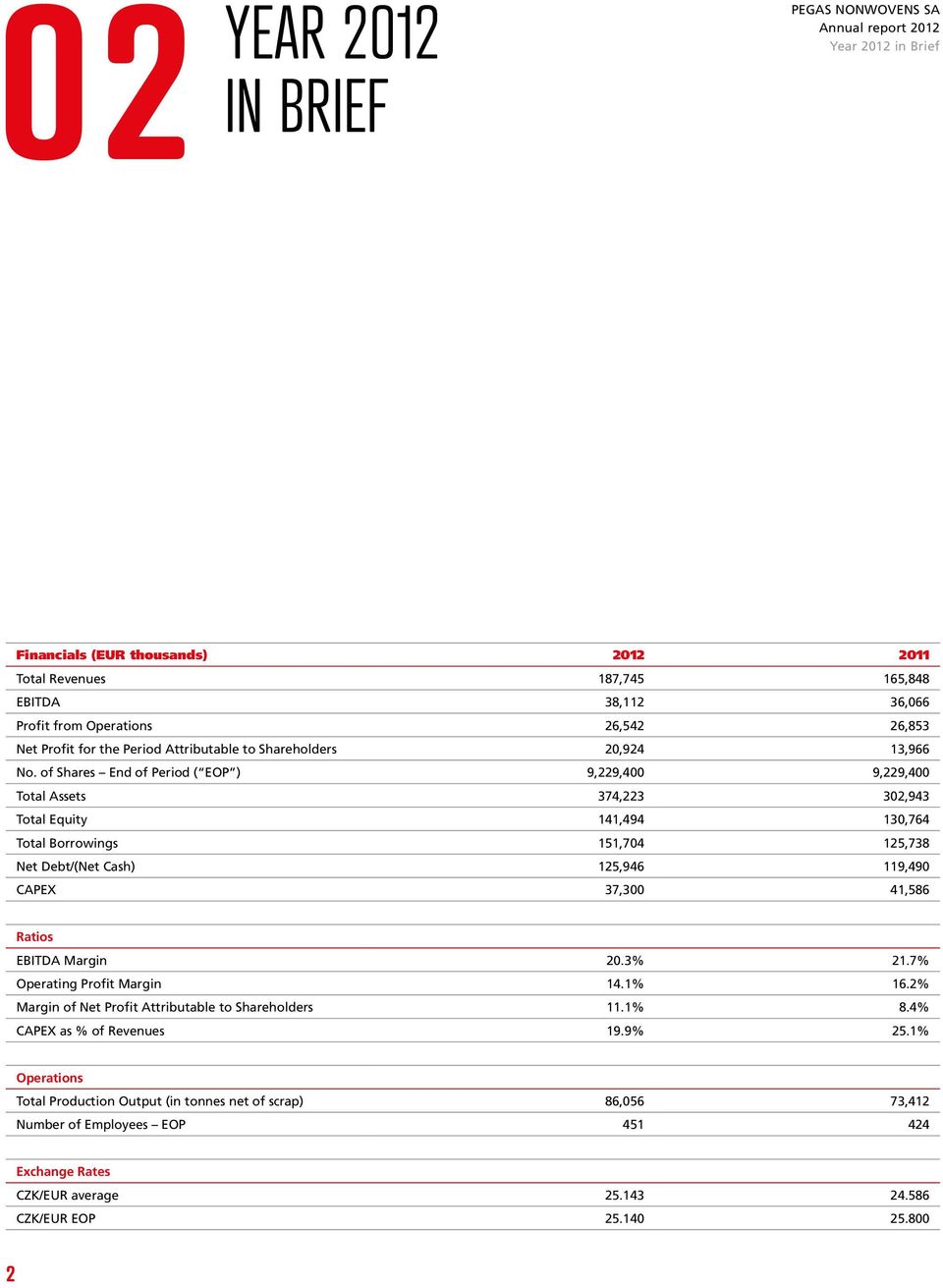
5 Total Production Output (in tonnes net of scrap) Total Revenues (EUR thousand) Number of Employees ,182 73,412 86, , , ,
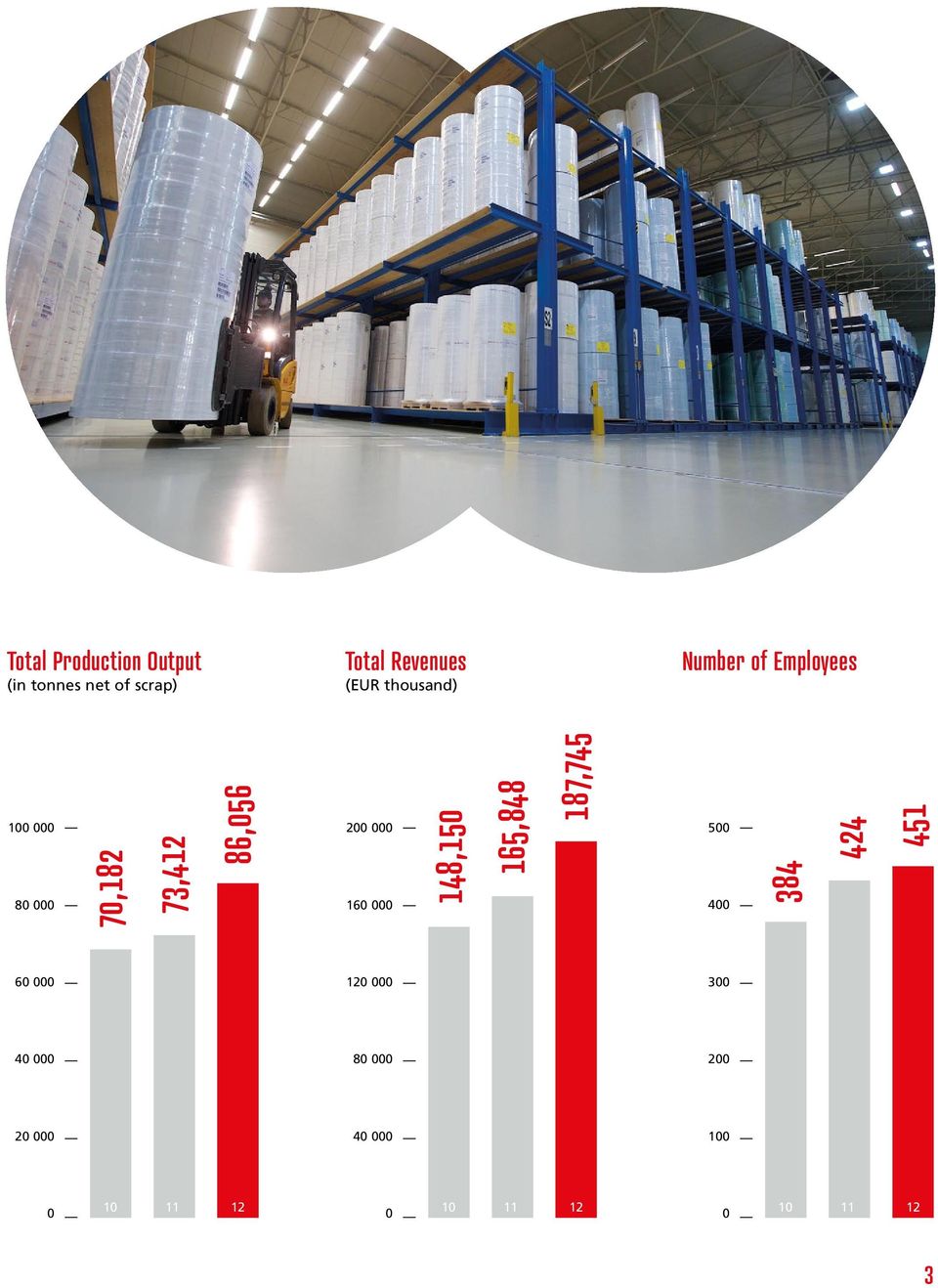
6 03 Statement from the Chief Executive Officer PEGAS NONWOVENS SA Annual report 2012 Statement from the Chief Executive Officer Without a doubt the most important moment, which will have a profound effect on the future of the company, is the construction of the new production plant in Egypt. Dear Shareholders, Dear Business Partners, Dear Employees, Please allow me, as I do every year, to discuss the most important events that affected the development and direction of the PEGAS NONWOVENS Group in 2012 and to attempt to provide an insight into our plans for Without a doubt the most important moment, which will have a profound effect on the future of the company, is the construction of the new production plant in Egypt. We have stressed many times that this is an important milestone in the history of PEGAS. We believe that the successful completion of this project may represent a kind of admission ticket to other potential international projects that we could participate in together with our business partners in the future. Regarding the construction, we received a building permit at the beginning of 2012 and commenced building works. In the last quarter of last year we started with the gross installation of production technologies and in January of this year we proceeded to the production line commissioning process. There is still a lot of work ahead of us, but nevertheless, based on our extensive experience in this process, we are confident that the ramp up of the line will proceed without any major complications and we continue to expect the line to be put into operation in the third quarter of this year. We plan on increasing production capacity in Egypt also in the future and in the event of favourable market conditions we would like to launch another line in 2015 or In 2012, we were again successful in receiving the prestigious Excellence Award from Procter & Gamble, which is awarded to suppliers providing the highest level of service over the long term. This prestigious award was given to the 73 best suppliers from a total of 75,000 worldwide. The fact that we have received this award five times in a row brings us not only satisfaction but also inspires us continue to strive for excellence in every area of our business. Last year, we achieved an EBITDA at the lower end of the range that we indicated at the beginning of the year. The contribution of the new production line in Znojmo to the Company s results was partially negated by certain problems in production and the unfavourable impact resulting from a delay in the polymer price passthrough mechanism. Nevertheless, I consider a 5.7% year-on-year increase of this indicator to EUR 38.1 million to be a solid result that can be built upon in the coming years. We are convinced 4

7 František Řezáč CEO and the member of the Board of PEGAS NONWOVENS SA that apart from the operating results, our shareholders also appreciated the dividend in the amount of EUR 1.05 per share that we paid out last year. In 2013, our financial results should benefit from the launch of the first Egyptian production line. We also want to focus on increasing production efficiency and the commercialisation of technical projects that we are currently working on. This year, we expect an increase in the sales of technologically advanced materials in the development of which we have achieved substantial progress over the past few years. Several of these materials went into commercial production at the turn of 2012/2013. Based on these facts, we expect EBITDA to grow in the range from 5 to 15%, while hoping that the extreme polymer price volatility that we were witness to last year will not repeat itself to such a degree this year. In closing, I would sincerely like to thank all those who contributed to the Company s current success. I firmly believe that we will continue to ride on the wings of Pegasus and that our Company s future will be as successful as its past. František Řezáč CEO and the member of the Board of PEGAS NONWOVENS SA 5

8 04 Management Report PEGAS NONWOVENS SA Annual report 2012 Management Report According to the estimates of the Company and independent market researchers, in 2012 PEGAS was the largest producer of spunmelt PP and PP/PE nonwoven textiles in Europe. Description of the Company s Business and Market Overview of the Nonwovens Market PEGAS s key market is geographically defined as Europe (Western, Central and Eastern Europe, Russia and Turkey). This market has grown by 5.7% CAGR since 2000 and at the end of 2011, production levels were at million tonnes (or billion m 2 ) of nonwoven textiles. The European personal hygiene market, where the Company has a 32% share of the total annual European nonwoven production or 0.6 million tonnes (or billion m 2 ), denotes the core area of business activity for PEGAS. This sector is defined by three major product application groups: disposable baby diapers, adult incontinence products and feminine hygiene products. Hygiene products have become a modern necessity, the demand for which is non-cyclical and compared to other market sectors is relatively unaffected by economic developments. This demand inelasticity was confirmed in 2008 and 2009, during the economic downturn, when growth in volumes continued regardless of external factors. Geographically, the Company s core market continues to be the broader European area, consisting of traditional Western European countries, Central and Eastern Europe (CEE), including Russia. Lower saturation (lower per capita usage) of hygiene products in Russia and the developing CEE countries compared with Western Europe explains the accelerated growth in demand for nonwoven consumables in these markets. On the other hand Western Europe s ageing population, with increasing life expectancy and high income levels will support growth in the adult incontinence market. Modern light-weight and comfortable nonwoven textiles are leading to a greater acceptance of incontinence products by customers. Competition PEGAS s competition can be defined as European producers of spunmelt PP and PP/PE nonwoven textiles, namely those active in the hygiene sector. According to the estimates of the Company and independent market researchers, in 2012 PEGAS was the largest producer in Europe. PEGAS s main competitors are international and regional companies with production facilities located in Western Europe with several new entrants in Russia. Compared to other continents the European spunmelt PP- and PP/PE-based nonwoven textile market is much more fragmented, numbering more than 30 producers in total. 6

9 7

10 04 Report Management PEGAS NONWOVENS SA Annual report 2012 Management Report Overview of the Company s Products Hygiene The core of the Company s product mix are the following nonwoven textiles Pegatex S, Pegatex SMS and Pegatex BICO, which are tailored to meet the specific needs of each and every customer and are further used for the production of: Disposable baby diapers Adult incontinence products Feminine hygiene products In order to meet the highest requirements of customers in hygiene applications, PEGAS produces a wide range of light and ultra-light technologically advanced nonwoven textiles with excellent technical properties, which are soft, pleasant to touch and therefore provide improved comfort to the final customer. Medical and Protective Clothing Pegatex S, Pegatex SM, Pegatex SMS nonwoven fabrics are semi-finished textile products for the production of single-use protective clothing, meeting and exceeding the technical requirements for high standards of protection in dangerous workplaces for which they have been specifically designed and developed. Their characteristic high barrier qualities provide protection from aggressive liquids and prevent leakage of dust particles and micro-organisms. Due to these qualities they are used as semi-finished textile products for the following applications: Medical protective clothing: Surgical masks Surgical gowns and drapes Head covers Shoe covers Industrial protective clothing: Protective overalls and masks Chemical suits Agriculture For agriculture, PEGAS offers a nonwoven textile under the brand name PEGAS-AGRO, which is used mainly in vegetable cultivation and gardening and is suitable for large-scale production and mechanisation. This material is used as a covering textile (crop cover) sheltering plants from the weather and other negative effects (air, light frost, hail, pests) and it is also used as a mulching fabric for preventing the growth and spreading of weeds. 8

11 Furniture and Construction Industries In the construction industry Pegatex S nonwoven fabric is used primarily as a component of a composite material (modified by lamination) for the production of under-roofing covers, heat and sound insulation and wind barriers. In the furniture-making industry Pegatex S and Pegatex SMS nonwoven fabric is used as a neatening fabric (either on the back or bottom parts of upholstered furniture), and for seam reinforcement in the production of mattresses or as disposable hygienic bed covers. Filtration, Wipes and Absorbents Pegatex SMS is the nonwoven fabric used for the separation and filtration of water or air. This textile with very fine (micro-denier) fibres and excellent surface evenness is often combined through lamination with other materials. Excellent filtration and absorption qualities make the textile ideal for applications such as industrial wipes and absorbents of oil, acid and alkaline based liquids. Product Name Application Area Key Applications Hygiene products Baby diapers, feminine hygiene products, adult incontinence products Medical and protective clothing Gowns, head and shoe covers Pegatex S Agriculture Crop cover, mulching textile Pegatex SMS Pegatex S BICO Pegatex SMS BICO PEGAS-AGRO Crop cover PEGAS-AGRO Mulching fabric Pegatex MB (Meltblown) Furniture and construction industry Wipes Hygiene products Medical and protective clothing Construction industry Filtration products Hygiene products Various industries Hygiene products Agriculture Agriculture Wipes, absorbents Mattresses, neatening fabrics, interlinings, wind barriers, roofing membranes Household and industrial wipes Baby diapers, adult incontinence products Surgical drapes, gowns, face masks, industrial protective apparel Wind barriers Air filtration products Baby diapers, feminine hygiene products, adult incontinence products Composite fabrics, laminates Baby diapers, feminine hygiene products, adult incontinence products Plant protection Soil cover Industrial wipes, absorbents of oils and chemicals 9
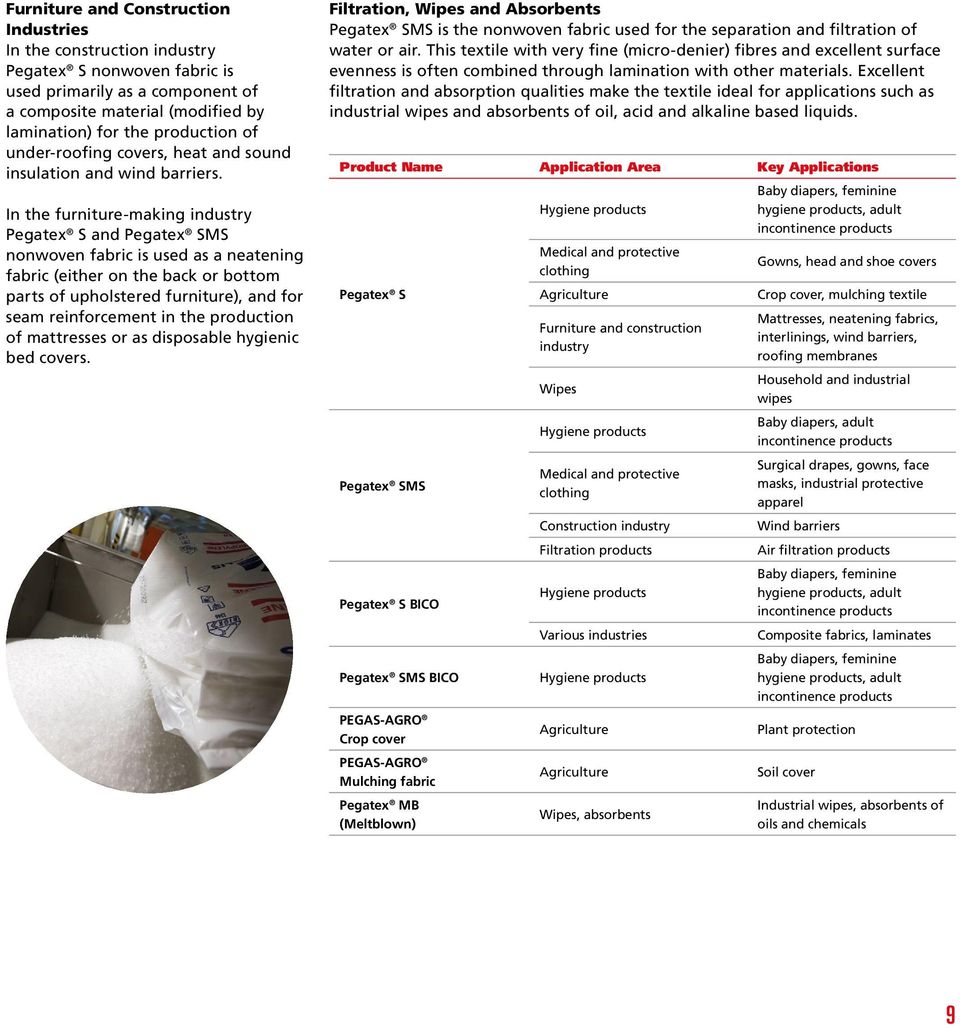
12 04 Report Management PEGAS NONWOVENS SA Annual report 2012 Management Report PEGAS has implemented and maintained an environmental management system to take care of all environmental aspects as required by ISO Technology and Production The Group owns and operates technologically advanced equipment necessary for the production of highquality spunmelt nonwoven textiles. Production management is focused on continuous maintenance and modernisation of the equipment and machinery, ensuring that the Company continues to rank among the leading European producers of nonwoven textiles. All nine production lines were manufactured by Reicofil, a leading German global supplier of spunmelt nonwoven production equipment that currently dominates the market for PP- and PP/PE-based spunmelt nonwoven machines worldwide. Three production lines are located at the Bučovice plant near Brno and six production lines are located in Přímětice near Znojmo. The output of the first line, installed in 1992, is primarily sold for technical and agricultural applications. The meltblown line production, installed in , is used for technical applications requiring a high absorption capacity, such as industrial wipes and absorbents, and the remaining production lines are dedicated to the production of hygiene materials. In 1998, PEGAS was the first spunmelt manufacturer to install Reicofil technology with a microfilament option. In 2000, PEGAS installed a Reicofil 3 production line capable of producing bi-component materials, the first such production line in Europe. The Reicofil 4 line, which was installed at the end of 2004, employs a new technology leading to high-speed production with improved nonwoven textile formation and uniformity. The Reicofil 4 line has a width of 4.2 meters; all the other Reicofil lines have widths of 3.2 meters except for the meltblown line which has a width of 1.6 meters. PEGAS s SSMMMS Reicofil 4 Special production line was installed in autumn It is state-of-the-art technology and the very first of its kind in the world, able to produce ultra light-weight nonwoven textiles for the hygiene sector as well as for other applications. In the second half of 2011, the Company launched its 9th production line. This Reicofil 4 type production line produces mainly hygiene materials with the option of production for other applications. The new production line has enabled the expansion of the Company s annual production capacity by up to 20 thousand tonnes (depending on the product portfolio) and has a width of 4.2 meters. In June 2011, the Company announced its plan to build a new production plant in Egypt. In the medium-term horizon PEGAS NONWOVENS plans to build two production lines in Egypt. The first line should have a capacity of approximately 20 thousand tonnes (depending on the product portfolio) and it is expected to be put into operation during the 1 S indicates a spunbond layer, M indicates a meltblown layer
13 course of the third quarter of If the market conditions in the region are favourable, the Company expects to expand the plant by a second production line in the years , which would increase the total capacity of the Egyptian plant to thousand tonnes. In addition to these production lines, PEGAS operates three small finishing lines, which enable the cutting, gluing and perforation of processed fabrics according to customer specifications. The Company puts an emphasis on recycling scrap materials, which are an unavoidable by-product of the spunmelt production process, for subsequent reuse. To further optimise recycling, PEGAS has developed a proprietary technological process that enables waste to be reduced to a minimum. This recycling line was installed in Plants and Premises PEGAS operates two production facilities located approximately 100 kilometres from each other in the south east of the Czech Republic. The original site in Bučovice has three production lines installed and further space for expansion is now limited. The newer site in Přímětice was developed on the outskirts of Znojmo and has six production lines. In addition to these production sites, the Company owns an administrative building in Znojmo, close to the Přímětice production plant. All premises have been constructed as greenfield projects. The production sites cover a total of approximately 140,000 square meters, of which 80,000 square meters are occupied by buildings and other structures (including the administrative building in Znojmo). PEGAS owns all of its real estate and the buildings on it. In connection with its investment in Egypt, PEGAS purchased land to be used for the construction of the plant in the industrial zone at the City of 6th October near Cairo. The area of the parcel is 42,000 square meters. Machine Year of Installation Technology Configuration* Plant Location Line Width in Metres Annual Production Capacity in Tonnes Reicofil S Bučovice 3.2 2,700 Reicofil SMS Bučovice 3.2 4,600 Reicofil Meltblown 1996 M Přímětice Reicofil SMS Bučovice 3.2 7,000 Reicofil 3 BiCo 2000 SSMMS Přímětice ,500 Reicofil 3 BiCo 2001 SSS Přímětice ,000 Reicofil SSS Přímětice ,000 Reicofil 4 Special 2007 SSMMMS Přímětice ,000 REICOFIL 4S Advanced BiCo 2011 SSMMS Přímětice ,500 Total Production Capacity 90,000 11

14 04 Report Management PEGAS NONWOVENS SA Annual report 2012 Management Report Customers PEGAS position as one of the market leaders in the European hygiene nonwovens market has enabled it to develop close and longstanding relationships with those customers that are leading corporations in their end markets. PEGAS intends to strengthen its existing customer relationships further by taking advantage of its in-depth understanding of customer needs, using technological expertise and through the introduction of new and improved products and technologies. PEGAS works in close cooperation with its customers as well as suppliers in order to introduce new and improved products and product properties that address specific customer needs for softer, lighter and cost reducing materials. The top five customers represented a 75% share of total revenues in 2012 (78% in 2011). The present customer mix concentration of the Company reflects the situation in the hygiene market, which is divided among a small number of end producers, each having a substantial market share. In September 2011, PEGAS entered into a three year contract with one of its major customers for the period in the total volume of more than 100,000 tonnes of nonwovens textiles which is in financial terms more than EUR 200 million. In October 2012, Kimberly-Clark, announced its decision to stop selling Huggies baby diapers in most Western and Central European countries. While the decision of Kimberly-Clark could have an impact on business volumes between the two companies, PEGAS does not expect a decline in total volumes or sales in 2013 as a result of this. 12 In 2012, PEGAS was awarded for the fifth year in a row the prestigious Excellence Award from Procter & Gamble, which is given to suppliers providing the highest level of service over the long term. Suppliers The main raw materials used for spunmelt nonwovens are polymers, most importantly polypropylene followed by polyethylene. In 2012, the consumption of PP and PE accounted for 80.5% of the Company s total operating costs (excluding depreciation and amortization). Over the past three years, the Company has sourced polymer raw materials from a total of six suppliers. The polymer raw materials are purchased under both one year and multi-year agreements. The competitiveness of the suppliers is maintained by on-going benchmarking. Quality Management and the Environment PEGAS is ISO 9001 and ISO certified. It first received these quality certifications in In connection with the amendment of the ISO standards of the 9001 series in 2000, the existing system was partially revised and subsequently, the Quality Management System and Environmental Management System were integrated in PEGAS has a certified integrated system of quality according to ISO 9001 by CQS, IQNet and environmental management ISO by CQS, IQNet. Through its performance, PEGAS intends to keep improving and developing this integrated system with the ultimate goal of always achieving the highest possible standards. All certificates were renewed in December 2011 and are currently valid until Quality Management System Primary targets include customer satisfaction and the achievement of the highest product quality. The high QMS and EMS standards and the quality of the products are based on three fundamental principles: Advanced Technology Quality Management Tools Results In addition to the general quality requirements imposed by ISO 9001, the Company is constantly looking to improve and adjust its production processes and relevant assets in order to provide superior output quality. In order to enhance the current QMS ISO 9001, the management of the Company decided to implement an in-house quality management system PQS (PEGAS Quality System) based on knowledge and experience with quality management tools in the whole production chain. The goal of the project is not just the training of employees but also changing company culture and perception of quality as a key factor of Company s prosperity and a guarantee of constantly high quality of products. All production premises are equipped with overpressure air control to eliminate the risk of insects or particles contaminating textiles during production. A digital camera quality control system has been introduced on all hygiene production lines to monitor the bonding consistency, uniformity and the presence of external particles.
15 These measures have significantly decreased the number of customer complaints. Customer satisfaction with the Company s products and services remains one of the key priorities for PEGAS and the Company is fully committed to on-going cooperation with its customers. This dedication is regularly rewarded by customers. Environmental Management System Environmental protection and the creation of safe and healthy work conditions for employees of the Company and their constant improvement, including pollution prevention and continuous efforts to reduce the negative impact of the Company s activities on the environment belong to the highest priorities of the Company. PEGAS has implemented and maintains an environmental management system to take care of all environmental aspects as required by ISO The production process involves the transformation of PP or PE raw materials into the form of fibres through the application of heat and pressure. This process results in minimal chemical changes to the material and produces only limited atmospheric emissions. All environmental aspects implemented by the Company are monitored and reviewed. The management of the Group has adopted key principles to meet all environmental requirements. All employees are aware of and recognise their responsibility for the fulfilment and observance of the principles of the environmental policy of the PEGAS Group. Details related to environmental activities are available on PEGAS s website or Research Research and Technical Support The development of new applications, products and technology optimisation is one of the most important parts of PEGAS current and future strategic focus. This platform is supported by a team of technicians, who are dedicated to product development, customer and technology support. This team has been built over a period of more than 10 years. Work teams are active in several different areas, which are principally divided into industrial and hygiene applications, with the main focus on the hygiene field as the key driver for the most important projects at the Company. From the technological point of view, the technical department has two main goals: a) to improve quality, performance and production efficiency of standard products and b) to develop products with added value using both current and/or new technologies including the BICO spinning technology. Both objectives are achieved in cooperation with raw material suppliers, using standard and special new polymers, and/or with machinery suppliers, allowing the Company to provide a competitive edge to its customers. In the technology field, PEGAS is continuing in the commercialisation of ultra light-weight materials produced on the latest production line. The latest line confirmed the anticipated parameters of the final product and the overall efficiency of the machinery. In addition, this line enables the Company to bring new technological and product designs to the market, allowing PEGAS to strengthen its position among the technology leaders. Apart from certain ultra light-weight materials, in terms of new products, PEGAS has successfully developed and started commercialising a new nonwoven material used in medical applications and, thanks to the special treatment of the material, managed to achieve excellent protective properties. Additionally, PEGAS is actively contributing to the development of nonwovens with excellent touch, bulkiness and drapeability properties and nonwovens with increased extensibility and improved barrier characteristics, which after further development and successful commercialisation should bring a number of benefits to clients. PEGAS cooperates with many institutions, which provide positive support for the Company s research, especially in the areas of modelling the structure of the nonwoven fabric with the objective of achieving bulkiness and soft touch, i.e. efficient barrier function. There are several universities and R&D centres, mainly in the Czech Republic and Slovakia, and also in Western Europe, which offer the Company special support in various specialised fields and/or highly sophisticated lab resources. 13

16 04 Report Management PEGAS NONWOVENS SA Annual report 2012 Management Report In order to better utilise its production lines and accelerate the development of its projects, PEGAS uses several pilot lines, which are made available under certain agreements at suppliers sites. All projects are related either to new technologies themselves or to the utilisation of newly developed raw materials in technologies or projects, which are designed directly for specific customers. There are several projects where all three parties cooperate, and thereby involve the whole supplier chain. Research costs in 2012 were EUR 2.8 million. Intellectual Property PEGAS has registered its trademark and logos in key countries in Europe, the Americas, Africa and Asia in order to provide protection on the main international markets. The Company has one registered patent for a special nonwoven microfilament spunmelt material for hygiene products. PEGAS is also a co-owner of a patent for the treatment of nonwovens using atmospheric plasma. The patents are registered internationally for selected European countries. In addition, the Company has filed six patent applications since Three of these patent applications are the result of Company s proprietary research activities and the remaining three resulted from co-operation with key business partners. One of the patent applications is the outcome of research that received supported from the Czech Ministry of Industry and Trade. Each application has been filed in the Czech Republic. One of the patent applications relates to a specially treated medical nonwovens textile and it has already been granted a national patent, the remaining applications are pending. The Company has been gradually filing each application on the international level in order to cover its interests not only in Europe but also in Africa, Asia, America and in the Middle East. In cooperation with business partners, the Company files so called sister applications when a joint invention is divided into two independent patent applications based on the area of interest of both partners. For example, the patent for soft nonwoven textiles production is owned by PEGAS and the patent of baby diaper production containing the soft nonwoven textile is owned by a business partner. This way of co-operation enables the Company to stay in a close contact with research activities of its customers. The Company is the owner of a utility design registered in the Czech Republic with a currently pending registration in Germany. Litigation As of today, no litigation or arbitration proceedings that are likely to have a significant effect on PEGAS financial position or results of operations are pending or threatening the Group. Strategy The Company s strategy for 2013 and into the future is to: 1) develop and take advantage of growth opportunities to strengthen its market position, 2) maintain and extend technological leadership in spunmelt nonwoven textiles for disposable hygiene products in Europe, and 3) provide solid returns to shareholders. PEGAS intends to achieve its objectives principally through the following strategies: Continue Investing into Technologically Advanced Production Capacity: PEGAS will strive to install state-of-the-art production capacities ahead of its European competitors. Its latest 9th production line in Znojmo was put into operation in the second half of 2011, and a new production line in Egypt is under construction. Maintain Close Relationships with Customers and Suppliers: PEGAS will continue to work together with its clients, machinery manufacturers and raw material suppliers to research, develop and implement new products ahead of the competition. PEGAS will endeavour to remain at the forefront of technical developments in the industry, supply its customers with the highest quality products and continually develop new materials. 14

17 Focus on Technologically Advanced Products: PEGAS is Europe s largest producer of bi-component spunmelt nonwovens with extensive experience in the design and production of ultra lightweight materials. Maintain industry leading financial performance: PEGAS s principal objectives are to continue to grow with its core target market, deliver revenues in line with this growth and maintain high operating margins relative to its core competitors. PEGAS is effective at generating significant levels of cash, which is subsequently used to support expansion, reduce outstanding debt and enable dividend payments. Monitoring investment opportunities: The Company will continue to monitor investment opportunities outside the Czech Republic, whether these are acquisitions or the construction of new capacity abroad. Human Resources PEGAS benefits from a skilled and motivated workforce, which results in a relatively high level of profitability per employee and productivity growth. By focusing on retaining highly skilled employees, the Company is able to maintain a low staff turnover rate of approximately 7.4% annually in The table below indicates the number and functional breakdown of the Company s employees. PEGAS provides continuous training, some of which is compulsory, in areas such as workplace safety, computer skills and foreign languages. The monthly wage of the Company s employees (including management) is still significantly below the average in Western Europe, but significantly higher than the average in the South Moravian region of the Czech Republic. The remuneration structure is highly motivational, with the fixed component of the basic salary ranging from approximately 80% for manual workers and down to approximately 60% for management. The salary of workers varies in relation to the volume produced on a specific line, including the quality of the product, and it is capped. Number of Employees As at 31 December Non-executive Directors Executive Directors Management Specialists Laboratory Staff Foremen Qualified Workers Total Average no. of employees

18 04 Report Management PEGAS NONWOVENS SA Annual report 2012 Management Report Corporate Social Responsibility (CSR) PEGAS is more than just a major manufacturer and employer in the Znojmo and Vyškov regions. The Company is also a good neighbour and in this respect it is committed to social responsibility in the local community and a healthy environment. In 2012, the Company continued in the support of a number of cultural, social and sports events in the region. Children s Centre In 2009, PEGAS began its cooperation with the Children s Centre in Znojmo, which provides paediatric, neurological, rehabilitation, psychological, educational and social care services to threatened or handicapped children and their families. Complex care is provided in the form of ward, stationary and outpatient care to threatened or handicapped children up to the age of 15. Employees of the Company have been actively involved in providing assistance to these children. Znojmo Music Festival The Znojmo Music Festival is focused on the anniversaries of famous composers from older musical periods and so it corresponds to the precious historical architecture of the City of Znojmo. At the same time this Festival should create a bridge between music and the unique wines of the Znojmo region. Its goal is to become a renowned national and over time a European cultural event promoting the City of Znojmo as a cultural centre and lead to a growth in tourism. Another goal of the Festival is to prepare unique artistic projects that will become an integral part of events in the cultural world. Pavel Šporcl, a famous Czech violinist, has been a patron of the Festival for several years now. The Festival is held over a period of seventeen days. Volleyball Club ZNOJMO PŘÍMĚTICE Volleyball Club Znojmo Přímětice was founded in February 2005 after the cooperation agreement between teams of TJ Sokol Přímětice and PSK Znojmo. This led to the formation of a strong team representing the City of Znojmo and the whole region, which over the seven years of its existence has been at the top of the Czech volleyball rankings. There are teams in championship competitions from preparation, to students, cadets, juniors and up to a women s team. PEGAS has been the general partner of the Volleyball Club since Town of Bučovice The Company supports the cultural and social life in Bučovice, where one of the production plants is located. A part of the support goes to local educational institutions. 16

19 Comments on Financial Results Revenues, Costs and EBITDA In 2012, consolidated revenues (revenues from sales of the Company s products) reached EUR million, up by 13.2% yoy. The year-on-year increase in revenues was the result of increased volumes of sold production thanks to the new production line, which was put into operation in the second half of In 2012, total consolidated operating costs without depreciation and amortization (net) increased by 15.3% yoy to EUR million. The primary reason for this increase was a higher consumption of input materials in connection with the new production line. In 2012, EBITDA amounted to EUR 38.1 million, up by 5.7% yoy. This result is in line with the guidance range announced at the beginning of 2012, when the Company indicated a yearon-year EBITDA increase of 5% to 15%. The EBITDA increase was achieved namely due to the launch of the new production line. On the other hand, the year-on-year comparison was negatively affected by lower than planned production volumes and an increase in electricity prices. The impact of the polymer price pass-through mechanism on the full year 2012 ended up being negative and likewise this had an effect on the year-on-year comparison. In 2012, the EBITDA margin was 20.3%, which is 1.4 percentage points lower compared with Operating Costs Total raw materials and consumables used last year amounted to EUR 141 million, a 15.5% yoy increase. The primary factor behind the growth in material consumption was the increased consumption of raw materials connected with the new production line. Total staff costs reached EUR 8.4 million in 2012, up by 0.3% yoy. The year on year comparison was affected by the depreciation of the CZK against the EUR and the positive revaluation of the share option plan. In 2012, total staff costs for the same period expressed in CZK and without the revaluation of the share option plan grew by 5% yoy. The year-on-year increase was caused by the recruitment of employees for the new production lines in the Czech Republic and Egypt and the indexation of wages. On the other hand, on an annual basis the accrual in bonus remunerations based on achieved financial results declined. Other operating expenses (net) reached EUR 0.3 million in 2012, compared with a gain of EUR 0.6 million achieved in Depreciation and Amortization In 2012, consolidated depreciation and amortization reached EUR 11.6 million, up by 25.6% yoy. The increase in depreciation and amortization resulted from the launch of the ninth production line and the depreciation of related production technologies and buildings. Profit from Operations In 2012, profit from operations (EBIT) amounted to EUR 26.5 million, down by 1.2% compared with

20 04 Report Management PEGAS NONWOVENS SA Annual report 2012 Management Report It was affected by the EBITDA level and an increase in depreciation and amortization. Financial Income and Costs In 2012, foreign exchange changes and other financial income/(expense) (net) represented a gain of EUR 2.6 million, compared with a loss of EUR 4.3 million recorded in This item includes realized and unrealized FX gains/ losses and other financial income and expenses. The year-on-year change resulted from the development of the CZK/EUR FX rate and from the subsequent unrealized FX changes related to the revaluation of the balance sheet items denominated in EUR (bank debt and inter-company loans). Interest expenses (net) related to debt servicing amounted to EUR 4.6 million in 2012, an 8.3% increase compared with The increase in interest expenses was caused by the increased draw down of the loan facility in connection with the financing of the production expansion of the Company. A part of the interest expenses connected with the construction of the production plant in Egypt is capitalised in the acquisition price of the investment. Corporate Income Tax In 2012, income tax expense amounted to EUR 3.6 million, down by 15.6% compared with Current tax payable amounted to EUR 3.2 million, while changes in deferred tax represented an expense of EUR 0.4 million. The year-on-year comparison was affected by the high negative change in deferred tax in the last quarter of 2011 due to the inclusion of the new production in assets. Net Profit In 2012, net profit amounted to EUR 20.9 million, up by 49.8% yoy, primarily due to FX changes in the compared periods. CAPEX and Investments In 2012, total consolidated capital expenditure amounted to EUR 37.3 million, a 10.3% yoy decrease. Capital expenditures related to the construction of the Egyptian production plant represented EUR 19.9 million of this amount. Final payments for the already commissioned ninth production line added up to EUR 13.1 million and maintenance CAPEX was EUR 4.3 million. The Company, therefore, did not exceed its updated estimate of capital expenditures for 2012, which expected the maximum level of EUR 40 million. At the beginning of 2012, the Company estimated that total capital expenditures would not exceed EUR 46 million (at the constant exchange rate of CZK/EUR 24.50). Over the course of the year the breakdown of the payment schedule for investments into the construction of the Egyptian plant was clarified. In the third quarter financial results announcement, the Company provided guidance that total capital expenditures in 2012 would not exceed EUR 40 million. Cash and Indebtedness The total amount of consolidated financial debt (both short- and longterm) as at 31 December 2012 was EUR million, a 20.7% increase compared with 31 December Net debt as at 31 December 2012 was EUR million, up by 5.4% yoy. This is equivalent to a Net Debt/EBITDA ratio of 3.3x. Business Overview of 2012 Last year, the total production output (net of scrap) reached 86,056 tonnes, up by 17.2% compared with Operational performance in 2012 was affected by the launch of the new production line in Přímětice. In 2012, the share of revenues from sales of nonwoven textiles for the hygiene industry represented an 87.6% share of total revenues, remaining more or less unchanged compared with an 87.5% share in The high share of products in this category confirms the important position the Company has in this market. Revenues from sales of standard (commodity) textiles for hygiene products reached EUR million in 2012, an increase of 12.9% yoy. In 2012, the share of revenues from sales of standard textiles for the hygiene industry represented a 67.8% share of total revenues, a slight decrease from the 68% share in In 2012, the revenues from sales of light-weight and bi-component materials for the hygiene segment reached EUR 37.2 million, a 14.9% increase compared with The proportion of this product category to the total sales in 2012 amounted to 19.8%, a slight increase compared with a 19.5% share in Revenues from sales of non-hygiene products (for construction, agriculture and medical) amounted to EUR 23.2 million in 2012, an increase of 12.1% yoy. The share of sales of non-hygiene products of total revenues was 12.4% in
21 In terms of geographical distribution, the Company confirmed its steady sales focus on the broader European area. In 2012, revenues from sales to Western Europe amounted to EUR 86.8 million, which represented a 46.2% share of total revenues, compared with a 52.7% share in In this period, revenues from sales to Central and Eastern Europe and Russia amounted to EUR 90.8 million and represented a 48.4% share of total revenues. In 2011, this share was 43.5%. Revenues from sales to other territories amounted to EUR 10.2 million and represented a 5.4% share of total revenues, compared with a 3.8% share in the previous year Guidance In 2013, we expect production volumes to increase as a result of the Egyptian production line being commissioned. The Company s production capacity has been sold out. On the back of the new capacity and the related need to create inventories at the Egyptian plant, there should be a slight increase in the level of inventories of finished products compared with the end of Thanks to the successful commercialisation of new materials, PEGAS expects a more favourable product portfolio mix and an increase in the share of technologically advanced materials. The new plant in Egypt should achieve a positive EBITDA. Based on the above factors and information known to date, the Company expects EBITDA to grow in the range from 5% to 15% in 2013, compared with the level achieved in 2012 (EUR 38.1 million). The Company estimates that in 2013 the total capital expenditure will not exceed EUR 41 million (at the constant exchange rate of CZK/EUR 25). Czech Investment Incentives Investment Incentives Granted to PEGAS PEGAS has obtained investment incentives from the Czech authorities several times. Recipients of the existing investment incentives are the subsidiaries PEGAS-NT a.s., PEGAS - NW a.s. and PEGAS - NS a.s. as special purpose companies to accommodate each investment. Tax incentives granted to PEGAS DS a.s. in 1999 expired in 2010 and this subsidiary ceased to exist following its merger with PEGAS NONWOVENS s.r.o. with effect from 1 January PEGAS NT a.s. The Czech government granted PEGAS- NT a.s. the following investment incentives in its decision of July 2002: Full corporate income tax relief for up to a 10 year period; and A job creation grant in the amount of CZK 5.4 million. The total amount of the incentives cannot exceed 45% of eligible investment costs (which as at 31 December 2012 amounted to CZK 856 million); and in any case cannot exceed CZK million. PEGAS-NT a.s. started making use of the incentives in fiscal year PEGAS - NW a.s. PEGAS - NW a.s. obtained its investment incentives based on the decision of the Czech government on 10 June The incentive consists of corporate income tax relief for up to 10 years. The tax relief may not exceed 48% of the eligible investment costs (CZK 1,027 million as at 31 December 2012), and in any case cannot exceed CZK million. PEGAS - NW a.s. started making use of the incentives in fiscal year PEGAS - NS a.s. PEGAS - NS a.s. received a commitment of investment incentives from the Ministry of Industry and Trade of the Czech Republic based on the decision dated 12 January PEGAS - NS a.s. obtained an approval of the following investment incentives: Corporate income tax relief for a period of 10 years; and Financial support for job creation in the Znojmo Region in the amount of CZK 200 thousand for every new work position created. The total amount of incentives may not exceed 30% of the eligible investment costs (CZK 1,165 million as at 31 December 2012). At the same time the total amount of the public grant may not be higher than CZK million. 19
22 04 Report Management PEGAS NONWOVENS SA Annual report 2012 Management Report The Company expects that the total investment sum expended within the scope of the first phase of the project will be in the EUR 64 to 67 million range. Investment in Egypt In June 2011, the Company announced its plan to build a new production plant in Egypt. This decision was made on the basis of successful negotiations with a major customer, who showed interest in deliveries of nonwoven textiles to their production plants in the Middle East. The decision was also supported by the growth potential of this market. PEGAS plans to build two production lines in Egypt. The first line should have a capacity of approximately 20 thousand tonnes (depending on the product portfolio) and it is expected to be put into operation in the third quarter of If the market conditions in the region are favourable, the Company expects to expand the plant by a second production line in the years , which would increase the total capacity of the Egyptian plant to thousand tonnes. Approximately 80 new employees are expected to be hired for the new production line. In 2011, the Company refinanced its bank loan thereby securing finances for international expansion and in autumn, it entered into an insurance contract with EGAP for the coverage of risks related to the Egyptian investment. For the construction, PEGAS purchased a plot of land in the industrial zone at the City of 6th October near Cairo. The area of the parcel is 42 thousand square meters. In the autumn of 2011, PEGAS signed a contract with the production technology supplier Reifenhaeuser REICOFIL GmbH & Co. and with PSG International a.s. as the general contractor for the building works. The construction of the first production line is proceeding according to the demanding planned time schedule. At the beginning 2013, the gross assembly of the production technology was completed and the plant was connected to the power grid. In February, work began on the initial commissioning of the production line itself. The Company continues to expect the production line to be commissioned in the third quarter of this year. The Company expects that the total investment sum expended within the scope of the first phase of the project will be in the EUR 64 to 67 million range (at current exchange rate levels, and without including capitalised interest expenses). Other Information Required by Legislation PEGAS Shareholding Information Information about shares and shareholders is described in Chapter 5 Investor Information. 20
23 Declaration on Management and Corporate Governance Declaration of Management and Corporate Governance is detailed in Chapter 6 Corporate Governance and chapter 10.1 Basic Information on the Company. Principal Risks and Uncertainties Faced by the Company Description of principal risks and uncertainties faced by the Company can be found in Chapter 6.6. The Objectives and Policies of the Company s Financial Risk Management and Exposure of the Given Risks The objectives and policies of the Company s financial risk management and exposure of the given risks are detailed in the notes to the consolidated financial statements on pages The Existence of Branches of PEGAS and the PEGAS Group Entities Subsidiaries included in the consolidated entity are described in the notes to the consolidated financial statements on page 80. Information About the Acquisitions of the Company s Own Shares The Company did not acquire any of its shares during the year Internal Control and Risk Management Organisation The Management of the Company is responsible for the establishment and maintenance of an internal control system in the Company and its efficiency in the process of preparing financial statements. The internal control system covers all the activities of the Company. The Company has established a continuous process for identifying and managing various potential risks faced by the Company, and confirms that any appropriate actions have been taken, or are being taken, to address any issue. Financial statements, both for internal and external reporting purposes, are prepared by highly skilled professionals and reviewed by other independent personnel. The annual financial statements are subject to an independent examination by the external auditor. Material Subsequent Events The management of the Group is not aware of any events that have occurred since 31 December 2012 that would have any material impact on the Company. 21
24 05 Investor Information PEGAS NONWOVENS SA Annual report 2012 Investor Information We are convinced that our shareholders appreciated the dividend in the amount of EUR 1.05 per share that we paid out at the end of the last year. PEGAS s Shares and Share Capital Shareholders as of 31 December 2012 Institutional and Retail Investors (together free float) 100% Of which Management of the Company 0.6% Source: Company Data In December 2006, PEGAS completed an IPO of its shares at a price of CZK (EUR 27). The IPO consisted of the offer of 5,042,750 shares in total, including 1,810,000 shares newly issued in the Company s share capital and 3,323,750 shares offered by the selling shareholder Pamplona Capital Partners I, LP ( Pamplona ). Shares of PEGAS NONWOVENS SA were listed on the Prague Stock Exchange and on the Warsaw Stock Exchange in December PEGAS has one series of shares. All shares have one vote and carry equal dividend rights. The shares are in registered form and are entered into the depository system of Clearstream Bank. The nominal value of one share is EUR The aggregate nominal value of the issued share capital is EUR 11,444,456. On 4 July 2007, the principal shareholder of PEGAS NONWOVENS SA, Pamplona, announced its intention to sell part of its entire stake held in PEGAS. Pamplona placed its entire 43.4% stake on 10 July 2007 via an accelerate book-build on the Prague and Warsaw Stock Exchanges at the price of CZK 780 or PLN The shares were sold primarily to European institutional/portfolio investors and the placement was not targeted to retail investors. The shares are traded on the Prague Stock Exchange under ISIN LU BAAPEGAS and on the Warsaw Stock Exchange under PGS. The shares of PEGAS NONWOVENS SA are as of 19 March 2007 part of the PX index, which covers the shares of all major issuers on the Prague Stock Exchange. Share Price Development and Trading Activity in During 2012, PEGAS shares were traded for a total value of CZK 1.7 billion on the Prague Stock Exchange and for a total value of PLN 7.8 million on the Warsaw Stock Exchange. The lowest trading price during the year was CZK 416 and PLN 62.3 and the highest CZK 493 and PLN 86 on the Prague and Warsaw Stock Exchanges respectively. The closing price on 28 December 2012 was CZK 493 on the Prague Stock Exchange and PLN 77 on the Warsaw Stock Exchange and the market capitalisation of PEGAS reached CZK 4.6 billion (based on the Prague Stock Exchange quote) Due to the execution of the placement on the stock exchanges in Prague and Warsaw, there is no official price in EUR. The CZK/EUR FX rate from 10 July 2007 was Source Bloomberg and PSE
25 Share Price Development in CZK Jan Feb Mar Apr May Jun Jul Aug Sep Oct Nov Dec Source: PSE 23
26 05 Investor Information PEGAS NONWOVENS SA Annual report 2012 Investor Information Changes in the Shareholders Structure in 2012 The total stake held by the management of the Company as of 31 December 2012 was 0.6%. The stake decreased as of 31 December 2011 as a result of personal changes in management. On 23 July 2012, the Company received a notification that Wood & Company Funds SICAV PLC was as of 20 July 2012, holding 1,386,491 shares in the Company, constituting 15.02% of the share capital and of the total voting rights attached to the shares issued by the Company. Prior to 20 July 2012, Wood & Company Funds SICAV PLC had jointly held 1,376,491 shares in the Company, constituting 14.91% of the share capital and voting rights attached to the shares issued by the Company. The Company does not have information about its shareholder structure. Based on the notifications sent by the shareholders in the past, the Company supposes, that the main shareholders are Wood & Company Funds SICAV PLC, Templeton Asset Management Ltd., PKO Towarzystwo Funduszy Inwestycyjnych SA and Genesis Smaller Companies SICAV. Dividend Policy The Annual General Meeting of PEGAS NONWOVENS SA (hereafter PEGAS or Company ) held on 15 June 2012 in Luxembourg, approved the proposed pay out of a dividend in the amount of EUR 9,690,870, i.e. EUR 1.05 per share. The source of the dividend payout was 2011 profit and retained earnings of previous years. The record date (i.e. the day at the end of which shares entitled to a dividend are registered at accounts of the entitled persons held by the settlement systems of Centrální depozitář cenných papírů, a.s, Krajowy Depozyt Papierów Wartościowych Spółka Akcyjna or by other respective settlement systems) was set to 19 October 2012 and the dividend was paid on 30 October Subject to maintaining satisfactory financial performance and the absence of other attractive opportunities, PEGAS will endeavour to continue with a progressive dividend policy. No specific payout ratio in terms of Net Profit or an anticipated dividend yield has been set by the Company. PEGAS s Investor Relations Commitment In the period since the IPO, PEGAS has focused on developing research coverage for the Company, developing relationships with analysts and setting up investor relations communications according to the best market standards. At present, the Company has eight sell-side analysts who publish research on the Company and a number of other commenting analysts from both international investment banks and local Czech financial institutions. PEGAS is dedicated to open and pro-active communication with its shareholders and has implemented a schedule of investor communications events, which is fully compliant with market standards for listed companies. IR Contact Details Investor Relations Address: Přímětická 3623/86, Znojmo, Czech Republic Phone number: Fax number: [email protected] website: Financial Results Calendar for May 2013 Q unaudited consolidated financial results of PEGAS NONWOVENS SA in accordance with IFRS 17 June 2013 Annual General Meeting of Shareholders Half Year Report for the 1st half of August st half 2013 unaudited consolidated financial results of PEGAS NONWOVENS SA in accordance with IFRS 21 November 2013 Q1 Q unaudited consolidated financial results of PEGAS NONWOVENS SA in accordance with IFRS 24
27 25
28 06 Corporate Governance PEGAS NONWOVENS SA Annual report 2012 Corporate Governance PEGAS NONWOVENS SA, Luxembourg, parent holding company, is a 100% owner of the operating subsidiary PEGAS NONWOVENS s.r.o. based in Znojmo, Czech Republic. PEGAS NONWOVENS s.r.o. owns 100% of the capital of its three operating subsidiaries which are incorporated in the Czech Republic. All of the operating assets in the Czech Republic are owned by PEGAS NONWOVENS s.r.o. and its 3 subsidiaries: PEGAS-NT a.s., PEGAS - NW a.s. and PEGAS - NS a.s. The Company s relations with suppliers and customers are carried out by PEGAS NONWOVENS s.r.o. In 2010, PEGAS NONWOVENS International s.r.o. was established as a special purpose vehicle for the execution of potential investment opportunities. In 2011, PEGAS NONWOVENS EGYPT LLC was established in order to carry out Group s investments in Egypt. General Meeting of Shareholders The operation of, and the main powers of, the general meeting of shareholders, and shareholders rights and conditions for exercising these rights are regulated by Company s articles of association (see in particular articles 17, 18, 7 and 6) and applicable Luxembourg law. Board of Directors The Company is administered and managed by a Board of Directors. The Board of Directors is vested with the broadest powers to perform all acts of administration and disposition in PEGAS interest. All powers not expressly reserved by Luxembourg law or PEGAS Articles of Association to PEGAS general meeting of shareholders fall within the powers of the Board of Directors. The director(s) of the Company are appointed by a General Meeting of Shareholders for a term which may not exceed six years. The director(s) may be dismissed at any time and at the sole discretion of a General Meeting of Shareholders, and may be reappointed without restrictions. Members of the Board of Directors The following table sets out information with respect to each of the members of the Company s Board of Directors, their respective ages, and their positions within the Company. 26
29 Organisational Structure The diagram below represents the current structure of the Group as at 31 December 2012: Pegas Nonwovens SA 100% 100% Pegas Nonwovens s.r.o. Pegas Nonwovens International s.r.o. 100% PEGAS NT a.s. 0.7% 99.3% 100% PEGAS NW a.s. PEGAS NONWOVENS EGYPT LLC 100% PEGAS NS a.s. Source: Company Data Board of Directors Name Age Position/Function Business Address Function Period in 2012 František Řezáč 39 Executive Director František Klaška 56 Executive Director Marian Rašík 41 Executive Director Marek Modecki 54 Non-Executive Director, Chairman of the Board Jan Sýkora 41 Non-Executive Director Neil Everitt 52 Non-Executive Director Přímětická 86, , Znojmo, Czech Republic Přímětická 86, , Znojmo, Czech Republic Přímětická 86, , Znojmo, Czech Republic 68-70, boulevard de la Pétrusse, Luxembourg, L-2320, Grand Duchy of Luxembourg 68-70, boulevard de la Pétrusse, Luxembourg, L-2320, Grand Duchy of Luxembourg 68-70, boulevard de la Pétrusse, Luxembourg, L-2320, Grand Duchy of Luxembourg
30 06 Governance Corporate PEGAS NONWOVENS SA Annual report 2012 Corporate Governance Brief biographical and professional details concerning the Company s directors are set forth below: František Řezáč, aged 39, is a graduate of the Law Faculty of Masaryk University in Brno. He joined PEGAS in 1996 while still studying at university and then worked in various managerial positions at the Company. He held the position of the Legal and Human Resource Department Director and from 2004 was Sales Director. He became CEO in October He has been an Executive Director of the holding company PEGAS NONWOVENS SA since November František Klaška, aged 56, was appointed as an executive director of the Company in November Mr. Klaška has been with the Company since 1991, having previously worked for 5 years in Zbrojovka Brno, a diversified engineering company. He was promoted to his current position of Technical and Development Director of PEGAS NONWOVENS s.r.o. in Mr. Klaška is a graduate of the Czech Technical University. Marian Rašík, aged 41, was appointed as an executive director as of 1 March In December 2009, he was appointed as the CFO of PEGAS NONWOVENS s.r.o. Prior to joining PEGAS, he worked as a director at a financial advisory firm Corpin Partners. In , he was the CFO at Vítkovice Strojírenství a.s. In the past he also worked with VÚB Bank in the Prague branch, ABN AMRO and he started his professional career as an auditor with Coopers & Lybrand. Marian Rašík graduated from the Economics Faculty of the Technical University in Ostrava. 28
31 Marek Modecki, aged 54, was appointed as a nonexecutive director in April Mr. Modecki is a senior banker and member of the Supervisory Board of Concordia Espirito Santo Investment Ltd. in Poland, responsible for mergers & acquisitions and private banking. He graduated from Warsaw University with a Master s degree in law and also studied International Law at the Max Planck Institute in Hamburg and law at the University of Hamburg. Jan Sýkora, aged 41, was appointed as a nonexecutive director in May Mr. Sýkora is currently serving as Chairman of Wood & Company, a leading independent Central and Eastern European investment bank which he joined in He also serves on various boards of both public and not for profit companies (Prague Stock Exchange, International School of Prague, Amrest and Young Presidents Organization). Mr. Sýkora obtained his MBA from the Rochester Institute of Technology. Neil Everitt, aged 52, was appointed as a nonexecutive director in March 2010 and his mandate expired in March Mr. Everitt was the CEO of Stock Spirits Group, Central Europe s leading spirits producer. Previously he spent 11 years with Allied Domecq plc, Europe, later in the position of President. In his earlier career Mr. Everitt held a number of management positions in South America and Europe with British American Tobacco plc. Mr Everitt is a graduate of the University of London, where he studied Veterinary Medicine and also completed the Advanced Management programme at INSEAD. 29
32 06 Governance Corporate PEGAS NONWOVENS SA Annual report 2012 Corporate Governance Changes to the Board of Directors in 2012 On 29 March 2012, the tenure period of non-executive director Mr. Neil J. Everitt expired and he decided to no longer seek renewal of his mandate. The Annual General Meeting held on 15 June 2012 in Luxembourg approved to re-elect non-executive director and Chairman of the Board of Directors of PEGAS, Mr. Marek Modecki for a period ending at the PEGAS Annual General Meeting in The Annual General Meeting agreed to confirm the co-optation of Mr. Jan Sýkora dated 7 May 2012 as a nonexecutive director of PEGAS and in this way to conclusively approve his appointment. Mr. Jan Sýkora is appointed for a period ending at the PEGAS Annual General Meeting in Following the expiration of mandates of two executive members of the Board of Directors Mr. František Řezáč and Mr. František Klaška, as of 1 December 2012, the Board of Directors approved their reappointment for another three years. The reappointment is subject to Name Marek Modecki Jan Sýkora Neil J. Everitt Positions Held Former Directorships: Supervisory Board member of Concordia Espirito Santo Investment Ltd. Supervisory Board member of Prokom Software SA Supervisory Board member of Metalexport SA Supervisory Board member Petrolinvest SA Supervisory Board member Polnord SA Current Directorships: Managing Partner of Concordia Ltd. Non-executive member of the Management Board of Immobel SA Managing Partner of 21 Concordia Ltd. (as of 1 February 2011) Member of the Board of Directors Empik Media & Fashion SA (from June 2012) Non-executive director Ablon Group Plc (from 5 December January 2013) Former Directorships: Current Directorships: WOOD & Company* Chairman of the Board AmRest International School of Prague The Duke of Edinbourghs International Awards Czech Republic Foundation, o.p.s. Chairman of the Supervisory Board Prague Stock Exchange SUNCORE ENERGY, a.s. All-Star Holding Limited Window Holding Limited Gruman Holding Limited Casiana, s.r.o. CD ESTATES, s.r.o. Renaissance finance S.A. Former Directorships: Stock Spirits Group SA Current Directorships: South Asian Real Estate Ltd, Isle of Man * Mr Sýkora holds several positions in the companies within the WOOD & Company Group, including directorships in subsidiaries. 30
33 approval of the General Meeting of Shareholders on 17 June There were no other changes to the Board of Directors in The following table sets out past and current directorships held by the directors in the past five years. Other directors than those stated below do not hold or did not hold any director positions outside the Company. At the date of the Annual Report, no member of the Board of Directors has, in the previous five years, (i) been convicted of any offences relating to fraud; (ii) held an executive position at any company at the time of or immediately preceding any bankruptcy, receivership or liquidation; (iii) been subject to any official public sanction by any statutory or regulatory authority (including any designated professional body), or (iv) been the subject of any official public incrimination or been disqualified by a court from acting as a member of the administrator, management or supervisory bodies of a company or from acting in the management or conduct of the affairs of any company. Except as disclosed in this report, no member of the Board of Directors has a conflict of interest (actual or potential) between his private interests and his duties to the Company. No member of the Board of Directors holds a supervisory or a non-executive position in another listed company or carries on principal activities outside the Company which are significant with respect to the Company. Changes in the Senior Management in 2012 As at 31 October 2012, Mr. Rostislav Vrbácký, Production Director and member of the Company s senior management team moved to the new position of Project Manager with the assigned task of managing the construction works, technology installation and commissioning processes at the Egyptian production plant. The position of production director has been temporarily held by Mr. František Klaška, Technical Director. The final replacement for Mr. Vrbácký is anticipated to be appointed during the course of this year. Remuneration of Directors and Management The objective of the Company s remuneration policy is to provide a compensation programme that allows the company to attract, retain and motivate the members of the Board of Directors and other Group In EUR Members of the Board of Directors Management of the Group Companies* Remuneration (2012) PEGAS NONWOVENS SA Other Group Companies Pecuniary Income Pecuniary Income Received in kind TOTAL Board Remuneration 335, ,575 Salaries and other similar income ,388 20, ,487 Management Bonus -- 1, ,107 TOTAL 335, ,092 20, ,169 Salaries and other similar income ,543 48, ,221 Management Bonus -- 43, ,394 Board Remuneration (incl. Supervisory Board) -- 66, ,152 TOTAL ,089 48, ,767 TOTAL 335, ,181 68,777 1,297,936 * In compliance with a definition of persons discharging managerial responsibilities within an issuer according to the Directive 2003/6/EC of the European Parliament and of the Council of 28 January 2003 on insider dealing and market manipulation (market abuse) and to the Commission Directive 2004/72/EC of 29 April 2004 implementing Directive 2003/6/EC. Total number of persons included
34 06 Governance Corporate PEGAS NONWOVENS SA Annual report 2012 Corporate Governance managers who have the character traits, skills and background to successfully lead and manage the Company. The remuneration committee was established by a resolution of the Board of Directors in July Currently the members of the Remuneration and Audit committees are Marek Modecki and Jan Sýkora. Information on Shares Held by the Management As of 31 December 2012, Board members of PEGAS held together 56,291 shares of PEGAS, representing 56,291 of aggregate voting rights. Persons discharging managerial responsibilities within an issuer held as of 31 December 2012, 100 shares of PEGAS, representing 100 of aggregate voting rights. The stake decreased as from 31 December 2011, as a result of personnel changes in senior management. Cash-settled Share-based Payment for Executive Managers and Nonexecutive Directors On 15 June 2010, the AGM approved 32 new principles of the share price bonus plan for members of the senior management and the members of the Board of Directors. The goal of the new programme was to enhance its motivational function and to extend it to the new members of the senior management and the Board of Directors. Therefore, the AGM Meeting resolved to issue an aggregate amount of 230,735 phantom options (representing 2.5% of share capital of PEGAS NONWOVENS SA) to the directors and senior management of PEGAS and/or its affiliates, against no consideration. Each phantom option, when exercised, will grant the director the right to receive a phantom share, i.e. the right to receive in cash an amount equal to the difference between CZK representing the PEGAS s share price on the Prague Stock Exchange (the PSE ) as of 15 December 2009, increased by 10%, and the closing price of one PEGAS s share on the day preceding the day of exercise of the phantom option on the PSE (or other market if trading on the PSE is discontinued). 25% of the phantom options (i.e. 57,684 options) will vest yearly, with the first options vesting on 18 December 2010, and the last options vesting on 18 December 2013, whereas the first options vesting on 18 December 2010, will fully replace the last options of current share price bonus plan, approved at the AGM in 2007, vesting at the same date. Therefore, the right for the remaining 34,008 options (with the vesting date of 18 December 2010) granted in 2007 and approved by the Annual General Meeting held on 15 June 2007, was abandoned. Entitled rights for part of phantom options granted in 2007 expired due to the departure of former directors of the Company. The AGM authorised and empowered the Board of Directors to allocate the above mentioned phantom options between the directors and senior management in accordance with criteria determined by, and at the discretion of, the Board of Directors. The total number of issued phantom shares was 356,839 as of 31 December 2012, unchanged from the previous year.
35 The Company and the operating companies are currently not intending to create and have not created a share option plan for the benefit of their employees. Management Bonus Scheme The principles of the bonus scheme for 2008 and for the following financial years targeted at the senior management of PEGAS Group were approved by the AGM in The key elements of the bonus scheme are as follows: The scheme was designed to ensure that senior management is focused on delivering the Company s budgeted economic results represented by the Budgeted EBITDA and is valid for the accounting years of 2008 and onwards. The basis for the bonus calculation is EBITDA calculated in accordance with Czech and Luxembourg GAAP, as the consolidated profit for the Group adjusted for certain extraordinary items, gains or losses specified further in the document, which was available at the AGM. If achieved EBITDA is equal to Budgeted EBITDA, the paid bonus will be the Target bonus. If the achieved EBITDA is below or above the Budgeted EBITDA, the amount of the target bonus will be decreased or increased up to the amount of a maximum bonus in accordance with criteria set for each year by the Board of Directors. The achieved EBITDA in 2012 was 9% lower than the Budgeted EBITDA, to which the full target bonus was linked. Remunerations of Persons Discharging Managerial Responsibilities Persons discharging managerial responsibilities are entitled to the management bonus which is partly based on the Budgeted EBITDA and is determined by the same principles as the above mentioned management bonus scheme. In addition, the second part of the persons discharging managerial responsibilities bonus is based on the appraisal of the superior. Corporate Governance Pursuant to the Warsaw Stock Exchange By-laws, and in connection with the listing of the Company s shares on the Warsaw Stock Exchange, the Company is required to declare which of the Polish principles of corporate governance contained in the WSE Corporate Governance Rules it intends to comply with, as well as to enumerate the principles which it does not intend to comply with and to state the reasons for the non-compliance. The original WSE Corporate Governance Rules adopted by the Company during the IPO were amended based on Resolution No. 13/1171/2007 of the Warsaw Stock Exchange Supervisory Board dated 4 July 2007, concerning amendment of the WSE Rules. The Company has decided to observe the majority of the WSE Corporate Governance Rules as stated in detail below. 33
36 06 Governance Corporate PEGAS NONWOVENS SA Annual report 2012 Corporate Governance STATEMENT ON WARSAW STOCK EXCHANGE CORPORATE GOVERNANCE RULES as amended in 2008, 2010 and 2011 Recommendations for Best Practice for Listed Companies A company should pursue a transparent and effective information policy using both traditional methods and modern technologies and latest communication tools ensuring fast, secure and effective access to information. Using such methods to the broadest extent possible, a company should in particular: 1. - maintain a company website whose scope and method of presentation should be based on the model investor relations service available at - ensure adequate communication with investors and analysts, and use to this purpose also modern methods of Internet communication; - enable on-line broadcasts of General Meetings over the Internet, record General Meetings, and publish the recordings on the company website. 2. [deleted] A company should make every effort to ensure that any cancellation of a General Meeting or change of its date should not prevent or restrict the 3. exercise of the shareholders right to participate in a General Meeting. Where securities issued by a company are traded in different countries (or in different markets) and in different legal systems, the company 4. should strive to ensure that corporate events related to the acquisition of rights by shareholders take place on the same dates in all the countries where such securities are traded. A company should have a remuneration policy and rules of defining the policy. The remuneration policy should in particular determine the form, structure, and level of remuneration of members of supervisory and management bodies. Commission Recommendation of 14 December fostering an appropriate regime for the remuneration of directors of listed companies (2004/913/EC) and Commission Recommendation of 30 April 2009 complementing that Recommendation (2009/385/EC) should apply in defining the remuneration policy for members of supervisory and management bodies of the company. A member of the Supervisory Board should have appropriate expertise and experience and be able to devote the time necessary to perform 6. his or her duties. A member of the Supervisory Board should take relevant action to ensure that the Supervisory Board is informed about issues significant to the company. Each member of the Supervisory Board should act in the interests of the company and form independent decisions and judgments, and in particular: 7. - refuse to accept unreasonable benefits which could have a negative impact on the independence of his or her opinions and judgments; - raise explicit objections and separate opinions in any case when he or she deems that the decision of the Supervisory Board is contrary to the interest the company. No shareholder may be given undue preference over other shareholders with regard to transactions and agreements made by the company with 8. shareholders and their related entities. The WSE recommends to public companies and their shareholders that they ensure a balanced proportion of women and men in management 9. and supervisory functions in companies, thus reinforcing the creativity and innovation of the companies economic business. If a company supports different forms or artistic and cultural expression, sport activities, educational or scientific activities, and considers its 10. activity in this area to be a part of its business mission and development strategy, impacting the innovativeness and competitiveness of the enterprise, it is good practice to publish, in a mode adopted by the company, the rules of its activity in this area. As part of a listed company s due care for the adequate quality of reporting practice, the company should take a position, expressed in a communication published on its website, unless the company considers other measures to be more adequate, wherever with regard to the company: - published information is untrue or partly untrue from the beginning or at a later time; publicly expressed opinions are not based on material objective grounds from the beginning or as a result of later circumstances. This rule concerns opinions and information expressed publicly by company representatives in the broad sense or by other persons whose statements may have an opinion-making effect, whether such information or opinions contain suggestions that are advantageous or disadvantageous to the company. A company should enable its shareholders to participate in a General Meeting using electronic communication means through: 1) real-life broadcast of General Meetings; 12. 2) real-time bilateral communication where shareholders may take the floor during a General Meeting from a location other than the General Meeting; 3) exercising their right to vote during a General Meeting either in person or through a plenipotentiary. 34
37 No. RULE YES / NO COMMENT OF PEGAS NONWOVENS SA Best Practice for Management Boards of Listed Companies 1 A company should operate a corporate website and publish on it, in addition to information required by legal regulations: 1) basic corporate regulations, in particular the statutes and internal YES regulations of its governing bodies; 2) professional CVs of the members of its governing bodies; YES 2a) on an annual basis, in the fourth quarter information about the participation of women and men respectively in the Management Board NO and in the Supervisory Board of the company in the last two years; 3) current and periodic reports; YES 4) [deleted] 5) where members of the company s governing body are elected by the General Meeting the basis for proposed candidates for the company s Management Board and Supervisory Board available to the company, YES together with the professional CVs of the candidates within a timeframe enabling a review of the documents and an informed decision on a resolution; 6) annual reports on the activity of the Supervisory Board taking account of the work of its committees together with the evaluation of the NO internal control system and the significant risk management system submitted by the Supervisory Board; 7) shareholders questions on issues on the agenda submitted before and YES during a General Meeting together with answers to those questions; 8) information about the reasons for cancellation of a General Meeting, YES change of its date or agenda together with grounds; 9) information about breaks in a General Meetings and the grounds of YES those breaks; 10) information on corporate events such as payment of the dividend, or other events leading to the acquisition or limitation of rights of a shareholder, including the deadlines and principles of such operations. YES Such information should be published within a timeframe enabling investors to make investment decisions; 11) information known to the Management Board based on a statement by a member of the Supervisory Board on any relationship of a member of the Supervisory Board with a shareholder who holds shares NO representing not less than 5% of all votes at the company s General Meeting; 12) where the company has introduced an employee incentive scheme based on shares or similar instruments information about the projected YES cost to be incurred by the company from to its introduction; 13) a statement on compliance with the corporate governance rules contained in the last published annual report, as well as the report YES referred to in 29.5 of the Exchange Rules, if published; 14) information about the content of the company s internal rule of changing the company authorised to audit financial statements or YES information about the absence of such rule. Partially complying with the rule. The Company publishes such information on annual basis, typically as a part of the annual report. We are unable to comply with this rule as there is a single board structure in the Company there is no Supervisory Board. No such issues on the agenda have been submitted during preceding General Meetings. No such issues on the agenda have been submitted during preceding General Meetings. No such breaks have been taken during preceding General Meetings. We are unable to comply with this rule as there is a single board structure in the Company there is no Supervisory Board. 35
38 06 Governance Corporate PEGAS NONWOVENS SA Annual report 2012 Corporate Governance No. RULE YES / NO COMMENT OF PEGAS NONWOVENS SA A company should ensure that its website is also available in English, at 2 least to the extent described in section II.1. Before a company executes a significant agreement with a related entity, its Management Board shall request the approval of the transaction/ agreement by the Supervisory Board. This condition does not apply to typical transactions made on market terms within the operating business by the company with a subsidiary where the company holds 3 a majority stake. For the purpose of this document, related entity shall be understood within the meaning of the Regulation of the Minister of Finance issued pursuant to Article 60.2 of the Act on Public Offering, Conditions Governing the Introduction of Financial Instruments to Organised Trading, and Public Companies (Dz.U. No. 184, item 1539, as amended). A member of the Management Board should provide notification of any conflicts of interest which have arisen or may arise, to the Management 4 Board and should refrain from taking part in the discussion and from voting on the adoption of a resolution on the issue which gives rise to such a conflict of interest. 5 [deleted] A General Meeting should be attended by members of the Management 6 Board who can answer questions submitted at the General Meeting. A company shall set the place and date of a General Meeting so as to 7 enable the participation of the highest possible number of shareholders. If a company s Management Board is informed that a General Meeting has been summoned pursuant to Article of the Code of Commercial Partnerships and Companies, the company s Management Board shall immediately perform the actions it is required to take in 8 connection with organising and conducting a General Meeting. This rule shall also apply if a General Meeting is summoned on the basis of authorisation given by the registration court pursuant to Article of the Code of Commercial Partnerships and Companies. Best Practices of Supervisory Boards 1 In addition to its responsibilities laid down in legal provisions the Supervisory Board should: 1) once a year prepare and present to the Ordinary General Meeting a brief assessment of the company s standing including an evaluation of the internal control system and the significant risk management system; 2) /deleted/ 3) review and present opinions on issues subject to resolutions of the General Meeting. YES NO YES YES YES NO NO We are partially unable to comply with this rule as there is a single board structure in the Company there is no Supervisory Board. Article of the Code of Commercial Partnerships and Companies does not apply to our company as it is registered in Luxembourg. However, there are similar provisions under Luxembourg law and our Articles. As there is no Supervisory Board in the Company, we are unable to comply with this rule. 36
39 No. RULE YES / NO COMMENT OF PEGAS NONWOVENS SA A member of the Supervisory Board should submit to the company s Management Board information on any relationship with a shareholder who holds shares representing not less than 5% of all votes at the General Meeting. This obligation concerns financial, family, and other relationships which may affect the position of the member of the Supervisory Board on issues decided by the Supervisory Board. A General Meeting should be attended by members of the Supervisory Board who can answer questions submitted at the General Meeting. A member of the Supervisory Board should notify any conflicts of interest which have arisen or may arise to the Supervisory Board and should refrain from taking part in the discussion and from voting on the adoption of a resolution on the issue which gives rise to such a conflict of interest. A member of the Supervisory Board should not resign from this function if this action could have a negative impact on the Supervisory Board s 5 capacity to act, including the adoption of resolutions by the Supervisory Board. At least two members of the Supervisory Board should meet the criteria of being independent from the company and entities with significant connections with the company. The independence criteria should be applied under Annex II to the Commission Recommendation of 15 February 2005 on the role of non-executive or supervisory directors of listed companies and on the committees of the (supervisory) board. 6 Irrespective of the provisions of point (b) of the said Annex, a person who is an employee of the company or an associated company cannot be deemed to meet the independence criteria described in the Annex. In addition, a relationship with a shareholder precluding the independence of a member of the Supervisory Board as understood in this rule is an actual and significant relationship with any shareholder who has the right to exercise at least 5% of all votes at the General Meeting. 7 [deleted] Annex I to the Commission Recommendation of 15 February 2005 on the 8 role of non-executive or supervisory directors should apply to the tasks and the operation of the committees of the Supervisory Board. YES NO YES NO NO NO Under Article 9.16 of the Articles of Association, a director having a personal interest contrary to that of the Company in a matter submitted to the approval of the Board of Directors shall be obliged to inform the Board of Directors thereof and to have his declaration recorded in the minutes of the meeting. He may not take part in the relevant proceeding of the Board of Directors. At the next General Meeting, before votes are taken on any other matter, the shareholder shall be informed of those cases in which a director had a personal interest contrary to that of the Company. As there is no Supervisory Board in the Company, we are unable to comply with this rule. Under Article 9.16 of the Articles of Association, a director having a personal interest contrary to that of the Company in a matter submitted to the approval of the Board of Directors shall be obliged to inform the Board of Directors thereof and to have his declaration recorded in the minutes of the meeting. He may not take part in the relevant proceeding of the Board of Directors. At the next General Meeting, before votes are taken on any other matter, the shareholder shall be informed of those cases in which a director had a personal interest contrary to that of the Company. As there is no Supervisory Board in the Company, we are unable to comply with this rule. As there is no Supervisory Board in the Company, we are unable to comply with this rule. 37
40 06 Governance Corporate PEGAS NONWOVENS SA Annual report 2012 Corporate Governance No. RULE YES / NO COMMENT OF PEGAS NONWOVENS SA Execution by the company of an agreement/transaction with a related 9 entity which meets the conditions of section II.3 requires the approval of the Supervisory Board. Best Practices of Shareholders Presence of representatives of the media should be allowed at General 1 Meetings. The rules of General Meetings should not restrict the participation of shareholders in General Meetings and the exercising of their rights. 2 Amendments of the rules should take effect at the earliest as of the next General Meeting. 3 [deleted] A resolution of the General Meeting concerning an issue of shares with subscription rights should specify the issue price or the mechanism of 4 setting it or obligate the competent body to set it before the date of subscription rights within a timeframe enabling an investment decision. Resolutions of the General Meeting should allow for a sufficient period of 5 time between decisions causing specific corporate events and the date of setting the rights of shareholders pursuant to such events. The date of setting the right to dividend and the date of dividend payment should be set so to ensure the shortest possible period between 6 them, in each case not longer than 15 business days. A longer period between these dates requires detailed grounds. A resolution of the General Meeting concerning a conditional dividend 7 payment may only contain such conditions whose potential fulfilment must take place before the date of setting the right to dividend. 8 [deleted] A resolution of the General Meeting to split the nominal value of shares should not set the new nominal value of the shares at a level which 9 could result in a very low unit market value of the shares, which could consequently pose a threat to the correct and reliable valuation of the company listed on the Exchange. A company should enable its shareholders to participate in a General Meeting using electronic communication means through: 1) real-life broadcast of General Meetings; 2) real-time bilateral communication where shareholders may take the 10 floor during a General Meeting from a location other than the General Meeting; 3) exercise their right to vote during a General Meeting either in person or through a plenipotentiary. This rule should be applied not later than 1 January NO NO YES YES YES YES YES YES NO As there is no Supervisory Board in the Company, we are unable to comply with this rule. Shareholders can vote through a plenipotentiary, however point 1) and 2) are not arranged so far. Under review by the management of the Company. 38
41 Risk Factors The Company s business, results of operations and financial condition may be adversely affected by the following risks: Marketing and Sales PEGAS operates in a highly competitive market and the emergence of new competitors or introduction of new capacities by one of the existing competitors in the hygiene sector could adversely affect sales and margins. A high concentration of customers accounts for a significant percentage of the total sales, and the loss of one or more of them could significantly affect the Company s revenues and profitability. A change in the demand of the end users of hygiene products and a shift of their preferences to cheaper products could lead to a change in the product mix at PEGAS and affect the Company s revenues and profitability. Production Any disruption to PEGAS production facilities would have a material adverse effect on the Company s business. PEGAS is dependent on one manufacturer for the equipment and technical support of the production lines. There is a risk that PEGAS may not be able to reconfigure production lines on a timely basis in order to respond to changing demand for particular kinds of spunmelt nonwovens. Machinery from other producers may prove to be more efficient and develop faster than the machinery supplier of PEGAS. The Company s competitors may have access to more and cheaper sources of capital allowing them to modernise and expand their operations more quickly, thus giving them a substantial competitive advantage over PEGAS. The steady supply and transportation of products from PEGAS plants to the customers are subject to various uncertainties and risks. PEGAS depends on external suppliers for key raw materials, therefore increases in the cost of raw materials, electricity and other consumables could have a material adverse impact on the Company s financial condition and results of operations, although a polymer price increase is by large transferred to customer prices. Research and Development The Company s competitors may develop new materials demanded by customers and gain a competitive advantage, which could adversely affect the Company s sales and margins. Potential Expansion PEGAS is facing risks associated with potential acquisitions, investments, strategic partnerships or other ventures, including opportunity identification, risk of the completion of the transaction and the integration of the other parties into PEGAS business. Legal and Intellectual Property PEGAS operations are exposed to financial and operating uncertainty and are subject to government laws and regulations that may adversely affect the results of operations and financial conditions. PEGAS may be in breach of intellectual property rights of others. Adverse outcomes in litigation to which PEGAS might be a party could harm the business and its prospects. Finance The indebtedness of PEGAS could adversely affect the financial condition and results of operations. There is a risk that interest rates on outstanding external debt could be reassessed by the banks and increased on the back of the financial sector crisis and therefore increased interest costs could affect the Company s profitability. The current level of indebtedness and conditions imposed on external debt (covenants) may potentially lead to a modification of the current progressive dividend policy of the Company. There is a risk that the fluctuations in the value of the Czech koruna against EUR could adversely affect the Company s profitability. PEGAS s operating subsidiaries avail themselves of tax benefits offered by the Czech government. Hence, the Company s profitability could decrease owing to any adverse change in general tax policies or if the tax benefits were reduced or withdrawn. The fluctuation of polymer prices, which are passed on to the customers with some delay may on a short term basis affect the Company s revenues and profitability. The insurance coverage may not adequately protect PEGAS against possible risk of loss. 39
42 06 Governance Corporate PEGAS NONWOVENS SA Annual report 2012 Corporate Governance Security, Environment and Safety Compliance with, and changes in, safety, health and environmental laws and regulations may adversely affect the Company s results of operations and financial conditions. Key Personnel and Technical Expertise The loss of the services of key management personnel could adversely affect the Company s business. PEGAS may not be able to hire and retain sufficient numbers of qualified professional personnel because these personnel are limited in number and are in high demand. Ownership Changes PEGAS is 100% free float and its ownership structure is very fragmented and divided among many shareholders. A potential entry of a majority investor into the Company could result in a sudden change of the long term strategy and impact value of the shares. Risk Factors Relating to the Investment in Egypt Investing in emerging markets such as Egypt, generally involves a higher degree of risk than investments in more developed countries. These higher risks include, but are not limited to changes in the political environment, transfer of returns, expropriation or politically motivated violent damage. The Egyptian economy is susceptible to future adverse effects similar to those suffered by other emerging market countries. Egypt is located in a region which has been subject to ongoing political and security concerns, especially in recent years. In common with other countries in the region, Egypt has experienced occasional terrorist attacks in the past. There can be no assurance that extremists or terrorist groups will not escalate or continue occasional violent activities in Egypt or that the government will continue to be generally successful in maintaining the prevailing levels of domestic order and stability. Although PEGAS entered into an insurance contract with EGAP for the coverage of risks connected with its investment in Egypt, which include insurance of the investment against the risk of prevention of the transfer of returns, expropriation or politically motivated violent damage, there is a risk that the insurance coverage may not adequately protect PEGAS against all possible losses related to its investment in Egypt. 40
43 Financial Part 41
44 07 Consolidated Financial Statements Consolidated Financial Statements of PEGAS NONWOVENS SA for the year ended 31 December 2012 and Independent Auditor s Report Report of the Reviseur d entreprises Agree To the Shareholders of PEGAS NONWOVENS S.A , boulevard de la Pétrusse L-2320 Luxembourg Deloitte Audit Société a responsabilité limitée 560, rue de Neudorf L-2220 Luxembourg B.P L-1011 Luxembourg Phone: Fax: Report on the consolidated financial statements Following our appointment by the General Meeting of the Shareholders dated June 15, 2012, we have audited the accompanying consolidated financial statements of PEGAS NONWOVENS S.A., which comprise the consolidated statement of financial position as at December 31, 2012 and the consolidated statement of comprehensive income, consolidated statement of changes in equity and consolidated statement of cash flow for the year then ended and a summary of significant accounting policies and other explanatory information. Responsibility of the Board of Directors for the consolidated financial statements The Board of Directors is responsible for the preparation and fair presentation of these consolidated financial statements in accordance with International Financial Reporting Standards as adopted by the European Union, and for such internal control the Board of Directors determines is necessary to enable the preparation of consolidated financial statements that are free from material misstatement, whether due to fraud or error. Responsibility of the réviseur d entreprises agréé Our responsibility is to express an opinion on these consolidated financial statements based on our audit. We conducted our audit in accordance with International Standards on Auditing as adopted for Luxembourg by the Commission de Surveillance du Secteur Financier. Those standards require that we comply with ethical requirements and plan and perform the audit to obtain reasonable assurance whether the consolidated financial statements are free from material misstatement. An audit involves performing procedures to obtain audit evidence about the amounts and disclosures in the consolidated financial statements. The procedures selected depend on the réviseur d entreprises agréé s judgement including the assessment of the risks of material misstatement of the consolidated financial statements, whether due to fraud or error. In making those risk assessments, the réviseur d entreprises agréé considers internal control relevant to the entity s preparation and fair presentation of the consolidated financial statements in order to design audit procedures that are appropriate in the circumstances, but not for the purpose of expressing an opinion on the effectiveness of the entity s internal control. 42
45 An audit also includes evaluating the appropriateness of accounting policies used and the reasonableness of accounting estimates made by the Board of Directors, as well as evaluating the overall presentation of the consolidated financial statements. We believe that the audit evidence we have obtained is sufficient and appropriate to provide a basis for our audit opinion. Opinion In our opinion, the consolidated financial statements give a true and fair view of the consolidated financial position of PEGAS NONWOVENS S.A. as of December 31, 2012, and of its financial performance and its consolidated cash flows for the year then ended in accordance with International Financial Reporting Standards as adopted by the European Union. Report on other legal and regulatory requirements The consolidated management report, which is the responsibility of the Board of Directors, is consistent with the consolidated financial statements. The accompanying Corporate Governance Statement, which is the responsibility of the Board of Directors, includes the information required by the law of 19 December 2002 on the commercial and companies register and on the accounting records and annual accounts of undertakings, as amended and the description included with respect to Article 68bis paragraphs c and d of the aforementioned law is consistent with the consolidated financial statements. For Deloitte Audit, Cabinet de révision agréé Nick Tabone, Réviseur d entreprises agréé Partner April 8,
46 07 Consolidated Financial Statements PEGAS NONWOVENS SA Annual report 2012 Consolidated Financial Statements Consolidated Statement of Comprehensive Income Prepared in accordance with International Financial Reporting Standards (IFRS) as adopted by the EU For the year ended 31 December 2012 (in thousands of EUR) Note Revenue 5 a), b) 187, ,848 Raw materials and consumables used 5 c) (138,180) (119,671) Staff cost 5 f), g) (8,351) (8,330) Depreciation and amortization expense 5 h) (11,570) (9,213) Research and development expense 5 e) (2,784) (2,347) Other operating income / (expense) net 5 d) (318) 566 Profit from operations 26,542 26,853 Foreign exchange gains and other financial income 5 i) 12,875 10,168 Foreign exchange losses and other financial expense 5 j) (10,238) (14,481) Interest income 5 k) 3 24 Interest expense 5 l) (4,614) (4,281) Profit before income tax 24,568 18,283 Income tax expense 5 m) (3,644) (4,317) Net profit for the year 20,924 13,966 Other comprehensive income Net value gain on cash flow hedges (2,683) (620) Changes in translation reserves 2,180 (2,394) Total comprehensive income for the year 20,421 10,952 Net profit attributable to: Equity holders of the Company 20,924 13,966 Minority interest ,924 13,966 Total comprehensive income attributable to: Equity holders of the Company 20,421 10,952 Minority interest ,421 10,952 Earnings per share 5 n) Basic earnings per share (EUR) Diluted earnings per share (EUR) The Notes are an integral part of these consolidated financial statements. 44
47 Consolidated Statement of Financial Position Prepared in accordance with International Financial Reporting Standards (IFRS) as adopted by the EU As at 31 December 2012 (in thousands of EUR) Note 31 December December 2011 Assets Non-current assets Property, plant and equipment 5 o) 191, ,826 Intangible assets 5 p) Goodwill 5 p) 92,288 89,927 Total non-current assets 284, ,205 Current assets Inventories 5 q) 20,448 17,624 Trade and other receivables 5 r) 43,803 36,866 Cash and cash equivalents 5 s) 25,758 6,248 Total current assets 90,009 60,738 Total assets 374, ,943 Equity and Liabilities Share capital and reserves Share capital 5 t) 11,444 11,444 Share premium 5 v) Legal reserves 5 w) 7,896 6,942 Translation reserves 6,424 4,244 Cash flow hedging (4,060) (1,377) Retained earnings 5 u) 119, ,511 Total share capital and reserves 141, ,764 Non-current liabilities Bank loans 5 x) 151, ,512 Other payables 5 y) Deferred tax liabilities 5 z) 12,672 12,337 Total non-current liabilities 164, ,904 Current liabilities Trade and other payables 5 aa) 66,693 33,943 Other Tax liabilities 5 bb) 1, Bank current liabilities 5 x) Provisions 2 11 Total current liabilities 68,353 34,275 Total liabilities 232, ,179 Total equity and liabilities 374, ,943 The Notes are an integral part of these consolidated financial statements. 45
48 07 Consolidated Financial Statements PEGAS NONWOVENS SA Annual report 2012 Consolidated Financial Statements Consolidated Statement of Cash Flow Prepared in accordance with International Financial Reporting Standards (IFRS) as adopted by the EU For the year ended 31 December 2012 (in thousands of EUR) Note Profit before income tax 24,568 18,283 Adjustment for: Amortization and depreciation 5 h) 11,570 9,213 Foreign exchange (gains) / losses 1,653 (178) Interest expense 5 l) 4,614 4,281 Other changes in equity (2,683) (620) Other financial income/(expense) 1,092 (55) Cash flows from operating activities Decrease / (increase) in inventories (2,362) (3,469) Decrease / (increase) in receivables (7,248) (6,811) Increase / (decrease) in payables 19,902 5,675 Income tax (paid) / received (1,506) (5,427) Net cash from operating activities 49,600 20,892 Cash flows from investment activities Purchases of property, plant and equipment (37,300) (41,586) Net cash used in investment activities (37,300) (41,586) Cash flows from financing activities Increase / (decrease) in bank loans 22,292 34,910 Increase / (decrease) in other payables (55) (48) Distribution of dividend 5 u), 5 v) (9,691) (9,229) Interest paid (4,213) (3,437) Other financial income/(expense) (1,092) 55 Net cash used in financing activities 7,241 22,251 Net increase in cash and cash equivalents 19,541 1,557 Cash and cash equivalents at the beginning of the period 6,248 4,685 Effect of exchange rate fluctuations on cash held (31) 6 Cash and cash equivalents at 31 December 5 s) 25,758 6,248 The Notes are an integral part of these consolidated financial statements. 46
49 Consolidated Statement of Changes in Equity Prepared in accordance with International Financial Reporting Standards (IFRS) as adopted by the EU For the year ended 31 December 2012 (in thousands of EUR) Share capital Share premium Legal reserves Cash flow hedging Translation reserves Retained earnings Total equity attributable to equity holders of the Company Minority interest Total equity at 1 January ,444 9,078 6,034 (757) 6,638 96, , ,041 Distribution -- (9,078) (151) (9,229) -- (9,229) Other comprehensive income for the year (620) (2,394) -- (3,014) -- (3,014) Net profit for the year ,966 13, ,966 Reserves created from retained earnings (908) at 31 December , ,942 (1,377) 4, , , ,764 Distribution (9,691) (9,691) -- (9,691) Other comprehensive income for the year (2,683) 2, (503) -- (503) Net profit for the year ,924 20, ,924 Reserves created from retained earnings (954) at 31 December , ,896 (4,060) 6, , , ,494 The Notes are an integral part of these consolidated financial statements. 47
50 07 Consolidated Financial Statements PEGAS NONWOVENS SA Annual report 2012 Consolidated Financial Statements Notes to the consolidated financial statements Prepared in accordance with International Financial Reporting Standards (IFRS) as adopted by the EU For the year ended 31 December 2012 (in thousands of EUR) 1. General information and definition of the consolidated entity Description and principal activities PEGAS NONWOVENS S.A., originally incorporated under the name Pamplona PE Holdco 2 S.A., is a commercial company incorporated in Luxembourg on 18 November 2005, under the legal form of a Société anonyme. The registered office is at 68-70, boulevard de la Pétrusse, L-2320 Luxembourg and the Company is registered with the Commercial Register of Luxembourg under number B The Company acts only as a holding company. On 14 December 2005, the Company acquired full control over the activities of PEGAS a.s. (now PEGAS NONWOVENS s.r.o.) PEGAS NONWOVENS s.r.o. is incorporated in the Czech Republic. Its registered office is located in Znojmo, Přímětická 86, PEGAS NONWOVENS s.r.o. and its subsidiaries (PEGAS-NT a.s., PEGAS - NW a.s., PEGAS - NS a.s.) are engaged in the production of nonwoven textiles. Within the scope of the international expansion, PEGAS NONWOVENS S.A. established PEGAS NONWOVENS International s.r.o. in Subsequently PEGAS NONWOVENS EGYPT LLC, which will invest in the Egyptian production capacity, was incorporated in June The consolidated financial statements of the Company as at and for the year ended 31 December 2012 comprise the Company and its subsidiaries (together referred to as PEGAS, the Company or the Group ). 2. Basis of preparation (a) Statement of compliance These financial statements have been prepared in accordance with International Financial Reporting Standards (IFRS) and its interpretations as adopted by the European Union. These consolidated financial statements were approved by the Board of Directors and authorized for issue on 8 April (b) Presentation and functional currency The financial statements are presented in thousands of Euro ( TEUR ). The underlying functional currency of PEGAS NONWOVENS s.r.o. and its Czech subsidiaries is Czech Koruna ( CZK ). Czech Koruna is underlying functional currency of PEGAS NONWOVENS International s.r.o. as well. The functional currency of PEGAS NONWOVENS EGYPT LLC is United States Dollar ( USD ). The underlying functional currency of PEGAS NONWOVENS S.A. is EUR. The financial statements were translated from the functional currencies to the presentation currency. (c) Basis of measurement The consolidated financial statements have been prepared on the historical cost basis except for derivative financial instruments and share based payments which are measured at fair value. 48
51 (d) Use of estimates and judgments The preparation of financial statements in compliance with IFRS requires management to make judgments, estimates and assumptions that affect the application of accounting policies and the reported amounts of assets and liabilities, income and expenses. The estimates and associated assumptions are based on historical experience and various other factors that are believed to be reasonable under the circumstances, the results of which form the basis for making the judgments about the carrying values of assets and liabilities that are not readily apparent from other sources. The actual results may differ from these estimates. The estimates and underlying assumptions are reviewed on an on-going basis. Revisions to accounting estimates are recognized in the period in which the estimate is revised if the revision affects only that period or in the period of the revision and future periods if the revision affects both the current and future periods. The management uses the estimates of future cash flows for the purposes of short and long term bank loans classification and for the goodwill impairment testing. The estimates are applied for the determination of useful life of property, plant and equipment in respect of their depreciation. Finished products allocation of overheads based on cost calculation is subject to estimates as well. 3. Summary of significant accounting policies The accounting policies set out below have been applied consistently to all periods presented in these consolidated financial statements and have been applied consistently by Group entities. (a) Consolidation methods The consolidated financial statements incorporate the financial statements of PEGAS NONWOVENS S.A. and entities controlled by the Company (its subsidiaries). Control exists where the Company has the power to govern the financial and operating policies of an entity so as to obtain benefits from its activities. Assets, liabilities and contingent liabilities, which fulfil the criteria for accounting recognition pursuant to IFRS 3, are measured at fair value at the date of acquisition. Any excess of the cost of acquisition over the fair value of the net identifiable assets acquired is accounted for as goodwill. Any excess of the fair value of the net identifiable assets acquired over the cost of acquisition is accounted for in the income statement in the accounting period in which the acquisition takes place. Non-controlling interests and ownership interests of minority investors of the consolidated subsidiaries that are present ownership interests and entitle their holders to a proportionate share of the entity s net assets in the event of liquidation are initially valued at the non-controlling interests proportionate share of the recognized amounts of the acquiree s identifiable net assets in the net fair value of assets and liabilities recognized in the accounting or at fair value. The choice of measurement basis is made on transaction by transaction basis. Other types of non-controlling interests are measured at fair value or, when applicable, on the basis specified in another IFRS. As and when necessary, adjustments are made to the financial statements of subsidiaries to bring their accounting policies in line with those used by other members of the Group. All intra-group transactions, balances, income, expenses and dividends are eliminated on consolidation. 49
52 07 Consolidated Financial Statements PEGAS NONWOVENS SA Annual report 2012 Consolidated Financial Statements (b) Foreign currencies In preparing the financial statements of each individual group entity, transactions in currencies other than the entity s functional currency (foreign currencies) are recognised at the rates of exchange based on the National Bank official rates for the last working day of the calendar month to be applied to transactions recorded during the following month. During the year, exchange gains and losses are only recognized when realized at the time of settlement. Monetary assets and liabilities denominated in foreign currencies at the reporting date are retranslated to the functional currency at the exchange rate at that date. Foreign currency differences arising on retranslation are recognized in profit or loss. For the purpose of presenting consolidated financial statements, the assets and liabilities are expressed in EUR (which is the functional currency of the parent company and presentation currency of the Group) using exchange rates ruling at the balance sheet date. Income and expense items are translated at the average exchange rates for the period, unless exchange rates fluctuated significantly during that period, in which case the exchange rates at the dates of the transactions are used. Exchange rates used (source: official rates of Czech National Bank and European Central Bank): Period average (for Statement of Comprehensive Income and Cash Flow Statement) 1 January December January December January December January December 2012 Exchange rate CZK/EUR USD/EUR CZK/EUR USD/EUR Balance sheet date Balance sheet as at 31 December 2011 Balance sheet as at 31 December CZK/EUR USD/EUR CZK/EUR USD/EUR Exchange differences arising from translation to the presentation currency are classified as equity and transferred to the Group s translation reserve. (c) Revenue recognition Revenues are recognized at fair value of the consideration received or the consideration to be received and represent receivables for goods and services delivered in the normal course of business, net of discounts, VAT and other sales-related taxes. Revenues from the sale of products are recognized when products are delivered and either the title to the products has been passed to the customer or the risks to the products have been passed to the carrier. Revenues from the sale of services are recognized when the service is rendered. (d) Segment reporting IFRS 8 requires operating segments to be identified on the basis of internal reports about components of the Group that are regularly reviewed by the chief operating decision maker in order to allocate resources to the segments and to assess their performance. Based on analysis of IFRS 8, the Group identified one operating segment, the production of nonwoven textiles. (e) Research and development Expenditure on research activities, undertaken with the prospect of acquiring new scientific or technical knowledge and understanding, is recognized in the income statement as an expense as incurred. 50
53 Expenditure on development activities is capitalized if the product or process is technically and economically feasible. The expenditure capitalized includes the cost of materials, direct labour and an appropriate proportion of overheads. Other development expenditure is recognized in the income statement as an expense as incurred. Capitalized development expenditure is stated at cost less accumulated amortization and impairment losses. (f) Borrowing costs Borrowing costs other that stated below are recognized in the income statement in the period to which they relate. Borrowing costs that relate to assets that take a substantial period of time to get ready for use or sale are capitalised as part of the cost of such assets. (g) Taxation The tax expense in the income statement includes current and deferred tax expenses. Current tax Current income tax is based on taxable profit and the tax base. Taxable profit differs from net profit as reported in the income statement because it excludes items of income or expense that are taxable or deductible in other periods and it further excludes items that are never taxable or deductible. The Group s liability for current tax is calculated using tax rates that have been enacted under local legislation by the balance sheet date. Deferred tax Deferred tax liabilities and assets arising from differences between the carrying amounts of assets and liabilities in the financial statements and the corresponding tax bases of these assets and liabilities used in the computation of taxable profit are accounted for using the balance sheet liability method. Deferred tax liabilities are generally recognized for all taxable temporary differences and deferred tax assets are recognized to the extent that it is probable that taxable profits will be available against which deductible temporary differences can be utilized. The carrying amount of deferred tax assets is reviewed at each balance sheet date and reduced to the extent that it is no longer probable that sufficient taxable profits will be available to allow all or part of the asset to be recovered. Deferred tax is calculated using the tax rates that are expected to be applied in the period when the liability is settled or the asset realized. Deferred tax is charged or credited to the profit or loss account except of deferred tax derived from mark-tomarket revaluation of interest rate swaps (IRS). The Company designates currently concluded interest rate swaps as cash flow hedges and the changes in fair value of these swaps recognize in equity. The changes in deferred tax derived from the changes in fair value of the swaps are recognized in equity as well. Deferred tax assets and liabilities are offset when there is a legally enforceable right to set off current tax assets against current tax liabilities and when they relate to income taxes levied by the same taxation authority and the Group intends to settle its current tax assets and liabilities on a net basis. (h) Government grants The Company benefits from the following investment incentives granted by the Czech Government: Grants and subsidies relating to employees The Government of the Czech Republic has provided grants to train employees and subsidies to establish new jobs. These grants and subsidies were accounted for in the comprehensive income statement in the year in which related expenses were incurred. 51
54 07 Consolidated Financial Statements PEGAS NONWOVENS SA Annual report 2012 Consolidated Financial Statements Grants relating to income tax Grants relating to income tax represent investment incentives. The Group does not account for a total tax liability but records its tax liability less the expected amount of investment incentives. Grants for R&D projects The Company is successful in obtaining the grants for R&D projects. These grants are tendered under the research and development support programmes by the Czech Ministry of Industry and Trade. The grants for R&D projects are recognized in the statement of comprehensive income in the year in which related expenses were incurred. Tax deductible items PEGAS benefits from reduction of tax base by tax deductible items related to research and development expenses. (i) Property, plant and equipment Property, plant and equipment is stated at cost (including costs of acquisition) less accumulated depreciation and any recognized impairment loss. The cost of assets (other than land and assets under construction) is depreciated over their estimated useful lives, using the straight-line method, on the following basis: Major groups of assets Number of years Production lines Factory and office buildings Cars and other vehicles 5 6 Based on analysis of useful lifetime of the property, plant and equipment the Company decided to prolong the residual estimated useful lifetime of the production technology (the overall estimated useful lifetime of technology increased from years to years). This change was effective as from 1 January The gain or loss arising on the disposal or retirement of an item of property, plant and equipment is determined as the difference between the sales proceeds and the carrying amount of the asset and is recognized in profit or loss. (j) Intangible assets Purchased intangible assets are stated at cost less accumulated amortization. They are amortized on a straight-line basis over their estimated useful lives. The carrying amounts of intangible assets are reassessed to identify impairment losses where events or changes of facts indicate that the carrying amount of each individual asset exceeds its recoverable amount. Intangible assets primarily include software, which is amortised on a straight-line basis over its estimated useful life, which is eight years. The item covers capitalized intangible asset arising from development as well. (k) Goodwill Goodwill represents a positive difference between the cost of acquisition and the fair value of the acquired interest in net identifiable assets and liabilities of a subsidiary as at the date of acquisition. Goodwill arising on an acquisition of subsidiaries is presented as separate intangible asset. After the initial recognition, goodwill is stated at cost less impairment losses. 52
55 (l) Impairment of assets and goodwill At each balance sheet date, the Group reviews the carrying amounts of its tangible and intangible assets to determine whether there is any indication that those assets have suffered an impairment loss. If any such indication exists, the recoverable amount of the asset is estimated in order to determine the extent of the impairment loss (if any). Where it is not possible to estimate the recoverable amount of an individual asset, the Group estimates the recoverable amount of the cash-generating unit to which the asset belongs. The recoverable amount is the higher of fair value less costs to sell and value in use. In assessing the value in use, the estimated future cash flows are discounted to their present value using a pre-tax discount rate that reflects current market assessments of the time value of money and the risks specific to the asset. If the recoverable amount of an asset (or cash-generating unit) is estimated to be less than its carrying amount, the carrying amount of the asset (cash-generating unit) is reduced to its recoverable amount. An impairment loss is recognized immediately in profit or loss. For the purposes of impairment testing, goodwill is analyzed annually. If the recoverable amount is less than the carrying amount of the assets, the impairment loss is allocated first to reduce the carrying amount of the goodwill and then to the other assets pro-rata on the basis of the carrying amount of each asset. An impairment loss recognized for goodwill is not reversed in a subsequent period. The management has determined that for goodwill testing purposes all goods producing subsidiaries are considered as one cash generating unit. (m) Inventories Inventories are stated at the lower of cost and net realisable value. The cost comprises direct materials and, where applicable, direct labour costs and those overheads that have been incurred in bringing the inventories to their present location and condition, based on normal operating capacity, excluding finance costs. The cost is calculated using the weighted average method. The net realisable value is the estimated selling price less all estimated costs of completion and costs to be incurred in marketing, selling and distribution. (n) Financial instruments Financial assets and financial liabilities are recognized in the Group s balance sheet when the Group becomes a party to the contractual provisions of the instrument. (o) Derivative financial instruments The Group s operating activities are primarily exposed to financial risks such as changes in foreign exchange rates and interest rates. Where necessary, the Group uses derivative financial instruments to cover these risks. The Group uses interest rate swaps to cover the risk of changes in interest rates. Interest rate swaps which are not designed as hedging instruments are in accordance with IAS 39 classified as held-for-trading and carried at fair value presented in current assets/liabilities, with changes in fair value included in net profit or loss of the period in they arise. 53
56 07 Consolidated Financial Statements PEGAS NONWOVENS SA Annual report 2012 Consolidated Financial Statements Hedge accounting cash flow hedges The Company entered into interest rate swaps agreement in December 2009 (with maturity in December 2012) and interest rate swaps agreement in September 2011 (with maturity in June 2016) and designates these swaps as cash flow hedges. At the inception of the hedge relationship, the Company documents the relationship between the hedging instrument and the hedged item. Furthermore, at the inception of the hedge and on an on-going basis, the Group documents whether the hedging instrument is highly effective in offsetting changes in fair values or cash flows of the hedged item. The effective portion of changes in the fair value of derivatives that are designated and qualify as cash flow hedges is recognised in other comprehensive income. The gain or loss relating to the ineffective portion is recognised immediately in profit or loss. Amounts previously recognised in other comprehensive income and accumulated in equity are reclassified to profit or loss in the periods when the hedged item is recognised in profit or loss, in the same line as the recognised hedged item. Hedge accounting is discontinued when the Group revokes the hedging relationship, when the hedging instrument expires or is sold, terminated, or exercised, or when it no longer qualifies for hedge accounting. Any gain or loss accumulated in equity at that time remains in equity and is recognised when the forecast transaction is ultimately recognised in profit or loss. When a forecast transaction is no longer expected to occur, the gain or loss accumulated in equity is recognised immediately in profit or loss. Derivative financial instruments are initially measured at fair value on the contract date, and are remeasured to fair value at subsequent reporting dates. The derivative financial instruments are distinguished in accordance with 3-level hierarchy identifying the inputs used in calculation of their fair value. A derivative is a financial instrument or other contract which fulfils the following conditions: its value changes in response to the change in a specified interest rate, financial instrument price, commodity price, foreign exchange rate, index of prices or rates, credit rating or credit index, or other variable, provided in the case of a non-financial variable that the variable is not specific to a party to the contract; it requires no initial net investment or an initial net investment that is smaller than would be required for other types of contracts that would be expected to have a similar response to changes in market factors; and it is settled at a future date. (p) Cash-settled share-based payment In 2007, the Company entered into a Share price bonus scheme for its Senior Management and Board Members. The scheme is a cash-settled payment transaction, in which the Company acquires services of key personnel by incurring liabilities to the supplier of those services for amounts that are based on the price of the Company s shares. The scheme is realized through phantom options, which vest annually. The service period equals the vesting period and the services are correspondingly accounted for as they are rendered by the counterparty during the vesting period. The Company measures the liability arising from the phantom options at fair value at each reporting date. The changes in the fair value of these liabilities are recognized in the statement of comprehensive income for the period. The fair value of the phantom options is determined by: Pricing model Expected life assumption / participant behaviour Current share price Expected volatility Expected dividends Risk-free interest rate 54
57 (q) Trade and other receivables Trade receivables are measured at amortised cost using the effective interest method, less any impairment. Interest income is recognized by applying the effective interest rate, except for short-term trade receivables (which do not carry any interest) when the recognition of interest would be immaterial. (r) Cash and cash equivalents Cash and cash equivalents comprise cash on hand, bank accounts and other short-term highly liquid investments that are readily convertible to a known amount of cash and are subject to an insignificant risk of changes in value. (s) Borrowings Interest-bearing bank loans Interest-bearing bank loans and overdrafts are initially measured at fair value, and are subsequently measured at amortized cost, using the effective interest rate method. Any difference between the proceeds (net of transaction costs) and the settlement or redemption of borrowings is recognized over the term of the borrowings using the effective interest rate method. (t) Provisions Provisions are recognized when the Group has a present obligation as a result of a past event, and it is probable that the Group will be required to settle that obligation, and a reliable estimate can be made of the amount of the obligation. Provisions are measured at the management s best estimate of the expenditure required to settle the obligation at the balance sheet date, and are discounted to the present value where the effect is material. (u) Trade payables Trade payables are initially measured at fair value, net of transaction costs, subsequently measured at amortised cost using the effective interest method, except for short-term trade payables. (v) Adoption of new and revised standards Standards and Interpretations effective in the current period The following new and revised Standards and Interpretations issued by the International Financial Reporting Interpretations Committee are effective for the current period. These are: Amendments to IFRS 1: Severe Hyperinflation (effective for annual periods beginning on or after 1 July 2011). This Amendment provides guidance on how an entity should resume presenting financial statements in accordance with IFRSs after a period when the entity was unable to comply with IFRSs because its functional currency was subject to severe hyperinflation. Amendments to IFRS 1: Removal of Fixed Dates for First-time Adopters (effective for annual periods beginning on or after 1 July 2011). The Amendment provides relief to first-time adopters of IFRSs from reconstructing transactions that occurred before their date of transition to IFRSs. Amendments to IFRS 7 Disclosures Transfers of Financial Assets (effective for annual periods beginning on or after 1 July 2011). The amendments improved the understanding of transfer transactions of financial assets (for example, securitisations) by users of financial statements, including understanding the possible effects of any risks that may remain with the entity that transferred the assets. The amendments also required additional disclosures if a disproportionate amount of transfer transactions are undertaken around the end of a reporting period. 55
58 07 Consolidated Financial Statements PEGAS NONWOVENS SA Annual report 2012 Consolidated Financial Statements Amendments to IAS 12 Deferred Tax: Recovery of Underlying Assets (effective for annual periods beginning on or after 1 January 2012). Amendments provide an exception to the general principles in IAS 12 that the measurement of deferred tax assets and deferred tax liabilities should reflect the tax consequences that would follow from the manner in which the entity expects to recover the carrying amount of an asset. The adoption of these amendments to Standards and Interpretations has not led to significant changes in the Group s accounting policies. Standards and Interpretations issued by IASB and adopted by the EU but not yet effective At the date of authorization of these financial statements the following Standards and Interpretations were in issue but not yet effective. The Company has not opted for their early adoption. These include: Amendments to IAS 1 Presentation of Items of Other Comprehensive Income (effective for annual periods beginning on or after 1 July 2012). The amendments revise the way other comprehensive income is presented. IAS 19 Employee Benefits (effective for annual periods beginning on or after 1 January 2013). The Standard requires the recognition of changes in defined benefit obligations and in fair value of plan assets when they occur, and hence eliminate the corridor approach permitted under the previous version of IAS 19 and accelerate the recognition of past service costs. IAS 27 Separate Financial Statements (2011) (effective for annual periods beginning on or after 1 January 2013). The Standard requires that when an entity prepares separate financial statements, investments in subsidiaries, associates, and jointly controlled entities are accounted for either at cost, or in accordance with IFRS 9 Financial Instruments. The Standard also deals with the recognition of dividends, certain group reorganisations and includes a number of disclosure requirements. IAS 28 Investments in Associates and Joint Ventures (2011) (effective for annual periods beginning on or after 1 January 2013). The revision prescribes the accounting for investments in associates and sets out the requirements for the application of the equity method when accounting for investments in associates and joint ventures. Amendments to IAS 32 Offsetting Financial Assets and Financial Liabilities (effective for annual periods beginning on or after 1 January 2014). Clarify certain aspects because of diversity in application of the requirements on offsetting, focused on four main areas (i) the meaning of currently has a legally enforceable right of set-off, (ii) the application of simultaneous realisation and settlement, (iii) the offsetting of collateral amounts and (iv) the unit of account for applying the offsetting requirements. Amendments to IFRS 1 Government Loans (effective for annual periods beginning on or after 1 January 2013). The amendments add a new exception to retrospective application of IFRS. A first-time adopter of IFRS now applies the measurement requirements of the financial instrument standards1 to a government loan with a below-market rate of interest prospectively from the date of transition to IFRS. Alternatively, a first-time adopter may elect to apply the measurement requirements retrospectively to a government loan, if the information needed was obtained when it first accounted for that loan. This election is available on a loan-by-loan basis. Amendments to IFRS 7 Disclosures - Offsetting Financial Assets and Financial (effective for annual periods beginning on or after 1 January 2013). Amends the disclosure requirements in IFRS 7 Financial Instruments: Disclosures to require information about all recognised financial instruments that are set off in accordance with paragraph 42 of IAS 32 Financial Instruments: Presentation. The amendments also require disclosure of information about recognised financial instruments subject to enforceable master netting arrangements and similar agreements even if they are not set off under IAS 32. IFRS 10 Consolidated Financial Statements (effective for annual periods beginning on or after 1 January 2013). IFRS 10 builds on existing principles by identifying the concept of control as the determining factor in whether an entity should be included within the consolidated financial statements of the parent company. The standard provides additional guidance to assist in the determination of control where this is difficult to assess. IFRS 11 Joint Arrangements (effective for annual periods beginning on or after 1 January 2013). The standard addresses inconsistencies in the reporting of joint arrangements by requiring a single method to account for interests in jointly controlled entities. 56
59 IFRS 12 Disclosure of Interests in Other Entities (effective for annual periods beginning on or after 1 January 2013). This standard covers the disclosure requirements for all forms of interests in other entities, including subsidiaries, joint arrangements, associates and unconsolidated structured entities. IFRS 13 Fair Value Measurement (effective for annual periods beginning on or after 1 January 2013). The standard establishes a single source of guidance for fair value measurements and disclosures about fair value measurements. It also defines fair value, establishes a framework for measuring fair value, and requires disclosures about fair value measurements. IFRIC 20 Stripping Costs in the Production Phase of a Surface Mine (effective for annual periods beginning on or after 1 January 2013). The Interpretation clarifies when production stripping should lead to the recognition of an asset and how that asset should be measured, both initially and in subsequent periods. The Entity has elected not to adopt these standards, revisions and interpretations in advance of their effective dates. The Entity anticipates that the adoption of these standards, revisions and interpretations will have no material impact on the financial statements of the Entity in the period of initial application. Standards and Interpretations issued by IASB but not yet adopted by the EU European Commission has not adopted as at date of the approval of these Financial Statements the following revised Standard: Standard: IFRS 9 (as amended in 2010) Financial Instruments (effective for annual periods beginning on or after 1 January 2015). IFRS 9 requires all recognised financial assets that are within the scope of IAS 39 Financial Instruments: Recognition and Measurement to be subsequently measured at amortised cost or fair value. The revised financial liability provisions maintain the existing amortised cost measurement basis for most liabilities. New requirements apply where an entity chooses to measure a liability at fair value through profit or loss in these cases, the portion of the change in fair value related to changes in the entity s own credit risk is presented in other comprehensive income rather than within profit or loss. Amendments: Annual Improvements Cycle (effective for annual periods beginning on or after 1 January 2013). Makes amendments to the following standards: IFRS 1 Permit the repeated application of IFRS 1, borrowing costs on certain qualifying assets IAS 1 Clarification of the requirements for comparative information IAS 16 Classification of servicing equipment IAS 32 Clarify that tax effect of a distribution to holders of equity instruments should be accounted for in accordance with IAS 12 Income Taxes IAS 34 Clarify interim reporting of segment information for total assets in order to enhance consistency with the requirements in IFRS 8 Operating Segments Consolidated Financial Statements, Joint Arrangements and Disclosure of Interests in Other Entities: Transition Guidance (effective for annual periods beginning on or after 1 January 2013). The Amendments clarify certain transition guidance on the application of IFRS 10, IFRS 11 and IFRS 12 for the first time. Investment Entities (Amendments to IFRS 10, IFRS 12 and IAS 27) (effective for annual periods beginning on or after 1 January 2014). Clarify the possibility of Investment Entities to be exempt from consolidating most of their subsidiaries. Instead, they will measure them at fair value through profit or loss. The amendments give an exception to entities that meet an investment entity definition and which display particular characteristics. Changes have also been made IFRS 12 to introduce disclosures that an investment entity needs to make. The Entity anticipates that the adoption of these standards, amendments to the existing standards and interpretations will have no material impact on the financial statements of the Entity in the period of initial application. 57
60 07 Consolidated Financial Statements PEGAS NONWOVENS SA Annual report 2012 Consolidated Financial Statements 4. Financial risks, investment risks and capital management The Company is exposed to the financial risks connected with its operations as follows: credit risk, regarding its normal business relations with customers; liquidity risk, with particular reference to the availability of funds and access to the credit market; market risk (primarily relating to exchange rates, interest rates), since the Company operates at an international level in different currencies and uses financial instruments depending on interest rates. When managing its financial risks, the Group concentrates on the unpredictability of financial markets and endeavours to minimise potential negative effects on the results of operations. The following paragraphs provide qualitative and quantitative disclosure on potential effects of these risks upon the Company. Credit risk The vast majority of sales are on credit to customers. Risks arising from the provision of credit are fully covered by insurance policies in respect of individual customers receivables or by receiving advanced payments from customers. The maximum credit risk to which the Group is theoretically exposed is represented by the carrying amounts stated for trade and other receivables in the balance sheet, totalling TEUR 43,803 as at 31 December 2012 (TEUR 36,866 as at 31 December 2011), of which 90 % represents trade receivables (87 % as at 31 December 2011). Overview of trade and other receivables according to due date % of total % of total Not yet overdue 39, % 33, % Overdue less than 1 month 3, % 2, % Overdue more than 1 month % % Total 43, % 36, % In 2012 the Company created provision for overdue receivables in the amount of TEUR 526 (TEUR 52 in 2011). The insurance proceeds related to this write-off amounted to TEUR 473. The present customer mix concentration of the Company reflects the situation in the final consumer market, which is divided among a small number of end producers, each having a substantial market share. The top five customers represented a 75% share of total revenues in 2012 (78% in 2011). The trade receivables of top five customers as at 31 December 2012 amounted to 77% of all trade receivables (70% as at 31 December 2011). In 2012 the largest customer accounted for 38% of the Company s total sales (38% share in 2011). The second largest customer accounted for 13% of the Company s total sales, compared with a 14% share in There were no other customers with more than 10% share on total sales. The Company did not change any objectives, policies and processes for managing the credit risk in
61 Liquidity risk Liquidity risk arises if the Company is unable to obtain the funds needed to carry out its operations under current economic conditions. In order to reduce the liquidity risk, the Company optimises the management of funds as follows: maintaining an adequate level of available liquidity; obtaining adequate credit lines; monitoring future liquidity on the basis of business planning. Liquidity risk analysis The following tables detail the Group s expected maturity for its non-derivative financial assets and remaining contractual maturity for its non-derivative financial liabilities. The tables have been drawn up based on the undiscounted contractual maturities of the financial assets including interest that will be earned on those assets and based on undiscounted cash flows of financial liabilities based on the earliest date on which the Group can be required to pay. The financial liabilities part of the table includes both interest and principal cash flows Interest rate as at 31 December Less than 6 months 6 months 2 years 2 years 5 years 5+ years Total Financial assets: Non-interest bearing -- 39, ,264 Financial liabilities: Non-interest bearing -- 55, ,931 Variable interest rate instrument 1, 3, 6 M EURIBOR + margin grid from 1.3 to 2.4 % 3,376 10, , ,113 Fixed interest rate instrument 5% 3, , Interest rate as at 31 December Less than 6 months 6 months 2 years 2 years 5 years 5+ years Total Financial assets: Non-interest bearing -- 33, ,638 Financial liabilities: Non-interest bearing -- 27, ,152 Variable interest rate instrument 1, 3, 6 M EURIBOR + margin grid from 1.3 to 2.4 % 3,076 8, , ,964 Fixed interest rate instrument 5% 2, ,916 Weighted average payment days of issued invoices were 66 days in 2012 (64 days in 2011). Adequate days of received invoices were 23 days in 2012 (18 days in 2011). 59
62 07 Consolidated Financial Statements PEGAS NONWOVENS SA Annual report 2012 Consolidated Financial Statements Management believes that the funds and available credit lines described in Note 5 x), in addition to the funds that are generated from operating activities, will enable the Company to satisfy its requirements resulting from its investment activities and its working capital needs. The following table details the Group s liquidity analysis for its derivative financial instruments. The table has been drawn up based on the undiscounted net cash inflows/(outflows) on the derivative instrument that settle on a net basis. When the amount payable or receivable is not fixed, the amount disclosed has been determined by reference to the projected interest rates as illustrated by the yield curves existing at the reporting date Less than 6 months 6 months 2 years 2 years 5 years 5+ years Net settled: Interest rate swaps (610) (1,979) (2,480) Less than 6 months 6 months 2 years 2 years 5 years 5+ years Net settled: Interest rate swaps (127) (1,155) (388) -- The Company did not change any objectives, policies and processes for managing the liquidity risk in Market risk Market risk is the risk that the Company s income or the value of the financial instruments held are affected by changes in market prices, such as foreign exchange rates, interest rates and equity prices. The Company is exposed to market risks from fluctuations in foreign currency exchange and interest rates. Currency risk Even though the Group carries out its production activities only in the Czech Republic and currently builds the new production plant in Egypt, it makes business on an international level, which results in the exposure to currency risks in respect of both its operating and financial activities. The functional currency of PEGAS NONWOVENS s.r.o. and its Czech subsidiaries is Czech Koruna (CZK). Czech Koruna is underlying functional currency of PEGAS NONWOVENS International s.r.o. as well. The functional currency of PEGAS NONWOVENS EGYPT LLC is United States Dollar. The underlying functional currency of PEGAS NONWOVENS S.A. is EUR. The presentation currency of PEGAS NONWOVENS S.A. s financial statements is EUR. The majority of operating activities such as revenues and operating costs are carried out in EUR. The majority of financial activities (such as repayment of loans and interest) are also carried out in EUR. Presentation currency of the consolidated financial statements is EUR as described in Note 3 b. The Company is in general exposed to exchange rate risks impacting income and cash flows. Income statement Trading Due to significant amount of sales and purchases in EUR, appreciation of CZK against EUR impacts consolidated cash flows negatively and vice versa. This effect is presented in the table on page 62 under line Trading. 60
63 Depreciation and amortization The depreciation and amortization is carried in CZK, subsequently impacting Income statement results presented in EUR. Financial result The Company is currently exposed to potential changes in income statements mainly due to unrealized foreign exchange gains and losses resulting from revaluation of balance sheet items (bank loans, intercompany loans, cash, trade receivables and trade payables). There is no cash flow impact of the unrealized foreign exchange gains and losses. Corporate income tax Unrealised foreign exchange gains and losses are taxable in the Czech Republic. Cash flow Trading Majority of sales, purchases and entire debt servicing is paid in EUR, which results in natural hedging of the Group s activities by cash flows in these currencies. Despite the natural hedging, there is some disproportion between inflows and outflows of specific currencies (mainly CZK) representing the cash flow exposure to currency risk. Therefore FX rate changes influence the above mentioned trading as well as the cash flows. Corporate income tax Corporate income tax mentioned above influences also the cash flows. Overview of income statement items by currency in 2012 EUR CZK Other Revenues 98% 2% 0% Operating expenses (excl. depreciation and amortization) 87% 13% 0% Depreciation and amortization 0% 100% 0% Finance costs 97% 3% 0% Corporate income tax 0% 100% 0% Overview of income statement items by currency in 2011 EUR CZK Other Revenues 98% 2% 0% Operating expenses (excl. depreciation and amortization) 87% 13% 0% Depreciation and amortization 0% 100% 0% Finance costs 100% 0% 0% Corporate income tax 0% 100% 0% The Group did not use any foreign exchange derivatives to reduce currency risk neither as at 31 December 2012 nor as at 31 December The Company is exposed mainly to the fluctuation risk of the CZK/EUR and USD/EUR exchange rate. Changes in other exchange rates would have no material impact on the Company. 61
64 07 Consolidated Financial Statements PEGAS NONWOVENS SA Annual report 2012 Consolidated Financial Statements Sensitivity analysis Potential impact from instantaneous appreciation or depreciation of CZK against EUR by 10% is detailed in the following table. Appreciation of CZK/EUR FX rate by 10% Cash flow statement Income statement Trading (1,821) (1,553) Corporate income tax* (2,606) (2,986) Total (4,427) (4,539) Trading (1,821) (1,553) Depreciation (1,322) (1,024) Unrealized FX gains from BS revaluation 13,717 15,715 Corporate income tax* (2,606) (2,986) Total 7,968 10,152 Depreciation of CZK/EUR FX rate by 10% Cash flow statement Income statement Trading 1,490 1,270 Corporate income tax* Total 1,490 1, Trading 1,490 1,270 Depreciation 1, Unrealized FX losses from BS revaluation (11,223) (12,858) Corporate income tax* Total (8,652) (10,750) * Corporate income tax calculation excludes impact of changes in Trading due to investment incentives. The lower potential influence from the FX revaluation of BS items in 2012 is driven mainly by increased EUR denominated intercompany loans from PEGAS NONWOVENS International s.r.o. to PEGAS NONWOVENS EGYPT LLC. 62
65 Potential impact from instantaneous appreciation or depreciation of USD against EUR by 10% is detailed in the following table. Appreciation of USD/EUR FX rate by 10% Corporate income tax (1,084) (240) Cash flow statement Total (1,084) (240) Unrealized FX gains from BS revaluation 5,421 1,201 Income statement Corporate income tax (1,084) (240) Total 4, Depreciation of USD/EUR FX rate by 10% Corporate income tax Cash flow statement Total Unrealized FX losses from BS revaluation (4,436) (983) Income statement Corporate income tax Total (4,436) (983) Higher potential currency movement effect on BS items in 2012 is evoked by higher intercompany loans from PEGAS NONWOVENS International s.r.o. to PEGAS NONWOVENS EGYPT LLC and higher trade payables. Interest rate risk The Company is exposed to interest rate risk resulting from bank loans bearing variable interest rates. The Company makes use of a 5-year syndicated loan of EUR 180 million, which bears a variable interest rate. In order to manage the interest rate risks, the Company concluded two interest rate swaps (IRS). For details refer to Note 5 aa). Sensitivity analysis To assess the potential impact of changes in interest rates, the Company calculates the hypothetical gains or losses from bank loans unsecured by IRS at the back of changed interest expenses on annually basis. At the same time the Company would be impacted by change of fair value in IRS. Based on the bank loan balance and cash and cash equivalents as at 31 December 2012 and instantaneous and parallel increase of the EUR yield curve by 1% p.a., the loss from increased net interest expenses would reach TEUR 422 on an annual basis (TEUR 296 as at 31 December 2011). The increase of the yield curve by 1% p.a. would increase the fair value of IRS by approximately TEUR 3,113 as at 31 December 2012 (approx. TEUR 3,482 as at 31 December 2011). The instantaneous and parallel decrease of the EUR yield curve by 1% p.a. would lead to savings from decreased net interest expenses in the amount of TEUR 422 on an annual basis (TEUR 296 as at 31 December 2011) and the fair value of IRS would decrease by approximately TEUR 1,754 as at 31 December 2012 (approx. TEUR 3,820 as at 31 December 2011). Lower potential impact of yield curve decrease on fair value of IRS as at 31 December 2012 compared with increase of yield curve is driven by the fact, that the yield curve level as at 31 December 2012 is below 1% and its decrease is limited by zero. 63
66 07 Consolidated Financial Statements PEGAS NONWOVENS SA Annual report 2012 Consolidated Financial Statements The Company did not change any objectives, policies and processes for managing the market risk in Investment risks In 2011, the Company decided to build a new production plant in Egypt. In order to eliminate the potential risk factors connected with this investment, PEGAS entered into an insurance contract with the Export Guarantee and Insurance Corporation (hereafter EGAP ). The insurance contract includes insurance of the investment against the risk of prevention of the transfer of returns, expropriation or politically motivated violent damage. EGAP is 100% owned by the Czech Republic and its primary purpose is the support of exports and the provision of insurance services to exporters of Czech products, services and investments. Capital management The Company s objectives when managing capital are: to safeguard the entity s ability to continue as a going concern, so that it can continue to provide returns for shareholders and benefits for other stakeholders, and to provide an adequate return to shareholders commensurately with the level of risk. The Company manages the amount of capital and capital structure and makes adjustments to it in the light of changes in economic conditions and the risk characteristics of the underlying assets. In order to maintain or adjust the capital structure, the Company may adjust the amount of dividends paid to shareholders, return capital to shareholders, issue new shares, or sell assets to reduce debt. The Company does not define any level of capital, however management closely monitors the risks in connection with capital inadequacy and is prepared to change level of capital as stated above. The company is not subject to externally imposed capital requirements. 5. Notes to the consolidated financial statements a) Revenue Product groups % of total % of total Hygiene Sales Hygiene - specialty 37, , Hygiene - other 127, , Total hygiene 164, , Non-hygiene 23, , Total sales 187, ,
67 Markets % of total % of total Domestic sales 39, , Export 148, , Total 187, , Split into Domestic sales and Export is made up by perspective of operating companies. b) Segment reporting Based on analysis of IFRS 8, the Group identified one operating segment, the production of nonwoven textiles. Geographical distribution of revenue is defined as follows: Region Western Europe 86,753 87,481 Central and Eastern Europe 86,176 68,449 Russia 4,652 3,677 Others 10,164 6,241 Total 187, ,848 In presenting information on the basis of geographical distribution of revenue, revenue is based on the place of real delivery of the goods. All non-current assets are located in the Czech Republic, except of property plant and equipment located in Egypt in the amount of TEUR 57,571 (TEUR 13,578 as of 31 December 2011). c) Raw materials, consumables and services used Raw materials consumed 120,447 99,364 Consumed spare parts and repairs 3,866 3,142 Energy consumed 10,636 8,655 Other consumables 796 6,114 Other services 2,435 2,396 Total raw materials and consumables used 138, ,671 High amount in Other consumables in 2011 is driven by resale of nonwoven products from other producer and correspondent recognition of costs for these goods. Raw materials consumed represent 87.2% of the total amount of raw materials, consumables and services used in 2012 (83.0% in 2011). 65
68 07 Consolidated Financial Statements PEGAS NONWOVENS SA Annual report 2012 Consolidated Financial Statements d) Other operating income / (expense) net Gain on the sale of equipment Insurance proceeds Insurance cost (580) (573) Other taxes (68) (46) Provisions for overdue receivables (526) (52) Other income 247 1,114 Other operating income / (expense) net total (318) 566 Provisions created for overdue receivables were from major part covered by insurance proceeds. Other income includes also grants for research and development received by the Czech Ministry of Industry and Trade. e) Research and development In 2012, research expenses were TEUR 2,784. The most significant part represents expenditure on raw materials for products testing in the amount of TEUR 1,907. In 2011, the Group invested TEUR 2,347 in research, of which expenses on raw materials for products testing amounted to TEUR 1,777. f) Average number of employees, executive and non-executive directors of the Group and expenses Average number of Remuneration of Board Wages and Cash-settled share-based Social security and health insurance Social 2012 employees Total salaries members payments expenses expenses Employees 432 7,962 5, , Executives and Non-executives (277) 98 3 Total 437 8,351 6, (277) 2, Average number of employees Total Wages and salaries Remuneration of Board members Cash-settled share-based payments Social security and health insurance expenses Social expenses Employees 409 7,789 5, , Executives and Non-executives (73) 64 3 Total 414 8,330 5, (73) 2, Three executive directors, Mr. Řezáč, Mr. Klaška and Mr. Rašík and two non-executive directors, Mr. Modecki and Mr. Everitt were members of the Company s Board of Directors as at 31 December
69 In March 2012 the tenure of non-executive member of the Board of Directors, Mr. Neil J. Everitt, expired and he no longer sought to renew his mandate. Effective from 7 May 2012, Mr. Jan Sýkora was appointed as non-executive director to the Board of Directors of the Company. Executive directors may use the Company s cars for private purposes. Apart from phantom share options the Board members did not receive any loans, advances or any other benefit in kind in both 2012 and g) Cash-settled share-based payment for executive managers and non-executive directors The Annual General Meeting held on 15 June 2007 approved the grant of an aggregate amount of 230,735 phantom options to six senior executive managers and two non-executive directors, for no consideration. The Grant date of the phantom options was 24 May Each phantom option, when exercised, will grant the manager the right to receive cash calculated as closing price of one company share on the Prague stock exchange (the PSE) (or other market if the PSE trading is discontinued) on the day preceding the day of exercise of the phantom option less CZK representing the offer price at the time of the initial public offering of the shares of PEGAS NONWOVENS S.A. (the IPO price). 25% of the phantom options vest yearly, with the first options vesting on the 1st anniversary of the IPO, i.e. on 18 December 2007 and the last options vesting on the 4th anniversary of the IPO. The given part of phantom options may be exercised on or after the vesting date. The participant shall provide service to the Group at the vesting date to be eligible for the given phantom options series. The Annual General Meeting held on June 15, 2010 approved the grant of an aggregate amount of 230,735 phantom options (representing 2.5% of the PEGAS s share capital) to the directors and senior management of the Company and/or its affiliates, against no consideration. Each phantom option, when exercised, will grant the director the right to receive in cash an amount equal to the difference between CZK representing the PEGAS s share price on the PSE as of 15 December 2009 increased by 10%, and the closing price of one PEGAS s share on the day preceding the day of exercise of the phantom option on the PSE (or other market if the PSE trading is discontinued). 25% of phantom options (i.e. 57,684 options) will vest yearly, with the first options vesting on December 18, 2010 and the last options vesting on December 18, The first options vesting on December 18, 2010 fully replaced the last portion of options of the first share price bonus plan, approved at the Annual General Meeting held on June 15, 2007, vesting at the same date. Therefore the right for remaining 34,008 options (with vesting date on December 18, 2010) granted in 2007 and approved by the Annual General Meeting held on June 15, 2007 was abandoned. Entitled rights for part of phantom options granted in 2007 expired due to leave of former directors of the Company. The Annual General Meeting held on 15 June 2010 authorised and empowered the Board of Directors to allocate the above mentioned phantom options between the directors and senior management in accordance with criteria determined by, and at the discretion of, the Board of Directors. In 2012, Board of Directors decided to hand out the unallocated phantom options with vesting date on 18 December 2012 pro rata to current members (based on their phantom options holdings). Out of 230,735 phantom options approved by the Annual General Meeting held on 15 June 2010, 14,644 phantom options with vesting date on 18 December 2013 was not allocated as at 31 December
70 07 Consolidated Financial Statements PEGAS NONWOVENS SA Annual report 2012 Consolidated Financial Statements Summary of the contractual terms of the phantom option scheme as at 31 December 2012: Strike price (CZK) Total number of options granted Number of options granted to Non executives Number of options granted to Executives Unallocated options Fair value of options granted (TEUR) Fair value of options granted to Executives (TEUR) Fair value of options granted to Nonexecutives (TEUR) Fair value of unallocated options (TEUR) Vesting Grant date date 24 May Dec ,664 39,126 11, May Dec ,432 29,896 11, May Dec ,008 22,472 11, June Dec ,684 42,220 15, June Dec ,684 42,220 15, June Dec ,684 42,220 15, June Dec ,683 31,501 11,538 14, Total 356, ,655 92,540 14, Summary of the contractual terms of the phantom option scheme as at 31 December 2011: Strike price (CZK) Total number of options granted Number of options granted to Non executives Number of options granted to Executives Unallocated options Fair value of options granted (TEUR) Fair value of options granted to Executives (TEUR) Fair value of options granted to Nonexecutives (TEUR) Fair value of unallocated options (TEUR) Vesting Grant date date 24 May Dec ,664 39,126 11, May Dec ,432 29,896 11, May Dec ,008 22,472 11, June Dec ,684 42,220 15, June Dec ,684 42,220 15, June Dec ,684 31,501 11,538 14, June Dec ,683 31,501 11,538 14, Total 356, ,936 88,614 29, No phantom shares were exercised neither in 2012 nor
71 The fair value of the phantom options as at 31 December 2012 is TEUR 180 (TEUR 454 as at 31 December 2011). The executive directors benefit is TEUR 126 (TEUR 312 as at 31 December 2011) of the total amount and the non-executive directors benefit is TEUR 46 (TEUR 119 as at 31 December 2011) of the total amount. The decrease of the fair value in 2012 is attributable mainly to the decrease of the share price volatility. In 2012 there was change of the share price volatility calculation. Standard deviation for whole period from IPO was replaced by the exponentially weighted moving average method, which places greater emphasis on more recent returns. The rationale behind the concept is that recent price fluctuations are a better predictor of future movement and should be given greater consideration. The Black-Scholes pricing model was used to calculate the fair value of the phantom options. The assumptions used in the model are as follows: Price of PEGAS NONWOVENS S.A. shares quoted in Prague Stock Exchange used (CZK as at 31 December 2012, CZK as at 31 December 2011). The participants are expected to exercise the given part of granted phantom options within ten years from vesting. Risk free interest rate is linearly interpolated from CZK interbank PRIBOR rates (<12M) and CZK interest rate swap points (>12M). Share price volatility: Standard deviation for whole period from IPO used in 2011 was replaced by the exponentially weighted moving average method in 2012 (15.82% in 2012, 33.38% in 2011). h) Depreciation and amortization expense Depreciation of tangible assets 11,490 9,167 Amortization of intangible assets Total 11,570 9,213 i) Foreign exchange gains and other financial income Realized and unrealized foreign exchange gains 12,875 10,050 Other financial income Total 12,875 10,168 j) Foreign exchange losses and other financial expenses Realized and unrealized foreign exchange losses 10,042 14,403 Other financial expense Total 10,238 14,481 Other financial expense includes mainly bank fees. 69
72 07 Consolidated Financial Statements PEGAS NONWOVENS SA Annual report 2012 Consolidated Financial Statements k) Interest income Interest income 3 24 The item includes interest income on bank accounts and term deposits. l) Interest expense Interest and debt settlement expenses on loans and borrowings 4,148 3,883 Interest on employee deposits Other Total 4,614 4,281 Borrowing costs in the amount of TEUR 1,224 were capitalized in connection with construction of the new production line in 2012 as a part of this asset (TEUR 347 in 2011). No capitalisation rate used to determine the amount of borrowing costs eligible for capitalisation was calculated as the funds were borrowed specifically. Loss arising on interest rate swaps as designed hedging instruments in cash flow hedges of floating rate debt reclassified from equity to profit and loss in 2012 was TEUR 789 (TEUR 415 in 2011). m) Income tax (expense) / income Current income tax (3,009) (2,106) Deferred income tax (635) (2,211) Total (3,644) (4,317) The changes in deferred tax are described in Note 5 z). 70
73 Effective tax rate 2012 % of total 2011 % of total Profit before income tax 24,568 18,283 Income tax calculated using the enacted tax rate 4, % 3, % Effect of consolidation and IFRS adjustments that do not have impact on deferred tax (37) (0.2%) (5) (0.0%) Effect of tax incentives (1,048) (4.3%) (1,439) (7.9%) Effect of items deductible from the tax base (8) (0.0%) (8) (0.0%) Effect of unrecognized deferred tax asset in the Czech Republic % 2, % Effect of the difference between the tax rate in the Czech Republic and Luxembourg and effect of unrecognized deferred tax asset relating to % % PEGAS NONWOVENS S.A. in Luxembourg Effect of unrecognized deferred tax asset in Egypt % Other effects (360) (1.5%) (5) (0.0%) Total income tax / effective tax rate 3, % 4, % Four companies of the Group have received investment incentives in the Czech Republic. PEGAS - DS a.s. was granted investment incentives in the regime preceding the Act on Incentives, receiving a grant from the state to pay income tax. Investment incentives for PEGAS DS a.s. expired in 2010 and this company ceased to exist following its merger with PEGAS NONWOVENS s.r.o. with effect from 1 January 2011.The Company does not account for the total tax liability but reports the tax liability less the expected amount of the subsidy. PEGAS-NT a.s., PEGAS NW a.s. and PEGAS NS a.s. were granted an investment incentive after the effective date of the Act on Incentives. PEGAS-NT a.s. recognizes the grant for income tax as a tax discount and does not account for the total tax liability. PEGAS NW a.s. started making use of the incentive in PEGAS NS a.s. were granted an investment incentive in January To translate the maximum amount of investment incentives into EUR, the CZK/EUR rate of exchange effective on 31 December 2012 was used. Max. percentage of expended amount used as corporate tax relief Max. amount in million CZK Max. amount in million EUR Corporate tax relief for First year of usage of corporate tax relief PEGAS-NT a.s. 45% years 2005 PEGAS - NW a.s. 48% years 2008 PEGAS - NS a.s. 30% years 2012 Investment incentives are tax savings granted by the government provided certain conditions have been fulfilled (such as level of incremental investments) by the Group. When considering the principle of prudence and the fact that the amount of a subsidy depends on the actual economic performance, the companies do not account for any deferred tax asset that arise from investment incentives and correspond to income tax subsidies. The estimate of the unrecognized asset would not be reliable. 71
74 07 Consolidated Financial Statements PEGAS NONWOVENS SA Annual report 2012 Consolidated Financial Statements Since nearly all taxable income were generated from the operating activity in the Czech Republic, the tax rate of 19% (19% in 2011) in the Czech Republic was used to calculate the total income tax. n) Earnings per share The calculation of basic earnings per share as at 31 December 2012 was based on the net profit attributable to equity holders of TEUR 20,924 and a weighted average number of ordinary shares in Diluted earnings per share are calculated based on a weighted average number of shares in circulation (determined similarly as in the case of basic earnings per share) adjusted by the effect of the expected issue of all potential diluted securities, i.e. the effect of convertible loan notes in the case of the Group. Convertible bonds are the bonds with a right to convert to ordinary shares. The basic and diluted earnings per share as at both 31 December 2012 and 31 December 2011 are equal due to the fact, that the Group does not have any agreement at the balance sheet date which will cause a potential future issue of securities. No changes to the number of shares occurred during either 2012 or No non-controlling interests in subsidiary companies were recognized as at 31 December 2012 and 31 December Weighted average number of ordinary shares 2011 Number of outstanding shares in 2011 Weighted average January December 9,229,400 9,229, Number of outstanding shares in 2012 Weighted average January December 9,229,400 9,229,400 Basic earnings per share Net profit attributable to equity holders TEUR 20,924 13,966 Weighted average number of ordinary shares Number 9,229,400 9,229,400 Basic earnings per share EUR Earnings Per Share (EPS) is calculated as net profit for the year attributable to equity holders of the Company divided by weighted average of the number of shares existing each day in the given year. Diluted earnings per share Net profit attributable to equity holders TEUR 20,924 13,966 Weighted average number of ordinary shares Number 9,229,400 9,229,400 Diluted earnings per share EUR
75 o) Property, plant and equipment Acquisition cost Land and buildings Production machinery Other equipment Under Construction Pre-payments Total Balance at 1/1/ , ,923 12,262 3,064 4, ,278 Additions 2,209 43,096 3,127 4,305 9,911 62,648 Disposals (171) -- (4,626) (4,797) Transfers 2, (3,114) Exchange differences (1,434) (5,646) (491) (7,454) Balance at 31/12/ , ,521 14,727 4,284 9, ,675 Additions ,229 43,763 1,789 47,262 Disposals (98) (98) Transfers (10) (624) Exchange differences 1,188 4, ,883 Balance at 31/12/ , ,841 16,234 47,439 11, ,722 Accumulated depreciation Balance at 1/1/2011 6,414 69,127 4, ,565 Depreciation expense 1,303 6,748 1, ,167 Disposals (171) (171) Exchange differences (245) (2,307) (160) (2,712) Balance at 31/12/2011 7,472 73,568 4, ,849 Depreciation expense 1,361 8,865 1, ,490 Disposals (105) (105) Exchange differences 196 1, ,262 Balance at 31/12/2012 9,029 84,372 6, ,496 Net book value 1/1/ ,077 56,796 8,238 3,064 4, ,713 31/12/ ,760 89,953 9,918 4,284 9, ,826 31/12/ ,479 84,469 10,139 47,439 11, ,226 73
76 07 Consolidated Financial Statements PEGAS NONWOVENS SA Annual report 2012 Consolidated Financial Statements p) Intangible assets and goodwill Software and other intangible assets Goodwill Assets under development Acquisition cost Balance at 1/1/ , ,024 Additions Disposals (15) (15) Exchange differences (26) (2,656) -- (2,682) Balance at 31/12/ , ,624 Additions Disposals Exchange differences 18 2, ,379 Balance at 31/12/ , ,319 Total Accumulated amortization Balance at 1/1/ Amortization expense Disposals (15) (15) Exchange differences (8) (8) Balance at 31/12/ Amortization expense Disposals Exchange differences Balance at 31/12/ Net book value 1/1/ , ,802 31/12/ , ,379 31/12/ , ,988 On December 14, 2005, the Group acquired full control over the activities of PEGAS a.s. (now PEGAS NONWOVENS s.r.o.) and its subsidiaries. The goodwill arising on this acquisition is attributable primarily to customer relationships, management skills, the skills and technical talent of the acquired workforce, the reputation for quality and the anticipated future profitability of the combined group. The management was not able to measure reliably the fair value of customer related intangibles due to the fact that demand from individual customers cannot be reliably predicted. The Company tested the possible goodwill impairment as at 31 December 2012 and The management has determined that for goodwill testing purposes all acquired subsidiaries are considered as one cash generating unit. The recoverable amount of this single cash-generating unit is determined based on a value in use calculation which uses cash flow projections based on financial budgets approved by the management covering a four-year period, and a discount rate varying from 11.5% to 11.9% per annum (2011: from 11.4% to 11.6% per annum). Cash flow projections during the budget period are based on past 74
77 experience. The cash flows beyond that four-year period have been extrapolated using a conservative 0% (2011: 0%) per annum growth rate and a discount rate of 12.3% per annum (2011: 12.1% per annum). The growth rate used in the calculation is lower comparing with the long-term estimated growth of the nonwoven market in Europe. The management believes that any reasonably possible change in the key assumptions on which recoverable amount is based would not cause the aggregate carrying amount to exceed the aggregate recoverable amount of the cash-generating unit. The key assumptions used in the value in use calculations are as follows: Demand from the customers In the past, PEGAS was able to sell 100% of its production capacity related to cash generating unit. The management believes that the planned almost full utilization of the production facilities for the next four years is reasonably achievable. Budgeted gross margin Average gross margins in absolute level per unit slightly decreased in the last three years. Management expects in terms of margins similar pattern in the budgeted period. Based on above mentioned calculation, no impairment of goodwill was recognized neither in 2012 nor q) Inventories Materials 8,687 7,511 Products 8,067 7,047 Semi-finished products Spare parts 2,911 2,484 Other Total 20,448 17,624 Spare parts include items with useful life shorter than one year or of immaterial individual value. r) Current trade and other receivables Receivables from sales of products 39,264 33,638 Advance payments Tax receivables 3,853 2,786 Prepaid expenses Other Total 43,803 36,866 s) Cash and cash equivalents Cash in hand Current accounts 25,715 6,215 Total 25,758 6,248 75
78 07 Consolidated Financial Statements PEGAS NONWOVENS SA Annual report 2012 Consolidated Financial Statements Relatively high level of cash and cash equivalents in both 2012 and 2011 is driven by capital expenditures connected with the new production lines. t) Share capital Until November 2006, the Company s share capital consisted of 12,500 shares at EUR 10 per share. In November 2006, this number was split into 100,806 shares at EUR 1.24 per share. Subsequently, on 28 November 2006, the Company increased the share capital by EUR 9,075, by incorporation of debt into capital and by issuing 7,318,594 shares at EUR 1.24 per share. Pamplona Capital Partners I, LP acquired 7,133,109 shares and some of the Group s management 185,485 shares. Within the issue of shares in the public market, in December 2006 the Group issued 1,810,000 new ordinary shares. These newly issued shares were subscribed by investors at EUR 27 per share. The difference between the subscribed value of newly issued shares (EUR 27) and the nominal value (EUR 1.24) was recorded in equity as share premium in the total amount of TEUR 46,626. The total number of shares as at 31 December 2006 was 9,229,400 shares at EUR 1.24 per share. In July 2007 the Company s principal shareholder Pamplona Capital Partners I, LP placed its whole stake held in the Company to qualified investors on the Prague and Warsaw Stock Exchanges. No changes to the number of shares occurred either in 2012 or u) Retained earnings On 30 October 2012, the Company distributed EUR 9,690,870 or EUR 1.05 per share to its shareholders as a dividend paid from 2011 net profit and from retained earnings. In 2011 retained earnings were adjusted by TEUR 151 in respect of dividend distribution. For detail about Distribution refer to Note 5 v). v) Share premium On 27 October 2011, the Company distributed EUR 9,229,400 or EUR 1.00 per share to its shareholders. The share premium account was reduced by TEUR 9,078 and retained earnings by TEUR 151. w) Legal reserves Legal reserves are obligatorily created from net profit after tax by the Czech and Luxembourg entities under the Czech and Luxembourg commercial law. These reserves are designed to cover the potential future losses or for overcoming of unfavourable future periods of time. The legal reserves are not distributable to shareholders. x) Bank overdrafts and loans In June 2011, the Company refinanced its previous senior bank debt taken on in 2007 with a 5-year loan totalling up to EUR 180 million. The new facilities consist of a revolving credit facility of up to EUR 165 million and of an overdraft facility of up to EUR 15 million. The bank facilities are non-amortizing. There is no mandatory repayments schedule and the Company can manage the level of bank loan drawings according to its capital needs. 76
79 2012 Drawdown limit Bank loan liability Arrangement fees Carrying amount Current Revolving 165, ,000 (1,296) 151, ,704 Overdraft 15, Bank loans total 180, ,000 (1,296) 151, ,704 Interest rate 1,3,6M EURIBOR + margin grid* 1,3,6M EURIBOR + margin grid* Interest rate at 31/12/ % Non-current Drawdown limit Bank loan liability Arrangement fees Carrying amount Current Non-current Revolving 165, ,000 (1,488) 125, ,512 Overdraft 15, (135) Bank loans total 180, ,361 (1,623) 125, ,512 Interest rate 1,3,6M EURIBOR + margin grid* 1,3,6M EURIBOR + margin grid* Interest rate at 31/12/ % % * Applicable margin grid depends on actual Net Debt/EBITDA ratio and range from 1.3% to 2.4%. These bank loans are secured by: 1) the ownership interest in PEGAS NONWOVENS s.r.o. and PEGAS NONWOVENS International s.r.o., 2) security over the enterprise of PEGAS NONWOVENS s.r.o., 3) security over the plant and machinery of PEGAS NONWOVENS s.r.o., 4) pledge of bank account agreement receivables of PEGAS NONWOVENS s.r.o. and PEGAS NONWOVENS International s.r.o., and 5) shares of subsidiaries PEGAS NT a.s., PEGAS - NW a.s. and PEGAS - NS a.s. The carrying amount of the bank loans approximates their fair value. The revolving credit facility is divided into current and non-current liability based on management estimate. The estimate is based on cash-flow predictions. The overdraft facility is always treated as current liability. y) Other payables due after one year The balance of other payables as at 31 December 2011 represented also the long term part of the phantom options scheme payables. As at 31 December 2012 there was no long term part of the phantom options scheme payables. 77
80 07 Consolidated Financial Statements PEGAS NONWOVENS SA Annual report 2012 Consolidated Financial Statements z) Deferred tax Deferred tax assets and liabilities Assets Liabilities Net Property, plant and equipment (13,509) (12,580) (13,509) (12,580) Inventories Other Deferred tax asset / (liability) (13,509) (12,580) (12,672) (12,337) Offset of deferred tax assets and liabilities (837) (243) Deferred tax asset / (liability) (12,672) (12,337) (12,672) (12,337) The increase of deferred tax in the amount of TEUR 335 consists of deferred income tax of TEUR (635), the effect of the foreign exchange loss of TEUR 349 and positive effect of changes in deferred tax derived from M-t-M revaluation of IRS recognized in equity in the amount of TEUR 621. No deferred tax asset was recognized relating to the government incentives. In accordance with accounting policy described in Note 3 g, the deferred tax was calculated using the tax rates applied for the years in which the tax asset will be realized or the tax liability will be settled, i.e. 19% for year 2012 and for the following years ( %). aa) Current trade and other payables Trade payables 56,114 27,152 Advances received 2 2 Liabilities to employees 3,815 3,688 Deferred income Fair value of interest rate swaps 5,013 1,700 Other Total 66,693 33,943 The increase in Trade payables as at 31 December 2012 is attributable to the payable in connection with the new production line. In December 2009 the Group entered into two interest rate agreements in order to hedge interest rate risk. The Company pays a fixed interest rate of 2.09% p.a. and receives the floating interest rate represented by 6M EURIBOR. Notional amount is nonamortized in the amount of TEUR 76,000. The swaps matured on 14 December The Group concluded two interest rate swaps in Under these contracts the Company pays a step up fixed interest rate and received the floating interest rate represented by 3M EURIBOR. Notional amount is TEUR 22,000 till 14 December 2012 and TEUR 98,000 till 14 June
81 Structure of these swaps is shown below: Period Notional amount (in TEUR) Fixed Interest Rate 14/09/ /12/ , % 14/12/ /3/ , % 14/3/ /6/ , % 14/6/ /9/ , % 14/9/ /12/ , % 14/12/ /3/ , % 14/3/ /6/ , % 14/6/ /9/ , % 14/9/ /12/ , % 14/12/ /3/ , % 14/3/ /6/ , % 14/6/ /9/ , % 14/9/ /12/ , % 14/12/ /3/ , % 14/3/ /6/ , % 14/6/ /9/ , % 14/9/ /12/ , % 14/12/ /3/ , % 14/3/ /6/ , % Fair value of these swaps is determined by the EUR yield curve at the balance sheet date and the discounted cash flow method. The inputs used in the fair value calculation are categorized in accordance with IFRS 7 into level 2 of fair value hierarchy, i.e. inputs other than unadjusted quoted prices in active markets, however, these inputs are observable for the assets or liability, either directly (as prices) or indirectly (derived from prices). Fair value of the swaps as at 31 December 2012 and 2011 was as follows: Counterparty Česká spořitelna 2009 IRS -- (586) ING 2009 IRS -- (550) Česká spořitelna 2011 IRS (2,502) (313) ING 2011 IRS (2,511) (251) Total (5,013) (1,700) Fair value of the swaps represents the payable of the Company. These swaps hedged 64.1% of the Group s debts as at 31 December 2012 (76.9% as at 31 December 2011). Net value loss on cash flow hedges was TEUR 3,313 in 2012 (TEUR 765 in 2011). The gain from fixed interest rate represented TEUR 1,642 in 2012, while loss from floating interest rate achieved TEUR 4,
82 07 Consolidated Financial Statements PEGAS NONWOVENS SA Annual report 2012 Consolidated Financial Statements Loss arising on interest rate swaps as designed hedging instruments in cash flow hedges of floating rate debt reclassified from equity to profit and loss in 2012 was TEUR 789 (TEUR 415 in 2011). bb) Tax liabilities and other tax liabilities Employment tax Sales tax payable 1, Total 1, There is no corporate income tax liability as at 31 December 2012 as the tax advances paid for the year 2012 were higher than 2012 current income tax. In this respect, tax receivable is reported under the item Current trade and other receivables see note r). Sales tax payable as at 31 December 2012 is connected with the construction of the new production line in Egypt. cc) Group Entities To translate the registered capital of subsidiaries, the CZK/EUR and USD/EUR rate of exchange effective on 31 December 2012 was used. Subsidiaries included in the consolidated entity Company PEGAS NONWOVENS s.r.o.* Acquisition date Share in the subsidiary Registered capital TCZK/ TUSD Registered capital TEUR Number and nominal value of shares % TCZK 3, % participation of TCZK 3,633 PEGAS-NT a.s % TCZK 550,000 21,877 PEGAS - NW a.s % TCZK 650,000 25,855 PEGAS - NS a.s % TCZK 105,000 4,177 PEGAS NONWOVENS International s.r.o.** PEGAS NONWOVENS EGYPT LLC*** 54 shares at TCZK 10,000 per share and 10 shares at TCZK 1,000 per share 64 shares at TCZK 10,000 per share and 10 shares at TCZK 1,000 per share 5 shares at TCZK 1,000 per share and 10 shares at TCZK 10, % TCZK % participation of TCZK % TUSD 11,000 8, % participation of TUSD 11,000 * PEGAS NONWOVENS s.r.o. was registered on 14 November 2003 as ELK INVESTMENTS s.r.o and changed its name to PEGAS NONWOVENS s.r.o. in PEGAS a.s., the subsidiary of PEGAS NONWOVENS s.r.o., was established in It merged with PEGAS NONWOVENS s.r.o. with effect from 1 January 2006 and was deleted from the Commercial Register on 12 May CEE Enterprise a.s. merged with PEGAS NONWOVENS s.r.o. with effect from 1 January 2007 and was deleted from the Commercial Register on 20 August PEGAS DS a.s., former subsidiary of PEGAS NONWOVENS s.r.o., ceased to exist following its merger with PEGAS NONWOVENS s.r.o. with effect from 1 January ** PEGAS NONWOVENS International s.r.o. serves as a special purpose vehicle established for the purpose of making potential future investments. *** PEGAS NONWOVENS EGYPT LLC was established for the purpose of executing the construction of a new production plant in Egypt. 80
83 6. Related parties transactions Except for the information provided under Notes 5 f) and 5 g) there were no other transactions between the Group and the executive or the non-executive directors. 7. Contingencies and commitments The Company had committed payables unrecognized in the balance sheet as at 31 December 2012 in relation to the new production line in Egypt in the amount of approximately EUR 16.5 million. The Group has no other material contingencies or commitments which would not be reported in the balance sheet. 8. Subsequent events The management of the Group is not aware of any events that have occurred since the balance sheet date that would have any material impact on the consolidated financial statements as at 31 December Marek Modecki Chairman of the Board of PEGAS NONWOVENS SA František Řezáč Member of the Board of PEGAS NONWOVENS SA 81
84 08 Stand-alone Financial Statements PEGAS NONWOVENS SA Annual report 2012 Stand-alone Financial Statements Stand-alone Financial Statements of PEGAS NONWOVENS SA for the year ended 31 December 2012 and Independent Auditor s Report Report of the Reviseur d entreprises Agree To the Shareholders of PEGAS NONWOVENS S.A , boulevard de la Pétrusse L-2320 Luxembourg Deloitte Audit Société a responsabilité limitée 560, rue de Neudorf L-2220 Luxembourg B.P L-1011 Luxembourg Phone: Fax: Report on the annual accounts Following our appointment by the General Meeting of the Shareholders dated June 15, 2012, we have audited the accompanying annual accounts of PEGAS NONWOVENS S.A., which comprise the balance sheet as at December 31, 2012 and the profit and loss account for the year then ended, and a summary of significant accounting policies and other explanatory information. Responsibility of the Board of Directors for the annual accounts The Board of Directors is responsible for the preparation and fair presentation of these annual accounts in accordance with Luxembourg legal and regulatory requirements relating to the preparation of the annual accounts, and for such internal control as the Board of Directors determines is necessary to enable the preparation of annual accounts that are free from material misstatement, whether due to fraud or error. Responsibility of the réviseur d entreprises agréé Our responsibility is to express an opinion on these annual accounts based on our audit. We conducted our audit in accordance with International Standards on Auditing as adopted for Luxembourg by the Commission de Surveillance du Secteur Financier. Those standards require that we comply with ethical requirements and plan and perform the audit to obtain reasonable assurance whether the annual accounts are free from material misstatement. An audit involves performing procedures to obtain audit evidence about the amounts and disclosures in the annual accounts. The procedures selected depend on the réviseur d entreprises agréé s judgement, including the assessment of the risks of material misstatement of the annual accounts, whether due to fraud or error. In making those risk assessments, the réviseur d entreprises agréé considers internal control relevant to the entity s preparation and fair presentation of the annual accounts in order to design audit procedures that are appropriate in the circumstances, but not for the purpose of expressing an opinion on the effectiveness of the entity s internal control. 82
85 An audit also includes evaluating the appropriateness of accounting policies used and the reasonableness of accounting estimates made by the Board of Directors, as well as evaluating the overall presentation of the annual accounts. We believe that the audit evidence we have obtained is sufficient and appropriate to provide a basis for our audit opinion. Opinion In our opinion, the annual accounts give a true and fair view of the financial position of PEGAS NONWOVENS S.A. as of December 31, 2012, and of the results of its operations for the year then ended in accordance with Luxembourg legal and regulatory requirements relating to the preparation of the annual accounts. Report on other legal and regulatory requirements The management report, which is the responsibility of the Board of Directors, is consistent with the annual accounts. The accompanying Corporate Governance Statement, which is the responsibility of the Board of Directors, includes the information required by the law of 19 December 2002 on the commercial and companies register and on the accounting records and annual accounts of undertakings, as amended and the description included with respect to Article 68bis paragraphs c and d of the aforementioned law is consistent with the annual accounts. For Deloitte Audit, Cabinet de révision agréé Nick Tabone, Réviseur d entreprises agréé Partner April 8,
86 08 Stand-alone Financial Statements PEGAS NONWOVENS SA Annual report 2012 Stand-alone Financial Statements Balance sheet as of December 31, 2012 (expressed in EUR) Assets Notes Fixed assets: Financial assets: Shares in affiliated undertakings 3 392, , Loans to affiliated undertakings 4 30,600, ,450, ,992, ,842, Current assets: Debtors: Amounts owed by affiliated undertakings: becoming due and payable after less than one year 1, , Other debtors becoming due and payable after less than one year Cash at bank and in hand 130, , , , Prepayments 2, , ,127, ,032, The accompanying notes are an integral part of these annual accounts. 84
87 Balance sheet as of December 31, 2012 (expressed in EUR) Liabilities Notes Capital and reserves: 5 Subscribed capital 11,444, ,444, Share premium and similar premiums 5,462, ,462, Reserves: Legal reserve 1,099, , Profit or loss brought forward 3,660, ,481, Result for the financial year 9,128, ,284, ,795, ,357, Provisions: 6 Other provisions 179, , Non subordinated debts: Trade creditors becoming due and payable after less than one year 35, , Tax and social security: Tax 38, , Social security 1, , Other creditors becoming due and payable after less than one year 75, , , , ,127, ,032, The accompanying notes form an integral part of these annual accounts. 85
88 08 Stand-alone Financial Statements PEGAS NONWOVENS SA Annual report 2012 Stand-alone Financial Statements Profit and Loss account For the year ended December 31, 2012 (expressed in EUR) Notes Charges: Other external charges 7 391, , Other operating charges 8 435, , Interest payable and similar charges Other interest payable and similar charges 10, , Tax on profit or loss 9 1, , Other taxes not included in the previous caption Profit for the financial year 9,128, ,284, ,968, ,302, Income: Other operating income 6 276, , Income from financial fixed assets derived from affiliated undertakings 3 9,690, ,229, Other interests and other financial income other interest receivable and similar income ,968, ,302, The accompanying notes form an integral part of these annual accounts. 86
89 Notes to the Stand-Alone Financial Statements as of 31 December 2012 (expressed in EUR) Note 1 General PEGAS NONWOVENS S.A. (the Company ) is a commercial company incorporated in Luxembourg on November 18, 2005, under the legal form of a Société anonyme. The registered office of the Company is at 68-70, boulevard de la Pétrusse, L-2320 Luxembourg and the Company is registered with the Luxembourg Trade and Companies Register under the section B number The object of the Company is to take participations and interests, in any form whatsoever, in any commercial, industrial, financial or other, Luxembourg or foreign enterprises; to acquire any securities and rights through participation, contribution, underwriting firm purchase or option, negotiation or in any other way and namely to acquire patents and licences, and other property, rights and interest in property as the Company shall deem fit, and generally to hold, manage, develop, sell or dispose of the same, in whole or in part, for such consideration as the Company may think fit, and in particular for shares or securities of any company purchasing the same; to enter into, assist or participate in financial, commercial and other transactions, and to grant to any holding company, subsidiary, or fellow subsidiary, or any other company associated in any way with the Company, or the said holding company, subsidiary or fellow subsidiary, in which the Company has direct or indirect financial interest, any assistance such as e.g. pledges, loans, advances or guarantees; to borrow and raise money in any manner and to secure the repayment of any money borrowed; to borrow funds and issue bonds and other securities; and to perform any operation which is directly or indirectly related to its purpose. The Company can perform all commercial, technical and financial operations, connected directly or indirectly in all areas as described above in order to facilitate the accomplishment of its purpose. The Company also prepares consolidated financial statements, which are published according to the provisions of the law, and are available at the registered office. The accounting year begins on January 1 and ends on December 31. The Company entered into an initial public offer to list shares on both Prague Stock Exchange (PSE) and Warsaw Stock Exchange (WSE) on December 21, Note 2 Summary Of Significant Accounting Policies The Company maintains its books in Euro ( EUR ) and the annual accounts have been prepared in conformity with generally accepted accounting principles in Luxembourg and with the law of December 19, 2002 as amended in December 10, 2010 including the following significant accounting policies: a) Financial assets Financial assets are stated at historical acquisition cost. Dividends are recognized when they are declared by the affiliated undertaking. Write-downs are recorded if, in the opinion of management, a permanent impairment in value has occurred. b) Foreign currency translation Monetary assets and liabilities stated in currencies other than EUR are translated at the exchange rates prevailing at the balance sheet date. Income and expenses denominated in foreign currency have been translated at the exchange rate prevailing at the transaction date. Realized and unrealized exchange losses and realized exchange gains are recorded in the statement of profit and loss account. 87
90 08 Stand-alone Financial Statements PEGAS NONWOVENS SA Annual report 2012 Stand-alone Financial Statements c) Debtors Debtors are recorded at nominal value less any value adjustment for doubtful accounts. d) Cash-settled share-based payment In 2007, the Company entered into a Share price bonus scheme for its Board Members and the key personnel of its subsidiaries. The scheme is a cash-settled payment transaction, in which the Company acquires services of key personnel by incurring liabilities to the supplier of those services for amounts that are based on the price of the Company s shares. The scheme is realized through phantom options, which vest annually. The service period equals the vesting period and the services are correspondingly accounted for as they are rendered by the counterparty during the vesting period. The Company measures the liability arising from the phantom options at fair value at each reporting date, the changes in the fair value are recognized in the profit and loss account for the period. The fair value of the Phantom options is determined by: Pricing model, Expected life assumption/ participant behaviour, Current share price, Expected volatility, Expected dividends, Risk-free interest rate. e) Presentation Certain comparative figures of the balance sheet and profit and loss account as of December 31, 2011 have been reclassified to ensure the comparability with the figures as of December 31, The reclassification did not affect the final results. For presentation purposes in the accounts, net wealth tax and corporate income tax which has been prepaid throughout the financial year, has been offset against the current tax liability. Note 3 Shares in Affiliated Undertakings On December 5, 2005, the Company acquired 100 shares of CEE Enterprise a.s., a joint stock company incorporated in the Czech Republic, for an amount of CZK 2,248,190 (EUR 78,737.44). On January 18, 2006, the Company decided to increase the share capital of CEE Enterprise a.s. by an amount of CZK 1,600,000 by the issuance of 1,600,000 new shares with a nominal value of CZK 1.00 each and also decided to subscribe for 1,510,000 shares for an amount of CZK 1,510,000 (EUR 51,855.29), the remaining 90,000 new shares being subscribed by six new shareholders. On November 28, 2006, the Company acquired 90,000 shares of CEE Enterprise a.s. for an amount of EUR 253, During 2007, PEGAS NONWOVENS s.r.o. a company incorporated in the Czech Republic, wholly owned subsidiary of CEE Enterprise a.s. decided to merge with and absorb CEE Enterprise a.s. with effect on January 1, During the year 2010, the Company acquired 100% of the shares of PEGAS NONWOVENS International s.r.o. a company incorporated in the Czech Republic, for an amount of CZK 200, (EUR 8,386.62). 88
91 The registered offices of PEGAS NONWOVENS s.r.o. and of PEGAS NONWOVENS International s.r.o. are at Přímětická 3623/86, Znojmo, Czech Republic. As of December 31, 2012, the Company held the following participations: Name of the Company Country Percentage of ownership Acquisition cost (EUR) Shareholders equity (ths. CZK) Result for the year (ths. CZK) PEGAS NONWOVENS s.r.o. Czech Republic % 383, ,150, ,861 PEGAS NONWOVENS International s.r.o. Czech Republic % 8, (13,680) 8, , ,136, ,427 The shareholders equity includes the result for the year. The shareholders equity and result for the year are based on the audited annual accounts for the year ended December 31, The general meeting of PEGAS NONWOVENS s.r.o. held on 15th of June, 2012, the Company s subsidiary, decided to distribute a dividend to the Company for an aggregate amount of EUR 9,690, The participation in PEGAS NONWOVENS s.r.o. has been pledged to secure the bank loans taken out by subsidiary companies (Note 11). In the opinion of management, no permanent diminution in value has occurred. Note 4 Loans to Affiliated Undertakings On December 13, 2005, the Company granted a loan to PEGAS NONWOVENS s.r.o. for an amount of EUR 39,768,950. This loan bore interest at a rate of 10.00% per annum and was repayable on December 14, 2035 at the latest. On November 29, 2006, the loan including accrued interest was replaced by a new loan granted by the Company to PEGAS NONWOVENS s.r.o. for an amount of EUR 43,525, The new loan granted bears no interest and is repayable on December 1, During the year ended December 31, 2012, the Company has received partial reimbursements for an aggregate amount of EUR 5,550, from PEGAS NONWOVENS s.r.o. As of December 31, 2012, the outstanding principal amount of this loan amounted to EUR 19,850, (2011: EUR 25, ). On January 30, 2007, the Company granted an additional loan to PEGAS NONWOVENS s.r.o. for an amount of EUR 1,250, This loan bears no interest and is repayable on January 30, 2057 or at the request of the subsidiary convertible into shares or funds of the subsidiary as a contribution outside the registered capital. On December 24, 2010, the Company granted a loan to PEGAS NONWOVENS International s.r.o. for an amount of EUR 200, This loan bears no interest and is repayable on December 15, 2015, or earlier upon request by the borrower. On April 25, 2011, the Company granted a loan to PEGAS NONWOVENS International s.r.o. for an amount of EUR 2,800, This loan bears no interest and is repayable on April 15, 2016, or earlier upon request by the borrower. 89
92 08 Stand-alone Financial Statements PEGAS NONWOVENS SA Annual report 2012 Stand-alone Financial Statements On September 22, 2011, the Company granted a loan to PEGAS NONWOVENS International s.r.o. for an amount of EUR 1,800, This loan bears no interest and is repayable on September 22, 2016, or earlier upon request by the borrower. On April 3, 2012, the Company granted a loan to PEGAS NONWOVENS International s.r.o. for an amount of EUR 2,300, This loan bears no interest and is repayable on April 3, 2017, or earlier upon request by the borrower. On September 7, 2012, the Company granted a loan to PEGAS NONWOVENS International s.r.o. for an amount of EUR 2,400, This loan bears no interest and is repayable on September 7, 2017, or earlier upon request by the borrower. Note 5 Capital and Reserves a) Subscribed capital and share premium The Company was incorporated with a share capital amounting to EUR 125,000 represented by 12,500 shares with a par value of EUR each, fully paid-in. On November 28, 2006, the shareholders of the Company decided to split the existing 12,500 shares with a par value of EUR each into 100,806 shares with a par value of EUR 1.24 each. Consequently, the share capital of the Company was reduced by an amount of EUR 0.56 which was allocated to the Company s share premium account. Also on November 28, 2006, the shareholders of the Company decided to increase the share capital by an amount of EUR 9,075, together with a share premium amounting to EUR , by the issuance of 7,318,594 shares with a par value of EUR 1.24 each, by way of a contribution in kind. Within the issue of shares in the public market, in December 2006 the Group issued 1,810,000 new ordinary shares. These newly issued shares were subscribed by investors at EUR 27 per share. The difference between the subscribed value of newly issued shares (EUR 27) and the nominal value (EUR 1.24) was recorded in equity as share premium in the total amount of EUR 46,625,600. As a result of the share premium distributions made on September 27, 2007, on September 25, 2008 on September 24, 2009, on October 25, 2010 and on October 24, 2011 for an aggregate amount of respectively EUR 7,014,344.00, EUR 7,844,990.00, EUR 8,306,460.00, EUR 8,767, and EUR 9,229,400.00, the share premium account amounted to EUR 5,462, as of December 31, 2012 (2011: EUR 5,462,594.20). As of December 31, 2012, the share capital of the Company amounted to EUR 11,444, represented by 9,229,400 shares with a par value of EUR 1.24 each, fully paid-in. Share capital EUR Share premium EUR Legal reserve EUR Result brought forward EUR Result for the year EUR Balance at January 1, ,444, ,462, , ,481, ,284, Appropriation of profit or loss Dividend distribution in (9,690,870.00) - Allocation of prior year result , ,870, (8,284,650.68) Profit for the year ended December 31, ,128, Balance at December 31, ,444, ,462, ,099, ,660, ,128,
93 b) Legal reserve Under Luxembourg law an amount equal to at least 5% of the net profit must be allocated annually to a legal reserve until such reserve equals 10% of the share capital. This reserve is not available for dividend distribution. As of December 31, 2012, the legal reserve amounted to EUR 1,099, (2011: EUR 648,877.01). Note 6 Provisions The Annual General Meeting held on 15 June 2007 approved the grant of an aggregate amount of 230,735 phantom options to six senior executive managers and two non-executive directors, for no consideration. The Grant date of the phantom options was 24 May Each phantom option, when exercised, will grant the manager the right to receive cash calculated as closing price of one company share on the Prague stock exchange (the PSE) (or other market if the PSE trading is discontinued) on the day preceding the day of exercise of the phantom option less CZK representing the offer price at the time of the initial public offering of the shares of PEGAS NONWOVENS S.A. (the IPO price). 25% of the phantom options vest yearly, with the first options vesting on the 1st anniversary of the IPO, i.e. on 18 December 2007 and the last options vesting on the 4th anniversary of the IPO. The given part of phantom options may be exercised on or after the vesting date. The participant shall provide service to the Group at the vesting date to be eligible for the given phantom options series. The Annual General Meeting held on June 15, 2010 approved the grant of an aggregate amount of 230,735 phantom options (representing 2.5% of the PEGAS s share capital) to the directors and senior management of the Company and/or its affiliates, against no consideration. Each phantom option, when exercised, will grant the director the right to receive in cash an amount equal to the difference between CZK representing the PEGAS s share price on the PSE as of 15 December 2009 increased by 10%, and the closing price of one PEGAS s share on the day preceding the day of exercise of the phantom option on the PSE (or other market if the PSE trading is discontinued). 25% of phantom options (i.e. 57,684 options) will vest yearly, with the first options vesting on December 18, 2010 and the last options vesting on December 18, The first options vesting on December 18, 2010 fully replaced the last portion of options of the first share price bonus plan, approved at the Annual General Meeting held on June 15, 2007, vesting at the same date. Therefore the right for remaining 34,008 options (with vesting date on December 18, 2010) granted in 2007 and approved by the Annual General Meeting held on June 15, 2007 was abandoned. Entitled rights for part of phantom options granted in 2007 expired due to leave of former directors of the Company. The Annual General Meeting held on 15 June 2010 authorised and empowered the Board of Directors to allocate the above mentioned phantom options between the directors and senior management in accordance with criteria determined by, and at the discretion of, the Board of Directors. In 2012, Board of Directors decided to hand out the unallocated phantom options with vesting date on 18 December 2012 pro rata to current members (based on their phantom options holdings). Out of 230,735 phantom options approved by the Annual General Meeting held on 15 June 2010, 14,644 phantom options with vesting date on 18 December 2013 was not allocated as at 31 December
94 08 Stand-alone Financial Statements PEGAS NONWOVENS SA Annual report 2012 Stand-alone Financial Statements Summary of the contractual terms of the phantom option scheme as at 31 December 2012: Strike price (CZK) Total number of options granted Number of options granted to Non executives Number of options granted to Executives Unallocated options Fair value of options granted (TEUR) Fair value of options granted to Executives (TEUR) Fair value of options granted to Nonexecutives (TEUR) Fair value of unallocated options (TEUR) Vesting Grant date date 24 May Dec ,664 39,126 11, May Dec ,432 29,896 11, May Dec ,008 22,472 11, June Dec ,684 42,220 15, June Dec ,684 42,220 15, June Dec ,684 42,220 15, June Dec ,683 31,501 11,538 14, Total 356, ,655 92,540 14, Summary of the contractual terms of the phantom option scheme as at 31 December 2011: Strike price (CZK) Total number of options granted Number of options granted to Non executives Number of options granted to Executives Unallocated options Fair value of options granted (TEUR) Fair value of options granted to Executives (TEUR) Fair value of options granted to Nonexecutives (TEUR) Fair value of unallocated options (TEUR) Vesting Grant date date 24 May Dec ,664 39,126 11, May Dec ,432 29,896 11, May Dec ,008 22,472 11, June Dec ,684 42,220 15, June Dec ,684 42,220 15, June Dec ,684 31,501 11,538 14, June Dec ,683 31,501 11,538 14, Total 356, ,936 88,614 29, No phantom shares were exercised neither in 2012 nor
95 The fair value of the phantom options as at 31 December 2012 is TEUR 180 (TEUR 454 as at 31 December 2011). The executive directors benefit is TEUR 126 (TEUR 312 as at 31 December 2011) of the total amount and the non-executive directors benefit is TEUR 46 (TEUR 119 as at 31 December 2011) of the total amount. The decrease of the fair value in 2012 is attributable mainly to the decrease of the share price volatility. In 2012 there was change of the share price volatility calculation. Standard deviation for whole period from IPO was replaced by the exponentially weighted moving average method, which places greater emphasis on more recent returns. The rationale behind the concept is that recent price fluctuations are a better predictor of future movement and should be given greater consideration. The Black-Scholes pricing model was used to calculate the fair value of the phantom options. The assumptions used in the model are as follows: Price of PEGAS NONWOVENS S.A. shares quoted in Prague Stock Exchange used (CZK as at 31 December 2012, CZK as at 31 December 2011). The participants are expected to exercise the given part of granted phantom options within ten years from vesting. Risk free interest rate is linearly interpolated from CZK interbank PRIBOR rates (<12M) and CZK interest rate swap points (>12M). Share price volatility: Standard deviation for whole period from IPO used in 2011 was replaced by the exponentially weighted moving average method in 2012 (15.82% in 2012, 33.38% in 2011). Note 7 Other External Charges The audit fees amounted to EUR 19, (2011: EUR 18,053.83). Note 8 Other Operating Charges The other operating charges are mainly made up of Directors fees for EUR 335, and cost. Note 9 Taxes The Company is subject to all the taxes applicable to commercial companies in Luxembourg. Note 10 Subsequent Events The Board of the Company is not aware of any events that have occurred since the balance sheet date that would have any material impact on the statutory financial statements as at 31 December Note 11 Off Balance Sheet Events The participations in PEGAS NONWOVENS s.r.o. and in PEGAS NONWOVENS International s.r.o. have been pledged to secure the bank loans taken out by subsidiary companies (Note 3). 93
96 09 Glossary PEGAS NONWOVENS SA Annual report 2012 Glossary 6th October City is a satellite city near Cairo, Egypt. The city has a population of approximately half a million people and manycompanies have their regional headquarters located there. Bi-Component Fibre (Bi-Co) Man-made textile fibre consisting of two or more basic components (polymers). Typical cross sections of fibres are, for example, side by side, core and sheath (produced by PEGAS), islands in the sea, etc. Bučovice A town in Moravia in the Vyškov District with approximately 6,500 inhabitants. PEGAS operates three of its production lines here. Budgeted EBITDA A financial measure defined as revenues less cost of goods sold and selling, general, and administrative expenses set in the Company s business plan and used, and benchmark number for performance evaluation in the management bonus scheme. CEE Central and Eastern Europe. Clearstream Bank Clearstream is a leading European supplier of post-trading services, a subsidiary of Deutsche Börse. Clearstream International was formed in January 2000 through the merger of Cedel International and Deutsche Börse Clearing. EBIT Earnings Before Interest and Taxes - A financial measure defined as revenues less cost of goods sold and selling, general, and administrative expenses, and depreciation and amortization. EBITDA Earnings Before Interest, Taxes, Depreciation and Amortization - A financial measure defined as revenues less cost of goods sold and selling, general, and administrative expenses. Calculated as Net profit before income tax, interest expense, interest income, foreign exchange changes, other financial income/expense and depreciation and amortization. EBIT Margin Percentage margin calculated as EBIT / Revenues. EBITDA Margin Percentage margin calculated as EBITDA / Revenues. EDANA European Disposables and Nonwovens Association is the European Trade Association for the nonwovens and hygiene products converters industries, with around 200 member companies in 28 countries. EGAP is the Export Guarantee and Insurance Corporation founded in June 1992 as a state-owned export credit agency, insuring credits connected with exports of goods and services from the Czech Republic against political and commercial risks. EGAP, now part of the state export support programme, provides insurance services to all exporters of Czech goods. IFRS International Financial Reporting Standards. IPO Initial Public Offering. IRS Interest Rate Swap. Financial instrument hedging interest rate risk. John R. Starr is a management consulting firm which has specialised in hygiene absorbent products, nonwoven products and key raw materials fields. Meltblown Process Technological process of producing nonwovens. Polymer is extruded into air gap nozzles and then blown in the form of very thin fibres ( microns) on to a belt. 94
97 Meltblown Fabric Textile produced using the meltblown process. Net Profit Margin Net earnings after income tax and before distribution to shareholders divided by total revenues. Nonwoven Textile A manufactured sheet, web or bat of directionally or randomly oriented fibres, bonded by friction, and/or cohesion and/or adhesion, excluding papers and products which are woven, knitted, tufted or stitchbonded incorporating binding yarns or filaments, or felted by wet milling, whether or not additionally needled. Polymer Substance composed of molecules with large molecular mass composed of repeating structural units, or monomers, connected by covalent chemical bonds, i.e. a plastic. Polypropylene / Polyethylene Thermoplastic polymers consisting of long chains of monomers (propylene, ethylene), naturally hydrophobic, resistant to many chemical solvents, bases and acids. Produced mainly from crude oil by the chemical industry and used in a wide variety of applications. Přímětice Formerly an independent village, currently a suburb of Znojmo. PEGAS operates its main production facilities here. PSE Prague Stock Exchange, a regulated market for securities trading in the Czech Republic. PX Official index of blue chip stocks of the Prague Stock Exchange. Reicofil Leading nonwoven machinery producer. Regranulation Method for recycling scrap textile into granulate which can then be fully reused in the manufacturing process. Spunmelt Process Technological process of producing nonwovens. Hot molten polymer is forced through spinnerets to produce continuous filaments drawn by air to reach the required fibre diameter. Spunbond Textile Textile produced by spunbond/spunmelt process. WSE Warsaw Stock Exchange, a regulated market for securities trading in Poland. 95
98 10 Other information PEGAS NONWOVENS SA Annual report 2012 Other information Basic Information on the Company Name PEGAS NONWOVENS SA Address: 68 70, boulevard de la Pétrusse L-2320 Luxembourg Luxembourg Tel: (+352) Fax: (+352) Registry and registration number: Registered with the Luxembourg trade and companies register under number B Incorporated: 18 November 2005 under the name Pamplona PE Holdco 2 S.A. Jurisdiction: Luxembourg The holding company of PEGAS, PEGAS NONWOVENS SA, was incorporated in Luxembourg as a public limited liability company (société anonyme) for an unlimited duration on 18 November 2005 under the name Pamplona PE Holdco 2 SA and is registered with the Luxembourg trade and companies register under number B The articles of incorporation of the Company have been published in the Mémorial, Recueil des Sociétés et Associations number C 440 of 1 March The Company s registered office is at 68 70, boulevard de la Pétrusse, L-2320 Luxembourg, Luxembourg. The registered office and principal place of business of the main operating and trading company, PEGAS NONWOVENS s.r.o., is at Přímětická 86, Znojmo, Czech Republic. Scope of business (according to Article 3 of the Articles of Association): The object of the Company is: a) to take participation and interests, in any form whatsoever, in any commercial, industrial, financial or other, Luxembourg or foreign entities; b) to acquire any securities and rights through participation, contribution, underwriting firm purchase or option, negotiation or in any other way and namely to acquire patents and licences, and other property, rights and interest in property as the Company shall deem fit, and generally to hold, manage, develop, sell or dispose of the same, in whole or in part, for such consideration as the Company may think fit, and in particular for shares or securities of any Company purchasing the same; c) to enter into, assist or participate in financial, commercial and other transactions, and to grant to any holding Company, subsidiary, or fellow subsidiary, or any other Company associated in any way with the Company, or the said holding Company, subsidiary of follow subsidiary, in which the Company has a direct or indirect financial interest, any assistance as, e.g., pledges, loans, advances or guarantees; d) to borrow and raise money in any manner and to secure the repayment of any money borrowed; e) to borrow funds and issue bonds and other securities; and f) to perform any operation which is directly or indirectly related to this purpose. 96
99 Principal subsidiaries Subsidiaries in which PEGAS NONWOVENS SA has a direct or an indirect interest amounting to at least 10% of the consolidated equity or 10% of the consolidated net profit: Name Registered Office Identification Number Activity PEGAS NONWOVENS s.r.o. Znojmo, Přímětická 3623/86, 66904, Czech Republic Production of textiles PEGAS NT a.s. Znojmo, Přímětická 3623/86, 66904, Czech Republic Production of textiles PEGAS NW a.s. Znojmo, Přímětická 3623/86, 66904, Czech Republic Production of textiles PEGAS NS a.s. Znojmo, Přímětická 3623/86, 66904, Czech Republic Production of textiles PEGAS NONWOVENS International s.r.o. PEGAS NONWOVENS EGYPT LLC Znojmo, Přímětická 3623/86, 66904, Czech Republic Al Kamel Building, Plot 52/b, Sixth of October City, 00023, Egypt Commercial registry No Special purpose vehicle for potential investments Company established for the execution of the new production plant project Expenses of PEGAS Group related to the services of external auditors in 2012 EUR thousands Audit Other* Total PEGAS NONWOVENS SA Other companies within PEGAS Group Total * Item Other also includes expenses for advisory services, which are not directly linked to auditing. Other corporate information (related to the Article 11 of the Law on Takeover Bids) The issued capital of the Company amounts to EUR 11,444,456, being divided into 9,229,400 shares with a par value of EUR 1.24 each. Shareholding structure is described in Chapter 5 Investor Information - Changes in the Shareholders Structure in The rules of appointment and dismissal of the members of the Board of Directors are described in Article 8 of the Articles of Association of the Company. The rules on the amendments of the articles of association are governed by standard Luxembourg law provisions. The Board of Directors has no valid authorisation to issue shares. In accordance with the resolution Nr. 9 of Annual General meeting held in June 2011, the Board of Directors has been authorised to decide on the acquisition of up to 922,940 own shares by the Company. The Company is not a party to any significant agreement which takes effect, alters or terminates upon a change of control of the Company following a takeover bid. 97
100 10 information Other PEGAS NONWOVENS SA Annual report 2012 Other information The subsidiaries of the Company are parties to credit agreement which may be terminated upon a change of control of the Company, e.g. following a takeover bid. A change of control occurs if any person or group of persons acting in concert gains ownership of more than 50 per cent of the issued voting share capital of the Company or PEGAS NONWOVENS s.r.o. or acquires the right to direct the management and the policies of the Company or PEGAS NONWOVENS s.r.o. by the appointment of directors to the Board of Directors. All shares issued by PEGAS have one vote and carry equal voting dividend rights, there are no shares with special control rights or limitations on their transfer. There are no restrictions on voting rights. There are no agreements between shareholders known to the Company which may result in restrictions on the transfer of securities and/or voting rights. The Company and the operating companies have not created and do not currently intend to create a share option plan for the benefit of their employees other than those described in chapter 6.3 Remuneration of Directors and Management (see page 31). The Company is party to service agreements with its executive directors, which provide for compensation if the executive director is made redundant for other reasons than for breach of his obligations. Each executive director is entitled to receive from the Company his monthly remuneration (but not bonus) which he would be entitled to receive from all companies of the PEGAS Group under all service agreements in the year preceding the year when all such service agreements were terminated, until the earlier of (i) the expiry of the period of three years following the date of such termination and (ii) the date of the executive director entering into any form of employment, directorship, or other form of service relationship with a third party. The Company is not a party to any other agreements with its Board members or employees providing for compensation if they resign or are made redundant without valid reason or if their employment ceases because of a takeover bid. Statements of Responsible Persons Marek Modecki, Chairman of the Board of PEGAS NONWOVENS SA and František Řezáč, Member of the Board of PEGAS NONWOVENS SA, hereby declare that, to the best of their knowledge, the financial statements prepared in accordance with the applicable set of accounting standards give a true view of assets, liabilities, financial position and profit or loss of the Company and the undertakings included in the consolidation taken as a whole and that the management report includes a fair view of the development and performance of the business and the position of the Company and the undertakings included in the consolidation taken as a whole, together with a description of the principal risks and uncertainties they face. Marek Modecki Chairman of the Board of PEGAS NONWOVENS SA František Řezáč Member of the Board of PEGAS NONWOVENS SA 98
101 Contacts PEGAS NONWOVENS SA Address: 68-70, boulevard de la Pétrusse L-2320 Luxembourg Luxembourg Registry and registration number: Registered with the Luxemburg trade and Companies register under number B Incorporated: 18 November 2005 under the name Pamplona PE Holdco 2 S.A. PEGAS NONWOVENS s.r.o. Znojmo, Přímětická 3623/86, Czech Republic ID No.: PEGAS-NT a.s. Znojmo, Přímětická 3623/86, Czech Republic ID No.: PEGAS - NW a.s. Znojmo, Přímětická 3623/86, Czech Republic ID No.: PEGAS - NS a.s. Znojmo, Přímětická 3623/86, Czech Republic ID No.: PEGAS NONWOVENS EGYPT LLC Al Kamel Building, Plot 52/b, Sixth of October City, 00023, Egypt Registration number: Commercial registry No PEGAS NONWOVENS International s.r.o. Znojmo, Přímětická 3623/86, Czech Republic ID No.:
102
103 2013 PEGAS NONWOVENS SA Design, production, print: ENTRE s.r.o.
104
PEGAS NONWOVENS SA ANNuAl report 2014
 PEGAS NONWOVENS SA annual report 2014 PEGAS NONWOVENS SA annual report 2014 contents 2 Introduction 3 Year 2014 in Brief 4 Statement from the Chief Executive Officer 6 Management Report 26 Investor Information
PEGAS NONWOVENS SA. First quarter 2010 unaudited consolidated financial results
 PEGAS NONWOVENS SA First quarter 2010 unaudited consolidated financial results May 20, 2010 PEGAS NONWOVENS SA announces its unaudited consolidated financial results for the first quarter of 2010 to March
How To Run A Company
 2009 ANNUAL REPORT Table of Contents 01 Introduction 2 02 Year 2009 in Brief 4 03 Statement from the Chief Executive Officer 6 04 Management Report 8 05 Investor Information 20 06 Corporate Governance
Half Year Report 2010
 PEGAS NONWOVENS SA Half Year Report 2010 AUGUST 26, 2010 Table of Contents 1 Introduction... 4 2 First Half 2010 Key Figures... 6 3 Management Report for the First Half of 2010... 9 3.1 Financial Results
Ahlers AG, Herford. ISIN DE0005009708 and DE0005009732 INTERIM REPORT
 Ahlers AG, Herford ISIN DE0005009708 and DE0005009732 I N T E R I M R E P O R T for the first six months of the 2006/07 financial year (December 1, 2006 to May 31, 2007) BUSINESS DEVELOPMENT IN THE FIRST
Tim Howkins, CEO. Steve Clutton, Finance Director
 Tim Howkins, CEO Steve Clutton, Finance Director Highlights Revenue Revenue up 36% Earnings per share up 33% All parts of business contributed to growth Benefits of increased IT spend Proposed final dividend
Consolidated Interim Report
 Consolidated Interim Report as of 31 March 2015 UNIWHEELS AG CONTENTS 1. Key performance data 2. Condensed group management report as of 31 March 2015 3. Condensed consolidated financial statements as
O2 Czech Republic January to September 2014 Financial Results
 Interim report O2 Czech Republic January to September 2014 Financial Results November 12, 2014 O2 Czech Republic a. s. announces its unaudited financial results for January to September 2014. These results
Financial Results Q1 2014. Jacques Purnode, Chief Finance Officer
 Financial Results 2014 Jacques Purnode, Chief Finance Officer Forward Looking Statements This Presentation may include forward-looking statements. Forward-looking statements are statements regarding or
Ahlers AG, Herford. ISIN DE0005009708 and DE0005009732 INTERIM REPORT
 Ahlers AG, Herford ISIN DE0005009708 and DE0005009732 on the first nine months of fiscal 2005/06 (December 1, 2005, to August 31, 2006) BUSINESS DEVELOPMENT IN THE FIRST NINE MONTHS OF FISCAL 2005/06 According
O KEY GROUP ANNOUNCES AUDITED FINANCIAL RESULTS FOR 2014
 Press Release 19 March 2015 O KEY GROUP ANNOUNCES AUDITED FINANCIAL RESULTS FOR 2014 O KEY Group S.A (LSE: OKEY), a leading food retailer in Russia, today released audited consolidated financial results
Consolidated Earnings Report for the Third Quarter of the Fiscal Year Ending March 31, 2008
 February 6, 2008 Kuraray Co., Ltd. Consolidated Earnings Report for the Third Quarter of the Fiscal Year Ending March 31, 2008 Name of listed company: Kuraray Co., Ltd. Stock code: 3405 Stock exchange
TO OUR SHAREHOLDERS DYNAMIC FIRST HALF YEAR
 HALF YEAR REPORT AS OF JUNE 30, 2015 TO OUR SHAREHOLDERS Patrik Heider, Spokesman of the Executive Board and CFOO The Nemetschek Group maintained its dynamic development from the first quarter of 2015
Joint Stock Company Valmieras stikla šķiedra Reg. No. 40003031676 Cempu Street 13, Valmiera, LV-4201
 Cempu Street 13, Valmiera, LV-4201 JOINT STOCK COMPANY VALMIERAS STIKLA ŠĶIEDRA Registration Number 40003031676 ended March 31 st 2016 UNAUDITED Made in accordance with the International Financial Reporting
CPI PROPERTY GROUP continues in successful business operations, expansion plans and refinancing of existing projects
 CPI PROPERTY GROUP continues in successful business operations, expansion plans and refinancing of existing projects Corporate highlights Annual General Meeting of 28 May 2015 The Annual General Meeting
of Fiscal 2006 (Consolidated)
 Outline of Financial Results for the 3rd Quarter of Fiscal 2006 (Consolidated) Feb.3, 2006 For Immediate Release Company Name (URL http://www.fhi.co./jp/fina/index.html ) : Fuji Heavy Industries Ltd. (Code
PEER GROUPS CMP MARKET CAP EPS P/E (X) P/BV(X) DIVIDEND Company Name (Rs.) Rs. in mn. (Rs.) Ratio Ratio (%)
 BUY CMP 196.40 Target Price 225.00 STYLAM INDUSTRIES LIMITED Result Update (PARENT BASIS): Q2 FY16 DECEMBER 16 th. 2015 ISIN: INE239C01012 12 th h, 2013 Index Details Stock Data Sector Plastic Products
Consolidated Financial Report 2009
 Consolidated Financial Report 2009 Fiscal year ended March 31, 2009 Management's Discussion and Analysis Forward-looking statements in this document represent the best judgment of the Kagome Group as of
Results presentation Six Months Ended 30 November 2006
 Results presentation Six Months Ended 30 November 2006 Tim Howkins, CEO Steve Clutton, Finance Director Introduction Turnover up 44% Highlights Earnings per share up 43% All parts of business contributed
3 M O N T H S R E P O R T 2 O O 3 / 2 O O 4
 3 M O N T H S R E P O R T 2 O O 3 / 2 O O 4 Content 03 Hönle at a glance 04 Letter to the Shareholders 06 Management Report 09 Consolidated financial statement 17 Shareholdings of the corporate bodies
Full Year Results 2012. Conference Call Presentation, 21 st March 2013
 Full Year Results 2012 Conference Call Presentation, 21 st March 2013 0 Disclaimer This presentation may contain forward-looking statements based on current assumptionsandforecastsmadebybrenntag AG and
DATA GROUP LTD. ANNOUNCES FIRST QUARTER RESULTS FOR 2014
 For Immediate Release DATA GROUP LTD. ANNOUNCES FIRST QUARTER RESULTS FOR 2014 HIGHLIGHTS Q1 2014 First quarter 2014 ( Q1 ) Revenues of 77.9 million, Q1 Gross Profit of 18.8 million and Q1 Net Income of
Makita Corporation. Consolidated Financial Results for the nine months ended December 31, 2007 (U.S. GAAP Financial Information)
 Makita Corporation Consolidated Financial Results for the nine months ended (U.S. GAAP Financial Information) (English translation of "ZAIMU/GYOSEKI NO GAIKYO" originally issued in Japanese language) CONSOLIDATED
Report of the Executive Board. In millions of EUR 2014 2013
 Review Results from operating activities Revenue 19,257 19,203 income 93 226 Raw materials, consumables and services (12,053) (12,186) Personnel expenses (3,080) (3,108) Amortisation, depreciation and
ADVANCED SYSTEMS AUTOMATION LIMITED (Company Registration No: 198600740M) (Incorporated in the Republic of Singapore)
 Financial Statements and Related Announcement::Second Quarter and/ or Half Yearly... http://infopub.sgx.com/apps?a=cow_corpannouncement_content&b=announcem... Page 1 of 1 8/13/2015 Financial Statements
PRESS RELEASE. Ana Botín: Santander is well positioned to face the challenges. We will lead change GENERAL SHAREHOLDERS MEETING
 PRESS RELEASE GENERAL SHAREHOLDERS MEETING Ana Botín: Santander is well positioned to face the challenges. We will lead change Banco Santander has room for growth within our customer base and in our ten
TO OUR SHAREHOLDERS PROFITABLE GROWTH COURSE INTERNATIONALIZATION FURTHER EXTENDED US MARKET IN FOCUS
 QUARTERLY STATEMENT AS OF MARCH 31, 2015 TO OUR SHAREHOLDERS Patrik Heider, Spokesman of the Executive Board and CFOO The Nemetschek Group has made a dynamic start in the 2015 financial year and continues
Mouwasat Medical Services Company - Mouwasat
 Recommendation Overweight Fair Value (SR) 92.00 Price as of 2 nd of March 2014 (SR) 81.75 Expected return 12.5% Company data Tadawul symbol 4002.SE 52- week high (SR) 94.00 52-week low(sr) 52.25 YTD change
HALF YEAR REPORT AS OF JUNE 30
 2 0 1 4 HALF YEAR REPORT AS OF JUNE 30 T O O U R S H A R E H O L D E R S Dear shareholders, ladies and gentlemen, The Nemetschek Group continued its successful development in the second quarter of 2014
Financial Information
 Financial Information Solid results with in all key financial metrics of 23.6 bn, up 0.4% like-for like Adjusted EBITA margin up 0.3 pt on organic basis Net profit up +4% to 1.9 bn Record Free Cash Flow
Highlights of 1H FY2015 Results. November 18, 2015
 Highlights of 1H FY2015 Results November 18, 2015 Table of Contents 1. Trend of business results 3. Domestic life insurance Summary of 1H FY2015 results 3 Overview of 1H FY2015 results Himawari Life 27
CREDIT VALUES CREDIT LIMIT 2,900 CREDIT RATING 2,400
 Business report generated at 16/09/2015 11:56:43 12345678 : SAMPLE LIMITED OVERALL CREDIT SCORE 56 Below Average Risk CREDIT VALUES CREDIT LIMIT 2,900 CREDIT RATING 2,400 KEY SCORE FACTORS 2 POSITIVE 2
Overview of Business Results for the 2nd Quarter of Fiscal Year Ending March 31, 2012 (2Q FY2011)
 November 8, 2011 Overview of Business Results for the 2nd Quarter of Fiscal Year Ending March 31, 2012 () Name of the company: Iwatani Corporation Share traded: TSE, OSE, and NSE first sections Company
Telefónica O2 Czech Republic 2010 First Half Financial Results
 Telefónica O2 Czech Republic 2010 First Half Financial Results July 28, 2010 Telefónica O2 Czech Republic, a.s. announces its unaudited financial results for the first half of 2010. These results are consolidated
Unaudited Financial Report
 RECRUITING SERVICES Amadeus FiRe AG Unaudited Financial Report Quarter I - 2015 Temporary Staffing. Permanent Placement Interim Management. Training www.amadeus-fire.de Unaudited Amadeus FiRe Group Financial
2013 Half Year Results
 2013 Half Year Results Erwin Stoller, Executive Chairman Joris Gröflin, Chief Financial Officer Agenda 1. Introduction and summary of first half year 2013 2. Financial results first half year 2013 3. Outlook
2015 Results and Prospects
 PRESS RELEASE Paris, 23 March 2016 2015 Results and Prospects Revenues: 2,579.3 million, up 3.2% EBITDA: 342.0 million, an operating margin of 13.3% 2016 Objectives: revenues close to 3 billion and an
for Analysing Listed Private Equity Companies
 8 Steps for Analysing Listed Private Equity Companies Important Notice This document is for information only and does not constitute a recommendation or solicitation to subscribe or purchase any products.
Press Release Corporate News Vienna, 18 March 2015
 Press Release Corporate News Vienna, 18 March 2015 IMMOFINANZ with stable operating performance in the first three quarters, Net profit reduced New share buyback program resolved KEY FIGURES (in MEUR)
The ReThink Group plc ( ReThink Group or the Group ) Unaudited Interim Results. Profits double as strategy delivers continued improved performance
 The ReThink Group plc ( ReThink Group or the Group ) Unaudited Interim Results Profits double as strategy delivers continued improved performance The Group (AIM: RTG), one of the UK s leading recruitment
ATS AUTOMATION TOOLING SYSTEMS INC.
 Interim Consolidated Financial Statements For the period ended June 29, 2014 (Unaudited) (Condensed) Interim Consolidated Statements of Financial Position (in thousands of Canadian dollars unaudited) June
Financial Results for the First Quarter Ended June 30, 2014
 July 28, 2014 Company name : Nissan Motor Co., Ltd. Code no : 7201 (URL http://www.nissan-global.com/en/ir/) Representative : Carlos Ghosn, President Contact person : Joji
Herzogenaurach, Germany, July 27, 2004 PUMA AG announces its consolidated nd
 P Quarter P Half-Year For immediate release MEDIA CONTACT: INVESTOR CONTACT: U.S.A.: Lisa Beachy, Tel. +1 617 488 2945 Europe: Ulf Santjer, Tel. +49 9132 81 2489 Dieter Bock, Tel. +49 9132 81 2261 Herzogenaurach,
Ahlstrom. The global source for fiber-based materials. Blue Chip Seminar, September 7, 2006 CEO, Jukka Moisio
 1 Ahlstrom The global source for fiber-based materials Blue Chip Seminar, September 7, 2006 CEO, Jukka Moisio 2 Table of contents Ahlstrom in brief Profitable growth through organic investments and acquisitions.
CANON REPORTS RESULTS FOR FISCAL 1999
 February 14, 2000 CANON REPORTS RESULTS FOR FISCAL 1999 1. CONSOLIDATED RESULTS Millions of yen (except per share amounts) Actual Projected 1999 1998 Change(%) 2000 Change(%) Net sales 2,622,265 2,826,269-7.2
SEMI-ANNUAL REPORT 2000
 We set world standards in control and communication technology in our fields of business Industrial Automation and Automotive Electronics Softing continues to grow during the first six months of 2000 With
Ontex Q3 2015: Trading in line with Company expectations and full year outlook reiterated
 Ontex Q3 2015: Trading in line with Company expectations and full year outlook reiterated Aalst-Erembodegem, November 5, 2015 - Ontex Group NV (Euronext Brussels: ONTEX; Ontex, the Group or the Company
Commerzbank German Investment Seminar. 9 January 2012
 Commerzbank German Investment Seminar 9 January 2012 Disclaimer This presentation may contain forward-looking statements based on current assumptions and forecasts made by Brenntag AG and other information
Annual Shareholder Meeting. June 2012
 Annual Shareholder Meeting June 2012 Agenda Call to Order; Opening of Polls Introduction of Directors Introduction of Management Introduction of Independent Registered Public Accounting Firm Designation
November 4, 2015 Consolidated Financial Results for the Second Quarter of Fiscal Year 2015 (From April 1, 2015 to September 30, 2015) [Japan GAAP]
![November 4, 2015 Consolidated Financial Results for the Second Quarter of Fiscal Year 2015 (From April 1, 2015 to September 30, 2015) [Japan GAAP]](/thumbs/25/6762882.jpg "November 4, 2015 Consolidated Financial Results for the Second Quarter of Fiscal Year 2015 (From April 1, 2015 to September 30, 2015) [Japan GAAP]") November 4, 2015 Consolidated Financial Results for the Second Quarter of Fiscal Year 2015 (From April 1, 2015 to September 30, 2015) [Japan GAAP] Company Name: Idemitsu Kosan Co., Ltd. (URL http://www.idemitsu.com)
November 4, 2015 Consolidated Financial Results for the Second Quarter of Fiscal Year 2015 (From April 1, 2015 to September 30, 2015) [Japan GAAP] Company Name: Idemitsu Kosan Co., Ltd. (URL http://www.idemitsu.com)
2015 Quarterly Report II
 2015 Quarterly Report II 2 Key data Eckert & Ziegler 01 06/2015 01 06/2014 Change Sales million 69.0 61.9 + 11 % Return on revenue before tax % 16 % 9 % + 87 % EBITDA million 15.6 9.7 + 61 % EBIT million
Overview of the key figures for the first half of the year
 Half-Year Report 2015 Q2 Revenues increase in the first half of the year by 23% EBIT increased by 1.5 million euros compared to the previous year Order book is growing Overall annual forecast remains unchanged
Items Disclosed via the Internet Concerning the Notice of. Convocation of the 117th Annual General Meeting of Shareholders
 To our shareholders: Items Disclosed via the Internet Concerning the Notice of Convocation of the 117th Annual General Meeting of Shareholders Notes to Consolidated Financial Statements Notes to Non-consolidated
FEDERAL RESERVE BULLETIN
 FEDERAL RESERVE BULLETIN VOLUME 38 May 1952 NUMBER 5 Business expenditures for new plant and equipment and for inventory reached a new record level in 1951 together, they exceeded the previous year's total
Performance Food Group Company Reports First-Quarter Fiscal 2016 Earnings
 NEWS RELEASE For Immediate Release November 4, 2015 Investors: Michael D. Neese VP, Investor Relations (804) 287-8126 [email protected] Media: Joe Vagi Manager, Corporate Communications (804) 484-7737
Quarter Report 2014 ESSANELLE HAIR GROUP AG
 Quarter Report 2014 ESSANELLE HAIR GROUP AG Q1 2 Q1/2014 ESSANELLE HAIR GROUP KEY FIGURES for 1 January to 31 March 2014/2013 (IFRS) million 2014 2013 Change* Consolidated sales 32.3 30.8 +4.7% essanelle
Consolidated and Non-Consolidated Financial Statements
 May 13, 2016 Consolidated and Non-Consolidated Financial Statements (For the Period from April 1, 2015 to March 31, 2016) 1. Summary of Operating Results (Consolidated) (April 1,
Aalberts Industries realises strong growth in revenue (15%) and earnings per share (24%)
 date 23 February 2012 more information e-mail Jan Aalberts / John Eijgendaal [email protected] phone +31 (0)343 565 080 Press Release Aalberts Industries realises strong growth in revenue (15%) and earnings
Bank of Ghana Monetary Policy Report. Financial Stability Report
 BANK OF GHANA E S T. 1 9 5 7 Bank of Ghana Monetary Policy Report Financial Stability Report Volume 5: No.1/2013 February 2013 5.0 Introduction Conditions in global financial markets have improved significantly
20 May 2015 OpenLimit Holding AG. FIRST BERLIN Equity Research
 FIRST ERLIN Equity Research RATING Switzerland / Software Primary exchange: Frankfurt Q1 figures PRICE TARGET 1.10 loomberg: O5H GR Return Potential 37.3% ISIN: CH0022237009 Risk Rating High STRONG SALES
Summary of Financial Results for the Third Quarter of Fiscal Year Ending March 31, 2009 (Nine Months Ended December 31, 2008)
 February 5, 2009 Summary of Financial Results for the Third Quarter of Fiscal Year Ending March 31, 2009 (Nine Months Ended December 31, 2008) Company name: KOSÉ Corporation Stock listing: Tokyo Stock
ZAMIL INDUSTRIAL INVESTMENT COMPANY (SAUDI JOINT STOCK COMPANY)
 ZAMIL INDUSTRIAL INVESTMENT COMPANY INTERIM CONSOLIDATED FINANCIAL STATEMENTS AND AUDITORS REPORT (LIMITED REVIEW) FOR THE THREE MONTHS AND NINE MONTHS PERIODS ENDED SEPTEMBER 30, NOTES TO THE INTERIM
Altus Group Reports First Quarter Financial Results for 2015
 Street Smart. World Wise. Altus Group Reports First Quarter Financial Results for 2015 Altus Group Delivers 14% Revenue Growth, Including 43% Increase in Recurring Revenues from GAIM Businesses TORONTO,
BlackBerry Reports 2015 Fiscal First Quarter GAAP Profitability
 NEWS RELEASE FOR IMMEDIATE RELEASE June 19, BlackBerry Reports 2015 Fiscal First Quarter GAAP Profitability Waterloo, ON BlackBerry Limited (NASDAQ: BBRY; TSX: BB), a global leader in mobile communications,
BÖWE SYSTEC AG ends the 2002 business year with a new high in pre-tax results dividend increase to 1.25 euro
 Press release BÖWE SYSTEC AG Werner-von-Siemens-Str.1 D-86159 Augsburg Contact: Alfred Just Augsburg, 14 April, 2003 BÖWE SYSTEC AG ends the 2002 business year with a new high in pre-tax results dividend
Fortuna Entertainment Group NV
 Fortuna Entertainment Group NV Investor Presentation October 2012 WILFRED WALSH Fortuna Entertainment Group NV Chairman of the Management Board Wilf Walsh acts as Chairman of the Management Board. In 2009,
Q1 / 2015: INTERIM REPORT WITHIN THE FIRST HALF-YEAR OF 2015. Berentzen-Gruppe Aktiengesellschaft Haselünne / Germany
 Q1 / 2015: INTERIM REPORT WITHIN THE FIRST HALF-YEAR OF 2015 Berentzen-Gruppe Aktiengesellschaft Haselünne / Germany Securities Identification Number 520 163 International Securities Identification Numbers
Consolidated Management Indicators
 Consolidated Management Indicators Isetan Mitsukoshi Holdings Ltd., Consolidated Subsidiaries and Affiliated Companies Net sales Gross profit Selling, general and administrative expenses Operating income
Investor and analyst factsheet
 Investor and analyst factsheet 2015 2014 1 Variation 4Q 15 4Q 14 1 Variation in m in m in m in m Sales 7,683 5,952 +29.1% 1,760 1,431 +23.0% Prices (4.7)% (8.5)% Volumes +0.2% +2.1% FX +7.8% +5.1% Portfolio
February 2, 2016 Consolidated Financial Results for the Third Quarter of Fiscal Year 2015 (From April 1, 2015 to December 31, 2015) [Japan GAAP]
![February 2, 2016 Consolidated Financial Results for the Third Quarter of Fiscal Year 2015 (From April 1, 2015 to December 31, 2015) [Japan GAAP]](/thumbs/34/17006729.jpg "February 2, 2016 Consolidated Financial Results for the Third Quarter of Fiscal Year 2015 (From April 1, 2015 to December 31, 2015) [Japan GAAP]") February 2, 2016 Consolidated Financial Results for the Third Quarter of Fiscal Year 2015 (From April 1, 2015 to December 31, 2015) [Japan GAAP] Company Name: Idemitsu Kosan Co.,Ltd. (URL http://www.idemitsu.com)
February 2, 2016 Consolidated Financial Results for the Third Quarter of Fiscal Year 2015 (From April 1, 2015 to December 31, 2015) [Japan GAAP] Company Name: Idemitsu Kosan Co.,Ltd. (URL http://www.idemitsu.com)
THE WAY TO MAKE IT. Results 2013 and Outlook 2014. Agenda. 26 March 2014. Results 2013. Focus and outlook 2014 Discussion
 Results 2013 and Outlook 2014 26 March 2014 26 March 2014 / Results 2013 and Outlook 2014 / 1 Agenda Results 2013 Operational performance Financial performance Focus and outlook 2014 Discussion 26 March
Nordex SE Conference Call 9M 2012. Hamburg, 13/11/2012
 Nordex SE Conference Call 9M 2012 Hamburg, 13/11/2012 AGENDA 1. Highlights 9M 2012 Dr. J. Zeschky 2. Financials 9M 2012 B. Schäferbarthold 3. Guidance 2012 and market outlook B. Schäferbarthold 4. Strategy
MECHEL REPORTS THE 1Q 2015 FINANCIAL RESULTS
 MECHEL REPORTS THE 1Q 2015 FINANCIAL RESULTS amounted to $1.1 billion Consolidated EBITDA(a) * amounted to $211 million Net loss attributable to shareholders of Mechel OAO amounted to $273 million Moscow,
Health Care Worldwide. Citi - European Credit Conference September 24, 2015 - London
 Health Care Worldwide Citi - European Credit Conference September 24, 2015 - London Safe Harbor Statement This presentation contains forward-looking statements that are subject to various risks and uncertainties.
Western Energy Services Corp. Condensed Consolidated Financial Statements September 30, 2015 and 2014 (Unaudited)
 Condensed Consolidated Financial Statements September 30, 2015 and 2014 (Unaudited) Condensed Consolidated Balance Sheets (Unaudited) (thousands of Canadian dollars) Note September 30, 2015 December 31,
Closing Announcement of First Quarter of the Fiscal Year Ending March 31, 2009
 Member of Financial Accounting Standards Foundation Closing Announcement of First Quarter of the Fiscal Year Ending March 31, 2009 Name of Listed Company: Arisawa Mfg. Co., Ltd. Listed on the 1st Section
Consolidated Settlement of Accounts for the First 3 Quarters Ended December 31, 2011 [Japanese Standards]
![Consolidated Settlement of Accounts for the First 3 Quarters Ended December 31, 2011 [Japanese Standards]](/thumbs/37/17704792.jpg "Consolidated Settlement of Accounts for the First 3 Quarters Ended December 31, 2011 [Japanese Standards]") The figures for these Financial Statements are prepared in accordance with the accounting principles based on Japanese law. Accordingly, they do not necessarily match the figures in the Annual Report issued
The figures for these Financial Statements are prepared in accordance with the accounting principles based on Japanese law. Accordingly, they do not necessarily match the figures in the Annual Report issued
Introduction to mbank Group The most successful organic growth story in Poland
 Introduction to mbank Group The most successful organic growth story in Poland August 2015 mbank Group in a snapshot General description Key financial data (PLN M) Set up in 1986, mbank (originally BRE
Aalberts Industries increases earnings per share +10%
 Aalberts Industries increases earnings per share +10% Langbroek, 26 February 2015 Highlights o Revenue EUR 2,201 million, increase +8% (organic +3.1%) o Operating profit (EBITA) +10% to EUR 247 million;
CPI PROPERTY GROUP holds its course set steady growth, successful acquisitions and decreasing cost of capital
 CPI PROPERTY GROUP holds its course set steady growth, successful acquisitions and decreasing cost of capital Corporate news Acquisition of 16.7% of own shares On 25 September 2015 the CPI PROPERTY GROUP
Orascom Construction Reports Net Income of USD 64 Million in 9M 2015 and Announces Dividend Distribution of USD 0.36 per Share
 Dubai, UAE / 23 November 2015 9:00 AM Orascom Construction Reports Net Income of USD 64 Million in 9M 2015 and Announces Dividend Distribution of USD 0.36 per Share Highlights Healthy backlog level maintained
BALANCE SHEET AND INCOME STATEMENT
 BANCOLOMBIA S.A. (NYSE: CIB; BVC: BCOLOMBIA, PFBCOLOM) REPORTS CONSOLIDATED NET INCOME OF COP 1,879 BILLION FOR 2014, AN INCREASE OF 24% COMPARED TO 2013. Operating income increased 23.8% during 2014 and
Release no. 04 2014 Report on first quarter 2014 To NASDAQ OMX Nordic Exchange Copenhagen A/S
 Page 1/10 22 May 2014 for ROCKWOOL International A/S Today the Board of ROCKWOOL International A/S has discussed and approved the following report on first quarter 2014. Highlights Sales in first quarter
Sparkassen Immobilien AG Report on the first half of 2004
 Sparkassen Immobilien AG Report on the first half of 2004 Dear Ladies and Gentlemen, Shareholders and Investors, Will we have to work longer in the future? Are our pensions secure, and how long will they
Aalberts Industries Net profit and earnings per share +15%
 PRESS RELEASE 1 ST HALF YEAR 2015 Aalberts Industries Net profit and earnings per share +15% Langbroek, 13 August 2015 Highlights o Revenue EUR 1,244 million, increase +18% (organic +2%). o Operating profit
Preliminary Unaudited Financial Results for 2012
 REGULATORY ANNOUNCEMENT March 7, 2013 Fortuna Entertainment Group N.V. Preliminary Unaudited Financial Results for 2012 Amsterdam - Fortuna Entertainment Group N.V. announces its preliminary unaudited
ASM INTERNATIONAL N.V. REPORTS THIRD QUARTER 2015 RESULTS
 Almere, The Netherlands October 28, 2015 ASM INTERNATIONAL N.V. REPORTS THIRD QUARTER 2015 RESULTS ASM International N.V. (Euronext Amsterdam: ASM) today reports its third quarter 2015 operating results
Consolidated sales of 6,347 million euros, up 10% on a like-for-like basis (7% as reported)
 14.18 Order intake surged 25% to 9.1 billion euros Sales came in at 6.3 billion euros, up 10% like for like (7% as reported) Operating margin (1) up 15% to 442 million euros, or 7.0% of sales Net income
QBE INSURANCE GROUP Annual General Meeting 2009. All amounts in Australian dollars unless otherwise stated.
 Annual General Meeting 2009 All amounts in Australian dollars unless otherwise stated. John Cloney Chairman 2 Results of proxy voting A total of 4,874 valid proxy forms were received. The respective votes
Hydrogenics Reports Fourth Quarter and Full Year 2015 Results
 PRESS RELEASE Hydrogenics Reports Fourth Quarter and Full Year 2015 Results Kolon, Alstom, and China Wins Highlight 2015 Achievements Mississauga, Ontario. March 9, 2016 Hydrogenics Corporation (NASDAQ:
GOLDMAN SACHS REPORTS THIRD QUARTER LOSS PER COMMON SHARE OF $0.84
 The Goldman Sachs Group, Inc. 200 West Street New York, New York 10282 GOLDMAN SACHS REPORTS THIRD QUARTER LOSS PER COMMON SHARE OF $0.84 NEW YORK, October 18, 2011 - The Goldman Sachs Group, Inc. (NYSE:
STARBURST HOLDINGS LIMITED (Incorporated in the Republic of Singapore on 28 October 2013) (Company Registration No.: 201329079E)
 STARBURST HOLDINGS LIMITED (Incorporated in the Republic of Singapore on 28 October 2013) (Company Registration No.: 201329079E) UNAUDITED FINANCIAL STATEMENTS AND DIVIDEND ANNOUNCEMENT For the Financial
Intel Reports Second-Quarter Results
 Intel Corporation 2200 Mission College Blvd. Santa Clara, CA 95054-1549 CONTACTS: Mark Henninger Amy Kircos Investor Relations Media Relations 408-653-9944 480-552-8803 [email protected] [email protected]
1. Basis of Preparation. 2. Summary of Significant Accounting Policies. Principles of consolidation. (a) Foreign currency translation.
 Nitta Corporation and Subsidiaries Notes to Consolidated Financial Statements March 31, 1. Basis of Preparation The accompanying consolidated financial statements of Nitta Corporation (the Company ) and
SAP Debt Investor Presentation First Quarter 2014 Update Call Walldorf, Germany April 28, 2014
 SAP Debt Investor Presentation First Quarter 2014 Update Call Walldorf, Germany April 28, 2014 Safe Harbor Statement Any statements contained in this document that are not historical facts are forward-looking