
Transport Air Conditioning
|
|
|
- Madlyn Chase
- 10 years ago
- Views:
Transcription
1 Transport Air Conditioning OPERATION AND SERVICE for MODELS AC310 & AC350 Rooftop Air Conditioning Units With BT324 Carrier Sutrak Digital Display (CSDD) or 280P/282P Electronic Thermostat T--304 Rev A Change 07/09

2 OPERATION AND SERVICE MANUAL TRANSPORT AIR CONDITIONING UNIT MODELS AC310 & AC350 ROOFTOP AIR CONDITIONING UNITS *CSDD - BT324 (*Carrier Sutrak Digital Display) Electronic Thermostat - 280P & 282P

3 TABLE OF CONTENTS PARAGRAPH NUMBER Page SAFETY SUMMARY... Safety -1 DESCRIPTION INTRODUCTION GENERAL DESCRIPTION Rooftop Unit Condensing Section Evaporator Section Drivers Evaporator (Optional) Compressor Assembly System Operating Controls And Components P & 282P (PWM) Electronic Thermostat Controller CSDD BT--324 (Carrier--Sutrak Digital Display) Microprocessor Motor Fault Board (Optional) REFRIGERATION SYSTEM COMPONENT SPECIFICATIONS ELECTRICAL SPECIFICATIONS -- MOTORS SAFETY DEVICES AIR CONDITIONING REFRIGERATION CYCLE HEATING CYCLE OPERATION (Manual Controller) STARTING, STOPPING AND OPERATING INSTRUCTIONS Starting Stopping PRE--TRIP INSPECTION MODES OF OPERATION Temperature Control Cooling Mode Heating Mode Boost Pump (Optional) Vent Mode Compressor Unloader Control (Only with 05G or 05K Compressors) Override Mode -- AC310 (Dehumidification) Evaporator Fan Speed Selection Compressor Clutch Control (A--6, TM--16, TM--21) SEQUENCE OF OPERATION (280P / 282P) Electronic Thermostat OPERATION BT324 Controller STARTING, STOPPING AND OPERATING INSTRUCTIONS Starting Stopping PRE--TRIP INSPECTION SEQUENCE OF OPERATION BT324 CSDD Function of Keys when Engine On and controller active: Illuminating Indications (Display) i T--304

4 TABLE OF CONTENTS Continued: 3.4 Operating Instructions BT Display Interior Temperature Control Ventilation Reheat (optional) Temperature Indication CHANGING BETWEEN 5F (FAHRENHEIT) AND 5C (CELCIUS ) TROUBLESHOOTING System Will Not Cool System Runs But Has Insufficient Cooling Abnormal Pressures Abnormal Noise Or Vibrations No Evaporator Air Flow Or Restricted Air Flow Expansion Valve Malfunction Heating Malfunction SERVICE MAINTENANCE SCHEDULE REMOVING EVAPORATOR COVER REMOVING CONDENSER COVER INSTALLING MANIFOLD GAUGE SET Installing R--134a Manifold Gauge/Hose SET PUMPING THE SYSTEM DOWN OR REMOVING THE REFRIGERANT CHARGE System Pump Down For Low Side Repair Removing Entire System Charge REFRIGERANT LEAK CHECK EVACUATION AND DEHYDRATION General Preparation Procedure for Evacuation and Dehydrating System ADDING REFRIGERANT TO SYSTEM Checking Refrigerant Charge Adding Full Charge CHECKING FOR NONCONDENSIBLES CHECKING AND REPLACING HIGH OR LOWPRESSURE CUTOUT SWITCH Replacing High Or Low Pressure Switches Checking High Or Low Pressure Switches FILTER-DRIER To Check Filter--Drier To Replace Filter--Drier Assembly SERVICING THE HEAT VALVE Coil Replacement Internal Part Replacement Replace Entire Valve T--304 ii
5 TABLE OF CONTENTS Continued: 5.13 SERVICING THE LIQUID LINE SOLENOID VALVE Coil Replacement Internal Part Replacement Replace Entire Valve SERVICE VALVES REPLACING RETURN AIR FILTERS THERMOSTATIC EXPANSION VALVE Valve Replacement Superheat Measurement ELECTRICAL INTRODUCTION LIST OF FIGURES Figure 1--1 AC310/350 Rooftop Units Figure 1--2 Condensing Section Components (AC Dual Loop -- GEN I) Figure 1--3 Condensing Section Components (AC350 Single Loop -- GEN II) Figure 1--4 Evaporator Section Components (AC310 --Dual Loop -- GEN I) Figure 1--5 Evaporator Section Components (AC350 Single Loop -- GEN II) Figure 1--6 Refrigerant Flow Diagram -- Cooling (Dual Loop) Figure 1--7 Flow Diagram -- Heating Figure 1--8 Refrigerant Flow Diagram, Cooling (Single Loop) AC Figure 1--9 Sheet 1 -- Electrical Control Board (280P) Figure 1--9 Sheet 2 Legend Figure AC350 With BT324 Control Figure Motor Fault Board (Optional) Figure 2.1 Control Switches (Typical) Figure P / 282P Thermostat Figure 3--1 Bus Dash With A/C Switch & BT324 CSDD Controller Figure 3--2 BT324 CSDD Controller Figure 5--1 Manifold Gauge Set (R--134a) Figure 5--2 In--Line Service Connections Figure 5--3 Checking High Pressure Switch Figure 5--4 Filter--Drier Removal Figure 5--5 Heat Valve Figure 5--6 Liquid Line Solenoid Valve Figure 5--7 Service Valve R134a (High Side) Figure 5--8 Return Air Grill Assembly With Air Filter Showing Figure 5--9 Diffuser and Filter Element Figure Filter, Diffuser and Composit Frame Figure Return Air Grill Assembly With Diffuser And Composit Frame Showing Figure Thermostatic Expansion Valve Figure Thermostatic Expansion Valve Bulb and Thermocouple Figure 6--1 System Controls (Typical) Figure 6--2 Manual Controls With Manual Reheat Control (Sheet 1) Figure 6--3 Manual Controls With Manual Reheat Control (Sheet 2) iii T--304
6 LIST OF FIGURES Continued: Figure 6--4 Evaporator Motors Figure 6--5 Evaporator Motors Figure 6--6 Condenser Motors Figure 6--7 BT324 Controls With (1) Compressor (AC350) Figure 6--8 BT324 Control Circuit (AC350) Figure 6--9 BT324 Evaporator Motors (AC350) Figure CSDD BT324 Condenser Motors Figure AC350 With BT324 Control Figure CSDD BT324 Control Circuit Figure CSDD BT Figure Thermostat (One/Two Compressors) Figure Thermostat (One/Two Compressors) Figure Thermostat (One/Two Compressors) Figure Thermostat (One/Two Compressors) Figure Thermostat (One/Two Compressors) LIST OF TABLES Table 1--1 AC310 Models Table 1--2 AC 350 Models Table 1--3 Additional Support Manuals Table 2--1 Unloader UV1 Relay Table 2--2 Unloader UV2 Relay Table 4--1 General System Troubleshooting Procedures Table 5--1 R-134a Temperature - Pressure Chart T--304 iv

7 SAFETY SUMMARY GENERAL SAFETY NOTICES The following general safety notices supplement the specific warnings and cautions appearing elsewhere in this manual. They are recommended precautions that must be understood and applied during operation and maintenance of the equipment covered herein. A listing of the specific warnings and cautions appearing elsewhere in the manual follows the general safety notices. FIRST AID An injury, no matter how slight, should never go unattended. Always obtain first aid or medical attention immediately. OPERATING PRECAUTIONS Always wear safety glasses. Keep hands, clothing and tools clear of the evaporator and condenser fans. No work should be performed on the unit until all start-stop switches are placed in the OFF position, and power supply is disconnected. Always work in pairs. Never work on the equipment alone. In case of severe vibration or unusual noise, stop the unit and investigate. MAINTENANCE PRECAUTIONS Beware of unannounced starting of the evaporator and condenser fans. Do not open the unit cover before turning power off. Be sure power is turned off before working on motors, controllers, solenoid valves and electrical controls. Tag circuit breaker and power supply to prevent accidental energizing of circuit. Do not bypass any electrical safety devices, e.g. bridging an overload, or using any sort of jumper wires. Problems with the system should be diagnosed, and any necessary repairs performed by qualified service personnel. When performing any arc welding on the unit, disconnect all wire harness connectors from the modules in the control box. Do not remove wire harness from the modules unless you are grounded to the unit frame with a static-safe wrist strap. In case of electrical fire, open circuit switch and extinguish with CO 2 (never use water). Safety--1 T--304

8 SPECIFIC WARNINGS AND CAUTIONS WARNING Be sure to observe warnings listed in the safety summary in the front of this manual before performing maintenance on the hvac system WARNING Read the entire procedure before beginning work. Park the vehicle on a level surface, with parking brake applied. Turn main electrical disconnect switch to the off position. WARNING Do Not Use A Nitrogen Cylinder Without A Pressure Regulator WARNING Do Not Use Oxygen In Or Near A Refrigeration System As An Explosion May Occur. WARNING The Filter-drier May Contain Liquid Refrigerant. Slowly Loosen The Connecting Nuts And Avoid Contact With Exposed Skin Or Eyes. CAUTION The AC310 & AC350 Rooftop Systems have R134a service port couplings installedon thecompressor and 1/4 inch flare (Acme) fittings installed on the unit piping. CAUTION To prevent trapping liquid refrigerant in the manifold gauge set be sure set is brought to suction pressure before disconnecting. T--304 Safety--2

9 SECTION 1 DESCRIPTION 1.1 INTRODUCTION This manual contains Operating Instructions, Service Instructions and Electrical Data for the Model AC310 and AC350 Air Conditioning and Heating equipment furnished by Carrier Transport Air Conditioning as shown in Table 1--1 and Table Model AC310/350 systems consists of a Rooftop unit containing the condensing section, the evaporator section and engine compartment mounted compressor(s). To complete the system, the air conditioning and heating equipment interfaces with an optional drivers evaporator (dash--air), electrical cabling, refrigerant piping, engine coolant piping (for heating), duct work and other components furnished by Carrier Transport Air Conditioning and/or the bus manufacturer. Additional support manuals are shown in Table Operation of the unit is controlled automatically by an electronic thermostat. The controlls maintain the vehicle s interior temperature at the desired set point. Table 1-1 AC310 Models Model AC310 Voltage Controller With Heat Dual Loop Single Loop W/Covers VDC Manual (280P) Yes X X VDC Manual (280P) Yes X X VDC BT324 Yes X X VDC BT324 Yes X X VDC Sytronic System & Manual (280P) Yes X X VDC Manual (280P) Yes X X VDC Manual (280P) Yes X X VDC Manual (280P) Yes X X VDC BT324 Yes X X * VDC BT324 (Tropic) Yes X X *NOTE: (Tropic) -- Has an AC310 Evaporator Section & an AC350 Condenser Section. Table 1-2 AC 350 Models Part Number Voltage Controller With Heat Dual Loop Single Loop W/Covers VDC X VDC Manual Yes -- Yes VDC Manual Yes X No VDC VDC BT324 No X No VDC BT324 No X Yes VDC BT324 Yes X Yes VDC BT324 Yes X No VDC BT324 Yes X Yes Table 1-3 Additional Support Manuals MANUAL NUMBER EQUIPMENT COVERED TYPE OF MANUAL T--304PL AC--310/350 Service Parts List T--200PL 05G Compressor Service Parts List G Compressor Operation & Service G Compressor -- Twin Port Workshop Manual G Compressor -- Twin Port Service Parts List K Compressor Service Parts List K Compressor Operation & Service 1--1 T--304

10 1.2 GENERAL DESCRIPTION Rooftop Unit The rooftop unit includes the condenser section and the evaporator section (See Figure 1--1). Evaporator Section Condenser Section AC310 AC350 Evaporator Section Condenser Section Figure 1-1 AC310/350 Rooftop Units Condensing Section The dual (See Figure 1--2) and single loop (See Figure 1--3) condensing sections include the condenser coils, four (4) or six (6) fan and motor assemblies, filter-driers, receivers, and filter drier service valves. The condenser coils provide heat transfer surface for condensing refrigerant gas at a high temperature and pressure into a liquid at high temperature and pressure. The condenser fans circulate ambient air across the outside of the condenser tubes at a temperature lower than refrigerant circulating inside the tubes; this results in condensation of the refrigerant into a liquid. The filter-drier removes moisture and debris from the liquid refrigerant before it enters the thermostatic expansion valve in the evaporator assembly. The service valves enable isolation of the filter-drier for service. The receiver collects and stores liquid refrigerant. The receiver is also fitted with a pressure relief valve which protects the system from unsafe high pressure conditions. T

11 AC310 Dual Loop Condenser Coil Assembly Receiver Service Valve (High Side) Filter Drier Upper Support 5. Filter Drier Filter Drier Lower Support Condenser Fan and Motor Assembly Condenser Motor Support Discharge Line Check Valve (Location) Figure 1-2 Condensing Section Components (AC310 - Dual Loop - GEN I) 1--3 T--304

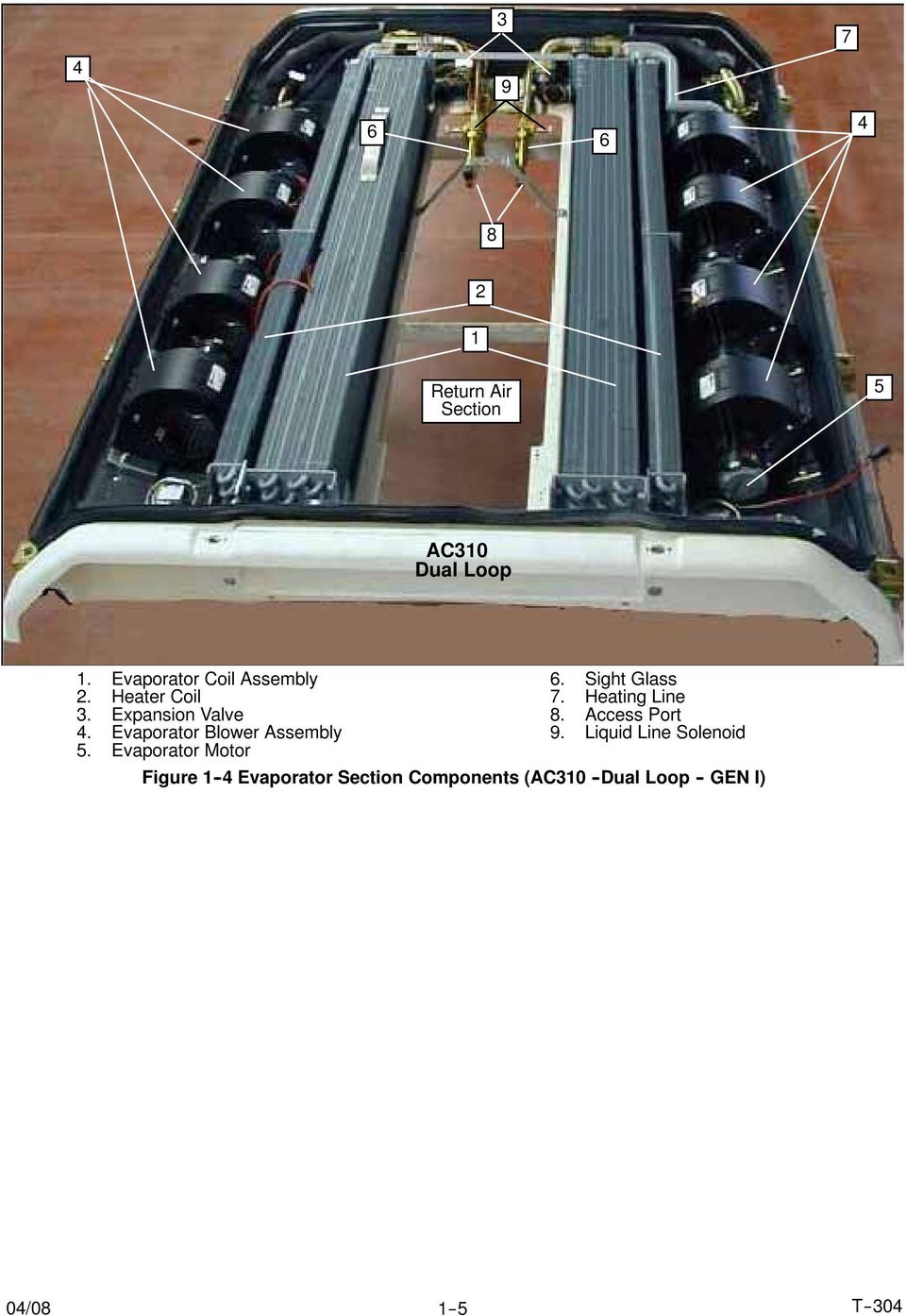
12 Condenser Coil Assembly Receiver Tank (Part Of Coil Assembly) 2 Service Valve 3 Filter Drier 4 Fan & Motor 5 Frame (Aluminum) Figure 1-3 Condensing Section Components (AC350 Single Loop - GEN II) Evaporator Section The dual loop AC310 & AC350 (GEN I) evaporator section (See Figure 1--4) includes the evaporator coils, eight (8) or twelve (12) single--shafted blower/motor assemblies, two heater coil assemblies, two thermostatic expansion valves, two liquid line solenoid valves, and condensate drain connections. NOTE The GEN I series of AC310 & AC350 evaporators are supplied with single shaft blower/motor assemblies. The GEN II series have dual shaft blower/motor assemblies. The single loop AC310 & AC350 evaporator section (See Figure 1--5) includes the evaporator coils, four (4) or six (6) double--shafted blower/motor assemblies, heater coil assemblies, one thermostatic expansion valve, one liquid line solenoid valve (to add in--dash service port), and condensate drain connections. The liquid line solenoid valve closes when the system is shut down to prevent flooding of coils and the compressor with liquid refrigerant. The evaporator coils provide heat transfer surface for transferring heat from air circulating over the outside of the coil to refrigerant circulating inside the tubes; thus providing cooling. The heating coils provide a heat transfer surface for transferring heat from engine coolant water circulating inside the tubes to air circulating over the outside surface of the tubes, thus providing heating. The fans circulate the air over the coils. The air filters remove dirt particles from the air before it passes over the coils. The thermostatic expansion valve meters the flow of refrigerant entering the evaporator coils. The heat valve controls the flow of engine coolant to the heating coils upon receipt of a signal from the controller. The condensate drain connections provide a means for connecting tubing for disposing of condensate collected on the evaporator coils during cooling operation. T

13 Return Air Section 5 AC310 Dual Loop Evaporator Coil Assembly Heater Coil Expansion Valve Evaporator Blower Assembly 5. Evaporator Motor Sight Glass Heating Line Access Port Liquid Line Solenoid Figure 1-4 Evaporator Section Components (AC310 -Dual Loop - GEN I) 1--5 T--304
14 Evaporator Coil Assembly Heater Coil Expansion Valve Evaporator Blower/Motor Assembly Control Panel Heater Line Front Evaporator Port Liquid Line Solenoid Figure 1-5 Evaporator Section Components (AC350 Single Loop - GEN II) Drivers Evaporator (Optional) The drivers evaporator assembly is normally installed in the vehicle dash area and interfaces with the rooftop unit electrical cabeling and refrigerant piping. The drivers evaporator assembly includes an evaporator coil, thermal expansion valve, blower motor assembly and a condensate drain connection. Refer to the OEM technical literature for driver s evaporator information Compressor Assembly a. Dual Loop Compressors A -6 & TM -21 The standard AC310 dual loop compressor assembly includes the refrigerant compressor, clutch assembly, in--line high & low pressure switches, suction accumulator and in--line suction and discharge servicing (charging) ports. b. Single Loop Compressor TM -31 The TM--31 compressor assembly used only with the AC310 Single Loop Unit includes the refrigerant compressor, clutch assembly, suction & discharge service valves, high pressure switch, low pressure switch, suction accumulator and suction and discharge servicing (charging) ports. c. Single Loop Compressors 05G & 05K The 05G (AC350) & 05K (AC310) compressor assemblies used with the single loop units, includes the clutch assembly, suction & discharge service valves, high pressure switch, low pressure switch, suction and discharge servicing (charging) ports and electric solenoid unloaders. The compressor raises the pressure and temperature of the refrigerant and forces it into the condenser coil tubes. The clutch assembly provides a means of driving the compressors by the vehicle engine. Suction and discharge servicing (charging) ports mounted on the compressor fittings enable connection of charging hoses for servicing of the compressor, as well as other parts of the refrigerant circuit. The high pressure switch contacts open on a pressure rise to shut down the system when abnormally high refrigerant pressures occur. The electric unloaders (05G & 05K) provide a means of controlling compressor capacity, which enables control of temperature inside the vehicle. The suction and discharge service valves enable servicing of these compressors. T

15 1.2.6 System Operating Controls And Components The system is operated by an electronic thermostat type controller and/or manually operated switches. The manually operated switches are located on the drivers control and may consist of a single ON/OFF switch or additional switches. The controller regulates the operational cycles of the system by energizing or de--energizing relays on the relay board in response to deviations in interior temperature. Modes of operation include Cooling and Heating. On systems fitted with only an ON/OFF switch, the controller will cycle the system between the operating modes as required to maintain desired set point temperature (See Section 6 for wiring diagrams). In the heat mode the heat valves are opened to allow a flow of engine coolant through the heat coils located in the evaporator section. The evaporator fans operate to circulate air over the heat coils in the same manner as the cooling mode. In the cooling mode the compressor is energized while the evaporator and condenser fans are operated to provide refrigeration as required. The compressor (s) capacity is matched to the bus requirements. Once interior temperature reaches the desired set point, the compressor(s) is deenergized P & 282P (PWM) Electronic Thermostat Controller This type controller has three (3) modes, Cool, Vent and Heat. The range on the potentiometer is F ( C) CSDD BT -324 (Carrier -Sutrak Digital Display) Microprocessor This Carrier Sutrak Digital Display (BT--324) controller has three (3) modes, Auto, Vent (Cycle clutch type) and Heat Motor Fault Board (Optional) The motor fault board (See Figure 1--11) consists of red and green LED s, which when illuminated, will reflect each motors state of condition. When the evaporator and condenser motors are energized, the green LED s will be illuminated. If a red LED is energized, it will show an open circuit condition, indicative of a motor failure. The green LED will not be illuminated at this time. The motor fault board is a seperate circuit board that is located at the return air section. The return air grill is oppened to view the LED indicators. 1.3 REFRIGERATION SYSTEM COMPONENT SPECIFICATIONS a. Refrigerant Charge R -134a (Approximate) NOTE Refrigerant charge will depend on hose lengths and diameters; or if there is an In--Dash unit (front evaporator). The following should only be used as a guideline. AC310 Dual Loop A -6 or TM -21 Compressor 6 Pounds (2.7 kg) -- Curbside 8 Pounds (3.6 kg) -- Roadside AC310 - Single Loop TM -31 Compressor 12 Pounds (5.4 kg) without In--Dash unit AC310 - Single Loop 05G or 05K Compressor 13.2 to 15.4 Pounds (6.0 to 7.0 kg) without In--Dash unit AC350 - Single Loop 05G or 05K Compressor 16.5 to 18.7 Pounds (7.5 to 8.5 kg) without In--Dash unit For systems with In -Dash unit (Optional) Add 2 pounds (0.9 kg) to above listed charge. b. Compressors Compressor A6 (No longer Available) Weight, (Dry) 34.5 Lbs. Oil Charge 10 Oz. PAG ( ) Compressor TM -21 Weight, (Dry) 7.5 Lbs. (3.4 kg) 6.1 Oz. (180 cc) PAG Oil Charge ( ) Compressor TM -31 Weight, (Dry) 21 Lbs Oz. (500cc) PAG Oil Charge ( ) Compressor Carrier 05K Weight, (Dry) 108 Lbs. 5.5 Pints POE Oil Charge ( pk6) Compressor Carrier 05G Weight, (Dry) 146 Lbs. W/Clutch 7.75 Pints POE Oil Charge ( pk6) c. Thermostatic Expansion Valve: Superheat Setting (Externally Adjustable) Factory Setat9to18 F (±4 F) MOP Setting: 55 ±4 psig (3.74 ±2.27 bar) d. High Pressure Switch (HPS) Normally Closed Opens at: 360 ±10 psig (20.41 ±0.68bar) Closes at: 280 ±10 psig (13.61 ±0.68bar) e. Low Pressure Switch (LPS) Normally Open Opens at: 6 ±3psig (0.41 ±0.20 bar) Closes at: 25 ±3psig(1.7 ±0.20 bar) f. Water Temperature Switch (WTS) [Bus Manufacturer Supplied -- Suggested close on temperature rise at 105 F (41 C)] 1.4 ELECTRICAL SPECIFICATIONS - MOTORS a. Evaporator Blower/Motor Evaporator Motor Permanent Magnet 24 VDC 12 VDC Horsepower (kw) 1/8 (.09) Full Load Amps (FLA) Operating Speed High/ Low (RPM) Bearing Lubrication Factory Lubricated (additional grease not required) Change 07/ T--304

16 b. Condenser Fan Motor Condenser Motor Permanent Magnet 24 VDC 12 VDC Horsepower (kw) 1/8 (.09) Full Load Amps (FLA) 9 18 Operating Speed (RPM) 2950 Bearing Lubrication Factory Lubricated (additional grease not required) c. Temperature Sensors (Return Air Sensor) Input Range: to 158 F (--47 to 70 C) Output: NTC 10K ohms at 77 F(25 C) d. Ambient Sensor (Optional) Opens at: 25 F(10 C) Closes at: 35 F(1.7 C) 1.5 SAFETY DEVICES System components are protected from damage caused by unsafe operating conditions with safety devices. Safety devices with Carrier Transport Air Conditioning supplied equipment include high pressure switch (HPS), low pressure switch (LPS), circuit breakers and fuses. a. Pressure Switches High Pressure Switch (HPS) During the air conditioning cycle, compressor clutch operation will automatically stop if the HPS switch contacts open due to an unsafe operating condition. Opening HPS contacts de-energizes the compressor clutch shutting down the compressor. The high pressure switch (HPS) is installed at the compressor assembly (05G, 05K & TM--31). Low Pressure Switch (LPS) The low pressure switch is installed close to the compressor and opens on a pressure drop to shut down the system when a low pressure condition occurs. The low pressure switch is installed at the compressor (05G, 05K & TM--31). NOTE On dual loop systems that use the A--6, TM--21 & some TM31 s, the pressure switches are not located on the compressors. They are installed in--line. b. Fuses and Circuit Breakers The Relay Board is protected against high current by an OEM supplied circuit breaker or fuse located in the bus battery compartment (150 Amp for 12 VDC & 125 Amp for 24 VDC systems). Independent 15 Amp, 24 VDC or 20 Amp, 12 VDC fuses protect each motor while the output circuits are protected by an additional 5 Amp circuit breaker. During a high current condition, the fuse may open. 1.6 AIR CONDITIONING REFRIGERATION CYCLE When air conditioning (cooling) is selected by the controller, the unit operates as a vapor compression system using R-134a as a refrigerant (See Figure 1--6 Dual Loop & Figure 1--8 Single Loop flow diagrams). The main components of the system are the A/C compressor, air-cooled condenser coils, receiver, filter-drier, thermostatic expansion valve, liquid line solenoid valve and evaporator coils. The compressor raises the pressure and the temperature of the refrigerant and forces it into the condenser tubes. The condenser fan circulates surrounding air (which is at a temperature lower than the refrigerant) over the outside of the condenser tubes. Heat transfer is established from the refrigerant (inside the tubes) to the condenser air (flowing over the tubes). The condenser tubes have fins designed to improve the transfer of heat from the refrigerant gas to the air; this removal of heat causes the refrigerant to liquefy, thus liquid refrigerant leaves the condenser and flows to the receiver. The refrigerant leaves the receiver and passes through the receiver outlet/service valve, through a filter-drier where a descecant keeps the refrigerant clean and dry. From the filter-drier, the liquid refrigerant then flows through the liquid line solenoid valve to the sight--glass and then to the thermostatic expansion valve. The thermal expansion valve reduce pressure and temperature of the liquid and meters the flow of liquid refrigerant to the evaporator to obtain maximum use of the evaporator heat transfer surface. The low pressure, low temperature liquid that flows into the evaporator tubes is colder than the air that is circulated over the evaporator tubes by the evaporator fans (fans). Heat transfer is established from the evaporator air (flowing over the tubes) to the refrigerant (flowing inside the tubes). The evaporator tubes have aluminum fins to increase heat transfer from the air to the refrigerant; therefore the cooler air is circulated to the interior of the bus. Liquid line solenoid valve closes during shutdown to prevent refrigerant flow. The transfer of heat from the air to the low temperature liquid refrigerant in the evaporator causes the liquid to vaporize. This low temperature, low pressure vapor passes through the suction line and returns to the compressor where the cycle repeats. 1.7 HEATING CYCLE Heating circuit (See Figure 1--7) components furnished by Carrier Transport Air Conditioning include the heater cores and solenoid operated heat valves. Components furnished by the bus manufacturer may include a water temperature switch (WTS) and boost water pump. The controller automatically controls the heat valves during the heating mode to maintain required temperatures inside the bus. Engine coolant (glycol solution) is circulated through the heating circuit by the engine and an auxiliary boost water pump. When the heat valve solenoids are energized, the valves will open to allow engine coolant to flow through the heater coils. The valves are normally closed so that if a failure occurs, the system will be able to cool. T

17 Driver s Evaporator Thermal Expansion Valve 7 Subcooler 2 Liquid Line Sight Glass 8 Compressor (TM--21 or A--6) 3 Service Port 9 Service Valve 4 Liquid Line Solenoid 10 Condenser Coil 5 Evaporator Coil 11 Filter--Drier 6 Heat Coil 12 Receiver Note: Items 1 through 12 are typical, both systems. Figure 1-6 Refrigerant Flow Diagram - Cooling (Dual Loop) 1--9 T--304

18 1 1 4 * 4 * 3 2 SUPPLY RETURN Heat Coil Vehicle Radiator 3. Boost Pump Figure 1-7 Flow Diagram - Heating 4. Heat Solenoid Valve * Optional Hand Valve NOTE: In order to ensure water is entering the heater coils sufficiently heated, it is suggested that the OEM supplied Water Temperature Switch (WTS) close on temperature rise at 150 F (65.5 C). T

19 Discharge Liquid Suction Coolant 11 Relief Valve 9 9 CONDENSER Dash Air Suction Line 4 Discharge Check Valve 5 Dash Air Liquid Line EVAPORATOR Figure 1-8 Refrigerant Flow Diagram, Cooling (Single Loop) AC Thermal Expansion Valve Liquid Line Sight Glass 3. 4 Service Port R134a Service Port 1/4 Flare (Acme) Liquid Line Solenoid Evaporator Coil 7. Compressor 8. Service Valve 9. Condenser Coil 10. Filter--Drier 11. Receiver T--304

20 Ref. Sutrac K14M K12M K11M K10M K9M K8M K7M K6M K5M K4M K3M K2M K1M V1 V2 V3 V4 frei frei frei F16M F15M F14M F13M F8M F7M F6M F5M F4M F3M F2M F1M frei F4A F3A F2A F1A V K15M K13M K4A K3A K2A K1A A1P B1N CLR1 CLR2 48 SeeFigure1-9Sheet2Legend Ref. Sutrak Schematic Figure 1-9 Sheet 1 - Electrical Control Board (280P) T
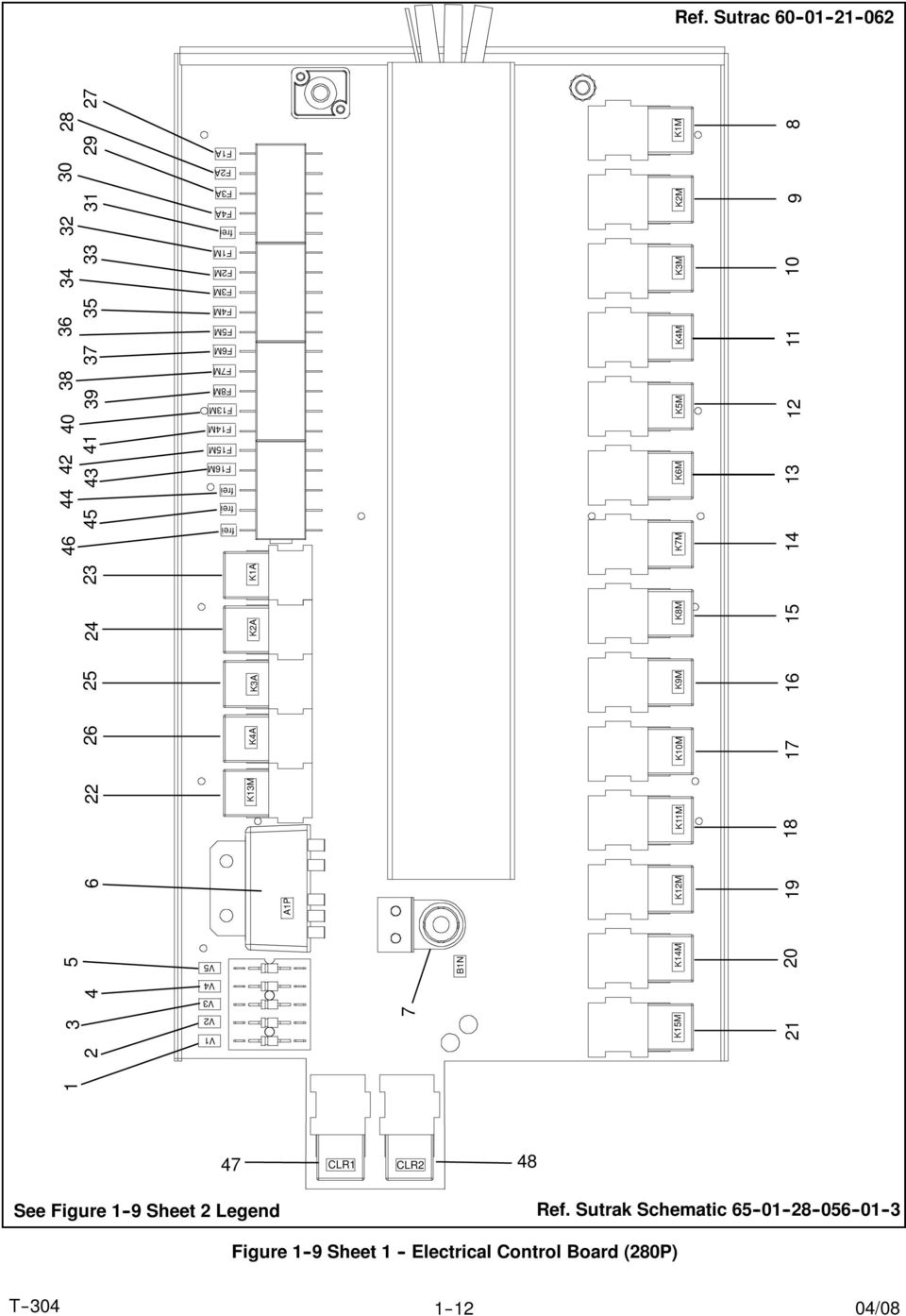
21 LEGEND 1 2 V1, Diode, Dash Switch V2, Diode, Dash Switch 3 4 V3, Diode, Dash Switch V4, Diode, Thermostat, Cooling 5 6 V5, Diode, Thermostat, Heating Thermostat 7 8 Return Air Sensor K1M, Relay, Evaporator Low Speed 9 10 K2M, Relay, Evaporator High Speed K3M, Relay, Evaporator High speed K4M, Relay, Evaporator Low Speed K5M, Relay, Evaporator High Speed K6M, Relay, Evaporator High Speed K7M, Relay, Evaporator Low Speed K8M, Relay, Evaporator High speed K9M, Relay, Evaporator High Speed K10M, Relay, Evaporator Low Speed K11M, Relay, Evaporator High Speed K12M, Relay, Evaporator High Speed K14M, Relay, Evaporator Main, High speed K15M, Relay, Condenser Motors K13M, Relay, Condenser Motors K1A, Relay, Alternator Power K2A, Relay, Compressor Clutch 25 K3A, Relay, Heat Valve and Water Pump K4A, Relay, Evaporator Speed F1A, Fuse, Alternator Output F2A, Fuse, Heat Valve and Water Pump F3A, Fuse, Compressor Clutch F4A, Fuse, Compressor Clutch SPARE F1M, Fuse, Evaporator Motor F2M, Fuse, Evaporator Motor F3M, Fuse, Evaporator Motor F4M, Fuse, Evaporator Motor F5M, Fuse, Evaporator Motor F6M, Fuse, Evaporator Motor F7M, Fuse, Evaporator Motor F8M, Fuse, Evaporator Motor F13M, Fuse, Evaporator Motor F14M, Fuse, Evaporator Motor F15M, Fuse, Condenser Motor F16M, Fuse, Condenser Motor SPARE SPARE SPARE CLR1, Clutch Lockout Relay #1 48 CLR2, Clutch Lockout Relay #2 Ambient Sensor -- (Condenser) Humidity Control Sensor -- (Return Air) OEM Installed Controls CR1 & CR2, Clutch Relays See Figure 1-9 Sheet 1 - Electrical Control Board Figure 1-9 Sheet 2 Legend T--304
22 1...K1A = Compressor Clutch -- Liquid Line Solenoid -- Condenser Fans 2...K2A = Heat Valve -- Boost Pump 3...K3A = Evaporator Fans 4...K1M -- K6M = Individual Evaporator Fans (M1M -- M6M) 5...K7M -- K9M = Individual Condenser Fans (M21M -- M26M) 6...Fuse = Boost Pump & Heat Valve 7...F13M -- F18M = Individual Condenser Fans 8...F1M -- F12M = Individual Evaporator Fans 9...U Reg = Evaporator Speed Regulation 10...X1 = Condenser Fans 11...X2 = Evaporator Fans 12...X3 -- X4 (Not Shown On Drawing) = Dash To Unit Interface Plug X2 K1M K3M K5M K7M K9M K2M K4M K6M K8M + -- F1M 10A F2M 10A F3M 10A F4M 10A F5M 10A F6M 10A F7M 10A F8M 10A Contact arrangement Connect X1 -- X2 F9M 10A F10M 10A F11M 10A F12M 10A F13M 15A + GND U3 Top View U3A Relay Board K1A K2A K3A Ureg F14M 15A F15M 15A F16M 15A F17M 15A F18M 15A X1 Part Number SUTRAK SCHMATIC #65, 01, 28, UNIT RELAYS FOR EVAP. MOTORS RELAYS FOR COND. MOTORS K1m - K4M K7M - K8M AC310 K7M - K9M AC350 K1M - K6M Figure 1-10 AC350 With BT324 Control T
23 1--15 T--304 MOTOR POWER CARRIER CRO MOTOR FAULT BOARD D48 RS12 MOTOR R60 T24 COND4 MOTOR MOTOR MOTOR MOTOR MOTOR MOTOR MOTOR MOTOR T20 D47 D46 D R59 R58 R57 R56 T23 T22 T21 D44 D43 D42 D41 D40 R55 R54 R53 R52 T19 T18 T17 T16 EVAP8 RS11 RS10 RS9 COND3 COND2 COND1 RS6 RS8 RS7 RS5 RS4 EVAP7 EVAP6 EVAP5 EVAP4 R79 R80 C17 R82 R81 C18 R84 R83 MOTOR MOTOR MOTOR D39 D38 D37 R51 R50 R35 D23 D35 R49 D24 D36 R36 T15 T14 T13 R47 R48 R72 R71 R33 R34 Q12 Q11 D34 D22 Q10 U3 C3 D33 D21 Q9 Q8 D31 D19 R31 Q7 D32 D20 R32 U2 C2 C14 R46 R45 C13 C15 U6 C12 R69 R70 R44 R43 C10 R67 R68 C11 U5 RS3 RS2 RS1 EVAP3 EVAP2 EVAP1 R24 R23 R12 D12 DS24 DS23 DS22 DS21 R74 R73 C16 R76 R75 R77 R78 D28 D27 R30 D18 D30 Q6 R27 D15 R29 D17 D29 Q5 D16 R28 Q4 Q3 D26 D14 Q2 U1 C1 D25 D13 Q1 R63 R39 R41 R42 C9 R40 C8 R65 R66 R64 C14 R38 R37 C13 C15 U4 C12 R62 R61 R26 R25 DS20 DS19 DS18 DS17 DS16 DS15 DS14 DS13 OPEN CIRCUIT X3--4 BREAKER GRN/YEL T12 BREAKER BREAKER BREAKER BREAKER BREAKER BREAKER BREAKER BREAKER BLK/GRN GRN/ORN GRN/WHT GRN/BLU BLK/YEL WHT/ORN BLK/ORN WHT/GRN X1--8 X3--3 X3--2 X3--1 T11 T10 T9 T8 X1--7 X1--6 X1--5 X1--4 T7 T6 T5 T4 R17 BREAKER BREAKER BREAKER WHT/RED BLK/RED WHT/YEL D11 R11 D10 R22 R10 R21 D9 R9 R8 R20 D8 R19 D7 R18 R7 D6 R6 COND3 COND4 DS12 COND2 COND1 EVAP8 DS11 DS10 DS9 + + U8 R14 X1--3 X1--2 X1--1 R5 D5 R16 D4 D3 R15 R4 R3 T3 T2 T1 D2 R2 R13 D1 R1 U7 OK POWER DS25 EVAP4 EVAP7 EVAP6 EVAP5 DS8 DS7 DS6 DS5 EVAP3 EVAP2 EVAP1 DS4 DS3 DS1 DS2 GROUND D51 D52 C23 R90 C22 T26 T25 POWER 10-30V D50 R91 C20 C19 C21 D49 F1 R86 R87 R89 R88 R85 Figure 1-11 Motor Fault Board (Optional)
24 SECTION 2 OPERATION (MANUAL CONTROLLER) 2.1 STARTING, STOPPING AND OPERATING INSTRUCTIONS The control switches supplied by Carrier Transport Air Conditioning will be marked with international symbols (See Figure 2.1). Before starting, electrical power must be available from the bus power supply. 150 VDC or VDC from a fuse in the battery compartment supplies power for the clutch, evaporator and condenser assemblies Starting a. If the engine is not running, start the engine. b. Actual start sequence depends on the operating cotrol supplied. If only an ON/OFF switch is supplied, place the switch in the ON (fan symbol) position to start the system in the automatic mode. c. After the pre--trip inspection is completed, the switches may be set in accordance with the desired control modes. d. If low or high speed evaporator fan speed is desired, press the FAN SPEED (fan symbol) button to bring speed to the desired level Stopping Placing the ON/OFF (Snowflake) switch in the OFF position will stop the system operation by removing power to the Logic Board. LOW------HIGH COOL HEAT OFF ON Temperature Control Figure 2.1 Control Switches (Typical) 2.2 PRE -TRIP INSPECTION After starting system, allow system to stabilize for ten to fifteen minutes and check for the following: a. Listen for abnormal noises in compressor or fan motors. b. Check compressor oil level (05G Compressor only). c. Check refrigerant charge. (Refer to section ) 2--1 T--304
25 2.3 MODES OF OPERATION Temperature Control Temperature is controlled by maintaining the return air temperature measured at the return air grille. To maintain cooling, turn the temperature control knob towards the minus (--) symbol. To start heating cycle, turn the temperature control knob towards the plus (+) symbol (See Figure 2.1) Cooling Mode Cooling is accomplished by energizing the compressor and condenser fans, opening the liquid line solenoid valve and closing the heating valve. Once interior temperature reaches the desired set point, the system will de--energize the compressor clutch and allow the system to operate in the vent mode until further cooling is required. The temperature will be maintained within 2 C. or 3.6 F. A controller programed for reheat will mantain compressor operation and cycle the heat valve to allow reheating of the return air. In the reheat mode interior temperature is maintained at the desired set point while additional dehumidification takes place Heating Mode In the heat mode the liquid line solenoid is closed and the compressor and condenser fans are shut down. The heat valve is opened to allow a flow of engine coolant through the heat section of the evaporator coil. The evaporator fans speed is varied as required to circulate air over the evaporator coil based on the temperature difference from setpoint. Operating in the heating mode is controlled by the water temperature switch (WTS). The WTS is located on the engine block of the vehicle and is provided by the OEM. It senses the engine collant temperature and reverses its contacts on temperature rise at 105 F. The switch prevents the circulation of cooler air throughout the vehicle as the engine comes up to temperature Boost Pump (Optional) When the unit is in the heat mode, and if a boost pump is supplied by the coach manufacturer, the boost pump relay is energized, providing 24 VDC to activate the boost pump Vent Mode Once the temperature is satisfied, there is a window when the unit will go into a vent mode. This is when there is neither heating or cooling. Only the evaporator fans are operating. The range of the Vent mode is 2 C. or 3.6 F. from the set point. The compressor clutch is disengaged at this time Compressor Unloader Control (Only with 05G or 05K Compressors) When operating in cooling, the unloaders are used to reduce system capacity as return air temperature approaches set point. Operation of the unloaders balances system capacity with the load and thereby prevents overshoot from set point. Relay Board mounted unloader outputs control the capacity of the compressor by energizing or de--energizing unloader solenoid valves. The model 05G compressor has three banks of two cylinders each. Enercizing a valve de--activates a bank of cylinders. The outboard cylinder banks of the 05G are equipped with unloader valves (UV1 and UV2), each controlling two cylinders; this allows the 05G to be operated with two, four or six cylinders. The unloaders are used to control system capacity by controlling compressor capacity. Control of the unloaders is with the pressure switches. a. Suction Pressure The unloaders are used to control suction pressure and thereby prevent coil frosting: 1. Compressor Unloader UV1 Relay -- When the suction pressure decreases below 26 psig (R--134a), unloader UV1 is energized, unloading a cylinder bank (2 cylinders); this output will remain energized until the pressure increases to above 34 psig (R--134a). 2. Compressor Unloader UV2 Relay -- When suction pressure decreases below 23 psig (R--134a), unloader UV2 is energized, unloading the second compressor cylinder bank; this output will remain energized until the pressure increases to above 31 psig (R--134a). b. Discharge Pressure Discharge pressure is also controlled by the unloaders: 1. Compressor Unloader UV1 Relay -- When the discharge pressure increases above setpoint A (see Table 2.1), unloader UV1 is energized; this unloader will remain energized until the pressure decreases below set point B (see Table 2.1). Table 2.1 Unloader UV1 Relay HP Switch (PSIG) Set Point A (PSIG) Set Point B (PSIG) 300 (R--134a) (R--134a) (High Ambient) Compressor Unloader UV2 Relay -- On R--134a systems when the discharge pressure increases above setpoint A (see Table 2.2), unloader UV2 is energized; this unloader will remain energized until the pressure decreases below set point B (see Table 2.2). Table 2.2 Unloader UV2 Relay HP Switch (PSIG) Set Point A (PSIG) Set Point B (PSIG) 300 (R--134a) (R--134a) (High Ambient) Override Mode - AC310 (Dehumidification) When in the heat mode the compressor will not operate. The thermostat will allow only COOL, VENT or HEAT modes independently. An override switch has been installed in the return air area to allow the compressors to run when in the HEAT mode. Moving the switch to the ON position will energize both clutch relays energizing the clutches. There are two temperature sensors that are in series with the clutch relay circuit, Ambient Sensor (mounted in the condenser) and Humidity Control Sensor (mounted in the return air area). As long as the return air temperature is above 60 F and the ambient is above 25 F, the override circuit will function when energized, providing dehumidification. (See section 1.4 for sensor specs) T
26 2.3.8 Evaporator Fan Speed Selection Evaporator fan speed(s) selection is one method of controlling the cooling and heating throughout the bus passenger compartment. The thermostat control is the other Compressor Clutch Control (A -6, TM -16, TM -21) A belt driven electric clutch is employed to transmit engine power to the air conditioning compressor. De-energizing the clutch s electric coil disengages the clutch and removes power from the compressor. The clutch will be engaged when in cooling and disengaged when the system is off, in heating or during high and low pressure conditions. The clutch coil will be de-energized if the discharge pressure rises to the 365 ±10 psig (19.42 bar) cutout setting of the compressor mounted high pressure switch. The clutch coil will energize (Automatic Re--Set) when the discharge pressure falls to 280 ± 10 psig (11.41 bar). The clutch coil will be de-energized (open) if the suction pressure (LP) decreases below 6 ± 3 psig (0.45 bar). The clutch coil will energize (Automatic Re--Set) when suction pressure rises (close) to 25 ± 3 psig (1.7 bar). 2.4 SEQUENCE OF OPERATION (280P / 282P) Electronic Thermostat With a signal from the Hydraulic Brake Module (or other 12 VDC source) the A/C Power Relay is grounded, sending 12 VDC to the K1A relay. K1A relay energizes sending battery power (Line B+) to the Dash Control switches (S1A & S2A). Begining with the Fan Speed Switch (S1A) in the low speed position (vent 1) the following actions take place: a. Power flows from the Fan Speed Switch (S1A) through relay K4A normally closed contacts. Line U2 energizes evaporator fan motor low speed relays (K1M, K4M, K7M & K10M). Closing these relays allows power to flow from the battery (line B+) through the fan motors with two motors in series, operating the motors at low speed. b. The ON/OFF switch (S2A) is then placed in the ON position. Power flows from the switch to energize the Thermostat. With the Thermostat calling for cooling, power also flows from the cooling switch: 1. Thorugh the Humidity Control Sensor and the Ambient Sensor Switches located in the return air and condenser respectively. If both of these switches are in the closed position the following sequence will take place. 2. Power will flow to the Clutch Lockout Relays (CLR1 & CLR2) allowing power to energize the Clutch Relays (CR1 & CR2). Relays CR1 & CR2 are poweredon terminal 30 from an OEM breaker, (A/C Low Voltage Breaker). Energizing these relays will send power through the high and low pressure switches and to both compressor clutches energizing the clutch coils and starting the compressor. 3. To the liquid line solenoids (Y1A & Y2A) to start the flow of refrigerant. 4. Through line U3, to energize the condenser fan relays (K14M & K15M). Energizing these relays will send B+ power to start the condenser fan motors. The unit is now in low speed cooling. 5. To bring the evaporator fans to high speed the fan speed switch (S1A) is placed in the HIGH (Vent 2) position. Power flows from the switch through line U5 to energize the high speed relay (K13M). The normally closed low speed relay (K4A) is de--energized opening the low speed circuit. Power flows from the high speed relay (K13M) to energize the high speed fan relays (K2M, K3M, K5M, K6M, K8M, K9M, K11M, & K12M). Energizing these relays individually grounds each evaporator fan motor separately placing them in high speed operation. c. With the thermostat calling for heating, power flows from the heat switch: 1. Through line UH to energize the heat relay (K3A). With the heat realy energized, power flows from the battery (line B+) to start the water pump and open the heat valve. The unit is now in the heat mode. Fan speeds can be adjusted the same as in the cooling mode. d. With the Thermostat calling for Heating and the need for Dehumidification is required: 1. The override switch, located in the return air inlet is switched to the ON position. 2. Power will flow through the ambient and humidity control switch, if closed, and energize the cooling circuits at the same time as heating. This will put the system in a Reheat Mode of operation. The thermostat will only cycle the heat valve and pump. The cooling circuit will stay energized as long as the override switch is in the ON position and both sensor switches are closed. CONTROL ACTION - CYCLING CLUTCH SETPOINT F ABOVE SETPOINT FALLING TEMPERATURE FULL- COOL VENT HEAT RISING TEMPERATURE +1.8 F ABOVE SETPOINT SETPOINT Figure P / 282P Thermostat 2--3 T--304
27 SECTION 3 OPERATION BT324 CONTROLLER 3.1 STARTING, STOPPING AND OPERATING INSTRUCTIONS The BT324 Carrier Sutrak Digital Display (CSDD) is marked with international symbols (See Figure 3--2). Before starting, electrical power must be available from the bus power supply (See Figure 3--1). A 150 VDC or a VDC fuse in the battery compartment passes power for the clutch, evaporator and condenser assemblies. A/C Figure 3-1 Bus Dash With A/C Switch & BT324 CSDD Controller Starting a. If the engine is not running, start the engine. b. When the 12/24VDC power is applied, the driver display will illuminate and show return air set point. Press the A/C key (Item 5 Figure 3--2) on the display to trigger the start up sequence. c. After the pre--trip inspection is completed, the switches may be set in accordance with the desired control modes Stopping Toggling the A/C key (Item 5 Figure 3--2) on the display again will stop the system operation. 3.2 PRE -TRIP INSPECTION After starting system, allow system to stabilize for ten to fifteen minutes and check for the following: a. Listen for abnormal noises in compressor or fan motors. b. Check compressor oil level (05G Compressor only). c. Check refrigerant charge. (Refer to section ) 3--1 T--304
28 KEYS 1. Plus Key Minus Key Recirculate/Fresh Air Key Blower Control Key Automatic Climate Control (A/C) Figure 3-2 BT324 CSDD Controller LEDS 6. Display Fresh Air Operation (Green) Manual Blower Control ON (Green) Heating Mode (Green) Malfunction Light (Red) 3.3 SEQUENCE OF OPERATION BT324 CSDD Function of Keys when Engine On and controller active: a. Plus Key -- Increases interior temperature setpoint by 1 per stroke or increases manual blower speed, depending on displayed mode. b. Minus Key -- Decreases interior temperature setpoint by 1 per stroke or decreases manual blower speed, depending on displayed mode. c. Recirculating Air/Fresh Air -- Switches from Recirculating Air to Fresh Air and vice--versa. d. Blower Control -- Switches on the manual blower control. e. Automatic Climate Control -- Switches on the Automatic Temperature Control. f. Temperature Indicator (Key2+Key3)-- Shows the inside temperature for 10 seconds. If pressed a second time shows the outside temperature for 10 seconds (optional). g. Reheat (optional) (Key3+Key5)-- Starts Reheat mode for 3 minutes (duration adjustable). h. Controller Off (A/C Switch To Off) -- Switches off all control functions and the display. NOTE The following blower steps are disabled when the automatic climate control is on: 2--, 3--step blower: Off Continuously adjustable blower: Off Illuminating Indications (Display) With Engine--On and Controller active 3.4 Operating Instructions BT324 When the engine is running, toggle the A/C Switch to on to activate the Air Conditioning Unit Display When the unit is ON, the display shows the interior setpoint temperature. When selecting individual functions, the display shows the corresponding information for a short period of time. The display is dark when the engine and control unit are OFF Interior Temperature Control Press the Plus (1) or Minus (2) keys to set the desired interior temperature. The temperature can be adjusted between 64 F(18 C) and 82 F(28 C). When the outside temperatures are below 35 F(2 C) (adjustable parameter), the cooling function remains disabled Ventilation When the unit is operating in Automatic Climate Control mode, the blower speed is controlled based on the room temperature. T
29 However, the blowers may be switched to manual mode of operation by pressing the blower key. Press the Plus or Minus keys to define one of 5 different blower steps. The blowers can not be switched OFF when Automatic Climate Control is ON. When Automatic Climate Control is OFF, the blowers stop when the manual control is turned to zero Reheat (optional) The Reheat mode is used to remove air humidity and to help defog the windshield. Press Key 3 (Recirculating Air/Fresh Air) and Key 5 (Automatic Climate Control) at the same time to activate Reheat. Heating and cooling will be energized on for 3 minutes (adjustable parameter). In addition, the blowers are switched to maximum speed and the fresh air flap is closed. At the end of the pre--set duration of time, the functions return to the previously selected settings. Reheat mode is disabled with the outside temperature is below 35 F(2 C) (adjustable parameter), when the sensor is not installed, or when there is a sensor failure Temperature Indication Press key 2 (minus) and key 3 (Recirculating Air/Fresh Air) at the same time to display the inside temperature for 10 seconds. Optionally, the outside temperature may be displayed when pressing the keys a second time. A sensor malfunction is displayed by i - - or o CHANGING BETWEEN F (FAHRENHEIT) AND C (CELCIUS ) Procedures for changing the BT324 Controller between Fahrenheit and Celcius is as follows: a. Engine OFF & Ignition ON. b. Press Key 1 (plus) and Key 2 (minus) at the same time until the display shows the word Code. NOTE After the display shows the word Code you have 5 seconds to enter the correct access code. c. Press Key 1 (Plus Key) one time and release. d. Press Key 3 (Recirculating Air/Fresh Air) one time and release. e. Press Key 4 (blower control) one time and release. The display will show the mode Fah for temperatures in F or the mode Cel for temperatures in C. f. Press Key 1 (plus) or Key 2 (minus) to change the temperature mode. g. Press Key 5 (automatic climate control) one time to end the program T--304
30 SECTION 4 TROUBLESHOOTING INDICATION - TROUBLE 4.1 System Will Not Cool Compressor will not run Electrical malfunction Table 4-1 General System Troubleshooting Procedures POSSIBLE CAUSES Drive--Belt loose or defective Clutch coil defective Clutch malfunction Compressor malfunction Coach power source defective Circuit Breaker/safety device open 4.2 System Runs But Has Insufficient Cooling Compressor Drive-Belt loose or defective Compressor valves defective Refrigeration system Abnormal pressures No or restricted evaporator air flow Expansion valve malfunction Restricted refrigerant flow Low refrigerant charge Service valves partially closed Safety device open Liquid solenoid valve stuck closed REFERENCE SECTION Check Check/Replace Check/Replace SeeTable1--3 Check/Repair Check/Reset Check SeeTable1--3 Restricted air flow No evaporator air flow or restriction 4.5 Heating system Heat valve stuck open Abnormal Pressures High discharge pressure Low discharge pressure Refrigerant overcharge Noncondensable in system Condenser motor failure Condenser coil dirty Compressor valve(s) worn or broken Low refrigerant charge Open Check Check Clean SeeTable High suction pressure Compressor valve(s) worn or broken SeeTable1--3 Low suction pressure Suction service valve partially closed Filter-drier inlet valve partially closed Filter-drier partially plugged Low refrigerant charge Expansion valve malfunction Restricted air flow Open Check/Open Suction and discharge pressures tend to equalize when system is Compressor valve defective SeeTable1--3 operating 4.4 Abnormal Noise Or Vibrations Compressor Loose mounting hardware Worn bearings Worn or broken valves Liquid slugging Insufficient oil Clutch loose, rubbing or is defective Drive-Belt cracked, worn or loose Dirt or debris on fan blades Check/Tighten SeeTable1--3 SeeTable Repair/Replace Adjust/Replace Clean 4--1 T-304
31 INDICATION - TROUBLE Table 4-1 General System Troubleshooting Procedures - Continued POSSIBLE CAUSES 4.4 Abnormal Noise Or Vibrations - Continued Condenser or evaporator fans Loose mounting hardware Defective bearings Blade interference Blade missing or broken 4.5 No Evaporator Air Flow Or Restricted Air Flow Air flow through coil blocked Coil frosted over Dirty coil Dirty filter No or partial evaporator air flow Motor(s) defective Motor brushes defective Evaporator fan loose or defective Fan damaged Return air filter dirty Icing of coil Fan relay(s) defective Safety device open Fan rotation incorrect 4.6 Expansion Valve Malfunction Low suction pressure with high superheat Low superheat and liquid slugging in the compressor Side to side temperature difference (Warm Coil) 4.7 Heating Malfunction Insufficient heating No Heating Low refrigerant charge Wax, oil or dirt plugging valve orifice Ice formation at valve seat Power assembly failure Loss of bulb charge Broken capillary tube Bulb is loose or not installed. Superheat setting too low Ice or other foreign material holding valve open Wax, oil or dirt plugging valve orifice Ice formation at valve seat Power assembly failure Loss of bulb charge Broken capillary Dirty or plugged heater core Coolant solenoid valve(s) malfunctioning or plugged Low coolant level Strainer(s) plugged Hand valve(s) closed Water pumps defective Auxiliary Heater malfunctioning. Coolant solenoid valve(s) malfunctioning or plugged Controller malfunction Pump(s) malfunctioning Safety device open REFERENCE SECTION Check/Tighten Replace Check Check/Replace Defrost coil Clean Clean/Replace Repair/Replace Replace Repair/Replace Repair/Replace Clean/Replace Clean/Defrost Check/Replace 1.5 Check 5.8 Check 4.6 Replace Replace Check 5.7 Replace Replace 5.16 Clean Check/Replace Check Clean Open Repair/Replace Repair/Replace Check/Replace Replace Repair/Replace 1.5 Continuous Heating Coolant solenoid valve stuck open 5.12 T
32 SECTION 5 SERVICE WARNING Be sure to observe warnings listed in the safety summary in the front of this manual before performing maintenance on the hvac system WARNING Read the entire procedure before beginning work. Park the coach on a level surface, with parking brake applied. Turn main electrical disconnect switch to the off position. NOTE To avoid damage to the earth s ozone layer, use a refrigerant recovery system whenever removing refrigerant. The refrigerant recovery system is available from Carrier Transicold (Carrier Transicold P/N MVSII--115 or MVSII--240). When working with refrigerants you must comply with all local goverment environmental laws. 5.1 MAINTENANCE SCHEDULE SYSTEM ON OFF a. Daily Maintenance X X b. Weekly Inspection X X X X SYSTEM Pre-trip Inspection -- after starting Check tension and condition of drive belts. Perform daily inspection Check condenser, evaporator coils and air filters for cleanliness Check refrigerant hoses, fittings and component connections for leaks Feel filter-drier for excessive temperature drop across drier c. Monthly Inspection and Maintenance X X X X X Perform weekly inspection and maintenance Clean evaporator drain pans and hoses Check wire harnesses for chafing and loose terminals Check fan motor bearings Check compressor mounting bolts for tightness REFERENCE SECTION 2.2 None See above None See above None Replace/Tighten None None 5.2 REMOVING EVAPORATOR COVER To remove the evaporator cover do the following: 1. Turn all the 1/4 turn cam locks counterclockwise. 2. Using two people carefully grasp the cover under the bottom edge and lift up. 3. Place the evaporator cover on top of the condenser section. 5.3 REMOVING CONDENSER COVER To remove the condenser cover do the following: 1. Turn all the 1/4 turn cam locks counterclockwise. 2. Using two people carefully grasp the cover under the bottom edge and lift up. 3. Place the condenser cover on top of the evaporator section. 5.4 INSTALLING MANIFOLD GAUGE SET A manifold gauge set can be used to determine system operating pressures, add charge, equalize or evacuate system. When the suction pressure hand valve is frontseated (turned all the way in), the suction (low) pressure can be read. When the discharge pressure hand valve is frontseated, discharge (high) pressure can be read. When both valves are open (turned counterclockwise), high pressure vapor will flow into the low side. When only the low pressure valve is open, the system can be charged or evacuated T-304
33 CAUTION The AC310 & AC350 Rooftop Systems have R134a service port couplings installed on the compressor and 1/4 inch flare (Acme) fittings installed on the unit piping. SUCTION PRESSURE GAUGE 1. DISCHARGE PRESSURE GAUGE Installing R -134a Manifold Gauge/Hose SET An R--134a manifold gauge/hose set with self--sealing hoses is pictured in Figure The manifold gauge/hose set is available from Carrier Transicold. (Carrier Transicold P/N , which includes items 1 through 6, Figure 5--1). To perform service using the manifold gauge/hose set, do the following: a. Preparing Manifold Gauge/Hose Set for use. 1. If the manifold gauge/hose set is new or was exposed to the atmosphere it will need to be evacuated to remove contaminants and air as follows: 2. Back--seat (turn counterclockwise) both field service couplers (see Figure 5--1) and mid--seat both hand valves. 3. Connect the yellow hose to a vacuum pump and an R--134a cylinder. 4. Evacuate to 10 inches of vacuum and then charge with R134a to slightly positive pressure of 1.0 psig. 5. Front--seat both manifold gauge set hand valves and disconnect from cylinder. The gauge set is now ready for use. OPENED (Backseated ) HAND VALVE To Low Side Access Valve 6. Blue Knob 3. BLUE To Refrigerant Tank or Vacuum Pump 3. YELLOW CLOSED (Frontseated) HAND VALVE To High Side Access Valve 3. RED Red Knob Figure 5-1 Manifold Gauge Set (R -134a) 1. Manifold Gauge Set 2.. Hose Fitting ( Acme) 3.. Refrigeration and/or Evacuation Hose. (SAE J2196/R-134a) 4.. Hose Fitting w/o-ring (M14 x 1.5) 5.. High Side Field Service Coupling 6.. Low Side Field Service Coupling b. Connecting the Manifold Gauge Gauge/Hose Set. To connect the manifold gauge/hose set for reading pressures, do the following: 1. Connect the field service couplers (see Figure 5--1) to the high and low in--line service ports. 2. Turn the field service coupling knobs clockwise, which will open the system to the gauge set. 3. Read the system pressures. c. Removing the Manifold Gauge Set. 1. While the compressor is still ON, mid--seat both hand valves on the manifold gauge set and allow the pressure in the manifold gauge set to be drawn down to low side pressure. This returns any liquid that may be in the high side hose to the system. CAUTION To prevent trapping liquid refrigerant in the manifold gauge set be sure set is brought to suction pressure before disconnecting. 2. Back--seat both field service couplers and front--seat both manifold set hand valves. Remove the couplers from the in--line access valves. 3. Install both in--line access valve caps. T
34 5.5 PUMPING THE SYSTEM DOWN OR REMOV- ING THE REFRIGERANT CHARGE 1. D S 3. NOTE To avoid damage to the earth s ozone layer, use a refrigerant recovery system whenever removing refrigerant System Pump Down For Low Side Repair To service or replace the filter--drier, pump the refrigerant to the condenser and receiver as follows: To Compressor a. Remove evaporator and condenser covers. b. Install manifold gauge/hose set. (Refer to Section 5.4.1). c. Frontseat the filter--drier inlet service valve by turning clockwise. It will be necessary to install a jumper across the low pressure switch (LPS) contacts at the compressor in order to reach 0 PSIG. d. Start the system and run in cooling. Stop the unit when suction reaches 10 /hg (25.4 cm/hg) vacuum. e. Frontseat filter/drier outlet service valve to trap refrigerant in the high side of the system between the compressor and the filter--drier inlet valve. Wait 5 minutes to verify that system remains in a vacuum. f. Service or replace filter--drier. g. Leak check connections after replacing filter--drier. Refer to paragraph 5.6. h. Using refrigerant hoses designed for vacuum service, evacuate and dehydrate the filter--drier by connecting a vacuum pump to center connection of manifold gauge set. Evacuate system to 500 microns. Close off pump valve, isolate vacuum gauge and stop pump. Wait 5 minutes to verify that vacuum holds. i. Read Micron Gauge again to verify that the pressure did not rise more than 500 microns within that 5--minute timeframe. If the Micron Gauge rises more than 500 microns (to excede a gauge reading of = 1000 microns) at the end of 5 minutes, either a leak is present or an unacceptable level of moisture remains in the circuit. If the gauge reads a gain of less than 500 microns during the 5--minute wait, the circuit is acceptably tight and dry. j. Once vacuum is maintained, recharge system by admitting vapor from the refrigerant cylinder. k. Remove manifold gauges. Backseat both filter drier service valves Removing Entire System Charge To remove the entire refrigerant charge, do the following: a. Connect a manifold gauge set to the system as showninfigure5--2. b. Connect a reclaimer to the center manifold gauge set connection. c. Recover refrigerant in accordance with reclaimer manufacturers instructions Figure 5-2 In -Line Service Connections 1. Discharge Service Port 2. Suction Service Port 3. Manifold Gauge Set Vacuum Pump 5. Reclaimer 6. Refrigerant Cylinder 7. Thermistor Vacuum Gauge 5.6 REFRIGERANT LEAK CHECK A refrigerant leak check should always be performed after the system has been opened to replace or repair a component. To check for leaks in the refrigeration system, perform the following procedure: NOTE It must be emphasized that only the correct refrigerant should be used to pressurize the system. Use of any other refrigerant will contaminate the system, and require additional evacuation. a. Ensure filter drier service and solenoid valves are open. 1. Filter drier service valves should be back seated. b. If system is without refrigerant, charge system with refrigerant vapor to build up pressure between 20 to 30 psig (1.36 to 2.04 bar). c. Add sufficient nitrogen to raise system pressure to 150 to 200 psig (10.21 to bar). d. Check for leaks. The recommended procedure for finding leaks in a system is with an electronic leak detector. Testing joints with soapsuds is satisfactory only for locating large leaks. e. Remove test gas and replace filter--drier. f. Evacuate and dehydrate the system. (Refer to paragraph 5.7.) g. Charge the unit. (Refer to paragraph 5.8.) 5.7 EVACUATION AND DEHYDRATION General 5--3 T-304
35 The presence of moisture in a refrigeration system can have many undesirable effects. The most common are copper plating, acid sludge formation, freezing-up of metering devices by free water, and formation of acids, resulting in metal corrosion. An evacuation should take place after a system repair (replacement of filter drier. expansion valve, solenoid valve, etc) Preparation NOTE Using a compound gauge (manifold gauge) for determination of vacuum level is not recommended because of its inherent inaccuracy. a. Evacuate and dehydrate only after pressure leak test. (Refer to paragraph 5.6) b. Essential tools to properly evacuate and dehydrate any system include a good vacuum pump with a minimum of 5 cfm (8.5 m 3 /hr) volume displacement, (CTD P/N ), and a good vacuum indicator (CTD P/N ). c. Keep the ambient temperature above 60 F (15.6 C) to speed evaporation of moisture. If ambient temperature is lower than 60 F (15.6 C), ice may form before moisture removal is complete Procedure for Evacuation and Dehydrating System a. Remove refrigerant using a refrigerant recovery system. Refer to paragraph b. The recommended method is connecting 3/8 OD refrigerant hoses designed for vacuum service as shown in Figure c. Make sure vacuum pump valve is open. d. Start vacuum pump. Slowly open valves halfway and then open vacuum gauge valve. e. Evacuate unit until vacuum gauge indicates 500 microns Hg vacuum. Close gauge valve, vacuum pump valve, and stop vacuum pump. f. Close off pump valve, and stop pump. Wait five minutes to see if vacuum holds. g. Charge system. Refer to paragraph ADDING REFRIGERANT TO SYSTEM Checking Refrigerant Charge The following conditions must be met to accurately check the refrigerant charge. a. Bus engine operating at high idle. b. Unit operating in cool mode for 15 minutes. c. Compressor discharge pressure at least 150 psig (10.21 bar). (It may be necessary to block condenser air flow to raise discharge pressure.) NOTE Ideal charging conditions are with ambient above 86 F(30 C) and interior vehicle temperature above 77 F (25 C). Charging to a full sight glass at lower temperatures may lead to system overcharge. d. Under the above conditions, the system is properly charged when the liquid line sight glase shows full (no bubbles present) Adding Full Charge a. Install manifold gauge set at the in--line suction and discharge service ports. b. Evacuate and dehydrate system. (Refer to paragraph 5.7) c. Place appropriate refrigerant cylinder on scales. Prepare to charge liquid refrigerant by connecting charging hose from container to center connection on gage manifold. Purge air from hoses. d. Note weight of refrigerant and cylinder. e. Open cylinder valve, backseat discharge valve on gauge manifold and allow liquid refrigerant to flow into the high side of the system f. When correct charge has been added (refer to paragraph 1.3, refrigerant specifications), close cylinder valve and frontseat manifold discharge valve. g. Prepare the cylinder as required to allow vapor charging. Backseat the manifold suction valve and charge vapor until the correct charge has been added. Close cylinder valve and frontseat suction manifold set. h. Check charge level in accordance with the procedures of paragraph CHECKING FOR NONCONDENSIBLES To check for noncondensibles, proceed as follows: a. Stabilize system to equalize pressure between the suction and discharge side of the system. b. Check temperature at the condenser and receiver. c. Check pressure at the discharge (in--line) service port. d. Check saturation pressure as it corresponds to the condenser/receiver temperature. See temperature-- Pressure chart Table Table for R134a. e. If gauge reading is 3 psig or more than the calculated P/T pressure in step d., noncondensables are present. f. Remove refrigerant using a refrigerant recovery system. g. Evacuate and dehydrate the system. (Refer to paragraph 5.7.) h. Charge the unit. (Refer to paragraph ) 5.10 CHECKING AND REPLACING HIGH OR LOW- PRESSURE CUTOUT SWITCH Replacing High Or Low Pressure Switches a. The high and low pressure switches are equipped with schrader valves to allow removal and installation without recovering the refrigerant charge. b. Disconnect wiring from defective switch. c. Install new cutout switch after verifying switch settings. T Change 07/09
36 Checking High Or Low Pressure Switches 5.11 FILTER-DRIER WARNING Do not use a nitrogen cylinder without a pressure regulator WARNING Do not use oxygen in or near a refrigeration system as an explosion may occur. a. Disconnect wiring and remove switch from system. b. Connect an ohmmeter across switch terminals. If the switch is good, the ohmmeter will indicate no resistance, indicating that the contacts are closed. c. Connect switch to a cylinder of dry nitrogen. (SeeFigure 5--4) Figure 5-5 Filter -Drier Removal 1. Filter-Drier Inlet Service Valve 2. Valve Service Port 3. Flare Nut 4. Filter-Drier 5. Liquid Line Solenoid Valve 6. Filter-Drier Outlet Service Valve To Check Filter -Drier The filter--drier (See Figure 5--5) must be changed if the system has been opened, (for any reason), or the filter drier is partially restricted. Restriction can be identified by either the outlet frosting or a temperature difference between the inlet and outlet To Replace Filter -Drier Assembly Filter Drier replacement can be accomplished by performing either one of the two procedures recommended. 1. System operating, low side pump down (refer to section 3.4.1). 2. System not operating (see below). a. Turn the driver s A/C switch to OFF position. b. Frontseat the filter--drier service valves on both sides of the filter drier. c. Place a new filter-drier near the unit for immediate installation. WARNING Figure 5-4 Checking High Pressure Switch 1. Cylinder Valve and Gauge Pressure Regulator Nitrogen Cylinder Pressure Gauge (0 to 400 psig = 0 to bar) Bleed-Off Valve 6. 1/4 inch Connection d. Set nitrogen pressure regulator higher than switch cutout setting. (refer to paragraph 1.3.) e. Open cylinder valve. Slowly open the regulator valve to increase the pressure until it reaches cutout point. The switch should open, which is indicated by an infinite reading on an ohmmeter (no continuity). f. Close cylinder valve and release pressure through the bleed--off valve. As pressure drops to cut--in point, the switch contacts should close, indicating no resistance (continuity) on the ohmmeter. g. Replace switch if it does not function as outlined above. The filter-drier may contain liquid refrigerant. Slowly loosen the connecting nuts and avoid contact with exposed skin or eyes. d. Using two open end wrenches, slowly crack open the connecting nuts on each side of the filter-drier assembly. Remove the filter-drier assembly. e. Remove seal caps from the new filter-drier. Apply a light coat of mineral oil to the filter--drier connections. f. Assemble the new filter-drier to lines ensuring that the arrow on the body of the filter-drier points in the direction of the refrigerant flow (refrigerant flows from the receiver to the evaporator). Finger tighten the connecting nuts. g. Tighten filter-drier connecting nuts using two open end wrenches. h. Evacuate system (refer to section 5.7). i. Backseat (fully close) both service valve ports and replace valve caps. j. Check refrigerant charge (refer to section 5.8.1). k. Remove Gauges T-304
37 5.12 SERVICING THE HEAT VALVE The heat valve (Figure 5--6) requires no maintenance unless a malfunction to the internal parts or coil occurs. This may be caused by foreign material such as: dirt, scale, or sludge in the coolant system, or improper voltage to the coil. 1. Coil Retaining Screw 2. Nameplate 3. Coil Housing Assembly 4. Enclosing Tube & Bonnet Assembly 5. Kick-Off Spring 6. Plunger 7. Closing Spring 8. Diaphragm 9. O-Ring 10. Valve Body NOTE The OEM supplied heating (hot water) Solenoid Valve is normally located outside of the AC310/350 rooftop air conditioning system. There are only three possible valve malfunctions: coil burnout, failure to open, or failure to close. Coil burnout may be caused by the following: 1. Improper voltage 2. Continuous over-voltage, more than 10% or Undervoltage of more than 15%. 3. Incomplete magnetic circuit due to the omission of the coil housing or plunger. 4. Mechanical interference with movement of plunger which may be caused by a deformed enclosing tube. Failure to open may be caused by the following: 1.Coil burned out or an open circuit to coil connections. 2. Improper voltage. 3. Torn diaphragm. 4. Defective plunger or deformed valve body assembly. Failure to close may be caused by the following: 1. Defective plunger or deformed valve body assembly. 2. Foreign material in the valve. 3. Torn diaphragm Figure 5-6 Heat Valve Coil Replacement a. It is not necessary to drain the coolant from the system. b. Place main battery disconnect switch in OFF position and lock. c. Disconnect wire leads to coil. d. Remove coil retaining screw and nameplate. e. Lift burned-out coil from enclosing tube and replace. f. Connect wire leads and test operation Internal Part Replacement a. Disconnect system from bus battery. b. Open the vent fitting at the top of the outlet header of the heater coil. c. Drain coil by opening the drain-cock on the inlet tube. d. Disassemble valve and replace defective parts. e. Assemble valve, refill and bleed coolant lines Replace Entire Valve a. Disconnect system from bus battery. b. Drain coolant from lines as previously described and disconnect hoses to valve. c. Disconnect wire leads to coil. d. Remove valve assembly from bracket. e. Install new valve and re-connect hoses. It is not necessary to disassemble thevalve wheninstalling. f. Refill and bleed coolant lines. g. Connect wire leads and test operation SERVICING THE LIQUID LINE SOLENOID VALVE The Liquid line solenoid valve (Figure 5--7) is very similar to the heat valve. It requires no maintenance unless a malfunction to the internal parts or coil occurs. This may be caused by foreign material such as: dirt, scale, or sludge in the refrigeration system, or improper voltage to the coil. There are only three possible valve malfunctions: coil burnout, failure to open, or failure to close. Coil burnout may be caused by the following: 1. Improper voltage. 2. Continuous over-voltage, more than 10% or undervoltage of more than 15%. 3. Incomplete magnet circuit due to the omission of the coil hosing or plunger. 4. Mechanical interface with movement of plunger which may be caused by a deformed enclosing tube. T
38 Failure to open may be caused by the following: 1. Coil burned out or an open circuit to coil connections. 2. Improper voltage Defective plunger or deformed valve body assembly. Failure to close may be caused by the following: 1. Defective plunger or deformed valve body assembly. 2. Foreign material in the valve Coil Replacement a. It is not necessary to remove the refrigerant charge from the system b. Disconnect system from bus battery. c. Disconnect wire leads to coil. d. Remove coil retaining clip and nameplate. e. Lift failed coil from enclosing tube and replace. f. Connect wire leads and test operation Internal Part Replacement a. Disconnect system from bus battery. b. Recover and recycle system refrigerant. c. Slowly loosen enclosing tube assembly to bleed any remaining pressure from the valve. Disassemble valve and replace defective parts. d. Assemble valve and leak check. e. Evacuate and recharge system. Figure 5-7 Liquid Line Solenoid Valve 1. Snap Cap 2. Coil Assembly 3. Enclosing Tube Assembly 4. Plunger Assembly 5.14 SERVICE VALVES 5. Gasket 6. Piston Assembly 7. Body 8. Bracket Adapter The filter/drier (High Side) service valves (Figure 5--8) are provided with a double seat and a gauge port, which allows servicing of the filter drier assembly. Turning the valve stem counterclockwise (all the way out) will backseat the valve to open the line to the system and close off the gauge port. In normal operation, the valve is backseated to allow full flow through the valve. The valve should always be backseated before removing the gauge port cap. Turning the valve stem clockwise (all the way forward) will frontseat the valve to isolate the system and open the gauge port Replace Entire Valve TO DISCHARG LINE VALVE CAP a. Recover and recycle system refrigerant. b. Remove valve assembly from bracket. c. Disconnect wire leads to coil. d. Disassemble new valve, to protect internal parts, and solder to lines. e. Assemble and leak check valve. f. Evacuate and recharge.system. Port To Compressor Service Valve Frontseated (clockwise) SERVICE PORT Service Valve Backseated (counterclockwise) VALVE STEM g. Connect wire leads and test operation. Figure 5-8 Service Valve R134a (High Side) 5--7 T-304
39 5.15 REPLACING RETURN AIR FILTERS The return air filters are located behind the return air grill, inside the vehicle. The filters should be checked for cleanliness periodically depending on operating conditions. A dirty filter will restrict air flow over the evaporator coil which may cause insufficient cooling or heating and possible frost buildup on the coil. To remove the filters, do the following. a. Insure air conditioning system is in the off position. b. Remove the return air grille with the filter--diffuser assembly, by turning the six 1/4 turn fasteners counterclockwise. Composit Frame f. Pull filter element approximately 1/4 inch over ends of the diffuser. Diffuser Air Filter Composit Frame Figure 5-11 Filter, Diffuser and Composit Frame g. Place filter and diffuser into composit frame, with filter element down (See Figure 5--11). Return Air Filter Captive 1/4 Fastners Figure 5-9 Return Air Grill Assembly With Air Filter Showing c. Remove diffuser from the bus composit frame. Diffuser Figure 5-12 Return Air Grill Assembly With Diffuser And Composit Frame Showing h. Insert filter--diffuser assembly into composit frame on bus with the six captive 1/4 fasteners. (See Figure 5--12) i. Lock the six captive 1/4 turns in place by rotating clockwise. Return Air Filter Figure 5-10 Diffuser and Filter Element d. Remove and replace the filter element. e. Center diffuser on filter element THERMOSTATIC EXPANSION VALVE The thermostat expansion valve (Figure 5--13) is an automatic device which maintains constant superheat of the refrigerant gas leaving the evaporator regardless of suction pressure. The valve functions are: (a) automatic control of refrigerant flow to match the evaporator load and (b) prevention of liquid refrigerant entering the compressor. Unless the valve is defective, it seldom requires any maintenance. T
40 Figure 5-13 Thermostatic Expansion Valve 1.. Power Head 4..Gasket Assembly 5.. Cage Assembly 2.. Equalizer Connection 6.. Body Flange 3..Bulb 7.. Cap screw Valve Replacement a. If compressor is operative perform low side pump down to replace expansion valve. (refer to 5.5.1) If compressor is inoperative recover and recycle refrigerant from the system.(refer to 5.5.2) b. Remove insulation from expansion valve bulb. (See Figure and Figure ) c. Loosen retaining straps holding bulb to suction line and detach bulb from the suction line. d. Loosen flare nuts on equalizer line and disconnect equalizer line from the expansion valve. e. Check, clean and remove any foreign material from the valve body, valve seat and mating surfaces. If required, replace valve body. NOTE R--134a valves are adjustable. Valves are presetatthefactory. f. Leak check the new valve and evacuate and dehydrate the system. (Refer to paragraph 5.7.) g. The thermal bulb is installed below the center of the suction line (four or eight o clock position). This area must be clean to ensure positive bulb contact. Strap thermal bulb to suction line. Ensure that retaining straps are tight and renew insulation. h. Fasten equalizer line to the expansion valve. i. Evacuate and recharge the system. j. Run the coach for approximately 30 minutes on fast idle. k.check refrigerant charge. (Refer to 5.8.1) Superheat Measurement NOTE All readings must be taken from the TXV bulb location and out of the direct air stream Figure 5-14 Thermostatic Expansion Valve Bulb and Thermocouple 1.. Suction Line (section view) 2..TXV Bulb Clamp 3..Nut & Bolt (clamp) a. Open top cover. 4.. Thermocouple 5.. TXV Bulb (Shown in the 4 clock position) b. Remove Presstite insulation from expansion valve bulb and suction line. c. Loosen one TXV bulb clamp and make sure area under clamp is clean. d. Place temperature thermocouple in contact with the suction tube and parallel to the TXV bulb, and then secure loosened clamp making sure both bulb and thermocouple are firmly secured to suction line. (See Figure 5--14). Reinstall insulation around the bulb. e. Connect an accurate low pressure gauge to the low pressure port. f. Close top cover being careful to route thermocouple sensing wire and gauge hose outside the unit. g. Start bus and run on fast idle until unit has stabilized, about 20 to 30 minutes. NOTE When conducting this test, the suction pressure must be at least 6 psig (0.41 bar) below the expansion valve maximum operating pressure (MOP). Refer to paragraph 1.3 for MOP. h. From the temperature/pressure chart, determine the saturation temperature corresponding to the evaporator outlet pressure. i. Note the temperature of the suction gas at the expansion valve bulb. Subtract the saturation temperature from this temperature. The difference is the superheat of the suction gas T-304
41 j. The superheat may cycle from a low to high reading. Monitor the superheat taking readings every 3--5 minutes for a total of 5--6 readings. Calculate the superheats, add the readings and divide by the number of readings taken to determine average superheat. The superheat should be 18 ± 3 F. k. If superheat is not within tolerance, replace the valve. T
42 Table 5-1. R-134a Temperature - Pressure Chart Temperature Vacuum F C /hg cm/hg kg/cm@ bar Temperature Pressure F C psig kpa kg/cm@ bar Temperature Pressure F C psig kpa kg/cm@ bar T-304
43 SECTION 6 ELECTRICAL 6.1 INTRODUCTION This section includes electrical wiring schematics. The schematics shown in this section provides information for the AC310 and AC350 model rooftop air conditioning units which are fitted with eight (8) and twelve (12) single--shafted or four (4) and six (6) double--shafted evaporator blower/motor assemblies and four (4) or six (6) condenser fan motors. Figure 6--1 through Figure 6--6 shows the Thermostat with manual re--heat. Figure 6--7 thru Figure shows the CSDD BT324 controller used with the AC310 single and dual systems and the AC350 single loop with transit compressors. Figure thru Figure shows Thermostat control with one or two compressors. UNIT CONTROLLER FIGURE NUMBERS AC 310 Thermostat With Manual Reheat Figure 6--1 Thru Figure 6--6 AC 350 BT324 Figure 6--7 Thru Figure AC 310/AC350 Thermostat One/Two Compressors Figure To Figure T--304
44 S1A S2A S1A S3A R2N Operation Board Operation Board VERSION A VERSION B FOM AC VDC AC VDC AC310 OPTION Battery 24 VDC R1N CONDENSER EVAPORATOR CONTROL PANEL LP Switch M31M G Y31A ALTERNATOR HEATING VALVE HP Switch WATER PUMP HEATING Figure 6-1 System Controls (Typical) Convection Heating Connection Compressor Clutch T
45 BKYE BKBU OGRD WHYE WHOG 2 Y1A UH BKRD X3 WH V1 V2 V3 V4 B1N S1A 3 R1N RDWH WHRD swor or WH BN WH WH Battery Evap. High Evap. Low Cond. Mtrs. Breaker 10 5A * B+ RD U5 F1A 15A U2 U K1A 86 87a F01A 5A A/C Power 30 A Relay A * Poti V 24V UR REL 1 REL 2 Thermostat Sensor Cooling Heating 87a K4A WH V5 Inside sensor WHBU X20 1 Vent 1 Low Vent 2 High Climate S2A Dash Control Temperature setting Liquid Line Valve Operation Board Operation Board Wire 393 T - - Splice Into Freightliner Wire 393 At Hydraulic Brake Module OR Other Signal Indicating Vehicle Electrical System Is Ready To Operate AC System * OEM SUPPLIED Figure 6-2 Manual Controls With Manual Reheat Control (Sheet 1) Y2A B+ OR Sensors LL BKGY OGRD UK Clutch REF: T--304
46 RD B+ UK BKGY OGRD 10A BU OR T----Stat LL LL Solenoids UH REF: K2A 12VDC Ov er - - Ride Switc h * OEM SUPPLIED RD 60F 25F F2A Note A 85 87a 87 NOTE A 60 Switch - - Closes On Temperature Rise 25 Switch - - Opens On Temperature Decrease CLR2 87a BK K3A 30 CLR a 87 87a A 10A F3A F4A BK A/C Low Voltage Breaker CR2 * CR1 87a a * BK 8 15A * B10F P B20F H P - - s w i t c h P H P - - s w i t c h B11F P B21F L P - - s w i t c h P L P - - s w i t c h M = M31M Y31A Y7M Y8M Compressor clutch Compressor clutch Heating valve Waterpump heating Figure 6-3 Manual Controls With Manual Reheat Control (Sheet 2) T
47 BKBU GN BKYE BKBU GN BKGN F01M 150 AMP BATTERY 12 VDC 15A 15A 15A 15A F2M F3M F4M K2M K5M K3M K4M K6M BN WHYE WHOG BN WHGN BN BK BN F1M M M MM M1M M2M M3M M4M U2 U4 BKRD X2 BLACK + K1M B+ WHRD BKBU BKWH BKOG GN Figure 6-4 Evaporator Motors 1-4 (OPTIONAL) REF: SAO 6--5 T--304
48 BKBU GN K10M 15 M BKOG BN 15A F8M BKGN K8M M5M F7M M6M 15A 15A K11M BN F5M F6M 12 K12M M7M M8M BKRD BKBU BN BKYE K7M 10 M M M BN GN 15A K9M U2 U5 WHBU WHYE U2 U4 B+ WHOG WHBK WHGN BU B+ X K13M WHRD GY REF: Figure 6-5 Evaporator Motors a (Optional) T
49 B+ U2 U K14M K15M F13M 15A F14M 15A F15M 15A F16M 15A X1 WHITE M MMM M21M M22M M23M M24M B+ BKBU U2 BKYE U5 OGRD U3 GNOG GNWH GNBU GNYE Figure 6-6 Condenser Motors (Optional) REF: T--304
50 ALT ALTERNATOR WITH DASH SWITCH BT 324 CONDENSER EVAPORATOR CONTROL PANEL LP Switch M31M Y31A HEATING VALVE HP Switch WATER PUMP HEATING Figure 6-7 BT324 Controls With (1) Compressor (AC350) Convection Heating Connection UNLOADER UL SWITCHES Y7M Compressor Clutch T
51 OPTION OUTSIDE SENSOR (ATS) (RAS) INSIDE SENSOR BT324 CONTROLLER 5A 5A 5A WP Figure 6-8 BT324 Control Circuit (AC350) HSV Compressor Clutch 05G 05G - 05K OPTION REF: CONTROL PANEL WP -- WATER PUMP HSV -- HEATING SOLENOID VALVE U2 -- EVAPORATOR RELAY -- COIL UReg -- SPEED CONTROL POWER U4 -- EVAPORATOR RELAY -- COIL 6--9 T--304
52 2xRD 16 CONTROL PANEL U2 U1 U3 BN Fma U3a Ureg 3A U a K1M 87a K2M 87a K3M K4M K5M K6M 87a a a A 15A 15A F1M F2M F3M F4M F5M F6M F7M 15A 15A 15A F8M F9M F10M F11M F11M + X Ureg + RDBU FOM 125A -- AC350 X10.1 X10.1 X10.1 X10.1 X10.1 X A -- AC310 X10 X10 X10 X10 X10 X10 X10.2 X10.2 X10.2 X10.2 X10.2 X10.2 ALT M M M M M M M1M M2M M3M M4M M5M M6M INSTALLED BLOWERS AC310 M1M - M4M AC350 M1M - M6M EVAPORATOR MOTORS REF: Figure 6-9 BT324 Evaporator Motors (AC350) T
53 WHRD 15A U1 U4A U2 Ureg X1 6 X2 BU 8 RDBU 9 U4 7 WHGN K7M 87a a K8M a K9M BUWH CONTROL PANEL 15A 15A 15A 15A 15A 15A F13M F14M F15M F16M F17M F18M X pol. 1pol. X20 X CONDENSER MOTORS AC310 M21 -- M24M AC350 M21 -- M26M M M M M M M LIQUID LINE VALVE FRESH AIR FLAP (OPTIONAL) M21M M22M M23M M24M M25M M26M CONDENSER BLOWER MOTORS REF: Figure 6-10 CSDD BT324 Condenser Motors +U4A UVd Ureg UKo UFri + X10.1 X10 GY(GN) GY(OG) X10.2 GY(BN) M SPEED CONTROLLER CONNECTION T--304
54 X2 K1M K2M K3M K4M K5M K6M K1A K7M K2A K8M K9M -- F1M 10A F2M 10A F3M 10A F4M 10A F5M 10A F6M 10A F7M 10A F8M 10A Contact arrangement Connect X1 -- X2 F9M 10A F10M 10A F11M 10A F12M 10A F13M 15A + K3A U3 + GND Top View Relay Board Figure 6-11 AC350 With BT324 Control 1...K1A = Compressor Clutch -- Liquid Line Solenoid -- Condenser Fans 2...K2A = Heat Valve -- Boost Pump 3...K3A = Evaporator Fans 4...K1M -- K6M = Individual Evaporator Fans (M1M -- M6M) 5...K7M -- K9M = Individual Condenser Fans (M21M -- M26M) 6...Fuse = Boost Pump & Heat Valve 7...F13M -- F18M = Individual Condenser Fans 8...F1M -- F12M = Individual Evaporator Fans 9...U Reg = Evaporator Speed Regulation 10...X1 = Condenser Fans 11...X2 = Evaporator Fans 12...X3 -- X4 (Not Shown On Drawing) = Dash To Unit Interface Plug U3A Ureg F14M 15A F15M 15A F16M 15A F17M 15A F18M 15A X1 Part Number SUTRAK SCHMATIC #65, 01, 28, UNIT RELAYS FOR EVAP. MOTORS RELAYS FOR COND. MOTORS K1m - K4M K7M - K8M AC310 K7M - K9M AC350 K1M - K6M T
55 X3 PLUG X4 PLUG AC -310/350 ELECTRICAL PANEL 24 V SUTRAC PT.# SCHEMATIC Amp 24 VDC AC Amp 24 VDC AC 350 LEGEND HPS - HIGH PRESSURE SWITCH HSV - HEATING SOLENOID VALVE LPS - LOW PRESSURE SWITCH WP - WATER PUMP UPS1 - UNLOADER PRESSURE SWITCH #1 UPS2 - UNLOADER PRESSURE SWITCH #2 UPS3 - UNLOADER PRESSURE SWITCH #3 UV1 - UNLOADER VALVE #1 UV2 - UNLOADER VALVE #2 Figure 6-12 CSDD BT324 Control Circuit 05G - 05K OPTION (FROM) (FROM) (FROM) T--304
56 Input Power 5A 12 or 24 VDC Ground Night Light Alternator 5A 5A Compressor Failure Signal (Optional) 24 V (15) or 12 V a) Blower ON b) Blower Speed 1 Compressor Clutch Free Wheeling Diode < P > P Pressure Switches Load Relay Fresh Air Valve DRM Blower Motor M Blower Speed Signal Blower Speed 2 Outside Sensor (Optional) NTC Inside Sensor NTC Blower Control Options a) Speed Controller (Software Selectable) b) Steps RS232 RxD RS232 TxD (Optional) Speed Blower Speed 2 Blower Speed 1 0 Off 1 Off 23 On On Off On Off On Reat Relay Reserve Not Used All Outputs 0.5 A Max. Figure 6-13 CSDD BT BT--324 Digital Controller CSDD BT324 T
57 + + U1 U2 BN6 -- Ureg U a K1M K2M K3M K4M K5M K6M 87a a a a a F1M F2M F3M F4M F5M F6M F7M F8M F9M F10M F11M F12M 10A 10A 10A 10A 10A 10A 10A 10A 10A 10A 10A 10A X Ureg FOM X10.1 X10.1 X10.1 X10.1 X10.1 X10.1 X10.1 X10.1 X10.1 X10.1 X10.1 X10.1 X10 X10 X10 X10 X10 X10 X10 X10 X10 X10 X10 X10 X10.2 X10.2 X10.2 X10.2 X10.2 X10.2 X10.2 X10.2 X10.2 X10.2 X10.2 X M M M M M M M M M M M M -- M1M M2M M3M M4M M5M M6M M7M M8M M9M M10M M11M M12M BATTERY 24 VDC EVAPORATOR MOTORS INSTALLED BLOWERS AC310 M1M - M8M AC350 M1M - M12M Figure 6-14 Thermostat (One/Two Compressors) T--304
58 + + Yellow X10 Red X10.1 Grey M Green Brown M M M M M X10.2 Installed Motors AC310 M21M - M24M M CONDENSER MOTORS AC350 M21M - M26M Figure 6-15 Thermostat (One/Two Compressors) + T
59 U1 RD6 Installed In Units With Heating + F1A 15A X10 WHBU U2 U2 B1N TEMP. SENSOR K6A Ureg WHYE UR F2 F1 WHGN U3 D5 U3 U3 K1A BN6 GND a * a K2A COOLING HEATING 4 280P/282P THERMOSTAT 3 5 A1P 7 1 V X V2 V4 V3 V1 B5 V5 B1 BKRD A1 BKYE B2N V7 K3A a K4A K5A a a X4 X5 2 3 D+61 Alternator Operation Panels YM3 Fresh Air Flap OPTION R1N Figure 6-16 Thermostat (One/Two Compressors) T--304
60 UNIT WITH 2 COMPRESSORS U3 3/B15 F2A 10A F3A 10A X3.5 GN K7A Option a X X5 B1F 1 LP Switch B11F 1 HP Switch Y6A Y7A B2F B21F 2 Liquid Line Valves 1 LP -Switch HP -Switch 4 Y7A Liquid Line Valve Y7M Y8M Compressor Clutch Compressor Clutch Figure 6-17 Thermostat (One/Two Compressors) GN UNIT WITH 1 COMPRESSOR U3 3/B15 F2A 10A F3A 10A X3.5 K7A Option a X5 + B1F 1 LP Switch 4 2 B11F 1 HP Switch Compressor Unloader B11N OPTION Y7N Y8A Compressor Clutch Unloader Valve - - T
61 X4 Evaporator Blowers Ventilation - 2 Steps CONTROL PANEL CONTROL PANEL (OPTION 1) (OPTION 2) 1 V1 2 V X Speed Setting R1 7 1 S1A S2A Clima S3A 1 5 Fresh Air Flap OPTION Evaporator Blowers Ventilation: Stepless Clima Operation: Stepless, depending on temperature 7 1 S1A 3 S3A 1 5 VERSION A Figure 6-18 Thermostat (One/Two Compressors) Fresh Air Flap OPTION VERSION B T--304
62 A Air Filters, 5--7 Apex Unit, 1--2 C Circuit Breaker, 1--8 Clutch, 2--3 Compressor, 1--6, 1--7 Compressor Clutch Control, 2--3 Condenser Fan, 1--8 Condensing Section, 1--2 Cooling Mode, 2--2 D DESCRIPTION, 1--1 E ELECTRICAL, 6--1 Evacuation, 5--3 Evaporator, 1--4, 1--6 Evaporator Fan, 1--7, 2--2 Evaporator Fan Speed Selection, 2--3 F Filter--Drier, 5--5 Fuse, 1--8 H Heat Valve, 5--5 Heating Cycle, 1--8 Heating Mode, 2--2 High Pressure Switch, 1--7, 1--8 L Liquid Line Solenoid, 5--6 Low Pressure Switch, 1--7, 1--8 INDEX M Maintenance Schedule, 5--1 Manifold Gauge Set, 5--1 Modes Of Operation, 2--2 N Noncondensibles, 5--4 O Operating Controls, 1--7 Operating Instructions, 2--1, 3--1 OPERATION, 2--1, 3--1 P Pre--Trip Inspection, 2--1, 3--1 Pump Down, 5--2 R Refrigerant Charge, 1--7, 5--2, 5--3, 5--4 Refrigerant Removal, 5--3 Refrigeration Cycle, 1--8 S SAFETY, Safety--1 SERVICE, 5--1 Starting, 2--1, 3--1 Stopping, 2--1, 3--1 Superheat, 5--9 T Temperature Control, 2--2 Temperature Pressure Chart, Temperature Sensor, 1--8 Thermostatic Expansion Valve, 1--7, 5--8 TROUBLESHOOTING, 4--1 W Water Temperature Switch, 1--7 T--304 Index --1
63 Carrier Transport Air Conditioning 50 Grumbacher Road York PA USA Tel: Fax: Carrier Transicold Division, Carrier Corporation Transport Air Conditioning Group P.O. Box 4805 Syracuse, N.Y U.S A A member of the United Technologies Corporation family. Stock symbol UTX 2008 Carrier Corporation D Printed in U. S. A. 0408
Bus Air Conditioning and Heating Unit
 Bus Air Conditioning and Heating Unit Rearmount 68RM40-108 68RM40-118 68RM40-128 (with Electronic Thermostat) OPERATION AND SERVICE MANUAL BUS AIR CONDITIONING AND HEATING UNIT Rearmount 68RM40-108 68RM40-118
Transport Air Conditioning TRANSPORT AIR CONDITIONING OPERATOR S MANUAL. for SPLIT SYSTEM. Bus Air Conditioning Units.
 R Transport Air Conditioning TRANSPORT AIR CONDITIONING OPERATOR S MANUAL for SPLIT SYSTEM Bus Air Conditioning Units T--326 Rev -- OPERATOR S MANUAL BUS AIR CONDITIONING UNITS GEN IV & GEN V CONTENTS
CC145. Air Conditioning System. Operation Manual. CC145 Compact Cooler 4/2013 P.N. 10000034A
 Air Conditioning System Operation Manual CC145 Compact Cooler 4/2013 P.N. 10000034A To receive the best performance from the air conditioning system, we suggest carefully reading this manual before operating
Aerosphere Midibus. Air Conditioning System. Operation Manual. Aerosphere Midibus 05/2013 P.N. 10000038A
 Air Conditioning System Operation Manual Aerosphere Midibus 05/2013 P.N. 10000038A To receive the best performance from the air conditioning system, we suggest carefully reading this manual before operating
Heater and Air Conditioner, Blend Air System, Troubleshooting 83.06
 A/C Performance Diagnosis Problem Warm Airflow When the Air Conditioner is On, A/C Not Working, or Poor A/C Performance (dash outlet temperature is too high) Problem Warm Airflow When the Air Conditioner
Oil and Coolant Circulating Heating System. Model - OCSM
 Oil and Coolant Circulating Heating System Model - OCSM Installation & Operation Manual 216280-000 REV 2 Identifying Your System The HOTSTART heating system is designed to heat fluids for use in marine
Training Syllabus to Instruct/Prepare for the ASE Transit Bus HVAC Test
 APTA STANDARDS DEVELOPMENT PROGRAM RECOMMENDED PRACTICE American Public Transportation Association 1666 K Street, NW, Washington, DC, 20006-1215 APTA BTS-BMT-RP-001-10 Approved October, 2010 APTA Bus Maintenance
Table V. Troubleshooting Checklist for Refrigeration Systems. Air or non-condensable gas in system. Inlet water warm.
 Table V Troubleshooting Checklist for Refrigeration Systems TROUBLE POSSIBLE CAUSE CORRECTIVE MEASURE High condensing pressure. Low condensing pressure. Air or non-condensable gas in system. Inlet water
Section 7. Evaporator thermistor. Under-and-over pressure safety switches. Connections to the ECU
 Automatic Temperature Control Diagnosis and Repair Diagnosis of Automatic A/C Systems The most common automatic A/C system malfunctions tend to be the result of basic air conditioning problems. These problems
Heating, Ventilation, Air Conditioning and Refrigeration (HVACR)
 Heating, Ventilation, Air Conditioning and Refrigeration (HVACR) I. Demonstrate safety skills in typical HVACR work situations to NATE Core Installer Knowledge Areas for Technician Excellence for Safety
HEATER, AIR CONDITIONING AND VENTILATION
 55-1 GROUP 55 HEATER, AIR CONDITIONING AND VENTILATION CONTENTS GENERAL DESCRIPTION 55-2 HEATER AND AIR CONDITIONING SYSTEM 55-4 HEATER CONTROL 55-6 A/C-ECU 55-7 A/C COMPRESSOR 55-9 CONDENSER 55-9 DUCT
A/C-HEATER SYSTEM - AUTOMATIC
 A/C-HEATER SYSTEM - AUTOMATIC 1995 Volvo 850 1995-96 Auto. A/C-Heater Systems Volvo 850 * PLEASE READ THIS FIRST * WARNING: To avoid injury from accidental air bag deployment, read and carefully follow
543-0032-00, 943-0032-00. User s Manual
 543-0032-00, 943-0032-00 User s Manual 1 Comfort Alert Diagnostics Faster Service And Improved Accuracy The Comfort Alert diagnostics module is a breakthrough innovation for troubleshooting heat pump and
THERMO KING TRUCK & TRAILER UNIT ALARM CODES THIS DOCUMENT SHOWS ALL CURRENT ALARM CODES FOR THERMO KING TRUCK AND TRAILER UNITS.
 THERMO KING TRUCK & TRAILER UNIT ALARM CODES THIS DOCUMENT SHOWS ALL CURRENT ALARM CODES FOR THERMO KING TRUCK AND TRAILER UNITS. NOT ALL CODES ARE POSSIBLE ON ANY INDIVIDUAL UNIT. IF THE ALARM APPLIES
NSN 4120-01-21 4-3692
 *TM 9-4120-388-14 TECHNICAL MANUAL Operator s, Unit, Direct Support, And General Support Maintenance Manual AIR CONDITIONER, VERTICAL, COMPACT, 18,000 BTU/HR 208 VOLT, 3 PHASE, 50/60 HERTZ NSN 4120-01-21
HVAC. (w) HVAC SYSTEM. Blower unit. (See BLOWER UNIT REMOVAL/INSTALLATION.) (See BLOWER UNIT DISASSEMBLY/ASSEMBLY.) Air filter
 HVAC HVAC SYSTEM Blower unit 1 (See BLOWER UNIT REMOVAL/INSTALLATION.) (See BLOWER UNIT DISASSEMBLY/ASSEMBLY.) Air filter 2 3 (See AIR FILTER REMOVAL/INSTALLATION.) (See AIR FILTER INSPECTION.) A/C unit
SERVICE MANUAL FOR 6535 SERIES TWO TON HIGH EFFICIENCY PACKAGED HEAT PUMPS
 SERVICE MANUAL FOR 6535 SERIES TWO TON HIGH EFFICIENCY PACKAGED HEAT PUMPS TABLE OF CONTENTS 1. Warnings...2 2. Accessibility Of Appliance...3 3. Unit Dimensions And Specifications...3 4. Unit Specifications
A/C refrigerant system, overview
 Page 1 of 19 87-18 A/C refrigerant system, overview A/C refrigerant system, identification Typical A/C refrigerant system with expansion valve and receiver drier 1 - Evaporator 2 - Expansion valve 3 -
AUTOMATIC CONTROL HEATING, VENTILATION AND AIR CONDITIONING SYSTEM
 SECTION 7D AUTOMATIC CONTROL HEATING, VENTILATION AND AIR CONDITIONING SYSTEM TABLE OF CONTENTS Description and Operation... 7D- General... 7D- FATC Control... 7D- FATC Input/Output Routing Diagram...
Elements Elements describe the essential outcomes. 1. Prepare to diagnose and repair air conditioning and HVAC system
 AURETU004 Application Competency Field Unit Sector Elements Elements describe the essential outcomes. 1. Prepare to diagnose and repair air conditioning and HVAC system 2. Diagnose air conditioning and
01-3 6820-11 6820-11 AIR CONDITIONER GENERAL 1. SPECIFICATIONS AIR CONDITIONER REXTON 2010.01
 682011 013 GENERAL 1. SPECIFICATIONS 682011 014 682011 2. REPAIR INSTRUCTIONS 1) Precautions for Working with R134a R12 refrigerant and R134a refrigerant are not compatible. These refrigerants must never
Air Conditioning 101. STN Presentation AC101
 Air Conditioning 101 What is Refrigeration? Refrigeration is Cooling by the Removal of Heat Heat is Measured In BTU s A BTU is a British Thermal Unit It is the Amount of Heat to Raise One Pound of Water,
SECTION 23 81 03 - PACKAGED ROOFTOP AIR CONDITIONING UNITS NON-CUSTOM
 SECTION 23 81 03 - PACKAGED ROOFTOP AIR CONDITIONING UNITS NON-CUSTOM PART 1 - GENERAL 1.1 SUMMARY A. Section Includes: 1. Packaged rooftop air conditioning unit (5 tons and smaller). 2. Roof curb. 1.2
Table Z. Troubleshooting Chart for Air Conditioners. Cause
 Troubleshooting Chart for Air Conditioners Type of Unit Complaint Cause With open-type compressor Electric motor will not start Power failure Check circuit for power source Compressor stuck Locate cause
Section 6. Introduction to Automatic A/C. Automatic Temperature Control
 Automatic Control Introduction to Automatic A/C The heating, ventilation and air conditioning (HVAC) system in a house contains a wall-mounted thermostat to control outlet temperatures, distribution and
Air Conditioning System
 Air Conditioning System 1 Chonan Technical Service Training Center Chonan Technical Service Training Center 2 Objectives To understand the components of air conditioning system. To understand the control
Skills Canada National Competition Instructions and Competition Details 38 Refrigeration and Air Conditioning / Post - Secondary May 27-30, 2015 -
 Skills Canada National Competition Instructions and Competition Details / Post - Secondary May 27-30, 2015 - Saskatoon 1. Test Project Details This project is designed to test the range of skills used
INSTALLATION INSTRUCTIONS Fan Coil Replacement Coil Kit EBX & EBXX
 Fan Coil Replacement Coil Kit EBX & EBXX These instructions must be read and understood completely before attempting installation. These instructions covers the installation of replacement coil kit into
Refrigerant Charging Unit ICOGD. 020AH1000 Operating Manual. FR.8.2.4-09 İ-COLD 12.03.2014 Rev. 00
 E Refrigerant Charging Unit ICOGD 020AH1000 Operating Manual FR.8.2.4-09 İ-COLD 12.03.2014 Rev. 00 Contents Technical Specifications... 20 Safety... 21 A/C System... 22 Components... 23 Control Panel...
SECTION 15750 PACKAGED ROOFTOP AIR CONDITIONING UNITS
 SECTION 15750 PART 1 - GENERAL 1.01 DESCRIPTION A. Section includes requirements for roof mounted, self-contained units, with electric cooling, and electric or reverse refrigeration cycle (heat pump) heating
It will be available soon as an 8.5 X 11 paperback. For easier navigation through the e book, use the table of contents.
 The System Evaluation Manual and Chiller Evaluation Manual have been revised and combined into this new book; the Air Conditioning and Refrigeration System Evaluation Guide. It will be available soon as
HVAC SYSTEM (HEATER, VENTILATOR, AND A/C)
 HVAC SYSTEM (HEATER, VENTILATOR, AND A/C) HEATER SYSTEM 1. Heater System A: GENERAL A semi-center type integrated air conditioning unit is used, where a high performance heater core and an evaporator core
Air conditioning, electrical testing
 just a test. Air conditioning, electrical testing 01-253 Wire and component test using VAG1598 A test box Special tools and equipment VAG 1598 A test box and VAG 1598/11 adapter cable and VAG 1598/12 VAG1526
01-3 0000-00 6810-20 AIR CONDITIONING SYSTEM 1. FFH SPECIFICATION AIR CONDITIONING SYSTEM RODIUS 2004.09
 0000-00 01-3 6810-20 1. FFH SPECIFICATION 01-4 0000-00 2. SYSTEM LAYOUT AND COMPONENTS 0000-00 01-5 01-6 0000-00 3. FFH GENERAL INFORMATION The system is to increase the coolant temperature quickly by
AIR CONDITIONING LIFE EXTENDER ACX10 FIELD INSTALLATION AND PERFORMANCE EVALUATION
 AIR CONDITIONING LIFE EXTENDER ACX10 FIELD INSTALLATION AND PERFORMANCE EVALUATION Tony Thorne Manager of Electrical Engineering Index Sensors and Controls, Stanwood, WA 98292 USA ABSTRACT Air conditioning
Why and How we Use Capacity Control
 Why and How we Use Capacity Control On refrigeration and air conditioning applications where the load may vary over a wide range, due to lighting, occupancy, product loading, ambient weather variations,
HEATER, AIR CONDITIONER AND VENTILATION <MANUAL A/C>
 HEATER, AIR CONDITIONER AND VENTILATION Click on the applicable bookmark to selected the required model year. 55A-2 HEATER, AIR CONDITIONER AND VENTILATION CONTENTS SERVICE SPECIFICATIONS...
Evaluate, Clean, and Tune Guidance
 Evaluate, Clean, and Tune Guidance The Evaluate, Clean and Tune (ECT) process serves three essential purposes in the Weatherization Assistance Program (WAP). The first is to evaluate the existing system
HVAC-02, Air Conditioning Troubleshooting and Repair
 HVAC-02, Air Conditioning Troubleshooting and Introduction Since I'm constantly receiving questions on 944 air conditioning systems, I figured it's time to come up with come helpful troubleshooting tips.
MAC-120HE-01 Air-Cooled Chiller
 MAC-120HE-01 Air-Cooled Chiller 10 Ton / 120,000 BTUH Air-Cooled Chiller 208/230-1-50/60 1 HVAC Guide Specifications Air-Cooled Liquid Chiller Nominal Size: 10 Tons Multiaqua Model Number: MAC-120HE-01
OPERATION/SERVICE for
 T-353 Manual OPERATION/SERVICE for 68AC430-100 T-353 REV. 01/2013 2012 Mobile Climate Control TABLE OF CONTENTS SAFETY SUMMARY... Safety-1 DESCRIPTION... 1-1 1.1 INTRODUCTION... 1-1 1.2 GENERAL DESCRIPTION...
How To Diagnose And Fix A Car With A Power Control Unit
 55- GROUP 55 HEATER, AIR CONDITIONING AND VENTILATION CONTENTS GENERAL DESCRIPTION......... 55-3 SERVICE PRECAUTIONS......... 55- CAUTION LABELS................... 55-........ 55-5 INTRODUCTION TO HEATER,
Refrigeration Basics 101. By: Eric Nelson
 Refrigeration Basics 101 By: Eric Nelson Basics Refrigeration is the removal of heat from a material or space, so that it s temperature is lower than that of it s surroundings. When refrigerant absorbs
ENGINE COOLING SYSTEM
 ENGINE COOLING SYSTEM 1988 Toyota Celica 1987-88 TOYOTA Engine Cooling Systems Celica DESCRIPTION The basic liquid cooling system consists of a radiator, water pump, thermostat, cooling fan, pressure cap,
Cooling system components, removing and installing
 Page 1 of 34 19-1 Cooling system components, removing and installing WARNING! The cooling system is pressurized when the engine is warm. When opening the expansion tank, wear gloves and other appropriate
Volkswagen Golf 5 2004-> VW Rabbit GTI 2006->
 Стр. 1 из 24 Volkswagen Golf 5 2004-> VW Rabbit GTI 2006-> 19-1 Cooling system components Warning! Hot steam may escape when opening expansion tank. Wear protective goggles and protective clothing to prevent
specializing in AIR CONDITIONING, PARTS AND SYSTEMS for your classic vehicle PERFECT FIT IN-DASH HEAT/ COOL/ DEFROST 1967-72 CHEVROLET PICKUP
 specializing in AIR CONDITIONING, PARTS AND SYSTEMS for your classic vehicle PERFECT FIT IN-DASH HEAT/ COOL/ DEFROST 1967-72 CHEVROLET PICKUP CONTROL & OPERATING INSTRUCTIONS The controls on your new Perfect
TSB #: 74 Date: 9/7/2013 HOLDEN VE/WM HVAC & A/C DIAGNOSTIC HINTS
 HOLDEN VE/WM HVAC & A/C DIAGNOSTIC HINTS TSB #: 74 Date: 9/7/2013 Initial Once Read: In this technical bulletin we have listed diagnostic advice relating to the Holden VE/WM HVAC & A/C system. This information
MP-4000 Alarm List (Software version 2.4.3 or later)
 Service Bulletin SUBJECT: MP4000 Alarm s BULLETIN: C 100 DATE: June 19, 2013 ALARM LIST Where it is possible the alarm number is kept the same as for MP-3000. MP-3000 holds alarm number from 0 to 127.
ELECTRICAL WIRING (R.H. DRIVE VEHICLES)
 C-1 ELECTRICAL WIRING (R.H. DRIVE VEHICLES) CONTENTS GENERAL.......................... 3 WIRING HARNESS CONFIGURATION DIAGRAMS......................... 4 ENGINE COMPARTMENT................ 4 DASH PANEL...........................
SECTION 412-00 Climate Control System General Information and Diagnostics
 412-00-i Climate Control System General Information and Diagnostics 412-00-i SECTION 412-00 Climate Control System General Information and Diagnostics CONTENTS PAGE DIAGNOSIS AND TESTING Climate Control
Electronically Controlled Clutchless or Variable Drive Compressors
 Electronically Controlled Clutchless or Variable Drive Compressors On many new air conditioning systems, such as Lexus, Cadillac, Chrysler, and others, a new type of compressor has been fitted. There are
Heat Pump Water Heater IOM Manual
 Heat Pump Water Heater IOM Manual Installation Operation & Maintenance This manual is intended as an aid to qualified service personnel for proper installation, operation and maintenance of the heat pump
CDS TROUBLESHOOTING SECTION I. VACUUM. 1.0. Weak vacuum at wand. Gauge reads normal (10hg to 14hg)
 CDS TROUBLESHOOTING SECTION I. VACUUM 1.0. Weak vacuum at wand. Gauge reads normal (10hg to 14hg) 1.1. Clogged hoses or wand tube. Disconnect hoses and carefully check for an obstruction. 1.2. Excessive
POLICY BULLETIN Tecumseh Compressor Company Compressor Group
 to Bulk Milk Coolers and Other System Page 1 of 5 Overall reliability can be enhanced if there exists a complete understanding of the features, system design, installation requirements, processing, charging
SERVICE MANUAL 12VDC WALL THERMOSTAT AIR CONDITIONING SYSTEMS ROOFTOP UNITS ONLY
 SERVICE MANUAL 12VDC WALL THERMOSTAT AIR CONDITIONING SYSTEMS ROOFTOP UNITS ONLY! WARNING - SHOCK HAZARD! TO PREVENT THE POSSIBILITY OF SEVERE PERSONAL INJURY, DEATH, OR EQUIPMENT DAMAGE DUE TO ELECTRICAL
Flushing and Cleaning the A/C System
 Flushing and Cleaning the A/C System Once an AC system has been contaminated or has suffered a failure, the most important part of the AC service to restore the cooling performance to the system = FLUSHING
PC1130 Electric Air Compressor
 Senco Products Inc. 8485 Broadwell Road Cincinnati, Ohio 45244 PC1130 Electric Air Compressor Operating Instructions 2006 by Senco Products, Inc. Warnings for the safe use of this tool are included in
MINNESOTA WEST COMMUNITY & TECHNICAL COLLEGE COURSE OUTLINE
 MINNESOTA WEST COMMUNITY & TECHNICAL COLLEGE COURSE OUTLINE Faculty are required to have the outline submitted to the Academic Affairs Office. The course outline is the form used for approval of new courses
Refrigerant Changeover Guidelines R-22 to R-407C. Leading the Industry with Environmentally Responsible Refrigerant Solutions
 Refrigerant Changeover Guidelines R-22 to R-407C Leading the Industry with Environmentally Responsible Refrigerant Solutions Copeland does not CFC advocate the wholesale changeover of HCFC HCFC refrigerants
Cooling system components, removing and installing
 Volkswagen Touareg 3.2 - Cooling system components, removing and installing Page 1 / 24 19-1 Cooling system components, removing and installing Warning! Hot steam may escape when opening expansion tank.
National Competency Based Skill Training Refrigeration and Air-conditioning Mechanic Logbook
 National Competency Based Skill Training Refrigeration and Air-conditioning Mechanic Logbook Trainee:... Training Provider:... Year:... Trainee Contact no:... Competency Based Skill Training Logbook Introduction
COMMISSIONING OF HVAC SYSTEMS
 FORM CL-01 SYSTEMS / EQUIPMENT INCLUDED : SYSTEM STARTUP CHECKLIST I - PRE - STARTUP INSPECTION EQUIPMENT MOUNTING & SETTING CONTROL, INTERLOCK & POWER WIRING ALIGNMENT OF MOTORS & DRIVES PIPING, CONNECTIONS
INSTALLATION MANUAL INSIDE ENGINE COMPARTMENT ZZT22#R (1ZZ-FE / 3ZZ-FE) / AZT220R (1AZ-FE) FOR EUROPEAN SPEC. AIR CONDITIONING ENGLISH.
 HFC 134a Ozone Friendly Refrigerant ZZT22#R (1ZZ-FE / 3ZZ-FE) / AZT220R (1AZ-FE) FOR EUROPEAN SPEC. AIR CONDITIONING ENGLISH AAAMU-63 INSIDE ENGINE COMPARTMENT INSTALLATION MANUAL 2000 (EUROPE) B.V.. All
Failure code manual. content
 Failure code manual content 一 wall split AC series 2 二 floor standing AC series. 4 三 portable AC series.. 5 四 dehumidifer 6 五 DC inverter single split series...7 六 DC inverter multi-split series 10 1 一
ECOCIAT. Domestic hot water heat recovery unit
 Heat recovery unit Domestic hot water High energy efficiency with R410A Compact and quiet Scroll compressors Brazed-plate heat exchangers Heating Heat recovery ENVIRONMENTALLY HFC R410A PROTECTION DE FRIENDLY
Manual for Fire Suppression & Methane Detection System
 Manual for Fire Suppression & Methane Detection System Fogmaker North America Post address: 150 Gordon Dr Exton, PA 19341 Delivery address: 150 Gordon Dr Exton, PA 19341 Tel: 610-265-3610 Fax: 610-265-8327
3Aftermarket Systems. Air Conditioners and Kombos.. 411. Heater/Pressurizer...440. System Matrix...441. Aftermarket System Requirements...
 3Aftermarket Systems Air Conditioning & Heating Replacement Parts Aftermarket Systems Air Conditioners and Kombos.. 411 KA-300 Air Conditioner... 411 KK-315 Heater/Air Conditioner Kombo...412 KA-400 Air
SECTION 23 00 01 HEATING, VENTILATION AND AIR CONDITIONING EQUIPMENT
 SECTION 23 00 01 HEATING, VENTILATION AND AIR CONDITIONING EQUIPMENT PART 1 - GENERAL 1.1 DESCRIPTION A. The Work specified in this Section consists of designing, furnishing and installing factory-assembled
A4 Air Conditioning Control Circuit Troubleshooting Rev 7, 6/18/2009
 A4 Air Conditioning Control Circuit Troubleshooting Rev 7, 6/18/2009 ** This guide is for Manual Air Conditioning (as opposed to Climatronic A/C or Climatic A/C), with two 2-speed fans on Volkswagen A4's
Air Conditioning Sign-Off Sheet
 Air Conditioning Sign-Off Sheet Printed Technician Name Address Social Security Number Telephone Number City State Zip Code Install Or Verify The Accuracy Of An Air Conditioner s Installation The candidate
PC1131 Electric Air Compressor
 Senco Products Inc. 8485 Broadwell Road Cincinnati, Ohio 45244 PC1131 Electric Air Compressor Operating Instructions 2006 by Senco Products, Inc. Warnings for the safe use of this tool are included in
SYLLABUS For BASIC TRADE COURSE (360 Hours) On REFRIGERATION AND AIR CONDITIONING
 SYLLABUS For BASIC TRADE COURSE (360 Hours) On REFRIGERATION AND AIR CONDITIONING INDEX 1. Introduction 3 2. Objectives 3 3. Employment Opportunity 4 4. Course Structure 4 5. Entry Qualification 4 6. List
Si10-417_C. Pocket Manual. Service Diagnosis SPLIT & MULTI
 Pocket Manual Service Diagnosis SPLIT & MULTI Service Diagnosis SPLIT & MULTI 1. Troubleshooting with LED...5 1.1 Indoor Unit... 5 1.2 Outdoor Unit... 10 2. Troubleshooting by Symptoms...11 2.1 Air conditioner
SWIMMING POOL HEAT PUMP
 SWIMMING POOL HEAT PUMP Installation & User Manual Model HP40B HP50B HP65B Hayward Pool Products Canada, Inc. T: 1-888-238-7665 www.haywardpool.ca CONTENT I. Application 4 II. Features 4 III. Technical
HVAC SYSTEM (AUTO A/C) (DIAGNOSTICS) AC
 HVAC SYSTEM (AUTO A/C) (DIAGNOSTICS) AC Page. Basic Diagnostic Procedure.... General Description...3 3. Electrical Components Location...6 4. A/C Control Module I/O Signal...8 5. Self-diagnosis...0 6.
MACS Recommended Service Procedures
 MACS Recommended Service Procedures Initial Customer Contact It is important to obtain information from the customer identifying the problem and any previous servicing history prior to attempting repair
HP 5 Microprocessor Control for Mammoth Water Source Heat Pumps
 HP 5 Microprocessor Control for Mammoth Water Source Heat Pumps Operation and Maintenance Manual Model: 71028004 Applies to: Single Circuit Water-to-Water Twin Circuit Units Without DDC Controls MAMM WHSP
Federal Wage System Job Grading Standards for Air Conditioning Equipment Operating, 5415. Table of Contents
 Federal Wage System Job Grading Standards for Air Conditioning Equipment Operating, 5415 Table of Contents WORK COVERED... 2 WORK NOT COVERED...2 TITLES... 2 GRADE LEVELS... 2 HELPER AND INTERMEDIATE JOBS...
Service manual. Website: www.andico.com.au CAUTION - BEFORE SERVICING THE UNIT, READ THE SAFETY - PRECAUTIONS IN THIS MANUAL.
 Website: www.andico.com.au Service manual CAUTION - BEFORE SERVICING THE UNIT, READ THE SAFETY - PRECAUTIONS IN THIS MANUAL. - ONLY FOR AUTHORISED SERVICE PERSONNEL. MODELS: MPK1-09CR-QB8 MPK1-12ER-QB6
Fossil fuel heating equipment
 Fossil fuel heating equipment principles and troubleshooting techniques Application Note This application note was written to provide you with an understanding of the basic principles of fossil fuel heating
Signature and ISX CM870 Electronics
 Signature and ISX CM870 Electronics Cummins West Training Center System Description General Information The Signature and ISX CM870 engine control system is an electronically operated fuel control system
Portable Air Conditioner. OWNER S MANUAL Read these instructions before use. Model: MM14CCS. Voltage rating: 115V~60Hz Power rating : 1400W
 Portable Air Conditioner OWNER S MANUAL Read these instructions before use Model: MM14CCS Customer Support : 1-800-474-2147 Voltage rating: 115V~60Hz Power rating : 1400W For product inquiries or support
Glossary of Heating, Ventilation and Air Conditioning Terms
 Glossary of Heating, Ventilation and Air Conditioning Terms Air Change: Unlike re-circulated air, this is the total air required to completely replace the air in a room or building. Air Conditioner: Equipment
GLYCOL CHILLER SYSTEM TROUBLESHOOTING 101
 GLYCOL CHILLER SYSTEM TROUBLESHOOTING 101 By Jim VanderGiessen Jr, Pro Refrigeration Inc. There is a good chance your glycol chiller system is often completely forgotten about, until that dreaded day you
Portable Air Conditioner. OWNER S MANUAL Read these instructions before use. Model: MN12CES / MN10CESWW
 Portable Air Conditioner OWNER S MANUAL Read these instructions before use 8 Model: MN12CES / MN10CESWW Voltage rating: 120V~60Hz Power rating : 1100W (MN12CES) Power rating : 900W (MN10CESWW) Customer
Programmable Thermostat MODEL 3312026.XXX With Dehumidify 3312024.XXX With Out Dehumidify
 Comfort Control Center 2 Thermostat Operating Instructions Programmable Thermostat MODEL 3312026.XXX With Dehumidify 3312024.XXX With Out Dehumidify TABLE OF CONTENTS About your new thermostat Features...2
R22. K Control. Indoor Unit. Nomenclature. Compatibility PL H 3 G K H B. Unit style Heat Pump Horse Power
 R22. K Control. Indoor Unit. Nomenclature. PL H 3 G K H B Compatibility Unit style Heat Pump Horse Power Control Boost Heaters R22. K Control. Outdoor Unit. Nomenclature. PU H 3 Y K A Compatibility Outdoor
Portable Air Conditioner. OWNER S MANUAL Read these instructions before use. Model: MF08CESWW. Voltage rating: 115V~60Hz Power rating : 800W
 MODE ALARM Portable Air Conditioner OWNER S MANUAL Read these instructions before use 8 Model: MF08CESWW Voltage rating: 115V~60Hz Power rating : 800W Customer Support : 1-800-474-2147 For product inquiries
Installation Instructions for Alarm Module Kit A043F059
 Instruction Sheet 07-2013 Installation Instructions for Alarm Module Kit A043F059 1 Introduction The information contained within is based on information available at the time of going to print. In line
Hoshizaki America, Inc.
 Hoshizaki America, Inc. Stackable Crescent Cuber Models KM-1301SAH/3, SWH/3, SRH/3 KM-1400SWH-M, SWH3-M KM-1601SAH/3, SWH/3, SRH/3 KM-1900SAH/3, SWH/3, SRH/3 KM-2100SWH3, SRH3 KM-2500SWH3, SRH3 KMH-2000SWH/3,
Refrigerant Changeover Guidelines R-22 to R-407C. Leading the Industry with Environmentally Responsible Refrigerant Solutions
 Refrigerant Changeover Guidelines R-22 to R-407C Leading the Industry with Environmentally Responsible Refrigerant Solutions Emerson Climate CFC Technologies, Inc. does not advocate the HCFC wholesale
LG Air Conditioning Multi F(DX) Fault Codes Sheet. Multi Split Units
 Multi Split Units If there is a fault on any LG Multi unit, an Error mark is indicated on the display window of the indoor unit, wired-remote controller, and LED s of outdoor unit control board. A two
Any Service Technician Can Fix It A Good Service Technician Can Figure Out What s Wrong With It.
 I Dave s Statement If the thermostat calls for cooling, and the furnace fan is running properly, and the coil airflow is adequate, and the condenser fan is running properly, and the condenser airflow is
Chapter 5. Components, Symbols, and Circuitry of Air-Conditioning Wiring Diagrams
 Chapter 5 Components, Symbols, and Circuitry of Air-Conditioning Wiring Diagrams Objectives Upon completion of this course, you will be able to: Explain what electrical loads are and their general purpose
Name: Air Conditioning, Heating and Refrigeration (47.0201)
 Name: Air Conditioning, Heating and Refrigeration (47.0201) Directions: Evaluate the student by entering the appropriate number to indicate the degree of competency. Rating Scale (0-6): 0 No Exposure no
Single Zone LCD Thermostat Operating Instructions
 Fan Cool Furnace *Heat Pump or Heat Strip On/Off F Single Zone LCD Thermostat Operating Instructions MODEL 3313192.XXX Cool/Furnace 3313193.XXX Cool/Furnace/Heat Pump 3313194.XXX Cool/Furnace/Heat Strip
ON-VEHICLE INSPECTION
 Sight Glass I11244 ONVEHICLE INSPECTION 1. INSPECT REFRIGERANT VOLUME Observe the sight glass on the liquid tube. AC3 AC22F05 Test conditions: Running engine at 1,500 rpm Blower speed control switch: HI
Test Code: 8297 / Version 1
 Blueprint HVAC Maintenance Technology PA Test Code: 8297 / Version 1 Copyright 2014. All Rights Reserved. General Assessment Information HVAC Maintenance Technology PA Blueprint Contents General Assessment
6-years/75,000 miles Comprehensive coverage Subsequent Owner Warranty $100 Deductible
 LINCOLN PREMIER LIMITED WARRANTY 6-years/75,000 miles Comprehensive coverage Subsequent Owner Warranty $100 Deductible Comprehensive Coverage Because Lincoln has always been a brand you can trust and respect,