
Model 270 Model 370 Model 470 Model 670 Capacity Concurrent Call Support
|
|
|
- Lily Blankenship
- 10 years ago
- Views:
Transcription
1 Chapter 1 - Introduction Overview The CudaTel Communications Server is an integrated hardware and software solution that is a simple, affordable, and feature-rich telephone system. The system has no per-user license fee and supports a virtually unlimited number of users. Advanced models support hundreds of concurrent calls. The system can be pure VoIP (Voice over Internet Protocol) or it can blend VoIP with traditional phone service, such as analog phone lines and PRI circuits. This guide provides concepts and general guidance the administrator needs to understand how to best configure the CudaTel Communications Server according to the organization s deployment needs, policies and telephony infrastructure. When referring to specific feature settings, the guide will specify the name of the page in the Web UI in uppercase letters, followed by a right arrow ( > ) and the actual section name. For example, you can view system performance statistics on the SYSTEM DASHBOARD > Performance page. SYSTEM DASHBOARD is the name of the page and Performance is the name of the section on that page. CudaTel Communications Server Features Using the Web-based administration interface (UI), you can completely configure your phone system and perform administrative functions. All models of CudaTel Communications Server include these features: Unlimited extensions, telephones, and users LDAP synchronization Local users, groups, and policies Group calling Follow-me SIP telephones, including soft-phones SIP providers Analog phone lines (model 270B) PRI circuits (models 370B, 470B, 670B) Trunk groups Inbound call queues Multi-party conferences Automated attendants (IVR) List-based and rule-based call routing Call Monitoring, recording, and bridging Automatic provisioning of telephone sets CudaTel Communications Server Models Model 270 Model 370 Model 470 Model 670 Capacity Concurrent Call Support Conferences User Support Unlimited Unlimited Unlimited Unlimited Voic Storage 50 GB 50 GB 200 GB 200 GB Hardware Rackmount Chassis 1U Mini 1U Mini 1U Mini 1U Fullsize Dimensions (in) Dimensions (cm)

2 Weight (lbs./kg.) 12 lb/5.4kg 12 lb/5.4kg 12 lb/5.4kg 26 lb/11.8 kg Ethernet Gigabit AC Input Current (Amps) 1A 1.2A 1.4A 1.8A Solid State Boot Disk YES YES YES YES Echo Cancellation YES YES YES YES ECC Memory YES Redundant Disk Array (RAID) YES Optional Phone Line (TDM) Hardware 4 Analog (FXO) Single T1/PRI Dual T1/PRI Quad T1/PRI Features Call Conferencing YES YES YES YES Voic YES YES YES YES Voic Integration YES YES YES YES Automated Attendant (IVR) YES YES YES YES SIP Voice/Video Client Support YES YES YES YES SIP Provider Support YES YES YES YES High-Definition Audio YES YES YES YES Windows Active Directory Integration YES YES YES YES LDAP Support/User Import YES YES YES YES Call Recording YES YES YES YES Performance Monitoring YES YES YES YES Automated Phone Provisioning YES YES YES YES Customizable Branding YES

3 Chapter 2 - Getting Started Initial Setup Begin by unpacking your new CudaTel Communication Server unit. Consult the checklist and directions in this section for instructions on how to proceed. Unpacking checklist CudaTel Communcations Server Power cord Ethernet cable For model 270B, also included are two telephone Y-cables Required equipment for installation VGA monitor (recommended) PS/2 keyboard (recommended) 1U space in 19" rack or other suitable location Climate controlled environment A/C power Uninterruptible power supply (recommended) Physical installation of CudaTel Communications Server Secure the CudaTel Communication Server in a 19" rack or other suitable location Be careful not to block the cooling vents on the front and rear of the unit Connect a CAT5 or CAT6 patch cable to the LAN Ethernet port on the front of the unit Connect power, monitor, and keyboard Press power button Configure IP address and network settings Wait for system to fully boot up At the Administrative Console prompt login Username: admin Password: admin Use the TAB key to move and the ENTER key to select Configure the IP address, subnet mask, default gateway, and optional primary DNS and secondary DNS Save changes Configure corporate firewall Open up the following ports in your firewall: Port Direction TCP UDP Usage 22 In/Out Yes Yes 53 Out Yes Yes DNS 80 Out Yes No 123 In/Out No Yes NTP 5060 In/Out Yes Yes Remote Support* Firmware updates Standard SIP port

4 5065 In/Out Yes Yes Custom SIP port In/Out No Yes RTP Ports * Access via port 22 is required only if technical support is requested Before Configuring The PBX Once the CudaTel Communications Server is physically installed and on the network you may start setting up the features of the phone system. The next section is a brief telephony primer for IT staffers. Following that is a set of instructions to assist the IT personnel on getting their PBX configured correctly and ready for production. The chapters thereafter can be used as a reference for the UI. Telephony Primer The convergence of telephones and computers has put some IT staffers in a difficult position, namely, to act as the administrator of the company telephone system. Telephone service has been around since the late 19th Century, but until recently it has been an isolated industry. Over the past decades, telephony has inspired its own set of concepts and terminology - terms that may have little meaning even for the most experienced of IT administrators. The following pages contain a brief introduction to telephony and PBX concepts that will aid the IT staff in getting up to speed quickly. A telephone is simply a device that lets a user establish a voice connection to another person in the office, outside the office, or to a resource such as a voice messaging system. Some telephones can be connected directly to telephone lines from the phone company. These are called analog phones and they connect to POTS lines. (POTS stands for "Plain Old Telephone Service.") Home telephone lines are POTS lines. Other telephones are digital in nature and can only be connected to certain types of phone lines. A special kind of digital telephone is a VoIP phone. (VoIP stands for "Voice over Internet Protocol.") The CudaTel Communications Server supports VoIP phones from manufacturers such as Aastra, Cisco, Polycom, and Snom. A PBX is a telephone system, which is a kind of server for telephones. (PBX stands for "Private Branch exchange.") Other terms used for telephone system are key system, hybrid, and IP-PBX. There are technical differences between these types of telephone systems, however they all share a common function: they allow people to talk to each other using telephones. The telephones connected to a phone system can dial other telephones connected to the system. Usually a telephone system has one or more connections to the PSTN - the Public Switched Telephone Network. The PSTN is a network for connecting voice calls, just like the Internet is a network for connecting IP-enabled systems. Loosely speaking, public IP addresses on the Internet are analogous to telephone numbers. (While this analogy is imperfect, it certainly conveys the idea behind the PSTN to someone familiar with the Internet.) The CudaTel Communications Server is a unique type of IP-PBX. (An IP-PBX is an Internet Protocol-based telephone system.) Think of it as a server for your VoIP telephones. Like most servers, it has a range of configuration options. Many of these options relate to what users can do with their telephones as well as special features that go beyond what a traditional PBX usually offers. In order to take advantage of these features, and really to set up your system most effectively, it is important to understand those features. It is also important to be familiar with some concepts and terminology that are used in the CudaTel Communications Server. Those terms and concepts are detailed below. Phone. A phone refers to a physical telephone that sits on one's desk, or a soft-phone. A soft-phone is a software-based telephone that runs on a computer. An example of a soft-

5 phone is X-Lite from CounterPath Corp. Extension. An extension is quite simply an endpoint. It can be a physical telephone or a soft-phone but is not limited to these devices. Other resources (see below) can also be extensions, such as multi-user conferences, call queues, and automated attendants. Provisioning. Provisioning refers to the process of making the CudaTel Communications Server aware of a SIP hard phone. SIP hard phones have an option to be provisioned by a central server; the CudaTel Communications Server acts as that provisioning server and performs any necessary programming and firmware updates. When a phone gets provisioned it receives an extension number assignment from CudaTel Communications Server and initially appears in the list of unassigned phones. An unassigned phone is available to be assigned to a user. Extension Number. An extension number is what is actually dialed to reach an extension. In the CudaTel Communications Server, extensions and extension numbers are functionally equivalent. Primary Extension. Each telephone has a specific extension number that is the primary extension. The primary extension number is also the voic box number. If a telephone has more than one extension appearing on it, the primary extension is the "main" extension number for the telephone. External Number. An external number is a phone number supplied to you buy a telephone service provider or TSP. In the CudaTel Communications Server, external numbers alway refer to phone numbers that people outside of your organization will dial to reach your users. Line. Lines can be a confusing concept because they are different from, but closely related to, extensions. A line is quite simply the representation of an extension. Physical telephones generally have one or more buttons that each correspond to a line. For example, a Polycom SoundPoint IP telephone has two line buttons (or line keys), that are by default labeled "Line 1" and "Line 2." Line 1 is always the primary extension assigned to the telephone, regardless of how many line keys the phone may have. The other line keys, though, can be assigned to other telephones' primary extensions. These are called shared lines. Thus, "Line 2" on your phone could be an extension of someone else in your office. Some phones support BLF (BLF stands for "Busy Lamp Field") which means that the light on the button will turn on when that person's phone is in use. Power Over Ethernet. Power Over Ethernet (POE) is a feature of newer network switches that allows VoIP phones to be powered over the LAN cabling instead of using a plug-in wall adapter. Both the switch and the VoIP phone must support this feature for it to be used. (Most modern VoIP phones support POE, however older models sometimes do not.) Queue. A queue is a logical means of keeping callers on hold but in a particular order. It is identical to a traditional queue, such as at the bank, where patrons wait in line for the next available teller. While a caller is in the queue, he is on hold and can hear music and other announcements, which are customizable in the CudaTel Communications Server. Queue Agent. A queue agent is a telephone system user whose function is to answer calls that are in queue. Agents can generally belong to more than one queue. For example, a bilingual agent could belong to two different queues, one for each language he or she speaks. The agent will receive calls from both queues.

6 Agent Access Extension. An agent access extension is an extension on the system that a CudaTel Communications Server user may call in order to answer the next call in a queue. Each queue on the system can have one or more agent access extensions. Any user with permission to call the agent access extension number may dial and answer a call in queue, even if the user is not an agent for that queue. Each call to the agent access extension will answer just a single call in queue. Conference. A conference (or a multi-party conference) is an extension on the phone system that allows more than two callers to speak simultaneously. A conference may be secured with a PIN so that only those who know the PIN may enter the conference. It is common for conference participants to mute their phones when they are not speaking so that background noise does not disrupt the conference. Automated Attendant. An automated attendant (or AA) is a menu-based call routing system. It is a form of Interactive Voice Response, or IVR. An automated attendant can answer calls and route callers. The AA will play a recorded greeting to the caller and offer him or her choices in the form of a menu. The caller dials a digit in response, and the AA routes the caller accordingly. An automated attendant may optionally allow the caller to dial a CudaTel Communications Server user's extension number and immediately transfer the caller to that extension. List-Based Router. A list-based router is similar to an automated attendant, however it is non-interactive, meaning that the caller does not choose the actions performed. Instead, the router has a list of actions to perform for the caller. Usually the actions are playing recorded prompts and transferring the caller to another extension. Rule-Based Router. A rule-based router is similar to a list-based router in that it is noninteractive. However, it routes the caller based upon factors such as time of day, day of week, and specific date (i.e. special routing for holidays). An example of a rule-based router is to route calls based upon a business being open or closed. During business hours the router will send callers to an automated attendant or a live operator's extension, but after hours it will send the callers to a different automated attendant that greets callers with an "after hours" recording. Call Detail Record. A call detail record (or CDR) is a set of data fields that gets recorded for each call made or received by the phone system. Typically, all CDR's will have certain fields such as call start and end times, dialed phone number, etc. In the CudaTel Communications Server, CDRs can be exported in CSV format for importing into a spreadsheet for more detailed analysis. SIP. SIP stands for Session Initiation Protocol. It is a protocol similar to HTTP. It allows for the creation of media streams. In the CudaTel Communications Server a media stream is usually a voice call, but can also be a video call. Media streams usually conform to the RTP or Realtime Transport Protocol. SIP and RTP are well-documented protocols that can be studied further if you so desire. ISDN. ISDN, or Interactive Systems Digital Network is a type of telephone service supplied by a traditional telephone company. PRI. PRI stands for Primary Rate Interface ISDN. In many countries, large enterprises have one or more PRI circuits to carry their voice traffic. In the United States and Canada, a PRI circuit can handle 23 calls simultaneously. In Europe and Mexico, PRI circuits can carry 30 simultaneous calls.
7 Analog Port. An analog port on the CudaTel Communications Server is where a standard telephone line connects to the system. It uses a standard 4-conductor RJ14 jack. Digital Port. A digital port is where a PRI circuit connect to the system. It uses a standard 8-conductor RJ45 jack. Trunk Group. A trunk group is simply a logical group of phone lines. Both analog and digital lines can be put into a trunk group. Trunk groups are used for routing calls. An example: you have four analog phone lines in your CudaTel Communications Server. When a user on your system dials an outside phone number, the system will choose an available line from the trunk group. This prevents users from having to know which phone lines are available or are in use. Digital trunks can also be grouped together to create very large pools of phone lines. This is common in a call center environment or other enterprises where there is heavy telephone traffic. Service Provider. In the CudaTel Communications Server, a service provider is an external entity that supplies voice connection services. It is analogous to an ISP or Internet Service Provider. VoIP Providers supply a SIP account that allows the CudaTel Communications Server to send and receive VoIP calls on the PSTN. Traditional telephone service providers are telephone companies, or telco. These provide tradition PSTN connections such as analog phone lines or PRI circuits. Provider Account. A VoIP provider will supply you with an account. The account has details such as user, password, host address, host port, realm, etc. These details are necessary to have when setting up a VoIP provider in the CudaTel Communications Server. Number Route. Number routes are a means of routing inbound or outbound calls based upon the digits that are dialed. Number routes are created by using Regular Expressions. (See Appendix A for more information on Regular Expressions.) Number routes can be very specific patterns or very general patterns. An example of a specific pattern is "911". If a CudaTel Communications Server user dials the exact series of digits, 9 1 1, then this pattern is matched. (In the CudaTel Communications Server this is a predefined pattern called "emergency.") A more general pattern is something like "any seven digits" or "any ten digits" dialed. By using number routes, the system can be configured to allow or restrict certain groups of users from dialing certain patterns. Additionally, certain number routes can be assigned to specific service providers, for example domestic dialing could go to one provider and international to another. Music On Hold. Music on hold (MOH) is a feature that allows callers who are in queue or on hold to hear music or other recorded announcements. The CudaTel Communications Server allows you to have unlimited MOH schemes. Related to MOH is the Sound Prompts feature. You can define sound categories and upload pre-recorded sound files to your CudaTel Communications Server system. Using MOH and sound prompts it is possible to create sophisticated and caller-friendly audio prompts. Basic PBX Configuration Once the corporate network is properly configured (see Initial Setup earlier in this chapter) then PBX configuration can begin in earnest. The basic steps are: * Gather user information * Identify physical telephones to setup * Configure users and phones * Configure features like automated attendants, queues, MOH, and conferences * Configure telephone service providers

8 Users And Telephones Gather a list of users and phones to configure. If you are using Active Directory sync then you only need a list of phones. (See Active Directory/LDAP in Chapter 8 for more information.) One other feature to keep in mind is autoprovisioning. The autoprovision feature allows the CudaTel Communications Server to detect and automatically provision any SIP telephone that is plugged in to the LAN. The only drawback to this feature is that it attempts to provision every telephone that it detects on the network, so it should not be used if you have an existing VoIP system in production on your LAN. If you are doing a "clean" install then the autoprovision feature will speed the process. (See Settings - Automatic Provisioning in Chapter 8 for more information.) If autoprovisioning is not used then you will need to manually set each phone to look for the CudaTel Communications Server to get its provisioning information. Once you've gathered your information about users and phones you can begin creating the users in the system and provisioning your telephones. The basic steps are as follows: * Connect telephone to network * Manually configure phone to get provisioning information from CudaTel Communications Server * Add new user in admin UI * Assign phone to user Repeat the steps for each phone and user. (See Chapter 4 for detailed information on adding users and provisioning telephones.) After each user is created and has a phone assigned, he or she can then set up voic by dialing *98 and following the voice prompts. At this point you can begin configuring queues, conferences, and automated attendants. (You can create these first if you wish, but it is easier to configure and test these features if you have at least a few users and telephones configured.) Lastly, configure your telephone service provider connections. In some cases you may need to do this after business hours, such as when migrating from a PBX that you are replacing. (See Chapter 6 for more information on managing service providers and telephone company connections.)

9 Chapter 3 - System Dashboard Introduction Like all servers on your network, the CudaTel Communications Server requires some means of monitoring activity and status. The System Dashboard provides a simple yet elegant way of quickly seeing what is happening with your telephone system. The dashboard's features are described in this chapter. Updates and Support This section provides important information on the status of your energize updates, firmware revision, and support information: System - System model and serial number Firmware - System firmware revision number Energize Updates - Energize update status, expiration information Instant Replacement - Instant replacement service status, expiration information Premium Support - Premium support status, expiration information Phone Status This section displays basic information about the telephones and extensions on the system: Configured phones - Total number of telephones that have been provisioned to this system Assigned to users - Number of provisioned phones that are assigned to users Unassigned phones - Number of provisioned phones not currently assigned to a user Phones on-line - Number of telephones that are on-line and connected to the system (includes phones that are idle and in use) Available Extensions - Number of extension numbers available to be assigned to phones, users, etc. (Extension number ranges are configured in System Configuration > Extensions tab) System Performance This section displays important information about system performance: Firmware Storage - Amount of storage space available for firmware Voice Mail Storage - Amount of storage space available for voice mail messages CPU Load - Load percentage on CPU CPU Temp - Temperature of the CPU System Temp - Temperature inside the system's case CPU Fan - Speed of CPU fan
10 System Fan - Speed of system fan Telephone Service Providers This section displays the status of external connections from telephone providers. If no providers are configure then there will be a clickable link that takes you to the Telephone Service Providers page. Information is available for each provider listed: Status Displays "Active" or "Inactive" to reflect the status of the service provider Name Provider's name as displayed in various UI pages Direction Indicates whether the connection is for inbound calls, outbound calls, or both. Voic Statistics This section gives statistics on voic messages and storage. Read - Number of read voic messages and storage time in minutes and seconds Saved - Number of saved voic messages and storage time in minutes and seconds Unread - Number of unread voic messages and storage time in minutes and seconds Total - Total number of voic messages and storage time in hours, minutes, and seconds Active Call Information This section shows information on all calls that are currently in progress and up to the last five completed calls. Direction - Call direction (inbound or outbound) Caller Name - Name of calling party Caller Number - Caller ID number (or extension number) of calling party Destination Name - Name of called party Destination Number - Destination phone number (i.e. dialed phone number) of the called party Network and Call Statistics This section provides graphs for monitoring network activity over the last hour. Sessions - Number of sessions, that is, number of call legs (a normal call has two call legs: the caller and the called party) LAN Interface - LAN interface traffic (in and out)

11 WAN Interface - WAN interface traffic (in and out)

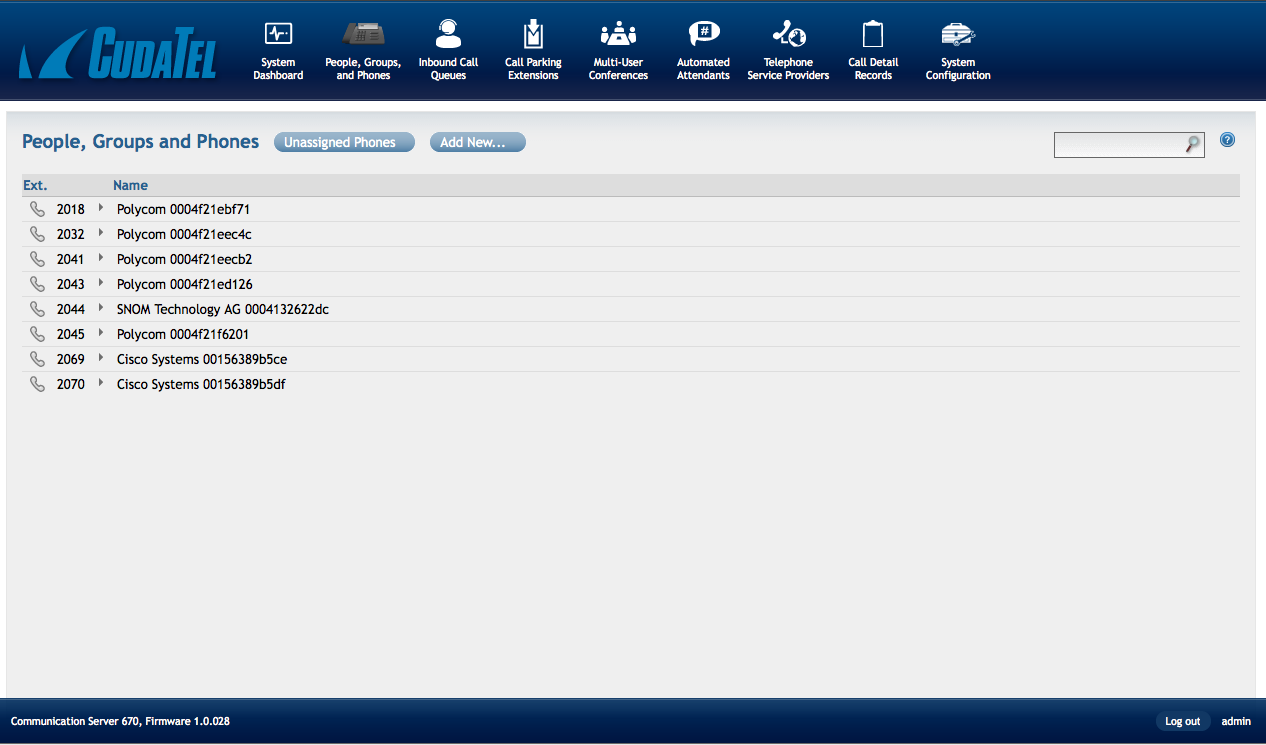
12 Chapter 4 - Managing Telephones and Users Introduction The CudaTel Communications Server functions like many servers in that it serves the needs of users. Users can belong to groups, their conversations can optionally be recorded, and they can have contact information assigned to their user accounts. Administration of users and groups is therefore very important. Closely related to users are telephones and extensions. Each user has one or more telephones, and each telephone has a primary extension number and the potential to have other line appearances. All of these are managed from the People, Groups, and Phones page on the admin UI. Adding Phones Connecting SIP phones to your CudaTel Communications Server is very simple. After powering up a phone and connecting it to the LAN, provisioning has two steps: specify the provisioning server in the phone's configuration, and reboot the phone. The CudaTel Communications Server is the provisioning server. Each manufacturer has a different procedure for specifying the provisioning server. Instructions for Cisco, Polycom, and Snom phones are presented in this chapter. A note regarding the provisioning of a phone: when a phone receives its provisioning from the CudaTel Communications Server it is assigned a temporary extension number. You can see this by going to the People, Groups, and Phones page, then click the drop-down selector and choose Unassigned Phones. All of the phones listed on this page are provisioned (that is, the CudaTel Communications Server is aware of them) but they have not been assigned to a user yet. Figure 4.1: A list of unassigned telephones that are ready to be assigned to users. The list shows the temporary extension number, manufacturer, and MAC address of each unassigned phone.

13 When provisioning a brand new phone it is recommended that you plug it in to the LAN and let it boot up completely before you start configuring it. POLYCOM PHONES Polycom phones are best configured via the phone itself Boot (or reboot) the phone. Press the Setup button before the countdown finishes Password: Dial 456 Scroll down to Server Menu and press select Change Server Type to HTTP Change Server Address to where x.x.x.x is the IP address of the CudaTel Communications Server Press Exit repeatedly until the Exit Option menu appears. Select Save & Reboot and let the phone reboot The phone will reboot several times and display various messages about updating BootROM, formatting file system, etc. Wait until the phone finishes updating before assigning it to a user Total boot cycle can take 5-10 minutes (Newly unboxed phones generally take longer to provision because CudaTel Communications Server will update the phone's firmware) To save time you can provision multiple phones simultaneously SNOM PHONES NOTE: Snom phones require a minimum firmware version see for more information Snom telephones have a simple Web server for configuring the phone. Point a Web browser to where x.x.x.x is the IP address of the Snom phone. The web interface will appear Click Advanced -> Update tab Click Update policy drop-down, select Update automatically Setting URL: x.x.x.x/provision/{mac}.xml (x.x.x.x = IP addr of CudaTel Communications Server) Click Save, Click Reboot NOTE: It is not uncommon for Snom phones to require several reboots. If you see a message in the display on the phone that says "Wrong firmware, press any key" then go ahead and press any digit on the keypad. Allow the phone to reboot a few times and it will eventually get the correct firmware. Total process takes about 5 minutes. CISCO PHONES For Cisco phones please download the latest technical bulletin for CudaTel and Cisco phone sets AASTRA PHONES Aastra phones have a simple Web server for configuring the phone. Point a Web browser to where x.x.x.x is the IP address of the Snom phone. The web interface will appear Log in and then click Configuration Server Select TFTP as server type Input the IP address of the CudaTel Communications Server as the server address Click Save and then click Restart Adding Users Users can be added manually from the People, Groups, and Phones page or via the
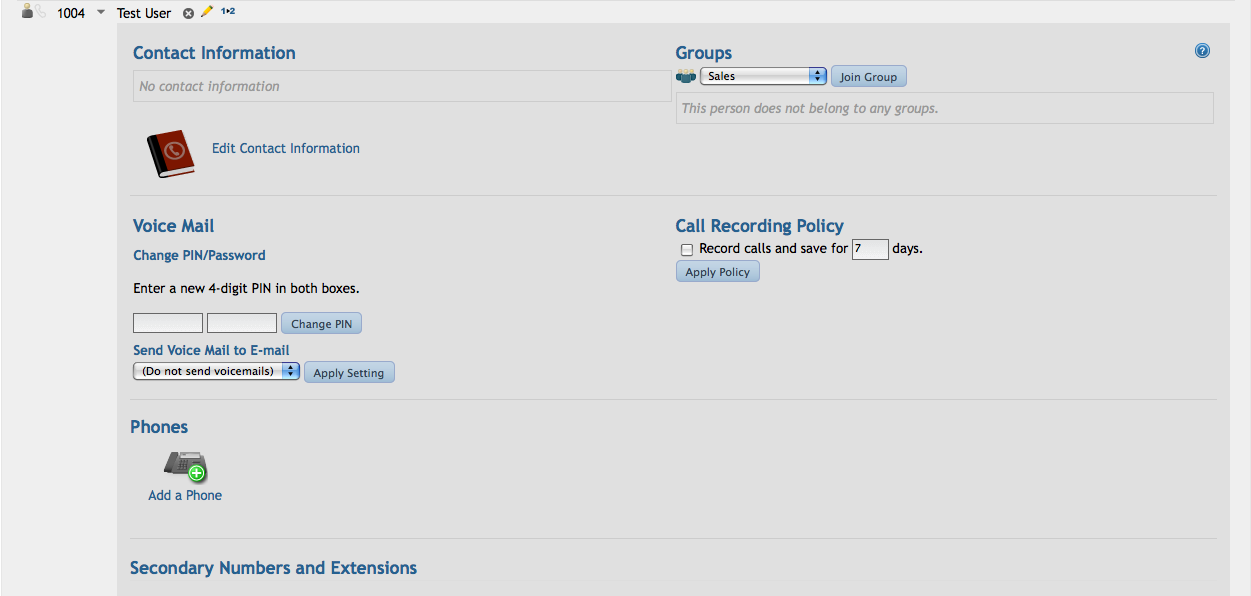
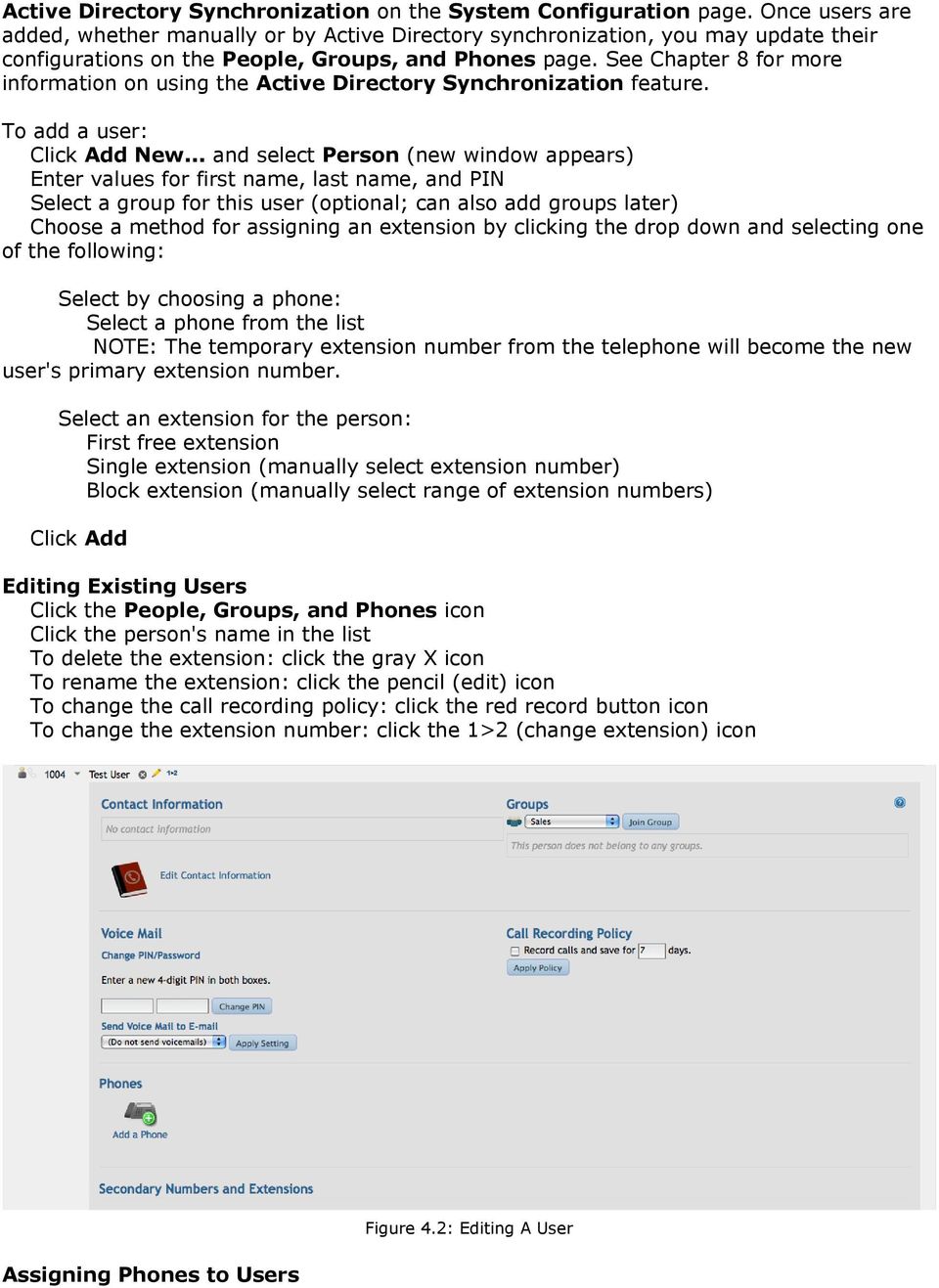
14 Active Directory Synchronization on the System Configuration page. Once users are added, whether manually or by Active Directory synchronization, you may update their configurations on the People, Groups, and Phones page. See Chapter 8 for more information on using the Active Directory Synchronization feature. To add a user: Click Add New... and select Person (new window appears) Enter values for first name, last name, and PIN Select a group for this user (optional; can also add groups later) Choose a method for assigning an extension by clicking the drop down and selecting one of the following: Select by choosing a phone: Select a phone from the list NOTE: The temporary extension number from the telephone will become the new user's primary extension number. Select an extension for the person: First free extension Single extension (manually select extension number) Block extension (manually select range of extension numbers) Click Add Editing Existing Users Click the People, Groups, and Phones icon Click the person's name in the list To delete the extension: click the gray X icon To rename the extension: click the pencil (edit) icon To change the call recording policy: click the red record button icon To change the extension number: click the 1>2 (change extension) icon Assigning Phones to Users Figure 4.2: Editing A User
15 Existing users can have one or more telephones assigned. In most cases having a single telephone assigned to a person is sufficient. To add a phone to an existing user: Click the People, Groups, and Phones icon Click the person's name in the list Locate the Extensions section (The first extension listed is the primary extension) Click the Add a Phone button (new window appears) Select a phone from the list by clicking the radio button Click Add Phone The phone will reboot and is immediately assigned to this person Figure 4.3: Assigning A Phone To A User To add an extension or external DID to an existing user: Click the People, Groups, and Phones icon Click the person's name in the list Locate the Extensions section (The first extension listed is the primary extension) Under Add Extension click the drop-down list Select one of the following: Next Free Extension - Automatically choose the lowest extension number that has not yet been used Single Extension - Manually key in the extension number for this person Block Extension - Choose an extension number range for this person External Number - Choose an external DID phone number that will ring to this user's phone Click Apply NOTE: When a DID is assigned to a user's extension, outbound calls from that extension will use the DID number as the Caller ID information that is sent to the called part. This behavior can be overridden in the telephone service provider setup. See Chapter 6 for more details. Adding A Soft Phone Adding a soft phone in the CudaTel Communications Server is very simple. The CudaTel Communications Server will automatically create an authorization username and password for your soft phone. Simply copy and paste those values into the appropriate fields in your

16 soft phone configuration. To add a soft phone to an existing user: Click the People, Groups, and Phones icon Click the person's name in the list Locate the Extensions section (The first extension listed is the primary extension) Click the Add a Phone button (new window appears) Click the radio button next to Generic SIP Device Click Add Phone Once the phone is added it will be display in the user's list of phones Click the phone icon (new menu appears) and then click Edit Phone Click the extension for Line 1. In figure 4.4 this would be displayed as x1004: Figure 4.4: Details For A SIP Soft Phone (Generic SIP Device) Scroll down to see the registrations credentials for this SIP phone Adding Groups A group is a convenient way to allow a call to ring multiple telephones simultaneously. Add users to a group and assign an extension number to the group. When the group's extension number is dialed, all phones belonging to each user in the group will ring. On the People, Groups, and Phones page, click the filter drop-down and choose Groups to see which groups are already defined. To add a group: Click the People, Groups, and Phones icon Click Add New... and select Group Enter the name for the group Select the extension number for the group Click Add

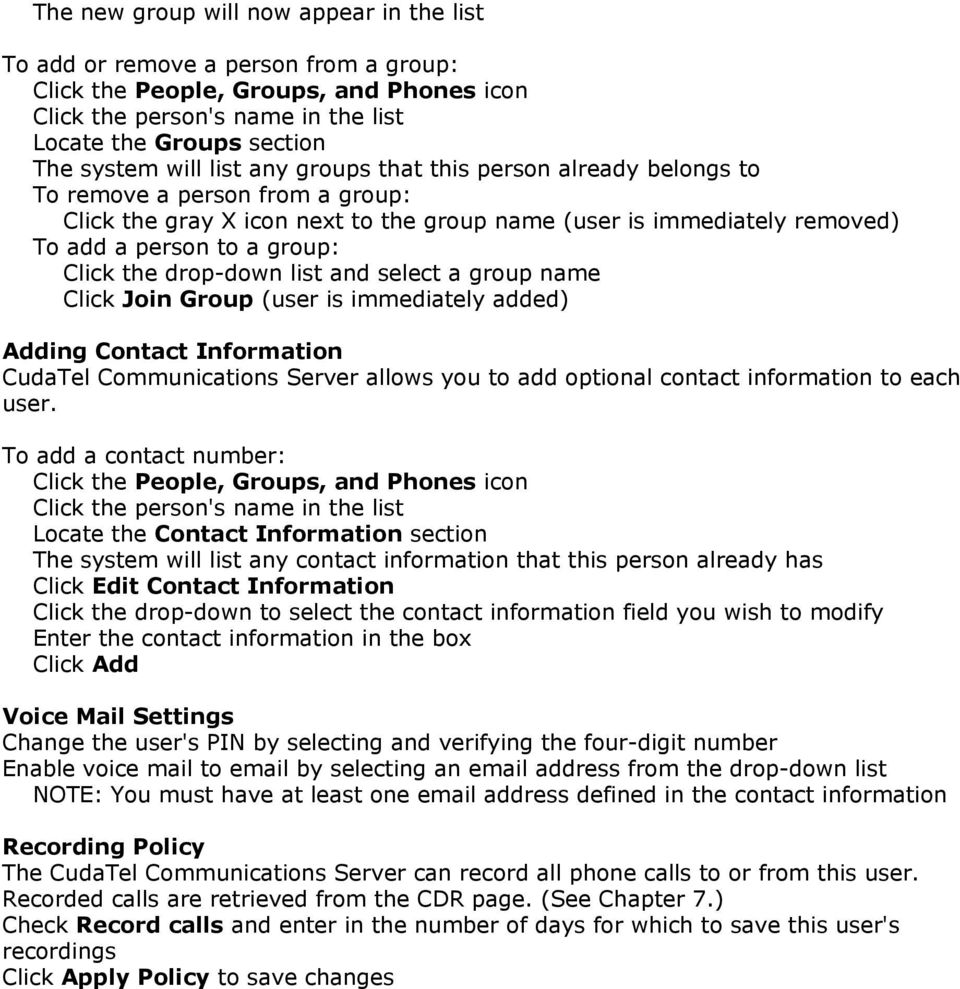
17 The new group will now appear in the list To add or remove a person from a group: Click the People, Groups, and Phones icon Click the person's name in the list Locate the Groups section The system will list any groups that this person already belongs to To remove a person from a group: Click the gray X icon next to the group name (user is immediately removed) To add a person to a group: Click the drop-down list and select a group name Click Join Group (user is immediately added) Adding Contact Information CudaTel Communications Server allows you to add optional contact information to each user. To add a contact number: Click the People, Groups, and Phones icon Click the person's name in the list Locate the Contact Information section The system will list any contact information that this person already has Click Edit Contact Information Click the drop-down to select the contact information field you wish to modify Enter the contact information in the box Click Add Voice Mail Settings Change the user's PIN by selecting and verifying the four-digit number Enable voice mail to by selecting an address from the drop-down list NOTE: You must have at least one address defined in the contact information Recording Policy The CudaTel Communications Server can record all phone calls to or from this user. Recorded calls are retrieved from the CDR page. (See Chapter 7.) Check Record calls and enter in the number of days for which to save this user's recordings Click Apply Policy to save changes
18 Chapter 5 - Features: Queues, Parking, Conferences, and Automated Attendants Introduction The CudaTel Communications Server supports many features that are traditionally only associated with larger PBX installations. Among these are queues, call parking, multi-user conferences, and automated attendants. The queues feature allows you to add automatic call distribution (ACD) style routing for incoming calls. Call parking is a PBX Multi-user conferences allow many persons to share a voice connection in an audio conference room. Automated attendants give you access to advanced call routing features, such as routing based on time/date and caller ID. Queues The queue system in CudaTel Communications Server is a simple first-in, first-out (FIFO) queuing system. Callers transferred into an inbound call queue will be answered in the order they went in. Callers hear music on hold (MOH) while they are in queue. Also, optional break-in announcements can be assigned to the queue. These announcements play at specified intervals. The MOH will will be interrupted by one or more recorded announcements. This allows you to create user-friendly queues with helpful messages to play to the callers. To add a new queue: Click the Inbound Call Queues icon Click Add New Queue (New window appears) Enter a name for the queue Click the Music On Hold drop-down and select a MOH scheme Select an extension number for the queue Click Add Now that the queue has been created you can add/remove agents and assign break-in announcements. To modify a queue: Click the queue name in the list of queues (new view appears) To delete the queue: click the gray X icon To rename the queue: click the pencil (edit) icon To change the extension number: click the 1>2 (change extension) icon Edit the following attributes as desired: Agents Select agents by typing the name or extension number in the Add an Agent box

19 Music on Hold Modify the Music on hold scheme by clicking the drop-down and selecting a new scheme name Break-in Announcements Click the first drop-down to select a sound file category Click the second drop-down to select a specific file Click the Play button to listen to the selected file (optional) Click Add to add the file (repeat as needed - add as many sound files as required) Change the frequency of the announcements if desired (default is 15 seconds) Secondary Extensions Add or remove secondary extensions here Agent Access Extensions Add or remove agent access extensions here Figure 5.1: Editing A Queue Call Parking Extensions Call parking is the way a PBX system puts a call on hold in such a way that it can be retrieved from another location. In the CCS a call parking extension is always assigned as a block: The first extension in the block is an automatic parking extension. Transfer a call to this extension and the system will automatically park the call and then tell the user where to


20 retrieve the call. The middle extensions in the block are manual call parking locations. Transfer a call to an unoccupied parking extension to park it. Dial the extension number to retrieve it. The last extension in the block is an automatic retrieval extension. Calling this extension will automatically retrieve the first parked call in this call parking extension. To add a call parking extension: Click the Call Parking Extension icon Click Add New Parking Extension... Select the extension number range Select the music on hold to use for callers parked here Click Apply Figure 5.3: Editing a Call Parking Extension Multi-User Conferences The CudaTel Communications Server allows you to create predefined multi-user conferences. Conferences can be optionally locked with a PIN so that a caller may not enter a conference without first entering that conference's PIN. Conferences have music on hold (MOH) that is played if there is only one person in the conference. There is no limit to the number of conferences that you can define on the system. To add a new conference: Click the Multi-User Conferences icon Click Add New Conference... Enter a name for the conference Select an extension number for the conference Click the Music On Hold drop-down and select a MOH scheme Click Add To modify an existing conference:

21 Click the Multi-User Conferences icon Click the conference name in the list (new view appears) To delete the conference: click the gray X icon To rename the conference: click the pencil (edit) icon To change the conference PIN: click the key (change PIN) icon To change the extension number: click the 1>2 (change extension) icon Automated Attendants The CudaTel Communications Server allows you to route calls with three related features: automated attendants, list-based routers, and rule-based routers. Automated attendants are simple voice menus that allow a caller to make a select and be routed accordingly. The routers are non-interactive, meaning that the caller does not choose the routing. A listbased router is simply a list of steps to perform on a call. A rule-based router is a logic tree that allows a call to be routed to different destinations based on time of day, day of week, date, etc. In a rule-based router, conditions are tested in the order they are listed. The router will act on the first condition that is met. There is also a default destination extension to which the call will be transferred if no conditions are met. Using these elements together you can build elegant call answering systems that handle holidays, business hours, and the like. An automated attendant or a call router can transfer to any extension on the system, and extensions can be user telephones, queues, conferences, or other routers and automated attendants. To add an automated attendant: Click the Automated Attendants icon Click Add New... Click Automated Attendant (new window appears) Enter a name for the automated attendant Select an extension number for the automated attendant by clicking the drop-down Select files for the various greetings (see below for descriptions of each greeting type) Click Add to save the new automated attended Follow the steps to modify the new automated attendant To modify an existing automated attendant: Click the Automated Attendants icon Click the automated attendant's name in the list (new view appears) To delete the automated attendant: click the gray X icon To rename the automated attendant: click the pencil (edit) icon To change the extension number: click the 1>2 (change extension) icon

22 Modify the following as needed: Sound Files Click Configure Sound Files (new view appears) Figure 5.2: Configuring Sound Files For An Automated Attendant Modify these as needed: Greeting Sound - Sound file that plays the entire greeting, including menu options (required) Short Greeting Sound - Sound file that contains just the menu options, for example, when repeating the options to the caller (optional) Invalid Sound - Sound to play when caller presses invalid digit (optional) Exit Sound - Sound to play when exiting the menu (optional) Click Save to save the sound configuration or cancel to discard Use the play and stop buttons to listen to the sound file on your computer Keypad Entries Click on a digit on the keypad to modify the action for that keypress. For example, to change what happens when the caller presses the digit 5, click the 5 on the keypad. You will see "When The Caller Presses 5" in the display. Click the drop-down menu and select an action: Do nothing - this key is an invalid option Go to the top menu - Navigate back to the top of an autoattenant menu tree Go up one menu - Navigate back to the menu which sent the call to this menu Hang up - Disconnect the caller Transfer to Extension or Number - Transfer the call to an extension number (can be an extension, queue, conference, etc.) Go to another menu - Transfer to another menu. Select the target menu from the drop-down box Dialing an Extension Directly
23 Click the Allow Dialing an Extension check box to allow callers to manually dial an extension when connected to this automated attendant (caller will be transferred to the extension number dialed, if valid) Click the Show Summary link to see a list of all key presses and their respective actions; click Hide Summary to collapse the summary view To add a list-based router: Click the Automated Attendants icon Click Add New... Click List-based Call Router (new window appears) Enter a name for the list-based router Select an extension number for the list-based router by clicking the drop-down Click Add to save the new list-based router Follow the steps to modify the new list-based router To modify an existing list-based router: Click the Automated Attendants icon Click the list-based router's name in the list (new view appears) To delete the list-based router: click the gray X icon To rename the list-based router: click the pencil (edit) icon To change the extension number: click the 1>2 (change extension) icon A list of actions is displayed; use the up and down arrows next to the actions to change the order in which they are processed Click the small gray X icon next to an action to delete it Click the Add new action drop-down to select one of these actions: Enable Silent Hold - This action will prevent the system from sending out music on hold for the duration of the outbound call. Instead, the system will not send out any sounds at all, effectively sending silence. This is useful, for example, when calling into a conference. When putting a conference on hold it is good not to flood the entire conference with your system's music on hold. Voice Mail Logon - Transfer the caller to a dialog letting him or her log in to a voice mail box. Perform an Echo Test - Transfer the caller to an echo test extension. This is useful for testing a new phone or doing other troubleshooting. Set Caller-ID - Set the caller ID name and caller ID number for the outbound call. This permits customized caller ID sending on an as-needed basis.
24 Try Calling An Extension - This action will attempt to connect the caller to an extension. If the transfer is not successful then the next action on the list will be processed. Timeout - Select the number of seconds to ring the destination extension before giving up Confirm - Requires the called party to press digit 1 in order to receive call Extension - Select a destination extension number from the list Insert - Click the drop down to select the position in the list for this action Click Add Action to save this action to the list Try Calling one or more Phone Numbers - This action will call, sequentially, any number of extensions or phone numbers. The timeout value specified will be the number of seconds to ring each destination. If a destination does not answer then the next number in the sequence is dialed. NOTE: Voic and answering machines will "answer" the call, so be sure to have a timeout that is short enough to stop ringing a destination before voic answers. The default timeout is 15 seconds. Timeout - Select the number of seconds to ring the destination extension before giving up Confirm - Requires the called party to press digit 1 in order to receive call Phone Number/List - A comma-separated list of extension and/or phone numbers to dial Insert - Click the drop down to select the position in the list for this action Click Add Action to save this action to the list Play a sound file - Play a sound file and then move to the next action Sound File - Click the first drop-down to select the sound file category and then click the second drop-down to select the sound file name (use the play and stop buttons to listen to the sound file on your computer) Insert - Click the drop down to select the position in the list for this action Click Add Action to save this action to the list Transfer to Phone Number or Extension - Unconditionally transfer to the specified phone number or extension. The list will immediately stop processing after the transfer, regardless of what happens with the transfer. Phone Number or Extension - Enter the destination extension number or telephone number Insert - This action ends the list processing, therefore it can only be the last action on the list Click Add Action to save this action to the list Transfer to a User's Voice Mail - Unconditionally transfer the caller into the destination user's voice mail box so that the caller may leave a message. The list will immediately stop processing after the transfer.
25 User - Select the user from the drop-down list Insert - This action ends the list processing, therefore it can only be the last action on the list Click Add Action to save this action to the list Disconnect the Call - Hang up the call. This will, of course, end the list processing. Click Add to save this action to the list. Send to Gateway - Transfer the call to a service provider to be sent to an off-site extension or phone number. To add a rule-based router: Click the Automated Attendants icon Click Add New... Click Rule-based Call Router (new window appears) Enter a name for the rule-based router Select an extension number for the rule-based router by clicking the drop-down Click Add to save the new rule-based router Follow the steps to modify the new rule-based router To modify an existing rule-based router: Click the Automated Attendants icon Click the rule-based router's name in the list (new view appears) To delete the rule-based router: click the gray X icon To rename the rule-based router: click the pencil (edit) icon To change the extension number: click the 1>2 (change extension) icon A list of actions is displayed; use the up and down arrows next to the actions to change the order in which they are processed Click the small gray X icon next to an action to delete it Default Destination Extension - This is the extension to which the caller will be transferred if no conditions are met during the processing of the rules. Click the drop-down to select a default destination extension Click Apply to save the change To add a new rule click the Add a Routing Rule button (new window appears) Years - The calendar years to match for this rule Months - The calendar months to match for this rule Days of the Month - The days of the month (1-31) to match for this rule Days of the Week - The days of the week (Sunday, Monday, etc.) to match for this rule
26 Time Range - The starting and ending time range to match for this rule. Times are specified in quarter-hour increments Number Rule - The number matching parameter to match for this rule. Match on the caller's area code or phone number On Match - When the listed conditions are all met, transfer the caller to the specified extension Apply this Rule - Specify where in the list of rules this list will be applied (You may also use the up/down arrows next to the rule number) Click Create Rule to save this rule to the router
27 Chapter 6 - Managing Service Providers Introduction Your PBX needs a connection to the outside world, also known as the public switched telephone network or PSTN. The CudaTel Communications Server can connect to tradition telephone companies (telcos) or to VoIP providers. The phone companies provide analog phone lines or digital PRI circuits that can carry voice traffic. VoIP providers supply telephone service via your company's Internet connection(s). Each method has its advantages. The CudaTel Communications Server gives you the flexibility of using both of these connection types, including the ability to bridge calls between the two. Before discussing the setup of outside connections it is best to understand the concept of outbound routes. Outbound Routes A number route is a means of allowing (or denying) the routing of a particular phone number that has been dialed by a user. A number route is simply a means of identifying certain phone numbers or patterns of phone numbers. A number route can be very specific, e.g. "911" for emergency, or more general, such as "any seven-digit phone number." Number routes are defined by using a regular expression that gets evaluated against the dialed phone number. (See Appendix A for more information on regular expressions.) The system comes with several number routes predefined: Name: Regular Expression: Description: Information ^411$ Match exact digits "411" Emergency (USA) ^911$ Match exact digits "911" 7 Digit Dialing ^\d{7}$ Match exactly seven digits 10 Digit Dialing ^\d{10}$ Match exactly ten digits 11 Digit Dialing ^\d{11}$ Match exactly 11 digits NANPA ^1[2-9]\d[2-9]{7}$ North American phone numbers An example of using a number route would be letting your users dial 411 and then allowing those calls only to go out a specific provider who charges the least for those calls. Later in this chapter you will learn about adding an outbound route to multiple providers (or analog/ digital ports) and adjusting the priority level so that you can specify fail-over routes. NOTE: You must define at least one provider before you edit outbound routes. Click the Manage Route Definitions button in the service provider setup screen to edit outbound routes.
28 VoIP/SIP Providers SIP providers offer telephone service over an Internet connection. In order to establish a connection you will need the following information from your SIP provider: Host - Host name or IP address Port - Port number, frequently will be 5060 Username - Username assigned to you by the provider Password - Password assigned to you by the provider Realm - SIP realm (optional) NOTE: If your provider uses a port number that is non-standard then you may need to configure your firewall to allow both TCP and UDP for the port number in question. The CudaTel Communications Server supports various types of SIP configurations. In the CudaTel Communications Server they are defined as: Generic SIP - Most SIP configurations fall into this category (use this if you are not sure what type to use) Generic SIP (Within Local NAT) - Use this when the CudaTel Communications Server and the target server both reside behind the same NAT device (such as when you have another SIP server or phone system on the same network) Generic SIP (Use SRV Records) - Use this setting if your provider needs DNS SRV lookups Generic SIP (No Registration) - Use this setting for any SIP provider that does not require a registration To add a new SIP provider: Click Telephone Service Providers Click Set Up A New Account (new window appears) Supply the following information: Name - The name of this provider as you would like it to appear in the CudaTel Communications Server Provider - Select generic Host - Enter the host name or IP address Port - Enter the port number Username - Enter the username supplied by your provider Password - Enter the password supplied by your provider Realm - Enter the SIP realm if supplied by your provider Caller ID - Specify the caller ID sent on outbound calls Always use this Caller ID - Check this box to override the individual caller ID that is
29 normally sent on outbound calls (all calls going out on this provider will have the exact same Caller ID information sent) Direction - Select inbound, outbound, or both directions Use route - Click the drop-down to select a specific route or choose Any outbound Requires Registration - Click this check box if your provider requires registration (usually they do) Registration Expiration - Enter the registration expiration time (leave at default unless provider specifies value) Click Install to save the new provider connection You can view the status of your provider connection by clicking its name in the list, or by viewing System Dashboard > Telephone Service Providers. To modify a service provider entry: Click Telephone Service Providers Click the provider's name in the list (new view appears) The status will be displayed as a green phone (active, ready) or a red X (offline or disconnected) Analog and Digital Connections CudaTel Communications Server units with the optional phone line hardware installed have additional ways to connect to the public switched telephone network (PSTN). Confirm your model to see which hardware is installed: Model: 270B 370B 470B 670B Port Types: 4 FXO (analog) 1 PRI (digital) 2 PRI (digital) 4 PRI (digital) The port layouts for each model are described below. Model 270B - 4 FXO, 1 FXS The 270B has four FXO ports, delivered on two RJ14 style modular jacks. It also has a single FXS port, also delivered on a modular jack. The layout of the jacks on the back of the CudaTel Communications Server is like this:
30 FXS FXO 3/4 FXO 1/2 <<Replace the above with a nicer picture>> The FXS port can connect to a single line telephone, fax machine, or modem. The FXO ports can accept dial tone from a standard telephone line. Each modular jack contains two FXO ports. In most cases you will have one line cord for each phone line, so Y-cables are provided. Plug a Y-cable into an FXO modular jack on the back of the CudaTel Communications Server. The two jacks at the end of the Y-cable will each be a single FXO port. Connect your individual phone lines to the jacks on the Y-cables. In the admin UI on the Telephone Service Providers page, FXO ports 1 through 4 will appear in the providers list as Analog Port 1, Analog Port 2, etc. The FXS port will appear as Analog Port 5. Model 370B - 1 PRI The 370B contains a single RJ45 modular jack that accepts a single PRI connection from the telco. <<Insert pic of the back of a 370B>> In the admin UI on the Telephone Service Providers page, the PRI port will appear in the providers list as Digital Port 1 Model 470B - 2 PRI The 470B contains a two RJ45 modular jacks that each accept a single PRI connection from the telco. <<Insert pic of the back of a 470B>> In the admin UI on the Telephone Service Providers page, the PRI ports will appear in the providers list as Digital Port 1 and Digital Port 2. Model 670B - 4 PRI The 470B contains a four RJ45 modular jacks that each accept a single PRI connection from the telco. <<Insert pic of the back of a 670B>> In the admin UI on the Telephone Service Providers page, the PRI ports will appear in the providers list as Digital Port 1, Digital Port 2, Digital Port 3, and Digital Port 4.
31 Configuring Analog Ports The model 270B has four FXO analog ports. Configuring the analog ports is very straightforward and takes just a few steps: Connect the two Y-cables to the two jacks on the back of the CudaTel Communications Server. The the jack on the right has ports 1 and 2; the jack on the left has ports 3 and 4. Connect each of your phone lines to the CudaTel Communications Server with standard telephone line cords. Plug one end of the line cord into one of the Y-cable jacks and plug the other end into the telephone jack. Repeat for each phone line. To configure an analog port: Click Telephone Service Providers Analog ports are numbered 1 through 4 Click on the analog port you wish to configure (new view appears) Configure how incoming and outgoing calls are handled Incoming calls: Incoming calls for an analog port are answered by an extension Simply select an extension number from the list and click Apply All incoming calls on this phone line will automatically be answered by the extension selected Any extension can handle incoming calls, including conferences, automated attendants, phones, and groups Outgoing calls: Select the outbound routes that will be used by this analog port Normally an analog port will need these routes: North America (NANPA), Information, Emergency, and 7 digit dialing NOTE: If you do not add the Emergency route to at least one analog port then 911 dialing will not work! Click the drop-down list and select a route, then click Add Route The newly added route will now appear in the Current Routes list Two buttons appear next to the route: Positive Match and Set Priority Click Positive Match to toggle positive/negative matching (most routes need "positive match") Set the priority for this port and route by clicking Set Priority (new window appears) The window shows each port that has this route enabled Use the up and down arrows to change the priority for the route Click Done (changes are applied immediately)
32 Repeat the above process for each port that has a phone line connected. See the section Configuring Outbound Route Priorities later in this chapter for more information on setting up your outbound routes, including when to use a "negative match" on a route. Verify each route by making a test call from an extension on the system: local call (seven digits), long distance call (1 + phone number), 411, and 911 NOTE: When testing 911, simply state your name to the operator and tell him or her that you are testing a new phone system installation. It is good to have the operator verify the street address. Verify incoming call routing by dialing one of your phone numbers from a separate phone, such as a cell phone. Make sure that the call is answered by the extension that is specified on the analog port configuration. Configuring Digital Ports Models 370B, 470B, and 670B all come with digital ports that are programmed for connecting to PRI circuits. Setting up a digital port has four steps: Selecting the signaling type Selecting the default caller ID Specifying external numbers (depends on carrier) Selecting outbound routes SIGNALING TYPE The CudaTel Communications Server supports three different PRI signaling types, sometimes called "protocol dialect" or "protocol variant" or even just "protocol." The signaling types supported are: * National ISDN2 (NI-2) * Lucent 5ESS * Nortel DMS100 NOTE: If you are ordering new service then National ISDN2 is the recommended signaling protocol. If you are connecting to an existing circuit then select the signaling type that matches the current PBX equipment. (If your PRI circuit is not configured for one of these three signaling types then you will need to contact your carrier and ask to have the protocol changed. Depending on your carrier this can take several days or weeks.) DEFAULT CALLER ID
33 PRI circuits allow the calling party to specify a customized caller ID to be presented to the called party. Enter the Caller ID digits that you want to be displayed by default on outgoing calls. Check the box Always Use This Caller ID if you want all outbound calls to use the specified caller ID. EXTERNAL NUMBERS External numbers refers to DID or Direct Inward Dialing phone numbers that are carried on this PRI circuit. In the operation of a PRI circuit, the carrier will notify the host PBX that a call is coming in and will specify which phone number was dialed. In most cases the carrier will notify the PBX in one of two ways: by sending all ten digits of the dialed phone number, or by sending just the last four digits of the dialed phone number. In either case, the CudaTel Communications Server can route the inbound calls as needed. If your carrier sends ten digits then simply add the range of DID numbers that is assigned to you. For example, if your DID block was to then enter " " in the list. Alternatively, you can list each number individually, separated by a comma or a carriage return. Once the numbers are entered they become available to be assigned as External Numbers that can be assigned to users, groups, queues, multi-party conferences, or automated attendants. (See Chapter 5 for more information.) If your carrier sends four digits then simply create an extension range that corresponds to the DID range. For example, if the DID range is to then the carrier would simply send 1000 through Add an extension range of on the System Config > Extensions page. Calls will automatically be routed to the corresponding four digit extension. As an example, when a party calls the call will ring directly to extension Extension number 1002 can be a user, queue, multi-party conference, or automated attendant. (See Chapter 8 for more information on adding extension ranges.) OUTBOUND ROUTES Select the outbound routes to be serviced by this digital port. Normally a digital port will need these routes: North America (NANPA), Information, Emergency, and 7 digit dialing (and if necessary, International) NOTE: If you do not add the Emergency route to at least one digital port then 911 dialing will not work! Click the drop-down list and select a route, then click Add Route
34 The newly added route will now appear in the Current Routes list Two buttons appear next to the route: Positive Match and Set Priority Click Positive Match to toggle positive/negative matching (most routes need "positive match") Set the priority for this port and route by clicking Set Priority (new window appears) The window shows each port that has this route enabled Use the up and down arrows to change the priority for the route Click Done (changes are applied immediately) New PRI Service Checklist The following is a brief checklist that you can use when ordering new PRI service from your carrier. Your carrier will know what these items mean. Line encoding: B8ZS (required) Framing: ESF (required) Protocol: NI-2 (recommended) DNIS: 10 digits (recommended) These are the optimal settings for a PRI connected to a CudaTel Communications Server. Your carrier may have other questions. Contact your CudaTel VAR or CudaTel support if you have other questions. Configuring Outbound Route Priorities Outbound call routes can be applied to multiple telephone ports and telephone service providers. If a particular port or provider is in use or unavailable, the system will look for the next port or provider in the priority list for routing the call. A good example of setting up priorities is for the model 270B which can accommodate up to four analog phone lines. Let's say you have a model 270B with four analog phone lines that are in a hunt group from the telephone company. The pilot number is line one. The second number in hunt is line two, etc. These are connected to the CudaTel Communications Server as analog ports 1, 2, 3, and 4 respectively. In this case, for outgoing calls you want the system to start with the last phone line first, namely line 4. If line 4 is in use then the system should use line 3, then line 2, and finally line 1. (If all lines are in use then the calling party will receive an audio message saying so.) In this scenario, the priority order, from highest to lowest, is:
35 Analog Port 4 Analog Port 3 Analog Port 2 Analog Port 1 When you add a route to a port, that port automatically becomes the highest priority for the selected route. Therefore, the quickest way to add routes is to add the lowest priority first, the second lowest priority second, and so forth. So, if you have four analog ports and you want to add the most common routes to each, with port 4 being the highest priority then follow these steps: Click Analog Port 4 Add routes Emergency, Information, North America (NANPA), and 7 Digit Dialing Click Analog Port 3 Add routes Emergency, Information, North America (NANPA), and 7 Digit Dialing Click Analog Port 2 Add routes Emergency, Information, North America (NANPA), and 7 Digit Dialing Click Analog Port 1 Add routes Emergency, Information, North America (NANPA), and 7 Digit Dialing When you are finished you will have all the routes added to all the ports and in the correct priority.
36 Chapter 7 - Call Detail Reports Introduction Call detail reports (CDRs) are the primary means of recording information about the activity on your phone system. Each phone call made on the system will produce one CDR. The CDR contains information about the calling and called parties as well as the date, time, and duration of each call. The CudaTel Communications Server allows you to view CDRs in your browser but also allows you to export records in CSV (comma-separated values) format. The CSV files can be imported into spreadsheets or databases and have extra data fields that can be used in offline analysis. Online CDRs To view CDRs online, click the Call Detail Records icon. The initial view is of the 100 most recent phone records. The following features are available: Search - Click in the search box and type a name or phone number. As you type, the list will automatically be filtered. Pages - Click the drop-down box (upper left side of screen) to change the number of records displayed on each page. Sort - Click the column name to toggle sorting ascending or descending by that column. Download CSV - Download call records in CSV format. (See below.) The following fields are displayed on the screen. (NOTE: a few more data fields are available in the CSV download; see below for details.) Call Answered Time - Date and time that the call was answered. Call End Time - Date and time that the call ended. Caller Name - Caller's Name. Caller Number - Caller's Number. Destination Number - Dialed phone number or extension number. Billable Time - Amount of time call was connected. Does not include time spent dialing or listening to ringing. Recorded File - If the call was recorded then a link to that recording will appear hear. CSV Files CSV files contain a little more information. They are suitable for downloading into a spreadsheet. The following fields are available. (Fields marked with * do not appear in the on-line CDRs.)
37 *Call Started Time - Date and time that the call was started, e.g., when caller finished dialing the phone number. Call Answered Time - Date and time that the call was answered. Call End Time - Date and time that the call ended. Caller Name - Caller's Name. Caller Number - Caller's Number. Destination Number - Dialed phone number or extension number. *Account Code - The account code, if any, for this call. Billable Time - Amount of time call was connected. Does not include time spent dialing or listening to ringing. *Duration - Total length of time call was up. Iincludes time spent dialing and listening to ringing. *Hangup Cause - The hangup cause is a description of why the call ended. Most calls end with "Normal Clearing."
38 Chapter 8 - System Configuration Introduction Since VoIP systems use LAN and WAN networks they have many settings in common with traditional application servers. For example, VoIP systems need to have IP addresses and the requisite settings, such as subnet, default gateway, and whether to use DHCP. They also have many unique settings such as sound prompts and music on hold (MOH) files. The System Configuration page is home to the controls on most of these settings. Network Tab Configure the CCS network settings here. Click System Configuration > Network to access these settings: WAN Interface Click Enabled to enable the WAN interface port Supply the IP Address, Subnet Mask, and Gateway address Click Apply Network Settings (bottom of screen) to apply changes LAN Interface Supply the IP Address, Subnet Mask, and Gateway address To add additional subnets that can control SIP phones (optional): Click Add Subnet Supply the IP Address, and Subnet Mask for the target subnet Click Remove Subnet if you need to remove a subnet Click Apply Network Settings (bottom of screen) to apply changes NAT Routing If your CCS is behind a NAT router and you wish it to communicate via the Internet then enable NAT routing: Click Enabled to enable NAT routing Click Auto-Detect If your NAT device supports auto-detection then the IP address will fill in automatically If auto-detect fails then manually input the external IP address Click Apply Network Settings (bottom of screen) to apply changes DNS Settings Enter the primary DNS IP address Enter the (optional) secondary DNS IP address
39 Click Apply Network Settings (bottom of screen) to apply changes Proxy Settings If you have a proxy server then change the settings here Enter the proxy server Server Address or IP Address Enter the Port Enter the Username Enter the Password Click Apply Network Settings (bottom of screen) to apply changes SMTP Mail Settings SMTP settings are required in order to enable sending voice mail messages to a user's account Enter the SMTP server Server Address or IP Address Enter optional "From" host Enter optional sender address Enter the Port (usually port 25) Enter the target Address Click Apply Network Settings (bottom of screen) to apply changes Settings Tab Several important settings can be changed here. Click System Configuration > Network to access these settings: SYSTEM TIME ZONE One of the first things that you will do when you install your CCS is to set the system's Time Zone. Click the drop-down and select your desired time zone Click Change to apply the new time zone IMPORTANT: The system will restart when you change the time zone so be sure to set the time zone when you first install or at an otherwise appropriate time so as not to lose phone calls. SET LOCAL AREA CODE Set the default area code to be used when users dial a seven-digit phone number. RING TIME BEFORE VOICE MAIL
40 Set the number of seconds to ring a telephone before sending the call to the user's voice mail box. AUTOMATIC PROVISIONING This feature allows the CCS to automatically provision any phones that it detects on the local area network. If you are installing the CCS on the same subnet as an existing VoIP system then it recommended not to have this turned on. Phones connected to the other server, when rebooted, will be provisioned to the CCS. Click Turn Auto-provisioning on to turn it on Click Turn Auto-provisioning off to turn it off ADMINISTRATIVE PASSWORD For security reasons please change your administrative password. Enter the new Password in both fields Click Change Password Active Directory Tab <<TODO>> Music on Hold Tab Music and sound files can be played to callers who are on hold or waiting in queues. Music files are organized into groups of files called sound schemes. Click System Configuration > Music on Hold to make changes to your music on hold files. SOUND SCHEMES Click the sound scheme drop-down box to select a scheme to edit All files in the selected scheme will be listed in the box Click the green + icon to add a new scheme Click the gray X icon to remove a scheme SOUND AND MUSIC FILES Upload sound files from your local computer to the CCS: Click Add Music File Click Browse and select a file to upload To delete a file from a scheme: Click the gray X button next to the file name
41 Sound Prompts Tab Sound prompts are similar to music on hold files except they are used in automated attendants instead of played to callers on hold. Sound prompt files are organized into groups of files called sound categories. Click System Configuration > Sound Prompts to make changes to your sound prompt files. SOUND CATEGORIES Click the sound category drop-down box to select a category to edit All files in the selected category will be listed in the box Click the green + icon to add a new category Click the gray X icon to remove a category SOUND PROMPT FILES Upload sound files from your local computer to the CCS: Click Add Sound File Click Browse and select a file to upload To delete a file from a category: Click the gray X button next to the file name To move a file to a different category: Click Change Category link next to file name Select new category from the drop-down Click Change To record a sound file: Click Record A Sound File Enter a file name Select a category from the drop-down Enter the extension where the system can call you Click Call Me and wait for the system to ring your phone Answer phone and follow prompts to record your sound file When the recording is complete the sound file will appear in the list of sound files Extensions Tab Extensions are an important part of the CCS configuration. Click System Configuration > Extensions to access the extensions configuration tab. VALID EXTENSION BLOCKS Listed here are all the extension blocks that have been defined on the system. To delete a block:
42 Click the gray X icon next to the range NOTE: Use caution! Removing an extension range will delete all extensions within that range, including users, conferences, queues, and automated attendants. CREATE NEW EXTENSION BLOCKS To add a new block Enter a starting extension number Enter an ending extension number If the range is valid then a green check mark will appear; click Add Range If there is a problem then the display will show "Improper Range" or "Invalid Extension" Improper Range usually means that the ending extension number is not larger than the starting extension number Invalid Extension usually means that the entered range overlaps an already existing range Updates Tab The updates page displays information about your system. Click System Configuration > Updates to view the updates page. The following information is displayed: System Information - Model and serial number Premium Support - Support agreement level and expiration Instant Replacement - Instant replacement expiration Current Installed Version - The software version currently installed and running. Latest General Release - The most recent generally available (GA) software revision Latest Early Release - The most recent pre-release software revision. Early releases contain updates and new features that are ready to be tested Start Download - If a new download is available you can click this button to begin the download and install the latest software. NOTE: You can download a new firmware revision and install at a later time. Installing a new firmware will bring the CCS offline for several minutes, so be sure to schedule the update at a point where a few minutes of system down time won't affect your business. Utilities Tab The utilities page contains a number of system utilities that you may find useful. Click System Configuration > Utilities to access the system utilities.
43 SUPPORT TUNNEL The support tunnel is a feature that allows the customer to open a very secure connection to Barracuda Networks Technical Support Center. SYSTEM SHUTDOWN/RESTART The system has three different levels of shutdown and restart. To completely power down the system: Click System Shutdown All calls will disconnect and the system will power down To restart the system: Click System Restart All calls will disconnect and the system will restart The telephony engine itself can be restarted without restarting the entire system. To restart the telephony engine: Click Restart Telephony Engine All calls will disconnect and the system will restart CISCO FIRMWARE UPLOAD The CCS supports Cisco 7940 and 7960 models but only with a very specific firmware revision. The firmware software is not provided by CudaTel; it must be downloaded from Cisco. The download link is on the utilities page. (NOTE: usually it is necessary to supply a username and password when downloading from Cisco's Web site.) To enable Cisco provisioning: Download the Cisco firmware and save it on your compute Click Browse and select the downloaded file Click Upload Follow the on-screen prompts Once the firmware has been installed your CCS will be able to automatically provision Cisco model 7940 and 7960 telephone sets.
44
45 Appendix A - Regular Expressions The CudaTel Communications Server uses Perl-compatible regular expressions for pattern matching in outbound gateways. This appendix will assist you in understanding regular expressions in this environment. NOTE: The vast majority of all patterns that need to be matched in outbound routes are only digit-based so the following information will focus on matching number patterns. Basics Regular expressions use a combination of standard and meta-characters to create a pattern against which to match a specific string. Characters in the regular expression can mean different things depending upon the context. For the sake of simplicity this discussion will focus on the basic operation of regular expressions. The basic use of a regular expression is in a pattern match. The system will compare a regular expression to a string of characters and answer the basic question: does this string of characters match the pattern described by the regular expression? It's a simple yes or no. Sometimes a yes is called a "positive match" and a no is called a "negative match." Sample Patterns Some common characters you will see in a regular expression include the following: Characters Meaning 1 Match only the digit "1" 5 Match only the digit "5" 411 Match digit sequence "411" ^411 Match string beginning with $ Match string ending with 411 ^411$ Match exact string "411" (see below) [0-9] Match any digit between 0 and 9 [2-9] Match any digit between 2 and 9 [456] Match either the digit 4, 5, or 6 \d Match any digit between 0 and 9 ^ Match at beginning of string $ Match at end of string + * Match one or more of the preceding character Match zero or more of the preceding character
46 {n} Match exactly n of the preceding character Note that the above list is by no means comprehensive, however it is a good representation of the kinds of characters that will appear in regular expressions number routes. Let's see these characters in action to get an idea of how they might be used in matching patterns for outbound dialing. The following table describes some simple patterns, strings, and whether there is a match: Pattern Dialed Number Match Yes ^411$ 411 Yes ^411$ ^5[0-9][0-9][0-9] 5000 ^5\d\d\d$ 5000 ^5\d{3}$ 5000 ^71\d\d$ 7150 Yes ^71\d\d$ 7050 ^\d{7}$ Yes ^\d{10}$ Yes Yes (this pattern matches any number with the digit string "411") No (the pattern ^411$ matches only the exact dialed number "411") Yes (this pattern matches any four digit number beginning with "5") Yes (equivalent of previous pattern because \d matches any digit) Yes (equivalent of previous pattern becase \d{3} is the same as \d\d\d, namely three consecutive digits) No (This pattern matches only dialed numbers between 7100 through 7199) From the above examples you can see that matching patterns is not too difficult once you are familiar with the syntax. At this point you can start thinking about your routing scenarios. Here are a few things to remember:
47 To match an exact dial string, use ^ and $ at the beginning and end of your regular expression. The caret (^) means "match at the beginning of the string" and the dollar sign ($) means "match at the end of the string." Reviewing the "411" examples in the previous table: The pattern 411 means "match any string that contains 411" The pattern ^411 means "match any string that begins with 411" The pattern 411$ means "match any string that ends with 411" The pattern ^411$ means "match any string that matches exactly 411" To match a range of numbers, use a combination of literal numbers and meta-characters. Consider these examples: The pattern 7\d\d\d will match 7000 through 7999 The pattern 74\d\d will match 7400 through 7499 The pattern 745\d will match 7450 through 7459 This technique is also useful for matching calls made to specific area codes: 408\d{7} will match calls made to area code \d{7} will match calls made to area code 212 Replacing and Trimming Digits In some cases you may wish to add or remove digits before they are sent out. The classic example of this is the dial 9 "to get an outside line" that most of us are familiar with. Here are a few examples of inserting digits. Pattern Dialed Digits Digits Actually Sent Out ^9(1\d{10}):::$ ^9(\d{7}):::$ In these cases, we match the leading digit 9, but we don't capture that digit. Instead we capture all of the digits dialed after the 9. The expression ":::$1" means to replace what was actually dialed with what was captured inside the ( and ) characters. In some cases you may wish to let your users dial 9 (or not) and dial 1 (or not) and then have the system dial appropriately. For example, some carriers absolutely require you to send 1 + area code + phone number for all calls, even local ones. Others require all 10 digits of the phone number but do not want the leading 1. The following are some sample regular expressions you can use to deal with these situations: Pattern Dialed Digits Sent Digits Application
48 ^9?1?(\d{10})$:::$ ^9?1?(\d{10})$:::1$ ^9?(\d{7})$:::408$ ^9?(\d{7})$:::1408$ Dialing 9 or 1 optional, send only 10 digits Dialing 9 or 1 optional, send digits of phone number Dialing 9 optional, user dials 7 digits, system sends area code digits Dialing 9 optional, user dials 7 digits, system sends 1 + area code + 7 digits
Firmware Version 2.x. Cudatel Communication Server Administrator s Guide
 Firmware Version 2.x Cudatel Communication Server Administrator s Guide Barracuda Networks Inc. 3175 S. Winchester Blvd Campbell, CA 95008 http://www.barracuda.com Copyright Notice Copyright 2004-2010,
IP PBX. SD Card Slot. FXO Ports. PBX WAN port. FXO Ports LED, RED means online
 1 IP PBX SD Card Slot FXO Ports PBX LAN port PBX WAN port FXO Ports LED, RED means online 2 Connect the IP PBX to Your LAN Internet PSTN Router Ethernet Switch FXO Ports 3 Access the PBX s WEB GUI The
THINKTEL COMMUNICATIONS CUDATEL PHONE SYSTEM 270. High Availability and SIP-TRUNK Configuration
 THINKTEL COMMUNICATIONS CUDATEL PHONE SYSTEM 270 High Availability and TABL E OF CO NTENTS 1.1 CONFIGURING TELEPHONE SERVICE PROVIDER (THINKTEL)... 3 1.2 OUTBOUND CALL ROUTING... 5 1.3 INBOUND CALL FROM
Quick Start Guide v1.0
 Quick Start Guide v1.0 Table of contents : 01. Quick Start Guide...03 O2. Configuring your VoIPOffice appliance...14 03. Adding a VoIPtalk trunk...21 04. Configuring UADs for use with VoIPOffice...25 05.
Ipiphony Phone System. User Manual. 1 P a g e
 Ipiphony Phone System User Manual 1 P a g e About this Guide This guide explains how to use the basic features of your new Aastra phones. Not all features listed are available by default. Contact your
1 VoIP/PBX Axxess Server
 - 1 1 VoIP/PBX Axxess Server The Axxess Server supports comprehensive Voice Over Internet Protocol network services, which are based on the Open Source Asterisk VoIP software. The Axxess Server VoIP telephony
Device SIP Trunking Administrator Manual
 Table of Contents Device SIP Trunking Administrator Manual Version 20090401 Table of Contents... 1 Your SIP Trunking Service... 2 Terminology and Definitions... 2 PBX, IP-PBX or Key System... 2 Multi-port
Barracuda Link Balancer Administrator s Guide
 Barracuda Link Balancer Administrator s Guide Version 1.0 Barracuda Networks Inc. 3175 S. Winchester Blvd. Campbell, CA 95008 http://www.barracuda.com Copyright Notice Copyright 2008, Barracuda Networks
IPitomy IP PBX Administrator Guide. Version v4.0.1
 IPitomy IP PBX Administrator Guide Version v4.0.1 All materials in this documentation are proprietary and considered confidential to IPitomy Communications, LLC and may not be disclosed without the express
Evolution PBX User Guide for SIP Generic Devices
 Evolution PBX User Guide for SIP Generic Devices Table of contents Introduction... 1 Voicemail... Using Voicemail... Voicemail Menu... Voicemail to Email... 3 Voicemail Web Interface... 4 Find Me Rules...
ZyXEL IP PBX Support Note. ZyXEL IP PBX (X2002) VoIP. Support Notes
 ZyXEL IP PBX (X2002) VoIP Support Notes Version 1.00 October 2008 1 Contents Overview ZyXEL IP PBX Support Note 1. How to manage and maintain your IPPBX?...3 1.1 Firmware Upgrade..3 1.2 Backing up your
AudioCodes Mediant 1000 Configuration Guide
 AudioCodes Mediant 1000 Configuration Guide 2010 FaxBack, Inc. All Rights Reserved. NET SatisFAXtion and other FaxBack products, brands and trademarks are property of FaxBack, Inc. Other products, brands
Hosted IP-PBX Phone System
 Administrator Guide Hosted IP-PBX Phone System Business Voice Systems Metro Connection Services Commercial DirecTV Managed Services Data Center Business Voice Systems Metro Broadband Services Data Center
MyPBX U100 & U200 Installation Guide
 MyPBX U100 & U200 Installation Guide Version: V1.0 Yeastar Technology Co., Ltd Date: 25 th February, 2013 http://www.yeastar.com 1/14 Contents MyPBX U100 & U200 Installation Guide 1. PREPARATION BEFORE
Zed One Hosted VoIP Telephony User Guide. A document to provide end user guidance on enterprise-class Hosted VoIP Telephony solution.
 Zed One Hosted VoIP Telephony User Guide A document to provide end user guidance on enterprise-class Hosted VoIP Telephony solution. Contents Unity Desktop Client Quick Start User Guide... 3 Broadworks
FortiVoice. Version 7.00 User Guide
 FortiVoice Version 7.00 User Guide FortiVoice Version 7.00 User Guide Revision 2 28 October 2011 Copyright 2011 Fortinet, Inc. All rights reserved. Contents and terms are subject to change by Fortinet
Kerio Operator. Getting Started Guide
 Kerio Operator Getting Started Guide 2011 Kerio Technologies. All rights reserved. 1 About Kerio Operator Kerio Operator is a PBX software for small and medium business customers. Kerio Operator is based
ICE 008 IP PBX. 1. Product Information. 1.1. New Mini PBX. 1.2. Features 1.2.1. System Features
 1. Product Information 1.1. New Mini PBX ICE 008 IP PBX ICE008 is new generation office communication equipment that delivers traditional PBX (private branch exchange) functions and more with advanced
Introducing Cisco Voice and Unified Communications Administration Volume 1
 Introducing Cisco Voice and Unified Communications Administration Volume 1 Course Introduction Overview Learner Skills and Knowledge Course Goal and Course Flow Additional Cisco Glossary of Terms Your
Grandstream Networks, Inc. UCM6510 Basic Configuration Guide
 Grandstream Networks, Inc. UCM6510 Basic Configuration Guide Index Table of Contents OVERVIEW... 4 SETUP ENVIRONMENT... 5 QUICK INSTALLATION... 6 CONNECT UCM6510... 6 ACCESS UCM6510 WEB INTERFACE... 6
Broadband Phone Gateway BPG510 Technical Users Guide
 Broadband Phone Gateway BPG510 Technical Users Guide (Firmware version 0.14.1 and later) Revision 1.0 2006, 8x8 Inc. Table of Contents About your Broadband Phone Gateway (BPG510)... 4 Opening the BPG510's
Grandstream Networks, Inc.
 Grandstream Networks, Inc. UCM6100 Basic Configuration Guide Grandstream Networks, Inc. www.grandstream.com TABLE OF CONTENTS OVERIEW... 4 SETUP GUIDE SCENARIO... 4 QUICK INSTALLATION... 5 Connecting the
BetterVoice Platform User Guide
 BetterVoice Platform User Guide Table of Contents: 1. Call Continuity..... pg 1 2. Call Groups..... pg 2 3. Call Queues... pg 5 4. Caller ID... pg 9 5. Company Call Recording... pg 12 6. Conference Bridge......
P160S SIP Phone Quick User Guide
 P160S SIP Phone Quick User Guide Version 2.2 TABLE OF CONTENTS 1.0 INTRODUCTION... 1 2.0 PACKAGE CONTENT... 1 3.0 LIST OF FIGURES... 2 4.0 SUMMARY OF KEY FUNCTIONS... 3 5.0 CONNECTING THE IP PHONE... 4
Contents 1. Setting up your Phone Phone Setup Phone Usage 2. User Portal 3. Softphone for your computer 4. Faxing
 User Guide 1 Contents 1. Setting up your Phone Phone Setup Phone setup instructions Recording Voicemail Greeting and Voicemail Menu Testing tools Phone Usage Call Transfer, Call Forwarding and Do Not Disturb
How To Program A Talkswitch Phone On A Cell Phone On An Ip Phone On Your Ip Phone (For A Sim Sim) On A Pc Or Ip Phone For A Sim Phone On Iphone Or Ipro (For An Ipro) On
 TALKSWITCH DOCUMENTATION ADDING IP PHONES TO TALKSWITCH RELEASE 6.50 CT.TS005.008104 ANSWERS WITH INTELLIGENCE COPYRIGHT INFORMATION Copyright 2011 Fortinet, Inc. All rights reserved. Fortinet, FortiGate,
Quick Start Guide CREATING A NEW SITE
 IVY is our complete control panel for managing you or your customers SIP trunks and hosted PBX settings. This guide will help you get up and running with IVY as quickly as possible. First thing we need
Table of Contents INTRODUCTION... 5 ADMINISTRATION... 6 MANAGING ACD GROUPS... 8
 WorldSmart ACD Help Table of Contents INTRODUCTION... 5 OVERVIEW... 5 WHO CAN CREATE AND MANAGE ACD... 5 ADMINISTRATION... 6 CREATING A NEW GROUP... 6 ASSIGN PHONE NUMBER... 7 MANAGING ACD GROUPS... 8
Enswitch Administrator Guide
 Enswitch Administrator Guide July 2012 Enswitch Administrator Guide 1 Contents 1 Introduction... 5 1.1 The Purpose of this Document...5 1.2 Features...5 1.3 Workflows...5 2 User Enrollment... 6 3 User
Manual. 3CX Phone System for Windows Version 11
 Manual 3CX Phone System for Windows Version 11 Copyright 2006-2012, 3CX Ltd. http:// E-mail: [email protected] Information in this document is subject to change without notice. Companies names and data used
Hardware Overview. Ooma Linx devices These are installed around the office and are used to connect phones and other devices to your Ooma Office system
 Quick Start Guide Introduction Installation Overview Setting up the Ooma Office system in your business is easy. You should have your first extensions up and running in about 20 minutes. Ooma Office blends
ESI SIP Trunking Installation Guide
 ESI SIP Trunking Installation Guide 0450-1227 Rev. B Copyright 2009 ESI (Estech Systems, Inc.). Information contained herein is subject to change without notice. ESI products are protected by various U.S.
Intermedia Cloud Softphone. User Guide
 Intermedia Cloud Softphone User Guide FOR MORE INFO VISIT: CALL US EMAIL US intermedia.net +1.800.379.7729 [email protected] 1 Contents 1 Introduction... 3 1.1 Cloud Softphone Features... 3 2 Installation...
IP Telephony. User Guide. System SPA9000. Model No. Voice
 IP Telephony System User Guide Voice Model No. SPA9000 Copyright and Trademarks Specifications are subject to change without notice. Linksys is a registered trademark or trademark of Cisco Systems, Inc.
DVG-2101SP VoIP Telephone Adapter
 This product can be set up using any current web browser, i.e., Internet Explorer 6 or Netscape Navigator 6.2.3. DVG-2101SP VoIP Telephone Adapter Before You Begin 1. If you purchased this VoIP Telephone
With 360 Cloud VoIP, your company will benefit from more advanced features:
 Voice over IP (VoIP) has emerged as the new leader in cost-effective standards based communications. 360 Cloud VoIP enables customers have the benefits of an Enterprise PBX for a fraction of the cost of
Manual. 3CX Phone System for Windows Version 8.0
 Manual 3CX Phone System for Windows Version 8.0 Copyright 2006-2009, 3CX ltd. http:// E-mail: [email protected] Information in this document is subject to change without notice. Companies names and data used
61200796L1-31B February 2008. NetVanta 7100 Administrator s Guide
 61200796L1-31B February 2008 NetVanta 7100 Administrator s Guide NetVanta 7100 Administrator s Guide Conventions Notes provide additional useful information. Cautions signify information that could prevent
nexvortex Setup Guide
 nexvortex Setup Guide CUDATEL COMMUNICATION SERVER September 2012 510 S P R I N G S T R E E T H E R N D O N V A 2 0 1 7 0 + 1 8 5 5. 6 3 9. 8 8 8 8 Introduction This document is intended only for nexvortex
PUT SKYPE ON EVERY PHONE IN YOUR OFFICE.
 PUT SKYPE ON EVERY PHONE IN YOUR OFFICE. Skype certified This ensures you get the highest quality experience when making Skype calls. Full featured Compares favorably to high-end enterprise-class systems.
Voice Gateway with Router
 Voice User Guide Model No. SPA3102 Copyright and Trademarks Specifications are subject to change without notice. Linksys is a registered trademark or trademark of Cisco Systems, Inc. and/or its affiliates
To ensure you successfully install Timico VoIP for Business you must follow the steps in sequence:
 To ensure you successfully install Timico VoIP for Business you must follow the steps in sequence: Firewall Settings - you may need to check with your technical department Step 1 Install Hardware Step
MyPBX U510 Installation Guide
 MyPBX U510 Installation Guide Version 1.1 Date: 9th, Aug, 2013 Yeastar Information Technology Co. Ltd Contents 1. PREPARATION BEFORE INSTALLATION... 4 2. HARDWARE SPECIFICATIONS... 5 2.1 Overview... 5
End User Training Guide
 End User Training Guide Everything You Need to Get Started on Vonage Business Solutions End User Portal This guide will give you a comprehensive look at the Vonage Business Solutions online user interface
Virtual Office Account Manager Phone System Setup Guide. 8x8 Virtual Office Phone System Setup Guide
 8x8 Virtual Office Version 1.1, October 2011 Contents Introduction...3 System Requirements...4 Supported Operating Systems....4 Required Plug-ins....4 Supported Browsers....4 Required Firewall Ports...4
Hosted IP-PBX Phone System Polycom Model 650 - Handset
 End User Guide Hosted IP-PBX Phone System Polycom Model 650 - Handset Business Voice Systems Metro Connection Services Commercial DirecTV Managed Services Data Center Business Voice Systems Metro Broadband
SIP Proxy Server. Administrator Installation and Configuration Guide. V2.31b. 09SIPXM.SY2.31b.EN3
 SIP Proxy Server Administrator Installation and Configuration Guide V2.31b 09SIPXM.SY2.31b.EN3 DSG, DSG logo, InterPBX, InterServer, Blaze Series, VG5000, VG7000, IP590, IP580, IP500, IP510, InterConsole,
CPEi 800/825 Series. User Manual. * Please see the Introduction Section
 CPEi 800/825 Series User Manual * Please see the Introduction Section Contents Introduction...iii Chapter 1: CPEi 800/825 User Guide Overview... 1-1 Powerful Features in a Single Unit... 1-2 Front of the
Web Portal User Guide
 Web Portal User Guide Fusion Hosted Voice Web Portal User Guide, Revision 2, September 2013 NCTC North Central 872 Highway 52 Bypass E Lafayette, TN 37083 615-666-2151 www.nctc.com Fusion Hosted Voice
Extension Manual. User portal, Dial codes & Voice mail for 3CX Phone System Version 7.0
 Extension Manual User portal, Dial codes & Voice mail for 3CX Phone System Version 7.0 Copyright 2006-2008, 3CX ltd. http:// E-mail: [email protected] Information in this document is subject to change without
Note: these functions are available if service provider supports them.
 Key Feature New Feature Remote Maintenance: phone can be diagnosed and configured by remote. Zero Config: automated provisioning and software upgrading even through firewall/nat. Centralized Management:
640-461: Introducing Cisco Voice and Unified Communications Administration (ICOMM) v8.0 Course Introduction
 640-461: Introducing Cisco Voice and Unified Communications Administration (ICOMM) v8.0 Course Introduction Course Introduction Module 01 - Overview of Cisco Unified Communications Solutions Understanding
GW400 VoIP Gateway. User s Guide
 GW400 VoIP Gateway User s Guide P/N: 956YD30001 Copyright 2006. All Rights Reserved. Document Version: 1.0 All trademarks and trade names are the properties of their respective owners. i Table of Contents
IPPBX FAQ. For Firmware Version: V2.0/V3.0 2013-12-11
 For Firmware Version: V2.0/V3.0 2013-12-11 Contents 1. IPPBX Access... 3 1.1 How to access IPPBX via SSH?... 3 1.2 How to access IPPBX if I forget the IP of WAN?... 4 1.3 How to retrieve WEB password via
Using the NetVanta 7100 Series
 MENU OK CANCEL 1 2 3 4 5 6 7 8 9 * 0 # MENU MENU OK CANCEL CANCEL 1 2 3 4 5 6 7 8 9 * 0 # MENU OK CANCEL CANCEL 1 2 3 4 5 6 7 8 9 * 0 # MENU OK CANCEL CANCEL 1 2 3 4 5 6 7 8 9 * 0 # MENU OK CANCEL 1 2
Getting Started. Getting Started with Time Warner Cable Business Class. Voice Manager. A Guide for Administrators and Users
 Getting Started Getting Started with Time Warner Cable Business Class Voice Manager A Guide for Administrators and Users Table of Contents Table of Contents... 2 How to Use This Guide... 3 Administrators...
Welcome. Unleash Your Phone
 User Manual Welcome Unleash Your Phone For assistance with installation or troubleshooting common problems, please refer to this User Manual or Quick Installation Guide. Please visit www.vonage.com/vta
NetComm V90 VoIP Phone Quick Start Guide Draft Release 0.1
 NetComm V90 VoIP Phone Quick Start Guide Draft Release 0.1 Copyright NetComm Ltd Overview NetComm V90 SIP VoIP Phone User Guide Table of Contents Overview... 3 V90 VoIP Phone Specification...4 Shipping
iview (v2.0) Administrator Guide Version 1.0
 iview (v2.0) Administrator Guide Version 1.0 Updated 5/2/2008 Overview This administrator guide describes the processes and procedures for setting up, configuring, running and administering the iview Operator
Hosted VoIP Phone System. Admin Portal User Guide for. Call Center Administration
 Hosted VoIP Phone System Admin Portal User Guide for Call Center Administration Contents 1 About this Guide... 4 2 Accessing the Hosted VoIP Phone System Administration Portal... 5 3 Hosted VoIP Phone
CenturyLink Smart IP Hosted Voice and Data Administrator Guide Document ID VPM5310002 October 1, 2009
 CenturyLink Smart IP Hosted Voice and Data Administrator Guide Document ID VPM5310002 October 1, 2009 TABLE OF CONTENTS 1. Introduction... 6 1.1 Purpose of this Guide... 6 1.2 Other Guides... 6 1.3 Phones
SIP-T22P User s Guide
 SIP-T22P User s Guide Thank you for choosing this T-22 Enterprise IP Phone. This phone is especially designed for active users in the office environment. It features fashionable and sleek design, and abundant
LifeSize UVC Manager TM Deployment Guide
 LifeSize UVC Manager TM Deployment Guide May 2014 LifeSize UVC Manager Deployment Guide 2 LifeSize UVC Manager Network administrators who use UVC Manager to manage video and voice communications systems
RiOffice Users Manual
 RiOffice Users Manual Rio Networks 9/23/2009 Contents Available Services... 4 Core PBX Features... 4 Voicemail Features... 4 Call Center Features... 4 Call Features... 4 Using Your Phone... 5 Phone Layout...
User Manual. 3CX VOIP client / Soft phone Version 6.0
 User Manual 3CX VOIP client / Soft phone Version 6.0 Copyright 2006-2008, 3CX ltd. http:// E-mail: [email protected] Information in this document is subject to change without notice. Companies names and data
Kerio Operator. Administrator s Guide. Kerio Technologies
 Kerio Operator Administrator s Guide Kerio Technologies 2011 Kerio Technologies s.r.o. All rights reserved. This guide provides detailed description on Kerio Operator, version 1.0. All additional modifications
EZLoop IP-PBX Enterprise SIP Server
 EZLoop IP-PBX Enterprise SIP Server Copyright 2007 Teletronics International, Inc. 2 Choke Cherry Road, Rockville, MD 20850 [email protected] www.teletronics.com CH1. Overview...4 1.1 Specifications...4
Barracuda Spam Firewall User s Guide
 Barracuda Spam Firewall User s Guide 1 Copyright Copyright 2004, Barracuda Networks www.barracudanetworks.com All rights reserved. Use of this product and this manual is subject to license. Information
TruConnect. Hosted PBX User Guide. Quick Start Guide - Page 2. Table of Contents - Page 5. 1-800-768-1212 www.truvista.net
 TruConnect Hosted PBX User Guide R R Quick Start Guide - Page 2. Table of Contents - Page 5. 1-800-768-1212 www.truvista.net TruConnect User Guide Page 1. Hosted TruConnect IP PBX Quick Reference Guide
icalldroid User Manual
 icalldroid User Manual Version: 2.2 Copyright Copyright 2012 OpenVox Inc. All rights reserved. No part of this document may be reproduced without prior written permission. Confidentiality Information contained
Positron G-320 Business Phone System Setup Guide
 Positron G-320 Business Phone System Setup Guide 5101 Buchan Street, Suite 200 Montreal, Quebec H4P 2R9 Phone: (514)-345-2220 Support: (514)-664-4719 July 2011 Steps Once your Positron G-320 unit hardware
Hosted Business Class VoIP Features
 Hosted Business Class VoIP s Customer Portal Web based user interface that allows users to configure their PBX, create call queues and groups, view call detail records and billing information, listen to
SOYO G668 VOIP IP PHONE USER MANUAL
 SOYO G668 VOIP IP PHONE USER MANUAL Inglos Networks Industrial Global Solutions Teléfono: +1 (585) 217-9864, Fax: + 1 (585) 872-9627, Email: [email protected] Table of Content SAFETY INFORMATION... 1 INTRODUCTION...
Overview of WebMux Load Balancer and Live Communications Server 2005
 AVANU Load Balancing for Microsoft Office Live Communications Server 2005 WebMux Delivers Improved Reliability, Availability and Scalability Overview of WebMux Load Balancer and Live Communications Server
8335 Guilford Road Suite H Columbia MD 21046 www.acctelecom.com 410.995.0101 888.226.2216
 8335 Guilford Road Suite H Columbia MD 21046 www.acctelecom.com 410.995.0101 888.226.2216 VoIP s Group: Auto Attendant Customer Portal Top Level Auto Attendant (Always On) Multiple Top Level Auto Attendants
Polycom Telephones User Guide. Version 2.0
 Polycom Telephones User Guide Version 2.0 Updated 4/15/2008 Overview This guide provides instructions and helpful information for users of Evolution PBX and Polycom VoIP telephones. General Support If
NetVanta 7100 Exercise Service Provider SIP Trunk
 NetVanta 7100 Exercise Service Provider SIP Trunk PSTN NetVanta 7100 FXS 0/1 x2001 SIP Eth 0/0 x2004 SIP Server 172.23.102.87 Hosted by x2003 www.voxitas.com In this exercise, you will create a SIP trunk
Version: SIPPBXUM.101
 SIPPBX 6200A User s Manual Version: SIPPBXUM.101 CH1. Overview... - 5-1.1 Specifications... - 5-1.2 Hardware Overview... - 8-1.2.1 The Front Panel... - 8-1.2.2 The Back Panel... - 8 - CH2. Start to configure
6.40A AudioCodes Mediant 800 MSBG
 AudioCodes Mediant 800 MSBG Page 1 of 66 6.40A AudioCodes Mediant 800 MSBG 1. Important Notes Check the SIP 3 rd Party Validation Website for current validation status. The SIP 3 rd party Validation Website
Hosted VoIP Feature Set
 Hosted VoIP Set AUTO ATTENDANTS Customer Portal Top Level Auto Attendant (Always On) Multiple Top Level Auto Attendants (Always on) Top Level Auto Attendant (Time Based) Sub-Level Auto Attendants Web based
GXE502x User Manual 2/26/2008. GXE5024 Users Manual. Version.02
 GXE5024 Users Manual 1 Table of Contents GXE502x User Manual 2/26/2008 1. INTRODUCTION... 4 Equipment Packaging... 4 2. ADMINISTERING EXTENSIONS ON THE GXE... 4 Using the Express Setup wizard to create
UIP1868P User Interface Guide
 UIP1868P User Interface Guide (Firmware version 0.13.4 and later) V1.1 Monday, July 8, 2005 Table of Contents Opening the UIP1868P's Configuration Utility... 3 Connecting to Your Broadband Modem... 4 Setting
SIP-PBX Manual Version 2.0.1
 SIP-PBX Manual Version 2.0.1 2007 pbxnsip Inc. All Rights Reserved. This document is supplied by pbxnsip Inc. No part of this document may be reproduced, republished or retransmitted in any form or by
IP Talk Hosted VoIP Solutions Small Office/Home Office (SOHO) Setup Guide
 IP Talk Hosted VoIP Solutions Small Office/Home Office (SOHO) Setup Guide 10.6.09 1 Table of Contents IP Talk Hosted VoIP Solutions... 1 Small Office/Home Office (SOHO) Setup Guide... 1 IP Talk SOHO Definition...
PLANET is a registered trademark of PLANET Technology Corp. All other trademarks belong to their respective owners.
 Trademarks Copyright PLANET Technology Corp. 2004 Contents subject to revise without prior notice. PLANET is a registered trademark of PLANET Technology Corp. All other trademarks belong to their respective
Quick Start Guide. Cisco SPA232D Mobility Enhanced ATA
 Quick Start Guide Cisco SPA232D Mobility Enhanced ATA Package Contents Analog Telephone Adapter Ethernet Cable Phone Cable Power Adapter Quick Start Guide Product CD-ROM Welcome Thank you for choosing
Avaya one-x Communicator User Reference
 Avaya one-x Communicator User Reference Table Of Contents Introduction...1 Logging in to the server...3 Logging out of the server...5 Using your feature buttons...7 Using Avaya one-x Communicator with
Hosted PBX. Administrator Guide_Metaswitch. Version 7.2 Issue 1 29 Nov 2010
 Hosted PBX Administrator Guide_Metaswitch Version 7.2 Issue 1 29 Nov 2010 XACT COMMUNICATIONS 560 e. 3 RD STREET, SUITE 202 LEXINGTON, KY 40508 888.747.9228 Notices Copyright 2010 Xact Communications.
Prestige 202H Plus. Quick Start Guide. ISDN Internet Access Router. Version 3.40 12/2004
 Prestige 202H Plus ISDN Internet Access Router Quick Start Guide Version 3.40 12/2004 Table of Contents 1 Introducing the Prestige...3 2 Hardware Installation...4 2.1 Rear Panel...4 2.2 The Front Panel
Hosted Voice Business Group Administrator Quick Start Guide
 Hosted Voice Business Group Administrator Quick Start Guide 2 Get Started with EarthLink! This easy-to-use guide consists of a series of brief instructions designed to help you configure your new service.
V.I.P. Kit. Video Insight Pilot Kit. (Video Insight Pilot Kit).
 V.I.P. Kit (Video Insight Pilot Kit). Video Insight Pilot Kit Please follow these instructions and everything should go very smoothly. Before you begin, you will need to establish (or obtain from your
Kerio Operator. User Guide. Kerio Technologies
 Kerio Operator User Guide Kerio Technologies 2015 Kerio Technologies s.r.o. Contents Logging into Kerio Operator.................................................... 6 Which Kerio Operator interfaces are
1. OVERVIEW...4. 1.1 SPECIFICATIONS...4 1.2 HARDWARE OVERVIEW...6 1.2.1 Front Panel and LED Indication...6 1.2.2 Back Panel...7
 epbx-100 User s Manual V.1.1 1. OVERVIEW...4 1.1 SPECIFICATIONS...4 1.2 HARDWARE OVERVIEW...6 1.2.1 Front Panel and LED Indication...6 1.2.2 Back Panel...7 2. START TO CONFIGURE EPBX-100...8 2.1 STEP 1...8
IMPORTANT NOTICE CONCERNING EMERGENCY 911 SERVICES
 IMPORTANT NOTICE CONCERNING EMERGENCY 911 SERVICES Your service provider, not the manufacturer of the equipment, is responsible for the provision of phone services through this equipment. Any services
FortiVoice. Version 7.00 VoIP Configuration Guide
 FortiVoice Version 7.00 VoIP Configuration Guide FortiVoice Version 7.00 VoIP Configuration Guide Revision 2 14 October 2011 Copyright 2011 Fortinet, Inc. All rights reserved. Contents and terms are subject
<Insert Picture Here> Contact Center Anywhere: Interaction Manager (IM) Overview
 Contact Center Anywhere: Interaction Manager (IM) Overview What is Interaction Manager? Interaction Manager is the software that each call center agent uses to take and place customer
BroadCloud Adtran Total Access Quick Start Guide
 BroadCloud Adtran Total Access Quick Start Guide Specification Document Version 2.0 1009 Pruitt Road The Woodlands, TX 77380 Tel +1 281.465.3320 WWW.BROADSOFT.COM BroadCloud Adtran NetVanta QSG Copyright
Verizon Collaboration Plug-In for Microsoft Outlook User Guide
 Verizon Collaboration Plug-In for Microsoft Outlook User Guide Version 4.11 Last Updated: July 2011 2011 Verizon. All Rights Reserved. The Verizon and Verizon Business names and logos and all other names,
Barracuda IM Firewall Administrator s Guide
 Barracuda IM Firewall Administrator s Guide Version 3.0 Barracuda Networks Inc. 3175 S. Winchester Blvd Campbell, CA 95008 http://www.barracuda.com Copyright Notice Copyright 2007, Barracuda Networks www.barracuda.com
The following is a list of the features available with the managed Intersoft IP Telephony Services.
 The following is a list of the features available with the managed Intersoft IP Telephony Services. Call Forwarding When you are not at your desk, be sure not to miss important calls. Forward call to another