
Keysight N9000A CXA Signal Analyzer
|
|
|
- Bruce Bryce Maxwell
- 10 years ago
- Views:
Transcription
1 Keysight N9000A CXA Signal Analyzer Notice: This document contains references to Agilent. Please note that Agilent s Test and Measurement business has become Keysight Technologies. For more information, go to Specification Guide
2 Notices Keysight Technologies, Inc No part of this manual may be reproduced in any form or by any means (including electronic storage and retrieval or translation into a foreign language) without prior agreement and written consent from Keysight Technologies, Inc. as governed by United States and international copyright laws. Manual Part Number N Ed ition August 2014 Available in electronic format only Keysight Technologies, Inc. No. 116 Tian Fu 4th Street Hi-Tech Industrial Zone (South) Chengdu, , China Warranty THE MATERIAL CONTAINED IN THIS DOCUMENT IS PROVIDED AS IS, AND IS SUBJECT TO BEING CHANGED, WITHOUT NOTICE, IN FUTURE EDI- TIONS. FURTHER, TO THE MAXIMUM EXTENT PERMITTED BY APPLICABLE LAW, KEYSIGHT DISCLAIMS ALL WAR- RANTIES, EITHER EXPRESS OR IMPLIED WITH REGARD TO THIS MANUAL AND ANY INFORMATION CONTAINED HEREIN, INCLUDING BUT NOT LIMITED TO THE IMPLIED WARRANTIES OF MER- CHANTABILITY AND FITNESS FOR A PARTICULAR PURPOSE. KEYSIGHT SHALL NOT BE LIABLE FOR ERRORS OR FOR INCIDENTAL OR CONSEQUENTIAL DAMAGES IN CONNECTION WITH THE FURNISHING, USE, OR PERFORMANCE OF THIS DOCUMENT OR ANY INFORMA- TION CONTAINED HEREIN. SHOULD KEYSIGHT AND THE USER HAVE A SEP- ARATE WRITTEN AGREEMENT WITH WARRANTY TERMS COVERING THE MATERIAL IN THIS DOCUMENT THAT CONFLICT WITH THESE TERMS, THE WARRANTY TERMS IN THE SEPARATE AGREEMENT WILL CONTROL. Technology Licenses The hard ware and/or software described in this document are furnished under a license and may be used or copied only in accordance with the terms of such license. Restricted Rights Legend U.S. Government Restricted Rights. Software and technical data rights granted to the federal government include only those rights customarily provided to end user customers. Keysight provides this customary commercial license in Software and technical data pursuant to FAR (Technical Data) and (Computer Software) and, for the Department of Defense, DFARS (Technical Data - Commercial Items) and DFARS (Rights in Commercial Computer Software or Computer Software Documentation). Safety Notices A CAUTION notice denotes a hazard. It calls attention to an operating procedure, practice, or the like that, if not correctly performed or adhered to, could result in damage to the product or loss of important data. Do not proceed beyond a CAUTION notice until the indicated conditions are fully understood and met. A WARNING notice denotes a hazard. It calls attention to an operating procedure, practice, or the like that, if not correctly performed or adhered to, could resul t in personal injury or death. Do not proceed beyond a WARNING notice until the ind icated cond itions are fully understood and met.

3 Warranty This Keysight technologies instrument product is warranted against defects in material and workmanship for a period of one year from the date of shipment. during the warranty period, Keysight Technologies will, at its option, either repair or replace products that prove to be defective. For warranty service or repair, this product must be returned to a service facility designated by Keysight Technologies. Buyer shall prepay shipping charges to Keysight Technologies shall pay shipping charges to return the product to Buyer. However, Buyer shall pay all shipping charges, duties, and taxes for products returned to Keysight Technologies from another country. Where to Find the Latest Information Documentation is updated periodically. For the latest information about this analyzer, including firmware upgrades, application information, and product information, see the following URL: To receive the latest updates by , subscribe to Keysight Updates: Information on preventing analyzer damage can be found at:

4

5 Contents 1. Keysight CXA Signal Analyzer Definitions and Requirements Definitions Conditions Required to Meet Specifications Certification Frequency and Time Frequency Range Standard Frequency Reference Precision Frequency Reference Frequency Readout Accuracy Frequency Counter Frequency Span Sweep Time and Trigger Triggers Gated Sweep Number of Frequency Display Trace Points (buckets) Resolution Bandwidth (RBW) Power Bandwidth Accuracy Analysis Bandwidth Video Bandwidth (VBW) Amplitude Accuracy and Range Maximum Safe Input Level Display Range Marker Readout Frequency Response IF Frequency Response IF Phase Linearity Input Attenuation Switching Uncertainty Absolute Amplitude Accuracy Resolution Bandwidth Switching Uncertainty Reference Level Display Scale Switching Uncertainty Display Scale Fidelity Available Detectors Dynamic Range Gain Compression db Gain Compression Point (Two-tone) Displayed Average Noise Level Spurious Response Second Harmonic Distortion Third Order Intermodulation Phase Noise Power Suite Measurements Channel Power Occupied Bandwidth Adjacent Channel Power (ACP) Power Statistics CCDF Burst Power Spurious Emissions Spectrum Emission Mask

6 Contents Options General Inputs/Outputs Front Panel Rear Panel Regulatory Information Declaration of Conformity I/Q Analyzer Specifications Affected by I/Q Analyzer Frequency Clipping-to-Noise Dynamic Range Data Acquisition ADC Resolution VXA Vector Signal Analysis Measurement Application Vector Signal Analysis Performance (W9064A-1FP) Frequency Range Resolution Bandwidth (RBW) Range Input Amplitude Accuracy Dynamic Range Analog Modulation Analysis (W9064A-1FP) AM Demodulation PM Demodulation FM Demodulation Flexible Digital Modulation Analysis (W9064A-2FP) Accuracy Option CR3 - Connector Rear, Second IF Output Specifications Affected by Connector Rear, Second IF Output Other Connector Rear, Second IF Output Specifications Second IF Out Port Option C75 - Connector Front, 75W Additional RF Input, 1.5 GHz Specifications Affected by Connector, 75 Ohm Additional RF Input, 1.5 GHz Maximum Safe Input Level Second Harmonic Distortion Third Order Intermodulation RF Input VSWR Other Connector, 75W Additional RF Input, 1.5 GHz Specifications Option EMC - Precompliance EMI Features Frequency Amplitude RMS Average Detector

7 Contents 7. Option B25 (25 MHz) - Analysis Bandwidth Specifications Affected by Analysis Bandwidth Other Analysis Bandwidth Specifications IF Spurious Response IF Frequency Response IF Phase Linearity Full Scale (ADC Clipping) Data Acquisition Time Record Length Option P03, P07, P13 and P26 - Preamplifiers Specifications Affected by Preamp Other Preamp Specifications Preamplifier (Option P03, P07, P13, P26) Maximum Safe Input Level Preamp On db Gain Compression Point (Two-tone) Displayed Average Noise Level (DANL) Preamp On Options T03 and T06 - Tracking Generators General Specifications Output Frequency Range Frequency Resolution Output Power Level Maximum Safe Reverse Level Output Power Sweep Phase Noise Dynamic Range Spurious Outputs RF Power-Off Residuals Output VSWR Option ESC - External Source Control Frequency Frequency Range Dynamic Range Power sweep range Measurement Time Supported External Source Options PFR - Precision Frequency Reference Specifications Affected by Precision Frequency Reference Analog Demodulation Measurement Application RF Carrier Frequency and Bandwidth Post-Demodulation Frequency Modulation Conditions required to meet specification Frequency Modulation

8 Contents Amplitude Modulation Conditions required to meet specification Amplitude Modulation Phase Modulation Conditions erquired to meet specification Phase Modulation Analog Out FM Stereo/Radio Data System (RDS) Measurements Phase Noise Measurement Application General Specifications Maximum Carrier Frequency Measurement Characteristics Measurement Accuracy Amplitude Repeatability Offset Frequency Noise Figure Measurement Application General Specification Noise Figure Gain Noise Figure Uncertainty Calculator OFDMA Measurement Application Measurement Specifications Channel Power Power Statistics CCDF Occupied Bandwidth Adjacent Channel Power Spectrum Emission Mask Modulation Analysis In-Band Frequency Range for Warranted Specifications W-CDMA Measurement Application Measurement Channel Power Adjacent Channel Power Power Statistics CCDF Occupied Bandwidth Spectrum Emission Mask Spurious Emissions Code Domain QPSK EVM Modulation Accuracy (Composite EVM) Power Control In-Band Frequency Range
9 Contents 17. GSM/EDGE Measurement Application Measurements EDGE Error Vector Magnitude (EVM) Power vs. Time EDGE Power vs. Time Power Ramp Relative Accuracy Phase and Frequency Error Output RF Spectrum (ORFS) EDGE Output RF Spectrum Frequency Ranges In-Band Frequency Ranges CDMA2000 Measurement Application Measurements Channel Power Adjacent Channel Power Power Statistics CCDF Occupied Bandwidth Spectrum Emission Mask Spurious Emissions Code Domain QPSK EVM Modulation Accuracy (Composite Rho) In-Band Frequency Range xEV-DO Measurement Application Measurements Power Statistics CCDF Power vs. Time Spurious Emissions QPSK EVM Occupied Bandwidth Modulation Accuracy (Composite Rho) Frequency Alternative Frequency Ranges WLAN Measurement Application Measurements Channel Power (20 MHz Integration BW) Power Statistics CCDF Occupied Bandwidth Power vs. Time Spectrum Emission Mask Spurious Emissions Spurious Emissions QAM EVM QAM EVM CCK 11 Mbps

10 Contents In-Band Frequency Range TD-SCDMA Measurement Application Measurements Power vs. Time Transmit Power Adjacent Channel Power Single Carrier Power Statistics CCDF Occupied Bandwidth Spurious Emissions Code Domain Modulation Accuracy (Composite EVM) In-Band Frequency Range LTE Measurement Application Supported Air Interface Features Measurements Channel Power Transmit On/Off Power Adjacent Channel Power Spectrum Emission Mask Occupied Bandwidth Spurious Emissions Modulation Analysis In-Band Frequency Range Operating Band, FDD Operating Band, TDD Bluetooth Measurement Application Basic Rate Measurements Output Power Modulation Characteristics Initial Carrier Frequency Tolerance Carrier Frequency Drift Adjacent Channel Power Low Energy Measurements Output Power Modulation Characteristics Initial Carrier Frequency Tolerance Carrier Frequency Drift LE In-band Emission Enhanced Data Rate (EDR) Measurements EDR Relative Transmit Power EDR Modulation Accuracy EDR Carrier Frequency Stability EDR In-band Spurious Emissions In-Band Frequency Range
11 Contents Bluetooth Basic Rate and Enhanced Data Rate (EDR) System Bluetooth Low Energy System Multi-Standard Radio Measurement Application Measurements Channel Power Power Statistics CCDF Occupied Bandwidth Spurious Emissions Conformance EVM In-Band Frequency Range Digital Cable TV Measurement Application Measurements Channel Power Power Statistics CCDF Adjacent Channel Power Spectrum Emission Mask DVB-C 64 QAM EVM DVB-T/H with T2 Measurement Application Measurements Channel Power Channel Power with Shoulder Attenuation View Power Statistics CCDF Adjacent Channel Power Spectrum Emission Mask Spurious Emission DVB-T 64 QAM EVM DVB-T2 256 QAM EVM ISDB-T Measurement Application Measurements Channel Power Channel Power with Shoulder Attenuation View Power Statistics CCDF Adjacent Channel Power Spectrum Emission Mask Modulation Analysis Settings Modulation Analysis Measurements ISDB-T Modulation Analysis ISDB-Tmm Modulation Analysis CMMB Measurement Application Measurements Channel Power Channel Power with Shoulder Attenuation View Power Statistics CCDF

12 Contents Adjacent Channel Power Spectrum Emission Mask Modulation Analysis Settings Modulation Analysis Measurement CMMB Modulation Analysis DTMB Measurement Application Measurements Channel Power Channel Power with Shoulder Attenuation View Power Statistics CCDF Adjacent Channel Power Spectrum Emission Mask QAM EVM-3780 EVM QAM EVM-1 EVM
13 1 Keysight CXA Signal Analyzer This chapter contains the specifications for the core signal analyzer. The specifications and characteristics for the measurement applications and options are covered in the chapters that follow. 13
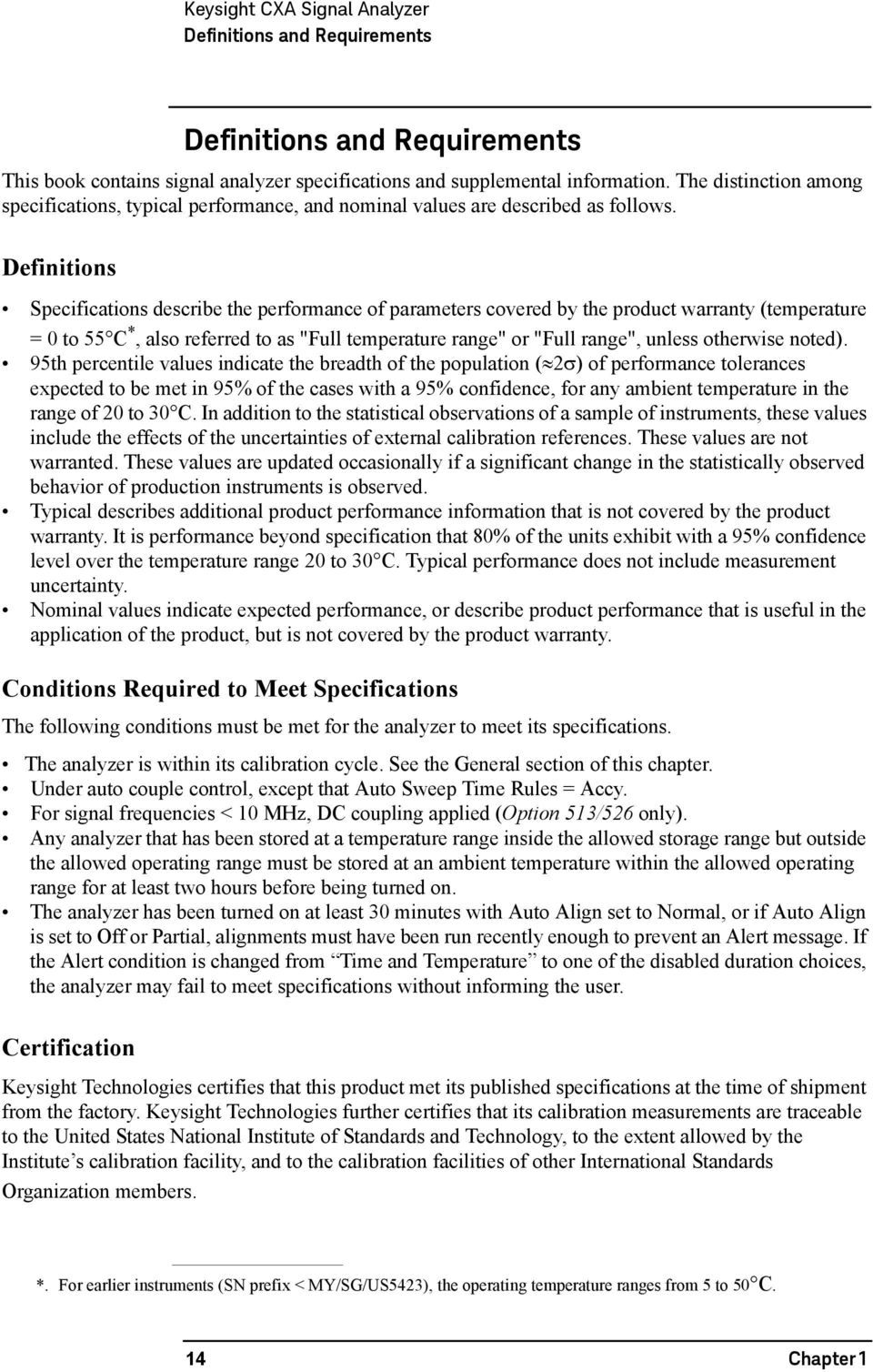
14 Keysight CXA Signal Analyzer Definitions and Requirements Definitions and Requirements This book contains signal analyzer specifications and supplemental information. The distinction among specifications, typical performance, and nominal values are described as follows. Definitions Specifications describe the performance of parameters covered by the product warranty (temperature = 0 to 55 C *, also referred to as "Full temperature range" or "Full range", unless otherwise noted). 95th percentile values indicate the breadth of the population ( 2σ) of performance tolerances expected to be met in 95% of the cases with a 95% confidence, for any ambient temperature in the range of 20 to 30 C. In addition to the statistical observations of a sample of instruments, these values include the effects of the uncertainties of external calibration references. These values are not warranted. These values are updated occasionally if a significant change in the statistically observed behavior of production instruments is observed. Typical describes additional product performance information that is not covered by the product warranty. It is performance beyond specification that 80% of the units exhibit with a 95% confidence level over the temperature range 20 to 30 C. Typical performance does not include measurement uncertainty. Nominal values indicate expected performance, or describe product performance that is useful in the application of the product, but is not covered by the product warranty. Conditions Required to Meet Specifications The following conditions must be met for the analyzer to meet its specifications. The analyzer is within its calibration cycle. See the General section of this chapter. Under auto couple control, except that Auto Sweep Time Rules = Accy. For signal frequencies < 10 MHz, DC coupling applied (Option 513/526 only). Any analyzer that has been stored at a temperature range inside the allowed storage range but outside the allowed operating range must be stored at an ambient temperature within the allowed operating range for at least two hours before being turned on. The analyzer has been turned on at least 30 minutes with Auto Align set to Normal, or if Auto Align is set to Off or Partial, alignments must have been run recently enough to prevent an Alert message. If the Alert condition is changed from Time and Temperature to one of the disabled duration choices, the analyzer may fail to meet specifications without informing the user. Certification Keysight Technologies certifies that this product met its published specifications at the time of shipment from the factory. Keysight Technologies further certifies that its calibration measurements are traceable to the United States National Institute of Standards and Technology, to the extent allowed by the Institute s calibration facility, and to the calibration facilities of other International Standards Organization members. *. For earlier instruments (SN prefix < MY/SG/US5423), the operating temperature ranges from 5 to 50 C. 14 Chapter 1
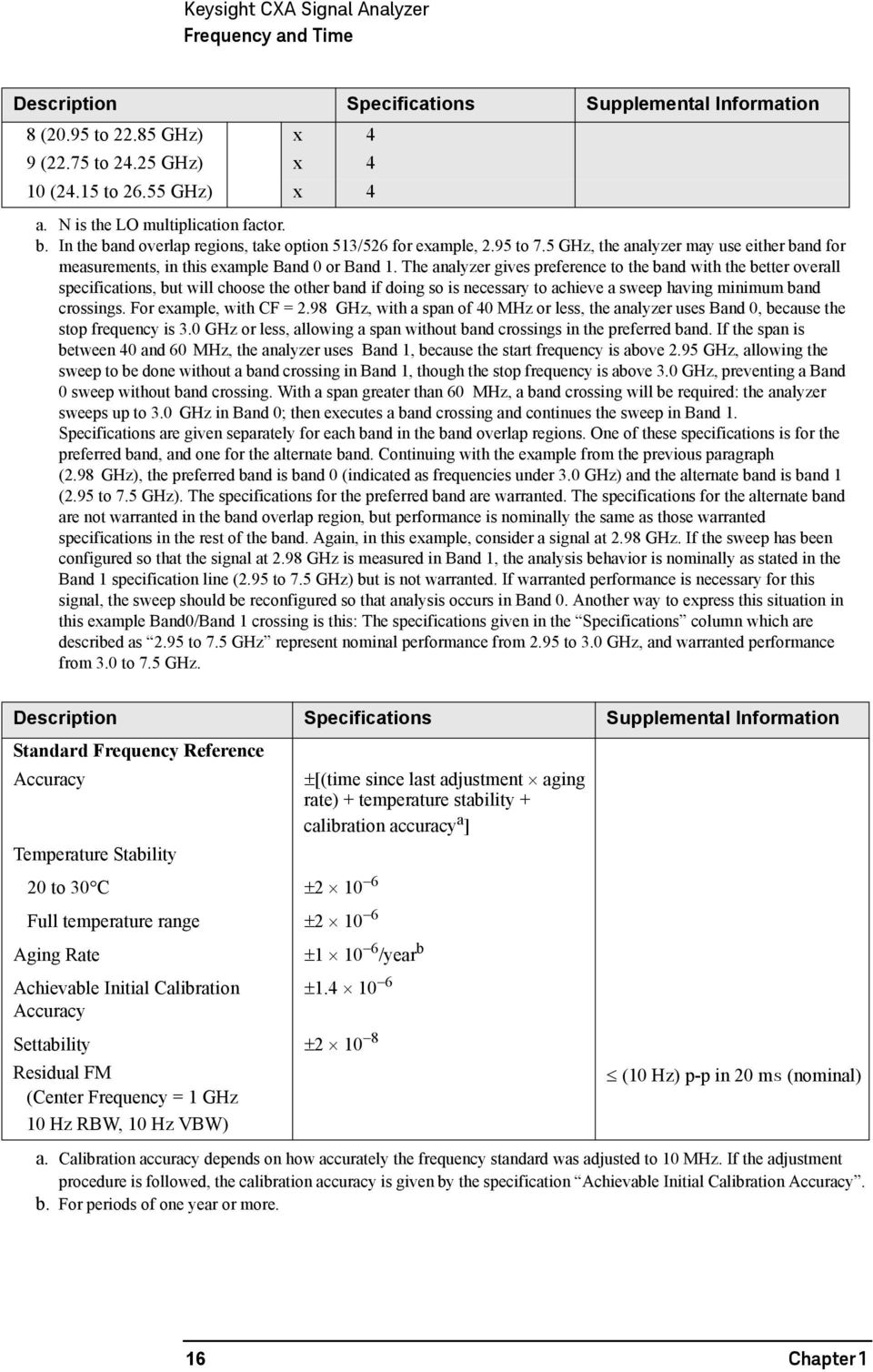
15 Keysight CXA Signal Analyzer Frequency and Time Frequency and Time Frequency Range Maximum Frequency Option 503 Option 507 Option 513 Option GHz 7.5 GHz 13.6 GHz 26.5 GHz Preamp Option P03 Preamp Option P07 Preamp Option P13 Preamp Option P GHz 7.5 GHz 13.6 GHz 26.5 GHz Minimum Frequency Option 503, or 507 Preamp Off 9 khz On 100 khz Minimum Frequency Option 513, or 526 Preamp AC Coupled DC coupled Off 10 MHz 9 khz On 10 MHz 100 khz Band LO Multiple (N a ) Band Overlaps b Option 513, or 526 Option 503, or (9 khz to 3.0 GHz) x 1 0 (9 khz to 3.08 GHz) x 1 1 (2.95 to 3.8 GHz) x 1 2 (3.7 to 4.55 GHz) x 1 3 (4.45 to 5.3 GHz) x 1 4 (5.2 to 6.05 GHz) x 1 5 (5.95 to 6.8 GHz) x 1 6 (6.7 to 7.5 GHz) x 1 1 (2.95 to 7.58 GHz) x 2 2 (7.45 to 9.55 GHz) x 2 3 (9.45 to 12.6 GHz) x 2 4 (12.5 to GHz) x 2 4 (12.95 to 13.8 GHz) x 4 5 (13.4 to GHz) x 4 6 (15.45 to GHz) x 4 7 (19.25 to GHz) x 4 Chapter 1 15

16 Keysight CXA Signal Analyzer Frequency and Time 8 (20.95 to GHz) x 4 9 (22.75 to GHz) x 4 10 (24.15 to GHz) x 4 a. N is the LO multiplication factor. b. In the band overlap regions, take option 513/526 for example, 2.95 to 7.5 GHz, the analyzer may use either band for measurements, in this example Band 0 or Band 1. The analyzer gives preference to the band with the better overall specifications, but will choose the other band if doing so is necessary to achieve a sweep having minimum band crossings. For example, with CF = 2.98 GHz, with a span of 40 MHz or less, the analyzer uses Band 0, because the stop frequency is 3.0 GHz or less, allowing a span without band crossings in the preferred band. If the span is between 40 and 60 MHz, the analyzer uses Band 1, because the start frequency is above 2.95 GHz, allowing the sweep to be done without a band crossing in Band 1, though the stop frequency is above 3.0 GHz, preventing a Band 0 sweep without band crossing. With a span greater than 60 MHz, a band crossing will be required: the analyzer sweeps up to 3.0 GHz in Band 0; then executes a band crossing and continues the sweep in Band 1. Specifications are given separately for each band in the band overlap regions. One of these specifications is for the preferred band, and one for the alternate band. Continuing with the example from the previous paragraph (2.98 GHz), the preferred band is band 0 (indicated as frequencies under 3.0 GHz) and the alternate band is band 1 (2.95 to 7.5 GHz). The specifications for the preferred band are warranted. The specifications for the alternate band are not warranted in the band overlap region, but performance is nominally the same as those warranted specifications in the rest of the band. Again, in this example, consider a signal at 2.98 GHz. If the sweep has been configured so that the signal at 2.98 GHz is measured in Band 1, the analysis behavior is nominally as stated in the Band 1 specification line (2.95 to 7.5 GHz) but is not warranted. If warranted performance is necessary for this signal, the sweep should be reconfigured so that analysis occurs in Band 0. Another way to express this situation in this example Band0/Band 1 crossing is this: The specifications given in the Specifications column which are described as 2.95 to 7.5 GHz represent nominal performance from 2.95 to 3.0 GHz, and warranted performance from 3.0 to 7.5 GHz. Standard Frequency Reference Accuracy Temperature Stability 20 to 30 C ± Full temperature range ± Aging Rate ± /year b Achievable Initial Calibration ± Accuracy Settability ± Residual FM (Center Frequency = 1 GHz 10 Hz RBW, 10 Hz VBW) ±[(time since last adjustment aging rate) + temperature stability + calibration accuracy a ] (10 Hz) p-p in 20 ms (nominal) a. Calibration accuracy depends on how accurately the frequency standard was adjusted to 10 MHz. If the adjustment procedure is followed, the calibration accuracy is given by the specification Achievable Initial Calibration Accuracy. b. For periods of one year or more. 16 Chapter 1
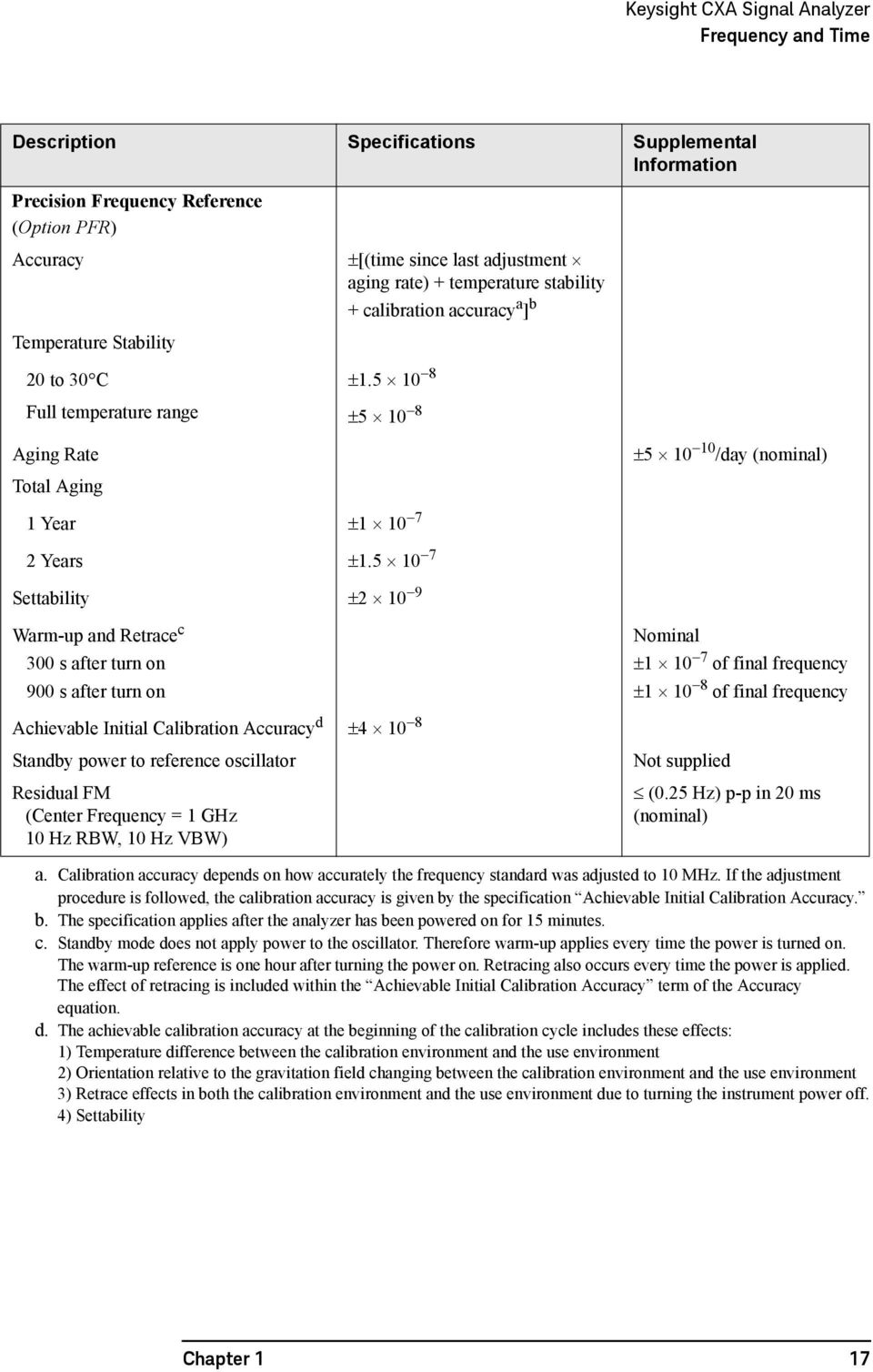
17 Keysight CXA Signal Analyzer Frequency and Time Description Specifications Supplemental Information Precision Frequency Reference (Option PFR) Accuracy ±[(time since last adjustment aging rate) + temperature stability + calibration accuracy a ] b Temperature Stability 20 to 30 C ± Full temperature range ± Aging Rate Total Aging 1 Year ± Years ± Settability Warm-up and Retrace c 300 s after turn on 900 s after turn on Achievable Initial Calibration Accuracy d Standby power to reference oscillator Residual FM (Center Frequency = 1 GHz 10 Hz RBW, 10 Hz VBW) ± ± ± /day (nominal) Nominal ± of final frequency ± of final frequency Not supplied (0.25 Hz) p-p in 20 ms (nominal) a. Calibration accuracy depends on how accurately the frequency standard was adjusted to 10 MHz. If the adjustment procedure is followed, the calibration accuracy is given by the specification Achievable Initial Calibration Accuracy. b. The specification applies after the analyzer has been powered on for 15 minutes. c. Standby mode does not apply power to the oscillator. Therefore warm-up applies every time the power is turned on. The warm-up reference is one hour after turning the power on. Retracing also occurs every time the power is applied. The effect of retracing is included within the Achievable Initial Calibration Accuracy term of the Accuracy equation. d. The achievable calibration accuracy at the beginning of the calibration cycle includes these effects: 1) Temperature difference between the calibration environment and the use environment 2) Orientation relative to the gravitation field changing between the calibration environment and the use environment 3) Retrace effects in both the calibration environment and the use environment due to turning the instrument power off. 4) Settability Chapter 1 17
18 Keysight CXA Signal Analyzer Frequency and Time Description Specifications Supplemental Information Frequency Readout Accuracy Example for EMC c ±(marker freq. freq. ref. accy % span + 5% RBW a + 2 Hz horizontal resolution b ) Single detector only ±0.0032% (nominal) a. The warranted performance is only the sum of all errors under autocoupled conditions. Under non-autocoupled conditions, the frequency readout accuracy will nominally meet the specification equation, except for conditions in which the RBW term dominates, as explained in examples below. The nominal RBW contribution to frequency readout accuracy is 4% of RBW for RBWs from 1 Hz to 3 MHz (the widest autocoupled RBW), and 30% of RBW for the (manually selected) 4, 5, 6 and 8 MHz RBWs. Example: a 20 MHz span, with a 4 MHz RBW. The specification equation does not apply because the Span: RBW ratio is not autocoupled. If the equation did apply, it would allow 50 khz of error (0.25%) due to the span and 200 khz error (5%) due to the RBW. For this non-autocoupled RBW, the RBW error is nominally 30%, or 1200 khz. b. Horizontal resolution is due to the marker reading out one of the trace points. The points are spaced by span/(npts - 1), where Npts is the number of sweep points. For example, with the factory preset value of 1001 sweep points, the horizontal resolution is span/1000. However, there is an exception: When both the detector mode is normal and the span > 0.25 (Npts - 1) RBW, peaks can occur only in even-numbered points, so the effective horizontal resolution becomes doubled, or span/500 for the factory preset case. When the RBW is autocoupled and there are 1001 sweep points, that exception occurs only for spans > 750 MHz. c. In most cases, the frequency readout accuracy of the analyzer can be exceptionally good. As an example, Keysight has characterized the accuracy of a span commonly used for Electro-Magnetic Compatibility (EMC) testing using a source frequency locked to the analyzer. Ideally, this sweep would include EMC bands C and D and thus sweep from 30 to 1000 MHz. Ideally, the analysis bandwidth would be 120 khz at 6 db, and the spacing of the points would be half of this (60 khz). With a start frequency of 30 MHz and a stop frequency of MHz and a total of points, the spacing of points is ideal. The detector used was the Peak detector. The accuracy of frequency readout of all the points tested in this span was with ±0.0032% of the span. A perfect analyzer with this many points would have an accuracy of ±0.0031% of span. Thus, even with this large number of display points, the errors in excess of the bucket quantization limitation were negligible. Description Specifications Supplemental Information Frequency Counter a See note b Count Accuracy Delta Count Accuracy Resolution ±(marker freq. freq. Ref. Accy Hz) ±(delta freq. freq. Ref. Accy Hz) Hz a. Instrument conditions: RBW = 1 khz, gate time = auto (100 ms), S/N 50 db, frequency = 1 GHz. b. If the signal being measured is locked to the same frequency reference as the analyzer, the specified count accuracy is ±0.100 Hz under the test conditions of footnote a. This error is a noisiness of the result. It will increase with noisy sources, wider RBWs, lower S/N ratios, and source frequencies > 1 GHz. 18 Chapter 1

19 Keysight CXA Signal Analyzer Frequency and Time Frequency Span Range Option 503 Option 507 Option 513 Option 526 Resolution Span Accuracy 0 Hz, 10 Hz to 3 GHz 0 Hz, 10 Hz to 7.5 GHz 0 Hz, 10 Hz to 13.6 GHz 0 Hz, 10 Hz to 26.5 GHz 2 Hz Swept ±(0.25% span + horizontal resolution a ) FFT ±(0.10% span + horizontal resolution a ) a. Horizontal resolution is due to the marker reading out one of the trace points. The points are spaced by span/(npts 1), where Npts is the number of sweep points. For example, with the factory preset value of 1001 sweep points, the horizontal resolution is span/1000. However, there is an exception: When both the detector mode is normal and the span > 0.25 (Npts 1) RBW, peaks can occur only in even-numbered points, so the effective horizontal resolution becomes doubled, or span/500 for the factory preset case. When the RBW is auto coupled and there are 1001 sweep points, that exception occurs only for spans > 750 MHz. Sweep Time and Trigger Sweep Time Range Span = 0 Hz 1 μs to 6000 s Span 10 Hz 1 ms to 4000 s Sweep Time Accuracy Span 10 Hz, swept Span 10 Hz, FFT Span = 0 Hz Sweep Trigger Free Run, Line, Video, External 1, RF Burst, Periodic Timer Delayed Trigger a Range Span 10 Hz, swept Span = 0 Hz or FFT Resolution 1 μs to 500 ms 150 ms to +500 ms 0.1 μs a. Delayed trigger is available with line, video, RF burst and external triggers. ±0.01% (nominal) ±40% (nominal) ±1% (nominal) Chapter 1 19

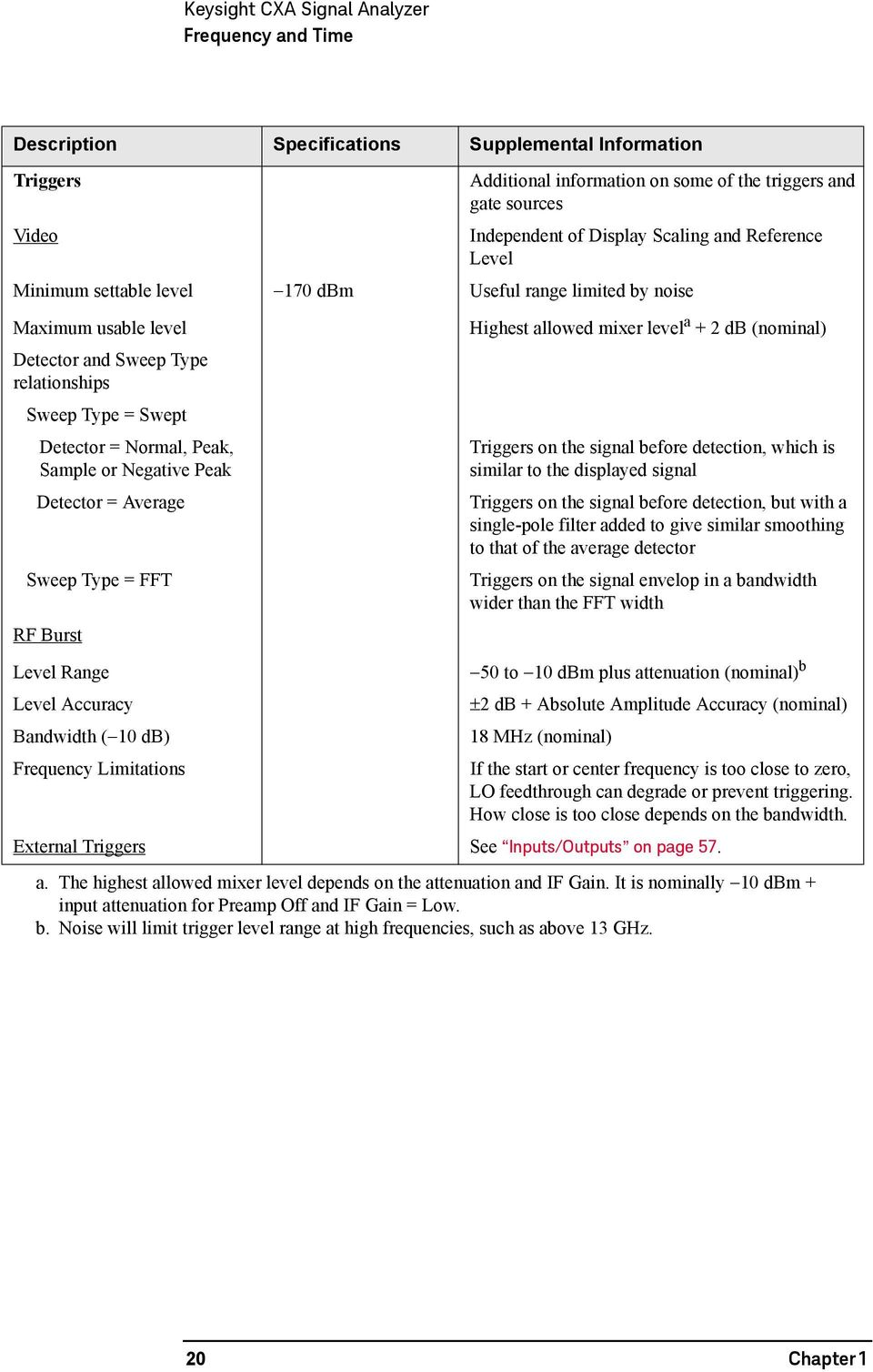
20 Keysight CXA Signal Analyzer Frequency and Time Triggers Video Additional information on some of the triggers and gate sources Independent of Display Scaling and Reference Level Minimum settable level 170 dbm Useful range limited by noise Maximum usable level Detector and Sweep Type relationships Sweep Type = Swept Detector = Normal, Peak, Sample or Negative Peak Detector = Average Sweep Type = FFT RF Burst Level Range Level Accuracy Bandwidth ( 10 db) Frequency Limitations Highest allowed mixer level a + 2 db (nominal) Triggers on the signal before detection, which is similar to the displayed signal Triggers on the signal before detection, but with a single-pole filter added to give similar smoothing to that of the average detector Triggers on the signal envelop in a bandwidth wider than the FFT width 50 to 10 dbm plus attenuation (nominal) b ±2 db + Absolute Amplitude Accuracy (nominal) 18 MHz (nominal) If the start or center frequency is too close to zero, LO feedthrough can degrade or prevent triggering. How close is too close depends on the bandwidth. External Triggers See Inputs/Outputs on page 57. a. The highest allowed mixer level depends on the attenuation and IF Gain. It is nominally 10 dbm + input attenuation for Preamp Off and IF Gain = Low. b. Noise will limit trigger level range at high frequencies, such as above 13 GHz. 20 Chapter 1
21 Keysight CXA Signal Analyzer Frequency and Time Gated Sweep Gate Methods Gated LO Gated Video Gated FFT Span Range Any span Gate Delay Range 0 to s Gate Delay Settability 4 digits, 100 ns Gate Delay Jitter Gate Length Range (Except Method = FFT) Gated Frequency and Amplitude Errors Gate Sources External Line RF Burst Periodic 33.3 ns p-p (nominal) ns to 5.0 s Gate length for the FFT method is fixed at 1.83/RBW, with nominally 2% tolerance. Nominally no additional error for gated measurements when the Gate Delay is greater than the MIN FAST setting Pos or neg edge triggered Number of Frequency Display Trace Points (buckets) Factory preset 1,001 Range 1 to 40,001 Zero and non-zero spans Chapter 1 21
22 Keysight CXA Signal Analyzer Frequency and Time Description Specifications Supplemental Information Resolution Bandwidth (RBW) Range ( 3.01 db bandwidth) 1 Hz to 8 MHz Bandwidths above 3 MHz are 4, 5, 6, and 8 MHz. Bandwidths 1 Hz to 3 MHz are spaced at 10% spacing using the E24 series (24 per decade): 1.0, 1.1, 1.2, 1.3, 1.5, 1.6, 1.8, 2.0, 2.2, 2.4, 2.7, 3.0, 3.3, 3.6, 3.9, 4.3, 4.7, 5.1, 5.6, 6.2, 6.8, 7.5, 8.2, 9.1 in each decade. Power Bandwidth Accuracy a RBW Range 1 Hz to 750 khz ±1.0% (±0.044 db) (nominal) 820 khz to 1.2 MHz ±2.0% (±0.088 db) (nominal) 1.3 to 2.0 MHz ±0.07 db (nominal) 2.2 to 3 MHz ±0.15 db (nominal) 4 to 8 MHz ±0.25 db (nominal) Accuracy ( 3.01 db bandwidth) b RBW Range 1 Hz to 1.3 MHz ±2% (nominal) 1.5 to 3.0 MHz ±7% (nominal) 4 to 8 MHz ±15% (nominal) Selectivity c ( 60 db/ 3 db) 4.1:1 (nominal) a. The noise marker, band power marker, channel power and ACP all compute their results using the power bandwidth of the RBW used for the measurement. Power bandwidth accuracy is the power uncertainty in the results of these measurements due only to bandwidth-related errors. (The analyzer knows this power bandwidth for each RBW with greater accuracy than the RBW width itself, and can therefore achieve lower errors.) The warranted specifications shown apply to the Gaussian RBW filters used in swept and zero span analysis. There are four different kinds of filters used in the spectrum analyzer: Swept Gaussian, Swept Flattop, FFT Gaussian and FFT Flattop. While the warranted performance only applies to the swept Gaussian filters, because only they are kept under statistical process control, the other filters nominally have the same performance. b. Resolution Bandwidth Accuracy can be observed at slower sweep times than auto-coupled conditions. Normal sweep rates cause the shape of the RBW filter displayed on the analyzer screen to widen by nominally 6%. This widening declines to 0.6% nominal when the Swp Time Rules key is set to Accuracy instead of Normal. The true bandwidth, which determines the response to impulsive signals and noise-like signals, is not affected by the sweep rate. c. The RBW filters are implemented digitally, and the selectivity is designed to be 4.1:1. Verifying the selectivity with RBWs above 100 khz becomes increasing problematic due to SNR affecting the 60 db measurement. 22 Chapter 1
23 Keysight CXA Signal Analyzer Frequency and Time Description Specification Supplemental information Analysis Bandwidth a Standard With Option B25 10 MHz 25 MHz a. Analysis bandwidth is the instantaneous bandwidth available around a center frequency over which the input signal can be digitized for further analysis or processing in the time, frequency, or modulation domain. Video Bandwidth (VBW) Range Accuracy Same as Resolution Bandwidth range plus wide-open VBW (labeled 50 MHz) ±6% (nominal) in swept mode and zero span a a. For FFT processing, the selected VBW is used to determine a number of averages for FFT results. That number is chosen to give roughly equival lay smoothing to VBW filtering in a swept measurement. For example, if VBW=0.1 RBW, four FFTs are averaged to generate one result. Chapter 1 23
24 Keysight CXA Signal Analyzer Amplitude Accuracy and Range Amplitude Accuracy and Range Measurement Range Option 513 or 526 Option 503 or 507 Preamp Off 100 khz to 1 MHz x Displayed Average Noise Level to +20 dbm 1 MHz to 7.5 GHz x Displayed Average Noise Level to +23 dbm 100 khz to 26.5 GHz x Displayed Average Noise Level to +23 dbm Preamp On 100 khz to 7.5 GHz x Displayed Average Noise Level to +15 dbm 100 khz to 26.5 GHz x Displayed Average Noise Level to +23 dbm Input Attenuation Range Standard x 0 to 50 db, in 10 db steps Standard x 0 to 70 db, in 10 db steps With Option FSA x 0 to 50 db, in 2 db steps With Option FSA x 0 to 70 db, in 2 db steps Maximum Safe Input Level Average Total Power +30 dbm (1 W) Option 503/507 (input attenuation 20 db) Average Total Power +30 dbm (1 W) Option 513/526 (input attenuation 10 db) Peak Pulse Power +50 dbm (100 W) (<10 μs pulse width, <1% duty cycle input attenuation 30 db) AC Coupled ±50 Vdc DC Coupled ±0.2 Vdc Option 513/ Chapter 1
25 Keysight CXA Signal Analyzer Amplitude Accuracy and Range Description Specifications Supplemental Information Display Range Log Scale Linear Scale Scale units Ten divisions displayed; 0.1 to 1.0 db/division in 0.1 db steps, and 1 to 20 db/division in 1 db steps Ten divisions dbm, dbmv, dbμv, dbma, dbμa, V, W, A Marker Readout a Resolution Log units resolution Trace Averaging Off, on-screen Trace Averaging On or remote Linear units resolution 0.01 db db 1% of signal level (nominal) a. Reference level and off-screen performance: The reference level (RL) behavior differs from previous analyzers (except PSA) in a way that makes the Keysight CXA Signal Analyzer more flexible. In previous analyzers, the RL controlled how the measurement was performed as well as how it was displayed. Because the logarithmic amplifier in previous analyzers had both range and resolution limitations, this behavior was necessary for optimum measurement accuracy. The logarithmic amplifier in the CXA signal analyzer, however, is implemented digitally such that the range and resolution greatly exceed other instrument limitations. Because of this, the CXA signal analyzer can make measurements largely independent of the setting of the RL without compromising accuracy. Because the RL becomes a display function, not a measurement function, a marker can read out results that are off-screen, either above or below, without any change in accuracy. The only exception to the independence of RL and the way in which the measurement is performed is in the input attenuation setting: When the input attenuation is set to auto, the rules for the determination of the input attenuation include dependence on the reference level. Because the input attenuation setting controls the tradeoff between large signal behaviors (third-order intermodulation and compression) and small signal effects (noise), the measurement results can change with RL changes when the input attenuation is set to auto. Chapter 1 25
26 Keysight CXA Signal Analyzer Amplitude Accuracy and Range Frequency Response Frequency Response Refer to the footnote for (Maximum error relative to reference condition (50 MHz) Swept operation a Attenuation 10 db) Band Overlaps on page 15. Option 513 or 526 Option 503 or to 30 C Full Range 95th Percentile ( 2σ) 9 khz to 10 MHz x ±0.6 db ±0.65 db ±0.45 db 9 khz to 10 MHz x ±0.8 db ±0.85 db ±0.5 db 10 MHz to 3 GHz x ±0.75 db ±1.75 db ±0.55 db 10 MHz to 3 GHz x ±0.65 db ±0.85 db ±0.4 db 3 to 5.25 GHz x ±1.45 db ±2.5 db ±1.0 db 5.25 to 7.5 GHz x ±1.65 db ±2.60 db ±1.2 db 3 to 7.5 GHz x ±1.5 db ±2.5 db ±0.5 db 7.5 to 13.6 GHz x ±2.0 db ±2.7 db ±0.8 db 13.6 to 19 GHz x ±2.0 db ±2.7 db ±1.0 db 19 to 26.5 GHz x ±2.5 db ±4.5 db ±1.3 db a. For Sweep Type = FFT, add the RF flatness errors of this table to the IF Frequency Response errors. An additional error source, the error in switching between swept and FFT sweep types, is nominally ±0.01 db and is included within the Absolute Amplitude Error specifications. IF Frequency Response a (Demodulation and FFT response relative to the center frequency) Center Freq (GHz) Analysis Width (MHz) Max Error b (Exception c ) Midwidth Error (95th Percentile) Slope (db/mhz) (95th Percentile) RMS d (nominal) ±0.40 db ±0.15 db ± db >3.0, db a. The IF frequency response includes effects due to RF circuits such as input filters, that are a function of RF frequency, in addition to the IF pass-band effects. b. The maximum error at an offset (f) from the center of the FFT width is given by the expression ± [Midwidth Error + (f Slope)], but never exceeds ±Max Error. Usually, the span is no larger than the FFT width in which case the center of the FFT width is the center frequency of the analyzer. When the analyzer span is wider than the FFT width, the span is made up of multiple concatenated FFT results, and thus has multiple centers of FFT widths so the f in the equation is the offset from the nearest center. These specifications include the effect of RF frequency response as well as IF frequency response at the worst case center frequency. Performance is nominally three times better than the maximum error at most center frequencies. c. The specification does not apply for frequencies greater than 3.0 MHz from the center in FFT Widths of 7.2 to 8 MHz. 26 Chapter 1
27 Keysight CXA Signal Analyzer Amplitude Accuracy and Range d. The "RMS" nominal performance is the standard deviation of the response relative to the center frequency, integrated across a 10 MHz span. This performance measure was observed at a single center frequency in each harmonic mixing band, which is representative of all center frequencies; the observation center frequency is not the worst case center frequency. Description Specification Supplemental Information IF Phase Linearity Freq (GHz) Span (MHz) Peak-to-Peak (nominal) RMS (nominal) a 0.02, >3.0, >7.5, a. The listed performance is the r.m.s. of the phase deviation relative to the mean phase deviation from a linear phase condition, where the r.m.s. is computed over the range of offset frequencies and center frequencies shown. Input Attenuation Switching Uncertainty (Relative to 10 db (reference setting)) Refer to the footnote for Band Overlaps on page MHz (reference frequency) ±0.32 db ±0.15 db (typical) Attenuation > 2 db, preamp off 100 khz to 3 GHz ±0.30 db (nominal) 3 to 7.5 GHz ±0.50 db (nominal) 7.5 to 13.6 GHz ±0.70 db (nominal) 13.6 to 26.5 GHz ±0.70 db (nominal) Chapter 1 27
28 Keysight CXA Signal Analyzer Amplitude Accuracy and Range Absolute Amplitude Accuracy At 50 MHz a 20 to 30 C ±0.40 db ±0.30 db (95th percentile) 5 to 50 C ±0.60 db At all frequencies a 20 to 30 C ±(0.40 db + frequency response) 5 to 50 C ±(0.60 db + frequency response) 95th Percentile Absolute Amplitude Accuracy b (Wide range of signal levels, RBWs, RLs, etc., Atten = 10 db) 100 khz to 10 MHz ±0.6 db 10 MHz to 2.0 GHz ±0.5 db 2.0 to 3.0 GHz ±0.6 db Preamp On c (Option P03/P07/P13/P26) ±(0.39 db + frequency response) (nominal) a. Absolute amplitude accuracy is the total of all amplitude measurement errors, and applies over the following subset of settings and conditions: 1 Hz RBW 1 MHz; Input signal 10 to 50 dbm; Input attenuation 10 db; span < 5 MHz (nominal additional error for span 5 MHz is 0.02 db); all settings auto-coupled except Swp Time Rules = Accuracy; combinations of low signal level and wide RBW use VBW 30 khz to reduce noise. This absolute amplitude accuracy specification includes the sum of the following individual specifications under the conditions listed above: Scale Fidelity, Reference Level Accuracy, Display Scale Switching Uncertainty, Resolution Bandwidth Switching Uncertainty, 50 MHz Amplitude Reference Accuracy, and the accuracy with which the instrument aligns its internal gains to the 50 MHz Amplitude Reference. b.absolute Amplitude Accuracy for a wide range of signal and measurement settings, covers the 95th percentile proportion with 95% confidence. Here are the details of what is covered and how the computation is made: The wide range of conditions of RBW, signal level, VBW, reference level and display scale are discussed in footnote a. There are 108 quasi-random combinations used, tested at a 50 MHz signal frequency. We compute the 95th percentile proportion with 95% confidence for this set observed over a statistically significant number of instruments. Also, the frequency response relative to the 50 MHz response is characterized by varying the signal across a large number of quasi-random verification frequencies that are chosen to not correspond with the frequency response adjustment frequencies. We again compute the 95th percentile proportion with 95% confidence for this set observed over a statistically significant number of instruments. We also compute the 95th percentile accuracy of tracing the calibration of the 50 MHz absolute amplitude accuracy to a national standards organization. We also compute the 95th percentile accuracy of tracing the calibration of the relative frequency response to a national standards organization. We take the root-sum-square of these four independent Gaussian parameters. To that rss we add the environmental effects of temperature variations across the 20 to 30 C range. c. Same settings as footnote a, except that the signal level at the preamp input is 40 to 80 dbm. Total power at preamp (dbm) = total power at input (dbm) minus input attenuation (db). This specification applies for signal frequencies above 100 khz. 28 Chapter 1
29 Keysight CXA Signal Analyzer Amplitude Accuracy and Range RF Input VSWR Nominal a (Input attenuation 10 db, 50 MHz) 1.1:1 Option 513 or 526 Option 503 or 507 Input Attenuation 10 db 10 MHz to 3.0 GHz x < 1.5:1 (nominal) 10 MHz to 3.0 GHz x < 1.3:1 (nominal) 3.0 to 7.5 GHz x < 2.0:1 (nominal) 3.0 to 7.5 GHz x < 1.4:1 (nominal) 7.5 to 26.5 GHz x < 1.9:1 (nominal) a. The nominal SWR stated is given for the worst case RF frequency in three representative instruments. Nominal Instrument Input VSWR (Option 503/507) 1.50 VSWR VSWR vs. Frequency, 3 Units, 10 db Attenuation GHz Chapter 1 29
30 Keysight CXA Signal Analyzer Amplitude Accuracy and Range Nominal Instrument Input VSWR (Option 503/507) VSWR VSWR vs. Frequency, 3 Units, 10 db Attenuation GHz Nominal Instrument Input VSWR (Option 513/526) 30 Chapter 1
31 Keysight CXA Signal Analyzer Amplitude Accuracy and Range Nominal Instrument Input VSWR (Option 513/526) 2.0 VSWR VSWR vs. Frequency, 3 Units, 10 db Attenuation GHz Resolution Bandwidth Switching Uncertainty Relative to reference BW of 30 khz 1 Hz to 3 MHz RBW ±0.15 db Manually selected wide RBWs: 4, 5, 6, 8 MHz ±1.0 db Reference Level Range Log Units 170 to +23 dbm in 0.01 db steps Linear Units 707 pv to 3.16 V with 0.01 db resolution (0.11%) Accuracy 0 db a a. Because reference level affects only the display, not the measurement, it causes no additional error in measurement results from trace data or markers. Display Scale Switching Uncertainty Switching between Linear and Log Log Scale Switching 0 db a 0 db a a. Because Log/Lin and Log Scale Switching affect only the display, not the measurement, they cause no additional error in measurement results from trace data or markers. Chapter 1 31
32 Keysight CXA Signal Analyzer Amplitude Accuracy and Range Display Scale Fidelity abc Absolute Log-Linear Fidelity (Relative to the reference condition of 25 dbm input through the 10 db attenuation, or 35 dbm at the input mixer) Input mixer level d 80 dbm ML < 15 dbm Linearity ±0.15 db 15 dbm ML 10 dbm ±0.30 db ±0.15 db (typical) Relative Fidelity e Sum of the following terms: high level term instability term slope term Applies for mixer level d range from 10 to 80 dbm, preamp off, and dither on Up to ±0.045 db f Up to ±0.018 db From equation g a. Supplemental information: The amplitude detection linearity specification applies at all levels below 10 dbm at the input mixer; however, noise will reduce the accuracy of low level measurements. The amplitude error due to noise is determined by the signal-to-noise ratio, S/N. If the S/N is large (20 db or better), the amplitude error due to noise can be estimated from the equation below, given for the 3-sigma (three standard deviations) level. 3σ = 320dB ( ) log ( ( S N+ 3dB) 20dB) The errors due to S/N ratio can be further reduced by averaging results. For large S/N (20 db or better), the 3-sigma level can be reduced proportional to the square root of the number of averages taken. b. The scale fidelity is warranted with ADC dither set to Medium. Dither increases the noise level by nominally only 0.24 db for the most sensitive case (preamp Off, best DANL frequencies). With dither Off, scale fidelity for low level signals, around 60 dbm or lower, will nominally degrade by 0.2 db. c. Reference level and off-screen performance: The reference level (RL) behavior differs from some earlier analyzers in a way that makes this analyzer more flexible. In other analyzers, the RL controlled how the measurement was performed as well as how it was displayed. Because the logarithmic amplifier in these analyzers had both range and resolution limitations, this behavior was necessary for optimum measurement accuracy. The logarithmic amplifier in this signal analyzer, however, is implemented digitally such that the range and resolution greatly exceed other instrument limitations. Because of this, the analyzer can make measurements largely independent of the setting of the RL without compromising accuracy. Because the RL becomes a display function, not a measurement function, a marker can read out results that are off-screen, either above or below, without any change in accuracy. The only exception to the independence of RL and the way in which the measurement is performed is in the input attenuator setting: When the input attenuator is set to auto, the rules for the determination of the input attenuation include dependence on the reference level. Because the input attenuation setting controls the tradeoff between large signal behaviors (third-order intermodulation and compression) and small signal effects (noise), the measurement results can change with RL changes when the input attenuation is set to auto. d. Mixer level = Input Level - Input Attenuator 32 Chapter 1
33 Keysight CXA Signal Analyzer Amplitude Accuracy and Range e. The relative fidelity is the error in the measured difference between two signal levels. It is so small in many cases that it cannot be verified without being dominated by measurement uncertainty of the verification. Because of this verification difficulty, this specification gives nominal performance, based on numbers that are as conservatively determined as those used in warranted specifications. We will consider one example of the use of the error equation to compute the nominal performance. Example: the accuracy of the relative level of a sideband around 60 dbm, with a carrier at 5 dbm, using attenuator = 10 db, RBW = 3 khz, evaluated with swept analysis. The high level term is evaluated with P1 = 15 dbm and P2 = 70 dbm at the mixer. This gives a maximum error within ±0.025 db. The instability term is ±0.018 db. The slope term evaluates to ±0.050 db. The sum of all these terms is ±0.093 db. f. Errors at high mixer levels will nominally be well within the range of ±0.045 db {exp[(p1 Pref)/(8.69 db)] exp[(p2 Pref)/(8.69 db)]}. In this expression, P1 and P2 are the powers of the two signals, in decibel units, whose relative power is being measured. Pref is 10 dbm. All these levels are referred to the mixer level. g. Slope error will nominally be well within the range of ± (P1 P2). P1 and P2 are defined in footnote f. Available Detectors Normal, Peak, Sample, Negative Peak, Average Average detector works on RMS, Voltage and Logarithmic scales Chapter 1 33
34 Keysight CXA Signal Analyzer Dynamic Range Gain Compression Dynamic Range 1 db Gain Compression Point (Two-tone) abc Maximum power at mixer d 50 MHz to 7.5 GHz (Option 503, 507) dbm (nominal) 50 MHz to 7.5 GHz (Option 513, 526) dbm (nominal) 7.5 to 13.6 GHz (Option 513, 526) dbm (nominal) 13.6 to 26.5 GHz (Option 526) dbm (nominal) a. Large signals, even at frequencies not shown on the screen, can cause the analyzer to incorrectly measure on-screen signals because of two-tone gain compression. This specification tells how large an interfering signal must be in order to cause a 1 db change in an on-screen signal. b. Specified at 1 khz RBW with 1 MHz tone spacing. c. Reference level and off-screen performance: The reference level (RL) behavior differs from some earlier analyzers in a way that makes this analyzer more flexible. In other analyzers, the RL controlled how the measurement was performed as well as how it was displayed. Because the logarithmic amplifier in these analyzers had both range and resolution limitations, this behavior was necessary for optimum measurement accuracy. The logarithmic amplifier in this signal analyzer, however, is implemented digitally such that the range and resolution greatly exceed other instrument limitations. Because of this, the analyzer can make measurements largely independent of the setting of the RL without compromising accuracy. Because the RL becomes a display function, not a measurement function, a marker can read out results that are off-screen, either above or below, without any change in accuracy. The only exception to the independence of RL and the way in which the measurement is performed is in the input attenuation setting: When the input attenuation is set to auto, the rules for the determination of the input attenuation include dependence on the reference level. Because the input attenuation setting controls the tradeoff between large signal behaviors (third-order intermodulation, compression, and display scale fidelity) and small signal effects (noise), the measurement results can change with RL changes when the input attenuation is set to auto. d. Mixer power level (dbm) = input power (dbm) input attenuation (db). 34 Chapter 1
35 Keysight CXA Signal Analyzer Dynamic Range Displayed Average Noise Level Displayed Average Noise Level (DANL) a Input terminated Sample or Average detector Averaging type = Log 0 db input attenuation IF Gain = High 1 Hz Resolution Bandwidth Refer to the footnote for Band Overlaps on page 15 Option 513 or 526 Option 503 or 507 (SN prefix < MY/SG/US5423) Option 503 or 507 (SN prefix > MY/SG/US5423, ship standard with N9000A-EP4) 20 to 30 C Full range Typical 9 khz to 1 MHz x x 120 dbm (nominal) 9 khz to 1 MHz x 122 dbm 1 to 10 MHz b x x 130 dbm 129 dbm 137 dbm 1 to 10 MHz c x 143 dbm 143 dbm 148 dbm 10 MHz to 1.5 GHz x x 148 dbm 145 dbm 150 dbm 10 MHz to 1.5 GHz x 147 dbm 147 dbm 150 dbm 1.5 to 2.2 GHz x 144 dbm 141 dbm 147 dbm 1.5 to 2.5 GHz x 144 dbm 141 dbm 147 dbm 2.5 to 2.7 GHz x 142 dbm 139 dbm 145 dbm 2.7 to 3.0 GHz x 139 dbm 137 dbm 143 dbm 2.2 to 3.0 GHz x 140 dbm 138 dbm 143 dbm 3 to 4.5 GHz x x 137 dbm 136 dbm 140 dbm 4.5 to 6 GHz x x 133 dbm 130 dbm 136 dbm 1.5 to 6 GHz x 143 dbm 142 dbm 147 dbm 6 to 7.5 GHz x x 128 dbm 125 dbm 131 dbm 6 to 7.5 GHz x 141 dbm 140 dbm 145 dbm 7.5 to 13.6 GHz x 139 dbm 138 dbm 142 dbm 13.6 to 20 GHz x 134 dbm 133 dbm 140 dbm 20 to 24 GHz x 132 dbm 131 dbm 138 dbm 24 to 26.5 GHz x 124 dbm 121 dbm 129 dbm a. DANL for zero span and swept is measured in a 1 khz RBW and normalized to the narrowest available RBW, because the noise figure does not depend on RBW and 1 khz measurements are faster. b. DANL below 10 MHz is affected by phase noise around the LO feedthrough signal. c. DANL below 10 MHz is affected by phase noise around the LO feedthrough signal. Specifications apply with the best setting of the Phase Noise Optimization control, which is to choose the Best Close-in φ Noise" for frequencies below 25 khz, and Best Wide Offset φ Noise" for frequencies above 85 khz. Chapter 1 35
36 Keysight CXA Signal Analyzer Dynamic Range Spurious Response Spurious Response See Band Overlaps on page 15 Option 513 or 526 Option 503 or 507 Mixer Level a Response Preamp Off b Residual Responses c x 200 khz to 7.5 GHz d (swept) 90 dbm Zero span or FFT or other frequencies 100 dbm (nominal) Input Related Spurious Response x 30 dbm 60 dbc (typical) (10 MHz to 7.5 GHz) Image Responses 10 MHz to 26.5 GHz x 10 dbm 60 dbc (typical) Other Spurious Responses First RF Order x 10 dbm 65 dbc (f 10 MHz from carrier) High RF Order x 30 dbm 65 dbc (f 10 MHz from carrier) LO-Related Spurious Responses x 10 dbm 64 dbc (typical) (10 MHz to 3 GHz) Sidebands, offset from CW signal x x 50 to 200 Hz 50 dbc (nominal) 200 Hz to 3 khz 65 dbc (nominal) 3 khz to 300 khz 65 dbc (nominal) 300 khz to 10 MHz 80 dbc (nominal) a. Mixer Level = Input Level - Input Attenuation. b. The spurious response specifications only apply with the preamp turned off. When the preamp is turned on, performance is nominally the same as long as the mixer level is interpreted to be: Mixer Level = Input Level Input Attenuation Preamp Gain. c. Input terminated, 0 db input attenuation. d. The stop frequency varies according to the option 503/507/513/526 selected. 36 Chapter 1
37 Keysight CXA Signal Analyzer Dynamic Range Second Harmonic Distortion Second Harmonic Distortion (Input attenuation 10 db) Preamp Off 10 MHz to 3.75 GHz (Input level 20 dbm) 3.75 to GHz (Input level 20 dbm) Preamp On (Option P03/P07) (Input level 40 dbm) Option 513, or 526 Option 503, or 507 Distortion SHI a Distortion (nominal) SHI (nominal) x x 65 dbc +35 dbm 72 dbc +42 dbm x 75 dbc +45 dbm 84 dbc +54 dbm x x 60 dbc +10 dbm a. SHI = second harmonic intercept. The SHI is given by the mixer power in dbm minus the second harmonic distortion level relative to the mixer tone in dbc. Third Order Intermodulation Third Order Intermodulation a (Two 20 dbm tones at the input, spaced by 100 khz, input attenuation 0 db) Option 513, or 526 Refer to the footnote for Band Overlaps on page 15. Option 503, or 507 Extrapolated Intercept 20 to 30 C Intercept b Distortion c (Typical) 10 to 500 MHz x +11 dbm 62 dbc +15 dbm 10 to 400 MHz x +10 dbm 60 dbc +14 dbm 500 MHz to 2 GHz x +12 dbm 64 dbc +15 dbm 2 to 3 GHz x +11 dbm 62 dbc +15 dbm 400 MHz to 3 GHz x +13 dbm 66 dbc +17 dbm 3 to 7.5 GHz x +12 dbm 64 dbc +17 dbm 3 to 7.5 GHz x +13 dbm 66 dbc +15 dbm 7.5 to 13.6 GHz x +11 dbm 62 dbc +15 dbm 13.6 to 26.5 GHz x +10 dbm 60 dbc +14 dbm Preamp On (OptionP03, P07, P13, P26) x x 8 dbm (nominal) (Two 45 dbm tones at the input, spaced by 100 khz, input attenuation 0 db) a. TOI is verified with IF Gain set to its best case condition, which is IF Gain = Low. b. Intercept = TOI = third order intercept. The TOI is given by the mixer tone level (in dbm) minus (distortion/2) where distortion is the relative level of the distortion tones in dbc. c. The distortion shown is computed from the warranted intercept specifications, based on two tones at 20 dbm each, instead of being measured directly. Chapter 1 37
38 Keysight CXA Signal Analyzer Dynamic Range Nominal Dynamic Range at 1 GHz [Plot] (Option 503/507) Nominal Dynamic Range Band 1-6 [Plot] (Option 503/507) DANL and distortion relative to mixer level (db) DANL and distortion relative to mixer level (db) 38 Chapter 1
39 Keysight CXA Signal Analyzer Dynamic Range Nominal Dynamic Range [Plot] (Option 513/526) DANL and distortion relative to mixer level (db) Chapter 1 39
40 Keysight CXA Signal Analyzer Dynamic Range Nominal Dynamic Range vs. Offset Frequency vs. RBW [Plot] (Option 503/507) Nominal Dynamic Range vs. Offset Frequency vs. RBW [Plot] (Option 513/526) 0 (dbc) ,000 10, ,000 1,000,000 10,000,000 Conditions: CF = 600 MHz; Mixer Level = 10 dbm; Average Type = Log Offset (Hz) 40 Chapter 1
41 Keysight CXA Signal Analyzer Dynamic Range Nominal TOI vs. Mixer Level and Tone Separation [Plot] (Option 503, 507) Nominal TOI vs. Mixer Level and Tone Separation [Plot] (Option 513, 526) Chapter 1 41
42 Keysight CXA Signal Analyzer Dynamic Range Phase Noise Description Specifications Supplemental Information Phase Noise Noise Sidebands (Center Frequency = 1 GHz a, Best-case Optimization b Internal Reference c ) Option 503, or 507 (SN prefix < MY/SG/US5423) Option 526 (ship standard with N9000A-EP4) 20 to 30 C Full range Typical 1 khz x 94 dbc/hz 93 dbc/hz 98 dbc/hz (nominal) 1 khz x 98 dbc/hz 97 dbc/hz 103 dbc/hz 10 khz x 99 dbc/hz 98 dbc/hz 102 dbc/hz 10 khz x 102 dbc/hz 101 dbc/hz 110 dbc/hz 100 khz x 102 dbc/hz 101 dbc/hz 104 dbc/hz 100 khz x 108 dbc/hz 107 dbc/hz 110 dbc/hz 1 MHz x 120 dbc/hz 119 dbc/hz 121 dbc/hz 1 MHz x 130 dbc/hz 129 dbc/hz 130 dbc/hz 10 MHz x 143 dbc/hz (nominal) 10 MHz x 145 dbc/hz (nominal) a. The nominal performance of the phase noise at center frequencies different than the one at which the specifications apply (1 GHz) depends on the center frequency, band and the offset. For low offset frequencies, offsets well under 100 Hz, the phase noise increases by 20 log[(f )/1.3225]. For mid-offset frequencies such as 10 khz, band 0 phase noise increases as 20 log[(f )/6.1225]. For mid-offset frequencies in other bands, phase noise changes as 20 log[(f )/6.1225] except f in this expression should never be lower than 5.8. For wide offset frequencies, offsets above about 100 khz, phase noise increases as 20 log(n). N is the LO Multiple as shown on page 15; f is in GHz units in all these relationships; all increases are in units of decibels. b. Noise sidebands for lower offset frequencies, for example, 10 khz, apply with the phase noise optimization (PhNoise Opt) set to Best Close-in φ Noise. Noise sidebands for higher offset frequencies, for example, 1 MHz, as shown apply with the phase noise optimization set to Best Wide-offset φ Noise. c. Specifications are given with the internal frequency reference. The phase noise at offsets below 100 Hz is impacted or dominated by noise from the reference. Thus, performance with external references will not follow the curves and specifications. The internal 10 MHz reference phase noise is about 120 dbc/hz at 10 Hz offset; external references with poorer phase noise than this will cause poorer performance than shown. 42 Chapter 1
43 Keysight CXA Signal Analyzer Dynamic Range Nominal Phase Noise at Different Center Frequencies for Option 503, or 507 (SN prefix < MY/SG/US5423) Chapter 1 43
44 Keysight CXA Signal Analyzer Dynamic Range Nominal Phase Noise at Different Center Frequencies for Option < 526 (Ship standard with N9000A-EP4) Nominal Phase Noise at Different Center Frequencies With RBW Selectivity Curves, Optimized Phase Noise, Versus Offset Frequency RBW = 100 Hz RBW = 1 khz RBW = 10 khz RBW = 100 khz CF= 25.2 GHz CF= 600 MHz CF= 10.2 GHz Freq (khz) SSB Phase Noise (dbc/hz) 44 Chapter 1
45 Keysight CXA Signal Analyzer Power Suite Measurements Power Suite Measurements Channel Power Amplitude Accuracy Amplitude Accuracy a + Power Bandwidth Accuracy bc Case: Radio Std = 3GPP W-CDMA, or IS-95 Absolute Power Accuracy (20 to 30 C, Attenuation = 10 db) ±1.33 db ±0.61 db (95th percentile) a. See Absolute Amplitude Accuracy on page 28. b. See Power Bandwidth Accuracy on page 22. c. Expressed in db. Occupied Bandwidth Frequency Accuracy ±(Span/1000) (nominal) Chapter 1 45
46 Keysight CXA Signal Analyzer Power Suite Measurements Adjacent Channel Power (ACP) Case: Radio Std = None Accuracy of ACP Ratio (dbc) Display Scale Fidelity a Accuracy of ACP Absolute Power (dbm or dbm/hz) Accuracy of Carrier Power (dbm), or Carrier Power PSD (dbm/hz) Passbandwidth e 3 db Absolute Amplitude Accuracy b + Power Bandwidth Accuracy cd Absolute Amplitude Accuracy + Power Bandwidth Accuracy cd Case: Radio Std = 3GPP W-CDMA (ACPR; ACLR) f Minimum power at RF Input 36 dbm (nominal) ACPR Accuracy g RRC weighted, 3.84 MHz noise bandwidth, method = IBW or Fast h Radio Offset Freq MS (UE) 5 MHz ±0.76 db At ACPR range of 30 to 36 dbc with optimum mixer level i MS (UE) 10 MHz ±0.73 db At ACPR range of 40 to 46 dbc with optimum mixer level j BTS 5 MHz ±1.72 db h At ACPR range of 42 to 48 dbc with optimum mixer level k BTS 10 MHz ±1.96 db At ACPR range of 47 to 53 dbc with optimum mixer level j BTS 5 MHz ±0.87 db At 48 dbc non-coherent ACPR l Dynamic Range Option 513, or 526 Option 503, or 507 (SN prefix < MY/SG/US5423) Option 503, or 507 (SN prefix > MY/SG/US5423, ship standard with N9000A-EP4) Noise Correction Offset Freq RRC weighted, 3.84 MHz noise bandwidth ACLR (typical) m Off 5 MHz x x 63.0 db Off 5 MHz x 66.0 db Off 10 MHz x x 67.0 db Off 10 MHz x 69.0 db On 5 MHz x 66.0 db On 5 MHz x x 73.0 db On 10 MHz x 72.0 db On 10 MHz x x 78.0 db 46 Chapter 1
47 Keysight CXA Signal Analyzer Power Suite Measurements a. The effect of scale fidelity on the ratio of two powers is called the relative scale fidelity. The scale fidelity specified in the Amplitude section is an absolute scale fidelity with 35 dbm at the input mixer as the reference point. The relative scale fidelity is nominally only 0.01 db larger than the absolute scale fidelity. b. See Amplitude Accuracy and Range section. c. See Frequency and Time section. d. Expressed in decibels. e. An ACP measurement measures the power in adjacent channels. The shape of the response versus frequency of those adjacent channels is occasionally critical. One parameter of the shape is its 3 db bandwidth. When the bandwidth (called the Ref BW) of the adjacent channel is set, it is the 3 db bandwidth that is set. The passband response is given by the convolution of two functions: a rectangle of width equal to Ref BW and the power response versus frequency of the RBW filter used. Measurements and specifications of analog radio ACPs are often based on defined bandwidths of measuring receivers, and these are defined by their 6 db widths, not their 3 db widths. To achieve a passband whose 6 db width is x, set the Ref BW to be x RBW. f. Most versions of adjacent channel power measurements use negative numbers, in units of dbc, to refer to the power in an adjacent channel relative to the power in a main channel, in accordance with ITU standards. The standards for W-CDMA analysis include ACLR, a positive number represented in db units. In order to be consistent with other kinds of ACP measurements, this measurement and its specifications will use negative dbc results, and refer to them as ACPR, instead of positive db results referred to as ACLR. The ACLR can be determined from the ACPR reported by merely reversing the sign. g. The accuracy of the Adjacent Channel Power Ratio will depend on the mixer drive level and whether the distortion products from the analyzer are coherent with those in the UUT. These specifications apply even in the worst case condition of coherent analyzer and UUT distortion products. For ACPR levels other than those in this specifications table, the optimum mixer drive level for accuracy is approximately 37 dbm (ACPR/3), where the ACPR is given in (negative) decibels. h. The Fast method has a slight decrease in accuracy in only one case: for BTS measurements at 5 MHz offset, the accuracy degrades by ±0.01 db relative to the accuracy shown in this table. i. To meet this specified accuracy when measuring mobile station (MS) or user equipment (UE) within 3 db of the required 33 dbc ACPR, the mixer level (ML) must be optimized for accuracy. This optimum mixer level is 20 dbm, so the input attenuation must be set as close as possible to the average input power ( 20 dbm). For example, if the average input power is 6 dbm, set the attenuation to 14 db. This specification applies for the normal 3.5 db peak-to-average ratio of a single code. Note that if the mixer level is set to optimize dynamic range instead of accuracy, accuracy errors are nominally doubled. j. ACPR accuracy at 10 MHz offset is warranted when the input attenuator is set to give an average mixer level of 10 dbm. k. In order to meet this specified accuracy, the mixer level must be optimized for accuracy when measuring node B Base Transmission Station (BTS) within 3 db of the required 45 dbc ACPR. This optimum mixer level is 18 dbm, so the input attenuation must be set as close as possible to the average input power ( 18 dbm). For example, if the average input power is 5 dbm, set the attenuation to 13 db. This specification applies for the normal 10 db peak-to-average ratio (at 0.01% probability) for Test Model 1. Note that, if the mixer level is set to optimize dynamic range instead of accuracy, accuracy errors are nominally doubled. l. Accuracy can be excellent even at low ACPR levels assuming that the user sets the mixer level to optimize the dynamic range, and assuming that the analyzer and UUT distortions are incoherent. When the errors from the UUT and the analyzer are incoherent, optimizing dynamic range is equivalent to minimizing the contribution of analyzer noise and distortion to accuracy, though the higher mixer level increases the display scale fidelity errors. This incoherent addition case is commonly used in the industry and can be useful for comparison of analysis equipment, but this incoherent addition model is rarely justified. This derived accuracy specification is based on a mixer level of 13 dbm. m. Keysight measures 100% of the signal analyzers for dynamic range in the factory production process. This measurement requires a near-ideal signal, which is impractical for field and customer use. Because field verification is impractical, Keysight only gives a typical result. More than 80% of prototype instruments met this typical specification; the factory test line limit is set commensurate with an on-going 80% yield to this typical. The ACPR dynamic range is verified only at 2 GHz, where Keysight has the near-perfect signal available. The dynamic range is specified for the optimum mixer drive level, which is different in different instruments and different conditions. The test signal is a 1 DPCH signal. The ACPR dynamic range is the observed range. This typical specification includes no measurement uncertainty. Chapter 1 47
48 Keysight CXA Signal Analyzer Power Suite Measurements Case: Radio Std = IS-95 or J-STD-008 Method RBW method a ACPR Relative Accuracy Offsets < 750 khz b Offsets > 1.98 MHz c ±0.19 db ±0.2 db a. The RBW method measures the power in the adjacent channels within the defined resolution bandwidth. The noise bandwidth of the RBW filter is nominally times the 3.01 db bandwidth. Therefore, the RBW method will nominally read 0.23 db higher adjacent channel power than would a measurement using the integration bandwidth method, because the noise bandwidth of the integration bandwidth measurement is equal to that integration bandwidth. For cdmaone ACPR measurements using the RBW method, the main channel is measured in a 3 MHz RBW, which does not respond to all the power in the carrier. Therefore, the carrier power is compensated by the expected under-response of the filter to a full width signal, of 0.15 db. But the adjacent channel power is not compensated for the noise bandwidth effect. The reason the adjacent channel is not compensated is subtle. The RBW method of measuring ACPR is very similar to the preferred method of making measurements for compliance with FCC requirements, the source of the specifications for the cdmaone Spur Close specifications. ACPR is a spot measurement of Spur Close, and thus is best done with the RBW method, even though the results will disagree by 0.23 db from the measurement made with a rectangular passband. b. The specified ACPR accuracy applies if the measured ACPR substantially exceeds the analyzer dynamic range at the specified offset. When this condition is not met, there are additional errors due to the addition of analyzer spectral components to UUT spectral components. In the worst case at these offsets, the analyzer spectral components are all coherent with the UUT components; in a more typical case, one third of the analyzer spectral power will be coherent with the distortion components in the UUT. Coherent means that the phases of the UUT distortion components and the analyzer distortion components are in a fixed relationship, and could be perfectly in-phase. This coherence is not intuitive to many users, because the signals themselves are usually pseudo-random; nonetheless, they can be coherent. When the analyzer components are 100% coherent with the UUT components, the errors add in a voltage sense. That error is a function of the signal (UUT ACPR) to noise (analyzer ACPR dynamic range limitation) ratio, SN, in decibels. The function is error = 20 log( SN/20 ) For example, if the UUT ACPR is 62 db and the measurement floor is 82 db, the SN is 20 db and the error due to adding the analyzer distortion to that of the UUT is 0.83 db. c. As in footnote b, the specified ACPR accuracy applies if the ACPR measured substantially exceeds the analyzer dynamic range at the specified offset. When this condition is not met, there are additional errors due to the addition of analyzer spectral components to UUT spectral components. Unlike the situation in footnote b, though, the spectral components from the analyzer will be non-coherent with the components from the UUT. Therefore, the errors add in a power sense. The error is a function of the signal (UUT ACPR) to noise (analyzer ACPR dynamic range limitation) ratio, SN, in decibels. The function is error = 10 log( SN/10 ). For example, if the UUT ACPR is 75 db and the measurement floor is 85 db, the SN ratio is 10 db and the error due to adding the analyzer's noise to that of the UUT is 0.41 db. 48 Chapter 1
49 Keysight CXA Signal Analyzer Power Suite Measurements Power Statistics CCDF Histogram Resolution a 0.01 db a. The Complementary Cumulative Distribution Function (CCDF) is a reformatting of a histogram of the power envelope. The width of the amplitude bins used by the histogram is the histogram resolution. The resolution of the CCDF will be the same as the width of those bins. Burst Power Methods Results Power above threshold Power within burst width Output power, average Output power, single burst Maximum power Minimum power within burst Burst width Spurious Emissions Case: Radio Std = 3GPP W-CDMA Dynamic Range a, relative (RBW=1MHz) (1 to 2.7 GHz) Sensitivity b, absolute (RBW=1 MHz) (1 to 2.7 GHz) Accuracy 100 khz to 3.0 GHz 3.0 to 7.5 GHz Table-driven spurious signals; search across regions 70.7 db 75.9 db (typical) 76.5 dbm 82.5 dbm (typical) Attenuation = 10 db ±0.81 db (95th percentile) ±1.80 db (95th percentile) a. The dynamic is specified at 12.5 MHz offset from center frequency with the mixer level of 1 db of compression point, which will degrade accuracy 1 db. b. The sensitivity is specified at far offset from carrier, where phase noise does not contribute. You can derive the dynamic range at far offset 1 db compression mixer level and sensitivity. Chapter 1 49
50 Keysight CXA Signal Analyzer Power Suite Measurements Spectrum Emission Mask Case: Radio Std = cdma2000 Dynamic Range, relative (750 khz offset ab ) Sensitivity, absolute (750 khz offset c ) Accuracy (750 khz offset) Relative d Absolute e (20 to 30 C) Case: Radio Std = 3GPP W-CDMA Dynamic Range, relative (2.515 MHz offset ad ) Sensitivity, absolute (2.515 MHz offset c ) Accuracy (2.515 MHz offset) Relative d Absolute e (20 to 30 C) Table-driven spurious signals; measurement near carriers 67.4 db 72.7 db (typical) 93.7 dbm 99.7 dbm (typical) ±0.11 db ±1.53 db ±0.65 db (95th percentile) 73.4 db 80.2 db (typical) 91.7 dbm 97.7 dbm (typical) ±0.11 db ±1.53 db ±0.65 db (95th percentile) a. The dynamic range specification is the ratio of the channel power to the power in the offset specified. The dynamic range depends on the measurement settings, such as peak power or integrated power. Dynamic range specifications are based on default measurement settings, with detector set to average, and depend on the mixer level. Default measurement settings include 30 khz RBW. b. This dynamic range specification applies for the optimum mixer level, which is about 16 dbm. Mixer level is defined to be the average input power minus the input attenuation. c. The sensitivity is specified with 0 db input attenuation. It represents the noise limitations of the analyzer. It is tested without an input signal. The sensitivity at this offset is specified in the default 30 khz RBW, at a center frequency of 2 GHz. d. The relative accuracy is a measure of the ratio of the power at the offset to the main channel power. It applies for spectrum emission levels in the offset s that are well above the dynamic range limitation. e. The absolute accuracy of SEM measurement is the same as the absolute accuracy of the spectrum analyzer. See Amplitude Accuracy and Range on page 24 for more information. The numbers shown are for 0 to 3.0 GHz, with attenuation set to 10 db. 50 Chapter 1
51 Keysight CXA Signal Analyzer Options Options The following options and applications affect instrument specifications. Option 503: Frequency range, 9 khz to 3 GHz Option 507: Frequency range, 9 khz to 7.5 GHz Option 513: Frequency range, 9 khz to 13.6 GHz Option 526: Frequency range, 9 khz to 26.5 GHz Option P03: Preamplifier, 3 GHz Option P07: Preamplifier, 7.5 GHz Option P13: Preamplifier, 13.6 GHz Option P26: Preamplifier, 26.5 GHz Option T03: Tracking Generator, 3 GHz Option T06: Tracking Generator, 6 GHz Option B25: Analysis Bandwidth, 25 MHz Option PFR: Precision Frequency Reference Option ESC: External Source Control Option EMC: Basic EMC Functionality Option FSA: Fine Step Attenuator Option C75: Connector Front, 75 Ohm Additional RF Input, 1.5 GHz Option CR3: Connector Rear, Second IF Out Option SSD: Additional Removable Solid State Drive W6141A: EMI measurement application W6152A: Digital Cable TV measurement application W6153A: DVB-T/H measurement application W6155A: ISDB-T measurement application W6156A: DTMB measurement application W6158A: CMMB measurement application W9063A: Analog Demodulation measurement application W9064A: VXA Vector Signal Analysis measurement application W9068A: Phase Noise measurement application W9069A: Noise Figure measurement application Chapter 1 51
52 Keysight CXA Signal Analyzer Options W9071A: GSM/EDGE measurement application W9072A: cmda2000/cdmaone measurement application W9073A: W-CDMA/HSPA/HSPA+ measurement application W9075A: OFDMA measurement application W9076A: 1xEV-DO measurement application W9077A: WLAN measurement application W9079A: TD-SCDMA measurement application W9080A: LTE-FDD measurement application W9081A: Bluetooth measurement application W9082A: LTE-TDD measurement application W9083A: Multi-Standard Radio measurement application 52 Chapter 1
53 Keysight CXA Signal Analyzer General General Calibration Cycle 1 year Temperature Range Operating 0 to 55 C Standard Storage 40 to 65 C Altitude 3000 meters (approx. 10,000 feet) Humidity Relative Humidity Type tested at 95%, +40 C (non-condensing) Environmental and Military Specifications Samples of this product have been type tested in accordance with the Keysight Environmental Test Manual and verified to be robust against the environmental stresses of Storage, Transportation and End-use; those stresses include but are not limited to temperature, humidity, shock, vibration, altitude and power line conditions. Test methods are aligned with IEC and levels are similar to MIL-PRF-28800F Class 3. Description EMC Specifications Complies with European EMC Directive 2004/108/EC IEC/EN or IEC/EN CISPR Pub 11 Group 1, class A AS/NZS CISPR 11 a ICES/NMB-001 This ISM device complies with Canadian ICES-001. Cet appareil ISM est conforme a la norme NMB-001 du Canada. a. The N9000A is in full compliance with CISPR 11, Class A emission limits and is declared as such. In addition, the N9000A has been type tested and shown to meet CISPR 11, Class B emission limits when no USB cable/device connections are made to the front or rear panel. Information regarding the Class B emission performance of the N9000A is provided as a convenience to the user and is not intended to be a regulatory declaration. Chapter 1 53
54 Keysight CXA Signal Analyzer General Acoustic Noise Emission/Geraeuschemission LpA <70 db Operator position Normal position Per ISO 7779 LpA <70 db Am Arbeitsplatz Normaler Betrieb Nach DIN t.19 Acoustic Noise-Further Information Ambient Temperature Values given are per ISO 7779 standard in the "Operator Sitting" position < 40 C Nominally under 55 dba Sound Pressure. 55 dba is generally considered suitable for use in quiet office environments. 40 C Nominally under 65 dba Sound Pressure. 65 dba is generally considered suitable for use in noisy office environments. (The fan speed, and thus the noise level, increases with increasing ambient temperature.) Description Safety Specifications Complies with European Low Voltage Directive 2006/95/EC IEC/EN nd Edition Canada: CSA C22.2 No USA: UL nd Edition1 Description Specification Supplemental Information Power Requirements Low Range Voltage 100/120 Vac Frequency 50/60/400 Hz High Range Voltage 220/240 Vac Frequency 50/60 Hz Power Consumption, On 270 W Fully loaded with options Power Consumption, Standby 20 W Standby power is not supplied to frequency reference oscillator. 54 Chapter 1
55 Keysight CXA Signal Analyzer General Display a Resolution XGA Size mm (8.4 in) diagonal (nominal) Scale Log Scale Linear Scale Units 0.1, 0.2, , 2.0, db per division 10% of reference level per division dbm, dbmv, dbma, Watts, Volts, Amps, dbμv, dbμa a. The LCD display is manufactured using high precision technology. However, there may be up to six bright points (white, blue, red or green in color) that constantly appear on the LCD screen. These points are normal in the manufacturing process and do not affect the measurement integrity of the product in any way. Description Measurement Speed a Local measurement and display update rate bc Remote measurement and LAN transfer rate bc Supplemental Information Nominal Marker Peak Search 5 ms 11 ms (90/s) Center Frequency Tune and Transfer 22 ms Measurement/Mode Switching 75 ms 6 ms (167/s) a. Sweep Points = 101 b. Factory preset, fixed center frequency, RBW = 1 MHz, and span >10 MHz and 600 MHz, Auto Align Off. c. Phase Noise Optimization set to Fast Tuning, Display Off, 32 bit integer format, markers Off, single sweep, measured with IBM compatible PC with 2.99 GHz Pentium 4 with 2 GB RAM running Windows XP, Keysight I/O Libraries Suite Version 14.1, one meter GPIB cable, National Instruments PCI-GPIB Card and NI DLL. Data Storage Standard Internal Total Internal User Removable solid state drive ( 80 GB) a 9 GB available for user data. a. For earlier instruments, a fixed hard disk drive (40 GB) was installed. Chapter 1 55
56 Keysight CXA Signal Analyzer General Weight Weight without options Net 15.4 kg (34.0 lbs) (nominal) Shipping 27.4 kg (60.4 lbs) (nominal) Cabinet Dimensions Height Width Length 177 mm (7.0 in) 426 mm (16.8 in) 368 mm (14.5 in) Cabinet dimensions exclude front and rear protrusions. 56 Chapter 1
57 Keysight CXA Signal Analyzer Inputs/Outputs Inputs/Outputs Front Panel RF Input Connector Standard Impedance Type-N female 50Ω (nominal) Probe Power Voltage/Current +15 Vdc, ±7% at 150 ma max (nominal) 12.6 Vdc, ±10% at 150 ma max (nominal) GND USB 2.0 Ports Master (2 ports) Connector Output Current USB Type A (female) See Rear Panel for other ports 0.5 A (nominal) Headphone Jack Connector Output Power 3.5 mm (1/8 inch) miniature stereo audio jack 90 mw per channel into 16W (nominal) Chapter 1 57
58 Keysight CXA Signal Analyzer Inputs/Outputs Rear Panel 10 MHz Out Connector Impedance Output Amplitude Frequency BNC female 10 MHz (1 + frequency reference accuracy) 50Ω (nominal) 0 dbm (nominal) Ext Ref In Connector BNC female Note: Analyzer noise sidebands and spurious response performance may be affected by the quality of the external reference used. Impedance 50Ω (nominal) Input Amplitude Range 5 to +10 dbm (nominal) Input Frequency 10 MHz (nominal) (Selectable to 1 Hz resolution) Lock range ± of selected external reference input frequency Sync Reserved for future use Connector BNC female Trigger Inputs (Trigger 1 In) Connector BNC female Impedance 10 kω (nominal) Trigger Level Range 5 to +5 V 1.5 V (TTL) factory preset 58 Chapter 1
59 Keysight CXA Signal Analyzer Inputs/Outputs Trigger Outputs (Trigger 1 Out) Connector BNC female Impedance 50Ω (nominal) Level 5 V TTL Monitor Output Connector Format VGA compatible, 15-pin mini D-SUB XGA (60 Hz vertical sync rates, non-interlaced) Analog RGB Resolution Noise Source Drive +28 V (Pulsed) Connector BNC female SNS Series Noise Source For use with Keysight Technologies SNS Series noise sources Analog Out Connector Impedance BNC female 50Ω (nominal) Chapter 1 59
60 Keysight CXA Signal Analyzer Inputs/Outputs USB 2.0 Ports See Front Panel for additional ports Master (4 ports) Connector USB Type A (female) Output Current 0.5 A (nominal) Slave (1 port) Connector USB Type B (female) Output Current 0.5 A (nominal) GPIB Interface Connector IEEE-488 bus connector GPIB Codes SH1, AH1, T6, SR1, RL1, PP0, DC1, C1, C2, C3 and C28, DT1, L4, C0 Mode Controller or device LAN TCP/IP Interface RJ45 Ethertwist 1000BaseT a a. 100BaseT for older instruments (S/N < MY/SG/US ) unless option N9000AK-PC3 is installed. 60 Chapter 1
61 Keysight CXA Signal Analyzer Regulatory Information Regulatory Information This product is designed for use in Installation Category II and Pollution Degree 2 per IEC nd ed, and 664 respectively. This product has been designed and tested in accordance with accepted industry standards, and has been supplied in a safe condition. The instruction documentation contains information and warnings which must be followed by the user to ensure safe operation and to maintain the product in a safe condition. The CE mark is a registered trademark of the European Community (if accompanied by a year, it is the year when the design was proven). This product complies with all relevant directives. ICES/NMB-001 ISM 1-A (GRP.1 CLASS A) This ISM device complies with Canadian ICES-001. Cet appareil ISM est conforme a la norme NMB du Canada. This is a symbol of an Industrial Scientific and Medical Group 1 Class A product. (CISPR 11, Clause 4) The CSA mark is the Canadian Standards Association. This product complies with the relevant safety requirements. The C-Tick mark is a registered trademark of the Australian/New Zealand Spectrum Management Agency. This product complies with the relevant EMC regulations. This symbol indicates separate collection for electrical and electronic equipment mandated under EU law as of August 13, All electric and electronic equipment are required to be separated from normal waste for disposal (Reference WEEE Directive 2002/96/EC). To return unwanted products, contact your local Keysight office, or see for more information. Indicates the time period during which no hazardous or toxic substance elements are expected to leak or deteriorate during normal use. Forty years is the expected useful life of the product. This equipment is Class A suitable for professional use and is for use in electromagnetic environments outside of the home. To return unwanted products, contact your local Keysight office, or see for more information. Chapter 1 61
62 Keysight CXA Signal Analyzer Declaration of Conformity Declaration of Conformity A copy of the Manufacturer s European Declaration of Conformity for this instrument can be obtained by contacting your local Keysight Technologies sales representative. 62 Chapter 1
63 2 I/Q Analyzer This chapter contains specifications for the I/Q Analyzer measurement application (Basic Mode). 63
64 I/Q Analyzer Specifications Affected by I/Q Analyzer Specifications Affected by I/Q Analyzer Specification Name Number of Frequency Display Trace Points (buckets) Resolution Bandwidth Video Bandwidth Clipping-to-Noise Dynamic Range Resolution Bandwidth Switching Uncertainty Available Detectors Information Does not apply. See Frequency specifications in this chapter. Not available. See Clipping-to-Noise Dynamic Range specifications in this chapter. Not specified because it is negligible. Does not apply. Spurious Responses IF Amplitude Flatness IF Phase Linearity Data Acquisition The Spurious Response on page 36 of core specifications still apply. Additional bandwidth-option-dependent spurious responses are given in the Analysis Bandwidth chapter for any optional bandwidths in use. See IF Frequency Response on page 26 of the core specifications for the 10 MHz bandwidth. Specifications for wider bandwidths are given in the Analysis Bandwidth chapter for any optional bandwidths in use. See IF Frequency Response on page 26 of the core specifications for the 10 MHz bandwidth. Specifications for wider bandwidths are given in the Analysis Bandwidth chapter for any optional bandwidths in use. See Data Acquisition on page 67 in this chapter for the 10 MHz bandwidth. Specifications for wider bandwidths are given in the Analysis Bandwidth chapter for any optional bandwidths in use. 64 Chapter 2
65 I/Q Analyzer Frequency Frequency Description Frequency Span Standard instrument Option B25 Specifications 10 Hz to 10 MHz 10 Hz to 25 MHz Supplemental Information Resolution Bandwidth (Spectrum Measurement) Range Overall Span = 1 MHz Span = 10 khz Span = 100 Hz Window Shapes 100 mhz to 3 MHz 50 Hz to 1 MHz 1 Hz to 10 khz 100 mhz to 100 Hz Flat Top, Uniform, Hanning, Hamming, Gaussian, Blackman, Blackman-Harris, Kaiser Bessel (K-B 70 db, K-B 90 db & K-B 110 db) Analysis Bandwidth (Span) (Waveform Measurement) Standard instrument Option B25 10 Hz to 10 MHz 10 Hz to 25 MHz Chapter 2 65
66 I/Q Analyzer Clipping-to-Noise Dynamic Range Clipping-to-Noise Dynamic Range Clipping-to-Noise Dynamic Range a Excluding residuals and spurious responses Clipping Level at Mixer IF Gain = Low IF Gain = High Center frequency 20 MHz 12 dbm (nominal) 22 dbm (nominal) Noise Density at Mixer at center frequency b DANL c db d a. This specification is defined to be the ratio of the clipping level (also known as ADC Over Range ) to the noise density. In decibel units, it can be defined as clipping_level [dbm] noise_density [dbm/hz]; the result has units of dbfs/hz (fs is full scale ). b. The noise density depends on the input frequency. It is lowest for a broad range of input frequencies near the center frequency, and these specifications apply there. The noise density can increase toward the edges of the span. The effect is nominally well under 1 db. c. The primary determining element in the noise density is the Displayed Average Noise Level on page 35. d. DANL is specified for log averaging, not power averaging, and thus is 2.51 db lower than the true noise density. It is also specified in the narrowest RBW, 1 Hz, which has a noise bandwidth slightly wider than 1 Hz. These two effects together add up to 2.25 db. 66 Chapter 2
67 I/Q Analyzer Data Acquisition Data Acquisition Time Record Length Complex Spectrum Waveform Sample Rate 131,072 samples (max) 4,000,000 samples (max) Res BW = 540 Hz for 10 MHz (standard) span 4,000,000 samples 335 ms at 10 MHz span 30 MSa/s for 10 MHz (standard) span ADC Resolution 14 Bits 10 MHz (standard) span Chapter 2 67
68 I/Q Analyzer Data Acquisition 68 Chapter 2
69 3 VXA Vector Signal Analysis Measurement Application This chapter contains specifications for the W9064A VXA vector signal analysis measurement application. Additional Definitions and Requirements Because digital communications signals are noise-like, all measurements will have variations. The specifications apply only with adequate averaging to remove those variations. Specs & Nominals These specifications summarize the performance for the CXA Signal Analyzer and apply to the VXA vector signal analysis measurement application inside the analyzer. Values shown in the column labeled "Specs & Nominals" are a mix of warranted specifications, guaranteed-by-design parameters, and conservative but not warranted observations of performance of sample instruments. 69
70 VXA Vector Signal Analysis Measurement Application Vector Signal Analysis Performance (W9064A-1FP) Vector Signal Analysis Performance (W9064A-1FP) Frequency Description Specs & Nominals Supplemental Information Range See Frequency Range on page 15 Center Frequency Tuning Resolution 1 MHz Frequency Span 10 MHz (standard) wider with options, such as 25 MHz (Option B25) Frequency Points per Span Calibrated points: 51 to 409,601 Displayed points: 51 to 524,288 Resolution Bandwidth (RBW) Description Specs & Nominals Supplemental Information Range RBW Shape Factor Window RBWs range from less than 1 Hz to greater than 2.8 MHz (standard), or greater than 7 MHz (Option B25) Selectivity Passband Flatness Rejection Flat Top db > 95 dbc Gaussian Top db > 125 dbc Hanning db > 31 dbc Uniform db > 13 dbc The range of available RBW choices is a function of the selected frequency span and the number of calculated frequency points. Users may step through the available range in a sequence or directly enter an arbitrarily chosen bandwidth. The window choices below allow the user to optimize the RBW shape as needed for best amplitude accuracy, best dynamic range, or best response to transient signal characteristics. 70 Chapter 3
71 VXA Vector Signal Analysis Measurement Application Vector Signal Analysis Performance (W9064A-1FP) Input Description Specs & Nominals Supplemental Information Range standard Option FSA Option P03 Option P03 and FSA ADC overload 20 dbm to 20 dbm, 10 db steps 20 dbm to 22 dbm, 2 db steps 40 dbm to 20 dbm, 10 db steps, up to 3 GHz 40 dbm to 22 dbm, 2 db steps, up to 3 GHz +2 dbfs Full Scale, combines attenuator setting and ADC gain Amplitude Accuracy Description Specs & Nominals Supplemental Information Absolute Amplitude Accuracy See Absolute Amplitude Accuracy on page 28 Amplitude Linearity See Display Scale Fidelity on page 32 IF Flatness Span 10 MHz Span = 25 MHz See IF Frequency Response on page 26 See IF Frequency Response on page 94 Sensitivity 20 dbm range 40 dbm range Compute from DANL a ; see Displayed Average Noise Level (DANL) on page 35 Requires preamp option. Compute from Preamp DANL a ; see Displayed Average Noise Level (DANL) on page 35 a. DANL is specified in the narrowest resolution bandwidth (1 Hz) with log averaging, in accordance with industry and historic standards. The effect of log averaging is to reduce the noise level by 2.51 db. The effect of using a 1 Hz RBW is to increase the measured noise because the noise bandwidth of the 1 Hz RBW filter is nominally Hz, thus adding 0.23 db to the level. The combination of these effects makes the sensitivity, in units of dbm/hz, 2.27 db higher than DANL in units of dbm in a 1 Hz RBW. Chapter 3 71
72 VXA Vector Signal Analysis Measurement Application Vector Signal Analysis Performance (W9064A-1FP) Dynamic Range Description Third-order intermodulation distortion (Two 10 dbfs tones, 400 MHz to 7.5 GHz, tone separation 100 khz) Noise Density at 1 GHz Input Range 10 dbm 20 dbm to 12 dbm 30 dbm to 22 dbm 40 dbm to 32 dbm Residual Responses Specs & Nominals Density 134 dbfs/hz 124 dbfs/hz 130 dbfs/hz 120 dbfs/hz Supplemental Information 66 dbc (nominal) requires preamp option requires preamp option 100 dbm (nominal) Input related spurious (10 MHz to 7.5 GHz, Mixer level 30 dbm, Input signal 20 dbfs with range 10 dbm) 60 dbc (typical) Other spurious 200 Hz < f < 10 MHz from carrier 65 dbc (nominal) 72 Chapter 3
73 VXA Vector Signal Analysis Measurement Application Analog Mod ulation Analysis (W9064A-1FP) Analog Modulation Analysis (W9064A-1FP) Description Specs & Nominals Supplemental Information AM Demodulation (Span 12 MHz, Carrier 17 dbfs) Demodulator Bandwidth Same as selected measurement span Modulation Index Accuracy ±1% Harmonic Distortion 50 dbc Relative to 100% modulation index Spurious 60 dbc Relative to 100% modulation index Cross Demodulation < 1.1% AM on an FM signal with 50 khz modulation rate, 200 khz deviation PM Demodulation (Deviation < 180, modulation rate 500 khz) Demodulator Bandwidth Same as selected measurement span, except as noted Modulation Index Accuracy ±0.5 Harmonic Distortion Spurious Cross Demodulation 55 dbc 60 dbc 1 PM on an 80% modulation index AM signal, modulation rate 1 MHz Chapter 3 73
74 VXA Vector Signal Analysis Measurement Application Analog Modulation Analysis (W9064A-1FP) Description Specs & Nominals Supplemental Information FM Demodulation Demodulator Bandwidth Modulation Index Accuracy (deviation < 2 MHz, modulation rate 500 khz) Harmonic Distortion Modulation Rate < 50 khz 500 khz Spurious Modulation Rate 50 khz 500 khz Deviation 200 khz 2 MHz Deviation 200 khz 2 MHz Same as selected measurement span ±0.1% of span 50 dbc 45 dbc 50 dbc 45 dbc Cross Demodulation 0.5% of span of FM on an 80% modulation index AM signal, modulation rate 1 MHz 74 Chapter 3
75 VXA Vector Signal Analysis Measurement Application Flexible Digital Mod ulation Analysis (W9064A-2FP) Flexible Digital Modulation Analysis (W9064A-2FP) Description Specs & Nominals Supplemental Information Accuracy Residual Errors Residual EVM Symbol Rate/Span 1 Msps/5 MHz 0.7% rms 10 Msps/25 MHz a 0.9% rms Magnitude Error Symbol Rate/Span 1 Msps/5 MHz 0.5% rms 10 Msps/25 MHz a 0.6% rms Phase Error Symbol Rate/Span 1 Msps/5 MHz 0.7 rms 10 Msps/25 MHz a 0.8 rms Modulation formats include BPSK, D8PSK, DQPSK, QPSK, (16/32/64/128/256/512/1024)QAM, (16/32/64/128/256)DVBQAM, p/4-dqpsk, 8-PSK. EVM normalization reference set to Constellation Maximum. Transmit filter is Root Raised Cosine with alpha=0.35. Center frequency 1 GHz. Signal amplitude of -16 dbm, analyzer range set to -10 dbm. Result length set to at least 150 symbols, or 3 {Number of ideal state locations}. RMS style averaging with a count of 10. Phase Noise Optimization adjusted based on symbol rate of measurement. Available span dependent on analyzer hardware bandwidth options. Frequency Error Symbol rate/500,000 Added to frequency accuracy if applicable IQ Origin Offset b Residual Errors Residual EVM Symbol Rate/Span 60 db 10 Msps/25 MHz a 1.0% rms Phase Error Symbol Rate/Span Modulation formats include MSK and MSK2. Transmit filter is Gaussian with BT=0.3. Center frequency 1 GHz. Signal amplitude of -16 dbm. Analyzer range set to -10 dbm. Result length set to 150 symbols. RMS style averaging with a count of 10. Available span dependent on analyzer hardware bandwidth options. 10 Msps/25 MHz a 0.5 rms Residual EVM for Video Modulation Formats 8 or 16 VSB 1.5% (SNR 36 db) Symbol rate = MHz, α= 0.115, frequency < 3.0 GHz, 7 MHz span, full-scale signal, range 30 dbm, result length = 800, averages = 10 Chapter 3 75
76 VXA Vector Signal Analysis Measurement Application Flexible Digital Modulation Analysis (W9064A-2FP) Description Specs & Nominals Supplemental Information 16, 32, 64, 128, 256, 512, or 1024 QAM 1.0% (SNR 40 db) Symbol rate = 6.9 MHz, α= 0.15, frequency < 3.0 GHz, 8 MHz span, full-scale signal, range 30 dbm, result length = 800, averages = 10 a. Without Option B25, span is restricted to 10 MHz. b. i+jq measurements performed signal amplitude and analyzer range near 0 dbm, with a 0 Hz center frequency. I/Q origin offset metric does not include impact of analyzer DC offsets 76 Chapter 3
77 4 Option CR3 - Connector Rear, Second IF Output This chapter contains specifications for the CXA Signal Analyzer Option CR3, Second IF Output. This option is only available for Frequency Option 503 or
78 Option CR3 - Connector Rear, Second IF Output Specifications Affected by Connector Rear, Second IF Output Specifications Affected by Connector Rear, Second IF Output No other analyzer specifications are affected by the presence or use of this option. New specifications are given in the following page. 78 Chapter 4
79 Option CR3 - Connector Rear, Second IF Output Other Connector Rear, Second IF Output Specifications Second IF Out Port Other Connector Rear, Second IF Output Specifications Connector SMA female Impedance 50 Ω (nominal) Second IF Out Second IF Out Output Center Frequency Conversion Gain at 2nd IF output center frequency MHz 4 to +7 db (nominal) plus RF frequency response a Bandwidth Low band High band Residual Output Signals Up to 120 MHz (nominal) at 6 db Up to 40 MHz (nominal) at 6 db 60 dbm or lower (nominal) b a. "Conversion Gain" is defined from RF input to IF Output with 0 db attenuation. The nominal performance applies with zero span. b. Measured from to MHz for low band or to MHz for high band. Chapter 4 79
80 Option CR3 - Connector Rear, Second IF Output Other Connector Rear, Second IF Output Specifications 80 Chapter 4
81 5 Option C75 - Connector Front, 75Ω Additional RF Input, 1.5 GHz This chapter contains the specifications for Option C75, Connector Front, 75Ω Additional RF Input, 1.5 GHz. This option is only available for Frequency Option 503 or
82 Option C75 - Connector Front, 75Ω Additional RF Input, 1.5 GHz Specifications Affected by Connector, 75 Ohm Additional RF Input, 1.5 GHz Specifications Affected by Connector, 75 Ohm Additional RF Input, 1.5 GHz Maximum Safe Input Level Average continuous power or peak pulse power (Input attenuation 20 db) Preamp Off Preamp On (Option P03, P07) DC voltage AC Coupled dbmv (0.25 W) +63 dbmv (25 mw) ±50 Vdc Second Harmonic Distortion (Source frequency, 10 to 750 MHz, input attenuation 10 db) Distortion (nominal) SHI a (nominal) Preamp Off dbc +95 dbmv (Input level = dbmv) Preamp On (Option P03, P07) dbc +63 dbmv (Input level = dbmv) a. SHI = second harmonic intercept. The SHI is given by the mixer power in dbm minus the second harmonic distortion level relative to the mixer tone in dbc. Third Order Intermodulation Preamp Off (10 MHz to 1.5 GHz, two dbmv tones at the input, spaced by 100 khz, input attenuation 0 db) Preamp On (Option P03, P07) (10 MHz to 1.5 GHz, two dbmv tones at the input, spaced by 100 khz, input attenuation 0 db) Intercept +62 dbmv (nominal) +40 dbmv (nominal) 82 Chapter 5
83 Option C75 - Connector Front, 75Ω Additional RF Input, 1.5 GHz Specifications Affected by Connector, 75 Ohm Additional RF Input, 1.5 GHz RF Input VSWR nominal a 10 db attenuation, 50 MHz 1.1:1 Frequency Input Attenuation Preamp Off 10 db 1 MHz to 1.5 GHz < 1.4:1 Preamp On (Option P03, P07) 0 db 1 MHz to 1.5 GHz < 1.4:1 a. The nominal SWR stated is given for the worst case RF frequency in three representative instruments. Frequency Response (Maximum error relateive to reference condition (50 MHz), input attenuation 10 db) 1 to 10 MHz ±0.6 db (nominal) 10 MHz to 1.5 GHz ±0.75 db (nominal) 1 db Gain Compression Point (two tone) abc Maximum power at mixer d Preamp Off 50 MHz to 1.5 GHz +57 dbmv (nominal) Preamp On (Option P03, P07) 50 MHz to 1.5 GHz +35 dbmv (nominal) a. Large signals, even at frequencies not shown on the screen, can cause the analyzer to incorrectly measure on-screen signals because of two-tone gain compression. This specification tells how large an interfering signal must be in order to cause a 1 db change in an on-screen signal. b. Specified at 1 khz RBW with 1 MHz tone spacing. c. Reference level and off-screen performance: The reference level (RL) behavior differs from some earlier analyzers in a way that makes this analyzer more flexible. In other analyzers, the RL controlled how the measurement was performed as well as how it was displayed. Because the logarithmic amplifier in these analyzers had both range and resolution limitations, this behavior was necessary for optimum measurement accuracy. The logarithmic amplifier in this signal analyzer, however, is implemented digitally such that the range and resolution greatly exceed other instrument limitations. Because of this, the analyzer can make measurements largely independent of the setting of the RL without compromising accuracy. Because the RL becomes a display function, not a measurement function, a marker can read out results that are off-screen, either above or below, without any change in accuracy. The only exception to the independence of RL and the way in which the measurement is performed is in the input attenuation setting: When the input attenuation is set to auto, the rules for the determination of the input attenuation include dependence on the reference level. Because the input attenuation setting controls the tradeoff between large signal behaviors (third-order intermodulation, compression, and display scale fidelity) and small signal effects (noise), the measurement results can change with RL changes when the input attenuation is set to auto. d. Mixer power level (dbm) = input power (dbm) input attenuation (db). Chapter 5 83
84 Option C75 - Connector Front, 75Ω Additional RF Input, 1.5 GHz Specifications Affected by Connector, 75 Ohm Additional RF Input, 1.5 GHz Displayed Average Noise Level (DANL) a Preamp Off Input terminated Sample or Average detector, Average type = Log 0 db attenuation IF Gain = High 1 Hz Resolution Bandwidth 1 to 10 MHz 89 dbmv (nominal) 10 MHz to 1.5 GHz 97 dbmv (nominal) Preamp On (Option P03, P07) 1 to 10 MHz 108 dbmv(nominal) 10 MHz to 1.5 GHz 113 dbmv(nominal) a. DANL for zero span and swept is normalized in two ways and for two reasons. DANL is measured in a 1 khz RBW and normalized to the narrowest available RBW, because the noise figure does not depend on RBW and 1 khz measurements are faster. The second normalization is that DANL is measured with 10 db input attenuation and normalized to the 0 db input attenuation case, because that makes DANL and third order intermodulation test conditions congruent, allowing accurate dynamic range estimation for the analyzer. 84 Chapter 5
85 Option C75 - Connector Front, 75Ω Additional RF Input, 1.5 GHz Other Connector, 75W 75Ω Additional RF Input, 1.5 GHz Specifications Other Connector, 75Ω Additional RF Input, 1.5 GHz Specifications Frequency Range Option C75 1 MHz to 1.5 GHz RF Input 2 Connector Standard Type-N female Impedance 75Ω (nominal) Chapter 5 85
86 Option C75 - Connector Front, 75Ω Additional RF Input, 1.5 GHz Other Connector, 75W 75Ω Additional RF Input, 1.5 GHz Specifications 86 Chapter 5
87 6 Option EMC - Precompliance EMI Features This chapter contains specifications for the Option EMC precompliance EMI feature. 87
88 Option EMC - Precompliance EMI Features Frequency Frequency Description Specifications Supplemental information Frequency Range 9 khz to 3.0, 7.5, 13.6, 26.5 GHz depending on the frequency options. EMI Resolution Bandwidths See Table 6-1and Table 6-2 CISPR Available when the EMC Standard is CISPR 200 Hz, 9 khz, 120 khz, 1 MHz 6 db bandwidths, subject to masks; meets CISPR standard a Non-CISPR bandwidths 10, 30, 100, 300 Hz, 1, 3, 30, 300 khz, 3, 10 MHz MIL STD a. CISPR (2010) b. MIL-STD 461 D/E/F (20 Aug, 1999) 6 db bandwidths Available when the EMC Standard is MIL 10, 100 Hz, 1, 10, 100 khz, 1 MHz 6 db bandwidths; meets MIL-STD b Non-MIL STD bandwidths 30, 300 Hz, 3, 30, 300 khz, 3, 10 MHz 6 db bandwidths Table 6-1 CISPR Band Settings CISPR Band Frequency Range CISPR RBW Default Data Points Band A khz 200 Hz 1413 Band B 150 khz 30 MHz 9 khz 6637 Band C MHz 120 khz 4503 Band D 300 MHz 1 GHz 120 khz Band C/D 30 MHz 1 GHz 120 khz Band E 1 18 GHz 1 MHz Table 6-2 MIL-STD 461D/E/F Frequency Ranges and Bandwidths Frequency Range 6 db Bandwidth Minimum Measurement Time 30 Hz to 1 khz 10 Hz s/hz 1 khz to 10 khz 100 Hz 0.15 s/khz 10 khz to 150 khz 1 khz s/khz 150 khz to 30 MHz 10 khz 1.5 s/mhz 30 MHz to 1 GHz 100 khz 0.15 s/mhz Above 1 GHz 1 MHz 15 s/ghz 88 Chapter 6
89 Option EMC - Precompliance EMI Features Amplitude Amplitude EMI Average Detector Default Average Type Quasi-Peak Detector Absolute Amplitude Accuracy for reference spectral intensities Relative amplitude accuracy versus pulse repetition rate Quasi-Peak to average response ratio RMS Average Detector Used for CISPR-compliant average measurements and, with 1 MHz RBW, for frequencies above 1 GHz All filtering is done on the linear (voltage) scale even when the display scale is log. Used with CISPR-compliant RBWs, for frequencies 1 GHz Meets CISPR standards a Meets CISPR standards a Meets CISPR standards a Meets CISPR standards a a. CISPR (2010) Chapter 6 89
90 Option EMC - Precompliance EMI Features Amplitude 90 Chapter 6
91 7 Option B25 (25 MHz) - Analysis Band wid th This chapter contains specifications for the Option B25 (25 MHz) Analysis Bandwidth, and are unique to this IF Path. 91
92 Option B25 (25 MHz) - Analysis Bandwidth Specifications Affected by Analysis Band wid th Specifications Affected by Analysis Band wid th The specifications in this chapter apply when the 25 MHz path is in use. In IQ Analyzer, this will occur when the IF Path is set to 25 MHz, whether by Auto selection (depending on Span) or manually. Specification Name IF Frequency Response IF Phase Linearity Spurious and Residual Responses Displayed Average Noise Level, Third-Order Intermodulation and Phase Noise Information See specifications in this chapter. See specifications in this chapter. The Spurious Response on page 36 still apply. Further, bandwidth-option-dependent spurious responses are contained within this chapter. The performance of the analyzer will degrade by an unspecified extent when using this bandwidth option. This extent is not substantial enough to justify statistical process control. 92 Chapter 7
93 Option B25 (25 MHz) - Analysis Bandwidth Other Analysis Band wid th Specifications Other Analysis Bandwidth Specifications Description IF Spurious Response a IF Second Harmonic Specifi cation Supplemental Information Preamp Off b Apparent Freq Excitation Freq Mixer Level c IF Gain Any on-screen f (f + f c )/2 15 dbm Low 50 dbc (nominal) IF Conversion Image Apparent Freq Excitation Freq Mixer Level c IF Gain 25 dbm High 50 dbc (nominal) Any on-screen f 2 f c f + 45 MHz 10 dbm Low 68 dbc (nominal) 20 dbm High 68 dbc (nominal) a. To save test time, the levels of these spurs are not warranted. However, the relationship between the spurious response and its excitation is described so the user can distinguish whether a questionable response is due to these mechanisms or is subject to the specifications in Spurious Responses in the core specifications. f is the apparent frequency of the spurious, fc is the measurement center frequency. b. The spurious response specifications only apply with the preamp turned off. When the preamp is turned on, performance is nominally the same as long as the mixer level is interpreted to be Mixer Level = Input Level Input Attenuation Preamp Gain c. Mixer Level = Input Level - Input Attenuation. Chapter 7 93
94 Option B25 (25 MHz) - Analysis Bandwidth Other Analysis Band wid th Specifications IF Frequency Response a (Demodulation and FFT response relative to the center frequency) Center Freq (GHz) Analysis Width (MHz) Max Error b (Exceptions c ) Midwidth Error (95th Percentile) Slope (db/mhz) (95th Percentile) RMS d (nominal) to 25 ±0.45 db ±0.15 db ± db >3.0, to db a. The IF frequency response includes effects due to RF circuits such as input filters, that are a function of RF frequency, in addition to the IF pass-band effects. b. The maximum error at an offset (f) from the center of the FFT width is given by the expression ± [Midwidth Error + (f Slope)], but never exceeds ±Max Error. Usually, the span is no larger than the FFT width in which case the center of the FFT width is the center frequency of the analyzer. When the analyzer span is wider than the FFT width, the span is made up of multiple concatenated FFT results, and thus has multiple centers of FFT widths so the f in the equation is the offset from the nearest center. These specifications include the effect of RF frequency response as well as IF frequency response at the worst case center frequency. Performance is nominally three times better than the maximum error at most center frequencies. c. The specification does not apply for frequencies greater than 3.6 MHz from the center in FFT Widths of 7.2 to 8 MHz. d. The "RMS" nominal performance is the standard deviation of the response relative to the center frequency, integrated across a 10 MHz span. This performance measure was observed at a single center frequency in each harmonic mixing band, which is representative of all center frequencies; the observation center frequency is not the worst case center frequency. IF Phase Linearity Deviation from mean phase linearity Center Freq Span Peak-to-Peak (GHz) (MHz) (nominal) RMS (nominal) a 0.02, to >3.0, to >7.5, to a. The listed performance is the standard deviation of the phase deviation relative to the mean phase deviation from a linear phase condition, where the RMS is computed across the span shown. 94 Chapter 7
95 Option B25 (25 MHz) - Analysis Bandwidth Other Analysis Band wid th Specifications Full Scale (ADC Clipping) a Default settings, signal at CF (IF Gain = Low) Band 0 Band 1 through 4 High Gain setting, signal at CF (IF Gain = High) Band 0 Band 1 through 4 Effect of signal frequency CF 7 dbm mixer level b (nominal) 6 dbm mixer level b (nominal) 17 dbm mixer level b (nominal), subject to gain limitations c 15 dbm mixer level b (nominal), subject to gain limitations c Up to ±3 db (nominal) a. This table is meant to help predict the full-scale level, defined as the signal level for which ADC overload (clipping) occurs. The prediction is imperfect, but can serve as a starting point for finding that level experimentally. A SCPI command is also available for that purpose. b. Mixer level is signal level minus input attenuation. c. The available gain to reach the predicted mixer level will vary with center frequency. Combinations of high gains and high frequencies will not achieve the gain required, increasing the full scale level. Chapter 7 95
96 Option B25 (25 MHz) - Analysis Bandwidth Data Acquisition Data Acquisition Time Record Length Complex Spectrum 131,072 samples (max) ResBW 1.3 khz for 25 MHz span Waveform 4,000,000 samples (max) 4,000,000 samples ms at 25 MHz span Sample Rate 100 MSa/s (ADC Samples) 90 MSa/s (IF Samples) ADC Resolution 14 bits 96 Chapter 7
97 8 Option P03, P07, P13 and P26 - Preamplifiers This chapter contains specifications for the CXA Signal Analyzer Options P03, P07, P13 and P26 preamplifiers. 97
98 Option P03, P07, P13 and P26 - Preamplifiers Specifications Affected by Preamp Specifications Affected by Preamp Specification Name Frequency Range Information See Frequency Range on page 15 of the core specifications. Nominal Dynamic Range vs. Offset Frequency vs. RBW The graphic from the core specifications does not apply with Preamp On. Measurement Range The measurement range depends on DANL. See Measurement Range on page 24 of the core specifications. Gain Compression See specifications in this chapter. DANL See specifications in this chapter. Frequency Response See specifications in this chapter. RF Input VSWR See plot in this chapter. Absolute Amplitude Accuracy See Absolute Amplitude Accuracy on page 28 of the core specifications. Display Scale Fidelity See Display Scale Fidelity on page 32 of the core specifications. Second Harmonic Distortion See Second Harmonic Distortion on page 37 of the core specifications. Third Order Intermodulation Distortion See Third Order Intermodulation on page 37 of the core specifications. Gain See specifications in this chapter. 98 Chapter 8
99 Option P03, P07, P13 and P26 - Preamplifiers Other Preamp Specifications Other Preamp Specifications Preamplifier (Option P03, P07, P13, P26) Gain 100 khz to 26.5 GHz Maximum +20 db (nominal) Noise figure 100 khz to 26.5 GHz Noise Figure is DANL db (nominal) a Note on DC coupling b a. Nominally, the noise figure of the spectrum analyzer is given by NF = D. (K. L + N + B) where, D is the DANL (displayed average noise level) specification (Refer to page 101 for DANL with Preamp), K is ktb ( dbm in a 1 Hz bandwidth at 290 K), L is 2.51 db (the effect of log averaging used in DANL verifications) N is 0.24 db (the ratio of the noise bandwidth of the RBW filter with which DANL is specified to an ideal noise bandwidth) B is ten times the base-10 logarithm of the RBW (in hertz) in which the DANL is specified. B is 0 db for the 1 Hz RBW. The actual NF will vary from the nominal due to frequency response errors. b. The effect of AC coupling is negligible for frequencies above 40 MHz. Below 40 MHz, DC coupling is recommended for the best measurements. The instrument NF nominally degrades by 0.2 db at 30 MHz and 1 db at 10 MHz with AC coupling. Maximum Safe Input Level Preamp On Average Total Power (input attenuation 20 db) Average Total Power (input attenuation 20 db) +10 dbm (10 mw) Option P03/P dbm (1 W) Option P13/P26 Chapter 8 99
100 Option P03, P07, P13 and P26 - Preamplifiers Other Preamp Specifications 1 db Gain Compression Point (Two-tone) abc (Preamp On (Option P03, P07, P13, P26) Maximum power at the preamp d for 1 db gain compression) 50 MHz to 7.5 GHz (Option P03, P07, P13, P26) -19 dbm (nominal) 7.5 to 26.5 GHz (Option P13, P26) -19 dbm (nominal) a. Large signals, even at frequencies not shown on the screen, can cause the analyzer to incorrectly measure on-screen signals because of two-tone gain compression. This specification tells how large an interfering signal must be in order to cause a 1 db change in an on-screen signal. b. Specified at 1 khz RBW with 1 MHz tone spacing. c. Reference level and off-screen performance: The reference level (RL) behavior differs from some earlier analyzers in a way that makes this analyzer more flexible. In other analyzers, the RL controlled how the measurement was performed as well as how it was displayed. Because the logarithmic amplifier in these analyzers had both range and resolution limitations, this behavior was necessary for optimum measurement accuracy. The logarithmic amplifier in this signal analyzer, however, is implemented digitally such that the range and resolution greatly exceed other instrument limitations. Because of this, the analyzer can make measurements largely independent of the setting of the RL without compromising accuracy. Because the RL becomes a display function, not a measurement function, a marker can read out results that are off-screen, either above or below, without any change in accuracy. The only exception to the independence of RL and the way in which the measurement is performed is in the input attenuation setting: When the input attenuation is set to auto, the rules for the determination of the input attenuation include dependence on the reference level. Because the input attenuation setting controls the tradeoff between large signal behaviors (third-order intermodulation, compression, and display scale fidelity) and small signal effects (noise), the measurement results can change with RL changes when the input attenuation is set to auto. d. Total power at the preamp (dbm) = total powr at the input (dbm) input attenuation (db). 100 Chapter 8
101 Option P03, P07, P13 and P26 - Preamplifiers Other Preamp Specifications Description Specifications Supplemental Information Displayed Average Noise Level (DANL) Preamp On a Input terminated Sample or Average detector Averaging type = Log 0 db input attenuation IF Gain = High 1 Hz Resolution Bandwidth Refer to the footnote for Band Overlaps on page 15. Option 513 or 526 Option 503 or 507 Option P03, P07, P13, P26 20 to 30 C Full range Typical 100 khz to 1 MHz x 139dBm 100 khz to 1 MHz x 144 dbm 1 to 10 MHz b x 149 dbm 148 dbm 157 dbm 1 to 10 MHz c x 153 dbm 152 dbm 158 dbm 10 MHz to 1.5 GHz x 161 dbm 159 dbm 163 dbm 10 MHz to 1.5 GHz x 160 dbm 159 dbm 163 dbm 1.5 to 2.2 GHz x 160 dbm 159 dbm 163 dbm 2.2 to 3 GHz x 158 dbm 157 dbm 161 dbm 1.5 to 3 GHz x 158 dbm 157 dbm 161 dbm Option P07, P13, P26 3 to 4.5 GHz x 155 dbm 154 dbm 159 dbm 4.5 to 6 GHz x 152 dbm 150 dbm 156 dbm 3 to 6 GHz x 158 dbm 157 dbm 161 dbm 6 to 7.5 GHz x 148 dbm 146 dbm 152 dbm 6 to 7.5 GHz x 155 dbm 154 dbm 160 dbm Option P13, P to 13.6 GHz x 155 dbm 154 dbm 160 dbm Option P13, P to 20 GHz x 153 dbm 152 dbm 157 dbm 20 to 24 GHz x 151 dbm 149 dbm 155 dbm 24 to 26.5 GHz x 142 dbm 139 dbm 147 dbm a. DANL for zero span and swept is measured in a 1 khz RBW and normalized to the narrowest available RBW, because the noise figure does not depend on RBW and 1 khz measurements are faster. Specificatons for 10 MHz to 3 GHz apply with AC coupled. b. DANL below 10 MHz is affected by phase noise around the LO feedthrough signal. c. DANL below 10 MHz is affected by phase noise around the LO feedthrough signal. Specifications apply with the best setting of the Phase Noise Optimization control, which is to choose the Best Close-in φ Noise" for frequencies below 25 khz, and Best Wide Offset φ Noise" for frequencies above 85 khz. Chapter 8 101
102 Option P03, P07, P13 and P26 - Preamplifiers Other Preamp Specifications Frequency Response Preamp On (Option P03, P07, P13, P26) (Maximum error relative to reference condition (50 MHz) Swept operation a Attenuation 0 db) Option 513 or 526 Option 503 or 507 Option P03, P07, P13, P26 95th Percentile 100 khz to 3 GHz x x ±0.7 db Option P07, P13, P26 3 to 5.25 GHz x ±0.85 db 5.25 to 7.5 GHz x ±1.35 db 3 to 7.5 GHz x ±1.0 db Option P13, P to 13.6 GHz x ±1.0 db Option P to 19 GHz x ±1.1 db 19 to 26.5 GHz x ±2.5 db a. For Sweep Type = FFT, add the RF flatness errors of this table to the IF Frequency Response errors. An additional error source, the error in switching between swept and FFT sweep types, is nominally ±0.01 db and is included within the Absolute Amplitude Error specifications. RF Input VSWR - Preamp On Option 513 or 526 Option 503 or 507 Input Attenuation 0 db 10 MHz to 3.0 GHz x < 2.2:1 10 MHz to 3.0 GHz x < 3:1 3.0 to 7.5 GHz x < 2.4:1 3.0 to 7.5 GHz x < 3:1 7.5 to 26.5 GHz x < 2.5:1 102 Chapter 8
103 Option P03, P07, P13 and P26 - Preamplifiers Other Preamp Specifications Nominal Instrument Input VSWR (Opton 503/507) VSWR vs. Frequency, 3 Units, Preamp On, 0 db Attenuation VSWR GHz VSWR VSWR vs. Frequency, 3 Units, Preamp On, 0 db Attenuation GHz Chapter 8 103
104 Option P03, P07, P13 and P26 - Preamplifiers Other Preamp Specifications Nominal Instrument Input VSWR (Opton 513/526) 104 Chapter 8
105 9 Options T03 and T06 - Tracking Generators This chapter contains specifications for the CXA Signal Analyzer Option T03 and T06 tracking generators. This option is only available for Frequency Option 503 or
106 Options T03 and T06 - Tracking Generators General Specifications General Specifications Output Frequency Range Option T03 Option T06 9 khz to 3 GHz 9 khz to 6 GHz Frequency Resolution 1 Hz Output Power Level Range Resolution Absolute Accuracy (at 50 MHz, 10 dbm) Output Flatness (Referenced to 50 MHz, 10 dbm) 50 to 0 dbm 0.1 db 20 to 30 C Full range ±0.55 db ±0.70 db 9 khz to 100 khz ±1.5 db ±2.5 db ±1.2 db (95th percentile) 100 khz to 3.0 GHz ±1.2 db ±1.5 db ±0.8 db (95th percentile) 3.0 GHz to 6.0 GHz ±1.5 db ±2.5 db ±1.2 db (95th percentile) Level Accuracy 9 khz to 100 khz ±1.0 db (Nominal) 100 khz to 3.0 GHz ±0.5 db (Nominal) 3.0 GHz to 6.0 GHz ±0.8 db (Nominal) 106 Chapter 9
107 Options T03 and T06 - Tracking Generators General Specifications Maximum Safe Reverse Level Average Total Power +30 dbm (1 W) AC Coupled ±50 Vdc Output Power Sweep Range Resolution Accuracy (zero span) 50 to 0 dbm 0.1 db <1.0 db peak-to-peak Phase Noise Noise Sidebands (Center Frequency = 1 GHz a Internal Reference b ) Offset Nominal 10 khz 102 dbc/hz 100 khz 104 dbc/hz 1 MHz c 117 dbc/hz a. The nominal performance of the phase noise at frequencies above the frequency at which the specifications apply (1 GHz) depends on the band and the offset. b. Specifications are given with the internal frequency reference. c. For earlier instrument (SN prefix < MY/SG/US5423), the phase noise is 120 db/hz (nominal) at 1 GHz center frequency. Dynamic Range Maximum Output Power Level Displayed Average Noise Level 110 dbc a (nominal) a. Center Frequency = 1 GHz, RBW = 1 khz, 10 db attenuation. Chapter 9 107
108 Options T03 and T06 - Tracking Generators General Specifications Spurious Outputs (0 dbm output) Harmonic Spurs 9 khz to 20 khz 15 dbc (nominal) 20 khz to 100 khz 25 dbc (nominal) 100 khz to 3 GHz 35 dbc 3 GHz to 6 GHz 30 dbc Non-harmonic Spurs 9 khz to 10 MHz 35 dbc (nominal) 10 MHz to 6 GHz 35 dbc RF Power-Off Residuals 100 khz to 6 GHz < 80 dbm (nominal) Output VSWR < 1.5:1 (nominal) RF Output Connector Standard Type-N female Impedance 50Ω (nominal) 108 Chapter 9
109 10 Option ESC - External Source Control This chapter contains specifications for the Option ESC, External Source Control. This option is only avaiable for Frequency Option 503 or
110 Option ESC - External Source Control Frequency Frequency Frequency Range SA Operating range Source Operating range Span Limitations Span limitations due to source range Offset Sweep Sweep offset setting range Sweep offset setting resolution Resolution Bandwidth Harmonic sweep setting range a Multiplier numerator Multiplier denominator Sweep Direction b 9 khz to 3 GHz 9 khz to 7.5 GHz 9 khz to 1 GHz 9 khz to 3 GHz 9 khz to 6 GHz 100 khz to 3 GHz 100 khz to 6 GHz 1 Hz N9000A-503 N9000A-507 N5171B-501 N5171B/N5181B-503 N5171B/N5181B-506 N5181A/N5182A-503 N5181A/N5182A-506 Limited by the source and SA operating range Limited by the source and SA operating range N = 1 to 1000 N = 1 to 1000 Normal, Reversed a. Limited by the frequency range of the source to be controlled. b. The analyzer always sweeps in a positive direction, but the source may be configured to sweep in the opposite direction. This can be useful for analyzing negative mixing products in a mixer under test, for example. 110 Chapter 10
111 Option ESC - External Source Control Frequency Description Specification Supplemental Information Dynamic Range (10 MHz to 3 GHz, Input terminated, sample detector, average type = log, 20 to 30 C) Dynamic Range = 10 dbm DANL 10 log(rbw) a SA Span 1 MHz 10 MHz 100 MHz 1000 MHz SA RBW 2 khz 6.8 khz 20 khz 68 khz 97.0 db 91.7 db 87.0 db 81.7 db Amplitude Accuracy Multiple contributors b Linearity c Source and Analyzer Flatness d VSWR effects e a. The dynamic range is given by this computation: 10 dbm DANL 10 log(rbw) where DANL is the displayed average noise level specification, normalized to 1 Hz RBW, and the RBW used in the measurement is in hertz units. The dynamic range can be increased by reducing the RBW at the expense of increased sweep time. b. The following footnotes discuss the biggest contributors to amplitude accuracy. c. One amplitude accuracy contributor is the linearity with which amplitude levels are detected by the analyzer. This is called "scale fidelity" by most spectrum analyzer users, and "dynamic amplitude accuracy" by most network analyzer users. This small term is documented in the Amplitude section of the Specifications Guide. It is negligibly small in most cases. d. The amplitude accuracy versus frequency in the source and the analyzer can contribute to amplitude errors. This error source is eliminated when using normalization. e. VSWR interaction effects, caused by RF reflections due to mismatches in impedance, are usually the dominant error source. These reflections can be minimized by using 10 db or more attenuation in the analyzer, and using well-matched attenuators in the measurement configuration. Description Specification Supplemental Information Power sweep range Limited by source amplitude range a a. Relative to the original power level and limited by the source to be controlled. Chapter
112 Option ESC - External Source Control Frequency Measurement Time (RBW setting of the SA determined by the default for Option ESC) Nominal a MXG, b Band Sweep points (default setting) 391 ms 601 Sweep points 1.1 s a. These measurement times were observed with a span of 100 MHz, RBW of 20 khz and the point triggering method being set to EXT TRIG1. The measurement times will not change significantly with span when the RBW is automatically selected. If the RBW is decreased, the sweep time increase would be approximately 23.8 times Npoints/RBW. b. Based on MXG firmware version A Supported External Source Keysight EXG Keysight MXG Keysight PSG IO interface connection between MXG and SA between PSG and SA N5171B (firmware B or later) a N5181B (firmware B or later) a N5181A (firmware A or later) N5182A (firmware A or later) N5183A (firmware A or later) E8257D (firmware C or later) E8267D (firmware C or later) LAN, GPIB, or USB LAN or GPIB a. Firmware revision A or later is required for the signal analyzer to control the analog X-Series EXG (N5171B) and MXG (N5181B) 112 Chapter 10
113 11 Options PFR - Precision Frequency Reference This chapter contains specifications for the Option PFR Precision Frequency Reference. 113
114 Options PFR - Precision Frequency Reference Specifications Affected by Precision Frequency Reference Specifications Affected by Precision Frequency Reference Specification Name Frequency Range Information See Precision Frequency Reference on page 17 of the core specifications. 114 Chapter 11
115 12 Analog Demod ulation Measurement Application This chapter contains specifications for the W9063A Analog Demodulation Measurement Application. Additional Definitions and Requirements The warranted specifications shown apply to Band 0 operation (up to 3.0 GHz), unless otherwise noted, for all analyzer s. The application functions, with nominal (non-warranted) performance, at any frequency within the frequency range set by the analyzer frequency options (see table). In practice, the lowest and highest frequency of operation may be further limited by AC coupling; by "folding" near 0 Hz; by DC feedthrough; and by Channel BW needed. Phase noise and residual FM generally increase in higher bands. Warranted specifications shown apply when Channel BW 1 MHz, unless otherwise noted. (Channel BW is an important user-settable control.) The application functions, with nominal (non-warranted) performance, at any Channel BW up to the analyzer's bandwidth options (see table). The Channel BW required for a measurement depends on: the type of modulation (AM, FM, PM); the rate of modulation; the modulation depth or deviation; and the spectral contents (e.g. harmonics) of the modulating tone. Many specs require that the Channel BW control is optimized; neither too narrow nor too wide. Many warranted specifications (rate, distortion) apply only in the case of a single, sinusoidal modulating tone; without excessive harmonics, non-harmonics, spurs, or noise. Harmonics, which are included in most distortion results, are counted up to the 10th harmonic of the dominant tone, or as limited by SINAD BW or post-demod filters. Note that SINAD will include Carrier Frequency Error (the "DC term") in FM by default; it can be eliminated with a HPF or Auto Carrier Frequency feature. Warranted specifications apply to results of the software application; the hardware demodulator driving the Analog Out line is described separately. Warranted specifications apply over an operating temperature range of 20 to 30 C; and mixer level 24 to 18 dbm (mixer level = Input power level Attenuation). Additional conditions are listed at the beginning of the FM, AM, and PM sections, in specification tables, or in footnotes. Certain features require analyzer software revision A.14.xx or higher; and may require Option W9063A-AFP (orderable as Option W9063A-MEU starting May 1, 2014). Refer to the footnote for Definitions of terms used in this chapter on page
116 Analog Demodulation Measurement Application Definitions of terms used in this chapter Let P signal (S)= Power of the signal; P noise (N)=Power of the noise; P distortion (D) = Power of the harmonic distortion (P H2 +P H P Hi where H i is the ith harmonic that counts up to the 10th harmonic); P total = Total power of the signal, noise and distortion components. Term Short Hand Definition Distortion N+ D S+ N+ D (P total P signal ) 1/2 /(P total ) 1/2 100% THD D --- S (P total P signal ) 1/2 /(P total ) 1/2 100% Where THD is the total harmonic distortion SINAD S+ N+ D log 10 [1/(P distortion )] 1/2 = 20 log 10 [(P total ) 1/2 / (P total N+ D P signal )1/2] Where SINAD is Signal-to-Noise-And-Distortion ratio SNR S+ N+ D N P signal / P noise ~ (P signal + P noise + P distortion ) / P noise Where SNR is the Signal-to-Noise Ratio. The approximation is per the implementations defined with the HP/Keysight 8903A. NOTE P Noise must be limited to the bandwidth of the applied filters. The harmonic sequence is limited to the 10 th harmonic unless otherwise indicated. In practice, the term P noise includes Spurs, IMD, Hum, etc. (All but harmonics.) 116 Chapter 12
117 Analog Demodulation Measurement Application RF Carrier Frequency and Band wid th RF Carrier Frequency and Band wid th Carrier Frequency Maximum Frequency Option 503 Option 507 Option 513 Option GHz 7.5 GHz 13.6 GHz 26.5 GHz RF/mW frequency option RF/mW frequency option RF/mW frequency option RF/mW frequency option Minimum Frequency Option 503, 507 Option 513, 526 AC Coupled DC Coupled Maximum Infromation Bandwidth (Info BW) a Standard Option B25 Capture Memory (sample rate* demod time) 9 khz 10 MHz 9 khz In practice, limited by the need to keep modulation sidebands from folding, and by the interference from LO feedthrough. 8 MHz 25 MHz 3.6 MSa Each sample is an I/Q pair. See note b a. The maximum InfoBW indicates the maximum operational BW, which depends on the analysis BW option equipped with the analyzer. However, the demodulation specifications only apply to the BW indicated in the following sections. b. Sample rate is set indirectly by the user, with the Span and Channel BW controls (viewed in RF Spectrum). The Info BW (also called Demodulation BW) is based on the larger of the two; specifically, InfoBW = max [Span, Channel BW]. The sample interval is 1/(1.25 Info BW); e.g. if InfoBW = 200 khz, then sample interval is 4 us. The sample rate is 1.25 InfoBW, or 1.25 max [Span, Channel BW]. These values are approximate, to estimate memory usage. Exact values can be queried via SCPI while the application is running. Demod Time is a user setting. Generally, it should be 3- to 5-times the period of the lowest-frequency modulating tone. Chapter
118 Analog Demodulation Measurement Application Post-Demod ulation Post-Demodulation Maximum Audio Frequency Span Filters High Pass Low Pass Band Pass 20 Hz 50 Hz 300 Hz 400 Hz a 300 Hz 3 khz 15 khz 30 khz 80 khz 300 khz 100 khz (> 20 khz Bessel) a Manual a CCITT A-Weighted a C-Weighted a C-Message a CCIR-1k Weighted ab CCIR-2k Weighted ab CCIR Unweighted a 1/2 Channel BW 2-Pole Butterworth 2-Pole Butterworth 2-Pole Butterworth 10-Pole Butterworth; used to attenuate sub-audible signaling tones 5-Pole Butterworth 5-Pole Butterworth 5-Pole Butterworth 3-Pole Butterworth 3-Pole Butterworth 3-Pole Butterworth 9-Pole Bessel; provides linear phase response to reduce distortion of square-wave modulation, such as FSK or BPSK Manually tuned by user, range 300 Hz to 20 MHz; 5-Pole Butterworth; for use with high modulation rates ITU-T O.41, or ITU-T P.53; known as "psophometric" ANSI IEC rev 179 Roughly equivalent to 50 Hz HPF with 10 khz LPF IEEE 743, or BSTM 41004; similar in shape to CCITT, sometimes called "psophometric" ITU-R 468, CCIR Weighted, or DIN ITU 468 ARM or CCIR/ARM (Average Responding Meter), commonly referred to as "Dolby" filter ITU-R 468 Unweighted b 118 Chapter 12
119 Analog Demodulation Measurement Application Post-Demod ulation De-emphasis (FM only) SINAD Notchc c Signaling Notch ac 25 μs 50 μs 75 μs 750 μs Equivalent to 1-pole LPF at 6366 Hz Equivalent to 1-pole LPF at 3183 Hz; broadcast FM for most of world Equivalent to 1-pole LPF at 2122 Hz; broadcast FM for U.S. Equivalent to 1-pole LPF at 212 Hz; 2-way mobile FM radio. Tuned automatically by application to highest AF response, for use in SINAD, SNR, and Dist'n calculations; complies with TI-603 and IT-O.132; stop bandwidth is +13% of tone frequency. FM only; manually tuned by user, range 50 to 300 Hz; used to eliminate CTCSS or CDCSS signaling tone; complies with TIA-603 and ITU-O.132; stop bandwidth is +13% of tone frequency. a. Requires Option W9063A-AFP. b. ITU standards specify that CCIR-1k Weighted and CCIR Unweighted filters use Quasi-Peak-Detection (QPD). However, the implementation in W9063A is based on true-rms detection, scaled to respond as QPD. The approximation is valid when measuring amplitude of Gaussian noise, or SINAD of a single continuous sine tone (e.g. 1 khz), with harmonics, combined with Gaussian noise. The results may not be consistent with QPD if the input signal is bursty, clicky, or impulsive; or contains non-harmonically related tones (multi-tone, intermods, spurs) above the noise level. Use the AF Spectrum trace to validate these assumptions. Consider using Keysight U8903A Audio Analyzer if true QPD is required. c. Requires Option W9063A-AFP. Chapter
120 Analog Demodulation Measurement Application Frequency Modulation Frequency Modulation Conditions required to meet specification Peak deviation * : 200 Hz Modulation index (ModIndex) =PeakDeviation/Rate = Beta: 0.2 to 2000 Channel BW: 50 khz Rate: 20 Hz to 50 khz SINAD bandwidth: (Channel BW) / 2 Single tone - sinusoid modulation FM Deviation Accuracy abc FM Rate Accuracy d Carrier Frequency Error (ModIndex 100) Carrier Power ±0.4% (rate + deviation) (nominal) ±(0.01% Reading) (nominal) ±0.5 Hz (nominal) Same as Absolute Amplitude Accuracy on page 28 at all frequencies (nominal) a. This specification applies to the result labeled "(Pk-Pk)/2". b. For optimum measurement of rate and deviation, ensure that the channel bandwidth is set wide enough to capture the significant RF energy (as visible in the RF Spectrum window). Setting the channel bandwidth too wide will result in measurement errors. c. Reading is a measured frequency peak deviation in Hz, and Rate is a modulation rate in Hz. d. Reading is a measured modulation rate in Hz. *.Peak deviation, modulation index ("beta"), and modulation rate are related by PeakDeviation = ModIndex Rate. Each of these has an allowable range, but all conditions must be satisfied at the same time. For example, PeakDeviation = 80 khz at Rate = 20 Hz is not allowed, since ModIndex = PeakDeviation/Rate would be 4000, but ModIndex is limited to In addition, all significant sidebands must be contained in Channel BW. For FM, an approximate rule-of-thumb is 2 [PeakDeviation + Rate] < Channel BW; this implies that PeakDeviation might be large if the Rate is small, but both cannot be large at the same time. 120 Chapter 12
121 Analog Demodulation Measurement Application Frequency Modulation Frequency Modulation Post-Demod Distortion Residual a Distortion (SINAD) b THD 0.30% (nominal) 0.4%/(ModIndex) 1/2 (nominal) Post-Demod Distortion Accuracy (Rate: 1 to 10 khz, ModIndex: 0.2 to10) Distortion (SINAD) b THD d Distortion Measurement Range Distortion (SINAD) THD AM Rejection e (50 Hz HPF, 3 khz LPF, 15 khz Channel BW) Residual FM f (50 Hz HPF, 3 khz LPF, any Channel BW) (50 Hz HPF, 3 khz LPF, 15 khz Channel BW) Hum & Noise (50 Hz HPF, 3 khz LPF, 15 khz Channel BW, 750 μs de-emph; relateive to 3 khz pk deviation) ±(2% Reading + DistResidual) c (nominal) ±(2% Reading + DistResidual) (nominal) Residual to 100% (nominal) Residual to 100% (nominal) The applied AM signal (Rate = 1 khz, Depth = 50%) 4.0 Hz FM peak 2.0 Hz rms (nominal) 1.0 Hz rms (nominal) 72 db (nominal) a. For optimum measurement, ensure that the Channel BW is set wide enough to capture the significant RF energy. Setting the Channel BW too wide will result in measurement errors. b. SINAD [db] can be derived by 20 log10(1/distortion). c. The DistResidual term of the Distortion Accuracy specification contributes when the Reading term is small. d. The measurement includes at most 10 th harmonics. e. AM rejection describes the instrument s FM reading for an input that is strongly AMed (with no FM); this specification includes contributions from residual FM. f. Residual FM describes the instrument s FM reading for an input that has no FM and no AM; this specification includes contributions from FM deviation accuracy. Chapter
122 Analog Demodulation Measurement Application Amplitude Modulation Amplitude Modulation Conditions required to meet specification Depth: 1% to 99% Channel BW: 1 MHz Rate: 50 Hz to 100 khz SINAD bandwidth: (Channel BW) / 2 Single tone - sinusoid modulation AM Depth Accuracy ab AM Rate Accuracy (Rate: 1 khz to 100 khz) Carrier Power ±0.2% measured value (nominal) ±0.05 Hz (nominal) Same as Absolute Amplitude Accuracy on page 28 at all frequencies (nominal) a. This specification applies to the result labeled "(Pk-Pk)/2". b. Reading is a measured AM depth in %. 122 Chapter 12
123 Analog Demodulation Measurement Application Amplitude Modulation Amplitude Modulation Post-Demod Distortion Residual a Distortion (SINAD) b THD 0.3% (nominal) 0.16% (nominal) Post-Demod Distortion Accuracy (Depth: 5 to 90% Rate: 1 to 10 khz) Distortion (SINAD) b THD ±(1% Reading + DistResidual) (nominal) ±(1% Reading + DistResidual) (nominal) Distortion Measurement Range Distortion (SINAD) b THD FM Rejection c Residual AM d Residual to 100% (nominal) Residual to 100% (nominal) 0.5% (nominal) 0.2% (nominal) a. Channel BW is set to 15 times of Rate (Rate 50 khz) or 10 times the Rate (50 khz < Rate 100 khz). b. SINAD [db] can be derived by 20 log10(1/distortion). c. FM rejection describes the instrument s AM reading for an input that is strongly FMed (and no AM); this specification includes contributions from residual AM d. Residual AM describes the instrument s AM reading for an input that has no AM and no FM; this specification includes contributions from AM depth accuracy. Chapter
124 Analog Demodulation Measurement Application Phase Mod ulation Phase Modulation Conditions erquired to meet specification Peak deviation * : 0.2 to 100 rad Channel BW: 1 MHz Rate: 20 Hz to 50 khz SINAD bandwidth: (Channel BW) / 2 Single tone - sinusoid modulation PM Deviation Accuracy abc (Rate: 1 to 20 khz, Deviation: 0.2 to 6 rad) PM Rate Accuracy b ± (1 rad ( (rate/1 MHz))) (nominal) ±0.2 Hz (nominal) (Rate: 1 to 10 khz) Carrier Frequency Error b Carrier Power ±0.02 Hz (nominal) Assumes signal still visible in channel BW with offset. Same as Absolute Amplitude Accuracy on page 28 at all frequencies (nominal) a. This specification applies to the result labeled "(Pk-Pk)/2". b. For optimum measurement, ensure that the Channel BW is set wide enough to capture the significant RF energy. Setting the Channel BW too wide will result in measurement errors. c. Reading is the measured peak deviation in radians. *.PeakDeviation (for phase, in rads) and Rate are jointly limited to fit within Channel BW. For PM, an approximate rule-of-thumb is 2 [PeakDeviation + 1] Rate < Channel BW; such that most of the sideband energy is within the Channel BW. 124 Chapter 12
125 Analog Demodulation Measurement Application Phase Mod ulation Phase Modulation Post-Demod Distortion Residual a Distortion (SINAD) b THD Post-Demod Distortion Accuracy (Rate: 1 to 10 khz, Deviation: 0.2 to 100 rad) Distortion (SINAD) b THD Distortion Measurement Range Distortion (SINAD) b SINAD AM Rejection c Residual PM d 0.8% (nominal) 0.1% (nominal) ±(2% Reading + DistResidual) ±(2% Reading + DistResidual) Residual to 100% (nominal) Residual to 100% (nominal) 4 mrad peak (nominal) 4 mrad rms (nominal) a. For optimum measurement, ensure that the Channel BW is set wide enough to capture the significant RF energy. Setting the Channel BW too wide will result in measurement errors. b. SINAD [db] can be derived by 20 log10(1/distortion). c. AM rejection describes the instrument s PM reading for an input that is strongly AMed (with no PM); this specification includes contributions from residual PM. d. Residual PM describes the instrument s PM reading for an input that has no PM and no AM; this specification includes contributions from PM deviation accuracy. Chapter
126 Analog Demodulation Measurement Application Analog Out Analog Out The "Analog Out" connector (BNC) is located at the analyzer s rear panel. It is a multi-purpose output, whose function depends on options and operating mode (active application). When the W9063A Analog Demod application is active, this output carries a voltage waveform reconstructed by a real-time hardware demodulator (designed to drive the "Demod to Speaker" function for listening). The processing path and algorithms for this output are entirely separate from those of the W9063A application itself; the Analog Out waveform is not necessarily identical the application's Demod Waveform. Output impedance Output range a FM range FM scaling 14 W (nominal) 0 V to +1 V (typical) Deviation up to 40 MHz Rate: between 20 Hz and 20 khz (1 / Channel BW) V/Hz (nominal), + 10% (nominal), where the Channel BW is settable by the user. Analog out scale adjust User-settable factor, range from 0.5 to 10, default =1, applied to above V/Hz scaling. FM offset If HPF is off: 0 V corresponds to SA tuned frequency, and Carrier Frequency Errors (constant frequency offset) are included (DC coupled); If HPF is on: 0 V corresponds to the mean of peak-to-peak FM excursions. a. For AM, the output is the "RF envelope" waveform. For FM, the output is proportional to frequency-deviation; note that Carrier Frequency Error (a constant frequency offset) is included as a devi- ation from the analyzer s tuned center frequency, unless a HPF is used. For PM, the output is proportional the phase-deviation; note that PM is limited to excursions of +pi, and requires a HPF on to enable a phase-ramp-tracking circuit. Most controls in the W9063A application do not affect Analog Out. The few that do are: * choice of AM, FM, or PM (FM Stereo not supported) * tuned Center Freq * Channel BW (affects IF filter, sample rate, and FM scaling) * some post-demod filters and de-emphasis (the hardware demodulator has limited filter choices; it will attempt to inherit the filter settings in the app, but with constraints and approximations) With software revision A.14.xx or higher, the FM case has repeatable and deterministic scaling and offset behavior, and is continuous (smooth) through acquisition cycles. See above. The AM and PM cases are not, and should be used with caution. 126 Chapter 12
127 Analog Demodulation Measurement Application FM Stereo/Radio Data System (RDS) Measurements FM Stereo/Radio Data System (RDS) Measurements * FM Stereo Modulation Analysis Measurements MPX view Mono (L+R)/ Stereo (L-R) view RF Spectrum, AF Spectrum, Demod waveform, FM Deviation (Hz) (Peak+, Peak-, (Pk-Pk)/2, RMS), Carrier Power (dbm), Carrier Frequency Error (Hz), SINAD (db), Distortion (% or db) Demod Waveform, AF Spectrum, Carrier Power (dbm), Carrier Frequency Error (Hz), Modulation Rate MPX consists of FM signal multiplexing with the mono signal (L+R), stereo signal (L R), pilot signal (at 19 khz), and optional RDS signal (at 57 khz). SINAD MPX BW, default 53 khz, range from 1 to 58 khz Reference Deviation, default 75 khz, range from 15 to 150 khz Mono Signal is Left+Right Stereo Signal is Left Right Left/Right view RDS/RBDS Decoding Result view Numeric Result view Demod Waveform, AF Spectrum, Carrier Power (dbm), Carrier Frequency Error (Hz), Modulation Rate, SINAD (db), Distortion (% or db), THD (% or db) BLER, basic tuning and switching info, radio text, program item number and slow labeling codes, clock time and date MPX, Mono, Stereo, Left, Right, Pilot and RDS with FM Deviation result (Hz) of Peak+, (Pk-Pk)/2, RMS, Mod Rate (Hz), SINAD (% or db), THD (% or db) Left to Right (db), Mono to Stereo (db), RF Carrie Power (db), RF Carrier Freq Error (Hz), 38 khz Carrier Freq Error (Hz), 38 khz Carrier Phase Error (deg) Post-demod settings: Highpass filter: 20, 50, or 300 Hz Lowpass filter: 300 Hz, 3, 15, 30, 80, or 300 khz. Bandpass filter: A-Weighted, CCITT De-Emphasis: 25, 50, 75, and 750 μs BLER Block Count default 1E+8, range from 1 to 1E+16 *. Requires Option W9063A-3FP, which in turn requires that the instrument also has Option W9063A-2FP installed and licensed. Chapter
128 Analog Demodulation Measurement Application FM Stereo/Radio Data System (RDS) Measurements FM Stereo Modulation Analysis Specification SINAD A-weighted filter with CCITT filter Left to Right Ratio A-weighted filter with CCITT filter FM Stereo with 67.5 khz audio deviation at 1 khz modulation rate plus 6.75 khz pilot deviation. 59 db (nominal) 67 db (nominal) 59 db (nominal) 68 db (nominal) 128 Chapter 12
129 13 Phase Noise Measurement Application This chapter contains specifications for the W9068A Phase Noise measurement application. 129
130 Phase Noise Measurement Application General Specifications General Specifications Maximum Carrier Frequency Option GHz Option GHz Option GHz Option GHz Measurement Characteristics Measurements Log plot, RMS noise, RMS jitter, Residual FM, Spot frequency Maximum number of decades depends on Frequency Offset range a a. See Frequency Offset Range. 130 Chapter 13
131 Phase Noise Measurement Application General Specifications Measurement Accuracy Phase Noise Density Accuracy ab Default settings c Overdrive On setting RMS Markers ±1.08 db ±0.91 db (nominal) See equation d a. This does not include the effect of system noise floor. This error is a function of the signal (phase noise of the DUT) to noise (analyzer noise floor due to phase noise and thermal noise) ratio, SN, in decibels. The function is: error = 10 log( SN/10 ) For example, if the phase noise being measured is 10 db above the measurement floor, the error due to adding the analyzer s noise to the UUT is 0.41 db. b. Offset frequency errors also add amplitude errors. See the Offset frequency section, below. c. The phase noise density accuracy is derived from warranted analyzer specifications. It applies with default settings and a 0 dbm carrier at 1 GHz. Most notable about the default settings is that the Overdrive (in the advanced menu of the Meas Setup menu) is set to Off. d. The accuracy of an RMS marker such as RMS degrees is a fraction of the readout. That fraction, in percent, depends on the phase noise accuracy, in db, and is given by 100 (10 PhaseNoiseDensityAccuracy / 20 1). For example, with db phase noise accuracy, and with a marker reading out 10 degrees RMS, the accuracy of the marker would be +3.5% of 10 degrees, or degrees. Amplitude Repeatability (No Smoothing, all offsets, default settings, including average = 10) < 1 db (nominal) a a. Standard deviation. The repeatability can be improved with the use of smoothing and increasing number of averages. Chapter
132 Phase Noise Measurement Application General Specifications Offset Frequency Range 3 Hz to (ƒ opt ƒ CF ) ƒ opt : Maximum frequency determined by option a ƒ CF : Carrier frequency of signal under test Accuracy Offset < 1 MHz Offset 1 MHz Negligible error (nominal) ±(0.5% of offset + marker resolution) (nominal) 0.5% of offset is equivalent to octave b a. For example, ƒ opt is 3.0 GHz for Option 503. b. The frequency offset error in octaves causes an additional amplitude accuracy error proportional to the product of the frequency error and slope of the phase noise. For example, a 0.01 octave frequency error combined with an 18 db/octave slope gives 0.18 db additional amplitude error. Nominal Phase Noise at Different Center Frequencies See the plot of basebox Nominal Phase Noise on page Chapter 13
133 14 Noise Figure Measurement Application This chapter contains specifications for the W9069A Noise Figure Measurement Application. 133
134 Noise Figure Measurement Application General Specification General Specification Noise Figure Uncertainty Calculator a 10 MHz b 10 MHz to 26.5 GHz Using internal preamp (such as Option P07) and RBW = 4 MHz Noise Source ENR Measurement Range Instrument Uncertainty c 4 to 6.5 db 0 to 20 db ±0.05 db 12 to 17 db 0 to 30 db ±0.05 db 20 to 22 db 0 to 35 db ±0.1 db a. The figures given in the table are for the uncertainty added by the CXA Signal Analyzer instrument only. To compute the total uncertainty for your noise figure measurement, you need to take into account other factors including: DUT NF, Gain and Match, Instrument NF, Gain Uncertainty and Match; Noise source ENR uncertainty and Match. The computations can be performed with the uncertainty calculator included with the Noise Figure Measurement Personality. Go to Mode Setup then select Uncertainty Calculator. Similar calculators are also available on the Keysight web site; go to b. Uncertainty performance of the instrument is nominally the same in this frequency range as in the higher frequency range. However, performance is not warranted in this range. There is a paucity of available noise sources in this range, and the analyzer has poorer noise figure, leading to higher uncertainties as computed by the uncertainty calculator. c. Instrument Uncertainty is defined for noise figure analysis as uncertainty due to relative amplitude uncertainties encountered in the analyzer when making the measurements required for a noise figure computation. The relative amplitude uncertainty depends on, but is not identical to, the relative display scale fidelity, also known as incremental log fidelity. The uncertainty of the analyzer is multiplied within the computation by an amount that depends on the Y factor to give the total uncertainty of the noise figure or gain measurement. See Keysight App Note 57-2, literature number E for details on the use of this specification. Jitter (amplitude variations) will also affect the accuracy of results. The standard deviation of the measured result decreases by a factor of the square root of the Resolution Bandwidth used and by the square root of the number of averages. This application uses the 4 MHz Resolution Bandwidth as default since this is the widest bandwidth with uncompromising accuracy. 134 Chapter 14
135 Noise Figure Measurement Application General Specification Gain Instrument Uncertainty a <10 MHz b 10 MHz to 26.5 GHz ±0.17 db DUT Gain Range 20 to +40 db a. Instrument Uncertainty is defined for gain measurements as uncertainty due to relative amplitude uncertainties encountered in the analyzer when making the measurements required for the gain computation. See Keysight App Note 57-2, literature number E for details on the use of this specification. Jitter (amplitude variations) will also affect the accuracy of results. The standard deviation of the measured result decreases by a factor of the square root of the Resolution Bandwidth used and by the square root of the number of averages. This application uses the 4 MHz Resolution Bandwidth as default since this is the widest bandwidth with uncompromising accuracy. b. Uncertainty performance of the instrument is nominally the same in this frequency range as in the higher frequency range. However, performance is not warranted in this range. There is a paucity of available noise sources in this range, and the analyzer has poorer noise figure, leading to higher uncertainties as computed by the uncertainty calculator. Chapter
136 Noise Figure Measurement Application General Specification Noise Figure Uncertainty Calculator a Instrument Noise Figure Uncertainty Instrument Gain Uncertainty See the Noise Figure table earlier in this chapter See the Gain table earlier in this chapter Instrument Noise Figure Instrument Input Match See graphs of Nominal Instrument Noise Figure ; Noise Figure is DANL db (nominal) b See graphs: Nominal VSWR a. The Noise Figure Uncertainty Calculator requires the parameters shown in order to calculate the total uncertainty of a Noise Figure measurement. b. Nominally, the noise figure of the spectrum analyzer is given by NF = D (K L + N B) where D is the DANL (displayed average noise level) specification, K is ktb ( db in a 1 Hz bandwidth at 290 K) L is 2.51 db (the effect of log averaging used in DANL verifications) N is 0.24 db (the ratio of the noise bandwidth of the RBW filter with which DANL is specified to an ideal noise bandwidth) B is ten times the base-10 logarithm of the RBW (in hertz) in which the DANL is specified. B is 0 db for the 1 Hz RBW. The actual NF will vary from the nominal due to frequency response errors. 136 Chapter 14
137 Noise Figure Measurement Application General Specification Nominal Instrument Noise Figure (Option 503/507) 14 NF(dB) Nominal Instrument NF, 0.01 to 3.0 GHz, 0 db Attenuation, Preamp On GHz NF (db) Nominal Instrument NF, 3.0 to 7.5 GHz, 0 db Attenuation, Preamp On GHz Chapter
138 Noise Figure Measurement Application General Specification Nominal Instrument Noise Figure (Option 513/526) 138 Chapter 14
139 OFDMA Measurement Application This chapter contains specifications for the W9075A OFDMA measurement application. Additional Definitions and Requirements Because digital communications signals are noise-like, all measurements will have variations. The specifications apply only with adequate averaging to remove those variations. Information bandwidth is assumed to be 5 or 10 MHz unless otherwise explicitly stated. The specifications apply in the frequency range documented in In-Band Frequency Range. 139
140 OFDMA Measurement Application Measurement Specifications Measurement Specifications Channel Power Minimum power at RF Input Absolute power accuracy a 35 dbm (nominal) ±1.33 db ±0.61 db (95th percentile) (20 to 30 C Atten = 10 db) Measurement floor 72.7 dbm (nominal) at 10 MHz BW a. Absolute power accuracy includes all error sources for in-band signals except mismatch errors and repeatability due to incomplete averaging. It applies when the mixer level is high enough that measurement floor contribution is negligible. Power Statistics CCDF Histogram Resolution 0.01 db a a. The Complementary Cumulative Distribution Function (CCDF) is a reformatting of the histogram of the power envelope. The width of the amplitude bins used by the histogram is the histogram resolution. The resolution of the CCDF will be the same as the width of those bins. Occupied Bandwidth Minimum power at RF Input Frequency Accuracy 30 dbm (nominal) ±20 khz (nominal) at 10 MHz BW 140 Chapter 15
141 OFDMA Measurement Application Measurement Specifications Adjacent Channel Power Minimum power at RF Input 35 dbm (nominal) ACPR Accuracy Radio BW Offset MS 5 MHz 5 MHz ±0.23 db At ACPR 24 dbc with optimum mixer level a MS 5 MHz 10 MHz ±0.95 db At ACPR 47 dbc with optimum mixer level b MS 10 MHz 10 MHz ±0.42 db At ACPR 24 dbc with optimum mixer level c MS 10 MHz 20 MHz ±1.78 db At ACPR 47 dbc with optimum mixer level b BS 5 MHz 5 MHz ±1.60 db At ACPR 45 dbc with optimum mixer level d BS 5 MHz 10 MHz ±1.47 db At ACPR 50 dbc with optimum mixer level b BS 10 MHz 10 MHz ±2.14 db At ACPR 45 dbc with optimum mixer level e BS 10 MHz 20 MHz ±2.63 db At ACPR 50 dbc with optimum mixer level b a. To meet this specified accuracy when measuring mobile station (MS) at 24 dbc ACPR, the mixer level (ML) must be optimized for accuracy. This optimum mixer level is 25 dbm, so the input attenuation must be set as close as possible to the average input power. For example, if the average input power is dbm, set the attenuation to 16 db. Note that if the mixer level is set to optimize dynamic range instead of accuracy, accuracy errors are nominally doubled. b. ACPR accuracy for this case is warranted when the input attenuator is set to give an average mixer level of 14 dbm (for all alternate channel cases). c. To meet this specified accuracy when measuring mobile station (MS) at 24 dbc ACPR, the mixer level (ML) must be optimized for accuracy. This optimum mixer level is 24 dbm, so the input attenuation must be set as close as possible to the average input power. For example, if the average input power is 4 dbm, set the attenuation to 20 db. Note that if the mixer level is set to optimize dynamic range instead of accuracy, accuracy errors are nominally doubled. d. To meet this specified accuracy when measuring base station (BS) at 45 dbc ACPR, the mixer level (ML) must be optimized for accuracy. This optimum mixer level is 20 dbm, so the input attenuation must be set as close as possible to the average input power. For example, if the average input power is 4 dbm, set the attenuation to 16 db. Note that if the mixer level is set to optimize dynamic range instead of accuracy, accuracy errors are nominally doubled. e. To meet this specified accuracy when measuring base station (BS) at 45 dbc ACPR, the mixer level (ML) must be optimized for accuracy. This optimum mixer level is 18 dbm, so the input attenuation must be set as close as possible to the average input power. For example, if the average input power is 2 dbm, set the attenuation to 16 db. Note that if the mixer level is set to optimize dynamic range instead of accuracy, accuracy errors are nominally doubled. Chapter
142 OFDMA Measurement Application Measurement Specifications Spectrum Emission Mask Dynamic Range, relative 69.3 db 75.5 db (typical) (5.05 MHz offset 10 MHz BW ab ) Sensitivity, absolute 86.5 dbm 92.5 dbm (typical) (5.05 MHz offset 10 MHz BW c ) Accuracy (5.05 MHz offset 10 MHz BW) Relative d Absolute e (20 to 30 C) ±0.11 db ±1.53 db ±0.65 db (95th percentile) a. The dynamic range specification is the ratio of the channel power to the power in the offset specified. The dynamic range depends on the measurement settings, such as peak power or integrated power. Dynamic range specifications are based on default measurement settings, with detector set to average, and depend on the mixer level. Default measurement settings include 100 khz RBW. b. This dynamic range specification applies for the optimum mixer level, which is about 16 dbm. Mixer level is defined to be the average input power minus the input attenuation. c. The sensitivity is specified with 0 db input attenuation. It represents the noise limitations of the analyzer. It is tested without an input signal. The sensitivity at this offset is specified with 100 khz RBW, at a center frequency of 2 GHz. d. The relative accuracy is a measure of the ratio of the power at the offset to the main channel power. It applies for spectrum emission levels in the offsets that are well above the dynamic range limitation. e. The absolute accuracy of SEM measurement is the same as the absolute accuracy of the spectrum analyzer. The numbers shown are for 100 khz to 3.0 GHz, with attenuation set to 10 db. 142 Chapter 15
143 OFDMA Measurement Application Measurement Specifications Spurious Emissions Accuracy (Attenuation = 10 db) Frequency Range 100 khz to 3.0 GHz ±0.81 db (95th percentile) 3.0 GHz to 7.5 GHz ±1.80 db (95th percentile) Modulation Analysis Input range within 5 db of full scale, 20 to 30 C Frequency Error: Accuracy RCE (EVM) c floor ±1 Hz a + tfa b 37.6 db a. This term includes an error due to the software algorithm. It is verified using a reference signal whose center frequency is intentionally shifted. This specification applies when the center frequency offset is within 5 khz. b. tfa = transmitter frequency frequency reference accuracy c. RCE(EVM) specification applies when 10 MHz downlink reference signal including QPSK/16QAM/64QAM is tested. This requires that Equalizer Training is set to Preamble, Data & Pilots and Pilot Tracking is set to Phase/Timing on state. Chapter
144 OFDMA Measurement Application In-Band Frequency Range for Warranted Specifications In-Band Frequency Range for Warranted Specifications Band Class Spectrum Range to GHz to GHz to GHz to GHz to GHz to GHz to GHz 144 Chapter 15
145 16 W-CDMA Measurement Application This chapter contains specifications for the W9073A W-CDMA/HSPA/HSPA + measurement application. It contains W9073A-1FP W-CDMA, W9073A-2FP HSPA and W9073A-3FP/HSPA + measurement applications. Additional Definitions and Requirements Because digital communications signals are noise-like, all measurements will have variations. The specifications apply only with adequate averaging to remove those variations. The specifications apply in the frequency range documented in In-Band Frequency Range. 145
146 W-CDMA Measurement Application Measurement Measurement Channel Power Minimum power at RF Input 50 dbm (nominal) Absolute power accuracy a (20 to 30 C, Atten = 10 db) ±1.33 db 95th Percentile Absolute power accuracy (20 to 30 C, Atten = 10 db) Measurement floor ±0.61 db 76.8 dbm (nominal) a. Absolute power accuracy includes all error sources for in-band signals except mismatch errors and repeatability due to incomplete averaging. It applies when the mixer level is high enough that measurement floor contribution is negligible. 146 Chapter 16
147 W-CDMA Measurement Application Measurement Adjacent Channel Power (ACPR; ACLR) Singal Carrier Minimum power at RF Input 36 dbm (nominal) ACPR Accuracy a RRC weighted, 3.84 MHz noise bandwidth, method = IBW Radio Offset Freq MS (UE) 5 MHz ±0.76 db At ACPR range of 30 to 36 dbc with optimum mixer level b MS (UE) 10 MHz ±0.73 db At ACPR range of 40 to 46 dbc with optimum mixer level c BTS 5 MHz ±1.72 db At ACPR range of 42 to 48 dbc with optimum mixer level d BTS 10 MHz ±1.96 db At ACPR range of 47 to 53 dbc with optimum mixer level c BTS 5 MHz ±0.87 db At 48 dbc non-coherent ACPR c Dynamic Range Option 513, or 526 Option 503, or 507 (SN prefix < MY/SG/US5423) Option 503, or 507 (SN prefix > MY/SG/US5423, ship standard with N9000A-EP4) Noise Correction Offset Freq RRC weighted, 3.84 MHz noise bandwidth Typical e Dynamic Range Off 5 MHz x x 63.0 db Off 5 MHz x 66.0 db Off 10 MHz x x 67.0 db Off 10 MHz x 69.0 db On 5 MHz x 66.0 db On 5 MHz x x 73.0 db On 10 MHz x 72.0 db On 10 MHz x x 78.0 db RRC Weighting Accuracy f White noise in Adjacent Channel TOI-induced spectrum rms CW error 0.00 db (nominal) db (nominal) db (nominal) Chapter
148 W-CDMA Measurement Application Measurement a. The accuracy of the Adjacent Channel Power Ratio will depend on the mixer drive level and whether the distortion products from the analyzer are coherent with those in the UUT. These specifications apply even in the worst case condition of coherent analyzer and UUT distortion products. For ACPR levels other than those in this specifications table, the optimum mixer drive level for accuracy is approximately 37 dbm (ACPR/3), where the ACPR is given in (negative) decibels. b. To meet this specified accuracy when measuring mobile station (MS) or user equipment (UE) within 3 db of the required 33 dbc ACPR, the mixer level (ML) must be optimized for accuracy. This optimum mixer level is 24 dbm, so the input attenuation must be set as close as possible to the average input power ( 22 dbm). For example, if the average input power is 6 dbm, set the attenuation to 16 db. This specification applies for the normal 3.5 db peak-to-average ratio of a single code. Note that if the mixer level is set to optimize dynamic range instead of accuracy, accuracy errors are nominally doubled. c. ACPR accuracy at 10 MHz offset is warranted when the input attenuator is set to give an average mixer level of 14 dbm (for all alternate channel and non-coherent ACPR). d. In order to meet this specified accuracy, the mixer level must be optimized for accuracy when measuring node B Base Transmission Station (BTS) within 3 db of the required 45 dbc ACPR. This optimum mixer level is 18 dbm, so the input attenuation must be set as close as possible to the average input power ( 18 dbm). For example, if the average input power is 5 dbm, set the attenuation to 13 db. This specification applies for the normal 10 db peak-to-average ratio (at 0.01% probability) for Test Model 1. Note that, if the mixer level is set to optimize dynamic range instead of accuracy, accuracy errors are nominally doubled. e. Keysight measures 100% of the signal analyzers for dynamic range in the factory production process. This measurement requires a near-ideal signal, which is impractical for field and customer use. Because field verification is impractical, Keysight only gives a typical result. More than 80% of prototype instruments met this typical specification; the factory test line limit is set commensurate with an on-going 80% yield to this typical. The ACPR dynamic range is verified only at 2 GHz, where Keysight has the near-perfect signal available. The dynamic range is specified for the optimum mixer drive level, which is different in different instruments and different conditions. The test signal is a 1 DPCH signal. The ACPR dynamic range is the observed range. This typical specification includes no measurement uncertainty. f. 3GPP requires the use of a root-raised-cosine filter in evaluating the ACLR of a device. The accuracy of the passband shape of the filter is not specified in standards, nor is any method of evaluating that accuracy. This footnote discusses the performance of the filter in this instrument. The effect of the RRC filter and the effect of the RBW used in the measurement interact. The analyzer compensates the shape of the RRC filter to accommodate the RBW filter. The effectiveness of this compensation is summarized in three ways: White noise in Adj Ch: The compensated RRC filter nominally has no errors if the adjacent channel has a spectrum that is flat across its width. TOI-induced spectrum: If the spectrum is due to third-order intermodulation, it has a distinctive shape. The computed errors of the compensated filter are db for the 470 khz RBW used for UE testing with the IBW method and also used for all testing with the Fast method, and db for the 30 khz RBW filter used for BTS testing with the IBW method. The worst error for RBWs between these extremes is 0.05 db for a 330 khz RBW filter. rms CW error: This error is a measure of the error in measuring a CW-like spurious component. It is evaluated by computing the root of the mean of the square of the power error across all frequencies within the adjacent channel. The computed rms error of the compensated filter is db for the 470 khz RBW used for UE testing with the IBW method and also used for all testing with the Fast method, and db for the 30 khz RBW filter used for BTS testing. The worst error for RBWs between these extremes is db for a 430 khz RBW filter. 148 Chapter 16
149 W-CDMA Measurement Application Measurement Power Statistics CCDF Histogram Resolution 0.01 db a a. The Complementary Cumulative Distribution Function (CCDF) is a reformatting of the histogram of the power envelope. The width of the amplitude bins used by the histogram is the histogram resolution. The resolution of the CCDF will be the same as the width of those bins. Occupied Bandwidth Minimum power at RF Input 30 dbm (nominal) Frequency Accuracy ±10 khz RBW = 30 khz, Number of Points = 1001, span = 10 MHz Spectrum Emission Mask Dynamic Range, relative (2.515 MHz offset ab ) Sensitivity, absolute (2.515 MHz offset c ) Accuracy (2.515 MHz offset) Relative d Absolute e (20 to 30 C) 73.4 db 80.2 db (typical) 91.7 dbm 97.7 dbm (typical) ±0.11 db ±1.53 db ±0.65 db (95th percentile) a. The dynamic range specification is the ratio of the channel power to the power in the offset specified. The dynamic range depends on the measurement settings, such as peak power or integrated power. Dynamic range specifications are based on default measurement settings, with detector set to average, and depend on the mixer level. Default measurement settings include 30 khz RBW. b. This dynamic range specification applies for the optimum mixer level, which is about 16 dbm. Mixer level is defined to be the average input power minus the input attenuation. c. The sensitivity is specified with 0 db input attenuation. It represents the noise limitations of the analyzer. It is tested without an input signal. The sensitivity at this offset is specified in the default 30 khz RBW, at a center frequency of 2 GHz. d. The relative accuracy is a measure of the ratio of the power at the offset to the main channel power. It applies for spectrum emission levels in the offsets that are well above the dynamic range limitation. e. The absolute accuracy of SEM measurement is the same as the absolute accuracy of the spectrum analyzer. See Absolute Amplitude Accuracy on page 28 for more information. The numbers shown are for 100 khz to 3.0 GHz, with attenuation set to 10 db. Chapter
150 W-CDMA Measurement Application Measurement Spurious Emissions Table-driven spurious signals; search across regions Dynamic Range a, relative (RBW=1 MHz) 70.7 db 75.9 db (typical) Sensitivity b, absolute (RBW=1 MHz) 76.5 dbm 82.5 dbm (typical) Accuracy (Attenuation = 10 db) Frequency Range 100 khz to 3.0 GHz ±0.81 db (95th percentile) 3.0 GHz to 7.5 GHz ±1.80 db (95th percentile) a. This dynamic range is specified at 12.5 MHz offset from center frequency with mixer level of 1 db compression point, which will degrade accuracy 1 db. b. The sensitivity is specified at far offset from carrier, where phase noise dose not contribute. You can derive the dynamic range at far offset from 1 db compression mixer level and sensitivity. 150 Chapter 16
151 W-CDMA Measurement Application Measurement Code Domain (BTS Measurements 25 dbm ML a 15 dbm 20 to 30 C) RF input power and attenuation are set to meet the Mixer Level range. Code domain power Absolute accuracy b ( 10 dbc CPICH, Atten = 10 db) ±0.61 db (95th percentile) Relative accuracy Code domain power range 0 to 10 dbc ±0.015 db 10 to 30 dbc 30 to 40 dbc ±0.06 db ±0.07 db Power Control Steps Accuracy 0 to 10 dbc ±0.03 db 10 to 30 dbc ±0.12 db Power Dynamic Range Accuracy (0 to 40 dbc) ±0.14 db Symbol power vs. time Relative accuracy Code domain power range 0 to 10 dbc ±0.015 db 10 to 30 dbc 30 to 40 dbc ±0.06 db ±0.07 db Symbol error vector magnitude Accuracy (0 to 25 dbc) ±1.0% (nominal) a. ML (mixer level) is RF input power minus attenuation. b. Code Domain Power Absolute accuracy is calculated as sum of 95% Confidence Absolute Amplitude Accuracy and Code Domain relative accuracy at Code Power level. Chapter
152 W-CDMA Measurement Application Measurement QPSK EVM ( 25 dbm ML a 15 dbm 20 to 30 C) RF input power and attenuation are set to meet the Mixer Level range. EVM Range 0 to 25% (nominal) Floor 1.6% Accuracy b ±1.0% I/Q origin offset DUT Maximum Offset Analyzer Noise Floor 10 dbc (nominal) 50 dbc (nominal) Frequency error Range ±30 khz (nominal) c Accuracy ±5 Hz + tfa d a. ML (mixer level) is RF input power minus attenuation. b. The accuracy specification applies when the EVM to be measured is well above the measurement floor and successfully synchronized to the signal. When the EVM does not greatly exceed the floor, the errors due to the floor add to the accuracy errors. The errors due to the floor are noise-like and add incoherently with the UUT EVM. The errors depend on the EVM of the UUT and the floor as follows: error = sqrt(evmuut 2 + EVMsa 2 ) EVMUUT, where EVMUUT is the EVM of the UUT in percent, and EVMsa is the EVM floor of the analyzer in percent. c. This specifies a synchronization range with CPICH for CPICH only signal. d. tfa = transmitter frequency frequency reference accuracy 152 Chapter 16
153 W-CDMA Measurement Application Measurement Modulation Accuracy (Composite EVM) (BTS Measurements 25 dbm ML a 15 dbm 20 to 30 C) Composite EVM Range Floor 1.6% Accuracy b Overall Limited circumstances (12.5% EVM 22.5%, No 16QAM codes nor 64QAM codes) Peak Code Domain Error Accuracy I/Q Origin Offset DUT Maximum Offset Analyzer Noise Floor Frequency Error Range Accuracy Time offset Relative offset accuracy (for STTD diff mode) g ±1.0% c ±0.5% d ±1.0 db ±5 Hz + tfa f ±1.25 ns RF input power and attenuation are set to meet the Mixer Level range. 0 to 25% (nominal) 10 dbc (nominal) 50 dbc (nominal) ±3 khz (nominal) e a. ML (mixer level) is RF input power minus attenuation. b. For 16 QAM or 64QAM modulation, the relative code domain error (RCDE) must be better than 16 db and 22 db respectively. c. The accuracy specification applies when the EVM to be measured is well above the measurement floor. When the EVM does not greatly exceed the floor, the errors due to the floor add to the accuracy errors. The errors due to the floor are noise-like and add incoherently with the UUT EVM. The errors depend on the EVM of the UUT and the floor as follows: error = [sqrt(evmuut 2 + EVMsa 2 )] EVMUUT, where EVMUUT is the EVM of the UUT in percent, and EVMsa is the EVM floor of the analyzer in percent. For example, if the EVM of the UUT is 7%, and the floor is 2.5%, the error due to the floor is 0.43%. d. If 16 QAM and 64 QAM codes are included, it is not applicable. e. This specifies a synchronization range with CPICH for CPICH only signal. f. tfa = transmitter frequency frequency reference accuracy g. The accuracy specification applies when the measured signal is the combination of CPICH (antenna 1) and CPICH (antenna 2), and where the power level of each CPICH is 3 db relative to the total power of the combined signal. Further, the range of the measurement for the accuracy specification to apply is ±0.1 chips. Chapter
154 W-CDMA Measurement Application Measurement Power Control Absolute power measurement Using 5 MHz resolution bandwidth Accuracy 0 to 20 dbm ±0.7 db (nominal) 20 to 60 dbm ±1.0 db (nominal) Relative power measurement Accuracy Step range ±1.5 db Step range ±3.0 db Step range ±4.5 db Step range ±26.0 db ±0.1 db (nominal) ±0.15 db (nominal) ±0.2 db (nominal) ±0.3 db (nominal) 154 Chapter 16
155 W-CDMA Measurement Application In-Band Frequency Range In-Band Frequency Range Operating Band UL Frequencies UE transmit, Node B receive DL Frequencies UE transmit, Node B transmit I 1920 to 1980 MHz 2110 to 2170 MHz II 1850 to 1910 MHz 1930 to 1990 MHz III 1710 to 1785 MHz 1805 to 1880 MHz IV 1710 to 1755 MHz 2110 to 2155 MHz V 824 to 849 MHz 869 to 894 MHz VI 830 to 840 MHz 875 to 885 MHz VII 2500 to 2570 MHz 2620 to 2690 MHz VIII 880 to 915 MHz 925 to 960 MHz IX to MHz to MHz X 1710 to 1770 MHz 2110 to 2170 MHz XI to MHz to MHz XII 698 to 716 MHz 728 to 746 MHz XIII 777 to 787 MHz 746 to 756 MHz XIV 788 to 798 MHz 758 to 768 MHz Chapter
156 W-CDMA Measurement Application In-Band Frequency Range 156 Chapter 16
157 17 GSM/EDGE Measurement Application This chapter contains specifications for the W9071A GSM/EDGE/EDGE Evolution Measurement Application. For EDGE Evolution (EGPRS2) including Normal Burst (16QAM/32QAM) and High Symbol Rate (HSR) Burst, option 3FP is required. Additional Definitions and Requirements Because digital communications signals are noise-like, all measurements will have variations. The specifications apply only with adequate averaging to remove those variations. The specifications apply in the frequency range documented in In-Band Frequency Range. 157
158 GSM/EDGE Measurement Application Measurements Measurements EDGE Error Vector Magnitude (EVM) Carrier Power Range at RF Input 3π/8 shifted 8PSK modulation, 3π/4 shifted QPSK modulation, π/4 shifted 16QAM, π/4 shifted 32QAM in NSR/HSR with pulse shaping filter. Specifications based on 200 bursts +24 to 45 dbm (nominal) EVM a, rms Operating range Floor (NSR/HSR Narrow/HSR Wide) (all modulation formats) Accuracy b (EVM range 1% to 10% (NSR 8PSK) EVM range 1% to 6% (NSR 16QAM/32QAM) EVM range 1% to 8% (HSR QPSK) EVM range 1% to 5% (HSR 16QAM/32QAM)) 0 to 20% (nominal) 0.7% 0.5% (nominal) ±0.5% Frequency error a Initial frequency error range ±80 khz (nominal) Accuracy ±5 Hz c + tfa d IQ Origin Offset DUT Maximum Offset Maximum Analyzer Noise Floor Trigger to T0 Time Offset (Relative accuracy e ) 15 dbc (nominal) 50 dbc (nominal) ±5.0 ns (nominal) a. EVM and frequency error specifications apply when the Burst Sync is set to Training Sequence. b. The definition of accuracy for the purposes of this specification is how closely the result meets the expected result. That expected result is times the actual RMS EVM of the signal, per 3GPP TS , annex G. c. This term includes an error due to the software algorithm. The accuracy specification applies when EVM is less than 1.5%. d. tfa = transmitter frequency frequency reference accuracy e. The accuracy specification applies when the Burst Sync is set to Training Sequence, and Trigger is set to External Trigger. 158 Chapter 17
159 GSM/EDGE Measurement Application Measurements Power vs. Time and EDGE Power vs. Time GMSK modulation (GSM) 3π/8 shifted 8PSK modulation, 3π/4 shifted QPSK modulation, π/4 shifted 16QAM, π/4 shifted 32QAM in NSR/HSR (EDGE) Measures mean transmitted RF carrier power during the useful part of the burst (GSM method) and the power vs. time ramping. 510 khz RBW Minimum carrier power at RF Input for GSM and EDGE Absolute power accuracy for in-band signal (excluding mismatch error) a 35 dbm (nominal) 0.11±0.60 db (95th percentile) Power Ramp Relative Accuracy Accuracy ±0.31 db Measurement floor 84 dbm a. The power versus time measurement uses a resolution bandwidth of about 510 khz. This is not wide enough to pass all the transmitter power unattenuated, leading the consistent error shown in addition to the uncertainty. A wider RBW would allow smaller errors in the carrier measurement, but would allow more noise to reduce the dynamic range of the low-level measurements. The measurement floor will change by 10 log(rbw/510 khz). The average amplitude error will be about 0.11 db ((510 khz/rbw) 2 ). Therefore, the consistent part of the amplitude error can be eliminated by using a wider RBW. Chapter
160 GSM/EDGE Measurement Application Measurements Phase and Frequency Error GMSK modulation (GSM) Specifications based on 3GPP essential conformance requirements, and 200 bursts Carrier power range at RF Input +27 to 45 dbm (nominal) Phase error a, rms Floor 0.6 Accuracy (Phase error range 1 to 6 ) ±0.3 Frequency error a Initial frequency error range ±80 khz (nominal) Accuracy ±5 Hz b + tfa c I/Q Origin Offset DUT Maximum Offset Analyzer Noise Floor Trigger to T0 time offset (Relative accuracy d ) 15 dbc (nominal) 50 dbc (nominal) ±5.0 ns (nominal) a. Phase error and frequency error specifications apply when the Burst Sync is set to Training Sequence. b. This term includes an error due to the software algorithm. The accuracy specification applies when RMS phase error is less than 1. c. tfa = transmitter frequency frequency reference accuracy d. The accuracy specification applies when the Burst Sync is set to Training Sequence, and Trigger is set to External Trigger. 160 Chapter 17
161 GSM/EDGE Measurement Application Measurements Output RF Spectrum (ORFS) and EDGE Output RF Spectrum Minimum carrier power at RF Input GMSK modulation (GSM) 3π/8 shifted 8PSK modulation, 3π/4 shifted QPSK modulation, π/4 shifted 16QAM, π/4 shifted 32QAM in NSR/HSR (EDGE) 20 dbm (nominal) ORFS Relative RF Power Uncertainty a Due to modulation Offsets 1.2 MHz Offsets 1.8 MHz ±0.54 db ±0.95 db Due to switching b ORFS Absolute RF Power Accuracy c ±0.36 db (nominal) ±0.62 dbm (95th percentile) a. The uncertainty in the RF power ratio reported by ORFS has many components. This specification does not include the effects of added power in the measurements due to dynamic range limitations, but does include the following errors: detection linearity, RF and IF flatness, uncertainty in the bandwidth of the RBW filter. b. The worst-case modeled and computed errors in ORFS due to switching are shown, but there are two further considerations in evaluating the accuracy of the measurement: First, Keysight has been unable to create a signal of known ORFS due to switching, so we have been unable to verify the accuracy of our models. This performance value is therefore shown as nominal instead of guaranteed. Second, the standards for ORFS allow the use of any RBW of at least 300 khz for the reference measurement against which the ORFS due to switching is ratioed. Changing the RBW can make the measured ratio change by up to about 0.24 db, making the standards ambiguous to this level. The user may choose the RBW for the reference; the default 300 khz RBW has good dynamic range and speed, and agrees with past practices. Using wider RBWs would allow for results that depend less on the RBW, and give larger ratios of the reference to the ORFS due to switching by up to about 0.24 db. c. The absolute power accuracy depends on the setting of the input attenuator as well as the signal-to-noise ratio. For GSM and EDGE, RF input power levels would be levels above 2 dbm and 5 dbm without ADC over range error, respectively. Chapter
162 GSM/EDGE Measurement Application Measurements ORFS and EDGE ORFS (continued) Dynamic Range, Spectrum due to modulation ab 5-pole sync-tuned filters c Methods: Direct Time d and FFT e Early analyzers (SN prefix < MY/SG/US5423) Offset Frequency GSM (GSMK) EDGE (NSR 8PSK & Narrow QPSK) EDGE (others) f GSM (GSMK) (typical) EDGE (NSR 8PSK & Narrow QPSK) (typical) EDGE (others) (typical) f 100 khz g 50.7 db 50.7 db 50.7 db 200 khz g 56.1 db 56.1 db 56.0 db 250 khz g 57.9 db 57.8 db 57.7 db 400 khz bg 61.5 db 61.4 db 61.1 db 600 khz b 64.5 db 64.3 db 63.9 db 66.9 db 66.8 db 66.6 db 1.2 MHz b 69.6 db 69.0 db 67.8 db 72.0 db 71.7 db 71.1 db GSM (GSMK) (nominal) EDGE (NSR 8PSK & Narrow QPSK) (nominal) EDGE (others) (nominal) 1.8 MHz h 67.1 db 66.0 db 64.1 db 69.9 db 69.4 db 68.2 db 6.0 MHz 71.5 db 68.9 db 65.8 db 76.4 db 74.2 db 71.5 db Analyzers with EP4 (SN prefix MY/SG/US5423, ship standard with option EP4) Offset Frequency GSM (GSMK) EDGE (NSR 8PSK & Narrow QPSK) EDGE (others) f 100 khz 53.1 db 53.1 db 53.1 db 200 khz 59.9 db 59.8 db 59.7 db 250 khz 62.1 db 62.0 db 61.7 db 400 khz 66.5 db 66.2 db 65.5 db GSM (GSMK) (typical) EDGE (NSR 8PSK & Narrow QPSK) (typical) EDGE (others) (typical) f 600 khz 70.1 db 69.4 db 68.1 db 72.2 db 71.9 db 71.3 db 1.2 MHz 74.3 db 72.7 db 70.3 db 77.0 db 76.2 db 74.7 db 162 Chapter 17
163 GSM/EDGE Measurement Application Measurements GSM (GSMK) (nominal) EDGE (NSR 8PSK & Narrow QPSK) (nominal) EDGE (others) (nominal) 1.8 MHz i 70.1 db 68.1 db 65.5 db 73.6 db 72.4 db 70.4 db 6.0 MHz 72.0 db 69.2 db 66.0 db 77.3 db 74.8 db 71.8 db Dynamic Range, Spectrum due to switching a 5-pole sync-tuned filters j Early analyzers (SN prefix < MY/SG/US5423) Offset Frequency GSM (GSMK) EDGE (NSR 8PSK & Narrow QPSK) EDGE (others) f 400 khz 59.6 db 59.5 db 600 khz 62.6 db 62.4 db 1.2 MHz 67.2 db 66.6 db 1.8 MHz 69.4 db 68.5 db Dynamic Range, Spectrum due to switching a Analyzers with EP4 (SN prefix MY/SG/US5423, ship standard with option EP4) Offset Frequency GSM (GSMK) EDGE (NSR 8PSK & Narrow QPSK) EDGE (others) f 400 khz 64.4 db 64.1 db 600 khz 67.6 db 67.0 db 1.2 MHz 70.9 db 69.8 db 1.8 MHz 71.6 db 70.3 db a. Maximum dynamic range requires RF input power above 2 dbm for offsets of 1.2 MHz and below for GSM, and above 5 dbm for EDGE. For offsets of 1.8 MHz and above, the required RF input power for maximum dynamic range is +8 dbm for GSM signals and +5 dbm for EDGE signals. b. When the margin between this performance level and 3GPP requirements is not adequate, it may not test against the 3GPP test limits. c. ORFS standards call for the use of a 5-pole, sync-tuned filter; this and the following footnotes review the instrument's conformance to that standard. Offset frequencies can be measured by using either the FFT method or the direct time method. By default, the FFT method is used for offsets of 400 khz and below, and the direct time method is used for offsets above 400 khz. The FFT method is faster, but has lower dynamic range than the direct time method. Chapter
164 GSM/EDGE Measurement Application Measurements d. The direct time method uses digital Gaussian RBW filters whose noise bandwidth (the measure of importance to spectrum due to modulation ) is within ±0.5% of the noise bandwidth of an ideal 5-pole sync-tuned filter. However, the Gaussian filters do not match the 5-pole standard behavior at offsets of 400 khz and below, because they have lower leakage of the carrier into the filter. The lower leakage of the Gaussian filters provides a superior measurement because the leakage of the carrier masks the ORFS due to the UUT, so that less masking lets the test be more sensitive to variations in the UUT spectral splatter. But this superior measurement gives a result that does not conform with ORFS standards. Therefore, the default method for offsets of 400 khz and below is the FFT method. e. The FFT method uses an exact 5-pole sync-tuned RBW filter, implemented in software. f. EDGE (others) means NSR 16/32QAM and HSR all formats (QPSK/16QAM/32QAM). g. The dynamic range for offsets at and below 400 khz is not directly observable because the signal spectrum obscures the result. These dynamic range specifications are computed from phase noise observations. h. Offsets of 1.8 MHz and higher use 100 khz analysis bandwidths. i. Offsets of 1.8 MHz and higher use 100 khz analysis bandwidths. j. The impulse bandwidth (the measure of importance to spectrum due to switching transients ) of the filter used in the direct time method is 0.8% less than the impulse bandwidth of an ideal 5-pole sync-tuned filter, with a tolerance of ±0.5%. Unlike the case with spectrum due to modulation, the shape of the filter response (Gaussian vs. sync-tuned) does not affect the results due to carrier leakage, so the only parameter of the filter that matters to the results is the impulse bandwidth. There is a mean error of 0.07 db due to the impulse bandwidth of the filter, which is compensated in the measurement of ORFS due to switching. By comparison, an analog RBW filter with a ±10% width tolerance would cause a maximum amplitude uncertainty of 0.9 db. 164 Chapter 17
165 GSM/EDGE Measurement Application Frequency Ranges Frequency Ranges Description Uplink Downlink In-Band Frequency Ranges P-GSM to 915 MHz 935 to 960 MHz E-GSM to 915 MHz 925 to 960 MHz R-GSM to 915 MHz 921 to 960 MHz DCS to 1785 MHz 1805 to 1880 MHz PCS to 1910 MHz 1930 to 1990 MHz GSM to 849 MHz 869 to 894 MHz GSM to MHz to MHz GSM to 486 MHz to 496 MHz GSM to 792 MHz 747 to 762 MHz Chapter
166 GSM/EDGE Measurement Application Frequency Ranges 166 Chapter 17
167 18 CDMA2000 Measurement Application This chapter contains specifications for the W9072A, cdma2000 measurement application. Additional Definitions and Requirements Because digital communications signals are noise-like, all measurements will have variations. The specifications apply only with adequate averaging to remove those variations. The specifications apply in the frequency range documented in In-Band Frequency Range. This application supports forward link radio configurations 1 to 5 and reverse link radio configurations 1-4. cdmaone signals can be analyzed by using radio configuration 1 or
168 CDMA2000 Measurement Application Measurements Measurements Channel Power (1.23 MHz Integration BW) Minimum power at RF input Absolute power accuracy a (20 to 30 C, Atten = 10 db) Measurement floor 50 dbm (nominal) ±1.33 db ±0.61 db (95th percentile) 83.8 dbm (nominal) a. Absolute power accuracy includes all error sources for in-band signals except mismatch errors and repeatability due to incomplete averaging. It applies when the mixer level is high enough that measurement floor contribution is negligible. 168 Chapter 18
169 CDMA2000 Measurement Application Measurements Adjacent Channel Power a Minimum power at RF input 36 dbm (nominal) Dynamic range Offset Freq Integ BW Referenced to average power of carrier in 1.23 MHz bandwidth 750 khz 30 khz 67.4 dbc 72.7 dbc (typical) 1980 khz 30 khz 75.6 dbc 79.6 dbc (typical) ACPR Relative Accuracy RBW method b Offsets < 750 khz Offsets > 1.98 MHz ±0.09 db ±0.10 db Absolute Accuracy ±1.53 db ±0.65 db (95th percentile) Sensitivity 93.7 dbm 99.7 dbm (typical) a. ACP test items compliance the limits of conducted spurious emission specification defined in 3GPP2 standards b. The RBW method measures the power in the adjacent channels within the defined resolution bandwidth. The noise bandwidth of the RBW filter is nominally times the 3.01 db bandwidth. Therefore, the RBW method will nominally read 0.23 db higher adjacent channel power than would a measurement using the integration bandwidth method, because the noise bandwidth of the integration bandwidth measurement is equal to that integration bandwidth. For cdma2000 ACP measurements using the RBW method, the main channel is measured in a 3 MHz RBW, which does not respond to all the power in the carrier. Therefore, the carrier power is compensated by the expected under-response of the filter to a full width signal, of 0.15 db. But the adjacent channel power is not compensated for the noise bandwidth effect. The reason the adjacent channel is not compensated is subtle. The RBW method of measuring ACP is very similar to the preferred method of making measurements for compliance with FCC requirements, the source of the specifications for the cdma2000 Spur Close specifications. ACP is a spot measurement of Spur Close, and thus is best done with the RBW method, even though the results will disagree by 0.23 db from the measurement made with a rectangular pass band. Description Specification Supplemental Information Power Statistics CCDF Histogram Resolution a 0.01 db a. The Complementary Cumulative Distribution Function (CCDF) is a reformatting of a histogram of the power envelope. The width of the amplitude bins used by the histogram is the histogram resolution. The resolution of the CCDF will be the same as the width of those bins. Chapter
170 CDMA2000 Measurement Application Measurements Description Specification Supplemental Information Occupied Bandwidth Minimum carrier power at RF Input Frequency accuracy 30 dbm (nominal) ±2 khz (nominal) RBW = 30 khz, Number of Points = 1001, Span = 2 MHz Spectrum Emission Mask a Dynamic Range, relative 750 khz offset 67.4 db 72.7 db (typical) 1980 khz offset 75.6 db 79.6 db (typical) Sensitivity, absolute b 750 khz offset 93.7 dbm 99.7 dbm (typical) 1980 khz offset 93.7 dbm 99.7 dbm (typical) Accuracy 750 khz offset Relative c Absolute d 20 to 30 C ±0.09 db ±1.53 db ±0.65 db (95th percentile) 1980 khz offset Relative ±0.10 db Absolute d 20 to 30 C ±1.53 db ±0.65 db (95th percentile) a. SEM test items compliance the limits of conducted spurious emission specification defined in 3GPP2 standards b. The sensitivity is specified with 0 db input attenuation. It represents the noise limitations of the analyzer. It is tested without an input signal. The sensitivity at this offset is specified for the default 30 khz RBW, at a center frequency of 2 GHz c. The relative accuracy is a measure of the ration of the power at the offset to the main channel power. It applies for spectrum emission levels in the offsets that are well above the dynamic range limitation. d. The absolute accuracy of SEM measurement is the same as the absolute accuracy of the spectrum analyzer. See Absolute Amplitude Accuracy for more information. The numbers shown are for GHz, with attenuation set to 10 db. 170 Chapter 18
171 CDMA2000 Measurement Application Measurements Spurious Emissions Dynamic Range a, relative (RBW=1 MHz) Sensitivity b, absolute (RBW=1 MHz) Table-driven spurious signals; search across regions 71.7 db 76.6 db (typical) 78.4 dbm 84.4 dbm (typical) Accuracy (Attenuation = 10 db) Frequency Range 100 khz to 3.0 GHz ±0.81 db (95th percentile) 3.0 GHz to 7.5 GHz ±1.80 db (95th percentile) a. This dynamic range is specified at 12.5 MHz offset from center frequency with mixer level of 1 db compression point, which will degrade accuracy 1 db. b. The sensitivity is specified at far offset from carrier, where phase noise dose not contribute. You can derive the dynamic range at far offset from 1 db compression mixer level and sensitivity. Code Domain (BTS Measurements 25 dbm ML a 15 dbm 20 to 30 C) RF input power range is accordingly determined to meet Mixer level. Code domain power Relative power accuracy Code domain power range 0 to 10 dbc 10 to 30 dbc 30 to 40 dbc ±0.015 db ±0.06 db ±0.07 db Symbol power vs. time Relative Accuracy Code domain power range 0 to 10 dbc 10 to 30 dbc 30 to 40 dbc ±0.015 db ±0.06 db ±0.07 db Symbol error vector magnitude Accuracy, 0 to 25 dbc ±1.0% (nominal) a. ML (mixer level) is RF input power minus attenuation Chapter
172 CDMA2000 Measurement Application Measurements QPSK EVM ( 25 dbm ML a 15 dbm 20 to 30 C) Set the attenuation to meet the Mixer Level requirement EVM Range 0 to 25% Floor 1.6% 0.6% (nominal) Accuracy b ±1.0% I/Q origin offset DUT Maximum Offset Analyzer Noise Floor Frequency Error Range 10 dbc (nominal) 50 dbc (nominal) ±30 khz (nominal) Accuracy ±5 Hz + tfa c a. ML (mixer level) is RF input power minus attenuation b. The accuracy specification applies when the EVM to be measured is well above the measurement floor. When the EVM does not greatly exceed the floor, the errors due to the floor add to the accuracy errors. The errors due to the floor are noise-like and add incoherently with the UUT EVM. The errors depend on the EVM of the UUT and the floor as follows: error = sqrt(evmuutp2p + EVMsaP2P) EVMUUT, where EVMUUT is the EVM of the UUT in percent, and EVMsa is the EVM floor of the analyzer in percent. c. tfa = transmitter frequency frequency reference accuracy 172 Chapter 18
173 CDMA2000 Measurement Application Measurements Modulation Accuracy (Composite Rho) (BTS Measurements 25 dbm ML a 15 dbm 20 to 30 C) Set the attenuation to meet the Mixer Level requirement. Specifications apply to BTS for 9 active channels as defined in 3GPP2. Composite EVM Range 0 to 25% Floor 1.6% 0.6% (nominal) Accuracy b across full range for 12.5% < EVM < 22.5% ±1.0% ±0.5% Composite Rho Range to 1.0 Floor (nominal) Accuracy at Rho (EVM 5%) at Rho (EVM 25%) ± ± Pilot time offset Range to ms From even second signal to start of PN sequence Accuracy Resolution Code domain timing Range Accuracy Resolution Code domain phase Range Accuracy Resolution Peak code domain error Accuracy I/Q origin offset DUT Maximum Offset Analyzer Noise Floor Frequency error Range Accuracy ±300 ns 10 ns ±200 ns ±1.25 ns 0.1 ns ±200 mrad ±10 mrad 0.1 mrad ±900 Hz ±10 Hz + tfa c Pilot to code channel time tolerance Pilot to code channel phase tolerance ±1.0 db (nominal) Range from 10 db to 55 db 10 dbc (nominal) 50 dbc (nominal) Chapter
174 CDMA2000 Measurement Application Measurements a. ML (mixer level) is RF input power minus attenuation b. The accuracy specification applies when the EVM to be measured is well above the measurement floor. When the EVM does not greatly exceed the floor, the errors due to the floor add to the accuracy errors. The errors due to the floor are noise-like and add incoherently with the UUT EVM. The errors depend on the EVM of the UUT and the floor as follows: floorerror = sqrt(evmuut 2 + EVMsa 2 ) EVMUUT, where EVMUUT is the EVM of the UUT in percent, and EVMsa is the EVM floor of the analyzer in percent. For example, if the EVM of the UUT is 7%, and the floor is 2.5%, the error due to the floor is 0.43%. c. tfa = transmitter frequency frequency reference accuracy 174 Chapter 18
175 CDMA2000 Measurement Application In-Band Frequency Range In-Band Frequency Range Band Band Class 0 (North American Cellular) Band Class 1 (North American PCS) Band Class 2 (TACS) Band Class 3 (JTACS) Band Class 4 (Korean PCS) Band Class 6 (IMT-2000) Frequencies 869 to 894 MHz 824 to 849 MHz 1930 to 1990 MHz 1850 to 1910 MHz 917 to 960 MHz 872 to 915 MHz 832 to 870 MHz 887 to 925 MHz 1840 to 1870 MHz 1750 to 1780 MHz 2110 to 2170 MHz 1920 to 1980 MHz Chapter
176 CDMA2000 Measurement Application In-Band Frequency Range 176 Chapter 18
177 19 1xEV-DO Measurement Application This chapter contains specifications for the W9076A, 1xEV-DO measurement application. Additional Definitions and Requirements Because digital communications signals are noise-like, all measurements will have variations. The specifications apply only with adequate averaging to remove those variations. The specifications apply in the frequency range documented in In-Band Frequency Range. This application supports forward link radio configurations 1 to 5 and reverse link radio configurations 1-4. cdmaone signals can be analyzed by using radio configuration 1 or
178 1xEV-DO Measurement Application Measurements Measurements Channel Power (1.23 MHz Integration BW) Minimum power at RF input Absolute power accuracy a (20 to 30 C) Measurement floor Input signal must not be bursted 50 dbm (nominal) ±1.33 db ±0.61 db (typical) 83.8 dbm (nominal) a. Absolute power accuracy includes all error sources for in-band signals except mismatch errors and repeatability due to incomplete averaging. It applies when the mixer level is high enough that measurement floor contribution is negligible. Power Statistics CCDF Minimum power at RF Input Histogram Resolution 0.01 db a 40 dbm (nominal) a. The Complementary Cumulative Distribution Function (CCDF) is a reformatting of a histogram of the power envelope. The width of the amplitude bins used by the histogram is the histogram resolution. The resolution of the CCDF will be the same as the width of those bins. Power vs. Time Minimum power at RF input Absolute power accuracy a Measurement floor Relative power accuracy b 50 dbm (nominal) ±0.60 db (nominal) 83.8 dbm (nominal) ±0.31 db (nominal) a. Absolute power accuracy includes all error sources for in-band signals except mismatch errors and repeatability due to incomplete averaging. It applies when the mixer level is high enough that measurement floor contribution is negligible. b. The relative accuracy is the ratio of the accuracy of amplitude measurements of two different transmitter power levels. This specification is equivalent to the difference between two points on the scale fidelity curve shown in the MXA Specifications Guide. Because the error sources of scale fidelity are almost all monotonic with input level, the relative error between two levels is nearly (within 0.10 db) identical to the error relative to -35 dbm specified in the Guide. 178 Chapter 19
179 1xEV-DO Measurement Application Measurements Spectrum Emission Mask and Adjacent Channel Power Minimum power at RF Input 20 dbm (nominal) Dynamic Range, relative a Offset Freq. Integ BW 750 khz 30 khz 69.1 db 73.1 db (typical) 1980 khz 30 khz 75.6 db 79.7 db (typical) Sensitivity, absolute Offset Freq. Integ BW 750 khz 30 khz 93.7 dbm 99.7 dbm (typical) 1980 khz 30 khz 93.7 dbm 99.7 dbm (typical) Accuracy, relative Offset Freq. Integ BW 750 khz 30 khz ± 0.09 db 1980 khz 30 khz ± 0.10 db RBW method b a. The dynamic range specification is the ratio of the channel power to the power in the offset specified. The dynamic range depends on the measurement settings, such as peak power or integrated power. This specification is derived from other analyzer performance limitations such as third-order intermodulation, DANL and phase noise. Dynamic range specifications are based on default measurement settings, with detector set to average, and depend on the mixer level. Mixer level is defined to be the input power minus the input attenuation. b. The RBW method measures the power in the adjacent channels within the defined resolution bandwidth. The noise bandwidth of the RBW filter is nominally times the 3.01 db bandwidth. Therefore, the RBW method will nominally read 0.23 db higher adjacent channel power than would a measurement using the integration bandwidth method, because the noise bandwidth of the integration bandwidth measurement is equal to that integration bandwidth. For 1xEVDO ACPR measurements using the RBW method, the main channel is measured in a 3 MHz RBW, which does not respond to all the power in the carrier. Therefore, the carrier power is compensated by the expected under-response of the filter to a full width signal, of 0.15 db. But the adjacent channel power is not compensated for the noise bandwidth effect. The reason the adjacent channel is not compensated is subtle. The RBW method of measuring ACPR is very similar to the preferred method of making measurements for compliance with FCC requirements, the source of the specifications for the 1xEVDO Spur Close specifications. ACPR is a spot measurement of Spur Close, and thus is best done with the RBW method, even though the results will disagree by 0.23 db from the measurement made with a rectangular passband. Chapter
180 1xEV-DO Measurement Application Measurements Spurious Emissions Dynamic Range a, relative (RBW = 1 MHz) Sensitivity b, absolute (RBW = 1 MHz) Table-driven spurious signals; search across regions 71.9 db 76.9 db (typical) 78.4 dbm 84.4 dbm (typical) Accuracy 100 khz to 3.0 GHz ±0.81 db (95th percentile) 3.0 GHz to 7.5 GHz ±1.80 db (95th percentile) a. This dynamic range is specified at 12.5 MHz offset from center frequency with mixer level of 1 db compression point, which will degrade accuracy 1 db. b. The sensitivity is specified at far offset from carrier, where phase noise dose not contribute. You can derive the dynamic range at far offset from 1 db compression mixer level and sensitivity. QPSK EVM (25 dbm ML a 15 dbm 20 to 30 C) EVM Operating range 0 to 25% Floor 1.6% 0.53% (nominal) Accuracy b I/Q origin offset DUT Maximum Offset Analyzer Noise Floor Frequency Error Range Accuracy ±1.0% ±5 Hz + tfa c Set the attenuation to meet the Mixer Level requirement 10 dbc (nominal) 50 dbc (nominal) ±30 khz (nominal) a. ML (mixer level) is RF input power minus attenuation b. The accuracy specification applies when the EVM to be measured is well above the measurement floor. When the EVM does not greatly exceed the floor, the errors due to the floor add to the accuracy errors. The errors due to the floor are noise-like and add incoherently with the UUT EVM. The errors depend on the EVM of the UUT and the floor as follows: error = sqrt(evmuut 2 + EVMsa 2 ) EVMUUT, where EVMUUT is the EVM of the UUT in percent, and EVMsa is the EVM floor of the analyzer in percent. c. tfa = transmitter frequency frequency reference accuracy. 180 Chapter 19
181 1xEV-DO Measurement Application Measurements Occupied Bandwidth Minimum carrier power at RF Input Frequency accuracy Input signal must not be bursted 40 dbm (nominal) ±2 khz (nominal) RBW = 30 khz, Number of Points = 1001, Span =2 MHz Code Domain (BTS Measurements 25 dbm ML a 15 dbm, 20 to 30 C) Set the attenuation to meet the Mixer Level requirement Absolute power accuracy ±0.15 db a. ML (mixer level) is RF input power minus attenuation. Modulation Accuracy (Composite Rho) ( 25 dbm ML a 15 dbm 20 to 30 C) For pilot, 2 MAC channels, and 16 channels of QPSK data Composite EVM Operating Range 0 to 25% (nominal) Floor 1.6% 0.53% (nominal) Accuracy b ±1.0% Rho Range to 1.0 (nominal) Floor (nominal) Accuracy I/Q Origin Offset DUT Maximum Offset Analyzer Noise Floor Frequency Error ± db ± db At Rho (EVM 5%) At Rho (EVM 25%) 10 dbc (nominal) 50 dbc (nominal) (pilot, MAC, QPSK Data, 8PSK Data) Range ±400 Hz (nominal) Accuracy ±10 Hz + tfa c Chapter
182 1xEV-DO Measurement Application Measurements a. ML (mixer level) is RF input power minus attenuation. b. The accuracy specification applies when the EVM to be measured is well above the measurement floor. When the EVM does not greatly exceed the floor, the errors due to the floor add to the accuracy errors. The errors due to the floor are noise-like and add incoherently with the UUT EVM. The errors depend on the EVM of the UUT and the floor as follows: floorerror = sqrt(evmuut 2 + EVMsa 2 ) EVMUUT, where EVMUUT is the EVM of the UUT in percent, and EVMsa is the EVM floor of the analyzer in percent. For example, if the EVM of the UUT is 7%, and the floor is 2.5%, the error due to the floor is 0.43%. c. tfa = transmitter frequency frequency reference accuracy. 182 Chapter 19
183 1xEV-DO Measurement Application Frequency Frequency In-Band Frequency Range (Access Network Only) Band Class to 894 MHz North American and Korean Cellular Bands Band Class to 1990 MHz North American PCS Band Band Class to 960 MHz TACS Band Band Class to 869 MHz JTACS Band Band Class to 1870 MHz Korean PCS Band Band Class to 2170 MHz IMT-2000 Band Band Class to 1880 MHz 1800-MHz Band Band Class to 960 MHz 900-MHz Band Alternative Frequency Ranges (Access Network Only) Band Class to 430 MHz 460 to 470 MHz 480 to 494 MHz NMT-450 Band Band Class to 764 MHz North American 700-MHz Cellular Band Chapter
184 1xEV-DO Measurement Application Frequency 184 Chapter 19
185 20 WLAN Measurement Application This chapter contains specifications for the W9077A, WLAN measurement application. Additional Definitions and Requirements Because digital communications signals are noise-like, all measurements will have variations. The specifications apply only with adequate averaging to remove those variations. The specifications apply in the frequency range documented in In-Band Frequency Range of each application. 185
186 WLAN Measurement Application Measurements Measurements Channel Power (20 MHz Integration BW) Minimum power at RF input Absolute power accuracy a (20 to 30 C) Measurement floor Radio standards are a/g/j/p(OFDM), g(DSSS-OFDM) or n(20 MHz) Center frequency in 2.4 GHz band 50 dbm (nominal) ±1.33 db ±0.61 db (95th percentile) 71.7 dbm (typical) a. Absolute power accuracy includes all error sources for in-band signals except mismatch errors and repeatability due to incomplete averaging. It applies when the mixer level is high enough that measurement floor contribution is negligible. Channel Power (20 MHz Integration BW) Minimum power at RF input Absolute power accuracy a (20 to 30 C) Measurement floor Radio standards are a/g/j/p(OFDM), or n(20 MHz) Center frequency in 5.0 GHz band 50 dbm (nominal) ±2.23 db ±1.24 db (95th percentile) 60.7 dbm (typical) a. Absolute power accuracy includes all error sources for in-band signals except mismatch errors and repeatability due to incomplete averaging. It applies when the mixer level is high enough that measurement floor contribution is negligible. Channel Power (40 MHz Integration BW) Minimum power at RF input Absolute power accuracy a (20 to 30 C) Measurement floor Radio standard is n(40 MHz) Center frequency in 2.4 GHz band 50 dbm (nominal) ±1.33 db ±0.61 db (95th percentile) 68.7 dbm (typical) a. Absolute power accuracy includes all error sources for in-band signals except mismatch errors and repeatability due to incomplete averaging. It applies when the mixer level is high enough that measurement floor contribution is negligible. 186 Chapter 20
187 WLAN Measurement Application Measurements Channel Power (40 MHz Integration BW) Minimum power at RF input Absolute power accuracy a (20 to 30 C) Measurement floor Radio standard is n(40 MHz) Center frequency in 5.0 GHz band 50 dbm (nominal) ±2.23 db ±1.24 db (95th percentile) 57.7 dbm (typical) a. Absolute power accuracy includes all error sources for in-band signals except mismatch errors and repeatability due to incomplete averaging. It applies when the mixer level is high enough that measurement floor contribution is negligible. Channel Power (22 MHz Integration BW) Minimum power at RF input Absolute power accuracy a (20 to 30 C) Measurement floor Radio standard is b/g(DSSS/CCK/PBCC) Center frequency in 2.4 GHz band 50 dbm (nominal) ±1.33 db ±0.61 db (95th percentile) 71.3 dbm (typical) a. Absolute power accuracy includes all error sources for in-band signals except mismatch errors and repeatability due to incomplete averaging. It applies when the mixer level is high enough that measurement floor contribution is negligible. Power Statistics CCDF Minimum power at RF Input Histogram Resolution 0.01 db a Radio standards are a/g/j/p(OFDM), g(DSSS-OFDM) or b/g(DSSS/CCK/PBCC), n(20 MHz) or n(40 MHz) Center frequency in 2.4 GHz band or 5.0 GHz band. 50 dbm (nominal) a. The Complementary Cumulative Distribution Function (CCDF) is a reformatting of a histogram of the power envelope. The width of the amplitude bins used by the histogram is the histogram resolution. The resolution of the CCDF will be the same as the width of those bins. Chapter
188 WLAN Measurement Application Measurements Occupied Bandwidth Minimum power at RF Input Radio standards are a/g/j/p(OFDM), g(DSSS-OFDM) or b/g(DSSS/CCK/PBCC), n(20 MHz) or n(40 MHz) Center frequency in 2.4 GHz band or 5.0 GHz band. 30 dbm (nominal) Frequency Accuracy ±25 khz RBW=100 khz Number of points = 1001, Span = 25 MHz Power vs. Time Measurement results type Average Type Measurement Time Dynamic Range Radio standard is b/g(DSSS/CCK/PBCC), Center frequency in 2.4 GHz band Min, Max, Mean Off, RMS, Log Up to 88 ms 57.0 db (nominal) Spectrum Emission Mask (18.0 MHz Integration BW RBW=100.0 khz 11.0 MHz offset) Dynamic Range, relative ab 72.1 db 79.4 db (typical) Radio standards are a/g/j/p(OFDM), g(DSSS-OFDM) or n(20 MHz) Center frequency in 2.4 GHz band Sensitivity, absolute c 88.5 dbm 94.5 dbm (typical) Accuracy Relative d Absolute (20 to 30 C) ±0.12 db ±1.53 db ±0.65 db (95th percentile) a. The dynamic range specification is the ratio of the channel power to the power in the offset specified. The dynamic range depends on the measurement settings, such as peak power or integrated power. Dynamic range specifications are based on default measurement settings, with detector set to average, and depend on the mixer level. Default measurement settings include 100 khz RBW. b. This dynamic range specification applies for the optimum mixer level, which is about 14 dbm. Mixer level is defined to be the average input power minus the input attenuation. 188 Chapter 20
189 WLAN Measurement Application Measurements c. The sensitivity is specified with 0 db input attenuation. It represents the noise limitations of the analyzer. It is tested without an input signal. The sensitivity at this offset is specified in the default 100 khz RBW, at a center frequency of GHz. d. The relative accuracy is a measure of the ratio of the power at the offset to the main channel power. It applies for spectrum emission levels in the offset s that are well above the dynamic range limitation. Spectrum Emission Mask (18.0 MHz Integration BW RBW=100.0 khz 11.0 MHz offset) Dynamic Range, relative ab Sensitivity, absolute c Accuracy Relative d Absolute (20 to 30 C) 62.4 db 68.5 db (typical) Radio standards are a/g(OFDM) or n(20 MHz) Center frequency in 5.0 GHz band 77.5 dbm 83.5 dbm (typical) ±0.11 db ±2.43 db ±1.28 db (95th percentile) a. The dynamic range specification is the ratio of the channel power to the power in the offset specified. The dynamic range depends on the measurement settings, such as peak power or integrated power. Dynamic range specifications are based on default measurement settings, with detector set to average, and depend on the mixer level. Default measurement settings include 100 khz RBW. b. This dynamic range specification applies for the optimum mixer level, which is about 14 dbm. Mixer level is defined to be the average input power minus the input attenuation. c. The sensitivity is specified with 0 db input attenuation. It represents the noise limitations of the analyzer. It is tested without an input signal. The sensitivity at this offset is specified in the default 100 khz RBW, at a center frequency of 5.18 GHz. d. The relative accuracy is a measure of the ratio of the power at the offset to the main channel power. It applies for spectrum emission levels in the offset s that are well above the dynamic range limitation. Spectrum Emission Mask (38.0 MHz Integration BW RBW=100.0 khz 21.0 MHz offset) Dynamic Range, relative ab 73.1 db 79.9 db (typical) Radio standard is n(20 MHz) Center frequency in 2.4 GHz band Sensitivity, absolute c 88.5 dbm 94.5 dbm (typical) Accuracy Relative d Absolute (20 to 30 C) ±0.12 db ±1.53 db ±0.65 db (95th percentile) a. The dynamic range specification is the ratio of the channel power to the power in the offset specified. The dynamic range depends on the measurement settings, such as peak power or integrated power. Dynamic range specifications are based on default measurement settings, with detector set to average, and depend on the mixer level. Default measurement settings include 100 khz RBW. Chapter
190 WLAN Measurement Application Measurements b. This dynamic range specification applies for the optimum mixer level, which is about 14 dbm. Mixer level is defined to be the average input power minus the input attenuation. c. The sensitivity is specified with 0 db input attenuation. It represents the noise limitations of the analyzer. It is tested without an input signal. The sensitivity at this offset is specified in the default 100 khz RBW, at a center frequency of GHz. d. The relative accuracy is a measure of the ratio of the power at the offset to the main channel power. It applies for spectrum emission levels in the offset s that are well above the dynamic range limitation. Spectrum Emission Mask (38.0 MHz Integration BW RBW=100.0 khz 21.0 MHz offset) Dynamic Range, relative ab Sensitivity, absolute c Accuracy Relative d Absolute (20 to 30 C) 62.9 db 69.0 db (typical) Radio standard is n(40 MHz) Center frequency in 5.0 GHz band 77.5 dbm 83.5 dbm (typical) ±0.11 db ±2.43 db ±1.28 db (95th percentile) a. The dynamic range specification is the ratio of the channel power to the power in the offset specified. The dynamic range depends on the measurement settings, such as peak power or integrated power. Dynamic range specifications are based on default measurement settings, with detector set to average, and depend on the mixer level. Default measurement settings include 100 khz RBW. b. This dynamic range specification applies for the optimum mixer level, which is about 14 dbm. Mixer level is defined to be the average input power minus the input attenuation. c. The sensitivity is specified with 0 db input attenuation. It represents the noise limitations of the analyzer. It is tested without an input signal. The sensitivity at this offset is specified in the default 100 khz RBW, at a center frequency of 5.18 GHz. d. The relative accuracy is a measure of the ratio of the power at the offset to the main channel power. It applies for spectrum emission levels in the offset s that are well above the dynamic range limitation. Spectrum Emission Mask (22.0 MHz Integration BW RBW=100.0 khz 11.0 MHz offset) Radio standard is b/g(DSSS/CCK/PBCC) Center frequency in 2.4 GHz band Dynamic Range, relative ab 72.2 db 79.4 db (typical) Sensitivity, absolute c 88.5 dbm 94.5 dbm (typical) Accuracy Relative d Absolute (20 to 30 C) ±0.12 db ±1.53 db ±0.65 db (95th percentile) 190 Chapter 20
191 WLAN Measurement Application Measurements a. The dynamic range specification is the ratio of the channel power to the power in the offset specified. The dynamic range depends on the measurement settings, such as peak power or integrated power. Dynamic range specifications are based on default measurement settings, with detector set to average, and depend on the mixer level. Default measurement settings include 100 khz RBW. b. This dynamic range specification applies for the optimum mixer level, which is about 14 dbm. Mixer level is defined to be the average input power minus the input attenuation. c. The sensitivity is specified with 0 db input attenuation. It represents the noise limitations of the analyzer. It is tested without an input signal. The sensitivity at this offset is specified in the default 100 khz RBW, at a center frequency of GHz. d. The relative accuracy is a measure of the ratio of the power at the offset to the main channel power. It applies for spectrum emission levels in the offset s that are well above the dynamic range limitation. Spurious Emissions (ML= 3 dbm, 0 to 55 C, RBW=100 khz) Radio standards are a/g/j/p(OFDM), g(DSSS-OFDM), b/g(DSSS/CCK/PBCC), n(20 MHz) or n(40 MHz) Center frequency in 2.4 GHz band Dynamic Range, relative (RBW=1 MHz) 71.7 db 76.6 db (typical) Sensitivity, absolute (RBW=1 MHz) 78.4 dbm 84.4 dbm (typical) Accuracy, absolute 100 khz to 3.0 GHz ±0.81 db (95th percentile) 3.0 to 7.5 GHz ±1.80 db (95th percentile) Spurious Emissions (ML= 3 dbm, 0 to 55 C, RBW=100 khz) Radio standards are a/g/j/p(OFDM), g(DSSS-OFDM), b/g(DSSS/CCK/PBCC), n(20 MHz) or n(40 MHz) Center frequency in 5.0 GHz band Dynamic Range, relative (RBW=1 MHz) 60.2 db 65.1 db (typical) Sensitivity, absolute (RBW=1 MHz) 67.5 dbm 73.5 dbm (typical) Accuracy, absolute 100 khz to 3.0 GHz ±0.81 db (95th percentile) 3.0 to 7.5 GHz ±1.80 db (95th percentile) Chapter
192 WLAN Measurement Application Measurements 64 QAM EVM (RF Input Level= 10 dbm, Attenuation=10 db, 20 to 30 C) EVM Floor a Accuracy (EVM Range: 0 to 8%) Frequency Error Range Radio standards are a/g/j/p(OFDM), g(DSSS-OFDM), n(20 MHz) Center frequency in 2.4 GHz band Code Rate: 3/4 EQ Training Channel Est Seq Only Track Phase: On Track Amp: Off Track Timing: Off 42.7 db (0.73%) 48.0 db (0.4%) (nominal) ±0.30% (nominal) ±100 khz (nominal) Accuracy ±10 Hz + tfa b a. In these specifications, those values with db units are the specifications, while those with % units, in parentheses, are conversions from the db units to % for reader convenience. b. tfa = transmitter frequency frequency reference accuracy. 64 QAM EVM (RF Input Level= 10 dbm, Attenuation=10 db, 20 to 30 C) EVM Floor a Accuracy (EVM Range: 0 to 8%) Frequency Error Range Accuracy Radio standards are a/g/j/p(OFDM), g(DSSS-OFDM), n(20 MHz) Center frequency in 5.0 GHz band Code Rate: 3/4 EQ Training Channel Est Seq Only Track Phase: On Track Amp: Off Track Timing: Off 45.0 db (0.56%) (nominal) ±0.30% (nominal) ±100 khz (nominal) ±10 Hz + tfa b 192 Chapter 20
193 WLAN Measurement Application Measurements a. In these specifications, those values with db units are the specifications, while those with % units, in parentheses, are conversions from the db units to % for reader convenience. b. tfa = transmitter frequency frequency reference accuracy. CCK 11 Mbps (RF Input Level= 10 dbm, Attenuation = 10 db, 20 to 30 C) EVM Floor a (EQ Off) Floor(EQ On) Accuracy EVM Range: 0 to 2% EVM Range: 2 to 20% 36.0 db (1.6%) Radio standards are b/g(DSSS/CCK/PBCC) Center frequency in 2.4 GHz band Reference filter: Gaussian 45.3 db (0.53%) (nominal) ±0.90% (nominal) ±0.40% (nominal) a. In these specifications, those values with db units are the specifications, while those with % units, in parentheses, are conversions from the db units to % for reader convenience. Chapter
194 WLAN Measurement Application In-Band Frequency Range In-Band Frequency Range Radio standard is b/g(DSSS/CCK/PBCC) Radio standards are a/g(OFDM), g(DSSS-OFDM), n(20 MHz) or n(40 MHz) Radio standards are a/g(OFDM), g(DSSS-OFDM), n(20 MHz) or n(40 MHz) 2.4 GHz band Channel center frequency = 2407 MHz +5*k MHz, k=1,..., GHz band Channel center frequency = 2407 MHz +5*k MHz, k=1,..., GHz Channel center frequency = 5000 MHz +5*k MHz, k=1,..., Chapter 20
195 21 TD-SCDMA Measurement Application This chapter contains specifications for the CXA Signal Analyzer W9079A, TD-SCDMA measurement application. It contains both W9079A-1FP TD-SCDMA and W9079A-2FP HSPA/8PSK measurement application. Additional Definitions and Requirements Because digital communications signals are noise-like, all measurements will have variations. The specifications apply only with adequate averaging to remove those variations. The specifications apply in the frequency range documented in In-Band Frequency Range. 195
196 TD-SCDMA Measurement Application Measurements Measurements Description Specification Supplemental Information Power vs. Time Burst Type Transmit power Dynamic range Averaging type Measurement time Trigger type Measurement floor Traffic, UpPTS and DwPTS Min, Max, Mean db (nominal) Off, RMS, Log Up to 9 slots External1, External2, RF Burst 95.3 dbm (nominal) Description Specification Supplemental Information Transmit Power Burst Type Measurement results type Averaging type Average mode Measurement time Power Accuracy (20 to 30 C) Measurement floor Traffic, UpPTS, and DwPTS Min, Max, Mean Off, RMS, Log Exponential, Repeat Up to 18 slots ±1.76 db ±0.86 db (95th percentile) 83.3 dbm (nominal) 196 Chapter 21
197 TD-SCDMA Measurement Application Measurements Description Specification Supplemental Information Adjacent Channel Power Single Carrier Minimum Power at RF Input ACPR Accuracy a 36 dbm (nominal) RRC weighted, 1.28 MHz noise bandwidth, method = IBW Radio Offset Freq MS (UE) 1.6 MHz ±0.20 db At ACPR range of 30 to 36 dbc with optimum mixer level b MS (UE) 3.2 MHz ±0.22 db At ACPR range of 40 to 46 dbc with optimum mixer level c BTS 1.6 MHz ±0.47 db At ACPR range of 37 to 43 dbc with optimum mixer level d BTS 3.2 MHz ±0.26 db At ACPR range of 42 to 48 dbc with optimum mixer level e BTS 1.6 MHz ±0.47 db At 43 dbc non-coherent ACPR d a. The accuracy of the Adjacent Channel Power Ratio will depend on the mixer drive level and whether the distortion products from the analyzer are coherent with those in the UUT. These specifications apply even in the worst case condition of coherent analyzer and UUT distortion products. For ACPR levels other than those in this specifications table, the optimum mixer drive level for accuracy is approximately 37 dbm (ACPR/3), where the ACPR is given in (negative) decibels. b. To meet this specified accuracy when measuring mobile station (MS) or user equipment (UE) within 3 db of the required 33 dbc ACPR, the mixer level (ML) must be optimized for accuracy. This optimum mixer level is 22 dbm, so the input attenuation must be set as close as possible to the average input power ( 25 dbm). For example, if the average input power is 6 dbm, set the attenuation to 19 db. This specification applies for the normal 3.5 db peak-to-average ratio of a single code. Note that if the mixer level is set to optimize dynamic range instead of accuracy, accuracy errors are nominally doubled. c. ACPR accuracy at 3.2 MHz offset is warranted when the input attenuator is set to give an average mixer level of 10 dbm (for all alternate channel and non-coherent ACPR). d. In order to meet this specified accuracy, the mixer level must be optimized for accuracy when measuring node B Base Transmission Station (BTS) within 3 db of the required -40 dbc ACPR. This optimum mixer level is 20 dbm, so the input attenuation must be set as close as possible to the average input power ( 23 dbm). For example, if the average input power is -5 dbm, set the attenuation to 18 db. This specification applies for the normal 10 db peak-to-average ratio (at 0.01% probability) for Test Model 1. Note that, if the mixer level is set to optimize dynamic range instead of accuracy, accuracy errors are nominally doubled. e. ACPR accuracy at 3.2 MHz offset is warranted when the input attenuator is set to give an average mixer level of 10 dbm. Chapter
198 TD-SCDMA Measurement Application Measurements Description Specification Supplemental Information Power Statistics CCDF Histogram Resolution 0.01 db a a. The Complementary Cumulative Distribution Function (CCDF) is a reformatting of the histogram of the power envelope. The width of the amplitude bins used by the histogram is the histogram resolution. The resolution of the CCDF will be the same as the width of those bins. Description Specification Supplemental Information Occupied Bandwidth Minimum power at RF Input 30 dbm (nominal) Frequency Accuracy ±4.8 khz RBW = 30 khz, Number of Points = 1001, Span = 4.8 MHz Description Specification Supplemental Information Spectrum Emission Mask Dynamic Range, relative (815 khz offset ab ) Sensitivity, absolute (815 khz offset c ) 65.5 db 71.7 db (typical) dbm dbm (typical) Accuracy (815 khz offset) Relative d Absolute e, 20 to 30 C ±0.11 db ±1.53 db ±0.65 db (95th percentile) a. The dynamic range specification is the ratio of the channel power to the power in the offset specified. The dynamic range depends on the measurement settings, such as peak power or integrated power. Dynamic range specifications are based on default measurement settings, with detector set to average, and depend on the mixer level. Default measurement settings include 30 khz RBW. b. This dynamic range specification applies for the optimum mixer level, which is about 17 dbm. Mixer level is defined to be the average input power minus the input attenuation. c. The sensitivity is specified with 0 db input attenuation. It represents the noise limitations of the analyzer. It is tested without an input signal. The sensitivity at this offset is specified in the default 30 khz RBW, at a center frequency of 2 GHz. d. The relative accuracy is a measure of the ratio of the power at the offset to the main channel power. It applies for spectrum emission levels in the offsets that are well above the dynamic range limitation. e. The absolute accuracy of SEM measurement is the same as the absolute accuracy of the spectrum analyzer. 198 Chapter 21
199 TD-SCDMA Measurement Application Measurements Spurious Emissions Dynamic Range a, relative (RBW = 1MHz) Sensitivity b, absolute (RBW = 1MHz) Table-driven spurious signals; search across regions 69.7 db 75.0 db (typical) 78.4 dbm 84.4 dbm (typical) Accuracy (Attenuation = 10 db) Frequency Range 100 khz to 3.0 GHz ±0.81 db (95th percentile) 3.0 GHz to 7.5 GHz ±1.80 db (95th percentile) a. This dynamic range is specified at 12.5 MHz offset from center frequency with mixer level of 1 db compression point, which will degrade accuracy 1 db. b. The sensitivity is specified at far offset from carrier, where phase noise dose not contribute. You can derive the dynamic range at far offset from 1 db compression mixer level and sensitivity. Description Specification Supplemental Information Code Domain (BTS Measurements 25 dbm ML a 15 dbm 20 to 30 C) Set the attenuation to meet the Mixer Level requirement Code Domain Power Absolute Accuracy 10 dbc DPCH, Atten = 10 db b 10 dbc HS-PDSCH, Atten = 10 db b ±0.61 db (95th percentile) ±0.62 db (95th percentile) Relative Accuracy Code domain power range c DPCH HS-PDSCH 0 to 10 dbc ±0.02 db ±0.03 db 10 to 20 dbc ±0.06 db ±0.11 db 20 to 30 dbc ±0.19 db ±0.32 db Symbol Power vs Time b Relative Accuracy Chapter
200 TD-SCDMA Measurement Application Measurements Description Specification Supplemental Information Code domain power range DPCH HS-PDSCH 0 to 10 dbc ±0.02 db ±0.03 db 10 to 20 dbc ±0.06 db ±0.11 db 20 to 30 dbc ±0.19 db ±0.32 db Symbol error vector magnitude Accuracy DPCH Channel ±1.1% (nominal) (0 to 25 dbc) HS-PDSCH Channel ±1.2% (nominal) (0 to 25 dbc) a. ML (mixer level) is RF input power minus attenuation. b. Code Domain Power Absolute accuracy is calculated as sum of 95% Confidence Absolute Amplitude Accuracy and Code Domain relative accuracy at Code Power Level. c. This is tested for signal with 2 DPCH or 2 HS-PDSCH in TS Chapter 21
201 TD-SCDMA Measurement Application Measurements Description Specification Supplemental Information Modulation Accuracy (Composite EVM) (BTS Measurements 25 dbm ML a 15 dbm 20 to 30 C) Composite EVM Range Test signal with TS0 active and one DPCH in TS0 Test signal with TS0 active and one HS-PDSCH in TS0 Floor b Accuracy RF input power range is accordingly determined to meet Mixer level. 0 to 18% 0 to 17% (nominal) 1.6% 0.52% (nominal) Test signal with TS0 active and one DPCH in TS0 Test signal with TS0 active and one HS-PDSCH in TS0 Peak Code Domain Error Accuracy Test signal with TS0 active and one DPCH in TS0 Test signal with TS0 active and one HS-PDSCH in TS0 I/Q Origin Offset DUT Maximum Offset Analyzer Noise Floor Frequency Error Range Accuracy Test signal with TS0 active and one DPCH in TS0 Test signal with TS0 active and one HS-PDSCH in TS0 ±0.7% cd When EVM 9% ±1.1% When 9%< EVM 18% ±0.3 db ±1.0 db ±5.2 Hz + tfa f ±1.1% (nominal) 20 dbc (nominal) 50 dbc (nominal) ±7 khz (nominal) e ±6 Hz + tfa f (nominal) a. ML (mixer level) is RF input power minus attenuation. b. The EVM floor is derived for signal power 20 dbm. The signal has only 1 DPCH or HS-PDSCH in TS0. Chapter
202 TD-SCDMA Measurement Application Measurements c. The accuracy specification applies when the EVM to be measured is well above the measurement floor. When the EVM does not greatly exceed the floor, the errors due to the floor add to the accuracy errors. The errors due to the floor are noise-like and add incoherently with the UUT EVM. The errors depend on the EVM of the UUT and the floor as follows: error = [sqrt(evmuut2 + EVMsa2)] EVMUUT, where EVMUUT is the EVM of the UUT in percent, and EVMsa is the EVM floor of the analyzer in percent. For example, if the EVM of the UUT is 7%, and the floor is 2.5%, the error due to the floor is 0.43%. d. The accuracy is derived in the EVM range 0 ~ 18%. We choose the maximum EVM variance in the results as the accuracy. e. This specifies a synchronization range with Midamble. f. tfa = transmitter frequency x frequency reference accuracy 202 Chapter 21
203 TD-SCDMA Measurement Application In-Band Frequency Range In-Band Frequency Range Operating Band I II III Frequencies 1900 to 1920 MHz 2010 to 2025 MHz 1850 to 1910 MHz 1930 to 1990 MHz 1910 to 1930 MHz Chapter
204 TD-SCDMA Measurement Application In-Band Frequency Range 204 Chapter 21
205 22 LTE Measurement Application This chapter contains specifications for the W9080A LTE measurement application and for the W9082A measurement application. The only difference between these two applications is the Transmit On/Off Power measurement is included in the W9082A and not in the W9080A. Additional Definitions and Requirements Because digital communications signals are noise-like, all measurements will have variations. The specifications apply only with adequate averaging to remove those variations. The specifications apply in the frequency range documented in In-Band Frequency Range. 205
206 LTE Measurement Application Supported Air Interface Features Supported Air Interface Features 3GPP Standards Supported V9.1.0 (March 2010) V9.4.0 (September 2011) V9.3.0 (September 2010) V9.2.0 (June 2010) V (July 2012) V9.8.0 (March 2012) Signal Structure FDD Frame Structure Type 1 TDD Frame Structure Type 2 Special subframe configurations 0-8 W9080A only W9082A only W9082A only Signal Direction Uplink and Downlink UL/DL configurations 0-6 W9082A only Signal Bandwidth 1.4 MHz (6 RB), 3 MHz (15 RB), 5 MHz (25 RB), 10 MHz (50 RB), 15 MHz (75 RB), 20 MHz (100 RB) Modulation Formats and Sequences BPSK; BPSK with I &Q CDM; QPSK; 16QAM; 64QAM; PRS; CAZAC (Zadoff-Chu) Physical Channels Downlink Uplink PBCH, PCFICH, PHICH, PDCCH, PDSCH PUCCH, PUSCH, PRACH Physical Signals Downlink Uplink P-SS, S-SS, RS, P-PS (positioning), MBSFN-RS PUCCH-DMRS, PUSCH-DMRS, S-RS (sounding) 206 Chapter 22
207 LTE Measurement Application Measurements Measurements Channel Power Minimum power at RF input Absolute power accuracy a (20 to 30 C, Atten = 10 db) Measurement floor 50 dbm (nominal) ±1.33 db ±0.61 db (95th percentile) 72.7 dbm (nominal) in a 10 MHz bandwidth a. Absolute power accuracy includes all error sources for in-band signals except mismatch errors and repeatability due to incomplete averaging. It applies when the mixer level is high enough that the measurement floor contribution is negligible. Transmit On/Off Power Burst Type Transmit power Dynamic Range a Average type Measurement time Trigger source This table applies only to the W9082A measurement application. Traffic, DwPTS, UpPTS, SRS, PRACH Min, Max, Mean, Off db (nominal) Off, RMS, Log Up to 20 slots External 1, External 2, Periodic, RF Burst, IF Envelope a. This dynamic range expression is for the case of Information BW = 5 MHz; for other Info BW, the dynamic range can be derived. The equation is: Dynamic Range = Dynamic Range for 5 MHz 10*log 10 (Info BW/5.0e6) Chapter
208 LTE Measurement Application Measurements Adjacent Channel Power Minimum power at RF input Single Carrier 36 dbm (nominal) Accuracy Channel Bandwidth MS Radio Offset 5 MHz 10 MHz 20 MHz Adjacent a ±0.37 db ±0.73 db ±1.33 db 33 to 27 dbc b BTS Adjacent c ±2.16 db ±3.13 db ±4.89 db 48 to 42 dbc d BTS Alternate c ±1.03 db ±1.92 db ±3.50 db 48 to 42 dbc e ACPR Range with optimum mixer level Dynamic Range E-UTRA Test conditions f Offset Channe l BW Dynamic Range (nominal) Optimum Mixer Level (nominal) Adjacent 5 MHz 66.8 db 20.3 dbm Adjacent 10 MHz 67.6 db 20.3 dbm Adjacent 20 MHz 65.0 db 20.3 dbm Alternate 5 MHz 71.1 db 20.3 dbm Alternate 10 MHz 68.0 db 20.3 dbm Alternate 20 MHz 65.0 db 20.3 dbm Dynamic Range UTRA Test conditions f Offset Channe l BW Dynamic Range (nominal) Optimum Mixer Level (nominal) 2.5 MHz 5 MHz 65.8 db 20.3 dbm 2.5 MHz 10 MHz 70.6 db 20.3 dbm 2.5 MHz 20 MHz 71.1 db 20.3 dbm 7.5 MHz 5 MHz 71.1 db 20.3 dbm 7.5 MHz 10 MHz 71.9 db 20.3 dbm 7.5 MHz 20 MHz 71.8 db 20.3 dbm a. Measurement bandwidths for mobile stations are 4.5, 9.0 and 18.0 MHz for channel bandwidths of 5, 10 and 20 MHz respectively. 208 Chapter 22
209 LTE Measurement Application Measurements b. The optimum mixer levels (ML) are 23, 23 and 23 dbm for channel bandwidths of 5, 10 and 20 MHz respectively. c. Measurement bandwidths for base transceiver stations are 4.515, and MHz for channel bandwidths of 5, 10 and 20 MHz respectively. d. The optimum mixer levels (ML) are 19, 18 and 18 dbm for channel bandwidths of 5, 10 and 20 MHz respectively. e. The optimum mixer level (ML) is 14 dbm. f. E-TM1.1 and E-TM1.2 used for test. Noise Correction set to On. Occupied Bandwidth Description Specification Supplemental Information Minimum carrier power at RF Input 30 dbm (nominal) Frequency accuracy ±10 khz RBW = 30 khz, Number of Points = 1001, Span = 10 MHz Spectrum Emission Mask Offset from CF = (channel bandwidth + measurement bandwidth) / 2; measurement bandwidth = 100 khz Dynamic Range Channel Bandwidth 5 MHz 69.0 db 75.4 db (typical) 10 MHz 69.3 db 75.5 db (typical) 20 MHz 69.8 db 76.0 db (typical) Sensitivity 86.5 dbm 92.5 dbm (typical) Accuracy Relative Absolute (20 to 30 C) ±0.23 db ±1.53 dβ ±0.97 db (95th percentile) Chapter
210 LTE Measurement Application Measurements Spurious Emissions Dynamic Range a, relative (RBW=1 MHz) Sensitivity b, absolute (RBW=1 MHz) 70.7 db 75.9 db (typical) Table-driven spurious signals; search across regions 76.5 dbm 82.5 dbm (typical) Accuracy (Attenuation = 10 db) Frequency Range 100 khz to 3.0 GHz ±0.81 db (95th percentile) 3.0 GHz to 7.5 GHz ±1.80 db (95th percentile) a. This dynamic range is specified at 12.5 MHz offset from center frequency with mixer level of 1 db compression point, which will degrade accuracy 1 db. b. The sensitivity is specified at far offset from carrier, where phase noise dose not contribute. You can derive the dynamic range at far offset from 1 db compression mixer level and sensitivity. Modulation Analysis % and db expressions a (Signal level within one range step of overload) OSTP/RSTP Absolute accuracy b ±0.61 db EVM Floor for Downlink (OFDMA) Signal Bandwidth 5 MHz 1.33% ( 37.5 db) 0.63% ( 44.0 db) (nominal) 10 MHz 1.34% ( 37.5dB) 0.64% ( 43.8 db) (nominal) 20 MHz c 1.42% ( 37.0 db) 0.70% ( 43.0 db) (nominal) EVM Accuracy for Downlink (OFDMA) (EVM range: 0 to 8%) d ±0.3% (nominal) 210 Chapter 22
211 LTE Measurement Application Measurements EVM Floor for Uplink (SC-FDMA) Signal Bandwidth 5 MHz 1.32% ( 37.6 db) 0.60% ( 44.4 db) (nominal) 10 MHz 1.33% ( 37.5 db) 0.61% ( 44.2 db) (nominal) 20 MHz c 1.41% ( 37.0 db) 0.63% ( 44.0 db) (nominal) Frequency Error Lock range Accuracy ±2.5 subcarrier spacing = 37.5 khz for default 15 khz subcarrier spacing (nominal) ±1 Hz + tfa e (nominal) Time Offset f Absolute frame offset accuracy ±20 ns Relative frame offset accuracy MIMO RS timing accuracy ±5 ns (nominal) ±5 ns (nominal) a. In these specifications, those values with % units are the specifications, while those with decibel units, in parentheses, are conversions from the percentage units to decibels for reader convenience. b. The accuracy specification applies when EVM is less than 1% and no boost applies for the reference signal. c. Requires Option B25 (IF bandwidth above 10 MHz, up to 25 MHz). d. The accuracy specification applies when the EVM to be measured is well above the measurement floor. When the EVM does not greatly exceed the floor, the errors due to the floor add to the accuracy errors. The errors due to the floor are noise-like and add incoherently with the UUT EVM. The errors depend on the EVM of the UUT and the floor as follows: error = [sqrt(evmuut2 + EVMsa2)] EVMUUT, where EVMUUT is the EVM of the UUT in percent, and EVMsa is the EVM floor of the analyzer in percent. e. tfa = transmitter frequency frequency reference accuracy. f. The accuracy specification applies when EVM is less than 1% and no boost applies for resource elements Chapter
212 LTE Measurement Application In-Band Frequency Range In-Band Frequency Range Operating Band, FDD Uplink Downlink to 1980 MHz 2110 to 2170 MHz to 1910 MHz 1930 to 1990 MHz to 1785 MHz 1805 to 1880 MHz to 1755 MHz 2110 to 2155 MHz to 849 MHz 869 to 894 MHz to 840 MHz 875 to 885 MHz to 2570 MHz 2620 to 2690 MHz to 915 MHz 925 to 960 MHz to MHz to MHz to 1770 MHz 2110 to 2170 MHz to MHz to MHz to 716 MHz 728 to 746 MHz to 787 MHz 746 to 756 MHz to 798 MHz 758 to 768 MHz to 716 MHz 734 to 746 MHz Operating Band, TDD Uplink/Downlink to 1920 MHz to 2025 MHz to 1910 MHz to 1990 MHz to 1930 MHz to 2620 MHz to 1920 MHz to 2400 MHz 212 Chapter 22
213 23 Bluetooth Measurement Application This chapter contains specifications for W9081A-2FP Bluetooth measurement application. Three standards, Bluetooth 2.1-basic rate, Bluetooth 2.1-EDR and Bluetooth 2.1-low energy are supported. Three power classes, class 1, class 2 and class 3 are supported. Specifications for the three standards above are provided separately. Additional Definitions and Requirements This application is only available for Frequency Option 503 or 507. Because digital communications signals are noise-like, all measurements will have variations. The specifications apply only with adequate averaging to remove those variations. The specifications apply in the frequency range documented in In-Band Frequency Range. 213
214 Bluetooth Measurement Application Basic Rate Measurements Basic Rate Measurements Output Power Packet Type Payload Synchronization Trigger Supported measurements Range a Absolute Power Accuracy b (20 to 30 C, Atten = 10 db) Measurement floor This measurement is a Transmit Analysis measurement and supports average and peak power in conformance with Bluetooth RF test specification 2.1.E DH1, DH3, DH5, HV3 PRBS9, BS00, BSFF, BS0F, BS55 RF Burst or Preamble External, RF Burst, Periodic Timer, Free Run, Video Average power, peak power +30 dbm to 70 dbm ±1.76 db ±0.61 db (95th percentile) 70 dbm (nominal) a. When the input signal level is lower than 40 dbm, the analyzer s preamp should be turned on and the attenuator set to 0.0 db. b. Absolute power accuracy includes all error sources for in-band signals except mismatch errors and repeatability due to incomplete averaging. It applies when the mixer level is high enough that measurement floor contribution is negligible. 214 Chapter 23
215 Bluetooth Measurement Application Basic Rate Measurements Modulation Characteristics Packet Type Payload Synchronization Trigger Supported measurements RF input level range a Deviation range Deviation resolution Measurement Accuracy b This measurement is a Transmit Analysis measurement and supports average and peak power in conformance with Bluetooth RF test specification 2.1.E DH1, DH3, DH5, HV3 BS0F, BS55 Preamble External, RF Burst, Periodic Timer, Free Run, Video Min/max Δf1avg min Δf2max (khz) total Δf2max > Δf2max lower limit (%) min of min Δf2avg / max Δf1avg pseudo frequency deviation (Δf1 and Δf2) +30 dbm to 70 dbm ±250 khz (nominal) 100 Hz (nominal) ±100 Hz + tfa c (nominal) a. When the input signal level is lower than 40 dbm, the analyzer s preamp should be turned on and the attenuator set to 0 db. b. Example, using 1 ppm as frequency reference accuracy of the analyzer, at frequency of GHz, frequency accuracy would be in the range of ±(2.402 GHz 1 ppm) Hz ± 100 Hz = ±2402 Hz ± 100 Hz = ±2502 Hz. c. tfa = transmitter frequency frequency reference accuracy. Chapter
216 Bluetooth Measurement Application Basic Rate Measurements Initial Carrier Frequency Tolerance Packet Type Payload Synchronization Trigger RF input level range a Measurement range Measurement Accuracy b This measurement is a Transmit Analysis measurement and supports average and peak power in conformance with Bluetooth RF test specification 2.1.E DH1, DH3, DH5, HV3 PRBS9, BS00, BSFF, BS0F, BS55 Preamble External, RF Burst, Periodic Timer, Free Run, Video +30 dbm to 70 dbm Nominal channel freq ± 100 khz (nominal) ±100 Hz + tfa c (nominal) a. When the input signal level is lower than 40 dbm, the analyzer s preamp should be turned on and the attenuator set to 0 db. b. Example, using 1 ppm as frequency reference accuracy of the analyzer, at frequency of GHz, frequency accuracy would be in the range of ±(2.402 GHz 1 ppm) Hz ± 100 Hz = ±2402 Hz ± 100 Hz = ±2502 Hz. c. tfa = transmitter frequency frequency reference accuracy. 216 Chapter 23
217 Bluetooth Measurement Application Basic Rate Measurements Carrier Frequency Drift Packet Type Payload Synchronization Trigger RF input level range a Measurement range Measurement Accuracy b This measurement is a Transmit Analysis measurement and supports average and peak power in conformance with Bluetooth RF test specification 2.1.E DH1, DH3, DH5, HV3 PRBS9, BS00, BSFF, BS0F, BS55 Preamble External, RF Burst, Periodic Timer, Free Run, Video +30 dbm to 70 dbm ±100 khz (nominal) ±100 Hz + tfa c (nominal) a. When the input signal level is lower than 40 dbm, the analyzer s preamp should be turned on and the attenuator set to 0 db. b. Example, using 1 ppm as frequency reference accuracy of the analyzer, at frequency of GHz, frequency accuracy would be in the range of ±(2.402 GHz 1 ppm) Hz ± 100 Hz = ±2402 Hz ± 100 Hz = ±2502 Hz. c. tfa = transmitter frequency frequency reference accuracy. Adjacent Channel Power Packet Type Payload Synchronization Trigger Measurement Accuracy a This measurement is an Adjacent Channel Power measurement and is in conformance with Bluetooth RF test specification 2.1.E DH1, DH3, DH5, HV3 PRBS9, BS00, BSFF, BS0F, BS55 None External, RF Burst, Periodic Timer, Free Run, Video ±0.61 db (95th percentile) a. The accuracy is for absolute power measured at 2.0 MHz offset and other offsets (offset = K MHz, K = 3,,78). Chapter
218 Bluetooth Measurement Application Low Energy Measurements Low Energy Measurements Output Power Packet Type Payload Synchronization Trigger Supported measurements Range a Absolute Power Accuracy b (20 to 30 C, Atten = 10 db) Measurement floor This measurement is a Transmit Analysis measurement and supports average and peak power in conformance with Bluetooth RF test specification LE.RF-PHY.TS/0.7d DH1, DH3, DH5, HV3 PRBS9, BS00, BSFF, BS0F, BS55 RF Burst or Preamble External, RF Burst, Periodic Timer, Free Run, Video Average Power, Peak Power +30 dbm to 70 dbm ±1.76 db ±0.61 db (95th percentile) 70 dbm (nominal) a. When the input signal level is lower than 40 dbm, the analyzer s preamp should be turned on and the attenuator set to 0 db. b. Absolute power accuracy includes all error sources for in-band signals except mismatch errors and repeatability due to incomplete averaging. It applies when the mixer level is high enough that measurement floor contribution is negligible. 218 Chapter 23
219 Bluetooth Measurement Application Low Energy Measurements Modulation Characteristics Packet Type Payload Synchronization Trigger Supported measurements RF input level range a Deviation range Deviation resolution Measurement Accuracy b This measurement is a Transmit Analysis measurement and is in conformance with Bluetooth RF test specification LE.RF-PHY.TS/0.7d DH1, DH3, DH5, HV3 BS0F, BS55 Preamble External, RF Burst, Periodic Timer, Free Run, Video Min/max Δf1avg min Δf2max (khz) total Δf2max > Δf2max lower limit (%) min of min Δf2avg / max Δf1avg pseudo frequency deviation (Δf1 and Δf2) +30 dbm to 70 dbm ±250 khz (nominal) 100 Hz (nominal) ±100 Hz + tfa c (nominal) a. When the input signal level is lower than 40 dbm, the analyzer s preamp should be turned on and the attenuator set to 0 db. b. Example, using 1 ppm as frequency reference accuracy of the analyzer, at frequency of GHz, frequency accuracy would be in the range of ±(2.402 GHz 1 ppm) Hz ± 100 Hz = ±2402 Hz ± 100 Hz = ±2502 Hz. c. tfa = transmitter frequency frequency reference accuracy. Chapter
220 Bluetooth Measurement Application Low Energy Measurements Initial Carrier Frequency Tolerance Packet Type Payload Synchronization Trigger RF input level range a Measurement range Measurement Accuracy b This measurement is a Transmit Analysis measurement and is in conformance with Bluetooth RF test specification LE.RF-PHY.TS/0.7d DH1, DH3, DH5, HV3 PRBS9, BS00, BSFF, BS0F, BS55 Preamble External, RF Burst, Periodic Timer, Free Run, Video +30 dbm to 70 dbm Nominal channel freq ± 100 khz (nominal) ±100 Hz + tfa c (nominal) a. When the input signal level is lower than 40 dbm, the analyzer s preamp should be turned on and the attenuator set to 0 db. b. Example, using 1 ppm as frequency reference accuracy of the analyzer, at frequency of GHz, frequency accuracy would be in the range of ±(2.402 GHz 1 ppm) Hz ± 100 Hz = ±2402 Hz ± 100 Hz = ±2502 Hz. c. tfa = transmitter frequency frequency reference accuracy. 220 Chapter 23
221 Bluetooth Measurement Application Low Energy Measurements Carrier Frequency Drift Packet Type Payload Synchronization Trigger RF input level range a Measurement range Measurement Accuracy b This measurement is a Transmit Analysis measurement and is in conformance with Bluetooth RF test specification LE.RF-PHY.TS/0.7d DH1, DH3, DH5, HV3 PRBS9, BS00, BSFF, BS0F, BS55 Preamble External, RF Burst, Periodic Timer, Free Run, Video +30 dbm to 70 dbm ±100 khz (nominal) ±100 Hz + tfa c (nominal) a. When the input signal level is lower than 40 dbm, the analyzer s preamp should be turned on and the attenuator set to 0 db. b. Example, using 1 ppm as frequency reference accuracy of the analyzer, at frequency of GHz, frequency accuracy would be in the range of ±(2.402 GHz 1 ppm) Hz ± 100 Hz = ±2402 Hz ± 100 Hz = ±2502 Hz. c. tfa = transmitter frequency frequency reference accuracy. LE In-band Emission Packet Type Payload Synchronization Trigger Measurement Accuracy a This measurement is an LE ub-band emission measurement and is in conformance with Bluetooth RF test specification LE.RF-PHY.TS/0.7d DH1, DH3, DH5, HV3 PRBS9, BS00, BSFF, BS0F, BS55 None External, RF Burst, Periodic Timer, Free Run, Video ±0.61 db (95th percentile) a. The accuracy is for absolute power measured at 2.0 MHz offset and other offsets (offset = 2 MHz * K, K = 2,, 39). Chapter
222 Bluetooth Measurement Application Enhanced Data Rate (EDR) Measurements Enhanced Data Rate (EDR) Measurements EDR Relative Transmit Power Packet Type Payload Synchronization Trigger Supported measurements Range a Absolute Power Accuracy b (20 to 30 C, Atten = 10 db) Measurement floor This measurement is a Transmit Analysis measurement and supports average and peak power in conformance with Bluetooth RF test specification 2.1.E DH1, 2-DH3, 2-DH5, 3-DH1, 3-DH3, 3-DH5 PRBS9, BS00, BSFF, BS55 DPSK synchronization sequence External, RF Burst, Periodic Timer, Free Run, Video Power in GFSK header, power in PSK payload, relative power between GFSK header to PSK payload +30 dbm to 70 dbm ±1.76 db ±0.61 db (95th percentile) 70 dbm (nominal) a. When the input signal level is lower than 40 dbm, the analyzer s preamp should be turned on and the attenuator set to 0 db. b. Absolute power accuracy includes all error sources for in-band signals except mismatch errors and repeatability due to incomplete averaging. It applies when the mixer level is high enough that measurement floor contribution is negligible. 222 Chapter 23
223 Bluetooth Measurement Application Enhanced Data Rate (EDR) Measurements EDR Modulation Accuracy Packet Type Payload Synchronization Trigger Supported measurements RF input level range a This measurement is a Transmit Analysis measurement and is in conformance with Bluetooth RF test specification 2.1.E DH1, 2-DH3, 2-DH5, 3-DH1, 3-DH3, 3-DH5 PRBS9, BS00, BSFF, BS55 DPSK synchronization sequence External, RF Burst, Periodic Timer, Free Run, Video rms DEVM peak DEVM, 99% DEVM +30 dbm to 70 dbm RMS DEVM Range 0 to 12% (nominal) Floor 1.6% 0.55% (nominal) Accuracy b 1.2% a. When the input signal level is lower than 40 dbm, the analyzer s preamp should be turned on and the attenuator set to 0 db. b. The accuracy specification applies when the EVM to be measured is well above the measurement floor. When the EVM does not greatly exceed the floor, the errors due to the floor add to the accuracy errors. The errors due to the floor are noise-like and add incoherently with the UUT EVM. The errors depend on the EVM of the UUT and the floor as follows: error = sqrt(evmuut 2 + EVMsa 2 ) EVMUUT, where EVMUUT is the EVM of the UUT in percent, and EVMsa is the EVM floor of the analyzer in percent Chapter
224 Bluetooth Measurement Application Enhanced Data Rate (EDR) Measurements EDR Carrier Frequency Stability Packet Type Payload Synchronization Trigger Supported measurements RF input level range a Carrier Frequency Stability and Frequency Error b This measurement is a Transmit Analysis measurement and is in conformance with Bluetooth RF test specification 2.1.E DH1, 2-DH3, 2-DH5, 3-DH1, 3-DH3, 3-DH5 PRBS9, BS00, BSFF, BS55 DPSK synchronization sequence External, RF Burst, Periodic Timer, Free Run, Video Worst case initial frequency error(ω i ) for all packets (carrier frequency stability), worst case frequency error for all blocks (ω o ), (ω o + ω i ) for all blocks +30 dbm to 70 dbm ±100 Hz + tfa c (nominal) a. When the input signal level is lower than 40 dbm, the analyzer s preamp should be turned on and the attenuator set to 0 db. b. Example, using 1 ppm as frequency reference accuracy of the analyzer, at frequency of GHz, frequency accuracy would be in the range of ±(2.402 GHz 1 ppm) Hz ± 100 Hz = ±2402 Hz ± 100 Hz = ±2502 Hz. c. tfa = transmitter frequency frequency reference accuracy. 224 Chapter 23
225 Bluetooth Measurement Application Enhanced Data Rate (EDR) Measurements EDR In-band Spurious Emissions Packet Type Payload Synchronization Trigger This measurement is an EDR in-band spur emissions and is in conformance with Bluetooth RF test specification 2.1.E DH1, 2-DH3, 2-DH5, 3-DH1, 3-DH3, 3-DH5 PRBS9, BS00, BSFF, BS55 DPSK synchronization sequence External, RF Burst, Periodic Timer, Free Run, Video Measurement Accuracy a Offset Freq = 1 MHz to 1.5 MHz Offset Freq = other offsets (2 MHz to 78 MHz) ±0.11 db (nominal) At ACPR = 23 to 30 dbc with optimum mixer level = 25 dbm ±0.61 db (95th percentile) a. For offsets from 1 MHz to 1.5 MHz, the accuracy is the relative accuracy which is the adjacent channel power (1 MHz to 1.5 MHz offset) relative to the reference channel power (main channel). For other offsets (offset = K MHz, K= 2,,78), the accuracy is the power accuracy of the absolute alternative channel power. Chapter
226 Bluetooth Measurement Application In-Band Frequency Range In-Band Frequency Range Bluetooth Basic Rate and Enhanced Data Rate (EDR) System Bluetooth Low Energy System to GHz (ISM radio band) to GHz (ISM radio band) f = k MHz, k = 0,,78 (RF channels used by Bluetooth) f = k 2 MHz, k = 0,,39 (RF channels used by Bluetooth) 226 Chapter 23
227 24 Mul ti-standard Rad io Measurement Application This chapter contains specifications for the W9083A Multi-Standard Radio (MSR) measurement application. The measurements for GSM/EDGE, W-CDMA and LTE FDD also require W9071A-2FP, W9073A-1FP, and W9080A-1FP respectively. Additional Definitions and Requirements The specifications apply in the frequency range documented in In-band Frequency Range of each application. 227
228 Multi-Standard Radio Measurement Application Measurements Measurements Channel Power Minimum power at RF input Absolute power accuracy (20 to 30 C, Atten = 10 db) 50 dbm (nominal) ±0.61 db (95th percentile) Power Statistics CCDF Histogram Resolution 0.01 db a a. The Complementary Cumulative Distribution Function (CCDF) is a reformatting of the histogram of the power envelope. The width of the amplitude bins used by the histogram is the histogram resolution. The resolution of the CCDF will be the same as the width of those bins. Occupied Bandwidth Minimum power at RF input Frequency Accuracy 30 dbm (nominal) ±(Span/1000) (nominal) Spurious Emissions Accuracy (Attenuation = 10 db) Frequency Range 100 khz to 3.0 GHz ±0.81 db (95th percentile) 3.0 to 7.5 GHz ±1.80 db (95th percentile) 228 Chapter 24
229 Multi-Standard Radio Measurement Application Measurements Conformance EVM a GSM/EDGE b EVM, rms - floor (EDGE) Phase error, rms - floor (GSM) 0.7% (nominal) 0.6 (nominal) W-CDMA c Composite EVM - floor 1.6% (nominal) LTE FDD d EVM floor for downlink (OFDMA) % and db expression e Signal bandwidth 5 MHz 1.38% ( 37.2 db) (nominal) 10 MHz 1.36% ( 37.3 db) (nominal) 20 MHz 1.43% ( 36.8 db) (nominal) a. Signal level is within one range step of overload. The specifications for floor do not include signal-to-noise impact which may decrease by increasing of number of carriers. The noise floor can be estimated by DANL *log 10 (MeasBW), where DANL is display Averaged Noise Level specification in dbm and MeasBW is measurement bandwidth at receiver in Hz. b. It applies when the carrier spacing is 600 khz and each carrier power of adjacent channels are equal to or less than carrier power of tested channel for EVM. c. It applies when the carrier spacing is 5 MHz and each carrier power of adjacent channels are equal to or less than carrier power of tested channel for EVM. d. It applies when the carrier spacing is same as the signal bandwidth and each carrier power of adjacent channels are equal to or less than carrier power of tested channel for EVM. e. In LTE FDD specifications, those value with % units are the specifications, while those with decibel units, in parentheses, are conversions from the percentage units to decibels for reader convenience. Chapter
230 Multi-Standard Radio Measurement Application In-Band Frequency Range In-Band Frequency Range Refer tables of In-Band Frequency Range in GSM/EDGE, W-CDMA and LTE chapters. 230 Chapter 24
231 25 Digital Cable TV Measurement Application This chapter contains specifications for the CXA Signal Analyzer W6152A, Digital Cable TV measurement application. Additional Definitions and Requirements Because digital communications signals are noise-like, all measurements will have variations. The specifications apply only with adequate averaging to remove those variations. The specifications apply for carrier frequencies below 2 GHz. 231
232 Digital Cable TV Measurement Application Measurements Measurements Channel Power Input signal must not be bursted (8.0 MHz Integration BW) Minimum power at RF Input 50 dbm (nominal) Absolute Power Accuracy a ±1.33 db ±0.61 db (95th Percentile) (20 to 30 C) Measurement floor 75.7 dbm (typical) a. Absolute power accuracy includes all error sources for in-band signals except mismatch errors and repeatability due to incomplete averaging. It applies when the mixer level is high enough that measurement floor contribution is negligible. Power Statistics CCDF Minimum power at RF Input 50 dbm (nominal) Histogram Resolution 0.01 db a a. The Complementary Cumulative Distribution Function (CCDF) is a reformatting of a histogram of the power envelope. The width of the amplitude bins used by the histogram is the histogram resolution. The resolution of the CCDF will be the same as the width of those bins. Adjacent Channel Power Minimum power at RF Input (0 to 55 C) ACPR Accuracy a 36 dbm (nominal) ±1.43 db 8.0 MHz noise bandwidth, method = IBW Offset Freq = 8 MHz At ACPR 45 dbc with optimum mixer level b a. The accuracy of the Adjacent Channel Power Ratio will depend on the mixer drive level and whether the distortion products from the analyzer are coherent with those in the UUT. These specifications apply even in the worst case condition of coherent analyzer and UUT distortion products. For ACPR levels other than those in this specifications table, the optimum mixer drive level for accuracy is approximately 37 dbm (ACPR/3), where the ACPR is given in (negative) decibels. b. To meet this specified accuracy when measuring transmitter at 45 dbc ACPR, the mixer level (ML) must be optimized for accuracy. This optimum mixer level is 18 dbm, so the input attenuation must be set as close as possible to the average input power. For example, if the average input power is 3 dbm, set the attenuation to 15 db. Note that if the mixer level is set to optimize dynamic range instead of accuracy, accuracy errors are nominally doubled. 232 Chapter 25
233 Digital Cable TV Measurement Application Measurements Spectrum Emission Mask (6.9 MHz Integration BW RBW = 3.9 khz) 4.2 MHz offset Dynamic Range, relative ab 84.5 db 91.7 db (typical) Sensitivity, absolute c dbm dbm (typical) Accuracy Relative d ±0.27 db Absolute ±1.53 db ±0.64 db (95th percentile) (20 to 30 C) 10 MHz offset Dynamic Range, relative e 88.7 db 96.3 db (typical) Sensitivity, absolute dbm dbm (typical) Accuracy Relative ±0.37 db Absolute ±1.53 db ±0.64 db (95th percentile) (20 to 30 C) a. The dynamic range specification is the ratio of the channel power to the power in the offset specified. The dynamic range depends on the measurement settings, such as peak power or integrated power. Dynamic range specifications are based on default measurement settings, with detector set to average, and depend on the mixer level. Default measurement settings include 3.9 khz RBW. b. This dynamic range specification applies for the optimum mixer level, which is about 15 dbm. Mixer level is defined to be the average input power minus the input attenuation. c. The sensitivity is specified with 0 db input attenuation. It represents the noise limitations of the analyzer. It is tested without an input signal. The sensitivity at this offset is specified in the default 3.9 khz RBW, at a center frequency of 474 MHz. d. The relative accuracy is a measure of the ratio of the power at the offset to the main channel power. It applies for spectrum emission levels in the offsets that are well above the dynamic range limitation. e. This dynamic range specification applies for the optimum mixer level, which is about 10 dbm. Mixer level is defined to be the average input power minus the input attenuation. Chapter
234 Digital Cable TV Measurement Application Measurements DVB-C 64 QAM EVM (ML a = 20 dbm 20 to 30 C CF 1 GHz) EVM (Smax) Operating range 0 to 5% Floor 1.10% (EQ Off) MER Operating range 22 db Floor 39.2 db (EQ Off) a. ML (mixer level) is RF input power minus attenuation b. The accuracy specification applies at the EVM = 1%. c. tfa = transmitter frequency frequency reference accuracy. Modulation = 64QAM, Symbol Rate = 6.9 MHz Frequency Error b Range 150 khz to 150 khz Accuracy ±10 Hz+tfa c Quad Error Range 5 deg to 5 deg Gain Imbalance Range 1 to +1 db BER Before Reed-Solomon For DVB-C (J.83 Annex A/C) only Range 0 to BER After Reed-Solomon For DVB-C (J.83 Annex A/C) only Range 0 to Chapter 25
235 26 DVB-T/H with T2 Measurement Application This chapter contains specifications for the CXA Signal Analyzer W6153A, DVB-T/H with T2 measurement application. Additional Definitions and Requirements Because digital communications signals are noise-like, all measurements will have variations. The specifications apply only with adequate averaging to remove those variations. The specifications apply for carrier frequencies below 2 GHz. 235
236 DVB-T/H with T2 Measurement Application Measurements Measurements Channel Power Input signal must not be bursted (7.61 MHz Integration BW) Minimum power at RF Input 50 dbm (nominal) Absolute Power Accuracy a ±1.33 db ±0.61 db (95th percentile) (20 to 30 C) Measurement floor 75.9 dbm (typical) a. Absolute power accuracy includes all error sources for in-band signals except mismatch errors and repeatability due to incomplete averaging. It applies when the mixer level is high enough that measurement floor contribution is negligible. Channel Power with Shoulder Attenuation View (7.61 MHz Integration BW ML = 15 dbm Shoulder Offset a = MHz) Dynamic Range, relative b Input signal must not be bursted 84.6 db 91.8 db (typical) a. Shoulder Offset is the midpoint of the Shoulder Offset Start and Shoulder Offset Stop settings. The specification applies with the default difference between these two of 400 khz. b. The dynamic range specification is the ratio of the channel power to the power in the offset and region specified. The dynamic range depends on the measurement settings, such as peak power or integrated power. This specification is derived from other analyzer performance limitations such as third-order intermodulation, DANL and phase noise. Dynamic range specifications are based on default measurement settings, with detector set to average, and depend on the mixer level. Mixer level is defined to be the input power minus the input attenuation. Power Statistics CCDF Minimum power at RF Input Histogram Resolution 0.01 db a 50 dbm (nominal) a. The Complementary Cumulative Distribution Function (CCDF) is a reformatting of a histogram of the power envelope. The width of the amplitude bins used by the histogram is the histogram resolution. The resolution of the CCDF will be the same as the width of those bins. 236 Chapter 26
237 DVB-T/H with T2 Measurement Application Measurements Adjacent Channel Power Minimum power at RF Input ACPR Accuracy a 36 dbm (nominal) ±1.37 db 7.61 MHz noise bandwidth, method = IBW Offset Freq = 8 MHz At ACPR 45 dbc with optimum mixer level b a. The accuracy of the Adjacent Channel Power Ratio will depend on the mixer drive level and whether the distortion products from the analyzer are coherent with those in the UUT. These specifications apply even in the worst case condition of coherent analyzer and UUT distortion products. For ACPR levels other than those in this specifications table, the optimum mixer drive level for accuracy is approximately 37 dbm (ACPR/3), where the ACPR is given in (negative) decibels. b. To meet this specified accuracy when measuring transmitter at 45 dbc ACPR, the mixer level (ML) must be optimized for accuracy. This optimum mixer level is 18 dbm, so the input attenuation must be set as close as possible to the average input power. For example, if the average input power is 3 dbm, set the attenuation to 15 db. Note that if the mixer level is set to optimize dynamic range instead of accuracy, accuracy errors are nominally doubled. Spectrum Emission Mask (8 MHz Integration BW RBW = 3.9 khz) 4.2 MHz offset Dynamic Range, relative ab 84.5 db 91.7 db (typical) Sensitivity, absolute c dbm dbm (typical) Accuracy Relative d ±0.27 db Absolute ±1.53 db ±0.64 db (95th percentile) (20 to 30 C) 10 MHz offset Dynamic Range, relative e 87.1 db 94.9 db (typical) Sensitivity, absolute dbm dbm (typical) Accuracy Relative ±0.36 db Absolute (20 to 30 C) ±1.53 db ±0.64 db (95th percentile) a. The dynamic range specification is the ratio of the channel power to the power in the offset specified. The dynamic range depends on the measurement settings, such as peak power or integrated power. Dynamic range specifications are based on default measurement settings, with detector set to average, and depend on the mixer level. Default measurement settings include 3.9 khz RBW. b. This dynamic range specification applies for the optimum mixer level, which is about 15 dbm. Mixer level is defined to be the average input power minus the input attenuation. Chapter
238 DVB-T/H with T2 Measurement Application Measurements c. The sensitivity is specified with 0 db input attenuation. It represents the noise limitations of the analyzer. It is tested without an input signal. The sensitivity at this offset is specified in the default 3.9 khz RBW, at a center frequency of 474 MHz. d. The relative accuracy is a measure of the ratio of the power at the offset to the main channel power. It applies for spectrum emission levels in the offsets that are well above the dynamic range limitation. e. This dynamic range specification applies for the optimum mixer level, which is about 12 dbm. Mixer level is defined to be the average input power minus the input attenuation. Spurious Emission (ML a = 3 dbm, 0 to 55 C) Dynamic Range b, relative RBW = 3.9 khz 92.8 db 95.4 db (typical) RBW = 100 khz 78.7 db 81.3 db (typical) Sensitivity c, absolute RBW = 3.9 khz dbm dbm (typical) RBW = 100 khz 88.2 dbm 94.2 dbm (typical) Accuracy, absolute 100 khz to 3.0 GHz ±0.81 db (95th percentile) 3.0 to 7.5 GHz ±1.80 db (95th percentile) a. ML (mixer level) is RF input power minus attenuation b. This dynamic range is specified at 12.5 MHz offset from center frequency with mixer level of 1 db compression point, which will degrade accuracy 1 db. c. The sensitivity is specified at far offset from carrier, where phase noise dose not contribute. You can derive the dynamic range at far offset from 1 db compression mixer level and sensitivity. DVB-T 64 QAM EVM (ML a = 20 dbm 20 to 30 C) EVM Operating range 0 to 8% Floor 0.95% 1.02% MER Operating range Floor Frequency Error b Range 40.4 db 39.8 db FFT Size=2048, Guard Interval = 1/32, alpha = 1 EQ On EQ Off 22 db EQ On EQ Off 100 khz to 100 khz 238 Chapter 26
239 DVB-T/H with T2 Measurement Application Measurements Accuracy Phase Jitter ±10 Hz+tfa c Range 0 to rad Resolution rad Quad Error Range 4 deg to 5 deg Accuracy ±0.090 deg Amplitude Imbalance Range 5% to +5% Accuracy ±0.50% BER Before Viterbi Range 0 to BER Before Reed-Solomon Range 0 to BER After Reed-Solomon Range 0 to infinity a. ML (mixer level) is RF input power minus attenuation b. The accuracy specification applies at the EVM =1%. c. tfa = transmitter frequency frequency reference accuracy. DVB-T2 256 QAM EVM Single PLP, V&V001 (ML a = 20 dbm 20 to 30 C CF 1 GHz) EVM Operating range 0 to 6% Floor 1.11% EQ Off MER Operating range 24 db Floor 39.1 db EQ Off FFT Size=32K, Guard Interval=1/128, Bandwidth Extension = Yes, Data Symbols=59,Pilot=PP7 L1 Modulation=64QAM, Rotation=Yes, Code Rate=3/5, FEC=64K, FEC Block=202, Interleaving Type=0, Interleaving Length=3 Chapter
240 DVB-T/H with T2 Measurement Application Measurements Frequency Error b Range 380 khz to 380 khz Accuracy ±1 Hz+tfa c Clock Error Range 20 Hz to 20 Hz Accuracy ±1 Hz+tfa c Quad Error Range 5 deg to 5 deg Amplitude Imbalance Range 1 to +1 db a. ML (mixer level) is RF input power minus attenuation b. The accuracy specification applies at the EVM =1%. c. tfa = transmitter frequency frequency reference accuracy. 240 Chapter 26
241 27 ISDB-T Measurement Application This chapter contains specifications for the CXA Signal Analyzer W6155A, ISDB-T measurement application. Additional Definitions and Requirements Because digital communications signals are noise-like, all measurements will have variations. The specifications apply only with adequate averaging to remove those variations. The specifications apply for carrier frequencies below 2 GHz. 241
242 ISDB-T Measurement Application Measurements Measurements Channel Power Input signal must not be bursted (5.6 MHz Integration BW) Minimum power at RF Input Absolute Power Accuracy a (20 to 30 C) Measurement floor 50 dbm (nominal) ±1.33 db ±0.61 db (95th percentile) 77.2 dbm (typical) a. Absolute power accuracy includes all error sources for in-band signals except mismatch errors and repeatability due to incomplete averaging. It applies when the mixer level is high enough that measurement floor contribution is negligible. Channel Power with Shoulder Attenuation View Input signal must not be bursted (5.60 MHz Integration BW, ML = dbm) Dynamic Range, relative a (Shoulder Offset b = 3.40 MHz) 78.9 db 86.6 db (typical) a. The dynamic range specification is the ratio of the channel power to the power in the offset and region specified. The dynamic range depends on the measurement settings, such as peak power or integrated power. This specification is derived from other analyzer performance limitations such as third-order intermodulation, DANL and phase noise. Dynamic range specifications are based on default measurement settings, with detector set to average, and depend on the mixer level. Mixer level is defined to be the input power minus the input attenuation. b. Shoulder Offset is the midpoint of the Shoulder Offset Start and Shoulder Offset Stop settings. The specification applies with the default difference between these two of 200 khz. 242 Chapter 27
243 ISDB-T Measurement Application Measurements Power Statistics CCDF Minimum power at RF Input 50 dbm (nominal) Histogram Resolution 0.01 db a a. The Complementary Cumulative Distribution Function (CCDF) is a reformatting of a histogram of the power envelope. The width of the amplitude bins used by the histogram is the histogram resolution. The resolution of the CCDF will be the same as the width of those bins. Adjacent Channel Power Minimum power at RF Input ACPR Accuracy a (5.60 MHz noise bandwidth, method = IBW Offset Freq = 6 MHz) 36 dbm (nominal) ±1.20 db At ACPR 45 dbc with optimum mixer level b a. The accuracy of the Adjacent Channel Power Ratio will depend on the mixer drive level and whether the distortion products from the analyzer are coherent with those in the UUT. These specifications apply even in the worst case condition of coherent analyzer and UUT distortion products. For ACPR levels other than those in this specifications table, the optimum mixer drive level for accuracy is approximately 37 dbm (ACPR/3), where the ACPR is given in (negative) decibels. b. To meet this specified accuracy when measuring transmitter at 45 dbc ACPR, the mixer level (ML) must be optimized for accuracy. This optimum mixer level is 19 dbm, so the input attenuation must be set as close as possible to the average input power. For example, if the average input power is 3 dbm, set the attenuation to 16 db. Note that if the mixer level is set to optimize dynamic range instead of accuracy, accuracy errors are nominally doubled. Chapter
244 ISDB-T Measurement Application Measurements Spectrum Emission Mask (5.60 MHz Integration BW RBW = 10.0 khz) Limit Type Manual JEITA (ARIB-B31) according to P W; W < P 0.25 W; 0.25 W < P 2.5 W; P > 2.5 W (P is the channel power) ABNT Non-Critical ABNT Sub-Critical ABNT Critical ISDB-T SB 3.0 MHz offset Dynamic Range, relative ab Sensitivity, absolute c 79.7 db 86.4 db (typical) 98.5 dbm dbm (typical) Accuracy Relative d Absolute (20 to 30 C) ±0.23 db ±1.53 db ±0.64 db (95th percentile) 4.36 MHz offset Dynamic Range, relative b 80.4 db 87.7 db (typical) Sensitivity, absolute 98.5 dbm dbm (typical) Accuracy Relative Absolute (20 to 30 C) ±0.29 db ±1.53 db ±0.64 db (95th percentile) a. The dynamic range specification is the ratio of the channel power to the power in the offset specified. The dynamic range depends on the measurement settings, such as peak power or integrated power. Dynamic range specifications are based on default measurement settings, with detector set to average, and depend on the mixer level. Default measurement settings include 10.0 khz RBW. b. This dynamic range specification applies for the optimum mixer level, which is about 15 dbm. Mixer level is defined to be the average input power minus the input attenuation. c. The sensitivity is specified with 0 db input attenuation. It represents the noise limitations of the analyzer. It is tested without an input signal. The sensitivity at this offset is specified in the default 10.0 khz RBW, at a center frequency of MHz. d. The relative accuracy is a measure of the ratio of the power at the offset to the main channel power. It applies for spectrum emission levels in the offsets that are well above the dynamic range limitation. 244 Chapter 27
245 ISDB-T Measurement Application Measurements Modulation Analysis Settings Radio Standard Segment Number ISDB-T or ISDB-T SB 13 Segments for ISDB-T 1 or 3 Segments for ISDB-T SB FFT Size 2K, 4K, or 8K Auto-Detection or Manual Input Guard Interval 1/4, 1/8, 1/16 or 1/32 Auto-Detection or Manual Input Partial Reception On or Off Auto-Detection or Manual Input Layer A Layer B Layer C Spectrum Segment Count =1 (Partial Reception=On) or number maximum to 13 (ISDB-T) Segment Count =1 (ISDB-T SB ) Modulation Format: QPSK/16QAM/64QAM Segment Count = number maximum to 13-LayerA Segments (ISDB-T) Segment Count = 2 (ISDB-T SB ) Modulation Format: QPSK/16QAM/64QAM Segment Count = number maximum to 13-LayerA Segments-LayerB Segments Modulation Format: QPSK/16QAM/64QAM Normal or Invert Auto-Detection or Manual Input Auto-Detection or Manual Input Auto-Detection or Manual Input Clock Rate MHz Auto or Manual Demode Symbols 4 to 50 Out of Band Filtering Date Equalization On or Off On or Off Chapter
246 ISDB-T Measurement Application Measurements Modulation Analysis Measurements I/Q Measured Polar Graph I/Q Error (Quad View) Channel Frequency Response Channel Impulse Response Constellation (subcarriers 0 to 5616 configurable for 8K FFT) MER (db), EVM (%),Mag Error (%), Phase Error (deg) RMS, Peak results (Peak Position) Freq Error (Hz) MER vs Subcarriers Constellation: Layer A/B/C, Segment (0-12 for ISDB-T) or All Segments MER (db), EVM (%), Amp Error (%), Phase Error(deg) RMS, Peak results Quadrature Error (deg) Amplitude Imbalance (db) Amplitude vs Subcarriers Phase vs Subcarriers Group Delay vs Subcarriers Start and Stop subcarriers can be manually configured In this View, you can measure: MER vs Subcarriers MER by Segment MER by Layer Constellation by Segment Constellation by Layer Spectrum Flatness Amax-Ac (Limit: +0.5) Amin-Ac (Limit: -0.5) Amax: max amplitude value Amin: min amplitude value Ac: center frequency amp value 246 Chapter 27
247 ISDB-T Measurement Application Measurements Result Metrics MER (db), EVM (%), Mag Error (%), Phase Error (deg), RMS, Peak (Peak Position) MER (db) and EVM (%) by Layer A, Layer B, Layer C, Data, Pilot, TMCC, AC1 Frequency Error (Hz) Quadrature Error (deg) Amplitude Imbalance (db) Inband Spectrum Ripple: Amax-Ac (db) Amin-Ac (db) TMCC Decoding Current, Next and Current Settings Partial Reception: Yes or No Layer A/B/C: Modulation Schemes Code Rate Interleaving Length Segments System Descriptor: ISDB-T or ISDB-T SB Indicator of Transmission -parameter Switching Start-up Control: On/Off Phase Correction: Yes/No Chapter
248 ISDB-T Measurement Application Measurements ISDB-T Modulation Analysis (ML a = 20 dbm, 20 to 30 C) EVM Segments=13 Mode3 Guard Interval=1/8 Partial Reception=Off Layer A-C Segment=13 Code Rate=3/4 Time Interleaving I=2 Modulation=64QAM EQ OFF Operating range 0 to 8% Floor 0.99% MER EQ OFF Operating range Floor 22 db 40.1 db Frequency Error b Range Accuracy 170 to 170 khz ±1 Hz+tfa c Clock Error Range Accuracy 100 to 100 Hz (nominal) ±1 Hz+tfa c Quad Error Range 5 to 5 Amplitude Imbalance Range 1 to +1 db a. ML (mixer level) is RF input power minus attenuation b. The accuracy specification applies at the EVM =1%. c. tfa = transmitter frequency frequency reference accuracy. 248 Chapter 27
249 ISDB-T Measurement Application Measurements ISDB-Tmm Modulation Analysis (ML a = 23 dbm, 20 to 30 C, CF 1 GHz) Segments=33 Mode3 Guard Interval=1/4 Super segment #0 ISDB-T: Layer A: QPSK Layer B: 16;QAM Super segment #1 Seven 1-segment: Layer A: QPSK Super segment #2 ISDB-T: Layer A: QPSK Layer B: 16QAM EVM EQ OFF Operating range 0 to 25% Floor 0.99% MER Operating range EQ OFF 12 db Floor 40.1 db Frequency Error b Range Accuracy 170 to 170 khz ±1 Hz+tfa c Clock Error Range Accuracy 100 to 100 Hz ±1 Hz+tfa c Quad Error Range 5 to 5 Amplitude Imbalance Range 1 to +1 db a. ML (mixer level) is RF input power minus attenuation b. The accuracy specification applies at the EVM =1%. c. tfa = transmitter frequency frequency reference accuracy. Chapter
250 ISDB-T Measurement Application Measurements 250 Chapter 27
251 28 CMMB Measurement Application This chapter contains specifications for the CXA Signal Analyzer W6158A, CMMB measurement application. Additional Definitions and Requirements Because digital communications signals are noise-like, all measurements will have variations. The specifications apply only with adequate averaging to remove those variations. The specifications apply for carrier frequency below 2 GHz. 251
252 CMMB Measurement Application Measurements Measurements Channel Power Input signal must not be bursted (8 MHz Integration BW) Minimum power at RF Input Absolute Power Accuracy a (20 to 30 C) Measurement floor 50 dbm (nominal) ±1.33 db ±0.61 db (95th percentile) 75.7 db a. Absolute power accuracy includes all error sources for in-band signals except mismatch errors and repeatability due to incomplete averaging. It applies when the mixer level is high enough that measurement floor contribution is negligible. Channel Power with Shoulder Attenuation View Input signal must not be bursted (7.512 MHz Integration BW ML = dbm) Dynamic Range, relative a (Shoulder Offset = 4.20 MHz) 84.5 db 91.7 db (typical) a. The dynamic range specification is the ratio of the channel power to the power in the offset and region specified. The dynamic range depends on the measurement settings, such as peak power or integrated power. This specification is derived from other analyzer performance limitations such as third-order intermodulation, DANL and phase noise. Dynamic range specifications are based on default measurement settings, with detector set to average, and depend on the mixer level. Mixer level is defined to be the input power minus the input attenuation. 252 Chapter 28
253 CMMB Measurement Application Measurements Power Statistics CCDF Minimum power at RF Input 50 dbm (nominal) Histogram Resolution 0.01 db a a. The Complementary Cumulative Distribution Function (CCDF) is a reformatting of a histogram of the power envelope. The width of the amplitude bins used by the histogram is the histogram resolution. The resolution of the CCDF will be the same as the width of those bins. Adjacent Channel Power Minimum power at RF Input ACPR Accuracy a (7.512 MHz noise bandwidth, method = IBW Offset Freq = 8 MHz) 36 dbm (nominal) ±1.36 db At ACPR 45 dbc with optimum mixer level b a. The accuracy of the Adjacent Channel Power Ratio will depend on the mixer drive level and whether the distortion products from the analyzer are coherent with those in the UUT. These specifications apply even in the worst case condition of coherent analyzer and UUT distortion products. For ACPR levels other than those in this specifications table, the optimum mixer drive level for accuracy is approximately 37 dbm (ACPR/3), where the ACPR is given in (negative) decibels. b. To meet this specified accuracy when measuring transmitter at 45 dbc ACPR, the mixer level (ML) must be optimized for accuracy. This optimum mixer level is 18 dbm, so the input attenuation must be set as close as possible to the average input power. For example, if the average input power is 4 dbm, set the attenuation to 14 db. Note that if the mixer level is set to optimize dynamic range instead of accuracy, accuracy errors are nominally doubled. Chapter
254 CMMB Measurement Application Measurements Spectrum Emission Mask (8 MHz Integration BW RBW = 3.9 khz) 4.2 MHz offset Dynamic Range, relative ab Sensitivity, absolute c 84.5 db 91.7 db (typical) dbm dbm (typical) Accuracy Relative d Absolute (20 to 30 C) 10 MHz offset Dynamic Range, relative e ±0.27 db ±1.53 db ±0.64 db (95th percentile) 87.2 db 95.0 db (typical) Sensitivity, absolute dbm dbm (typical) Accuracy Relative Absolute (20 to 30 C) ±0.36 db ±1.53 db ±0.64 db (95th percentile) a. The dynamic range specification is the ratio of the channel power to the power in the offset specified. The dynamic range depends on the measurement settings, such as peak power or integrated power. Dynamic range specifications are based on default measurement settings, with detector set to average, and depend on the mixer level. Default measurement settings include 3.9 khz RBW. b. This dynamic range specification applies for the optimum mixer level, which is about 15 dbm. Mixer level is defined to be the average input power minus the input attenuation. c. The sensitivity is specified with 0 db input attenuation. It represents the noise limitations of the analyzer. It is tested without an input signal. The sensitivity at this offset is specified in the default 3.9 khz RBW, at a center frequency of 666 MHz. d. The relative accuracy is a measure of the ratio of the power at the offset to the main channel power. It applies for spectrum emission levels in the offsets that are well above the dynamic range limitation. e. This dynamic range specification applies for the optimum mixer level, which is about 12 dbm. Mixer level is defined to be the average input power minus the input attenuation. 254 Chapter 28
255 CMMB Measurement Application Measurements Modulation Analysis Settings Device Type Trigger Sync Frame Now Meas Type Transmitter or Exciter FreeRun, External 1, External 2 or Periodic Timer PLCH, Timeslot or Frame External Trigger is used with 1 PPS input from GPS, (this trigger method is recommended for SFN mode) Periodic Timer Trigger is usually used for MFN mode or SFN mode without 1 PPS input FreeRun can be used when all of the timeslots use the same Mod Format (this trigger mode is recommended for Exciter under Test Mode) Immediate Action to synchronize CMMB signals when using Periodic Timer or External Trigger PLCH Settings CLCH or SLCH (0-38) Enabled when Meas Type is PLCH Timeslot Settings Start Timeslot Meas Interval Modulation Format: BPSK, QPSK or 16 QAM Enabled when Meas Type is Timeslot MER Limit 38 db as default Auto or Manual Spectrum Normal or Invert Clock Rate 10.0 MHz Auto or Manual Demod Symbols Per Slot 4 to 53 Out of Band Filtering Data Equalization On or Off On or Off Chapter
256 CMMB Measurement Application Measurements Modulation Analysis Measurement I/Q Measured Polar Graph Constellation (-1538 to 1538 subcarriers) EVM, MER, Mag Error, Phase Error RMS, Peak (Subcarrier position), Freq Error I/Q Error (Quad View) Channel Frequency Response MER vs. Subcarriers (-1538 to 1538 subcarriers) Logical Channel Information Constellation EVM, MER, Mag Error, Phase Error RMS, Peak (Subcarrier position) Quadrature Error Amplitude Imbalance Timing Skew Amplitude vs. Subcarriers (-1538 to 1538 subcarriers) Phase vs. Subcarriers (-1538 to 1538 subcarriers) Group Delay vs. Subcarriers (-1538 to 1537 subcarriers) Logical Channel Information (LCH, Range, Modulation Format, Reed Solomon Codes, LDPC Rate, Interleaving Mode, Scrambling Mode) LCH: CLCH, SLCH(0 to N) N 38 Range: 0 (CLCH), M~N (SLCHx), 1 M<N 39 Mod Format: BPSK, QPSK, 16QAM Reed Solomon Codes: (240, 240), (240,224), (240,192), (240,176) LDPC: 1/2, 3/4 Interleaving Mode: Mode 1/2/3 Scrambling: Mode0~7 256 Chapter 28
257 CMMB Measurement Application Measurements Modulation Analysis Measurement (Continued) Channel Impulse Response Spectrum Flatness Amax-Ac (db) (Limit +0.5) Amin-Ac (db) (Limit -0.5) Amax: max amplitude value Amin: min amplitude value Ac: center frequency amp value Result Metrics MER (db), EVM (%), Mag Error (%), Phase Error (deg) RMS, Peak (Peak Position) MER (db) and EVM (%) by Data, Continuous Pilot, Scattered Pilot Frequency Error (Hz) Quadrature Error (deg) Amplitude Imbalance (db) Timing Skew (us) Trigger Difference (us) TxID (Region Index, Transmitter Index) Inband Spectrum Ripple Amax-Ac (db) Amin-Ac (db) Chapter
258 CMMB Measurement Application Measurements CMMB Modulation Analysis (ML a = 20 dbm 20 to 30 C) EVM CLCH+SLCH0 CLCH: Timeslot 0, LDPC 1/2, Reed Solomon Code (240,240), Interleaving Mode1, Mod Type BPSK SLCH0: Timeslot 1-39, LDPC 1/2, Reed Solomon Code (240,240), Interleaving Mode1, Mod Type 16QAM EQ OFF Operating range 0 to 16% Floor 1.07% MER EQ OFF Operating range Floor db 39.4 db Frequency Error b Range Accuracy 20 to 20 khz ±1 Hz+tfa c Quad Error Range 5 to 5 Amplitude Imbalance Range 1 db to +1 db a. ML (mixer level) is RF input power minus attenuation b. The accuracy specification applies at the EVM =1%. c. tfa = transmitter frequency frequency reference accuracy. 258 Chapter 28
259 29 DTMB Measurement Application This chapter contains specifications for the CXA Signal Analyzer W6156A, DTMB measurement application. Additional Definitions and Requirements Because digital communications signals are noise-like, all measurements will have variations. The specifications apply only with adequate averaging to remove those variations. The specifications apply for carrier frequencies below 2 GHz. 259
260 DTMB Measurement Application Measurements Measurements Channel Power Input signal must not be bursted (8.0 MHz Integration BW) Minimum power at RF Input Absolute Power Accuracy a (20 to 30 C) Measurement floor 50 dbm (nominal) ±1.33 db ±0.61 db (95th percentile) 75.7 dbm (typical) a. Absolute power accuracy includes all error sources for in-band signals except mismatch errors and repeatability due to incomplete averaging. It applies when the mixer level is high enough that measurement floor contribution is negligible. Channel Power with Shoulder Attenuation View Input signal must not be bursted (7.56 MHz Integration BW ML = dbm Shoulder Offset = 4.20 MHz) Dynamic Range, relative a 84.5 db 91.7 db (typical) a. The dynamic range specification is the ratio of the channel power to the power in the offset and region specified. The dynamic range depends on the measurement settings, such as peak power or integrated power. This specification is derived from other analyzer performance limitations such as third-order intermodulation, DANL and phase noise. Dynamic range specifications are based on default measurement settings, with detector set to average, and depend on the mixer level. Mixer level is defined to be the input power minus the input attenuation. 260 Chapter 29
261 DTMB Measurement Application Measurements Power Statistics CCDF Minimum power at RF Input 50 dbm (nominal) Histogram Resolution 0.01 db a a. The Complementary Cumulative Distribution Function (CCDF) is a reformatting of a histogram of the power envelope. The width of the amplitude bins used by the histogram is the histogram resolution. The resolution of the CCDF will be the same as the width of those bins. Adjacent Channel Power Minimum power at RF Input ACPR Accuracy a (7.56 MHz noise bandwidth, method = IBW, Offset Freq = 8 MHz) 36 dbm (nominal) ±1.36 db At ACPR 45 dbc with optimum mixer level b a. The accuracy of the Adjacent Channel Power Ratio will depend on the mixer drive level and whether the distortion products from the analyzer are coherent with those in the UUT. These specifications apply even in the worst case condition of coherent analyzer and UUT distortion products. For ACPR levels other than those in this specifications table, the optimum mixer drive level for accuracy is approximately 37 dbm (ACPR/3), where the ACPR is given in (negative) decibels. b. To meet this specified accuracy when measuring transmitter at 45 dbc ACPR, the mixer level (ML) must be optimized for accuracy. This optimum mixer level is 18 dbm, so the input attenuation must be set as close as possible to the average input power. For example, if the average input power is 4 dbm, set the attenuation to 14 db. Note that if the mixer level is set to optimize dynamic range instead of accuracy, accuracy errors are nominally doubled. Chapter
262 DTMB Measurement Application Measurements Spectrum Emission Mask (7.56 MHz Integration BW RBW = 3.9 khz) 4.2 MHz offset Dynamic Range, relative ab Sensitivity, absolute c 84.5 db 91.7 db (typical) dbm dbm (typical) Accuracy Relative d ±0.27 db Absolute (20 to 30 C) ±1.53 db ±0.64 db (95th percentile) 10 MHz offset Dynamic Range, relative e 87.1 db 95.0 db (typical) Sensitivity, absolute dbm dbm (typical) Accuracy Relative Absolute (20 to 30 C) ±0.36 db ±1.53 db ±0.64 db (95th percentile) a. The dynamic range specification is the ratio of the channel power to the power in the offset specified. The dynamic range depends on the measurement settings, such as peak power or integrated power. Dynamic range specifications are based on default measurement settings, with detector set to average, and depend on the mixer level. Default measurement settings include 3.9 khz RBW. b. This dynamic range specification applies for the optimum mixer level, which is about 15 dbm. Mixer level is defined to be the average input power minus the input attenuation. c. The sensitivity is specified with 0 db input attenuation. It represents the noise limitations of the analyzer. It is tested without an input signal. The sensitivity at this offset is specified in the default 3.9 khz RBW, at a center frequency of 474 MHz. d. The relative accuracy is a measure of the ratio of the power at the offset to the main channel power. It applies for spectrum emission levels in the offsets that are well above the dynamic range limitation. e. This dynamic range specification applies for the optimum mixer level, which is about 12 dbm. Mixer level is defined to be the average input power minus the input attenuation. 262 Chapter 29
263 DTMB Measurement Application Measurements 16 QAM EVM-3780 EVM Sub-carrier Number: 3780 Code Rate: 0.8 (ML a = 20 dbm Interleaver Type: B=52, M= to 30 C) Frame Header: PN420 PN Phase Change: True EVM Operating range 0 to 7% Floor 0.79% MER Operating range Floor 23 db 42.0 db a. ML (mixer level) is RF input power minus attenuation 16 QAM EVM-1 EVM Sub-carrier Number: 1 (ML a = 20 dbm 20 to 30 C) EVM Operating range 0 to 8% Floor 1.10% MER Code Rate: 0.8 Interleaver Type: B=52, M=720 Frame Header: PN595 PN Phase Change: True Insert Pilot: False Operating range Floor 22 db 39.2 db a. ML (mixer level) is RF input power minus attenuation Chapter
264 DTMB Measurement Application Measurements 264 Chapter 29
Jeff Thomas Tom Holmes Terri Hightower. Learn RF Spectrum Analysis Basics
 Jeff Thomas Tom Holmes Terri Hightower Learn RF Spectrum Analysis Basics Learning Objectives Name the major measurement strengths of a swept-tuned spectrum analyzer Explain the importance of frequency
Agilent E4401B, E4402B, E4404B, E4405B, and E4407B ESA-E Series Spectrum Analyzers
 Agilent, E4402B, E4404B, E4405B, and E4407B ESA-E Series Spectrum Analyzers Technical Specifications All specifications apply over 0 C to + 55 C unless otherwise noted. The analyzer will meet its specifications
Agilent AN 1316 Optimizing Spectrum Analyzer Amplitude Accuracy
 Agilent AN 1316 Optimizing Spectrum Analyzer Amplitude Accuracy Application Note RF & Microwave Spectrum Analyzers Table of Contents 3 3 4 4 5 7 8 8 13 13 14 16 16 Introduction Absolute versus relative
Conquering Noise for Accurate RF and Microwave Signal Measurements. Presented by: Ernie Jackson
 Conquering Noise for Accurate RF and Microwave Signal Measurements Presented by: Ernie Jackson The Noise Presentation Review of Basics, Some Advanced & Newer Approaches Noise in Signal Measurements-Summary
Jeff Thomas Tom Holmes Terri Hightower. Learn RF Spectrum Analysis Basics
 Jeff Thomas Tom Holmes Terri Hightower Learn RF Spectrum Analysis Basics Agenda Overview: Spectrum analysis and its measurements Theory of Operation: Spectrum analyzer hardware Frequency Specifications
Technical Datasheet Scalar Network Analyzer Model 8003-10 MHz to 40 GHz
 Technical Datasheet Scalar Network Analyzer Model 8003-10 MHz to 40 GHz The Giga-tronics Model 8003 Precision Scalar Network Analyzer combines a 90 db wide dynamic range with the accuracy and linearity
Fast and Accurate Test of Mobile Phone Boards
 Products: R&S FSP Fast and Accurate Test of Mobile Phone Boards Short test times in conjunction with accurate and repeatable measurement results are essential when testing and calibrating mobile phones
Keysight Technologies N9320B RF Spectrum Analyzer
 Keysight Technologies N9320B RF Spectrum Analyzer 9 khz to 3.0 GHz Data Sheet Definitions and Conditions The spectrum analyzer will meet its specifications when: It is within its calibration cycle It has
Keysight N9320B RF Spectrum Analyzer
 Keysight N9320B RF Spectrum Analyzer 9 khz to 3.0 GHz Data Sheet 02 Keysight N9320B RF Spectrum Analyzer - Data Sheet Definitions and Conditions Specifications describe the performance of parameters covered
2398 9 khz to 2.7 GHz Spectrum Analyzer
 Spectrum Analyzers 2398 9 khz to 2.7 GHz Spectrum Analyzer A breakthrough in high performance spectrum analysis, combining cost effectiveness and portability in a new lightweight instrument 9 khz to 2.7
GSM/EDGE Output RF Spectrum on the V93000 Joe Kelly and Max Seminario, Verigy
 GSM/EDGE Output RF Spectrum on the V93000 Joe Kelly and Max Seminario, Verigy Introduction A key transmitter measurement for GSM and EDGE is the Output RF Spectrum, or ORFS. The basis of this measurement
HP 8590 E-Series Portable Spectrum Analyzers Technical Specifications
 HP 8590 E-Series Portable Spectrum Analyzers Technical Specifications Product Specifications and data These specifications apply to the, 8593E, 8594E, 8595E, and 8596E spectrum analyzers. Specifications
APSYN420A/B Specification 1.24. 0.65-20.0 GHz Low Phase Noise Synthesizer
 APSYN420A/B Specification 1.24 0.65-20.0 GHz Low Phase Noise Synthesizer 1 Introduction The APSYN420 is a wideband low phase-noise synthesizer operating from 0.65 to 20 GHz. The nominal output power is
MATRIX TECHNICAL NOTES
 200 WOOD AVENUE, MIDDLESEX, NJ 08846 PHONE (732) 469-9510 FAX (732) 469-0418 MATRIX TECHNICAL NOTES MTN-107 TEST SETUP FOR THE MEASUREMENT OF X-MOD, CTB, AND CSO USING A MEAN SQUARE CIRCUIT AS A DETECTOR
Advanced Test Equipment Rentals www.atecorp.com 800-404-ATEC (2832)
 Established 1981 Advanced Test Equipment Rentals www.atecorp.com 800-404-ATEC (2832) Agilent E4406A Vector Signal Analyzer Data Sheet The Agilent Technologies E4406A vector signal analyzer (VSA) is a full-featured
A Guide to Calibrating Your Spectrum Analyzer
 A Guide to Calibrating Your Application Note Introduction As a technician or engineer who works with electronics, you rely on your spectrum analyzer to verify that the devices you design, manufacture,
Agilent N8973A, N8974A, N8975A NFA Series Noise Figure Analyzers. Data Sheet
 Agilent N8973A, N8974A, N8975A NFA Series Noise Figure Analyzers Data Sheet Specifications Specifications are only valid for the stated operating frequency, and apply over 0 C to +55 C unless otherwise
Keysight Technologies 8 Hints for Better Spectrum Analysis. Application Note
 Keysight Technologies 8 Hints for Better Spectrum Analysis Application Note The Spectrum Analyzer The spectrum analyzer, like an oscilloscope, is a basic tool used for observing signals. Where the oscilloscope
Agilent P940xA/C Solid State PIN Diode Switches
 Agilent P940xA/C Solid State PIN Diode Switches Operating and Service Manual Agilent Technologies Notices Agilent Technologies, Inc. 2007 No part of this manual may be reproduced in any form or by any
Agilent AN 1315 Optimizing RF and Microwave Spectrum Analyzer Dynamic Range. Application Note
 Agilent AN 1315 Optimizing RF and Microwave Spectrum Analyzer Dynamic Range Application Note Table of Contents 3 3 3 4 4 4 5 6 7 7 7 7 9 10 10 11 11 12 12 13 13 14 15 1. Introduction What is dynamic range?
MXE Instrument Software Revision History (Windows 7 Only)
 MXE Instrument Software Revision History (Windows 7 Only) It is recommended that all instruments be kept up to date by installing the most recent version of software available. The most recent version
F = S i /N i S o /N o
 Noise figure Many receiver manufacturers specify the performance of their receivers in terms of noise figure, rather than sensitivity. As we shall see, the two can be equated. A spectrum analyzer is a
Spectrum Analyzer for Anritsu RF and Microwave Handheld Instruments
 Measurement Guide Spectrum Analyzer for Anritsu RF and Microwave Handheld Instruments BTS Master, Site Master, Spectrum Master, Cell Master, LMR Master, VNA Master Spectrum Analyzer Included Preamplifier
Measurement of Adjacent Channel Leakage Power on 3GPP W-CDMA Signals with the FSP
 Products: Spectrum Analyzer FSP Measurement of Adjacent Channel Leakage Power on 3GPP W-CDMA Signals with the FSP This application note explains the concept of Adjacent Channel Leakage Ratio (ACLR) measurement
Measurement Guide and Programming Examples
 Measurement Guide and Programming Examples PSA and ESA Series Spectrum Analyzers This manual provides documentation for the following instruments: Agilent Technologies PSA Series E4443A (3 Hz - 6.7 GHz)
Agilent PN 89400-13 Extending Vector Signal Analysis to 26.5 GHz with 20 MHz Information Bandwidth
 Agilent PN 89400-13 Extending Vector Signal Analysis to 26.5 GHz with 20 MHz Information Bandwidth Product Note The Agilent Technologies 89400 series vector signal analyzers provide unmatched signal analysis
Agilent E3830 Series Wide-bandwidth Signal Analyzer Custom Systems 100 MHz Bandwidth Microwave Vector Signal Analysis
 Agilent E3830 Series Wide-bandwidth Signal Analyzer Custom Systems 100 MHz Bandwidth Microwave Vector Signal Analysis The measurement challenge 2 Many advanced microwave applications involve complex wideband
R&S ZNBT8 Vector Network Analyzer Specifications
 ZNBT8_dat-sw_en_3606-9727-22_v0200_cover.indd 1 Data Sheet 02.00 Test & Measurement R&S ZNBT8 Vector Network Analyzer Specifications 20.05.2014 08:39:42 CONTENTS Definitions... 3 Measurement range... 4
1 khz offset 107 dbc/hz (Opt. 062) 10 khz offset 113 dbc/hz (Opt. 062) 115 dbc/hz (Standard) 133 dbc/hz (Opt. 062) 1 MHz offset
 Product Brochure MS2830A Signal Analyzer MS2830A-040: 9 khz to 3.6 GHz MS2830A-041: 9 khz to 6 GHz MS2830A-043: 9 khz to 13.5 GHz MS2830A-044: 9 khz to 26.5 GHz MS2830A-045: 9 khz to 43 GHz : See catalog
RFSPACE CLOUD-IQ #CONNECTED SOFTWARE DEFINED RADIO
 CLOUD-IQ #CONNECTED SOFTWARE DEFINED RADIO 1 - SPECIFICATIONS Cloud-IQ INTRODUCTION The Cloud-IQ is a high performance, direct sampling software radio with an ethernet interface. It offers outstanding
R&S ZVL Vector Network Analyzer Specifications
 R&S ZVL Vector Network Analyzer Specifications Test & Measurement Data Sheet 08.02 CONTENTS Specifications... 3 Measurement range... 3 Measurement speed... 3 Measurement accuracy... 4 Effective system
Impedance 50 (75 connectors via adapters)
 VECTOR NETWORK ANALYZER PLANAR TR1300/1 DATA SHEET Frequency range: 300 khz to 1.3 GHz Measured parameters: S11, S21 Dynamic range of transmission measurement magnitude: 130 db Measurement time per point:
Site Master Cable and Antenna Analyzer with Spectrum Analyzer
 Maintenance Manual Site Master Cable and Antenna Analyzer with Spectrum Analyzer S331E, 2 MHz to 4 GHz S332E, 2 MHz to 4 GHz, Spectrum Analyzer, 100 khz to 4 GHz S361E, 2 MHz to 6 GHz S362E, 2 MHz to 6
AN1200.04. Application Note: FCC Regulations for ISM Band Devices: 902-928 MHz. FCC Regulations for ISM Band Devices: 902-928 MHz
 AN1200.04 Application Note: FCC Regulations for ISM Band Devices: Copyright Semtech 2006 1 of 15 www.semtech.com 1 Table of Contents 1 Table of Contents...2 1.1 Index of Figures...2 1.2 Index of Tables...2
AM/FM/ϕM Measurement Demodulator FS-K7
 Data sheet Version 02.00 AM/FM/ϕM Measurement Demodulator FS-K7 July 2005 for the Analyzers FSQ/FSU/FSP and the Test Receivers ESCI/ESPI AM/FM/ϕM demodulator for measuring analog modulation parameters
FREQUENCY RESPONSE ANALYZERS
 FREQUENCY RESPONSE ANALYZERS Dynamic Response Analyzers Servo analyzers When you need to stabilize feedback loops to measure hardware characteristics to measure system response BAFCO, INC. 717 Mearns Road
Agilent N2717A Service Software Performance Verification and Adjustment Software for the Agilent ESA Spectrum Analyzers Product Overview
 Agilent N2717A Service Software Performance Verification and Adjustment Software for the Agilent ESA Spectrum Analyzers Product Overview Reduce your cost of ownership by minimizing time to calibrate and
R&S ZNC Vector Network Analyzer Specifications
 ZNC3_dat-sw_en_5214-5610-22_v0300_cover.indd 1 Data Sheet 03.00 Test & Measurement R&S ZNC Vector Network Analyzer Specifications 04.09.2012 13:39:47 CONTENTS Definitions... 3 Measurement range... 4 Measurement
Spectrum Analyzer Basics www. agilent.com/find/backtobasics
 www. agilent.com/find/backtobasics Abstract Learn why spectrum analysis is important for a variety of applications and how to measure system and device performance using a spectrum analyzer. To introduce
Agilent E5100A Network Analyzer
 Agilent E5100A Network Analyzer Data Sheet These specifications are the performance standards or limits against which the instrument is tested. When shipped from the factory, the E5100A meets the specifications
Optimizing IP3 and ACPR Measurements
 Optimizing IP3 and ACPR Measurements Table of Contents 1. Overview... 2 2. Theory of Intermodulation Distortion... 2 3. Optimizing IP3 Measurements... 4 4. Theory of Adjacent Channel Power Ratio... 9 5.
Agilent E6832A W-CDMA Calibration Application
 Agilent E6832A W-CDMA Calibration Application For the E6601A Wireless Communications Test Set Data Sheet The next generation of mobile phone manufacturing test. E6601A is the newest test set from Agilent
PXI. www.aeroflex.com. GSM/EDGE Measurement Suite
 PXI GSM/EDGE Measurement Suite The GSM/EDGE measurement suite is a collection of software tools for use with Aeroflex PXI 3000 Series RF modular instruments for characterising the performance of GSM/HSCSD/GPRS
MoCA 1.1 Specification for Device RF Characteristics
 MoCA 1.1 Specification for Device RF Characteristics 20140211 Copyright 2012, 2014 Multimedia Over Coax Alliance. All Rights Reserved. MoCA is a trademark or registered trademark of the Multimedia Over
R&S VSE-K10x R&S FSx-K10x R&S FS-K10xPC EUTRA/LTE Measurement Software Specifications
 VSE-K100_dat-sw_en_3607-2126-22_cover.indd 1 Data Sheet 01.01 Test & Measurement R&S VSE-K10x R&S FSx-K10x R&S FS-K10xPC EUTRA/LTE Measurement Software Specifications 06.07.2015 17:35:20 CONTENTS Definitions...
MEASUREMENT UNCERTAINTY IN VECTOR NETWORK ANALYZER
 MEASUREMENT UNCERTAINTY IN VECTOR NETWORK ANALYZER W. Li, J. Vandewege Department of Information Technology (INTEC) University of Gent, St.Pietersnieuwstaat 41, B-9000, Gent, Belgium Abstract: Precision
Electronic Communications Committee (ECC) within the European Conference of Postal and Telecommunications Administrations (CEPT)
 Page 1 Electronic Communications Committee (ECC) within the European Conference of Postal and Telecommunications Administrations (CEPT) ECC RECOMMENDATION (06)01 Bandwidth measurements using FFT techniques
Agilent PN 8753-1 RF Component Measurements: Amplifier Measurements Using the Agilent 8753 Network Analyzer. Product Note
 Agilent PN 8753-1 RF Component Measurements: Amplifier Measurements Using the Agilent 8753 Network Analyzer Product Note 2 3 4 4 4 4 6 7 8 8 10 10 11 12 12 12 13 15 15 Introduction Table of contents Introduction
Using R&S FSW for Efficient Measurements on Multi- Standard Radio Base Stations Application Note
 Using R&S FSW for Efficient Measurements on Multi- Standard Radio Base Stations Application Note Products: R&S FSW This application note introduces the Multi- Standard Radio Analyzer function of the R&S
LTE UE RF measurements An introduction and overview
 An introduction and overview February 2010 Andreas Roessler [email protected] Technology Manager North America Rohde & Schwarz, Germany Guenter Pfeifer [email protected]
Keysight Technologies ESA-E Series Spectrum Analyzer
 Keysight Technologies ESA-E Series Spectrum Analyzer Data Sheet Available frequency ranges: E4402B 9 khz to 3.0 GHz E4404B 9 khz to 6.7 GHz E4405B 9 khz to 13.2 GHz E4407B 9 khz to 26.5 GHz Introduction
Agilent N9342C Handheld Spectrum Analyzer (HSA)
 Agilent N9342C Handheld Spectrum Analyzer (HSA) 7 GHz Data Sheet Field testing just got easier www.agilent.com/find/hsa If you are making measurements in the field, the Agilent N9342C handheld spectrum
Agilent U2000 Series USB Power Sensors
 Agilent U2000 Series USB Power Sensors GSM Timeslot Burst Power Measurement Product Note Table of Content Introduction 2 Measuring GSM Timeslot 4 Signal Overview of Agilent U2000 5 Series USB Power Sensors
Measuring ACLR Performance in LTE Transmitters. Application Note
 Measuring ACLR Performance in LTE Transmitters Application Note Introduction As wireless service providers push for more bandwidth to deliver IP services to more users, LTE has emerged as a next-generation
Vector Signal Analyzer FSQ-K70
 Product brochure Version 02.00 Vector Signal Analyzer FSQ-K70 July 2004 Universal demodulation, analysis and documentation of digital radio signals For all major mobile radio communication standards: GSM
Calibration Guide. Agilent Technologies ESG Vector Signal Generator
 Calibration Guide Agilent Technologies ESG Vector Signal Generator This guide applies to signal generator models and associated serial number prefixes listed below. Depending on your firmware revision,
PXI Modules. 3070A PXI High Performance RF Digitizer
 PXI Modules 3070A PXI High Performance RF Digitizer Continuous frequency range 250 MHz to 3 GHz or 6 GHz Input levels to +30 dbm with 1 db RF step attenuation to 51 db ADC Sample rate 400 MSa/s with 14
Measurement, analysis, and monitoring of RF signals
 NRA-2500, NRA-3000 and NRA-6000 Narda Remote Spectrum Analyzer Measurement, analysis, and monitoring of RF signals 19" rack mountable Spectrum Analyzer for remote controlled measurements and analysis of
R&S ZVA Vector Network Analyzer Specifications
 www.atecorp.com 8-44-ATEC (2832) R&S ZVA Vector Network Analyzer Specifications ZVA_dat-sw_en_523-568-22_v_cover.indd Data Sheet. E stablished 98 Advanced Test Equipment Rentals Test & Measurement 4.5.22
How To Use A Sound Card With A Subsonic Sound Card
 !"## $#!%!"# &"#' ( "#' )*! #+ #,# "##!$ -+./0 1" 1! 2"# # -&1!"#" (2345-&1 #$6.7 -&89$## ' 6! #* #!"#" +" 1##6$ "#+# #-& :1# # $ #$#;1)+#1#+
Agilent Creating Multi-tone Signals With the N7509A Waveform Generation Toolbox. Application Note
 Agilent Creating Multi-tone Signals With the N7509A Waveform Generation Toolbox Application Note Introduction Of all the signal engines in the N7509A, the most complex is the multi-tone engine. This application
FUNDAMENTALS OF MODERN SPECTRAL ANALYSIS. Matthew T. Hunter, Ph.D.
 FUNDAMENTALS OF MODERN SPECTRAL ANALYSIS Matthew T. Hunter, Ph.D. AGENDA Introduction Spectrum Analyzer Architecture Dynamic Range Instantaneous Bandwidth The Importance of Image Rejection and Anti-Aliasing
Performing Amplifier Measurements with the Vector Network Analyzer ZVB
 Product: Vector Network Analyzer R&S ZVB Performing Amplifier Measurements with the Vector Network Analyzer ZVB Application Note This document describes typical measurements that are required to be made
ETSI EN 302 774 V1.2.1 (2012-02)
 EN 302 774 V1.2.1 (2012-02) Harmonized European Standard Broadband Wireless Access Systems (BWA) in the 3 400 MHz to 3 800 MHz frequency band; Base Stations; Harmonized EN covering the essential requirements
Signal Hound Broadband Spectrum Analyzer Application Programming Interface(API)
 TEST EQUIPMENT PLUS Signal Hound Broadband Spectrum Analyzer Application Programming Interface(API) Programmers Reference Manual Version 2.0.4 Justin Crooks & Andrew Montgomery 8/25/2014 Requirements,
HD Radio FM Transmission System Specifications Rev. F August 24, 2011
 HD Radio FM Transmission System Specifications Rev. F August 24, 2011 SY_SSS_1026s TRADEMARKS HD Radio and the HD, HD Radio, and Arc logos are proprietary trademarks of ibiquity Digital Corporation. ibiquity,
Channel Bandwidth, MHz. Symbol Rate, Msym/sec
 APPENDIXB Information in the following tables is from the DOCSIS and EuroDOCSIS Radio Frequency Interface Specification, and should be considered minimum recommended performance criteria for reliable data
Handheld Spectrum Analyzers, 3.3 GHz & 8.5 GHz Models 2650A, 2652A, 2658A
 Data sheet Handheld Spectrum Analyzers, 3.3 GHz & 8.5 GHz Models 2650A, 2652A, 2658A Truely portable solution for quick and precise spectrum analysis B&K Precision s 2650A series handheld spectrum analyzers
CX380X Advanced Spectrum and Burst QAM Analyzer
 Advanced Spectrum and Burst QAM Analyzer Preventative Network Monitoring With VeEX s VeSion system, the s advanced Spectrum Analyzer and Bursty Demodulator captures rogue cable modems and provides proactive
Basics of RF Amplifier Measurements with the E5072A ENA Series Network Analyzer
 Basics of RF Amplifier Measurements with the E5072A ENA Series Network Analyzer Application Note Introduction The RF power amplifier is a key component used in a wide variety of industries such as wireless
Product Brochure MS2830A. Signal Analyzer MS2830A-040: 9 khz to 3.6GHz MS2830A-041: 9 khz to 6.0GHz MS2830A-043: 9 khz to 13.5GHz
 Product Brochure MS2830A Signal Analyzer MS2830A-040: 9 khz to 3.6GHz MS2830A-041: 9 khz to 6.0GHz MS2830A-043: 9 khz to 13.5GHz MS2830A Signal Analyzer MS2830A-040: 9 khz to 3.6 GHz MS2830A-041: 9 khz
Application Note Noise Frequently Asked Questions
 : What is? is a random signal inherent in all physical components. It directly limits the detection and processing of all information. The common form of noise is white Gaussian due to the many random
Power Amplifier Gain Compression Measurements
 Technical Brief Power Amplifier Gain Compression Measurements GPIB Private Bus Sweep Out Sweep In Pulse In AC Mod Out Blank/Marker Out Blanking In Overview The 1 db gain compression of an amplifier describes
VME IF PHASE MODULATOR UNIT. mod. 205-01
 mod. 205-01 02/06 B 1/12 INDEX 1 DESCRIPTION pg. 3 2 FRONT VIEW pg. 4-5 3 TECHNICAL CHARACTERISTICS pg. 6-7 4 OPERATING INSTRUCTIONS pg. 8 5 ANNEX LIST pg. 12 02/06 B 2/12 1 - DESCRIPTION The PHASE MODULATOR
Introduction to Receivers
 Introduction to Receivers Purpose: translate RF signals to baseband Shift frequency Amplify Filter Demodulate Why is this a challenge? Interference (selectivity, images and distortion) Large dynamic range
DVT913 TV CHANNEL CONVERTER
 Broadband Cable Networks 1(5) DVT913 TV CHANNEL CONVERTER General DVT913 is a TV Channel Converter for the DVX tend product family. It consists of an input down converter from to, a high selectivity part
R&S CMW500 Wideband Radio Communication Tester Specifications
 CMW500_dat-sw_en_5213-9211-22_v1200_cover.indd 1 Data Sheet 12.00 Test & Measurement R&S CMW500 Wideband Radio Communication Tester Specifications 14.01.2014 15:06:03 CONTENTS General technical specifications...
Application Note: Spread Spectrum Oscillators Reduce EMI for High Speed Digital Systems
 Application Note: Spread Spectrum Oscillators Reduce EMI for High Speed Digital Systems Introduction to Electro-magnetic Interference Design engineers seek to minimize harmful interference between components,
Handheld Spectrum Analyzer
 9101 Handheld Spectrum Analyzer The 9101 Handheld Spectrum Analyzer provides RF engineers with the excellent performance of a workbench analyzer in a handheld form, at a competitive price. Highlights Covering
Spectrum Analysis Basics. Application Note 150
 Spectrum Analysis Basics Application Note 150 Agilent Technologies dedicates this application note to Blake Peterson. Blake s outstanding service in technical support reached customers in all corners of
Keysight Technologies M9393A PXIe Performance Vector Signal Analyzer. Data Sheet
 Keysight Technologies M9393A PXIe Performance Vector Signal Analyzer Data Sheet Table of Contents Product Overview 3 4 Definitions for specifications, recommended best practices in use 4 5 Block diagram
RF Network Analyzer Basics
 RF Network Analyzer Basics A tutorial, information and overview about the basics of the RF Network Analyzer. What is a Network Analyzer and how to use them, to include the Scalar Network Analyzer (SNA),
0HDVXULQJWKHHOHFWULFDOSHUIRUPDQFH FKDUDFWHULVWLFVRI5),)DQGPLFURZDYHVLJQDO SURFHVVLQJFRPSRQHQWV
 0HDVXULQJWKHHOHFWULFDOSHUIRUPDQFH FKDUDFWHULVWLFVRI5),)DQGPLFURZDYHVLJQDO SURFHVVLQJFRPSRQHQWV The treatment given here is introductory, and will assist the reader who wishes to consult the standard texts
Using Spectrum Analyzers For Signal Monitoring
 Using Spectrum Analyzers For Signal Monitoring Presented by: 3 March 004 1 1 At the completion of this module you will have an understanding of how commercially available spectrum analyzers can be used
R&S ZCxxx Millimeter-Wave Converters Specifications
 ZCxxx_dat-sw_en_3607-1471-22_v0200_cover.indd 1 Data Sheet 02.00 Test & Measurement R&S ZCxxx Millimeter-Wave Converters Specifications 21.07.2015 15:09:16 CONTENTS Definitions... 3 General information...
NI USB-5681 RF Power Meter Specifications
 NI USB-568 RF Power Meter Specifications General This document lists specifications for the NI USB-568 RF power meter. Minimum or maximum specifications are warranted under the following conditions: hour
AN437. Si4432 RF PERFORMANCE AND FCC COMPLIANCE TEST RESULTS. 1. Introduction. 2. Relevant Measurements to comply with FCC
 Si4432 RF PERFORMANCE AND FCC COMPLIANCE TEST RESULTS 1. Introduction This document provides measurement results and FCC compliance results for the Si4432B when operated from 902 928 MHz. The measurement
1975-2004 GOOD WILL Instrument Co., Ltd. All rights reserved.
 Introduction to 3GHz Spectrum Analyzer of Instek Front side Features Rear side 1Frequency Adjustment 2Ref. Input 3Ref. Out 4Ext. Trigger 5GPIB 6RS232 11 12 13 7USB 8VGA Output 9Ear Phone DC Input 11 Battery
Technical Overview with Self-Guided Demonstration
 Agilent PSA Series Spectrum Analyzers External Source Control Measurement Personality, Option 215 Technical Overview with Self-Guided Demonstration Expand your PSA Series from spectrum analysis to scaler
Keysight N4877A Clock Data Recovery and Demultiplexer 1:2
 Keysight N4877A Clock Data Recovery and Demultiplexer 1:2 Getting Started Getting Started with the Keysight N4877A Clock Data Recovery and Demultiplexer 1:2 You only need a few minutes to get started
The front end of the receiver performs the frequency translation, channel selection and amplification of the signal.
 Many receivers must be capable of handling a very wide range of signal powers at the input while still producing the correct output. This must be done in the presence of noise and interference which occasionally
INTELLIGENT INTERACTIVE SYNTHESIZER SURFACE MOUNT MODEL: MFSH615712-100
 SURFACE MOUNT MODEL: MFSH6572 65-72 MHz FEATURES: Small Size, Surface Mount (.6" x.6") Low Phase Noise Standard Programming Interface Ultra Wide Tuning Range Lead Free - RoHS Compliant Patented REL-PRO
PERF10 Rubidium Atomic Clock
 Owner s Manual Audio Stanford Research Systems Revision 1.0 February, 2011 2 Certification Stanford Research Systems certifies that this product met its published specifications at the time of shipment.
Welcome. Rulon VanDyke RF System Architect, Agilent Technologies. David Leiss Senior RF Simulation Consultant, Agilent Technologies
 Welcome Rulon VanDyke RF System Architect, Agilent Technologies David Leiss Senior RF Simulation Consultant, Agilent Technologies January 12, 2012 Agenda RF Architecture Definition Costs of Poor Architecture
R&S FPS-K10 GSM Measurement User Manual
 R&S FPS-K10 GSM Measurement User Manual (;ÚâÞ2) User Manual Test & Measurement 1176.8480.02 06 This manual applies to the following R&S FPS models with firmware version 1.30 and higher: R&S FPS4 (1319.2008K04)
Network analyzer and spectrum analyzer two in one
 R&S ZVL Vector Network Analyzer Network analyzer and spectrum analyzer two in one The R&S ZVL is the lightest and smallest vector network analyzer in its class. On top of this, it can be used as a full-featured
Agilent 35670A - Dynamic Signal Analyzer
 Agilent 35670A - Dynamic Signal Analyzer Two- or Four-channel high-performance FFTbased spectrum /network analyzer 122 µhz to 102.4 khz 16-bit ADC United States: Price for 35670A from USD 18,300.00 35670A
How To Use A High Definition Oscilloscope
 PRELIMINARY High Definition Oscilloscopes HDO4000 and HDO6000 Key Features 12-bit ADC resolution, up to 15-bit with enhanced resolution 200 MHz, 350 MHz, 500 MHz, 1 GHz bandwidths Long Memory up to 250
Opternus GmbH optische Spleiss- und Messtechnik
 Agilent FieldFox Handheld Analyzers 4/6.5/9/4/8/26.5 GHz Data Sheet N993A N994A N995A N996A N997A N998A N9925A N9926A N9927A N9928A N9935A N9936A N9937A N9938A This data sheet provides the specified and
HP 70950B OPTICAL SPECTRUM ANALYZER
 HP 71450B, 71451B, and 71452B Optical Spectrum Analyzers Technical Specifications Spectral Measurements from 600 to 1700 nm HP 70950B OPTICAL SPECTRUM ANALYZER OPTICAL INPUT The HP 71450B, 71451B, and