
USING WEBSITEOS...10 USING E-COMMERCE ON YOUR WEBSITE Setting up a banner ad server... 11
|
|
|
- Stanley Roberts
- 10 years ago
- Views:
Transcription
1 Table of Contents USING WEBSITEOS...10 Managing your website Accessing your account Using online help Changing your WebsiteOS preferences Logging off the system Using the History bar USING E-COMMERCE ON YOUR WEBSITE...11 Setting up a banner ad server Introduction to Ad Manager...11 Setting up an ad server...11 Entering Ad Administrator information...12 Tracking AdViews...12 Tracking AdClicks...12 Uninstalling the ad server...12 Placing banners on your pages...12 Administrating advertising clients...12 Introduction to Ad Manager Administration...13 Logging onto Ad Manager Administration...13 Giving clients access to banner statistics...13 Adding a new advertising client...13 Modifying advertising client information...13 Deleting an advertising client...13 Administering a client's banner ads...14 Administering client banner ads...14 Setting up a banner ad...14 Supported banner types...14 URL referred banners...14 HTML banners...14 Entering information for a URL referred banner...14 Entering information for an HTML banner...15 Viewing statistics generated by a banner ad...15 Sending clients statistics and notices...15 Using ecbuilder to build your website Introduction to ecbuilder...15 Uploading your ecbuilder site...15 Obtaining ecbuilder information...16 ecbuilder technical support...16 Using Miva Merchant to build your website
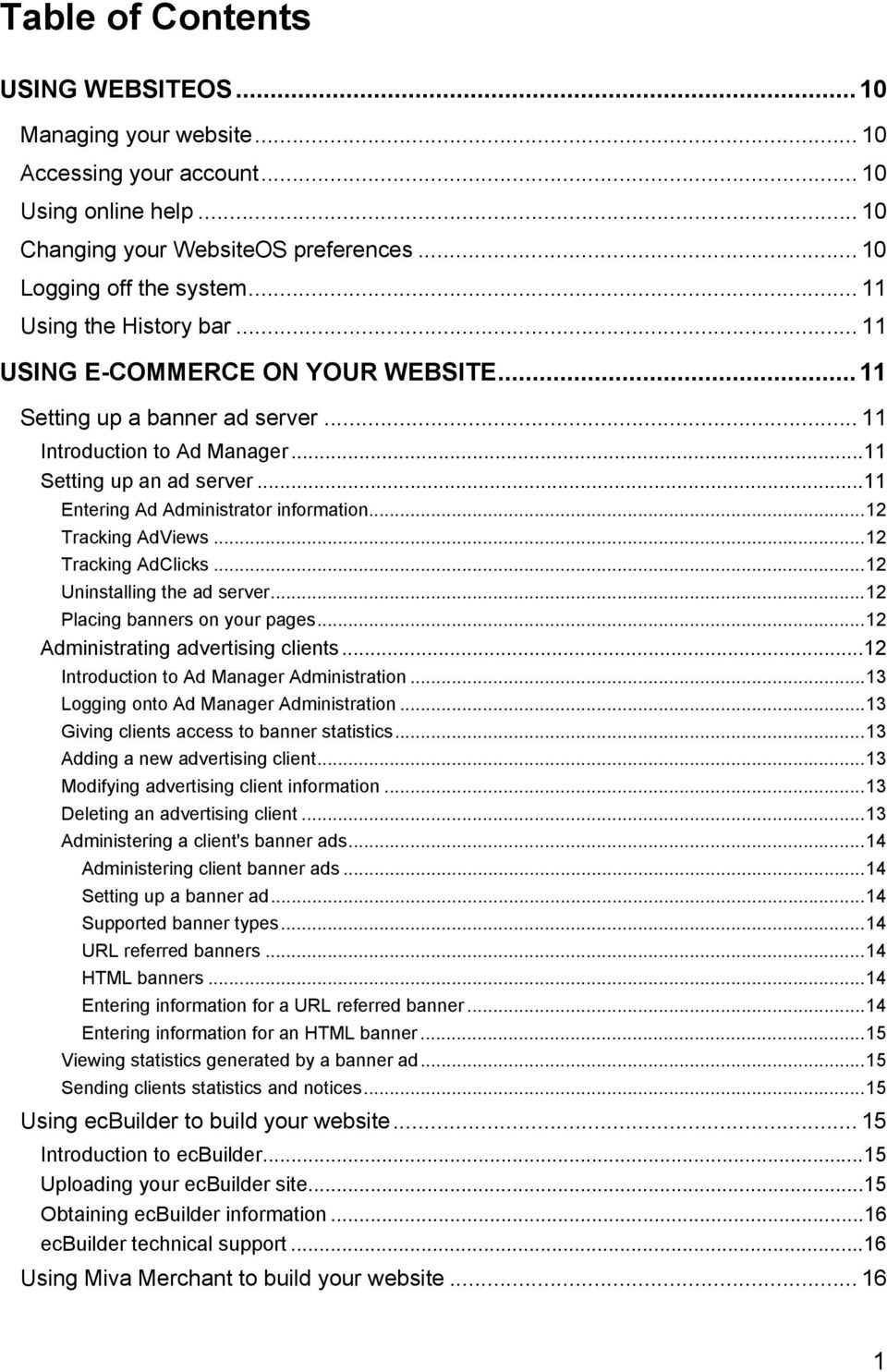
2 Introduction to Miva Merchant...16 Purchasing the Miva package...16 Purchasing a Miva license key...16 Installing Miva on your domain...17 Configuring Miva Merchant...17 Administering your store...17 Viewing your license number...17 Using Miva Manager Advanced options...17 Backup your Miva Merchant files...17 Restoring a Miva Merchant installation...18 Repairing your Miva installation...18 Upgrading your Miva Merchant...18 Using EasyStoreMaker Introduction to EasyStoreMaker...18 Installing EasyStoreMaker on your domain...18 Configuring EasyStoreMaker...19 Initial setup...19 How to enter your company info...19 How to enter the tax information...20 How to enter shipping prices...20 Picking payment types...20 Selecting the currency...20 Entering information on the Security tab...20 How to enter Product information...21 Adding a product...21 Entering product images...21 Editing product information...21 Deleting a product...22 Managing your Orders Online...22 Viewing your Orders Online...22 Filling Orders...23 Deleting Orders...23 Uninstalling EasyStoreMaker...23 Using EasyStoreMaker Pro Introduction to EasyStoreMaker Pro...23 Installing EasyStoreMaker Pro on your domain...24 Using the add products wizard...24 Manually configuring EasyStoreMaker Pro...25 Manually configuring EasyStoreMaker Pro...25 How to enter your company info...26 How to enter the tax information...26 How to enter shipping prices...26 Picking payment types...28 Selecting the currency...29 Choosing a gateway...29 Choosing a gateway
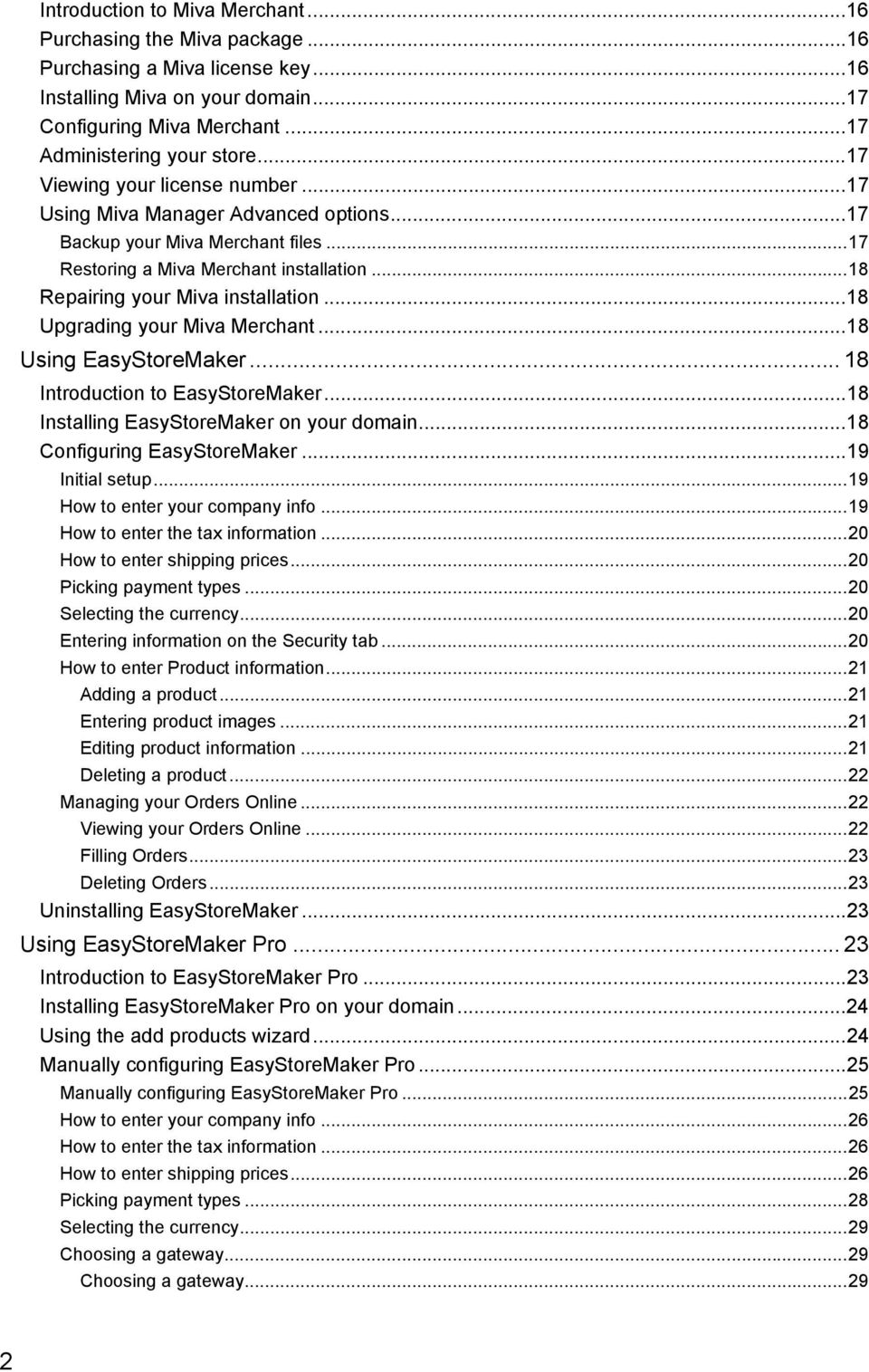
3 Authorize.net Configuration requirements...30 Entering information on the security tab...31 Setting Preferences...31 Uploading images...31 How to enter product information...32 Adding a product...32 Editing product information...34 Global Settings...36 Deleting a product...37 How to enter catalog information...37 Adding a catalog...37 Editing catalog information...38 Deleting catalogs...38 Managing your orders online...39 Viewing your orders online...39 Filling orders...39 Deleting orders...40 Registered users...40 Introduction to registered users...40 Setting up direct links...40 Uninstalling EasyStoreMaker Pro...41 BUILDING YOUR WEBSITE...41 The Advanced Template Manager Introduction to the Advanced Template Manager...41 Designer Templates...42 Basic Templates...42 Royalty-Free Images...42 Downloading Templates and Images...43 Using the Appointment Scheduler Introduction to Appointment Scheduler...43 Installing the Appointment Scheduler...44 Entering your company information...44 Booking Hours...44 Messages...45 Preferences...46 Appointments...46 Editing Your Values...46 Uninstalling Appointment Scheduler...46 Using EasyBlogBuilder Introduction to EasyBlogBuilder...47 Installing EasyBlogBuilder...47 Configuring EasyBlogBuilder...47 Configuring EasyBlogBuilder...47 The Preferences tab

4 The Appearance tab...48 The Users tab...49 The Security Tab...49 Creating an EasySiteWizard website Introduction to EasySiteWizard...49 Browser compatibility with EasySiteWizard...49 EasySiteWizard step descriptions...50 Creating and editing a website...50 Creating a new site...50 The EasySiteWizard tool bar...51 The "My Websites" window...51 Editing an EasySiteWizard site...51 Deleting an EasySiteWizard site...52 Cloning an EasySiteWizard site...52 Step 1: Define it...53 Step 2: Design it...53 Step 3: Build your site...55 Introduction to PageEditor...55 Cut-and-paste into PageEditor...55 Cut-and-paste into PageEditor...55 Entering text in PageEditor...56 Using images with PageEditor...56 Other image sources for your library...57 Navigation Setup...57 Using SiteSparks...59 Using forms...59 Publishing your website...63 Importing a Business Card website into EasySiteWizard...63 HTML tags...63 Explanation of meta tags...64 Example of a simple HTML page...64 Website Creation Tools Introduction to Webmaster Tools...66 Using FTP to transfer files Introduction to FTP...66 Logging in to FTP automatically...67 Introduction to FTP Manager...67 Adding an FTP user...67 Deleting an FTP user...67 Changing FTP access to a directory...68 Using an external FTP client...68 Using Anonymous FTP...68 Introduction to anonymous FTP...68 Enabling anonymous FTP...68 Disabling anonymous FTP...69 Using anonymous FTP with a graphical FTP client

5 Using anonymous FTP with a command line system...69 Using anonymous FTP with a browser...70 Using MS FrontPage Installing the FrontPage extensions...70 MS FrontPage restrictions...70 Installing on domains with access control files...71 Uninstalling FrontPage extensions...71 Publishing your FrontPage web tutorial...72 Installing on domains without access control files...73 Solving FrontPage access problems...73 Setting-Changing FrontPage passwords...74 Definition of access control files...74 Using ASP, ASP.net, ColdFusion and ColdFusion MX Introduction to the Windows Services Enabler...74 Definition of ASP...74 Definition of ASP.net...75 Definition of ColdFusion...75 Definition of ColdFusion MX...75 Enabling a standard service...76 Enabling a secure service...76 Disabling a service...77 Windows Services file locations...77 Windows Services file extensions...77 ColdFusion custom tags...78 More information on Windows Services...78 Adding pre-written CGI scripts to your pages Introduction to the Plug-in Scripts function...78 Using Plug-in Scripts...78 Available scripts...79 FormMail...79 Sending FormMail results to an outside address...80 TextCounter...81 Counter...82 Guestbook...82 Search engine...83 Setting up EasyLiveChat Introduction to EasyLiveChat...83 The Agents Tab...84 The Responses Tab...85 The Surveys Tab...87 The Transcripts Tab...88 The Setup Tab...88 The Agent Interface...89 The Client Interface

6 MANAGING WEBSITE SECURITY...90 Changing your password Changing your password...91 Securing your website Introduction to Website Security...91 Selecting a directory to secure...91 Enable and disable directory security...92 Restricting access with a password...92 Restricting access by hostname or IP address...92 Setting up a SSL Certificate Introduction to SSL Manager...92 Setting up a Generic SSL Certificate...92 Setting up a Private SSL Certificate...93 Using Shell Access Introduction to Secure Shell Access...95 Enabling SSH...95 Disabling SSH...95 The Secure Shell Tab...96 The Users Tab...96 Using an SSH client...96 Shell Commands...97 ACCESSING YOUR WEBSITE STATISTICS...97 Monitoring your disk usage and bandwidth Monitoring your disk usage and bandwidth...98 Determining your site's disk space usage Determining your disk space usage...98 Accessing your website's server logs Using the Log Manager...98 Viewing your server logs...98 Deleting your log files...99 Disabling your log files...99 Printing your log files...99 Downloading your server logs...99 Rotating and dating log files...99 Analyzing your server logs Introduction to Web Stats Generating reports Configuring your report settings Viewing reports Description of report statistics

7 MANAGING YOUR WEBSITE Managing your website's files Introduction to File Manager File Manager browser issues Using source and destination directories Changing directories Deleting files Renaming files Copying files Moving files Create a directory Removing a directory Setting file permissions Description of how the server uses file permissions Editing files Downloading files Uploading files to the server Using the upload function Source and local directories Uploading multiple files Restoring your site content Introduction to File Restore Restoring your website content Directory browsing issues How to restore entire directories Viewing the history of restore operations Checking the integrity of your website Using the Site Checker function Checking internal and external links Checking a secured website Pointing Site Checker to your home page Promoting your website Using the Promote Site function Selecting search engines Unsuccessful search engine submissions More information about search engines Managing your MySQL database Introduction to Database Manager Setting your Database Manager password Changing your Database Manager password Creating a database Connecting to your database Creating a table

8 Creating an index Dropping a database Using a database Altering a table Introduction to altering a table Altering a column Adding a column to the table Adding an index to the table Creating a unique index for the table Making changes to a column Dropping a column Modifying a column Changing the table name Deleting rows from a table Dropping a table Getting information about a table or column Inserting data into a table Updating data within a table Selecting data from the database Display information about the database Display information about columns Display information about table indexes Display information about table keys Display the list of tables in a database Pointing your domain Introduction to Domain Pointing Pointing your domain Changing the pointed at domain Retaining the pointed URL Removing domain pointing Tracking hits to your pointed domain Forwarding your Manage multiple domains using VM Server Introduction to the VMS Manager Domain settings Main options Change applications Change forwarding Change package type Modify s Switch to Update contact information Update password Change status VMS Settings Main options

9 Change branding Change master password Adding domains Billing settings What the automated billing system does Main options Payment gateway settings Billing preferences Custom billing Custom billing Billing details Invoices Products & pricing HOW TOs How to enable billing How to delete a domain How to set up standard billing How to set up custom billing How to set up one-time fees How to review one-time fees FEEDBACK FORM Submitting your feedback ADDING A NEW RECORD TO YOUR ZONE FILE DELETING A RECORD FROM YOUR ZONE FILE EDITING A RECORD IN YOUR ZONE FILE INTRODUCTION TO DNS MANAGER RESTORING YOUR DEFAULT ZONE FILE USING THE RUN BOX

10 Using WebsiteOS Managing your website WebsiteOS is a browser based application that allows you to manage many aspects of your website. Using WebsiteOS, you can: Generate usage statistics Promote your website Manage your files on the server Change passwords Setup your own ad server Add and remove FrontPage extensions Enable ASP, ColdFusion and Virus Scanning Send announcements about your site Analyze your website's structure and integrity Create and manage an effective single page website Check your disk usage Manage server logs Secure sections of your website Configure and install common CGI scripts Check the status of the web server Send feedback about WebsiteOS Build your e-commerce using ecbuilder Build your e-commerce using Miva Merchant Monitor your disk usage and bandwidth Manage your MySQL database Set up a private or generic SSL certificate on your domain Create a website using EasySiteWizard Point your domain Manage multiple domains using VM Server Accessing your account To access WebsiteOS, connect to the URL Replace the text "yourprovider'sdomain" with your web hosting company's domain name. This URL will access the WebsiteOS login page. Enter your domain as your username and your domain password in the login box. Click the "Login" button to enter WebsiteOS. Changing your WebsiteOS preferences 10

11 The WebsiteOS Preferences menu allows you to select a language and a background. Click on the "WebsiteOS Preferences" logo. A dialog box will appear. Language: To change the language setting, select your preferred language in the "Language" field, and click "Apply." Background: To change your background color, click the color wheel. Select a colored square from the pop-up chooser, and click "Apply." Be sure that your background image is set to "(none)." To change your background image, select the name of the image from the "Image" drop-down menu and click "Apply." If a background image is selected, your background color will not be visible. Logging off the system When you are ready to leave your administration session, click the "Logout" option. This will log you out of your session. Using the History bar The History bar contains links to the applications you accessed most recently. Click on a link for immediate access to the application. Using e-commerce on your website Setting up a banner ad server Introduction to Ad Manager To access the Ad Manager, select E-commerce from the main menu, and select Ad Manager from the e-commerce menu. This function allows you to configure an ad server for use on your website. An ad server allows you to place rotating banner advertisements on your website, manage your advertising clients, and to collect statistics on banner views and "click throughs." Setting up an ad server 11

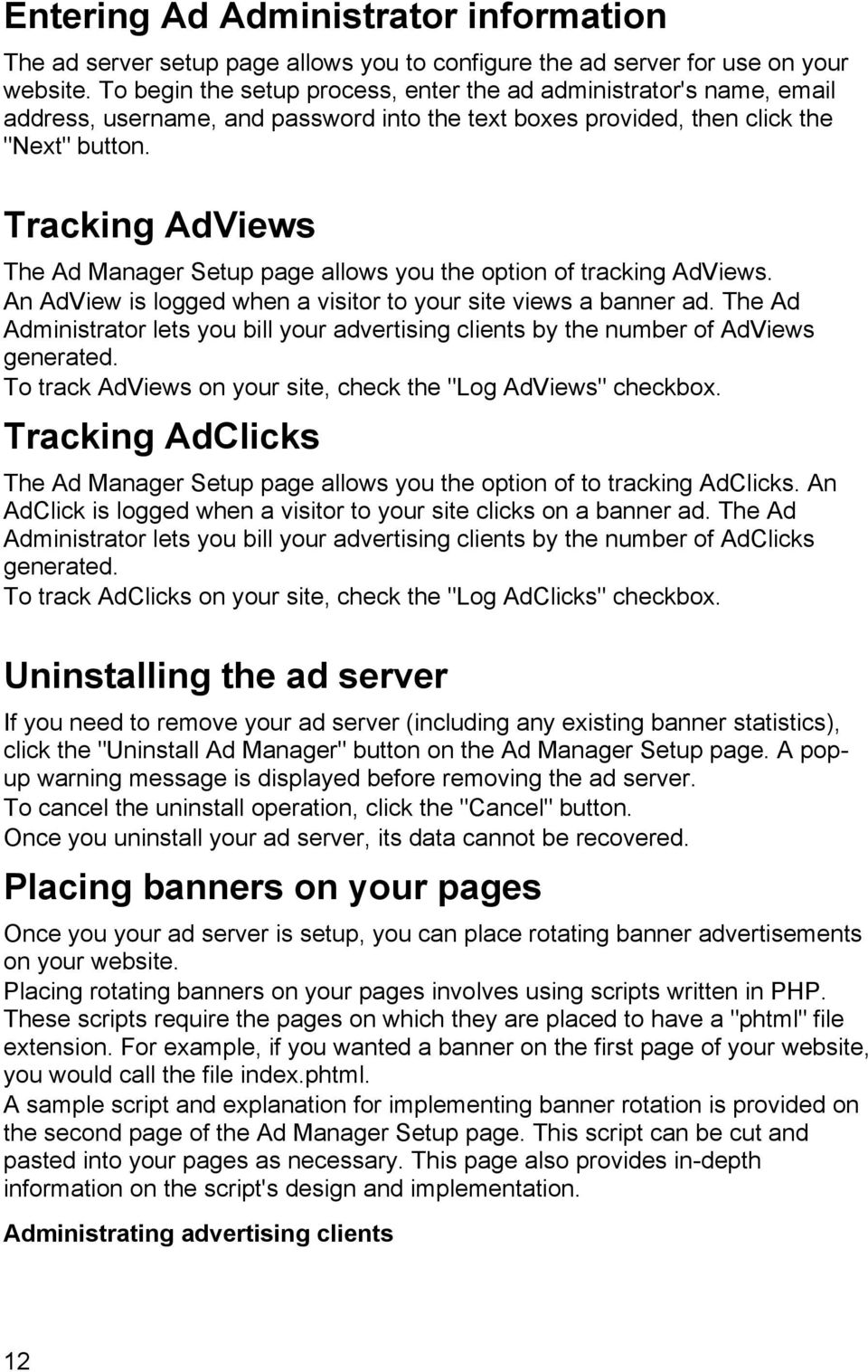
12 Entering Ad Administrator information The ad server setup page allows you to configure the ad server for use on your website. To begin the setup process, enter the ad administrator's name, address, username, and password into the text boxes provided, then click the "Next" button. Tracking AdViews The Ad Manager Setup page allows you the option of tracking AdViews. An AdView is logged when a visitor to your site views a banner ad. The Ad Administrator lets you bill your advertising clients by the number of AdViews generated. To track AdViews on your site, check the "Log AdViews" checkbox. Tracking AdClicks The Ad Manager Setup page allows you the option of to tracking AdClicks. An AdClick is logged when a visitor to your site clicks on a banner ad. The Ad Administrator lets you bill your advertising clients by the number of AdClicks generated. To track AdClicks on your site, check the "Log AdClicks" checkbox. Uninstalling the ad server If you need to remove your ad server (including any existing banner statistics), click the "Uninstall Ad Manager" button on the Ad Manager Setup page. A popup warning message is displayed before removing the ad server. To cancel the uninstall operation, click the "Cancel" button. Once you uninstall your ad server, its data cannot be recovered. Placing banners on your pages Once you your ad server is setup, you can place rotating banner advertisements on your website. Placing rotating banners on your pages involves using scripts written in PHP. These scripts require the pages on which they are placed to have a "phtml" file extension. For example, if you wanted a banner on the first page of your website, you would call the file index.phtml. A sample script and explanation for implementing banner rotation is provided on the second page of the Ad Manager Setup page. This script can be cut and pasted into your pages as necessary. This page also provides in-depth information on the script's design and implementation. Administrating advertising clients 12
13 Introduction to Ad Manager Administration This function allows you to administer your ad server. You have control over adding and editing client information, deleting clients, banner configuration, and generating statistics. You can give your clients access to the statistics generated by their banners or have the statistics automatically ed to them. Logging onto Ad Manager Administration There are two methods by which you can login to Ad Manager Administration: 1. Click the link on the 2nd page of the Ad Manager Setup page. 2. Directly connect to Ad Manger Administration by entering the URL into your browser. After connecting to Ad Manager Administration, you will be prompted for the Ad Administrator's username and password. This username/password combination can be different from the username/password combination used to login to the website administration application. Giving clients access to banner statistics To give your advertising clients access to their banner generated statistics, send them to the URL as indicated on Ad Manager's second page. Adding a new advertising client This function allows you to add new advertising clients. To add a client, click the "Add new client" link. The client information page will be displayed. Fill in the information required and click the "Go" button to finish the operation. Modifying advertising client information To modify an existing client's information, select a client from the drop-down menu and click the "Go" button. The client information page will be displayed. Edit the information as required and click the "Go" button to finish the operation. Deleting an advertising client To delete an existing client, select a client from the drop-down menu and click the "Go" button. A warning will be displayed stating that the deletion process is permanent. You have the option of canceling the operation or continuing it. 13

14 Administering a client's banner ads Administering client banner ads To setup a banner, select a client from the drop-down menu and click the "Go" button. A list of banners will be displayed along with the option to ad a new banner. Setting up a banner ad To add a new banner, click the "Add new banner" link. The edit banner page will be displayed. After filling in the appropriate information on the page, the banner will be displayed. Click the "Go" button to complete the operation. Supported banner types You can display URL referred banners as well as HTML banners on your pages. URL referred banners URL referred banners are banners that reside at a specific URL address. These banners do not have to be uploaded to your site. They can reside on a remote server. URL referred banners can be advantageous to your clients as they can update their banners locally and the changes will be reflected immediately on your pages. This avoids the process of uploading and downloading the banners for modification. HTML banners An HTML banner is a banner generated by HTML. You can enter the HTML directly into the Ad Manager Banner Administration page or supply a URL. Entering information for a URL referred banner To setup a URL referred banner, click the "Banner referred to through URL" radio button from the Ad Manager Banner Administration's "Ad Banner" link. You must have the following information to setup a URL referred banner ad: the URL, the banner's dimensions in pixels, its ALT text and the text to be displayed below the banner. 14

15 Entering information for an HTML banner To setup an HTML banner, click the "HTML banner" radio button from the Ad Manager Banner Administration's "Ad Banner" link. You can enter the HTML directly into the Ad Manager Banner Administration page or supply a URL. Viewing statistics generated by a banner ad To view a client's statistics, select a client from the drop-down menu and click the "Go" button. Various banner statistics will be displayed including the number of hits. Sending clients statistics and notices To automatically send client statistics and expiry notices, click the "Send Client Statistics & Expiry Notices" link. A status page will be displayed confirming a successful operation. Click the "OK" button to return to the Ad Administration function. Using ecbuilder to build your website Introduction to ecbuilder To access ecbuilder downloads, select E-commerce from the main menu, and select ecbuilder Download from the e-commerce menu. This advanced tool is useful for customers interested in building and maintaining an e-commerce site. ecbuilder comes in two versions which are described below. The ecbuilder SOHO version can be downloaded FREE from our ecbuilder page. It is a basic version of ecbuilder with limited features. The ecbuilder Pro version can be downloaded from our ecbuilder page. The download package is a trial version of ecbuilder, which can be turned into a full version via a license key. A license key can be purchased through us or directly from ecbuilder. Uploading your ecbuilder site To successfully upload your ecbuilder website, follow this procedure: 1. After completing the website construction process, you will be presented with two options: FTP to your existing Internet Service Provider 15

16 Save your web site to a file folder Choose the "Save your web site to a file folder". 2. After saving your site to disk, use an FTP client to upload the site to our server. Choosing "FTP to your existing Internet Service Provider" will not successfully upload your site. Please be sure to use the above procedure for the best results. Obtaining ecbuilder information If you need general or pre-sales ecbuilder information, it can be obtained from ecbuilder at: ecbuilder technical support We are a reseller for ecbuilder and as such do not support the product. If you require support installing or using ecbuilder, contact ecbuilder's technical support at: Using Miva Merchant to build your website Introduction to Miva Merchant To access Miva Manager, select E-commerce from the main menu, and select Miva Manager from the e-commerce menu. This option will only be available if Miva Manager has been added to your domain for e-commerce. Miva Merchant is a browser-based store front development and management system. The modular organization allows the Miva Merchant to be upgraded "live", without any changes to the core system and without taking the store down in the process. All Miva Merchant application and database files are 100% cross platform. A user can enter colors, fonts, images, layout, etc all from the online administrative interface. Purchasing the Miva package In order to use Miva Merchant to build your virtual store, you must first purchase our Miva Merchant package. After logging into the WebsiteOS and launching the Miva Manager, follow the "Click here to purchase a Miva package" link. Purchasing a Miva license key In addition to the Miva Merchant package, you will need a Miva license key in 16

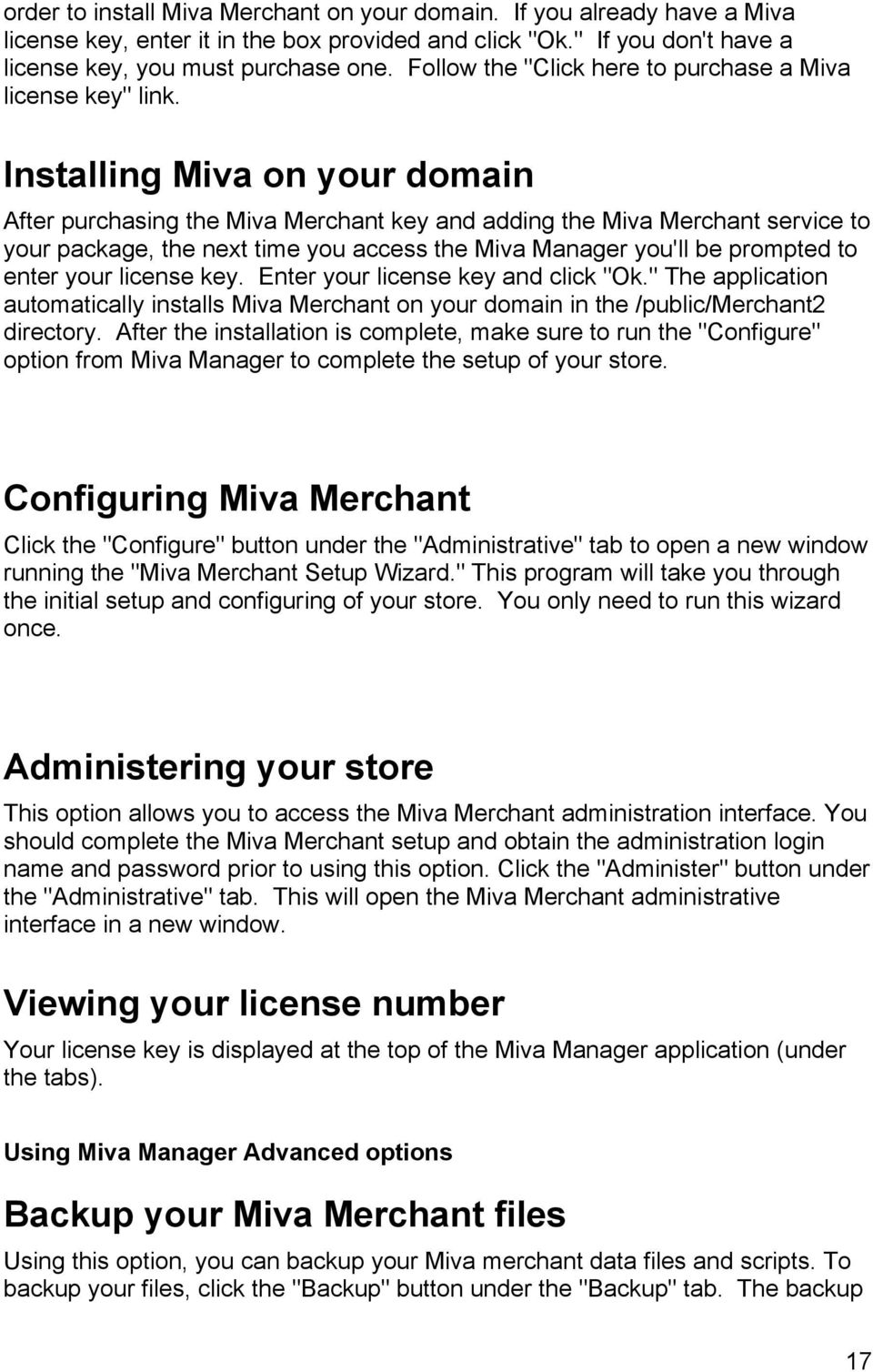
17 order to install Miva Merchant on your domain. If you already have a Miva license key, enter it in the box provided and click "Ok." If you don't have a license key, you must purchase one. Follow the "Click here to purchase a Miva license key" link. Installing Miva on your domain After purchasing the Miva Merchant key and adding the Miva Merchant service to your package, the next time you access the Miva Manager you'll be prompted to enter your license key. Enter your license key and click "Ok." The application automatically installs Miva Merchant on your domain in the /public/merchant2 directory. After the installation is complete, make sure to run the "Configure" option from Miva Manager to complete the setup of your store. Configuring Miva Merchant Click the "Configure" button under the "Administrative" tab to open a new window running the "Miva Merchant Setup Wizard." This program will take you through the initial setup and configuring of your store. You only need to run this wizard once. Administering your store This option allows you to access the Miva Merchant administration interface. You should complete the Miva Merchant setup and obtain the administration login name and password prior to using this option. Click the "Administer" button under the "Administrative" tab. This will open the Miva Merchant administrative interface in a new window. Viewing your license number Your license key is displayed at the top of the Miva Manager application (under the tabs). Using Miva Manager Advanced options Backup your Miva Merchant files Using this option, you can backup your Miva merchant data files and scripts. To backup your files, click the "Backup" button under the "Backup" tab. The backup 17
18 files will be saved in a subdirectory in your home directory. This directory will be called Merchant2 with the date and time of backup appended at the end of the directory name. Restoring a Miva Merchant installation After upgrading to the latest version of Miva Merchant, you always have the option of restoring your original installation. Select a date to restore from and click the "Restore" button under the "Backup" tab. Miva Manager will restore the selected store. Repairing your Miva installation If one or more of the Miva Merchant core installation files are deleted or missing, they can be reinstalled by running the "Analyze" option in Miva Manager. Click "Analyze" under the "Backup" tab and Miva Manager will automatically check your installation and replace any missing files. Upgrading your Miva Merchant If you are not running the latest version of Miva Merchant, you will see an "Upgrade" option under the "Administrative" tab. To automatically backup your current installation and upgrade your store to the latest version of Miva Merchant, click the "Upgrade" button. Miva Manager will run Miva's upgrade interface immediately following this operation. You must complete Miva's upgrade wizard to ensure your store was upgraded completely. Using EasyStoreMaker Introduction to EasyStoreMaker EasyStoreMaker gives you the opportunity to set up a simple store on your website. Orders placed there can be viewed securely online, giving you all the information you need to keep things organized (e.g. name, shipping address, products ordered, total price and credit card number). Enter your products, set the prices and the tax calculator; you can even select the currency your store will use. All this and more in an easy-to-use interface. To access the EasyStoreMaker, select E-commerce from the main menu, and select EasyStoreMaker. This function allows you to configure a basic e-commerce store for use on your website. Installing EasyStoreMaker on your domain 18

19 To install the EasyStoreMaker on your domain: Open the EasyStoreMaker application from the E-commerce menu. Make sure that the radio button beside To install EasyStoreMaker click the Next button is selected (as this is the only option, it should already be selected). Click the Next button. You are now taken into the Initial setup screen for your store. Configuring EasyStoreMaker Initial setup The EasyStoreMaker was created with your ease in mind; in about five minutes you can have everything set up. After installing, you can either enter your store information, or exit the application. If you wish to have your store be a standalone web page, the URL of the store can be found by using the following method: 1. Click on the link labeled Click Here to access your Store. 2. Highlight and copy the URL listed in the window which pops up. After reading the license agreement, clicking Next will take you to the main configuration page. Here you will see seven tabs, listing different aspects of your store. For the initial set up, you can only enter information into the tabs in a preset order; once set up, you will be able to click on any tabs you wish and in any order. The first time you enter your information into EasyStoreMaker, click Apply. This will save the information and then take you to the next tab in the sequence. The final step has a Next button, as you can decide to enter your products now or later. Selecting Later will take you back to the main page. Selecting Now brings you to the Products tab, where you can enter all of your product information. How to enter your company info The information entered into the "Company" tab will appear on your EasyStore web pages. If you do not wish to have this information displayed, make sure the "Hide Footer" box is checked. The only mandatory fields are the State/Prov. and Country fields. These are required to help calculate the tax on your customer's orders. The "Introduction Message" is displayed on the main page of your EasyStore. The "Thank You Message" is displayed after your customer has finished ordering. They are then sent to the "Completion URL". This can be any webpage you wish. The Maintenance Message is what will display if for any reason your store becomes temporarily inaccessible. 19

20 How to enter the tax information The "Tax Table" tab is where you enter the tax values to be charged to your customer s orders. You can enter the amount of tax as well as the name of the tax being applied. You can also choose not to charge any tax if you wish. This is where the "State/Prov." and "Country" information come into play. EasyStore calculates the amount of tax that is charged per order based on the buyer s place of residence. If you are charging tax for residents of certain states or provinces, this will ensure that you don t miss anyone. How to enter shipping prices The "Shipping" tab allows you to enter shipping fees, which will be applied to all orders. By default you must enter a value, but if you do not wish to charge shipping, enter "0" (zero). You can select to apply additional fees to "International Orders" and/or "Out of State/Province" if you wish. Simply check the box and enter a value in the appropriate field. Picking payment types The "Payment Types" tab will allow you to select which credit cards to accept. The EasyStoreMaker only accepts credit cards as a method of payment. Check the box next to the card(s) you wish to accept. Selecting the currency EasyStoreMaker allows you to choose what currency in which to list your products. Select the one you want from the drop-down menu. If you select any dollar currency, you have the option of having the $ appear next to the amount. By default this option is selected, so if you have chosen a non-dollar currency, be sure to uncheck this box. Entering information on the Security tab The following fields are displayed under the security tab: Order Notification: check this box if you wish to receive s indicating that orders have been placed. Please note that the order notifications do not contain actual order information, just a notice that an order has been made. Notification Address: this is a field for the address which will receive order notifications. This address will also be used to send you your password if you have forgotten it. It is mandatory that you enter in a valid address in this field. Order Processing Username: this is the username you would use to log in and pick up your orders online. It is the same as the domain name of your website. 20
21 Order Processing Password/Confirm: when changing the password or entering in a password for the first time, both of these fields must be filled. If what was entered in each field is not identical, the new password will be rejected. For increased security, the password is never shown as clear text. How to enter Product information Adding a product To add a product to your EasyStore: Select the Products tab and click on Add. Enter the product name, description (if you wish) and the price. If you wish to load a product image, do so on this page. You can enter either the image file name (which must be loaded into your public/storemaker/images directory), or a complete URL to the online image. Click Apply and your product is saved to the list. Click Back to return to the main "Products" tab. You will see a list of your current products listed. If you have more products to add, click on Add and repeat the above process. Entering product images On the "Product" tab you can enter a product image to showcase it. You can enter either the image file name or a complete URL of an online image in the "Product image" field on the Product tab. To upload your own image, follow the "Using the upload function" page of the "Managing your website" section of the Help files. The target directory for your image is../public/storemaker/images The image can be any image format (gif, jpg, bmp, etc.) To use a current online image, enter the complete URL of the image. Editing product information To edit a product in EasyStoreMaker: Select the Products tab. A list of your current products will be displayed. Select the product you wish to edit by clicking the radio button next to it, and click the Edit button. If you do not wish to make changes, simply click the Back button to return to the first "Products" tab screen. If you wish to remove a product from your store, click the radio button next to "Hide from View". Your product will no longer appear on your store's 21
22 webpages, but it still appears in EasyStoreMaker. If a product is sold out, you can check this radio button and "Sold Out" will appear next to your product on your store's webpage. Make any changes and click Apply. Deleting a product To delete a product in EasyStoreMaker: Select the Products tab. A list of your current products will be displayed. Select the product you wish to delete by clicking the radio button next to it, and click the Delete button. Your product has now been deleted. Managing your Orders Online Viewing your Orders Online EasyStoreMaker allows you to view your orders online securely and safely. The web pages are secure, and the actual file which holds the order information is encrypted. All of this is handled through an interface which is fast and easy to use. To view and manage your orders online, either follow the URL provided in your notification , or log into WebsiteOS, open EasyStoreMaker and click on Click Here to access your orders. You will be taken to a log in screen, where you must enter your Login Name, which is the domain your store is on, and your password, which you created under the "Security" tab when you set up the store. If you have forgotten your password, click on the link on the log in screen titled Forgot your password? and your password will be ed to the notification address you entered in the store settings under the Security tab. This feature is particularly useful if the person who receives notifications and manages the orders is different from the person who has access to the EasyStore s settings. After logging in, you will be taken to a page which summarizes all unfilled orders. You can select how to sort the list. Clicking Received Date will sort them by date received. Clicking on this heading again will toggle the list between ascending and descending order. Similarly, you can also click Card Type. If you click on any of the links listed under Details, the full information for an order will be displayed. Clicking Print on this page will print the order details currently being displayed. To switch between Open and Filled orders, click on Filled Orders. The filled orders list is virtually identical in layout to the Open Orders list, with the exception that only the first and last four digits of credit card numbers are visible. To switch back to the Open Orders list, click the Open Orders button. The Print button will print up the current order summary page. 22
23 Filling Orders After you have taken whatever steps are necessary to fill a particular order, in the message details for that order, click on Order Filled. By default, the current date is used. Before you mark the order as filled, you can edit this date in the field beside the Order Filled button. Once you have flagged an order as filled, it is no longer in the Open Order list; it will now only be viewable in the Filled Order list. Only the first and last four digits in a credit card are displayed for a filled order. Once an order has been marked as filled, there is no way to recover this credit card information. Deleting Orders To delete an order from either the Open or Filled Order list: 1. Go to the list from which you want to delete orders. 2. Click on the checkboxes in the right-hand column beside any of the orders you want to delete. 3. Click on the Delete Selected button, located in the bottom-right corner of the screen. 4. A confirmation box will come up. Click yes. 5. The list will refresh; the items flagged for deletion will be gone, and there will be a message at the top of the screen stating which orders were successfully deleted. Uninstalling EasyStoreMaker To uninstall the EasyStoreMaker from your domain: Open the EasyStoreMaker application from the E-commerce menu. Select the radio button next to Uninstall EasyStoreMaker. (Everything is permanently deleted) and click Next. EasyStoreMaker has now been uninstalled. Please note that uninstalling your EasyStore permanently deletes all related records from your domain. If you reinstall your EasyStore at a later date, all the information you entered during your previous installation will have to be reentered. Using EasyStoreMaker Pro Introduction to EasyStoreMaker Pro EasyStoreMaker Pro gives you the opportunity to set up a full-featured store on your website. Orders placed there can be viewed securely online, giving you all 23
24 the information you need to keep things organized (e.g. name, shipping address, products ordered, total price and payment information). Enter your products, organize them in categories, set the prices and the tax calculator; you can even select the currency your store will use. All this, and more. Installing EasyStoreMaker Pro on your domain To install EasyStoreMaker Pro (ESM Pro) on your domain: 1. Log in to WebsiteOS if you are not already logged in. 2. Click on the E-commerce link, found towards the left of the WebsiteOS screen. 3. Click on EasyStoreMaker PRO. 4. An installation window will appear, asking if you want to install and configure ESM Pro using the Install Wizard, or by manually configuring your EasyStore. Manual configuration of ESM Pro is only recommended for users who are already familiar with the configuration of ESM Pro, and/or have read through the section titled Manually configuring EasyStoreMaker Pro and all of its related topics. If you run the installation wizard (recommended), you will be guided through the essential steps of setting up your storefront. At each step, detailed information is provided explaining what type of information is expected every step of the way. You will also be asked questions concerning optional features of your store. If you are uncertain if you want to use a particular feature, you can skip configuring that feature and configure it later; see Manually configuring EasyStoreMaker Pro and its related topics. When you have finished configuring your store with the installation wizard, you will be asked if you want to create products for your store to sell. If you select Yes, then you will be given the option of running the Add Products Wizard. If you choose not to add products at this time, you will always have the option of using the Add Products Wizard at a later date. Using the add products wizard The Add Products Wizard can be run at any time. If you are installing EasyStoreMaker Pro (ESM Pro) for the first time, you will be given the option of running the Add Products Wizard after configuring your store with the install wizard. If you are not installing EasyStoreMaker Pro (ESM Pro) for the first time, or you chose to manually install ESM Pro, you can access the Add Products Wizard using the following method: 1. Log in to WebsiteOS if you are not already logged in. 2. Click on the E-commerce link, found towards the left of the WebsiteOS screen. 3. Click on EasyStoreMaker PRO. 24
25 4. Click on the Add Products Wizard link which appears in the middle of the screen. When the Add Products Wizard starts, just follow the step-by-step instructions which appear on the screen. If you wish to manually edit, add or delete products, see the section titled How to enter product information. Manually configuring EasyStoreMaker Pro Manually configuring EasyStoreMaker Pro To access EasyStoreMaker Pro, select E-commerce from the main menu, and select EasyStoreMaker Pro. To accommodate the large amount of new features available in EasyStoreMaker Pro, the store's preference interface is split up into 3 sections: Tab, User Data and Category. A labeled illustration, with explanations, follows: 1 (Tab): The topmost section of the preferences window has labeled tabs. Clicking on a tab opens a window, with information related to the tab name. In the example above, the "Tax Table" tab is currently selected. If you have made changes to a tab, and want to save the data you have entered, you must click "Apply" before moving on to another tab. 2 (User Data): The middle section of the page is where the user's preferences are displayed for a particular subject. 3 (Category): Because of the large amount of configurable data under certain tabs, some of them have been subdivided into categories. In the example above, the "State" category is displayed. Each category contains a related set of data which is relevant to the selected tab. When you move between different 25
26 categories, you are just viewing different sets of data for the same tab. If you have made changes to a category, and want to save the data you have entered, you must click "Apply" before moving on to the next category. How to enter your company info The information entered into the "Company" tab will appear on your EasyStore Pro web pages. If you do not wish to have this information displayed, make sure the "Hide Footer" box is checked. The only mandatory fields are the State/Province and Country fields. These are required to help calculate the tax on your customer's orders. If you enter in your company's address, and hide your company footer, the address will still be displayed. In the "Header" category, you may enter your store name and select the filename or URL of your company logo. For information on uploading images, see the section titled Uploading Images. In the "Messages" category, you may enter the following message types: Introduction Message: A welcome message which appears on your storefront. Thank You Message: A message which displays at the completion of a customer's order. You may also choose to send this message to customers by . Maintenance Message: This message will appear, if for any reason your store is temporarily unavailable. Disclaimer Notice: Checking "apply disclaimer" and filling out this text box will create a link in the footer of your store's page, which will link to a popup window. This window will display your disclaimer message. Privacy Statement: Similar to the "Disclaimer Notice", except this is used to include a privacy statement, accessible through a link on the footer of your store. How to enter the tax information The "Tax Table" tab is where you enter the tax values to be applied to your customer s orders. You can enter the amount of tax, as well as the name of the tax being applied. There are two subcategories of tax: "State" and "Federal". In the "Federal" section, you get to chose if your state tax is added to federal taxes before being applied, or if it is applied after federal taxes have been applied. You can also choose not to charge any taxes if you wish. This is where the "State/Prov." and "Country" information come into play. EasyStore Pro calculates the amount of tax that is charged per order based on the buyer s place of residence. How to enter shipping prices 26
27 The "Shipping" tab allows you to enter shipping fees, which will be applied to all orders. There are three main classifications of shipping: Regional, National, and International. Explanations are as follows: Regional: Shipments to locations in the same region as the store, i.e. the same state or province. National: Shipments to locations in the same country as the store, but are outside the store's state or province. International: Shipments to locations in a different country. The "Charge Rate" category allows you to specify the charge rate for each of the shipping methods you have created. Using this interface, each shipping method must be associated with one of the three main classifications shown above. Shipping and handling fees can be based on quantity or weight. If you choose to base it on weight, then you must enter a weight for all of your store's items. It is possible to have more than one shipping option available to each classification (e.g. rush delivery and regular mail). By default, there should be three shipping methods already set up: Regional, National and International. To use these default shipping methods, complete the steps outlined below: 1. Click on the "Additional Charges" category. If this section has no values entered, skip ahead to step 3; otherwise, proceed to step If you want to use the charge rates listed in this interface, write down the rates for each shipping type, then remove this information from the interface and click "Apply". 3. In the "Charge Rate" category, select the first method listed in the dropdown menu. 4. Make sure that "Apply this method" is checked. If it is not, place a checkmark beside it. 5. Indicate which classification of shipping this method should be applied to. In this instance: The "Regional" method should be applied to "Regional Orders". The "National" method should be applied to "National Orders". The "International" method should be applied to "International Orders". 6. Using the drop-down menu located near the top of the interface, indicate whether this should be a flat-rate or a range-rate charge. Fill out the charge rate(s) as appropriate. 7. Click "Apply" to save your settings. 8. Select the next method from the drop-down list. Repeat steps 4-8 until all shipping methods have been configured. 9. Click on the "Instructions" category. 10. Select the first method from the drop-down list. 11. Type in any information or instructions you want the end-user to see concerning this shipping method (e.g. shipping cost, average shipping time, etc.) Click "Apply" when you are done. 12. Select the next shipping method from the drop-down list. Repeat steps until all shipping methods have been configured. 13. Click on the "methods" category. 27
28 14. Select the first method in the list provided. 15. If you wish to set a maximum weight or quantity of items for this shipping method, do so using the text box and radio buttons provided; otherwise leave the text box empty. 16. If you made any changes to this method, click "Apply" if you wish to save them. 17. Select the next shipping method from the drop-down list. Repeat steps until all shipping methods have been configured. 18. You are now ready to use the default shipping methods. To create a custom shipping method, follow the steps outlined below: 1. Under the "Shipping" tab, go to the "Methods" category. 2. Enter a new method name in the space provided, then click "[+]" to add this method to the list. 3. Select the new method from the list. 4. If you wish to set a maximum weight or quantity of items for this shipping method, do so using the text box and radio buttons provided; otherwise leave the text box empty. 5. If you made any changes to this method, click "Apply" if you wish to save them. 6. Click on the "Instructions" category. 7. Select the new method from the drop-down list. 8. Type in any information or instructions you want the end-user to see concerning this shipping method (e.g. shipping cost, average shipping time, etc.) Click "Apply" when you are done. 9. In the "Charge Rate" category, select the new method listed in the dropdown menu. 10. Make sure that "Apply this method" is checked. If it is not, place a checkmark beside it. 11. Indicate which classification of shipping this method should be applied to. 12. Using the drop-down menu located near the top of the interface, indicate whether this should be a flat-rate or a range-rate charge. Fill out the charge rate(s) as appropriate. 13. Click "Apply" to save your settings. 14. Your new shipping method is now ready for use. Picking payment types The "Payment Types" tab will allow you to select which credit cards to accept. EasyStoreMaker Pro accepts credit cards, checks/money orders and C.O.D. as a method of payment. Check the box next to the payment types you wish to accept. If you select "Credit Card" as a method of payment, you must select which cards you are willing to accept payment from. 28
29 The "Discount" category allows you to set global conditions under which discounts will be applied to orders. You can set the discount to occur when: A certain number of items (total) are ordered. A certain dollar value is exceeded on an order. When either of these conditions are met, you can choose to: Award a percent discount. Award a dollar-value discount (e.g. $5.00 off). Offer free shipping. You may choose to advertise the discount in your store by entering a discount message in this section. To display the message, please be sure to check the box marked "Apply Message". Selecting the currency Under the "Currency" tab, EasyStoreMaker Pro allows you to choose the currency you want to use. Select the one you want from the drop-down menu. If you select any dollar currency, you have the option of having the $ appear next to the amount. By default this option is selected, so if you have chosen a nondollar currency, be sure to uncheck this box. Also in this window, there is a checkbox for using a gateway to perform online credit card authentication and billing. If you wish to perform online billing through a payment gateway, you must first obtain an account with that gateway. The "countries" category allows you to limit which countries you do business with. This is useful if, for example, you are based in North America and wish to do business only with the United States and Canada. You may configure this in one of three ways: Do business with all countries: Selecting this option allows all countries to place orders. Do business with only the following countries: Selecting this option allows you select which countries specifically you wish to do business with. After choosing this option, select a country form the top list, and click [+] to add the country to the list. To remove a country from the list, select it and click [-]. Do business with all but the following countries: Selecting this option allows you select which countries specifically you wish exclude doing business with. After choosing this option, select a country form the top list, and click [+] to add the country to the list. To remove a country from the list, select it and click [-]. Choosing a gateway Choosing a gateway The "Payment Gateway" tab allows you to enable automated credit card billing, and to select the payment gateway you want to use. 29
30 Please note that you must have already set up an account with the payment gateway you select before you can use this option. The "Payment Gateway" category allows you to select what gateway you wish to use to process credit card orders. You only need to supply settings in this category if you are accepting credit card orders and you wish to automatically charge the credit cards. For a complete, up-to-date list of the payment gateways EasyStoreMaker PRO currently supports, check under the "Payment Gateway" tab. Under this tab, you must enter your merchant account information in the "Details" category. The type of information you must enter varies with the gateway you have chosen; however, usually at the very least you will be expected to enter your merchant account username and password. You only need to supply settings in this category if you have elected to configure a merchant gateway. Some payment gateways require additional configuration outside of the EasyStoreMaker PRO interface (e.g. in the account profile you have with your merchant gateway provider). If additional configuration is required, you will be advised of this within the ESM Pro gateway configuration interface. For more information on the payment gateways available for use in EasyStoreMaker Pro, click on the banners displayed under the "Payment Gateway" tab for each gateway shown. Authorize.net Configuration requirements If you have obtained an Authorize.net merchant account, you need to make some settings changes to your Authorize.net account to ensure it will work with EasyStoreMaker PRO. 1. Login to your Authorize.net account, at 2. Click the "Settings" link, located midway down the left-hand side of the page. 3. Click on the "Virtual Terminal" link on the right-hand side of the page. Do not click on the link with the same name in the top-left corner of the page. 4. Check all of your field names. Look for any field names which have a checkmark beside them in the "required" category. If you find any, remove the checkmark. When you are finished, click "Submit". 5. Click on the "Settings Main Menu" link. On the page that loads, scroll down and click on the "Address Verification System (AVS)" link, located under the "Security" section. 6. Go back to the Settings menu. Scroll down and look for the SECURITY section, then Address Verification System (AVS) 7. Make sure all checkboxes are empty. Click "Submit" when you are done. 8. Go back to the "Settings" menu. 9. Click on "Payment Forms", then "Form Fields". 10. Make sure all of the "Required" fields are unchecked. If you had to uncheck any boxes, save your settings. 11. Go back to the "Settings" menu, click on "Response Receipts". 30
31 12. Make sure the list is empty. Delete any list entries of they exist. Save any changes you have made. Your Authorize.net merchant account has now been properly configured to work with EasyStoreMaker PRO. Please note: Only standard Authorize.net accounts will work with EasyStoreMaker Pro; Authorize.net Secure accounts will not work. Entering information on the security tab The following fields are displayed under the security tab: Order Notification: check this box if you wish to receive indicating that orders have been placed. Please note that the order notifications do not contain actual order information, just a notice that an order has been placed. Notification Address: this is a field for the address which will receive order notifications. This address will also be used to send you your password if you have forgotten it. It is important that you enter in a valid address in this field. Order Processing Username: this is the username you would use to log in and pick up your orders online. It is the same as the domain name of your website. Order Processing Password/Confirm: when changing the password or entering in a password for the first time, both of these fields must be filled. If what was entered in each field is not identical, the new password will be rejected. For increased security, the password is never shown as clear text. The "secure socket layer" category shows you what url will be used to securely process orders for your store. Setting Preferences Setting preferences allows you to customize the image of your store as well as selecting the languages used. Click the category (Branding, Language) at the bottom of the screen to view the relevant data. "Branding" allows you to set colors for tables, backgrounds, headers, text and link, and active and visited colors. Click the rainbow and select a color. Click "Apply" to save. "Language" allows you to choose the language (English, French or Spanish) for your storefront and order processing website. Click the desired language then click "Apply" to save. Uploading images If you are running the Add Product or Install Wizard and have an image on your computer which you wish to use for your product, when you get to the section of the wizard which asks you to type in the URL or relative path for your image, 31
32 simply click on the Browse button at the bottom of your screen. A dialogue window will open, allowing you to locate and select the image you want to use. Then click the upload button and your image will be uploaded to your /public/storemaker/images/ directory. Please note, you will still have to manually enter the URL or relative path to your image. The browse and upload buttons are convenient methods of uploading images for your store s use. To upload your own images, follow the Using the upload function page of the Managing your website section of the Help files. The target directory for your image should be set to /public/storemaker/images The image format can be any image that can be viewed in a web browser (gif, jpg, png, etc.) You may upload your store logo, product and catalog images to the location shown above. How to enter product information Adding a product To add a product to EasyStore Pro: Select the Products tab and click on Add. A window will appear, allowing you to enter the following product information: 1. The "Attributes" category allows you to define the following: Indicate the product name, description, price, and weight. Designate a maximum quantity per order. If you wish to remove a quantity restriction, you must make this field blank. Mark items as Sold out, Backordered, Discontinued, On Sale and New; if you wish to mark an item, remember to make sure "Apply Mark As" is checked. Designate an item as "tax exempt" if taxes should not be applied to this item. Items can be displayed on your storefront's main store page below the catalog listing; if you want the item to only appear in a catalog, make sure "hide from view: on main page" has been checked. Items can also be hidden from catalogs. Note that if an item is hidden from catalogs and the main page at the same time, then the item will not be visible at all to customers. Note: When entering product descriptions, only the first 256 characters of the description will be displayed in catalog listings. When an item is clicked on, the item description will be displayed in full. 2. The "Type" category allows you to define what kind of product you are creating. 32
33 Your choices are as follows: Physical Item: this is a regular store item. Not a Physical Item: this is not a shippable item; this type does not require a shipping weight to be specified. A Donation: Use this setting for donations or similar intabgibles. The maximum quantity per order is not adjustable and is set to "1". The price cannot be defined by the store owner; the user can set any amount desired. Downloadable File: Shipping is not required. This does not require a shipping weight and the maximum quantity is automatically set to "1". A payment gateway must be set up to use this item type. After a successful payment has been made, customers are taken to a download page. This page displays the download message, and a link to download the file. This file must exist in your /secure/storemaker/download directory. 3. The "Prompts" category allows you to enter up to two kinds of choices your customers can select (e.g. size and color), please note that your choice values (e.g. small, medium, large), should be separated by commas without spaces, and are displayed in the order they are entered. To enable a product prompt, make sure "Apply Prompt" has been checked for each prompt you wish to display. 4. The "Images" category Allows you to enter in the location of thumbnail and full-size images you wish to use for the item you are editing. You may either enter in a relative path or full URL to the image you wish to use, e.g.: a. Relative paths are entered as "/storemaker/images/<filename>. b. Full URLs are entered as " name>/<directory path>/<filename>" c. In either case, the /public/ directory should not be entered as part of the path. If you have an image on your computer which you wish to use for your product, when you get to the section of the wizard (or the Images section of the Products tab if you are manually configuring your store) which asks you to type in the URL or relative path for your image, simply click on the Browse button at the bottom of your screen. A dialogue window will open, allowing you to locate and select the image you want to use. Then click the upload button and your image will be uploaded to your /public/storemaker/images/ directory. Please note, you will still have to manually enter the URL or relative path to your image. The browse and upload buttons are convenient methods of uploading images for your store s use. Note: thumbnail images are scaled by default to 60 x 60 pixels, and full-size images are scaled to 200 x 200 pixels. If you would like to change these default settings, see the topic titled Setting global product image sizes. 33
34 5. The "Discounts" category allows you to set a discount for the specific item you are adding. Discounts are triggered by ordering more than the quantity listed in the "Orders exceeding" field. You can chose to have the discount be a percentage, or a specific dollar-value discount. You may also advertise the discount by entering in a discount message. Please note, to make the discount available to customers, the "Apply discount" checkbox must be selected. Also, to display the discount message, the "Apply Message" checkbox must be selected. 5. The "Catalogs" category allows you to select which catalog(s) the item will be displayed in. Your item must be registered with at least one catalog for your item to be available to customers. a. To add your item to a catalog, select a catalog from the Available catalogs" list, and click [+]. 2. To remove your item from a catalog, select a catalog form the list if catalogs the item is displayed in, and click [-]. 2. The "Stock" category allows you to track how much of the item you still have in stock. To track the stock of an item, you must select "Apply stock counter", enter in your initial stock quantity in the field provided, and click [+]. You can manually readjust this value by entering in a number and clicking [+] or [-]. If you wish to receive a warning by when your stock is getting low, enter in a number under "stock warning level". When your stock is reduced to this level, you will receive a warning. The will be sent to the same address as order notifications are sent. Click OK to return to the main "Products" tab. You will see a list of your current products listed. If you wish, on this page you may view a list of products which appear in specific categories. If you have more products to add, click on Add and repeat the above process. Note: Make sure you click "Apply" before moving to the next subcategory, or your settings will not be saved. Editing product information To edit a product in EasyStoreMaker Pro: Select the Products tab. A list of your current products will be displayed. You can sort this list by product name or SKU number. Changing the sorting method here does not affect the product display order in your storefront. Select the product you wish to edit from the list, and click the Edit button. You may then go through all of the subcategories listed in the section titled Adding a product, and modify the information as you see fit. 1. The "Attributes" category allows you to define the following: 34
35 Indicate the product name, description, price, and weight. Designate a maximum quantity per order. If you wish to remove a quantity restriction, you must make this field blank. Mark items as Sold out, Backordered, Discontinued, On Sale and New; if you wish to mark an item, remember to make sure "Apply Mark As" is checked. Designate an item as "tax exempt" if taxes should not be applied to this item. Items can be displayed on your storefront's main store page below the catalog listing; if you want the item to only appear in a catalog, make sure "hide from view: on main page" has been checked. Items can also be hidden from catalogs. Note that if an item is hidden from catalogs and the main page at the same time, then the item will not be visible at all to customers. Note: When entering product descriptions, only the first 256 characters of the description will be displayed in catalog listings. When an item is clicked on, the item description will be displayed in full The "Type" category allows you to define what kind of product you are creating. Your choices are as follows: Physical Item: this is a regular store item. Not a Physical Item: this is not a shippable item; this type does not require a shipping weight to be specified. A Donation: Use this setting for donations or similar intabgibles. The maximum quantity per order is not adjustable and is set to "1". The price cannot be defined by the store owner; the user can set any amount desired. Downloadable File: Shipping is not required. This does not require a shipping weight and the maximum quantity is automatically set to "1". A payment gateway must be set up to use this item type. After a successful payment has been made, customers are taken to a download page. This page displays the download message, and a link to download the file. This file must exist in your /secure/storemaker/download directory. 2. The "Prompts" category allows you to enter in up to two kinds of choices your customers can select (e.g. size and color), please note that your choice values (e.g. small, medium, large), should be separated by commas without spaces, and are displayed in the order they are entered. To enable a product prompt, make sure "Apply Prompt" has been checked for each prompt you wish to display. 3. The "Images" category Allows you to enter in the location of thumbnail and full-size images you wish to use for the item you are editing. You may either enter in a relative path or full URL to the image you wish to 35
36 use, e.g.: a. Relative paths are entered as "/storemaker/images/<filename> b. Full URLs are entered as " name>/<directory path>/<filename>" c. In either case, the /public/ directory should not be entered as part of the path. Note: thumbnail images are scaled to 60 x 60 pixels, and full-size images are scaled to 200 x 200 pixels. 4. The "Discounts" category allows you to set a discount for the specific item you are editing. Discounts are triggered by ordering more than the quantity listed in the "Orders exceeding" field. You can chose to have the discount be a percentage, or a specific dollar-value discount. You may also advertise the discount by entering in a discount message. Please note, to make the discount available to customers, the "Apply discount" checkbox must be selected. Also, to display the discount message, the "Apply Message" checkbox must be selected. 5. The "Catalogs" category allows you to select which catalog(s) the item will be displayed in. Your item must be registered with at least one catalog for your item to be available to customers. a. To add your item to a catalog, select a catalog from the :Available catalogs" list, and click [+]. b. To remove your item from a catalog, select a catalog form the list if catalogs the item is displayed in, and click [-]. 6. The "Stock" category allows you to track how much of the item you still have in stock. To track the stock of an item, you must select "Apply stock counter", enter in your initial stock quantity in the field provided, and click [+]. You can manually readjust this value by entering in a number and clicking [+] or [-]. If you wish to receive a warning by when your stock is getting low, enter in a number under "stock warning level". When your stock is reduced to this level, you will receive a warning. The will be sent to the same address as order notifications are sent. Click OK to return to the main "Products" tab. You will see a list of your current products listed. If you wish, on this page you may view a list of products which appear in specific categories. If you have more products to edit, select another product, click on Edit and repeat the above process. Note: Make sure you click "Apply" before moving to the next subcategory, or your settings will not be saved. Global Settings Found under the "Products" tab, the "Global Settings" category allows you to set the following general options: 36
37 Set default to automatic or manual SKU number generation for product creation. Set default product image sizes. By default, the image sizes are set to 60x60 pixels for thumbnails, and 200x200 pixels for full-size images. You can change these default settings as desired; however, the settings you use will apply globally to all product images. You cannot set different image sizes for each product in your store. Whatever you set your image dimensions to, all images you use for products will be scaled to these dimensions. E.g., if you set your thumbnail image size to 100x100 pixels, and use an image which is 105x123 pixels, it will be resized to 100x100 pixels. Main Product Page Order. If you have products displayed on your main store page, you can set the order in which these products are displayed. When you are finished modifying global settings, click "Apply" to save your changes or "Cancel" to abort any changes you have made. Deleting a product To delete a product in EasyStoreMaker Pro: Select the Products tab. A list of your current products will be displayed. Select the product you wish to delete from the list, and click the Delete button. Your product has now been deleted. How to enter catalog information Adding a catalog If you have many items available for purchase at your store, an easy way to categorize your items is by using the catalog feature in EasyStoreMaker Pro. Catalogs will increase the ease with which customers will be able to locate the item(s) they are looking for. To add a catalog to EasyStore Pro: Select the Catalogs tab and click on Add. A list of the current catalogs should come up. If you haven't made any catalogs before, this list will be empty. Click on "Add" to create a new catalog. If you have a special catalog which you do not wish to display all the time, you can check the box marked "hide from view", and that catalog will not be displayed in your store. In the "Attributes" category, enter the catalog name, description (if you wish) and the sorting options. The sorting options allow you to indicate how you want the items in that catalog to be displayed. A second setting allows you to indicate 37
38 how to sort specially-marked items (e.g. on sale, sold out, etc). If you have an image on your computer which you wish to use for your product, simply click on the Browse button at the bottom of your screen. A dialogue window will open, allowing you to locate and select the image you want to use. Then click the upload button and your image will be uploaded to your /public/storemaker/images/ directory. Please note, you will still have to manually enter the URL or relative path to your image. The browse and upload buttons are convenient methods of uploading images for your store s use. Click OK to return to the main "Catalogs" tab. You will see a list of your current catalogs listed. If you have more catalogs to add, click on Add and repeat the above process. Note: Make sure you click "Apply" before moving to the next subcategory, or your settings will not be saved. Editing catalog information To edit a product in EasyStoreMaker Pro: Select the Catalogs tab. A list of your current catalogs will be displayed. You can set this catalog list to display alphabetically in ascending or descending order, or you can set a custom display order by clicking on a catalog name and using the "+" and "-" links to move the catalog up or down one ranking in the list. Note that changes made here affect the order in which the catalogs are displayed on your storefront. Make sure you click "apply" to save changes made in the catalog display order. Select the catalog you wish to edit from the list, and click the Edit button. You may then go through all of the categories listed in the section titled Adding a catalog, and modify the information as you see fit. Click OK to return to the main "Catalogs" tab. You will see a list of your current catalogs listed. If you have more catalogs to edit, select another product and click on Edit and repeat the above process. Note: Make sure you click "Apply" before moving to the next category, or your settings will not be saved. Deleting catalogs To delete a product in EasyStoreMaker Pro: Select the Catalogs tab. A list of your current products will be displayed. Select the catalog you wish to delete from the list, and click the Delete button. 38
39 Your catalog has now been deleted. Managing your orders online Viewing your orders online EasyStoreMaker Pro allows you to view your orders online securely and safely. The web pages are secure, and the actual file which holds the order information is encrypted. All of this is handled through an interface which is fast and easy to use. To view and manage your orders online, either follow the URL provided in your notification , or log into WebsiteOS, open EasyStoreMaker Pro and click on the cash register icon located near the bottom of the main application window. You will be taken to a log in screen, where you must enter your Login Name, which is the domain your store is on, and your password, which you created under the "Security" tab when you set up the store. If you have forgotten your password, click on the link on the log in screen titled Forgot your password? and your password will be ed to the notification address you entered in the store settings under the Security tab. This feature is particularly useful if the person who receives notifications and manages the orders is different from the person who has access to EasyStore Pro s settings. After logging in, you will be taken to a page which summarizes all unfilled orders. You can select how to sort the list. Clicking Received Date will sort them by date received. Clicking on this heading again will toggle the list between ascending and descending order. Similarly, you can also click Card Type. If you click on any of the links listed under Details, the full information for an order will be displayed. Clicking Print on this page will print the order details currently being displayed. To switch between Open and Filled orders, click on Filled Orders. The filled orders list is virtually identical in layout to the Open Orders list, with the exception that only the first and last four digits of credit card numbers are visible. To switch back to the Open Orders list, click the Open Orders button. The Print button will print up the current order summary page. Filling orders After you have taken whatever steps are necessary to fill a particular order, in the message details for that order, click on Order Filled. By default, the current date is used. Before you mark the order as filled, you can edit this date in the field beside the Order Filled button. Once you have flagged an order as filled, it is no longer in the Open Order list; it will now only be viewable in the Filled Order list. Only the first and last four digits in a credit card are displayed for a filled order. Once an order has been marked as filled, there is no way to recover this credit card information. 39
40 Deleting orders To delete an order from either the Open or Filled Order list: 1. Go to the list from which you want to delete orders. 2. Click on the checkboxes in the right-hand column beside any of the orders you want to delete. 3. Click on the Delete Selected button, located in the bottom-right corner of the screen. 4. A confirmation box will come up. Click yes. 5. The list will refresh; the items flagged for deletion will be gone, and there will be a message at the top of the screen stating which orders were successfully deleted. Registered users Introduction to registered users Customers who become a "registered user" will have a permanent record of their name and mailing address on file. This will allow returning customers to checkout with their items more rapidly than a non-registered user. Registered users also have their previous shopping cart contents saved. This is especially useful to customers who need to make the same order on a regular basis. You can see a list of your registered users under the "Customers" tab in EasyStoreMaker Pro's preferences. Setting up direct links It is possible to create a link outside EasyStoreMaker PRO which will direct a user to a specific item or catalog inside your EasyStore. To accomplish this, you must first know the catalog number and product SKU number, if you intend to link to a specific item. Your catalog numbers can be found under your "Catalogs" tab. Product SKU numbers can be found under the "Products" tab. Example: If your product's SKU number is , the catalog number is 10001, and your EasyStore is installed under the domain myeasystoredomain.com, a link to your product would be constructed as follows: Similarly, if you only wanted to show a product listing for catalog number 10001, your link would be constructed as follows: Please note when you are linking to a catalog, you use "catalog=", not "product=". 40
41 Uninstalling EasyStoreMaker Pro To uninstall the EasyStoreMaker Pro from your domain: Open the EasyStoreMaker application from the E-commerce menu. Select the radio button next to Uninstall EasyStoreMaker Pro. (Everything is permanently deleted) and click Next. EasyStoreMaker Pro has now been uninstalled. Please note that uninstalling EasyStore Pro permanently deletes all related records from your domain. If you reinstall EasyStore Pro at a later date, all the information you entered during your previous installation will have to be reentered. Building your website The Advanced Template Manager Introduction to the Advanced Template Manager This application has been designed for more advanced website designers who want to use highly customizable templates which can be edited by applications such as Adobe Photoshop, Macromedia Flash MX and Macromedia Dreamweaver MX. It is recommended that beginners, or intermediate-level website designers who are not yet familiar with the required software, use EasySiteWizard instead. EasySiteWizard provides a more guided process for template-based website creation, which does not require the use of any additional software. The Advanced Template Manager is located under the "Site Builders" section in WebsiteOS. When you first launch the application, you will be provided with three viewing options: Designer Templates, Basic Templates, or Royalty-free Images. A brief description of each option follows: Designer Templates are highly customizable templates which generally require the website designer to own or have access to Adobe Photoshop, Macromedia Flash MX and Dreamweaver MX. The number of template downloads per customer are limited by the interface. Basic Templates are select EasySiteWizard templates, but are provided in a format which allows a higher level of customization. Again, these templates generally require the website designed to have access to Adobe Photoshop, Macromedia Flash MX and Dreamweaver MX. There are no restrictions on the number of basic templates you can download. Royalty-free Images are pictures which are free for use online; these pictures are the same ones available through EasySiteWizard, but can be downloaded directly to your website through the interface provided by the Advanced Template 41
42 Manager. Designer Templates The Designer Templates interface allows you to preview and download highly customizable templates which generally require the website designer to own or have access to Adobe Photoshop, Macromedia Flash MX and Dreamweaver MX. The number of template downloads per customer are limited by the interface; the number of downloads available are displayed above the template thumbnail images. Advanced templates can be viewed by category; to do this, select the desired category from the drop-down menu located below the thumbnail image window. To preview a template before downloading, click on the thumbnail you wish to preview. A medium-sized preview of the template will be displayed on the right side of the interface. If you wish to see a large-size preview, along with more detailed information concerning the template, click once on the medium-size preview image. The larger preview image will be displayed in a new window; when you are finished looking at the preview, close this window. You can preview as many designer templates as you wish. Basic Templates The Basic Templates interface allows you to preview and download customizable templates which generally require the website designer to own or have access to Adobe Photoshop, Macromedia Flash MX and Dreamweaver MX. There are no restrictions on the number of basic templates you can download. Basic templates can be viewed by category; to do this, select the desired category from the drop-down menu located directly beneath the thumbnail image window. To preview a template before downloading, click on the thumbnail you wish to preview. A medium-sized preview of the template will be displayed on the right side of the interface. If you wish to see a large-size preview, along with more detailed information concerning the template, click once on the medium-size preview image. The larger preview image will be displayed in a new window; when you are finished looking at the preview, close this window. You can preview as many basic templates as you wish. Royalty-Free Images The Images interface allows you to download pictures which are free for use online; these pictures are the same ones available through EasySiteWizard, but can be downloaded directly to your website through the interface provided by the 42
43 Advanced Template Manager. While there is no limit on the total number of images you can download, there is a limit of ten images per download transaction. These royalty-free images can be viewed by category or searched by keyword. To view by category, select the desired category from the drop-down menu located directly beneath the thumbnail image window. To search images by keyword, enter the keyword you wish to use, and press the "enter" key on your keyboard. The screen will refresh to display images which match your keyword. For example, using "chair" as your keyword will allow you to view images of chairs. If a particular keyword does not give you the results you expected, try using an alternate word to describe the category of images you wish to view. The keyword or category you select will likely return more images than can be displayed at once; you can look at these additional images by using the "next" and "back" links located at the top-right corner of the Images interface. You can preview an image by clicking on the magnifying lens icon beneath the thumbnail you want to preview. To select an image to download, click once on the thumbnail; the thumbnail will be displayed with a checkmark superimposed on top. To deselect an image, click on it again; the checkmark is removed. You can select up to ten images. The images you select selected do not all have to be on the same page. Refer to Downloading Templates and Images for complete details on downloading. Downloading Templates and Images To download the template you are currently previewing, or to download the images you have selected: 1. Click on the "Next" button. You will be taken to the download interface. 2. Your files will be downloaded to a directory on your website. You can select the specific directory by using the drop-down menu provided. Please note that if the directory you select is not currently empty, there is a chance that some of the existing files may be lost. Please ensure beforehand that any existing files in the chosen directory have been properly backed up. 3. Click "Install" to install your files in the directory you have chosen. Once you have installed your files, you can use an FTP program to download the template or images to your computer for customization. For information on how to transfer files via FTP, see the General Help section titled "Uploading with FTP". Using the Appointment Scheduler Introduction to Appointment Scheduler The Appointment Scheduler allows you or your customers to schedule 43
44 appointments online. The Appointment scheduler screen is divided by labeled tabs as follows: Appointments - Contains a list of your scheduled appointments. Company - Contains your company information. Booking Hours - Allows you to choose your booking hours. Messages - Allows you to input Introduction, Booking and Confirmation messages. Preferences - Enables you to design the image of your Appointment Scheduler. Installing the Appointment Scheduler The Appointment Scheduler WebsiteOS control panel is listed under the "Site Builders" category. Click "Site Builders" on the main menu, then click on "Appointment Scheduler". The "Appointment Scheduler" screen will appear. Click "Next" to begin the installation process. You will need to: 1. Enter your company information and click "Apply" to save. 2. Select your booking hours, then click "Apply". 3. Input your messages, then click "Apply". 4. Set your preferences, then click "Apply". You will receive the following message "OK. Settings Saved". Entering your company information On this screen you'll be prompted to enter company information, which is divided into: Schedule Header Information Schedule Footer Information Enter the appropriate data. You have an option to hide the header or footer information by checking the "Hide Header" or "Hide Footer" box. Click "Apply" to save the settings. Booking Hours Booking hours allows you to specify times you are able to receive appointments. Start and end times for appointment bookings can be set on a per-day basis. Select the days and times you are able to receive appointments. This tab contains two screens: Main Business Hours Specific Day Hours 44
45 These can be toggled by clicking the links at the bottom of the screen. Main Business Hours Main business hours allows you to set your weekly hours. 1. Select the day of the week. 2. Click "Open" at the bottom left of the screen to set the day to accept appointments. 3. Select the hours you want to receive appointments by choosing the 'From' time and 'To' time from the drop down box. 4. Select the interval time to receive appointments (i.e. every 30 minutes). Appointment time intervals can be set between 5 and 90 minutes. 5. Click "Apply" to save the settings. Click on the sign to view the available appointment times. Here you can de-select an interval by clicking the box on the right next to the time. For instance, if you do not want to receive appointments between 1:00 PM and 2:00 PM, check off those time slots and click "Apply". Click the sign to close the view. Once you have set your appointment times for a specific day, your schedule for that day will be repeated the following weeks. Specific Day Hours Specific Day Hours allows you to view your appointed days in calendar form. Here you can change the appointed times for a specific day. For instance, on a day where you normally set appointments from 9:00 AM to 5:00 PM can be changed to accept appointments for a different time interval for that day. 1. Select the day on the calendar. 2. Click "Open" at the bottom left of the screen to open the day to accept appointments. 3. Select the hours you want to receive appointments by choosing the 'From' time and 'To' time from the drop down box. 4. Select the interval time to receive appointments. Appointment time intervals can be set between 5 and 90 minutes. 5. Click "Apply" to save the changes. You can also de-select an interval by clicking the box on the right next to the time. Click "Apply" to save the changes. Click the [+] or [-] sign on the calendar to toggle between months. Click on any day in the calendar to view its status. Messages Submit messages in the boxes provided for your: Introduction - Introduce your company or state any message you like. Booking - You can let them know about any booking procedures in this box. (i.e. Please allow 24 hrs notice for cancellations.) Confirmation - Input a confirmation message. Click "Apply" to save the changes. 45
46 Preferences The Preferences tab allows you to customize the image of your Appointment Scheduler. Click on the icon and select a colour. You can apply preferences for: Tables Headers Titles Open / Closed days Hi-Lites Text Backgrounds Click "Apply" to save the new settings. Appointments Click the "Appointments" tab to view the appointments that have been scheduled and confirmed. To delete an appointment, click the check box next to the appointment you want to delete and click "Apply". Editing Your Values You can edit the settings in "Appointment Scheduler" at any time. Clicking the icon at the upper left portion of the screen will refresh / restart "Appointment Scheduler". The screen displayed will allow you to edit your scheduler values, access or uninstall Appointment Scheduler. Click "Click Here to access the Appointment Scheduler". You'll be shown the end-user scheduling interface. This is where users will come to book an appointment with your company. Click on an open day to view the appointments scheduled. You can restrict access to this page by selecting "Website Security" listed under the "Security" category in the WebsiteOS main menu. You can also request an appointment by clicking on an available time slot. A "Request for Appointment" screen will appear at the bottom left of your window. Enter the appropriate data and click "Reserve". You should receive a 'success' confirmation. Click the [+] or [-] sign on the calendar to toggle between months. Uninstalling Appointment Scheduler To uninstall Appointment Scheduler, select: 1. "Appointment Scheduler" from "Site Builders" on the main menu. 2. Select "Uninstall Appointment Scheduler" then click "Next". 3. Confirm uninstall procedure. 46
47 You will receive a success screen. Using EasyBlogBuilder Introduction to EasyBlogBuilder A Blog (also referred to as a Web Log), can be used in a variety of ways; however, it is largely used as a medium for posting stories or journal entries online. People who read Blog entries can also make comments on the posts you or (other users you set up) have made. Installing EasyBlogBuilder EasyBlogBuilder is located under "Site Builders". To install a Blog on your domain, simply open EasyBlogBuilder and fill out the fields described below. Leave the location field blank to install in your home directory, otherwise specify a folder name to install the application to. Location: Leave the location field blank to install in your home directory, otherwise specify a folder name to install the application to. Admin Username, Admin Password, Confirm Password. In order to edit Blog entries, you must create an Admin Username and Password. When you have filled out all four required fields, click "Install". Now that your Blog has been installed, you will want to configure it. See the section titled Configuring EasyBlogBuilder for more information. Configuring EasyBlogBuilder Configuring EasyBlogBuilder There are four tabs in the EasyBlogBuilder control panel: Preferences, Appearance, Users and Security. A brief description of each tab follows: Preferences In this tab, you can set basic information which will display in your Blog, such as the title, Admin contact , and categories (topics). Appearance This tab allows you to customize the look of your Blog. Users This section is used to set up additional users who will have posting rights on your domain. Security You can change the Admin username and password in this section. For detailed information on how to configure each tab, please read the other 47
48 associated topics listed in this section. The Preferences tab You can set the following information in the preferences tab: Web Log Title: Your Web Log title is the main title which appears at the top of every page in your Blog. Subtitle: The subtitle is an additional comment you can place immediately below the title of your Blog. The subtitle also appears on every page. If you do not want a subtitle, leave this field blank. Admin This is the contact address for your Blog. Users who request an account, or wish to contact you for other reasons concerning your Blog will use this address. Posts per page: You can set the maximum number of posts which can appear on each page. This value can rage between 1 and 25. Time Zone: Set your local time zone in this field. The times at which Posts are made will be recorded in the time zone you specify. Announcements: If you have any general announcements you would like to make to anyone visiting your Blog, enter them here. If you have no announcements to make, leave this section blank. Categories: You can set up multiple posting categories; By default, a "General" category will always be available. Enter in a list of categories you want to have, separated by commas (do not include spaces after each comma). If you only want to use the General category, leave this section blank. Censored words: If there are certain words (like swear words) which you do not want to allow in your Blog entries, enter them in here. Separate each word with a comma (do not use spaces). The censoring function is case-insensitive. The Appearance tab This section allows you to customize the color scheme, font style and font sizes which are used in your Blog. A high level of color customization is available. You can also upload an image which will appear to the right of your Blog title and subtitle. If you want to delete an image you have already uploaded, simply put a checkmark beside "delete current image" and click on "Apply". 48
49 The Users tab This section is used to set up additional users who will have posting rights on your domain. To create a new user, click on "New", and enter in the user's username, password, and contact address. Click "Save" to save the user. To delete a user, select the user you want to delete and click "Delete". To modify a user's information, select the user you want to modify. Their user information will appear in the fields below. Change the user's information as appropriate and click on "Save" to update that user. Note: you cannot alter the username. If you need to change a User's username, you must delete the current user and create a new one. The Security Tab You can change the Admin username and password in this section. To do this, change the username and/or type in the new password on both fields provided. Click "Apply" to save your changes. A link is also provided to take you into your Blog's edit mode. The edit mode allows you to modify Blog posts. You will need to enter your Admin username and Password before you can save a modified post. Creating an EasySiteWizard website Introduction to EasySiteWizard EasySiteWizard is a robust tool that allows you to quickly create customizable, professional-looking websites with no knowledge of HTML. To access the EasySiteWizard application, select Site Builders from the main menu, and then EasySiteWizard from the Site Builders menu. Tips for EasySiteWizard Clear your web browser's cache before using EasySiteWizard. This will ensure that everything will run smoothly while you build your site. As a general rule, clearing your cache periodically will ensure your web browser works smoothly all the time. Browser compatibility with EasySiteWizard EasySiteWizard contains advanced functionality that may not be compatible with older web browsers. The current version of EasySiteWizard is compatible with the following browser versions: Internet Explorer 6+ Mozilla
50 Firefox 0.9+ Netscape 7.1+ EasySiteWizard step descriptions Below is a description of what information or tasks are performed during each step of the website editing or construction process. You may perform the Define it, Design it and Build it steps described below in any order you like; it is not necessary to do them in order, even when creating a brand-new website. My Websites: If you already have one or more websites created by EasySiteWizard, This EasySiteWizard's "starting point"; this is a management tool rather than a step in the actual website design process. Using the "Delete", "Clone", and "New" buttons, you can remove an existing website, copy one of your sites for backup or editing purposes, or create a new website. If you wish to edit an existing website, click on the radio button beside the website you wish to edit, and click "Next". You can also jump straight to a specific step if you wish by clicking on the "Define it", "Design it", or "Build it" buttons. Note: if you have reached your maximum limit for the number of websites you are allowed to build, the "Clone" and "New" buttons will not be displayed. Creating or editing a website in EasySiteWizard is fast and easy. There are only three steps involved in creating a new web site: Define your site, Design your site, and Build your site. Define your site: Enter contact information, company name, publishing location, and other basic information about your website. This is also where you may choose to create either a single or multi-page site. The single-page creation process is identical to the multi-page process.; There are only a very few features which can be exclusively accessed by a multi-page site. Design your site: Choose a template for your website from the menu on the lefthand side. A preview image of the template you have selected is shown on the left. Build your site: This step is where, through the page editor, you get to add, remove and modify buttons on your page, as well as create the content, including frame layout, text, links and pictures, for each page on your multi-page site. WARNING: When you publish your website, EasySiteWizard will rewrite your index.html page if you already have one under the directory you are publishing to, and it will create several files and a new directory in your public directory. Be sure to backup important files before using EasySiteWizard. Creating and editing a website Creating a new site First you must access the EasySiteWizard application. In WebsiteOS, select Site Builders from the main menu, and then EasySiteWizard from the Site Builders 50
51 menu. Click on the "Begin" button, which will take you to the "My Websites" page. To create a new site, click on the button labeled "New". If this button is not present, this means that you have reached your limit for the number of websites you are allowed to build; you must delete an existing website before you can build a new one. When you click on "New", You will be taken to the first step of the website creation process. See Step 1: "Define your site" for more details. The EasySiteWizard tool bar On the My Websites page and throughout all three steps of the EasySiteWizard creation process, the EasySiteWizard toolbar (shown below) is always visible at the top of the screen. All buttons shown are fully accessible whether you are creating a brand-new page or editing an existing one, no matter what step you are currently in. Below is a detailed explanation of what clicking each button will do: Button Name/Symbol Description Define your site Takes you to Step 1: "Define your site" Design your site Takes you to Step2: "Design your site" Build your site Takes you to Step 3: "Build your site" My Websites If you have more than one website available for editing, this button opens the list of available websites you have to choose from. This allows you to switch from editing one website to another. Preview This button pops up a window which allows you to preview the current state of your site, including any saved (but unpublished) revisions you have made. Publish This button publishes your website. If you were editing a website which already exists on your domain, then publishing will overwrite the current live version of the web site.? Opens online help files. The "My Websites" window Editing an EasySiteWizard site First you must access the EasySiteWizard application. In WebsiteOS, select Site Builders from the main menu, and then EasySiteWizard from the Site Builders 51
52 menu. After launching the "EasySiteWizard" application in WebsiteOS, click on the "Begin" button. You will be taken to the "My Websites" screen, where you will choose which website you wish to edit. Click on "next" to continue to Step 1; see Step 1: "Define your site" for more details. Note: EasySiteWizard will remember any unpublished changes you make to a website between editing sessions, as long as you save your changes before closing the editing session. Editing outside of EasySiteWizard If you are an advanced user or are interested in learning more about HTML, you can use the File Manager to edit the pages created by EasySiteWizard. If you change the HTML generated by EasySiteWizard, you may break some aspects of your site. Since EasySiteWizard does not read site information directly from the published site, EasySiteWizard will not show the manual changes you have made to your website. Note: After manually editing an EasySiteWizard page, as long as you do not view or edit the version of the page stored in EasySiteWizard, publishing your site will not overwrite your manually edited pages. Deleting an EasySiteWizard site First, you must access the EasySiteWizard application. In WebsiteOS, select Site Builders from the main menu, and then EasySiteWizard from the Site Builders menu. After launching the "EasySiteWizard" application in WebsiteOS, click on the "Begin" button. You will be taken to the My Websites screen. To delete a site, first select the website you wish to delete, then click on the Delete button. Your website will be deleted. Note: if you only have one website and you delete it, a new unpublished site will be created automatically; no content from this new site will be available on your domain unless you run through the website creation process and publish your site. Cloning an EasySiteWizard site Cloning (copying) a site is a useful tool for making changes to your site without risking any permanent loss of your original site's material. To make an exact copy of an entire website, select a website you have created in the "My Websites" listing, and click on the "Clone" button. This will create a copy of your site with the name "Copy of" added before the original website's name. For example, if your site was called "My Website", then the cloned site will be called "Copy of My Website". You can rename this website in Step 1: Define your site. 52
53 Now that you have successfully created a clone of one of your websites, you can edit and modify it just as you would any other website, without any risk of losing your original website's content or design scheme. Unless you modify the publishing location in Step 1 for this site, publishing your cloned site will overwrite your original website; however, since the original website is still listed in "My Websites", re-publishing the original site will restore your content. This allows you to publish your updated website, and if necessary, revert your published website to its previous format. Step 1: Define it The Define it step of EasySiteWizard allows you to enter specific information for your website. Fields that are displayed in red are required fields. You will not be able to continue to the next step if these fields are left blank. Your name, company name, slogan, etc. will be displayed on your site in various places depending on the design you choose. Your address will be used to send an to you, if you create a button on your site that automatically sends . The keywords and description you enter can increase the probability of appearing in search engine results. The information in these fields (also known as meta tags) will not be visible on your site, but it will be stored in a hidden part of your website that search engines check for information. Enter your keywords in a comma-separated list, and include words that apply to your website these are also known as meta tags. The keywords for your website should be short and descriptive. They will be used to categorize your site if a search engine lists your site. For more information on meta tags, see the section titled Explanation of meta tags. Example: Keywords - books, reading, read, library, list, children, kids, 10, ten Description A reading list for ten-year-old children. In this step, you also select which type of web page you want to design: single or multi-page. If you select multi-page, then the "Customize..." button will be visible. Clicking on this button brings up the "Navigation setup" window, which displays the default pages and buttons which will appear on your multi-page site, and how they are linked together. You may customize this information by changing names, adding and removing pages and buttons, and changing button links. It is not necessary to customize this information immediately; you will have an opportunity to modify this information later. Step 2: Design it In this step, you need to select a template from which to build your site. The design template you choose will determine the colors and the overall look and feel of your website. The same EasySiteWizard page may look very different 53
54 depending on the template you select. Two design templates used for the same EasySiteWizard Page You can view your EasySiteWizard design choices by scrolling through the designs on the left. If you do not find one to your liking, change the category in the drop-down menu and display other templates. Click on one of the designs to select it. The design you have selected will be displayed in the middle of the window. Some templates support additional customization options. These templates are marked with additional icons (see example below). As indicated above, each thumbnail displays one or more icons indicating different types of customizability. A full list of icons and their meaning is provided below. Icon Meaning Over the top left corner of every thumbnail, a white number on a blue background is displayed. This number indicates the maximum number of navigation buttons which can be used with this template. This icon indicates that a template is available in different color tints. Selecting one of these templates will display a small color palette on the left-hand side of the page. Clicking on the colors lets you select which tint you want. A preview of the template in that tint will be shown. 54
55 This icon indicates that template "variants" (alternate images) are available. When a template marked by this icon is selected, a drop-down list is displayed, indicating what Template variations are available. This icon indicates that a section of the template can have a custom image uploaded. Selecting a template marked with this icon will allow the user to upload a custom image. For the best appearance, custom images should conform to the dimensions specified in the upload interface. Step 3: Build your site Introduction to PageEditor In the third and final step, "Build your site", a full-scale version of your template is displayed*, and the PageEditor application is loaded. PageEditor will allow you to edit your website's content using a WYSIWYG (What You See Is What You Get) interface; it allows you to enter text or insert pictures into your website, set up the overall layout of your page, and lets you to configure the buttons* and hyperlinks on your site. At the top of the window is a menu bar with formatting buttons. Click an area in the window and enter your content. You can enter text, upload an image or access the free image library and insert a picture from there. You can save your information at any time by clicking on the file menu and selecting "Save Page" or pressing Ctrl-S. Note: Features marked with an asterisk (*) are only available for multi-page websites. Cut-and-paste into PageEditor PageEditor supports cutting-and-pasting from a text editor into the WYSIWYG (What You See Is What You Get) PageEditor. You can also copy from the PageEditor into a text editor. Cut-and-paste into PageEditor PageEditor supports cutting-and-pasting from a text editor into the WYSIWYG (What You See Is What You Get) PageEditor. You can also copy from the PageEditor into a text editor. 55
56 Entering text in PageEditor Click in the area you want to insert text, and begin typing. You can format it using the formatting tools at the top of the page. For a description of the buttons and menu commands available in PageEditor, see the section titled PageEditor menu options and buttons. Using images with PageEditor With page editor, you may build your own private library of images for use on your website. You can obtain images from two sources for your private library: The PageEditor's public free image library, and images you upload yourself. Using your private image library To access your private image library, simply click on the icon. A dialog box comes up, showing a list of images you have available in your private image library. If you have never used PageEditor before, this list will be empty. There are four buttons on this page. Below is a list of the names of these buttons, and the tasks they are intended for: Free Images: Clicking this button opens PageEditor's public image library. From this window, you may search through the public library and add images to your private library. For more details, see Accessing the public image library below. Refresh: newly added images will not appear in this list until you click this button. This task only needs to be performed once, until you add new images again. Upload : Clicking this button allows you to browse your hard drive and upload an image from your computer. Preview: entering in the URL for an online image and clicking "Preview" lets you see the image you have typed the address to, in order to verify you have entered the URL correctly. Delete: Selecting a file name from the drop-down menu and clicking this button will delete that image from your private image library. Cancel: clicking this button cancels this dialog box, making no changes. Ok: After you have selected an image in your private library, clicking "Ok" will insert the image into your website, at whatever location the cursor is currently located. Accessing the public image library You can access the public image library by clicking on the icon and selecting "Free Images" in the window that comes up. The functions available in this window are described below: Categories: this drop-down menu allows you to select what category of images you would like to browse through. 56
57 Search: enter in a keyword and press the [enter] key in order to perform a keyword search for the kind of picture you'd like to find. "Next" and "Previous links: These links let you browse between pages of images. To get a larger view of an image, click on it. After viewing the larger image, if you wish to add it to your private library, click on "ok". If you want to go back to the list of images, click "cancel". Before adding an image to your private library, you may enter in your own name for the image, in the box labeled "copy to my images as". Other image sources for your library Several websites that allow you to use royalty-free images for personal use are: Navigation Setup Note: The features described in this section are only available for multi-page sites. Buttons provide links to pages within your website or to other sites on the Internet. A logical set of buttons will make it much easier for people to find information on your site. In most of the EasySiteWizard templates, buttons will appear on the left side of your website or along the top of your website. The design you choose will determine the general appearance of your buttons. If you are creating a new site, you will have some buttons on your page by default. To edit the button name, add new buttons, or designate button linkages, you need to access the "Navigation Setup" window. There are two ways to do this: 1. By clicking on the "Customize..." button in Step By clicking on the "Navigation Setup" command in the "Edit Menu" of the PageEditor (Step 3). This will bring up a list of all buttons and pages on your site. This window is divided into three parts: "select a button", "select an action" and "select a page". An explanation of the functions available in each section is detailed below. 1. Select a button A list of the buttons currently on your site is shown here. To rename a button, select a button name from the list and enter in the new name in the box provided at the bottom of the page. When you click on a different button in the list, it will display the new name you entered. 57
58 To create a new button, click on the button called "New Button". A button called "new button" will appear in the list. Click on it and rename it as described above. If you wish to delete a button from the list, select that button in the list and click "Delete Button". The button is removed from the list and will not appear on your website. 2. Select an action To indicate what should happen when a particular button is pressed, click on the button who's behaviour you wish to define and then select an option for the list. The actions available are: Go to selected page: Sends the user to the page indicated in "select a page". Go to my home page: Returns the user to the website's default home page. Go to my online store: Opens your EasyStoreMaker or EasyStoreMaker Pro store, if you have one set up. Go to my appointment schedule: Opens your appointment schedule, if you have set one up using the Appointment Scheduler application. Go to my blog: Opens your blog, if you have set up a blog using the Easy Blog Builder application. Send me an Allows the customer to send you an . The address it is sent to is the same as the one you entered in "Step 1: Define your site". Go to another website (specify URL below): Links the button to a web page which is not a part of your website. The exact URL of the site needs to be entered in the box provided below this option. "Link opens in" drop-down menu: This is where the information will be displayed if the button is clicked. When a button on your website is clicked, a variety of things can happen. The Link opens in menu determines where the information associated with the button will be displayed. You can choose to display the information in the default frame, the entire window or a new browser window, as described below: Default frame When someone clicks on the button, they will still be able to see the design template that you chose in step three. The content of the page will be displayed inside of the design. Entire window When someone clicks on the button, the content of the page will be displayed without the design template. In order to view the buttons and the header of your EasySiteWizard site, they will have to use the Back button on their browser. New window When someone clicks on the button, an additional browser window will open, and it will display the page without the design template. The EasySiteWizard window will still be open. 3. Select a page This section is used to define what buttons are linked to which pages (see "2. Select an action" for more details). It is also used to let you rename your pages, add new ones and delete ones you don't want to have or use on your site. To rename a page, select a page from the list and enter in the new name in the 58
59 box provided at the bottom of the window. When you click on a different page in the list, it will display the new name you entered. To create a new page, click on the button called "New Page". A page called "new page" will appear in the list. Click on it and rename it as described above. If you wish to delete a page from your site, select that page in the list and click "Delete Page". The page is removed from the list and its contents are deleted. In the case of an accidental deletion, it may be possible to recover the page using the File Restore utility. Using SiteSparks SiteSparks are special plug-ins which allow you to easily add customizable, complex functions to your page without any webpage scripting knowledge. To call up a list of available SiteSparks, click on the Insert menu, and select SiteSparks. A pop-up window will appear, providing you with a list of available SiteSparks. Clicking on an item in the list will bring up an explanation of what each SiteSpark is used for. When you have selected the SiteSpark you wish to use, click on Insert. An icon will appear in the page editor at your insertion point, which represents the SiteSpark. To configure your SiteSpark, right-click on the icon and select Properties. A pop-up window will appear. This window will display all customizable information (colors, font sizes, etc) available for the SiteSpark you have selected. Using forms Forms can be used for a number of interactive functions, such as running java scripts, sending information to a CSV (comma-separated value) file, or ing information to a specified address. There are two types of forms which can be created in the Page Editor: A standard Contact us form, and custom forms. Details on how to create each type of form are provided below: To create a standard Contact Us form: 1. Click on the Insert menu. 2. Select Form -> Contact us Form 3. A default set of fields will appear at the location of your insertion point in the PageEditor. 59
60 To create a custom form: 1. Click on the Insert menu. 2. Select Form -> Blank Form 3. A set of <FORM> </FORM> tags will appear at the location of your insertion point in the PageEditor. 4. Place your insertion point between the <FORM> and </FORM> tags. Press the [Enter] key on your keyboard a couple of times to create some space between these tags. 5. Place your insertion point directly beneath the <FORM> tag. 6. Type in the text description you want for the form element you are about to insert (e.g. Full Name, Comments, etc.) 7. Click on the Insert menu. 8. Select Form -> Component and select the form element you wish to insert. Hit the [enter] key on your keyboard once if you wish to add another form element. 9. Repeat steps 6-8 until all of your form elements are in place. Don t forget to include a submission button if you want data to be posted somewhere (e.g. to an address.) Now that you have your form elements set up, you need to customize and input additional data into the form elements, and select a submission target for your form. Details on performing these tasks are provided below: Form elements The following custom form elements are available. A brief description of how you might use each form element is also listed: Form Element Submit Button Reset Button Button Radio Button Description Used to send information to a defined target, such as an address or a CSV file. Clicking this button clears all user input from all form elements. A generic button which can be used to run Java scripts. Radio buttons are used to present a short list of options or values. Only one radio button can be selected at a 60
61 Checkbox Text Field (Single-line) Text Area (multi-line) Password Field Hidden Field Pull-down menu time; a previously selected button will be deselected if the user clicks on another radio button. Displays a box which can be toggled on (checked) or off (unchecked). A text field which can hold one line of text. A text field which can hold multiple lines of text, e.g. for inputting comments. A single-line text box which records a user s keystrokes, but does not display those keystrokes on the screen. A text field which can contain or collect information which is not visible on the web site. A menu which when clicked on contains a list of options. Only one item in the menu can be selected. This is similar to radio button usage, except the pull-down menu is a more efficient way to create and store longer lists of options. Modifying form element properties To customize and input data into your drop-down menus, change button names, etc., you much right-click on the form element you want to modify and select Properties. Below is a list of all fields which can appear inside form elements, and what they are used for. Please note: Not every field listed below is available for each form element type. Form Field NAME ONCHANGE Purpose The value in this field is the name of the form element. This value is not displayed to people viewing your website. You can enter in a short Java script, or a tag pointing to a.js 61
62 SIZE OPTIONS VALUE ONCLICK file, which will be activated when the status of your form element has changed. Changes the width of your form element Used to create a list of available options in a dropdown menu form element. Used to define values for selected options in drop-down menus, radio buttons, etc. Changing the VALUE of a button changes the name which is displayed on the button. Similar to ONCHANGE, except scripts defined in this field are triggered when the form element has been clicked on. Defining the submission target of a form When you are done adding and customizing the values of your form elements, you need to define where the form will be submitted to when an end-user submits data through the form. To set this up, follow these steps: 1. Right-click on the <FORM> tag and select Properties. 2. In the properties window which pops up, underneath what should happen when this form is submitted click on the option you wish to use. Below is a list of your choices: results to: Enter an address to send form submissions to. Save results in a CSV file: Enter in a filename to save form submissions in. The data will be stored in a CSV (comma-separated value) format. The filename has to end with.csv, and will be stored in the main directory of your website. Run a custom script: You can select a CGI script (if any are present in your /cgi-bin/ directory) which will run when someone submits form data. 3. Click Ok. 62
63 Publishing your website To publish an EasySiteWizard site, click on the "Publish" button on the EasySiteWizard toolbar. If you are not ready to publish your EasySiteWizard website, but you would like to save your work, click on the "File" menu in PageEditor and select "Save Page". Your settings will be saved so that you can make changes later, but nothing will be visible on the Internet. If you recently registered your domain name, your website may not be immediately visible on the Internet. It may take hours for DNS to propagate. During this time you will not be able to view your EasySiteWizard site using the link provided on this page. However, you can access your site before DNS propagation by clicking on the "Preview" button, also located on the EasySiteWizard toolbar. Importing a Business Card website into EasySiteWizard If you have already used the Business Card application to build a website, your website will be imported into EasySiteWizard automatically. All of your content will be saved and available for editing. You may need to select a new template. HTML tags The meanings of some common HTML tags are shown below: <HTML> This tag tells the browser this file is an HTML document. </HTML> End of the HTML document. Note: Approximately 99% of all HTML tags need to be added in pairs. Notice that a <HTML> tag is located at the very beginning and the very end of the document. There are only a handful of tags that do not need this "pair" structure. <HEAD> Beginning of the header. The header can contain other additional material that is not to be displayed on the page. These can be comments and meta-tags provide information to browsers and search spiders about the document. </HEAD> End of the header. <TITLE> This indicates the start of your page title, which is displayed in your browser's title bar. </TITLE> End of the title 63
64 <BODY BGCOLOR="FFFFFF"> Tells the browser that the body of the document starts here, and that the background is white. For a list of hexadecimal colors, go to: </BODY> End of the body. <CENTER> Centers the alignment of whatever is between this tag and </CENTER> <IMG SRC="clouds.jpg" ALIGN="BOTTOM"> This tag inserts an image called "clouds.jpg" and aligns it with the bottom of any nearby text. Alignment options include "Middle," "Left" and "Right". <BR> A line break indicates that the line should end here. <a href=" Name</a> This links the text "Link Name" to the URL in quotes ( If you click on the words "Link Name" in the browser, it will open the page at the URL. <a href="mailto:[email protected]">[email protected]</a> This opens a browser's client when people click on the text between the tags, so people can send you an from your webpage. The "TO:" field will contain the address specified in the first tag. <HR> This inserts a Horizontal Rule, which is a horizontal line. <H1>This is a Header</H1> Headers can be created using tags <H1> through <H6>. <H1> is the largest header. <H3>This is a Medium Header</H3> <P> This starts a new paragraph. </P> This ends the paragraph. <B> Text between these tags will be bold text. </B> <I> Text between these tags will be italicized. </I> Explanation of meta tags Meta tags are used by search engines to help find your website. When you type a search topic on a search engine website, it uses a software program called a spider to search through the meta tags of websites in its list and find ones that match your search word. Meta tags do not appear on your website, but are hidden in the HTML code. They are used by web browsers and other web reading software. Example of a simple HTML page Hypertext Markup Language (HTML) is the most common language used to create documents on the World Wide Web. HTML uses hundreds of different tags to define a layout for web pages. Most tags require an opening <tag> and a 64
65 closing </tag>. Example: <b>on a webpage, this sentence would be in bold print.</b> Below is an example of a very simple page: This is the code used to make the page: <HTML> <HEAD> <TITLE>Your Title Here</TITLE> </HEAD> <BODY BGCOLOR="FFFFFF"> <CENTER><IMG SRC="clouds.jpg" ALIGN="BOTTOM"> </CENTER> <HR> <a href=" Name</a> is a link to another nifty site <H1>This is a Header</H1> <H2>This is a Medium Header</H2> Send me mail at <a href="mailto:[email protected]"> [email protected]</a>. <P> This is a new paragraph! <P> <B>This is a new paragraph!</b> <BR> <B><I>This is a new sentence without a paragraph break, in bold italics.</i></b> <HR> </BODY> </HTML> 65
66 Website Creation Tools Introduction to Webmaster Tools To access Webmaster Tools, select Site Builders from the main menu, and select Webmaster Tools from the Site Builders menu. The Webmaster Tools function is a collection of website creation tool links. The links point to the following categories of tools: Accessories Color Pickers Special FX Style Sheets Editors (Advanced) Editors (Beginner) Editors (Text) Validators Image Mappers Image Animators Image Editors FTP Applications Using FTP to transfer files Introduction to FTP FTP (File Transfer Protocol) allows a person to transfer files between two computers, generally connected via the Internet. A browser, such as Internet Explorer or Netscape, can use FTP. Please note that FTP support varies widely between browsers from full drag and drop capability to download only. If your domain name is yourname.com, you can use a browser s FTP access by entering a URL in the form of ftp://[email protected]. You will be asked to enter your WebsiteOS password. Graphical FTP clients often display two panels, one representing your local hard disk and the other representing the remote filestore. To transfer a file, click on it to highlight it, and then click on the Transfer button or the arrow button that points in the direction you want the file to go. Upload generally means moving the file from your local machine to the remote machine; Download generally means moving the file from the remote machine to your local machine. 66
67 Command line systems require you to enter commands from the keyboard. Type the ftp command followed by the name or IP number of the site you want to connect to. Logging in to FTP automatically Clicking the auto-ftp icon on the right side of the taskbar will launch an FTP session to your domain in a new browser window. After authenticating with your WebsiteOS password, the account can be accessed via the browser's FTP functions. Please note that FTP support varies widely between browsers from full drag and drop capability to download only. Introduction to FTP Manager To access the FTP Manager, select Security from the main menu, and select FTP Manager from the Security menu. FTP Manager controls access to directory specific FTP and Anonymous FTP. Directory specific FTP allows you to give a user FTP access to a specified directory of your website. Using an FTP client, the user will be able to upload files to your website and download files from your website. For each user, you may grant FTP access to only one directory. The user will have access to all directories that are located below this directory. Anonymous FTP allows users to download files from a specific directory without a password. An FTP user will not have access to any other part of your website or other applications within the WebsiteOS. Adding an FTP user To add an FTP user, click the Create button on the main FTP Manager page. Enter the FTP username and password in the Username and Password fields. In the Directory List drop-down menu, select the directory that the user will access. Remember that the user will also have access to all directories under this directory. Click the OK button if you would like to add the user and return to the main FTP Manager page. Click the Apply button if you would like to add the user and continue to add other users. NOTE: Your domain name will be appended to the chosen username. For example, if your username is ftpuser and your domain name is yourname.com, you should use the username ftpuser.yourname.com for FTP access. Deleting an FTP user To remove a user from the FTP access list, select their username on the main 67
68 page of FTP Manager. Click the Delete button. Changing FTP access to a directory When you highlight a user on the main FTP Manager page, the user s password and the directory that the user currently can access are displayed in the Password and Current Directory fields. To change the directory that an FTP user can access, highlight the username on the main page of FTP Manager. Use the menu labeled Change FTP Directory to select the new directory that you would like the user to access. Click the OK or Apply button to implement this change. To change the FTP user s password, highlight the username on the main page of FTP Manager. Enter the new password in the Password field. Click the OK or Apply button to implement this change. Using an external FTP client Open your external FTP client and connect by entering the following information where appropriate: Username/Login name your domain name (e.g. yourname.com) Password your domain password (the same one you use to log in to WebsiteOS). Using Anonymous FTP Introduction to anonymous FTP Anonymous FTP allows people to download files from your website even if they do not have an account on the system. If your package includes this feature, it is accessible in the FTP Manager application. If anonymous FTP is enabled, it will use the anonftp directory that is located in the root directory. Only files located in this directory can be downloaded by anonymous FTP. When anonymous FTP users connect to your domain, they will automatically be sent to this directory. The anonftp directory must have read and execute permissions for other in order to use anonymous FTP. Anonymous FTP is included in bandwidth calculations. Enabling anonymous FTP If your package includes anonymous FTP, you can enable the feature using the FTP Manager application. Within this application, click on the Anonymous FTP tab. Check the Enable Anonymous FTP box. 68
69 Disabling anonymous FTP If anonymous FTP is enabled on your domain, you can disable it using the FTP Manager application. Within this application, click on the Anonymous FTP tab. Remove the checkmark from the Disable Anonymous FTP box. Using anonymous FTP with a graphical FTP client Connect using FTP by entering the following information where it is appropriate: URL your domain name (e.g. yourname.com) Username anonymous Password your complete address (e.g. [email protected]) IMPORTANT: After you have logged in, change the remote directory to your domain (e.g. yourname.com). Usually this is done using a change directory option. This will automatically take you to the anonftp directory. You may download any files that are in this directory. Using anonymous FTP with a command line system Connect using FTP by entering the following information where it is appropriate: URL your domain name (e.g. yourname.com) Username anonymous Password your complete address (e.g. [email protected]) IMPORTANT: After you have logged in, change the remote directory to your domain (e.g. yourname.com). EXAMPLE: The example below uses the domain yourname.com. In the example, the file newtest.txt is downloaded from the domain. > ftp yourname.com Connected to yourname.com. 220 Website FTP Server Ready Name (yourname.com:user): anonymous 331 Anonymous login ok, send your complete address as your password. Password: password 230 Anonymous access granted, restrictions apply. Remote system type is UNIX. Using binary mode to transfer files. 69
70 ftp> cd yourname.com 250 CWD command successful. ftp> ls 200 PORT command successful. 150 Opening ASCII mode data connection for file list. -rw-r--r-- 1 yourname.com 0 6 Oct 3 04:00 newtest.txt -rw-r--r-- 1 yourname.com Nov 1 19:16 test 226 Transfer complete. ftp> get newtest.txt local: newtest.txt remote: newtest.txt 200 PORT command successful. 150 Opening BINARY mode data connection for newtest.txt (6 bytes). 100% ************************************************** 6 00:00 ETA 226 Transfer complete. 6 bytes received in 0.01 seconds (0.70 KB/s) ftp> 221 Goodbye. Using anonymous FTP with a browser If your domain name is yourname.com the full path to the anonymous FTP directory is ftp://yourname.com/yourname.com. Using MS FrontPage Installing the FrontPage extensions If you want to use Microsoft FrontPage to develop your website, you must first install FrontPage extensions. The FrontPage Manager function will automatically install the 2002 extensions for you. To access the FrontPage Manager, select Site Builders from the main menu, and select FrontPage Manager from the Site Builders menu. MS FrontPage restrictions Installing the FrontPage extensions will remove some advanced administrative functions. This is done intentionally so that FrontPage users do not corrupt their sites. FTP access is removed for this reason. Upon your request, we can restore 70
71 your FTP access. The applications disabled are: Ad Manager, Business Card, Plug-in scripts, File Manager, Website Security and Database Manager. Installing on domains with access control files When attempting to install the FrontPage extensions on a domain with access control files, FrontPage Manager finds these files and performs the following operations in order to complete the installation: 1. Renames the access control file to a temporary name. Note that renaming the control access file will OPEN access to the directory associated with it, until install is complete. 2. An attempt to Turn FrontPage ON (install) is done again. If there are more access files, the second one is found and will be renamed temporarily. This will continue until there is no more access files and the FrontPage extensions are installed. 3. Returns the access control file(s) to its original name.this will re-secure access to this directory. If the installation process is interrupted or cancelled for any reason before the last step is complete, one or more access control files will become orphaned. This means that they will not return to their original name. As a result, directories associated with those access files will no longer be secure and can be accessed without any restriction. In this case, the next time you access FrontPage Manager, you will be notified and prompted to either rename the orphaned access control file to its original name or delete it. The latter will result in a open access to the associated directory. To install the FrontPage extensions on a domain with access control files, select the "Turn FrontPage ON (install)" radio button and click the "Next" button. Read the warning messages and click the "Next" button to continue. Enter a password in the "Enter a Password" textbox and click the "Next" button. The FrontPage Manager checks for the access control files and prompts you to rename them in order to complete the operation. Read the warning messages and click the "Next" button. This step will be repeated until the last control access file is found and renamed. At this point the extensions are installed and the result of operation will be displayed in the "Results" panel. Click the "Done" button to return to the "FrontPage Manager" main page. Uninstalling FrontPage extensions To uninstall the FrontPage extensions, select the "Turn FrontPage OFF (uninstall)" radio button. A list of directories and files related to the extensions which will be deleted as a result of uninstall is displayed. After reviewing the list, click the "Next" button to complete the operation. 71
72 Publishing your FrontPage web tutorial This tutorial contains a step-by-step lesson on how to install FrontPage extensions on your domain and how to successfully publish your website. Logging in to WebsiteOS Log in to your domain account through our site. You'll be prompted for your domain and password. Enter your domain (in the form of yourdomain.com) and your domain password. Click the "Continue" button to login. Installing the FrontPage Extensions If you have not already installed the FrontPage extensions on your domain, you must install them before you can publish your website. From the WebsiteOS Control Panel click on FrontPage. The FrontPage function that allows you to install the FrontPage extensions. These server extensions allow your site to use FrontPage specific components like form submission and shared borders. For instruction on how to install the FrontPage on a domain without access control files, click here. For instruction on how to install the FrontPage on a domain with access control files, click here. For the definition of access control files, click here. Publishing your web site Now that the FrontPage extensions are installed on your domain, it is time to publish your site. In FrontPage, from the "File" menu choose the "Publish Web" option. You will be prompted to provide a URL to publish your web to. Enter your domain (in the form of yourdomain.com). This will publish your web to your domain and place it in the /public directory. IMPORTANT: If you registered your domain name or changed your domain name s name servers in the last hours, the DNS for your domain name may not have propagated over the entire Internet yet. If you would like to publish your FrontPage site within this time period, you should follow the publishing instructions above, but use WebsiteOS' site preview function. To preview your site in WebsiteOS, click on the link showing your website's URL, found in the bottom-left section of WebsiteOS. After specifying the address to publish to, you have the choice of publishing the entire site, or just the pages that have been changed. If you are publishing for the first time, choose "Publish all pages". The "Include subwebs" option is for webs that parent multiple webs. If you're not sure if you have subwebs, chances are you don't. In this case, leave the box unchecked. Some important notes 1. Be sure to install the FrontPage extensions on your domain BEFORE publishing your website. 72
73 2. Publish your site using FrontPage's "Publish Web" function. Your publishing address is your domain (in the form of yourdomain.com). 3. Installing the FrontPage extensions disables regular FTP access along with certain WebsiteOS functions. 4. Once your web site is published, use a browser and check to make sure all your changes occurred. If they haven't, try refreshing your browser and clearing the cache (temporary Internet files) before making further changes to your site. 5. If all else fails, our support department. Installing on domains without access control files To install FrontPage extensions, select the "Turn FrontPage ON (install)" radio button. Warning messages concerning FrontPage restrictions will be displayed: Installing FrontPage will Disable the following: 1. Ad Manager, Business Card, File Manager, Plug-in Scripts & Security menu options. 2. FTP access to your web site. You will only be able to transfer web pages to your site using the FrontPage "publish" facility. After reading the warning messages, click the "Next" button. You will be prompted to set up a FrontPage password. Enter a password in the supplied textbox and click the "Next" button. If you have no access control file on your domain, the extensions will be installed and the result of operation will be displayed. The results of the last operation performed is always displayed in the "Last Job results" text area at the bottom of the "FrontPage Manager" main page. FrontPage extensions can be removed using the "Turn FrontPage OFF (uninstall)" option. If you perform an installation for a domain that has FrontPage extensions already installed, the FrontPage Manager will upgrade the existing extensions. Solving FrontPage access problems Certain situations such as an unexpected disconnection or multiple users trying to connect to a FrontPage web simultaneously can prevent you from logging into your account. When this occurs, two files are modified (frontpg.lck and service.lck) and access to the web is denied. To correct this problem, select the "Unlock FrontPage Web" radio button and click "Next". The _vti_pvt/frontpg.lck and _vti_pvt/service.lck files will be deleted and access to the web will be restored. 73
74 Setting-Changing FrontPage passwords When you first install the FrontPage extensions on your domain, you will be prompted for a password. This password is used to secure access to your FrontPage web. When you access your web with the FrontPage client, you will be prompted for this password. The FrontPage password is independent of your domain password. It is used exclusively for accessing your FrontPage web with the FrontPage client. Once the FrontPage password is set, it can be changed by selecting the "Change FrontPage Password" radio button from the "FrontPage Manager" main page. Note that you can change your FrontPage password after installing the extensions on your domain. Select the "Change FrontPage Password" and click the "Next" button. Enter the new password in the "Enter New Password" textbox and click the "Next" button to complete the operation. The results of operation will be displayed in the results panel. Click the "Done" button to return to the FrontPage Manager main page. Definition of access control files Access control files allow you to password protect a directory on your website. They can be created and edited via the "Website Security" function of WebsiteOS. Access control files are.htaccess files that contain webserver directives that control access to specific areas of a domain. Using ASP, ASP.net, ColdFusion and ColdFusion MX Introduction to the Windows Services Enabler To access the Windows Services Enabler, select Site Builders from the main menu, and select Windows Services Enabler from the Site Builders menu. The Windows Services Enabler allows you to use ASP, ASP.net, ColdFusion and ColdFusion MX files on your domain. Our system will process these files correctly only after you enable the appropriate service on your domain. If you have an SSL certificate installed on your domain, you can also enable secure services using the Windows Services Enabler. Definition of ASP Microsoft Active Server Page (ASP) is a server-side scripting technology that can 74
75 be used to create dynamic and interactive Web applications. An ASP page is an HTML page that contains server-side scripts that are processed by a web server before being sent to the user s browser. You can combine ASP with Extensible Markup Language (XML) and Hypertext Markup Language (HTML) to create powerful interactive Web sites. ASP is a feature of the Microsoft Internet Information Server. Since the serverside script is building a regular HTML page, it can be served to almost any browser. An ASP file can be created by including a script written in VBScript or JScript in an HTML file. Definition of ASP.net Microsoft's ASP.net is a server-side scripting technology that can be used to create dynamic and interactive Web applications. An ASP.net page is an HTML page that contains server-side scripts that are processed by a web server before being sent to the user s browser. You can combine ASP with Extensible Markup Language (XML) and Hypertext Markup Language (HTML) to create powerful interactive Web sites. ASP.net coding is more "compact" than ASP code; the scripts required to perform a given function are shorter in ASP.net than they are in ASP. Since the server-side script is building a regular HTML page, it can be served to almost any browser. An ASP.net file can be created by using any text editing tool, such as notepad. Definition of ColdFusion ColdFusion, developed by Allaire, is a complete Web application server for developing and delivering scalable e-business applications. The ColdFusion solution consists of two related packages: ColdFusion Studio Tightly integrated with ColdFusion Server, ColdFusion Studio provides visual programming, database, and debugging tools for building sophisticated Web applications. ColdFusion Server ColdFusion Server offers all the runtime services for delivering your e-business applications built on a highly scalable and open architecture. ColdFusion uses a tag-based, server scripting language that is ideal for programming Web applications. Processed entirely on the server, the ColdFusion Markup Language (CFML) cleanly integrates with HTML for user interface and XML for data exchange. Both open and extensible, CFML supports more than 70 server-side tags, 200 functions, and 800 third-party components. In addition, ColdFusion supports Java and C++. Definition of ColdFusion MX ColdFusion MX, developed by Macromedia, is a complete Web application 75
76 server for developing and delivering scalable e-business applications. The ColdFusion MX solution consists of two related packages: ColdFusion MX Studio Tightly integrated with ColdFusion MX Server, ColdFusion MX Studio provides visual programming, database, and debugging tools for building sophisticated Web applications. ColdFusion Server ColdFusion MX Server offers all the runtime services for delivering your e-business applications built on a highly scalable and open architecture. ColdFusion uses a tag-based, server scripting language that is ideal for programming Web applications. Processed entirely on the server, the ColdFusion Markup Language (CFML) cleanly integrates with HTML for user interface and XML for data exchange. Both open and extensible, CFML supports more than 70 server-side tags, 200 functions, and 800 third-party components. In addition, ColfFusion MX is now available in versions which support J2EE application servers. Enabling a standard service In order to enable a Windows service, place your ASP, ASP.net, ColdFusion, or ColdFusion MX files anywhere inside your website's public directory. Then open the Windows Services Enabler and select the appropriate tab. E.g.: if you have just uploaded ASP.net files to your public directory, then you need to look under the ASP.net tab to activate the service. Once you have selected the appropriate tab, you will find two checkboxes. If you have never used this service before, both checkboxes will have a red "X" in them. An "X" indicates the service is currently disabled, while a green checkmark indicates the service is active. To activate the service, click once on the checkbox the "Standard" service. To continue using the example above, in order to enable your ASP.net service, you would click once on the checkbox beside "Standard ASP.net". Once you have made a request to enable a service, it will be listed as "queued". A queued service will be listed as enabled as soon as the provisioning process has been completed. This process usually is completed after an hour, but may take as long as one business day. Please note: Because ColdFusion and ColdFusion MX files both use the ".cfm" extension, it is not possible to have both services enabled at the same time. You can run secure and standard services at the same time. For more information on running secure services, see Enabling a secure service. Enabling a secure service To enable a secure service, you must first enable the standard version of this service. If you have not done this yet, please see Enabling a standard service. In order to enable a Windows secure service, place your ASP, ASP.net, ColdFusion, or ColdFusion MX files anywhere inside your website's "/secure" 76
77 directory. Then open the Windows Services Enabler and select the appropriate tab. E.g.: if you have just uploaded ASP.net files to your secure directory, then you need to look under the ASP.net tab to activate the service. Once you have selected the appropriate tab, you will find two checkboxes. If you have never used this service before, both checkboxes will have a red "X" in them. An "X" indicates the service is currently disabled, while a green checkmark indicates the service is active. To activate the service, click once on the checkbox beside the "Secure" service. To continue using the example above, in order to enable your ASP.net secure service, you would click once on the checkbox beside "Secure (SSL) ASP.net". Once you have made a request to enable a service, it will be listed as "queued". A queued service will be listed as enabled as soon as the provisioning process has been completed. This process usually is completed after an hour, but may take as long as one business day. Please note: Because ColdFusion and ColdFusion MX files both use the ".cfm" extension, it is not possible to have both services enabled at the same time. You can run secure and standard services at the same time. For more information on running standard services, see Enabling a standard service. Disabling a service To disable a service, simply go to that service's tab, click the "Disable this service" check box beside the standard and/or secure versions of the service, and click the "Apply" button. It may take up to one business day to deactivate the service. Please note: While a service is queued to be enabled, you will not be offered the option of disabling the service. Please note that although the service is immediately listed as disabled, it may take up to one business day to disable the service. During this period of time, the service will continue to run as usual. If you wish to immediately discontinue the service, you should remove the associated files from your website. For example, after disabling "Secure (SSL) ASP", remove all your ASP files from your "/secure" directory to immediately discontinue the service. Windows Services file locations ASP, ASP.net, ColdFusion and ColdFusion MX files can be stored anywhere within a domain's "/public" directory for standard service, or "/secure" directory for secure (SSL) service. It does not matter if the files are in subdirectories. It is important that the files have the proper extensions. Windows Services file extensions In order for the web server to correctly identify and parse ASP, ASP.net, ColdFusion and ColdFusion MX files, they should use the following extensions: 77
78 ASP files should use ".asp". ASP.net files end with ".aspx" ColdFusion and ColdFusion MX files must use ".cfm" Please note: Because ColdFusion and ColdFusion MX files both use the ".cfm" extension, it is not possible to have both services enabled at the same time. ColdFusion custom tags For security reasons, our servers do not support ColdFusion custom tags. More information on Windows Services More information concerning ASP and ColdFusion can be found at the following URLs: Microsoft article on ASP and scripting Microsoft ASP tutorial Microsoft ASP.net information ColdFusion MX information, trial software downloads, and more ColdFusion Tutorial html Adding pre-written CGI scripts to your pages Introduction to the Plug-in Scripts function To access the Plug-in Scripts, select Site Builders from the main menu, and select Plug-in Scripts from the Site Builders menu. This is a feature for our customers who want to use pre-written CGI scripts such as FormMail or TextCounter. Plug-in scripts will be continuously added to the system. Using Plug-in Scripts To use a plug-in script, click the desired script. A script setup page will be displayed with several options. The options include mandatory and optional settings. Plug-in scripts cannot be used with FrontPage extensions. When the script is setup, it will be placed in your cgi-bin directory. A new 78
79 directory will be created to hold data files if necessary. Available scripts FormMail The FormMail script is a universal form to an gateway. Use this script if you want to have a form's contents ed to you, but aren't sure how to write the code for it. Please note: You must already have a form on your website for the FormMail script to work. After setting the desired values for the fields, click the "Install" button to complete the operation. The results of operation will be displayed. Follow the instructions on the results page to start using the FormMail script. The following is the description of FormMail various configuration options. To use this script only the Mandatory field must be filled out. Mandatory field Recipients address: this field allows you to specify the address you want your form results to be mailed to. Suggested fields Your subject: this field allows you to specify the subject that you wish to appear in the that is sent to you after this form has been filled out. Enter your desired subject in the "Your subject" textbox. Allow user enter subject: this field allows you to include a textbox in your form for users to enter a subject. Click the "Allow user enter subject" textbox to include the subject textbox. Allow User to enter their address: this field allows you to include a field in your form for users to enter their return address. Click the "Allow User to enter their address" check box to include the textbox. Optional fields Redirect url: this field allows you to specify a URL to redirect the users to after they submit the form. Enter your desired URL in the "Redirect url" textbox. Example: If you want to redirect the users to the mycar.com domain after submitting the form you should enter the following in the "Redirect url" field: If you leave this field blank, the user will see a default message. Required fields: this field allows you to require certain fields in your form to be filled in before the user can successfully submit the form. If the required fields are not filled in, the user will be notified of what they need to fill in and a link back to the form will be provided. Enter all field names that you want to be mandatory in the "Required fields" textbox separated by commas. Title on result page: this field allows you to specify the title and header that will appear on the resulting page if you do not specify a redirect. Enter your desired title in the "Title on result page" textbox. 79
80 Sort order: this field allows you to choose the order in which you wish your variables to appear in the that FormMail generates. You can sort the fields alphabetically by entering the word "alphabetic" in the "Sort order" textbox. You can specify a set order in which you want the fields to appear in your mail message. Enter the phrase "order:" as the first part of your value in the "Sort order" textbox and then follow that with the comma separated field names you want to be listed in the message Example: order:name1, name2, etc... Environment variables: this field allows you to have Environment variables included in the message you receive after a user has filled out your form. Print config: this field allows you to specify which of the config variables you would like to have printed in your message. By default, no config fields are printed to your . Enter the comma separated list of your desired config fields in the "Print config" textbox. Print blank links: this field allows you to have all form fields printed in the return HTML, regardless of wether or not they were filled in. Click the "Print blank links" checkbox for turning this option on. Return link url: this field allows you to specify a URL that will appear as your "Return link title", on the following report page. This field will not be used if you have the redirect field set. Enter your desired URL in the "Return link url" textbox. Return link title: this is the title that will be used to link the user back to the page you specify with "Return link url". Enter your desired title in the "Return link title". Missing fields redirect: this field allows you to specify a URL that users will be redirected to if there are listed in the required form fields that are not filled in. This will enable you to customize an error page instead of displaying the default. Background image: this field allows you to specify a background image that will appear if you do not have the "Redirect url" field set. This image will appear as the background to the form result page. Enter the absolute path to the image in the "Background image" textbox. Background color: this field allows you to specify a bgcolor for the form result page. This field should not be set if the "Redirect url" field is set. Enter your the color (e.g. Black) or a number sign (#) followed by the hexadecimal value of the color your want to set for the result page background. Example: For a background color of white enter #FFFFFF Text color: this field works in the same way as "Background color" field, except that it will change the color of your text. Link color: this field allows you to change the color of links on the resulting page and it works the same way as "Text color" field. Vlink color: changes the color of visited links on the result page and it works the same way as "Link color" field. Alink color: changes the color of active links on the result page and it works the same way as "Vlink color" field. Sending FormMail results to an outside 80
81 address If you require FormMail to send to an address not belonging to your domain, we recommend using one of the procedures below. For demonstration purposes, assume that the customer's domain is mydomain.com and the address that the FormMail results are sent to is 1. Setting up a forwarding account Set up a forwarding account with Easymail that forwards to the desired address. For example, use Easymail to set up [email protected] as a forward account which forwards to [email protected]. Set up FormMail to send its results to [email protected], which in turn will forward them to [email protected]. 2. Editing the FormMail script's recipients list Advanced users can alter the "@recipients line in the /cgi-bin/formmail script to send results to any address. If you want to send FormMail results to an address not belonging to your domain, edit the "@recipients line to resemble the one = ('^[email protected]'); Please note that the carat symbol "^" must precede the address. Further information on this subject can be found in the FormMail README file at: TextCounter TextCounter allows you to include a text counter on any page. After setting the necessary fields, click the "Install" button from "Mandatory" or "Optional" pages to create the script. The results of the operation, values of counter and the code to be inserted in your page will be displayed. Cut and paste the code onto the pages in which you want to have a counter. Click the "Reset" button to retrieve the original values. Mandatory field Data directory path: this field allows you to specify the path to the directory under which TextCounter's files will be stored. A new data file will be created for each page you add your text counter to in the specified directory. The default for this field is the textcounter directory which will be created under your home directory after installation. Optional fields Show Link: this field allows you to link your text counter that appears on your page to a URL. Enter your desired URL in the "Show Link" textbox. Auto Create: this field allows you to enable or disable Auto Create. When Auto Create is enabled which is the default, you will be able to create the counter on all your pages by copying and pasting the provided code after installing TextCounter. If you want to disable it uncheck the "Auto Create" check box. Show Date: by clicking "Show Date", the date on which you started the counter will appear with the counter. Leave the "Show Date" check box unchecked if you 81
82 don't want the date to appear on your page. Lock Seconds: this field defines how long the program will wait for the lock file to be cleared before overwriting the current lock file. Locks are used to avoid simultaneous writing to the count file. Without a lock, simultaneous access to your site will result in overwriting the count file. Pad Size: this field allows you to specify the number of digits displayed by the counter. To maintain the number you specified through "Pad Size" field, zeros will be added to the front of the current count. Counter The counter plugin script allows you to include a graphical counter on any page. With this script you have the option of including custom images for the counter digits. Mandatory field In the "Fly Counter" page, click the "Mandatory" tab and enter your desired name and path for the counter directory in the "Data directory path" textbox or choose the default which is fly_counter. Optional fields In the "Fly Counter" page, click the "Optional" tab to change the default settings of the counter. The settings are: Number of hits: This field allows you to choose the starting number of the counter which is zero by default. To change the default, choose another value from the drop-down menu. Fly Counter Visible: You can make the counter invisible to the visitors of your site by unchecking the "Fly Counter Visible" checkbox. Size of Image: Sets the size of images used for the counter. The size is 40x40 pixels by default. You can change the size by choosing a new value from the drop-down menu. Frame Width: The counter images don't have any frame by default. You can choose your desired frame width from the drop-down menu. Click the "Install" button from "Mandatory" or "Optional" pages to create the script. The results of the operation, values of counter and the code to be inserted in your page will be displayed. Cut and paste the code onto the pages in which you want to have a counter. Click the "Reset" button to retrieve the original values. If you want to include your own images for the counter, they should be named as the default images ( 0.gif, 1.gif, 2.gif,..., and 9.gif). Guestbook The Guestbook plugin script will allow you to add a guestbook to your site. To install the guestbook, choose the desired options from the "GuestBook" page and 82
83 click the "Install" button. Click the "Reset" button to restore the original setting. After clicking the "Install" button the results of the operation including confirmation, location of the guestbook directory and its values as well as a link to your guestbook will be displayed. There are three options that can be set: Hyperlinked: clicking the "Hyperlinked" checkbox will make addresses in your guestbook become hyperlink. Line Breaks: This option turns line breaks in the comment field into <br> tags. Allow HTML: This option will allow you to turn on or off the use of HTML tags by guestbook users. Search engine The Search Engine plugin script allows you to add an indexing and searching system to your domain. Both HTML documents and plain text files can be searched by this search engine. Installing To install the search engine, click on the "Install" tab on the "Search Engine" page and then click the "Next" button. The result of the installation will be displayed at the bottom of the page. Indexing After installing the search engine, you need to index your domain. Click on the "Index" tab on the "Search Engine" page and then click the "next" button. The index information and a link to the search engine will be displayed at the bottom of the page Note: Every time you add content and new pages to your domain you have to reindex your domain from "Search Engine" page. Accessing the search page To access your domain's search page, use the link supplied during the process. This page can be modified by hand to suit your needs. Setting up EasyLiveChat Introduction to EasyLiveChat The EasyLiveChat application allows you to set up online chatting to handle services such as technical support and general inquiries. Up to four chat agents can be set up; each agent may handle up to four chat sessions simultaneously. The EasyLiveChat application is available under the "Site Builders" category in WebsiteOS. To install EasyLiveChat, click on the installation link. 83
84 After EasyLiveChat has been installed, you will be presented with the following options: Configure EasyLiveChat: Clicking this link takes you to the configuration interface, which consists of five tabs, described in detail in other sections. Agent login: This link opens a new window, allowing a user to log in to the Agent chat interface. Client login: This link allows a user to enter the client chat interface. Other methods of accessing this interface are described in the section titled "The Setup Tab". Uninstall EasyLiveChat: Clicking this link will uninstall EasyLiveChat. All of your EasyLiveChat settings will be lost. At the bottom of this screen, there are also a set of shortcuts. Clicking on these shortcuts performs the following functions: Add an agent: Clicking this link takes the user directly to the "Add an agent" interface, found under the "Agents" tab. View my transcripts: This link takes the user directly to the "transcripts" tab. Modify my setup: Clicking this link takes the user directly to the "Setup" tab. The Agents Tab A chat agent is a user who has been granted access to receive chat requests from clients. Through this interface, you can add, edit, and delete chat agents. Adding agents To add an agent, click on the "Add..." button. The following information can be entered for agents (required fields marked with a *): *Name: this will be the agent's username. The agent's name must be alphanumeric (only letters and numbers), and cannot contain any spaces. *Password: this will be the agent's password when logging in to the Chat Agent interface. Maximum chats: this is the maximum number of simultaneous chat sessions the agent can have. A maximum of four is allowed; by default, it is set to one. Survey: this menu indicates which customer survey an agent is running. By default, this is set to "None". For more information on surveys, see the help topic titled The Surveys tab. * address: the agent's contact address should be entered here. To add another agent, click "add next". To add the current agent and return to the agent list, click "finish". To abort adding the current agent, click "cancel". Editing agents To edit agents, place checkmarks beside the agents you wish to edit, and click 84
85 the "Edit..." button. You will be shown agent information for each agent you have selected, one at a time. If you have chosen to edit multiple agents, click "next" to save edited agent information and display the next agent you wanted to edit. When you have reached the last agent in your selection, or if you are only editing one agent, click the "finish" button to save your changes. Clicking "cancel" aborts the editing process; any modified information for the current agent will not be saved. Deleting agents Place checkmarks beside the agents you want to delete, and click "delete". You will be asked to confirm the deletion. Click "yes" to delete the agents you have selected. The Responses Tab Responses are "canned" responses which can be set up for agents to use when they are in a chat. These bits of predefined text can be important URLs or responses to Frequently Asked Questions (FAQs), allowing agents to provide clients information quickly and in a consistent manner. You can also organize your responses into categories and subcategories that you create; however, it is not necessary to assign a response to a category. Adding categories To add a category, click the "add..." button, located below the category list. This will take you an interface which will allow you to enter as many category names as you like. Enter a category name, and select the location in which the category will be placed, using the "location" drop-down menu. Selecting "../" will create a new category. Selecting an existing category from the location menu will place your new category inside the selected category, making it a subcategory. Only two "levels" of categorization can be created. Click "add next" to add another category. Click "finish" to save the current category name and location, and stop adding categories. Click "cancel" to stop adding categories, without saving the current category name and location. Editing categories To change the name of one or more categories, select the categories you want to rename from the list. You can use the control (CTRL) key on your keyboard to select multiple nonadjacent entries in the list. Click the "edit..." button to begin renaming the categories you have selected. Rename and/or relocate the currently displayed category and click "next" 85
86 to edit another category. Click "finish" to save the current category name and stop editing categories. Click "cancel" to stop editing categories, without saving the current category name (if it was changed). Deleting categories To delete a category, select the category you want to remove from the list. Click the "delete" button to delete categories. You will be asked to confirm the deletion. Click "yes" to complete the deletion process. Any responses that belonged to the deleted category will be reassigned to "none". Adding responses To add a response, click the "add..." button, located below the "responses" list. This will take you an interface which will allow you to enter as many responses as you like. Indicate the response type (text or URL). Enter a response name and then the text or URL you want to use for the response. Using the location dropdown menu, select the category or subcategory you want the response to be placed inside. Selecting "../" will place the response outside any category, causing them to appear at the top of the list, before any categories. Click "add next" to add another response. Click "finish" to save the current response and stop adding responses. Click "cancel" to stop adding responses, without saving the current response. Editing responses To edit one or more responses, first select the category they are under. In the "responses list", you can use the control (CTRL) key on your keyboard to select multiple nonadjacent entries in the list. Click the "edit..." button to begin editing the responses you have selected. Rename and/or relocate the response. Using the location drop-down menu, select the category or subcategory you want the response to be placed inside. Selecting "../" will place the response outside any category, causing them to appear at the top of the list, before any categories. You can also place responses inside categories or subcategories. Click "next" to edit another response. Click "finish" to save the current response and stop editing responses. Click "cancel" to stop editing responses, without saving any changes you may have made to the current response. Deleting responses To delete one or more responses, first select the category they are under. From 86
87 the "responses" list, select the responses you want to remove. You can use the control (CTRL) key on your keyboard to select multiple nonadjacent entries. Click the "delete" button to delete the selected responses. You will be asked to confirm the deletion. Click "yes" to complete the deletion process. The Surveys Tab Under this tab, you can set up, edit or delete surveys. You can also view statistics for surveys which have been filled out by customers. Adding surveys To add a survey, click on the "add..." button to create a new survey. Type the name of the survey in the field provided, then click "finish". To add questions to your new survey, refer to the Editing surveys section below. Editing Surveys To add, remove, or edit questions in a survey, select the survey you want to edit and click "edit..." Adding questions to a survey To add a new question to a survey, click "add...". You will be asked to enter the new question, and select possible answers from the "choices" list. You can select multiple nonadjacent choices by holding the control (Ctrl) key on your keyboard when selecting responses. If your choices list is empty, or you want to add more choices to choose from, use the "add choices" button beside the "choices" list. You can also delete choices by clicking "delete choices". If you have a survey which has been filled out by customers, you cannot delete any choices used by the survey until you reset the survey data. For more information see the section below titled Checking survey results. To save your question and add another, click on "add next". Click "finish" to save your current question and return to the survey list. "Cancel" returns you to the survey list without saving the current question. Editing questions in a survey To edit a questions in a survey, place a checkmark beside the questions you want to edit and click on "edit...". You will be shown the survey questions one at a time. When you are finished editing a question, click on "next" to edit the next question. Click "finish' to save the current question and stop editing questions. Click "cancel" to stop editing questions, without saving any changes you may have made to the question currently displayed. If you have a survey which has been filled out by customers, you cannot alter any question responses until you reset the survey data. For more information see the 87
88 section below titled Viewing survey results. Deleting questions from a survey To delete questions from a survey, place a checkmark beside the questions you want to delete, and then click "delete". You will be asked to confirm the deletion. Click "yes" to finish deleting the questions you have selected. Deleting surveys Select the survey you want to delete, and then click "delete". You will be asked to confirm the deletion. Click "yes" to complete the process. Viewing survey results Under the Surveys tab, select a survey and click on "show results...". You will see the number of respondents, as well as a breakdown of the answers that were selected in percentages and actual numbers. To reset survey results, click on "reset survey". To return to the survey list, click "finish". The Transcripts Tab The Transcripts tab allows users to view logs of all chat sessions which have been conducted by chat agents. The date, time, and agent name is listed for each chat log. To view a specific log, click on the corresponding "view" link. A new window will open, displaying the contents of the chat session. Please note that chat sessions which are still ongoing will not appear under the transcripts tab until they have been closed. The Setup Tab Under this tab, you can configure the color scheme and branding of EasyLiveChat's agent and client interfaces. These interfaces can be customized as follows: Visitor/Agent theme: To modify a color in either color scheme, click on the appropriate color picker icon to select a color from the color palette; alternately, if you are familiar with entering colors using hexadecimal code, you can enter the exact colors you would like to use in the text boxes provided. Logo: To display a company logo or other image in the agent and client chat interfaces, enter a URL which points to an image in the "logo" text box. Example: if you have a logo in the /public/images/ directory of "mydomain.com" called "mylogo.jpg", you would enter mydomain.com/images/mylogo.jpg in the "logo" text box. Note that the /public/ directory is not entered as part of the URL. Chat subject label: In the chat client login, the text label which is displayed above the problem description textbox is customizable (the default is "please 88
89 briefly describe your issue"). You can enter your custom text here. Service Message: Using this text box, you can display a custom message to clients if there are currently no agents logged in. Support When there are no agents logged in, clients are given the option of sending an . s will be sent to the address specified in this textbox. Chat language: Using the drop-down menu provided, you can indicate what language you would like your client and agent interfaces to be displayed in. Custom text you have entered will be unaffected by this setting. Allow chat session transfers between agents: Checking this box allows chat Agents to transfer a chat session to another Agent. The Agent receiving the chat transfer request may decline the transfer, in which case the chat session is not transferred. Clients are initially asked: This section allows up to four pre-chat questions to be asked of clients before they can request a chat session. There are three preset question types, "name", " ", and "issue". If you want to create one or more custom questions, select "other" in the dropdown menus for one or more questions. Select "none" to disable a question. E.g.: if you only want to ask two questions, then two of the four slots should be set to "none". The answers to these questions are automatically displayed for chat Agents. When clients are waiting in the chat queue. Automatically transcripts to clients...: Selecting this checkbox will chat session transcripts to clients after the chat session has ended. Before this option will work, however, the "support " section must have been filled out under the Setup tab, and one of the four pre-chat questions must be set to " ". The Agent Interface Logging in The agent login URL can be found on the splash screen of the EasyLiveChat application (the first screen that appears when the application is opened). You can either click on the link or copy it into a browser's address bar; it is not necessary to access the agent login via the EasyLiveChat WebsiteOS application. At the login screen, enter your username and password, and click "login". Answering a chat request Users waiting for a chat session are listed in the top-right corner of the agent interface. To speak to a client, click on the "engage user" button. The client that has been waiting the longest will be chosen first. The client's name will be displayed on a tab on the left-hand side. If your account has been allowed more than one chat session, you can have more than one chat session open at a time; each client will be assigned a tab in your chat interface. Sending messages 89
90 To send a message to a client, type your message in the text box provided and click "send". If preset responses have been set up, you can paste them into your text area by clicking once on the desired response. The text will be automatically placed in your message text box, allowing you to edit it (if desired) before using the "send" button to send it to the client. Transferring a chat to another agent If another agent is online and is not currently engaged in the maximum number of chat sessions allowed, you can transfer your chat to that agent. Select the agent from the drop-down menu above the message text box, and click on "transfer". Your client (along with a transcript of your conversion) will be transferred to the selected agent. Please note that only the chat tab currently selected will be transferred. Ending a chat session To close a chat session, click on the "end chat" button. The Client Interface Note: This help section is not intended for website visitors who request chat sessions; it is intended solely for the edification of the individual(s) who are setting up and configuring the EasyLiveChat application. Requesting a chat The chat request URL can be found on the splash screen of the EasyLiveChat application (the first screen that appears when the application is opened). You can click on the link if you wish to test the interface; however, you should place this URL as a link in your website, allowing visitors to your site to make chat requests. For best results, set the link to open in a new browser window. When a user clicks on the chat request link, they will be asked a set of initial questions which you defined under the Setup tab. If you also checked "ask for address", then your clients can be ed transcripts of their chat sessions. After the initial questions have been asked they user will be put into the client queue, where an agent will be able to see the client and initiate a chat. Once a chat session has begun, the client can send text messages by typing them in the provided field and clicking "send". If the client wishes, a chat session can be terminated by clicking "end chat". Managing website security Changing your password 90
91 Changing your password To change your password, select Security from the main menu, and select Change Password from the Security menu. The "Change Password" function allows you to change your administrative/ftp access password. The change password page has three fields for entering the current password (for security purposes), the new password and confirmation of the new password. Confirming the new password ensures that the text is entered correctly. A new password must be different from the present password and has to be a minimum of four characters. Click the "Next" button to submit the new password to the server. If the server rejects the new password, you will receive an error message. Follow the suggestions of the error message and resubmit the form with the corrected information. After a successful submission, the password is immediately changed. You will be asked to logout and log back in to the WebsiteOS with the new password. Securing your website Introduction to Website Security To access the Website Security function, select Security from the main menu, and select Website Security from the Security menu. If you have the need to restrict parts of your website, the Website Security function allows you to set up an authorization list. This list will restrict browser access to specific website directories. Access to restricted areas of the website can be granted with a username/password combination or by hostname/ip address. Selecting a directory to secure To secure a directory, select the directory from the drop-down menu on the Website Security page. The directory must exist before it can be secured. 91
92 Enable and disable directory security Once a directory has been selected, you can enable or disable its security settings. Choose either enable or disable from the security drop-down menu. Restricting access with a password To restrict access to a directory with a username/password combination, first check the "Restricting access by username and password" checkbox. You can enter a new user's username and password as well as the text for the secure login dialog box. When all the options have been selected, click the "Next" button to complete the operation. Restricting access by hostname or IP address You can restrict access to a directory by hostname or IP address. Before entering a hostname or IP address, ensure that the enable flag is set. To add a new site, enter the hostname in the site field. When all the options have been selected, click the "Next" button to complete the operation. Setting up a SSL Certificate Introduction to SSL Manager To access the SSL Manager, select Security from the main menu, and select SSL Manager from the Security menu. The SSL Manager allows you to use our generic SSL certificate or set up your private SSL certificate on your domain without having to contact our support staff. From the SSL Manager main page you have two choices: Use generic SSL Certificate (free) Generate a Certificate Signing Request (CSR) Setting up a Generic SSL Certificate The SSL Manager allows you to set up our generic SSL certificate on your domain 92
93 To set up the SSL certificate, select the "Use generic SSL Certificate (free) " radio button from the "SSL Manager" page and click the "Next" button. You will be prompted to confirm installation. Click the "Next" button to complete the operation. This will set up our generic SSL certificate on your domain. The result of operation will be displayed on the "SSL Manager" page. The result includes the name of the directories you have to use for secure content and a link to your secure site. The two directories are called "secure" and "secure-cgi-bin". Your secure content can be accessed at: domain/ Click the "Finish" button to exit SSL Manager. Securewebexchange.com The domain is a browser's access point to your secure content. The secure and secure-cgi-bin directories are used to store your secure content and are accessible via FTP and the WebsiteOS File Manager. As these directories exist outside of your public directory, they cannot be directly accessed by a web browser. As noted in the above paragraph, the securewebexchange.com domain is used by a browser to view your secure content. Implementation examples These examples use a fictitious domain called "bobscars.com" and assume that the SSL Manager has been run to set up the domain on securewebexchange. To view a secure order form called "order.html", the order.html file is uploaded to the bobscars.com "secure" directory. Users of the form will access it via the securewebexchange.com domain at: To use a secure CGI called "process.cgi" to process the order form, the process.cgi file is uploaded to the bobscars.com secure-cgi-bin directory. Within the "order.html" page, the CGI is called from the form tag: <form action=" method="post" > Please note that you do not have File Manager or FTP access to the securewebexchange.com domain. All secure content changes MUST be done via your domain's secure and secure-cgi-bin directories. Repairing the secure directories If you delete the secure directory, the secure site will not be accessible. You will need to re-install the SSL certificate in order to access your secure site again. If you delete your secure-cgi-bin directory, you can view your secure site but need to reinstall the SSL certificate in order to re-create the secure-cgi-bin directory and have it linked to the secure site. In the event that you delete one of these directories unintentionally, you can contact us in order to restore the files inside the directories. Setting up a Private SSL Certificate The SSL Manager allows you to set up a Private SSL Certificate. 93
94 Generating the SSL key and certificate The first step in setting up your private SSL certificate is to generate a key and Certificate Request (CSR) using the SSL Manager. Select the "Generate a Certificate Signing Request (CSR)" radio button from the SSL Manager page and click the "Next" button. A form will be displayed that allows you to enter the required information for generating the key and CSR. Fill out the form and click the "Next" button. The information you entered will be displayed. Click the "Back" button if you want to make any changes to this information. If the information you entered is correct, click the "Next" button. A CSR and key will be created and your CSR will be displayed. This is your selfsigned certificate and you can use it as a temporary certificate while you are waiting for a real certificate. Click the "Next" button to set up the CSR on our servers. The result of operation and the name of your certificate file will be displayed. Click the "Finish" button to exit the SSL Manager. Click the "Cancel" button anytime during the process to exit SSL Manager without saving the changes made during that step. Purchasing the Certificate To purchase the certificate, it to a Certificate Authority along with your "Proof of Organizational Name" and "Proof of right to use Domain Name". The "Proof of Organizational Name" in most cases is a copy of your company registration documents or certificate of incorporation. The "Proof of the right to use Domain Name" in most cases is a printout of your whois information. There are exceptions to both proofs. Contact your Certificate Authority for their exact specifications before sending any documents. The Certificate Authority may ask you about the server type your certificate will be installed on. Our server type is "apache with mod_ssl" To purchase the certificate at a later time, log into the "SSL Manager". Select the "View your Certificate Signing Request (CSR)" radio button and click the "Next" button. The CSR will be displayed. Copy the certificate and send it to the Certificate Authority along with documents described above. The following is a list of some Certificate Authorities for your reference: NTrust Uploading your purchased certificate The last step of creating a secure site is to upload the certificate you receive from your Certificate Authority. After receiving your certificate from your Certificate Authority, you need to upload it to our servers in order for us to set up your secure site. To upload your certificate, select the "Upload your certificate " radio button and click the "Next" button. A form will be displayed. Paste the body of certificate in the text area. Click the "Next" button to complete the operation. The result of operation will be displayed. Click the "Finish" button to exit SSL Manager. Your 94
95 certificate will be set up the next business day. Click "Cancel" to cancel the upload and exit the SSL Manager. Checking your secure site SSL Manager allows you to verify if your certificate has been set up. To verify that your certificate has been set up, select the "Secure site status" radio button and click the "Next" button. The status of your secure site as well as a link to your secure website will be displayed. Click the "Back" return to the SSL Manager main page. Using Shell Access Introduction to Secure Shell Access Secure Shell, or SSH, is a UNIX-based command interface and protocol for securely accessing a remote computer. It is frequently used as a secure method to remotely access and manipulate files directly on a website. SSH uses a "command-line" interface, similar to DOS. A command-line interface does not use a GUI (Graphical User Interface); instead, all commands are typed at a command prompt in a special terminal window. Enabling SSH By default, SSH access for your account is disabled. Enabling SSH does not disable your regular WebsiteOS login, or any of WebsiteOS' applications. If you would like to enable SSH access, use the following steps: 1. Open the Secure Shell application, found under the "Security" section of WebsiteOS. 2. Under the "Secure Shell" tab, click on the checkbox marked "Enable this service" and click "Next". Click "yes" when the confirmation window appears. You will be taken to the "Users" tab. 3. Enter a password for your SSH access. It must be six (6) or more characters in length, and cannot be the same as your WebsiteOS password. Note: The password is case-sensitive. 4. Type the password again in the confirmation box, and click on "Finish". You have now enabled SSH access for your website. Disabling SSH Disabling SSH access does not delete or otherwise alter any files on your website, nor does it make any files inaccessible via WebsiteOS. If you wish to 95
96 disable SSH access, use the following steps: 1. Open the Secure Shell application, found under the "Security" section of WebsiteOS. 2. Place a checkmark beside "disable this service", and click "Apply". 3. SSH access to your website has been disabled. The Secure Shell Tab Once your SSH access has been enabled, the following options are available under the Secure Shell tab: Disable this service: Putting a checkmark in this checkbox and clicking "Apply" will disable SSH access to your website. Disabling SSH access does not delete or otherwise alter any files on your website, nor does it make any files inaccessible via WebsiteOS. Secure Shell Connect Information: This section provides you with the necessary settings to connect to your website using an SSH-capable client. For more information, see the section titled Using an SSH client. The Users Tab Once you have enabled SSH access, the Users tab will allow you to change your SSH password. You do not need to know your old SSH password to do this. To change your password use the following steps: 1. Enter your new password in the box provided. It must be six (6) or more characters long, and cannot be the same as your WebsiteOS password. Note: password is case-sensitive. 2. Type your password again in the confirmation box provided. Click "Apply". 3. Your password has now been changed. Using an SSH client To make a connection to your website using SSH, you must use an SSH-capable client. If you do not have one already, then you must download and install one. There are many SSH clients for each operating system. Some of the SSH clients available are listed below: Windows: Putty is a simple to use application which is available for WIndows users. You can download a copy at: Linux: Linux has built-in SSH capabilities. For information on how to use the SSH command, type "man ssh" in a terminal window. Macintosh OSX: 96
97 MacOS X has the standard command-line ssh client, like Linux. To use it, run the "Terminal" application located in /Applications/Utilities. For more information on how to use the SSH command, type "man ssh" in a terminal window. Macintosh OS9: OS9 users can download and install the MacSSH applcation at the following URL: Referring to the manual or online documentation which comes with your SSH client, establish a connection to the server listed under the "Secure Shell" tab of the Secure Shell application in WebsiteOS. To complete your login, follow these steps: 1. Once the connection has been established, you will be prompted for a user name. Type in the URL of your website (do not include " and hit the [enter] key. 2. You will be prompted for your password. Type in your password and hit [enter] again. 3. You are now logged in and are presented with a welcome message, along with the terms and conditions of use. Please take the time to read this information carefully, as it may be revised periodically with important information concerning your Secure Shell access. Shell Commands For a list of available shell commands once you have logged in using your SSH client, type "help". If you would like detailed information on any of the commands listed, type man <commandname>, e.g.: help ls. Below is a brief overview of some basic shell commands: cd: Changes the current directory you are in. Use "cd.." to go to the current directory's parent folder. help: Displays a list of commands available in the secure shell. ls: Lists the contents of the current directory. man: Used to display the documentation (manual) for a command, e.g.: man mv. mv: This command is used to either move or rename files. pwd: Displays the path to the current directory you are in. rm: Short for "remove", this command deletes a specified file. rmdir: This command is used to delete an entire directory. vi, pico: These are text editors, which allow you to modify text files (such as.txt and.htm files) directly on your site. Accessing your website statistics Monitoring your disk usage and bandwidth 97
98 Monitoring your disk usage and bandwidth Information about your mailboxes, disk space and bandwidth use is easily accessible in a display window that appears when you log in to the WebsiteOS. This display also includes a link to your website. If you click on this link, your website will open in a new window. If you open an application group from the main menu, it will replace the Account Information display. You can return to the Account Information display by clicking the blue "i" for Information. Note that the bandwidth does not show in real time. It is updated every 15 minutes. Determining your site's disk space usage Determining your disk space usage To access the Disk Usage function, select Statistics from the main menu, and select Disk Usage from the Statistics menu. The "Disk Usage" function reports the disk space usage of your website. It provides a listing of each directory and the amount of space used. The report is in plain text and can be cut and pasted for printing. Accessing your website's server logs Using the Log Manager To access the Log Manager function, select Statistics from the main menu, and select Log Manager from the Statistics menu. The Log Manager allows you to obtain raw server logs about your site activity and traffic. You can view and/or delete, print, download, and date your log files. You may disable logging altogether to conserve your disk space. Your server logs can also be downloaded for use with other statistics packages. You can use the Web Stats function to analyze and view your log files in an easy-to-read, graphical display. While Log Manager allows you to manage your log files and view them in their raw state, Web Stats makes them human readable. Viewing your server logs To view your log file, select the "View selected logs" option from the "Options" tab and click the "Next" button. The selected server logs for your domain will be displayed in a message window. 98
99 Deleting your log files To delete your log file, select the "Delete selected logs" option from the "Options" tab and click the "Next" button. The results of the operation will be displayed in a message window. Once deleted, the log cannot be recovered. Disabling your log files If you want to disable your log file, select the "Disable activity logs" option from the "General" tab and press the "Next" button. If logging has been disabled, select "Enable logging" if you want to resume logging. Your server logs can become large and count against your domain's disk quota. Disabling your logs will save disk space. Printing your log files To print one or more log files, select the "Print selected logs" option from the "Options" tab and click the "Next" button. The selected logs will be displayed. To print the logs, click the "Print Logs" button and your browser's Print function dialog box will be displayed. Downloading your server logs To download one or more log files to your local machine, select the "Download selected logs" option from the "Options" tab and click the "Next" button. A "Save" dialog box will be displayed. Fill out the required options on the dialog box and click the "Save" button. If you select more than one log, the selected logs will be compressed in Zip format before being downloaded. Rotating and dating log files If you would like to have your server logs stored according to a specific date, use the Rotate Activity Logs function. This function creates a text file from the activity log, and resets the log. The name of this text file is a combination of the date it is created and words "access log" appended in front of it separated by an underscore. Example: The activity logs rotated on January 5, 2001 will be saved in a file named: 99
100 access_log_jan5_2001 If you rotate your activity log more than once a day, the log's information will be appended to the present day's dated text file. The dated text files, along with the activity log are displayed in a scrollable panel under the "Options" tab. To rotate your activity log, click the "Rotate Activity Logs" button under the "Options" tab. Analyzing your server logs Introduction to Web Stats To access the Web Stats function, select Statistics from the main menu, and select Web Stats from the Statistics menu. Web Stats is a web server log file analysis program. It produces usage statistics from your website's server logs. The statistical results are presented in both columnar and graphical format. Yearly, monthly, daily and hourly usage statistics are presented, along with the ability to display usage by site, URL, referrer, user agent (browser) and country. Note that Web Stats keeps its statistics for 12 months. To keep your statistics for a longer period of time you have two options: Rename the "stats" directory, which is located inside your "public" directory or move it to another location. Web Stats will create a new directory the next time it is run. When the new "stats" directory is created, it will only contain the statistics from the date it is created and the new reports will be generated from the available statistics. Copy the contents of your "stats" directory to another location. Web Stats uses Webalizer Version 2.01 server log analysis program. Generating reports Creating a report When you log into Web Stats for the first time, you will be prompted to create a report using your log files. Click the "Update Report" button on the Web Stats application. This button is available in both the Basic and Advanced modes. To close the application, click the "X" button at the top-right corner of the Web Stats application window. To switch between the Basic and Advanced modes at any time, Click the "User 100
101 mode" drop-down menu and select "Advanced". Updating the report Your report can be automatically updated daily, weekly, or monthly. The report is automatically updated monthly unless you select another update frequency in the "Advanced" settings. If you want to immediately update your report, click the Update Report button in the Web Stats application. This button is available in both the Basic and Advanced user modes. Displaying the report To display the report using the default report settings, select the "Display Report" button. The usage statistics for your domain will be displayed in a new browser window. Creating a report using all log files available in log directory (Advanced mode) Web Stats allows you to create a report that uses all available rotated and active server logs. In Advanced mode, underneath the "Create New Report" button, make sure that the box labeled "using all available logs" has been checked. Every time you create a report using all log files, the old report will be saved by default. click the "Overwrite old report" check box to overwrite the old report. By creating a report using all log files, all files in the "stats" directory will be overwritten. If the log files inside the "logs" directory are deleted or moved to another location, you will not be able to create a report using all log files. In this case, you must move the log files back to the "logs" directory before creating a report using all log files. The log files you upload or move to the "logs" directory should have the standard name format of activity log files. The old report and associated files will be saved in a directory inside your public directory. The name format for this directory is a combination of the date and time you saved it with the word "stats" appended in front of it (i.e. stats_jan18_2001_18_07_41). You can download the contents of this directory using File Manager or a FTP client. You can use these old reports for further reference. If the activity log file is larger than 50K, by default it will be rotated when you run the Web Stats. To avoid log rotation, click the "Disable Log Rotation" check box. Excluding IP addresses and URLs (Advanced mode) The "Web Stats" function allows you to exclude IP addresses and/or URLs from your report. To exclude a URL, first make sure you are in Advanced mode. Enter the IP address or URL you want to exclude from the report in the "Ignored sites" textbox. After adding any IP addresses or URLs you wish to ignore, you should click either the "Update Report" or "Create New Report" button in order to save the information you have entered. 101
102 To remove an IP or URL from the "Ignore site" list, select or highlight the address in the textbox and delete it. Afterwards, you need to click the "Update Report" or "Create New Report" button for the deletion to take effect. To cancel the deletion, either exit the application, or switch back to Basic mode. Configuring your report settings Web Stats allows you to configure the report settings as desired by changing the top table keyword options. To configure the report setting, click the "User mode" drop-down menu and select "Advanced". Set the "Report settings" as desired. Click the "Update Report" or "Create New Report" button to save the changes. To discard changes, either exit the application or switch back to Basic mode. You must create a report using all log files available in log directory in order to apply changes made to the report settings. The "Report settings" options are described in detail below: Time periods The yearly (index) report shows statistics for a 12-month period, and links for each month. The monthly report has detailed statistics for that month, with additional links to any URL's and referrers found. Top Entry and Exit Pages The Top Entry and Exit Pages give a rough estimate of what URL is used to enter your site, and what the last pages viewed are. Because of limitations in the HTTP protocol, log rotations, etc. this number should be considered a good "rough guess" of the actual numbers. It will give a good indication of the overall trend where users come into, and exit your site. Entry - This option specifies the number of entries to display in the "Top Entry Pages" table. To disable the table, use a value of zero (0). Exit - This option specifies the number of entries to display in the "Top Exit Pages" table. To disable the table, use a value of zero (0). Agents This option specifies the number of entries to display in the "Top User Agents" table. To disable the table, use a value of zero (0). Countries This option specifies the number of entries to display in the "Top Countries" table. To disable the table, use a value of zero (0). Top Referrers and All Referrers The Top Referrers option specifies the number of entries to display in the "Top Referrers" table of sites that have referred people to your website. To disable the 102
103 option, enter a value of zero (0). The All Referrers option will display a report of all referrers to a site in a separate HTML page. By default, the All Referrers option will be off. The option can be enabled by changing its setting to "on." It should be noted that in order for the All Referrers report to be generated, the number set in the Top Referrers option must be less than the website's actual number of referrers. If there are less than 5 referrers in total, the All Referrers report cannot be generated. Sites This option specifies the number of entries to display in the "Top Sites" table. To disable the table, use a value of zero (0). URLs This option specifies the number of entries to display in the "Top URLs" table. To disable the table, use a value of zero (0). Viewing reports After your report is displayed, be sure to refresh the page via your browser's Reload (Netscape) or Refresh (IE) to ensure you are viewing the current report. Description of report statistics To view statistics for a specific month, click the month from the month column of the "Summary by month" table. The various statistics that Web Stats generates are described below: Hits Any request made to the server which is logged is considered a "hit". The requests can be for any resource: HTML pages, graphic images, audio files, cgi scripts, etc. Each valid line in the server log is counted as a hit. This number represents the total number of requests that were made to the server during the specified report period. Hits by response code After a client makes a request to the server, the server returns a response code (status code). The Response code shows the result of the request. "Hits by response code" represents the total number of requests that received the same specified status code. Some common response codes are: 200 OK 302 Found 304 Not Modified 400 Bad Request 401 Unauthorized 103
104 403 Forbidden 404 Not found 500 Server error Files Some requests made to the server require that the server responds to the requesting client. This type of request is considered a "file" and the file total is incremented. The relationship between "hits" and "files" may be thought of as "incoming requests" and "outgoing responses". Pages Any HTML document, or process that generates an HTML document, is considered a page. This does not include graphic images, audio clips, etc. This number represents only the number of "pages" requested. What actually constitutes a "page" is determined by file extension. Agents A user agent is a web browser. The User Agent statistic details the type and version of the browsers used to view the domain. Sites Each request made to the server comes from a unique site, which can be referenced by a name or an IP address. The site's number shows how many unique IP addresses made requests to the server during the reporting period. Visits Whenever a request is made to the server from a given IP address, the amount of time since a previous request by the address is calculated. If the time difference is greater than a pre-configured "visit timeout" value (or has never made a request before), it is considered a "new visit". This total is incremented both for the site, and the IP address. The time-out value is 30 minutes. KBytes The KBytes (kilobytes) value shows the amount of data, in KB that was sent out by the server during the specified reporting period. This value is generated directly from the log file, so it is up to the web server to produce accurate numbers in the logs. In general, this should be a fairly accurate representation of the amount of outgoing traffic. Managing your website Managing your website's files Introduction to File Manager To access File Manager, select Website Management from the main menu, and select File Manager from the Website Management menu. The File Manager function allows you to take full control of your website files. It is 104
105 a safe alternative to full shell access for sophisticated users. You can copy, move, delete, rename and edit files, create and remove directories, change file permissions and upload files from your local computer to the server. File Manager is best used to manipulate files that have been previously uploaded to your website. To upload more than one file at a time, an FTP client is generally more efficient. File Manager browser issues Many of the features in File Manager involve using filenames. If you are using Internet Explorer to access File Manager, you can double click on directories to open them. The double clicking feature does not work with Netscape Navigator. To access directory contents with Netscape, select the directory and click the "ChDir" button. Using source and destination directories Unlike an FTP client, File Manager's source and destination directories are located on the server. The destination directory is only used for copy and move commands, not for uploading files from your local machine. Changing directories To change the directory that you are currently viewing, select the directory name from the viewing window and click the "ChDir" button. The contents of the selected directory will be displayed. If you are using Internet Explorer, double clicking the directory name will open it. Deleting files To delete a file, select the filename and click the "Delete" button. Multiple files can be deleted in one operation using standard windows selection methods (control and shift clicking). You will be warned before the operation occurs. A dialog box gives you the option of aborting the procedure. Once a file is deleted, it cannot be recovered. Renaming files To rename a file, select the file to be renamed and enter the new name in the "Filename" field. Click the "Rename" button to finish the operation. 105
106 Copying files To make a copy of an existing file, select the file to be copied from the "Source" directory. Select a target directory in the "Destination" directory window and click the "Copy" button. Moving files To move a file from its original location to a new location, select the file to be moved. Select a target directory from the "Destination" directory window and click the "Move" button. Create a directory To create a new directory, open the parent directory from the "Source" directory window. Enter the name of the new directory in the "Filename" field. Click the "MkDir" button to complete the operation. Removing a directory To remove a directory, select the directory from the "Source" directory window and click the "RmDir" button. If the directory is not empty, an error message will be displayed in the results window. To delete a directory that is not empty, first remove all the contents of the directory, then use the "RmDir" command again. Setting file permissions File Manager uses standard UNIX file permissions. To set permissions on a file, select the file in the "Source" directory window. Check the desired permission check boxes and click the "Set Perm" button. You can set the same permissions on a group of files by selecting the files together using standard Windows selection methods (control and shift clicking). Description of how the server uses file permissions When the server accesses a file, it assumes owner permissions. Since the server assumes owner permissions, there is no need to set a file's permissions so that the group and other users can read them. This makes your files very secure. The exception to this rule are ASP and ColdFusion files. For technical reasons these files minimally require group read permission. 106
107 Editing files File Manager allows you to edit text files on the server. This is convenient since you do not have to edit the file on a local machine, then upload it to the server. To edit a file on the server, select the file from the "Source" directory window and click the "Edit" button. An editing window will appear. Edit the file as necessary and click the "Save" button. To cancel the editing and not save the changes, click the "Abort" button. If you try to edit a non-text format file, a warning message will be displayed and access will be denied. Downloading files File Manager's "Download" function allows you to download files from the server to your local machine. Note that you cannot download files from the "cgi-bin" directory using this function. To download a file, choose the file you want to download from the "Source Dir" window and click the "Download" button. The "File Download" dialog box will be displayed. Specify the local directory where you want to save the file. The file will be downloaded to the specified directory on your machine. Downloading multiple files Only one file at a time can be downloaded. To download more than one file at a time, it is more efficient to use an FTP client. Uploading files to the server Using the upload function To upload a file to the server, ensure that the target directory is open in the source directory window. Select a file from your local machine by clicking the "Browse" button or enter the full path into the text box. When the file has been selected, click the "Upload" button. The file will be uploaded to the source directory. Source and local directories The "Source" directory window is not to be confused with the local directory from where a file is being uploaded. The directory that is open in the source directory window is where the uploaded file will reside. The destination directory window has no connection to this operation. Uploading multiple files Only one file at a time can be uploaded. To upload more than one file at a time, it 107
108 is more efficient to use an FTP client. Restoring your site content Introduction to File Restore File Restore allows you to restore your website s content from a series of time based periods (one hour, one day, etc.). While we highly recommend that you always keep local copies of your website s content, File Restore offers a convenient method for restoring it without having to use your local backups. Please note that this application has the potential to overwrite existing files during a restore operation. To ensure you are aware of this possibility File Restore requires that you confirm the details of a restore operation before restoring content. Restoring your website content If you need to restore parts of your website content, select the File Restore application from the WebsiteOS Website Management menu. Before setting up your restore job, File Restore requires that you acknowledge a warning concerning keeping local backups of your site content and about the possibility of overwriting files. Once you have read the warning, click the Accept button to continue. After clicking the accept button, you have to choose a time period from which to restore content. Select a time from the drop down list and click the Next button to continue. Once a time period has been selected, you must select the directories and files that you want to restore and select the location that you want them to be restored to. The Select files to restore list allows you to browse your selected time period and to select the files you want to restore. The Restore files to list allows you to select a directory to restore your selected files to. (Note: files will be restored to the directory you are in, not the directory that is selected.) Click the Restore-> button to start the restore operation. After clicking the Restore-> button, a summary of the restore operation is displayed. You are warned that files being restored will overwrite existing files with the same name. After reviewing the details of the operation, click the Confirm button to complete the operation. Once the selected directories and files have been restored, File Restore will display a summary of the operation. Click the Done button to close File Restore. 108
109 Directory browsing issues While most browsers will allow you to double click a directory in the Select files to restore and Restore files to lists to view its contents, it is possible your browser will not support this function. If your browser will not open a directory by double clicking it, select a directory and click the list s Change Dir button. How to restore entire directories File Restore can restore entire directories, including subdirectories. You can restore your entire public directory if necessary. This is done the same way that all other file restore operations are done. Select a time period, select the directories you want to restore and select the location that you want them to be restored to. The Select files to restore list allows you to browse your selected time period and to select the files you want to restore. The Restore files to list allows you to select a directory to restore your selected files to. (Note: files will be restored to the directory you are in, not the directory that is selected.) Click the Restore-> button to start the restore operation. Viewing the history of restore operations File Restore keeps a log of your restore operations. To view this log, click the File Restore History tab. Checking the integrity of your website Using the Site Checker function To access the Site Checker function, select Website Management from the main menu, and select Site Checker from the Website Management menu. The Site Checker function allows you to view the structure of your website, check your pages for broken links, list links pointing to external sites, view your website images, get a run-down of problems sorted by author, locate pages that may be slow to download, show new and old pages, give pages that have no title and show links that are not checked. Checking internal and external links You can generate reports for internal and external links, and there is an optional 109
110 flag that allows you to exclude external links during site checking. Normally, when Site checker is examining a page and finds a link that points to an external document, it will check to see if that external document exists. If the check external links option is disabled, external links will not be checked. Using the "Verifying external links" option takes between 5 and 10 minutes to complete. Checking a secured website If you have set website authentication, the username and password must be entered in order for the page(s) to be checked. Site Checker allows only one username/password combination, therefore all protected directories must have a common username/password. The common username/password can be an administration password or it can be created for the express purpose of checking the site and be deleted after the check is completed. Pointing Site Checker to your home page The base URL points to the document that is the top level of your site, commonly referred to as the "home page". The Site Checker will start following all links and URLs beginning with this page. Promoting your website Using the Promote Site function To access the Site Promoter function, select Website Management from the main menu, and select Site Promoter from the Website Management menu. The Promote Site function allows you to promote your site by automatically sending promotion material to the top search engines. To promote your website, select the appropriate URL from the list provided. Enter the page that you want to promote and your contact address. Click the "Next" button to continue. Information concerning the selected page is collected and displayed on the promotion page. Your submission will be reviewed by the search engine, and may be added to its database within several weeks. There is no guarantee that any search engine will list your site. 110
111 Selecting search engines After editing your site's descriptive information, select the search engines to be contacted. Click the "Next" button to complete the process. Your site promotion information is presented in a form that is acceptable to the search engines. The search engine's response codes are compared to known responses and the results are displayed in real-time. Unsuccessful search engine submissions Search engines make no guarantees of any kind that they will list your site in a search. If your website is not listed after a few months, there can be several explanations. Your content is dynamically generated. Some spiders can easily overwhelm and crash sites serving dynamic content, so search engines limit the dynamic pages they index. Your page uses frames. Frames tend to cause problems with search engines, because frames don't fit the conceptual model of the web where every page corresponds to a single URL. The URL contains special characters such as:?, =, %, &. The host server is non-operational when the spider is working. The URL is submitted without the " prefix, or does not include a trailing slash ( / ) if the URL doesn t include a file name(e.g., For more specific guidelines about a particular search engine, please refer to the search engine s help files. More information about search engines Different search engines use different criteria to determine a website s rank in a search. There is no guarantee that any search engine will list your site after you use the site promote application. You should read each search engine s help files to learn exactly how websites are ranked. Understanding how search engines work will help you use these tools more effectively. Note: The name of each search engine in the site promote application is a link to the search engine to help you find more information. Generally speaking, search engines match criteria entered by a user with information contained in a database of Internet resources. These resources can be anything from HyperText Transfer Protocol (HTTP) links to File Transfer Protocol (FTP) links to Newsgroup postings and references. Some search engines are more effective than others due to the size of the resource database and the method in which it is queried. Many search engines use spiders that roam the Internet looking for websites. 111
112 These spiders crawl from page to page via hyperlinks, so the more sites that link to you, the more likely it is that the spiders will find you. Other search engines use criteria such as the title, keyword meta tags, word frequency in the document, and document length to determine your listing. Managing your MySQL database Introduction to Database Manager To access the Database Manager, select Website Management from the main menu, and select DB Manager from the Website Management menu. Database Manager is a web based MySQL client that allows you to create and manipulate a maximum of two MySQL databases. Database Manager is designed for advanced users. Knowledge of relational databases and SQL is required in order to use this Database Manager efficiently. Database Manager is best used for creating databases and tables. For populating a database, you should consider using a script(php, ColdFusion) or CGI. Database Manager builds SQL statements from the various options that you select. This is the reason for the "Build SQL Query" button. Viewing the Query gives you an opportunity to review the query before running it. Clicking the "Run SQL Query" button submits the query to the SQL server. You can find more information about MySQL database at: Setting your Database Manager password The first time you access Database Manager, you are prompted to set a password. Enter a password in the "Enter password" textbox and the Confirm password textbox, and click the "Create user" button to complete the operation. Note that this password is only for database administration. Click the "Databases" tab to start using Database Manager. You will be prompted to enter this password in order to log into Database Manager. Enter your Database Manager password in the "Enter Password" textbox and click the "Login" button to complete the operation. Changing your Database Manager password To change your Database Manager password at any time, click the "Users" tab 112
113 from the "Database Manager" main page. Enter your new password in the "Enter New Password" textbox and check the box labeled Yes, I want to change the password for the selected user. Click OK. The result of operation will appear at bottom of the page. Creating a database You can create a maximum of 2 databases if you own a SILVER or higher package. This option allows you to create an entirely new, empty database. To create a database, click on the Databases tab from the "Database Manager" page. Select the "Create" option from the "Select" list and choose Database from the second list. Enter the name of the database you want to create and click the "Build SQL Query" button. The detail of SQL query will be displayed at the bottom of the page. After reviewing the detail of SQL query click the "Run SQL Query" button to complete the operation. The results of operation will be displayed at the bottom of the page. Your user name is appended to the end of every database name. The Total maximum length is 64 characters long and any "." (dot) or "-" (dash) in the database name is automatically converted to "_" (underscore). For example if you choose "customers" as your database name and your domain is mycar.com, the complete database name will be: customers_mycar_com Connecting to your database In order to connect to the database you have created, you need the following arguments to include in your application/script: Database user name: dbm.yourdomain example: dbm.mycar.com Password: The password will be the same as your Database Manager password. Database name: It will be the complete name of database as outlined in Creating a database. Please contact technical support for your MySQL server name (host name). Creating a table Using this option, you can create tables within an existing database. To create a table, choose the "Create" option from the "Select" list. Select "Table" from the next list. Enter the name of table you want to create in the "Table Name" textbox. 113
114 In order to create a table, you need to define at least one column for your table. Enter the column name in the "Column Name" textbox. Choose the data type for the column from the drop-down menu. Assign the attributes for the selected data type by clicking the appropriate check boxes next to data type drop-down menu. You can enter the maximum length of data for the column in the "length" textbox. Enter the default value for the column in the "Default" textbox if necessary. Click the "Build SQL Query" button. After reviewing the SQL Query click the "Run SQL Query" button to complete the operation. The result of operation will appear at the bottom of the page. Creating an index "Create Index" allows you to add an index to an existing table. To create an index, select "Create" from the "Select" list. Choose "Index" from the next list and then select "ON". A list of tables within your database will be displayed, choose the table you want to create the index for. Enter the name of index in the "Index Name" textbox and select the column name you want to be used for indexing. If you want the entries for the indexed column to be unique click the "Unique" checkbox. Select the order in which you want to index your column, from the "Column Order" drop-down menu. Click the "Build SQL Query" button and after reviewing the SQL Query click on the "Run SQL Query" to complete the operation. The result of operation will appear at the bottom of the page. Dropping a database This option allows you to remove permanently a database with all of its associated files. Note that if you drop a database, it can not be restored. To drop a database, choose "Drop" from the "Select" list, choose the Database option from the next list and select the database you want to drop. The SQL query details will appear at the bottom of the page. Review the query and click the "Run SQL Query" button to complete the operation. The result of operation will appear at the bottom of the page. Using a database The "Use" option allows you to select a default database, to be used for subsequent queries. 114
115 Every time you login to the Database Manager, you have to use this option to access an existing database. To use a database select the "Use" option from the "Select" list and choose the specific database you want to work with. Click the "Run SQL Query" to complete the operation. After performing "Use Database", you will have several options in the "Select" list to choose from in order to make changes to the database. These options include: Alter Create Delete Drop Desc Insert Select Show Update Altering a table Introduction to altering a table To alter a table, choose "Alter" from the "Select" list. Select the table you want to alter. A list with the following actions will be displayed in the "Database Manager" page(we will call this list the "Alter list" ). You can use these actions in order to modify the structure of a table: Alter Add Change Drop Modify Rename Altering a column To alter a column, select "Alter" from the "Select" list. Choose "Alter" from the Alter list. You will have two options at this point : Set and Drop. To set the default value for a column, select the column that you want to set the default value for and enter the default value in the "Column Name" textbox and click the "Build SQL Query" button. After reviewing the SQL query click the "Run SQL Query" button to complete the operation. To drop the existing default value of a column, choose the "Drop" option. Select the column you want to drop the default value for and click on the "Build SQL Query" button. After reviewing the SQL query click the "Run SQL Query" to 115
116 complete the operation. The result of the operation will be displayed at the bottom of the page. Adding a column to the table To add a column to the table, choose the "Alter" option from the "Select" list. Select the "Add" option from the "Alter" list, then select "Column" from the next list. Enter the new column name in the "Column Name" textbox and select the column type from the "Column Type" drop-down menu. Specify the location of the new column in the table by clicking one of the "Insert Column" radio buttons. If you click "After" radio button, you have to select a column from the "Column Name" list. First: will insert the new column before the first existing column. Last: will insert the new column after the last existing column. After: will insert the new column after the column selected from the "Column Name" menu. Choose the data type for the column from the drop-down menu. Assign the attributes for the selected data type by clicking the appropriate check boxes next to the data type drop-down menu. You can enter the maximum length of data for the column in the "length" textbox. Enter the default value for the column in the "Default" textbox if necessary. Click the "Build SQL Query" button. After reviewing the SQL Query click the "Run SQL Query" button to complete the operation. The result of operation will appear at the bottom of the page. Adding an index to the table Normally, you create all indexes on a table at the time the table itself is created with "Create Table". "Add Index" allows you to add indexes to the existing tables. To add an index to your table, choose the "Alter" option from the "Select" list. Select "Add" from the "Alter" list, then select "Index" from the next list. Enter a name for the index in the "Index Name" textbox. Select the column that you want to index, from the "Column Name" list. Select the order in which you want to index from the "Column Order" drop-down menu. Click the "Build SQL Query" button and after reviewing the SQL Query click on the "Run SQL Query" to complete the operation. The result of operation will appear at the bottom of the page. Creating a unique index for the table This option is identical to "Add Index" except that the values of the indexed column are guaranteed to be unique. It means if a user attempts to add a value that already exists to a unique index, it will return an error. 116
117 To create a unique index, choose the "Alter" option from the "Select" list. Select the "Add" option from the "Alter" list and select "Unique" from the next list. Enter a name for the unique index in the "Unique Name" textbox. Choose the column, you want to index, from the "Column Name" list. Click the "Build SQL Query" button and after reviewing the SQL Query click on the "Run SQL Query" to complete the operation. The result of operation will appear at the bottom of the page. Making changes to a column This option allows you to change the name, type and attributes of an existing column. You can use this option for renaming the column without having to create a new column and losing the data as a result. Note that when you want to rename a column, you still need to set the data type and attribute fields for the query return your desired result. To change a column, choose the "Alter" from the "Select" list. Select the "Change" option from the "Alter" list. Choose the column you want to make changes to from the "change Column Name" list. Enter the new name in the "to new Column Name" textbox. Choose the new attributes for the column. After making the necessary changes click the "Build SQL Query" button and after reviewing the SQL query click the "Run SQL Query" button to complete the operation. The result of the operation will be displayed at the bottom of the page. Dropping a column Using this option, you can delete a column from a table. Note that this will remove a column and all of its data from a table permanently. The data destroyed in this manner can't be recovered. To delete a column from the table, select "Alter" from the "Select" list. Choose the "Drop" option of the "Alter" list, then select "Column" from the next list. Choose the column you want to drop from the "Column Name" list and click the "Build SQL Query". After reviewing the SQL query click the "Run SQL Query" to complete the operation. The result of operation will be displayed at the bottom of the page. Modifying a column The modify option is the same as change except that it does not allow you to 117
118 change the column name. You can change the attributes of a column using the modify option. To modify a column, choose "Alter" from the "Select" list. Select the "Modify" option from the "Alter" list. Choose the column you want to make changes to from the "change Column Name" list. Set the desired attributes for the column and click the "Build SQL Query" button. After reviewing the SQL query click the "Run SQL Query" button to complete the operation. The result of the operation will be displayed at the bottom of the page. Changing the table name The "Rename" option allows you to change the name of a table. This operation does not affect any of the data or indices within a table, but the table's name. To change the name of a table, choose "Alter" from the "Select" list. Select the "Alter" option from the "Select" list. Choose the table you want to rename and choose the "Rename" option from the "Alter" list. Enter the new name for the table in the "to New Table Name" textbox and click the "Build SQL Query" button. After reviewing the SQL Query click the "Run SQL Query" button to complete the operation. The result of operation will appear at the bottom of the page. Deleting rows from a table This option allows you to delete rows from a table. Note that if you do not set a condition for deleting rows, this will erase the entire table and recreate it as an empty table. The deleted data can not be recovered. To delete rows from a table, select the "Delete" option from the "Select" list. Then choose the table from the tables list. Set the condition for deleting the rows using the "optional where" panel fields. Choose the column name based on which you want to set the condition from the "Column Name" list. Select the "Equals" or "Like" operators from the drop-down menu. Enter the value of the selected column for the rows you want to delete. Click the "Build SQL Query" button. After reviewing the SQL Query click the "Run SQL Query" button to complete the operation. The result of operation will appear at the bottom of the page. Dropping a table This option will erase an entire table permanently and deletes the data associated with the table. To drop a table, choose the "Drop" option from the "Select" list. Select "Table" from the next list. A list of tables inside your database will appear. Select the 118
119 table you want to delete and click the "Run SQL Query" button. The result of the operation will be displayed at the bottom of the page. Getting information about a table or column The "Desc" option will allow you to get information about a table or column. To describe a table, choose the "Desc" option from the "Select" list. Select the table you want to get information for. If you want the information about a specific column, you should select a column from the "Column Name" list from the "Optional" panel. Click the "Build SQL Query" button and after reviewing the SQL query click the "Run SQL Query" button to complete the operation. The complete information about all columns or the specified column will be displayed at the bottom of the page. Inserting data into a table This option allows you to insert data into a table. Using this option, you can insert a given value to a given column. To complete the other columns of the same row, you should use the "Update" option from the "Select" list. Columns in the table that are not assigned any value are set to their default value or NULL. To insert data into a table, choose "Insert" from the "Select" list and select the table you want to add the data to. From the "Column Name" list, choose the column you want to add a value to. Enter the value into the "Column Value" textbox and click the "Build SQL Query" button. After reviewing the SQL Query, click the "Run SQL Query" button to complete the operation. The result of the operation will appear at the bottom of the page. Updating data within a table This option allows you to alter data within a table. It is used to change actual data within a table. After creating a row using the "Insert" option and inserting a given value to a given column, you should use this option to populate the other fields of the same row. To update a row in the table, choose "Update" from the "Select" list and select the table you want to update. From the "Column Name" list, choose the column you want to add a value to. Enter the value into the "Column Value" textbox. You should use "Where clause" in order to enter data into a specific row in a table by specifying a value that must be matched by the column in question. In the "optional where" panel, choose the column name from the "Column Name" list. Select "equal" or "like" from the drop-down menu and enter the matching value in the "Column Value" textbox. Click the "Build SQL Query" button. After reviewing the SQL Query click the "Run SQL Query" button to complete the operation. The result of operation will appear 119
120 at the bottom of the page. Selecting data from the database This option allows you to retrieve data from database tables. To retrieve data from a database, choose the "Select " option from the "Select" list. Select the table you want to retrieve data from. Now you have three option to choose from : 1. To display all columns from the table, click the "All Columns" checkbox. After reviewing the SQL Query, click the "Run SQL Query" button to complete the operation. The result of the query will be displayed at the bottom of the page. 2. To display an individual column, choose the column you want to display from the "Individual Column Name" list. Ensure that option 1, "All Columns" is not highlighted. Click the "Build SQL Query" button. After reviewing the SQL Query click the "Run SQL Query" to complete the operation. The result of the query will be displayed at the bottom of the page. 3. To display data from the database using the aggregate functions, select your desired aggregate function from the "aggregate function" list. Choose the column from the "Column Name" list. Ensure that option 1, "All Columns" or option 2, Individual Column" are not highlighted. Click the "Build SQL Query" button. After reviewing the SQL Query click the "Run SQL Query" to complete the operation. The result of the query will be displayed at the bottom of the page. You can use "Where clause" in order to pick out specific rows in a table by specifying a value that must be matched by the column in question. You should combine this by any one of the above options. In the "optional where" panel, choose the column name from the "Column Name" list. Select "equal" or "like" from the drop-down menu and enter the matching value in the "Column Value" textbox. Click the Back button to return to the query building page after you have generated a result set. Display information about the database Display information about columns This option allows you to display information about the columns within a table. Choose "Show" from the "Select" list and select "Fields" from the next list. Highlight "from", the list of tables within the database will be displayed. Select a table and click the "Run SQL Query" button to complete the operation. The complete information about the columns will be displayed at the bottom of the page. 120
121 Display information about table indexes This option allows you to get information about indexes on a table. This is synonymous to the "Show Keys" option. Choose "Show" from the "Select" list and select "Index" from the next list. Highlight "from", the list of tables within the database will be displayed. Select a table and click the "Run SQL Query" button to complete the operation. The complete information about the table indexes will be displayed at the bottom of the page. Display information about table keys This option allows you to get information about indexes on a table. This is synonymous to the "Show Index" option. Choose "Show" from the "Select" list and select "Keys" from the next list. Highlight "from", the list of tables within the database will be displayed. Select a table and click the "Run SQL Query" button to complete the operation. The complete information about the table indexes will be displayed at the bottom of the page. Display the list of tables in a database This option allows you to display a list of tables within a data base. Choose "Show" from the "Select" list and select "Tables" from the next list. Click the "Run SQL Query" button to complete the operation. A list of tables will be displayed at the bottom of the page. Pointing your domain Introduction to Domain Pointing To access the Domain Manager, select Website Management from the main menu, and select Domain Manager from the Website Management menu. Domain Pointing allows you to point your domain at another URL and redirect sent to your domain to a catch-all address. This function is available only to owners of the "Domain Pointing Package". 121
122 Pointing your domain To point your domain, enter the new URL in the "Point your Website at this URL" textbox. If you want the "pointed" URL to appear in the browser's Address/Location bar, check the "Show pointed URL in Address/Location Bar" check box. Click the "Next" button to complete the operation. The results of the operation will be displayed at the bottom of the page. Changing the pointed at domain To change the "pointed at" URL, enter the new URL in the "Point your Website at this URL" textbox. If you want the "pointed" URL to appear in the browser's Address/Location bar, check the "Show pointed URL in Address/Location Bar" check box. Click the next button to complete the operation. The results of the operation will be displayed at the bottom of the page. If you attempt to use the new "pointed at" URL and your browser displays the previous "pointed at" URL, this is due to the fact that browsers cache URLs. If this happens, ensure that your browser downloads a fresh copy of the page by clicking the browser's "Refresh" (Reload in the case of Netscape) button. Retaining the pointed URL To retain the pointed URL, click the "Show pointed URL in Address/Location Bar" check box. If you select this option, your pointed domain's URL will appear in the browser's Address bar after being pointed. If you do not select this option your domain will be re-directed to the "pointed at" URL. The "pointed at" URL will appear in the browser's Address bar after being pointed. Removing domain pointing To remove domain pointing, leave the "Point your Website at this URL" textbox blank and click the "Next" button to complete the operation. The results of the operation will be displayed at the bottom of the page. Tracking hits to your pointed domain To keep track of hits to your pointed domain, point your domain to a default page in the "pointed at" domain. This default page must contain a "Meta" tag with the "http-equiv" attribute set to "refresh" and the URL set to your "pointed at" home page. This forces the page to reload the "pointed at" home page and as a result, hits to 122
123 your "pointed" domain will be counted and included in WebStats reports. Example: If you want to point a domain called mycar.com at the domain yourcar.com, in order to keep track of hits to mycar.com, you should point your domain at a default page in yourcar.com (e.g. yourcar.com/default.html) and this page (default.html) should include the following "Meta" tag: <head> < meta http-equiv="refresh" content="0;url= </head> All hits to the page default.html will indicate a hit on the pointed domain (mycar.com). Forwarding your This option allows you to redirect sent to your pointed domain to a catch-all address. Creating a catch-all address Enter an existing address in the "Forward all to this address" textbox and click the "Next" button. The results of the operation will be displayed in a panel on the "Domain Pointing" page. Changing a catch-all address To change a catch-all address, enter another existing address in the "Forward all to this address" textbox and click the "Next" button. The results of the operation will be displayed in a panel on the "Domain Pointing" page. Removing a catch-all address To remove a catch-all address, clear the "Forward all to this address" textbox and click the "Next" button. The results of the operation will be displayed in a panel on the "Domain Pointing" page. Manage multiple domains using VM Server Introduction to the VMS Manager To access the VMS Manager, select Website Management from the main menu, and select VMS Manager from the Website Management menu. This WebsiteOS function is only available to owners of Virtual Managed Server packages. The VMS Manager allows you to manage multiple domains from a central WebsiteOS login. After logging in using one of domains and the root password, you will have full WebsiteOS access and you can switch between the domains within the package. To access the VMS Manager, log into the WebsiteOS using one of domains and your root password. Click the VMS 123
124 Manager from the WebsiteOS main menu. The VMS Manager allows you to perform activities in the following areas: Domain Settings This section allows you to manage the status and configuration of the domains in your VMS. VMS Settings In this area, you can change the branding, master password, and import domains. Billing Settings This section allows you to enable, configure and modify the automated billing system. Domain settings Main options You will be presented with several domain-related options; each option, along with a brief description is listed below. For more details, please refer to each option's associated topic heading. Change Applications This option allows you to modify the applications that are available to one or more domains. Change Forwarding You can set, modify, or disable domain forwarding for one or more domains. You can also set the catchall address with this option. This function is only available for Forwarded accounts. Only forwarded accounts are affected. Change Package Type With this option, you can modify the package type of one or more domains. Change Status This option allows you to modify the status of one or more domains to enabled, disabled or suspended. Modify s You can modify the number of addresses available to one or more domains with this option. Only hosted accounts are affected. Switch to This option allows you to automatically log in to a selected domain. You will be automatically logged out of the domain you are currently logged in with. Update Contact Information With this option, you can update the contact information for a single domain, or a group of domains which have the same owner. Update Password You can change the password for one or more domains. Please note that reusing a password can increase the chance of illicit access to one or more domains in your VMS. You can also view a list of domains currently residing within your VMS. You can sort through this list using either the "search" field or the "view" drop-down menu. Typing a full or partial search string and clicking "go" allows you to search for domain name matches. E.g. typing "mydomain" and clicking "go" will search for all domains which have "mydomain" in their name. Selecting an option from the drop-down list (choices are "all", "hosted", 124
125 "forwarded", "parked", "enabled", "disabled" and "suspended") displays all domains which have attribute you selected. Change applications When you select one or more domains in your VMS which are hosted or forwarded accounts, clicking "change application" will present you with a list of applications, with checkmarks beside the applications that have been enabled. If you have selected more than one account, then only applications which are enabled for all selected accounts will have a checkmark displayed beside them. To disable one or more applications for the domains you have selected, simply remove the checkmark beside each application, and click "ok" or "apply". To enable one or more applications, place a checkmark beside each desired application, and click "ok" or "apply". Clicking "cancel" will abort any unsaved selections you may have made, and return you to the domain settings main menu. Please note that enabling applications which are not permitted by a domain's package type (e.g. enabling EasySiteWizard for a parked domain) will still not be accessible within WebsiteOS for that domain. Change forwarding Selecting one or more forwarded accounts and clicking on the "change forwarding" option allows you to set up, modify, or turn off domain forwarding for the domains you have selected. Please note that if in your initial selection you include parked or hosted accounts, they will not show up in the list and are not affected by any changes you make with this option; only forwarded accounts are affected. To remove the current forwarding address, check "remove the current forwarding URL" and click "apply" or "ok". To remove the current catchall address, check "remove the current catchall address" and click "apply" or "ok". To set or modify the forwarding address for the selected domains, enter an address in the "set forward to" text box, specify the forwarding type, and click "apply" or "ok". There are two forwarding types to choose form: "frameset" and "htaccess". The difference between the two is as follows: Frameset Visitors are forwarded to the indicated URL, but the original address entered will still be displayed in the visitor's web browser. Use this option if you do not want it to be immediately obvious to visitors that they have been redirected to another site. htaccess Visitors will be able to see what address they have been forwarded to. Use this option if you would prefer repeat visitors to type in the address they were forwarded to. You can also set a "catchall" address. Any which is sent to a domain with a catchall will be automatically forwarded to the address specified. 125
126 Example: On yourdomain.com, the catchall address (a valid address that has previously been set up elsewhere) was entered. A visitor to yourdomain.com sends an to [email protected]. While this is not a valid address on yourdomain.com, because a catchall address has been set up, this is still accepted and forwarded to [email protected]. If no catchall had been set up, the would have been bounced back to the sender, with a "user unknown" error. To set up a catchall address, enter a valid address into the "set catchall to" text box, and click "apply" or "ok". Clicking "cancel" ignores any unsaved changes you have made, and returns you to the domain settings main menu. Change package type To change the package type for the selected domains, select a package type from the drop-down menu provided, and click "apply" or "ok". The following package types are available: Hosted Hosted accounts are domains with and web hosting included. Parked These accounts are domains without or web hosting. Parked accounts cannot be forwarded, and cannot use an catchall. Forwarded Accounts of this type are similar to parked accounts, but the domain can be set to forward visitors to a different website. While forwarded accounts still cannot have accounts assigned to them, a catchall address can be set up for the domain. Clicking "cancel" aborts any unsaved changes, and returns you to the domain settings main menu. Modify s Every VMS package comes with a certain number of "floater" accounts; these are accounts which can be assigned to hosted accounts within a VMS. The VMS owner can decide how these floaters are assigned using the "Modify s" interface. For the hosted domains which you haves selected, the number of accounts assigned can be adjusted using the drop-down menu and text box provided in this interface. The drop-down menu provides the following options: Set To Choosing "set to" and entering a number in the text box provided will set all selected hosted accounts to have the number of additional boxes you have indicated. Please note that if a specific domain already has more accounts in use than you have specified, the new limit is imposed without deleting accounts. The domain will not be able to create more accounts; if an account is deleted by the user, another cannot be created until the user is below the new limit. 126
127 Add Selecting this option from the drop-down menu and entering a number in the text box provided allows you to add the specified number of accounts to all selected domains. Remove Choosing this option from the drop-down menu and entering a number in the text box provided allows you to remove the specified number of accounts from all selected domains. Please note that if a specific domain already has more accounts in use than the new limit specifies, the limit is imposed without deleting accounts. The domain will not be able to create more accounts; if an account is deleted by the user, another cannot be created until the user is below the new limit. Choosing an option from the drop-down menu, specifying a quantity in the textbox provided, and clicking "ok" or "apply" will readjust the number of additional boxes for all selected accounts. Please note that it is not possible to delete accounts currently in use by a specific domain, nor is it possible to assign more floater s are available. The total number of floaters, along the number of floaters currently unassigned, is displayed at the bottom of this interface. Clicking "cancel" aborts any unsaved changes, and returns you to the domain settings main menu. Switch to Using the "Switch to" option in the VMS manager allows you to automatically log in to any account in your VMS. Please note that this will also cause you to be logged out of whatever VMS account you are presently logged in with. To switch your login to a different VMS account: select a domain from the list on the Main Options page, and click "Switch to". Clicking "cancel" returns you to the domain settings main menu without changing domains. Update contact information You can update the contact information for one or more selected domains using the "update contact information" option. In this interface, the domain owner's contact information, such as their mailing address, address and phone number is displayed, and can be edited. Please note that if you have selected more than one domain to update, only the information which is common to all domains will be listed; all other fields will be blank. Please note that if you leave such a field blank and then save any changes you have made elsewhere, this means that the "blank" field has not been modified; the original values in that field for each domain will be kept. If you want to delete all contact information for the domains you have selected, place a checkmark beside "delete contact information..." and click "apply" or "ok". If you would like to load contact information from another domain, select the domain from the drop-down menu provided and click "apply" or "ok". 127
128 Please note: If you intend to use the automated billing system, each domain must have at least the contact address filled out. When you are finished, click "apply" or "ok" to save your changes. Clicking "cancel" returns you to the domain settings main menu, and discards any unsaved changes. Update password The "update password" option can be used to change the password for one or more selected domains. To change the password for all domains selected, enter the new password in the field provided and click "apply" or "ok". Please note that using the same password for multiple domains can increase the chance of illicit access to one or more domains in your VMS. Clicking "cancel" aborts the process and returns you to the domain settings main menu. Please note: If you wish to change the master password for your VMS, you must use the "change master password" function found in the main VMS configuration menu. Change status To change the status of one or more accounts, select one or more domains form the domain list, and click "change status". You can change the status of an account to one of four settings: Enabled Accounts with this status are fully-functional; end-user access is unrestricted. Suspended Accounts which have been suspended are not accessible by FTP or through WebsiteOS, but pages from this domain are still served to browsers (the website is still "up"). Disabled Disabled accounts are not accessible by FTP or through WebsiteOS, and pages from this domain will not be served to browsers (existing content is not deleted, but is no longer viewable). Delete This setting will flag the selected domains for deletion. This will delete all website content. VMS Settings Main options You will be presented with up to three VMS-related options; each option, along with a brief description is listed below. For more details, please refer to each option's associated topic heading. Change branding This option allows you to include a custom banner or logo in WebsiteOS, as well as upload a custom "under construction" page. 128
129 Change master password You can change your master or "root" password. This password can be used with WebsiteOS to log in to any domain in your VMS package. When selecting a master password, please make sure your password will not be easy to guess; avoid using obvious passwords such as "master" or "administrator". Any password which includes a combination of numbers and letters, and is at least 6 characters long, is generally considered to be a secure password. Import domain(s) You can import one or more domains into your VMS package with this option. Change branding The "change branding" option allows you to upload a custom "under construction" page, set up a custom WebsiteOS logo and logo link. To set up a custom "under construction" page, you must first create your own html page. This page must be a single file which does not exceed 10Kb. Enter the path to the file in the textbox provided, or use the "browse" button to locate the file. Click "upload" to upload the file. To remove a custom "under construction" page, place a checkmark beside "remove the current under construction page", and click "apply" or "ok". To set up a custom WebsiteOS logo (which will appear in the bottom-right corner of the interface in WebsiteOS), you must first upload your image to a website using an FTP program. You can also use the File Manager if you are uploading to a domain you can access via WebsiteOS. Once you have your logo uploaded, you can enter the URL where this image is located using the text box provided. Click "ok" or "apply" to save this information. To remove a custom logo, place a checkmark beside "remove the current logo", and click "apply" or "ok". Please note that the image itself is still located wherever you uploaded it; WebsiteOS will simply no longer display it. You can also make your logo a clickable link, by using the textbox provided to specify a URL the logo will link to. Click "apply" or "ok" to save the link. To remove a logo link, place a checkmark beside "remove current logo link", and click "apply" or "ok". Change master password Your master password can be used to access any domain in your VMS package; it is not associated with any specific domain. You can use the "change master password" link to change it. To change your master password, use the three textboxes provided to enter the current password, and the new one you want to use twice for confirmation. Click "apply" or "ok" to save the change. 129
130 Clicking "cancel" aborts any unsaved changes, and returns you to the VMS settings main options menu. Adding domains It is not possible to create new accounts with the VMS manager. This is because new domain names have to be purchased before they can be used. You can also import existing domains into your VMS account. In order to do this, you will need to know the user's domain name and WebsiteOS password. You can import multiple domains by selecting the "Import Domain(s)" option. The interface is used as follows: Initially the interface only provides for importing a single domain. Using "import another" button, you can add more fields, allowing you to import more domains at once. A maximum of 10 domains can be selected per transaction. Enter the username and password associated with each domain. Click "import" to import the domains. Clicking "cancel" aborts the process and returns you to the VMS settings main options. Billing settings What the automated billing system does For customers paying by credit card: Accounts which are due for billing are placed in a queue, which is processed nightly. If the account is charged successfully, the customer receives a notification by , indicating the amount billed. The expiry date for the account is reset. Accounts which are not successfully billed (i.e. credit card declined) are kept in the billing queue for 12 days. An notification is sent to the customer every time billing is unsuccessful, indicating that the credit card was declined. For customers paying by check: Accounts which are due for billing are placed in a queue, which is processed nightly. An invoice, detailing the amount due, is ed to the customer. The expiry date for the account is reset. Main options You will be presented with several billing-related options; each option, along with a brief description is listed below. For more details, please refer to each option's 130
131 associated topic heading. Billing Preferences The billing preferences interface will allow you to set up a billing start date, as well as configure the contact information provided in s sent out automatically by the billing system. Please note, for automated credit card processing, you must also configure a payment gateway. Custom Billing This interface allows you to set up billing and custom pricing for an individual or a group of domains in your VMS. You can also set up one-time fees, and view invoices in this section. Payment Gateway Settings Through this interface, you can select a payment gateway from a list of compatible gateways, and configure your billing system to perform automated credit-card processing. In order to configure a payment gateway properly, you must first purchase a merchant account from one of the gateway providers on the list. Products & Pricing This interface allows you to set up the default prices for your hosting products. The default prices can be overridden for individuals or groups of domains in your VMS using the "Custom Billing" interface. Payment gateway settings You can configure a payment gateway using this interface. Having a configured (and enabled) payment gateway allows the automated billing system to charge your customers by credit card. The VMS manager supports a wide assortment of payment gateways; the complete list of supported gateways is shown within this interface. To configure a payment gateway: 1. Click on the "configure" button beside the payment gateway you want to set up for credit card processing. You will be taken to the configuration interface for the gateway you have chosen. 2. If you have not already done so, you will first need to contact the gateway provider and request an account. You can open their homepage in a new browser window by clicking on the banner graphic displayed on the screen. 3. Once you have obtained an account, the gateway provider will send you the information required to fill out the configuration interface within the VMS Manager. Fill out the form, select a currency (if applicable), place a checkmark beside "enable credit card billing using this gateway", and click "apply" or "ok". 4. Your gateway has now been configured, and is ready to use. To disable a payment gateway: 1. Click on the "edit" button beside the currently active payment gateway. 131
132 2. Remove the checkmark beside "enable credit card billing using this gateway", and click "apply" or "ok". 3. Your gateway has now been disabled. Please note: If automated billing is enabled, you cannot disable a payment gateway without first disabling automated billing. Billing preferences You can enable automated billing by clicking on the "billing preferences" link, found under the main Billing interface in the VMS manager interface. Please note: To enable automated billing, you must first configure a payment gateway. To enable automated billing, do the following: Place a checkmark beside "Enable Billing". If you only want to configure settings without enabling billing, then leave this box unchecked for now. Enter a billing start date. The start date must be later than the current date. If you are legally required to charge some form of duty or sales tax, enter the name of the tax and the tax rate (as a percentage, without the %). To find out if you should charge some form of tax when billing customers, please consult applicable sales tax laws for your region. Enter your contact information. This information is displayed in automated messages which are sent out by the billing system. At a minimum, you must fill in the following contact information: Company name Street Address City Province/State Country ZIP/Postal Code Phone Number address Click "apply" or "ok" to save your settings and enable billing (if the box at the top has been checked). To discard any unsaved changes, and leave the billing settings in their previous state, click "cancel". Custom billing Custom billing The custom billing section allows VMS owners to: Set or modify the billing method, billing interval, and credit card information for the default billing scheme. 132
133 Create custom billing schemes for an individual or group of domains, which overrides default billing settings found in the Products & Pricing interface. Set up and review additional one-time fees. Review invoices. Detailed explanations can be found in the sections that follow. Billing details This section of the interface will allow you to set up standard or custom billing. Please note that when viewing the list of domains in your VMS with this interface, only domains whose status is set to "enabled" and have a contact address filled in are billable. For detailed step-by-step instructions to enable custom and standard billing, follow one of the links below: How to set up standard billing How to set up custom billing You must have billing enabled in order to bill customers. For more information, see "How to enable billing". Invoices Invoices can be reviewed on a per-domain basis. To review a domain's invoices: 1. From the Custom Billing interface, select the domain for which you would like to view invoices. 2. Click "invoices". 3. In the Invoices interface, you will be presented with a list of invoices for the domain you have selected. 4. Click on an invoice to view it. You can manually set an invoice as "paid" by placing a checkmark beside "mark as paid" and clicking "apply" or "ok". You can also a copy of an invoice to a customer by clicking " invoice". Note: if the domain you selected has not completed at least one billing cycle, you will not see any invoices. Products & pricing The products and pricing interface allows you to set the default billing rate for hosted and forwarded account types. You can set default rates for monthly, quarterly, semi-annual and annual billing intervals. You can also configure a onetime "setup fee" for hosted and forwarded accounts. HOW TOs 133
134 How to enable billing Follow these step-by-step instructions to enable the automated billing system. Please note that these instructions do not cover obtaining a merchant account for credit card processing, or setting up accounts for billing. These functions are covered in separate HOWTOs. 1. Log in to WebsiteOS using your master (root) VMS password. 2. Launch the VMS Manager application. 3. Click on the "billing" link on the left-hand side of the interface. 4. Click on "payment gateway settings". 5. Choose a payment gateway form the list (you must have first obtained a merchant account with the gateway provider to use this). Click on "configure " 6. Fill out all required fields, using the information you obtained from the gateway provider when you obtained your merchant account. If your gateway provider supports billing in different currencies, please make sure the correct currency is selected. 7. Place a checkmark beside "enable credit card billing using this gateway". 8. Click "ok". 9. You will be returned to the previous menu, except you should see that your payment gateway is listed at the top as "enabled". 10. Click "ok". You will be returned to the previous menu. 11. Click "billing preferences". You will be taken to the billing preferences interface 12. Place a checkmark beside "enable billing". 13. If your country or region requires you to apply a sales tax to all billing transactions, please fill in the name of the tax and the tax rate as a percentage. Do not include the "%" symbol. E.g. if your tax is 7 percent, enter "7" into the tax rate field. 14. Enter a billing start date. This date must be later than the current date (i.e. set to tomorrow or later). This is the starting point from which billing cycles will be determined. 15. The automated billing system sends out automatic notifications to your customers. The information in the "message configuration" section must be filled out in order for these messages to be sent out. At a minimum, you must fill in all fields marked with an asterisk (*). 16. Click "ok" You have now enabled the billing system for use with a payment gateway. Please note that any existing domains must have billing information filled in before they will be billed. How to delete a domain 134
135 To delete one or more domains in your VMS: Select one or more domains from the domain list. Click "change status". Set the status to "delete". This will flag the selected domains for deletion. This will delete all website content. How to set up standard billing To set up billing for forwarded and hosted domains, using the standard prices indicated in Products & Pricing: 1. First, set your billing preferences and enable billing using the Billing Preferences interface. If you wish to bill by credit card, you will also need to set up a payment gateway in the Payment Gateway Settings interface. 2. In the Custom Billing interface, use the "view" drop-down menu to select all hosted domains. The domain list will refresh, displaying only hosted domains. Click on the checkbox at the top of the domain list to select all the domains. 3. Click on the "billing details" link. 4. Select a billing cycle using the "billing frequency" drop-down menu. 5. The price will be automatically entered in the Price field. 6. Set the payment type to "free" (you will change this later). 7. Click "ok". 8. In the Custom Billing interface, select all hosted domains which should have their payment type set to "check". Click on "billing details". 9. In the Billing Details interface, set the payment type to "check". 10. Click "ok". 11. In the Custom Billing interface, select a hosted domain which should have its payment type set to "credit card". Click on "Billing Details". (Note: if multiple hosted domains need to be billed to the same credit card, you can select them all at once). 12. In the Billing Details interface, set the payment type to "credit card". 13. Fill out the cardholder name, card number and expiry date. 14. Click "ok". 15. Repeat steps until all hosted domains which should be billed by credit card have been set up. 16. Repeat steps 1-15, selecting Forwarded accounts instead of Hosted. 17. To set up custom billing for one or more domains, select the affected domains from the list, and click on "Billing details". You will be asked to fill out a custom billing schema which will be applied to the selected domains. How to set up custom billing To set up custom billing for forwarded and hosted domains, use the following 135
136 method: 1. Select the domain or group of domains which will have custom billing settings. When selecting multiple domains, ensure all domains are of the same type (i.e. Hosted or Forwarded). 2. Click "Billing Details". 3. Select a custom billing frequency. The default price will be entered. You may override this price by entering a custom quantity. 4. Set a custom billing start date. This date must be later than the present date. 5. Set the payment type; if "credit card" is selected, fill out the credit card billing information. Note: When multiple domains are selected, credit card billing information is applied to all domains selected. 6. Click "ok". How to set up one-time fees To set up a one-time fee: 1. In the Custom Billing interface, select the domains you wish to apply a one-time fee to. 2. Click on "add one-time fees". 3. In the Add One-time Fees interface, enter the amount of the fee, a brief description of what the fee is for, and set the billing date. If you select a custom billing date, you must select a date that is later than the current date. 4. Click "ok". Your one-time fee has been applied to all selected domains. How to review one-time fees To review one-time fees: 1. In the Custom Billing interface, select the domains that you wish to review. 2. Click on "review pending one-time fees". 3. A list of pending one-time fees will be displayed for each domain selected. To view the details of a one-time fee, click on the fee's ID number. As long as you are only reviewing fees, you can keep clicking on ID numbers to view other fees in the list. 4. If you wish, you can edit the amount, description or billing date for the fee. You can also mark the fee for deletion by placing a checkmark beside the "delete" option. When you are finished reviewing or making modifications to a fee, you may do one of the following: Click "apply" to save modifications or delete the selected fee (if marked for deletion), if you wish to review, modify or delete additional fees. Click "ok" to save modifications or delete the selected fee (if marked for deletion), and return to the Custom Billing interface. 136
137 Click "cancel" if you want to abort any unsaved changes you may have made to the fee you are currently reviewing. You will be returned to the Custom Billing interface. If you are not making changes to invoices, or want to view another invoice and discard unsaved changes to the current invoice, simply click on the next invoice you want to view from the list. Feedback form Submitting your feedback Using WebsiteOS Feedback function, you can send us feedback about WebsiteOS. To access the feedback form, click the "feedback" link from within any WebsiteOS application. The "WebsiteOS Feedback" page has three options: Comment : Select this option to send us your comments. Click the "Next" button after selecting the "Comment" radio button and the feedback form will be displayed. Check the contact checkbox if you want to be contacted about your comment and enter your comment in the text area. Click the "Submit Feedback" to submit the form. Function Suggestion: Select this option to send us your suggestions about WebsiteOS functions. Click the "Function Suggestion" radio button and the feedback form will be displayed. Check the contact checkbox if you want to be contacted about your suggestion and enter the details in the text area. Click the "Submit Feedback" to submit the form. Problem: Select this option to submit a problem you are experiencing with WebsiteOS. Click the "Problem" radio button and the feedback form will be displayed. Describe your problem by answering the questions on the feedback form. Problem Question definitions 1 - Tell us how often you use the function which caused the problem by selecting an option from the drop-down menu. 2 - Tell us how often this problem occurs by selecting an option from the dropdown menu. 3 - Tell us about the importance of the function by selecting an option from the drop-down menu. 4 - Check this checkbox if you have used the online help files regarding this function prior to using the feedback form. 5 - Check this checkbox if you have contacted technical support about this problem prior to using the feedback form. 6 - Enter a detailed description of your problem in the text area. Click the "Submit Feedback" button to submit the form. 137
138 Adding a new record to your zone file Only advanced users with a full understanding of DNS should add records to a zone file. To add a new record to your zone file, enter DNS Manager and select Edit Zone File. Scroll down to the New Record section of the edit screen, and enter the appropriate values in the fields. Deleting a record from your zone file Only advanced users with a full understanding of DNS should delete a record from a zone file. To delete a record from your zone file, enter DNS Manager and select Edit Zone File. Enter blank spaces on the left and the right side of the record you would like to delete, and click Next. Editing a record in your zone file Only advanced users with a full understanding of DNS should edit a zone file. To edit existing records, enter DNS Manager and select Edit Zone File. Enter the desired values in the left and right fields, and click Next. There are specific formatting requirements for each type of record. Please ensure that you are aware of these requirements before editing your zone file. If you make any changes to your zone file, you are responsible for the results of the changes. Introduction to DNS Manager To access the DNS Manager function, select Website Management from the main menu, and select DNS Manager from the Website Management menu. DNS Manager allows you to edit your domain s zone file, including A (address) records, CNAME (canonical name) records and MX (mail exchange) records. This is a powerful application that should only be used by advanced users and with extreme care. Please read the following information before making any changes to your zone file. Default Zone File If you select Edit Zone File and click Next, your current zone file will be displayed at the top of the screen. By default, your zone file will contain several important records. Any changes to these records may cause serious problems with your website and performance. Example: Default Zone File for yourname.com Default Record Purpose 138
139 IN A yourname.com points to www IN A points to mail IN A mail.yourname.com points to IN MX 10 mail.megamailservers.com. mail will be delivered to mail.megamailservers.com first IN MX 100 mx2.megamailservers.com. mail will be delivered to mx2.megamailservers.com second IN MX 110 mx3.megamailservers.com. mail will be delivered to mx3.megamailservers.com third Resource Record Abbreviations Your domain name is called your origin. The origin is appended to all names in the zone file that do not end in a dot. For example, if your domain is yourname.com, the entry www in the zone file is equal to A blank space is equal to yourname.com. A (address) Records An address record uses the following format to set an IP address to correspond with your domain: <prefix for domain> IN A <web server IP address> This determines where someone will be sent when they are looking for your domain. Address records are also typically used with MX records so that mail.yourname.com points to the IP address of the mail server that will be accepting for your domain. CNAME (canonical name) Records The canonical name record uses the following format to specify an alias for an existing A (address) record: <prefix for domain> IN CNAME <existing address record> Note that an address record maps to an IP address directly, while a canonical name record maps to an IP address indirectly, by referring to existing address records. Example: CNAME Record for yourname.com Record Purpose www IN A points to ftp IN CNAME www ftp.yourname.com is an alias for ssl IN CNAME anotherplace.com. ssl.yourname.com is an alias for anotherplace.com MX (mail exchange) Records Like a canonical name record, a mail exchange record must reference an existing address record. Mail exchange records also include an extra parameter called a preference value in the following format: <blank (origin)> IN MX <preference value> <existing address record> The preference value is a number in the range of that indicates the mail exchanger's priority. Mailers will attempt to deliver mail to the exchanger with the lowest preference value. If delivery fails, the mailer will then attempt to deliver mail to the exchanger with a higher preference value. In your default zone file, the MX records point to the megamailservers.com domain. The existing address records for these MX records are located in a different zone file. Note that in DNS Manager, the left side of an MX record must be blank, indicating your origin (domain name). Any entry on the left side of an MX record will be ignored. 139
140 Please click the Related Topics button, and select the action you are considering. Restoring your default zone file To restore your default zone file, enter DNS Manager, select Default Zone File, and click Next. Your zone file will not be replaced immediately. Please wait one hour before checking the status of your zone file. Example: Default Zone File for yourname.com Default Record Purpose IN A yourname.com points to www IN A points to mail IN A mail.yourname.com points to IN MX 10 mail.megamailservers.com. mail will be delivered to mail.megamailservers.com first IN MX 100 mx2.megamailservers.com. mail will be delivered to mx2.megamailservers.com second IN MX 110 mx3.megamailservers.com. mail will be delivered to mx3.megamailservers.com third Using the Run box If you know the name of the application you are looking for, type in the first few letters in the text box, and press "Tab." The Run box will complete the name of the application for you. Finally, click the "Run" button or press "Enter" to open the application. 140
Hostopia WebSiteOS 4.0 Help
 Hostopia WebSiteOS 4.0 Help Table of Contents MANAGING YOUR WEBSITE... 11 Using online help...11 Changing your WebsiteOS preferences...12 Logging off the system...12 Using the History bar...12 Using the
SaskTel Web Hosting Feature Overview
 SaskTel Web Hosting Feature Overview Table of Contents Website OS4 and Desktop... 3 Ad Manager... 6 EasyLiveChat... 7 EasyStoreMaker & EasyStoreMaker Pro... 7 Appointment Scheduler... 9 EasyBlog Builder...10
Hostopia Web Hosting - Getting Started
 Hostopia Web Hosting - Getting Started Getting Started www.elihosting.net Main Menu www.elihosting.net Home Page Administrative Access: For Email and Website Setup & Maintenance... Point your browser to
Web Hosting Features. Small Office Premium. Small Office. Basic Premium. Enterprise. Basic. General
 General Basic Basic Small Office Small Office Enterprise Enterprise RAID Web Storage 200 MB 1.5 MB 3 GB 6 GB 12 GB 42 GB Web Transfer Limit 36 GB 192 GB 288 GB 480 GB 960 GB 1200 GB Mail boxes 0 23 30
AT&T Website Solutions SM Online Presence Portal your control panel
 .0 AT&T Website Solutions SM Online Presence Portal your control panel Welcome to AT&T Website Solutions SM. We are focused on providing you the very best web products and services including all the tools
When you first login to your reseller account you will see the following on your screen:
 Step 1 - Creating Your Administrative Account We presume that your Reseller account has been created. Here's how to create your Administrative account which you'll use to create your hosting plans, add
cpanel 11 User Manual
 cpanel 11 User Manual Table Of Contents README FIRST...1 README FIRST...1 Common Questions...3 Common Questions...3 Advanced...9 Apache Handlers...9 Cron Jobs...10 Error Pages...12 Frontpage Extensions...14
Getting Started - The Control Panel
 Table of Contents 1. Getting Started - the Control Panel Login Navigation Bar Domain Limits Domain User Account Properties Session Management 2. FTP Management Creating and Editing Users Accessing FTP
Admin Guide Virtual Private Server (VPS) MailStreet Hosting Control Panel (CP)
 Admin Guide Virtual Private Server (VPS) MailStreet Hosting Control Panel (CP) DOCUMENT REVISION DATE: September 1, 2009 Virtual Private Server (VPS) Admin Guide / Table of Contents Page 2 of 87 Table
Vodafone Hosted Services. Getting started. User guide
 Vodafone Hosted Services Getting started User guide Vodafone Hosted Services getting started Welcome. Vodafone Hosted Services has been designed to make it as easy as possible to keep control over your
Business Websites Feature Guide
 Business Websites Feature Guide Feature Overview WebsiteOS and Desktop Ad Manager Advanced Template Manager Announcer Appointment Scheduler Database Manager Disk Usage DNS Manager EasyBlogBuilder EasyLiveChat
Web Hosting from Bell Building tips and tools
 Web Hosting from Bell Building tips and tools Table of Contents (click a page number to access that page) Getting Started...3 Online tools that make managing your Web site simple...3 Email for your Web
TANDBERG MANAGEMENT SUITE 10.0
 TANDBERG MANAGEMENT SUITE 10.0 Installation Manual Getting Started D12786 Rev.16 This document is not to be reproduced in whole or in part without permission in writing from: Contents INTRODUCTION 3 REQUIREMENTS
nopcommerce User Guide
 nopcommerce User Guide Open source ecommerce solution Version 1.90 Copyright Notice Information in this document, including URL and other Internet Web site references, is subject to change without notice.
Kaseya 2. Installation guide. Version 7.0. English
 Kaseya 2 Kaseya Server Setup Installation guide Version 7.0 English September 4, 2014 Agreement The purchase and use of all Software and Services is subject to the Agreement as defined in Kaseya s Click-Accept
BT Website Centre Control Panel. User Guide Version 1.0
 BT Website Centre Control Panel User Guide Version 1.0 Summary Contents 1 INTRODUCTION... 3 1.1 NAVIGATION... 3 1.1.1 Task Bar... 3 1.1.2 Main Menu Bar... 3 1.1.3 Information Panels... 3 1.1.4 Sections...
Cox Business Premium Online Backup USER'S GUIDE. Cox Business VERSION 1.0
 Cox Business Premium Online Backup USER'S GUIDE Cox Business VERSION 1.0 Table of Contents ABOUT THIS GUIDE... 4 DOWNLOADING COX BUSINESS PREMIUM ONLINE BACKUP... 5 INSTALLING COX BUSINESS PREMIUM ONLINE
Launch Create Store. Import Orders Enter Orders Manually Process Orders. Note: Ctrl+click on a number to jump to that topic.
 Order Manager Version 5 QUICK START GUIDE Updated 1/6/11 About the Quick Start Guide This Quick Start Guide is designed to help users get started with the Order Manager as rapidly as possible. Although
Super Resellers // Getting Started Guide. Getting Started Guide. Super Resellers. AKJZNAzsqknsxxkjnsjx Getting Started Guide Page 1
 Getting Started Guide Super Resellers Getting Started Guide Page 1 Getting Started Guide: Super Resellers Version 2.1 (1.6.2012) Copyright 2012 All rights reserved. Distribution of this work or derivative
WHM Administrator s Guide
 Fasthosts Customer Support WHM Administrator s Guide This manual covers everything you need to know in order to get started with WHM and perform day to day administrative tasks. Contents Introduction...
Reseller Panel Step-by-Step Guide
 1. Legal notice setup. Alternative language setup. Enter legal notice as text. Enter legal notice as link 2. ResellerPanel design. Edit colors and layout. Edit themes and icons 3. Create a new customer.
NovaBACKUP. Storage Server. NovaStor / May 2011
 NovaBACKUP Storage Server NovaStor / May 2011 2011 NovaStor, all rights reserved. All trademarks are the property of their respective owners. Features and specifications are subject to change without notice.
Strategic Asset Tracking System User Guide
 Strategic Asset Tracking System User Guide Contents 1 Overview 2 Web Application 2.1 Logging In 2.2 Navigation 2.3 Assets 2.3.1 Favorites 2.3.3 Purchasing 2.3.4 User Fields 2.3.5 History 2.3.6 Import Data
Kentico CMS 7.0 E-commerce Guide
 Kentico CMS 7.0 E-commerce Guide 2 Kentico CMS 7.0 E-commerce Guide Table of Contents Introduction 8... 8 About this guide... 8 E-commerce features Getting started 11... 11 Overview... 11 Installing the
Plesk 11 Manual. Fasthosts Customer Support
 Fasthosts Customer Support Plesk 11 Manual This guide covers everything you need to know in order to get started with the Parallels Plesk 11 control panel. Contents Introduction... 3 Before you begin...
Attix5 Pro Server Edition
 Attix5 Pro Server Edition V7.0.2 User Manual for Mac OS X Your guide to protecting data with Attix5 Pro Server Edition. Copyright notice and proprietary information All rights reserved. Attix5, 2013 Trademarks
MGC WebCommander Web Server Manager
 MGC WebCommander Web Server Manager Installation and Configuration Guide Version 8.0 Copyright 2006 Polycom, Inc. All Rights Reserved Catalog No. DOC2138B Version 8.0 Proprietary and Confidential The information
H-Sphere Reseller Step-By-Step Beginner guide: Welcome To MatrixReseller! Introduction. I. The Reseller Panel
 H-Sphere Reseller Step-By-Step Beginner guide: Welcome To MatrixReseller! Welcome to the MatrixReseller H-Sphere Setup guide! If you have just signed up for a reseller plan and want to get in and get going
HDAccess Administrators User Manual. Help Desk Authority 9.0
 HDAccess Administrators User Manual Help Desk Authority 9.0 2011ScriptLogic Corporation ALL RIGHTS RESERVED. ScriptLogic, the ScriptLogic logo and Point,Click,Done! are trademarks and registered trademarks
MultiSite Manager. User Guide
 MultiSite Manager User Guide Contents 1. Getting Started... 2 Opening the MultiSite Manager... 2 Navigating MultiSite Manager... 2 2. The All Sites tabs... 3 All Sites... 3 Reports... 4 Licenses... 5 3.
nopcommerce User Guide
 nopcommerce User Guide Open source ecommerce solution Version 2.40 Copyright Notice Information in this document, including URL and other Internet Web site references, is subject to change without notice.
Online sales management software Quick store setup. v 1.1.3
 Online sales management software Quick store setup v 1.1.3 Table of Contents 1Shopizer urls...3 2Configure your store...3 Store and profile...4 Store Front Configuration...4 3Integration...6 4Configure
NovaBACKUP Storage Server User Manual NovaStor / April 2013
 NovaBACKUP Storage Server User Manual NovaStor / April 2013 2013 NovaStor, all rights reserved. All trademarks are the property of their respective owners. Features and specifications are subject to change
End User Guide The guide for email/ftp account owner
 End User Guide The guide for email/ftp account owner ServerDirector Version 3.7 Table Of Contents Introduction...1 Logging In...1 Logging Out...3 Installing SSL License...3 System Requirements...4 Navigating...4
How To Build An Online Store On Ecwid
 Using Ecwid to Build an Online Store Ecwid provides all you need for a one-stop online shop, including a built-in 'drag and drop' shopping cart, the recording of customer registration details, destination
A User s Guide to Helm
 A User s Guide to Helm WebHost Automation Ltd http://www.webhostautomation.com/ January 2006 Doc: HELM300.02.09 Complying with all applicable copyright laws is the responsibility of the user. Without limiting
FireBLAST Email Marketing Solution v2
 Installation Guide WELCOME to fireblast, one of the Industry s leading Email Marketing Software Solutions for your business. Whether you are creating a small email campaign, or you are looking to upgrade
Distributor Control Center Private Label/Channel Administrators
 March 13, 2014 Distributor Control Center Private Label/Channel Administrators Version 2.6.3 Everyone.net Table of Contents Distributor Control Center... 1 1 The Distributor Control Center... 4 1.1 Introduction...
4. Client-Level Administration
 4. Client-Level Administration Introduction to Client Usage The Client Home Page Overview Managing Your Client Account o Editing Your Client Record View Account Status Report Domain Administration Page
Lenovo Online Data Backup User Guide Version 1.8.14
 Lenovo Online Data Backup User Guide Version 1.8.14 Contents Chapter 1: Installing Lenovo Online Data Backup...5 Downloading the Lenovo Online Data Backup Client...5 Installing the Lenovo Online Data
CPanel User Guide DOCUMENTATION VERSION: 1.2
 CPanel User Guide DOCUMENTATION VERSION: 1.2 Table of contents 1 What is CPanel? 8 2 How do I get help? 9 3 CPanel themes 10 4 How do I use CPanel? 11 4.1 Logging on..............................................
File Share Navigator Online 1
 File Share Navigator Online 1 User Guide Service Pack 3 Issued November 2015 Table of Contents What s New in this Guide... 4 About File Share Navigator Online... 5 Components of File Share Navigator Online...
1 - Getting Started. Step 1: Your Welcome Email
 1 - Getting Started Step 1: Your Welcome Email After you finish the signup wizard for your new reseller account, you'll have to wait for 24 hours before your account is activated. When your account isactivated,
Bitrix Site Manager ASP.NET. Installation Guide
 Bitrix Site Manager ASP.NET Installation Guide Contents Introduction... 4 Chapter 1. Checking for IIS Installation... 5 Chapter 2. Using An Archive File to Install Bitrix Site Manager ASP.NET... 7 Preliminary
Site Store Pro. INSTALLATION GUIDE WPCartPro Wordpress Plugin Version
 Site Store Pro INSTALLATION GUIDE WPCartPro Wordpress Plugin Version WPCARTPRO INTRODUCTION 2 SYSTEM REQUIREMENTS 4 DOWNLOAD YOUR WPCARTPRO VERSION 5 EXTRACT THE FOLDERS FROM THE ZIP FILE TO A DIRECTORY
Legal Notes. Regarding Trademarks. 2012 KYOCERA Document Solutions Inc.
 Legal Notes Unauthorized reproduction of all or part of this guide is prohibited. The information in this guide is subject to change without notice. We cannot be held liable for any problems arising from
Wimba Pronto. Version 3.1. Administrator Guide
 Wimba Pronto Version 3.1 Administrator Guide Wimba Pronto 3.1 Administrator Guide Overview 1 Accessing the Wimba Pronto Administration Interface 2 Managing Multiple Institutions 3 General Features 4 Configuring
IIS, FTP Server and Windows
 IIS, FTP Server and Windows The Objective: To setup, configure and test FTP server. Requirement: Any version of the Windows 2000 Server. FTP Windows s component. Internet Information Services, IIS. Steps:
Table of Contents INTRODUCTION... 2 HOME PAGE... 3. Announcements... 7 Personalize & Change Password... 8 Reminders... 9 SERVICE CATALOG...
 Table of Contents INTRODUCTION... 2 HOME PAGE... 3 Announcements... 7 Personalize & Change Password... 8 Reminders... 9 SERVICE CATALOG... 11 Raising a Service Request... 12 Edit the Service Request...
Invoice Quotation and Purchase Orders Maker
 Invoice Quotation and Purchase Orders Maker Professional Edition Version 2.0.0.0 Help File By: Khaled Aljundi Software developer 1 P a g e Table of Contents 1.0 License Agreement... 3 2.0 About This Software...
Web Mail Guide... Error! Bookmark not defined. 1 Introduction to Web Mail... 4. 2 Your Web Mail Home Page... 5. 3 Using the Inbox...
 Powered by Table of Contents Web Mail Guide... Error! Bookmark not defined. 1 Introduction to Web Mail... 4 1.1 Requirements... 4 1.2 Recommendations for using Web Mail... 4 1.3 Accessing your Web Mail...
Avaya Network Configuration Manager User Guide
 Avaya Network Configuration Manager User Guide May 2004 Avaya Network Configuration Manager User Guide Copyright Avaya Inc. 2004 ALL RIGHTS RESERVED The products, specifications, and other technical information
Fairfield University Using Xythos for File Sharing
 Fairfield University Using Xythos for File Sharing Version 7.0 Table of Contents I: Manage your Department Folder...2 Your Department Folder... 2 II: Sharing Folders and Files Inside of Fairfield U...3
Table Of Contents. Welcome to Abebooks HomeBase Inventory Management Software version 2.3... 1. Quick Tour... 2. Toolbar... 2
 HomeBase 2.3 Table Of Contents Welcome to Abebooks HomeBase Inventory Management Software version 2.3... 1 Quick Tour... 2 Toolbar... 2 Navigating in Abebooks HomeBase... 3 Getting Started... 3 Loading
Vodafone PC Backup User Guide Version 1.16
 Vodafone PC Backup User Guide Version 1.16 Contents Preface: Preface...v Chapter 1: Overview...7 Chapter 2: Installing Vodafone PC Backup...9 Downloading the Vodafone PC Backup Client...9 Installing the
For further support information, refer to the Help Resources appendix. To comment on the documentation, send an email to [email protected].
 Technical Support and Product Information tk20.com Tk20 Corporate Headquarters 10801 MoPac Expressway, Suite 740, Austin, Texas 78759 USA Tel: 512-401-2000 For further support information, refer to the
Exclaimer Signature Manager 2.0 User Manual
 Exclaimer Exclaimer UK +44 (0) 1252 531 422 USA 1-888-450-9631 [email protected] Contents GETTING STARTED... 10 Signature Manager Overview... 11 How does it Work?... 11 But That's Not All...... 12 And
File Manager User Guide
 File Manager User Guide Please note: EasySiteOptimizer Version 1.6 is supplied with Web Hosting (IBP) and Advanced Web Hosting only. File Manager Introduction to File Manager To access File Manager, select
Interworks Cloud Platform & WebsitePanel Integration
 Interworks Cloud Platform & WebSitePanel Integration Interworks Cloud Platform & WebsitePanel Integration Getting Started Guide Published: March, 2014 This document contains information proprietary to
User Guide Online Backup
 User Guide Online Backup Table of contents Table of contents... 1 Introduction... 2 Adding the Online Backup Service to your Account... 2 Getting Started with the Online Backup Software... 4 Downloading
Parallels Plesk Panel 11 for your Linux server
 Getting Started Guide Parallels Plesk Panel 11 for your Linux server Getting Started Guide Page 1 Getting Started Guide: Parallels Plesk Panel 11, Linux Server Version 1.1 (11.1.2012) Copyright 2012. All
Chapter 15: Forms. User Guide. 1 P a g e
 User Guide Chapter 15 Forms Engine 1 P a g e Table of Contents Introduction... 3 Form Building Basics... 4 1) About Form Templates... 4 2) About Form Instances... 4 Key Information... 4 Accessing the Form
Setting Up Solar Web Commerce. Release 8.6.9
 Setting Up Solar Web Commerce Release 8.6.9 Legal Notices 2011 Epicor Software Corporation. All rights reserved. Unauthorized reproduction is a violation of applicable laws. Epicor and the Epicor logo
Online Backup Client User Manual
 For Mac OS X Software version 4.1.7 Version 2.2 Disclaimer This document is compiled with the greatest possible care. However, errors might have been introduced caused by human mistakes or by other means.
How To Set Up Total Recall Web On A Microsoft Memorybook 2.5.2.2 (For A Microtron)
 Total Recall Web Web Module Manual and Customer Quick Reference Guides COPYRIGHT NOTICE Copyright 1994-2009 by DHS Associates, Inc. All Rights Reserved. All TOTAL RECALL, TOTAL RECALL SQL, TOTAL RECALL
BSDI Advanced Fitness & Wellness Software
 BSDI Advanced Fitness & Wellness Software 6 Kellie Ct. Califon, NJ 07830 http://www.bsdi.cc SOFTWARE BACKUP/RESTORE INSTRUCTION SHEET This document will outline the steps necessary to take configure the
Hosting Control Panel (CP) Admin Guide
 Hosting Control Panel (CP) Admin Guide Document Revision Date: April 26, 2012 Hosting CP Admin Guide / TOC Page i Contents HOW TO USE THIS HOSTING CP ADMIN GUIDE... 1 GET STARTED WITH EXCHANGE... 1 Other
Exclaimer Signature Manager 2.0 User Manual
 Exclaimer Exclaimer UK +44 (0) 1252 531 422 USA 1-888-450-9631 [email protected] Contents GETTING STARTED... 10 Signature Manager Overview... 11 How Does it Work?... 11 But That's Not All...... 12 And
Central Administration User Guide
 User Guide Contents 1. Introduction... 2 Licensing... 2 Overview... 2 2. Configuring... 3 3. Using... 4 Computers screen all computers view... 4 Computers screen single computer view... 5 All Jobs screen...
Using Webmail. Document Updated: 11/10. Technical Manual: User Guide. The Webmail Window. Logging In to Webmail. Displaying and Hiding the Full Header
 Using Webmail Technical Manual: User Guide Webmail is supported in the following browsers: Windows Internet Explorer 6, Internet Explorer 7, Firefox 2, and Firefox 3 Mac OSX Safari 2, Safari 3, Firefox
Create e-commerce website Opencart. Prepared by : Reth Chantharoth Facebook : https://www.facebook.com/tharothchan.ubee E-mail : rtharoth@yahoo.
 Create e-commerce website Opencart Prepared by : Reth Chantharoth Facebook : https://www.facebook.com/tharothchan.ubee E-mail : [email protected] Create e-commerce website Opencart What is opencart? Opencart
Colligo Email Manager 6.0. Offline Mode - User Guide
 6.0 Offline Mode - User Guide Contents Colligo Email Manager 1 Key Features 1 Benefits 1 Installing and Activating Colligo Email Manager 2 Checking for Updates 3 Updating Your License Key 3 Managing SharePoint
42goISP Documentation
 42goISP Documentation 42goISP Documentation I Table of Contents General...1 1 What is 42goISP?...1 2 Terms and structure of the manual...1 3 Installation/Upgrade/Deinstallation...1 3.1 Installation...1
ISPConfig Documentation
 ISPConfig Documentation ISPConfig Documentation I Table of Contents General...1 1 What is ISPConfig?...1 2 Terms and structure of the manual...1 3 Installation/Upgrade/Deinstallation...1 3.1 Installation...1
XCloner Official User Manual
 XCloner Official User Manual Copyright 2010 XCloner.com www.xcloner.com All rights reserved. xcloner.com is not affiliated with or endorsed by Open Source Matters or the Joomla! Project. What is XCloner?
Orientation Course - Lab Manual
 Orientation Course - Lab Manual Using the Virtual Managed Workplace site for the lab exercises Your instructor will provide the following information before the first lab exercise begins: Your numerical
Parallels Plesk Control Panel
 Parallels Plesk Control Panel Copyright Notice ISBN: N/A Parallels 660 SW 39 th Street Suite 205 Renton, Washington 98057 USA Phone: +1 (425) 282 6400 Fax: +1 (425) 282 6444 Copyright 1999-2008, Parallels,
CoreCommerce Administrator Guide
 Welcome to CoreCommerce, an E-Commerce Software Solution for your business. Whether you are creating a small catalog, or you are looking to upgrade to a newer solution, CoreCommerce is the solution for
Microsoft FrontPage 2003
 Information Technology Services Kennesaw State University Microsoft FrontPage 2003 Information Technology Services Microsoft FrontPage Table of Contents Information Technology Services...1 Kennesaw State
Virtual Exhibit 5.0 requires that you have PastPerfect version 5.0 or higher with the MultiMedia and Virtual Exhibit Upgrades.
 28 VIRTUAL EXHIBIT Virtual Exhibit (VE) is the instant Web exhibit creation tool for PastPerfect Museum Software. Virtual Exhibit converts selected collection records and images from PastPerfect to HTML
Getting Started Guide. Getting Started With Quick Shopping Cart. Setting up and configuring your online storefront.
 Getting Started Guide Getting Started With Quick Shopping Cart Setting up and configuring your online storefront. Getting Started with Quick Shopping Cart Version 1.2 (12.17.08) Copyright 2007. All rights
OSPI SFTP User Guide
 OSPI SFTP User Guide NOTE: Please contact OSPI to request an account BEFORE setting up this software. In order to configure the software you will need account information from OSPI. Here are some steps
Creating a Website with Publisher 2013
 Creating a Website with Publisher 2013 University Information Technology Services Training, Outreach, Learning Technologies & Video Production Copyright 2015 KSU Division of University Information Technology
SharePoint 2010 Web Publishing Manual
 SharePoint 2010 Web Publishing Manual 1. IE browser settings 2 2. Logging on 11 3. Exploring the Web Publishing Environment 11 4. Text editing 14 5. Inserting and uploading images 16 6. Uploading and downloading
1 of 31. SharePoint 2010 Web Publishing Manual. 1. IE Settings. Step 1: Adding your SharePoint site to Local Intranet zone. 1. IE browser settings 2
 1 of 31 SharePoint 2010 Web Publishing Manual 1. IE browser settings 2 2. Logging on 11 3. Exploring the Web Publishing Environment 11 4. Text editing 14 5. Inserting and uploading images 16 6. Uploading
Content Management System User Guide
 Content Management System User Guide support@ 07 3102 3155 Logging in: Navigate to your website. Find Login or Admin on your site and enter your details. If there is no Login or Admin area visible select
User's Guide. Product Version: 2.5.0 Publication Date: 7/25/2011
 User's Guide Product Version: 2.5.0 Publication Date: 7/25/2011 Copyright 2009-2011, LINOMA SOFTWARE LINOMA SOFTWARE is a division of LINOMA GROUP, Inc. Contents GoAnywhere Services Welcome 6 Getting Started
WhatsUp Gold v16.1 Installation and Configuration Guide
 WhatsUp Gold v16.1 Installation and Configuration Guide Contents Installing and Configuring Ipswitch WhatsUp Gold v16.1 using WhatsUp Setup Installing WhatsUp Gold using WhatsUp Setup... 1 Security guidelines
Webmail Instruction Guide
 Webmail Instruction Guide This document is setup to guide your through the use of the many features of our Webmail system. You may either visit www.safeaccess.com or webmail.safeaccess.com to login with
RSM Web Gateway RSM Web Client INSTALLATION AND ADMINISTRATION GUIDE
 RSM Web Gateway RSM Web Client INSTALLATION AND ADMINISTRATION GUIDE Installation and Administration Guide RSM Web Client and RSM Web Gateway 17 August, 2004 Page 1 Copyright Notice 2004 Sony Corporation.
User s Guide For Department of Facility Services
 Doc s File Server User s Guide For Department of Facility Services For Ver : 7.2.88.1020 Rev : 1_05-27-2011 Created by : Elliott Jeyaseelan 2 Table of Contents SERVER LOGIN & AUTHENTICATION REQUIREMENTS
Basic Web Development @ Fullerton College
 Basic Web Development @ Fullerton College Introduction FC Net Accounts Obtaining Web Space Accessing your web space using MS FrontPage Accessing your web space using Macromedia Dreamweaver Accessing your
Team Foundation Server 2012 Installation Guide
 Team Foundation Server 2012 Installation Guide Page 1 of 143 Team Foundation Server 2012 Installation Guide Benjamin Day [email protected] v1.0.0 November 15, 2012 Team Foundation Server 2012 Installation
Using Webmail. Technical Manual: User Guide. Document Updated: 1/07. The Webmail Window. Displaying and Hiding the Full Header.
 Using Webmail Technical Manual: User Guide The Webmail Window To save an attachment: 1. Click once on the attachment name. Or, if there are multiple attachments, click the Save icon to save all attachments
Salesforce Customer Portal Implementation Guide
 Salesforce Customer Portal Implementation Guide Salesforce, Winter 16 @salesforcedocs Last updated: December 10, 2015 Copyright 2000 2015 salesforce.com, inc. All rights reserved. Salesforce is a registered