
NetIQ AppManager for Oracle RDBMS on UNIX or Linux Servers Management Guide
|
|
|
- Simon Jennings
- 10 years ago
- Views:
Transcription
1 NetIQ AppManager for Oracle RDBMS on UNIX or Linux Servers Management Guide September

2 Legal Notice THIS DOCUMENT AND THE SOFTWARE DESCRIBED IN THIS DOCUMENT ARE FURNISHED UNDER AND ARE SUBJECT TO THE TERMS OF A LICENSE AGREEMENT OR A NON-DISCLOSURE AGREEMENT. EXCEPT AS EXPRESSLY SET FORTH IN SUCH LICENSE AGREEMENT OR NON-DISCLOSURE AGREEMENT, NETIQ CORPORATION PROVIDES THIS DOCUMENT AND THE SOFTWARE DESCRIBED IN THIS DOCUMENT "AS IS" WITHOUT WARRANTY OF ANY KIND, EITHER EXPRESS OR IMPLIED, INCLUDING, BUT NOT LIMITED TO, THE IMPLIED WARRANTIES OF MERCHANTABILITY OR FITNESS FOR A PARTICULAR PURPOSE. SOME STATES DO NOT ALLOW DISCLAIMERS OF EXPRESS OR IMPLIED WARRANTIES IN CERTAIN TRANSACTIONS; THEREFORE, THIS STATEMENT MAY NOT APPLY TO YOU. For purposes of clarity, any module, adapter or other similar material ("Module") is licensed under the terms and conditions of the End User License Agreement for the applicable version of the NetIQ product or software to which it relates or interoperates with, and by accessing, copying or using a Module you agree to be bound by such terms. If you do not agree to the terms of the End User License Agreement you are not authorized to use, access or copy a Module and you must destroy all copies of the Module and contact NetIQ for further instructions. This document and the software described in this document may not be lent, sold, or given away without the prior written permission of NetIQ Corporation, except as otherwise permitted by law. Except as expressly set forth in such license agreement or non-disclosure agreement, no part of this document or the software described in this document may be reproduced, stored in a retrieval system, or transmitted in any form or by any means, electronic, mechanical, or otherwise, without the prior written consent of NetIQ Corporation. Some companies, names, and data in this document are used for illustration purposes and may not represent real companies, individuals, or data. This document could include technical inaccuracies or typographical errors. Changes are periodically made to the information herein. These changes may be incorporated in new editions of this document. NetIQ Corporation may make improvements in or changes to the software described in this document at any time. U.S. Government Restricted Rights: If the software and documentation are being acquired by or on behalf of the U.S. Government or by a U.S. Government prime contractor or subcontractor (at any tier), in accordance with 48 C.F.R (for Department of Defense (DOD) acquisitions) and 48 C.F.R and (for non-dod acquisitions), the government s rights in the software and documentation, including its rights to use, modify, reproduce, release, perform, display or disclose the software or documentation, will be subject in all respects to the commercial license rights and restrictions provided in the license agreement NetIQ Corporation. All rights reserved. For information about NetIQ trademarks, see

3 Contents About this Book and the Library 5 About NetIQ Corporation 7 1 Introducing AppManager for Oracle (UNIX) How AppManager Can Help Monitoring in a Clustered Environment Monitoring Options Installing AppManager for Oracle (UNIX) System Requirements Installing and Configuring the Module Discovering Oracle Resources Discovering Components on Clustered UNIX Computers Upgrading Knowledge Script Jobs Oracle UNIX Knowledge Scripts ActiveTransactions AlertLog BGProc Block BlockingSessions BufferBusyWaits Cache CallRate CallsPerTransaction ClusterInstanceDown ConsistentChangeRatio ContinuedRowRatio DatabaseConnect DatabaseDown DataFileSpace DataRatios DiskSpaceAvail FreelistWaits HealthCheck Listener Memory MostExecutedSQLStatements OpenCursors Performance RedoLog RedoLogContention RedoLogsNotArchived RedoLogSpaceWaitRatio RollbackSegmentContention Contents 3
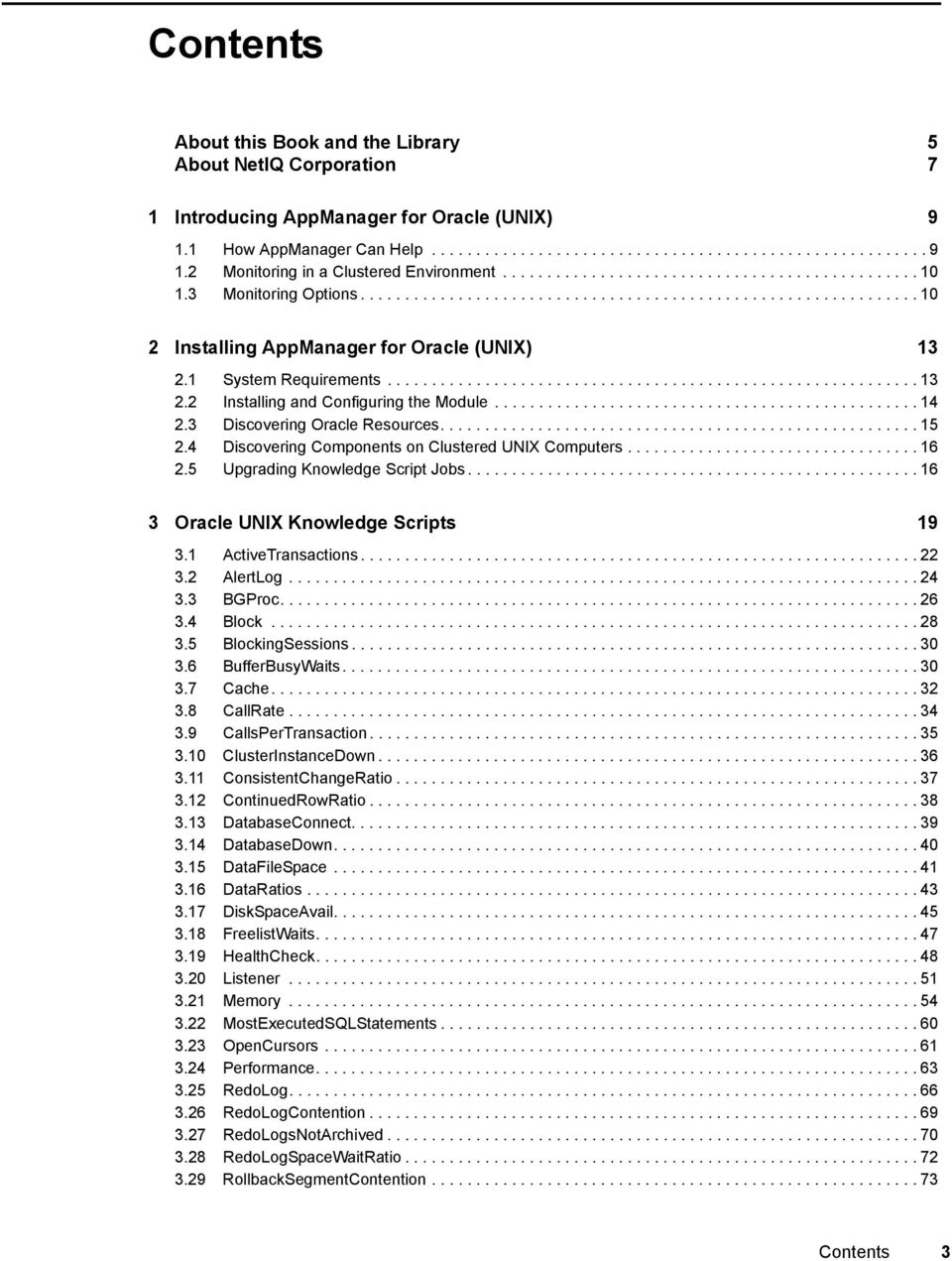
4 3.30 RowSourceRatio RunSql ScheduledJobs SegmentExtentAvail SetMonitoringOptions SortOverflowRatio SysStat TablespaceAvail TopCpuUsers TopIOUsers TopLockUsers TopMemoryUsers TopResourceConsumingSQL Transaction TransactionRate UpdateInstances User UserCallsPerParse UserRollbackRatio UserSessions NetIQ AppManager for Oracle RDBMS on UNIX or Linux Servers Management Guide

5 About this Book and the Library The NetIQ AppManager Suite (AppManager Suite) is a comprehensive solution for managing, diagnosing, and analyzing performance, availability, and server health for a broad spectrum of operating environments, applications, and server hardware. AppManager provides system administrators with a central, easy-to-use console to view critical server and application resources across the enterprise. With AppManager, administrative staffs can monitor computer and application resources, check for potential problems, initiate responsive actions, automate routine tasks, and gather performance data for real-time and historical reporting and analysis. Intended Audience This guide provides information for individuals responsible for installing an AppManager module and monitoring specific applications with AppManager. Other Information in the Library The library provides the following information resources: Installation Guide for AppManager Provides complete information about AppManager pre-installation requirements and step-bystep installation procedures for all AppManager components. User Guide for AppManager Control Center Provides complete information about managing groups of computers, including running jobs, responding to events, creating reports, and working with Control Center. A separate guide is available for the AppManager Operator Console. Administrator Guide for AppManager Provides information about maintaining an AppManager management site, managing security, using scripts to handle AppManager tasks, and leveraging advanced configuration options. Upgrade and Migration Guide for AppManager Provides complete information about how to upgrade from a previous version of AppManager. Management guides Provide information about installing and monitoring specific applications with AppManager. Help Provides context-sensitive information and step-by-step guidance for common tasks, as well as definitions for each field on each window. The AppManager library is available in Adobe Acrobat (PDF) format from the AppManager Documentation page of the NetIQ Web site. About this Book and the Library 5

6 6 NetIQ AppManager for Oracle RDBMS on UNIX or Linux Servers Management Guide

7 About NetIQ Corporation NetIQ, an Attachmate business, is a global leader in systems and security management. With more than 12,000 customers in over 60 countries, NetIQ solutions maximize technology investments and enable IT process improvements to achieve measurable cost savings. The company s portfolio includes award-winning management products for IT Process Automation, Systems Management, Security Management, Configuration Audit and Control, Enterprise Administration, and Unified Communications Management. For more information, please visit Contacting Sales Support For questions about products, pricing, and capabilities, please contact your local partner. If you cannot contact your partner, please contact our Sales Support team. Worldwide: United States and Canada: Web Site: [email protected] Contacting Technical Support For specific product issues, please contact our Technical Support team. Worldwide: North and South America: Europe, Middle East, and Africa: +353 (0) Web Site: [email protected] Contacting Documentation Support Our goal is to provide documentation that meets your needs. If you have suggestions for improvements, click Add Comment at the bottom of any page in the HTML versions of the documentation posted at You can also Documentation- [email protected]. We value your input and look forward to hearing from you. About NetIQ Corporation 7
8 Contacting the Online User Community Qmunity, the NetIQ online community, is a collaborative network connecting you to your peers and NetIQ experts. By providing more immediate information, useful links to helpful resources, and access to NetIQ experts, Qmunity helps ensure you are mastering the knowledge you need to realize the full potential of IT investments upon which you rely. For more information, please visit 8 NetIQ AppManager for Oracle RDBMS on UNIX or Linux Servers Management Guide
9 1 1Introducing AppManager for Oracle (UNIX) The Oracle Relational Database Management System (RDBMS) is a powerful database that also offers administration and performance monitoring features to increase its manageability and reliability. Designed for high availability, Oracle RDBMS stores and provides access to electronic data in the form of Online Transaction Processing (OLTP) databases and data warehouses. 1.1 How AppManager Can Help AppManager for Oracle UNIX/Linux provides numerous Knowledge Scripts designed to give you a comprehensive view of how Oracle RDBMS performs on your UNIX and Linux servers. The Knowledge Scripts in the OracleUNIX category monitor data useful for managing your environment, including the following: Oracle RDBMS alert log for specific entries related to database operations and error conditions. Total number of physical read/write operations per second and the total memory usage for Oracle RDBMS background processes. I/O activity at the block-level. Hit ratios for the buffer cache, library cache, and the data dictionary. Number of database calls from all applications and processes accessing a database instance. Ratio of continued rows fetched to all rows fetched. Database availability. Disk space available for the archive log file, the background process log file, and user log files. Rollback segment contention for a database. Percentage of rows retrieved using full table scans. Most-executed SQL queries on a database. SQL queries consuming the most resources on a database. Number of redo logs that have not been archived. Waits on free lists and buffers. Sort overflow ratio. Percentage of attempted application transactions that are rolled back. For aspects of Oracle RDBMS that you choose to monitor, you can set thresholds as the boundaries of optimal performance. You can also instruct AppManager for Oracle UNIX/Linux to raise events when the thresholds are crossed. You can also use the OracleUNIX Knowledge Scripts to collect performance data for use in reports. You can generate reports that range in purpose from evaluating a narrow window of performance data to illustrating trends to aid in capacity planning. Introducing AppManager for Oracle (UNIX) 9
10 1.2 Monitoring in a Clustered Environment AppManager for Oracle (UNIX) supports monitoring Oracle in both Real Application Clusters (RAC) and non-rac clustered environments. Each environment uses a different method for determining whether a node is active or inactive. The ClusterInstanceDown Knowledge Script lets you know when an instance is inactive. Use this Knowledge Script to raise an event when such a condition occurs on a node in the cluster. This Knowledge Script is primarily useful on nodes of the cluster that should be active. To enable support for your specific environment, use the SetMonitoringOptions Knowledge Script. AppManager for Oracle (UNIX) uses this information to prevent the generation of spurious alerts by jobs running on inactive nodes of a cluster Monitoring in an RAC Clustered Environment An Oracle RAC consists of a single database shared across multiple Oracle instances. Each instance runs on a separate node. The Oracle RAC software option keeps track of both active and inactive instances. To enable monitoring in a RAC environment, use the SetMonitoringOptions Knowledge Script to provide the following information: Service name for the RAC cluster Directory containing the tnsnames.ora file (only if this file is in the non-default location). The default location is $ORACLE_HOME/network/admin. 1.3 Monitoring Options The following sections describe the procedure to configure monitoring options with AppManager for Oracle (UNIX) for maintenance and other purposes Avoiding Events for Databases that are Down for Maintenance AppManager for Oracle (UNIX) allows you to set up an environment in which jobs will not be run on Oracle databases that are known to be down for maintenance or other purposes. The SetMonitoringOptions Knowledge Script lets you specify a blackout directory on the UNIX host where the AppManager for Oracle (UNIX) component is installed. This directory contains filenames with the names of Oracle databases on which no jobs should be run. These filenames must begin with the name of the database. After the name of the database, these filenames might contain additional characters, possibly to serve as a description. The first of these additional characters, if any, must be a character that is not valid in an Oracle database name (A-Z, 0-9, _, $, and # are all valid characters in an Oracle database name). For example, you can use the SetMonitoringOptions Knowledge Script to set the folder /usr/ oracle/blackout as the blackout directory. When the databases oradb817 and oradb920 are down over the next few hours, it creates the following empty files: /usr/oracle/blackout/oradb817.maintenance /usr/oracle/blackout/oradb920.upgrade. 10 NetIQ AppManager for Oracle RDBMS on UNIX or Linux Servers Management Guide
11 Although OracleUNIX jobs continue running on any other Oracle databases on this host whose names do not appear as part of the beginning of a filename in this folder, no jobs are run on oradb817 and oradb920. Once the maintenance period is over, you can remove these files from the blackout directory, and monitoring resumes. In addition, you can set a parameter in the DatabaseDown Knowledge Script so that when it runs and finds the selected database is down, it can automatically create a file in the blackout directory identifying the database to exclude from monitoring. In these cases, you must manually remove the files denoting databases down for maintenance in order for jobs to proceed correctly on these databases Other Monitoring Options You might not want to monitor tablespaces that have temporary contents or whose datafiles are autoextensible. In these cases, the SetMonitoringOptions Knowledge Script also includes options to enable or disable monitoring for these types of tablespaces. You can enable or disable monitoring while jobs associated with the TablespaceAvail Knowledge Script are currently running. Introducing AppManager for Oracle (UNIX) 11

12 12 NetIQ AppManager for Oracle RDBMS on UNIX or Linux Servers Management Guide

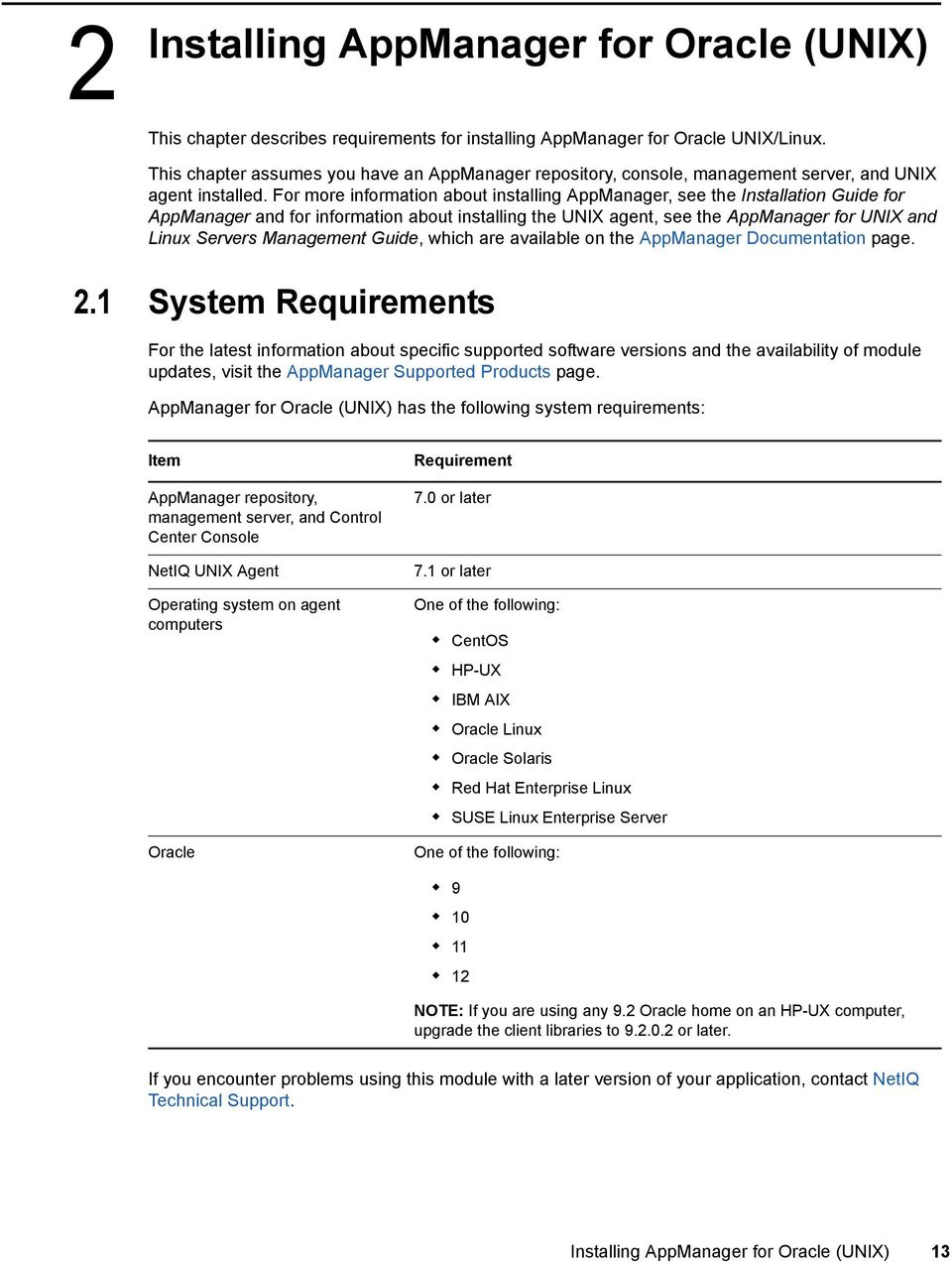
13 2 2Installing AppManager for Oracle (UNIX) This chapter describes requirements for installing AppManager for Oracle UNIX/Linux. This chapter assumes you have an AppManager repository, console, management server, and UNIX agent installed. For more information about installing AppManager, see the Installation Guide for AppManager and for information about installing the UNIX agent, see the AppManager for UNIX and Linux Servers Management Guide, which are available on the AppManager Documentation page. 2.1 System Requirements For the latest information about specific supported software versions and the availability of module updates, visit the AppManager Supported Products page. AppManager for Oracle (UNIX) has the following system requirements: Item AppManager repository, management server, and Control Center Console NetIQ UNIX Agent Operating system on agent computers Oracle Requirement 7.0 or later 7.1 or later One of the following: CentOS HP-UX IBM AIX Oracle Linux Oracle Solaris Red Hat Enterprise Linux SUSE Linux Enterprise Server One of the following: NOTE: If you are using any 9.2 Oracle home on an HP-UX computer, upgrade the client libraries to or later. If you encounter problems using this module with a later version of your application, contact NetIQ Technical Support. Installing AppManager for Oracle (UNIX) 13
14 The Oracle RDBMS account used by the OracleUNIX Knowledge Scripts should have sufficient privileges to monitor each Oracle database. The installer provides the appropriate SELECT privileges for non-sysdba accounts. For more information about the views required to run each Knowledge Script, see Chapter 3, Oracle UNIX Knowledge Scripts, on page Installing and Configuring the Module To install the module you must: Install the Knowledge Scripts by running the module installer.msi on all AppManager repositories that store data for this module. Install the Help files by running the module installer.msi on all AppManager Control Center and Operator Console computers you will use with this module. Ensure that the UNIX agent is installed on the computer you want to monitor. You can access the AM70-OracleUNIX-7.8.x.x.msi module installer from the AM70_OracleUNIX_7.8.x.x self-extracting installation package on the AppManager Module Upgrades & Trials page. The module installer now installs Knowledge Scripts for each module directly into the QDB instead of to the \AppManager\qdb\kp folder as in previous releases of AppManager. To install the module: 1 Ensure you have the UNIX agent installed on the managed computer using an account with access to the Oracle home directory. For information about how to install the agent, see the AppManager for UNIX and Linux Servers Management Guide. 2 (Conditional) If you are using UNIX agent 7.2, ensure you specified that you would be monitoring Oracle with the AppManager component during the agent installation. 3 (Conditional) If you are using UNIX agent 7.2, configure the agent for Oracle monitoring by one of the following actions: In UNIX Agent Manager, click AM Options > Configure Module > Oracle. In the UNIX agent directory../netiq/bin/, run the netiq_oracle_configuration script. 4 Install the Knowledge Scripts into the QDB by running the module installer on the QDB computer: 4a Select Install Knowledge Scripts to install the repository components. 4b Specify the SQL Server name of the server hosting the QDB, as well as the case-sensitive QDB name. 5 (Conditional) If you use Control Center 7.x, run the module installer for each QDB attached to Control Center. 6 (Conditional) If you use Control Center 8.x, run the module installer only for the primary QDB. Control Center automatically replicates this module to secondary QDBs. 7 Run the module installer on all console computers to install the Help and console extensions. 8 (Conditional) If you have not discovered Oracle RDBMS resources, run the Discovery_OracleUNIX Knowledge Script on all agent computers that you want to monitor. For more information, see Section 2.3, Discovering Oracle Resources, on page Upgrade any running Knowledge Script jobs. For more information, see Section 2.5, Upgrading Knowledge Script Jobs, on page NetIQ AppManager for Oracle RDBMS on UNIX or Linux Servers Management Guide

15 After the installation has completed, the OracleUNIX_Install.log file, located in the \NetIQ\Temp\NetIQ_Debug\<ServerName> folder on the QDB computer, lists any problems that occurred Silently Installing the Knowledge Scripts To silently install the module on an AppManager repository, you can use Windows authentication or SQL authentication. Windows authentication: AM70-OracleUNIX-7.9.x.x,AppManagerForOracle_UNIX_Reviewmsi /qn MO_B_QDBINSTALL=1 MO_B_SQLSVR_WINAUTH=1 MO_SQLSVR_NAME=[SQLServerName] MO_QDBNAME=[AMRepositoryName] SQL authentication: AM70-OracleUNIX-7.9.x.x.msi /qn MO_B_QDBINSTALL=1 MO_B_SQLSVR_WINAUTH=0 MO_SQLSVR_USER=[SQL login] MO_SQLSVR_PWD=[SQLLoginPassword] MO_SQLSVR_NAME=[SQLServerName] MO_QDBNAME=[AMRepositoryName] 2.3 Discovering Oracle Resources Use the Discovery_OracleUNIX Knowledge Script to discover instances of Oracle RDBMS. To successfully discover Oracle configuration and resource information, you must use the AppManager Security Manager extension to specify the Oracle user, password, and the Oracle database instance names you want to monitor. Also, the account with which you run this script must have SELECT permissions for the following tables: DBA_DATA_FILES DBA_SEGMENTS DBA_TABLESPACES DBA_USERS V_$DATABASE V_$INSTANCE V_$VERSION By default, this script runs once for each computer. Set the Values tab parameters as needed. Description Oracle Username Enter the Oracle RDBMS username used to access the target databases. If you run this script on more than one computer, configure each database with the same username. The default value is blank. NOTE: To use SYSDBA authentication, leave the Oracle Username parameter blank. Discover instances not automatically started on system boot? Select the Yes check box to discover Oracle instances not started by the dbstart utility upon system boot. This information is obtained from the oratab file. By default, these instances are discovered. Installing AppManager for Oracle (UNIX) 15

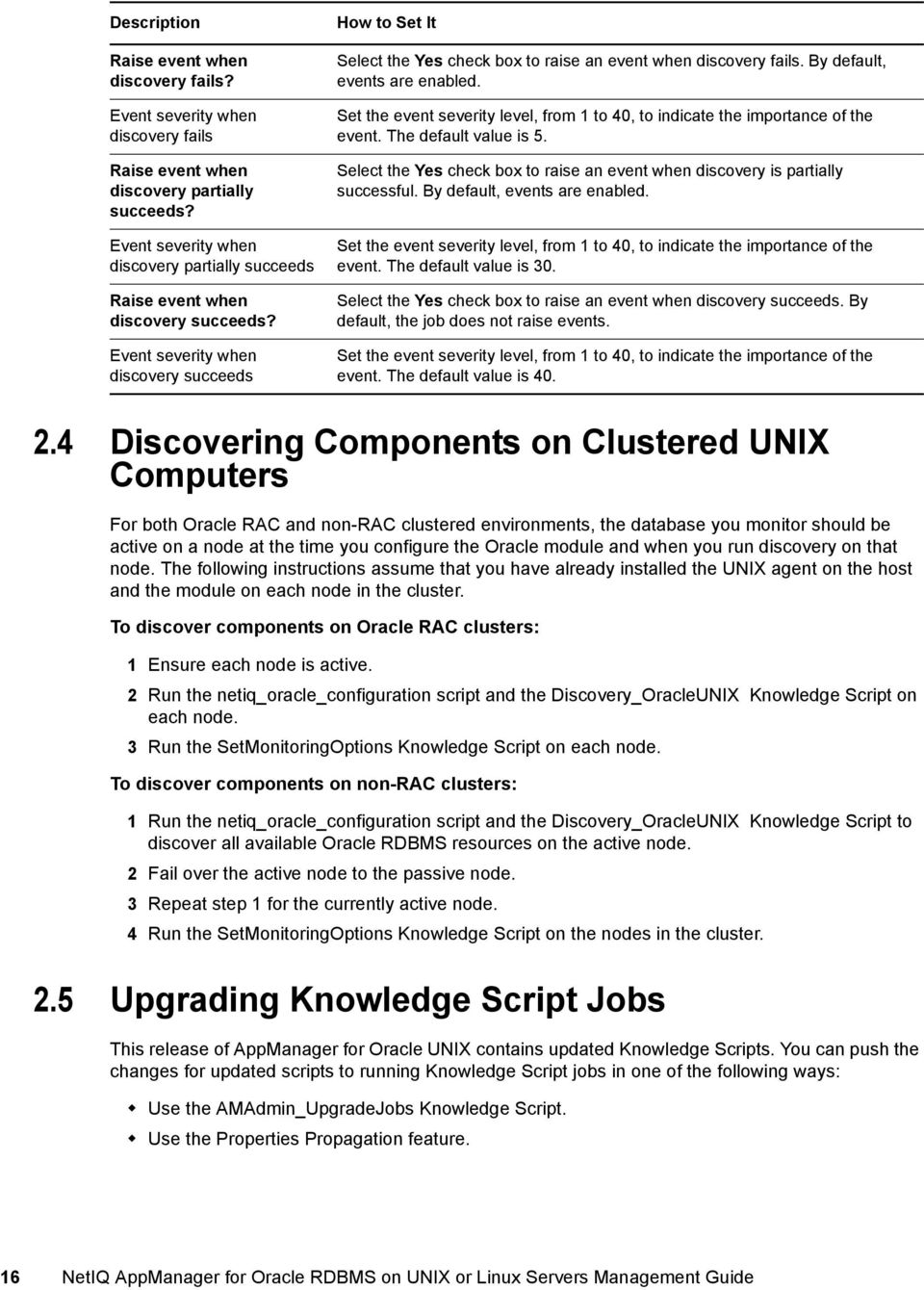
16 Description Raise event when discovery fails? Event severity when discovery fails Raise event when discovery partially succeeds? Event severity when discovery partially succeeds Raise event when discovery succeeds? Event severity when discovery succeeds Select the Yes check box to raise an event when discovery fails. By default, events are enabled. event. The default value is 5. Select the Yes check box to raise an event when discovery is partially successful. By default, events are enabled. event. The default value is 30. Select the Yes check box to raise an event when discovery succeeds. By default, the job does not raise events. event. The default value is Discovering Components on Clustered UNIX Computers For both Oracle RAC and non-rac clustered environments, the database you monitor should be active on a node at the time you configure the Oracle module and when you run discovery on that node. The following instructions assume that you have already installed the UNIX agent on the host and the module on each node in the cluster. To discover components on Oracle RAC clusters: 1 Ensure each node is active. 2 Run the netiq_oracle_configuration script and the Discovery_OracleUNIX Knowledge Script on each node. 3 Run the SetMonitoringOptions Knowledge Script on each node. To discover components on non-rac clusters: 1 Run the netiq_oracle_configuration script and the Discovery_OracleUNIX Knowledge Script to discover all available Oracle RDBMS resources on the active node. 2 Fail over the active node to the passive node. 3 Repeat step 1 for the currently active node. 4 Run the SetMonitoringOptions Knowledge Script on the nodes in the cluster. 2.5 Upgrading Knowledge Script Jobs This release of AppManager for Oracle UNIX contains updated Knowledge Scripts. You can push the changes for updated scripts to running Knowledge Script jobs in one of the following ways: Use the AMAdmin_UpgradeJobs Knowledge Script. Use the Properties Propagation feature. 16 NetIQ AppManager for Oracle RDBMS on UNIX or Linux Servers Management Guide
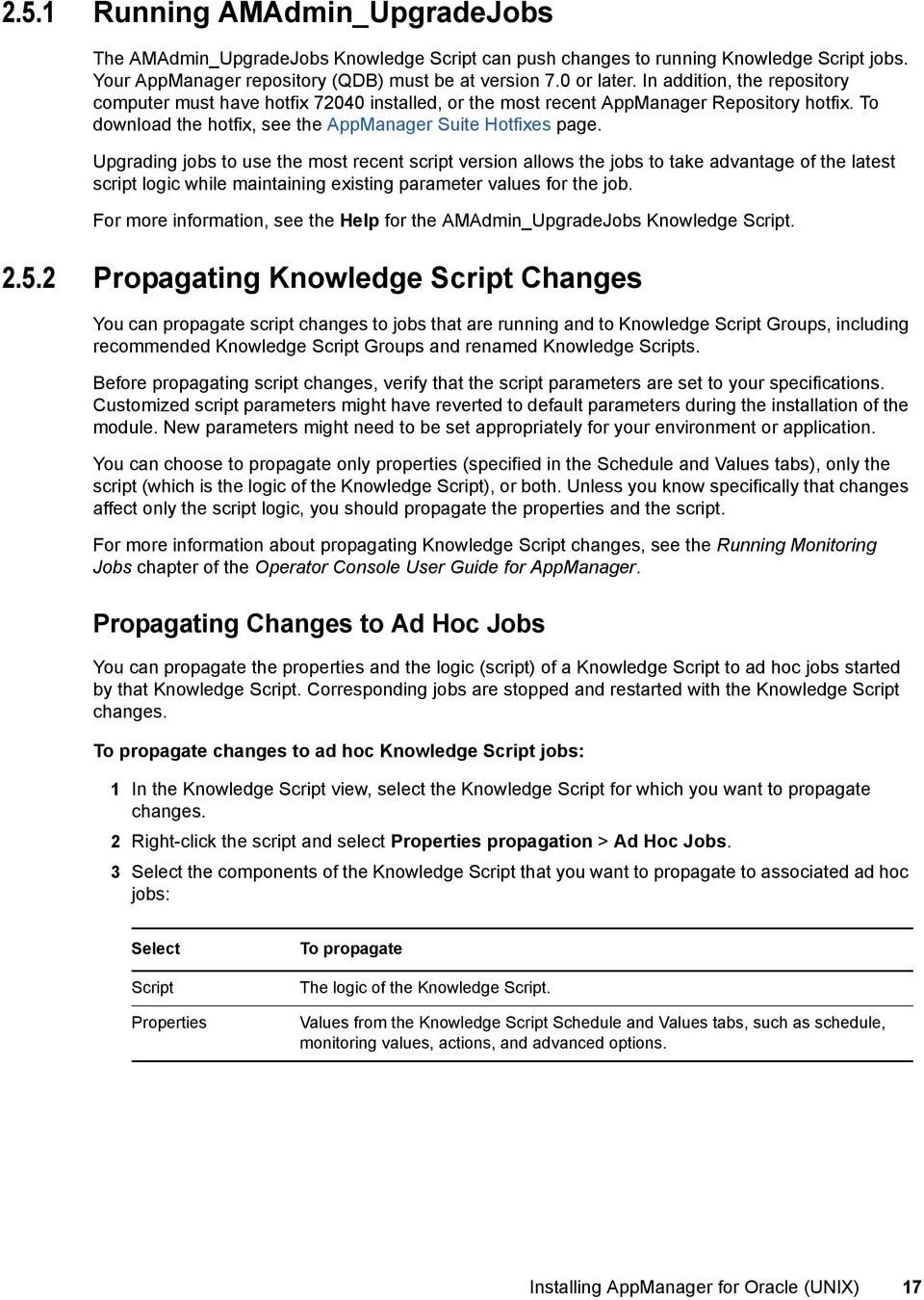
17 2.5.1 Running AMAdmin_UpgradeJobs The AMAdmin_UpgradeJobs Knowledge Script can push changes to running Knowledge Script jobs. Your AppManager repository (QDB) must be at version 7.0 or later. In addition, the repository computer must have hotfix installed, or the most recent AppManager Repository hotfix. To download the hotfix, see the AppManager Suite Hotfixes page. Upgrading jobs to use the most recent script version allows the jobs to take advantage of the latest script logic while maintaining existing parameter values for the job. For more information, see the Help for the AMAdmin_UpgradeJobs Knowledge Script Propagating Knowledge Script Changes You can propagate script changes to jobs that are running and to Knowledge Script Groups, including recommended Knowledge Script Groups and renamed Knowledge Scripts. Before propagating script changes, verify that the script parameters are set to your specifications. Customized script parameters might have reverted to default parameters during the installation of the module. New parameters might need to be set appropriately for your environment or application. You can choose to propagate only properties (specified in the Schedule and Values tabs), only the script (which is the logic of the Knowledge Script), or both. Unless you know specifically that changes affect only the script logic, you should propagate the properties and the script. For more information about propagating Knowledge Script changes, see the Running Monitoring Jobs chapter of the Operator Console User Guide for AppManager. Propagating Changes to Ad Hoc Jobs You can propagate the properties and the logic (script) of a Knowledge Script to ad hoc jobs started by that Knowledge Script. Corresponding jobs are stopped and restarted with the Knowledge Script changes. To propagate changes to ad hoc Knowledge Script jobs: 1 In the Knowledge Script view, select the Knowledge Script for which you want to propagate changes. 2 Right-click the script and select Properties propagation > Ad Hoc Jobs. 3 Select the components of the Knowledge Script that you want to propagate to associated ad hoc jobs: Select Script Properties To propagate The logic of the Knowledge Script. Values from the Knowledge Script Schedule and Values tabs, such as schedule, monitoring values, actions, and advanced options. Installing AppManager for Oracle (UNIX) 17
18 Propagating Changes to Knowledge Script Groups You can propagate the properties and logic (script) of a Knowledge Script to corresponding Knowledge Script Group members. After you propagate script changes to Knowledge Script Group members, you can propagate the updated Knowledge Script Group members to associated running jobs. For more information, see Propagating Changes to Ad Hoc Jobs on page 17. To propagate Knowledge Script changes to Knowledge Script Groups: 1 In the Knowledge Script view, select the Knowledge Script Group for which you want to propagate changes. 2 Right-click the Knowledge Script Group and select Properties propagation > Ad Hoc Jobs. 3 (Conditional) If you want to exclude a Knowledge Script member from properties propagation, deselect that member from the list in the Properties Propagation dialog box. 4 Select the components of the Knowledge Script that you want to propagate to associated Knowledge Script Groups: Select Script Properties To propagate The logic of the Knowledge Script. Values from the Knowledge Script Schedule and Values tabs, including the schedule, actions, and Advanced properties. 5 Click OK. Any monitoring jobs started by a Knowledge Script Group member are restarted with the job properties of the Knowledge Script Group member. 18 NetIQ AppManager for Oracle RDBMS on UNIX or Linux Servers Management Guide
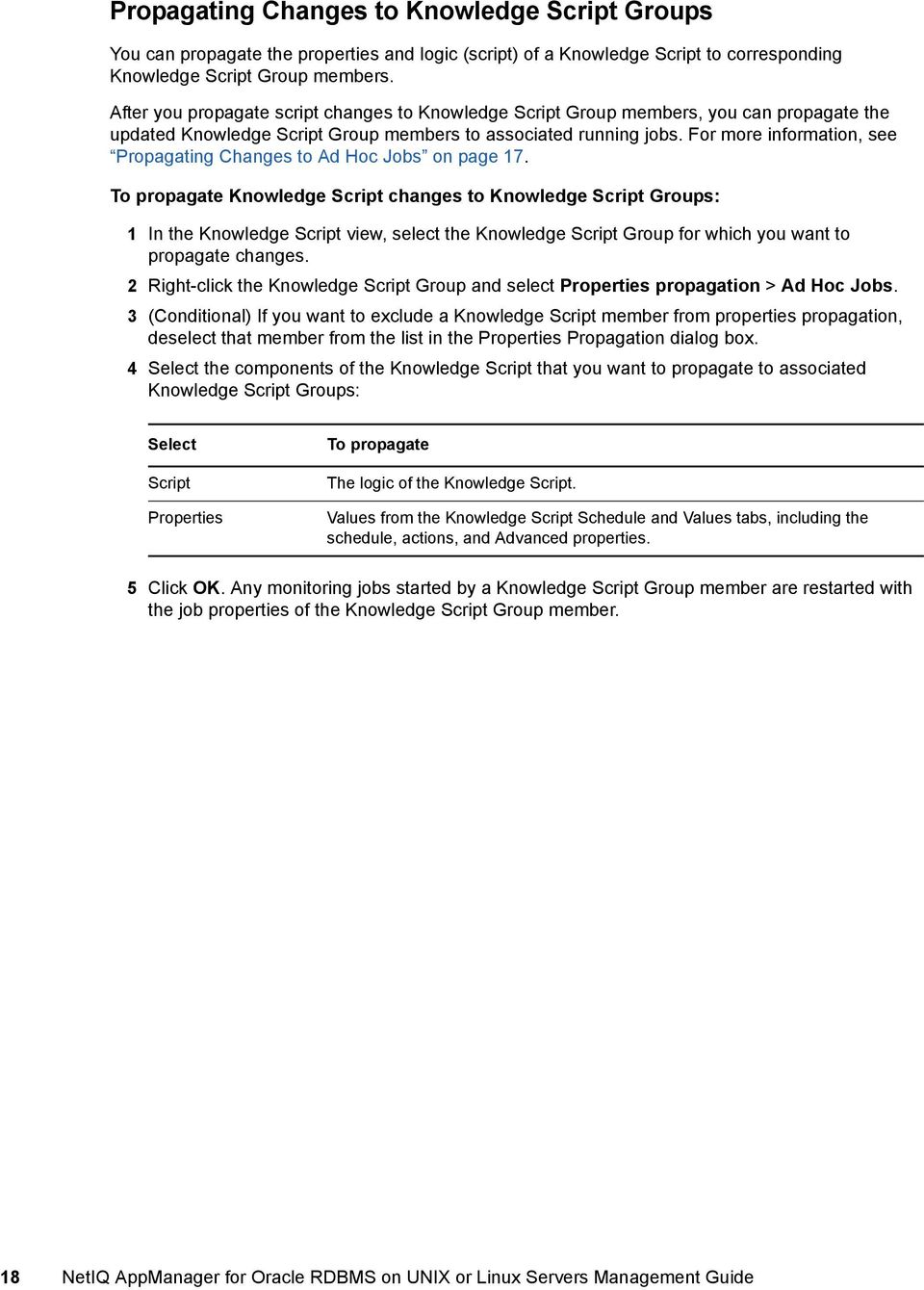
19 3 3Oracle UNIX Knowledge Scripts AppManager provides the following Knowledge Scripts for monitoring Oracle RDBMS. NOTE: Each Knowledge Script is configured to run at a specific interval. While you can change that interval to suit your needs, we recommend that you not use intervals of less than five minutes. Running at shorter intervals might negatively impact system performance. From the Knowledge Script view of the Control Center Console, you can access more information about any Knowledge Script by selecting it and pressing F1. Knowledge Script ActiveTransactions AlertLog BGProc Block BlockingSessions BufferBusyWaits Cache CallRate CallsPerTransaction ClusterInstanceDown ConsistentChangeRatio ContinuedRowRatio DatabaseConnect DatabaseDown DataFileSpace What It Does Monitors the number of active transactions that are ongoing as a percentage of the maximum number of transactions that can be executed concurrently (set as an initialization parameter). Scans the Oracle RDBMS alert log for entries that match a search string that you specify. Monitors the total memory usage and the total number of physical read/write (I/O) operations per second for Oracle RDBMS background processes. Monitors block-level database activity (visits per transaction and changes per transaction). Monitors the user sessions that are blocking other sessions and processes from accessing the Oracle RDBMS. Monitors the number of buffer busy waits and the number of logical reads, and computes a ratio between the two numbers (expressed as a percentage). Monitors the frequency with which requested data and resources are retrieved from the cache. Monitors the demand placed on a database instance from all sources. Monitors the demand placed on a database instance by each transaction. Monitors Oracle instances in a cluster and notifies you when an instance fails or becomes inactive. Monitors the extent to which applications exercise the read consistency mechanism to ensure database consistency. Monitors rows that span more than one database block. Checks the connectivity to Oracle databases. Monitors the status of the background processes of a database. Monitors the size of the datafile of an Oracle RDBMS. Oracle UNIX Knowledge Scripts 19

20 Knowledge Script DataRatios DiskSpaceAvail FreelistWaits HealthCheck Listener Memory MostExecutedSQLStatements OpenCursors Performance RedoLog RedoLogContention RedoLogsNotArchived RedoLogSpaceWaitRatio RollbackSegmentContention RowSourceRatio RunSql ScheduledJobs SegmentExtentAvail SetMonitoringOptions SortOverflowRatio SysStat TablespaceAvail What It Does Monitors the Consistent Change Ratio, Continued Row Ratio, Row Source Ratio, and Sort Overflow Ratio. Monitors the amount of disk space available for the archive log file, the background process log file, and user log files of a database. Monitors the number of freelist waits and the total number of data requests, and computes a ratio of the two numbers. Monitors Oracle instances in a cluster, the connectivity to Oracle databases, and the status of the background process of Oracle database. Monitors Oracle listeners running on the host. Monitors the Oracle background processes, buffer busy waits, cache, and freelist waits. Determines which SQL statements are being executed on a given Oracle Database most frequently. Monitors the percentage of cursors opened per session, as well as the total number of cursors open in the system. Monitors the open cursors, CPU time for current user sessions, physical reads and writes (I/O) for current user sessions, the current number of user-held locks on an Oracle Database, and memory usage (User Global Area and Program Global Area) for current user sessions. Monitors the number of times that a process tries to write an entry in the redo log buffer, the number of redo logs not archived, if archiving is turned on for a given Oracle Database, and the redo log space wait ratio. Monitors the number of times that a process tries to write an entry in the redo log buffer. Monitors the number of redo logs which are not being archived, if archiving is turned on for a given Oracle Database. Monitors the redo log space wait ratio. Monitors rollback segment contention for a database. Monitors the row source ratio. Runs a SQL statement. Monitors the scheduled job status in the New Oracle Scheduler. Monitors the percentage of extents (extensions of free space) available to each segment in a tablespace. Sets the various monitoring options available for OracleUNIX jobs, especially in clustered environments. Monitors the sort overflow ratio. Monitors statistics from V_$SYSSTAT table of an Oracle Database. Monitors the disk space used by tablespaces. 20 NetIQ AppManager for Oracle RDBMS on UNIX or Linux Servers Management Guide
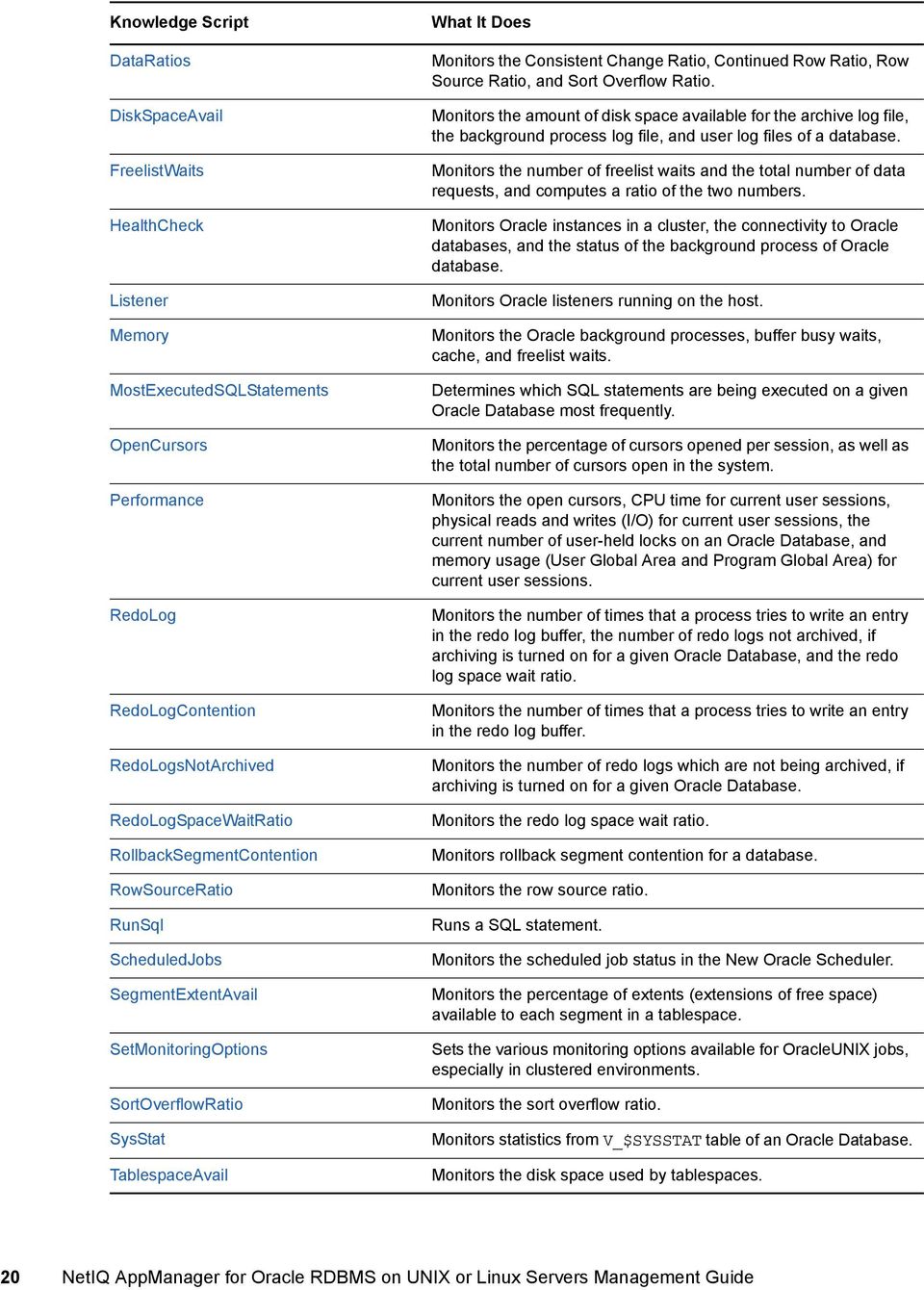
21 Knowledge Script TopCpuUsers TopIOUsers TopLockUsers TopMemoryUsers TopResourceConsumingSQL Transaction TransactionRate UpdateInstances User UserCallsPerParse UserRollbackRatio UserSessions What It Does Monitors the CPU time for current user sessions Monitors physical reads and writes (I/O) for current user sessions. Monitors the current number of user-held locks on an Oracle RDBMS. Monitors memory usage (User Global Area and Program Global Area) for current user sessions. Determines which SQL queries for Oracle Database are consuming the most resources per execution on their UNIX hosts. Monitors the number of active transactions, the demand placed on a database instance from all sources, the demand placed on a database instance by each transaction, and the transaction rate for an Oracle Database. Monitors the transaction rate for an Oracle RDBMS. Updates the list of Oracle databases/instances on each UNIX host used to update authentication information in the AppManager Service Manager and for discovery of new databases. Monitors the number of user calls per parse, the user rollback ratio for an Oracle RDBMS, the total number of user sessions accessing an Oracle RDBMS, and the user sessions that are blocking other sessions and processes from accessing the Oracle Database. Monitors the number of user calls per parse. Monitors the user rollback ratio for an Oracle RDBMS. Monitors the total number of user sessions accessing an Oracle RDBMS. Running All Knowledge Scripts To run Knowledge Script using SYSDBA authentication, ensure that the user account used to run the UNIX agent is a member of the Oracle Database Administrator (OSDBA) group. Oracle UNIX Knowledge Scripts 21
22 To run all of the Knowledge Scripts in the OracleUNIX category, your account must grant you SELECT permissions for all of the following tables: List of Tables DBA_DATA_FILES DBA_FREE_SPACE DBA_JOBS DBA_SCHEDULER_JOBS DBA_SEGMENTS DBA_TABLESPACES DBA_TEMP_FILES DBA_USERS GV_$INSTANCE (for Oracle RAC monitoring only) V_$ARCHIVE_DEST V_$BGPROCESS V_$DATABASE V_$DATAFILE V_$DIAG_INFO (for Oracle 11g and later) V_$INSTANCE V_$LIBRARYCACHE V_$LOCK V_$LOG V_$PARAMETER V_$PROCESS V_$ROWCACHE V_$SESSION V_$SESSTAT V_$SGASTAT V_$SORT_SEGMENT V_$SQLAREA V_$STATNAME V_$SYSSTAT V_$SYSTEM_EVENT V_$TRANSACTION V_$VERSION V_$WAITSTAT 3.1 ActiveTransactions Use this Knowledge Script to retrieve the number of active transactions that are ongoing, and the maximum number of transactions that can be executed concurrently (set as an initialization parameter). This script computes a ratio, expressed as a percentage, of the two numbers. When you enable data collection, the percentage is stored in the repository. You can set multiple thresholds for the maximum ratio, and the job raises an event when any of the thresholds exceeds the value you specified. The account you use to run this script must have SELECT permissions for the following tables: V_$PARAMETER V_$TRANSACTION 22 NetIQ AppManager for Oracle RDBMS on UNIX or Linux Servers Management Guide
23 V_$VERSION Resource Objects Oracle Database folders. When you drop a script on an Oracle Database folder, a job executes on that database and collects the number of active transactions and the number of total transactions. The ratio of active transactions over total transactions is then computed Default Schedule The default interval for this script is Every 10 minutes Setting Parameter Values Set the following parameters as needed: Description Oracle Username Collect data for the ratio of active transactions to maximum concurrent transactions? Raise event if ratio exceeds threshold? Threshold ratio of active transactions to max concurrent transactions Raise event if ratio exceeds threshold? Threshold ratio of active transactions to max concurrent transactions Raise event if ratio exceeds threshold? Enter the username that this script needs to access the target databases. If you run this script on more than one database, configure each database with the same username. To use SYSDBA authentication, leave this parameter blank. The default value is blank. Set the Yes check box to collect data for charts and reports. If data collection is enabled, returns the ratio of active transactions to maximum concurrent transactions as a percentage (%). By default, data is not collected. Select the Yes check box to raise an event if the threshold exceeds the value you specified. By default, the job raises events. Specify a threshold for the maximum ratio of active transactions to maximum concurrent transactions, expressed as a percentage. The default for this threshold is 95%. Set the event severity level, from 1 to 40, to indicate the importance of the event for successfully setting the monitoring options. The default severity level is 5 (red event indicator). Select the Yes check box to raise an event if the threshold exceeds the value you specified. By default, the job does not raise events. Specify a threshold for the maximum ratio of active transactions to maximum concurrent transactions, expressed as a percentage. The default for this threshold is 80%. Set the event severity level, from 1 to 40, to indicate the importance of the event for successfully setting the monitoring options. The default severity level is 15 (yellow event indicator). Select the Yes check box to raise an event if the threshold exceeds the value you specified. By default, the job does not raise events. Oracle UNIX Knowledge Scripts 23
24 Description Threshold -- ratio of active transactions to max concurrent transactions Raise event if ratio exceeds threshold? Threshold -- ratio of active transactions to max concurrent transactions Event severity for internal failure Specify a threshold for the maximum ratio of active transactions to maximum concurrent transactions, expressed as a percentage. The default for this threshold is 60%. Set the event severity level, from 1 to 40, to indicate the importance of the event for successfully setting the monitoring options. The default severity level is 25 (blue event indicator). Select the Yes check box to raise an event if the threshold exceeds the value you specified. By default, the job does not raise events. Specify a threshold for the maximum ratio of active transactions to maximum concurrent transactions, expressed as a percentage. The default value is 40%. Set the event severity level, from 1 to 40, to indicate the importance of the event for successfully setting the monitoring options. The default severity level is 35 (magenta event indicator). Set the event severity level, from 1 to 40, to indicate the importance of the event. The default value is 5 (red event indicator). 3.2 AlertLog Use this Knowledge Script to scan the Oracle RDBMS alert log for entries that match a specified search string. You can set a maximum threshold for the number of occurrences of the string found during any single scan of the alert log. If during any single scan of the alert log the number of matching entries exceeds the threshold, the job raises an event. Each database maintains an alert log where it records database operations (such as creating or dropping a database) and error conditions (such as deadlocks). This script provides a general-purpose tool for scanning a database s alert log for specific entries. The first interval of this script does not scan existing entries and does not collect data. Instead, it sets a pointer to the end of the alert log so that only new entries are read. Each subsequent iteration of the script scans the alert log for entries created since the previous scan. Information in the Event Properties dialog box states the number of occurrences of the search string that were found. The lines containing matches found in the log are also included in the event details. Scanning a large log, bigger than 1 GB for example, might use more operating system resources than you want this script to use. If that happens, reduce the size of the log. The account you use to run this script must have SELECT permissions for the following tables: V_$PARAMETER V_$VERSION V_$DIAG_INFO (for Oracle 11g and later) 24 NetIQ AppManager for Oracle RDBMS on UNIX or Linux Servers Management Guide
25 NOTE: When the Oracle alert log reaches its maximum size, Oracle renames the file for archiving purposes and creates a new alert log with the original filename. If this script attempts to open the alert log between the time the old file is renamed and the new file is created, the job raises an event because the script cannot find the file. The next iteration of the script (when the alert log is available) should function as expected. This script attempts to open the alert log associated with the relevant Oracle instance. Oracle instance alert logs use the naming convention alert_<instance name> Resource Objects Oracle Database folders. When you drop a script on an Oracle Database folder, a job executes on that database and monitors only that database Default Schedule The default interval for this script is Every 10 minutes Setting Parameter Values Set the following parameters as needed: Description Oracle Username Enter the username that this script needs to access the target databases. If you run this script on more than one database, configure each database with the same username. To use SYSDBA authentication, leave this parameter blank. The default value is blank. Collect data for number of matching log entries? Select the Yes check box to collect data for charts and reports. When you enable data collection, the Knowledge Script returns the number of entries that matched the search string. By default, data is not collected. Include Search Options Regular expression specifying the include filter Optional file with regular expressions specifying the include filter Modifier for the regular expression include filter Enter a regular expression in Perl, to identify the pattern you want to look for in the text file being monitored. Strings matching the include filter pattern are returned. The expression,.+, matches all strings. The default is ^(ORA ORA-60). If you do not want to enter a regular expression in the Regular expression specifying the include filter parameter, specify the full path to a file containing the regular expression specifying the include filter. Enter any modifier you want to use to change the behavior of the regular expression. For example, specifying i for this parameter makes the include filter case-insensitive. The default is i. Exclude Search Options Regular expression specifying the exclude filter Enter a regular expression, in Perl, to identify the pattern you want to exclude from matching in the text file being monitored. Strings matching the include filter pattern are returned. Oracle UNIX Knowledge Scripts 25
26 Description Optional file with regular expressions specifying the exclude filter Modifier for the regular expression exclude filter Raise event if threshold exceeded? Threshold -- Maximum number of entries found Enter the full path to a file containing any additional filter items you want to match. You can also use this parameter if you only want to specify matching expressions in an external file. Optional modifiers can be used to change the behavior of the regular expression. For example, specifying i for this parameter makes the exclude filter case-insensitive. Select the Yes check box to raise an event when the number of log entries found that match the search criteria exceeds the threshold you set. By default, events are enabled. Enter a threshold for the maximum number of log entries that can be found to match the search criteria during any single scan of the alert log. If the number of entries matches or exceeds the threshold, the job raises an event. The default value is 0 entries. Event severity for internal failure 3.3 BGProc Use this Knowledge Script to monitor the total number of physical read/write (I/O) operations per second and/or the total memory usage for Oracle RDBMS background processes. If the total number of read/write operations per second or the total memory usage for the list of specified processes exceeds the threshold, the job raises an event. Oracle RDBMS background processes include CKPT, DBW0, LGWR, PMON, RECO, SMON, SNP0, and others. You can monitor all or individual background processes. The account you use to run this script must have SELECT permissions for the following tables: V_$BGPROCESS V_$PROCESS V_$SESSION V_$SESSTAT V_$STATNAME V_$VERSION Resource Objects Oracle Database folders. When you drop a script on an Oracle Database folder, a job executes on that database and monitors only that database Default Schedule The default interval for this script is Every 30 minutes. 26 NetIQ AppManager for Oracle RDBMS on UNIX or Linux Servers Management Guide
27 3.3.3 Setting Parameter Values Set the following parameters as needed: Description Oracle Username Collect data for memory usage and I/O of Oracle processes? Oracle background processes to monitor Enter the username that this script needs to access the target Oracle RDBMSs. If you run this script on more than one database, configure each database with the same username. To use SYSDBA authentication, leave this parameter blank. The default value is blank. Select the Yes check box to collect data for charts and reports. If data collection is enabled, returns the number of read/write operations per second, or the total memory usage for all monitored background processes. By default, data is not collected. Enter the names of the background processes you want to monitor. Separate the names with commas; do not use spaces. To monitor all Oracle RDBMS background processes, enter an asterisk (*). Possible valid background process names include: CKPT DBW0 LGWR PMON RECO SMON SNP0 SNP1 The default value is (*) (all background processes). Monitor read/write operations? exceeded? Threshold -- Maximum read/ write operations rate Monitor memory usage? exceeded? Threshold -- Maximum memory usage Select the Yes check box to monitor the number of physical read/write operations per second by background processes. By default, monitoring is performed. Select the Yes check box to raise an event when the number of physical read/write operations per second exceeds the threshold you set. By default, events are enabled. Enter a threshold for the maximum number of physical read/write operations per second. The default value is 5 read/write operations per second. event. The default value is 15 (yellow event indicator). Select the Yes check box to monitor the total memory usage by background processes. By default, monitoring is performed. Select the Yes check box to raise an event when the memory utilization of the monitored processes exceeds the threshold you set. By default, events are not enabled. Enter a threshold (in MB) for the maximum amount of memory used by all background processes you are monitoring. The default value is 15 MB. event. The default value is 15 (yellow event indicator). Oracle UNIX Knowledge Scripts 27
28 Description Event severity for internal failure 3.4 Block Use this Knowledge Script to monitor block-level database activity. Oracle RDBMS data blocks are the smallest unit of storage for a database. Monitoring I/O activity at the block level can be a key indicator of database performance. Use this script to monitor any combination of the following statistics: The number of block changes per transaction. This block change rate measures the number of SQL Data Manipulation Language (DML) commands that each transaction performs (for example, to create and drop indexes). As the number of block changes increases, the efficiency of the database transaction and database performance decreases. The number of times the Oracle RDBMS buffer manager locates a database per second. This block get rate indicates the rate at which an application references the database. An increase in the block get rate suggests an increase in overall server load. A decrease in the block get rate without a decrease in load might indicate that you need to do some database tuning because there has been a slowdown in the number of database blocks requested and located per second. The number of times database blocks are requested per committed transaction. This block visit rate measures the database work load per completed transaction (including both successful and aborted database transactions). The account you use to run this script must have SELECT permissions for the following tables: V_$SYSSTAT V_$VERSION Resource Objects Oracle Database folders. When you drop a script on an Oracle Database folder, a job executes on that database and monitors only that database Default Schedule The default interval for this script is Every 10 minutes Setting Parameter Values Set the following parameters as needed: Description Oracle Username Enter the username that this script needs to access the target databases. If you run this script on more than one database, configure each database with the same username. To use SYSDBA authentication, leave this parameter blank. The default value is blank. 28 NetIQ AppManager for Oracle RDBMS on UNIX or Linux Servers Management Guide
29 Description Collect data for block activity? Select the Yes check box to collect data for charts and reports. When you enable data collection, the Knowledge Script returns the statistics you choose to collect: The number of block changes per transaction The number of block get operations per second The number of block visits per transaction By default, data is not collected. Monitor block change rate? exceeded? Threshold -- Maximum block change rate Monitor block get rate? exceeded? Threshold -- Maximum block get rate Monitor block visit rate? exceeded? Threshold -- Maximum block visit rate Select the Yes check box to monitor the block change rate, the number of block changes per transaction. By default, monitoring is performed. Select the Yes check box to raise an event if the block change rate exceeds the threshold you set. By default, the job raises events. Enter a threshold for the maximum number of block changes per transaction before the job raises an event. The default value is 100 changes per transaction. Select the Yes check box to monitor the block get rate, the number of times the Oracle RDBMS buffer manager locates a database block per second. By default, monitoring is performed. Select the Yes check box to raise an event if the block get rate exceeds the threshold you set. By default, the job raises events. Enter a threshold for the maximum number of block get operations per second before the job raises an event. The default value is 100 get operations per second. Select the Yes check box to monitor the block visit rate, the number of times database blocks are requested per committed transaction. By default, monitoring is performed. Select the Yes check box to raise an event if the block visit rate exceeds the threshold you set. By default, the job raises events. Enter a threshold for the block visit rate, the maximum number of block get operations per committed transaction. The default value is 100 operations per committed transaction. Event severity for internal failure Oracle UNIX Knowledge Scripts 29
30 3.5 BlockingSessions Use this Knowledge Script to monitor the user sessions that are blocking other sessions and processes from accessing the Oracle Database. You can set a maximum threshold for the number of sessions that are allowed to block other sessions and processes. If the number of blocking sessions exceeds the threshold, the job raises an event. The account you use to run this script must have SELECT permissions for the following tables: V_$LOCK V_$VERSION Resource Objects Oracle Database folders. When you drop a script on an Oracle Database folder, a job executes on that database and monitors only that database Default Schedule The default interval for this script is Every 10 minutes Setting Parameter Values Set the following parameters as needed: Description Oracle Username Collect data for number of blocking sessions? exceeded? Threshold -- Maximum number of blocking sessions Enter the username that this script needs to access the target databases. If you run this script on more than one database, configure each database with the same username. To use SYSDBA authentication, leave this parameter blank. The default value is blank. Select the Yes check box to collect data for charts and reports. When you enable data collection, the Knowledge Script returns the number of blocking sessions per interval. By default, data is not collected. Select the Yes check box to raise an event if the number of blocking sessions exceeds the threshold you set. By default, the job raises events. Enter a threshold for the maximum number of user sessions allowed to block other user sessions and processes during the monitoring interval. The default value is 10 sessions. Event severity for internal failure 3.6 BufferBusyWaits Use this Knowledge Script to retrieve the number of buffer busy waits and the number of logical reads, and compute a ratio between the two numbers (expressed as a percentage). When you enable data collection, the repository stores the ratio. You can set multiple thresholds for the 30 NetIQ AppManager for Oracle RDBMS on UNIX or Linux Servers Management Guide
31 maximum ratio, and the job raises an event when any of the thresholds exceeds the value you specified. A higher ratio indicates an increased contention for buffers in the SGA memory of Oracle Database. The account you use to run this script must have SELECT permissions for the following tables: V_$SYSTEM_EVENT V_$SYSSTAT V_$VERSION Resource Objects Oracle Database folders. When you drop a script on an Oracle Database folder, a job executes on that database and collects the number of buffer busy waits and the number of logical reads. The ratio of buffer waits over logical reads is then computed Default Schedule The default interval for this script is Every 10 minutes Setting Parameter Values Set the following parameters as needed: Description Oracle Username Enter the username that this script needs to access the target databases. If you run this script on more than one database, configure each database with the same username. To use SYSDBA authentication, leave this parameter blank. The default value is blank. Collect data for ratio of buffer busy waits to logical reads? exceeded? Threshold -- Maximum ratio of buffer busy waits to logical reads exceeded? Threshold - Maximum ratio of buffer busy waits to logical reads Select the Yes check box to collect data for charts and reports. If data collection is enabled, returns the ratio of buffer busy waits to logical reads as a percentage (%). By default, data is not collected. Select the Yes check box to raise an event if the threshold exceeds the value you specified. By default, events are enabled. Specify a threshold for the maximum ratio of buffer busy waits to logical reads. The default for this threshold is.95. Set the event severity level, from 1 to 40, to indicate the importance of the event for successfully setting the monitoring options. The default severity level is 5 (red event indicator). Select the Yes check box to raise an event if the ratio exceeds the threshold specified below. By default, the job does not raise events. Specify a threshold for the maximum ratio of buffer busy waits to logical reads. The default value is.80. Oracle UNIX Knowledge Scripts 31
32 Description exceeded? Threshold - Maximum ratio of buffer busy waits to logical reads exceeded? Threshold - Maximum ratio of buffer busy waits to logical reads Event severity for internal failure Set the event severity level, from 1 to 40, to indicate the importance of the event for successfully setting the monitoring options. The default severity level is 15 (yellow event indicator). Select the Yes check box to raise an event if the threshold exceeds the value you specified. By default, the job does not raise events. Specify a threshold for the maximum ratio of buffer busy waits to logical reads. The default value is.60. Set the event severity level, from 1 to 40, to indicate the importance of the event for successfully setting the monitoring options. The default severity level is 25 (blue event indicator). Select the Yes check box to raise an event if the threshold exceeds the value you specified. By default, the job does not raise events. Specify a threshold for the maximum ratio of buffer busy waits to logical reads. The default value is.40. Set the event severity level, from 1 to 40, to indicate the importance of the event for successfully setting the monitoring options. The default severity level is 35 (magenta event indicator). Set the event severity level, from 1 to 40, to indicate the importance of the event. The default value is 5 (red event indicator). 3.7 Cache Use this Knowledge Script to monitor the frequency with which requested data and resources are retrieved from the cache. As this hit ratio (that is, the percentage of time that data or resources are retrieved from the cache) decreases, performance also decreases because data that must be retrieved from disk or library objects must be reinitialized in order to service the requests. Use this script to monitor any combination of the following statistics: The buffer cache hit ratio indicates the percentage of time that requested data you can find in the buffer cache. The data dictionary hit ratio indicates the percentage of time that requested data you can find in the data dictionary. The library cache hit ratio indicates the percentage of time that the system requests to access objects in the library cache and you can service without re-initializing or reloading library objects. Changes to the library cache hit ratio might occur when an application becomes active, causing more SQL statements and stored procedures to be used. You can set a threshold for each cache hit ratio you choose to monitor. If a cache hit ratio falls below a threshold you set, the job raises an event. The account you use to run this script must have SELECT permissions for the following tables: V_$LIBRARYCACHE 32 NetIQ AppManager for Oracle RDBMS on UNIX or Linux Servers Management Guide
33 V_$ROWCACHE V_$SYSSTAT V_$VERSION Resource Objects Oracle Database folders. When you drop a script on an Oracle Database folder, a job executes on that database and monitors only that database Default Schedule The default interval for this script is Every 10 minutes Setting Parameter Values Set the following parameters as needed: Description Oracle Username Collect data for monitored metrics? Enter the username that this script needs to access the target databases. If you run this script on more than one database, configure each database with the same username. To use SYSDBA authentication, leave this parameter blank. The default value is blank. Select the Yes check box to collect data for charts and reports. When you enable data collection, the Knowledge Script returns the statistics you choose to collect: The buffer cache hit ratio The data dictionary hit ratio The library cache hit ratio By default, data is not collected. Monitor buffer cache hit ratio? not met? Threshold -- Minimum buffer cache hit ratio Select the Yes check box to monitor the percentage of time that requested data you can find in the buffer cache. By default, monitoring is performed. Select the Yes check box to raise an event if the buffer cache hit ratio exceeds the threshold you set. By default, the job raises an event. Enter a minimum threshold for the buffer cache hit ratio. If the actual hit ratio falls below than this threshold, the job raises an event. Ideally, you should set this percentage relatively high because the more frequently Oracle RDBMS uses the buffer, the better your database performance. When the actual hit ratio falls below the threshold you set, the event alerts you that database performance has degraded. The default value is 70%. event. The default value is 10 (red event indicator). Monitor data dictionary hit ratio? Select the Yes check box to monitor the percentage of time that requested data you can find in the data dictionary. By default, monitoring is performed. Oracle UNIX Knowledge Scripts 33
34 Description not met? Threshold -- Minimum data dictionary hit ratio Monitor library cache hit ratio? not met? Threshold -- Minimum library cache hit ratio Select the Yes check box to raise an event if the data dictionary hit ratio falls below the threshold you set. By default, the job raises an event. Enter a minimum threshold for the data dictionary hit ratio. If the actual hit ratio falls below this threshold, the job raises an event. set this percentage high because the more frequently Oracle RDBMS uses the data dictionary to service requests, the better your database performance. When the actual hit ratio falls below the threshold you set, the event alerts you that database performance has deteriorated. The default value is 90%. event. The default value is 10 (red event indicator). Select the Yes check box to monitor the percentage of time that system pin requests to access objects in the library cache you can service without reinitializing or reloading library objects. By default, monitoring is performed. Select the Yes check box to raise an event if the library cache hit ratio falls below the threshold you set. By default, the job raises events. Enter a minimum threshold for the library cache hit ratio. If the actual hit ratio falls below this threshold, the job raises an event. Ideally, you should set this percentage extremely high because re-initializing or reloading library objects imposes a significant performance hit. When the actual hit ratio falls below the threshold you set, the event alerts you that database performance has degraded. The default value is 95%. event. The default value is 10 (red event indicator). Event severity for internal failure 3.8 CallRate Use this Knowledge Script to monitor the demand placed on a database instance from all sources. This demand is determined by tracking the number of database calls per second from all applications and processes accessing the database instance. The database calls that are tracked include Parse, Execute, and Fetch statements. These calls are sometimes described as user calls. When the call rate (and thus the workload demand on the server) exceeds the threshold you set, the job raises an event. The account you use to run this script must have SELECT permissions for the following tables: V_$SYSSTAT V_$VERSION Resource Objects Oracle Database folders. When you drop a script on an Oracle Database folder, a job executes on that database and monitors only that database Default Schedule The default interval for this script is Every 10 minutes. 34 NetIQ AppManager for Oracle RDBMS on UNIX or Linux Servers Management Guide
35 3.8.3 Setting Parameter Values Set the following parameters as needed: Description Oracle Username Collect data for call rate? exceeded? Threshold -- Maximum call rate Enter the username that this script needs to access the target databases. If you run this script on more than one database, configure each database with the same username. To use SYSDBA authentication, leave this parameter blank. The default value is blank. Select the Yes check box to collect data for charts and reports. When you enable data collection, the Knowledge Script returns the total user calls per second for all work sources. By default, data is not collected. Select the Yes check box to raise an event if the maximum number of calls per second exceeds the threshold. By default, the job raises events. Enter a threshold for the maximum number of calls per second allowed before the job raises an event. The default value is 100 calls per second. Event severity for internal failure 3.9 CallsPerTransaction Use this Knowledge Script to monitor the demand placed on a database instance by each transaction. This demand is determined by tracking the number of database calls (for example, to parse, execute, and fetch data) per committed transaction. When the number of database requests per transaction exceeds the threshold, the job raises an event. The account you use to run this script must have SELECT permissions for the following tables: V_$SYSSTAT V_$VERSION Resource Objects Oracle Database folders. When you drop a script on an Oracle Database folder, a job executes on that database and monitors only that database Default Schedule The default interval for this script is Every 10 minutes. Oracle UNIX Knowledge Scripts 35
36 3.9.3 Setting Parameter Values Set the following parameters as needed: Description Oracle Username Collect data for calls per transaction? exceeded? Threshold -- Maximum number of calls per transaction Enter the username that this script needs to access the target databases. If you run this script on more than one database, configure each database with the same username. To use SYSDBA authentication, leave this parameter blank. The default value is blank. Select the Yes check box to collect data for charts and reports. When you enable data collection, the Knowledge Script returns the number of database calls per transaction. By default, data is not collected. Select the Yes check box to raise an event if the number of calls per transaction exceeds the threshold. By default, the job raises events. Enter a threshold for the maximum number of database calls per transaction allowed before the job raises an event. The default value is 100 calls per transaction. Event severity for internal failure 3.10 ClusterInstanceDown Use this Knowledge Script to be notified when an Oracle instance in a cluster fails or becomes inactive. Run this Knowledge Script for Oracle RAC monitoring only. This Knowledge Script uses the srvctl command functionality to fetch the statuses of all the cluster instances. The account you use to run this script must have SELECT permissions for the following tables: V_$VERSION GV_$INSTANCE (for Oracle RAC monitoring only) Resource Objects Oracle Database folders. When you drop a script on an Oracle Database folder, a job executes on that database and determines if the instance running on that host is active or inactive Default Schedule The default schedule for this script is Every 10 minutes. 36 NetIQ AppManager for Oracle RDBMS on UNIX or Linux Servers Management Guide
37 Setting Parameter Values Set the following parameters as needed: Description Oracle Username For RAC cluster monitoring, enter the username that this script needs to access the target databases. If you run this script on more than one database, configure each database with the same username. NOTE: This parameter must not be blank if you are deploying RAC cluster monitoring. If you are deploying non-rac cluster monitoring, this parameter is ignored. The default value is blank. Collect data for instance status? Select the Yes check box to collect data for charts and reports. If you enable data collection, the script returns the status of each instance: 100--instance is running 0--instance is down By default, data is not collected. RAC Instance Exclude Filter RAC Instance to be excluded for status check [comma separated] Raise event if instance is down or if unable to check status? Fully qualified path for srvctl, if srvctl is not located in ORACLE_HOME/bin Event severity for internal failure Select the Yes check box to exclude RAC instances. Enter the names of the RAC instances you want to exclude. Select the Yes check box to raise an event when the instance is down. By default, events are enabled. Set the event severity level, from 1 to 40, to indicate the importance of the event detecting that an instance is down. The default severity level is 10 (red event indicator). Enter the fully qualified path for srvctl, if srvctl is not located in ORACLE_HOME/bin Set the event severity level, from 1 to 40, to indicate the importance of the event. The default value is 5 (red event indicator) ConsistentChangeRatio Use this Knowledge Script to monitor the extent to which applications exercise the read consistency mechanism to ensure database consistency. The consistent change ratio is based on the number of database changes and database reads. Consistent changes refers to the number of times a consistent Get had to retrieve an old version of a database block because of updates that occurred after the cursor had been opened. When the ratio of consistent changes to consistent Gets exceeds the threshold, the job raises an event. The ratio is recalculated each time the script runs, based on the data collected during that monitoring interval. The account you use to run this script must have SELECT permissions for the following tables: V_$SYSSTAT Oracle UNIX Knowledge Scripts 37
38 V_$VERSION Resource Objects Oracle Database folders. When you drop a script on an Oracle Database folder, a job executes on that database and monitors only that database Default Schedule The default interval for this script is Every 1 hour Setting Parameter Values Set the following parameters as needed: Description Oracle Username Enter the username that this script needs to access the target databases. If you run this script on more than one database, configure each database with the same username. To use SYSDBA authentication, leave this parameter blank. The default value is blank. Collect data for consistent change ratio? exceeded? Threshold -- Maximum consistent change ratio (0.0 to 1.0) Event severity for internal failure Select the Yes check box to collect data for charts and reports. When you enable data collection, the script returns the ratio of consistent changes to consistent gets. By default, data is not collected. Select the Yes check box to raise an event if the consistent change ratio exceeds the threshold you set. By default events are enabled. Enter a threshold for the maximum ratio of consistent block changes to consistent block gets during the monitoring interval. The default ratio is 0.01 consistent changes/consistent gets ContinuedRowRatio Use this Knowledge Script to monitor rows that span more than one database block. This script monitors the ratio of continued rows fetched to all rows fetched. In most cases, this ratio should be close to zero. If the continued row ratio increases over time (indicating that more and more rows span multiple database blocks), the PCTFREE storage parameter might be set too low for one or more tables. If the continued row ratio exceeds the threshold, the job raises an event. The ratio is recalculated each time the script runs, based on the data collected during that interval. The account you use to run this script must have SELECT permissions for the following tables: V_$SYSSTAT V_$VERSION 38 NetIQ AppManager for Oracle RDBMS on UNIX or Linux Servers Management Guide
39 Resource Objects Oracle Database folders. When you drop a script on an Oracle Database folder, a job executes on that database and monitors only that database Default Schedule The default interval for this script is Every 30 minutes Setting Parameter Values Set the following parameters as needed: Description Oracle Username Enter the username that this script needs to access the target databases. If you run this script on more than one database, configure each database with the same username. To use SYSDBA authentication, leave this parameter blank. The default value is blank. Collect data for continued row ratio? exceeded? Threshold -- Maximum continued row ratio (0.0 to 1.0) Select the Yes check box to collect data for charts and reports. When you enable data collection, the script returns the continued row ratio. By default, data is not collected. Select the Yes check box to raise an event if the continued row ratio exceeds the threshold. By default events are enabled. Enter a threshold for the maximum ratio of continued rows fetched to all rows fetched. Enter values from 0.0 to 1.0, inclusive. The default ratio is Event severity for internal failure 3.13 DatabaseConnect Use this Knowledge Script to monitor the connectivity and login capability of Oracle databases on UNIX and Linux systems. This script attempts to connect to the database you select. If the connection attempt is successful, this script reports the status of the database and of its login capability. If the connection attempt is unsuccessful, an event is raised. The account you use to run this script must have SELECT permissions for the following tables: V_$INSTANCE V_$VERSION Resource Objects Oracle Database folders. When you drop a script on an Oracle Database folder, a job executes on that database and monitors only that database. Oracle UNIX Knowledge Scripts 39
40 Default Schedule The default interval for this script is Every 10 minutes Setting Parameter Values Set the following parameters as needed: Description Oracle Username Enter the username that this script needs to access the target databases. If you run this script on more than one database, configure each database with the same username. To use SYSDBA authentication, leave this parameter blank. The default value is blank. Collect data for connection and login status? Raise event if unable to connect? Raise event with database and login status? Select the Yes check box to collect data for charts and reports. If you enable data collection, the script returns the status of the database and of its login capability. By default, data is not collected. Select the Yes check box to raise an event if an attempt to connect to the Oracle database is unsuccessful. By default, events are enabled. Select the Yes check box to raise an event providing information on the database and login status. By default, the job does not raise events. event. The default value is 35 (magenta event indicator). Event severity for internal failure 3.14 DatabaseDown Use this Knowledge Script to monitor the status of a database. This script checks whether the Oracle RDBMS background processes are running and whether a local connection can be made. Each Oracle instance has a default set of background processes that must be running. An event is raised if any of the processes that you specified for monitoring in the Background processes to monitor parameter are down, or if a connection cannot be made to the database instance. The account you use to run this script must have SELECT permissions for the following table: V_$VERSION Resource Objects Oracle Database folders. When you drop a script on an Oracle Database folder, a job executes on that database and monitors only that database. 40 NetIQ AppManager for Oracle RDBMS on UNIX or Linux Servers Management Guide
41 Default Schedule The default interval for this script is Every 10 minutes Setting Parameter Values Set the following parameters as needed: Description Oracle Username Collect data for process and connection status? Enter the username that this script needs to access the target databases. If you run this script on more than one database, configure each database with the same username. To use SYSDBA authentication, leave this parameter blank. The default value is blank. Select the Yes check box to collect data for charts and reports. When you enable data collection, the script returns the following values: 100--all specified processes are running and a connection attempt was successful 80--one or more processes was down but a connection attempt was successful 0--no processes were running and/or a connection attempt failed This provides a way to report on the percentage of system uptime in any given period. By default, data is not collected. Background processes to monitor (comma-separated, no spaces) Create/Delete blackout file for a database if it appears to be down/up? Raise event if a process is down or unable to connect? Ignore agent s blackout state and keep monitoring? Enter the names of Oracle RDBMS background processes you want to monitor, separated by commas and no spaces. The default value is: LGWR,PMON,SMON,RECO,DBWO,DBWR. Select the Yes check box if the script should create a file in the blackout directory so that no further jobs are run on this database. The SetMonitoringOptions script must be run to set the blackout directory before this file can be created. By default, the file is not created. Select the Yes check box to raise an event if an Oracle database or background process is detected down. By default, events are enabled. event. The default value is 15 (yellow event indicator). Select yes to collect data during the blackout window for scheduled maintenance that you set using the AppManager for UNIX AMAdminUNIX_ SchedMaint Knowledge Script. By default, data is not collected when the agent is in maintenance mode. Event severity for internal failure 3.15 DataFileSpace Use this Knowledge Script to monitor the size of an Oracle RDBMS datafile. When the size of the datafile (in MB) exceeds the threshold, the job raises an event. The account you use to run this script must have SELECT permissions for the following tables: Oracle UNIX Knowledge Scripts 41
42 V_$VERSION V_$DATAFILE Resource Objects Individual Oracle RDBMS UNIX Datafiles. When dropped on a single datafile, the script monitors only that datafile Default Schedule The default interval for this script is Every 10 minutes Setting Parameter Values Set the following parameters as needed: Description Oracle Username Collect data for datafile size? Collect data for used space percent of datafile? Enter the username that this script needs to access the target databases. If you run this script on more than one database, configure each database with the same username. To use SYSDBA authentication, leave this parameter blank. The default value is blank. Select the Yes check box to collect data for charts and reports. When you enable data collection, the Knowledge Script returns the current size of the datafile (in MB). By default, data is not collected. Select the Yes check box to collect data for charts and reports. When you enable data collection, the Knowledge Script returns the percent for space used of the datafile. By default, data is not collected. Monitor total size of datafile? exceeded? Threshold -- Maximum datafile size Select the Yes check box to raise an event if a datafile exceeds the size threshold you set. The default is Yes. Enter a threshold for the maximum size a datafile can reach (in MB) before AppManager raises an event. The default value is 20 MB. event. The default value is 10 (red event indicator). Monitor used space percent of datafile? exceeded? Threshold -- Maximum used space percent Select the Yes check box to raise an event if a datafile exceeds the size threshold you set. The default is No. Enter a threshold for the maximum used space a datafile can reach (in %) before AppManager raises an event. The default value is 80%. event. The default value is 10 (red event indicator). Event severity for internal failure 42 NetIQ AppManager for Oracle RDBMS on UNIX or Linux Servers Management Guide
43 3.16 DataRatios Use this Knowledge Script to monitor the following data ratios: Consistent Change Ratio: the extent to which applications exercise the read consistency mechanism to ensure database consistency. The consistent change ratio is based on the number of database changes and database reads. Consistent changes refers to the number of times a consistent Get had to retrieve an old version of a database block because of updates occurring after the cursor had been opened. When the ratio of consistent changes to consistent Gets exceeds the threshold, the job raises an event. The ratio is recalculated each time the script runs, based on the data collected during that monitoring interval. Continued Row Ratio: the rows that span more than one database block and the ratio of continued rows fetched to all rows fetched. In most cases, this ratio should be close to zero. If the continued row ratio increases over time (indicating that more and more rows span multiple database blocks), the PCTFREE storage parameter might be set too low for one or more tables. If the continued row ratio exceeds the threshold, the job raises an event. The ratio is recalculated each time the script runs, based on the data collected during that interval. Row Source Ratio: the row source ratio for an Oracle RDBMS database. This ratio measures the percentage of rows retrieved using full table scans. Because a full table scan is less efficient than retrieval by row ID, this ratio gives you an indication of potential database performance problems. If you see an increase in this ratio, review other statistics to find the source of the problem. When this ratio exceeds the threshold, the job raises an event. Sort Overflow Ratio: the sort overflow ratio. This ratio compares the number of sorts that are using temporary segments to the total number of sorts. If the sort overflow ratio exceeds the threshold you set, the job raises an event. An increase in the sort overflow ratio indicates that more sort operations are allocating work space on disk. If an excessive number of sorts are allocating work space on disk, you can increase the sort area size. The account you use to run this script must have SELECT permissions for the following tables: V_$SYSSTAT V_$VERSION Resource Objects Oracle Database folders. When you drop a script on an Oracle Database folder, a job executes on that database and monitors only that database Default Schedule The default interval for this script is Every 1Hour. Oracle UNIX Knowledge Scripts 43
44 Setting Parameter Values Set the following parameters as needed: Description Oracle Username Enter the username that this script needs to access the target databases. If you run this script on more than one database, configure each database with the same username. To use SYSDBA authentication, leave this parameter blank. The default value is blank. Ratios Consistent Change Ratio Continued Row Ratio Row Source Ratio Sort Overflow Ratio Select the Yes check box to monitor Consistent Change Ratio. The default is unselected. Select the Yes check box to monitor Continued Row Ratio. The default is unselected. Select the Yes check box to monitor Row Source Ratio. The default is unselected. Select the Yes check box to monitor Sort Overflow Ratio. The default is unselected. Event Notification exceeded for Consistent Change Ratio? exceeded for Continued Row Ratio? exceeded for Row Source Ratio? exceeded for Sort Overflow Ratio? Select the Yes check box to raise an event if the consistent change ratio exceeds the threshold you set. The default is unselected. Select the Yes check box to raise an event if the continued row ratio exceeds the threshold you set. By default, events are enabled. Select the Yes check box to raise an event if the percentage of rows retrieved using a full table scan exceeds the threshold you set. By default, events are enabled. Select the Yes check box to raise an event if the sort overflow ratio exceeds the threshold you set. By default, events are enabled. Data Collection Collect data for Consistent Change Ratio? Collect data for Continued Row Ratio? Collect data for Row Source Ratio? Select the Yes check box to collect data for charts and reports. When you enable data collection, the script returns the ratio of consistent changes to consistent gets. By default, data is not collected. Select the Yes check box to collect data for charts and reports. When you enable data collection, the script returns the continued row ratio. By default, data is not collected. Select the Yes check box to collect data for graphs and reports. When you enable data collection, the script returns the percentage of rows retrieved using a full tables scan. By default, data is not collected. 44 NetIQ AppManager for Oracle RDBMS on UNIX or Linux Servers Management Guide
45 Description Collect data for Sort Overflow Ratio? Select the Yes check box to collect data for charts and reports. When you enable data collection, the script returns the ratio of the number of sorts using temporary segments versus the number that of sorts that are not using temporary segments. For example, a ratio of.75 indicates that 3 out of 4 sorts are using temporary segments. By default, data is not collected. Monitoring Threshold -- Maximum consistent change ratio Threshold -- Maximum continued row ratio [0.0 to 1.0] Threshold -- Maximum row source ratio Threshold -- Maximum sort overflow ratio? Enter a threshold for the maximum ratio of consistent block changes to consistent block gets during the monitoring interval. The default ratio is 0.01 consistent changes/consistent gets. Enter a threshold for the maximum ratio of continued rows fetched to all rows fetched. Enter values from 0.0 to 1.0, inclusive. The default ratio is Enter a maximum threshold for the row source ratio. The default ratio is.25. Enter a threshold for the maximum sort overflow ratio allowed before the job raises an event. The default ratio is.75. Event severity for internal failure 3.17 DiskSpaceAvail Use this Knowledge Script to monitor the amount of disk space available for the archive log file, the background process log file, and user log files for a database. You can monitor the space available for all three, or for any combination of the three. For example, you could turn off monitoring for the archive log and background process log files and monitor just the disk space available for the user logs. You can set a minimum threshold for each type of log file. If the amount of available disk space falls below any threshold, the job raises an event. This Knowledge Script supports Automatic Storage Management (ASM). The account you use to run this script must have SELECT permissions for the following tables: V_$ARCHIVE_DEST V_$PARAMETER V_$VERSION Resource Objects Oracle Database folders. When you drop a script on an Oracle Database folder, a job executes on that database and monitors only that database Default Schedule The default interval for this script is Every hour. Oracle UNIX Knowledge Scripts 45
46 Setting Parameter Values Set the following parameters as needed: Description Oracle Username Collect data for available disk space? Monitor space available for the archive log? Ignore unknown archive location paths? not met? Threshold -- Minimum archive log space Monitor space available for background process log? not met? Threshold -- Minimum background process log space Monitor space available for user logs? not met? Threshold -- Minimum user log space Enter the username that this script needs to access the target databases. If you run this script on more than one database, configure each database with the same username. To use SYSDBA authentication, leave this parameter blank. The default value is blank. Select the Yes check box to collect data for charts and reports. When you enable data collection, the Knowledge Script returns the amount of free disk space for each type of log file that you are monitoring. By default, data is not collected. Select the Yes check box to monitor the amount of disk space available for the archive log file of the database. By default, monitoring is performed. Select the Yes check box if you do not want AppManager to raise an error when an archive log file location is not defined or not accessible. You can use this parameter when monitoring a database used as a backup for disaster recovery. The default is not selected. Select the Yes check box to raise an event if space available for the archive log falls below the minimum threshold. By default, the job raises events. Enter a threshold for the minimum available disk space for the archive log file. If the available space falls below this threshold, the job raises an event. The default value is 100 MB. event. The default value is 10 (red event indicator). Select the Yes check box to monitor the amount of space available for the background process log file of the database. By default, monitoring is performed. Select the Yes check box to raise an event if space available for the background process log file falls below the threshold. By default, the job raises events. Enter a threshold for the minimum available disk space for the background process log file. If the amount of available space falls below this threshold, the job raises an event. The default value is 100 MB. event. The default value is 10 (red event indicator). Select the Yes check box to monitor the amount of space available for the user log files of the database. By default, monitoring is performed. Select the Yes check box to raise an event if space available for the user log file falls below the threshold. By default, the job raises events. Enter a threshold for the minimum available disk space for user log files. If the amount of available space falls below this threshold, the job raises an event. The default value is 100 MB. event. The default value is 10 (red event indicator). 46 NetIQ AppManager for Oracle RDBMS on UNIX or Linux Servers Management Guide
47 Description Event severity for internal failure 3.18 FreelistWaits Use this Knowledge Script to retrieve the number of freelist waits and the total number of data requests, and to compute a ratio of the two numbers. You can set multiple thresholds for the ratio of freelist waits to data requests, and the job raises events when any one of the thresholds exceeds the value you specified. The account you use to run this script must have SELECT permissions for the following tables: V_$SYSSTAT V_$VERSION V_$WAITSTAT Resource Objects Oracle Database folders. When you drop a script on an Oracle Database folder, a job executes on that database and collects the number of freelist waits and the number of total data requests. The ratio of freelist waits to total data requests is then computed Default Schedule The default interval for this script is Every 10 minutes Setting Parameter Values Set the following parameters as needed: Description Oracle Username Collect data for ratio of freelist waits to total data requests? exceeded? Threshold - Maximum ratio of freelist waits to data requests Enter the username that this script needs to access the target databases. If you run this script on more than one database, configure each database with the same username. To use SYSDBA authentication, leave this parameter blank. The default value is blank. Select the Yes check box to collect data for charts and reports. If data collection is enabled, returns the ratio of freelist waits to total data requests. By default, data is not collected. Select the Yes check box to raise an event if the threshold exceeds the value you specified. By default, events are enabled. Specify a threshold for the maximum ratio of freelist waits to total data requests. The default for this threshold is.95. Oracle UNIX Knowledge Scripts 47
48 Description exceeded? Threshold - Maximum ratio of freelist waits to data requests exceeded? Threshold - Maximum ratio of freelist waits to data requests exceeded? Threshold - Maximum ratio of freelist waits to data requests Event severity for internal failure Set the event severity level, from 1 to 40, to indicate the importance of the event for successfully setting the monitoring options. The default severity level is 5 (red event indicator). Select the Yes check box to raise an event if the threshold exceeds the value you specified. By default, the job does not raise events. Specify a threshold for the maximum ratio of freelist waits to total data requests. The default for this threshold is.80. Set the event severity level, from 1 to 40, to indicate the importance of the event for successfully setting the monitoring options. The default severity level is 15 (yellow event indicator). Select the Yes check box to raise an event if the threshold exceeds the value you specified. By default, the job does not raise events. Specify a threshold for the maximum ratio of freelist waits to total data requests. The default for this threshold is.60. Set the event severity level, from 1 to 40, to indicate the importance of the event for successfully setting the monitoring options. The default severity level is 25 (blue event indicator). Select the Yes check box to raise an event if the threshold exceeds the value you specified. By default, the job does not raise events. Specify a threshold for the maximum ratio of freelist waits to total data requests. The default for this threshold is.40. Set the event severity level, from 1 to 40, to indicate the importance of the event for successfully setting the monitoring options. The default severity level is 35 (magenta event indicator). Set the event severity level, from 1 to 40, to indicate the importance of the event. The default value is 5 (red event indicator) HealthCheck Use this Knowledge Script to monitor the following parameters: Cluster Instance Down: notify when an Oracle instance in a cluster fails or becomes inactive. Run this Knowledge Script for Oracle RAC monitoring only. This Knowledge Script uses the srvctl command functionality to fetch the statuses of all the cluster instances. Database Connect: the connectivity and login capability of Oracle databases on UNIX and Linux systems. This script attempts to connect to the database you select. If the connection attempt is successful, this script reports the status of the database and of its login capability. If the connection attempt is unsuccessful, an event is raised. 48 NetIQ AppManager for Oracle RDBMS on UNIX or Linux Servers Management Guide
49 Database Down: the status of a database. This script checks whether the Oracle RDBMS background processes are running and whether a local connection can be made. Each Oracle instance has a default set of background processes that must be running. An event is raised if any of the processes that you specified for monitoring in the Background processes to monitor parameter are down, or if a connection cannot be made to the database instance. The account you use to run this script must have SELECT permissions for the following tables: V_$INSTANCE V_$VERSION GV_$INSTANCE (for Oracle RAC monitoring only) Resource Objects Oracle Database folders. When you drop a script on an Oracle Database folder, a job executes on that database and monitors only that database Default Schedule The default interval for this script is Every 10 minutes Setting Parameter Values Set the following parameters as needed: Description Oracle Username Enter the username that this script needs to access the target databases. If you run this script on more than one database, configure each database with the same username. To use SYSDBA authentication, leave this parameter blank. The default value is blank. Health Check Cluster Instance Down Database Connect Database Down Select the Yes check box to monitor Cluster Instance Down. Select the Yes check box to monitor Database Connect. Select the Yes check box to monitor Database Down. Data Collection Collect data for instance status? Select the Yes check box to collect data for charts and reports. If you enable data collection, the script returns the status of each instance: 100--instance is running 0--instance is down By default, data is not collected. Collect data for connection and login status? Select the Yes check box to collect data for charts and reports. If you enable data collection, the script returns the status of the database and of its login capability. By default, data is not collected. Oracle UNIX Knowledge Scripts 49
50 Description Collect data for process and connection status? Select the Yes check box to collect data for charts and reports. When you enable data collection, the script returns the following values: Event Notification 100--all specified processes are running and a connection attempt was successful 80--one or more processes was down but a connection attempt was successful 0--no processes were running and/or a connection attempt failed This parameter provides a way to report on the percentage of system uptime in any given period. By default, data is collected. Raise event if instance is down or if unable to check status? Raise event if unable to connect? Raise event with database and login status? Raise event if a process is down or unable to connect? Event severity for internal failure Select the Yes check box to raise an event when the instance is down. By default, events are enabled. Set the event severity level, from 1 to 40, to indicate the importance of the event detecting that an instance is down. The default severity level is 10 (red event indicator). Select the Yes check box to raise an event if an attempt to connect to the Oracle database is unsuccessful. By default, events are enabled. Set the event severity level, from 1 to 40, to indicate the importance of the event. The default value is 5 (red event indicator). Select the Yes check box to raise an event providing information on the database and login status. By default, the job does not raise events. Set the event severity level, from 1 to 40, to indicate the importance of the event. The default value is 35 (magenta event indicator). Select the Yes check box to raise an event if an Oracle database or background process is detected down. By default, events are enabled. Set the event severity level, from 1 to 40, to indicate the importance of the event. The default value is 15 (yellow event indicator). Set the event severity level, from 1 to 40, to indicate the importance of the event. The default value is 5 (red event indicator). Monitoring Background processes to monitor [commaseparated, no spaces] Enter the names of Oracle RDBMS background processes you want to monitor, separated by commas and no spaces. The default value is: LGWR,PMON,SMON,RECO,DBWO,DBWR. 50 NetIQ AppManager for Oracle RDBMS on UNIX or Linux Servers Management Guide
51 Description Create blackout file for a database if it appears to be down? Select the Yes check box if the script should create a file in the blackout directory so that no further jobs are run on this database. The SetMonitoringOptions script must be run to set the blackout directory before this file can be created. By default, the file is not created Listener Use this Knowledge Script to monitor Oracle listeners running on the host. This script can attempt to connect to each Oracle database using the service name. If the local connection attempt fails, or the service name connection attempt fails, or if an error occurs while running the job, an event is generated. If you enable the Restart listeners that are not running? parameter, you have three options to specify the listeners that should be restarted. If the databases where you plan to drop the script share a single listener, you can specify the Oracle Home where the listener resides and, optionally, the name of the listener in the script itself. If the name is not specified, the job will start the default listener in that Oracle Home. NOTE: If you choose to have this script restart an Oracle listener that is not running, the UNIX account running the NetIQ UNIX agent must have write permissions on the $ORACLE_HOME/network/ log folder if listener logging is enabled. If the databases where you plan to drop the script use multiple listeners, you should specify this information in either a file that is created to identify the listeners that each $ORACLE_SID uses or in the default oratab file. If a file is created for this purpose, the path should be specified in the script, and it should have the following format: $ORACLE_SID:LISTENER HOME:[LISTENER NAME] where $ORACLE_SID is the name of the database instance, LISTENER HOME is the $ORACLE_HOME of the listener that should be restarted for this instance when no listener that can be used to connect to that instance is running, and LISTENER NAME is the name of this listener. It is not required to specify the name of the listener, as the default listener in the Oracle Home of the listener specified can be started, but if any text is presented in this column, it will be interpreted as a listener name. Example: A Linux host has two $ORACLE_HOME directories, one of version and one of version This environment requires that each database use a listener of its own version. Thus, the following file is created for restarting the listeners: Orasid817:/oracle/product/8.1.7 Orasid920:/oracle/product/9.2.0:lsnr_new In this case, the default listener in $ORACLE_HOME/oracle/product/8.1.7 will be restarted when a listener is not running that knows about the Orasid817 database. For the Orasid920 database, the lsnr_new listener will be started from the version Oracle Home. If the path to a file containing listener information is not specified yet you have selected for listeners to be restarted, the script will use the default oratab file on the host to locate listener information. When this is the case, an entry in the $ORACLE_SID column labeled LSNR must exist, and the $ORACLE_HOME value for this identifier will be used to restart the default listener. Example: /etc/oratab file Oracle UNIX Knowledge Scripts 51
52 # # ORACLE_SID:$ORACLE_HOME:<N:Y> # Orasid817:/oracle/product/8.1.7:Y LSNR:/oracle/product/9.2.0:N In this example, the format of the oratab is maintained, and the third column does not specify a listener name. This is because when the oratab file is read for listener information, there will be no use of listener names. The default listener in the Oracle Home specified for the LSNR entry will always be restarted. NOTE: This is an easy but restrictive way to specify the listener information. You should only use this option if you are running a single listener per host, yet are dropping a single job on multiple hosts where you can specify this type of information uniformly. The account you use to run this script must have SELECT permissions for the following table: V_$VERSION Resource Objects Oracle Database folders. When you drop a script on an Oracle Database folder, a job executes on that database and monitors only that database Default Schedule The default interval for this script is Every 10 minutes Setting Parameter Values Set the following parameters as needed: Description Oracle Username Collect data for success or failure of listener monitoring? Location of tnsnames.ora (TNS_ADMIN) Enter the username that this script needs to access the target databases. If you run this script on more than one database, configure each database with the same username. To use SYSDBA authentication, leave this parameter blank. The default value is blank. Select the Yes check box to collect data for charts and reports, in percent. If data collection is enabled, returns the current status of the listener process based on number of connection to database. By default, data is not collected. Specify the directory that can be used to set the $TNS_ADMIN environment variable so that the tnsnames.ora file can be found during the connection attempt using the service name. This value can be a specific folder, or it can be relative to the $ORACLE_HOME for the respective database. If $ORACLE_HOME is specified as part of the path, the script substitutes the appropriate folder path for this variable at the time the job is executed. The default location is: $ORACLE_HOME/network/admin. 52 NetIQ AppManager for Oracle RDBMS on UNIX or Linux Servers Management Guide
53 Description Use password to execute lsnrctl utility Monitor Oracle background processes? Background processes to monitor (comma-separated, no spaces) Attempt a connection using service name? Service Name Number of databases per host to attempt a service connection Restart listeners that are not running? Number of attempts to restart a given listener Options for specifying listener(s) to restart Oracle Home of listener to restart Name of listener to restart Select the Yes check box to use a password to run the lsnrctl utility. If you choose to use a password, AppManager uses the PASSWORDS value from the listener.ora file in the $ORACLE_HOME/network/admin folder. By default, a password is not used. Select the Yes check box to monitor Oracle background processes. By default, monitoring is enabled. Enter the names of Oracle RDBMS background processes you want to monitor, separated by commas and no spaces. The default value is PMON,LGWR,SMON,RECO. Select the Yes check box to attempt a connection using a service name (tnsnames alias). By default, the connection is not attempted. Specify the service name you want to use for the connection attempt. By default, this name is usually the $ORACLE_SID value for the database. If $ORACLE_SID is specified as part of the name, the script substitutes the appropriate value for the respective database at the time the job is executed. In addition, domain names may be appended to $ORACLE_SID or the value specified (for example, $ORACLE_SID.netiq.eng). The default for this parameter is $ORACLE_SID. Select the number of databases per host for which a service connection should be attempted. Options include 1, 2, 3, 4, 5, 6, 7, 8, 9, 10, 15, 20, 50, or ALL. The default value is ALL. Select the Yes check box to restart listeners or specified background process(es) that are not running. By default, listeners are not restarted. If you enabled the Restart listeners that are not running? parameter, enter the number of times the job should attempt to restart a listener that is not running before the job raises a failure event (see the Raise event if unable to restart a listener? parameter below). The default value is 1. Enter values below for the following parameters if you enabled the Restart listeners that are not running? parameter. These parameters let you select listeners to restart if they are detected as not running. Enter the Oracle Home where the listener to be restarted resides. The default value is blank. Enter the name of the listener to restart. If you do not enter a name here, the job attempts to restart the default listener. The default value is blank. Path to file with information on listener(s) to restart (leave blank to use oratab file) Enter a full path and filename for a file containing the names and Oracle Homes of listeners that should be restarted if they are detected down. Use this parameter to restart multiple listeners. If you do not enter a path and filename here, the job uses the default oratab file for the Oracle Home listed above for the Oracle Home of listener parameter. Raise event if listener or background process(es) not running? Select the Yes check box to raise an event when the listener or specified background processes are not running. By default, events are enabled. Oracle UNIX Knowledge Scripts 53
54 Description Raise event with status of any restart attempt? Raise event if connection attempts fail? Raise event with status if listener running and connection(s) successful? Select the Yes check box to raise an event giving the status of any attempts to restart listeners that are not running. By default, events are enabled. event. The default value is 30 (magenta event indicator). Select the Yes check box to raise an event if the connection attempts fail. By default, events are enabled. event. The default value is 10 (red event indicator). Select the Yes check box to raise an event with uptime information when listener is running and the connection is successful. By default, the job does not raise events. event. The default value is 40 (magenta event indicator). Event severity for internal failure 3.21 Memory Use this Knowledge Script to monitor the following parameters: Freelist Waits: retrieve the number of freelist waits and the total number of data requests, and to compute a ratio of the two numbers. You can set multiple thresholds for the ratio of freelist waits to data requests, and the job raises events when any one of the thresholds exceeds the value you specified. Buffer Busy Waits: retrieve the number of buffer busy waits and the number of logical reads, and compute a ratio between the two numbers (expressed as a percentage). When you enable data collection, the repository stores the ratio. You can set multiple thresholds for the maximum ratio, and the job raises an event when any of the thresholds exceeds the value you specified. A higher ratio indicates an increased contention for buffers in the SGA memory of Oracle database. Cache: the frequency with which requested data and resources are retrieved from the cache. As this hit ratio (that is, the percentage of time that data or resources are retrieved from the cache) decreases, performance also decreases because data that must be retrieved from disk or library objects must be reinitialized in order to service the requests. Use this script to monitor any combination of the following statistics: The buffer cache hit ratio indicates the percentage of time that requested data you can find in the buffer cache. The data dictionary hit ratio indicates the percentage of time that requested data you can find in the data dictionary. The library cache hit ratio indicates the percentage of time that system requests to access objects in the library cache you can service without re-initializing or reloading library objects. Changes to the library cache hit ratio might occur when an application becomes active, causing more SQL statements and stored procedures to be used. You can set a threshold for each cache hit ratio you choose to monitor. If a cache hit ratio falls below a threshold you set, the job raises an event. 54 NetIQ AppManager for Oracle RDBMS on UNIX or Linux Servers Management Guide
55 BGProc: the total number of physical read/write (I/O) operations per second and/or the total memory usage for Oracle RDBMS background processes. If the total number of read/write operations per second or the total memory usage for the list of specified processes exceeds the threshold, the job raises an event. Oracle RDBMS background processes include CKPT, DBW0, LGWR, PMON, RECO, SMON, SNP0, and others. You can monitor all or individual background processes. The account you use to run this script must have SELECT permissions for the following tables: V_$SYSSTAT V_$VERSION V_$WAITSTAT V_$LIBRARYCACHE V_$ROWCACHE V_$SYSTEM_EVENT V_$BGPROCESS V_$PROCESS V_$SESSION V_$SESSTAT V_$STATNAME Resource Objects Oracle Database folders. When you drop a script on an Oracle Database folder, a job executes on that database and monitors only that database Default Schedule The default interval for this script is Every 10 minutes Setting Parameter Values Set the following parameters as needed: Description Oracle Username Enter the username that this script needs to access the target databases. If you run this script on more than one database, configure each database with the same username. To use SYSDBA authentication, leave this parameter blank. The default value is blank. Memory Freelist Waits Buffer busy Waits Select the Yes check box to monitor the Freelist Waits. By default the Freelist Waits are not monitored. Select the Yes check box to monitor the Buffer Busy Waits. By default the Freelist Waits are not monitored. Oracle UNIX Knowledge Scripts 55
56 Description Cache Monitor buffer cache hit ratio? Monitor data dictionary hit ratio? Monitor library cache hit ratio? Select the Yes check box to monitor the percentage of time that requested data you can find in the buffer cache. By default, monitoring is performed. Select the Yes check box to monitor the percentage of time that requested data you can find in the data dictionary. By default, monitoring is performed. Select the Yes check box to monitor the percentage of time that system pin requests to access objects in the library cache you can service without re-initializing or reloading library objects. By default, monitoring is performed. BGProc Oracle background processes to monitor Enter the names of the background processes you want to monitor. Separate the names with commas; do not use spaces. To monitor all Oracle RDBMS background processes, enter an asterisk (*). Possible valid background process names include: CKPT DBW0 LGWR PMON RECO SMON SNP0 SNP1 The default value is (*) (all background processes). Monitor read/write operations? Monitor memory usage? Select the Yes check box to monitor the number of physical read/write operations per second by background processes. By default, monitoring is performed. Select the Yes check box to monitor the total memory usage by background processes. By default, monitoring is performed. Event Notification exceeded for ratio of freelist waits to total data requests? exceeded? Threshold -- Maximum ratio of freelist waits to data requests Select the Yes check box to raise an event if the threshold exceeds the value you specified. By default, events are enabled. Specify a threshold for the maximum ratio of freelist waits to total data requests. The default for this threshold is.95. Set the event severity level, from 1 to 40, to indicate the importance of the event for successfully setting the monitoring options. The default severity level is 5 (red event indicator). 56 NetIQ AppManager for Oracle RDBMS on UNIX or Linux Servers Management Guide
57 Description Raise event if ratio exceeds threshold? Threshold -- Maximum ratio of freelist waits to data requests Raise event if ratio exceeds threshold? Threshold -- Maximum ratio of freelist waits to data requests Raise event if ratio exceeds threshold? Threshold -- Maximum ratio of freelist waits to data requests Select the Yes check box to raise an event if the threshold exceeds the value you specified. By default, the job does not raise events. Specify a threshold for the maximum ratio of freelist waits to total data requests. The default for this threshold is.80. Set the event severity level, from 1 to 40, to indicate the importance of the event for successfully setting the monitoring options. The default severity level is 15 (yellow event indicator). Select the Yes check box to raise an event if the threshold exceeds the value you specified. By default, the job does not raise events. Specify a threshold for the maximum ratio of freelist waits to total data requests. The default for this threshold is.60. Set the event severity level, from 1 to 40, to indicate the importance of the event for successfully setting the monitoring options. The default severity level is 25 (blue event indicator). Select the Yes check box to raise an event if the threshold exceeds the value you specified. By default, the job does not raise events. Specify a threshold for the maximum ratio of freelist waits to total data requests. The default for this threshold is.40. Set the event severity level, from 1 to 40, to indicate the importance of the event for successfully setting the monitoring options. The default severity level is 35 (magenta event indicator). exceeded for ratio of buffer busy waits to logical reads? exceeded? Threshold -- Maximum ratio of buffer busy waits to logical reads exceeded? Threshold -- Maximum ratio of buffer busy waits to logical reads Select the Yes check box to raise an event if the threshold exceeds the specified limit. By default, events are enabled. Specify a threshold for the maximum ratio of buffer busy waits to logical reads. The default for this threshold is.95. Set the event severity level, from 1 to 40, to indicate the importance of the event for successfully setting the monitoring options. The default severity level is 5 (red event indicator). Select the Yes check box to raise an event if the ratio exceeds the threshold specified below. By default, the job does not raise events. Specify a threshold for the maximum ratio of buffer busy waits to logical reads. The default value is.80. Set the event severity level, from 1 to 40, to indicate the importance of the event for successfully setting the monitoring options. The default severity level is 15 (yellow event indicator). Oracle UNIX Knowledge Scripts 57
58 Description exceeded? Threshold -- Maximum ratio of buffer busy waits to logical reads exceeded? Threshold -- Maximum ratio of buffer busy waits to logical reads Select the Yes check box to raise an event if the threshold exceeds the value you specified. By default, the job does not raise events. Specify a threshold for the maximum ratio of buffer busy waits to logical reads. The default value is.60. Set the event severity level, from 1 to 40, to indicate the importance of the event for successfully setting the monitoring options. The default severity level is 25 (blue event indicator). Select the Yes check box to raise an event if the threshold exceeds the value you specified. By default, the job does not raise events. Specify a threshold for the maximum ratio of buffer busy waits to logical reads. The default value is.40. Set the event severity level, from 1 to 40, to indicate the importance of the event for successfully setting the monitoring options. The default severity level is 35 (magenta event indicator). Raise event for cache? not met? Threshold -- Minimum buffer cache ratio Select the Yes check box to raise an event if the buffer cache hit ratio exceeds the threshold you set. By default, the job raises an event. Enter a minimum threshold for the buffer cache hit ratio. If the actual hit ratio falls below than this threshold, the job raises an event. Set this percentage relatively high because the more frequently Oracle RDBMS uses the buffer, the better your database performance. When the actual hit ratio falls below the threshold you set, the event alerts you that database performance has degraded. The default value is 70%. not met? Threshold -- Minimum data dictionary hit ratio Set the event severity level, from 1 to 40, to indicate the importance of the event. The default value is 10 (red event indicator). Select the Yes check box to raise an event if the data dictionary hit ratio falls below the threshold you set. By default, the job does not raise an event. Enter a minimum threshold for the data dictionary hit ratio. If the actual hit ratio falls below this threshold, the job raises an event. Set this percentage high because the more frequently Oracle RDBMS uses the data dictionary to service requests, the better your database performance. When the actual hit ratio falls below the threshold you set, the event alerts you that database performance has deteriorated. The default value is 90%. 58 NetIQ AppManager for Oracle RDBMS on UNIX or Linux Servers Management Guide
59 Description not met? Threshold -- Minimum library cache hit ratio Set the event severity level, from 1 to 40, to indicate the importance of the event. The default value is 10 (red event indicator). Select the Yes check box to raise an event if the library cache hit ratio falls below the threshold you set. By default, the job does not raise an event. Enter a minimum threshold for the library cache hit ratio. If the actual hit ratio falls below this threshold, the job raises an event. Set this percentage extremely high because re-initializing or reloading library objects imposes a significant performance hit. When the actual hit ratio falls below the threshold you set, the event alerts you that database performance has degraded. The default value is 95%. Set the event severity level, from 1 to 40, to indicate the importance of the event. The default value is 10 (red event indicator). Raise event for Oracle Background processes? exceeded? Threshold -- Maximum read/write operations rate exceeded? Threshold -- Maximum memory usage Select the Yes check box to raise an event when the number of physical read/write operations per second exceeds the threshold you set. By default, events are not enabled. Enter a threshold for the maximum number of physical read/ write operations per second. The default value is 5 read/write operations per second. Set the event severity level, from 1 to 40, to indicate the importance of the event. The default value is 15 (yellow event indicator). Select the Yes check box to raise an event when the memory utilization of the monitored processes exceeds the threshold you set. By default, events are not enabled. Enter a threshold (in MB) for the maximum amount of memory used by all background processes you are monitoring. The default value is 15 MB. Set the event severity level, from 1 to 40, to indicate the importance of the event. The default value is 15 (yellow event indicator). Data Collection Collect data for ratio of freelist waits to total data requests? Collect data for ratio of buffer busy waits to logical reads? Select the Yes check box to collect data for charts and reports. If data collection is enabled, returns the ratio of freelist waits to total data requests. By default, data is not collected. Select the Yes check box to collect data for charts and reports. If data collection is enabled, returns the ratio of buffer busy waits to logical reads as a percentage (%). By default, data is not collected. Oracle UNIX Knowledge Scripts 59
60 Description Collect data for Cache? Select the Yes check box to collect data for charts and reports. When you enable data collection, the Knowledge Script returns the statistics you choose to collect: The buffer cache hit ratio The data dictionary hit ratio The library cache hit ratio By default, data is not collected. Collect data for memory usage and I/O of Oracle processes? Event severity for internal failure Select the Yes check box to collect data for charts and reports. If data collection is enabled, returns the number of read/write operations per second, and/or the total memory usage for all monitored background processes. By default, data is not collected. Set the event severity level, from 1 to 40, to indicate the importance of the event. The default value is 5 (red event indicator) MostExecutedSQLStatements Use this Knowledge Script to determine which SQL queries or statements are being executed on a given Oracle database most frequently. This script identifies the N most frequently executed queries and returns the results in an event. You set a value for N using the Number of SQL statements to retrieve parameter. When you enable data collection, the most frequently executed SQL statements are stored in the repository. The account you use to run this script must have SELECT permissions for the following tables: V_$SQLAREA V_$VERSION Resource Objects Oracle Database folders. When you drop a script on an Oracle Database folder, a job executes on that database and collects the N most executed SQL statements or queries Default Schedule The default interval for this script is Every 10 minutes. 60 NetIQ AppManager for Oracle RDBMS on UNIX or Linux Servers Management Guide
61 Setting Parameter Values Set the following parameters as needed: Description Oracle Username Collect data for most executed SQL statements? Number of SQL statements to retrieve Raise event if error occurs during retrieval? Raise event with results from query? Event severity for internal failure Enter the username that this script needs to access the target databases. If you run this script on more than one database, configure each database with the same username. To use SYSDBA authentication, leave this parameter blank. The default value is blank. Select the Yes check box to collect data for charts and reports. If data collection is enabled, returns the top N most frequently executed SQL statements. Set a value for N using the Number of SQL statements to retrieve parameter (see below). By default, data is not collected. The number of most frequently executed SQL queries to be retrieved by the job. The default value is 10. The maximum is 30. Select the Yes check box to raise an event if an error occurs during the retrieval of SQL statements. By default, events are enabled. Set the event severity level, from 1 to 40, to indicate the importance of the event for successfully setting the monitoring options. The default severity level is 10 (red event indicator). Select the Yes check box to raise an event with details of the query results. By default, the job does not raise events. Set the event severity level, from 1 to 40, to indicate the importance of the event for successfully setting the monitoring options. The default severity level is 40 magenta event indicator). Set the event severity level, from 1 to 40, to indicate the importance of the event. The default value is 5 (red event indicator) OpenCursors Use this Knowledge Script to monitor the percentage of cursors opened per session, as well as the total number of cursors open in the system. In the Oracle RDBMS environment, a cursor is a type of handle (or pointer) used to identify a query in the system. Cursors can be opened by users or by the system itself. A high number of open cursors can be caused by a programming error, and might cause database performance problems. In the init.ora file, you can specify the maximum number of cursors that might be opened by a session. In this script, you can specify a maximum threshold for the percentage of open cursors allowed per session--a percentage of the number specified for the open_cursor parameter in the init.ora file. For example, if the init.ora file specifies that 60 cursors might be open in a session, and you set a maximum threshold of 75%, the script raises an event when 75% of the 60 allowed cursors (or 45 cursors) are open in any session. Oracle UNIX Knowledge Scripts 61
62 You can also specify a maximum threshold for the total number of open cursors allowed in the system. The job raises an event if either threshold exceeds the value you specified. The account you use to run this script must have SELECT permissions for the following tables: V_$PARAMETER V_$VERSION Resource Objects Oracle Database folders. When you drop a script on an Oracle Database folder, a job executes on that database and monitors only that database Default Schedule The default interval for this script is Every 10 minutes Setting Parameter Values Set the following parameters as needed: Description Oracle Username Collect data for number of open cursors? exceeded? Threshold -- Maximum number of open cursors in system exceeded? Threshold -- Maximum percentage of cursors opened per session Event severity for internal failure Enter the username that this script needs to access the target databases. If you run this script on more than one database, configure each database with the same username. To use SYSDBA authentication, leave this parameter blank. The default value is blank. Set to y to collect data for charts and reports. When you enable data collection, the Knowledge Script returns the total number of open cursors in the system. By default, data is not collected. Select the Yes check box to raise an event if the number of cursors open in the system exceeds the threshold you set. By default, the job raises events. Specify a maximum threshold for the number of cursors that might be open in the system. The default value is 1000 open cursors. event. The default value is 10 (red event indicator). Select the Yes check box to raise an event if the percentage of cursors opened per session exceeds the threshold you set. By default, the job raises events. Specify a maximum threshold for the percentage of open cursors per session. Note that this percentage is based on the number of open cursors allowed per session specified in the init.ora file. The default value is 80%. event. The default value is 10 (red event indicator). 62 NetIQ AppManager for Oracle RDBMS on UNIX or Linux Servers Management Guide
63 3.24 Performance Use this Knowledge Script to monitor the following parameters: Top CPU Users: the CPU time for current user sessions. If the CPU utilization exceeds the threshold, the job raises an event. You can specify the number of user sessions with the highest CPU utilization to display in the Event Properties dialog box. The Event Properties dialog box includes the CPU usage for each of the top N sessions, username, session ID, and program name. Enter 0 to display all user sessions. This script requires that the Oracle timed_statistics parameter be turned on (set to TRUE) for the database you are monitoring. Top IO Users: Physical reads and writes (I/O) for current user sessions. If the number of physical reads/writes per second (the physical read/write operations rate) exceeds the threshold you set, the job raises an event. You can specify the number of user sessions with the highest physical read/write operations rate to display in the Event Properties dialog box. Information in the Event Properties dialog box includes the physical reads/writes per second for each of the top N sessions, username, session ID, and program name. This script requires that the Oracle timed_statistics parameter is turned on for the database you are monitoring. Top Lock Users: The current number of user-held locks on an Oracle database. If the number of locks exceeds the threshold, the job raises an event. You can specify the number of user sessions holding the most locks to display in the Event Properties dialog box, or enter 0 to display all sessions. Information in the Event Properties dialog box includes the number of locks held by each session, username, session ID, and program name. Top Memory Users: The memory utilization (User Global Area and Program Global Area) for current user sessions. If the memory utilization exceeds the threshold, the job raises an event. You can specify the number of user sessions with the highest memory usage to display in the Event Properties dialog box. Information in the Event Properties dialog box includes the memory in bytes for each session, username, session ID, and program name. Enter 0 for the Number of top user sessions to display parameter if you want to include memory utilization statistics for all user sessions in the event details. Open Cursors: the percentage of cursors opened per session, as well as the total number of cursors open in the system. In the Oracle RDBMS environment, a cursor is a type of handle (or pointer) used to identify a query in the system. Cursors can be opened by users or by the system itself. A high number of open cursors can be caused by a programming error, and might cause database performance problems. In the init.ora file, you can specify the maximum number of cursors that might be opened by a session. In this script, you can specify a maximum threshold for the percentage of open cursors allowed per session--a percentage of the number specified for the open_cursor parameter in the init.ora file. For example, if the init.ora file specifies that 60 cursors might be open in a session, and you set a maximum threshold of 75%, the script raises an event when 75% of the 60 allowed cursors (or 45 cursors) are open in any session. You can also specify a maximum threshold for the total number of open cursors allowed in the system. The job raises an event if either threshold exceeds the value you specified. The account you use to run this script must have SELECT permissions for the following tables: Oracle UNIX Knowledge Scripts 63
64 DBA_USERS V_$SESSION V_$SESSTAT V_$STATNAME V_$VERSION V_$LOCK V_$PARAMETER Resource Objects Oracle Database folders. When you drop a script on an Oracle Database folder, a job executes on that database and monitors only that database Default Schedule The default interval for this script is Every 10 minutes Setting Parameter Values Set the following parameters as needed: Description Oracle Username Enter the username that this script needs to access the target databases. If you run this script on more than one database, configure each database with the same username. To use SYSDBA authentication, leave this parameter blank. The default value is blank. Performance Top CPU Users Top IO Users Top Lock Users Top Memory Users Open Cursors Select the Yes check box to monitor the Top CPU Users. The default is not monitored. Select the Yes check box to monitor the Top IO Users. The default is not monitored. Select the Yes check box to monitor the Top Lock Users. The default is not monitored. Select the Yes check box to monitor the Top Memory Users. The default is not monitored. Select the Yes check box to monitor the Open Cursors. The default is not monitored. Event Notification exceeded for Top CPU Users? exceeded for Top IO Users? Select the Yes check box to raise an event if the CPU usage of any user session exceeds the threshold you set. By default, the job raises events. Select the Yes check box to raise an event if the physical read/write operations of any single user session exceed the threshold you set. By default, the job raises events. 64 NetIQ AppManager for Oracle RDBMS on UNIX or Linux Servers Management Guide
65 Description exceeded for Top Lock Users? exceeded for Top Memory Users? exceeded for Total Number of Open Cursors in the System? exceeded for Percentage of Cursors Opened per Session? Select the Yes check box to raise an event if the number of user-held locks on the server exceeds the threshold you set. By default, the job raises events. Select the Yes check box to raise an event if the total memory usage of any user session exceeds the threshold you set. By default, the job raises events. Select the Yes check box to raise an event if the number of cursors open in the system exceeds the threshold you set. By default, the job raises events. event. The default value is 10 (red event indicator). Select the Yes check box to raise an event if the percentage of cursors opened per session exceeds the threshold you set. By default, the job raises events. event. The default value is 10 (red event indicator). Data Collection Collect data for Top CPU Users? Collect data for Top IO Users? Collect data for Top Lock Users? Select the Yes check box to collect data for charts and reports. When you enable data collection, the Knowledge Script returns the total CPU time for the top N users. By default, data is not collected. Select the Yes check box to collect data for charts and reports. When you enable data collection, the Knowledge Script returns the total number of physical reads/writes per second for the top N users. By default, data is not collected. Select the Yes check box to collect data for charts and reports. When you enable data collection, the Knowledge Script returns the current number of user-held locks by the user sessions with the highest number of locks. By default, data is not collected. Collect data for Top Memory Users? Select the Yes check box to collect data for charts and reports. When you enable data collection, the Knowledge Script returns the total memory usage (in MB) for the top N user sessions. By default, data is not collected. Collect data for Open Cursor? Select the Yes check box to collect data for charts and reports. When you enable data collection, the Knowledge Script returns the total number of open cursors in the system. By default, data is not collected. Monitoring Number of user sessions of display [Not Applicable to Open Cursor Counters] Threshold -- Maximum amount of CPU time for a user session Specify the number of user sessions you want displayed in the Event Properties dialog box. Enter 0 if you want information for all user sessions. The default value is 15 user sessions. Enter a threshold for the maximum number of CPU cycles per 1/100th of a second that a single user session can use before the job raises an event. The default value is 50 CPU cycles per 1/100th of a second. Oracle UNIX Knowledge Scripts 65
66 Description Threshold -- Maximum read/write operations for a user session Threshold -- Maximum number of locks held by a user session Threshold -- Maximum amount of memory for a user session Threshold -- Maximum percentage of cursors opened per session Threshold -- Maximum number of open cursors in system Event severity for internal failure Enter a threshold for the maximum number of physical reads/writes per second allowed before the job raises an event. The default value is 300 read/write operations. Enter a threshold for the maximum number of user-held locks on an Oracle RDBMS. The default value is 35 locks. Enter a threshold for the maximum total memory usage (in MB) for any user session. The default value is 10 MB. Specify a maximum threshold for the percentage of open cursors per session. Note that this percentage is based on the number of open cursors allowed per session specified in the init.ora file. The default value is 80%. Specify a maximum threshold for the number of cursors that might be open in the system. The default value is 1000 open cursors RedoLog Use this Knowledge Script to monitor the following parameters: Redo Log Contention: the number of times that a process tries to write an entry in the redo log buffer. The job raises an event and than stores data if the number of tries is different for subsequent iterations of the script. The number of retries should be low. A high number of retries can adversely affect system performance, as processes must wait for buffers. If a process has to make numerous attempts to write an entry in the redo log buffer, you might need to allocate more space to the redo log buffer. You can set a threshold value for the maximum number of times a process can try to write an entry in the redo log buffer. If the number of retries exceeds the threshold, an event is raised. Redo Log Space Wait Ratio: the redo log space wait ratio. The redo log space wait ratio measures memory allocation. The ratio reflects the number of times the background process was requested to allocate space within the redo file per number of redo log entries. If this ratio increases, you might want to increase the size of the redo log buffer. When the redo log space wait ratio exceeds the threshold you set, the job raises an event. Redo Logs Not Archived: retrieve the number of redo logs that are not being archived, if archiving is turned on for a given Oracle database. The number of redo logs not archived is returned and compared against the thresholds you specify. The Knowledge Script retrieves the archive status for an Oracle database from the AppManager repository, which is updated during discovery. To enable archiving, you must rediscover the Oracle UNIX resources if the redo log archive is enabled after you discover resources. When you enable data collection, the number of redo logs not archived is stored in the repository. You can set multiple thresholds for the number of redo logs not archived, with varying severities, and the job raises an event when any of these thresholds exceeds the value you specified. The account you use to run this script must have SELECT permissions for the following tables: V_$SGASTAT 66 NetIQ AppManager for Oracle RDBMS on UNIX or Linux Servers Management Guide
67 V_$SYSSTAT V_$VERSION V_$LOG Resource Objects Oracle Database folders. When you drop a script on an Oracle Database folder, a job executes on that database and monitors only that database Default Schedule The default interval for this script is Every 10 minutes Setting Parameter Values Set the following parameters as needed: Description Oracle Username Enter the username that this script needs to access the target databases. If you run this script on more than one database, configure each database with the same username. To use SYSDBA authentication, leave this parameter blank. The default value is blank. Redo Log Redo Log Contention Redo Log Space wait Ratio Redo Log Not Archived Select the Yes check box to monitor Redo Log Contention. The default is not monitored. Select the Yes check box to monitor Redo Log Space Wait Ratio. The default is not monitored. Select the Yes check box to monitor Redo Log Not Archived. The default is not monitored. Event Notification exceeded for Redo Log Contention? Threshold -- Maximum redo log buffer allocation retries exceeded for Redo Log Space Wait Ratio? Threshold -- Maximum redo log space wait ratio Select the Yes check box to raise an event if the number of times that a process tries to rewrite an entry to the redo log buffer exceeds the threshold you set. By default, the job raises events. Enter a threshold for the maximum number of times that a process might try to rewrite an entry to the redo log buffer before the job raises an event. The default value is 50 retries. event. The default value is 5 (red event indicator). Select the Yes check box to raise an event if the redo log space wait ratio exceeds the threshold you set. By default, the job raises events. Enter a maximum threshold for the redo log space wait ratio. The default ratio is event. The default value is 10 (red event indicator). Oracle UNIX Knowledge Scripts 67
68 Description exceeded for Redo Logs not Archived? Threshold -- Maximum number of redo logs not archived exceeded for Redo Logs not Archived? Threshold -- Maximum number of redo logs not archived exceeded for Redo Logs not archived? Threshold -- Maximum number of redo logs not archived exceeded for Redo Logs not archived? Threshold -- Maximum number of redo logs not archived Select the Yes check box to raise an event if the threshold exceeds the value you specified.by default, events are enabled. Specify a threshold for the maximum number of redo logs that have not been archived. The default value is 6 redo logs. event. The default severity level is 5 (red event indicator). Select the Yes check box to raise an event if the threshold exceeds the value you specified. By default, the job does not raise events. Specify a threshold for the maximum number of redo logs that have not been archived. The default for this threshold is 4 redo logs. event. The default severity level is 15 (yellow event indicator). Select the Yes check box to raise an event if the threshold exceeds the value you specified. By default, the job does not raise events. Specify a threshold for the maximum number of redo logs that have not been archived. The default for this threshold is 2 redo logs. event. The default severity level is 25 (blue event indicator). Select the Yes check box to raise an event if the threshold exceeds the value you specified. By default, the job does not raise events. Specify a threshold for the maximum number of redo logs that have not been archived. The default for this threshold is 1 redo log. event. The default severity level is 35 (magenta event indicator). Data Collection Collect data for Redo Log Contention? Collect data for Redo Log Space Wait Ratio? Collect data for Redo Log not archived? Event severity for internal failure Select the Yes check box to collect data for charts and reports. When you enable data collection, the Knowledge Script returns the number of times that processes attempted to write entries to the redo log buffer. By default, data is not collected. Select the Yes check box to collect data for charts and reports. When you enable data collection, the Knowledge Script returns the redo log space wait ratio. By default, data is not collected. Select the Yes check box to collect data for charts and reports. When you enable data collection, the Knowledge Script returns the number of redo logs not archived. By default, data is not collected. event. The default value is 5 (red event indicator). 68 NetIQ AppManager for Oracle RDBMS on UNIX or Linux Servers Management Guide
69 3.26 RedoLogContention Use this Knowledge Script to monitor the number of times that a process tries to write an entry in the redo log buffer for a scheduled interval of time. The job raises an event and than stores data if the number of tries is different for subsequent iterations of the script. The number of retries should be low. A high number of retries can adversely affect system performance, as processes must wait for buffers. If a process has to make numerous attempts to write an entry in the redo log buffer, you might need to allocate more space to the redo log buffer. You can set a threshold value for the maximum number of times a process can try to write an entry in the redo log buffer. If the number of retries exceeds the threshold, the job raises an event. The account you use to run this script must have SELECT permissions for the following tables: V_$SGASTAT V_$SYSSTAT V_$VERSION Resource Objects Oracle Database folders. When you drop a script on an Oracle Database folder, a job executes on that database and monitors only that database Default Schedule The default interval for this script is Every 10 minutes Setting Parameter Values Set the following parameters as needed: Description Oracle Username Collect data for redo log write attempts? exceeded? Threshold -- Maximum redo log buffer allocation retries Enter the username that this script needs to access the target databases. If you run this script on more than one database, configure each database with the same username. To use SYSDBA authentication, leave this parameter blank. The default value is blank. Set to y to collect data for charts and reports. When you enable data collection, the Knowledge Script returns the number of times that processes attempted to write entries to the redo log buffer. By default, data is not collected. Select the Yes check box to raise an event if the number of times that a process tries to rewrite an entry to the redo log buffer exceeds the threshold you set. By default, the job raises events. Enter a threshold for the maximum number of times that a process might try to rewrite an entry to the redo log buffer before the job raises an event. The default value is 50 retries. event. The default value is 5 (red event indicator). Oracle UNIX Knowledge Scripts 69
70 Description Ignore agent s blackout state and keep monitoring? Event severity for internal failure Select yes to collect data during the blackout window for scheduled maintenance that you set using the AppManager for UNIX AMAdminUNIX_ SchedMaint Knowledge Script. By default, data is not collected when the agent is in maintenance mode. event. The default value is 5 (red event indicator) RedoLogsNotArchived Use this Knowledge Script to retrieve the number of redo logs that are not being archived, if archiving is turned on for a given Oracle database. The number of redo logs not archived is returned and compared against the thresholds you specify. The Knowledge Script retrieves the archive status for an Oracle database from the AppManager repository, which is updated during discovery. To enable archiving, you must rediscover the Oracle UNIX resources if the redo log archive is enabled after you discover resources. When you enable data collection, the number of redo logs not archived is stored in the repository. You can set multiple thresholds for the number of redo logs not archived, with varying severities, and the job raises an event when any of these thresholds exceed the values you specified. The account you use to run this script must have SELECT permissions for the following tables: V_$LOG V_$VERSION Resource Objects Oracle Database folders. When you drop a script on an Oracle Database folder, a job executes on that database and checks for ARCHIVING log mode before proceeding to monitor that database. The job then collects the number of redo logs that have not been archived. This data is collected and stored in the repository if you have enabled data collection Default Schedule The default interval for this script is Every 10 minutes Setting Parameter Values Set the following parameters as needed: Description Oracle Username Enter the username that this script needs to access the target databases. If you run this script on more than one database, configure each database with the same username. To use SYSDBA authentication, leave this parameter blank. The default value is blank. 70 NetIQ AppManager for Oracle RDBMS on UNIX or Linux Servers Management Guide
71 Description Collect data for number of redo logs not archived? exceeded? Threshold -- Maximum number of redo logs not archived exceeded? Threshold -- Maximum number of redo logs not archived exceeded? Threshold -- Maximum number of redo logs not archived exceeded? Threshold -- Maximum number of redo logs not archived Ignore agent s blackout state and keep monitoring? Event severity for internal failure Set to y to collect data. If data collection is enabled, returns the number of redo logs not archived. By default, data is not collected. Select the Yes check box to raise an event if the threshold exceeds the value you specified. By default, events are enabled. Specify a threshold for the maximum number of redo logs that have not been archived. The default value is 6 redo logs. Set the event severity level, from 1 to 40, to indicate the importance of the event. The default severity level is 5 (red event indicator). Select the Yes check box to raise an event if the threshold exceeds the value you specified. By default, the job does not raise events. Specify a threshold for the maximum number of redo logs that have not been archived. The default for this threshold is 4 redo logs. Set the event severity level, from 1 to 40, to indicate the importance of the event. The default severity level is 15 (yellow event indicator). Select the Yes check box to raise an event if the threshold exceeds the value you specified. By default, the job does not raise events. Specify a threshold for the maximum number of redo logs that have not been archived. The default for this threshold is 2 redo logs. Set the event severity level, from 1 to 40, to indicate the importance of the event. The default severity level is 25 (blue event indicator). Select the Yes check box to raise an event if the threshold exceeds the value you specified. By default, the job does not raise events. Specify a threshold for the maximum number of redo logs that have not been archived. The default for this threshold is 1 redo log. Set the event severity level, from 1 to 40, to indicate the importance of the event. The default severity level is 35 (magenta event indicator). Select the Yes check box to collect data during the blackout window for scheduled maintenance that you set using the AppManager for UNIX AMAdminUNIX_ SchedMaint Knowledge Script. By default, data is not collected when the agent is in maintenance mode. Set the event severity level, from 1 to 40, to indicate the importance of the event. The default value is 5 (red event indicator). Oracle UNIX Knowledge Scripts 71
72 3.28 RedoLogSpaceWaitRatio Use this Knowledge Script to monitor the redo log space wait ratio. The redo log space wait ratio measures memory allocation. The ratio reflects the number of times the background process was requested to allocate space within the redo file per number of redo log entries. If this ratio increases, you might want to increase the size of the redo log buffer. When the redo log space wait ratio exceeds the threshold you set, the job raises an event. The account you use to run this script must have SELECT permissions for the following tables: V_$SYSSTAT V_$VERSION Resource Objects Oracle Database folders. When you drop a script on an Oracle Database folder, a job executes on that database and monitors only that database Default Schedule The default interval for this script is Every 10 minutes Setting Parameter Values Set the following parameters as needed: Description Oracle Username Collect data for redo log space wait ratio? exceeded? Threshold -- Maximum redo log space wait ratio Ignore agent s blackout state and keep monitoring? Enter the username that this script needs to access the target databases. If you run this script on more than one database, configure each database with the same username. to use SYSDBA authentication, leave this parameter blank. The default value is blank. Set to y to collect data for charts and reports. When you enable data collection, the Knowledge Script returns the redo log space wait ratio. By default, data is not collected. Select the Yes check box to raise an event if the redo log space wait ratio exceeds the threshold you set. By default, the job raises events. Enter a maximum threshold for the redo log space wait ratio. The default ratio is event. The default value is 10 (red event indicator). Select yes to collect data during the blackout window for scheduled maintenance that you set using the AppManager for UNIX AMAdminUNIX_ SchedMaint Knowledge Script. By default, data is not collected when the agent is in maintenance mode. Event severity for internal failure 72 NetIQ AppManager for Oracle RDBMS on UNIX or Linux Servers Management Guide
73 3.29 RollbackSegmentContention Use this Knowledge Script to monitor rollback segment contention for a database. In the Oracle RDBMS environment, the rollback segment is a temporary location where changes are stored until the user makes the changes permanent. This script compares the number of requests waiting to access data from the rollback segment to the total number of requests for data during the monitoring interval. You can specify the maximum percentage of requests allowed to wait for data from the rollback segment. If the percentage of waiting requests exceeds the threshold you set, the job raises an event. Such an event probably indicates that too many processes are waiting to access the rollback segment, in which case, you might need to create additional rollback segments. The account you use to run this script must have SELECT permissions for the following tables: V_$SYSSTAT V_$VERSION V_$WAITSTAT Resource Objects Oracle Database folders. When you drop a script on an Oracle Database folder, a job executes on that database and monitors only that database Default Schedule The default interval for this script is Every 10 minutes Setting Parameter Values Set the following parameters as needed: Description Oracle Username Collect data for rollback segment contention? exceeded? Threshold -- Maximum percentage of requests waiting for access Enter the username that this script needs to access the target databases. If you run this script on more than one database, configure each database with the same username. To use SYSDBA authentication, leave this parameter blank. The default value is blank. Select the Yes check box to collect data for charts and reports. When you enable data collection, the Knowledge Script returns the percentage of requests waiting to access the rollback segment. By default, data is not collected. Select the Yes check box to raise an event if the percentage of total requests that are waiting to access the rollback segment exceeds the threshold you set. By default, the job does not raise an event. Enter the maximum percentage of total requests that can be waiting to access data from the rollback segment before the job raises an event. The default value is 1%. event. The default value is 10 (red event indicator). Oracle UNIX Knowledge Scripts 73
74 Description Event severity for internal failure 3.30 RowSourceRatio Use this Knowledge Script to monitor the row source ratio for an Oracle RDBMS. This ratio measures the percentage of rows retrieved using full table scans. Because a full table scan is less efficient than retrieval by row ID, this ratio gives you an indication of potential database performance problems. If you see an increase in this ratio, you might want to review other statistics to find the source of the problem. When this ratio exceeds the threshold, the job raises an event. The account you use to run this script must have SELECT permissions for the following tables: V_$SYSSTAT V_$VERSION Resource Objects Oracle Database folders. When you drop a script on an Oracle Database folder, a job executes on that database and monitors only that database Default Schedule The default interval for this script is Every hour Setting Parameter Values Set the following parameters as needed: Description Oracle Username Collect data for row source ratio? exceeded? Threshold -- Maximum row source percentage Enter the username that this script needs to access the target databases. If you run this script on more than one database, configure each database with the same username. To use SYSDBA authentication, leave this parameter blank. The default value is blank. Select the Yes check box to collect data for use in graphs and reports. When you enable data collection, the script returns the percentage of rows retrieved using a full table scan. By default, data is not collected. Select the Yes check box to raise an event if the percentage of rows retrieved using a full table scan exceeds the threshold you set. By default, the job does not raise an event. Enter a maximum threshold for the row source ratio. The default ratio is 25. Event severity for internal failure 74 NetIQ AppManager for Oracle RDBMS on UNIX or Linux Servers Management Guide
75 3.31 RunSql Use this Knowledge Script to run a SQL statement. The statement can be entered directly in the script or loaded from a file. You specify the column to monitor, by number or name, and whether to monitor the value found in the column or the value s rate of change (changes per second). You can also specify a string that the script can search for in the retrieved rows. This script is designed to execute simple SQL statements, for example, a statement that returns the size of a table or the number of columns in a table. There is a limit of characters for the entire statement when it is contained in a file, and a limit of 1000 characters when the statement is entered via the SQL statement parameter. Regardless of the source of the SQL statement, there is a limit of 100 columns retrieved by a SELECT statement, and a limit of 8 KB for the size of each row retrieved. This script supports SQL statements using the number, character, date, and raw data types. However, only a column returning numeric data can be selected to monitor. The account you use to run this script must have SELECT permissions for V_$VERSION and any table the script is run against Resource Objects Oracle Database folders. When you drop a script on an Oracle Database folder, a job executes on that database and monitors only that database Default Schedule The default interval for this script is Every 10 minutes Setting Parameter Values Set the following parameters as needed: Description Oracle Username Collect data specified in the SQL query? Legend Enter the username that this script needs to access the target databases. If you run this script on more than one database, configure each database with the same username. To use SYSDBA authentication, leave this parameter blank. The default value is blank. Select the Yes check box to collect data for charts and reports. When you enable data collection, the Knowledge Script returns the number of rows returned from the SQL statement. If you choose to monitor the column s rate of change and set this parameter to y, the script returns the change in the number of rows since the last time the SQL statement was run. By default, data is collected. Enter a legend for the output of your SQL statement. The default value is blank. If you leave this parameter blank, AppManager constructs a legend based on the column number. For example, if the column number is 0, the constructed legend is # Result Rows. If the column number is greater than 0, the constructed legend is the specified column heading. If no heading exists, the constructed legend is: Column <num> Value. Oracle UNIX Knowledge Scripts 75
76 Description Load SQL script from file? SQL script file (full path) SQL statement Select the Yes check box to load a SQL script from a file. By default, this parameter is not selected. If you select the Yes check box for the Load SQL script from file? parameter, enter the complete path to the file that contains the SQL statement. For example: /netiq/sample.sql. If the Load SQL script from file? parameter is not selected, enter the SQL statement to be executed. The default statement selects all processes from the V_$PROCESS table: SELECT * FROM V_$PROCESS Unless you are entering very simple queries, you might find typing a SQL statement into this field is error-prone. To avoid errors, use the Load SQL script from file? parameter. Or, if you have an AppManager Developer s license, you can check this script out of the repository, use the Knowledge Script Editor to paste the desired SQL statement into the SQL statement parameter, then check in the modified script. Select column by number, or name? Column number to retrieve Column name to retrieve Number of rows to display Set to Number or Name: Number--to select the column by number Name--to select the column by name. If you set the Select column by number or name? parameter to Number, enter the column number to use as the primary output value. The column you specify must contain numeric data. Entering 0 returns the number of rows returned from the SQL statement. Any other positive value returns the value for the specified column s first row of data. If the specified column is not a numeric field, the job raises an event. The default value is 1. If you set the Select column by number or name? parameter to Name, enter the column name to use as the primary output value. The column you specify must contain numeric data. The value for the specified column s first row of data is returned. If the specified column is not a numeric field, the job raises an event. The default value is blank. Enter the number of rows you want displayed in the Event Properties dialog box. The default value is 5 rows. NOTE: You can enter 0 to indicate no limit (keep all output rows). Currently, however, the message in the Event Properties dialog box is limited to 32K characters. Monitor the column s value or rate of change? Raise event when threshold is exceeded or not met? Condition: <, =, or > Set to Value to monitor the column s value. Set to Change to monitor the column s rate of change (per second). The default value is Value. Select the Yes check box to raise an event when a threshold is crossed. By default, the job does not raise events. Indicate the condition (less than, equal to, or greater than) that you want to check. This parameter is used in conjunction with the Threshold -- Value or rate of change parameter to control when the job raises events. The default value is >, indicating that the job raises an event if the value retrieved exceeds (is greater than) the value specified in the threshold. 76 NetIQ AppManager for Oracle RDBMS on UNIX or Linux Servers Management Guide
77 Description Threshold -- Value or rate of change Raise event for string found in row results? String(s) to find in results (separate multiple strings with semicolons) Enter a threshold for the value or rate you are monitoring. Depending on how you set the Monitor the column s value or rate of change? parameter, this might indicate a threshold for the statistic s value or for the number of times the value changes per second. The value you set here is used in conjunction with the Condition: <, =, or > parameter to control when the job raises events. The default value is 1,000. Select the Yes check box to raise an event if the string you specify below you can find in the row results. By default, the job does not raise events. Enter a string (text) to search for in row results. If you enter multiple strings, separate them with semicolons (;) and no spaces. The default value is blank. event. The default value is 15 (yellow event indicator). Event severity for internal failure 3.32 ScheduledJobs Use this Knowledge Script to monitor the scheduled job status in the New Oracle Scheduler. When the scheduled job fails, the job raises an event. The account you use to run this script must have SELECT permissions for the following tables: dba_jobs dba_scheduler_jobs (use the New Oracle Scheduler with Oracle RDBMS 10g Release 1 and later.) Resource Objects Oracle Database folders. When you drop a script on an Oracle Database folder, a job executes on that database and monitors only that database Default Schedule The default interval for this script is Every 10 minutes Setting Parameter Values Set the following parameters as needed: Description Oracle Username Enter the username that this script needs to access the target databases. If you run this script on more than one database, configure each database with the same username. To use SYSDBA authentication, leave this parameter blank. The default value is blank. Oracle UNIX Knowledge Scripts 77
78 Description Collect data for Oracle Scheduled Jobs? Include Jobs Scheduled with New Oracle Scheduler? Select the Yes check box to collect data for Oracle scheduled jobs. When there are no failed jobs, the data value is 0. By default, data is not collected. Select the Yes check box to include jobs scheduled with the New Oracle Scheduler. NOTE: You can use the New Oracle Scheduler with Oracle RDBMS 10g Release 1 and later. By default, this parameter is disabled. Raise event if Jobs Failed? Select the Yes check box to raise an event when the scheduled jobs fail. By default, events are enabled. Event severity for internal failure 3.33 SegmentExtentAvail Use this Knowledge Script to monitor either the percentage or number of extents (extensions of free space) available to each segment in a tablespace. Use the Minimum percentage of extents available per segment or Minimum number of extents available per segment parameter to define how many available extents a monitored segment should have. You can then set multiple threshold values for the minimum number or percentage of extents that should be available for each segment. For example, you might want each segment to have at least 1,400 or 70% of extents available. You can set thresholds for the maximum number of segments that can fall below this value before the job raises an event. In the above example, if you specify that 70% of extents should be available for each segment, and that 4 segments should be the maximum number allowed to have less than 70% of their extents available, then if 4 segments are found to have less than 70% of their extents available, the job raises an event. NOTE: The job raises an event only when both conditions are met. In the example described above, this script would not raise an event until 4 segments were found that had less than 70% of their extents available. The account you use to run this script must have SELECT permissions for the following tables: DBA_SEGMENTS V_$VERSION Resource Objects Oracle Database folders. When you drop a script on an Oracle Database folder, a job executes on that database and monitors only that database. 78 NetIQ AppManager for Oracle RDBMS on UNIX or Linux Servers Management Guide
79 Default Schedule The default interval for this script is Every hour Setting Parameter Values Set the following parameters as needed: Description Oracle Username Collect data for number of segments with too few extents available? Units for extents available per segment Minimum percentage of extents available per segment Minimum number of extents available per segment exceeded? Threshold -- Maximum number of segments with too few extents available exceeded? Threshold -- Maximum number of segments with too few extents available Enter the username that this script needs to access the target databases. If you run this script on more than one database, configure each database with the same username. To use SYSDBA authentication, leave this parameter blank. The default value is blank. Select the Yes check box to collect data for charts and reports. When you enable data collection, the Knowledge Script returns the number of segments with less than the specified percentage or number of extents available. By default, data is not collected. Set to Percentage to monitor the percentage of available extents per segment. Set to Number to monitor the number of available extents per segment. The default value is Percentage. Enter the minimum percentage of extents that should be available for each segment in a tablespace. This parameter is used when you have selected Percentage for the Units for available extents per segment parameter (see above). The default value is 80%. Enter the minimum number of extents that should be available for each segment in a tablespace. This parameter is used when you have selected Number for the Units for available extents per segment parameter (see above). The default value is 10 extents. Select the Yes check box to raise an event when the number of extents that fail to meet the minimum value you set for available extents within a tablespace exceeds the maximum threshold (see below). By default, events are enabled. Enter a threshold for the maximum number of segments whose number or percentage of available extents failed to meet the minimum requirement specified above. If the number of segments not meeting this requirement exceeds this threshold, the job raises an event. The default value is 0 segments. event. The default severity level is 35 (magenta event indicator). Select the Yes check box to raise an event when the number of extents that fail to meet the minimum value you set for available extents within a tablespace exceeds the maximum threshold (see below). By default, the job does not raise events. Enter a threshold for the maximum number of segments whose number or percentage of available extents failed to meet the minimum requirement specified above. If the number of segments not meeting this requirement exceeds this threshold, the job raises an event. The default value is 5 segments. Oracle UNIX Knowledge Scripts 79
80 Description exceeded? Threshold -- Maximum number of segments with too few extents available exceeded? Threshold -- Maximum number of segments with too few extents available event. The default severity level is 25 (blue event indicator). Select the Yes check box to raise an event when the number of extents that fail to meet the minimum value you set for available extents within a tablespace exceeds the maximum threshold (see below). By default, the job does not raise events. Enter a threshold for the maximum number of segments whose number or percentage of available extents failed to meet the minimum requirement specified above. If the number of segments not meeting this requirement exceeds this threshold, the job raises an event. The default value is 10 segments. event. The default severity level is 15 (yellow event indicator). Select the Yes check box to raise an event when the number of extents that fail to meet the minimum value you set for available extents within a tablespace exceeds the maximum threshold (see below). By default, the job does not raise events. Enter a threshold for the maximum number of segments whose number or percentage of available extents failed to meet the minimum requirement specified above. If the number of segments not meeting this requirement exceeds this threshold, the job raises an event. The default value is 50 segments. event. The default severity level is 5 (red event indicator). Event severity for internal failure 3.34 SetMonitoringOptions Use this Knowledge Script to set the various monitoring options available with AppManager for Oracle (UNIX). You can set the location where files reside whose filenames contain the names of databases to be blacked out (not monitored) while they are down due to scheduled activities such as maintenance. Enter a full path to a directory containing filenames whose names indicate which databases to exclude from OracleUNIX jobs. To reset this script, you can enable one or more parameters but leave their values blank and then run the job. For example, if you enable the Set option for blackout monitoring? parameter but leave the next parameter, Full path to directory with database names to exclude, blank, the next time you run the job, you overwrite the previous value with a blank value. This is the recommended way to reset the blackout monitoring option or any of the clustering options. This script also lets you specify whether to monitor tablespaces with temporary contents, and/or those with autoextensible datafiles. NOTE: Use this script to specify monitoring options for running jobs in a clustered environment. AppManager for Oracle (UNIX) supports monitoring both RAC and non-rac clustered environments. For details, see the topics below. 80 NetIQ AppManager for Oracle RDBMS on UNIX or Linux Servers Management Guide
81 Monitoring in a RAC Clustered Environment An Oracle RAC cluster consists of one database and multiple Oracle instances that share that common database. Each instance runs on a separate node. The Oracle RAC software knows which instances are active and which are inactive. The following information must be supplied by the SetMonitoringOptions script to enable monitoring in a RAC environment: Service name for the RAC cluster Directory containing the tnsnames.ora file (only if this file is in the non-default location). The default location is $ORACLE_HOME/network/admin. NOTE: AppManager for Oracle (UNIX) requires that you configure Transparent Application Failover (TAF). TAF is an Oracle configuration that allows a client to attempt to connect to an instance, and if that attempt fails, to attempt to connect to a different instance. TAF is configured by default during Oracle RAC installations, but in rare cases might subsequently have been manually disabled. In this scenario, you must reconfigure TAF to enable monitoring by AppManager for Oracle (UNIX). For more information, see the Oracle Net Services Administrator s Guide Monitoring in a Non-RAC Clustered Environment You can also use Oracle in non-rac clusters. In this kind of cluster, third-party cluster software (VERITAS, Sun Cluster, etc.) installed on the nodes controls which Oracle instances are active. This software makes a required resource available only on active nodes. The required available resource is a file, directory, or device that resides in the file system. The full path to this resource must be supplied by the SetMonitoringOptions script to enable monitoring in a non-rac environment Resource Objects Oracle Database folders. When you drop a script on an Oracle Database folder, a job executes on that database and monitors only that database Default Schedule The default interval for this script is Run once Setting Parameter Values Set the following parameters as needed: Description Set option for blackout monitoring? Select the Yes check box if you should set blackout location upon executing this job iteration. By default, this parameter is not selected. Oracle UNIX Knowledge Scripts 81
82 Description Full path to directory with database names to exclude Set option for monitoring temporary tablespaces? Monitor temporary tablespaces? Set option for monitoring autoextensible tablespaces? Monitor tablespaces with autoextensible datafiles? Set option for monitoring Oracle RAC? Service name for the RAC cluster Directory containing tnsnames.ora file (if not in default location) Specify the directory where files reside whose filenames include database names for databases that should not be monitored (databases to black out ). The default value is blank (no databases blacked out). Select the Yes check box if you should set the option for monitoring tablespaces with temporary contents upon executing this job iteration. By default, this option is not selected. Select the Yes check box to monitor those tablespaces with temporary contents. Clear the box to skip monitoring such tablespaces. By default, monitoring is performed. Select the Yes check box if you should set the option for monitoring tablespaces with autoextensible datafiles upon executing this job iteration. By default, this option is not selected. Select the Yes check box to monitor those tablespaces with datafiles that autoextend. Clear the box to skip monitoring such tablespaces. By default, monitoring is performed. Select the Yes check box if you should set the option for monitoring computers running Oracle RAC upon executing this job iteration. By default, this option is not selected. Enter the service name identifying the Oracle RAC environment upon which the job will run. This allows the Oracle UNIX/Linux managed object to connect to Oracle on the host and determine which nodes are active. The parameter is blank by default. Enter the path to the folder containing the tnsnames.ora file. This is normally what the $TNS_ADMIN environment variable is set to for Oracle to resolve service names. The default location is normally: $ORACLE_HOME/network admin. This parameter is blank by default. NOTE: The default location is used if a directory is not specified here. Set option for monitoring non-rac cluster? Path to a required available resource Raise event if unable to set monitoring options? Select the Yes check box if you should set the option for monitoring computers running as part of a cluster where Oracle RAC is not installed upon executing this job. By default, this option is not selected. Enter the path to a resource (file, directory, device, etc.) that must be available to the computer running the Oracle UNIX/ Linux managed object in order for jobs to execute successfully. This can be a resource that a node in a cluster requires in order for that node to have access to Oracle. This parameter is blank by default. Select the Yes check box to raise an event when the monitoring options could not be set. By default, events are raised. 82 NetIQ AppManager for Oracle RDBMS on UNIX or Linux Servers Management Guide
83 Description Raise event to display options currently set? Set the event severity level, from 1 to 40, to indicate the importance of the event for successfully setting the monitoring options. The default severity level is 15 (yellow event indicator). Select the Yes check box to raise an event providing a summary of the current settings for monitoring options. By default, the job does not raise events. Set the event severity level, from 1 to 40, to indicate the importance of the event for successfully setting the monitoring options. The default severity level is 40 (magenta event indicator) SortOverflowRatio Use this Knowledge Script to monitor the sort overflow ratio. This ratio compares the number of sorts that are using temporary segments to the total number of sorts. If the sort overflow ratio exceeds the threshold you set, the job raises an event. An increase in the sort overflow ratio indicates that more sort operations are allocating work space on disk. If an excessive number of sorts are allocating work space on disk, you might want to increase the sort area size. The account you use to run this script must have SELECT permissions for the following tables: V_$SYSSTAT V_$VERSION Resource Objects Oracle Database folders. When you drop a script on an Oracle Database folder, a job executes on that database and monitors only that database Default Schedule The default interval for this script is Every 10 minutes Setting Parameter Values Set the following parameters as needed: Description Oracle Username Enter the username that this script needs to access the target databases. If you run this script on more than one database, configure each database with the same username. To use SYSDBA authentication, leave this parameter blank. The default value is blank. Oracle UNIX Knowledge Scripts 83
84 Description Collect data for sort overflow ratio? exceeded? Threshold -- Maximum sort overflow ratio Select the Yes check box to collect data for charts and reports. When you enable data collection, the script returns the ratio of the number of sorts using temporary segments versus the number that do not. For example, a ratio of.75 indicates that 3 out of 4 sorts are using temporary segments. By default, data is not collected. Select the Yes check box to raise an event if the sort overflow ratio exceeds the threshold you set. By default, the job raises events. Enter a threshold for the maximum sort overflow ratio allowed before the job raises an event. The default ratio is.75. event. The default value is 10 (red event indicator). Event severity for internal failure 3.36 SysStat Use this Knowledge Script to monitor statistics from a database s f.$sysstat table. This table stores all the key statistics for a database. You specify the statistic to monitor, and the value and condition (greater than, less than, or equal to) to check. If the value or change rate (changes per second) of a monitored statistic crosses a threshold, the job raises an event. The account you use to run this script must have SELECT permissions for the following tables: V_$SYSSTAT V_$VERSION Resource Objects Oracle Database folders. When you drop a script on an Oracle Database folder, a job executes on that database and monitors only that database Default Schedule The default interval for this script is Every 10 minutes Setting Parameter Values Set the following parameters as needed: Description Oracle Username Enter the username that this script needs to access the target databases. If you run this script on more than one database, configure each database with the same username. To use SYSDBA authentication, leave this parameter blank. The default value is blank. 84 NetIQ AppManager for Oracle RDBMS on UNIX or Linux Servers Management Guide
85 Description Collect data for a V_$SYSSTAT statistic? V_$SYSSTAT statistic to monitor Select the Yes check box to collect data for charts and reports. When you enable data collection, the Knowledge Script returns the current value of the specified statistic at each interval. By default, data is not collected. Enter the name of the statistic you want to monitor--for example, USER CALLS. For information about the fields in the V_$SYSSTAT table, see your Oracle RDBMS documentation (for example, in the Oracle8 Reference, see Appendix C: Statistics Descriptions ). The default statistic is execute count. Monitor change rate, or value of statistic? exceeded? Condition: <, =, or > Threshold -- Change rate or value When you select Change rate, the script monitors the number of times the value of the monitored statistic changes per second. When you select Value, the script monitors the value of the statistic. The default value is Change Rate. Select the Yes check box to raise an event if the threshold you set is crossed. By default, the job does not raise events. Indicate the condition (less than, equal to, or greater than) you want to check. This parameter is used in conjunction with the Threshold -- Change rate or value parameter to control when the job raises an event. The default value is > (greater than). Enter a threshold value or rate for the specified statistic. Depending on how you set the Monitor change rate or value of statistic? parameter, this might indicate a threshold for the value of the statistic or for the number of changes in that value per second. The value you set here is used in conjunction with the Condition: <, =, or > parameter to control when the job raises an event. The default value is 100. Event severity for internal failure 3.37 TablespaceAvail Use this Knowledge Script to monitor the disk space used by Oracle tablespaces. This script can monitor the following: The amount of free disk space available for a tablespace (as a percentage, absolute amount, or both) The amount of disk space used by a tablespace (as a percentage, absolute amount, or both) The size of a tablespace This script monitors only the disk space allocated to an Oracle database, not the total disk space on the computer where Oracle RDBMS is running. By default, this script is set to monitor the percentage of free disk space available to a tablespace and the percentage of disk space used by a tablespace. You can choose any combination of monitoring options and set multiple thresholds for each one. Oracle UNIX Knowledge Scripts 85
86 The account you use to run this script must have SELECT permissions for the following tables: DBA_DATA_FILES DBA_FREE_SPACE DBA_TABLESPACES DBA_TEMP_FILES V_$SORT_SEGMENT V_$VERSION Resource Objects Individual Oracle RDBMS UNIX Tablespace icons. When run on an individual tablespace, the Knowledge Script job monitors only that tablespace Default Schedule The default interval for this script is Every hour Setting Parameter Values Set the following parameters as needed: Description Oracle Username Collect data for amount of disk space used and free, and total tablespace size? Enter the username that this script needs to access the target databases. If you run this script on more than one database, configure each database with the same username. To use SYSDBA authentication, leave this parameter blank. The default value is blank. Select the Yes check box to collect data for charts and reports. When you enable data collection, and if monitoring of each metric is enabled, the Knowledge Script returns the following statistics for each tablespace on which the script is running: percentage of disk space free within the tablespace percentage of disk space used within the tablespace amount of disk space free within the tablespace amount of disk space used within the tablespace total size of tablespace By default, data is not collected. 86 NetIQ AppManager for Oracle RDBMS on UNIX or Linux Servers Management Guide
87 Description Absolute path of the file containing comma separated information related to tablespaces to be excluded This parameter allows you to exclude events for specified tablespaces until a certain threshold is reached (eliminating certain events). Each line in the excludes file should be for a single tablespace and may contain up to 5 threshold values that are to be overridden for the tablespace. Any threshold that is not to be overridden may be left blank. The fields for each line in the exclude file are comma-delimited. Enter the absolute path of the file containing information related to tablespaces that you want to exclude from raising events. Specify the required values in the following token entries: 1 - name of the tablespace. 2 - the threshold value for percentage of free space within the tablespace from which you can raise events. 3 - the threshold value for percentage of used space in the tablespace from which you can raise events. 4 - the threshold value for amount of free space within the tablespace from which you can raise events. 5 - the threshold value for amount of used space within the tablespace from which you can raise events. 6 - the threshold value for total size of the tablespace from which you can raise events. system, 95, 10, 100,,3000 users,80,10,,5,4000 NOTE: In this example, four of the thresholds are overridden for the system tablespace and one is unchanged. By specifying a different threshold, any thresholds specified that are below/above the threshold (depending on whether or not the lower or higher values are good) the one specified in the Values tab will be ignored. As an example, assume that the percentage of free space within a tablespace is being monitored and that the user has specified all four threshold values of 20, 10, 5, and 1. Assume an entry in the excludes file specifies a value of 5 for the threshold for the tablespace system. In this case, for the system tablespace the 20 and 10 thresholds will be ignored (excluded) because an event will only be generated when the percentage of free space for the system tablespace is below one of the thresholds and is also below threshold specified for system in the excludes file. If you do not want to specify a threshold value for a particular token, leave it empty as noted in the preceding example. Monitor percentage of free space within tablespace? not met? Select the Yes check box to monitor free space as a percentage. Expand this parameter to see threshold and severity parameters. By default, monitoring is enabled. Select the Yes check box to raise an event when the percentage of free disk space within a tablespace fails to meet the minimum threshold (see below). By default, events are enabled. Oracle UNIX Knowledge Scripts 87
88 Description Threshold -- Minimum percentage of free space not met? Threshold -- Minimum percentage of free space not met? Threshold -- Minimum percentage of free space not met? Threshold -- Minimum percentage of free space Monitor percentage of space used within tablespace? exceeded? Threshold -- Maximum percentage of space used exceeded? Threshold -- Maximum percentage of space used Enter a threshold for the minimum percentage of free disk space within the tablespace that must be found to prevent an event from being raised. The default value is 5%. event. The default severity level is 5 (red event indicator). Select the Yes check box to raise an event when the percentage of free disk space within a tablespace fails to meet the minimum threshold (see below). By default, the job does not raise events. Enter a threshold for the minimum percentage of free disk space within the tablespace that must be found to prevent an event from being raised. The default value is 20%. event. The default severity level is 15 (yellow event indicator). Select the Yes check box to raise an event when the percentage of free disk space within a tablespace fails to meet the minimum threshold (see below). By default, the job does not raise events. Enter a threshold for the minimum percentage of free disk space within the tablespace that must be found to prevent an event from being raised. The default value is 40%. event. The default severity level is 25 (blue event indicator). Select the Yes check box to raise an event when the percentage of free disk space within a tablespace fails to meet the minimum threshold (see below). By default, the job does not raise events. Enter a threshold for the minimum percentage of free disk space within the tablespace that must be found to prevent an event from being raised. The default value is 60%. event. The default severity level is 35 (magenta event indicator). Select the Yes check box to monitor used disk space as a percentage. Expand this parameter to see threshold and severity parameters. By default, monitoring is not performed. Select the Yes check box to raise an event when the percentage of used disk space within a tablespace exceeds the maximum threshold (see below). By default, the job does not raise events. Enter a threshold for the maximum percentage of disk space that the tablespace can use. If the percentage of used disk space exceeds this threshold, the job raises an event. The default value is 95%. event. The default severity level is 5 (red event indicator). Select the Yes check box to raise an event when the percentage of used disk space within a tablespace exceeds the maximum threshold (see below). By default, the job does not raise events. Enter a threshold for the maximum percentage of disk space that the tablespace can use. If the percentage of used disk space exceeds this threshold, the job raises an event. The default value is 80%. 88 NetIQ AppManager for Oracle RDBMS on UNIX or Linux Servers Management Guide
89 Description exceeded? Threshold -- Maximum percentage of space used exceeded? Threshold -- Maximum percentage of space used Monitor amount of free space within tablespace? not met? Threshold -- Minimum amount of free space not met? Threshold -- Minimum amount of free space not met? Threshold -- Minimum amount of free space event. The default severity level is 15 (yellow event indicator). Select the Yes check box to raise an event when the percentage of used disk space within a tablespace exceeds the maximum threshold (see below). By default, the job does not raise events. Enter a threshold for the maximum percentage of disk space that the tablespace can use. If the percentage of used disk space exceeds this threshold, the job raises an event. The default value is 60%. event. The default severity level is 25 (blue event indicator). Select the Yes check box to raise an event when the percentage of used disk space within a tablespace exceeds the maximum threshold (see below). By default, the job does not raise events. Enter a threshold for the maximum percentage of disk space that the tablespace can use. If the percentage of used disk space exceeds this threshold, the job raises an event. The default value is 40%. event. The default severity level is 35 (magenta event indicator). Select the Yes check box to monitor free space as an amount, in MB. Expand this parameter to see threshold and severity parameters. By default, monitoring is not performed. Select the Yes check box to raise an event when the percentage of free disk space within a tablespace fails to meet the minimum threshold (see below). By default, the job does not raise events. Enter a threshold for the minimum amount of free disk space within the tablespace that must be found to prevent an event from being raised. The default value is 50 MB. event. The default severity level is 5 (red event indicator). Select the Yes check box to raise an event when the percentage of free disk space within a tablespace fails to meet the minimum threshold (see below). By default, the job does not raise events. Enter a threshold for the minimum amount of free disk space within the tablespace that must be found to prevent an event from being raised. The default value is 100 MB. event. The default severity level is 15 (yellow event indicator). Select the Yes check box to raise an event when the percentage of free disk space within a tablespace fails to meet the minimum threshold (see below). By default, the job does not raise events. Enter a threshold for the minimum amount of free disk space within the tablespace that must be found to prevent an event from being raised. The default value is 200 MB. Oracle UNIX Knowledge Scripts 89
90 Description event. The default severity level is 25 (blue event indicator). not met? Threshold -- Minimum amount of free space Monitor amount of space used within tablespace? exceeded? Threshold -- Maximum amount of space used exceeded? Threshold -- Maximum amount of space used exceeded? Threshold -- Maximum amount of space used exceeded? Threshold -- Maximum amount of space used Select the Yes check box to raise an event when the percentage of free disk space within a tablespace fails to meet the minimum threshold (see below). By default, the job does not raise events. Enter a threshold for the minimum amount of free disk space within the tablespace that must be found to prevent an event from being raised. The default value is 500 MB. event. The default severity level is 35 (magenta event indicator). Select the Yes check box to monitor used disk space as an amount, in MB. Expand this parameter to see threshold and severity parameters. By default, monitoring is not performed. Select the Yes check box to raise an event when the amount of used disk space within a tablespace exceeds the maximum threshold (see below). By default, the job does not raise events. Enter a threshold for the maximum amount of disk space that the tablespace can use. If the amount of used disk space exceeds this threshold, the job raises an event. The default value is 1000 MB. event. The default severity level is 5 (red event indicator). Select the Yes check box to raise an event when the amount of used disk space within a tablespace exceeds the maximum threshold (see below). By default, the job does not raise events. Enter a threshold for the maximum amount of disk space that the tablespace can use. If the amount of used disk space exceeds this threshold, the job raises an event. The default value is 400 MB. event. The default severity level is 15 (yellow event indicator). Select the Yes check box to raise an event when the amount of used disk space within a tablespace exceeds the maximum threshold (see below). By default, the job does not raise events. Enter a threshold for the maximum amount of disk space that the tablespace can use. If the amount of used disk space exceeds this threshold, the job raises an event. The default value is 200 MB. event. The default severity level is 25 (blue event indicator). Select the Yes check box to raise an event when the amount of used disk space within a tablespace exceeds the maximum threshold (see below). By default, the job does not raise events. Enter a threshold for the maximum amount of disk space that the tablespace can use. If the amount of used disk space exceeds this threshold, the job raises an event. The default value is 100 MB. 90 NetIQ AppManager for Oracle RDBMS on UNIX or Linux Servers Management Guide
91 Description Monitor total size of tablespace? exceeded? Threshold -- Maximum size of tablespace exceeded? Threshold -- Maximum size of tablespace exceeded? Threshold -- Maximum size of tablespace exceeded? Threshold -- Maximum size of tablespace event. The default severity level is 35 (magenta event indicator). Select the Yes check box to monitor the total size, in MB, of the tablespace. Expand this parameter to see threshold and severity parameters. By default, monitoring is not performed. Select the Yes check box to raise an event when the total size of the tablespace exceeds the maximum threshold (see below). By default, the job does not raise events. Enter a threshold for the maximum size (in MB) that the tablespace can reach. If the size of the tablespace exceeds this threshold, the job raises an event. The default value is 2000 MB. event. The default severity level is 5 (red event indicator). Select the Yes check box to raise an event when the total size of the tablespace exceeds the maximum threshold (see below). By default, the job does not raise events. Enter a threshold for the maximum size (in MB) that the tablespace can reach. If the size of the tablespace exceeds this threshold, the job raises an event. The default value is 800 MB. event. The default severity level is 15 (yellow event indicator). Select the Yes check box to raise an event when the total size of the tablespace exceeds the maximum threshold (see below). By default, the job does not raise events. Enter a threshold for the maximum size (in MB) that the tablespace can reach. If the size of the tablespace exceeds this threshold, the job raises an event. The default value is 400 MB. event. The default severity level is 25 (blue event indicator). Select the Yes check box to raise an event when the total size of the tablespace exceeds the maximum threshold (see below). By default, the job does not raise events. Enter a threshold for the maximum size (in MB) that the tablespace can reach. If the size of the tablespace exceeds this threshold, the job raises an event. The default value is 200 MB. event. The default severity level is 35 (magenta event indicator). Event severity for internal failure Oracle UNIX Knowledge Scripts 91
92 3.38 TopCpuUsers Use this Knowledge Script to monitor the CPU time for current user sessions. If the CPU utilization exceeds the threshold, the job raises an event. You can specify the number of user sessions with the highest CPU utilization to display in the Event Properties dialog box. The Event Properties dialog box includes the CPU usage for each of the top N sessions, username, session ID, and program name. Enter 0 to display all user sessions. This script requires that the Oracle timed_statistics parameter be turned on (set to TRUE) for the database you are monitoring. The account you use to run this script must have SELECT permissions for the following tables: DBA_USERS V_$SESSION V_$SESSTAT V_$STATNAME V_$VERSION Resource Objects Oracle Database folders. When you drop a script on an Oracle Database folder, a job executes on that database and monitors only that database Default Schedule The default interval for this script is Every 30 minutes Setting Parameter Values Set the following parameters as needed: Description Oracle Username Collect data for CPU usage of top N user sessions? Number of user sessions to display exceeded? Threshold -- Maximum amount of CPU time for a user session Enter the username that this script needs to access the target databases. If you run this script on more than one database, configure each database with the same username. To use SYSDBA authentication, leave this parameter blank. The default value is blank. Select the Yes check box to collect data for charts and reports. When you enable data collection, the Knowledge Script returns the total CPU time for the top N users. By default, data is not collected. Specify the number of user sessions you want displayed in the Event Properties dialog box. Enter 0 if you want information for all user sessions. The default value is 15 user sessions. Select the Yes check box to raise an event if the CPU usage of any user session exceeds the threshold you set. By default an event is not raised. Enter a threshold for the maximum number of CPU cycles per 1/100th of a second that a single user session can use before the job raises an event. The default value is 50 CPU cycles per 1/100th of a second. 92 NetIQ AppManager for Oracle RDBMS on UNIX or Linux Servers Management Guide
93 Description event. The default value is 10. Event severity for internal failure 3.39 TopIOUsers Use this Knowledge Script to monitor physical reads and writes (I/O) for current user sessions. If the number of physical reads/writes per second (the physical read/write operations rate) exceeds the threshold you set, the job raises an event. You can specify the number of user sessions with the highest physical read/write operations rate to display in the Event Properties dialog box. Information in the Event Properties dialog box includes the physical reads/writes per second for each of the top N sessions, username, session ID, and program name. This script requires that the Oracle timed_statistics parameter is turned on for the database you are monitoring. The account you use to run this script must have SELECT permissions for the following tables: DBA_USERS V_$SESSION V_$SESSTAT V_$STATNAME V_$VERSION Resource Objects Oracle Database folders. When you drop a script on an Oracle Database folder, a job executes on that database and monitors only that database Default Schedule The default interval for this script is Every 30 minutes Setting Parameter Values Set the following parameters as needed: Description Oracle Username Enter the username that this script needs to access the target databases. If you run this script on more than one database, configure each database with the same username. To use SYSDBA authentication, leave this parameter blank. The default value is blank. Oracle UNIX Knowledge Scripts 93
94 Description Collect data for I/O activity of top N user sessions? Number of user sessions to display exceeded? Threshold -- Maximum read/ write operations for a user session Select the Yes check box to collect data for charts and reports. When you enable data collection, the Knowledge Script returns the total number of physical reads/writes per second for the top N users. By default, data is not collected. Specify the number of top user sessions you want displayed in the Event Properties dialog box. Enter 0 if you want to see information for all user sessions. The default value is 10 user sessions. Select the Yes check box to raise an event if the physical read/write operations of any single user session exceed the threshold you set. By default events are raised. Enter a threshold for the maximum number of physical reads/writes per second allowed before the job raises an event. The default value is 300 read/ write operations. event. The default value is 10. Event severity for internal failure 3.40 TopLockUsers Use this Knowledge Script to monitor the current number of user-held locks on an Oracle database. If the number of locks exceeds the threshold, the job raises an event. You can specify the number of user sessions holding the most locks to display in the Event Properties dialog box, or enter 0 to display all sessions. Information in the Event Properties dialog box includes the number of locks held by each session, username, session ID, and program name. The account you use to run this script must have SELECT permissions for the following tables: DBA_USERS V_$LOCK V_$SESSION V_$VERSION Resource Objects Oracle Database folders. When you drop a script on an Oracle Database folder, a job executes on that database and monitors only that database Default Schedule The default interval for this script is Every 30 minutes. 94 NetIQ AppManager for Oracle RDBMS on UNIX or Linux Servers Management Guide
95 Setting Parameter Values Set the following parameters as needed: Description Oracle Username Collect data for locks held by top N user sessions? Number of user sessions to display exceeded? Threshold -- Maximum number of locks held by a user session Enter the username that this script needs to access the target databases. If you run this script on more than one database, configure each database with the same username. To use SYSDBA authentication, leave this parameter blank. The default value is blank. Select the Yes check box to collect data for charts and reports. When you enable data collection, the Knowledge Script returns the current number of user-held locks by the user sessions with the highest number of locks. By default, data is not collected. Specify the number of user sessions with the most locks that you want displayed in the Event Properties dialog box. Enter 0 if you want all user sessions displayed. The default value is 15. Select the Yes check box to raise an event if the number of user-held locks on the server exceeds the threshold you set.by default, the job raises events. Enter a threshold for the maximum number of user-held locks on an Oracle RDBMS. The default value is 35 locks. event. The default value is 10. Event severity for internal failure 3.41 TopMemoryUsers Use this Knowledge Script to monitor memory utilization (User Global Area and Program Global Area) for current user sessions. If the memory utilization exceeds the threshold, the job raises an event. You can specify the number of user sessions with the highest memory usage to display in the Event Properties dialog box. Information in the Event Properties dialog box includes the memory in bytes for each session, username, session ID, and program name. Enter 0 for the Number of top user sessions to display parameter if you want to include memory utilization statistics for all user sessions in the event details. The account you use to run this script must have SELECT permissions for the following tables: DBA_USERS V_$SESSION V_$SESSTAT V_$STATNAME V_$VERSION Oracle UNIX Knowledge Scripts 95
96 Resource Objects Oracle Database folders. When you drop a script on an Oracle Database folder, a job executes on that database and monitors only that database Default Schedule The default interval for this script is Every 30 minutes Setting Parameter Values Set the following parameters as needed: Description Oracle Username Collect data for memory usage by top N user sessions? Number of user sessions to display exceeded? Threshold -- Maximum amount of memory for a user session Enter the username that this script needs to access the target databases. If you run this script on more than one database, configure each database with the same username. To use SYSDBA authentication, leave this parameter blank. The default value is blank. Select the Yes check box to collect data for charts and reports. When you enable data collection, the Knowledge Script returns the total memory usage (in MB) for the top N user sessions. You determine how many sessions are included in this total by setting the Number of top user sessions to display parameter. By default, data is not collected. Specify the number of user sessions with the highest memory utilization that you want displayed in the event detail message. Enter 0 if you want to see information for all user sessions. The default value is 15 user sessions. Select the Yes check box to raise an event if the total memory usage of any user session exceeds the threshold you set. By default events are not raised. Enter a threshold for the maximum total memory usage (in MB) for any user session. The default value is 10 MB. event. The default value is 10 (red event indicator). Event severity for internal failure 3.42 TopResourceConsumingSQL Use this Knowledge Script to determine which SQL queries for Oracle database are consuming the most resources on their UNIX hosts. This script identifies the top N queries consuming the most memory, disk I/O, and CPU time. The job raises an event with results of the job, and/or if the job results in a failure to retrieve data. The account you use to run this script must have SELECT permissions for the following tables: DBA_USERS V_$SQLAREA V_$VERSION 96 NetIQ AppManager for Oracle RDBMS on UNIX or Linux Servers Management Guide
97 Resource Objects Oracle Database folders. When you drop a script on an Oracle Database folder, a job executes on that database and collects the N SQL queries using the most CPU time, disk I/O, and memory Default Schedule The default schedule for this script is Every hour Setting Parameter Values Set the following parameters as needed: Description Oracle Username Collect data for top resource-consuming SQL statements? Monitor SQL statements consuming the most disk I/O? Monitor SQL statements consuming the most memory? Monitor SQL statements consuming the most CPU time? Enter the username that this script needs to access the target databases. If you run this script on more than one database, configure each database with the same username. To use SYSDBA authentication, leave this parameter blank. The default value is blank. Set to y to collect data for charts and reports. If data collection is enabled, returns the top N SQL statements consuming the most resources. The parameters below let you choose which resources to monitor. Set a value for N using the Number of SQL statements to retrieve parameter. By default, data is not collected. Select the Yes check box to monitor SQL statements consuming the most disk I/O. By default, disk I/O is monitored. Select the Yes check box to monitor SQL statements consuming the most memory. By default, memory usage is monitored. Select the Yes check box to monitor SQL statements consuming the most CPU time. By default, CPU utilization is monitored. NOTE: You cannot use this metric on Oracle databases prior to version 9.0 Number of SQL statements to retrieve Raise event if error occurs during retrieval? Raise event with results from query? The number of most executed SQL queries to be retrieved by the job. The default value is 10. The maximum is 30. Select the Yes check box to raise an event when an error occurs during job execution. By default, events are enabled. Set the event severity level, from 1 to 40, to indicate the importance of the event for successfully setting the monitoring options. The default severity level is 10 (red event indicator. Select the Yes check box to raise an event with the results of the query. By default, the job does not raise events. Oracle UNIX Knowledge Scripts 97
98 Description Event severity for internal failure Set the event severity level, from 1 to 40, to indicate the importance of the event for successfully setting the monitoring options. The default severity level is 40 (magenta event indicator). Set the event severity level, from 1 to 40, to indicate the importance of the event. The default value is 5 (red event indicator) Transaction Use this Knowledge Script to monitor the following parameters: Active Transactions: retrieve the number of active transactions that are ongoing, and the maximum number of transactions that can be executed concurrently (set as an initialization parameter). This script computes a ratio, expressed as a percentage, of the two numbers. When you enable data collection, the percentage is stored in the repository. You can set multiple thresholds for the maximum ratio, and the job raises an event when any of the thresholds exceeds the value you specified. Call Rate: the demand placed on a database instance from all sources. This demand is determined by tracking the number of database calls per second from all applications and processes accessing the database instance. The database calls that are tracked include Parse, Execute, and Fetch statements. These calls are sometimes described as user calls. When the call rate (and thus the workload demand on the server) exceeds the threshold you set, the job raises an event. Calls Per Transaction: the demand placed on a database instance by each transaction. This demand is determined by tracking the number of database calls (for example, to parse, execute, and fetch data) per committed transaction. When the number of database requests per transaction exceeds the threshold, the job raises an event. Transaction Rate: the transaction rate for an Oracle database. This script tracks the number of transactions per second to provide a basic measurement of application workload. In addition, this script raises an event if the number of transactions per second exceeds the threshold you set. Changes to your applications or to application usage patterns can affect the transaction rate, but in general, an increase in the transaction rate suggests an increase in overall server load. If you see a decrease in the transaction rate with the same number of connected users, it can indicate that you need to do some database tuning or investigate the reasons for the changes. The account you use to run this script must have SELECT permissions for the following tables: V_$SYSSTAT V_$VERSION V_$PARAMETER V_$TRANSACTION Resource Objects Oracle Database folders. When you drop a script on an Oracle Database folder, a job executes on that database and monitors only that database. 98 NetIQ AppManager for Oracle RDBMS on UNIX or Linux Servers Management Guide
99 Default Schedule The default interval for this script is Every 10 minutes Setting Parameter Values Set the following parameters as needed: Description Oracle Username Enter the username that this script needs to access the target databases. If you run this script on more than one database, configure each database with the same username. To use SYSDBA authentication, leave this parameter blank. The default value is blank. Monitoring Monitor ratio of active transactions? Monitor call rate? Monitor calls made per transaction? Monitor transaction rate? Select the Yes check box to monitor the ratio of active transactions. By default the transactions are monitored. Select the Yes check box to monitor the ratio of call rate. By default the transactions are monitored. Select the Yes check box to monitor the calls made per transaction. By default the transactions are monitored. Select the Yes check box to monitor the transaction rate. By default the transactions are monitored. Event Notification Event option for the ratio of active transactions to maximum concurrent transactions Raise event if ratio exceeds threshold? Threshold - ratio of active transactions to max concurrent transactions Raise event if ratio exceeds threshold? Threshold - ratio of active transactions to max concurrent transactions Raise event if ratio exceeds threshold? Threshold - ratio of active transactions to max concurrent transactions Select the Yes check box to raise an event if the threshold exceeds the value you specified. By default, the job raises events. Specify a threshold for the maximum ratio of active transactions to maximum concurrent transactions, expressed as a percentage. The default for this threshold is 95%. event for successfully setting the monitoring options. The default severity level is 5 (red event indicator). Select the Yes check box to raise an event if the threshold exceeds the value you specified. By default, the job does not raise events. Specify a threshold for the maximum ratio of active transactions to maximum concurrent transactions, expressed as a percentage. The default for this threshold is 80%. event for successfully setting the monitoring options. The default severity level is 15 (yellow event indicator). Select the Yes check box to raise an event if the threshold exceeds the value you specified.by default, the job does not raise events. Specify a threshold for the maximum ratio of active transactions to maximum concurrent transactions, expressed as a percentage. The default for this threshold is 60%. Oracle UNIX Knowledge Scripts 99
100 Description Raise event if ratio exceeds threshold? Threshold - ratio of active transactions to max concurrent transactions event for successfully setting the monitoring options. The default severity level is 25 (blue event indicator). Select the Yes check box to raise an event if the threshold exceeds the value you specified. By default, the job does not raise events. Specify a threshold for the maximum ratio of active transactions to maximum concurrent transactions, expressed as a percentage. The default value is 40%. event for successfully setting the monitoring options. The default severity level is 35 (magenta event indicator). Event option for call rate exceeded? Threshold -- Maximum call rate Select the Yes check box to raise an event if the maximum number of calls per second exceeds the threshold. By default, the job raises events. Enter a threshold for the maximum number of calls per second allowed before the job raises an event. The default value is 100 calls per second. Event option for calls made per transaction exceeded? Threshold -- Maximum number of calls per transaction Select the Yes check box to raise an event if the number of calls per transaction exceeds the threshold. By default, the job raises events. Enter a threshold for the maximum number of database calls per transaction allowed before the job raises an event. The default value is 100 calls per transaction. Event option for transaction rate exceeded? Threshold -- Maximum transaction rate Select the Yes check box to raise an event if the transaction rate exceeds the threshold you set. By default, the job raises events. Enter a threshold for the maximum number of transactions per second allowed before an event is raised. The default value is 1 transaction per second. event. The default value is 10 (red event indicator). Collect Data Collect data for the ratio of active transactions to maximum concurrent transactions? Collect data for call rate? Select the Yes check box to collect data for charts and reports. If you enable data collection, the Knowledge Script returns the ratio of active transactions to maximum concurrent transactions as a percentage (%). By default, data is not collected. Select the Yes check box to collect data for charts and reports. If you enable data collection, the Knowledge Script returns the total user calls per second for all work sources. By default, data is not collected. 100 NetIQ AppManager for Oracle RDBMS on UNIX or Linux Servers Management Guide
101 Description Collect data for calls made per transaction? Collect data for transaction rate? Select the Yes check box to collect data for charts and reports. When you enable data collection, the Knowledge Script returns the current transaction rate (transactions/second). By default, data is not collected. Select the Yes check box to collect data for charts and reports. When you enable data collection, the Knowledge Script returns the current transaction rate (transactions/second). By default, data is not collected. Event severity for internal failure 3.44 TransactionRate Use this Knowledge Script to monitor the transaction rate for an Oracle database. This script tracks the number of transactions per second to provide a basic measurement of application workload. In addition, this script raises an event if the number of transactions per second exceeds the threshold you set. Changes to your applications or to application usage patterns can affect the transaction rate, but in general, an increase in the transaction rate suggests an increase in overall server load. If you see a decrease in the transaction rate with the same number of connected users, it can indicate that you need to do some database tuning or investigate the reasons for the changes. The account you use to run this script must have SELECT permissions for the following tables: V_$SYSSTAT V_$VERSION Resource Objects Oracle Database folders. When you drop a script on an Oracle Database folder, a job executes on that database and monitors only that database Default Schedule The default interval for this script is Every 30 minutes Setting Parameter Values Set the following parameters as needed: Description Oracle Username Collect data for transaction rate? Enter the username that this script needs to access the target databases. If you run this script on more than one database, configure each database with the same username. To use SYSDBA authentication, leave this parameter blank. The default value is blank. Select the Yes check box to collect data for charts and reports. When you enable data collection, the Knowledge Script returns the current transaction rate (transactions/second). By default, data is not collected. Oracle UNIX Knowledge Scripts 101
102 Description exceeded? Threshold -- Maximum transaction rate Select the Yes check box to raise an event if the transaction rate exceeds the threshold you set. By default, this job raises events. Enter a threshold for the maximum number of transactions per second allowed before an event is raised. The default value is 1 transaction per second. event. The default value is 10 (red event indicator). Event severity for internal failure 3.45 UpdateInstances Use this Knowledge Script to update the list of Oracle databases/instances on each UNIX host. NOTE: This script cannot be run to update environments in all cases. If you do not use a listener.ora file to maintain listener information, or if you install a new Oracle version on the host, we recommend that you log in to the host and run the ckoracle utility. This utility will prompt you to enter required information for newly added or deleted Oracle databases/instances Resource Objects Oracle Database folders. When you drop a script on an Oracle Database folder, a job executes on that database and monitors only that database. NOTE: You must run the Discovery_OracleUNIX script after running the UpdateInstances script to pick up any changes in the environment. If databases have been deleted, you must delete the Oracle UNIX objects from the TreeView. This cannot be done by the module or AppManager itself Default Schedule The default interval for this script is Run Once Setting Parameter Values Set the following parameters as needed: Description Required Parameter(s) Oracle Home to use as the client (usually newest Oracle version) Specify the Oracle Home directory that should be used as the client. If multiple versions of Oracle RBDMS are installed on the host, this is usually the Oracle Home directory of the newest version of Oracle. The default value is blank. 102 NetIQ AppManager for Oracle RDBMS on UNIX or Linux Servers Management Guide
103 Description Optional Parameter(s) Location of sqlnet.ora, listener.ora, tnsnames.ora (TNS_ADMIN) Oracle Username Password for the Oracle Username Are all databases using the same listener? Name of listener Port used by listener Raise event if error occurs updating instances? Raise event with current instance info if successfully updated? Specify the directory where the Oracle Net/Net 8 files reside (such as the tnsnames.ora, listener.ora, and sqlnet.ora). It is only necessary to set this parameter when the files are not in the default location for each Oracle Home ($ORACLE_HOME/network/admin). The default value is blank. Enter the username that OracleUNIX jobs will use for authentication with Oracle RDBMS during execution. This username will be passed to the NetIQ Security Manager. To use SYSDBA authentication, leave this parameter blank. The default value is blank. Specify the password for the Oracle Username specified in the previous parameter. This password will be encrypted and passed to the AppManager Security Manager along with the Oracle username. The default value is blank. Select the Yes check box if one listener is being used on the UNIX host, then specify the details of that listener below. By default, this parameter is disabled. Specify the name of the listener that is being used on the UNIX host. This parameter is only used when you set the Are all databases using the same listener? to Yes. The default value is LISTENER. Enter the port number of that the listener is listening on for the UNIX host. This parameter is only used when you set the Are all databases using the same listener? to Yes. The default value is Select the Yes check box to raise an event when an error is detected while attempting to update the list of Oracle instances. By default, evens are raised. Set the event severity level, from 1 to 40, to indicate the importance of the event for successfully setting the monitoring options. The default severity level is 10 (red event indicator). Select the Yes check box to raise an event with the information collected on Oracle instances on the host during the update. By default, the job does not raise events. Set the event severity level, from 1 to 40, to indicate the importance of the event for successfully setting the monitoring options. The default severity level is 40 (magenta event indicator). Oracle UNIX Knowledge Scripts 103
104 3.46 User Use this Knowledge Script to monitor the following parameters: User Calls Per Parse: the ratio of parse count (hard) to the number of user calls as a percentage. The number of user calls that result in a parse indicates how well an application is managing its context area. Changes in this ratio might indicate changes to the application itself, or to changing usage patterns (For example, because users are moving from one module to another, more or less frequently). Generally, if the ratio of parsed calls to total user calls is low, it indicates that the SQL statements are executing efficiently without frequent reparsing. Otherwise, it can indicate that the private SQL area is too small. This script raises an event when the percentage of user calls that are parsed exceeds the threshold you set. User Sessions: the total number of user sessions accessing an Oracle database. If the total number of user sessions crosses the threshold, the job raises an event. You can specify the number of user sessions to display in the Event Properties dialog box. The Event Properties dialog box displays the total number of user sessions exceeding the threshold. Information in the graph includes the number of sessions for each user and the username. User Rollback Ratio: the user rollback ratio for an Oracle RDBMS Database. The user rollback ratio indicates the percentage of attempted application transactions that fail. The ratio compares the number of transactions rolled back to the total number of transactions attempted. Because rolling back a transaction uses significant system resources, an increase in this ratio suggests resources have been wasted in attempting to execute failed transactions. If you see a continued increase in this ratio, it can indicate serious application or database performance problems. This script raises an event when the rollback ratio exceeds the threshold. Blocking Sessions: the user sessions that are blocking other sessions and processes from accessing the Oracle database. You can set a maximum threshold for the number of sessions that are allowed to block other sessions and processes. If the number of blocking sessions exceeds the threshold, the job raises an event. The account you use to run this script must have SELECT permissions for the following tables: V_$SYSSTAT V_$LOCK V_$VERSION DBA_USERS V_$SESSION Resource Objects Oracle Database folders. When you drop a script on an Oracle Database folder, a job executes on that database and monitors only that database Default Schedule The default interval for this script is Every 10 minutes. 104 NetIQ AppManager for Oracle RDBMS on UNIX or Linux Servers Management Guide
105 Setting Parameter Values Set the following parameters as needed: Description Oracle Username Enter the username that this script needs to access the target databases. If you run this script on more than one database, configure each database with the same username. To use SYSDBA authentication, leave this parameter blank. The default value is blank. User User Calls Per Parse User Sessions User Rollback Ratio Blocking Sessions Select the Yes check box to monitor User Calls Per Parse. Select the Yes check box to monitor User Sessions. Select the Yes check box to monitor User Callback Ratio. Select the Yes check box to monitor Blocking Sessions. Event Notification exceeded for User Calls Per Parse? exceeded for User Sessions? exceeded for User Rollback Ratio? exceeded for Blocking Sessions? Select the Yes check box to raise an event if the ratio of parses per user call exceeds the threshold you set. By default, the job raises events. Select the Yes check box to raise an event if the number of user sessions exceeds the threshold. By default, the job raises events. Select the Yes check box to raise an event if the number of user transaction rollbacks exceeds the threshold. By default, the job raises events. Select the Yes check box to raise an event if the number of blocking sessions exceeds the threshold you set. By default, the job raises events. Data Collection Collect data for User Calls Per Parse? Collect data for User Sessions? Collect data for User Rollback Ratio? Collect data for Blocking Sessions? Select the Yes check box to collect data for charts and reports. When you enable data collection, the Knowledge Script returns the current percentage of user calls that are parsed. By default, data is not collected. Select the Yes check box to collect data for charts and reports. When you enable data collection, the Knowledge Script returns the total number of user sessions. By default, data is not collected. Select the Yes check box to collect data for charts and reports. When you enable data collection, the Knowledge Script returns the current user rollback ratio. By default, data is not collected. Select the Yes check box to collect data for charts and reports. When you enable data collection, the Knowledge Script returns the number of blocking sessions per interval. By default, data is not collected. Monitoring Threshold -- Maximum Parses Per User Call Enter a threshold for the maximum ratio of parsed calls to total user calls allowed before an event is raised. The default value is 0.2. Oracle UNIX Knowledge Scripts 105
106 Description Threshold -- Maximum total user sessions Number of user sessions to display Threshold -- Maximum user rollback ratio Threshold -- Maximum number of blocking sessions Enter a threshold for maximum number of user sessions. The default value is 75 user sessions. Specify the number of user sessions you want displayed in the Event Properties dialog box. Enter 0 if you want all user sessions displayed. The default value is 10 user sessions. Enter a threshold for the maximum percentage of transaction rollbacks allowed before the job raises an event. The default value is 75%. Enter a threshold for the maximum number of user sessions allowed to block other user sessions and processes during the monitoring interval. The default value is 10 sessions. Event severity for internal failure 3.47 UserCallsPerParse Use this Knowledge Script to monitor the ratio of parse count (hard) to the number of user calls as a percentage. The number of user calls that result in a parse indicates how well an application is managing its context area. Changes in this ratio might indicate changes to the application itself, or to changing usage patterns (For example, because users are moving from one module to another, more or less frequently). Generally, if the ratio of parsed calls to total user calls is low, it indicates that the SQL statements are executing efficiently without frequent reparsing. Otherwise, it might indicate that the private SQL area is too small. This script raises an event when the percentage of user calls that are parsed exceeds the threshold you set. The account you use to run this script must have SELECT permissions for the following tables: V_$SYSSTAT V_$VERSION Resource Objects Oracle Database folders. When you drop a script on an Oracle Database folder, a job executes on that database and monitors only that database Default Schedule The default interval for this script is Every 10 minutes. 106 NetIQ AppManager for Oracle RDBMS on UNIX or Linux Servers Management Guide
107 Setting Parameter Values Set the following parameters as needed: Description Oracle Username Collect data for parses per user call? Raise event if ratio exceeds threshold? Threshold -- Maximum ratio of parses per user call Enter the username that this script needs to access the target databases. If you run this script on more than one database, configure each database with the same username. To use SYSDBA authentication, leave this parameter blank. The default value is blank. Set to y to collect data for charts and reports. When you enable data collection, the Knowledge Script returns the current percentage of user calls that are parsed. By default, data is not collected. Select the Yes check box to raise an event if the ratio of parses per user call exceeds the threshold you set. By default, the job raises events. Enter a threshold for the maximum ratio of parsed calls to total user calls allowed before an event is raised. The default value is 0.2. Event severity for internal failure 3.48 UserRollbackRatio Use this Knowledge Script to monitor the user rollback ratio for an Oracle RDBMS Database. The user rollback ratio indicates the percentage of attempted application transactions that fail. The ratio compares the number of transactions rolled back to the total number of transactions attempted. Because rolling back a transaction uses significant system resources, an increase in this ratio suggests resources have been wasted in attempting to execute failed transactions. If you see a continued increase in this ratio, it might indicate serious application or database performance problems. This script raises an event when the rollback ratio exceeds the threshold. The account you use to run this script must have SELECT permissions for the following tables: V_$SYSSTAT V_$VERSION Resource Objects Oracle Database folders. When you drop a script on an Oracle Database folder, a job executes on that database and monitors only that database Default Schedule The default interval for this script is Every hour. Oracle UNIX Knowledge Scripts 107
108 Setting Parameter Values Set the following parameters as needed: Description Oracle Username Collect data for user rollback ratio? exceeded? Threshold -- Maximum user rollback ratio Enter the username that this script needs to access the target databases. If you run this script on more than one database, configure each database with the same username. To use SYSDBA authentication, leave this parameter blank. The default value is blank. Select the Yes check box to collect data for charts and reports. When you enable data collection, the Knowledge Script returns the current user rollback ratio. By default is not collected. Select the Yes check box to raise an event if the number of user transaction rollbacks exceeds the threshold. By default, the job raises events. Enter a threshold for the maximum percentage of transaction rollbacks allowed before the job raises an event. The default value is 75%. Event severity for internal failure 3.49 UserSessions Use this Knowledge Script to monitor the total number of user sessions accessing an Oracle database. If the total number of user sessions crosses the threshold, the job raises an event. You can specify the number of user sessions to display in the Event Properties dialog box. The Event Properties dialog box displays the total number of user sessions exceeding the threshold. Information in the graph includes the number of sessions for each user and the username. The account you use to run this script must have SELECT permissions for the following tables: DBA_USERS V_$SESSION Resource Objects Oracle RDBMS Server icon, or Oracle RDBMS icon. When dropped on the Oracle RDBMS Server icon, a single script job monitors every database on that server. When dropped on an Oracle RDBMS icon, the script monitors only that database Default Schedule The default interval for this script is Every 30 minutes. 108 NetIQ AppManager for Oracle RDBMS on UNIX or Linux Servers Management Guide
109 Setting Parameter Values Set the following parameters as needed: Description Oracle Username Collect data for number of user sessions? Number of user sessions to display exceeded? Threshold -- Maximum total user sessions Enter the username that this script needs to access the target databases. If you run this script on more than one database, configure each database with the same username. To use SYSDBA authentication, leave this parameter blank. The default value is blank. Select the Yes check box to collect data for charts and reports. When you enable data collection, the Knowledge Script returns the total number of user sessions. By default, data is not collected. Specify the number of user sessions you want displayed in the Event Properties dialog box. Enter 0 if you want all user sessions displayed. The default value is 10 user sessions. Select the Yes check box to raise an event if the number of user sessions exceeds the threshold. By default, events are raised. Enter a threshold for maximum number of user sessions. The default value is 75 user sessions. Event severity for internal failure Oracle UNIX Knowledge Scripts 109
110 110 NetIQ AppManager for Oracle RDBMS on UNIX or Linux Servers Management Guide
NetIQ AppManager for Self Monitoring UNIX and Linux Servers (AMHealthUNIX) Management Guide
 NetIQ AppManager for Self Monitoring UNIX and Linux Servers (AMHealthUNIX) Management Guide September 2014 Legal Notice THIS DOCUMENT AND THE SOFTWARE DESCRIBED IN THIS DOCUMENT ARE FURNISHED UNDER AND
NetIQ AppManager for Self Monitoring (AM Health) Management Guide
 NetIQ AppManager for Self Monitoring (AM Health) Management Guide September 2015 www.netiq.com/documentation Legal Notice THIS DOCUMENT AND THE SOFTWARE DESCRIBED IN THIS DOCUMENT ARE FURNISHED UNDER AND
NetIQ AppManager for NetBackup UNIX
 NetIQ AppManager for NetBackup UNIX Management Guide January 2008 Legal Notice NetIQ AppManager is covered by United States Patent No(s): 05829001, 05986653, 05999178, 06078324, 06397359, 06408335. THIS
NetIQ AppManager for WebLogic Server UNIX. Management Guide
 NetIQ AppManager for UNIX Management Guide May 2013 Legal Notice THIS DOCUMENT AND THE SOFTWARE DESCRIBED IN THIS DOCUMENT ARE FURNISHED UNDER AND ARE SUBJECT TO THE TERMS OF A LICENSE AGREEMENT OR A NON
NetIQ AppManager for Microsoft SQL Server. Management Guide
 NetIQ AppManager for Microsoft SQL Server Management Guide January 2013 Legal Notice THIS DOCUMENT AND THE SOFTWARE DESCRIBED IN THIS DOCUMENT ARE FURNISHED UNDER AND ARE SUBJECT TO THE TERMS OF A LICENSE
NetIQ AppManager for Microsoft Cluster Server. Management Guide
 NetIQ AppManager for Microsoft Cluster Server Management Guide October 2013 Legal Notice THIS DOCUMENT AND THE SOFTWARE DESCRIBED IN THIS DOCUMENT ARE FURNISHED UNDER AND ARE SUBJECT TO THE TERMS OF A
NetIQ AppManager for Apache Server UNIX Management Guide
 NetIQ AppManager for Apache Server UNIX Management Guide November 2015 www.netiq.com/documentation Legal Notice For information about NetIQ legal notices, disclaimers, warranties, export and other use
NetIQ AppManager for IBM WebSphere Application Server UNIX Management Guide
 NetIQ AppManager for IBM WebSphere Application Server UNIX Management Guide March 2015 www.netiq.com/documentation Legal Notice THIS DOCUMENT AND THE SOFTWARE DESCRIBED IN THIS DOCUMENT ARE FURNISHED UNDER
NetIQ AppManager for Cisco Interactive Voice Response. Management Guide
 NetIQ AppManager for Cisco Interactive Voice Response Management Guide February 2009 Legal Notice THIS DOCUMENT AND THE SOFTWARE DESCRIBED IN THIS DOCUMENT ARE FURNISHED UNDER AND ARE SUBJECT TO THE TERMS
How To Monitor An Exchange Server With Netiqmc On A Windows 7.X.X (Windows 7) On A Microsoft Powerbook 2.X862 (Windows) On An Ubuntu 7.5 (Windows 8) On Windows
 NetIQ AppManager for Microsoft Exchange Server 2007, 2010, and 2013 Management Guide September 2015 www.netiq.com/documentation Legal Notice THIS DOCUMENT AND THE SOFTWARE DESCRIBED IN THIS DOCUMENT ARE
NetIQ AppManager for Cisco Intelligent Contact Management. Management Guide
 NetIQ AppManager for Cisco Intelligent Contact Management Management Guide February 2012 Legal Notice THIS DOCUMENT AND THE SOFTWARE DESCRIBED IN THIS DOCUMENT ARE FURNISHED UNDER AND ARE SUBJECT TO THE
Installation Guide NetIQ AppManager
 Installation Guide NetIQ AppManager April 2016 www.netiq.com/documentation Legal Notice NetIQ AppManager is covered by United States Patent No(s): 05829001, 05986653, 05999178, 06078324, 06397359, 06408335.
Identity as a Service Powered by NetIQ Privileged Account Manager Service Installation and Configuration Guide
 Identity as a Service Powered by NetIQ Privileged Account Manager Service Installation and Configuration Guide July 2015 www.netiq.com/documentation Legal Notice THIS DOCUMENT AND THE SOFTWARE DESCRIBED
NetIQ AppManager for BlackBerry Enterprise Server. Management Guide
 NetIQ AppManager for BlackBerry Enterprise Server Management Guide April 2014 Legal Notice THIS DOCUMENT AND THE SOFTWARE DESCRIBED IN THIS DOCUMENT ARE FURNISHED UNDER AND ARE SUBJECT TO THE TERMS OF
Identity as a Service Powered by NetIQ Solution Overview Guide
 Identity as a Powered by NetIQ Solution Overview Guide July 2015 www.netiq.com/documentation Legal Notice THIS DOCUMENT AND THE SOFTWARE DESCRIBED IN THIS DOCUMENT ARE FURNISHED UNDER AND ARE SUBJECT TO
NetIQ AppManager for Nortel Contact Center Manager Server. Management Guide
 NetIQ AppManager for Nortel Contact Center Manager Server Management Guide July 2011 Legal Notice THIS DOCUMENT AND THE SOFTWARE DESCRIBED IN THIS DOCUMENT ARE FURNISHED UNDER AND ARE SUBJECT TO THE TERMS
NetIQ Aegis Adapter for Databases
 Contents NetIQ Aegis Adapter for Databases Configuration Guide May 2011 Overview... 1 Product Requirements... 1 Implementation Overview... 1 Installing the Database Adapter... 2 Configuring a Database
NetIQ AppManager ResponseTime for Microsoft Active Directory Management Guide
 NetIQ AppManager ResponseTime for Microsoft Active Directory Management Guide August 2015 www.netiq.com/documentation Legal Notice THIS DOCUMENT AND THE SOFTWARE DESCRIBED IN THIS DOCUMENT ARE FURNISHED
NetIQ Privileged User Manager
 NetIQ Privileged User Manager Performance and Sizing Guidelines March 2014 Legal Notice THIS DOCUMENT AND THE SOFTWARE DESCRIBED IN THIS DOCUMENT ARE FURNISHED UNDER AND ARE SUBJECT TO THE TERMS OF A LICENSE
Integration With Third Party SIEM Solutions
 Integration With Third Party SIEM Solutions Secure Configuration Manager February 2015 www.netiq.com Legal Notice NetIQ Secure Configuration Manager is protected by United States Patent No(s): 5829001,
Using NetIQ's Implementation of NetFlow to Solve Customer's Problems Lecture Manual
 ATT9290 Lecture Using NetIQ's Implementation of NetFlow to Solve Customer's Problems Using NetIQ's Implementation of NetFlow to Solve Customer's Problems Lecture Manual ATT9290 NetIQ Training Services
NetIQ AppManager for IP Phone Quality. Management Guide
 NetIQ AppManager for IP Phone Quality Management Guide February 2011 Legal Notice NetIQ AppManager is covered by United States Patent No(s): 05829001, 05986653, 05999178, 06078324, 06397359, 06408335.
NetIQ AppManager for Microsoft SharePoint Server. Management Guide
 NetIQ AppManager for Microsoft SharePoint Server Management Guide December 2013 Legal Notice THIS DOCUMENT AND THE SOFTWARE DESCRIBED IN THIS DOCUMENT ARE FURNISHED UNDER AND ARE SUBJECT TO THE TERMS OF
NetIQ AppManager for Cisco Unity Express. Management Guide
 NetIQ AppManager for Cisco Unity Express Management Guide February 2012 Legal Notice THIS DOCUMENT AND THE SOFTWARE DESCRIBED IN THIS DOCUMENT ARE FURNISHED UNDER AND ARE SUBJECT TO THE TERMS OF A LICENSE
NetIQ Directory and Resource Administrator NetIQ Exchange Administrator. Installation Guide
 NetIQ Directory and Resource Administrator NetIQ Exchange Administrator Installation Guide August 2013 Legal Notice NetIQ Directory and Resource Administrator is protected by United States Patent No(s):
Common Driver Administration Guide. Identity Manager 4.0.2
 Common Driver Administration Guide Identity Manager 4.0.2 July 2014 Legal Notice THIS DOCUMENT AND THE SOFTWARE DESCRIBED IN THIS DOCUMENT ARE FURNISHED UNDER AND ARE SUBJECT TO THE TERMS OF A LICENSE
NetIQ Identity Manager Setup Guide
 NetIQ Identity Manager Setup Guide July 2015 www.netiq.com/documentation Legal Notice THIS DOCUMENT AND THE SOFTWARE DESCRIBED IN THIS DOCUMENT ARE FURNISHED UNDER AND ARE SUBJECT TO THE TERMS OF A LICENSE
Service Level Agreement Guide. Operations Center 5.0
 Service Level Agreement Guide Operations Center 5.0 November 6, 2013 Legal Notices THIS DOCUMENT AND THE SOFTWARE DESCRIBED IN THIS DOCUMENT ARE FURNISHED UNDER AND ARE SUBJECT TO THE TERMS OF A LICENSE
Installation and Configuration Guide. NetIQ Security Manager UNIX Agent
 Installation and Configuration Guide NetIQ Security Manager UNIX Agent March 2014 Legal Notice THIS DOCUMENT AND THE SOFTWARE DESCRIBED IN THIS DOCUMENT ARE FURNISHED UNDER AND ARE SUBJECT TO THE TERMS
NetIQ SecureLogin 8.0.1 includes new features, improves usability, and resolves several previous issues.
 NetIQ SecureLogin 8.0 SP1 Readme May 2014 NetIQ SecureLogin 8.0.1 includes new features, improves usability, and resolves several previous issues. Many of these improvements were made in direct response
NetIQ AppManager for Microsoft Active Directory. Management Guide
 NetIQ AppManager for Microsoft Active Directory Management Guide December 2012 Legal Notice THIS DOCUMENT AND THE SOFTWARE DESCRIBED IN THIS DOCUMENT ARE FURNISHED UNDER AND ARE SUBJECT TO THE TERMS OF
NetIQ AppManager for Microsoft Lync Management Guide
 NetIQ AppManager for Microsoft Lync Management Guide July 2015 www.netiq.com/documentation Legal Notice THIS DOCUMENT AND THE SOFTWARE DESCRIBED IN THIS DOCUMENT ARE FURNISHED UNDER AND ARE SUBJECT TO
NetIQ AppManager for Microsoft Hyper-V Management Guide
 NetIQ AppManager for Microsoft Hyper-V Management Guide April 2015 www.netiq.com/documentation Legal Notice THIS DOCUMENT AND THE SOFTWARE DESCRIBED IN THIS DOCUMENT ARE FURNISHED UNDER AND ARE SUBJECT
NetIQ Identity Manager
 NetIQ Identity Manager Security Guide December 2014 Legal Notice THIS DOCUMENT AND THE SOFTWARE DESCRIBED IN THIS DOCUMENT ARE FURNISHED UNDER AND ARE SUBJECT TO THE TERMS OF A LICENSE AGREEMENT OR A NON
Installation and Configuration Guide. NetIQ Security and Compliance Dashboard
 Installation and Configuration Guide NetIQ Security and Compliance Dashboard June 2011 Legal Notice NetIQ Secure Configuration Manager is covered by United States Patent No(s): 5829001, 7093251. THIS DOCUMENT
NetIQ Aegis Adapter for VMware vcenter Server
 Contents NetIQ Aegis Adapter for VMware vcenter Server Configuration Guide May 2011 Overview... 1 Product Requirements... 1 Supported Configurations... 2 Implementation Overview... 2 Ensuring Minimum Rights
Reporting Guide NetIQ Reporting Center
 Reporting Guide NetIQ Reporting Center October 2015 www.netiq.com/documentation Legal Notice THIS DOCUMENT AND THE SOFTWARE DESCRIBED IN THIS DOCUMENT ARE FURNISHED UNDER AND ARE SUBJECT TO THE TERMS OF
NetIQ Group Policy Administrator User Guide
 NetIQ Group Policy Administrator User Guide October 2014 www.netiq.com/documentation Legal Notice THIS DOCUMENT AND THE SOFTWARE DESCRIBED IN THIS DOCUMENT ARE FURNISHED UNDER AND ARE SUBJECT TO THE TERMS
Data Integrator Guide
 Data Integrator Guide Operations Center 5.0 March 3, 2014 Legal Notices THIS DOCUMENT AND THE SOFTWARE DESCRIBED IN THIS DOCUMENT ARE FURNISHED UNDER AND ARE SUBJECT TO THE TERMS OF A LICENSE AGREEMENT
PlateSpin Protect 11.0.1 Installation and Upgrade Guide
 PlateSpin Protect 11.0.1 Installation and Upgrade Guide February 2015 www.netiq.com/documentation Legal Notice THIS DOCUMENT AND THE SOFTWARE DESCRIBED IN THIS DOCUMENT ARE FURNISHED UNDER AND ARE SUBJECT
MailMarshal SMTP in a Load Balanced Array of Servers Technical White Paper September 29, 2003
 Contents Introduction... 1 Network Load Balancing... 2 Example Environment... 5 Microsoft Network Load Balancing (Configuration)... 6 Validating your NLB configuration... 13 MailMarshal Specific Configuration...
WebTrends 7 Backup and Restore for MySQL Databases
 WebTrends 7 Backup and Restore for MySQL Databases May 2004 Edition 2004 NetIQ Corporation Disclaimer This document and the software described in this document are furnished under and are subject to the
NetIQ AppManager for Cisco Unified Communications Manager. Management Guide
 NetIQ AppManager for Cisco Unified Communications Manager Management Guide October 2013 Legal Notice THIS DOCUMENT AND THE SOFTWARE DESCRIBED IN THIS DOCUMENT ARE FURNISHED UNDER AND ARE SUBJECT TO THE
User Guide Secure Configuration Manager
 User Guide Secure Configuration Manager January 2015 www.netiq.com/documentation Legal Notice NetIQ Secure Configuration Manager is protected by United States Patent No(s): 5829001, 7707183. THIS DOCUMENT
Optimizing Business Continuity Management with NetIQ PlateSpin Protect and AppManager. Best Practices and Reference Architecture
 Optimizing Business Continuity Management with NetIQ PlateSpin Protect and AppManager Best Practices and Reference Architecture WHITE PAPER Table of Contents Introduction.... 1 Why monitor PlateSpin Protect
NetIQ AppManager ResponseTime for Microsoft SQL Server
 NetIQ AppManager ResponseTime for Microsoft SQL Server Management Guide April 2009 Legal Notice NetIQ AppManager is covered by United States Patent No(s): 05829001, 05986653, 05999178, 06078324, 06397359,
PlateSpin Migrate 11.1 Installation and Upgrade Guide
 PlateSpin Migrate 11.1 Installation and Upgrade Guide September 22, 2014 www.netiq.com/documentation Legal Notice THIS DOCUMENT AND THE SOFTWARE DESCRIBED IN THIS DOCUMENT ARE FURNISHED UNDER AND ARE SUBJECT
NetIQ Identity Manager
 NetIQ Identity Manager E-Mail Notification Guide December 2014 Legal Notice THIS DOCUMENT AND THE SOFTWARE DESCRIBED IN THIS DOCUMENT ARE FURNISHED UNDER AND ARE SUBJECT TO THE TERMS OF A LICENSE AGREEMENT
NetIQ AppManager SNMP Toolkit. Management Guide
 NetIQ AppManager SNMP Toolkit Management Guide July 2012 Legal Notice THIS DOCUMENT AND THE SOFTWARE DESCRIBED IN THIS DOCUMENT ARE FURNISHED UNDER AND ARE SUBJECT TO THE TERMS OF A LICENSE AGREEMENT OR
NetIQ Identity Manager
 NetIQ Identity Manager Management Guide October 2014 Legal Notice THIS DOCUMENT AND THE SOFTWARE DESCRIBED IN THIS DOCUMENT ARE FURNISHED UNDER AND ARE SUBJECT TO THE TERMS OF A LICENSE AGREEMENT OR A
Using the Message Releasing Features of MailMarshal SMTP Technical White Paper October 15, 2003
 Contents Introduction... 1 Automatic Message Releasing Concepts...2 Server Configuration...3 Policy components...5 Array Support...7 Summary...8. Using the Message Releasing Features of MailMarshal SMTP
Upgrading to MailMarshal Version 6.0 SMTP Technical Reference
 Upgrading to MailMarshal Version 6.0 SMTP Technical Reference April 19, 2005 Contents Introduction... 3 Case 1: Standalone MailMarshal SMTP Server... 3 Case 2: Array of MailMarshal SMTP Servers... 14 Additional
NetIQ. How to guides: AppManager v7.04 Initial Setup for a trial. Haf Saba Attachmate NetIQ. Prepared by. Haf Saba. Senior Technical Consultant
 How to guides: AppManager v7.04 Initial Setup for a trial By NetIQ Prepared by Haf Saba Senior Technical Consultant Asia Pacific 1 Executive Summary This document will walk you through an initial setup
MyOra 3.0. User Guide. SQL Tool for Oracle. Jayam Systems, LLC
 MyOra 3.0 SQL Tool for Oracle User Guide Jayam Systems, LLC Contents Features... 4 Connecting to the Database... 5 Login... 5 Login History... 6 Connection Indicator... 6 Closing the Connection... 7 SQL
Setup Guide Access Manager 3.2 SP3
 Setup Guide Access Manager 3.2 SP3 August 2014 www.netiq.com/documentation Legal Notice THIS DOCUMENT AND THE SOFTWARE DESCRIBED IN THIS DOCUMENT ARE FURNISHED UNDER AND ARE SUBJECT TO THE TERMS OF A LICENSE
Oracle Enterprise Manager
 Oracle Enterprise Manager System Monitoring Plug-in Installation Guide for EMC Symmetrix DMX System Release 12.1.0.2.0 E27543-03 February 2014 This document provides installation and configuration instructions
Server Configuration and Customization Guide. Operations Center 5.0
 Server Configuration and Customization Guide Operations Center 5.0 March 3, 2014 Legal Notices THIS DOCUMENT AND THE SOFTWARE DESCRIBED IN THIS DOCUMENT ARE FURNISHED UNDER AND ARE SUBJECT TO THE TERMS
Module 15: Monitoring
 Module 15: Monitoring Overview Formulate requirements and identify resources to monitor in a database environment Types of monitoring that can be carried out to ensure: Maximum availability Optimal performance
Siebel Installation Guide for UNIX. Siebel Innovation Pack 2013 Version 8.1/8.2, Rev. A April 2014
 Siebel Installation Guide for UNIX Siebel Innovation Pack 2013 Version 8.1/8.2, Rev. A April 2014 Copyright 2005, 2014 Oracle and/or its affiliates. All rights reserved. This software and related documentation
Oracle Enterprise Manager. 1 Introduction to SAP Monitoring with Oracle Enterprise Manager Grid Control. 1.1 Overview
 Oracle Enterprise Manager SAP Monitoring Guide 10g Release 4 (10.2.0.4.0) E11037-02 February 2008 This document provides a brief introduction to SAP Monitoring using Oracle Enterprise Manager Grid Control.
Centrify Mobile Authentication Services
 Centrify Mobile Authentication Services SDK Quick Start Guide 7 November 2013 Centrify Corporation Legal notice This document and the software described in this document are furnished under and are subject
User Guide. Directory and Resource Administrator Exchange Administrator. Directory and Resource Administrator Exchange Administrator User Guide
 Directory and Resource Administrator Exchange Administrator User Guide User Guide Directory and Resource Administrator Exchange Administrator September 2010 Legal Notice NetIQ Directory Resource Administrator
Siebel Installation Guide for Microsoft Windows. Siebel Innovation Pack 2013 Version 8.1/8.2, Rev. A April 2014
 Siebel Installation Guide for Microsoft Windows Siebel Innovation Pack 2013 Version 8.1/8.2, Rev. A April 2014 Copyright 2005, 2014 Oracle and/or its affiliates. All rights reserved. This software and
Novell ZENworks 10 Configuration Management SP3
 AUTHORIZED DOCUMENTATION Software Distribution Reference Novell ZENworks 10 Configuration Management SP3 10.3 November 17, 2011 www.novell.com Legal Notices Novell, Inc., makes no representations or warranties
Oracle Enterprise Manager
 Oracle Enterprise Manager System Monitoring Plug-in for Oracle TimesTen In-Memory Database Installation Guide Release 11.2.1 E13081-02 June 2009 This document was first written and published in November
Administration Guide. SecureLogin 8.0. October, 2013
 Administration Guide SecureLogin 8.0 October, 2013 Legal Notice NetIQ Product Name is protected by United States Patent No(s): nnnnnnnn, nnnnnnnn, nnnnnnnn. THIS DOCUMENT AND THE SOFTWARE DESCRIBED IN
Enterprise Vault Installing and Configuring
 Enterprise Vault Installing and Configuring Enterprise Vault 6.0 Legal Notice Copyright 2005 Symantec Corporation. All rights reserved. Symantec, the Symantec Logo, VERITAS, the VERITAS Logo, and Enterprise
NetIQ Identity Manager Identity Reporting Module Guide
 NetIQ Identity Manager Identity Reporting Module Guide December 2014 www.netiq.com/documentation Legal Notice THIS DOCUMENT AND THE SOFTWARE DESCRIBED IN THIS DOCUMENT ARE FURNISHED UNDER AND ARE SUBJECT
Driver for NetIQ Privileged User Manager Implementation Guide. Identity Manager 4.0.2
 Driver for NetIQ Privileged User Manager Implementation Guide Identity Manager 4.0.2 May 2014 Legal Notice THIS DOCUMENT AND THE SOFTWARE DESCRIBED IN THIS DOCUMENT ARE FURNISHED UNDER AND ARE SUBJECT
Idera SQL Diagnostic Manager Management Pack Guide for System Center Operations Manager. Install Guide. Idera Inc., Published: April 2013
 Idera SQL Diagnostic Manager Management Pack Guide for System Center Operations Manager Install Guide Idera Inc., Published: April 2013 Contents Introduction to the Idera SQL Diagnostic Manager Management
CA SiteMinder. Web Agent Installation Guide for IIS. r12.5
 CA SiteMinder Web Agent Installation Guide for IIS r12.5 This Documentation, which includes embedded help systems and electronically distributed materials, (hereinafter referred to as the Documentation
Driver for Oracle E-Business Suite (User Management, HR, and TCA) Implementation Guide
 Driver for Oracle E-Business Suite (User Management, HR, and TCA) Implementation Guide February 2014 www.netiq.com/documentation Legal Notice THIS DOCUMENT AND THE SOFTWARE DESCRIBED IN THIS DOCUMENT ARE
System Area Management Software Tool Tip: Integrating into NetIQ AppManager
 System Area Management Software Tool Tip: Integrating into NetIQ AppManager Overview: This document provides an overview of how to integrate System Area Management's event logs with NetIQ's AppManager.
TSM Studio Server User Guide 2.9.0.0
 TSM Studio Server User Guide 2.9.0.0 1 Table of Contents Disclaimer... 4 What is TSM Studio Server?... 5 System Requirements... 6 Database Requirements... 6 Installing TSM Studio Server... 7 TSM Studio
Identity as a Service Powered by NetIQ Services Director Installation Guide
 Identity as a Service Powered by NetIQ Services Director Installation Guide July 2015 www.netiq.com/documentation Legal Notice THIS DOCUMENT AND THE SOFTWARE DESCRIBED IN THIS DOCUMENT ARE FURNISHED UNDER
Samsung KNOX EMM Authentication Services. SDK Quick Start Guide
 Samsung KNOX EMM Authentication Services SDK Quick Start Guide June 2014 Legal notice This document and the software described in this document are furnished under and are subject to the terms of a license
Verax Service Desk Installation Guide for UNIX and Windows
 Verax Service Desk Installation Guide for UNIX and Windows March 2015 Version 1.8.7 and higher Verax Service Desk Installation Guide 2 Contact Information: E-mail: [email protected] Internet: http://www.veraxsystems.com/
Configuring and Monitoring Database Servers
 Configuring and Monitoring Database Servers eg Enterprise v5.6 Restricted Rights Legend The information contained in this document is confidential and subject to change without notice. No part of this
Audit Management Reference
 www.novell.com/documentation Audit Management Reference ZENworks 11 Support Pack 3 February 2014 Legal Notices Novell, Inc., makes no representations or warranties with respect to the contents or use of
Oracle Enterprise Manager
 Oracle Enterprise Manager System Monitoring Plug-in Installation Guide for Microsoft Active Directory Release 12.1.0.1.0 E28548-04 February 2014 Microsoft Active Directory, which is included with Microsoft
PlateSpin Forge 4. Rebuilding Forge 4 Appliance 2. June 14, 2014
 PlateSpin Forge 4 Rebuilding Forge 4 Appliance 2 June 14, 2014 Legal Notice THIS DOCUMENT AND THE SOFTWARE DESCRIBED IN THIS DOCUMENT ARE FURNISHED UNDER AND ARE SUBJECT TO THE TERMS OF A LICENSE AGREEMENT
Managing Linux Servers with System Center 2012 R2
 Managing Linux Servers with System Center 2012 R2 System Center 2012 R2 Hands-on lab In this lab, you will use System Center 2012 R2 Operations Manager and System Center 2012 R2 Configuration Manager to
Quick Install Guide. Lumension Endpoint Management and Security Suite 7.1
 Quick Install Guide Lumension Endpoint Management and Security Suite 7.1 Lumension Endpoint Management and Security Suite - 2 - Notices Version Information Lumension Endpoint Management and Security Suite
CA Unified Infrastructure Management
 CA Unified Infrastructure Management Probe Guide for Informix Database Monitoring informix v4.1 series Copyright Notice This online help system (the "System") is for your informational purposes only and
HP Intelligent Management Center v7.1 Virtualization Monitor Administrator Guide
 HP Intelligent Management Center v7.1 Virtualization Monitor Administrator Guide Abstract This guide describes the Virtualization Monitor (vmon), an add-on service module of the HP Intelligent Management
Oracle server: An Oracle server includes an Oracle Instance and an Oracle database.
 Objectives These notes introduce the Oracle server architecture. The architecture includes physical components, memory components, processes, and logical structures. Primary Architecture Components The
Centrify Mobile Authentication Services for Samsung KNOX
 Centrify Mobile Authentication Services for Samsung KNOX SDK Quick Start Guide 3 October 2013 Centrify Corporation Legal notice This document and the software described in this document are furnished under
Synchronization Agent Configuration Guide
 SafeNet Authentication Service Synchronization Agent Configuration Guide 1 Document Information Document Part Number 007-012476-001, Revision A Release Date July 2014 Trademarks All intellectual property
McAfee VirusScan Enterprise for Linux 1.7.0 Software
 Configuration Guide McAfee VirusScan Enterprise for Linux 1.7.0 Software For use with epolicy Orchestrator 4.5.0 and 4.6.0 COPYRIGHT Copyright 2011 McAfee, Inc. All Rights Reserved. No part of this publication
MyOra 3.5. User Guide. SQL Tool for Oracle. Kris Murthy
 MyOra 3.5 SQL Tool for Oracle User Guide Kris Murthy Contents Features... 4 Connecting to the Database... 5 Login... 5 Login History... 6 Connection Indicator... 6 Closing the Connection... 7 SQL Editor...
Management Guide. NetIQ AppManager Connector for IBM Tivoli Netcool/OMNIbus
 Management Guide NetIQ AppManager Connector for IBM Tivoli Netcool/OMNIbus May 2012 Legal Notice THIS DOCUMENT AND THE SOFTWARE DESCRIBED IN THIS DOCUMENT ARE FURNISHED UNDER AND ARE SUBJECT TO THE TERMS
Nimsoft Monitor. oracle Guide. v4.5 series
 Nimsoft Monitor oracle Guide v4.5 series Legal Notices This online help system (the "System") is for your informational purposes only and is subject to change or withdrawal by CA at any time. This System