
Server Configuration and Customization Guide. Operations Center 5.0
|
|
|
- Paulina Hood
- 10 years ago
- Views:
Transcription
1 Server Configuration and Customization Guide Operations Center 5.0 March 3, 2014
2 Legal Notices THIS DOCUMENT AND THE SOFTWARE DESCRIBED IN THIS DOCUMENT ARE FURNISHED UNDER AND ARE SUBJECT TO THE TERMS OF A LICENSE AGREEMENT OR A NON DISCLOSURE AGREEMENT. EXCEPT AS EXPRESSLY SET FORTH IN SUCH LICENSE AGREEMENT OR NON DISCLOSURE AGREEMENT, NETIQ CORPORATION PROVIDES THIS DOCUMENT AND THE SOFTWARE DESCRIBED IN THIS DOCUMENT ʺAS ISʺ WITHOUT WARRANTY OF ANY KIND, EITHER EXPRESS OR IMPLIED, INCLUDING, BUT NOT LIMITED TO, THE IMPLIED WARRANTIES OF MERCHANTABILITY OR FITNESS FOR A PARTICULAR PURPOSE. SOME STATES DO NOT ALLOW DISCLAIMERS OF EXPRESS OR IMPLIED WARRANTIES IN CERTAIN TRANSACTIONS; THEREFORE, THIS STATEMENT MAY NOT APPLY TO YOU. For purposes of clarity, any module, adapter or other similar material (ʺModuleʺ) is licensed under the terms and conditions of the End User License Agreement for the applicable version of the NetIQ product or software to which it relates or interoperates with, and by accessing, copying or using a Module you agree to be bound by such terms. If you do not agree to the terms of the End User License Agreement you are not authorized to use, access or copy a Module and you must destroy all copies of the Module and contact NetIQ for further instructions. This document and the software described in this document may not be lent, sold, or given away without the prior written permission of NetIQ Corporation, except as otherwise permitted by law. Except as expressly set forth in such license agreement or non disclosure agreement, no part of this document or the software described in this document may be reproduced, stored in a retrieval system, or transmitted in any form or by any means, electronic, mechanical, or otherwise, without the prior written consent of NetIQ Corporation. Some companies, names, and data in this document are used for illustration purposes and may not represent real companies, individuals, or data. This document could include technical inaccuracies or typographical errors. Changes are periodically made to the information herein. These changes may be incorporated in new editions of this document. NetIQ Corporation may make improvements in or changes to the software described in this document at any time. U.S. Government Restricted Rights: If the software and documentation are being acquired by or on behalf of the U.S. Government or by a U.S. Government prime contractor or subcontractor (at any tier), in accordance with 48 C.F.R (for Department of Defense (DOD) acquisitions) and 48 C.F.R and (for non DOD acquisitions), the government s rights in the software and documentation, including its rights to use, modify, reproduce, release, perform, display or disclose the software or documentation, will be subject in all respects to the commercial license rights and restrictions provided in the license agreement NetIQ Corporation. All Rights Reserved. For information about NetIQ trademarks, see ( ). All third party trademarks are the property of their respective owners.

3 Contents About This Guide 9 Part I Configuring the Operations Center Server 13 1 Overview of Post-Installation Configurations 15 2 Updating Server Settings Using the Configuration Manager Accessing and Using Configuration Manager Understanding Configuration Settings Host Pane Daemon Pane Security Pane Web Server Pane NOC Server Pane Image Server Pane SQL Views Pane Remote Container Pane Event Manager Pane Event Manager Agent Pane Database Pane Setting Up Configuration File Backups Making Custom Changes Configuring Operations Center Start Conditions Configuring mosdaemon Starting mosdaemon Configuring Access to mosdaemon Checking the mosdaemon Status Configuring an Auto-Restart Configuring the Windows Service Configuring Daemon Control Stopping mosmonitor from Automatically Restarting Operations Center Manually Starting Operations Center Manually Stopping Operations Center Components Immediately Stopping All of Operations Center Stopping Operations Center with a Delay Stopping Only a Particular Component Configuring Web Server Start and Stop Manually Starting or Stopping the Web Server Configuring Server Initialization and Messaging Settings Manually Starting or Stopping the Image Server Configuring Network Communication Settings Configuring Server IP Addressing Restricting Access by IP Address Configuring NAT Configuring Ports Contents 3

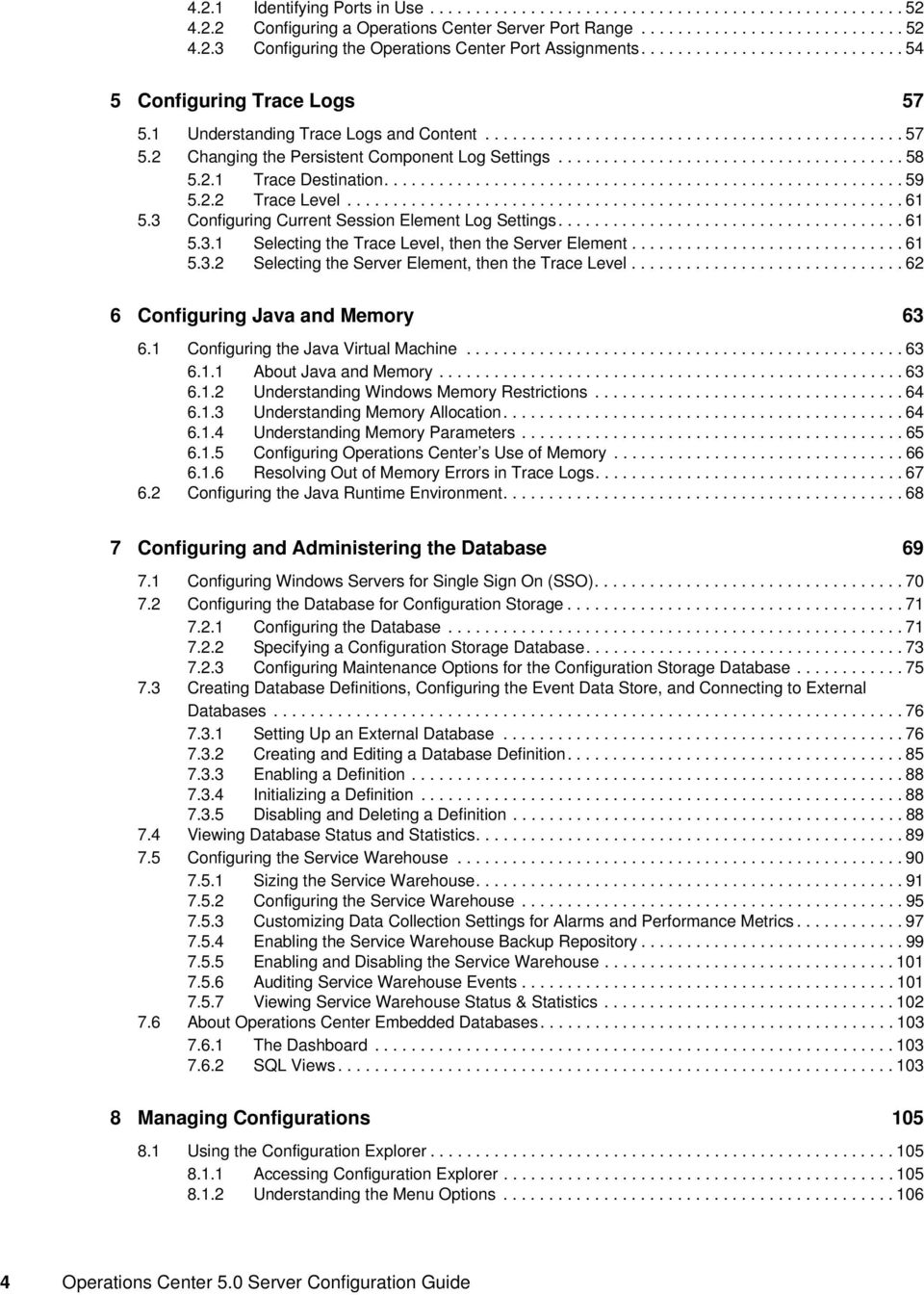
4 4.2.1 Identifying Ports in Use Configuring a Operations Center Server Port Range Configuring the Operations Center Port Assignments Configuring Trace Logs Understanding Trace Logs and Content Changing the Persistent Component Log Settings Trace Destination Trace Level Configuring Current Session Element Log Settings Selecting the Trace Level, then the Server Element Selecting the Server Element, then the Trace Level Configuring Java and Memory Configuring the Java Virtual Machine About Java and Memory Understanding Windows Memory Restrictions Understanding Memory Allocation Understanding Memory Parameters Configuring Operations Center s Use of Memory Resolving Out of Memory Errors in Trace Logs Configuring the Java Runtime Environment Configuring and Administering the Database Configuring Windows Servers for Single Sign On (SSO) Configuring the Database for Configuration Storage Configuring the Database Specifying a Configuration Storage Database Configuring Maintenance Options for the Configuration Storage Database Creating Database Definitions, Configuring the Event Data Store, and Connecting to External Databases Setting Up an External Database Creating and Editing a Database Definition Enabling a Definition Initializing a Definition Disabling and Deleting a Definition Viewing Database Status and Statistics Configuring the Service Warehouse Sizing the Service Warehouse Configuring the Service Warehouse Customizing Data Collection Settings for Alarms and Performance Metrics Enabling the Service Warehouse Backup Repository Enabling and Disabling the Service Warehouse Auditing Service Warehouse Events Viewing Service Warehouse Status & Statistics About Operations Center Embedded Databases The Dashboard SQL Views Managing Configurations Using the Configuration Explorer Accessing Configuration Explorer Understanding the Menu Options Operations Center 5.0 Server Configuration Guide
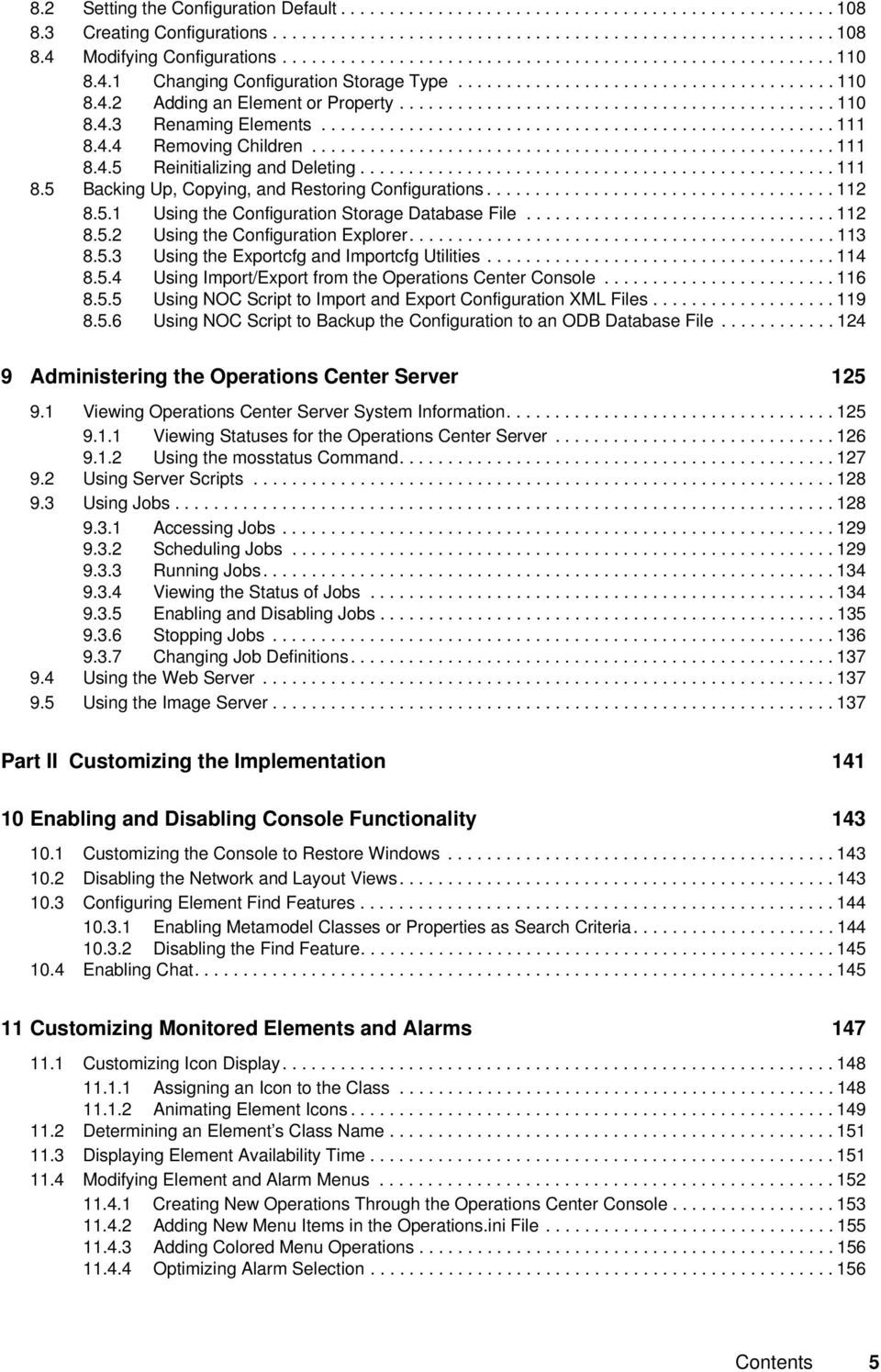
5 8.2 Setting the Configuration Default Creating Configurations Modifying Configurations Changing Configuration Storage Type Adding an Element or Property Renaming Elements Removing Children Reinitializing and Deleting Backing Up, Copying, and Restoring Configurations Using the Configuration Storage Database File Using the Configuration Explorer Using the Exportcfg and Importcfg Utilities Using Import/Export from the Operations Center Console Using NOC Script to Import and Export Configuration XML Files Using NOC Script to Backup the Configuration to an ODB Database File Administering the Operations Center Server Viewing Operations Center Server System Information Viewing Statuses for the Operations Center Server Using the mosstatus Command Using Server Scripts Using Jobs Accessing Jobs Scheduling Jobs Running Jobs Viewing the Status of Jobs Enabling and Disabling Jobs Stopping Jobs Changing Job Definitions Using the Web Server Using the Image Server Part II Customizing the Implementation Enabling and Disabling Console Functionality Customizing the Console to Restore Windows Disabling the Network and Layout Views Configuring Element Find Features Enabling Metamodel Classes or Properties as Search Criteria Disabling the Find Feature Enabling Chat Customizing Monitored Elements and Alarms Customizing Icon Display Assigning an Icon to the Class Animating Element Icons Determining an Element s Class Name Displaying Element Availability Time Modifying Element and Alarm Menus Creating New Operations Through the Operations Center Console Adding New Menu Items in the Operations.ini File Adding Colored Menu Operations Optimizing Alarm Selection Contents 5
6 11.5 Filtering Alarm Columns Configuring Suppression and Acknowledgement Configuring Suppression/Acknowledgement Functions Changing the Permission Level for Suppression Configuring Reacknowledgement on Server Restart Configuring Suppression/Acknowledgement to Apply to a Single Element Enabling Suppression after Correcting Database Problems Changing the Acknowledge and Suppress Menu Names Using the Suppression and Acknowledgement Options Controlling Display of Alarms Configuring Maximum Alarms Limiting the Roll Up of Alarms to Root Elements Displaying a Message for Paused Alarms Resuming Alarms after Pause Pause Alarms on Right-Click Filtering Service Model Alarms Creating Alarm Filters Editing Alarm Filters Creating Filter Groups Applying Filters to Service Models Applying Filters to Element Classes Clearing Filters from Elements Giving Users View Permissions to Filters Deleting Filters Assigning Filters Using Scripts Managing Administration Elements on Remote Servers Capturing Alarm and Performance History Alarm History Overview Using Profiles and Expressions to Capture Alarm History Creating Profiles Creating Expressions Starting and Stopping Profiles Monitoring Profile Data Collection Assigning Profiles at the Element Level Viewing Alarm History Monitoring Alarm History Collection Changing Query Limit Values Changing Database Query Time Limits Stopping and Starting Data Collection Viewing Data Warehouse State and Statistics Customizing Default Performance Chart Settings Time Categories, Calendars, and Schedules Maintaining Time Categories Creating and Maintaining Calendars Creating Calendars Specifying Time Definitions Using Existing Calendars to Create New Calendars Navigating the Calendar Visualization Section Assigning Undesignated Times Editing Calendars Setting Blackout Calendars on Elements Creating and Editing Schedules Creating a Schedule Editing a Schedule Operations Center 5.0 Server Configuration Guide

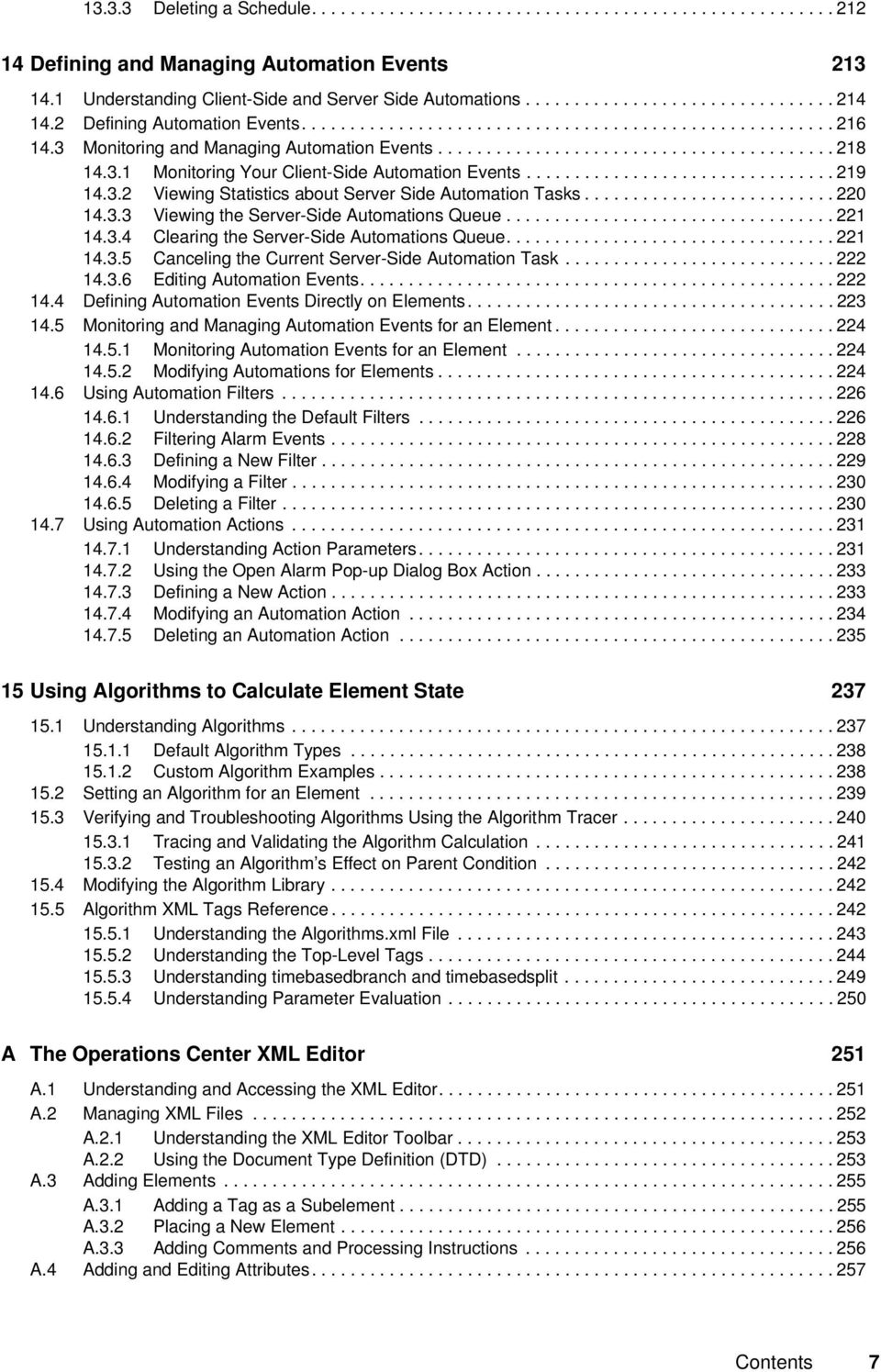
7 Deleting a Schedule Defining and Managing Automation Events Understanding Client-Side and Server Side Automations Defining Automation Events Monitoring and Managing Automation Events Monitoring Your Client-Side Automation Events Viewing Statistics about Server Side Automation Tasks Viewing the Server-Side Automations Queue Clearing the Server-Side Automations Queue Canceling the Current Server-Side Automation Task Editing Automation Events Defining Automation Events Directly on Elements Monitoring and Managing Automation Events for an Element Monitoring Automation Events for an Element Modifying Automations for Elements Using Automation Filters Understanding the Default Filters Filtering Alarm Events Defining a New Filter Modifying a Filter Deleting a Filter Using Automation Actions Understanding Action Parameters Using the Open Alarm Pop-up Dialog Box Action Defining a New Action Modifying an Automation Action Deleting an Automation Action Using Algorithms to Calculate Element State Understanding Algorithms Default Algorithm Types Custom Algorithm Examples Setting an Algorithm for an Element Verifying and Troubleshooting Algorithms Using the Algorithm Tracer Tracing and Validating the Algorithm Calculation Testing an Algorithm s Effect on Parent Condition Modifying the Algorithm Library Algorithm XML Tags Reference Understanding the Algorithms.xml File Understanding the Top-Level Tags Understanding timebasedbranch and timebasedsplit Understanding Parameter Evaluation A The Operations Center XML Editor 251 A.1 Understanding and Accessing the XML Editor A.2 Managing XML Files A.2.1 Understanding the XML Editor Toolbar A.2.2 Using the Document Type Definition (DTD) A.3 Adding Elements A.3.1 Adding a Tag as a Subelement A.3.2 Placing a New Element A.3.3 Adding Comments and Processing Instructions A.4 Adding and Editing Attributes Contents 7
8 A.5 Moving Tags A.5.1 Moving a Tag Element A.5.2 Cutting, Copying, and Pasting Tags A.6 Deleting Tags B Documentation Updates 259 B.1 March 2014 Patch Release B.2 September 2013 Patch Release B.3 April 2013 Patch Release B.4 December 2012 Patch Release B.5 June 2012 Patch Release B.6 February 2012 Patch Release B.7 September 2011 Patch Release Operations Center 5.0 Server Configuration Guide

9 About This Guide The Novell Operations Center Server Configuration Guide provides post installation instructions for configuring and customizing the Operations Center server and console. Part I, Configuring the Operations Center Server, on page 13 Chapter 1, Overview of Post Installation Configurations, on page 15 Provides an introduction to this guide. Chapter 2, Updating Server Settings Using the Configuration Manager, on page 17 Explains how this tool is used for configuration. These sections provide the configuration tasks: Chapter 3, Configuring Operations Center Start Conditions, on page 39 Chapter 4, Configuring Network Communication Settings, on page 49 Chapter 5, Configuring Trace Logs, on page 57 Chapter 6, Configuring Java and Memory, on page 63 Chapter 3, Configuring Operations Center Start Conditions, on page 39 Chapter 7, Configuring and Administering the Database, on page 69 Describes the databases that need to be created, configured, and administered (including Configuration Storage). Chapter 8, Managing Configurations, on page 105 Explains how configurations can be copied, shared, and moved. Chapter 9, Administering the Operations Center Server, on page 125 Explains how to administer the Operations Center server (including running jobs), the Web server, and the Image server. Part II, Customizing the Implementation, on page 141 Chapter 10, Enabling and Disabling Console Functionality, on page 143 Chapter 11, Customizing Monitored Elements and Alarms, on page 147 Chapter 12, Capturing Alarm and Performance History, on page 177 Chapter 13, Time Categories, Calendars, and Schedules, on page 197 Chapter 14, Defining and Managing Automation Events, on page 213 Chapter 15, Using Algorithms to Calculate Element State, on page 237 Appendix A, The Operations Center XML Editor, on page 251 Appendix B, Documentation Updates, on page 259 Audience This guide is intended for the Operations Center administrator who sets up, uses, and maintains Operations Center servers. About This Guide 9

10 Feedback We want to hear your comments and suggestions about this manual and the other documentation included with this product. Please use the User Comments feature at the bottom of each page of the online documentation. Additional Documentation & Documentation Updates This guide is part of the Operations Center documentation set. For the most recent version of the Adapter and Integration Guide and a complete list of publications supporting Operations Center, visit our Online Documentation Web Site at Operations Center 5.0 online documentation. The Operations Center documentation set is also available as PDF files on the installation CD or ISO; and is delivered as part of the online help accessible from multiple locations in Operations Center depending on the product component. Additional Resources We encourage you to use the following additional resources on the Web: NetIQ User Community ( A Web based community with a variety of discussion topics. NetIQ Support Knowledgebase ( product.php?id=sg_xoperationscenter_1_2): A collection of in depth technical articles. NetIQ Support Forums ( Operations Center): A Web location where product users can discuss NetIQ product functionality and advice with other product users. Technical Support You can learn more about the policies and procedures of NetIQ Technical Support by accessing its Technical Support Guide ( process.asp#_maintenance_programs_and). Use these resources for support specific to Operations Center: Telephone in Canada and the United States: Telephone outside the United States: E mail: [email protected] ([email protected]) Submit a Service Request: ( ) Documentation Conventions A greater than symbol (>) is used to separate actions within a step and items in a cross reference path. The > symbol is also used to connect consecutive links in an element tree structure where you can either click a plus symbol (+) or double click the elements to expand them. When a single pathname can be written with a backslash for some platforms or a forward slash for other platforms, the pathname is presented with a forward slash to preserve case considerations in the UNIX* or Linux* operating systems. 10 Operations Center 5.0 Server Configuration Guide

11 A trademark symbol (,, etc.) denotes a Novell trademark. An asterisk (*) denotes a third party trademark. About This Guide 11

12 12 Operations Center 5.0 Server Configuration Guide

13 I IConfiguring the Operations Center Server After installing Operations Center, you need to make various initial configurations to Operations Center server. You might also need to tweak configuration settings further for better performance or for certain requirements that your environment demands. If you have just installed Operations Center, start with Overview of Post Installation Configurations (page 15) for an introduction to the configurations you ll need to set up for your implementation. This section covers the following post installation configuration topics: Chapter 1, Overview of Post Installation Configurations, on page 15 Chapter 2, Updating Server Settings Using the Configuration Manager, on page 17 Chapter 3, Configuring Operations Center Start Conditions, on page 39 Chapter 4, Configuring Network Communication Settings, on page 49 Chapter 5, Configuring Trace Logs, on page 57 Chapter 6, Configuring Java and Memory, on page 63 Chapter 7, Configuring and Administering the Database, on page 69 Chapter 8, Managing Configurations, on page 105 Chapter 9, Administering the Operations Center Server, on page 125 Configuring the Operations Center Server 13
14 14 Operations Center 5.0 Server Configuration Guide

15 1 1Overview of Post-Installation Configurations After installing Novell Operations Center, it is necessary to perform the following actions and configurations: 1. If you are installing on a cluster, do all of the following steps after completing installations on all servers. For more information on installing and configuring Operations Center servers in a clustered environment, see Implementing a High Availability Solution in the Operations Center 5.0 Server Installation Guide. 2. Run the Configuration Manager, an Operations Center utility used to set configuration settings for the Operations Center servers and for Configuration Storage. Specify server settings for networking, trace logs, java, memory, and more. For instructions on using the Configuration Manager, see Chapter 2, Updating Server Settings Using the Configuration Manager, on page 17. At any time, specific configurations can be created and copied for ease in moving Operations Center (for example from a development or test environment to production) by using the Configuration Explorer utility. Configurations are stored in one of these data stores called Configuration Storage. For instructions on using the Configuration Explorer, see Chapter 8, Managing Configurations, on page Configure the Operations Center start options. Refer to Configuring Operations Center Start Conditions (page 39) for details. 4. Perform further customizations as required for networking, trace logs, and Java and memory settings. Refer to the following sections for instructions: Configuring Network Communication Settings (page 49) Operations Center is installed using default ports, but do consider the ports currently used and how they fit within your environment. Configuring Trace Logs (page 57) Configure trace logs for the Operations Center server and other components. Define settings applicable for the current session and those that will persist for each session. Configuring Java and Memory (page 63) The Java Virtual Machine is configured with parameters for memory allocation and installs with these default values. Before adjusting the memory, it is important to understand how memory is allocated. 5. If you plan to use any external databases with Operations Center, you ll need to create the database instance. Both the Operations Center data store and any external databases require a database definition to be created and managed in the Operations Center console. Refer to the following sections for instructions: Configuring the Database for Configuration Storage (page 71) Overview of Post-Installation Configurations 15

16 The Operations Center data store is an embedded Object ODB that stores Operations Center configuration data, version tracking, and to control connections to all databases configured for use with Operations Center. Configure an external database to handle this data repository. Setting Up an External Database (page 76) Run scripts to create and configure the database instance before configuring Operations Center to connect with the database. Creating and Editing a Database Definition (page 85) Create a database definition for each database connection. Configuring the Service Warehouse (page 90) The Service Warehouse stores alarm history, alarm comments, historical performance and service level data. Even if you do not plan to use SLAs and Service Level Manager, create and define a Service Warehouse for alarm history data. 6. Set up server security settings. For information about security in Operations Center, see the Operations Center 5.0 Security Management Guide. 7. Customize the implementation for users and administrators by configuring how elements and alarms are displayed in the Operations Center console, how alarm and performance history is captured, when alerts are issued after network events, and how element states are calculated. For information and instructions, see Part II, Customizing the Implementation, on page Operations Center 5.0 Server Configuration Guide

17 2 2Updating Server Settings Using the Configuration Manager Configuration Manager is a utility in Operations Center through which you set configuration settings for the components of Operations Center including the Operations Center server, Web server, Image server, and databases, as well as some other Operations Center applications. Configuration Manager can be accessed during the installation process or after Operations Center has been installed. For more information about how to install Operations Center, see the Operations Center 5.0 Server Installation Guide. The settings in Configuration Manager are described briefly in this section. Be sure to review the other relevant sections of this guide as well as other guides before changing any settings. Most configuration settings can be configured by using the Configuration Manager and are stored in the formula.properties file. The formula.properties file should never be edited directly. Custom changes not configurable through the Configuration Manager can be made to the configuration file by using the Formula.custom.properties file, which is never overwritten by the Configuration Manager. WARNING: Any configuration changes made outside the Configuration Manager might be overwritten the next time the Configuration Manager is run. After making changes in Configuration Manager, you might want to consider creating backup copies of configuration files in case changes are made that are determined to be unacceptable. Review the following sections to understand configuration settings and how to update them: Section 2.1, Accessing and Using Configuration Manager, on page 17 Section 2.2, Understanding Configuration Settings, on page 18 Section 2.3, Setting Up Configuration File Backups, on page 37 Section 2.4, Making Custom Changes, on page Accessing and Using Configuration Manager You can opt to open Configuration Manager immediately after installing Operations Center. 1 To open Configuration Manager, do one of the following: Windows: You have two options: Click Start > All Programs > Novell Operations Center > Configure Novell Operations Center. At the DOS prompt, run customizer from the \OperationsCenter_install_path\bin directory. UNIX: At a command prompt, run Customizer from the / OperationsCenter_install_path/bin directory. Updating Server Settings Using the Configuration Manager 17

18 The following window opens: 2 To use Configuration Manager (some basic actions): Click either the Components or Tasks tab, then select a pane from the list. Components: This tab has all of the available settings, separated according to component. See Section 2.2, Understanding Configuration Settings, on page 18 for descriptions and instructions on each of the component related settings. Tasks: This tab has options for Networking, Java Runtime, and Logging, subdivided into these three categories. To display a tooltip description of a setting, hover the mouse over the field or drop down list. If you installed only the Event Manager, configure only the options on the Event Manager pane (located on the Components tab). 3 After making changes, click Apply to save the changes; or click Revert to revert to previously saved values. 4 Continue with Section 2.3, Setting Up Configuration File Backups, on page Understanding Configuration Settings When a configuration setting is available on both the Components tab and Tasks tab, it can be changed in either location. The settings available through the Tasks tab are a smaller subset of those offered in Components tab, and are only the settings related to Networking, Java Runtime, and Logging. If you are looking for more information about a setting while using the Tasks tab, refer to the appropriate component topic in this section. 18 Operations Center 5.0 Server Configuration Guide

19 The figures in following sections display the settings available on the different panes for the Components tab. The table that follows each figure briefly describes each setting with a link (or reference) to additional information: Section 2.2.1, Host Pane, on page 19 Section 2.2.2, Daemon Pane, on page 20 Section 2.2.3, Security Pane, on page 22 Section 2.2.4, Web Server Pane, on page 25 Section 2.2.5, NOC Server Pane, on page 26 Section 2.2.6, Image Server Pane, on page 28 Section 2.2.7, SQL Views Pane, on page 29 Section 2.2.8, Remote Container Pane, on page 30 Section 2.2.9, Event Manager Pane, on page 32 Section , Event Manager Agent Pane, on page 33 Section , Database Pane, on page Host Pane The section describes Configuration Manager settings for the Operations Center host server. Figure 2 1 shows the Host pane that contains configuration options necessary for the connection with the Operations Center host server. Table 2 1 on page 20 provides information about configuring these options. Figure 2-1 Configuration Manager Host Pane on the Components Tab (on Windows) Updating Server Settings Using the Configuration Manager 19

20 Table 2-1 Configuration Manager Host Pane Settings Setting Windows Default UNIX Default Description Host Name Hostname of the Primary Network Interface The local server hostname TCP/IP hostname of the server. See Chapter 4, Configuring Network Communication Settings, on page 49. IP Address Primary Network Interface The local server IP address The IP address or the TCP/IP hostname of the server. By default, the IP address for the Primary Network Interface is prefilled. See Chapter 4, Configuring Network Communication Settings, on page 49. X11 Display Name Not applicable to Windows :1 (Unix Only) The display used by the virtual framebuffer. Optionally specify host name and screen name: host:display_name:screen_name See Configuring Display for Images on UNIX in the Operations Center 5.0 Server Installation Guide Daemon Pane The section describes Configuration Manager settings for the Operations Center server daemon process. Figure 2 2 shows the Daemon pane that contains configuration options for the daemon process. Table 2 2 on page 21 provides information about configuring these options. Figure 2-2 Configuration Manager Daemon Pane on the Components Tab 20 Operations Center 5.0 Server Configuration Guide
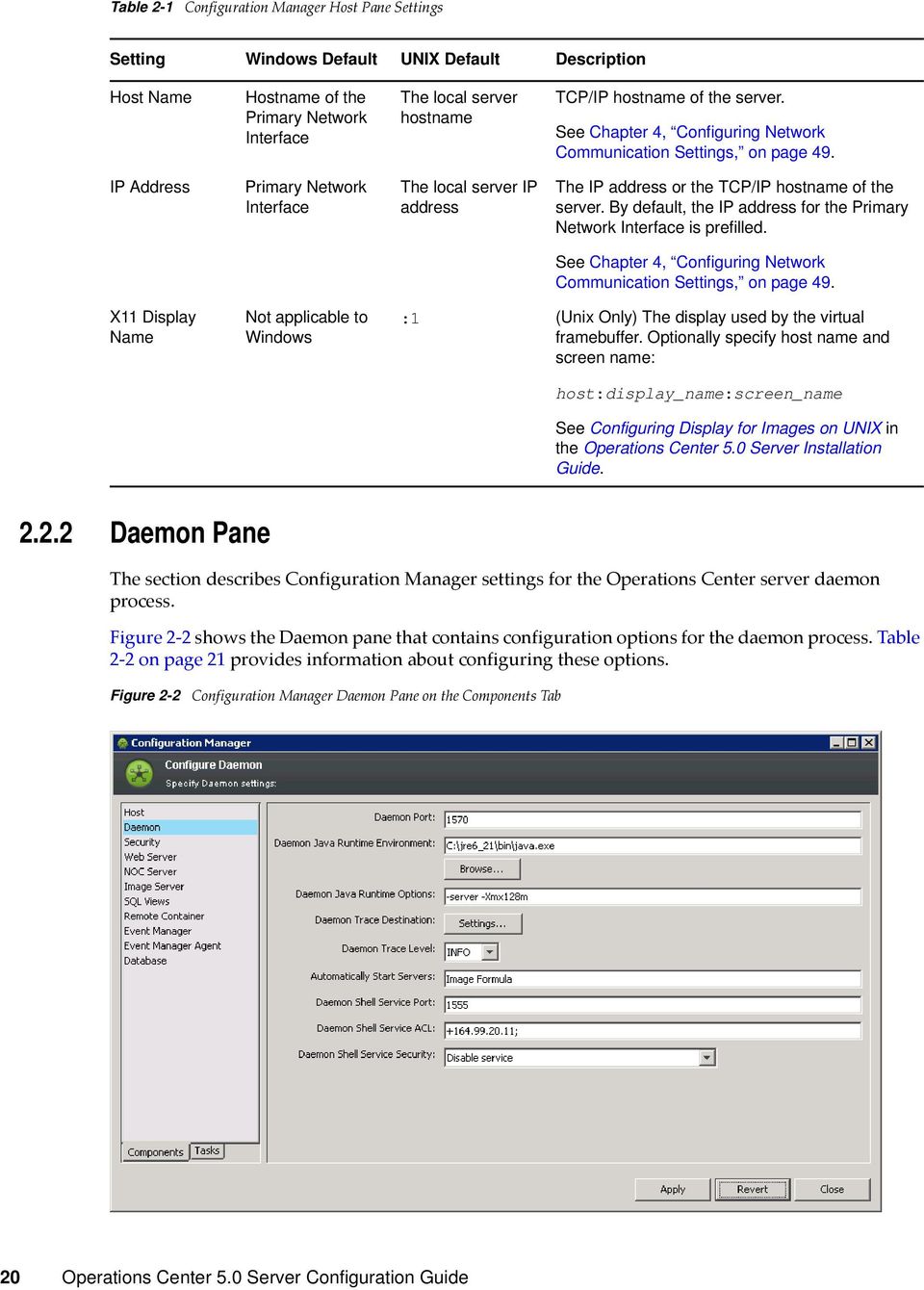
21 Table 2-2 Configuration Manager Daemon Pane Settings Setting Windows Default UNIX Default Description Daemon Port Port number for the Operations Center daemon. Daemon Java Runtime Environment C:\OperationsC enter_install_ path\jre\bin\j ava.exe / OperationsCent er_install_pat h/jre/bin/ java.exe Executable for the Java Runtime Environment for the daemon for Operations Center. Click Browse to navigate to the location of the JRE. See Chapter 6, Configuring Java and Memory, on page 63. Daemon Java Runtime Options -server -Xmx128m -server -Xmx256m Options for running the VM for the Operations Center background daemon. Usually does not need to be changed. See Chapter 6, Configuring Java and Memory, on page 63. Daemon Trace Destination Daemon Trace Level N/A N/A The settings for the daemon trace logs. See Chapter 5, Configuring Trace Logs, on page 57. INFO INFO Controls how much information is passed to the daemon trace logs. See Chapter 5, Configuring Trace Logs, on page 57. Automatically Start Servers Database Image Formula N/A A list of all servers that should start automatically when the mosdaemon starts. See Chapter 3, Configuring Operations Center Start Conditions, on page 39. Daemon Shell Service Port The specified port to listen for the daemon shell service. Daemon Shell Service ACL +IP address for localhost; +IP address for localhost; The clients running on the local host that can access the daemon shell service. To configure this setting, precede each hostname or IP address that is allolwed access with a plus sign (+), and separate the entries with a semicolon (;). For example: +devtower10;+qasun1; Updating Server Settings Using the Configuration Manager 21
22 Setting Windows Default UNIX Default Description Daemon Shell Service Security Disable Service Disable Service Enables the daemon shell service, where by using and RMI registry in the daemon, processes can be forked to avoid generating a large swap footprint. Select one of the following options: Unsecured communication Secured communication using SSL Secured Communication using SSL and Client Certificates Default is Disable service. For more information about communication settings, see the Communications Security in the Operations Center 5.0 Security Management Guide Security Pane The section describes Configuration Manager settings for secure communication and security features. Figure 2 3 shows the Security pane that contains configuration options for secure communications between client and server, the Dashboard, and Web Services. Table 2 3 on page 23 provides information about configuring these options. Figure 2-3 Configuration Manager Security Pane on the Components Tab 22 Operations Center 5.0 Server Configuration Guide
23 Table 2-3 Configuration Manager Security Pane Settings Setting Windows Default UNIX Default Description Client/Server Communication Mode Unsecured Communication Unsecured Communication Select from the following: Unsecured Communication: The server only accepts access via Hypertext Transfer Protocol (HTTP) communications protocols, and does not use SSL to encrypt these data streams. Secured Communication using SSL: The server only accepts access via HTTPS communications protocols, using the Secure Sockets Layer to encrypt these data streams. Support Both Unsecured and Secured Communication: Operations Center supports both secured and unsecured access. See Chapter 4, Configuring Network Communication Settings, on page 49. For more information, see Communications Security in the Operations Center 5.0 Security Management Guide. Password Expiration 0 0 The number of days a password can be used. For example, enter 30 to require users to change their passwords every 30 days. Password Reuse 0 0 Determines the number of previous passwords that can be reused. Specify 0 to use the same password indefinitely. Specify a positive number (n) to indicate that new passwords cannot be the same as those of the last n passwords. For example, if you enter 2, a user cannot specify the same password that was used the last two times. Specify a negative number (-n) to indicate that new passwords cannot be the same as those used for the past n days. The number of days specified must be equal to or less than the number of days entered for Password Expiration. For example, specify -18 to prevent users from reusing passwords that were used during the past 18 days. Updating Server Settings Using the Configuration Manager 23
24 Setting Windows Default UNIX Default Description Password Pattern 0 or blank 0 or blank Select one of the following to specify the format of the password: Enter 0 or leave it blank to specify no restriction on the password format. Enter.*[0 9]+.* to specify that the password might contain a combination of letters, digits, and special characters; however, it must contain at least a numeric character from 0 to 9. Specify a regular expression pattern that must be matched. Inactivity Timeout 0 or blank 0 or blank The time frame during which user sessions can remain inactive before they are required to log in again. 0 or blank specifies no timeout. A positive number specifies the length of time in minutes that the user can remain inactive. After the inactivity timeout occurs, users need to log on again and restart the Operations Center console. Remote Services Security (RMI) Unsecured communication Unsecured communication Three options for setting the RMI security level for communications between the Operations Center server and the dashboard, and between the Operations Center server and CMS: Unsecured communication Secured communication using SSL Secured communication using SSL and Client Certificates For more information about the dashboard, see the Operations Center 5.0 Dashboard Guide. For more information about CMS, see the Operations Center 5.0 Configuration Management System (CMS) Guide. Web Services Communication Security Unsecured communication Unsecured communication Three options for communication between thirdparty applications and the Operations Center Web Services Application Programmer Interface (WSAPI): Unsecured communication Secured communication using SSL Secured communication using SSL and Client Certificates For more information, see the Operations Center 5.0 Web Services Guide. 24 Operations Center 5.0 Server Configuration Guide
25 2.2.4 Web Server Pane The section describes Configuration Manager settings for the Web Server. Figure 2 4 shows the Web Server pane that contains configuration options necessary for communication with the Web server. Table 2 4 on page 25 provides information about configuring these options. Figure 2-4 Configuration Manager Web Server Pane on the Components Tab Table 2-4 Configuration Manager Web Server Pane Settings Setting Windows Default UNIX Default Description Web Server Port (HTTP) Unsecured TCP/IP port number for Web server access. If the default port is already in use, change the port number. See Chapter 4, Configuring Network Communication Settings, on page 49. Web Server Port (HTTPS) Secure TCP/IP port number for Web server access. If the default port is already in use, change the port number. See Chapter 4, Configuring Network Communication Settings, on page 49. Web Server Shutdown Port The specified port opens a socket connection to listen for a shutdown command for the Web server. See Chapter 4, Configuring Network Communication Settings, on page 49. Updating Server Settings Using the Configuration Manager 25
26 2.2.5 NOC Server Pane The section describes Configuration Manager settings for the Operations Center Server. Figure 2 5 shows the NOC Server pane that contains configuration options for the server s runtime environment and options, log files, configuration storage, and service ports. Table 2 5 on page 26 provides information about configuring these options. Figure 2-5 Configuration Manager Server Pane on the Components Tab Table 2-5 Configuration Manager Server Pane Settings Setting Windows Default UNIX Default Description NOC Server Java Runtime Environment c:\program Fil es\operationsc enter_install_ path\jre\bin\j ava.exe / OperationsCent er_install_pat h/jre/bin/jre Executable for the Java Runtime Environment (JRE) on your system. Click Browse to navigate to the location of the JRE program. Before changing this value, see Chapter 6, Configuring Java and Memory, on page 63. For supported JREs, see the Operations Center 5.0 Getting Started Guide. For JRE installation information, see the Operations Center 5.0 Server Installation Guide. 26 Operations Center 5.0 Server Configuration Guide
27 Setting Windows Default UNIX Default Description NOC Server Java Runtime Options -server -Xmx1g - XX:MaxPermSize= 128m "- Xloggc:C:\Operatio nscenter_install_p ath\logs\fsgc.log" -server -Xmx1g - XX:MaxPermSize= 128m "-Xloggc:C:/ OperationsCenter_i nstall_path/logs/ fsgc.log" Options for running the Java Virtual Machine (JVM), which does not usually need to be changed. On an IBM JVM, change the -Xloggc parameter for verbose Garbage Collection logging to: -Xverbosegclog:OperationsCenter_inst all_path/logs/fsgc.log. If running in a 64-bit JVM, additional memory must be allocated. We recommend increasing - XX:MaxPermSize to 256m. See Chapter 6, Configuring Java and Memory, on page 63. Client Java Runtime Options -Xmx256m -server -Xmx512m -Xloggc:D:/ formula3-2/logs/ fsgc.log Options for running the JVM for the Operations Center console. Subject to Java Web Start VM option restrictions. See Chapter 6, Configuring Java and Memory, on page 63. Server Trace Destination N/A N/A The settings for the Operations Center server trace logs. See Chapter 5, Configuring Trace Logs, on page 57. NOC Server Trace Level INFO INFO Controls how much information is passed to the server trace logs. It is recommended to leave the default setting at start up. See Chapter 5, Configuring Trace Logs, on page 57. Configuration Explorer Java Runtime Options Configuration Storage Remote Services Port (RMI) -Xmx1g -Xmx1g Sets memory for the Configuration Explorer utility. See Chapter 6, Configuring Java and Memory, on page 63. N/A N/A Each Operations Center server must have a Configuring the Database for Configuration Storage database. A default database is provided Port number for the Remote Method Invocation (RMI) registry used by the dashboard. See Section 4.2, Configuring Ports, on page 51. This value must also be configured in the dashboards. For more information, see the Operations Center 5.0 Dashboard Guide. Updating Server Settings Using the Configuration Manager 27
28 Setting Windows Default UNIX Default Description Web Services Port Port number for third-party applications to access the Operations Center server using the Operations Center Web Services Application Programmer Interface (WSAPI). See Section 4.2, Configuring Ports, on page 51. For more information, see the Operations Center 5.0 Web Services Guide Image Server Pane The section describes Configuration Manager settings for the Image Server. Figure 2 6 on page 28 shows the Image Server pane that contains configuration options for the image server ports, log files, and runtime options. Table 2 6 on page 28 provides information about configuring these options. Figure 2-6 Configuration Manager Image Server Pane on the Components Tab Table 2-6 Configuration Manager Image Server Pane Settings Setting Windows Default UNIX Default Description Image Server Port The port to handle external communications between a Web client and the Image server. See Chapter 4, Configuring Network Communication Settings, on page Operations Center 5.0 Server Configuration Guide
29 Setting Windows Default UNIX Default Description Image Server Comm Port The port to handle internal communications between Operations Center and the Image server. See Chapter 4, Configuring Network Communication Settings, on page 49. Image Server Agent Port Image Server Administration Port Image Server Trace Destination Image Server Trace Level The port used by the Image server agent. See Chapter 4, Configuring Network Communication Settings, on page The port used to access the administration Web application for the Image server. See Chapter 4, Configuring Network Communication Settings, on page 49. N/A N/A The settings for the Image server trace logs. See Chapter 5, Configuring Trace Logs, on page 57. INFO INFO Controls how much information is passed to the Image server trace logs. See Chapter 5, Configuring Trace Logs, on page 57. Image Server Java Runtime Environment C:\OperationsC enter_install_ path\jre\bin\j ava.exe / OperationsCent er_install_pat h/jre/bin/ java.exe Executable for the Java Runtime Environment for the Image server. Click Browse to navigate to the location of the JRE. See Chapter 6, Configuring Java and Memory, on page 63. Image Server Java Runtime Options -server -Xmx128m -server -Xmx128m Options for running the Image server. Usually does not need to be changed. See Chapter 6, Configuring Java and Memory, on page 63. Image Agent VM Size Specify the image agent VM size SQL Views Pane The section describes Configuration Manager settings for SQL Views. Figure 2 7 shows the SQL Views pane that contains configuration options for setting the SQL Views port. Table 2 7 provides information about configuring these options. Updating Server Settings Using the Configuration Manager 29
30 Figure 2-7 Configuration Manager SQL Views Pane on the Components Tab Table 2-7 Configuration Manager SQL Views Pane Settings Setting Windows Default UNIX Default Description SQL Views Port The port used by SQL Views for access to the Operations Center server. See Chapter 4, Configuring Network Communication Settings, on page 49. For more information, see the Operations Center 5.0 SQL Views Guide Remote Container Pane The Remote Container feature off loads from the Operations Center server the resources required to configure and maintain multiple adapter instances. Figure 2 8 on page 31 shows the Remote Container pane that contains configuration options for the remote container runtime environment and options, and log files. Table 2 8 on page 31 provides information about configuring these options. For more information about the Remote Container, see the Operations Center 5.0 Adapter and Integration Guide. 30 Operations Center 5.0 Server Configuration Guide
31 Figure 2-8 Configuration Manager Remote Container Pane on the Components Tab Table 2-8 Configuration Manager Remote Containers Pane Settings Setting Windows Default UNIX Default Description Remote Container Java Runtime Environment N/A N/A Specifies the path to the moscontainer.exe file. The -jvmhome setting points to the Java Runtime Environment (JRE) used to run the Remote Containers servers. See Chapter 6, Configuring Java and Memory, on page 63. Remote Container Java Runtime Options Remote Container Trace Destination Remote Container Server Trace Level -server -Xmx512m -server -Xmx512m Options for running the Remote Container server. Usually does not need to be changed. See Chapter 6, Configuring Java and Memory, on page 63. N/A N/A The settings for the Remote Container server trace logs. See Chapter 5, Configuring Trace Logs, on page 57. INFO INFO Controls how much information is passed to the Remote Container server trace logs. See Chapter 5, Configuring Trace Logs, on page 57. Updating Server Settings Using the Configuration Manager 31
32 2.2.9 Event Manager Pane The section describes Configuration Manager settings for Event Manager agents. Figure 2 9 on page 32 shows the Event Manager pane that contains configuration options for the Event Manager runtime environment and options, and log files. Table 2 9 on page 32 provides information about configuring these options. For more information about Event Manager, see the Operations Center 5.0 Event Manager Guide. Figure 2-9 Configuration Manager Event Manager Pane on the Components Tab Table 2-9 Configuration Manager Event Manager Pane Settings Setting Windows Default UNIX Default Description Configuration Server Java Runtime Environment C:\OperationsC enter_install_ path\jre\bin\j ava.exe / OperationsCent er_install_pat h/jre/bin/ java.exe Executable for the Java Runtime Environment for the Event Manager Agent Manager. Click Browse to navigate to the location of the JRE. For more information about configuring Java and Memory, see Chapter 6, Configuring Java and Memory, on page 63. Configuration Server Java Runtime Options -server -Xmx128m -server -Xmx128m Options for running VM for the Event Manager Agent Manager server. Usually does not need to be changed. For more information about configuring Java and Memory, see Chapter 6, Configuring Java and Memory, on page Operations Center 5.0 Server Configuration Guide
33 Setting Windows Default UNIX Default Description Alarm Server Java Runtime Environment C:\OperationsC enter_install_ path\jre\bin\j ava.exe / OperationsCent er_install_pat h/jre/bin/ java.exe Executable for the Java Runtime Environment for the Event Manager Alarm Server. Click Browse to navigate to the location of the JRE. For more information about configuring Java and Memory, see Chapter 6, Configuring Java and Memory, on page 63. Alarm Server Java Runtime Options -server -Xmx256m -server -Xmx256m A setting for VM for the Event Manager Alarm server. Usually does not need to be changed. For more information about configuring Java and Memory, see Chapter 6, Configuring Java and Memory, on page 63. Configuration Server Trace Destination \OperationsCen ter_install_pa th\logs / OperationsCent er_install_pat h/logs The location in which to save the Event Manager server trace log files. For more information about configuring trace logs, see Chapter 5, Configuring Trace Logs, on page 57. Configuration Server Trace Level INFO INFO These settings control how much information is passed to the Event Manager server trace logs. For more information about configuring trace logs, see Chapter 5, Configuring Trace Logs, on page Event Manager Agent Pane The section describes Configuration Manager settings for Event Manager agents. Figure 2 10 on page 34 shows the Event Manager Agent pane that contains configuration options for the Event Manager Agent runtime environment and options, ports, and log files. Table 2 10 on page 34 provides information about configuring these options. For more information about Event Manager and Event Manager agents, see the Operations Center 5.0 Event Manager Guide. Updating Server Settings Using the Configuration Manager 33
34 Figure 2-10 Configuration Manager Event Manager Agent Pane on the Components Tab Table 2-10 Configuration Manager Event Manager Agent Settings Setting Windows Default UNIX Default Description Agent Container Java Runtime Environment C:\OperationsCenter_i nstall_path\jre\bin\j ava.exe / OperationsCenter_inst all_path/jre/bin/ java.exe Executable for the Java Runtime Environment for the Event Manager Agent Manager. Click Browse to navigate to the location of the JRE. For more information about configuring Java and Memory, Chapter 6, Configuring Java and Memory, on page 63. Agent Container Java Runtime Options -server -Xmx128m -server -Xmx128m Options for running VM for the Event Manager Agent Manager server. Usually does not need changing. For more information about configuring Java and Memory, Chapter 6, Configuring Java and Memory, on page Operations Center 5.0 Server Configuration Guide
35 Setting Windows Default UNIX Default Description Agent Container Trace Level INFO INFO These settings control how much information is passed to the Event Manager agent trace logs. Agent Container Trace Destination \OperationsCenter_ins tall_path\logs / OperationsCenter_inst all_path/logs For more information about configuring trace logs, see Chapter 5, Configuring Trace Logs, on page 57. The location in which to save the Event Manager agent trace log files. For more information about configuring trace logs, see Chapter 5, Configuring Trace Logs, on page 57. Configuration Server Host IP address for localhost IP address for localhost IP address for the Eve Configuration Manager for the agent. When an agent is installed with Operations Center or a Remote Container, this defaults to the local server. When agent is stand-alone, it must be populated. Configuration Server Daemon Port Agent Container Download Host Agent Container Download Host Web Port (HTTP) Agent Container Download Host Web Port (HTTPS) The daemon port on the server specified above. localhost If installing the agent as a stand-alone installation or on a remote container, default is blank. localhost If installing the agent as a stand-alone installation or on a remote container, default is blank. The name of the host from which the agent software is loaded. This must be an active Operations Center server with an active web server. If secure communications are enabled then the name must match the name on the server s certificate The HTTP port on the Download Host specified above The HTTPS port on the Download Host specified above. Updating Server Settings Using the Configuration Manager 35
36 Database Pane The section describes Configuration Manager settings for the database. Figure 2 11 shows the Database pane that contains configuration options for loading custom Java class files, and warehouse write mode. Table 2 11 provides information about configuring these options. Figure 2-11 Configuration Manager Database Pane on the Components Tab Table 2-11 Configuration Manager Database Pane Settings Setting Windows Default UNIX Default Description Additional Class Files N/A I N/A Comma-separated custom Java class files to load when the Operations Center server starts. These files should be placed in the / OperationsCenter_install_path/ classes/ext directory. Loading class files is only necessary if you do custom development. 36 Operations Center 5.0 Server Configuration Guide
37 Setting Windows Default UNIX Default Description Warehouse Write Mode (Only Affects Clustering) DISK-QUEUED DISK-QUEUED Select MEMORY-QUEUED for one Operations Center server in a clustered environment to update the database for the Service Warehouse. Select DISK-QUEUED to have an internal diskbased queued repository used for the BSW to queue data locally instead of using the backup repository. The backup repository has two main drawbacks: it uses more memory and it is nondeterministic when queueing to disk occurs. Disk-Queued can be used in either clustered mode or nonclustered mode. For clusters, it allows the primary warehouse writer to float between members of the cluster. See Implementing a High Availability Solution in the Operations Center 5.0 Server Installation Guide. If used in nonclustered mode, the write throughput speed for alarms takes about a 10% performance hit, and performance for nonalarm BSW writes increases. The benefit to using the Disk-Queued mode in nonclustered mode is improved fault-tolerance to outages of the server (data is always buffered locally on disk before sending to the BSW), and drastically reduced memory usage for the server (no in-memory queuing occurs). 2.3 Setting Up Configuration File Backups Changes made in Configuration Manager are stored in properties files located in the / OperationsCenter_install_path/config directory. Within this folder is a template directory that contains templates of some of the properties files. After finalizing changes in Configuration Manager, consider making backup copies of the configuration files in case a change is made in Configuration Manager that is later deemed unacceptable. Also consider making a backup copy of the template file that originally used to create the configuration file, since the template files might be updated when you install a new version or a service pack for Operations Center. To persist configuration file changes: 1 Locate the /OperationsCenter_install_path/config/template directory. 2 Make a backup copy of the original template version of the file, adding a new extension such as.original to designate it as the original copy of the file. 3 Make a backup copy of the changed configuration file, adding a new extension such as.modified to designate it as the modified version of the file. IMPORTANT: Do not copy either file from its folder to the other folder. They are not identical. Copying them can cause the server to fail to start. 4 Run Configuration Manager, then click the Apply button. Updating Server Settings Using the Configuration Manager 37
38 5 Check the final version of the file (the one the server actually uses, not the template version) to verify that the changes are included. 6 Continue with Section 2.4, Making Custom Changes, on page Making Custom Changes By default, the /OperationsCenter_install_path/config/Formula.properties file stores standard configuration settings. Most of these configurations can be set and changed using the Configuration Manager. However, some settings are unique to the Formula.properties file and cannot be configured using Configuration Manager. To add to or modify these customized settings, it is best to create and use a Formula.custom.properties file to ensure retention when the Formula.properties is overwritten during product reinstallations, upgrades, or when settings are changed using Configuration Manager. Custom configuration settings saved in the Formula.custom.properties file supersede values in the Formula.properties file. In other words, if the same option is specified in both the Formula.custom.properties and Formula.properties files, Operations Center uses the value as specified in the Formula.custom.properties file. To create a custom configuration file: 1 In a text editor, create a new file in the /OperationsCenter_install_path/config directory and save it with the following name: Formula.custom.properties Verify that no additional file extension is added in the file name. 2 Add properties as necessary by copying and pasting property entries from the Formula.properties file and editing them as desired. 3 Stop and restart the Operations Center server for changes to take effect. For instructions on stopping the Operations Center server, see Section 3.4, Manually Stopping Operations Center Components, on page 44. For instructions on starting the Operations Center server, see Section 3.3, Manually Starting Operations Center, on page Operations Center 5.0 Server Configuration Guide
39 3 3Configuring Operations Center Start Conditions A daemon program called mosdaemon starts automatically as part of the Operations Center installation and controls the start of the Operations Center server as well as other Operations Center components. An auto start utility can automatically start the Operations Center server and other components. To configure Operations Center start conditions: Section 3.1, Configuring mosdaemon, on page 39 Section 3.2, Configuring an Auto Restart, on page 41 Section 3.3, Manually Starting Operations Center, on page 44 Section 3.4, Manually Stopping Operations Center Components, on page 44 Section 3.5, Configuring Web Server Start and Stop, on page 45 Section 3.6, Manually Starting or Stopping the Image Server, on page Configuring mosdaemon A daemon is a program that runs continuously and exists for the purpose of handling periodic service requests that a computer system expects to receive. The daemon program forwards the requests to other programs or processes as appropriate. The Operations Center daemon service, known as mosdaemon, controls the following two features: Licensing service with which all components must register Launching and contacting service programs The Operations Center server is an example of a service program launched by the daemon. To configure mosdaemon: Section 3.1.1, Starting mosdaemon, on page 39 Section 3.1.2, Configuring Access to mosdaemon, on page 41 Section 3.1.3, Checking the mosdaemon Status, on page Starting mosdaemon To start mosdaemon: Starting mosdaemon on Windows on page 40 Starting mosdaemon on UNIX on page 40 Automating the mosdaemon Startup on page 40 Configuring Operations Center Start Conditions 39
40 Starting mosdaemon on Windows On Windows based servers, mosdaemon starts automatically as a service program. Running mosdaemon as a Windows service is preferable because the mosdaemon process and all programs it launches terminate when the user logs off. To manually start mosdaemon, do one of the following: Click Start > Programs > Novell Operations Center > Start Novell Operations Center on the desktop. Starting Operations Center via the Windows Start menu, starts the Operations Center server locally, but not as a service. Therefore, when you log out, the Operations Center server stops. From the /OperationsCenter_install_path/bin directory, type mosdaemon at the command prompt. Starting mosdaemon on UNIX On UNIX based servers, mosdaemon needs to be integrated into the operating system s startup scripts, if required. Running mosdaemon on UNIX servers is platform specific. Refer to the operating system documentation for information about creating an initiation script. Automating the mosdaemon Startup The daemon can be configured to restart automatically in the event of a catastrophic failure. To automate the mosdaemon setup: 1 In a text editor, open the /OperationsCenter_install_path/config/monitor.properties file. 2 Remove the pound sign (#) next to the appropriate UNIX, Windows, or generic Monitor.DaemonRestartCommand. This enables automatic restart of the Operations Center daemon on your chosen operating system. 40 Operations Center 5.0 Server Configuration Guide
41 3.1.2 Configuring Access to mosdaemon By default, any host can connect to the Operations Center mosdaemon. It is possible to prevent any host machine from accessing the Operations Center mosdaemon. When the access restriction security option is enabled, access is denied to all hosts except for those hosts whose IP addresses are specified in the mosdaemon.properties file. To restrict access to mosdaemon: 1 From a text editor, open the /OperationsCenter_install_path/config/ mosdaemon.properties file. 2 Enter CORBA.Allow=host_IP_address at the command prompt. Use the IP address for host machines allowed to access to the Operations Center mosdaemon. 3 Save the file. 4 Stop and restart the Operations Center server Checking the mosdaemon Status To view the operational status of the following programs started by the mosdaemon program, enter mosstatus at a command prompt: Operations Center server (uptime, version, license expiry date, and patch level) Operations Center server database Database connections Service Warehouse Adapters Users currently logged in 3.2 Configuring an Auto-Restart The Auto Restart monitoring utility ensures that Operations Center software and its ancillary processing run continuously. The Auto Restart utility probes Operations Center and other processes launched by the daemon process at periodic intervals. If it determines that a process can no longer be accessed using CORBA or that a process has stopped, it attempts to restart the process. Optionally, the Auto Restart utility can be configured to restart the daemon process. The Auto Restart utility can be launched using one of the following methods, depending on the purpose for using it: As a Windows service Under daemon control Using the mosmonitor script under UNIX A potential conflict exists for UNIX systems that run cron jobs that detect when Operations Center software is down and restart it. The cron jobs must be disabled before using the Operations Center Auto Restart utility. Configuring Operations Center Start Conditions 41
42 To configure an auto start: Section 3.2.1, Configuring the Windows Service, on page 42 Section 3.2.2, Configuring Daemon Control, on page 43 Section 3.2.3, Stopping mosmonitor from Automatically Restarting Operations Center, on page Configuring the Windows Service By default, the Auto Restart utility is installed as a Windows service and is set to run automatically. Under Windows and UNIX, the daemon can be restarted if necessary because the Auto Restart utility runs as an independent process. To launch the Auto Restart utility as a Windows Service: 1 From the desktop, click Start > Control Panel. 2 Double click Administration Tools. 3 Double click Services to display the Services window: 4 Double click Novell Operations Center Auto Restart Service. 42 Operations Center 5.0 Server Configuration Guide
43 5 From Startup Type drop down list, select one of the following options: Startup Type Automatic Manual Disable Description The Auto-Restart service automatically starts when Windows starts. If running, the Auto- Restart service automatically starts Operations Center software when the server stops running. The Auto-Restart service does not start when Windows starts, but can be manually started and stopped. Use a command line to start the Operations Center server. The Auto-Restart service is disabled. To start the Operations Center server, reset this option to Manual and use a command line to start it. 6 Click the Start button. 7 Click OK to start the service Configuring Daemon Control Launch the Auto Restart utility under daemon control if network stability problems or environmental issues cause the Operations Center Java process to exit. Using this method, the daemon cannot be restarted because the Auto Restart process is launched as a child process of the daemon. The Auto Restart monitoring process inherits the daemon s resources if the daemon exists for any reason. To configure the Auto Restart utility to start under daemon control: 1 In Configuration Manager, select the Daemon pane on the Components tab. 2 In the Automatically Start Servers field, enter the server names in the list of servers that start automatically from the daemon. By default, this is set to Image Formula. Use a space to separate server names. Append with EveConfigManager EveAgentManager EveAlarmServer to start Event Manager components, or append with RemoteContainer_name to start Remote Containers on the same server. For information on Event Manager, see Operations Center 5.0 Event Manager Guide. For information on Remote Containers, see Using Remote Containers in the Operations Center 5.0 Adapter and Integration Guide. 3 To pause the daemon between server startups, enter the keyword pause(n) between the server names, where n is the number of seconds. If you enter 30 for n, Daemon.trc will contain the message: Pausing for 30 seconds. Entering pause Formula without specifying any seconds pauses the daemon for one second. 4 Click Save to save all of the changes in Configuration Manager. Regardless of whether the database setting is specified for this property, if there is an active database definition set up to use the Operations Center embedded database for Configuration Storage, the embedded database starts when the server starts. Configuring Operations Center Start Conditions 43
44 3.2.3 Stopping mosmonitor from Automatically Restarting Operations Center The mosmonitor service ensures that Operations Center software is running. If the Operations Center process stops, or if the daemon process stops, mosmonitor automatically restarts Operations Center software. However, you can shut down mosmonitor so that it won t automatically restart Operations Center. To shut down the mosmonitor service, enter mosmonitor -shutdown at a command prompt. The daemon.trc file logs that the monitor service has been shut down. 3.3 Manually Starting Operations Center It is possible to start the Operations Center software manually. You can use a manual startup to avoid a potential problem for when you manually stop Operations Center software and do not want the Auto Restart utility to immediately restart Operations Center software. To manually start Operations Center: 1 Enter mossstart component at a command prompt, where component is the name of the component to start. For example, enter mosstart orb_server_name at a command prompt. Replace orb with the ORB name or with the Event Manager. Replace server_name with the hostname of the server where the ORB software is resident. If you only installed Operations Center software, no ORB software is running. 2 Because the format of the command used to start the Operations Center server depends on whether it is configured to start automatically, do one of the following: If the Operations Center server is configured to start automatically, enter mosdaemon at the command prompt. If the Operations Center server if it is configured to start manually, enter mosdaemon at a command prompt, press Enter, then enter mosstart Formula. The Operations Center software starts. 3 Before attempting to connect to Operations Center, determine whether Operations Center is running using the mosstatus command. The Operations Center server can take a few minutes to start. 3.4 Manually Stopping Operations Center Components You can manually stop Operations Center, its individual components, including with a delay: Section 3.4.1, Immediately Stopping All of Operations Center, on page 45 Section 3.4.2, Stopping Operations Center with a Delay, on page 45 Section 3.4.3, Stopping Only a Particular Component, on page Operations Center 5.0 Server Configuration Guide
45 3.4.1 Immediately Stopping All of Operations Center To stop mosdaemon, the Operations Center software, and the database servers: Enter mosstop -shutdown at the command prompt. All Operations Center software and database servers are stopped, which also stops all Operations Center adapters Stopping Operations Center with a Delay There are two command line arguments to provide delays in shutting down Operations Center: To wait until all servers are shut down before returning control to the command prompt, enter mosstop -shutdown -wait at the command prompt. To wait a specific number of seconds for the servers to shut down before returning control to the command prompt, enter mosstop -shutdown -wait -timeout nn at the command prompt, where nn is the number of seconds to wait for each server to terminate Stopping Only a Particular Component To stop a particular component, enter the mosstop component command, where component is the component name. For example, enter mosstop orb server_name at the command prompt. Replace orb with the ORB name or with the Event Manager, and replace server_name with the hostname of the server where the ORB software resides. If you only installed Operations Center software, no ORB software is running. 3.5 Configuring Web Server Start and Stop The Operations Center Web server should only be started and stopped using the menu option in the Operations Center console. IMPORTANT: You must stop and restart the Web server using only the commands in the console. Do not use any other method to shut down the Web server. Section 3.5.1, Manually Starting or Stopping the Web Server, on page 46 Section 3.5.2, Configuring Server Initialization and Messaging Settings, on page 46 Configuring Operations Center Start Conditions 45
46 3.5.1 Manually Starting or Stopping the Web Server To start or stop the Web server manually: 1 In the Explorer pane in the Operations Center console, expand Administration > Server. 2 Right click Web Server, then select Stop Web Server or Start Web Server Configuring Server Initialization and Messaging Settings Configuring server initialization and messaging settings includes: Starting the Web server before the Operations Center software initializes Logging status messages The Formula.custom.properties file is used for starting the Web server. To configure Web server settings, update this file by adding the options documented in the following table: Option Server.initialization.start.We bserverearly Description If True, the Web server starts before the Operations Center server completely initializes. Starting the Web server before the server completely initializes causes a status dialog box to open when Operations Center console s attempt to connect before the Operations Center server fully initializes. To customize the messages shown in the following status dialog box, see the Server.initialization.showDetails and Server.initialization.showElementLoadProgress rows in this table: Server.initialization.showDe tails Server.initialization.showEl ementloadprogress If True, status messages contain more detail information. If False, no status messages display in the status dialog box. If True, a percent complete message displays during initial load of the persistent Operations Center elements. Configure the percent complete status message to display the number of elements complete (n) and the percentage complete (m). If False, the percent complete status is not shown. Server.status.logStatusMes sages If True, status messages write to the log file as Info messages. For more information about using the Formula.custom.properties file to customize configuration options, see Section 2.4, Making Custom Changes, on page Operations Center 5.0 Server Configuration Guide
47 3.6 Manually Starting or Stopping the Image Server The Image server is automatically started with the mosdaemon command. However, to manually start or stop the image server: 1 From a command line on the Image server s console: To manually start the server, enter mosstart. To manually stop the server, enter mosstop. 2 To manually start or stop the Image server using the Image Server Administration console from any workstation, enter in a Web browser, where hostname is the hostname of the Image server, then: To restart the server, select Restart. To start the server, select Start. To stop the server, select Stop. Configuring Operations Center Start Conditions 47
48 48 Operations Center 5.0 Server Configuration Guide
49 4 4Configuring Network Communication Settings Configuring Operations Center for networking between components involves the following: Server IP address and hostname Ports For information on how to secure comunications, refer to the Operations Center 5.0 Security Management Guide. For configuring IP Addtress and port settings: Section 4.1, Configuring Server IP Addressing, on page 49 Section 4.2, Configuring Ports, on page Configuring Server IP Addressing The IP address and hostname for the Operations Center server are both initially detected during the installation of the Operations Center software. If you change the IP address or hostname for the machine on which the Operations Center server is installed, you also need to change the IP address or hostname in the Updating Server Settings Using the Configuration Manager (page 17). Also, if you set any custom properties or have any scripts running that use the IP address or hostname, be sure to make the appropriate change in those files. The following sections cover the following related topics: Section 4.1.1, Restricting Access by IP Address, on page 49 Section 4.1.2, Configuring NAT, on page Restricting Access by IP Address Restrict access to Operations Center components by IP address, including the remote server s access to the Operations Center server, as well as Operations Center console connections. To restrict access to Operations Center components by IP Address: 1 Using a text editor, open the /OperationsCenter_install_path/config/ Formula.custom.properties file. For more information about creating or editing the Formula.custom.properties file, see Section 2.4, Making Custom Changes, on page 38. Configuring Network Communication Settings 49
50 2 Add or edit the CORBA.Allow command to include the necessary IP addresses. For example: CORBA.Allow= , , Use commas (without extra spaces) to separate multiple IP addresses. The IP addresses must be complete and cannot use wildcards. 3 Save the Formula.custom.properties file. 4 Restart the Operations Center server. 5 Continue with Section 4.1.2, Configuring NAT, on page Configuring NAT If you need to allow for Network Address Translation (NAT) devices in Operations Center, refer to the following topics for instructions: Understanding NAT Devices in Operations Center on page 50 Allowing for NAT Devices on page 50 Understanding NAT Devices in Operations Center A commonly deployed networking tool is NAT. Although these devices do not meet a strict standard, they are sometimes considered firewalls because they allow machines with nonroutable, private IP addresses to connect to other networks. If a NAT device exists anywhere in the network topology between the server and any clients, you must make two configuration changes to the server. Operations Center consoles and other Operations Center components issue a standard request to a target server when they want to communicate with it. This request travels over either the unsecured or secured Web port, and takes the form of a special URL. The originating Operations Center component parses the data returned by this request to determine which port number to use for further communication with the target. This same mechanism used to return port values also specifies the IP address of the server. However, in the presence of a NAT device, the IP address published by the server is the IP address of the server from the private side of the NAT device, not the public side, and this IP address does not allow the client to successfully pass from the user s desktop through the NAT device to reach the server. If the server has multiple network interface cards, the host settings usually list each network card interface in a value in the Formula.properties file named CORBA.alternateNetworkInterfaces. The setting for these alternate interfaces conflicts with the hostname setting because server references must be published with names instead of addresses. However, it is possible to specify a mixture of hostnames and IP addresses for CORBA.alternateNetworkInterfaces that allows more flexibility in resolving the server s location. Allowing for NAT Devices To configure for NAT devices: 1 Update the /OperationsCenter_install_path/config/Formula.custom.properties file for the following properties and values: 50 Operations Center 5.0 Server Configuration Guide
51 Property Name Set to Explanation ooc.iiop.numeric false If true, specifies a Nonsecure (Standard) HTTP server identifier as a numeric value. If false, uses a hostname instead of IP address. ooc.fssl.numeric false If true, specifies a Secure HTTPS server identifier as a numeric value. If false, uses a hostname instead of IP address. Although each of these properties is associated with a different server communication protocol, it is best to change both to False in order to be consistent. For more information about using the Formula.custom.properties file to customize configuration options, see Section 2.4, Making Custom Changes, on page Add the following two properties: Property Name Set to Explanation ooc.iiop.host ooc.fssl.host the server hostname the server hostname Specifies a Nonsecure (Standard) HTTP name to be used by the server. Specifies a Secure HTTPS name to be used by the server. After the next successful startup, the server begins publishing the contact information using the hostname specified above, instead of an IP address. 3 Verify that the changes are in effect for every individual desktop where a Operations Center console resides. The method of DNS resolution in effect successfully resolves the server s hostname to the correct public address needed to pass from the user s desktop through the NAT device to reach the server. 4.2 Configuring Ports The Operations Center server cannot know in advance the location of other Operations Center component such as the Operations Center console. For this reason, Operations Center consoles and other Operations Center components issue a standard request to a target server when they want to communicate with it. This request travels over either the unsecured or secured Web port, and takes the form of a special URL. The originating Operations Center component parses the data returned by this request to determine which port number to use for further communication with the target. If the Operations Center console contacts the target server using secure HTTP, the port value returned is the bidirectional IIOP port for secure data. If the Operations Center console contacts the target server using unsecured HTTP, then the port value returned is the bidirectional IIOP port for standard HTTP. The server bidirectional port number is stored in the /OperationsCenter_install_path/html/ classes/corba.properties file. The InterConnection adapter (ICA) connection mechanism is similar to that of the Operations Center client to server. When specifying adapter properties, specify the hostname and HTTP port of the other Operations Center server to which you are connecting. It is possible to use the ICA over the Configuring Network Communication Settings 51
52 HTTPS port. The ICA follows the same process of determining the other required ports. If the default of CORBA.bidir=true has not changed in the /OperationsCenter_install_path/html/classes/ CORBA.properties file, the server uses one port for bidirectional IIOP communications. The following sections describe how to configure ports: Section 4.2.1, Identifying Ports in Use, on page 52 Section 4.2.2, Configuring a Operations Center Server Port Range, on page 52 Section 4.2.3, Configuring the Operations Center Port Assignments, on page Identifying Ports in Use In Table 4 1, an X in the first 3 columns identifies the different settings that are possible for Client/ Server Communications Mode: Table 4-1 Ports Defined in the Server Properties Unsecured Secured Both Name Explanation X X X ooc.iiop.port Unidirectional IIOP port X X X ooc.iiop.acceptor.iiop.port Unidirectional IIOP port X X ooc.fssl.acceptor.rootpoamanager.port Bidirectional IIOP for SSL X ooc.iiop.acceptor.rootpoamanager.port Bidirectional IIOP for standard HTTP X ooc.iiop.acceptor.bidirmanager.port Bidirectional IIOP for standard HTTP These values only display in the Operations Center console; they are not reported in formula.trc. To identify the ports currently in use on the server and the specific usage of each port: 1 In the Explorer pane in the Operations Center console, expand the root Administration element. 2 Right click Server, then select Properties. 3 Click the System Information tab. 4 Page down to view the port values. 5 To change the selected ports and their associated names, do one of the following: Select a new value for the Client/Server Communication Mode. Modify the port range in /OperationsCenter_install_path/config/ mosdaemon.properties Configuring a Operations Center Server Port Range Review the following to determine whether you need to change server port ranges: Understanding Server Port Ranges on page 53 Changing the Server Configuration for a Fixed External Port on page Operations Center 5.0 Server Configuration Guide
53 Understanding Server Port Ranges The Operations Center server uses a range of consecutive ports for its internal and external communications. The exact number depends upon the number of Java Virtual Machine (JVM) processes configured to start. The default values for the range are specified in /OperationsCenter_install_path/config/ mosdaemon.properties under the headings of: Table 4-2 Default Server Port Specifications Name Value MOSDaemon.ServerPortStart 2000 MOSDaemon.ServerPortEnd 3000 During every initialization, the server starts at the lower number specified in ServerPortStart and looks for a consecutive range of unused port equal to the number it needs. The selected values in this range remain fixed as long as the server remains active. The default values described above are fine for everyday usage in most environments. However, the potential exists for the server to use a different range of ports each time the server starts. If the configuration of the physical server changes to allow another application to start before the server, the other application might acquire one or more of the ports at the beginning of the range that Operations Center software tries to use, thus forcing Operations Center software to use a different set of values. In situations with firewalls where the port values must be fixed and known, this is a problem. It is possible to open specific ports. However, do not change the default values before carefully studying the current values and considering the potential effects of changes. Also note that making changes means accepting the responsibility of ensuring that the changes remain in effect through the application of patches, upgrades, and general maintenance of the server. IMPORTANT: Do not change the default server port specification without carefully considering the potential impact. Changing the Server Configuration for a Fixed External Port If there is a requirement for the server s external port usage to remain fixed, such as the existence of closed and secure firewalls, it is necessary to change the server configuration: 1 On the server, open the /OperationsCenter_install_path/config/daemon.ini file for editing. 2 Replace the Port=nnnn line, where nnnn is the numeric value, for the first port in the consecutive range of ports that Operations Center software should acquire. On the server, this port is the ooc.iiop.port and ooc.iiop.acceptor.iiop.port. To start correctly, the server must find the correct number of consecutive, available ports beginning with the specified port number. 3 Save the file. 4 Continue with Section 4.2.3, Configuring the Operations Center Port Assignments, on page 54. Configuring Network Communication Settings 53
54 4.2.3 Configuring the Operations Center Port Assignments Specific port assignments are made for some of the Operations Center components. Review the following sections for information on making the port assignments: Web Server on page 54 Experience Manager on page 54 Image Server on page 55 The Dashboard using RMI on page 55 Web Services on page 55 SQL Views on page 56 Event Manager on page 56 ORBs on page 56 Web Server The Web server ports on the Operations Center server allow access to the Operations Center server from the integrated Web server used for the Web servers used for access from the Operations Center console and dashboard. There are three possible ports to set on the Operations Center server: Web server port (HTTP): Unsecured TCP/IP port number. The default is 80 for Windows and 8080 for UNIX. Web server port (HTTPS): Secured TCP/IP port number. The default is 443 for both Windows and UNIX. Web server shutdown port: Opens a socket connection to listen to shutdown commands for the Web server. The default is 8005 for both Windows and UNIX. The settings for these ports are set in Configuration Manager on the Networking pane under the Tasks tab. For instructions, see Updating Server Settings Using the Configuration Manager (page 17). For more information about Web server ports and communications security, see Communications Security in the Operations Center 5.0 Security Management Guide Experience Manager The Experience Manager also uses a Web server port. The default is 8080, which might conflict with the default Web server port for the Manager Objects server for UNIX. This is the only port definition that might conflict with Operations Center software. You should use different ports for the individual Web servers. For more information on Experience Manager, see the Operations Center 5.0 Experience Manager Guide. 54 Operations Center 5.0 Server Configuration Guide
55 Image Server An Image Server is required by Operations Center to allow Web clients (including the Operations Center console and dashboard) to render dynamic and 3 D charts. There are four ports to configure for the Image server: Server port: The port to handle external communications between a Web client and the Image server. Because of firewall restrictions, the Web server s name is actually used to access the Image server and then all Image server traffic is then redirected to the Image server. The default is 3001 for both Windows and UNIX. Communications port: The port to handle internal communications between the Operations Center server and Image server. The default is 3002 for both Windows and UNIX. Agent port: The port used by the Image server agent. Admin port: The port used to access the administration application for the Web server. The settings for these ports are set in Configuration Manager on the Networking pane under the Tasks tab. For instructions, see Updating Server Settings Using the Configuration Manager (page 17). For more information about the Image Server port and communications security, see Communications Security in the Operations Center 5.0 Security Management Guide The Dashboard using RMI In order for the dashboard to communicate with Operations Center, there need to be two ports opened. The first is for the Remote Invocation Method (RMI) directory which is the contact point for the dashboard to communicate with Operations Center. The second is randomly assigned by this contact point for the actual communications to occur. Because the second port is not set to a specific port, it makes it nearly impossible to use a firewall between the dashboard and Operations Center. The Remote Services (RMI) port is configured in the Operations Center Configurations Manager and defaults to 1099 for both Windows and UNIX. The second port for actual communications can be set adding the following line to the config/formula.custom.properties file: mymo.rmi.port=port_number_1:port_number_2 where, port_number_1 is the first available port in a range of ports ending with port_number_2. For more information about using the Formula.custom.properties file to customize configuration options, see Section 2.4, Making Custom Changes, on page 38. For more information about the dashboard, see the Operations Center 5.0 Dashboard Guide. For more information about the RMI ports and communications security, see Communications Security in the Operations Center 5.0 Security Management Guide Web Services Third party applications can use the Operations Center Web Services Application Programmer Interface (WASPI) for access to the Operations Center server. The Web services port must be configured and is 8084 by default for both Windows and UNIX. For more information, see the Operations Center 5.0 Web Services Guide. Configuring Network Communication Settings 55
56 SQL Views SQL Views provides functionality in Operations Center that allows for third party applications to have read access to Operations Center data. To allow access to the Operations Center server, you must designate a SQL Views port. The default is 1560 for both Windows and UNIX. The port is set in the Updating Server Settings Using the Configuration Manager (page 17) on the Networking pane under the Tasks tab. For more information, see the Operations Center 5.0 SQL Views Guide. Event Manager For the Event Manager product, create sources that are access points for the Event Manager agents to receive data from hosts. As part of the source creation, specify a port for the following types of sources: server sockets and client sockets. Make sure that these port selections do not conflict with the ports already in use for Operations Center software. For more information about the Event Manager, see the Operations Center 5.0 Event Manager Guide. ORBs Operations Center software uses Object Request Brokers (ORBs) to facilitate communication between the adapters used with the Operations Center server and some third party management systems. The Operations Center server uses a different mechanism to initiate communication with ORBs, taking advantage of the fact that ORBs wait for the server to initiate contact. General ORB behavior requires two open ports: Command and control from the server to the ORB Unidirectional IIOP from the ORB to the server Table 4 3 lists the default ports used by the ORBs: Table 4-3 Default ORB Ports ORB Default Ports MCORB 1099 NvORB 1572 OvORB 1572 OVOORB 1578 TecORB 1576 and 1577 UniORB 1580 If the defaults are already in use, it is necessary to change the port numbers. You must specify the command and control port in the adapter properties. This is the port where the ORB listens for contact from the server. It includes the port number for sending information to the server. All ORBs share the single unidirectional IIOP port defined on the server. 56 Operations Center 5.0 Server Configuration Guide
57 5 5Configuring Trace Logs Trace logs are available for the following Operations Center components: Daemon for the Operations Center server (mosdaemon) Operations Center server Event Manager server Image server Remote Container server The trace log settings for the Operations Center daemon (mosdaemon) and the Operations Center server must be configured. The Event Manager server settings also must be configured if you use Event Manager. For more information, see the Operations Center 5.0 Event Manager Guide. There are two options for the trace log settings: The trace logs for Operations Center components are set so the settings persist for each session of the Operations Center server and are applicable to Operations Center components Define logging settings so they are applicable only for the current session of the Operations Center server for a specific element Additional auditing settings are also available on the Operations Center server. For more information, see the Operations Center 5.0 Security Management Guide. The following sections describe the options available for trace log files: Section 5.1, Understanding Trace Logs and Content, on page 57 Section 5.2, Changing the Persistent Component Log Settings, on page 58 Section 5.3, Configuring Current Session Element Log Settings, on page Understanding Trace Logs and Content The trace logs store error messages according to specified parameters and are located in the / OperationsCenter_install_path/logs directory. Table 5 1 describes the trace log files that are configured during the Operations Center installation process: Table 5-1 Operations Center Trace Logs Trace Log Daemon Trace Log (daemon.trc) Operations Center server Trace Log (formula.trc) Description Tracks all activity of the Operations Center daemon service, such as the daemon starting time and its stopping time. Tracks all activity of the server such as when the server starts, which components are running on the server, when the server stops, and so on. Configuring Trace Logs 57
58 Trace Log Operations Center Event Manager Trace (eve.trc) Database Trace Log (database.trc) Description Tracks all Event Manager activities such as whether all components of the Event Manager are running, stopped, and so on. Tracks all database activities for the Operations Center databases. Track any error messages generated by the Operations Center database server and the mosdaemon service. If Operations Center is configured to use an external database and not the Operations Center embedded database (the default) for the Configuration Storage database, the following message displays in the database.trc log: No integrated database servers defined. Event will be persisted to defined external databases. This message is not an error. Image Server Trace Log (image.trc) Remote Container Server Trace Log ($MOSServerName.trc) Operations Center Service Level Manager (SLM) Log (hyper.trc) Tracks Image server activities. For more information, see Section 9.5, Using the Image Server, on page 137. The name of the trace log is the name of the Remote Container server. Tracks SLM engine activities. Track any errors generated by the SLM query engine during priming, real-time monitoring, and reporting activities. For more information on SLM, see the Operations Center 5.0 Service Level Agreement Guide. Use Notepad or any text editor to view them. For example, if there are problems starting the Operations Center software, view the Operations Center server trace file (/ OperationsCenter_install_path/logsformula.trc). 5.2 Changing the Persistent Component Log Settings The trace logs can be set so the settings persist for each session of the Operations Center server and are applicable to Operations Center components. The log levels and other log settings can be set directly in the Formula.custom.properties file by setting the log4j.category (such as log4j.category.server.directoryservice). For information about using the Formula.custom.properties file to customize configuration options, see Section 2.4, Making Custom Changes, on page 38. The trace logs are also configurable in the Operations Center Configuration Manager by setting the trace destination and the trace level from the Logging pane under the Tasks tab. For more information about the Configuration Manager, see Chapter 2, Updating Server Settings Using the Configuration Manager, on page Operations Center 5.0 Server Configuration Guide
59 Figure 5-1 Configuration Manager Logging Pane under Tasks Tab These same settings are also available under the Components tab on a pane that is for the specific component. For example, the Server Trace Destination and Server Trace Level settings also appear on the Server pane under the Components tab. For more information about specifying the trace destination and trace level settings: Section 5.2.1, Trace Destination, on page 59 Section 5.2.2, Trace Level, on page Trace Destination The trace destination sets both the location and name of the log file and other log file settings. To access these settings, click Settings for the appropriate option on the Logging pane of the Tasks tab in Configuration Manager. Configuring Trace Logs 59
60 Figure 5-2 Trace Destination Log Settings for the Operations Center Daemon The following table details the configurable settings for trace logs. Table 5-2 Trace Log Settings Setting Default Description Log to the file / OperationsCenter_ install_path/ logs/ componentname.trc Until the time is Current trace information is collected and stored in this file. Verify that the default reflects the current path to your / OperationsCenter_install_path/logs directory. The cut-off time for collecting trace log data. Enter time such as 11:00:00 am (or format as specified by your internationalization settings). Until the file s size is The maximum file size for collecting trace log data. Then rename it to / OperationsCenter_ install_path/ logs/ componentname.$da tetime.trc Run the program / OperationsCenter_ install_path/ logs/ componentname.trc When the trace log file reaches the time cut-off or maximum file size, the trace file is renamed to this entry, and a new log file is started. Any program can be run here, but the most common is a file compression application. Truncate the log file before opening Not checked Check to replace the contents of the log file with new log messages. Clear the check box to append new log messages to the log file. Trace log information is collected until the time given, or until the file size is reached whichever comes first. If either the file size or time is left blank, new log files are created only when the remaining limit is reached. 60 Operations Center 5.0 Server Configuration Guide
61 5.2.2 Trace Level The trace level setting controls how much information is passed to the trace logs as follows: ERROR: Logs error messages only WARN: Logs error and warning messages INFO: Logs informational, error, and warning messages DEBUG: Logs all information and as the most detailed setting should be used only to track down problems INFO is the default for the trace level setting for all logs and is recommended when Operations Center is first installed. 5.3 Configuring Current Session Element Log Settings Define logging settings so they are applicable only for the current session of the Operations Center server for a specific element. When experiencing problems with the server, set the debugging levels for server elements while the server is running. Logging settings are modified while the server is running and are reset to the persistent settings when the server is restarted. These log settings are set in the Operations Center console, located in the Novell Operations Center > Enterprise > Administration > Server element. Right click Server, then select Logging. The trace level options are: Fatal Debug Error Info Warn These levels of debugging can be applied to any element as the logging category. There are two methods to setting the trace level and logging category: Section 5.3.1, Selecting the Trace Level, then the Server Element, on page 61 Section 5.3.2, Selecting the Server Element, then the Trace Level, on page Selecting the Trace Level, then the Server Element To set the trace level and logging category by setting the trace level first: 1 In the Explorer pane, expand Administration. 2 Right click Server, then select Logging. 3 Click the desired Save As logging mode. Configuring Trace Logs 61
62 4 Specify the server element, then click OK. 5 Click OK Selecting the Server Element, then the Trace Level To set the trace level from the Server element: 1 In the Explorer pane, expand Administration. 2 Right click Server, then select Logging. 3 Click Display Categories. 4 Expand Logging Categories, then explore and expand the logging items until you locate the desired logging category. 5 Right click the desired logging item, then select the debugging level. 6 Click Apply to save the log setting, then Close. Only after a change to any of the debugging levels occurs, does Apply become available. 62 Operations Center 5.0 Server Configuration Guide
63 6 6Configuring Java and Memory The Operations Center server and Remote Container server run in a Java Virtual Machine (JVM) that has memory allocation requirements. The Remote Container server runs in its own JVM. Operations Center and some of its components require a Java Runtime Environment (JRE) that must be configured. Section 6.1, Configuring the Java Virtual Machine, on page 63 Section 6.2, Configuring the Java Runtime Environment, on page Configuring the Java Virtual Machine When installing a Operations Center server (or Remote Container server), the VM is configured with parameters for memory allocation. Operations Center installs with default values. These values can be changed in the Updating Server Settings Using the Configuration Manager (page 17). However, before adjusting the memory, it is important to understand how memory is allocated. Section 6.1.1, About Java and Memory, on page 63 Section 6.1.2, Understanding Windows Memory Restrictions, on page 64 Section 6.1.3, Understanding Memory Allocation, on page 64 Section 6.1.4, Understanding Memory Parameters, on page 65 Section 6.1.5, Configuring Operations Center s Use of Memory, on page 66 Section 6.1.6, Resolving Out of Memory Errors in Trace Logs, on page About Java and Memory In general, a program written in Java usually requires more memory than the same program written in C. However, programs written in Java can be more robust at an earlier phase of the development cycle, because of the design of the language and the runtime environment. When running a program written in C, you do not specify how much memory that program uses. Most of these programs obtain additional memory from the operating system as they need it. There is no fixed upper limit, other than the operating system s maximum allowance. Java, in contrast, requires declaring the maximum amount of memory to use. This can be set to a very high number, such as 2 or 3 gigabytes, but there are reasons why this might not be a good idea. When the Java virtual machine starts, it allocates a portion of memory from the operating system. The size of memory allocated is usually 8MB, unless it is told to allocate more. The Java virtual machine has an inherent runtime overhead, which can amount to quite a bit of memory. There is no direct way to control the size of this overhead. Recognize that if a parameter is passed to the Java virtual machine instructing it to use 2 gigabytes of memory, the result can be, according to various utilities, that the virtual machine uses more than 2 GB. This is normal and should be expected. Configuring Java and Memory 63
64 If a maximum memory usage has been set, the virtual machine usually does not need all the memory right away and won t allocate it from the operating system. Instead, the virtual machine determines how much of its heap space allocated from the operating system should actually be used for Java objects. If this is less than 30%, memory is released back to the operating system. If it is more than 70%, the virtual machine asks the operating system to give it another chunk of memory (usually a fairly large chunk). If the virtual machine has reached the maximum heap size provided, it does not ask the operating system for more memory Understanding Windows Memory Restrictions Windows restricts application address space to two (2) gigabytes regardless of the amount of memory available. Java, which consists of heap and nonheap memory, requires a maximum size of 1.7 gigabytes that is a contiguous block. Often this amount of contiguous memory is not available. This causes the actual size to be between 1.2 and 1.5 gigabytes. If you require more memory, you must use a 64 bit OS and JVM or use Linux on x86 to have 3 gigabytes heap memory available since these systems are not limited by Windows restriction Understanding Memory Allocation Garbage collection is usually triggered by a Java program allocating an object as follows: New generation (NG): Where newly created objects are allocated; mostly short lived objects. Old generation (OG): Where long lived objects go. Object allocation is actually fairly complicated and breaks down something like this: Java program makes request for N bytes. Object is allocated from the new generation, if space is available. If space is not available, a new generation collection is initiated. The object is allocated from the new generation if space is available. If space is not available, objects are transferred, by age, into the old generation according to heuristics. If no space is available in the old generation for the objects, a full garbage collection cycle is run. This compacts the old generation. If no space is available and the VM has not yet requested its maximum allocation from the operating system, it asks the operating system for more memory. This is a simplified model of what happens, but it is fairly close to reality. The Java VM maintains the NG and OG areas of the heap. The maximum amount of memory that the VM uses in the new generation can be controlled with the -XX:MaxNewSize=size parameter. This permits the VM to use extra memory for the new generation. 64 Operations Center 5.0 Server Configuration Guide
65 6.1.4 Understanding Memory Parameters The following table lists the basic parameters used to control the behavior of the VM. Table 6-1 VM Memory Parameters Parameter -Xmxsize -Xmssize -Xmnsize -XX:MaxPermSize=size Description Sets the maximum amount of heap memory Java can use. For example, -Xmx1536m. Sets the initial amount of heap memory Java allocates. For example, -Xms1536m. Sets the maximum size of the new generation. Sets the maximum size of the permanent generation. For example, -XX:MaxPermSize=100m. The -Xms parameter can instruct the virtual machine on how much memory to initially allocate. The -Xmx parameter instructs the virtual machine how much memory, at most, it is allowed to use. In most Operations Center installations, use the -Xmx and -XX:MaxNewSize parameters, and possibly the -Xms parameter. The following table lists the Windows and UNIX defaults for the memory parameters for the Operations Center components. Table 6-2 Xmx<size> for Operations Center Components Components Windows UNIX Daemon Operations Center server Operations Center client Event Manager Configuration Manager* Event Manager Alarm Server* Event Manager Agent Manager* Database server Image server Configuration Explorer 1 1 Remote Container server** *For more information about the Event Manager, see the Operations Center 5.0 Event Manager Guide. **The Remote Container server parameter is applicable only for an installation that is running as a Remote Container. For more information on Remote Container, see the Operations Center 5.0 Adapter and Integration Guide. Configuring Java and Memory 65
66 The default can be changed in the Updating Server Settings Using the Configuration Manager (page 17). It is the Java Runtime Option for each component and is listed on the Java Runtime pane under the Tasks tab Configuring Operations Center s Use of Memory Before changing the memory parameters from the default values, determine how the Operations Center software uses memory. Monitor the fsgc.log file to determine what is being used. This file contains all garbage collection action. Check the amount of physical memory on the machine do not take logical or paged memory into consideration as these do not help Java. Find out the amount of memory that a Operations Center installation needs to run, then set the maximum memory size to a value larger than this. Then, select an appropriate new generation size. Also check the daemon.trc file. If there is an OutOfMemoryError in the daemon.trc file originating from Operations Center software, it is usually an indicator that too little memory is provided to the Java VM. If Operations Center software tries to allocate a very large amount of memory by mistake or there are certain kinds of IO errors, you also receive an OutOfMemory message. To determine how much memory to give Operations Center software, it is necessary to try and determine the working set size. While monitoring the fsgc.log file, look for any collection times that exceed 15 seconds or so; this signifies a potential problem. Follow the steps to the right to maintain consistently. To determine Operations Center software s working set size: 1 Find the Server Java Runtime Option in Configuration Manager on the Java Runtime pane under Tasks. 2 Do one of the following to set verbose garbage collection logging: On an IBM JVM, add -Xverbosegclog:OperationsCenter_install_path/logs/gc.trc to the value in the Server Java Runtime Options field. On a Sun JVM, add -Xloggc:OperationsCenter_install_path/logs/gc.trc to the value in the Server Java Runtime Options field. 3 Set the Xmx parameter to roughly one half of the machine s physical memory. 4 Click Apply, then close Configuration Manager. 5 View the fsgc.log file while running Operations Center to fully exercise the system to obtain the most accurate results. 6 Note that the VM is working to allocate memory, but might be having a difficult time. If the VM is performing many collections, one after the other (a few seconds apart, or even closer) then the VM is spending most of its time doing collection work. If you receive OutOfMemoryErrors go back to step 1 to give the Java VM more memory. Watch for lines labeled with Full GC. The final part of the line looks something like: K >126256K (768000K). Ignore the first part of the line, which provides new generation collection information. The last part of the line indicates that the system started with K, collected and compacted down to K, and the heap size is currently K. The middle number, in this case, K, is the true working set size. It is the amount of memory that Operations Center software needs at its most compact and dense level. 7 Find the highest of the full GC after numbers, then add 40% and round up to the nearest 128M (use that value as the -Xmx parameter). 66 Operations Center 5.0 Server Configuration Guide
67 8 Set -XX:MaxNewSize to roughly one quarter of -Xmx, to a maximum of 512M. 9 Verify that the system runs well with the mx parameter. 10 Set -Xms to roughly one half of the -Xmx parameter. 11 If running in a 64 bit JVM, set the -XX:MaxPermSize parameter to 256m. Note that no operating system tools have been used to make these determinations. On Solaris, use the prstat command to get a better view of memory usage. The most significant reason to do this is to see if there are other processes on the box using memory. Also use the Windows task manager to look at memory usage, but be careful because there is additional overhead included in the form of overhead of the VM. The operating system tools can provide an idea of the amount of additional memory that the Java VM uses, over and above the amount provided to it with the -Xmx flag. The following is a sample fsgc.log output: : [Full GC 4554K->4117K(5164K), secs] : [GC 4885K->4689K(7696K), secs] : [GC 5457K->5141K(7696K), secs] : [GC 5909K->5448K(7696K), secs] : [GC 6216K->5851K(7696K), secs] : [GC 6619K->6161K(7696K), secs] : [GC 6929K->6473K(7696K), secs] : [GC 7241K->6779K(7696K), secs] : [GC 7547K->6886K(7696K), secs] : [GC 7654K->6950K(7824K), secs] : [Full GC 6950K->6711K(7824K), secs] : [GC 7863K->6807K(12468K), secs] : [GC 7959K->6903K(12468K), secs] : [GC 8055K->6997K(12468K), secs] : [GC 8149K->7093K(12468K), secs] : [GC 8245K->7188K(12468K), secs] : [Full GC 7830K->6281K(12468K), secs] The above example is from a small program run. Each Java VM produces different output, but the form should remain similar to this. Watch for the highest full GC number. In the above example, it is 6281K and the VM has a 12468K heap allocation size, at that point. Within the full GC line, additional information might be available and nested in brackets, such as: : [Full GC [New 50k->16k(64K)] (7830K->6281K(12468K), secs] The total heap size (last bracketed number) should be the largest number. The bottom line is: 1. Modify only the -Xmx and -XX:MaxNewSize flags at first. 2. -XX:MaxNewSize should be about one quarter, to a max of 512MB, of the -Xmx value. Before varying from this, enlist some development support, then have at least two people study the fsgc.log file to determine if there is a problem that can be fixed with other flags Resolving Out of Memory Errors in Trace Logs If an error message logged to the formula.trc file is similar to: java.lang.outofmemoryerror: PermGen space then add the following JVM parameter for the Operations Center server: -XX:MaxPermSize=sizem Replace size Configuring Java and Memory 67
68 with a value greater than the default 128, where size represents that value. Note that the m is added to the value to represent megabytes. For example: -XX:MaxPermSize=128m -XX:MaxPermSize=256m 6.2 Configuring the Java Runtime Environment Operations Center requires a Java Runtime Environment (JRE) and supports only specific versions of the JRE. For the current versions, see the Operations Center 5.0 Getting Started Guide. The JRE must be installed prior to installing Operations Center. For more information, see the IOperations Center 5.0 Server Installation Guide. If the server is installed on a 64 bit VM, also install and configure an appropriate 64 bit JRE on the Operations Center server. The JRE is set in Configuration Manager on the Java Runtime pane under Tasks. 68 Operations Center 5.0 Server Configuration Guide
69 7 7Configuring and Administering the Database Operations Center uses various embedded databases to store configuration data and support connections to both embedded and external data stores. When configuring Operations Center, you ll need to set up and configure databases to handle the following features: Configuration Storage: define a database for Operations Center configuration data, version tracking, and to control connections to all databases configured for use with Operations Center, including the Event Data Store, Service Warehouse, Configuration Storage. Event Store: define a database for SNMP Integrator, Event Manager, and/or alarm suppression. Note that alarm suppression is not supported on Sybase. Service Warehouse: define a database to record alarm history and comments, historical performance and Service Level metrics. Dashboard: must be configured to use an external database. See the Operations Center 5.0 Dashboard Guide for more information and configuration information. For information about supported databases and versions, see Supported Databases in the Operations Center 5.0 Getting Started Guide Database Definitions are used to define database connections for Operations Center (except the Configuration Storage). They are also to connect to external data sources that provide additional data for Service Level Agreement calculations. In addition, the following Operations Center features and products use embedded databases: Configuration Storage: initially uses an embedded data store before the external database is configured. Dashboard: is installed with a Hypersonic SQL data store for dashboard configuration settings. However, an external database must be configured for the dashboard. SQL Views: uses an Apache Derby database to make data available. For information about embedded databases, see Embedded Databases for Dashboard, SQL Views, and Operations Center Server in the Operations Center 5.0 Getting Started Guide The following sections provide further details regarding the various data stores and explain how to configure external databases for configuration storage, event store and the Service Warehouse: Section 7.1, Configuring Windows Servers for Single Sign On (SSO), on page 70 Section 7.2, Configuring the Database for Configuration Storage, on page 71 Section 7.3, Creating Database Definitions, Configuring the Event Data Store, and Connecting to External Databases, on page 76 Section 7.4, Viewing Database Status and Statistics, on page 89 Configuring and Administering the Database 69
70 Section 7.5, Configuring the Service Warehouse, on page 90 Section 7.6, About Operations Center Embedded Databases, on page Configuring Windows Servers for Single Sign On (SSO) Operations Center can be configured to use Server Domain Authentication for single sign on with Microsoft SQL databases. Windows servers require additional configuration for SSO functionality. To configure Windows servers for Single Sign On with Operations Center MSSQL databases: 1 Stop the Operations Center server. 2 Copy one of the following files into the directory containing the java.exe used by the Operations Center server: On a 32 bit JVM: OperationsCenter_install_path/mssql/win32/ntlmauth.dll On a 64 bit JVM: OperationsCenter_install_path/mssql/win64/ntlmauth.dll 3 If configuring Configuration Storage for Single Sign On, specify the domain, username and password when configuring the Configuration Storage definition. On Windows servers, leave the username and password properties blank to attempt to connect using the current Windows user account. If running Operations Center as a Windows service, the service must use the same domain user account as the database. For information on configuration storage database definition, see Configuring the Database for Configuration Storage, specifically Step 4 thru Step 9 on page Start the Operations Center server. 5 If configuring the Service Warehouse or other database definitions, specify the domain, username and password when configuring the Microsoft SQL database definition. See bulleted list in previous Step 3 for guidelines on specifying credentials and the domain. For information on Service Warehouse and other database definition, see Section 7.3.2, Creating and Editing a Database Definition, on page Operations Center 5.0 Server Configuration Guide
71 7.2 Configuring the Database for Configuration Storage Configuration storage refers to stored configuration data in Operations Center as well as data used for version tracking. By default, the data store is an Object ODB that is embedded in Operations Center and installed with Operations Center. If there is an active database definition set up to use the Operations Center embedded database for Configuration Storage, the embedded database starts when the server starts. However, configuring an external database for configuration storage is recommended. For more information on supported databases, see the Operations Center 5.0 Getting Started Guide. Note that not all of the databases support the Version Tracking functionality. For more information, see the Operations Center 5.0 Version Tracking Guide. The following sections provide details on configuring the Configuration Storage database and enabling processes to perform maintenance on database entries: Section 7.2.1, Configuring the Database, on page 71 Section 7.2.2, Specifying a Configuration Storage Database, on page 73 Section 7.2.3, Configuring Maintenance Options for the Configuration Storage Database, on page Configuring the Database The following databases require configurations in order to use them for configuration storage: General Database Requirements on page 71 DB2 on page 71 Oracle 10g on page 72 Oracle RAC on page 72 General Database Requirements The following database requirements apply when configuring a database for configuration storage: Verify you have set the proper log space requirements as advised by the appropriate database vendor. Database must be case insensitive. DB2 The database default bufferpool and table space size must be 8K or larger when using DB2 as the Configuration Storage database. Be sure to create a user temporary tablespace and ensure that the proper access rights granted to the database user. Configuring and Administering the Database 71
72 Oracle 10g If using Oracle 10g as the database for Configuration Storage, set the database character set to the default value. The default character set is based on language settings from the operating system. The following errors have occurred in the formula.trc file when using Oracle 10g with the character setting of Unicode (AL32UTF8). WARN org.hibernate.util.jdbcexceptionreporter - SQL Error: 24813, SQLState: ERROR org.hibernate.util.jdbcexceptionreporter - ORA-24813: cannot send or receive an unsupported LOB WARN Adapter.Meta.Graphics - Unable to load graphics setup Oracle RAC To configure Oracle RAC for Configuration Storage: 1 Download and install the Oracle Instant Client ( features/instant client/index html). Download the 32 bit version if using the 32 bit JVM bundled with Operations Center. 2 Copy the ojdbc6.jar file from the Oracle Instant Client installataion to your jre/lib/ext directory. 3 Create a file named tnsnames.ora in the Oracle Instant Client installataion directory, then add the following entry to the file: racdb = (DESCRIPTION= (ADDRESS=(PROTOCOL=TCP)(HOST=node1_ipAddress)(PORT=node1_portNumber)) (ADDRESS=(PROTOCOL=TCP)(HOST=node1_ipAddress)(PORT=node1_portNumber)) (ADDRESS=(PROTOCOL=TCP)(HOST=node2_ipAddress)(PORT=node2_portNumber)) (LOAD_BALANCE=yes) (CONNECT_DATA=(SERVER=DEDICATED)(SERVICE_NAME=rac_service_name) (FAILOVER_MODE=(TYPE=SELECT)(METHOD=BASIC)(RETRIES=180)(DELAY=5)))) 4 To allow the OCI dll files to be loaded, edit the system environment variables: Add an entry for TNS_ADMIN with the value of drive:/ OracleInstantClient_install_path Edit the LIB and PATH variables to add drive:/oracleinstantclient_install_path to the beginning of both strings. Then, verify the changes to the system environment variables have been applied. 5 Continue to Section 7.2.2, Specifying a Configuration Storage Database, on page 73. Select Oracle Database Server (OCI/Native Drivers) as the configuration storage type to connect to RAC. 72 Operations Center 5.0 Server Configuration Guide
73 7.2.2 Specifying a Configuration Storage Database The Configuration Storage database is not configured using a Database Definition, but through the Configuration Manager (in the Server pane) instead. For more detailed information about the Configuration Manger, see Updating Server Settings Using the Configuration Manager (page 17). Configuration Storage data can be shared among multiple Operations Center servers. For more information on configurations, see Chapter 8, Managing Configurations, on page 105. To specify a configuration storage database: 1 Perform any steps necessary to configure the database. For instructions, see Section 7.2.1, Configuring the Database, on page Access the Configuration Manager. For information on launching the Configuration Manager, see Section 2.1, Accessing and Using Configuration Manager, on page On the Components tab of Configuration Manager, click NOC Server. 4 Do one of the following for the Configuration Storage: Click Create to create a new Configuration Storage definition. The Create Configuration Storage dialog box opens. Click Change to change the parameter for a Configuration Storage. If you have multiple Configuration Storage data stores, click Set Default, then select one from the list. 5 Enter a name for the new configuration in the Name field. Configuring and Administering the Database 73
74 6 From the Configuration Storage Type list, select the database type. Properties fields display based on the type selected. 7 Specify the required properties to connect to the database (properties vary depending on the database type selected): Server Name: The name of the database server. Port: The port number used by the database server to communicate with Operations Center. A default port is provided for each type of database. Domain: The domain to use for domain authentication with single sign on (used when defining a Microsoft SQL Server database with Domain Authentication). User Name: The User ID with administrator rights to access the database. If using Microsoft SQL Server with Domain Authentication, specify the username of the Windows user account, or leave blank (on Windows servers) to attempt to use the credentials of the currently active Windows user account. Password: The password for the user account entered above. If using Microsoft SQL Server with Domain Authentication, specify the password of the Windows user account, or leave blank (on Windows servers) to attempt to use the credentials of the currently active Windows user account. Database Name: Name of the database to be used as the Configuration Storage data store. Additional JDBC URL Parameters: (Optional) Additional JDBC URL property values for Microsoft SQL Server and Microsoft SQL Server (Domain Authentication) databases. Prefix each parameter entry with a semi colon, such as: ;parameter1=value1;parameter2=value2 For example, ;progname=noc;domain=mosol SID: The System ID for an Oracle database. Service Name: The service name for an Oracle RAC database. Track Configuration History: Enables Version Tracking. For more information on configuring Version Tracking, see Operations Center 5.0 Version Tracking Guide. 74 Operations Center 5.0 Server Configuration Guide
75 Retention Days: The number of days to retain version tracking data. For more information on configuring Version Tracking, see Operations Center 5.0 Version Tracking Guide. 8 Leave None in the Cluster drop down unless the Operations Center server is part of a clustered environment. For information and requirements about configurations in a clustered environment, see Implementing a High Availability Solution in the Operations Center 5.0 Server Installation Guide. 9 Click OK Configuring Maintenance Options for the Configuration Storage Database A clean up process can be enabled that performs a maintenance clean up on Configation Storage database entries when the Operations Center server starts. Running the clean up process removes entries for elements under root=elements that do not have relationships, attributes, or children. In order for the clean up process to successfully run: Version Tracking must not be enabled. For more information about Version Tracking, see Operations Center 5.0 Version Tracking Guide. The server must be specified as the primary database writer (or cluster coordinator) if the server is part of a clustered environment. For more information on configuring Operations Center servers in a clustered environment, see Configuring the Operations Center Server, Database, and Data Warehouse in the Operations Center 5.0 Server Installation Guide. To enable ConfigStore clean up: 1 Open the /OperationsCenter_install_path/config/Formula.custom.properties file (or create one if you do not already have it) to add or edit the following properties: Server.cleanConfigEntries.atServerStart Set to true to start the clean up of configuration entries when the server starts. Server.cleanConfigEntries.maxTraverseDepth Specify the maximum number of levels to traverse for elements under root=elements. Set to 0 to not impose any limit. Server.cleanConfigEntries.maxTraverseEntries Specify the maximum number of entries to traverse for elements under root=elements. Set to 0 to not impose any limit. Server.cleanConfigEntries.maxRemoveEntries Specify the maximum number of qualifying entries to remove for elements under root=elements. Set to 0 to not impose any limit. Note that these properties can be copied from the /OperationsCenter_install_path/config/ formula.properties into the Formula.custom.properties files, then uncommented and customized. For more information about using the Formula.custom.properties file to customize configuration options, see Section 2.4, Making Custom Changes, on page Stop and restart the Operations Center server for the changes to take effect. Configuring and Administering the Database 75
76 7.3 Creating Database Definitions, Configuring the Event Data Store, and Connecting to External Databases A database definition defines database settings required to establish a connection between Operations Center and a database that will be used by Operations Center for one or more of the following: Event Data Store. Create a database definition for the Event Data Store only if you are using Event Manager, SNMP Integrator, or alarm suppression (note that alarm suppression is not supported on Sybase). For more information about these products, see the Operations Center 5.0 Event Manager Guide or the Operations Center 5.0 SNMP Integrator Guide. For alarm suppression topics, see Section 11.6, Configuring Suppression and Acknowledgement, on page 158. Service Warehouse. See Section 7.5, Configuring the Service Warehouse, on page 90 for specific steps to create the Service Warehouse. External Data Source for service level agreement (SLA) management in Operations Center. For more information about configuring and using an external data source for this purpose, see the Operations Center 5.0 Service Level Agreement Guide. The following sections cover the steps necessary to setup and maintain a connection to an external database using a database definition: Section 7.3.1, Setting Up an External Database, on page 76 Section 7.3.2, Creating and Editing a Database Definition, on page 85 Section 7.3.3, Enabling a Definition, on page 88 Section 7.3.4, Initializing a Definition, on page 88 Section 7.3.5, Disabling and Deleting a Definition, on page Setting Up an External Database Understanding General Requirements and Configurations on page 76 Reviewing and Modifying Database Scripts on page 77 Configuring DB2 on page 77 Configuring MSSQL on page 79 Configuring Oracle on page 80 Oracle RAC on page 82 Configuring PostgreSQL on page 82 Configuring Sybase on page 83 Understanding General Requirements and Configurations For database requirements, see Databases in the Operations Center 5.0 Getting Started Guide. The following are general suggestions when setting up and configuring your external database for the Service Warehouse or the Event Data Store: Create a formula user with appropriate create/drop/alter object permissions. This allows the Operations Center server to create the required database tables for the Service Warehouse. 76 Operations Center 5.0 Server Configuration Guide
77 Assign a separate default tablespace to the formula user instead of using the standard user tablespace. This isolate Operations Center from any existing data sources and provide a container for all performance and SLA data which can be managed separately. The default tablespace for the formula database user should have enough space available to create the necessary tables and maintain at least 1 weeks worth of performance/alarm history data (approximately 200 MB). Configure your database to handle a substantial amount of data. The CreateFormula.sql script provided for each database type creates a default user and tablespace settings for small Operations Center configurations. To build a database for a large configuration, consult the documentation provided by the database vendor. For additional sizing information, see Section 7.5.1, Sizing the Service Warehouse, on page 91. The schema is the type of data store. Define multiple schemas for a single database. When multiple schemas exist within the same database, a unique ID must be created for each schema. If you select multiple schemas for a single definition, do not select a schema that is already enabled in another database definition. If auditing is enabled for your database, be aware that failed inserts to the BSAAlarmElements table will occur under some circumstances. Please disable logging of failed inserts to this table as it could negatively affect database performance. Reviewing and Modifying Database Scripts Operations Center ships with sample scripts for configuring an instance of each database type. These scripts are located in the appropriate database s subdirectory under / OperationsCenter_install_path/databases/samples. The directories for sample databases are: db2, Oracle, MSSQL (for Microsoft SQL Server), PostgreSQL, and Sybase. A database administrator should review and modify these scripts to ensure creation of an appropriate database for the corporate infrastructure. IMPORTANT: Before creating a database, refer to the subsequent section below on each specific database type for the information about setting up the specific database. Configuring DB2 Refer to the following sections for steps on configuring an Operations Center database using a DB2 database: DB2 Requirements on page 77 Installing Generic JDBC Drivers on page 78 Running the Operations Center Script to Create the Database Instance on page 78 DB2 Requirements The database default bufferpool and table space size must be 16K or larger when DB2 is used as the Service Warehouse database. Configuring and Administering the Database 77
78 Installing Generic JDBC Drivers The drivers included with Operations Center do not support DB2. The generic JDBC drivers supplied with the DB2 distribution must be used. These drivers can be found in /DB2_root_directory/java. To install the jdbc 2.0 drivers into the Operations Center installation: 1 Verify your DB2 distribution is using the jdbc 2.0 drivers. 1a Shutdown your DB2 server (including all services). 1b Change directory to /DB2_root_directory/java12. 1c Run the usejdbc20.bat script. 1d Restart the DB2 server (including all services). 2 Configure the DB2 database properties using the Operations Center Configuration Manager by entering the path to the DB2 driver archive in the properties panel. For example, /DB2_root_directory/java/db2java.zip. The Configuration Manager reads the archive and re writes it to / OperationsCenter_install_path/classes/ext directory. This step is important since there are cases where the default IBM archive format is incompatible with the JRE distribution supplied with Operations Center. 3 Restart the Operation Center server. Running the Operations Center Script to Create the Database Instance The Operations Center script used to create the sample Service Warehouse is ʹCreateFormula.sql. The script must be executed by a user with admin privileges since it creates a new database, a bufferpool compatible with the Operations Center schema, and a sample tablespace for the Service Warehouse. To run the script to create the database instance: 1 Edit the /OperationsCenter_install_path/database/samples/db2/CreateFormula.sql script to customize the database instance parameters: Update the installation location to a suitable directory. The default directory for the database and tablespaces is / OperationsCenter_install_path/databases/samples/db2. Confirm the size for each data file. Search on the FILE string to review each occurance. Update to create new buffer pools as necessary. Examples are provided in the script. 2 Run the CreateFormula.sql script by issuing the following command: db2cmd -c db2 -t -z create.log -f CreateFormula.sql This script requires admin privileges. 3 After the DB2 database instance is created, create a new Database Defintion for the database instance. The default value for the Listener Port property is If you setup DB2 to listen on a different port, specify the new port in this property. See the DB2 documentation for instructions on how to change the default listener port. For more information on creating database definitions, see Section 7.3.2, Creating and Editing a Database Definition, on page Operations Center 5.0 Server Configuration Guide
79 4 If you did not enable the database definition as a part of Step 3, right click the database definition and select Enable Database Definition. 5 If the database definition is for a single schema for Event Data Store, it is necessary to manually initialize the schema. Right click the database definition, then select Initialize Database Schema. Normally, this step is not necessary since the Operations Center server creates all appropriate schemas when required. Configuring MSSQL Refer to the following sections for steps on configuring an Operations Center database using a MSSQL database: Requirements for MSSQL Server Installation on page 79 Running the Operations Center Script to Create the Database Instance on page 79 Requirements for MSSQL Server Installation While installing SQL Server, select Mixed Mode when specifying the security mode (authentication). Mixed Mode enables users to connect using Windows Authentication or SQL Server Authentication. Users who connect through a Microsoft Windows user account can use trusted connections (connections validated by Windows) in either Windows Authentication Mode or Mixed Mode. SQL Server Authentication is provided for backward compatibility. Running the Operations Center Script to Create the Database Instance The Operations Center script used to create the sample Service Warehouse is ʹCreateFormula.sql. The script must be executed by a user with dba privileges since it creates the default database and user. To run the script to create the database instance: 1 Edit the /OperationsCenter_install_path/database/samples/mssql/CreateFormula.sql script to customize the database instance parameters: Update the datadir variable to point to a pre existing directory outside the Operations Center installation directory. = 'd:/operationscenter_install_path/database/mssql' The default directory for the database and tablespaces is / OperationsCenter_install_path/databases/samples/mssql. The specified directory must exist prior to executing the script. Configure the initial and maximum tablespace sizes. The defaults specify an initial database size of 200 MB and a maximum size of Change these values if required. = 200 = 2000 These values depend on available disk space and any operating system imposed file size limits. The default database user and password created by CreateFormula.sql are formula and sesame respectively. If you prefer to use different values, change them by resetting the following variables: = N'formula' = N'sesame' Configuring and Administering the Database 79
80 2 Run the CreateFormula.sql script by issuing one of the following commands: If using isql.exe: isql -n -U sa -P your-sa-password -S your-server-name -i CreateFormula.sql If using Microsoftʹs SQL Query Analyzer: 1. Launch the SQL Server Enterprise Manager from the Microsoft SQL Server program menu. 2. Click Tools > SQL Query Analyzer. 3. Click File and select Open, then browse to the location of the CreateFormula.sql script and select it. 4. Click Tools and select Execute. The new Operations Center database is created. This script requires dba privileges. 3 After the MSSQL database instance is created, create a new Database Definition for the database instance. The default value for the Listener Port property is If you setup SQL Server to listen on a different port, specify the new port in this property. See the SQL Server documentation for instructions on how to change the default listener port. For more information on creating database definitions, see Section 7.3.2, Creating and Editing a Database Definition, on page If you did not enable the database definition as a part of Step 3, right click the database definition and select Enable Database Definition. 5 If the database definition is for a single schema for Event Data Store, it is necessary to manually initialize the schema. Right click the database definition, then select Initialize Database Schema. Normally, this step is not necessary since the Operations Center server creates all appropriate schemas when required. Configuring Oracle Refer to the following sections for steps on configuring an Operations Center database using an Oracle database: Requirements for Oracle Database Installation on page 80 Running the Operations Center Script to Create the Database Instance on page 81 Requirements for Oracle Database Installation The following properties must be set in the init<sid>.ora or init.ora in order for the Operations Center database connection pool to operate correctly: processes = 200 open_cursors = 500 If Operations Center is configured to use more than 10 database connections, the ʹprocessesʹ and ʹopen_cursorsʹ properties should be adjusted as follows: processes: number-of-connections * 20 open_cursors: number-of-connections * Operations Center 5.0 Server Configuration Guide
81 Running the Operations Center Script to Create the Database Instance The Operations Center script used to create the sample Service Warehouse is ʹCreateFormula.sql. The script must be executed by an Oracle system user since it creates a default role, user, and a set of sample tablespace data files for the Service Warehouse. To run the script to create the database instance: 1 Verify you have a database instance setup for the Service Warehouse. To setup a special instance, use Oracleʹs Database Configuration Assistant. 2 Edit the /OperationsCenter_install_path/database/samples/oracle/ CreateFormula.sql script to customize the database instance parameters: Change the userid, passwd,ʹ and rolename variables if the defaults are not acceptable. The defaults are: DEFINE userid = formula DEFINE passwd = sesame DEFINE rolename = formula_role Customize the installation location by updating the datadir variables. The default directory for the Operations Center database and tablespace data is $ORACLE_HOME/oradata. If the tablespaces are to be spread across multiple filesystems, set each variable individually. Otherwise, leave the datadir[2 4] variables set to the defaults: DEFINE datadir1 = /fs01/oradata/formula DEFINE datadir2 = /fs02/oradata/formula DEFINE datadir3 = &datadir1 DEFINE datadir4 = &datadir2 The specified directory must exist and be owned by the Oracle user prior to executing the script.. Configure the initial and maximum tablespace sizes if necessary. The defaults specify an initial tablespace size of 200M and a maximum tablespace of 2GB: DEFINE initialsize = 200M DEFINE maximumsize = 2000M These values depend on available disk space and any operating system imposed file size limits. Because the AUTOEXTEND feature is enabled on all Operations Center tablespaces, the maximum size variable should be set. 3 Run the CreateFormula.sql script by issuing the following command: sqlplus system Password: your-system-password SQL> exit; This script requires oracle system privileges. 4 After the Oracle database instance is created, create a new Database Defintion for the database instance. The default value for the Listener Port property is If you setup Oracle to listen on a different port, specify the new port in this property. See the Oracle documentation for instructions on how to change the default listener port. Configuring and Administering the Database 81
82 For more information on creating database definitions, see Section 7.3.2, Creating and Editing a Database Definition, on page If you did not enable the database definition as a part of Step 3, right click the database definition and select Enable Database Definition. 6 If the database definition is for a single schema for Event Data Store, it is necessary to manually initialize the schema. Right click the database definition, then select Initialize Database Schema. Normally, this step is not necessary since the Operations Center server creates all appropriate schemas when required. Oracle RAC Refer to the following sections for steps on configuring an Operations Center database using an Oracle RAC: Configuring the Oracle RAC on page 82 Running the Operations Center Script to Create the Database Instance on page 82 Configuring the Oracle RAC If using Oracle RAC as the database for the Service Warehouse, a few configurations are required. These configurations are the same as when you configure Oracle RAC for configuration storage. For instructions, see Oracle RAC on page 72. Running the Operations Center Script to Create the Database Instance The Operations Center script used to create the sample Service Warehouse is ʹCreateFormula.sql. The script must be executed by an Oracle system user since it creates a default role, user, and a set of sample tablespace data files for the Service Warehouse. For more information on running the CreateFormula.sql on Oracle databases, see Running the Operations Center Script to Create the Database Instance on page 81. Configuring PostgreSQL Refer to the following sections for steps on configuring an Operations Center database using a PostgreSQL database: Running the Operations Center Script to Create the Database Instance on page 82 Running the Operations Center Script to Create the Database Instance The Operations Center script used to create the sample Service Warehouse is ʹCreateFormula.sql. To run the script to create the database instance: 1 Edit the /OperationsCenter_install_path/database/samples/postgresql/ CreateFormula.sql script to customize the database instance parameters: Change the userid and passwd variables if the defaults are not acceptable. You must change the location variable in the CREATE TABLESPACE command as it must point to an existing directory to which the PostgreSQL server can modify. The defaults are: CREATE USER formula PASSWORD 'formula' ; 82 Operations Center 5.0 Server Configuration Guide
83 CREATE TABLESPACE BSAWarehouse OWNER formula LOCATION '/var/lib/pgsql/ data/bsawarehouse'; CREATE DATABASE formula WITH OWNER formula TABLESPACE BSAWarehouse ; 2 Run the CreateFormula.sql script by issuing the following command: psql -U admin_account -f CreateFormula.sql 3 After the PostgreSQL database instance is created, create a new Database Defintion for the database instance. The default value for the Listener Port property is If you setup PostgreSQL to listen on a different port, specify the new port in this property. See the PostgreSQL documentation for instructions on how to change the default listener port. For more information on creating database definitions, see Section 7.3.2, Creating and Editing a Database Definition, on page If you did not enable the database definition as a part of Step 3, right click the database definition and select Enable Database Definition. 5 If the database definition is for a single schema for Event Data Store, it is necessary to manually initialize the schema. Right click the database definition, then select Initialize Database Schema. Normally, this step is not necessary since the Operations Center server creates all appropriate schemas when required. Configuring Sybase Refer to the following sections for steps on configuring an Operations Center database using a Sybase database: Requirements for Sybase Server Installation on page 83 Sybase Configuration Requirements on page 83 Running the Operations Center Script to Create the Database Devices and Database Instance on page 84 Increasing Maximum Locks to Resolve Deadlock Issues with Sybase on page 85 Requirements for Sybase Server Installation The scripts in the sample Sybase directory create a moderate database consisting of a 200MB Operations Center log device and a 100M data device. Also, since the Service Warehouse uses a substantial amount of temp space for sorting during large queries, a new 50MB device for the tempdb database is created. To support JDBC DatabaseMetaData methods, Sybase provides a set of stored procedures that jconnect calls for metadata about a database. These stored procedures must be installed on the Sybase server for the JDBC metadata methods to work. If the stored procedures for providing metadata are not already installed on your Sybase server, install them using the stored procedure scripts provided with jconnect. For complete instructions on installing stored procedures, see the Sybase jconnect for JDBC Installation Guide and Release Bulletin from your Sybase installation or go to Sybase s online documentation for installing stored procedures ( index.jsp?topic=/com.sybase.infocenter.dc /html/jconnig/cjhiefjf.htm). Sybase Configuration Requirements The following server configuration changes are required: max_network_packet_size: set to Default is Configuring and Administering the Database 83
84 procedure_cache_size: set to Default is statement_cache_size: set to Default is user_log_cache_size: set to Default is The following PostgreSQL database configuration changes are required: ddl_in_tran: set to true. Running the Operations Center Script to Create the Database Devices and Database Instance The Operations Center script used to create the sample Service Warehouse database devices is FormulaDisk.sql. This script must be executed by a user with dba privileges since it creates the Operations Center disk devices. The Operations Center script used to create the sample Service Warehouse is CreateFormula.sql. The script must be executed by a user with dba privileges since it creates both the default database and user. To create the database devices and instance on a Sybase database: 1 Edit the /OperationsCenter_install_path/database/samples/sybase/FormulaDisk.sql script to customize the database devices parameters: Before running FormulaDisk.sql, you must change the location and size of the device data files to point to a desired directory. Note also, the specified directory must exist prior to executing the FormulaDisk.sql script. Edit the following variable to change the name of the database. = "formula" Change the location and size of the device data files for both the formuladisk and formulalog devices if necessary: = "/opt/sybase/dbs/formulalog.dat" = /* approx 200M */ = "/opt/sybase/dbs/formuladsk.dat" = /* approx 100M */ Configure the initial and maximum database size variables. These values depend on available disk space and any operating system imposed file size limits. Update to create new buffer pools as necessary. Examples are provided in the script. 2 Edit the /OperationsCenter_install_path/database/samples/sybase/ CreateFormula.sql script to customize the database instance parameters: Change the database name, user login, and password settings if the defaults are not desirable. The dbname must correspond to value set in FormulaDisk.sql. = "formula". = "formula" = "sesame" 3 Run the FormulaDisk.sql script by issuing the following command: isql -Usa -Psa-password -Sserver-name -i FormulaDisk.sql Where, sa password is the Sybase system administrator password and server name is the Sybase server name. 4 Run the CreateFormula.sql script by issuing the following command: isql -Usa -Psa-password -Sserver-name -i CreateFormula.sql 84 Operations Center 5.0 Server Configuration Guide
85 Where, sa password is the Sybase system administrator password and server name is the Sybase server name. 5 After the Sybase database instance is created, create a new Database Defintion for the database instance. The default value for the Listener Port property is If you setup Sybase to listen on a different port, specify the new port in this property. See the Sybase documentation for instructions on how to change the default listener port. For more information on creating database definitions, see Section 7.3.2, Creating and Editing a Database Definition, on page If you did not enable the database definition as a part of Step 3, right click the database definition and select Enable Database Definition. 7 If the database definition is for a single schema for Event Data Store, it is necessary to manually initialize the schema. Right click the database definition, then select Initialize Database Schema. Normally, this step is not necessary since the Operations Center server creates all appropriate schemas when required. Increasing Maximum Locks to Resolve Deadlock Issues with Sybase To attempt to deal with deadlock issues in a Sybase environment, the database tables created by the data warehouse use the ʺrow levelʺ locking feature. This reduces the number of lock collisions in a fairly busy system. In order to accommodate the table setting, the number of locks that can be held open by the system can be re configured by the CreateFormula.sql script. Note that changing this parameter requires the Sybase server to be stopped and restarted Creating and Editing a Database Definition Databases definitions are created and edited in the Operations Center console. Each database connection appears as an element in the hierarchy under Enterprise > Administration > Database Definitions. To create a database definition: 1 In the Operations Center console Explorer pane, expand the Administration root element. 2 Right click the Database Definitions element, then select Create Database Definition to open the Create Database Definition dialog box. Configuring and Administering the Database 85
86 3 Enter a name for the definition in the Name field. It is best practice to use a name without spaces or special characters. 4 In the Schema(s) section, select one or more database schemas to indicate the type of data store. Use the Ctrl or Shift keys to select multiple schemas. If you select multiple schemas, do not select a schema that is already enabled in another database definition. 5 Click the Type list, then select a database type. If selecting (SQL Server Domain Authentication), there are required configurations for Windows servers. For more information, see Section 7.1, Configuring Windows Servers for Single Sign On (SSO), on page 70. Select Other if you are using a database type that is not supported by Operations Center. 6 Deselect the Enable check box if you do not wish to activate the database definition. If the database is not enabled on create, then it needs to be manually enabled later. See Section 7.3.3, Enabling a Definition, on page Specify the required properties to connect to the database (properties vary depending on the database type selected): Database Properties Hostname Listener Port Server ID (SID) Database Description The name of the database server. The port on which the database listens for communications. The name of the database (used when defining an Oracle database connection). The name of the database (used when defining a Microsoft SQL Server, Sybase, or DB2 database connection). 86 Operations Center 5.0 Server Configuration Guide
87 Database Properties Domain User Name Description The domain to use for domain authentication with single sign on (used when defining a Microsoft SQL Server database with Domain Authentication). The name of the user account. When multiple Operations Center schemas exist within the same database, a unique ID must be created for each database schema. If using Microsoft SQL Server with Domain Authentication, specify the username of the Windows user account, or leave blank (on Windows servers) to attempt to use the credentials of the currently active Windows user account. Password The password for the user account. If using Microsoft SQL Server with Domain Authentication, specify the password of the Windows user account, or leave blank (on Windows servers) to attempt to use the credentials of the currently active Windows user account. Initial Connections Maximum Connections Additional Properties The number of connections established upon initial connection. The maximum number of connections allowed. (Optional) Additional JDBC URL properties for Microsoft SQL Server and Microsoft SQL Server (Domain Authentication) databases. Prefix each parameter entry with a semi-colon, such as: ;parameter1=value1;parameter2=value2 For example, ;progname=noc;domain=mosol Database Class, URL, and Driver File Name and location of the IBM DB2 driver. If using an IBM DB2 database, it is necessary to upload the JDBC driver file supplied by IBM. Contact Support ( to have the driver signed by Operations Center. Click the Install Driver button to browse, then select a driver file. 8 If you are configuring an non supported database and selected Other in Step 5 on page 86, click Install Driver to install a custom driver. Because of the tightened security model introduced by Oracle Java 7 Update 45, custom drivers must be signed by Operations Center. Contact Support ( to have the driver signed. 9 Click the Test button to test and verify that the database settings are valid, prior to creating the definition. If the database connection is valid, the Create button activates. 10 Click the Create button to create and save the database definition. The new definition displays under the Database Definitions element in the hierarchy. 11 If the database definition is only using the Event Data Store schema, then it must be initialized. Continue to Section 7.3.4, Initializing a Definition, on page 88. If created in conjunction with the Service Warehouse schema, this step is not necessary. To edit an existing definition, right click the definition, then select Properties. On the Properties dialog box, select Database. The options are the same as the Create a Database dialog box. Configuring and Administering the Database 87
88 7.3.3 Enabling a Definition After creating a database definition, it must be enabled. Using default settings, Database Definitions are enabled on creation. To manually enable a database definition: 1 In the Operations Center console Explorer pane, expand the Administration root element. 2 Right click the database element under Database Definitions, then select Enable Database Definition Initializing a Definition Initializing is not usually necessary after enabling a database definition since the Operations Center server creates all appropriate schemas when required. However, if creating a database definition with a single schema for Event Data Store, the schema must be manually initialized after creating the definition. Any of the databases defined using a database definition can be reinitialized. However, reinitializing a database drops the entire database schema and all the data before recreating the schema. WARNING: Use extreme caution when reinitializing a database because it drops the entire database schema, including all data, to re create the schema. To initialize or reinitialize a database: 1 In the Explorer pane, expand the Database Definitions element. 2 If the database definition is not enabled, right click the database definition and select Enable Database Definition. 3 Right click the database definition, then select Initialize Database Schema Disabling and Deleting a Definition A database definition can be disabled or deleted. Disabling a definition retains the definition but the connection is no longer active. To manually disable or delete a database definition: 1 In the Operations Center console Explorer pane, expand the Administration root element. 2 Right click the database element under Database Definitions, then select one of the following: select Enable Database Definition. Disable Database Definition to disable the database definition. Delete Database Definition to delete the database definition. 88 Operations Center 5.0 Server Configuration Guide
89 7.4 Viewing Database Status and Statistics After a database definition has been created, including the Event Data Store and the Service Warehouse, check the status by viewing the properties of the database element. Also, view the status of all databases by viewing the properties of the Database Definitions element. To view the status of a database: 1 In the Explorer pane, expand the Database Definitions element. 2 Right click a database definition, then select Properties to open the Status property page: Configuring and Administering the Database 89
90 To view the status and statistics for all database definitions: 1 In the Explorer pane, right click the Database Definitions element, then select Properties to open the Status property page. The available statistics display: 2 To disable text wrapping for easier reading, right click inside the Connection Details section, then select Word Wrap. 7.5 Configuring the Service Warehouse The Service Warehouse stores alarm history and comments as well as historical performance and service level data. For supported databases and specific product requirements, see the Operations Center 5.0 Getting Started Guide. The Service Warehouse gathers the service level metrics required for determining whether service compliance is being met and service level health is acceptable, both of which are critical to managing service level agreements (SLAs). Management of SLAs requires the use of another Operations Center product called the Service Level Manager (SLM), which is licensed separately. For more information about SLAs and SLM, see the Operations Center 5.0 Service Level Agreement Guide. Even if you are not using SLAs and SLM, you need to create and define a Service Warehouse in order to use alarm history data. For more information on alarms, see Chapter 11, Customizing Monitored Elements and Alarms, on page Operations Center 5.0 Server Configuration Guide
91 The following sections cover various topics related to creating and maintaining a Service Warehouse: Section 7.5.1, Sizing the Service Warehouse, on page 91 Section 7.5.2, Configuring the Service Warehouse, on page 95 Section 7.5.3, Customizing Data Collection Settings for Alarms and Performance Metrics, on page 97 Section 7.5.4, Enabling the Service Warehouse Backup Repository, on page 99 Section 7.5.5, Enabling and Disabling the Service Warehouse, on page 101 Section 7.5.6, Auditing Service Warehouse Events, on page 101 Section 7.5.7, Viewing Service Warehouse Status & Statistics, on page Sizing the Service Warehouse The Service Warehouse stores two basic types of data: Alarm history Service level agreement (SLA) performance and service level metric data This data is described briefly here but for more detailed information, see the Service Warehouse Data Dictionary. To assist in creating a Service Warehouse, Operations Center provides sample scripts. Prior to using these scripts, you need to determine the approximate size of the database to create. To calculate the approximate space needed by the database to accommodate the requirements of the Service Warehouse, you must closely examine your configuration and use simple arithmetic. When estimating SLA performance and service level metric data storage requirements, it is necessary to consider: The number and type of expressions and data retention settings All historical alarm types and data retention settings The frequency with which elements are shared across multiple services [The following sections cover these various considerations when planning for your Service Warehouse:] Historical Alarms on page 91 BSLM Performance and SLA Metric Data on page 92 Basic Calculation on page 92 Data Purging on page 94 Historical Alarms When estimating the number of alarms that will be stored, consider all types of alarms. Table 7 1 provides an overview of the five types of historical alarms data stored in the Service Warehouse. Table 7-1 Historical Alarm Types Alarm Type Audit Alarms Amount of Storage Depends on specific audit settings. Configuring and Administering the Database 91
92 Alarm Type Service Alarms Service Level Breach and Warning Alarms Outages Comments Amount of Storage Varies by the number and type of adapters, and the associated number of elements generated in the element hierarchy. Depends on the number of SLAs and objectives set per element * 2 (1 for warning and 1 for breach), the interval over which objectives are measured (hourly vs. monthly, aligned vs. rolling), and the anticipated failure frequency. It s possible that a breach alarm is issued every hour for an extended period of time when an extended outage occurs. Depends on the number of manual outages create or imported from external data sources. Might not impact storage requirements. Every comment on an alarm is a new comment. Note that Comments are removed when their associated alarm history is removed. In addition, the data retention period must be factored into the storage estimates. Set data retention independently for audit, service and service level breach, and warning alarms. Alarm history is stored in the BSAAlarmData table. Another consideration is the frequency with which elements are shared across multiple services. Table size could increase significantly depending on the frequency of shared elements within the service hierarchy. The relationship between elements and alarms is stored in BSAAlarmElements table. BSLM Performance and SLA Metric Data All service level metric data is managed by the Service Levels profile, which uses a data retention default of 90 days. You can customize the data retention settings to suit specific requirements. For more information on updating profile data retention settings, see Setting Service Levels Profile Properties in the Operations Center 5.0 Service Level Agreement Guide. For service level metric data, condition changes reside in the BSAFactSeriesData table. Estimate service level metric storage requirements using a single BSLM expression in the calculation in Basic Calculation on page 92. Capture performance metrics using one or more profiles, each with its own data retention setting. Set this frequency for data capture for a profile by associating a schedule. If data is stored every 5 minutes, then the calculation should include a multiplier based on this value. Basic Calculation These calculations are approximate. All numbers should include a small error factor to account for different types of alarm data and historical performance expressions. The basic formula for calculating space requirements is: (((x * 2,280) + (y * 100) * 31) * 2) = ~MB of data storage per month Where: x = target number of alarms per day y = target number of BSLM expressions per day 31 = number of days in a month 2 = number of tablespaces (one for data and the other for indexes) 92 Operations Center 5.0 Server Configuration Guide
93 For the sake of simplicity, the number 1,000 in decimals is considered to be equal to 1K. Some sample scenarios: Example #1, Calculation Scenario on page 93 Example #2, Database Report Illustration on page 93 Example #1, Calculation Scenario For example, assume the target is to collect each day: 10,000 alarms An additional 100,000 performance and/or SLA metric records for other BSLM profiles and expressions For alarm data, the breakdown calculation is outlined in Table 7 2. Table 7-2 Alarm Data Approximations Approximate Bytes Per ~ 1600 Alarm record ~7 * 40 Alarm element mapping ~0.5 * 400 Element DName storage ~200 Miscellaneous series identifiers and timeband records ~2280 Total bytes per alarm stored Therefore, the space required for alarm data is approximately: 10,000 * 2,280 = 23 MB per day For the additional expressions for performance and SLA data, multiply each record by 100 bytes. Therefore the example calculation is: 100,000 * 100 average bytes/expression = 10 MB per day Using the above calculations, the combined total is 33MB per day. To accommodate one month of data at the rate defined above, the database tablespaces can be approximately 900MB 1GB for each tablespace. Since there are two tablespaces for BSLM (one for data, the other for indexes), then allocate approximately 2 GB per month when creating the database. Example #2, Database Report Illustration As an additional illustration, the following database report was generated from an Oracle database with Historical Performance data collected for T/EC and PATROL alarms after one week of activity. In this case, there were three profiles, each with data retention set for seven days: PATROL element with: 4 performance expressions 1 alarm expression 1 minute interval Configuring and Administering the Database 93
94 Enterprise root: matching on ʹ.*ʹ expression on child condition count expression on element condition 10 minute interval T/EC element with: 4 performance expressions 1 minute interval Database Table Name Number of Rows Total Size (KB) Total Size (MB) Bytes per Row BSAADAPTERS BSAALARMDATA 41,801 53, BSAALARMELEMENTS 220,341 7, BSADATATYPES BSAELEMENTS BSAFACTSERIESDATA * 1,575, , BSASERIES BSATIMEBAND 39,385 2, BSAVERSIONWAREHOUSE If storing Root Cause data, add an additional 1K per Root Cause entry to the BSAFACTSERIESDATA table. Data Purging An important factor in calculating database space requirements is the Service Warehouse data purging which is performed at scheduled intervals using the Operations Center Jobs function. Operations Center ships with a default job, the BSW Historical Data Purge job, which is designed to purge the Service Warehouse every morning at 3 AM (this can be modified). This job purges all alarm history, historical performance data, and SLA data based on the Retain this data for x days data retention setting defined for each profile that is capturing data. As of version 4.7 purge dates are recorded at the time the data is written to the Service Warehouse, so changes to retention settings are applied going forward. 94 Operations Center 5.0 Server Configuration Guide
95 7.5.2 Configuring the Service Warehouse To define and configure the Service Warehouse, you ll need to create a database definition specifically for the Service Warehouse. Once this definition is created, any change to the Database Type requires a restart to the Operations Center server. To configure and enable the Service Warehouse: 1 In the Operations Center console Explorer pane, expand Administration > Database Definitions. 2 Right click Database Definitions, then select Create Database Definitions to open the Create Database Definition dialog. 3 Enter a name for the definition in the Name field. It is best practice to use a name without spaces or special characters. 4 In the Schema(s) section, make sure that Service Warehouse is selected. 5 Click the Type drop down list, then select a database type. If selecting (SQL Server (Domain Authentication), there are required configurations for Windows servers. For more information, see Section 7.1, Configuring Windows Servers for Single Sign On (SSO), on page 70. NOTE: Once the Service Warehouse definition is created, any change to the Database Type requires a restart to the Operations Center server. 6 Select the Enable check box to activate the database definition. 7 Specify the Database Properties required to establish the database connection (the required properties vary depending on the database): Database Properties Hostname Description The name of the database server. Configuring and Administering the Database 95
96 Database Properties Listener Port Server ID (SID) Database Domain User Name Description The port on which the database listens for communications. The name of the database (used when defining an Oracle database connection). The name of the database (used when defining a Microsoft SQL Server, Sybase, or DB2 database connection). The domain to use for domain authentication with single sign on (used when defining a Microsoft SQL Server database with Domain Authentication). The name of the user account. When multiple Operations Center schemas exist within the same database, a unique ID must be created for each database schema. If using Microsoft SQL Server with Domain Authentication, specify the username of the Windows user account, or leave blank (on Windows servers) to attempt to use the credentials of the currently active Windows user account. Password The password for the user account. If using Microsoft SQL Server with Domain Authentication, specify the password of the Windows user account, or leave blank (on Windows servers) to attempt to use the credentials of the currently active Windows user account. Initial Connections Maximum Connections Additional Properties The number of connections established upon initial connection. The maximum number of connections allowed. (Optional) Additional JDBC URL properties for Microsoft SQL Server and Microsoft SQL Server (Domain Authentication) databases. Prefix each parameter entry with a semi-colon. For example, ;parameter1=value1;parameter2=value2 Database Class, URL, and Driver File Name and location of the IBM DB2 driver. If using an IBM DB2 database, it is necessary to upload the JDBC driver file supplied by IBM. When setting the number of database connections allowed, calculate the number of required database connections by analyzing your user base and other Operations Center settings. Identify the following: The number of database connections required in part depends on how many users access reports. The number of database connections used for storing alarm history has a one to one correspondence to the number of alarm threads configured for the Service Warehouse. The number of database connections used for storing Performance Series data has a one toone correspondence to the number of performance threads configured for the Service Warehouse. Then, use the following calculation to estimate the number connections needed: (# users * 0.5) + (# of Alarm Threads * 1) + (# Series Threads * 1) +10 The Service Warehouse uses a connection pool, therefore each connection is returned to the connection pool when the query is complete. If the number of used connections is always at the maximum, then increase the number of connections by 20 percent. 8 Click the Install Driver button to browse, then select a driver file. 96 Operations Center 5.0 Server Configuration Guide
97 9 Click the Test button to test and verify that the database settings are valid, prior to creating the definition. If the database connection is valid, the Create button activates. 10 Click the Apply button to save the database definition. IMPORTANT: If you are using Operations Center in a clustered environment, one Operations Center server must be designated as the primary server writing to the Service Warehouse. This is indicated in Configuration Manager on the Database pane on the Components tab. On one configuration, change the Primary Warehouse Writer option to True. By default all others are False. For information on clustered environments, see Implementing a High Availability Solution in the Operations Center 5.0 Server Installation Guide Customizing Data Collection Settings for Alarms and Performance Metrics The Service Warehouse is preconfigured with default settings that allow Operations Center software to capture and record alarm and performance data. These settings can be adjusted depending on the various needs of your system. System performance can vary based on the combined settings specified for Performance Threads, Transactions Per Commit, and Purge Block Size. A higher transaction limit provides better performance. However, it can increase database recovery time, and the potential of locking out other threads trying to access the same tables. If set too high, the database can also run out of database cursors. Table 7 3 shows the setting values that are likely to produce the best performance levels for most systems. Table 7-3 Recommended Settings for Most Systems Setting Sybase Oracle MSSQL Performance Threads Transactions Per Commit Purge Block Size 1,000 2,000 1,000 The Service Warehouse collects alarm and performance data using an element called Data Warehouse which appears in the hierarchy in the Operations Center console under Enterprise > Administration. For information about collecting data for service level agreements, see the Operations Center 5.0 Service Level Agreement Guide. To edit or configure Data Collection settings: 1 In the Explorer pane, expand the root Administration element. 2 Right click Data Warehouse, then select Properties to open the Status property page, which contains a set of tabs. Configuring and Administering the Database 97
98 3 In the left pane, click Data Warehouse, then select the Data Warehouse tab: 4 In the Queue Processing and Database Settings sections, configure the following options for the capturing, recording, and maintenance of alarm and performance data: Performance Threads: The number of threads to handle historical performance data. The queue for Performance data can have a maximum of eight threads with each thread using one or two database connections. Transactions Per Commit: The number of objects per commitment. A higher transaction limit provides better performance. However, it can increase database recovery time, and there is the potential of locking out other threads trying to access the same tables. If set too high, the database can also run out of database cursors. It is suggested to use a setting of 50. Maximum Allowable Errors: The maximum allowable errors before the Service Warehouse shuts down. NOTE: When the threshold is exceeded (i.e. when the database runs out of disk space or the database is unavailable for any reason), the Service Warehouse automatically initiates the Backup Repository, if enabled. If the Backup Repository is not enabled, data processing is shutdown entirely. When the database becomes available again, it is necessary to disable and then reenable the Database Definition (created in Section 7.5.2, Configuring the Service Warehouse, on page 95) which alerts the Service Warehouse to switch from backup mode and return to using the database. 98 Operations Center 5.0 Server Configuration Guide
99 Purge Block Size: The number of objects to clear from the database with each purge transaction. 5 Select the Start Data Warehouse Automatically check box to start the Data Warehouse when the Operations Center server is started. 6 Click Apply to save the changes Enabling the Service Warehouse Backup Repository The Service Warehouse has a backup repository system which uses a file system that stores excess data until queues return to normal and data in the backup files is processed. When enabled, Operations Center uses the in memory queue and writes data to a backup repository in the event that: The Service Warehouse database connection fails. The database temporarily shuts down. The in memory queue for writing historical data to the database exceeds the Queue Maximum setting, when Warehouse Write Mode is set to MEMORY-QUEUED in the Configuration Manager. For more information on the Queue Maximum database setting, see Step 5 on page 100. For more information on Configuration Manger settings, see Section , Database Pane, on page 36. The Maximum Allowable Errors setting is reached and exceeded (for example, when the database runs out of disk space or the database is unavailable for any reason) and the Service Warehouse shuts down. For more information on the Maximum Allowable Errors database setting, see Step 4 on page 98. In this case, it is necessary to reenable the database definition after the problem is solved and the database is available. For more information see Section 7.3.5, Disabling and Deleting a Definition, on page 88. Configuring and Administering the Database 99
100 To enable or configure settings for the backup repository: 1 In the Explorer pane, right click the Data Warehouse root element, then select Properties to open the Status property page. 2 In the left pane, click Data Warehouse to open the Data Warehouse property page, then select the Backup Repository tab: 3 Select the Enable Backup Repository check box to activate the back repository process. If implementing Service Level Management (SLM), enabling the backup repository is required. For more information about SLM, see the Operations Center 5.0 Service Level Agreement Guide. 4 (Optional) To specify the location of the backup repository, enter the directory for the backup repository files in the Storage Location field, or click Browse to navigate, then select a directory. The backup repository is configured and enabled by default to store data in the / OperationsCenter_install_path/database/eventQueue directory. 5 (Optional) Specify the following settings when Warehouse Write Mode is set to MEMORY-QUEUED in the Configuration Manager: Maximum Disk Space: The maximum amount of disk space used for backup repository files. Maximum File Size: The maximum size of a generated backup file before an additional backup file is created. Queue Maximum: The maximum size for the database queue, above which additional collected data is written to backup repository files. Queue Minimum: The minimum size for the database queue, below which any data stored in backup repository files is reissued to the queue. 6 (Optional) To process existing backup repository files when the Service Warehouse starts, select the Process Backup Files Automatically check box. 7 (Optional) To delete all existing backup repository files, click the Delete Backup Files button. 8 Click Apply to save the changes. 100 Operations Center 5.0 Server Configuration Guide
101 7.5.5 Enabling and Disabling the Service Warehouse If the database definition for the Service Warehouse is disabled, data is collected, but it is stored in the backup repository only. During this time, reports and views cannot show the most recent data until the Service Warehouse database is back online and data in the backup repository is written to the database. WARNING: If the maximum number of allowable errors is reached (i.e. when the database runs out of disk space or the database is unavailable for any reason), the Service Warehouse shuts down. After troubleshooting/resolving the issue and the database is available, you must disable and then reenable the Database Definition. By reenabling the database definition, the Service Warehouse is alerted that the database is available again. For more information on the Maximum Allowable Errors database setting, see Step 4 on page 98. To manually enable or disable the Service Warehouse, right click the Service Warehouse element, then select either Enable Database Definition or Disable Database Definition Auditing Service Warehouse Events Updates to the Service Warehouse can be audited. The following events can be audited: Service Warehouse settings updated Start or stop the data warehouse engine Clear the Service Warehouse backup queue Audit events display in the Audit Event channel in the Alarms view on the Data Warehouse element. For information about audited events, see the Operations Center 5.0 Security Management Guide. Auditing is set in the Explorer pane, under Administration. Right click Data Warehouse, then select Properties. On the Audit tab, select the events to audit. Audit events display in the Alarms view. For more information on alarms, see Chapter 11, Customizing Monitored Elements and Alarms, on page 147. Configuring and Administering the Database 101
102 To set auditing: 1 In the Explorer pane, expand Administration. 2 Right click Data Warehouse, then select Properties to open the Status property page. 3 In the left pane, click Audit to update the Audit property page: 4 Select the events to audit. 5 Click the Apply button Viewing Service Warehouse Status & Statistics Cache statistics are available for the data warehouse for the Service Warehouse. To view the status and statistics for the Data Warehouse: 1 In the Explorer pane, right click the Date Warehouse root element, then select Properties. The Status property page opens and displays information about Repository Status, Queue Size, and Repository Details. TIP: To disable text wrapping for easier reading, right click the Repository Details pane, then select Word Wrap. 2 In the left pane, click Data Warehouse to open the Data Warehouse property page. 3 To view warehouse settings and service level settings click the Data Warehouse, Backup Repository, System Settings, or Service Level Settings tabs. 4 To view caching statistics for primary keys, alarm metadata, profiles, and time series information, click the Cache Statistics tab. TIP: To disable text wrapping, right click the Cache Statistics pane, then select Word Wrap. 102 Operations Center 5.0 Server Configuration Guide
103 7.6 About Operations Center Embedded Databases Various Operations Center products use embedded databases, mostly to store configuration data. They are: Section 7.6.1, The Dashboard, on page 103 Section 7.6.2, SQL Views, on page The Dashboard By default, the dashboard is installed with its own Hypersonic SQL database embedded in the software to store configuration and portlet information. However, the dashboard must be configured to use an external database. For more information about configuring the dashboard, see the Operations Center 5.0 Dashboard Guide SQL Views SQL Views uses an Apache Derby database that is embedded and installed with Operations Center to make data available for use with SQL Views. Apache Derby is a relational database implemented entirely in Java. SQL Views does not support the use of any other type of database. No database definition is required for the SQL Views database. Operations Center appears as an element in the Operations Center console in the hierarchy under Enterprise > Administration > SQL Views. For more information about SQL Views, see the Operations Center 5.0 SQL Views Guide. Configuring and Administering the Database 103
104 104 Operations Center 5.0 Server Configuration Guide
105 8 8Managing Configurations A configuration for the Operations Center server is defined as the hierarchy of elements in the Operations Center server as well as relationships between the objects, data collection settings, and other data and parameter settings. Configurations are XML files and are stored in Configuration Storage. Configurations can be created and modified, and copied via import and export functionality. When working with configurations, you might be prompted to enter a user ID and password. You must enter the ID and password for the default admin account for Operations Center. For more information about user IDs and passwords, see the Operations Center 5.0 Security Management Guide. Section 8.1, Using the Configuration Explorer, on page 105 Section 8.2, Setting the Configuration Default, on page 108 Section 8.3, Creating Configurations, on page 108 Section 8.4, Modifying Configurations, on page 110 Section 8.5, Backing Up, Copying, and Restoring Configurations, on page Using the Configuration Explorer NOTE: Configurations are managed using the Configuration Explorer. It is necessary to stop the Operations Center server before performing actions in the Configuration Explorer. Section 8.1.1, Accessing Configuration Explorer, on page 105 Section 8.1.2, Understanding the Menu Options, on page Accessing Configuration Explorer To access the Configuration Explorer: 1 To access the Configuration Explorer, do one of the following: In Configuration Manager, click the Explore button for the Configuration Storage option on the Server pane on the Components tab. Enter moscfg at command line. Managing Configurations 105
106 Upon opening the Configuration Explorer, you are prompted to open (optionally) the default configuration. Each configuration is listed in the hierarchy under Configurations. The default is automatically created when Operations Center is installed. Under each configuration is the hierarchy of elements from the Operations Center server. 2 To view the actions that are available from the menu bar at the top, right click Configurations or an element under Configurations. IMPORTANT: The Operations Center server should be stopped prior to performing any actions in the Configuration Explorer Understanding the Menu Options Main Menu Options on page 106 Right Click Menu Options on page 108 Main Menu Options Table 8 1 describes the menu options available in the Configuration Explorer. Table 8-1 Configuration Explorer Main Menu Options Menu Option Explanation File New Configuration Creates a configuration. Save Save As Saves a modified configuration. Saves the selected configuration using a different name. 106 Operations Center 5.0 Server Configuration Guide
107 Menu Option Explanation Copy To Revert Import Export Exit Copies the selected configuration to a different configuration. Opens the last saved version of a configuration. Imports a configuration. Select an XML file, then click the Open button. Exports a configuration to an XML file. Provide a name for the export file. If you receive an error during export, click Edit > Options and verify that the check box is selected. Closes the Configuration Explorer window. Edit Find or Find Next Locate elements based on element name/class or property name/value. Options Enter the path to an external editor. Mark the check box to load all elements in memory when the configuration is opened in the Configuration Explorer. If unmarked, elements are loaded on demand. Go Forward Navigate forward in the configuration views. Backward Up Home Navigate back in the configuration views. Navigate upwards in the configuration elements tree. Return to the default configuration. Managing Configurations 107
108 Right-Click Menu Options The options listed in Table 8 2 are available when you right click a configuration in the left pane of the Configuration Explorer. Table 8-2 Configuration Explorer Right Click Menu Options Option Change Reinitialize Purge Close Description Opens the Change Configuration Storage Definition dialog box so you can modify the Configuration Storage data source parameters. Removes all data from the configuration and reinitializes it. Displays a confirmation screen for removing all data. Purges the data store based on the Retention Days setting. Only applies to Version Tracking configurations. For more information about Version Tracking, see the Operations Center 5.0 Version Tracking Guide. Closes the configuration. Set Default Configuration Sets the configuration as the default configuration. Remove Remove Children Rename Deletes the configuration. Removes all child elements of the configuration. Enter a new name for the element associated with the configuration. 8.2 Setting the Configuration Default Multiple configurations can be associated with a Operations Center server. The server can only actively use on configuration at a time. The default is the configuration currently in use. To set the default, right click a configuration, then select Set Default Configuration. 8.3 Creating Configurations To create a configuration, you need to specify the following: Name of the configuration. Configuration storage type to indicate the type of database being used for Configuring the Database for Configuration Storage (page 71) where the configuration will be stored. The default is an Object ODB database which is embedded and installed with Operations Center. Parameters for Configuration Storage, which varies depending on the storage type. If you are using the embedded Object ODB database, specify only the file name of that database. Obtain the above information before continuing. 108 Operations Center 5.0 Server Configuration Guide
109 To create a configuration: 1 In the Configuration Explorer, do one of the following: In the left pane, click Configurations to update the right pane: Click Create Configuration. Click File, then select New Configuration. The Create Configuration Storage Definition dialog box opens. 2 Enter the name for the new configuration in the Name field. Managing Configurations 109
110 3 Select a storage type from the Configuration Storage Type list. The remaining fields update and vary by storage type (Microsoft SQL, Oracle, and so on). If configuring a cluster environment, see Configuring Operations Center for Clustering in Operations Center 5.0 Server Installation Guide. 4 Click OK. 8.4 Modifying Configurations After creating a configuration, you can modify the defaults. You can also modify the configuration at any time. Section 8.4.1, Changing Configuration Storage Type, on page 110 Section 8.4.2, Adding an Element or Property, on page 110 Section 8.4.3, Renaming Elements, on page 111 Section 8.4.4, Removing Children, on page 111 Section 8.4.5, Reinitializing and Deleting, on page Changing Configuration Storage Type After creating a configuration, you can change the type of Configuration Storage and its parameters. To change the configuration storage type, right click the configuration, then select Change. The parameters are the same as when the configuration was created Adding an Element or Property It is possible to add an element or property to a configuration: Adding an Element to an Existing Configuration on page 110 Adding a Property to an Existing Configuration on page 111 For more information about elements and properties, see Viewing Element Properties in the Operations Center 5.0 User Guide. Adding an Element to an Existing Configuration 1 In the right pane of the Configuration Explorer, click the Add Element button to open the Create New Element dialog box: 2 Fill in the Element Name and Element Class Name fields. 3 Click OK. 110 Operations Center 5.0 Server Configuration Guide
111 Adding a Property to an Existing Configuration 1 In the right pane of the Configuration Explorer, click the icon beside Properties to open the Add Property dialog box: 2 Fill in the Property Name and Property Value fields. 3 Click OK Renaming Elements 1 To rename an element, right click the element, then select Rename. 2 Enter the new name, then click OK. For more information on elements, see Monitoring Elements and Element State in the Operations Center 5.0 User Guide, and Chapter 11, Customizing Monitored Elements and Alarms, on page Removing Children To remove the children of an element, right click the element, then select Remove Children. For more information on elements and their relationships to each other, see the Operations Center 5.0 User Guide and the Operations Center 5.0 Service Modeling Guide Reinitializing and Deleting IMPORTANT: When a configuration is reinitialized, all the data is removed from it. To reinitialize, right click a configuration in the Configuration Explorer, then select Reinitialize. To delete a configuration, right click the configuration in the Configuration Explorer, then select Remove. Managing Configurations 111
112 8.5 Backing Up, Copying, and Restoring Configurations Configurations are copied for two main reasons: to have a backup copy to use for a system restore if necessary and to copy a configuration from one machine to another. An Operations Center configuration might need to be copied from one machine (source) to another (target) machine for other reasons including: Promoting a test server configuration to a production server Two identical Operations Center servers are configured for fault tolerance (high availability) purposes A backup copy of customizations to the Operations Center configuration needs to be created without retaining the entire directory structure After upgrading Operations Center, copy the configuration settings from the default database to a new external database There are multiple ways to copy a full or partial configuration from one Operations Center server to another: Backup or copy the entire server configuration by copying the Configuration Storage database file. See Section 8.5.1, Using the Configuration Storage Database File, on page 112. Backup or copy a configuration using the Configuration Explorer. See Section 8.5.2, Using the Configuration Explorer, on page 113. Backup or copy a configuration on UNIX or Linux systems from the command line. Section 8.5.3, Using the Exportcfg and Importcfg Utilities, on page 114. Import or export a full or partial configuration using console Import and Export features while the server is running. See Section 8.5.4, Using Import/Export from the Operations Center Console, on page 116. Import or export a full or partial configuration using NOC script.section 8.5.5, Using NOC Script to Import and Export Configuration XML Files, on page 119. Export the complete configuration into Object database format When importing and exporting files, verify that the Operations Center installation directory name and location are consistent on the source server and the target server. Section 8.5.1, Using the Configuration Storage Database File, on page 112 Section 8.5.2, Using the Configuration Explorer, on page 113 Section 8.5.3, Using the Exportcfg and Importcfg Utilities, on page 114 Section 8.5.4, Using Import/Export from the Operations Center Console, on page 116 Section 8.5.5, Using NOC Script to Import and Export Configuration XML Files, on page 119 Section 8.5.6, Using NOC Script to Backup the Configuration to an ODB Database File, on page Using the Configuration Storage Database File Copy entire configurations from an Operations Center server by copying one file, when The configuration is stored in a Configuration Storage data store located in the embedded Object ODB database (which is the default) versus an external database. Both Operations Center servers are stopped. 112 Operations Center 5.0 Server Configuration Guide
113 To copy a Operations Center configuration when both servers are not running: 1 If the target Operations Center server has Operations Center software installed, delete the / OperationsCenter_install_path/configstore/.$default.odb$ file. 2 Shut down both servers. 3 Copy the /OperationsCenter_install_path/configstore/default.odb file that contains the configuration to the /OperationsCenter_install_path/configstore directory on the target server. Do not copy any other files. 4 Restart the target Operations Center server Using the Configuration Explorer Use the Configuration Explorer when both Operations Center servers are stopped to either copy the open configuration to another configuration or to import and export full configurations: Copying a Configuration from One Server to Another on page 113 Exporting a Configuration on page 114 Importing a Configuration on page 114 Copying a Configuration from One Server to Another 1 In the left pane of the Configuration Explorer, select a configuration to copy. 2 Click Edit > Copy to open the Copy Configuration dialog box: 3 In the Copy Configuration dialog box, select a destination configuration. 4 Click OK. The current configuration is copied the other configuration. Managing Configurations 113
114 5 If the target configuration contains data and the following dialog box displays, overwrite the existing data by clicking Yes: Exporting a Configuration 1 Select the configuration you want to export. 2 Click File > Export. 3 Select a location and file name, then click OK. If you receive an error, verify that the option to preload all elements on configuration open in selected in the dialog box accessed under Edit > Options. Importing a Configuration 1 Click File > Import. 2 Select a configuration file. 3 Click OK Using the Exportcfg and Importcfg Utilities Use the exportcfg and importcfg utilities to copy a Operations Center configuration on UNIX or Linux systems (AIX, HPUX, Linux, Solaris), which requires access to an X display. The utilities do not display a user interface, but use the X display to initialize a hidden client that communicates with the server. Use the exportcfg and importcfg when the Operations Center servers are running. To copy an Operations Center configuration using the exportcfg and importcfg utilities: 1 At a command prompt on the server that contains the configuration to copy, enter the exportcfg command: exportcfg dname filename For example, exportcfg "" alldata.config.xml exportcfg root=locations Locations.config.xml To export for use in an on line backup: exportcfg filename hostname port userid password dname [exportrelationships] [exportrelatedelements] [propertyfilter [excludefilter] For example, exportcfg all.config.xml localhost 80 admin formula root=organizations 114 Operations Center 5.0 Server Configuration Guide
115 To attempt to connect to the named configuration for use in off line backup while the server is down: exportcfg -cold configurationname userid password dname [exportrelationships] [exportrelatedelements] [propertyfilter] [excludefilter The -cold command can only be run locally. If using an object oriented database, you must stop the server before using the -cold command. For example, exportcfg -cold all.config.xml MyDB admin formula root=organizations The following table explains the replaceable parameters used with the exportcfg command: Replace filename hostname port configurationname With The name of the configuration file created on the Operations Center server to which the configuration is being copied. The Operations Center server name. The port number for the Operations Center server. Name given to the configuration specified in Configuration Manager. Default: default. userid password dname exportrelationships exportrelatedelements propertyfilter excludefilter User ID with Administrator rights used to access the Operations Center server. Providing the User ID prevents the server from requesting it. Password for the User ID with Administrator rights used to access the Operations Center server. The DName of the element to export. Use for the Enterprise root. Exports all relationship with the configuration, expressed as True or False. Exports elements the relationships refer to. If elements are defined on the server to which the configuration is being copied, the importcfg command overwrites them. Named properties that are to be exported. As an inverse of the above option, use this option to specify named properties that are not to be copied, based on a regular expression. 2 Enter importcfg at a command prompt on the server on which the configuration is to be installed using the following syntax: importcfg filename removedeleted The following table explains the replaceable parameters used with the importcfg command: Replace filename With The name of the configuration file to be imported. Managing Configurations 115
116 Replace removedeleted With true: existing elements and relationships not referenced by the configuration file are removed. false: all existing elements and relationships remain on the server. To learn more about this functionality, see Step 3 on page 118 in Importing Configuration Files. For example: importcfg alldata.config.xml true importcfg Locations.config.xml false 3 Enter the Web server hostname at the command prompt. 4 Enter the Web server port at the command prompt. 5 If you did not provide your User ID and password as part of the exportcfg command, enter the User ID and password at their respective command prompts. The configuration is copied Using Import/Export from the Operations Center Console Configuration imports and exports of full or partial configurations can be done via the Operations Center console. The advantage of the Configuration Import/Export feature is that the Operations Center servers need not be stopped. The console Import/Export feature allows you to copy a specified hierarchy of elements from one server and import it into another server including the: Element relationships Related elements Element properties SCM definitions Layout SVG drawings SLA definitions including SLA calendars (applies to Service Model elements only) The console Import/Export feature was designed to copy the Services > Service Models hierarchy, but can also be used an some Administration branches such as: Adapters Metamodel Graphics Security Server > Algorithms Server > Operations Definitions Time Management > Calendars (Does not include Blackout Calendars which are exported along with Element Properties.) 116 Operations Center 5.0 Server Configuration Guide
117 However, the console Import/Export feature is NOT used for Database Definitions, Data Warehouse, Jobs, BDI adapter definitions, Automation, Scripts, Schedules, Time Categories, Service Level Agreements. The Operations Center console has import and export functionality available: Exporting a Configuration File on page 117 Importing a Configuration File on page 118 Exporting a Configuration File If elements are already defined on the target server and you copy only the relationships, the relationships remain intact. If you copy the related elements, then the elements and their properties overwrite those on the target server. As an example of exporting relationships with a server configuration, assume that you want to export a view with ACLs intact, but you do not want to copy the user credentials to the target system. The relationship is between the ACL and the user. If you do not export related elements, then the user s password is left intact on the target system. If the target server doesn t have the related elements, they can be created. This can occur in the case of a relationship between an element in the Service Models hierarchy and an element in the Elements hierarchy. In this case, to construct the relationship, the target element must be defined in Configuration Storage. It does not, however, affect any potential algorithm settings, or other property data related to the target element. To export a configuration file: 1 In the Explorer pane, expand Administration. 2 Right click Server, select Configuration > Export to open the Export Configuration dialog box: 3 For Select Element(s) to Export, click Browse and navigate to the elements to export, then click OK to display the selected elements. Select the portion of the tree to export. All elements under the selected element are exported as well as all the relationships. To export only the elements and no relationships (just the Elements hierarchy), select Elements in the hierarchy under Enterprise. To export the entire hierarchy, select Enterprise. 4 For Select the Destination File, click Browse and navigate to the location where you want to export the element, then click Open to display the selected location in this field. Managing Configurations 117
118 5 Specify the items to export: with the following settings: Export Element Relationships: Select this option to export only the relationships and not the elements themselves, if the elements are defined on the target server. Property data is not exported. Export Related Elements: Select this option to export the elements referred to in the relationships and the associated properties. If imported, the elements and properties on the target server are overwritten. Restrict Exported Properties To: Use this option to specify properties to copy, based on a regular expression. For example, specify SVG_Drawing, and no ACLs or other property data other than the SVG_Drawing property are exported. Assume that you export drawings associated with the elements in a portion of the hierarchy. Use the wildcard * to identify any text. For example, use SVG.* to export the same properties as SVG_Drawing. Use the (pipe) character to separate a list of properties. For example, SVG.* acl.* exports SVG Drawings as well as ACLs. Exclude Exported Properties To (Regular Expression): As an inverse of the above option, use this option to specify properties that are not to be copied, based on a regular expression. 6 Click OK to export the configuration. Importing a Configuration File Before importing a configuration file, be sure the file meets the requirements for well formed imported XML code containing necessary DTD headers, and the basic XML tags and commands for elements and views. To import a configuration file: 1 In the Operations Center console Explorer pane, right click the Server element, then select Configuration > Import to display the Import dialog box: 2 In the Select the File to Import field, click Browse and navigate to the location to which you want to import the configuration. 3 (Optional) Select the Remove Elements and Relationships Not Referenced in the Export File check box. This action is taken before importing the configuration file. There could be situations in which you delete elements in one system and want to import this modified configuration to a second system, and automatically delete elements in the second system that are not in the latest imported configuration file. Elements that are generated by adapters do not display after importing until an adapter creates them. If you have set an algorithm on an element, it should be reapplied when the adapter creates the element, because there is a reference to that element in Configuration Storage. 4 Click OK to import the configuration. 118 Operations Center 5.0 Server Configuration Guide
119 8.5.5 Using NOC Script to Import and Export Configuration XML Files Use NOC Script to perform and import and export of configurations: Exporting Configuration Files on page 119 Importing Configuration Files on page 119 Understanding XML File Structure on page 119 Understanding XML Tags on page 120 Element Property Tags on page 121 Exporting Configuration Files The following sample code exports a configuration file: var server = formula.root.findelement('formulaserver=server/root=administration') var dname = element.dname; formula.log.info( "Exporting the hierarchy starting at " + dname); server.perform(session, "Config ExportSilent", [], [ dname, 'd:// OperationsCenter_install_path//cstest.xml']); Replace the following variables: element.dname d://operationscenter_install_path// cstest.xml Replace with the DName of the element to export. Replace with the path and export file name. Importing Configuration Files The following sample code imports a configuration file. var server = formula.root.findelement('formulaserver=server/root=administration') server.perform(session, "Config ImportSilent", [], ['d:// OperationsCenter_install_path//cstest.xml']); Replace the following variables: d://operationscenter_install_path// cstest.xml Replace with the path and export file name. Understanding XML File Structure Any structure in your Service Models hierarchy can be translated into an XML file using the Export command. The file can then be edited for required changes or shared with other installations. The well formed XML contains basic tags and commands. At the simplest level, the XML file must contain this basic structure: <views> <tree> <element>element definition tags</element> </tree> </views> Managing Configurations 119
120 Imported XML files need to be well formed XML files containing necessary DTD headers, as shown in the following example XML code. This code creates a hierarchy with Test Element as the top element with a native child (Child Element) and a link to an existing technology branch (Tivoli TEC+): <!DOCTYPE views PUBLIC "-//Managed Object Solutions, Inc.//DTD views 1.0//EN" " <views destroy="no"> <tree start_at="root=organizations"> <element> <name>test Element</name> <class>org</class> <displaysourceelements>false</displaysourceelements> <contact>jim</contact> <company>enigma Corp</company> <address>394 First Street, Fairfax, VA</address> <phone> </phone> < >[email protected]</ > <secure name="simple" related="yes" self="yes" children="no"> <grant names="groupone,grouptwo" permissions="view,manage,access,define"/ > <deny names="groupthree" permissions="access,define"/> </secure> <element> <name>child Element</name> <class>org</class> <displaysourceelements>true</displaysourceelements> <contact>john</contact> <company>enigma Corp</company> <address>394 First Street, Fairfax, VA</address> <phone> </phone> <fax> </fax> <pager> </pager> <sref name="simple"/> <relate kind="org">script=tivolitec+/root=elements</relate> </element> </element> </tree> </views> Understanding XML Tags Table 8 3 provides description of main XML tags used for the creation of Service Views. Table 8-3 Upper Level XML Tags Tag <views> Description The initial tag provided in the XML stream that establishes the processing mode for the additional XML commands that follow. There can be only one <views> tag defined per XML file. The following attribute is specified for an <element> tag: destroy: Specifies if the file runs in destructive or nondestructive mode. Set it to Yes (destructive) to replace all existing elements with only those element definitions provided in the XML file. The default is No (nondestructive), which updates the properties of existing elements, retains existing elements, and updates the elements listed in the XML file. 120 Operations Center 5.0 Server Configuration Guide
121 Tag <tree> Description Use within the <view> tag to specify a hierarchy of elements to build. The following attribute is specified for a <tree> tag: start_at: Specifies the root for the new hierarchy to enable constructing a branch at any point. If the root is not specified, the default is Organizations. For example, to modify the structure under the Northeast location, specify: <tree start_at= org=northeast/root=organizations > <create> <delete> <modify> <update> <element> Use within the <view> tag to add elements. If an element already exists, it is updated and a log message is generated. Use within the <view> tag to remove elements. The <delete> tag cannot contain nested <element> subtags. Use within the <view> tag to update specific elements. If the element does not exist, it is created and a log message is generated. Use within the <view> tag to update elements while retaining an existing hierarchy. If the element does not exist, it is created and a log message is generated. Use within the <tree>, <create>, <delete>, <modify>, or <update> tags to define elements. A complete hierarchical structure can be defined using nested <element> tags. The following attributes are specified for an <element> tag: auto_relate_children: Set to Yes to automatically create relationships with children elements. The default is Yes. prevent_secure: Set to Yes to not apply the element security to the child. The default is Yes. The <element> tag contains subtags that fully define attributes about the element including the element ID, properties, security information, and child relationships. The <name> and <class> tags are used to form the DName for the generated element. For a list of element-related tags, see Table 8-4 on page 121. Because the <update>, <create>, <delete>, and <modify> tags do not use a start_at attribute, top-level <element> tags must have a <dname> or <name>, <class>, and <parent> combination of subtags declared. Nested elements only require <name> and <class>, or a <dname> to be defined. IMPORTANT: The <create>, <delete>, <modify>, and <update> tags do not prune the hierarchy even if view is set to destroy. They also do not change (or create) auto related children. Element Property Tags The tags listed in Table 8 4 are nested within an <element> tag and specifically define the properties of the element. Table 8-4 Element Definition Tags Element Tag <Lat> Specifies The numeric value for the latitude of the location. Used specifically for elements native to the Locations hierarchy. Managing Configurations 121
122 Element Tag <Long> <address> <algorithm> <algorithmdisseminates> <algorithmparameters> <class> <company> <contact> <displaysourceelements> <dname> <element> < > <fax> <graphic> <ignorechildalarms> <matches> <name> <pager> <parent> <phone> <propagatesecurity> Specifies The numeric value for the longitude of the location. Used specifically for elements native to the Locations hierarchy. The mailing address for the contact person. The type of algorithm used to calculate the element s condition. If True, child elements inherit algorithm settings. If True,StopAtNoChildren, algorithms apply to all child elements except those with no children. If True,StopAtNoDiscoveredChildren, algorithms apply to all child elements except those with no discovered children (discovery is not forced). These settings do not apply to matched children. A semicolon-delimited list of algorithm parameters if required based on type specified in the <algorithm> tag. The class of the location. If <tree start_at= root=organizations > is specified for the <tree> tag, the class specified for direct children (1st level) elements must be org. Otherwise, the class is not recognized by the system. The company name for the contact person. The name of the contact person. If True, matched elements display under the element as children. If False, matched elements do not display as children, but do contribute to the element s state. The name and class attributes are used to form the DName for the generated element. Nests another element as a child under the element. The for the contact person. The fax number for the contact person. A graphics file to show for the element in the Layout view. Use a relative path to the image file; the path specified in the XML file is appended to the mos/html directory. If True, alarms from all children are not propagated to the element. A regular expression or class expression used to match elements. The short name of the element. The pager number for the contact person. The DName of the parent element if the <element> tag is not nested within another <element> tag. The phone number for the contact person. If True, security permissions from the element are inherited by matched children. 122 Operations Center 5.0 Server Configuration Guide
123 Element Tag <relate> Specifies Bind an element from any place in Operations Center by using the <relate> tag. The <relate> tag specifies a child relationship for the enclosing <element> tag. The <relate> tag accepts the following attributes: prevent_secure: If Yes (checked), element security is not applied to the child. kind: Defines the relationship type. Initially set to ORG (the default), but in the future could be set to another kind of relationship. <script> <secure> A script used to match elements. Security permissions for the element. Each <secure> tag can have the following attributes: name: Name of the security definition which allows you to invoke it again using the <sref> tag. related: If Yes (checked), applies the security permissions to all elements specified using <relate> tags, where kind=org. The default is No (unchecked). self: If Yes (checked), applies security permissions to the element itself. children: If Yes (checked), applies security to children of the element. mergerelated: If Yes (checked), applies the grant or deny security entries to the security of the related element. If No (unchecked), the existing security is not used. The default is Yes. Within the <secure> tag, use the <grant> or <deny> tags to define actual permissions. The following attributes are specified for <grant> and <deny> tags: names: A comma-delimited list of users or groups who are granted or denied permission to the element. permissions: A comma-delimited list of permissions. The current list includes view, access, define, and manage. TIP: Applying security access to groups that you ve defined is a more efficient method of applying security, rather than assigning security to each individual element defined within the XML file. It also enables an easier method of tracking a user s security level. <serf> <url> A reference to previously defined security permissions using the <secure> tag. Specify the name of the <secure> tag to reference. Using <serf> allows security definitions to be easily reused. A Web site address for the contact person or company. Managing Configurations 123
124 8.5.6 Using NOC Script to Backup the Configuration to an ODB Database File Using Operations Center scripting capability, there is a fast and easy way to export an entire configuration to an Object database (.odb) format. This configuration can then be saved as a backup for use if a system restore is needed, or used to copy the configuration to another Operations Center server. The syntax for the job script is: formula.util.snapshotconfig( filename, directory ) where filename is the name of the file to export to, and directory is its location. Both parameters are optional. If filename is omitted, the snapshot name takes the form of snapshot.timestamp.odb (for example, snapshot odb). If directory is omitted, the default location for files is $Install/configstore. 124 Operations Center 5.0 Server Configuration Guide
125 9 9Administering the Operations Center Server After Operations Center is configured, you need to administer the following servers: Operations Center server You can check the server status and system information, and run specialized scripts and jobs. Web server You can view its status information and audit options, view its condition, and start and stop it. Image server You can render dynamic and 3 D charts that include performance information using Web clients, such as the dashboard. The following sections provide details required to administer the Operations Center server: Section 9.1, Viewing Operations Center Server System Information, on page 125 Section 9.2, Using Server Scripts, on page 128 Section 9.3, Using Jobs, on page 128 Section 9.4, Using the Web Server, on page 137 Section 9.5, Using the Image Server, on page Viewing Operations Center Server System Information The Operations Center server displays in the Operations Center console in the hierarchy as an element: Section 9.1.1, Viewing Statuses for the Operations Center Server, on page 126 Section 9.1.2, Using the mosstatus Command, on page 127 Administering the Operations Center Server 125
126 9.1.1 Viewing Statuses for the Operations Center Server To view Operations Center server status: 1 The Server element is located under Enterprise > Administration. Right click Server, then select Properties > Status to view the status information: The status information shows when the server was started and the amount of time it has been running. 126 Operations Center 5.0 Server Configuration Guide
127 2 To view the system information, click System Information in the left pane: The system information shows properties and their values. 3 To add and store text comments, click Comments. 4 To view auditing information, click Audit. For more information on auditing on Operations Center server, see the Operations Center 5.0 Security Management Guide Using the mosstatus Command The mosstatus -all command provides the following information: Verify that the Operations Center software was successfully installed and is running Names and status of all adapters that are currently running Number and type of active sessions License expiry date Uptime for the Formula server software Administering the Operations Center Server 127
128 Version of the Formula server software Server Patches installed To use the mosstatus command: From the drive:/operationscenter_install_path/bin directory, enter mosstatus -all at the command prompt, where drive is the installation drive. 9.2 Using Server Scripts On the Operations Center server, you can run scripts to perform specific tasks based on actions that you want to take for specific server states. Scripts are created using NOC Script, a scripting language that allows customizing the capabilities of the Operations Center server for more effective management. For more information about NOC Script, see the Operations Center 5.0 Scripting Guide. To run scripts on the Operations Center server when it starts, initializes, stops, or fails: 1 Open the /OperationsCenter_install_path/database/shadowed/Adapters.ini file. 2 Add the following commands into the [Formula] section: Command Script.onStarted=@( script_name.fs)"; Script.onStopped=@( script_name.fs)" Script.onInitialized=@( script_name.fs)"; Script.onError=@( script_name.fs)"; Function Runs the script s code when the server starts. Runs the script s code when the server stops. Runs the script s code when the server initializes. Runs the script s code when the server fails. 9.3 Using Jobs You can use a job to run scripts. Jobs, which are configured and managed in the Operations Center console, can be run, scheduled, enabled and disabled, and stopped. You can also view the status of jobs and change the definition of jobs. Review the following sections for how to use jobs in Operations Center: Section 9.3.1, Accessing Jobs, on page 129 Section 9.3.2, Scheduling Jobs, on page 129 Section 9.3.3, Running Jobs, on page 134 Section 9.3.4, Viewing the Status of Jobs, on page 134 Section 9.3.5, Enabling and Disabling Jobs, on page 135 Section 9.3.6, Stopping Jobs, on page 136 Section 9.3.7, Changing Job Definitions, on page Operations Center 5.0 Server Configuration Guide
129 9.3.1 Accessing Jobs To view job definitions, in the Operations Center console under Enterprise, click Administration > Time Management > Jobs. An element for each job definition displays Scheduling Jobs Scheduling a job requires defining when it will run, associating a script to run, and enabling the job. To schedule a job: 1 In the Explorer pane, expand Administration > Time Management. 2 Right click Jobs, then select Create Job. 3 Click the Schedule Type drop down list, then select the job s schedule type: Cron String: Runs the job based on the time interval specified by a raw cron string. For more information on cron strings, see Cron String on page 132. Regular Interval: Runs the job at a particular time interval for an optional number of times. Specify one of the following as a start time: Now: To start the job immediately. Date/Time: A specific start date and time. Specify one of the following for an end date/time: Continuous: No end date/time. Administering the Operations Center Server 129
130 Date/Time: A specific end date and time. Select an interval (minutes, hours, months, and so on). End the job after a certain number of runs by specifying the number of times to run the job. Daily Interval: Runs the job every day or every x number of days, at the specified time interval. Specify one of the following as a start time: Now: To start the job immediately. Start Date: A specific start date and time. Specify one of the following as an end date: None: No end date. End Date: A specific end date. Specify how often to run the job during a day: Once: Runs the job once as the specified start time. Every: Runs the job at the specified time interval (seconds, minutes, hours). Specify the daily interval to run the job. For example, enter 5 to run the job every five days at the specified frequency. Weekly Interval: Runs the job on a weekly basis, on particular days of the week. Specify a start and end date. Specify a daily frequency as described above for the Daily Interval schedule. Select the weekly interval by entering a number. For example, enter 2 to run the job every two weeks. Select the days of the week when the job runs. Use Work Week to select Monday through Friday; use Weekend to select Saturday and Sunday; or, select All. Monthly Interval: Runs the job on a monthly basis. Specify a start and end date. Specify a daily frequency as described above for the Daily Interval schedule. Select one of the following for the monthly interval: Day x of every y month: Runs the job on a specific day of the month (enter 1 for the first day) of every x month. For example, enter 3 to run every three months. The x y of every z month: Runs the job on the first, second, third, fourth or last day (or specific day) of every z months. For example, specify the last Friday of every fourth month. 4 Complete the options appropriate for the schedule type selected. If the Regular Interval schedule type is selected with a start date/time, consider selecting the Fire Immediately check box to run the job as soon as it is created, rather than waiting for the next date/ time interval before starting. If you do not fire the script immediately, the script starts at the next specified interval after the Operations Center server starts. 5 Select a time zone from the Display Times In drop down list. Either select the time zone for starting and ending the job, or use the local host time for either the Operations Center server or the client. If the job can be executed from servers in different time zones, consider selecting Server Default Time Zone, which uses the local server s time zone (as defined by its operating system). 130 Operations Center 5.0 Server Configuration Guide
131 Select the Do Not Adjust Execution Time for Time Zone check box to use the job s specified start and end times based on the local server s time zone, and not add or subtract hours when the job restarts on a server with a different time zone. Leave this check box unmarked to adjust the start and end times when the server time zone changes. 6 Click the Job Script tab to specify the script to run. When defining the script that will run for the job, either select an existing script or enter a new one. The dialog box in which you enter a script has options for checking the syntax of the script and debugging the script. 7 Perform one of the following steps: Click the Available Scripts drop down list, then select the script file to use. The script code displays in the Script Editor section. Make any changes in the script code in the Script Editor section. Click the New button to enter a new script, then: 1. Enter the name of the new script file in the Available Scripts drop down list. 2. Click the Syntax button to have Operations Center software check the syntax of the script. 3. Click the Debugger button to debug the script. 4. When complete, click the Save button to add the new script. Administering the Operations Center Server 131
132 8 Select the Enable Job check box to activate the script when the server starts. 9 Click the Create button to save the job. Cron String You can specify the interval that a job will run as a time interval specified by using a raw cron string. A cron string is an expression type command that is comprised of six or seven field values separated by white spaces. These fields are described in Table 9 1. Table 9-1 Cron String Fields Field Name Values Special Characters Seconds 0 59, - * / Minutes 0 59, - * / Hours 0 23, - * / Day of Month 1 31, - *? / L C Month 1 12 or JAN DEC, - * / Day of Week 1 7 or SUN SAT, - *? / L C # Year (optional) empty, , - * / Table 9 2 describes the characters that can be used in the cron string. The legal characters and the names of months and days of the week are not case sensitive. Table 9-2 Cron String Special Characters Name Character Description Asterisk * Indicates all possible values. Question Mark? Indicates no specific value. Hyphen - Specifies a range. Comma, Declares additional values. Forward Slash / Defines increments. For example, as a value in the Minutes field runs every minute. Available for Day of Month and Day of Week. This is useful to specify something in one of the two fields, but not the other. See the examples in Table 9-3 on page 133 for clarification. For example, in the Hours field runs for hours 10, 11, and 12. For example, MON,WED,FRI in the Day of Week field runs the job on Monday, Wednesday, and Friday. For example, 0/15 in the Seconds field runs the job on seconds 0, 15, 30, and 45. Whereas, 5/15 in the Seconds field runs the job on seconds 5, 20, 35, and 50. Can be used after the * (asterisk) character where the * is interpreted as Operations Center 5.0 Server Configuration Guide
133 Name Character Description Capital L L Specifies last, but has different results depending on the field. Available for Day of Month and Day of Week. For example, in the Day of Month field runs the last day of the month (day 31 for January, day 28 for February on nonleap years). If in the Day of Week field by itself, it runs on 7 or SAT. Use in the Day of Week field after another value to run the last X day of the month (6L is the last Friday of the month). Do not specify lists, or ranges of values, as there could be confusing results. Pound Symbol # Specifies the nth day of the month. Available for Day of Week only. For example, 6#3 in the Day of Week field runs the third Friday of the month (day 6 = Friday and "#3" = the 3rd one in the month). 2#1 runs the first Monday of the month and 4#5 the fifth Wednesday of the month. Note that if #5 is specified and there is no 5th day of the given day-of-week in the month, then no firing occurs that month. Capital C C Indicates the value is evaluated against an assigned calendar, if any. Available for Day of Month and Day of Week fields. If no calendar is associated, then it is equivalent to having an all-inclusive calendar. For example, 5C in the Day of Month field runs the first day included by the calendar on or after the 5th. Whereas, 1C in the Day of Week field runs the first day included by the calendar on or after Sunday. Table 9 3 shows a few examples of full cron string expressions. Table 9-3 Cron String Examples String Job Fires * *? At 12pm (noon) every day ? * * At 10:15am every day ? * * At 10:15am every day * *? At 10:15am every day * *? 2005 At 10:15am every day during the year * 14 * *? Every minute starting at 2pm and ending at 2:59pm, every day 0 0/5 14 * *? Every 5 minutes starting at 2pm and ending at 2:55pm, every day 0 0/5 14,18 * *? Every 5 minutes starting at 2pm and ending at 2:55pm, and fire every 5 minutes starting at 6pm and ending at 6:55pm, every day * *? Every minute starting at 2pm and ending at 2:05pm, every day 0 10,44 14? 3 WED At 2:10pm and at 2:44pm every Wednesday in the month of March ? * MON FRI At 10:15am every Monday, Tuesday, Wednesday, Thursday, and Friday *? At 10:15am on the 15th day of every month Administering the Operations Center Server 133
134 String Job Fires L *? At10:15am on the last day of every month ? * 6L At 10:15am on the last Friday of every month ? * 6L At10:15am on the last Friday of every month ? * 6L At 10:15am on every last Friday of every month during the years 2002, 2003, 2004, and Running Jobs After enabled, jobs run according to the schedule defined for each job. A job can also be manually run outside a defined schedule without interrupting its scheduled runs. To manually run a job outside its schedule: 1 In the Explorer pane, expand the root Administration element > Time Management > Jobs. 2 Right click the job definition, then select Run Job Viewing the Status of Jobs Table 9 4 lists the various conditions that a job element can have. Table 9-4 Job Conditions Default Condition Description INFORMATIONAL OK MINOR UKNOWN CRITICAL Job is scheduled to run, but is currently dormant Job is in the process of being run Job is enabled, but completed Job is disabled Job failed To view a job s status: 1 In the Operations Center hierarchy under Enterprise, click Administration > Time Management > Jobs. 2 Do one of the following: Mouse over the Jobs element to view a summary of the state of all jobs. Mouse over a specific job to learn about its current state. 134 Operations Center 5.0 Server Configuration Guide
135 3 To learn more about a particular job, right click the job, select Properties, then in the Properties dialog box, select Status. The dialog box displays the condition, as well as the last reported, started, and completed times, and the last completion status: Enabling and Disabling Jobs You can enable or disable a specific job, or all jobs: Enabling or Disabling a Specific Job on page 135 Enabling or Disabling All Jobs on page 135 Enabling or Disabling a Specific Job To enable or disable a job: 1 In the Explorer pane, expand the root Administration element > Time Management > Jobs. 2 Right click the job definition, then select Enable Job or Disable Job. Enabling or Disabling All Jobs To enable or disable all jobs: 1 In the Explorer pane, expand the root Administration element > Time Management. 2 Right click the Jobs element, then select Enable All Jobs or Disable All Jobs. Administering the Operations Center Server 135
136 9.3.6 Stopping Jobs You can stop jobs manually or from within a script: Manually Stopping a Job on page 136 Using a Script to Stop a Job on page 136 Manually Stopping a Job To stop a job in the Operations Center console: 1 In the Explorer pane, expand the root Administration element > Time Management > Jobs. 2 Right click a job, then select Stop Job. A message displays indicating the job is stopped. The Stop Job option attempts to interrupt the selected job while it is running. In some cases, the Operations Center server might not be able to halt the job. If the job cannot be stopped, the following message displays: Attempted to interrupt/stop job, but the job did not respond. Using a Script to Stop a Job When creating a script, include an operation that periodically detects the interrupt flag set by selecting Stop Job option on the job element. If the script detects this interrupt flag, it should exit the job. Any script or class can check the interrupt flag and exit if it has been interrupted. For information on creating scripts, see Section 9.2, Using Server Scripts, on page 128. The following sample script shows how to periodically check for an interrupt by the Stop Job command: var i = 0; while(true) { if ( i == ) { i = 0 formula.log.error('checking for interruption!') if ( java.lang.thread.interrupted() == true ) { formula.log.error('detected interrup stopping!') } } } i++ break; 136 Operations Center 5.0 Server Configuration Guide
137 9.3.7 Changing Job Definitions To modify or delete a job definition: 1 To edit the job, do the following: 1a Right click the job, then select Properties 1b In the Properties dialog box, select Job. The Job definition properties display. 2 To delete a job, right click it, then select Delete Job. 9.4 Using the Web Server The Web server appears in the Operations Center console as an element. To access the Web server: 1 In the hierarchy under Enterprise, expand Administration > Server > Web Server. 2 Do any of the following: For options to start and stop a Web server, right click it. To view status information and audit options, right click Web Server to access the Properties dialog box. To view the condition of a Web server, right click Web Server to access the Properties dialog box. Status information displays. 3 If security concerns make it necessary to disable HTTP TRACE requests to the Web server, for further instructions see Configuring Communications Security in the Operations Center 5.0 Security Management Guide. 9.5 Using the Image Server The Image server allows Operations Center Web clients (including the dashboard) to render dynamic and 3 D charts that include performance information. Use the Image server console to do the following: Stop or start the Image server Clear the Image server cache View performance statistics Turn on debug or logging Set security permissions (important in a multi homed server environment) Change the admin password for the Image server console Set memory settings Set caching and communication settings To use the Image server console: 1 To access the Image server console, from a Web browser, enter the following URL in the Address/ Location field: where hostname is the hostname of the Image server. Administering the Operations Center Server 137
138 The paths for the Image server are not configurable using Configuration Manager after installation or upgrade of the Operations Center software. The Image server paths are created during installation and can only be modified using the Corda administrative tools. Corda user documentation is not distributed with Operations Center, so the Help links from the Image Server Administration console are not valid. To access Corda documentation online, go to ( pdfhelp.html). IMPORTANT: If you change the hostname or installation location after installation, the Image server paths must be updated using the Corda administrative tools. You must create a new entry for any valid IP address and/or hostname for every URL to access the Operations Center server using the Path/URL Permissions option. 2 Enter the appropriate password in the Password field. The default password is formula. If this has been changed, enter the new password. 3 Click Submit. The Server Administrator page opens and displays a list of current settings. 4 (Conditional) To create a new entry for any valid IP address or hostname for every Image server URL to be able to access the Operations Center server, click Path/URL Permissions under SECURITY. 5 Update the Image server options as required. Table 9 5 lists the options available in the Image server console that relate to managing the Image server. Table 9-5 Image Server Options Section Option Description SERVER SETTINGS Address / Port Cache / Connections Memory Settings This option is NOT used to set Image server ports. Use Configuration Manager to set these. Set cache and connections settings as necessary for performance requirements. Cache Size specifies the size (in number of images) of the Server cache. It is recommended that this number be between 100 and 500 images. Maximum Connections specifies the maximum number of requests that can connect to server simultaneously. Other requests are queued and served in the order they arrive. Adjust the amount of memory allocated to the server. If routinely charting large data sets or receiving errors from Dashboard charts, the recommended memory setting is 128KB or greater. Advanced Settings Set levels of image quality for rendering charts. If using JPEG output, consider increasing the quality setting. PERFORMANCE Statistics View statistics including total hits, memory in use, max memory available, and maximum threads open. Charts Served View server up time, number of images served and server status. View graphical charts showing server hits by hour, by day, and by month. 138 Operations Center 5.0 Server Configuration Guide
139 Section Option Description DEBUGGING & LOGGING SECURITY Debug Settings Logging Settings Path/URL Permissions Change Password Enable debugging with normal or verbose settings. Enable logging and set number of transactions to log. Set allowable URLs for Image server, including any valid IP addresses or hostnames. If operating in a multi-homed server environment, add all additional servers to the PathMaps code. Change the password for the Image Server Administration console only. 6 To manage the Image server, click Home and do any of the following: To stop the Image server, click the Stop button. To restart the Image server, click the Restart button. To clear the Image server cache, click the Clear Cache button. Administering the Operations Center Server 139
140 140 Operations Center 5.0 Server Configuration Guide
141 II IICustomizing the Implementation Administrators and users alike will use the Operations Center console to monitor various aspects of your business and services, which are represented as elements and alarms. State and performance information is then analyzed to provide information as to the current health of these monitored elements. As an Operations Center administrator, you can customize how and what information is available and exposed to your users. Depending on the permissions granted to users, they can perform configurations and other tasks. All users have the ability to customize and change view options in the Operations Center console. The Operations Center 5.0 User Guide covers basic functionality available in the Operation Center console and those features normally available to all users. This sections covers the following topics that will allow you to customize your implementation: Chapter 10, Enabling and Disabling Console Functionality, on page 143 Chapter 11, Customizing Monitored Elements and Alarms, on page 147 Chapter 12, Capturing Alarm and Performance History, on page 177 Chapter 13, Time Categories, Calendars, and Schedules, on page 197 Chapter 14, Defining and Managing Automation Events, on page 213 Chapter 15, Using Algorithms to Calculate Element State, on page 237 Customizing the Implementation 141
142 142 Operations Center 5.0 Server Configuration Guide
143 10 10Enabling and Disabling Console Functionality Section 10.1, Customizing the Console to Restore Windows, on page 143 Section 10.2, Disabling the Network and Layout Views, on page 143 Section 10.3, Configuring Element Find Features, on page 144 Section 10.4, Enabling Chat, on page Customizing the Console to Restore Windows One of the disadvantages of using the standard Tile and Cascade options to toggle between multiple windows is that the sizing and position of windows that you have configured are not maintained. The Operations Center administrator can use the browserframe.allowrestore setting so that configurations are restored when window minimize and maximize buttons are used to maximize one window, then return to the original multiple window configuration by clicking that window s minimize button. To retain the configuration of windows after one window is maximized: 1 Edit the /OperationsCenter_install_path/html/client/template/launch.jnlp file, then add the following property assignment in the resources section: <property name= browserframe.allowrestore value= true /> 2 Run the Operations Center Configuration Manager and click Apply. For more information on the Operations Center Configuration Manager, see the Operations Center 5.0 Server Configuration Guide Disabling the Network and Layout Views Performance issues in some client environments might require disabling the Network and Layout views in the Operations Center console for nonadmin users. These views are disabled by changing the current Operations Center console configuration directly through the /OperationsCenter_install_path/html/applet_params.xml file. You can create a custom applet parameters file that is not overwritten during installation. Saving custom parameters in a separate file called applet_params.custom.xml guarantees that you need not reapply them after installation. For more information on creating a custom applet_params.xml file, see the Operations Center 5.0 Server Installation Guide. Enabling and Disabling Console Functionality 143
144 To disable the Network and Layout views: 1 To update the applet_params.xml (or applet_params.custom.xml) for the Network and Layout views, change the XML code to the following: <param name="svg.showlayoutsvg" value="false" /> <param name="browserframe.shownetworkpanel" value="false" /> <param name="browserframe.showallpanelstoadmins" value="true" /> When SVG.ShowLayoutSVG and BrowserFrame.ShowNetworkPanel are set to False, users who belong to the administrators group can see the Network and Layout view tabs in the Operations Center console. Other users do not see these tabs and cannot access these views. 2 To allow users in the administrators group to access the Layout and Network views through the console, set BrowserFrame.ShowAllPanelsToAdmins to True. For more information on the administrators group and permissions, see the Operations Center 5.0 Security Management Guide Configuring Element Find Features The following sections cover features that can be enabled in Find, as well as instructions for disabling Find for users: Section , Enabling Metamodel Classes or Properties as Search Criteria, on page 144 Section , Disabling the Find Feature, on page Enabling Metamodel Classes or Properties as Search Criteria If the Administrator has enabled enhanced features to find elements based on specific metamodel classes or custom properties, an enhanced Basic tab displays, as shown in Figure 10 1: Figure 10-1 Enhanced Basic Tab for Find Feature 144 Operations Center 5.0 Server Configuration Guide
145 You can specify search criteria for classes and properties, or click the arrow button, then select predefined custom class or property. When typing search criteria in the Class or Property fields, standard * wildcard can be applied. For example, *Class* matches MyClassName and YourclassName. In addition, you can filter elements based on multiple condition levels. By default, all conditions are included. Click a condition color to exclude elements that have that condition from the found list. Instructions for enabling these enhanced Find features are in Using Classes and Properties to Enhance Finding Elements in Operations Center 5.0 Service Modeling Guide Disabling the Find Feature Disabling the Find feature disables it for all users and groups. To disable find: 1 Add the following line to the /OperationsCenter_install_path/html/client/template/ launch.jnlp file: <property name="mainframe.findenabled" value="false" /> 2 Run the Operations Center Configuration Manager and click Apply. For more information on the Operations Center Configuration Manager, see the Operations Center 5.0 Server Configuration Guide Enabling Chat The Chat feature allows users to communicate with each other through the Operations Center console. In order to enable chat, the user or group must be given View, Manage, and Access permissions to the Sessions object. NOTE: The Chat feature available via the Operations Center console allows communication between console users only. Chat is not available to dashboard users via console chat. To enable chat: 1 From the Explorer pane, expand Administration > Security > Access Control. 2 Under Access Control, expand Administration > Server > Sessions. 3 Right click Sessions, then select Properties to open the Status property page. 4 In the left pane, click Administration > Access Control to open its property page. 5 Click the Entry for User/Group drop down list, then select the desired user or group. 6 Select the View, Manage, and Access check boxes. 7 Click Set. The permissions are added to the Access Control Entries list. 8 Click Apply to save the changes. Enabling and Disabling Console Functionality 145
146 146 Operations Center 5.0 Server Configuration Guide
147 11 11Customizing Monitored Elements and Alarms There are different ways to customize the elements and alarms displayed in the Operations Center console. Elements originate from different sources, but it is possible to change their appearance in the Console to facilitate analysis and reporting. A simple customization is to change the icons used to represent elements in the Console. Another useful feature is to create custom element and alarm menu options that are attached to specific objects or alarms based on criteria matching and can perform scriptable actions in the Operations Center Console or on the server. To customize alarm management, administrators can specify which alarm columns display in the Console and the order in which they display. Configuring elements and alarms for suppression and acknowledgement helps administrators to troubleshoot issues related to alarms, or to identify how a new event affects the state of an element. Other areas of controlling alarm display involve setting the maximum number of alarms displayed in the Console and limiting the roll up of alarms to root elements, for performance reasons. The following sections explain how to customize monitored elements and alarms: Section 11.1, Customizing Icon Display, on page 148 Section 11.2, Determining an Element s Class Name, on page 151 Section 11.3, Displaying Element Availability Time, on page 151 Section 11.4, Modifying Element and Alarm Menus, on page 152 Section 11.5, Filtering Alarm Columns, on page 157 Section 11.6, Configuring Suppression and Acknowledgement, on page 158 Section 11.7, Controlling Display of Alarms, on page 164 Section 11.8, Filtering Service Model Alarms, on page 167 Section 11.9, Managing Administration Elements on Remote Servers, on page 175 Customizing Monitored Elements and Alarms 147
148 11.1 Customizing Icon Display Elements originating from OpenView or NetView networks display with the standard icons used by the management system. Other elements display with icons from the Operations Center Icon Library based on the element s class. Customized icons can be assigned for any non system object class to replace the default icon. Custom icons display anywhere the element is represented in the Operations Center console. This includes the Element column in the Summary and Alarms views. Figure 11-1 Element Icons Displayed in Alarms View To customize the display of icons: Section , Assigning an Icon to the Class, on page 148 Section , Animating Element Icons, on page Assigning an Icon to the Class To assign a new icon to a class of elements: 1 In the Explorer pane, expand Administration > Metamodel > Classes > Custom. Open the section that contains the class for which you want to assign a new icon to update the View pane. 2 Do one of the following: Right click the class and select Properties. When the Properties dialog opens, select the Class tab. Select the class, then open the Portal view. Click the Down Arrow for the Class box. 148 Operations Center 5.0 Server Configuration Guide
149 3 To assign a new icon, do one of the following: Select the Assign Icon from the Icon Library radio button, click the Icon drop down list, then select the existing icon to display for the class. Select the Define Icon Using Custom Graphics radio button (Small Icon or Large Icon), click Browse, navigate to the icon, then click Open. The selected icon displays on the Create Class dialog box. 4 Click Apply to display the new icon for the class Animating Element Icons An animated icon can be created through the automation utility, or through a programmatic script, such as the Operations.ini file. The icon must be in a.gif format. Only GIF images can be applied as animated icons. To create and use a customized animated icon: 1 Determine the object s class. For more information, see Section 11.2, Determining an Element s Class Name, on page Move the /OperationsCenter_install_path/database/examples/Operations.ini file to the /OperationsCenter_install_path/database directory. Customizing Monitored Elements and Alarms 149
150 3 In a text editor, edit the Operations.ini as required. For example: [Set Blinking] description=set to Blinky target=dnamematch:.*/root=organizations context=element type=serverscript operation=\ off \n \ element.setgraphic( '/images/large/blinkit.gif' ) command=blink [Unset Blinking] description=set to non-blinky target=dnamematch:.*/root=organizations context=element type=serverscript operation=\ off \n \ element.setgraphic( '/images/large/unblink.gif' ) command=unblink [Clear Graphic] description=clear Graphic target=dnamematch:.*/root=organizations context=element type=serverscript operation=\ off \n \ element.setgraphic( '' ) command=clear Elements of the specified class use the animated icon as specified. 150 Operations Center 5.0 Server Configuration Guide
151 11.2 Determining an Element s Class Name The class name usually represents a type of resource. To change the icons that display for elements, or a layout object, it is necessary to identify the class name. To determine an element s class name: 1 In the Explorer pane, expand Elements, then select an element. 2 Right click the element, then select Properties to open the Status property page: The description under the element name (at the top of the property page) specifies the class as the first parameter of the Dname. In the illustration above, the element is of class org Displaying Element Availability Time The Simple Uptime option can be added to any element to display how long an element has been available or unavailable, based on its current state and its immediately prior states. Simple Uptime includes all states other than UNKNOWN and CRITICAL. Simple Downtime includes UNKNOWN and CRITICAL states only. To enable the Simple Uptime option: 1 Enter the following code into the Formula.custom.properties file: # # Simple Uptime # # This adds information to the primary property sheet that # shows how long the object has been available or how long # it has been unavailable. # SimpleUptime=true Customizing Monitored Elements and Alarms 151
152 When enabled, two time stamp values are displayed for each element: Simple Uptime: Elapsed time the element has been in a noncritical/unknown state, or the elapsed time it was in a noncritical/unknown state before becoming CRITICAL/UNKNOWN. Simple Downtime: Elapsed time the object has been in a CRITICAL/UNKNOWN state, or the elapsed time it was in a CRITICAL/UNKNOWN state before becoming noncritical/ UNKNOWN. An indicator displays after each field to indicate if the state reported is the current state (counting), or the states prior to the current element state (previous) Modifying Element and Alarm Menus Custom options can be created for element or alarm menus. These menu options can be attached to specific objects or alarms based on criteria matching and can perform scriptable actions in the Operations Center console, or on the server. Possible options include: creating trouble tickets by selecting one or more alarms in an Alarms dialog box Running a program on the server that copies important alarms to a SQL database Displaying online help for a particular piece of equipment or rule name within an alarm Launching an element specific management system on the user s workstation for a particular class of managed element 152 Operations Center 5.0 Server Configuration Guide
153 By default, options display in groups in the menu as follows: Navigation: Contains options open the Properties dialog box and to jump to different views. System: Contains system operations. User Defined: Contains user defined operations. Add new menu options the Create Operation dialog box in the Operations Center console. Figure 11-2 Right Click Menu Example. Navigation menus show in the upper section. System menus show in the middle section, and user defined menus show in the bottom section. The following sections explain how to modify alarm and element menus: Section , Creating New Operations Through the Operations Center Console, on page 153 Section , Adding New Menu Items in the Operations.ini File, on page 155 Section , Adding Colored Menu Operations, on page 156 Section , Optimizing Alarm Selection, on page Creating New Operations Through the Operations Center Console To create a custom operation: 1 In the Explorer pane, expand Administration > Server. 2 Right click Operation Definitions, then select Create Operation to open its dialog box. 3 Define the operation using the parameters defined in the following fields: Name: Name of the menu definition. This does not display in the Operations Center console. Menu Text: The option name to display on the menu. Context: Select Element or Alarm to identify the object type associated with the new menu option. Select Both to associate the menu option with matching alarms and elements. Customizing Monitored Elements and Alarms 153
154 Match By: Attaches the new menu option to an element or alarm menu if the following conditions are met: Distinguished Name (DName): Element DName matched by the end of the string. To match an element exactly, specify the element s full DName. As DNames are segmented from specific to general, you can match groups of elements by specifying part of the distinguished name. Distinguished name expression: A combination of DName and regular expression that can be used to further define the name of the element or alarm. A regular expression is a pattern that matches a set of strings. Regular expressions can be constructed by using various operators to combine smaller expressions. Name: The label given to the element or alarm. Name expression: A combination of a given name and regular expression to be used to further define a matching name of an element or alarm. Class name: Element class name that attaches the new menu option to an entire class of elements such as routers. For more information, see Section 11.2, Determining an Element s Class Name, on page 151. Class name expression: A combination of class name and a regular expression used to further define the name of the class. Script: A script to run. Specify the script fragment, or call a script use a load statement to run from the script library. The script must evaluate to True or False. For more information about the Script Library, see the Operations Center 5.0 Scripting Guide. Permission: The access privilege for the menu option: View, Access, Manage, or Define. Type: Select one of the following actions to perform when the new menu option is selected: Client script: Runs the specified script only on the client side. Server script: Runs the specified script only on the server side. Process: Runs another program. Prompt: Identifies the prompts to display for the new menu item. Operations Center software collects this information before the operation script or process is run on the server. When the script operation is run on the server, the prompt data is supplied to the server as the args predefined array variable. URL frame: Applicable for CMS only. For more information, see Creating Custom Operations in the Operations Center 5.0 Configuration Management System (CMS) Guide. URL popup: Applicable for CMS only. For more information, see Creating Custom Operations in the Operations Center 5.0 Configuration Management System (CMS) Guide. Web script: Applicable for CMS only. For more information, see Creating Custom Operations in the Operations Center 5.0 Configuration Management System (CMS) Guide. HTML result: Applicable for CMS only. For more information, see Creating Custom Operations in the Operations Center 5.0 Configuration Management System (CMS) Guide. 154 Operations Center 5.0 Server Configuration Guide
155 Operation: The command line used to select the response to the new menu item. Specify a script or a command to run another process. For example, add the word Hello as an element menu option. When Hello is selected, the operation runs the tests/hello script from the script library on the Operations Center server. To run the Hello element menu option, enter: operation=load( tests/hello ) This executes the Hello element menu option, as shown in the following code located in the Operations.ini file: [Hello] description=say Hello to user target=dname: context=element permission=view type=script In addition, you can use the operation function to launch a Web page, to show a JSP component, and so on. The /OperationsCenter_install_path/database/examples/Operations.ini file contains examples on how to execute any additional commands. 4 Click Check Syntax to validate the syntax of the operation defined. 5 If the type selected is Prompt, use the following Prompt options to define the prompts to display before the operation executes: Dialog Box Title: Title to display in the Prompt dialog box. Prompt #X: Text message to show in the Prompt dialog box. Multiline Prompt Field: Select this check box to allow the user to enter more than one line of text in response to the prompt message. 6 Click Add to define more than one prompt for the operation. Additional parameters for another prompt display. 7 Click Create. The new menu item displays in applicable menus Adding New Menu Items in the Operations.ini File While this is not a recommended practice, new operations can be created by manually editing the Operations.ini file. To add a new menu option using the Operations.ini file: 1 Do one of the following: Create a text file containing the new menu items. Copy and modify the /OperationsCenter_install_path/database/examples/ Operations.ini file. 2 Save the file as Operations.ini in the /OperationsCenter_install_path/database/ shadowed directory. To make the new menu actions accessible, you do not need to restart the Operations Center server. However, in some cases you need to log out and log back in to the Operations Center console for the changes to be visible. Customizing Monitored Elements and Alarms 155
156 Adding Colored Menu Operations One way to make a custom operation stand out in the menu is to use colored text. Figure 11 3 shows the PerfJava operation in blue and red text. Figure 11-3 Custom Operation Create colored operations that stand out on the menu. To configure colored menu options: 1 Copy and open the /OperationsCenter_install_path/database/examples/ Operations.ini file in a text editor. 2 Add the following text: [PerfJava] context=element description=<html><body><b><font COLOR="Blue">Perf</FONT><FONT COLOR="Red">Java</FONT></B></BODY></HTML> off\r\r\r\r\n\tapplet.getappletcontext().showdocument( new java.net.url(' + element.name + '&title=perfjava'), 'PerfJava') permission=view target=dnamematch:ms_server.* type=clientscript Substitute the italicized text with your operation name and colors. It is assumed you understand the other options (context, permission, target, type) which are explained in Step 3 on page Save the file as Operations.ini in the /OperationsCenter_install_path/database/ shadowed directory Optimizing Alarm Selection Before an operation is initiated on a set of alarms, a request is made to the server to check which operations are allowed for the alarms. This is necessary to update toolbar buttons and alarm menus. It can take a several minutes to display the menu when multiple alarms are selected. To optimize performance: 1 Set the following parameter in the /OperationsCenter_install_path/html/ applet_params.xml file: <param name= AlarmPanel.performanceToolbarMode value= true /> Setting the parameter to True allows the menu to display to display before the request is made to discover operations for the alarm set. However, some alarm toolbar buttons (Close, Acknowledge, and Assign) remain disabled until the allowed operations are returned and a menu is created. 156 Operations Center 5.0 Server Configuration Guide
157 11.5 Filtering Alarm Columns In the Alarms view, various columns provide information about the individual alarms: By default, the first four columns specify the severity, the element that generated the alarm, the date and time the alarm was reported, and a unique identification number for the alarm. Additional columns can vary depending on the adapter s property settings. These columns often display a text description of the alarm and other information reported by the management system. For adapters with an AlarmColumns property, the administrator can specify which columns display and the order in which they display. For additional information on editing adapter properties, see the Operations Center 5.0 Adapter and Integration Guide. Figure 11-4 Alarms View A custom property can be set to limit the number of alarms displayed as described in the following procedure. To limit the number of alarms that display for Services and Service Models: 1 Set the following properties in the custom.properties file: # Server.showService\ ModelsRootAlarms # # If set to false, alarms will not show at the Service Models root. Server.showService\ ModelsRootAlarms=false # Server.showServicesRootAlarms # # If set to false, alarms will not show at the Services Models root. Server.showServicesRootAlarms=false # #If set to false, alarms will not show at the Locations root. Server.showLocationsRootAlarms=false Customizing Monitored Elements and Alarms 157
158 11.6 Configuring Suppression and Acknowledgement An element or alarm can be configured for two actions: Suppression Acknowledgement (for BMC, Tivoli, PATROL, and NetView adaptors) Administrators can use these features to troubleshoot issues related to an alarm, or identify how a new event affects the state of an element. After a failure occurs and the root cause is determined, an operator might suppress/acknowledge the root cause element or alarm so that if a separate failure occurs that impacts the element state, the operator can quickly identify the new root cause. The actual condition of suppressed elements is still available within the server, but the parent element ignores the real state of the suppressed element when calculating its roll up state. Suppressing an element places the element in an unmanaged condition, which displays the element, but does not provide a condition status. A suppressed element s condition changes are ignored when calculating the roll up state of parent elements. Suppression can be configured for a specific time interval, with an optional timeout. Suppression can be reset by a manual action, or it can expire. Acknowledgment is available only for elements with a non OK condition. It is not possible to schedule an acknowledgement operation to start at a future date and time. An acknowledgement can be reset by a manual action, or it can expire. It can also be reset through a manual corrective state change on one of the elements that have a non OK state at the time of acknowledgement. Furthermore, a portion of the hierarchy that has a new failure (other than that which caused the original failure and subsequent acknowledgement) unacknowledges (turns nonbrown), but does not reset the entire acknowledgement. In this way, you can quickly determine when a new failure occurs. Suppressing or acknowledging an element places the element in a new state. Unless the action is configured to affect only a single element, all children and their associated alarms are also suppressed or acknowledged. If configured with a time interval, these operations are reset to normal when the interval ends. By default, users must have the Manage permission on the elements for which the Suppress or Acknowledge operations are configured in order to see and use these right click options. However, it is possible to change the permission level required for using the Suppress option. For more information, see Section , Changing the Permission Level for Suppression, on page 159. To configure suppression and acknowledgement: Section , Configuring Suppression/Acknowledgement Functions, on page 159 Section , Changing the Permission Level for Suppression, on page 159 Section , Configuring Reacknowledgement on Server Restart, on page 160 Section , Configuring Suppression/Acknowledgement to Apply to a Single Element, on page 160 Section , Enabling Suppression after Correcting Database Problems, on page 160 Section , Changing the Acknowledge and Suppress Menu Names, on page 161 Section , Using the Suppression and Acknowledgement Options, on page Operations Center 5.0 Server Configuration Guide
159 Configuring Suppression/Acknowledgement Functions Suppression and Acknowledgement functions require that the Event Data Store be configured. These functions fail unless a database definition exists for the Event Store. Also note that alarm suppression is not supported on Sybase. For more information, see Database Management Overview. IMPORTANT: After suppression and acknowledgement are configured for one adapter, they become available system wide for all adapters. Therefore, it is important to configure these options on an adapter that is always running, otherwise these operations become unavailable when that adapter is not running. Alternatively, set the property directly in the adapter s adapters.ini file, using the Script.onStarted=@commands/suppress command (see the next section), so that it is always available. The suppression/acknowledgement setup script is at /OperationsCenter_install_path/ database/scripts/commands/suppress.fs. Refer to this script for instructions and examples about setting up the suppression/acknowledgement feature. To configure suppression/acknowledgement: 1 In the Explorer pane, expand Administration > Adapters. 2 Right click an adapter, then select Properties to open the adapter s Status property page. 3 In the left pane of the Properties dialog box, click Adapter to open its property page. 4 In the Property section, in the Script.onStarted field. The adapters.ini file in the associated adapter s section now includes the following code that starts the suppression/acknowledgement: Script.onStarted=@commands/suppress 5 Click Apply to save changes, then close the dialog box Changing the Permission Level for Suppression By default, the permission level is set to manage, meaning only those users who have manage permissions to an element can use the Suppress command. It is possible to change the permission level for the Suppress command. For example, set the permission level to define to allow only those users with define privileges to an element to use the Suppress command. The Tivoli T/EC adapter specifies options for suppression and acknowledgement through the AcknowledgeAvailable and SuppressAvailable adapter properties. These are both set to True by default. Customizing Monitored Elements and Alarms 159
160 To change the user permission level for the Suppress command, Edit the / OperationsCenter_install_path/config/Formula.custom.properties file and set Suppression.SuppressPermission to view, access, manage, or define Configuring Reacknowledgement on Server Restart Upon restart of the Operations Center server, Acknowledged elements are not in an acknowledged state even if the acknowledge time interval has not expired. The suppress.fs script includes an option to Reacknowledge elements upon restart of the Operations Center server. This setting must be configured before restarting the server. To configure reacknowledgement of elements on server restart, set the value for state.suppress.setpersistacks to True in the suppress.fs script: 52 //when the Suppress subsystem was shut down. 53 state.suppress.setpersistacks(true); Configuring Suppression/Acknowledgement to Apply to a Single Element Suppression applies to the entire hierarchy by default. However, you can set a custom option to limit suppression only to the selected element (does not apply to the element s children and associated alarms). To configure suppression to apply only to the selected element, add the following line to the / OperationsCenter_install_path/html/applet_params.xml file between the <common></ common> tags: <param name="suppress.elementonly.checkbox" value="true" /> Enabling Suppression after Correcting Database Problems The suppression subsystem cannot start if the Event Data Store database is missing, unavailable, or misconfigured. The following error message appears in the formula.log if the database is missing, unavailable, or misconfigured: ERROR Suppression Database definition for Event Store schema is not defined or not enabled. After ensuring the database is available and correctly configured, suppression can be enabled by either restarting the Operations Center server or configuring server operations to start and stop the suppression subsystem while the server is still running. 160 Operations Center 5.0 Server Configuration Guide
161 To configure operations to enable/disable suppression: 1 In a text editor, open the /OperationsCenter_install_path/database/shadowed/ Operations.ini file and add the following two operation definitions: Name: Start Suppression Menu Text: Start Suppression Context: Element Match by: Distinguished name expression: ^formulaserver=server.* Permission: Define Type: Server script Name: Stop Suppression Menu Text: Stop Suppression Context: Element Match by: Distinguished name expression: ^formulaserver=server.* Permission: Define Type: Server script Adding a new operation does not require the Operations Center server to be restarted, but might require you to log out and back in again. For instructions about creating operation definitions, see Section 11.4, Modifying Element and Alarm Menus, on page Right click the Server element, then select Stop Suppression. 3 Right click the Server element, then select Start Suppression to restart the suppression subsystem Changing the Acknowledge and Suppress Menu Names To change the default Suppress and Acknowledge menu option names: 1 In a text editor, open the /OperationsCenter_install_path/config/ Formula.custom.properties file. Use a Formula.custom.properties file so that Configuration Manager does not overwrite customized properties. 2 Enter the following lines into the file replacing new name with the new menu option for the properties. operation.suppress.label=new name operation.unsuppress.label=new name operation.acknowledge.label=new name operation.unacknowledge.label=new name 3 Save the file. 4 Restart the Operations Center server Using the Suppression and Acknowledgement Options After configuring the suppression and acknowledgement functionality, the Suppress and Acknowledge options are available for use. Suppressing or Unsuppressing an Element or Alarm on page 162 Displaying the Reason for a Suppressed Element on page 163 Unsuppressing an Element on page 163 Acknowledging an Element on page 164 Customizing Monitored Elements and Alarms 161
162 Suppressing or Unsuppressing an Element or Alarm To suppress/unsuppress an element or alarm: 1 In the Explorer pane, expand Elements. 2 Right click the element, then select Suppress to open its dialog box. 3 Specify the reason for suppressing the element or alarm. The OK button is not activated until you enter a reason for suppression. To leave the reason blank, enter one character, then backspace to delete it. If no reason is provided, the element displays the reason provided for the first parent element in the hierarchy that can provide a suppression reason. 4 (Optional) Use the From and To spinners to define the starting and ending date and time interval during which the element or alarm is suppressed. 5 (Optional) Click Add 10 Minutes, Add One Hour, Add 1 Day, or Add One Week to increase the time during which the suppressed state is applicable. 6 Select the Apply to This Element Only check box to specify that the suppression does not apply to any children or their associated alarms. If not selected, suppression affects child elements and their alarms. 7 Click OK. 162 Operations Center 5.0 Server Configuration Guide
163 Displaying the Reason for a Suppressed Element To view the reason for an element suppression: 1 Right click the suppressed element, then select Show Reason. The Suppression Information dialog box opens and displays the reason the element was suppressed: 2 Place the mouse over the suppressed element to display a tool tip that shows the location of the element in the hierarchy. Unsuppressing an Element To remove the suppression for an element: 1 Right click a suppressed element, then select Unsuppress. The element is no longer suppressed. Customizing Monitored Elements and Alarms 163
164 Acknowledging an Element To acknowledge an element: 1 In the Explorer pane, expand Elements. 2 Navigate to the element to be acknowledged, right click the element, then select Acknowledge. The Acknowledge dialog box opens and displays a list of elements with a non OK condition: 3 Specify the reason for acknowledging the element or alarm. 4 (Optional) Use the To spinner to set the time and date when the acknowledgement is no longer applicable and expires. 5 (Optional) Click Add 10 Minutes, Add One Hour, Add 1 Day, or Add One Week to increase the time during which the acknowledged state is applicable. 6 Select the Apply to This Element Only check box to specify that the acknowledgement does not apply to any children or their associated alarms. If not selected, acknowledgement affects child elements and their alarms. 7 Click OK Controlling Display of Alarms Section , Configuring Maximum Alarms, on page 165 Section , Limiting the Roll Up of Alarms to Root Elements, on page 165 Section , Displaying a Message for Paused Alarms, on page 166 Section , Resuming Alarms after Pause, on page 166 Section , Pause Alarms on Right Click, on page Operations Center 5.0 Server Configuration Guide
165 Configuring Maximum Alarms For performance reasons, Operations Center software is set by default to restrict the maximum number of alarms displayed in the Operations Center Console and the dashboard. The Operations Center Console does not send requests to the Operations Center server for alarms of any nodes whose alarm flags are set to False. To change the default setting for alarms limits: 1 Add the HyperQuery.NumPoints.SizeLimit property to the / OperationsCenter_install_path/config/Formula.custom.properties file. For example, the following code sample illustrates the entry to limit the number of alarms to 1000: HyperQuery.NumPoints.SizeLimit= Start/Restart the Operations Center server Limiting the Roll Up of Alarms to Root Elements For performance reasons, Operations Center software is set to restrict the roll up of alarms to the Enterprise, Elements, Locations, Services, and Service Models root elements. Significant performance impact can occur if users attempt to view all alarms for the entire Operations Center server (such as at the Enterprise root). The roll up of alarms is allowed to the Administration root element, which is useful when auditing is enabled. To change the default system behavior for alarms roll up: 1 Stop the Operations Center server. 2 Update the /OperationsCenter_install_path/config/Formula.custom.properties file. For example, the following code samples illustrate the entries for the Enterprise and Elements root nodes, which set the roll up of alarms to those elements: # If set to false, alarms will not show at the enterprise level. Server.showEnterpriseAlarms=true # If set to false, alarms will not show at the Elements root. Server.showElementsRootAlarms=true When flags are set to True, users can view all alarms under the root element. However, setting these flags to True can significantly impact performance when retrieving every alarm for the entire Operations Center system (for example, at the Enterprise root). If any of the showrootelementalarms flags are set to False, all users are denied the ability to view a roll up of alarms at the corresponding root element. This includes new real time alarms, as well as historical alarms. The Alarms view can be selected, but the data display is empty. 3 Start the Operations Center server. Customizing Monitored Elements and Alarms 165
166 Displaying a Message for Paused Alarms In the Alarms view, when the user selects an alarm, Operations Center software dynamically pauses all updates. The status bar in the bottom left of the Operations Center console displays a PAUSED message with the corresponding date and time: Figure 11-5 Alarm Status Bar Also, the Resume button on the Alarms view toolbar blinks when alarms are paused. To emphasize that the Alarms view is paused, use a script to display a pop up alert when the Alarms view is in Pause mode for a specified amount of time. Displaying the alert requires using two scripts from the script repository: /OperationsCenter_install_path/database/scripts/util/pauseStop_op.fs /OperationsCenter_install_path/database/scripts/util/pause_op.fs For more information about using these scripts, refer to instructions at the top of the pause_op.fs file Resuming Alarms after Pause Custom settings can be made that control the Resume behavior in the Alarms view. To customize the Resume behavior for alarms: 1 Edit the /OperationsCenter_install_path/html/client/template/launch.jnlp file, then add the following property assignment in the resources section: <property name= Client.alarm.resume.delay value= -1/"> Do one of the following: Set the value to 1 to pause alarms until the Resume toolbar button is clicked. Set the value to 0 to resume alarms when the Alarms view closes. Set the value to any number greater than one (1, 2, N) to resume alarms after the specified number of seconds. 2 Run the Operations Center Configuration Manager and click Apply. For more information on the Operations Center Configuration Manager, see the Operations Center 5.0 Server Configuration Guide Pause Alarms on Right-Click Custom settings can be made to pause the Alarms View and halt the visual update of alarm data when using right click operations. This ensures that a right click operation does not lose it s context if new alarm data is being received. To halt alarm refresh for alarms on right click: 1 Edit the /OperationsCenter_install_path/html/client/template/launch.jnlp file, then add the following property assignment in the resources section: <property name= Client.alarm.pause.right.click value= true /> 166 Operations Center 5.0 Server Configuration Guide
167 Alarms are paused for right click operations. For information on setting Client.alarm.resume.delay property to resume alarms after a specified time, see Section , Resuming Alarms after Pause, on page Run the Operations Center Configuration Manager and click Apply. For more information on the Operations Center Configuration Manager, see the Operations Center 5.0 Server Configuration Guide Filtering Service Model Alarms Administrators can create alarm filters and filter groups and apply them to service models or metamodel classes. Instance level filters always take priority over class level filters. These filters determine the subset of alarms that users can view in the Operations Center console and Dashboard. IMPORTANT: Alarm filtering occurs on the client side. Any server side scripts that perform the getalarms function on an element with alarm filters returns all alarms, unfiltered. The following sections explain how to use filtering for Service Model alarms: Section , Creating Alarm Filters, on page 168 Section , Editing Alarm Filters, on page 170 Section , Creating Filter Groups, on page 171 Section , Applying Filters to Service Models, on page 172 Section , Applying Filters to Element Classes, on page 173 Section , Clearing Filters from Elements, on page 174 Section , Giving Users View Permissions to Filters, on page 174 Section , Deleting Filters, on page 174 Section , Assigning Filters Using Scripts, on page 175 Customizing Monitored Elements and Alarms 167
168 Creating Alarm Filters Filters for service model alarms are created independently of an element and are then applied to service models. Because service model alarm filters are not attached to specific element on creation, a sampling of alarm columns from a non related element are used to build the filter before it is applied. The rules used for alarm filters that are applied to service models and metamodel classes are the same as those described earlier in the section. For details on the appropriate usage and syntax of conditional statements in a filter, see Creating an Alarm Filter in the Operations Center 5.0 User Guide and see the table in Step 8 of the Creating an Alarm Filter procedure. To create an alarm filter: 1 In the Explorer pane, expand Administration > Server > Alarm Filtering. 2 Right click Alarm Filters, then select Create Alarm Filter. The Alarm Filter dialog box opens. 3 Click Browse to select an element that currently has alarms. 168 Operations Center 5.0 Server Configuration Guide
169 This is used to gather a sample list of alarm column names which can prepopulate the alarm column field for defining the filter. We recommend selecting an element that has the widest wide range of alarm columns. 4 Select the element, then click OK. Selectors in the Alarm Filter dialog box activate. Operations Center determines the alarm column names and types are available based on the alarms of the selected element. 5 Specify a name for the new filter in the Filter Name field. 6 Do one of the following to determine the type of match: Select the Match All radio button to determine if an alarm must match any or all of the condition statements in order to be selected. Select the Match any of the following radio button to match one or more condition expressions. Selecting this option joins more than one statement with an OR operator. Select the Match all of the following radio button to match all of the condition expressions. Selecting this option joins more than one statement with an AND operator. Select the Custom boolean expression radio button to join the statements using a custom boolean expression. 7 Click Add. A blank row displays for defining a filter statement. 8 Click the first drop down list, then select the alarm column name to match in the filter. The list options available depend on the selected element in see the table in Step 8 of the Creating an Alarm Filter procedure in the Operations Center 5.0 User Guide. For example, select Date/Time if the filter searches alarms based on the date and time they were received: 9 Select comparison operators and specify match criteria using the other fields in the row. The list or options vary depending on the type of alarm column selected from the first drop down list. For more information, see the table in Step 8 of the Creating an Alarm Filter procedure in the Operations Center 5.0 User Guide. 10 To add an additional filter expression, click Add. 11 If the Custom boolean expression radio button was selected in Step 6, specify a boolean expression using alarm expression ids to indicate how the condition statements are to be applied: Expression ids display in the front of each condition statement. Use AND to join two expressions. Use OR to match any of two expressions. Use NOT to not match an expression. Customizing Monitored Elements and Alarms 169
170 The boolean expression is not case sensitive. Not all alarm expressions must be applied as boolean expressions can be formed in a way that ignores an expression. For example, if the following expression is used, (AF1 OR AF2) AND (NOT AF4), then AF3 would be ignored. In the figure below, the filter allows alarms no older than 24 hours with a severity of CRITICAL, MAJOR, MINOR and UNKNOWN. 12 (Conditional) To deactivate the filter upon logout from the Operation Center console, select the Deactivate this filter on logout check box. This option only applies when filter is applied to non Service Model elements. To leave the filter activated from session to session, leave the check box deselected. Deactivating filters upon logout ensures that all alarms display after the next login. If filters remain active upon logout, the active filters apply upon login and only the selected alarms display in the Alarms view. Problems might arise from not realizing that all alarms are not displayed. 13 Click OK when all filter criteria has been defined Editing Alarm Filters Because service model alarm filters are not attached to specific element on creation, it is necessary to obtain another sampling of alarm columns to prepopulate fields when you are editing alarm filters. To edit an alarm filter: 1 In the Explorer pane, expand Administration > Server > Alarm Filtering > Alarm Filters. 2 Right click the desired filter, then select Properties. The Properties dialog opens. 3 Click Alarm Filter to open the filter definition. 4 To edit the alarm column for the existing filter expressions or if planning to add additional expressions, do the following: 4a Click Sample to select an element that currently has alarms. 170 Operations Center 5.0 Server Configuration Guide
171 This is used to gather a list of alarm column names which prepopulate the alarm column field for defining the filter. We recommend selecting an element under Service Models that has a wide range of alarm columns. 4b Select the element, then click OK. Selectors in the Alarm Filter dialog box activate. Operations Center determines the alarm column names and types are available based on the alarms of the selected element. 5 To add an additional filter expression, click Add. For details on adding filters as well as the appropriate usage and syntax of conditional statements in a filter, see Creating an Alarm Filter in the Operations Center 5.0 User Guide. 6 Click OK Creating Filter Groups Use alarm filter groups to apply multiple filters to a service model. Note that all filters in a group are applied using the AND operator, meaning an alarm must meet the conditions stated by all filters in the group in order to be displayed in the Alarms view. To create an alarm filter group: 1 In the Explorer pane, expand Administration > Server > Alarm Filtering. 2 Right click Alarm Filter Groups, then select Create Alarm Filter Group to open the Alarm Filter Group dialog box: 3 In the Name field, specify a name for the new group. 4 Select one or more alarm filters in the Available Alarm Filters field, then click Add to add the filters to the group. The order of filters is significant, as filters are processed from the top down. Only the alarms that pass the first filter are tested by the second filter, and so on. The selected filters move to the Selected Alarm Filters field. Customizing Monitored Elements and Alarms 171
172 5 For each selected filter, decide to include or exclude matching alarms from the Alarms view: To show alarms selected by the filter, click the associated Type drop down list, then select Include. To hide alarms selected by the filter, click the associated Type drop down list, then select Exclude. Alarms selected by the filter are not displayed in the Alarms view. 6 If there is a need to stop using a filter temporarily, unmark the Active check box. By default, defined filters are active, meaning they are applied to the Alarms view. 7 When finished, click Create Applying Filters to Service Models Alarm filters can be applied at the class level, or with an element level filter or filter group. Instancelevel filters always take priority over class level filters. When you create a class level filter, it applies to all elements in the class, except the elements that have their own filters/ filter groups. Class level filters are ignored by these elements. You can ignore the class level filter even when there is no element level filter. Open the element s Alarm Filtering property page, then select Ignore Class Level Filters. For more information, see Section , Applying Filters to Element Classes, on page 173. Alarm filters and filter groups can be applied to any element in the Service Model hierarchy. To apply server side filters to elements under Service Models: 1 Right click an element in the Service Models hierarchy, then select Properties. 2 In the left pane of the Properties window, click Alarm Filtering. 3 Select either the Alarm Filter or Alarm Filter Group radio button: 4 Select the filter or filter group from the drop down list. If you select a filter, decide whether to include or exclude alarms that are collected by the filter. Include displays the alarms in the Alarms view; exclude prevents them from displaying. 172 Operations Center 5.0 Server Configuration Guide
173 The Ignore Class Level Filters option is relevant if alarm filters are applied to the element class (see the next section). This option is available only if there are no alarm filters or groups applied to the element on the Alarm Filtering property page shown above. Otherwise, the option is dimmed and cannot be selected. As stated earlier, when an element level filter or filter group is applied, the class level filter is ignored. If you do not want to apply the class filter to a specific element, select the Ignore Class Level Filters check box. If you have already made a filter or filter group selection on the Alarm Filtering property page, click Clear and then you can select the Ignore Class Level Filters check box. 5 Click Apply Applying Filters to Element Classes Alarm filters and filter groups can be applied to a class of elements. The filters are applied to all elements of the specified class. The exceptions are: Ignore class level filters is selected on an element s Alarm Filters property page. For more information, see the previous section. A filter (or filter group) is applied to an element. This filter takes priority over the class level filter, which is ignored. To apply a filter to a class: 1 In the Explorer pane, expand Administration > Metamodel > Classes. 2 Right click a class, then select Properties. 3 In the left pane of the Properties window, click Alarm Filtering. 4 Select either the Alarm Filter or Alarm Filter Group radio button. 5 Select the filter or filter group from the drop down list: 6 Decide whether to include or exclude alarms that are collected by the filter. Included alarms display the alarms in the Alarms view; excluded alarms do not display. 7 Click Apply. Customizing Monitored Elements and Alarms 173
174 Clearing Filters from Elements To clear a filter, open the Alarm Filtering property page for the Service Model element or class, then click Clear Giving Users View Permissions to Filters Users must have a minimum of View permissions to the Alarm Filters and Alarm Filter Groups element in order for filtering to work. If a user does not have View permission, then the client session cannot obtain the filter definition from the server, and the user can view all unfiltered alarms. The default Users group does have View permissions. You should consider granting View permissions to other affected user groups. To view or edit group permissions: 1 Select the Alarm Filters or Alarm Filter Groups element under Administration > Server > Alarm Filtering. 2 Open the Portal view: Deleting Filters Group permissions are listed in the Access Control pane. When an alarm filter is deleted, the filter remains assigned to the service model. The service model is not scanned to remove any assignment of this alarm filter/filter group because of potential performance degradation. However, deleted filters are ignored during alarm processing. These stale filter assignments are removed the next time the Alarm Filtering property page is opened. The element is updated and the deleted filter is removed. If a class level filter exists, it is applied then. To delete a filter or filter group: 1 In the Explorer pane, expand Administration > Server > Alarm Filtering > Alarm Filters or Alarm Filter Groups. 2 Right click a filter or filter group, then select Delete Alarm Filter or Delete Alarm Filter Group. 174 Operations Center 5.0 Server Configuration Guide
175 Assigning Filters Using Scripts In many situations, it more convenient to use scripts to assign alarm filters and filter groups. Examples include during SCM build jobs and environments where administration is automated through scripts. To assign alarm filters and filter groups programmatically: 1 In the script, use the following syntax: element._mosolsmaf = 'smafname' where the format of the smafname is one of the following: AFG:AFG_name Assigns an existing alarm filter group to the service model. AFI:AF_name Assigns an existing alarm filter and includes the filter results, AFE:AF_name Assigns an existing alarm filter and excludes the filter results, The alarm filter and alarm filter group names must already exist in the system. They do not need to be URL encoded. Some examples: Assume there is an alarm filter group named critical db apps and an alarm filter named hosts in domain X. The following function assigns the critical db apps alarm filter group to the element: element._mosolsmaf = 'AFG:critical db apps' The following function assigns the hosts in domain X alarm filter to the element. The alarm filter is the Include type, meaning that alarms selected by the filter are displayed in the Alarms view: element._mosolsmaf = 'AFI:hosts in domain X' The above code assumes that the variable element is in scope. If you were to enter AFG:hosts in domain X in the script, it is an invalid value because there is a filter, but not a filter group named hosts in domain X. Similarly, AF:critical db apps is invalid because the AF prefix is invalid; only the AFG, AFI, and AFE prefixes are valid Managing Administration Elements on Remote Servers It is possible to view and manage the Administration element branch of a remote server. You can use the InterCommunication adapter (ICA) to establish communication between the two machines. The following functionality is unavailable on remote servers that are accessed using the ICA: Session element: Chat operation Chat button on the Session property page Customizing Monitored Elements and Alarms 175
176 BDI element: Import Definition command Import command in the BDI File menu View Builder Element Export command Profiles element: Create Profile operation Profile property page Elements property page Automation Editor property pages for Automation elements Adapter property page real time status updates, including the Start and Stop buttons Calendar element: Create Calendar operation displays as read only Edit Calendar operation displays as read only To configure ICA: 1 When defining adapter properties for the ICA, set Discover Administration to True. This enables viewing and performing some management tasks for the remote Administration branch. If Discover Administration is set to False, you cannot view the remote branch. Defining an adapter and its properties is explained in the Operations Center 5.0 Adapter and Integration Guide. 2 Because it is possible using the ICA to monitor remote server and warehouse element performance in real time and also using SLM, view the properties of these remote elements and optionally add them to local performance and/or SLA profiles. 3 Perform any of the following administration tasks using the ICA: Create, edit, start, and stop adapters remotely Create and edit operations remotely Create and edit automations remotely Set audit alarms so they pass from the ICA server to the local server under the Administration branch 176 Operations Center 5.0 Server Configuration Guide
177 12 12Capturing Alarm and Performance History Operations Center provides features to capture, store, and display alarm history and historical performance information. This section explains the setup requirements to store alarm history and historical performance, as well as how to create schedules and specify which data to collect. For more information about viewing and filtering alarm history information and charting performance data in the console, see Viewing and Managing the Alarm History and Charting Performance Data in the Operations Center 5.0 User Guide. Alarm history data can be captured and viewed with a standard Operations Center license. However, capturing and viewing performance and Service Level metrics (SLAs) information requires purchasing a Operations Center SLM license. Section 12.1, Alarm History Overview, on page 177 Section 12.2, Using Profiles and Expressions to Capture Alarm History, on page 178 Section 12.3, Assigning Profiles at the Element Level, on page 191 Section 12.4, Viewing Alarm History, on page 191 Section 12.5, Monitoring Alarm History Collection, on page 192 Section 12.6, Customizing Default Performance Chart Settings, on page Alarm History Overview The requirements for setting up a system to store alarm history include a separate database definition and calendars and schedules that define when to capture historical data. Profiles are required to define exactly what data are captured. A database definition establishes the configuration settings and other parameters required to establish a connection between Operations Center and a specific database. The general steps to store alarm history: 1 Configure and enable a database definition to connect with your database. For more information, see Section 7.5, Configuring the Service Warehouse, on page Edit time categories as required and create one or more linked calendars and schedules for capturing and storing data. For more information, see Chapter 13, Time Categories, Calendars, and Schedules, on page Set up and activate a profile that contains an Alarm History expression. The profile and expression determine which specific properties are stored when the profile runs. The profile is linked to a schedule, which determines when the alarm data is captured. Capturing Alarm and Performance History 177
178 After capturing and storing alarm history, do one of the following to view the alarm history: View alarm history for elements by using the Historical: Alarms option in the Alarms view. Change the alarm display using the options listed under the Format menu. These options include defining the maximum number of historical alarms displayed. Double click an alarm recorded, then select the History tab to view the history of a single alarm. To store alarm history, SLA data, or performance data, the element properties created by an adapter must meet the supported schema as specified in the Data Dictionary. Otherwise, a value too large error occurs, displaying the maximum allowed length for a property value and the actual length. For example, DNames cannot exceed 3,000 characters Using Profiles and Expressions to Capture Alarm History The Data Warehouse uses profiles to select the elements for which alarm history is collected. The matching criteria can be based on specific elements, element classes, regular expressions, or scripts. Attach a schedule to a profile to define the dates and times for collecting alarms history. Profiles can also capture historical performance data used in the Performance view, which displays performance data for one element at a time, and for the Performance Analysis dialog box, which displays performance data for multiple elements at the same time. An Alarm History expression is defined for a profile, instructing how to save alarms in the historical database. With regard to service level management, expressions determine which properties of an element are stored. Section , Creating Profiles, on page 178 Section , Creating Expressions, on page 184 Section , Starting and Stopping Profiles, on page 189 Section , Monitoring Profile Data Collection, on page Creating Profiles Profiles are used to select the elements for which performance and alarm data is collected. Element selection is based on user defined match criteria. After the elements are selected, expressions are added to the profile to determine which element properties are stored. A schedule is attached to the profile to determine when the data is collected. The profile has retention settings to determine when the data is purged. There is also a setting for when the profile starts. Match criteria for the profile can be based on specific elements, element classes, regular expressions, or scripts. Data collected for a profile is retained on a rolling basis. Specify the number of days by entering a value for the Retain This Data for X Days Option when creating a profile. For example, if the value entered is 30, historical data is retained for the past 30 days. Older data is discarded. Data is discarded as part of the historical data purge job. When the data retention setting is changed for a profile, the new retention time applies only to data collected from that point forward. Understanding Default Service Level Management Profiles on page 179 Creating a Profile on page 180 Using Profile Match Criteria to Select Objects on page Operations Center 5.0 Server Configuration Guide
179 Editing Profiles on page 183 Deleting a Profile on page 183 Understanding Default Service Level Management Profiles Operations Center ships with two default profiles for capturing service level management data: Element Condition profile stores real time element condition data Service Levels profile exists for automatic storage of service level metrics Both profiles contain predefined Historical Performance expressions. The data retention settings for these profiles can be modified, but the profiles themselves cannot be edited or deleted. The Service Levels profile has one predefined expression named Element Condition Change. This expression captures real time condition changes including service level breach and warning alarms, outages, root cause data, and any other data required to support service level monitoring and management. This data is recorded in the Service Warehouse regardless of Service Warehouse settings. There is no need to add expressions to the Service Levels profile, but you have the ability to do so. However, carefully consider the number of expressions that you add, as the amount of data stored can increase significantly. The Service Levels profile captures data for all elements with Service Level Agreements Service Level profile information. For this reason, the Matches function is disabled. Instead, elements are added in the background when a Service Level Agreement is applied to them. The schedule for the Service Levels profile is also permanently set to one minute. This schedule merely represents the frequency with which data is updated in the Service Warehouse. Service level data is constantly captured. Profiles are listed in the Explorer pane under the Administration or Data Warehouse element. Default profiles (Service Levels, AuditProfiles) cannot be edited or deleted. However, their data retention settings can be modified. Figure 12-1 Explorer Pane: Profiles Are Found Under the Data Warehouse Element in the Administration Root. The next step to setting up the Data Warehouse to collect alarm history data is to create an Alarm History expression for the profile. For more information, see Alarm History Expressions on page 184. Capturing Alarm and Performance History 179
180 Creating a Profile To create a profile: 1 In the Explorer pane, expand Administration > Data Warehouse. 2 Right click Profiles, then select Create Profile to open its dialog box: 3 Fill in the fields: Name: The profile name. Description: The profile s purpose. Schedule: Select a previously defined schedule for collecting data for this profile. Matches: Click the New button (next to the Matches section) to add criteria for selecting objects. Matches can be made using specific elements, element classes, regular expressions, or a script. Do the following as necessary: To edit a match, select an item in the Matches section, then click Edit. To remove criteria, select an item in the Matches section, then click Delete. For more information, see to Using Profile Match Criteria to Select Objects on page 181 additional information. Retain this data for: To retain performance data for a specific number of days, select the check box and use the spinners to set a number. Data is retained on a rolling basis. For example, enter 30 and historical data is retained for the past 30 days only. Older data is discarded. This setting works in conjunction with the BSW Historical Data Purge, which is a default job, defined under the Administration > Time Management > Jobs element. Activate this Profile when Data Warehouse starts: To start the profile when Operations Center software launches, select the check box. If the check box is not selected, the profile can be started manually by clicking Start in the Properties dialog box. It is necessary to define expressions before starting a profile. 180 Operations Center 5.0 Server Configuration Guide
181 4 Do one of the following to complete the process of creating the profile: Click Create to create the profile. To abandon creating the profile and close the dialog box, click Cancel. Using Profile Match Criteria to Select Objects A profile can select objects by specific element, class name, regular expression, or script based matching. To specify profile matching criteria: 1 From the Create Profile dialog box, click the New button (next to the Matches section) to open the New Matcher wizard: 2 Specify a name for the profile in the Title field. 3 Specify a description for the profile in the Description field. Capturing Alarm and Performance History 181
182 4 Click Forward to open the following dialog box: 5 Click one of the following links to select a method for profile matching: Match by Specific Element: Matching occurs using selected elements. Match by Expression: Selects elements based on a regular expression or LDAP style syntax. The match is based on the element s full distinguished name (DName), explained later in this section. Match by Script: Selects elements based on a script written using the FormulaScript language. The entire text in the window must evaluate to either True or False for a given object. Only administrators with programming experience should use this feature. It is reserved for situations that require statements that exceed the complexity of an element expression, or that require validation of a property other than an element s DName. Match by Class: Selects elements based on element class name. For more information, see Section 11.2, Determining an Element s Class Name, on page 151. NOTE: The methods used to specify profile matching criteria are the same methods used to add elements to a Service Model. For details on the Match By options, see the Operations Center 5.0 Service Modeling Guide. For profiles that query alarm history, select a top level element to ensure alarm data collection for all levels in the hierarchy. Selecting a top level element allows historical alarm queries to run at the top level or at any child level in the hierarchy. Do not use.* to collect data for all children. This results in many duplicate alarms in the Historical Alarms view in the Operations Center console. 6 Click Finish to save the matches. 182 Operations Center 5.0 Server Configuration Guide
183 Editing Profiles To update a profile: 1 In the Explorer pane, right click a profile, then select Properties to open the Status property page. 2 In the left pane, click Profile to open its property page: 3 Edit the profile as needed. If data retention settings are changed, the new setting applies only to data collected from that point forward. 4 Click Apply. 5 To start the profile, click Start. 6 If the data retention setting was changed, stop and restart the Data Warehouse for changes to take effect. For instructions on how to stop and start the Data Warehouse Engine, see Section , Stopping and Starting Data Collection, on page 193. Deleting a Profile When a profile is deleted, all its corresponding data is also deleted from the database. To delete a profile: 1 In the Explorer pane, right click a profile element, then select Delete Profile. A confirmation dialog box opens. 2 Click Yes to confirm the deletion. Capturing Alarm and Performance History 183
184 Creating Expressions Expressions specify the types of data that are saved for future analysis. For example, an expression can be specified to save specific element attributes or children alarm information. WARNING: If profiles are not deleted using the method listed above and the Operations Center software is uninstalled and the OperationsCenter_install_path directory is deleted, the data corresponding to the profiles remains in the database even though the profiles no longer exist. Also, expressions for invalid profiles can be listed in the Property page of the Performance view and Performance Analysis window. One or more expressions must be defined for each profile to identify the type of data to save for elements that are selected using the profile s matching criteria. Operations Center provides a default profile (Alarms) that has a predefined Alarms expression. Figure 12-2 Explorer Pane: Expressions are listed beneath Profiles in the Explorer Pane. There are two basic types of expressions: Alarm History Expressions on page 184 Alarm history expressions store historical alarms that display in the Alarms view. Creating Historical Performance Expressions on page 187 Historical performance expressions capture performance data that display in the Performance view or Performance Analysis window. WARNING: Do NOT set up more than one profile to measure the same alarm information (using the Alarms expression) for an element. Duplicate alarm data displays in the Alarm Properties History tab. However, more than one profile can be set up to measure alarm counts and all other performance indicators found in the Historical Performance section of the Create Expression dialog box. Alarm History Expressions An Alarms History expression creates a historical alarms data store that is accessed in the Alarms view by using the Historical: Alarms option. Create an Alarm History expression adding one or more filters for the following items: Element name Severity Date/time 184 Operations Center 5.0 Server Configuration Guide
185 Alarm property Specify a value and an operator such as: less than greater than contains does not contain is is not begins with ends with For example, in an Alarm History expression, create one filter to select alarms whose severity is CRITICAL and create another filter to select alarms whose property TimeToRespond is greater than 60 minutes. After adding a filter, select either Match Any or Match All to determine how the expression applies the filters: Match Any stores the data if any of the filter criteria are met Match All stores the data only if all filter criteria are met To save alarm data in order to view alarm history in the Alarms view, create a profile that has an Alarms expression (Alarm History) attached to it. To create an expression for gathering Alarm History: 1 In the Explorer pane, right click a profile, then select Create Expression to open its dialog box: 2 Specify a name for the expression in the Name field. Use a unique name for each expression of the same type. 3 To create an Alarm History expression, select the Alarms radio button. Alarm history related options display in the bottom of the Create Expression dialog box. Capturing Alarm and Performance History 185
186 4 To set normalization rules, select one of the following Normalize radio buttons: None: No alarm history data is normalized. All Data: All alarm history data is normalized. Enabling this field causes a high volume of database activity that can significantly impact server performance. This rule is recommended only if alarm data is accessed using external reporting tools. Only These Alarm Fields: Only specified alarm data is normalized when captured. Specify alarm column names in the field under the radio button. Separate entries with a comma. NOTE: Normalization stores the alarm data in an expanded format in the database for easy data retrieval by external reporting tools. 5 To set up a filter for saving alarm data, click Set Filter to open the Alarm History Filter dialog box: 6 Specify the filter by using a combination of selections from the drop down lists. For example, create a filter that selects alarms whose severity is CRITICAL. 7 To specify an alarm property, select Property from the drop down list, then specify the property name in the adjacent field. 8 Specify an operator, such as greater than, less than, or one of the following options, then specify a value. 9 Click Add to create another filter. For example, create one filter to select alarms with CRITICAL severity and create another filter to select alarms whose property TimeToRespond is greater than 60 minutes. To create the filter, do the following: 9a To remove a filter entry, select row, then click Remove. The row is removed. 9b To save filter settings, click Apply to close the Alarm History Filter dialog box. 10 Select either the Match Any or Match All radio button to specify how to apply multiple filters. Match Any stores the data if any of the filter criteria are met, while Match All stores the data only if all filter criteria are met. 11 Click Create to add the expression to the profile. The expression displays as a child element of the profile. It can be edited later in the Portal view or the expression Properties dialog box. 186 Operations Center 5.0 Server Configuration Guide
187 Creating Historical Performance Expressions Historical Performance expressions are used to capture data that provide useful performance information. Historical Performance expressions are available as chart properties for associated elements. They display in the Properties pane found in the Performance view and Performance Analysis window. Historical Performance expressions have data types that determine which data is saved as historical performance data and used to analyze single elements for performance charts. Performance charts (viewed in the Performance view or the Performance Analysis window) can only include the data specified by the Historical Performance expression data types. Additional data stored in database tables can be accessed directly through third party reporting tools, provided that a valid database driver (such as ODBC or JDBC) is available from the database vendor. For more information on the database tables, see the Operations Center 5.0 Service Warehouse Data Dictionary. To create a Historical Performance expression: 1 Select a data type listed for Historical Performance in the Create Expression dialog box: 2 Configure a data type for a Historical Performance expression: Alarm Property: A property from the Alarms view, such as date/time, priority, class. The list of valid property names varies among adapters. Use the same spelling (including underscores) that is used in the alarm column headings displayed in the Alarms view or in the alarm property pages. Some commonly used alarm columns: Severity to obtain the alarm s severity ID to obtain the alarm s ID Last_Update to obtain the most recent update time for an alarm Persistent_ID to obtain the persistent identifier for the alarm To specify that the incoming string values are treated as numerals, select the Force Numeric check box. Alarm Severity Counts: The total number of alarms by severity for a selected elements. Child Condition Counts: The condition codes (critical, major, minor, and so on) of all child elements for a selected element. Regardless of Data Warehouse settings, the suppressed state is stored for all Historical Performance profiles using this expression, as well as the Element Condition, and Element Change Condition expressions. The exception is the Service Levels profile, which stores real time state only. Element Condition: The condition code (critical, major, minor, and so on) for a selected element. Element Condition Change: Any change in condition for a selected elements. Select the Store Root Cause check box to capture information regarding the root cause for the condition change. If capturing root cause, specify a severity level to act as a trigger from the Condition Threshold dropdown list. Capturing Alarm and Performance History 187
188 Element Property: The values of a selected element property. Click the Property drop down list, then select the name of an element property to monitor, such as memory usage or response time. Note, this list is only populated when the profile s elements have custom properties, meaning properties other than Element Condition, Last Reported, and Element Name. A regular expression can be used to extract and retain a specific portion of the property value based on a pattern. This is most helpful when additional characters are present and you can only chart the numerical portion of the value. For example, values such as 43%, $35USD, and Rate is 88; can be pruned to capture only the numbers. Append the property name with the regular expression using the format property_name:regex_pattern to prune property values. You ll notice in the following examples that the values to keep (any numbers from 0 9) are indicated inside of parentheses: Count:#([0-9]+) Rate:Rate is ([0-9]+) Amount:\$([0-9]+).* Ignores the # sign prior to the number in the Count property. For example, extracts 23 from #23, and 1 from #1 Ignores the Rate is text before the number in the Rate property. For example, extracts 71 from Rate is 71, and 88 from Rate is 88. Ignores the $ sign prior to the number and anything after the number in the Amount property. For example, extracts 25 from $25usd, and 400 from $400 msrp. If numeric text is extracted, select Force Numeric. Performance Series: Data derived from measurements made by an external management system: Select a name for the series from the Series drop down list and then specify the property to monitor in the Property drop down list. The values vary among different management systems. By default, the expression Name value is created using the Series value and the Property value, separated by a period (i.e. Series.Property). The default Name value is editable. Wildcards can be used. For example, enter the asterisk (*) as the Series and Property values. If an object has multiple series, they are all stored. Script: The values resulting from running a script. Enter the entire contents of a script (written using FormulaScript) that determines the type of data to include. 188 Operations Center 5.0 Server Configuration Guide
189 Starting and Stopping Profiles If you do not select the option to activate the profile when the Service Warehouse starts, then you can start it manually. Expressions must be added to a profile before it can be started. It is necessary to define expressions before starting a profile. TIP: Stop and restart the related profile immediately after modifying a schedule, calendar, or expression. The following sections explain the various ways to start and stop profiles: Stopping or Starting All Profiles on page 189 Stopping or Starting a Specific Profile on page 189 Stopping the Profile and Ejecting the Queued Writes from the Repository on page 189 Understanding When the Alarm Profile Stops Running on page 189 Stopping or Starting All Profiles 1 In the Explorer pane, Administration > Data Warehouse. 2 Right click Profiles, then select one of the following options: Start All Profiles Stop All Profiles Stopping or Starting a Specific Profile NOTE: Do not use the Stop Profile option if there are many queued writes to the repository of time series information for a profile because of a configuration error or over matching of elements. Instead, use the Stop and Purge Queue option to stop the profile and eject the queued writes. To start or stop a profile: In the Explorer pane, right click a profile, then select Start Profile or Stop Profile The selected profile starts or stops respectively. Stopping the Profile and Ejecting the Queued Writes from the Repository Right click the profile, then select Stop and Purge Queue. The profile stops and the queue empties. Understanding When the Alarm Profile Stops Running When the Alarms profile is not running, the following message displays in the Operations Center trace file: WARN Performance.Engine - Not storing annotation alarm; default alarm profile is not activated. If the default Alarm profile stops, alarm comments are not stored. Capturing Alarm and Performance History 189
190 The Service Warehouse uses a file repository to keep temporary backups of data when the queue becomes too large. If a configuration error or over matching of elements occurs, you can stop and purge the queue. This does not remove any data that is written to the backup repository files at the time the option is issued Monitoring Profile Data Collection While a Data Warehouse Profile is collecting data, open the profile s Properties dialog box to view data collection statistics. To view profile statistics and matched elements: 1 In the Explorer pane, right click a profile, then select Properties to open the Status property page. 2 In the left pane, click Statistics to open its property page. Based on the interval selected for the profile, the following data updates while the profile is collects data: Statistics Data Stored Data Average Transactions Pulses Errors Matched Matching ms Measuring ms Storing ms Description The estimated size of the total data stored. The running average per minute of data stored. The number of write transactions to the database. The number of times the profile has performed data collection according to the schedule settings. The number of errors that occurred upon storage. The number of elements that match the profile. The amount of time, in milliseconds, spent on executing pattern matching to find associated elements. The amount of time, in milliseconds, spent on measuring data values for the matched elements. The amount of time, in milliseconds, spent on database call time to store the measured data values. 3 Click the Elements tab. The Elements tab lists all elements that currently match the profile. 190 Operations Center 5.0 Server Configuration Guide
191 12.3 Assigning Profiles at the Element Level After profiles are started and elements are matched for performance and/or alarm history monitoring, it is possible to view the profiles in which a particular element participates. It is also possible to assign a profile to an element through the element s Performance property page. To view the profiles in which an element participates: 1 From the Explorer pane, right click an element, then select Properties to open the Status property page. 2 In the left pane, click Performance to open its property page: Profiles with a marked check box collect data for the element. 3 To add the element to a profile, select the check box next to the profile. 4 To detach a profile from an element, deselect the check box next to the profile name. 5 Click Apply to save the changes Viewing Alarm History After capturing and storing alarm history, do one of the following to view the alarm history: View alarm history for elements by using the Historical: Alarms option in the Alarms view, then change the alarm display using the options listed under the Format menu. These options include defining the maximum number of historical alarms displayed. Double click an alarm recorded, then select the History tab to view the history of a single alarm. Capturing Alarm and Performance History 191
192 Click the down arrow to view additional instances of an alarm: View the properties and history of an alarm using the alarm property pages: 12.5 Monitoring Alarm History Collection Some useful information to consider after the alarm history data collection system is up and running includes implementing query time limits and how to stop and restart data collection: Section , Changing Query Limit Values, on page 193 Section , Changing Database Query Time Limits, on page 193 Section , Stopping and Starting Data Collection, on page 193 Section , Viewing Data Warehouse State and Statistics, on page Operations Center 5.0 Server Configuration Guide
193 Changing Query Limit Values It is possible to change the alarm history query limit values by modifying the / OperationsCenter_install_path/html/applet_params.xml file. To change the alarm history query limit values: 1 Open the /OperationsCenter_install_path/html/applet_params.xml file. 2 In the <common> section of the file, modify any of the following parameters: <param name="alarm.historylimitdefault" value="1000" /> <param name="alarm.historylimitmax" value="50000" /> <param name="alarm.historylimitpresets" value="500,1000,2500,5000,10000" /> In this example, the default limit is 1000, the maximum limit is 50000, and the values displayed in the submenu are 500, 1000, 2500, 5000, and Changing Database Query Time Limits Operations Center allows database queries to run for up to 30 seconds before timing out. To increase the query time limit, set a new SLA.WatchdogLimit value in the Formula.custom.properties file. This property is set in milliseconds. The default value is Stopping and Starting Data Collection It is possible to manually stop and start the Data Warehouse Engine, which collects data for storage in the Service Warehouse. When the Data Warehouse Engine stops, all data collection for objects selected for data storage stops. For example, if a system shuts down because of a problem, the Data Warehouse Engine stops collecting data for the objects selected for data storage. When the system is back up, it is necessary to use the Start Data Warehouse option to reactivate the Data Warehouse Engine and the SLM Engine. To start or stop the Data Warehouse Engine: 1 In Explorer pane, right click Data Warehouse, then select Stop Data Warehouse or Start Data Warehouse. The property pages for the Database Warehouse element display the status of the database, database connections, and cache statistics Viewing Data Warehouse State and Statistics To view status and statistics for the Data Warehouse: 1 In the Explorer pane, right click the Data Warehouse root element, then select Properties. The Status property page opens and displays information about Repository Status, Queue Size, and Repository Details. To disable text wrapping for easier reading, right click the Repository Details pane, then select Word Wrap. 2 In the left pane, click Data Warehouse to open its property page. Capturing Alarm and Performance History 193
194 3 To view warehouse settings and service level settings, click the Data Warehouse, Backup Repository, System Settings, or Service Level Settings tabs. 4 To view caching statistics for primary keys, alarm metadata, profiles, and time series information, click the Cache Statistics page. To disable text wrapping, right click the Cache Statistics pane, then select Word Wrap. The cache statistics include the following information: Adapter Keys Alarm CRC Hash Alarm Meta Data Alarm Value Types Element Keys Profiles Root Cause Trees Root Cause Reasons Element Icons Time Band Keys Time Series Information Warehouse Series Information 12.6 Customizing Default Performance Chart Settings Various properties can be set in the applet_params.xml to customize default chart settings such as suppressing end data point display, filling in time line holes as needed and setting the maximum outstanding requests to retrieve performance data. To set custom properties for native performance data: 1 In a text editor, open the /OperationsCenter_install_path/html/applet_params.xml file. 2 Do any of the following: To extend the last data point until the end of the time line window in numeric charts (not condition charts), add the following line: <param name="bsachartpanel.extendlastdatapoint" value="true" /> To control whether native performance data extends to the end of the chart time line by replicating the last data point AND fill time line holes as needed, add the following line : <param name="bsachartpanel.nativeperformanceextendandfillholes" value="true" /> This setting overrides any value as set for the BSAChartPanel.extendLastDataPoint property above. To override the maximum number of requests queued per chart to retrieve performance data as the chart time line is adjusted and drawn, add the following line and specify the desired maximum number of requests to queue: 194 Operations Center 5.0 Server Configuration Guide
195 <param name="bsachartpanel.requestqueuemaxsize" value="max" /> The system default is 4 outstanding requests. We recommend keeping the value low. Specifying zero or lower makes the performance data request queue unbounded. 3 Save the file. Capturing Alarm and Performance History 195
196 196 Operations Center 5.0 Server Configuration Guide
197 13 13Time Categories, Calendars, and Schedules A major part of gathering business and performance data for service level management is specifying when information is captured and processed. The Time Management objects that are used for configuring this are found under the Administration root element in the Operations Center console: Figure 13-1 Time Management Objects After setting up the appropriate date and time intervals, attach a schedule to a profile to define the dates and times for collecting alarms history and performance data. For more information on profiles and assigning schedules, see Creating a Profile on page 180. Because of their interdependent relationships, you should create the Time Management objects in the following order: 1. Section 13.1, Maintaining Time Categories, on page 198 This section explains how to define specific labels for blocks of time. For example, a certain block of time can be designated as maintenance or peak. 2. Section 13.2, Creating and Maintaining Calendars, on page 200 This section explains how to define blocks of days and times when you want object monitoring to occur. 3. Section 13.3, Creating and Editing Schedules, on page 209 This section explains how to define larger time intervals for capturing data based on calendars. For information about defining jobs and associating scripts to run during jobs, see the Operations Center 5.0 Server Configuration Guide. Time Categories, Calendars, and Schedules 197
198 13.1 Maintaining Time Categories Time categories are used to identify important blocks of time. For example, peak hours can be defined as weekdays from 7 AM to 5 PM. Operations Center provides six default time categories, which can be customized: Blackout Critical Peak On Non Peak Off You can rank them by priority and select whether to enable or disable using them. By default, Blackout and Off are disabled. To customize a time category: 1 In the Explorer pane, expand Administration > Time Management. 2 Right click the Time Categories element, then select Properties to open the Status property page. 3 In the left pane, click Time Categories to open its property page: 4 To change the name of a time category, double click the name in the Category Name column, specify a new name, then click anywhere in the dialog box to save the new name. The Blackout time category name cannot be edited. 5 To change the color, double click the associated color box in the Color for Calendar column to open the Select a New Color dialog box, then do one of the following: Use the Swatches, HSB, or RGB tabs to select the new color, then click OK to save the new color. To close the dialog box without saving the color selection, click Cancel. To revert to previous color settings, click Reset. The Time Categories Color Selector is the same as the one used to set up the condition and severity values. 198 Operations Center 5.0 Server Configuration Guide
199 6 (Optional) Consider whether to collect alarm history and performance data for each time category, then do one of the following in the Data Warehouse column: Select the On radio button to record alarm history and performance data in the Data Warehouse. Select the Off radio button to disable data capture of alarm history and performance data in the Data Warehouse. 7 To complete the customization process, do one of the following: To save new Time Category selections, click Apply to display a confirmation dialog box, then click Yes to save the changes. To revert to the default settings, click Set to Defaults. Time Categories, Calendars, and Schedules 199
200 13.2 Creating and Maintaining Calendars A calendar defines specific times and days for monitoring and capturing alarm history. Define a general calendar that captures data using the same days and times every month of the year, or define a more specific calendar that restricts data capture to specific months or days of the year. Calendars consist of one or more time definitions. Each time definition specifies the days and time intervals for capturing data. You can define new time intervals for a calendar or copy existing ones from other calendars. The Create Calendar dialog box contains a two month calendar navigator (in the top right corner of the dialog box) for quick browsing and viewing of the scheduled data capture times for a specific date, as shown by colored blocks in the Visualization section directly below the calendar navigator: Figure 13-2 Calendar Properties The following sections explain how to create, configure, and maintain calendars: Section , Creating Calendars, on page 201 Section , Specifying Time Definitions, on page 202 Section , Using Existing Calendars to Create New Calendars, on page 203 Section , Navigating the Calendar Visualization Section, on page 204 Section , Assigning Undesignated Times, on page 205 Section , Editing Calendars, on page 206 Section , Setting Blackout Calendars on Elements, on page Operations Center 5.0 Server Configuration Guide
201 Creating Calendars You can create calendars to associate with profiles used to select elements for which performance and alarm data is collected. For more information on profiles, see Section 12.2, Using Profiles and Expressions to Capture Alarm History, on page 178. To create a calendar: 1 In the Explorer pane, expand Administration > Time Management. 2 Right click the Calendars element, then select Create Calendar to open the Create Calendar dialog box. 3 Enter text in the calendar Name and Description fields. 4 To define the dates and times in the calendar, use the instructions in the following sections: Section , Specifying Time Definitions, on page 202 Section , Using Existing Calendars to Create New Calendars, on page 203 Time Categories, Calendars, and Schedules 201
202 5 Make selections for the remaining calendar options: Set undefined times: For instructions, see Section , Assigning Undesignated Times, on page 205. Make this calendar a holiday calendar : Select the check box to add the new calendar to the Holidays folder in the Calendar Library. Use Time Zone: Select the time zone for the start and end times for the calendar. Show as Override for: Merges a view of the current calendar with another calendar selected from the drop down list. The time definitions of the selected calendar display in a merged view with the current calendar. This is for viewing purposes only. The merged view cannot be saved. 6 Click Create to save the settings and create the calendar. The new calendar is added under the Calendars element in the Explorer pane Specifying Time Definitions In order to define a calendar, consider the days and times when alarm history and performance data should be captured. These time definitions can be created for a calendar or can be copied from an existing calendar. Concerning defining overnight time definitions, if a time definition is set up to start on one day and finish sometime the next day (it runs overnight), on the first day the calendar is used, it starts at the start time specified by the time definition and there might be no overnight data collection. For example, assume the time definition specifies a peak time from 8 PM until 5 AM. On the first affected day, the calendar starts running at 8PM, but does not continue to run from midnight until 5 AM on that first day. To capture this early morning time, you must define a separate time definition. To define a new time definition to the calendar: 1 In the Time Definitions section of the Create Calendar dialog box, click New Time Definition to open the Create Time Definition dialog box: 202 Operations Center 5.0 Server Configuration Guide
203 2 Enter the following information to define the time definition: Name: Name for the time definition. Description: Description for the time definition. Start/End Time: Starting and ending times for the time definition. Use 24 hour period: Select to set the time definition to run a full 24 hours from the start time. Start Time and End Time are reset to 12:00 AM. Recurrence: Select the interval for applying the time definition; for example, every day, every 2 weeks, and so on. Select Window to select a specific start date/time and end date/time. Range: Set the start date and optional ending date. Time Category: Click the Time Category drop down list, then select the appropriate category for the time definition (such as Peak, On/Off time, and so on). 3 Click Create to save the Time Definition as part of the current calendar. It displays in the Time Definitions for this Calendar section of the dialog box Using Existing Calendars to Create New Calendars Time definitions from existing calendars can be copied or linked to a new calendar. Linked calendars are only editable in the original calendar definition and all changes to the original calendar affect all linked calendars. To copy or link to an existing calendar: 1 In the Calendar Library section of the Create Calendar dialog box, navigate to a calendar to use as the basis for the new calendar. 2 Right click the calendar or portion of a calendar (entire calendar, or a specific folder or time definition), then select Copy. 3 In the Time Definitions for This Calendar section, right click and do one of the following: Select Paste to create an editable duplicate in the current calendar. Select Paste Link to create a link to the original calendar. A linked read only item is created. Only the original can be edited. Time Categories, Calendars, and Schedules 203
204 Navigating the Calendar Visualization Section The Calendar Visualization section on the right side of the Calendar page consists of a two month calendar and a weekly calendar. The weekly calendar displays shaded blocks of time to represent time definitions for the selected week. The colors correspond to the time definition category (Peak, On, Critical, and so on). Figure 13 3 illustrates how you can view the time definitions as colored blocks in the weekly calendar: Figure 13-3 The Calendar Visualization Section of the Create Calendar Dialog Box Tasks that you can perform in this dialog box: Navigating the Two Month Calendar on page 204 Viewing Shaded Blocks That Represent All Time Definitions in the Calendar on page 205 Viewing Only One Time Definition on page 205 Returning to the Current Date in the Visualization Window on page 205 Displaying or Hiding Times When SLM Data Collection Is Disabled on page 205 Navigating the Two-Month Calendar 1 Click the right and left arrows ( and ) to display previous or next month. 2 Click a day in the calendar to display the associated week in the detailed calendar section below the two month calendar. 204 Operations Center 5.0 Server Configuration Guide
205 Viewing Shaded Blocks That Represent All Time Definitions in the Calendar Select the calendar name in the Time Definitions for This Calendar section. Viewing Only One Time Definition Select a time definition name in the Time Definitions for This Calendar section. Returning to the Current Date in the Visualization Window Click Go to Today to display the current date. Displaying or Hiding Times When SLM Data Collection Is Disabled Click Show/Hide BSA Off Times. When enabled, a black grid displays in the calendar to identify when SLM data collection is turned off Assigning Undesignated Times After designating some specific time periods, it is possible to assign all remaining undefined times to a specific time category. For example, if the time period 12 AM to 5AM is not associated with a time definition, it can be assigned to an existing time category, such as Blackout. To assign all undesignated time in a calendar to a specific time category: 1 Select the Set Undefined Times check box. 2 Click the drop down list, then select a time category: Time Categories, Calendars, and Schedules 205
206 3 Select the Preview Undefined Times check box. The calendar columns update to show the undefined time color. For example, in the following figure, the undefined times are assigned to the Blackout time category and are shaded black in the calendar: Editing Calendars The Default calendar cannot be edited or deleted. You can do the following to edit calendars: Editing an Existing Calendar on page 206 Editing a Time Definition or Folder on page 206 Deleting a Time Definition or Folder on page 207 Adding a New Folder to the Calendar on page 207 Editing Calendar Time Intervals on page 207 Editing an Existing Calendar To edit a calendar: 1 In the Explorer pane, expand Administration > Time Management > Calendars. 2 Right click a calendar, then select Properties to open the calendar s Status property page. 3 In the left pane, click Calendar to open its property page. 4 Edit the calendar as needed. 5 Click Apply to update the calendar. Editing a Time Definition or Folder To edit a time definition or folder: 1 In the Time Definitions section of the Calendar property page, select the time definition or folder, then click Edit to open the Edit Time Definition dialog box. 2 Edit the time definitions information as needed. 3 Click Apply to update the time definition. 206 Operations Center 5.0 Server Configuration Guide
207 Deleting a Time Definition or Folder To delete a time definition or folder: 1 In the Time Definitions section of the Calendar property page, select a definition or folder, and then click Delete to open a confirmation dialog box. 2 Click Yes to confirm the deletion to remove the definition or folder. Adding a New Folder to the Calendar To add a new folder: 1 In the Time Definitions section, click New Folder to open the Create Folder dialog box. 2 Enter a folder name, then click OK. The new folder displays in the Time Definitions section. Editing Calendar Time Intervals Individual time intervals displayed in the weekly calendar section of the Create Calendar or Edit Calendar dialog box can be modified. You can do the following to edit calendar time intervals: Modifying an Individual Time Interval on page 207 Editing a Time Interval or Time Definition Directly on page 208 Modifying an Individual Time Interval In the calendar visualization section of the Calendar property page, right click a time interval, then select an option: Edit Time Definition: Enables editing the time definition associated with the selected time interval. Note that all changes made apply to all dates affected by the time definition. Time Categories, Calendars, and Schedules 207
208 Create Override: Enables changing the start and/or end time or time category for the time interval. To remove the override later and use the default interval defined by the time definition, right click the interval, then select Remove Override. Cancel this Interval: Removes the time interval from the time definition for the selected date only. To restore the interval, right click the interval, then select Restore Cancelled Interval. Select on Definitions Tree: Highlights the time definition associated with the interval. This is useful when many time intervals and definitions exist. Editing a Time Interval or Time Definition Directly To edit a time interval or definition: 1 In the calendar visualization section of the Calendar property page, double click a time interval to open the Open Recurring Item dialog box: 2 Do one of the following: Select the Open This Occurrence radio button to edit the start and/or end time or time category associated with this interval only. Select the Open the Series radio button to edit the time definition associated with the time interval. 3 Click OK to open the Edit Time Definitions dialog box. 4 Edit the Time Category and start and end times as needed. 5 Click Apply to update the time interval Setting Blackout Calendars on Elements It is possible to apply a blackout calendar only at the element level for selected elements. Settings in the element s blackout calendar override all other calendar settings applied to that element. However, as an exception to the rule, data is collected during all blackout calendars when capturing SLA data, to ensure that data is available in the event that blackout periods change after data capture. In this case, the blackout data can be excluded when running SLA reports. For more information, see the Operations Center 5.0 Service Level Agreement Guide. To create a blackout calendar for a specific element: 1 In the Explorer pane, navigate to the element for which a blackout calendar is needed. 2 Right click the element, then select Edit Blackout Calendar to open its dialog box. 208 Operations Center 5.0 Server Configuration Guide
209 3 Create Time Definitions as necessary to specify blackout times for the element. For more information regarding creating calendars and defining time definitions, see Section , Creating Calendars, on page Click Apply to save the blackout calendar settings Creating and Editing Schedules A schedule defines the time intervals for capturing history and performance data, based on a selected calendar. For example, assume a calendar captures data every Monday and Friday in every month, from 3:00 PM 6:00 PM. A schedule associated with this calendar can capture data at fifteen minute intervals between 3 PM and 6 PM, Monday through Friday. In addition, a second schedule can use the same calendar, but capture data at five minute intervals during the time period defined in the calendar. Default schedules (One Minute, Five Minutes, Audit Schedule) cannot be edited or deleted. To create and manage schedules: Section , Creating a Schedule, on page 209 Section , Editing a Schedule, on page 211 Section , Deleting a Schedule, on page Creating a Schedule To create a schedule: 1 In the Explorer pane, expand Administration > Server > Time Management. 2 Right click the Schedules element, then select Create Schedule to open its dialog box: Time Categories, Calendars, and Schedules 209
210 3 Fill in the fields: Name and Description: Text naming and describing the schedule. Calendar: Click the drop down list, then select an existing calendar to apply to the new schedule. Start Date: Set the dates when the schedule begins: Select the Now radio button to select the current date as the start date. Select the Start radio button and use the spinners to select the month, date, and time. Click the drop down list to display a calendar. Select a date, then click the drop down list again to close the calendar. End Date: Set the dates when the schedule ends: Select the Continuously radio button to define no end date for the schedule. Select the End radio button and use the spinners to select the month, date, and time. Click drop down list to display a calendar. Select a date, then click the drop down list again to close the calendar. Interval Details: Use the Every spinner to select a number, click the Every drop down list, then select the type of interval. For example, every 35 minutes. If the schedule should run only a specific number of times, select the End After check box and use the End After spinners to specify the number of times the scheduled process runs. 210 Operations Center 5.0 Server Configuration Guide
211 Scatter: Select the check box to allow the schedule to adjust randomly to maximize efficiency and minimize taxing system resources. Display Times: Click the drop down list, then select the time zone for the schedule. The time zone used for the schedule can differ from the one used for the associated calendar. 4 Click Create to create the schedule Editing a Schedule If a schedule is modified, stop and restart the associated profiles to update the profile. For details on profiles, see Section , Creating Profiles, on page 178. To edit a schedule: 1 In the Explorer pane, expand Administration > Server > Time Management > Schedules. 2 Right click a schedule, then select Properties. 3 In the left pane, click Schedule to open its property page: 4 Edit the schedule as needed. 5 Click Apply to update the schedule. Time Categories, Calendars, and Schedules 211
212 Deleting a Schedule Deleting a schedule removes it from all profiles to which it is attached, thereby affecting the dates and times that objects are monitored. To delete a schedule: 1 In the Explorer pane, right click a schedule element, then select Delete Schedule to open a confirmation dialog box. 2 Click Yes to confirm the deletion to delete the schedule. 212 Operations Center 5.0 Server Configuration Guide
213 14 14Defining and Managing Automation Events Automation events can trigger an alert when a network event occurs that might require intervention. Automation alerts can include audio signals, notifications sent via e mail, or entering information in a database about an event. Scripting capabilities are available to define more complex actions, such as tracking actions performed on alarms. For information about using scripts to access information about custom properties and classes, see the Operations Center 5.0 Scripting Guide. An automation event is an action triggered by an activity or condition change that occurs in a network. Automation events are defined to notify the appropriate personnel that an event occurred and might require intervention. There are two types of automations: Client Side Automations: Generally report information to a user or group. Server Side Automations: Generally use scripts to integrate to back end systems. For example, a new ticket might be opened in a trouble ticketing system. The user who creates an automation event is the event owner. The owner can configure different automation actions for the same conditions. Automations are accessed via the Automations tab in the Properties dialog box for: Element: Automations run for the user that defines them. User or Group: Automations run on the selected element just for the users and/or groups they are setup for. Automation Server: Automations are sent to the server and can be directed to any destination. Creating an automation event requires specifying and defining the following two components: Automation Filters: These define the conditions, states, system changes, or other information that changes about the system or system resources for which you want to launch a response or automation action. Automation Actions: These define the system response launched when a filter detects that an automation event occurred. Actions can include playing an audio file, firing a script, creating a log record, or sending an e mail. To define and manage automation events: Section 14.1, Understanding Client Side and Server Side Automations, on page 214 Section 14.2, Defining Automation Events, on page 216 Section 14.3, Monitoring and Managing Automation Events, on page 218 Section 14.4, Defining Automation Events Directly on Elements, on page 223 Section 14.5, Monitoring and Managing Automation Events for an Element, on page 224 Defining and Managing Automation Events 213
214 Section 14.6, Using Automation Filters, on page 226 Section 14.7, Using Automation Actions, on page Understanding Client-Side and Server Side Automations Automation events can be defined for a user, group, or the Automation server. Automation events associated with a group apply to the users of that group. Each automation event created for a user or group must specify a target element for the selected automation filter and action. Client Side Automations: These automation events are configured specifically for a user or group. Server Side Automations: The automation events are configured specifically for the Automation Server. Both client side and server side automations are defined from the Automation element under Administration. For information on defining automations, see Section 14.2, Defining Automation Events, on page 216. Automation events can also be defined at the element level, but are configured for the current user only. For instructions on defining automation events at the element level, see Section 14.4, Defining Automation Events Directly on Elements, on page 223. Actions and filters are available depending on whether the automation is client side or server side. Table 14 1 shows which actions apply to client side and server side automations. Table 14 2 on page 215 shows which filters apply to client side and server side automations. Table 14-1 Actions available for Client Side and Server Side Automations Available for Automations on... Action Client-Side Server-Side Generate a computer noise X Mail element and alarm information Mail element information X X Open alarm popup window X Page element X X Play an audio clip X Post alarm to tec Post to tec X X Run a predefined script from the script library X X Run a script X X Start chirping Start the gong Stop a running audio clip Stop chirping X X X X 214 Operations Center 5.0 Server Configuration Guide
215 Available for Automations on... Action Client-Side Server-Side Stop the gong X Table 14-2 Filters available for Client Side and Server Side Automations Available for Automations on... Filter Client-Side Server-Side A service level violation occurred X X A service level warning occurred X X Alarm closed X X An alarm event occurs on the element X X An alarm operation was performed An element operation was performed An element property was added/removed/changed An element relationship was added/removed/changed An element was created An element was destroyed X X X X X X Any alarm opened X X Critical alarm opened X X Element at OK condition X X Element at critical condition X X Element at information condition X X Element at major condition X X Element at minor condition X X Major alarm opened X X Minor alarm opened X X The element's condition changes X X Defining and Managing Automation Events 215
216 14.2 Defining Automation Events Configure automations for the Automations Server, and any user or group from the Automation element under Administration, rather than having individually configure automations from each user or group. To define automation events: 1 In the Explorer pane, expand Administration. 2 Right click Automation, then select Properties to open the Status property page. 3 In the left pane, under Administration, click Automation to open its property page. 4 Click Change to open the Automation Event Administration dialog box: 5 Click the Configurations drop down list located at the bottom of the dialog box, then do one of the following: To define server side automations, select Automation Server. To define client side automations, select a user or group. 216 Operations Center 5.0 Server Configuration Guide
217 6 Click New to define a new automation. 7 Click Browse at the top of the dialog box to select a target element for the automation event. The selected element displays in the Name of Automation Definition field and Under Target Element to Automate: If you prefer a different name for the automation even, you can change the name in the Name of Automation Definition field. 8 In the Select the Filter to Perform section, select one or more check boxes to specify filters to trigger the automated action. 9 To define additional filters, click the Filter tab. For more information about creating filters, see Section 14.6, Using Automation Filters, on page In the Select the Actions to Perform section, select one or more check boxes to specify the actions to perform when the filter is applied. 11 To define additional actions, click the Actions tab. For information about creating actions, see Section 14.7, Using Automation Actions, on page In the Automation Description section, click a link to view, then select additional parameters for the automation event. Defining and Managing Automation Events 217
218 13 Click the Calendar drop down list, then select a calendar to identify when to watch for the filter events: For information about calendars, see Chapter 13, Time Categories, Calendars, and Schedules, on page Click the During Times link, then select one or more check boxes to specify applicable time categories within the calendar: For more information about time categories, see Chapter 13, Time Categories, Calendars, and Schedules, on page To pause the event, select the Pause Activity for This Automation Event check box. 16 Click Apply. The automation event for the user, group, or Automation server is activated Monitoring and Managing Automation Events After automation events have been defined and applied to a server, user, or group, you can monitor the status of each event, and manage the automation information: Section , Monitoring Your Client Side Automation Events, on page 219 Section , Viewing Statistics about Server Side Automation Tasks, on page 220 Section , Viewing the Server Side Automations Queue, on page 221 Section , Clearing the Server Side Automations Queue, on page 221 Section , Canceling the Current Server Side Automation Task, on page 222 Section , Editing Automation Events, on page Operations Center 5.0 Server Configuration Guide
219 Monitoring Your Client-Side Automation Events An Automation Events list allows you to view or monitor any client side automation events created for your user account or any groups you are a member of. To monitor automation events: 1 In the Explorer pane, expand Administration. 2 Right click the Automation element, then select Properties. 3 In the left pane, click Automation to open the Automation property page: The Automation Events section lists all of the automation events. 4 Review the information for the automation events in the four columns: Name: Name defined for the automation event. Source: User, group, or server for which the event is configured. Status: The status normally is Waiting for the next event to occur. If the automation has been paused, the status is Paused. Activity: Date and time and element DName of the most recent automation event. 5 Do one of the following: To silence the alarms for a selected automation, select the automation, then click Make Silent. The alarm is silenced and the button changes to Make Audible. To halt all automation events, click Pause All to change it to Unpause All. To pause a specific automation, select the automation, then click Change to open the Automation Event Administration dialog box. Defining and Managing Automation Events 219
220 6 To pause activity for the event, do the following: 6a Select the event and click Change. The Automation Event Administration dialog box displays. 6b Select the Pause Activity for This Automation Event check box. 6c Click Apply, then close the dialog box. 7 Click Apply to save the changes. If activity is paused for an event, the event remains paused until you deselect the Pause Activity for This Automation Event check box, then click Apply Viewing Statistics about Server Side Automation Tasks The Statistics tab for the Automation element enables administrators to monitor server side automations (script based and nonscript based), and if necessary, empty the queue or cancel problematic tasks. To view statistics about server side automation tasks: 1 In the Explorer pane, right click the Automation root element, select Properties to open the Status property page. 2 In the left pane, click Statistics to open its property page: 220 Operations Center 5.0 Server Configuration Guide
221 3 Review the following statistics: Last Automation: Name of the server side automation that fired most recently. Filter: The filter condition that caused the most recent automation to fire. Action: The action performed by the most recent automation. Last Fired: The date when the most recent server side automation was fired. Last Duration: The amount of time, in milliseconds, that the most recent server side automation task was completed successfully. Average Duration: The average amount of time, in milliseconds, that represents the duration of all server side automation tasks since the Operations Center software was started. Queue Size: The current number of entries in the server side automation queue, excluding the automation that is currently executing (if any). Status: The status of the automation that fired most recently. Values include: OK: The automation ran successfully. Exception: The automation ran but had exceptions. Cancelled: The automation was cancelled by the user. Not Dispatched: No automations dispatched at startup Viewing the Server-Side Automations Queue Server side automation tasks waiting to be executed are stored in a queue. To view the automation tasks currently in the queue: 1 In the Explorer pane, right click the Administration > Automation element, then select View Automation Queue. The Automation Queue dialog box displays a list of automation tasks waiting to execute. 2 Click Exit to close the dialog box Clearing the Server-Side Automations Queue Server side automation tasks waiting to be executed are stored in a queue, which can be cleared. To cancel all automation tasks in the queue: 1 In the Explorer pane, expand Administration. 2 Right click Automation and then select Flush Queue. All automation tasks waiting to execute are deleted. Defining and Managing Automation Events 221
222 Canceling the Current Server-Side Automation Task The Cancel Current option can cancel the current server side automation task. To cancel an automation task: 1 Right click the Automation element in the Explorer pane and select Cancel Current to stop the automation task Editing Automation Events To make changes to automation events: 1 In the Explorer pane, expand Administration. 2 Right click Automation, then select Properties to open the Status property page. 3 In the left pane, click Automation. The Automation property page opens and contains a list of all automations. 4 Select the automation definition to edit. 5 Click Change to open the Automation Event Administration dialog box. 6 Make the necessary edits. 7 Click Apply. The changes are saved for the automation event. 222 Operations Center 5.0 Server Configuration Guide
223 14.4 Defining Automation Events Directly on Elements Automation events defined at the element level are configured for the current user only. If an automation event needs to be defined for another user or group, it must be done through the Automation element under Administration. To directly add an automation event: 1 In the Explorer pane, right click the element for which an automation event should be created, then select Properties to open the Status property page. 2 In the left pane, under Administration, click Automation to open its property page: 3 Click New. 4 Specify a name for the automation event in the Name of Automation Definition field. 5 Select the check boxes for any of the filters to trigger the automation action in the Select the Filter to Trigger Automation Processing section. For more information, see Section 14.6, Using Automation Filters, on page Select the check boxes for one or more actions to occur then the selected filter triggers the action from the Select the Actions to Perform section. For more information, see Section 14.7, Using Automation Actions, on page 231. Defining and Managing Automation Events 223
224 7 In the Automation Description section, click a link to view, then select additional parameters for the automation event. 8 Click the Calendar drop down list, then select the calendar to identify when to watch for the filter events. For information about calendars, see Chapter 13, Time Categories, Calendars, and Schedules, on page Click the During XX Times link, then select one or more check boxes to specify the applicable time categories within the selected calendar: For more information about time categories, see Chapter 13, Time Categories, Calendars, and Schedules, on page Click Apply to define the automation event for the element Monitoring and Managing Automation Events for an Element Monitor the automation events associated with an element using the Properties dialog box. Section , Monitoring Automation Events for an Element, on page 224 Section , Modifying Automations for Elements, on page Monitoring Automation Events for an Element To monitor an element s automation events: 1 In the Explorer pane, right click an element, then select Properties to open the Status property page. 2 In the left pane, click Automation to open its property page. If multiple automation definitions are defined for the element, click the Name of Automation Definition drop down list, then select the automation Modifying Automations for Elements A filter is assigned an automation definition that specifies the automated action taken when the filter triggers the action. Modifying an Automation Definition on page 225 Selecting a Specific Condition Level that Triggers the Automation Event on page Operations Center 5.0 Server Configuration Guide
225 Modifying an Automation Definition To update an automation: 1 In the Explorer pane, navigate to the element with the automation definition. 2 Right click the element, then select Properties to open the Status property page. 3 In the left pane, click Automation to open its property page. 4 Click the Name of Automation Definition drop down list to select the automation definition. Automation settings display: 5 Make the necessary edits. 6 Click Apply to save changes. Defining and Managing Automation Events 225
226 Selecting a Specific Condition Level that Triggers the Automation Event If The Element s Condition Changes is a filter, no condition level is defined by default, so the filter is triggered with any condition change. To specify a condition level to trigger an automation event: 1 In the Automation Description section, click the condition link to open the Define Automation dialog box for setting the condition: 2 Click the Condition Changed drop down list, then select a condition: Select the element condition that determines when the filter is used. For example, selecting Unmanaged triggers the action only when the element condition changes to Unmanaged. 3 Click OK to close the Define Automation dialog box Using Automation Filters For each automation definition, a filters specifies an events that trigger actions when they occur. Operations Center supplies a set of default filters but new filters can also be defined. After defined, automation filters are available to select when creating automation definitions. Section , Understanding the Default Filters, on page 226 Section , Filtering Alarm Events, on page 228 Section , Defining a New Filter, on page 229 Section , Modifying a Filter, on page 230 Section , Deleting a Filter, on page Understanding the Default Filters Any of the default definitions can be edited to meet specific requirements. When more than one filter is selected for an automation event, any of the selected filters can be triggered for the automated action to occur. For example, if both the Alarm Closed and Element Is at Major Condition filters are selected, the specified action is triggered when either event occurs. 226 Operations Center 5.0 Server Configuration Guide
227 Alarm related filters, such as any alarm opened, critical alarm opened, major alarm opened, and so on, trigger automation events when an alarm is added or updated. Note that alarm based automations are not applied to elements that are configured to not show alarms. Table 14 3 defines the default filters that can be used with any automation. Table 14-3 Default Automation Filters Filter A service level breach occurred A service level warning occurred An alarm is closed An alarm event occurs on the element Description A Service Level breach alarm occurred. A Service Level warning alarm occurred. An alarm of any type for the source element was closed. By default, adding or updating a real-time alarm triggers this filter. You can change the alarm event type and alarm channel, as well as add other alarm information requirements. See the next section for details. An alarm operation was performed Any alarm is opened By default, any alarm operation triggers the automation event. To specify an operation, click the operation link in the Automation Description section and enter the command that should trigger the automation event. An alarm of any type occurred for the source element. A critical alarm is opened A critical alarm occurred for the source element. The element is at an OK condition The element is at a critical condition The element is at an information condition The element is at a major condition Element is at a minor condition A major alarm is opened A minor alarm is opened The element s condition changes A source element is in or changed to the OK state. A source element is in or changed to critical alarm state. A source element is in or changed to information alarm state. A source element is in or changed to major alarm state. A source element is in or changed to minor alarm state. A major alarm occurred for the source element. A minor alarm occurred for the source element. A source element s condition changes to and from any state. To specify a changed to condition, click the condition link in the Automation Description section, then select the condition that should trigger the automation event. Defining and Managing Automation Events 227
228 Filtering Alarm Events NOTE: Alarm based automations are not applied to elements that are configured to not show alarms. To define filters on alarm events: 1 When the selected filter is An Alarm Event Occurs on the Element, click the event link in the Automation Description section of the dialog box to select the alarm event, alarm channel, and other alarm information required to trigger the automation: Click the event link to specify an alarm event that triggers the automation action. 2 Define alarm event requirements on this dialog box: 3 Select an alarm event type: Alarm Added or Updated Alarm Added Alarm Updated Alarm Removed 4 (Optional) Specify an alarm condition, alarm channel, and alarm information, such as a date range. The automation event occurs only if all the alarm criteria are met. 228 Operations Center 5.0 Server Configuration Guide
229 5 To add alarm information criteria: In the first column, select a column name (such as Severity, ID, Rule, and so on). Incoming alarm data in the selected column is compared to the value entered in the far right column, using the selected comparison operator. For example, the previous figure shows alarms must have a date/time stamp equal to or greater than 12/10/2007. Click Add New to specify additional alarm information. Multiple criteria are evaluated using the AND operator Defining a New Filter New automation filters are available to select when creating automation definitions. To define a new filter: 1 In the Explorer pane, expand Administration. 2 Right click Automation, then select Properties to open the Status property page. 3 In the left pane, click Automation to open its property page. 4 Click Change to open the Automation Event Administration dialog box. 5 Click the Filters tab. 6 Click the Configurations drop down list, then select the user, group, or the Automation server for which the new filter is available: 7 Click New. 8 Specify a name for the new filter in the Filter Name field. Defining and Managing Automation Events 229
230 9 Click the Filter Type drop down to select the type of filter, then do the following: If alarm related, click the Alarm Event Type, Alarm Condition, and Alarm Channel drop down lists, then select the filter parameters. For information about each parameter, see Section , Understanding the Default Filters, on page 226. In the Alarm Information #X section, select the alarm column value to trigger the event. For more information, see Section , Filtering Alarm Events, on page Click Apply to save the new filter Modifying a Filter To update an automation filter: 1 In the Explorer pane, expand Administration. 2 Right click Automation, then select Properties to open the Status property page. 3 In the left pane, click Automation to open its property page. 4 Click Change to open the Automation Event Administration dialog box. 5 Click the Filters tab. 6 Click the Configurations drop down list, then select the user, group, or the Automation server for which the filter is defined. 7 In the Defined Filters list, select a filter. The filter s settings display on the right. 8 For some filters, there is an option to modify the parameters in the in the Automation Description section. For more information about parameters, see Section , Understanding the Default Filters, on page Click Apply to update the parameters Deleting a Filter To delete an automation filter: 1 In the Explorer pane, expand Administration. 2 Right click Automation, then select Properties to open the Status property page. 3 In the left pane, click Automation to open its property page. 4 Click Change to open the Automation Event Administration dialog box. 5 Click the Filters tab. 6 Click the Configurations drop down list, then select the user, group, or the Automation Server for which the filter is defined. 7 In the Defined Filters list, select the filter, then click Remove to delete the filter. 230 Operations Center 5.0 Server Configuration Guide
231 14.7 Using Automation Actions For each automation definition, actions specify what happens when a filter is triggered. Table 14 4 lists the set of default actions supplied by the Operations Center. Table 14-4 Default Automation Actions Action Start the gong. Stop the gong. Start chirping. Stop chirping. Generate the computer noise. Parameters Plays an audio file, which can be configured. Stops playing the audio file. Plays an audio file, which can be configured. Stops playing the audio file. Plays an audio file, which can be configured. You can define new actions. Some automation actions must execute on the server, while other automation actions can execute on the client or the server. The following automation actions must execute on the server: Mail element and alarm information Mail element information To use automation actions: Section , Understanding Action Parameters, on page 231 Section , Using the Open Alarm Pop up Dialog Box Action, on page 233 Section , Defining a New Action, on page 233 Section , Modifying an Automation Action, on page 234 Section , Deleting an Automation Action, on page Understanding Action Parameters The Actions tab provides predefined actions that occur when triggered by a filter. You can define additional actions as needed. Table 14 5 lists the different types of automation actions. Many automation actions require additional parameters, such as a sender and recipient e mail address. Table 14-5 Types of Automation Actions Action Mail element and alarm information. Parameters The sender address. The SMTP server address. The recipient address (optional, can use element). Mail element information. The sender address. The SMTP server address. The recipient address (optional, can use element). Defining and Managing Automation Events 231
232 Action Open alarm pop up window. Parameters Alarm detail field #1 (optional). Specify an alarm column name to show in addition to the standard Operations Center alarm columns. Alarm detail field #2 (optional). Maximum alarms to keep in pop up. Default is 100 (optional). Alarm message expression (optional). Specify a regular expression to display a portion of the alarm description. If any text in the alarm description matches the regular expression, it is displayed with the alarm. Otherwise or if left blank, the entire alarm description is displayed. For example: /^.{20}/ / /\d*/ Display the first twenty characters Display everything after the first http: found Display the first number found Page element. Play an audio clip. The paging ID (optional, can use element). The paging message (optional, can use element). The SNPP server address (optional) The SNPP server port (optional). Name of audio file. Options: Play Indefinitely Play Once Play for Duration (in Seconds) Post alarm to tec. Post to tec. Run a predefined script from the script library. Run a script. The hostname of the TEC server. The port of the TEC server (optional, defaults to 0). The event class (optional, defaults to LogFile_Base). The event source (optional, defaults to Formula). The event severity (optional, defaults to WARNING). The hostname of the TEC server. The port of the TEC server (optional, defaults to 0). The message to send to TEC The event class (optional, defaults to LogFile_Base). The event source (optional, defaults to Formula). The event severity (optional, defaults to WARNING). Library script name Script parameters and setup code. The script name must be unique. If two identical script names are in different directories, you must rename one of the scripts. Otherwise, errors occur when the script is run. Script code. For more information about creating scripts and script selections, see the Operations Center 5.0 Scripting Guide. Stop a running audio clip. Name of audio file. 232 Operations Center 5.0 Server Configuration Guide
233 Using the Open Alarm Pop-up Dialog Box Action The Open Alarm Pop up Dialog Box action is valid for client automations only, meaning those configured for a user or group. It is invalid for automations on the Automation Server. The Open Alarm Pop up Dialog Box action is invalid for the following automation filters, because the Open Alarm Pop up Dialog Box action explicitly assumes that it is displaying an alarm, as suggested by its name. The filters match events that are not produced directly by an alarm: Element at CRITICAL condition Element at MAJOR condition Element at MINOR condition Element at INFORMATION condition Element at OK condition The element s condition changes Defining a New Action New automation actions are available to select when creating automation definitions. To define an automation action: 1 In the Explorer pane, expand Administration. 2 Right click Automation, then select Properties to open the Status property page. 3 In the left pane, click Automation to open its property page. 4 Click Change to open the Automation Event Administration dialog box: 5 Click the Actions tab. Defining and Managing Automation Events 233
234 6 Click the Configurations drop down list, then select the user, group, or the Automation server for which the action is available. 7 Click New. 8 Specify a name for the action in the Action Name field. 9 Click the Action Type drop down list, then select an action to be performed when the event is triggered. Depending on the action selected, additional drop down lists and options lists display for selection. 10 Select the appropriate parameters for the action. 11 Click Apply. The action displays in the Defined Actions section Modifying an Automation Action It is possible to modify actions, such as changing the audio file or script associated with a particular action. You can also set a default behavior for updated automations. Modifying an Automation Action on page 234 Setting the Default Behavior for Updated Automations on page 234 Modifying an Automation Action To update an automation action: 1 In the Explorer pane, expand Administration. 2 Right click Automation, and select Properties to open the Status property page. 3 In the left pane, click Automation to open its property page. 4 Click Change to open the Automation Event Administration dialog box. 5 Click the Actions tab. 6 Click the Configurations drop down list, and select the user, group, or Automation Server that the action is available for. 7 Select the action to modify. 8 Edit the action parameters. 9 Click Apply to save the changes. Setting the Default Behavior for Updated Automations By default, all automation actions that monitor changes in element conditions are performed when any of these automations is modified, even when no element condition change occurs. The default setting is: Automations.element.change.never.fires=false To modify this setting: 1 Open the formula.properties file. 2 Change the setting to True to prevent automatic execution of all automation actions related to element condition changes when any of them is updated. 234 Operations Center 5.0 Server Configuration Guide
235 Deleting an Automation Action To delete an automation action: 1 In the Explorer pane, expand Administration. 2 Right click Automation, and select Properties to open the Status property page. 3 In the left pane, click Automation to open its property page. 4 Click Change to open the Automation Event Administration dialog box. 5 Click the Actions tab. 6 Click the Configurations drop down list, and select the user, group, or Automation Server for which the action is available. 7 Select an action, then click Remove. 8 Click Apply to delete the action. Defining and Managing Automation Events 235
236 236 Operations Center 5.0 Server Configuration Guide
237 15 15Using Algorithms to Calculate Element State By default, an element s state is calculated simply by inheriting the condition of it s most critical child element. Optionally, alternate algorithms are used to apply a sequence of calculations to control state propagations and update with conditions that more accurately reflect the overall status of the Business Service View in which the element resides. For example, if two Web servers support a Web store application, but only one is necessary to run it correctly, then an algorithm can be applied to the parent of the two servers allowing the state of the WebStore application to show as available as long as at least one Web server is running normally. The following sections describe how to use algorithms to calculate element conditions: Section 15.1, Understanding Algorithms, on page 237 Section 15.2, Setting an Algorithm for an Element, on page 239 Section 15.3, Verifying and Troubleshooting Algorithms Using the Algorithm Tracer, on page 240 Section 15.4, Modifying the Algorithm Library, on page 242 Section 15.5, Algorithm XML Tags Reference, on page Understanding Algorithms An algorithm is a set of rules used to calculate the condition of an element. Sometimes the algorithm is more complex and consists of multiple rules: an initial element set (any elements to consider), the intermediate state of the calculation (such as a filtered set of elements on which to operate), and the result of the calculation (ElementCondition). Algorithms can be applied to natively defined elements in the Services hierarchy, and for elements of event based adapters in the Elements hierarchy. They are not available for elements created using object based adapters, such as NetIQ, OpenView, InterCommunication, and Spectrum. The following sections describe the default algorithms library as well as custom examples that can be used as is or further modified: Section , Default Algorithm Types, on page 238 Section , Custom Algorithm Examples, on page 238 Using Algorithms to Calculate Element State 237
238 Default Algorithm Types By default, the following algorithm types are available: average: Calculates the average condition of all children. bands: Uses a series of thresholds to sets condition based on the percentage of children that are CRITICAL: When 25% 50% of children are CRITICAL, sets element condition to MINOR. When 50% 75% of children are CRITICAL, sets element condition to MAJOR. When 75% 100% of children are CRITICAL, sets element condition to CRITICAL. If less than 25% of children are CRITICAL, sets condition to highest condition occurring in at least 25% of children. bemenduserband: Sets condition based on thresholds against response times on BEM end user tests. Values are the same as BEM defaults. bemsyntheticband: Sets condition based on thresholds for response times on BEM synthetic tests. count: Looks for any condition occurring for at least 50% of children. highest: Takes the highest condition from all children. lowest: Takes the lowest condition from all children. paramcount: Looks for any condition occurring in a specified percentage of children. Specify percentage threshold, default condition, and description. paramset: Sets the condition. Specify description and resulting condition. paramhighest: Takes the highest condition. Specify default condition, child type, and description. paramband: Sets two thresholds to test for percentage of children with selected condition. Specify two percentage thresholds, test conditions, and resulting conditions. paramscript: Runs a script. Specify script code or name of script located in / OperationsCenter_install_path/database/scripts. paramreduce: Takes the highest condition of children with matching element property value. Specify invert value, property name, and value. paramelementpropertyband: Sets condition based on thresholds against selected property value. Specify property name, upper and lower thresholds, description, and resulting condition. parambemsyntheticband: A parameter based version of the bemsyntheticband algorithm. Specify upper and lower thresholds for all condition levels. suppresssensitive: If all children (NAM and ORG) are suppressed, then the element is suppressed. Otherwise, it uses the highest condition Custom Algorithm Examples The algorithm library includes various examples that can be used as is, customized to suit your requirements, or just referred to as you create new algorithms. For more information about creating new algorithms, see Section 15.4, Modifying the Algorithm Library, on page Operations Center 5.0 Server Configuration Guide
239 The example algorithms include the following: ciscorouters: Uses a reduction and a regular expression to look at the condition of all children with class cisco and takes the highest condition. hosts: Uses a reduction to look at the condition of all children with class host and calculates the average. invoking: Finds all children and then uses the invoke tag to call the count algorithm. ports: Uses a script fragment to look at the condition of all children with class port and takes the highest condition. splitting: Looks at the condition of all children with class router, uses split and branch tags to check to see the percentage of CRITICAL children, then uses band tags to set the condition Setting an Algorithm for an Element Algorithm calculations are available for event based adapters (found in the Elements hierarchy), and for any elements defined natively to the Service Models and Locations hierarchies. Algorithm calculations are defined in the element s Properties dialog box using the Condition tab. To set up an algorithm to calculate an element s condition: 1 In the Explorer pane, right click the element, then select Properties. 2 In the left pane, click Condition. 3 Choose Select an Alternate Algorithm, and do the following: 3a Select the algorithm type. Using Algorithms to Calculate Element State 239
240 For a description of each algorithm type, see Section , Default Algorithm Types, on page 238 and Section , Custom Algorithm Examples, on page b Select from one of the propagation rules: Propogate to No Children: Apply calculations to the current element only. Propogate to All children: Apply calculations to the current element and all of the element s children. Propogate to All children, Except Those with No Children (Might Force Discovery): Apply calculations to the current element and only those children that have native children (element children for Elements, and organization children for Service Models and Locations). Operations Center may launch a discovery process to determine if the child element has children, if not already discovered. Propogate to All children, Except Those with No Discovered Children (Discovery Is Not Forced): Apply calculations to the current element and only those children that are currently known to have native children (element children for Elements, and children for Locations and Service Models). A discovery process is NOT undertaken to determine the child element s status. 3c Define other parameters as required for the custom algorithm. When available, customize the reason text that displays a message in the Notes column of the Summary view or in element tool tips. For example, if a band command fires because 50% of the objects are CRITICAL, the notes message might display Half the routers are critical as the reason for the firing. 4 Click Tracer to verify the algorithm achieves the desired results. For more information about using the Algorithm Tracer, see Section 15.3, Verifying and Troubleshooting Algorithms Using the Algorithm Tracer, on page Verifying and Troubleshooting Algorithms Using the Algorithm Tracer The Algorithm Tracer is a tool that displays the most recent algorithm trace information for an element and identifies the reason for its current condition. Use the Algorithm Tracer to: Trace and validate how an element s condition is determined Verify that condition was calculated as intended See the affect on the state of related elements immediately after algorithm modifications See how a change in condition affects the parent elements In the following illustration of the Algorithm Tracer, the element has five children, all with UNKNOWN condition, so the UNKNOWN condition is propagated. 240 Operations Center 5.0 Server Configuration Guide
241 Figure 15-1 Algorithm Tracer Showing Element Condition Calculations The following sections provide instructions on using the Algorithm Tracer: Section , Tracing and Validating the Algorithm Calculation, on page 241 Section , Testing an Algorithm s Effect on Parent Condition, on page Tracing and Validating the Algorithm Calculation To trace the algorithm calculation: 1 In the Explorer pane, right click an element, then select Properties. 2 In the left pane, click Condition. 3 If necessary, specify the alternate algorithm. For more information, see Section 15.2, Setting an Algorithm for an Element, on page Click Tracer to open the Algorithm Tracer. 5 To perform an algorithm recalculation immediately, click Recalculate. Leave the Algorithm Tracer dialog box open while modifying the Condition tab. 6 If you select a different algorithm or modify a parameter, click Recalculate to recalculate the condition immediately and view results. By default, only the output for the most recent algorithm recalculation is displayed. To view all prior outputs as well as the most recent output, deselect the Clear Text Window Before Each Output option. Using Algorithms to Calculate Element State 241
242 Testing an Algorithm s Effect on Parent Condition To test how parent condition is affected by an algorithm: 1 Set a condition algorithm for the parent element with propagation set to include all children. Click Tracer to open the Algorithm Tracer and click Recalculate. 2 Set the condition algorithm for the child element. Click Tracer to open the Algorithm Tracer and click Recalculate. 3 View any changes to the parent element s condition Modifying the Algorithm Library All algorithms surfaced by the algorithm library are algorithms that are defined in the / OperationsCenter_install_path/database/examples/Algorithms.xml file. Make a copy of the Algorithms.xml file to customize existing algorithm definitions or to create additional algorithms. While any XML editor can be used to edit the Algorithms.xml file, the Algorithms Editor makes changes to the algorithm library easy. When creating custom algorithms, keep in mind: If a deleted algorithm is used by an element, the element s algorithm is reset to the default algorithm. Do not set more than 10 banding thresholds. To customize the Algorithm Library by editing the Algorithms.xml file: 1 Copy the /OperationsCenter_install_path/database/examples/Algorithms.xml file into the /OperationsCenter_install_path/database directory. If this step is not performed, manual changes in the default Algorithms.xml file are lost Operations Center software is reinstalled or upgraded. 2 In the Explorer pane, expand Administration > Server. 3 Right click the Algorithms element and select Edit Algorithm Definition to open the Algorithm Editor. 4 Edit algorithm tags or create new definitions as required. For general information about using the Algorithm Editor, see Appendix A, The Operations Center XML Editor, on page 251. For information about specific tags, see Section 15.5, Algorithm XML Tags Reference, on page 242. It is not necessary to restart the Operations Center server for changes to be applied Algorithm XML Tags Reference An algorithm consists of a series of statement to execute and calculate the state of objects. This section describes the basic XML tags used in defining algorithms. Section , Understanding the Algorithms.xml File, on page 243 Section , Understanding the Top Level Tags, on page 244 Section , Understanding timebasedbranch and timebasedsplit, on page 249 Section , Understanding Parameter Evaluation, on page Operations Center 5.0 Server Configuration Guide
243 Understanding the Algorithms.xml File The Algorithms.xml file is formatted in XML which executes from the top down through a set of elements, the state calculation passes from statement to statement until there are no more statements, or a statement terminates the calculation. Within an algorithm definition, many types of actions can be performed including: Gather elements: Determines which group of element children to look at when calculating condition. For more information, see <gather> in Table 15 2 on page 244. Eliminate some elements: Filters out any elements that should not affect the calculation. For more information see <conditionreduce>, <matchreduce>, and <scriptreduce> in Table 15 2 on page 244. Simple calculations: Performs basic arithmetic operations, such as highest, average, or lowest. For more information, see <average>, <highest>, and <lowest> in Table 15 2 on page 244. Fire a script: Initiates a script that calculates the condition. For more information, see <script> in Table 15 2 on page 244. Banding Thresholds: Compares the results of arithmetic operations to a defined threshold or a set up to 10 high and low limits to calculate the element s condition. For more information, see <band> and <elementpropertyband> in Table 15 2 on page 244. Split command: Allows the original condition value to be passed to various branches of the algorithm to be modified as necessary without affecting other algorithm calculations. For more information, see <split> and <timebasedsplit> in Table 15 2 on page 244. The usual sequence of an algorithm definition is to gather, reduce, then perform a condition calculation, often by highest or by count. A skip tag can be used break from current calculations and continue using a different algorithm sequence if certain conditions are met. The following excerpt from the Algorithms.xml file shows the file header and the bandpercent algorithm definition. Excluding any children with the state of UNKNOWN or UNMANAGED, it uses a series of thresholds to set condition based on a percentage of children having a specified condition. For example, if 75% or more children are MAJOR, the resulting calculation is CRITICAL. <?xml version= 1.0?> <!DOCTYPE algorithms PUBLIC -//Managed Object Solutions, Inc.//DTD algorithms 1.0//EN <algorithms> <algorithm name="_bandpercent"> <gather relationship="nam" /> <gather relationship="org" /> <conditionreduce testcondition="unknown" /> <conditionreduce testcondition="unmanaged" /> <band testcondition="critical" amount="75%" result="critical" /> <band testcondition="major" amount="75%" result="critical" /> <band testcondition="critical" amount="50%" result="major" /> <band testcondition="major" amount="50%" result="major" /> <band testcondition="critical" amount="25%" result="minor" /> <band testcondition="major" amount="25%" result="minor" /> <band testcondition="minor" amount="50%" result="minor" /> <band testcondition="ok" amount="100%" result="ok" /> <set result="info" /> </algorithm> </algorithms> Using Algorithms to Calculate Element State 243
244 It is important that the XML be well formed. Options for an algorithm are specified between the <algorithm></algorithm> tags. For information about using specific tags, continue to Section , Understanding the Top Level Tags, on page Understanding the Top-Level Tags Each Algorithms.xml file requires one algorithms tag to be declared. Within the algorithms tag, algorithm and definecommand tags are used to define each algorithm. Table 15 1 lists the top level tags for the Algorithms.xml file. Table 15-1 Top Level Algorithm Tags Tag <algorithms> <algorithm> Description Declares a series of named algorithms.place a series of algorithm tags inside to define different algorithm definitions, or use a series of definecommand tags to define the algorithm calculations. Defines a new algorithm. Specify the following attributes as required: name: Identifier for the algorithm. Displays when selecting an alternate algorithm for an element. Can contain any number of <exec> and <split> declarations. <definecommand> Used in lieu of the algorithm tag, declares a new command using exec tags. A Java class must be available that adheres to the com.mosol.util.algo.algorithm interface. Specify the following attributes as required: name: Name of the algorithm. class: Class of the algorithm. The engine executes Class.forName on the class specified and creates new instances with a no-argument constructor. The class has its initializealgorithm method called when instantiated. Parameter substitution can be used within definecommand statements. Inside each algorithm and definecommand tag, the tags listed in Table 15 2 are used to setup the specific statements and calculations that allow the algorithm to compute condition for an element. Table 15-2 Algorithm Definition Tags Tag <average> Description Returns average condition of the elements in the active set. Specify the following attributes as required: defaultcondition: Condition to be set if there are no gathered elements. Specify INITIAL (Operations Center reports this as UNMANAGED), UNKNOWN, CRITICAL, MAJOR, MINOR, INFORMATIONAL, or OK. reason: Descriptive text explaining why the condition was set. rounding: If lower, rounds the calculation to the more severe condition value. Specify lower or higher. If not specified, the less severe condition level is returned. 244 Operations Center 5.0 Server Configuration Guide
245 Tag <band> Description A threshold evaluation used to set the condition based on a percentage of elements which a specific condition. Successive band tags are commonly used to assign declining levels of severity to certain numbers of elements at a condition level. Once a threshold band is matched, the resulting condition is set, and the computation stops. Specify the following attributes as required: testcondition: Condition to be tested. Specify INITIAL (Operations Center reports this as UNMANAGED), UNKNOWN, CRITICAL, MAJOR, MINOR, INFORMATIONAL, or OK. amount: Matching criteria as a number or a percentage. result: Condition to be set if there is there is a match. Specify INITIAL (Operations Center reports this as UNMANAGED), UNKNOWN, CRITICAL, MAJOR, MINOR, INFORMATIONAL, or OK. reason: Descriptive text containing the reason why the condition was set. Used for root cause information and element notes. skip: Name of algorithm to skip to if the algorithm passes. If skip is not defined, the next tag statement found is evaluated. invert: If yes, inverts the algorithm s test criteria. <branch> Branches are used within a split tag to apply a switch case or if then, else logic.define branches to reduce a set of objects by class, name or condition; or evaluate condition on a single object or a class of objects. Use this strategy when service model's dependencies are less organized and there are multiple critical dependencies that need to be evaluated. Evaluate the conditions which would cause the focus of the algorithm to be most severe first, and then evaluate for less critical results. The branch tag can contain any other tags except the algorithms and algorithm tags. <conditionreduce> Excludes an element from the gathered elements if it is of a specified condition. Specify the following attributes as required: testcondition: Condition to be tested. Specify INITIAL (Operations Center reports this as UNMANAGED), UNKNOWN, CRITICAL, MAJOR, MINOR, INFORMATIONAL, or OK. invert: If yes, inverts the algorithm s test criteria and elements remain as a gathered elements if not the specified condition. <count> Looks for a condition with the given number of elements. The count tag can be set to 50% to try to find, in descending order of severity, a triggering number of events. If at least 50% of elements are not of a severity above OK, it does not fire. Specify the following attributes as required: amount: Matching criteria as a number or a percentage. defaultcondition: Condition to be set if there are no gathered elements. Specify INITIAL (Operations Center reports this as UNMANAGED), UNKNOWN, CRITICAL, MAJOR, MINOR, INFORMATIONAL, or OK. reason: Descriptive text explaining why the condition was set. Using Algorithms to Calculate Element State 245
246 Tag <elementpropertyband> Description Sets a condition to result if a specified element property has a value within the upper and lower points defined in the algorithm. The intent of this algorithm is to be used with the Experience Manager Suite to set thresholds of integer-based element properties, or namely response times. If the value of the given element property falls between the upper and lower bound defined, the result condition is set to the element that this algorithm is set to. If not, the conditionstate is not modified. In the case of the Operations Center Experience Manager, the min and max values are used in milliseconds. Specify the following attributes as required: elementproperty: Name of the element property to evaluate. min: Lower bound threshold. Specify a number in ms. max: Upper bound threshold. Specify a number in ms. result: Condition to be set if the elementproperty value fall within the min and max values. reason: Descriptive text containing the reason why the condition was set. Used for root cause information. skip: Name of the algorithm to skip if the algorithm passes. <exec> <gather> The exec tag has been superseded with separate XML tags. As a result, the other Algorithm tags can be used without the exec tag while providing better XML validation. Use the exec tag only for backwards compatibility for existing algorithms.xml files. Determines the set of elements to perform the calculation against based upon the element s relationship to the current element. Multiple gather tags can be used to more than one type of relationship. Specify the following attributes as required: relationship: Type of element relationship to gather. Specify ORG for elements in the Service Models hierarchy, or NAM for elements in the Elements tree. <highest> Takes the most severe condition of all elements. This corresponds to the default behavior if no algorithm is set for a given element. Specify the following attributes as required: defaultcondition: Condition to be set if there are no gathered elements. Specify INITIAL (Operations Center reports this as UNMANAGED), UNKNOWN, CRITICAL, MAJOR, MINOR, INFORMATIONAL, or OK. reason: Descriptive text containing the reason why the condition was set. Used for root cause information. <invoke> Permits algorithms to be called. This is the equivalent of invoking a subroutine. Specify the following attributes as required: name: Name of algorithm called. If the invoke tag is used to invoke another algorithm that is parameterized, the parameters must appear with the same name as the parameters in the top-level algorithm. Otherwise, the parameters values cannot be set. 246 Operations Center 5.0 Server Configuration Guide
247 Tag <lowest> Description Takes the least severe condition of all elements. Specify the following attributes as required: defaultcondition: Condition to be set if there are no gathered elements. Specify INITIAL (Operations Center reports this as UNMANAGED), UNKNOWN, CRITICAL, MAJOR, MINOR, INFORMATIONAL, or OK. reason: Descriptive text containing the reason why the condition was set. Used for root cause information. <matchreduce> Removes an element from the calculation based on a regular expression match against a property value. Specify the following attributes as required: property: Name of the property to match. value: Regular expression to match against the property s value. Use an i at the end for case insensitivity. invert: If yes, inverts the meaning of the algorithm s test criteria. <parameter> Modify behavior or values in the algorithm. Parameter values can be edited by the user when the algorithm type is selected for the element. Specify the following attributes as required: name: Parameter name. description: Descriptive text containing the reason why the condition was set. Used for root cause information. type: Type of parameter to identify acceptable values. Specify one of the following: text condition boolean property kind choice Arbitrary text string. INITIAL (Operations Center reports this as UNMANAGED), UNKNOWN, CRITICAL, MAJOR, MINOR, INFORMATIONAL, OK. YES, NO name, dname, classname, marker NAM, ORG, TOP, MAP A specific set of pipe-delimited ( ) choices. For example, enter: 00% 75% 50% 25% default: Default value based on selected type. Parameter values are stored in the Configuration Storage database for each associated element. Care should be taken when adding, removing, or changing algorithm parameters for an algorithm that in use. Using Algorithms to Calculate Element State 247
248 Tag <script> Description Invokes FormulaScript code. The script can examine the context of the condition calculation, extend or reduce the set of elements, set the state of the computation, change the result, or generally update the element s state in any way. Specify the following attributes as required: script: A FormulaScript to be evaluated. Can be a small amount of code or a direct reference to any file located in the / OperationsCenter_install_path/database/scripts directory. resolvescriptparameters: If true, the script has parameters that need to be resolved. Defaults to false. Parameters allow substitution of text that can differ per element. Be aware that using the braces ( { and } ) in the script might cause conflicts with parameter substitution, because these characters signify substitution. Information that can be passed while using the script tag: subject: The element whose condition is being calculated. server: The Operations Center server. adapter: The adapter from which the element originates. conditionstate: The current condition state. Inside the script, these tasks can be performed: Finish the algorithm: conditionstate.setstate(state.finished) Reduce the elements: conditionstate.getelements().remove(elem) Iteratively review the current set of elements: for( var enum = conditionstate.getelements().elements(); enum.hasmoreelements(); // Do something with element writeln( enum.nextelement() ) The return value of the script is ignored. For more information about creating scripts and scripts available in the Script Library, see the Operations Center 5.0 Scripting Guide. <scriptreduce> Removes an element passed from the gathered elements based on a script return code of type java.lang.boolean. True to remove an element and False to leave an element in the gathered set. Specify the following attributes as required: script: Script to be evaluated. Can be a small code snippet or a direct reference to any file located in the / OperationsCenter_install_path/database/scripts directory. resolvescriptparameters: If True, the script has parameters that need to be resolved. Defaults to False. Parameters allow substitution of text that can differ per element. Be aware that using the braces ( { and } ) in the script might cause conflicts with parameter substitution, because those characters signify substitution. invert: If yes, inverts the return code meaning so that True leaves an element and False removes it. 248 Operations Center 5.0 Server Configuration Guide
249 Tag Description Information that can be passed while using the scriptreduce tag: subject: The element whose condition is being calculated. server: The Operations Center server. adapter: The adapter from which the element originates. element: The element to test for removal. state: The current condition. For more information about creating scripts and scripts available in the Script Library, see the Operations Center 5.0 Scripting Guide. <set> Sets an arbitrary condition and finishes the calculation immediately. Specify the following attributes as required: result: Condition to be set. reason: Descriptive text containing the reason why the condition was set. Used for root cause information. <split> <timebasedbranch> Creates copies of the original condition and passes it to each branch tag defined within the split tag. This allows each branch to perform calculations with the same state information without affecting each other. Enables branching based on calendars and time categories. Uses the calendar and timecategories parameters. When selecting the algorithm, the user specifies a calendar and time categories. For more information, see Section , Understanding timebasedbranch and timebasedsplit, on page 249. <timebasedsplit> Functions the same as the split tag based on calendars and time categories. For more information, see Section , Understanding timebasedbranch and timebasedsplit, on page Understanding timebasedbranch and timebasedsplit The <timebasedbranch> and <time-basedsplit> tags enable an algorithm to behave differently, depending on the day and time. One simple application is to set the condition based on a specific time category. All algorithms are state driven and algorithm logic fires only when a state change occurs, or when a recalculation occurs. So when using calendar based algorithms, it is important to remember that this type of algorithm is not reevaluated when a calendar is edited, or when a calendar switches from one time category to another. For example, you might expect the condition to change when the calendar goes from Peak to Off peak at 5 PM. However, this change does not fire a recalculation at 5 PM, it is only recalculated when a state change occurs. Using Algorithms to Calculate Element State 249
250 The following example sets the highest condition during the Peak and Critical time categories. The algorithm gathers everything on ORG and NAM, then looks for any matches of 2 or 3 for AlgorithmCalendar. If a match is found, the normal highest state is used. The algorithm sets a MINOR condition for all time periods other than these two time categories. <algorithm name="calendarsplitting"> <exec command="gather" relationship="nam" /> <exec command="gather" relationship="org" /> <timebasedsplit> <timebasedbranch calendar="algorithmcalendar" timecategories="2 3"> <exec command="highest" reason="condition set by 'exec' statement using 'highest' on match of calendar time categories in algorithm." / > </timebasedbranch> <timebasedbranch> <set result="minor" reason="condition set by 'set' statement for NOT matching calendar time categories in algorithm." /> </timebasedbranch> </timebasedsplit> </algorithm> Where, the AlgorithmCalendar is the name of the calendar in Operations Center. The timecategories parameter is a pipe delimited ( ) list of time category IDs and uses the following numbers for the timecategories parameter: BLACKOUT = 0, CRITICAL = 1, PEAK = 2, ON = 3, NONPEAK = 4, and OFF = Understanding Parameter Evaluation The following information should be considered when using parameters with the tags described in Table The initializealgorithm() method, invoked when the algorithms.xml file is loaded, stores initial attribute values without converting them to their base types. The text string given as an attribute (such as {condition}, MAJOR, and so on) is not converted to its base type (ElementCondition) until the algorithm statement is evaluated against a specific element after parameter substitution takes place. An invalid value (result="no") does not log an exception until algorithm evaluation time, not upon initial load of the algorithms.xml file. The actonstate() method, invoked when the algorithm statement is evaluated for a specific element, performs parameter substitution for each attribute value using the resolveparameters() method in the ConditionState class. A code fragment might be: String condition = ((com.mosol.formula.server.algo.conditionstate)state).resolveparameters(condit ionstring); where state is the condition as passed in as a parameter to actonstate(), and conditionstring is the attribute value stored in the initializealgorithm() method. 250 Operations Center 5.0 Server Configuration Guide
251 A AThe Operations Center XML Editor The Operations Center XML Editor provides a user interface to create and edit XML files. Menu options and click+drag actions can be used to add, remove, and rearrange XML elements. Viewing elements and attributes in a tree structure without the coding characters used in the XML raw text format makes it easier to work with the XML elements in the XML Editor. Section A.1, Understanding and Accessing the XML Editor, on page 251 Section A.2, Managing XML Files, on page 252 Section A.3, Adding Elements, on page 255 Section A.4, Adding and Editing Attributes, on page 257 Section A.5, Moving Tags, on page 257 Section A.6, Deleting Tags, on page 258 A.1 Understanding and Accessing the XML Editor The XML Editor provides a user interface for creating and editing XML files. Menu options and click+drag actions can be used to add, remove, and rearrange XML elements. Viewing elements and attributes in a tree structure without the coding characters used in the XML raw text format makes it easier to work with the XML elements in the XML Editor. The XML Editor can be used to edit adapter hierarchy files and is available through the Operations Center Console. XML files are commonly used to: Edit adapter hierarchy files. Some management systems cannot identify the discrete element origins of the events that they generate. Moreover, these managers do not have the capacity to sort the events into a relationship structure that users can easily understand. The HierarchyFile is a Operations Center mechanism used by an adapter to interpret and organize the events reported by management systems that cannot identify discreet element origins. Without a HierarchyFile, Operations Center would represent as a single element everything reported by these management systems. Customize existing algorithm definitions or create additional algorithms. The View Builder editor performs the same functions as the XML Editor. You can use the View Builder Repository to create, edit, and share element hierarchies in the Service Models hierarchy. For more information, see Using The View Builder Repository in the Operations Center 5.0 Service Modeling Guide. The Operations Center XML Editor 251
252 The XML Editor consists of an XML Element hierarchy pane and an Attribute pane. When you select an element on the left pane, its attributes display in the right pane: Figure A-1 XML Editor: Select an element in the left pane and view its attributes in the right pane. To access the XML Editor to edit an Adapter hierarchy, do one of the following: In the Explorer pane, expand Administration > Adapters, right click an adaptor that supports a hierarchy file, then select Edit Hierarchy Definition. The XML Editor loads the associated adapter hierarchy file. For a list of adapters that support a HierarchyFile, see the Operations Center 5.0 Adapter and Integration Guide. To customize existing algorithm definitions or create additional algorithms, see Section 15.4, Modifying the Algorithm Library, on page 242 for instructions on copying the original algorithms file before editing. It is possible to open and work with multiple XML files in the editor. A.2 Managing XML Files XML files can be managed through the toolbar icons or File menu options that the XML Editor provides, and a Document Type Definition (DTD) is required to create or add to XML files: Section A.2.1, Understanding the XML Editor Toolbar, on page 253 Section A.2.2, Using the Document Type Definition (DTD), on page Operations Center 5.0 Server Configuration Guide
253 A.2.1 Understanding the XML Editor Toolbar Table A 1 describes the XML Editor toolbar and menu options: Table A-1 XML Editor Options Option Function Returns focus to the element that was previously selected. Select the parent of the currently selected element. Continue clicking to move up the hierarchy. Select the top of the hierarchy. Saves the XML file using the current name. Undo any updates or modifications made on the hierarchy. Cuts the selected text from the current XML file. Copies the selected text into the current XML file. Pastes the cut of copied text into the current XML file. Adds a new element or text to the XML file. File > Revert File > Save Abandons all changes made in the current session and opens the saved version of the XML file. Saves the XML file currently loaded in the editor. File > Save As File > Exit Closes the XML Editor. A.2.2 Using the Document Type Definition (DTD) The DTD is specified at the top of an XML file to specify the valid elements for the file. The DTD is identified using the DOCTYPE element, as shown in the following example: <!DOCTYPE hierarchy PUBLIC "-//Managed Object Solutions, Inc.//DTD hierarchy 2.0//EN" " All DTDs provided by Operations Center are located in the /OperationsCenter_install_path/ database/examples directory. The Operations Center XML Editor 253
254 If an XML file that does not contain a DTD is opened in the XML Editor, the following error message displays: Figure A-2 Error Message: XML files with no DTD It is possible to view and edit the XML file, but not to add items to it. To select a DTD when creating an XML file: 1 Click New on the toolbar. The XML Editor displays the following dialog box for selecting a DTD: 2 Do one of the following: Select a standard Operations Center DTD. Click Browse, select a DTD from a different location, then click OK. Operations Center provides a DTD for algorithms, hierarchy, and View Builder XML files. The Enter a Public ID dialog box prompts for a public ID for the DTD. Enter an ID. The ID entered here displays in the Select a DTD File dialog box when the New icon or File > New is selected: 3 To skip creating a public ID, click None to open the Choose Root Element dialog box. 254 Operations Center 5.0 Server Configuration Guide
255 4 Select a root element. The selected root element displays in the Element column: 5 Click OK to display the DTD. A.3 Adding Elements To add an element tag to an XML file, right click an element in the left pane, then select Add. The Add submenu lists only those elements that are valid for the entry point selected. The list of elements on the Add menu varies, depending on the DTD associated with the XML file. Commonly used elements tags include: Group, Filter, Fref (file reference), Test, Properties, and Generator. The Operations Center 5.0 Adapter and Integration Guide describes these elements in the context of the Managed Object Definition Language (MODL), which is an XML based markup language used to create HierarchyFiles for Operations Center. Section A.3.1, Adding a Tag as a Subelement, on page 255 Section A.3.2, Placing a New Element, on page 256 Section A.3.3, Adding Comments and Processing Instructions, on page 256 A.3.1 Adding a Tag as a Subelement To add a tag as a subelement of the currently selected element: 1 Right click an element, then select Add. 2 Select an item, such as Filter, from the submenu. The item is added as the last subelement for the selected element. The Operations Center XML Editor 255
256 A.3.2 Placing a New Element To place a new element before or after the current element, at the same level as the selected element: 1 Right click an element in the left pane, then select Before or After. 2 Click the element to add. It is placed above or below the current element, at the same level: A.3.3 Adding Comments and Processing Instructions Processing Instructions provide information to an application. The instruction begins with a target, PITarget, which identifies the application. The XML processor is required to pass these instructions to the application. For details, see the ( web site. To add comments or processing instructions: 1 In the Explorer pane, right click an element, then select Add. 2 To place a comment or processing instruction before or after the selected element, select After or Before. 3 Select Comment or Processing Instruction, then enter the information. 256 Operations Center 5.0 Server Configuration Guide
257 A.4 Adding and Editing Attributes Required attributes are identified by a red flag on the Attributes pane. Most attribute fields allow typing values. Some have drop down lists. Attributes with check boxes represent fields with a Yes or No value. 1 Select the check box to indicate Yes (meaning True), or leave it deselected to indicate No (meaning False): 2 When a new element is added, enter values for the required attributes. The following message displays if you attempt to select a different element: A.5 Moving Tags XML tags can be moved using drag and drop within the current file or to the hierarchy of another XML file of the same type that is open in the editor. The rules for moving elements stem from the XML file s DTD. Section A.5.1, Moving a Tag Element, on page 258 Section A.5.2, Cutting, Copying, and Pasting Tags, on page 258 The Operations Center XML Editor 257
258 A.5.1 Moving a Tag Element 1 Drag and drop the tag to the target tag element: A horizontal line identifies movement of an element. The moved tag is placed as child of the target tag. A thin horizontal line visible before releasing the mouse button confirms the placement of the tag. If an insertion is not allowed, a message is displayed in the editor s status bar: A.5.2 Cutting, Copying, and Pasting Tags Use the Copy, Cut, and Paste toolbar buttons to rearrange tag elements. Copy and Paste are also listed as options under the Edit menu. Copy and Cut include all children of the selected tag. The Paste option provides the choice of pasting before or after the target tag at the same level or into the target tag as a child tag. A.6 Deleting Tags To delete a tag and all its children, right click the element and then select Delete Item. 258 Operations Center 5.0 Server Configuration Guide
259 B BDocumentation Updates This section contains information on documentation content changes that were made in the Server Configuration Guide after the initial release of Operations Center 5.0. The changes are listed according to the date they were published. If you need to know where a copy of the PDF documentation you are using is the most recent, the PDF document includes a publication date on the title page. Section B.1, March 2014 Patch Release, on page 259 Section B.2, September 2013 Patch Release, on page 259 Section B.3, April 2013 Patch Release, on page 260 Section B.4, December 2012 Patch Release, on page 260 Section B.5, June 2012 Patch Release, on page 261 Section B.6, February 2012 Patch Release, on page 261 Section B.7, September 2011 Patch Release, on page 262 B.1 March 2014 Patch Release Updates were made to the following sections: Location Section 8.5.3, Using the Exportcfg and Importcfg Utilities, on page 114 Creating Historical Performance Expressions on page 187 Update Additional information added regarding options to use with the commands. Use a regular expression to prune Element Property values and retain only the number found. B.2 September 2013 Patch Release Updates were made to the following sections: Location Section 3.2.2, Configuring Daemon Control, on page 43 Section 7.1, Configuring Windows Servers for Single Sign On (SSO), on page 70 Update EveConfigManager EveAgentManager EveAlarmServer and RemoteContainer_name are servers that can be started with the daemon. Required configurations to setup MSSQL database domain authentication on Windows servers. Documentation Updates 259
260 Location Section 7.3.2, Creating and Editing a Database Definition, on page 85 and Section 7.5.2, Configuring the Service Warehouse, on page 95 Section 9.5, Using the Image Server, on page 137 Section 14.1, Understanding Client-Side and Server Side Automations, on page 214 Update New properties required to setup MSSQL database domain authentication on Windows servers. Updated URL for Corda documentation online. New section describes the difference between clientside and server-side automations and provides a reference for actions and filters that are available for each. B.3 April 2013 Patch Release Global updates were made to installation and file path references for Operations Center and Operations Center features, as follows: Operations Center: The location of the main Operations Center installation is shown as OperationsCenter_install_path Operations Center Dashboard: The location of the Dashboard is shown as OperationsCenter_Dashboard_install_path Operations Center Configuration Management System (CMS): The location of the CMS is shown as OperationsCenter_CMS_install_path Operations Center Experience Manager: The location of the Experience Manager is shown as OperationsCenter_ExperienceManager_install_path Updates were made to the following sections: Location Host Pane on page 19 Understanding General Requirements and Configurations on page 76 Configuring the Service Warehouse on page 95 Section 11.6, Configuring Suppression and Acknowledgement, on page 158 Section , Creating Expressions, on page 184 Update Added X11 Display Name configuration to Table 2-1 on page 20. Failed inserts to the BSAAlarmElements table are intentional and expected. Disable logging of failed inserts to this table as it could negatively affect database performance. Any change to the database type for the Service Warehouse database definition requires a restart of the Operations Center server. The previous section , Configuring Suppression to Apply to Child Elements, was removed from this guide. This feature was not working properly and is no longer supported. The Alarm Statistics option in profile expressions is no longer available in the Operations Center console. B.4 December 2012 Patch Release Updates were made to the following sections: 260 Operations Center 5.0 Server Configuration Guide
261 Location Section 7.3, Creating Database Definitions, Configuring the Event Data Store, and Connecting to External Databases, on page 76 Section 7.3.2, Creating and Editing a Database Definition, on page 85 Section 7.5.2, Configuring the Service Warehouse, on page 95 Update Alarm suppression is not supported on Sybase. The option to specify the database s function as primary or backup is no longer needed and has been removed from the product. Added information about recommended settings for best performance. The option to specify the database s function as primary or backup is no longer needed and has been removed from the product. Section , Configuring Suppression/ Acknowledgement Functions, on page 159 Section , Enabling Suppression after Correcting Database Problems, on page 160 Section , Creating Calendars, on page 201 Chapter 15, Using Algorithms to Calculate Element State, on page 237 Alarm suppression is not supported on Sybase. Corrections referenced directory and operation definitions in the procedure. Minor label change for override display option in Create Calendar dialog. Updated with more detailed description of the band algorithm. B.5 June 2012 Patch Release Updates were made to the following sections: Location Section 7.3, Creating Database Definitions, Configuring the Event Data Store, and Connecting to External Databases, on page 76 Section 7.5, Configuring the Service Warehouse, on page 90 Section 9.2, Using Server Scripts, on page 128 Section 11.3, Displaying Element Availability Time, on page 151 Update Updates to screen snap for creating a database definition. The database definition for the Service Warehouse is no longer created by default. Correction to the case on script commands. Correction to the states used to calculate the Simple Uptime and Simple Downtime properties. B.6 February 2012 Patch Release Updates were made to the following sections: Location Section 7.2.1, Configuring the Database, on page 71 Update ConfigStore database must be case insensitive. Documentation Updates 261
262 B.7 September 2011 Patch Release In this patch release, various topics have been migrated from other guides: Location Section 10.3, Configuring Element Find Features, on page 144 Update These topics were previously covered in the Monitoring Guide. Section 10.4, Enabling Chat, on page 145 Chapter 11, Customizing Monitored Elements and Alarms, on page 147 Chapter 12, Capturing Alarm and Performance History, on page 177 Chapter 13, Time Categories, Calendars, and Schedules, on page 197 Chapter 14, Defining and Managing Automation Events, on page 213 Chapter 15, Using Algorithms to Calculate Element State, on page 237 Section 10.1, Customizing the Console to Restore Windows, on page 143 These topics were previously covered in the Console Guide. Section 10.2, Disabling the Network and Layout Views, on page 143 Section 12.6, Customizing Default Performance Chart Settings, on page 194 Updates were made to the following sections: Location Section 11.8, Filtering Service Model Alarms, on page 167 Update Alarm filtering is now supported in the Operations Center dashboard. The logic that governs how alarm filter definitions are applied has been simplified. 262 Operations Center 5.0 Server Configuration Guide
Service Level Agreement Guide. Operations Center 5.0
 Service Level Agreement Guide Operations Center 5.0 November 6, 2013 Legal Notices THIS DOCUMENT AND THE SOFTWARE DESCRIBED IN THIS DOCUMENT ARE FURNISHED UNDER AND ARE SUBJECT TO THE TERMS OF A LICENSE
Data Integrator Guide
 Data Integrator Guide Operations Center 5.0 March 3, 2014 Legal Notices THIS DOCUMENT AND THE SOFTWARE DESCRIBED IN THIS DOCUMENT ARE FURNISHED UNDER AND ARE SUBJECT TO THE TERMS OF A LICENSE AGREEMENT
NetIQ Identity Manager Setup Guide
 NetIQ Identity Manager Setup Guide July 2015 www.netiq.com/documentation Legal Notice THIS DOCUMENT AND THE SOFTWARE DESCRIBED IN THIS DOCUMENT ARE FURNISHED UNDER AND ARE SUBJECT TO THE TERMS OF A LICENSE
Server Installation Guide Operations Center 5.6
 Server Installation Guide Operations Center 5.6 June 2015 www.netiq.com/documentation Legal Notices THIS DOCUMENT AND THE SOFTWARE DESCRIBED IN THIS DOCUMENT ARE FURNISHED UNDER AND ARE SUBJECT TO THE
Setup Guide Access Manager 3.2 SP3
 Setup Guide Access Manager 3.2 SP3 August 2014 www.netiq.com/documentation Legal Notice THIS DOCUMENT AND THE SOFTWARE DESCRIBED IN THIS DOCUMENT ARE FURNISHED UNDER AND ARE SUBJECT TO THE TERMS OF A LICENSE
NetIQ SecureLogin 8.0.1 includes new features, improves usability, and resolves several previous issues.
 NetIQ SecureLogin 8.0 SP1 Readme May 2014 NetIQ SecureLogin 8.0.1 includes new features, improves usability, and resolves several previous issues. Many of these improvements were made in direct response
NetIQ Aegis Adapter for Databases
 Contents NetIQ Aegis Adapter for Databases Configuration Guide May 2011 Overview... 1 Product Requirements... 1 Implementation Overview... 1 Installing the Database Adapter... 2 Configuring a Database
NetIQ Identity Manager
 NetIQ Identity Manager Security Guide December 2014 Legal Notice THIS DOCUMENT AND THE SOFTWARE DESCRIBED IN THIS DOCUMENT ARE FURNISHED UNDER AND ARE SUBJECT TO THE TERMS OF A LICENSE AGREEMENT OR A NON
NetIQ AppManager for WebLogic Server UNIX. Management Guide
 NetIQ AppManager for UNIX Management Guide May 2013 Legal Notice THIS DOCUMENT AND THE SOFTWARE DESCRIBED IN THIS DOCUMENT ARE FURNISHED UNDER AND ARE SUBJECT TO THE TERMS OF A LICENSE AGREEMENT OR A NON
NetIQ AppManager for Self Monitoring UNIX and Linux Servers (AMHealthUNIX) Management Guide
 NetIQ AppManager for Self Monitoring UNIX and Linux Servers (AMHealthUNIX) Management Guide September 2014 Legal Notice THIS DOCUMENT AND THE SOFTWARE DESCRIBED IN THIS DOCUMENT ARE FURNISHED UNDER AND
Integration With Third Party SIEM Solutions
 Integration With Third Party SIEM Solutions Secure Configuration Manager February 2015 www.netiq.com Legal Notice NetIQ Secure Configuration Manager is protected by United States Patent No(s): 5829001,
NetIQ Privileged User Manager
 NetIQ Privileged User Manager Performance and Sizing Guidelines March 2014 Legal Notice THIS DOCUMENT AND THE SOFTWARE DESCRIBED IN THIS DOCUMENT ARE FURNISHED UNDER AND ARE SUBJECT TO THE TERMS OF A LICENSE
Common Driver Administration Guide. Identity Manager 4.0.2
 Common Driver Administration Guide Identity Manager 4.0.2 July 2014 Legal Notice THIS DOCUMENT AND THE SOFTWARE DESCRIBED IN THIS DOCUMENT ARE FURNISHED UNDER AND ARE SUBJECT TO THE TERMS OF A LICENSE
Troubleshooting Guide
 Troubleshooting Guide Operations Center 5.0 April 26, 2013 Legal Notices THIS DOCUMENT AND THE SOFTWARE DESCRIBED IN THIS DOCUMENT ARE FURNISHED UNDER AND ARE SUBJECT TO THE TERMS OF A LICENSE AGREEMENT
NetIQ Aegis Adapter for VMware vcenter Server
 Contents NetIQ Aegis Adapter for VMware vcenter Server Configuration Guide May 2011 Overview... 1 Product Requirements... 1 Supported Configurations... 2 Implementation Overview... 2 Ensuring Minimum Rights
Using NetIQ's Implementation of NetFlow to Solve Customer's Problems Lecture Manual
 ATT9290 Lecture Using NetIQ's Implementation of NetFlow to Solve Customer's Problems Using NetIQ's Implementation of NetFlow to Solve Customer's Problems Lecture Manual ATT9290 NetIQ Training Services
Identity as a Service Powered by NetIQ Privileged Account Manager Service Installation and Configuration Guide
 Identity as a Service Powered by NetIQ Privileged Account Manager Service Installation and Configuration Guide July 2015 www.netiq.com/documentation Legal Notice THIS DOCUMENT AND THE SOFTWARE DESCRIBED
MailMarshal SMTP in a Load Balanced Array of Servers Technical White Paper September 29, 2003
 Contents Introduction... 1 Network Load Balancing... 2 Example Environment... 5 Microsoft Network Load Balancing (Configuration)... 6 Validating your NLB configuration... 13 MailMarshal Specific Configuration...
Setup Guide Access Manager Appliance 3.2 SP3
 Setup Guide Access Manager Appliance 3.2 SP3 August 2014 www.netiq.com/documentation Legal Notice THIS DOCUMENT AND THE SOFTWARE DESCRIBED IN THIS DOCUMENT ARE FURNISHED UNDER AND ARE SUBJECT TO THE TERMS
Installation Guide NetIQ AppManager
 Installation Guide NetIQ AppManager April 2016 www.netiq.com/documentation Legal Notice NetIQ AppManager is covered by United States Patent No(s): 05829001, 05986653, 05999178, 06078324, 06397359, 06408335.
PlateSpin Migrate 11.1 Installation and Upgrade Guide
 PlateSpin Migrate 11.1 Installation and Upgrade Guide September 22, 2014 www.netiq.com/documentation Legal Notice THIS DOCUMENT AND THE SOFTWARE DESCRIBED IN THIS DOCUMENT ARE FURNISHED UNDER AND ARE SUBJECT
NetIQ Identity Manager
 NetIQ Identity Manager Driver for ID Provider Implementation Guide October 2014 Legal Notice THIS DOCUMENT AND THE SOFTWARE DESCRIBED IN THIS DOCUMENT ARE FURNISHED UNDER AND ARE SUBJECT TO THE TERMS OF
NetIQ Identity Manager
 NetIQ Identity Manager Management Guide October 2014 Legal Notice THIS DOCUMENT AND THE SOFTWARE DESCRIBED IN THIS DOCUMENT ARE FURNISHED UNDER AND ARE SUBJECT TO THE TERMS OF A LICENSE AGREEMENT OR A
PlateSpin Protect 11.0.1 Installation and Upgrade Guide
 PlateSpin Protect 11.0.1 Installation and Upgrade Guide February 2015 www.netiq.com/documentation Legal Notice THIS DOCUMENT AND THE SOFTWARE DESCRIBED IN THIS DOCUMENT ARE FURNISHED UNDER AND ARE SUBJECT
NetIQ Identity Manager
 NetIQ Identity Manager E-Mail Notification Guide December 2014 Legal Notice THIS DOCUMENT AND THE SOFTWARE DESCRIBED IN THIS DOCUMENT ARE FURNISHED UNDER AND ARE SUBJECT TO THE TERMS OF A LICENSE AGREEMENT
Administration Guide. SecureLogin 8.0. October, 2013
 Administration Guide SecureLogin 8.0 October, 2013 Legal Notice NetIQ Product Name is protected by United States Patent No(s): nnnnnnnn, nnnnnnnn, nnnnnnnn. THIS DOCUMENT AND THE SOFTWARE DESCRIBED IN
CA Spectrum and CA Service Desk
 CA Spectrum and CA Service Desk Integration Guide CA Spectrum 9.4 / CA Service Desk r12 and later This Documentation, which includes embedded help systems and electronically distributed materials, (hereinafter
BrightStor ARCserve Backup for Linux
 BrightStor ARCserve Backup for Linux Agent for MySQL Guide r11.5 D01213-2E This documentation and related computer software program (hereinafter referred to as the "Documentation") is for the end user's
Identity as a Service Powered by NetIQ Solution Overview Guide
 Identity as a Powered by NetIQ Solution Overview Guide July 2015 www.netiq.com/documentation Legal Notice THIS DOCUMENT AND THE SOFTWARE DESCRIBED IN THIS DOCUMENT ARE FURNISHED UNDER AND ARE SUBJECT TO
Installation and Configuration Guide. NetIQ Security and Compliance Dashboard
 Installation and Configuration Guide NetIQ Security and Compliance Dashboard June 2011 Legal Notice NetIQ Secure Configuration Manager is covered by United States Patent No(s): 5829001, 7093251. THIS DOCUMENT
Database Management Reference
 www.novell.com/documentation Database Management Reference ZENworks 11 October 2013 Legal Notices Novell, Inc., makes no representations or warranties with respect to the contents or use of this documentation,
HP A-IMC Firewall Manager
 HP A-IMC Firewall Manager Configuration Guide Part number: 5998-2267 Document version: 6PW101-20110805 Legal and notice information Copyright 2011 Hewlett-Packard Development Company, L.P. No part of this
Application Interface Services Server for Mobile Enterprise Applications Configuration Guide Tools Release 9.2
 [1]JD Edwards EnterpriseOne Application Interface Services Server for Mobile Enterprise Applications Configuration Guide Tools Release 9.2 E61545-01 October 2015 Describes the configuration of the Application
WebTrends 7 Backup and Restore for MySQL Databases
 WebTrends 7 Backup and Restore for MySQL Databases May 2004 Edition 2004 NetIQ Corporation Disclaimer This document and the software described in this document are furnished under and are subject to the
CA NetQoS Performance Center
 CA NetQoS Performance Center Install and Configure SSL for Windows Server 2008 Release 6.1 (and service packs) This Documentation, which includes embedded help systems and electronically distributed materials,
HP IMC Firewall Manager
 HP IMC Firewall Manager Configuration Guide Part number: 5998-2267 Document version: 6PW102-20120420 Legal and notice information Copyright 2012 Hewlett-Packard Development Company, L.P. No part of this
Driver for NetIQ Privileged User Manager Implementation Guide. Identity Manager 4.0.2
 Driver for NetIQ Privileged User Manager Implementation Guide Identity Manager 4.0.2 May 2014 Legal Notice THIS DOCUMENT AND THE SOFTWARE DESCRIBED IN THIS DOCUMENT ARE FURNISHED UNDER AND ARE SUBJECT
User Guide Secure Configuration Manager
 User Guide Secure Configuration Manager January 2015 www.netiq.com/documentation Legal Notice NetIQ Secure Configuration Manager is protected by United States Patent No(s): 5829001, 7707183. THIS DOCUMENT
Novell Access Manager
 J2EE Agent Guide AUTHORIZED DOCUMENTATION Novell Access Manager 3.1 SP3 February 02, 2011 www.novell.com Novell Access Manager 3.1 SP3 J2EE Agent Guide Legal Notices Novell, Inc., makes no representations
CA Performance Center
 CA Performance Center Single Sign-On User Guide 2.4 This Documentation, which includes embedded help systems and electronically distributed materials, (hereinafter referred to as the Documentation ) is
NetIQ AppManager for NetBackup UNIX
 NetIQ AppManager for NetBackup UNIX Management Guide January 2008 Legal Notice NetIQ AppManager is covered by United States Patent No(s): 05829001, 05986653, 05999178, 06078324, 06397359, 06408335. THIS
Remote Management Reference
 www.novell.com/documentation Remote Management Reference ZENworks 11 Support Pack 2 October 2013 Legal Notices Novell, Inc., makes no representations or warranties with respect to the contents or use of
Oracle WebCenter Content Service for Microsoft Exchange
 Oracle WebCenter Content Service for Microsoft Exchange Installation and Upgrade Guide 10g Release 3 (10.3) November 2008 Oracle WebCenter Content Service for Microsoft Exchange Installation and Upgrade
NetIQ Directory and Resource Administrator NetIQ Exchange Administrator. Installation Guide
 NetIQ Directory and Resource Administrator NetIQ Exchange Administrator Installation Guide August 2013 Legal Notice NetIQ Directory and Resource Administrator is protected by United States Patent No(s):
FileMaker Server 11. FileMaker Server Help
 FileMaker Server 11 FileMaker Server Help 2010 FileMaker, Inc. All Rights Reserved. FileMaker, Inc. 5201 Patrick Henry Drive Santa Clara, California 95054 FileMaker is a trademark of FileMaker, Inc. registered
Driver for Oracle E-Business Suite (User Management, HR, and TCA) Implementation Guide
 Driver for Oracle E-Business Suite (User Management, HR, and TCA) Implementation Guide February 2014 www.netiq.com/documentation Legal Notice THIS DOCUMENT AND THE SOFTWARE DESCRIBED IN THIS DOCUMENT ARE
Reporting Guide NetIQ Reporting Center
 Reporting Guide NetIQ Reporting Center October 2015 www.netiq.com/documentation Legal Notice THIS DOCUMENT AND THE SOFTWARE DESCRIBED IN THIS DOCUMENT ARE FURNISHED UNDER AND ARE SUBJECT TO THE TERMS OF
Downtime Reports. Administrator's Guide
 Downtime Reports Administrator's Guide November 2013 www.lexmark.com Contents 2 Contents Overview...3 Configuring Downtime Reports...4 Configuring a source report folder...4 Customizing the application
Audit Management Reference
 www.novell.com/documentation Audit Management Reference ZENworks 11 Support Pack 3 February 2014 Legal Notices Novell, Inc., makes no representations or warranties with respect to the contents or use of
FileMaker Server 13. FileMaker Server Help
 FileMaker Server 13 FileMaker Server Help 2010-2013 FileMaker, Inc. All Rights Reserved. FileMaker, Inc. 5201 Patrick Henry Drive Santa Clara, California 95054 FileMaker and Bento are trademarks of FileMaker,
NetIQ Identity Manager Identity Reporting Module Guide
 NetIQ Identity Manager Identity Reporting Module Guide December 2014 www.netiq.com/documentation Legal Notice THIS DOCUMENT AND THE SOFTWARE DESCRIBED IN THIS DOCUMENT ARE FURNISHED UNDER AND ARE SUBJECT
2X ApplicationServer & LoadBalancer Manual
 2X ApplicationServer & LoadBalancer Manual 2X ApplicationServer & LoadBalancer Contents 1 URL: www.2x.com E-mail: [email protected] Information in this document is subject to change without notice. Companies,
NetIQ AppManager for IBM WebSphere Application Server UNIX Management Guide
 NetIQ AppManager for IBM WebSphere Application Server UNIX Management Guide March 2015 www.netiq.com/documentation Legal Notice THIS DOCUMENT AND THE SOFTWARE DESCRIBED IN THIS DOCUMENT ARE FURNISHED UNDER
NetIQ Operations Center 5: The Best IT Management Tool in the World Lab
 NetIQ Operations Center 5: The Best IT Management Tool in the World Lab NIQ08 Novell Training Services ATT LIVE 2012 LAS VEGAS www.novell.com Legal Notices Novell, Inc., makes no representations or warranties
Driver for Sentinel. Implementation Guide. June 2013
 Driver for Sentinel Implementation Guide June 2013 Legal Notice NetIQ Corporation, and its affiliates, have intellectual property rights relating to technology embodied in the product that is described
TSM Studio Server User Guide 2.9.0.0
 TSM Studio Server User Guide 2.9.0.0 1 Table of Contents Disclaimer... 4 What is TSM Studio Server?... 5 System Requirements... 6 Database Requirements... 6 Installing TSM Studio Server... 7 TSM Studio
Novell ZENworks 10 Configuration Management SP3
 AUTHORIZED DOCUMENTATION Software Distribution Reference Novell ZENworks 10 Configuration Management SP3 10.3 November 17, 2011 www.novell.com Legal Notices Novell, Inc., makes no representations or warranties
Oracle Enterprise Single Sign-on Provisioning Gateway. Administrator Guide Release 10.1.4.1.0 E12613-01
 Oracle Enterprise Single Sign-on Provisioning Gateway Administrator Guide Release 10.1.4.1.0 E12613-01 March 2009 Oracle Enterprise Single Sign-on Provisioning Gateway, Administrator Guide, Release 10.1.4.1.0
NetBackup Backup, Archive, and Restore Getting Started Guide
 NetBackup Backup, Archive, and Restore Getting Started Guide UNIX, Windows, and Linux Release 6.5 Veritas NetBackup Backup, Archive, and Restore Getting Started Guide Copyright 2007 Symantec Corporation.
IBM Security QRadar Vulnerability Manager Version 7.2.1. User Guide
 IBM Security QRadar Vulnerability Manager Version 7.2.1 User Guide Note Before using this information and the product that it supports, read the information in Notices on page 61. Copyright IBM Corporation
MadCap Software. Upgrading Guide. Pulse
 MadCap Software Upgrading Guide Pulse Copyright 2014 MadCap Software. All rights reserved. Information in this document is subject to change without notice. The software described in this document is furnished
www.novell.com/documentation Administration Guide Messenger 2.2 July 30, 2013
 www.novell.com/documentation Administration Guide Messenger 2.2 July 30, 2013 Legal Notices Novell, Inc. makes no representations or warranties with respect to the contents or use of this documentation,
FileMaker Server 7. Administrator s Guide. For Windows and Mac OS
 FileMaker Server 7 Administrator s Guide For Windows and Mac OS 1994-2004, FileMaker, Inc. All Rights Reserved. FileMaker, Inc. 5201 Patrick Henry Drive Santa Clara, California 95054 FileMaker is a trademark
Sage 100 ERP. Installation and System Administrator s Guide
 Sage 100 ERP Installation and System Administrator s Guide This is a publication of Sage Software, Inc. Version 2014 Copyright 2013 Sage Software, Inc. All rights reserved. Sage, the Sage logos, and the
VERITAS NetBackup 6.0
 VERITAS NetBackup 6.0 Backup, Archive, and Restore Getting Started Guide for UNIX, Windows, and Linux N15278C September 2005 Disclaimer The information contained in this publication is subject to change
How To Install Caarcserve Backup Patch Manager 27.3.2.2 (Carcserver) On A Pc Or Mac Or Mac (Or Mac)
 CA ARCserve Backup Patch Manager for Windows User Guide r16 This Documentation, which includes embedded help systems and electronically distributed materials, (hereinafter referred to as the Documentation
Installation Guide for Pulse on Windows Server 2012
 MadCap Software Installation Guide for Pulse on Windows Server 2012 Pulse Copyright 2014 MadCap Software. All rights reserved. Information in this document is subject to change without notice. The software
VERITAS Backup Exec TM 10.0 for Windows Servers
 VERITAS Backup Exec TM 10.0 for Windows Servers Quick Installation Guide N134418 July 2004 Disclaimer The information contained in this publication is subject to change without notice. VERITAS Software
SSL VPN Server Guide. Access Manager 3.2 SP2. June 2013
 SSL VPN Server Guide Access Manager 3.2 SP2 June 2013 Legal Notice THIS DOCUMENT AND THE SOFTWARE DESCRIBED IN THIS DOCUMENT ARE FURNISHED UNDER AND ARE SUBJECT TO THE TERMS OF A LICENSE AGREEMENT OR A
Installation Guide for Pulse on Windows Server 2008R2
 MadCap Software Installation Guide for Pulse on Windows Server 2008R2 Pulse Copyright 2014 MadCap Software. All rights reserved. Information in this document is subject to change without notice. The software
NetIQ AppManager for Self Monitoring (AM Health) Management Guide
 NetIQ AppManager for Self Monitoring (AM Health) Management Guide September 2015 www.netiq.com/documentation Legal Notice THIS DOCUMENT AND THE SOFTWARE DESCRIBED IN THIS DOCUMENT ARE FURNISHED UNDER AND
CA Spectrum. Microsoft MOM and SCOM Integration Guide. Release 9.4
 CA Spectrum Microsoft MOM and SCOM Integration Guide Release 9.4 This Documentation, which includes embedded help systems and electronically distributed materials, (hereinafter referred to as the Documentation
FileMaker Server 14. FileMaker Server Help
 FileMaker Server 14 FileMaker Server Help 2007 2015 FileMaker, Inc. All Rights Reserved. FileMaker, Inc. 5201 Patrick Henry Drive Santa Clara, California 95054 FileMaker and FileMaker Go are trademarks
Remote Management Reference
 www.novell.com/documentation Remote Management Reference ZENworks 11 Support Pack 3 2014 Legal Notices Novell, Inc., makes no representations or warranties with respect to the contents or use of this documentation,
www.novell.com/documentation Administration Guide Messenger 3.0 February 2015
 www.novell.com/documentation Administration Guide Messenger 3.0 February 2015 Legal Notices Novell, Inc. makes no representations or warranties with respect to the contents or use of this documentation,
NetIQ AppManager for Cisco Interactive Voice Response. Management Guide
 NetIQ AppManager for Cisco Interactive Voice Response Management Guide February 2009 Legal Notice THIS DOCUMENT AND THE SOFTWARE DESCRIBED IN THIS DOCUMENT ARE FURNISHED UNDER AND ARE SUBJECT TO THE TERMS
Plug-In for Informatica Guide
 HP Vertica Analytic Database Software Version: 7.0.x Document Release Date: 2/20/2015 Legal Notices Warranty The only warranties for HP products and services are set forth in the express warranty statements
XenClient Enterprise Synchronizer Installation Guide
 XenClient Enterprise Synchronizer Installation Guide Version 5.1.0 March 26, 2014 Table of Contents About this Guide...3 Hardware, Software and Browser Requirements...3 BIOS Settings...4 Adding Hyper-V
epolicy Orchestrator Log Files
 Reference Guide epolicy Orchestrator Log Files For use with epolicy Orchestrator 4.6.0 Software COPYRIGHT Copyright 2011 McAfee, Inc. All Rights Reserved. No part of this publication may be reproduced,
www.novell.com/documentation Policy Guide Access Manager 3.1 SP5 January 2013
 www.novell.com/documentation Policy Guide Access Manager 3.1 SP5 January 2013 Legal Notices Novell, Inc., makes no representations or warranties with respect to the contents or use of this documentation,
Novell Identity Manager
 Password Management Guide AUTHORIZED DOCUMENTATION Novell Identity Manager 3.6.1 June 05, 2009 www.novell.com Identity Manager 3.6.1 Password Management Guide Legal Notices Novell, Inc. makes no representations
ScriptLogic File System Auditor User Guide
 ScriptLogic File System Auditor User Guide FILE SYSTEM AUDITOR I 2005 by ScriptLogic Corporation All rights reserved. This publication is protected by copyright and all rights are reserved by ScriptLogic
Administration Quick Start
 www.novell.com/documentation Administration Quick Start ZENworks 11 Support Pack 3 February 2014 Legal Notices Novell, Inc., makes no representations or warranties with respect to the contents or use of
CA Nimsoft Unified Management Portal
 CA Nimsoft Unified Management Portal HTTPS Implementation Guide 7.6 Document Revision History Document Version Date Changes 1.0 June 2014 Initial version for UMP 7.6. CA Nimsoft Monitor Copyright Notice
Sage ERP MAS 90 Sage ERP MAS 200 Sage ERP MAS 200 SQL. Installation and System Administrator's Guide 4MASIN450-08
 Sage ERP MAS 90 Sage ERP MAS 200 Sage ERP MAS 200 SQL Installation and System Administrator's Guide 4MASIN450-08 2011 Sage Software, Inc. All rights reserved. Sage, the Sage logos and the Sage product
GoAnywhere Director to GoAnywhere MFT Upgrade Guide. Version: 5.0.1 Publication Date: 07/09/2015
 GoAnywhere Director to GoAnywhere MFT Upgrade Guide Version: 5.0.1 Publication Date: 07/09/2015 Copyright 2015 Linoma Software. All rights reserved. Information in this document is subject to change without
2X ApplicationServer & LoadBalancer Manual
 2X ApplicationServer & LoadBalancer Manual 2X ApplicationServer & LoadBalancer Contents 1 URL: www.2x.com E-mail: [email protected] Information in this document is subject to change without notice. Companies,
NetIQ Sentinel 7.0.1 Quick Start Guide
 NetIQ Sentinel 7.0.1 Quick Start Guide April 2012 Getting Started Use the following information to get Sentinel installed and running quickly. Meeting System Requirements on page 1 Installing Sentinel
Software Distribution Reference
 www.novell.com/documentation Software Distribution Reference ZENworks 11 Support Pack 3 July 2014 Legal Notices Novell, Inc., makes no representations or warranties with respect to the contents or use
NOVELL ZENWORKS ENDPOINT SECURITY MANAGEMENT
 You can read the recommendations in the user, the technical or the installation for NOVELL ZENWORKS ENDPOINT SECURITY MANAGEMENT 4.0. You'll find the answers to all your questions on the NOVELL ZENWORKS
FileMaker Server 12. FileMaker Server Help
 FileMaker Server 12 FileMaker Server Help 2010-2012 FileMaker, Inc. All Rights Reserved. FileMaker, Inc. 5201 Patrick Henry Drive Santa Clara, California 95054 FileMaker is a trademark of FileMaker, Inc.
CA ARCserve Backup for Windows
 CA ARCserve Backup for Windows Agent for Sybase Guide r16 This Documentation, which includes embedded help systems and electronically distributed materials, (hereinafter referred to as the Documentation
Using Logon Agent for Transparent User Identification
 Using Logon Agent for Transparent User Identification Websense Logon Agent (also called Authentication Server) identifies users in real time, as they log on to domains. Logon Agent works with the Websense
BrightStor ARCserve Backup for Laptops & Desktops
 BrightStor ARCserve Backup for Laptops & Desktops Server Administrator and Expert User Guide 11.0 C00027-1E This documentation and related computer software program (hereinafter referred to as the Documentation
How To Monitor An Exchange Server With Netiqmc On A Windows 7.X.X (Windows 7) On A Microsoft Powerbook 2.X862 (Windows) On An Ubuntu 7.5 (Windows 8) On Windows
 NetIQ AppManager for Microsoft Exchange Server 2007, 2010, and 2013 Management Guide September 2015 www.netiq.com/documentation Legal Notice THIS DOCUMENT AND THE SOFTWARE DESCRIBED IN THIS DOCUMENT ARE