
APPENDIX C CROSSWALK OF PPC-PCMH-CMS STANDARDS AND ELEMENTS TO MEDICAL HOME CAPABILITIES BY TIER
|
|
|
- Clement Bridges
- 10 years ago
- Views:
Transcription
1 APPENDIX C CROSSWALK OF PPC-PCMH-CMS STANDARDS AND ELEMENTS TO MEDICAL HOME CAPABILITIES BY TIER

2

3 C.3 Table C.1. Crosswalk Between Tier Definitions (Table 2) and PPC-PCMH-CMS (Appendix B) PPC-PCMH-CMS (Appendix B) Description Tier Definition (Table 2) A. Has written standards for patient access and patient communication B. Uses data to show it meets its standards for patient access and communication C. The practice discusses with patients and presents written information on the role of the medical home A. Has written standards for patient access and patient communication (Factor 1) B. Uses data to show it meets its standards for patient access and communication (Factor 1) A. Uses data system for basic patient information (mostly non-clinical data) E. Uses data to identify important diagnoses and conditions in practice Standard 1: Access and Communication TIER I: Implements processes to promote access and communication TIER I: Measures implementation of access and communication processes TIER I: Obtains mutual agreement on role of Medical Home between physician and patient TIER I: Uses scheduling process to promote continuity with clinician Standard 2: Patient Tracking and Registry Functions TIER I: Uses data to identify and track medical home patients 4) The practice establishes written standards to support patient access, including policies for scheduling visits and responding to telephone calls and electronic communication (up to 9 specific factors). 5) The practice collects data to demonstrate that it meets standards related to appointment scheduling and response times for telephone and electronic communication (up to 5 specific factors). 1) The practice discusses with patients and presents written information on the role of the medical home that addresses up to 8 areas. 2) The practice establishes written standards on scheduling each patient with a personal clinician for continuity of care and the practice collects data to show that it meets its standards on continuity. 3) The practice uses an electronic data system that includes searchable data such as patient demographics, visit dates and diagnoses (up to 12 specific factors), and the practice uses an electronic or paper-based system to identify clinically important conditions or risk factors among its patient population.

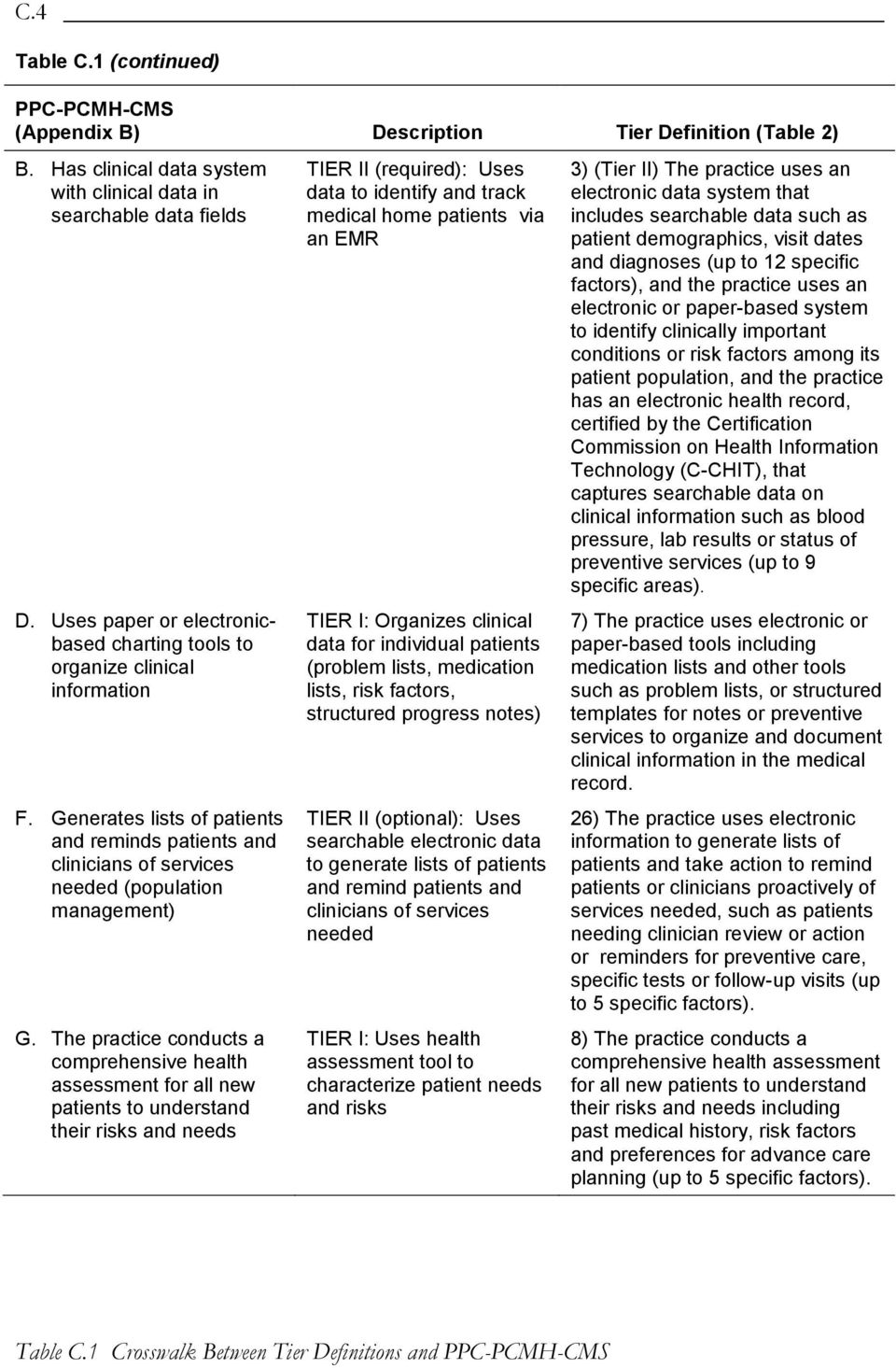
4 C.4 Table C.1 (continued) PPC-PCMH-CMS (Appendix B) Description Tier Definition (Table 2) B. Has clinical data system with clinical data in searchable data fields D. Uses paper or electronicbased charting tools to organize clinical information F. Generates lists of patients and reminds patients and clinicians of services needed (population management) G. The practice conducts a comprehensive health assessment for all new patients to understand their risks and needs TIER II (required): Uses data to identify and track medical home patients via an EMR TIER I: Organizes clinical data for individual patients (problem lists, medication lists, risk factors, structured progress notes) TIER II (optional): Uses searchable electronic data to generate lists of patients and remind patients and clinicians of services needed TIER I: Uses health assessment tool to characterize patient needs and risks 3) (Tier II) The practice uses an electronic data system that includes searchable data such as patient demographics, visit dates and diagnoses (up to 12 specific factors), and the practice uses an electronic or paper-based system to identify clinically important conditions or risk factors among its patient population, and the practice has an electronic health record, certified by the Certification Commission on Health Information Technology (C-CHIT), that captures searchable data on clinical information such as blood pressure, lab results or status of preventive services (up to 9 specific areas). 7) The practice uses electronic or paper-based tools including medication lists and other tools such as problem lists, or structured templates for notes or preventive services to organize and document clinical information in the medical record. 26) The practice uses electronic information to generate lists of patients and take action to remind patients or clinicians proactively of services needed, such as patients needing clinician review or action or reminders for preventive care, specific tests or follow-up visits (up to 5 specific factors). 8) The practice conducts a comprehensive health assessment for all new patients to understand their risks and needs including past medical history, risk factors and preferences for advance care planning (up to 5 specific factors). Table C.1 Crosswalk Between Tier Definitions and PPC-PCMH-CMS
5 C.5 Table C.1 (continued) PPC-PCMH-CMS (Appendix B) Description Tier Definition (Table 2) A. Adopts and implements evidence-based guidelines for three conditions B. Generates reminders about preventive services for clinicians C. Uses non-physician staff to manage patient care D. Conducts care management, including care plans, assessing progress, addressing barriers Standard 3: Care Management TIER I: Adopts evidencebased clinical practice guidelines on preventive and chronic care TIER II (optional): Implements system to generate reminders (papers based or electronic) about preventive services at the point of care TIER I: Organizes and trains staff in roles for care management (incl. staff feedback) TIER I: Uses integrated care plan to plan and guide patient care TIER I: Provides pre-visit planning and after-visit follow-up for medical home patients TIER I: Reviews all medications a patient is taking including prescriptions, over the counter medications and herbal therapies/supplements 11) The practice identifies appropriate evidence-based guidelines that are used as the basis of care for clinically important conditions. 27) The practice uses a paperbased or electronic system for reminders at the point of care based on guidelines for preventive services such as screening tests, immunizations, risk assessments and counseling. 6) The practice defines roles for physician and nonphysician staff and trains staff, with nonphysician staff involved in reminding patients of appointments, executing standing orders or educating patients/families. 9) For three clinically important conditions, the physician and nonphysician staff conduct care management using an integrated care plan to set goals, assess progress and address barriers. 10) For three clinically important conditions, the physician and nonphysician staff conduct care management planning ahead of the visit to make sure that information is available and the staff is prepared as well as following up after the visit to make sure that the treatment plan (including medications, tests, referrals) is implemented. 17) The practice reviews all medications a patient is taking including prescriptions, over the counter medications and herbal therapies/supplements. Table C.1 Crosswalk Between Tier Definitions and PPC-PCMH-CMS

6 C.6 Table C.1 (continued) PPC-PCMH-CMS (Appendix B) Description Tier Definition (Table 2) D. Conducts care management, including care plans, assessing progress, addressing barriers (Factor 2) E. Coordinates care//followup for patients who receive care in inpatient and outpatient facilities A. Assesses language preference and other communication barriers B. Actively supports patient self-management TIER II (optional) : Implements system to generate reminders (paper based or electronic) about chronic care needs at the point of care TIER II (required) : Coordinates care and follow-up for patients who receive care in inpatient and outpatient facilities TIER II (required) : Uses medication reconciliation post discharge to avoid interactions or duplications Standard 4: Patient Self-Management Support TIER I: Documents patient self-management plan (including end-of-life planning, home monitoring) TIER I: Provides patient education and support TIER I: Encourages family involvement 28) The practice uses a paperbased or electronic system for reminders at the point of care based on guidelines for chronic care needs 18) The practice on its own or in conjunction with an external organization has a systematic approach for identifying and coordinating care for patients who receive care in inpatient or outpatient facilities or patients who are transitioning to other care (up to 6 specific factors). 19) The practices reviews posthospitalization medication lists and reconciles with other medications. 12)The practice supports patient/family self-management through activities such as systematically assessing patient/family-specific communication barriers and preferences, providing selfmonitoring tools or personal health record, and providing a written care plan 13) The practice supports patient/family self-management through providing educational resources, and providing/connecting families to self-management resources 14) The practice encourages family involvement in all aspects of patient self-management. Table C.1 Crosswalk Between Tier Definitions and PPC-PCMH-CMS

7 C.7 Table C.1 (continued) PPC-PCMH-CMS (Appendix B) Description Tier Definition (Table 2) A. Uses electronic system to write prescriptions B. Has electronic prescription writer with safety checks C. Has electronic prescription writer with cost checks Standard 5: Electronic Prescribing TIER II (optional): Uses electronic prescribing tools to reduce medication errors, promote use of generics, and assist in medication management 20) The practice uses an electronic system to write prescriptions which can print or send prescriptions electronically, clinicians in the practice write prescriptions using electronic prescription reference information at the point of care, which includes safety alerts that may be generic or specific to the patient (up to 8 specific factors), and clinicians engage in costefficient prescribing by using a prescription writer that has general automatic alerts for generic or is connected to a payer-specific formulary. A. Tracks tests and identifies abnormal results systematically Standard 6: Test Tracking TIER I: Tracks tests and provides follow-up 15) The practice systematically tracks tests and follows up using steps such as making sure that results are available to the clinician, flagging abnormal test results, and following up with patients/families on all abnormal test results (up to 4 specific factors). A. Tracks referrals using paper-based or electronic system Standard 7: Referral Tracking and Coordination TIER I: Tracks referrals including referral plan and patient report on self referrals 16) The practice coordinates referrals designated as critical through steps such as providing the patient and consultant/specialist practitioner with the reason for the consultation and pertinent clinical findings, tracking the status of the referral, obtaining a report back from the practitioner, and asking patients about self-referrals and obtaining reports from the practitioner(s). Table C.1 Crosswalk Between Tier Definitions and PPC-PCMH-CMS

8 C.8 Table C.1 (continued) PPC-PCMH-CMS (Appendix B) Description Tier Definition (Table 2) A. Measures clinical and/or service performance by physician or across the practice (must pass) B. Survey of patients care experience C. Reports performance across the practice or by physician D. Sets goals and takes action to improve performance A. The practice provides patients/families with access to an interactive Web site Standard 8: Performance Reporting and Improvement TIER II (optional): Measures performance on clinical quality and patient experiences TIER II (optional): Reports to physicians on performance TIER II (optional): Uses data to set goals and take action to improve performance Standard 9: Advanced Electronic Communications TIER II (optional): Use of secure electronic communication between the patient and the healthcare team TIER II (optional): Use of secure systems that provide for patient access to personal health information 23) The practice measures or receives data on performance such as clinical process, clinical outcomes, service data or patient safety issues, and the practice collects data on patient experience with care, addressing up to 3 areas. 24) The practice reports performance data to physicians. 25) The practice uses performance data to set goals and take action where identified to improve performance. 21) The practice provides patients/families with access to an interactive Web site that allows electronic communication. 22 ) The practice provides for patient access to personal health information such as test results or prescription refills or to see elements of their medical record and import elements of their medical record into a personal health record. Table C.1 Crosswalk Between Tier Definitions and PPC-PCMH-CMS

9 APPENDIX D PPC-PCMH-CMS SCORING WORKSHEET

10

11 D.3 Practices may use this worksheet to determine the medical home tier for which they expect to qualify. The table below lists elements required to qualify for that tier. Practices should mark the checkboxes next to each element they meet with a 50 percent score or higher, as indicated in the PPC -PCMH CMS Version. Practices qualify for Tier 1 if they pass the 14 required PPC -PCMH CMS elements shown below. These 14 elements correspond to the 17 capabilities in Table 2. Practices qualify for Tier 2 if they meet the requirements for Tier 1, pass the 2 additional required elements shown, and pass three of the 11 additional elements (as shown below). If all of the elements under a specific tier are checked, the practice qualifies for that tier. Required Elements Description 1 PPC-PCMH Standard 1, with Factors 1, 3, 4, 5, 6, and 8. 2 PPC-PCMH Standard 1, Element B with Factor 1 3 PPC-PCMH Standard 1, Element C 4 PPC-PCMH Standard 2, 5 PPC-PCMH Standard 2, Element D with Factors 2 and 3 6 PPC-PCMH Standard 2, Element E 7 PPC-PCMH Standard 2, Element G 8 PPC-PCMH Standard 3, 9 PPC-PCMH Standard 3, Element C with Factors 1 and 2 10 PPC-PCMH Standard 3, Element D with Factors 1, 3, 6, and PPC-PCMH Standard 4, 12 PPC-PCMH Standard 4, Element B with Factor 7 13 PPC-PCMH Standard 6, 14 PPC-PCMH Standard 7, Tier 1 Access and Communications Processes Access and Communication Results Giving Patient Information on Role of Medical Home Basic System for Managing Patient Data Organizing Clinical Data (includes lists of over-the-counter and prescribed medications) Identifying Important Conditions Comprehensive Health Assessment Guidelines for Important Conditions Practice Organization Care Management for Important Conditions (includes individualized care plans, reviewing medications, previsit planning and after-visit follow-up) Documenting Communication Needs Self-Management Support (includes written plan to patient/family) Test Tracking and Follow-Up Referral Tracking and Coordination Tier 2 Meets Tier 1 Requirements 15 PPC-PCMH Standard 2, Electronic System for Clinical Data Element B 16 PPC-PCMH Standard 3, Continuity of Care Element E with Factor 11 (includes review of post-hospitalization medication lists) Optional Elements (Must pass 3) 17 PPC-PCMH Standard 2, Use of System for Population Management Element F 18 PPC-PCMH Standard 3, Preventive Service Clinician Reminders Appendix D: PPC-PCMH-CMS Scoring Worksheet

12 D.4 Required Elements Element B 19 PPC-PCMH Standard 3, Element D with Factors 1, 2, 3, 6, and PPC-PCMH Standard 5, 21 PPC-PCMH Standard 5, Element B 22 PPC-PCMH Standard 5, Element C 23 PPC-PCMH Standard 8, 24 PPC-PCMH Standard 8, Element B 25 PPC-PCMH Standard 8, Element C 26 PPC-PCMH Standard 8, Element D 27 PPC-PCMH Standard 9, Description Care Management for Important Conditions (includes individualized care plans, guideline-based reminders, reviewing medications, pre-visit planning and after-visit follow-up) Electronic Prescription Writing Prescription Decision Support Safety Prescription Decision Support Efficiency Measures of Performance Patient Experience Data Reporting to Physicians Setting Goals and Taking Action Availability of Interactive Web Site Appendix D: PPC-PCMH-CMS Scoring Worksheet

NCQA Standards Workshop Physician Practice Connections - Patient-Centered Medical Home (PPC -PCMH )
 NCQA Physician Practice Connections - Patient-Centered Medical Home (PPC -PCMH ) Agenda Patient-Centered Medical Home Overview Content of PPC-PCMH Standards Documentation examples* Recognition Process
NCQA PCMH 2011 Standards, Elements and Factors Documentation Guideline/Data Sources
 NCQA PCMH 2011 Standards, Elements and Factors Documentation Guideline/Data Sources Key: DP = Documented Process N/D = Report numerator and denominator creating percent of use RPT = Report of data or information
COMPARISON: PPC-PCMH 2008 With PCMH 2011
 COMPARISON: PPC-PCMH 008 With PCMH 011 About This Crosswalk The following crosswalk compares Physician Practice Connections Patient-Centered Medical Home (PPC -PCMH ) 008 with NCQA s Patient-Centered Medical
Andrew C. Bledsoe, MBA, CHPA, PCMH CCE Executive Director. Northeast KY Regional Health Information Organization. www.nekyrhio.org
 Andrew C. Bledsoe, MBA, CHPA, PCMH CCE Executive Director Northeast KY Regional Health Information Organization www.nekyrhio.org NCQA Program Setup Standards Six Standards Outline Program Elements Six
Advancing Health Equity. Through national health care quality standards
 Advancing Health Equity Through national health care quality standards TABLE OF CONTENTS Stage 1 Requirements for Certified Electronic Health Records... 3 Proposed Stage 2 Requirements for Certified Electronic
Appendix 2. PCMH 2014 and CMS Stage 2 Meaningful Use Requirements
 Appendix 2 PCMH 2014 and CMS Stage 2 Meaningful Use Requirements Appendix 2 PCMH 2014 and CMS Stage 2 Meaningful Use Requirements 2-1 APPENDIX 2 PCMH 2014 AND CMS STAGE 2 MEANINGFUL USE REQUIREMENTS Medicare
Health Care Homes Certification Assessment Tool- With Examples
 Guidelines: Health Care Homes Certification Assessment Form Structure: This is the self-assessment form that HCH applicants should use to determine if they meet the requirements for HCH certification.
NCQA Standards Workshop Patient-Centered Medical Home PCMH 2011. Part 1: Standards 1-3
 NCQA Standards Workshop PCMH 2011 Part 1: Standards 1-3 Agenda: Part 1 Overview Content of PCMH 2011 Standards 1 3 Documentation examples* * Examples in the presentation only illustrate the element intent.
PCMH 2011 FAQs. PCMH Element/Factors Question Answer
 IMPORTANT GENERAL RECOMMENDATIONS: Refer to the following documents in addition to reviewing the questions and answers below related to specific standards, elements and factors: 1. PCMH 2011 Standards
NCQA Standards Workshop Patient-Centered Medical Home PCMH 2011. Part 2: Standards 4-6
 NCQA Standards Workshop PCMH 2011 Part 2: Standards 4-6 Agenda: Part 2 Content of PCMH 2011 Standards 4 6 Documentation examples* * Examples in the presentation only illustrate the element intent. They
Getting started with Patient-Centered Medical Home and NCQA PCMH Recognition. A Resource for Primary Care Practices. July 2013
 Getting started with Patient-Centered Medical Home and NCQA PCMH Recognition A Resource for Primary Care Practices July 2013 Submitted by: Ruth Heitkamp, R.N., M.S.P.H. SIU School of Medicine Center for
EMR Name/ Model. meridianemr 4.2 CCHIT 2011 certified
 EMR Name/ Model EMR Vendor meridianemr 4.2 CCHIT 2011 certified meridianemr, Inc Core Set of Measures Objective Stage 1 Objectives Stage 1 Measures EMR Module/ Feature 1 Use CPOE for medication orders
Meaningful Use Cheat Sheet CORE MEASURES: ALL REQUIRED # Measure Exclusions How to Meet in WEBeDoctor
 Meaningful Use Cheat Sheet CORE MEASURES: ALL REQUIRED # Measure Exclusions How to Meet in WEBeDoctor 1 CPOE (Computerized Physician Order Entry) More than 30 percent of all unique patients with at least
ADDENDUM 1 MEDICAL HOME TO SOONERCARE PHYSICIAN AGREEMENT FOR CHOICE PRIMARY CARE PROVIDERS
 ADDENDUM 1 MEDICAL HOME TO SOONERCARE PHYSICIAN AGREEMENT FOR CHOICE PRIMARY CARE PROVIDERS 1.0 PURPOSE The purpose of this Addendum is for OHCA and PROVIDER to contract for PCP services in OHCA s SoonerCare
Nortec. ACT Now! Nortec EHR. Qualify & Receive $44,000. An Integrated Electronic Health Record Software. www.nortecehr.com
 ACT Now! Qualify & Receive $44,000 Nortec Version 7.0 EHR Visit and Register to learn how to meet Meaningful Use requirements An Integrated Electronic Health Record Software Electronic Medical Records
Medweb Telemedicine 667 Folsom Street, San Francisco, CA 94107 Phone: 415.541.9980 Fax: 415.541.9984 www.medweb.com
 Medweb Telemedicine 667 Folsom Street, San Francisco, CA 94107 Phone: 415.541.9980 Fax: 415.541.9984 www.medweb.com Meaningful Use On July 16 2009, the ONC Policy Committee unanimously approved a revised
Going beyond: Meaningful Use assessments
 GE Healthcare Centricity Practice Solution Going beyond Meaningful Use. The IT tools and services you need now. The support you need for the future. GE Healthcare is your strong, stable, strategic partner
Nortec. ACT Now! Nortec EHR. Qualify & Receive $44,000. An Integrated Electronic Health Record Software. www.nortecehr.com
 ACT Now! Qualify & Receive $44,000 Nortec Version 7.0 EHR Visit and Register to learn how to meet Meaningful Use requirements An Integrated Electronic Health Record Software Electronic Medical Records
EMR Name/ Model. Cerner PowerChart Ambulatory (PowerWorks ASP)
 EMR Name/ Model EMR Vendor Cerner PowerChart Ambulatory (PowerWorks ASP) Cerner Corporation Core Set of Measures 1 Use CPOE for medication orders directly entered by any licensed healthcare professional
THE NATIONAL QUALITY FORUM
 THE NATIONAL QUALITY FORUM NQF-ENDORSED TM DEFINITION AND FRAMEWORK FOR MEASURING CARE COORDINATION 1 Sufficiently developed, existing measures of coordination of care could not be identified for endorsement.
Presented by. Terri Gonzalez Director of Practice Improvement North Carolina Medical Society
 Presented by Terri Gonzalez Director of Practice Improvement North Carolina Medical Society Meaningful Use is using certified EHR technology to: Improve quality, safety, efficiency, and reduce errors Engage
CROSSWALK NCQA 2014 PCMH HRSA 19 Requirements Meaningful Use
 P a g e 1 CROSSWALK NCQA 2014 PCMH HRSA 19 Requirements Meaningful Use PCMH 1 PATIENT-CENTERED ACCESS 1A Patient-Centered Appointment Access (Must Pass) No.4 Accessible Hours of Operation / Locations 1B
Meaningful Use Criteria for Eligible Hospitals and Eligible Professionals (EPs)
 Meaningful Use Criteria for Eligible and Eligible Professionals (EPs) Under the Electronic Health Record (EHR) meaningful use final rules established by the Centers for Medicare and Medicaid Services (CMS),
A Guide to Understanding and Qualifying for Meaningful Use Incentives
 A Guide to Understanding and Qualifying for Meaningful Use Incentives A White Paper by DrFirst Copyright 2000-2012 DrFirst All Rights Reserved. 1 Table of Contents Understanding and Qualifying for Meaningful
Patient-Centered Medical Home (PCMH) 2014
 Patient-Centered Medical Home (PCMH) 2014 Part 1: Standards 1-3 All materials 2014, National Committee for Quality Assurance Agenda Part 1 Content t of PCMH 2014 Standards d and Guidelines Standards 1
Meaningful Use. Medicare and Medicaid EHR Incentive Programs
 Meaningful Use Medicare and Medicaid Table of Contents What is Meaningful Use?... 1 Table 1: Patient Benefits... 2 What is an EP?... 4 How are Registration and Attestation Being Handled?... 5 What are
VIII. Dentist Crosswalk
 Page 27 VIII. Dentist Crosswalk Overview The final rule on meaningful use requires that an Eligible Professional (EP) report on both clinical quality measures and functional objectives and measures. While
Stage 1 vs. Stage 2 Comparison Table for Eligible Hospitals and CAHs Last Updated: August, 2012
 CORE OBJECTIVES (16 total) Stage 1 vs. Stage 2 Comparison Table for Eligible Hospitals and CAHs Last Updated: August, 2012 Stage 1 Objective Use CPOE for medication orders directly entered by any licensed
Patient Centered Medical Home (PCMH): Communication and Care Coordination
 Patient Centered Medical Home (PCMH): Communication and Care Coordination Phillip Roemer, MD Assistant Professor of Medicine General Internal Medicine Feinberg School of Medicine Northwestern University
How To Get A Pcmh
 A Comparison of the National Patient-Centered Medical Home Accreditation and Recognition Programs David N. Gans, MSHA, FACMPE, Senior Fellow Industry Affairs, Medical Group Management Association Englewood,
Meaningful Use Rules Proposed for Electronic Health Record Incentives Under HITECH Act By: Cherilyn G. Murer, JD, CRA
 Meaningful Use Rules Proposed for Electronic Health Record Incentives Under HITECH Act By: Cherilyn G. Murer, JD, CRA Introduction On December 30, 2009, The Centers for Medicare & Medicaid Services (CMS)
Practice Readiness Assessment
 Practice Demographics Practice Name: Tax ID Number: Practice Address: REC Implementation Agent: Practice Telephone Number: Practice Fax Number: Lead Physician: Project Primary Contact: Lead Physician Email
TABLE B5: STAGE 2 OBJECTIVES AND MEASURES
 294 TABLE B5: STAGE 2 OBJECTIVES AND MEASURES CORE SET Improving quality, safety, efficiency, and reducing health disparities Use computerized provider order entry (CPOE) for medication, laboratory and
EMR Adoption Survey. Instructions. This survey contains a series of multiple-choice questions corresponding to the 5-stage EMR Adoption Model.
 EMR Adoption Survey Instructions This survey contains a series of multiple-choice questions corresponding to the -stage EMR Adoption Model. If the respondent is a physician, ask all questions. If the respondent
EMR Outcomes Self-Assessment Contents
 Contents Introduction... How does it work?... Select Purpose... Patient Care Processes... Registration and Attachment... Scheduler... Referral/Consult... 4 Assessment and Treatment... 5 Assessment-Ordering
Stage 1 Meaningful Use - Attestation Worksheet: Core Measures
 Stage 1 Meaningful Use - Attestation Worksheet: Core Measures Core Measures Objective # Objective Title / Explanation Goal Attestation Response - Values below reflect reponses of most radiologists Explanation
hospital s or CAH s inpatient or professional guidelines
 EMR Name/ Model EMR Vendor XLEMR/XLEMR-2011-MU XLEMR Objective 1 Core Set of Measures Use CPOE for medication orders Use CPOE for medication orders More than 30% of unique patients directly entered by
Meaningful Use Objectives
 Meaningful Use Objectives The purpose of the electronic health records (EHR) incentive program is not so much the adoption of health information technology (HIT), but rather how HIT can further the goals
www.sequelmed.com 800.965.2728 www.sequelmed.com
 Practice Management Document Management Medical Records e-prescribe e-health Patient Portal One Integrated Solution Our practice has been working with Sequel Systems for many years and is extremely satisfied.
Patient Centered Medical Home & Meaningful Use Criteria Crosswalk. Peter Cucchiara, MBA Managing Director PCDC
 Patient Centered Medical Home & Meaningful Use Criteria Crosswalk Peter Cucchiara, MBA Managing Director PCDC 3 2 Deep Dive on Standards & The Work 4 What It Looks Like A Journey of BIG ideas 1 5 Examples
Going beyond Meaningful Use with EMR solutions from the Centricity portfolio
 Going beyond Meaningful Use with EMR solutions from the Centricity portfolio The IT tools and services you need now. The support you need for the future. GE Healthcare is focused on providing customers
Care Transition Bundle Seven Essential Intervention Categories
 Seven 1. Medications Management Ensuring the safe use of medications by patients and their families and based on patients plans of care a. Assessment of patient s medications intake b. Patient and family
PCMH : A WINDOW TO 2014
 Colorado Community Health Network Spring Conference PCMH : A WINDOW TO 2014 Presented by: Bonni Brownlee, MHA CPHQ CPEHR NCQA PCMH Certified Content Expert Senior Clinical Consultant Audience Poll: Where
Achieving Meaningful Use Training Manual
 Achieving Meaningful Use Training Manual Terms EP Eligible Professional Medicare Eligible Professional o Doctor of Medicine or Osteopathy o Doctor of Dental Surgery or Dental Medicine o Doctor of Podiatric
Care Transition Bundle Seven Essential Intervention Categories. Examples of Transition of Care Interventions
 1. Medications Management Ensuring the safe use of medications by patients and their families and based on patients plans of care a. Assessment of patient s medications intake b. Patient and family education
Contact Information: West Texas Health Information Technology Regional Extension Center 3601 4 th Street MS 6232 Lubbock, Texas 79424 806-743-1338
 Contact Information: West Texas Health Information Technology Regional Extension Center 3601 4 th Street MS 6232 Lubbock, Texas 79424 806-743-1338 http://www.wtxhitrec.org/ Grant award - $6.6m Total number
Reporting Period: For Stage 2, the reporting period must be the entire Federal Fiscal Year.
 Eligible Hospital and Critical Access Hospital (CAH) Attestation Worksheet for Stage 2 of the Medicare Electronic Health Record (EHR) Incentive Program The Eligible Hospital and CAH Attestation Worksheet
Contact: Barbara J Stout RN, BSC Implementation Specialist University of Kentucky Regional Extension Center 859-323-4895
 Contact: Barbara J Stout RN, BSC Implementation Specialist University of Kentucky Regional Extension Center 859-323-4895 $19.2B $17.2B Provider Incentives $2B HIT (HHS/ONC) Medicare & Medicaid Incentives
RECORD ELECTRONIC HEALTH (EHR) PATIENT SYSTEM CARE WORKFLOW MANAGEMENT AN INNOVATIVE AND
 AN INNOVATIVE INTERNET-BASED ELECTRONIC HEALTH RECORD (EHR) AND PATIENT CARE WORKFLOW MANAGEMENT SYSTEM 717 Ponce De Leon Boulevard, Suite 301 Coral Gables, Florida 33134 Phone: 305.648.0028 Fax: 305.675.2208
Gary Swartz, JD, MPA Associate Executive Director AAHCM
 Gary Swartz, JD, MPA Associate Executive Director AAHCM 1. Provide definition and overview of the need for plan of care 2. Current services, new codes and proposed legislation to produce SGR fix modernize
Interview patient Perform Physician; Nursing; Medical Assistant Take history Document 7.1(Document a progress note for each encounter)
 Reference Workflow Taonomy Patient centric Outpatient encounter 1 Intake and Nurse assessment Clinician* assessment Check in Document 1.16 (Access patient demographic data), 7.6 (Document date of birth),
New Brunswick EMR Program. Functionality Workbook
 New Brunswick EMR Program Functionality Workbook Standard EMR Functionality The following is an abbreviated list of features offered by Velante within the New Brunswick EMR Program. Data Management Highlights
How To Prepare For A Patient Care System
 Preparing for Online Communication with Your Patients A Guide for Providers This easy-to-use, time-saving guide is designed to help medical practices and community clinics prepare for communicating with
MEANINGFUL USE. Community Center Readiness Guide Additional Resource #13 Meaningful Use Implementation Tracking Tool (Template) CONTENTS:
 Community Center Readiness Guide Additional Resource #13 Meaningful Use Implementation Tracking Tool (Template) MEANINGFUL USE HITECH s goal is not adoption alone but meaningful use of EHRs that is, their
Meaningful Use. Michael L. Brody, DPM FACFAOM CCHIT Ambulatory Workgroup HITSP Physician Perspective Technical Committee NYeHC
 Meaningful Use Michael L. Brody, DPM FACFAOM CCHIT Ambulatory Workgroup HITSP Physician Perspective Technical Committee NYeHC What is Meaningful Use? Meaningful use is a term defined by CMS and describes
San Mateo Medical Center Innovative Care Clinic
 San Mateo Medical Center Innovative Care Clinic 2 2009 CAPH/SNI Quality Leaders Awards NARRATIVE DESCRIPTION OF PROGRAM Please respond to the following questions. Please give detailed, but succinct answers
Stage 1 vs. Stage 2 Comparison Table for Eligible Professionals Last Updated: August, 2012
 Stage 1 vs. Stage 2 Comparison Table for Eligible Professionals Last Updated: August, 2012 CORE OBJECTIVES (17 total) Stage 1 Objective Stage 1 Measure Stage 2 Objective Stage 2 Measure Use CPOE for medication
Oregon Standards for Certified Community Behavioral Health Clinics (CCBHCs)
 Oregon Standards for Certified Community Behavioral Health Clinics (CCBHCs) Senate Bill 832 directed the Oregon Health Authority (OHA) to develop standards for achieving integration of behavioral health
Disease Management Identifications and Stratification Health Risk Assessment Level 1: Level 2: Level 3: Stratification
 Disease Management UnitedHealthcare Disease Management (DM) programs are part of our innovative Care Management Program. Our Disease Management (DM) program is guided by the principles of the UnitedHealthcare
EHRs vs. Paper-based Systems: 5 Key Criteria for Ascertaining Value
 Research White Paper EHRs vs. Paper-based Systems: 5 Key Criteria for Ascertaining Value Provided by: EHR, Practice Management & Billing In One www.omnimd.com Before evaluating the benefits of EHRs, one
CLINICAL PRIVILEGES- NURSE MIDWIFE
 Name: Page 1 Initial Appointment Reappointment Department Specialty Area All new applicants must meet the following requirements as approved by the governing body effective: Applicant: Check off the Requested
EHR Software Feature Comparison
 EHR Comparison ELECTRONIC MEDICAL RECORDS Patient demographics Manages the input and maintenance of patient information including demographics, insurance, contacts, referrals, notes and more. Consents
Stage 1 vs. Stage 2 Comparison for Eligible Professionals
 Stage 1 vs. Comparison for Eligible Professionals CORE OBJECTIVES (17 Total) Stage 1 Objective Stage 1 Measure Objective Measure Use CPOE for Medication orders directly entered by any licensed healthcare
Look at what innovation can do
 Clinic Information System Practice Management Tool Look at what innovation can do Despite all the innovative solutions we have put into CIS, the most amazing result might just be what you can get out of
Meaningful Use. Goals and Principles
 Meaningful Use Goals and Principles 1 HISTORY OF MEANINGFUL USE American Recovery and Reinvestment Act, 2009 Two Programs Medicare Medicaid 3 Stages 2 ULTIMATE GOAL Enhance the quality of patient care
Meaningful Use - The Basics
 Meaningful Use - The Basics Presented by PaperFree Florida 1 Topics Meaningful Use Stage 1 Meaningful Use Barriers: Observations from the field Help and Questions 2 What is Meaningful Use Meaningful Use
HL7 and Meaningful Use
 HL7 and Meaningful Use HIMSS Las Vegas February 23, 2012 Grant M. Wood Intermountain Healthcare Clinical Genetics Institute Meaningful Use What Does It Mean? HITECH rewards the Meaningful Use of health
Core Set of Objectives and Measures Must Meet All 15 Measures Stage 1 Objectives Stage 1 Measures Reporting Method
 Core Set of Objectives and Measures Must Meet All 15 Measures Stage 1 Objectives Stage 1 Measures Reporting Method Use Computerized Provider Order Entry (CPOE) for medication orders directly entered by
Health Care February 28, 2012. CMS Issues Proposed Rule on Stage 2 Meaningful Use,
 ROPES & GRAY ALERT Health Care February 28, 2012 CMS Issues Proposed Rule on Stage 2 Meaningful Use, ONC Issues Companion Proposed Rule on 2014 EHR Certification Criteria On February 23, 2012, the Centers
Using the EHR for Care Management and Tracking. Learning Objectives 9/4/2015. Using EHRs for Care Management and Tracking
 September 10, 2015 Using the EHR for Care Management and Jean Harpel, MSN, RN, GCNS-BC, CPASRM Lorraine Possanza, DPM, JD, MBE Paul Anderson Learning Objectives Learn why it is important to have good tracking
Attesting for Meaningful Use Stage 2 in 2014 Customer Help Guide
 Attesting for Meaningful Use Stage 2 in 2014 Customer Help Guide Table of Contents PURPOSE OF THIS DOCUMENT 4 MEANINGFUL USE STAGE 2 OVERVIEW 4 ATTESTING FOR CORE OBJECTIVES 5 CORE OBJECTIVE #1: CPOE 7
CIS 7.4.5. Clinic Information System Practice Management Tool
 CIS 7.4.5 Clinic Information System Practice Management Tool CIS Practice Management The Clinic Information System (CIS) is a comprehensive Clinical Management System that offers features and flexibility
Population Health Solutions for Employers MEDIA RESOURCES
 Population Health Solutions for Employers MEDIA RESOURCES ABOUT MISSIONPOINT MissionPoint s mission is to make healthcare more affordable, accessible and improve the quality of care for our members. MissionPoint
Meeting Meaningful Use Core Objectives with Technology-Enabled Patient Engagement
 Meeting Meaningful Use Core Objectives with Technology-Enabled Patient Engagement ACPE Annual Meeting April 25, 2014 Chicago, Illinois Presented By: Dennis P.H. Mihale, MD, MBA Copyright 2014 CPT codes,
Guide To Meaningful Use
 Guide To Meaningful Use Volume 1 Collecting the Data Contents INTRODUCTION... 3 CORE SET... 4 1. DEMOGRAPHICS... 5 2. VITAL SIGNS... 6 3. PROBLEM LIST... 8 4. MAINTAIN ACTIVE MEDICATIONS LIST... 9 5. MEDICATION
2013 Meaningful Use Dashboard Calculation Guide
 2013 Meaningful Use Dashboard Calculation Guide Learn how to use Practice Fusion s Meaningful Use Dashboard to help you achieve Meaningful Use. For more information, visit the Meaningful Use Center. General
Achieving Meaningful Use with Centricity EMR
 GE Healthcare Achieving Meaningful Use with Centricity EMR Are you Ready to Report? GE Healthcare EMR Consulting CHUG Fall Conference October 2010 Achieving Meaningful Use with Centricity EMR The EMR Consulting
HL7 & Meaningful Use. Charles Jaffe, MD, PhD CEO Health Level Seven International. HIMSS 11 Orlando February 23, 2011
 HL7 & Meaningful Use Charles Jaffe, MD, PhD CEO Health Level Seven International HIMSS 11 Orlando February 23, 2011 Overview Overview of Meaningful Use HIT Standards and Meaningful Use Overview HL7 Standards