
MEANINGFUL USE. Community Center Readiness Guide Additional Resource #13 Meaningful Use Implementation Tracking Tool (Template) CONTENTS:
|
|
|
- Valerie Carson
- 10 years ago
- Views:
Transcription
1 Community Center Readiness Guide Additional Resource #13 Meaningful Use Implementation Tracking Tool (Template) MEANINGFUL USE HITECH s goal is not adoption alone but meaningful use of EHRs that is, their use by providers to achieve significant improvements in care. The legislation ties payments specifically to the achievement of advances in health care processes and outcomes. CONTENTS: Section 1: Stage 1 Core Measures Section 2: Stage 1 Menu Set Measures Section 3: New Proposals for Stages 2 and 3 Printed 06/09/2011
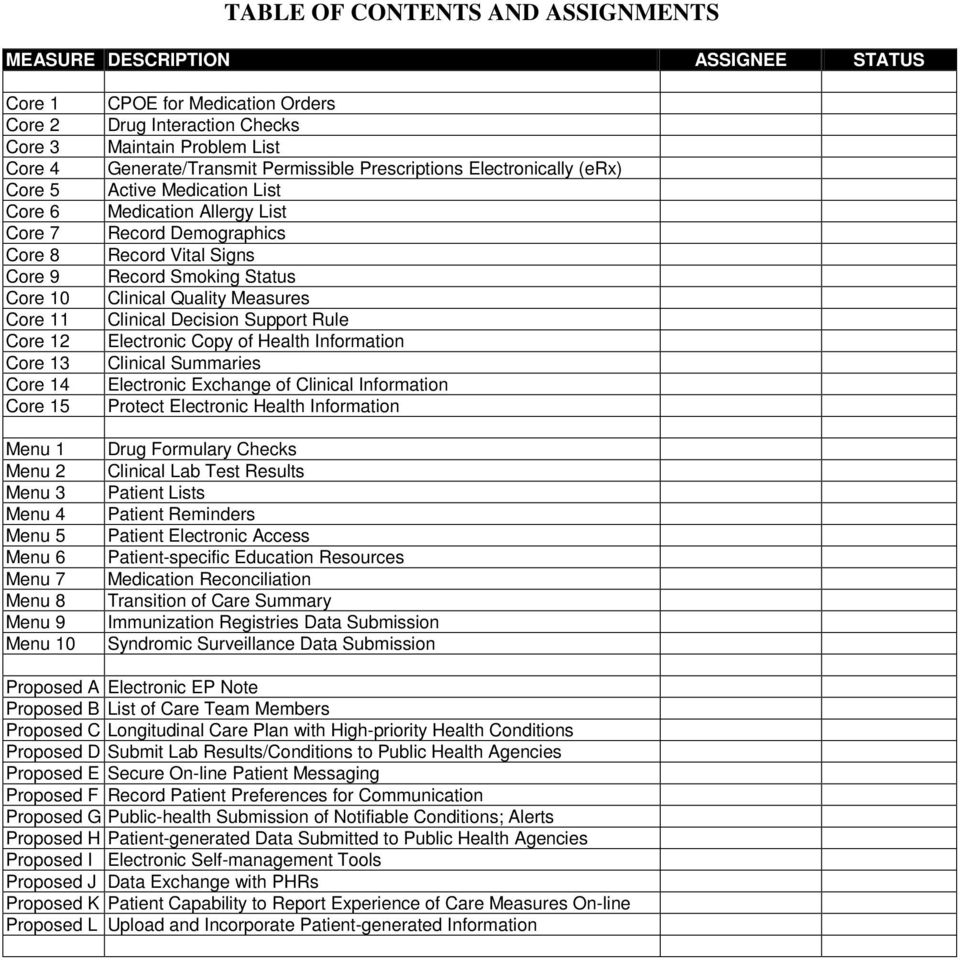
2 TABLE OF CONTENTS AND ASSIGNMENTS MEASURE DESCRIPTION ASSIGNEE STATUS Core 1 Core 2 Core 3 Core 4 Core 5 Core 6 Core 7 Core 8 Core 9 Core 10 Core 11 Core 12 Core 13 Core 14 Core 15 Menu 1 Menu 2 Menu 3 Menu 4 Menu 5 Menu 6 Menu 7 Menu 8 Menu 9 Menu 10 CPOE for Medication Orders Drug Interaction Checks Maintain Problem List Generate/Transmit Permissible Prescriptions Electronically (erx) Active Medication List Medication Allergy List Record Demographics Record Vital Signs Record Smoking Status Clinical Quality Measures Clinical Decision Support Rule Electronic Copy of Health Information Clinical Summaries Electronic Exchange of Clinical Information Protect Electronic Health Information Drug Formulary Checks Clinical Lab Test Results Patient Lists Patient Reminders Patient Electronic Access Patient-specific Education Resources Medication Reconciliation Transition of Care Summary Immunization Registries Data Submission Syndromic Surveillance Data Submission Proposed A Electronic EP Note Proposed B List of Care Team Members Proposed C Longitudinal Care Plan with High-priority Health Conditions Proposed D Submit Lab Results/Conditions to Public Health Agencies Proposed E Secure On-line Patient Messaging Proposed F Record Patient Preferences for Communication Proposed G Public-health Submission of Notifiable Conditions; Alerts Proposed H Patient-generated Data Submitted to Public Health Agencies Proposed I Electronic Self-management Tools Proposed J Data Exchange with PHRs Proposed K Patient Capability to Report Experience of Care Measures On-line Proposed L Upload and Incorporate Patient-generated Information
3 SECTION 1 Stage 1 Core Measures Includes Proposed Changes for Stages 2 and 3 Core Measures Section, Page 3 of 65

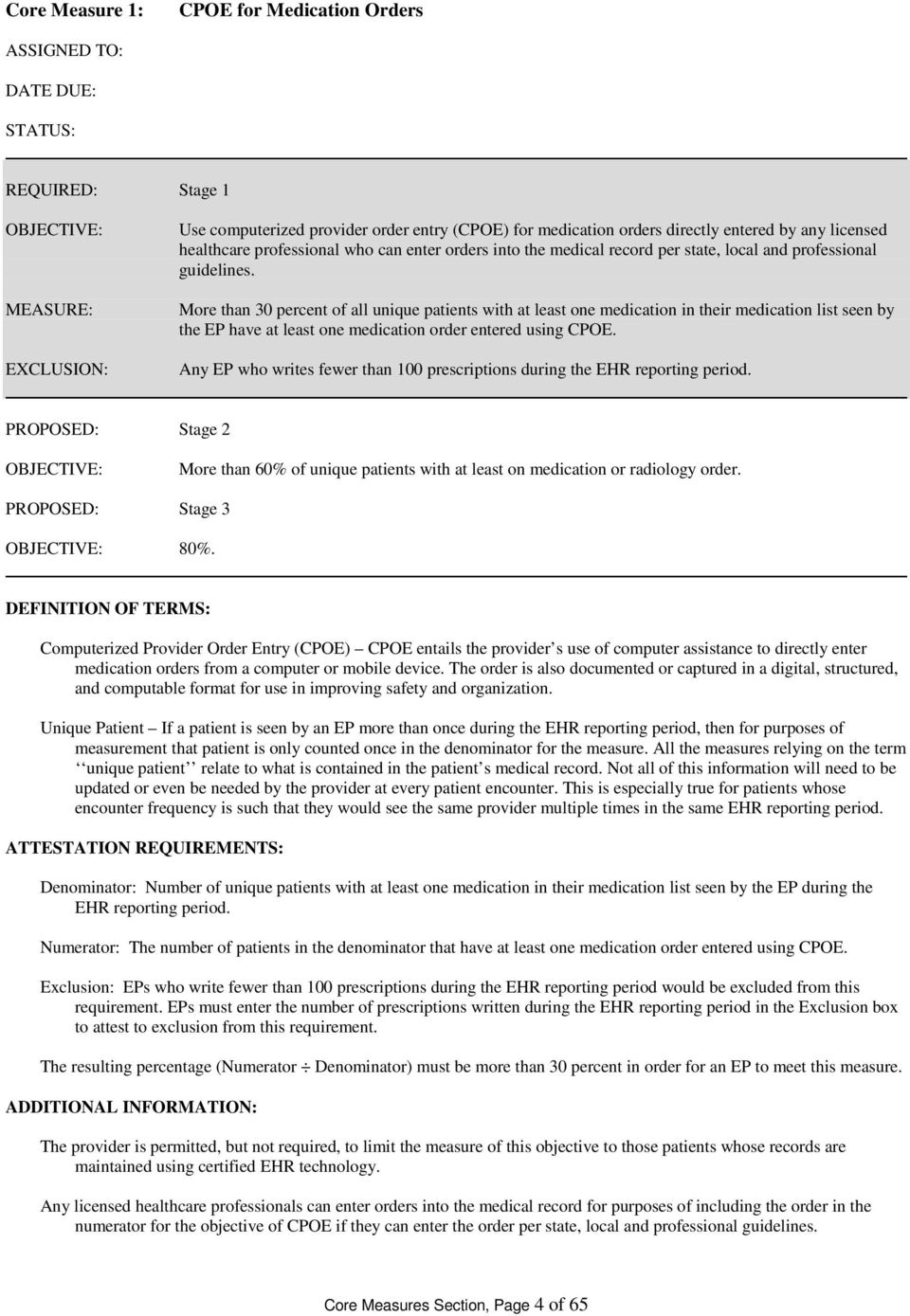
4 Core Measure 1: CPOE for Medication Orders REQUIRED: Stage 1 MEASURE: EXCLUSION: Use computerized provider order entry (CPOE) for medication orders directly entered by any licensed healthcare professional who can enter orders into the medical record per state, local and professional guidelines. More than 30 percent of all unique patients with at least one medication in their medication list seen by the EP have at least one medication order entered using CPOE. Any EP who writes fewer than 100 prescriptions during the EHR reporting period. PROPOSED: Stage 2 More than 60% of unique patients with at least on medication or radiology order. PROPOSED: Stage 3 80%. DEFINITION OF TERMS: Computerized Provider Order Entry (CPOE) CPOE entails the provider s use of computer assistance to directly enter medication orders from a computer or mobile device. The order is also documented or captured in a digital, structured, and computable format for use in improving safety and organization. Unique Patient If a patient is seen by an EP more than once during the EHR reporting period, then for purposes of measurement that patient is only counted once in the denominator for the measure. All the measures relying on the term unique patient relate to what is contained in the patient s medical record. Not all of this information will need to be updated or even be needed by the provider at every patient encounter. This is especially true for patients whose encounter frequency is such that they would see the same provider multiple times in the same EHR reporting period. ATTESTATION REQUIREMENTS: Denominator: Number of unique patients with at least one medication in their medication list seen by the EP during the EHR reporting period. Numerator: The number of patients in the denominator that have at least one medication order entered using CPOE. Exclusion: EPs who write fewer than 100 prescriptions during the EHR reporting period would be excluded from this requirement. EPs must enter the number of prescriptions written during the EHR reporting period in the Exclusion box to attest to exclusion from this requirement. The resulting percentage (Numerator Denominator) must be more than 30 percent in order for an EP to meet this measure. ADDITIONAL INFORMATION: The provider is permitted, but not required, to limit the measure of this objective to those patients whose records are maintained using certified EHR technology. Any licensed healthcare professionals can enter orders into the medical record for purposes of including the order in the numerator for the objective of CPOE if they can enter the order per state, local and professional guidelines. Core Measures Section, Page 4 of 65
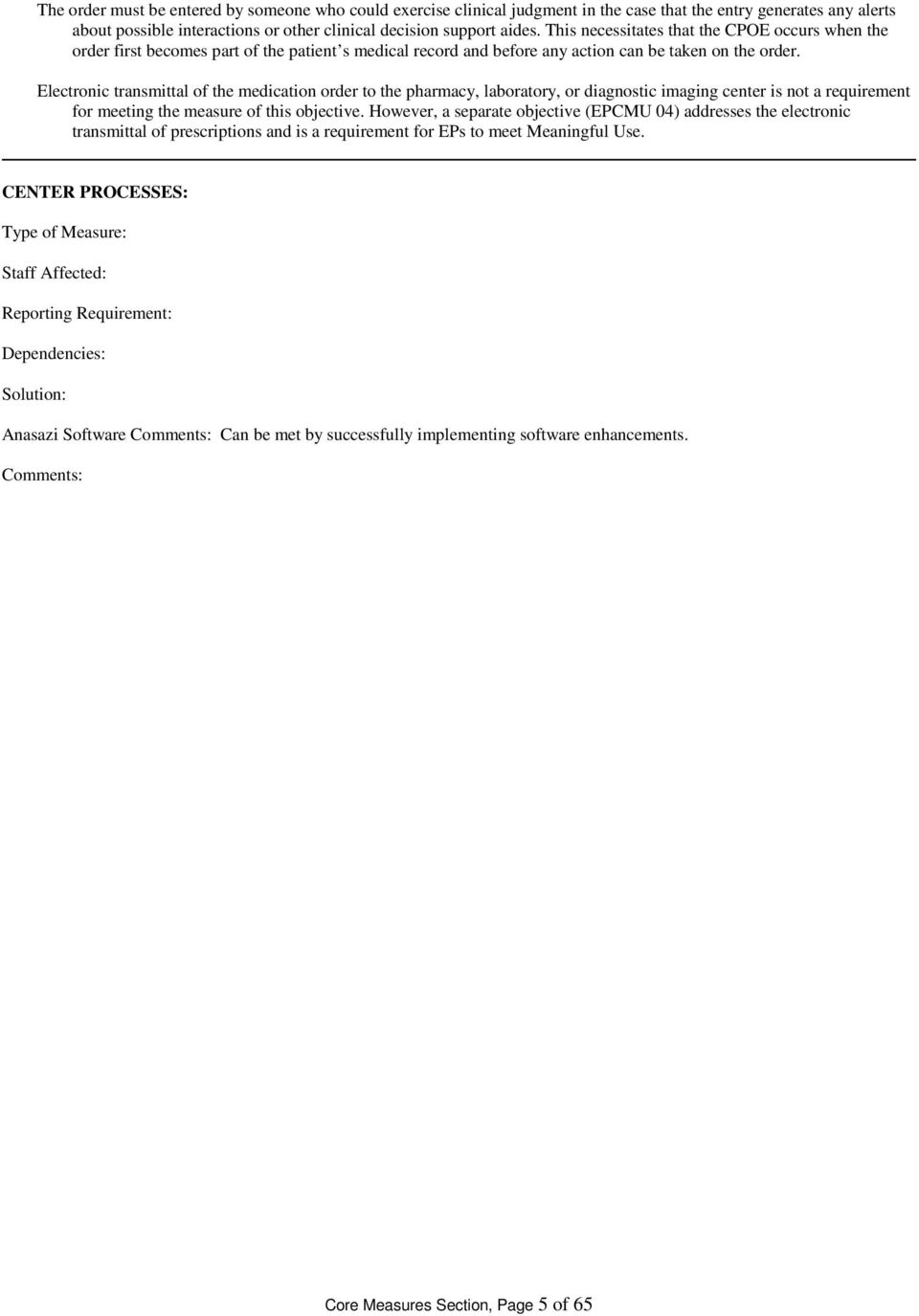
5 The order must be entered by someone who could exercise clinical judgment in the case that the entry generates any alerts about possible interactions or other clinical decision support aides. This necessitates that the CPOE occurs when the order first becomes part of the patient s medical record and before any action can be taken on the order. Electronic transmittal of the medication order to the pharmacy, laboratory, or diagnostic imaging center is not a requirement for meeting the measure of this objective. However, a separate objective (EPCMU 04) addresses the electronic transmittal of prescriptions and is a requirement for EPs to meet Meaningful Use. Anasazi Software Can be met by successfully implementing software enhancements. Core Measures Section, Page 5 of 65
6 Core Measure 2: Drug Interaction Checks REQUIRED: Stage 1 MEASURE: EXCLUSION: Implement drug-drug and drug-allergy interaction checks. The EP has enabled this functionality for the entire EHR reporting period. No exclusion. PROPOSED: Stage 2 Employ drug-drug interaction checking and drug-allergy checking on appropriate evidence-based interactions. PROPOSED: Stage 3 Employ drug-drug interaction, drug-allergy, drug-age checking (for elderly), drug dose checking (e.g., pediatric dosing, chemotherapy dosing), drug lab checking, and drug condition checking (including pregnancy and lactation) on appropriate evidence-based interactions. DEFINITION OF TERMS: None. ATTESTATION REQUIREMENTS: YES / NO Eligible professionals (EPs) must attest YES to having enabled drug-drug and drug-allergy interaction checks for the length of the reporting period to meet this measure. ADDITIONAL INFORMATION: None. Anasazi Software Can be met by successfully implementing software enhancements. Core Measures Section, Page 6 of 65
7 Core Measure 3: Maintain Problem List REQUIRED: Stage 1 MEASURE: EXCLUSION: Maintain an up-to-date problem list of current and active diagnoses. More than 80 percent of all unique patients seen by the EP have at least one entry or an indication that no problems are known for the patient recorded as structured data. No exclusion. Same. 80% of problem lists are up-to-date. DEFINITION OF TERMS: Problem List A list of current and active diagnoses as well as past diagnoses relevant to the current care of the patient. Unique Patient If a patient is seen by an EP more than once during the EHR reporting period, then for purposes of measurement that patient is only counted once in the denominator for the measure. All the measures relying on the term unique patient relate to what is contained in the patient s medical record. Not all of this information will need to be updated or even be needed by the provider at every patient encounter. This is especially true for patients whose encounter frequency is such that they would see the same provider multiple times in the same EHR reporting period. Up-to-date The term up-to-date means the list is populated with the most recent diagnosis known by the EP. This knowledge could be ascertained from previous records, transfer of information from other providers, diagnosis by the EP, or querying the patient. ATTESTATION REQUIREMENTS: Denominator: Number of unique patients seen by the EP during the EHR reporting period. Numerator: Number of patients in the denominator who have at least one entry or an indication that no problems are known for the patient recorded as structured data in their problem list. The resulting percentage (Numerator Denominator) must be more than 80 percent in order for an EP to meet this measure. ADDITIONAL INFORMATION: The Medicare and Medicaid EHR Incentive Programs do not specify the use of ICD-9 or SNOMED-CT in meeting the measure for this objective. However, the Office of the National Coordinator for Health Information Technology (ONC) has adopted ICD-9 or SNOMED-CT for the entry of structured data for this measure and made this a requirement for EHR technology to be certified. Therefore, EPs will need to maintain an up-to-date problem list of current and active diagnoses using ICD-9 or SNOMED-CT as a basis for the entry of structured data into certified EHR technology in order to meet the measure for this objective. Core Measures Section, Page 7 of 65
8 For patients with no current or active diagnoses, an entry must still be made to the problem list indicating that no problems are known. An EP is not required to update the problem list at every contact with the patient. The measure ensures the EP has a problem list for patients seen during the EHR reporting period, and that at least one piece of information is presented to the EP. The EP can then use their judgment in deciding what further probing or updating may be required given the clinical circumstances. The initial diagnosis can be recorded in lay terms and later converted to standard structured data or can be initially entered using standard structured data. Anasazi Software Can be met by successfully implementing software enhancements. Core Measures Section, Page 8 of 65
9 Core Measure 4: Generate and Transmit Permissible Prescriptions Electronically (erx) REQUIRED: Stage 1. MEASURE: Generate and Transmit Permissible Prescriptions Electronically (erx). 40% of all permissible prescriptions written by the EP are transmitted electronically using certified EHR technology. EXCLUSION: 50%. 80%. DEFINITION OF TERMS: ATTESTATION REQUIREMENTS: ADDITIONAL INFORMATION: Anasazi Software Can be met by successfully implementing software enhancements. Core Measures Section, Page 9 of 65
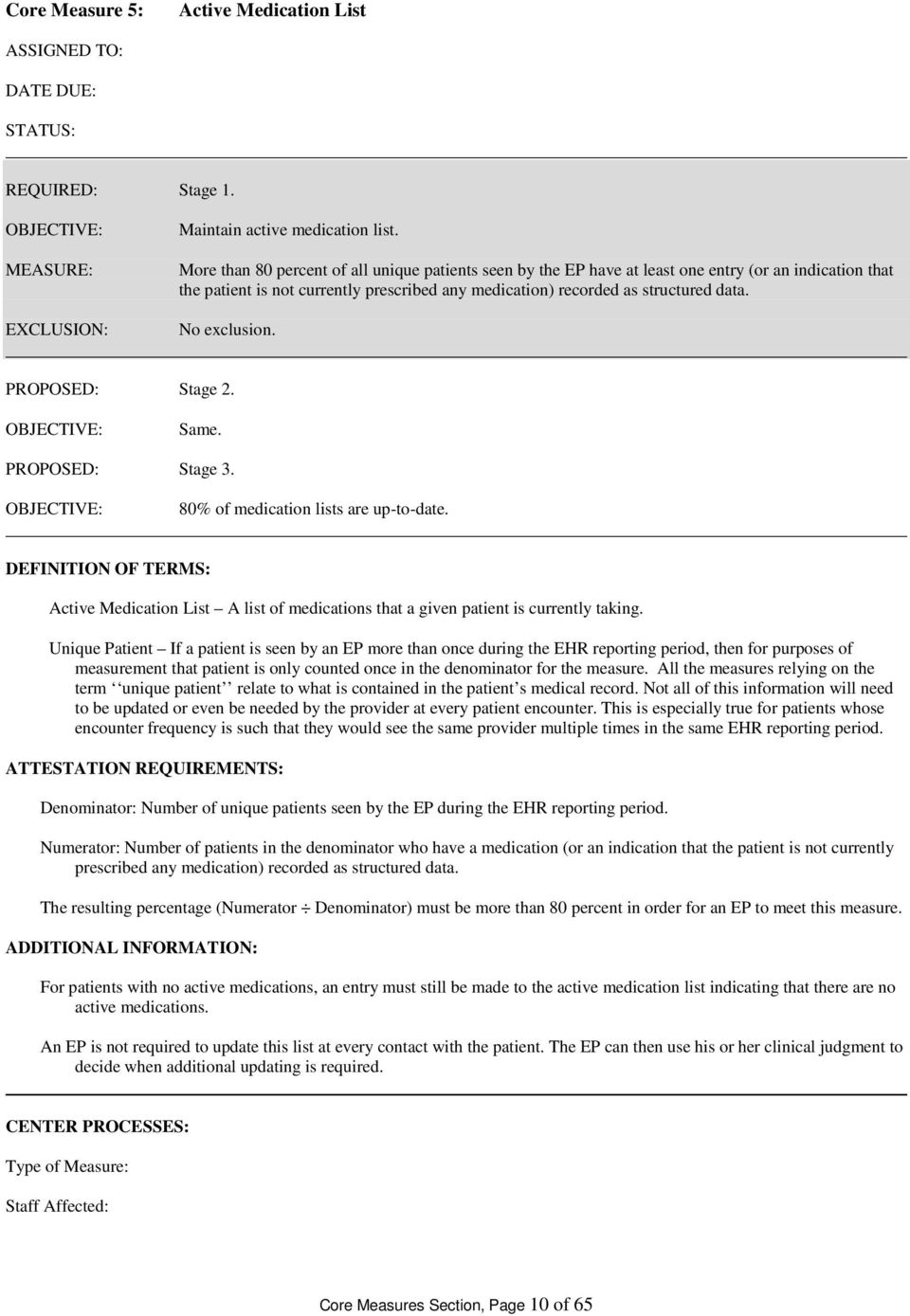
10 Core Measure 5: Active Medication List REQUIRED: Stage 1. MEASURE: EXCLUSION: Maintain active medication list. More than 80 percent of all unique patients seen by the EP have at least one entry (or an indication that the patient is not currently prescribed any medication) recorded as structured data. No exclusion. Same. 80% of medication lists are up-to-date. DEFINITION OF TERMS: Active Medication List A list of medications that a given patient is currently taking. Unique Patient If a patient is seen by an EP more than once during the EHR reporting period, then for purposes of measurement that patient is only counted once in the denominator for the measure. All the measures relying on the term unique patient relate to what is contained in the patient s medical record. Not all of this information will need to be updated or even be needed by the provider at every patient encounter. This is especially true for patients whose encounter frequency is such that they would see the same provider multiple times in the same EHR reporting period. ATTESTATION REQUIREMENTS: Denominator: Number of unique patients seen by the EP during the EHR reporting period. Numerator: Number of patients in the denominator who have a medication (or an indication that the patient is not currently prescribed any medication) recorded as structured data. The resulting percentage (Numerator Denominator) must be more than 80 percent in order for an EP to meet this measure. ADDITIONAL INFORMATION: For patients with no active medications, an entry must still be made to the active medication list indicating that there are no active medications. An EP is not required to update this list at every contact with the patient. The EP can then use his or her clinical judgment to decide when additional updating is required. Core Measures Section, Page 10 of 65
11 Anasazi Software Can be met by successfully implementing software enhancements. Core Measures Section, Page 11 of 65

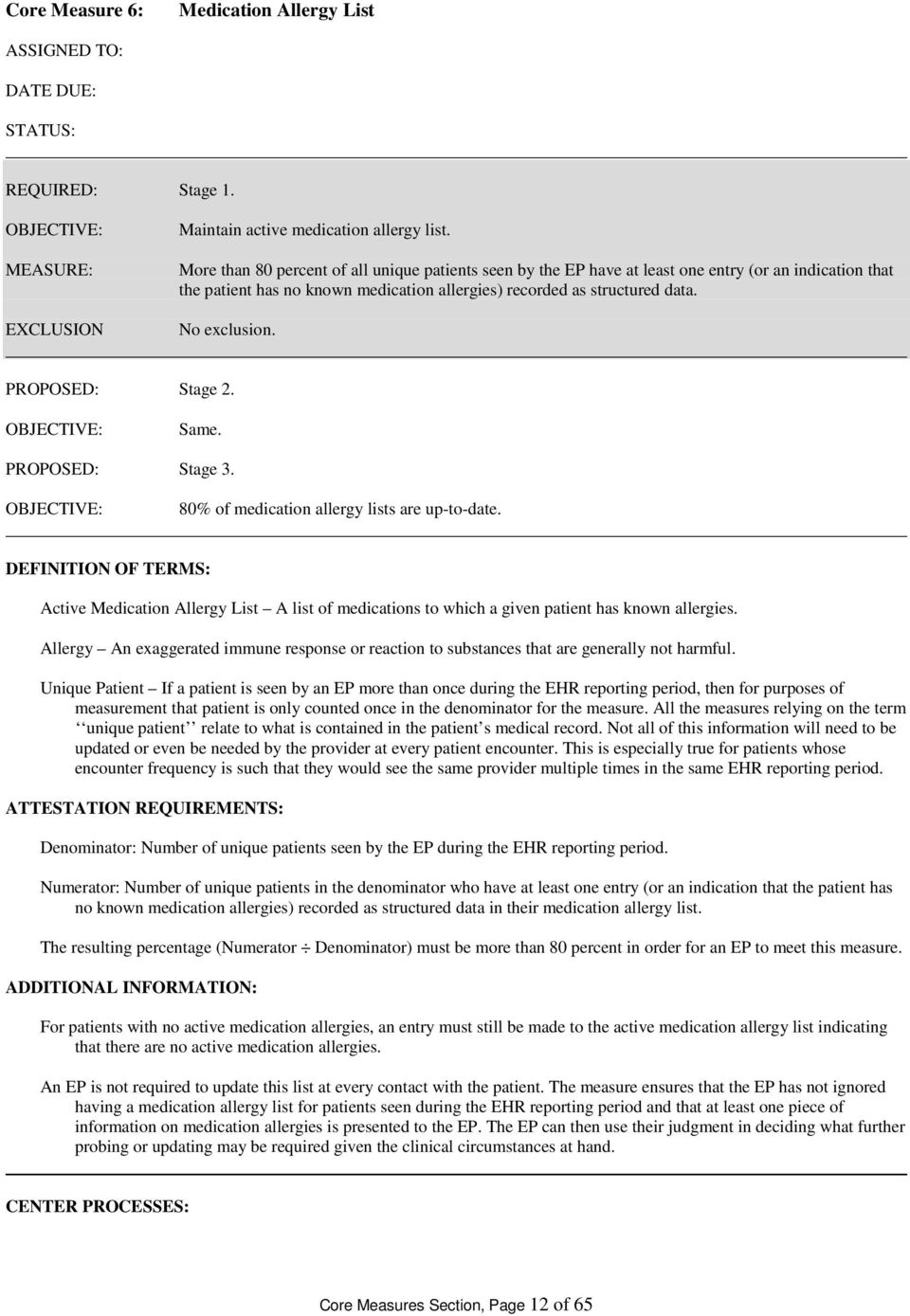
12 Core Measure 6: Medication Allergy List REQUIRED: Stage 1. MEASURE: EXCLUSION Maintain active medication allergy list. More than 80 percent of all unique patients seen by the EP have at least one entry (or an indication that the patient has no known medication allergies) recorded as structured data. No exclusion. Same. 80% of medication allergy lists are up-to-date. DEFINITION OF TERMS: Active Medication Allergy List A list of medications to which a given patient has known allergies. Allergy An exaggerated immune response or reaction to substances that are generally not harmful. Unique Patient If a patient is seen by an EP more than once during the EHR reporting period, then for purposes of measurement that patient is only counted once in the denominator for the measure. All the measures relying on the term unique patient relate to what is contained in the patient s medical record. Not all of this information will need to be updated or even be needed by the provider at every patient encounter. This is especially true for patients whose encounter frequency is such that they would see the same provider multiple times in the same EHR reporting period. ATTESTATION REQUIREMENTS: Denominator: Number of unique patients seen by the EP during the EHR reporting period. Numerator: Number of unique patients in the denominator who have at least one entry (or an indication that the patient has no known medication allergies) recorded as structured data in their medication allergy list. The resulting percentage (Numerator Denominator) must be more than 80 percent in order for an EP to meet this measure. ADDITIONAL INFORMATION: For patients with no active medication allergies, an entry must still be made to the active medication allergy list indicating that there are no active medication allergies. An EP is not required to update this list at every contact with the patient. The measure ensures that the EP has not ignored having a medication allergy list for patients seen during the EHR reporting period and that at least one piece of information on medication allergies is presented to the EP. The EP can then use their judgment in deciding what further probing or updating may be required given the clinical circumstances at hand. Core Measures Section, Page 12 of 65
13 Anasazi Software Can be met by successfully implementing software enhancements. Core Measures Section, Page 13 of 65

14 Core Measure 7: Record Demographics REQUIRED: Stage 1 MEASURE: EXCLUSION: Record all of the following demographics: (A) Preferred language (B) Gender (C) Race (D) Ethnicity (E) Date of birth More than 50 percent of all unique patients seen by the EP have demographics recorded as structured data. No exclusion. 80%. 90%. DEFINITION OF TERMS: Preferred Language The language by which the patient prefers to communicate. Unique Patient If a patient is seen by an EP more than once during the EHR reporting period, then for purposes of measurement that patient is only counted once in the denominator for the measure. All the measures relying on the term unique patient relate to what is contained in the patient s medical record. Not all of this information will need to be updated or even be needed by the provider at every patient encounter. This is especially true for patients whose encounter frequency is such that they would see the same provider multiple times in the same EHR reporting period. ATTESTATION REQUIREMENTS: Denominator: Number of unique patients seen by the EP during the EHR reporting period. Numerator: Number of patients in the denominator who have all the elements of demographics (or a specific exclusion if the patient declined to provide one or more elements or if recording an element is contrary to state law) recorded as structured data. The resulting percentage (Numerator Denominator) must be more than 50 percent in order for an EP to meet this measure. ADDITIONAL INFORMATION: Race and ethnicity codes should follow current federal standards published by the Office of Management and Budget ( If a patient declines to provide all or part of the demographic information, or if capturing a patient s ethnicity or race is prohibited by state law, such a notation entered as structured data would count as an entry for purposes of meeting the measure. In regards to patients who do not know their ethnicity, EPs should treat these patients the same way as Core Measures Section, Page 14 of 65
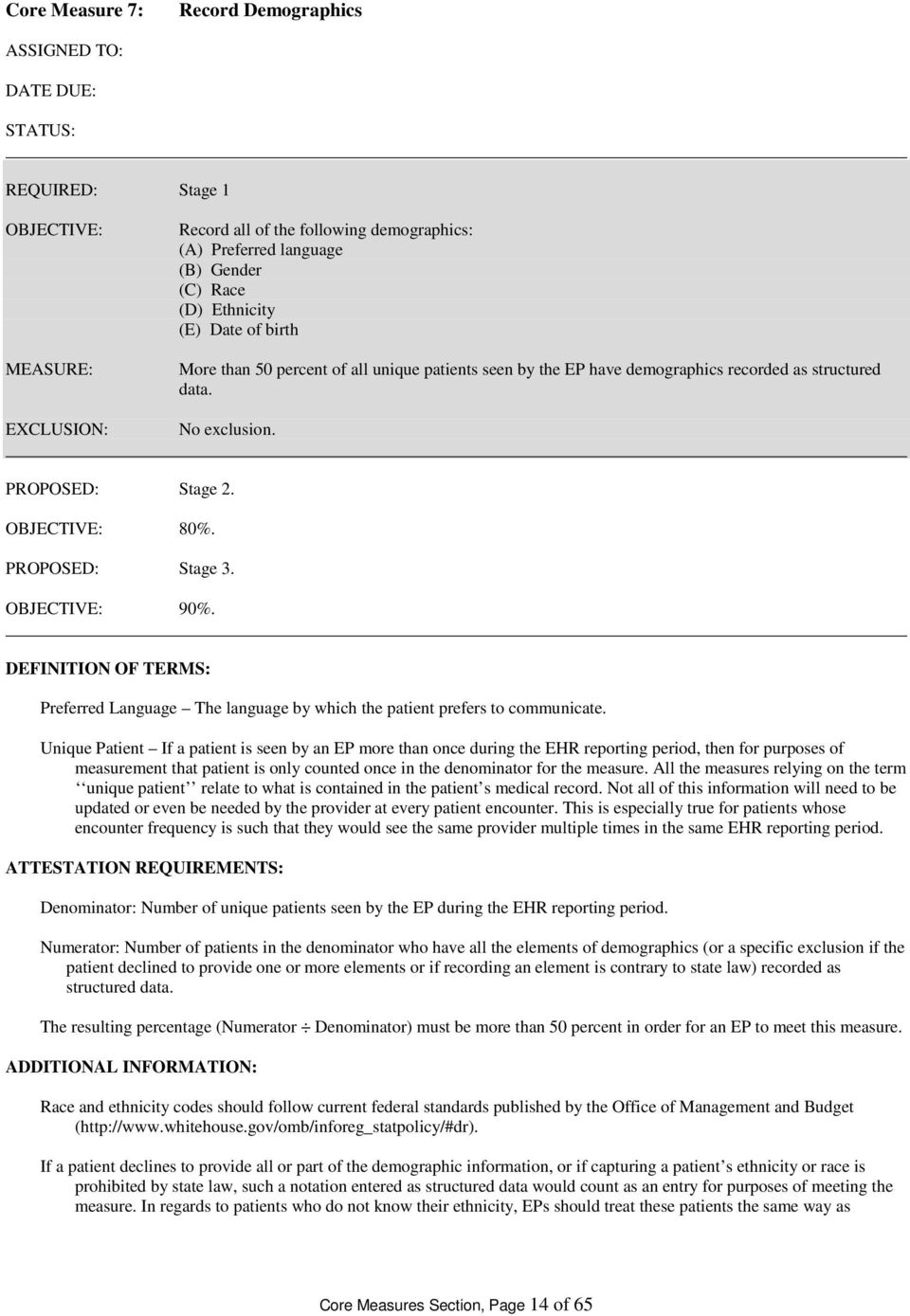
15 patients who decline to provide race or ethnicity identify in the patient record that the patient declined to provide this information. EPs are not required to communicate with the patient in his or her preferred language in order to meet the measure of this objective. Anasazi Software Can be met by successfully implementing software enhancements. Core Measures Section, Page 15 of 65

16 Core Measure 8: Record Vital Signs REQUIRED: Stage 1. MEASURE: EXCLUSION: Record and chart changes in the following vital signs: (A) Height (B) Weight (C) Blood pressure (D) Calculate and display body mass index (BMI) (E) Plot and display growth charts for children 2-20 years, including BMI For more than 50 percent of all unique patients age 2 and over seen by the EP, height, weight, and blood pressure are recorded as structured data. Any EP who either see no patients 2 years or older, or who believes that all three vital signs of height, weight, and blood pressure of their patients have no relevance to their scope of practice. 80%. 80%. DEFINITION OF TERMS: Unique Patient If a patient is seen by an EP more than once during the EHR reporting period, then for purposes of measurement that patient is only counted once in the denominator for the measure. All the measures relying on the term unique patient relate to what is contained in the patient s medical record. Not all of this information will need to be updated or even be needed by the provider at every patient encounter. This is especially true for patients whose encounter frequency is such that they would see the same provider multiple times in the same EHR reporting period. ATTESTATION REQUIREMENTS: Denominator: Number of unique patients age 2 or over seen by the EP during the EHR reporting period. Numerator: Number of patients in the denominator who have at least one entry of their height, weight and blood pressure are recorded as structured data. Exclusion: An EP who sees no patients 2 years or older would be excluded from this requirement. Additionally, an EP who believes that all three vital signs of height, weight, and blood pressure have no relevance to their scope of practice would be excluded from this requirement. EPs must select NO next to the appropriate exclusion, then click the APPLY button in order to attest to the exclusion. The resulting percentage (Numerator Denominator) must be more than 50 percent in order for an EP to meet this measure. ADDITIONAL INFORMATION: The provider is permitted, but not required, to limit the measure of this objective to those patients whose records are maintained using certified EHR technology. Core Measures Section, Page 16 of 65
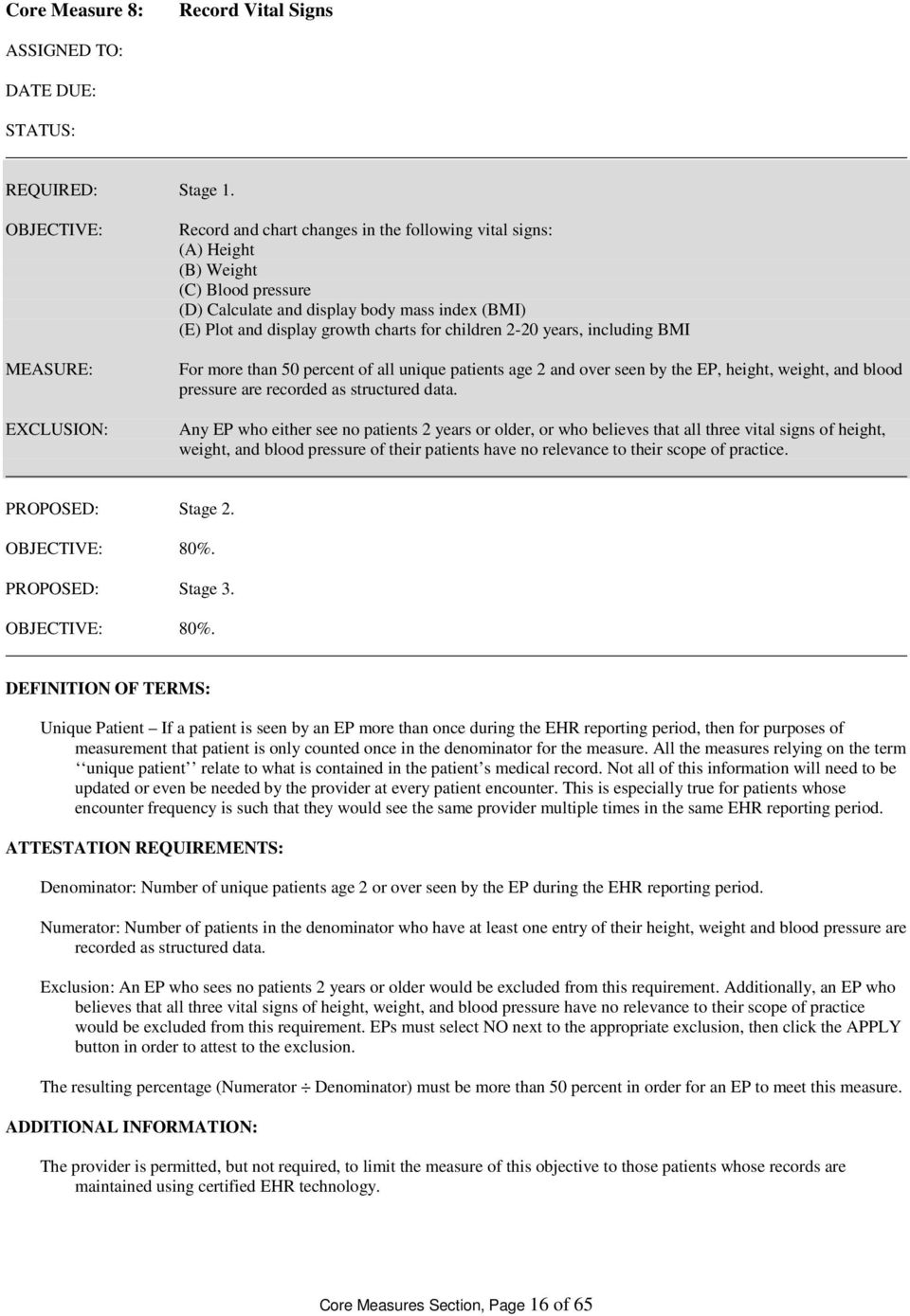
17 The only information required to be inputted by the provider is the height, weight, and blood pressure of the patient. The certified EHR technology will calculate BMI and the growth chart if applicable to patient based on age. Height, weight, and blood pressure do not have to be updated by the EP at every patient encounter. The EP can make the determination based on the patient s individual circumstances as to whether height, weight, and blood pressure need to be updated. Height, weight, and blood pressure can get into the patient s medical record as structured data in a number of ways. Some examples include entry by the EP, entry by someone on the EP s staff, transfer of the information electronically or otherwise from another provider or entered directly by the patient through a portal or other means. Anasazi Software Requires new procedures. Core Measures Section, Page 17 of 65
18 Core Measure 9: Record Smoking Status REQUIRED: Stage 1. MEASURE: EXCLUSIONS: Record smoking status for patients 13 years old or older. More than 50 percent of all unique patients 13 years old or older seen by the EP have smoking status recorded as structured data. Any EP who sees no patients 13 years or older. 80%. 90%. DEFINITION OF TERMS: Unique Patient If a patient is seen by an EP more than once during the EHR reporting period, then for purposes of measurement that patient is only counted once in the denominator for the measure. All the measures relying on the term unique patient relate to what is contained in the patient s medical record. Not all of this information will need to be updated or even be needed by the provider at every patient encounter. This is especially true for patients whose encounter frequency is such that they would see the same provider multiple times in the same EHR reporting period. ATTESTATION REQUIREMENTS: Denominator: Number of unique patients age 13 or older seen by the EP during the EHR reporting period. Numerator: Number of patients in the denominator with smoking status recorded as structured data. Exclusion: An EP who sees no patients 13 years or older would be excluded from this requirement. EPs must enter 0 in the Exclusion box to attest to exclusion from this requirement. The resulting percentage (Numerator Denominator) must be more than 50 percent in order for an EP to meet this measure. ADDITIONAL INFORMATION: The provider is permitted, but not required, to limit the measure of this objective to those patients whose records are maintained using certified EHR technology. This is a check of the medical record for patients 13 years old or older. If this information is already in the medical record available through certified EHR technology, an inquiry does not need to be made every time a provider sees a patient 13 years old or older. The frequency of updating this information is left to the provider and guidance is provided already from several sources in the medical community. Core Measures Section, Page 18 of 65
19 Anasazi Software Can be met by successfully implementing software enhancements. Core Measures Section, Page 19 of 65

20 Core Measure 10: Clinical Quality Measures (CQMs) REQUIRED: Stage 1. MEASURE: EXCLUSION: Report ambulatory clinical quality measures to CMS. Successfully report to CMS ambulatory clinical quality measures selected by CMS in the manner specified by CMS. No exclusion. Continue as per Quality Measures Workgroup and CMS. New measures will be considered after review of public comments Same. DEFINITION OF TERMS: None ATTESTATION REQUIREMENTS: YES / NO Eligible professionals (EPs) must attest YES to reporting to CMS ambulatory clinical quality measures selected by CMS in the manner specified by CMS to meet the measure. ADDITIONAL INFORMATION: The provider is permitted, but not required, to limit the measure of this objective to those patients whose records are maintained using certified EHR technology. Attesting to the measure of this objective indicates that the EP will submit complete ambulatory clinical quality measure information as required during the attestation process. During attestation, EPs will also attest to the numerators, denominators, and exclusions for individual ambulatory clinical quality measures. For requirements and electronic specifications related to individual ambulatory clinical quality measures, EPs should refer to: Core Measures Section, Page 20 of 65
21 Anasazi Software Requires new procedures. Core Measures Section, Page 21 of 65
22 Core Measure 11: Clinical Decision Support Rule REQUIRED: Stage 1. MEASURE: EXCLUSION: Implement one clinical decision support rule relevant to specialty or high clinical priority along with the ability to track compliance with that rule. Implement one clinical decision support rule. No exclusion. Establish CDS attributes: 1. Authenticated (source cited) 2. Evidence-based 3. Patient-context sensitive 4. Invokes relevant knowledge 5. Timely 6. Efficient workflow 7. Integrated with HER 8. Presented to the appropriate party who can take action. Same as Stage 2. DEFINITION OF TERMS: Clinical Decision Support HIT functionality that builds upon the foundation of an EHR to provide persons involved in care processes with general and person-specific information, intelligently filtered and organized, at appropriate times, to enhance health and health care. ATTESTATION REQUIREMENTS: YES / NO Eligible professionals (EPs) must attest YES to having implemented one clinical decision support rule for the length of the reporting period to meet the measure. ADDITIONAL INFORMATION: CMS will not issue additional guidance on the selection of appropriate clinical decision support rules for Stage 1 Meaningful Use. This determination is best left to the EP taking into account their workflow, patient population, and quality improvement efforts. Drug-drug and drug-allergy interaction alerts cannot be used to meet the meaningful use objective for implementing one clinical decision support rule. EPs must implement one clinical decision support rule in addition to drug-drug and drugallergy interaction checks. Core Measures Section, Page 22 of 65
23 Anasazi Software Requires new procedures. Core Measures Section, Page 23 of 65
24 Core Measure 12: Electronic Copy of Health Information REQUIRED: Stage 1. MEASURE: EXCLUSION: Provide patients with an electronic copy of their health information (including diagnostic test results, problem list, medication lists, medication allergies) upon request. More than 50 percent of all patients who request an electronic copy of their health information are provided it within 3 business days. Any EP that has no requests from patients or their agents for an electronic copy of patient health information during the EHR reporting period. Same. 90%. DEFINITION OF TERMS: Business Days Business days are defined as Monday through Friday excluding federal or state holidays on which the EP or their respective administrative staffs are unavailable. Diagnostic Test Results All data needed to diagnose and treat disease. Examples include, but are not limited to, blood tests, microbiology, urinalysis, pathology tests, radiology, cardiac imaging, nuclear medicine tests, and pulmonary function tests. ATTESTATION REQUIREMENTS: Denominator: Number of patients of the EP who request an electronic copy of their electronic health information four business days prior to the end of the EHR reporting period. Numerator: Number of patients in the denominator who receive an electronic copy of their electronic health information within three business days. Exclusion: An EP who has no requests from patients or their agents for an electronic copy of patient health information during the EHR reporting period would be excluded from this requirement. EPs must enter 0 in the Exclusion box to attest to exclusion from this requirement. The resulting percentage (Numerator Denominator) must be more than 50 percent in order for an EP to meet this measure. ADDITIONAL INFORMATION: The provider is permitted, but not required, to limit the measure of this objective to those patients whose records are maintained using certified EHR technology. When responding to patient requests for information, the EP should accommodate patient requests in accordance with the HIPAA Privacy Rule, as specified at 45 CFR , Access of individuals to protected health information. HIPAA contains requirements for providing patients copies of their health information. Core Measures Section, Page 24 of 65
25 Information that must be provided electronically is limited to that information that exists electronically in or is accessible from the certified EHR technology and is maintained by or on behalf of the EP. At a minimum, this would include the elements listed in the ONC final rule at 45 CFR (f) for EPs and 45 CFR (d) for eligible hospitals and CAHs as required for EHR technology to become certified. An EP may withhold information from the electronic copy of a patient s health information in accordance with the HIPAA Privacy Rule, as specified at 45 CFR An EP should provide a patient with all of the health information they have available electronically, subject to withholding as described in the HIPAA Privacy Rule, as specified at in 45 CFR Form and format should be human readable and comply with the HIPAA Privacy Rule, as specified at 45 CFR (c). The media could be any electronic form such as patient portal, PHR, CD, USB fob, etc. EPs are expected to make reasonable accommodations for patient preference as outlined in 45 CFR (b). The charging of fees for this information is governed by the HIPAA Privacy Rule at 45 CFR (c)(4) (which only permits HIPAA covered entities to charge an individual a reasonable, cost-based fee for a copy of the individual s health information). If provision of the copy involves the mailing of physical electronic media, then it would need to be mailed by at least the third business day following the request of the patient or their agents. Third-Party Requests: Only specific third-party requests for information are included in the denominator. Providing the copy to a family member or patient s authorized representative consistent with federal and state law may substitute for a disclosure of the information to the patient and count in the numerator. A request from the same would count in the denominator. All other third-party requests are not included in the numerator or the denominator. Anasazi Software Requires new procedures. Core Measures Section, Page 25 of 65
26 Core Measure 13: Clinical Summaries REQUIRED: Stage 1. MEASURE: EXCLUSION: Provide clinical summaries for patients for each office visit. Clinical summaries provided to patients for more than 50 percent of all office visits within 3 business days. Any EP who has no office visits during the EHR reporting period. Patients have the ability to view and download relevant information about a clinical encounter within 24 hours of the encounter. Follow-up tests should be included within 4 days of becoming available. Data are available in human-readable and structures forms. HITSC/ONC to define. Same as Stage 2. DEFINITION OF TERMS: Clinical Summary An after-visit summary that provides a patient with relevant and actionable information and instructions containing the patient name, provider s office contact information, date and location of visit, an updated medication list, updated vitals, reason(s) for visit, procedures and other instructions based on clinical discussions that took place during the office visit, any updates to a problem list, immunizations or medications administered during visit, summary of topics covered/considered during visit, time and location of next appointment/testing if scheduled, or a recommended appointment time if not scheduled, list of other appointments and tests that the patient needs to schedule with contact information, recommended patient decision aids, laboratory and other diagnostic test orders, test/laboratory results (if received before 24 hours after visit), and symptoms. Office Visit Office visits include separate, billable encounters that result from evaluation and management services provided to the patient and include: (1) Concurrent care or transfer of care visits, (2) Consultant visits, or (3) Prolonged Physician Service without Direct (Face-To-Face) Patient Contact (tele-health). A consultant visit occurs when a provider is asked to render an expert opinion/service for a specific condition or problem by a referring provider. ATTESTATION REQUIREMENTS: Denominator: Number of unique patients seen by the EP for an office visit during the EHR reporting period. Numerator: Number of patients in the denominator who are provided a clinical summary of their visit within three business days. Exclusion: EPs who have no office visits during the EHR reporting period would be excluded from this requirement. EPs must enter 0 in the Exclusion box to attest to exclusion from this requirement. The resulting percentage (Numerator Denominator) must be more than 50 percent in order for an EP to meet this measure. ADDITONAL INFORMATION: The provider is permitted, but not required, to limit the measure of this objective to those patients whose records are maintained using certified EHR technology. Core Measures Section, Page 26 of 65
27 The provision of the clinical summary is limited to the information contained within certified EHR technology. The clinical summary can be provided through a PHR, patient portal on the web site, secure , electronic media such as CD or USB fob, or printed copy. If the EP chooses an electronic media, they would be required to provide the patient a paper copy upon request. If an EP believes that substantial harm may arise from the disclosure of particular information, an EP may choose to withhold that particular information from the clinical summary. Providers should not charge patients a fee to provide this information. When a patient visit lasts several days and the patient is seen by multiple EPs, a single clinical summary at the end of the visit can be used to meet the meaningful use objective for provide clinical summaries for patients after each office visit. Anasazi Software Requires new HIE/HISP/PHR. Core Measures Section, Page 27 of 65
28 Core Measure 14: Electronic Exchange of Clinical Information REQUIRED: Stage 1. MEASURE: EXCLUSION: Capability to exchange key clinical information (for example, problem list, medication list, medication allergies, and diagnostic test results), among providers of care and patient authorized entities electronically. Performed at least one test of certified EHR technology s capacity to electronically exchange key clinical information. No exclusion. Connect to at least three external providers in primary referral network (but outside delivery system that uses the same EHR) or establish an ongoing bidirectional connection to at least one health information exchange. Connect to at least 30% of external providers in primary referral network or establish an ongoing bidirectional connection to at least one health information exchange. DEFINITION OF TERMS: Diagnostic Test Results All data needed to diagnose and treat disease. Examples include, but are not limited to, blood tests, microbiology, urinalysis, pathology tests, radiology, cardiac imaging, nuclear medicine tests, and pulmonary function tests. Different Legal Entities A separate legal entity is an entity that has its own separate legal existence. Indications that two entities are legally separate would include (1) they are each separately incorporated; (2) they have separate Boards of Directors; and (3) neither entity is owned or controlled by the other. Distinct Certified EHR Technology Each instance of certified EHR technology must be able to be certified and operate independently from all the others in order to be distinct. Separate instances of certified EHR technology that must link to a common database in order to gain certification would not be considered distinct. However, instances of certified EHR technology that link to a common, uncertified system or component would be considered distinct. Instances of certified EHR technology can be from the same vendor and still be considered distinct. Exchange Clinical information must be sent between different legal entities with distinct certified EHR technology and not between organizations that share a certified EHR technology. Distinct certified EHR technologies are those that can achieve certification and operate independently of other certified EHR technologies. The exchange of information requires that the eligible professional must use the standards of certified EHR technology as specified by the Office of the National Coordinator for Health IT, not the capabilities of uncertified or other vendor-specific alternative methods for exchanging clinical information. Patient Authorized Entities Any individual or organization to which the patient has granted access to their clinical information. Examples would include an insurance company that covers the patient, an entity facilitating health information exchange among providers, or a personal health record vendor identified by the patient. A patient would have to affirmatively grant access to these entities. ATTESTATION REQUIREMENTS: Core Measures Section, Page 28 of 65
29 YES / NO. Eligible professionals (EPs) must attest YES to having performed at least one test of certified EHR technology s capacity to electronically exchange key clinical information during the EHR reporting period to meet this measure. ADDITIONAL INFORMATION: The test of electronic exchange of key clinical information must involve the transfer of information to another provider of care with distinct certified EHR technology or other system capable of receiving the information. Simulated transfers of information are not acceptable to satisfy this objective. The transmission of actual patient information is not required for the purposes of a test. The use of test information about a fictional patient that would be identical in form to what would be sent about an actual patient would satisfy this objective. When the clinical information is available in a structured format it should be transferred in a structured format. However, if the information is unavailable in a structured format, the transmission of unstructured data is permissible. EPs can use their clinical judgment to identify what clinical information is considered key clinical information for purposes of exchanging clinical information about a patient at a particular time with other providers of care. A minimum set of information is identified in the HIT Standards and Criteria rule at 45 CFR (i), and is generally outlined in this objective as: problem list, medication list, medication allergies, and diagnostic test results. An EP s determination of key clinical information could include some or all of this information, as well as information not included here. An EP should test their ability to send the minimum information set in the HIT Standards and Criteria rule at 45 CFR (i). If the EP continues to exchange information beyond the initial test, then the provider may decide what information should be exchanged on a case-by-case basis. EPs must test their ability to electronically exchange key clinical information at least once prior to the end of the EHR reporting period. Testing may also occur prior to the beginning of the EHR reporting period. Every payment year requires its own, unique test. If multiple EPs are using the same certified EHR technology in a shared physical setting, testing would only have to occur once for a given certified EHR technology. An unsuccessful test of electronic exchange of key clinical information will be considered valid for meeting the measure of this objective. Anasazi Software Requires new HIE/HISP/PHR. Core Measures Section, Page 29 of 65
30 Core Measure 15: Protect Electronic Health Information REQUIRED: Stage 1. MEASURE: EXCLUSION: Protect electronic health information created or maintained by the certified EHR technology through the implementation of appropriate technical capabilities. Conduct or review a security risk analysis in accordance with the requirements under 45 CFR (a)(1) and implement security updates as necessary and correct identified security deficiencies as part of its risk management process. No exclusion. Additional privacy and security objectives under consideration via the HIT Policy Committee s Privacy & Security Tiger Team. Additional privacy and security objectives under consideration via the HIT Policy Committee s Privacy & Security Tiger Team. DEFINITION OF TERMS: Appropriate Technical Capabilities A technical capability would be appropriate if it protected the electronic health information created or maintained by the certified EHR technology. All of these capabilities could be part of the certified HER technology or outside systems and programs that support the privacy and security of certified EHR technology. ATTESTATION REQUIREMENTS: YES / NO. Eligible professionals (EPs) must attest YES to having conducted or reviewed a security risk analysis in accordance with the requirements under 45 CFR (a)(1) and implemented security updates as necessary and corrected identified security deficiencies prior to or during the EHR reporting period to meet this measure. ADDITIONAL INFORMATION: EPs must conduct or review a security risk analysis of certified EHR technology and implement updates as necessary at least once prior to the end of the EHR reporting period and attest to that conduct or review. The testing could occur prior to the beginning of the first EHR reporting period. However, a new review would have to occur for each subsequent reporting period. A security update would be required if any security deficiencies were identified during the risk analysis. A security update could be updated software for certified EHR technology to be implemented as soon as available, changes in workflow processes or storage methods, or any other necessary corrective action that needs to take place in order to eliminate the security deficiency or deficiencies identified in the risk analysis. Core Measures Section, Page 30 of 65
31 Anasazi Software Requires new procedures. Core Measures Section, Page 31 of 65
32 SECTION 2 Stage 1 Menu Set Measures Includes Proposed Changes for Stages 2 and 3 Menu Set Measures Section, Page 32 of 65
33 Menu Set 1: Drug Formulary Checks REQUIRED: Stage 1. MEASURE: EXCLUSION: Implement drug formulary checks. The EP has enabled this functionality and has access to at least one internal or external formulary for the entire EHR reporting period. Any EP who writes fewer than 100 prescriptions during the EHR reporting period. Move to Core Set. 80% of medication orders are checked against relevant formularies. DEFINITION OF TERMS: None. ATTESTATION REQUIREMENTS: YES / NO / EXCLUSION. Eligible professionals (EPs) must attest YES to having enabled this functionality and having had access to at least one internal or external formulary for the entire EHR reporting period to meet this measure. An EP who writes fewer than 100 prescriptions during the EHR reporting period can be excluded from this objective and associated measure. EPs must enter 0 in the Exclusion box to attest to exclusion from this requirement. ADDITIONAL INFORMATION: At a minimum an EP must have at least one formulary that can be queried. This may be an internally developed formulary or an external formulary. The formularies should be relevant for patient care during the prescribing process. Anasazi Software Can be met by successfully implementing software enhancements. Menu Set Measures Section, Page 33 of 65
34 Menu Set Measures Section, Page 34 of 65
35 Menu Set 2: Clinical Lab Test Results REQUIRED: Stage 1. MEASURE: EXCLUSION: Incorporate clinical lab test results into EHR as structured data. More than 40 percent of all clinical lab test results ordered by the EP during the EHR reporting period whose results are either in a positive/negative or numerical format are incorporated in certified EHR technology as structured data. An EP who orders no lab tests whose results are either in a positive/negative or numeric format during the EHR reporting period. Move to Core Set. 90% of lab results electronically ordered by EHR are stored as structured data in the EHR and are reconciled with structured lab orders. DEFINITION OF TERMS: None. ATTESTATION REQUIREMENTS: Denominator: Number of lab tests ordered during the EHR reporting period by the EP whose results are expressed in a positive or negative affirmation or as a number. Numerator: Number of lab test results whose results are expressed in a positive or negative affirmation or as a number which are incorporated as structured data. Exclusion: If an EP orders no lab tests whose results are either in a positive/negative or numeric format during the EHR reporting period they would be excluded from this requirement. EPs must select NO next to the appropriate exclusion, then click the APPLY button in order to attest to the exclusion. The resulting percentage (Numerator Denominator) must be more than 40 percent in order for an EP to meet this measure. ADDITIONAL INFORMATION: The provider is permitted, but not required, to limit the measure of this objective to labs ordered for those patients whose records are maintained using certified EHR technology. Structured data does not need to be electronically exchanged in order to qualify for the measure of this objective. The EP is not limited to only counting structured data received via electronic exchange, but may count in the numerator all structured data entered through manual entry through typing, option selecting, scanning, or other means. Lab results are not limited to any specific type of laboratory or to any specific type of lab test. The Medicare and Medicaid EHR Incentive Programs do not specify the use of code set standards in meeting the measure for this objective. However, the Office of the National Coordinator for Health Information Technology (ONC) has Menu Set Measures Section, Page 35 of 65
36 adopted Logical Observation Identifiers Names and Codes (LOINC ) version 2.27, when such codes were received within an electronic transaction from a laboratory, for the entry of structured data for this measure and made this a requirement for EHR technology to be certified. Anasazi Software Can be met by successfully implementing software enhancements. Might require customerspecific enhancements. Menu Set Measures Section, Page 36 of 65
37 Menu Set 3: Patient Lists REQUIRED: Stage 1. MEASURE: EXCLUSION: Generate lists of patients by specific conditions to use for quality improvement, reduction of disparities, research, or outreach. Generate at least one report listing patients of the EP with a specific condition. No exclusion. Move to Core Set. Generate patient lists for multiple patient-specific parameters Patient lists are used to manage patients for high-priority health conditions. DEFINITION OF TERMS: Specific Conditions --Those conditions listed in the active patient problem list. ATTESTATION REQUIREMENTS: YES / NO. Eligible professionals (EPs) must attest YES to having generated at least one report listing patients of the EP with a specific condition to meet this measure. ADDITIONAL INFORMATION: This objective does not dictate the report(s) which must be generated. An EP is best positioned to determine which reports are most useful to their care efforts. The report generated could cover every patient whose records are maintained using certified EHR technology or a subset of those patients at the discretion of the EP. The report generated is required to include only patients whose records are maintained using certified EHR technology. Menu Set Measures Section, Page 37 of 65
38 Anasazi Software Can be met by successfully implementing software enhancements. Menu Set Measures Section, Page 38 of 65
39 Menu Set 4: Patient Reminders REQUIRED: Stage 1. MEASURE: EXCLUSION Send reminders to patients per patient preference for preventive/follow-up care. More than 20 percent of all patients 65 years or older or 5 years old or younger were sent an appropriate reminder during the EHR reporting period. An EP who has no patients 65 years old or older or 5 years old or younger with records maintained using certified EHR technology. Move to Core Set. 20% of active patients who prefer to receive reminders electronically receive preventive or followup reminders. DEFINITION OF TERMS: Unique Patient If a patient is seen by an EP more than once during the EHR reporting period, then for purposes of measurement that patient is only counted once in the denominator for the measure. All the measures relying on the term unique patient relate to what is contained in the patient s medical record. Not all of this information will need to be updated or even be needed by the provider at every patient encounter. This is especially true for patients whose encounter frequency is such that they would see the same provider multiple times in the same EHR reporting period. ATTESTATION REQUIREMENTS: Denominator: Number of unique patients 65 years old or older or 5 years older or younger. Numerator: Number of patients in the denominator who were sent the appropriate reminder. Exclusion: If an EP has no patients 65 years old or older or 5 years old or younger with records maintained using certified EHR technology that EP is excluded from this requirement. EPs must select NO next to the appropriate exclusion, then click the APPLY button in order to attest to the exclusion. The resulting percentage (Numerator Denominator) must be more than 20 percent in order for an EP to meet this measure. ADDITIONAL INFORMATION: The provider is permitted, but not required, to limit the measure of this objective to those patients whose records are maintained using certified EHR technology. EPs meet the aspect of per patient preference of this objective if they are accommodating reasonable requests in accordance with the HIPAA Privacy Rule, as specified at 45 CFR (b), which is the guidance established for accommodating patient requests. EP has the discretion to determine the frequency, means of transmission, and form of the reminder limited only by the requirements the HIPAA Privacy Rule, as specified at 45 CFR (b), and any other applicable federal, state or local regulations that apply to them. Menu Set Measures Section, Page 39 of 65
40 Anasazi Software Requires new procedures. Menu Set Measures Section, Page 40 of 65
41 Menu Set 5: Patient Electronic Access REQUIRED: Stage 1. MEASURE: EXCLUSION: Provide patients with timely electronic access to their health information (including lab results, problem list, medication lists, and allergies) within 4 business days of the information being available to the EP. At least 10 percent of all unique patients seen by the EP are provided timely (available to the patient within four business days of being updated in the certified EHR technology) electronic access to their health information subject to the EP s discretion to withhold certain information. Any EP that neither orders nor creates lab tests or information that would be contained in the problem list, medication list, medication allergy list (or other information as listed at 45 CFR (g)) during the EHR reporting period. 20% of patients with the ability to access the Internet use a web based portal (PHR) to view/download relevant information contained in the record. Information must be able to be filtered or organized by date, encounter, etc. Data is available in human-readable and structured forms. 30%. DEFINITION OF TERMS: Business Days Business days are defined as Monday through Friday excluding federal or state holidays on which the EP or their respective administrative staffs are unavailable. Unique Patient If a patient is seen by an EP more than once during the EHR reporting period, then for purposes of measurement that patient is only counted once in the denominator for the measure. All the measures relying on the term unique patient relate to what is contained in the patient s medical record. Not all of this information will need to be updated or even be needed by the provider at every patient encounter. This is especially true for patients whose encounter frequency is such that they would see the same provider multiple times in the same EHR reporting period. ATTESTATION REQUIREMENTS: Denominator: Number of unique patients seen by the EP during the EHR reporting period. Numerator: Number of patients in the denominator who have timely (available to the patient within four business days of being updated in the certified EHR technology) electronic access to their health information online. Exclusion: If an EP neither orders nor creates lab tests or information that would be contained in the problem list, medication list, medication allergy list (or other information as listed at 45 CFR (g)) during the EHR reporting period, they would be excluded from this requirement. EPs must select NO next to the appropriate exclusion, then click the APPLY button in order to attest to the exclusion. The resulting percentage (Numerator Denominator) must be at least 10 percent in order for an EP to meet this measure. ADDITIONAL INFORMATION: Menu Set Measures Section, Page 41 of 65
42 Online electronic access through either a patient portal or personal health record (PHR) will satisfy the measure of this objective. An EP may decide that electronic access to a portal or PHR is not the best forum to communicate results. Within the confines of laws governing patient access to their medical records, we would defer to EP s judgment as to whether to hold information back in anticipation of an actual encounter between the provider and the patient. Information that must be provided electronically is limited to that information that exists electronically in or is accessible from the certified EHR technology and is maintained by or on behalf of the EP. At a minimum, certified EHR technology makes available lab test results, problem list, medication list, and medication allergy list. An EP may withhold information from the electronic copy of a patient s health information in accordance with the HIPAA Privacy Rule, as specified at 45 CFR The objective and measure focus on the availability of access and the timeliness of data, not utilization. The EP is not responsible for ensuring that 10 percent request access or have the means to access, only that 10 percent of all unique patients seen by the EP could access the information if they so desired. Anasazi Software Requires new HIE/HISP/PHR. Menu Set Measures Section, Page 42 of 65
43 Menu Set 6: Patient-specific Education Resources REQUIRED: Stage 1. MEASURE: EXCLUSION: Use certified EHR technology to identify patient-specific education resources and provide those resources to the patient if appropriate. More than 10 percent of all unique patients seen by the EP are provided patient-specific education resources. No exclusion. Same. 20% offered patient-specific educational resources online in the common primary languages (languages spoken by more than 5% of your total population eligible to be served or over 1,000 persons in that population - whichever is less). DEFINITION OF TERMS: Patient-Specific Education Resources Resources identified through logic built into certified EHR technology which evaluates information about the patient and suggests education resources that would be of value to the patient. Unique Patient If a patient is seen by an EP more than once during the EHR reporting period, then for purposes of measurement that patient is only counted once in the denominator for the measure. All the measures relying on the term unique patient relate to what is contained in the patient s medical record. Not all of this information will need to be updated or even be needed by the provider at every patient encounter. This is especially true for patients whose encounter frequency is such that they would see the same provider multiple times in the same EHR reporting period. ATTESTATION REQUIREMENTS: Denominator: Number of unique patients seen by the EP during the EHR reporting period. Numerator: Number of patients in the denominator who are provided patient-specific education resources. The resulting percentage (Numerator Denominator) must be more than 10 percent in order for an EP to meet this measure. ADDITIONAL INFORMATION: Certified EHR technology is certified to use either the patient s problem list, medication list, or laboratory test results to identify the patient-specific educational resources. These or additional elements can be used in the identification of educational resources that are specific to the patients needs. Education resources or materials do not have to be stored within or generated by the certified EHR. However, the provider should utilize certified EHR technology in a manner where the technology suggests patient-specific educational resources based on the information stored in the certified EHR technology. The provider can make a final decision on whether the education resource is useful and relevant to a specific patient. Menu Set Measures Section, Page 43 of 65
44 Anasazi Software Requires new HIE/HISP/PHR. Menu Set Measures Section, Page 44 of 65
45 Menu Set 7: Medication Reconciliation REQUIRED: Stage 1. MEASURE: EXCLUSION: The EP who receives a patient from another setting of care or provider of care or believes an encounter is relevant should perform medication reconciliation. The EP performs medication reconciliation for more than 50 percent of transitions of care in which the patient is transitioned into the care of the EP. An EP who was not the recipient of any transitions of care during the EHR reporting period. 80%. 90%. DEFINITION OF TERMS: Medication Reconciliation --The process of identifying the most accurate list of all medications that the patient is taking, including name, dosage, frequency, and route, by comparing the medical record to an external list of medications obtained from a patient, hospital, or other provider. Relevant Encounter An encounter during which the EP performs a medication reconciliation due to new medication or long gaps in time between patient encounters or for other reasons determined appropriate by the EP. Essentially an encounter is relevant if the EP judges it to be so. (Note: Relevant encounters are not included in the numerator and denominator of the measure for this objective.) Transition of Care The movement of a patient from one setting of care (hospital, ambulatory primary care practice, ambulatory specialty care practice, long-term care, home health, rehabilitation facility) to another. ATTESTATION REQUIREMENTS: Denominator:: Number of transitions of care during the EHR reporting period for which the EP was the receiving party of the transition. Numerator: Number of transitions of care in the denominator where medication reconciliation was performed. Exclusion: If an EP was not on the receiving end of any transition of care during the EHR reporting period they would be excluded from this requirement. EPs must select NO next to the appropriate exclusion, then click the APPLY button in order to attest to the exclusion. The resulting percentage (Numerator Denominator) must be more than 50 percent in order for an EP to meet this measure. ADDITIONAL INFORMATION: Only patients whose records are maintained using certified EHR technology should be included in the denominator for transitions of care. Menu Set Measures Section, Page 45 of 65
46 In the case of reconciliation following transition of care, the receiving EP should conduct the medication reconciliation. The measure of this objective does not dictate what information must be included in medication reconciliation. Information included in the process of medication reconciliation is appropriately determined by the provider and patient. Anasazi Software Can be met by successfully implementing software enhancements. Menu Set Measures Section, Page 46 of 65
47 Menu Set 8: Transition of Care Summary REQUIRED: Stage 1. MEASURE: EXCLUSION: The EP who transitions their patient to another setting of care or provider of care or refers their patient to another provider of care should provide summary care record for each transition of care or referral. The EP who transitions or refers their patient to another setting of care or provider of care provides a summary of care record for more than 50 percent of transitions of care and referrals. An EP who neither transfers a patient to another setting nor refers a patient to another provider during the EHR reporting period. Move to Core Set. 80%. DEFINITION OF TERMS: Transition of Care The movement of a patient from one setting of care (hospital, ambulatory primary care practice, ambulatory specialty care practice, long-term care, home health, rehabilitation facility) to another. ATTESTATION REQUIREMENTS: Denominator: Number of transitions of care and referrals during the EHR reporting period for which the EP was the transferring or referring provider. Numerator: Number of transitions of care and referrals in the denominator where a summary of care record was provided. Exclusion: If an EP does not transfer a patient to another setting or refer a patient to another provider during the EHR reporting period then they would be excluded from this requirement. EPs must select NO next to the appropriate exclusion, then click the APPLY button in order to attest to the exclusion. The resulting percentage (Numerator Denominator) must be more than 50 percent in order for an EP to meet this measure. ADDITIONAL INFORMATION: Only patients whose records are maintained using certified EHR technology should be included in the denominator for transitions of care. The transferring party must provide the summary care record to the receiving party. The EP can send an electronic or paper copy of the summary care record directly to the next provider or can provide it to the patient to deliver to the next provider, if the patient can reasonably expected to do so. If the provider to whom the referral is made or to whom the patient is transitioned to has access to the medical record maintained by the referring provider then the summary of care record would not need to be provided, and that patient should not be included in the denominator for transitions of care. Menu Set Measures Section, Page 47 of 65
48 Anasazi Software Can be met by successfully implementing software enhancements. Menu Set Measures Section, Page 48 of 65
49 Menu Set 9: Immunization Registries Data Submission REQUIRED: Stage 1. MEASURE: EXCLUSION: Capability to submit electronic data to immunization registries or immunization information systems and actual submission according to applicable law and practice. Performed at least one test of certified EHR technology s capacity to submit electronic data to immunization registries and follow up submission if the test is successful (unless none of the immunization registries to which the EP submits such information has the capacity to receive the information electronically). An EP who administers no immunizations during the EHR reporting period or where no immunization registry has the capacity to receive the information electronically. Move to Core Set. Some immunizations are submitted on an ongoing basis to Immunization Information System (IIS) if accepted and as required by law. Immunizations are submitted to IIS if accepted and as required by law. During well child/adult visits, providers review IIS records via their EHR. (Implies the ability to download IIS information.) DEFINITION OF TERMS: None. ATTESTATION REQUIREMENTS: Yes / No / Exclusion. Eligible professionals (EPs) must attest YES to having performed at least one test of certified EHR technology s capacity to submit electronic data to immunization registries and follow up submission if the test was successful (unless none of the immunization registries to which the EP submits such information has the capacity to receive the information electronically) to meet this measure. Exclusion: If an EP does not perform immunizations during the EHR reporting period, or if there is no immunization registry that has the capacity to receive the information electronically, then the EP would be excluded from this requirement. EPs must select NO next to the appropriate exclusion(s), then click the APPLY button in order to attest to the exclusion(s). ADDITIONAL INFORMATION: The test to meet the measure of this objective must involve the actual submission of information to a registry or immunization information system, if one exists that will accept the information. Simulated transfers of information are not acceptable to satisfy this objective. The transmission of actual patient information is not required for the purposes of a test. The use of test information about a fictional patient that would be identical in form to what would be sent about an actual patient would satisfy this objective. Menu Set Measures Section, Page 49 of 65
50 If multiple EPs are using the same certified EHR technology in a shared physical setting, testing would only have to occur once for a given certified EHR technology. An unsuccessful test to submit electronic data to immunization registries or immunization information systems will be considered valid and would satisfy this objective. If the test is successful, then the EP should institute regular reporting with the entity with whom the successful test was conducted, in accordance with applicable law and practice. There is not a measurement associated with this reporting. The transmission of immunization information must use the standards at 45 CFR (k). Anasazi Software Might be able to attest that we do not do. Menu Set Measures Section, Page 50 of 65
51 Menu Set 10: Syndromic Surveillance Data Submission REQUIRED: Stage 1. MEASURE: EXCLUSION: Capability to submit electronic syndromic surveillance data to public health agencies and actual submission according to applicable law and practice. Performed at least one test of certified EHR technology s capacity to provide electronic syndromic surveillance data to public health agencies and follow-up submission if the test is successful (unless none of the public health agencies to which an EP submits such information has the capacity to receive the information electronically). An EP who does not collect any reportable syndromic information on their patients during the EHR reporting period or does not submit such information to any public health agency that has the capacity to receive the information electronically. Move to Core Set. Same. DEFINITION OF TERMS: Public Health Agency --An entity under the jurisdiction of the U.S. Department of Health and Human Services, tribal organization, State level and/or city/county level administration that serves a public health function. ATTESTATION REQUIREMENTS: Yes / No / Exclusion Eligible professionals (EPs) must attest YES to having performed at least one test of certified EHR technology s capacity to submit electronic syndromic surveillance data to public health agencies and follow up submission if the test was successful (unless none of the public health agencies to which the EP submits such information has the capacity to receive the information electronically) to meet this measure. Exclusion: If an EP does not collect any reportable syndromic information on their patients during the EHR reporting period or if no public health agency that has the capacity to receive the information electronically, then the EP is excluded from this requirement. EPs must select NO next to the appropriate exclusion, then click the APPLY button in order to attest to the exclusion. ADDITIONAL INFORMATION: The test to meet the measure of this objective must involve the actual submission of electronic syndromic surveillance data to public health agencies, if one exists that will accept the information. Simulated transfers of information are not acceptable to satisfy this objective. The transmission of electronic syndromic surveillance data is not required for the purposes of a test. The use of test information about a fictional patient that would be identical in form to what would be sent about an actual patient would satisfy this objective. Menu Set Measures Section, Page 51 of 65
52 An unsuccessful test to submit electronic syndromic surveillance data to public health agencies will be considered valid and would satisfy this objective. If the test is successful, then the EP should institute regular reporting with the entity with whom the successful test was conducted, in accordance with applicable law and practice. There is not a measurement associated with this reporting. EPs must test their ability to submit electronic syndromic surveillance data to public health agencies at least once prior to the end of the EHR reporting period. Testing may also occur prior to the beginning of the EHR reporting period. Each payment year requires it own unique test. If multiple EPs are using the same certified EHR technology in a shared physical setting, testing would only have to occur once for a given certified EHR technology. The transmission of syndromic surveillance information must use the standards at 45 CFR (l). Anasazi Software Can be met by successfully implementing software enhancements. Menu Set Measures Section, Page 52 of 65
53 SECTION 3 New Proposals for Stages 2 and 3 Proposed Measures Section, Page 53 of 65
54 Proposed Measure A: 30% of visits have at least one electronic EP note. 90%. Anasazi Software Can be met by successfully implementing software enhancements. Proposed Measures Section, Page 54 of 65
55 Proposed Measure B: List of care team members (including PCP) available for 10% of patients in EHR. List of care team members (including the PCP) available for 50% of patients via electronic exchange. Anasazi Software Can be met by successfully implementing software enhancements. Proposed Measures Section, Page 55 of 65
56 Proposed Measure C: Record a longitudinal care plan for 20% of patients with high-priority health conditions. Longitudinal care plan available for electronic exchange for 50% of patients with high-priority health conditions. Anasazi Software Can be met by successfully implementing software enhancements. Proposed Measures Section, Page 56 of 65
57 Proposed Measure D: Menu Set. Ensure that reportable lab results and conditions are submitted to public health agencies either directly or through their performing labs (if accepted and as required by law). Same. Move to Core Set? Anasazi Software Might be able to attest that we do not do. Proposed Measures Section, Page 57 of 65
58 Proposed Measure E: Online secure patient messaging is in use. Same. Anasazi Software Requires new HIE/HISP/PHR. Proposed Measures Section, Page 58 of 65
59 Proposed Measure F: Patient preferences for communication recorded for 20% of patients. 80%. Anasazi Software Requires new HIE/HISP/PHR. Proposed Measures Section, Page 59 of 65
60 Proposed Measure G: n/a Submit notifiable conditions using a reportable public-health submission button. EHR can receive and present public health alerts or follow up requests. Anasazi Software Might be able to attest that we do not do. Proposed Measures Section, Page 60 of 65
61 Proposed Measure H: n/a. Patient-generated data submitted to public health agencies. Anasazi Software Might be able to attest that we do not do. Proposed Measures Section, Page 61 of 65
62 Proposed Measure I: n/a. Offer electronic self-management tools to patients with high priority health conditions. Anasazi Software Requires new HIE/HISP/PHR. Proposed Measures Section, Page 62 of 65
63 Proposed Measure J: n/a. EHRs have capability to exchange data with PHRs using standards-based health data exchange. Anasazi Software Requires new HIE/HISP/PHR. Proposed Measures Section, Page 63 of 65
64 Proposed Measure K: n/a. Patients offered capability to report experience of care measures online. Anasazi Software Requires new HIE/HISP/PHR. Proposed Measures Section, Page 64 of 65
65 Proposed Measure L: n/a. Offer capability to upload and incorporate patient-generated survey data, biometric home monitoring data, patient suggestions of corrections to errors in the record into EHRs and clinician workflow. Anasazi Software Requires new HIE/HISP/PHR. Proposed Measures Section, Page 65 of 65
Qualifying for Medicare Incentive Payments with Crystal Practice Management. Version 4.1.25
 Qualifying for Medicare Incentive Payments with Crystal Practice Management Version 4.1.25 01/01/ Table of Contents Qualifying for Medicare Incentive Payments with... 1 General Information... 3 Links to
Meaningful Use Objectives
 Meaningful Use Objectives The purpose of the electronic health records (EHR) incentive program is not so much the adoption of health information technology (HIT), but rather how HIT can further the goals
Core Set of Objectives and Measures Must Meet All 15 Measures Stage 1 Objectives Stage 1 Measures Reporting Method
 Core Set of Objectives and Measures Must Meet All 15 Measures Stage 1 Objectives Stage 1 Measures Reporting Method Use Computerized Provider Order Entry (CPOE) for medication orders directly entered by
VIII. Dentist Crosswalk
 Page 27 VIII. Dentist Crosswalk Overview The final rule on meaningful use requires that an Eligible Professional (EP) report on both clinical quality measures and functional objectives and measures. While
Stage 1 Meaningful Use - Attestation Worksheet: Core Measures
 Stage 1 Meaningful Use - Attestation Worksheet: Core Measures Core Measures Objective # Objective Title / Explanation Goal Attestation Response - Values below reflect reponses of most radiologists Explanation
Stage 1 vs. Stage 2 Comparison Table for Eligible Professionals Last Updated: August, 2012
 Stage 1 vs. Stage 2 Comparison Table for Eligible Professionals Last Updated: August, 2012 CORE OBJECTIVES (17 total) Stage 1 Objective Stage 1 Measure Stage 2 Objective Stage 2 Measure Use CPOE for medication
Stage 1 vs. Stage 2 Comparison for Eligible Professionals
 Stage 1 vs. Comparison for Eligible Professionals CORE OBJECTIVES (17 Total) Stage 1 Objective Stage 1 Measure Objective Measure Use CPOE for Medication orders directly entered by any licensed healthcare
Meaningful Use Criteria for Eligible Hospitals and Eligible Professionals (EPs)
 Meaningful Use Criteria for Eligible and Eligible Professionals (EPs) Under the Electronic Health Record (EHR) meaningful use final rules established by the Centers for Medicare and Medicaid Services (CMS),
STAGES 1 AND 2 REQUIREMENTS FOR MEETING MEANINGFUL USE OF EHRs 1
 STAGES 1 AND 2 REQUIREMENTS FOR MEETING MEANINGFUL USE OF EHRs 1 Requirement CPOE Use CPOE for medication orders directly entered by any licensed health care professional who can enter orders into the
Presented by. Terri Gonzalez Director of Practice Improvement North Carolina Medical Society
 Presented by Terri Gonzalez Director of Practice Improvement North Carolina Medical Society Meaningful Use is using certified EHR technology to: Improve quality, safety, efficiency, and reduce errors Engage
Stage 1 vs. Stage 2 Comparison Table for Eligible Hospitals and CAHs Last Updated: August, 2012
 CORE OBJECTIVES (16 total) Stage 1 vs. Stage 2 Comparison Table for Eligible Hospitals and CAHs Last Updated: August, 2012 Stage 1 Objective Use CPOE for medication orders directly entered by any licensed
Medicaid EHR Incentive Program. Focus on Stage 2. Kim Davis-Allen, Outreach Coordinator [email protected]
 Medicaid EHR Incentive Program Focus on Stage 2 Kim Davis-Allen, Outreach Coordinator [email protected] Understanding Participation Program Year Program Year January 1 st - December 31st. Year
Meaningful Use Qualification Plan
 Meaningful Use Qualification Plan Overview Certified EHR technology used in a meaningful way is one piece of a broader Health Information Technology infrastructure intended to reform the health care system
Office Ally EHR 24/7 Meaningful Use Getting Started
 Office Ally EHR 24/7 Meaningful Use Getting Started 1 Table of Contents What is Meaningful Use.3 Enrolling with Medicare and Medicaid Incentive Programs.4 Who qualifies..4 How to Register.5 Using EHR 24/7
Meaningful Use Cheat Sheet CORE MEASURES: ALL REQUIRED # Measure Exclusions How to Meet in WEBeDoctor
 Meaningful Use Cheat Sheet CORE MEASURES: ALL REQUIRED # Measure Exclusions How to Meet in WEBeDoctor 1 CPOE (Computerized Physician Order Entry) More than 30 percent of all unique patients with at least
Reporting Period: For Stage 2, the reporting period must be the entire Federal Fiscal Year.
 Eligible Hospital and Critical Access Hospital (CAH) Attestation Worksheet for Stage 2 of the Medicare Electronic Health Record (EHR) Incentive Program The Eligible Hospital and CAH Attestation Worksheet
Contact Information: West Texas Health Information Technology Regional Extension Center 3601 4 th Street MS 6232 Lubbock, Texas 79424 806-743-1338
 Contact Information: West Texas Health Information Technology Regional Extension Center 3601 4 th Street MS 6232 Lubbock, Texas 79424 806-743-1338 http://www.wtxhitrec.org/ Grant award - $6.6m Total number
Meaningful Use of Certified EHR Technology with My Vision Express*
 Insight Software, LLC 3050 Universal Blvd Ste 120 Weston FL 33331-3528 Tel. 877-882-7456 www.myvisionexpress.com Meaningful Use of Certified EHR Technology with My Vision Express* Eligible Professional
EMR Name/ Model. meridianemr 4.2 CCHIT 2011 certified
 EMR Name/ Model EMR Vendor meridianemr 4.2 CCHIT 2011 certified meridianemr, Inc Core Set of Measures Objective Stage 1 Objectives Stage 1 Measures EMR Module/ Feature 1 Use CPOE for medication orders
Achieving Meaningful Use with Centricity EMR
 GE Healthcare Achieving Meaningful Use with Centricity EMR Are you Ready to Report? GE Healthcare EMR Consulting CHUG Fall Conference October 2010 Achieving Meaningful Use with Centricity EMR The EMR Consulting
E Z BIS ELECTRONIC HEALTH RECORDS
 E Z BIS ELECTRONIC HEALTH RECORDS CERTIFICATION AND THE HITECH INCENTIVE PROGRAM The Incentives On July 13, 2010, the U.S. Department of Health and Human Services finalized the Electronic Health Record
EMR Name/ Model. Cerner PowerChart Ambulatory (PowerWorks ASP)
 EMR Name/ Model EMR Vendor Cerner PowerChart Ambulatory (PowerWorks ASP) Cerner Corporation Core Set of Measures 1 Use CPOE for medication orders directly entered by any licensed healthcare professional
STAGE 2 MEANINGFUL USE CORE AND MENU MEASURES FOR ELIGIBLE PROFESSIONALS
 STAGE 2 MEANINGFUL USE CORE AND MENU MEASURES FOR ELIGIBLE PROFESSIONALS CORE MEASURES must meet all CPOE for Medication, Laboratory and Radiology Orders Objective: Use computerized provider order entry
hospital s or CAH s inpatient or professional guidelines
 EMR Name/ Model EMR Vendor XLEMR/XLEMR-2011-MU XLEMR Objective 1 Core Set of Measures Use CPOE for medication orders Use CPOE for medication orders More than 30% of unique patients directly entered by
DEMONSTRATING MEANINGFUL USE STAGE 1 REQUIREMENTS FOR ELIGIBLE PROVIDERS USING CERTIFIED EHR TECHNOLOGY IN 2014
 DEMONSTRATING MEANINGFUL USE STAGE 1 REQUIREMENTS FOR ELIGIBLE PROVIDERS USING CERTIFIED EHR TECHNOLOGY IN 2014 The chart below lists the measures (and specialty exclusions) that eligible providers must
AAP Meaningful Use: Certified EHR Technology Criteria
 AAP Meaningful Use: Certified EHR Technology Criteria On July 13, 2010, the US Centers for Medicare and Medicaid Services (CMS) released a Final Rule establishing the criteria with which eligible pediatricians,
TABLE 4: STAGE 2 MEANINGFUL USE OBJECTIVES AND ASSOCIATED MEASURES SORTED BY CORE AND MENU SET
 CMS-0044-P 156 TABLE 4: STAGE 2 MEANINGFUL USE OBJECTIVES AND ASSOCIATED MEASURES SORTED BY CORE AND MENU SET Improving quality, safety, efficiency, and reducing health disparities Use computerized provider
MEANINGFUL USE STAGE 2 2015 FOR ELIGIBLE PROVIDERS USING CERTIFIED EMR TECHNOLOGY
 MEANINGFUL USE STAGE 2 2015 FOR ELIGIBLE PROVIDERS USING CERTIFIED EMR TECHNOLOGY STAGE 2 REQUIREMENTS EPs must meet or qualify for an exclusion to 17 core objectives EPs must meet 3 of the 6 menu measures.
Incentives to Accelerate EHR Adoption
 Incentives to Accelerate EHR Adoption The passage of the American Recovery and Reinvestment Act (ARRA) of 2009 provides incentives for eligible professionals (EPs) to adopt and use electronic health records
EHR Incentive Program Stage 2 Objectives Summary CORE OBJECTIVES (You must meet all objectives unless exclusion applies.)
 EHR Incentive Program Stage 2 Objectives Summary CORE OBJECTIVES (You must meet all objectives unless exclusion applies.) TARGETING CANCER CARE Objective Objective Description Measure/Attestation Requirement
Meaningful Use. Medicare and Medicaid EHR Incentive Programs
 Meaningful Use Medicare and Medicaid Table of Contents What is Meaningful Use?... 1 Table 1: Patient Benefits... 2 What is an EP?... 4 How are Registration and Attestation Being Handled?... 5 What are
Summary of the Proposed Rule for the Medicare and Medicaid Electronic Health Records (EHR) Incentive Program (Eligible Professionals only)
 Summary of the Proposed Rule for the Medicare and Medicaid Electronic Health Records (EHR) Incentive Program (Eligible Professionals only) Background Enacted on February 17, 2009, the American Recovery
Meaningful Use - The Basics
 Meaningful Use - The Basics Presented by PaperFree Florida 1 Topics Meaningful Use Stage 1 Meaningful Use Barriers: Observations from the field Help and Questions 2 What is Meaningful Use Meaningful Use
DEMONSTRATING MEANINGFUL USE STAGE 1 REQUIREMENTS FOR ELIGIBLE PROVIDERS USING CERTIFIED EHR TECHNOLOGY IN 2015
 DEMONSTRATING MEANINGFUL USE STAGE 1 REQUIREMENTS FOR ELIGIBLE PROVIDERS USING CERTIFIED EHR TECHNOLOGY IN 2015 The chart below lists the measures (and specialty exclusions) that eligible providers must
2013 Meaningful Use Dashboard Calculation Guide
 2013 Meaningful Use Dashboard Calculation Guide Learn how to use Practice Fusion s Meaningful Use Dashboard to help you achieve Meaningful Use. For more information, visit the Meaningful Use Center. General
Program Year 2014 Stage 2 Meaningful Use for EPs
 Program Year 2014 Stage 2 Meaningful Use for EPs Valorie A. Vigil, Staff Manager Idalia Lechuga-Tena, Communications Manager New Mexico Human Services Department Medical Assistance Division Systems Bureau
MICROMD EMR VERSION 9.0 2014 OBJECTIVE MEASURE CALCULATIONS
 MICROMD EMR VERSION 9.0 2014 OBJECTIVE MEASURE CALCULATIONS TABLE OF CONTENTS PREFACE Welcome to MicroMD EMR... i How This Guide is Organized... i Understanding Typographical Conventions... i Cross-References...
Lunch and Learn IFAF 09/24/11. Michael L. Brody, DPM
 Lunch and Learn IFAF 09/24/11 Michael L. Brody, DPM Disclaimers Sammy Sponsor of this presentation PICA Biomedix All Pro Imaging The Brave New World of HIT Today s Topics: PQRS E-Rx EMR Health Information
Achieving Meaningful Use Training Manual
 Achieving Meaningful Use Training Manual Terms EP Eligible Professional Medicare Eligible Professional o Doctor of Medicine or Osteopathy o Doctor of Dental Surgery or Dental Medicine o Doctor of Podiatric
EHR Meaningful Use Guide
 EHR Meaningful Use Guide for Stage I (2011) HITECH Attestation Version 2.0 Updated May/June 2014 in partnership with 1-866-866-6778 [email protected] www.medicfusion.com/platinum Medicfusion EMR
Agenda. What is Meaningful Use? Stage 2 - Meaningful Use Core Set. Stage 2 - Menu Set. Clinical Quality Measures (CQM) Clinical Considerations
 AQAF Health Information Technology Forum Meaningful Use Stage 2 Clinical Considerations Marla Clinkscales & Mike Bice Alabama Regional Extension Center (ALREC) August 13, 2013 0 Agenda What is Meaningful
Meaningful Use Stage 1:
 Whitepaper Meaningful Use Stage 1: EHR Incentive Program Information -------------------------------------------------------------- Daw Systems, Inc. UPDATED: November 2012 This document is designed to
MEANINGFUL USE STAGE 2 REQUIREMENTS FOR ELIGIBLE PROVIDERS USING CERTIFIED EMR TECHNOLOGY
 MEANINGFUL USE STAGE 2 REQUIREMENTS FOR ELIGIBLE PROVIDERS USING CERTIFIED EMR TECHNOLOGY On August 24, the Centers for Medicare & Medicaid Services (CMS) posted the much anticipated final rule for Stage
TABLE B5: STAGE 2 OBJECTIVES AND MEASURES
 294 TABLE B5: STAGE 2 OBJECTIVES AND MEASURES CORE SET Improving quality, safety, efficiency, and reducing health disparities Use computerized provider order entry (CPOE) for medication, laboratory and
Medicare and Medicaid Programs; EHR Incentive Programs
 Medicare and Medicaid Programs; EHR Incentive Programs Background The American Recovery and Reinvestment Act of 2009 establishes incentive payments under the Medicare and Medicaid programs for certain
Meaningful Use Updates Stage 2 and 3. Julia Moore, Business Analyst SMC Partners, LLC July 8, 2015
 Meaningful Use Updates Stage 2 and 3 Julia Moore, Business Analyst SMC Partners, LLC July 8, 2015 Stage 2 Requirements 2015 EPs beyond 1st year of MU must report on a full year of data EPs in 1 st year
Guide To Meaningful Use
 Guide To Meaningful Use Volume 1 Collecting the Data Contents INTRODUCTION... 3 CORE SET... 4 1. DEMOGRAPHICS... 5 2. VITAL SIGNS... 6 3. PROBLEM LIST... 8 4. MAINTAIN ACTIVE MEDICATIONS LIST... 9 5. MEDICATION
IMS Meaningful Use Webinar
 IMS Meaningful Use Webinar Presented on: May 9 11:00am 12:00pm (PDT) May 13 12:00pm 1:00pm (EST) This Webinar Will Be Recorded! Please send questions that you may have after the session to: [email protected]
Ophthalmology Meaningful Use Attestation Guide Stage 1 2013 Edition
 Ophthalmology Meaningful Use Attestation Guide Stage 1 2013 Edition Ophthalmologists can register for the Medicare electronic health record (EHR) incentive program on the CMS website: https://ehrincentives.cms.gov
MicroMD EMR version 7.6
 MicroMD EMR version 7.6 H I T E C H M E A S U R E C a l c u l a t i o n s MICROMD EMR HITECH MEASURE CALCULATIONS VERSION 7.6 TABLE OF CONTENTS PREFACE Welcome to MicroMD EMR... i How This Guide is Organized...
MEETING MEANINGFUL USE IN MICROMD -STAGE TWO- Presented by: Anna Mrvelj EMR Training Specialist
 MEETING MEANINGFUL USE IN MICROMD -STAGE TWO- Presented by: Anna Mrvelj EMR Training Specialist 1 Proposed Rule On April 15, 2015 CMS Issued a new proposal rule for the Medicare and Medicaid EHR Incentive
STAGE 2 of the EHR Incentive Programs
 EHR Incentive Programs A program administered by the Centers for Medicare & Medicaid Services (CMS) Eligible Professional s Guide to STAGE 2 of the EHR Incentive Programs September 2013 TABLE OF CONTENTS...
Stage 2 of Meaningful Use Summary of Proposed Rule
 Stage 2 of Meaningful Use Summary of Proposed Rule Background In order to receive incentives for the adoption of electronic health records (EHRs) under either the Medicare or Medicaid (Medi-Cal) incentive
Understanding Meaningful Use Stage 2
 Understanding Meaningful Use Stage 2 Miranda Ladue, Manager, Product Management Adam Plotts, Manager, Product Management Copyright 2011 Allscripts Healthcare Solutions, Inc. Agenda Review MU Timeline MU
Meaningful Use. NextGen Ambulatory EHR Path to. At NextGen Healthcare, we are ready to help. you demonstrate Meaningful Use.
 NextGen Ambulatory EHR Path to Meaningful Use At NextGen Healthcare, we are ready to help you demonstrate Meaningful Use. With our award-winning, certified EHR, our commitment to client partnerships, and
Meaningful Use Stage 2. Presenter: Linda Wise, EMR Training Specialist
 Meaningful Use Stage 2 Presenter: Linda Wise, EMR Training Specialist 1 AGENDA 2 Agenda Meaningful Use in Review Moving Into Stage 2 Meaningful Use Learning the Requirements Understanding the Measures
Stage 1 Meaningful Use for Specialists. NYC REACH Primary Care Information Project NYC Department of Health & Mental Hygiene
 Stage 1 Meaningful Use for Specialists NYC REACH Primary Care Information Project NYC Department of Health & Mental Hygiene 1 Today s Agenda Meaningful Use Overview Meaningful Use Measures Resources Primary
Meaningful Use and Lab Related Requirements
 Meaningful Use and Lab Related Requirements ONC State HIE / NILA Workgroup August 20, 2013 What is an EHR? Electronic Health Record Information system used by healthcare providers to store and manage patient
Summary of the Final Rule for Meaningful Use for 2015 and 2016. Meaningful Use Objectives for 2015 and 2016
 Image Research, LLC Christopher B. Sullivan, Ph.D. 2901 Quail Rise Court, Tallahassee, FL 32309 Summary of the Final Rule for Meaningful Use for 2015 and 2016 DEPARTMENT OF HEALTH AND HUMAN SERVICES Centers
Where to Begin? Auditing the Current EHR System
 Chapter 1 Where to Begin? Auditing the Current EHR System After implementation, allow for a period of stabilization, so physicians and employees can gain more comfort using the electronic health record
The EP/eligible hospital has enabled this functionality. At least 80% of all unique patients. seen by the EP or admitted to the
 EMR Name/Model EMR Vendor Allscripts Stage 1 objectives Eligible professionals Hospitals Use CPOE Use of CPOE for orders (any type) directly entered by authorizing provider (for example, MD, DO, RN, PA,
A Guide to Understanding and Qualifying for Meaningful Use Incentives
 A Guide to Understanding and Qualifying for Meaningful Use Incentives A White Paper by DrFirst Copyright 2000-2012 DrFirst All Rights Reserved. 1 Table of Contents Understanding and Qualifying for Meaningful
Meaningful Use Guidelines: Radiologists
 Meaningful Use Meaningful Use (MU) criteria allows providers to demonstrate that they are using certified EHR technology in ways that can be measured significantly in quality and in quantity. Many assume
Meaningful Use Stage 2
 Meaningful Use Stage 2 Presented by: Sarah Leake, HTS Consultant HTS, a division of Mountain Pacific Quality Health Foundation 1 HTS Who We Are Stage 2 MU Overview Learning Objectives 2014 CEHRT Certification
Meaningful Use: Stage 1 and 2 Hospitals (EH) and Providers (EP) Lindsey Mongold, MHA HIT Practice Advisor Oklahoma Foundation for Medical Quality
 Meaningful Use: Stage 1 and 2 Hospitals (EH) and Providers (EP) Lindsey Mongold, MHA HIT Practice Advisor Oklahoma Foundation for Medical Quality Meaningful Use Stage 1 Focuses on Functional & Interoperability
BEGINNER MEDICAID EHR INCENTIVE PROGRAM FOR ELIGIBLE PROFESSIONALS. » An Introduction to: Last Updated: April 2014
 01 BEGINNER» An Introduction to: MEDICAID EHR INCENTIVE PROGRAM FOR ELIGIBLE PROFESSIONALS Last Updated: April 2014 Table of contents How to use this guide... 2 1. Program basics... 5 What is the Medicaid
How to Achieve Meaningful Use with ICANotes
 How to Achieve Meaningful Use with ICANotes Meaningful use involves using an EHR in a way that the government has defined as meaningful to collect incentive payments. but do not participate. Note: If you
Webinar #1 Meaningful Use: Stage 1 & 2 Comparison CPS 12 & UDS 2013
 New York State-Health Centered Controlled Network (NYS HCCN) Webinar #1 Meaningful Use: Stage 1 & 2 Comparison CPS 12 & UDS 2013 January 31, 2014 Ekem Merchant-Bleiberg, Director of Implementation Services
EHR Incentive Programs for Eligible Professionals: What You Need to Know for 2015 Tipsheet
 EHR Incentive Programs for Eligible Professionals: What You Need to Know for 2015 Tipsheet CMS recently published a final rule that specifies criteria that eligible professionals (EPs), eligible hospitals,
Appendix 2. PCMH 2014 and CMS Stage 2 Meaningful Use Requirements
 Appendix 2 PCMH 2014 and CMS Stage 2 Meaningful Use Requirements Appendix 2 PCMH 2014 and CMS Stage 2 Meaningful Use Requirements 2-1 APPENDIX 2 PCMH 2014 AND CMS STAGE 2 MEANINGFUL USE REQUIREMENTS Medicare
MEDICFUSION / HERFERT. MEANINGFUL USE STAGE 1 and 2 ATTESTATION GUIDE 2015
 MEDICFUSION / HERFERT MEANINGFUL USE STAGE 1 and 2 ATTESTATION GUIDE 2015 The following document is intended to aid in preparation for gathering necessary information to attest in early 2016. All Medicfusion
Meaningful Use 2015 and beyond. Presented by: Anna Mrvelj EMR Training Specialist
 Meaningful Use 2015 and beyond Presented by: Anna Mrvelj EMR Training Specialist 1 Agenda A look at the CMS Website Finding your EMR version Certification Number Proposed Rule by the Centers for Medicare
EHR Incentive Programs: 2015 through 2017 (Modified Stage 2) Overview
 EHR Incentive Programs: 2015 through 2017 (Modified Stage 2) Overview CMS recently released a final rule that specifies criteria that eligible professionals (EPs), eligible hospitals, and critical access
Overview of MU Stage 2 Joel White, Health IT Now
 Overview of MU Stage 2 Joel White, Health IT Now 1 Agenda 1. Introduction 2. Context 3. Adoption Rates of HIT 4. Overview of Stage 2 Rules 5. Overview of Issues 6. Trend in Standards: Recommendations v.
An Overview of Meaningful Use: FAQs
 An Overview of Meaningful Use: FAQs On Feb. 17, 2009, President Obama signed the American Recovery and Reinvestment Act of 2009 (ARRA) into law. This new law includes provisions (known as the HITECH Act)
Stage 1 measures. The EP/eligible hospital has enabled this functionality
 EMR Name/Model EMR Vendor Epic Epic Stage 1 objectives Use CPOE Use of CPOE for orders (any type) directly entered by authorizing provider (for example, MD, DO, RN, PA, NP) Stage 1 measures For EPs, CPOE
Stage 2 of Meaningful Use: Ten Points of Interest
 November 8, 2012 Practice Group: Health Care Stage 2 of Meaningful Use: Ten Points of Interest By Patricia C. Shea On September 4, 2012, the Department of Health and Human Services, Centers for Medicare
Quest to Attest 2014 Stage 1 Meaningful Use. Brett M. Paepke, OD Advisor, Stage 1 Meaningful Use
 Quest to Attest 2014 Stage 1 Meaningful Use Brett M. Paepke, OD Advisor, Stage 1 Meaningful Use Goals Discussion of MU and the Incentive Program Analysis of Stage 1 Objectives Summary of RevolutionEHR
EHR Incentive Program Stage 3 Objectives & Measures Crosswalk of Stage 3 Proposed Objectives, Measures & Corresponding Stage 2 Measures
 EHR Incentive Program Stage 3 Objectives & Measures Crosswalk of Stage 3 Proposed Objectives, Measures & Corresponding Stage 2 Measures Objective 1: Protect Patient Health Information Measures: 1 (Complete
Meaningful Use Stage 2 MU Audits
 Meaningful Use Stage 2 MU Audits Presented by: Deb Anderson, CPHIMS HTS Consultant HTS, a division of Mountain Pacific Quality Health Foundation 1 CEHRT Certified Electronic Health Record Technology (EHR)
Meaningful Use. Michael L. Brody, DPM FACFAOM CCHIT Ambulatory Workgroup HITSP Physician Perspective Technical Committee NYeHC
 Meaningful Use Michael L. Brody, DPM FACFAOM CCHIT Ambulatory Workgroup HITSP Physician Perspective Technical Committee NYeHC What is Meaningful Use? Meaningful use is a term defined by CMS and describes
Eligible Professionals please see the document: MEDITECH Prepares You for Stage 2 of Meaningful Use: Eligible Professionals.
 s Preparing for Meaningful Use in 2014 MEDITECH (Updated December 2013) Professionals please see the document: MEDITECH Prepares You for Stage 2 of Meaningful Use: Professionals. Congratulations to our
Meaningful Use Stage 2: Important Implications for Pediatrics
 Meaningful Use Stage 2: Important Implications for Pediatrics Glossary of Acronyms MU CQM EHR CEHRT EPs CAHs e-rx CPOE emar ONC CMS HHS Meaningful Use Clinical quality measure Electronic health record