
Working to support the implementation of the. National Dementia Strategy Project. Mapping Existing Accredited Education/Training
|
|
|
- Emmeline Francis
- 10 years ago
- Views:
Transcription
1 Initial scoping report produced by Care First Ltd and commissioned by Skills for Care and Skills for Health on behalf of the Department of Health, to inform the development of an Education and Training Workforce Development Action Plan Working to support the implementation of the National Dementia Strategy Project Mapping Existing Accredited Education/Training and Gap Analysis Report February
2 Table of Contents Executive Summary 2 4 Section 1 Introduction Background and purpose of the mapping exercise Methodology Structure of the report 7 Section 2 Mapping existing accredited training/education Context Accreditation of Trainers Accredited Training (Levels 1 3) Map of Existing Dementia Care 14 Figure 1 Accredited Education & Training Levels Figure 2 Some illustrative examples of Levels Accredited Education/Training Levels Section 3 Accredited Dementia Education/Training Pathway Health & Social Care Dementia Learning Pathway 17 Figure 3 Health & Social Care Dementia Pathway Primary Care Allied Health Professions Hospitals 21 Section 4 Social Care Social Care Workers Social Workers 24 Section 5 Commissioning & Inspection Inspection Commissioning The Third Sector 26 Section 6 Learning Resources Sources Case Studies e Learning support Text based resources 29 Section 7 Gap Analysis Summary 30 Figure 4 Gap Analysis Summary 30 Appendix 1 The Dementia Curriculum 34 1

3 Executive Summary Background and purpose of the mapping exercise The second stage of the project (Supporting the Implementation of the National Dementia Strategy) has been a comprehensive mapping exercise to understand what existing accredited education or training is currently available to support workers working with people with dementia. A gap analysis of existing provision against the needs identified in the scoping study has been carried out to identify what additional accredited education and training is required. The mapping exercise has been undertaken in terms of accredited training, recognising that there needs to be a comprehensive qualification structure of accredited education and training. This is both to ensure consistency and quality assurance in the content of foundation education and training, and to provide accredited learning pathways to support workforce development and individual career progression. The report describes the mapping exercise at two levels; firstly mapping all accredited training relevant to health and social care staff at all levels relating to working with people with dementia and describing the issues defined by the consultation process. Secondly the report defines an accredited learning framework for the health and social care workforce and maps the existing accredited education/training at each Qualifications & Curriculum Framework (QCF) level. It then defines the gaps identified by analysing the mapping exercise in terms of the needs identified in the scoping study. This information, once verified, will inform the final stage of the workforce development action plan. The report also lists some of the learning resources available to support the existing education and training provision, and any significant gaps that may need to be addressed as part of workforce development. In addition, there are programmes which are validated by particular organisations, quality assured and with trainers approved by the validating organisations and delivered to a range of organisations or client groups external to the organisations concerned. We have mapped some examples of these programmes to illustrate how they are filling some of the identified gaps. A further variant on validated training is evidenced by several large social care providers who have designed structured dementia learning pathways for staff working in specific settings for people with dementia. 2
4 Accredited Education and Training Existing dementia care accredited education and training was mapped against QCF Levels 1-3 (Vocational Qualifications) and Levels 4-8, mostly accredited by Higher Education Institutions (HEIs). The Level 1-3 map includes a section on non-accredited (validated) programmes provided to a range of organisations. These programmes are provided by the Alzheimer s Society and the UKHCA for a range of external agencies. While not accredited by an external Awarding Organisation, the programmes have some assessment process, have a consistent curriculum and are provided to a range of health and social care establishments. All the accredited qualifications listed have been mapped against the NOS for Health and Social Care and for Older People and the NHS Knowledge and Skills Framework. Most accredited vocational programmes are at Level 2, with dementia units within Mental Health for Older People programmes at Level 3. The dementia education and training programmes mapped at Levels 4-8 are not an exhaustive list they are illustrative of the range of programmes available which are accredited by Higher Education Institutions (HEIs). They include a Foundation degree, Ordinary, Honours and Masters degrees, and certificates and diplomas at undergraduate and postgraduate levels, as well as stand- alone modules for CPD or specialist education and development. The report maps the distribution of relevant existing accredited training across the levels of the overall health and social care education and training framework, and illustrates where there are significant gaps in provision. This framework is designed for all health and social care staff working with adults, whether working in settings specifically for people with dementia or working in general adult health and social care settings where a percentage of people will have dementia. While accredited education and training is not the only solution, a comprehensive accredited pathway is necessary for two reasons: 1. Staff working with people with dementia and their carers in specific settings, e.g. dementia care homes or as a care worker in domiciliary care working specifically with people with dementia, should have a learning pathway with relevant accredited education and training, with associated qualifications. 2. In addition to the general requirement for an informed and effective workforce, accredited education and training in terms of working with people with dementia will enable additional career opportunities for health and social care staff. 3

5 Gap Analysis Summary The principal gaps in the dementia accreditation framework are at QCF Levels 1, 3, 4 and 5. In addition, there is little specific reference to dementia in the curriculum for preregistration education for any category of professional staff (Level 6), with similar gaps in post-registration training (Levels 6/7) and generally in CPD programmes, except where staff have chosen to specialise. This indicates a major gap in terms of dementia/education and training for those professional staff already registered who are working with adults or older people, some of whom will have or will develop dementia. There are effectively two health and social care dementia learning pathways within the composite model used in this report. Those working in specific dementia settings or mainly with people with dementia require a comprehensive accredited dementia framework developing specific skills, starting on entry for social care staff and healthcare assistants and at pre-registration level for healthcare staff. All other staff working with adults or older people inevitably will work with people with dementia as part of their role, and require an awareness and foundation skills in working with people with dementia from entry- level or pre-registration level, with CPD in order to keep that awareness and skill/knowledge level current. This pathway should have accredited education and training available as part of professional development, but may also use unaccredited or otherwise validated training and development. Wherever possible, dementia education and training should be integrated into existing accredited training or qualification routes. All of the gaps identified in this report will be addressed in the subsequent Workforce Development Action Plan. 4
6 1. Introduction 1.1 Background and purpose of the mapping exercise Objective 13 of the National Dementia Strategy: An informed and effective workforce for people with dementia. All health and social care staff involved in the care of people who may have dementia to have the necessary skills to provide the best quality of care in the roles and settings where they work. To be achieved by effective basic training and continuous professional and vocational development in dementia. Effective implementation of Objective 13 requires understanding of the existing workforce in terms of its size, roles and distribution, together with what skills, knowledge and understanding is needed to care for people with dementia and their carers. A comprehensive education and training framework for meeting the identified needs is then required, recognising the differing needs and the identified constraints The scoping study set out to identify the size and composition of the health and social care workforce providing care for people with dementia and their carers. It was informed by a combination of direct consultation with key stakeholders and desk research of other recent extensive consultations and reports on health and social care provision for people with dementia. It also reported findings in terms of the necessary skills, knowledge and understanding required by the extensive range of health and social care roles involved in provision. A key finding from all studies and reports is that all staff in most settings within Health and Social Care may be involved in the care of people with dementia. Therefore they all require some elements of dementia-specific foundation education and training. This foundation training will be pre-registration for qualified staff and on entry to employment for other staff. Continuing Professional Development (CPD) should include relevant elements of dementia-specific education or training in order to meet the objectives of the National Dementia Strategy The second stage of the project has been a comprehensive mapping exercise to understand what existing accredited education or training is currently available to support workers working with people with dementia. Existing accredited education and training is mapped against the relevant National Occupational Standards, and a gap analysis of existing provision against the needs identified in the scoping study has been carried out to identify what additional accredited education and training is required now and for the future. 5
7 The project requires that the mapping exercise be undertaken in terms of accredited training, recognising that there needs to be a comprehensive qualification structure of accredited education and training. This is both to ensure consistency and quality assurance in the content of foundation education and training, and to provide accredited learning pathways to support workforce development and individual career progression. The scoping study reported findings from extensive consultation that the quality of training provision is very variable, that the majority of training is not accredited and the experience and skills of trainers varies widely. Many staff receive little or no education or training in working with people with dementia and their carers and most foundation education and training does not include specific reference to working with people with dementia. 1.2 Methodology Mapping of existing accredited education and training was achieved by: 1. Consultation, mostly through semi-structured telephone interviews. This involved a range of key senior staff within organisations responsible for the education, training and, where required, the registration and regulation of health and social care qualified staff, practitioners and care workers. This included key people in independent, public and third sector organisations. 2. Desk and web-based research of existing education and training, both accredited and non-accredited. 3. Follow-up consultation to identify some of the considerable amount of development of good practice and the education and training being commissioned and developed to support this as part of the widespread response to the National Dementia Strategy. Part of this activity was in response to people wanting to bring this activity to wider attention and recognition. The gap analysis has been undertaken as follows: Listing of accredited programmes under Qualifications and Credit Framework levels this shows clearly specific levels where there is little or no provision By looking at curricula for pre-registration education/training and CPD and identifying gaps against the needs identified in the scoping study 6
8 By reviewing some existing accredited programmes at unit level to identify gaps against the needs identified in the scoping study A review of education and training learning materials was undertaken in order to identify what relevant and appropriate resources exist to support the learning within accredited education and training. This has been a relatively superficial review to identify whether there are obvious gaps in learning resources. 1.3 Structure of the report The report describes the mapping exercise at two levels; firstly mapping all accredited training relevant to health and social care staff at all levels relating to working with people with dementia and describing the issues defined by the consultation process. Secondly the report defines an accredited learning pathway for the health and social care workforce and maps the existing accredited education/training at each level. The report then defines the gaps identified by analysing the mapping exercise in terms of the needs identified in the scoping study. This information, once verified, will inform the final stage of the workforce development action plan. The report also lists some of the learning resources available to support the existing education and training provision, and any significant gaps that may need to be addressed as part of workforce development. 7

9 2. Mapping existing accredited education/training 2.1 Context During the research and consultation process it has become apparent that there is a wide range of training programmes and delivery methods being used, mostly not accredited, with the majority of education and training being delivered traditionally to groups of staff at pre-arranged venues or in-house. The Office for Public Management (OPM) report for the East of England 1 suggested that the lack of accredited dementia training and external evaluation means that there is little assessment of the practical impact of dementia training. The All-party Parliamentary Group on Dementia (APPG) 2 suggested that the lack of agreed standards on levels of training or a nationally recognised dementia-specific qualification means that there is insufficient guidance. In the same report, the Alzheimer s Society is quoted as stating standardised kite-marked training will help to remove inconsistencies in the quality of training programmes However, it is acknowledged in most reports and from consultation that there is a range of good practice. There are examples of training being developed and delivered through different models (face-to-face, web-based, reflective learning discussions, coaching et al), tailored to meet specific needs at regional and locality level which are not accredited. In addition, consultation has identified concerns about the costs of accredited programmes, both in terms of delivery and assessment costs and of staff release time In addition to training accredited by Awarding Bodies (in conjunction with Skills for Health and Skills for Care) or HEIs, and to the plethora of courses, training or other learning interventions which are not accredited, there are programmes which are validated by particular organisations, quality assured with trainers approved by the validating organisations and delivered to a range of organisations or client groups external to the organisations concerned. We have mapped some examples of these programmes to illustrate how they are filling some of the identified gaps Some HEIs also work in partnership with training organisations and accredit education/training provided; for example Surrey University working with Dementia Care 1 Dementia training and development training needs and skills gap analysis Office for Public Management November Prepared to Care Challenging the dementia skills gap APPG June
10 Matters Ltd to deliver a programme, Business leadership in dementia care (See Figure 2 p. 12) A further variant on validated training is evidenced by several large social care providers who have designed structured dementia learning pathways for staff working in specific settings for people with dementia. These programmes in most cases are validated internally, although at least one provider uses an externally accredited Level 2 qualification. In addition, structured awareness and skills training is being rolled out to all social care staff within the organisations A further significant feature of the key stakeholder consultation was discovering the amount of activity taking place at regional and local levels to address the implementation of the National Dementia Strategy. Because of the diversity and size of the workforce and the number of institutions and organisations or individuals involved in education and training provision, often there is no channel for communication. This can result in duplication of effort, and a lack of the means to share and spread developing practice The development of the Qualifications and Credit Framework enables the development of accredited learning pathways specific to dementia, with unit accreditation providing, potentially, the facility for a more flexible building block approach to developing the skills of individuals and to career progression. However, the fact that public funding will attach to complete qualifications, rather than to units, may inhibit the flexibility of the system. 2.2 Accreditation of trainers A key finding in the scoping study was the level of concern about the variable quality of dementia care trainers. The APPG concluded that the consistency of the quality of training providers must be improved and this requires a robust accreditation system 3. This view was supported by other reports and our own consultations The National Skills Academy Social Care is developing an endorsement programme to address the issue of complexity in recognising good training practice and has developed an Excellence Standard 4. However, this is an organisational quality 3 Prepared to Care Challenging the dementia skills gap APPG June 2009 (p.34 para 100) 4 The National Skills Academy Social Care Endorsement Programme Prospectus 9
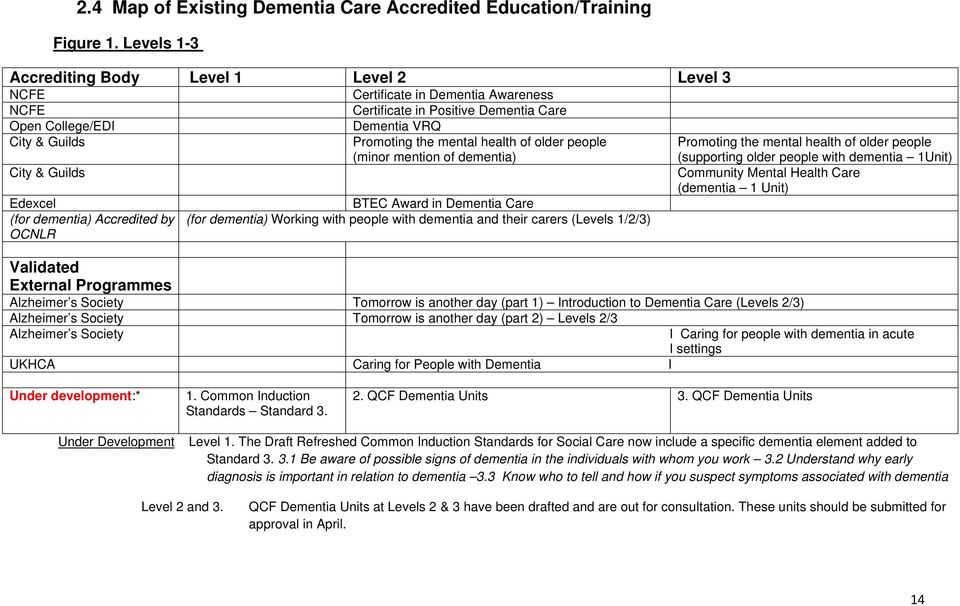
11 standard for organisations delivering education and training in the social care sector. It seeks to identify centres of excellence and addresses systems rather than trainers. It will rely on individual trainers having had their competence to train assessed and accredited by other means. It aims to develop two further excellence standards, for individual training programmes and for learning support programmes. While this process may form part of the kite-marking approach needed, it will not address the issue for dementia care trainers or training content specifically. This issue is not simply about generic training skills, but rather about that coupled to knowledge, understanding and experience of working with people with dementia and their carers, and understanding of the theoretical and practical approaches to dementia care within the health and social care field An approach to accrediting or approving dementia care trainers widely reported as resulting in effective and empathetic training was that of the Alzheimer s Society, with their original Approved Trainer programme. This is now discontinued and the process is currently under review. For Dementia also approve trainers, but this is currently used to accredit trainers working specifically on For Dementia sponsored programmes. 2.3 Accredited Training (Fig. 1) The map of existing accredited training at Figure 1 (page 14) includes a section on non-accredited (validated) programmes provided to a range of organisations. These programmes are provided by the Alzheimer s Society and the UKHCA for a range of external agencies. While not accredited by an external Awarding Organisation, the programmes have some assessment process, have a consistent curriculum and are provided to a range of health and social care establishments All the accredited qualifications listed have been mapped against the NOS for Health and Social Care and for Older People and the NHS Knowledge and Skills Framework Analysis of accredited training Levels 1-3 Figure 1 NCFE L2 Certificate in Dementia Awareness. Understanding dementia Understanding person-centred dementia care Understanding challenging behaviour in the context of dementia 10
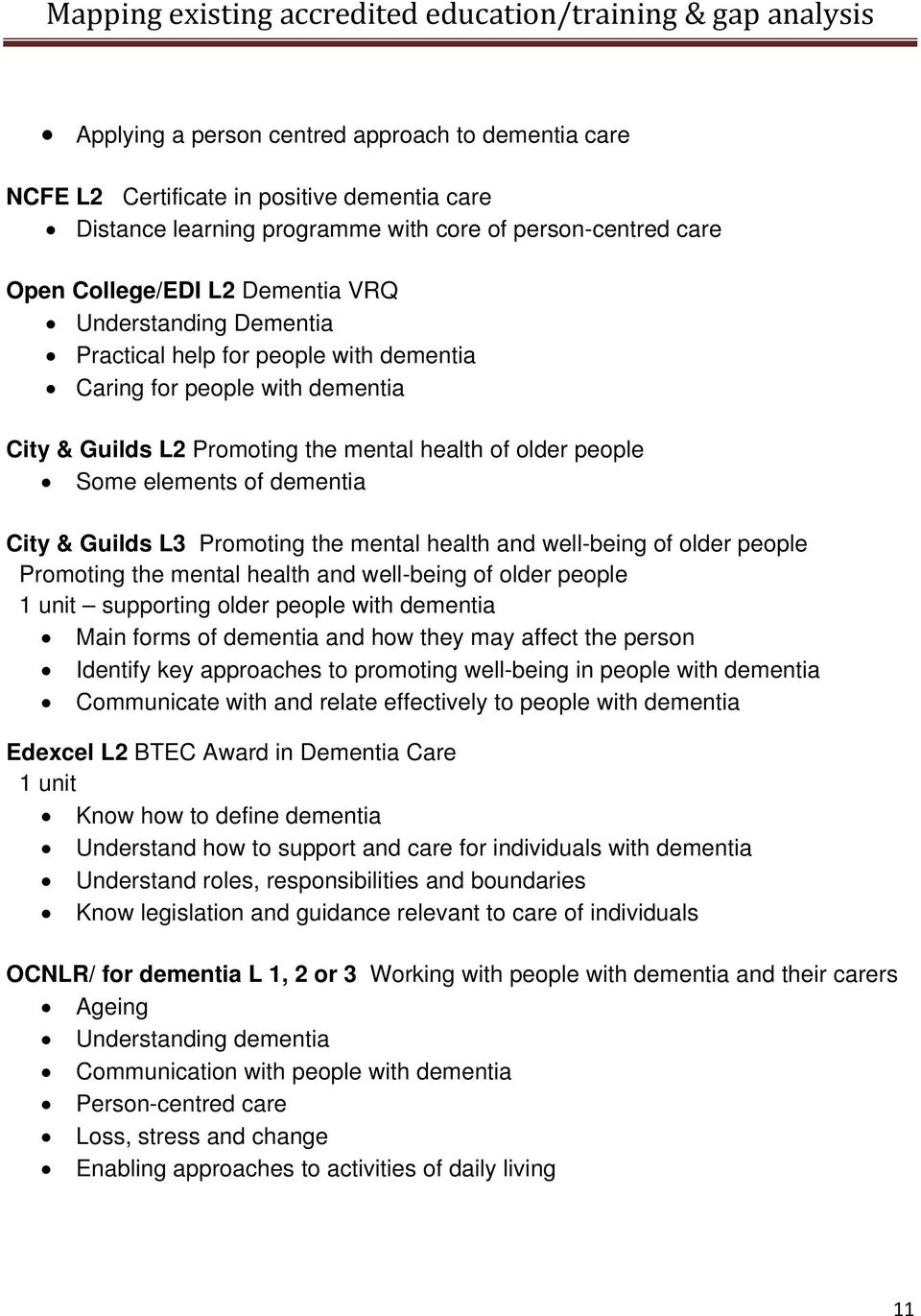
12 Applying a person centred approach to dementia care NCFE L2 Certificate in positive dementia care Distance learning programme with core of person-centred care Open College/EDI L2 Dementia VRQ Understanding Dementia Practical help for people with dementia Caring for people with dementia City & Guilds L2 Promoting the mental health of older people Some elements of dementia City & Guilds L3 Promoting the mental health and well-being of older people Promoting the mental health and well-being of older people 1 unit supporting older people with dementia Main forms of dementia and how they may affect the person Identify key approaches to promoting well-being in people with dementia Communicate with and relate effectively to people with dementia Edexcel L2 BTEC Award in Dementia Care 1 unit Know how to define dementia Understand how to support and care for individuals with dementia Understand roles, responsibilities and boundaries Know legislation and guidance relevant to care of individuals OCNLR/ for dementia L 1, 2 or 3 Working with people with dementia and their carers Ageing Understanding dementia Communication with people with dementia Person-centred care Loss, stress and change Enabling approaches to activities of daily living 11
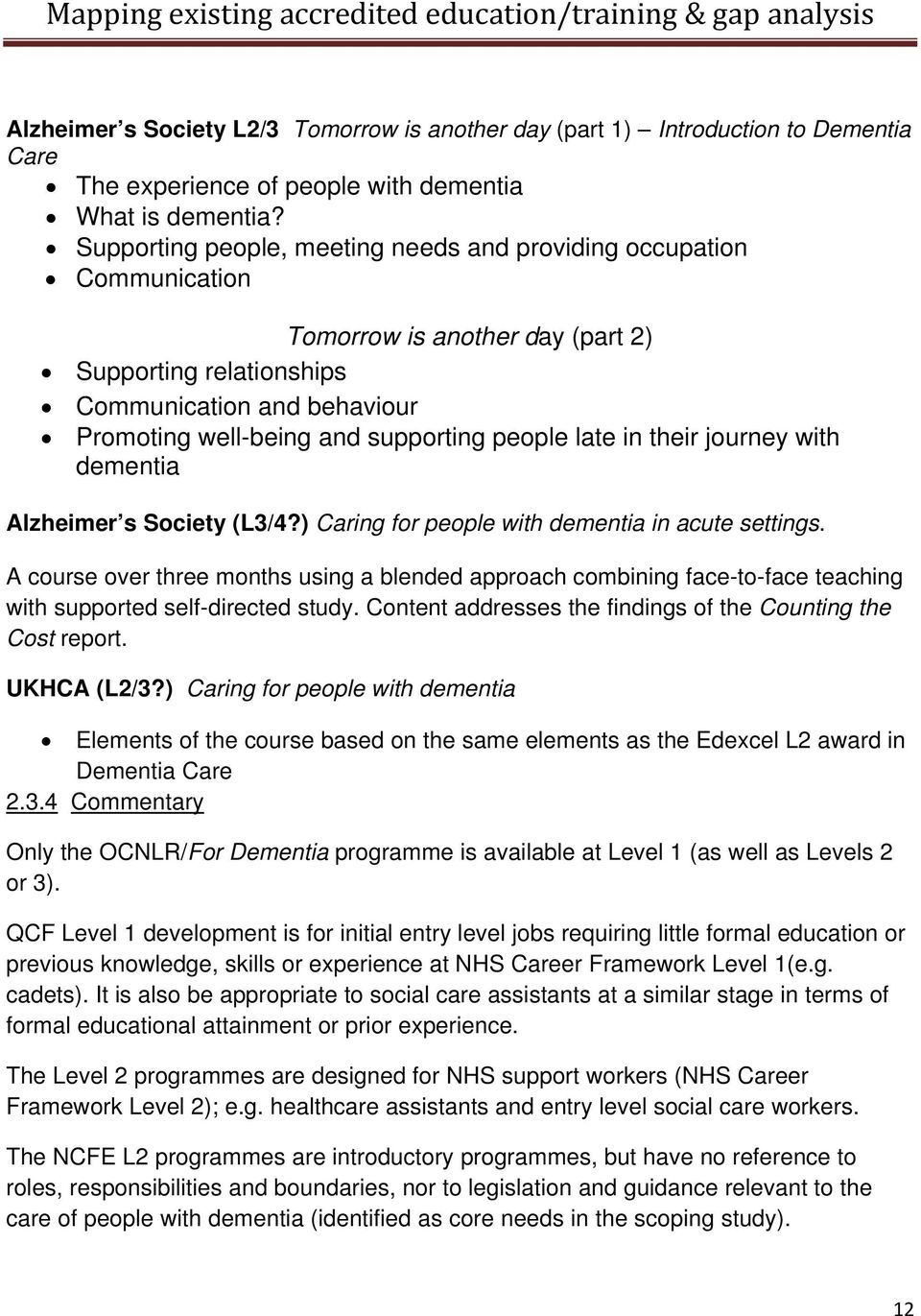
13 Alzheimer s Society L2/3 Tomorrow is another day (part 1) Introduction to Dementia Care The experience of people with dementia What is dementia? Supporting people, meeting needs and providing occupation Communication Tomorrow is another day (part 2) Supporting relationships Communication and behaviour Promoting well-being and supporting people late in their journey with dementia Alzheimer s Society (L3/4?) Caring for people with dementia in acute settings. A course over three months using a blended approach combining face-to-face teaching with supported self-directed study. Content addresses the findings of the Counting the Cost report. UKHCA (L2/3?) Caring for people with dementia Elements of the course based on the same elements as the Edexcel L2 award in Dementia Care Commentary Only the OCNLR/For Dementia programme is available at Level 1 (as well as Levels 2 or 3). QCF Level 1 development is for initial entry level jobs requiring little formal education or previous knowledge, skills or experience at NHS Career Framework Level 1(e.g. cadets). It is also be appropriate to social care assistants at a similar stage in terms of formal educational attainment or prior experience. The Level 2 programmes are designed for NHS support workers (NHS Career Framework Level 2); e.g. healthcare assistants and entry level social care workers. The NCFE L2 programmes are introductory programmes, but have no reference to roles, responsibilities and boundaries, nor to legislation and guidance relevant to the care of people with dementia (identified as core needs in the scoping study). 12
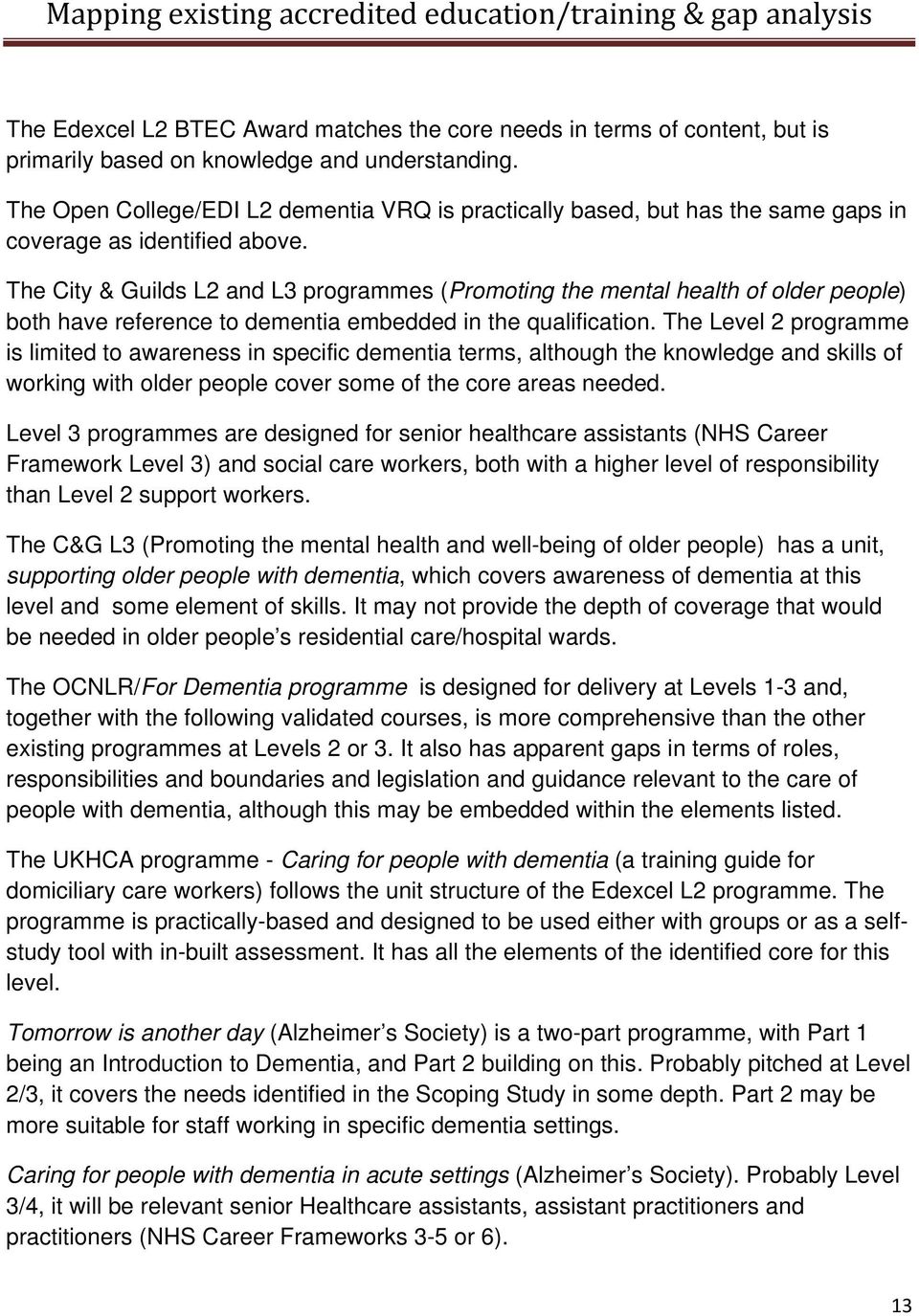
14 The Edexcel L2 BTEC Award matches the core needs in terms of content, but is primarily based on knowledge and understanding. The Open College/EDI L2 dementia VRQ is practically based, but has the same gaps in coverage as identified above. The City & Guilds L2 and L3 programmes (Promoting the mental health of older people) both have reference to dementia embedded in the qualification. The Level 2 programme is limited to awareness in specific dementia terms, although the knowledge and skills of working with older people cover some of the core areas needed. Level 3 programmes are designed for senior healthcare assistants (NHS Career Framework Level 3) and social care workers, both with a higher level of responsibility than Level 2 support workers. The C&G L3 (Promoting the mental health and well-being of older people) has a unit, supporting older people with dementia, which covers awareness of dementia at this level and some element of skills. It may not provide the depth of coverage that would be needed in older people s residential care/hospital wards. The OCNLR/For Dementia programme is designed for delivery at Levels 1-3 and, together with the following validated courses, is more comprehensive than the other existing programmes at Levels 2 or 3. It also has apparent gaps in terms of roles, responsibilities and boundaries and legislation and guidance relevant to the care of people with dementia, although this may be embedded within the elements listed. The UKHCA programme - Caring for people with dementia (a training guide for domiciliary care workers) follows the unit structure of the Edexcel L2 programme. The programme is practically-based and designed to be used either with groups or as a selfstudy tool with in-built assessment. It has all the elements of the identified core for this level. Tomorrow is another day (Alzheimer s Society) is a two-part programme, with Part 1 being an Introduction to Dementia, and Part 2 building on this. Probably pitched at Level 2/3, it covers the needs identified in the Scoping Study in some depth. Part 2 may be more suitable for staff working in specific dementia settings. Caring for people with dementia in acute settings (Alzheimer s Society). Probably Level 3/4, it will be relevant senior Healthcare assistants, assistant practitioners and practitioners (NHS Career Frameworks 3-5 or 6). 13
15 2.4 Map of Existing Dementia Care Accredited Education/Training Figure 1. Levels 1-3 Accrediting Body Level 1 Level 2 Level 3 NCFE Certificate in Dementia Awareness NCFE Certificate in Positive Dementia Care Open College/EDI Dementia VRQ City & Guilds Promoting the mental health of older people (minor mention of dementia) Promoting the mental health of older people (supporting older people with dementia 1Unit) City & Guilds Community Mental Health Care (dementia 1 Unit) Edexcel BTEC Award in Dementia Care (for dementia) Accredited by OCNLR (for dementia) Working with people with dementia and their carers (Levels 1/2/3) Validated External Programmes Alzheimer s Society Tomorrow is another day (part 1) Introduction to Dementia Care (Levels 2/3) Alzheimer s Society Tomorrow is another day (part 2) Levels 2/3 Alzheimer s Society I Caring for people with dementia in acute I settings UKHCA Caring for People with Dementia I Under development:* 1. Common Induction Standards Standard QCF Dementia Units 3. QCF Dementia Units Under Development Level 1. The Draft Refreshed Common Induction Standards for Social Care now include a specific dementia element added to Standard Be aware of possible signs of dementia in the individuals with whom you work 3.2 Understand why early diagnosis is important in relation to dementia 3.3 Know who to tell and how if you suspect symptoms associated with dementia Level 2 and 3. QCF Dementia Units at Levels 2 & 3 have been drafted and are out for consultation. These units should be submitted for approval in April. 14
16 Figure 2. Some illustrative examples of Levels 4-8 from Higher Education Dementia Network Members Accrediting Body Level 4 Level 5 Level 6 Level 7 Level 8 Canterbury Christ First two modules of Foundation Degree CPD- Dementia Care Church University College- Foundation degree Dementia Care 1 Diagnosis & Assessment Dementia Services Development Centre 2 Skills for enabling people with dementia and their carers 3 Building & changing University of Brighton University of Manchester School of Nu Midwifery University of Sheffield School of Nursing and Midw People & Dementia (20 credits) relationships People & Dementia (20 credits) Foundation in Relationship Centred Dementia Care (20 credits) Middlesex University Advanced Diploma in Dementia Care (4 Modules 15 credits each) University of Bradford Person- Centred Dementia Care (60 credits) certificated by the Alzheimer s Society Certificate (HE) in Dementia Studies A range of stand-alone modules BSc Dementia Studies A range of stand-alone modules in Dementia Studies MSc in Dementia Care (180 credits at Masters Level) Postgraduate Certificate in Dementia Care & Practice (4 modules 15 credits each) Postgraduate Certificate in Leadership & change Management in person-centred dementia care MSc in dementia studies (training in dementia care) MSc in dementia studies (dementia care mapping) A range of stand-alone modules in Dementia Studies 15

17 University of Hull Faculty of Health and Social Care University of Surrey Business leadership in dementia care (in conjunction with Dementia Care Matters) Health and social care professional staff preregistration education Under development Skills for Care North West Foundation Degree (Dementia) Dementia is integrated into undergraduate health and social care models but no specific module to date Person-centred approaches for people with dementia (option module for undergrad. degree programmes Doctors, nurses, AHPs and social workers (dementia may be integrated, but not compulsorily except within mental health Developing Dementia Care P/G option module 2.5 Accredited Education &Training (Figure 2) Levels The dementia education and training programmes in Figure 2 are not an exhaustive list they are illustrative of the range of programmes available which are accredited by Higher Education Institutions (HEIs). They include a Foundation degree, Ordinary, Honours and Masters degrees, and certificates and diplomas at undergraduate and postgraduate levels, as well as stand- alone modules for CPD or specialist education and development. The institutions featured are all members of the Higher Educationfor Dementia Network (HEDN). HEDN originally designed a Curriculum for Dementia Education (CDE) in 2002 and have refined this subsequently, listing the knowledge and skills that health and social care professionals should possess in order to work effectively with people with dementia and their carers and families. (see Appendix 1). Clearly, other HEIs who may not be members of HEDN are also involved in professional health and social care education and may also have similar or other dementia courses and programmes. However, the CDE could form a basis for defining and agreeing some common approaches to dementia content across the HE curriculum. 16
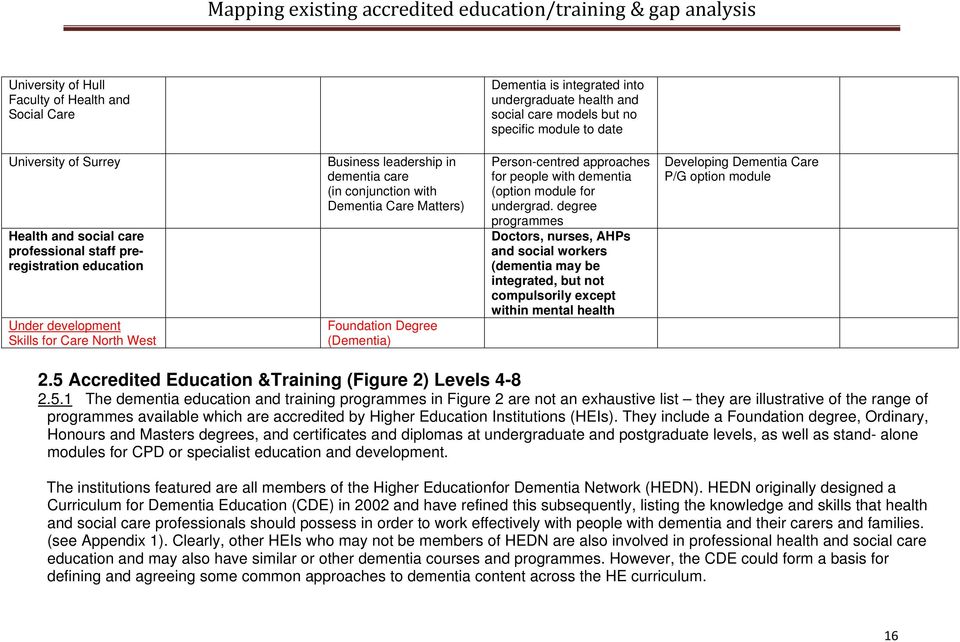
18 Mapping existing education/training & gap analysis Under Development A Foundation Degree (dementia) framework has been developed by a working group with Skills for Care North West. Participating HEIs will now consult employers about the detailed programme and finalise details for validation. A Foundation Degree (Dementia Care) is run by Canterbury Christ Church University College - Dementia Services Development Centre Health and social care professional staff training The inclusion or integration of specific learning outcomes relating to dementia, and the availability of optional modules on dementia within undergraduate programmes in pre-registration or pre-qualification education varies both within the professions curricula and from institution to institution. As a result, the lack of a common approach and the random distribution of dementia education and training throughout the HEI network will affect the implementation of the National Dementia Strategy considerably, varying from region to region. However, the demand that should be created by the implementation of the Strategy and by partnership approaches to commissioning may provide the leverage required to begin to change this. 3 Accredited Dementia Education and Training Pathway 3.1 Health and Social Care Dementia Accreditation Framework (Figure 3 below) Figure 3 maps the distribution of relevant existing accredited training across the levels of the overall health and social care framework, and illustrates where there are significant gaps in provision. This framework is designed for all health and social care staff working with adults, whether working in specialised settings for people with dementia or working in general adult health and social care settings where a percentage of people will have dementia. These roles include: Residential and domiciliary social care workers Managers and supervisors Social workers Healthcare assistants and other nursing assistants/auxiliaries Assistant Practitioners Nurses AHPs (occupational therapists, speech & language therapists, physiotherapists et al) Doctors While accredited education and training is not the only solution, a comprehensive accredited pathway is necessary for two reasons: 17

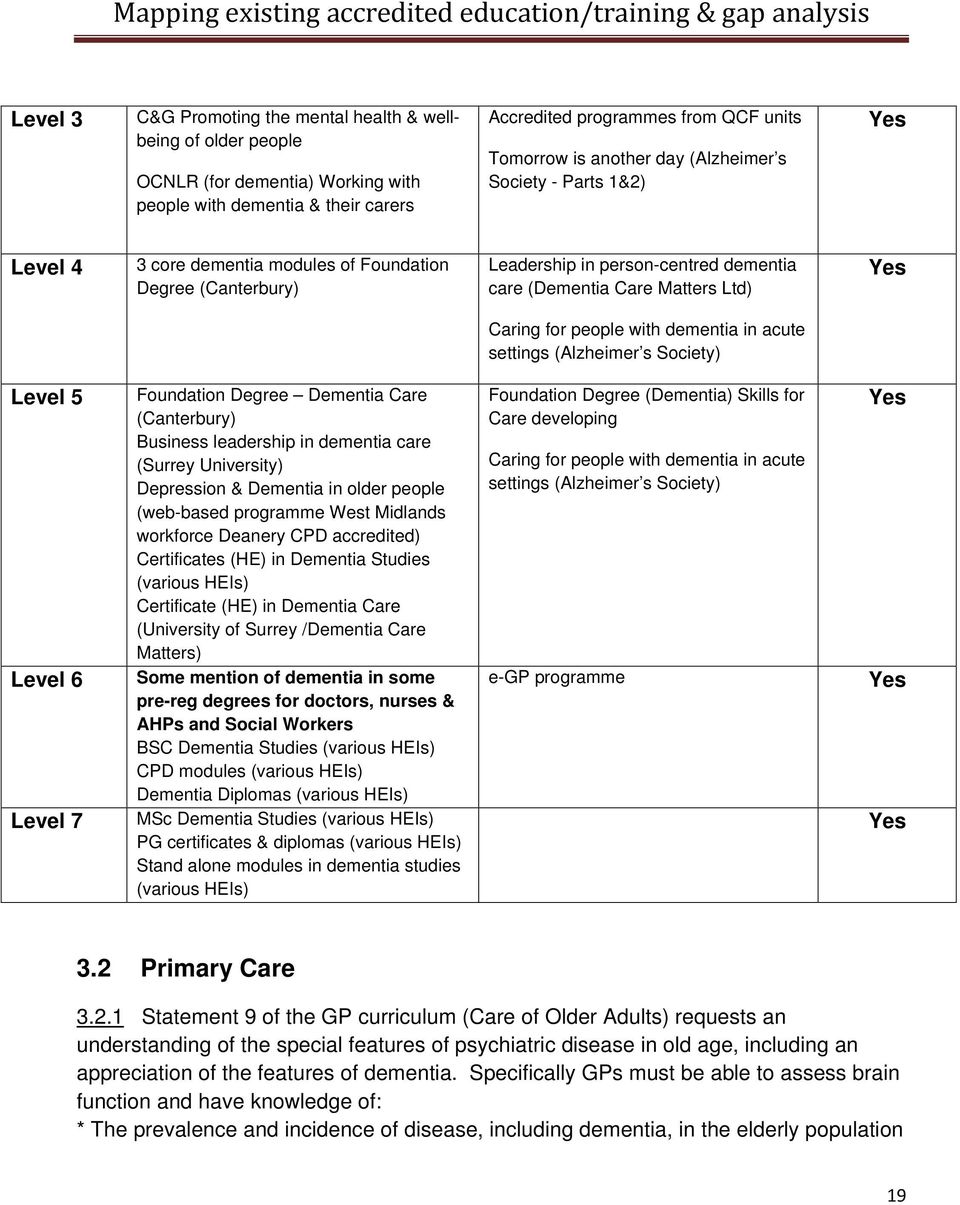
19 2. Staff specialising in working with people with dementia and their carers in specific settings, e.g. dementia care homes or as a specialist care worker in domiciliary care, should have a learning pathway with relevant accredited education and training, with associated qualifications. 3. In addition to the general requirement for an informed and effective workforce, accredited education and training in terms of working with people with dementia will enable career progression for healthcare staff and will enable access to further career development for social care staff who wish to move into healthcare Ancillary staff have not been included because the level of awareness and skills required and the constraints of staff release and resources required would suggest that accredited training is probably neither feasible, affordable nor necessary. However, an awareness and core dementia skill training programme, supported by appropriate learning resources will be necessary to meet the requirements of the Strategy. 3,1,3 The principal gaps in the accreditation framework are at QCF Levels 1,3, 4, 5 and 6 for pre- and post-qualification training and, to a lesser extent, for CPD. The implications of this are explored in relation to specific professional areas in the following sections of this report. Despite the amount of development available in the table below at Levels 5 and 6, because of the random distribution across HEIs, there are significant gaps (see para above). Figure 3. Health and Social Care Dementia Accreditation Framework QCF Levels Existing accredited training Developing (or validated) Gap Level 1 OCNLR (for dementia) Working with people with dementia & their carers? Level 2 Edexcel BTEC Dementia Care Open College/EDI Dementia VRQ NCFE Positive dementia care (distance learning) NCFE Dementia Awareness C&G Promoting the mental health & wellbeing of older people OCNLR (for dementia) Working with people with dementia & their carers Accredited programmes from QCF units Tomorrow is another day (Alzheimer s Society - Part 1) No 18
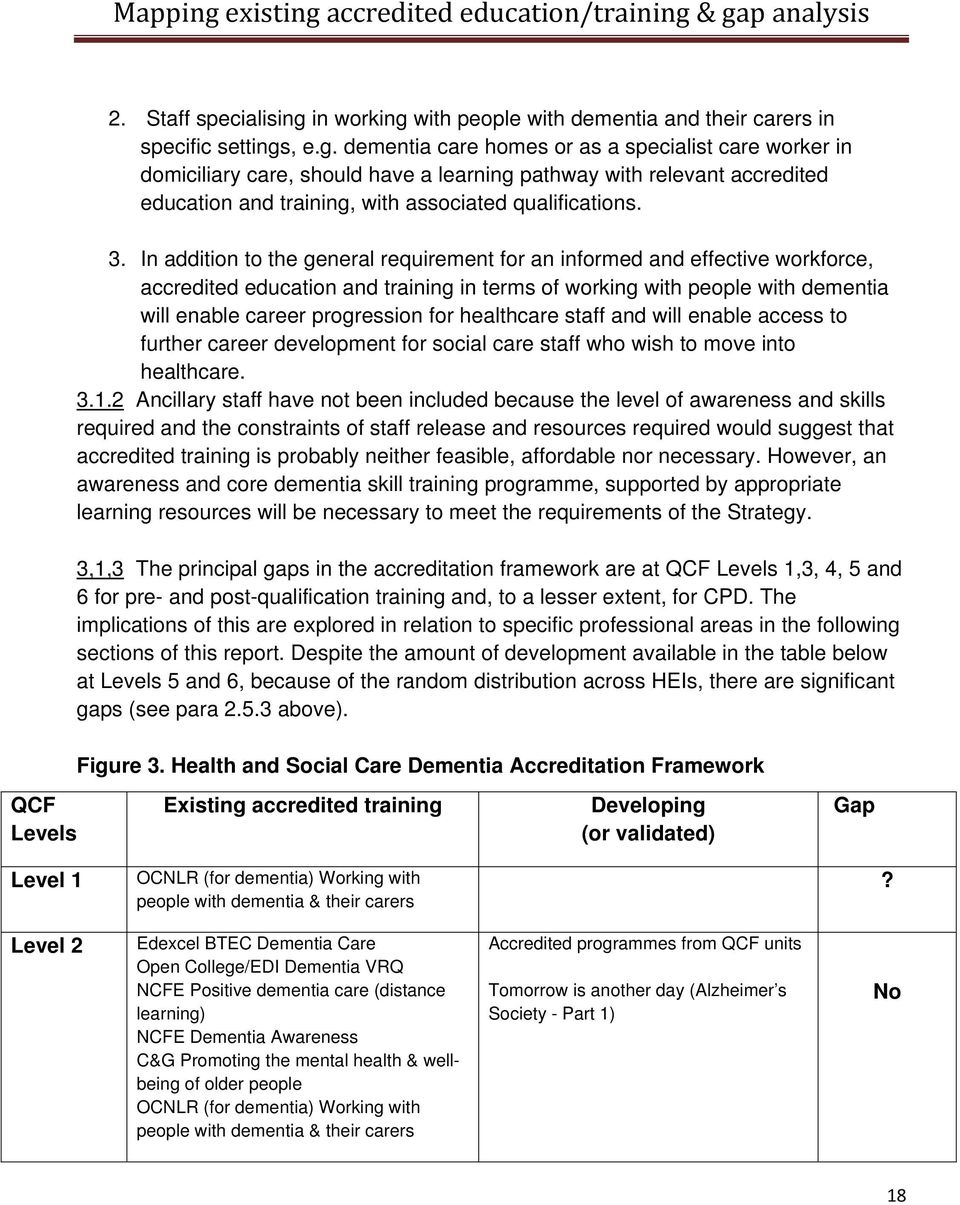
20 Level 3 C&G Promoting the mental health & wellbeing of older people OCNLR (for dementia) Working with people with dementia & their carers Accredited programmes from QCF units Tomorrow is another day (Alzheimer s Society - Parts 1&2) Yes Level 4 3 core dementia modules of Foundation Degree (Canterbury) Leadership in person-centred dementia care (Dementia Care Matters Ltd) Yes Caring for people with dementia in acute settings (Alzheimer s Society) Level 5 Level 6 Level 7 Foundation Degree Dementia Care (Canterbury) Business leadership in dementia care (Surrey University) Depression & Dementia in older people (web-based programme West Midlands workforce Deanery CPD accredited) Certificates (HE) in Dementia Studies (various HEIs) Certificate (HE) in Dementia Care (University of Surrey /Dementia Care Matters) Some mention of dementia in some pre-reg degrees for doctors, nurses & AHPs and Social Workers BSC Dementia Studies (various HEIs) CPD modules (various HEIs) Dementia Diplomas (various HEIs) MSc Dementia Studies (various HEIs) PG certificates & diplomas (various HEIs) Stand alone modules in dementia studies (various HEIs) Foundation Degree (Dementia) Skills for Care developing Caring for people with dementia in acute settings (Alzheimer s Society) e-gp programme Yes Yes Yes 3.2 Primary Care Statement 9 of the GP curriculum (Care of Older Adults) requests an understanding of the special features of psychiatric disease in old age, including an appreciation of the features of dementia. Specifically GPs must be able to assess brain function and have knowledge of: * The prevalence and incidence of disease, including dementia, in the elderly population 19
21 * The relevant questions in the history and items in the physical examination to the problem presented * The patient's relevant context, including family and social factors * The structure of the local and national health-care system and the role of primary care within the wider NHS, including knowledge of when to refer to secondary care services * The inter-relationships between health and social care * The legal issues that may arise * The special features associated with drug treatment of dementia. This example illustrates the level of the current guidance for pre-registration education for GPs in relation to working with people with dementia. As a result, the inclusion of modules relating to working with people with dementia is dependent on the availability of staff with the relevant expertise within the HEI, and content and level is therefore variable and not consistent from one HEI to another. This potential gap exists in accredited dementia education/training at both pre-registration training and post registration training and CPD levels for most of the primary care team (GPs, practice nurses, health visitors et al). Two particular flexible learning programmes illustrate recent approaches to development in dementia diagnosis and care for GPs and practice staff that are accredited, and which are available to address both pre-registration training and ongoing CPD requirements, supporting the GP re-validation process; 1. CPD. An internet-based programme Dementia and Depression in Older People commissioned b y Hereford PCT in The programme is interactive, built around 10 case studies and with in-built assessment and its own learning management system. Can be used by practice teams, but is primarily for GPs. Approved for 8 CPD credits. 2. The e-gp programme, developed by the RCGP in partnership with e-learning for Healthcare is suitable for doctors in training for general practice, general practitioners and practice nurses and practice managers. Three new e-learning sessions have been developed, two of which, Memory problems in older people and Care of people with dementia have just been released. A recently-developed module within the e-gp programme, developed within the Oxford Deanery, uses a holistic approach around the story of a person with dementia and her carer to address the learning point in the curriculum. 20
22 3.3 Allied Health Professions While occupational therapists and speech and language therapists may undertake dual education/training (mental and physical health) in their pre-qualification courses, other AHPs (physiotherapists, chiropodists/podiatrists, dietitians, orthoptists and paramedics et al) generally do not. In addition, specific education or training in working with dementia is not always present in all Mental Health pre-registration training. There is therefore a gap in accredited education/training of some of the Allied Health Professions at this point (QCF Level 6) in terms of working with people with dementia and their carers. While for CPD purposes there are accredited programmes in working with people with dementia at graduate and post-graduate level (QCF levels 6 and 7) in many HEIs, these may often be more appropriate for staff specialising in care of people with dementia and are not always focused on relevant professional areas An approach to developing the knowledge and skills of staff who may be working with people with dementia as a part of their caseload has been described in several illustrations of good practice 5. It involves using Older People s Mental Health Liaison Teams or other Community Mental Health staff to train and coach other staff, including AHP s, in working with people with dementia and their carers. While this training is not currently accredited, it could be developed in partnership with accredited education/training establishments to meet relevant criteria. 3.4 Hospitals Nurses The scoping study identified that the majority of nurses had either no education/training in working with people with dementia, or insufficient training. As previously described, there are accredited courses (Certificates and Diplomas- Levels 5 and 6) available at some HEIs for CPD, but the requirement may be for hospital-based training. As described in para above, Acute Hospital Older People s Mental Health Liaison Teams may provide un-accredited training support. The Alzheimer s Society course Caring for people with dementia in acute settings, developed following their research into hospital provision for people with dementia 6 may be developed further as an accredited course for nurses at Career Framework Levels4-6, and programmes developed from the draft QCF Level 3 units may be appropriate at CF levels 3/4. 5 For examples, see Living well with dementia: the National Dementia Strategy Joint commissioning framework for dementia p.35 et al 6 Counting the Cost caring for people with dementia on hospital wards Alzheimer s Society
23 3.4.2 Healthcare Assistants/Nursing Assistants et al There is a gap currently for these staff because of the stage of development of Level 3 accredited provision. The development of appropriate Level 3 qualifications from the draft QCF units and possibly the accreditation of the Alzheimer s Society course would develop the pathway for this group by providing a Level 3 Foundation training programme Assistant Practitioners The development of a further Foundation Degree (FD) to supplement that at Canterbury Christchurch University College will fill a gap for this group of staff in terms of foundation training in specialist working with people with dementia, and enabling progression to Practitioner level.. The issue will be availability of such an accredited course through sufficiently wide numbers of HEIs to make this accessible Dementia Leads There is a further gap in accredited provision in terms of education/training for senior nursing grades, consultants and other doctors, or any clinical staff taking a leadership role in dementia care or responsible for planning care pathways for patients with dementia. While there is an unaccredited (currently) course Leadership in person-centred dementia care at a notional Level 4, this is a critical area for development in order to meet the requirements of the National Dementia Strategy 7 for leadership in general hospitals. 4 Social Care Most research and consultation has identified that there is little accredited dementia training provided for social care staff, but a wide range of workshops, short stand-alone training programmes and briefings that are delivered by employers directly or by external training providers. The development and introduction of the dementia knowledge sets by Skills for Care has informed the content and approach of much of this training. A number of major employers have developed their own learning pathways, some parts of which are accredited using largely Level 2 qualifications, while being internally validated at other levels. In general these pathways have two elements, general awareness and limited skills development in dementia care for all staff, and a clear progressive pathway for those staff working in settings specialising in dementia, or working as dementia leads in general settings. These programmes, while not necessarily externally accredited, follow a developmental pattern relating to Levels 2, 3 and 4 (for senior staff and managers).. 7 National Dementia Strategy Objective 8 Improved quality of care for people with dementia in general hospitals 22
24 In addition to the above-mentioned provision, accredited training may be provided by HEIs, mainly to providers of specific dementia care settings; for example, Dementia Care Mapping programmes have been widely used in some regions. However the majority of dementia training is developed in-house by smaller employers or bought in from external training providers, or staff sent to external short courses. Because few managers or senior staff have had specific training relating to dementia, there is often little support for staff to put their learning into practice. 4.1 Social Care Workers All social care workers should undertake induction which includes the Common Induction Standards at the start of their employment. While these do not contain any reference to dementia currently, this is being addressed by the planned introduction of the refreshed standards with a dementia element included The current assumption is that Level 2 accredited qualifications are the appropriate the starting point for social care. However, research indicates that a considerable percentage of both residential and domiciliary care workers have comparatively low levels of educational attainment, including limited literacy and numeracy skills. The workforce also includes a considerable percentage of staff for whom English is a second language. These factors suggest that there may be a need for Level 1 accredited training to enable both understanding and subsequent progression. There is no nationally available dementia-related accredited training available currently. A Level 1 Introduction to Dementia (Award) might include the following content, identified in the scoping study : Recognising the signs of dementia The principles of person centred care The basic strategies to communicate with and assist people with dementia and their carers Understand roles, responsibilities and boundaries Where to go for more specialist advice and support Level 2 has a range of accredited dementia programmes, including at least one distance learning option. The draft QCF units will enable these qualifications to be further developed within the next year. 23
25 4.1.3 The only accredited programme available at Level 3 is one which is a generic mental health programme, with a dementia unit included within it. As this is the level that at least some staff who are working specifically with people with dementia and their carers should be reaching, this is a major gap for health and social care The need for all managers and senior staff to be able to lead on dementia and to manage provision that will inevitably include people with dementia has been identified as a major priority. Much current dementia training is anecdotally reported as wasted because of lack of support for staff who wish to implement new skills, having undertaken dementia care training This is in addition to those managing or supervising staff within specialist dementia settings. There is limited accredited dementia training available currently for managers. There is a specific gap at Level 4 (the level of the Registerd Manager s Award). There are modules available from some HEIs at Levels 5,6 and 7, but distribution of these may be an issue There is no Apprenticeship Framework currently available for those wishing to work with people with dementia. The development of the QCF units at Levels 2 and 3 will enable relevant frameworks to be developed The national availability of a Foundation Degree will also be important, as it provides a valuable route for progression from vocational pathways to degree level professional qualifications and further career options Domiciliary Care While all of the above information relates to domiciliary care as well as to residential care, there are particular considerations that need to be taken into account when considering this area. The provision is different in that domiciliary care workers work without direct supervision, within people s home environments, and may be commissioned to carry out specific and limited tasks. All training needs to recognise the difference, and support materials, in particular should relate to the domiciliary care environment. The UKHCA have developed a dementia training guide which is provided to employers, managers or individuals and can be delivered to groups of staff or used for self-study. This has an in-built competency testing process, but this is optional. 4.2 Social Workers Although social workers operate in a wide range of different organisations, often with very specific roles, they also need to develop the kind of flexible transferable skills which will enable them to develop their careers within the broad context of mental health services. These requirements deliberately focus on the commonalities all social workers who work in the specialist context have in their work with people who have mental 24
26 health problems, their families and carers. However there is no specific mention of Dementia. Qualifying degrees must be mapped against relevant NOS including those for Mental Health where appropriate National post qualifying standards ensure that those who have obtained a recognised PQ qualification have clearly demonstrated practice competence in a number of key areas. This is all under-pinned by an employment led system where the social worker student is employed within a social service setting of which dementia services could be an example Education/training for all social workers working with adults will need to include specific content relating to supporting people with dementia and their carers and families, as well as an understanding of local dementia care pathways and the local commissioning structure and protocols. 5 Commissioning and Inspection 5.1 Inspection The Care Quality Commission is formulating strategy currently relating to the education/training and awareness of dementia for its own staff, principally inspectors, assessors and service inspectors. Many of these staff have been recruited from health and social care situations, and will have relevant professional qualification as well as being qualified by experience. However, this may not include experience of working with people with dementia in all cases. At this stage of the organisation s development, needs and gaps are being identified in order to develop a more structured approach. It may be that specific accredited training in dementia care is not appropriate, but rather commissioned specialist courses, and/or courses or programmes already accredited. 5.2 Commissioning As with inspection staff, it may be that commissioners do not require specific accredited training in dementia care, but may attend existing training or education programmes to understand the specific needs of people with dementia. They may choose to use existing accredited provision. However, the commissioning process is crucial to the successful implementation of the National Dementia Strategy and this project will need to seek further information to inform the final workforce development action plan. 25
27 5.3 The Third Sector Dementia training for Third Sector staff is mostly carried out by in-house specialist trainers (Alzheimer s Society, for dementia, Age Concern and Help the Aged et al) or by attending courses run by those organisations or by attending joint training with partners in the health and social care sectors. Little of this is accredited currently, but this should be addressed as a result of implementation of the strategy. The Dementia Learning Pathway for Health and Social Care should provide all the areas required by Third Sector staff working with people with dementia and their carers. 6 Learning Resources 6.1 Sources There is a very wide range of learning resources available to people with dementia, their carers, health and social care staff, and all involved in the workforce which supports and cares for people with dementia, their carers and families. This section will not attempt to review or catalogue these resources, but to identify some commonly available resources to illustrate what is available to support the listed accredited education and training courses. In most cases, training/learning resources are catalogued and can be reviewed online for example, the Alzheimer s Society has a catalogued Training Resources Library, and Skills for Care have catalogued Social Care Training Materials (see Table 14 Dementia). Some of the largest sources of materials include: Alzheimer s Society, with probably the widest collection in the UK SCIE Dementia Gateway set up to provide access to a comprehensive range of learning resources to support health and social care staff Dementia Services Development Centre Stirling Bradford Dementia Group 26
28 6.2 Case studies While involving people with dementia and their carers in the learning process is one of the most powerful tools for all learning about dementia at any level, this is not always possible. A useful alternative is television, video, audio or written case studies. SCIE have set up Social Care TV a broadband channel featuring films and links to resources, which can be viewed, downloaded or ed. For dementia resources this can be accessed through the Dementia Gateway. Social Care TV has a series of short films which could be used for awareness raising or as part of training modules. They use real situations to illustrate the following case studies: Living at home with nursing support rapidly declining early onset dementia Late onset dementia with early diagnosis and drug treatment Living in a care home Causes of dementia and how the changes affect behaviour Providing care at home Nutritional care Raymond s money principles of the Mental Capacity Act Each of these could provide illustrations for particular groups of staff as part of induction, foundation training/pre-registration programmes or ongoing CPD. They illustrate different stages of dementia in different settings with differing types of care and support and some will be most suitable for particular staff; e.g. Living in a care home is particularly useful for care staff in residential settings, while providing care at home is particularly useful for domiciliary care workers and community healthcare staff. A range of other films or videos include: Alzheimer s Society: My Voice - experience of early signs, impact on lives, types of support received. Out of the Shadows Impact and stigma diagnosis can have on people s lives Living with Alzheimer s: I m still me In their own words Tomorrow is another day Other Sources: Terry Pratchett Living with Dementia (BBC) Malcolm and Barbara: Love s Farewell (ITV 2007) 27
29 Can Gerry Robinson fix...dementia care homes? Particularly useful for residential care staff. In addition, training sessions have been run for primary care staff using clips from the film Iris to illustrate the onset and development of dementia. 6.3 e-learning support e-learning resources can be used to support face-to-face education/training, as further study, as supported or stand-alone learning and are designed for different levels. Some examples include: 1. Health Talk on-line an open learning programme, useful for detailed awareness, for staff including: Care home staff Domiciliary care workers District nurses General and acute hospital staff Allied Health Professionals Social Workers Ambulance staff Community support workers Dementia what it is and what it isn t Living with dementia What causes dementia Diagnosis and who can help Common difficulties and how to help The emotional impact of dementia Positive communication 2. SCIE Dementia Gateway: on-line detailed programme, would support Levels 2 & 3 learning. Video clips, text explanation, pictures, self-study activities and links to text resources and Alzheimer s Society Fact Sheets. 5 Modules: Getting to know the person with dementia Eating well Difficult situations Keeping active and occupied The environment 28
30 Two further e-learning modules were described when mapping existing accredited programmes, as both have been accredited for CPD and one will form part of GP preregistration training: CPD. An internet-based programme Dementia and Depression in Older People The programme is interactive, built around 10 case studies (5 for dementia, five for depression), with in-built assessment and its own learning management system. Pass rate has been set at 80%, prints off a certificate when this is achieved. Learning management system means how many users and their usage and success rate can be recorded and monitored..can be used by practice teams, but is primarily for GP learning about diagnosis. The e-gp programme, developed by the Royal College of General Practitioners in partnership with e-learning for Healthcare, has two sessions relating to learning about dementia currently available Memory Problems in Older People and Care of People with Dementia, and a further module being developed. This programme will form part of all trainee GP programmes and will also be a CPD resource supporting the GP re-validation process. Suitable for doctors in speciality training for general practice, general practitioners and general practice nurses and practice managers. 6.4 Text-based resources While there are libraries of books relating to dementia, there are some examples of shorter text-based resources which can be used to support learning programmes: Alzheimer s Society produce a range of Fact Sheets on Dementia useful for staff involved in all levels, as well as people with dementia, their carers and families, but particularly those working at Levels 2-4 The Bradford Dementia Group publish a series of Good Practice Guides City & Guilds Level 2 & 3 qualifications Supporting the mental health of older people are supported by a comprehensive workbook at both level 2 and level 3 (Pavilion publishing). Without a major review of resources there are no apparent major gaps. 29
31 7 Gap Analysis Summary A number of gaps in accredited education and training have been identified in the preceding mapping. This section will summarise these as a precursor to the final report: of the workforce development action plan (see Figure 4 below). Figure 4 Gap Analysis Summary Level Staff Nature of Gap Level 1 Social care workers Awareness and introductory skills training for all staff needing to start at this level minimum requirement for all staff wanting accreditation Level 2 Level 3 Social care workers planning to work in dementia settings Social care workers planning to work in dementia settings Level 2 Apprenticeship (dementia) Framework - a new strand of the existing L2 Apprenticeship in Social Care. Knowledge qualification could be developed from the QCF units. Level 3 Advanced Apprenticeship (dementia) Framework. Knowledge qualification could be developed from QCF units. Level 3 Social care workers healthcare assistants/nursing auxiliaries etc. Level 3 Accredited programmes Caring for people with dementia, both for staff working in dementia specific settings and for all staff as additional learning. Level 4/5 Nurse CPD Nurse and Practitioner CPD - Caring for people with dementia in acute settings (meeting needs identified in Counting the Cost (Alzheimer s Society) Level 4 Level 5 Level 6 Social Care managers and senior staff Assistant practitioners, social care staff and managers, nurses as dementia leads Doctors, GPs, Nurses, AHPs, Social Workers Leadership/Management in Dementia Care Certificate or Diploma level for dementia settings, Award for all managers in non-specific dementia settings. Foundation degree (dementia) gap relates to FD being available in sufficient numbers of HEIs to meet demand. Inclusion of dementia specific learning objectives within pre-registration/pre-qualification education curricula Level 6 Level 6 & 7 Clinical Leads in acute/general settings Doctors, GPs, Nurses, AHPs, Social Workers Clinical leadership in dementia care CPD modules gap relates to consistent content in modules of CPD available in sufficient HEIs 30
32 7.1 Summary There are effectively two health and social care dementia learning pathways within the composite model used in this report; one for those staff who work in specialised dementia settings or who specialise in working with people with dementia, and one for all other staff providing health and social care to adults and older people, who will work with people with dementia as part of their role. Those working specifically with people with dementia require a comprehensive accredited pathway developing specific skills, starting on entry for social care staff and healthcare assistants and at foundation or pre-registration level for healthcare staff. All other staff inevitably may work with people with dementia as part of their role, and require an awareness and foundation skills in working with people with dementia from entry- level or foundation/pre-registration level, with CPD in order to keep that awareness and skill/knowledge level current. This pathway should have accredited education and training available as part of professional development, but may also use unaccredited or otherwise validated training and development. Wherever possible, dementia education and training should be integrated into existing accredited training or qualification routes. 7.2 Apprenticeship Framework As part of the planned review of apprenticeship frameworks, dementia awareness and skills need to be integrated into the components of both the Level 2 and Level 3 health and social care apprenticeship frameworks. Level 2 and Level 3 apprenticeship frameworks for dementia care are a gap for young people wishing to work in specific dementia settings. 7.3 Levels 2,3 & 4 As Health and Social Care NVQs at these levels are reviewed and re-designed as QCF Diplomas 8, specific learning relating to dementia awareness and specific skills in working with people with dementia need to be included in the relevant units to address this gap. 8 Skills for Care web site Qualifications & Training 31
33 In addition, the gap in accredited training for staff wishing to work in specific dementia settings could be met by developing Level 2, 3 & 4 Diplomas in Dementia Care. 7.4 Leadership/Management This is a major gap area across health and social care. While it is often desirable for managers or dementia leads to undertake training with other staff, this generally does not happen, and there are also specific issues relating to leading and managing provision for people who have dementia. There are a number of gaps: Social care management induction standards should include a dementia element The Registered Manager Award does not include any specific mention of dementia this might be integrated into the existing programme, or an additional accredited module developed. For managers in specific dementia settings, a specific accredited programme around Leadership or Management in Dementia Care may need to be available. There is no accredited development for the senior staff in hospital trust settings required to take a role as Dementia Leads by the National Dementia Strategy. The areas of clinical leadership and business management for dementia are a current gap. 7.5 Foundation Degree While there are one or two specific dementia Foundation Degrees (FD), each of them is only available from one specific HEI. Skills for Care have involved a number of HEIs in developing a dementia FD framework, and this is now out for consultation and curriculum development. There will be a gap in this area until there is a network of HEIs offering this accredited path across the regions. 7.6 Foundation/Pre-registration Training While there are differing degrees of coverage of dementia within foundation or preregistration training for professional staff within health and social care, most curricula have little specific mention of dementia. Both anecdotally and in some research findings (see Scoping Study Report), significant numbers of staff in most professional areas have had little or no specific awareness or knowledge/skill education or training in 32
34 working with people with dementia. This lack at foundation level in both vocational and professional education and training pathways may be the most significant gap. All of the gaps identified in this report will be addressed in the subsequent Workforce Development Action Plan. 33
35 Appendix 1 THE DEMENTIA CURRICULUM The Dementia Curriculum has been developed by the Higher Education for Dementia Network. The Dementia Curriculum lists the knowledge and skills that health and social care professionals (nurses, occupational therapists, social workers, physiotherapists, etc) should possess in order to work effectively with people with dementia, and their carers and families. 1. Ways of Thinking about Dementia: The ways that professionals think about dementia will influence how they work with people with dementia and their families. Professionals should know about a range of perspectives on dementia and dementia care. The person-centred approach: people with dementia are people like ourselves. The disability approach: people with dementia are people with cognitive disabilities. The relationship approach: people with dementia should be viewed in the context of their significant relationships (with family; carer; professional helpers). The medical approach: people with dementia have neurological disease. 2. Key Professional Abilities: These are the universal skills that professionals need in order to work with people with dementia in complex health and social care environments. Creating good working relationships with people with dementia and their carers. Communicating with people with dementia. Working as a member of a professional team. Understanding different agencies involved in dementia care. Assessing strengths, care needs and safety issues. 34
36 Speaking up for people with dementia and their carers. Recognising and protecting people with dementia from abuse. Giving information and teaching skills. Understanding research into dementia care. Making improvements to the way dementia care is delivered 3. Understanding Ethical Issues in Caring for People with Dementia: It is important that professionals understand the ethical underpinnings of their decisions. It is also important that they can help people with dementia and their families make decisions in an ethical way. Helping people with dementia make decisions about their care. Working with people with dementia who cannot make their own decisions. Working with people with dementia who are at the end of their lives. 4. Legal Aspects of Working with People with Dementia: It is vital that professionals understand the legal basis for health and social care for people with dementia and their families, so that they practice in a legal way, and can offer appropriate advice to others. Understanding the Mental Health Act as it applies to people with dementia. Understanding the Mental Capacity Act as it applies to people with dementia and their families. Understanding legislation to protect people with dementia from abuse. Understanding legislation regarding residential care. Understanding the principle of duty of care as applied to working with people with dementia. 35
37 5. Partnerships with Carers and Families: It is vital that professionals understand the perspectives of carers and families of people with dementia, and can both help them to care for the person, and support them in their caring roles. Creating partnerships with the person s carer and other family members. Assisting carers to contribute to the person s care. Meeting carers needs for information, support and stress management. 6. Daily Life for People with Dementia: Professionals need the skills to help people with dementia live their lives in a way that maximises their independence and sense of well-being, while compensating for their disabilities where necessary. Understanding the person s life history. Carrying out social, leisure related and occupational activities with people with dementia. Helping people with dementia meet their daily living needs. Maintaining good nutrition. Helping people with dementia meet their spiritual needs. Helping people with dementia meet their sexual needs. Understanding and responding to toileting difficulties. Understanding and responding to difficult behaviour. Managing risks. 36
38 7. Psychological Therapies for People with Dementia: The well-being of people with dementia can be enhanced by specific psychological therapies that can be carried out by skilled professionals. Cognitive Therapies: reminiscence; reality orientation, cognitive stimulation, validation therapy. Sensory stimulation and play-based activities. Counselling for people with dementia 8. Holistic Health for People with Dementia: Professionals must be able to help people with dementia maintain good physical health, and care for those who become physically frail. Maintaining good physical health. Pain management. End of life care. 9. Pharmacology for Dementia: Professionals must have an understanding of medicines that may be prescribed for people with dementia. Cognition-enhancing drugs. Drugs to manage behavioural and psychological effects of dementia. Drugs for common physical problems of old age. 37
39 10. Cultural and Diversity Issues: In a multi-racial and multi-cultural society, it is important that professionals can meet the needs of people with dementia and their families from all ethnic backgrounds, and from other minority groups. The needs of people with dementia from black and minority ethnic cultures, and their families. Gay and lesbian people with dementia. 11. Other Groups of People with Dementia: Dementia doesn t just affect older people. The needs of younger people with dementia and their families The needs of people with learning disabilities and dementia. 12. Working with People in the Early Stages of Dementia: The time around a diagnosis of dementia is particularly stressful for people with dementia and their families, and professionals must be able to offer proper support. Assessing mental abilities the role of the Memory Clinic. Supporting people who have been given a diagnosis of dementia, and their families. Helping the person with dementia maintain independence. Helping the person with dementia give up independence (e.g. stopping driving). 38
BOLTON INTEGRATED DEMENTIA EDUCATION & TRAINING DEMONSTRATOR SITE PROJECT REPORT. Executive Summary
 BOLTON INTEGRATED DEMENTIA EDUCATION & TRAINING DEMONSTRATOR SITE PROJECT REPORT Executive Summary January 2013 Hugh Norman (Demonstrator Site Project Manager) The Hadzor Partnership 07973 693207 [email protected]
Developing the workforce to support children and adults with learning disabilities described as challenging
 Developing the workforce to support children and adults with learning disabilities described as challenging Professor Lisa Bayliss- Pratt Director of Nursing- Health Education England Health Education
4. Proposed changes to Mental Health Nursing Pre-Registration Nursing
 Developments in nurse education in England Summary BSMHFT employs 1319 registered nurses and 641 health care assistants 53% of the total workforce. BSMHFT works in partnership with Birmingham City University
A strategy to develop the capacity, impact and profile of allied health professionals in public health 2015-2018
 A strategy to develop the capacity, impact and profile of allied health professionals in public health 2015-2018 Strategy from the Allied Health Professionals Federation supported by Public Health England
Support Staff Essential Training. Information
 Support Staff Essential Training Information Introduction These essential training materials are modular in design and intended for school support staff who have been recently or newly appointed, have
Report on District Nurse Education in England, Wales and Northern Ireland 2012/13
 Report on District Nurse Education in England, Wales and Northern Ireland 2012/13 Introduction The QNI has become concerned at recent reports of a fall in the number of District Nurses currently in training
The facts. www.nursing.manchester.ac.uk
 Nurses, Midwives and Allied Health Care Professionals Undergraduate and Postgraduate Continuing Professional Development 2015 www.nursing.manchester.ac.uk The facts International reputation for research,
Enhanced dementia practice for social workers and other professionals
 Guidance for trainers Enhanced dementia practice for social workers and other professionals Online resource http://workforcesolutions.sssc.uk.com/enhanced-dementia-practice Understanding dementia Personal
The Care Certificate Framework Guidance Document
 The Care Certificate Framework Guidance Document Copyright Health Education England, Skills for Care and Skills for Health 1 Overall goal of the Care Certificate The introduction of the Care Certificate
Statewide Education and Training Services. Position Paper. Draft for Consultation 1 July 2013
 Statewide Education and Training Services Position Paper Draft for Consultation 1 July 2013 This paper establishes the position for an SA Health Statewide Education and Training Service following the initial
community health continuing professional education flexible undergraduate and postgraduate courses
 community health continuing professional education flexible undergraduate and postgraduate courses Continuing Professional Education The continuing professional education (CPE) division of the School of
Higher Apprenticeship in Construction Management Levels 4, 5, and 6 (England)
 Higher Apprenticeship in Construction Management Levels 4, 5, and 6 (England) Latest framework version? Please use this link to see if this is the latest issued version of this framework: afo.sscalliance.org/frameworkslibrary/index.cfm?id=fr02453
SOMERSET DEMENTIA STRATEGY PRIORITIES FOR 2013 2016
 SOMERSET DEMENTIA STRATEGY PRIORITIES FOR 2013 2016 October 2013 1 CONTENTS PAGE Section Contents Page Somerset Dementia Strategy Plan on a Page 3 1 Introduction 4 2 National and Local Context 5 3 Key
NMC Mentor and Practice Teacher Handbook
 FACULTY OF HEALTH, SOCIAL CARE AND EDUCATION In partnership with local NHS Trusts and Organisations in London and Surrey NMC Mentor and Practice Teacher Handbook School of Midwifery and Child Health School
MENTOR PREPARATION FOR NURSING EDUCATION IN NORTHERN IRELAND
 MENTOR PREPARATION FOR NURSING EDUCATION IN NORTHERN IRELAND QUEEN S UNIVERSITY BELFAST UNIVERSITY OF ULSTER OPEN UNIVERSITY and BELFAST HEALTH AND SOCIAL CARE TRUST NORTHERN HEALTH AND SOCIAL CARE TRUST
COLlege of nursing, midwifery and healthcare
 COLlege of nursing, midwifery and healthcare College of Nursing, Midwifery and Healthcare We are a leading institution for professional healthcare education, working in close collaboration with healthcare
Programme Specification. MSc Children s Nursing (Pre-Registration) Valid from: September 2014 Faculty of Health and Life Sciences
 Programme Specification MSc Children s (Pre-Registration) Valid from: September 2014 Faculty of Health and Life Sciences SECTION 1: GENERAL INFORMATION Awarding body: Teaching institution and location:
JOB DESCRIPTION. Community Palliative Care Clinical Nurse Specialist
 JOB DESCRIPTION Post: Band: Responsible to: Accountable to: Community Palliative Care Clinical Nurse Specialist 7 (SAH adapted Agenda for Change) Team Leader Clinical Operational Manager Job Summary Work
De Montfort University. Course Template
 De Montfort University Course Template 1. Basic information Course Name: PG Cert Practice Education Course Code: PN079T Level (UG, PG): Postgraduate Taught Academic Period: 2015 Faculty: HLS - Faculty
About the Health Informatics Career Framework (HICF) http://www.hicf.org.uk
 About the Health Informatics Career Framework (HICF) http://www.hicf.org.uk Background Health Informatics is about the effective use of data, information, knowledge and technology to support and improve
Valid from: 2012 Faculty of Humanities and Social Sciences Oxford and Cherwell Valley College Thames Valley Police
 APPENDIX H Programme Specification Programme Specification Foundation Degree Policing Valid from: 2012 Faculty of Humanities and Social Sciences Oxford and Cherwell Valley College Thames Valley Police
Training and Competency in a High Hazard Environment
 Training and Competency in a High Hazard Environment John Reynolds Director - Reynolds Training Services Ltd 20 th March 2013 CONTENTS About Reynolds Training Services The Need for Competency What is Competence
TRAINING AND QUALIFICATIONS FOR OCCUPATIONAL HEALTH NURSES
 TRAINING AND QUALIFICATIONS FOR OCCUPATIONAL HEALTH NURSES Summary The Council for Work and Health is concerned that the current system of training and qualifications for occupational health nurses in
Arrangements for: Professional Development Award in Assessment and Supply of Individual Patients Medicines. at SCQF level 7. Group Award Code: GE7D 47
 Arrangements for: Professional Development Award in Assessment and Supply of Individual Patients Medicines at SCQF level Group Award Code: GED 4 Validation date: 01 August 2011 Date of original publication:
Health Professionals who Support People Living with Dementia
 Clinical Access and Redesign Unit Health Professionals who Support People Living with Dementia (in alphabetical order) Health Professional Description Role in care of people with dementia Dieticians and
Department of Health/ Royal College of General Practitioners. Implementing a scheme for General Practitioners with Special Interests
 Department of Health/ Royal College of General Practitioners Implementing a scheme for General Practitioners with Special Interests April 2002 Foreword Improved access and consistently high quality services
Genito-urinary Medicine
 Specialty specific guidance on documents to be supplied in evidence for an application for entry onto the Specialist Register with a Certificate of Eligibility for Specialist Registration (CESR) Genito-urinary
CHC52015 Diploma of Community Services
 CHC52015 Diploma of Community Services Release 1 CHC52015 Diploma of Community Services Modification History Release Release 1 Comments This version was released in CHC Community Services Training Package
Health & Social Care. Short Courses at Blackburn College. Flexible Career Focused Delivered by professionals
 Health & Social Care Health & Social Care Short Courses at Blackburn College Flexible Career Focused Delivered by professionals Short Health & Social Care Courses Health & Social Care Courses Blackburn
Standards to support learning and assessment in practice. NMC standards for mentors, practice teachers and teachers
 Standards to support learning and assessment in practice NMC standards for mentors, practice teachers and teachers Front cover, from left to right: Julie Dalphinis, Clinical Learning Environment Lead (West)
WHAT DOES THE PSYCHOLOGICAL THERAPIES HEAT TARGET MEAN TO YOU?
 WHAT DOES THE PSYCHOLOGICAL THERAPIES HEAT TARGET MEAN TO YOU? NHS Boards are now half way through the first year of implementation of the HEAT target Deliver faster access to mental health services by
Guide to Qualifications in Health and Social Care, Early Years and Childcare. Cyngor Gofal Cymru Care Council for Wales. Revised October 2014
 Guide to Qualifications in Health and Social Care, Early Years and Childcare Revised October 2014 Cyngor Gofal Cymru Care Council for Wales Hyder mewn Gofal - Confidence in Care Contact Details Care Council
BSc Early Childhood Care, Health and Education. Part Time Degree. Title. Award Degree Level 7. Entry Requirements
 BSc Early Childhood Care, Health and Education Part Time Degree BSc Early Childhood Care, Health and Education Award Degree Level 7 Entry Requirements Be currently working in an Early Child Care, Health
Healthcare support workers in England:
 Council of Deans of Health Healthcare support workers in England: Five proposals for investing in education and development to deliver high quality, effective and compassionate care Council of Deans of
Continuous Professional Development. For Education Professionals, Teachers and Support Staff
 Continuous Professional Development For Education Professionals, Teachers and Support Staff Introduction The School of Education is passionate about leading change which transforms the lives of children
A Health and Wellbeing Strategy for Bexley Listening to you, working for you
 A Health and Wellbeing Strategy for Bexley Listening to you, working for you www.bexley.gov.uk Introduction FOREWORD Health and wellbeing is everybody s business, and our joint aim is to improve the health
Quality Assurance of Medical Appraisers
 Quality Assurance of Medical Appraisers Recruitment, training, support and review of medical appraisers in England www.revalidationsupport.nhs.uk Contents 1. Introduction 3 2. Purpose and overview 4 3.
Applied Research Group (Public Health) Faculty of Health and Life Sciences Coventry University
 Staying Healthy Care Pathway Group Public Health Skills and Careers Framework Project Staying Healthy Care Pathway Group Applied Research Group (Public Health) Faculty of Health and Life Sciences Staying
Public Consultation 2009 Submission to the Second Independent Monitoring Group for A Vision for Change
 Public Consultation 2009 Submission to the Second Independent Monitoring Group for A Vision for Change Response of the National Council for the Professional Development of Nursing and Midwifery The National
Aged Care and Health Training
 Aged Care and Health Training RTO 21646 Welcome to Health Skills Australia Would you like to make a real difference to the lives of others? Working as a carer or nurse in aged care, disability services,
Position Paper. Allied Health Assistants in Rural and Remote Australia
 Position Paper Allied Health Assistants in Rural and Remote Australia December 2011 Allied Health Assistants in Rural and Remote Australia i Table of Contents DISCLAIMER... II GLOSSARY OF TERMS... III
ADULT TRAINING AND EDUCATION STUDIES
 ADULT TRAINING AND EDUCATION STUDIES INTRODUCTION Adult Training and Education Studies offers a range of part-time blended and distance learning programmes focused on expanding your intellectual and professional
Application Information
 Application Information MSc Occupational Therapy (Pre-registration) School of Rehabilitation and health Sciences Faculty of Health and Social Sciences 2015-2016 Entry Start date: January 2016 Application
Nursing & Midwifery Learning Disability Liaison Nurse Acute Services Band 7 subject to job evaluation. Trustwide
 PLYMOUTH HOSPITALS NHS TRUST JOB DESCRIPTION Job Group: Job Title: Existing Grade: Directorate/Division: Unit: E.g., Department, Area, District Location: Reports to: Accountable to: Job Description last
Faculty of Education, Health and Sciences. PROGRAMME SPECIFICATION MSc Advanced Occupational Therapy. Valid from September 2012. www.derby.ac.
 Faculty of Education, Health and Sciences PROGRAMME SPECIFICATION MSc Advanced Occupational Therapy Valid from September 2012 0 www.derby.ac.uk/ehs CONTENTS SECTION ONE: GENERAL INFORMATION... 1 SECTION
Manchester Pharmacy School. www.manchester.ac.uk/pharmacy
 Manchester Pharmacy School Postgraduate study from Continuous Professional Development (CPD), Certificate, Diploma to Masters (MSc) with flexible, modular learning. The University of Manchester has a proud
Careers Day. Clinical Psychology. 17 th May 2012. Dr Kathryn Sams Specialist Clinical Psychologist Chatterton House, Kings Lynn
 Careers Day Clinical Psychology 17 th May 2012 Dr Kathryn Sams Specialist Clinical Psychologist Chatterton House, Kings Lynn What Is Psychology? The study of people, how they think, act, react and interact.
PROGRAMME SPECIFICATION
 PROGRAMME SPECIFICATION 1. Programme Title BA (Hons) Counselling 2. Name of final Award (s) 3. Awarding body/institution 4. Teaching institution 5. Mode (s) of Delivery GENERAL INFORMATION BA (Hons) Counselling
Advanced Practice (Public Health)
 Advanced Practice (Public Health) Author: Claire Barley (Head of Professional and Organisational Development) and Kelly McFadyen (Professional and Organisational Development Manager) Date: 2 December 2014
Post Graduate Diploma in Ayurvedic Medicine / MSc in Ayurvedic Medicine
 Programme Specification and Curriculum Map Post Graduate Diploma in Ayurvedic Medicine / MSc in Ayurvedic Medicine 1. Programme Title PGDip/MSc in Ayurvedic Medicine 2. Awarding Institution Middlesex University
Education & training tariffs. Tariff guidance for 2014-15
 Education & training tariffs Tariff guidance for 2014-15 March 2014 Title: Education & training tariffs: Tariff guidance for 2014-15 Author: Strategic External Relations (SER), Workforce Strategy (WS),
Requirements for Social Work Training
 Requirements for Social Work Training Requirements for Social Work Training Foreword Social workers deal with some of the most vulnerable people in our society at times of greatest stress. There can
Developing people for health and healthcare. Developing support roles in North West London
 Developing people for health and healthcare Developing support roles in North West London Around 14,000 people in North West London are employed in healthcare support roles such as pharmacy technicians,
All courses displayed can be completed online or face to face SOCIAL CARE & MENTAL HEALTH COURSES
 CPD ACCREDITED WORKSHOPS FOR: DOCTORS NURSES ALLIED HEALTHCARE PROFESSIONALS HEALTH & SOCIAL CARE WORKERS SOCIAL CARE & MENTAL HEALTH COURSES Featured Courses:. WE OFFER AN ACCRED TRAINING SERVICE: ONLINE
Level 2 Diploma in Health and Social Care (Adults) for England (4222-21)
 Level 2 Diploma in Health and Social Care (Adults) for England (4222-21) Qualification handbook for centres 501/1306/9 www.cityandguilds.com September 2015 Version 6.1 About City & Guilds City & Guilds
Working in Emergency Medicine?
 MMU1385 Emergency Med HPSC18 6-12 v5 11/07/2012 14:41 Page 2 Faculty of Health, Psychology & Social Care Working in Emergency Medicine? Do you want an academic qualification in your speciality? MSc Emergency
A guide to the experience you need when applying for health and social care courses
 A guide to the experience you need when applying for health and social care courses 1 Contents What experience do I need to apply for a health and social care course? 3 What if I don t have any work experience?
JULY 2011 SCIE report 42 REVIEW JULY 2014. We are more than our story : service user and carer participation in social work education
 JULY 2011 SCIE report 42 REVIEW JULY 2014 We are more than our story : service user and carer participation in social work education The Social Care Institute for Excellence (SCIE) was established by Government
Nottingham Trent University Course Specification
 Nottingham Trent University Course Specification Basic Course Information 1. Awarding Institution: Nottingham Trent University 2. School/Campus: School of Social Sciences, City Campus 3. Final Award, Course
Professional Qualification Courses
 Professional Qualification Courses INSTITUTE OF FAMILY PRACTICE PROFESSIONAL QUALIFICATION COURSES Contents 2 WHY STUDY AT THE INSTITUTE OF FAMILY PRACTICE? 4 OVERVIEW OF RELATIONSHIP EDUCATION COURSES
Childcare, Health and Care
 Childcare, Health and Care Do you aspire to pursue a career within the education, health or care sector? Whether you are looking for a career as a nursery assistant, nursery officer, early year s practitioner,
Next Steps for the IBSA VET Capability Framework. Options Paper prepared for IBSA
 Next Steps for the IBSA VET Capability Framework Options Paper prepared for IBSA October 2012 Contents Introduction... 1 Mapping the Capability Framework to TAE10 units and qualifications... 3 At Level
PROGRAMME SPECIFICATION POSTGRADUATE PROGRAMMES
 PROGRAMME SPECIFICATION POSTGRADUATE PROGRAMMES KEY FACTS Programme name Public Health (Health Visiting, School Nursing or District Nursing) Award Postgraduate Diploma/MSc School School of Health Sciences
Principles and expectations for good adult rehabilitation. Rehabilitation is everyone s business: Rehabilitation Reablement Recovery
 Wessex Strategic Clinical Networks Rehabilitation Reablement Recovery Rehabilitation is everyone s business: Principles and expectations for good adult rehabilitation 2 Principles and expectations for
Top-up degrees and CPD for the multi-professional workforce
 Top-up degrees and CPD for the multi-professional workforce Create your own study plan. We provide the options, you make the choices. 2 Top-up degrees and CPD for the multi-professional workforce Post-qualifying
Preface STANDARDS FOR NURSING EDUCATION. POST-REGISTRATION: Advanced/Specialist Diploma, Degree and Master Degree (Nursing)
 Preface The Nurses and Midwives Act (Chapter 209) [May 2000] empowers Singapore Nursing Board (SNB) to make regulations for matters relating to the accreditation of educational programmes in nursing and
Psychology, Social Work and Human Sciences
 School of, Social Work and Human Sciences UG PG Our courses provide our students with an exciting and diverse education in scientific discovery and social and health studies, based at our Brentford site
Your course opportunities CENTRE FOR CAREER & PERSONAL DEVELOPMENT. Faculty of Education
 Your course opportunities CENTRE FOR CAREER & PERSONAL DEVELOPMENT Faculty of Education 2 Centre for Career & Personal Development A place for career building Faculty of Education Centre for Career & Personal
Contact Centre Operations (England)
 Contact Centre Operations (England) Contact information Proposer of this framework This has been proposed and developed by Skills CFA, with employers, training providers, colleges and awarding organisations
Practice Educator Professional Standards for Social Work
 Practice Educator Professional Standards for Social Work Revised version May 2012, transition starts from September 2012 These Practice Educator Professional Standards (PEPS) set out requirements at two
National Minimum Standards for Immunisation Training
 National Minimum Standards for Immunisation Training Contributors The following formed the advisory group which, hosted by the Health Protection Agency, produced these Minimum Standards for Immunisation
Core skills. A strategy to support functional and employability skills in the adult social care workforce in England
 Core skills A strategy to support functional and employability skills in the adult social care workforce in England 2014-2017 1 Preface This is a strategy for the adult social care sector to support functional
THE UNIVERSITY OF MANCHESTER PARTICULARS OF APPOINTMENT. FACULTY OF HUMANITIES MANCHESTER BUSINESS SCHOOL Innovation & Management Policy Division
 Ref: HUM-04213 THE UNIVERSITY OF MANCHESTER PARTICULARS OF APPOINTMENT FACULTY OF HUMANITIES MANCHESTER BUSINESS SCHOOL Innovation & Management Policy Division LECTURERS / SENIOR LECTURERS IN HEALTHCARE
Programme Specification 2015/16
 Programme Specification 2015/16 1. Awarding body University of Surrey 2. Teaching institution (if different) N/A 3. Final award BSc (Hons) 4. Programme title/route/pathway International Events Management
UK Business Support Framework Professionalising the Business Support Sector
 UK Business Support Framework Professionalising the Business Support Sector Introduction This document has been prepared by the Small Firms Enterprise Development Initiative (SFEDI), the Sector Skills
Skill Levels for Delivering High Quality Asthma and COPD Respiratory Care by Nurses in Primary Care
 Skill Levels for Delivering High Quality Asthma and COPD Respiratory Care by Nurses in Primary Care September 2007 Revised December 2009, April 2014 Author: Ruth McArthur In conjunction with the PCRS-UK
LEVEL QCF. Accredited
 LEVEL QCF Accredited Issue 8 February 2015 Edexcel, BTEC and LCCI qualifications Edexcel, BTEC and LCCI qualifications are awarded by Pearson, the UK s largest awarding body offering academic and vocational
Arrangements for: Professional Development Award (PDA) in. Health and Social Care: Administration of Medication at SCQF level 7
 Arrangements for: Professional Development Award (PDA) in Health and Social Care: Administration of Medication at SCQF level 7 Group Award Code:G9V5 47 Validation date: May 2010 Date of original publication:
Programme Specification 1
 Programme Specification 1 1. Programmes: Programme Title UCAS GU Code Code BN Degree / BN Degree with Honours B700 M33B700 2.1 SCQF Level: 10 2.2 Credits: 460 3. Awarding Institution: University of Glasgow
Volunteer Managers National Occupational Standards
 Volunteer Managers National Occupational Standards Contents 00 Forward 00 Section 1 Introduction 00 Who are these standards for? 00 Why should you use them? 00 How can you use them? 00 What s in a Standard?
Hub and Spoke Policy for Undergraduate Nursing and Midwifery Programmes
 Hub and Spoke Policy for Undergraduate Nursing and Midwifery Programmes 1 1.0 Introduction 1.1 The three Higher Education Institutions (HEIs) are committed to providing practice placements which maximise
A Career in Clinical Psychology?
 A Career in Clinical Psychology? Program of Talks 4 th June 2014- Clinical Psychology Courses in UK Welcome Introduction to Clinical Psychology- Dr Liz Anderson, Clinical Psychology Advisor, Psychology
Continuing Professional Development. FAQs
 4 May, 2010. Continuing Professional Development FAQs Q1. What is Continuing Professional Development (CPD)? A. Continuing professional development is the means by which members of the profession maintain,
Occupational Therapy Strategy. Mental health and wellbeing
 Occupational Therapy Strategy Mental health and wellbeing 2015 2020 2015 2020 Background Occupational Therapy (OT) is an integral part of the services Derbyshire Healthcare NHS Foundation Trust (DHCFT)
Section 1 - General Course Information
 Course Information Form (CIF) The CIF provides core information to students, staff teams and others on a particular course of study. Section 1 - General Course Information Course Title Applied Social Work
My vision for the future of occupational health. Dr Richard Heron President, Faculty of Occupational Medicine
 My vision for the future of occupational health Dr Richard Heron President, Faculty of Occupational Medicine Occupational health needs to adapt to changing workforce and workplaces Ageing UK workforce
Career & Development Framework for District Nursing
 & Development for District Nursing & Development for District Nursing Contents Introduction 5 6 7 8 Practitioner Senior Advanced Practitioner Consultant Practitioner Appendices Appendix 1 Appendix 2 Appendix