
The internet service market and Australians in the online environment
|
|
|
- Marvin Norton
- 10 years ago
- Views:
Transcription
1 The internet service market and Australians in the online environment JULY 2011 communicating facilitating regulating
2 Canberra Purple Building Benjamin Offices Chan Street Belconnen ACT PO Box 78 Belconnen ACT 2616 T F Melbourne Level 44 Melbourne Central Tower 360 Elizabeth Street Melbourne VIC PO Box Law Courts Melbourne VIC 8010 T F TTY Sydney Level 5 The Bay Centre 65 Pirrama Road Sydney NSW PO Box Q500 Queen Victoria Building Sydney NSW 1230 T F Commonwealth of Australia 2011 This work is copyright. Apart from any use as permitted under the Copyright Act 1968, no part may be reproduced by any process without prior written permission from the Commonwealth. Requests and enquiries concerning reproduction and rights should be addressed to the Manager, Editorial Services, Australian Communications and Media Authority, PO Box Law Courts, Melbourne Vic Published by the Australian Communications and Media Authority

3 The internet service market and Australians in the online environment JULY 2011
4 Contents Introduction 1 Summary 2 Internet service market 7 Overview 7 Internet subscribers by technology type 9 ADSL 10 Mobile wireless and mobile phone handset internet 11 Hybrid fibre coaxial (HFC) networks 13 Satellite broadband 13 Dial-up services 14 ISP charging models 15 Expanded service offerings 15 Bundling 16 Enhanced interactive services 17 Internet connection speeds 19 Internet access devices 20 Profile of mobile phone handset internet users 23 Emerging internet access devices 24 Australians in the online environment 25 Location of internet use 25 Internet activities by age 26 Frequency of internet use 28 Online behaviours by frequency of internet use 32 Trends to watch in online behaviours 34 Online communications VoIP and instant messaging 34 Social networking 34 Shopping online 35 Online video/audio content 36 Volume of data downloaded 38 Appendix Research background and methodology 40 Data sources 40 Counts of internet subscribers versus counts of internet users 40 Data analysis 41 Sample size 41 Rounding 41 Previous ACMA research 41 acma iii

5

6 Introduction The Australian Communication and Media Authority (the ACMA) is an evidence-based regulator. As such it has an interest in monitoring and understanding the developing digital economy and its impact on the industries that it regulates, as well as changing consumer behaviour in response to services innovation. The intent of the research and reporting is to facilitate: > regulation for the citizen in an IP-based media and communications environment, where usage of voice over internet protocol (VoIP), mobile communications and the internet continues to grow. This in turn provides challenges for safeguards, such as access to the emergency call service and online security > support for consumers in making informed purchasing decisions in an environment of ongoing network, device and service innovation > content regulation in an environment where content is increasingly available via multiple platforms including the internet, mobile and traditional broadcasting networks. This report examines the changing characteristics of the internet access market in Australia in particular; internet service provider service offerings and consumer participation in the digital economy as represented by increased use of the internet and related online services. It builds on previous research released by the ACMA, particularly the Communications report series, Report 1 Australia in the digital economy: The shift to the online environment and Australia in the digital economy: Consumer engagement in e-commerce, providing updates for key data and trends. Any comments on this report would be welcomed and can be sent to [email protected] or mailed to: Manager, Communications Analysis Section Australian Communications and Media Authority PO Box Law Courts Melbourne Vic 8010 The internet service market in Australia is dynamic, characterised by continual innovation in internet service provider (ISP) service offerings, take-up of innovative consumer access devices and increased participation in the online environment. acma 1

7 Summary The internet service market in Australia is dynamic, characterised by continual innovation in internet service provider (ISP) offerings, take-up of innovative consumer access devices and increased consumer participation in the online environment. This report highlights major developments in this market. Consumers using multiple internet access technologies At December 2010, there were nearly 10.4 million active internet subscribers in Australia using fixed and mobile wireless (dongle, datacard, USB mode) services and 8.2 million internet subscribers using mobile phone handsets - across the household, business and government sectors. The availability of internet services over mobile networks continues to grow. Mobile wireless subscriber numbers increased by 49 per cent in the 12 months to December 2010, while mobile phone handset subscribers increased at a comparable, but slightly lower, rate (21 per cent over the six months to December 2010). However, growth in these services has not occurred at the expense of fixed-line access technologies, with ADSL subscriber numbers also increasing by seven per cent over the 12 month period. Fixed-line internet services continue to play a central role in driving the digital economy accounting for the majority (91 per cent) of data downloads in Australia1. During the December quarter of 2010, nearly 175,000 terabytes of data were downloaded via fixed-line services in Australia, compared to less than nine per cent of data downloads occurring via mobile wireless services and just two per cent via mobile phone handset services. Increased take-up of the internet and frequency of online participation More Australians are going online and becoming more intensive users of the internet. Nearly 15.1 million (83 per cent) persons aged 14 years and over went online during the December quarter of 2010, up from 14.2 million during the same period in At December 2010, 71 per cent of internet users went online at least once a day, compared to 67 per cent at December 2009 and 63 per cent at December Australians moving to higher speed internet plans On average, 18.8 gigabytes of data was downloaded per internet subscriber in Australia during the December quarter of 2010, roughly equivalent to 120 hours of streaming video content on YouTube. This compared to 14.6 gigabytes downloaded during the December quarter of This is in part a reflection of increasing activity relating to downloading or streaming video content. During December 2010, 5.5 million persons accessed video streaming sites such as YouTube and Google Video from home, compared to 5.1 million during March To support increasing content downloads and online activities Australian are shifting to higher speed internet services; 46 per cent of internet subscribers in the households sector now subscribe to internet services with an advertised maximum download speed of 8Mbps or more, compared to 30 per cent at December Mobile phone handset internet developing as a complementary service While most Australians who accessed the internet did so via a computer (96 per cent during December 2010), increasing numbers of consumers are doing so via their mobile phone handsets. Approximately 3.1 million Australians aged 14 years and over accessed the internet via their mobile phone handset during December 2010, 1 89 per cent when factoring in downloads via mobile phone handsets. 2 acma
8 compared to 1.9 million during December However, mobile handset internet is developing as a complement to the traditional computer, with 98 per cent of these internet users also using the internet via a computer. This is also reflected in the lower levels of handset internet users undertaking activities like e-commerce online via their mobile phones, compared to online activities undertaken via their computers. Consumers appear to be utilising each access device according to a specific need and lifestyle requirement. The internet challenging traditional business models Australians continue to value the internet as an important communication channel but the manner in which internet users communicate online is changing, with increased use of alternative online communications channels such as internet telephony (voice over internet protocol VoIP) and social networking. The use of these services appears to be affecting traditional online communications via . During December 2010, 2.3 million Australians aged 14 years and over went online to make a VoIP call via their computer, 2.3 million used instant messaging and 5.4 million undertook activities relating to blogging and online communities. The number of persons who used such media as a substitute to traditional usage almost doubled in the twelve months to December 2010 (1.4 million persons, compared to 736,000 persons during December 2009). Australians are also increasingly using the internet to transact online and use the internet to source and compare services across businesses. For example, approximately 7.4 million Australians accessed retail and auction web sites from home during December 2010, compared to 6.8 million during March 2010 and 2.2 million persons purchased a good or service directly via the internet during December 2010, compared to nearly 2 million during December The increasing importance of e-commerce is further reflected in latest ABS figures which show that just under $143 billion worth of internet orders were received by Australian businesses in the 12 months to June 2010, an increase of 15 per cent since June Convergence is also enabling the exploitation of a wider range of consumer electronic devices to access the internet in addition to the mobile phone handset, with more recent developments centred on the entry of internet-enabled TV sets into the Australian market place. These developments are generating significant consumer interest in accessing a wider range of interactive services via the TV. For example, at December 2010, 3.4 million and 2.5 million persons respectively were estimated to be interested in accessing the internet and making a video call via their TV. This report is part of an ongoing research commitment by the ACMA to identify key trends in the Australian communications market and its impacts on consumers as they embrace the digital economy. On the evidence available, Australians are moving increasingly to adopt and use multiple technologies to access the internet as a core part of their daily lives. acma 3
9 Table 1 Key indicators internet subscribers 2 by sector, technology type and maximum advertised download speed Indicator Dec 09 Dec 10 % change Total number of internet subscribers ( 000) 8,951 10, Internet subscribers by sector Household subscribers ( 000) 7,340 8, Business and government subscribers ( 000) 1,611 2, Internet subscribers by technology ADSL 3 subscribers ( 000) 4,178 4,458 7 Mobile wireless broadband subscribers dongles, datacard, USB modem subscribers ( 000) 2,838 4, Dial-up subscribers ( 000) Other subscribers (cable, fibre, ISDN, satellite, etc) 4 1,044 1,051 1 ( 000) Mobile phone handset internet subscribers ( 000) 6,781 (June 2010) Distribution of household internet subscribers by advertised maximum download speeds 8, Less than 8Mbps ( 000) 5,138 4, Mbps or greater ( 000) 2,202 3, Note: Subscriber counts are for ISPs with 1,000 or more subscribers. Subscriber counts for cable services not separately provided by the ABS due to confidentiality reasons. Data for mobile phone handset internet subscribers not collected by ABS before June Sources: ABS, Internet Activity Survey. 2 A subscriber differs from a user or person/business as one user may have multiple accounts with a single ISP, or accounts with more than one ISP. Conversely, there are single ISP subscriber accounts that provide internet access for multiple persons/organisations (e.g. universities). Numbers exclude mobile phone handset subscribers. 3 Includes all copper-based access technologies relating to DSL, ADSL and ADSL2+. 4 ABS does not produce separate estimates for cable subscribers due to confidentiality reasons. 5 Calculated percentage change relates to six months of data. 4 acma

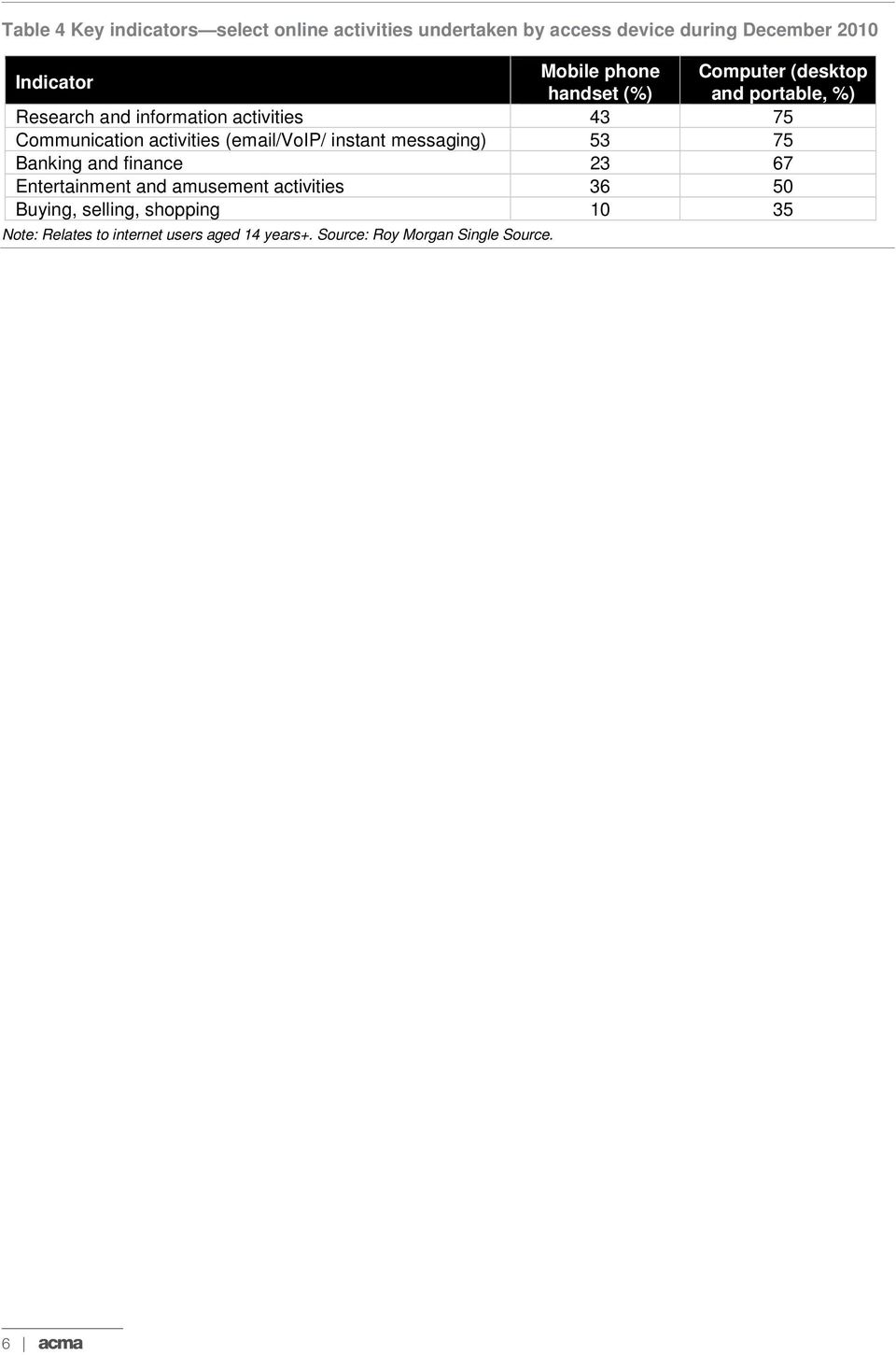
10 Table 2 Key indicators volume of data downloaded by internet subscribers in Australia Dec quarter 09 Dec quarter 10 % change Total downloaded (excludes mobile phone handsets) (terabytes) 127, , Fixed-line networks inc. dial-up 113, , Mobile wireless broadband 14,251 16, Mobile phone handset 717 4,029 (June 2010) Note: Relates to ISPs with 1,000 or more subscribers. Data for mobile phone handset internet subscribers not collected by ABS before June Sources: Sources: ABS, Internet Activity Survey. Table 3 Key indicators household consumer take-up and use of the internet Indicator Dec 09 Dec 10 % change Internet users 14 years+ (million) Persons 14 years+ with selected internet services in the home ADSL 8 (million) Mobile wireless broadband (dongles, datacards, USB modems) (million) n/a 3.7 n/a Mobile phone handset internet users 14 years+ (million) Internet users 14 years+ going online via selected consumer access devices Computer (desktop and portable) (million) Both mobile phone handset and computer (million) Mobile phone handset only (million) Internet users 14 years+ going online at least once a day (million) Internet users 14 years+ using VoIP via their computer, instant messaging or social networking to communicate instead of (million) Internet users 14 years+ making a online purchase (million) Internet users 14 years+ streaming video/tv (million) Internet users 2 years+ accessing selected March 10 Dec 10 % change 9 categories of website from home Retail shopping/auction websites (million) Social networking websites (million) Internet video distribution sites (million) n/a: not available. Sources: Roy Morgan Research for estimates about internet users aged 14 years and over. Nielsen Online for website traffic statistics for population aged 2 years and over. 6 Calculated percentage change relates to six months of data. 7 Internet use from any location during the December quarters of 2009 and Includes all copper-based access technologies relating to DSL, ADSL and ADSL2+. 9 Calculated percentage change relates to nine months of data. 10 Refers to websites classified as mass merchandiser by Nielsen Online. 11 Refers to selected online video distribution sites (Table 9). acma 5
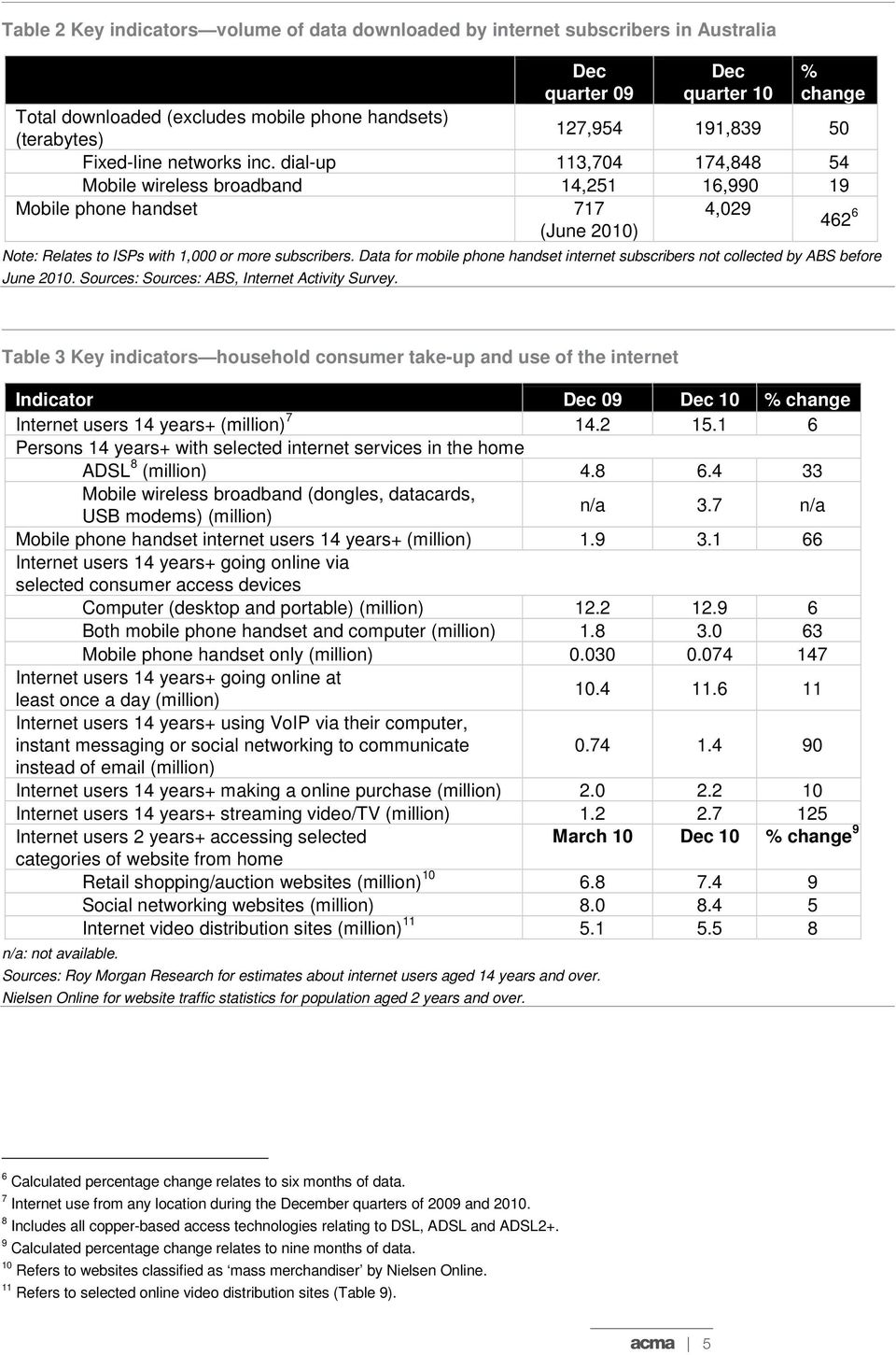
11 Table 4 Key indicators select online activities undertaken by access device during December 2010 Indicator Mobile phone Computer (desktop handset (%) and portable, %) Research and information activities Communication activities ( /voip/ instant messaging) Banking and finance Entertainment and amusement activities Buying, selling, shopping Note: Relates to internet users aged 14 years+. Source: Roy Morgan Single Source. 6 acma
12 Internet service market Overview At December 2010, there were 10.4 million active internet subscribers in Australia, across the government, business and household sectors. 12 This represents nearly a 10 per cent increase on the June 2010 figure of 9.5 million subscribers and a 17 per cent increase on the December 2009 figure of 9 million. 13 In addition, the ABS reports that there were 8.2 million mobile phone handset internet subscribers in Australia at December 2010, a 21 per cent increase on the 6.8 million subscribers recorded at June Household internet subscribers accounted for 78 per cent of the total number of internet subscribers in Australia at December 2010, a two percentage point decline since June The remaining 22 per cent of subscribers were accounted for by the business and government sectors (Figure 1). Figure 1 Distribution of internet subscribers by household, business and government sectors Business and government subscribers Household subscribers % of total number of internet subscribers Jun 2009 Dec 2009 Jun 2010 Dec 2010 Quarter ending Note: Figures are for ISPs with more than 1,000 subscribers. Excludes mobile handset internet subscribers. Source: ABS, Internet Activity, Australia, December The shift away from dial-up internet access has continued, with broadband connections (offering advertised maximum download speeds of 256kbs or greater) 12 A subscriber differs from a user or person/business as one user may have multiple accounts with a single ISP, or accounts with more than one ISP. Conversely, there are single ISP subscriber accounts that provide internet access for multiple persons/organisations (e.g. universities). Numbers exclude mobile phone handset subscribers. 13 ABS, Internet Activity, Australia, December ABS did not collect statistics on the number of mobile phone handset subscribers prior to June Includes payment plans that provide internet access whether or not used. 15 Excludes mobile phone handset subscribers as ABS does not collect subscriber counts for business, government and household sectors separately. acma 7

13 making up 93 per cent of the total number of internet subscribers in Australia at December 2010, compared to 92 per cent at June 2010 and 90 per cent at December At December 2010, approximately 94 per cent of household subscribers were classified by the ABS as broadband subscribers compared to 92 per cent for business and government subscribers. 16 The ISP sector in Australia has been identified as the fastest growing sector in the telecommunications industry. IBISWorld reports a 3.9 per cent per annum growth in industry revenue for this sector for the five years to largely driven by increased adoption of higher speed broadband services. 17 The ABS reports that at the end of December 2010, there were 104 ISPs operating in the Australian market with 1,000 or more subscribers, which shows a marginal decline from the 107 recorded at June The decrease could be a reflection of a number of prominent mergers and takeovers occurring in the Australian market, such as iinet s takeover of AAPT s residential services, and a general trend to industry consolidation in an attempt to take advantage of economies of scale. 18 There were 12 ISPs operating in the Australian internet service market with more than 100,000 subscribers. The market is dominated by four ISPs: Telstra (BigPond), Optus, TPG and iinet. Table 5 provides a snapshot of the number of internet services in operation for each of these ISPs. Table 5 Services in operation (SIO) for key internet service providers in Australia ISP Internet SIO, 31 December 2010 Telstra (BigPond) million fixed internet subscribers including: > million retail broadband services > 919,000 wholesale broadband services > 238,000 dial-up services million ISDN access (basic access line equivalents) million mobile wireless broadband services (datacards) million fixed internet subscribers including: Optus 20 > 946,000 HFC, ULL 21 and business-grade broadband 1.19 million mobile wireless broadband subscribers* iinet ,000 broadband subscribers TPG ,000 broadband subscribers *Wireless broadband subscribers are defined as those provisioned with a High Speed Packet Access (HSPA) broadband service. Excludes data packs attached to voice services. Includes acquisition of AAPT s Consumer Division in September TPG Figures are at January 2011 and include on-net bundle, on-net and off-net services. Note: Table excludes 3G mobile phone handset services. HFC refers to hybrid fibre coaxial cable. 16 ABS, Internet Activity, Australia, December IBISWorld, IBISWorld Industry Report J7124: Internet Service Providers in Australia, February ACMA report, Communications report series, Report 4 Changing business models in the Australian communications and media sectors: Challenges and response strategies, January Telstra, Telstra Corporation Limited Financial Results for the Half Year ended 31 December 2010, 10 February SingTel, Management discussion and analysis of financial condition, results of operations and cash flows. For the third quarter and nine months ended 31 December The+SingTel+Group, 10 February ULL refers to unconditioned local loop. This involves use of unconditioned communications over copper wire pairs between boundaries of a telecommunications network at a customer s premises and a point of connection with a service provider usually other than the owner of the unconditioned network. 22 iinet, iinet delivers another strong set of results, 21 February TPG Telecom,1, 2011 Half-year results presentation, accessed 22 March acma

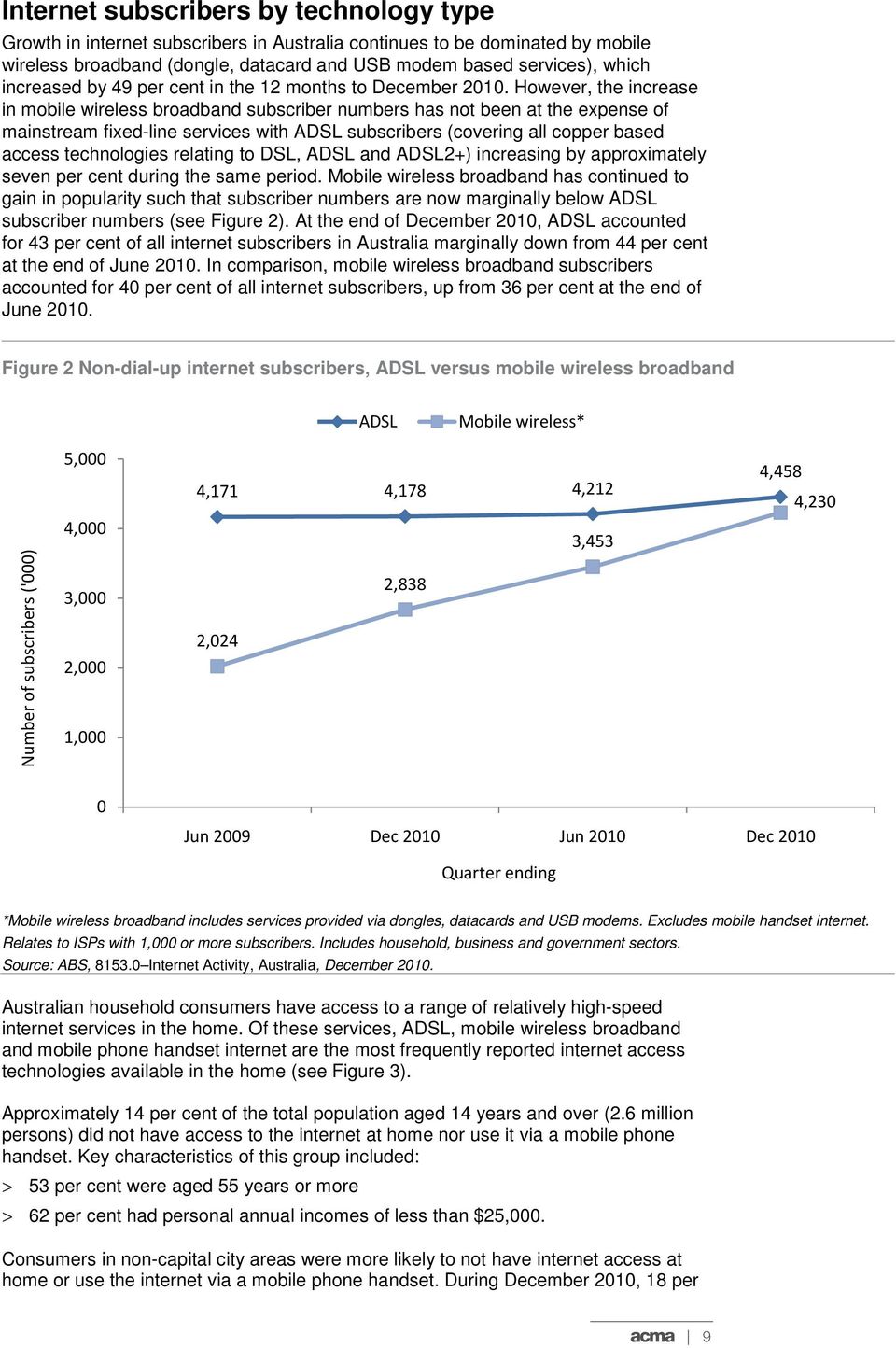
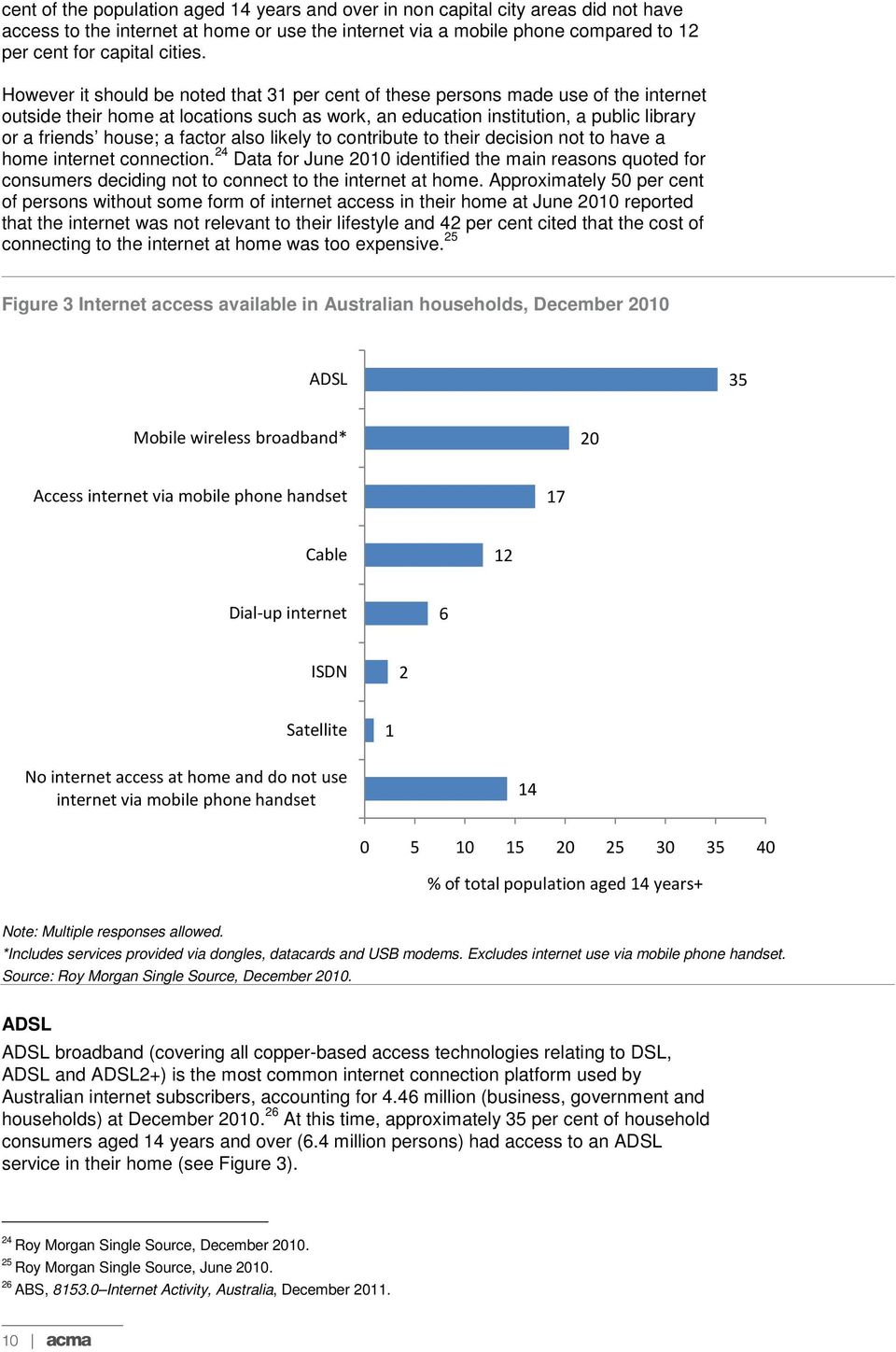
14 Internet subscribers by technology type Growth in internet subscribers in Australia continues to be dominated by mobile wireless broadband (dongle, datacard and USB modem based services), which increased by 49 per cent in the 12 months to December However, the increase in mobile wireless broadband subscriber numbers has not been at the expense of mainstream fixed-line services with ADSL subscribers (covering all copper based access technologies relating to DSL, ADSL and ADSL2+) increasing by approximately seven per cent during the same period. Mobile wireless broadband has continued to gain in popularity such that subscriber numbers are now marginally below ADSL subscriber numbers (see Figure 2). At the end of December 2010, ADSL accounted for 43 per cent of all internet subscribers in Australia marginally down from 44 per cent at the end of June In comparison, mobile wireless broadband subscribers accounted for 40 per cent of all internet subscribers, up from 36 per cent at the end of June Figure 2 Non-dial-up internet subscribers, ADSL versus mobile wireless broadband ADSL Mobile wireless* 5,000 4,171 4,178 4,212 4,458 4,230 4,000 3,453 Number of subscribers ('000) 3,000 2,000 1,000 2,838 2,024 0 Jun 2009 Dec 2010 Jun 2010 Dec 2010 Quarter ending *Mobile wireless broadband includes services provided via dongles, datacards and USB modems. Excludes mobile handset internet. Relates to ISPs with 1,000 or more subscribers. Includes household, business and government sectors. Source: ABS, Internet Activity, Australia, December Australian household consumers have access to a range of relatively high-speed internet services in the home. Of these services, ADSL, mobile wireless broadband and mobile phone handset internet are the most frequently reported internet access technologies available in the home (see Figure 3). Approximately 14 per cent of the total population aged 14 years and over (2.6 million persons) did not have access to the internet at home nor use it via a mobile phone handset. Key characteristics of this group included: > 53 per cent were aged 55 years or more > 62 per cent had personal annual incomes of less than $25,000. Consumers in non-capital city areas were more likely to not have internet access at home or use the internet via a mobile phone handset. During December 2010, 18 per acma 9
15 cent of the population aged 14 years and over in non capital city areas did not have access to the internet at home or use the internet via a mobile phone compared to 12 per cent for capital cities. However it should be noted that 31 per cent of these persons made use of the internet outside their home at locations such as work, an education institution, a public library or a friends house; a factor also likely to contribute to their decision not to have a home internet connection. 24 Data for June 2010 identified the main reasons quoted for consumers deciding not to connect to the internet at home. Approximately 50 per cent of persons without some form of internet access in their home at June 2010 reported that the internet was not relevant to their lifestyle and 42 per cent cited that the cost of connecting to the internet at home was too expensive. 25 Figure 3 Internet access available in Australian households, December 2010 ADSL 35 Mobile wireless broadband* 20 Access internet via mobile phone handset 17 Cable 12 Dial-up internet 6 ISDN 2 Satellite 1 No internet access at home and do not use internet via mobile phone handset % of total population aged 14 years+ Note: Multiple responses allowed. *Includes services provided via dongles, datacards and USB modems. Excludes internet use via mobile phone handset. Source: Roy Morgan Single Source, December ADSL ADSL broadband (covering all copper-based access technologies relating to DSL, ADSL and ADSL2+) is the most common internet connection platform used by Australian internet subscribers, accounting for 4.46 million (business, government and households) at December At this time, approximately 35 per cent of household consumers aged 14 years and over (6.4 million persons) had access to an ADSL service in their home (see Figure 3). 24 Roy Morgan Single Source, December Roy Morgan Single Source, June ABS, Internet Activity, Australia, December acma
16 Adoption of ADSL services has been facilitated by a number of ISPs rolling out their own digital subscriber line access multiplexers (DSLAMS) into Telstra exchanges. This has enabled these ISPs to provide internet services using unconditioned local loop lines. 27 Nearly all these lines (97 per cent at June 2010) were located in exchanges in central business districts and major metropolitan areas. 28 However, Telstra continues to provide the infrastructure upon which much of Australia s internet access is made available. At December 2010, approximately 67 per cent of ADSL services in operation in Australia were provided through Telstra s wholesale and retail services. 29 Competition among ADSL providers is intense, according to Market Clarity, approximately 85 per cent of ISPs offered ADSL broadband services in July Approximately 39 per cent of ISPs offering ADSL services also offered higher bandwidth ADSL2+ services, predominantly in areas of high population density. 30 Naked DSL, which provides a fixed-line broadband internet service without connection to an analogue telephony service, has been available in Australia since 2007 and is currently offered by many ISPs, some of which bundle the service with free or low cost VoIP calls. Availability of naked DSL is restricted to those areas that are serviced by an ADSL2+ exchange and is therefore more likely to be adopted by consumers living in metropolitan areas. Mobile wireless and mobile phone handset internet Through 3G mobile phone networks, Australians are able to access internet services either via a mobile wireless broadband service using a dongle, datacard or USB modem connected to a computer or via an internet-enabled mobile phone handset. The combined coverage of 3G networks was reported to be in excess of 99 per cent of the Australian population at June At December 2010, there were 4.2 million mobile wireless broadband subscribers and 8.2 million mobile phone handset internet subscribers (mobile phone payment plans which provide internet access whether or not used) in Australia across the business, government and household sectors. 32 The increasing penetration of mobile wireless and mobile phone handset internet services among Australian household consumers internet access choices is further reflected in consumer survey data. At December 2010, 20 per cent of persons aged 14 years and over (3.7 million persons) were estimated to use a mobile wireless broadband service via a dongle, datacard or USB modem at home. In addition, 3.1 million persons aged 14 years and over used the internet directly via their mobile phone handset during December 2010 compared to 1.9 million during December The majority of mobile wireless broadband users (dongle, datacard or USB modem services) did not utilise other internet access technologies in the home while 22 per cent accessed the internet via their mobile phone handset; three per cent had an 27 This involves using unconditioned communications over copper wire pairs between boundaries of a telecommunications network at a customer s premises and a point of connection with a service provider usually other than the owner of the unconditioned network. 28 ACMA, Communications report, , December ACCC, Snapshot of Telstra s customer access network as at 30 December 2010, accessed 11 April Market Clarity Database, July ACMA, Communications report , December ABS, Internet Activity, Australia, December Roy Morgan Single Source, December acma 11
17 ADSL service in the home and one per cent a cable service. For persons with access to a mobile wireless broadband service in the home: > 59 per cent resided in capital cities > 50 per cent were aged years > 65 per cent made use of internet access at sites outside of the home. 34 In comparison, nearly 90 per cent of users of the internet via a mobile phone handset had other internet access technologies in their home; 42 per cent an ADSL service, 27 per cent a mobile wireless service (dongle, datacard or USB modem) and 14 per cent a cable service. The high level of crossover between mobile phone internet use and use of other internet access services could be attributed to a number of factors. These include perceived functionality of mobile handsets relative to computers (screen and key board size for example) and the higher costs associated with accessing the internet via mobile phone handsets in comparison to other services. 35 Approximately 11 per cent of mobile phone handset internet users did not have access to other internet technologies in their home. Key characteristics of these persons included: > 66 per cent resided in capital cities > 57 per cent were female > 70 per cent were aged years. 36 Price reductions, increases in maximum data speeds and the expansion of available bandwidth may have contributed to a rise in the number of mobile wireless connections in the past year. 37 However, according to research by Market Clarity, mobile internet access (covering dongle, datacard, USB modem and mobile phone handset services) continues to be more expensive than fixed-line internet services with large variations in prices for services between: > internet service providers > prepaid and post-paid payment plans. 38 High demand for mobile broadband services has also encouraged the industry to harness new technologies, such as long-term evolution (LTE), and to develop an advanced and competitive wireless infrastructure. 39 In February 2011, Telstra announced that it would upgrade its 3G network with LTE technology in the central business districts of Australia s capital cities and selected regional centres. 40 Future network expansions are expected, with both Optus and Telstra announcing plans to enhance wireless broadband capacity in regional and rural Australia through the acquisition of additional licences on the 2.1GHz band. 41 For further information on 34 Roy Morgan Single Source, December For example, 3G services such as mobile phone handset internet often attract higher charges when used via a prepaid plan. See ACMA, Communications report series, Report 2 Take-up and use of voice services by Australian consumers, November Roy Morgan Single Source, December ACMA, Communications report , December Market Clarity, The Cost of Mobility: Comparing the Value of Fixed and Mobile Broadband, May Long-term evolution (LTE) is a wireless broadband technology widely promoted as the successor to 3G. It potentially provides much faster data rates for both uploading and downloading, transmitting data at theoretical peak speeds of 340Mbit/s; Ovum, Straight talk: LTE Focus, Telecoms Q Telstra, Telstra to launch 4G mobile broadband network by end 2011, 15 February Optus, Optus to acquire new 2100 MHz spectrum licences to increase 3G mobile capacity in regional Australia, 14 July 2010, new+2100mhz+spectrum+licences+to+increase+3g+mobile+capacity+in+regional+australia, accessed 12 acma
18 emerging wireless technologies, see the ACMA s 2010 report Technology developments in the digital economy. 42 Hybrid fibre coaxial (HFC) networks HFC, or cable internet, services are operated in Australia by Optus, Telstra and Neighbourhood Cable, providing bandwidth typically of up to 30 Mbps. Together, Telstra and Optus s HFC networks pass over 2.7 million homes in Melbourne, Sydney, Adelaide, Brisbane, the Gold Coast and Perth. 43 Neighbourhood Cable, a subsidiary of Canberra-based TransACT Communications, operates in regional Victoria, reaching over 90,000 households in Mildura, Ballarat and Geelong. 44 New HFC technologies such as DOCSIS 3.0 offer much higher speeds, reaching up to 100 Mbit/s, and are currently available in selected parts of Melbourne, Brisbane and Sydney through the Telstra and Optus networks. 45 Neighbourhood Cable also offers DOCSIS in selected areas of rural Victoria, including Ballarat, Geelong and Mildura. 46 According to the ABS, there were 909,000 cable and fibre subscribers in Australia at December 2009 covering the business, government and household sectors (figures for December 2010 not reported separately by ABS for confidentiality reasons). 47 Consumer survey data shows that approximately 12 per cent of the Australian population aged 14 years and over (2.1 million persons) had access to a cable internet service in the home at December 2010 (see Figure 3). Satellite broadband Satellite broadband is an internet service connected via satellite. It is available across Australia s entire land area but due to its higher cost to consumers and problems with latency and speed is chiefly used in areas with poor or no coverage from other service delivery platforms. 48 At June 2010, satellite internet services were provided by 35 ISPs 49 and accounted for less than two per cent of internet subscribers in Australia. 50 On 1 July 2011, the National Broadband Network (NBN) interim satellite service to rural and remote areas became available. The service from Optus and IPStar is expected to offer peak speeds of 6 Mbps downlink and 1 Mbps uplink. 51 At December 2010, approximately 163,000 household consumers aged 14 years and over had a satellite internet service at home. 52 ABS reports that at June 2010, there 27 October 2010; Telstra, Telstra to boost wireless broadband capacity in regional Australia, 25 October ACMA, Technology developments in the digital economy, August ACMA, Communications report , December accessed 17 June Telstra, accessed 10 June 2010; Optus, broadband+to+deliver+supersonic+speeds+in+brisbane,+melbourne+and+sydney, accessed 27 October Neighbourhood Cable, Neighbourhood Cable to upgrade its network to DOCSIS 3.0, accessed 27 May ABS, Internet Activity, Australia, December For example, one ISP charges four times more for the same amount of data delivered via satellite than via the wireless network. 49 Market Clarity Database, July ABS, Internet Activity, Australia, June accessed 1 July Roy Morgan Single Source, December acma 13

19 were 111,000 satellite internet subscribers across the household, business and government sectors. 53 Dial-up services Dial-up services connect the subscriber to the internet via a dial-up modem and software using the public switched telephone network. The ABS reported that at December 2010, there were 707,000 dial-up internet subscribers in Australia across the business, government and household sectors. At December 2010, an estimated 1.2 million persons in Australia aged 14 years and over (6 per cent of the population) had a dial-up internet service in their home. > 54 per cent of these persons resided in capital cities > 52 per cent were aged 50 years or older, while > 47 per cent used the internet from locations outside the home. 54 Nearly 980,000 Australians aged 14 years and over only had access to a dial-up internet service in the home and did not use internet via a mobile phone handset. In terms of regional variations, 7 per cent of persons aged 14 years and over residing in non-capital city areas only had a dial-up internet service in the home and did not use the internet via a mobile handset compared to 5 per cent for capital cities. 55 In addition to dial-up, approximately 418,000 persons in Australia aged 14 years and over were estimated to have access to an internet service via the integrated services digital network (ISDN), 2 per cent of the population ABS did not publish satellite internet subscriber numbers separately for December Roy Morgan Single Source, December ibid. 56 Roy Morgan Single Source, January December acma

20 ISP charging models Within the competitive Australian internet service environment, ISPs typically make household broadband available to consumers under a variety of plans, with data allowances changed according to connection type; data speed; price level; and whether the plan is prepaid, post-paid or bundled with other services. Australian ISPs usual charging models are outlined in Table 6. Table 6 Typical Australian ISP charging models Charging model Post-paid cap, fixed contract Post-paid cap, no fixed contract Prepaid Pay-as-you-go Bundled plans Description of plan Service is offered under a fixed-term contract (from one month to 36 months in length) for a set price each month, which includes a monthly data allowance that may be divided into peak and off-peak times (determined by the ISP). Once the monthly data allowance is reached or exceeded, data speeds may be slowed ( shaped ) and/or an excess usage fee charged. Usage of data above the nominated amount per billing period may be charged at an alternative rate. As above, without a fixed-term contract. Costs per megabit are typically higher than those charged under a contract. Service is offered for a set period (between one month and one year) with a set data allowance. Data access typically stops once the data allowance is reached or the specified set period has lapsed, unless the account is recharged. Prepaid internet is most commonly offered for mobile/wireless broadband services. Service is charged on a per megabit basis, typically at a considerably higher rate than other plans and as an add-on to another service, such as a mobile phone plan. Available with or without a contract. Service is provided on a post-paid plan, bundled with another service or services for an overall lower cost than if the services were purchased separately. The bundled services (internet, fixed-line telephone, mobile phone and subscription television) are most commonly provided by one company or partner companies. These plans are usually established on a fixed-term contract for the bundled services. ACMA consumer survey data shows that financial considerations appear to be the strongest driver in consumer selection of an internet service provider (ISP) for a home internet service, with 45 per cent of survey respondents citing price as the reason for their ISP choice. Service speed (25 per cent) and download limits (16 per cent) were also commonly cited, while package deals such as bundling were mentioned by 13 per cent of respondents. 57 Expanded service offerings In addition to continued innovation in pricing of internet access services, ISPs have sought to retain market share through service innovation, especially the bundling of voice and content services to customers (Figure 4). The majority of ISPs have moved beyond the traditional single service provider model, diversifying their product offerings to provide additional services in conjunction with internet access. Most commonly, ISPs offer internet access as only one component of a multi-part package or bundle 58, which may offer incentives such as free or discounted voice services, or free line rental. 59 Internet security services, subscription television packages, VoIP and mobile phones are among other products offered by ISPs, either individually (such as a web- 57 ACMA-unpublished data, November The practice of joining related products together for the purpose of selling them as a single product. Bundling arrangements usually feature special pricing arrangements that make it cheaper for consumers to buy products and services as a bundle rather than individually. 59 For example, at 11 April 2011, an ISP was offering a broadband service with free or $1.00 line rental. acma 15
21 connected fixed-line telephone) or bundled with another service in return for an overall discount. The ABS reports that at December 2010, 71 per cent of ISPs offered additional services to subscribers, most commonly content filtering products, VoIP (60 per cent) and home telephone services (49 per cent). Figure 4 Additional services offered to internet subscribers by Australian ISPs, December content filtering services 71 VoIP 60 Home telephone 49 Free SPAM Filter 45 Mobile telephone Naked DSL Web content filtering services 26 No services offered Other services offered IPTV % ofisps In addition, several ISPs have partnered with internet content providers, offering free downloads from specific websites as part of their business models. For example, the Australian Broadcasting Commission (ABC) content is available as unmetered downloads to iinet and Internode users, providing the ABC with access to a potentially wider online audience, and the ISPs with an additional method of retaining customers or attracting potential customers. Further details of content provision by internet service providers are provided in the ACMA s 2010 report IPTV and internet video delivery models: Video content services over IP in Australia. 60 Bundling At December 2010, approximately 42 per cent of households (3.5 million households) in Australia were estimated to have two or more telecommunications services provided via a bundling arrangement with their telecommunication service provider. 61 Seventyeight per cent of these households included their internet access as part of the bundling arrangement with their communication service provider. Discounts, value-for money and convenience of dealing with a single service provider are the main drivers for consumers when considering bundling telecommunication services. Twenty-six per cent of households with two or more telecommunication services bundled at December 2010, identified financial discounts as the main benefit from service bundling, 25 per cent identified convenience of dealing with a single service provider for billing purposes, 22 per cent access to free services (for example, free local or 60 This report is available at 61 Roy Morgan Single Source. Percentage is of all households with or without a fixed-line telephone service. 16 acma
22 mobile calls) and 18 per cent convenience of dealing with one service provider for enquiries, complaints and other issues (18 per cent) (see Figure 5). 62 The ACMA s draft Reconnecting the Customer Inquiry report noted that: While these offers can deliver real benefits to consumers, particularly savings and convenience, some submitters to the inquiry claim they add to the complexity that consumers must face in the market. Some service providers use bundling arrangements to shift their customers to higher value content and data services. They also operate as a heightened disincentive to switching for all consumers, including those who are dissatisfied. 63 Figure 5 Consumer perceptions of the main benefits of bundling telecommunication services, December 2010 Financial discounts (e.g.% off my bill or connection fees) Convenience of dealing with one provider for billing Free services (e.g. Free local or mobile calls, SMS etc) 22 Convenience of dealing with one provider for enquiries, complaints and other issues 18 Other incentive 8 Not sure of the benefits 5 Do not receive any benefits % of households bundling two or more telecommunication services Source: Roy Morgan Single Source. Enhanced interactive services Technological convergence has transformed traditional telecommunication networks and consumer access devices allowing service providers to deliver triple play services 64 to consumers through communication devices such as mobile phone handsets. However, convergence is also enabling the exploitation of a wider range of consumer electronic devices, with more recent developments centred on the traditional television (TV) set as evidenced by the entry of internet televisions 65 into the 62 Roy Morgan Single Source. 63 ACMA, Reconnecting the Customer draft public inquiry report, June 2011, engage.acma.gov.au/reconnecting. 64 Voice, data and video. 65 An internet-enabled TV is factory-designed to connect directly to the web and display content such as YouTube videos, weather reports and streaming movies or television shows. These sets differ from televisions that double as computer monitors although many can do that as well because no computer or outside equipment is required to display the web-based content. See accessed 27 May acma 17
23 Australian marketplace and recently reported industry plans to expand delivery of TV content via the internet to Australians homes. 66 As communications and media players, such as ISPs, seek to expand their service offerings the prospects of delivering internet and interactive services to households through the next generation of TV sets is increasingly a reality. 67 The delivery of an expanded array of interactive services to consumers through TV sets is dependent on a range of factors, with consumer interest in accessing these services (Figure 6) being a critical factor in the ongoing transformation of digital media service delivery to Australian homes. While the majority of Australians aged 14 years or over currently have limited or no interest in accessing the internet or related services through their home TV, a sizeable minority of the population were for example estimated to be interested in accessing the internet (18 per cent 3.4 million persons) and making video calls directly via their TV (14 per cent 2.5 million persons). As with any emerging technology or service, usage is expected to increase as the cost of the internet-enabled TVs declines and the provision of service offerings and consumer awareness increases. Figure 6 Consumer use of, and attitudes to, enhanced television service offerings, December 2010 Already do Would like to do Not interested Can't say % of total population aged 14 years Pay to access sporting events on demand Pay to access movies on demand Do my shopping and access information on goods & services through my TV Make video calls through my TV 61 Use my TV to access the internet Network my TV to a computer device to play music, photos or videos Set up my TV recording via the internet Pause or rewind live TV programs while watching TV Source: Roy Morgan Single Source. 66 Lara Sinclair, Optus set to bring TV into the home via internet, The Australian, 16 May 2011, accessed 27 May ACMA, IPTV and internet video delivery models: Video content services over IP in Australia, June acma
24 Internet connection speeds Connection speeds offered by ISPs in Australia vary significantly according to connection type and access technology. While ongoing developments in wireless technology are increasing data rates, fixed-line broadband continue to offer users the higher download speeds. Figures 7 and 8 present an overview of the changing composition of household and business/government internet subscriber market in Australia by advertised download speed. In the household sector, there is a shift to higher speed internet services, specifically 1.5 Mbps or greater, and a parallel decline in dial-up and lower speed broadband services. At December 2010, household internet subscribers with advertised maximum download speeds of 1.5 Mbps to fewer than 8 Mbps accounted for 35 per cent of total household subscribers (compared to 33 per cent at June 2010 and 31 per cent at December 2009). Households with speeds of 8 Mbps or more accounted for 45 per cent of subscribers at December 2010 (compared to 38 per cent at June 2010 and 30 per cent at December 2009). The overall increase in take-up of services with higher download speeds appears driven by a combination of factors, including upgrading of network capacity (in the case of mobile networks) and ongoing reductions in data download unit prices, particularly for high-speed services where competition has intensified. 68 The trend towards downloading increasing amounts of data and accessing high bandwidth services such as video streaming and movie downloads is also likely to influence household consumer decisions to upgrade to higher speed internet services. (This is discussed further on pages 36 to 38.) Figure 7 Household internet subscribers by advertised maximum download speed Less than 256 Kbps 256 Kbps to less than 512 Kbps 512 Kbps to less than 1.5 Mbps 1.5 Mbps to less than 8 Mbps 8 Mbps to less than 24 Mbps 24 Mbps or greater % of household internet subscribers Jun 2009 Dec 2009 Jun 2010 Dec 2010 Quarter ending Note: Figures are for ISPs with more than 1,000 subscribers. Excludes mobile handset internet subscribers. In some cases, figures may not add up to 100 per cent due to rounding. Source: ABS, Internet Activity, Australia, December Venture Consulting, Internet Industry Association Broadband Index, 9th Edition, November 2009, at accessed 14 December acma 19
25 In the business and government sectors, the growth in internet subscriber market has occurred in services with advertised maximum download speeds of 8 Mbps or greater with these services accounting for 33 per cent of internet subscribers in this sector at December 2010 compared to 20 per cent at June 2010 and 15 per cent at December 2009 (Figure 8). Figure 8 Business/government internet subscribers by advertised maximum download speed % of business and government internet subscribers Less than 256 Kbps 256 Kkbps to less than 512 Kbps 512 Kbps to less than 1.5Mbps 1.5 Mbps to less than 8 Mbps 8 Mbps to less than 24 Mbps 24 Mbps or greater Jun 2009 Dec 2009 Jun 2010 Dec 2010 Quarter ending Note: Figures are for ISPs with more than 1,000 subscribers. Excludes mobile handset internet subscribers. Source: ABS, Internet Activity, Australia, December Internet access devices While internet-enabled mobile handsets and tablet PCs are becoming increasingly popular, the desktop or laptop computer when connected to a fixed-line remains the primary access device through which most of Australia s data traffic flows (Figure 9). Ninety-six per cent of internet users aged 14 years and over in Australia went online via a desktop or portable computer at December 2010, consistent with 97 per cent recorded at December However, mobile phone handset internet usage has seen significant increases in Australia, perhaps reflecting continued innovation in mobile handset technology, network performance and service pricing. During December 2010, 23 per cent of internet users in Australia aged 14 years and over were estimated to have used the internet via their mobile phone handset compared to an estimated 15 per cent during December 2009 (Figure 9). However, this has not been at the expense of use of computers, with nearly 98 per cent of mobile handset internet users also accessing the internet via a desktop or portable computer. This suggests mobile phone handset internet services are developing as a complementary service and not as a substitute to traditional computer based internet access Roy Morgan Single Source, December acma
26 Figure 9 Personal internet access devices used during December 2009 and 2010 % of internet users aged 14 years Dec Dec Mobile handset Computer Both mobile handset and computer Note: Multiple responses allowed. Computer also includes laptops. Source: Roy Morgan Single Source, December The complementary nature of these two internet access devices is further reflected in the type of activities undertaken online via these devices. The proportion of mobile phone handset internet users undertaking online activities via their handsets was significantly lower than levels reported by computer internet users (Figure 10). For example: > only 10 per cent of mobile phone handset internet users undertook e-commerce activities (buying, selling, shopping), online via their mobile handsets during December 2010, compared to 35 per cent for persons using the internet via a computer > 23 per cent of mobile phone handset internet users undertook banking or financial related activities online via their handsets compared to 67 per cent for persons using the internet via a computer. Social networking was the only identified area of online activity where proportionally the level of activity undertaken via mobile phone handsets during the month of December 2010 was comparable to levels recorded via computers (39 per cent and 41 per cent respectively). acma 21
27 Figure 10 Activities* undertaken online by consumer access device during December 2010 Online activities via computer Online activities via mobile phone handset Research & information Communication activities ( , internet telephony, instant messaging) Banking & finance General activities (browsing/surfing) Entertainment & amusement activities Activities relating to blogging and online communities (inc. social networking) Buying, selling, shopping activities Advertising-related** Other interactive activities *** 5 26 *Relates to activities undertaken from any location. **Refers to viewing advertisements online or accessing websites as a result of off-line advertising. ***Refers to entering competitions, registering at a website or creating or managing one s own website. Note: The category computer includes desktop or portable computers. Source: Roy Morgan Single Source, December % of internet users aged 14 years+ It should be recognised that some activities are less suited or impractical to access online via mobile phones compared to computers. For example, when examining the type of information accessed online, online information activities via mobile phone handsets are mainly focused on a narrower set of activities compared to computer use. These include accessing information about the weather (55 per cent of mobile phone handset internet users), accessing maps or directions (49 per cent), and sport news (24 per cent). While these information activities are also undertaken via computers, online information activities via computers also cover activities like searching for jobs, accessing travel information or undertaking academic research, etc. These activities, given handset limitations, do not feature prominently in the online activity profile of mobile phone handset internet users. 70 Communication-related activities were the most frequently reported activity undertaken online via a mobile phone handset during December During this period, 1.4 million persons aged 14 years and over used , 420,000 using instant messaging and 174,000 made a VoIP call via their mobile phone handset during December In comparison during December 2009, 712,000 persons used via their mobile phone handset, 361,000 instant messaging and 123,000 made a VoIP call. Other activities of note undertaken online via a mobile phone handset during December 2010 included accessing information and general browsing activities (1.3 million persons aged 14 years and over respectively). 70 Roy Morgan Single Source, December acma
28 The continued dominance of the computer in terms of online activities is further reflected in ABS figures. During the December quarter of 2010, Australians downloaded nearly 175,000 terabytes of data via computers connected to fixed-line networks in comparison to nearly 17,000 terabytes of data downloaded via computers connected to datacards, dongles or USB modems and 4,029 terabytes downloaded via mobile phone handsets. 71 Profile of mobile phone handset internet users The use of the internet via mobile phone handset in Australia is largely dominated by younger adults; specifically persons aged years (Figure 11). Persons aged years and years accounted for 30 per cent and 24 per cent respectively of mobile handset internet users in Australia during December 2010, a slight increase of three percentage points in each age group over the figures recorded for December This is in contrast to the more evenly distributed profile of persons accessing the internet via a computer where 39 per cent of users were aged 18 to 34 years in December The key characteristics of mobile phone handset internet users were: > 53 per cent were male > 71 per cent resided in capital cities > 50 per cent were in full-time employment. 72 Figure 11 Age profile of persons going online by access device during December 2009 and years and over % of internet users Mobile handset Dec 09 Mobile handset Dec 10 Computer Dec 09 Computer Dec10 Source: Roy Morgan Single Source, December ABS, Internet Activity, Australia, December Roy Morgan Single Source, December acma 23
29 Emerging internet access devices Other internet devices are also becoming available to Australian consumers, with fixed and portable games consoles, media players such as TiVO and tablet computers now available to web users. Tablet computers 73 such as the ipad have been particularly popular. Research undertaken by GfK and reported on indicates that 188,000 tablet computers had been sold in Australia by September 2010, the majority being ipads. In addition, awareness of tablet computers was at 80 per cent of those interviewed, with 12 per cent of these respondents stating that they intended to purchase a tablet computer in the coming year. 74 Telstra now offers the T-Hub and the T-Box, fixed-line variations of the tablet s touch screen interface, which were introduced in May 2010 in an attempt to address the decline in fixed-line customers. 75 Promotional material for the T-Hub stresses that the unit operates in a similar way to a mobile phone (highlighting the importance of multi-functionality as a feature of communications devices), although the unit offers only limited internet access in addition to Public Switched Telecommunications Network (PSTN) voice services. The T-Box is an online television service bundled with a fixed-line and broadband connection. 76 Telstra reported that at December 2010, approximately 128,000 T-Hub and 107,000 T-Boxes had been sold R. Catanzariti, Tablet mania hits Australia as ipad sweeps all before it, ARN, 3 November 2010, 75 A. Colley, Telstra presses on with launch of T-Hub touchscreen phone, The Australian, 6 April 2010, accessed 30 May ACMA, Communications report series, Report 4 Changing business models in the Australian communication and media sectors: Challenges and response strategies, January Telstra, Telstra Corporation Limited Financial Results for the Half Year ended 31 December 2010, 10 February acma
30 Australians in the online environment While the previous section identified a range of ways in which Australian consumers connect to the internet, this section considers how they interact with online environment and utilise the internet once connected. It specifically examines how the types of activities undertaken online vary with consumer age and frequency of internet use. Location of internet use Approximately 15.1 million persons in Australia aged 14 years and over (83 per cent of the total population aged 14 years and over) used the internet during the December quarter of This compared to 14.2 million (80 per cent) during the December quarter of 2009 and 13.9 million (80 per cent) during the December quarter of Australians used the internet from a variety of locations (Figure 12) however the home and work environments continued to remain the most frequently reported sites of internet use. Ninety-five per cent of persons aged 14 years and over who used the internet during the December quarter of 2010, did so from home, 48 per cent at work and 14 per cent an educational institution. 79 Figure 12 Locations where internet used Quarter ending Dec 08 Quarter ending December 2009 Quarter ending December 2010 % of persons aged 14 years+ using the internet from any location Home Work Educational institution Library Internet cafe Friend's place Wireless hotspot Other Note: Multiple responses allowed. Source: Roy Morgan Single Source, December Percentages for 2009 and 2008 are similar due to rounding and the total population increasing in line with the increase in the number of internet users. 79 Roy Morgan Single Source, December acma 25
31 More Australians are accessing the internet from multiple locations. For example, approximately 6.9 million Australians aged 14 years and over (38 per cent of the total population 14 years and over) used the internet both from home and work during the December quarter of 2010, compared to 27 per cent during the December quarter of For these persons, an increasing proportion indicated they use the internet at home and work equally (42 per cent during the December quarter of 2010 compared to 34 per cent during the same period during 2009). Figure 13 demonstrates this increase and the corresponding decrease in the proportion of these internet users who identified work only as their main location of internet use. Figure 13 Locations where internet mainly used Home Work Home and work equally % of persons aged 14 years+ using the internet at home and work Dec-05 Dec-06 Dec-07 Dec 08 Dec 09 Dec 10 Quarter ending Source: Roy Morgan Single Source, December Internet activities by age Figure 14 presents an overview of activities undertaken online across age groups in Australia. In general, for most Australians going online is about communicating ( , internet telephony and instant messaging), undertaking research and accessing information. However, reflecting different attitudes to the internet and life stages, entertainment and amusement based activities are most frequently undertaken online by persons aged years, declining steadily with age. Banking and transactional activities become increasingly common among persons over the age of 18 years, perhaps reflecting the transition to full-time employment, careers, having more disposable income, and being increasingly time-poor. 80 Even for retirees, banking and finance activities continue to feature prominently in their online activity profile, a reflection of the integral nature of these services to the daily lives of most Australians. 80 IBISWorld, A click away: Time-poor, cash-rich shoppers are driving the industry forward, Industry Report X004, Online Shopping and Mail-Order Houses in Australia, March acma
32 Figure 14 Activities* undertaken online by age during December 2010 % of internet users General activities (browsing/surfing) Communications ( , internet telephony, instant messaging) Banking & finance Buying, selling, shopping Blogs & online communities Other interactive** Research & information Entertainment & amusement Advertising-related *** years+ Age group *Relates to activities undertaken from any location. **Refers to entering competitions, registering at a website or creating or managing one s own website. ***Refers to viewing advertisements online or accessing websites as a result of off-line advertising. Source: Roy Morgan Single Source Australia, December acma 27
33 Frequency of internet use The internet has become ingrained into the lifestyle of many Australians; 71 per cent of the online population aged 14 years and over were estimated to use the internet at least once a day at December 2010 compared to 67 per cent at December 2009 and 63 per cent at December 2008 (Figure 15). In terms of location, 62 per cent of persons with access to the internet at their work place went online at their workplace more than once a day. This compares to 53 per cent of persons with home internet access going online at home more than once a day and just 14 per cent for persons with access to the internet at locations other than home or work. 81 Figure 15 Frequency of internet use 70 Dec-08 Dec-09 Dec-10 % of internet users aged 14 years More than once a day Once a day A few times a week Once a week A few times a month Once a month A few times a year Once a year Less often Can't say Note: Internet use from any site. Source: Roy Morgan Single Source Australia, December The key characteristics of frequent internet users (persons accessing the internet more than once a day) were: > Personal income level (see Figure 16) frequency of internet use increases with personal income. Those with annual incomes of $90,000 to $99,999 had the highest representation of frequent internet users (81 per cent), followed by those with annual incomes of $100,000 or more (79 per cent). Online Australians earning $20,000 to $24,999 use the internet less frequently on average, with 42 per cent going online more than once a day. The comparatively high level of daily internet use among persons with annual incomes of under $15,000 (53 per cent) may relate to the significant number of persons in this income range currently undertaking some form of study. 81 Roy Morgan Single Source, December acma
34 > Age (see Figure 17) there appears to be a strong relationship between age and frequency of internet use. For example, 67 per cent of internet users aged went online more than once a day during December 2010, compared to 36 per cent of internet users aged 65 years or older. > Gender on average, men use the internet slightly more often than women, with daily usage at 66 per cent and 61 per cent respectively. > Location internet users residing in metropolitan (capital cities) locations are more likely (63 per cent) than persons living outside capital cities (53 per cent) to use the internet at least once a day. acma 29
35 Figure 16 Frequency of internet use by annual personal income, December 2010 More than once a day Once a day A few times a week Once a week A few times a month % of internet users aged 14 years Once a month A few times a year Once a year Less often Can't say Under $15,000 $15,000 $19,000 $20,000 $24,999 $25,000 $29,999 $30,000 $39,999 $40,000 $49,999 $50,000 $59,999 $60,000 $69,999 $70,000 $79,999 $80,000 $89,999 $90,000 $99,000 $100,000+ Personal annual income range Source: Roy Morgan Single Source Australia, December acma
36 Figure 17 Representation of frequent internet users in Australia s online population, December 2010 % of internet users More than once a day Once a day A few times a week Once a week A few times a month Once a month A few times a year Once a year Less often Can't say years and over Age group Source: Roy Morgan Single Source Australia, December Regardless of socio-economic characteristics, the majority of Australian internet users have over time become more frequent participants. This is possibly a result of increasing: > knowledge about the benefits of going online > familiarity with the information and services accessible over the internet > availability of services on the internet. Figure 18 further reinforces the relationship between experience in using the internet and frequency of use with the exception of persons under 18 years, per cent of internet users who go online more than once a day had over five years experience with the internet. These findings further support research findings previously reported by the ACMA that the digital economy is becoming more central to the daily lives of Australians ACMA, Communications report series, Report 1 Australia in the digital economy: The shift to the online environment, November 2010; ACMA, Australia in the digital economy: Consumer engagement in e-commerce, November acma 31
37 Figure 18 Years of online experience for persons using the internet more than once a day, December Less than 3 months 3 months to 12 months Over 1 year to 2 years Over 2 years to 3 years Over 3 years to 5 years Over 5 years to 9 years 10 or more years Can't say % of internet users years and over Age group Source: Roy Morgan Single Source, December 2010 Online behaviours by frequency of internet use Not surprisingly, the degree to which Australians engage in activities online is also correlated with the frequency of their internet usage. Persons accessing the internet more than once a day are more likely to engage in a broader range of activities online than infrequent internet users (Figure 19). While an increasing variety of activities are undertaken online, Australians use of the internet is predominantly about searching for information, communicating and undertaking financial transactions, regardless of frequency of internet use. 32 acma
38 Figure 19 Activities* undertaken online during December 2010 More than once a day Once a day A few times a week Once a week A few times a month or less Research & information activities Communication activities ( , VoIP, instant messaging) Banking & finance 73 General activities (browsing, surfing) 68 Entertainment & amusement activities 58 Activities relating to blogging and online communities (inc. social networking) 48 Buying, selling, shopping activities 39 Other interactive activities** Advertising-related*** % of internet users aged 14 years+ *Relates to activities undertaken from any location. **Refers to entering competitions, registering at a website or creating or managing one s own website. ***Refers to viewing advertisements online or accessing websites as a result of off-line advertising. Source: Roy Morgan Single Source Australia, December acma 33
39 Trends to watch in online behaviours Several emerging trends within the online activity profiles of internet users in Australia have the potential to significantly change how persons communicate and interact socially and economically, and the structure of existing business models. A few of these trends are outlined below. Online communications VoIP and instant messaging While remains the cornerstone of online communications, Australians are increasingly using other services such as VoIP, instant messaging 83 and social networking are increasingly featured in the online communication activities of Australians. In some cases consumers are substituting these services entirely for traditional or using less often. During December 2010, approximately 2.3 million Australians aged 14 years and over made a VoIP call via their computer and 2.3 million used instant messaging. In comparison, during December 2009, 1.7 million persons made a VoIP call via their computer and 2.6 million used instant messaging. 84 Approximately 1.4 million persons used services such as VoIP, instant messaging or social networking to communicate online instead of during December 2010 compared to 736,000 during December The real time characteristics of services such as VoIP are perhaps the main attraction for users of these services over although Roy Morgan survey data also shows a lower level of usage of instant messaging during December 2010 relative to December Social networking The use of online social networking services (a service, platform or website that focuses on building social relations among persons) has wide appeal among Australians. Social networking enables internet users from different socio-economic backgrounds to interact online and to complement off-line social and, increasingly, work relationships. Within Australia, approximately 8.4 million persons accessed social network sites such as Facebook from home during December 2010, compared to 8 million during March Social networking also increasingly has a business and service delivery dimension. Growing numbers of businesses and government organisations are recognising the potential of social networking channels to raise their organisational profiles and improve customer service delivery. 87 Table 7 provides an overview of the number of internet users in Australia accessing a selection of online social network sites from home during December Instant messaging is when two or more persons logged into a particular instant messaging (IM) service exchange text messages in real time. It is more interactive than because messages are sent immediately, whereas messages can be queued up in a mail server for seconds or minutes. 84 Roy Morgan Single Source, December ibid. 86 Nielsen Online, December ACMA, Communications report series, Report 1 Australia in the digital economy: The shift to the online environment. 34 acma
40 Table 7 Australians visiting selected social networking sites from home, December 2010 Site Number of persons accessing site (000s) Facebook 7,383 Blogger 2,428 WordPress.com 1,055 Twitter.com 1,000 Myspace.com 756 LinkedIn 563 Yahoo!7 Groups 331 Note: Relates to home internet users aged 2 years and over. Source: Nielsen Online, December Shopping online For consumers the internet has made it easier to access information on the cost and availability of products and services and to compare offerings across companies. For business, the internet presents opportunities and challenges. The internet has enabled the development of online marketing and distribution channels, complementing brick and mortar operations. 88 It also continues to present challenges to businesses with customers able to move beyond traditional geographic boundaries and access a greater number of service providers, regardless of their location. However, the issue of the internet disrupting traditional business models is not just confined to the retail sector. For example, the traditional news print sector is also faced with the challenge of changing consumer preferences for news consumption where the internet provides ready access to a greater variety of news and information sources generally free of charge. 89 According to Nielsen Online, an estimated 7.4 million internet users in Australia accessed mass merchandising web sites providing retail trade services (e.g. clothing, books, groceries, etc) from home during December This is compared to 6.8 million during March Roy Morgan Research data also shows that 1.6 million Australians aged 14 years and over also used price comparison web sites (sites which enable consumers to compare prices of goods and services across businesses) during December 2010 when making decisions to purchase a product or service. Examples of such sites include Getprice.com.au, Myshopping.com.au and Webjet.com.au. Approximately 2.2 million Australians aged 14 years and over purchased a good or service online during December 2010 compared to 2 million during December Online shopping activity has been found to vary according to age, gender, household income, level of education and employment in general. More information can be found in previous research published by the ACMA report Australia in the digital economy Consumer engagement with e commerce ACMA, Communications report series, Report 1 Australia in the digital economy: The shift to the online environment, 11 November ACMA, Communications report series, Report 4 Changing business models in the Australian communication and media sectors: Challenges and response strategies, January Data for December 2009 not available. 91 Roy Morgan Single Source, December ACMA, Australia in the digital economy Consumer engagement with e commerce, November 2010, acma 35
41 ABS reports that approximately $143 billion worth of internet orders were received by Australian businesses during , representing an increase of 15 per cent in the 12 months to June These figures include business to consumer and business to business transactions. 93 Table 8 presents data on the number of Australians visiting a selection of retail shopping, auction and price comparison sites from home during December Table 8 Australians visiting selected retail/ auction websites from home, December 2010 Site Number of persons accessing site (000s) ebay 4,240 Amazon 1,698 Shopping.com.au Network 1,340 GetPrice 1,290 Lasoo.com.au 1,154 Big W 988 JB Hi-Fi 897 Harvey Norman 811 Myshopping.com.au 796 Gumtree 780 DealsDirect.com.au 773 Kmart Australia 743 Dick Smith Electronics 688 Target Australia 672 MYER 640 OO.com.au 613 The Good Guys 607 PriceDumper.com 588 Rewards Central 574 Coles 574 Cudo.com.au 571 NexTag Network 530 Grays Online 498 BigPond Trading Post 484 Borders 479 Webjet 449 Note: Relates to home internet users aged 2 years and over. Source: Nielsen Online, December Online video/audio content With developments in software applications and ready and cheaper access to increased internet connection speeds, online Australians are accessing video and audio content in increasing numbers. For example, Nielsen Online data shows that an estimated 5.5 million persons accessed one or more of the online video distribution sites identified in Table 9 during December 2010, compared to 5.1 million during March Approximately 5.3 million persons accessed YouTube from home during December 2010, compared to 4.8 million in March ABS, Summary of IT Use and Innovation in Australian Business, , June acma
42 Bandwidth heavy activities in particular are becoming increasingly common among internet users as more content is offered over the web through various services. These include user generated content services, such as YouTube, commercially-produced content available through channels such as itunes movie and BigPond Movies and catch-up viewing services of television broadcasts such as the ABC s iview service. Table 9 provides an overview of the number of home internet users in Australia accessing a selection of video content distribution sites. At present digital content distribution via the internet in Australia is dominated by the user generate content site YouTube. Table 9 Australians visiting selected video sites from home, December 2010 Site Number of persons accessing site ( 000s) YouTube 5,326 Google Video 894 Vimeo 350 ABCiview 283 Metacafe 225 Dailymotion 197 NineMSN Video 133 BigPond Movies 188 Bing Videos 118 Note: Relates to home internet users aged two years and over. Source: Nielsen Online, December In addition, many sites, such as online news sites, are providing streamed video content for consumers as a complement to traditional news text. Online news sites attract large numbers of Australians with an estimated 6.2 million internet users accessing these sites from home during December The growing significance of online digital video and audio activities is also reflected in Roy Morgan Research survey data presented in Figure 20 while the growth in the volume of data being downloaded via the internet in Australia is reflected in Figure Nielsen Online, December acma 37
43 Figure 20 Select digital content activities undertaken online during December 2009 and 2010 Dec 09 Dec 10 3,500 Number of persons aged 14 years+ ('000s) 3,000 2,500 2,000 1,500 1, ,460 1,293 Streamed audio or radio online 1,959 2,024 Downloaded video clips, TV programs, feature-length movies 2,518 2,606 Played games online 1,182 2,702 Streamed video clips or television programs 2,911 2,745 Downloaded music or audio/video podcasts Source: Roy Morgan Single Source, December In terms of Australians accessing digital content online, the biggest growth area in online activities relates to streaming video clips or television programs (Figure 20). During December 2010, 2.7 million Australians aged 14 years and over streamed video clips or television programs online compared to 1.2 million during December 2009, a 125 per cent increase. Volume of data downloaded The increasing level of activity undertaken online appears a product of growth in the numbers of internet users and more data being downloaded per internet user. During the December quarter of 2010, 191, terabytes of data were downloaded via the internet, compared to 155, terabytes downloaded during the June quarter of 2010 and 127,954 terabytes during the December quarter of 2009 (Figure 21). This was an increase of 23 per cent compared to the June quarter of 2010 and 50 per cent compared to the December quarter of According to the ABS, the bulk of data downloads continues to occur via fixed-line services, accounting for 91 per cent of downloads during the December quarter of 2010, (excluding downloads over mobile phone handsets). 97 In terms of data downloaded per subscriber, during the December quarter of 2010, an average of 18.8 gigabytes of data was downloaded per subscriber. This is roughly equivalent to 120 hours of streaming video on YouTube or 60 hours of watching 95 This increases to 195,868 when including downloads via mobile phone handsets. ABS only began collecting mobile phone handset downloads in June This increases to 156,220 when including downloads via mobile phone handsets. 97 This falls to 89 per cent when downloads over mobile phone handsets are considered ABS, Internet Activity, Australia, December acma
44 television programs on the internet. 98 This compared to an average of 16.8 gigabytes downloaded per subscriber during the June quarter of 2010 and 14.6 gigabytes during the December quarter of In addition, the ABS reports that a comparatively smaller 4,029 terabytes of data was downloaded via mobile phone handsets during the December quarter of 2010, compared with 717 terabytes downloaded during the June quarter of While this is a significant increase of over 462 per cent in six months, it represents only two per cent of the overall volume of data downloaded by Australians via the internet during the December quarter of On average 0.5 gigabytes of data was downloaded per mobile phone handset internet subscriber during the December quarter of 2010, well below the average download volume recorded for other internet subscribers (18.8 gigabytes). Figure 21 Volume of data downloaded via fixed-line and mobile wireless internet services 250,000 Terabytes downloaded 200, , ,000 50,000 81,352 99, , , ,839 0 Dec 08 Jun 09 Dec 09 Jun 10 Dec 10 Quarter ending Note: For consistency of time series, figure excludes data downloaded via mobile phone handsets. ABS began collecting volume of downloads via mobile phone handsets from June The ABS undertakes its Internet Activity Survey biannually for the June and December quarters. Figures are for ISPs with more than 1,000 subscribers, and include downloads by household, business and government subscribers. Source: ABS, Internet Activity, Australia, December These figures were derived from properties of the streaming files on the catch-up ABC or SBS websites and from the properties of the ACMA video clips on the YouTube site. 99 Calculated on the basis of ABS data sourced from Internet Activity, Australia, December Average data downloaded includes fixed and mobile wireless broadband (dongle, datacard and USB modem) subscribers and excludes mobile phone handset subscribers. acma 39
45 Appendix Research background and methodology Data sources The data in this report are drawn from a number of sources, including: > Roy Morgan Single Source, for estimates about the online population in Australia 14 years and over, drawn from a large-base survey sample (more than 25,000 per year in Australia), December 2010 > the Australian Bureau of Statistics, Internet Activity, Australia, December 2010 for counts of internet subscribers for ISPs with 1,000 or more subscribers > Nielsen Online, for estimates of the number of home internet users visiting websites. Supply-side data is drawn from a range of sources, including: > internet service provider websites and annual reports > Australian Bureau of Statistics > Market Clarity Database, which provides a listing of service providers in the voice and internet service markets in Australia. Table 10 provides an overview of the sample sizes for key estimates in this report. Table 10 Sample sizes for key digital economy estimates Estimate Sample size Roy Morgan Single Source % of the Australian population 14 years+ with any internet service at home 18,967 % of the Australia population 14 years+ using the internet via their mobile phone 15,463 % of the Australia population 14 years+ with broadband at home 11,165 Nielsen Online Estimates of website traffic during December ,000 Counts of internet subscribers versus counts of internet users This report uses two types of metrics to formulate an overview of internet adoption in Australia: > Counts of internet subscribers a subscriber differs from a user or person/business as one user may have multiple accounts with a single ISP, or accounts with more than one ISP. Conversely, there are single ISP subscriber accounts that provide internet access for multiple persons/organisations (for example, universities). > Estimates of persons with internet access and internet users these estimates are derived via sample surveys and, depending on the sample size, have a level of variability (standard error) associated with an individual estimate. These two sources of data can be used simultaneously to validate market directions (the shift from narrowband to broadband, for instance), but subscriber metrics are not a substitute for household or business sector surveys. Subscriber counts are accounting or billing points, and they provide only a limited picture of internet and, more specifically, broadband adoption in Australia, in what is essentially a supply-side view of internet take-up. Subscriber metrics do not provide important information about issues such as the actual number of broadband users, online behaviours and 40 acma
46 attitudes, nor on characteristics (age, gender, personal income, location) of internet users. Data analysis Results from the survey were analysed using descriptive analysis techniques and socioeconomic and demographic factors to identify any areas with significant patterns or differences. Only results with significant differences are reported in this research. Sample size The sample size limits some analysis by smaller subgroups; for example, data at state level or by both gender and age. Rounding Discrepancies may occur between the sums of the component items and totals due to the effects of rounding. Previous ACMA research This report also draws on the following key ACMA reports: > the annual ACMA Communications report series, > the 2010 ACMA report Emerging digital content services: Video content services over IP in Australia > the 2010 ACMA report Australia in the digital economy Consumer engagement with e-commerce. acma 41
47
48 Canberra Purple Building Benjamin Offices Chan Street Belconnen ACT Melbourne Level 44 Melbourne Central Tower 360 Elizabeth Street Melbourne VIC Sydney Level 15 Tower 1 Darling Park 201 Sussex Street Sydney NSW acma research PO Box 78 Belconnen ACT 2616 T F PO Box Law Courts Melbourne VIC 8010 T F TTY PO Box Q500 Queen Victoria Building Sydney NSW 1230 T F
Communications report 2013 14 series Report 1 Australians digital lives MARCH 2015
 Communications report 2013 14 series Report 1 Australians digital lives MARCH 2015 Canberra Red Building Benjamin Offices Chan Street Belconnen ACT PO Box 78 Belconnen ACT 2616 T +61 2 6219 5555 F +61
Appendix A: Basic network architecture
 Appendix A: Basic network architecture TELECOMMUNICATIONS LOCAL ACCESS NETWORKS Traditionally, telecommunications networks are classified as either fixed or mobile, based on the degree of mobility afforded
Appendix 1: Satellite broadband service providers
 Appendixes Appendix 1: Satellite broadband service providers In 2005 06, satellite broadband services were provided by the following companies: Australian Private Networks (ACTIV8me) Be Communications
Changes in the Australian VoIP market DECEMBER 2009
 Changes in the Australian VoIP market DECEMBER 2009 Canberra Purple Building Benjamin Offices Chan Street Belconnen ACT PO Box 78 Belconnen ACT 2616 T +61 2 6219 5555 F +61 2 6219 5353 Melbourne Level
Fixed Services Review. Discussion Paper on the Declaration Inquiry
 Fixed Services Review Discussion Paper on the Declaration Inquiry July 2013 Commonwealth of Australia 2013 This work is copyright. Apart from any use permitted by the Copyright Act 1968, no part may be
Communications report
 Communications report 2011 12 Copyright notice http://creativecommons.org/licenses/by/3.0/au/ With the exception of coats of arms, logos, emblems, images, other third-party material or devices protected
Communications report 2009 10 series Report 1 Australia in the digital economy: The shift to the online environment
 Communications report 2009 10 series Report 1 Australia in the digital economy: The shift to the online environment communicating facilitating regulating Canberra Purple Building Benjamin Offices Chan
TELSTRA CORPORATION LIMITED
 TELSTRA CORPORATION LIMITED Fixed Line Services FAD inquiry Response to request for further information 11 August 2015 Public version 1 Table of Contents 1. Introduction... 4 2. Framework for considering
Broadband Access Technologies
 Broadband Access Technologies Chris Wong Communications Engineering Sector Analysis & Reporting Branch International Training Program 23 October 2007 Presentation Outline What is broadband? What are the
The International Communications Market 2014. 6 Telecoms and networks
 The International Communications Market 24 6 Telecoms and networks 227 Contents 6. Key market developments in telecoms and networks 23 6.. Overview 23 6..2 Introduction 23 6..3 Next generation access
Telephone Service: A Natural Monopoly?
 Box 6-2 continued By June 2003, this had grown to 88 percent. A recent study indicates that the introduction of satellite TV led to substantial gains for consumers. However, ongoing antitrust oversight
Australia in the Digital Economy Report 2: Online Participation
 Australia s regulator for broadcasting, radiocommunications, telecommunications and online content www.acma.gov.au Australia in the Digital Economy Report 2: Online Participation Australia in the Digital
Internet. [email protected] switchtelecom.com.au. May2014-Version 1
 Internet 1800 800 723 [email protected] switchtelecom.com.au May2014-Version 1 Welcome to a new kind of telecommunications company Best Products Mobile Offering an extensive range of
The Status of Telecommunications in Grenada
 The Status of Telecommunications in Grenada 1 Overview The telecommunications sector was estimated to have contributed EC $94.9 million to GDP, Telecommunications Investment and Revenue in Grenada representing
LATIN AMERICA AND THE CARIBBEAN ERICSSON MOBILITY REPORT APPENDIX NOVEMBER
 LATIN AMERICA AND THE CARIBBEAN ERICSSON MOBILITY REPORT APPENDIX NOVEMBER MARKET OVERVIEW Key figures: Latin America and the Caribbean M Mobile subscriptions (million) Smartphone subscriptions (million)
The part of the network that connects customers to the exchange, sometimes called the local loop or the last mile.
 Glossary of broadband terms 3G: Refers to the third generation of mobile phone technology following on from 2G. 3G allows for faster access to the internet and allows services including video calls and
Betting odds and advertising for betting agencies during sports broadcasts Community research JULY 2013
 Betting odds and advertising for betting agencies during sports broadcasts Community research JULY 2013 Canberra Purple Building Benjamin Offices Chan Street Belconnen ACT PO Box 78 Belconnen ACT 2616
US WIRELESS & WIRELINE VOICE: THREATS AND OPPORTUNITIES
 US WIRELESS & WIRELINE VOICE: THREATS AND OPPORTUNITIES 2013-2018 FEBRUARY 2014 PO Box 34 Mountain Lakes, New Jersey 07046 USA 973-541-9600 phone [email protected] http://www.insight-corp.com What
Fixed-mobile Convergence and Fixed-mobile Substitution in Australia. Fixed-mobile Convergence and Fixed-mobile Substitution in Australia.
 Fixed-mobile Convergence and Fixed-mobile Substitution in Australia Fixed-mobile Convergence and Fixed-mobile Substitution in Australia August 2008 July 2008 July 2008 Commonwealth of Australia 2008 This
Communications report 2010 11 series Report 1 E-commerce marketplace in Australia: Online shopping
 Communications report 2010 11 series Report 1 E-commerce marketplace in Australia: Online shopping communicating facilitating regulating Canberra Purple Building Benjamin Offices Chan Street Belconnen
Telecommunications Statistical Review
 Telecommunications Statistical Review 27 INTRODUCTION...3 OVERALL INTERNET USAGE...3 Internet Penetration...4 Broadband Services...5 Mobile Internet Access...5 Pricing...7 Comparison with Other Jurisdictions...7
Foxtel launches Broadband and Home Phone Bundles
 Media Release: Monday, February 2, 2015 Foxtel launches Broadband and Home Phone Bundles Foxtel today announced its new subscription TV, Broadband and Home Phone bundles have gone live and are now available.
Sensis e-business Report 2014. The Online Experience of Small and Medium Enterprises
 Sensis e-business Report 2014 The Online Experience of Small and Medium Enterprises Table of contents Chapter 1 - Introduction 4 1.1 About the survey 4 1.2 Executive summary 6 Chapter 2 - Levels of computer
FREQUENTLY ASKED QUESTIONS
 What is this project about? Who is behind it? Why was this area chosen? How much will the project cost? Who will get improved broadband? When will it all happen? FREQUENTLY ASKED QUESTIONS What will improved
Television sets in Australian households 2011 Current stock and consumer expectations about replacing television sets JUNE 2012
 Television sets in Australian households 11 Current stock and consumer expectations about replacing television sets JUNE 12 Canberra Purple Building Benjamin Offices Chan Street Belconnen ACT PO Box 78
Broadband Report November 2011
 Broadband Report November 2011 This publication is only available electronically: http://www.crtc.gc.ca This publication can be made available in alternative format upon request. Ce document est également
Consultation paper: Broadband performance monitoring and reporting in the Australian Context
 30 Mr Rod Sims Chairman Australian Competition and Consumer Commission Level 35, The Tower 360 Elizabeth Street Melbourne Central Melbourne Vic 3000 Dear Mr Sims Consultation paper: Broadband performance
Sensis e-business Report 2015 The Online Experience of Small and Medium Enterprises
 Sensis e-business Report 2015 The Online Experience of Small and Medium Enterprises JOE S Table of contents Introduction... 3 About the survey...4 Executive summary...6 Levels of computer ownership...
BORDERS BROADBAND - FREQUENTLY ASKED QUESTIONS
 BORDERS BROADBAND - FREQUENTLY ASKED QUESTIONS What is this project about? Who is behind it? Why was this area chosen? How much will the project cost? Who will get improved broadband? When will it all
The Ofcom internet and broadband update
 The Ofcom internet and broadband update Contents Section Page 1 Key statistics 1 2 Key developments 3 3 Take-up 5 4 Availability 8 5 Government targets 10 6 Definitions 11-1 - Section 1 Key statistics
Consumer research into use of fixed and mobile internet
 Consumer research into use of fixed and mobile internet Research Document Publication date: 23 March 10 Contents Section Page 1 Introduction 1 2 Methodology 2 3 Residential consumers 3 4 Business consumers
Getting Broadband. FCC Consumer Facts. What Is Broadband?
 Getting Broadband FCC Consumer Facts What Is Broadband? Broadband or high-speed Internet access allows users to access the Internet and Internetrelated services at significantly higher speeds than those
Emergency Call Service and Voice over Internet Protocol (VoIP) Services. Consultation Paper
 Emergency Call Service and Voice over Internet Protocol (VoIP) Services Consultation Paper June 2007 Commonwealth of Australia 2007 This work is copyright. Apart from any use as permitted under the Copyright
Vodafone response to the public consultation by BEREC on the draft Broadband Promotion Report
 Vodafone response to the public consultation by BEREC on the draft Broadband Promotion Report Vodafone welcomes the public consultation by BEREC on the draft Broadband Promotion Report. As mentioned by
Chapter 3 Fixed voice services
 Chapter 3 Fixed voice services FIXED VOICE AVAILABILITY AND TAKE-UP It is estimated that there are approximately 369 voice service providers operating in Australia. 1 Of these, 166 are offering services
ANNUAL SURVEY ON INFOCOMM USAGE IN HOUSEHOLDS AND BY INDIVIDUALS FOR 2012
 ANNUAL SURVEY ON INFOCOMM USAGE IN HOUSEHOLDS AND BY INDIVIDUALS FOR 2012 Infocomm Development Authority of Singapore 10 Pasir Panjang Road #10-01 Mapletree Business City Singapore 117438 Republic of Singapore
Hong Kong - Telecoms, Mobile, Broadband and Forecasts
 Brochure More information from http://www.researchandmarkets.com/reports/1226790/ Hong Kong - Telecoms, Mobile, Broadband and Forecasts Description: This report covers the sophisticated Hong Kong telecommunications
Subscription Television in Australia. Kim Williams, CEO FOXTEL July 2002
 Subscription Television in Australia Kim Williams, CEO FOXTEL July 2002 2/08/02 2 Major Differences Between the US and Australia US is mature with profitable open broadcasters and subscription broadcasters.
Broadband Mapping 2013
 Broadband Mapping 2013 Broadband Mapping 2013 Summary Publisher: The Danish Business Authority A full Danish edition can be downloaded from the website of the Danish Business Authority: www.erst.dk BROADBAND
Division 12 Report Record-Keeping and Reporting Rules. Issued under section 151BU of the Trade Practices Act 1974
 Division 12 Report Record-Keeping and Reporting Rules Issued under section 151BU of the Trade Practices Act 1974 December 2004 1. TITLE (1) These Rules, made by the Australian Competition and Consumer
Huawei Answer to ARCEP s public consultation on the challenges tied to new frequency bands for electronic communication services access networks
 Huawei Answer to ARCEP s public consultation on the challenges tied to new frequency bands for electronic communication services access networks July 2007-26 September 2007 Question no. 1: What is your
ADSL & Naked DSL Product Training
 ADSL & Naked DSL Product Training Objectives Today we will cover the following topics: How does the Internet work? ACN Pricing Plans How to sell ACN services ACN Pacific Pty Ltd 2011. Not to be reproduced
Bureau of Communications Research. NBN non-commercial services funding options. Consultation Paper. Response by iinet
 Bureau of Communications Research NBN non-commercial services funding options Consultation Paper Response by iinet 1 1. Introduction The Australian Government has tasked the Bureau of Communications Research
Mobile Broadband, DSL, & International Bandwidth Prices
 Mobile Broadband, DSL, & International Bandwidth Prices Market and Competition Unit TELECOMMUNICATIONS REGULATORY AUTHORITY (TRA), LEBANON November 2011 Table of Contents I. Mobile Broadband Pricing in
Broadband in Australia
 Broadband in Australia Vicki MacLeod Manager Public Policy and International Regulatory Legal & Regulatory [email protected] 9 March 2001 Page 1 ADSL is rolling out fast.. Broadband in Australia
Definitions of the Telecommunication indicators used in the EUROSTAT telecommunications inquiry
 Definitions of the Telecommunication indicators used in the EUROSTAT telecommunications inquiry Table 1 Operators (Unit: number (NBR)) Number of active operators (only active) offering publicly available
Point Topic s Broadband Operators and Tariffs
 1 Point Topic s Broadband Operators and Tariffs Broadband tariff benchmarks: Q2 2013 July 2013 Point Topic Ltd 73 Farringdon Road London EC1M 3JQ, UK Tel. +44 (0) 20 3301 3303 Email [email protected]
OVERVIEW OF THE TELECOMMUNICATIONS INDUSTRY
 Certain facts, statistics and data presented in this section and elsewhere in this document have been derived, in part, from various government or official sources. Whilst the Directors have taken all
Point Topic s Broadband Operators and Tariffs
 1 Point Topic s Broadband Operators and Tariffs Broadband tariff benchmarks: Q1 2013 May 2013 Point Topic Ltd 73 Farringdon Road London EC1M 3JQ, UK Tel. +44 (0) 20 3301 3305 Email [email protected]
Information Society Statistics
 e-stats service Date: 26 January 2005 No. : 11/2005 Time of release: 11.00 hrs Information Society Statistics Information Society: October-December 2004 Internet Subscriptions This release provides indices
Digital Australians Expectations about media content in a converging media environment Qualitative and quantitative research report
 Digital Australians Expectations about media content in a converging media environment Qualitative and quantitative research report OCTOBER 2011 communicating facilitating regulating Canberra Purple Building
The Need for Speed: NZ s appetite for better broadband
 The Need for Speed: NZ s appetite for better broadband Quarterly Market Update September 2014 July 2014 Social benefits of ultra-fast broadband Summary How NZ is tracking globally Internet of things Connected
City of Seattle Residential Internet, Cable TV, and Telephone Services Survey
 Appendix B - Residential Survey Instrument - June 0 City of Seattle Residential Internet, Cable TV, and Telephone Services Survey January 0 Even if you do not have home Internet access, please complete
How To Get High Speed Internet In Australia
 ADSL vs Cable Cable subscribers are connected directly to high speed lines while ADSL subscribers are connected directly to medium speed lines Cable subscribers share the line connecting them to neighbourhood
Connecting Australia s NBN Future to the Globe
 Connecting Australia s NBN Future to the Globe Ross Pfeffer Whitepaper First published: January 2011 Abstract Is there sufficient capacity, market competition and network resilience to support Australia
Technical Paper. Digital Subscriber Line (DSL): Using Next Generation Technologies to Expand Traditional Infrastructures
 Technical Paper Digital Subscriber Line (DSL): Using Next Generation Technologies to Expand Traditional Infrastructures USB ADSL Modem Contents Digital Subscriber Line (DSL): Using Next Generation Technologies
Wireless Broadband Access
 Wireless Broadband Access (Brought to you by RMRoberts.com) Mobile wireless broadband is a term used to describe wireless connections based on mobile phone technology. Broadband is an electronics term
Introduction to ADSL. NEXTEP Broadband White Paper. Broadband Networks Group. A primer on Asymmetric Digital Subscriber Line transmission technology.
 NEXTEP Broadband White Paper Introduction to ADSL A primer on Asymmetric Digital Subscriber Line transmission technology. A NEXTEP Broadband White Paper May 2001 Broadband Networks Group Introduction to
Proposed changes to channel arrangements for microwave fixed point-to-point links Spectrum planning paper 2014/05 JULY 2014
 Proposed changes to channel arrangements for microwave fixed point-to-point links Spectrum planning paper 2014/05 JULY 2014 Canberra Red Building Benjamin Offices Chan Street Belconnen ACT PO Box 78 Belconnen
Best broadband plans (ADSL, NBN & mobile) in Australia
 1 Best broadband plans (ADSL, NBN & mobile) in Australia If you are reading this report, you are almost certainly using this service. You might or might not be footing the bill (depends on where and who
Evidence-informed regulation The ACMA approach
 Evidence-informed regulation The ACMA approach communicating facilitating regulating 1 Canberra Purple Building Benjamin Offices Chan Street Belconnen ACT PO Box 78 Belconnen ACT 2616 T +61 2 6219 5555
9 The continuing evolution of television
 Section 9 9 The continuing evolution of television 9.1 There have been no significant changes in the coverage of traditional broadcast terrestrial, satellite and cable networks over the past year. However,
Satellite Broadband Services
 Satellite Broadband Services Report to the UK Space Leadership Council by the Satellite Broadband Steering Group June 2011 Summary Satellite broadband services are likely to be part of the infrastructure
NORTH AMERICA ERICSSON MOBILITY REPORT APPENDIX NOVEMBER
 NORTH AMERICA ERICSSON MOBILITY REPORT APPENDIX NOVEMBER 214 MARKET OVERVIEW Key figures: North America M 214 22 CAGR 214 22 Mobile subscriptions (million) 385 49 4% Smartphone subscriptions (million)
Broadband a consumer guide. August 2003. Textphone 020 7634 5370 Web www.oftel.gov.uk. Switchboard 020 7634 8700 Fax 020 7634 8943
 =>? Broadband a consumer guide August 2003 50 Ludgate Hill London EC4M 7JJ Switchboard 020 7634 8700 Fax 020 7634 8943 Textphone 020 7634 5370 Web www.oftel.gov.uk Crown copyright 2003 2 Contents What
National Broadband Network
 Topic The basics Tutorial 7B National Broadband Network This tutorial explains what the National Broadband Network is and how it will benefit your business. Reading time: 10 minutes Prerequisite: None
The 28 th Voorburg Group Meeting on Services Statistics Tokyo, Japan, 7-11 October 2013
 The 28 th Voorburg Group Meeting on Services Statistics Tokyo, Japan, 7-11 October 2013 Mini-presentation by Michael Morgan (Director Producer Price Indexes ABS) Measuring changes in output prices of the
Fixed Wireless Fact Sheet
 National Broadband Network Fixed Wireless Fact Sheet What is the National Broadband Network? The National Broadband Network (NBN) is designed to provide high speed broadband access to 100 per cent of Australian
Narrowcasting services on television. Guidelines and information
 Narrowcasting services on television Guidelines and information May 2007 Commonwealth of Australia 2007 This work is copyright. Apart from any use as permitted under the Copyright Act 1968, no part may
Satellite Broadband: A Global Comparison
 Satellite Broadband: A Global Comparison A report for nbn 28 th April 2016 For further information, please contact: Craig Skinner, Principal Analyst, Consumer Contents Executive summary... 3 Report approach
NAPCS Product List for NAICS 517: Telecom Products
 NAPCS List for NAICS 517: Telecom s 1 2 3 4 5 6 7 8 9 National 1.1 X Carrier services and Internet backbone services Providing wired or wireless facilities to originate, terminate or transit voice or data
Frontier Networks Pty Ltd response to Superfast Broadband Access Service declaration draft decision
 Frontier Networks Pty Ltd response to Superfast Broadband Access Service declaration draft decision PUBLIC VERSION 4 DECEMBER 2015 1 Frontier Networks Pty Ltd (Frontier) welcomes the opportunity to respond
Broadband enabling SME's. Tommy McCabe Director, Telecommunications and Internet Federation, IBEC
 Broadband enabling SME's Tommy McCabe Director, Telecommunications and Internet Federation, IBEC What is Broadband? Broadband is a combination of two words, broad bandwidth fast, always on internet connection
Australian Communications Consumer Action Network
 Australian Communications Consumer Action Network Website: www.accan.org.au E-mail: [email protected] Telephone: +61 (0)2 9288 4000 TTY: +61 (0)2 9281 5322 ACCAN is the peak body that represents all consumers
The State of ICT Market Development in Saudi Arabia
 The State of ICT Market Development in Saudi Arabia Online, Field Work (x3) & Interviews: 2009-2010 The Kingdom of Saudi Arabia 2010 This work is copyright. Prepared for the Communications and Information