
Australia in the Digital Economy Report 2: Online Participation
|
|
|
- Madlyn Hicks
- 10 years ago
- Views:
Transcription
1 Australia s regulator for broadcasting, radiocommunications, telecommunications and online content Australia in the Digital Economy Report 2: Online Participation

2 Australia in the Digital Economy Report 2: Online Participation May 2009

3 Commonwealth of Australia 2009 This work is copyright. Apart from any use as permitted under the Copyright Act 1968, no part may be reproduced by any process without prior written permission from the Commonwealth. Requests and inquiries concerning reproduction and rights should be addressed to the Manager, Communications and Publishing, Australian Communications and Media Authority, PO Box Law Courts, Melbourne VIC Published by the Australian Communications and Media Authority ACMA Offices Canberra Melbourne Sydney Purple Building, Benjamin Offices Level 44, Melbourne Central Tower Level 15, Tower 1 Darling Park Chan Street, Belconnen 360 Elizabeth Street, Melbourne 201 Sussex Street, Sydney PO Box 78, PO Box Law Courts PO Box Q500 Belconnen ACT 2616 Melbourne VIC 8010 Queen Victoria Building NSW 1230 Tel: Tel: Tel: , Fax: Fax: Fax: TTY: Australian Communications and Media Authority i
4 Contents SUMMARY INTRODUCTION Report background Research objectives METHODOLOGY Roy Morgan Single Source Database Definition of terms OVERVIEW OF INTERNET USERS Internet and broadband connection at home Ever used the internet Time spent online ONLINE PARTICIPATION Online activities, services and content Use of emerging online activities NON-CONNECTED AUSTRALIANS CONCLUSION Australian Communications and Media Authority ii

5 Summary This report explores take-up and use of the internet, and seeks to build an understanding of the factors which influence people s decisions to participate online. The trends in internet use show that in the quarter to June 2008, 87 per cent of Australians aged 14 and over had used the internet, with 83 per cent of these logging on at least weekly. This report is the second in the Australia in the Digital Economy series highlighting Australian s participation in the online environment. It builds on the first report, Trust and Confidence, 1 which explores Australian internet users attitudes and behaviours towards their online security, and on internet use as explored in the ACMA Communications Report The take-up and use of the internet and online services is affected by a number of socioeconomic and demographic factors. These factors include household income and family structure, work status, gender, location, profession and age which has a significant impact. Australians aged 65 and over are less likely to be connected to the internet than all other age groups. Forty-eight per cent of this age group were connected to the internet in the quarter ending June 2008, compared with an average of 78 per cent for other age groups. Australians are increasingly using the internet for applications such as , instant messenger and chat, user-generated content services and voice over internet protocol and video applications. While adoption of these services is being driven by younger Australians they are increasingly being used by all age groups. Their use is influenced by factors such as lifestyle, the frequency of internet use and broadband connection. The data-intense nature of many of these services means that broadband is able to offer a more timely and efficient user experience. While the majority of Australians use the internet, there is also a segment of Australian society that is not online. The Australian Bureau of Statistics identified from its 2006 Census of Population and Housing 2.6 million Australians who did not use the internet at home. More recent data shows that at June 2008 an estimated 13 per cent of Australians aged 14 years and over had never used the internet. These people tend to be older Australians, with nearly half being over the age of 50 years. Lack of interest or cost remain the most frequently reported reasons for not using the internet. 1 ACMA, Australia in the Digital Economy: Trust and Confidence, March ACMA, ACMA Communications Report , December 2008, Australian Communications and Media Authority 1

6 The majority of older non-internet users see no real benefit in using the internet, seeing it as not relevant to their lifestyle; while non-internet users aged between 18 and 49 years identified cost as the major barrier to connection. The majority of those not online (77 per cent) do not plan to connect or use the internet in the future. For this group of Australians who have yet to engage with the internet, finding ways to address these reasons for non-engagement will be important in ensuring that all Australians can make use of and participate fully in online communications and the digital economy. Australian Communications and Media Authority 2

7 1 Introduction 1.1 Report background The increasing importance of the internet as a carriage service for content and increasingly voice is underpinning the expansion of the digital economy and contributes to a more participative model of communications. As the statutory authority responsible for communications regulation in Australia, ACMA has the responsibility to conduct research into issues relating to internet content and internet carriage services, and to conduct community education (section 94, Schedule 5, Broadcasting Services Act 1992), as well as to report on matters affecting consumers or proposed consumers of carriage services (section 8 (d), Australian Communication and Media Authority Act 2005). ACMA has an interest in how the internet is increasingly underpinning emerging business models, the types of internet-based services made available to Australians and the take-up of these services. Australia in the Digital Economy: Online Participation is part of this process and aims to contribute to greater understanding of the profile of Australians who are connected to the internet and participating in the digital economy, as well as identifying those with limited or no online participation. This report also provides additional details on the use of internet which was explored in the ACMA Communications Report Research objectives This report seeks to analyse how socioeconomic and demographic factors influence participation in the digital economy, specifically: 1. the take-up and use of the internet (including frequency of use) 2. the services and applications undertaken online 3. the use of internet services and applications such as , chat, instant messenger and user-generated content 4. the level of non-participation in the digital economy. Australian Communications and Media Authority 3
8 2 Methodology Data within this report are drawn from a number of sources, including Roy Morgan Single Source, Australian Bureau of Statistics and Nielsen Online, and are referenced throughout the publication. This report also draws on research published in the ACMA report Telecommunication Today, Report 6: Internet Activity and Content. Roy Morgan Single Source was the main source of data and the methodology is outlined below. 2.1 Roy Morgan Single Source Database Roy Morgan Single Source Database is a survey of individuals aged 14 years and over drawn from a large-base survey sample (more than 25,000 per year in Australia). The Roy Morgan statistics cited in the report were derived from data collection periods below: take-up of internet discrete quarter April 08 June 08 internet activities six month period from January 08 June 08 non-internet users 12-month period, July 2007 June This report provides further detail on take-up and use as reported in the ACMA Communications Report Throughout this report analysis has been based on the question, Have you ever accessed the internet? In this report access refers to the physical internet connection, that is, home access or work access. Therefore, for clarification, throughout the report references to this question have used the term use of internet instead of ever accessed internet. 2.2 Definition of terms A number of emerging technologies are referred to throughout this report. Definitions of these are outlined below. 3 Blog Blogs or weblogs is a shared websites providing a list of text articles, videos or opinion pieces which allow people visiting the website to post their own comments on the articles. 3 Definitions taken from the Australian Government Information Management Office (AGIMO), Interacting With Government: Australians Use and Satisfaction With E-government Services, December 2008, or Wikipedia, Australian Communications and Media Authority 4
9 Instant messenger (IM) IMs are programs which can instantly send messages in real time from one computer to another as a form of instant . Online chat Online chat can refer to any kind of communication over the internet, but is primarily meant to refer to direct one-on-one chat or text-based group chat (also known as synchronous conferencing ). Really Simple Syndication (RSS) Really Simple Syndication is an online file format used to let people know when a certain website or part of a website has been updated with new content, for example news bulletins. Social networking websites On social networking websites people can create profiles about themselves and then communicate with others and form online networks. Examples include MySpace, Facebook, Bebo, Friendster and LinkedIn. User-generated content (UGC) User-generated content is the production of content by the general public rather than by paid professionals and experts in the field. User-generated content refers to material such as the daily news, encyclopaedias and other references, movie and product reviews, videos and phones, as well as articles on any subject, all of which have been traditionally written by editors, journalists and academics in the past. User-generated content is mostly available on the web via blogs and wikis. Wikis A wiki is a page or collection of web pages designed to enable anyone who accesses it to contribute or modify content. Australian Communications and Media Authority 5
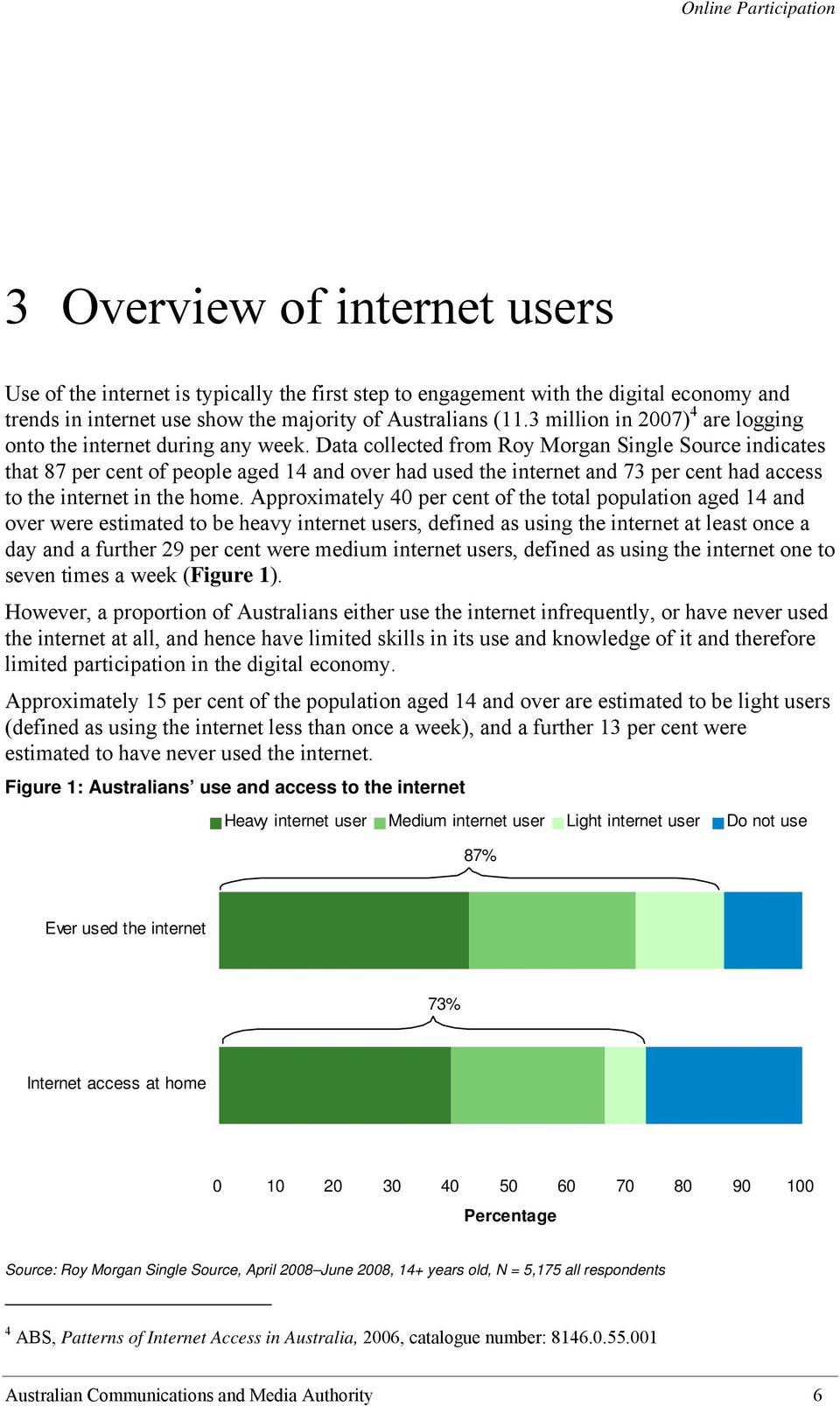
10 3 Overview of internet users Use of the internet is typically the first step to engagement with the digital economy and trends in internet use show the majority of Australians (11.3 million in 2007) 4 are logging onto the internet during any week. Data collected from Roy Morgan Single Source indicates that 87 per cent of people aged 14 and over had used the internet and 73 per cent had access to the internet in the home. Approximately 40 per cent of the total population aged 14 and over were estimated to be heavy internet users, defined as using the internet at least once a day and a further 29 per cent were medium internet users, defined as using the internet one to seven times a week (Figure 1). However, a proportion of Australians either use the internet infrequently, or have never used the internet at all, and hence have limited skills in its use and knowledge of it and therefore limited participation in the digital economy. Approximately 15 per cent of the population aged 14 and over are estimated to be light users (defined as using the internet less than once a week), and a further 13 per cent were estimated to have never used the internet. Figure 1: Australians use and access to the internet Heavy internet user Medium internet user Light internet user Do not use 87% Ever used the internet 73% Internet access at home Percentage 100 Source: Roy Morgan Single Source, April 2008 June 2008, 14+ years old, N = 5,175 all respondents 4 ABS, Patterns of Internet Access in Australia, 2006, catalogue number: Australian Communications and Media Authority 6
11 The links between internet access and factors such as age, education and income levels have been clearly established in previous research, in particular the Australian Bureau of Statistics (ABS) report, Patterns of Internet Access in Australia , This study based on data collected in the 2006 census showed that characteristics such as income, family structure and level of education influenced take-up of the internet. Some of the key findings from this study include the following: Households with an income of $2,000 or more per week were three times more likely to have broadband access than households on less than $600 per week. Australians with postgraduate degrees were 83 per cent more likely to have broadband access at home than people with no tertiary qualifications. Families with children under 15 years of age or dependant students were three to four times more likely to have internet access at home than other family structures. Australians in low-skill occupations were 27 per cent less likely to have broadband access at home than those employed in high-skill occupations such as managers and professionals. Unemployed Australians were 12 per cent less likely to have broadband access at home. 3.1 Internet and broadband connection at home The ABS recorded 6.2 million home internet connections in Australia at June From Roy Morgan data, approximately 73 per cent of people aged 14 and over lived in a household with an internet connection in the quarter to June 2008 and 58 per cent of people aged 14 and over lived in a household with a broadband connection (which comprises 79 per cent of internet connections). Broadband connections are considered critical to the digital economy as they are always on and allow users to download and upload information in a timely manner. As well as the proportion of broadband connections increasing, there is also a trend to adopt services with higher download speeds and the ABS data indicates that 32 per cent of internet connections had a download speed greater than 1.5 Mbit/s at June Data from the Roy Morgan Single Source showed there were a number of factors which affect the propensity to subscribe to an internet or broadband service at home, including: Age only 48 per cent of those aged 65 and over have a home internet connection and only 30 per cent had broadband. Education level 49 per cent of those who did not undertake further education had a broadband connection, compared to 70 per cent with some further education. Work status retirees were less likely to have an internet connection at home (55 per cent) than other work status groups. Occupation those unemployed were less likely to have a broadband connection at home (46 per cent) and professionals were more likely to have a broadband connection at home (79 per cent). 5 ABS, Internet Activity, Australia, June 2008, catalogue number: Australian Communications and Media Authority 7
12 Income those earning under $30,000 a year were less likely to have an internet connection (45 per cent) or broadband connection (29 per cent) than those earning over $110,000 (82 per cent and 67 per cent, respectively). Living arrangements Australians who live in a household with a partner and children were more likely to have an internet connection (83 per cent) and this is more likely to be a broadband connection (68 per cent). 3.2 Ever used the internet Age is the most significant driver of internet use, according to Roy Morgan Single Source survey data. The majority of all age groups are using the internet except those aged 65 and over. All respondents aged 14 to 17 have used the internet and 92 per cent were heavy or medium users. In contrast, of those aged 65 and over only 56 per cent have ever used the internet and 40 per cent indicated that they were heavy or medium users. Figure 2: Users of the internet, by age 100 Percentage Do not use Light internet user Medium internet user Heavy internet user 20 0 Total and over Source: Roy Morgan Single Source, April 2008 June 2008, 14+ years old, N = 5,175 all respondents Other factors influence online participation levels to varying degrees: Education level those with higher education were more likely to have used the internet (96 per cent) than those with primary school education only (45 per cent). It should be noted that 81 per cent of people with only a primary school education are aged 50 and over. Work status retirees were less likely to have used the internet (62 per cent) than other work status groups (average 93 per cent). Again, this relates to age, with 98 per cent of retirees aged over 50. Occupation the unemployed and farm owners were less likely to have used the internet (both 77 per cent) than other occupations (average of 94 per cent). Income those earning less than $30,000 a year were less likely to have used the internet (64 per cent) compared with other income groups (75 per cent of those earning between $25,000 and $50,000 and 92 per cent of those earning over $50,000). Australian Communications and Media Authority 8

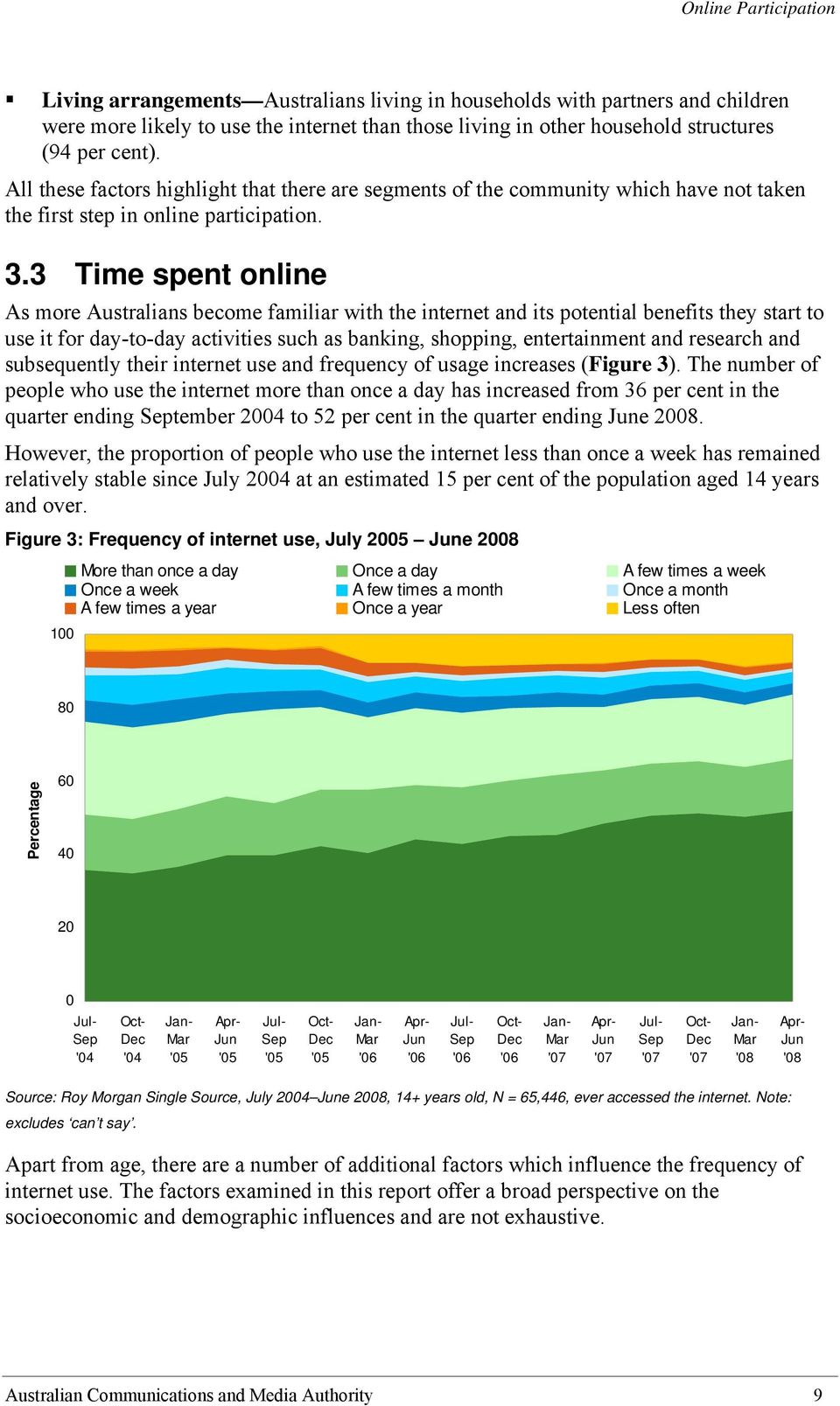
13 Living arrangements Australians living in households with partners and children were more likely to use the internet than those living in other household structures (94 per cent). All these factors highlight that there are segments of the community which have not taken the first step in online participation. 3.3 Time spent online As more Australians become familiar with the internet and its potential benefits they start to use it for day-to-day activities such as banking, shopping, entertainment and research and subsequently their internet use and frequency of usage increases (Figure 3). The number of people who use the internet more than once a day has increased from 36 per cent in the quarter ending September 2004 to 52 per cent in the quarter ending June However, the proportion of people who use the internet less than once a week has remained relatively stable since July 2004 at an estimated 15 per cent of the population aged 14 years and over. Figure 3: Frequency of internet use, July 2005 June More than once a day Once a day A few times a week Once a week A few times a month Once a month A few times a year Once a year Less often 80 Percentage Jul- Oct- Jan- Apr- Jul- Oct- Jan- Apr- Jul- Oct- Jan- Apr- Jul- Oct- Jan- Apr- Sep Dec Mar Jun Sep Dec Mar Jun Sep Dec Mar Jun Sep Dec Mar Jun '04 '04 '05 '05 '05 '05 '06 '06 '06 '06 '07 '07 '07 '07 '08 '08 Source: Roy Morgan Single Source, July 2004 June 2008, 14+ years old, N = 65,446, ever accessed the internet. Note: excludes can t say. Apart from age, there are a number of additional factors which influence the frequency of internet use. The factors examined in this report offer a broad perspective on the socioeconomic and demographic influences and are not exhaustive. Australian Communications and Media Authority 9
14 Age As shown in Figure 4, those aged 14 to 49 were more likely to be heavy internet users, with around 55 per cent using the internet more than once a day. This compares with 49 per cent of those aged 50 to 64 and only 33 per cent of those aged 65 and over. Figure 4: Factors influencing frequency of internet use by age 100 Percentage Less often Once a year A few times a year Once a month A few times a month Once a week A few times a week Once a day More than once a day and over Source: Roy Morgan Single Source, April 2004 June 2008, 14+ years old, N = 3,909 ever accessed the internet, N = 3,865 home internet connection. Note: excludes can t say Gender Gender also had an impact on frequency of use. Males were more likely to use the internet than females, with 56 per cent using the internet more than once a day compared with 48 per cent of females (Figure 5). Figure 5: Factors influencing frequency of internet use by gender 100 Percentage Less often Once a year A few times a year Once a month A few times a month Once a week A few times a week Once a day More than once a day 0 Female Male Source: Roy Morgan Single Source, April 2004 June 2008, 14+ years old, N = 3,909 ever accessed the internet, N = 3,865 home internet connection. Note: excludes can t say. Australian Communications and Media Authority 10

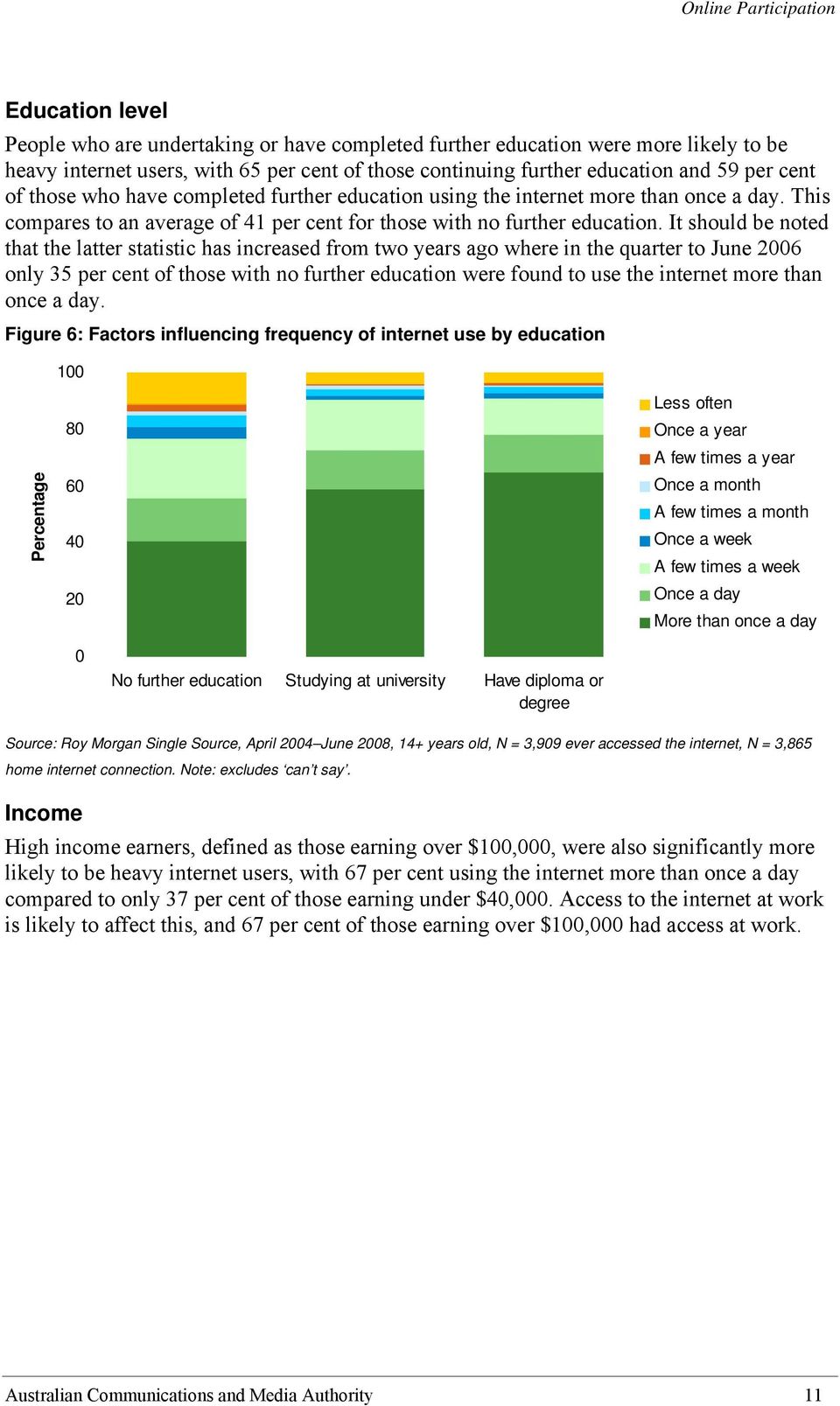
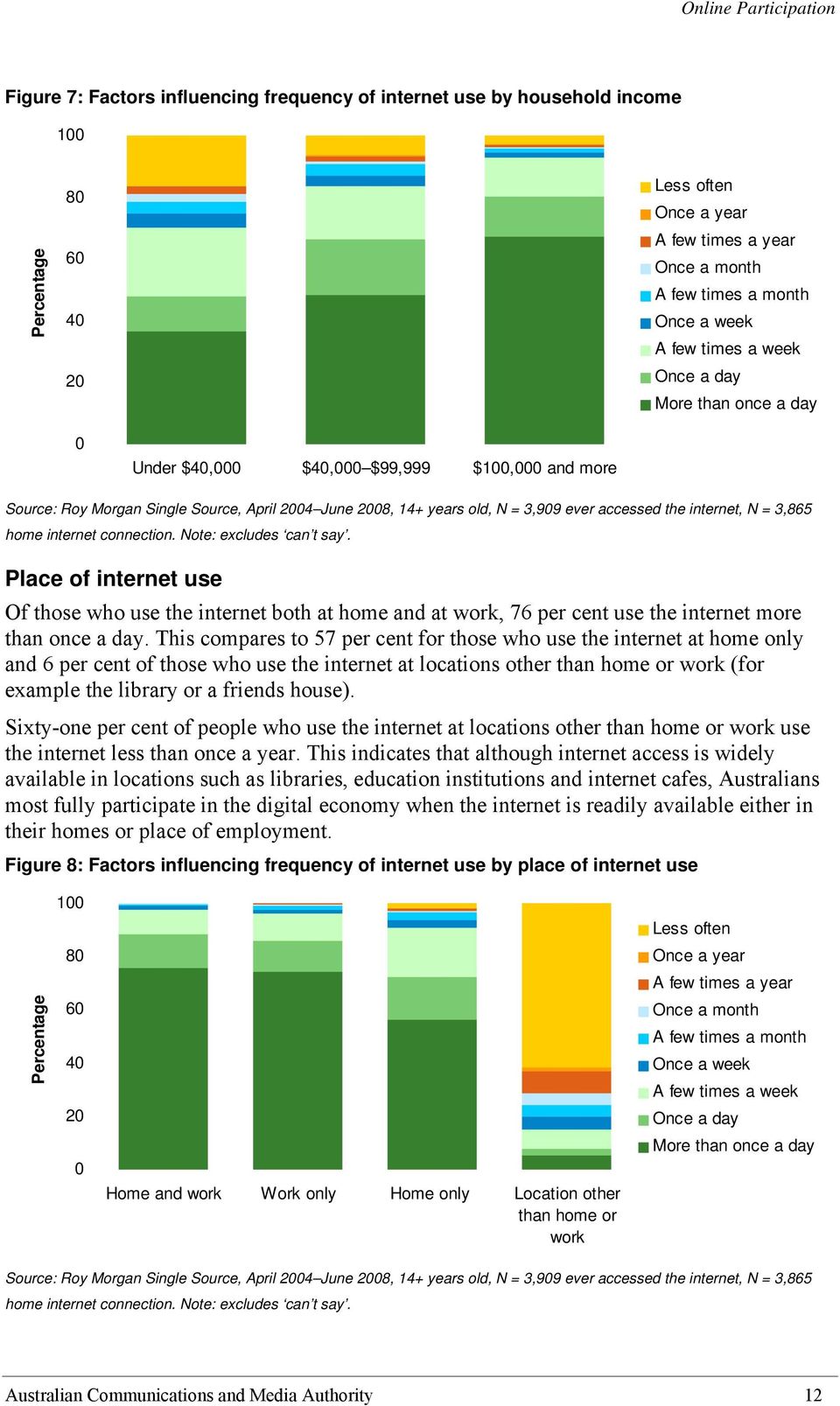
15 Education level People who are undertaking or have completed further education were more likely to be heavy internet users, with 65 per cent of those continuing further education and 59 per cent of those who have completed further education using the internet more than once a day. This compares to an average of 41 per cent for those with no further education. It should be noted that the latter statistic has increased from two years ago where in the quarter to June 2006 only 35 per cent of those with no further education were found to use the internet more than once a day. Figure 6: Factors influencing frequency of internet use by education 100 Percentage Less often Once a year A few times a year Once a month A few times a month Once a week A few times a week Once a day More than once a day 0 No further education Studying at university Have diploma or degree Source: Roy Morgan Single Source, April 2004 June 2008, 14+ years old, N = 3,909 ever accessed the internet, N = 3,865 home internet connection. Note: excludes can t say. Income High income earners, defined as those earning over $100,000, were also significantly more likely to be heavy internet users, with 67 per cent using the internet more than once a day compared to only 37 per cent of those earning under $40,000. Access to the internet at work is likely to affect this, and 67 per cent of those earning over $100,000 had access at work. Australian Communications and Media Authority 11
16 Figure 7: Factors influencing frequency of internet use by household income 100 Percentage Less often Once a year A few times a year Once a month A few times a month Once a week A few times a week Once a day More than once a day 0 Under $40,000 $40,000 $99,999 $100,000 and more Source: Roy Morgan Single Source, April 2004 June 2008, 14+ years old, N = 3,909 ever accessed the internet, N = 3,865 home internet connection. Note: excludes can t say. Place of internet use Of those who use the internet both at home and at work, 76 per cent use the internet more than once a day. This compares to 57 per cent for those who use the internet at home only and 6 per cent of those who use the internet at locations other than home or work (for example the library or a friends house). Sixty-one per cent of people who use the internet at locations other than home or work use the internet less than once a year. This indicates that although internet access is widely available in locations such as libraries, education institutions and internet cafes, Australians most fully participate in the digital economy when the internet is readily available either in their homes or place of employment. Figure 8: Factors influencing frequency of internet use by place of internet use Percentage Home and work Work only Home only Location other than home or work Less often Once a year A few times a year Once a month A few times a month Once a week A few times a week Once a day More than once a day Source: Roy Morgan Single Source, April 2004 June 2008, 14+ years old, N = 3,909 ever accessed the internet, N = 3,865 home internet connection. Note: excludes can t say. Australian Communications and Media Authority 12
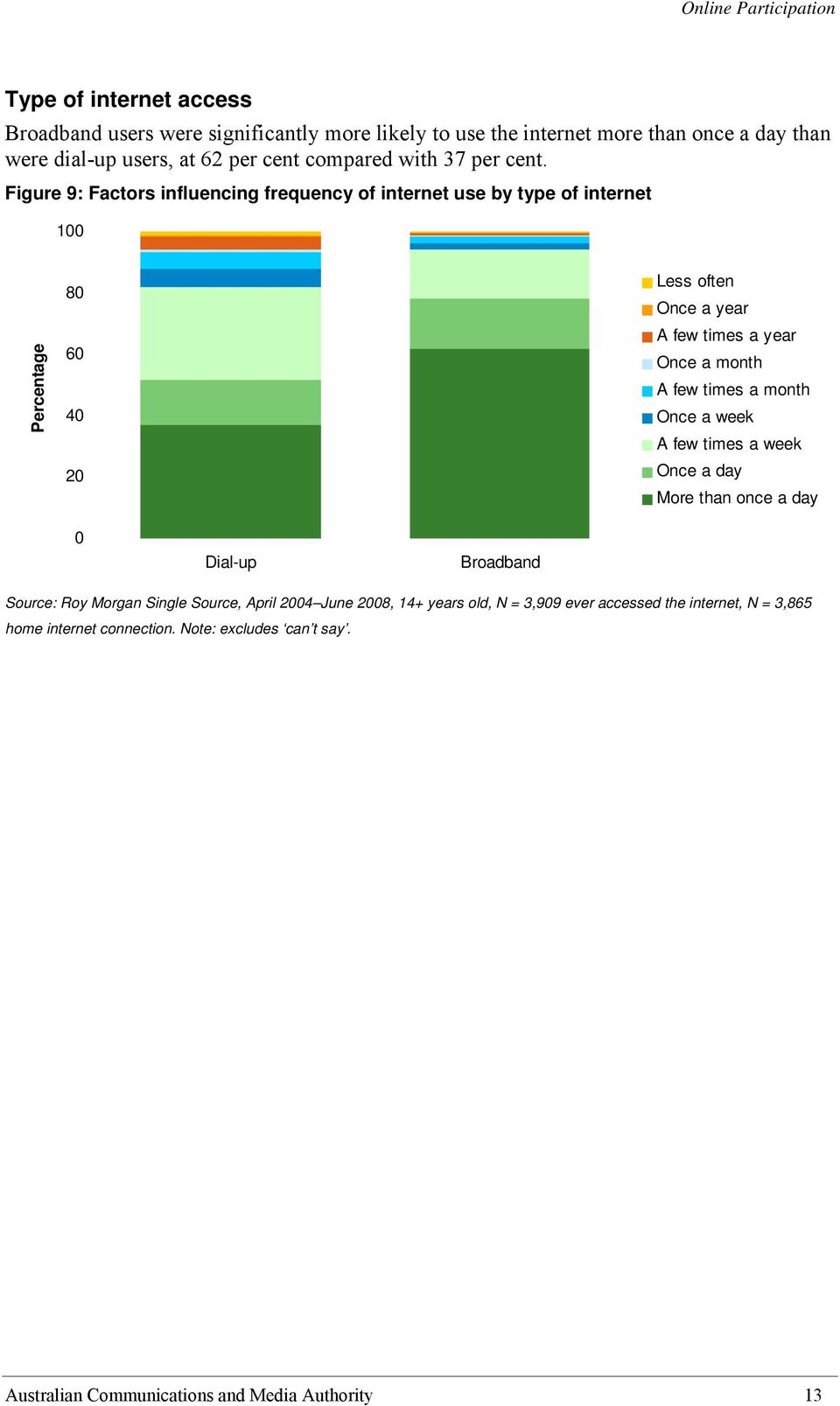
17 Type of internet access Broadband users were significantly more likely to use the internet more than once a day than were dial-up users, at 62 per cent compared with 37 per cent. Figure 9: Factors influencing frequency of internet use by type of internet 100 Percentage Less often 80 Once a year A few times a year 60 Once a month A few times a month 40 Once a week A few times a week 20 Once a day More than once a day 0 Dial-up Broadband Source: Roy Morgan Single Source, April 2004 June 2008, 14+ years old, N = 3,909 ever accessed the internet, N = 3,865 home internet connection. Note: excludes can t say. Australian Communications and Media Authority 13
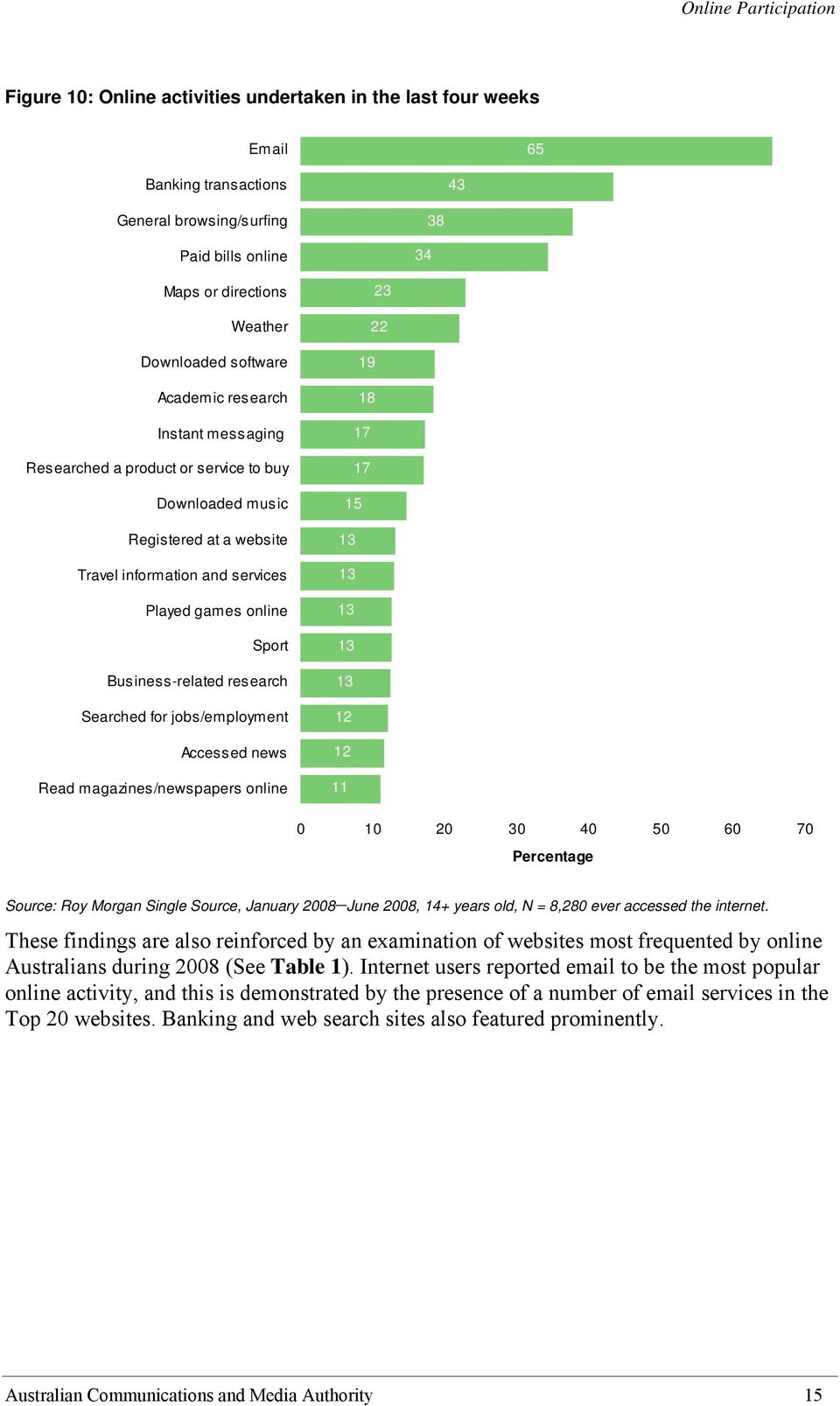
18 4 Online participation The previous section identified a range of factors influencing people s propensity to use or connect to the internet. This section examines how these factors affect the type of activities Australians undertake online, particularly the use of emerging online applications and services such as chat, instant messaging (IM), voice over internet protocol (VoIP) and movies and videos. 4.1 Online activities, services and content The most commonly used internet activity is , followed by banking transactions, general browsing and surfing, and paying bills. This is similar to the results presented in the ACMA report, Telecommunications Today Report 6: Internet Activity and Content Australian Communications and Media Authority 14
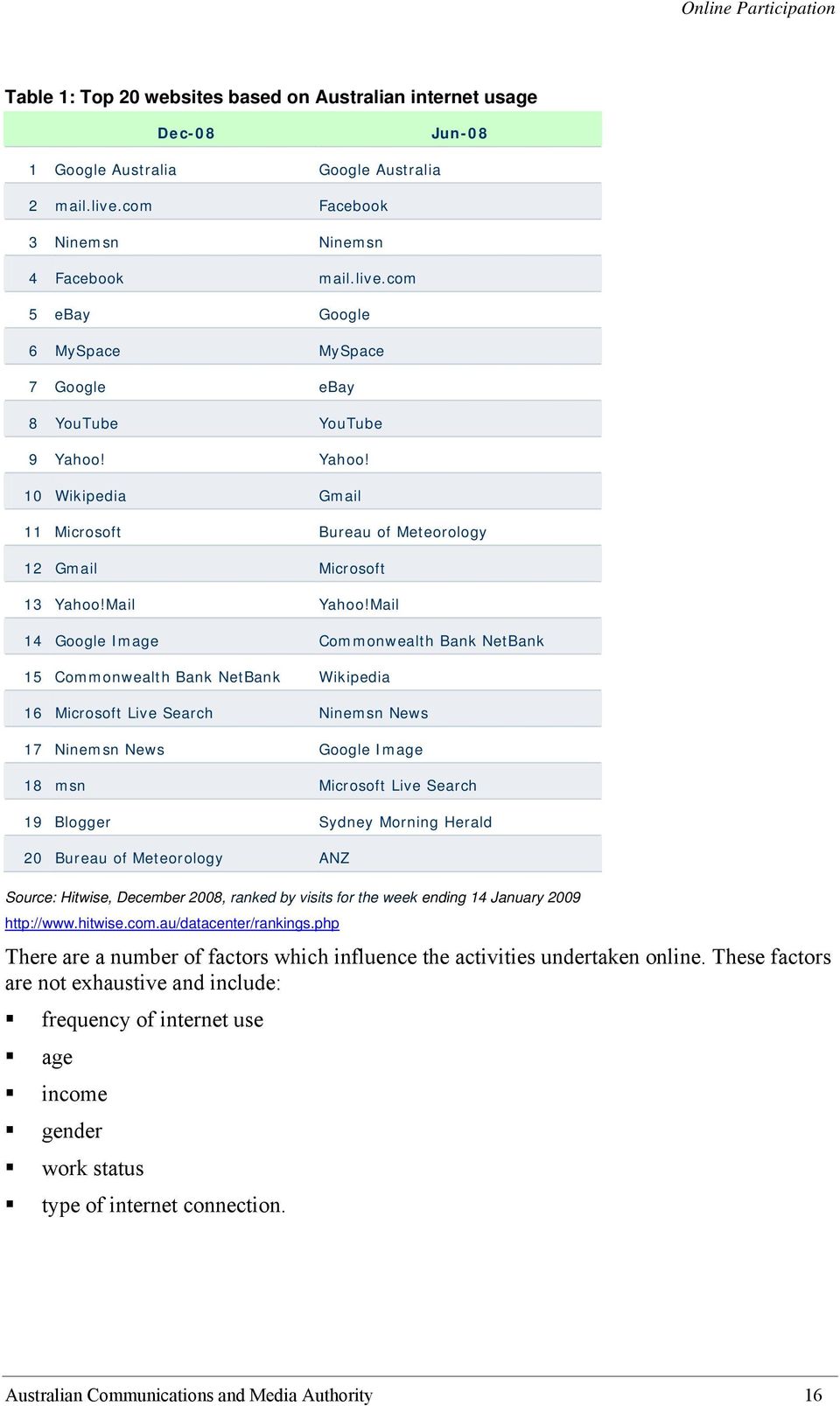
19 Figure 10: Online activities undertaken in the last four weeks 65 Banking transactions 43 General browsing/surfing 38 Paid bills online 34 Maps or directions 23 Weather 22 Downloaded software 19 Academic research 18 Instant messaging 17 Researched a product or service to buy 17 Downloaded music Registered at a website Travel information and services Played games online Sport Business-related research Searched for jobs/employment Accessed news Read magazines/newspapers online Percentage Source: Roy Morgan Single Source, January 2008 June 2008, 14+ years old, N = 8,280 ever accessed the internet. These findings are also reinforced by an examination of websites most frequented by online Australians during 2008 (See Table 1). Internet users reported to be the most popular online activity, and this is demonstrated by the presence of a number of services in the Top 20 websites. Banking and web search sites also featured prominently. Australian Communications and Media Authority 15
20 Table 1: Top 20 websites based on Australian internet usage Dec-08 Jun-08 1 Google Australia Google Australia 2 mail.live.com Facebook 3 Ninemsn Ninemsn 4 Facebook mail.live.com 5 ebay Google 6 MySpace MySpace 7 Google ebay 8 YouTube YouTube 9 Yahoo! Yahoo! 10 Wikipedia Gmail 11 Microsoft Bureau of Meteorology 12 Gmail Microsoft 13 Yahoo!Mail Yahoo!Mail 14 Google Image Commonwealth Bank NetBank 15 Commonwealth Bank NetBank Wikipedia 16 Microsoft Live Search Ninemsn News 17 Ninemsn News Google Image 18 msn Microsoft Live Search 19 Blogger Sydney Morning Herald 20 Bureau of Meteorology ANZ Source: Hitwise, December 2008, ranked by visits for the week ending 14 January There are a number of factors which influence the activities undertaken online. These factors are not exhaustive and include: frequency of internet use age income gender work status type of internet connection. Australian Communications and Media Authority 16
21 FREQUENCY OF INTERNET USE Frequency of internet use has an effect on the level of participation in the digital economy and use is strongly influenced by a number of factors including age, income, gender, education level and type of connection. Australians who are heavy or medium internet users are more likely to participate in a range of activities, including communication, entertainment, research and e-commerce as shown in Figure 11. Over 90 per cent of heavy internet users did one or more online activities in the last four weeks compared to only 38 per cent of light users. Heavy users were also seven times more likely to participate in blogging and online community activities and six times more likely to participate in interactive activities such as creating or registering their own website. Figure 11: Frequency of internet use and online activities Percentage Did one or more internet activities online in the last 4 weeks Communication activities Research & information activities Banking & shopping activities General purpose activities Entertainment & amusement activities Interactive activities Blogging & online communities activities 0 Heavy internet use Medium internet use Light internet use Source: Roy Morgan Single Source, January 2008 June 2008, 14+ years old, N = 8,280 ever accessed the internet AGE As outlined in the Telecommunication Today: Internet Activity and Content report, age is a determining factor in the activities users choose to perform online. Data from Roy Morgan Single Source supports this and Table 2 shows that is the most common application while banking transactions were also an important activity across all age groups. Australians aged between 14 and 17 years were more likely to use the internet for communication and entertainment, with IM, downloading music, playing games online and using and contributing to online communities all featuring in the top 10 activities undertaken online. More than half of 14 to 17-year-olds used IM compared with an average of only 17 per cent for other age groups, and 40 per cent of 14 to 17-year-olds downloaded music compared with an average of 15 per cent for other age groups. The propensity for people to undertake these activities online decreases with age, older age groups were more likely to indicate bill payments, banking, general browsing and research activities in their top 10 online activities. Australian Communications and Media Authority 17
22 Table 2: Internet activities undertaken in the last four weeks by age and over Instant messaging Banking transactions Banking transactions Banking transactions Banking transactions Banking transactions 3 Downloaded music General browsing/surfing Paid bills online Paid bills online Paid bills online Paid bills online 4 Played games online Instant messaging General browsing/surfing General browsing/surfing General browsing/surfing General browsing/surfing 5 General browsing/surfing Downloaded music Maps or directions Maps or directions Maps or directions Weather 6 Downloaded software Academic research Weather Weather Weather Maps or directions 7 Academic research Maps and directions Downloaded software Researched a product or service to buy Researched a product or service to buy Researched travel information 8 Read or added a comment to someone else s journal or blog Paid bills online Researched a product or service to buy Downloaded software Researched travel information Researched a product or service to buy 9 Used internet group/ community Searched for weather Instant messaging Academic research Academic research Downloaded software 10 Researched sport Searched for jobs and employment Downloaded music Business-related research Business-related research Source: Roy Morgan Single Source, January 2008 June 2008, 14+ years old, N = 8,280 ever accessed the internet Used government services Australian Communications and Media Authority 18
23 GENDER Although gender has minimal influence on whether people use the internet or their frequency of use, it does affect the type of activities undertaken online, with males more likely to undertake a wider range of activities than females. Males were more likely to undertake general purpose activities such as web browsing and downloading software and entertainment and amusement activities such as downloading music, pictures and video clips, playing and downloading games and streaming radio and music. Although there was a small difference in the proportion of males or females undertaking research and information-related activities online, there were marked differences in the type of research undertaken or information accessed online. Men were much more likely to access sport, business-related information and news and females were more likely to access travel information services, health and medical information and celebrity information. Figure 12: Online activities undertaken in the last four weeks, by gender Communication activities Research & information activities Banking & shopping activities General purposes activities Entertainment & amusement activities Men Women Interactive activities Blogging & online communities activities Percentage Source: Roy Morgan Single Source, January 2008 June 2008, 14+ years old, N = 8,280 ever accessed the internet Australian Communications and Media Authority 19
24 INCOME Income also plays a role in the activities performed online. As shown in Figure 13, the more a person earns, the more likely they are to undertake a wider range of activities online more often. In particular, those earning over $50,000 were significantly more likely to bank online than those earning under $25,000 (59 per cent compared to 29 per cent) and they were also more likely to use interactive tools such as registering information on a website, entering online competitions and managing their own websites 24 per cent compared to 10 per cent. The propensity to undertake entertainment and amusement-related activities online was not affected by personal income levels with similar levels of use (30 per cent) recorded across all income ranges. Figure 13: Online activities undertaken in the last four weeks by income level 100 Online communication activities Banking and shopping Entertainment and amusement Blogging and online activities Research and information General browsing Interactive activities 80 Percentage Under $25,000 $25,000 $49,999 $50000 $89,999 $90,000 $119,999 $120,000 and over Source: Roy Morgan Single Source, January 2008 June 2008, 14+ years old, N = 8,280 ever accessed the internet WORK STATUS Work status has an effect on the type of activities undertaken online. However, this is in part also a factor of other socioeconomic influences such as income and age; students and those who do not work were more likely to earn less and those retired were more likely to be aged 65 and over. Employed people are numerically the largest single group of internet users and tend to have some of the highest levels of online participation. It is therefore useful to compare the levels of online participation for other work status groups (activities undertaken online) to participation levels for employed people as shown in Table 3. This table shows that other work status groups were less likely to use most online applications particularly , banking and paying bills online or undertaking online searches for maps or directions, weather, travel information and research product and services to buy. However, there are a number of activities and applications that are more prominent for other work status groups. For example students were more likely to undertake academic research online than employed people a 21 percentage point difference and people looking for Australian Communications and Media Authority 20
25 work were more likely to use the internet to search for employment than those in employment a 21 percentage point difference. Both students and those looking for work were also more likely to use newer application such as IM, and to download music and play games online while students were also more likely to download software, browse and . These work status groups tend to be younger and have more discretionary time to spend online. Table 3: Percentage point difference in online activities of other work status groups to those employed Employed Looking for work Students Home duties Don't work Retired Percentage point difference from those employed 69% Banking transactions 51% General browsing/surfing 41% Paid bills online 41% Maps or directions 27% Weather 25% Researched a product or service to buy 20% Downloaded software 20% Academic research 20% Business related research 18% Instant Messaging 17% Downloaded music 15% Sport 15% Travel information and services 15% Searched for jobs/employment 14% Played games online 11% Source: Roy Morgan Single Source, January 2008 June 2008, 14+ years old, N = 8,280 ever accessed the internet, activities undertaken in the last four weeks. Note: the orange shaded cells highlight where a work status group is significantly more likely to undertake an activity than those employed. Australian Communications and Media Authority 21
26 TYPE OF INTERNET CONNECTION The type of internet connection has a significant effect on the level of online participation. People using broadband at home were more likely to undertake a wider range of activities than users of dial-up internet. Eighty-seven per cent of home broadband users undertook one or more internet activities in the last four weeks compared with 77 per cent of dial-up users. Broadband users were twice as likely to use the internet for interactive activities such as entering competitions, setting up their own websites and blog and community activities than dial-up users, a quarter of broadband users undertaking these activities compared to only around 11 per cent of dial-up users. Dial-up users were more likely to undertake communication, research and banking and shopping activities. Figure 14: Online activities undertaken in the last four weeks, by internet connection type Did one or more internet activities online in the last 4 weeks Communication activities online Research & information activities Banking & shopping activities General purposes activities Entertainment & amusement activities Other interactive activities Dial-up Broadband Blogging & online communities activities Percentage Source: Roy Morgan Single Source, January 2008 June 2008, 14+ years old, N = 6,811 has an internet connection at home Australian Communications and Media Authority 22
27 4.2 Use of emerging online activities The internet is transforming how people communicate. Where previously communication was limited to traditional voice telephony using the fixed line or mobile phone, the internet has now enabled the emergence of new channels for communicating and the development of online communities around interests and lifestyles. There are a number of emerging online communication activities and applications highlighted in the list of Top 20 websites in Table 1 which have experienced significant growth in adoption levels in recent years. User-generated content (UGC) and social networking sites such as Facebook, MySpace, YouTube and Wikipedia now rank among the Top 20 most frequently visited sites. Research undertaken by Australian Government Information Management Office into Australians use and satisfaction with electronic government (e-government) services supports this, and indicates that four in five internet users undertake at least one of the newer communication activities at least monthly, if not more regularly. The most common activities include: , used by 75 per cent news feeds (Really Simple Syndication or RSS), used by 39 per cent instant messaging, used by 29 per cent social networking sites, used by 22 per cent blogs, read by 22 per cent. This research also indicated that there is a very strong correlation with newer communication activities and age, with nearly all those under 35 involved in some form of activity at least once a month. This research also indicates older age groups use these services, but do not access them as frequently as the younger age groups. 6 6 Government Information Management Office (AGIMO), Interacting With Government: Australians Use and Satisfaction With E-government Services, December 2008 Australian Communications and Media Authority 23
28 Figure 15: Use of emerging online communication technologies, by average age of users Do not use at least monthly Use at least monthly Age Use social Maintain Instant Use wikis Read blogs Post to an Listen to Read news networking your own messaging online podcasts feeds sites blog community Source: Interacting With Government: Australians Use and Satisfaction With E-government Services Data presented in Table 4 indicates that while users of these emerging applications are generally younger, these applications are still used to varying degrees across all age groups. The importance of these services to the general internet population is becoming increasingly apparent, so the following analysis reviews the use of communication and content applications in more detail. Table 4: Demographic of types of websites Chat and IM UGC Videos/ movies VoIP Sex Female 53% 50% 49% 46% 42% Male 47% 50% 51% 54% 58% Age % 7% 7% 7% 3% % 18% 15% 15% 8% % 11% 10% 8% 6% % 15% 18% 17% 22% % 25% 27% 29% 26% % 18% 19% 19% 25% 65+ 5% 5% 5% 5% 11% Location Metro 72% 68% 68% 69% n/a Regional 28% 32% 72% 31% n/a Source: Nielsen Online, Netview Home & Work Panel, April Australian Communications and Media Authority 24
29 Chat, IM and was the top ranked activity across all age groups and IM ranked highly for those under 34 years of age. According to the Nielsen Online, Netview Home & Work Panel at April 2008 the most popular sites accessed by Australians were Windows Live Hotmail, Yahoo!7 Mail and Google Gmail, which in aggregation had a unique audience of 5.8 million people. However, with the increase in UGC sites which offer online facilities the audience for sites has declined by 8 per cent in the year to April This is also apparent by viewing the Hitwise web site ranking, which indicated that Hotmail is declining in popularity. Of the chat and IM services accessed by Australian internet users, Windows Live Messenger is by far the most frequented site with an audience of 4.3 million. The next most common is Yahoo! Messenger, with an audience of 459,000. The demographic data presented in Figure 16 indicates that is widely used across all age groups; however, its use decreases with age with only 49 per cent of people aged 65 and over using the service, compared with an average of 73 per cent for those aged 14 to 34. The use of IM and chat rooms is predominantly by younger people, with 53 per cent of 14 to 17- year-olds using IM, and 38 per cent of 18 to 24-year-olds. Figure 16: , IM and chat room services used in the last four weeks, by age 100 Instant messaging Chat rooms 80 Percentage and over Source: Roy Morgan Single Source, January 2008 June 2008, 14+ years old, N = 8,280 ever accessed the internet. For IM and chat rooms, age is the most dominant influencing factor; however, for other factors such as income, work status, education level and occupation affect on use of service. For example, more highly educated people, those that earn more and those who work in a professional or white collar vocation were more likely to use services in many cases this is likely to be work-based . Correspondingly, those earning less, based at home or retired, and have limited education use less. User-generated content (UGC) According to the Nielsen Online, Netview Home & Work Panel the most popular UGC site in Australia at April 2008 was Wikipedia.org with an audience of 3.3 million followed by Facebook and MySpace, each with an audience of 2.6 million. Australian Communications and Media Authority 25
30 In the year to April 2008, UGC sites experienced a 16 per cent increase in users. However, there were a number of sites which experienced significant growth, such as Facebook with an audience growth of 816 per cent over the year. This was to the detriment of other small UGC sites. Not only is access to these sites increasing, but Nielsen s Online indicated people were spending almost two hours per month on UGC sites at April Frequency of visits and pages viewed per person were also very high. Overall internet usage trends in the month of April 2008 indicate the average person accessed the internet 35 times and visited UGC sites 11 times. The average person viewed 1,393 web pages a month and 300 of these page views were on UGC sites. In terms of demographic profiles, half of the Australian audience of UGC sites are under the age of 35; however, there has been a 20 per cent increase in the number of people aged over 50 accessing UGC sites in the year to April A variety of activities can be undertaken on UGC sites. Data from Roy Morgan Single Source shows the scope of activities undertaken and the affect age has on participation levels (Figure 17). Twenty per cent of 18 to 24-year-olds who had used the internet in the last four weeks had read or added a comment to someone else s online journal or blog compared to only 3 per cent of people aged 65 and over. Using internet groups/communities to create a personal space that friends can access was also more common among younger users. In the older age groups the most common activity noted was to view or contribute to online forums. Figure 17: UGC activities and age 20 Percentage Read or added a comment to someone else's online journal or blog Used internet groups/communities to create a personal space that friends can access Viewed or contributed to online forums Created/managed an online journal or blog 5 Participated in online virtual communities and over Read or added a comment to an online newspaper blog Source: Roy Morgan Single Source, January 2008 June 2008, 14+ years old, N = 8,280 ever accessed the internet Australian Communications and Media Authority 26
31 Movies and video According to the Nielsen Online, Netview Home & Work Panel, the most popular movie and video site in Australia is YouTube, with an audience of 3.5 million. This is followed by Lycos Europe Movies with an audience of 1.1 million and Ninemsn Video with an audience of 918,000. Over the year to April 2008 there was a 16 per cent increase in the audience of movie and video sites. The demographic profile of users of movies and video sites is similar to other interactive services with nearly half aged under 35; however, these sites are increasingly being used by all age groups. Slightly more males than females access movie and video sites. While data from Roy Morgan Single Source indicates that the use of movies and video is still relatively small when compared to more traditional online activities, gender differences are apparent, with males using these services more than females, particularly for downloading video clips, with 75 per cent of video clip downloads undertaken by males. Again age was shown to be an influencing factor, of those that downloaded video clips 37 per cent were aged 14 to 24, 50 per cent were aged 25 to 49, and only 14 per cent were aged 50 and over. VoIP VoIP has emerged as a new platform for fixed-line (and recently mobile) communications, and a potential substitute for public switched telephone network (PSTN) fixed-voice services. The most popular VoIP service in Australia is Skype with an audience of nearly one million at April This is followed by GoogleTalk. According to the Nielsen s Online, Netview Home & Work Panel, VoIP services have a higher age demographic than the other services and applications discussed in this section. A third of VoIP users were aged 50 and over, over half were aged between 25 and 49 and only 16 per cent were under 25 years of age. Use was also higher among males, at 58 per cent compared to 42 per cent of females. According to Roy Morgan, in the six months to June 2008 eight per cent of internet users had made a telephone call over the internet in the past four weeks. Australian Communications and Media Authority 27
32 FREQUENCY OF USE OF EMERGING ONLINE APPLICATIONS As Australians increase their use of the internet and become more knowledgeable and confident, their use of emerging online applications also increases. Heavy internet users tend to be leaders and drivers in the use of new applications such as VoIP, and there is a direct correlation between adoption of these services and general frequency of internet use. As shown in Figure 18, there is a difference in the use of emerging online applications among heavy, medium and light users. For example heavy users were twice more likely to make calls over the internet than medium users, and medium users were more than three times as likely to make calls over the internet than light users. Figure 18: Frequency of internet use and a selection of new online activities and applications Light internet user Medium internet user Heavy internet user Movies and Videos UGC Communications Instant messaging Made telephone calls over the internet Chat rooms Registered at a website giving name or other information Entered competitions through websites Read/added comments to someone else's online journal/blog Viewed or contributed to online forums Used internet groups/communities to create a personal space Downloaded video clips Downloaded TV programs Streamed video Percentage Source: Roy Morgan Single Source, January 2008-June 2008, 14+ years old, N = 6,811 internet access at home Australian Communications and Media Authority 28
33 BROADBAND AND THE USE OF EMERGING ONLINE APPLICATIONS Broadband allows for the download of more data at faster speeds. This is particularly important for many of the new data-intensive online activities and applications such as movies, videos and VoIP. Many new sites are also designed for optimum viewing on a broadband connection as they have heavy video or graphic content leaving dial-up users with an impaired viewing. This is reflected in the activities which people undertake via a dial-up connection versus a broadband connection. Broadband users were twice more likely to use a range of emerging communication applications such as VoIP, movies, videos, blogs and community-related activities than users of dial-up internet. Table 5: Newer applications and broadband Dial-up Broadband Communications Instant messaging VoIP Chat rooms UGC Registered at a website giving name or other information Entered competitions through websites Read or added a comment to someone else's online journal or blog Viewed or contributed to online forums Used internet groups/communities to create a personal space that friends can access Read or added a comment to an online newspaper blog Created/managed your own website Participated in online virtual communities Created/managed an online journal or blog Movies and videos Downloaded video clips Downloaded TV programs Streamed TV Downloaded a feature length movie Streamed video 57.6% 11.6% 2.4% 2.1% 7.3% 4.9% 4.6% 4.9% 3.8% 2.7% 1.3% 2.6% 1.2% 2.9% 1.5% 0.8% 0.3% 0.4% 73.4% 20.8% 10.2% 3.7% 16.5% 11.0% 10.0% 9.5% 7.3% 6.0% 5.4% 4.8% 3.6% 8.9% 4.2% 2.5% 3.1% 3.2% Source: Roy Morgan Single Source, January 2008 June 2008, 14+ years old, N = 6,811 internet access at home Australian Communications and Media Authority 29
34 5 Non-connected Australians While the majority of Australians use the internet and participate online to some degree, there are still an estimated 2.6 million Australians who do not use the internet. 7 While the level of internet use is only one measure by which we can determine inclusion, it clearly shows that not all sections of the community are equally involved in the digital economy. Roy Morgan data shows 73 per cent of Australians aged 14 years and over have an internet connection in their home and that those without an internet connection at home were less likely to use the internet frequently, suggesting 27 per cent of Australians are not participating online. Figure 19: Internet connections in Australian homes, June 2008 No internet connection at home 27% Internet connection 73% Morgan Single Source, April 2008 June 2008, 14+ years old, N = 5,175 all respondents Source: Roy 7 ABS, Internet Activity, Australia, June 2008, catalogue number: Australian Communications and Media Authority 30
35 PROFILE OF THOSE WITHOUT A HOME INTERNET CONNECTION Age has a significant effect on the propensity to have an internet connection at home. Of those without an internet connection, nearly half were aged 50 and over, with the remainder split fairly evenly across other age groups. However, age was not the only determining factor as shown in Figure 20. Household income also played a part, and 66 per cent of people living in a household without an internet connection earn under $50,000 a year. People who either lived alone or with a partner and no children were also less likely to be connected to the internet. Over half of people who indicated they were not connected to the internet fitted into these categories; another third lived in a household with children. As expected, retirees were less likely to be connected to the internet and a third of those with no internet connection were retired. There were also a high proportion of people in full-time employment; it is likely they have access to the internet at work. Figure 20: Those without an internet connection, by age, work status, income and household structure Age Work status Total and over Full-time Retired Part-time Home duties Don't work Students Looking for work Income Household structure $100,000 and over Shared household Live alone $80,000 $99,999 Under $25,000 Boarder With parents $50,000 $79,000 Single parent Partner and no children $25,000 $49,999 Partner and children Source: Roy Morgan Single Source, July 2007 June 2008, 14+ years old, N =5,484 homes without internet access. Note: excludes can t say and no answer. Australian Communications and Media Authority 31
36 LIKELIHOOD OF USING THE INTERNET IN THE FUTURE Of those who have never used the internet, only six per cent indicated they were likely or very likely to use the internet in the next six months (Figure 20). Age had an impact, with only four per cent of those aged 65 and over indicating they were likely to use the internet, compared to 15 per cent of those aged between 14 and 49. There were a high number of don t know and can t say responses for this question indicating the lack of awareness of the internet among those who have never gone online. Figure 21: Likelihood to use the internet in the next six months Very likely Likely Unlikely Likelihood to connect to the internet Percentage Source: Roy Morgan Single Source, July 2007 June 2008, 14+ years old, N = 2,697 those do have never accessed the internet. Note: excludes Can t say and don t know Of those without an internet connection at home, 77 per cent indicated they did not intend to connect in the next six months. As shown in Figure 22, there were a number of factors which influence a person s propensity to connect to the internet, in particular age, work status and income. For example: Of those aged between 14 and 34, 20 per cent indicated they were likely to connect to the internet in the next six months, compared with only three per cent of those aged 65 and over. Students and those employed or looking for work were more likely to indicate they intend to connect in the future compared to those which are retired around 18 per cent than those who are retired three per cent. Those earning over $130,000 were more likely to connect to the internet in the next six months 32 per cent than those earning under $30,000 only seven per cent. Australian Communications and Media Authority 32
37 Figure 22: Likelihood to connect to the internet in the next six months Likely Unlikely Don't know Total and over Employed Home duties Looking for work Students Don't work Retired $130,000 or more $80,000 $129,999 $30,000 $79,000 Under $30, Source: Roy Morgan Single Source, July 2007 June 2008, 14+ years old, N = 1,334, households without internet. Note: excludes can t say. Australian Communications and Media Authority 33
38 REASONS FOR NON-CONNECTION Over half of people who do not plan to get an internet connection in the future stated lack of relevance to lifestyle as the reason for non-connection. This was followed by cost, which was cited by 38 per cent and too difficult cited by 15 per cent (Figure 23). Figure 23: Reason for internet non connection Not relevant to my lifestyle Too expensive Too difficult Already available to me at work Disappointed with what seen on internet so far Lack of confidence in the service provider Not available in the area I live in Other Percentage 60 Source: Roy Morgan Single Source, July 2007 June 2008, 14+ years old, N = 4,162, those who do not intend to connect to the internet. Note: excludes can t say and no answer Reason for non-connection was influenced by age, income, work status and household structure. For respondents aged 65 and over, lack of relevance was the most significant factor, with 75 per cent citing this compared with only 28 per cent of those aged 14 to 24. For those aged 50 and under cost was more of a concern. In terms of work status, retirees did not see the relevance of using the internet and students cited cost as the inhibiting factor. Those looking for work were also more likely to indicate cost as an inhibiting factor. Australians living in households with children without an internet connection were more likely to indicate that cost was a barrier, while those living alone or with their partner and no children were more likely to mention relevance. People earning less than $30,000 per annum were again more likely to indicate lack of relevance to their lifestyle as a barrier to connection to the internet, while people earning over $100,000 per annum were more likely to cite the availability of the internet elsewhere as a reason for not having the internet connected in the home. These results indicate that at a time when services are increasingly being delivered online and the relevance of the internet is increasing for most; those Australians not using the internet are potentially missing out on the benefits of the digital economy. Australian Communications and Media Authority 34
39 Conclusion Many Australians are now connected to the internet, with an ever-increasing number opting for a broadband connection. There are a number of socioeconomic and demographic factors which influence the take-up and use of the internet and internet activities. While there is no single internet usage profile, households with a broadband connection, households with children, younger Australians, those with a higher education and those with higher incomes are more likely to be connected and to use the internet more frequently. All Australians connected to the internet, no matter how frequent their online use, are interacting with the digital economy. The most common activities online include banking, , paying bills, general browsing and research, indicating many Australians now consider the internet an essential part of their life, as family, friends and colleagues increasingly engage with the online environment. However, the internet is also providing people with more choice of services through the enabling of new channels for communication and content services and providing alternatives to more traditional communication and content channels. In terms of the adoption of emerging internet applications such as UGC and social networking, age has the most significant impact, with younger Australians significantly more likely to engage with instant messaging and chat, as well as social and entertainment services, and accessing movies and videos. Although these activities and applications are more prominent among younger people, their use is increasing across all age groups indicating their increasing value to the broader online community. While the internet is becoming an essential part of most Australians lives there are segments of the community who use the internet infrequently or not at all. These Australians are generally aged 65 and over, retired, and living on their own and are more likely to earn under $50,000 a year. The majority of these people do not plan to connect to the internet in the future. While cost was indentified as a barrier to use, particularly by younger people, for most they did not connect to the internet as they saw no relevance or benefit to their lifestyle. Addressing these barriers to participation becomes important for social inclusion and ensuring that all Australians can garner the benefits of online activities in the digital economy. Access to the internet, an understanding of how to effectively use the internet and managing online risks are all important to a wider engagement in internet use and enhancing its role in underpinning the digital economy. Australian Communications and Media Authority 35
Communications report 2009 10 series Report 1 Australia in the digital economy: The shift to the online environment
 Communications report 2009 10 series Report 1 Australia in the digital economy: The shift to the online environment communicating facilitating regulating Canberra Purple Building Benjamin Offices Chan
Communications report 2013 14 series Report 1 Australians digital lives MARCH 2015
 Communications report 2013 14 series Report 1 Australians digital lives MARCH 2015 Canberra Red Building Benjamin Offices Chan Street Belconnen ACT PO Box 78 Belconnen ACT 2616 T +61 2 6219 5555 F +61
Australia in the Digital Economy Report 1: Trust and confidence
 Australia s regulator for broadcasting, radiocommunications, telecommunications and online content www.acma.gov.au Australia in the Digital Economy Report 1: Trust and confidence Australia in the Digital
Betting odds and advertising for betting agencies during sports broadcasts Community research JULY 2013
 Betting odds and advertising for betting agencies during sports broadcasts Community research JULY 2013 Canberra Purple Building Benjamin Offices Chan Street Belconnen ACT PO Box 78 Belconnen ACT 2616
Access to the internet, broadband and mobile phones in family households No. 3
 Australia s regulator for broadcasting, the internet, radiocommunications and telecommunications www.acma.gov.au Access to the internet, broadband and mobile phones in family households No. 3 September
AUSTRALIAN MULTI-SCREEN REPORT QUARTER 3 2014
 AUSTRALIAN MULTI-SCREEN REPORT QUARTER 3 TV AND OTHER VIDEO CONTENT ACROSS MULTIPLE SCREENS The edition of The Australian Multi-Screen Report provides the latest estimates of screen technology penetration
2011 Cell Phone Consumer Attitudes Study
 2011 Cell Phone Consumer Attitudes Study Prepared for: CWTA April 29, 2011 Copyright 2009-2012 Quorus Consulting Group Ltd. Table of Contents Executive Summary 3 Research Objectives and Methodology 9 Detailed
AUSTRALIAN ONLINE LANDSCAPE REVIEW MAY 2013
 AUSTRALIAN ONLINE LANDSCAPE REVIEW MAY 2013 SIGNIFICANT ENHANCEMENTS TO NIELSEN ONLINE RATINGS HYBRID DATA Summary: May data represents a trend break versus prior months across all metrics for Online Ratings
Emergency Call Service and Voice over Internet Protocol (VoIP) Services. Consultation Paper
 Emergency Call Service and Voice over Internet Protocol (VoIP) Services Consultation Paper June 2007 Commonwealth of Australia 2007 This work is copyright. Apart from any use as permitted under the Copyright
Digital Australians Expectations about media content in a converging media environment Qualitative and quantitative research report
 Digital Australians Expectations about media content in a converging media environment Qualitative and quantitative research report OCTOBER 2011 communicating facilitating regulating Canberra Purple Building
ANNUAL SURVEY ON INFOCOMM USAGE IN HOUSEHOLDS AND BY INDIVIDUALS FOR 2012
 ANNUAL SURVEY ON INFOCOMM USAGE IN HOUSEHOLDS AND BY INDIVIDUALS FOR 2012 Infocomm Development Authority of Singapore 10 Pasir Panjang Road #10-01 Mapletree Business City Singapore 117438 Republic of Singapore
Adults Media Use and Attitudes Report 2014
 Adults Media Use and Attitudes Report 2014 Research Document Publication date: April 2014 1 Contents Section Page 1 Executive summary 4 2 Introduction 10 2.1 Ofcom s duties 10 2.2 What is media literacy?
Internet use and social networking by young people No. 1
 Australia s regulator for broadcasting, the internet, radiocommunications and telecommunications www.acma.gov.au Internet use and social networking by young people No. 1 September 2008 Media and Communications
Evidence-informed regulation The ACMA approach
 Evidence-informed regulation The ACMA approach communicating facilitating regulating 1 Canberra Purple Building Benjamin Offices Chan Street Belconnen ACT PO Box 78 Belconnen ACT 2616 T +61 2 6219 5555
Communications report 2010 11 series Report 1 E-commerce marketplace in Australia: Online shopping
 Communications report 2010 11 series Report 1 E-commerce marketplace in Australia: Online shopping communicating facilitating regulating Canberra Purple Building Benjamin Offices Chan Street Belconnen
Generational differences
 Generational differences A generational shift in media use is evident from the Digital Australians research, with differences most pronounced between 18 to 29 year olds and those aged 55 and over. Some
The Consumer s Digital Day. A research report by Ofcom and Gfk
 A research report by Ofcom and Gfk Research Document Publication date: 14 th December 2010 Contents Section Page 1 Executive summary 1 2 Methodology 7 3 Consumer behaviour and media consumption 12 4 Use
Sensis e-business Report 2014. The Online Experience of Small and Medium Enterprises
 Sensis e-business Report 2014 The Online Experience of Small and Medium Enterprises Table of contents Chapter 1 - Introduction 4 1.1 About the survey 4 1.2 Executive summary 6 Chapter 2 - Levels of computer
How To Understand The Internet In Latamandorama
 Living With The Internet A Latin American Study On What s Driving Web Behavior Agenda Project Objective & Methodology Executive Summary Evolution of the Internet Latin America Online Behavior Latin America
Better connections: What makes Australians stay with or switch providers? March 2015
 Better connections: What makes Australians stay with or switch providers? March 2015 Contents p2 Methodology p3 Audience segments p4 Executive summary p6 Which companies do Australians commonly interact
The Broadband-Enabled 18 to 34 Year-Old: Behavioral Analysis
 Dedicated to representing the highest standards in Internet publishing The Broadband-Enabled 18 to 34 Year-Old: Behavioral Analysis Conducted in partnership with June 2004 Table of Contents General Information:
The internet service market and Australians in the online environment
 The internet service market and Australians in the online environment JULY 2011 communicating facilitating regulating Canberra Purple Building Benjamin Offices Chan Street Belconnen ACT PO Box 78 Belconnen
Adults media use and attitudes report
 Adults media use and attitudes report Research Document Publication date: April 013 Contents Section Page 1 Executive summary... 4 Introduction... 1.1 Background... 1. Research methodology and analysis...
2014 Vermont Residential Telecommunications Survey Report
 2014 Vermont Residential Telecommunications Survey Report Prepared for the Vermont Public Service Department by the Castleton Polling Institute Castleton College 6 Alumni Drive Castleton, Vermont 05735
Adults media use and attitudes. Report 2016
 Adults media use and attitudes Report Research Document Publication date: April About this document This report is published as part of our media literacy duties. It provides research that looks at media
THE AUSTRALIAN ONLINE LANDSCAPE REVIEW JULY 2014
 THE AUSTRALIAN ONLINE LANDSCAPE REVIEW JULY 2014 STATE OF THE ONLINE LANDSCAPE July 2014 Welcome to the July 2014 edition of Nielsen s Online Landscape Review. The online landscape in July saw Australians
Narrowcasting services on television. Guidelines and information
 Narrowcasting services on television Guidelines and information May 2007 Commonwealth of Australia 2007 This work is copyright. Apart from any use as permitted under the Copyright Act 1968, no part may
ONLINE COPYRIGHT INFRINGEMENT RESEARCH A MARKETING RESEARCH REPORT. Prepared For: DEPARTMENT OF COMMUNICATIONS 24 JUNE 2015
 ONLINE COPYRIGHT INFRINGEMENT RESEARCH A MARKETING RESEARCH REPORT Prepared For: DEPARTMENT OF COMMUNICATIONS 263103193 24 JUNE 2015 TNS Level 1, 181 Miller Street North Sydney NSW 2060 t +61 2 9563 4200
Like, post, share: Young Australians experience of social media
 Like, post, share: Young Australians experience of social media Quantitative research report prepared for the Australian Communications and Media Authority 2013 CONTENTS EXECUTIVE SUMMARY 6 1.1 RESEARCH
Smartphone Market - Search Traffic KPIs and Application Trends
 Smartphones and Application Trends and Opportunities Trends and Analysis Gabe Ingalls Contents Search Traffic KPIs Traffic Smartphone terms have received 61% more traffic in 2010 than during the same period
Futuro Digital LATAM 2014
 Futuro Digital LATAM 2014 La Revisión Anual Sobre el Entorno Digital en América Latina Alejandro Fosk, Senior Vice President Latin America Septiembre, 2014 www.facebook.com/comscoreinc @comscorelatam [email protected]
Television sets in Australian households 2011 Current stock and consumer expectations about replacing television sets JUNE 2012
 Television sets in Australian households 11 Current stock and consumer expectations about replacing television sets JUNE 12 Canberra Purple Building Benjamin Offices Chan Street Belconnen ACT PO Box 78
Premium Advertising Sweden UK France Germany
 Premium Advertising Sweden UK France Germany On behalf of Widespace 05.11.2015 Content Study design Management Summary Sample Results Total Sweden UK France Germany Contact 2 Study design Study characteristics
Changes in the Australian VoIP market DECEMBER 2009
 Changes in the Australian VoIP market DECEMBER 2009 Canberra Purple Building Benjamin Offices Chan Street Belconnen ACT PO Box 78 Belconnen ACT 2616 T +61 2 6219 5555 F +61 2 6219 5353 Melbourne Level
Military Community and Family Policy Social Media. Guide. Staying Connected
 Military Community and Family Policy Social Media Guide Staying Connected Introduction...3 Table of Contents Social Media Tools and Platforms...3 Social Networks...3 Blogs and Microblogs...7 Podcasts...8
Accessing Buildings to Install Telecommunications Facilities
 Australia s regulator for broadcasting, the internet, radiocommunications and telecommunications www.acma.gov.au Accessing Buildings to Install Telecommunications Facilities The Australian Communications
Managing your digital identity Digital footprints and identities research Short report 1
 researchacma Managing your digital identity Digital footprints and identities research Short report 1 NOVEMBER 2013 Canberra Red Building Benjamin Offices Chan Street Belconnen ACT PO Box 78 Belconnen
Media Trends: Q4 Report
 Media Trends: Q4 Report By Marketing Mechanics DECEMBER 2014 Media Trends Q4 2014 1 Introduction Marketing Mechanics are pleased to present Q4 Media Trends Report of 2014. Our research is based on insights
Sensis e-business Report 2015 The Online Experience of Small and Medium Enterprises
 Sensis e-business Report 2015 The Online Experience of Small and Medium Enterprises JOE S Table of contents Introduction... 3 About the survey...4 Executive summary...6 Levels of computer ownership...
The Infinite Dial 2013
 The Infinite Dial 2013 Navigating Digital Platforms 2013 Arbitron Inc. and Edison Research Methodology Overview»In January/February 2013, Arbitron and Edison Research conducted a national telephone survey
Consumer research into use of fixed and mobile internet
 Consumer research into use of fixed and mobile internet Research Document Publication date: 23 March 10 Contents Section Page 1 Introduction 1 2 Methodology 2 3 Residential consumers 3 4 Business consumers
CONSUMER CONNECTIONS IN A CONVERGING WORLD OF SCREENS
 CONSUMER CONNECTIONS IN A CONVERGING WORLD OF SCREENS Highlights of Nielsen & Videology Research: Meet the New Media Consumer in Malaysia, 2014 Sponsored by Videology TODAY S CONSUMER IS ON A NEW MEDIA
Online Video 2013. Kristen Purcell Associate Director for Research, Pew Internet Project. www.pewresearch.org OCTOBER 10, 2013
 www.pewresearch.org OCTOBER 10, 2013 Online Video 2013 Over the past four years, the percent of American adult internet users who upload or post videos online has doubled from 14% in 2009 to 31% today.
The Australian ONLINE CONSUMER LANDSCAPE
 The Australian ONLINE CONSUMER LANDSCAPE March 2012 THE AUSTRALIAN ONLINE MARKET & GLOBAL POPULATION Internet usage in Australia is widespread and approaching saturation point with only minimal increases
Parenting 2.0 Summary Report: Parents Use of Technology and the Internet
 Parenting 2.0 Summary Report: Parents Use of Technology and the Internet Report prepared by: Jessie Connell, M.A. March 2012 http://www.cehd.umn.edu/fsos/parent20 For questions, please contact: Jodi Dworkin,
Internet Access and Use: Does Cell Phone Interviewing make a difference?
 Internet Access and Use: Does Cell Phone Interviewing make a difference? By Evans Witt, Jonathan Best and Lee Rainie A paper prepared for The 2008 Conference of The American Association for Public Opinion
News consumption in the UK: 2014 Report
 News consumption in the UK: 2014 Report Research Document Publication date: June 2014 About this document This report provides key findings from Ofcom s 2014 research into news consumption across television,
How Businesses Are Leveraging New Internet Marketing Platforms Like to Acquire Customers and Build a Supportive Community
 WHITE PAPER: How Businesses Are Leveraging New Internet Marketing Platforms Like Video, Social Media and Mobile to Acquire Customers and Build a Supportive Community Introduction: Businesses of all types
How retail investors in Australia view the importance of social and digital media channels
 How retail investors in Australia view the importance of social and digital media channels nightingale communications Published March 2013 How was the research conducted? What did we find? nightingale
STATE OF THE MEDIA: CONSUMER USAGE REPORT
 STATE OF THE MEDIA: CONSUMER USAGE REPORT 2011 The U.S. Media Universe DEVICE OWNERSHIP 1 (millions of people who own) MOBILE & ONLINE CONSUMERS (millions of users) At least one TV 290 Mobile phone (ages
Generations 2010. Kathryn Zickuhr, Web Coordinator. http://pewinternet.org/reports/2010/generations-2010.aspx 12/16/2010
 s 2010 Kathryn Zickuhr, Web Coordinator 12/16/2010 http://pewinternet.org/reports/2010/s-2010.aspx Pew Research Center 1615 L St., NW Suite 700 Washington, D.C. 20036 202-419-4500 pewinternet.org Page
White Paper. RSS Crossing into the Mainstream. Joshua Grossnickle. Todd Board Brian Pickens Mike Bellmont. Yahoo! Ipsos Insight
 White Paper RSS Crossing into the Mainstream Joshua Grossnickle Yahoo! Todd Board Brian Pickens Mike Bellmont Ipsos Insight October 2005 Introduction Really Simple Syndication (RSS) lets online users freely
How To Use Social Media In Australia
 LIKE TWEET FOLLOW Sensis Social Media Report May 2015 How Australian people and businesses are using social media SHARE COMMENT www.sensis.com.au/socialmediareport Join the conversation: @Sensis #SensisSocial
Key Findings ASIC Report 419. Australian Financial Attitudes and Behaviour Tracker Wave 1: March August 2014
 ASIC Report 419 Wave 1: March August 2014 Australian Securities and Investments Commission December 2014 Contents INTRODUCTION 3 KEY FINDINGS 9 Financial attitudes 10 Keeping track of finances 11 Planning
Mobile Marketing: Key Trends
 The Mobile Media Authority The Mobile Market Authority Mobile Marketing: Key Trends The Mobile Media Authority Trusted intelligence for a mobile world Evan Neufeld VP + Sr. Analyst M:Metrics, Inc 2007
Site Matters: The Value of Local Newspaper Web Sites. Site Matters: The Value of Local Newspaper Web sites
 Site Matters: The Value of Newspaper Web Sites Site Matters: The Value of Newspaper Web sites 1 Site Matters: The Value of Newspaper Web Sites Table of Contents 1. Introduction... 3 2. Methodology & Definitions...4
The Use of Third Party Website Providers by Australian Small Businesses
 The Use of Third Party Website Providers by Australian Small Businesses Stephen Burgess Victoria University, Australia [email protected] Abstract It has been known for some time that small businesses
The Domain Name Industry Brief Volume 5 Issue 5 September 2008
 The Domain Name Industry Brief Volume 5 Issue 5 September 2008 Regional Report: Latin America As the global registry operator for.com and.net, VeriSign reviews the state of the domain name industry through
TABLE OF CONTENTS. Source of all statistics:
 TABLE OF CONTENTS Executive Summary 2 Internet Usage 3 Mobile Internet 6 Advertising Spend 7 Internet Advertising 8 Display Advertising 9 Online Videos 10 Social Media 12 About WSI 14 Source of all statistics:
State Records Guideline No 18. Managing Social Media Records
 State Records Guideline No 18 Managing Social Media Records Table of Contents 1 Introduction... 4 1.1 Purpose... 4 1.2 Authority... 5 2 Social Media records are State records... 5 3 Identifying Risks...
With the Labor Government s increased focus on most areas relating to the
 Are Consumers Satisfied with Superannuation and Financial Advice? By Norman Morris BCom Industry Communications Director, Roy Morgan Research With the Labor Government s increased focus on most areas relating
Mobile Web Watch 2012. Mobile Internet spawning new growth opportunities in the convergence era
 Mobile Web Watch 2012 Mobile Internet spawning new growth opportunities in the convergence era Internet through mobile devices poised to outpace access from stationary devices? The mobile Internet, the
How are your business programs adapting admissions content to meet today s mobile demands?
 How are your business programs adapting admissions content to meet today s mobile demands? Surveying the Mobile Habits of MBA Applicants Introduction: Mobile Is Even More Important Than You Think Although
Key Trends in Mobile Content Usage & Mobile Advertising. February 12, 2009. Kevin Muoio
 Key Trends in Mobile Content Usage & Mobile Advertising February 12, 2009 Kevin Muoio Agenda About comscore M:Metrics Mobile Handset Landscape Mobile Content Consumption State of Mobile Advertising Mobile
Cybersmart Guide for Families
 Australia s regulator for broadcasting, the internet, radiocommunications and telecommunications www.acma.gov.au Cybersmart Guide for Families Safe internet use in the library and at home Introduction
Internet Basics. Basic Terms and Concepts. Connecting to the Internet
 Internet Basics In this Learning Unit, we are going to explore the fascinating and ever-changing world of the Internet. The Internet is the largest computer network in the world, connecting more than a
Americans and their cell phones
 Americans and their cell phones Mobile devices help people solve problems and stave off boredom, but create some new challenges and annoyances Aaron Smith, Senior Research Specialist 8/15/2011 http://pewinternet.org/reports/2011/cell-phones.aspx