
CERIAS Tech Report Basic Dynamic Processes Analysis of Malware in Hypervisors Type I & II by Ibrahim Waziri Jr, Sam Liles Center for Education
|
|
|
- Edgar Sullivan
- 10 years ago
- Views:
Transcription
1 CERIAS Tech Report Basic Dynamic Processes Analysis of Malware in Hypervisors Type I & II by Ibrahim Waziri Jr, Sam Liles Center for Education and Research Information Assurance and Security Purdue University, West Lafayette, IN
2 BASIC DYNAMIC PROCESSES ANALYSIS OF MALWARE IN HYPERVISORS: TYPE I & II Ibrahim Waziri Jr Samuel Liles PhD PhD Candidate in Information Security Associate Professor CERIAS College of Technology College of Technology Purdue University Purdue University West Lafayette, IN West Lafayette, IN [email protected] [email protected] ABSTRACT In this paper, we compare, analyze and study the behavior of a malware processes within both Type 1 & Type 2 virtualized environments. In other to achieve this we to set up two different virtualized environments and thoroughly analyze each malware processes behavior. The goal is to see if there is a difference between the behaviors of malware within the 2 different architectures. At the end we achieve a result and realized there is no significant difference on how malware processes run and behave on either virtualized environment. However our study is limited to basic analysis using basic tools. An advance analysis with more sophisticated tools could prove otherwise. Keywords: Basic Malware Analysis, Cyber Forensics, Hypervisor Forensics, Cloud Forensics and Digital Forensics 1. INTRODUCTION The use of virtualized environments is ubiquitous in malware analysis. The ability to isolate and quickly restore the system to a known configuration after an analysis run is two key features of virtualized environments that facilitate Malware analysis. Today most industries and organizations solemnly depend on the cloud for their daily activities. Information storage and data sharing has increased the need for cloud demand. With the cloud being a virtualized environment, usually consisting of servers and hypervisors. The need to better protect these devices arises. When we talk about virtualization, the first thing that comes into mind is a virtual machine running on top of an operating system. However we have different forms and types of virtualization environment. This paper presents and discusses about the Type 1 virtualization environment (aka bare-metal hypervisor) with respect to malware analysis. These hypervisors are installed on top of a bare-metal machine. And the virtual machines aka containers are installed on top of these hypervisors. With the number of malware threats increasing every day, this increases the needs for new malware analysis and study. In 2011 alone, McAfee Labs identified more than six million unique malware samples [1]. Using virtualized environments for malware analysis have been an obvious choice; unfortunately, the malware designers have developed a new class of malware class Virtual Machine aware malware. This VM-aware malware can detect virtualized or emulated environments and change its behavior to suit the analysis. Majority of analysis are being carried out within a Type 2 hypervisor environment. Now with most cloud consumers and vendors using a Type 1 hypervisor. What happens when a malware is designed and target towards a Type 1 hypervisor? Today, we have fewer people with an in-depth knowledge of how to analyze a malware within a cloud environment. Some detection techniques that can be used to identify I/O ports, specifications, configurations, etc. [2]. For malware analysis to be successful we need to have in-depth knowledge of how the malware behaves. There has been considerable amount of research work focused on the detection and analysis 1
3 of malware within a guest OS (These research work will be presented and explained in later chapters). However all previous work have not mentioned or touches the area of malware behavior within a Type 1 environment. 2. LIMITATIONS This study is limited to comparing basic malware processes analysis on virtualized environments. The study is not a complete of thorough analysis of malware. Other parameters outside the scope of basic processes analysis were not analyzed. Tools and choice of Operating System and devices to be used is explained in the implementation section of this study. The audience that will benefit from the most paper includes majors of the Information Security/Forensic Experts & such as Cyber Forensic experts, Cloud Security Experts, Information Security Experts, Malware Analyst and Students. 3. PREVIOUS STUDY We look into previous researches that have been made with respect to malware in the cloud. Considering it is still an emerging field, not much has been done with respect to comparison between the different types of hypervisors. However few studies were made which concentrated on analyzing a malware in a virtualized environment. Some researchers focused on Computer Forensic Analysis in a Virtual Environment (Bam, 2007). In this study, they discussed the potential role of virtual environments in the analysis phase of computer forensics investigations. They also identified limitations of virtual environments and made a conclusion that analysis in a virtual environment cannot be considered a replacement for conventional techniques of computer evidence collection and analysis. They took a look at the application of VMware VM in the analysis phase of computer forensics. Another interesting study is BareBox: Efficient Malware Analysis on Bare-Metal (Kirat., Vigna., Kruegel 2011). Considering Bare-Metal is the same as Type I hypervisor. And our study focuses on the analysis of the two different hypervisor. The need to set up both environment arises and this study have guided us on how to setup an analysis environment for Type I hypervisor. In the paper they present the design, implementation and evaluation for malware analysis framework for bare-metal systems that are based on a fast and reboot less system restore technique. They accomplished live system restore by restoring the entire physical memory of the analysis operating system from another small operating that runs outside of the target OS. By using that technique they were able to perform a reboot less restore of a live Windows system running on commodity hardware within four seconds. They also analyzed 42 malware samples from seven different malware families that are known to be silent in a virtualized or emulated environments, and all the malwares showed their true behavior with the type I analysis environment. Because malware analysis environment is incredibly resource intensive to deploy and it tends to be highly customized requiring extensive configuration to create, control and modify. (Schweiger et, al) did a study malware analysis on the cloud: increased performance, reliability and flexibility. In this study they attempt to address both the aforementioned concerns by providing an easily deployable, extensible, modifiable and opensource framework to be deployed in a private-cloud based research environment for malware analysis. The framework used was written in Python and is based on the Xen Cloud Platform which utilizes the Xen API allowing for automated deployment of virtual machines, coordination of host machines and overall optimization of resource available. They identified each part of the malware analysis process as a discrete component. Additional functionality and modifications were achieved through the use of custom modules. They also created a sample implementation that includes basic modules for each step of the analysis process including traditional anti-virus checks, dynamic analysis, tool output aggregation and classification. At the end they showed an increase in the performance, reliability and flexibility compared to an equivalent lab environment created without the use of the framework. Dynamic Malware Analysis using IntroVirt: a Modified Hypervisor-Based System (White., et. al 2013) presents a system for dynamic malware analysis which incorporates the use of IntroVirt. An introspective hypervisor architecture and infrastructure that supports advanced analysis techniques for stealth-malware analysis. The 2
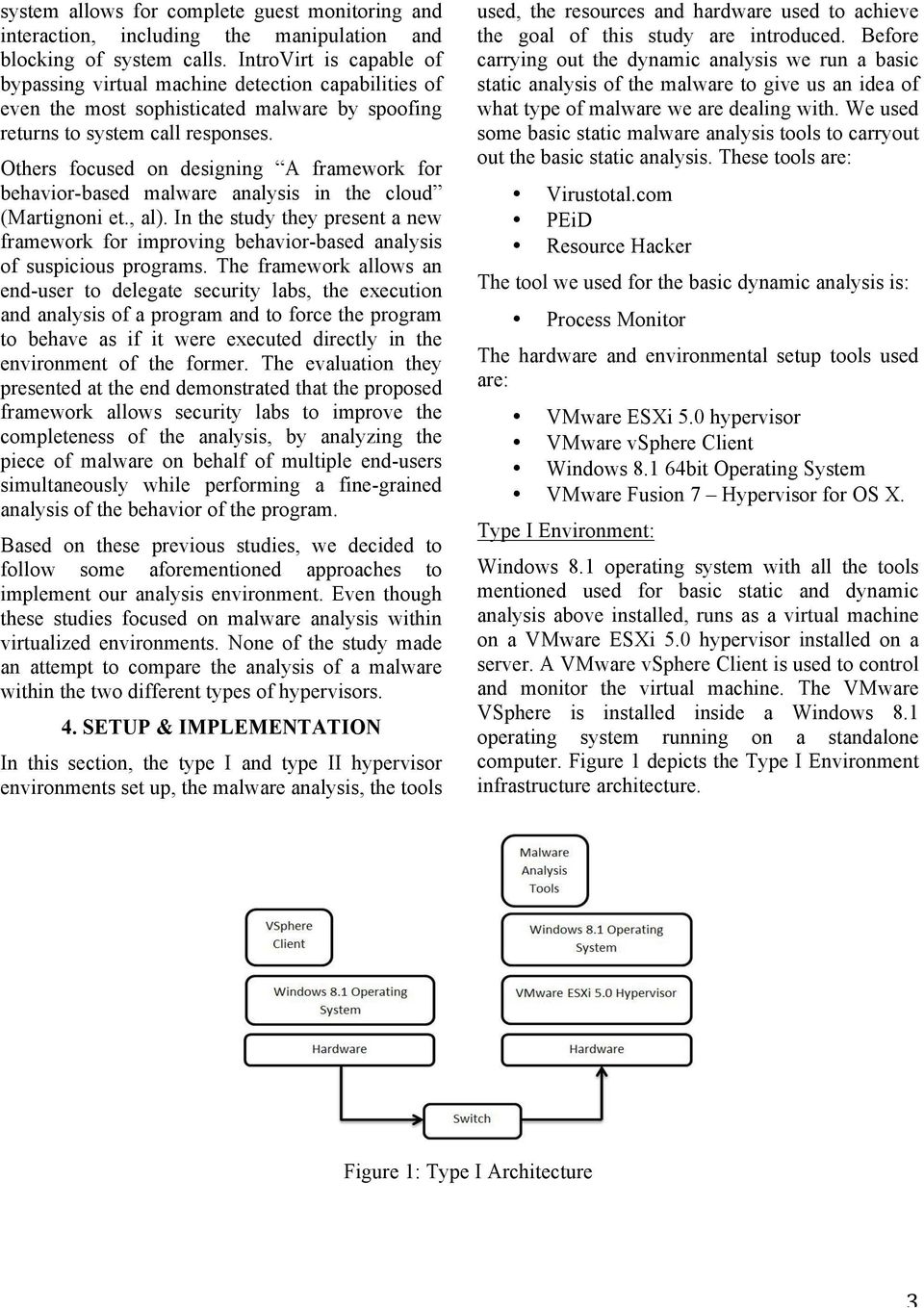
4 system allows for complete guest monitoring and interaction, including the manipulation and blocking of system calls. IntroVirt is capable of bypassing virtual machine detection capabilities of even the most sophisticated malware by spoofing returns to system call responses. Others focused on designing A framework for behavior-based malware analysis in the cloud (Martignoni et., al). In the study they present a new framework for improving behavior-based analysis of suspicious programs. The framework allows an end-user to delegate security labs, the execution and analysis of a program and to force the program to behave as if it were executed directly in the environment of the former. The evaluation they presented at the end demonstrated that the proposed framework allows security labs to improve the completeness of the analysis, by analyzing the piece of malware on behalf of multiple end-users simultaneously while performing a fine-grained analysis of the behavior of the program. Based on these previous studies, we decided to follow some aforementioned approaches to implement our analysis environment. Even though these studies focused on malware analysis within virtualized environments. None of the study made an attempt to compare the analysis of a malware within the two different types of hypervisors. 4. SETUP & IMPLEMENTATION In this section, the type I and type II hypervisor environments set up, the malware analysis, the tools used, the resources and hardware used to achieve the goal of this study are introduced. Before carrying out the dynamic analysis we run a basic static analysis of the malware to give us an idea of what type of malware we are dealing with. We used some basic static malware analysis tools to carryout out the basic static analysis. These tools are: Virustotal.com PEiD Resource Hacker The tool we used for the basic dynamic analysis is: Process Monitor The hardware and environmental setup tools used are: VMware ESXi 5.0 hypervisor VMware vsphere Client Windows bit Operating System VMware Fusion 7 Hypervisor for OS X. Type I Environment: Windows 8.1 operating system with all the tools mentioned used for basic static and dynamic analysis above installed, runs as a virtual machine on a VMware ESXi 5.0 hypervisor installed on a server. A VMware vsphere Client is used to control and monitor the virtual machine. The VMware VSphere is installed inside a Windows 8.1 operating system running on a standalone computer. Figure 1 depicts the Type I Environment infrastructure architecture. Figure 1: Type I Architecture 3
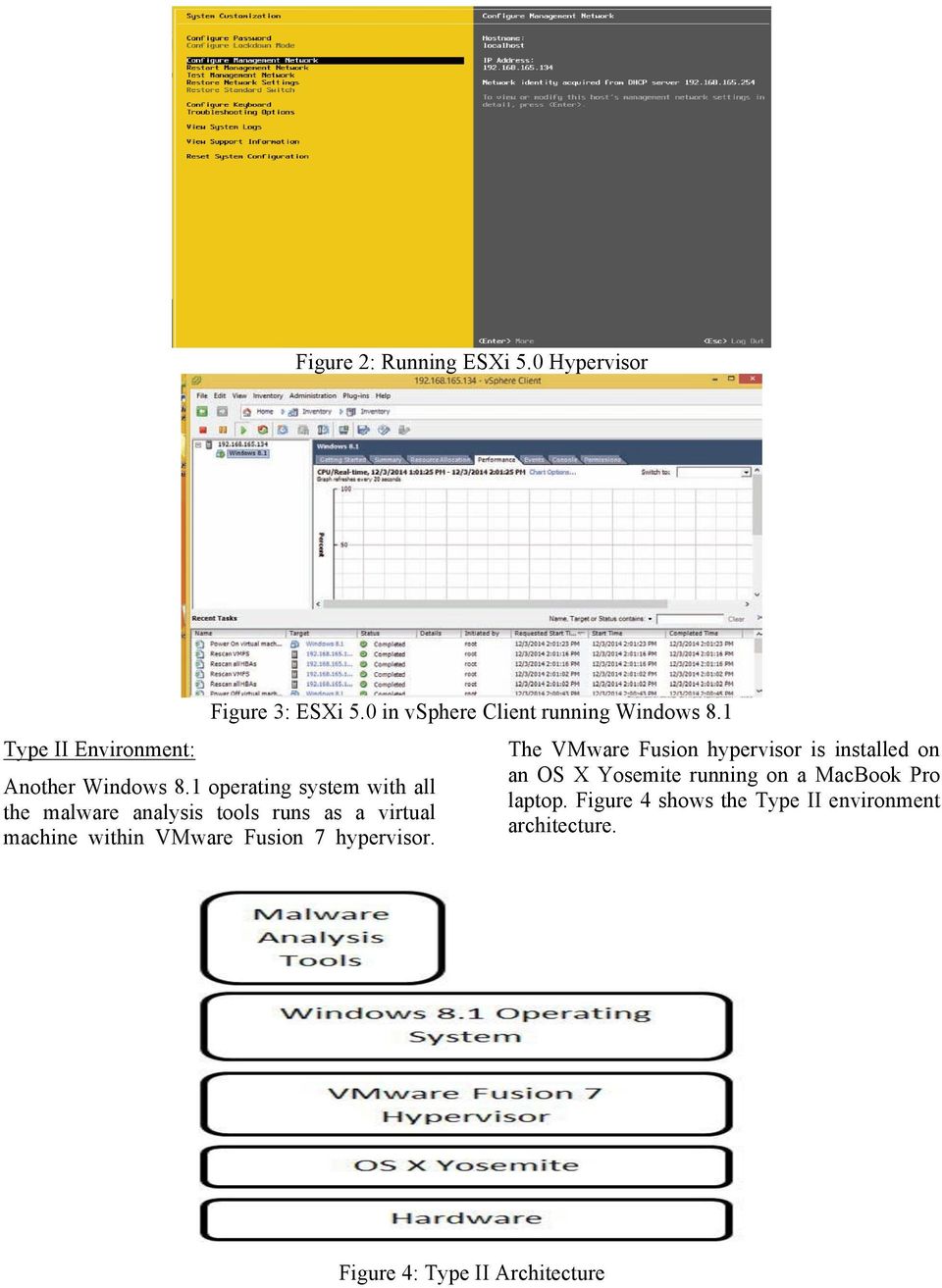
5 Figure 2: Running ESXi 5.0 Hypervisor Figure 3: ESXi 5.0 in vsphere Client running Windows 8.1 Type II Environment: The VMware Fusion hypervisor is installed on an OS X Yosemite running on a MacBook Pro Another Windows 8.1 operating system with all laptop. Figure 4 shows the Type II environment the malware analysis tools runs as a virtual architecture. machine within VMware Fusion 7 hypervisor. Figure 4: Type II Architecture
6 Process Analysis Tools: All the tools used in this study for the malware process analysis are installed on the Windows 8.1 operating system mentioned above. Malware Source & Extraction: The malware used in this was downloaded from the free malware repository MalShare 5. ANALYSIS & RESULTS Basic Static Analysis: Considering we don t have to run the malware to run a basic static analysis, therefore we are certain that the result will be the same on both types of hypervisors. However we still conducted the analysis on both hypervisor platforms. The result appears to be accurate and the same within both environments. In a tabular below, we showed a comparison of the result within both Type I and II environments. Virus Total PEiD PEview Type I Type II Type I Type II Type I Type II Virus Signature ü ü Compilation Date ü ü ü ü Import/Exports ü ü ü ü File Size ü ü ü ü File Type ü ü Target OS ü ü Packed/Unpacked ü ü Compiler ü ü Section Numbers ü ü Headers ü ü Time Stamp ü ü Dialog ü ü Accelerators ü ü Version Info ü ü Table 1: Basic Static Analysis Comparison Basic Dynamic Process Analysis: For this analysis, we have to run the malware before monitoring its processes. We know that the two architecture differs and therefore we run the malware on each environment while as we monitor its processes and behavior. Figures below depict the process running on both environments. The malware appears to behave in the same pattern within the two environments. However there is a little bit of differences between the two. The result of this test is shown in a tabular form below: Process Monitor Process Explorer Type I Type II Type I Type II Registers ü ü Libraries ü ü Execution Time ü ü CPU Load ü ü Average Memory ü ü 5
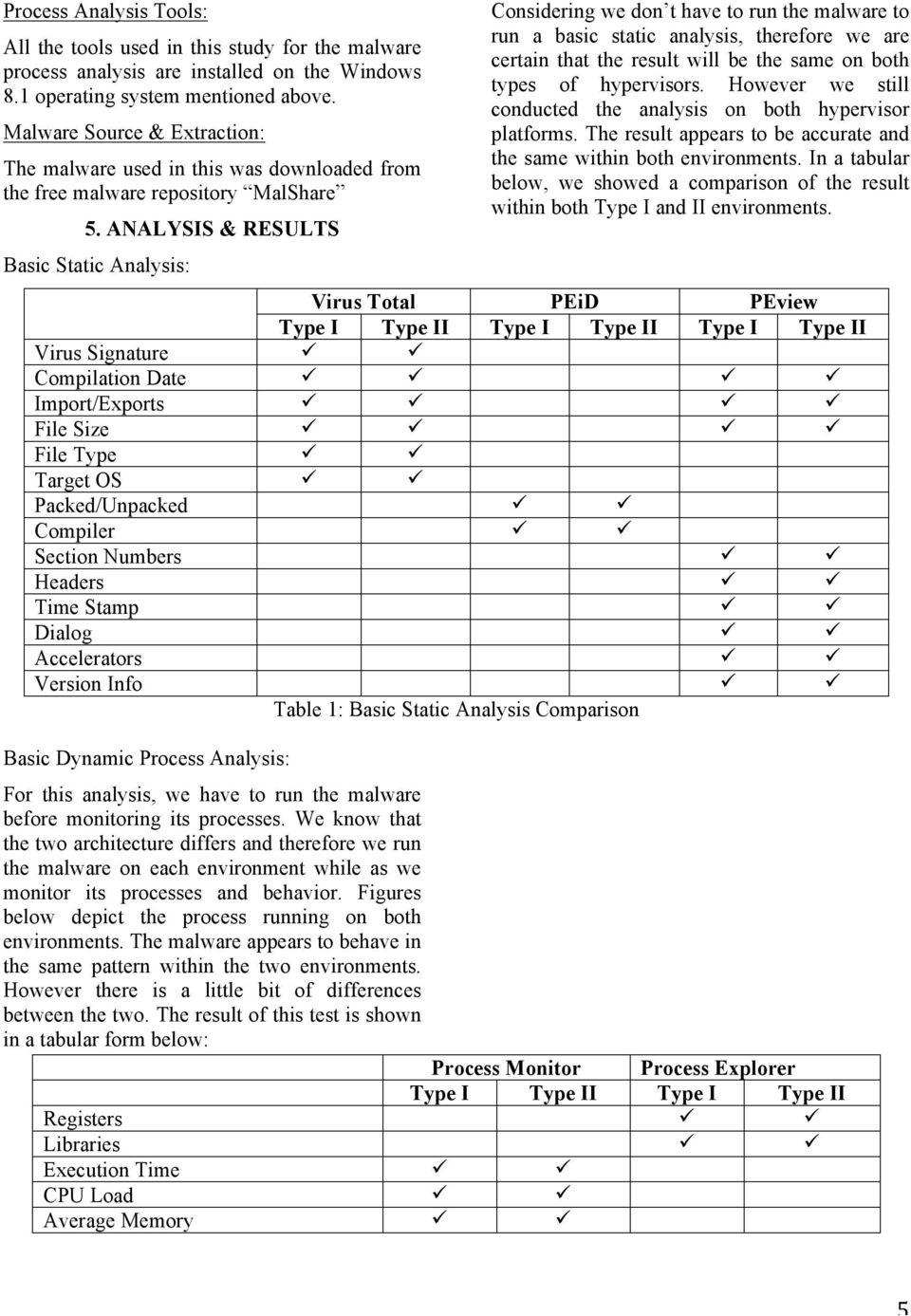
7 Process Name ü ü ü ü PID (Process Identifier) ü ü Operation ü ü Path Address ü ü ü ü Category ü ü TID (Thread Identifier) ü ü Table 2: Basic Dynamic Process Comparison 6. CONCLUSION This study focused on a comparison of malware processes behavior within a Type I and II hypervisor environments. The analysis was meant to see the difference and similarities between the two architectures. Most malware analysis is focused on Type II hypervisors considering it is easier to deploy and maintain. And at any time an analyst can delete a VM if it crashes and run again. Malwares do not only target individuals, but also companies and organization running huge servers and cloud networks are prone to malware attacks. An attack could be targeted toward the servers running the hypervisors for the cloud. Without an idea of how malware processes run in the cloud. Behavioral analysis might be a difficulty for an analyst. So we therefore decided to carry out this analysis to see if an attack target servers could be analyzed in a standalone environment. From the analysis result, we see in a tabular form that there is no significant difference between how malware processes run in a Type I environment and that of a Type II. However the analysis we did is just a ground work for malware analysis. To conclude if malware behavior is different or the same within the two types of hypervisors, an advance malware analysis must be carried. This could be a future with respect to this study. 7. REFERENCES Anderson, B., Quist, D., Neil, J., Storlie, C., & Lane, T. (2011). Graph-based malware detection using dynamic analysis. J Comput Virol, Bayer, U., Kirda, E., & Kruegel, C. (2010). Improving the Efficiency of Dynamic Malware Analysis. SAC, Beaucamps, P., Gnaedig, I., & Marion, J. (2010). Behavior Abstraction in Malware Analysis.LNCS, Bem, D., & Huebner, E. (2007). Computer Forensic Analysis in a Virtual Environment. International Journal of Digital Evidence, 6(2). Chen, X., Anderson, J., Bailey, M., & Nazario, J. (2008). Towards an Understanding of Anti-virtualization and Anti-debugging Behavior in Modern Malware. International Conference on Dependable Systems &Networks. Egele, M., Scholte, T., Kirda, E., & Kruegel, C. (2012). A Survey on Automated Dynamic Malware-Analysis Techniques and Tools. ACM Computing Surveys, 44(2). Firdausi, I., Lim, C., Erwin, A., & Nughroho, A. (2010). Analysis of Machine Learning Techniques Used In Behavior-Based Malware Detection. Second International Conference on Advances in Computing, Control, and Telecommunication Technologies, King, S., Chen, P., Wang, Y., Verbowski, C., Wang, H., & Lorch, J. (2006). SubVirt: Implementing malware with virtual machines. IEEE Symposium on Security and Privacy. Kirat, D., Vigna, G., & Kruegel, C. (2011). BareBox: Efficient Malware Analysis on Bare-Metal.ACSAC. Kolbitsch, C., Comparetti, P., Kruegel, C., Kirda, E., Zhou, X., & Wang, X. (n.d.). Effective and Efficient Malware Detection at the End Host. 18th USENIX Security Symposium, Martignoni, L., Paleari, R., & Bruschi, D. (2009). A Framework for Behavior-Based Malware Analysis in the Cloud. ICISS,
8 Nguyen, A., Schear, N., Jung, H., Godiyal, A., King, S., & Nguyen, H. (2009). MAVMM: Lightweight and Purpose Built VMM for Malware Analysis. Annual Computer Security Applications Conference. Quist, D., & Liebrock, L. (2009). Visualizing Compiled Executables for Malware Analysis. 6th International Workshop on Visualization for Cyber Security. Saydjarl, S. (2009). Hiding Virtualization from Attackers and Malware. IEEE Security & Privacy, Schweiger, M., Chung, S., & Endicott- Popovsky, B. (n.d.). Malware Analysis on the Cloud: Increased Performance, Reliability, and Flexibility. Graduate Capstone - Center for Information Assurance and Cybersecurity, University of Washington. Sun, M., Lin, M., Chang, M., Laih, C., & Lin, H. (2011). Malware Virtualization-Resistant Behavior Detection. IEEE 17th International Conference on Parallel and Distributed Systems. Uppal, D., Mehra, V., & Verma, V. (2014). Basic survey on Malware Analysis, Tools and Techniques. International Journal on Computational Sciences & Applications (IJCSA), 4(1), White, J., Pape, S., Meily, A., & Gloo, R. (2014). Dynamic Malware Analysis Using IntroVirt: A Modified Hypervisor-Based System. Spiedigitallibrary.com,

Virtual Computing and VMWare. Module 4
 Virtual Computing and VMWare Module 4 Virtual Computing Cyber Defense program depends on virtual computing We will use it for hands-on learning Cyber defense competition will be hosted on a virtual computing
Week Overview. Installing Linux Linux on your Desktop Virtualization Basic Linux system administration
 ULI101 Week 06b Week Overview Installing Linux Linux on your Desktop Virtualization Basic Linux system administration Installing Linux Standalone installation Linux is the only OS on the computer Any existing
Virtual Machines and Security Paola Stone Martinez East Carolina University November, 2013.
 Virtual Machines and Security Paola Stone Martinez East Carolina University November, 2013. Keywords: virtualization, virtual machine, security. 1. Virtualization The rapid growth of technologies, nowadays,
Virtualization Technologies (ENCS 691K Chapter 3)
 Virtualization Technologies (ENCS 691K Chapter 3) Roch Glitho, PhD Associate Professor and Canada Research Chair My URL - http://users.encs.concordia.ca/~glitho/ The Key Technologies on Which Cloud Computing
Technology Blueprint. Secure Your Virtual Desktop Infrastructure. Optimize your virtual desktop infrastructure for performance and protection
 Technology Blueprint Secure Your Virtual Desktop Infrastructure Optimize your virtual desktop infrastructure for performance and protection LEVEL 1 2 3 4 5 SECURITY CONNECTED REFERENCE ARCHITECTURE LEVEL
McAfee MOVE / VMware Collaboration Best Practices
 McAfee MOVE / VMware Collaboration Best Practices Christie J. Karrels Sales Engineer Federal DoD January 11, 2013 1 P a g e Contents Introduction... 3 Traditional Anti-Malware vs. Optimized Anti-Malware...
An overwhelming majority of IaaS clouds leverage virtualization for their foundation.
 1 2 3 An overwhelming majority of IaaS clouds leverage virtualization for their foundation. 4 With the use of virtualization comes the use of a hypervisor. Normally, the hypervisor simply provisions resources
LASTLINE WHITEPAPER. In-Depth Analysis of Malware
 LASTLINE WHITEPAPER In-Depth Analysis of Malware Abstract Malware analysis is the process of determining the purpose and functionality of a given malware sample (such as a virus, worm, or Trojan horse).
Course Title: Virtualization Security, 1st Edition
 Course Title: Virtualization Security, 1st Edition Page 1 of 7 Virtualization Security Copyright by EC-Council Press Course Description: The DISASTER RECOVERY/VIRTUALIZATION SECURITY SERIES is comprised
Installing & Using KVM with Virtual Machine Manager COSC 495
 Installing & Using KVM with Virtual Machine Manager COSC 495 1 Abstract:. There are many different hypervisors and virtualization software available for use. One commonly use hypervisor in the Linux system
Securing the Intelligent Network
 WHITE PAPER Securing the Intelligent Network Securing the Intelligent Network New Threats Demand New Strategies The network is the door to your organization for both legitimate users and would-be attackers.
Enabling Technologies for Distributed Computing
 Enabling Technologies for Distributed Computing Dr. Sanjay P. Ahuja, Ph.D. Fidelity National Financial Distinguished Professor of CIS School of Computing, UNF Multi-core CPUs and Multithreading Technologies
Data Center Connector for vsphere 3.0.0
 Product Guide Data Center Connector for vsphere 3.0.0 For use with epolicy Orchestrator 4.6.0, 5.0.0 Software COPYRIGHT Copyright 2013 McAfee, Inc. Do not copy without permission. TRADEMARK ATTRIBUTIONS
Full System Emulation:
 Full System Emulation: Achieving Successful Automated Dynamic Analysis of Evasive Malware Christopher Kruegel Lastline, Inc. [email protected] 1 Introduction Automated malware analysis systems (or sandboxes)
Basics in Energy Information (& Communication) Systems Virtualization / Virtual Machines
 Basics in Energy Information (& Communication) Systems Virtualization / Virtual Machines Dr. Johann Pohany, Virtualization Virtualization deals with extending or replacing an existing interface so as to
Remote PC Guide Series - Volume 1
 Introduction and Planning for Remote PC Implementation with NETLAB+ Document Version: 2016-02-01 What is a remote PC and how does it work with NETLAB+? This educational guide will introduce the concepts
Fine-grained covert debugging using hypervisors and analysis via visualization
 Reverse Engineering by Crayon: Game Changing Hypervisor and Visualization Analysis Fine-grained covert debugging using hypervisors and analysis via visualization Daniel A. Quist Lorie M. Liebrock Offensive
Distributed and Cloud Computing
 Distributed and Cloud Computing K. Hwang, G. Fox and J. Dongarra Chapter 3: Virtual Machines and Virtualization of Clusters and datacenters Adapted from Kai Hwang University of Southern California March
Parallels Virtuozzo Containers
 Parallels Virtuozzo Containers White Paper Top Ten Considerations For Choosing A Server Virtualization Technology www.parallels.com Version 1.0 Table of Contents Introduction... 3 Technology Overview...
Intro to Virtualization
 Cloud@Ceid Seminars Intro to Virtualization Christos Alexakos Computer Engineer, MSc, PhD C. Sysadmin at Pattern Recognition Lab 1 st Seminar 19/3/2014 Contents What is virtualization How it works Hypervisor
IOS110. Virtualization 5/27/2014 1
 IOS110 Virtualization 5/27/2014 1 Agenda What is Virtualization? Types of Virtualization. Advantages and Disadvantages. Virtualization software Hyper V What is Virtualization? Virtualization Refers to
The Art of Virtualization with Free Software
 Master on Free Software 2009/2010 {mvidal,jfcastro}@libresoft.es GSyC/Libresoft URJC April 24th, 2010 (cc) 2010. Some rights reserved. This work is licensed under a Creative Commons Attribution-Share Alike
Virtualization. Michael Tsai 2015/06/08
 Virtualization Michael Tsai 2015/06/08 What is virtualization? Let s first look at a video from VMware http://bcove.me/x9zhalcl Problems? Low utilization Different needs DNS DHCP Web mail 5% 5% 15% 8%
Chapter 2 Addendum (More on Virtualization)
 Chapter 2 Addendum (More on Virtualization) Roch Glitho, PhD Associate Professor and Canada Research Chair My URL - http://users.encs.concordia.ca/~glitho/ More on Systems Virtualization Type I (bare metal)
VMware Security Briefing. Rob Randell, CISSP Senior Security Specialist SE
 VMware Security Briefing Rob Randell, CISSP Senior Security Specialist SE Agenda Security Advantages of Virtualization Security Concepts in Virtualization Architecture Operational Security Issues with
Evaluation of Enterprise Data Protection using SEP Software
 Test Validation Test Validation - SEP sesam Enterprise Backup Software Evaluation of Enterprise Data Protection using SEP Software Author:... Enabling you to make the best technology decisions Backup &
Virtualization and Cloud Computing
 Virtualization and Cloud Computing Security is a Process, not a Product Guillermo Macias CIP Security Auditor, Sr. Virtualization Purpose of Presentation: To inform entities about the importance of assessing
A Survey on Virtual Machine Security
 A Survey on Virtual Machine Security Jenni Susan Reuben Helsinki University of Technology [email protected] Abstract Virtualization plays a major role in helping the organizations to reduce the operational
Full and Para Virtualization
 Full and Para Virtualization Dr. Sanjay P. Ahuja, Ph.D. 2010-14 FIS Distinguished Professor of Computer Science School of Computing, UNF x86 Hardware Virtualization The x86 architecture offers four levels
APPLICATION OF SERVER VIRTUALIZATION IN PLATFORM TESTING
 APPLICATION OF SERVER VIRTUALIZATION IN PLATFORM TESTING Application testing remains a complex endeavor as Development and QA managers need to focus on delivering projects on schedule, controlling costs,
Hypervisors. Introduction. Introduction. Introduction. Introduction. Introduction. Credits:
 Hypervisors Credits: P. Chaganti Xen Virtualization A practical handbook D. Chisnall The definitive guide to Xen Hypervisor G. Kesden Lect. 25 CS 15-440 G. Heiser UNSW/NICTA/OKL Virtualization is a technique
Expert Reference Series of White Papers. VMware vsphere Essentials
 Expert Reference Series of White Papers VMware vsphere Essentials 1-800-COURSES www.globalknowledge.com VMware vsphere Essentials Raj Tolani, Global Knowledge Instructor Introduction Every VMware class
Building a Penetration Testing Virtual Computer Laboratory
 Building a Penetration Testing Virtual Computer Laboratory User Guide 1 A. Table of Contents Collaborative Virtual Computer Laboratory A. Table of Contents... 2 B. Introduction... 3 C. Configure Host Network
RUNNING vtvax FOR WINDOWS
 RUNNING vtvax FOR WINDOWS IN A AVT / Vere Technologies TECHNICAL NOTE AVT/Vere Technical Note: Running vtvax for Windows in a Virtual Machine Environment Document Revision 1.1 (September, 2015) 2015 Vere
9/26/2011. What is Virtualization? What are the different types of virtualization.
 CSE 501 Monday, September 26, 2011 Kevin Cleary [email protected] What is Virtualization? What are the different types of virtualization. Practical Uses Popular virtualization products Demo Question,
Virtualization System Vulnerability Discovery Framework. Speaker: Qinghao Tang Title:360 Marvel Team Leader
 Virtualization System Vulnerability Discovery Framework Speaker: Qinghao Tang Title:360 Marvel Team Leader 1 360 Marvel Team Established in May 2015, the first professional could computing and virtualization
Enabling Technologies for Distributed and Cloud Computing
 Enabling Technologies for Distributed and Cloud Computing Dr. Sanjay P. Ahuja, Ph.D. 2010-14 FIS Distinguished Professor of Computer Science School of Computing, UNF Multi-core CPUs and Multithreading
COS 318: Operating Systems. Virtual Machine Monitors
 COS 318: Operating Systems Virtual Machine Monitors Kai Li and Andy Bavier Computer Science Department Princeton University http://www.cs.princeton.edu/courses/archive/fall13/cos318/ Introduction u Have
Linstantiation of applications. Docker accelerate
 Industrial Science Impact Factor : 1.5015(UIF) ISSN 2347-5420 Volume - 1 Issue - 12 Aug - 2015 DOCKER CONTAINER 1 2 3 Sawale Bharati Shankar, Dhoble Manoj Ramchandra and Sawale Nitin Shankar images. ABSTRACT
Detecting Computer Worms in the Cloud
 Detecting Computer Worms in the Cloud Sebastian Biedermann and Stefan Katzenbeisser Security Engineering Group Department of Computer Science Technische Universität Darmstadt {biedermann,katzenbeisser}@seceng.informatik.tu-darmstadt.de
Virtualization Technologies and Blackboard: The Future of Blackboard Software on Multi-Core Technologies
 Virtualization Technologies and Blackboard: The Future of Blackboard Software on Multi-Core Technologies Kurt Klemperer, Principal System Performance Engineer [email protected] Agenda Session Length:
McAfee MOVE AntiVirus (Agentless) 3.6.0
 Product Guide McAfee MOVE AntiVirus (Agentless) 3.6.0 For use with McAfee epolicy Orchestrator COPYRIGHT Copyright 2015 McAfee, Inc., 2821 Mission College Boulevard, Santa Clara, CA 95054, 1.888.847.8766,
McAfee MOVE AntiVirus Multi-Platform 3.5.0
 Product Guide McAfee MOVE AntiVirus Multi-Platform 3.5.0 For use with epolicy Orchestrator 4.6.7, 4.6.8, 5.1.0 Software COPYRIGHT Copyright 2014 McAfee, Inc. Do not copy without permission. TRADEMARK ATTRIBUTIONS
Lecture 2 Cloud Computing & Virtualization. Cloud Application Development (SE808, School of Software, Sun Yat-Sen University) Yabo (Arber) Xu
 Lecture 2 Cloud Computing & Virtualization Cloud Application Development (SE808, School of Software, Sun Yat-Sen University) Yabo (Arber) Xu Outline Introduction to Virtualization The Major Approaches
Configuring and Deploying a Private Cloud with System Center 2012 MOC 10751
 Configuring and Deploying a Private Cloud with System Center 2012 MOC 10751 Course Outline Module 1: Planning for the Private Cloud This module describes the core components of a private cloud and the
Virtualization and the U2 Databases
 Virtualization and the U2 Databases Brian Kupzyk Senior Technical Support Engineer for Rocket U2 Nik Kesic Lead Technical Support for Rocket U2 Opening Procedure Orange arrow allows you to manipulate the
Software Testing and Deployment Using Virtualization and Cloud
 Software Testing and Deployment Using Virtualization and Cloud Presented by: Omer Khalid Contributors: Arsalaan Shaikh, Brice Copy 1 Outline Part I - Background Use cases, Infrastructure Part II - Concepts
Operating Systems Virtualization mechanisms
 Operating Systems Virtualization mechanisms René Serral-Gracià Xavier Martorell-Bofill 1 1 Universitat Politècnica de Catalunya (UPC) May 26, 2014 Contents 1 Introduction 2 Hardware Virtualization mechanisms
Virtualization for Cloud Computing
 Virtualization for Cloud Computing Dr. Sanjay P. Ahuja, Ph.D. 2010-14 FIS Distinguished Professor of Computer Science School of Computing, UNF CLOUD COMPUTING On demand provision of computational resources
Mitigating Information Security Risks of Virtualization Technologies
 Mitigating Information Security Risks of Virtualization Technologies Toon-Chwee, Wee VMWare (Hong Kong) 2009 VMware Inc. All rights reserved Agenda Virtualization Overview Key Components of Secure Virtualization
MODULE 3 VIRTUALIZED DATA CENTER COMPUTE
 MODULE 3 VIRTUALIZED DATA CENTER COMPUTE Module 3: Virtualized Data Center Compute Upon completion of this module, you should be able to: Describe compute virtualization Discuss the compute virtualization
The Virtualization Practice
 The Virtualization Practice White Paper: Managing Applications in Docker Containers Bernd Harzog Analyst Virtualization and Cloud Performance Management October 2014 Abstract Docker has captured the attention
OS KERNEL MALWARE DETECTION USING KERNEL CRIME DATA MINING
 OS KERNEL MALWARE DETECTION USING KERNEL CRIME DATA MINING MONISHA.T #1 and Mrs.UMA.S *2 # ME,PG Scholar,Department of CSE, SKR Engineering College,Poonamallee,Chennai,TamilNadu * ME,Assist.professor,
CS 695 Topics in Virtualization and Cloud Computing. Introduction
 CS 695 Topics in Virtualization and Cloud Computing Introduction This class What does virtualization and cloud computing mean? 2 Cloud Computing The in-vogue term Everyone including his/her dog want something
About the VM-Series Firewall
 About the VM-Series Firewall Palo Alto Networks VM-Series Deployment Guide PAN-OS 6.0 Contact Information Corporate Headquarters: Palo Alto Networks 4401 Great America Parkway Santa Clara, CA 95054 http://www.paloaltonetworks.com/contact/contact/
Virtual Machine Monitors. Dr. Marc E. Fiuczynski Research Scholar Princeton University
 Virtual Machine Monitors Dr. Marc E. Fiuczynski Research Scholar Princeton University Introduction Have been around since 1960 s on mainframes used for multitasking Good example VM/370 Have resurfaced
About the VM-Series Firewall
 About the VM-Series Firewall Palo Alto Networks VM-Series Deployment Guide PAN-OS 6.1 Contact Information Corporate Headquarters: Palo Alto Networks 4401 Great America Parkway Santa Clara, CA 95054 http://www.paloaltonetworks.com/contact/contact/
Why Choose VMware vsphere for Desktop Virtualization? WHITE PAPER
 Why Choose VMware vsphere for Desktop Virtualization? WHITE PAPER Table of Contents Thin, Legacy-Free, Purpose-Built Hypervisor.... 3 More Secure with Smaller Footprint.... 4 Less Downtime Caused by Patches...
A Study on Detection of Hacking and Malware Codes in Bare Metal Hypervisor for Virtualized Internal Environment of Cloud Service
 78 A Study on Detection of Hacking and Malware Codes in Bare Metal Hypervisor for Virtualized Internal Environment of Cloud Service Jung-oh Park Dept. of Information Communications, DONGYANG MIRAE University,
Virtual Hosting & Virtual Machines
 & Virtual Machines Coleman Kane [email protected] September 2, 2014 Cyber Defense Overview / Machines 1 / 17 Similar to the network partitioning schemes described previously, there exist a menu of options
Introduction to Engineering Using Robotics Experiments Lecture 18 Cloud Computing
 Introduction to Engineering Using Robotics Experiments Lecture 18 Cloud Computing Yinong Chen 2 Big Data Big Data Technologies Cloud Computing Service and Web-Based Computing Applications Industry Control
FortiAnalyzer VM (VMware) Install Guide
 FortiAnalyzer VM (VMware) Install Guide FortiAnalyzer VM (VMware) Install Guide December 05, 2014 05-520-203396-20141205 Copyright 2014 Fortinet, Inc. All rights reserved. Fortinet, FortiGate, FortiCare
Patch and Vulnerability Management Program
 Patch and Vulnerability Management Program What is it? A security practice designed to proactively prevent the exploitation of IT vulnerabilities within an organization To reduce the time and money spent
SCO Virtualization Presentation to Customers
 SCO Virtualization Presentation to Customers 1 Content Virtualization An Overview Short introduction including key benefits Additional virtualization information from SCO Additional information about Virtualization
CS 695 Topics in Virtualization and Cloud Computing and Storage Systems. Introduction
 CS 695 Topics in Virtualization and Cloud Computing and Storage Systems Introduction Hot or not? source: Gartner Hype Cycle for Emerging Technologies, 2014 2 Source: http://geekandpoke.typepad.com/ 3 Cloud
Chapter 14 Virtual Machines
 Operating Systems: Internals and Design Principles Chapter 14 Virtual Machines Eighth Edition By William Stallings Virtual Machines (VM) Virtualization technology enables a single PC or server to simultaneously
WatchGuard Training. Introduction to WatchGuard Dimension
 WatchGuard Training Introduction to WatchGuard Dimension Introduction to WatchGuard Dimension What is WatchGuard Dimension? Deploy WatchGuard Dimension Configure WatchGuard Dimension Use WatchGuard Dimension
The Virtualization Practice
 The Virtualization Practice White Paper: Security Requirements of Hybrid Clouds: A Product Comparison! Edward L. Haletky Analyst Virtualization and Cloud Security! The Virtualization Practice Sponsored
Virtual Desktops Security Test Report
 Virtual Desktops Security Test Report A test commissioned by Kaspersky Lab and performed by AV-TEST GmbH Date of the report: May 19 th, 214 Executive Summary AV-TEST performed a comparative review (January
Virtualization for Security
 Virtualization for Security t j Including Sandboxing, Disaster Recovery, High Availability, Forensic Analysis, and Honeypotting John Hoopes Technical Editor Aaron Bawcom Paul Kenealy Wesley J. Noonan Craig
VMware and Xen Hypervisor Performance Comparisons in Thick and Thin Provisioned Environments
 VMware and Xen Hypervisor Performance Comparisons in Thick and Thin Provisioned Environments Devanathan Nandhagopal, Nithin Mohan, Saimanojkumaar Ravichandran, Shilp Malpani [email protected],
Virtualization. Pradipta De [email protected]
 Virtualization Pradipta De [email protected] Today s Topic Virtualization Basics System Virtualization Techniques CSE506: Ext Filesystem 2 Virtualization? A virtual machine (VM) is an emulation
Configuring and Deploying a Private Cloud
 Course Code: M20247 Vendor: Microsoft Course Overview Duration: 5 RRP: 2,025 Configuring and Deploying a Private Cloud Overview This course equips students with the skills they require to configure and
Virtualization. Explain how today s virtualization movement is actually a reinvention
 Virtualization Learning Objectives Explain how today s virtualization movement is actually a reinvention of the past. Explain how virtualization works. Discuss the technical challenges to virtualization.
Course 10751A: Configuring and Deploying a Private Cloud with System Center 2012
 Course 10751A: Configuring and Deploying a Private Cloud with System Center 2012 OVERVIEW About this Course This course describes private cloud configuration and deployment with Microsoft System Center
Virtualization. Jukka K. Nurminen 23.9.2015
 Virtualization Jukka K. Nurminen 23.9.2015 Virtualization Virtualization refers to the act of creating a virtual (rather than actual) version of something, including virtual computer hardware platforms,
CSE 501 Monday, September 09, 2013 Kevin Cleary [email protected]
 CSE 501 Monday, September 09, 2013 Kevin Cleary [email protected] What is Virtualization? Practical Uses What can be virtualized Popular virtualization products Demo Question, answer, discussion Can
Evaluation of Multi-Hypervisor Management with HotLink SuperVISOR
 White Paper White Paper Managing Public Cloud Computing in the Enterprise Evaluation of Multi-Hypervisor Management with HotLink SuperVISOR A Quick Start Guide By David Davis vexpert 1 Table of Contents
Distributed System Monitoring and Failure Diagnosis using Cooperative Virtual Backdoors
 Distributed System Monitoring and Failure Diagnosis using Cooperative Virtual Backdoors Benoit Boissinot E.N.S Lyon directed by Christine Morin IRISA/INRIA Rennes Liviu Iftode Rutgers University Phenix
Dynamic Load Balancing of Virtual Machines using QEMU-KVM
 Dynamic Load Balancing of Virtual Machines using QEMU-KVM Akshay Chandak Krishnakant Jaju Technology, College of Engineering, Pune. Maharashtra, India. Akshay Kanfade Pushkar Lohiya Technology, College
CPET 581 Cloud Computing: Technologies and Enterprise IT Strategies. Virtualization of Clusters and Data Centers
 CPET 581 Cloud Computing: Technologies and Enterprise IT Strategies Lecture 4 Virtualization of Clusters and Data Centers Text Book: Distributed and Cloud Computing, by K. Hwang, G C. Fox, and J.J. Dongarra,
Data Centers and Cloud Computing
 Data Centers and Cloud Computing CS377 Guest Lecture Tian Guo 1 Data Centers and Cloud Computing Intro. to Data centers Virtualization Basics Intro. to Cloud Computing Case Study: Amazon EC2 2 Data Centers
International Journal of Scientific & Engineering Research, Volume 5, Issue 1, January-2014 ISSN 2229-5518 1299
 1299 TITLE Virtualization security in Data Centres & cloud Prof Sarita Dhawale. Ashoka Center for Business & Computer Studies,Nashik Head of Department of Computer Science University of Pune, Maharashtra.
The Xen of Virtualization
 The Xen of Virtualization Assignment for CLC-MIRI Amin Khan Universitat Politècnica de Catalunya March 4, 2013 Amin Khan (UPC) Xen Hypervisor March 4, 2013 1 / 19 Outline 1 Introduction 2 Architecture
Desktop Virtualization. The back-end
 Desktop Virtualization The back-end Will desktop virtualization really fit every user? Cost? Scalability? User Experience? Beyond VDI with FlexCast Mobile users Guest workers Office workers Remote workers
Basics of Virtualisation
 Basics of Virtualisation Volker Büge Institut für Experimentelle Kernphysik Universität Karlsruhe Die Kooperation von The x86 Architecture Why do we need virtualisation? x86 based operating systems are
Virtualization Detection: New Strategies and Their Effectiveness
 Virtualization Detection: New Strategies and Their Effectiveness Christopher Thompson [email protected] Maria Huntley [email protected] Chad Link [email protected] ABSTRACT Previous methods for detecting
10751-Configuring and Deploying a Private Cloud with System Center 2012
 Course Outline 10751-Configuring and Deploying a Private Cloud with System Center 2012 Duration: 5 days (30 hours) Target Audience: This course is intended for data center administrators who will be responsible
Virtualization with Windows
 Virtualization with Windows at CERN Juraj Sucik, Emmanuel Ormancey Internet Services Group Agenda Current status of IT-IS group virtualization service Server Self Service New virtualization features in
Configuring and Deploying a Private Cloud with System Center 2012
 Course 10751A: Configuring and Deploying a Private Cloud with System Center 2012 Length: Delivery Method: 5 Days Instructor-led (classroom) About this Course This course describes private cloud configuration
In-Band Methods of Virtual Machine Detection
 GRADUATE OPERATING SYSTEMS 1 In-Band Methods of Virtual Machine Detection Estefan Ortiz & Cory Hayes University of Notre Dame {eortiz, chayes3}@nd.edu Abstract In a proof of concept paper, the authors
How To Make A Virtual Machine Aware Of A Network On A Physical Server
 VMready Virtual Machine-Aware Networking White Paper Table of Contents Executive Summary... 2 Current Server Virtualization Environments... 3 Hypervisors... 3 Virtual Switches... 3 Leading Server Virtualization
How To Create A Cloud Based System For Aaas (Networking)
 1 3.1 IaaS Definition IaaS: Infrastructure as a Service Through the internet, provide IT server, storage, computing power and other infrastructure capacity to the end users and the service fee based on