
Introduction. Initiate Quality Risk Management Process Risk Assessment. Risk Identification Risk Analysis Risk Evaluation. unacceptable.
|
|
|
- Camron Stevens
- 10 years ago
- Views:
Transcription
1 Quality Risk Management Purpose of this part To guide through Risk Management Methods and Tools Give an aid by providing key principles on the theory of the tools Give some examples and methods of use Disclaimer: This presentation includes the authors views on quality risk management theory and practice. The presentation does not represent official guidance or policy of authorities or industry. prepared by some members of the EWG for example only; not an official policy/guidance July 2006, slide 1 prepared by some members of the EWG for example only; not an official policy/guidance July 2006, slide 2 Chapter 5 & Annex I Risk Communication Introduction The purpose of this annex is to provide a general overview of and references for some of the primary tools that might be used in quality risk management by industry and regulators. The references are included as an aid to gain more knowledge and detail about the particular tool. The list of tools is not exhaustive. It is important to note that no one tool or set of tools is applicable to every situation in which a quality risk management procedure is used. prepared by some members of the EWG for example only; not an official policy/guidance July 2006, slide 3 prepared by some members of the EWG for example only; not an official policy/guidance July 2006, slide 4 5. Risk Management Tools Contributing items to manage quality risks CONSIDERATIONS Use the appropriate tool(s)! No one tool is all inclusive! prepared by some members of the EWG for example only; not an official policy/guidance July 2006, slide 5 Ri sk Communication RiskManagementtools System Risk (facility & people) > e.g. interfaces, operators risk, environment, components such as equipment, IT, design elements System Risk (organisation) > e.g. Quality systems, controls, measurements, documentation, regulatory compliance Process Risk > e.g. process operations and quality parameters Product Risk (safety & efficacy) > e.g. quality attributes: measured data according to specifications prepared by some members of the EWG for example only; not an official policy/guidance July 2006, slide 6 Disclaimer: The briefing pack is offered as a supplementary explanation of the material in. It was prepared by some members of the EWG for example only. It has not gone through any ICH formal process. It does not represent an official policy/guidance. Briefing pack II, July 2006, page 1

2 Choose the right tool for the task: An example Annex I.1 A possible aid where to use methods / tools general System Risk (facility & people) detail System Risk Process Risk Product Risk (organisation) (safety & efficacy) Risk ranking & filtering X X X Failure mode effect analysis X X Hazard analysis and critical control points X X Process mapping X Flow charts X X Statistical tools X Check sheets X X Basic Risk Management Facilitation Methods prepared by some members of the EWG for example only; not an official policy/guidance July 2006, slide 7 prepared by some members of the EWG for example only; not an official policy/guidance July 2006, slide 8 I.1: Basic risk management facilitation methods I.1: Basic risk management facilitation methods Flowcharts Flowchart Check Sheets Start Process mapping Cause and Effect Diagrams (Ishikawa / fish bone) They might be helpful to support risk identification Activity Activity Decision Yes Result No Action Pictorial representations of a process Breaking the process down into its constituent steps prepared by some members of the EWG for example only; not an official policy/guidance July 2006, slide 9 prepared by some members of the EWG for example only; not an official policy/guidance July 2006, slide 10 I.1: Basic risk management facilitation methods Check sheets Present information in an efficient, clear format May be accomplished with a simple listing of items prepared by some members of the EWG for example only; not an official policy/guidance July 2006, slide 11 I.1: Basic risk management facilitation methods Process mapping The indicators may be selected based on unit operations Shows how they are interrelated Potential Areas of Use(s) / outcomes Provides a clear and simple visual representation of involved steps Facilitates understanding, explaining and systematically analyzing complex processes and associated risks A pre-requisite for the use of some other tools prepared by some members of the EWG for example only; not an official policy/guidance July 2006, slide 12 Disclaimer: The briefing pack is offered as a supplementary explanation of the material in. It was prepared by some members of the EWG for example only. It has not gone through any ICH formal process. It does not represent an official policy/guidance. Briefing pack II, July 2006, page 2

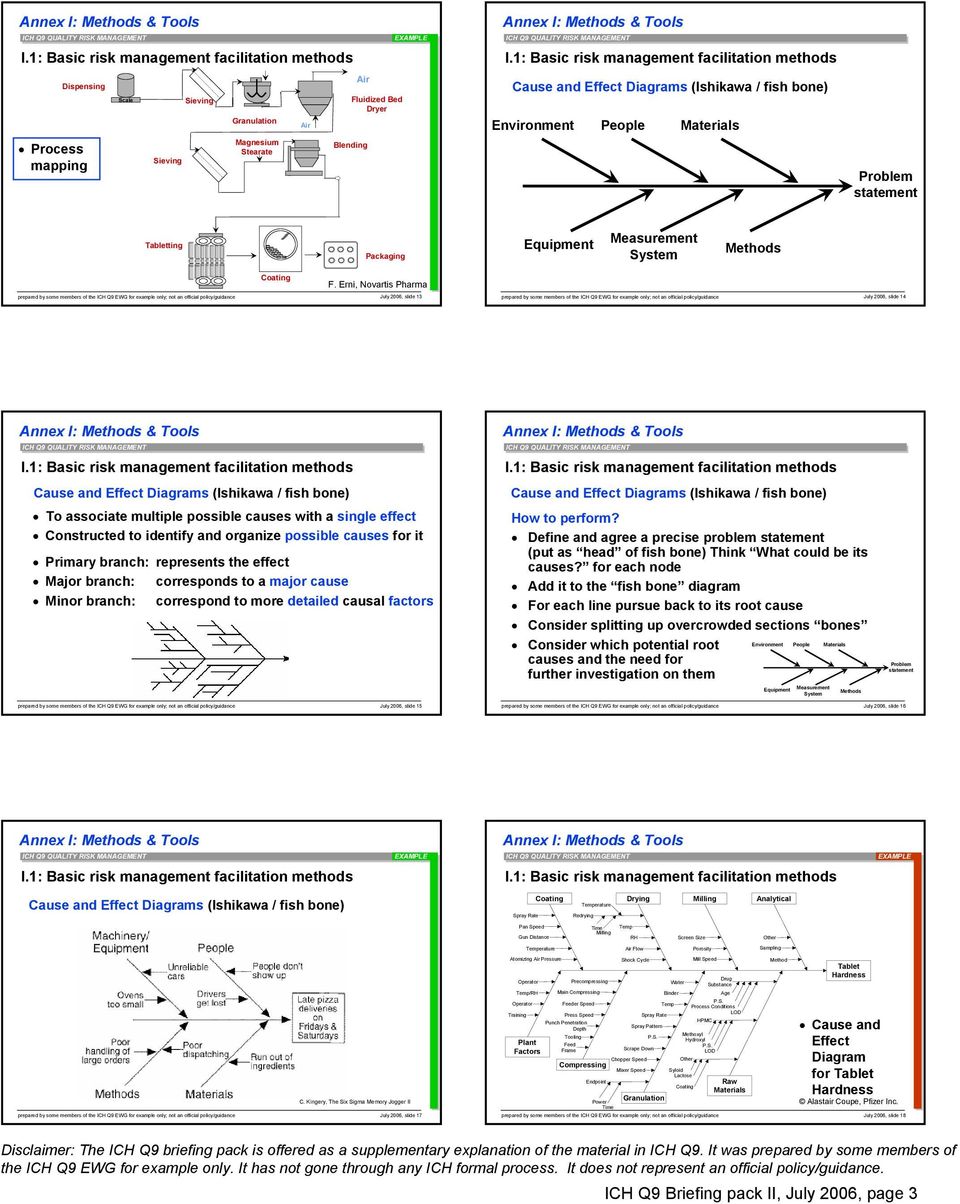
3 I.1: Basic risk management facilitation methods Dispensing Process mapping Scale Sieving Sieving Granulation Magnesium Stearate Air Air Blending Fluidized Bed Dryer I.1: Basic risk management facilitation methods Cause and Effect Diagrams (Ishikawa / fish bone) Environment People Materials Problem statement Tabletting Packaging Equipment Measurement System Methods Coating F. Erni, Novartis Pharma prepared by some members of the EWG for example only; not an official policy/guidance July 2006, slide 13 prepared by some members of the EWG for example only; not an official policy/guidance July 2006, slide 14 I.1: Basic risk management facilitation methods Cause and Effect Diagrams (Ishikawa / fish bone) To associate multiple possible causes with a single effect Constructed to identify and organize possible causes for it Primary branch: represents the effect Major branch: corresponds to a major cause Minor branch: correspond to more detailed causal factors I.1: Basic risk management facilitation methods Cause and Effect Diagrams (Ishikawa / fish bone) How to perform? Define and agree a precise problem statement (put as head of fish bone) Think What could be its causes? for each node Add it to the fish bone diagram For each line pursue back to its root cause Consider splitting up overcrowded sections bones Environment People Materials Consider which potential root causes and the need for further investigation on them Equipment Measurement System Methods Problem statement prepared by some members of the EWG for example only; not an official policy/guidance July 2006, slide 15 prepared by some members of the EWG for example only; not an official policy/guidance July 2006, slide 16 I.1: Basic risk management facilitation methods I.1: Basic risk management facilitation methods Cause and Effect Diagrams (Ishikawa / fish bone) Coating Spray Rate Temperature Redrying Drying Milling Analytical Pan Speed Gun Distance Time Milling Temp RH Screen Size Other Temperature Air Flow Porosity Sampling C. Kingery, The Six Sigma Memory Jogger II prepared by some members of the EWG for example only; not an official policy/guidance July 2006, slide 17 Atomizing Air Pressure Shock Cycle Mill Speed Drug Operator Precompressing Water Substance Temp/RH Main Compressing Binder Age P.S. Operator Feeder Speed Temp Process Conditions LOD Training Press Speed Spray Rate Punch Penetration HPMC Depth Spray Pattern Methoxyl Tooling P.S. Hydroxyl Plant Feed P.S. Factors Frame Scrape Down LOD Chopper Speed Other Compressing Mixer Speed Syloid Lactose Endpoint Raw Coating Materials Granulation Power Time Tablet Hardness Cause and Effect Diagram for Tablet Hardness Alastair Coupe, Pfizer Inc. prepared by some members of the EWG for example only; not an official policy/guidance July 2006, slide 18 Method Disclaimer: The briefing pack is offered as a supplementary explanation of the material in. It was prepared by some members of the EWG for example only. It has not gone through any ICH formal process. It does not represent an official policy/guidance. Briefing pack II, July 2006, page 3
4 Annex I.2 Failure Mode Effects Analysis (FMEA) I.2: Failure Mode Effects Analysis (FMEA) (see IEC 60812) Evaluation of potential failure modes for processes The likely effect on outcomes and/or product performance Once failure modes are established, risk reduction can be used to eliminate, reduce or control the potential failures FMEA relies on process understanding Summarize the important modes of failure, factors causing these failures and the likely effects of these failures prepared by some members of the EWG for example only; not an official policy/guidance July 2006, slide 19 How to perform? Break down large complex processes into manageable steps prepared by some members of the EWG for example only; not an official policy/guidance July 2006, slide 20 I.2: Failure Mode Effects Analysis (FMEA) I.2: Failure Mode Effects Analysis (FMEA) RNP: Risk Priority Number C. Kingery, The Six Sigma Memory Jogger II Potential Areas of Use(s) Prioritize risks Monitor the effectiveness of risk control activities Equipment and facilities Analyze a manufacturing process to identify high-risk steps or critical parameters prepared by some members of the EWG for example only; not an official policy/guidance July 2006, slide 21 How to perform? 1. Establish a team 2. Identify the known and potential failure modes: Develop lists of known problems and brainstorm other potentials e.g. > Product not meeting specification > Process not meeting yield requirements > Malfunctioning equipment > Software problems Newly identified failure modes should be added at any time prepared by some members of the EWG for example only; not an official policy/guidance July 2006, slide 22 I.2: Failure Mode Effects Analysis (FMEA) How to perform? 3. Characterise the severity, probability and detectability An equal number of levels is sometimes helpful > Some preference to 3, 4, 5, 6 or 10 levels > But: an even number of levels avoids the mid point Use different scales > Linear: 1, 2, 3, 4 The aim is to come > Exponential: 1, 2, 4, 8 up with a method > Logarithmic: 1, 10, 100, 1000 of prioritising > Self made: 1, 3, 7, 10 Multiplying different scales will differentiate the outcome I.2: Failure Mode Effects Analysis (FMEA) How to perform? 4. Define actions 5. Revisit the ranking 6. Define residual risk 7. Perform a short summary > Scope > Data from the assessment & control (e.g. No. of identified failure modes) > Level of accepted risk without actions i.e. residual risk (e.g. Risk priority Number < 50) > Recommended actions, responsibilities and due dates (including approval, if appropriate) > Person in charge for follow-up of FMEA prepared by some members of the EWG for example only; not an official policy/guidance July 2006, slide 23 prepared by some members of the EWG for example only; not an official policy/guidance July 2006, slide 24 Disclaimer: The briefing pack is offered as a supplementary explanation of the material in. It was prepared by some members of the EWG for example only. It has not gone through any ICH formal process. It does not represent an official policy/guidance. Briefing pack II, July 2006, page 4

5 Severity (Consequences of failure) Probability (Likelihood failure will happen) 10 Extreme Predicted to cause severe impact to quality (Product out of specifications, no Expert Statement possible) 7 High Predicted to cause significant impact on quality (Failure to meet specifications, no Stability data, Expert Statement possible) 3 Moderate Predicted to cause minor impact on quality (Failure to meet specifications, Stability data available) 1 Low Predicted to have no/minor impact on quality of the product (Quality within specifications) prepared by some members of the EWG for example only; not an official policy/guidance July 2006, slide 25 8 Regular failures Expected to happen regularly 4 Repeated failures Expected to happen in a low frequency 2 Occasional failures Expected to happen infrequently 1 Unlikely failures Unlikely to happen prepared by some members of the EWG for example only; not an official policy/guidance July 2006, slide 26 Detectability (Ability to find the failure) 4 Normally not detected Failure very likely to be overlooked, hence not detected (no technical solution, no manual control) 3 Likely not detected Failure may be overseen (manual control, spot checks) 2 Regularly detected Failure will normally be detected (manual control, routine work with statistical control) 1 Always detected Failure can and will be detected in all cases (monitoring, technical solution available) FMEA: Quantitation of Risk : Severity Dangerously High Extremely high Very High High Moderate Low Very Low Minor Very Minor None Failure could lead to death or permanent injury to the customer. Financial: >$1,000,000 Failure could lead to injury to the customer. Failure would create non-compliance with registered specifications. Failure likely to lead to recall. Financial: $1,000,000 Failure could lead to adverse reaction for customer. Failure would create noncompliance with GMP regulations or product registrations. Failure possible to lead to recall. Financial: $500,000 Failure leads to customer percept ion of safety issue. Failure renders individual unit(s) unusable. Failure causes a high degree of customer dissatisfaction. Recall for business reasons possible but Authority required recall unlikely. Financial: $100,000 Failure causes a high degree of customer dissatisfaction and numerous complaints. Failure unlikely to lead to recall. Financial: $50,000 Failure likely to cause isolated customer complaints. Financial: $10,000 Failure relates to non-dosage form issues (like minor packaging problems) and can be easily overcome by the customer. Financial: $5,000 Failure could be noticed by the customer but is unlikely to be perceived as significant enough to warrant a complaint. Failure not readily apparent to the customer. Financial: <$1,000 Failure would not be noticeable to the customer. Financial: none Dr. Gary Harbour, Pfizer prepared by some members of the EWG for example only; not an official policy/guidance July 2006, slide 27 prepared by some members of the EWG for example only; not an official policy/guidance July 2006, slide 28 FMEA: Quantitation of Risk : Probability FMEA: Quantitation of Risk: Detection Very High: Failure is almost inevitable High: Repeated failures More than one occurrence per day or a probability of more than three occurrences in 10 units (Cpk < 0.33 or <1σ). One occurrence every three to four days or a probability of three occurrences in 10 units (Cpk ~ 0.33 or ~1 σ). One occurrence per week or a probability of 5 occurrences in 100 units (Cpk ~ 0.67 or ~2 σ) Absolute Uncertainty Very Remote Remote The product is not inspected or the defect caused by the failure is not detectable. Product is sampled, inspected, and released based on Acceptable Quality Level (AQL) sampling plans. Product is accepted based on no defects in a sample. 7 One occurrence every month or one occurrence in 100 units (Cpk ~ 0.83 ~2.5 σ). 7 Very Low Product is 100% manually inspected in the process Moderate: Occasional Failures One occurrence every three months or three occurrences in 1,000 units (Cpk ~ 1.00 or ~ 3 σ). One occurrence every six months to one year or one occurrence in 10,000 units (Cpk ~ 1.17 or ~ 3.5 σ). One occurrence per year or six occurrences in 100,000 units (Cpk ~ 1.33 or ~ 4 σ) Low Moderate Moderately High Product is 100% manually inspected using go/no-go or other mistake-proofing gauges. Some Statistical Process Control (SPC) is used in the process and product is final inspected off-line. SPC is used and there is immediate reaction to out-of-control conditions. 3 2 Low: Relatively few Failures One occurrence every one to three years or six occurrences in 10,000,000 units (Cpk ~ 1.67 or ~5 σ). One occurrence every three to five years or 2 occurrences in 1,000,000,000 units (Cpk ~ 2.00 OR ~6 σ). 3 2 High Very High An effective SPC program is in place with process capabilities (Cpk) greater than All product is 100% automatically inspected. 1 Remote: Failure is unlikely One occurrence in greater than five years or less than two occurrences in 1,000,000,000 units (Cpk > 2.00 OR >6 σ). 1 Almost Certain The defect is obvious and there is 100% automatic inspection with regular calibration and preventive maintenance of the inspection equipment. For batch failures use the time scale for unit failures use the unit scale. Dr. Gary Harbour, Pfizer Dr. Gary Harbour, Pfizer prepared by some members of the EWG for example only; not an official policy/guidance July 2006, slide 29 prepared by some members of the EWG for example only; not an official policy/guidance July 2006, slide 30 Disclaimer: The briefing pack is offered as a supplementary explanation of the material in. It was prepared by some members of the EWG for example only. It has not gone through any ICH formal process. It does not represent an official policy/guidance. Briefing pack II, July 2006, page 5

6 Severity / Probability / Detection (SPD) PhD R.C. Mendson, Menson & Associations, Inc ICH EWG London, March 2004 prepared by some members of the EWG for example only; not an official policy/guidance July 2006, slide 31 I.2: Failure Mode Effects Analysis (FMEA) Drying Process Severity (S) > Link to end product functional failure > Medical Department involvement Probability (P) > Use historical data > Similar processes products Detection > Method validation studies > Historical data Takayoshi Matsumura, Eisai Co. prepared by some members of the EWG for example only; not an official policy/guidance July 2006, slide 32 I.2: Failure Mode Effects Analysis (FMEA) Drying Process Ranking Severity (S) Probability (P) Detection (D) 10 Death More than once a day Impossible to detect times a day Remote 8 Permanent injury Once a week Very slight 7 Once a month Slight 6 Temporary injury Once in three month Low 5 Once in half one year Medium 4 Reported/ dissatisfied Once a year Moderately high 3 Once in 1 3 years High 2 Notice/ no report Once in 3 5 years Very High 1 Less than once in 5 years Virtually certain Takayoshi Matsumura, Esai Co prepared by some members of the EWG for example only; not an official policy/guidance July 2006, slide 33 I.2: Failure Mode Effects Analysis (FMEA) Drying Process Process 1. Set up 2. Start drying 3. Maintain temperature Potential Failure Mode contamination contamination degradation of product long drying time high Loss On Drying (LOD) low LOD non-uniformity of LOD disheveled gown of operator insufficient cleaning of equipment damage of inlet-air filter damage of thermometer unstable supply-air volume damage of timer high dew-point Potential Cause uneven temperature distribution prepared by some members of the EWG for example only; not an official policy/guidance July 2006, slide 34 S P RPN: Risk Priority Number = S*P*D D RPN Takayoshi Matsumura, Esai Co I.2: Failure Mode Effects Analysis (FMEA) Drying Process Process 1. Set up 2. Start drying 3. Maintain temperature Potential Failure Mode contamination contamination degradation of product long drying time high LOD low LOD non-uniformity of LOD insufficient cleaning of equipment damage of inlet-air filter damage of thermometer unstable supply-air volume malfunction of timer high due-point Potential Cause disheveled gown of operator uneven temperature distribution Existing controls: IPC of LOD and degradation product after drying process RPN: Risk Priority Number = S*P*D prepared by some members of the EWG for example only; not an official policy/guidance July 2006, slide 35 S P D RPN Takayoshi Matsumura, Eisai Co I.2: Failure Mode Effects Analysis (FMEA) Drying Process Process 1. Set up 2. Start drying 3. Maintain temperature Potential Cause disheveled gown of operator insufficient cleaning of equipment damage of inlet-air filter damage of thermometer unstable supply-air volume malfunction of timer high dew-point uneven temperature distribution RPN Recommended Action change cleaning procedure change maintenance period change calibration period Take action when RPN is over 100 RPN: Risk Priority Number = S*P*D Take action when severity is over 5 Remaining critical parameters after taking action; further controls required Based on Takayoshi Matsumura, Esai Co. prepared by some members of the EWG for example only; not an official policy/guidance July 2006, slide 36 S P D RPN use long gloves and goggles Disclaimer: The briefing pack is offered as a supplementary explanation of the material in. It was prepared by some members of the EWG for example only. It has not gone through any ICH formal process. It does not represent an official policy/guidance. Briefing pack II, July 2006, page 6

7 I.2: Failure Mode Effects Analysis (FMEA) Analyse a granulation process step because only a few parameters are adjustable and many problems can occur by manual operations Severity (Consequences): 3: high Predicted to cause significant impact to quality (failure to meet specifications) 2: moderate Predicted to cause minor impact to quality (failure to meet specifications) 1: minor Predicted to could have minor impact on quality of the product (quality within specifications) Probability 4: regular failures Expected to happen frequently 3: repeated failures Could happen occasionally 2: occasional failures Expected to happen infrequently 1: failure is unlikely Unlikely to happen Detectability 3: probably not detected May overlook a fault or failture possibly can not be detected (no technical solution up to now) 2: occasionaly not detected Failture may be missed (manual control, routinely work with statistical control) 1: detectable Failture can and will be detected (e.g. using statistical tools) S. Rönninger, Roche prepared by some members of the EWG for example only; not an official policy/guidance July 2006, slide 37 Failure Mode Effects Analysis (FMEA) Severity (S) [1<2<3] Probability (P) [1<2<3<4] Detectability (D) [1<2<3] Risk factor (S*P*D) Event Actions: Sub-Step Effect Comments (Failure mode) Risk reduction strategy automatically interruption not meet specification of by not meeting range; Wet seving Drying Temperature implement 2 temperature measures degradation Temperatur monitoring in batch record not meet specification of Granulation Drying water content introduce online NIR indirect measurment degradation direct measurement; time introduce IPC analytic consuming humidity measurement in the exausting indirect measurment; air unspecifoc operator knowledge; depending on power not meet specification of Granulation kneeding time reduce personnal fluctuation consumption; dissolution automatisation not possible at that time depending on kneeding not meet specification of try to get to a minumum an optimum of Granulation power consumption time depending on material dissolution kneeding time properties not meet specification of Pre-mixing mixing time IPC measure on content uniformity influence on efficacy content uniformity not meet specification of Analyse (seeving of granulate sieve to get fine appropriate Pre-mixing Granulation speed of adding water disolution and analysis); use of dosage pumps granulate desintegration not meet specification of to get fine appropriate Pre-mixing Granulation manner of adding water disolution and install spray nozzles granulate desintegration Adapt internal specification of physical all parameters have to be Granulation Quality of Excipients parameters (e.g. density, metability contact supplier re-evaluated wetability) Adapt internal specification of physical all parameters have to be Granulation Quality of API parameters (e.g. density, metability contact supplier re-evaluated wetatility) Overview Risk before cotrol Max 36 Risk after control Max 9 32 Average 17 Average 4 10 Min 3 Min 1 0 prepared by some members of the EWG for example only; not an official policy/guidance July 2006, slide 38 Severity (S) [1<2<3] Probability (P) [1<2<3<4] Detectability (D) [1<2<3] Risk factor (S*P*D) Risk reduction S. Rönninger, Roche I.2 Failure Mode Effects Analysis (FMEA) I.2: Failure Mode Effects Analysis (FMEA) Sub-Step Granulation Drying Event Effect (Failure mode) not meet specification of water content degradation Actions: Risk reduction strategy Severity (S) [1<2<3] Severity (S) [1<2<3] Probability (P) [1<2<3<4] Detectability (D) [1<2<3] Risk factor (S*P*D) Probability (P) [1<2<3<4] Detectability (D) [1<2<3] Risk factor (S*P*D) Risk reduction Comments introduce online NIR indirect measurment direct measurement; time introduce IPC analytic consuming indirect measurment; humidity measurement in the exaust air unspecific S. Rönninger, Roche prepared by some members of the EWG for example only; not an official policy/guidance July 2006, slide 39 Prepare a risk profile Severity / Consequences i negligible ii marginal iii critical iv catastrophic Probability A frequent B moderate C occasional D rare E unlikely F very unlikely prepared by some members of the EWG for example only; not an official policy/guidance July 2006, slide 40 Probability Consequences Risk protection level Picture: Zurich Insurance Ltd, Switzerland S. Rönninger, Roche I.2: Failure Mode Effects Analysis (FMEA) Prepare a risk profile: Probability I.2: Failure Mode Effects Analysis (FMEA) > Prepare a risk profile: Consequences S. Rönninger, Roche prepared by some members of the EWG for example only; not an official policy/guidance July 2006, slide 41 S. Rönninger, Roche prepared by some members of the EWG for example only; not an official policy/guidance July 2006, slide 42 Disclaimer: The briefing pack is offered as a supplementary explanation of the material in. It was prepared by some members of the EWG for example only. It has not gone through any ICH formal process. It does not represent an official policy/guidance. Briefing pack II, July 2006, page 7

8 I.2: Failure Mode Effects Analysis (FMEA) > Prepare a risk profile: Consequences I.2: Failure Mode Effects Analysis (FMEA) : Risk Profile High risk Low risk S. Rönninger, Roche prepared by some members of the EWG for example only; not an official policy/guidance July 2006, slide 43 > For high risks, which are not acceptable, risk reduction measures have to be taken as a high priority S. Rönninger, Roche prepared by some members of the EWG for example only; not an official policy/guidance July 2006, slide 44 I.2: Failure Mode Effects Analysis (FMEA) How to perform? 3. Summary () > The effects are rated in terms of their consequences and the causes are assessed in terms of their probabilities a) qualitative or b) quantitative > Based on these results a risk profile is completed. > In this profile the risks are compared with the risk protection level, which determines the accepted probability for defined consequences > Use as an aid to prioritise actions! S. Rönninger, Roche prepared by some members of the EWG for example only; not an official policy/guidance July 2006, slide 45 I.2: Failure Mode Effects Analysis (FMEA) QRM for facilities, equipment and utilities Assess an existing compressed air system > Old approach: 60 risks should have been solved in detail > Initial RM-Approach: 4 sessions in total 16 people 153 potential risks discussed 34 Cases beyond the action limit 30 Corrective actions have been performed (- 50%) > Review of RM-Approach after inspection Did you consider this hazard? - yes: show and explain rationale - yes, but start discussion for a yes/no decision - no: revisit initial risk assessment prepared by some members of the EWG for example only; not an official policy/guidance July 2006, slide 46 I.2: Failure Mode Effects Analysis (FMEA) I.2: Failure Mode Effects Analysis (FMEA) Experiences Ease of applicability > Prospective tool > Good tool for operators to use > Can be used to identify critical steps for validation > More objective than Fault Tree Analysis > Covers minor risks prepared by some members of the EWG for example only; not an official policy/guidance July 2006, slide 47 Experiences Limitations > Can be time and resource consuming > Mitigation plans must be followed up > Not a good tool for analysis of complex systems > Compound failure effects cannot be analyzed > Incorporating all possible factors requires a thorough knowledge of characteristics and performance of the different components of the system > Successful completion requires expertise, experience and good team skills > Dealing with data redundancies can be difficult Based on Takayoshi Matsumura, Esai Co prepared by some members of the EWG for example only; not an official policy/guidance July 2006, slide 48 Disclaimer: The briefing pack is offered as a supplementary explanation of the material in. It was prepared by some members of the EWG for example only. It has not gone through any ICH formal process. It does not represent an official policy/guidance. Briefing pack II, July 2006, page 8

9 Annex I.3 Failure Mode, Effects and Criticality Analysis (FMECA) prepared by some members of the EWG for example only; not an official policy/guidance July 2006, slide 49 I.3: Failure Mode, Effects and Criticality Analysis (FMECA) (IEC 60812) Extended to incorporate an investigation of the degree of severity of the consequences, their respective probabilities of occurrence and their detectability The product or process specifications should be established Identify places where additional preventive actions may be necessary to minimize risks Potential Areas of Use(s) Utilized on failures and risks associated with manufacturing processes prepared by some members of the EWG for example only; not an official policy/guidance July 2006, slide 50 Annex I.4 Fault Tree Analysis (FTA) I.4: Fault Tree Analysis (FTA) (IEC 61025) Assumes failure of the functionality of a product or process Identifies all potential root causes of an assumed failure or problem that it is thought to be important to prevent Evaluates system (or sub-system) failures one at a time Can combine multiple causes by identifying causal chains prepared by some members of the EWG for example only; not an official policy/guidance July 2006, slide 51 prepared by some members of the EWG for example only; not an official policy/guidance July 2006, slide 52 I.4: Fault Tree Analysis (FTA) How to perform? Results are represented pictorially in the form of a tree of fault modes At each level in the tree, combinations of fault modes are described with logical operators (AND, OR, etc.) I.4: Fault Tree Analysis (FTA) Basic symbols: Basic Flow FAULT OR Fault in a box indicates that it is a result of previous faults Connects preceding fault with a subsequent fault that could cause a failure AND Connects two or more faults that must occur simultaneously to cause the preceding fault prepared by some members of the EWG for example only; not an official policy/guidance July 2006, slide 53 Source: Overview of Risk Management Techniques. Robert C. Menson, PhD (2004). prepared by some members of the EWG for example only; not an official policy/guidance July 2006, slide 54 Disclaimer: The briefing pack is offered as a supplementary explanation of the material in. It was prepared by some members of the EWG for example only. It has not gone through any ICH formal process. It does not represent an official policy/guidance. Briefing pack II, July 2006, page 9

10 I.4: Fault Tree Analysis (FTA) I.4: Fault Tree Analysis (FTA) Basic symbols: End Points & Connector Root cause Root cause (= basic fault) (e.g. part failure, software error, human error) Fault to be further analyzed with more time or information if needed Additional Symbols Exclusive OR Gate: Fault occurs if only one of the input faults occurs Priority AND Gate: Fault occurs if all inputs occur in a certain order Transfer-in and transfer-out events Source: Overview of Risk Management Techniques. Robert C. Menson, PhD (2004). m Voting OR Gate: Fault occurs if m or more out of n input faults occurs Source: Overview of Risk Management Techniques. Robert C. Menson, PhD (2004). prepared by some members of the EWG for example only; not an official policy/guidance July 2006, slide 55 prepared by some members of the EWG for example only; not an official policy/guidance July 2006, slide 56 I.4: Fault Tree Analysis (FTA) I.4: Fault Tree Analysis (FTA) Investigation of laboratory failures Potential Areas of Use(s) Establish the pathway to the root cause of the failure Production outlier Calibration While investigating complaints or deviations to fully understand their root cause Out of specification result or Lab error or systematic or Interfaces others random other Ensure that intended improvements will fully resolve the issue and not lead to other issues Evaluating how multiple factors affect a given issue prepared by some members of the EWG for example only; not an official policy/guidance July 2006, slide 57 prepared by some members of the EWG for example only; not an official policy/guidance July 2006, slide 58 I.4: Fault Tree Analysis (FTA) Hard to open Formulation Production Supply Defect or Processing or Cap or Packaging Too tightly Closed Bottle Bad fit Solidify Stability Ageing prepared by some members of the EWG for example only; not an official policy/guidance July 2006, slide 59 and Change closing torque and calibrate periodically Takayoshi Matsumura, Eisai Co I.4: Fault Tree Analysis (FTA) Experiences Better as a retrospective tool Visually focused: aid for showing linkages Limitations > Only as good as input > Time and resource consuming (needs FMEA as a complement ) > Need skilled leader to focus on what is really important > Need significant amount of information > Human errors may be difficult to predict > Many potential fault trees for a system - Some more useful than others - Need to evaluate contribution prepared by some members of the EWG for example only; not an official policy/guidance July 2006, slide 60 Disclaimer: The briefing pack is offered as a supplementary explanation of the material in. It was prepared by some members of the EWG for example only. It has not gone through any ICH formal process. It does not represent an official policy/guidance. Briefing pack II, July 2006, page 10

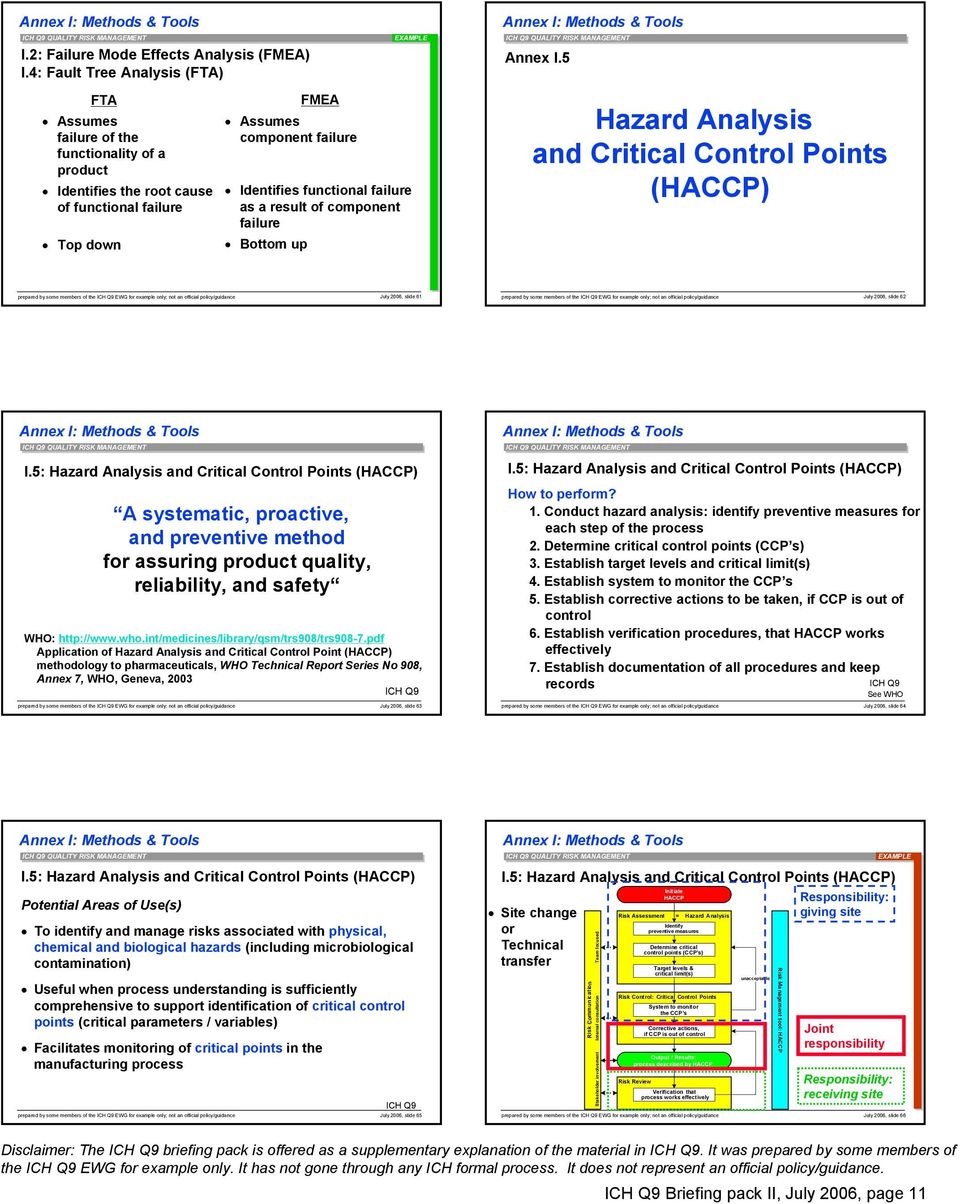
11 I.2: Failure Mode Effects Analysis (FMEA) I.4: Fault Tree Analysis (FTA) FTA Assumes failure of the functionality of a product Identifies the root cause of functional failure Top down FMEA Assumes component failure Identifies functional failure as a result of component failure Bottom up Annex I.5 Hazard Analysis and Critical Control Points (HACCP) prepared by some members of the EWG for example only; not an official policy/guidance July 2006, slide 61 prepared by some members of the EWG for example only; not an official policy/guidance July 2006, slide 62 I.5: Hazard Analysis and Critical Control Points (HACCP) A systematic, proactive, and preventive method for assuring product quality, reliability, and safety WHO: Application of Hazard Analysis and Critical Control Point (HACCP) methodology to pharmaceuticals, WHO Technical Report Series No 908, Annex 7, WHO, Geneva, 2003 prepared by some members of the EWG for example only; not an official policy/guidance July 2006, slide 63 I.5: Hazard Analysis and Critical Control Points (HACCP) How to perform? 1. Conduct hazard analysis: identify preventive measures for each step of the process 2. Determine critical control points (CCP s) 3. Establish target levels and critical limit(s) 4. Establish system to monitor the CCP s 5. Establish corrective actions to be taken, if CCP is out of control 6. Establish verification procedures, that HACCP works effectively 7. Establish documentation of all procedures and keep records See WHO prepared by some members of the EWG for example only; not an official policy/guidance July 2006, slide 64 I.5: Hazard Analysis and Critical Control Points (HACCP) Potential Areas of Use(s) To identify and manage risks associated with physical, chemical and biological hazards (including microbiological contamination) Useful when process understanding is sufficiently comprehensive to support identification of critical control points (critical parameters / variables) Facilitates monitoring of critical points in the manufacturing process prepared by some members of the EWG for example only; not an official policy/guidance July 2006, slide 65 I.5: Hazard Analysis and Critical Control Points (HACCP) Site change or Technical transfer Risk Communication Team focused Internal consultation Stakeholder involvement HACCP = Hazard Analysis Identify preventive measures Determine critical control points (CCP s) Target levels & critical limit(s) : Critical Control Points System to monitor the CCP s Corrective actions, if CCP is out of control Output / Results: process described by HACCP Verification that process works effectively prepared by some members of the EWG for example only; not an official policy/guidance July 2006, slide 66 Risk Management tool: HACCP Responsibility: giving site Joint responsibility Responsibility: receiving site Disclaimer: The briefing pack is offered as a supplementary explanation of the material in. It was prepared by some members of the EWG for example only. It has not gone through any ICH formal process. It does not represent an official policy/guidance. Briefing pack II, July 2006, page 11
12 I.5: Hazard Analysis and Critical Control Points (HACCP) I.5: Hazard Analysis and Critical Control Points (HACCP) Analyse a tablet process step because a systematic, proactive, and preventive risk assessment method helps to adjust parameters of the machine Comments fix parameter to adjust System to monitor Possible corrective actions, CCP if CCP is out of control by equipment < content uniformity out of range (autoimmunisation) Keeping records online Batch Record Automatic maschine without constant operator control Critical Control Point Target Critical Quality hazard Comments (CCP) level limits influence on specification of speed 400'000 <400'000 fix parameter to adjust appearance in function with the weight of the influence on specification of hardness compression force 15 kn 13-18kN tablet, thickness and hardness in function with the weight of the by equipment online automatic ejection of tablet tablet, thickness and hardness (autoimmunisation) Batch Record analytical data in +/- 10 % IPC on weight rejection (100% mass control) Batch Record online compression force automatic ejection of tablet Batch Record release limit for stability must be stability studies critical limit: min 50 N stability studies influence on specification of assay weight variation 200 mg mg +/- 10 % optimisation during production IPC of appearance adjust machine parameters online Batch Record prepared by some members of the EWG for example only; not an official policy/guidance July 2006, slide 67 prepared by some members of the EWG for example only; not an official policy/guidance July 2006, slide 68 I.5: Hazard Analysis and Critical Control Points (HACCP) Experiences Benefit > Teamwork in cross functional groups > Use very similar principles in Qualification & Validation > Critical control points (CCPs) are similar to critical process parameters Limitations of the model > Has to be combined with another tool (e.g. FMEA, statistical tools) > Not good for complex processes > Assumes you know the processes > Most CCPs should be addressed for risk control activities > May need to use other models for quantifying risk prepared by some members of the EWG for example only; not an official policy/guidance July 2006, slide 69 Annex I.6 Hazard Operability Analysis (HAZOP) prepared by some members of the EWG for example only; not an official policy/guidance July 2006, slide 70 I.6: Hazard Operability Analysis (HAZOP) (IEC 61882) A theory that assumes that risk events are caused by deviations from the design or operating intentions Identify potential deviations from normal use How to perform? A systematic brainstorming technique for identifying hazards using so-called guide-words applied to relevant parameters: > No, More, Other Than, None prepared by some members of the EWG for example only; not an official policy/guidance July 2006, slide 71 I.6: Hazard Operability Analysis (HAZOP) Concept Focus team discussions by applying deviations to specific nodes Deviations are generated by applying Guidewords to process parameters Examine the process by discussing causes of each deviation > Identify consequences > Evaluate risk and safeguards > Make recommendations, if necessary Include all parts of the process Source: Hazard and Operability Studies in Solid Dosage Manufacture. Nail L. Maxson. (2004). prepared by some members of the EWG for example only; not an official policy/guidance July 2006, slide 72 Disclaimer: The briefing pack is offered as a supplementary explanation of the material in. It was prepared by some members of the EWG for example only. It has not gone through any ICH formal process. It does not represent an official policy/guidance. Briefing pack II, July 2006, page 12

13 I.6: Hazard Operability Analysis (HAZOP) I.6: Hazard Operability Analysis (HAZOP) Potential Areas of Use(s) Manufacturing processes Equipment and facilities Evaluating process safety hazards Primarily as starter of a HACCP Operator error ( use error ) prepared by some members of the EWG for example only; not an official policy/guidance July 2006, slide 73 MORE LESS Guidewords NO NOT NONE AS WELL AS PARTIALLY REVERSE OTHER Explanation The total absence of the function Quantitative increase or Quantitative decrease Qualitative increase or Qualitative decrease The logical reverse of the desired function Total exchange Remarks No part of the function is active, but also nothing else happens This applies to quantities & properties such as flow, temperature, and also for functions such as heating and reacting. All desired functions & operations are achieved. Additionally, something else happens. Only a few functions are achieved, some not. This applies mainly to functions, e.g., reverse flow or reversible chemical reaction. It can also be applied to materials, e.g., poison instead of antidote, or D- instead of L- optical isomer. The original function is not performed. Something totally different happens. prepared by some members of the EWG for example only; not an official policy/guidance Nail L. Maxson. (2004). July 2006, slide 74 I.6: Hazard Operability Analysis (HAZOP) I.6: Hazard Operability Analysis (HAZOP) Deviation High temperature in blender Causes Steam heating control malfunction Consequences Feed material #1 reaches decomposition temperature Violent reaction with toxic gas generation Personnel exposure/ injury Equipment damage Safeguards Diverse high temp. interlock on blender Blender vented Recommend Test interlock on quarterly basis Add steam heating control to monthly PM Experiences Ease of applicability of the model? > Simplifies decision making > Allows uniformity of analysis across sites > Process steps guided ( guide words, if available) Limitations of the model > Applies to specific situations only > May need to use other models for quantifying risk > Not a structured approach > Not designed for quantifiable risk assessment > Complex output Nail L. Maxson. (2004). prepared by some members of the EWG for example only; not an official policy/guidance July 2006, slide 75 prepared by some members of the EWG for example only; not an official policy/guidance July 2006, slide 76 Annex I.7 I.7: Preliminary Hazard Analysis (PHA) Preliminary Hazard Analysis (PHA) prepared by some members of the EWG for example only; not an official policy/guidance July 2006, slide 77 (ISO14971) Analysis based on applying prior experience or knowledge of a hazard or failure to identify future hazards, hazardous situations and events that can cause harm In estimating their probability of occurrence for a given activity, facility, product or system How to perform? Identification of the possibilities that the risk event happens Qualitative evaluation of the extent of possible injury or damage to health that could result Identification of possible remedial measures prepared by some members of the EWG for example only; not an official policy/guidance July 2006, slide 78 Disclaimer: The briefing pack is offered as a supplementary explanation of the material in. It was prepared by some members of the EWG for example only. It has not gone through any ICH formal process. It does not represent an official policy/guidance. Briefing pack II, July 2006, page 13

14 I.7: Preliminary Hazard Analysis (PHA) The steps Risk Matrix Form > List known potential hazards - Literature - Previous projects - Reportable events - Complaints Severity rankings Hazard Hazards Arising From Product Design Investigation/ Controls Frequency codes and estimates risk codes Once established should remain same for similar product classes Imp (SxF) prepared by some members of the EWG for example only; not an official policy/guidance July 2006, slide 79 Sev Freq I.7: Preliminary Hazard Analysis (PHA) Hazard Wrong Material Lack of stability Hazards Arising From Product Design Investigation/ Controls SOPs, Crosscheck Stability studies Sev Sev Min Freq Rem Occ Imp prepared by some members of the EWG for example only; not an official policy/guidance July 2006, slide 80 I I I.7: Preliminary Hazard Analysis (PHA) Annex I.8 Potential Areas of Use(s) Analyzing existing systems Prioritizing hazards Evaluate the types of hazards for the general product type, then the product class and finally the specific product Early in the development: little information on design details or operating procedures will often be a precursor to further studies For product, process and facility design Further assessed with other risk management tools prepared by some members of the EWG for example only; not an official policy/guidance July 2006, slide 81 Risk ranking and filtering prepared by some members of the EWG for example only; not an official policy/guidance July 2006, slide 82 I.8: Risk ranking and filtering Compare and prioritize risks How to perform? Requires evaluation of multiple diverse quantitative and qualitative factors for each risk Involves breaking down a basic risk question into as many components as needed to capture factors involved in the risk These factors are combined into a single relative risk score that can then be compared, prioritized and ranked prepared by some members of the EWG for example only; not an official policy/guidance July 2006, slide 83 I.8: Risk ranking and filtering Potential Areas of Use(s) To prioritize manufacturing sites for inspection/audit by regulators or industry Helpful in situations in which the portfolio of risks and the underlying consequences to be managed are diverse and difficult to compare using a single tool Useful when management needs to evaluate both quantitatively and qualitatively assessed risks within the same organizational framework prepared by some members of the EWG for example only; not an official policy/guidance July 2006, slide 84 Disclaimer: The briefing pack is offered as a supplementary explanation of the material in. It was prepared by some members of the EWG for example only. It has not gone through any ICH formal process. It does not represent an official policy/guidance. Briefing pack II, July 2006, page 14

15 I.8: Risk ranking and filtering I.8: Risk ranking and filtering Evaluation of products and processes with recurring quality relevant problems Evaluation of products and processes with recurring quality relevant problems Risk assessment: Risk identification > recurring quality relevant problems within production and/or processes Risk assessment: Risk analysis Footing on an analysis of > Production problems > Complaints > Investigation Reports > Recalls > Additional information from manufacturer considered J. Knöbel, S. Marrer, Roche prepared by some members of the EWG for example only; not an official policy/guidance July 2006, slide 85 Risk assessment: Risk evaluation Three columns based on a classical approach by multiplying factors Probability 1: rare quality events 2: infrequent quality events 3. frequent quality events Resources prepared by some members of the EWG for example only; not an official policy/guidance July 2006, slide Probability Based on J. Knöbel, S. Marrer, Roche I.8: Risk ranking and filtering I.8: Risk ranking and filtering Evaluation of products and processes with recurring quality relevant problems Evaluation of products and processes with recurring quality relevant problems Risk assessment: Risk analysis Analyze production problems Risk assessment: Risk evaluation Risk evaluation added to production problems Site Product name Type of recurrent problem/defect A ABC Broken units B ACB Broken tablets C BAC Melt backs during lyophilization A CAB Foreign particles Site Product name Type of recurrent problem/defect Probability Resources Risk (Probability multiplied with Resource) A ABC Broken units B ACB Broken tablets C BAC Melt backs during lyophilization A CAB Foreign particles J. Knöbel, S. Marrer, Roche prepared by some members of the EWG for example only; not an official policy/guidance July 2006, slide 87 J. Knöbel, S. Marrer, Roche prepared by some members of the EWG for example only; not an official policy/guidance July 2006, slide 88 I.8: Risk ranking and filtering I.8: Risk ranking and filtering Evaluation of products and processes with recurring quality relevant problems Evaluation of products and processes with recurring quality relevant problems Risk assessment: Risk control actions added to production problems Site Product Type of Corrective Probability Resources Risk (Probabili name recurrent actions multiplied with problem/defect instituted to Resources) date A ABC Broken units Task force headed by B ACB Broken tablets Investigations in B initiated Investigating C BAC Melt backs during process improvements lyophilization together with production Project initiated A CAB Foreign particles J. Knöbel, S. Marrer, Roche Risk assessment: Risk analysis Analyze process problems Process Printing of Variable Data Blister: blister foil peels off Products concerned ABC ACB BAC CAB CBA ABC ACB BAC CAB J. Knöbel, S. Marrer, Roche prepared by some members of the EWG for example only; not an official policy/guidance July 2006, slide 89 prepared by some members of the EWG for example only; not an official policy/guidance July 2006, slide 90 Disclaimer: The briefing pack is offered as a supplementary explanation of the material in. It was prepared by some members of the EWG for example only. It has not gone through any ICH formal process. It does not represent an official policy/guidance. Briefing pack II, July 2006, page 15

16 I.8: Risk ranking and filtering I.8: Risk ranking and filtering Evaluation of products and processes with recurring quality relevant problems Evaluation of products and processes with recurring quality relevant problems Risk assessment: Risk evaluation Risk evaluation added to process problems Process Missing prints of Variable Data Blister: blister foil peels off Products concerned Resources Risk (Probability multiplied with Resources) ABC ACB BAC CAB CBA ABC ACB BAC CAB J. Knöbel, S. Marrer, Roche prepared by some members of the EWG for example only; not an official policy/guidance July 2006, slide 91 Risk assessment: Risk control actions added to process problems Process Missing prints of Variable Data Blister: blister foil peels off Products concerned Corrective actions instituted to date Project started, corrective measures under discussion Probability Probability Resources Risk (Probability multiplied with Resources) ABC ACB BAC CAB CBA ABC Task force ACB established BAC CAB J. Knöbel, S. Marrer, Roche prepared by some members of the EWG for example only; not an official policy/guidance July 2006, slide 92 I.8: Risk ranking and filtering Evaluation of products and processes with recurring quality relevant problems Risk communication Providing stakeholders with the update of the overview of Risk control step Regularly the responsible person updates the overview to support line/senior management decisions I.8: Risk ranking and filtering Severity Risk Matrix (1) Probability Risk Ranking High Medium Low Low Medium High Risk Class ONE Risk Class TWO Risk Class THREE J. Knöbel, S. Marrer, Roche prepared by some members of the EWG for example only; not an official policy/guidance July 2006, slide 93 Takayoshi Matsumura, Eisai prepared by some members of the EWG for example only; not an official policy/guidance July 2006, slide 94 I.8: Risk ranking and filtering Detection Risk Matrix (2) Risk Classification Risk Filtering ONE TWO THREE Low Medium High HIGH priority MEDIUM priority LOW priority Annex I.9 Supporting statistical tools Takayoshi Matsumura, Eisai prepared by some members of the EWG for example only; not an official policy/guidance July 2006, slide 95 prepared by some members of the EWG for example only; not an official policy/guidance July 2006, slide 96 Disclaimer: The briefing pack is offered as a supplementary explanation of the material in. It was prepared by some members of the EWG for example only. It has not gone through any ICH formal process. It does not represent an official policy/guidance. Briefing pack II, July 2006, page 16

17 I.9: Supporting statistical tools Control Charts (for example): > Shewhart Control Charts (see ISO 8258) > Control Charts with Arithmetic Average and Warning Limits (see ISO 7873) > Acceptance Control Charts (see ISO 7966) > Cumulative Sum Charts (ISO 7871) > Weighted Moving Average Aid for: Design of Experiments (DOE) - Effective data Pareto Charts assessment - Aid in determining Process Capability Analysis the significance of the data set(s) prepared by some members of the EWG for example only; not an official policy/guidance July 2006, slide 97 I.9: Supporting statistical tools Control charts (ISO 7870) Indicates the range of variability that is built into a system Shows statistically determined upper and lower control limits drawn on either side of the process average The bounds of the control chart are marked by upper and lower control limits > Calculated by applying statistical formulas to data > Data points that fall outside these bounds represent variations due to special causes > Can be found and eliminated Improvements require changes in the process prepared by some members of the EWG for example only; not an official policy/guidance July 2006, slide 98 I.9: Supporting statistical tools Control charts Potential Areas of Use(s) Monitoring critical parameters Provides information to determine > Process capability > Variability > Control Some charts are dealing with warning limits or trend analysis Example prepared by some members of the EWG for example only; not an official policy/guidance July 2006, slide 99 I.9: Supporting statistical tools Control Chart: Shewhart Control Charts (ISO 8258) Use warning limits Analysis trend patterns Example Potential Areas of Use(s) Statistical control of the process prepared by some members of the EWG for example only; not an official policy/guidance July 2006, slide 100 I.9: Supporting statistical tools Control Charts with Arithmetic Average and Warning Limits (ISO 7873) A control chart with warning and action limits Potential Areas of Use(s) Enable a base period of quality measure Provide a basis for the construction of relationships between a process and product quality Producing recommendations for the adjustment of the process Can be applied with process Analytical technology tools prepared by some members of the EWG for example only; not an official policy/guidance July 2006, slide 101 I.9: Supporting statistical tools Control Chart: Acceptance Control Charts (ISO 7966) Chart with a central line within an acceptable process zone Ideal the average should be the target value Potential Areas of Use(s) During regular batch manufacturing can give guidance for determine sample size, action limits and decision criteria Ongoing improvements under process robustness/six sigma program can be initiated prepared by some members of the EWG for example only; not an official policy/guidance July 2006, slide 102 Disclaimer: The briefing pack is offered as a supplementary explanation of the material in. It was prepared by some members of the EWG for example only. It has not gone through any ICH formal process. It does not represent an official policy/guidance. Briefing pack II, July 2006, page 17

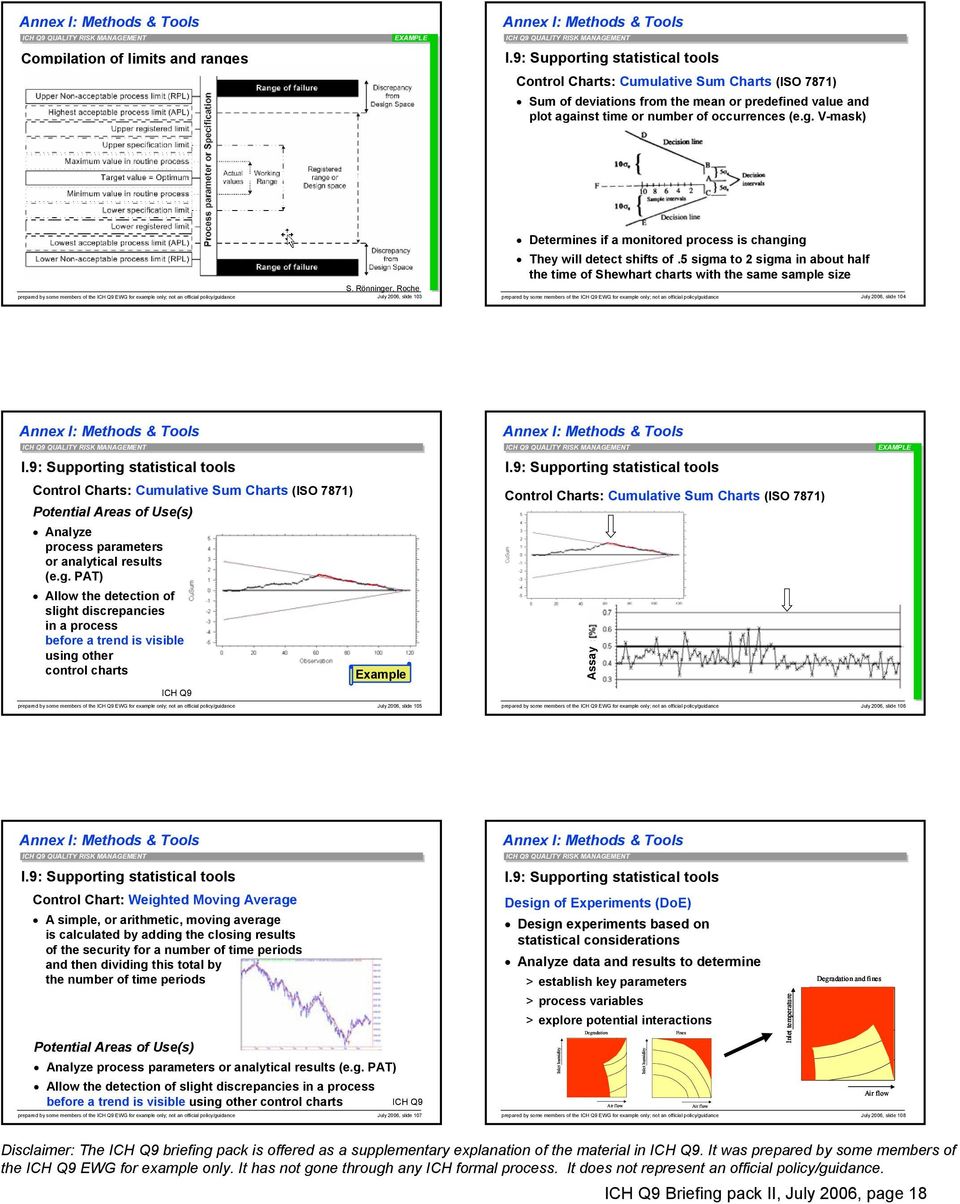
18 Compilation of limits and ranges I.9: Supporting statistical tools Control Charts: Cumulative Sum Charts (ISO 7871) Sum of deviations from the mean or predefined value and plot against time or number of occurrences (e.g. V-mask) S. Rönninger, Roche prepared by some members of the EWG for example only; not an official policy/guidance July 2006, slide 103 Determines if a monitored process is changing They will detect shifts of.5 sigma to 2 sigma in about half the time of Shewhart charts with the same sample size prepared by some members of the EWG for example only; not an official policy/guidance July 2006, slide 104 I.9: Supporting statistical tools Control Charts: Cumulative Sum Charts (ISO 7871) Potential Areas of Use(s) Analyze process parameters or analytical results (e.g. PAT) Allow the detection of slight discrepancies in a process before a trend is visible using other control charts Example I.9: Supporting statistical tools Control Charts: Cumulative Sum Charts (ISO 7871) Assay prepared by some members of the EWG for example only; not an official policy/guidance July 2006, slide 105 prepared by some members of the EWG for example only; not an official policy/guidance July 2006, slide 106 I.9: Supporting statistical tools Control Chart: Weighted Moving Average A simple, or arithmetic, moving average is calculated by adding the closing results of the security for a number of time periods and then dividing this total by the number of time periods Potential Areas of Use(s) Analyze process parameters or analytical results (e.g. PAT) Allow the detection of slight discrepancies in a process before a trend is visible using other control charts prepared by some members of the EWG for example only; not an official policy/guidance July 2006, slide 107 I.9: Supporting statistical tools Design of Experiments (DoE) Design experiments based on statistical considerations Analyze data and results to determine > establish key parameters > process variables > explore potential interactions Inlet humidity Degradation Air flow Inlet humidity Fines Air flow Air flow prepared by some members of the EWG for example only; not an official policy/guidance July 2006, slide 108 Inlet temperature Degradation and fines Disclaimer: The briefing pack is offered as a supplementary explanation of the material in. It was prepared by some members of the EWG for example only. It has not gone through any ICH formal process. It does not represent an official policy/guidance. Briefing pack II, July 2006, page 18
19 I.9: Supporting statistical tools Design of Experiments (DOE) Potential Areas of Use(s) Research and development area Retrospective evaluation of established parameters (Proven Acceptable Ranges Systematically choosing certain combinations of variables it is possible to separate their individual effects A special variant: focus on optimizing design parameters to minimize variation BEFORE optimizing design to hit mean target values for output parameters prepared by some members of the EWG for example only; not an official policy/guidance July 2006, slide 109 I.9: Supporting statistical tools Design of Experiments (DOE) in a submission Type of experimental design used e.g. full/ fractional factorial Justification of the selection of factors and responses As an appendix > Number and levels of factors under study > The experimental matrix with the values of the responses for each combination of factors Graphical representation > Coefficient plot of the relative significance of the factors under study and interactions between them Reflection paper on PAT: EMEA/INS/277260/2005, March 20, 2006 prepared by some members of the EWG for example only; not an official policy/guidance July 2006, slide 110 I.9: Supporting statistical tools Design of Experiments (DOE) in a submission Statistical evaluation of the model derived from DoE (e.g. ANOVA table) Graphical representation of the relationship of the significant factors under study with the responses (e.g. response surface and contour plots) providing a clear overview of the conclusions. The Design Space (based on real test results and/or on the model) as defined in ICH Q8 should be described Verification of the model derived from DoE Reflection paper on PAT: EMEA/INS/277260/2005, March 20, 2006 prepared by some members of the EWG for example only; not an official policy/guidance July 2006, slide 111 I.9: Supporting statistical tools Pareto Charts Created by plotting the cumulative frequencies of the relative frequency data in descending order The most essential factors for the analysis are graphically apparent, and in an orderly format Potential Areas of Use(s) Identify those factors that have the greatest cumulative effect on a system Few important factors in a process: Screen out the less significant factors prepared by some members of the EWG for example only; not an official policy/guidance July 2006, slide 112 I.9: Supporting statistical tools Pareto Chart I.9: Supporting statistical tools Process Capability Analysis Estimate the potential percent of defective product Cp value cp=0.5 cp=1 cp=3 graphical view of different cp values UGW OGW UGW OGW UGW OGW values statistically out of limit values in the limit 13,58 % 0,27 % approx. 0 86,42 % 99,73 % > 99, % Result: process statistically out of control process statisticaly under control prepared by some members of the EWG for example only; not an official policy/guidance July 2006, slide 113 prepared by some members of the EWG for example only; not an official policy/guidance July 2006, slide 114 Disclaimer: The briefing pack is offered as a supplementary explanation of the material in. It was prepared by some members of the EWG for example only. It has not gone through any ICH formal process. It does not represent an official policy/guidance. Briefing pack II, July 2006, page 19

20 I.9: Supporting statistical tools Process Capability Analysis Potential Areas of Use(s) Monitor / measure process variability Analyze data retrospectively > Annual Product Review Determine the relationship between process variability and specification Requirement: Process specific data Tool for both regulator and industry prepared by some members of the EWG for example only; not an official policy/guidance July 2006, slide 115 I.9: Supporting statistical tools Histogram A simple, graphical view of accumulated data > including its dispersion and central tendency Provide the easiest way to evaluate the distribution of data Process compatibility Example prepared by some members of the EWG for example only; not an official policy/guidance July 2006, slide 116 I.9: Supporting statistical tools Scatter diagrams (x/y-diagram) To depict the influence that one variable has on another Usually displays points representing the observed value of one variable corresponding to the value of another variable How to perform: plot two parameters x and y in a two dimensional way Others Combination of tools prepared by some members of the EWG for example only; not an official policy/guidance July 2006, slide 117 prepared by some members of the EWG for example only; not an official policy/guidance July 2006, slide 118 Combination of Tools Probabilistic (PRA) Integrating various reliability modelling tools such as Fault Tree, Event Tree Block Diagram, FMEA to numerically quantify risks Determine what quality risk scenarios can occur, what is the likelihood and the consequences given they occur. Estimates of the parameters used to determine the frequencies and probabilities of the various events It involves the development of models that delineate the response of systems and operators to accident initiating events. Combination of Tools Probabilistic (PRA) How to perform? To identify an undesired top event e.g. "loss of life" or "loss of mission Trace out all quality risk that could lead to this events. Conducted through the use of event trees (fault trees) At the lowest level: basic events are assigned probabilities Propagated up the logic to reach a probability prepared by some members of the EWG for example only; not an official policy/guidance July 2006, slide 119 prepared by some members of the EWG for example only; not an official policy/guidance July 2006, slide 120 Disclaimer: The briefing pack is offered as a supplementary explanation of the material in. It was prepared by some members of the EWG for example only. It has not gone through any ICH formal process. It does not represent an official policy/guidance. Briefing pack II, July 2006, page 20

21 Examples of combination of tools Examples of combination of tools Another way to proceed 1. Define the scope of an analysis Collect all relevant data surrounding the system Subject to determine the need for additional information 2. Describe the desired and controlled conditions of the process 3. Using a structured approach identify the risk by reviewing the direct and indirect causal areas 4. Using assessment tools (e.g. statistical) assess the hazard Another way to proceed 1. Define the scope of QRM 2. Choose team and team leader 3. Identify hazards and assess hazard scenarios 4. Build the risk profile to visualize the risks: - set the risk tolerance boundary - plot the risks 5. Develop risk reduction actions 6. Accept risk reduction actions 7. Implement risk reduction actions 8. Follow up on success prepared by some members of the EWG for example only; not an official policy/guidance July 2006, slide 121 prepared by some members of the EWG for example only; not an official policy/guidance July 2006, slide 122 Zurich Hazard Analysis Establish a team Step 1 Basic Data Step 2 Process Conditions Step 3 Hazard Identification Step 4 Hazard Assessment Step 5 Step 6 Measures Step 7 Residual Risk Summary Requirement by a Quality Management System Risk Communication by Zurich insurance company prepared by some members of the EWG for example only; not an official policy/guidance July 2006, slide 123 Examples of combination of tools Zurich Hazard Analysis Methodology A systematic approach managing quality risks Step 1 Basic Data > Define the scope carefully > Collect all relevant data about the system > Determine the need for additional data Step 2 Process Conditions > Describe the desired, quality function of the system Zurich Insurance Ltd, Switzerland prepared by some members of the EWG for example only; not an official policy/guidance July 2006, slide 124 Examples of combination of tools Examples of combination of tools Zurich Hazard Analysis Methodology Zurich Hazard Analysis Methodology Step 3 Hazard Identification > Systematic approach by reviewing all critical areas > An optimal method doesn t exist as it depends on the particular system being analysed Step 4 Hazard Assessment > The effects are rated in terms of their consequences and the causes are assessed in terms of their probabilities > Based on these results a risk profile is created > In this profile the risks are compared with the risk protection level: define the accepted level Zurich Insurance Ltd, Switzerland prepared by some members of the EWG for example only; not an official policy/guidance July 2006, slide 125 Step 5 > The effects are rated in and the result completes the risk profile > In this profile the risks are compared with the risk protection level Step 6 Measures > Measures to be taken for every risk to reduce the consequences and the probability or both > Prioritise actions Picture: Zurich Insurance Ltd, Switzerland Picture: Zurich Insurance Ltd, Switzerland prepared by some members of the EWG for example only; not an official policy/guidance July 2006, slide 126 Disclaimer: The briefing pack is offered as a supplementary explanation of the material in. It was prepared by some members of the EWG for example only. It has not gone through any ICH formal process. It does not represent an official policy/guidance. Briefing pack II, July 2006, page 21
22 Quality Risk Management Process Quality Risk Management Process Examples of combination of tools Zurich Hazard Analysis Methodology Step 7 Residual Risk > The residual risk is acceptable if the risk protection level is achieved > Current scientific knowledge and techniques must be considered in coming to this decision as well as the authorities Communicate results (Risk Communication) > Summarise the relevant risks > Low risks may be neglected Maintain Risk Management () > Updated regularly especially in any change Picture: Zurich Insurance Ltd, Switzerland prepared by some members of the EWG for example only; not an official policy/guidance July 2006, slide 127 Conclusion prepared by some members of the EWG for example only; not an official policy/guidance July 2006, slide 128 Simple explanations of some tools Failure Mode Effects Analysis (FMEA) > Break down large complex processes into manageable steps Failure Mode, Effects and Criticality Analysis (FMECA) > FMEA & links severity, probability & detectability to criticality Fault Tree Analysis (FTA) > Tree of failure modes combinations with logical operators Hazard Analysis and Critical Control Points (HACCP) > Systematic, proactive, and preventive method on criticality Hazard Operability Analysis (HAZOP) > Brainstorming technique Preliminary Hazard Analysis (PHA) > Possibilities that the risk event happens Risk ranking and filtering > Compare and prioritize risks with factors for each risk CONSIDERATIONS prepared by some members of the EWG for example only; not an official policy/guidance July 2006, slide 129 Risk Communication Overview: Some risk management tools Supporting statistical tools Control Charts Design of Experiments (DOE) Pareto Charts Probabilistic (PRA) Process Capability Analysis The results from using statistical methods can not be better than your data prepared by some members of the EWG for example only; not an official policy/guidance July 2006, slide 130 Conclusion on Methods and Tools Provides a general overview of and references for some of the primary tools Might be used in QRM by industry and competent authorities This is not an exhaustive list No one tool or set of tools is applicable to every situation in which a QRM procedure is used Conclusion: makes suggestions for improvements of Quality This Annex is intended to identify opportunities for the use of quality risk management principles by industry and regulators (e.g., for both inspections and submissions). However, the selection of particular risk management tools is completely dependent upon specific facts and circumstances. These examples are provided for illustrative purposes and only suggest potential uses of quality risk management. This Annex is not intended to create any new expectations beyond the current regulatory requirements. Introduction to Annex I prepared by some members of the EWG for example only; not an official policy/guidance July 2006, slide 131 prepared by some members of the EWG for example only; not an official policy/guidance July 2006, slide 132 Disclaimer: The briefing pack is offered as a supplementary explanation of the material in. It was prepared by some members of the EWG for example only. It has not gone through any ICH formal process. It does not represent an official policy/guidance. Briefing pack II, July 2006, page 22
23 It is not always necessary to use formal risk management tools in a QRM process, however in the right circumstances they can be very powerful Quality Risk Management Annex II: Potential Applications Disclaimer: This presentation includes the authors views on quality risk management theory and practice. The presentation does not represent official guidance or policy of authorities or industry. prepared by some members of the EWG for example only; not an official policy/guidance July 2006, slide 133 prepared by some members of the EWG for example only; not an official policy/guidance July 2006, slide 134 Purpose of this part To guide through Potential Applications for Quality Risk Management Provision of some concrete, non exhaustive examples prepared by some members of the EWG for example only; not an official policy/guidance July 2006, slide 135 Introduction This Annex is intended to identify potential uses of quality risk management principles and tools by industry and regulators. However, the selection of particular risk management tools is completely dependent upon specific facts and circumstances. These examples are provided for illustrative purposes and only suggest potential uses of quality risk management. This Annex is not intended to create any new expectations beyond the current regulatory requirements. prepared by some members of the EWG for example only; not an official policy/guidance July 2006, slide 136 Potential Applications for Quality Risk Management Quality Risk Management as Part of II.1 Integrated Quality Management II.2 Regulatory Operations II.3 Development II.4 Facilities, Equipment and Utilities II.5 Materials Management II.6 Production II.7 Laboratory Control and Stability Studies II.8 Packaging and Labelling prepared by some members of the EWG for example only; not an official policy/guidance July 2006, slide 137 Quality risk management Communication facilitates trust and understanding Regulators operation -Reviews - Inspections Industry operation - Submissions - Manufacturing CONSIDERATIONS prepared by some members of the EWG for example only; not an official policy/guidance July 2006, slide 138 Disclaimer: The briefing pack is offered as a supplementary explanation of the material in. It was prepared by some members of the EWG for example only. It has not gone through any ICH formal process. It does not represent an official policy/guidance. Briefing pack II, July 2006, page 23
24 Quality Risk Management Subprocess Sub-Subprocess Start Feedback procedure Decision Processstep Start is not a single process Start Risk identification Risk analysis Etc. Probability and Severity Given the broad concept of risk can probability and severity be more narrowly defined? Probability has two major meanings > Frequency of successes divided by the number of trials > Degree of belief Severity is even more difficult to qualify as it often has different variable attributes around a quantifiable outcome Examples End End End members of example only; not an official policy/guidance prepared by some the EWG for July 2006, slide 139 G. Claycamb, FDA, Sept prepared by some members of the EWG for example only; not an official policy/guidance July 2006, slide 140 Which consequence is more severe? Simple Probability Statements? 300 lives lost in single, fiery plane crash 300 lives lost on country roads over a weekend 300 lives potentially lost from cancer within the next 20 years Even in a narrow context, e.g., microbial contamination, severity potentially spans: > Product spoilage > Mild malaise acute illness (acute) death > Chronic illness premature death G. Claycamb, FDA, Sept prepared by some members of the EWG for example only; not an official policy/guidance July 2006, slide 141 A common understanding of probability is elusive! For example: What does a 30% chance of rain tomorrow mean? > 30% of the days like tomorrow will have at least a trace of rain. > 30% of the area will have rain tomorrow. > 30% of the time tomorrow, it will rain. See Gigerenzer, et. al (2005) G. Claycamb, FDA, Sept prepared by some members of the EWG for example only; not an official policy/guidance July 2006, slide 142 Challenges for potential applications Managing risks in a company Problem: What is the risk of a rain shower now? Answer 1: > Set up a new department with 5 employees > Develop a computer program for this risk ( weather forecast ) > 10 external meetings, 2 conferences, 5 publications, > Verify with experimental data > Revisit your program on an annual basis > Answer 2: > Look out of a window S. Rönninger, Sept prepared by some members of the EWG for example only; not an official policy/guidance July 2006, slide 143 Company Strategic risks Operational risks Financial risks Compliance risks Competitor advantage Company viability Shareholder harm Patient harm Environmental Regulatory filing Quality / GMP Safety & Efficacy prepared by some members of the EWG for example only; not an official policy/guidance July 2006, slide 144 Disclaimer: The briefing pack is offered as a supplementary explanation of the material in. It was prepared by some members of the EWG for example only. It has not gone through any ICH formal process. It does not represent an official policy/guidance. Briefing pack II, July 2006, page 24
25 Existing organisation Risk Management Strategy for Excipients Operations Development Manufacturing Launch Surveillance Support Manufacturing Quality Unit Procurement etc Quality Management Quality Assurance Quality Control Estimate risk vs hazard Characterize materials Conduct hazard exposure assessment Develop risk mitigation strategy Define risk control measure (s) Confirm acceptability Define specs/quality system practices Define process controls Confirm risk mitigation strategy Select risk control measure (s) Implement protective measures Create literature/define surveillance criteria Monitor process controls Implement risk mitigation strategy Implement risk control measure (s) Implement surveillance measures Monitor issues and assess root causes Re-assess effectiveness of process controls Re-assess effectiveness of Risk mitigation Re-assess effectiveness of Risk control measure(s) Validation QRM prepared by some members of the EWG for example only; not an official policy/guidance July 2006, slide 145 Evaluate results and make appropriate course corrections based on regulations, customer expectation, company policies and procedures, societal trends and needs Patricia Rafidison, Dow Corning Life Sciences; IPEC Europe, June 2005 prepared by some members of the EWG for example only; not an official policy/guidance July 2006, slide 146 II. 1 Quality risk management as part of Integrated Quality Management Industry Competent Authorities Quality risk management as part of II.1: Integrated quality management > Documentation > Training and education > Quality defects > Auditing / Inspection > Periodic review > Change management / change control > Continual improvement prepared by some members of the EWG for example only; not an official policy/guidance July 2006, slide 147 prepared by some members of the EWG for example only; not an official policy/guidance July 2006, slide 148 II.1: QRM as Part of integrated Quality Management Documentation > To review current interpretations and application of regulatory expectations > To determine the desirability of and/or develop the content for SOPs, guidelines, etc. Existing document structure Existing internal documentation system Where to be in future? (Mission, Policy) What to do? (e.g. Directives) How to do? (e.g. Guidelines) Detailed instructions (e.g. Standard Operating Procedures) Law, regulations, requirements Records prepared by some members of the EWG for example only; not an official policy/guidance July 2006, slide 149 Rules & Procedures (internal regulations) Records & Reports prepared by some members of the EWG for example only; not an official policy/guidance July 2006, slide 150 Disclaimer: The briefing pack is offered as a supplementary explanation of the material in. It was prepared by some members of the EWG for example only. It has not gone through any ICH formal process. It does not represent an official policy/guidance. Briefing pack II, July 2006, page 25
26 Include Application of documentation system Risk-based approach Consider Implement risk-based thinking Examples for using specific tools e.g. FMEA table list of residual risks A topic for any quality management system might be a risk-based approach for decision making Include consideration of guideline in the directive on Quality Unit-activities as a requirement During periodic review of regulations, policies, guidelines and standard operating procedures (SOP) etc. think about implementing the principles Share examples of specific tools and their use as a means of sharing best practice prepared by some members of the EWG for example only; not an official policy/guidance July 2006, slide 151 prepared by some members of the EWG for example only; not an official policy/guidance July 2006, slide 152 II.1: QRM as Part of integrated Quality Management Training and education > To determine the appropriateness of initial and/or ongoing training sessions - Based on education, experience and working habits - A periodic assessment of previous training (effectiveness) > To identify the training, experience, qualifications and physical abilities > To perform an operation reliably and with no adverse impact on the quality of the product prepared by some members of the EWG for example only; not an official policy/guidance July 2006, slide 153 II.1: QRM as Part of integrated Quality Management Quality defects > To provide the basis for identifying, evaluating, and communicating the potential quality impact of a suspected quality defect, complaint, trend, deviation, investigation, out of specification result, etc. > To facilitate risk communications > To determine appropriate action to address significant product defects, in conjunction with regulatory authorities (e.g., recall) prepared by some members of the EWG for example only; not an official policy/guidance July 2006, slide 154 Assess the history of known quality defects Vision > Robust Processes, non-recurrent Q-problems Target > Continuous improvement to resolve known problems e.g. from CAPA, inspections/audits, non robust processes > Preventatively work towards the achievement of a high reliability, productivity, quality of all that we do > Manage dedicated projects to support site / departments / process / products Assess the history of known quality defects Site approach Risk Communication Identification of opportunities for improvement Use risk assessment tool -risk analysis -risk evaluation & prioritization Select improvement opportunities Dedicated projects - Establish a team Problem solving approach Risk review : re-application of risk assessment tool prepared by some members of the EWG for example only; not an official policy/guidance July 2006, slide 155 prepared by some members of the EWG for example only; not an official policy/guidance July 2006, slide 156 Disclaimer: The briefing pack is offered as a supplementary explanation of the material in. It was prepared by some members of the EWG for example only. It has not gone through any ICH formal process. It does not represent an official policy/guidance. Briefing pack II, July 2006, page 26
27 Assess the history of known quality defects Approach > Increase the knowledge of weaknesses for all processes at the site and evaluate the related risks > Tackle individual issues by problem solving methods e.g. root cause analysis, statistics, tools Tool > tools: select dynamic tool to identify which are the most significant problems in order to allow identification of priorities (e.g. FTA, FMEA, etc.) > SixSigma type Project approach for problem solving teams on each identified priority prepared by some members of the EWG for example only; not an official policy/guidance July 2006, slide 157 Assess the history of known quality defects The project approach Teamwork (inter-departmental teams) possibly using a facilitator > Select methodology > Commit resources appropriate to the project, priority and size Problem solving structure > Problem Finding & Setting > Problem Analysis > Problem solution identification > Sharing with management (communication) > Decision making & implementation prepared by some members of the EWG for example only; not an official policy/guidance July 2006, slide 158 II.1: QRM as Part of integrated Quality Management Deviation/ Investigation Report Deviation / Investigation Report The event triggers a review of quality risk management decisions > to control or accept risk related to a process > to ensure these decisions are still valid based on the new learning In detail this could include: > Quality Risk Management process: Product and process information > Define the problem: Detailed description of the discrepancy RiskCommunication RiskManagement tools Risk assessment: Risk analysis > Assessment of effects of the discrepancy Examples if applicable: - Product quality - Drug safety - Registration files / Marketing authorisation - Systems in place - Availability of goods: potentially insufficient stock levels > Identification of the root cause RiskCommunication prepared by some members of the EWG for example only; not an official policy/guidance July 2006, slide 159 prepared by some members of the EWG for example only; not an official policy/guidance July 2006, slide 160 Deviation/ Investigation Report Risk assessment: Risk evaluation > Consequences for other products / batches > Systems failure > Evaluation of - Performed - Foreseen actions - Measurements - RiskCommunication Deviation/ Investigation Report : / Mitigation > Corrective actions to resolve the discrepancy > Corrective actions to avoid a recurrence in the future : > Conclusions of measures taken > Decisions on disposition of the material > Define Follow up actions (if applicable) > Management summary (if applicable) > Date and signature - responsible manager - approval of QU RiskCommunication prepared by some members of the EWG for example only; not an official policy/guidance July 2006, slide 161 prepared by some members of the EWG for example only; not an official policy/guidance July 2006, slide 162 Disclaimer: The briefing pack is offered as a supplementary explanation of the material in. It was prepared by some members of the EWG for example only. It has not gone through any ICH formal process. It does not represent an official policy/guidance. Briefing pack II, July 2006, page 27
28 Review Deviation/ Investigation Report Deviation/ Investigation Report Risk Communication > Frequent interactions (e.g. short daily meeting) > Follow up of action items > Informal meetings > Summary and evaluation > Scheduled regular meetings (minutes) e.g. Annual Product Review RiskCommunication RiskCommunication prepared by some members of the EWG for example only; not an official policy/guidance July 2006, slide 163 prepared by some members of the EWG for example only; not an official policy/guidance July 2006, slide 164 One page: Deviation/ Investigation Report Complaint/ Issue Management Quality Risk Management process > Information on the complaint/ issue > Product information Risk identification: Define the problem > Detailed description of the complaint/ issue > Risk to patient? Recall needed? > Risk communication: to central coordination unit RiskCommunication prepared by some members of the EWG for example only; not an official policy/guidance July 2006, slide 165 prepared by some members of the EWG for example only; not an official policy/guidance July 2006, slide 166 Complaint/ Issue Management Complaint/ Issue Management Risk assessment: Risk analysis Risk assessment: Risk evaluation > Assessment of effects of the discrepancy Examples if applicable: Lot tracing Product quality Patient impact Registration/ Marketing authorisation Systems in place Availability of stock: potentially insufficient stock levels.. > Identification of the root cause Risk > Risk communication: to expert team RiskCommunication > Consequences for other batches/ products > Systems failure > Evaluation of Available data Performed actions Foreseen actions Measurements > Risk communication: to central coordination unit; involve management, if appropriate RiskCommunication prepared by some members of the EWG for example only; not an official policy/guidance July 2006, slide 167 prepared by some members of the EWG for example only; not an official policy/guidance July 2006, slide 168 Disclaimer: The briefing pack is offered as a supplementary explanation of the material in. It was prepared by some members of the EWG for example only. It has not gone through any ICH formal process. It does not represent an official policy/guidance. Briefing pack II, July 2006, page 28
29 Complaint/ Issue Management : / Mitigation > Corrective actions to resolve the discrepancy > Corrective actions to avoid a recurrence in the future : > Conclusions of measures taken (management sign off) > Decisions on disposition of the material > Define follow up actions (if applicable) > Management summary (if applicable) > Date and signature of minutes > Risk communication: management to decide next steps RiskCommunication Risk Management t ools Complaint/ Issue Management Output/ result: Risk Communication Internal > Sites / Affiliates > Informal meetings > Address in regular meetings > Training sessions External > Communicate with Competent Authorities (e.g. Field Alert, incident summary) > To whom it may concern letters > Pharmacies Risk Communication prepared by some members of the EWG for example only; not an official policy/guidance July 2006, slide 169 prepared by some members of the EWG for example only; not an official policy/guidance July 2006, slide 170 Complaint/ Issue Management > Follow up of action items > Summary and evaluation e.g. Product Quality Review, Annual Product Review, follow-up report prepared by some members of the EWG for example only; not an official policy/guidance July 2006, slide 171 RiskCommunication II.1: QRM as Part of integrated Quality Management Auditing / Inspection > To define the frequency and scope of audits > Taking into account factors such as: Existing legal requirements Overall compliance status and history of the company Robustness of a company s quality risk management activities Complexity of the site, manufacturing process, product and its therapeutic significance Compliance status and history Results of previous audits/inspections Number and significance of quality defects (e.g, recall) Results of previous audits/inspections Major changes of building, equipment, processes, key personnel Experience with manufacturing of a product (e.g. frequency, volume, number of batches) Test results of official control laboratories prepared by some members of the EWG for example only; not an official policy/guidance July 2006, slide 172 Inspections Start (Databases) & (Multi-Factorial Risk Model) Risk Communication & cgmp/compliance Inspections Data Data sources include Quality Systems ( Q10 ) & Mfrg MfrgScience (Q8) (Q8) (Work Planning) Risk (Risk (Risk Ranking Ranking and and Filtering) Filtering) D.Horowitz, FDA April 2005 prepared by some members of the EWG for example only; not an official policy/guidance July 2006, slide 173 Scheduling audits: A framework How industry might be able to set up a risk-based evaluation scheme to assess the need to audit. A similar approach could be used by competent authorities (CA) for scheduling inspections. 1. Brainstorm to create a list of manufacturers / traders to be audited 2. Evaluate all sources of audit reports from competent authorities, competent companies or third parties conducted according local and/or other GMPstandards (e.g. PIC/S, WHO respective VFA, APIC) S. Rönninger & EFPIA TG foreign inspections Feb.06 prepared by some members of the EWG for example only; not an official policy/guidance July 2006, slide 174 Disclaimer: The briefing pack is offered as a supplementary explanation of the material in. It was prepared by some members of the EWG for example only. It has not gone through any ICH formal process. It does not represent an official policy/guidance. Briefing pack II, July 2006, page 29
30 Scheduling audits: A framework Scheduling audits: A framework 3. Evaluate risk factor according to criteria based on managing risk for patients, which can (easily) be evaluated and maintained: 4. Weighting on to protection of patient > Severity: Compliance: effects safety & efficacy > Severity: Patient interest: effects availability > Probability: Complexity: Drug(medicinal)product, API etc. > Detectability: Audit History frequency of audit/inspections S. Rönninger & EFPIA TG foreign inspections Feb.06 prepared by some members of the EWG for example only; not an official policy/guidance July 2006, slide 175 See list on following slides: - In case of different activities take the highest ranking! - In case their is nothing known, take the highest ranking! S. Rönninger & EFPIA TG foreign inspections Feb.06 prepared by some members of the EWG for example only; not an official policy/guidance July 2006, slide 176 Scheduling audits: A framework Compliance (Severity) patient risk: addressing safety & efficacy Scheduling audits: A framework Compliance (Severity) patient risk: addressing availability S. Rönninger & EFPIA TG foreign inspections Feb.06 S. Rönninger & EFPIA TG foreign inspections Feb.06 prepared by some members of the EWG for example only; not an official policy/guidance July 2006, slide 177 prepared by some members of the EWG for example only; not an official policy/guidance July 2006, slide 178 Scheduling audits: A framework Complexity (Probability) Scheduling audits: A framework History (Detectability) S. Rönninger & EFPIA TG foreign inspections Feb.06 S. Rönninger & EFPIA TG foreign inspections Feb.06 prepared by some members of the EWG for example only; not an official policy/guidance July 2006, slide 179 prepared by some members of the EWG for example only; not an official policy/guidance July 2006, slide 180 Disclaimer: The briefing pack is offered as a supplementary explanation of the material in. It was prepared by some members of the EWG for example only. It has not gone through any ICH formal process. It does not represent an official policy/guidance. Briefing pack II, July 2006, page 30
31 Scheduling audits: A framework Scheduling audits: A framework 5. Multiply the factors 6. Sort by overall risk factor 7. Announce audits on a predetermined figure e.g. 96 S. Rönninger & EFPIA TG foreign inspections Feb.06 prepared by some members of the EWG for example only; not an official policy/guidance July 2006, slide 181 Why 96? Conclude to schedule an audit when, > Compliance/Severity: Safety & Efficacy = medium (3) or more > Compliance/Severity: Availability = major (4) or more > Complexity: Probability = indirect use for patient (2) or more > History: Detectability = 3 years ago (4) or more This would result in 3 x 4 x 2 x 4 = 96 EFPIA TG foreign inspections Feb.06 prepared by some members of the EWG for example only; not an official policy/guidance July 2006, slide 182 Scheduling audits Result: an overview > Updating once a year for planning Weighted factors Indication for priority II.1: QRM as Part of integrated Quality Management Periodic review > To select, evaluate and interpret trend results within the product quality review > To interpret monitoring data e.g. to support an assessment of the need for revalidation, changes in sampling etc. Do not trust in the values only prepared by some members of the EWG for example only; not an official policy/guidance July 2006, slide 183 prepared by some members of the EWG for example only; not an official policy/guidance July 2006, slide 184 II.1: QRM as Part of integrated Quality Management Change management / change control > To manage changes based on knowledge and information accumulated in pharmaceutical development and during manufacturing > To evaluate the impact of the changes on the availability of the final product > To evaluate the impact on product quality of changes > To determine appropriate actions preceding the implementation of a change Responsibilities in case of Change Control Industry Risk Communication Stakeholder involvement Internal consultation Team focused Regulators prepared by some members of the EWG for example only; not an official policy/guidance July 2006, slide 185 prepared by some members of the EWG for example only; not an official policy/guidance July 2006, slide 186 Disclaimer: The briefing pack is offered as a supplementary explanation of the material in. It was prepared by some members of the EWG for example only. It has not gone through any ICH formal process. It does not represent an official policy/guidance. Briefing pack II, July 2006, page 31
32 II.1: QRM as Part of integrated Quality Management Continual improvement > To facilitate continual improvement in processes throughout the product lifecycle Continual Improvement Supplement/ Variation Change Control, Annual Review Define Quality Risk Management Manufacture Technology Transfer Customer Satisfaction Customer Requirement Complaint etc. Pharmaceutical Development Design All red arrows are a part of Risk Communication Regulatory Submission Takayoshi Matsumura, Eisai Co. prepared by some members of the EWG for example only; not an official policy/guidance July 2006, slide 187 prepared by some members of the EWG for example only; not an official policy/guidance July 2006, slide 188 II. 2 Quality risk management as part of Industry Regulatory Competent Authorities operations Inspection and assessment activities II.2: QRM as Part of regulatory operations Inspection and assessment activities To assist with resource allocation including e.g. > Inspection planning > Inspection frequency > Intensity of assessment and inspection > (see "Auditing" section in Annex II.1) To evaluate the significance of e.g. > Quality defects > CAPA following a recall > Inspectional findings prepared by some members of the EWG for example only; not an official policy/guidance July 2006, slide 189 prepared by some members of the EWG for example only; not an official policy/guidance July 2006, slide 190 Scheduling Inspections Target: Develop criteria, which can (easily) be evaluated/maintained by members of the department responsible for the audit plan. See previous section II.1: auditing / inspection prepared by some members of the EWG for example only; not an official policy/guidance July 2006, slide 191 II.2: QRM as Part of regulatory operations Inspection and assessment activities To determine the appropriateness and type of post-inspection regulatory follow-up To evaluate information submitted by industry including pharmaceutical development information To evaluate impact of proposed variations or changes To identify risks which should be communicated > between inspectors and assessors To facilitate better understanding > how risks can be or are controlled (e.g., parametric release, Process Analytical Technology (PAT) prepared by some members of the EWG for example only; not an official policy/guidance July 2006, slide 192 Disclaimer: The briefing pack is offered as a supplementary explanation of the material in. It was prepared by some members of the EWG for example only. It has not gone through any ICH formal process. It does not represent an official policy/guidance. Briefing pack II, July 2006, page 32
33 II. 3 Quality risk management as part of Development Industry Competent Authorities See also next chapters using the intention to be applicable for development II.4: Facilities, Equipment and Utilities II.5: Materials Management II.6: Production II.7: Laboratory Control and Stability Studies II.8: Packaging and Labelling Note: Process understanding and criticality may be applied only to new products About development Critical Parameters that contribute to variation in customer requirements Parameters that impact customer requirements All parameters and dimensions that define a product CONSIDERATIONS T. Matsumura, Eisai Co. prepared by some members of the EWG for example only; not an official policy/guidance July 2006, slide 193 prepared by some members of the EWG for example only; not an official policy/guidance July 2006, slide 194 II.3: QRM as part of development To design a quality product and its manufacturing process > to consistently deliver the intended performance of the product (see ICH Q8) To enhance knowledge of product performance over a wide range of > material attributes (e.g. particle size distribution, moisture content, flow properties) > processing options > process parameters prepared by some members of the EWG for example only; not an official policy/guidance July 2006, slide 195 Quality by design: Special Cause or Common Cause Note: Non detected OoS could result in a patient risk Validation Consequence: Frequent, major OOS Corrective actions eliminate Special Cause Result: Unstable process Production Based on A. Hussain, FDA, September 2004 prepared by some members of the EWG for example only; not an official policy/guidance July 2006, slide 196 Quality by design : Special Cause or Common Cause Production Quality by design : Special Cause or Common Cause Production Validation Reduce Common Cause Variability Consequence: On the continuous improvement path Result: Stable & Capable A. Hussain, FDA, September 2004 prepared by some members of the EWG for example only; not an official policy/guidance July 2006, slide 197 Validation Consequence: Minor, occasional OoS Reduce Common Cause Variability Result: Stable- Yes; Capable? A. Hussain, FDA, September 2004 prepared by some members of the EWG for example only; not an official policy/guidance July 2006, slide 198 Disclaimer: The briefing pack is offered as a supplementary explanation of the material in. It was prepared by some members of the EWG for example only. It has not gone through any ICH formal process. It does not represent an official policy/guidance. Briefing pack II, July 2006, page 33
34 II.3: QRM as part of development To assess the critical attributes of > Raw materials > Solvents > Active Pharmaceutical Ingredient (API) > Starting materials > Excipients > Packaging materials To establish appropriate specifications, identify critical process parameters and establish manufacturing controls II.3: QRM as part of development To decrease variability of quality attributes: > reduce product and material defects > reduce manufacturing defects To assess the need for additional studies (e.g., bioequivalence, stability) relating to scale up and technology transfer To make use of the design space concept (see ICH Q8) prepared by some members of the EWG for example only; not an official policy/guidance July 2006, slide 199 prepared by some members of the EWG for example only; not an official policy/guidance July 2006, slide 200 P2 of CTD as part of a regulatory submission P2 of CTD as Quality Risk Management process? Formulation & Process design Process understanding Manufacturing Concept Process control Concept Product release Concept Risk Communication In line with Quality Risk Management? Regulatory strategy Review the submission prepared by some members of the EWG for example only; not an official policy/guidance July 2006, slide 201 prepared by some members of the EWG for example only; not an official policy/guidance July 2006, slide 202 Target Product Profile Development Drug substance properties; prior knowledge Proposed formulation and manufacturing process Research Re-evaluation evaluation and confirmation Developm. Operation Formulation understanding FORMULATION DESIGN SPACE Phase 2 Determination of Cause Effect relationships ( with subsequent ) Risk-based classification () Parameters to investigate (e.g. by DOE) ( 1. proposal; 2. verified) Phase 1 prepared by some members of the EWG for example only; not an official policy/guidance July 2006, slide 203 EFPIA PAT TG, 2006 Process understanding Re-evaluation evaluation and confirmation Product and process characteristics on the final drug product PROCESS DESIGN SPACE BY UNIT OPERATION CONTROL STRATEGY Review events Phase 3 Launch Quality Attributes Risk Management approach to focus on critical attributes Unit operation Dissolution Disintegration Hardness Assay Content Uniformity Degradation Stability Appearance Identification Water Microbiology Dispensing Granulation Drying Blending Tableting Significant influence Initial assessment Prior knowledge First & Second review cycle Formulation and Process understanding Third review cycle Control Strategy prepared by some members of the EWG for example only; not an official policy/guidance July 2006, slide 204 EFPIA PAT TG, 2006 Disclaimer: The briefing pack is offered as a supplementary explanation of the material in. It was prepared by some members of the EWG for example only. It has not gone through any ICH formal process. It does not represent an official policy/guidance. Briefing pack II, July 2006, page 34
35 Quality Attributes Risk to patient Unit operation Unit operations / Quality attributes Dissolution Disintegration Dispensing (Raw Material Properties) Particle size API Particle size API Granulation Power consumption water amount and feed rate Drying Prior knowledge Prior knowledge Hardness Prior knowledge Prior knowledge Prior knowledge Blending (Magnesium Stearate) Not critical to quality Not critical to quality Not critical to quality Tableting Not critical to quality Not critical to quality Not critical to quality Packaging Prior knowledge Prior knowledge Prior knowledge Assay Prior knowledge Prior knowledge Prior knowledge Prior knowledge NIR measurement Prior knowledge Content uniformity Degradation Prior knowledge Prior knowledge Power consumption Water amount and feed rate Stability Prior knowledge Prior knowledge Appearance Prior knowledge Prior knowledge Not critical to quality Not critical to quality Control water content Not critical to quality Not critical to quality NIR measurement Prior knowledge Prior knowledge Prior knowledge Prior knowledge Prior knowledge Prior knowledge Prior knowledge Prior knowledge Not critical to quality Prior knowledge Identification NIR of raw material Prior knowledge Prior knowledge Prior knowledge Prior knowledge Prior knowledge Water Prior knowledge Prior knowledge Microbiology Specification of starting material Purified water used Control water content low Process understanding Control Strategy Prior knowledge Prior knowledge Prior knowledge Prior knowledge Prior knowledge Prior knowledge Prior knowledge Responsibilities in regulatory operations Industry Risk Communication Stakeholder involvement Internal consultation Team focused A) Reviewers B) Inspectorates prepared by some members of the EWG for example only; not an official policy/guidance July 2006, slide 205 EFPIA PAT TG, 2006 prepared by some members of the EWG for example only; not an official policy/guidance July 2006, slide 206 QRM as part of development provide risk-based knowledge to manufacturer Past Future Parameters and range We have additional dimensions Open question: How to challenge information for submission? Answer the questions in Chapter 4: > What might go wrong? > What is the likelihood (probability) it will go wrong? > What are the consequences (severity)? prepared by some members of the EWG for example only; not an official policy/guidance July 2006, slide 207 Conventional approach: Testing after each step to minimize the risk prior to the next step Raw Materials Development and Manufacturing Raw Materials Blending Tabletting Packaging Validation Blending Tabletting Packaging PAT: Continuous or more frequent testing and control during each step to minimize/control the risk prior to the next step PAT: Process Analytical Technology Takayoshi Matsumura, Eisai prepared by some members of the EWG for example only; not an official policy/guidance July 2006, slide 208 II. 4 Quality risk management as part of Facilities & Equipment Industry Competent Authorities prepared by some members of the EWG for example only; not an official policy/guidance July 2006, slide 209 Design of facility / equipment To determine appropriate Zones when designing buildings and facilities, e.g., > flow of material and personnel > minimize contamination > pest control measures > prevention of mix-ups > open versus closed equipment > clean rooms versus isolator technologies > dedicated or segregated facilities / equipment prepared by some members of the EWG for example only; not an official policy/guidance July 2006, slide 210 Disclaimer: The briefing pack is offered as a supplementary explanation of the material in. It was prepared by some members of the EWG for example only. It has not gone through any ICH formal process. It does not represent an official policy/guidance. Briefing pack II, July 2006, page 35
36 Assessing Facility Needs for the Manufacture of Certain Medicinal Products Using a Risk Based Approach Assessing Facility Needs for the Manufacture of Certain Medicinal Products Using a Risk Based Approach Options for facility dedication / segregation > A physically separate or segregated building > A separate area which may comprise of one or more rooms within a multi-purpose facility with its own air-locked personnel/ material accesses and HVAC systems. > One or more rooms (Suite) within a multi-purpose facility or dedicated area that is dedicated to a specific product or product range, and is identified accordingly EFPIA. TG dedicated facilities, 2006 prepared by some members of the EWG for example only; not an official policy/guidance July 2006, slide 211 Options for equipment dedication / segregation > Equipment that is dedicated to a specific product or product range, and identified accordingly > A totally enclosed cabinet (Containment Isolator) that is specifically designed to contain a specific product or product range, and is identified accordingly > An equipment change part (e.g. sieve, filter, etc) that is dedicated to a specific product or product range, and is identified accordingly EFPIA. TG dedicated facilities, 2006 prepared by some members of the EWG for example only; not an official policy/guidance July 2006, slide 212 Facility Needs: of Severity of Harm Facility Needs: of the process 1/2 EFPIA. TG dedicated facilities, 2006 prepared by some members of the EWG for example only; not an official policy/guidance July 2006, slide 213 EFPIA. TG dedicated facilities, 2006 prepared by some members of the EWG for example only; not an official policy/guidance July 2006, slide 214 Facility Needs: of the process 2/2 Facility Needs a Process Consider the need improve the situation by one or more of the following options: >Improve the formulation >Minimise the release of material at source using the most appropriate equipment and technology. >Contain any residual material or product by means of facility, air handling, and other techniques. >Assure adequate cleaning and/or inactivation. >Instigate a specific monitoring program EFPIA. TG dedicated facilities, 2006 prepared by some members of the EWG for example only; not an official policy/guidance July 2006, slide 215 EFPIA. TG dedicated facilities, 2006 prepared by some members of the EWG for example only; not an official policy/guidance July 2006, slide 216 Disclaimer: The briefing pack is offered as a supplementary explanation of the material in. It was prepared by some members of the EWG for example only. It has not gone through any ICH formal process. It does not represent an official policy/guidance. Briefing pack II, July 2006, page 36
37 Facility Needs: Facility Needs: Examples of Process s 1/2 Examples of Process s 2/2 EFPIA. TG dedicated facilities, 2006 prepared by some members of the EWG for example only; not an official policy/guidance July 2006, slide 217 EFPIA. TG dedicated facilities, 2006 prepared by some members of the EWG for example only; not an official policy/guidance July 2006, slide 218 Facility Needs: Facility Needs: Examples of Process s 1/3 Examples of Process s 2/3 EFPIA. TG dedicated facilities, 2006 prepared by some members of the EWG for example only; not an official policy/guidance July 2006, slide 219 EFPIA. TG dedicated facilities, 2006 prepared by some members of the EWG for example only; not an official policy/guidance July 2006, slide 220 Facility Needs: Examples of Process s 3/3 Facility Needs: : Operational solutions A number of different technical solutions are possible: > Product Campaign in multi-product facility with campaign/extended cleaning > Appropriately Dedicated Equipment > Containment in multi-product area > Closed Processes > Dedicated suite (airlock, dedicated HVAC) > Dedicated area > Dedicated building EFPIA. TG dedicated facilities, 2006 prepared by some members of the EWG for example only; not an official policy/guidance July 2006, slide 221 EFPIA. TG dedicated facilities, 2006 prepared by some members of the EWG for example only; not an official policy/guidance July 2006, slide 222 Disclaimer: The briefing pack is offered as a supplementary explanation of the material in. It was prepared by some members of the EWG for example only. It has not gone through any ICH formal process. It does not represent an official policy/guidance. Briefing pack II, July 2006, page 37
38 Facility Needs: profile EFPIA. TG dedicated facilities, 2006 prepared by some members of the EWG for example only; not an official policy/guidance July 2006, slide 223 Facility Needs: Conclusion This approach takes into account the risk based criteria: the potential safety risk to patients from cross contamination, different scales and/or stages of production the physical form of the product at each stage of products and factors which may affect ease of removal or deactivation the appropriate technical means to minimise and demonstrate effective ongoing control of the identified objective risk to patient safety the controls and supporting evidence necessary to support the alternative use of facilities and equipment previously used for materials identified with high potential for adverse medical effects at low levels EFPIA. TG dedicated facilities, 2006 prepared by some members of the EWG for example only; not an official policy/guidance July 2006, slide 224 QRM for facilities, equipment and utilities Zone concept for API: Risk management of Contamination and Cross-contamination (zone concept) for API the Risk Management Process > Defining problem or question - Where will protection be required? - What kind of protection will be adequate? > Defining the assessment information and conclusions - Managing risk based on a critical point approach K.-H. Bender, F. Hoffmann-La Roche prepared by some members of the EWG for example only; not an official policy/guidance July 2006, slide 225 RiskCommunication Zone concept for API Risk assessment: Risk identification and analysis > After the critical point: Design chemical operations to prevent cross contamination by/of the API > Before the critical point: Protection has to be considered > Rationale: Ability of a final purification, filtration and/or crystallisation step of removing trace levels of incidental (cross-)contamination > Notes: Consider industrial hygiene and safety conditions K.-H. Bender, F. Hoffmann-La Roche prepared by some members of the EWG for example only; not an official policy/guidance July 2006, slide 226 RiskCommunication Zone concept for API Risk assessment: Risk evaluation > Risk associated with different products - Contamination by particulate matter e.g. from equipment, environmental - Microbiological contamination e.g. API susceptible to microbiological growth? - Cross-contamination e.g. inadequate cleaning and/or material flow, air-handling, use of closed systems RiskCommunication Zone concept for API Risk assessment: Risk evaluation Risk associated with simultaneous operations - plant design (multi-purpose, dedicated, closed systems) - requirements for special product categories (e.g. highly toxic) Risk to product from exposure to work environment - exposure time, interfaces (e.g. drums/containers) RiskCommunication K.-H. Bender, F. Hoffmann-La Roche K.-H. Bender, F. Hoffmann-La Roche prepared by some members of the EWG for example only; not an official policy/guidance July 2006, slide 227 prepared by some members of the EWG for example only; not an official policy/guidance July 2006, slide 228 Disclaimer: The briefing pack is offered as a supplementary explanation of the material in. It was prepared by some members of the EWG for example only. It has not gone through any ICH formal process. It does not represent an official policy/guidance. Briefing pack II, July 2006, page 38
39 Zone concept for API Risk control > A decision-making activity focused on controlling risks Where will protection be required? What kind of protection is adequate? What to do? - Minimize interfaces - Segregate production facilities - Closed systems - control people and material movement RiskCommunication Zone concept for API Risk control: Risk reduction > Physical and technical solutions - closed systems - endless bag system - closed sampling > Intermittently closed product handling (hybrid solutions) - glove boxes - enclosed room or cabin > Open product handling - air flow controlled sampling RiskCommunication K.-H. Bender, F. Hoffmann-La Roche K.-H. Bender, F. Hoffmann-La Roche prepared by some members of the EWG for example only; not an official policy/guidance July 2006, slide 229 prepared by some members of the EWG for example only; not an official policy/guidance July 2006, slide 230 Zone concept for API Risk control: Risk reduction > Patient impact - Occurrence of harm - Detection of harm > Procedural/ structural/ logistical solutions - gowning procedures - operational monitoring - optimising material flow - standardized drums/ containers - RiskCommunication Zone concept for API Risk control: - No additional risk control activities are necessary - Supported by the decision maker(s). - Includes acceptance of risks that have not been identified > Design appropriate levels of protection > Accept the critical point of the process > Appropriate monitoring may be performed RiskCommunication K.-H. Bender, F. Hoffmann-La Roche K.-H. Bender, F. Hoffmann-La Roche prepared by some members of the EWG for example only; not an official policy/guidance July 2006, slide 231 prepared by some members of the EWG for example only; not an official policy/guidance July 2006, slide 232 Zone concept for API Risk communication > Internal: - GMP-Master plan to demonstrate that the risk management process is used - Capital investment plan can be supported or even changed by the quality risk management process Zone concept for API The review phase > Audits / Inspections > Regularly assessment of complaints/ deviations on (cross-) contamination topics > External: - e.g. Site Master File RiskCommunication RiskCommunication K.-H. Bender, F. Hoffmann-La Roche K.-H. Bender, F. Hoffmann-La Roche prepared by some members of the EWG for example only; not an official policy/guidance July 2006, slide 233 prepared by some members of the EWG for example only; not an official policy/guidance July 2006, slide 234 Disclaimer: The briefing pack is offered as a supplementary explanation of the material in. It was prepared by some members of the EWG for example only. It has not gone through any ICH formal process. It does not represent an official policy/guidance. Briefing pack II, July 2006, page 39
40 Design of facility / equipment To determine appropriate Product contact materials for equipment and containers > Selection of stainless steel grade, gaskets, lubricants, etc. Utilities > steam, gases, power source, compressed air, heating, ventilation and air conditioning (HVAC), water, etc. Preventive maintenance for associated equipment > Inventory of necessary spare parts, etc. prepared by some members of the EWG for example only; not an official policy/guidance July 2006, slide 235 Design of facility / equipment Risk criteria for Facility qualification (DQ/IQ/OQ/PQ) > Probability: Equipment has contact with product full surface (vessel) / partial (gasket) / no contact > Severity: possible source for contamination (e.g. Process validation) or cross contamination (e.g. Cleaning validation) yes / no > Severity: Product quality affected? Impact on patient? yes / no > Detectability: Knowledge of this attribute may affect the release decision B. Dreissig, F. Hoffmann-La Roche prepared by some members of the EWG for example only; not an official policy/guidance July 2006, slide 236 Design of facility / equipment Master Qualification Plan of a new facility: Document reduction initiative Hygiene aspects in facilities > To protect the product from environmental hazards including chemical, microbiological, physical hazards determining appropriate clothing and gowning hygiene concerns Document consolidation equals risk reduction via constancy, easy maintenance/training reduces non compliance risk to patient B. Dreissig, F. Hoffmann-La Roche > To protect the environment from hazards related to the product being manufactured personnel, potential for cross-contamination prepared by some members of the EWG for example only; not an official policy/guidance July 2006, slide 237 prepared by some members of the EWG for example only; not an official policy/guidance July 2006, slide 238 Calibration/preventive maintenance > To set appropriate calibration and maintenance schedules Qualification of facility/equipment/utilities > To differentiate scope and efforts and decisions based on the intended use multi-versus single-purpose batch versus continuous production Cleaning of equipment and environmental control > To determine acceptable (specified) cleaning validation limits prepared by some members of the EWG for example only; not an official policy/guidance July 2006, slide 239 Potency Scale max. daily dose (severity) > 10 < 1mg > mg > mg > 2 100mg-1000mg > 1 >1000mg Solubility Scale in cleaning medium (probability) > 5 low solubility > 4 slightly soluble > 3 moderately soluble > 2 soluble > 1 highly soluble Interactions Scale (detectability) > 9 serious - patients life threatened > 4 moderate patient feels adverse effect > 1 low none patient does not notice Cleaning validation P. Gough, D. Begg Ass. prepared by some members of the EWG for example only; not an official policy/guidance July 2006, slide 240 Disclaimer: The briefing pack is offered as a supplementary explanation of the material in. It was prepared by some members of the EWG for example only. It has not gone through any ICH formal process. It does not represent an official policy/guidance. Briefing pack II, July 2006, page 40
41 Computer systems and computer controlled equipment > To select the design of computer hardware and software - Modular - Structured - Fault tolerance > To determine the extent of validation - Identification of critical performance parameters - Selection of the requirements and design - Code review - The extent of testing and test methods - Reliability of electronic records and signatures prepared by some members of the EWG for example only; not an official policy/guidance July 2006, slide 241 Computer systems and computer controlled equipment Which risks could be considered? > Patient risk > Compliance risk > Application risk > Business risk (influenced by other than Q-risks) > Infrastructure risk W. Schumacher, Roche prepared by some members of the EWG for example only; not an official policy/guidance July 2006, slide 242 Risks on Comp. systems & comp. controlled equipment Patient risk Category Questions Choices Patient harm Will the failure of the system result in A: Death B: Serious harm but not death C: Minor harm D: No effect on patient health Is/are there down stream A: Yes Secondary processes to the subject system assurance of safety that could assure safety of the B: No product. Risks on Comp. systems & comp. controlled equipment Compliance risk Category Questions Choices Is the business process subject A: Yes to predicate rule requirements? OR Business process regulation Is the business process regulated by an agency? B: No A: Yes, submitted Are the data or records made Degree of Exposure B: Yes, may be inspected available to regulatory agencies? C: No W. Schumacher, Roche prepared by some members of the EWG for example only; not an official policy/guidance July 2006, slide 243 W. Schumacher, Roche prepared by some members of the EWG for example only; not an official policy/guidance July 2006, slide 244 Risks on Comp. systems & comp. controlled equipment Application risk 1/2 Category Questions Choices A: 0 How many technology enablers B: 1 are interfaced to the system? Complexity What is the technology category for the system? C: more than 1 A: firmware B: standard software packages C: configurable software packages D: configurable software package with custom additions E: fully custom software Risks on Comp. systems & comp. controlled equipment Application risk 2/2 Category Questions Choices A: New technology B: Mature technology but new to Experience Security What is our experience with the technology? Is the application capable of limiting access at the individual authorized user level? us C: Mature technology previously used by us D: Technology approaching obsolescence A: Yes B: No W. Schumacher, Roche prepared by some members of the EWG for example only; not an official policy/guidance July 2006, slide 245 W. Schumacher, Roche prepared by some members of the EWG for example only; not an official policy/guidance July 2006, slide 246 Disclaimer: The briefing pack is offered as a supplementary explanation of the material in. It was prepared by some members of the EWG for example only. It has not gone through any ICH formal process. It does not represent an official policy/guidance. Briefing pack II, July 2006, page 41
42 Risks on Comp. systems & comp. controlled equipment Business risk 1/3 Category Questions Choices A: Discovery Research B: GLP Research C: Development GMP D: Development GCP Position in Value Chain Number of users (Usage) Identify where in the value chain the system is used Estimate the number of users of the system E: API Manuf. F: Form. Manuf. & Pack G: Marketing / Dem. Manag. H: Prod. Plann. & Log. I: Supp. Proc. HR K: Supp. Proc. Informatics L: Supp Proc Finance A: 1 B: 2 to 20 C: 21 to 100 D: more than 100 W. Schumacher, Roche prepared by some members of the EWG for example only; not an official policy/guidance July 2006, slide 247 Risks on Comp. systems & comp. controlled equipment Business risk 2/3 Category Questions Choices Estimate how frequently the system A: < yearly Frequency of Usage users operate or interface with the B: monthly (Usage) system C: daily A: One site Location of system (Usage) Criticality of business system Select where the System is implemented Can the business continue to operate if the system fails B: Within a region C: Throughout the global organization A: There is no alternative system or manual procedure B: YES, with a backup system or an alternative system C: YES, with manual processes - a major resource impact D: YES, with manual processes - a minimum resource impact W. Schumacher, Roche prepared by some members of the EWG for example only; not an official policy/guidance July 2006, slide 248 Risks on Comp. systems & comp. controlled equipment Business risk 3/3 Category Questions Choices Criticality of records A: Yes Is the system the sole source of data contained in the for the business process? B: No system Cross organizational boundaries Does this system supply critical data from this business process to other business processes (outside of this one)? A: Yes B: No W. Schumacher, Roche prepared by some members of the EWG for example only; not an official policy/guidance July 2006, slide 249 Risks on Comp. systems & comp. controlled equipment Infrastructure risk Category Questions Choices Complexity Security On which geographical infrastructure the system will operate? What is our experience with the infrastructure? A: Local - Proprietary B: Local C: Regionally D: Globally A: New technology B: Mature technology but new to us C: Mature technology previously used by us D: Technology approaching obsolescence Does the system rely on the A: Yes "public internet" in the operation of the system? B: No W. Schumacher, Roche prepared by some members of the EWG for example only; not an official policy/guidance July 2006, slide 250 II. 5 Quality risk management as part of Materials Management Industry Competent Authorities II.5: QRM as part of materials management Assessment and evaluation of suppliers and contract manufacturers > To provide a comprehensive evaluation Auditing Supplier quality agreements Starting material > To assess differences and possible quality risks associated with variability in starting materials Age Route of synthesis prepared by some members of the EWG for example only; not an official policy/guidance July 2006, slide 251 prepared by some members of the EWG for example only; not an official policy/guidance July 2006, slide 252 Disclaimer: The briefing pack is offered as a supplementary explanation of the material in. It was prepared by some members of the EWG for example only. It has not gone through any ICH formal process. It does not represent an official policy/guidance. Briefing pack II, July 2006, page 42
43 II.5: QRM as part of materials management Use of materials > Appropriate use material under quarantine for further internal processing > Appropriateness of Reprocessing, reworking, use of returned goods II.5: QRM as part of materials management Storage, logistics and distribution conditions > Adequacy of arrangements to ensure maintenance of appropriate storage and transport conditions Temperature Humidity Container design > Determine the effect on product quality of discrepancies in storage or transport conditions Cold chain management (see other ICH guidelines) prepared by some members of the EWG for example only; not an official policy/guidance July 2006, slide 253 prepared by some members of the EWG for example only; not an official policy/guidance July 2006, slide 254 II.5: QRM as part of materials management II. 6 Quality risk management as part of Storage, logistics and distribution conditions > Maintain infrastructure Capacity to ensure proper shipping conditions Interim storage Handling of hazardous materials and controlled substances Customs clearance > Provide information for ensuring the availability of pharmaceuticals Ranking risks to the supply chain (e.g. Anti-Counterfeit) Production Industry Competent Authorities prepared by some members of the EWG for example only; not an official policy/guidance July 2006, slide 255 prepared by some members of the EWG for example only; not an official policy/guidance July 2006, slide 256 II.6: QRM as part of production Validation > To identify the scope and extent of verification, qualification and validation activities Analytical methods Processes Equipment Cleaning methods > To determine the extent for follow-up activities Sampling Monitoring Re-validation > To distinguish between critical and non-critical process steps to facilitate design of a validation study prepared by some members of the EWG for example only; not an official policy/guidance July 2006, slide 257 Integrated Quality Management Process Validation Re-Validation Cleaning Validation Deviation Support System Validations Computer Validation Failure Investigation CAPA Change Control Validation Method Validation Out of Specification Periodic Review T. Matsumura, Eisai prepared by some members of the EWG for example only; not an official policy/guidance July 2006, slide 258 Disclaimer: The briefing pack is offered as a supplementary explanation of the material in. It was prepared by some members of the EWG for example only. It has not gone through any ICH formal process. It does not represent an official policy/guidance. Briefing pack II, July 2006, page 43
44 II.6: QRM as part of production In-process sampling & testing > Evaluate the frequency and extent of in-process control testing Justify reduced testing under conditions of proven control > Evaluate and justify the use of Process Analytical Technologies (PAT) in conjunction with parametric and real time release Production planning > To determine appropriate production planning Dedicated Campaign or concurrent production process sequences prepared by some members of the EWG for example only; not an official policy/guidance July 2006, slide 259 II. 7 Quality risk management as part of Laboratory control and stability testing Industry Competent Authorities prepared by some members of the EWG for example only; not an official policy/guidance July 2006, slide 260 II.7: QRM as part of laboratory control and stability testing II. 8 Quality risk management as part of Out of specification results > To identify potential root causes and corrective actions during the investigation Retest / expiration date setting > To evaluate adequacy of storage and testing of intermediates, excipients and starting materials Challenge results of use tests Stress tests Packaging and labeling Industry Competent Authorities prepared by some members of the EWG for example only; not an official policy/guidance July 2006, slide 261 prepared by some members of the EWG for example only; not an official policy/guidance July 2006, slide 262 QRM as part of packaging and labelling QRM as part of packaging and labelling Design of packages > Design the secondary package for the protection of primary packaged product Ensure product authenticity Label legibility Selection of container closure system > Determine the critical parameters of the container closure system Label controls > Design label control procedures based on the potential for mix-ups Involving different product labels Including different versions of the same label prepared by some members of the EWG for example only; not an official policy/guidance July 2006, slide 263 prepared by some members of the EWG for example only; not an official policy/guidance July 2006, slide 264 Disclaimer: The briefing pack is offered as a supplementary explanation of the material in. It was prepared by some members of the EWG for example only. It has not gone through any ICH formal process. It does not represent an official policy/guidance. Briefing pack II, July 2006, page 44
45 Quality risk management as part of Conclusion Using will Facilitate > Communication and transparency > More informed, scientifically based decision making > Patient focused actions on quality risks > Realistic and appropriate solutions > Use of existing solutions (Share best practice/prior knowledge) Manage critical to quality aspects > Through systems, organisations, processes & products > Maintain responsibility & accountability for QRM Focus activity towards patient protection It should never be used as a hobby horse / preconceived idea prepared by some members of the EWG for example only; not an official policy/guidance July 2006, slide 265 prepared by some members of the EWG for example only; not an official policy/guidance July 2006, slide 266 Opportunity for the Industry & Competent Authorities Using the same guideline apply QRM to industry (Development & Manufacture) and regulators (Reviewer & Inspectorate) Provides for establishing a defined program for what we already do every day in our jobs Supports science-based decision making Optimisation of resources Prevention from overly restrictive and unnecessary requirements Facilitates communication and transparency Challenges for Industry & Competent Authorities Interpreting and adopting the concepts of quality risk management into specific areas > Embed this behavior into quality aspects of business, technology and regulation > Adopt in existing structures, organizations and Quality System > Balance the documented use of informal and formal quality risk management prepared by some members of the EWG for example only; not an official policy/guidance July 2006, slide 267 prepared by some members of the EWG for example only; not an official policy/guidance July 2006, slide 268 Integration of QRM into existing systems and regulatory processes will require a development of trust over time prepared by some members of the EWG for example only; not an official policy/guidance July 2006, slide 269 Disclaimer: The briefing pack is offered as a supplementary explanation of the material in. It was prepared by some members of the EWG for example only. It has not gone through any ICH formal process. It does not represent an official policy/guidance. Briefing pack II, July 2006, page 45
Quality Risk Management ICH Q9 & ISO 14971. Presented by Michael Kerr 11 th November 2011
 Quality Risk Management ICH Q9 & ISO 14971 Presented by Michael Kerr 11 th November 2011 Agenda Risk Concept QRM Fundamentals Regulatory Expectations Warning Letters / Observations Application of QRM Introduction:
Quality Risk Management Tools Quality Risk Management Tool Selection When to Select FMEA: QRM Tool Selection Matrix
 Quality Risk Management Tools Quality Risk Management Tool Selection When to Select FMEA: QRM Tool Selection Matrix 26 Quality Risk Management Tools The ICH Q9 guideline, Quality Risk Management, provides
Hazard Analysis and Critical Control Points (HACCP) 1 Overview
 Manufacturing Technology Committee Risk Management Working Group Risk Management Training Guides Hazard Analysis and Critical Control Points (HACCP) 1 Overview Hazard Analysis and Critical Control Point
Guidance for Industry
 Guidance for Industry Q9 Quality Risk Management U.S. Department of Health and Human Services Food and Drug Administration Center for Drug Evaluation and Research (CDER) Center for Biologics Evaluation
Risk Assessment and Management. Allen L. Burgenson Manager, Regulatory Affairs Lonza Walkersville Inc.
 Risk Assessment and Management Allen L. Burgenson Manager, Regulatory Affairs Lonza Walkersville Inc. Standard Disclaimer Standard Disclaimer: This presentation is the opinion of the presenter, and does
QUALITY RISK MANAGEMENT
 INTERNATIONAL CONFERENCE ON HARMONISATION OF TECHNICAL REQUIREMENTS FOR REGISTRATION OF PHARMACEUTICALS FOR HUMAN USE ICH HARMONISED TRIPARTITE GUIDELINE QUALITY RISK MANAGEMENT Q9 Current Step 4 version
Risk Assessment for Medical Devices. Linda Braddon, Ph.D. Bring your medical device to market faster 1
 Risk Assessment for Medical Devices Linda Braddon, Ph.D. Bring your medical device to market faster 1 My Perspective Work with start up medical device companies Goal: Making great ideas into profitable
Risk Assessment Tools for Identifying Hazards and Evaluating Risks Associated with IVD Assays
 Risk Assessment Tools for Identifying Hazards and Evaluating Risks Associated with IVD Assays Robert C. Menson, PhD AACC Annual Meeting Philadelphia, PA 22 July 2003 What Risks Must Be Managed? Risk to
Commercial Manufacturing - Qualification & Validation-related GMP Deficiencies and Other Lifecycle Considerations
 Commercial Manufacturing - Qualification & Validation-related GMP Deficiencies and Other Lifecycle Considerations Kevin O Donnell PhD Market Compliance Manager, IMB PDA / FDA Conference Pharmaceutical
QUALITY RISK MANAGEMENT (QRM): A REVIEW
 Lotlikar et al Journal of Drug Delivery & Therapeutics; 2013, 3(2), 149-154 149 Available online at http://jddtonline.info REVIEW ARTICLE QUALITY RISK MANAGEMENT (QRM): A REVIEW Lotlikar MV Head Corporate
Guidance for Industry: Quality Risk Management
 Guidance for Industry: Quality Risk Management Version 1.0 Drug Office Department of Health Contents 1. Introduction... 3 2. Purpose of this document... 3 3. Scope... 3 4. What is risk?... 4 5. Integrating
Quality Risk Management The Pharmaceutical Experience Ann O Mahony Quality Assurance Specialist Pfizer Biotech Grange Castle
 Quality Risk Management 11 November 2011 Galway, Ireland Quality Risk Management The Pharmaceutical Experience Ann O Mahony Quality Assurance Specialist Pfizer Biotech Grange Castle Overview Regulatory
Quality Risk Management Principles and Industry Case Studies
 Final Draft Rev. December 28, 2008 Quality Risk Management Principles and Industry Case Studies T. Frank 1, S. Brooks 2, R. Creekmore 3, B. Hasselbalch 4, K. Murray 5, K. Obeng 6, S. Reich 5, E. Sanchez
Control Strategy Case Studies
 Control Strategy Case Studies Vance Novack, GSK Workshop on Implementation of ICH Q8/Q9/Q10 and Other Quality Guidelines Beijing, China, Dec 2008 Control Strategy Case Studies The information and knowledge
11.I In-process control Authors: Dr. Christian Gausepohl / Paolomi Mukherji / Update 07
 In-process control In-process control Authors: Dr. Christian Gausepohl / Paolomi Mukherji / Update 07 Here you will find answers to the following questions: What are the in-process control tasks? Where
Best Practice In A Change Management System
 Quality & Compliance Associates, LLC Best Practice In A Change Management System President Quality & Compliance Associates, LLC Change Control and Its Role in a Continuous Improvement Environment 3 Benefits
Quality Risk Management
 PS/INF 1/2010 * * Quality Risk Management Quality Risk Management Implementation of ICH Q9 in the pharmaceutical field an example of methodology from PIC/S Document > Authors: L. Viornery (AFSSAPS) Ph.
Edwin Lindsay Principal Consultant. Compliance Solutions (Life Sciences) Ltd, Tel: + 44 (0) 7917134922 E-Mail: [email protected].
 Edwin Lindsay Principal Consultant, Tel: + 44 (0) 7917134922 E-Mail: [email protected] There were no guidelines/ regulations There was no training No Procedures No Inspectors Inform All staff of
RISK MANAGEMENT FOR INFRASTRUCTURE
 RISK MANAGEMENT FOR INFRASTRUCTURE CONTENTS 1.0 PURPOSE & SCOPE 2.0 DEFINITIONS 3.0 FLOWCHART 4.0 PROCEDURAL TEXT 5.0 REFERENCES 6.0 ATTACHMENTS This document is the property of Thiess Infraco and all
Leila Kakko Tampere University of Applied science TRADITIONAL FOOD IN COMBATING FOODBORNE PATHOGENS 2011
 Leila Kakko Tampere University of Applied science TRADITIONAL FOOD IN COMBATING FOODBORNE PATHOGENS 2011 World Food Programme Food quality control is necessary to ensure that food aid supplies are safe,
Application of Quality Risk Management to Pharmaceutical Operations. Eldon Henson, Vice President, Quality Operations
 Application of Quality Risk Management to Pharmaceutical Operations Eldon Henson, Vice President, Quality Operations Key Topics of Discussion Definition of Quality Risk Management (QRM) Overview of PDA
PHARMACEUTICAL DEVELOPMENT
 INTERNATIONAL CONFERENCE ON HARMONISATION OF TECHNICAL REQUIREMENTS FOR REGISTRATION OF PHARMACEUTICALS FOR HUMAN USE ICH HARMONISED TRIPARTITE GUIDELINE PHARMACEUTICAL DEVELOPMENT Q8(R2) Current Step
Quality Risk Management in Pharmaceutical Industry: A Review
 International Journal of PharmTech Research CODEN (USA): IJPRIF ISSN : 0974-4304 Vol.6, No.3, pp 908-914, July-Aug 2014 Quality Risk Management in Pharmaceutical Industry: A Review V Vijayakumar Reddy*,
Quality Risk Management Understanding and Control the Risk in Pharmaceutical Manufacturing Industry
 International Journal of Pharmaceutical Science Invention ISSN (Online): 2319 6718, ISSN (Print): 2319 670X Volume 4 Issue 1 January 2015 PP.29-41 Quality Risk Management Understanding and Control the
3.0 Risk Assessment and Analysis Techniques and Tools
 3.0 Risk Assessment and Analysis Techniques and Tools Risks are determined in terms of the likelihood that an uncontrolled event will occur and the consequences of that event occurring. Risk = Likelihood
Improved Utilization of Self-Inspection Programs within the GMP Environment A Quality Risk Management Approach
 Improved Utilization of Self-Inspection Programs within the GMP Environment A Quality Risk Management Approach Barbara Jeroncic Self-inspection is a well-established and vital part of the pharmaceutical
CONCEPTS OF FOOD SAFETY QUALITY MANAGEMENT SYSTEMS. Mrs. Malini Rajendran
 CONCEPTS OF FOOD SAFETY AND QUALITY MANAGEMENT SYSTEMS Mrs. Malini Rajendran Brief background 1963 - The Codex Alimentarius Commission was created by FAO and WHO to develop food standards, guidelines and
Pharmaceutical Quality Systems: US Perspective
 Pharmaceutical Quality Systems: US Perspective Rick Friedman Associate Director, Office of Manufacturing and Product Quality Center for Drug Evaluation and Research Topics Background: The ICH Q10 Pharmaceutical
3.4.4 Description of risk management plan Unofficial Translation Only the Thai version of the text is legally binding.
 - 1 - Regulation of Department of Industrial Works Re: Criteria for hazard identification, risk assessment, and establishment of risk management plan B.E. 2543 (2000) ---------------------------- Pursuant
Process Validation Protocol (Reference: SOP )
 Project Name Equipment Manufacturer Process Line/Location Project Number Serial Number Model Number Protocol number [Enter Product Title, Number & Strength] MULTI VITAMIN TABLETS PRODUCT CODE: Name: Position:
Workshop B Control Strategy
 ICH-GCG ASEAN Workshop B Control Strategy Jean-Louis ROBERT, Ph.D. National Health Laboratory, Luxembourg Chair-person ICH IWG Q8, Q9, Q10 Kuala Lumpur, 26-28 July 2010 International Conference on Harmonisation
Annex 2. WHO guidelines on quality risk management. 1. Introduction 62. 2. Glossary 67 3. Quality risk management process 70
 Annex 2 WHO guidelines on quality risk management 1. Introduction 62 1.1 Background and scope 62 1.2 Principles of quality risk management 64 2. Glossary 67 3. Quality risk management process 70 3.1 Initiating
Risk-Based Environmental Monitoring. Marsha Stabler Hardiman Senior Consultant Concordia ValSource Wednesday September 17, 2014 FDA/PQRI
 Risk-Based Environmental Monitoring Marsha Stabler Hardiman Senior Consultant Concordia ValSource Wednesday September 17, 2014 FDA/PQRI Presenter Marsha Stabler Hardiman Over 20 years experience in the
PHARMACEUTICAL QUALITY SYSTEM Q10
 INTERNATIONAL CONFERENCE ON HARMONISATION OF TECHNICAL REQUIREMENTS FOR REGISTRATION OF PHARMACEUTICALS FOR HUMAN USE ICH HARMONISED TRIPARTITE GUIDELINE PHARMACEUTICAL QUALITY SYSTEM Q10 Current Step
University of Paderborn Software Engineering Group II-25. Dr. Holger Giese. University of Paderborn Software Engineering Group. External facilities
 II.2 Life Cycle and Safety Safety Life Cycle: The necessary activities involving safety-related systems, occurring during a period of time that starts at the concept phase of a project and finishes when
Annex 7 Application of Hazard Analysis and Critical Control Point (HACCP) methodology to pharmaceuticals
 World Health Organization WHO Technical Report Series, No. 908, 2003 Annex 7 Application of Hazard Analysis and Critical Control Point (HACCP) methodology to pharmaceuticals 1. Introduction Traditionally,
ICH Q9 Quality Risk Management - an industry view. Peter H. Gough, Eli Lilly and Company
 ICH Q9 Quality Risk Management - an industry view Peter H. Gough, Eli Lilly and Company Contents How did we get here? FDA 21 st Century GMP Initiative ICH activity Introduction to risk management Links
Title: Basic Principles of Risk Management for Medical Device Design
 Title: Basic Principles of Risk Management for Medical Device Design WHITE PAPER Author: Ganeshkumar Palanichamy Abstract Medical devices developed for human application are used for diagnostic or treatment
FMEA and FTA Analysis
 FMEA and FTA Analysis Why it is Coming to Your Hospital and Your Laboratory Tina A. Krenc Director, R&D Phase Systems Abbott Laboratories 1 Agenda Background on requirements for risk management Tools to
The use of risk assessment tools for microbiological assessment of cleanroom environments. by Tim Sandle
 The use of risk assessment tools for microbiological assessment of cleanroom environments by Tim Sandle Email: [email protected] / [email protected] Web: www.pharmig.blogspot.com Environmental
IMPURITIES IN NEW DRUG PRODUCTS
 INTERNATIONAL CONFERENCE ON HARMONISATION OF TECHNICAL REQUIREMENTS FOR REGISTRATION OF PHARMACEUTICALS FOR HUMAN USE ICH HARMONISED TRIPARTITE GUIDELINE IMPURITIES IN NEW DRUG PRODUCTS Q3B(R2) Current
Media fills Periodic performance qualification (Re-Validation)
 Media fills Periodic performance qualification (Re-Validation) Minimum number of Simulations Number of units Contaminated Units Action a Two per Year (Retrospective & Prospective Validation) < 5000 5000
ICH guideline Q10 on pharmaceutical quality system
 September 2015 EMA/CHMP/ICH/214732/2007 Committee for Human Medicinal Products Step 5 Transmission to CHMP May 2007 Transmission to interested parties May 2007 Deadline for comments November 2007 Final
Making Improvement Work in Pharmaceutical Manufacturing Some Case Studies. Ronald D. Snee
 Making Improvement Work in Pharmaceutical Manufacturing Some Case Studies Ronald D. Snee ISPE Midwest Extended Education and Vendor Day Overland Park, KS 2 May 2007 King of Prussia PA New York NY Washington
Quality Assurance. Disclosure for Lilli Møller Andersen. No relevant financial relationships exist for any issue mentioned in this presentation
 Quality Assurance Disclosure for Lilli Møller Andersen No relevant financial relationships exist for any issue mentioned in this presentation Agenda Quality Assurance Quality Management System Quality
SUPPLIER QUALITY MANAGEMENT SYSTEM QUESTIONNAIRE
 Company Name Street Address City, State, Zip code Phone Number Fax Company Website Email Address ORGANIZATION NAME PHONE NUMBER EMAIL ADDRESS President/CEO General Manager Engineering Manager Production
QA GLP audits. Alain Piton. Antipolis,, France. [email protected]
 Risk based assessment applied to QA GLP audits Alain Piton Galderma R&D, Sophia-Antipolis Antipolis,, France [email protected] RISK BASED ASSESSMENT FOR GLP AUDITS INTRODUCTION Since the origin
Impact Assessment in a Science & Risk Based Environment. R. Legland 11/04/11
 Impact Assessment in a Science & Risk Based Environment R. Legland 11/04/11 Background US GMP s EU GMP s Japan GMP s ICH Q8, Q9, Q10 Guidance ASTM Standard E2500-07 Science and Risk Based Approach to Determine
Managing Clinical Trial Risk: It's a Tough Job, But One Person Has To Do It
 Managing Clinical Trial Risk: It's a Tough Job, But One Person Has To Do It Michael Macri, Director, Strategic Services, inventiv Health Clinical Sherry Merrifield, Director, Clinical Monitoring, inventiv
Hazard Identification and Risk Assessment for the Use of Booster Fans in Underground Coal Mines
 Hazard Identification and Risk Assessment for the Use of Booster Fans in Underground Coal Mines Felipe Calizaya Michael G. Nelson Mahesh Shriwas Feb 26, 2013 Outline Introduction Booster Fans in U/G Coal
Optimizing Quality Control / Quality Assurance Agents of a Global Sourcing / Procurement Strategy
 Optimizing Quality Control / Quality Assurance Agents of a Global Sourcing / Procurement Strategy Global Pharma Sourcing Conference December 6-7, 2011 Philadelphia, USA Nigel J. Smart, Ph.D. Smart Consulting
Guidance for Industry. Q10 Pharmaceutical Quality System
 Guidance for Industry Q10 Pharmaceutical Quality System U.S. Department of Health and Human Services Food and Drug Administration Center for Drug Evaluation and Research (CDER) Center for Biologics Evaluation
Accident Investigation
 Accident Investigation ACCIDENT INVESTIGATION/adentcvr.cdr/1-95 ThisdiscussionistakenfromtheU.S.Department oflabor,minesafetyandhealthadministration Safety Manual No. 10, Accident Investigation, Revised
4. Critical success factors/objectives of the activity/proposal/project being risk assessed
 ARTC Risk Management Work Instruction 2: 1. Conduct Risk Assessment Workshop This Work Instruction provides general guidelines for conducting a generic Risk Assessment workshop. The instructions supplement
HACCP: Hazard Analysis Critical Control Points. Dr. Angela Shaw Department of Food Science and Human Nutrition Extension and Outreach
 HACCP: Hazard Analysis Critical Control Points Dr. Angela Shaw Department of Food Science and Human Nutrition Extension and Outreach Information Adapted from: Hazard Analysis and Critical Control Point
Multivariate Tools for Modern Pharmaceutical Control FDA Perspective
 Multivariate Tools for Modern Pharmaceutical Control FDA Perspective IFPAC Annual Meeting 22 January 2013 Christine M. V. Moore, Ph.D. Acting Director ONDQA/CDER/FDA Outline Introduction to Multivariate
Failure Analysis Methods What, Why and How. MEEG 466 Special Topics in Design Jim Glancey Spring, 2006
 Failure Analysis Methods What, Why and How MEEG 466 Special Topics in Design Jim Glancey Spring, 2006 Failure Analysis Methods Every product or process has modes of failure. An analysis of potential failures
Calibration & Preventative Maintenance. Sally Wolfgang Manager, Quality Operations Merck & Co., Inc.
 Calibration & Preventative Maintenance Sally Wolfgang Manager, Quality Operations Merck & Co., Inc. Calibration: A comparison of two instruments or measuring devices one of which is a standard of known
SPECIFICATIONS AND CONTROL TESTS ON THE FINISHED PRODUCT
 SPECIFICATIONS AND CONTROL TESTS ON THE FINISHED PRODUCT Guideline Title Specifications and Control Tests on the Finished Product Legislative basis Directive 75/318/EEC as amended Date of first adoption
Standard Operating Procedure Title: Quality Risk Management Techniques
 Department Quality Management Document no QMS-135 Title Quality Risk Management Techniques Prepared by: Date: Supersedes: Checked by: Date: Date Issued: Approved by: Date: Review Date: 1.0 Purpose This
Controlling Risks Risk Assessment
 Controlling Risks Risk Assessment Hazard/Risk Assessment Having identified the hazards, one must assess the risks by considering the severity and likelihood of bad outcomes. If the risks are not sufficiently
Workshop A Design Space (DS)
 Implementation of ICH Q8, Q9, Q10 Workshop A Design Space (DS) International Conference on Harmonisation of Technical Requirements for Registration of Pharmaceuticals for Human Use Disclaimer The information
A Risk Management Standard
 A Risk Management Standard Introduction This Risk Management Standard is the result of work by a team drawn from the major risk management organisations in the UK, including the Institute of Risk management
Food Safety and Quality Management System
 Introduction The company has planned, established, documented and implemented a food safety and quality management system for the site, which is maintained in order to continually improve its effectiveness
Guidance on Qualification of existing facilities, systems, equipment and utilities
 QUALIFICATION_EXISTING_EQUIPMENT_FINAL page 1 / 16 1. Acknowledgement...3 2. Introduction...3 3. Scope...4 4. Regulatory requirements...4 5. Guidance...4 5.1 Risk Assessment... 4 5.2 Procedure... 7 5.3
On-Site Risk Management Audit Checklist for Program Level 3 Process
 On-Site Risk Management Audit Checklist for Program Level 3 Process Auditor name: Date: I. Facility Information: Facility name: Facility location: County: Contact name: RMP Facility I.D. Phone Number:
Annex 7 Guidelines on pre-approval inspections
 World Health Organization WHO Technical Report Series, No. 902, 2002 Annex 7 Guidelines on pre-approval inspections 1. General 94 2. Glossary 94 3. Objectives 95 4. Priorities 96 5. Preparation for the
Quality by Design Approaches to Analytical Methods -- FDA Perspective. Yubing Tang, Ph.D. FDA/CDER/ONDQA AAPS, Washington DC October 25, 2011
 Quality by Design Approaches to Analytical Methods -- FDA Perspective Yubing Tang, Ph.D. FDA/CDER/ONDQA AAPS, Washington DC October 25, 2011 1 Outline What is Quality by Design (QbD) Role of Analytical
FOOD SAFETY MANAGEMENT SYSTEMS (FSMS): REQUIREMENTS FOR ANY ORGANISATION IN THE FOOD CHAIN (ISO 22000:2005)
 FOOD SAFETY MANAGEMENT SYSTEMS (FSMS): REQUIREMENTS FOR ANY ORGANISATION IN THE FOOD CHAIN (ISO 22000:2005) Dr.R.MANAVALAN, M.Pharm., Ph.D. Professor and Research Director, Department of Pharmaceutics,
Deviation Handling and Quality Risk Management
 Deviation Handling and Quality Risk Management A note for guidance for the manufacture of prequalified vaccines for supply to United Nations agencies July, 2013 Vaccine Quality and Regulations (VQR), Essential
ELECTRICAL SAFETY RISK ASSESSMENT
 ELECTRICAL SAFETY RISK ASSESSMENT The intent of this procedure is to perform a risk assessment, which includes a review of the electrical hazards, the associated foreseeable tasks, and the protective measures
FAILURE INVESTIGATION AND ROOT CAUSE ANALYSIS
 FAILURE INVESTIGATION AND ROOT CAUSE ANALYSIS Presented By Clay Anselmo, R.A.C. President and C.O.O. Reglera L.L.C. Denver, CO Learning Objectives Understand the Definitions of Failure Investigation and
MeriCal Quality Profile
 January 5, 2015 Dear Valued Customer, Since the implementation of new federal regulations, MeriCal Inc. has received a large volume of questionnaires and surveys regarding our services and procedures.
BRC Food Safety and Quality Management System. New Issue 7
 New Issue 7 This is an ideal package for Food Manufacturers looking to meet BRC Global Standard for Food Safety (Issue 7 2015) for Food Safety Quality Management Systems. Our BRC Food Safety Quality Management
Software-based medical devices from defibrillators
 C O V E R F E A T U R E Coping with Defective Software in Medical Devices Steven R. Rakitin Software Quality Consulting Inc. Embedding defective software in medical devices increases safety risks. Given
PROPOSED UPDATED TEXT FOR WHO GOOD MANUFACTURING PRACTICES FOR PHARMACEUTICAL PRODUCTS: MAIN PRINCIPLES (JANUARY 2013)
 January 2013 RESTRICTED PROPOSED UPDATED TEXT FOR WHO GOOD MANUFACTURING PRACTICES FOR PHARMACEUTICAL PRODUCTS: MAIN PRINCIPLES (JANUARY 2013) DRAFT FOR COMMENTS Please address any comments on this proposal
ISO 14971: Overview of the standard
 FDA Medical Device Industry Coalition ISO 14971: Overview of the standard Risk Management Through Product Life Cycle: An Educational Forum William A. Hyman Department of Biomedical Engineering Texas A&M
Process Validation of Solid Oral Dosage Forms, Part I General Principles
 Process Validation of Solid Oral Dosage Forms, Part I General Principles İKEV Meeting June 1, 2001 Scott Bozzone, Ph.D. Quality Operations Cork, Ireland European Commission: European definition 1991 -
Risk assessment is used as a
 FOCUS ON... COMPLIANCE Author Insights Online Exclusive www.bioprocessintl.com/bpiextra Quality Risk Management for Drug Products and Drug Substances by Thomas A. Little Risk assessment is used as a vetting
Annex 9 Guide to good storage practices for pharmaceuticals 1
 World Health Organization WHO Technical Report Series, No. 908, 2003 Annex 9 Guide to good storage practices for pharmaceuticals 1 1. Introduction 125 2. Glossary 126 3. Personnel 128 4. Premises and facilities
ASSESSMENT OF QUALITY RISK MANAGEMENT IMPLEMENTATION
 PHARMACEUTICAL INSPECTION CONVENTION PHARMACEUTICAL INSPECTION CO-OPERATION SCHEME PI 038-1 26 March 2012 AIDE-MEMOIRE ASSESSMENT OF QUALITY RISK MANAGEMENT IMPLEMENTATION PIC/S March 2012 Reproduction
Quality Management System Manual
 Quality Management System Manual Assurance ISO / AS Manual Quality Management System EXCEEDING ALL EXPECTATIONS Since our inception in 1965, Swiss-Tech has supplied the medical, aerospace, hydraulic, electronic
HAZARD ANALYSIS AND CRITICAL CONTROL POINT PRINCIPLES AND APPLICATION GUIDELINES ADOPTED. August 14, 1997
 HAZARD ANALYSIS AND CRITICAL CONTROL POINT PRINCIPLES AND APPLICATION GUIDELINES ADOPTED August 14, 1997 NATIONAL ADVISORY COMMITTEE ON MICROBIOLOGICAL CRITERIA FOR FOODS 1 TABLE OF CONTENTS EXECUTIVE
Motivations. spm - 2014 adolfo villafiorita - introduction to software project management
 Risk Management Motivations When we looked at project selection we just took into account financial data In the scope management document we emphasized the importance of making our goals achievable, i.e.
Implementing New USP Chapters for Analytical Method Validation
 Implementing New USP Chapters for Analytical Method Validation March 2010 Ludwig Huber Fax.: +49 7243 602 501 E-mail: [email protected] Today s Agenda Handling Method Changes vs. Adjustments
Community Guide to Good Practice For Feed Additive and Premixture Operators
 Community Guide to Good Practice For Feed Additive and Premixture Operators INTRODUCTION This European Guide of Practice for Animal Feed Additive and Premixture Operators ( Guide ) responds to the Regulation
IFS Food Safety and Quality Management System
 This is an ideal package for Food Manufacturers looking to meet the requirements of the IFS Food Standard for quality and food safety of food products. Ensure your Food Safety & Quality Management System
With the introduction of GAMP 5, A
 Online Exclusive from PHARMACEUTICAL ENGINEERING The Official Magazine of ISPE January/February 2012, Vol. 32 No. 1 www.pharmaceuticalengineering.org Copyright ISPE 2012 This article presents the case
WHITEPAPER: SOFTWARE APPS AS MEDICAL DEVICES THE REGULATORY LANDSCAPE
 WHITEPAPER: SOFTWARE APPS AS MEDICAL DEVICES THE REGULATORY LANDSCAPE White paper produced by Maetrics For more information, please contact global sales +1 610 458 9312 +1 877 623 8742 [email protected]
Aligning Quality Management Processes to Compliance Goals
 Aligning Quality Management Processes to Compliance Goals MetricStream.com Smart Consulting Group Joint Webinar February 23 rd 2012 Nigel J. Smart, Ph.D. Smart Consulting Group 20 E. Market Street West
ICH Q10 - Pharmaceutical Quality System
 WCC PDA Dinner Meeting Jan 2012 ICH Q10 - Pharmaceutical Quality System Neil Wilkinson NSF-DBA www.nsf-dba.com ICHQ10.1 WCC PDA Dinner Meeting Jan 2012 Your Presenter Partner at NSF-DBA USA Training, Consultancy,
Guidance on Risk Assessment and Control
 Guidance on Risk Assessment and Control Page 1 of 18 CONTENTS Section Page Executive Summary 2. FLOWCHART 4. 1. Introduction and Scope 5. Hierarchy of risk control 5. Definitions 5. 2. Related Documents
Risk Management in IEC 60601-1 3 rd Edition. Presented by Alberto Paduanelli Medical Devices Lead Auditor, MHS-UK, TÜV SÜD Product Service
 Risk Management in IEC 60601-1 3 rd Edition Presented by Alberto Paduanelli Medical Devices Lead Auditor, MHS-UK, TÜV SÜD Product Service General Information Time of presentation: 50-60 min. Questions
FAMI-QS Certification Rules for Operators. Rules for Operators
 Rules for Operators TABLE OF CONTENTS 1. Application for certification and FAMI QS associate membership...2 2. Assessment of operators...3 2.1. Audit planning...3 2.2. Frequency of audits and re certification...5
GUIDELINES FOR FOOD IMPORT CONTROL SYSTEMS
 GUIDELINES FOR FOOD IMPORT CONTROL SYSTEMS SECTION 1 SCOPE CAC/GL 47-2003 1. This document provides a framework for the development and operation of an import control system to protect consumers and facilitate
Figure 1: Working area of the plastic injection moulding company. Figure 2: Production volume, quantity of defected parts, and DPPM
 1. Title : BLACK DOT DEFECT REDUCTION IN PLASTIC INJECTION MOULDING PROCESS 2. Student Name: Mr. Itthiwat Rattanabunditsakun / ID: 557 12290 21 Advisor Name: Assoc. Prof. Parames Chutima, Ph.D. 3. Problem
Solid dosage forms testing: Disintegration test and tablet friability and hardness
 Specialized Laboratory for Drug production (N111049) Instructions Solid dosage forms testing: Disintegration test and tablet friability and hardness Tutor: Ing. Jiří Petrů Study program: Drug synthesis
Cartel Electronics. AS 9100 Quality Systems Manual
 Cartel Electronics AS 9100 Quality Systems Manual 1900 C Petra Lane Placentia, California 92870 Introduction Cartel Electronics, as a global supplier to the aviation, space, and space industries, has developed
STABILITY TESTING: PHOTOSTABILITY TESTING OF NEW DRUG SUBSTANCES AND PRODUCTS
 INTERNATIONAL CONFERENCE ON HARMONISATION OF TECHNICAL REQUIREMENTS FOR REGISTRATION OF PHARMACEUTICALS FOR HUMAN USE ICH HARMONISED TRIPARTITE GUIDELINE STABILITY TESTING: PHOTOSTABILITY TESTING OF NEW
Pharmaceutical Wholesaler Site Inspection Checklist
 Pharmaceutical Wholesaler Site Inspection Checklist Date and time of inspection: Legal business name and plant name: Location (address): Phone number: Fax number: Email address: Web site URL: Contact Person: