
SUPPLEMENT DATED OCTOBER 2015 TO THE USAA 529 COLLEGE SAVINGS PLAN TM PLAN DESCRIPTION AND PARTICIPATION AGREEMENT DATED AUGUST 2013 AS SUPPLEMENTED
|
|
|
- Garey Scott
- 10 years ago
- Views:
Transcription
1 SUPPLEMENT DATED OCTOBER 2015 TO THE 529 COLLEGE SAVINGS PLAN TM PLAN DESCRIPTION AND PARTICIPATION AGREEMENT DATED AUGUST 2013 AS SUPPLEMENTED Please file this Supplement to the 529 COLLEGE SAVINGS PLAN TM Plan Description and Participation Agreement (Plan Description) with your records. All defined terms used in this Supplement have the same meanings as in the Plan Description, unless otherwise specified. The Average Annual Total Returns chart found on page 28 of the Plan Description has been updated to reflect returns as of June 30, Average Annual Total Returns for the Period Ended June 30, 2015 Fixed Allocation Portfolios* Age-Based Portfolios* 1 Year 3 Years 5 Years 10 Years Since Inception** Very Aggressive 0-2 Years 3.45% Aggressive Growth 3-4 Years 1.47% 11.22% 10.92% 5.84% 6.26% Growth 5-6 Years 1.27% 10.26% 10.21% 5.87% 6.33% Moderately Aggressive Years 1.03% 8.99% 9.26% 6.04% 6.39% Moderate Years 0.70% 7.88% 8.24% 5.91% 6.00% Moderately Conservative Years -1.23% Conservative Years -0.44% 3.80% 4.49% 4.54% 4.58% Very Conservative Years 0.00% In College 18+ Years 0.50% 3.29% 3.76% 4.03% 3.72% Preservation of Capital 0.00% 0.00% 0.00% 0.02% * Since the Plan s inception date, the Underlying s have changed and may change in the future. The Portfolios reflect the performance of Underlying s that are no longer included in the Portfolios. ** The inception date for the Very Aggressive, Moderately Conservative, and Very Conservative is March 27, 2015; Preservation of Capital Portfolio is September 1, 2009; and June 3, 2002, for all other 529 College Savings Plan Portfolios. + Prior to March 27, 2015, the Moderately Aggressive Portfolio was named the Moderate Portfolio and operated under a different investment objective and different investment strategies. ++ Prior to March 27, 2015, the Moderate Portfolio was named the Balanced Portfolio and operated under a different investment objective and different investment strategies. The tables found on pages 41 and 42 of the Plan Description have been updated to reflect the Estimated Underlying Expenses, Total Annual Asset-Based Fees, and Example of Investment Costs as of June 30, Annual Asset-Based Plan Fees Total Annual Estimated Asset-Based Fees Underlying (including Portfolio Expenses* Expenses)** Additional Investor Expenses Annual State Account Maintenance Fee*** Annual Minimumbalance Fee**** Investment Options (Portfolios) Very Aggressive 1.14% 1.14% $15 $15 Aggressive Growth 1.07% 1.07% $15 $15 Growth 1.01% 1.01% $15 $15 Moderately Aggressive 0.95% 0.95% $15 $15 Moderate 0.89% 0.89% $15 $15 Moderately Conservative 0.83% 0.83% $15 $15 Conservative 0.77% 0.77% $15 $15 Very Conservative 0.67% 0.67% $15 $15 In College 0.63% 0.63% $15 $15 Preservation of Capital 0.63% 0.63% $15 $15

2 * Each account in each Portfolio indirectly bears Underlying Expenses. Underlying Expenses include a mutual fund s investment advisory fees and administrative fees, which are paid to, and other expenses. Estimated Underlying Expenses are based on the weighted average of the expense ratio of each underlying mutual fund for that fund s most recent fiscal year as reported in the fund s current prospectus as of June 30, 2015 or, if such prospectus does not include the fund s expense ratio for its most recent fiscal year, as reported in the fund s annual report to shareholders for that year. The weighted average for each Portfolio other than the Preservation of Capital was determined by using the allocation of the Portfolio s assets in the underlying mutual funds as of June 30, For Preservation of Capital Portfolio, the weighted average was determined by assuming the allocation of all the Portfolio s assets in the Money Market. ** This total is assessed against assets over the course of the year and does not include the Annual State Account Maintenance Fee or the Annual Minimumbalance Fee. The Example of Investment Costs tables below show the approximate cost of investing in each of the Plan s Portfolios over 1-, 3-, 5-, and 10-year periods. *** Waived for Plan accounts owned by Nevada residents and Plan accounts with designated beneficiaries who are Nevada residents. **** Waived in certain circumstances as described above. Accounts Other than Nevada Resident Investment Options 1 Year 3 Years 5 Years 10 Years Very Aggressive $131 $407 $703 $1,536 Aggressive Growth $124 $385 $665 $1,456 Growth $118 $367 $633 $1,386 Moderately Aggressive $112 $348 $600 $1,316 Moderate $106 $329 $568 $1,246 Moderately Conservative $100 $310 $535 $1,175 Conservative $94 $291 $503 $1,104 Very Conservative $83 $259 $448 $985 In College $79 $247 $426 $936 Preservation of Capital $79 $247 $426 $936 Nevada Resident Accounts Investment Options 1 Year 3 Years 5 Years 10 Years Very Aggressive $116 $362 $628 $1,386 Aggressive Growth $109 $340 $590 $1,306 Growth $103 $322 $558 $1,236 Moderately Aggressive $97 $303 $525 $1,166 Moderate $91 $284 $493 $1,096 Moderately Conservative $85 $265 $460 $1,025 Conservative $79 $246 $428 $954 Very Conservative $68 $214 $373 $835 In College $64 $202 $351 $786 Preservation of Capital $64 $202 $351 $

3 SUPPLEMENT DATED FEBRUARY 2015 TO THE 529 COLLEGE SAVINGS PLAN TM PLAN DESCRIPTION AND PARTICIPATION AGREEMENT DATED AUGUST 2013 Please file this Supplement to the 529 COLLEGE SAVINGS PLAN TM Plan Description and Participation Agreement (Plan Description) with your records. All defined terms used in this Supplement have the same meanings as in the Plan Description, unless otherwise specified. Annual investment change limits Under the recently enacted federal law known as the Achieving a Better Life Experience Act of 2014 or the ABLE Act of 2014, you will be permitted to change the investment option for all or a portion of the assets in your account for any reason up to two times during each calendar year beginning in Accordingly, all references to the once per calendar year restriction found throughout this Plan Description and Participation Agreement should be changed to twice per calendar year
4 SUPPLEMENT DATED JANUARY 2015 TO THE 529 COLLEGE SAVINGS PLAN TM PLAN DESCRIPTION AND PARTICIPATION AGREEMENT DATED AUGUST 2013 Please file this Supplement to the 529 COLLEGE SAVINGS PLAN TM Plan Description and Participation Agreement (Plan Description) with your records. All defined terms used in this Supplement have the same meanings as in the Plan Description, unless otherwise specified. On December 2, 2013, Ascensus, Inc. acquired Upromise Investments, Inc. and its affiliates Upromise Investment Advisors, LLC. and Upromise Investments Recordkeeping Services, LLC. (the Upromise Entities ). Effective May 14, 2014, the names of the Upromise Entities related to the 529 College Savings Plan have changed as follows: Prior Entity Name Upromise Investments, Inc. Upromise Investment Advisors, LLC. New Entity Name Ascensus Broker Dealer Services, Inc. Ascensus Investment Advisors, LLC. Each reference to a Prior Entity Name in the Plan Description and Participation Agreement is hereby replaced with its corresponding New Entity Name. Each reference to the term Upromise as it is used to describe the Upromise Entities and their affiliates is hereby replaced with the term Ascensus College Savings. Upromise, Inc., which is not affiliated with the Ascensus College Savings companies, continues to offer the Upromise service under the name Upromise as described in the Plan Description and supplements thereto. The following information replaces the section entitled Ugift Give College Savings on page 15: You may invite family and friends to contribute to your Plan Accounts through Ugift Give College Savings, a Plan feature, either in connection with a special event or just to provide a gift to the Account Owner s designated beneficiary. Family and friends can either contribute on line through an electronic bank transfer or by mailing in the gift contribution coupon with a check made payable to Ugift 529 College Savings Plan. The minimum Ugift contribution is $15. Gift contributions associated with a special event will be held by the Program Manager upon receipt and transferred into your Account approximately three (3) business days after the special event. If the gift contribution is received less than two (2) business days prior to the special event, or if the gift contribution is not associated with a special event, then the gift contribution will be held for approximately five (5) business days before being transferred into your Account. Gift contributions through Ugift are subject to the general contribution limitations. Gift contributions will be invested according to the allocation on file for your Account at the time the gift contribution is transferred. There may be potential tax consequences of gift contributions to a Plan account. You and the gift giver should consult a tax advisor for more information. For more information about Ugift, visit usaa.com/529, or call the Plan at

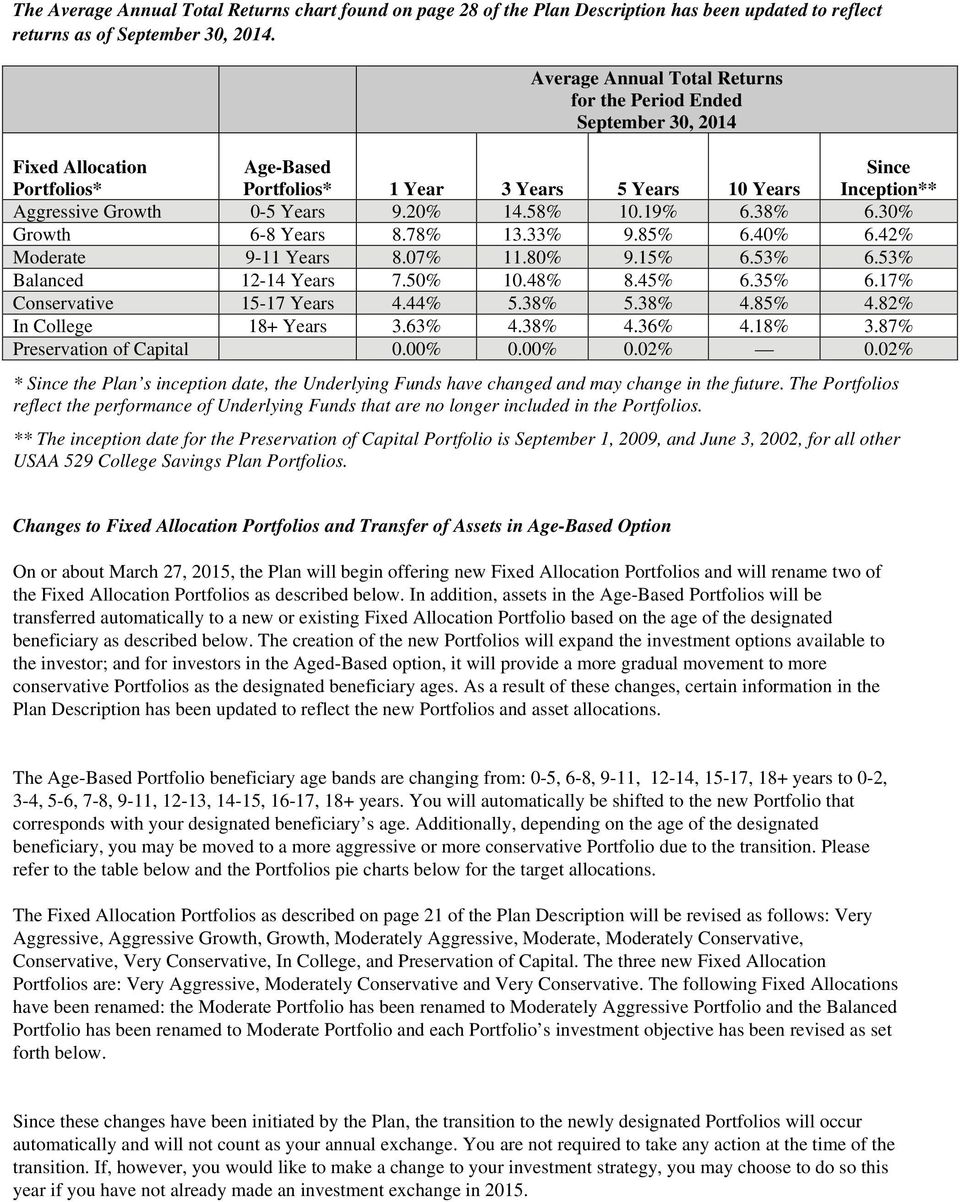
5 The Average Annual Total Returns chart found on page 28 of the Plan Description has been updated to reflect returns as of September 30, Average Annual Total Returns for the Period Ended September 30, 2014 Fixed Allocation Portfolios* Age-Based Portfolios* 1 Year 3 Years 5 Years 10 Years Since Inception** Aggressive Growth 0-5 Years 9.20% 14.58% 10.19% 6.38% 6.30% Growth 6-8 Years 8.78% 13.33% 9.85% 6.40% 6.42% Moderate 9-11 Years 8.07% 11.80% 9.15% 6.53% 6.53% Balanced Years 7.50% 10.48% 8.45% 6.35% 6.17% Conservative Years 4.44% 5.38% 5.38% 4.85% 4.82% In College 18+ Years 3.63% 4.38% 4.36% 4.18% 3.87% Preservation of Capital 0.00% 0.00% 0.02% 0.02% * Since the Plan s inception date, the Underlying s have changed and may change in the future. The Portfolios reflect the performance of Underlying s that are no longer included in the Portfolios. ** The inception date for the Preservation of Capital Portfolio is September 1, 2009, and June 3, 2002, for all other 529 College Savings Plan Portfolios. Changes to Fixed Allocation Portfolios and Transfer of Assets in Age-Based Option On or about March 27, 2015, the Plan will begin offering new Fixed Allocation Portfolios and will rename two of the Fixed Allocation Portfolios as described below. In addition, assets in the Age-Based Portfolios will be transferred automatically to a new or existing Fixed Allocation Portfolio based on the age of the designated beneficiary as described below. The creation of the new Portfolios will expand the investment options available to the investor; and for investors in the Aged-Based option, it will provide a more gradual movement to more conservative Portfolios as the designated beneficiary ages. As a result of these changes, certain information in the Plan Description has been updated to reflect the new Portfolios and asset allocations. The Age-Based Portfolio beneficiary age bands are changing from: 0-5, 6-8, 9-11, 12-14, 15-17, 18+ years to 0-2, 3-4, 5-6, 7-8, 9-11, 12-13, 14-15, 16-17, 18+ years. You will automatically be shifted to the new Portfolio that corresponds with your designated beneficiary s age. Additionally, depending on the age of the designated beneficiary, you may be moved to a more aggressive or more conservative Portfolio due to the transition. Please refer to the table below and the Portfolios pie charts below for the target allocations. The Fixed Allocation Portfolios as described on page 21 of the Plan Description will be revised as follows: Very Aggressive, Aggressive Growth, Growth, Moderately Aggressive, Moderate, Moderately Conservative, Conservative, Very Conservative, In College, and Preservation of Capital. The three new Fixed Allocation Portfolios are: Very Aggressive, Moderately Conservative and Very Conservative. The following Fixed Allocations have been renamed: the Moderate Portfolio has been renamed to Moderately Aggressive Portfolio and the Balanced Portfolio has been renamed to Moderate Portfolio and each Portfolio s investment objective has been revised as set forth below. Since these changes have been initiated by the Plan, the transition to the newly designated Portfolios will occur automatically and will not count as your annual exchange. You are not required to take any action at the time of the transition. If, however, you would like to make a change to your investment strategy, you may choose to do so this year if you have not already made an investment exchange in 2015.
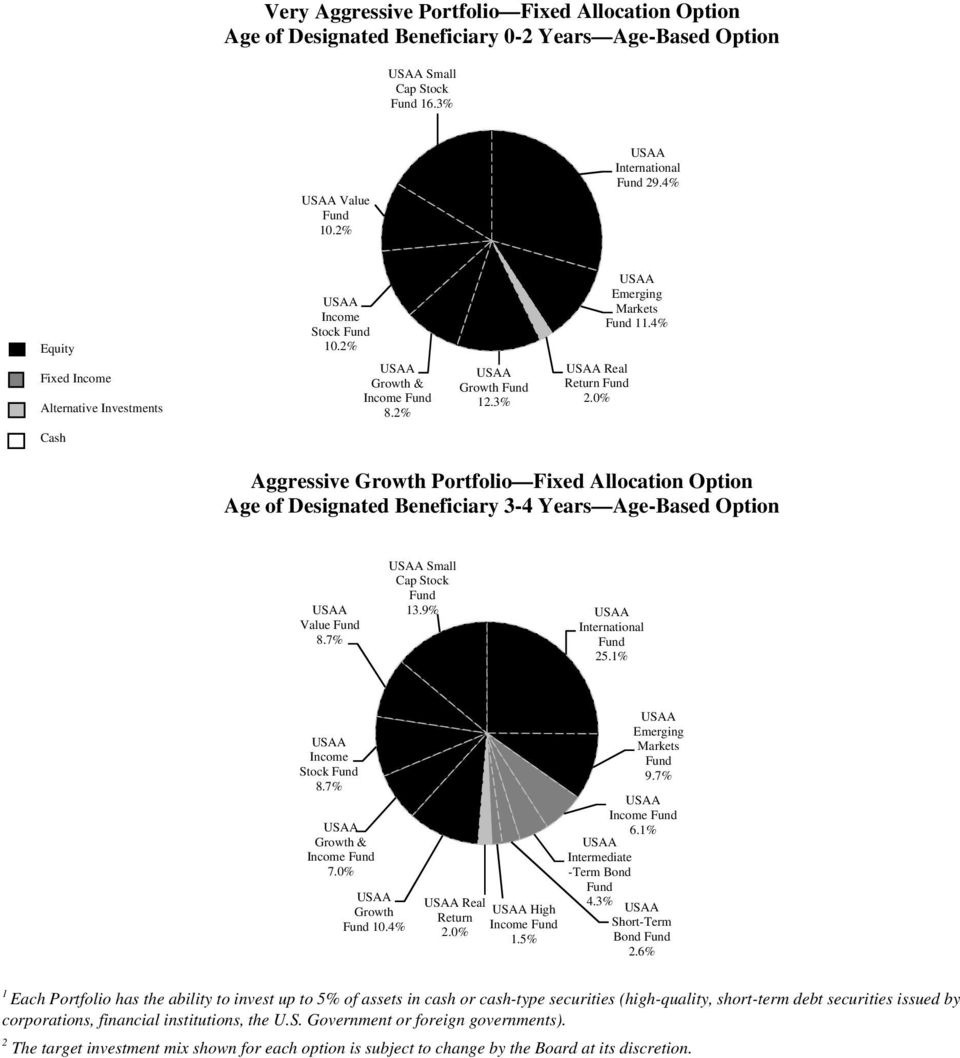
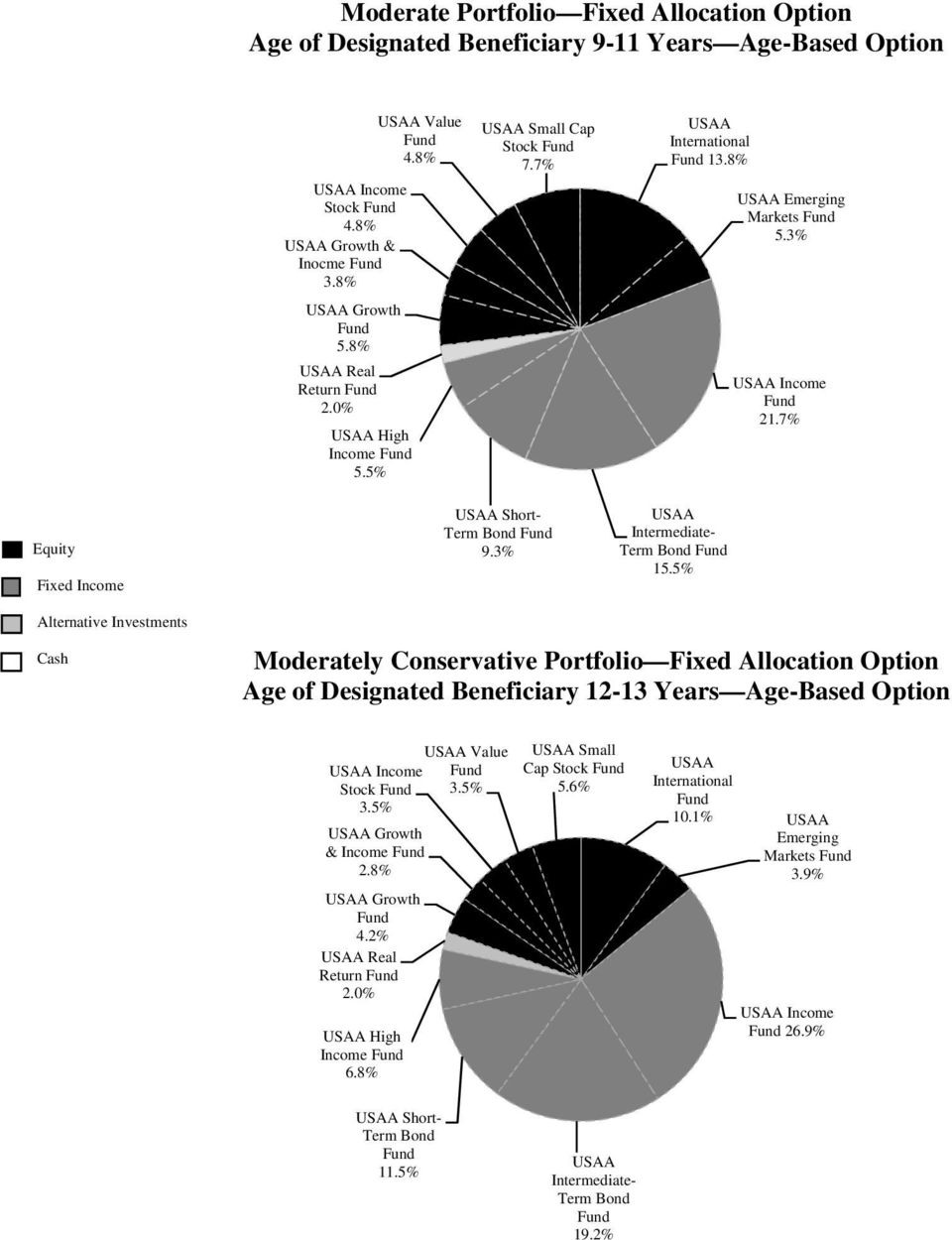
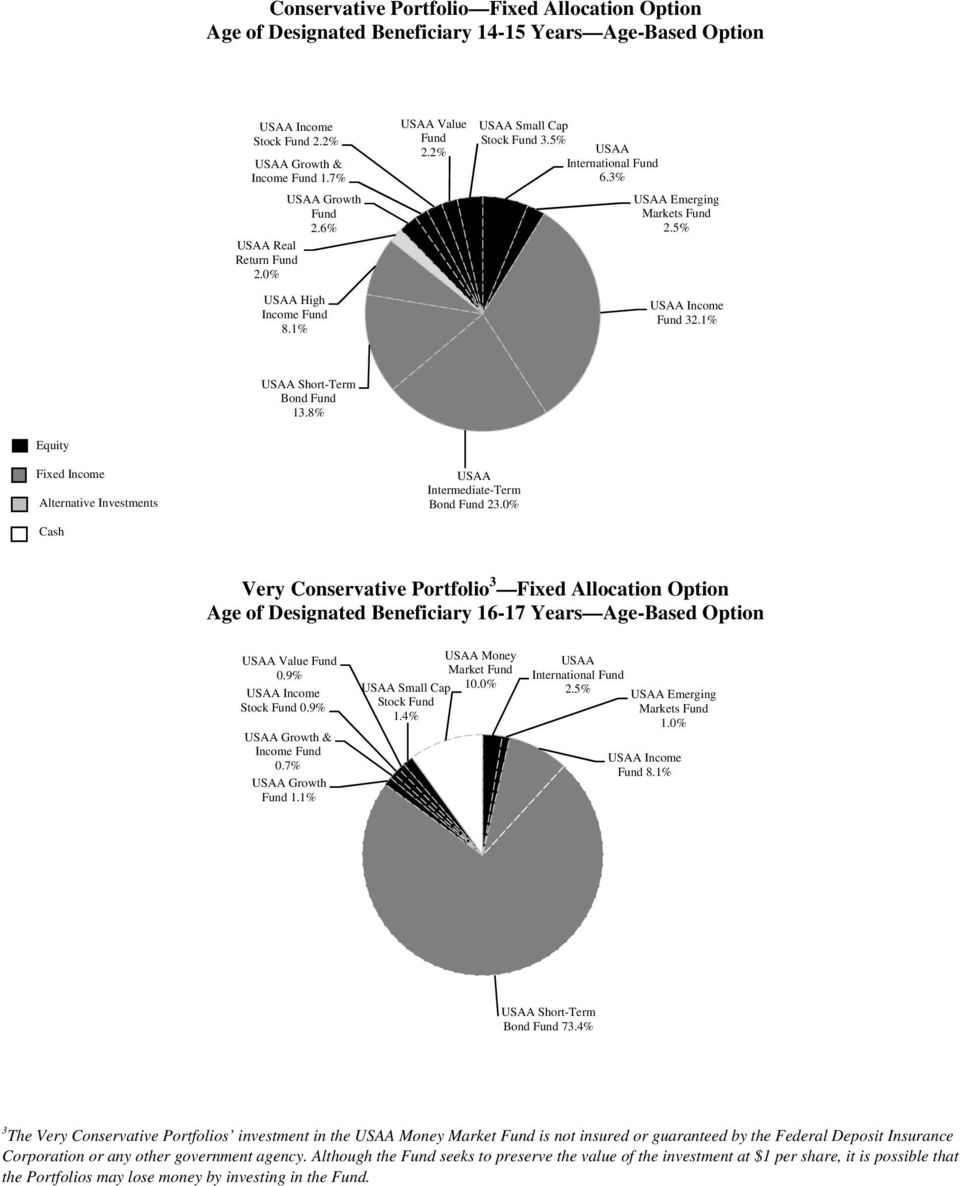
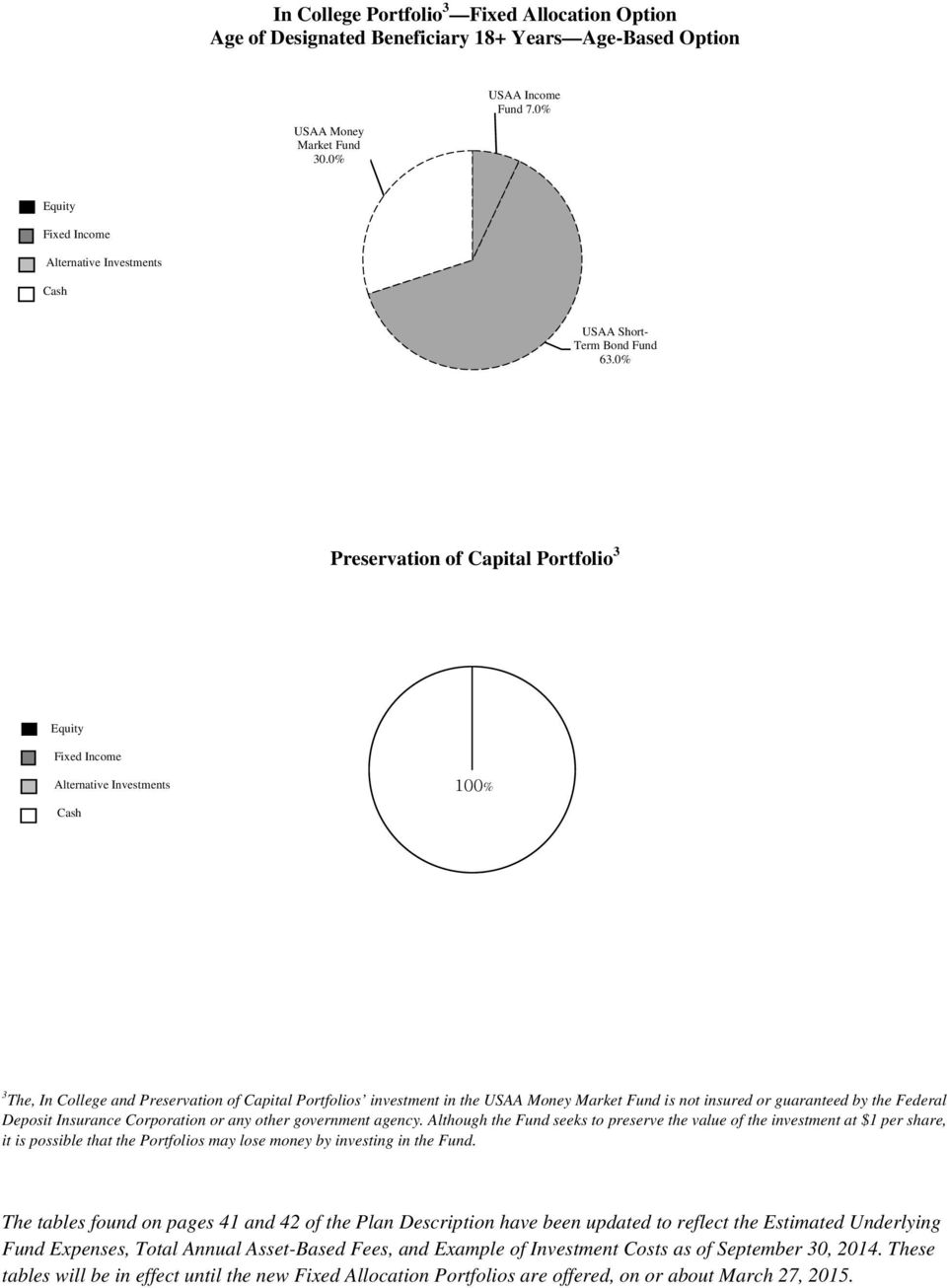
6 The description of each Plan Portfolio and its Investment Objective found on page 22 of the Plan Description will be revised as follows: Plan Portfolio Very Aggressive (Stocks 98%, Bonds 0%, Alternative Investments 2%, Cash 0%) Aggressive Growth (Stocks 83.5%, Bonds 14.5%, Alternative Investments 2%, Cash 0%) Growth (Stocks 71%, Bonds 27%, Alternative Investments 2%, Cash 0%) Moderately Aggressive (Stocks 58.5%, Bonds 39.5%, Alternative Investments 2%, Cash 0%) Moderate (Stocks 46%, Bonds 52%, Alternative Investments 2%, Cash 0%) Moderately Conservative (Stocks 33.5%, Bonds 64.5%, Alternative Investments 2%, Cash 0%) Conservative (Stocks 21%, Bonds 77%, Alternative Investments 2%, Cash 0%) Very Conservative (Stocks 8.5%, Bonds 81.5%, Alternative Investments 0%, Cash 10%) In College (Stocks 0%, Bonds 70%, Alternative Investments 0%, Cash 30%) Preservation of Capital (Money Market 100%) Investment Objective Seeks to maximize returns over time through long-term capital appreciation Seeks long-term capital appreciation Primarily seeks capital appreciation and secondarily seeks income Seeks capital appreciation and income, with more emphasis on growth Seeks to achieve a balance between capital appreciation and income Primarily seeks income and secondarily seeks capital appreciation Primarily seeks income and conservation of principal Seeks income and conservation of principal Seeks income and protection of principal Seeks protection of principal The pie charts found on pages of the Plan Description depicting the Fixed-Allocation and Aged-Based options will be revised to the following allocations: The pie charts under each heading represent target allocations for Portfolios found in the two different options, as labeled below. 1,2 Please see page 21 for a further description of each Portfolio.
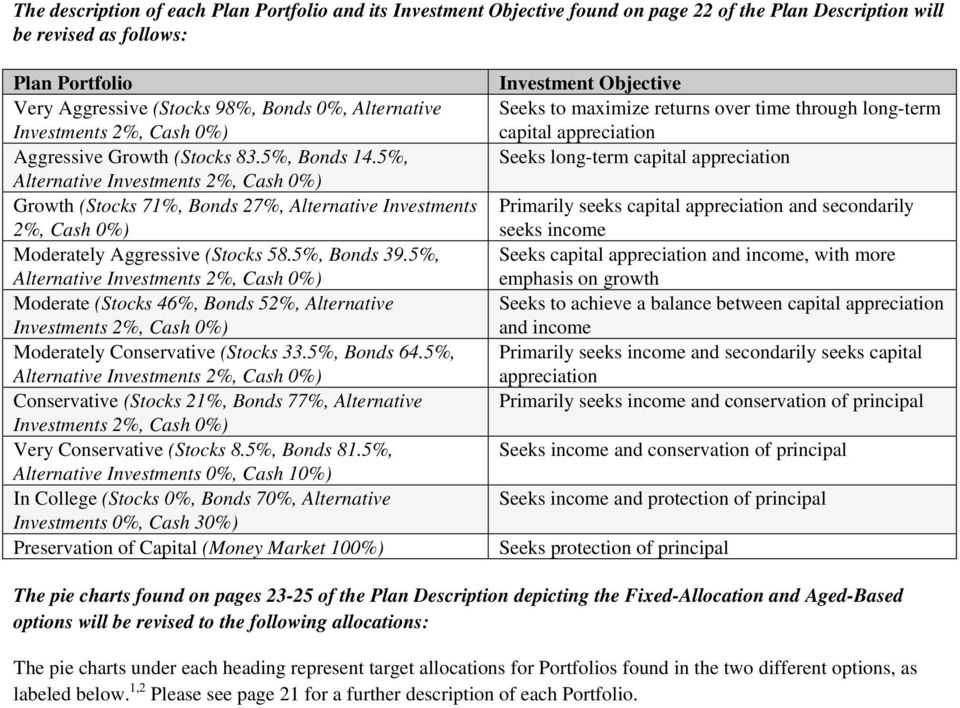
7 Very Aggressive Portfolio Fixed Allocation Option Age of Designated Beneficiary 0-2 Years Age-Based Option Small Cap Stock 16.3% Value 10.2% International 29.4% Equity Fixed Income Alternative Investments Income Stock 10.2% Growth & Income 8.2% Growth 12.3% Real Return 2.0% Emerging Markets 11.4% Cash Aggressive Growth Portfolio Fixed Allocation Option Age of Designated Beneficiary 3-4 Years Age-Based Option Value 8.7% Small Cap Stock 13.9% International 25.1% Income Stock 8.7% Growth & Income 7.0% Growth 10.4% Real Return 2.0% High Income 1.5% Emerging Markets 9.7% Income 6.1% Intermediate -Term Bond 4.3% Short-Term Bond 2.6% 1 Each Portfolio has the ability to invest up to 5% of assets in cash or cash-type securities (high-quality, short-term debt securities issued by corporations, financial institutions, the U.S. Government or foreign governments). 2 The target investment mix shown for each option is subject to change by the Board at its discretion.
8 Growth Portfolio Fixed Allocation Option Age of Designated Beneficiary 5-6 Years Age-Based Option Value 7.4% Small Cap Stock 11.8% International 21.3% Income Stock 7.4% Growth & Income 5.9% Emerging Markets 8.3% Equity Fixed Income Alternative Investments Cash Growth 8.9% Real Return 2.0% High Income 2.8% Short-Term Bond 4.8% Income 11.3% Intermediate- Term Bond 8.1% Moderately Aggressive Portfolio Fixed Allocation Option Age of Designated Beneficiary 7-8 Years Age-Based Option Value 6.1% Income Stock 6.1% Small Cap Stock 9.8% International 17.6% Emerging Markets 6.8% Growth & Income 4.9% Growth 7.3% Real Return 2.0% High Income 4.1% Short-Term Bond 7.1% Income 16.5% Intermediate -Term Bond 11.8%

9 Moderate Portfolio Fixed Allocation Option Age of Designated Beneficiary 9-11 Years Age-Based Option Income Stock 4.8% Growth & Inocme 3.8% Growth 5.8% Real Return 2.0% High Income 5.5% Value 4.8% Small Cap Stock 7.7% International 13.8% Emerging Markets 5.3% Income 21.7% Equity Fixed Income Short- Term Bond 9.3% Intermediate- Term Bond 15.5% Alternative Investments Cash Moderately Conservative Portfolio Fixed Allocation Option Age of Designated Beneficiary Years Age-Based Option Income Stock 3.5% Growth & Income 2.8% Growth 4.2% Real Return 2.0% High Income 6.8% Value 3.5% Small Cap Stock 5.6% International 10.1% Emerging Markets 3.9% Income 26.9% Short- Term Bond 11.5% Intermediate- Term Bond 19.2%
10 Conservative Portfolio Fixed Allocation Option Age of Designated Beneficiary Years Age-Based Option Income Stock 2.2% Growth & Income 1.7% Growth 2.6% Real Return 2.0% High Income 8.1% Value 2.2% Small Cap Stock 3.5% International 6.3% Emerging Markets 2.5% Income 32.1% Short-Term Bond 13.8% Equity Fixed Income Alternative Investments Intermediate-Term Bond 23.0% Cash Very Conservative Portfolio 3 Fixed Allocation Option Age of Designated Beneficiary Years Age-Based Option Value 0.9% Income Stock 0.9% Growth & Income 0.7% Growth 1.1% Money Market Small Cap 10.0% Stock 1.4% International 2.5% Emerging Markets 1.0% Income 8.1% Short-Term Bond 73.4% 3 The Very Conservative Portfolios investment in the Money Market is not insured or guaranteed by the Federal Deposit Insurance Corporation or any other government agency. Although the seeks to preserve the value of the investment at $1 per share, it is possible that the Portfolios may lose money by investing in the.
11 In College Portfolio 3 Fixed Allocation Option Age of Designated Beneficiary 18+ Years Age-Based Option Money Market 30.0% Income 7.0% Equity Fixed Income Alternative Investments Cash Short- Term Bond 63.0% Preservation of Capital Portfolio 3 Equity Fixed Income Alternative Investments Cash 100% 3 The, In College and Preservation of Capital Portfolios investment in the Money Market is not insured or guaranteed by the Federal Deposit Insurance Corporation or any other government agency. Although the seeks to preserve the value of the investment at $1 per share, it is possible that the Portfolios may lose money by investing in the. The tables found on pages 41 and 42 of the Plan Description have been updated to reflect the Estimated Underlying Expenses, Total Annual Asset-Based Fees, and Example of Investment Costs as of September 30, These tables will be in effect until the new Fixed Allocation Portfolios are offered, on or about March 27, 2015.
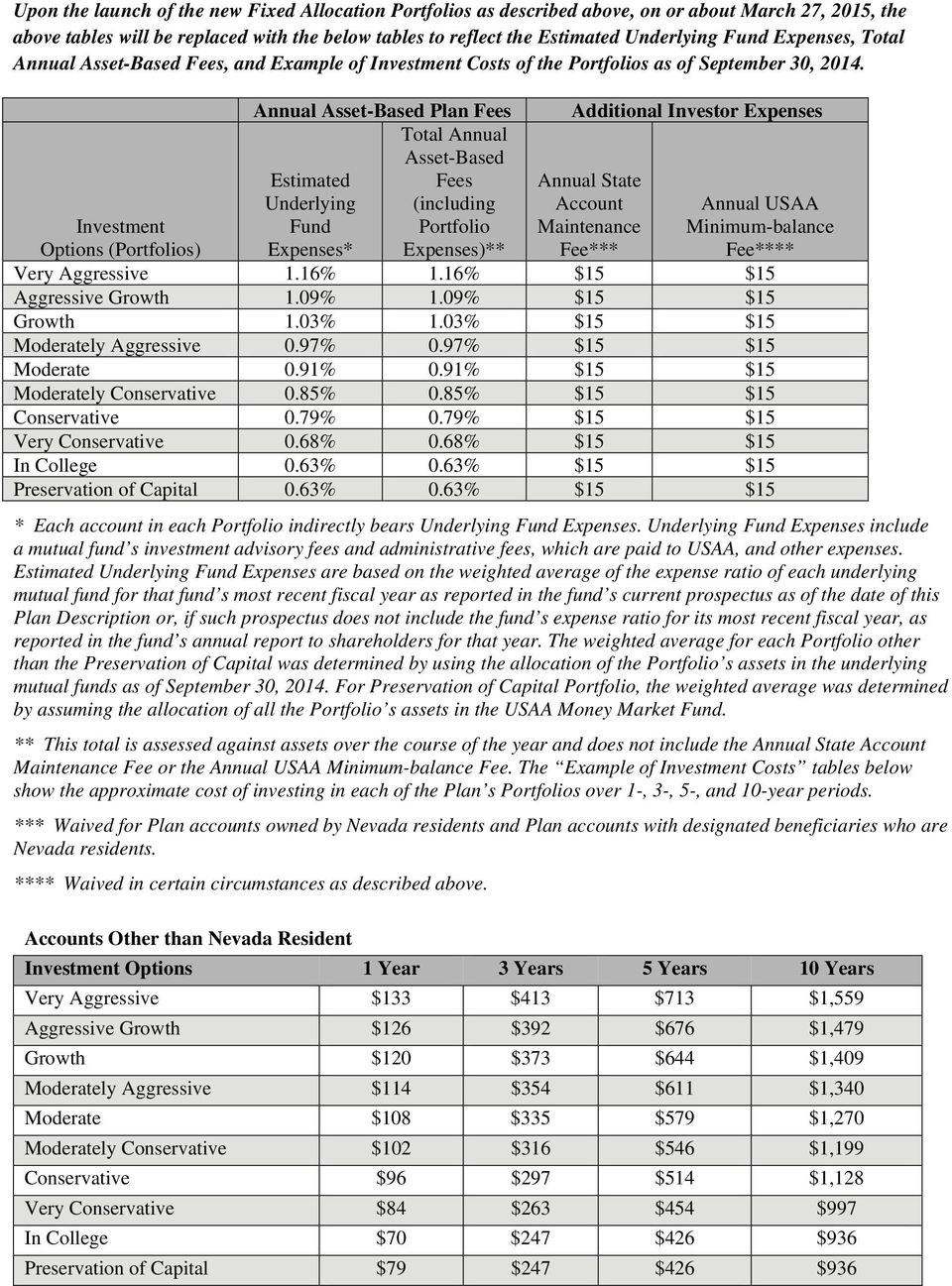
12 Annual Asset-Based Plan Fees Total Annual Estimated Asset-Based Underlying Fees (including Portfolio Expenses* Expenses)** Additional Investor Expenses Annual State Account Maintenance Fee*** Annual Minimum-balance Fee**** Investment Options (Portfolios) Aggressive Growth 1.05% 1.05% $15 $15 Growth 1.01% 1.01% $15 $15 Moderate 0.95% 0.95% $15 $15 Balanced 0.91% 0.91% $15 $15 Conservative 0.76% 0.76% $15 $15 In College 0.72% 0.72% $15 $15 Preservation of Capital 0.63% 0.63% $15 $15 * Each account in each Portfolio indirectly bears Underlying Expenses. Underlying Expenses include a mutual fund s investment advisory fees and administrative fees, which are paid to, and other expenses. Estimated Underlying Expenses are based on the weighted average of the expense ratio of each underlying mutual fund for that fund s most recent fiscal year as reported in the fund s current prospectus as of the date of this Plan Description or, if such prospectus does not include the fund s expense ratio for its most recent fiscal year, as reported in the fund s annual report to shareholders for that year. The weighted average for each Portfolio other than the Preservation of Capital was determined by using the allocation of the Portfolio s assets in the underlying mutual funds as of September 30, For Preservation of Capital Portfolio, the weighted average was determined by assuming the allocation of all the Portfolio s assets in the Money Market. ** This total is assessed against assets over the course of the year and does not include the Annual State Account Maintenance Fee or the Annual Minimum-balance Fee. The Example of Investment Costs tables below show the approximate cost of investing in each of the Plan s Portfolios over 1-, 3-, 5-, and 10-year periods. *** Waived for Plan accounts owned by Nevada residents and Plan accounts with designated beneficiaries who are Nevada residents. **** Waived in certain circumstances as described on page 40 of the Plan Description. Accounts Other than Nevada Resident Investment Options 1 Year 3 Years 5 Years 10 Years Aggressive Growth $122 $379 $654 $1,433 Growth $118 $367 $633 $1,386 Moderate $112 $348 $600 $1,316 Balanced $108 $335 $579 $1,270 Conservative $93 $288 $497 $1,092 In College $89 $275 $476 $1,044 Preservation of Capital $79 $247 $426 $936 Nevada Resident Accounts Investment Options 1 Year 3 Years 5 Years 10 Years Aggressive Growth $107 $334 $579 $1,283 Growth $103 $322 $558 $1,236 Moderate $97 $303 $525 $1,166 Balanced $93 $290 $504 $1,120 Conservative $78 $243 $422 $942 In College $74 $230 $401 $894 Preservation of Capital $64 $202 $351 $786

13 Upon the launch of the new Fixed Allocation Portfolios as described above, on or about March 27, 2015, the above tables will be replaced with the below tables to reflect the Estimated Underlying Expenses, Total Annual Asset-Based Fees, and Example of Investment Costs of the Portfolios as of September 30, Annual Asset-Based Plan Fees Total Annual Asset-Based Estimated Fees Underlying (including Portfolio Expenses* Expenses)** Additional Investor Expenses Annual State Account Maintenance Fee*** Annual Minimum-balance Fee**** Investment Options (Portfolios) Very Aggressive 1.16% 1.16% $15 $15 Aggressive Growth 1.09% 1.09% $15 $15 Growth 1.03% 1.03% $15 $15 Moderately Aggressive 0.97% 0.97% $15 $15 Moderate 0.91% 0.91% $15 $15 Moderately Conservative 0.85% 0.85% $15 $15 Conservative 0.79% 0.79% $15 $15 Very Conservative 0.68% 0.68% $15 $15 In College 0.63% 0.63% $15 $15 Preservation of Capital 0.63% 0.63% $15 $15 * Each account in each Portfolio indirectly bears Underlying Expenses. Underlying Expenses include a mutual fund s investment advisory fees and administrative fees, which are paid to, and other expenses. Estimated Underlying Expenses are based on the weighted average of the expense ratio of each underlying mutual fund for that fund s most recent fiscal year as reported in the fund s current prospectus as of the date of this Plan Description or, if such prospectus does not include the fund s expense ratio for its most recent fiscal year, as reported in the fund s annual report to shareholders for that year. The weighted average for each Portfolio other than the Preservation of Capital was determined by using the allocation of the Portfolio s assets in the underlying mutual funds as of September 30, For Preservation of Capital Portfolio, the weighted average was determined by assuming the allocation of all the Portfolio s assets in the Money Market. ** This total is assessed against assets over the course of the year and does not include the Annual State Account Maintenance Fee or the Annual Minimum-balance Fee. The Example of Investment Costs tables below show the approximate cost of investing in each of the Plan s Portfolios over 1-, 3-, 5-, and 10-year periods. *** Waived for Plan accounts owned by Nevada residents and Plan accounts with designated beneficiaries who are Nevada residents. **** Waived in certain circumstances as described above. Accounts Other than Nevada Resident Investment Options 1 Year 3 Years 5 Years 10 Years Very Aggressive $133 $413 $713 $1,559 Aggressive Growth $126 $392 $676 $1,479 Growth $120 $373 $644 $1,409 Moderately Aggressive $114 $354 $611 $1,340 Moderate $108 $335 $579 $1,270 Moderately Conservative $102 $316 $546 $1,199 Conservative $96 $297 $514 $1,128 Very Conservative $84 $263 $454 $997 In College $70 $247 $426 $936 Preservation of Capital $79 $247 $426 $936
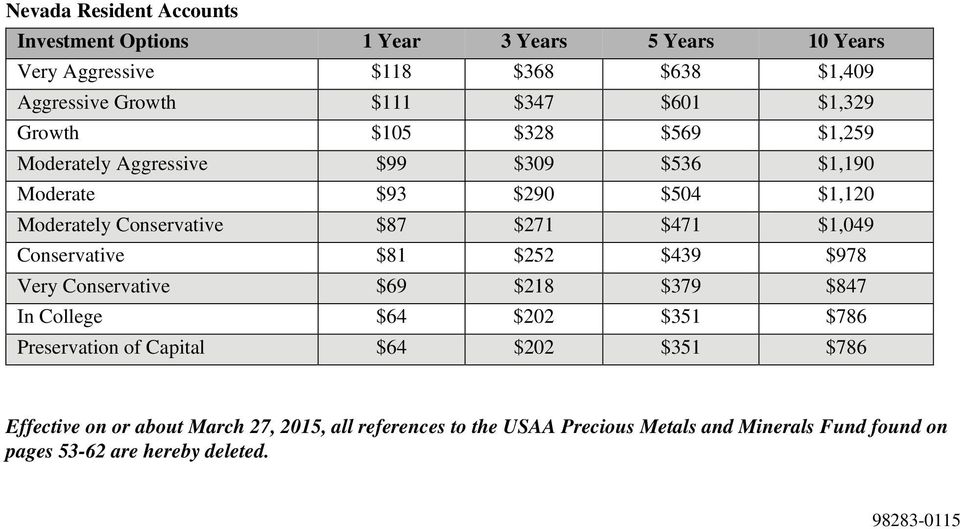
14 Nevada Resident Accounts Investment Options 1 Year 3 Years 5 Years 10 Years Very Aggressive $118 $368 $638 $1,409 Aggressive Growth $111 $347 $601 $1,329 Growth $105 $328 $569 $1,259 Moderately Aggressive $99 $309 $536 $1,190 Moderate $93 $290 $504 $1,120 Moderately Conservative $87 $271 $471 $1,049 Conservative $81 $252 $439 $978 Very Conservative $69 $218 $379 $847 In College $64 $202 $351 $786 Preservation of Capital $64 $202 $351 $786 Effective on or about March 27, 2015, all references to the Precious Metals and Minerals found on pages are hereby deleted
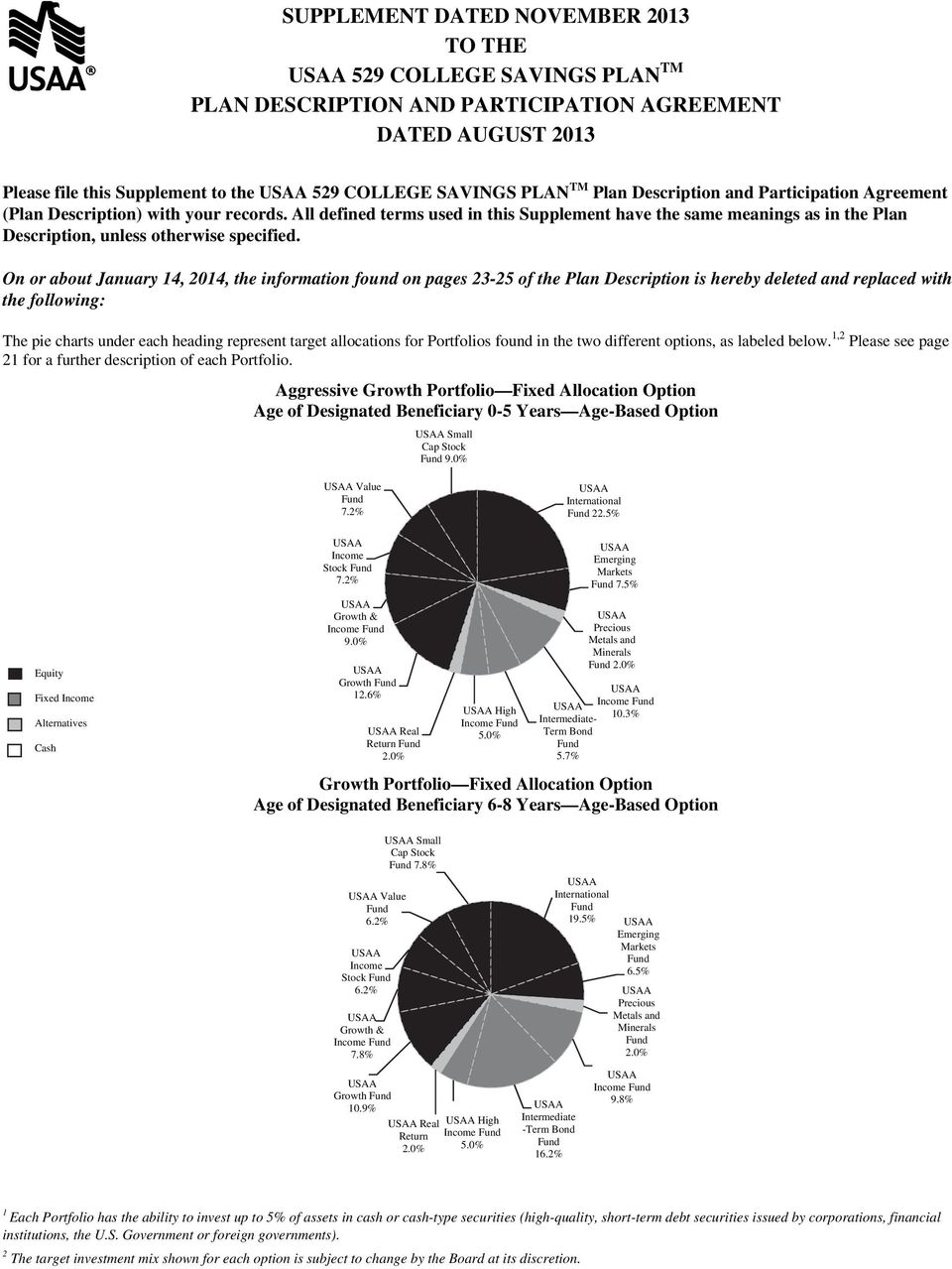
15 SUPPLEMENT DATED NOVEMBER 2013 TO THE 529 COLLEGE SAVINGS PLAN TM PLAN DESCRIPTION AND PARTICIPATION AGREEMENT DATED AUGUST 2013 Please file this Supplement to the 529 COLLEGE SAVINGS PLAN TM Plan Description and Participation Agreement (Plan Description) with your records. All defined terms used in this Supplement have the same meanings as in the Plan Description, unless otherwise specified. On or about January 14, 2014, the information found on pages of the Plan Description is hereby deleted and replaced with the following: The pie charts under each heading represent target allocations for Portfolios found in the two different options, as labeled below. 1,2 Please see page 21 for a further description of each Portfolio. Aggressive Growth Portfolio Fixed Allocation Option Age of Designated Beneficiary 0-5 Years Age-Based Option Small Cap Stock 9.0% Value 7.2% International 22.5% Equity Fixed Income Alternatives Cash Income Stock 7.2% Growth & Income 9.0% Growth 12.6% Real Return 2.0% High Income 5.0% Emerging Markets 7.5% Precious Metals and Minerals 2.0% Income Intermediate- 10.3% Term Bond 5.7% Growth Portfolio Fixed Allocation Option Age of Designated Beneficiary 6-8 Years Age-Based Option Value 6.2% Income Stock 6.2% Growth & Income 7.8% Small Cap Stock 7.8% Growth 10.9% Real High Return Income 2.0% 5.0% International 19.5% Emerging Markets 6.5% Precious Metals and Minerals 2.0% Intermediate -Term Bond 16.2% Income 9.8% 1 Each Portfolio has the ability to invest up to 5% of assets in cash or cash-type securities (high-quality, short-term debt securities issued by corporations, financial institutions, the U.S. Government or foreign governments). 2 The target investment mix shown for each option is subject to change by the Board at its discretion.
16 Moderate Portfolio 3 Fixed Allocation Option Age of Designated Beneficiary 9-11 Years Age-Based Option Value 5.3% Income Stock 5.3% Growth & Income 6.6% Growth 9.2% Small Cap Stock 6.6% Money Market 2.0% International 16.5% Emerging Markets 5.5% Income 22.7% Precious Metals and Minerals 2.0% Equity Fixed Income Alternatives Real Return 2.0% High Income 5.0% Intermediate- Term Bond 11.3% Cash Balanced Portfolio 3 Fixed Allocation Option Age of Designated Beneficiary Years Age-Based Option Small Cap Stock 5.4% Value 4.3% Income Stock 4.3% Growth & Income 5.4% Growth 7.6% Money Market 2.0% International 13.5% Emerging Markets 4.5% Precious Metals and Minerals 2.0% Income 18.1% Real Return 2.0% High Income 5.0% Short- Term Bond 9.0% Intermediate- Term Bond 16.9% 3 The Moderate, Balanced, Conservative, In College, and Preservation of Capital Portfolios investment in the Money Market is not insured or guaranteed by the Federal Deposit Insurance Corporation or any other government agency. Although the seeks to preserve the value of the investment at $1 per share, it is possible that the Portfolios may lose money by investing in the.

17 Conservative Portfolio 3 Fixed Allocation Option Age of Designated Beneficiary Years Age-Based Option Small Cap Stock 1.8% Value 1.4% Income Stock 1.4% Growth & Income 1.8% Money Market 10.0% International 4.5% Emerging Markets 1.5% Precious Metals and Minerals 2.0% Income 12.1% Growth 2.5% Real Return 2.0% Intermediate- Term Bond 16.5% Equity Fixed Income High Income 5.0% Short- Term Bond 37.4% Alternatives Cash In College Portfolio 3 Fixed Allocation Option Age of Designated Beneficiary 18+ Years Age-Based Option Money Market 30.0% Small Cap Stock 1.2% Value 1.0% Income Stock 1.0% Growth & Income 1.2% Growth 1.7% International 3.0% Real Return 2.0% High Income 5.0% Emerging Markets 1.0% Income 9.0% Intermediate- Term Bond 13.5% Short- Term Bond 30.5% 3 The Moderate, Balanced, Conservative, In College, and Preservation of Capital Portfolios investment in the Money Market is not insured or guaranteed by the Federal Deposit Insurance Corporation or any other government agency. Although the seeks to preserve the value of the investment at $1 per share, it is possible that the Portfolios may lose money by investing in the. All references to the Aggressive Growth found on pages are hereby deleted

18 529 COLLEGE SAVINGS PLAN TM Plan Description and Participation Agreement August 2013 Sponsored by the State of Nevada Administered by Nevada State Treasurer Kate Marshall Investment Products Offered Are Not FDIC Insured May Lose Value Are Not Bank Guaranteed

19 DEFINITION OF TERMS Capitalized terms used in this Plan Description document have the following meanings: Account: an Account established in the Plan by an Account Owner. Account Owner: To establish an Account in the Plan, the Account Owner must either be (1) a natural person of legal age who is either a U.S. citizen or resident alien and has a valid Social Security number (or taxpayer identification number) with the authority to open an individual account, or (2) a natural person of legal age with the authority to act as a custodian for a UGMA/UTMA account or as a trustee for a trust. Act: Chapter 353B of the Nevada Revised Statutes, as amended. Board: the Board of Trustees of the College Savings Plans of Nevada (the Board), which is chaired by Nevada State Treasurer Kate Marshall, administers the Trust. Cash Form: The only acceptable forms of contributions are those made by check, Automatic Investment Plan (AIP), payroll deduction including government allotments, electronic funds transfer (EFT), or federal wire. Code: United States Internal Revenue Code of 1986, as amended from time to time. There are references to various sections of the Code throughout the document, including Section 529 as it exists and may subsequently be amended and regulations adopted under it. Current Portfolio: the assets in the Portfolio in which you are currently invested. Eligible Institutions of Higher Education: Generally, an institution as defined in the Code includes accredited post-secondary educational institutions in the United States or abroad offering credit toward an associate s degree, a bachelor s degree, a graduate level or professional degree, or another recognized post-secondary credential, and certain post-secondary vocational and proprietary institutions. The institution must be eligible to participate in U.S. Department of Education student financial aid programs. For additional information, please visit Maximum Contribution Limit: The Maximium Contribution Limit is currently $370,000. (For purposes of the Maximum Contribution Limit, balances for all accounts for the same designated beneficiary under all 529 savings plans sponsored by the State of Nevada are aggregated.) Member of the Family: For purposes of changing the designated beneficiary, a member of the family of the designated beneficiary is defined by the Code as: Father, mother, or an ancestor of either, Son, daughter, or a descendant of either, Stepfather or stepmother, Stepson or stepdaughter, Brother, sister, stepbrother, or stepsister, Brother or sister of the father or mother, Brother-in-law, sister-in-law, son-in-law, daughter-in-law, father-in-law, or mother-in-law, Son or daughter of a brother or sister, 1

20 Spouse of the designated beneficiary or any of the individuals mentioned above, or First cousin. For purposes of this definition, a legally adopted child of an individual shall be treated as the child of such individual by blood and a half-brother or half-sister is treated as a brother or sister. Plan: The 529 College Savings Plan. Program Manager: The Program Manager of the Plan is Upromise Investments, Inc. Portfolio: The investment options available to Account Owners. Section 529: Section 529 of the Internal Revenue Code of 1986, as amended from time to time (Code), and any regulations and other guidance issued thereunder Trust: The Nevada College Savings Trust. Trust Interests: Municipal fund securities, which are issued by the Trust in exchange for contributions. UGMA/UTMA: an account created under the Uniform Gifts to Minors Act or the Uniform Transfers to Minors Act of any state. Upromise: Upromise is used to refer collectively or individually, as the case requires, to Upromise Investments, Inc. and its affiliates, Upromise Investment Advisors, LLC, and Upromise, Inc. that serve as Program Manager to the Plan. : is used to refer collectively or individually, as the case requires, to Investment Management Company and its affiliates. 2

21 Interests in the Plan are municipal fund securities issued by the Nevada College Savings Trust (Trust) administered by the Board of Trustees of the College Savings Plans of Nevada (Board), which is chaired by Nevada State Treasurer Kate Marshall. The Plan, which is within the Trust, is administered by the Board and is managed by Upromise Investments, Inc. (Upromise). Interests in the Plan (Trust Interests) are sold exclusively by Investment Management Company (). Trust Interests in the Plan have not been registered with the Securities and Exchange Commission or any other federal or state governmental agency. Trust Interests in the Plan are not guaranteed by the State of Nevada, the Board or any other governmental entities, or or Upromise or any of their respective affiliates. The information shown in the Plan Highlights is only a summary of the 529 College Savings Plan (Plan). More detailed information about the Plan, including the Portfolios (defined below) and the underlying funds in which they invest, investment risks, tax consequences, and how to invest, are described in the pages that follow. Please read this entire Plan Description before investing. PLAN HIGHLIGHTS Minimum Initial Contribution Minimum Subsequent Contribution Maximum Contribution Limit Nevada Residency Requirement Age Limits School Eligibility Tax Advantages $250 one time contribution $50 with the establishment of a $50 monthly automatic investment plan or payroll deduction, $15 through Ugift (See Contributions on page 13 for details.) $370,000 Maximum Contribution Limit (For purposes of the Maximum Contribution Limit, balances for all accounts for the same designated beneficiary under all 529 savings plans sponsored by the State of Nevada are aggregated.) (See Maximum Contribution on page 17 for details.) None None the designated beneficiary may be any age, from newborn to adult. Savings may be used at any eligible post-secondary school in the United States or abroad. This Program Description does not contain tax advice. You should consult your tax advisor for more information. Federal tax-deferred growth. No federal tax on qualified withdrawals. No gift tax on contributions up to $70,000 ($140,000 for spouses electing to split gifts) prorated over five years. Contributions are considered completed gifts for federal gift and estate tax purposes. (See Federal Taxation of Section 529 Plan Contributions and Withdrawals on page 37 for details. Also, see State Taxes and Other Considerations on page 39 and the discussion generally in Tax Treatment of Investments and Withdrawals beginning on page 36.) 3
22 Qualified Withdrawals Non-qualified Withdrawals Transfers Fees and Expenses Use your savings to pay for qualified higher education expenses including tuition, certain room and board, expenses, fees, supplies, and equipment required for enrollment by a designated beneficiary at any eligible school in the United States or abroad (including expenses for special needs services for a special needs beneficiary incurred in connection with such attendance). (See Withdrawals on page 29 for details.) An account owner (Account Owner) may make withdrawals from his or her account or close his or her account by notifying the Program Manager, although under federal law, the earnings portion of non-qualified withdrawals will be subject to an additional 10 percent federal tax penalty on earnings, in addition to federal and any applicable state taxes that may otherwise be due. In the event of a withdrawal, the net asset value of the withdrawal is calculated at the next close of business of the NYSE after the Program Manager s receipt of the request in good order (as determined by the Program Manager). (See Non-Qualified Withdrawals on page 31 for details.) (1) Transfers to a Plan account of a new designated beneficiary who is a Member of the Family of the original designated beneficiary will not be subject to federal income tax or penalty if made within 60 days of distribution. (2) Direct transfers within the Plan for the benefit of the same designated beneficiary will be treated as a nontaxable reallocation allowance only once per calendar year rather than as a tax-free Rollover or transfer. (See Rollover Contributions and Other Transfers on page 15 for details.) Total Annual Asset-Based Fees of each Portfolio consist of the Portfolio s pro rata share of the expenses of the underlying fund(s) in which the Portfolio invests, excluding the Annual State Account Maintenance Fee and the Annual Minimum-balance Fee. All accounts are subject to a $15 Annual State Account Maintenance Fee, unless the Account Owner or designated beneficiary is a Nevada resident, in which case, the Annual State Account Maintenance Fee is waived for such Plan account. Some accounts may also be assessed a $15 Annual Minimum-balance Fee. (See Plan Fees and Expenses on page 39 for details.) 4
23 Investment Options and Performance Account Owners can choose from eight different investment options -- one of six Fixed Allocation options (each a Portfolio), an Age-Based option, and a Preservation of Capital option (a Portfolio) -- or a combination of these options. The Fixed Allocation options are: Aggressive Growth Portfolio Growth Portfolio Moderate Portfolio Balanced Portfolio Conservative Portfolio In College Portfolio Age-Based Option (See Investment Options on page 19 for details.) Plan and Portfolio Risks Who s Who in the 529 College Savings Plan Contact Information The 529 College Savings Plan is an investment vehicle. Accounts in the Plan are subject to certain risks. In addition, certain Portfolio options carry more and/or different risks than others. Account Owners should weigh such risks with the understanding that they could arise at any time during the life of an account. Such risks include, but are not limited to, (i) the risk of investment losses; (ii) the risk of federal tax law changes; (iii) the risk of state tax law changes; (iv) the risk of Plan changes including changes in fees and/or expenses; and (v) the risk that contributions to the Plan may adversely affect the eligibility of the designated beneficiary and/or the Account Owner for financial aid or other benefits, e.g., Medicaid or other state and federal benefits. (See Plan and Portfolio Risks on page 43 for details.) The 529 College Savings Plan is offered by The Nevada College Savings Trust. The Trust is administered by the Board, which is chaired by Nevada State Treasurer Kate Marshall. The Plan is administered by Upromise Investments, Inc. Investment Management Company provides investment management services to the Board, and markets and distributes the Plan. The Program Management Agreement between Upromise Investments, Inc. and its affiliates and the Board expires in College Savings Plan P.O. Box Boston, MA usaa.com/
24 IMPORTANT NOTICES Tax Considerations Depending upon the laws of your home state or the home state of the designated beneficiary, favorable state tax treatment or other benefits offered by such home state for investing in 529 college savings plans may be available only if you invest in the home state s college savings plan. Since different states have different tax provisions, this Plan Description contains limited information about the state tax consequences of investing in the Plan. Therefore, you should consult with your financial, tax, or other adviser to learn more about how state-based benefits (including any limitations) would apply to your specific circumstances. You also may wish to contact your home state s 529 plan(s), or any other 529 plan, to learn more about those plans features, benefits and limitations. Keep in mind that any state-based benefit offered with respect to a particular 529 college savings plan should be one of many appropriately weighted factors to be considered in making an investment decision. Tax Disclaimer In order to comply with Treasury Department regulations, we advise you that this Plan Description is not intended to constitute, nor does it constitute, legal or tax advice. This Plan Description was developed to support the marketing of the 529 College Savings Plan and cannot be relied upon for purposes of avoiding the payment of federal tax penalties. You should consult your legal or tax advisor about the impact of these rules on your individual situation. Privacy Policy Investment Management Company considers the privacy and security of the nonpublic, personal information it holds concerning each Account Owner and designated beneficiary of the Plan a top priority. provides marketing, sales, and related support for the Plan. will not disclose nonpublic, personal information to anyone except as permitted by law. may share certain nonpublic information it collects with affiliates, as well as with non-affiliated third parties in certain limited instances; and you are afforded an opportunity to opt out of certain sharing or use, all of which is more fully described in s Privacy Promise, which is included with the account opening materials. Privacy Policy Board of Trustees of the College Savings Plans of Nevada and Upromise The Board considers the privacy and security of the nonpublic, personal information it holds concerning each Account Owner and designated beneficiary of this Plan a top priority. The Board has also received an assurance from Upromise, its Program Manager, that it is also a top priority for Upromise. Specifically, the Board and Upromise adhere to the following privacy policy for the benefit of current and past Account Owners and designated beneficiaries: The types of nonpublic, personal information collected by the Board and Upromise may include: Information the Account Owner or designated beneficiary provides to the Plan on the application or otherwise, such as name, address, and Social Security number; Information the Board, Upromise and may acquire as a result of administering an account, such as transactions (contributions or distributions) or account balances; and Information from third parties, such as credit agencies. Neither the Board nor Upromise will disclose such nonpublic, personal information to anyone except as permitted by law. The Account Owner should also carefully review the privacy policy of, which is referenced above and more fully described in the account opening materials and 6
25 the privacy policy of Upromise below. Privacy policies may be modified or supplemented at anytime. Privacy Policy Upromise Under the terms of the Direct Program Management Agreement between Upromise and the Board, Upromise is required to treat all Account Owner and beneficiary information confidentially. Upromise is prohibited from using or disclosing such information, except as may be necessary to perform its obligations under the terms of its contract with the Board, or if required by applicable law, by court order, or other such order. Security The Board, Upromise, and maintain appropriate physical, electronic, and procedural safeguards to protect this nonpublic, personal information about Account Owners and beneficiaries. Individual Advice No investment recommendation or advice received by the Account Owner from or any other person is provided by, or on behalf of, the State of Nevada, the Board, the Plan, or Upromise or its affiliates. Plan Description Information The information in this Plan Description is believed to be accurate as of the cover date, but is subject to change without notice. Account Owners should rely only on the information contained in this Plan Description. No one is authorized to provide information that is different from the information in the most current form of this Plan Description. Statements contained in this Plan Description that involve estimates, forecasts, or matters of opinion, whether or not expressly so described herein, are intended solely as such and are not to be construed as representations of facts. This Plan Description does not constitute an offer to sell or the solicitation of an offer to buy, nor shall there be any sale of a security in the Plan by any person in any jurisdiction in which it is unlawful for such person to make such an offer, solicitation, or sale. Investment Risk Plan accounts involve investment risk, including the possible loss of principal. Account Owner Interest Account Owners and designated beneficiaries do not have access or rights to any assets of the State of Nevada or any assets of the Trust other than assets credited to the account of that Account Owner for that designated beneficiary. See Plan and Portfolio Risks on page 43. Special Considerations The Board reserves the right to: Refuse, change, discontinue, or temporarily suspend account services including accepting contributions and processing withdrawal requests, for any reason. Delay sending out the proceeds of a withdrawal request for up to seven calendar days (this generally applies only to very large redemptions without notice or during unusual market conditions). 7
26 Suspend or postpone payment of the proceeds of withdrawal requests when the New York Stock Exchange (NYSE) is closed for any reason other than its usual weekend or holiday closings, when the Securities and Exchange Commission (SEC) restricts trading, or when any emergency circumstances exist. Change the Plan s fees and charges. Add, subtract, terminate or merge Portfolios, or change the Portfolios included in the Age-Based and Fixed Allocation Options, the asset allocation of the Portfolios, or the underlying funds in which any Portfolio invests. Terminate an account if the Board determines that the Account Owner or the designated beneficiary has provided false or misleading information to the Board, the Program Manager, or an eligible institution of higher education. Add a new, or replace the current, Program Manager. Read this Plan Description and Participation Agreement carefully before you invest or send money. This Plan Description contains information you should know before participating in the Plan, including information about fees and risks. Neither the Securities and Exchange Commission nor any state securities commission has approved or disapproved these securities or passed upon the adequacy of this Plan Description. Any representation to the contrary is a criminal offense. This Plan Description contains important information concerning the following topics: (i) fees and costs (See page 39 for details.); (ii) investment options and investment managers and how and when the Board may change these (See page 19 for details.); (iii) Portfolio investment performance (See page 28 for details.); (iv) federal and state tax considerations (See page 37 for details.); (v) risk factors (See page 43 for details.); and (vi) limitations or penalties imposed by the Plan upon transfers between investment options, transfers to other Nevada sponsored plans, transfers to other Section 529 plans or non-qualified distributions generally (See pages 16 and 31 for details. Also, see State Taxes and Other Considerations on page 39 and the discussion generally in Tax Treatment of Investments and Withdrawals beginning on page 37.). 8
27 TABLE OF CONTENTS Definitions of Terms... 1 Plan Highlights... 3 Important Notices... 6 Table Of Contents... 9 Introduction The Application Process Contributions Methods Of Contribution Contributions by Check Automatic Investment Plan (AIP) Direct Deposits from Payroll Electronic s Transfer (EFT) Ugift Give College Savings Rollover Contributions and Other Transfers Rollovers Plan Transfers for the Account of a New Designated Beneficiary Plan Transfers for the Same Designated Beneficiary Transfer into a Plan Account from Another Plan Within the Trust for the Benefit of a New Designated Beneficiary Transfer into a Plan Account from Another Plan Within the Trust for the Benefit of the Same Designated Beneficiary Transfers from a Coverdell Education Savings Account Transfers from Series I or EE Bonds Maximum Contribution Excess Contributions Contribution Policies and Fees Ownership of Contributions and Earnings No Assignments or Pledges Account Restrictions Change of Account Owner Investment Options General Fixed Allocation Option Age-Based Option Preservation of Capital Option Portfolio Performance Information Investment Policies Statements and Reporting Changing the Designated Beneficiary Withdrawals Qualified Withdrawals Procedures for Qualified Withdrawals Qualified Higher Education Expenses Refunds Non-Qualified Withdrawals Procedures for Non-Qualified Withdrawals Other Withdrawals Death of Designated Beneficiary Disability of Designated Beneficiary Receipt of Scholarship Rollover Distributions Appointment at Certain Specified Military Academies Use of Education Tax Credits Transfers to Another College Savings Plan Sponsored by the State of Nevada Records Retention Residual Account Balances
28 UGMA/UTMA Custodial Accounts Distinguished Valor Matching Grant Program Category A Applicants Category B Applicants Category A and B Applicants Tax Treatment of Investments and Withdrawals Federal Taxation of Section 529 Plan Contributions and Withdrawals Rollovers Coverdell ESAs Series EE and I Bonds Coordination of Benefits Tax Credits Education Tax Credits Federal Gift and Estate Taxes State Taxes and Other Considerations Plan Fees and Expenses Portfolio Expenses Important Notes Transaction and Maintenance Fees Example of Investment Costs Additional Transaction Fees Plan and Portfolio Risks Plan Risks No Guarantee of Income or Principal; No Insurance No Guarantee of Admittance No Indemnification Limited Investment Direction Potential Plan Changes Illiquidity Status of Federal and State Law and Regulations Governing the Plan Treatment for Financial Aid Purposes Medicaid and Other Federal and State Benefits Suitability and Education Savings Alternatives Differences Between Performance of Portfolios and Underlying s Inflation and Qualified Higher Education Expenses Alternative Education Savings and Investments Portfolio Risks Underlying Equity s: Main Risks Underlying Fixed Income s: Main Risks Underlying Alternative s: Main Risks Underlying Cash Management : Main Risks Additional Investment Information Equity s Fixed Income s Alternative s Cash Management Dispute Resolution and Arbitration Continuing Disclosure Creditor Protection under U.S. and Nevada Law Custodial Arrangements Tax Reporting Contact Information College Savings Plan Participation Agreement
29 INTRODUCTION The Trust is created under the Actand includes Plan. The Trust is administered by the Board, which is chaired by Nevada State Treasurer Kate Marshall. The Plan is also administered by the Board, and is designed to satisfy the requirements of Section 529. The Plan is designed as a savings vehicle for qualified higher education expenses. Account Owners purchase Trust Interests. The Trust includes (a) the Plan described in this Plan Description and (b) several other Nevada sponsored plans that may have different program managers, investment managers, investment options, fees and sales commissions and may be marketed differently from the Plan. Please go to for information and materials that describe other 529 plans sponsored by Nevada. The Board previously operated the Plan with a different program manager. Upromise Investments, Inc. did not act as Program Manager for the Plan prior to August 13, This Plan Description addresses only the Plan and not any other plan within the Trust. Under the Direct Program Management Agreement between Upromise and the Board (which expires in 2032 and may be terminated sooner under certain circumstances, including in response to a material breach of the contract by either Upromise or the Board, after providing notice and an opportunity to cure, or in the event the Board is no longer authorized to administer 529 plans including the Plan as a result of any legislation or regulation changes), the Board may hire new or additional entities in the future to manage all or part of the Plan s assets. The U.S. Department of the Treasury (Treasury Department) has issued proposed regulations ( Proposed Regulations ) and an advance notice of proposed rulemaking describing new regulations that the Treasury Department expects to propose under Section 529. As of the date of this Plan Description, taxpayers may rely upon the Proposed Regulations until final regulations are issued or further action is taken by the 11 Treasury Department. The Plan, as described in this Plan Description, is designed to comply with the Proposed Regulations (except to the extent that provisions in the Proposed Regulations have been superseded by legislative and/or administrative changes), as well as with certain other guidance issued by the Internal Revenue Service (IRS) under Section 529. However, there is no assurance that the Proposed Regulations will become the final regulations or that the IRS will not issue other guidance interpreting Section 529. In any event, an Account Owner should consult with a qualified tax adviser as to the effect any change in the law could have on his or her account. Upromise provides administration, recordkeeping, and transfer agency services for the Plan. and, with respect to certain mutual funds, one or more subadvisers (subject to oversight by and the applicable mutual fund s board of directors/ trustees) provide investment management for certain mutual funds held in each investment Portfolio. also provides marketing and customer services for the Plan. responds to investors financial needs through a variety of investment products ranging from a diversified family of no-load mutual funds, brokerage services, fee-based discretionary asset management, and a professionally managed mutual fund investment program. Tax Disclaimer. In order to comply with Treasury Department regulations, we advise you that this Plan Description is not intended to constitute, nor does it constitute, legal or tax advice. This Plan Description was developed to support the marketing of the 529 College Savings Plan and cannot be relied upon for purposes of avoiding the payment of federal tax penalties. You should consult your legal or tax advisor about the impact of these rules on your individual situation. 529 plans are intended to be used only to save for qualified higher education
30 expenses. 529 plans are not intended to be used, nor should they be used, by any taxpayer for the purpose of evading federal or state taxes or tax penalties. Taxpayers may wish to seek tax advice from an independent tax advisor based on their own particular circumstances. Upromise Service Upromise manages a loyalty program (the Upromise service) which enables participants in the Upromise service to earn rebates and other cash awards from participating merchants. These rebates can be used to make contributions to an account under the Plan. The Upromise service is offered by Upromise, Inc. and is a separate service from the Plan. This Plan Description provides information concerning the Plan, but is not intended to provide detailed information concerning the Upromise service. The Upromise service is administered in accordance with the terms and procedures set forth in the Upromise Member Agreement (as amended from time to time), which is available on the Upromise Web site. For more information about the Upromise service, please visit Once you enroll in the Plan, your Upromise account and your Plan account can be linked so that your rewards dollars are automatically transferred to your Plan account on a periodic basis. The minimum amount for an automatic transfer from a Upromise account to an account with the Plan is $50. THE APPLICATION PROCESS The Account Owner must (i) complete and sign an Application or (ii) complete and sign an Application on the Plan s Web site, and complete and sign any other documents required by the Board, Program Manager or. At the time of enrollment, the Account Owner must designate a beneficiary for the account. Accounts will not be established until the Program Manager accepts a signed properly completed Application. There may only be one Account Owner and one designated beneficiary per account. The designated beneficiary is not required to be related to 12 the Account Owner. One Account Owner may have multiple accounts for different designated beneficiaries. Also, different Account Owners may have accounts for the same designated beneficiary within the Plan. An Account Owner may name a successor Account Owner to assume control of the account in the event of the original Account Owner s death. A valid Social Security number (or taxpayer identification number) must be provided for the Account Owner and the designated beneficiary. Before investing in a 529 plan, you should consider whether the state(s) where you or the beneficiary live or pay state income tax sponsors a 529 plan that offers you or the beneficiary state income tax or other benefits not available to you or the beneficiary through the Plan. Investors should consider the structure of the Plan and the different investment strategies employed by and risks of the Portfolio investment options before opening an account. At the time of enrollment, the Account Owner must choose an investment Portfolio(s) for the account. Although Account Owners may choose to invest new contributions in any of the Plan s investment options, they may only change how previous contributions (and any earnings thereon) have been allocated among the available Portfolio options for all accounts for the same designated beneficiary once per calendar year, and at any time with a change in designated beneficiary of the account. The Account Owner maintains control over the account and is responsible for directing any withdrawals. The designated beneficiary has no control over the assets of the account and may not direct withdrawals from the account, unless he or she is also the Account Owner. The custodian for an UGMA/UTMA may open an account that is subject to additional limitations, such as the inability to change the designated beneficiary and certain restrictions on withdrawals (see page 33). A custodian should consult his or her tax adviser for additional information concern-
31 ing these restrictions before opening an account. Personal Information The Program Manager acts in accordance with a customer identification program required by federal law including the USA PATRIOT Act and obtains certain information from you in order to verify your identity. If you do not provide the following information for the Account Owner as requested on the account application full name; date of birth of the Account Owner and the designated beneficiary; taxpayer identification number of the Account Owner and the designated beneficiary (e.g., Social Security number or employer identification number); and street address the Program Manager may refuse to open an account for you. If reasonable efforts to verify this information are unsuccessful, the Program Manager may take certain actions regarding your account without prior notice to you, including among others, rejecting contribution, distribution, and transfer requests, suspending account services, or closing the account. Trust Interests redeemed as a result of closing an account will be valued at the net asset value next calculated after the Program Manager decides to close the account, and the risk of market loss, tax implications, and any other expenses, as a result of the liquidation, will be solely your responsibility. CONTRIBUTIONS The minimum initial contribution to the Plan is $250 per account with $50 minimum subsequent contributions, except for contributions through Ugift, through which the minimum contribution is $15. However, the minimum initial contribution is $50 if the Account Owner elects to have electronic monthly contributions of at least $50 through an Automatic Investment Plan (AIP) or through payroll deduction. In the future, the minimum initial contribution to the Plan may be higher or lower (or may be waived from time to time), and is subject to change at any time by the Board. In general, contributions may only be made in Cash Form. However, Account Owners who are 13 members of the Upromise service may also make additional contributions through the Upromise service with a minimum transfer amount of $50. The Plan does not accept the following contribution methods: starter or counter checks, credit card or bank courtesy checks, travelers' checks, money orders, cash, foreign checks, instant loan checks, third-party personal check in an amount greater than $10,000, check dated earlier than 180 days from the date of receipt, or any other check the Plan deems unacceptable. The Program manager reserves the right to make an exception to any of the above of contribution methods. No securities will be accepted as contributions. An Account Owner may allocate his or her contributions among as many Portfolios as the Account Owner desires, except that the minimum allocation per selected Portfolio is 5 percent of the contribution amount. METHODS OF CONTRIBUTION Contributions by Check An Account Owner making an initial contribution by check must send an initial minimum contribution of at least $250 with his or her account application. Contributions made by check must be written in U.S. dollars and drawn on a U.S. bank. However, the minimum initial contribution is $50 if the Account Owner elects to have electronic monthly contributions of at least $50 through an AIP or payroll deduction. This check should be made payable to 529 College Savings Plan. Subsequent contributions must be at least $50. Automatic Investment Plan (AIP) 1 The Account Owner may authorize the Program Manager to perform periodic automated debits to contribute to his or her account from a checking or savings account if your bank is a member of the Automated Clearing House, subject to certain processing restrictions. To initiate an AIP, the Account Owner must either (i) complete the Automatic Investment Plan section of the 1 A program of regular investment cannot assure a profit or protect against a loss in a declining market.
32 account application and provide 9-digit routing number, bank account number, name of bank and type of bank account; (ii) submit an Account Change Request Form and provide 9-digit routing number, bank account number, and type of bank account after the account has been established; or (iii) complete the Automatic Investment Plan section on the Plan s Web site. Automated contributions must be at least $50. An authorization to perform automated, periodic contributions will remain in effect until the Program Manager has received notification of its termination. The Account Owner or the Program Manager may terminate the enrollment in the Plan s AIP at any time. Your bank account will be debited on the day you designate, provided the day is a regular business day. If the day you designate falls on a weekend or a holiday, the AIP debit will occur on the next business day. You will receive a trade date of one business day prior to the day the bank debit occurs. If you indicate a debit date that is within the first four days of the month, there is a chance that your investment will be credited on the last business day of the previous month. Please note that AIPs with a debit date of January 1st, 2nd, 3rd, or 4th will be credited in the same year as the debit date. The first debit of an AIP must be at least three days from the receipt of the AIP request. Automated Quarterly contributions must be at least $150. Quarterly AIP investments will be made on the day indicated every three months, not on a calendar quarterly basis. If your AIP contribution cannot be processed because the bank account on which it is drawn contains insufficient funds or because of incomplete or inaccurate information, or if the transaction would violate processing restrictions, the Plan reserves the right to suspend processing of future AIP contributions. Changes to, or termination of, an AIP must occur at least three (3) business days before the cycle date (the cycle date is the day of the month that the AIP is regularly scheduled to occur), and will become effective as soon as the Program Manager has had a reasonable amount of time to act on it provided the day is a regular business day. If the cycle date falls on a weekend or a holiday, the AIP debit will occur on the next business day. If no date is indicated, debits will be made on the 15th of the month. There is no charge for enrolling in the Plan s AIP. Direct Deposits from Payroll An Account Owner may be eligible to make automatic, periodic contributions to his or her account by payroll deduction (if an Account Owner s employer offers such a service), including government allotments. The minimum initial contribution is $250 and the subsequent minimum payroll deduction contribution is $50. However, the minimum initial contribution is $50 if the Account Owner elects to have electronic monthly contributions of at least $50 through payroll deduction. Contributions by payroll deduction will only be permitted from employers able to meet the Program Manager s operational and administrative requirements for Section 529 program payroll contributions. To set-up a Payroll Deduction, the Account Owner can: (1) access the Plan account on usaa.com, then Select ing and Select Payroll Deduction. (2) download the Payroll Deduction/Government Allotment Instruction Form on the Plan's Website and then complete and submit the Form to the Program Manager; or (3) call for the Form at After the Form is processed the Account Owner will be mailed payroll instructions to provide to their payroll department. Electronic s Transfer (EFT) The Account Owner may authorize the Program Manager to withdraw funds by EFT from a checking or savings account, subject to certain restrictions, by calling a member service representative at or from the Plan s Web site. To use the EFT option, an Account Owner must either (i) select the EFT option on the new account application and submit a voided check or deposit slip, or (ii) submit an Account Change Request Form and a voided check or deposit slip after the 14
33 account has been established. EFT purchase requests that are received prior to 10 p.m., Eastern time, will receive a trade date of the next business day after the date of the request and will be effected at that day s closing price for Trust Interests of the applicable Portfolio. In such cases, the EFT debit will occur on the second business day after the request is made. EFT purchase requests that are received after 10 p.m., Eastern time, will receive a trade date of the second business day after the date of the request, and will be effected at that day s closing price for Trust Interests of the applicable Portfolio. In such cases, the EFT debit will occur on the third business day after the request is made. Your trade date will be the business day prior to your debit date. If your EFT cannot be processed because the bank account on which it is drawn contains insufficient funds or because of incomplete or inaccurate information, or if the transaction would violate processing restrictions, the Plan reserves the right to suspend processing of future EFT contributions. The Plan may place a limit on the total dollar amount per day you may contribute to an account by EFT. Contributions in excess of such limit will be returned and/or rejected. If you plan to contribute a large dollar amount to your account by EFT, you may want to contact the Plan at to inquire about the current limit prior to making your contribution. As a result of new, federally mandated processing requirements for ACH transactions, the Plan will not facilitate contributions and withdrawals via an electronic funds transfer involving a bank or other financial services company, including any branch of office thereof, located outside the territorial jurisdiction of the United States. All Account Owners that add new banking information, or update existing banking information, will be required to certify that their banking instructions will not be used as part of a foreign transaction. Account Owners that do not agree to the certification 15 terms will not be allowed to add banking instructions to their account or update their existing instructions. Ugift Give College Savings Account Owners may invite family and friends to contribute to their accounts through Ugift Give College SavingsThe minimum Ugift contribution is $15 by check made payable to Ugift 529 College Savings Plan. An optional gift certificate can be completed by the gift giver and presented to let the Account Owner know a gift contribution has been made to the Account Owner s account. Gift contributions associated with a special event will be held by Upromise upon receipt and transferred into the applicable Account Owner s account approximately five (5) business days after the special event. If the gift contribution is received less than two business days prior to the special event, or if the gift contribution is not associated with a special event, then the gift contribution will be held for approximately seven business days before being transferred into the applicable Account Owner s account. Gift contributions will be invested according to the Portfolio allocation on file for the account at the time the gift contribution is transferred into the applicable Account Owner s account. Gift contributions through Ugift are subject to the general contribution limitations. There may be potential tax consequences of gift contributions to a Plan account. You and the gift giver should consult your tax advisor for more information. Rollover Contributions and Other Transfers Account Owners may make contributions to a Plan account with: proceeds from the withdrawal of assets held in another state s 529 savings plan (Rollover), proceeds from the withdrawal of assets held in an account in the Plan ( Plan Transfer) for the benefit of a different designated beneficiary,
34 proceeds from the withdrawal of assets held in an account in another plan within the Trust (i.e., another 529 savings plan offered by the State of Nevada) for the benefit of a different designated beneficiary, proceeds from a withdrawal of assets held in a Coverdell Education Savings Account (Coverdell ESA), proceeds from the redemption of Series EE and Series I bonds. Rollovers An Account Owner may make a Rollover contribution without imposition of federal income tax or the additional 10 percent federal tax penalty, if such Rollover is made within sixty (60) days of distribution from the originating account into an account for a new designated beneficiary who is a member of the family of the original designnated beneficiary. A Rollover contribution to the Plan for the benefit of the same designated beneficiary may be effected without adverse tax consequences only if no other Rollovers have occurred with respect to such designated beneficiary within the prior twelve (12) months and if the Rollover is made within sixty (60) days of distribution from the originating account. You will need to provide the Program Manager with an account statement or other documentation from the distributing 529 plan account indicating the portion of the withdrawal attributable to earnings. Until the Plan receives this documentation, the entire amount of the Rollover will be treated for all Plan recordkeeping and tax reporting purposes as a distribution of earnings from the distributing 529 plan. Plan Transfers for the Account of a New Designated Beneficiary An Account Owner may make a Plan Transfer to a Plan account for the benefit of a new designated beneficiary without imposition of federal income tax or the additional 10 percent federal tax penalty, if such Plan Transfer is made within sixty (60) days of distribution from the originating account into an account for a new designated beneficiary who is a 16 member of the family of the original designated beneficiary. Plan Transfers for the Same Designated Beneficiary An Account Owner may make a transfer within the Plan for the benefit of the same designated beneficiary. If the funds are transferred directly between Plan accounts, the transfer will be treated as a nontaxable investment reallocation allowable only once per calendar year rather than as a tax-free Rollover or transfer. (See page 19 for rules applicable to changes in investment allocation.) If an Account Owner takes a distribution (i.e., receives a withdrawal check from the transferring account), the withdrawal will be treated by the Internal Revenue Service as a nonqualified withdrawal subject to federal and applicable state income tax and the additional 10 percent federal tax penalty on earnings. Transfer into a Plan Account from Another Plan Within the Trust for the Benefit of a New Designated Beneficiary An Account Owner may make a transfer to a Plan account with funds from an account in another plan within the Trust (i.e., another 529 savings plan offered by the State of Nevada) for the benefit of a new designated beneficiary without imposition of federal income tax or the additional 10 percent federal tax penalty, if such transfer is made within sixty (60) days of distribution from the originating account into an account for a new designated beneficiary who is a member of the family of the original designated beneficiary. Transfer into a Plan Account from Another Plan Within the Trust for the Benefit of the Same Designated Beneficiary A transfer into a Plan account from an account in another plan within the Trust (i.e., another 529 savings plan offered by the State of Nevada) for the benefit of the same designated beneficiary will be treated by the Internal Revenue Service as a nontaxable investment reallocation allowable only once per calendar year rather than as a tax-free Rollover or transfer. (See page 19 for rules
35 applicable to changes in investment allocation.) If an Account Owner takes a distribution (i.e., receives a withdrawal check from the transferring account), the withdrawal will be treated by the Internal Revenue Service as a nonqualified withdrawal subject to federal and applicable state income tax and the additional 10 percent federal tax penalty on earnings. Transfers from a Coverdell Education Savings Account An Account Owner may make a withdrawal from a Coverdell ESA and contribute the proceeds to a Plan account without imposition of federal income tax or penalty. (See page 37.) Transfers from Series I or EE Bonds An Account Owner may make a contribution to a Plan account with proceeds from a redemption of Series I or EE bonds. (See page 38.) Rollover contributions and other transfers to an account must be accompanied by an Incoming Transfer/Rollover Form as well as any other information required by the Plan, including the information required for certain contributions described below: When making a contribution to the Plan using assets previously invested in a Coverdell ESA, a redemption of Series EE and Series I bonds or a Rollover, the contributor must indicate the source of the contribution and provide the Program Manager with the following documentation, as applicable: In the case of a contribution from a Coverdell ESA, an account statement issued by the financial institution that acted as custodian of the Coverdell ESA that shows basis and earnings in the Coverdell ESA. In the case of a contribution from the redemption of a qualified U.S. Savings Bond, an account statement or Form INT issued by the financial institution that redeemed the bond showing interest from the redemption of the bond. In the case of a Rollover, a statement issued by the distributing program that shows the earnings portion of the distribution. In the case of any direct transfer between 529 savings plans, the distributing program must provide the receiving program a statement setting forth this information. Until the Program Manager receives the documentation described above, as applicable, the Plan will treat the entire amount of the contribution as earnings in the account receiving the distribution. If a contribution is not a Rollover or does not consist of assets previously invested in a Coverdell ESA, a Series EE or Series I bond, such documentation is not required. Maximum Contribution An Account Owner may continue to make contributions to an account for a designated beneficiary so long as the aggregate balance of all 529 savings plan accounts for the same designated beneficiary under all 529 savings plans sponsored by the State of Nevada under the Act does not exceed the Maximum Contribution Limit, which is currently $370, Accounts that have reached the Maximum Contribution Limit will continue to accrue earnings, although future contributions may not be made to such accounts. The Maximum Contribution Limit is based on the aggregate market value of the account(s) for a designated beneficiary, and not on the aggregate contributions made to the account(s). If, however, the market value of such Account falls below the Maximum Contribution Limit, additional contributions will be accepted. The Board is required to set the maximum allowable contribution limit for all accounts for a designated beneficiary. The Board expects to evaluate the maximum allowable contribution limit annually but reserves the right to make adjustments more or less frequently. Information concerning the current maximum allowable contribution limit may be obtained through the Plan. It is possible that federal law might impose different limits on maximum allowable contributions in the future. 17
36 Excess Contributions The Plan will not accept any contribution to the extent it would cause the account balance to exceed the Maximum Contribution Limit (Excess Contributions). Excess Contributions will be rejected and returned to the contributor. CONTRIBUTION POLICIES AND FEES Following receipt of any contributions by check, AIP, payroll deduction, or EFT, the Plan reserves the right, subject to applicable law, not to allow withdrawals of those contributions (or their equivalent) for up to seven (7) business days. The Program Manager may impose a fee on any check, automatic investment, or telephone purchase via EFT returned unpaid by the financial institution upon which it is drawn, which may be deducted from your account. (See the Plan Fees and Expenses section beginning on page 39 for more detailed information regarding fees.) The Program Manager reserves the right not to reimburse fees charged by financial institutions for contributions made either via AIP or EFT that are cancelled due to insufficient funds in the bank account from which the money is withdrawn. A confirmation statement verifying the amount of a contribution and a description of the Portfolio(s) (as defined in Investment Options on page 19) in which Trust Interests were purchased will be mailed to the Account Owner following each transaction, except for contributions made by AIP, payroll direct deposit for account assets that are automatically moved to a more conservative Age-Based option as a designated beneficiary ages, automatic transfers from a Upromise account to your Plan account, or for maintenance fees. If an error has been made in the amount of a particular contribution or the investment option in which a particular contribution is invested is not the investment option that the Account Owner selected on the account application, the Account Owner has ten (10) days from the date of the statement to notify of the error. 18 The Program Manager uses reasonable procedures to confirm that transaction requests are genuine. The Account Owner may be responsible for losses resulting from fraudulent or unauthorized instructions received by the Program Manager, provided the Program Manager reasonably believes the instructions were genuine. To safeguard your account, please keep your information confidential. Contact immediately at if you believe there is a discrepancy between a transaction you performed and the confirmation statement you received, or if you believe someone has obtained unauthorized access to your account. Contributions may be refused if they appear to be an abuse of the Plan. Contributions to Portfolios are invested in accordance with the investment policy established by the Board. The Board reserves the right to change the investment policy for the Plan at any time. OWNERSHIP OF CONTRIBUTIONS AND EARNINGS Pursuant to Section 529, the Account Owner retains control of all contributions made to an account as well as all earnings credited to the account up to the date they are directed for disbursement. A designated beneficiary who is not the Account Owner has no control over any of the account assets. Only the Account Owner will receive confirmation of account transactions, unless the Account Owner elects to have confirmation statements sent to a designated third party. The Account Owner owns all contributions made to an account as well as all earnings credited to the account. Individuals or entities other than the Account Owner that contribute funds to an account will have no subsequent control over the contributions. Only the Account Owner may direct transfers, rollovers, investment changes (as permitted under federal law), withdrawals and changes in the designated beneficiary. NO ASSIGNMENTS OR PLEDGES Neither an account nor any portion thereof may be assigned, transferred or pledged as
37 security for a loan (including, but not limited to, a loan used to make contributions to the account) or otherwise either by the Account Owner or by the designated beneficiary, except for changes of designated beneficiary, qualified rollovers, as described herein, and the transfer of account ownership to a successor Account Owner. Any pledge of an interest in an account will be of no force and effect. ACCOUNT RESTRICTIONS In addition to rights expressly stated elsewhere in this Plan Description, the Plan reserves the right to (1) freeze an account and/or suspend account services when the Plan has received reasonable notice of a dispute regarding the assets in an account, including notice of a dispute in account ownership or when the Plan reasonably believes a fraudulent transaction may occur or has occurred; (2) freeze an account and/or suspend account services upon the notification to the Plan of the death of an Account Owner until the Plan receives required documentation in good order and reasonably believes that it is lawful to transfer account ownership to the successor Account Owner; and (3) redeem an account, without the Account Owner s permission, in cases of threatening conduct or suspicious, fraudulent or illegal activity; and (iv) reject a contribution for any reason, including contributions for the Plan that the Program Manager or the Board believe are not in the best interests of the Plan, a Portfolio or the Account Owners. The risk of market loss, tax implications, penalties, and any other expenses, as a result of such an account freeze or redemption will be solely the Account Owner s responsibility. CHANGE OF ACCOUNT OWNER Account Owners, except for Account Owners who are trustees of a trust, may designate a successor Account Owner (to the extent permitted by applicable law) to succeed to all of the current Account Owner s rights, title, and interest in an account (including, without limitation, the right to change the designated beneficiary) 19 upon the death of the current Account Owner. A successor Account Owner must meet the same eligibility requirements that apply to the current Account Owner. Account Owners must make such designation either on the original account application, the Account Change Request Form or on the Plan s Web site. The successor Account Owner designation is not effective until it is received and processed by the Program Manager. The designation of a successor Account Owner may be revoked or changed at any time by the Account Owner by submitting proper documentation to the Program Manager. If you die, your successor Account Owner must notify the Program Manager by submitting a completed Application and a certified copy of the death certificate. The change will become effective and will reflect the successor Account Owner once this paperwork has been received in good order and processed. All requests to transfer ownership to a successor Account Owner must also be submitted in writing. Please contact a member services representative at for information needed to complete the change of ownership. Account Owners should consult a tax adviser regarding tax issues that might arise on a transfer of Account ownership. INVESTMENT OPTIONS General Account Owners, at the time of enrollment, have eight different investment options to choose from -- one of six Fixed Allocation options (each a Portfolio), an Age-Based option, and a Preservation of Capital option (a Portfolio) -- or a combination of these options. Contributions go toward purchasing Trust Interests of the selected Portfolio within an investment option. An Account Owner may open multiple accounts including different Portfolios for the same or a different designated beneficiary. The minimum allocation per Portfolio must be at least 5 percent of the contribution amount. If a contribution is received by the Plan and a
38 Portfolio is not designated, your contribution amount will be returned to you, or you may be contacted by a representative to clarify your contribution intentions. Portfolios invest in one or more underlying mutual funds, which are selected to meet the investment objective of that Portfolio. Account Owners will not own shares of the underlying mutual funds. The Board seeks to achieve each Portfolio s investment objective through investments in one or more underlying mutual fund such as domestic, global, and international stock mutual funds (for growth), bond mutual funds (for income), and money market funds (for protection of principal). Because these investments have different objectives, the Board has selected them to create diversified Portfolios. The Portfolio options offer different asset allocation mixes because different investors have different needs, time frames, and risk tolerances. The Program Manager and provide the Board with annual recommendations as to the Plan s investment options and the asset allocations of the Portfolios. The investment options, the Portfolios, the asset allocations of the Portfolios, and the underlying mutual funds in which any Portfolio invests are subject to change. Portfolios with higher allocations in bond and/or money market mutual funds tend to be less volatile than those with higher stock mutual fund allocations. None of the Portfolios is designed to provide any particular total return over any particular time period or investment time horizon. By purchasing Trust Interests, Account Owners do not own shares of, or become shareholders of, the underlying mutual funds. Because the Portfolios have different investment objectives, Account Owners have the opportunity to diversify their investment in the Plan. When investing in the Plan, an Account Owner should consider, among other factors, when contributions will be made to the account, the contribution amounts, the time contributions will be held in the account before withdrawals are directed, other resources expected to be available to fund the designated beneficiary s qualified higher education expenses and the age of the designated beneficiary. Under federal tax law, once a Portfolio selection has been made, an Account Owner may only change how previous contributions (and any earnings thereon) have been allocated among the available Portfolio options for all accounts for the same designated beneficiary once per calendar year or upon a change of the designated beneficiary. (See pages 19 and 33 for treatment of transfers between an account in the Plan and another plan sponsored by the State of Nevada.) Account Owners should periodically assess, and if appropriate, adjust their investment choices with their time horizon, risk tolerance, and investment objectives in mind. The Portfolios are not insured or guaranteed by, Upromise, or their respective affiliates, the Federal Deposit Insurance Corporation, the State of Nevada, the Board, or any other government agency. Account values may vary based on the Portfolios performance and market conditions and may be more or less than the amount invested at the time of distribution. (See Plan and Portfolio Risks section on page 43.) Additional information concerning the Plan s investment options appears on the next page. 20
39 Fixed Allocation Option Account Owners who prefer to select a Portfolio for its asset allocation target may do so through the Fixed Allocation option instead of selecting the Age-Based option. While the asset allocations for the Fixed Allocation Portfolios are not expected to vary, the underlying mutual funds in which the Portfolios invest will be reviewed at least annually and may change. If you invest in a Fixed Allocation Portfolio, your money will remain in that Portfolio until you instruct the Plan to move it to another investment option or Portfolio or it is distributed. None of the Fixed Allocation Portfolios is designed to provide any particular total return over any particular time period or investment time horizon. The Fixed Allocation Portfolios are: the Aggressive Growth, Growth, Moderate, Balanced, Conservative, and In College Portfolios. The allocations of the mutual funds held by each Portfolio are shown on the following pages using pie charts. (See the Plan and Portfolio Risks and Additional Investment Information sections beginning on pages 43 and 60, respectively, for more detailed information regarding the objectives of the underlying funds and related risks of investing in these funds.) A free prospectus for any mutual fund used in connection with the Plan can be obtained by calling Age-Based Option If an Account Owner selects the Age-Based option, contributions are invested in a Portfolio based upon the birth date of the designated beneficiary, as indicated on the account application. Portfolios for a designated beneficiary with a more recent birth date will be invested in a more aggressive equity Portfolio, which seeks to capitalize on the longer investment time frame and maximize potential returns. As time passes and the designated beneficiary approaches college age, investments are automatically moved to more conservative Portfolios as the expected time for disbursement approaches. The Program Manager automatically exchanges assets from one Portfolio to another as the designated beneficiary ages, on or about the 5th day of the month following the month of the designated beneficiary s birthday. The allocations of the mutual funds for each Portfolio are shown on the following pages. (See the Plan and Portfolio Risks and Additional Investment Information sections beginning on page 43 and 60, respectively, for more detailed information regarding the objectives of the underlying funds and the related risks of investing in these funds.) A free prospectus for any mutual fund used in connection with the Plan can be obtained by calling Preservation of Capital Option Account Owners who prefer to select a Portfolio that seeks to provide protection of principal may do so through the Preservation of Capital Portfolio. The Preservation of Capital Portfolio seeks preservation of capital by investing virtually all of its assets in the Money Market. You may invest in the Preservation of Capital Portfolio either alone or in combination with another investment option or Portfolio. If you invest in the Preservation of Capital Portfolio, your money will remain in that Portfolio until you instruct the Plan to move it to another investment option or Portfolio. The allocation to the Money Market held by the Preservation of Capital Portfolio is shown on the pie chart included in the following pages. (See the Plan and Portfolio Risks and Additional Investment Information sections beginning on pages 43 and 60, respectively, for more detailed information regarding the objective of the Money Market and the related risks of investing in the Money Market.) A free prospectus for any mutual fund used in connection with the Plan can be obtained by calling Please see the following pages for a further description of each Portfolio. 21
40 Plan Portfolio Aggressive Growth Portfolio (approximately 80 percent equity) Growth Portfolio (approximately 70 percent equity) Moderate Portfolio (approximately 60 percent equity) Balanced Portfolio (approximately 50 percent equity) Conservative Portfolio (approximately 20 percent equity) In College Portfolio (approximately 10 percent equity) Preservation of Capital Portfolio (0% equity) Investment Objective Seeks to maximize returns over time through capital appreciation Primarily seeks capital appreciation and secondarily seeks income. Seeks capital appreciation and conservation of principal, with more emphasis on growth. Seeks to achieve a balance between capital appreciation and conservation of principal. Seeks income and protection of principal. Primarily seeks income and protection of principal. Seeks to provide protection of principal. 22
41 The pie charts under each heading represent target allocations for Portfolios found in the two different options, as labeled below. 1,2 Please see page 21 for a further description of each Portfolio. Equity Fixed Income Alternatives Cash Aggressive Growth Portfolio Fixed Allocation Option Age of Designated Beneficiary 0-5 Years Age-Based Option Value 4.5% Income Stock 4.5% Growth & Income 18.0% Growth 4.5% Aggressive Growth 4.5% Real Return 2.0% Small Cap Stock 9.0% High Income 5.0% International 22.5% Emerging Markets 7.5% Precious Metals and Minerals 2.0% Income Intermediate- 10.3% Term Bond 5.7% Growth Portfolio Fixed Allocation Option Age of Designated Beneficiary 6-8 Years Age-Based Option Value 3.9% Income Stock 3.9% Growth & Income 15.6% Growth 3.9% Aggressive Growth 3.9% Real Return 2.0% Small Cap Stock 7.8% High Income 5.0% Intermediate -Term Bond 16.2% International 19.5% Emerging Markets 6.5% Precious Metals and Minerals 2.0% Income 9.8% 1 Each Portfolio has the ability to invest up to 5% of assets in cash or cash-type securities (high-quality, shortterm debt securities issued by corporations, financial institutions, the U.S. Government or foreign governments). 2 The target investment mix shown for each option is subject to change by the Board at its discretion. 23
42 Moderate Portfolio 3 Fixed Allocation Option Age of Designated Beneficiary 9-11 Years Age-Based Option Value 3.3% Small Cap Stock 6.6% Money Market 2.0% International 16.5% Income Stock 3.3% Growth & Income 13.2% Growth 3.3% Emerging Markets 5.5% Precious Metals and Minerals 2.0% Equity Fixed Income Alternatives Aggressive Growth 3.3% Real Return 2.0% High Income 5.0% Intermediate- Term Bond 11.3% Income 22.7% Cash Balanced Portfolio 3 Fixed Allocation Option Age of Designated Beneficiary Years Age-Based Option Value 2.7% Income Stock 2.7% Growth & Income 10.8% Growth 2.7% Aggressive Growth 2.7% Small Cap Stock 5.4% Money Market 2.0% International 13.5% Emerging Markets 4.5% Precious Metals and Minerals 2.0% Income 18.1% Real Return 2.0% High Income 5.0% Short- Term Bond 9.0% Intermediate- Term Bond 16.9% 3 The Moderate, Balanced, Conservative, In College, and Preservation of Capital Portfolios investment in the Money Market is not insured or guaranteed by the Federal Deposit Insurance Corporation or any other government agency. Although the seeks to preserve the value of the investment at $1 per share, it is possible that the Portfolios may lose money by investing in the. 24
43 Conservative Portfolio 3 Fixed Allocation Option Age of Designated Beneficiary Years Age-Based Option Value 0.9% Income Stock 0.9% Growth & Income 3.6% Growth 0.9% Small Cap Stock 1.8% Money Market 10.0% International 4.5% Emerging Markets 1.5% Precious Metals and Minerals 2.0% Income 12.1% Aggressive Growth 0.9% Real Return 2.0% Intermediate- Term Bond 16.5% Equity Fixed Income High Income 5.0% Short- Term Bond 37.4% Alternatives Cash In College Portfolio 3 Fixed Allocation Option Age of Designated Beneficiary 18+ Years Age-Based Option Small Cap Stock 1.2% Money Market 30.0% International 3.0% Emerging Markets 1.0% Income 9.0% Value 0.6% Intermediate- Term Bond 13.5% Income Stock 0.6% Growth & Income 2.4% Growth 0.6% Aggressive Growth 0.6% Real Return 2.0% High Income 5.0% Short- Term Bond 30.5% 3 The Moderate, Balanced, Conservative, In College, and Preservation of Capital Portfolios investment in the Money Market is not insured or guaranteed by the Federal Deposit Insurance Corporation or any other government agency. Although the seeks to preserve the value of the investment at $1 per share, it is possible that the Portfolios may lose money by investing in the. 25
44 Preservation of Capital Portfolio 3 100% Equity Fixed Income Alternatives Cash 3 The Moderate, Balanced, Conservative, In College, and Preservation of Capital Portfolios investment in the Money Market is not insured or guaranteed by the Federal Deposit Insurance Corporation or any other government agency. Although the seeks to preserve the value of the investment at $1 per share, it is possible that the Portfolios may lose money by investing in the. 26
45 Portfolio Performance Information The following table presents the Average Annual Total Returns for each 529 College Savings Plan Portfolio (Portfolio) as of December 31, Each Portfolio s fiscal year runs from July 1 to June 30, which also is the Plan s fiscal year. Portfolio performance information represents past performance and is no guarantee of future results. The Average Annual Total Returns presented below reflect past performance, are net of Annual Asset-Based Plan Fees, but do not take into account either the Annual State Account Maintenance Fee or the Annual Minimum-balance Fee. All Plan accounts are subject to a $15 Annual State Account Maintenance Fee, unless the Account Owner or the designated beneficiary is a Nevada resident, in which case, the Annual State Account Maintenance Fee is waived for such Plan account. Some Plan accounts may also be assessed a $15 Annual Minimumbalance Fee. Updated Portfolio performance information is available online at usaa.com/529 or by calling For more information, including performance information, on the underlying mutual funds in which the Portfolios invest, please visit usaa.com/529 or call and obtain a free prospectus for any mutual fund used in connection with the Plan. Performance information for the Portfolios should not be viewed as a prediction of future performance of any particular Portfolio. Moreover, in view of anticipated periodic revisions of allocations and possible changes in the underlying mutual funds, the future investment results of any Portfolio cannot be expected, for any period, to be similar to the past performance of any underlying mutual fund or group of mutual funds. If you are invested in the Age-Based Option, the assets in the Current Portfolio will automatically transfer to other Portfolios as the beneficiary ages. Accordingly, your assets in your Current Portfolio may not have been invested in the Current Portfolio for all or a portion of the period reported in the Performance table shown below. Thus, your personal performance may be different than the performance for a Portfolio as shown on the next page. 27
46 Average Annual Total Returns for the Period Ended June 30, 2013 Fixed Allocation Portfolios* Age-Based Portfolios* 1 Year 3 Years 5 Years 10 Years Since Inception** Aggressive Growth 0-5 Years 13.62% 11.54% 5.23% 6.45% 5.59% Growth 6-8 Years 12.42% 10.92% 5.65% 6.43% 5.83% Moderate 9-11 Years 10.71% 10.03% 6.30% 6.53% 6.08% Balanced Years 9.37% 9.00% 6.56% 6.28% 5.80% Conservative Years 4.48% 5.19% 5.68% 4.75% 4.78% In College 18+ Years 3.96% 4.32% 4.77% 3.95% 3.86% Preservation of Capital 0.00% 0.00% 0.03% * Since the Plan s inception date, the Underlying s have changed and may change in the future. The Portfolios reflect the performance of Underlying s that are no longer included in the Portfolios. ** The inception date for the Preservation of Capital Portfolio is September 1, 2009, and June 3, 2002, for all other 529 College Savings Plan Portfolios. INVESTMENT POLICIES The investment of any contributions to the Plan shall be made in the appropriate Portfolio option selected by the Account Owner within the same business day as received if the contribution is received in good order, as determined by the Program Manager prior to the close of the NYSE, normally 4 p.m., Eastern time, and on the next succeeding business day if the contribution is received in good order after the close of the NYSE. Excess Contributions will not be invested. (See page 17 for details.) For trade date policies for contributions made by AIP and EFT, see "Automatic Investment Plan (AIP)" on page 13 and "Electronic s Transfer (EFT)" on page Dividends and/or capital gains paid by the underlying mutual funds are reinvested within the applicable Portfolio (and not reinvested into individual accounts). The net asset value (NAV) of each Portfolio is normally calculated as of the close of the NYSE. If securities held by a mutual fund are traded in other markets on days when the NYSE is closed, a Portfolio s value may fluctuate on days when an Account Owner does not have access to the account to purchase, make withdrawals, or change investment options. The Portfolios (other than the Preservation of Capital Portfolio) will be monitored to approximate the investment allocations described in the previous charts. Rebalancing of a Portfolio will occur if, as a result of market condi-
47 tions, there is a 1 percent or greater deviation from a Portfolio s asset allocation model for four consecutive days when the NYSE is open. STATEMENTS AND REPORTING Confirmation statements will be mailed for any activity in the account, except recurring automatic investments such as AIP and payroll direct deposit, when account assets are automatically moved to a more conservative Age-Based option as a designated beneficiary ages, automatic transfers from a Upromise account to your Plan account, and maintenance fees, which will only be confirmed on a quarterly basis. All Account Owners will receive quarterly statements indicating transaction activity for the calendar quarter during that time period and cumulative activity for the calendar year, if there has been account activity in prior calendar quarters. Statements will also indicate the total ending account value for that time period. Account Owners may direct duplicate copies of account statements to be provided to another party. Account Owners may sign up to receive confirmations and account statements from the Plan in an electronic format, or request that the Plan discontinue electronic delivery, by accessing the Plan account at usaa.com/529. CHANGING THE DESIGNATED BENEFICIARY Section 529 generally allows for changes of the designated beneficiary without adverse federal income tax consequences, as long as the new designated beneficiary is a Member of the Family of the current designated beneficiary. In addition, the Proposed Regulations provide that no federal gift tax or any generation-skipping transfer tax will result, provided the new designated beneficiary is also assigned to the same generation as the current designated beneficiary. Any change of the designated beneficiary to a person who is not a member of the family of the current designated beneficiary is treated as a non-qualified withdrawal subject to applicable federal and state income taxes as well as the additional 10 percent federal tax penalty (discussed on page 31), and may also be subject to federal gift and generation-skipping transfer tax. To initiate a change of designated beneficiary, the Account Owner must complete and submit a Change of Designated Beneficiary Form (and any additional information or documentation required by the Plan) to the Program Manager. The change will be made upon the Program Manager s receipt and acceptance of a properly completed form in good order. The Plan reserves the right to suspend the processing of designated beneficiary transfers if it suspects that such transfers are intended to avoid the Plan s exchange and reallocation limits. There is no fee or charge for changing a designated beneficiary. An Account Owner who chooses the Age- Based option should note that the Program Manager may change the particular Portfolio the account is invested in if there is a change in the designated beneficiary unless the new designated beneficiary is in the same age bracket as the original designated beneficiary. The Program Manager may make this Portfolio change so that the Portfolio investment is appropriate for the birth date of the new designated beneficiary. WITHDRAWALS An Account Owner may make withdrawals from his or her account or close his or her account by notifying the Program Manager, although under federal law, the earnings portion of non-qualified withdrawals will be subject to an additional 10 percent federal tax penalty on earnings (as discussed on page 31), in addition to federal and any applicable state taxes that may otherwise be due. In the event of a withdrawal, the net asset value of the withdrawal is calculated at the next close of business of the NYSE after the Program Manager s receipt of the written request in good order (as determined by the Program Manager).The Plan will not send any proceeds from your withdrawal 29
48 request until all the money has been collected, meaning the money s availability in your account is confirmed. Withdrawals will be held for ten (10) business days from a mailing address change if proceeds are requested by check to the Account Owner or for a designated beneficiary address change if the proceeds are requested by check to the designated beneficiary. Withdrawals by EFT will not be available for ten (10) calendar days after bank information has been added or edited. Qualified Withdrawals In general, a qualified withdrawal is any distribution that is used to pay for the qualified higher education expenses (see below) of a designated beneficiary at an Eligible Institution of Higher Education. Procedures for Qualified Withdrawals To make a qualified withdrawal from an account, the Account Owner can either: (1) access the Plan account on usaa.com, then Select ing and Select Make a Withdrawal under the Manage Withdrawals section; (2) download the Distribution Request Form on the Plan's Website and then complete and submit the Form to the Program Manager; or (3) call for the Form at The Account Owner must also provide such other information or documentation as the Plan may from time to time require. Upon acceptance of a properly completed Distribution Request Form in good order, the Program Manager will process the withdrawal from the account within three (3) business days of accepting the request. During periods of market volatility and at year end,withdrawal requests may take up to five (5) business days to process. Please allow ten (10) business days for the proceeds to reach you. Payment of the withdrawal may be made by check or by Electronic s Transfer (ACH) wire transfer. A fee may be charged for withdrawals made by federal wire. Distributions requested on the Plan's web site can be made by check or Electronic s Transfer (ACH). Distribution requests 30 made by the Distribution Request Form will be made by check only. If you have been awarded a Distinguished Valor Matching Grant, any qualified withdrawals generally will be taken proportionately from your Plan account and the related Distinguished Valor Matching Grant account when the qualified withdrawal is requested to be sent to the Eligible Educational Institution. If the qualified withdrawal amount you request will cause your Distinguished Valor Matching Grant account to have a market value that falls below $10 the pro-rated amount of your qualified withdrawal will be adjusted so that your Distinguished Valor Matching Grant account is fully liquidated and the amount taken from your Plan account will be reduced. If the qualified withdrawal amount you request will result in a withdrawal from your Distinguished Valor Matching Grant account to be less than $10 then the full amount of your qualified withdrawal will be withdrawn from your Plan Account. In the event you have been awarded a Distinguished Valor Matching Grant and request a qualified withdrawal other than to an Eligible Institution of Higher Education, the qualified withdrawal will only be taken from your Plan account. Qualified Higher Education Expenses Qualified higher education expenses currently include tuition, fees, books, supplies, and equipment required for the enrollment or attendance of a designated beneficiary at an Eligible Institution of Higher Education. Qualified higher education expenses also include expenses for special needs services in the case of a special needs beneficiary who incurs such expenses in connection with enrollment or attendance at an Eligible Institution of Higher Education. Also included as a qualified higher education expense is an amount for the room and board the designated beneficiary may incur while attending an institution at least
49 half-time. Half-time is defined as half the full-time academic workload for the course of study being pursued as determined under the standards of the Eligible Institution of Higher Education where the designated beneficiary is enrolled. The limit for annual room and board expenses for campus and off-campus housing is the allowance included in the cost of Attendance at the Eligible Institution of Higher Education, or if greater, the actual amount charged by the Eligible Institution of Higher Education for room and board costs for the applicable period. A designated beneficiary need not be enrolled at least half-time to use a qualified withdrawal to pay for expenses relating to tuition, fees, books, supplies, equipment, and special needs services. Refunds A refund to the Account Owner of all or part of a qualified distribution may be recontributed to an account, and will be treated as a new contribution to such account. Any refund which is not (a) subsequently used to pay for qualified higher education expenses of the designated beneficiary within a reasonable amount of time, (b) rolled over within the Plan to the account of another designated beneficiary, (c) rolled over to another state s 529 plan (see page 16), or (d) which relates to a distribution that does not fall within any of the types of withdrawals exempt from the 10 percent additional federal tax penalty, i.e., death, disability, receipt of a scholarship by the designated beneficiary, appointment at certain specified military academies (see page 32) or the use of Hope Scholarship and Lifetime Learning education tax credits (Education Tax Credits), will be considered a non-qualified withdrawal, subject to all applicable federal and state taxes including the additional 10 percent federal tax penalty on earnings on non-qualified withdrawals. Non-Qualified Withdrawals A non-qualified withdrawal is any withdrawal from an account that is not: A qualified withdrawal, A withdrawal paid to the estate of the designated beneficiary due to the death of the designated beneficiary (see page 32), A withdrawal by reason of the disability of the designated beneficiary (see page 32), A withdrawal by reason of the receipt of a qualified scholarship by the designated beneficiary (to the extent the amount withdrawn does not exceed the amount of the scholarship) (see page 32), A withdrawal by reason of the designated beneficiary s attendance at certain specified military academies (see page 32), A withdrawal resulting from the use of Education Tax Credits as allowed under federal income tax law (see page 33), or A distribution that is rolled into another 529 savings plan in accordance with Section 529, with appropriate documentation (see pages 15 and 33). In accordance with Section 529, the earnings portion of a non-qualified withdrawal is treated as income to the distributee and is subject to federal and any applicable state income taxes as well as an additional 10 percent federal tax penalty. Although the Program Manager will report the earnings portion of all distributions, it is the final responsibility of the Account Owner to calculate and report any tax liability and to substantiate any exemption from tax and/or penalty. Procedures for Non-Qualified Withdrawals To make a non-qualified withdrawal from an account, the Account Owner can either: (1) access the Plan account on usaa.com, then Select ing and Select Make a Withdrawal under the Manage Withdrawals section; (2) download the Distribution Request Form on the Plan's Website and then complete and submit the Form to the Program Manager; or (3) call for the Form at The Account Owner must also provide such other 31
50 information or documentation as the Plan may from time to time require. Upon acceptance of a properly completed Distribution Request Form in good order, the Program Manager will process the withdrawal within three (3) business days of its acceptance of the request. Payment of the withdrawal may be made by check or by Electronic s Transfer (ACH). The Plan charges a fee for withdrawal payments made by federal wire. Distributions requested on the Plan's web site can be made by check or Electronic s Transfer (ACH). Distribution requests made by the Distribution Request Form will be made by check only. OTHER WITHDRAWALS Death of Designated Beneficiary In the event of the death of the designated beneficiary, the Account Owner may authorize a change in the designated beneficiary for the account, authorize a payment to the estate of the designated beneficiary, or request the return of the account balance. A distribution due to the death of the designated beneficiary if paid to the estate of the designated beneficiary will not be subject to the additional 10 percent federal tax penalty on earnings, but earnings will be subject to federal and any applicable state income tax. A withdrawal of amounts in the Account, if not paid to the designated beneficiary s estate, may constitute a nonqualified withdrawal, subject to federal and applicable state income taxes at the distributee s tax rate and the additional 10 percent federal tax penalty. If the Account Owner selects a new designated beneficiary who is a Member of the Family of the former designated beneficiary (See Changing the Designated Beneficiary on page 29), the Account Owner will not be subject to federal income tax or a penalty. Disability of Designated Beneficiary If the designated beneficiary becomes disabled, the Account Owner may authorize a change in the designated beneficiary for the account or request the return of all or a portion of the account balance. A distribution due to the qualified disability 32 of the designated beneficiary will not be subject to the additional 10 percent federal tax penalty on earnings, but earnings will be subject to federal and any applicable state income tax at the Account Owner s tax rate. The Code defines a person as disabled if he or she is unable to engage in any substantial gainful activity by reason of any medically determinable physical or mental impairment which can be expected to result in death or to be of long-continue and indefinite duration. If the Account Owner changes the designated beneficiary to an individual who is a Member of the Family of the former designated beneficiary (See Changing the Designated Beneficiary on page 29), the Account Owner will not be subject to federal income tax or a penalty. Receipt of Scholarship If the designated beneficiary receives a qualified scholarship, account assets up to the amount of the scholarship may be returned to the Account Owner without imposition of the additional 10 percent federal tax penalty on earnings. A qualified scholarship includes certain educational assistance allowances under federal law as well as certain payments for educational expenses (or attributable to attendance at certain educational institutions) that are exempt from federal income tax. The earnings portion of a distribution due to a qualified scholarship is subject to federal and any applicable state income tax at the distributee s tax rate. Rollover Distributions An Account Owner may roll over all or part of the balance of an account to an account in another 529 savings plan not sponsored by the State of Nevada without adverse federal tax consequences under certain circumstances. (For more information concerning this type of rollover distributions, see Rollover Contributions and Other Transfers on page 15.) Appointment at Certain Specified Military Academies If the designated beneficiary attends the United States Military Academy, the United
51 States Naval Academy, the United States Air Force Academy, the United States Coast Guard Academy, or the United States Merchant Marine Academy, the Account Owner may withdraw an amount up to an amount equal to the costs of advanced education attributable to the designated beneficiary s attendance at the institution without incurring the additional 10 percent federal tax penalty. The earnings portion of the withdrawal will be subject to federal and any applicable state income tax at the distributee s tax rate. Use of Education Tax Credits Taxpayers paying qualified higher education expenses from a Plan account will not be able to claim Education Tax Credits for the same expenses. Furthermore, expenses used in determining the allowed Education Tax Credits will reduce the amount of a designated beneficiary s qualified higher education expenses to be paid from an account as a qualified withdrawal and may result in taxable withdrawals. Such withdrawals will not be subject to the additional 10 percent federal tax penalty. Transfers to Another College Savings Plan Sponsored by the State of Nevada Transfers of account balances among the various college savings plans sponsored by the State of Nevada are treated as investment changes subject to the once per calendar year limitation on the reallocation of prior contributions and not as tax-free rollovers. (For more information concerning these types of transfers, see Transfer into a Plan Account from Another Plan Within the Trust for the Benefit of the Same Designated Beneficiary on page 16.) Records Retention Under current federal tax law, Account Owners are responsible for obtaining and retaining records, invoices, or other documentation that is adequate to substantiate: (i) expenses which the Account Owner (or designated beneficiary) claims are qualified higher education expenses, (ii) the death or qualified disability of the designated beneficiary, (iii) the receipt by 33 the designated beneficiary of a qualified scholarship, (iv) the appointment by the designated beneficiary to certain specified military academies, or (v) the use of Education Tax Credits. Residual Account Balances If the designated beneficiary graduates from an institution of higher education or chooses not to pursue higher education and funds remain in the account, the Account Owner can choose from three options. First, if the Account Owner requests, the remaining funds (including earnings) will be returned to the Account Owner and treated as a nonqualified withdrawal. Earnings will be subject to federal and any applicable state income tax, including the additional 10 percent federal tax penalty on earnings. Second, the Account Owner may authorize a change of designated beneficiary for the account to a Member of the Family of the current designated beneficiary. (See Changing the Designated Beneficiary on page 29.) Third, the Account Owner may keep the funds in the account to pay future qualified higher education expenses (such as graduate or professional school expenses) of the current designated beneficiary. The last two options would not constitute a nonqualified withdrawal. UGMA/UTMA CUSTODIAL ACCOUNTS An Account Owner who is the custodian of an account established or being opened under a state s UGMA/ UTMA may be able to open a Plan account in his or her custodial capacity, depending on the laws of that state. These types of accounts involve additional restrictions that do not apply to regular 529 accounts. A custodian using previously held UGMA/UTMA funds to establish an account must indicate that the account is custodial by checking the appropriate box on the account application. Neither Upromise,, the Board, the State of Nevada, the Trust nor the Plan will be liable for any consequences related to a custodian s improper use, transfer, or characterization of custodial funds. An UGMA/UTMA
52 custodian must establish a Plan account in his or her custodial capacity separate from any accounts he or she may hold in his or her individual capacity in order to contribute UGMA/UTMA assets to the account. In general, UGMA/UTMA custodial accounts are subject to the following additional requirements and restrictions: The UGMA/UTMA custodian will be permitted to make withdrawals only in accordance with the rules applicable to withdrawals under UGMA/UTMA and the Plan; The custodian will not be able to change the designated beneficiary of the account (directly or by means of a rollover distribution), except as may be permitted by applicable UGMA/UTMA law; The custodian will not be permitted to change the Account Owner to anyone other than a successor custodian during the term of the custodial account under applicable UGMA/UTMA law; The custodian must notify when the custodianship terminates and the designated beneficiary is legally entitled to take control of the account. At that time, the designated beneficiary will become the Account Owner and will become subject to the provisions of the Plan applicable to non- UGMA/UTMA Account Owners. Also, custodians or designated beneficiaries will need to complete certain forms at that time to document the termination of the custodianship; Any tax consequences from a withdrawal from an account will be imposed on the designated beneficiary and not on the custodian; and An UGMA/UTMA custodian may be required by the Program Manager to provide documentation evidencing compliance with the applicable UGMA/UTMA law. In addition, certain tax consequences described herein may not be applicable in the case of accounts opened by a custodian 34 under UGMA/UTMA. Moreover, because only contributions made in Cash Form may be used to open an account in the Plan, the liquidation of non-cash assets held by an UGMA/UTMA account would be required and would generally be a taxable event. Please contact a tax professional to determine how to transfer an existing UGMA/ UTMA account and what the implications of such a transfer may be for your specific situation. DISTINGUISHED VALOR MATCHING GRANT PROGRAM may award a matching grant to eligible Nevada residents who have opened a 529 College Savings Plan account and meet the eligibility requirements (the Matching Grant). Account Owners may submit a Distinguished Valor Matching Grant Application between August 1 and December 15 of each year. To be eligible for this Matching Grant, the Account Owner, the Account Owner s spouse, and/or the designated beneficiary, as applicable, must meet all of the following requirements of the applicable category as set forth below: Category A Applicants With respect to a Category A applicant, the following requirements apply: The Account Owner or the designated beneficiary must be a Nevada resident at the time the Distinguished Valor Matching Grant Application is submitted. The Account Owner must serve currently on active duty in the U.S. military including the Active Reserves, Active Guard, or Nevada National Guard, and have an adjusted gross income for his or her household of less than $75,000 for the tax year prior to the year in which the Distinguished Valor Matching Grant Application is submitted. The designated beneficiary must be a child of the Account Owner and the child must not have attained the age of 13 by December 31 of the year in which the
53 Distinguished Valor Matching Grant Application is submitted. reserves the right to ask for additional documentation, including, but not limited to, evidence of applicable military service and household adjusted gross income. Category B Applicants With respect to a Category B applicant, the following requirements apply: The Account Owner or the designated beneficiary must be a Nevada resident at the time the Distinguished Valor Matching Grant Application is submitted. The Account Owner or the Account Owner s spouse must be the recipient of a Purple Heart for service in either Operation Enduring Freedom or Operation Iraqi Freedom (i.e., for service in combat operations beginning October 7, 2001, and ending August 31, 2010) ("Eligible Service Period"). The designated beneficiary must be a child or the spouse of such Purple Heart recipient. The Account Owner is required to enclose with the Distinguished Valor Matching Grant Application documentation verifying that the Account Owner or the Account Owner s spouse is the recipient of a Purple Heart for service during the Eligible Service Period, as required in the Distinguished Valor Matching Grant Program Instructions. reserves the right to ask for additional documentation. Category A and B Applicants The following is applicable to both Category A and Category B applicants unless otherwise noted below: Only one Matching Grant account may be opened for any designated beneficiary. The $15 Annual Minimumbalance Fee is waived with respect to all Matching Grant accounts. Additionally, the $15 Annual State Account Maintenance Fee is waived for all Matching Grant accounts. (The $15 Annual State Account Maintenance Fee is also waived for all Plan accounts owned by a Nevada resident and/or having a designated beneficiary who is a Nevada resident.) Matching grants will be invested in eligible accounts each January following the year of the applicable Plan contribution. If an Account Owner qualifies for a Distinguished Valor Matching Grant, the award will be contributed into a Matching Grant account and will be invested according to the standing investment allocation instructions on file for the designated beneficiary per the Account Owner s Plan account. The Matching Grant account will be linked to the Plan account and shall be governed by the terms and conditions of this Plan Description and the related Participation Agreement and Supplements thereto. shall retain control of the assets in the Matching Grant account until the Account Owner submits a request in good order for a qualified withdrawal. To withdraw assets from a Matching Grant account, the withdrawal must be a qualified withdrawal that is made to an Eligible Institution of Higher Education. (For further information, please see the section entitled Procedures for Qualified Withdrawals" on page 30). Under certain circumstances, the Matching Grant and any earnings may be fully or partially forfeited and the Matching Grant account could be closed. These circumstances include: The Account Owner changes the designated beneficiary and the new designated beneficiary: (a) previously has received a Matching Grant; (b) with respect to Category A applicants, the child already had attained the age of 13 by December 31 of the year in which the Distinguished Valor Matching Grant Application is submitted; or (c) with respect to Category B applicants, is not a child or the spouse of a Purple Heart recipient. 35
54 The designated beneficiary dies or becomes disabled and cannot attend school, unless the Account Owner changes the designated beneficiary to a Member of the Family. You make a non-qualified withdrawal or Rollover from your Plan account which causes your remaining Plan account balance to fall below the balance in the Matching Grant account unless the balance in your Plan account is increased within eighteen (18) months as described below. determines that the eligibility requirements set forth herein had not been met and, therefore, the Account Owner and/or the designated beneficiary was ineligible to have received the Matching Grant. Account Owners may submit a Distinguished Valor Matching Grant Application between August 1 and December 15 of each year. If such Application is approved by, such Account Owner is eligible to receive matching funds for contri-butions to a Plan account made in the same calendar year and for the four following calendar years, up to a lifetime maximum of $1,500 over the fiveyear period. In the event of a Rollover to another state s 529 plan or non-qualified withdrawal resulting in the Account Owner having a lower balance in the Plan account than in the Matching Grant account, the Account Owner will have a period of eighteen (18) months to contribute to his or her Plan account to prevent forfeiture for that portion of the Matching Grant that does not have an equivalent balance in such Plan account. The Matching Grant program is designed so that the Matching Grant, together with any earnings used for qualified higher education expenses, will not be subject to federal income tax. It is possible that future changes in law 36 may cause a Matching Grant to be taxable, or that the Internal Revenue Service may take the position that a Matching Grant is taxable, in the year the grant is awarded or distributed. The Account Owner is responsible for determining the effect of the Matching Grant account on his or her specific situation (including, but not limited to, the effect on the Account Owner s or the designated beneficiary s eligibility for public assistance programs and/or other financial aid). Therefore, the Account Owner should consult his or her tax advisor regarding the Account Owner s specific situation. Please note that Distinguished Valor Matching Grants are dependent upon funding limitations. and the Board of Trustees of the College Savings Plans of Nevada reserve the right to modify the eligibility requirements for the Distinguished Valor Matching Grant Program and/or to terminate such Program at any time. For more information about the Distinguished Valor Matching Grant Program, please call or visit to request or download the Distinguished Valor Matching Grant Application and Instructions, which contain important information about eligibility requirements as well as limitations. TAX TREATMENT OF INVESTMENTS AND WITHDRAWALS The following section is a summary of certain aspects of federal and state taxation of contributions to and withdrawals from Section 529 programs. It is not exhaustive and is not intended as tax advice. It is based on our understanding of current law and regulatory interpretations relating to 529 plans generally and is meant to provide 529 plan participants with general background about the tax characteristics of these programs.
55 Neither this Tax Treatment of Investments and Withdrawals section, nor any other information provided throughout this Plan Description is intended to constitute, nor does it constitute, legal or tax advice. This Plan Description was developed to support the marketing of the 529 College Savings Plan and cannot be relied upon for purposes of avoiding the payment of federal tax penalties. You should consult your legal or tax advisor about the impact of these rules on your individual situation. The tax and legal description contained herein is based on the Code, Proposed Regulations as of the date of this Plan Description, and other guidance issued by the IRS under Section 529. It is possible that Congress, the Treasury Department, the IRS, or federal or state courts may take action that will affect Section 529, the Proposed Regulations, or the tax treatment of 529 plan contributions, earnings, withdrawals, or the availability of state tax deductions. An individual state s legislation also may affect the state tax treatment of the Plan for residents of that state. Federal Taxation of Section 529 Plan Contributions and Withdrawals Contributions to Section 529 programs are not deductible for federal income tax purposes. However, any earnings on contributions are generally not subject to federal income tax, until such earnings are withdrawn, if at all. Qualified withdrawals may be made federal income tax free. The earnings portion of non-qualified withdrawals from Section 529 programs will be subject to all applicable federal and state taxes including an additional 10 percent federal tax penalty on earnings. As described above on page 31, there are six (6) exceptions to the additional 10 percent federal tax penalty on earnings required under Section 529: 1) withdrawals made from the account in the event of the designated beneficiary s death (if paid to the designated beneficiary s estate), 2) 37 withdrawals made from the account in the event of the designated beneficiary s disability, 3) withdrawals made from the account if a scholarship is received by the designated beneficiary (provided the withdrawal does not exceed the amount of the scholarship), 4) withdrawals on account of the designated beneficiary s attendance at certain specified military academies, 5) amounts not treated as qualified withdrawals due to the use of Education Tax Credits, and 6) qualified rollovers. (Please see pages 31 and 33 for details.) For purposes of calculating the taxable portion of distributions from an account, all accounts in the Nevada College Savings Plans (excluding the Nevada Prepaid Tuition Plan) having the same Account Owner and same designated beneficiary will be aggregated. The Program Manager will make the calculations on the date of distribution consistent with applicable law. Rollovers Subject to certain conditions, a Section 529 program Account Owner may roll over all or part of the balance of an account to another 529 savings plan that accepts rollovers without subjecting the rollover amount to federal income tax or the additional 10 percent federal tax penalty on earnings, as described on page 15. Coverdell ESAs Amounts contributed to a Section 529 program account from a Coverdell ESA for the same designated beneficiary will be considered a qualified distribution from such Coverdell ESA and will not be subject to federal income tax or the additional 10 percent federal tax penalty on earnings. An individual may make contributions to both a Section 529 savings plan and a Coverdell ESA in the same year for the same designated beneficiary. Coverdell ESA Amounts contributed to a Section 529 program account from a Coverdell ESA for the same designated beneficiary will be considered a qualified distribution from such Coverdell ESA and will not be subject to federal income tax or the additional 10 percent federal tax penalty on earnings. An
56 individual may make contributions to both a Section 529 savings plan and a Coverdell ESA in the same year for the same designated beneficiary. Series EE and I Bonds Interest on Series EE bonds issued after December 31, 1989, as well as interest on all Series I bonds, may be completely or partially excluded from federal income tax if bond proceeds are used to pay certain higher education expenses at an Eligible Institution of Higher Education or are contributed to a Section 529 program or a Coverdell ESA in the same calendar year the bonds are redeemed. For this purpose, qualifying expenses do not include the cost of books, room and board. The amount of higher education expenses taken into account in calculating the interest excludable from income is reduced by any scholarships, fellowships, employer-provided educational assistance and other forms of tuition reduction, including a payment or reimbursement of qualified higher education expenses under a qualified tuition program. Certain income limitations apply. Coordination of Benefits In addition to the tax benefits available to an Account Owner and/or designated beneficiary of a Section 529 savings plan, certain tax benefits are available for an individual who qualifies for the Education Tax Credits, who utilizes the income from qualified U.S. Savings Bonds to pay higher education tuition and fees, and/or who establishes a Coverdell ESA. The tax laws provide a number of special rules intended to coordinate these plans and avoid duplication of benefits. Any contributor who intends to utilize more than one of these tax benefits should consult his or her tax adviser or legal counsel for advice on how these special rules may apply to his or her situation. Education Tax Credits Use of Education Tax Credits by qualifying Account Owners and designated beneficiaries will not affect participation in or receipt of benefits from a 529 plan account, so long as any withdrawal from the 529 plan 38 account is not used for the same expense for which the credit was claimed. Federal Gift and Estate Taxes Contributions (including certain rollover contributions but excluding contributions from a UGMA/UTMA account and certain trusts) to a Section 529 savings plan are generally considered completed gifts to the designated beneficiary but qualify for the $14,000 annual gift and generation-skipping transfer tax exclusions. In cases where contributions to a Section 529 savings plan exceed $14,000 annually, a contributor may elect on his or her gift tax return to treat the contribution as if it were made ratably over a five-year period. For example, a contributor who makes a $70,000 contribution in one year, and makes no other gifts to the designated beneficiary during the rest of that year or the next four years would not incur a gift or generation-skipping transfer tax. If contributions during such five-year period exceed $70,000, such excess contributions will be treated as a gift in the calendar year of the contribution. In the case of a contributor electing to split gifts with his or her spouse on his or her gift tax return, the available annual exclusion is $28,000 per designated beneficiary and the amount that may be prorated over five years is $140,000. Generally, if the Account Owner were to die while assets remain in a Section 529 savings plan account, the value of the account would not be included in the Account Owner s estate for tax purposes. However, if an Account Owner who has elected to treat a contribution ratably over a five-year period dies before the end of the five-year period, the portion of the contribution allocable to the years remaining in the five-year period (beginning with the year after the Account Owner s death) would be included in the Account Owner s estate for federal estate tax purposes. If the designated beneficiary for a Section 529 savings plan account is changed or amounts in an account are rolled over, resulting in a new designated beneficiary who is a Member of the Family of the
57 current designated beneficiary and in the same generation as the current designated beneficiary, such change or rollover will not be subject to gift tax or generation-skipping transfer tax. If the new designated beneficiary is of a lower generation than the current designated beneficiary or is not a Member of the Family of the current designated beneficiary, such change or rollover will be treated as a gift from the current designated beneficiary to the new designated beneficiary for federal gift tax purposes, and will be subject to generationskipping transfer tax purposes if the new designated beneficiary is two or more generations lower than the current designated beneficiary. Under the Proposed Regulations, these taxes are imposed on the current designated beneficiary. Under the proposed regulations described in the advance notice of proposed rulemaking, the Account Owner would be liable for any such taxes. In each case, the gift and generationskipping transfer tax annual exclusions transfer, and even the five-year averaging election discussed above may be applied to any such deemed transfer. The gross estate of a designated beneficiary of a Section 529 savings plan includes the value of the Section 529 savings plan account. Estate, gift, and generation-skipping tax issues arising in conjunction with 529 plans are complex. You should consult with your tax adviser regarding your specific situation. State Taxes and Other Considerations Prospective Account Owners should consider many factors before deciding to invest in the Plan, including the Plan s investment options and performance history, the Plan s flexibility and features, the reputation and expertise of the Plan s investment manager, the Plan s contribution limits, the Plan s fees and expenses, and federal tax benefits associated with an investment in the Plan. Nevada does not impose an income tax on individuals. Nevada residents should consult a qualified tax adviser regarding the application of Nevada tax rules and other states tax rules to their particular circumstances. In many 39 states, the state and local income tax treatment of contributions, earnings and withdrawals follows their treatment for federal income tax purposes, but in some states tax treatment differs. Depending upon the laws of your home state or the home state of the designated beneficiary, favorable state tax treatment or other benefits offered by such home state for investing in 529 college savings plans may be available only if you invest in the home state s college savings plan. Since different states have different tax provisions, this Plan Description contains limited information about the state tax consequences of investing in the Plan. Therefore, you should consult with your financial, tax, or other adviser to learn more about how state-based benefits (including any limitations) would apply to your specific circumstances. You also may wish to contact your home state s 529 plan(s), or any other 529 plan, to learn more about those plans features, benefits and limitations. Keep in mind that any state-based benefit offered with respect to a particular 529 college savings plan should be one of many appropriately weighted factors to be considered in making an investment decision. PLAN FEES AND EXPENSES The Board, in its sole discretion, will establish fees and expenses as it deems appropriate and may change, or add new, fees and expenses at any time. In the future, Plan expenses and fees could be higher or lower than those discussed below. Expenses reduce the value of an account. Portfolio Expenses Portfolio Expenses currently consist of the pro rata share of the annual fund operating expenses of the underlying mutual funds which the Portfolio indirectly bears through its investment in those funds (Underlying Expenses). Underlying Expenses include a mutual fund s investment advisory fees and administrative
58 fees, which are paid to, and other expenses. A free prospectus for any mutual fund in which a Portfolio invests can be obtained by calling Important Notes: The Portfolio Expenses reduce the value of Portfolio assets, which means the Account Owner pays them indirectly. These fees reduce the return the Account Owner will receive from an investment in the Plan. Transaction and Maintenance Fees A $15 Annual State Account Maintenance Fee, payable to the Board will be charged to each Plan account in October. The $15 Annual State Account Maintenance Fee is waived for all Plan accounts owned by a Nevada resident and/or having a designated beneficiary who is a Nevada resident. Under Nevada law, all fees received by the State are deposited in the Nevada College Savings Trust and are used: (1) to administer and market Nevada s 529 plans, (2) for purposes related to the Plan and certain other Nevada 529 plans, and (3) to assist the residents of Nevada to attain postsecondary education. In addition, a $15 Minimum-balance Fee, payable to, will be charged annually in October to all Plan accounts with a balance less than $5,000 that do not have an active Automatic Investment Plan, direct deposits from payroll, or investment through a systematic withdraw plan from a mutual fund. However, no Minimum-balance Fee will be charged for a Plan account if such Plan account is established within forty-five (45) days prior to the annual assessment of the Minimum-balance Fee. The Annual State Account Maintenance Fee and the Minimum-balance Fee are not charged for matching grant accounts. 40
59 Annual Asset-Based Plan Fees Additional Investor Expenses Investment Options (Portfolios) Estimated Underlying Expenses* Total Annual Asset- Based Fees (including Portfolio Expenses)** Annual State Account Maintenance Fee*** Annual Minimumbalance Fee**** Aggressive Growth 1.06% 1.06% $15 $15 Growth 1.01% 1.01% $15 $15 Moderate 0.95% 0.95% $15 $15 Balanced 0.90% 0.90% $15 $15 Conservative 0.74% 0.74% $15 $15 In College 0.71% 0.71% $15 $15 Preservation of Capital 0.65% 0.65% $15 $15 * Each account in each Portfolio indirectly bears Underlying Expenses. Underlying Expenses include a mutual fund s investment advisory fees and administrative fees, which are paid to, and other expenses. Estimated Underlying Expenses are based on the weighted average of the expense ratio of each underlying mutual fund for that fund s most recent fiscal year as reported in the fund s current prospectus as of the date of this Plan Description or, if such prospectus does not include the fund s expense ratio for its most recent fiscal year, as reported in the fund s annual report to shareholders for that year. The weighted average for each Portfolio other than the Preservation of Capital was determined by using the allocation of the Portfolio s assets in the underlying mutual funds as of December 31, For Preservation of Capital Portfolio, the weighted average was determined by assuming the allocation of all the Portfolio s assets in the Money Market. ** This total is assessed against assets over the course of the year and does not include the Annual State Account Maintenance Fee or the Annual Minimum-balance Fee. The Example of Investment Costs tables below show the approximate cost of investing in each of the Plan s Portfolios over 1-, 3-, 5-, and 10-year periods. *** Waived for Plan accounts owned by Nevada residents and Plan accounts with designated beneficiaries who are Nevada residents. **** Waived in certain circumstances as described above. 41
60 Example of Investment Costs The following tables are to help identify the approximate cost of investing in each of the Plan s Portfolios over different periods of time. An Account Owner s actual cost may be higher or lower based on assumptions that are different than the following assumptions. A $10,000 investment for the time periods shown; A 5 percent annually compounded rate of return on the amount invested throughout the period; All Trust Interests are redeemed at the end of the period shown for qualified higher educational expenses (the table does not consider the impact of any potential state or federal taxes on the redemption); The total Annual Asset-Based Plan Fees remain the same as those shown above; The $15 Annual State Account Maintenance Fee is included in the table entitled Accounts Other than Nevada Resident but excluded from the table entitled Nevada Resident Accounts ; and The $15 Annual Minimum-balance Fee is not included in the tables below because such fee is waived for accounts with balances $5,000 or greater. Accounts Other than Nevada Resident Investment Options 1 Year 3 Years 5 Years 10 Years Aggressive Growth $123 $382 $660 $1,444 Growth $118 $367 $633 $1,386 Moderate $112 $348 $600 $1,316 Balanced $107 $332 $573 $1,258 Conservative $91 $282 $486 $1,068 In College $88 $272 $470 $1,033 Preservation of Capital $81 $253 $437 $960 Nevada Resident Accounts Investment Options 1 Year 3 Years 5 Years 10 Years Aggressive Growth $108 $337 $585 $1,294 Growth $103 $322 $558 $1,236 Moderate $97 $303 $525 $1,166 Balanced $92 $287 $498 $1,108 Conservative $76 $237 $411 $918 In College $73 $227 $395 $883 Preservation of Capital $66 $208 $362 $810 42
61 Additional Transaction Fees The Program Manager may also impose and collect fees for the transaction specified below: Transaction Returned Check $25 Rejected Automatic Investment Plan $25 Rejected Telephone Purchase $25 Federal Wire Redemption Overnight Delivery Request for Historical Statement *Subject to change without notice. Fee Amount* $15 domestic; $25 international $15 weekday; $25 Saturday; $50 foreign $10 per yearly statement $30 maximum per household PLAN AND PORTFOLIO RISKS A prospective Account Owner should carefully consider the information in this section, as well as the other information in this Plan Description, the Participation Agreement, and the enclosed Plan materials, before making any decisions concerning the establishment of an account or making any additional contributions. The contents of this Plan Description should not be construed as legal, financial, or tax advice. A prospective Account Owner should consult an attorney or financial or tax adviser with any legal, business, or tax questions he or she may have. The 529 College Savings Plan is an investment vehicle. Accounts in the Plan are subject to certain risks. In addition, certain Portfolio options carry more and/or different risks than others. Account Owners should weigh such risks with the under-standing that they could arise at any time during the life of an account. Plan Risks No Guarantee of Income or Principal; No Insurance. Investments are subject to standard investment risks including (but not limited to) market and interest rate risk, and you could lose money by investing in the Plan. The value of an account may increase or decrease over time based on the performance of the Portfolio(s). This may result in 43 the value of the account being more or less than the amount contributed. None of, the Board, nor the State of Nevada or any instrumentality thereof, Upromise, or any other person makes any guarantee of, nor has any legal obligations to ensure the ultimate payout of any amount, including a return of contributions made to an account. There is no guarantee that the future account value will be sufficient to cover qualified higher education expenses at the time of withdrawal. In addition, no level of investment return is guaranteed by, the Board, or the State of Nevada or any instrumentality thereof, Upromise, or any other person. No Guarantee of Admittance. Participation in the Plan does not guarantee or otherwise provide a commitment that the designated beneficiary will be admitted to or allowed to continue to attend or receive a degree from any educational institution. Participation in the Plan does not guarantee that a designated beneficiary will be treated as a state resident of any state for tuition or any other purpose. No Indemnification None of the State of Nevada, the Board,, Upromise or any other person, indemnifies any account holder or designated beneficiary against losses or other claims arising from the official or unofficial acts, negligent or otherwise,
62 of Board members or State of Nevada employees. Limited Investment Direction In general, an Account Owner, contributor, or designated beneficiary may not direct the investment of a Portfolio. However, once a Portfolio selection has been made at the time of enrollment, an Account Owner may change the investment selection once per calendar year, and at any time with a change in the designated beneficiary of the account. The ongoing money management is the responsibility of the Board. The Board has control over the Portfolio allocations and reserves the right to change them at its discretion. Potential Plan Changes The Board may, during the life of the Plan, make adjustments or enhancements to the Plan without prior notice, such as additional or different investment options. In addition, Account Owners who have established accounts prior to the time an enhancement is made available may be required by the Board to participate in such changes or, conversely, may be limited in their ability from participating in such enhancements unless they open a new account. If the Board terminates the Plan by giving notice to Account Owners, assets in Plan accounts will continue to be available for the exclusive benefit of the Account Owner and/or designated beneficiary. Upromise may not necessarily continue as Program Manager for the entire period an account is open. The Board may hire new or additional Program Managers in the future to manage all or part of the Plan s assets. The Portfolios and the underlying mutual funds may be changed at any time by the Board. The Plan may offer different investment options under a successor Program Manager, and investment results achieved by a successor Program Manager may be different than those achieved by Upromise. There is no assurance that the Plan fees and charges or the other terms and conditions of the Participation Agreement will continue without material change. 44 Illiquidity The circumstances in which account assets may be withdrawn without an additional 10 percent federal tax penalty on earnings or other adverse tax consequences are limited. This reduces the liquidity of an investment in the account. Status of Federal and State Law and Regulations Governing the Plan Federal and Nevada law and regulations governing the administration of Section 529 programs could change in the future. (See Tax Considerations on page 6.) In addition, federal and state laws regarding the funding of higher education expenses, treatment of financial aid, and tax matters are subject to frequent change. It is unknown what effect these kinds of changes could have on an account. You should also consider the potential impact of any other state laws applicable to your account. Treatment for Financial Aid Purposes Being the Account Owner or designated beneficiary of a 529 plan account may adversely affect one s eligibility for financial aid. In making decisions about eligibility for financial aid programs offered by the U.S. government and the amount of such aid required, the U.S. Department of Education takes into consideration a variety of factors, including among other things the assets owned by the student (i.e., the designated beneficiary) and the assets owned by the student s parents. The U.S. Department of Education generally expects the student to spend a substantially larger portion of his or her own assets on educational expenses than the parents. Available balances in a 529 plan account are treated as an asset of (a) a student s parent, if the student is a dependent student and the owner of the account is the parent or the student, or (b) the student, if the student is the owner of the account and not a dependent student. An Account Owner should consult a qualified financial aid advisor for further information
63 on the impact of a 529 plan account on federal financial aid and on other forms of financial aid, including state financial aid and financial aid provided by educational institutions, in the circumstances of a particular financial aid applicant. With respect to financial aid programs offered by educational institutions and other non-federal sources, the effect of being the owner or designated beneficiary of a 529 account varies from institution to institution. Accordingly, no generalizations can be made about the effect of being the owner or designated beneficiary of a 529 account on the student s eligibility for financial aid, or the amount of aid the student may qualify for, from such sources. Under Nevada law, assets in an account are not taken into consideration in determining the eligibility of the designated beneficiary, parent or guardian of the account for a grant, scholarship or work opportunity that is based on need and offered or administered by a state agency, except as otherwise required by the source of the funding of the grant, scholarship or work opportunity. The federal and non-federal financial aid program treatments of assets in a 529 plan are subject to change at any time. You should therefore check and periodically monitor the applicable laws and other official guidance, as well as particular program and institutional rules and requirements, to determine the impact of 529 plan assets on eligibility under particular financial aid programs. Medicaid and Other Federal and State Benefits The effect of an account on eligibility for Medicaid or other state and federal benefits is uncertain. There can be no assurance that an account will not be viewed as a countable resource in determining an individual s financial eligibility for Medicaid. Withdrawals from an account during certain periods may also have the effect of delaying the disbursement of Medicaid payments. Account Owners 45 should consult a qualified adviser to determine how an account may affect eligibility for Medicaid or other state and federal benefits. Suitability and Education Savings Alternatives The Board, and Upromise make no representations regarding the suitability or appropriateness of the Portfolios as an investment. Other types of investments may be more appropriate depending upon an individual s financial status, tax situation, risk tolerance, age, investment goals, savings needs, and investment time horizons of the Account Owner or the designated beneficiary. Anyone considering investing in the Plan should consult a tax or investment adviser to seek advice concerning the appropriateness of this investment. There are programs and investment options other than the Plan available as education investment alternatives. They may entail tax and other fee or expense consequences and features different from the Plan including, for example, different investments and different levels of Account Owner control. Anyone considering investing in the Plan may wish to consider these alternatives prior to opening an account. Differences between Performance of Portfolios and Underlying s The performance of the Portfolios will differ from the performance of the underlying funds. This is due primarily to differences in expense ratios and differences in the trade dates of Portfolio purchases. Because the Portfolios have higher expense ratios than the underlying funds, over comparable periods of time, all other things being equal, a Portfolio would have lower performance than its comparable underlying fund. Performance differences also are caused by differences in the trade dates of Portfolio purchases. When an Account Owner invests money in a Portfolio, the Account Owner will receive Trust Interests of the selected Portfolio as of the trade date. The Trust will use your money to purchase shares of an underlying fund to be held in the Portfolio
64 you selected. However, the trade date for the Trust s purchase of underlying fund shares typically will be one business day after the trade date for your purchase of Trust Interests of the selected Portfolio. Depending on the amount of cash flow into or out of the Portfolio and whether the underlying fund is going up or down in value, this timing difference will cause the Portfolio s performance either to trail or exceed the underlying fund s performance. Inflation and Qualified Higher Education Expenses Contributions to an account are limited and the balance in an account(s) maintained for a designated beneficiary may or may not be adequate to cover the qualified higher education expenses of that designated beneficiary even if contributions are made in the maximum allowable amount. The rate of future inflation in qualified higher education expenses is uncertain and could exceed the rate of investment return earned by any or all of the Plan s investment options over the corresponding periods. Alternative Education Savings and Investments Other Section 529 savings plans, including other Section 529 savings plans established and maintained by the State of Nevada, and education savings and investment programs are currently available to prospective Account Owners. These alternative education savings and investment programs may (a) offer benefits, including state tax benefits, that are not available under the Plan, (b) offer different investment options than the Plan, and (c) involve different tax consequences, fees, expenses and other features than the Plan. Prospective Account Owners should consider other savings and investment alternatives before establishing an account in the Plan. Prospective Account Owners who are not Nevada residents should consider a Section 529 savings plans established and maintained by their or the beneficiary s home state. Also, see State Taxes and Other Considerations on page 39 and the discussion generally in Tax Treatment of Investments and Withdrawals beginning on page 37. Portfolio Risks Accounts are subject to a variety of investment risks that will vary depending upon the selected Portfolio and the underlying funds of that Portfolio. The following is a summary of the principal investment risks of each underlying mutual fund, excerpted from the prospectuses in effect at the time this Plan Description was printed. Please remember that the information is only a summary of the main risks of each underlying fund; please consult each fund s prospectus and statement of additional information (SAI) for additional risks that apply to each fund. A free prospectus and SAI for any mutual fund used in connection with the Plan can be obtained by calling has provided this information for inclusion in the Plan Description. Underlying Equity s: Main Risks The following paragraphs apply to the Aggressive Growth, Emerging Markets, Growth, Growth & Income, Income Stock, International, Small Cap Stock, and Value. Management risk: Each is subject to management risk because each is actively managed. There is no guarantee that the investment techniques and risk analyses used by each s managers will produce the desired results. In addition, each operates under a manager-of-managers structure, which gives the adviser the right, with the prior approval of the s Board of Trustees and without shareholder approval, to change subadvisers. If a subadviser is added or replaced on a, the could experience higher portfolio turnover and higher transaction costs than normal if the new subadviser realigns the portfolio to reflect its investment techniques and philosophy. A realignment of a s 46
65 portfolio could result in higher net realized capital gains and, therefore, distributions thereof, which could affect the tax efficiency of a negatively for that taxable year. Foreign investing risk: Investing in foreign securities poses unique risks: currencyexchange rate fluctuations; foreign market illiquidity; increased price volatility; exchange control regulations; foreign ownership limits; different accounting, reporting, and disclosure requirements; difficulties in obtaining legal judgments; and foreign withholding taxes. Foreign investing may result in the experiencing more rapid and extreme changes in value than a fund that invests exclusively in securities of U.S. companies. Two risk that require significant examination on foreign investing are: Emerging markets risk: Investments in countries that are in the early stages of their industrial development involve exposure to economic structures that generally are less diverse and mature than those in the United States and to political systems that may be less stable. Political risk: Political risk includes a greater potential for coups d etat, revolts, and expropriation by governmental organizations. Not insured risk: An investment in any of these s is not a deposit of Federal Savings Bank, or any other bank, and is not insured or guaranteed by the Federal Deposit Insurance Corporation or any other government agency. Stock market risk: Because these s invest in equity securities including, in the case of the Income Stock, convertible securities, they are subject to stock market risk. Stock prices in general may decline over short or even extended periods, regardless of the success or failure of a company s operations. Stock markets tend to run in cycles, with periods when stock prices generally go up and periods when stock prices generally go down. However, domestic and international stock 47 markets also can move up and down rapidly or unpredictably due to factors affecting securities markets generally, particular investments, or individual companies. Market turmoil may be reflected in perceptions of economic uncertainty, price volatility in the equity and debt markets, and fluctuating trading liquidity. In response, governments may adopt a variety of fiscal and monetary policy changes, including but not limited to, direct capital infusions into companies, new monetary programs, and lower interest rates. An unexpected or quick reversal of these policies could increase volatility in the equity and debt markets. Market conditions and economic risks could have a significant effect on domestic and international economies, and could add significantly to the risks of increased volatility for the and the inability to attain the s investment objective. Equity securities tend to be more volatile than bonds. The following paragraph also applies to the Small Cap Stock. Small-cap company risk: The may invest in the securities of small-cap companies. Small-cap companies may be more vulnerable than larger companies to adverse business or economic developments. Small-cap companies may also have limited product lines, markets, or financial resources. Securities of such companies may be less liquid and more volatile than securities of larger companies or the market averages in general and, therefore, may involve greater risk than investing in the securities of larger companies. In addition, small-cap companies may not be well known to the investing public, may not have institutional ownership, and may have only cyclical, static, or moderate growth prospects. The following paragraphs also apply to the Income Stock. Dividend payout risk: This is the possibility that a number of the companies in which the invests will reduce or
66 eliminate the dividend on the securities held by the. Should many portfolio companies reduce or eliminate their dividend payments, the ability of the to produce investment income to shareholders will be adversely affected. Real estate investment trusts (REITs) investment risk: The may invest in REITs. Investing in REITs may subject the to many of the same risks associated with the direct ownership of real estate. Additionally, REITs are dependent upon the capabilities of the REIT manager(s), have limited diversification, and could be significantly affected by changes in tax laws. Moreover, by investing in the debt securities of REITs, the also is subject to credit risk. The following paragraph also applies to the Aggressive Growth. Derivatives risk: The may invest in futures and options and other types of derivatives. Risks associated with derivatives include the risk that the derivative is not well-correlated with the security, index, or currency to which it relates; the risk that derivatives used for risk management may not have the intended effects and may result in losses or missed opportunities; the risk that the will be unable to sell the derivative because of an illiquid secondary market; the risk that a counterparty is unwilling or unable to meet its obligation; the risk of interest rate movements; and the risk that the derivatives transaction could expose the to the effects of leverage, which could increase the s exposure to the market and magnify potential losses. There is no guarantee that derivatives activities will be employed or that they will work, and their use could cause lower returns or even cause losses to the. The following paragraphs also apply to the Emerging Markets. Over-the-Counter (OTC) risk: OTC transactions involve risk in addition to those incurred by transactions in securities traded 48 on exchanges. OTC-listed companies may have limited product lines, markets, or financial resources. Many OTC stocks trade less frequently and in smaller volume than exchange-listed stocks. The values of these stocks may be more volatile than exchangelisted stocks, and the may experience difficulty in purchasing or selling these securities at a fair price. Exchange-traded funds (ETF) Risk: The may invest in shares of ETFs, which generally are investment companies that hold a portfolio of common stocks designed to track the price performance and dividend yield of a particular securities market index (or sector of an index). ETFs, as investment companies, incur their own management and other fees and expenses, such as trustees' fees, operating expenses, registration fees, and marketing expenses, a proportionate share of which would be borne by the. As a result, an investment by the in an ETF could cause the s operating expenses to be higher and, in turn, performance to be lower than if it were to invest directly in the securities underlying the ETF. In addition, the will be indirectly exposed to all of the risk of securities held by the ETFs. The following paragraph also applies to the International. Geographic concentration risk: Because the may invest a relatively large percentage of its assets in issuers located in a single country, a small number of countries, or a particular geographic region, the s performance could be closely tied to the market, currency, economic, political, or regulatory conditions and developments in those countries or that region, and could be more volatile and risky than the performance of more geographically-diversified funds. Underlying Fixed Income s: Main Risks The following paragraphs apply to the High Income, Income
67 , Intermediate-Term Bond, and Short-Term Bond. Management risk: Each is subject to management risk because each is actively managed. There is no guarantee that the investment techniques and risk analyses used by each s managers will produce the desired results. Market risk: There is the possibility that the value of a s investments will decline regardless of the success or failure of a company s operations. A company s stock and bond prices in general may decline over short or even extended periods, regardless of the success or failure of a company s operations. Markets tend to run in cycles, with periods when prices generally go up and periods when prices generally go down. Equity securities tend to be more volatile than bonds. Mortgage-backed securities risk: Mortgage-backed securities differ from conventional debt securities because principal is paid back over the life of the security rather than at maturity. A may receive unscheduled prepayments of principal before the security s maturity date due to voluntary prepayments, refinancings, or foreclosures on the underlying mortgage loans. To a this means a loss of anticipated interest and a portion of its principal investment represented by any premium the may have paid. Mortgage prepayments generally increase when interest rates fall. Mortgage-backed securities also are subject to extension risk, which is when rising interest rates can cause a s average maturity to lengthen unexpectedly due to a drop in mortgage prepayments. This will increase both a s sensitivity to rising interest rates and its potential for price declines. If a purchases mortgage-backed or asset-backed securities that are subordinated to other interests in the same mortgage pool, the may receive payments only after the pool s obligations to other investors have been satisfied. For 49 example, an unexpectedly high rate of defaults on the mortgages held by a mortgage pool may limit substantially the pool s ability to make payments of principal or interest to a as a holder of such subordinated securities, reducing the values of those securities or in some cases rendering them worthless. Certain mortgagebacked securities may include securities backed by pools of mortgage loans made to subprime borrowers or borrowers with blemished credit histories; the risk of defaults is generally higher in the case of mortgage pools that include such subprime mortgages. The underwriting standards for subprime loans are more flexible than the standards generally used by banks for borrowers with non-blemished credit histories with regard to the borrowers credit standing and repayment ability. Borrowers who qualify generally have impaired credit histories, which may include a record of major derogatory credit items such as outstanding judgments or prior bankruptcies. In addition, they may not have the documentation required to qualify for a standard mortgage loan. As a result, the mortgage loans in the mortgage pool are likely to experience rates of delinquency, foreclosure, and bankruptcy that are higher, and that may be substantially higher, than those experienced by mortgage loans underwritten in a more traditional manner. In addition, changes in the values of the mortgaged properties, as well as changes in interest rates, may have a greater effect on the delinquency, foreclosure, bankruptcy, and loss experience of the mortgage loans in the mortgage pool than on mortgage loans originated in a more traditional manner. Moreover, instability in the markets for mortgage-backed and asset-backed securities, as well as the perceived financial strength of the issuer and specific restricttions on resale of the securities, may affect the liquidity of such securities, which means that it may be difficult (or impossible) to sell such securities at an advantageous time and price. As a result, the value of such securities may decrease and a may have to hold these securities longer than
68 it would like, forgo other investment opportunities, or incur greater losses on the sale of such securities than under more stable market conditions. Furthermore, instability and illiquidity in the market for lower-rated mortgage-backed and assetbacked securities may affect the overall market for such securities, thereby impacting the liquidity and value of higherrated securities. This lack of liquidity may affect a s NAV and total return adversely during the time a holds these securities. U.S. government-sponsored enterprises (GSEs) risk: While mortgage-backed securities and other securities issued by certain GSEs, such as the Government National Mortgage Association (Ginnie Mae), are supported by the full faith and credit of the U.S. government, securities issued by other GSEs are supported only by the right of the GSE (including Freddie Mac and Fannie Mae) to borrow from the U.S. Treasury, the discretionary authority of the U.S. government to purchase the GSEs obligations, or only by the credit of the issuing agency, instrumentality, or corporation, and are neither issued nor guaranteed by the U.S. Treasury. In September of 2008, the U.S. Treasury placed the Freddie Mac and the Fannie Mae under conservatorship and appointed the Federal Housing Finance Agency (FHFA) to manage their daily operations. In addition, the U.S. Treasury entered into purchase agreements with Freddie Mac and the Fannie Mae to provide them with capital in exchange for senior preferred stock. While these arrangements are intended to ensure that Fannie Mae and Freddie Mac can continue to meet their obligations, it is possible that actions by the U.S. Treasury, FHFA, or others could adversely impact the value of the s investments in securities issued by Fannie Mae and Freddie Mac. Derivatives risk: Each may invest in futures and options and other types of derivatives. Risks associated with derivatives include: the risk that the derivative is not well correlated with the 50 security, index, or currency to which it relates; the risk that derivatives used for risk management may not have the intended effects and may result in losses or missed opportunities; the risk that a will be unable to sell the derivative because of an illiquid secondary market; the risk that a counterparty is unwilling or unable to meet its obligation; and the risk of interest rate movements and the risk that the derivatives transaction could expose a to the effects of leverage, which could increase a s exposure to the market and magnify potential losses. There is no guarantee that derivatives activities will be employed or that they will work, and their use could cause lower returns or even cause losses to a. Not insured risk: An investment in any of these s is not a deposit of Federal Savings Bank, or any other bank, and is not insured or guaranteed by the Federal Deposit Insurance Corporation or any other government agency. The following paragraphs also apply to the Income, Intermediate- Term Bond, and Short-Term Bond. Credit risk: The possibility that a borrower cannot make timely interest and principal payments on its securities or that negative perceptions of the issuer s ability to make such payments will cause the price of that security to decline. The debt securities in each s portfolio are subject to credit risk. Each accepts some credit risk as a recognized means to enhance investors return. All securities varying from the highest quality to the very speculative have some degree of credit risk. We attempt to minimize each s overall credit risk by: Primarily investing in securities considered investment grade at the time of purchase. Nevertheless, even investmentgrade securities are subject to some credit risk. In addition, the ratings of securities are the rating agencies estimates of the credit quality of the securities. The ratings may
69 not take into account every risk related to whether interest or principal will be repaid on a timely basis. Independently assessing credit risk and its impact on a s portfolio when evaluating potential investments for a. Diversifying a s portfolio by investing in securities of a large number of unrelated issuers, which reduces the s exposure to the risks of an investment in the securities of any one issuer or group of issuers. We invest in many securities with slightly different risk characteristics and across different economic sectors and geographic regions. If a random credit event should occur, such as a default, a would suffer a much smaller loss than if the were concentrated in relatively large holdings with highly correlated risks. Securities rated below investment grade (junk or high-yield bonds) should be regarded as speculative because their issuers are more susceptible to financial setbacks and recession than more creditworthy companies. High-yield bond issuers include small companies lacking the history or capital to merit investment-grade status, former blue chip companies down-graded because of financial problems, and firms with heavy debt loads. If a invests in securities whose issuers develop unexpected credit problems, the s price could decline. Changes in economic conditions or other circumstances are more likely to lead to a weakened capability to make principal and interest payments on these securities than is the case for higher-rated securities. Interest rate risk: As mutual funds investing in bonds, the s are subject to the risk that the market value of the bonds will fluctuate because of changes in interest rates, adverse changes in supply and demand for investment securities, or other market factors. Bond prices are linked to the prevailing market interest rates. In general, when interest rates rise, bond prices fall, and when interest rates fall, bond prices rise. The price volatility of a bond also depends on its 51 maturity. Generally, the longer the maturity of a bond, the greater is its sensitivity to interest rates. To compensate investors for this higher risk, bonds with longer maturities generally offer higher yields than bonds with shorter maturities. Liquidity risk: Certain securities held by a may be difficult (or impossible) to sell at the time and at the price a would like due to a variety of factors, including general market conditions, the perceived financial strength of the issuer, or specific restrictions on re-sale of the securities. Consequently, a may have to hold these securities longer than it would like and may forgo other investment opportunities. It is also possible that a could lose money or be prevented from earning capital gains if it cannot sell a security at the time and price that is most beneficial to a. Lack of liquidity may adversely impact valuation of such securities and a s NAV, especially during times of financial distress. In addition, a may not be able to raise cash when needed or may be forced to sell other investments to raise cash, which could impact a s performance negatively. Infrequent trading of securities also may lead to an increase in their price volatility. Liquidity is a general investment risk that potentially could impact any security, but funds that invest in privatelyplaced securities, certain small-company securities, high-yield bonds, mortgagebacked or asset-backed securities, foreign or emerging market securities, derivatives, or other structured investments, which have all experienced periods of illiquidity, generally are subject to greater liquidity risk than funds that do not invest in these types of securities. Prepayment and extension risk: As mutual funds investing in mortgage-backed securities, the s are subject to prepayment risk for these securities, which is the possibility that prepayments of mortgage-backed securities in a s portfolio will require reinvestment at lower interest rates, resulting in less interest income to the. Mortgage-backed
70 securities pay regularly scheduled payments of principal along with interest payments. In addition, mortgagors generally have the option of paying off their mortgages without penalty at any time. For example, when a mortgaged property is sold, the old mortgage is usually prepaid. Also, when mortgage interest rates fall, the mortgagor may refinance the mortgage and prepay the old mortgage. A home owner s default on the mortgage may also cause a prepayment of the mortgage. This unpredictability of the mortgage s cash flow is called prepayment risk. For the investor, prepayment risk usually means that principal is received at the least opportune time. For example, when interest rates fall, home owners will find it advantageous to refinance their mortgages and prepay principal. In this case, the investor is forced to reinvest the principal at the current, lower rates. On the other hand, when interest rates rise, home owners will generally not refinance their mortgages and prepayments will fall. This causes the average life of the mortgage to extend and be more sensitive to interest rates, which is sometimes called extension risk. In addition, the amount of principal the investor has to invest in these higher interest rates is reduced. REITs: Investing in debt securities of REITs may subject a to many of the same risks associated with the direct ownership of real estate. Additionally, REITs are dependent upon the capabilities of the REIT manager(s), have limited diversification, and could be significantly affected by changes in tax laws. Moreover, by investing in the debt securities of REITs, each is also subject to credit risk. The following paragraphs also apply to the High Income. Credit risk: The securities in the s portfolio are subject to credit risk. Credit risk is the possibility that an issuer will be unable to make timely dividend, interest, or principal payments on it securities or that negative perceptions of the issuer s ability to make such payments will cause the price of 52 that security to decline. Many issuers of high-yield securities have characteristics (including, but not limited to, high levels of debt, an untested business plan, significant competitive and technological challenges, and legal and political risks), which cast doubt on their ability to honor their financial obligations. They may be unable to pay dividends, interest when due, or return all of the principal amount of their debt obligations at maturity. When evaluating potential investments for the, our analysts assess credit risk and its impact on the s portfolio. In addition, the public rating agencies may provide estimates of the credit quality of the securities. The ratings may not take into account every risk that dividends, interest, or principal will be repaid on a timely basis. Interest rate risk: As a mutual fund generally investing in income-producing securities, the is subject to the risk that the market value of the securities will decline because of rising interest rates. The prices of income-producing securities are linked to the prevailing market interest rates. In general, when interest rates rise, the prices of income-producing securities fall, and when interest rates fall, the prices of income-producing securities rise. The price volatility of an income-producing security also depends on its maturity. Generally, the longer the maturity, the greater is its sensitivity to interest rates. To compensate investors for this higher risk, securities with longer maturities generally offer higher yields than securities with shorter maturities. Market illiquidity risk: The market for lower-quality issues is generally less liquid than the market for higher-quality issues. Therefore, large purchases or sales could cause sudden and significant price changes in these securities. Many lower-quality issues do not trade frequently; however, when they do trade, the price may be substantially higher or lower than expected.
71 Foreign investing risk: Investing in foreign securities poses unique risks: currencyexchange rate fluctuations; foreign market illiquidity; increased price volatility; exchange control regulations; foreign ownership limits; different accounting, reporting, and disclosure requirements; difficulties in obtaining legal judgments; and foreign withholding taxes. Foreign investing may result in the experiencing more rapid and extreme changes in value than a fund that invests exclusively in securities of U.S. companies. Two risk that require significant examination on foreign investing are: Emerging markets risk: Investments in countries that are in the early stages of their industrial development involve exposure to economic structures that generally are less diverse and mature than those in the United States and to political systems that may be less stable. Political risk: Political risk includes a greater potential for coups d etat, revolts, and expropriation by governmental organizations. ETF risk: The may invest in shares of ETFs, which generally are investment companies that hold a portfolio of common stocks or debt securities designed to track the price performance and yield of a particular securities market index (or sector of an index). ETFs, as investment companies, incur their own management and other fees and expenses, such as trustees' fees, operating expenses, registration fees, and marketing expenses, a proportionate share of which would be borne by the. As a result, an investment by the in an ETF could cause the s operating expenses to be higher and, in turn, performance to be lower than if it were to invest directly in the securities underlying the ETF. In addition, the will be indirectly exposed to all of the risks of securities held by the ETFs. Underlying Alternative s: Main Risks 53 The following paragraphs apply to the Precious Metals and Minerals and Real Return. Management risk: Because the is actively managed, it is subject to management risk and there is no guarantee that the investment techniques and risk analyses used by the s manager(s) will produce the desired results. Nondiversification risk: The is nondiversified, which means that it may invest a greater percentage of its assets in a single issuer. Because a relatively high percentage of the s total assets may be invested in the securities of a single issuer or a limited number of issuers, the securities of the may be more sensitive to changes in the market value of a single issuer, a limited number of issuers, or large companies generally. Such a focused investment strategy may increase the volatility of the s investment results because this may be more susceptible to risks associated with a single issuer or economic, political, or regulatory event than a diversified fund. Stock market risk: Because the invests in equity securities, it is subject to stock market risk. A company s stock price in general may decline over short or even extended periods regardless of the success or failure of a company s operations. Stock markets tend to run in cycles, with periods when stock prices generally go up, and periods when stock prices generally go down. However, stock markets also can move up and down rapidly or unpredictably due to factors affecting securities markets generally, particular industries, or individual companies. Equities securities tend to be more volatile than bonds. The following paragraphs also apply to the Precious Metals and Minerals. Commodities investing risk: The s investment in commodity-linked derivative instruments such as exchange traded notes may subject the to greater volatility than investments in traditional securities. The value of commodity-linked derivative
72 instruments may be affected by changes in overall market movements, commodity index volatility, changes in interest rates, or factors affecting a particular industry or commodity, such as drought, floods, weather, livestock disease, embargoes, tariffs, and international economic, political, and regulatory developments. The commodity-linked derivative instrument that the may invest in may concentrate its assets in a particular sector of the commodities market (such as oil, metal, or agricultural products). As a result, the security may be more susceptible to risks associated with those sectors. Foreign investing risk: The possibility that the value of the s investments in foreign securities will decrease because of unique risks, such as currency exchange-rate fluctuations; foreign market illiquidity; emerging market risk; increased price volatility; uncertain political conditions; exchange control regulations; foreign ownership limits; different accounting, reporting, and disclosure requirements; difficulties in obtaining legal judgments; and foreign withholding taxes. Foreign investing may result in the experiencing more rapid and extreme changes in value than a fund that invests exclusively in securities of U.S. companies. Two forms of foreign investing risk are emerging markets risk and political risk. Emerging markets risk: Investments in countries that are in the early stages of their industrial development involve exposure to economic structures that generally are less diverse and mature than those in the United States and to political systems that may be less stable. Political risk: Political risk includes a greater potential for coups d etat, revolts, and expropriation by governmental organizations. 54 Liquidity risk: Liquidity risk is the risk that the s investment generally cannot be disposed of in the ordinary course of business, seven days or less, at approximately the same value at which the has valued the investment. Natural resources investing risk: The natural resources industries can be significantly affected by events relating to international political and economic developments, energy conservation, the success of exploration projects, commodity prices, and tax and other government regulations. Precious metals and minerals securities: Because of commodity price volatility and the increased impact such volatility has on the profitability of precious metals and minerals companies, there are greater risks involved in investing in precious metals and minerals securities than in investing in other types of securities. In addition, because the focuses on investments in securities of precious metals and minerals companies, the s performance largely depends on the overall condition of these companies, and the could be subject to greater risks and greater market fluctuations than other funds with a portfolio of securities representing a broader range of investment objectives. Precious metals and minerals companies could be affected by sharp price volatility caused by global economic, financial, and political factors. Resource availability, government regulation, and economic cycles could also adversely affect these companies. However, since the market action of such securities has tended to move more independently of the broader financial markets, the addition of precious metals and minerals securities to your portfolio may reduce overall fluctuations in portfolio value. The is subject to the risk of sharp price volatility of metals or minerals, and of shares of companies principally engaged in activities related to metals or minerals. This risk applies whether the particular metals or minerals are precious and rare (such as gold and diamonds) or base and common (such as nickel and zinc). Investments related to metals or minerals may fluctuate in price significantly over short periods because of a
73 variety of worldwide economic, financial, and political factors. These factors include: economic cycles; changes in inflation or expectations about inflation in various countries; interest rates; currency fluctuations; metal sales by governments, central banks, or international agencies; investment speculation; resource availability; commodity prices; fluctuations in industrial and commercial supply and demand; government regulation of the metals and materials industries; and government prohibitions or restrictions on the private ownership of certain precious and rare metals and minerals. The following paragraphs also apply to the Real Return. Asset-backed securities risk: Asset-backed securities represent interests in pools of mortgages, loans, receivables, or other assets. Payment of interest and repayment of principal may be largely dependent upon the cash flows generated by the assets backing the securities and, in certain cases, supported by letters of credit, surety bonds, or other credit enhancements. Asset-backed security values also may be affected by other factors including changes in interest rates, the availability of information concerning the pool and its structure, the credit-worthiness of the servicing agent for the pool, the originator of the loans or receivables, or the entities providing the credit enhancement. In addition, these securities may be subject to prepayment risk, which is described herein. If the purchases asset-backed or mortgage-backed securities that are subordinated to other interests in the same pool of assets, the as a holder of those securities may only receive payments after the pool s obligations to other investors have been satisfied. In addition, changes in the values of the properties backing the loans, as well as changes in interest rates, may have a greater effect on the delinquency, foreclosure, bankruptcy, and loss experience of the loans in the pool than on loans originated in a more traditional manner. In addition, instability in the markets for such 55 securities may affect the liquidity of such securities, which means that a fund may be unable to sell such securities at an advantageous time and price. As a result, the value of such securities may decrease and a fund may incur greater losses on the sale of such securities than under more stable market conditions. Furthermore, instability and illiquidity in the market for lower-rated asset-backed or mortgage-backed securities may affect the overall market for such securities, thereby impacting the liquidity and value of higher-rated securities. Bank and floating rate loan trading risk: The value of the collateral securing a floating rate loan can decline, be insufficient to meet the obligations of the borrower, or be difficult to liquidate. As a result, a floating rate loan may not be fully collateralized and can decline significantly in value. Floating rate loans generally are subject to legal or contractual restrictions on resale. The liquidity of floating rate loans, including the volume and frequency of secondary market trading in such loans, varies significantly over time and among individual floating rate loans. For example, if the credit quality of a floating rate loan unexpectedly declines significantly, secondary market trading in that floating rate loan also can decline for a period of time. During periods of infrequent trading, valuing a floating rate loan can be more difficult and buying and selling a floating rate loan at an acceptable price can be more difficult and delayed. Difficulty in selling a floating rate loan can result in a loss. Commodity-linked investing risk: The performance of commodity-linked notes and related investments may depend on the performance of the overall commodities markets and on other factors that affect the value of commodities, including weather, disease, political, tax, and other regulatory developments. Commodity-linked notes may be leveraged. For example, a three-times leveraged note will change by a magnitude of three for every percentage change (positive or negative) in the value of the underlying index. Commodity-linked
74 investments may be hybrid instruments that can have substantial risk of loss with respect to both principal and interest. Commoditylinked investments may be more volatile and less liquid than the underlying commodity, instruments, or measures, are subject to the credit risks associated with the issuer, and their values may decline substantially if the issuer s creditworthiness deteriorates. As a result, returns of commodity-linked investments may deviate significantly from the return of the underlying commodity, instruments, or measures. Credit risk: Credit risk is the possibility that an issuer of a fixed-income instrument such as a bond will fail to make timely payments of interest or principal. To the extent the invests in U.S. government securities, credit risk will be limited. Changes in economic conditions or other circum-stances are more likely to lead to a weakened capability to make principal and interest payments on these securities than is the case for higher-rated securities. When evaluating potential investments for the, our analysts also assess credit risk and its impact on the s portfolio. Nevertheless, even investment-grade securities are typically subject to some credit risk. Securities in the lowest-rated investment-grade category have speculative characteristics. In addition, the ratings of securities are estimates by the rating agencies of the credit quality of the securities and may not take into account every risk related to whether interest or principal will be repaid on a timely basis. Lower credit ratings correspond to higher credit risk and higher credit ratings correspond to lower perceived credit risk. Credit ratings do not provide assurance against default or other loss of money. If a security has not received a rating, the must rely entirely upon the Adviser s credit assessment. Credit risk associated with noninvestment-grade securities: Securities rated below investment-grade (junk or highyield bonds) should be regarded as speculative because their issuers are more 56 susceptible to financial setbacks and recession than more creditworthy companies. High-yield bond issuers include small companies lacking the history or capital to merit investment-grade status, former blue chip companies downgraded because of financial problems, and firms with heavy debt loads. If the invests in securities whose issuers develop unexpected credit problems, the s net asset value (NAV) could decline. Changes in economic conditions or other circum-stances are more likely to lead to a weakened capability to make principal and interest payments on these securities than on higher-rated securities. Currency Risk: As a result of the s investments in securities denominated in, and/or receiving revenues in, foreign currencies, there is a risk that those currencies will decline in value relative to the U.S. dollar or, in the case of hedged positions, the U.S. dollar will decline in value relative to the currency hedged. Derivatives risk: The may invest in futures and options and other types of derivatives. Risks associated with derivatives include the risk that the derivative is not well-correlated with the security, index, or currency to which it relates; the risk that derivatives used for risk management may not have the intended effects and may result in losses or missed opportunities; the risk that the will be unable to sell the derivative because of an illiquid secondary market; the risk that a counterparty is unwilling or unable to meet its obligation; the risk of interest rate movements; and the risk that the derivatives transaction could expose the to the effects of leverage, which could increase the s exposure to the market and magnify potential losses. There is no guarantee that derivatives activities will be employed or that they will work, and their use could reduce potential returns or even cause losses to the. ETFs risk: The may invest a substantial portion of its assets in ETFs,
75 which generally are registered investment companies. By investing in the, you will be exposed to the same risks of the ETFs holdings as the ETFs themselves in direct proportion to the allocation of the s assets among those ETFs. You also will indirectly bear fees and expenses charged by the ETFs in which the invests in addition to the s direct fees and expenses. In addition, each ETF typically is a passive investor and therefore invests in the securities and sectors contained in the index it seeks to track without regard for or analysis of the prospects of such securities or sectors. An ETF may invest in all of the securities in such index or in a representative sample of such securities. The ETFs will not attempt to take defensive positions in volatile or declining markets or under other conditions. Furthermore, the ETFs will not be able to duplicate exactly the performance of the underlying indexes they track. The difference in performance between an ETF and the index it seeks to track can be due to, among other factors, the expenses that the ETF pays, regulatory constraints, investment strategies, or techniques undertaken by the ETF, and changes to an underlying index. There also may be a lack of correlation between the securities in an index and those actually held by an ETF. Moreover, the market price of an ETF may be different from the NAV of such ETF (i.e., the ETF may trade at a discount or premium to its NAV). The performance of a fund that invests in such an ETF could be adversely impacted. In addition, although the ETFs are generally listed on securities exchanges, there can be no assurances that an active trading market for such ETFs will be maintained. Secondary market trading in the ETFs also may be halted by a national securities exchange because of market conditions or for other reasons. There can be no assurances that the requirement necessary to maintain the listing of the ETFs will continue to be met or will remain unchanged. 57 Foreign exposure risk: Foreign securities, foreign currencies, and securities issued by U.S. entities with substantial foreign operations can involve additional risks relating to political, economic, or regulatory conditions in foreign countries. These risks include fluctuations in foreign currencies; withholding or other taxes; trading, settlement, custodial, and other operational risks; and the less stringent investor protection and disclosure standards of some foreign markets. All of these factors can make foreign investments, especially those in emerging markets, more volatile and potentially less liquid than U.S. investments. In addition, foreign markets can perform differently from the U.S. market. Investing in emerging markets can involve risks in addition to and greater than those generally associated with investing in more developed foreign markets. The extent of economic development; political stability; market depth, infrastructure, and capitalization; and regulatory oversight can be less than in more developed markets. Emerging market economies can be subject to greater social, economic, regulatory, and political uncertainties. All of these factors can make emerging market securities more volatile and potentially less liquid than securities issued in more developed markets. Industry exposure risk: Market conditions, interest rates, and economic, regulatory, or financial developments could significantly affect a single industry, and the securities of companies in that industry could react similarly to these or other developments. In addition, from time to time, a small number of companies may represent a large portion of a single industry, and these companies can be sensitive to adverse economic, regulatory, or financial developments. Interest rate risk: As a mutual fund investing in bonds, the is subject to the risk that the market value of the bonds will fluctuate because of changes in interest rates. Bond prices are linked to the prevailing market interest rates. In general, when interest rates rise, bond prices fall, and when
76 interest rates fall, bond prices rise. The price volatility of a bond also depends on its maturity. Generally, the longer the maturity of a bond, the greater is its sensitivity to interest rates. To compensate investors for this higher risk, bonds with longer maturities generally offer higher yields than bonds with shorter maturities. If interest rates increase, the yield of the may increase and the market value of the s securities will likely decline, adversely affecting the s NAV and total return. If interest rates decrease, the yield of the may decrease and the market value of the s securities may increase, which would likely increase the s NAV and total return. Legislative risk: Legislative risk is the risk that new government policies may affect mortgages and other securities in the future in ways we cannot anticipate and that such policies will have an adverse impact on the value of the securities and the s net asset value. Liquidity risk: Certain securities held by the may be difficult (or impossible) to sell at the time and at the price the would like due to a variety of factors, including general market conditions, the perceived financial strength of the issuer, or specific restrictions on re-sale of the securities. Consequently, the may have to hold these securities longer than it would like and may forgo other investment opportunities. It is also possible that the could lose money or be prevented from earning capital gains if it cannot sell a security at the time and price that is most beneficial to the. Lack of liquidity may adversely impact valuation of such securities and the s NAV, especially during times of financial distress. In addition, the may not be able to raise cash when needed or may be forced to sell other investments to raise cash, which could impact the s performance negatively. Infrequent trading of securities also may 58 lead to an increase in their price volatility. Liquidity is a general investment risk that potentially could impact any security, but funds that invest in privately-placed securities, certain small-company securities, high-yield bonds, mortgage-backed or assetbacked securities, foreign or emerging market securities, derivatives, or other structured investments, which have all experienced periods of illiquidity, generally are subject to greater liquidity risk than funds that do not invest in these types of securities. Mortgage-backed securities risk: Mortgage-backed securities differ from conventional debt securities because principal is paid back over the life of the security rather than at maturity. The may receive unscheduled prepayments of principal before the security s maturity date due to voluntary prepayments, refinancings, or foreclosures on the underlying mortgage loans. To the this means a loss of anticipated interest and a portion of its principal investment represented by any premium the may have paid. Mortgage prepayments generally increase when interest rates fall. Mortgage-backed securities also are subject to extension risk, which is when rising interest rates can cause mortgage-backed security s average maturity to lengthen unexpectedly due to a drop in mortgage prepayments. This will increase mortgage-backed security s sensitivity to rising interest rates and its potential for price declines. If the purchases mortgage-backed or asset-backed securities that are subordinated to other interests in the same mortgage pool, the may receive payments only after the pool s obligations to other investors have been satisfied. For example, an unexpectedly high rate of defaults on the mortgages held by a mortgage pool may limit substantially the pool s ability to make payments of principal or interest to the as a holder of such subordinated securities, reducing the values of those securities or in some cases rendering them worthless. Certain mortgage-
77 59 backed securities may include securities backed by pools of mortgage loans made to subprime borrowers or borrowers with blemished credit histories; the risk of defaults is generally higher in the case of mortgage pools that include such subprime mortgages. To date, the has not purchased such subprime mortgages but has the capability to do so. The underwriting standards for subprime loans are more flexible than the standards generally used by banks for borrowers with non-blemished credit histories with regard to the borrowers credit standing and repayment ability. Borrowers who qualify generally have impaired credit histories, which may include a record of major derogatory credit items such as outstanding judgments or prior bankruptcies. In addition, they may not have the documentation required to qualify for a standard mortgage loan. As a result, the mortgage loans in the mortgage pool are likely to experience rates of delinquency, foreclosure, and bankruptcy that are higher, and that may be substantially higher, than those experienced by mortgage loans underwritten in a more traditional manner. In addition, changes in the values of the mortgaged properties, as well as changes in interest rates, may have a greater effect on the delinquency, foreclosure, bankruptcy, and loss experience of the mortgage loans in the mortgage pool than on mortgage loans originated in a more traditional manner. Moreover, instability in the markets for mortgage-backed and asset-backed securities, as well as the perceived financial strength of the issuer and specific restricttions on resale of the securities, may affect the liquidity of such securities, which means that it may be difficult (or impossible) to sell such securities at an advantageous time and price. As a result, the value of such securities may decrease and the may have to hold these securities longer than it would like, forgo other investment opportunities, or incur greater losses on the sale of such securities than under more stable market conditions. Furthermore, instability and illiquidity in the market for lower-rated mortgage-backed and assetbacked securities may affect the overall market for such securities, thereby impacting the liquidity and value of higherrated securities. This lack of liquidity may affect the s NAV and total return adversely during the time the holds these securities. Prepayment risk: As a mutual fund investing in mortgage-backed securities, the is subject to prepayment risk for these securities, which is the possibility that prepayments of mortgage-backed securities in the s portfolio will require reinvestment at lower interest rates, resulting in less interest income to the. Mortgagebacked securities pay regularly scheduled payments of principal along with interest payments. In addition, mortgagors generally have the option of paying off their mortgages without penalty at any time. For example, when a mortgaged property is sold, the old mortgage is usually prepaid. Also, when mortgage interest rates fall, the mortgagor may refinance the mortgage and prepay the old mortgage. A home owner s default on the mortgage may also cause a prepayment of the mortgage. This unpredictability of the mortgage s cash flow is called prepayment risk. For the investor, prepayment risk usually means that principal is received at the least opportune time. For example, when interest rates fall, home owners will find it advantageous to refinance their mortgages and prepay principal. In this case, the investor is forced to reinvest the principal at the current, lower rates. On the other hand, when interest rates rise, home owners will generally not refinance their mortgages and prepayments will fall. This causes the average life of the mortgage to extend and be more sensitive to interest rates. In addition, the amount of principal the investor has to invest in these higher interest rates is reduced. Risks to issuer-specific changes: Changes in the financial condition of an issuer or counterparty, changes in specific economic or political conditions that affect a particular type of security or issuer, and changes in general economic or political conditions can
78 increase the risk of default by an issuer or counterparty, which can affect a security s or instrument s credit quality or value. The value of securities of smaller, less wellknown issuers can be more volatile than that of larger issuers. Entities providing credit support or a maturity-shortening structure also can be affected by these types of changes. If the structure of a security fails to function as intended, the security could decline in value. Lower-quality debt securities (those of less than investmentgrade quality) and certain types of other securities tend to be particularly sensitive to these changes. Real estate investment trusts (REITs) investment risk: Investing in REITs may subject the to many of the same risks associated with the direct ownership of real estate. Additionally, REITs are dependent upon the capabilities of the REIT manager(s), have limited diversification, and could be significantly impacted by changes in tax laws. Moreover, by investing in the debt securities of REITs, the also is subject to credit risk. Additionally, REITs are dependent upon the capabilities of the REIT manager(s), have limited diversification, and could be significantly impacted by changes in tax laws. Moreover, by investing in the debt securities of REITs, the also is subject to credit risk. Underlying Cash Management : Main Risks The following paragraphs apply to the Money Market. Interest rate risk: This involves the possibility that the value of the s investments will fluctuate because of changes in interest rates, adverse changes in supply and demand for investment securities, or other market factors. If interest rates increase, the yield of the may increase, which would likely increase the s total return. If interest rates decrease, the yield of the may decrease, which may decrease the s total return. 60 Credit risk: This involves the possibility that an issuer cannot make timely dividend, interest, and principal payments on its securities or that negative perceptions of the issuer s ability to make such payments will cause the price of that security to decline. Credit risk should be very low for the because it invests primarily in securities that are considered to be of high quality. Management risk: This involves the possibility that the investment techniques and risk analyses used by the s manager will not produce the desired results. Not insured risk: Money market funds are sometimes confused with savings accounts. A savings account is a deposit with a bank. The bank is obligated to return the amount deposited and to pay you interest for the use of your money. Up to a certain dollar amount, the Federal Deposit Insurance Corporation (FDIC) will insure that the bank meets its obligations. This is not a savings account, but, rather, is a money market mutual fund that issues and redeems its shares at the s net asset value (NAV) per share. The always seeks to maintain a constant NAV of $1 per share. Just as a savings account pays interest on the amount deposited, the pays dividends on the shares you own. If these dividends are reinvested in the, the value of your account will grow over time. Unlike a savings account, however, an investment in this is not a deposit of Federal Savings Bank, or any other bank, and is not insured or guaranteed by the FDIC or any other government agency. Although the seeks to preserve the value of your investment at $1 per share, it is possible to lose money by investing in this. ADDITIONAL INVESTMENT INFORMATION The following section offers an overview of the mutual funds that are held as investments in the investment option Portfolios. has provided this information for inclusion in the Plan Description. For more information on the
79 underlying mutual funds in which the 529 College Savings Plan Portfolios invest, please visit usaa.com or call Equity s The Aggressive Growth seeks capital appreciation primarily through investing in equity securities that tend to consist primarily of a portfolio of stocks of large companies selected for their growth potential. While most of the s assets will be invested in U.S. securities, the may also invest up to 20 percent of its total assets in foreign securities purchased in either foreign or U.S. markets. The Emerging Markets seeks capital appreciation by normally investing at least 80 percent of the s assets in equity securities of emerging market companies. The Growth seeks long-term growth of capital by investing in equity securities of companies that are selected for their growth potential. Although the will invest primarily in U.S. securities, it may invest to a limited extent in foreign securities. The Growth & Income seeks capital growth and its secondary investment objective is current income. The s principal investment strategy is to invest its assets primarily in equity securities that show the best potential for total return through a combination of capital appreciation and income. The will limit the investments made in convertible securities to 5 percent of the value of the s net assets at the time these securities are purchased. While most of the s assets will be invested in U.S. securities, the may also invest up to 20 percent of its assets in foreign securities purchased in either foreign or U.S. markets. These foreign holdings may include securities issued in emerging markets as well as securities issued in established markets. The Income Stock seeks current income with the prospect of increasing dividend income and the potential for capital appreciation. The principal investment strategy is to normally invest at least 80 percent of the s assets in common stocks, with at least 65 percent of the s assets normally invested in common stocks of companies that pay dividends. The attempts to provide a portfolio with a dividend yield above the average of the Russell 1000 Value Index. 3 The may include common stocks, real estate investment trusts (REITs), securities convertible into common stocks, and securities that carry the right to buy common stocks in the portfolio. While most of the s assets will be invested in U.S. securities, the may also invest up to 20 percent of its assets in foreign securities purchased in either foreign or U.S. markets. These foreign holdings may include securities issued in emerging markets as well as securities issued in established markets. The International seeks capital appreciation. The normally invests at least 80 percent of its assets in equity securities of foreign (including emerging markets) companies. The Small Cap Stock seeks long-term growth of capital by normally investing at least 80 percent of its assets in equity securities of companies with small market capitalizations. While most of the s assets will be invested in U.S. securities, the may also invest up to 20 percent of its total assets in foreign securities purchased in either foreign or U.S. markets. These foreign holdings may include securities issued in emerging markets as well as securities issued in established markets. The Value seeks long-term growth of capital by investing in equity securities of companies that are considered to be undervalued. Fixed Income s 61
80 The Income seeks maximum current income without undue risk to principal by investing in U.S. dollardenominated debt securities that have been selected for their high yields relative to the risk involved. The High Income seeks to provide an attractive total return primarily through high current income and secondarily through capital appreciation. The normally invests its assets in a broad range of U.S. dollar-denominated high-yield securities, including bonds, convertible securities, or preferred stocks, with an emphasis on non-investment-grade debt securities. The may also invest in common stocks, defaulted securities, nondollar-denominated foreign securities, trade claims, and certain derivatives, such as futures and options. The Intermediate-Term Bond seeks to achieve high current income without undue risk to principal. The normally invests at least 80 percent of its assets in a broad range of investment-grade debt securities. The will maintain a dollar-weighted average portfolio maturity between three and ten years. The Short-Term Bond seeks high current income consistent with presservation of principal. The normally invests at least 80 percent of its assets in a broad range of investment-grade debt securities. The will maintain a dollarweighted average portfolio maturity of three years or less. Alternative s The Precious Metals and Minerals seeks long-term capital appreciation and to protect the purchasing power of your capital against inflation. The normally invests at least 80% of its assets in equity securities of domestic and foreign companies principally engaged in the exploration, mining, or processing of gold and other precious metals and minerals, such as platinum, silver, and diamonds. 62 The Real Return seeks a total return that exceeds the rate of inflation over an economic cycle. The s principal investment strategy is to invest its assets principally in a portfolio of investments that the adviser believes will have a total return that exceeds the rate of inflation over an economic cycle. In pursuing its investment objective, the will allocate its assets under normal market conditions among the following asset classes: (1) inflation-linked securities, including U.S. Treasury inflationprotected securities (TIPS), non-u.s. dollar inflation-linked securities, and inflationlinked corporate and municipal securities; (2) fixed-income securities, including bank loans, floating-rate notes, short-duration bonds, investment-grade securities, highyield bonds (also known as junk bonds), and non-u.s. dollar instruments, including foreign currencies; (3) equity securities, including real estate investment trusts (REITs) and exchange-traded funds (ETFs), including those that the adviser believes have a high correlation to measures of inflation; and (4) commodity-linked instruments, such as commodity ETFs, commodity-linked notes, and other investment companies that concentrate their investments in commodity-linked instruments and to a limited extent, certain types of derivative instruments. In allocating the s assets, the adviser may invest all or a substantial portion of the s assets in one or a limited number of these asset categories, In addition, the allocation of the s assets among these categories may vary substantially from time to time. Cash Management The Money Market seeks the highest income consistent with preservation of capital and the maintenance of liquidity by investing its assets in high-quality, U.S. dollar-denominated, short-term debt instruments that present minimal credit risk and comply with strict Securities and Exchange Commission (SEC) guidelines applicable to money market funds. An investment in the fund is not a deposit of a bank and is not insured or guaranteed by the
81 Federal Deposit Insurance Corporation or any other government agency. Although the fund seeks to preserve the value of your investment at $1 per share, it is possible to lose money by investing in the fund. DISPUTE RESOLUTION AND ARBITRATION The Participation Agreement contains a mandatory arbitration clause which is a condition to investing in the Plan. Any controversy or claim arising out of or relating to the Plan Description or Participation Agreement, or the breach, termination, or validity of the Plan or the Participation Agreement, shall be settled by arbitration administered by the American Arbitration Association in accordance with its Commercial Arbitration Rules (except that if Upromise or is a party to the arbitration, it may elect that arbitration will instead be subject to the Code of Arbitration Procedure of the Financial Industry Regulatory Authority), which are made part of the Participation Agreement, and judgment on the award rendered by the arbitrator(s) may be entered in any court having jurisdiction thereof. 63
82 CONTINUING DISCLOSURE To comply with Rule 15c2-12(b)(5) of the Securities Exchange Act of 1934, as amended (the Rule), the Program Manager, and the Board, as appropriate, will make appropriate arrangements for the benefit of Account Owners to produce and disseminate certain financial information and operating data (the Annual Information) relating to the Plan and notices of the occurrence of certain enumerated events as required by the Rule. They will make provision for the filing of the Annual Information with the Municipal Securities Rulemaking Board s Electronic Municipal Market Access system ( EMMA ). They will also make appropriate arrangements to file notices of certain enumerated events with EMMA. The Board has authorized the preparation of financial statements for the Plan on an annual basis, which shall be audited by a nationally recognized firm of independent certified public accountants. Upon request, will distribute the Plan s audited financial statements to each Account Owner. The Plan s financial statements are incorporated by reference herein. The Trust may be charged the fees of the independent public accountants for conducting the annual audit. CREDITOR PROTECTION UNDER U.S. AND NEVADA LAW Federal bankruptcy law generally excludes from property of the debtor s bankruptcy estate certain assets that have been contributed to a 529 plan account. However, bankruptcy protection in this respect is limited and has certain conditions. For the 529 plan account to be excluded from the debtor s estate, the designated beneficiary must be a child, stepchild, grandchild, or step-grandchild (including a legally adopted child or a foster child) of the individual who files for bankruptcy protection. In addition, contributions made to all 529 plan accounts for the same beneficiary are protected from becoming property of the debtor s estate as 64 follows: (1) there is no exclusion for any assets if they have been contributed less than 365 days before the bankruptcy filing; (2) 529 plan account assets are excluded in an amount up to $5,850 if they have been contributed between 365 and 720 days before the bankruptcy filing; and (3) 529 plan accounts are fully excluded if they have been contributed more than 720 days before the bankruptcy filing. Federal bankruptcy law permits a debtor to exempt certain specified assets from liability notwithstanding the assets being property of the debtor s estate. If the debtor is domiciled in Nevada (as defined under bankruptcy law), Nevada law provides that up to $500,000 of assets held in a 529 plan account may be protected from creditors, depending on when such assets were contributed to the account and whether they are eventually used to pay qualifying higher educational expenses of the designated beneficiary. However, under federal bankruptcy law, assets held in a 529 plan account which are property of the debtor s estate are not exempt from debt for domestic support obligations. This information is not meant to constitute individual tax, legal, or bankruptcy advice, and you should consult with your own attorneys and advisors concerning your individual circumstances. CUSTODIAL ARRANGEMENTS The Bank of New York Mellon, is the Plan s custodian. As such, The Bank of New York Mellon holds in safekeeping cash and shares of investment companies registered under the Investment Company Act of 1940, as amended. Upon instruction, The Bank of New York Mellon receives and delivers cash and shares of investment companies for the Plan in connection with Portfolio transactions and collects all income payable to and all distributions made with respect to the Plan s shares of investment companies.
83 TAX REPORTING The Program Manager, on behalf of the Board, will report withdrawals and other matters to the IRS, Account Owners and other persons, if any, to the extent required pursuant to federal, state or local law, regulation or ruling. CONTACT INFORMATION If you have any questions regarding the Plan or the details contained in this Plan Description, please call at or visit the Plan s Web site at usaa.com/529. You may also contact us in writing at: 529 College Savings Plan P.O. Box Boston, MA
84 529 COLLEGE SAVINGS PLAN PARTICIPATION AGREEMENT THIS PARTICIPATION AGREEMENT (Participation Agreement) is entered into between the person (Account Owner) whose name and signature appear on the Account Application form (Application), and the Trust, which trust is administered by the Board, with respect to the Plan established within the Trust under the Act, the regulations issued thereunder (Plan Regulations), and Section 529. Terms used in this Participation Agreement and not otherwise defined herein have the meanings defined in the Plan Description (Plan Description). The Board and the Account Owner agree as follows: 1. General Information. The Board has established the Trust so that persons may make contributions to accounts (Accounts) established for the purpose of meeting the qualified higher education expenses of designated beneficiaries of the Accounts. Under a Program Management Agreement between the Board and Upromise, as amended from time to time, the Board has retained Upromise to provide program management, investment management, distribution and administrative services to the Plan and Upromise has delegated investment management and distribution services to pursuant to a subcontract. 2. Establishment of Account. The Account Owner requests the Board to establish an Account pursuant to the Application for the sole purpose of funding the qualified higher education expenses of the designated beneficiary designated on the Application. The Program Manager will establish the Account, effective on receipt by the Program Manager of the completed Application in good order as determined by the Program Manager and the minimum initial contribution required for the Account. The Account will be governed by this Participation Agreement and the regulations adopted and amended from time to time by the Board pursuant to the Act (Plan Regulations) and Section 529. Account assets will be held, subject to the Act and the Code, for the exclusive benefit of the Account Owner. 3. Contributions to Accounts. (a) Required Initial Contribution. The Account Owner will make an initial contribution of at least $250 to the Account at the time the Account is opened. In the future, the minimum initial contribution to the Plan may be higher or lower, and is subject to change at any time by the Board. If the Account Owner participates in an automatic investment plan or payroll deduction and elects to have electronic contributions of at least $50 per month, the minimum initial contribution is $50. (b) Additional Contributions. The Account Owner may make additional contributions of $50 or more to any Account at any time, subject to the maximum limits on contributions described below. The Account Owner s Account for the designated beneficiary may also receive a minimum gift contribution of $15 through Ugift Give College Savings. Any contribution to an Account by a contributor who is not the Account Owner becomes the property of the Account Owner. (c) Minimum Initial Contribution Per Portfolio. An Account Owner may allocate his or her contributions among as many Portfolios as the Account Owner desires, except that the minimum allocation per selected Portfolio is 5 percent of the contribution amount. (d) Acceptable Contribution Methods. Contributions to an Account may be made via check, wire transfer, electronic funds transfer, or any other method described in the Plan Description. Contributions to the Account may only be made in these cash methods; other methods such as securities will not be accepted. Rollover contributions to an Account from another qualified tuition plan must be accompanied by the appropriate form and any other required 66
85 documentation required by the Program Manager. (e) Maximum Permissible Contributions. The Board will, from time to time, establish the maximum account balance value (Maximum Balance), which will limit the amount of contributions that may be made to Accounts for any one designated beneficiary, as required by the Code, the Act, and the Plan Regulations. To the extent that contributions would result in an aggregate balance in all the Accounts in excess of the Maximum Balance, the excess will not be accepted and will be returned to the contributor. The initial Maximum Balance is set forth in the Plan Description and is subject to change at any time by the Board. The balance in any accounts held for a designated beneficiary in any other account in the Nevada college savings program (Nevada College Savings Program) will also be aggregated with the balances in Accounts in applying the Maximum Balance. (f) Right to Refuse Contributions. Contributions may be refused if the Board or the Program Manager believes that the contributions appear to be an abuse of the Plan. 4. Designation of Designated Beneficiary; Change of Designated Beneficiary. The Account Owner will name a single designated beneficiary for the Account on the Application. The Account Owner may change the designated beneficiary of the Account without adverse federal income tax consequences, provided the new designated beneficiary is a Member of the Family, within the meaning of Section 529, of the current designated beneficiary. To change a designated beneficiary, the Account Owner must complete and sign a Change of Designated Beneficiary Form. The change will be effective when the Program Manager has received the Change of Designated Beneficiary Form in good order and processed it. A change of designated beneficiary will result in the assignment of a new Account number and, in the case of an account invested in an Age-Based Option, 67 may result in the reallocation of the Account s assets. 5. Investment Options. The Plan has established several investment options for the investment of assets in the account: several Fixed Allocation options, an Age- Based option, and a Preservation of Capital option (each a Portfolio). Contributions go toward purchasing Trust Interests of the selected Portfolio within one of the options. The Account Owner may reallocate the assets in the Account once per calendar year and at any time with a change in the designated beneficiary of the Account. The Portfolios are not insured or guaranteed by the Federal Deposit Insurance Corporation, the Board, the State of Nevada, any other government agency,, or Upromise. Account values can vary based on market conditions and may be more or less than the amount invested. 6. Distributions from Accounts; Termination of Accounts. The Account Owner may direct distributions from the Account or terminate the Account at any time subject to the Plan Regulations and Plan procedures and any fees, penalties and additional tax that may be applicable as described below and in the Plan Description or as required by the Act and/or Section 529. (a) Distributions from Accounts. The Account Owner may direct distributions from an Account by providing the Program Manager with a Distribution Request Form and any additional information or documentation required by the Board or the Program Manager. (b) Tax on Non-qualified Distributions. Non-qualified distributions will be subject to federal and any applicable state taxes, including an additional 10 percent federal tax penalty on earnings. (c) Termination of Accounts. The Account Owner or the Board may terminate an Account, and the Board may terminate the Plan, in accordance with the Act, Section 529, and/or the Plan Regulations at any time. If the Board or the Program Manager
86 finds that the Account Owner or a designated beneficiary has provided false or misleading information to the Board or an Eligible Institution of Higher Education with respect to an Account, the Board may terminate the Account. The remaining Account balance will be distributed to the Account Owner and contributions and earnings thereon will be subject to federal and any applicable state taxes, including the additional 10 percent federal tax penalty on earnings for non-qualified withdrawals. 7. Account Owner s Representations. The Account Owner represents and agrees as follows: (a) The Account Owner has carefully reviewed and understood this Participation Agreement, and the Plan Description (including, without limitation, the discussion of risks under the headings Plan and Portfolio Risk and Additional Investment Information in the Plan Description) and agrees that its terms are incorporated into this Participation Agreement as if they were set forth herein. The Account Owner has not relied on any representations or other information, whether oral or written, other than as set forth in the Plan Description and in this Participation Agreement. b) The Account Owner understands that (i) the value of an Account will increase or decrease based on the investment performance of the Portfolio(s) into which contributions to the Account have been allocated or such other funds or securities selected by the Board, (ii) the value of an Account may be more or less than the amount contributed to the Account, (iii) all contributions to an Account are subject to investment risks, including the risk of loss of all or part of the contributions and earnings, and (iv) the value of the Account may not be adequate to fund actual higher education expenses. The Account Owner acknowledges that there is no guarantee of a rate of interest or return on any Account. The Account 68 Owner understands that the intended tax advantages for the Account may be affected by future changes in tax laws, tax regulations and/or plan regulations. Neither the Board, any member of the Board or the State of Nevada insures any Account or guarantees any rate of return or any interest rate on any contribution, and neither the Board, any member of the Board or the State of Nevada is liable for any loss incurred by any person as a result of participating in the Plan. (c) The Account Owner understands that: (i) the state(s) where he or she or the Beneficiary lives or pays taxes may offer a Section 529 savings plan, (ii) that Section 529 savings plan may offer the Account Owner or the Beneficiary state income tax or other benefits not available through the Plan, and (iii) he or she may want to consult with a tax adviser regarding the state tax consequences of investing in the Plan. (d) Except for the initial selection of Portfolio(s), and as permitted under Section 529, the Act, and the Plan Regulations, the Account Owner agrees that all investment decisions for the Portfolio(s) and each Account will be made by the Board and that the Account Owner has no authority to direct the investment of any funds contributed to the Plan, either directly or indirectly. The Account Owner understands that: any Portfolio may at any time be merged, terminated, reorganized or cease accepting new contributions, and any such action affecting a Portfolio may result in contributions being reinvested in a Portfolio different from the Portfolio in which contributions were originally invested. (e) The Account Owner understands that although he or she owns Trust Interests in a Portfolio, he or she does not have a direct beneficial interest in the mutual funds and any other underlying investments held by that Portfolio and, therefore, he or she does not have the
87 rights of an owner or shareholder of such mutual funds or any other underlying investments. The Account Owner further understands that no advice or investment recommendation received by the Account Owner from or any other person is provided by, or on behalf of, the State of Nevada, the Board, the Plan, or the Program Manager. (f) The Account Owner agrees that each contribution to the Account shall constitute a representation by the Account Owner that each contribution (together with the balance then on deposit in the Account and other accounts known by the Account Owner to have been established under the Nevada College Savings Programs or the Nevada Prepaid Tuition Program (Prepaid Program) for the same designated beneficiary) will not cause the aggregate balances in such accounts at that time to be in excess of the amount reasonably believed by the Account Owner to be necessary to provide for the designated beneficiary s future higher education expenses and in any event will not cause such aggregate balances to exceed the Maximum Balance limits then in effect. (g) The Account Owner is required to select an investment option for each Account from the investment option choices provided on the Application. The Account Owner understands that the investment option(s) selected for an Account may not be changed by the Account Owner, except as permitted by Section 529, the Act, or the Plan Regulations, and any other applicable regulations. The Account Owner understands that only the Board will have the authority to make decisions concerning the assets in which the Portfolios will invest, and the selection of the Program Manager. (h) The Account Owner certifies that all information provided by the Account Owner in the Application or otherwise is, and shall be, accurate and complete, and 69 the Account Owner agrees to notify the Board or Program Manager promptly of any changes in such information. (i) The Account Owner understands that it is the Board s intent, to the extent it is consistent with its fiduciary duty, that so long as the Program Manager serves as investment manager to the Plan, the Program Manager will invest the assets of the Portfolios in the family of mutual funds. The Account Owner understands that Plan assets may be allocated among equity funds, fixed income funds, and cash management funds. (j) The Account Owner understands that participation in the Plan does not guarantee that any designated beneficiary: will be admitted as a student to any Eligible Institution of Higher Education; if accepted, will be permitted to continue as a student; will graduate from any Eligible Institution of Higher Education; will be treated as a state resident of any state for tuition purposes; or will achieve any particular treatment under applicable federal or state financial aid programs. Further, the Account Owner understands that participation in the Plan does not guarantee in-state tuition rates. (k) The Account Owner will not use an Account as collateral for any loan, and agrees that any attempted use of an Account as collateral for a loan shall be void. (l) The Account Owner will not assign or transfer any interest in any Account except as permitted by Section 529 or the Act, any regulations issued thereunder, or the Board, and agrees that any attempted assignment or transfer of such an interest shall be void. Notwithstanding the foregoing, the Account Owner may designate a successor Account Owner on the Application, to whom the Account will be assigned in the event of the Account Owner s death or legal incompetence.
88 Plan accounts registered as Trust accounts may not designate a Successor Account Owner. (m) The Account Owner understands that the Plan will not lend money or other assets to any Account Owner or designated beneficiary. (n) The Account Owner understands that the Plan is established and maintained pursuant to Nevada State law and is intended to qualify for certain federal income tax consequences under Section 529. Such Nevada State laws and Section 529 are subject to change, and neither the Board, the Program Manager, nor makes any representations that such Nevada State laws or Section 529 regulations, rules, guidance, notices, or other guidance issued thereunder will not be changed or repealed or that the terms and conditions of the Plan will remain as currently described in the Plan Description and this Participation Agreement. (o) The Account Owner understands that: (i) each of the Plan s investment options may not be suitable and (ii) the Plan may not be suitable for all investors as a means of investing for higher education costs. (p) If the Account Owner is establishing an Account as a custodian for a minor under UGMA/UTMA, the Account Owner understands and agrees that he or she assumes responsibility for any adverse consequences resulting from the establishment, maintenance, or termination of the Account. (q) If the Account Owner is establishing an Account as a trustee for a trust, the individual executing this Agreement represents that (i) the trustee is the Account Owner; (ii) the individual executing this Agreement is duly authorized to act as trustee for the trust; (iii) the Plan Description may not discuss tax consequences and other aspects of the Plan of particular relevance to the trust 70 and individuals having an interest therein; and (iv) the trustee, for the benefit of the trust, has consulted with and relied on a professional adviser, as deemed appropriate by the trustee, before becoming an Account Owner. (r) The Account Owner understands that any change in federal or state law may have adverse tax and other consequences to the Account Owner. The Account Owner should consider the potential effect such a change in law could have on the Account Owner s investments under the Plan before establishing an Account. (s) The Account Owner understands that no part of the Account Owner s participation in the Plan will be considered to be a provision of an investment advisory service. (t) The Account Owner understands that if an error has been made in the amount of a particular contribution or the investment option in which a particular contribution is invested is not the investment option that the Account Owner selected on the Account application, the Account Owner has ten (10) days from the date of the statement or report to notify of the error. 8. Duties of the Board,, and the Program Manager. Neither the Board,, nor the Program Manager has any duty to determine or advise the Account Owner of the investment, tax, or other consequences of the Account Owner s actions, of their actions in following the Account Owner s directions, or of their failing to act in the absence of the Account Owner s directions. The Account Owner should consult his or her tax, legal, and investment advisers regarding the Account Owner s specific situation. 9. Fees and Expenses. The Account is subject to the following fees and expenses to pay for the costs of managing and administering the Plan and the Accounts
89 and all other expenses deemed necessary or appropriate by the Board: (a) Daily Charges. Each Portfolio will be subject to annual asset based charges as described in the Plan Description. (b) Annual Account and Other Fees. Each Account may be subject to direct and indirect fees and expenses charged in the amounts and as described in the Plan Description. (c) Transaction-based Fees. An Account may be subject to fees for certain transactions, charged in the amounts and as described in the Plan Description. (d) Audit Expenses. Expenses for an independent annual audit of the Plan may be allocated among each Portfolio. See Plan Fees and Expenses on page 39 and Continuing Disclosure on page Necessity of Qualification. The Plan intends to qualify for favorable federal tax treatment under Section 529. Because this qualification is vital to the plan, the Board may amend this Plan and/or Participation Agreement at any time if the Board decides that the change is needed to meet the requirements of Section 529 or the regulations administered by the Internal Revenue Service pursuant to Section 529, Nevada State law, or applicable rules or regulations promulgated by the Board or to ensure the proper administration of the Plan. 11. Reports. The Program Manager will send the Account Owner, at least quarterly, reports that show the value of the Account Owner s Account(s) and activity in the Account(s) during the previous quarter. If applicable, the Program Manager will provide tax reporting as required under the Act, Section 529, and any applicable regulations. The Account Owner is responsible for filing federal tax returns and any other reports required by law. 12. Amendment and Termination. The Board may from time to time amend the Plan, this Participation Agreement, the Plan Description, or the Plan Regulations, and may suspend or terminate the Plan by giving written notice to the Account Owner (which amendment shall be effective upon the date specified in the notice), but the Plan may not thereby be diverted from the exclusive benefit of the Account Owner and the designated beneficiary. Nothing contained in the Plan Description, this Participation Agreement, or the Plan Regulations is an agreement or representation by the Board or any other person that it will continue to maintain the Plan indefinitely. No provision of this Participation Agreement can be amended or waived except in writing signed by an authorized representative of the Board. 13. Effective Date; Incorporation of Application. This Agreement shall become effective between the Board and the Account Owner upon the first deposit to the Account or the acceptance of the Account Owner s signed Application by or on behalf of the Board, whichever occurs first, subject to the Board s right to reject the Application if, in processing the Application, it is determined that the Application has not been properly completed or is otherwise not in good order. The Application executed by the Account Owner with respect to the Account established by the Account Owner, is expressly incorporated herein, and this Participation Agreement is expressly incorporated into each such Application, so that together this Participation Agreement and the Application executed by the Account Owner with respect to an Account shall constitute the Contract between the Board and the Account Owner with respect to the Account. The Account Owner s execution of the Application will constitute execution of this Participation Agreement. 14. Plan Regulations. Terms not otherwise defined herein or in the Plan Description shall have the meanings defined in the Plan Regulations. 15. Applicable Law. This Participation Agreement is governed by the laws of 71
90 Nevada without reference to its conflicts of laws. 16. Severability. In the event that any clause, provision, or portion of this Participation Agreement is found to be invalid or unenforceable by a court of competent jurisdiction, that clause or portion will be severed from this Participation Agreement and the remainder shall continue in full force and effect as if such clause or portion had never been included. 17. Disputes. All decisions and interpretations by the Board and the Program Manager in connection with the operation of the Plan shall be final and binding upon the Account Owner, the designated beneficiary and any other person affected thereby. Any claim by an Account Owner against the State of Nevada, the Board, the Trust, the Plan, or any of their respective affiliates or their officers, employees, or agents, pursuant to this Participation Agreement or the Plan shall be made solely against the assets of the Plan. An Account Owner who has had a substantial interest affected by a decision of the Board may appeal to the Board in writing. The Board shall review the documentation and other submissions and make a determination within sixty (60) days. The Board s appeal determination shall be in writing and returned to the appellant. All appeal decisions of the Board shall be final. 18. Arbitration. The following is a predispute arbitration clause, which is a condition to investing in the Plan. Any controversy or claim arising out of or relating to this Plan or the Account Application, or the breach, termination, or validity of this Plan or the Account Application, shall be settled by arbitration administered by the American Arbitration Association in accordance with its Commercial Arbitration Rules (except that if Upromise or is a party to the arbitration, it may elect that arbitration will instead be subject to the Code of Arbitration Procedure of the Financial Industry Regulatory 72 Authority), which are made part of this Agreement, and judgment on the award rendered by the arbitrator(s) may be entered in any court having jurisdiction thereof. By the Account Owner signing an Account Application and upon acceptance of the Account Owner s initial contribution by the Plan, the Account Owner, the State, the Board, and Upromise agree as follows: All parties to this Plan are giving up important rights under state law, including the right to sue each other in court and the right to a trial by jury, except as provided by the rules of the arbitration forum; Arbitration awards are generally final and binding; a party s ability to have a court reverse or modify an arbitration award is very limited; The ability of the parties to obtain documents, witness statements and other discovery is generally more limited in arbitration than in court proceedings; The potential costs of arbitration may be may be more or less than the cost of litigation; The arbitrators do not have to explain the reason(s) for their award; The panel of arbitrators will typically include a minority of arbitrators who were or are affiliated with the securities industry; The rules of the arbitration forum may impose time limits for bringing a claim in arbitration; In some cases, a claim that is eligible for arbitration may be brought in court; and No person shall bring a putative or certified class action to arbitration, nor seek to enforce any predispute arbitration agreement against any person who has initiated in court a putative class action; who is a member of a putative class who
91 has opted out of the class with respect to any claims encompassed by the putative class action until: (i) the class certification is denied; or (ii) the class is decertified; or (iii) the customer is excluded from the class by the court. Such forbearance to enforce an agreement to arbitrate shall not constitute a waiver of any rights under this agreement except to the extent set forth in this predispute arbitration clause. 19. Binding Nature. This Participation Agreement shall be binding upon the parties and their respective heirs, successors, beneficiaries and permitted assigns. The Account Owner agrees that all of his or her representations and obligations under this Participation Agreement shall inure to the benefit of the Board, Program Manager and, all of whom can rely upon and enforce the Account Owner s representations and obligations contained in this Participation Agreement. 20. Extraordinary Events. The Board, Program Manager and shall not be liable for losses caused directly or indirectly by government restrictions, exchange or market rulings, suspension of trading, war, acts of terrorism, strikes or other conditions beyond their control. 73
92 529 College Savings Plan P.O. Box Boston, MA usaa.com/
USAA 529 COLLEGE SAVINGS PLAN
 January 2016 USAA 529 COLLEGE SAVINGS PLAN Plan Description and Participation Agreement Administered by Nevada State Treasurer Dan Schwartz Investment Products Offered Are Not FDIC Insured May Lose Value
SUPPLEMENT DATED MARCH 2016 TO THE USAA 529 COLLEGE SAVINGS PLAN TM PLAN DESCRIPTION AND PARTICIPATION AGREEMENT DATED JANUARY 2016
 SUPPLEMENT DATED MARCH 2016 TO THE USAA 529 COLLEGE SAVINGS PLAN TM PLAN DESCRIPTION AND PARTICIPATION AGREEMENT DATED JANUARY 2016 Please file this Supplement to the USAA 529 COLLEGE SAVINGS PLAN TM Plan
SUPPLEMENT SEPTEMBER 2015 TO THE VANGUARD 529 COLLEGE SAVINGS PLAN PROGRAM DESCRIPTION DATED NOVEMBER 2014
 SUPPLEMENT SEPTEMBER 2015 TO THE VANGUARD 529 COLLEGE SAVINGS PLAN PROGRAM DESCRIPTION DATED NOVEMBER 2014 Please keep this Supplement, which describes important changes, with your other Vanguard 529 College
SUPPLEMENT NO. 4 DATED DECEMBER 31, 2015, TO THE SCHOLARSHARE COLLEGE SAVINGS PLAN PLAN DISCLOSURE BOOKLET DATED JULY 8, 2014
 SUPPLEMENT NO. 4 DATED DECEMBER 31, 2015, TO THE SCHOLARSHARE COLLEGE SAVINGS PLAN PLAN DISCLOSURE BOOKLET DATED JULY 8, 2014 This Supplement No. 4 provides new and additional information beyond that contained
How To Invest In A 529 Plan
 New York s 529 College Savings Program Direct Plan Be ready when the bell rings for college. Program Brochure and Tuition Savings Agreement George E. Pataki Governor Alan G. Hevesi State Comptroller This
FUTURE SCHOLAR 529 COLLEGE SAVINGS PLAN BECAUSE YOU CAN HELP MAKE THEIR DREAMS COME TRUE
 FUTURE SCHOLAR 529 COLLEGE SAVINGS PLAN BECAUSE YOU CAN HELP MAKE THEIR DREAMS COME TRUE CONTENTS 3 Welcome to the Future Scholar 529 plan 4 5 Tax advantages 6 7 Control and flexibility 8 9 Investment
CollegeCounts 529 Fund Program Disclosure Statement
 CollegeCounts 529 Fund Program Disclosure Statement Supplement dated January 1, 2016 to the Program Disclosure Statement dated December 17, 2014, as supplemented The CollegeCounts 529 Fund (the Plan )
CollegeCounts 529 Fund Advisor Plan Program Disclosure Statement
 CollegeCounts 529 Fund Advisor Plan Program Disclosure Statement Supplement dated January 1, 2016 to the Program Disclosure Statement dated December 17, 2014, as supplemented The CollegeCounts 529 Fund
The State Farm College Savings Plan. Supplement dated January 13, 2016 to Enrollment Handbook and Participation Agreement dated March 31, 2015
 The State Farm College Savings Plan Supplement dated January 13, 2016 to Enrollment Handbook and Participation Agreement dated March 31, 2015 This Supplement amends the Enrollment Handbook and Participation
How To Save For A College Fund In Pennsylvania
 1.800.440.4000 THIS DISCLOSURE STATEMENT CONTAINS IMPORTANT INFORMATION TO BE CONSIDERED BEFORE MAKING A DECISION TO CONTRIBUTE TO THE PENNSYLVANIA 529 GUARANTEED SAVINGS PLAN ( PA 529 GSP ) UNDER THE
Maximum contribution limit change. Underlying fund change
 SUPPLEMENT DATED AUGUST 2016 TO THE COLLEGEINVEST DIRECT PORTFOLIO COLLEGE SAVINGS PLAN PLAN DISCLOSURE STATEMENT, PARTICIPATION AGREEMENT, AND PRIVACY POLICY DATED MARCH 2015 This Supplement describes
NJBEST 529 COLLEGE SAVINGS PLAN NEW JERSEY
 TURN A DREAM INTO A DEGREE INVESTOR HANDBOOK December 1, 2014 NJBEST 529 COLLEGE SAVINGS PLAN NEW JERSEY For Account Owners who are, or whose Beneficiaries are, Residents of New Jersey Investing in the
The University of Alaska COLLEGE SAVINGS PLAN
 The University of Alaska COLLEGE SAVINGS PLAN Managed by T. Rowe Price Frequently Asked Questions Plan Disclosure Document Please keep this information for your records. If the Education Trust of Alaska
How To Invest In The T.O.A.Aalaska 529 College Savings Plan
 IMPORTANT UPDATE TO THE T. ROWE PRICE COLLEGE SAVINGS PLAN June 2015 The following information updates the T. Rowe Price College Savings Plan Disclosure Document, dated September 2013, and the supplement,
Section 529 Plans. (Tax-Free College Savings Plans)
 Section 529 Plans (Tax-Free College Savings Plans) by Kevin C. Curry Board Certified Tax Law Specialist Board Certified Estate Planning and Administration Specialist Kean Miller Hawthorne D Armond McCowan
Schwab 529 College Savings Plan
 Schwab 529 College Savings Plan A 529 College Savings Plan Guide and Participation Agreement July 17, 2015 The Schwab 529 Plan is administered by Kansas State Treasurer Ron Estes. Managed by American Century
BRIGHT DIRECTIONS COLLEGE SAVINGS PROGRAM PROGRAM DISCLOSURE STATEMENT
 BRIGHT DIRECTIONS COLLEGE SAVINGS PROGRAM PROGRAM DISCLOSURE STATEMENT Supplement dated October 1, 2015 to the Program Disclosure Statement dated March 20, 2015 The Bright Directions College Savings Program
SUPPLEMENT DATED JULY 2015 TO THE SSgA UPROMISE 529 PLAN PLAN DESCRIPTION AND PARTICIPATION AGREEMENT DATED APRIL 16, 2012, as supplemented
 SUPPLEMENT DATED JULY 2015 TO THE SSgA UPROMISE 529 PLAN PLAN DESCRIPTION AND PARTICIPATION AGREEMENT DATED APRIL 16, 2012, as supplemented This Supplement describes important changes affecting the SSgA
Virginia529 invest. Program Description & Privacy Policy
 Please see Supplement #1 describing an important change in the number of investment direction changes permitted to 529 account owners. Virginia529 invest SM Program Description & Privacy Policy As of January
Important Information about Procedures for Opening a New Account
 Account Application for a Minor Trust Account Use this form to open a new Plan Account by a Custodian under UGMA/UTMA or a Trustee under a Minor Trust Agreement Questions? Call toll-free 1-877-338-4646
USAA NEW YORK MONEY MARKET FUND SUPPLEMENT DATED APRIL 1, 2016 TO THE FUND'S PROSPECTUS DATED AUGUST 1, 2015
 USAA NEW YORK MONEY MARKET FUND SUPPLEMENT DATED APRIL 1, 2016 TO THE FUND'S PROSPECTUS DATED AUGUST 1, 2015 This Supplement updates certain information contained in the above-dated prospectus for the
IMPORTANT UPDATE TO THE T. ROWE PRICE EDUCATION SAVINGS ACCOUNT DISCLOSURE STATEMENT AND CUSTODIAL AGREEMENT
 IMPORTANT UPDATE TO THE T. ROWE PRICE EDUCATION SAVINGS ACCOUNT DISCLOSURE STATEMENT AND CUSTODIAL AGREEMENT As a result of potential Coverdell Education Savings Account (ESA) related tax law changes on
BLACKROCK COLLEGEADVANTAGE 529 PLAN Sponsor: Ohio Tuition Trust Authority
 BLACKROCK COLLEGEADVANTAGE 529 PLAN Sponsor: Ohio Tuition Trust Authority SUPPLEMENT DATED JULY 1, 2015 TO THE BLACKROCK COLLEGEADVANTAGE 529 PLAN PROGRAM DESCRIPTION AND PARTICIPATION AGREEMENT DATED
SMART529 WV DIRECT COLLEGE SAVINGS PLAN
 THE COLLEGE SAVINGS SOLUTION SMART529 WV DIRECT COLLEGE SAVINGS PLAN Offering Statement Descriptions of The Underlying Funds Participation Agreement October 29, 2012 SERIES XII Office of West Virginia
www.mnsaves.org ENROLLMENT MATERIALS
 ENROLLMENT MATERIALS www.mnsaves.org Why should you save for college? What you might need. Paying for a college education can be one of the most pressing family financial challenges. Although it may seem
Program Brochure and Tuition Savings Agreement for New York s 529 College Savings Program
 Program Brochure and Tuition Savings Agreement for New York s 529 College Savings Program Advisor Plan Class A, B and C For Use by Account Owners Investing with a Financial Advisor December 2009 Program
IMPORTANT UPDATE TO THE MARYLAND COLLEGE INVESTMENT PLAN DISCLOSURE STATEMENT
 IMPORTANT UPDATE TO THE MARYLAND COLLEGE INVESTMENT PLAN DISCLOSURE STATEMENT This is an update to the 2014/2015 Maryland College Investment Plan Disclosure Statement. You should review this information
THE HARTFORD SMART529 COLLEGE SAVINGS PLAN
 THE HARTFORD SMART529 COLLEGE SAVINGS PLAN Offering Statement Descriptions of The Underlying Funds Participation Agreement October 10, 2011 SERIES XI Investments in The Hartford SMART529 are not guaranteed
Aim High For Higher Education. Edvest: Wisconsin s 529 College Savings Plan
 Aim High For Higher Education Edvest: isconsin s 529 College Savings Plan 3 Aim High for your Child s Future 4 How Edvest orks 5 Edvest Offers Tax Advantages 6 Edvest is Flexible to Use 7 Investment Options
SUPPLEMENT TO THE DIRECT PLAN OFFERING STATEMENT AND PARTICIPATION AGREEMENT DATED JUNE 19, 2015
 CollegeAdvantage Direct 529 Savings Plan Offering Statement and Participation Agreement June 19, 2015 The CollegeAdvantage Direct 529 Savings Plan is offered and administered by the Ohio Tuition Trust
New Account Application
 New Account Application COLLEGE SAVINGS PROGRAM BY COLLEGEINVEST Check with your home state to learn if it offers tax or other benefits for investing in its own 529 plan.. Account Registration a) Account
DESCRIPTION OF THE PLAN
 DESCRIPTION OF THE PLAN PURPOSE 1. What is the purpose of the Plan? The purpose of the Plan is to provide eligible record owners of common stock of the Company with a simple and convenient means of investing
Putnam Coverdell Education Savings Account Plan and Disclosure Statement
 Putnam Coverdell Education Savings Account Plan and Disclosure Statement Putnam Coverdell Education Savings Trust Account...1 Putnam Coverdell Education Savings Account Disclosure Statement...16 Form 5305-E
From Here to There. Michigan s 529 College Savings Plan
 From Here to There Michigan s 529 College Savings Plan You Can Get There. We Can Help. Paying for a college education can be one of the most pressing financial challenges a family may face. Although it
SHARE CLASS AND SALES CHARGE INFORMATION IVY FUNDS
 SHARE CLASS AND SALES CHARGE INFORMATION IVY FUNDS CHOOSING A SHARE CLASS Each class of shares has its own sales charge, if any, and expense structure. The decision as to which class of shares of a Fund
Disclosure Brochure. April 24, 2015. Fiduciary Wealth Partners, LLC. Registered Investment Adviser
 Disclosure Brochure April 24, 2015 Fiduciary Wealth Partners, LLC Registered Investment Adviser 225 Franklin Street, 26 th Floor Boston, Massachusetts 02110 (617) 217-2700 www.fwp.partners This brochure
Keystone Financial Planning, Inc.
 Keystone Financial Planning, Inc. 7261 Engle Road Suite 308 Middleburg Heights, Ohio 44130 Telephone: 440.234.6323 Facsimile: 440.234.6844 Website: www.keystonefin.com February 10, 2014 FORM ADV PART 2
TURN A DREAM INTO A DEGREE A COLLEGE SAVINGS PROGRAM FOR NEW JERSEY RESIDENTS. Follow us @NJBEST529
 TURN A DREAM INTO A DEGREE A COLLEGE SAVINGS PROGRAM FOR NEW JERSEY RESIDENTS Follow us @NJBEST529 What Does the Future Hold? As soon as your child is born, you begin imagining what the future will hold.
No-Load Variable Annuity
 May 1, 2008 P ROSPECTUS T. ROWE PRICE No-Load Variable Annuity ISSUED BY SECURITY BENEFIT LIFE INSURANCE COMPANY VARIABLE ANNUITY PROSPECTUS T. Rowe Price No-Load Variable Annuity An Individual Flexible
The Schwab 529 College Savings Plan. Rely on Schwab s expertise to help you plan for a child s college education.
 The Schwab 529 College Savings Plan Rely on Schwab s expertise to help you plan for a child s college education. Saving for college: A 529 plan is essential Tuition, fees, books, room and board. It all
student s name (first, middle initial, last) social security number Date of birth (mm-dd-yyyy)
 Artisan Funds Education Savings Account Application Use this application to establish an artisan funds education savings account. there is an acceptance fee of $5.00 and an annual maintenance fee of $15.00.
UBS RMA Money Market Portfolio U.S. Government Portfolio Tax-Free Fund California Municipal Money Fund New York Municipal Money Fund
 Money Market Funds Prospectus and SAI Supplement UBS RMA Money Market Portfolio U.S. Government Portfolio Tax-Free Fund California Municipal Money Fund New York Municipal Money Fund Supplement to the Prospectus
CESAs Coverdell Education Savings Accounts
 CESAs Coverdell Education Savings Accounts Questions & Answers What is a Coverdell Education Savings Account? A Coverdell Education Savings Account is a type of tax-preferred savings and investment account
Your rights will expire on October 30, 2015 unless extended.
 DIVIDEND AND INCOME FUND 11 Hanover Square New York, NY 10005 September 28, 2015 Re: Rights Offering. Prompt action is requested. Dear Fellow Shareholder: Your rights will expire on October 30, 2015 unless
Virginia529 invest. Program Description & Privacy Policy
 Please see Supplement #1 describing an important change in the number of investment direction changes permitted to 529 account owners. Please see Supplement #2 describing the addition of three new investment
CESAs Coverdell Education Savings Accounts
 CESAs Coverdell Education Savings Accounts Questions & Answers What is a Coverdell Education Savings Account? A Coverdell Education Savings Account is a type of tax-preferred savings and investment account
TABLE OF CONTENTS. Section 1: Important Notice to Investors...1. Section 2: CollegeAdvantage Direct 529 Savings Plan Offering Statement...
 CollegeAdvantage Direct 529 Savings Plan Offering Statement and Participation Agreement June 19, 2015 The CollegeAdvantage Direct 529 Savings Plan is offered and administered by the Ohio Tuition Trust
UNDERSTANDING 529 PLANS. 603 N Indian River Drive, Suite 300, Fort Pierce, FL 34950 772-460-2500 www.melvillewealthmanagement.com
 UNDERSTANDING 529 PLANS 603 N Indian River Drive, Suite 300, Fort Pierce, FL 34950 772-460-2500 www.melvillewealthmanagement.com 1 COLLEGE COSTS OVER TIME Inflation-Adjusted Published Tuition and Fees,
Tax Tips 529 Plans: An Education Savings Alternative. by Rachel Riede James
 This article originally appeared in The Colorado Lawyer, July 2001, Vol. 30, No. 7 Tax Tips 529 Plans: An Education Savings Alternative by Rachel Riede James With the costs of college skyrocketing, many
INVESTMENT ADVISORY AGREEMENT
 INVESTMENT ADVISORY AGREEMENT Ceera Investments, LLC ( Adviser ), a registered investment adviser under the Investment Adviser s Act of 1940 (the "Adviser s Act") agrees to act as an investment adviser
The rates below apply for applications signed between December 15, 2015 and January 14, 2016. Income Growth Rate: 6.00% Income Percentages
 PRUDENTIAL DEFINED INCOME ( PDI ) VARIABLE ANNUITY PRUCO LIFE INSURANCE COMPANY PRUCO LIFE FLEXIBLE PREMIUM VARIABLE ANNUITY ACCOUNT PRUCO LIFE INSURANCE COMPANY OF NEW JERSEY PRUCO LIFE of NEW JERSEY
Coverdell Education Savings Account Application
 Coverdell Education Savings Account Application In compliance with the USA PATRIOT Act, all mutual funds are required to obtain the following information for all registered owners and all authorized individuals:
NextGen College Investing Plan. An investment for a lifetime of achievement
 NextGen College Investing Plan An investment for a lifetime of achievement An investment for a lifetime of achievement... begins today Education is the soul of a society as it passes from one generation
Guaranteed Income for Life (GIFL) Rollover Variable Annuity IRA
 GIFL_Prospectus Cvr_Prdt 0414:Layout 1 4/29/14 10:36 AM Page 2 Guaranteed Income for Life (GIFL) Rollover Variable Annuity IRA PROSPECTUS Exclusively available for 401(k) plan participants with the John
PROSPECTUS. Aflac Incorporated Worldwide Headquarters 1932 Wynnton Road Columbus, Georgia 31999 1.800.227.4756-706.596.3589
 PROSPECTUS Aflac Incorporated Worldwide Headquarters 1932 Wynnton Road Columbus, Georgia 31999 1.800.227.4756-706.596.3589 AFL Stock Plan A Direct Stock Purchase and Dividend Reinvestment Plan We are offering
New Account Application BlackRock CollegeAdvantage 529 Plan
 Mail this form, along with any required documents to: Regular Mail Overnight Mail BlackRock CollegeAdvantage 529 BlackRock CollegeAdvantage 529 P.O. Box 9783 4400 Computer Drive Providence, RI 02940 Westborough,
Nationwide Investment Advisors, LLC
 Item 1 Cover Page Nationwide Investment Advisors, LLC 10 West Nationwide Blvd Mail Code: 5-02-301J Columbus, OH 43215 614-435-5922 February 26, 2015 Part 2A of Form ADV This document ( brochure ) provides
PROSPECTUS. TELEPHONE AND DATA SYSTEMS, INC. COMMON SHARE AUTOMATIC DIVIDEND REINVESTMENT AND STOCK PURCHASE PLAN Common Shares $0.
 PROSPECTUS TELEPHONE AND DATA SYSTEMS, INC. COMMON SHARE AUTOMATIC DIVIDEND REINVESTMENT AND STOCK PURCHASE PLAN Common Shares $0.01 Par Value The Common Share Automatic Dividend Reinvestment and Stock
Federated U.S. Treasury Cash Reserves
 Prospectus June 30, 2016 Share Class Ticker Institutional UTIXX Service TISXX The information contained herein relates to all classes of the Fund s Shares, as listed above, unless otherwise noted. Federated
INVESTMENT ADVISORY AGREEMENT
 INVESTMENT ADVISORY AGREEMENT Conner Management Group, LLC ( Adviser ), a registered investment adviser under the Investment Adviser s Act of 1940 (the "Adviser s Act") agrees to act as an investment adviser
Dow Jones Target Date Funds
 Wells Fargo Advantage Funds July 1, 2015 Dow Jones Target Date Funds Prospectus Classes A, B, C Target Today Fund Class A STWRX, Class B WFOKX, Class C WFODX Target 2010 Fund Class A STNRX, Class B SPTBX,
TSYS Dividend Reinvestment and Direct Stock Purchase Plan
 Prospectus Supplement dated September 4, 2012 Filed pursuant to Rule 424(b)(3) To Prospectus dated November 10, 2011 File No. 333-177897 TSYS Dividend Reinvestment and Direct Stock Purchase Plan This is
How To Transfer To A 529 Plan
 New York s 529 Advisor-Guided College Savings Program Transition Guide INHERIT THE THINKING OF J.P. MORGAN Your college savings plan is changing for the better In May 2012, J.P. Morgan will become the
Coverdell Education Savings Account Distribution Request
 Coverdell Education Savings Account Distribution Request (Please read the attached instructions) I. Designated Beneficiary s Account Information (Complete all sections) Name (please print) Account Number
Variable Deferred Annuity
 May 1, 2015 State Farm Life Insurance Company P R O S P E C T U S Variable Deferred Annuity profile Profile Dated May 1, 2015 STATE FARM VARIABLE DEFERRED ANNUITY POLICY STATE FARM LIFE INSURANCE COMPANY
Class / Ticker Symbol Fund Name Class A Class C Class C1 Class I
 Mutual Funds Prospectus August 31, 2011 Nuveen Municipal Bond Funds Dependable, tax-free income because it s not what you earn, it s what you keep. Class / Ticker Symbol Fund Name Class A Class C Class
SEP-IRA New Account Application ederated
 SEP-IRA New Account Application ederated The USA PATRIOT Act requires Federated to obtain, verify, and record information that identifies each person who opens an account. Failure to provide required information
Miller Financial Services, LLC Advisory Services Agreement
 Miller Financial Services, LLC Advisory Services Agreement This Agreement (the Agreement ) is made and entered into, by and between, Miller Financial Services, LLC (the Advisor ) and xx (the Client ),