
Wharton High School. Course Selection Guide
|
|
|
- Kelley Hancock
- 10 years ago
- Views:
Transcription
1 Wharton High School Course Selection Guide Bradley Woods, Principal Kevin Stephenson, Assistant Principal for Curriculum Hillsborough County Public Schools

2 Contents Message from the Principal... 3 State University/Community College Admission & Bright Futures Requirements.. 4 Graduation Standards and Benchmarks... 5 Guidance Services. 15 Schedule Change Police. 15 Honors Course Information Course Offerings 16 Advanced Placement Courses. 16 Art.. 22 AVID.. 24 Business Technology/Marketing.. 24 Marketing.. 28 Teacher Assisting 29 Technology. 30 Family & Consumer Science Naval Junior ROTC Health Science Occupation 35 Fine Arts.. 36 Theater World Languages English Math Physical Education / Driver Education.. 46 Science Social Studies. 51 Exceptional Education ADMINISTRATION Mr. Bradley Woods Principal Mr. Kevin Stephenson, Assistant Principal for Curriculum Mr. Kent Glover, Assistant Principal for Administration Mr. Kedric Harris, Assistant Principal for Student Affairs Ms. Kelly Horne, Assistant Principal for Student Affairs Mr. Phillip Morris, Assistant Principal for Student Affairs Mrs. Vicki Welsh, Assistant Principal for Student Affairs GUIDANCE Ms. Cindy Rogers, Department Head Mr. Robert D Agostino Mrs. Sara Theiss Mr. Thomas Tonelli Mrs. Sherry Ware Mrs. Magda Rodriguez, CCC


3 Page 3 School Board Susan L. Valdes, Chair Doretha W. Edgecomb, Vice Chair April Griffin Sally A. Harris Carol W. Kurdell Melissa Snively Cindy Stuart WHARTON HIGH SCHOOL Superintendent of Schools MaryEllen Elia Deputy Superintendents Jeff Eakins Cathy Valdes Assistant Superintendent For Administration Lewis Brinson Area III Area Director Brenda Grasso Principal Bradley Woods Dear Students, Welcome to Wharton High School, home of the Wildcats. This curriculum guide is designed to help you map out a course of action that best fits your educational needs. In it you will find information about programs, scholarships, and specific courses. The commitments you make at registration time determine the number of teachers hired to honor your requests. Therefore, it is critical that you invest the time necessary to make informed decisions about the courses you will take. Read carefully, discuss options with your parents, and ask questions of your counselors and teachers. Wharton High School teachers and staff are here to assist you with the process. It is important that you challenge yourself academically by selecting the most rigorous courses in which you can succeed. We are proud of the high standards of academic excellence at Wharton High School, and we will do all we can to see that the process of registration is a positive and productive one for you. Sincerely, Bradley Woods Principal Wharton High School Bruce B. Downs Blvd Tampa, Florida Web Site: Phone: Fax: School District Information:

4 Bright Futures Scholarship Requirements for Graduates The Florida Bright Futures Scholarship Program s purpose is to reward students for their academic achievements during high school by providing funding to attend postsecondary education in Florida. Florida Academic Scholar (FAS) and Florida Medallion Scholar (FMS) Awards Requirements include the following: -16 credits of college preparatory academic courses - 4 English (3 with substantial writing) - 4 mathematics (Algebra 1 level and above) - 3 natural science (2 with substantial lab) - 3 social science - 2 foreign language (sequential, in the same language) FAS 3.5 weighted GPA in the above courses, 100 community service hours, and a best composite score of 1270 on the SAT (based on combined Critical Reading and Math sections only) or 28 on the ACT (excluding the writing section) to be a Florida Academic Scholar FMS 3.0 weighted GPA in the above courses, 75 community service hours, and a minimum score of 980 on the SAT (based on combined Critical Reading and Math sections only) or 21 on the ACT (excluding the writing section) to be a Florida Medallion Scholar Up to 2 additional credits from courses in the academic areas listed above or in fine arts courses from the student s high school transcript may be used to raise their Bright Futures GPA. Test Score Requirements for Bright Futures Academic Scholar Medallion Scholar YEAR SAT ACT SAT ACT ,2015 & Gold Seal Vocational Scholars (GSV) Award Requirements include the following: 16 core credits required for high school graduation - 4 English - 4 mathematics (including Algebra 1) - 3 natural science - 3 social science (U.S. History, World History, U.S. Government, and Economics) - 1 Fine OR identified Practical Art; OR.5 credit in each - 1 physical education (to include integration of health) 3.0 weighted GPA in the core credits required for graduation* A minimum of 3 career and technical education credits in 1 vocational program taken over at least 2 academic years with an unweighted 3.5 GPA in those courses Test Scores Students must earn the minimum score listed below on each section of the College Placement Test (CPT), SAT, or ACT (test sections cannot be combined) - CPT: Reading 83/Sentence Skills 83/Algebra 72 - SAT: Reading 440/Math 440 (Information at - ACT: English 17/Reading 18/Math 19 (Information at 30 community service hours * College or career preparatory diplomas may be used to qualify for GSV, with appropriate career and technical education electives. Students are now required to submit a complete, error-free FAFSA for Bright Futures, Florida Resident Access Grant, and Access to Better Learning and Education Grant initial and renewal eligibility any time prior to disbursement. No FAFSA = No $ For other ways to qualify for Bright Futures and for more information, visit For other financial aid information, visit the Office of Student Financial Assistance at Page 4

5 Florida s Guide to Public High School Graduation ForStudentsEntering9 th Grade in , , and Page 5

6 Hillsborough County Public Schools HIGH SCHOOL GRADUATION PROGRAMS OVERVIEW If you are the parent of a Florida middle or high school student, this guide is for you. It is designed to explain Florida s high school graduation programs. The guide also provides information to help students and their families as they plan and prepare for postsecondary goals, including information on acceleration options and advanced coursework. For more information about a special diploma and other graduation options for students with disabilities, contact your child s school counselor, or exceptional student education teacher, or visit Florida students may choose from one of three options to earn a standard diploma. They are: 24-credit program 18-credit, Academically Challenging Curriculum to Enhance Learning (ACCEL) option International Baccalaureate (IB) All of these graduation paths include opportunities to take rigorous academic courses designed to prepare students for their future academic and career choices. All students, regardless of graduation program, must still earn a 2.0 grade point average on a 4.0 scale and achieve passing scores on the Grade 10 Florida Comprehensive Assessment Test 2.0 (FCAT) Reading and any required state assessments in order to graduate with a standard diploma (refer to graduation requirements charts). Diploma Designations Students who select the 24 credit program may also earn the Scholar designation or the Merit designation on their standard high school diploma. Refer to graduation requirements charts for specific requirements. Page 6
7 ACCELERATION PROGRAMS AND ADVANCED COURSEWORK Studies show that students who complete a solid academic program in high school, including advanced courses, are more likely to be successful in college. Students in all graduation programs are encouraged to take advantage of advanced course offerings and acceleration programs, such as dual enrollment, early admission, the Advanced Placement Program, the International Baccalaureate Diploma Program, the Advanced International Certificate of Education Program, and the Florida Virtual School. These programs are available to all qualified students, no matter which graduation program they choose. For information, contact your child s school counselor. INTERNATIONAL BACCALAUREATE (IB) DIPLOMA PROGRAM The IB Diploma Program is a rigorous pre-university course of study leading to internationally standardized tests. The program s comprehensive two-year curriculum allows its graduates to fulfill requirements of many different nations' education systems. Students completing IB courses and exams from six subject groups are eligible for college credit. The award of credit is based on scores achieved on IB exams. Students can earn up to 30 postsecondary semester credits by participating in this program at the high school level. Approximately 56 Florida high schools offer an IB Diploma Program. Students in Florida s public secondary schools enrolled in IB courses do not have to pay to take the exams. For information, visit DUAL ENROLLMENT AND EARLY ADMISSION These programs allow eligible high school students to enroll in postsecondary courses. They earn credit toward high school graduation and, at the same time, earn credit toward a college degree or technical certificate. All 28 Florida colleges and some of the state universities participate in dual enrollment. Students are permitted to take dual enrollment courses on a part-time basis during school hours, after school, or during the summer term. Dual enrollment students do not have to pay registration, matriculation, or laboratory fees. In addition, textbooks for dual enrollment are provided to students free of charge. Dual enrollment courses will be weighted the same as courses taught through other acceleration mechanisms. Students should be aware that grades received through dual enrollment at Florida colleges and universities become part of the permanent postsecondary record. State universities will not admit a student who has less than a 2.0 grade point average on a 4.0 scale. ADVANCED PLACEMENT (AP) PROGRAM CREDIT ACCELERATION PROGRAM (CAP) Beginning with the school year, the CAP allows a secondary student to earn high school credit if the student earns a specified score on the corresponding standardized EOC assessment. A school district will permit a student who is not enrolled in the course, or who has not completed the course, to take the EOC assessment during regular administration of the assessment. For more information, contact the school counselor. INDUSTRY CERTIFICATION Industry Certification provides students who take a concentrated career and technical education program with an opportunity to earn a guaranteed number of college credits in the Florida College System. A list of Industry Certification programs aligned to Associate in Applied Science (AAS)/Associate in Science (AS) degrees can be viewed at HILLSBOROUGH VIRTUAL SCHOOL (HVS) HVS offers full time enrollment and co-enrollment for Hillsborough County Public Schools students. For more information go to ADULT EDUCATION Many school districts let high school students take courses through their adult education program. Credits earned may be applied to requirements for high school graduation, subject to the local school board s policies. For more information, visit The College Board s AP Program is a nationwide program consisting of more than 30 college-level courses and exams offered at participating high schools. Subjects range from art to statistics. Students who earn a qualifying grade of three or above on an AP exam may earn college credit, or AP credit, or both, depending on the college or university. Students in Florida s public secondary schools enrolled in AP courses do not have to pay to take the exams. For information, visit Page 7

8 Hillsborough County Public Schools GRADUATION REQUIREMENTS STUDENTS ENTERING 9 TH GRADE IN THE SCHOOL YEAR 24 CREDIT PROGRAM STANDARD DIPLOMA English 4 required English I, II, III, IV Mathematics 4 required Including 1 Algebra I or its equivalent and 2 Geometry Industry certifications that lead to college credit may substitute for up to two mathematics credits (except for Algebra I and Geometry). Science 3 required Including 3 Biology 1 Two credits must have a laboratory component. An industry certification that leads to college credit substitutes for up to one science credit (except for Biology I). An identified rigorous Computer Science course with a related industry certification substitutes for up to one science credit (except for Biology I). Social Studies 3 required World History, 4 United States History, United States Government (.50 credit), and Economics (.50 credit) Fine Arts 1 required In Fine or Performing Arts, Speech and Debate, or approved Practical Arts Physical Education 1 required HOPE Reading.50 credit required World Language Not required for graduation, but at least 2 credits in the same language are required for admission into four year colleges and universities Electives 7.50 required Online/Virtual Course At least one course within the 24 credits required must be completed through online learning. Minimum Graduation Credit Requirement ACCEL OPTION (18 CREDIT) Merit Designation Assessment GPA GPA Bonus Points SCHOLAR DESIGNATION (In Addition to 24 Credit Standard Diploma Requirements) 1 credit in Algebra II 1 credit in Statistics or equally rigorous mathematics course Pass Biology I End of Course (EOC) exam 1 credit in Chemistry or Physics 1 credit in a course equally rigorous to Chemistry or Physics Pass United States History EOC Two credits in the same world language 24 credits 24 Credits One credit (in any subject area) must be in Advanced Placement, AICE, dual enrollment, or International Baccalaureate. Three elective credits instead of 7.5; Physical Education is not required; Online/Virtual Course not required. All other graduation requirements for a 24-credit standard diploma must be met (per Florida Statutes). In addition to the 24-credit standard diploma requirements, students pursuing merit designation must attain one or more industry certifications from list established. Must pass Grade 10 FCAT 2.0 reading (or earn concordant ACT or SAT score) and 1 Algebra 1 EOC exam (or earn comparative PERT score) 2.0 on a 4.0 scale (unweighted state GPA).04 Points per.50 honors credit (final grade must be C or above).08 Points for Dual Enrollment and AP per.50 credit (final grade must be C or above) Students enrolled in 1 Algebra I, 2 Geometry, Algebra II, 3 Biology I, and/or 4 United States History must take the respective EOC exam, and it will constitute 30% of the student's final course grade. Elective credit details for Bright Futures Scholarships - go to Two credits of JROTC can substitute for HOPE and Performing Fine Arts. A student is exempt from Biology I or United States History assessment if enrolled in AP, IB, or AICE Biology I or United States History course and takes the respective AP, IB, or AICE assessment and earns the minimum score to earn college credit.

9 Hillsborough County Public Schools GRADUATION REQUIREMENTS STUDENTS ENTERING 9 TH GRADE IN THE SCHOOL YEAR 24 CREDIT PROGRAM STANDARD DIPLOMA English 4 required English I, II, III, IV Mathematics 4 required Including 1 Algebra I or its equivalent, and 2 Geometry Industry certifications that lead to college credit may substitute for up to two mathematics credits (except for Algebra I and Geometry). Science 3 required Including 3 Biology I Two credits must have a laboratory component. An industry certification that leads to college credit substitutes for up to one science credit (except for Biology I). An identified rigorous Computer Science course with a related industry certification substitutes for up to one science credit (except for Biology I). Social Studies 3 required World History, 4 United States History, United States Government (.50 credit), and Economics (.50 credit) Fine Arts 1 required In Fine or Performing Arts, Speech and Debate, or approved Practical Arts course Physical Education 1 required HOPE Reading.50 credit required World Language Not required for graduation, but at least 2 credits in the same language are required for admission into four year colleges and universities Electives 7.50 required Online/Virtual Course At least one course within the 24 credits required must be completed through online learning. Minimum Graduation Credit Requirement SCHOLAR DESIGNATION (In Addition to 24 Credit Standard Diploma Requirements) 1 credit in Algebra II 1 credit in Statistics or equally rigorous mathematics course Pass Biology I End of Course (EOC) exam 1 credit in Chemistry or Physics 1 credit in a course equally rigorous to Chemistry or Physics Pass United States History EOC Two credits in the same world language 24 credits 24 Credits One credit (in any subject area) must be in Advanced Placement, AICE, dual enrollment, or International Baccalaureate. ACCEL OPTION Three elective credits instead of 7.5; Physical Education is not required; Online/Virtual Course not required. (18 CREDIT) All other graduation requirements for a 24-credit standard diploma must be met (per Florida Statutes). Merit Designation In addition to the 24-credit standard diploma requirements, students pursuing merit designation must attain one or more industry certifications from list established. Assessment Must pass Grade 10 FCAT 2.0 reading (or earn concordant ACT or SAT score) and 1 Algebra 1 EOC exam (or earn comparative PERT score) GPA 2.0 on a 4.0 scale (unweighted state GPA) GPA Bonus Points.04 Points per.50 honors credit (final grade must be C or above).08 Points for Dual Enrollment and AP per.50 credit (final grade must be C or above) Students enrolled in 1 Algebra I, 2 Geometry, Algebra II, 3 Biology I, and/or 4 United States History must take the respective EOC exam, and it will constitute 30% of the student's final course grade. Elective credit details for Bright Futures Scholarships, go to Two credits of JROTC can substitute for HOPE and Performing Fine Arts. A student is exempt from Biology I or United States History assessment if enrolled in AP, IB, or AICE Biology I or United States History course and takes the respective AP, IB, or AICE assessment and earns the minimum score to earn college credit.
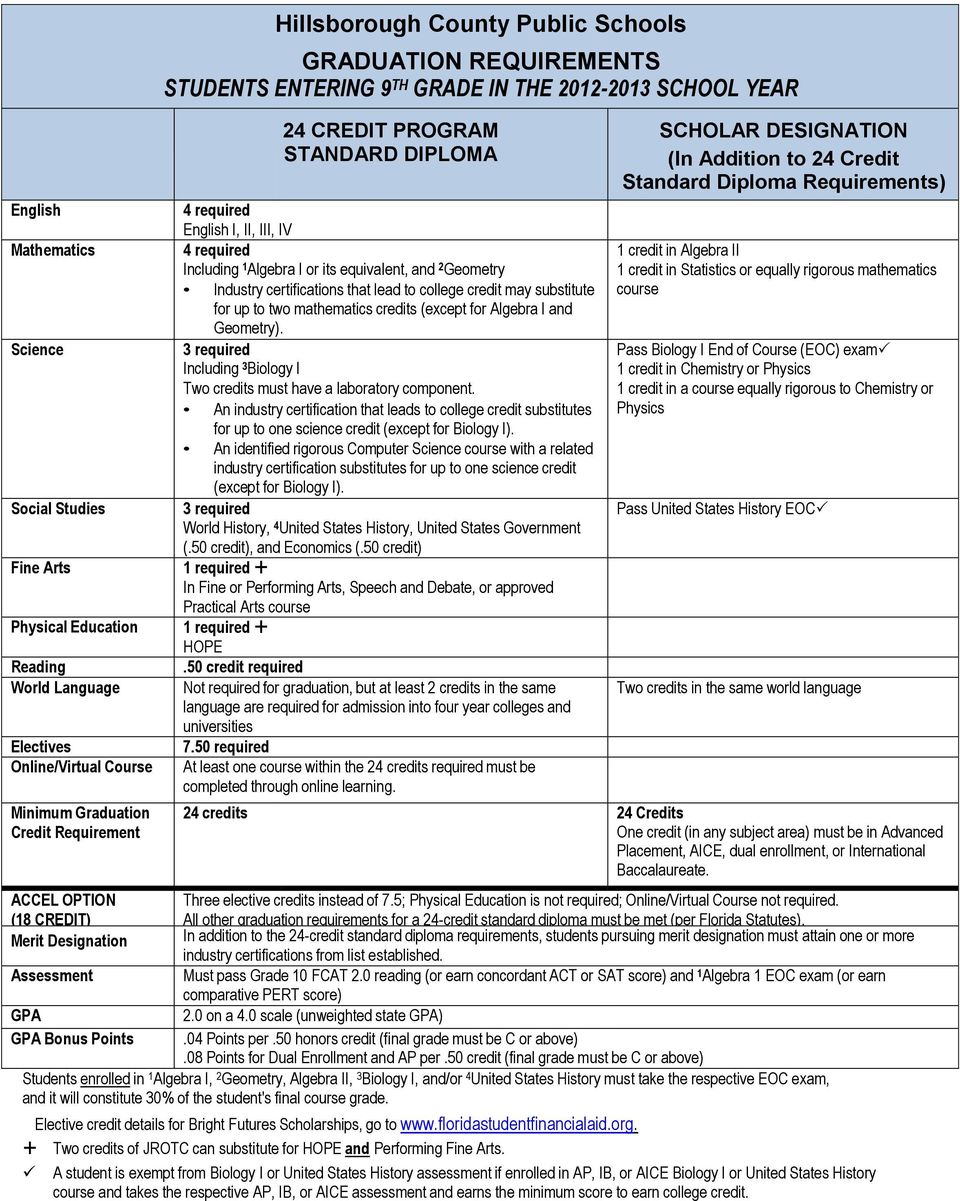
10 Hillsborough County Public Schools GRADUATION REQUIREMENTS STUDENTS ENTERING 9 TH GRADE IN THE SCHOOL YEAR 24 CREDIT PROGRAM STANDARD DIPLOMA English 4 required English I, II, III, IV Mathematics 4 required including 1 Algebra I or its equivalent and 2 Geometry Industry certifications that lead to college credit may substitute for up to two mathematics credits (except for Algebra I and Geometry). Science 3 required including 3 Biology I and two credits in equally rigorous science courses Two credits must have a laboratory component. An industry certification that leads to college credit substitutes for up to one science credit (except for Biology I). An identified rigorous Computer Science course with a related industry certification substitutes for up to one science credit (except for Biology I). Social Studies 3 required World History, 4 United States History, United States Government (.50 credit), and Economics with Financial Literacy (.50 credit) Fine Arts 1 required in Fine or Performing Arts, Speech and Debate, or approved Practical Arts course Physical Education 1 required HOPE Reading.50 credit required World Language Not required for graduation, but at least two credits in the same language are required for admission into four year colleges and universities Electives 7.50 required Online/Virtual Course At least one course within the 24 credits required must be completed through online learning. Minimum Graduation Credit Requirement ACCEL OPTION (18 CREDIT) Merit Designation Assessment GPA SCHOLAR DESIGNATION (In Addition to 24 Credit Standard Diploma Requirements) 1 credit in Algebra II 1 credit in Statistics or equally rigorous mathematics course Pass Biology I End of Course (EOC) exam 1 credit in Chemistry or Physics 1 credit in a course equally rigorous to Chemistry or Physics Pass United States History EOC Two credits in the same world language 24 credits 24 Credits One credit (in any subject area) must be in Advanced Placement, dual enrollment, or International Baccalaureate. Three elective credits instead of 7.5; Physical Education is not required; Online/Virtual Course not required. All other graduation requirements for a 24-credit standard diploma must be met (per Florida Statutes). In addition to the requirements for a standard diploma, students pursuing merit designation must attain one or more industry certifications. Must pass Florida Standards Assessment (FSA) Grade 10 English Language Arts (ELA) assessment (or earn concordant ACT or SAT score) and 1 Algebra 1 (EOC) exam (or earn PERT comparative score) 2.0 on a 4.0 scale (unweighted state GPA) GPA Bonus Points.04 Points per.50 honors credit (final grade must be C or above).08 Points for dual enrollment and AP per.50 credit (final grade must be C or above) Students enrolled in 1 Algebra 1, 2 Geometry, Algebra II, 3 Biology, and/or 4 United States History must take the respective EOC exam, and it will constitute 30% of the student s final grade. Elective credit details for Bright Futures Scholarships, go to Two credits of JROTC can substitute for HOPE and Performing Fine Arts. A student is exempt from Biology I or United States History assessment if enrolled in AP, IB, or AICE Biology I or United States History course and takes the respective AP, IB, or AICE assessment and earns the minimum score to earn college credit.

11 Hillsborough County Public Schools GRADUATION REQUIREMENTS STUDENTS ENTERING 9 TH GRADE IN THE SCHOOL YEAR 24 CREDIT PROGRAM STANDARD DIPLOMA English 4 required English I, II, III, IV Mathematics 4 required including 1 Algebra I or its equivalent and 2 Geometry Industry certifications that lead to college credit may substitute for up to two mathematics credits (except for Algebra I and Geometry). Science 3 required including 3 Biology I and two credits in equally rigorous science courses. Two credits must have a laboratory component. An industry certification that leads to college credit substitutes for up to one science credit (except for Biology I). An identified rigorous Computer Science course with a related industry certification substitutes for up to one science credit (except for Biology I). Social Studies 3 required World History, 4 United States History, United States Government (.50 credit), and Economics with Financial Literacy (.50 credit) Fine Arts 1 required in Fine or Performing Arts, Speech and Debate, or approved Practical Arts course Physical Education 1 required HOPE Reading.50 credit required World Language Not required for graduation, but at least two credits in the same language are required for admission into four year colleges and universities Electives 7.50 required Online/Virtual Course At least one course within the 24 credits required must be completed through online learning. Minimum Graduation Credit Requirement ACCEL OPTION (18 CREDIT) Merit Designation Assessment GPA SCHOLAR DESIGNATION (In Addition to 24 Credit Standard Diploma Requirements) Pass the English Language Arts (ELA) Grade 11 statewide assessment 1 credit in Algebra II must pass End of Course (EOC) exam 1 credit in Statistics or equally rigorous mathematics course Pass Geometry EOC Pass Biology I EOC 1 credit in Chemistry or Physics 1 credit in a course equally rigorous to Chemistry or Physics Pass United States History EOC Two credits in the same world language 24 credits 24 Credits One credit (in any subject area) must be in Advanced Placement, AICE, dual enrollment, or International Baccalaureate. Three elective credits instead of 7.5; Physical Education is not required; Online/Virtual Course not required. All other graduation requirements for a 24-credit standard diploma must be met (per Florida Statutes). In addition to the requirements for a standard diploma, students pursuing merit designation must attain one or more industry certifications. Must pass Florida Standards Assessment (FSA) Grade 10 ELA assessment (or earn concordant ACT or SAT score) and 1 Algebra 1 EOC exam (or earn PERT comparative score) 2.0 on a 4.0 scale (unweighted state GPA) GPA Bonus Points.04 Points per.50 honors credit (final grade must be C or above).08 Points for Dual Enrollment and AP per.50 credit (final grade must be C or above) Students enrolled in 1 Algebra 1, 2 Geometry, Algebra II, 3 Biology, and/or 4 United States History must take the respective EOC exam, and it will constitute 30% of the student s final grade. Elective credit details for Bright Futures Scholarships, go to Two credits of JROTC can substitute for HOPE and Performing Fine Arts. A student is exempt from Biology I or United States History assessment if enrolled in AP, IB, or AICE Biology I or United States History course and takes the respective AP, IB, or AICE assessment and earns the minimum score to earn college credit.

12 POINTS TO REMEMBER WHEN CHOOSING A GRADUATION PROGRAM Students who choose the ACCEL program may still qualify for acceleration programs and for a Florida Bright Futures Scholarship if they meet the eligibility and/or admissions requirements for those programs and scholarships. Students who choose to graduate early can participate in the National Merit Scholarship Program if they take the Preliminary SAT/National Merit Scholarship Qualifying Test (PSAT/NMSQT) in either the next-to-last year or the last year they are enrolled in high school. Those who take the PSAT/NMSQT in their last year of high school will be entering competition for awards to be offered as they are completing their first year of college. Students who meet specified requirements for a comprehensive program of study in career education may be recognized with a career education certification on their high school diploma. High school credits awarded before grade 9 can be counted toward the required credits for all graduation programs. Students who plan to apply to an out-of-state or private in-state college or university and who are interested in the ACCEL program should contact those institutions as early as possible for specific admissions requirements. SPECIAL NOTES Three Year Graduation Program Prior to the school year, students who selected one of the three-year, 18-credit options (College Prep or Career Prep), please see graduation requirements charts for these programs posted on the district website Mathematics The series of courses identified as equivalent for satisfying the Algebra I for graduation purposes count as one of four credits required in mathematics for state university admission purposes. For assistance with Algebra I equivalents contact the high school counselor. Middle Grades Forgiveness Students in grades 6-8 who take any high school level course(s) for high school credit and earn a grade of C, D, or F may enhance the grade with a grade of C or higher earned subsequently in the same or comparable course(s) in accordance with the district school board s grade enhancement policy. Postsecondary Education Readiness Test (PERT) The PERT is Florida s customized common placement test. The purpose of the PERT is accurate course placement based on the student s skills and abilities. The PERT is aligned with the Postsecondary Readiness Competencies identified by Florida faculty as necessary for success in entry-level college credit coursework. The PERT assessment system includes Placement and Diagnostic tests in mathematics, reading and writing. A student cannot fail the PERT. Test scores are used to determine whether a student is ready for college level coursework. For those who do not meet the state established cut score, the score is an indicator that additional preparation is necessary before entering college level courses. For high school students who do not meet the college-ready cut score on the PERT, the high school must schedule those students into postsecondary preparatory instruction. End of Course (EOC) Exam May be required (see appropriate graduation requirement chart)

13 MAKING THE RIGHT CHO IC E The right graduation program for a particular student is the one that best fits the abilities, interests, and goals of that individual student. Families should consider the educational benefits of each program and choose the one that will best prepare the student for his/her postsecondary education or career plan. Here are some things that students and families should consider: W hat is the student's postsecondary education and/or career goal? Is the student prepared to make a choice about postsecondary education and possible career paths? If the student is planning to attend a postsecondary institution away from home, does he or she have the mature decision-making skills needed to make the informed, safe choices required for independent living? Are three electives enough, or is the student interested in taking additional courses to explore his/her interests? Can the student meet admissions requirements for postsecondary education institutions of his/her choice by choosing the ACCEL program? Is the student going to compete for scholarships that require certain academic core courses, community service experiences, demonstrated leadership skills, or participation in extracurricular activities? Is the student planning to play college level sports and if so will the student meet the NCAA course eligibility requirements? Families and students are encouraged to contact the school counselor or college and career counselor at the student s school for more information about graduation programs, financial aid opportunities, accelerated programs, and college or career plans. Students and parents are also encouraged to continue to discuss their plans with the school counselor on a regular basis during the middle school and high school years. Students need to be interested and involved in their academic progress and in planning for their futures in order to ensure that they will be prepared to achieve their postsecondary goals. Page 13

14 RESO URES State University System Admission Requirements For more information on Florida public universities visit Florida College System Admission Requirements For more information on Florida Colleges, visit College Admissions Tests For more information on college admissions tests visit: ACT: SAT: Florida Bright Futures Scholarships The Florida Bright Futures Scholarship Program is created to establish a lottery-funded scholarship program to reward ant Florida high school graduate who merits recognition of high academic achievement and who enrolls in a degree program, certificate program, or applied technology program at an eligible Florida public or private postsecondary education institution and receives funding within 2 years of graduation from high school. For more information, visit Florida Virtual Campus (FLVC) - Planning for Success The Florida Virtual Campus (FLVC) provides a variety of online services for students from Florida s public high schools, colleges, and universities. For more information, visit Florida End of Course (EOC) Assessments are part of Florida s Next Generation Strategic Plan for increasing student achievement and improving college and career readiness. EOCs are computer-based, criterion- referenced assessments that measure the Next Generation Sunshine State Standards for specific high school level courses. For information about what is on the assessments, taking the assessments, and frequently asked questions and answers, visit Office of Student Financial Assistance (OSFA) administers state-funded and some federally funded grants and scholarship programs to assist students with the costs of postsecondary education. For information, visit or call toll-free (888) Federal Student Aid is your source for free information from the U.S. Department of Education on preparing for and funding education beyond high school. Visit Talented 20 Program provides students in the top 20 percent of their class guaranteed admission, within space and fiscal limitations, into one of Florida s 11 state universities. Please note that while eligible students are guaranteed admission, they may not necessarily be admitted to the campus of choice. These students are given priority for the awarding of funds from the Florida Student Assistance Grant Program although this program provides no scholarships. For more information on how to qualify, visit FCAT Explorer is a free online practice program for Florida s public school students. The system features two practice programs created for grade 10 students (Reading Timeline and Math Timeline). Visit CHOICES website is a comprehensive career information system that uses a flexible approach that combines graphics, multimedia, and search strategies to allow students to explore career and educational options. The site includes links to key websites related to career exploration to help students plan for a career. Visit CareerOneStop website provides information and guided support for students in determining the best career path. The website includes Florida-specific information about high-growth jobs with better wages, including new career fields, video tours for students, and an online interest inventory. Visit Page 14

15 Guidance Services The Guidance Department, while working with students, parents, school staff and community, strives to create a positive atmosphere in which all students may develop to their fullest potential. The counselors serve a major role in the course selection process. They are your best resource when it comes to specific program and course requirement information relating to graduation. The counselors also have the most current information regarding the Florida Bright Futures Scholar Program. Students are assigned to counselor by the following alphabetical arrangement: COUNSELOR Mr. D Agostino Mrs. Ware Mr. Tonelli Mrs. Theiss Ms. Rogers STUDENT S LAST NAME: A-Dau Dav-Hor Hon-Mon Moo-Se Sh-Z Schedule Change Policy 1. Valid reasons for a schedule change may include: scheduling error, computer error, failing a required course, passing a course in summer credit recovery or night school, missing a requirement for graduation, and not having the proper prerequisite. 2. Elective changes most often cannot be honored due to teacher unit allocation. 3. Schedule change requests will NOT be considered for the purpose of teacher preference. 4. Understand that a change request may mean your entire schedule will have to be altered to meet the request you have made (different teachers and different class periods.) 5. Once a schedule has been changed, it cannot be changed back again to the original schedule. 6. The student is responsible for all class work from the beginning of the semester, regardless of the date the student entered the class. 7. Failure to complete summer reading for honors and AP classes does not constitute a valid reason for a schedule change. 8. A ll schedule change requests must be approved by the Assistant Principal for Curriculum and counselor. 9. Due to the requirements of the Class Size Reduction Amendment, requests for schedule changes may be denied as classes reach maximum legal capacity. Page 15

16 Course Offerings A student will be placed in a homeroom based on the Student Progression Plan. Honors Courses It has been shown that the weighting of grades in advanced courses more accurately correlates a student s achievement with his or her class standing. A.04 bonus will be added to the student s cumulative grade point average for each one-half credit completed in an honors course. A bonus of.08 will be added to the student s cumulative grade point average (GPA) for each one-half credit in Advanced Placement or Dual Enrollment classes. A grade of C or higher must be earned in the honors or Advanced Placement course for the bonus points to be awarded. The bonus points will be awarded for the cumulative GPA when it is calculated for class ranking. See the Student Handbook for a complete list of courses. Advanced Placement (AP) Courses The Advanced Placement Program offers college level courses at high schools across the United States. Students have the opportunity to earn credit or advanced standing at most of the nation s colleges and universities. It is required that the student take the National Advanced Placement exam at the end of the course. ADVANCED PLACEMENT 2-D ART STUDIO Course Number: For Grades: Prerequisites: Teacher Approval Major Concepts/Content: The AP Studio Art portfolios are designed for students who are seriously interested in the practical experience of art. AP Studio Art is not based on a written examination; instead, students submit portfolios for evaluation at the end of the school year. Students will create 2-dimensional artwork to be included in a college-level art portfolio. Students will work with art ideas both given by the instructor and created independently. Students may work in any 2-d medium, including but not limited to: paints, pencils, photography, collage, printmaking, etc. ADVANCED PLACEMENT 3-D ART STUDIO Course Number: For Grades: Prerequisites: Teacher Approval Major Concepts/Content: The AP Studio Art portfolios are designed for students who are seriously interested in the practical experience of art. AP Studio Art is not based on a written examination; instead, students submit portfolios for evaluation at the end of the school year. Students in the 3-D portfolio will explore 3-D art and its environment. Students will work toward completing a portfolio by creating work with art ideas both given to the instructor and created independently. Students may work in any 3-D medium, including but not limited to: ceramics, plaster, wire, fabrics, wood, mixed media, etc. ADVANCED PLACEMENT MUSIC THEORY Course Number: For Grade: Prerequisites Teacher Approval MAJOR CONCEPTS/CONTENT: The purpose of this course is to develop the student s ability to recognize Page 16

17 and understand the basic materials and processes in any music that is heard or read in score. The content is specified by the Advanced Placement Program and College Board. It is required that the student takes the Advanced Placement Examination in Music Theory. It is required that the student take the National Advanced Placement exam at the end of the course. ADVANCED PLACEMENT SPANISH LANGUAGE Course Number For Grade Prerequisites Spanish III Meets requirements for Foreign Languages MAJOR CONCEPTS/CONTENT: The purpose of this course is to develop a student s communication skill in Spanish. This course is comparable to a third year university course with emphasis on conversation and writing. The content should include, but not be limited to, that determined by the Advanced Placement Program guidelines. It is required that the student take the National Advanced Placement exam at the end of the course. ADVANCED PLACEMENT FRENCH LANGUAGE Course Number For Grade Prerequisites French III and teacher approval Meets requirements for Foreign Languages MAJOR CONCEPTS/CONTENT: The purpose of this course is to develop oral and written fluency in French and to prepare students for the French Advanced Placement exam. The content is topic-based and includes the guide- lines from the Advanced Placement Program. ADVANCED PLACEMENT ENGLISH LITERATURE AND COMPOSITION Course Number: For Grade: 12 Prerequisites: Placement MAJOR CONCEPTS/CONTENT: The purpose of this course is to involve students in the study and practice of writing and in the study of literature. Students should learn to use the modes of discourse and to recognize the assumptions underlying various rhetorical strategies. Students should also acquire an understanding of the resources of the language as well as the writer s craft. They should develop critical standards for the appreciation of any literary work and increase their sensitivity to literature as shared experience. The content should include, but not be limited to, that determined by the College Board. It is required that the student take the National Advanced Placement exam at the end of the course. ADVANCED PLACEMENT ENGLISH LANGUAGE AND COMPOSITION Course Number: For Grade: 11 Prerequisites: Placement MAJOR CONCEPTS/CONTENT: The purpose of this course is to provide students with an understanding of the semantic, structural, and rhetorical resources of the English language as they relate to the principles of effective writing. The course is also designed to provide students with a variety of writing opportunities calling for the use of different styles and tones. The content should include, but not be limited to, that determined by the College Board. It is required that the student take the National Advanced Placement exam at the end of the course. ADVANCED PLACEMENT CALCULUS AB Course Number Grades Page 17

18 Prerequisite: Precalculus MAJOR CONCEPTS/CONTENT: The purpose of this course is to provide study of elementary functions and the general theory and techniques of Calculus. A graphing calculator is required. It is required that the student take the Advanced Placement examination in Calculus AB ADVANCED PLACEMENT CALCULUS BC Course Number Grades Prerequisite: Precalculus MAJOR CONCEPTS/CONTENT: The purpose of this course is to provide an extensive study of the general theory and techniques of calculus. A graphing calculator is required. It is required that the student take the Advanced Placement examination in Calculus BC. ADVANCED PLACEMENT STATISTICS Course Number Grades Prerequisite: Algebra 2 or Algebra 2 Honors MAJOR CONCEPTS/CONTENT: This course explores the concepts of probability and elementary statistics. A graphing calculator is required. This course is a precursor of the statistics required by most fields of study in college. The student will be required to take the Advanced Placement examination. ADVANCED PLACEDMENT COMPUTER SCIENCE Course Number For Grade Prerequisite: Algebra II Honors with a grade C or higher MAJOR CONCEPTS/CONTENT: This course emphasizes object-oriented computer programming methodology with a concentration on problem solving and algorithm development and is the equivalent of a first semester college level course in computer science. It is required that the student takes the Advanced Placement Examination in Computer Science A. ADVANCED PLACEMENT BIOLOGY & BIOLOGY II Course Number: For Grade: Prerequisites: Biology Honors - B, Chemistry Honors-B Meets requirements: Science for graduation MAJOR CONCEPTS/CONTENT: The purpose of this course is to provide a college level course in the biological science and to prepare the student to seek Credit and/or appropriate placement in college biology courses. The content should include, but not be limited to, molecular and cellular biology, organismal biology, and populational biology. Opportunities to understand the interactions of science with technology and society should be provided. Specific AP laboratory activities are course requirements. All students enrolled in AP Biology are REQUIRED to take the national AP Biology Examination for that year. It is required that the student take the National Advanced Placement exam at the end of the course. ADVANCED PLACEMENT CHEMISTRY & CHEMISTRY II Course Number: For Grade: Prerequisites: Recommended co-requisite Chemistry Honors with a grade of B or higher Meets requirements: Science for graduation MAJOR CONCEPTS/CONTENT: The purpose of this course is to provide a college level curriculum in Page 18

19 chemistry and to prepare the student to seek credit and/or appropriate placement in college chemistry courses. The content should include, but not be limited to, structure of matter, states of matter, chemical reactions, and descriptive chemistry. Opportunities to understand the interaction of science with technology and society should be provided. Specific AP laboratory activities are course requirements. All students enrolled in AP Chemistry are REQUIRED to take the National AP Chemistry examination for that year. It is required that the student take the National Advanced Placement exam at the end of the course. ADVANCED PLACEMENT ENVIRONMENTAL SCIENCE Course Number: For Grade: Prerequisites: Biology Honors with a grade of B or higher, Chemistry Honors with a grade of B or higher MAJOR CONCEPTS/CONTENT: The purpose of this course is to provide students with a college level course in environmental science and to prepare the student to seek Credit and/or appropriate placement in college biological sciences programs. The content should include, but not be limited to, the study of the biosphere, its biotic and abiotic components; ecosystems of the world; biological cycles; and current environmental issues. Specific AP laboratory activities are course requirements. All students enrolled in AP Environmental Science are REQUIRED to take the National AP Environmental Science examination for that year. It is required that the student take the National Advanced Placement exam at the end of the course. ADVANCED PLACEMENT PHYSICS 1 Course Number: For Grade Credit: 2.0 Prerequisites(s): Chemistry I Honors and Algebra II Honors MAJOR CONCEPTS/CONTENT: These classes are equivalent to two semesters of college physics for scientists and engineers. AP Physics 1: Algebra-Based is the equivalent to a first-semester college course in algebra-based physics. The course covers Newtonian mechanics (including rotational dynamics and angular momentum); work, energy, and power; mechanical waves and sound. It will also introduce electric circuits. AP Physics 2: Algebra-Based is the equivalent to a second-semester college course in algebra-based physics. The course covers fluid mechanics; thermodynamics; electricity and magnetism; optics; atomic and nuclear physics. ADVANCED PLACEMENT PHYSICS C MECHANICS AND ELECTROMAGNETISM Course Number: For Grade Prerequisites(s): Physics Honors, must have successfully completed or be currently enrolled in AP Calculus AB or BC. MAJOR CONCEPTS/CONTENT: Physics C: Mechanics will provide instruction in each of the following six content areas: kinematics; Newton s laws of motion; work, energy and power; systems of particles and linear momentum; circular motion and rotation; and oscillations and gravitation. Physics C: Electricity and Magnetism will provide instruction in each of the following five content areas: electrostatics; conductors, capacitors and dielectrics; electric circuits; magnetic fields; and electromagnetism. Note: Methods of calculus are used wherever appropriate in formulating physical principles and in applying them to physical problems. Strong emphasis is placed on solving a variety of challenging problems, some requiring calculus. ADVANCED PLACEMENT COMPARATIVE GOVERNMENT AND POLITICS Course Number: For Grade: 12 Credit: 0.5 Prerequisites: None MAJOR CONCEPTS/CONTENT: The purpose of Advanced Placement Comparative Government and Politics is to help students gain knowledge of the world s diverse political structures and practices. The course encompasses the study of the government and politics in Great Britain, France, the Soviet Union, China, Iran, USA, Mexico, England, Nigeria, and a developing nation. Emphasis is on general concepts used to interpret key Page 19

20 political relationships found in almost all national politics. NOTE: Does not meet American government graduation requirement. It is required that the student take the National Advanced Placement exam at the end of the course. ADVANCED PLACEMENT MACRO ECONOMICS Course Number For Grade 12 Prerequisite: none Meets requirements: Graduation requirements for Economics MAJOR CONCEPTS/CONTENT: This course deals with aggregated decision-making of the economy as a whole and the role of government in the economy, particularly as it applies to the American free enterprise system. Gross National Product, price indexes, economic policy, unemployment and inflation are all concepts to be included in the study. It is required that the student take the National Advanced Placement exam at the end of the course. Must be co-enrolled in AP Micro Economics. ADVANCED PLACEMENT MICRO ECONOMICS Course Number: For Grade 12 Prerequisite: none Meets requirements: Graduation requirements for Economics MAJOR CONCEPTS/CONTENT: This course deals with decision-making of the household and business in answering the basic questions: what to produce, how to produce it and from whom to produce it. Concepts such as supply and demand, product and factor markets, costs, revenues, market forms and profit maximization will be studied and analyzed. It is required that the student take the National Advanced Placement exam at the end of the course. Must be co-enrolled in AP Macro Economics. ADVANCED PLACEMENT EUROPEAN HISTORY Course Number: For Grades: Prerequisites: None MAJOR CONCEPTS/CONTENT: The purpose of Advanced Placement European History is to provide students with the opportunity to develop the analytic skills and factual knowledge necessary to deal critically with the problems, content, and materials of European historic development. This is done by focusing on persistent themes and change in history and by applying historical reasoning to seek solutions to contemporary problems. Appropriate concepts and skills will be developed in connection with the content that follows. Specific content to be covered will include, but not be limited to: geographic-historic and time-space relationships, origin and development of the European State System, the impact of religious thought and ideals on European cultures and nations, the evolution of political systems and philosophies in European societies, technological change and societal reaction in European development, the development of nationalism as a European phenomenon, and economic systems and philosophies in Europe. It is required that the student take the National Advanced Placement exam at the end of the course. Note: Does not meet the world history graduation requirement. AP HUMAN GEOGRAPHY Course Number Prerequisites none MAJOR CONTENT/CONCEPTS: The purpose of this course is to enable students to develop higher levels of concepts and skills related to Human Geography. The content includes the following: regions, population studies, migration, cultural concepts, and spatial representation such as religion, language, and folk and popular culture, political geography, land use, urbanization, issue s related to space, place, and scale and economic geography. It is required that the student take the National Advanced Placement exam at the end of the course. Page 20

21 ADVANCED PLACEMENT PSYCHOLOGY Course Number: For Grades: Prerequisites: None MAJOR CONCEPTS/CONTENT: The purpose of Advanced Placement Psychology is to introduce students to the systematic and scientific study of the behavior and mental processes of human beings and other animals. Students are exposed to the psychological facts, principles, and phenomena associated with each of the major sub fields within psychology. They also learn about the methods psychologists use in their science and practice. It is required that the student take the National Advanced Placement exam at the end of the course. ADVANCED PLACEMENT UNITED STATES GOVERNMENT & POLITICS Course Number: For Grade: 12 Credit: 0.5 Prerequisites: None MAJOR CONCEPTS/CONTENT: The purpose of AP United States Government & Politics course is to give students a critical perspective on politics and government in the United States. This course involves the study of the general concepts used to interpret American politics and the analysis of specific case studies. It is required that the student take the National Advanced Placement exam at the end of the course. NOTE: Meets American government requirement for graduation ADVANCED PLACEMENT UNITED STATES HISTORY Course Number: For Grade: 11 Prerequisites: None Meets requirements graduation MAJOR CONCEPTS/CONTENT: The purpose of Advanced Placement United States History is to provide students with the opportunity to develop the analytic skills and factual knowledge necessary to deal critically with the problems, content, and materials of American historic development. This is done by focusing on persistent themes and change in history and by applying historical reasoning to seek solutions to contemporary problems. Appropriate concepts and skills will be developed in connection with the content that follows. Specific content to be covered will include, but not be limited to: the development of American culture and institutions, significance of American westward expansion and development of American ideals and characteristics, effects of the American colonial experience on national development, enlightened thinking and its relationship to the Declaration of Independence and the Constitution. It is required that the student take the National Advanced Placement exam at the end of the course. ADVANCED PLACEMENT WORLD HISTORY Course Number: For Grade: 10 Prerequisites: None Meets requirements for graduation MAJOR CONCEPTS/CONTENT: AP World History highlights six overarching themes that should receive approximately equal attention throughout the course beginning with the Foundations section: 1. Impact of interaction among major societies (trade, systems of international exchange, war, and diplomacy). 2. The relationship of change and continuity across the world history periods covered in this course. 3. Impact of technology and demography on people and the environment (population, growth and decline, disease, manufacturing, migrations, agriculture, weaponry). 4. Systems of social structure and gender structure (comparing major features within and among societies and assessing change). 5. Cultural and intellectual developments and interactions among and within societies. Page 21
22 6. Changes in functions and structures of states and in attitudes toward states and political identities (political culture), including the emergence of the nation-state (types of political organization). Art CREATING 2-D ART Course Number For Grades: 9-12 Credit: 0.5 Prerequisites: None Meets requirements: Fine & Performing Arts MAJOR CONCEPTS/CONTENT: This is a semester-long course designed to give students a basic introduction to 2- Dimensional art, including drawing, painting, collage, and printmaking. CREATING 3-D ART Course Number: Credit: 0.5 Prerequisites: None Meets requirements: Fine and Performing Arts Major Concepts/Content: This is a semester-long course designed to give students a basic introduction to creating 3-Dimensional art, including ceramics, sculpture, and assemblage. 2-D ART STUDIO 1 Course Number: For Grades: 9-12 Prerequisites: Creating 2-D Art Meets requirements: Fine & Performing Arts MAJOR CONCEPTS/CONTENT: This series of courses are year-long and are for students interested in advancing their skills in 2-dimensional art. Students will create artwork using a variety of materials, including drawing, painting, collage, and printmaking. Building skills for the serious art student who may decide to take AP studio 2D. 2-D ART STUDIO 2 Course Number: For Grades: Prerequisites: 2-D Art Studio 1 Meets requirements: Fine & Performing Arts MAJOR CONCEPTS/CONTENT: This series of courses are year-long and are for students interested in advancing their skills in 2-dimensional art. Students will create artwork using a variety of materials, including drawing, painting, collage, and printmaking. Building skills for the serious art student who may decide to take AP studio 2D. 2-D ART STUDIO 3 HONORS Course Number: For Grades: Prerequisites: 2-D Art Studio 2 Meets requirements: Fine & Performing Arts MAJOR CONCEPTS/CONTENT: This series of courses are year-long and are for students interested in advancing their skills in 2-dimensional art. Students will create artwork using a variety of materials, including drawing, painting, collage, and printmaking. Building skills for the serious art student who may decide to take AP Page 22
23 studio 2D. CERAMICS/POTTERY I Course Number: For Grades: 9-12 Prerequisites: None Meets requirements Fine & Performing Arts MAJOR CONCEPTS/CONTENT: The purpose of this course is to give students a basic understanding of ceramic processes. This class will introduce students to the concepts necessary to create ceramic objects without the use of the potter s wheel. Students will work with moist clay, and will learn how to manipulate it into functional vessels, as well as learn about firing and glazing techniques. CERAMICS/POTTERY II Course Number: For Grades: 9-12 Prerequisites: CERAMICS/POTTERY I Meets requirements: Fine & Performing Arts MAJOR CONCEPTS/CONTENT: The purpose of this course is to give students a second level understanding of ceramic processes. Students will expand on hand-building techniques learned in Ceramics I, as well as learn how to use a potter s wheel. 3D STUDIO ART 2 Course Number: For Grades: Prerequisites: Teacher Approval Major Concepts/Content: This course offers more experience in sculpture. It is an intermediate course which will give students an opportunity to create more in-depth sculptures using materials such as clay, wood, wire and found objects. Personal creativity will be stressed when combining materials and technique, and communicating an idea. Most materials are provided. CREATIVE PHOTOGRAPHY 1 Course Number: For Grades: Prerequisites: none Meets requirements: Fine & Performing Arts MAJOR CONCEPTS/CONTENT: This course will teach students the difference between a snapshot and a photograph. Students will learn the art of black and white photography using pin-hole cameras, with an introduction to digital. This course includes lectures and hands- on work about the history of photography, the chemicals and processes involved in developing photo paper and making enlarged prints from negatives and how to use a camera to make good compositions and exposures. It is highly recommended that students have a digital camera. However, they can use their own 35mm manual camera.. Photo paper and darkroom chemicals are provided, but students should expect to purchase film at an approximate cost of $15 CREATIVE PHOTOGRAPHY 2 Course Number: For Grades: Prerequisites: Creative Photography 1 Meets requirements: Fine & Performing Arts Page 23
24 MAJOR CONCEPTS/CONTENT: This course is for students who have enjoyed Photo I and want more in-depth work. In this intermediate course students will improve their exposures and compositions by becoming more aware of line, shape and texture and learning how to communicate a message in their work. Some alternative darkroom processes will also be introduced, and knowledge of digital photography expanded. It is highly recommended that students have access to a digital camera. However, students can also use their own 35mm manual camera. Darkroom chemicals are provided, but students are expected to purchase their own film and photo paper at an approximate cost of $60. CREATIVE PHOTOGRAPHY 3 HONORS Course Number: For Grades: Prerequisites: Creative Photography 2 Meets requirements: Fine & Performing Arts MAJOR CONCEPTS/CONTENT: This advanced level course is for the more serious photo students who wish to continue improving their camera and darkroom skills. Students will be required to write a thesis and develop a body of work to start a portfolio using traditional or digital photography. Students are expected to supply their own digital camera, and if they wish, a 35mm manual camera. Darkroom chemicals are provided, but students should expect to furnish their own film, photo paper, and prints at an approximate cost of $60 per semester. AVID AVID 1-4 Course Numbers , , , Prerequisites: None MAJOR CONCEPTS/CONTENT: This program is designed to increase school wide learning and performance. The AVID elective class assists students in meeting the challenges associated with Honors and Advanced Placement classes and helps prepare them for admittance into a four year university. The course focuses on improving/maintaining organizational skills, literacy skills, critical thinking and collaboration skills, note-taking and writing skills and increases awareness regarding the requirements for college admission. Students participate in collaborative tutorial groups two days a week to help ensure success in honors and AP classes. The curriculum also includes field trips, guest speakers and other motivational activities. MINIMUM GPA REQUIREMENT TEACHER APPROVAL REQUIRED Business Technology Education Students enrolled in a Business, Marketing and Teacher Assisting Course, may be eligible to complete an Industry Certification that is Highly Valued in the Workplace and after becoming certified you will receive Merit Designation at Graduation. Business ACCOUNTING APPLICATIONS 1 HONORS Course Number: For Grades: Prerequisite: Successful completion of CCC or one-half credit in Keyboarding Business Skills (KBS). Meets requirements Practical Arts MAJOR CONCEPTS/CONTENT: This accounting course provides a strong foundation in basic accounting theory and practice. It emphasizes the double-entry accounting methods and principles of recording income, Page 24
25 expenses, acquisition of assets, incurrence of liabilities, and changes in equity through the preparation of financial statements. Industry Certification also available. Future Business Leaders of America (FBLA) membership is encouraged for all students enrolled in this program. ACCOUNTING APPLICATION 2 HONORS Course Number For Grade Prerequisite: Honors Accounting Application 1 Meets requirements: Practical Arts MAJOR CONCEPTS/CONTENT: This course goes beyond the basic accounting principles and theories to more applications and hands on computerized simulations. It is designed to continue the study of accounting principles. The content includes voucher systems, cash receipts, petty cash, payroll records, and internal control systems. Whether you are preparing for an occupation or preparing for life in general, you will learn QuickBooks, the most widely used accounting software today. Industry Certification also available. Future Business Leaders of America (FBLA) membership is encouraged for all students enrolled in this program. ADMINISTRATIVE OFFICE TECHNOLOGY 1 Course Number For Grades: 9-12 Credit: 1 Prerequisite: Successful completion of CCC or one-half credit in Keyboarding Business Skills (KBS). MAJOR CONCEPTS/CONTENT: The course is designed for students who desire on-the-job training in one of the offices within the school. This program offers a sequence of courses that provides coherent and rigorous content aligned with challenging academic standards and relevant technical knowledge and skills needed to prepare for further education and careers in the Business, Management, and Administration career cluster; provides technical skill proficiency, and includes competency-based applied learning that contributes to the academic knowledge, higher-order reasoning and problem-solving skills, work attitudes, general employability skills, technical skills, and occupation-specific skills, and knowledge of all aspects of the Business, Management, and Administration career cluster. This course is also directed to students interested in becoming industry certified in Microsoft Office Outlook. ADMINISTRATIVE OFFICE TECHNOLOGY 2 Course Number: For Grades: Prerequisite/Co Requisite: Administrative Office Technology 1 and Computing for Colleges & Careers or Introduction to Information Technology or CBS plus KBS. MAJOR CONCEPTS/CONTENT: This course content includes but is not limited to the use of technology to develop higher level communication, thinking, and decision making skills; the performance of office procedures tasks; the production of quality work in an efficient manner using advanced features of business software applications; research of job opportunities; and the production of high quality employment portfolios and jobseeking documents. This course is also directed to students interested in becoming industry certified in Microsoft Office PowerPoint. APPLIED COMPUTER AND BUSINESS SKILLS Course Number: For Grades: 9-12 Credit:.50 Prerequisite: None MAJOR CONCEPTS/CONTENT: This is a required course designed to provide a basic overview of current business and information systems and trends to introduce students to the basic skills and foundations required for today's business environments. Emphasis is placed on developing proficiency with touch keyboarding and Page 25
26 fundamental word processing applications, so that they may be used as communication tools for enhancing personal and work place proficiency in an information-based society. This course also offers the opportunity for students to earn industry certification in Microsoft Office Word leading to the MOS complete certification. COMPUTING FOR COLLEGES & CAREERS Course Number: For Grades: 9-12 Prerequisite: None Meets requirements: Practical Arts MAJOR CONCEPTS/CONTENT: This course is designed to provide an overview of current business information systems and trends. It will introduce students to the skills required for today s business environment. Emphasis is placed on the computer applications of keyboarding and word processing used as communication tools in our information-based society. This also includes proficiency with computers using databases, spreadsheets, presentation applications, and the integration of these programs using software that meets industry standards. Students will have an opportunity to become industry certified in Word, Excel, and PowerPoint. DIGITAL DESIGN 1 Course Number: For Grades: Prerequisite/Co Requisite Successful completion of Computing for College & Careers (1 year) OR one-half credit in Keyboarding Business Skills (KBS) Meets requirements Performing Arts Requirement MAJOR CONCEPTS/CONTENT: In this creative course, you get to explore your computer designing, art, photography and technology skills. Students learn how to create REAL publications (i.e., flyers, newsletters, brochures, certificates, and other special projects for WHS faculty and staff. Whether you have limited or extensive computer experience, you will be able to create sophisticated publications using Adobe In-Design, Photoshop and Illustrator software. It also allows you to polish your higher-order reasoning and problem-solving skills, work attitudes, general employability skills, technical skills, and occupation-specific skills. Students will have an opportunity to earn an Adobe Certified Associate certificate in InDesign by the end of the school year. DIGITAL DESIGN 2 HONORS Course Number: For Grades: Prerequisite: Digital Design 1 Meets requirements Performing Arts Requirement MAJOR CONCEPTS/CONTENT: This program offers a broad foundation of knowledge and skills to prepare students for employment in digital publishing positions. The content includes enhanced practical experiences in computer generated art and text, graphic design, graphic production, electronic design skills, preparation of electronic layouts & illustrations and electronic scanning. This program focuses on broad, transferable skills and stresses understanding and demonstration of the following elements of the digital publishing industry: planning; management; finance; technical and production skills underlying principles of technology and design. It is also designed to prepare students for employment as an Information Technology Assistant, Production Assistant, Digital Assistant Designer, Graphic Designer and Multi-Media Designer. Students will have an opportunity to earn an Adobe Certified Associate certificate in Illustrator by the end of the school year. EMERGING TECHNOLOGY IN BUSINESS Course Number: For Grades: 9-12 Credit: 0.5 Prerequisite: none Page 26
27 MAJOR CONCEPTS/CONTENT: This course provides instruction in electronic research methods; business communications including speaking, listening, writing, and telecommunicating; multimedia presentation skills; ethical considerations related to technology; and emerging technologies affecting business environments. You will discuss internet research and collaboration tools, software development tools, and patent and licensing practices that accompany software applications. In addition you will discover ways to protect your privacy and personal information on the Internet, as well as cloud computing and learning about all the careers IT has to offer. You will work towards a certification in CIW. FOUNDATIONS OF WEB DESIGN, HONORS Course Number: For Grades: 9-12 Prerequisite: Computing for Colleges & Careers MAJOR CONCEPTS/CONTENT: Students will learn to create web pages with HTML and XHTML code, elements of design, and navigation techniques. They will learn Adobe Dreamweaver, create ImageMaps and animated graphics in Fireworks and will prepare and attempt to obtain industry certification in Adobe Dreamweaver. USER INTERFACE DESIGN, HONORS Course Number: Grades: Prerequisite: Foundations of Web Design, Honors. MAJOR CONCEPTS/CONTENT: Build multi-level web sites with Dreamweaver, Fireworks and Flash. This project-intense class will develop initiative and creativity. Students will become proficient in Adobe software and master skills used for successful web design. They will have fun enhancing web pages by adding audio, video and animation. Students will prepare and attempt to obtain industry certification in Adobe Flash. Students will demonstrate the use of advanced Web practices, including HTML5 and CSS to attempt industry certification in the CIW Site Development Foundations. WEB SCRIPTING FUNDAMENTALS Course Number: For Grades: Prerequisites: Successful completion of Web Design 2 and Teacher Approval Major Concepts/Content: Web Scripting Fundamentals is a challenging course that will help students prepare for a career in web design. As part of a web design team, they will assume a role in creating and maintaining many websites. Students will become proficient at evaluating effectiveness of web layout, design and maintenance, marketing and optimizing your website for the web! Students will demonstrate the use of advanced business practices including those required to start a successful E-Business and attempt industry certification in CIW E- Commerce Specialist. Software: Adobe Dreamweaver, Fireworks, Flash and Photoshop. WEB DESIGN 4 HONORS Course Number: For Grades: Prerequisites: Successful completion of Web Design 3 and Teacher Approval Major Concepts/Content: Media Integration Essentials is the ultimate, project-based course that will allow students to create and maintain web sites, as well as develop proficiency in software used in the industry. Students will develop and maintain Wharton s School Web Site.. This course is designed for motivated students with proven track records of efficiency and dedication. Software: Adobe Dreamweaver, Fireworks, Flash and Photoshop. Page 27
28 Marketing MARKETING ESSENTIALS Course Number: For Grades: 9-12 Prerequisites: none Major Concepts/Content: Marketing Essentials is an introductory course geared to help you develop an understanding of the business world of marketing, selling and advertising. The background knowledge of the foundations and functions of Marketing allows you to grow through hands-on interactive projects. After completing Marketing Essentials you will be able to pick a concentration in either Fashion or Sports to complete out the program in both the Applications and Management courses. You will also have the opportunity to be part of the Co-Curricular Club DECA and work towards your Industry Certification in PowerPoint, Word and Outlook. FASHION MARKETING ESSENTIALS Course Number: For Grades: 9-12 Prerequisites: none Major Concepts/Content: The purpose of this course is to prepare students for the fashion marketing or sales industry. Through marketing and advertising promotion concepts you will build a better understanding how Fashion is promoted. Students will use the concepts of Fashion Design to create and market a Fashion Line. Watch your creativity grow by understanding everything that goes into developing a Fashion Product. This course will also help you develop an understanding of the History of Fashion and Background Knowledge of certain Fashion Designers. You have the opportunity to be part of the Co-Curricular Club DECA and work towards your Industry Certification in PowerPoint, Word and Outlook. FASHION MARKETING APPLICATIONS Course Number: For Grades: Prerequisites: Fashion Essentials Major Concepts/Content: This course is designed to provide students with an in-depth study of fashion marketing. Some topics covered include complex factors in the fashion industry and the development of a Fashion Line. Your creativity will really be pushed by working on interactive Fashion Projects in the Marketing World. You have the opportunity to be part of the Co-Curricular Club DECA and work towards your Industry Certification in PowerPoint, Word and Outlook. FASHION MARKETING MANAGEMENT Course Number: For Grades: Prerequisites: Fashion Essentials and Fashion Applications Major Concepts/Content: This course is designed to provide students an advanced study of fashion marketing. Some topics covered include: Career planning, complex factors in the fashion industry, determining prices and marketing a fashion line. You will also be leaders in the club DECA and finish your MOS Certification. SPORTS, RECREATION AND ENTERTAINMENT MARKETING ESSENTIALS Course Number: For Grades: 9-12 Page 28
29 Prerequisites: none Major Concepts/Content: This course will introduce students to the sports, recreation, and entertainment industry. Topics include general marketing, history of sports marketing, licensing, media and much more! You have the opportunity to be part of the Co-Curricular Club DECA and work towards your Industry Certification in PowerPoint, Word and Outlook. SPORTS, RECREATION AND ENTERTAINMENT MARKETING APPLICATIONS Course Number: For Grades: Prerequisites: Sports, Recreation and Entertainment Marketing Essentials Major Concepts/Content: Second course of study Topics include public relations, publicity, event planning, sponsorships, tickets, endorsements, and more! Learn about local sports franchises and their REAL marketing dilemmas! Students will study Tampa Bay Area sports franchise cases! You have the opportunity to be part of the Co-Curricular Club DECA and work towards your Industry Certification in PowerPoint, Word and Outlook. SPORTS, RECREATION AND ENTERTAINMENT MARKETING MANAGEMENT Course Number: For Grades: Prerequisites: Sports, Recreation and Entertainment Marketing Applications Major Concepts/Content This course will prepare students for employment in the sports, recreation, and entertainment marketing industry. Topics include: applied skills related to the sport, recreation, and entertainment marketing functions. Career planning, legal and ethical aspects as related to the sport, recreation, and entertainment industry. You have the opportunity to be part of the Co-Curricular Club DECA and work towards your Industry Certification in PowerPoint, Word and Outlook. Teacher Assisting TEACHER ASSISTING 1 Course Number: Grades: 9-12 Prerequisites: 3.0 GPA Meets requirements: Practical Arts MAJOR CONCEPTS/CONTENT: This course is designed to develop competencies related to the role, regulations, and career path leading up to becoming a teacher. You will study the history of education, leadership, CTSO activities, interpersonal and communication skills and education support tasks. This course allows students to practice skills in an actual classroom setting. Students will be able have a work station with teachers or office staff throughout campus. Students are encouraged to join the co-curricular club Florida Future Educators of America (FFEA). Industry Certifications in Microsoft Office also available. TEACHER ASSISTING 2 Course Number: Grades: Prerequisites: 3.0 grade point average and successful completion of Teacher Assisting 1 Meets requirements: Practical Arts MAJOR CONCEPTS/CONTENT: This course is designed to develop competencies in test administration and grading, examining effective teaching skills, job related computer applications, and visual aide preparation. This course also allows students to practice skills in an actual classroom setting. Students will be able have a work station with teachers or office staff throughout campus. Students must maintain good discipline records, and must have a teacher recommendation. Students are encouraged to join the co-curricular club Florida Future Educators Page 29
30 of America (FFEA). Industry Certifications in Microsoft Office also available. TEACHER ASSISTING 3 Course Number: Grades: Prerequisites: 3.0 grade point average and successful completion of Teacher Assisting 1 & 2 Meets requirements: Practical Arts MAJOR CONCEPTS/CONTENT: This course covers content such as developmental stages of children, teaching children to read and write, writing lesson plans and developing school-age appropriate activities. This course also allows students to practice skills in an actual classroom setting. Students will be able have a work station with teachers or office staff throughout campus. Students must maintain good discipline records, and must have a teacher recommendation. Students are encouraged to join the co-curricular club Florida Future Educators of America (FFEA). Industry Certifications in Microsoft Office also available. Technology TV PRODUCTION 1 Course Number Prerequisites None Meets requirements Elective MAJOR CONCEPTS/CONTENT: The purpose of this course it to provide opportunities for students to develop skills in history of television; basic video camera operation; postproduction skills in graphics, audio, and editing; scriptwriting and storyboarding; direction and production of video projects. Students in TV Production I produce the following: macro lens project, interview, documentary, and instructional video. Public service announcement, and music video. TV PRODUCTION 2 Course Number Prerequisites TV Production 1 Meets requirements None MAJOR CONCEPTS/CONTENT: The purpose of this course is to exhibit the ability to apply television skills in the planning, directing, and recording of television programs, demonstrate the ability to write script and dialogue for a television program, and demonstrate the ability to produce a television program. Television II students produce the following video projects: a classroom profile From the Teacher s Desk, a music video, an interview project, and ENG news report, a studio television program, as well as 2-3 individual projects of the student s choice. Also, members of award-winning GTV news crew. TV PRODUCTION 3 Course Number Prerequisites TV Production 2 Meets requirements None MAJOR CONCEPTS/CONTENT: The purpose of this course is to develop advanced skills in television production and to synthesize these skills in planning, directing, and producing television programs. The content should include, but not be limited to, the following: synthesis of skills in writing, producing, directing, and editing television programs; and development of advanced set design. Page 30
31 TV PRODUCTION 4 Course Number: For Grades: 9-12 Prerequisites: TV Production 3 Meets requirements: None MAJOR CONCEPTS/CONTENT: The purpose of this course the same as TV II is to gain independence in planning, writing, producing, supervisory, and performing in television productions. Laboratory activities are an integral part and should include hands-on experience in producing television programs. They should also include opportunities for students to explore creative and original endeavors in producing television programs. Family and Consumer Sciences CHILD DEVELOPMENT Course Number Credit 0.5 Prerequisites NONE Meets requirements Practical Arts MAJOR CONCEPTS/CONTENT: The purpose of this course is to prepare students to understand the nature of child development from prenatal care through age three including the function and significance of the parenting experience. The content includes, but is not limited to, basic needs of children, principles of human development, reproduction, prenatal care, the birth process, and responsibilities of parents and caregivers. EARLY CHILDHOOD EDUCATION 1 Course Number: Prerequisites: Child Development Meets requirements Practical Arts MAJOR CONCEPTS/CONTENT: ECE 1 includes the basic training hours required by the Department of Children and Families (DCF) for childcare workers-health Safety and Nutrition, Child Growth and Development, Child Abuse Recognition and Reporting and Observation. The course also includes leadership, organizational skills, implementing developmentally appropriate lesson plans for the preschool child. This course is a prerequisite for ECE 2, 3 and 4. EARLY CHILDHOOD EDUCATION 2 Course Number For Grade Prerequisites ECE 1 Meets requirements: Practical Arts MAJOR CONCEPTS/CONTENT: This course continues DCF training to include developmentally appropriate practices for preschoolers, rule and regulations and behavioral observation and continue implementing developmentally appropriate lesson plans and activities. EARLY CHILDHOOD EDUCATION 3&4 Course Number / For Grade Prerequisites ECE 1, 2 MAJOR CONCEPTS/CONTENT: This is the 2 hour block Childcare training course that involves the development and implementation of lesson plans for the preschool child. Students will be instructed in the Page 31
32 management and operation of an onsite developmental preschool. Upon successful completion of this block of courses students will be certified and qualified for the Early Childhood Professional Certification. Students will learn to interact professionally with children, parents and coworkers. They will develop an extensive teaching portfolio and display their work at the showcase of Mastery projects for potential employers. NUTRITION AND WELLNESS Course Number Credit 0.5 Prerequisites NONE Meets requirements Practical Arts MAJOR CONCEPTS/CONTENT: The purpose of this course is to prepare students to understand the relationship between nutrition and wellness. The program also provides for selection, preparation, service and storage of foods. It allows students to use technology to practice meal management techniques directed toward nutritional food choices based on the life cycle. This course will provide an awareness of consumer issues relating to health and wellness. Sports nutrition and information on eating disorders is also included. PARENTING SKILLS Course Number Credit 0.5 Prerequisites NONE Meets requirements Practical Arts MAJOR CONCEPTS/CONTENT: The purpose of this course is to prepare students for the multiple roles essential to becoming a model parent and caregiver and to understand the dual roles of males and females as parents. This course will also enhance the student s ability to assist children to become effective citizens in a multicultural and technological society. The content includes, but is not limited to, parenting roles and responsibilities; nurturing and protective environments for children; positive parenting strategies; effective communication in parent/child relationships; multicultural diversity and trends in technology. PRINCIPLES OF CLOTHING CONSTRUCTION Course Number Credit 0.5 Prerequisites NONE MAJOR CONCEPTS/CONTENT: The purpose of this course is to prepare students to identify the characteristics of fibers, fabrics and textiles; to interpret consumer protection laws related to clothing fabrics; to construct garments; and to develop leadership and organizational skills. PRINCIPLES OF FOOD PREPARATION Course Number Credit 0.5 Prerequisites NONE MAJOR CONCEPTS/CONTENT: The purpose of this course is to prepare students to understand the principles of food preparation, selection and storage, basic food preparation, and selection of food services. Learning activities are provided in a laboratory setting using current technology and materials. Hands on cooking labs follow the course material. FOOD SCIENCE TECHNOLOGY (FRESHMAN CULINARY OPERATIONS 1) Course Number: For Grade: 9 Page 32
33 Prerequisites: none Major Concepts/Content: This course is designed for freshmen students who will be introduced to the life of Wharton High School by way of hands-on experience. Students will develop competence in career and job opportunities, basic skills, safe, secure and sanitary work procedures, operational systems, recipes, commercial tools and equipment usage, principles of nutrition, front-of-the-house duties, and food and beverage preparation. CULINARY OPERATIONS 1 & 2 Course Number: , For Grade: Prerequisites: none Major Concepts/Content: This course was developed as part of a three- credit, core curriculum. Students will develop competence in career and job opportunities, basic food skills, personal productivity, safe, secure and sanitary work procedures, operational systems, recipes, commercial tools and equipment usage, principles of nutrition, front-of-the-house duties, and food and beverage preparation. CULINARY OPERATIONS 3, 4, AND 5 Course Number: , , For Grade: Prerequisites: Culinary 2+ Major Concepts/Content: This course was developed as part of a three-credit core curriculum. Students will develop competence in career and job opportunities, basic skills, safe work procedures, operational systems, recipes, principles of nutrition, front-of- the-house duties and food preparation. SENIOR SURVIVAL Course Number: For Grade: Prerequisites: none Major Concepts/Content: This course is designed for Seniors Only! Students will receive the skills necessary to live on their own. Concepts include managing your money, consumer choices, menu planning and preparation, interpersonal relationships and decision making. Practical everyday skills needed for survival on your own will be covered. Guest speakers will share their expertise. PERSONAL AND FAMILY FINANCE Course Number: For Grade: Credit: 0.5 Prerequisites: none Major Concepts/Content: The purpose of this course is to give students an overview of personal and family finance concepts, including the American economic system, personal and family management of resources, including income, money management, saving and investing, spending and credit, the role of financial institutions and the consumer, consumer information, and taxation. NJROTC NAVAL SCIENCE 1 Course Number For Grade Credit (This course may be taken in place of PE.) Prerequisite None Page 33
34 MAJOR CONCEPTS/CONTENT: Designed as an introduction to the Navy and the NJROTC program, to stimulate enthusiasm for scholarship, and to engender a sense of pride in self, one s associates and the organization. Course content includes introduction to American Citizenship, Techniques of Communication, Leadership, introduction to Naval ships and aircraft, Naval Customs and Courtesies, basics of U.S. Government, Physical Fitness, Drug Abuse Prevention, marksmanship, discussion of current events and orientation trips and fun events. Students are issued Navy uniforms to be worn once a week. Students are taught basic military drill and may join a drill team and go to drill competition. $20 fee required for lab/insurance. NAVAL SCIENCE 2 Course number For Grade Credit 1.0 (This course may be taken in place of PE.) Prerequisites Naval Science I or one year of JROTC (Army or Air Force or Marines) MAJOR CONCEPTS/CONTENT: Develops the traits of Citizenship and Leadership, introduces students to technical areas of Naval Science study, and engenders an awareness of the vital importance of oceans to the continued well-being of the United States. Course material includes Citizenship, Leadership (developing skills and exercising leadership roles), Importance of Navy/Maritime history to development of our civilization, war-ship construction/ damage control, Naval (ship and aircraft) weapons, ship navigation fundamentals-rules of the road, basic understanding of scientific principles (why planes fly, how sonar works etc.), orienteering, Physical Fitness, discussion of current events and orientation trips and fun events. Students are issued Navy uniforms to be worn once a week. Students are taught basic/advanced military drill and may join a drill team and go to drill competition. $20 fee required for lab/insurance. NAVAL SCIENCE 3 Course number For Grade Credit 1.0 Prerequisites Naval Science II or two years of JROTC (Army or Air Force or Marines) MAJOR CONCEPTS/CONTENT: Designed to assist students in understanding the operative principles of military leadership, increase awareness of the significance of teamwork, emphasize the intrinsic value of discipline in the accomplishment of assigned objectives, and teach Naval academic subjects. Course content includes leadership and discipline, the Naval operations and U.S. Strategy and Global Politics, Physical Fitness, orienteering, discussion of current events and orientation trips and fun events. Students are issued Navy uniforms to be worn once a week. Students are taught military drill and may join a drill team and go to drill competition. $20 fee required for lab/insurance. NAVAL SCIENCE 4 Course number For Grade 12 Credit 1.0 Prerequisites Naval Science III or 3 years of JROTC (Army, Air Force or Marines) MAJOR CONCEPTS/CONTENT: Designed to allow students the opportunity to PRACTICE the operative principles of military leadership, experience the significance of teamwork, practice discipline in the accomplishment of assigned objectives, and teach basic Naval academic/military subjects. Course content includes: Group Dynamics, Techniques of Communication, American Citizenship, Career Opportunities, Role of the U.S. Armed Forces, Technology Awareness, Methods of Instruction, Human Relations, Leadership and discipline, the Naval service and Naval history, Physical Fitness, orienteering, discussion of current events and orientation trips and fun events. Students are issued Navy uniforms to be worn once a week. Students are taught military drill and may join a drill team and go to drill competition. $20 fee required for lab/insurance. LEADERSHIP EDUCATION AND TRAINING 1-4 Course Number , , , Grades 9-12 Credit 1 Page 34
35 Prerequisites teacher approval MAJOR CONCEPTS/CONTENT: The weekly schedule for this course will mirror the Naval Science schedule. The students will conduct practical application of the leader- ship skills and naval science curriculum. The students will have an opportunity to practice as teams for Academics, Physical Fitness, Orienteering, Marksmanship, Drill and Color Guard. The cadet staff will also have the ability to work together on upcoming projects, field meets, field trips and community service opportunities. The instructors will focus on leadership discussions and goal setting for all students enrolled. Health Science Occupations This cluster is a planned sequence of instruction consisting of a two-credit core curriculum and one or more courses leading to an occupational completion point. It is an excellent course choice for students considering medical careers of any variety, as well as an early start of both academic and practical aspects of a medical career. (TechPrep Credit) MEDICAL SKILLS AND SERVICES Course Number: For Grades: 9-12 Prerequisites: none Major Concepts/Content: This course is designed to provide students with practical generic, competencies related to health decisions all individuals must make during their lifetime. The content includes information that introduces students to the various health career clusters, to basic skills, to first aid and CPR, to knowledge of blood borne diseases, and to recognize the legal aspects of the health consumer. *HOSA Optional HEALTH SCIENCE 1 Course Number: For Grades: Prerequisites: none Major Concepts/Content: This course provides instruction in the structure and function of each human body system, as well as in common diseases. The integration of CD- ROMS, video presentations, and hands-on learning activities will be an integral part of the program. *HOSA Suggested HEALTH SCIENCE 2 (CORE) Course Number: For Grades: Prerequisites: Teacher Approval and successful completion of Health Science 1 or Anatomy & Physiology. Major Concepts/Content: This course introduces and provides students with a foundation in core competencies that have been identified as essential to all health career occupations. The content includes knowledge of the health care delivery system, legal and ethical responsibilities, wellness and disease concepts, and infection control procedures. This class is combined with Nursing Assistant 3. *HOSA Required NURSING ASSISTANT 3 Course Number: For Grades: Prerequisites: Teacher approval and completion of Health Science 1 and 2. Major Concepts/Content: This is the third course of the three credit program. Students will continue to perform nursing skills in the clinical setting. This program prepares students for employment at the assistant level in nursing. Students will perform nursing skills in a simulated laboratory and in a clinical setting (hospital/ nursing Page 35
36 home) under the supervision of a registered nurse. Forty hours of clinical is required for certification in this field.*health Occupations Students of America (HOSA), the vocational student leadership organization, is an integral part of the program. FINE ARTS BAND 1 Course Number Grades 9-12 Credit 1 Prerequisite: Director s approval, audition and attendance to summer band camp. MAJOR CONCEPTS/CONTENT: Incoming ninth graders and other students (who could not take band in their ninth grade year) who have had middle school band can take this course. Summer band camp is mandatory. In the fall, the students will perform at all football games and at local competitions. In this course, students will develop their musicianship and technical skills through the study and practice of varied band repertoire. Rehearsal, performances outside of class time and participation in the marching band are required of all band students. Full year participation is required. BAND 2-4 Course Number , , Grades 9-12 Credit 1 Prerequisite: Director s approval, audition and completion of Band I. MAJOR CONCEPTS/CONTENT: This course is for students who have successfully completed Band I. In the summer, they will attend a mandatory band camp. In the fall, they will perform at all football games and at local competitions. They will continue to develop their musicianship and technical skills through the study and practice of varied band repertoire. Rehearsal, performances outside of class time and participation in the marching band are required of all band students. Full year participation is required. BAND 5-6 (HONORS) Course Number , Grades Credit 1 Prerequisite: Director s approval, audition and completion of Band II-IV. MAJOR CONCEPTS/CONTENT: This course is for students who have successfully completed Band II-IV and wish to extend their musical knowledge. In the summer, they will attend a mandatory band camp. In the fall, they will perform at all football games and at local competitions. They will continue to develop their musicianship and technical skills through the study and practice of varied band repertoire. Participation in Solo & Ensemble is required in February as well as numerous other music based projects per 9 weeks. There is a final portfolio which is sent downtown to the music supervisor, who will then grant the honors points. Rehearsal, performances outside of class time and participation in the marching band are required of all band students. Full year participation is required. EURYTHMICS 1-4 (COLOR GUARD) Course Number , , , Grades 9-12 Credit 1 Prerequisite: Director s approval and audition. MAJOR CONCEPTS/CONTENT: The purpose of this course is to enable students to develop basic skills in creating, performing, and evaluating choreographed performances as an independent ensemble and in cooperation with the marching band. Emphasis is placed on dance, equipment manipulation, precision, and the relationship between music and dance. Participation in Marching Band in the fall and Winter Guard in the spring is Page 36
37 REQUIRED. Rehearsals and performances outside of class time are REQUIRED. Full year participation required. GUITAR 1 Course Number Prerequisites None Meets requirements Performing Fine Arts MAJOR CONCEPTS/CONTENT: The purpose of this course is to provide students with introductory experiences on the guitar in performance skills and interpretation of simple notation. The content should include, but not be limited to, thorough introduction to music fundamentals, guitar performance techniques and interpretation of musical notation including chord symbols. GUITAR 2 Course Number For Grade Prerequisites Guitar I Meets requirements Performing Fine Arts MAJOR CONCEPTS/CONTENT: The purpose of this course is to provide students with instruction in guitar using varied performance techniques. The content should include, but not be limited to, the development of music fundamentals, guitar performance techniques and interpretation of musical notation including chord symbols. GUITAR 3 Course Number For Grade Prerequisites: Guitar II, Director Approval Meets requirements: Performing Fine Arts MAJOR CONCEPTS/CONTENT: The purpose of this course is to provide students with instruction in guitar using varied performance techniques. The content should include, but not be limited to, the development of music fundamentals, guitar performance techniques and interpretation of musical notation including chord symbols. KEYBOARD 1 Course Number Prerequisites None Meets requirements Performing Fine Arts MAJOR CONCEPTS/CONTENT: The purpose of this course is to provide students with introductory experiences on the keyboard in performance skills and interpretation of simple notation. The content should include, but not be limited to, the development of music fundamentals, keyboard performance techniques and interpretation of musical notation. KEYBOARD 2 Course Number Prerequisites Keyboard I- Teacher Approval Required Meets requirements Performing Fine Arts MAJOR CONCEPTS/CONTENT: The purpose of this course is to provide students with instruction in varied performance techniques on the keyboard. The content should include, but not be limited to, the development of music fundamentals, performance techniques and interpretation of musical notation. Page 37
38 MUSIC THEORY 1 Course Number Prerequisite: Director s approval and participation in a band, chorus or orchestra class. MAJOR CONCEPTS/CONTENT: The purpose of this course is to enable students to develop knowledge of basic music structures and elements and their uses in varied music styles and genres. The content will include, but not be limited to, the following: rhythmic, melodic, and harmonic notation, ear training, sight reading, composition, arranging, and improvisation, harmonic structure, analysis of compositional structure and form and the influence of history and culture. ORCHESTRA 1-3 Course Number Prerequisites Teacher approval and audition Meets requirements Performing Fine Arts MAJOR CONCEPTS/CONTENT: This course is open to rising 9th grade students who were previously enrolled in middle school strings or orchestra program, and is designed to continue developing the students skills in mu- sic ensembles on orchestral instruments. A wide scope of instruction and musical awareness will be a part of the course. Emphasis will be placed on stringed instruments. Rehearsal and performances outside of class time are required. All orchestra students are required to supply their own instrument or rent an instrument from the school district. This course is an annual program. Full year participation is required ORCHESTRA 4 Course Number For Grade Prerequisites Teacher approval and audition Meets requirements Performing Fine Arts MAJOR CONCEPTS/CONTENT: The purpose of this course is to provide students with instruction in the application of musicianship and technical skills through the study of varied orchestral literature. The content should include, but not be limited to, independent interpretation of medium level orchestral music; refinement of tone production and performance techniques; musical form, style periods, and aesthetic perceptions. THEATRE INTRODUCTION TO DRAMA Course Number Credit 0.5 Prerequisites None Meets requirements as elective for Performing Fine Arts MAJOR CONCEPTS/CONTENT: The purpose of this course is to provide a broad overview of the study and practice of dramatic arts. The content should include, but not be limited to, background information on the history, traditions, literature, and operations areas of the theatre. Opportunities for beginning experiences in acting and other aspects of theatre activities should be included. THEATRE 1-4 & ACTING 1-4 Prerequisites By audition and instructor approval Meets requirements as elective for Performing Fine Arts Page 38
39 MAJOR CONCEPTS/CONTENT: The purpose of this course is to provide opportunities to study and perform the varied styles of theatre with special attention to the principals of stage movement, acting, singing, characterization and all other aspects of a stage production. A primary focus of this course is to enable students to develop and synthesize fundamental elements of theatre arts into final production using varied media, techniques, and processes. The content should include, but not be limited to, the following: Advanced theatre performance and auditioning techniques (acting, dance, singing), Repertoire building for professional theatrical auditions (music selection, resume/portfolio building), Advanced acting technique for theatre performance role and influence of international and contemporary theatre in history, culture, society and individual lifestyles, Theatrical Competition through Individual Events and One-Act production, Analysis of dramatic literature, Collaborative and ethical work ethic for theatre production, Pantomime and Improvisation Cultural, social and economic influences upon theatre, Connection between theatre and other subject areas, Advanced stage direction styles and techniques for theatre, Advanced production techniques (lighting, sound, scenic design, costuming, make-up, stage choreography and stage and business management) from pre to post production, audience etiquette, Vocational and recreational pursuits in musical theatre, analysis, and evaluation/critiquing of theatrical performance. This course requires extensive outside commitment that leads to the staging of up to eight productions per year. TECHNICAL THEATRE: DESIGN & PRODUCTION 1 Course Number Prerequisites None Meets requirements as elective for Performing Fine Arts MAJOR CONCEPTS/CONTENT: The purpose of this course is to introduce students to the fundamentals of technical theatre. The content should include, but not be limited to, the following: scenery construction, costuming, make-up, lighting, sound set design, and properties. TECHNICAL THEATRE: DESIGN & PRODUCTION 2 Course Number For Grade Prerequisites technical theatre: design & production 1 Meets requirements as elective for Performing Fine Arts MAJOR CONCEPTS/CONTENT: The purpose of this course is to provide students with practical experience in stagecraft procedures. The content should include, but not be limited to, the following: study of scenery construction and set design and methods and procedures for sound, lighting, costuming, properties, and make-up in theatrical productions. TECHNICAL THEATRE: DESIGN & PRODUCTION 3 Course Number For Grade Prerequisites technical theatre: design & production 2 Meets requirements as elective for Performing Fine Arts MAJOR CONCEPTS/CONTENT: The purpose of this course is to provide opportunities for experienced technical theatre students to expand their knowledge of technical theatre and to participate in theatrical events from a technical aspect. The content should include, but not be limited to, the following: in-depth analysis of design and construction of scenery, sound, lighting, properties, make-up, and costumes; study of various technical theories; and application of technical skills. TECHNICAL THEATRE: DESIGN & PRODUCTION 4 Course Number For Grade Page 39
40 Prerequisites technical theatre: design & production 3 MAJOR CONCEPTS/CONTENT: The purpose of this course is for experienced students to study and participate in dramatic productions and projects in technical theatre. The content should include, but not be limited to, the following: special uses of design and construction of scenery, sound, lighting, properties, makeup, and costumes in producing dramatic projects and various technical theories. IMPROVISATION 1-2 Course Number , Prerequisites none MAJOR CONCEPTS/CONTENT: The purpose of this course is to enable students to develop problem-solving acting skills that are used to discover symbolic clues in unscripted dramatic structures and integrate them into individual and ensemble theatrical performances. The content should include, but not be limited to, the following: acting techniques and character analysis, movement and vocal production, emotional dimension, theatre terminology, theatrical forms and influences, script analysis and refinement, technical elements, roles of the director and playwright, artistic discipline, audience etiquette, careers, auditioning and casting, and history of the art. This course emphasizes extensive training in the Harold Method, and other techniques associated with SNL, and stand-up comedy, as well as basic dramatic script creation skills. Outside production involvement is at the discretion of the instructor and/or student, how- ever this course may require students to participate in extra rehearsals and performances beyond the school day. This course will meet the graduation requirement for Performing Arts INTRO TO FILM & TV Course Number: For Grades: 9-12 Prerequisites: none Major Concepts/Content: This course provides an exciting overview into the fascinating world of the Film and the Tele- vision Industry. The student will gain an under- standing and familiarity with landmark films and television shows from the beginning of the art forms through today. Selected topics include the various processes and personnel that create these works, as well as the interconnectivity and relevance of this media to reflect and affect change while entertaining and challenging audiences. All facets of these industries are explored through extended analysis of the script, direction, performance, cinematography, choreography, costume, settings, music, and special effects, with special attention toward critical advancements and shifts in the artistic experience. Students will be evaluated on their production of critical response essays to the films viewed and examined. This course will meet the graduation requirement for Performing Arts. World Languages FRENCH 1 Course Number Prerequisites FCAT Level 3 or higher Meets requirements College Prep requirements for Foreign Languages MAJOR CONCEPTS/CONTENT: The purpose of this course is to introduce students to the target language and its culture and to develop communicative skills and cross-cultural understanding. The content should include, but not be limited to, beginning skills in listening and speaking with special attention to pronunciation, introduction to reading and writing, fundamentals of grammar and fundamentals of culture. This course is designed for non-native speakers of French. Page 40
41 FRENCH 2 Course Number Prerequisites French 1 Meets requirements College Prep requirements for Foreign Languages MAJOR CONCEPTS/CONTENT: The purpose of this course is to reinforce the fundamental skills previously acquired by the students. This course develops increased listening, speaking, reading, and writing skills, as well as cultural awareness. The content should include, but not be limited to, an expansion of the listening and oral skills previously acquired. Reading and writing should receive more emphasis, while oral communication remains the primary objective. This course should continue the cultural survey of French- speaking people. FRENCH 3 Course Number Prerequisites French 2 Meets requirements College Prep requirements for Foreign Languages MAJOR CONCEPTS/CONTENT: This purpose of this course is to master and expand the skills previously acquired by the students. The content should include, but not be limited to, expansions of vocabulary and conversational skills through discussions based on selected readings. Student s acquisition of grammatical concepts should be strengthened by analyzing reading selections. Contemporary vocabulary should stress activities, which are important to everyday life of French-speaking people. FRENCH 4 Course Number Prerequisites French 3 Meets requirements College Prep requirements for Foreign Languages MAJOR CONCEPTS/CONTENT: French 4 expands the skills acquired by the students in French 3. Specific content includes, but is not limited to, more advanced language structures and idiomatic expressions, with emphasis on conversational skills. There is additional growth in vocabulary for practical purposes, including writing. Reading selections are varied and taken from the target language newspapers, magazines, and literary works. SPANISH 1 Course Number Prerequisites 8th grade FCAT Level 3 or higher Meets requirements College Prep Requirements for Foreign Languages MAJOR CONCEPTS/CONTENT: The purpose of this course is to introduce students to the target language and its culture and to develop communicative skills and cross-cultural understanding. This course is designed for nonnative speakers of Spanish. The content should include but not be limited to, beginning skills in listening and speaking with special attention to pronunciation. An introduction to reading and writing should also be included, as well as the fundamentals of grammar and culture. This course is designed for non-native speakers of Spanish. SPANISH 2 Course Number Prerequisites Pass both semesters of Spanish 1 Meets requirements College Prep Requirements for Foreign Languages Page 41
42 MAJOR CONCEPTS/CONTENTS: The purpose of this course is to reinforce the fundamental skills acquired by the students. This course develops increased listening, speaking, reading, and writing skills as well as cultural awareness. The content should include, but not be limited to, an expansion of the listening and oral skills. Reading and writing should receive more emphasis, while oral communication remains the primary objective. This course should continue the cultural survey of Spanish-speaking people. SPANISH 3 Course Number Prerequisites Spanish 2 Meets requirements College Prep Requirements for Foreign Languages MAJOR CONCEPTS/CONTENT: The purpose of this course is to master and expand the skills acquired by the students. The content should include, but not be limited to, expansions of vocabulary and conversational skills through discussions based on selected readings. Students acquisition of grammatical concepts should be strengthened by analyzing reading selections. Contemporary vocabulary should stress activities, which are important to everyday life of Spanish-speaking people. SPANISH 4 Course Number For Grade Prerequisites Spanish III Meets requirements College Prep Requirements for Foreign Languages MAJOR CONCEPTS/CONTENTS: The purpose of this course is to expand the skills previously acquired by the students. The content should include, but not be limited to, more advanced language structures and 71 idiomatic expressions, with emphasis on conversational skills. There should be additional growth in vocabulary for practical purposes, including writing. Reading selections should be varied. English JOURNALISM I Course Number Prerequisites English Teacher Approved Meets requirements for Practical Arts MAJOR CONCEPTS/CONTENT: The purpose of this course is to provide instruction in basic aspects of journalism and workshop experiences in journalistic production. The content should include, but not be limited to, instruction in recognizing and writing news for journalistic media and in developing editorials, sports articles, and feature stories. In addition to written work, students should receive instruction in the history and traditions of journalism as well as workshop experiences in photography, layouts, advertising, printing, and other practical aspects of journalistic enterprise. In connection with workshop experiences, one or more student journalistic products may be published. JOURNALISM HONORS II-VIII NEWSPAPER (Portfolio required) Course Number: , , For Grades: Prerequisites: Journalism I; application process and newspaper staff adviser approval. Major Concepts/Content: These courses provide advanced instruction in writing and production skills related to various journalistic media. The content includes challenging instruction in writing, designing, and managing journalistic enterprises; implementing creative skills and talents in writing, graphic design, and/or opportunities to Page 42
43 develop proficiency in various forms of journalistic writing through the production of the student newspaper. Students are offered the opportunity to attend district, state and national workshops in order to hone their craft. Students may earn honors points through semester portfolio submissions. JOURNALISM REGULAR 2-4 YEARBOOK JOURNALISM HONORS 5-8/ YEARBOOK (Portfolio required) Course Number: , , For Grades: Prerequisites: Journalism I, Teacher recommendation and yearbook adviser approval Major Concepts/Content: These courses provide advanced instruction in journalistic writing and production techniques. The content includes instruction in writing, de- signing, and managing journalistic enterprises. The emphasis is upon implementing students creative skills and talents in writing, graphic de- sign and/or photography, and in providing regular practice in management skills and production techniques in printed journalistic media. These courses provide opportunities to develop proficiency in various forms of journalistic writing through the publication of the school s year- book. SPEECH 1 / 2 Course Number: / For Grades: Credit: 0.5 Prerequisites: none Major Concepts/Content: These elective courses provide instruction in the skills needed for effective formal and informal oral communication. Topics include strategies for successful group discussion, analysis of audience, and development of effective listening and speaking skills. DEBATE 1-4 Course Number: / For Grades: Credit: 0.5 Prerequisites: Teacher approval Major Concepts/Content: These elective courses pr ovi de instruction in argumentation and problem solving. The focus is instruction in logical thinking, organization of facts, and speaking skills. Students research topics and participate in debates within the class- room and in formal debate. CREATIVE WRITING 1-4 Course Number: / For Grades: 9-12 Credit: 0.5 Prerequisites: None Major Concepts/Content: These courses continue developing of students writing and language skills needed for literary expression. Poetry, short stories, screenplays, and visual arts are combined in these courses. The end product is the publication of the school s literary magazine. Math ALGEBRA II Course Number For Grade Prerequisites Geometry or Geometry Honors and A, B, or C in Algebra 1 Page 43
44 Meets requirements Graduation requirements for mathematics MAJOR CONCEPTS/CONTENT: The purpose of this course is to continue the study of the structure of algebra and to provide the foundation for applying these skills to other mathematical and scientific fields. Topics shall include, but not be limited to, the review and extension of the structure and properties of the real number system; relations, functions and graphs; polynomials and rational expressions; quadratic equations and inequalities; polynomial functions; rational and irrational exponents; logarithms; complex numbers; conics; introductory statistics; and an exploration of trigonometry. SPECIAL NOTE: The earning of Credit in this course precludes the earning of Credit in Algebra II Honors. ALGEBRA II HONORS Course Number For Grade 9-11 Prerequisites Geometry Honors and A, B, or C in Algebra 1 Honors Meets requirements Graduation requirements for mathematics MAJOR CONCEPTS/CONTENT: The purpose of this course is to present an in-depth study of the topics of Algebra II with emphasis on theory, proof, and development of formulas, as well as their application. Topics shall include, but not be limited to, algebraic structure; first-degree equations in one and two variables solved algebraically and graphically; systems of equations and inequalities; functions and relations; polynomials and rational expressions; exponents and radicals; logarithms; complex numbers; conic sections; polynomial equations; sequences and series; permutations, combinations and probability; and exploration of trigonometry SPECIAL NOTE: The earning of Credit in this course precludes the earning of Credit in Algebra II. PRE-CALCULUS Course Number For Grade Prerequisites Algebra II Honors Grade of C or above Meets requirements Graduation requirements for mathematics MAJOR CONCEPTS/CONTENT: The purpose of this course is to study mathematics using functions as a unifying theme. Content shall include, but not be limited to, polynomial and rational functions, statistical and probability functions, exponential and logarithmic functions, and trigonometric and circular functions. SPECIAL NOTE: This course is designed to follow Algebra II Honors. A Credit in this course precludes a Credit in Trigonometry or Trigonometry IB. MATH ANALYSIS HONORS Course Number For Grade Credit 0.5 Prerequisites Trigonometry Meets requirements Graduation requirements for mathematics MAJOR CONCEPTS/CONTENT: This course will enable students to extend their knowledge of functions, acquire additional modes of mathematical reasoning at an introductory level, and develop the skills necessary for the study of calculus. TRIGONOMETRY HONORS Course Number For Grade Credit 0.5 Prerequisites Algebra II or Algebra II Honors Meets requirements Graduation requirements for mathematics MAJOR CONCEPTS/CONTENT: The purpose of this course is to provide students with the study of circular and trigonometric functions and their applications. Topics shall include, but not be limited to, circular functions; trigonometric identities; graphs of trigonometric functions; particular and general solutions of trigonometric Page 44
45 equations; and solutions of right and oblique triangles. SPECIAL NOTE: The Earning of Credit in this course precludes the Earning of Credit in Analysis of Functions. MATHEMATICS FOR COLLEGE READINESS Course Number For Grades Prerequisites: Algebra 1 Meets requirements Graduation requirements for mathematics MAJOR CONCEPTS/CONTENT: This course is targeted for grade 12 students, whose test scores on the Postsecondary Educational Readiness Test (PERT) are at or below the established cut scores for mathematics, indicating that they are not yet college ready in mathematics or simply need some more additional instruction in content to prepare them for success in college level mathematics. Additionally, the class is also available to those students who struggled in Algebra 1 and need to strengthen math to prepare for the rigor of Algebra 2. This class incorporates the Florida Core Standards for Mathematical Content: Expressions and Equations; the Number System; Function; Algebra; Geometry; Number and Quantity; Statistics and Probability; and the Common Core Standards for High School Modeling. The standards align with the Mathematics Postsecondary Readiness Competencies deemed necessary for entry-level college courses. ADVANCED TOPICS IN MATHEMATICS Course Number Grades Prerequisite: Algebra 2 or Algebra 2 Honors Meets requirements Graduation requirements for mathematics MAJOR CONCEPTS/CONTENT: This course strengthens the mathematical skills of college bound students who seek more proficiency before moving to other more advanced mathematics courses. COLLEGE ALGEBRA - DUAL ENROLLMENT (HCC) Course Number MAC 1105 Grades credit hours Prerequisite: Teacher recommendation, Algebra 2 or higher, and minimum SAT score Meets requirements Graduation requirements for mathematics MAJOR CONCEPTS/CONTENT: Provides students with the opportunity to gain algebraic knowledge needed for many fields such as engineering, business, science, computer technology, and mathematics. Graphical and numerical methods support the study of functions and their corresponding equations and inequalities. Students will study linear, quadratic, polynomial, rational, exponential, logarithmic, inverse, composite, radical, and absolute value functions; systems of equations and inequalities; modeling applied problems; and curve fitting techniques. BUSINESS CALCULUS DUALENROLLMENT (HCC) Course Number MAC credit hours Grades Prerequisite: Teacher recommendation, College Algebra or higher, and minimum SAT score Meets requirements Graduation requirements for mathematics MAJOR CONCEPTS/CONTENT: Provides a review of functions and an introduction to limits, with an emphasis on differentiation and integration of algebraic, exponential, and logarithmic functions. Topics are directed toward applications in business, economics, and the social and behavioral sciences. Page 45
46 Physical Education/Driver s Education DRIVER EDUCATION Course Number: For Grade: 9-12 Credit: 0.5 Prerequisites: Must be 15 yrs. of age or older MAJOR CONCEPTS/CONTENT: The purpose of Driver Education/Traffic Safety-Classroom is (1) to introduce students to the transportation system and to strategies which will develop driving knowledge and skills related to today s and tomorrows motorized society and (2) to provide an in-depth study of the scope and nature of accident problems and their solutions. Specific content shall include, but not be limited to, instruction within a classroom in vehicle control and traffic procedures, defensive strategies for driving, natural laws and their application to driving, energy efficient and safe enjoyable vehicle ownership, physical and mental factors, legal and moral obligations, knowledge of motorcycle operations and interactions in the system, planning for safe travel to include map studies, and a comprehensive study of the effects of alcohol and drugs on driving performance. BASKETBALL Course Number Credit 0.5 Prerequisites None MAJOR CONCEPTS/CONTENT: The purpose of this course is to enable students to develop knowledge and skills in basketball and to maintain or improve health-related fitness. The content should include, but not be limited to, the following: -safety practices-rules and terminology-history- biomechanical and physiological principles-techniques and strategies-sportsmanship-fitness activities-assessment of skills and health-related fitnessofficiating-organization and administration of basketball activities-consumer issues-benefits of participation. AEROBICS 1/2 Course Number , Credit 0.5 Prerequisites None MAJOR CONCEPTS/CONTENT: The purpose of this course is to provide students with opportunities to develop an individual optimal level of cardiovascular fitness, acquire knowledge of cardiovascular fitness concepts, and acquire knowledge of the significance of cardiovascular fitness on one s health. The content should include, but not be limited to, knowledge of the importance of cardiovascular fitness, assessment of cardiovascular fitness, knowledge of health problems, problems associated with inadequate cardiovascular fitness levels, knowledge of the cardiovascular and respiratory systems, knowledge and application of biomechanical and physiological principles to improve and maintain cardiovascular fitness including stress management, knowledge of consumer issues related to aerobic activities, and knowledge of safety practices related to aerobic activities. TEAM SPORTS 1 Course Number Credit 0.5 Prerequisites None MAJOR CONCEPTS/CONTENT: The purpose of this course is to enable students to acquire basic knowledge of team sports play, develop skills in specified team sports (flag football, basketball, softball, volleyball and soccer), and maintain or improve health-related fitness. The content should include, but not be limited to, the following: -safety practices-rules and terminology- history-biomechanical and physiological principles-techniques and strategies-sportsmanship-fitness assessment-consumer issues-benefits of participation Page 46
47 TEAM SPORTS 2 Course Number Grades Credit 0.5 Prerequisites: None MAJOR CONCEPTS/CONTENT: The purpose of this course is to enable students to acquire basic knowledge of team sports play, develop skills in specified team sports, (flag rugby, track and field, ultimate Frisbee, lacrosse) and maintain or improve health-related fitness. The content should include, but not be limited to the following - safety practices, rules and terminology, history, biomechanical and physiological principles, techniques and strategies, sportsmanship, fitness assessment, consumer issues and benefits of participation. VOLLEYBALL Course Number Grades Credit 0.5 Prerequisites: None This course provides opportunities to acquire knowledge and skills in volleyball that may be used in recreational pursuits and to maintain and/or improve personal fitness. The content includes in-depth knowledge and application skills, techniques, strategies, rules, and safety practices necessary to participate in volleyball. WEIGHT TRAINING 1 Course Number Credit 0.5 Prerequisites None MAJOR CONCEPTS/CONTENT: The purpose of this course is to enable students to acquire basic knowledge and skills in weight training, improve muscular strength and endurance, and begin to enhance self-image. The content should include, but not be limited to, the following: safety practices, terminology, musculoskeletal system, muscular strength and endurance, biomechanical and physiological principles, theories, concepts, and skills, weight training programs, implementation and evaluation of a personal weight training program, weight training activities for fitness, fitness assessment, nutrition, consumer issues and benefits of participation WEIGHT TRAINING 2 Course Number Credit 0.5 Prerequisites Weight Training 1 MAJOR CONCEPTS/CONTENT: The purpose of this course is to enable students to develop intermediatelevel knowledge and skills in weight training, further improve muscular strength and endurance, and further enhance self-image. The content should include, but not be limited to, the following: safety practices terminology - musculoskeletal system -muscular strength and endurance - biomechanical and physiological principles -theories, concepts, and skills -design, implementation, and evaluation of a personal weight training program -weight training activities for fitness -fitness assessment -nutrition -consumer issues and benefits of participation WEIGHT TRAINING 3 Course Number For Grade Credit 0.5 Prerequisites Weight Training 1 and 2 MAJOR CONCEPTS/CONTENT: The purpose of this course is to enable students to develop advanced knowledge and skills in weight training, further improve muscular strength and endurance, and further enhance self-image. The content should include, but not be limited to, the following: safety practices -terminology - musculoskeletal system -muscular strength and endurance - biomechanical and physiological principles - theories, concepts, and skills -design, implementation, and evaluation of a personal weight training program - weight Page 47
48 training activities for fitness -fitness assessment -nutrition -consumer issues and benefits of participation. WEIGHT TRAINING POWER Course Number: For Grade: 9-12 Credit: 0.5 Prerequisites: Weight Training 1 MAJOR CONCEPTS/CONTENT: The purpose of this course is to enable students to acquire basic knowledge and skills in power weight training and to maintain or improve health-related fitness. The content should include, but not be limited to, the following: safety practices, history, rules and terminology, techniques and strategies, biomechanical and physiological principles, fitness assessment, consumer issues, benefits of participation. WRESTLING 1 Course Number: For Grade: 9-12 Credit: 0.5 Prerequisites: none MAJOR CONCEPTS/CONTENT: This course provides the opportunities to acquire basic knowledge and skills in wrestling may be used in physical fitness pursuits today, as well as, in later life, further improve strength and cardiovascular endurance, and further enhance body image. WRESTLING 2 Course Number: For Grade: 9-12 Credit: 0.5 Prerequisites: HOPE, Wrestling 1 MAJOR CONCEPTS/CONTENT: This course provides opportunities to extend the acquisition of knowledge and the skills in wrestling that may be used in physical fitness pursuits today, as well as, in later life, further improve strength and endurance, and further enhance body image. Science ANATOMY AND PHYSIOLOGY, HONORS Course Number For Grade Prerequisites Biology I or Honors with a B Meets requirements Science for graduation MAJOR CONCEPTS/CONTENT: The purpose of this course is to provide students with rigorous content and laboratory activities in the structures and functions of the components of the human body. The content should include, but not be limited to, anatomical terminology, cells and tissues, integumentary system, skeletal system, muscular system, nervous system, special sensory organs, endocrine system, circulatory system, respiratory system, digestive system, excretory urinary system, reproductive system, homeostasis, disease process, immune response, and inheritance: molecular, cellular, organismal; mutations and genetic disorders. Opportunities to understand the interactions of science with technology and society should be provided. ASTRONOMY HONORS Course Number Grades Credit 1 Prerequisite: C or better in Biology or Physical Science MAJOR CONCEPTS/CONTENT: The purpose of this course is to enable students to develop and apply knowledge of the universe and compare the conditions, properties, and motions of bodies in space. Emphasis shall Page 48
49 be placed on concepts basic to Earth, including materials, processes, history, and the environment. The content should include, but not be limited to, the following: instruments for collection of astronomical data, celestial sphere, planets, asteroids, and comets, effects of the motions of the Earth, effects of the Earth-Moon system, the sun and other stars, cosmology, space flight, and connections between astronomy, technology, and society. CHEMISTRY I, HONORS Course Number For Grade Prerequisites Geometry, Algebra I co-enrolled in Algebra II or Trigonometry Meets requirements Science for graduation MAJOR CONCEPTS/CONTENT: The purpose of this course is to provide students with a rigorous study of the composition, properties and changes associated with matter. The content should include, but not be limited to, heat, changes of matter, atomic structure, periodic table, bonding, formulas and equations, mole concept, gas laws, energy and order, reaction rates and equilibrium, solutions: acids, bases, salts, nuclear chemistry, electrochemistry, and organic chemistry. Opportunities to understand the interactions of science with technology and society should be provided. CHEMISTRY I Course Number For Grade Prerequisites Geometry, Algebra I co-enrolled in Algebra II or Trigonometry Meets requirements Science for graduation MAJOR CONCEPTS/CONTENT: This course provides students with the study of composition, properties and changes associated with matter. This content includes classification and structure of matter, atomic theory, periodic table, bonding formulas and equations, mole concept, gas laws, energy and order, reaction rates and equilibrium, solutions, acids, bases, salts, nuclear chemistry, electrochemis-try, and organic chemistry. (Graphic calculators recom-mended). FORENSIC SCIENCES I HONORS Course Number: For Grades: Prerequisites: Biology or Physical Science Regular or Physical Science Honors Co requisite: Chemistry Regular or Chemistry Honors MAJOR CONCEPTS/CONTENT: Forensic Science I is an integrated science course that enables students to experience the application of the sciences to the investigation of a crime. Students will be introduced to the basic concepts of forensics through a core-based course integrating the use of scientific evidence, critical argument, deductive reasoning, problem solving, and reporting media. Issues related to justice and society are also introduced within a forensic context. This course is NOT a science elective credit for graduation. MARINE SCIENCE 1 HONORS Course Number Prerequisites Biology Honors Meets requirements Science for graduation MAJOR CONCEPTS/CONTENT: The purpose of this course is to provide an overview of the marine environment. The content should include, but not be limited to, the following: the nature of science-the origins of the oceans-the chemical, physical, and geological aspects of the marine environment-ecology of various sea zonesmarine communities-the diversity of marine organisms-characteristics of major marine ecosystems- characteristics of major marine phyla/divisions-the interrelationship between man the ocean. Page 49
50 MARINE SCIENCE 2 HONORS Course Number Prerequisites Marine Science 1 Honors, and/or APES, or AP Biology. Honors points awarded. Meets requirements Science for graduation MAJOR CONCEPTS/CONTENT: The Ocean is a vast and exciting world of opportunity. Dive in and discover it in order to further investigate the study of oceanography. This course dives into the world s 12 most deadly issues facing the oceans today and problem solves solutions using current technologies and science practices. Topics include: Our Changing Planet, Human Impacts, and Physical as well as Biological Resources of our oceans. PHYSICS I, HONORS Course Number For Grade Prerequisites Algebra II; Trigonometry with a grade of B or higher Meets requirements Science for graduation MAJOR CONCEPTS/CONTENT: The purpose of this course is to provide students with an introductory study of the theories and laws governing the interaction of matter, energy, and the forces of nature. The content shall include, but not be limited to, kinematics, dynamics, energy, work and power, heat and thermodynamics, wave characteristics, light, electricity, magnetism, nuclear physics. PHYSICS I Course Number For Grade Prerequisites Algebra II; Trigonometry with a grade of B or higher Meets requirements Science for graduation MAJOR CONCEPTS/CONTENT: Physics is a laboratory science course that examines the relationship between matter and energy and how they interact. This course will have a strong emphasis in the mathematics of physics. Students explore physics concepts through an inquiry approach. Embedded standards for Inquiry, Technology & Engineering, and Mathematics are taught in the context of the content standards for Mechanics, Thermodynamics, Waves and Sound, Light and Optics, Electricity and Magnetism and Atomic & Nuclear Science. PRE-ENGINEERING I Course Number For Grades Prerequisites: Algebra I, Geometry or higher mathematics; C or better in Biology Honors. Strong reading and math skills required. Honors points awarded. MAJOR CONCEPTS/CONTENT: The purpose of the course is to provide students with exposure to a wide range of engineering fields. The course is composed of various units/modules, including computers, electronics, biotechnology, aerodynamics, lasers, bridge de- sign & application, environmental engineering, forensics and researching techniques. Students who successfully complete Pre-Engineering 1 will be eligible to enroll in Pre- Engineering 2. PRE-ENGINEERING II Course Number For Grades 10, 11 Prerequisites: Engineering I or teacher recommendation The second year of pre-engineering is designed to expand on the topics previously covered in pre-engineering I. In addition to covering new topics in various engineering fields. Students will also develop an engineering/science research project for competition in the Hillsborough County Regional Science Fair or display at USFs Engineering Page 50
51 Expo. The class includes designing a science/engineering research project that has the following requirements: the project must consist of two or more of the first year modules and complete by February. Integrate and apply computer hardware and software in problem solving. (advanced Matlab techniques) Engineering related modules in bridge design, biomedical applications. ZOOLOGY HONORS Course Number For Grade Prerequisites Biology or Biology with B Meets requirements Science for graduation (GRAD-B) MAJOR CONCEPTS/CONTENT: The purpose of this course is to provide an in-depth study of the animal kingdom with emphasis on vertebrate animals. The program integrates animal cell structure and function, animal genetics, animal classification comparative vertebrate anatomy and physiology, animal behavior and life cycles and man s interrelationships with animals. BIOTECHNOLOGY HONORS Course Number Grades (10)11-12 Credit 1 (Credits: 0.5 Science/0.5 CTE) Prerequisite/Co-requisite: "B" or better in Biology 1 Honors and Chemistry 1 Honors Sophomores can enroll in the class with prior instructor consent if they are planning on taking the class concurrently with Chemistry I Honors; final decisions will be made based on the recommendation of their previous science teacher(s). MAJOR CONCEPTS/CONTENT: The purpose of this course is to introduce students to the basic principles, concepts and techniques of biotechnology necessary for an understanding of the field. This course will prepare students for effective work in a medical-, pharmaceutical-, biotechnological-, research- laboratory setting(s) and/or related industries. This is a hands-on course that emphasizes laboratory investigation through the use of scientific inquiry, research, problem solving, laboratory apparatus and technologies, and experimental and safety procedures. The following areas of biotechnology will be covered extensively in this course: medical, animal and plant, microbiology, forensics, bioengineering, bioremediation, and bioethical practices. Biotechnology is an honors course highly recommended to interested students preparing for future studies in medicine, bio. or chemical engineering, and ultimately any biological science and/or chemistry. Social Studies AFRICAN - AMERICAN HISTORY Course Number Credit 0.5 Prerequisites None MAJOR CONCEPTS/CONTENT: The purpose is to provide students with the opportunity to acquire an understanding of the African-American people through an overview of those significant events which have affected their lives in the United States. Appropriate concepts and skills will be developed in connection with the content that follows. Specific content will include, but not be limited to, the African heritage, Afro- American life during the colonial period, Afro-American involvement in the westward expansion and the industrialization of the nation, black population shifts in American historical periods, the rise of Jim Crow in the South, the changes in Black-American life styles from generation to generation, the Civil Rights Movement, problems and potentials facing Black- Americans in this nation, and the achievements of major Black Americans. COURT PROCEDURES Course Number Credit 0.5 Page 51
52 Prerequisites Law Studies MAJOR CONCEPTS/CONTENT: The purpose of Court Procedures is to provide an in-depth approach to the workings of our criminal and civil justice systems. The content should include, but not be limited to, application of conceptual learning to simulated and real life problems and case studies. Opportunities are provided for students to conduct legal research and to participate in mock trials and community law projects. Additional emphasis is placed on understanding constitutional law, specifically amendments 1, 4, 8, and 14. HOLOCAUST Course Number Credit 0.5 Prerequisites None MAJOR CONCEPTS/CONTENT: The primary content emphasis for this course pertains to the examination of the events of the Holocaust ( ), the systematic, planned annihilation of European Jews and other groups by Nazi Germany. Content will include, but is not limited to, the examination of twentieth century pogroms and of twentieth century and twenty-first century genocides, investigation of human behavior during this period, and an understanding of the ramifications of prejudice, racism, and stereotyping. LAW STUDIES Course Number Credit 0.5 Prerequisites None MAJOR CONCEPTS/CONTENT: The purpose of Law Studies is to provide students the opportunity to acquire an understanding of the American legal process with an emphasis on Florida law. Appropriate concepts and skills will be developed in connection with the content that follows. Specific content to be covered will include, but not be limited to, an understanding of the study of historical antecedents for law, constitutional guarantees of citizens, different kinds of laws, comparison of adult and juvenile justice systems, the value of law in society, the role of law enforcement officials, the importance of the adversarial relationships in American jurisprudence, the evolution of interpretations, social values, and their impact on interpretations of the law, and the supremacy of the United States Constitution. Course emphasis is on the Florida Criminal Justice system. LATIN AMERICAN HISTORY Course Number For Grade Credit 0.5 MAJOR CONCEPTS/CONTENT: Students acquire an understanding of the development of the Latin American people by examining the history and culture of the region with emphasis on the Caribbean Basin, Central America and South America. Students assess the effect of this region s historical development to better understand the region s role in the global community and to develop a world view that appreciates diverse cultures. LEGAL SYSTEMS AND CONCEPTS Course Number For Grade Credit 0.5 Prerequisites Law Studies MAJOR CONCEPTS/CONTENT: The purpose of Legal Systems and Concepts is to provide an introductory examination of our civil justice system. Specific content should include, but not be limited to, identification of the need for law and the basis for our legal system, including causes and effects of crime, consumer frauds, consumer protection, and the individual s role in helping to maintain a just society based on law. The major emphasis of this course is civil law. Page 52
53 PHILOSOPHY HONORS Course Number For Grade Credit 0.5 Prerequisites World History MAJOR CONCEPTS/CONTENT: The students will explore the foundations of philosophy through a historical exploration of the great thinkers. The course will focus on the definition and application of philosophy, appropriate vocabulary, and the notion that everyone should be engaged in the doing of philosophy. PSYCHOLOGY 1 Course Number For Grade Credit 0.5 Prerequisites None MAJOR CONCEPTS/CONTENT: The purpose of Psychology is to provide students with the opportunity to acquire an understanding of human behavior, behavioral interaction, and the progressive development of individuals. Appropriate concepts and skills will be developed in connection with the content that follows. Specific content to be covered will include, but not be limited to, the theories and methods of study employed by psychologists, human growth and development, self-concept development, adjustment, motivation and desire, intelligence, conditioning and learning, memory, personality and behavior, emotion and frustration, abnormal behavior, conformity, autonomy, alienation, stress, mental health, and therapeutic techniques. PSYCHOLOGY 2 Course Number For Grade Credit 0.5 Prerequisites Psychology I MAJOR CONCEPTS/CONTENT: The purpose of Psychology II is to provide students with the opportunity to expand their understanding of human behavior, behavioral interaction, and the progressive development of individuals. Appropriate concepts and skills will be developed in connection with the content that follows. After successfully completing this course, the student will be able to: recognize the types of descriptive and inferential statistics, understand how information is stored and retrieved, understand the functions of sensing and perceiving, recognize the interaction between motivation and emotion, distinguish among the states of altered consciousness, recognize the prevalence of stress in society, understand the role of adjustment in society, understand the theories of human interaction, and utilize the appropriate vocabulary, reference/study, critical thinking and decision making skills. SOCIOLOGY Course Number Credit 0.5 Prerequisites None MAJOR CONCEPTS/CONTENT: The purpose of Sociology is to provide students with the opportunity to acquire a basic understanding of group interaction and its impact on individuals. Appropriate concepts and skills will be developed in connection with the content that follows. Specific content to be covered will include, but not be limited to, an understanding of the methods of study employed by sociologists, social institutions and norms, social classes, relationships between the sexes, racial and ethnic groups, the handicapped, societal determinants, group behavior, the socialization process (including the transmission of group behavior), social deviation, social conflict, social roles, social stratification, social participation, and the role of social organizations and institutions including their interrelationships and interdependence. Page 53
54 Exceptional Education Exceptional Education Students (students with disabilities) are programmed according to their educational needs as stated on their Individual Education Plans (IEPs). Students must meet eligibility requirements as set by the state of Florida. Students are served in a variety of settings that have varying levels of academic and/or behavioral supports. The 3 levels of support, indicated below, reflect the amount of teacher and paraprofessional support needed for students to achieve their goals as indicated on their IEPs, and the level of independence expected after high school. Some students may require the types of support from one level for some needs, and another level for other needs. Independent Level (mildly disabled) Standard diploma Co-teach classes are offered in the core academic areas. Co-teach classes pair a special education teacher with a regular education teacher. Co-teach classes may have a special education teacher for support full-time, or part-time, depending on the needs of the student. Students who do not need in-class supports are offered consultative services to the regular education teacher. Students are eligible for accommodations as prescribed on their IEPs. Students with a standard diploma may attend college or vocational school, join the military, or enter the work force. Standard diploma students must meet the same course requirements as nondisabled students, although they can do so with accommodations. Supported Level (moderately disabled) Goals for students at this level of support are aimed to help the student reach their highest level of independence and functioning in activities of daily living, family, leisure, and community living. The general areas of instruction and course offerings include functional academics, employability skills, social skills, community skills, personalhome living, communication skills, physical education, leisure/ recreational activities, and a vocational wheel. Most students attend Community Based Training to obtain job skills in the last two years that they are in high school. These students generally attend high school through the year they turn 22 and will require supported work and living environments as adults. Participatory Level (severely and profoundly disabled) Students at this level of support require adult assistance for all, or almost all, activities of daily living. The goals for these students are to communicate their wants and needs and to integrate socially in a small group environment. Students are provided instruction according to their needs and abilities. Educational experiences may include functional word recognition and number skills, communication, and small and gross motor activities, sensory stimulation, social skills, and self-help skills. These students generally attend high school through the year they turn 22 and go on to an Adult day and/or residential program. Page 54
Florida s Guide to Public High School Graduation
 Florida s Guide to Public High School Graduation It s a Major Opportunity! For Students Entering Ninth Grade in 2008-2009 Florida Department of Education 2008 1 High School Graduation Programs Overview
Florida s Guide to Public High School Graduation
 Florida s Guide to Public High School Graduation It s a Major Opportunity! For Students Entering Ninth Grade in 2007-2008 Florida Department of Education 2007 High School Graduation Programs Overview If
Miami-Dade County Public Schools
 Please note that the information included in this document may be revised, pending legislative changes resulting from the 2016 legislative session. The changes would be in effect for the 2016-2017 school
Florida Bright Futures Scholarships
 2013 High School Graduates Florida Bright Futures Scholarships Predict Your Future... Make It Happen... Earn a Bright Futures Award! The Florida Bright Futures Scholarship Program has helped more than
Bright Futures Scholarship Program. Updated each July 1
 1 Bright Futures Scholarship Program Updated each July 1 2 Bright Futures Scholarship Program 3 Bright Futures Scholarship Program Awards Students may receive funding for ONE of the three awards: Florida
Florida Department of Education Office of Student Financial Assistance
 1 Objectives Overview of Bright Futures changes Overview of Bright Futures Initial Eligibility criteria for each award 2 Updated each July 1 Florida Bright Futures Scholarship 3 Florida Bright Futures
60% - Summative Test, labs, DIA. 40% - Formatives Reading logs, Class work, Home work
 60% - Summative Test, labs, DIA 40% - Formatives Reading logs, Class work, Home work 3 Language Arts 3 Math 3 Science 3 Social Studies Reading is a district requirement Student s must pass 5 out of 7 classes
PREPARING FOR LIFE AFTER HIGH SCHOOL
 PREPARING FOR LIFE AFTER HIGH SCHOOL A College/Career Preparation Checklist Produced by the Winter Haven Academic Booster Club To complete online visit www.whhsabc.com WELCOME TO WINTER HAVEN! The Winter
THE SCHOOL BOARD OF MIAMI-DADE COUNTY, FLORIDA
 Miami-Dade County Public Schools CURRICULUM BULLETIN 2013-2014 THE SCHOOL BOARD OF MIAMI-DADE COUNTY, FLORIDA Ms. Perla Tabares Hantman, Chair Dr. Martin Karp, Vice Chair Dr. Dorothy Bendross-Mindingall
10 Different State Diploma Structures from Across the Country. October 28, 2014
 10 Different State Diploma Structures from Across the Country October 28, 2014 Guiding Questions How do other states compare on issues of rigor, complexity of course requirements, and college and career
2014-2015 Adult High School Technical Assistance Guide. Florida Department of Education
 2014-2015 Adult High School Technical Assistance Guide Florida Department of Education Florida Department of Education Division of Career and Adult Education 325 West Gaines Street, Room 754 Tallahassee,
Dual Enrollment. Frequently Asked Questions. General
 Dual Enrollment Dual enrollment is an acceleration mechanism that allows students to pursue an advanced curriculum relevant to their individual postsecondary interests. Each year, over 50,000 students
FLORIDA BRIGHT FUTURES SCHOLARSHIPS 2010
 2010 FLORIDA BRIGHT FUTURES SCHOLARSHIPS 2010 The Florida Bright Futures Scholarship Program has helped more than 405,000 Florida students attend a postsecondary institution. The program offers three levels
Miami-Dade County Public Schools CURRICULUM BULLETIN
 Miami-Dade County Public Schools CURRICULUM BULLETIN 2014-2015 THE SCHOOL BOARD OF MIAMI-DADE COUNTY, FLORIDA Perla Tabares Hantman, Chair Dr. Lawrence S. Feldman, Vice Chair Dr. Dorothy Bendross-Mindingall
Dual Enrollment. Frequently Asked Questions. General. 1. What is dual enrollment?
 Dual Enrollment Dual enrollment is an acceleration mechanism that allows students to pursue an advanced curriculum relevant to their individual postsecondary interests. Each year, more than 50,000 students
Florida Keys Community College Home Education Articulation Agreement
 Florida Keys Community College Home Education Articulation Agreement Program Description: The dual enrollment program for home education students consists of the enrollment of an eligible home education
INDIANA S NEW HIGH SCHOOL COURSE AND CREDIT REQUIREMENTS
 Updated 6/15/06 Indiana State Board of Education FREQUENTLY ASKED QUESTIONS REGARDING INDIANA S NEW HIGH SCHOOL COURSE AND CREDIT REQUIREMENTS June 2006 TABLE OF CONTENTS General Information and Brief
Gainesville High School Options and Opportunities College Credit Now Dual Enrollment
 Gainesville High School Options and Opportunities College Credit Now Dual Enrollment 2014-2015 College Credit Now Advanced Placement Courses Gainesville High School Dual Academic Course Credit ACCEL University
Published by the Florida Department of Education s Office of Articulation
 Florida Counseling for Future Education Handbook 2015 2016 Edition Published by the Florida Department of Education s Office of Articulation 1 The Florida Counseling for Future Education Handbook is annually
Accelerated Credit Earning Programs for Land O Lakes High School Students
 Accelerated Credit Earning Programs for Land O Lakes High School Students February 2013 Land O Lakes High School Presented by Jeff Morgenstein, IB Coordinator and Rebecca Gleaton, School Counselor Essential
TONIGHT 1.CLASS OF 2017
 TONIGHT 1.CLASS OF 2017 GRADUATION REQUIREMENTS 2.CREDIT CHECKS 3.DATES OF REGISTRATION GRADUATION REQUIREMTNS First Handout - graduation requirements for class of 2017 This is available on Pinellas County
Naples High School Advanced Academic Programs
 Naples High School Advanced Academic Programs NHS Academic Leadership Principal Mr. Kevin Saba Assistant Principal C & I Dr. Denise Lindheim NHS Academic Support o AICE/Laureate Advisor o Ms. Janet Glancy
THE DISTRICT SCHOOL BOARD OF COLLIER COUNTY. HIGH SCHOOL Course Information Book
 THE DISTRICT SCHOOL BOARD OF COLLIER CONTY 2014 2015 HIGH SCHOOL Course Information Book 1 www.collierschools.com Dr. Kamela Patton Superintendent of Schools THE DISTRICT SCHOOL BOARD OF COLLIER CONTY
GRADUATION REQUIREMENTS
 GRADUATION REQUIREMENTS The Virginia Board of Education of the Commonwealth of Virginia establishes graduation requirements for all Virginia public schools. The Board of Education of the Chesapeake Public
House Bill 5 and High School Graduation Requirements
 House Bill 5 and High School Graduation Requirements Foundation High School Program HB 5 gives the SBOE decision-making authority in a number of areas related to the new high school graduation requirements.
Graduation Toolkit. Texas Education Agency. Foundation High School Program. Information for Planning Your High School Years & Beyond
 Texas Education Agency Graduation Toolkit Information for Planning Your High School Years & Beyond including information about the new Foundation High School Program Overview Benefits Choices Checklists
The BCHS Advanced Academics Options. For current 10 th graders as they prepare to select courses for 2016-2017
 The BCHS Advanced Academics Options For current 10 th graders as they prepare to select courses for 2016-2017 Why: Why Are You Here and What Is Our Objective Today? You are selected to be here because
2013-2014 Career and Technical Education Gold Seal
 2013-2014 Career and Technical Education Gold Seal FLORIDA GOLD SEAL VOCATIONAL SCHOLARS AWARD http://www.floridastudentfinancialaid.org/ssfad/bf/gsvrequire.htm The Florida Gold Seal Vocational Scholars
2014-2015 Largo High School Curriculum Guide
 2014-2015 Largo High School Curriculum Guide Since 1914 A National Safe & Drug Free School of Excellence Table of Contents TOPIC PG # Art Courses 15 Bright Futures Scholarship Program 5-7 Business Technology
2012-13 Indian Creek High School Curriculum Guide
 2012-13 Indian Creek High School Curriculum Guide March 1, 2012 Prepared for Indian Creek High School Students, Parents, and Family by Mr. Steve N. Cowser, Principal Table of Contents A Letter to Parents...
Review your plan of study each year after adjusting to the current course schedule.
 Develop a Four-Year Plan of Study Your School Counselor will help you plan your four years of high school in such a manner that your course selections will meet graduation requirements and help you in
How To Get A College Degree In North Carolina
 HIGH SCHOOL OPTIONS FAQ s High School Options - Quick Glance: pg 1 International Baccalaureate Program: pg 2 Health Sciences Academy: pg 3 Phoenix STEM Academy: pg 4 Rockingham Early College High: pg 5
Indiana State Approved Course Titles and Descriptions
 Indiana State Approved Course Titles and Descriptions 2014-2015 School Year High School College and Career Readiness Curriculum December 2013 Table of Contents GENERAL INTORDUCTION AND RESOURCES... 1 ADVANCED
2015-2016 Articulation Manual
 2015-2016 Articulation Manual Ringling College of Art and Design For more information please visit: www.ringling.edu Mission Ringling College of Art and Design recognizes that artists and designers play
PROPOSED SCIENCE OFFERINGS FOR
 PROPOSED SCIENCE OFFERINGS FOR 2014-2015 LEESVILLE ROAD HIGH SCHOOL The following courses are the courses that we are recommending being offered for the following school year. The science teachers recommend
Texas Private High School Certification. Admission to a Texas Public University Top 10 Percent Scholarship
 Texas Private High School Certification Admission to a Texas Public University Top 10 Percent Scholarship UPDATED 4-2014 - EFFECTIVE FALL 2014 Certification of Course Completion Equivalent BACKGROUND INFORMATION
The Boca Ciega High School. College/University and Career and 2016-2017 Course Registration Information Night 1/27/16
 The Boca Ciega High School College/University and Career and 2016-2017 Course Registration Information Night 1/27/16 Our Objectives for Tonight Are BCHS 16-17 course registration timeline PSAT and Khan
TITLE 133 PROCEDURAL RULE WEST VIRGINIA HIGHER EDUCATION POLICY COMMISSION
 TITLE 133 PROCEDURAL RULE WEST VIRGINIA HIGHER EDUCATION POLICY COMMISSION SERIES 23 STANDARDS AND PROCEDURES FOR UNDERGRADUATE ADMISSIONS AT FOUR-YEAR COLLEGES AND UNIVERSITIES 133-23-1. General. 1.1.
Miami-Dade County Public Schools
 MIAMI-DADE COUNTY PUBLIC SCHOOLS Miami-Dade County Public Schools giving our students the world Superintendent of Schools Alberto M. Carvalho Miami-Dade County School Board Dr. Solomon C. Stinson, Chair
SCHEDULING PRESENTATION
 SCHEDULING PRESENTATION Class of 2017 Credits Earn 1 credit for every semester class you pass. Passing is a D- Should have 20 by end of soph. year to be on track for Core 40 Need to make up credits? Summer
Graduation Toolkit. Graduation Program - Overview. Distinguished Level of Achievement - Benefits. Texas High School Diploma - Steps
 Texas Education Agency Graduation Toolkit Graduation Program - Overview Distinguished Level of Achievement - Benefits Texas High School Diploma - Steps Endorsements - Choices Graduation Program - Checklists
Advanced International Certificate of Education
 Advanced International Certificate of Education The Cambridge International Continuum What is AICE? An innovative & accelerated method of study offered through the University of Cambridge in the United
Operating Procedures (Approved by State Board of Community Colleges on 10/21/11; revised 03/16/12; revised 07/19/13; revised 11/15/13)
 Operating Procedures (Approved by State Board of Community Colleges on 10/21/11; revised 03/16/12; revised 07/19/13; revised 11/15/13) Session Law 2011-145, the Appropriations Act of 2011, authorized the
Admission Standards 2011-2012 FIRST-TIME ENTERING STUDENTS
 FIRST-TIME ENTERING STUDENTS Minimum High School Performance Criteria for Admission of First-Time-Entering Students Option 2 Option 3 Option 1 Minimum GPA and Minimum GPA 1 in the Minimum ACT/ SAT Class
Indian River State College
 Indian River State College Dual Enrollment Information Session 2014-2015 WHAT IS DUAL ENROLLMENT? Dual enrollment is an acceleration option that enables students to pursue a rigorous curriculum for high
High School Curriculum Certification Admission to a Texas Public University OR Top 10 Percent Scholarship OR TEXAS Grant
 High School Curriculum Certification Admission to a Texas Public University OR Top 10 Percent Scholarship OR TEXAS Grant UPDATED 11 26 09 EFFECTIVE FALL 2009 Certification of Course Completion Equivalent
Admissions Standards for the Massachusetts State University System and the University of Massachusetts. Guidance Document. Updated April 2015
 Admissions Standards for the Massachusetts State University System and the University of Massachusetts Guidance Document Updated April 2015 Massachusetts Department of Higher Education One Ashburton Place,
High School Registration Graduation Requirements
 High School Registration Graduation Requirements Beginning with the class of 2013, students will complete the Future-Ready course of study. These courses are designed so that all students graduate prepared
West Port High School Home of the Wolf Pack
 West Port High School Home of the Wolf Pack Principal Jayne Ellspermann Assistant Principals Diane Leinenbach, Curriculum Phillip Leppert, Instruction Joella Markham, Student Services Early College Coordinator
School District of Hillsborough County Guide to
 School District of Hillsborough County Guide to Office of Home Education 2704 N. Highland Ave. Room 309 Tampa, FL 33602 Phone: (813) 609-6816 Fax: (813)609-6825 Email: [email protected] Website:
How To Get To College
 Guidelines for High School Students How To Get To College A Guide to Preparing for the California State University Sponsored by: The California State University and the Boeing Company What Classes Should
An International Baccalaureate World School PROFILE 2011-2012. Mission Statement
 DENTON HIGH SCHOOL An International Baccalaureate World School PROFILE 2011-2012 Mission Statement Denton High School, in partnership with the home and community, is dedicated to the development of knowledgeable,
QUESTIONS AND ANSWERS MassCore Updated October 16, 2015
 GENERAL QUESTIONS 1. What is? is a recommended, rigorous course of study based on standards in Massachusetts s curriculum frameworks that aligns high school coursework with college and career expectations.
Coastal Carolina University Catalog 2004/2005 ADMISSIONS
 ADMISSIONS 25 ADMISSION INFORMATION The Office of Admissions is committed to marketing the University and attracting students who seek to attend a comprehensive liberal arts institution. As a team, we
CMCSS Academic Catalog 2012-2013 Table of Contents
 CMCSS Academic Catalog 2012-2013 Table of Contents Planning for High School and Future Careers Introduction..ii EXPLORE, PLAN, ACT Readiness Benchmark Scores.......ii Graduation Requirements.....iii Focused
Niceville High School
 Niceville High School 800 East John Sims Parkway Niceville, Florida 32578 Rodney Nobles, Principal Principal s Message Welcome to Niceville High School, home of the Eagles. As principal of one of the strongest
STUDENT PROGRESSION PLAN
 STUDENT PROGRESSION PLAN 2015 2016 HILLSBOROUGH COUNTY PUBLIC SCHOOLS School Board Members Susan L. Valdes, Chair District 1 Doretha W. Edgecomb, Vice Chair District 5 April Griffin District 6 Sally A.
Fort Walton Beach High School Guidance Department. presents NAVIGATING THROUGH THE JUNIOR AND SENIOR YEARS
 Fort Walton Beach High School Guidance Department presents NAVIGATING THROUGH THE JUNIOR AND SENIOR YEARS Meet Your Guidance Office Staff Professional School Counselors Dr. Linda Dugan students A-D Mrs.
Glossary of College Terms
 Glossary of College Terms Academic Advisor: Member of student services who helps and advises students on what classes to take, what major to pursue, etc. He or she also assists students during the registration
Admission Standards 2015-2016 FIRST-TIME ENTERING STUDENTS
 Oklahoma State University Oklahoma State Regents for Higher Education FIRST-TIME ENTERING STUDENTS Minimum High School Performance Criteria for Admission of First-Time-Entering Students Minimum ACT/ SAT
TENNESSEE STATE BOARD OF EDUCATION
 TENNESSEE STATE BOARD OF EDUCATION HIGH SCHOOL POLICY 2.103 ELEMENTS OF SCHOOL-WIDE REFORM The following policy will be effective beginning with the ninth grade class entering high school during the 2009-2010
EDEN PRAIRIE HIGH SCHOOL REGISTRATION GUIDE. 2015-2016 School Year
 EDEN PRAIRIE HIGH SCHOOL REGISTRATION GUIDE 2015-2016 School Year INTRODUCTION This registration packet and the annual Course Offerings Guide have been prepared to assist students with making important
FLORIDA BRIGHT FUTURES SCHOLARSHIP PROGRAM. and the HOME-EDUCATED STUDENT
 FLORIDA BRIGHT FUTURES SCHOLARSHIP PROGRAM and the HOME-EDUCATED STUDENT Florida Department of Education (FDOE) Office of Student Financial Assistance (OSFA) Bright Futures Scholarship Program (BF) July
Engaging Families: Answering K-12 Family Questions About College To Career Readiness
 Engaging Families: Answering K-12 Family Questions About College To Career Readiness AUGUST 12, 2015 1 Key Topic Endorsements/ New Grad Plans/ 2015 Legislative Update Career Exploration Advanced Academics
The High School Experience
 The High School Experience GENERAL GRADUATION REQUIREMENTS Pass Reading FCAT in 10 th Grade New requirement is Level 3 No longer 300 to pass Pass appropriate End-of-Course Exams Including Algebra I, Geometry,
WELCOME INCOMING FRESHMEN CLASS OF 2019!
 WELCOME INCOMING FRESHMEN CLASS OF 2019! Signature Programs Dysart Automotive Tech AVID Cambridge JROTC Photo Imaging Willow Canyon Valley Vista Shadow Ridge Allied Health Cambridge Academy International
February 2003 Report No. 03-17
 February 2003 Report No. 03-17 Bright Futures Contributes to Improved College Preparation, Affordability, and Enrollment at a glance Since the Bright Futures program was created in 1997, Florida s high
HB5 Foundation High School Programs
 HB5 Foundation High School Programs Foundation High School Program 22 Credits 4 English Credits: English I, II, III, one advanced English course 3 Math Credits: Algebra I, Geometry, one credit in any authorized
FAIRFIELD HIGH SCHOOL ACADEMIC HANDBOOK
 FAIRFIELD HIGH SCHOOL ACADEMIC HANDBOOK It is the policy of Fairfield High School not to discriminate on the basis of race, color, national origin, sex, age, or handicap in all courses and programs as
Looking Forward. High School Registration for 8th graders
 Looking Forward High School Registration for 8th graders Website https://sites.google.com/a/gaston.k12.nc. us/high-school-curriculum-guide/ Course of Study Students follow the Future Ready Course of Study
2015-2016 North Dakota Advanced Placement (AP) Course Codes. Computer Science Education Course Code 23580 Advanced Placement Computer Science A
 2015-2016 North Dakota Advanced Placement (AP) Course Codes Computer Science Education Course Course Name Code 23580 Advanced Placement Computer Science A 23581 Advanced Placement Computer Science AB English/Language
Michigan s High School Graduation requirements Guide for Parents
 D i c k i n s o n - I r o n I n t e r m e d i a t e S c h o o l D i s t r i c t Michigan s High School Graduation requirements Guide for Parents Important Notice Information is subject to change. For the
2011-2012 Online High School Courses. Broward Virtual School
 2011-2012 Online High School Courses Broward Virtual School Broward County students have the opportunity to take courses for middle and high school credit taught online by Broward County teachers. Florida
COURSE SELECTION PROCESS
 COURSE SELECTION PROCESS Franklin Central High School Our vision is to have the most sought after graduates by colleges, universities, and the world of work! Diploma Options Class of 2016+ Core 40 Requirements
Michigan Merit Curriculum High School Graduation Requirements
 Michigan Merit Curriculum High School Graduation Requirements 45 Understanding Michigan s graduation requirements will enable you to help your child obtain a high school diploma and ultimately succeed
Shelby County Board of Education GRADUATION REQUIREMENTS
 Shelby County Board of Education GRADUATION REQUIREMENTS 5004 Issued Date: 08/26/10 Revised: 05/28/13 Effective: 07/01/13 I. PURPOSE To identify requirements for graduation for Shelby County Schools. II.
Postsecondary Education Readiness Test (P.E.R.T.) Frequently Asked Questions
 Postsecondary Education Readiness Test (P.E.R.T.) Frequently Asked Questions This Frequently Asked Questions (FAQ) addresses various questions regarding Florida s Postsecondary Education Readiness Test
CLARK COUNTY SCHOOL DISTRICT REGULATION HIGH SCHOOL GRADUATION REQUIREMENTS R-5127
 CLARK COUNTY SCHOOL DISTRICT REGULATION HIGH SCHOOL GRADUATION REQUIREMENTS R-5127 I. Graduation Requirements To receive a diploma signifying graduation from a Clark County School District high school,
2005-2007. Admission. View from main gate
 Admission View from main gate 23 Wofford College admits, on a competitive basis, men and women of good character who demonstrate the potential for successful academic work at Wofford. The college seeks
High School Curricular Requirements for Admission to Oklahoma Colleges and Oklahoma s Promise (Oklahoma Higher Learning Access Program)
 High School Curricular Requirements for Admission to Oklahoma Colleges and Oklahoma s Promise (Oklahoma Higher Learning Access Program) Guidelines for High Schools and Postsecondary Institutions College
Auburn Junior High School. What you need to know
 Auburn Junior High School What you need to know 9 th Grade Facts 9 th grade is considered high school! Credits are earned for all courses! Grades count/gpa begins! 9 th Grade Facts Grade Point Average
LOS ANGELES UNIFIED SCHOOL DISTRICT Policy Bulletin
 TITLE: NUMBER: ISSUER: Graduation Requirements for the Graduating Classes of 2014 and 2015 BUL-5186.0 DATE: February 11, 2011 Judy Elliott, Chief Academic Officer Office of Curriculum, Instruction, and
Examination Credit. Placement Tests. Chemistry Placement Test. Economics Placement Test. Language Placement Tests
 2016-2017 University of Chicago 1 Examination Credit In order to earn a degree from the College of the University of Chicago, a student must obtain for at least forty-two quarter courses (4200 units),
Steps Can Be Taken to Reduce Remediation Rates; 78% of Community College Students, 10% of University Students Need Remediation
 April 2006 Report No. 06-40 Steps Can Be Taken to Reduce Remediation Rates; 78% of Community College Students, 10% of University Students Need Remediation at a glance In 2003-04, 78% of students enrolling
CURRICULUM. Texas Association of School Administrators
 HB 5 Aycock Accountability, Assessment, and Curriculum Requirements Due to the dense content of HB 5, the following summary is organized into four broad categories: (1) curriculum, (2) assessment, (3)
T.C. WILLIAMS HIGH SCHOOL SCHOOL COUNSELOR S HANDBOOK 2011-2012 FULFILL THE PROMISE.
 T.C. WILLIAMS HIGH SCHOOL SCHOOL COUNSELOR S HANDBOOK 2011-2012 FULFILL THE PROMISE. T.C. Williams High School 3330 King Street Alexandria, VA 22302-3099 (703) 824-6800 Non-Discrimination Compliance The
Florida Counseling for Future Education Handbook
 Florida Counseling for Future Education Handbook 2010 2011 Edition Published by the Florida Department of Education TABLE OF CONTENTS INTRODUCTION...1 GENERAL ADVISING...2 FACTS.org: Online Student Advising
8 TH GRADE PARENT COLLEGE INFORMATION PROGRAM
 8 TH GRADE PARENT COLLEGE INFORMATION PROGRAM Amy Skinner, MJHS Counselor Pam Tackett, MHS Counselor, Grades 9-10 Amanda Leszczuk, MHS Counselor, Grades 11 12 LEARNING TARGETS 1. Familiarize yourself with
CONCURRENT ENROLLMENT LOS ANGELES COMMUNITY COLLEGE DISTRICT ARTICULATION AGREEMENT
 CONCURRENT ENROLLMENT LOS ANGELES COMMUNITY COLLEGE DISTRICT ARTICULATION AGREEMENT *Course titles and descriptions may vary among campuses. The community college course must align with the high school
Dual Credit in Indiana Q & A. Version 7.8 October 30, 2012
 Dual Credit in Indiana Q & A Version 7.8 October 30, 2012 Dual Credit in Indiana Q&A GENERAL INFORMATION 1. What is dual credit? In Indiana, dual credit is the term given to courses in which high school
SOUTH HARDIN HIGH SCHOOL
 SOUTH HARDIN HIGH SCHOOL GRADUATION REQUIREMENTS There are minimum requirements* established by the State of Iowa and the local Board of Education. South Hardin requires a minimum* of 50 credits for graduation.